[go: up one dir, main page]

WO2025003760A1 - Sterol analogs in lipid nanoparticle formulations - Google Patents

Sterol analogs in lipid nanoparticle formulations Download PDF

Info

Publication number
WO2025003760A1
WO2025003760A1 PCT/IB2024/000353 IB2024000353W WO2025003760A1 WO 2025003760 A1 WO2025003760 A1 WO 2025003760A1 IB 2024000353 W IB2024000353 W IB 2024000353W WO 2025003760 A1 WO2025003760 A1 WO 2025003760A1
Authority
WO
WIPO (PCT)
Prior art keywords
lipid
optionally substituted
alkyl
formula
acid
Prior art date
Legal status (The legal status is an assumption and is not a legal conclusion. Google has not performed a legal analysis and makes no representation as to the accuracy of the status listed.)
Pending
Application number
PCT/IB2024/000353
Other languages
French (fr)
Inventor
Frank Derosa
Shrirang KARVE
Neha KAUSHUL
Younan MA
Dipen PARANDE
Current Assignee (The listed assignees may be inaccurate. Google has not performed a legal analysis and makes no representation or warranty as to the accuracy of the list.)
Sanofi SA
Original Assignee
Sanofi SA
Priority date (The priority date is an assumption and is not a legal conclusion. Google has not performed a legal analysis and makes no representation as to the accuracy of the date listed.)
Filing date
Publication date
Application filed by Sanofi SA filed Critical Sanofi SA
Publication of WO2025003760A1 publication Critical patent/WO2025003760A1/en
Priority to IL325527A priority Critical patent/IL325527A/en
Anticipated expiration legal-status Critical
Pending legal-status Critical Current

Links

Classifications

    • AHUMAN NECESSITIES
    • A61MEDICAL OR VETERINARY SCIENCE; HYGIENE
    • A61KPREPARATIONS FOR MEDICAL, DENTAL OR TOILETRY PURPOSES
    • A61K9/00Medicinal preparations characterised by special physical form
    • A61K9/48Preparations in capsules, e.g. of gelatin, of chocolate
    • A61K9/50Microcapsules having a gas, liquid or semi-solid filling; Solid microparticles or pellets surrounded by a distinct coating layer, e.g. coated microspheres, coated drug crystals
    • A61K9/51Nanocapsules; Nanoparticles
    • A61K9/5107Excipients; Inactive ingredients
    • A61K9/5123Organic compounds, e.g. fats, sugars
    • AHUMAN NECESSITIES
    • A61MEDICAL OR VETERINARY SCIENCE; HYGIENE
    • A61KPREPARATIONS FOR MEDICAL, DENTAL OR TOILETRY PURPOSES
    • A61K47/00Medicinal preparations characterised by the non-active ingredients used, e.g. carriers or inert additives; Targeting or modifying agents chemically bound to the active ingredient
    • A61K47/06Organic compounds, e.g. natural or synthetic hydrocarbons, polyolefins, mineral oil, petrolatum or ozokerite
    • A61K47/08Organic compounds, e.g. natural or synthetic hydrocarbons, polyolefins, mineral oil, petrolatum or ozokerite containing oxygen, e.g. ethers, acetals, ketones, quinones, aldehydes, peroxides
    • A61K47/12Carboxylic acids; Salts or anhydrides thereof
    • AHUMAN NECESSITIES
    • A61MEDICAL OR VETERINARY SCIENCE; HYGIENE
    • A61KPREPARATIONS FOR MEDICAL, DENTAL OR TOILETRY PURPOSES
    • A61K47/00Medicinal preparations characterised by the non-active ingredients used, e.g. carriers or inert additives; Targeting or modifying agents chemically bound to the active ingredient
    • A61K47/06Organic compounds, e.g. natural or synthetic hydrocarbons, polyolefins, mineral oil, petrolatum or ozokerite
    • A61K47/26Carbohydrates, e.g. sugar alcohols, amino sugars, nucleic acids, mono-, di- or oligo-saccharides; Derivatives thereof, e.g. polysorbates, sorbitan fatty acid esters or glycyrrhizin
    • AHUMAN NECESSITIES
    • A61MEDICAL OR VETERINARY SCIENCE; HYGIENE
    • A61KPREPARATIONS FOR MEDICAL, DENTAL OR TOILETRY PURPOSES
    • A61K47/00Medicinal preparations characterised by the non-active ingredients used, e.g. carriers or inert additives; Targeting or modifying agents chemically bound to the active ingredient
    • A61K47/06Organic compounds, e.g. natural or synthetic hydrocarbons, polyolefins, mineral oil, petrolatum or ozokerite
    • A61K47/28Steroids, e.g. cholesterol, bile acids or glycyrrhetinic acid
    • AHUMAN NECESSITIES
    • A61MEDICAL OR VETERINARY SCIENCE; HYGIENE
    • A61KPREPARATIONS FOR MEDICAL, DENTAL OR TOILETRY PURPOSES
    • A61K9/00Medicinal preparations characterised by special physical form
    • A61K9/0012Galenical forms characterised by the site of application
    • A61K9/0019Injectable compositions; Intramuscular, intravenous, arterial, subcutaneous administration; Compositions to be administered through the skin in an invasive manner
    • AHUMAN NECESSITIES
    • A61MEDICAL OR VETERINARY SCIENCE; HYGIENE
    • A61PSPECIFIC THERAPEUTIC ACTIVITY OF CHEMICAL COMPOUNDS OR MEDICINAL PREPARATIONS
    • A61P31/00Antiinfectives, i.e. antibiotics, antiseptics, chemotherapeutics
    • A61P31/12Antivirals
    • A61P31/14Antivirals for RNA viruses
    • AHUMAN NECESSITIES
    • A61MEDICAL OR VETERINARY SCIENCE; HYGIENE
    • A61PSPECIFIC THERAPEUTIC ACTIVITY OF CHEMICAL COMPOUNDS OR MEDICINAL PREPARATIONS
    • A61P37/00Drugs for immunological or allergic disorders
    • A61P37/02Immunomodulators
    • A61P37/04Immunostimulants

Definitions

  • Lipid-containing nanoparticle compositions have proven effective as transport vehicles into cells and/or intracellular compartments for biologically active substances such as small molecule drugs, proteins, and nucleic acids.
  • Such compositions generally include one or more ionizable (e.g., cationic) lipids, phospholipids including polyunsaturated lipids, cholesterol-based lipids, and/or lipids containing polyethylene glycol (PEGylated lipids).
  • a composition comprising a lipid nanoparticle (LNP), wherein the LNP comprises: (I) an ionizable lipid; (II) a structural lipid selected from the group consisting of ⁇ -amyrin, ⁇ -amyrin, ⁇ -boswellic acid, ⁇ -boswellic acid, 11-keto- ⁇ -boswellic acid, taraxasterol, senegenin, ar Strukturin, cycloastrogenol, ⁇ -elemonic acid, ganoderic acid B, ganoderic acid D, ganoderic acid H, yamogenin, steviol, brusatol, ⁇ -oryzanol, and combinations thereof; and (III) optionally, cholesterol.
  • LNP lipid nanoparticle
  • the LNP comprises: (I) an ionizable lipid; (II) a structural lipid selected from the group consisting of ⁇ -amyrin, ⁇ -amyrin, ⁇ -boswellic acid, ⁇ -boswellic acid, 11- keto- ⁇ -boswellic acid, taraxasterol, senegenin, ar Strukturin, cycloastrogenol, ⁇ -elemonic acid, ganoderic acid B, ganoderic acid D, ganoderic acid H, yamogenin, steviol, brusatol, ⁇ -oryzanol, or a combination thereof; (III) optionally, cholesterol; (IV) a helper lipid; and (V) a stealth lipid.
  • an ionizable lipid a structural lipid selected from the group consisting of ⁇ -amyrin, ⁇ -amyrin, ⁇ -boswellic acid, ⁇ -boswellic acid,
  • the LNP comprises: (I) an ionizable lipid; (II) a structural lipid selected from the group consisting of ⁇ -amyrin, ⁇ -amyrin, ⁇ -boswellic acid, ⁇ -boswellic acid, 11- keto- ⁇ -boswellic acid, taraxasterol, senegenin, ar Strukturin, cycloastrogenol, ⁇ -elemonic acid, yamogenin, steviol, brusatol, ⁇ -oryzanol, and a combination thereof; (III) cholesterol; (IV) a helper lipid; and (V) a stealth lipid.
  • an ionizable lipid a structural lipid selected from the group consisting of ⁇ -amyrin, ⁇ -amyrin, ⁇ -boswellic acid, ⁇ -boswellic acid, 11- keto- ⁇ -boswellic acid, taraxasterol, senegenin
  • the present disclosure further provides a composition comprising a lipid nanoparticle (LNP), wherein the LNP comprises: (I) an ionizable lipid having a structure according to Formula CAT-I or CAT-II, as defined herein; (II) a structural lipid, wherein said structural lipid is a sterol or sterol analog other than cholesterol; and (III) optionally, cholesterol.
  • LNP lipid nanoparticle
  • the LNP comprises: (I) an ionizable lipid having a structure according to Formula CAT-I or CAT-II, as defined herein; (II) a structural lipid, wherein said structural lipid is a sterol or sterol analog other than cholesterol; (III) optionally, cholesterol; (IV) a helper lipid; and (V) a stealth lipid.
  • the LNP comprises: (I) an ionizable lipid having a structure according to Formula CAT-I or CAT-II, as defined herein; (II) a structural lipid, wherein said structural lipid is a sterol or sterol analog other than cholesterol; (III) cholesterol; (IV) a helper lipid; and (V) a stealth lipid.
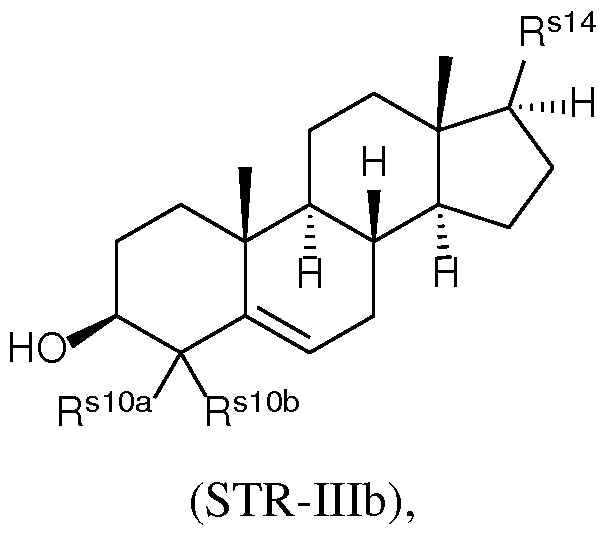
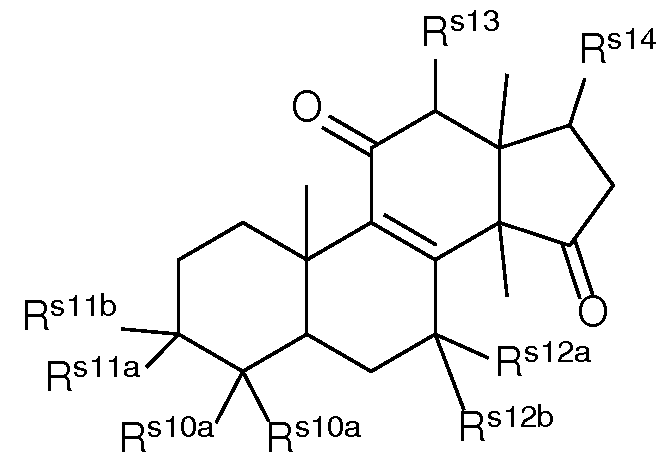
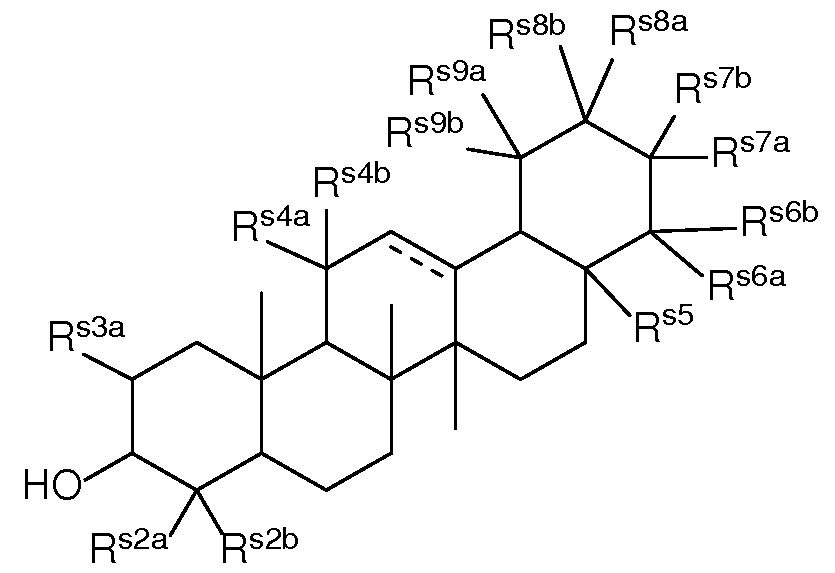
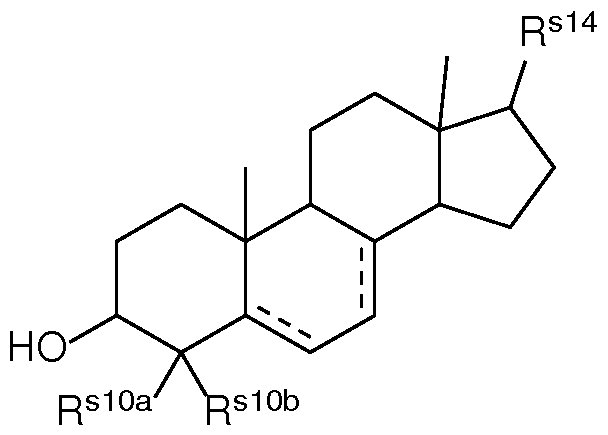
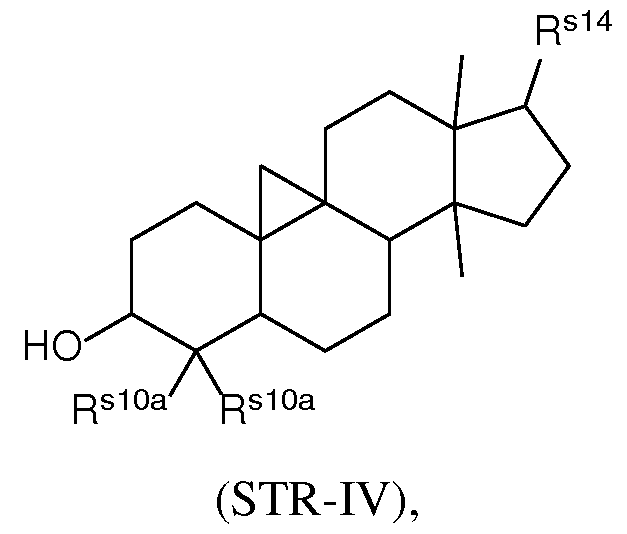
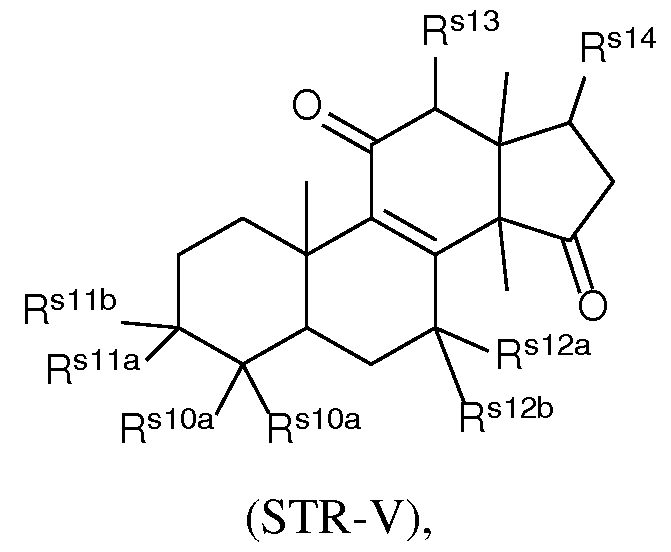
  • the present disclosure further provides a composition comprising a lipid nanoparticle (LNP), wherein the LNP comprises: (I) an ionizable lipid having a structure according to Formula CAT-I or CAT-II, as defined herein; (II) a structural lipid having a structure according to Formula STR-I, STR-II, SRT-III, STR-IV, or STR-V, or selected from the group consisting of cycloastrogenol, ⁇ -elemonic acid, diosgenin, yamogenin, steviol, brusatol, and ⁇ -oryzanol, or a combination thereof; and (III) optionally, cholesterol.
  • LNP lipid nanoparticle
  • the LNP comprises: (I) an ionizable lipid having a structure according to Formula CAT-I or CAT-II, as defined herein; (II) a structural lipid having a structure according to Formula STR-I, STR-II, SRT-III, STR-IV, or STR-V, or selected from the group consisting of cycloastrogenol, ⁇ -elemonic acid, diosgenin, yamogenin, steviol, brusatol, and ⁇ -oryzanol, or a combination thereof; (III) optionally, cholesterol; (IV) a helper lipid; and (V) a stealth lipid.
  • the LNP comprises: (I) an ionizable lipid having a structure according to Formula CAT-I or CAT-II, as defined herein; (II) a structural lipid having a structure according to Formula STR-I, STR-II, SRT-III, STR-IV, or STR-V, or selected from the group consisting of cycloastrogenol, ⁇ -elemonic acid, diosgenin, yamogenin, steviol, brusatol, and ⁇ -oryzanol, or a combination thereof; (III) cholesterol; (IV) a helper lipid; and (V) a stealth lipid.
  • the present disclosure further provides an LNP as described herein further comprising a nucleic acid molecule, wherein the nucleic acid molecule is encapsulated in the LNP.
  • the nucleic acid molecule is an mRNA molecule.
  • the present disclosure further provides a method of preventing an infection or reducing one or more symptoms of an infection, comprising administering to the subject, optionally intramuscularly, intranasally, intravenously, subcutaneously, or intradermally, a prophylactically effective amount of a composition described herein.
  • the present disclosure further provides the use of a composition described herein for the manufacture of a medicament for use in treating a subject in need thereof.
  • the present disclosure further provides a kit comprising a container comprising a single- use or multi-use dosage of a composition described herein, optionally wherein the container is a vial or a pre-filled syringe or injector.
  • LNP lipid nanoparticle
  • the present disclosure provides lipid nanoparticle (LNP) formulations for delivering cargo, such as a nucleic acid molecule (e.g., mRNA), to a target cell.
  • cargo such as a nucleic acid molecule (e.g., mRNA)
  • a target cell lipid nanoparticle
  • Certain LNPs of the present disclosure comprise an ionizable lipid, a structural lipid, and optionally cholesterol.
  • the LNPs may further comprise one or more additional lipids, such a stealth (e.g., PEGylated) lipid and/or a helper lipid.
  • LNP formulations of the present disclosure comprising hEPO mRNA were found to significantly improve protein expression over control formulations.
  • the term “comprising” can include the embodiments “consisting of” and “consisting essentially of.”
  • the terms “comprise(s),” “include(s),” “having,” “has,” “can,” “contain(s),” and variants thereof, as used herein, are intended to be open-ended transitional phrases, terms, or words that require the presence of the named ingredients/steps and permit the presence of other ingredients/steps.
  • such description should be construed as also describing compositions or processes as “consisting of” and “consisting essentially of” the enumerated ingredients/steps, which allows the presence of only the named ingredients/steps and excludes other ingredients/steps.
  • delivery encompasses both local and systemic delivery.
  • delivery of mRNA encompasses situations in which an mRNA is delivered to a target tissue and the encoded protein is expressed and retained within the target tissue (also referred to as “local distribution” or “local delivery”), and situations in which an mRNA is delivered to a target tissue and the encoded protein is expressed and secreted into patient's circulation system (e.g., serum) and systematically distributed and taken up by other tissues (also referred to as “systemic distribution” or “systemic delivery).
  • patient's circulation system e.g., serum
  • expression of a nucleic acid sequence refers to translation of an mRNA into a polypeptide, assemble multiple polypeptides (e.g., heavy chain or light chain of antibody) into an intact protein (e.g., antibody) and/or post-translational modification of a polypeptide or fully assembled protein (e.g., antibody).
  • expression and production are used inter-changeably.
  • a “functional” biological molecule is a biological molecule in a form in which it exhibits a property and/or activity by which it is characterized.
  • half-life is the time required for a quantity such as nucleic acid or protein concentration or activity to fall to half of its value as measured at the beginning of a time period.
  • the terms “improve,” “increase” or “reduce,” or grammatical equivalents indicate values that are relative to a baseline measurement, such as a measurement in the same individual prior to initiation of the treatment described herein, or a measurement in a control subject (or multiple control subject) in the absence of the treatment described herein.
  • a “control subject” is a subject afflicted with the same form of disease as the subject being treated, who is about the same age as the subject being treated.
  • in vitro refers to events that occur in an artificial environment, e.g., in a test tube or reaction vessel, in cell culture, etc., rather than within a multi-cellular organism.
  • in vivo refers to events that occur within a multi-cellular organism, such as a human and a non-human animal. In the context of cell-based systems, the term may be used to refer to events that occur within a living cell (as opposed to, for example, in vitro systems).
  • local distribution “local delivery,” or grammatical equivalent, refer to tissue specific delivery or distribution.
  • mRNA messenger RNA
  • mRNA refers to a polynucleotide that encodes at least one polypeptide.
  • mRNA as used herein encompasses both modified and unmodified RNA.
  • mRNA may contain one or more coding and non-coding regions.
  • mRNA can be purified from natural sources, produced using recombinant expression systems and optionally purified, chemically synthesized, etc.
  • mRNA can comprise nucleoside analogs such as analogs having chemically modified bases or sugars, backbone modifications, etc.
  • An mRNA sequence is presented in the 5′ to 3′ direction unless otherwise indicated.
  • an mRNA is or comprises natural nucleosides (e.g., adenosine, guanosine, cytidine, uridine); nucleoside analogs (e.g., 2-aminoadenosine, 2-thiothymidine, inosine, pyrrolo-pyrimidine, 3-methyl adenosine, 5-methylcytidine, C-5 propynyl-cytidine, C-5 propynyl-uridine, 2-aminoadenosine, C5-bromouridine, C5-fluorouridine, C5-iodouridine, C5-propynyl-uridine, C5-propynyl- cytidine, C5-methylcytidine, 2-aminoadenosine, 7-deazaadenosine, 7-deazaguanosine, 8- oxoadenosine, 8-oxoguanosine, O(6)
  • the mRNA comprises one or more nonstandard nucleotide residues.
  • the nonstandard nucleotide residues may include, e.g., 5-methyl-cytidine (“5mC”), pseudouridine (“ ⁇ U”), and/or 2-thio-uridine (“2sU”). See, e.g., U.S. Pat. No.8,278,036 or WO2011012316 for a discussion of such residues and their incorporation into mRNA.
  • the mRNA may be RNA, which is defined as RNA in which 25% of U residues are 2-thio-uridine and 25% of C residues are 5-methylcytidine.
  • RNA is disclosed US Patent Publication US20120195936 and internation publication WO2011012316, both of which are hereby incorporated by reference in their entirety.
  • the presence of nonstandard nucleotide residues may render an mRNA more stable and/or less immunogenic than a control mRNA with the same sequence but containing only standard residues.
  • the mRNA may comprise one or more nonstandard nucleotide residues chosen from isocytosine, pseudoisocytosine, 5-bromouracil, 5-propynyluracil, 6-aminopurine, 2-aminopurine, inosine, diaminopurine and 2-chloro-6-aminopurine cytosine, as well as combinations of these modifications and other nucleobase modifications.
  • Certain embodiments may further include additional modifications to the furanose ring or nucleobase. Additional modifications may include, for example, sugar modifications or substitutions (e.g., one or more of a 2′-O-alkyl modification, a locked nucleic acid (LNA)).
  • LNA locked nucleic acid
  • the RNAs may be complexed or hybridized with additional polynucleotides and/or peptide polynucleotides (PNA).
  • PNA polynucleotides and/or peptide polynucleotides
  • the sugar modification is a 2′-O-alkyl modification
  • such modification may include, but are not limited to a 2′-deoxy-2′-fluoro modification, a 2′-O-methyl modification, a 2′-O-methoxyethyl modification and a 2′-deoxy modification.
  • any of these modifications may be present in 0-100% of the nucleotides—for example, more than 0%, 1%, 10%, 25%, 50%, 75%, 85%, 90%, 95%, or 100% of the constituent nucleotides individually or in combination.
  • nucleic acid in its broadest sense, refers to any compound and/or substance that is or can be incorporated into a polynucleotide chain.
  • a nucleic acid is a compound and/or substance that is or can be incorporated into a polynucleotide chain via a phosphodiester linkage.
  • nucleic acid refers to individual nucleic acid residues (e.g., nucleotides and/or nucleosides).
  • nucleic acid refers to a polynucleotide chain comprising individual nucleic acid residues.
  • nucleic acid encompasses RNA as well as single and/or double-stranded DNA and/or cDNA.
  • pharmaceutically acceptable refers to substances that, within the scope of sound medical judgment, are suitable for use in contact with the tissues of human beings and animals without excessive toxicity, irritation, allergic response, or other problem or complication, commensurate with a reasonable benefit/risk ratio.
  • systemic distribution refers to a delivery or distribution mechanism or approach that affect the entire body or an entire organism. Typically, systemic distribution or delivery is accomplished via body's circulation system, e.g., blood stream.
  • the term “subject” refers to a human or any non-human animal (e.g., mouse, rat, rabbit, dog, cat, cattle, swine, sheep, horse or primate).
  • a human includes pre- and post-natal forms.
  • a subject is a human being.
  • a subject can be a patient, which refers to a human presenting to a medical provider for diagnosis or treatment of a disease.
  • the term “subject” is used herein interchangeably with “individual” or “patient.”
  • a subject can be afflicted with or is susceptible to a disease or disorder but may or may not display symptoms of the disease or disorder.
  • target tissues refers to any tissue that is affected by a disease to be treated. In some embodiments, target tissues include those tissues that display disease- associated pathology, symptom, or feature.
  • the term “therapeutically effective amount” of a therapeutic agent means an amount that is sufficient, when administered to a subject suffering from or susceptible to a disease, disorder, and/or condition, to treat, diagnose, prevent, and/or delay the onset of the symptom(s) of the disease, disorder, and/or condition. It will be appreciated by those of ordinary skill in the art that a therapeutically effective amount is typically administered via a dosing regimen comprising at least one unit dose.
  • treatment is defined as the application or administration of a therapeutic agent to a patient, or application or administration of a therapeutic agent to an isolated tissue or cell line from a patient (e.g., for diagnosis or ex vivo applications), who has a disorder or disease as described herein, a symptom thereof; or the potential to develop such disorder or disease, where the purpose of the application or administration is to cure, heal, alleviate, relieve, alter, remedy, ameliorate, improve or affect the disorder or disease, or its symptoms.
  • Such treatments may be specifically tailored or modified, based on knowledge obtained from the field of pharmacogenomics.
  • prevent means no disorder or disease development if none had occurred, or no further disorder or disease development if there had already been development of the disorder or disease. Also considered is the ability of one to prevent some or all of the symptoms associated with the disorder or disease. Definitions of specific functional groups and chemical terms are described in more detail below. Compounds described herein can comprise one or more asymmetric centers, and thus can exist in various isomeric forms, e.g., enantiomers and/or diastereomers.
  • the compounds described herein can be in the form of an individual enantiomer, diastereomer or geometric isomer, or can be in the form of a mixture of stereoisomers, including racemic mixtures and mixtures enriched in one or more stereoisomer.
  • Isomers can be isolated from mixtures by methods known to those skilled in the art, including chiral high performance liquid chromatography (HPLC) and the formation and crystallization of chiral salts; or certain isomers can be prepared by asymmetric syntheses. See, for example, Jacques et al., Enantiomers. Racemates and Resolutions (Wiley Interscience, New York, 1981); Wilen et al., Tetrahedron 33:2725 (1977); Eliel, E.
  • C 1-6 alkyl is intended to encompass, C 1 , C 2 , C 3 , C 4 , C 5 , C 6 , C 1-6 , C 1-5 , C 1-4 , C 1-3 , C 1-2 , C 2-6 , C 2-5 , C 2-4 , C 2-3 , C 3-6 , C 3-5 , C 3-4 , C 4-6 , C 4-5 , and C 5-6 alkyl.
  • alkyl refers to a radical of a straight-chain or branched saturated hydrocarbon group having from 1 to 50 carbon atoms (“C1-50 alkyl”). In some embodiments, an alkyl group has 1 to 40 carbon atoms (“C1-40 alkyl”).
  • an alkyl group has 1 to 30 carbon atoms (“C1-30 alkyl”). In some embodiments, an alkyl group has 1 to 20 carbon atoms (“C1-20 alkyl”). In some embodiments, an alkyl group has 1 to 10 carbon atoms (“C1-10 alkyl”). In some embodiments, an alkyl group has 1 to 9 carbon atoms (“C1-9 alkyl”). In some embodiments, an alkyl group has 1 to 8 carbon atoms (“C1-8 alkyl”). In some embodiments, an alkyl group has 1 to 7 carbon atoms (“C1-7 alkyl”). In some embodiments, an alkyl group has 1 to 6 carbon atoms (“C1-6 alkyl”).
  • an alkyl group has 1 to 5 carbon atoms (“C1-5 alkyl”). In some embodiments, an alkyl group has 1 to 4 carbon atoms (“C1-4 alkyl”). In some embodiments, an alkyl group has 1 to 3 carbon atoms (“C1-3 alkyl”). In some embodiments, an alkyl group has 1 to 2 carbon atoms (“C1-2 alkyl”). In some embodiments, an alkyl group has 1 carbon atom (“C1 alkyl”). In some embodiments, an alkyl group has 2 to 6 carbon atoms (“C2-6 alkyl”).
  • C1-6 alkyl groups include, without limitation, methyl (C1), ethyl (C2), n-propyl (C3), isopropyl (C3), n-butyl (C4), tert-butyl (C4), sec-butyl (C4), iso- butyl (C4), n-pentyl (C5), 3-pentanyl (C5), amyl (C5), neopentyl (C5), 3-methyl-2-butanyl (C5), tertiary amyl (C5), and n-hexyl (C6).
  • alkyl groups include n-heptyl (C7), n-octyl (C8) and the like. Unless otherwise specified, each instance of an alkyl group is independently unsubstituted (an “unsubstituted alkyl”) or substituted (a “substituted alkyl”) with one or more substituents. In certain embodiments, the alkyl group is an unsubstituted C1-50 alkyl. In certain embodiments, the alkyl group is a substituted C1-50 alkyl.
  • heteroalkyl refers to an alkyl group as defined herein which further includes at least one heteroatom (e.g., 1 to 25, e.g., 1, 2, 3, or 4 heteroatoms) selected from oxygen, sulfur, nitrogen, boron, silicon, and phosphorus within (i.e., inserted between adjacent carbon atoms of) and/or placed at one or more terminal position(s) of the parent chain.
  • a heteroalkyl group refers to a saturated group having from 1 to 50 carbon atoms and 1 or more heteroatoms within the parent chain (“heteroC1-50 alkyl”).
  • a heteroalkyl group refers to a saturated group having from 1 to 40 carbon atoms and 1 or more heteroatoms within the parent chain (“heteroC1-40 alkyl”). In certain embodiments, a heteroalkyl group refers to a saturated group having from 1 to 30 carbon atoms and 1 or more heteroatoms within the parent chain (“heteroC1-30 alkyl”). In certain embodiments, a heteroalkyl group refers to a saturated group having from 1 to 20 carbon atoms and 1 or more heteroatoms within the parent chain (“heteroC1-20 alkyl”).
  • a heteroalkyl group refers to a saturated group having from 1 to 10 carbon atoms and 1 or more heteroatoms within the parent chain (“heteroC1-10 alkyl”). In some embodiments, a heteroalkyl group is a saturated group having 1 to 9 carbon atoms and 1 or more heteroatoms within the parent chain (“heteroC1-9 alkyl”). In some embodiments, a heteroalkyl group is a saturated group having 1 to 8 carbon atoms and 1 or more heteroatoms within the parent chain (“heteroC1-8 alkyl”). In some embodiments, a heteroalkyl group is a saturated group having 1 to 7 carbon atoms and 1 or more heteroatoms within the parent chain (“heteroC1-7 alkyl”).
  • a heteroalkyl group is a saturated group having 1 to 6 carbon atoms and 1 or more heteroatoms within the parent chain (“heteroC1-6 alkyl”). In some embodiments, a heteroalkyl group is a saturated group having 1 to 5 carbon atoms and 1 or 2 heteroatoms within the parent chain (“heteroC1-5 alkyl”). In some embodiments, a heteroalkyl group is a saturated group having 1 to 4 carbon atoms and 1 or 2 heteroatoms within the parent chain (“heteroC1-4 alkyl”). In some embodiments, a heteroalkyl group is a saturated group having 1 to 3 carbon atoms and 1 heteroatom within the parent chain (“heteroC1-3 alkyl”).
  • a heteroalkyl group is a saturated group having 1 to 2 carbon atoms and 1 heteroatom within the parent chain (“heteroC1-2 alkyl”). In some embodiments, a heteroalkyl group is a saturated group having 1 carbon atom and 1 heteroatom (“heteroC1 alkyl”). In some embodiments, a heteroalkyl group is a saturated group having 2 to 6 carbon atoms and 1 or 2 heteroatoms within the parent chain (“heteroC2-6 alkyl”). Unless otherwise specified, each instance of a heteroalkyl group is independently unsubstituted (an “unsubstituted heteroalkyl”) or substituted (a “substituted heteroalkyl”) with one or more substituents.
  • the heteroalkyl group is an unsubstituted heteroC1-50 alkyl. In certain embodiments, the heteroalkyl group is a substituted heteroC1-50 alkyl.
  • alkenyl refers to a radical of a straight-chain or branched hydrocarbon group having from 2 to 50 carbon atoms and one or more carbon-carbon double bonds (e.g., 1, 2, 3, or 4 double bonds) (“C2-50 alkenyl”). In some embodiments, an alkenyl group has 2 to 40 carbon atoms (“C2-40 alkenyl”). In some embodiments, an alkenyl group has 2 to 30 carbon atoms (“C2-30 alkenyl”).
  • an alkenyl group has 2 to 20 carbon atoms (“C2-20 alkenyl”). In some embodiments, an alkenyl group has 2 to 10 carbon atoms (“C2-10 alkenyl”). In some embodiments, an alkenyl group has 2 to 9 carbon atoms (“C2-9 alkenyl”). In some embodiments, an alkenyl group has 2 to 8 carbon atoms (“C2-8 alkenyl”). In some embodiments, an alkenyl group has 2 to 7 carbon atoms (“C2-7 alkenyl”). In some embodiments, an alkenyl group has 2 to 6 carbon atoms (“C2-6 alkenyl”).
  • an alkenyl group has 2 to 5 carbon atoms (“C2-5 alkenyl”). In some embodiments, an alkenyl group has 2 to 4 carbon atoms (“C2-4 alkenyl”). In some embodiments, an alkenyl group has 2 to 3 carbon atoms (“C2-3 alkenyl”). In some embodiments, an alkenyl group has 2 carbon atoms (“C2 alkenyl”).
  • the one or more carbon-carbon double bonds can be internal (such as in 2-butenyl) or terminal (such as in 1-butenyl).
  • Examples of C2-4 alkenyl groups include, without limitation, ethenyl (C2), 1-propenyl (C3), 2-propenyl (C3), 1-butenyl (C4), 2-butenyl (C4), butadienyl (C4), and the like.
  • Examples of C2-6 alkenyl groups include the aforementioned C2-4 alkenyl groups as well as pentenyl (C5), pentadienyl (C5), hexenyl (C6), and the like. Additional examples of alkenyl include heptenyl (C7), octenyl (C8), octatrienyl (C8), and the like.
  • each instance of an alkenyl group is independently unsubstituted (an “unsubstituted alkenyl”) or substituted (a “substituted alkenyl”) with one or more substituents.
  • the alkenyl group is an unsubstituted C2-50 alkenyl.
  • the alkenyl group is a substituted C2-50 alkenyl.
  • heteroalkenyl refers to an alkenyl group as defined herein which further includes at least one heteroatom (e.g., 1 to 25, e.g., 1, 2, 3, or 4 heteroatoms) selected from oxygen, sulfur, nitrogen, boron, silicon, and phosphorus within (i.e., inserted between adjacent carbon atoms of) and/or placed at one or more terminal position(s) of the parent chain.
  • a heteroalkenyl group refers to a group having from 2 to 50 carbon atoms, at least one double bond, and 1 or more heteroatoms within the parent chain (“heteroC2- 50 alkenyl”).
  • a heteroalkenyl group refers to a group having from 2 to 40 carbon atoms, at least one double bond, and 1 or more heteroatoms within the parent chain (“heteroC2-40 alkenyl”). In certain embodiments, a heteroalkenyl group refers to a group having from 2 to 30 carbon atoms, at least one double bond, and 1 or more heteroatoms within the parent chain (“heteroC2-30 alkenyl”). In certain embodiments, a heteroalkenyl group refers to a group having from 2 to 20 carbon atoms, at least one double bond, and 1 or more heteroatoms within the parent chain (“heteroC2-20 alkenyl”).
  • a heteroalkenyl group refers to a group having from 2 to 10 carbon atoms, at least one double bond, and 1 or more heteroatoms within the parent chain (“heteroC2-10 alkenyl”). In some embodiments, a heteroalkenyl group has 2 to 9 carbon atoms at least one double bond, and 1 or more heteroatoms within the parent chain (“heteroC2-9 alkenyl”). In some embodiments, a heteroalkenyl group has 2 to 8 carbon atoms, at least one double bond, and 1 or more heteroatoms within the parent chain (“heteroC2-8 alkenyl”).
  • a heteroalkenyl group has 2 to 7 carbon atoms, at least one double bond, and 1 or more heteroatoms within the parent chain (“heteroC2-7 alkenyl”). In some embodiments, a heteroalkenyl group has 2 to 6 carbon atoms, at least one double bond, and 1 or more heteroatoms within the parent chain (“heteroC2-6 alkenyl”). In some embodiments, a heteroalkenyl group has 2 to 5 carbon atoms, at least one double bond, and 1 or 2 heteroatoms within the parent chain (“heteroC2-5 alkenyl”).
  • a heteroalkenyl group has 2 to 4 carbon atoms, at least one double bond, and for 2 heteroatoms within the parent chain (“heteroC2-4 alkenyl”). In some embodiments, a heteroalkenyl group has 2 to 3 carbon atoms, at least one double bond, and 1 heteroatom within the parent chain (“heteroC2-3 alkenyl”). In some embodiments, a heteroalkenyl group has 2 to 6 carbon atoms, at least one double, bond, and 1 or 2 heteroatoms within the parent chain (“heteroC2-6 alkenyl”).
  • each instance of a heteroalkenyl group is independently unsubstituted (an “unsubstituted heteroalkenyl”) or substituted (a “substituted heteroalkenyl”) with one or more substituents.
  • the heteroalkenyl group is an unsubstituted heteroC2-50 alkenyl.
  • the heteroalkenyl group is a substituted heteroC2-50 alkenyl.
  • alkynyl refers to a radical of a straight-chain or branched hydrocarbon group having from 2 to 50 carbon atoms and one or more carbon-carbon triple bonds (e.g., 1, 2, 3, or 4 triple bonds) and optionally one or more double bonds (e.g., 1, 2, 3, or 4 double bonds) (“C2-50 alkynyl”).
  • An alkynyl group that has one or more triple bonds and one or more double bonds is also referred to as an “ene-yne”.
  • an alkynyl group has 2 to 40 carbon atoms (“C2-40 alkynyl”).
  • an alkynyl group has 2 to 30 carbon atoms (“C2-30 alkynyl”).
  • an alkynyl group has 2 to 20 carbon atoms (“C2-20 alkynyl”). In some embodiments, an alkynyl group has 2 to 10 carbon atoms (“C2-10 alkynyl”). In some embodiments, an alkynyl group has 2 to 9 carbon atoms (“C2-9 alkynyl”). In some embodiments, an alkynyl group has 2 to 8 carbon atoms (“C2-8 alkynyl”). In some embodiments, an alkynyl group has 2 to 7 carbon atoms (“C2-7 alkynyl”). In some embodiments, an alkynyl group has 2 to 6 carbon atoms (“C2-6 alkynyl”).
  • an alkynyl group has 2 to 5 carbon atoms (“C2-5 alkynyl”). In some embodiments, an alkynyl group has 2 to 4 carbon atoms (“C2-4 alkynyl”). In some embodiments, an alkynyl group has 2 to 3 carbon atoms (“C2-3 alkynyl”). In some embodiments, an alkynyl group has 2 carbon atoms (“C2 alkynyl”).
  • the one or more carbon- carbon triple bonds can be internal (such as in 2-butynyl) or terminal (such as in 1-butynyl).
  • C2-4 alkynyl groups include, without limitation, ethynyl (C2), 1-propynyl (C3), 2- propynyl (C3), 1-butynyl (C4), 2-butynyl (C4), and the like.
  • Examples of C2-6 alkenyl groups include the aforementioned C2-4 alkynyl groups as well as pentynyl (C5), hexynyl (C6), and the like.
  • Additional examples of alkynyl include heptynyl (C7), octynyl (C8), and the like.
  • each instance of an alkynyl group is independently unsubstituted (an “unsubstituted alkynyl”) or substituted (a “substituted alkynyl”) with one or more substituents.
  • the alkynyl group is an unsubstituted C2-50 alkynyl.
  • the alkynyl group is a substituted C2-50 alkynyl.
  • heteroalkynyl refers to an alkynyl group as defined herein which further includes at least one heteroatom (e.g., 1 to 25, e.g., 1, 2, 3, or 4 heteroatoms) selected from oxygen, sulfur, nitrogen, boron, silicon, and phosphorus within (i.e., inserted between adjacent carbon atoms of) and/or placed at one or more terminal position(s) of the parent chain.
  • a heteroalkynyl group refers to a group having from 2 to 50 carbon atoms, at least one triple bond, and 1 or more heteroatoms within the parent chain (“heteroC2-50 alkynyl”).
  • a heteroalkynyl group refers to a group having from 2 to 40 carbon atoms, at least one triple bond, and 1 or more heteroatoms within the parent chain (“heteroC2-40 alkynyl”). In certain embodiments, a heteroalkynyl group refers to a group having from 2 to 30 carbon atoms, at least one triple bond, and 1 or more heteroatoms within the parent chain (“heteroC2-30 alkynyl”). In certain embodiments, a heteroalkynyl group refers to a group having from 2 to 20 carbon atoms, at least one triple bond, and 1 or more heteroatoms within the parent chain (“heteroC2-20 alkynyl”).
  • a heteroalkynyl group refers to a group having from 2 to 10 carbon atoms, at least one triple bond, and 1 or more heteroatoms within the parent chain (“heteroC2-10 alkynyl”). In some embodiments, a heteroalkynyl group has 2 to 9 carbon atoms, at least one triple bond, and 1 or more heteroatoms within the parent chain (“heteroC2-9 alkynyl”). In some embodiments, a heteroalkynyl group has 2 to 8 carbon atoms, at least one triple bond, and 1 or more heteroatoms within the parent chain (“heteroC2-8 alkynyl”).
  • a heteroalkynyl group has 2 to 7 carbon atoms, at least one triple bond, and 1 or more heteroatoms within the parent chain (“heteroC2-7 alkynyl”). In some embodiments, a heteroalkynyl group has 2 to 6 carbon atoms, at least one triple bond, and 1 or more heteroatoms within the parent chain (“heteroC2-6 alkynyl”). In some embodiments, a heteroalkynyl group has 2 to 5 carbon atoms, at least one triple bond, and 1 or 2 heteroatoms within the parent chain (“heteroC2-5 alkynyl”).
  • a heteroalkynyl group has 2 to 4 carbon atoms, at least one triple bond, and for 2 heteroatoms within the parent chain (“heteroC2-4 alkynyl”). In some embodiments, a heteroalkynyl group has 2 to 3 carbon atoms, at least one triple bond, and 1 heteroatom within the parent chain (“heteroC2-3 alkynyl”). In some embodiments, a heteroalkynyl group has 2 to 6 carbon atoms, at least one triple bond, and 1 or 2 heteroatoms within the parent chain (“heteroC2-6 alkynyl”).
  • each instance of a heteroalkynyl group is independently unsubstituted (an “unsubstituted heteroalkynyl”) or substituted (a “substituted heteroalkynyl”) with one or more substituents.
  • the heteroalkynyl group is an unsubstituted heteroC2-50 alkynyl. In certain embodiments, the heteroalkynyl group is a substituted heteroC2-50 alkynyl.
  • “carbocyclyl” or “carbocyclic” refers to a radical of a non-aromatic cyclic hydrocarbon group having from 3 to 10 ring carbon atoms (“C3-10 carbocyclyl”) and zero heteroatoms in the non-aromatic ring system.
  • a carbocyclyl group has 3 to 8 ring carbon atoms (“C3-8 carbocyclyl”).
  • a carbocyclyl group has 3 to 7 ring carbon atoms (“C3-7 carbocyclyl”).
  • a carbocyclyl group has 3 to 6 ring carbon atoms (“C3-6 carbocyclyl”).
  • a carbocyclyl group has 4 to 6 ring carbon atoms (“C4-6 carbocyclyl”). In some embodiments, a carbocyclyl group has 5 to 6 ring carbon atoms (“C5-6 carbocyclyl”). In some embodiments, a carbocyclyl group has 5 to 10 ring carbon atoms (“C5-10 carbocyclyl”).
  • Exemplary C3-6 carbocyclyl groups include, without limitation, cyclopropyl (C3), cyclopropenyl (C3), cyclobutyl (C4), cyclobutenyl (C4), cyclopentyl (C5), cyclopentenyl (C5), cyclohexyl (C6), cyclohexenyl (C6), cyclohexadienyl (C6), and the like.
  • Exemplary C3-8 carbocyclyl groups include, without limitation, the aforementioned C3-6 carbocyclyl groups as well as cycloheptyl (C7), cycloheptenyl (C7), cycloheptadienyl (C7), cycloheptatrienyl (C7), cyclooctyl (C8), cyclooctenyl (C8), bicyclo[2.2.1]heptanyl (C7), bicyclo[2.2.2]octanyl (C8), and the like.
  • Exemplary C3-10 carbocyclyl groups include, without limitation, the aforementioned C3-8 carbocyclyl groups as well as cyclononyl (C9), cyclononenyl (C9), cyclodecyl (C10), cyclodecenyl (C10), octahydro- 1H-indenyl (C9), decahydronaphthalenyl (C10), spiro[4.5]decanyl (C10), and the like.
  • the carbocyclyl group is either monocyclic (“monocyclic carbocyclyl”) or polycyclic (e.g., containing a fused, bridged or spiro ring system such as a bicyclic system (“bicyclic carbocyclyl”) or tricyclic system (“tricyclic carbocyclyl”)) and can be saturated or can contain one or more carbon-carbon double or triple bonds.
  • Carbocyclyl also includes ring systems wherein the carbocyclyl ring, as defined above, is fused with one or more aryl or heteroaryl groups wherein the point of attachment is on the carbocyclyl ring, and in such instances, the number of carbons continue to designate the number of carbons in the carbocyclic ring system.
  • each instance of a carbocyclyl group is independently unsubstituted (an “unsubstituted carbocyclyl”) or substituted (a “substituted carbocyclyl”) with one or more substituents.
  • the carbocyclyl group is an unsubstituted C3-10 carbocyclyl.
  • the carbocyclyl group is a substituted C3-10 carbocyclyl.
  • “carbocyclyl” or “carbocyclic” is referred to as a “cycloalkyl”, i.e., a monocyclic, saturated carbocyclyl group having from 3 to 10 ring carbon atoms (“C3-10 cycloalkyl”).
  • a cycloalkyl group has 3 to 8 ring carbon atoms (“C3-8 cycloalkyl”).
  • a cycloalkyl group has 3 to 6 ring carbon atoms (“C3-6, cycloalkyl”).
  • a cycloalkyl group has 4 to 6 ring carbon atoms (“C4-6 cycloalkyl”). In some embodiments, a cycloalkyl group has 5 to 6 ring carbon atoms (“C5-6 cycloalkyl”). In some embodiments, a cycloalkyl group has 5 to 10 ring carbon atoms (“C5-10 cycloalkyl”). Examples of C5-6 cycloalkyl groups include cyclopentyl (C5) and cyclohexyl (C5). Examples of C3-6 cycloalkyl groups include the aforementioned C5-6 cycloalkyl groups as well as cyclopropyl (C3) and cyclobutyl (C4).
  • C3-8 cycloalkyl groups include the aforementioned C3-6 cycloalkyl groups as well as cycloheptyl (C7) and cyclooctyl (C8).
  • each instance of a cycloalkyl group is independently unsubstituted (an “unsubstituted cycloalkyl”) or substituted (a “substituted cycloalkyl”) with one or more substituents.
  • the cycloalkyl group is an unsubstituted C3-10 cycloalkyl.
  • the cycloalkyl group is a substituted C3-10 cycloalkyl.
  • heterocyclyl refers to a radical of a 3- to 14- membered non-aromatic ring system having ring carbon atoms and 1 or more (e.g., 1, 2, 3, or 4) ring heteroatoms, wherein each heteroatom is independently selected from oxygen, sulfur, nitrogen, boron, silicon, and phosphorus (“3-14 membered heterocyclyl”).
  • the point of attachment can be a carbon or nitrogen atom, as valency permits.
  • a heterocyclyl group can either be monocyclic (“monocyclic heterocyclyl”) or polycyclic (e.g., a fused, bridged or spiro ring system such as a bicyclic system (“bicyclic heterocyclyl”) or tricyclic system (“tricyclic heterocyclyl”)), and can be saturated or can contain one or more carbon-carbon double or triple bonds.
  • Heterocyclyl polycyclic ring systems can include one or more heteroatoms in one or both rings.
  • Heterocyclyl also includes ring systems wherein the heterocyclyl ring, as defined above, is fused with one or more carbocyclyl groups wherein the point of attachment is either on the carbocyclyl or heterocyclyl ring, or ring systems wherein the heterocyclyl ring, as defined above, is fused with one or more aryl or heteroaryl groups, wherein the point of attachment is on the heterocyclyl ring, and in such instances, the number of ring members continue to designate the number of ring members in the heterocyclyl ring system.
  • each instance of heterocyclyl is independently unsubstituted (an “unsubstituted heterocyclyl”) or substituted (a “substituted heterocyclyl”) with one or more substituents.
  • the heterocyclyl group is an unsubstituted 3-14 membered heterocyclyl. In certain embodiments, the heterocyclyl group is a substituted 3-14 membered heterocyclyl.
  • a heterocyclyl group is a 5-10 membered non-aromatic ring system having ring carbon atoms and 1 or more (e.g., 1, 2, 3, or 4) ring heteroatoms, wherein each heteroatom is independently selected from oxygen, sulfur, nitrogen, boron, silicon, and phosphorus (“5-10 membered heterocyclyl”).
  • a heterocyclyl group is a 5- 8 membered non-aromatic ring system having ring carbon atoms and 1 or more (e.g., 1, 2, 3, or 4) ring heteroatoms, wherein each heteroatom is independently selected from oxygen, sulfur, nitrogen, boron, silicon, and phosphorus (“5-8 membered heterocyclyl”).
  • a heterocyclyl group is a 5-6 membered non-aromatic ring system having ring carbon atoms and 1 or more (e.g., 1, 2, 3, or 4) ring heteroatoms, wherein each heteroatom is independently selected from oxygen, sulfur, nitrogen, boron, silicon, and phosphorus (“5-6 membered heterocyclyl”).
  • the 5-6 membered heterocyclyl has 1 or more (e.g., 1, 2, or 3) ring heteroatoms selected from oxygen, sulfur, nitrogen, boron, silicon, and phosphorus.
  • the 5-6 membered heterocyclyl has 1 or 2 ring heteroatoms selected from oxygen, sulfur, nitrogen, boron, silicon, and phosphorus.
  • the 5-6 membered heterocyclyl has 1 ring heteroatom selected from oxygen, sulfur, nitrogen, boron, silicon, and phosphorus.
  • Exemplary 3-membered heterocyclyl groups containing 1 heteroatom include, without limitation, azirdinyl, oxiranyl, thiorenyl.
  • Exemplary 4-membered heterocyclyl groups containing 1 heteroatom include, without limitation, azetidinyl, oxetanyl and thietanyl.
  • Exemplary 5- membered heterocyclyl groups containing 1 heteroatom include, without limitation, tetrahydrofuranyl, dihydrofuranyl, tetrahydrothiophenyl, dihydrothiophenyl, pyrrolidinyl, dihydropyrrolyl and pyrrolyl-2,5-dione.
  • Exemplary 5-membered heterocyclyl groups containing 2 heteroatoms include, without limitation, dioxolanyl, oxathiolanyl and dithiolanyl.
  • Exemplary 5-membered heterocyclyl groups containing 3 heteroatoms include, without limitation, triazolinyl, oxadiazolinyl, and thiadiazolinyl.
  • Exemplary 6-membered heterocyclyl groups containing 1 heteroatom include, without limitation, piperidinyl, tetrahydropyranyl, dihydropyridinyl, and thianyl.
  • Exemplary 6-membered heterocyclyl groups containing 2 heteroatoms include, without limitation, piperazinyl, morpholinyl, dithianyl, dioxanyl.
  • Exemplary 6-membered heterocyclyl groups containing 2 heteroatoms include, without limitation, triazinanyl.
  • Exemplary 7-membered heterocyclyl groups containing 1 heteroatom include, without limitation, azepanyl, oxepanyl and thiepanyl.
  • Exemplary 8-membered heterocyclyl groups containing 1 heteroatom include, without limitation, azocanyl, oxecanyl and thiocanyl.
  • Exemplary bicyclic heterocyclyl groups include, without limitation, indolinyl, isoindolinyl, dihydrobenzofuranyl, dihydrobenzothienyl, tetrahydrobenzothienyl, tetrahydrobenzofuranyl, tetrahydroindolyl, tetrahydroquinolinyl, tetrahydroisoquinolinyl, decahydroquinolinyl, decahydroisoquinolinyl, octahydrochromenyl, octahydroisochromenyl, decahydronaphthyridinyl, decahydro-1,8-naphthyridinyl, octahydropyrrolo[3,2-b]pyrrol
  • aryl refers to a radical of a monocyclic or polycyclic (e.g., bicyclic or tricyclic) 4n+2 aromatic ring system (e.g., having 6, 10, or 14 ⁇ electrons shared in a cyclic array) having 6-14 ring carbon atoms and zero heteroatoms provided in the aromatic ring system (“C6-14 aryl”).
  • an aryl group has 6 ring carbon atoms (“C6 aryl”; e.g., phenyl).
  • an aryl group has 10 ring carbon atoms (“C10 aryl”; e.g., naphthyl such as 1-naphthyl and 2-naphthyl).
  • an aryl group has 14 ring carbon atoms (“C14 aryl”; e.g., anthracyl).
  • Aryl also includes ring systems wherein the aryl ring, as defined above, is fused with one or more carbocyclyl or heterocyclyl groups wherein the radical or point of attachment is on the aryl ring, and in such instances, the number of carbon atoms continue to designate the number of carbon atoms in the aryl ring system.
  • each instance of an aryl group is independently unsubstituted (an “unsubstituted aryl”) or substituted (a “substituted aryl”) with one or more substituents.
  • the aryl group is an unsubstituted C6-14 aryl.
  • the aryl group is a substituted C6-14 aryl.
  • heteroaryl refers to a radical of a 5-14 membered monocyclic or polycyclic (e.g., bicyclic or tricyclic) 4n+2 aromatic ring system (e.g., having 6, 10, or 14 ⁇ electrons shared in a cyclic array) having ring carbon atoms and 1 or more (e.g., 1, 2, 3, or 4 ring heteroatoms) ring heteroatoms provided in the aromatic ring system, wherein each heteroatom is independently selected from oxygen, sulfur, nitrogen, boron, silicon, and phosphorus (“5-14 membered heteroaryl”).
  • the point of attachment can be a carbon or nitrogen atom, as valency permits.
  • Heteroaryl polycyclic ring systems can include one or more heteroatoms in one or both rings.
  • “Heteroaryl” includes ring systems wherein the heteroaryl ring, as defined above, is fused with one or more carbocyclyl or heterocyclyl groups wherein the point of attachment is on the heteroaryl ring, and in such instances, the number of ring members continue to designate the number of ring members in the heteroaryl ring system.
  • Heteroaryl also includes ring systems wherein the heteroaryl ring, as defined above, is fused with one or more aryl groups wherein the point of attachment is either on the aryl or heteroaryl ring, and in such instances, the number of ring members designates the number of ring members in the fused polycyclic (aryl/heteroaryl) ring system.
  • Polycyclic heteroaryl groups wherein one ring does not contain a heteroatom e.g., indolyl, quinolinyl, carbazolyl, and the like
  • the point of attachment can be on either ring, i.e., either the ring bearing a heteroatom (e.g., 2-indolyl) or the ring that does not contain a heteroatom (e.g., 5-indolyl).
  • a heteroaryl group is a 5-10 membered aromatic ring system having ring carbon atoms and 1 or more (e.g., 1, 2, 3, or 4) ring heteroatoms provided in the aromatic ring system, wherein each heteroatom is independently selected from oxygen, sulfur, nitrogen, boron, silicon, and phosphorus (“5-10 membered heteroaryl”).
  • a heteroaryl group is a 5-8 membered aromatic ring system having ring carbon atoms and 1 or more (e.g., 1, 2, 3, or 4) ring heteroatoms provided in the aromatic ring system, wherein each heteroatom is independently selected from oxygen, sulfur, nitrogen, boron, silicon, and phosphorus (“5-8 membered heteroaryl”).
  • a heteroaryl group is a 5-6 membered aromatic ring system having ring carbon atoms and 1 or more (e.g., 1, 2, 3, or 4) ring heteroatoms provided in the aromatic ring system, wherein each heteroatom is independently selected from oxygen, sulfur, nitrogen, boron, silicon, and phosphorus (“5-6 membered heteroaryl”).
  • the 5-6 membered heteroaryl has 1 or more (e.g., 1, 2, or 3) ring heteroatoms selected from oxygen, sulfur, nitrogen, boron, silicon, and phosphorus.
  • the 5-6 membered heteroaryl has 1 or 2 ring heteroatoms selected from oxygen, sulfur, nitrogen, boron, silicon, and phosphorus.
  • the 5-6 membered heteroaryl has 1 ring heteroatom selected from oxygen, sulfur, nitrogen, boron, silicon, and phosphorus.
  • each instance of a heteroaryl group is independently unsubstituted (an “unsubstituted heteroaryl”) or substituted (a “substituted heteroaryl”) with one or more substituents.
  • the heteroaryl group is an unsubstituted 5-14 membered heteroaryl.
  • the heteroaryl group is a substituted 5-14 membered heteroaryl.
  • Exemplary 5-membered heteroaryl groups containing 1 heteroatom include, without limitation, pyrrolyl, furanyl and thiophenyl.
  • Exemplary 5-membered heteroaryl groups containing 2 heteroatoms include, without limitation, imidazolyl, pyrazolyl, oxazolyl, isoxazolyl, thiazolyl, and isothiazolyl.
  • Exemplary 5-membered heteroaryl groups containing 3 heteroatoms include, without limitation, triazolyl, oxadiazolyl, and thiadiazolyl.
  • Exemplary 5-membered heteroaryl groups containing 4 heteroatoms include, without limitation, tetrazolyl.
  • Exemplary 6- membered heteroaryl groups containing 1 heteroatom include, without limitation, pyridinyl.
  • Exemplary 6-membered heteroaryl groups containing 2 heteroatoms include, without limitation, pyridazinyl, pyrimidinyl, and pyrazinyl.
  • Exemplary 6-membered heteroaryl groups containing 3 or 4 heteroatoms include, without limitation, triazinyl and tetrazinyl, respectively.
  • Exemplary 7- membered heteroaryl groups containing 1 heteroatom include, without limitation, azepinyl, oxepinyl, and thiepinyl.
  • Exemplary 5,6-bicyclic heteroaryl groups include, without limitation, indolyl, isoindolyl, indazolyl, benzotriazolyl, benzothiophenyl, isobenzothiophenyl, benzofuranyl, benzoisofuranyl, benzimidazolyl, benzoxazolyl, benzisoxazolyl, benzoxadiazolyl, benzthiazolyl, benzisothiazolyl, benzthiadiazolyl, indolizinyl, and purinyl.
  • Exemplary 6,6- bicyclic heteroaryl groups include, without limitation, naphthyridinyl, pteridinyl, quinolinyl, isoquinolinyl, cinnolinyl, quinoxalinyl, phthalazinyl, and quinazolinyl.
  • Exemplary tricyclic heteroaryl groups include, without limitation, phenanthridinyl, dibenzofuranyl, carbazolyl, acridinyl, phenothiazinyl, phenoxazinyl and phenazinyl.
  • the term “partially unsaturated” refers to a ring moiety that includes at least one double or triple bond.
  • partially unsaturated is intended to encompass rings having multiple sites of unsaturation but is not intended to include aromatic groups (e.g., aryl or heteroaryl moieties) as herein defined.
  • saturated refers to a ring moiety that does not contain a double or triple bond, i.e., the ring contains all single bonds.
  • alkylene is the divalent moiety of alkyl
  • alkenylene is the divalent moiety of alkenyl
  • alkynylene is the divalent moiety of alkynyl
  • heteroalkylene is the divalent moiety of heteroalkyl
  • heteroalkenylene is the divalent moiety of heteroalkenyl
  • heteroalkynylene is the divalent moiety of heteroalkynyl
  • carbocyclylene is the divalent moiety of carbocyclyl
  • heterocyclylene is the divalent moiety of heterocyclyl
  • arylene is the divalent moiety of aryl
  • heteroarylene is the divalent moiety of heteroaryl.
  • alkyl, alkenyl, alkynyl, heteroalkyl, heteroalkenyl, heteroalkynyl, carbocyclyl, heterocyclyl, aryl, and heteroaryl groups, as defined herein, are, in certain embodiments, optionally substituted, as defined in the variable definitions for the compounds provided herein.
  • substituted means that at least one hydrogen present on a group is replaced with a permissible substituent, e.g., a substituent which upon substitution results in a stable compound, e.g., a compound which does not spontaneously undergo transformation such as by rearrangement, cyclization, elimination, or other reaction.
  • a “substituted” group has a substituent at one or more substitutable positions of the group, and when more than one position in any given structure is substituted, the substituent is either the same or different at each position.
  • substituted is contemplated to include substitution with all permissible substituents of organic compounds, any of the substituents described herein that results in the formation of a stable compound.
  • the present invention contemplates any and all such combinations in order to arrive at a stable compound.
  • heteroatoms such as nitrogen may have hydrogen substituents and/or any suitable substituent as described herein which satisfy the valencies of the heteroatoms and results in the formation of a stable moiety.
  • halo or halogen refers to fluorine (fluoro, —F), chlorine (chloro, —Cl), bromine (bromo, —Br), or iodine (iodo, —I).
  • a “counterion” is a negatively charged group associated with a positively charged quarternary amine in order to maintain electronic neutrality.
  • Exemplary counterions include halide ions (e.g., F—, Cl—, Br—, I—), NO3-, ClO4-, OH—, H2PO4-, HSO4-, sulfonate ions (e.g., methansulfonate, trifluoromethanesulfonate, p-toluenesulfonate, benzenesulfonate, 10- camphor sulfonate, naphthalene-2-sulfonate, naphthalene-1-sulfonic acid-5-sulfonate, ethan-1- sulfonic acid-2-sulfonate, and the like), and carboxylate ions (e.g., acetate, ethanoate, propanoate, benzoate, glycerate, lactate, tartrate, glycolate, and the like).
  • halide ions e.g., F—, Cl—, Br—, I—
  • Nitrogen atoms can be substituted or unsubstituted as valency permits, and include primary, secondary, tertiary, and quarternary nitrogen atoms.
  • the substituent present on a nitrogen atom is a nitrogen protecting group (also referred to as an amino protecting group). Nitrogen protecting groups are well known in the art and include those described in detail in Protecting Groups in Organic Synthesis, T. W. Greene and P. G. M. Wuts, 3rd edition, John Wiley & Sons, 1999, incorporated herein by reference.
  • the substituent present on an oxygen atom is an oxygen protecting group (also referred to as a hydroxyl protecting group).
  • Oxygen protecting groups are well known in the art and include those described in detail in Protecting Groups in Organic Synthesis, T. W. Greene and P. G. M. Wuts, 3rd edition, John Wiley & Sons, 1999, incorporated herein by reference.
  • the substituent present on a sulfur atom is a sulfur protecting group (also referred to as a thiol protecting group).
  • Sulfur protecting groups are well known in the art and include those described in detail in Protecting Groups in Organic Synthesis, T. W. Greene and P. G. M. Wuts, 3rd edition, John Wiley & Sons, 1999, incorporated herein by reference.
  • a “polymer” refers to a compound comprised of at least 3 (e.g., at least 10, 20, 30, 40, 50, 60, 70, 80, 90, 100, etc.) repeating covalently bound structural units. “Attached” refers to the covalent attachment of a group.
  • lipophilic refers to the ability of a group to dissolve in fats, oils, lipids, and lipophilic non-polar solvents such as hexane or toluene.
  • a lipophilic group refers to an unsubstituted n-alkyl or unsubstituted n-alkenyl group having 6 to 50 carbon atoms, e.g., 6 to 40, 6 to 30, 6 to 20, 8 to 20, 8 to 19, 8 to 18, 8 to 17, 8 to 16, or 8 to 15 carbon atoms.
  • compositions of the Present Lipid Nanoparticles The present disclosure provides a composition comprising a lipid nanoparticle (LNP).
  • LNP lipid nanoparticle
  • the LNP comprise at least an ionizable lipid and a structural lipid.
  • the LNP comprises an ionizable lipid, a structural lipid, and, optionally, cholesterol. In some embodiments, the LNP comprises an ionizable lipid, a structural lipid, and cholesterol. In some embodiments, the LNP comprises an ionizable lipid, a structural lipid, a helper lipid, and, optionally, cholesterol. In some embodiments, the LNP comprises an ionizable lipid, a structural lipid, a helper lipid, and cholesterol. In some embodiments, the LNP comprises an ionizable lipid, a structural lipid, a stealth lipid, and, optionally, cholesterol.
  • the LNP comprises an ionizable lipid, a structural lipid, a stealth lipid, and cholesterol. In some embodiments, the LNP comprises an ionizable lipid, a structural lipid, a helper lipid, a stealth lipid, and, optionally, cholesterol. In some embodiments, the LNP comprises an ionizable lipid, a structural lipid, a helper lipid, a stealth lipid, and cholesterol. Ionizable/Cationic Lipids An ionizable lipid facilitates mRNA encapsulation and may be a cationic lipid.
  • a cationic lipid affords a positively charged environment at low pH to facilitate efficient encapsulation of a negatively charged nucleic acid (e.g., mRNA) drug substance.
  • the ionizable lipid is a cationic lipid.
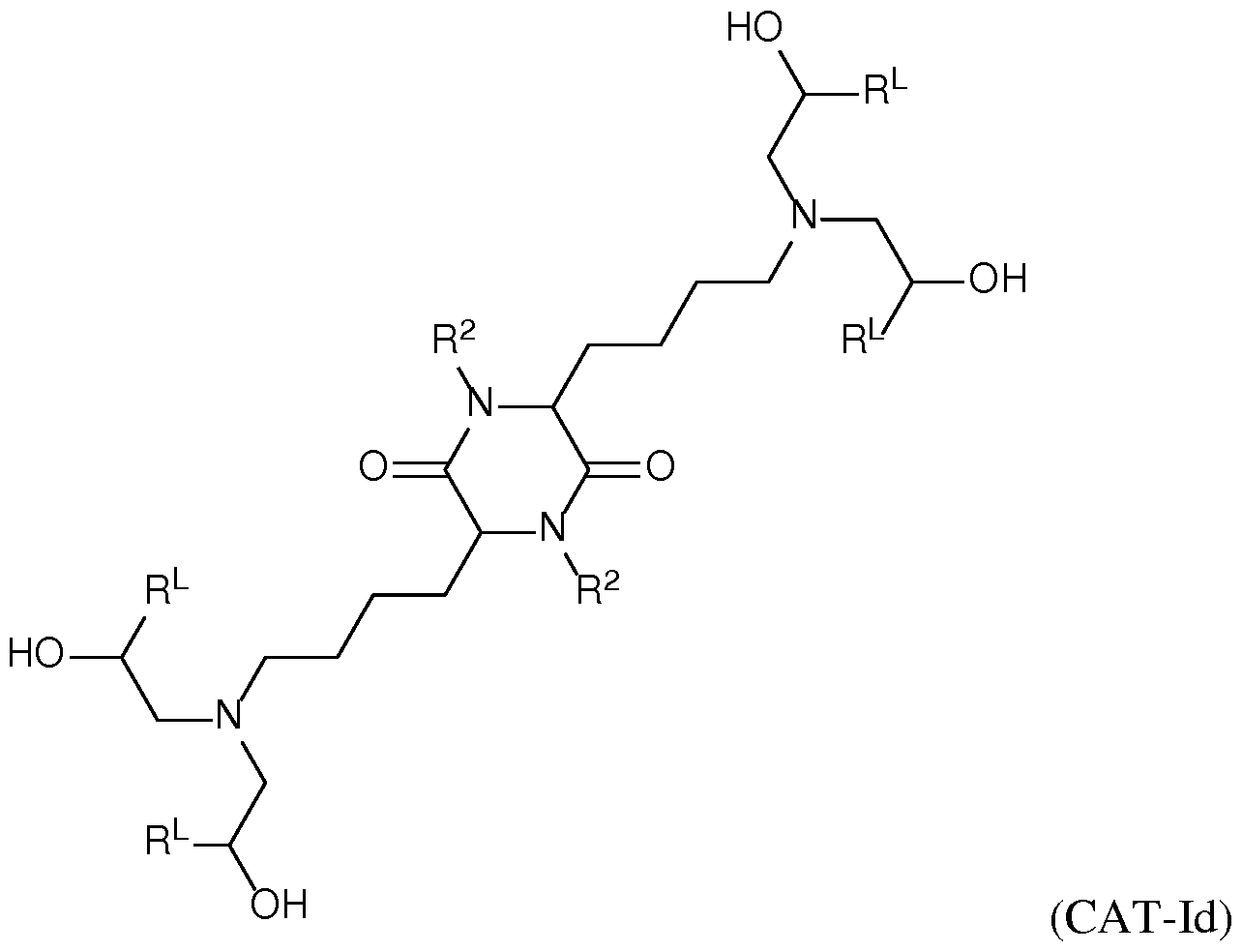
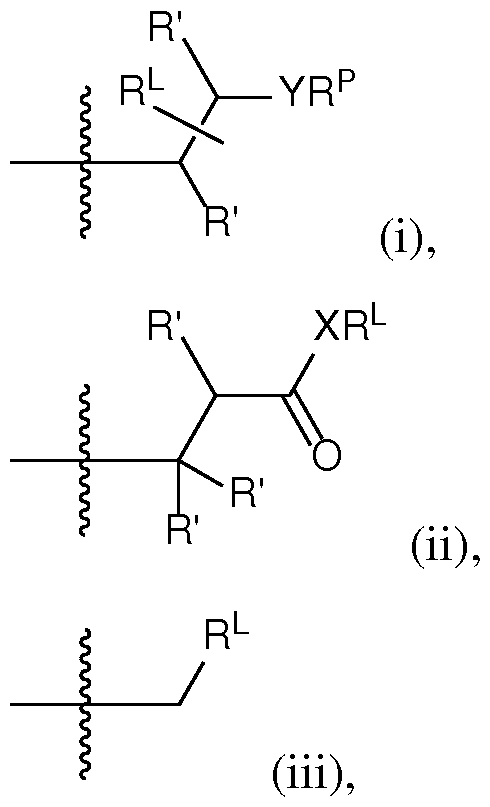
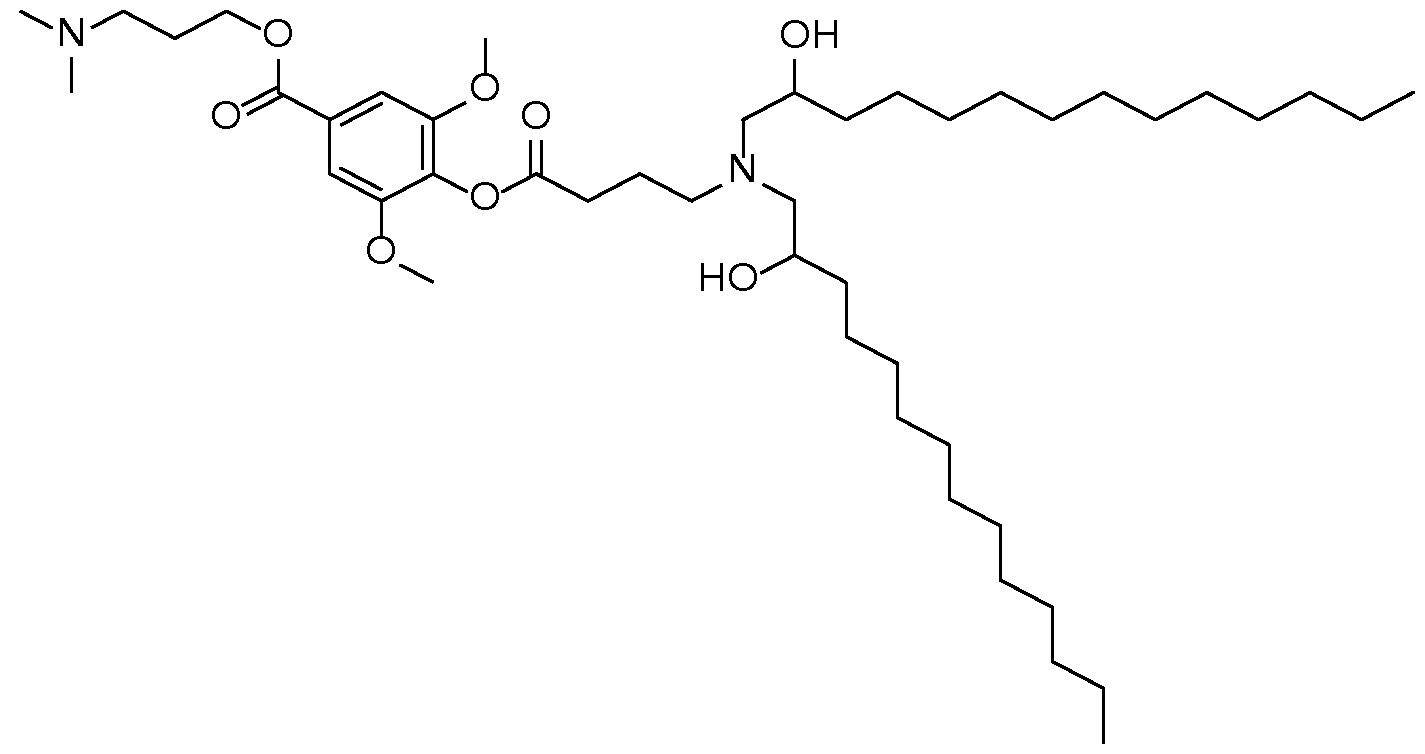
  • the cationic lipid has a structure according to Formula CAT-I: R 6 R 7 N p (CAT-I), or a pharmaceutically acceptable salt thereof, wherein: p is an integer of between 1 and 9, inclusive; each instance of R 2 is independently hydrogen or optionally substituted C 1-6 alkyl; each instance of L is independently an optionally substituted alkylene, optionally substituted alkenylene, optionally substituted alkynylene, optionally substituted heteroalkylene, optionally substituted heteroalkenylene, optionally substituted heteroalkynylene, optionally substituted carbocyclylene, optionally substituted heterocyclylene, optionally substituted arylene, or optionally substituted heteroarylene, or combination thereof; each instance of R 6 and R 7 is independently a group of formula (i), (ii), or (iii); Formulae (i), (ii), and (iii) are: R' R L YR P , each instance of R′ is independently hydrogen or optionally substituted alkyl;
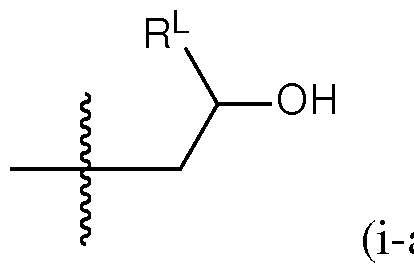
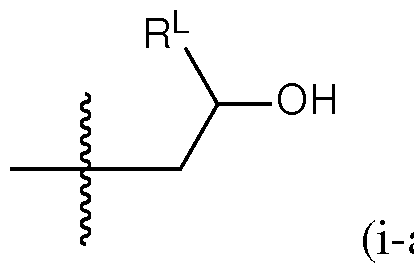
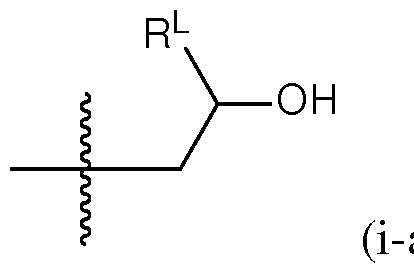
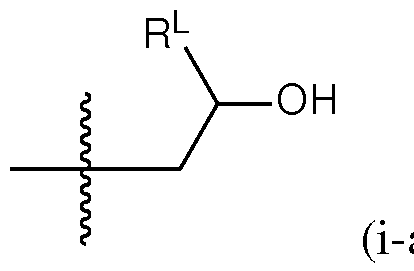
  • a group of formula (i) represents a group of formula (i-a) or a group of formula (i-b): R L R' YR P , . is independently as defined above and described herein.
  • a group of formula (i) is a group of formula (i-a).
  • a group of formula (i) is a group of formula (i-b).
  • each of R 6 and R 7 is independently a group of formula (i).
  • each of R 6 and R 7 is independently a group of formula (ii). In some embodiments of the lipid of Formula CAT-I, each of R 6 and R 7 is independently a group of formula (iii). In some embodiments of the lipid of Formula CAT-I, each of R 6 and R 7 is independently a group of formula (i-a). In some embodiments of the lipid of Formula CAT-I, each of R 6 and R 7 is independently a group of formula (i-b). In some embodiments of the lipid of Formula CAT-I, each instance of R′ is hydrogen. In some embodiments of the lipid of Formula CAT-I, L is an optionally substituted alkylene.
  • p is an integer of between 1 and 9, inclusive. In certain embodiments of the lipid of Formula CAT-I, p is 1. In certain embodiments of the lipid of Formula CAT-I, p is 2. In certain embodiments of the lipid of Formula CAT-I, p is 3. In certain embodiments of the lipid of Formula CAT-I, p is 4. In certain embodiments of the lipid of Formula CAT-I, p is 5. In certain embodiments of the lipid of Formula CAT-I, p is 6. In certain embodiments of the lipid of Formula CAT-I, p is 7. In certain embodiments of the lipid of Formula CAT-I, p is 8.
  • p is 9.
  • the lipid has a structure according to Formula CAT-Ia: R 6 R 7 N , or a thereof, wherein each variable is independently as defined above and described herein.
  • L is an optionally substituted alkylene; e.g., optionally substituted C 1-50 alkylene, optionally substituted C 1-40 alkylene, optionally substituted C 1-30 alkylene, optionally substituted C 1-20 alkylene, optionally substituted C 4-20 alkylene, optionally substituted C 6-20 alkylene, optionally substituted C 8-20 alkylene, optionally substituted C 10-20 alkylene, optionally substituted C 1-6 alkylene, optionally substituted C 2-6 alkylene, optionally substituted C 3-6 alkylene, optionally substituted C 4-6 alkylene, optionally substituted C 4-5 alkylene, or optionally substituted C 3-4 alkylene.
  • optionally substituted alkylene e.g., optionally substituted C 1-50 alkylene, optionally substituted C 1-40 alkylene, optionally substituted C 1-30 alkylene, optionally substituted C 1-20 alkylene, optionally substituted C 4-20 alkylene, optionally substituted C 6-20 alkylene, optional
  • L is optionally substituted C 1 alkylene. In some embodiments of the lipid of Formula CAT-I, L is optionally substituted C 2 alkylene. In some embodiments of the lipid of Formula CAT-I, L is optionally substituted C 3 alkylene. In some embodiments of the lipid of Formula CAT-I, L is optionally substituted C 4 alkylene. In some embodiments of the lipid of Formula CAT-I, L is optionally substituted C 5 alkylene. In some embodiments of the lipid of Formula CAT-I, L is optionally substituted C 6 alkylene. In some embodiments of the lipid of Formula CAT-I, L is optionally substituted C 7 alkylene.
  • L is optionally substituted C 8 alkylene. In some embodiments of the lipid of Formula CAT-I, L is —CH 2 —. In some embodiments of the lipid of Formula CAT-I, L is — (CH 2 ) 2 —. In some embodiments of the lipid of Formula CAT-I, L is —(CH 2 ) 3 —. In some embodiments of the lipid of Formula CAT-I, L is —(CH 2 ) 4 —. In some embodiments of the lipid of Formula CAT-I, L is —(CH 2 ) 5 —. In some embodiments of the lipid of Formula CAT-I, L is —(CH 2 ) 6 —.
  • L is —(CH 2 ) 7 —. In some embodiments of the lipid of Formula CAT-I, L is —(CH 2 ) 8 —. In certain embodiments of the lipid of I, L is an optionally substituted alkenylene, e.g., optionally substituted C 2-50 alkenylene, optionally substituted C 2-40 alkenylene, optionally substituted C 2-30 alkenylene, optionally substituted C 2-20 alkenylene, optionally substituted C 4-20 alkenylene, optionally substituted C 6-20 alkenylene, optionally substituted C 8- 20 alkenylene, optionally substituted C 10-20 alkenylene, optionally substituted C 2-6 alkenylene, optionally substituted C 3-6 alkenylene, optionally substituted C 4-6 alkenylene, optionally substituted C 4-5 alkenylene, or optionally substituted C 3-4 alkenylene.
  • optionally substituted alkenylene e.g., optionally substituted C 2-50 alkeny
  • L is an optionally substituted alkynylene, e.g., optionally substituted C 2-50 alkynylene, optionally substituted C 2-40 alkynylene, optionally substituted C 2-30 alkynylene, optionally substituted C 2-20 alkynylene, optionally substituted C 4-20 alkynylene, optionally substituted C 6-20 alkynylene, optionally substituted C 8- 20 alkynylene, optionally substituted C 10-20 alkynylene, optionally substituted C 2-6 alkynylene, optionally substituted C 3-6 alkynylene, optionally substituted C 4-6 alkynylene, optionally substituted C 4-5 alkynylene, or optionally substituted C 3-4 alkynylene.
  • alkynylene e.g., optionally substituted C 2-50 alkynylene, optionally substituted C 2-40 alkynylene, optionally substituted C 2-30 alkynylene, optionally substituted C 2-20 alkynylene
  • L is an optionally substituted heteroalkylene; e.g., optionally substituted heteroC 1-50 alkylene, optionally substituted heteroC 1- 40 alkylene, optionally substituted heteroC 1-30 alkylene, optionally substituted heteroC 1-20 alkylene, optionally substituted heteroC 4-20 alkylene, optionally substituted heteroC 6-20 alkylene, optionally substituted heteroC 8-20 alkylene, optionally substituted heteroC 1-20 alkylene, optionally substituted heteroC 1-6 alkylene, optionally substituted heteroC 2-6 alkylene, optionally substituted heteroC 3-6 - alkylene, optionally substituted heteroC 4-6 alkylene, optionally substituted heteroC 4-5 alkylene, or optionally substituted heteroC 3-4 alkylene.
  • optionally substituted heteroalkylene e.g., optionally substituted heteroC 1-50 alkylene, optionally substituted heteroC 1- 40 alkylene, optionally substituted heteroC 1-30 alkylene, optionally substituted heteroC 1-20 alkylene, optional
  • L is an optionally substituted heteroalkenylene, e.g., optionally substituted heteroC 2-50 alkenylene, optionally substituted heteroC 2-40 alkenylene, optionally substituted heteroC 2-30 alkenylene, optionally substituted heteroC 2-20 alkenylene, optionally substituted heteroC 4-20 alkenylene, optionally substituted heteroC 6-20 alkenylene, optionally substituted heteroC 8-20 alkenylene, optionally substituted heteroC 10-20 alkenylene, optionally substituted heteroC 2-6 alkenylene, optionally substituted heteroC 3-6 alkenylene, optionally substituted heteroC 4-6 alkenylene, optionally substituted heteroC 4-5 alkenylene, or optionally substituted heteroC 3-4 alkenylene.
  • optionally substituted heteroalkenylene e.g., optionally substituted heteroC 2-50 alkenylene, optionally substituted heteroC 2-40 alkenylene, optionally substituted heteroC 2-30 alkenylene, optionally substituted heteroC 2-20 al
  • L is an optionally substituted heteroalkynylene, e.g., optionally substituted heteroC 2-50 alkynylene, optionally substituted heteroC 2-40 alkynylene, optionally substituted heteroC 2-30 alkynylene, optionally substituted heteroC 2-20 alkynylene, optionally substituted heteroC 4-20 alkynylene, optionally substituted heteroC 6-20 alkynylene, optionally substituted heteroC 8-20 alkynylene, optionally substituted heteroC 10-20 alkynylene, optionally substituted heteroC 2-6 alkynylene, optionally substituted heteroC 3-6 alkynylene, optionally substituted heteroC 4-6 alkynylene, optionally substituted heteroC 4-5 alkynylene, or optionally substituted heteroC 3-4 alkynylene.
  • optionally substituted heteroalkynylene e.g., optionally substituted heteroC 2-50 alkynylene, optionally substituted heteroC 2-40 alkynylene, optionally substituted hetero
  • L is an optionally substituted carbocyclylene, e.g., optionally substituted C 3-10 carbocyclylene, optionally substituted C 5- 8 carbocyclylene, optionally substituted C 5-6 carbocyclylene, optionally substituted C 5 carbocyclylene, or optionally substituted C 6 carbocyclylene.
  • L is an optionally substituted heterocyclylene, e.g., optionally substituted 3-14 membered heterocyclylene, optionally substituted 3-10 membered heterocyclylene, optionally substituted 5-8 membered heterocyclylene, optionally substituted 5-6 membered heterocyclylene, optionally substituted 5- membered heterocyclylene, or optionally substituted 6-membered heterocyclylene.
  • L is an optionally substituted arylene, e.g., optionally substituted phenylene.
  • L is optionally substituted phenylene.
  • L is substituted phenylene.
  • L is unsubstituted phenylene.
  • L is an optionally substituted heteroarylene, e.g., optionally substituted 5-14 membered heteroarylene, optionally substituted 5- 10 membered heteroarylene, optionally substituted 5-6 membered heteroarylene, optionally substituted 5-membered heteroarylene, or optionally substituted 6-membered heteroarylene.
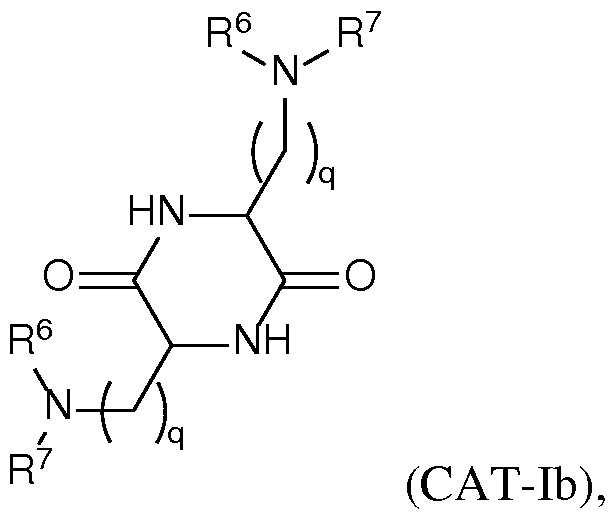
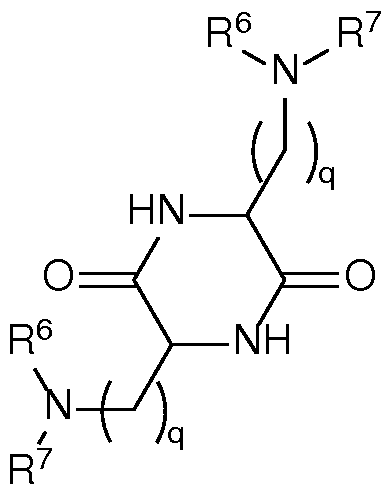
  • the lipid has a structure according to Formula CAT-Ib: R 6 R 7 N , or a thereof, wherein each variable is independently as defined above and described herein, and wherein 1 is an integer between 1 and 10.
  • q is an integer between 2 and 10, inclusive. In certain embodiments of the lipid of Formula CAT-Ib, q is an integer between 2 and 8, inclusive. In certain embodiments of the lipid of Formula CAT-Ib, q is an integer between 2 and 6, inclusive. In certain embodiments of the lipid of Formula CAT-Ib, q is 3 or 4. In certain embodiments of the lipid of Formula CAT-Ib, q is 1. In certain embodiments of the lipid of Formula CAT-Ib, q is 2. In certain embodiments of the lipid of Formula CAT-Ib, q is 3. In certain embodiments of the lipid of Formula CAT-Ib, q is 4.
  • q is 5. In certain embodiments of the lipid of Formula CAT-Ib, q is 6. In certain embodiments of the lipid of Formula CAT-Ib, q is 7. In certain embodiments of the lipid of Formula CAT-Ib, q is 8. In some embodiments of the lipid of Formula CAT-I, R 6 is a group of formula (i). In some embodiments of the lipid of Formula CAT-I, R 6 is a group of formula (i-a). In some embodiments of the lipid of Formula CAT-I, R 6 is a group of formula (i-a1): R L a1).
  • R 6 is a group of formula (i-b). In some embodiments of the lipid of Formula CAT-I, R 6 is a group of formula (ii). In some embodiments of the lipid of Formula CAT-I, R 6 is a group of formula (iii). In some embodiments of the lipid of Formula CAT-I, R 7 is a group of formula (i). In some embodiments of the lipid of Formula CAT-I, R 7 is a group of formula (i-a). In some embodiments of the lipid of Formula CAT-I, R 7 is a group of formula (i-a1).
  • R 7 is a group of formula (i-b). In some embodiments of the lipid of Formula CAT-I, R 7 is a group of formula (ii). In some embodiments of the lipid of Formula CAT-I, R 7 is a group of formula (iii). In some embodiments of the lipid of Formula CAT-I, each instance of R 6 and R 7 is independently a group of the formula (i). In some embodiments of the lipid of Formula CAT-I, each instance of R 6 and R 7 is independently a group of the formula (i-a). In some embodiments of the lipid of Formula CAT-I, each instance of R 6 and R 7 is independently a group of the formula (i-b).
  • each instance of R 6 and R 7 is independently a group of the formula (ii). In some embodiments of the lipid of Formula CAT-I, each instance of R 6 and R 7 is independently a group of the formula (iii). In some embodiments of the lipid of Formula CAT-I, R 6 and R 7 are the same. In some embodiments of the lipid of Formula CAT-I, R 6 and R 7 are different. In some embodiments of the lipid of Formula CAT-I, R 6 and R 7 are the same group of formula (i-a1): R L a1), and described herein.
  • R 6 and R 7 are the same group of formula R L a1), wherein R L is optionally substituted C 1-50 alkyl, optionally substituted C 2-50 alkenyl, optionally substituted C 2-50 alkynyl, optionally substituted heteroC 1-50 alkyl, optionally substituted heteroC 2- 50 alkenyl, or optionally substituted heteroC 2-50 alkynyl.
  • R 6 and R 7 are the same group of formula R L a1), C 5-25 alkyl, optionally substituted C 5-25 alkenyl, optionally substituted C 5-25 alkynyl, optionally substituted heteroC 5-25 alkyl, optionally substituted heteroC 5- 25 alkenyl, or optionally substituted heteroC 5-25 alkynyl.
  • R 6 and R 7 are the same group of formula R L a1), C 5-15 alkyl, optionally substituted C 5-15 alkenyl, optionally substituted C 5-15 alkynyl, optionally substituted heteroC 5-15 alkyl, optionally substituted heteroC 5- 15 alkenyl, or optionally substituted heteroC 5-15 alkynyl.
  • R 6 and R 7 are the same group of formula R L a1), C 1-50 alkyl.
  • R 6 and R 7 are the same group of formula R L a1), C 5-25 alkyl.
  • R 6 and R 7 are the same group of formula R L a1), C 5-20 alkyl. In some embodiments of the lipid of Formula CAT-I, R 6 and R 7 are the same group of formula R L a1), C 5-15 alkyl. In some embodiments of the lipid of Formula CAT-I, R 2 is hydrogen. In some embodiments of the lipid of Formula CAT-I, at least one instance of R 2 is hydrogen. In some embodiments of the lipid of Formula CAT-I, each instance of R 2 is hydrogen.
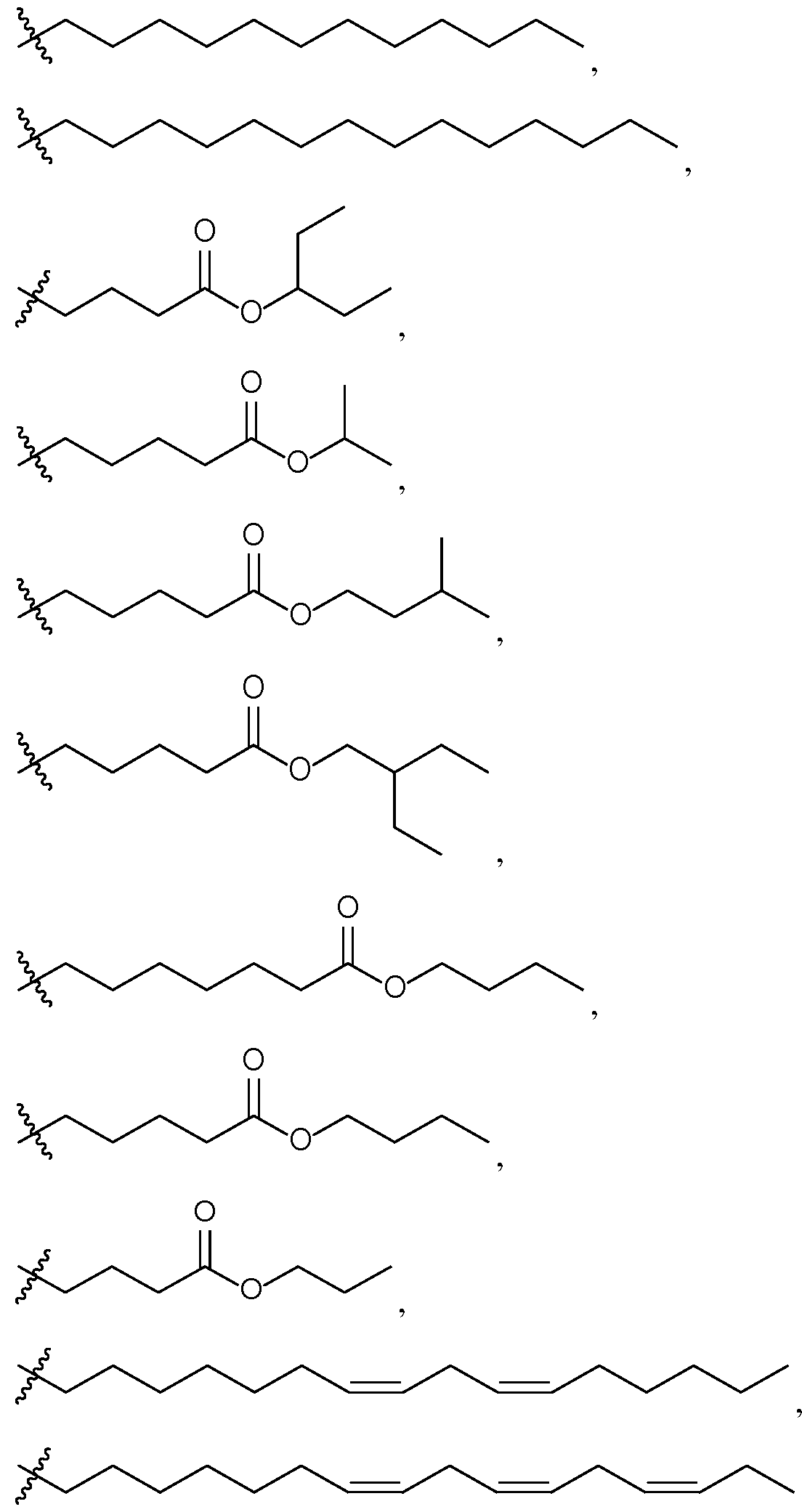
  • R 2 is optionally substituted C 1- 6 alkyl, optionally substituted C 2-6 alkyl, optionally substituted C 3-6 alkyl, optionally substituted C 4- 6 alkyl, optionally substituted C 4-5 alkyl, or optionally substituted C 3-4 alkyl.
  • at least one instance of R 2 is optionally substituted C 1-6 alkyl.
  • each instance of R′ is independently hydrogen or optionally substituted alkyl. In some embodiments of the lipid of Formula CAT-I, R′ is hydrogen.
  • R′ is substituted alkyl. In certain embodiments of the lipid of Formula CAT-I, at least one instance of R′ is hydrogen. In certain embodiments of the lipid of Formula CAT-I, at least two instances of R′ are hydrogen. In certain embodiments of the lipid of Formula CAT-I, each instance of R′ is hydrogen. In certain embodiments of the lipid of Formula CAT-I, at least one instance of R′ is optionally substituted alkyl, e.g., methyl. In certain embodiments of the lipid of Formula CAT-I, at least two instances of R′ are optionally substituted alkyl, e.g., methyl.
  • At least one instance of R′ is hydrogen, and at least one instance of R′ is optionally substituted alkyl. In certain embodiments of the lipid of Formula CAT-I, one instance of R′ is optionally substituted alkyl, and the rest are hydrogen.
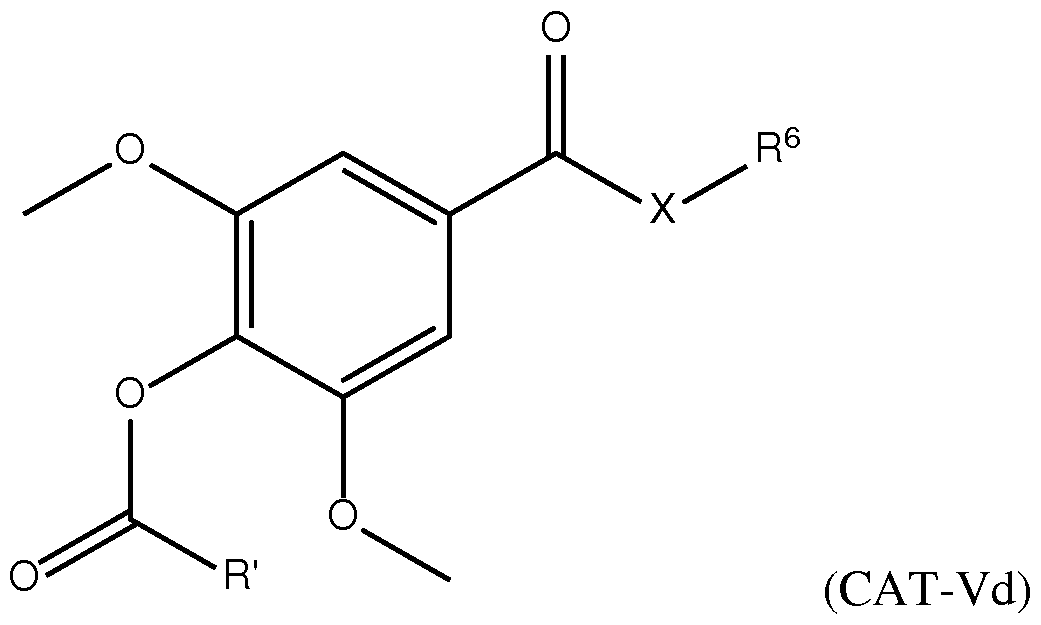
  • X is O, S, or NR X . In some embodiments of the lipid of Formula CAT-I, X is O. In some embodiments of the lipid of Formula CAT-I, X is S. In some embodiments of the lipid of Formula CAT-I, X is NR X , wherein R X is as defined above and described herein.
  • R X is hydrogen, optionally substituted alkyl, optionally substituted alkenyl, optionally substituted alkynyl, optionally substituted carbocyclyl, optionally substituted heterocyclyl, optionally substituted aryl, optionally substituted heteroaryl, or a nitrogen protecting group.
  • R X is hydrogen.
  • R X is optionally substituted alkyl.
  • R X is optionally substituted alkenyl.
  • R X is optionally substituted alkynyl. In some embodiments of the lipid of Formula CAT-I, R X is optionally substituted carbocyclyl. In some embodiments of the lipid of Formula CAT-I, R X is optionally substituted heterocyclyl. In some embodiments of the lipid of Formula CAT-I, R X is optionally substituted aryl. In some embodiments of the lipid of Formula CAT-I, R X is optionally substituted heteroaryl. In some embodiments of the lipid of Formula CAT-I, R X is a nitrogen protecting group.
  • Y is O, S, or NR Y .
  • Y is O.
  • Y is S.
  • Y is NR Y , wherein R Y is as defined above and described herein.
  • R Y is hydrogen, optionally substituted alkyl, optionally substituted alkenyl, optionally substituted alkynyl, optionally substituted carbocyclyl, optionally substituted heterocyclyl, optionally substituted aryl, optionally substituted heteroaryl, or a nitrogen protecting group.
  • R Y is hydrogen.
  • R Y is optionally substituted alkyl.
  • R Y is optionally substituted alkenyl.
  • R Y is optionally substituted alkynyl. In some embodiments of the lipid of Formula CAT-I, R Y is optionally substituted carbocyclyl. In some embodiments of the lipid of Formula CAT-I, R Y is optionally substituted heterocyclyl. In some embodiments of the lipid of Formula CAT-I, R Y is optionally substituted aryl. In some embodiments of the lipid of Formula CAT-I, R Y is optionally substituted heteroaryl. In some embodiments of the lipid of Formula CAT-I, R Y is a nitrogen protecting group.
  • R P is hydrogen, optionally substituted alkyl, optionally substituted alkenyl, optionally substituted alkynyl, optionally substituted carbocyclyl, optionally substituted heterocyclyl, optionally substituted aryl, optionally substituted heteroaryl, an oxygen protecting group when attached to an oxygen atom, a sulfur protecting group when attached to a sulfur atom, or a nitrogen protecting group when attached to a nitrogen atom.
  • R P is hydrogen.
  • R P is optionally substituted alkyl.
  • R P is optionally substituted alkenyl. In some embodiments of the lipid of Formula CAT-I, R P is optionally substituted alkynyl. In some embodiments of the lipid of Formula CAT-I, R P is optionally substituted carbocyclyl. In some embodiments of the lipid of Formula CAT-I, R P is optionally substituted heterocyclyl. In some embodiments of the lipid of Formula CAT-I, R P is optionally substituted aryl. In some embodiments of the lipid of Formula CAT-I, R P is optionally substituted heteroaryl. In some embodiments of the lipid of Formula CAT-I, R P is an oxygen protecting group when attached to an oxygen atom.
  • R P is a sulfur protecting group when attached to a sulfur atom. In some embodiments of the lipid of Formula CAT-I, R P is a nitrogen protecting group when attached to a nitrogen atom.
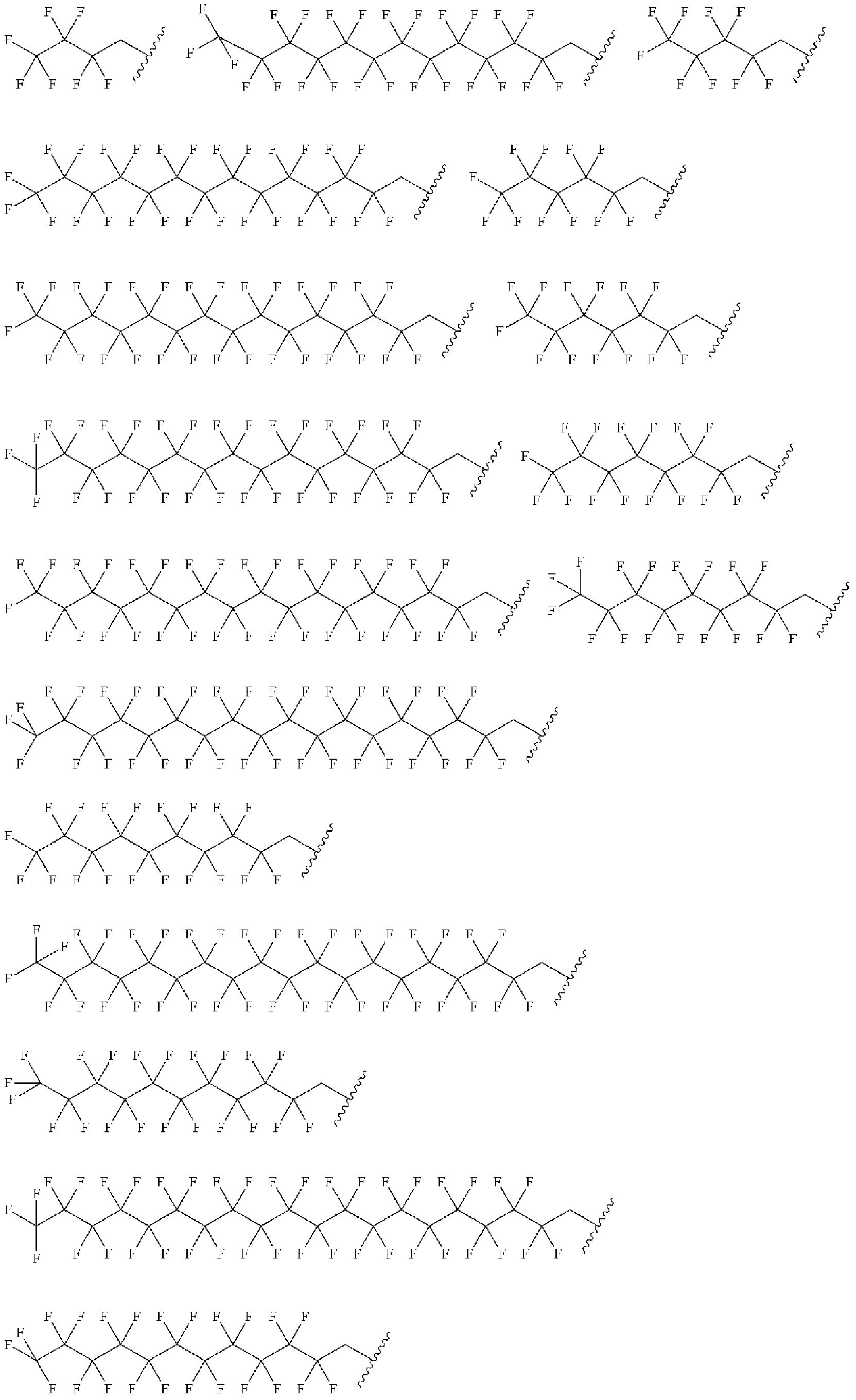
  • R L is optionally substituted C 1-50 alkyl, optionally substituted C 2-50 alkenyl, optionally substituted C 2-50 alkynyl, optionally substituted heteroC 1-50 alkyl, optionally substituted heteroC 2-50 alkenyl, optionally substituted heteroC 2-50 alkynyl, or a polymer.
  • R L is optionally substituted C 1- 50 alkyl. In some embodiments of the lipid of Formula CAT-I, R L is optionally substituted C 2- 30 alkyl. In some embodiments of the lipid of Formula CAT-I, R L is optionally substituted C 2- 20 alkyl. In some embodiments of the lipid of Formula CAT-I, R L is optionally substituted C 2- 15 alkyl. In some embodiments of the lipid of Formula CAT-I, R L is optionally substituted C 2- 10 alkyl. In some embodiments of the lipid of Formula CAT-I, R L is optionally substituted C 6- 50 alkyl.
  • R L is optionally substituted C 6- 30 alkyl. In some embodiments of the lipid of Formula CAT-I, R L is optionally substituted C 6- 20 alkyl. In some embodiments of the lipid of Formula CAT-I, R L is optionally substituted C 6- 15 alkyl. In some embodiments of the lipid of Formula CAT-I, R L is optionally substituted C 6- 10 alkyl. In some embodiments of the lipid of Formula CAT-I, for example, in any of the above embodiments, R L is a substituted alkyl group. In some embodiments of the lipid of Formula CAT-I, R L is an unsubstituted alkyl group.
  • R L is an optionally substituted straight-chain alkyl group. In some embodiments of the lipid of Formula CAT-I, R L is a substituted straight-chain alkyl group. In some embodiments of the lipid of Formula CAT-I, R L is an unsubstituted straight-chain alkyl group. In some embodiments of the lipid of Formula CAT-I, R L is an optionally substituted branched alkyl group. In some embodiments of the lipid of Formula CAT-I, R L is a substituted branched alkyl group. In some embodiments of the lipid of Formula CAT-I, R L is an unsubstituted branched alkyl group.
  • R L is optionally substituted C 6- 18 alkenyl. In some embodiments of the lipid of Formula CAT-I, R L is optionally substituted C 6- 15 alkenyl. In some embodiments of the lipid of Formula CAT-I, R L is optionally substituted C 6- 10 alkenyl. In some embodiments of the lipid of Formula CAT-I, for example, in any of the above embodiments, R L is a substituted alkyl group. In some embodiments of the lipid of Formula CAT-I, R L is an unsubstituted alkyl group. In some embodiments of the lipid of Formula CAT-I, R L is an optionally substituted straight-chain alkenyl group.
  • R L is a substituted straight-chain alkenyl group. In some embodiments of the lipid of Formula CAT-I, R L is an unsubstituted straight-chain alkenyl group. In some embodiments of the lipid of Formula CAT-I, R L is an optionally substituted branched alkenyl group. In some embodiments of the lipid of Formula CAT-I, R L is a substituted branched alkenyl group. In some embodiments of the lipid of Formula CAT-I, R L is an unsubstituted branched alkenyl group. Exemplary unsubstituted alkenyl group include, but are not limited to:
  • the lipid tail can also comprise different lengths, often categorized as medium (i.e., with tails between 7-12 carbons, e.g., C 7-12 alkyl or C 7-12 alkenyl), long (i.e., with tails greater than 12 carbons and up to 22 carbons, e.g., C 13-22 alkyl or C 13-22 alkenyl), or very long (i.e., with tails greater than 22 carbons, e.g., C 23-30 alkyl or C 23-30 alkenyl).
  • R L is optionally substituted C 2- 50 alkynyl.
  • R L is an optionally substituted straight-chain alkynyl group. In some embodiments of the lipid of Formula CAT-I, R L is an optionally substituted straight-chain alkynyl group. In some embodiments of the lipid of Formula CAT-I, R L is a substituted straight-chain alkynyl group. In some embodiments of the lipid of Formula CAT-I, R L is an unsubstituted straight-chain alkynyl group. In some embodiments of the lipid of Formula CAT-I, R L is an optionally substituted branched alkynyl group.
  • R L is a substituted branched alkynyl group. In some embodiments of the lipid of Formula CAT-I, R L is an unsubstituted branched alkynyl group. In some embodiments of the lipid of Formula CAT-I, R L is optionally substituted heteroC 1-50 alkyl. In some embodiments of the lipid of Formula CAT-I, R L is optionally substituted heteroC 2-30 alkyl. In some embodiments of the lipid of Formula CAT-I, R L is optionally substituted heteroC 2-20 alkyl. In some embodiments of the lipid of Formula CAT-I, R L is optionally substituted heteroC 2-15 alkyl.
  • R L is optionally substituted heteroC 2-10 alkyl. In some embodiments of the lipid of Formula CAT-I, R L is optionally substituted heteroC 6-50 alkyl. In some embodiments of the lipid of Formula CAT-I, R L is optionally substituted heteroC 6-30 alkyl. In some embodiments of the lipid of Formula CAT-I, R L is optionally substituted heteroC 6-20 alkyl. In some embodiments of the lipid of Formula CAT-I, R L is optionally substituted heteroC 6-15 alkyl. In some embodiments of the lipid of Formula CAT- I, R L is optionally substituted heteroC 6-10 alkyl.
  • R L is a substituted heteroalkyl group.
  • R L is an unsubstituted heteroalkyl group.
  • R L is an optionally substituted straight-chain heteroalkyl group.
  • R L is a substituted straight-chain heteroalkyl group.
  • R L is an unsubstituted straight-chain heteroalkyl group.
  • R L is an optionally substituted branched heteroalkyl group. In some embodiments of the lipid of Formula CAT-I, R L is a substituted branched heteroalkyl group. In some embodiments of the lipid of Formula CAT-I, R L is an unsubstituted branched heteroalkyl group. Exemplary unsubstituted heteroalkyl groups include, but are not limited to:
  • R L is optionally substituted heteroC 2-50 alkenyl. In some embodiments of the lipid of Formula CAT-I, R L is optionally substituted heteroC 2-30 alkenyl. In some embodiments of the lipid of Formula CAT-I, R L is optionally substituted heteroC 2-20 alkenyl. In some embodiments of the lipid of Formula CAT-I, R L is optionally substituted heteroC 2-15 alkenyl. In some embodiments of the lipid of Formula CAT-I, R L is optionally substituted heteroC 2-10 alkenyl. In some embodiments of the lipid of Formula CAT-I, R L is optionally substituted heteroC 6-50 alkenyl.
  • R L is optionally substituted heteroC 6-30 alkenyl. In some embodiments of the lipid of Formula CAT-I, R L is optionally substituted heteroC 6-20 alkenyl. In some embodiments of the lipid of Formula CAT-I, R L is optionally substituted heteroC 6-15 alkenyl. In some embodiments of the lipid of Formula CAT-I, R L is optionally substituted heteroC 6-10 alkenyl. In some embodiments of the lipid of Formula CAT-I, for example, in any of the above embodiments, R L is a substituted heteroalkenyl group.
  • R L is an unsubstituted heteroalkenyl group. In some embodiments of the lipid of Formula CAT-I, R L is an optionally substituted straight-chain heteroalkenyl group. In some embodiments of the lipid of Formula CAT-I, R L is a substituted straight-chain heteroalkenyl group. In some embodiments of the lipid of Formula CAT-I, R L is an unsubstituted straight-chain heteroalkenyl group. In some embodiments of the lipid of Formula CAT-I, R L is an optionally substituted branched heteroalkenyl group.
  • R L is a substituted branched heteroalkenyl group. In some embodiments of the lipid of Formula CAT-I, R L is an unsubstituted branched heteroalkenyl group. In some embodiments of the lipid of Formula CAT-I, R L is optionally substituted heteroC 2-50 alkynyl. In some embodiments of the lipid of Formula CAT-I, R L is optionally substituted heteroC 2-30 alkynyl. In some embodiments of the lipid of Formula CAT-I, R L is optionally substituted heteroC 2-20 alkynyl.
  • R L is optionally substituted heteroC 2-15 alkynyl. In some embodiments of the lipid of Formula CAT-I, R L is optionally substituted heteroC 2-10 alkynyl. In some embodiments of the lipid of Formula CAT-I, R L is optionally substituted heteroC 6-50 alkynyl. In some embodiments of the lipid of Formula CAT-I, R L is optionally substituted heteroC 6-30 alkynyl. In some embodiments of the lipid of Formula CAT-I, R L is optionally substituted heteroC 6-20 alkynyl. In some embodiments of the lipid of Formula CAT-I, R L is optionally substituted heteroC 6-15 alkynyl.
  • R L is optionally substituted heteroC 6-10 alkynyl. In some embodiments of the lipid of Formula CAT-I, for example, in any of the above embodiments, R L is a substituted heteroalkynyl group. In some embodiments of the lipid of Formula CAT-I, R L is an unsubstituted heteroalkynyl group. In some embodiments of the lipid of Formula CAT-I, R L is an optionally substituted straight-chain heteroalkynyl group. In some embodiments of the lipid of Formula CAT-I, R L is a substituted straight-chain heteroalkynyl group.
  • R L is an unsubstituted straight-chain heteroalkynyl group. In some embodiments of the lipid of Formula CAT-I, R L is an optionally substituted branched heteroalkynyl group. In some embodiments of the lipid of Formula CAT-I, R L is a substituted branched heteroalkynyl group. In some embodiments of the lipid of Formula CAT-I, R L is an unsubstituted branched heteroalkynyl group. In some embodiments of the lipid of Formula CAT-I, R L is a polymer.
  • a “polymer”, in some embodiments, refers to a compound comprised of at least 3 (e.g., at least 10, 20, 30, 40, 50, 60, 70, 80, 90, 100, etc.) repeating covalently bound structural units.
  • the polymer is in certain embodiments biocompatible (i.e., non-toxic).
  • Exemplary polymers include, but are not limited to, cellulose polymers (e.g., hydroxyethylcellulose, ethylcellulose, carboxymethylcellulose, methylc cellulose, hydroxypropylmethylcellulose (HPMC)), dextran polymers, polymaleic acid polymers, poly(acrylic acid) polymers, poly(vinylalcohol) polymers, polyvinylpyrrolidone (PVP) polymers, and polyethyleneglycol (PEG) polymers, and combinations thereof.
  • R L is a lipophilic, hydrophobic and/or non-polar group.
  • R L is a lipophilic group.
  • R L is a hydrophobic group. In some embodiments of the lipid of Formula CAT-I, R L is a non-polar group. In some embodiments of the lipid of Formula CAT-I, when an R L group is depicted as bisecting a carbon-carbon bond, e.g., of the formula (i), it is understood that R L may be bonded to either carbon. Various combinations of the above embodiments of Formula CAT-I are contemplated herein. In some embodiments, the lipid of Formula CAT-I has a structure according to Formula CAT-Ic: HO R L herein.
  • the lipid of Formula CAT-I has a structure according to Formula CAT-Id: HO R L herein.
  • R L is C 1-20 alkyl or C 2-20 alkenyl.
  • R L is C 6-20 alkyl or C 6-20 alkenyl.
  • the lipid of Formula CAT-I is cKK-E10, having the following structure: OH . In some the following structure: OH O .
  • the lipid of Formula CAT-II has a structure according to Formula CAT-IIa: R 1B , or a In some embodiments, the lipid of Formula CAT-II has a structure according to Formula CAT-IIb: R 1B , or a In some embodiments, the lipid of Formula CAT-II has a structure according to Formula CAT-IIc: HO R 1B R 1A , or a In some embodiments of the lipid of Formula CAT-II, A 1 and Z 1 are the same. In some embodiments of the lipid of Formula CAT-II, A 1 and Z 1 are different.
  • O I n some embodiments of the lipid of Formula CAT-II, A 1 is O , wherein the left hand side of the depicted structure is bound to the -(CH 2 )a-. In some embodiments of the lipid of O Formula CAT-II, A 1 , wherein the left hand side of the depicted structure is bound S to the -(CH 2 )a-. In some of the lipid of Formula CAT-II, A 1 is S , wherein the left hand side of the depicted structure is bound to the -(CH 2 ) O I n some embodiments of the lipid of Formula CAT-II, Z 1 O , wherein the right hand side of the depicted structure is bound to the -(CH 2 )a-.
  • O I n some embodiments of the lipid of Formula CAT-II, A 1 , wherein the left hand side of the depicted structure is bound to the -(CH2)a-, and , wherein the right hand side of the depicted structure is bound to the -(CH 2 )a-.
  • O I n some embodiments of the lipid of Formula CAT-II, A 1 O , wherein the left hand side of the depicted structure is bound to the -(CH2)a-, and S , wherein the right hand side of the depicted structure is bound to the -(CH 2 )a-.
  • O I n some embodiments of the lipid of Formula CAT-II, A 1 O , wherein the left hand side of the depicted structure is bound to the -(CH 2 )a-, and , wherein the right hand side of the depicted structure is bound to the -(CH 2 )a-.
  • lipid of Formula CAT-II A 1 S , wherein the left hand side of the depicted structure is bound to the -(CH 2 )a-, and , wherein the right hand side of the depicted structure is bound to the -(CH 2 )a-.
  • a 1 is S , wherein the left hand side of the depicted structure is bound to the -(CH2)a-, and Z 1 O , wherein the right hand side of the depicted structure is bound to the -(CH 2 )a-.
  • a 1 is S , wherein the left hand side of the depicted structure is bound to the -(CH2)a-, and Z 1 S , wherein the right hand side of the depicted structure is bound to the -(CH 2 )a-.
  • a 1 is S , wherein the left hand side of the depicted structure is bound to the -(CH 2 )a-, and , wherein the right hand side of the depicted structure is bound to the -(CH 2 )a-.
  • R 1A and R 1B are each independently selected from: , , , , . each a is independently selected from 2, 3 and 4. In some embodiments of the lipid of Formula CAT-II, each a is the same. In some embodiments of the lipid of Formula CAT-II, each a is different. In some embodiments of the lipid of Formula CAT-II, R 1A and R 1B are -W 1 -X 1 -Y 1 .
  • each W 1 is independently selected from optionally substituted C A-B alkyl and optionally substituted C C-D alkenyl
  • the lipid of Formula CAT-II is GL-HEPES-E3-E10-DS-3-E18-1 (2-(4-(2-((3-(Bis((Z)-2-hydroxyoctadec-9-en-1-yl)amino)propyl)disulfaneyl)ethyl)piperazin-1- yl)ethyl 4-(bis(2-hydroxydecyl)amino)butanoate), having the following structure: .
  • the lipid of Formula CAT-V has the following structure: N O OH or a In some embodiments, the lipid of Formula CAT-V has a structure according to Formula CAT-Vd:
  • the structural lipid is selected from the group consisting of ⁇ - amyrin, ⁇ -amyrin, ⁇ -boswellic acid, ⁇ -boswellic acid, 11-keto- ⁇ -boswellic acid, taraxasterol, ar Strukturin, ganoderic acid A, ganoderic acid B, ganoderic acid D, ganoderic acid F, ganoderic acid H, yamogenin, ⁇ -oryzanol, soyasapogenol B, and combinations thereof.
  • the structural lipid is selected from the group consisting of ⁇ - amyrin, ⁇ -amyrin, ⁇ -boswellic acid, ⁇ -boswellic acid, 11-keto- ⁇ -boswellic acid, taraxasterol, ar Strukturin, yamogenin, ⁇ -oryzanol, soyasapogenol B, and combinations thereof.
  • the structural lipid is selected from the group consisting of ganoderic acid A, ganoderic acid B, ganoderic acid D, ganoderic acid F, ganoderic acid H, and combinations thereof.
  • the structural lipid is selected from the group consisting of ⁇ - amyrin, ⁇ -amyrin, ⁇ -boswellic acid, ⁇ -boswellic acid, 11-keto- ⁇ -boswellic acid, taraxasterol, senegenin, ar Strukturin, cycloastrogenol, ⁇ -elemonic acid, yamogenin, steviol, brusatol, ⁇ - oryzanol, and combinations thereof.
  • the structural lipid is selected from the group consisting of ⁇ - amyrin, ⁇ -amyrin, taraxasterol, yamogenin, and combinations thereof.
  • the structural lipid is brusatol. In some embodiments, the structural lipid is ⁇ - oryzanol. In some embodiments, the structural lipid is phytolaccagenin. In some embodiments, the structural lipid is hecogenin. In some embodiments, the structural lipid is pristimerin. In some embodiments, the structural lipid is erythrodiol. In some embodiments, the structural lipid is guggulsterone Z. In some embodiments, the structural lipid is corosolic acid. In some embodiments, the structural lipid is soyasapogenol B. In some embodiments, the structural lipid is gitogenin.
  • the structural lipid is a sterol or a sterol analog other than cholesterol. In some embodiments, the structural lipid is a di- or triterpenoid. In some embodiments, the structural lipid is a pentacyclic triterpinoid. In some embodiments, the structural lipid is a pentacyclic triterpinoid other than oleanolic acid, ursolic acid, asiatic acid, and celastrol. In some embodiments, the structural lipid is a pentacyclic triterpinoid other than ursolic acid. In some embodiments, the structural lipid is a sapogenin.
  • the lipid of Formula STR-I has a structure according to Formula STR-Ib: s 8b Rs8a R s9a R R s7b or a pharmaceutically acceptable salt thereof.
  • the lipid of Formula STR-I has a structure according to Formula STR-Ic: s 8b Rs8a s9a R R R s7b or a pharmaceutically acceptable salt thereof.
  • R s2a and R s2b are each, independently, optionally substituted C 1-6 alkyl or COOH;
  • R s3a is H or C 1-6 alkyl;
  • R s5 is C 1-6 alkyl or COOH;
  • R s6a and R s6b are each, independently, H;
  • R s7a and R s7b are each, independently, H;
  • R s9a and R s9b are each, independently, H, OH, or C 1-6 alkyl.
  • R s2a and R s2b are each, independently, optionally substituted C 1-6 alkyl or COOH, wherein the C 1-6 alkyl is optionally substituted with halogen or OH.
  • R s2a and R s2b are each, independently, methyl, CH 2 OH, or COOH.
  • R s2a is methyl and R s2b is methyl.
  • R s2a is methyl and R s2b is COOH.
  • R s2a is methyl and R s2b is CH 2 OH.
  • R s3a is H.
  • R s3a is OH.
  • R s3a is optionally substituted C 1-6 alkyl.
  • R s3a is methyl.
  • R s4a is H
  • R s4b is H.
  • R s4a is H
  • R s4b is C 1-6 alkyl optionally substituted with halogen.
  • R s4a is H
  • R s4b is CH 2 Cl.
  • R s5 is H, C 1-6 alkyl, or COOH.
  • R s5 is H, methyl, or COOH.
  • R s5 is H.
  • R s5 is methyl.
  • R s5 is COOH.
  • R s6a and R s6b are each, independently, H, C 1-6 alkyl, or COOH.
  • R s6a and R s6b are each, independently, H, methyl, or COOH.
  • R s6a is H
  • R s6b is H.
  • R s6a is methyl
  • R s6b is COOH.
  • R s7a and R s7b are each, independently, H, OH, or C 1-6 alkyl. In some embodiments of the lipid of Formula STR-I, R s7a and R s7b are each, independently, H or OH. In some embodiments of the lipid of Formula STR-I, R s7a is H, and R s7b is H. In some embodiments of the lipid of Formula STR-I, R s7a is H, and R s7b is OH.
  • R s8a is H
  • R s8b is OH.
  • R s9a and R s9b are each, independently, H, OH, or methyl. In some embodiments of the lipid of Formula STR-I, R s9a is H, and R s9b is H. In some embodiments of the lipid of Formula STR-I, R s9a is H, and R s9b is OH. In some embodiments of the lipid of Formula STR-I, R s9a is H, and R s9b is methyl. In some embodiments, the structural lipid has a structure according to Formula STR-II: R s8b R s8a R s9a R s7b
  • R s1 is H, optionally substituted C 1-6 alkyl, or COOH
  • R s3a and R s3b are each, independently, H, OH, or optionally substituted C 1-6 alkyl
  • R s5 is H, optionally substituted C 1-6 alkyl, or COOH
  • R s6a and R s6b are each, independently, H, optionally substituted C 1-6 alkyl, or COOH
  • R s7a and R s7b are each, independently, H, OH, or optionally substituted C 1-6 alkyl
  • the lipid of Formula STR-II has a structure according to Formula STR-IIa: R s8b R s8a R s9a R s7b or a pharmaceutically acceptable salt thereof.
  • R s1 is optionally substituted C 1-6 alkyl or COOH
  • R s3a and R s3b are each, independently, H or C 1-6 alkyl
  • R s4a and R s4b are each, independently H or optionally substituted C 1-6 alkyl
  • R s5 is H
  • R s6a and R s6b are each, independently, C 1-6 alkyl or COOH
  • R s7a and R s7b are each, independently, H, OH, or C 1-6 alkyl
  • R s8a and R s8b are each, independently, H, OH, or C 1-6 alkyl
  • R s9a and R s9b are each, independently, H, H, H, H, H, H,
  • R s1 is H, C 1-6 alkyl, or COOH. In some embodiments of the lipid of Formula STR-II, R s1 is H. In some embodiments of the lipid of Formula STR-II, R s1 is COOH. In some embodiments of the lipid of Formula STR-II, R s3a and R s3b are each, independently, H, OH, or C 1-6 alkyl. In some embodiments of the lipid of Formula STR-II, R s3a and R s3b are each, independently, H, OH, or methyl.
  • R s3a is H, and R s3b is H.
  • R s3a is H, and R s3b is OH.
  • R s3a is methyl, and R s3b is methyl.
  • R s4a is H
  • R s4b is H
  • R s4a is H
  • R s4b is C 1-6 alkyl optionally substituted with halogen.
  • R s4a is H
  • R s4b is CH 2 Cl.
  • R s5 is H, C 1-6 alkyl, or COOH. In some embodiments of the lipid of Formula STR-II, R s5 is H, methyl, or COOH. In some embodiments of the lipid of Formula STR-II, R s5 is H. In some embodiments of the lipid of Formula STR-II, R s5 is methyl. In some embodiments of the lipid of Formula STR-II, R s5 is COOH. In some embodiments of the lipid of Formula STR-II, R s6a and R s6b are each, independently, H, C 1-6 alkyl, or COOH.
  • R s6a and R s6b are each, independently, H, methyl, or COOH. In some embodiments of the lipid of Formula STR-II, R s6a is H, and R s6b is H. In some embodiments of the lipid of Formula STR-II, R s6a is methyl, and R s6b is COOH. In some embodiments of the lipid of Formula STR-II, R s7a and R s7b are each, independently, H, OH, or C 1-6 alkyl. In some embodiments of the lipid of Formula STR-II, R s7a and R s7b are each, independently, H or OH.
  • R s7a is H
  • R s7b is H
  • R s7a is H
  • R s7b is OH
  • R s8a is H
  • R s8b is OH.
  • R s8a is H
  • R s8b is methyl.
  • R s8a is methyl
  • R s8b is methyl.
  • R s9a and R s9b are each, independently, H, OH, or C 1-6 alkyl.
  • R s9a and R s9b are each, independently, H, OH, or methyl.
  • R s9a is H
  • R s9b is H.
  • R s9a is H, and R s9b is OH. In some embodiments of the lipid of Formula STR-II, R s9a is H, and R s9b is methyl.
  • the structural lipid has a structure according to Formula STR-III: R s14 or a pharmaceutically R s10a and R s10b are each, independently, H or optionally substituted C 1-6 alkyl; R s14a ; substituted C 1-6 alkyl, optionally substituted C 2-6 alkenyl, or COOH; and R s14b is optionally substituted C 7-10 alkyl, optionally substituted C 6-10 alkenyl; optionally substituted C 7-10 alkynyl; or C 1-5 alkyl-C(O)-C 1-5 alkyl-COOH.
  • the lipid of Formula STR-III has a structure according to Formula STR-IIIa: R s14 or a pharmaceutically In some embodiments, the lipid of Formula STR-III has a structure according to Formula STR-IIIb: R s14 H or a pharmaceutically In some embodiments, the lipid of Formula STR-III has a structure according to Formula STR-IIIc: R s14 or a pharmaceutically In some embodiments, the lipid of Formula STR-III has a structure according to Formula STR-IIId: R s14 H or a pharmaceutically acceptable salt thereof. In some embodiments of the lipid of Formula STR-III, R s10a and R s10b are each, independently, H or C 1-6 alkyl.
  • R s10a and R s10b are each, independently, H or methyl. In some embodiments of the lipid of Formula STR- III, R s10a is H, and R s10b is H. In some embodiments of the lipid of Formula STR-III, R s10a is methyl, and R s10b is methyl. In some embodiments of the lipid of Formula STR-III, R s14a is C 1-6 alkyl or COOH. In some embodiments of the lipid of Formula STR-III, R s14a is methyl or COOH. In some embodiments of the lipid of Formula STR-III, R s14a is methyl.
  • R s14a is COOH.
  • R s14b is C 7-10 alkyl, C 6-10 alkenyl, C 7-10 alkynyl, or C 1-5 alkyl-C(O)-C 1-5 alkyl-COOH.
  • R s14b is C 7-10 alkyl, C 6-10 alkenyl, or C 1-5 alkyl-C(O)-C 1-5 alkyl-COOH.
  • R s14b is C 7-10 alkyl.
  • the structural lipid is ⁇ -amyrin, ⁇ -amyrin, ⁇ -boswellic acid, ⁇ - boswellic acid, 11-keto- ⁇ -boswellic acid, taraxasterol, senegenin, ar Strukturin, ⁇ -sitosterol, campesterol, fucosterol, ⁇ -5-avenasterol, ⁇ -spinasterol, cycloartol, cycloastrogenol, ⁇ - elemonic acid, ganoderic acid B, ganoderic acid D, ganoderic acid H, diosgenin, yamogenin, steviol, brusatol, ⁇ -oryzanol, or a combination thereof.
  • the LNP comprises (I) a cationic lipid that is cKK-E10 or GL- HEPES-E3-E12-DS-4-E10; (II) a structural lipid selected from ⁇ -amyrin, ⁇ -amyrin, ⁇ -boswellic acid, ⁇ -boswellic acid, 11-keto- ⁇ -boswellic acid, taraxasterol, senegenin, ar Strukturin, ⁇ -sitosterol, campesterol, fucosterol, ⁇ -5-avenasterol, ⁇ -spinasterol, cycloartol, cycloastrogenol, ⁇ - elemonic acid, ganoderic acid B, ganoderic acid D, ganoderic acid H, diosgenin, yamogenin, steviol, brusatol, ⁇ -oryzanol, and combinations thereof; (III) optionally, cholesterol; (IV) a helper
  • the LNP comprises (I) a cationic lipid that is cKK-E10 or GL- HEPES-E3-E12-DS-4-E10; (II) a structural lipid selected from ⁇ -amyrin, ⁇ -amyrin, ⁇ -boswellic acid, ⁇ -boswellic acid, 11-keto- ⁇ -boswellic acid, taraxasterol, senegenin, ar Strukturin, ⁇ -sitosterol, campesterol, fucosterol, ⁇ -5-avenasterol, ⁇ -spinasterol, cycloartol, cycloastrogenol, ⁇ - elemonic acid, ganoderic acid B, ganoderic acid D, ganoderic acid H, diosgenin, yamogenin, steviol, brusatol, ⁇ -oryzanol, and combinations thereof; (III) cholesterol; (IV) a helper lipid;
  • the LNP comprises (I) a cationic lipid that is cKK-E10 or GL- HEPES-E3-E12-DS-4-E10; (II) a structural lipid selected from ⁇ -amyrin, ⁇ -boswellic acid, taraxasterol, ⁇ -spinasterol, cycloartenol, diosgenin, yamogenin, ⁇ -oryzanol, and combinations thereof; (III) optionally, cholesterol; (IV) a helper lipid; and (V) a stealth lipid.
  • the LNP comprises (I) a cationic lipid that is cKK-E10, OF-02, or GL-HEPES-E3-E12-DS-4-E10; (II) a structural lipid selected from ⁇ -amyrin, ⁇ -amyrin, ⁇ - boswellic acid, ⁇ -boswellic acid, 11-keto- ⁇ -boswellic acid, 3-O-acetyl-11-keto- ⁇ -boswellic acid, taraxasterol, senegenin, ar Strukturin, ⁇ -sitosterol, campesterol, fucosterol, ⁇ -5-avenasterol, ⁇ -7- avenasterol, ⁇ -spinasterol, cycloartol, cycloastrogenol, ⁇ -elemonic acid, ganoderic acid A, ganoderic acid B, ganoderic acid D, ganoderic acid F, ganoderic acid H, dios
  • the LNP comprises (I) a cationic lipid that is cKK-E10, OF-02, or GL-HEPES-E3-E12-DS-4-E10; (II) a structural lipid selected from ⁇ -amyrin, ⁇ -amyrin, ⁇ - boswellic acid, ⁇ -boswellic acid, 11-keto- ⁇ -boswellic acid, taraxasterol, ar Strukturin, ⁇ -sitosterol, ⁇ -5-avenasterol, ⁇ -7-avenasterol, ⁇ -spinasterol, ganoderic acid A, ganoderic acid B, ganoderic acid D, ganoderic acid F, ganoderic acid H, diosgenin, yamogenin, ⁇ -oryzanol, soyasapogenol B, and combinations thereof; (III) optionally, cholesterol; (IV) a helper lipid; and (V) a stealth lipid.
  • the LNP comprises (I) a cationic lipid that is cKK-E10, OF-02, or GL-HEPES-E3-E12-DS-4-E10; (II) a structural lipid selected from ⁇ -amyrin, ⁇ -amyrin, ⁇ - boswellic acid, ⁇ -boswellic acid, 11-keto- ⁇ -boswellic acid, taraxasterol, ar Strukturin, ⁇ -sitosterol, ⁇ -5-avenasterol, ⁇ -7-avenasterol, ⁇ -spinasterol, ganoderic acid A, ganoderic acid B, ganoderic acid D, ganoderic acid F, ganoderic acid H, diosgenin, yamogenin, ⁇ -oryzanol, soyasapogenol B, and combinations thereof; (III) cholesterol; (IV) a helper lipid; and (V) a stealth lipid.
  • a structural lipid
  • the LNP comprises (I) a cationic lipid that is cKK-E10, OF-02, or GL-HEPES-E3-E12-DS-4-E10; (II) a structural lipid selected from ganoderic acid A, ganoderic acid B, ganoderic acid D, ganoderic acid F, ganoderic acid H, and combinations thereof; (III) optionally, cholesterol; (IV) a helper lipid; and (V) a stealth lipid.
  • the LNP comprises (I) a cationic lipid that is cKK-E10, OF-02, or GL-HEPES-E3-E12-DS-4-E10; (II) a structural lipid selected from ganoderic acid A, ganoderic acid B, ganoderic acid D, ganoderic acid F, ganoderic acid H, and combinations thereof; (III) cholesterol; (IV) a helper lipid; and (V) a stealth lipid.
  • the LNP comprises (I) a cationic lipid that is cKK-E10, OF-02, or GL-HEPES-E3-E12-DS-4-E10; (II) a structural lipid selected from ⁇ -5-avenasterol, ⁇ -oryzanol, and combinations thereof; (III) optionally, cholesterol; (IV) a helper lipid; and (V) a stealth lipid.
  • the LNP comprises (I) a cationic lipid that is cKK-E10, OF-02, or GL-HEPES-E3-E12-DS-4-E10; (II) a structural lipid selected from ⁇ -5-avenasterol, ⁇ -oryzanol, and combinations thereof; (III) cholesterol; (IV) a helper lipid; and (V) a stealth lipid.
  • the LNP comprises (I) a cationic lipid that is cKK-E10, OF-02, or GL-HEPES-E3-E12-DS-4-E10; (II) a structural lipid selected from ⁇ -spinasterol, ⁇ -amyrin, taraxasterol, and combinations thereof; (III) optionally, cholesterol; (IV) a helper lipid; and (V) a stealth lipid.
  • the LNP comprises (I) a cationic lipid that is cKK-E10, OF-02, or GL-HEPES-E3-E12-DS-4-E10; (II) a structural lipid selected from ⁇ -spinasterol, ⁇ -amyrin, taraxasterol, and combinations thereof; (III) cholesterol; (IV) a helper lipid; and (V) a stealth lipid.
  • the LNP comprises (I) a cationic lipid that is cKK-E10, OF-02, or GL-HEPES-E3-E12-DS-4-E10; (II) a structural lipid selected from ⁇ -oryzanol, 11-keto- ⁇ - boswellic acid, soyasapogenol B, ⁇ -amyrin, ⁇ -amyrin, and combinations thereof; (III) optionally, cholesterol; (IV) a helper lipid; and (V) a stealth lipid.
  • the LNP comprises (I) a cationic lipid that is cKK-E10, OF-02, or GL-HEPES-E3-E12-DS-4-E10; (II) a structural lipid selected from ⁇ -oryzanol, 11-keto- ⁇ - boswellic acid, soyasapogenol B, ⁇ -amyrin, ⁇ -amyrin, and combinations thereof; (III) cholesterol; (IV) a helper lipid; and (V) a stealth lipid.
  • the LNP comprises (I) a cationic lipid that is cKK-E10, OF-02, or GL-HEPES-E3-E12-DS-4-E10; (II) a structural lipid selected from ⁇ -amyrin, ar Strukturin, yamogenin, diosgenin, ⁇ -spinasterol, and combinations thereof; (III) optionally, cholesterol; (IV) a helper lipid; and (V) a stealth lipid.
  • the LNP comprises (I) a cationic lipid that is cKK-E10, OF-02, or GL-HEPES-E3-E12-DS-4-E10; (II) a structural lipid selected from ⁇ -amyrin, ar Strukturin, yamogenin, diosgenin, ⁇ -spinasterol, and combinations thereof; (III) cholesterol; (IV) a helper lipid; and (V) a stealth lipid.
  • the LNP comprises (I) a cationic lipid having a structure according to Formula CAT-V; (II) a structural lipid, wherein said structural lipid is not cholesterol; and (III) optionally, cholesterol.
  • the LNP comprises (I) a cationic lipid having a structure according to Formula CAT-V; (II) a structural lipid, wherein said structural lipid is not cholesterol; and (III) cholesterol.
  • the LNP comprises (I) a cationic lipid having a structure according to Formula CAT-V; (II) a structural lipid, wherein said structural lipid is a sterol or sterol analog other than cholesterol; and (III) optionally, cholesterol.
  • the LNP comprises (I) a cationic lipid having a structure according to Formula CAT-V; (II) a structural lipid, wherein said structural lipid is a sterol or sterol analog other than cholesterol; and (III) cholesterol.
  • the LNP comprises (I) a cationic lipid having a structure according to Formula CAT-V; (II) a structural lipid, wherein said structural lipid is not cholesterol; (III) optionally, cholesterol; (IV) a helper lipid; and (V) a stealth lipid.
  • the LNP comprises (I) a cationic lipid having a structure according to Formula CAT-V; (II) a structural lipid, wherein said structural lipid is not cholesterol; (III) cholesterol; (IV) a helper lipid; and (V) a stealth lipid.
  • the LNP comprises (I) a cationic lipid having a structure according to Formula CAT-V; (II) a structural lipid, wherein said structural lipid is a sterol or sterol analog other than cholesterol; (III) optionally, cholesterol; (IV) a helper lipid; and (V) a stealth lipid.
  • the LNP comprises (I) a cationic lipid having a structure according to Formula CAT-V; (II) a structural lipid, wherein said structural lipid is a sterol or sterol analog other than cholesterol; (III) cholesterol; (IV) a helper lipid; and (V) a stealth lipid.
  • the LNP comprises (I) a cationic lipid having a structure according to Formula CAT-V; (II) a structural lipid, wherein said structural lipid is a sterol or sterol analog other than cholesterol; (III) cholesterol; (IV) a helper lipid; and (V) a stealth lipid; wherein the molar ratio of the structural lipid to the cholesterol is between 1:9 and 1:1.
  • the LNP comprises (I) a cationic lipid having a structure according to Formula CAT-Vd; (II) a structural lipid, wherein said structural lipid is not cholesterol; (III) optionally, cholesterol; (IV) a helper lipid; and (V) a stealth lipid.
  • the LNP comprises (I) a cationic lipid having a structure according to Formula CAT-Vd; (II) a structural lipid, wherein said structural lipid is not cholesterol; (III) cholesterol; (IV) a helper lipid; and (V) a stealth lipid.
  • the LNP comprises (I) a cationic lipid having a structure according to Formula CAT-Vd; (II) a structural lipid, wherein said structural lipid is not cholesterol; (III) cholesterol; (IV) a helper lipid; and (V) a stealth lipid; wherein the molar ratio of the structural lipid to the cholesterol is between 1:9 and 1:1.
  • the LNP comprises (I) a cationic lipid that is SY-3-E14-DMAPr; (II) a structural lipid, wherein said structural lipid is not cholesterol; (III) optionally, cholesterol; (IV) a helper lipid; and (V) a stealth lipid.
  • the LNP comprises (I) a cationic lipid that is SY-3-E14-DMAPr; (II) a structural lipid, wherein said structural lipid is not cholesterol; (III) cholesterol; (IV) a helper lipid; and (V) a stealth lipid.
  • the LNP comprises (I) a cationic lipid that is SY-3-E14-DMAPr; (II) a structural lipid, wherein said structural lipid is not cholesterol; (III) cholesterol; (IV) a helper lipid; and (V) a stealth lipid; wherein the molar ratio of the structural lipid to the cholesterol is between 1:9 and 1:1.
  • the LNP comprises (I) a cationic lipid having a structure according to Formula CAT-V; (II) a structural lipid having a structure according to Formula STR-I, Formula STR-II, Formula STR-III, Formula STR-IV, or Formula STR-V, or selected from 3-O-acetyl-11-keto- ⁇ -boswellic acid, cycloastrogenol, ⁇ -elemonic acid, ganoderic acid A, diosgenin, yamogenin, steviol, brusatol, ⁇ -oryzanol, phytolaccagenin, hecogenin, pristimerin, guggulsterone Z, corosolic acid, and soyasapogenol B, or a combination thereof; and (III) optionally, cholesterol.
  • the LNP comprises (I) a cationic lipid having a structure according to Formula CAT-V; (II) a structural lipid having a structure according to Formula STR-I, Formula STR-II, Formula STR-III, Formula STR-IV, or Formula STR-V, or selected from 3-O-acetyl-11-keto- ⁇ -boswellic acid, cycloastrogenol, ⁇ -elemonic acid, ganoderic acid A, diosgenin, yamogenin, steviol, brusatol, ⁇ -oryzanol, phytolaccagenin, hecogenin, pristimerin, guggulsterone Z, corosolic acid, and soyasapogenol B, or a combination thereof; and (III) cholesterol.
  • the LNP comprises (I) a cationic lipid having a structure according to Formula CAT-V; (II) a structural lipid having a structure according to Formula STR-I, Formula STR-II, Formula STR-III, Formula STR-IV, or Formula STR-V, or selected from 3-O-acetyl-11-keto- ⁇ -boswellic acid, cycloastrogenol, ⁇ -elemonic acid, ganoderic acid A, diosgenin, yamogenin, steviol, brusatol, ⁇ -oryzanol, phytolaccagenin, hecogenin, pristimerin, guggulsterone Z, corosolic acid, and soyasapogenol B, or a combination thereof; (III) optionally, cholesterol; (IV) a helper lipid; and (V) a stealth lipid.
  • the LNP comprises (I) a cationic lipid having a structure according to Formula CAT-V; (II) a structural lipid having a structure according to Formula STR-I, Formula STR-II, Formula STR-III, Formula STR-IV, or Formula STR-V, or selected from 3-O-acetyl-11-keto- ⁇ -boswellic acid, cycloastrogenol, ⁇ -elemonic acid, ganoderic acid A, diosgenin, yamogenin, steviol, brusatol, ⁇ -oryzanol, phytolaccagenin, hecogenin, pristimerin, guggulsterone Z, corosolic acid, and soyasapogenol B, or a combination thereof; (III) cholesterol; (IV) a helper lipid; and (V) a stealth lipid.
  • the LNP comprises (I) a cationic lipid having a structure according to Formula CAT-V; (II) a structural lipid having a structure according to Formula STR-I or Formula STR-II, or a combination thereof; (III) optionally, cholesterol; (IV) a helper lipid; and (V) a stealth lipid.
  • the LNP comprises (I) a cationic lipid having a structure according to Formula CAT-V; (II) a structural lipid having a structure according to Formula STR-I or Formula STR-II, or a combination thereof; (III) cholesterol; (IV) a helper lipid; and (V) a stealth lipid.
  • the LNP comprises (I) a cationic lipid having a structure according to Formula CAT-V; (II) a structural lipid having a structure according to Formula STR-III, Formula STR-IV, or Formula STR-V, or a combination thereof; (III) optionally, cholesterol; (IV) a helper lipid; and (V) a stealth lipid.
  • the LNP comprises (I) a cationic lipid having a structure according to Formula CAT-V; (II) a structural lipid selected from 3-O-acetyl-11-keto- ⁇ - boswellic acid, cycloastrogenol, ⁇ -elemonic acid, ganoderic acid A, diosgenin, yamogenin, steviol, brusatol, ⁇ -oryzanol, phytolaccagenin, hecogenin, pristimerin, guggulsterone Z, corosolic acid, and soyasapogenol B, or a combination thereof; (III) optionally, cholesterol; (IV) a helper lipid; and (V) a stealth lipid.
  • a structural lipid selected from 3-O-acetyl-11-keto- ⁇ - boswellic acid, cycloastrogenol, ⁇ -elemonic acid, ganoderic acid A, diosgenin, yamogenin, ste
  • the LNP comprises (I) a cationic lipid having a structure according to Formula CAT-V; (II) a structural lipid selected from 3-O-acetyl-11-keto- ⁇ - boswellic acid, cycloastrogenol, ⁇ -elemonic acid, ganoderic acid A, diosgenin, yamogenin, steviol, brusatol, ⁇ -oryzanol, phytolaccagenin, hecogenin, pristimerin, guggulsterone Z, corosolic acid, and soyasapogenol B, or a combination thereof; (III) cholesterol; (IV) a helper lipid; and (V) a stealth lipid.
  • a structural lipid selected from 3-O-acetyl-11-keto- ⁇ - boswellic acid, cycloastrogenol, ⁇ -elemonic acid, ganoderic acid A, diosgenin, yamogenin, steviol,
  • the LNP comprises (I) a cationic lipid having a structure according to Formula CAT-V; (II) a structural lipid selected from ⁇ -amyrin, ⁇ -amyrin, ⁇ - boswellic acid, ⁇ -boswellic acid, 11-keto- ⁇ -boswellic acid, 3-O-acetyl-11-keto- ⁇ -boswellic acid, taraxasterol, senegenin, ar Strukturin, ⁇ -sitosterol, campesterol, fucosterol, ⁇ -5-avenasterol, ⁇ -7- avenasterol, ⁇ -spinasterol, cycloartenol, cycloastrogenol, ⁇ -elemonic acid, ganoderic acid A, ganoderic acid B, ganoderic acid D, ganoderic acid F, ganoderic acid H, diosgenin, yamogenin, steviol, brusatol,
  • the LNP comprises (I) a cationic lipid having a structure according to Formula CAT-V; (II) a structural lipid selected from ⁇ -amyrin, ⁇ -amyrin, ⁇ - boswellic acid, ⁇ -boswellic acid, 11-keto- ⁇ -boswellic acid, taraxasterol, ar Strukturin, ⁇ -sitosterol, ⁇ -5-avenasterol, ⁇ -7-avenasterol, ⁇ -spinasterol, ganoderic acid A, ganoderic acid B, ganoderic acid D, ganoderic acid F, ganoderic acid H, diosgenin, yamogenin, ⁇ -oryzanol, soyasapogenol B, and combinations thereof; (III) cholesterol; (IV) a helper lipid; and (V) a stealth lipid.
  • a structural lipid selected from ⁇ -amyrin, ⁇ -amyrin, ⁇ -
  • the LNP comprises (I) a cationic lipid having a structure according to Formula CAT-V; (II) a structural lipid selected from ⁇ -amyrin, ⁇ -boswellic acid, taraxasterol, ⁇ -sitosterol, campesterol, fucosterol, ⁇ -spinasterol, cycloartenol, diosgenin, yamogenin, ⁇ -oryzanol, and combinations thereof; (III) optionally, cholesterol; (IV) a helper lipid; and (V) a stealth lipid.
  • a cationic lipid having a structure according to Formula CAT-V a structure according to Formula CAT-V
  • a structural lipid selected from ⁇ -amyrin, ⁇ -boswellic acid, taraxasterol, ⁇ -sitosterol, campesterol, fucosterol, ⁇ -spinasterol, cycloartenol, diosgenin, yamogenin,
  • the LNP comprises (I) a cationic lipid having a structure according to Formula CAT-V; (II) a structural lipid selected from ⁇ -amyrin, ⁇ -boswellic acid, taraxasterol, ⁇ -sitosterol, campesterol, fucosterol, ⁇ -spinasterol, cycloartenol, diosgenin, yamogenin, ⁇ -oryzanol, and combinations thereof; (III) cholesterol; (IV) a helper lipid; and (V) a stealth lipid.
  • a cationic lipid having a structure according to Formula CAT-V a structure according to Formula CAT-V
  • a structural lipid selected from ⁇ -amyrin, ⁇ -boswellic acid, taraxasterol, ⁇ -sitosterol, campesterol, fucosterol, ⁇ -spinasterol, cycloartenol, diosgenin, yamogenin, ⁇ -
  • the LNP comprises (I) a cationic lipid having a structure according to Formula CAT-V; (II) a structural lipid selected from ⁇ -amyrin, ⁇ -boswellic acid, taraxasterol, ⁇ -spinasterol, cycloartenol, diosgenin, yamogenin, ⁇ -oryzanol, and combinations thereof; (III) optionally, cholesterol; (IV) a helper lipid; and (V) a stealth lipid.
  • the LNP comprises (I) a cationic lipid having a structure according to Formula CAT-V; (II) a structural lipid selected from ⁇ -amyrin, ⁇ -boswellic acid, taraxasterol, ⁇ -spinasterol, cycloartenol, diosgenin, yamogenin, ⁇ -oryzanol, and combinations thereof; (III) cholesterol; (IV) a helper lipid; and (V) a stealth lipid.
  • the LNP comprises (I) a cationic lipid having a structure according to Formula CAT-V; (II) a structural lipid selected from ganoderic acid A, ganoderic acid B, ganoderic acid D, ganoderic acid F, ganoderic acid H, and combinations thereof; (III) optionally, cholesterol; (IV) a helper lipid; and (V) a stealth lipid.
  • the LNP comprises (I) a cationic lipid having a structure according to Formula CAT-V; (II) a structural lipid selected from ganoderic acid A, ganoderic acid B, ganoderic acid D, ganoderic acid F, ganoderic acid H, and combinations thereof; (III) cholesterol; (IV) a helper lipid; and (V) a stealth lipid.
  • the LNP comprises (I) a cationic lipid having a structure according to Formula CAT-V; (II) a structural lipid selected from ⁇ -5-avenasterol, ⁇ -oryzanol, and combinations thereof; (III) optionally, cholesterol; (IV) a helper lipid; and (V) a stealth lipid.
  • the LNP comprises (I) a cationic lipid having a structure according to Formula CAT-V; (II) a structural lipid selected from ⁇ -5-avenasterol, ⁇ -oryzanol, and combinations thereof; (III) cholesterol; (IV) a helper lipid; and (V) a stealth lipid.
  • the LNP comprises (I) a cationic lipid having a structure according to Formula CAT-V; (II) a structural lipid selected from ⁇ -spinasterol, ⁇ -amyrin, taraxasterol, and combinations thereof; (III) optionally, cholesterol; (IV) a helper lipid; and (V) a stealth lipid.
  • the LNP comprises (I) a cationic lipid having a structure according to Formula CAT-V; (II) a structural lipid selected from ⁇ -spinasterol, ⁇ -amyrin, taraxasterol, and combinations thereof; (III) cholesterol; (IV) a helper lipid; and (V) a stealth lipid.
  • the LNP comprises (I) a cationic lipid having a structure according to Formula CAT-V; (II) a structural lipid selected from ⁇ -oryzanol, 11-keto- ⁇ - boswellic acid, soyasapogenol B, ⁇ -amyrin, ⁇ -amyrin, and combinations thereof; (III) optionally, cholesterol; (IV) a helper lipid; and (V) a stealth lipid.
  • the LNP comprises (I) a cationic lipid having a structure according to Formula CAT-V; (II) a structural lipid selected from ⁇ -oryzanol, 11-keto- ⁇ - boswellic acid, soyasapogenol B, ⁇ -amyrin, ⁇ -amyrin, and combinations thereof; (III) cholesterol; (IV) a helper lipid; and (V) a stealth lipid.
  • the LNP comprises (I) a cationic lipid having a structure according to Formula CAT-V; (II) a structural lipid selected from ⁇ -amyrin, ar Strukturin, yamogenin, diosgenin, ⁇ -spinasterol, and combinations thereof; (III) optionally, cholesterol; (IV) a helper lipid; and (V) a stealth lipid.
  • the LNP comprises (I) a cationic lipid having a structure according to Formula CAT-V; (II) a structural lipid selected from ⁇ -amyrin, ar Strukturin, yamogenin, diosgenin, ⁇ -spinasterol, and combinations thereof; (III) cholesterol; (IV) a helper lipid; and (V) a stealth lipid.
  • the LNP comprises (I) a cationic lipid having a structure according to Formula CAT-Vd; (II) a structural lipid having a structure according to Formula STR-I, Formula STR-II, Formula STR-III, Formula STR-IV, or Formula STR-V, or selected from 3-O-acetyl-11-keto- ⁇ -boswellic acid, cycloastrogenol, ⁇ -elemonic acid, ganoderic acid A, diosgenin, yamogenin, steviol, brusatol, ⁇ -oryzanol, phytolaccagenin, hecogenin, pristimerin, guggulsterone Z, corosolic acid, and soyasapogenol B, or a combination thereof; and (III) optionally, cholesterol.
  • the LNP comprises (I) a cationic lipid having a structure according to Formula CAT-Vd; (II) a structural lipid having a structure according to Formula STR-I, Formula STR-II, Formula STR-III, Formula STR-IV, or Formula STR-V, or selected from 3-O-acetyl-11-keto- ⁇ -boswellic acid, cycloastrogenol, ⁇ -elemonic acid, ganoderic acid A, diosgenin, yamogenin, steviol, brusatol, ⁇ -oryzanol, phytolaccagenin, hecogenin, pristimerin, guggulsterone Z, corosolic acid, and soyasapogenol B, or a combination thereof; and (III) cholesterol.
  • the LNP comprises (I) a cationic lipid having a structure according to Formula CAT-Vd; (II) a structural lipid having a structure according to Formula STR-I, Formula STR-II, Formula STR-III, Formula STR-IV, or Formula STR-V, or selected from 3-O-acetyl-11-keto- ⁇ -boswellic acid, cycloastrogenol, ⁇ -elemonic acid, ganoderic acid A, diosgenin, yamogenin, steviol, brusatol, ⁇ -oryzanol, phytolaccagenin, hecogenin, pristimerin, guggulsterone Z, corosolic acid, and soyasapogenol B, or a combination thereof; (III) optionally, cholesterol; (IV) a helper lipid; and (V) a stealth lipid.
  • the LNP comprises (I) a cationic lipid having a structure according to Formula CAT-Vd; (II) a structural lipid having a structure according to Formula STR-I, Formula STR-II, Formula STR-III, Formula STR-IV, or Formula STR-V, or selected from 3-O-acetyl-11-keto- ⁇ -boswellic acid, cycloastrogenol, ⁇ -elemonic acid, ganoderic acid A, diosgenin, yamogenin, steviol, brusatol, ⁇ -oryzanol, phytolaccagenin, hecogenin, pristimerin, guggulsterone Z, corosolic acid, and soyasapogenol B, or a combination thereof; (III) cholesterol; (IV) a helper lipid; and (V) a stealth lipid.
  • the LNP comprises (I) a cationic lipid having a structure according to Formula CAT-Vd; (II) a structural lipid having a structure according to Formula STR-I or Formula STR-II, or a combination thereof; (III) optionally, cholesterol; (IV) a helper lipid; and (V) a stealth lipid.
  • the LNP comprises (I) a cationic lipid having a structure according to Formula CAT-Vd; (II) a structural lipid having a structure according to Formula STR-I or Formula STR-II, or a combination thereof; (III) cholesterol; (IV) a helper lipid; and (V) a stealth lipid.
  • the LNP comprises (I) a cationic lipid having a structure according to Formula CAT-Vd; (II) a structural lipid having a structure according to Formula STR-III, Formula STR-IV, or Formula STR-V, or a combination thereof; (III) optionally, cholesterol; (IV) a helper lipid; and (V) a stealth lipid.
  • the LNP comprises (I) a cationic lipid having a structure according to Formula CAT-Vd; (II) a structural lipid having a structure according to Formula STR-III, Formula STR-IV, or Formula STR-V, or a combination thereof; (III) cholesterol; (IV) a helper lipid; and (V) a stealth lipid.
  • the LNP comprises (I) a cationic lipid having a structure according to Formula CAT-Vd; (II) a structural lipid selected from 3-O-acetyl-11-keto- ⁇ - boswellic acid, cycloastrogenol, ⁇ -elemonic acid, ganoderic acid A, diosgenin, yamogenin, steviol, brusatol, ⁇ -oryzanol, phytolaccagenin, hecogenin, pristimerin, guggulsterone Z, corosolic acid, and soyasapogenol B, or a combination thereof; (III) optionally, cholesterol; (IV) a helper lipid; and (V) a stealth lipid.
  • a structural lipid selected from 3-O-acetyl-11-keto- ⁇ - boswellic acid, cycloastrogenol, ⁇ -elemonic acid, ganoderic acid A, diosgenin, yamogenin,
  • the LNP comprises (I) a cationic lipid having a structure according to Formula CAT-Vd; (II) a structural lipid selected from 3-O-acetyl-11-keto- ⁇ - boswellic acid, cycloastrogenol, ⁇ -elemonic acid, ganoderic acid A, diosgenin, yamogenin, steviol, brusatol, ⁇ -oryzanol, phytolaccagenin, hecogenin, pristimerin, guggulsterone Z, corosolic acid, and soyasapogenol B, or a combination thereof; (III) cholesterol; (IV) a helper lipid; and (V) a stealth lipid.
  • a structural lipid selected from 3-O-acetyl-11-keto- ⁇ - boswellic acid, cycloastrogenol, ⁇ -elemonic acid, ganoderic acid A, diosgenin, yamogenin, steviol,
  • the LNP comprises (I) a cationic lipid having a structure according to Formula CAT-Vd; (II) a structural lipid selected from ⁇ -amyrin, ⁇ -amyrin, ⁇ - boswellic acid, ⁇ -boswellic acid, 11-keto- ⁇ -boswellic acid, 3-O-acetyl-11-keto- ⁇ -boswellic acid, taraxasterol, senegenin, ar Strukturin, ⁇ -sitosterol, campesterol, fucosterol, ⁇ -5-avenasterol, ⁇ -7- avenasterol, ⁇ -spinasterol, cycloartenol, cycloastrogenol, ⁇ -elemonic acid, ganoderic acid A, ganoderic acid B, ganoderic acid D, ganoderic acid F, ganoderic acid H, diosgenin, yamogenin, steviol, brusatol,
  • the LNP comprises (I) a cationic lipid having a structure according to Formula CAT-Vd; (II) a structural lipid selected from ⁇ -amyrin, ⁇ -amyrin, ⁇ - boswellic acid, ⁇ -boswellic acid, 11-keto- ⁇ -boswellic acid, 3-O-acetyl-11-keto- ⁇ -boswellic acid, taraxasterol, senegenin, ar Strukturin, ⁇ -sitosterol, campesterol, fucosterol, ⁇ -5-avenasterol, ⁇ -7- avenasterol, ⁇ -spinasterol, cycloartenol, cycloastrogenol, ⁇ -elemonic acid, ganoderic acid A, ganoderic acid B, ganoderic acid D, ganoderic acid F, ganoderic acid H, diosgenin, yamogenin, steviol, brusatol,
  • the LNP comprises (I) a cationic lipid having a structure according to Formula CAT-Vd; (II) a structural lipid selected from ⁇ -amyrin, ⁇ -amyrin, ⁇ - boswellic acid, ⁇ -boswellic acid, 11-keto- ⁇ -boswellic acid, taraxasterol, ar Strukturin, ⁇ -sitosterol, ⁇ -5-avenasterol, ⁇ -7-avenasterol, ⁇ -spinasterol, ganoderic acid A, ganoderic acid B, ganoderic acid D, ganoderic acid F, ganoderic acid H, diosgenin, yamogenin, ⁇ -oryzanol, soyasapogenol B, and combinations thereof; (III) optionally, cholesterol; (IV) a helper lipid; and (V) a stealth lipid.
  • a structural lipid selected from ⁇ -amyrin, ⁇ -amyrin
  • the LNP comprises (I) a cationic lipid having a structure according to Formula CAT-Vd; (II) a structural lipid selected from ⁇ -amyrin, ⁇ -amyrin, ⁇ - boswellic acid, ⁇ -boswellic acid, 11-keto- ⁇ -boswellic acid, taraxasterol, ar Strukturin, ⁇ -sitosterol, ⁇ -5-avenasterol, ⁇ -7-avenasterol, ⁇ -spinasterol, ganoderic acid A, ganoderic acid B, ganoderic acid D, ganoderic acid F, ganoderic acid H, diosgenin, yamogenin, ⁇ -oryzanol, soyasapogenol B, and combinations thereof; (III) cholesterol; (IV) a helper lipid; and (V) a stealth lipid.
  • a structural lipid selected from ⁇ -amyrin, ⁇ -amyrin, ⁇
  • the LNP comprises (I) a cationic lipid having a structure according to Formula CAT-Vd; (II) a structural lipid selected from ⁇ -amyrin, ⁇ -boswellic acid, taraxasterol, ⁇ -sitosterol, campesterol, fucosterol, ⁇ -spinasterol, cycloartenol, diosgenin, yamogenin, ⁇ -oryzanol, and combinations thereof; (III) optionally, cholesterol; (IV) a helper lipid; and (V) a stealth lipid.
  • a cationic lipid having a structure according to Formula CAT-Vd a structure according to Formula CAT-Vd
  • a structural lipid selected from ⁇ -amyrin, ⁇ -boswellic acid, taraxasterol, ⁇ -sitosterol, campesterol, fucosterol, ⁇ -spinasterol, cycloartenol, diosgenin, yam
  • the LNP comprises (I) a cationic lipid having a structure according to Formula CAT-Vd; (II) a structural lipid selected from ⁇ -amyrin, ⁇ -boswellic acid, taraxasterol, ⁇ -sitosterol, campesterol, fucosterol, ⁇ -spinasterol, cycloartenol, diosgenin, yamogenin, ⁇ -oryzanol, and combinations thereof; (III) cholesterol; (IV) a helper lipid; and (V) a stealth lipid.
  • a cationic lipid having a structure according to Formula CAT-Vd a structure according to Formula CAT-Vd
  • a structural lipid selected from ⁇ -amyrin, ⁇ -boswellic acid, taraxasterol, ⁇ -sitosterol, campesterol, fucosterol, ⁇ -spinasterol, cycloartenol, diosgenin, yamogenin,
  • the LNP comprises (I) a cationic lipid having a structure according to Formula CAT-Vd; (II) a structural lipid selected from ⁇ -amyrin, ⁇ -boswellic acid, taraxasterol, ⁇ -spinasterol, cycloartenol, diosgenin, yamogenin, ⁇ -oryzanol, and combinations thereof; (III) optionally, cholesterol; (IV) a helper lipid; and (V) a stealth lipid.
  • the LNP comprises (I) a cationic lipid having a structure according to Formula CAT-Vd; (II) a structural lipid selected from ⁇ -amyrin, ⁇ -boswellic acid, taraxasterol, ⁇ -spinasterol, cycloartenol, diosgenin, yamogenin, ⁇ -oryzanol, and combinations thereof; (III) cholesterol; (IV) a helper lipid; and (V) a stealth lipid.
  • the LNP comprises (I) a cationic lipid having a structure according to Formula CAT-Vd; (II) a structural lipid selected from ganoderic acid A, ganoderic acid B, ganoderic acid D, ganoderic acid F, ganoderic acid H, and combinations thereof; (III) optionally, cholesterol; (IV) a helper lipid; and (V) a stealth lipid.
  • the LNP comprises (I) a cationic lipid having a structure according to Formula CAT-Vd; (II) a structural lipid selected from ganoderic acid A, ganoderic acid B, ganoderic acid D, ganoderic acid F, ganoderic acid H, and combinations thereof; (III) cholesterol; (IV) a helper lipid; and (V) a stealth lipid.
  • the process includes the step of heating the LNP- encapsulated mRNA, after the mixing step.
  • the temperature to which one or more of the solutions is heated is or is greater than about 30°C, 37°C, 40°C, 45°C, 50°C, 55°C, 60°C, 65°C, or 70°C.
  • the temperature to which one or more of the solutions is heated ranges from about 25-70°C, about 30-70°C, about 35-70°C, about 40-70°C, about 45-70°C, about 50-70°C, or about 60-70°C.
  • the temperature is about 65°C.
  • Various methods may be used to prepare an mRNA solution suitable for the present invention.
  • a buffer solution is mixed at a flow rate of, or greater than, about 60 ml/minute, 100 ml/minute, 140 ml/minute, 180 ml/minute, 220 ml/minute, 260 ml/minute, 300 ml/minute, 340 ml/minute, 380 ml/minute, 420 ml/minute, 480 ml/minute, 540 ml/minute, 600 ml/minute, 1200 ml/minute, 2400 ml/minute, 3600 ml/minute, 4800 ml/minute, or 6000 ml/minute.
  • an mRNA stock solution is mixed at a flow rate ranging between about 10-600 ml/minute (e.g., about 5-50 ml/minute, about 10-30 ml/minute, about 30-60 ml/minute, about 60-120 ml/minute, about 120-240 ml/minute, about 240-360 ml/minute, about 360-480 ml/minute, or about 480-600 ml/minute).
  • a flow rate ranging between about 10-600 ml/minute (e.g., about 5-50 ml/minute, about 10-30 ml/minute, about 30-60 ml/minute, about 60-120 ml/minute, about 120-240 ml/minute, about 240-360 ml/minute, about 360-480 ml/minute, or about 480-600 ml/minute).
  • an mRNA stock solution is mixed at a flow rate of or greater than about 5 ml/minute, 10 ml/minute, 15 ml/minute, 20 ml/minute, 25 ml/minute, 30 ml/minute, 35 ml/minute, 40 ml/minute, 45 ml/minute, 50 ml/minute, 60 ml/minute, 80 ml/minute, 100 ml/minute, 200 ml/minute, 300 ml/minute, 400 ml/minute, 500 ml/minute, or 600 ml/minute.
  • the process of incorporation of a desired mRNA into a lipid nanoparticle is referred to as “loading.” Exemplary methods are described in Lasic et al., FEBS Lett. (1992) 312:255-8.
  • the LNP-incorporated nucleic acids may be completely or partially located in the interior space of the lipid nanoparticle, within the bilayer membrane of the lipid nanoparticle, or associated with the exterior surface of the lipid nanoparticle membrane.
  • the incorporation of an mRNA into lipid nanoparticles is also referred to herein as “encapsulation” wherein the nucleic acid is entirely or substantially contained within the interior space of the lipid nanoparticle. Suitable LNPs may be made in various sizes.
  • decreased size of lipid nanoparticles is associated with more efficient delivery of an mRNA.
  • Selection of an appropriate LNP size may take into consideration the site of the target cell or tissue and to some extent the application for which the lipid nanoparticle is being made.
  • a variety of methods known in the art are available for sizing of a population of lipid nanoparticles. Certain methods herein utilize Zetasizer Nano ZS (Malvern Panalytical) to measure LNP particle size. In one protocol, 10 ⁇ l of an LNP sample are mixed with 990 ⁇ l of 10% trehalose. This solution is loaded into a cuvette and then put into the Zetasizer machine.
  • the z-average diameter (nm), or cumulants mean, is regarded as the average size for the LNPs in the sample.
  • the Zetasizer machine can also be used to measure the polydispersity index (PDI) by using dynamic light scattering (DLS) and cumulant analysis of the autocorrelation function.
  • PDI polydispersity index
  • DLS dynamic light scattering
  • Average LNP diameter may be reduced by sonication of formed LNP. Intermittent sonication cycles may be alternated with quasi-elastic light scattering (QELS) assessment to guide efficient lipid nanoparticle synthesis.
  • QELS quasi-elastic light scattering
  • the majority of purified LNPs i.e., greater than about 50%, 55%, 60%, 65%, 70%, 75%, 80%, 85%, 90%, 95%, 96%, 97%, 98%, or 99% of the LNPs, have a size of about 70-150 nm (e.g., about 145 nm, about 140 nm, about 135 nm, about 130 nm, about 125 nm, about 120 nm, about 115 nm, about 110 nm, about 105 nm, about 100 nm, about 95 nm, about 90 nm, about 85 nm, or about 80 nm).
  • nm e.g., about 145 nm, about 140 nm, about 135 nm, about 130 nm, about 125 nm, about 120 nm, about 115 nm, about 110 nm, about 105 nm, about 100 nm, about 95 nm, about 90
  • substantially all (e.g., greater than 80 or 90%) of the purified lipid nanoparticles have a size of about 70-150 nm (e.g., about 145 nm, about 140 nm, about 135 nm, about 130 nm, about 125 nm, about 120 nm, about 115 nm, about 110 nm, about 105 nm, about 100 nm, about 95 nm, about 90 nm, about 85 nm, or about 80 nm).
  • about 70-150 nm e.g., about 145 nm, about 140 nm, about 135 nm, about 130 nm, about 125 nm, about 120 nm, about 115 nm, about 110 nm, about 105 nm, about 100 nm, about 95 nm, about 90 nm, about 85 nm, or about 80 nm.
  • the LNPs in the present composition have an average size of less than 150 nm, less than 120 nm, less than 100 nm, less than 90 nm, less than 80 nm, less than 70 nm, less than 60 nm, less than 50 nm, less than 30 nm, or less than 20 nm.
  • greater than about 70%, 75%, 80%, 85%, 90%, 95%, 96%, 97%, 98%, 99% of the LNPs in the present composition have a size ranging from about 40-90 nm (e.g., about 45-85 nm, about 50-80 nm, about 55-75 nm, about 60-70 nm), about 40-90 nm (e.g., about 45-85 nm, about 50-80 nm, about 55-75 nm, about 60-70 nm), or about 50-70 nm (e.g., 55- 65 nm) are particular suitable for pulmonary delivery via nebulization.
  • about 40-90 nm e.g., about 45-85 nm, about 50-80 nm, about 55-75 nm, about 60-70 nm
  • about 50-70 nm e.g., 55- 65 nm
  • the dispersity, or measure of heterogeneity in size of molecules (PDI), of LNPs in a pharmaceutical composition provided by the present invention is less than about 0.5.
  • an LNP has a PDI of less than about 0.5, less than about 0.4, less than about 0.3, less than about 0.28, less than about 0.25, less than about 0.23, less than about 0.20, less than about 0.18, less than about 0.16, less than about 0.14, less than about 0.12, less than about 0.10, or less than about 0.08.
  • the PDI may be measured by a Zetasizer machine as described above.
  • a lipid nanoparticle has an encapsulation efficiency of between 50% and 99%; or greater than about 60, 65, 70, 75, 80, 85, 90, 92, 95, 98, or 99%.
  • lipid nanoparticles for use herein have an encapsulation efficiency of at least 90% (e.g., at least 91, 92, 93, 94, or 95%).
  • an LNP has a N/P ratio of between 1 and 10.
  • a lipid nanoparticle has a N/P ratio above 1, about 1, about 2, about 3, about 4, about 5, about 6, about 7, or about 8.
  • a typical LNP herein has an N/P ratio of 4.
  • a pharmaceutical composition according to the present invention contains at least about 0.5 ⁇ g, 1 ⁇ g, 5 ⁇ g, 10 ⁇ g, 100 ⁇ g, 500 ⁇ g, or 1000 ⁇ g of encapsulated mRNA.
  • a pharmaceutical composition contains about 0.1 ⁇ g to 1000 ⁇ g, at least about 0.5 ⁇ g, at least about 0.8 ⁇ g, at least about 1 ⁇ g, at least about 5 ⁇ g, at least about 8 ⁇ g, at least about 10 ⁇ g, at least about 50 ⁇ g, at least about 100 ⁇ g, at least about 500 ⁇ g, or at least about 1000 ⁇ g of encapsulated mRNA.
  • Packaging and Use of the mRNA-LNP The mRNA-LNP can be packaged for parenteral (e.g., intramuscular, intradermal, subcutaneous, or intravenous) administration or nasopharyngeal (e.g., intranasal) administration.
  • compositions may be in the form of an extemporaneous formulation, where the LNP composition is lyophilized and reconstituted with a physiological buffer (e.g., PBS) just before use.
  • the compositions also may be shipped and provided in the form of an aqueous solution or a frozen aqueous solution and can be directly administered to subjects without reconstitution (after thawing, if previously frozen).
  • the present disclosure provides an article of manufacture, such as a kit, that provides the mRNA-LNP in a single container, or provides the mRNA-LNP in one container and a physiological buffer for reconstitution in another container.
  • the container(s) may contain a single-use dosage or multi-use dosage.
  • the containers may be pre-treated glass vials or ampules.
  • the article of manufacture may include instructions for use as well.
  • the present disclosure provides a nasal administration device comprising the mRNA-LNP.
  • a nasal administration device can be a metered administration device (metered volume, metered dose, or metered-weight) or a continuous (or substantially continuous) aerosol-producing device. Suitable nasal administration devices also include devices that can be adapted or modified for nasal administration.
  • a metered nasal administration device delivers a fixed (metered) volume or amount (dose) of a nasal composition upon each actuation.
  • Exemplary metered dose devices for nasal administration include, by way of example and without limitation, an atomizer, sprayer, dropper, squeeze tube, squeeze-type spray bottle, pipette, ampule, nasal cannula, metered dose device, nasal spray inhaler, breath actuated bi- directional delivery device, pump spray, pre-compression metered dose spray pump, monospray pump, bispray pump, and pressurized metered dose device.
  • the administration device can be a single-dose disposable device, single-dose reusable device, multi-dose disposable device or multi-dose reusable device.
  • ACCUSPRAYTM BD
  • MAD NASALTM intranasal mucosal atomization device Teleflex
  • APF FUTURITYTM nasal spray pump Aptar
  • ADVASPRAY® unidose nasal spray system Aptar
  • Aptar unidose (UDS) liquid nasal spray system Aptar
  • Aptar unidose (UDS) powder nasal spray system Aptar
  • Aptar bidose (BDS) liquid nasal spray system Aptar
  • UNIDOSE® XTRA Bespak
  • the SP270+ multidose pump system Nemera
  • SP370+ multidose pump system Nemera
  • Nemera UniSpray system Nemera UniSpray system
  • the present invention provides methods of preventing or treating a disease or disorder by administering the composition of the invention to a subject in need thereof.
  • the subject is suffering from or susceptible to an infection.
  • scientific and technical terms used in connection with the present invention shall have the meanings that are commonly understood by those of ordinary skill in the art. Exemplary methods and materials are described below, although methods and materials similar or equivalent to those described herein can also be used in the practice or testing of the present invention. In case of conflict, the present specification, including definitions, will control.
  • the term refers to a range of values that fall within 10%, 9%, 8%, 7%, 6%, 5%, 4%, 3%, 2%, 1%, or less in either direction (greater than or less than) of the stated reference value unless otherwise stated or otherwise evident from the context.
  • a composition comprising a lipid nanoparticle (LNP)
  • the LNP comprises: (I) an ionizable lipid; (II) a structural lipid selected from the group consisting of ⁇ -amyrin, ⁇ -amyrin, ⁇ -boswellic acid, ⁇ -boswellic acid, 11-keto- ⁇ -boswellic acid, 3-O-acetyl-11-keto- ⁇ -boswellic acid, taraxasterol, senegenin, ar Strukturin, cycloastrogenol, ⁇ - elemonic acid, ganoderic acid A, ganoderic acid B, ganoderic acid D, ganoderic acid F, ganoderic acid H, yamogenin, steviol, brusatol, ⁇ -oryzanol, phytolaccagenin, hecogenin, pristimerin, erythrodio
  • the LNP comprises: (I) an ionizable lipid; (II) a structural lipid selected from the group consisting of ⁇ -amyrin, ⁇ -amyrin, ⁇ -boswellic acid, ⁇ -boswellic acid, 11- keto- ⁇ -boswellic acid, 3-O-acetyl-11-keto- ⁇ -boswellic acid, taraxasterol, senegenin, ar Strukturin, cycloastrogenol, ⁇ -elemonic acid, ganoderic acid A, ganoderic acid B, ganoderic acid D, ganoderic acid F, ganoderic acid H, yamogenin, steviol, brusatol, ⁇ -oryzanol, phytolaccagenin, hecogenin, pristimerin, erythrodiol, guggulsterone Z, corosolic acid, soyasapogenol B, gitogen
  • the LNP comprises: (I) an ionizable lipid; (II) a structural lipid selected from the group consisting of ⁇ -amyrin, ⁇ -amyrin, ⁇ -boswellic acid, ⁇ -boswellic acid, 11- keto- ⁇ -boswellic acid, 3-O-acetyl-11-keto- ⁇ -boswellic acid, taraxasterol, senegenin, ar Strukturin, cycloastrogenol, ⁇ -elemonic acid, ganoderic acid A, ganoderic acid B, ganoderic acid D, ganoderic acid F, ganoderic acid H, yamogenin, steviol, brusatol, ⁇ -oryzanol, phytolaccagenin, hecogenin, pristimerin, erythrodiol, guggulsterone Z, corosolic acid, soyasapogenol B, git
  • the LNP comprises: (I) an ionizable lipid; (II) a structural lipid selected from the group consisting of ⁇ -amyrin, ⁇ -amyrin, ⁇ -boswellic acid, ⁇ -boswellic acid, 11- keto- ⁇ -boswellic acid, taraxasterol, senegenin, ar Strukturin, cycloastrogenol, ⁇ -elemonic acid, ganoderic acid B, ganoderic acid D, ganoderic acid H, yamogenin, steviol, brusatol, ⁇ -oryzanol, and combinations thereof; and (III) optionally, cholesterol.
  • an ionizable lipid a structural lipid selected from the group consisting of ⁇ -amyrin, ⁇ -amyrin, ⁇ -boswellic acid, ⁇ -boswellic acid, 11- keto- ⁇ -boswellic acid, taraxasterol, sene
  • the LNP comprises: (I) an ionizable lipid; (II) a structural lipid selected from the group consisting of ⁇ -amyrin, ⁇ -amyrin, ⁇ -boswellic acid, ⁇ -boswellic acid, 11- keto- ⁇ -boswellic acid, taraxasterol, senegenin, ar Strukturin, cycloastrogenol, ⁇ -elemonic acid, ganoderic acid B, ganoderic acid D, ganoderic acid H, yamogenin, steviol, brusatol, ⁇ -oryzanol, or a combination thereof; (III) optionally, cholesterol; (IV) a helper lipid; and (V) a stealth lipid.
  • an ionizable lipid a structural lipid selected from the group consisting of ⁇ -amyrin, ⁇ -amyrin, ⁇ -boswellic acid, ⁇ -boswellic acid,
  • the LNP comprises: (I) an ionizable lipid; (II) a structural lipid selected from the group consisting of ⁇ -amyrin, ⁇ -amyrin, ⁇ -boswellic acid, ⁇ -boswellic acid, 11- keto- ⁇ -boswellic acid, taraxasterol, senegenin, ar Strukturin, cycloastrogenol, ⁇ -elemonic acid, yamogenin, steviol, brusatol, ⁇ -oryzanol, and a combination thereof; (III) cholesterol; (IV) a helper lipid; and (V) a stealth lipid.
  • an ionizable lipid a structural lipid selected from the group consisting of ⁇ -amyrin, ⁇ -amyrin, ⁇ -boswellic acid, ⁇ -boswellic acid, 11- keto- ⁇ -boswellic acid, taraxasterol, senegenin
  • a composition comprising a lipid nanoparticle comprising: (I) an ionizable lipid, wherein: (a) the ionizable lipid has a structure according to Formula CAT-I: R 6 R 7 N p or a pharmaceutically acceptable salt thereof, wherein: p is an integer of between 1 and 9, inclusive; each instance of R 2 is independently hydrogen or optionally substituted C 1-6 alkyl; each instance of L is independently an optionally substituted alkylene, optionally substituted alkenylene, optionally substituted alkynylene, optionally substituted heteroalkylene, optionally substituted heteroalkenylene, optionally substituted heteroalkynylene, optionally substituted carbocyclylene, optionally substituted heterocyclylene, optionally substituted arylene, or optionally substituted heteroarylene, or combination thereof; each instance of R 6 and R 7 is independently a group of formula (i), (ii), or (iii);
  • the LNP comprises: (I) an ionizable lipid, wherein: (a) the ionizable lipid has a structure according to Formula CAT-I; or (b) the ionizable lipid has a structure according to Formula CAT-II; (II) a structural lipid, wherein said structural lipid is a sterol or sterol analog other than cholesterol; (III) optionally, cholesterol; (IV) a helper lipid; and (V) a stealth lipid.
  • the LNP comprises: (I) an ionizable lipid, wherein: (a) the ionizable lipid has a structure according to Formula CAT-I; or (b) the ionizable lipid has a structure according to Formula CAT-II; (II) a structural lipid, wherein said structural lipid is a sterol or sterol analog other than cholesterol; (III) cholesterol; (IV) a helper lipid; and (V) a stealth lipid.
  • the LNP comprises: (I) an ionizable lipid, wherein: (a) the ionizable lipid has a structure according to Formula CAT-I; or (b) the ionizable lipid has a structure according to Formula CAT-II; (II) a structural lipid, wherein: (a) the structural lipid has a structure according to Formula STR-I or STR-II: R s8b Rs8a s8b s8a s9 R R R a R s7b R s9a wherein: R s1 is H, optionally substituted C 1-6 alkyl, or COOH; R s2a and R s2b are each, independently, optionally substituted C 1-6 alkyl or COOH; R s3a and R s3b are each, independently, H, OH, or optionally substituted C 1-6 alkyl; R s4a and R s4b are each, independently H, optionally
  • the LNP comprises: (I) an ionizable lipid, wherein: (a) the ionizable lipid has a structure according to Formula CAT-I; or (b) the ionizable lipid has a structure according to Formula CAT-II; (II) a structural lipid, wherein: (a) the structural lipid has a structure according to Formula STR-I or STR-II; (b) the structural lipid has a structure according to Formula STR-III, STR-IV, or STR-V; or (c) the structural lipid is selected from the group consisting of 3-O-acetyl-11-keto- ⁇ -boswellic acid, cycloastrogenol, ⁇ -elemonic acid, ganoderic acid A, diosgenin, yamogenin, steviol, brusatol, ⁇ -oryzanol, phytolaccagenin, hecogenin, pristimerin, guggul
  • the LNP comprises: (I) an ionizable lipid, wherein: (a) the ionizable lipid has a structure according to Formula CAT-I; or (b) the ionizable lipid has a structure according to Formula CAT-II; (II) a structural lipid, wherein: (a) the structural lipid has a structure according to Formula STR-I or STR-II; (b) the structural lipid has a structure according to Formula STR-III, STR-IV, or STR-V; or (c) the structural lipid is selected from the group consisting of 3-O-acetyl-11-keto- ⁇ -boswellic acid, cycloastrogenol, ⁇ -elemonic acid, ganoderic acid A, diosgenin, yamogenin, steviol, brusatol, ⁇ -oryzanol, phytolaccagenin, hecogenin, pristimerin, guggul
  • the LNP comprises: (I) an ionizable lipid, wherein: (a) the ionizable lipid has a structure according to Formula CAT-I; or (b) the ionizable lipid has a structure according to Formula CAT-II; (II) a structural lipid, wherein: (a) the structural lipid has a structure according to Formula STR-I or STR-II; (b) the structural lipid has a structure according to Formula STR-III, STR-IV, or STR-V; or (c) the structural lipid is selected from the group consisting of cycloastrogenol, ⁇ -elemonic acid, diosgenin, yamogenin, steviol, brusatol, and ⁇ -oryzanol; and (III) optionally, cholesterol.
  • an ionizable lipid wherein: (a) the ionizable lipid has a structure according to Formula CAT-I; or (b) the io
  • the LNP comprises: (I) an ionizable lipid, wherein: (a) the ionizable lipid has a structure according to Formula CAT-I; or (b) the ionizable lipid has a structure according to Formula CAT-II; (II) a structural lipid, wherein: (a) the structural lipid has a structure according to Formula STR-I or STR-II; (b) the structural lipid has a structure according to Formula STR-III, STR-IV, or STR-V; or (c) the structural lipid is selected from the group consisting of cycloastrogenol, ⁇ -elemonic acid, diosgenin, yamogenin, steviol, brusatol, and ⁇ -oryzanol; (III) optionally, cholesterol; (IV) a helper lipid; and (V) a stealth lipid.
  • an ionizable lipid wherein: (a) the ionizable lipid
  • the ionizable lipid has a structure according to Formula CAT-I: R 6 R 7 N p or a pharmaceutically acceptable salt thereof, wherein: p is an integer of between 1 and 9, inclusive; each instance of R 2 is independently hydrogen or optionally substituted C 1-6 alkyl; each instance of L is independently an optionally substituted alkylene, optionally substituted alkenylene, optionally substituted alkynylene, optionally substituted heteroalkylene, optionally substituted heteroalkenylene, optionally substituted heteroalkynylene, optionally substituted carbocyclylene, optionally substituted heterocyclylene, optionally substituted arylene, or optionally substituted heteroarylene, or combination thereof; each instance of R 6 and R 7 is independently a group of formula (i), (ii), or (iii); Formulae (i), (ii), and (iii) are: R' R L YR P , each instance of R′ is independently hydrogen or optionally substituted alkyl;
  • the ionizable lipid has a structure according to CAT-Ib: R 6 R 7 N or a pharmaceutically acceptable salt thereof, wherein q is an integer between 1 and 10, inclusive.
  • the ionizable lipid has the following structure: OH .
  • the ionizable lipid has a structure according to Formula CAT-IIa: R 1B or a pharmaceutically acceptable salt thereof.
  • the ionizable lipid has the following structure: O O N .
  • LNP comprises: (I) an ionizable lipid having a structure according to Formula CAT-V: , or a pharmaceutically wherein L 1 is a bond, (C 1 -C 6 ) alkylene or (C 2 -C 6 ) alkenylene; wherein X is O or S; wherein R 1 , R 2 , R 3 , R 4 and R 5 are each independently selected from H, OH, optionally substituted (C 1 -C 6 ) alkyl, optionally substituted (C 2 -C 6 ) alkenyl, optionally substituted (C 2 -C 6 ) alkynyl, optionally substituted (C 1 -C 6 ) alkoxy and -OC(O)R’; wherein at least one of R 1 , R 2 , R 3 , R 4 or R 5 is -OC(O)R’; wherein each R’ is independently selected from ; ; each independently 0, 1,
  • the LNP comprises: (I) an ionizable lipid having a structure according to Formula CAT-V; (II) a structural lipid, wherein said structural lipid is a sterol or sterol analog other than cholesterol; (III) optionally, cholesterol; (IV) a helper lipid; and (V) a stealth lipid.
  • the LNP comprises: (I) an ionizable lipid having a structure according to Formula CAT-V; (II) a structural lipid, wherein said structural lipid is a sterol or sterol analog other than cholesterol; (III) cholesterol; (IV) a helper lipid; and (V) a stealth lipid.
  • the LNP comprises: (I) an ionizable lipid having a structure according to Formula CAT-V; (II) a structural lipid, wherein: (a) the structural lipid has a structure according to Formula STR-I or STR-II; (b) the structural lipid has a structure according to Formula STR-III, STR-IV, or STR-V; or (c) the structural lipid is selected from the group consisting of 3-O-acetyl-11-keto- ⁇ -boswellic acid, cycloastrogenol, ⁇ -elemonic acid, ganoderic acid A, diosgenin, yamogenin, steviol, brusatol, ⁇ -oryzanol, phytolaccagenin, hecogenin, pristimerin, guggulsterone Z, corosolic acid, and soyasapogenol B; (III) optionally, cholesterol; (IV) a helper lipid; and
  • the LNP comprises: (I) an ionizable lipid having a structure according to Formula CAT-V; (II) a structural lipid, wherein: (a) the structural lipid has a structure according to Formula STR-I or STR-II; (b) the structural lipid has a structure according to Formula STR-III, STR-IV, or STR-V; or (c) the structural lipid is selected from the group consisting of 3-O-acetyl-11-keto- ⁇ -boswellic acid, cycloastrogenol, ⁇ -elemonic acid, ganoderic acid A, diosgenin, yamogenin, steviol, brusatol, ⁇ -oryzanol, phytolaccagenin, hecogenin, pristimerin, guggulsterone Z, corosolic acid, and soyasapogenol B; (III) cholesterol; (IV) a helper lipid; and (V)
  • the LNP comprises: (I) an ionizable lipid having a structure according to Formula CAT-V; (II) a structural lipid, wherein: (a) the structural lipid has a structure according to Formula STR-I or STR-II; (b) the structural lipid has a structure according to Formula STR-III, STR-IV, or STR-V; or (c) the structural lipid is selected from the group consisting of cycloastrogenol, ⁇ -elemonic acid, diosgenin, yamogenin, steviol, brusatol, and ⁇ - oryzanol; and (III) optionally, cholesterol.
  • the ionizable lipid has a structure according to Formula CAT-Vd: O or a pharmaceutically
  • the ionizable lipid has the following structure: N O OH O , or a
  • the structural lipid is a pentacyclic triterpenoid or a sapogenin.
  • the structural lipid is ⁇ -amyrin, ⁇ -amyrin, ⁇ -boswellic acid, ⁇ - boswellic acid, 11-keto- ⁇ -boswellic acid, 3-O-acetyl-11-keto- ⁇ -boswellic acid, taraxasterol, senegenin, ar Strukturin, ⁇ -sitosterol, campesterol, fucosterol, ⁇ -5-avenasterol, ⁇ -7-avenasterol, ⁇ - spinasterol, cycloartol, cycloastrogenol, ⁇ -elemonic acid, ganoderic acid A, ganoderic acid B, ganoderic acid D, ganoderic acid F, ganoderic acid H, diosgenin, yamogenin, steviol, brusatol, ⁇ - oryzanol, phytolaccagenin, hecogenin, pristimerin, erythrodio
  • the structural lipid is ⁇ -amyrin, ⁇ -amyrin, ⁇ -boswellic acid, ⁇ - boswellic acid, 11-keto- ⁇ -boswellic acid, taraxasterol, ar Strukturin, ⁇ -sitosterol, ⁇ -5-avenasterol, ⁇ -7-avenasterol, ⁇ -spinasterol, ganoderic acid A, ganoderic acid B, ganoderic acid D, ganoderic acid F, ganoderic acid H, diosgenin, yamogenin, ⁇ -oryzanol, soyasapogenol B, or a combination thereof.
  • the structural lipid is ⁇ -amyrin, ⁇ -amyrin, ⁇ -boswellic acid, ⁇ - boswellic acid, 11-keto- ⁇ -boswellic acid, taraxasterol, senegenin, ar Strukturin, ⁇ -sitosterol, campesterol, fucosterol, ⁇ -5-avenasterol, ⁇ -spinasterol, cycloartol, cycloastrogenol, ⁇ - elemonic acid, ganoderic acid B, ganoderic acid D, ganoderic acid H, diosgenin, yamogenin, steviol, brusatol, ⁇ -oryzanol, or a combination thereof.
  • the structural lipid is ⁇ -amyrin, ⁇ -boswellic acid, taraxasterol, ⁇ - sitosterol, campesterol, fucosterol, ⁇ -spinasterol, cycloartol, diosgenin, yamogenin, ⁇ -oryzanol, or a combination thereof.
  • the structural lipid is ⁇ -amyrin, ⁇ -boswellic acid, taraxasterol, ⁇ - spinasterol, cycloartol, diosgenin, yamogenin, ⁇ -oryzanol, or a combination thereof.
  • the structural lipid is ⁇ -amyrin. In a 39 nd embodiment, the structural lipid is taraxeasterol. In a 40 rd embodiment, the structural lipid is ⁇ -sitosterol. In a 41 st embodiment, the structural lipid is ⁇ -spinasterol. In a 42 nd embodiment, the structural lipid is yamogenin. In a 43 rd embodiment, the the structural lipid is a combination of yamogenin and ⁇ - spinasterol. In a 44 th embodiment, the structural lipid is a combination of yamogenin and diosgenin. In a 45 th embodiment, the structural lipid is ⁇ -oryzanol.
  • the structural lipid is ⁇ -amyrin. In a 47 th embodiment, the structural lipid is ⁇ -boswellic acid. In a 48 th embodiment, the structural lipid is ⁇ -boswellic acid. In a 49 th embodiment, the structural lipid is 11-keto- ⁇ -boswellic acid. In a 50 th embodiment, the structural lipid is ⁇ -5-avenasterol. In a 51 st embodiment, the structural lipid is ganoderic acid A, ganoderic acid B, ganoderic acid D, ganoderic acid F, or ganoderic acid H. In a 52 nd embodiment, the structural lipid is soyasapogenol B.
  • the structural lipid has a structure according to Formula STR-II, wherein: R s1 is optionally substituted C 1-6 alkyl or COOH; R s3a and R s3b are each, independently, H or C 1-6 alkyl; R s4a and R s4b are each, independently H or optionally substituted C 1-6 alkyl; R s5 is H; R s6a and R s6b are each, independently, C 1-6 alkyl or COOH; R s7a and R s7b are each, independently, H, OH, or C 1-6 alkyl; R s8a and R s8b are each, independently, H, OH, or C 1-6 alkyl; and R s9a and R s9b are each, independently, H or C 1-6 alkyl.
  • the structural lipid has a structure according to Formula STR-III: R s14 wherein: R s10a and R s10b are each, independently, H or optionally substituted C 1-6 alkyl; R s14a ; substituted C 1-6 alkyl, optionally substituted C 2-6 alkenyl, or COOH; and R s14b is optionally substituted C 7-10 alkyl, optionally substituted C 6-10 alkenyl; optionally substituted C 7-10 alkynyl; or C 1-5 alkyl-C(O)-C 1-5 alkyl-COOH.
  • the structural lipid has a structure according to Formula STR-IV: R s14 wherein: R s10a and R s10b are each, independently, H or optionally substituted C 1-6 alkyl; R s14a ; substituted C 1-6 alkyl, optionally substituted C 2-6 alkenyl, or COOH; and R s14b is optionally substituted C 7-10 alkyl, optionally substituted C 6-10 alkenyl; optionally substituted C 7-10 alkynyl; or C 1-5 alkyl-C(O)-C 1-5 alkyl-COOH.
  • the structural lipid has a structure according to Formula STR-III, STR-IV, or STR-V, wherein R s14a is methyl or COOH.
  • the structural lipid has a structure according to Formula STR-III, STR-IV, or STR-V, wherein R s14 has a structure selected from the group consisting of: , 9:1.
  • the ratio of the structural lipid to cholesterol is 1:9.
  • the ratio of the structural lipid to cholesterol is 1:1.
  • the helper lipid is 1,2-dioleoyl-SN-glycero-3- phosphoethanolamine (DOPE); 1,2-distearoyl-sn-glycero-3-phosphocholine (DSPC); 1,2- dioleoyl-sn-glycero-3-phospho-L-serine (DOPS); 1,2-dielaidoyl-sn-glycero-3- phosphoethanolamine (DEPE); and 1,2-dioleoyl-sn-glycero-3-phosphocholine (DPOC), dipalmitoylphosphatidylcholine (DPPC), 1,2-dilauroyl-sn-glycero-3-phosphocholine (DLPC), 1,2-Distearoylphosphatidylethanolamine (DSPE), or 1,2-dilauroyl-sn-glycero-3- phosphoethanolamine (DLPE).
  • DOPE 1,2-dioleoyl-SN-glycero-3- phosphoethanolamine
  • the helper lipid is 1,2-dioleoyl-SN-glycero-3- phosphoethanolamine (DOPE).
  • DOPE 1,2-dioleoyl-SN-glycero-3- phosphoethanolamine
  • the stealth lipid is a polyethylene glycol-conjugated (PEGylated) lipid.
  • the stealth lipid is a PEGylated lipid, wherein the PEGylated lipid is ,2-dimyristoyl-rac-glycero-3-methoxypolyethylene glycol (DMG-PEG), 1,2-distearoyl-sn- glycero-3-phosphoethanolamine-polyethylene glycol (DSPE-PEG), 1,2-dilauroyl-sn-glycero-3- phosphoethanolamine-polyethylene glycol (DLPE-PEG), or 1,2-distearoyl-rac-glycero- polyethelene glycol (DSG-PEG).
  • DMG-PEG 1,2-distearoyl-sn- glycero-3-phosphoethanolamine-polyethylene glycol
  • DLPE-PEG 1,2-dilauroyl-sn-glycero-3- phosphoethanolamine-polyethylene glycol
  • DSG-PEG 1,2-distearoyl-rac-glycero- polye
  • the stealth lipid is a PEGylated lipid, wherein the PEGylated lipid is is dimyristoyl-PEG2000 (DMG-PEG2000).
  • the LNP comprises the ionizable lipid at a molar ratio between 35% and 45%, the structural lipid and cholesterol at a combined molar ratio between 20% and 35%, the stealth lipid at a molar ratio between 0.25% and 8.75%, and the helper lipid at a molar ratio between 25% and 35%.
  • the LNP comprises the ionizable lipid at a molar ratio of 40%, the structural lipid and cholesterol at a combined molar ratio of 25%, the stealth lipid at a molar ratio of 5%, and the helper lipid at molar ratio of 30%.
  • the composition further comprises a nucleic acid molecule, wherein the nucleic acid molecule is encapsulated in the LNP.
  • the LNP comprises 1-20, optionally 5-10 or 6-7, nucleic acid molecules.
  • the nucleic acid molecule is an mRNA molecule.
  • the mRNA molecule encodes an antigen, optionally a viral antigen or a bacterial antigen.
  • the LNP encapsulates two or more mRNA molecules, wherein each mRNA molecule encodes a different antigen, optionally wherein the different antigens are from the same pathogen or from different pathogens.
  • the composition comprises two or more LNPs, wherein each LNP encapsulates an mRNA encoding a different antigen, optionally wherein the different antigens are from the same pathogen or from different pathogens.
  • the composition is formulated for intramuscular injection.
  • the composition comprises a phosphate-buffer saline.
  • the composition comprises trehalose, optionally at 10% (w/v) of the composition.
  • a method of eliciting an immune response in a subject in need thereof comprising administering to the subject, optionally intramuscularly, intranasally, intravenously, subcutaneously, or intradermally, a prophylactically effective amount of the composition of any of embodiments 72 to 80.
  • a method of preventing an infection or reducing one or more symptoms of an infection comprising administering to the subject, optionally intramuscularly, intranasally, intravenously, subcutaneously, or intradermally, a prophylactically effective amount of the composition of any of embodiments 72 to 80.
  • the method of the 81 st or 82 nd embodiment comprises administering to the subject one or more doses of the composition, each dose comprising 1-250, optionally 2.5., 5, 15, 45, or 135, ⁇ g of mRNA.
  • the method of the 81 st , 82 nd , or 83 rd embodiment comprises administering to the subject two doses of the composition with an interval of 2-6, optionally 4, weeks.
  • a use of a composition of any of embodiments 72 to 80 for the manufacture of a medicament for use in treating a subject in need thereof, optionally in the method of any of embodiments 81 to 84, is provided.
  • the composition of any of embodiments 72 to 80 is provided for use in treating a subject in need thereof, optionally in a method of any of embodiments 81 to 84.
  • kits comprising a container comprising a single-use or multi-use dosage of the composition of any of embodiments 72 to 80, optionally wherein the container is a vial or a pre-filled syringe or injector.
  • the following examples are set forth. These examples are for purposes of illustration only and are not to be construed as limiting the scope of the invention in any manner. EXAMPLES The compounds and methods disclosed herein are further illustrated by the following examples, which should not be construed as further limiting.
  • Example 1 – IM screening cKK-E10 Sterols described herein can be used in the preparation of lipid nanoparticles according to methods known in the art.
  • suitable methods include methods described in WO 2018/089801, which is hereby incorporated by reference in its entirety.
  • the lipid nanoparticles in this example were formulated using Process A of WO 2018/089801 (see, e.g., Example 1 and Figure 1 of WO 2018/089801).
  • Process A (“A”) relates to a conventional method of encapsulating mRNA by mixing mRNA with a mixture of lipids, without first pre-forming the lipids into lipid nanoparticles.
  • an ethanolic solution of a mixture of lipids (cationic lipid, phosphatidylethanolamine, cholesterol, and polyethylene glycol-lipid) at a fixed lipid to mRNA ratio were combined with an aqueous buffered solution of target mRNA at an acidic pH under controlled conditions to yield a suspension of uniform LNPs.
  • the resulting nanoparticle suspensions were diluted to final concentration, filtered, and stored frozen at ⁇ 80°C until use.
  • lipid nanoparticle formulations comprised hEPO mRNA and the different lipids (Cationic Lipid: DMG-PEG2000: [Sterol Component]: DOPE) in mol % ratios and amounts of sterol components indicated in Tables 1 and 2, below.
  • Treatment Regimen On Day 1, animals were dosed via intramuscular injection while under light isoflurane anesthesia. Animals were injected with Test articles in the right leg only.
  • Terminal Procedures Euthanasia: On Day 1, 6 hours post dose ( ⁇ 5%), all animals were euthanized by CO 2 asphyxiation followed by thoracotomy and terminal blood collection. Terminal Blood Collections: Whole blood was collected via cardiac puncture into serum separator tube, allowed to clot at room temperature for at least 10 minutes, centrifuged at ambient temperature at minimum 1000xg for 10 minutes and the serum was extracted. Serum samples were stored at nominally -70oC until analyzed for hEPO. hEPO levels were measured in the blood serum of the mice using an ELISA assay according to the manufacture’s protocol.
  • WO2022/099003 A1 also describes an in vivo assay for intramuscular administration (e.g. on page 46, paragraph [00206]).
  • Table 1 Generic LNP Formulation with cKK-E10 DMG-PEG-2k cKK-E10 Cholesterol Sterol X DOPE 1.5 31 44.5–x% X% 23 Table 2.
  • the lipid nanoparticles in this example were formulated using Process A of WO 2018/089801 (see, e.g., Example 1 and Figure 1 of WO 2018/089801). After ultrafiltration and diafiltration into a suitable diluent system, the resulting nanoparticle suspensions were diluted to final concentration, filtered, and stored frozen at ⁇ 80°C until use. All of the lipid nanoparticle formulations comprised hEPO mRNA and the different lipids (Cationic Lipid: DMG-PEG2000: [Sterol Component]: DOPE) in mol % ratios of 47.5:1.5:44.5:23 for CL-0059 formulations. Amounts of sterol components are indicated in Tables 3 and 4, below.
  • Serum samples were stored at nominally -70oC until analyzed for hEPO.
  • hEPO levels were measured in the blood serum of the mice using an ELISA assay according to the manufacture’s protocol.
  • Table 3 Generic LNP Formulation with GL-HEPES-E3-E12-DS-4-E10 DMG-PEG-2k GL-HEPES-E3-E12-DS-4-E10 Cholesterol Sterol X DOPE 1.5 47.5 36–x% X% 15 Table 4.
  • FFL Firefly Luciferase
  • Lipid nanoparticle formulations were prepared as described above comprising FFL mRNA, cationic lipid SY-3-E14-DMAPr, DMG-PEG2000, sterols, and DOPE according to the following ratios: Table 5.
  • the formulations were administered in mice via pipetting at 2 ⁇ g/Animal and 10 or 15 ⁇ l per nostril.
  • Exemplary data are provided in the tables below, which describe the average radiance in p/s/cm2/sr (the number of photons per second that leave a square centimeter of tissue and radiate into a solid angle of one steradian (sr)).
  • Several formulations provided luciferase expression equivalent to or in some cases significantly greater than that obtained with cholesterol alone. Table 6.
  • Partial replacement of cholesterol with beta-sitosterol (20 ul dose) F ormulation Mean SD C holesterol 205200 215900 C holesterol/ ⁇ -Sitosterol (75:25) 373400 467200 C holesterol/ ⁇ -Sitosterol (50:50) 362300 263500 Table 9.
  • Partial replacement of cholesterol with Cycloastragenol (30 ul dose) F ormulation Mean SD Cholesterol 151700 83710 Cholesterol/Cycloastragenol (50:50) 180000 177600 f Table 10.
  • Partial replacement of cholesterol with Gitogenin (20 ul dose) F ormulation Mean SD Cholesterol 172300 101800 Gitogenin 83930 47670 Cholesterol/Gitogenin (50:50) 399200 146600

Landscapes

  • Health & Medical Sciences (AREA)
  • Chemical & Material Sciences (AREA)
  • Life Sciences & Earth Sciences (AREA)
  • Public Health (AREA)
  • Pharmacology & Pharmacy (AREA)
  • Veterinary Medicine (AREA)
  • General Health & Medical Sciences (AREA)
  • Medicinal Chemistry (AREA)
  • Animal Behavior & Ethology (AREA)
  • Engineering & Computer Science (AREA)
  • Epidemiology (AREA)
  • General Chemical & Material Sciences (AREA)
  • Chemical Kinetics & Catalysis (AREA)
  • Oil, Petroleum & Natural Gas (AREA)
  • Immunology (AREA)
  • Bioinformatics & Cheminformatics (AREA)
  • Nuclear Medicine, Radiotherapy & Molecular Imaging (AREA)
  • Molecular Biology (AREA)
  • Virology (AREA)
  • Organic Chemistry (AREA)
  • Oncology (AREA)
  • Biochemistry (AREA)
  • Communicable Diseases (AREA)
  • Dermatology (AREA)
  • Physics & Mathematics (AREA)
  • Biomedical Technology (AREA)
  • Nanotechnology (AREA)
  • Optics & Photonics (AREA)
  • Pharmaceuticals Containing Other Organic And Inorganic Compounds (AREA)

Abstract

Provided are lipid nanoparticles for delivering nucleic acids molecules such as mRNA. Also provided are methods of making and using thereof.

Description

Sterol Analogs in Lipid Nanoparticle Formulations CROSS-REFERENCE TO RELATED APPLICATIONS This application claims priority to European Patent Application No.23306050.8, filed June 28, 2023, the disclosure of which is incorporated herein by reference in its entirety. BACKGROUND Effective targeted delivery of biologically active substances such as nucleic acid molecules (e.g., mRNA) represents a continuing medical challenge. In particular, the delivery of nucleic acids to cells is made difficult by their low in vivo stability, propensity toward rapid degradation, and low cell permeability. Thus, there exists a need to develop methods and compositions to facilitate the delivery of therapeutic and/or prophylactics such as nucleic acids to cells. Lipid-containing nanoparticle compositions have proven effective as transport vehicles into cells and/or intracellular compartments for biologically active substances such as small molecule drugs, proteins, and nucleic acids. Such compositions generally include one or more ionizable (e.g., cationic) lipids, phospholipids including polyunsaturated lipids, cholesterol-based lipids, and/or lipids containing polyethylene glycol (PEGylated lipids). Though a variety of such lipid-containing nanoparticle compositions have been demonstrated, there remains a need for lipid nanoparticle formulations having improved efficacy. SUMMARY The present disclosure provides, inter alia, a composition comprising a lipid nanoparticle (LNP), wherein the LNP comprises: (I) an ionizable lipid; (II) a structural lipid selected from the group consisting of α-amyrin, β-amyrin, α-boswellic acid, β-boswellic acid, 11-keto-β-boswellic acid, taraxasterol, senegenin, arjungenin, cycloastrogenol, β-elemonic acid, ganoderic acid B, ganoderic acid D, ganoderic acid H, yamogenin, steviol, brusatol, γ-oryzanol, and combinations thereof; and (III) optionally, cholesterol. In some embodiments, the LNP comprises: (I) an ionizable lipid; (II) a structural lipid selected from the group consisting of α-amyrin, β-amyrin, α-boswellic acid, β-boswellic acid, 11- keto-β-boswellic acid, taraxasterol, senegenin, arjungenin, cycloastrogenol, β-elemonic acid, ganoderic acid B, ganoderic acid D, ganoderic acid H, yamogenin, steviol, brusatol, γ-oryzanol, or a combination thereof; (III) optionally, cholesterol; (IV) a helper lipid; and (V) a stealth lipid. In some embodiments, the LNP comprises: (I) an ionizable lipid; (II) a structural lipid selected from the group consisting of α-amyrin, β-amyrin, α-boswellic acid, β-boswellic acid, 11- keto-β-boswellic acid, taraxasterol, senegenin, arjungenin, cycloastrogenol, β-elemonic acid, yamogenin, steviol, brusatol, γ-oryzanol, and a combination thereof; (III) cholesterol; (IV) a helper lipid; and (V) a stealth lipid. The present disclosure further provides a composition comprising a lipid nanoparticle (LNP), wherein the LNP comprises: (I) an ionizable lipid having a structure according to Formula CAT-I or CAT-II, as defined herein; (II) a structural lipid, wherein said structural lipid is a sterol or sterol analog other than cholesterol; and (III) optionally, cholesterol. In some embodiments, the LNP comprises: (I) an ionizable lipid having a structure according to Formula CAT-I or CAT-II, as defined herein; (II) a structural lipid, wherein said structural lipid is a sterol or sterol analog other than cholesterol; (III) optionally, cholesterol; (IV) a helper lipid; and (V) a stealth lipid. In some embodiments, the LNP comprises: (I) an ionizable lipid having a structure according to Formula CAT-I or CAT-II, as defined herein; (II) a structural lipid, wherein said structural lipid is a sterol or sterol analog other than cholesterol; (III) cholesterol; (IV) a helper lipid; and (V) a stealth lipid. The present disclosure further provides a composition comprising a lipid nanoparticle (LNP), wherein the LNP comprises: (I) an ionizable lipid having a structure according to Formula CAT-I or CAT-II, as defined herein; (II) a structural lipid having a structure according to Formula STR-I, STR-II, SRT-III, STR-IV, or STR-V, or selected from the group consisting of cycloastrogenol, β-elemonic acid, diosgenin, yamogenin, steviol, brusatol, and γ-oryzanol, or a combination thereof; and (III) optionally, cholesterol. In some embodiments, the LNP comprises: (I) an ionizable lipid having a structure according to Formula CAT-I or CAT-II, as defined herein; (II) a structural lipid having a structure according to Formula STR-I, STR-II, SRT-III, STR-IV, or STR-V, or selected from the group consisting of cycloastrogenol, β-elemonic acid, diosgenin, yamogenin, steviol, brusatol, and γ-oryzanol, or a combination thereof; (III) optionally, cholesterol; (IV) a helper lipid; and (V) a stealth lipid. In some embodiments, the LNP comprises: (I) an ionizable lipid having a structure according to Formula CAT-I or CAT-II, as defined herein; (II) a structural lipid having a structure according to Formula STR-I, STR-II, SRT-III, STR-IV, or STR-V, or selected from the group consisting of cycloastrogenol, β-elemonic acid, diosgenin, yamogenin, steviol, brusatol, and γ-oryzanol, or a combination thereof; (III) cholesterol; (IV) a helper lipid; and (V) a stealth lipid. The present disclosure further provides an LNP as described herein further comprising a nucleic acid molecule, wherein the nucleic acid molecule is encapsulated in the LNP. In some embodiments, the nucleic acid molecule is an mRNA molecule. The present disclosure further provides a method of preventing an infection or reducing one or more symptoms of an infection, comprising administering to the subject, optionally intramuscularly, intranasally, intravenously, subcutaneously, or intradermally, a prophylactically effective amount of a composition described herein. The present disclosure further provides the use of a composition described herein for the manufacture of a medicament for use in treating a subject in need thereof. The present disclosure further provides a kit comprising a container comprising a single- use or multi-use dosage of a composition described herein, optionally wherein the container is a vial or a pre-filled syringe or injector. DETAILED DESCRIPTION The present disclosure provides lipid nanoparticle (LNP) formulations for delivering cargo, such as a nucleic acid molecule (e.g., mRNA), to a target cell. Certain LNPs of the present disclosure comprise an ionizable lipid, a structural lipid, and optionally cholesterol. The LNPs may further comprise one or more additional lipids, such a stealth (e.g., PEGylated) lipid and/or a helper lipid. It has been discovered that partial or complete replacement of cholesterol in the LNP formulations with other structural lipids (e.g., other sterols or terpenoids) can increase the expression of the protein encoded by the nucleic acid molecule when compared to industrial formulations described in literature. For example, LNP formulations of the present disclosure comprising hEPO mRNA were found to significantly improve protein expression over control formulations. Definitions Unless otherwise defined herein, scientific and technical terms used in this application shall have the meanings that are commonly understood by those of ordinary skill in the art. As used in the specification and in the claims, the term “comprising” can include the embodiments “consisting of” and “consisting essentially of.” The terms “comprise(s),” “include(s),” “having,” “has,” “can,” “contain(s),” and variants thereof, as used herein, are intended to be open-ended transitional phrases, terms, or words that require the presence of the named ingredients/steps and permit the presence of other ingredients/steps. However, such description should be construed as also describing compositions or processes as “consisting of” and “consisting essentially of” the enumerated ingredients/steps, which allows the presence of only the named ingredients/steps and excludes other ingredients/steps. As used herein, the term “approximately” or “about,” as applied to one or more values of interest, refers to a value that is similar to a stated reference value. In certain embodiments, the term “approximately” or “about” refers to a range of values that fall within 25%, 20%, 19%, 18%, 17%, 16%, 15%, 14%, 13%, 12%, 11%, 10%, 9%, 8%, 7%, 6%, 5%, 4%, 3%, 2%, 1%, or less in either direction (greater than or less than) of the stated reference value unless otherwise stated or otherwise evident from the context (except where such number would exceed 100% of a possible value). As used herein, the term “delivery” encompasses both local and systemic delivery. For example, delivery of mRNA encompasses situations in which an mRNA is delivered to a target tissue and the encoded protein is expressed and retained within the target tissue (also referred to as “local distribution” or “local delivery”), and situations in which an mRNA is delivered to a target tissue and the encoded protein is expressed and secreted into patient's circulation system (e.g., serum) and systematically distributed and taken up by other tissues (also referred to as “systemic distribution” or “systemic delivery). As used herein, “expression” of a nucleic acid sequence refers to translation of an mRNA into a polypeptide, assemble multiple polypeptides (e.g., heavy chain or light chain of antibody) into an intact protein (e.g., antibody) and/or post-translational modification of a polypeptide or fully assembled protein (e.g., antibody). In this application, the terms “expression” and “production,” and grammatical equivalent, are used inter-changeably. As used herein, a “functional” biological molecule is a biological molecule in a form in which it exhibits a property and/or activity by which it is characterized. As used herein, the term “half-life” is the time required for a quantity such as nucleic acid or protein concentration or activity to fall to half of its value as measured at the beginning of a time period. As used herein, the terms “improve,” “increase” or “reduce,” or grammatical equivalents, indicate values that are relative to a baseline measurement, such as a measurement in the same individual prior to initiation of the treatment described herein, or a measurement in a control subject (or multiple control subject) in the absence of the treatment described herein. A “control subject” is a subject afflicted with the same form of disease as the subject being treated, who is about the same age as the subject being treated. As used herein, the term “in vitro” refers to events that occur in an artificial environment, e.g., in a test tube or reaction vessel, in cell culture, etc., rather than within a multi-cellular organism. As used herein, the term “in vivo” refers to events that occur within a multi-cellular organism, such as a human and a non-human animal. In the context of cell-based systems, the term may be used to refer to events that occur within a living cell (as opposed to, for example, in vitro systems). As used herein, the terms “local distribution,” “local delivery,” or grammatical equivalent, refer to tissue specific delivery or distribution. Typically, local distribution or delivery requires a protein (e.g., enzyme) encoded by mRNAs be translated and expressed intracellularly or with limited secretion that avoids entering the patient's circulation system. As used herein, the term “messenger RNA (mRNA)” refers to a polynucleotide that encodes at least one polypeptide. mRNA as used herein encompasses both modified and unmodified RNA. mRNA may contain one or more coding and non-coding regions. mRNA can be purified from natural sources, produced using recombinant expression systems and optionally purified, chemically synthesized, etc. Where appropriate, e.g., in the case of chemically synthesized molecules, mRNA can comprise nucleoside analogs such as analogs having chemically modified bases or sugars, backbone modifications, etc. An mRNA sequence is presented in the 5′ to 3′ direction unless otherwise indicated. In some embodiments, an mRNA is or comprises natural nucleosides (e.g., adenosine, guanosine, cytidine, uridine); nucleoside analogs (e.g., 2-aminoadenosine, 2-thiothymidine, inosine, pyrrolo-pyrimidine, 3-methyl adenosine, 5-methylcytidine, C-5 propynyl-cytidine, C-5 propynyl-uridine, 2-aminoadenosine, C5-bromouridine, C5-fluorouridine, C5-iodouridine, C5-propynyl-uridine, C5-propynyl- cytidine, C5-methylcytidine, 2-aminoadenosine, 7-deazaadenosine, 7-deazaguanosine, 8- oxoadenosine, 8-oxoguanosine, O(6)-methylguanine, and 2-thiocytidine); chemically modified bases; biologically modified bases (e.g., methylated bases); intercalated bases; modified sugars (e.g., 2′-fluororibose, ribose, 2′-deoxyribose, arabinose, and hexose); and/or modified phosphate groups (e.g., phosphorothioates and 5′-N-phosphoramidite linkages). In some embodiments, the mRNA comprises one or more nonstandard nucleotide residues. The nonstandard nucleotide residues may include, e.g., 5-methyl-cytidine (“5mC”), pseudouridine (“ψU”), and/or 2-thio-uridine (“2sU”). See, e.g., U.S. Pat. No.8,278,036 or WO2011012316 for a discussion of such residues and their incorporation into mRNA. The mRNA may be RNA, which is defined as RNA in which 25% of U residues are 2-thio-uridine and 25% of C residues are 5-methylcytidine. Teachings for the use of RNA are disclosed US Patent Publication US20120195936 and internation publication WO2011012316, both of which are hereby incorporated by reference in their entirety. The presence of nonstandard nucleotide residues may render an mRNA more stable and/or less immunogenic than a control mRNA with the same sequence but containing only standard residues. In further embodiments, the mRNA may comprise one or more nonstandard nucleotide residues chosen from isocytosine, pseudoisocytosine, 5-bromouracil, 5-propynyluracil, 6-aminopurine, 2-aminopurine, inosine, diaminopurine and 2-chloro-6-aminopurine cytosine, as well as combinations of these modifications and other nucleobase modifications. Certain embodiments may further include additional modifications to the furanose ring or nucleobase. Additional modifications may include, for example, sugar modifications or substitutions (e.g., one or more of a 2′-O-alkyl modification, a locked nucleic acid (LNA)). In some embodiments, the RNAs may be complexed or hybridized with additional polynucleotides and/or peptide polynucleotides (PNA). In embodiments where the sugar modification is a 2′-O-alkyl modification, such modification may include, but are not limited to a 2′-deoxy-2′-fluoro modification, a 2′-O-methyl modification, a 2′-O-methoxyethyl modification and a 2′-deoxy modification. In certain embodiments, any of these modifications may be present in 0-100% of the nucleotides—for example, more than 0%, 1%, 10%, 25%, 50%, 75%, 85%, 90%, 95%, or 100% of the constituent nucleotides individually or in combination. As used herein, the term “nucleic acid,” in its broadest sense, refers to any compound and/or substance that is or can be incorporated into a polynucleotide chain. In some embodiments, a nucleic acid is a compound and/or substance that is or can be incorporated into a polynucleotide chain via a phosphodiester linkage. In some embodiments, “nucleic acid” refers to individual nucleic acid residues (e.g., nucleotides and/or nucleosides). In some embodiments, “nucleic acid” refers to a polynucleotide chain comprising individual nucleic acid residues. In some embodiments, “nucleic acid” encompasses RNA as well as single and/or double-stranded DNA and/or cDNA. The term “pharmaceutically acceptable” as used herein, refers to substances that, within the scope of sound medical judgment, are suitable for use in contact with the tissues of human beings and animals without excessive toxicity, irritation, allergic response, or other problem or complication, commensurate with a reasonable benefit/risk ratio. As used herein, the terms “systemic distribution,” “systemic delivery,” or grammatical equivalent, refer to a delivery or distribution mechanism or approach that affect the entire body or an entire organism. Typically, systemic distribution or delivery is accomplished via body's circulation system, e.g., blood stream. Compared to the definition of “local distribution or delivery.” As used herein, the term “subject” refers to a human or any non-human animal (e.g., mouse, rat, rabbit, dog, cat, cattle, swine, sheep, horse or primate). A human includes pre- and post-natal forms. In many embodiments, a subject is a human being. A subject can be a patient, which refers to a human presenting to a medical provider for diagnosis or treatment of a disease. The term “subject” is used herein interchangeably with “individual” or “patient.” A subject can be afflicted with or is susceptible to a disease or disorder but may or may not display symptoms of the disease or disorder. As used herein, the term “substantially” refers to the qualitative condition of exhibiting total or near-total extent or degree of a characteristic or property of interest. One of ordinary skill in the biological arts will understand that biological and chemical phenomena rarely, if ever, go to completion and/or proceed to completeness or achieve or avoid an absolute result. The term “substantially” is therefore used herein to capture the potential lack of completeness inherent in many biological and chemical phenomena. As used herein, the term “target tissues” refers to any tissue that is affected by a disease to be treated. In some embodiments, target tissues include those tissues that display disease- associated pathology, symptom, or feature. As used herein, the term “therapeutically effective amount” of a therapeutic agent means an amount that is sufficient, when administered to a subject suffering from or susceptible to a disease, disorder, and/or condition, to treat, diagnose, prevent, and/or delay the onset of the symptom(s) of the disease, disorder, and/or condition. It will be appreciated by those of ordinary skill in the art that a therapeutically effective amount is typically administered via a dosing regimen comprising at least one unit dose. As used herein, the term “treatment” or “treating,” is defined as the application or administration of a therapeutic agent to a patient, or application or administration of a therapeutic agent to an isolated tissue or cell line from a patient (e.g., for diagnosis or ex vivo applications), who has a disorder or disease as described herein, a symptom thereof; or the potential to develop such disorder or disease, where the purpose of the application or administration is to cure, heal, alleviate, relieve, alter, remedy, ameliorate, improve or affect the disorder or disease, or its symptoms. Such treatments may be specifically tailored or modified, based on knowledge obtained from the field of pharmacogenomics. As used herein, the term “prevent” or “prevention” means no disorder or disease development if none had occurred, or no further disorder or disease development if there had already been development of the disorder or disease. Also considered is the ability of one to prevent some or all of the symptoms associated with the disorder or disease. Definitions of specific functional groups and chemical terms are described in more detail below. Compounds described herein can comprise one or more asymmetric centers, and thus can exist in various isomeric forms, e.g., enantiomers and/or diastereomers. For example, the compounds described herein can be in the form of an individual enantiomer, diastereomer or geometric isomer, or can be in the form of a mixture of stereoisomers, including racemic mixtures and mixtures enriched in one or more stereoisomer. Isomers can be isolated from mixtures by methods known to those skilled in the art, including chiral high performance liquid chromatography (HPLC) and the formation and crystallization of chiral salts; or certain isomers can be prepared by asymmetric syntheses. See, for example, Jacques et al., Enantiomers. Racemates and Resolutions (Wiley Interscience, New York, 1981); Wilen et al., Tetrahedron 33:2725 (1977); Eliel, E. L. Stereochemistry of Carbon Compounds (McGraw- Hill, NY, 1962); and Wilen, S. H. Tables of Resolving Agents and Optical Resolutions p.268 (E. L. Eliel, Ed., Univ. of Notre Dame Press, Notre Dame, Ind.1972). The invention additionally contemplates compounds as individual isomers substantially free of other isomers, and alternatively, as mixtures of various isomers. When a range of values is listed, it is intended to encompass each value and sub-range within the range. For example “C1-6 alkyl” is intended to encompass, C1, C2, C3, C4, C5, C6, C1-6, C1-5, C1-4, C1-3, C1-2, C2-6, C2-5, C2-4, C2-3, C3-6, C3-5, C3-4, C4-6, C4-5, and C5-6 alkyl. As used herein, “alkyl” refers to a radical of a straight-chain or branched saturated hydrocarbon group having from 1 to 50 carbon atoms (“C1-50 alkyl”). In some embodiments, an alkyl group has 1 to 40 carbon atoms (“C1-40 alkyl”). In some embodiments, an alkyl group has 1 to 30 carbon atoms (“C1-30 alkyl”). In some embodiments, an alkyl group has 1 to 20 carbon atoms (“C1-20 alkyl”). In some embodiments, an alkyl group has 1 to 10 carbon atoms (“C1-10 alkyl”). In some embodiments, an alkyl group has 1 to 9 carbon atoms (“C1-9 alkyl”). In some embodiments, an alkyl group has 1 to 8 carbon atoms (“C1-8 alkyl”). In some embodiments, an alkyl group has 1 to 7 carbon atoms (“C1-7 alkyl”). In some embodiments, an alkyl group has 1 to 6 carbon atoms (“C1-6 alkyl”). In some embodiments, an alkyl group has 1 to 5 carbon atoms (“C1-5 alkyl”). In some embodiments, an alkyl group has 1 to 4 carbon atoms (“C1-4 alkyl”). In some embodiments, an alkyl group has 1 to 3 carbon atoms (“C1-3 alkyl”). In some embodiments, an alkyl group has 1 to 2 carbon atoms (“C1-2 alkyl”). In some embodiments, an alkyl group has 1 carbon atom (“C1 alkyl”). In some embodiments, an alkyl group has 2 to 6 carbon atoms (“C2-6 alkyl”). Examples of C1-6 alkyl groups include, without limitation, methyl (C1), ethyl (C2), n-propyl (C3), isopropyl (C3), n-butyl (C4), tert-butyl (C4), sec-butyl (C4), iso- butyl (C4), n-pentyl (C5), 3-pentanyl (C5), amyl (C5), neopentyl (C5), 3-methyl-2-butanyl (C5), tertiary amyl (C5), and n-hexyl (C6). Additional examples of alkyl groups include n-heptyl (C7), n-octyl (C8) and the like. Unless otherwise specified, each instance of an alkyl group is independently unsubstituted (an “unsubstituted alkyl”) or substituted (a “substituted alkyl”) with one or more substituents. In certain embodiments, the alkyl group is an unsubstituted C1-50 alkyl. In certain embodiments, the alkyl group is a substituted C1-50 alkyl. As used herein, “heteroalkyl” refers to an alkyl group as defined herein which further includes at least one heteroatom (e.g., 1 to 25, e.g., 1, 2, 3, or 4 heteroatoms) selected from oxygen, sulfur, nitrogen, boron, silicon, and phosphorus within (i.e., inserted between adjacent carbon atoms of) and/or placed at one or more terminal position(s) of the parent chain. In certain embodiments, a heteroalkyl group refers to a saturated group having from 1 to 50 carbon atoms and 1 or more heteroatoms within the parent chain (“heteroC1-50 alkyl”). In certain embodiments, a heteroalkyl group refers to a saturated group having from 1 to 40 carbon atoms and 1 or more heteroatoms within the parent chain (“heteroC1-40 alkyl”). In certain embodiments, a heteroalkyl group refers to a saturated group having from 1 to 30 carbon atoms and 1 or more heteroatoms within the parent chain (“heteroC1-30 alkyl”). In certain embodiments, a heteroalkyl group refers to a saturated group having from 1 to 20 carbon atoms and 1 or more heteroatoms within the parent chain (“heteroC1-20 alkyl”). In certain embodiments, a heteroalkyl group refers to a saturated group having from 1 to 10 carbon atoms and 1 or more heteroatoms within the parent chain (“heteroC1-10 alkyl”). In some embodiments, a heteroalkyl group is a saturated group having 1 to 9 carbon atoms and 1 or more heteroatoms within the parent chain (“heteroC1-9 alkyl”). In some embodiments, a heteroalkyl group is a saturated group having 1 to 8 carbon atoms and 1 or more heteroatoms within the parent chain (“heteroC1-8 alkyl”). In some embodiments, a heteroalkyl group is a saturated group having 1 to 7 carbon atoms and 1 or more heteroatoms within the parent chain (“heteroC1-7 alkyl”). In some embodiments, a heteroalkyl group is a saturated group having 1 to 6 carbon atoms and 1 or more heteroatoms within the parent chain (“heteroC1-6 alkyl”). In some embodiments, a heteroalkyl group is a saturated group having 1 to 5 carbon atoms and 1 or 2 heteroatoms within the parent chain (“heteroC1-5 alkyl”). In some embodiments, a heteroalkyl group is a saturated group having 1 to 4 carbon atoms and 1 or 2 heteroatoms within the parent chain (“heteroC1-4 alkyl”). In some embodiments, a heteroalkyl group is a saturated group having 1 to 3 carbon atoms and 1 heteroatom within the parent chain (“heteroC1-3 alkyl”). In some embodiments, a heteroalkyl group is a saturated group having 1 to 2 carbon atoms and 1 heteroatom within the parent chain (“heteroC1-2 alkyl”). In some embodiments, a heteroalkyl group is a saturated group having 1 carbon atom and 1 heteroatom (“heteroC1 alkyl”). In some embodiments, a heteroalkyl group is a saturated group having 2 to 6 carbon atoms and 1 or 2 heteroatoms within the parent chain (“heteroC2-6 alkyl”). Unless otherwise specified, each instance of a heteroalkyl group is independently unsubstituted (an “unsubstituted heteroalkyl”) or substituted (a “substituted heteroalkyl”) with one or more substituents. In certain embodiments, the heteroalkyl group is an unsubstituted heteroC1-50 alkyl. In certain embodiments, the heteroalkyl group is a substituted heteroC1-50 alkyl. As used herein, “alkenyl” refers to a radical of a straight-chain or branched hydrocarbon group having from 2 to 50 carbon atoms and one or more carbon-carbon double bonds (e.g., 1, 2, 3, or 4 double bonds) (“C2-50 alkenyl”). In some embodiments, an alkenyl group has 2 to 40 carbon atoms (“C2-40 alkenyl”). In some embodiments, an alkenyl group has 2 to 30 carbon atoms (“C2-30 alkenyl”). In some embodiments, an alkenyl group has 2 to 20 carbon atoms (“C2-20 alkenyl”). In some embodiments, an alkenyl group has 2 to 10 carbon atoms (“C2-10 alkenyl”). In some embodiments, an alkenyl group has 2 to 9 carbon atoms (“C2-9 alkenyl”). In some embodiments, an alkenyl group has 2 to 8 carbon atoms (“C2-8 alkenyl”). In some embodiments, an alkenyl group has 2 to 7 carbon atoms (“C2-7 alkenyl”). In some embodiments, an alkenyl group has 2 to 6 carbon atoms (“C2-6 alkenyl”). In some embodiments, an alkenyl group has 2 to 5 carbon atoms (“C2-5 alkenyl”). In some embodiments, an alkenyl group has 2 to 4 carbon atoms (“C2-4 alkenyl”). In some embodiments, an alkenyl group has 2 to 3 carbon atoms (“C2-3 alkenyl”). In some embodiments, an alkenyl group has 2 carbon atoms (“C2 alkenyl”). The one or more carbon-carbon double bonds can be internal (such as in 2-butenyl) or terminal (such as in 1-butenyl). Examples of C2-4 alkenyl groups include, without limitation, ethenyl (C2), 1-propenyl (C3), 2-propenyl (C3), 1-butenyl (C4), 2-butenyl (C4), butadienyl (C4), and the like. Examples of C2-6 alkenyl groups include the aforementioned C2-4 alkenyl groups as well as pentenyl (C5), pentadienyl (C5), hexenyl (C6), and the like. Additional examples of alkenyl include heptenyl (C7), octenyl (C8), octatrienyl (C8), and the like. Unless otherwise specified, each instance of an alkenyl group is independently unsubstituted (an “unsubstituted alkenyl”) or substituted (a “substituted alkenyl”) with one or more substituents. In certain embodiments, the alkenyl group is an unsubstituted C2-50 alkenyl. In certain embodiments, the alkenyl group is a substituted C2-50 alkenyl. As used herein, “heteroalkenyl” refers to an alkenyl group as defined herein which further includes at least one heteroatom (e.g., 1 to 25, e.g., 1, 2, 3, or 4 heteroatoms) selected from oxygen, sulfur, nitrogen, boron, silicon, and phosphorus within (i.e., inserted between adjacent carbon atoms of) and/or placed at one or more terminal position(s) of the parent chain. In certain embodiments, a heteroalkenyl group refers to a group having from 2 to 50 carbon atoms, at least one double bond, and 1 or more heteroatoms within the parent chain (“heteroC2- 50 alkenyl”). In certain embodiments, a heteroalkenyl group refers to a group having from 2 to 40 carbon atoms, at least one double bond, and 1 or more heteroatoms within the parent chain (“heteroC2-40 alkenyl”). In certain embodiments, a heteroalkenyl group refers to a group having from 2 to 30 carbon atoms, at least one double bond, and 1 or more heteroatoms within the parent chain (“heteroC2-30 alkenyl”). In certain embodiments, a heteroalkenyl group refers to a group having from 2 to 20 carbon atoms, at least one double bond, and 1 or more heteroatoms within the parent chain (“heteroC2-20 alkenyl”). In certain embodiments, a heteroalkenyl group refers to a group having from 2 to 10 carbon atoms, at least one double bond, and 1 or more heteroatoms within the parent chain (“heteroC2-10 alkenyl”). In some embodiments, a heteroalkenyl group has 2 to 9 carbon atoms at least one double bond, and 1 or more heteroatoms within the parent chain (“heteroC2-9 alkenyl”). In some embodiments, a heteroalkenyl group has 2 to 8 carbon atoms, at least one double bond, and 1 or more heteroatoms within the parent chain (“heteroC2-8 alkenyl”). In some embodiments, a heteroalkenyl group has 2 to 7 carbon atoms, at least one double bond, and 1 or more heteroatoms within the parent chain (“heteroC2-7 alkenyl”). In some embodiments, a heteroalkenyl group has 2 to 6 carbon atoms, at least one double bond, and 1 or more heteroatoms within the parent chain (“heteroC2-6 alkenyl”). In some embodiments, a heteroalkenyl group has 2 to 5 carbon atoms, at least one double bond, and 1 or 2 heteroatoms within the parent chain (“heteroC2-5 alkenyl”). In some embodiments, a heteroalkenyl group has 2 to 4 carbon atoms, at least one double bond, and for 2 heteroatoms within the parent chain (“heteroC2-4 alkenyl”). In some embodiments, a heteroalkenyl group has 2 to 3 carbon atoms, at least one double bond, and 1 heteroatom within the parent chain (“heteroC2-3 alkenyl”). In some embodiments, a heteroalkenyl group has 2 to 6 carbon atoms, at least one double, bond, and 1 or 2 heteroatoms within the parent chain (“heteroC2-6 alkenyl”). Unless otherwise specified, each instance of a heteroalkenyl group is independently unsubstituted (an “unsubstituted heteroalkenyl”) or substituted (a “substituted heteroalkenyl”) with one or more substituents. In certain embodiments, the heteroalkenyl group is an unsubstituted heteroC2-50 alkenyl. In certain embodiments, the heteroalkenyl group is a substituted heteroC2-50 alkenyl. As used herein, “alkynyl” refers to a radical of a straight-chain or branched hydrocarbon group having from 2 to 50 carbon atoms and one or more carbon-carbon triple bonds (e.g., 1, 2, 3, or 4 triple bonds) and optionally one or more double bonds (e.g., 1, 2, 3, or 4 double bonds) (“C2-50 alkynyl”). An alkynyl group that has one or more triple bonds and one or more double bonds is also referred to as an “ene-yne”. In some embodiments, an alkynyl group has 2 to 40 carbon atoms (“C2-40 alkynyl”). In some embodiments, an alkynyl group has 2 to 30 carbon atoms (“C2-30 alkynyl”). In some embodiments, an alkynyl group has 2 to 20 carbon atoms (“C2-20 alkynyl”). In some embodiments, an alkynyl group has 2 to 10 carbon atoms (“C2-10 alkynyl”). In some embodiments, an alkynyl group has 2 to 9 carbon atoms (“C2-9 alkynyl”). In some embodiments, an alkynyl group has 2 to 8 carbon atoms (“C2-8 alkynyl”). In some embodiments, an alkynyl group has 2 to 7 carbon atoms (“C2-7 alkynyl”). In some embodiments, an alkynyl group has 2 to 6 carbon atoms (“C2-6 alkynyl”). In some embodiments, an alkynyl group has 2 to 5 carbon atoms (“C2-5 alkynyl”). In some embodiments, an alkynyl group has 2 to 4 carbon atoms (“C2-4 alkynyl”). In some embodiments, an alkynyl group has 2 to 3 carbon atoms (“C2-3 alkynyl”). In some embodiments, an alkynyl group has 2 carbon atoms (“C2 alkynyl”). The one or more carbon- carbon triple bonds can be internal (such as in 2-butynyl) or terminal (such as in 1-butynyl). Examples of C2-4 alkynyl groups include, without limitation, ethynyl (C2), 1-propynyl (C3), 2- propynyl (C3), 1-butynyl (C4), 2-butynyl (C4), and the like. Examples of C2-6 alkenyl groups include the aforementioned C2-4 alkynyl groups as well as pentynyl (C5), hexynyl (C6), and the like. Additional examples of alkynyl include heptynyl (C7), octynyl (C8), and the like. Unless otherwise specified, each instance of an alkynyl group is independently unsubstituted (an “unsubstituted alkynyl”) or substituted (a “substituted alkynyl”) with one or more substituents. In certain embodiments, the alkynyl group is an unsubstituted C2-50 alkynyl. In certain embodiments, the alkynyl group is a substituted C2-50 alkynyl. As used herein, “heteroalkynyl” refers to an alkynyl group as defined herein which further includes at least one heteroatom (e.g., 1 to 25, e.g., 1, 2, 3, or 4 heteroatoms) selected from oxygen, sulfur, nitrogen, boron, silicon, and phosphorus within (i.e., inserted between adjacent carbon atoms of) and/or placed at one or more terminal position(s) of the parent chain. In certain embodiments, a heteroalkynyl group refers to a group having from 2 to 50 carbon atoms, at least one triple bond, and 1 or more heteroatoms within the parent chain (“heteroC2-50 alkynyl”). In certain embodiments, a heteroalkynyl group refers to a group having from 2 to 40 carbon atoms, at least one triple bond, and 1 or more heteroatoms within the parent chain (“heteroC2-40 alkynyl”). In certain embodiments, a heteroalkynyl group refers to a group having from 2 to 30 carbon atoms, at least one triple bond, and 1 or more heteroatoms within the parent chain (“heteroC2-30 alkynyl”). In certain embodiments, a heteroalkynyl group refers to a group having from 2 to 20 carbon atoms, at least one triple bond, and 1 or more heteroatoms within the parent chain (“heteroC2-20 alkynyl”). In certain embodiments, a heteroalkynyl group refers to a group having from 2 to 10 carbon atoms, at least one triple bond, and 1 or more heteroatoms within the parent chain (“heteroC2-10 alkynyl”). In some embodiments, a heteroalkynyl group has 2 to 9 carbon atoms, at least one triple bond, and 1 or more heteroatoms within the parent chain (“heteroC2-9 alkynyl”). In some embodiments, a heteroalkynyl group has 2 to 8 carbon atoms, at least one triple bond, and 1 or more heteroatoms within the parent chain (“heteroC2-8 alkynyl”). In some embodiments, a heteroalkynyl group has 2 to 7 carbon atoms, at least one triple bond, and 1 or more heteroatoms within the parent chain (“heteroC2-7 alkynyl”). In some embodiments, a heteroalkynyl group has 2 to 6 carbon atoms, at least one triple bond, and 1 or more heteroatoms within the parent chain (“heteroC2-6 alkynyl”). In some embodiments, a heteroalkynyl group has 2 to 5 carbon atoms, at least one triple bond, and 1 or 2 heteroatoms within the parent chain (“heteroC2-5 alkynyl”). In some embodiments, a heteroalkynyl group has 2 to 4 carbon atoms, at least one triple bond, and for 2 heteroatoms within the parent chain (“heteroC2-4 alkynyl”). In some embodiments, a heteroalkynyl group has 2 to 3 carbon atoms, at least one triple bond, and 1 heteroatom within the parent chain (“heteroC2-3 alkynyl”). In some embodiments, a heteroalkynyl group has 2 to 6 carbon atoms, at least one triple bond, and 1 or 2 heteroatoms within the parent chain (“heteroC2-6 alkynyl”). Unless otherwise specified, each instance of a heteroalkynyl group is independently unsubstituted (an “unsubstituted heteroalkynyl”) or substituted (a “substituted heteroalkynyl”) with one or more substituents. In certain embodiments, the heteroalkynyl group is an unsubstituted heteroC2-50 alkynyl. In certain embodiments, the heteroalkynyl group is a substituted heteroC2-50 alkynyl. As used herein, “carbocyclyl” or “carbocyclic” refers to a radical of a non-aromatic cyclic hydrocarbon group having from 3 to 10 ring carbon atoms (“C3-10 carbocyclyl”) and zero heteroatoms in the non-aromatic ring system. In some embodiments, a carbocyclyl group has 3 to 8 ring carbon atoms (“C3-8 carbocyclyl”). In some embodiments, a carbocyclyl group has 3 to 7 ring carbon atoms (“C3-7 carbocyclyl”). In some embodiments, a carbocyclyl group has 3 to 6 ring carbon atoms (“C3-6 carbocyclyl”). In some embodiments, a carbocyclyl group has 4 to 6 ring carbon atoms (“C4-6 carbocyclyl”). In some embodiments, a carbocyclyl group has 5 to 6 ring carbon atoms (“C5-6 carbocyclyl”). In some embodiments, a carbocyclyl group has 5 to 10 ring carbon atoms (“C5-10 carbocyclyl”). Exemplary C3-6 carbocyclyl groups include, without limitation, cyclopropyl (C3), cyclopropenyl (C3), cyclobutyl (C4), cyclobutenyl (C4), cyclopentyl (C5), cyclopentenyl (C5), cyclohexyl (C6), cyclohexenyl (C6), cyclohexadienyl (C6), and the like. Exemplary C3-8 carbocyclyl groups include, without limitation, the aforementioned C3-6 carbocyclyl groups as well as cycloheptyl (C7), cycloheptenyl (C7), cycloheptadienyl (C7), cycloheptatrienyl (C7), cyclooctyl (C8), cyclooctenyl (C8), bicyclo[2.2.1]heptanyl (C7), bicyclo[2.2.2]octanyl (C8), and the like. Exemplary C3-10 carbocyclyl groups include, without limitation, the aforementioned C3-8 carbocyclyl groups as well as cyclononyl (C9), cyclononenyl (C9), cyclodecyl (C10), cyclodecenyl (C10), octahydro- 1H-indenyl (C9), decahydronaphthalenyl (C10), spiro[4.5]decanyl (C10), and the like. As the foregoing examples illustrate, in certain embodiments, the carbocyclyl group is either monocyclic (“monocyclic carbocyclyl”) or polycyclic (e.g., containing a fused, bridged or spiro ring system such as a bicyclic system (“bicyclic carbocyclyl”) or tricyclic system (“tricyclic carbocyclyl”)) and can be saturated or can contain one or more carbon-carbon double or triple bonds. “Carbocyclyl” also includes ring systems wherein the carbocyclyl ring, as defined above, is fused with one or more aryl or heteroaryl groups wherein the point of attachment is on the carbocyclyl ring, and in such instances, the number of carbons continue to designate the number of carbons in the carbocyclic ring system. Unless otherwise specified, each instance of a carbocyclyl group is independently unsubstituted (an “unsubstituted carbocyclyl”) or substituted (a “substituted carbocyclyl”) with one or more substituents. In certain embodiments, the carbocyclyl group is an unsubstituted C3-10 carbocyclyl. In certain embodiments, the carbocyclyl group is a substituted C3-10 carbocyclyl. In some embodiments, “carbocyclyl” or “carbocyclic” is referred to as a “cycloalkyl”, i.e., a monocyclic, saturated carbocyclyl group having from 3 to 10 ring carbon atoms (“C3-10 cycloalkyl”). In some embodiments, a cycloalkyl group has 3 to 8 ring carbon atoms (“C3-8 cycloalkyl”). In some embodiments, a cycloalkyl group has 3 to 6 ring carbon atoms (“C3-6, cycloalkyl”). In some embodiments, a cycloalkyl group has 4 to 6 ring carbon atoms (“C4-6 cycloalkyl”). In some embodiments, a cycloalkyl group has 5 to 6 ring carbon atoms (“C5-6 cycloalkyl”). In some embodiments, a cycloalkyl group has 5 to 10 ring carbon atoms (“C5-10 cycloalkyl”). Examples of C5-6 cycloalkyl groups include cyclopentyl (C5) and cyclohexyl (C5). Examples of C3-6 cycloalkyl groups include the aforementioned C5-6 cycloalkyl groups as well as cyclopropyl (C3) and cyclobutyl (C4). Examples of C3-8 cycloalkyl groups include the aforementioned C3-6 cycloalkyl groups as well as cycloheptyl (C7) and cyclooctyl (C8). Unless otherwise specified, each instance of a cycloalkyl group is independently unsubstituted (an “unsubstituted cycloalkyl”) or substituted (a “substituted cycloalkyl”) with one or more substituents. In certain embodiments, the cycloalkyl group is an unsubstituted C3-10 cycloalkyl. In certain embodiments, the cycloalkyl group is a substituted C3-10 cycloalkyl. As used herein, “heterocyclyl” or “heterocyclic” refers to a radical of a 3- to 14- membered non-aromatic ring system having ring carbon atoms and 1 or more (e.g., 1, 2, 3, or 4) ring heteroatoms, wherein each heteroatom is independently selected from oxygen, sulfur, nitrogen, boron, silicon, and phosphorus (“3-14 membered heterocyclyl”). In heterocyclyl groups that contain one or more nitrogen atoms, the point of attachment can be a carbon or nitrogen atom, as valency permits. A heterocyclyl group can either be monocyclic (“monocyclic heterocyclyl”) or polycyclic (e.g., a fused, bridged or spiro ring system such as a bicyclic system (“bicyclic heterocyclyl”) or tricyclic system (“tricyclic heterocyclyl”)), and can be saturated or can contain one or more carbon-carbon double or triple bonds. Heterocyclyl polycyclic ring systems can include one or more heteroatoms in one or both rings. “Heterocyclyl” also includes ring systems wherein the heterocyclyl ring, as defined above, is fused with one or more carbocyclyl groups wherein the point of attachment is either on the carbocyclyl or heterocyclyl ring, or ring systems wherein the heterocyclyl ring, as defined above, is fused with one or more aryl or heteroaryl groups, wherein the point of attachment is on the heterocyclyl ring, and in such instances, the number of ring members continue to designate the number of ring members in the heterocyclyl ring system. Unless otherwise specified, each instance of heterocyclyl is independently unsubstituted (an “unsubstituted heterocyclyl”) or substituted (a “substituted heterocyclyl”) with one or more substituents. In certain embodiments, the heterocyclyl group is an unsubstituted 3-14 membered heterocyclyl. In certain embodiments, the heterocyclyl group is a substituted 3-14 membered heterocyclyl. In some embodiments, a heterocyclyl group is a 5-10 membered non-aromatic ring system having ring carbon atoms and 1 or more (e.g., 1, 2, 3, or 4) ring heteroatoms, wherein each heteroatom is independently selected from oxygen, sulfur, nitrogen, boron, silicon, and phosphorus (“5-10 membered heterocyclyl”). In some embodiments, a heterocyclyl group is a 5- 8 membered non-aromatic ring system having ring carbon atoms and 1 or more (e.g., 1, 2, 3, or 4) ring heteroatoms, wherein each heteroatom is independently selected from oxygen, sulfur, nitrogen, boron, silicon, and phosphorus (“5-8 membered heterocyclyl”). In some embodiments, a heterocyclyl group is a 5-6 membered non-aromatic ring system having ring carbon atoms and 1 or more (e.g., 1, 2, 3, or 4) ring heteroatoms, wherein each heteroatom is independently selected from oxygen, sulfur, nitrogen, boron, silicon, and phosphorus (“5-6 membered heterocyclyl”). In some embodiments, the 5-6 membered heterocyclyl has 1 or more (e.g., 1, 2, or 3) ring heteroatoms selected from oxygen, sulfur, nitrogen, boron, silicon, and phosphorus. In some embodiments, the 5-6 membered heterocyclyl has 1 or 2 ring heteroatoms selected from oxygen, sulfur, nitrogen, boron, silicon, and phosphorus. In some embodiments, the 5-6 membered heterocyclyl has 1 ring heteroatom selected from oxygen, sulfur, nitrogen, boron, silicon, and phosphorus. Exemplary 3-membered heterocyclyl groups containing 1 heteroatom include, without limitation, azirdinyl, oxiranyl, thiorenyl. Exemplary 4-membered heterocyclyl groups containing 1 heteroatom include, without limitation, azetidinyl, oxetanyl and thietanyl. Exemplary 5- membered heterocyclyl groups containing 1 heteroatom include, without limitation, tetrahydrofuranyl, dihydrofuranyl, tetrahydrothiophenyl, dihydrothiophenyl, pyrrolidinyl, dihydropyrrolyl and pyrrolyl-2,5-dione. Exemplary 5-membered heterocyclyl groups containing 2 heteroatoms include, without limitation, dioxolanyl, oxathiolanyl and dithiolanyl. Exemplary 5-membered heterocyclyl groups containing 3 heteroatoms include, without limitation, triazolinyl, oxadiazolinyl, and thiadiazolinyl. Exemplary 6-membered heterocyclyl groups containing 1 heteroatom include, without limitation, piperidinyl, tetrahydropyranyl, dihydropyridinyl, and thianyl. Exemplary 6-membered heterocyclyl groups containing 2 heteroatoms include, without limitation, piperazinyl, morpholinyl, dithianyl, dioxanyl. Exemplary 6-membered heterocyclyl groups containing 2 heteroatoms include, without limitation, triazinanyl. Exemplary 7-membered heterocyclyl groups containing 1 heteroatom include, without limitation, azepanyl, oxepanyl and thiepanyl. Exemplary 8-membered heterocyclyl groups containing 1 heteroatom include, without limitation, azocanyl, oxecanyl and thiocanyl. Exemplary bicyclic heterocyclyl groups include, without limitation, indolinyl, isoindolinyl, dihydrobenzofuranyl, dihydrobenzothienyl, tetrahydrobenzothienyl, tetrahydrobenzofuranyl, tetrahydroindolyl, tetrahydroquinolinyl, tetrahydroisoquinolinyl, decahydroquinolinyl, decahydroisoquinolinyl, octahydrochromenyl, octahydroisochromenyl, decahydronaphthyridinyl, decahydro-1,8-naphthyridinyl, octahydropyrrolo[3,2-b]pyrrole, indolinyl, phthalimidyl, naphthalimidyl, chromanyl, chromenyl, 1H-benzo[e][1,4]diazepinyl, 1,4,5,7-tetrahydropyrano[3,4-b]pyrrolyl, 5,6-dihydro-4H-furo[3,2-b]pynrrolyl, 6,7-dihydro-5H- furo[3,2-b]pyranyl, 5,7-dihydro-4H-thieno[2,3-c]pyranyl, 2,3-dihydro-1H-pyrrolo[2,3- b]pyridinyl, 2,3-dihydrofiiuro[2,3-b]pyridinyl, 4,5,6,7-tetrahydro-1H-pyrrolo-[2,3-b]pyridinyl, 4,5,6,7-tetrahydrofuro[3,2-c]pyridinyl, 4,5,6,7-tetrahydrothieno[3,2-b]pyridinyl, 1,2,3,4- tetrahydro-1,6-naphthyridinyl, and the like. As used herein, “aryl” refers to a radical of a monocyclic or polycyclic (e.g., bicyclic or tricyclic) 4n+2 aromatic ring system (e.g., having 6, 10, or 14 π electrons shared in a cyclic array) having 6-14 ring carbon atoms and zero heteroatoms provided in the aromatic ring system (“C6-14 aryl”). In some embodiments, an aryl group has 6 ring carbon atoms (“C6 aryl”; e.g., phenyl). In some embodiments, an aryl group has 10 ring carbon atoms (“C10 aryl”; e.g., naphthyl such as 1-naphthyl and 2-naphthyl). In some embodiments, an aryl group has 14 ring carbon atoms (“C14 aryl”; e.g., anthracyl). “Aryl” also includes ring systems wherein the aryl ring, as defined above, is fused with one or more carbocyclyl or heterocyclyl groups wherein the radical or point of attachment is on the aryl ring, and in such instances, the number of carbon atoms continue to designate the number of carbon atoms in the aryl ring system. Unless otherwise specified, each instance of an aryl group is independently unsubstituted (an “unsubstituted aryl”) or substituted (a “substituted aryl”) with one or more substituents. In certain embodiments, the aryl group is an unsubstituted C6-14 aryl. In certain embodiments, the aryl group is a substituted C6-14 aryl. As used herein, “heteroaryl” refers to a radical of a 5-14 membered monocyclic or polycyclic (e.g., bicyclic or tricyclic) 4n+2 aromatic ring system (e.g., having 6, 10, or 14 π electrons shared in a cyclic array) having ring carbon atoms and 1 or more (e.g., 1, 2, 3, or 4 ring heteroatoms) ring heteroatoms provided in the aromatic ring system, wherein each heteroatom is independently selected from oxygen, sulfur, nitrogen, boron, silicon, and phosphorus (“5-14 membered heteroaryl”). In heteroaryl groups that contain one or more nitrogen atoms, the point of attachment can be a carbon or nitrogen atom, as valency permits. Heteroaryl polycyclic ring systems can include one or more heteroatoms in one or both rings. “Heteroaryl” includes ring systems wherein the heteroaryl ring, as defined above, is fused with one or more carbocyclyl or heterocyclyl groups wherein the point of attachment is on the heteroaryl ring, and in such instances, the number of ring members continue to designate the number of ring members in the heteroaryl ring system. “Heteroaryl” also includes ring systems wherein the heteroaryl ring, as defined above, is fused with one or more aryl groups wherein the point of attachment is either on the aryl or heteroaryl ring, and in such instances, the number of ring members designates the number of ring members in the fused polycyclic (aryl/heteroaryl) ring system. Polycyclic heteroaryl groups wherein one ring does not contain a heteroatom (e.g., indolyl, quinolinyl, carbazolyl, and the like) the point of attachment can be on either ring, i.e., either the ring bearing a heteroatom (e.g., 2-indolyl) or the ring that does not contain a heteroatom (e.g., 5-indolyl). In some embodiments, a heteroaryl group is a 5-10 membered aromatic ring system having ring carbon atoms and 1 or more (e.g., 1, 2, 3, or 4) ring heteroatoms provided in the aromatic ring system, wherein each heteroatom is independently selected from oxygen, sulfur, nitrogen, boron, silicon, and phosphorus (“5-10 membered heteroaryl”). In some embodiments, a heteroaryl group is a 5-8 membered aromatic ring system having ring carbon atoms and 1 or more (e.g., 1, 2, 3, or 4) ring heteroatoms provided in the aromatic ring system, wherein each heteroatom is independently selected from oxygen, sulfur, nitrogen, boron, silicon, and phosphorus (“5-8 membered heteroaryl”). In some embodiments, a heteroaryl group is a 5-6 membered aromatic ring system having ring carbon atoms and 1 or more (e.g., 1, 2, 3, or 4) ring heteroatoms provided in the aromatic ring system, wherein each heteroatom is independently selected from oxygen, sulfur, nitrogen, boron, silicon, and phosphorus (“5-6 membered heteroaryl”). In some embodiments, the 5-6 membered heteroaryl has 1 or more (e.g., 1, 2, or 3) ring heteroatoms selected from oxygen, sulfur, nitrogen, boron, silicon, and phosphorus. In some embodiments, the 5-6 membered heteroaryl has 1 or 2 ring heteroatoms selected from oxygen, sulfur, nitrogen, boron, silicon, and phosphorus. In some embodiments, the 5-6 membered heteroaryl has 1 ring heteroatom selected from oxygen, sulfur, nitrogen, boron, silicon, and phosphorus. Unless otherwise specified, each instance of a heteroaryl group is independently unsubstituted (an “unsubstituted heteroaryl”) or substituted (a “substituted heteroaryl”) with one or more substituents. In certain embodiments, the heteroaryl group is an unsubstituted 5-14 membered heteroaryl. In certain embodiments, the heteroaryl group is a substituted 5-14 membered heteroaryl. Exemplary 5-membered heteroaryl groups containing 1 heteroatom include, without limitation, pyrrolyl, furanyl and thiophenyl. Exemplary 5-membered heteroaryl groups containing 2 heteroatoms include, without limitation, imidazolyl, pyrazolyl, oxazolyl, isoxazolyl, thiazolyl, and isothiazolyl. Exemplary 5-membered heteroaryl groups containing 3 heteroatoms include, without limitation, triazolyl, oxadiazolyl, and thiadiazolyl. Exemplary 5-membered heteroaryl groups containing 4 heteroatoms include, without limitation, tetrazolyl. Exemplary 6- membered heteroaryl groups containing 1 heteroatom include, without limitation, pyridinyl. Exemplary 6-membered heteroaryl groups containing 2 heteroatoms include, without limitation, pyridazinyl, pyrimidinyl, and pyrazinyl. Exemplary 6-membered heteroaryl groups containing 3 or 4 heteroatoms include, without limitation, triazinyl and tetrazinyl, respectively. Exemplary 7- membered heteroaryl groups containing 1 heteroatom include, without limitation, azepinyl, oxepinyl, and thiepinyl. Exemplary 5,6-bicyclic heteroaryl groups include, without limitation, indolyl, isoindolyl, indazolyl, benzotriazolyl, benzothiophenyl, isobenzothiophenyl, benzofuranyl, benzoisofuranyl, benzimidazolyl, benzoxazolyl, benzisoxazolyl, benzoxadiazolyl, benzthiazolyl, benzisothiazolyl, benzthiadiazolyl, indolizinyl, and purinyl. Exemplary 6,6- bicyclic heteroaryl groups include, without limitation, naphthyridinyl, pteridinyl, quinolinyl, isoquinolinyl, cinnolinyl, quinoxalinyl, phthalazinyl, and quinazolinyl. Exemplary tricyclic heteroaryl groups include, without limitation, phenanthridinyl, dibenzofuranyl, carbazolyl, acridinyl, phenothiazinyl, phenoxazinyl and phenazinyl. As used herein, the term “partially unsaturated” refers to a ring moiety that includes at least one double or triple bond. The term “partially unsaturated” is intended to encompass rings having multiple sites of unsaturation but is not intended to include aromatic groups (e.g., aryl or heteroaryl moieties) as herein defined. As used herein, the term “saturated” refers to a ring moiety that does not contain a double or triple bond, i.e., the ring contains all single bonds. Affixing the suffix “-ene” to a group indicates the group is a divalent moiety, e.g., alkylene is the divalent moiety of alkyl, alkenylene is the divalent moiety of alkenyl, alkynylene is the divalent moiety of alkynyl, heteroalkylene is the divalent moiety of heteroalkyl, heteroalkenylene is the divalent moiety of heteroalkenyl, heteroalkynylene is the divalent moiety of heteroalkynyl, carbocyclylene is the divalent moiety of carbocyclyl, heterocyclylene is the divalent moiety of heterocyclyl, arylene is the divalent moiety of aryl, and heteroarylene is the divalent moiety of heteroaryl. As understood from the above, alkyl, alkenyl, alkynyl, heteroalkyl, heteroalkenyl, heteroalkynyl, carbocyclyl, heterocyclyl, aryl, and heteroaryl groups, as defined herein, are, in certain embodiments, optionally substituted, as defined in the variable definitions for the compounds provided herein. In general, the term “substituted” means that at least one hydrogen present on a group is replaced with a permissible substituent, e.g., a substituent which upon substitution results in a stable compound, e.g., a compound which does not spontaneously undergo transformation such as by rearrangement, cyclization, elimination, or other reaction. Unless otherwise indicated, a “substituted” group has a substituent at one or more substitutable positions of the group, and when more than one position in any given structure is substituted, the substituent is either the same or different at each position. The term “substituted” is contemplated to include substitution with all permissible substituents of organic compounds, any of the substituents described herein that results in the formation of a stable compound. The present invention contemplates any and all such combinations in order to arrive at a stable compound. For purposes of this disclosure, heteroatoms such as nitrogen may have hydrogen substituents and/or any suitable substituent as described herein which satisfy the valencies of the heteroatoms and results in the formation of a stable moiety. As used herein, the term “halo” or “halogen” refers to fluorine (fluoro, —F), chlorine (chloro, —Cl), bromine (bromo, —Br), or iodine (iodo, —I). As used herein, a “counterion” is a negatively charged group associated with a positively charged quarternary amine in order to maintain electronic neutrality. Exemplary counterions include halide ions (e.g., F—, Cl—, Br—, I—), NO3-, ClO4-, OH—, H2PO4-, HSO4-, sulfonate ions (e.g., methansulfonate, trifluoromethanesulfonate, p-toluenesulfonate, benzenesulfonate, 10- camphor sulfonate, naphthalene-2-sulfonate, naphthalene-1-sulfonic acid-5-sulfonate, ethan-1- sulfonic acid-2-sulfonate, and the like), and carboxylate ions (e.g., acetate, ethanoate, propanoate, benzoate, glycerate, lactate, tartrate, glycolate, and the like). Nitrogen atoms can be substituted or unsubstituted as valency permits, and include primary, secondary, tertiary, and quarternary nitrogen atoms. In certain embodiments, the substituent present on a nitrogen atom is a nitrogen protecting group (also referred to as an amino protecting group). Nitrogen protecting groups are well known in the art and include those described in detail in Protecting Groups in Organic Synthesis, T. W. Greene and P. G. M. Wuts, 3rd edition, John Wiley & Sons, 1999, incorporated herein by reference. In certain embodiments, the substituent present on an oxygen atom is an oxygen protecting group (also referred to as a hydroxyl protecting group). Oxygen protecting groups are well known in the art and include those described in detail in Protecting Groups in Organic Synthesis, T. W. Greene and P. G. M. Wuts, 3rd edition, John Wiley & Sons, 1999, incorporated herein by reference. In certain embodiments, the substituent present on a sulfur atom is a sulfur protecting group (also referred to as a thiol protecting group). Sulfur protecting groups are well known in the art and include those described in detail in Protecting Groups in Organic Synthesis, T. W. Greene and P. G. M. Wuts, 3rd edition, John Wiley & Sons, 1999, incorporated herein by reference. As used herein, use of the phrase “at least one instance” refers to one instance, but also encompasses more than one instance, e.g., for example, 1, 2, 3, 4, 5, 6, 7, 8, 9, or 10 instances, and up to 100 instances. As used herein, a “polymer” refers to a compound comprised of at least 3 (e.g., at least 10, 20, 30, 40, 50, 60, 70, 80, 90, 100, etc.) repeating covalently bound structural units. “Attached” refers to the covalent attachment of a group. As used herein, “lipophilic” refers to the ability of a group to dissolve in fats, oils, lipids, and lipophilic non-polar solvents such as hexane or toluene. In general, a lipophilic group refers to an unsubstituted n-alkyl or unsubstituted n-alkenyl group having 6 to 50 carbon atoms, e.g., 6 to 40, 6 to 30, 6 to 20, 8 to 20, 8 to 19, 8 to 18, 8 to 17, 8 to 16, or 8 to 15 carbon atoms. As used herein, the term “salt” or “pharmaceutically acceptable salt” refers to those salts which are, within the scope of sound medical judgment, suitable for use in contact with the tissues of humans and lower animals without undue toxicity, irritation, allergic response and the like, and are commensurate with a reasonable benefit/risk ratio. Pharmaceutically acceptable salts are well known in the art. For example, S. M. Berge et al., describes pharmaceutically acceptable salts in detail in J. Pharmaceutical Sciences (1977) 66:1-19. Compositions of the Present Lipid Nanoparticles The present disclosure provides a composition comprising a lipid nanoparticle (LNP). The LNP comprise at least an ionizable lipid and a structural lipid. In some embodiments, the LNP comprises an ionizable lipid, a structural lipid, and, optionally, cholesterol. In some embodiments, the LNP comprises an ionizable lipid, a structural lipid, and cholesterol. In some embodiments, the LNP comprises an ionizable lipid, a structural lipid, a helper lipid, and, optionally, cholesterol. In some embodiments, the LNP comprises an ionizable lipid, a structural lipid, a helper lipid, and cholesterol. In some embodiments, the LNP comprises an ionizable lipid, a structural lipid, a stealth lipid, and, optionally, cholesterol. In some embodiments, the LNP comprises an ionizable lipid, a structural lipid, a stealth lipid, and cholesterol. In some embodiments, the LNP comprises an ionizable lipid, a structural lipid, a helper lipid, a stealth lipid, and, optionally, cholesterol. In some embodiments, the LNP comprises an ionizable lipid, a structural lipid, a helper lipid, a stealth lipid, and cholesterol. Ionizable/Cationic Lipids An ionizable lipid facilitates mRNA encapsulation and may be a cationic lipid. A cationic lipid affords a positively charged environment at low pH to facilitate efficient encapsulation of a negatively charged nucleic acid (e.g., mRNA) drug substance. In some embodiments, the ionizable lipid is a cationic lipid. In some embodiments, the cationic lipid has a structure according to Formula CAT-I: R6 R7 N p (CAT-I), or a pharmaceutically acceptable salt thereof, wherein: p is an integer of between 1 and 9, inclusive; each instance of R2 is independently hydrogen or optionally substituted C1-6 alkyl; each instance of L is independently an optionally substituted alkylene, optionally substituted alkenylene, optionally substituted alkynylene, optionally substituted heteroalkylene, optionally substituted heteroalkenylene, optionally substituted heteroalkynylene, optionally substituted carbocyclylene, optionally substituted heterocyclylene, optionally substituted arylene, or optionally substituted heteroarylene, or combination thereof; each instance of R6 and R7 is independently a group of formula (i), (ii), or (iii); Formulae (i), (ii), and (iii) are: R' RL YRP ,
Figure imgf000025_0001
each instance of R′ is independently hydrogen or optionally substituted alkyl; X is O, S, or NRX, wherein RX is hydrogen, optionally substituted alkyl, optionally substituted alkenyl, optionally substituted alkynyl, optionally substituted carbocyclyl, optionally substituted heterocyclyl, optionally substituted aryl, optionally substituted heteroaryl, or a nitrogen protecting group; Y is O, S, or NRY, wherein RY is hydrogen, optionally substituted alkyl, optionally substituted alkenyl, optionally substituted alkynyl, optionally substituted carbocyclyl, optionally substituted heterocyclyl, optionally substituted aryl, optionally substituted heteroaryl, or a nitrogen protecting group; RP is hydrogen, optionally substituted alkyl, optionally substituted alkenyl, optionally substituted alkynyl, optionally substituted carbocyclyl, optionally substituted heterocyclyl, optionally substituted aryl, optionally substituted heteroaryl, an oxygen protecting group when attached to an oxygen atom, a sulfur protecting group when attached to a sulfur atom, or a nitrogen protecting group when attached to a nitrogen atom; and RL is optionally substituted C1-50 alkyl, optionally substituted C2-50 alkenyl, optionally substituted C2-50 alkynyl, optionally substituted heteroC1-50 alkyl, optionally substituted heteroC2- 50 alkenyl, optionally substituted heteroC2-50 alkynyl, or a polymer. In certain embodiments of the lipid of Formula CAT-I, a group of formula (i) represents a group of formula (i-a) or a group of formula (i-b): RL R' YRP , .
Figure imgf000026_0001
is independently as defined above and described herein. In some embodiments of the lipid of Formula CAT-I, a group of formula (i) is a group of formula (i-a). In some embodiments of the lipid of Formula CAT-I, a group of formula (i) is a group of formula (i-b). In some embodiments of the lipid of Formula CAT-I, each of R6 and R7 is independently a group of formula (i). In some embodiments of the lipid of Formula CAT-I, each of R6 and R7 is independently a group of formula (ii). In some embodiments of the lipid of Formula CAT-I, each of R6 and R7 is independently a group of formula (iii). In some embodiments of the lipid of Formula CAT-I, each of R6 and R7 is independently a group of formula (i-a). In some embodiments of the lipid of Formula CAT-I, each of R6 and R7 is independently a group of formula (i-b). In some embodiments of the lipid of Formula CAT-I, each instance of R′ is hydrogen. In some embodiments of the lipid of Formula CAT-I, L is an optionally substituted alkylene. As generally defined above with respect to the lipid of Formula CAT-I, p is an integer of between 1 and 9, inclusive. In certain embodiments of the lipid of Formula CAT-I, p is 1. In certain embodiments of the lipid of Formula CAT-I, p is 2. In certain embodiments of the lipid of Formula CAT-I, p is 3. In certain embodiments of the lipid of Formula CAT-I, p is 4. In certain embodiments of the lipid of Formula CAT-I, p is 5. In certain embodiments of the lipid of Formula CAT-I, p is 6. In certain embodiments of the lipid of Formula CAT-I, p is 7. In certain embodiments of the lipid of Formula CAT-I, p is 8. In certain embodiments of the lipid of Formula CAT-I, p is 9. In some embodiments of the lipid of Formula CAT-I, the lipid has a structure according to Formula CAT-Ia: R6 R7 N , or a
Figure imgf000027_0001
thereof, wherein each variable is independently as defined above and described herein. In certain embodiments of the lipid of Formula CAT-I, L is an optionally substituted alkylene; e.g., optionally substituted C1-50alkylene, optionally substituted C1-40alkylene, optionally substituted C1-30alkylene, optionally substituted C1-20alkylene, optionally substituted C4-20alkylene, optionally substituted C6-20alkylene, optionally substituted C8-20alkylene, optionally substituted C10-20alkylene, optionally substituted C1-6alkylene, optionally substituted C2-6alkylene, optionally substituted C3-6alkylene, optionally substituted C4-6alkylene, optionally substituted C4-5alkylene, or optionally substituted C3-4alkylene. In some embodiments of the lipid of Formula CAT-I, L is optionally substituted C1 alkylene. In some embodiments of the lipid of Formula CAT-I, L is optionally substituted C2 alkylene. In some embodiments of the lipid of Formula CAT-I, L is optionally substituted C3 alkylene. In some embodiments of the lipid of Formula CAT-I, L is optionally substituted C4 alkylene. In some embodiments of the lipid of Formula CAT-I, L is optionally substituted C5 alkylene. In some embodiments of the lipid of Formula CAT-I, L is optionally substituted C6 alkylene. In some embodiments of the lipid of Formula CAT-I, L is optionally substituted C7 alkylene. In some embodiments of the lipid of Formula CAT-I, L is optionally substituted C8 alkylene. In some embodiments of the lipid of Formula CAT-I, L is —CH2—. In some embodiments of the lipid of Formula CAT-I, L is — (CH2)2—. In some embodiments of the lipid of Formula CAT-I, L is —(CH2)3—. In some embodiments of the lipid of Formula CAT-I, L is —(CH2)4—. In some embodiments of the lipid of Formula CAT-I, L is —(CH2)5—. In some embodiments of the lipid of Formula CAT-I, L is —(CH2)6—. In some embodiments of the lipid of Formula CAT-I, L is —(CH2)7—. In some embodiments of the lipid of Formula CAT-I, L is —(CH2)8—. In certain embodiments of the lipid of
Figure imgf000028_0001
I, L is an optionally substituted alkenylene, e.g., optionally substituted C2-50alkenylene, optionally substituted C2-40alkenylene, optionally substituted C2-30alkenylene, optionally substituted C2-20alkenylene, optionally substituted C4-20alkenylene, optionally substituted C6-20alkenylene, optionally substituted C8- 20alkenylene, optionally substituted C10-20alkenylene, optionally substituted C2-6alkenylene, optionally substituted C3-6alkenylene, optionally substituted C4-6alkenylene, optionally substituted C4-5alkenylene, or optionally substituted C3-4alkenylene. In certain embodiments of the lipid of Formula CAT-I, L is an optionally substituted alkynylene, e.g., optionally substituted C2-50alkynylene, optionally substituted C2-40alkynylene, optionally substituted C2-30alkynylene, optionally substituted C2-20alkynylene, optionally substituted C4-20alkynylene, optionally substituted C6-20alkynylene, optionally substituted C8- 20alkynylene, optionally substituted C10-20alkynylene, optionally substituted C2-6alkynylene, optionally substituted C3-6alkynylene, optionally substituted C4-6alkynylene, optionally substituted C4-5alkynylene, or optionally substituted C3-4alkynylene. In certain embodiments of the lipid of Formula CAT-I, L is an optionally substituted heteroalkylene; e.g., optionally substituted heteroC1-50alkylene, optionally substituted heteroC1- 40alkylene, optionally substituted heteroC1-30alkylene, optionally substituted heteroC1-20alkylene, optionally substituted heteroC4-20alkylene, optionally substituted heteroC6-20alkylene, optionally substituted heteroC8-20alkylene, optionally substituted heteroC1-20alkylene, optionally substituted heteroC1-6alkylene, optionally substituted heteroC2-6alkylene, optionally substituted heteroC3-6- alkylene, optionally substituted heteroC4-6alkylene, optionally substituted heteroC4-5alkylene, or optionally substituted heteroC3-4alkylene. In certain embodiments of the lipid of Formula CAT-I, L is an optionally substituted heteroalkenylene, e.g., optionally substituted heteroC2-50alkenylene, optionally substituted heteroC2-40alkenylene, optionally substituted heteroC2-30alkenylene, optionally substituted heteroC2-20alkenylene, optionally substituted heteroC4-20alkenylene, optionally substituted heteroC6-20alkenylene, optionally substituted heteroC8-20alkenylene, optionally substituted heteroC10-20alkenylene, optionally substituted heteroC2-6alkenylene, optionally substituted heteroC3-6alkenylene, optionally substituted heteroC4-6alkenylene, optionally substituted heteroC4-5alkenylene, or optionally substituted heteroC3-4alkenylene. In certain embodiments of the lipid of Formula CAT-I, L is an optionally substituted heteroalkynylene, e.g., optionally substituted heteroC2-50alkynylene, optionally substituted heteroC2-40alkynylene, optionally substituted heteroC2-30alkynylene, optionally substituted heteroC2-20alkynylene, optionally substituted heteroC4-20alkynylene, optionally substituted heteroC6-20alkynylene, optionally substituted heteroC8-20alkynylene, optionally substituted heteroC10-20alkynylene, optionally substituted heteroC2-6alkynylene, optionally substituted heteroC3-6alkynylene, optionally substituted heteroC4-6alkynylene, optionally substituted heteroC4-5alkynylene, or optionally substituted heteroC3-4alkynylene. In certain embodiments of the lipid of Formula CAT-I, L is an optionally substituted carbocyclylene, e.g., optionally substituted C3-10carbocyclylene, optionally substituted C5- 8carbocyclylene, optionally substituted C5-6carbocyclylene, optionally substituted C5carbocyclylene, or optionally substituted C6carbocyclylene. In certain embodiments of the lipid of Formula CAT-I, L is an optionally substituted heterocyclylene, e.g., optionally substituted 3-14 membered heterocyclylene, optionally substituted 3-10 membered heterocyclylene, optionally substituted 5-8 membered heterocyclylene, optionally substituted 5-6 membered heterocyclylene, optionally substituted 5- membered heterocyclylene, or optionally substituted 6-membered heterocyclylene. In certain embodiments of the lipid of Formula CAT-I, L is an optionally substituted arylene, e.g., optionally substituted phenylene. In some embodiments, L is optionally substituted phenylene. In some embodiments, L is substituted phenylene. In some embodiments, L is unsubstituted phenylene. In certain embodiments of the lipid of Formula CAT-I, L is an optionally substituted heteroarylene, e.g., optionally substituted 5-14 membered heteroarylene, optionally substituted 5- 10 membered heteroarylene, optionally substituted 5-6 membered heteroarylene, optionally substituted 5-membered heteroarylene, or optionally substituted 6-membered heteroarylene. In some embodiments of the lipid of Formula CAT-I, the lipid has a structure according to Formula CAT-Ib: R6 R7 N , or a
Figure imgf000030_0001
thereof, wherein each variable is independently as defined above and described herein, and wherein 1 is an integer between 1 and 10. In certain embodiments of the lipid of Formula CAT-Ib, q is an integer between 2 and 10, inclusive. In certain embodiments of the lipid of Formula CAT-Ib, q is an integer between 2 and 8, inclusive. In certain embodiments of the lipid of Formula CAT-Ib, q is an integer between 2 and 6, inclusive. In certain embodiments of the lipid of Formula CAT-Ib, q is 3 or 4. In certain embodiments of the lipid of Formula CAT-Ib, q is 1. In certain embodiments of the lipid of Formula CAT-Ib, q is 2. In certain embodiments of the lipid of Formula CAT-Ib, q is 3. In certain embodiments of the lipid of Formula CAT-Ib, q is 4. In certain embodiments of the lipid of Formula CAT-Ib, q is 5. In certain embodiments of the lipid of Formula CAT-Ib, q is 6. In certain embodiments of the lipid of Formula CAT-Ib, q is 7. In certain embodiments of the lipid of Formula CAT-Ib, q is 8. In some embodiments of the lipid of Formula CAT-I, R6 is a group of formula (i). In some embodiments of the lipid of Formula CAT-I, R6 is a group of formula (i-a). In some embodiments of the lipid of Formula CAT-I, R6 is a group of formula (i-a1): RL a1).
Figure imgf000030_0002
In some embodiments of the lipid of Formula CAT-I, R6 is a group of formula (i-b). In some embodiments of the lipid of Formula CAT-I, R6 is a group of formula (ii). In some embodiments of the lipid of Formula CAT-I, R6 is a group of formula (iii). In some embodiments of the lipid of Formula CAT-I, R7 is a group of formula (i). In some embodiments of the lipid of Formula CAT-I, R7 is a group of formula (i-a). In some embodiments of the lipid of Formula CAT-I, R7 is a group of formula (i-a1). In some embodiments of the lipid of Formula CAT-I, R7 is a group of formula (i-b). In some embodiments of the lipid of Formula CAT-I, R7 is a group of formula (ii). In some embodiments of the lipid of Formula CAT-I, R7 is a group of formula (iii). In some embodiments of the lipid of Formula CAT-I, each instance of R6 and R7 is independently a group of the formula (i). In some embodiments of the lipid of Formula CAT-I, each instance of R6 and R7 is independently a group of the formula (i-a). In some embodiments of the lipid of Formula CAT-I, each instance of R6 and R7 is independently a group of the formula (i-b). In some embodiments of the lipid of Formula CAT-I, each instance of R6 and R7 is independently a group of the formula (ii). In some embodiments of the lipid of Formula CAT-I, each instance of R6 and R7 is independently a group of the formula (iii). In some embodiments of the lipid of Formula CAT-I, R6 and R7 are the same. In some embodiments of the lipid of Formula CAT-I, R6 and R7 are different. In some embodiments of the lipid of Formula CAT-I, R6 and R7 are the same group of formula (i-a1): RL a1),
Figure imgf000031_0001
and described herein. In some embodiments of the lipid of Formula CAT-I, R6 and R7 are the same group of formula RL a1),
Figure imgf000031_0002
wherein RL is optionally substituted C1-50alkyl, optionally substituted C2-50alkenyl, optionally substituted C2-50alkynyl, optionally substituted heteroC1-50alkyl, optionally substituted heteroC2- 50alkenyl, or optionally substituted heteroC2-50alkynyl. In some embodiments of the lipid of Formula CAT-I, R6 and R7 are the same group of formula RL a1),
Figure imgf000032_0001
C5-25alkyl, optionally substituted C5-25alkenyl, optionally substituted C5-25alkynyl, optionally substituted heteroC5-25alkyl, optionally substituted heteroC5- 25alkenyl, or optionally substituted heteroC5-25alkynyl. In some embodiments of the lipid of Formula CAT-I, R6 and R7 are the same group of formula RL a1),
Figure imgf000032_0002
C5-15alkyl, optionally substituted C5-15alkenyl, optionally substituted C5-15alkynyl, optionally substituted heteroC5-15alkyl, optionally substituted heteroC5- 15alkenyl, or optionally substituted heteroC5-15alkynyl. In some embodiments of the lipid of Formula CAT-I, R6 and R7 are the same group of formula RL a1),
Figure imgf000032_0003
C1-50alkyl. In some embodiments of the lipid of Formula CAT-I, R6 and R7 are the same group of formula RL a1),
Figure imgf000033_0001
C5-25alkyl. In some embodiments of the lipid of Formula CAT-I, R6 and R7 are the same group of formula RL a1),
Figure imgf000033_0002
C5-20alkyl. In some embodiments of the lipid of Formula CAT-I, R6 and R7 are the same group of formula RL a1),
Figure imgf000033_0003
C5-15alkyl. In some embodiments of the lipid of Formula CAT-I, R2 is hydrogen. In some embodiments of the lipid of Formula CAT-I, at least one instance of R2 is hydrogen. In some embodiments of the lipid of Formula CAT-I, each instance of R2 is hydrogen. In certain embodiments of the lipid of Formula CAT-I, R2 is optionally substituted C1- 6alkyl, optionally substituted C2-6alkyl, optionally substituted C3-6alkyl, optionally substituted C4- 6alkyl, optionally substituted C4-5alkyl, or optionally substituted C3-4alkyl. In certain embodiments of the lipid of Formula CAT-I, at least one instance of R2 is optionally substituted C1-6alkyl. As generally defined above with respect to the lipid of Formula CAT-I, each instance of R′ is independently hydrogen or optionally substituted alkyl. In some embodiments of the lipid of Formula CAT-I, R′ is hydrogen. In some embodiments of the lipid of Formula CAT-I, R′ is substituted alkyl. In certain embodiments of the lipid of Formula CAT-I, at least one instance of R′ is hydrogen. In certain embodiments of the lipid of Formula CAT-I, at least two instances of R′ are hydrogen. In certain embodiments of the lipid of Formula CAT-I, each instance of R′ is hydrogen. In certain embodiments of the lipid of Formula CAT-I, at least one instance of R′ is optionally substituted alkyl, e.g., methyl. In certain embodiments of the lipid of Formula CAT-I, at least two instances of R′ are optionally substituted alkyl, e.g., methyl. In some embodiments of the lipid of Formula CAT-I, at least one instance of R′ is hydrogen, and at least one instance of R′ is optionally substituted alkyl. In certain embodiments of the lipid of Formula CAT-I, one instance of R′ is optionally substituted alkyl, and the rest are hydrogen. As generally defined above with respect to the lipid of Formula CAT-I, X is O, S, or NRX. In some embodiments of the lipid of Formula CAT-I, X is O. In some embodiments of the lipid of Formula CAT-I, X is S. In some embodiments of the lipid of Formula CAT-I, X is NRX, wherein RX is as defined above and described herein. As generally defined above with respect to the lipid of Formula CAT-I, RX is hydrogen, optionally substituted alkyl, optionally substituted alkenyl, optionally substituted alkynyl, optionally substituted carbocyclyl, optionally substituted heterocyclyl, optionally substituted aryl, optionally substituted heteroaryl, or a nitrogen protecting group. In some embodiments of the lipid of Formula CAT-I, RX is hydrogen. In some embodiments of the lipid of Formula CAT- I, RX is optionally substituted alkyl. In some embodiments of the lipid of Formula CAT-I, RX is optionally substituted alkenyl. In some embodiments of the lipid of Formula CAT-I, RX is optionally substituted alkynyl. In some embodiments of the lipid of Formula CAT-I, RX is optionally substituted carbocyclyl. In some embodiments of the lipid of Formula CAT-I, RX is optionally substituted heterocyclyl. In some embodiments of the lipid of Formula CAT-I, RX is optionally substituted aryl. In some embodiments of the lipid of Formula CAT-I, RX is optionally substituted heteroaryl. In some embodiments of the lipid of Formula CAT-I, RX is a nitrogen protecting group. As generally defined above with respect to the lipid of Formula CAT-I, Y is O, S, or NRY. In some embodiments of the lipid of Formula CAT-I, Y is O. In some embodiments of the lipid of Formula CAT-I, Y is S. In some embodiments of the lipid of Formula CAT-I, Y is NRY, wherein RY is as defined above and described herein. As generally defined above with respect to the lipid of Formula CAT-I, RY is hydrogen, optionally substituted alkyl, optionally substituted alkenyl, optionally substituted alkynyl, optionally substituted carbocyclyl, optionally substituted heterocyclyl, optionally substituted aryl, optionally substituted heteroaryl, or a nitrogen protecting group. In some embodiments of the lipid of Formula CAT-I, RY is hydrogen. In some embodiments of the lipid of Formula CAT- I, RY is optionally substituted alkyl. In some embodiments of the lipid of Formula CAT-I, RY is optionally substituted alkenyl. In some embodiments of the lipid of Formula CAT-I, RY is optionally substituted alkynyl. In some embodiments of the lipid of Formula CAT-I, RY is optionally substituted carbocyclyl. In some embodiments of the lipid of Formula CAT-I, RY is optionally substituted heterocyclyl. In some embodiments of the lipid of Formula CAT-I, RY is optionally substituted aryl. In some embodiments of the lipid of Formula CAT-I, RY is optionally substituted heteroaryl. In some embodiments of the lipid of Formula CAT-I, RY is a nitrogen protecting group. As generally defined above with respect to the lipid of Formula CAT-I, RP is hydrogen, optionally substituted alkyl, optionally substituted alkenyl, optionally substituted alkynyl, optionally substituted carbocyclyl, optionally substituted heterocyclyl, optionally substituted aryl, optionally substituted heteroaryl, an oxygen protecting group when attached to an oxygen atom, a sulfur protecting group when attached to a sulfur atom, or a nitrogen protecting group when attached to a nitrogen atom. In some embodiments of the lipid of Formula CAT-I, RP is hydrogen. In some embodiments of the lipid of Formula CAT-I, RP is optionally substituted alkyl. In some embodiments of the lipid of Formula CAT-I, RP is optionally substituted alkenyl. In some embodiments of the lipid of Formula CAT-I, RP is optionally substituted alkynyl. In some embodiments of the lipid of Formula CAT-I, RP is optionally substituted carbocyclyl. In some embodiments of the lipid of Formula CAT-I, RP is optionally substituted heterocyclyl. In some embodiments of the lipid of Formula CAT-I, RP is optionally substituted aryl. In some embodiments of the lipid of Formula CAT-I, RP is optionally substituted heteroaryl. In some embodiments of the lipid of Formula CAT-I, RP is an oxygen protecting group when attached to an oxygen atom. In some embodiments of the lipid of Formula CAT-I, RP is a sulfur protecting group when attached to a sulfur atom. In some embodiments of the lipid of Formula CAT-I, RP is a nitrogen protecting group when attached to a nitrogen atom. As generally defined above with respect to the lipid of Formula CAT-I, RL is optionally substituted C1-50 alkyl, optionally substituted C2-50 alkenyl, optionally substituted C2-50 alkynyl, optionally substituted heteroC1-50 alkyl, optionally substituted heteroC2-50 alkenyl, optionally substituted heteroC2-50 alkynyl, or a polymer. In some embodiments of the lipid of Formula CAT-I, RL is optionally substituted C1- 50 alkyl. In some embodiments of the lipid of Formula CAT-I, RL is optionally substituted C2- 30 alkyl. In some embodiments of the lipid of Formula CAT-I, RL is optionally substituted C2- 20 alkyl. In some embodiments of the lipid of Formula CAT-I, RL is optionally substituted C2- 15 alkyl. In some embodiments of the lipid of Formula CAT-I, RL is optionally substituted C2- 10 alkyl. In some embodiments of the lipid of Formula CAT-I, RL is optionally substituted C6- 50 alkyl. In some embodiments of the lipid of Formula CAT-I, RL is optionally substituted C6- 30 alkyl. In some embodiments of the lipid of Formula CAT-I, RL is optionally substituted C6- 20 alkyl. In some embodiments of the lipid of Formula CAT-I, RL is optionally substituted C6- 15 alkyl. In some embodiments of the lipid of Formula CAT-I, RL is optionally substituted C6- 10 alkyl. In some embodiments of the lipid of Formula CAT-I, for example, in any of the above embodiments, RL is a substituted alkyl group. In some embodiments of the lipid of Formula CAT-I, RL is an unsubstituted alkyl group. In some embodiments of the lipid of Formula CAT-I, RL is an optionally substituted straight-chain alkyl group. In some embodiments of the lipid of Formula CAT-I, RL is a substituted straight-chain alkyl group. In some embodiments of the lipid of Formula CAT-I, RL is an unsubstituted straight-chain alkyl group. In some embodiments of the lipid of Formula CAT-I, RL is an optionally substituted branched alkyl group. In some embodiments of the lipid of Formula CAT-I, RL is a substituted branched alkyl group. In some embodiments of the lipid of Formula CAT-I, RL is an unsubstituted branched alkyl group. In certain embodiments of the lipid of Formula CAT-I, at least one instance of RL is an unsubstituted alkyl. Exemplary unsubstituted alkyl groups include, but are not limited to, —CH3, —C2H5, —C3H7, —C4H9, —C5H11, —C6H13, —C7H15, —C8H17, —C9H19, —C10H21, —C11H23, —C12H25, —C13H27, —C14H29, —C15H31, —C16H33, —C17H35, —C18H37, —C19H39, —C20H41— C21H43, —C22H45, —C23H47, —C24H49, and —C25H51. In certain embodiments of the lipid of Formula CAT-I, at least one instance of RL is a substituted alkyl. For example, in certain embodiments of the lipid of Formula CAT-I, at least one instance of RL is an alkyl substituted with one or more fluorine substituents. Exemplary fluorinated alkyl groups include, but are not limited to:
Figure imgf000037_0001
In some embodiments of the lipid of Formula CAT-I, RL is optionally substituted C2- 50 alkenyl. In some embodiments of the lipid of Formula CAT-I, RL is optionally substituted C2- 30 alkenyl. In some embodiments of the lipid of Formula CAT-I, RL is optionally substituted C2- 20 alkenyl. In some embodiments of the lipid of Formula CAT-I, RL is optionally substituted C2- 18 alkenyl. In some embodiments of the lipid of Formula CAT-I, RL is optionally substituted C2- 15 alkenyl. In some embodiments of the lipid of Formula CAT-I, RL is optionally substituted C2- 10 alkenyl. In some embodiments of the lipid of Formula CAT-I, RL is optionally substituted C6- 50 alkenyl. In some embodiments of the lipid of Formula CAT-I, RL is optionally substituted C6- 30 alkenyl. In some embodiments of the lipid of Formula CAT-I, RL is optionally substituted C6- 20 alkenyl. In some embodiments of the lipid of Formula CAT-I, RL is optionally substituted C6- 18 alkenyl. In some embodiments of the lipid of Formula CAT-I, RL is optionally substituted C6- 15 alkenyl. In some embodiments of the lipid of Formula CAT-I, RL is optionally substituted C6- 10 alkenyl. In some embodiments of the lipid of Formula CAT-I, for example, in any of the above embodiments, RL is a substituted alkyl group. In some embodiments of the lipid of Formula CAT-I, RL is an unsubstituted alkyl group. In some embodiments of the lipid of Formula CAT-I, RL is an optionally substituted straight-chain alkenyl group. In some embodiments of the lipid of Formula CAT-I, RL is a substituted straight-chain alkenyl group. In some embodiments of the lipid of Formula CAT-I, RL is an unsubstituted straight-chain alkenyl group. In some embodiments of the lipid of Formula CAT-I, RL is an optionally substituted branched alkenyl group. In some embodiments of the lipid of Formula CAT-I, RL is a substituted branched alkenyl group. In some embodiments of the lipid of Formula CAT-I, RL is an unsubstituted branched alkenyl group. Exemplary unsubstituted alkenyl group include, but are not limited to:
Figure imgf000039_0001
• Palmitoliec —(CH2)7CH═CH(CH2)5CH3, • Sapienic —(CH2)4CH═CH(CH2)8CH3, • Oleic —(C2)7CH═CH(CH2)7CH3, • Linoleic —(CH2)7CH═CHCH2CH═CH(CH2)4CH3. • α-Linolenic —(CH2)7CH═CHCH2CH═CHCH2CH═CHCH2CH3, • Arachinodonic — (CH2)3CH═CHCH2CH═CHCH2CH═CHCH2CH═CH(CH2)4CH3, • Eicosapentaenoic — (CH2)3CH═CHCH2CH═CHCH2CH═CHCH2CH═CHCH2CH═CHCH2CH3, • Erucic —(CH2)11CH═H(C(CH2)7CH3, and • Docosahexaenoic — (CH2)2CH═CHCH2CH═CHCH2CH═CHCH2CH═CHCH2CH═CHCH2CH═CH— CH2CH3. In some embodiments of the lipid of Formula CAT-I, wherein RL is defined as a C6- 50alkyl or C6-50alkenyl groups, such groups are meant to encompass lipophilic groups (also referred to as a “lipid tail”). Lipophilic groups comprise a group of molecules that include fats, waxes, oils, fatty acids, and the like. Lipid tails present in these lipid groups can be saturated and unsaturated, depending on whether or not the lipid tail comprises double bonds. The lipid tail can also comprise different lengths, often categorized as medium (i.e., with tails between 7-12 carbons, e.g., C7-12 alkyl or C7-12 alkenyl), long (i.e., with tails greater than 12 carbons and up to 22 carbons, e.g., C13-22alkyl or C13-22 alkenyl), or very long (i.e., with tails greater than 22 carbons, e.g., C23-30 alkyl or C23-30 alkenyl). In some embodiments of the lipid of Formula CAT-I, RL is optionally substituted C2- 50 alkynyl. In some embodiments of the lipid of Formula CAT-I, RL is optionally substituted C2- 30 alkynyl. In some embodiments of the lipid of Formula CAT-I, RL is optionally substituted C2- 20 alkynyl. In some embodiments of the lipid of Formula CAT-I, RL is optionally substituted C2- 15 alkynyl. In some embodiments of the lipid of Formula CAT-I, RL is optionally substituted C2- 10 alkynyl. In some embodiments of the lipid of Formula CAT-I, RL is optionally substituted C6- 50 alkynyl. In some embodiments of the lipid of Formula CAT-I, RL is optionally substituted C6- 30 alkynyl. In some embodiments of the lipid of Formula CAT-I, RL is optionally substituted C6- 20 alkynyl. In some embodiments of the lipid of Formula CAT-I, RL is optionally substituted C6- 15 alkynyl. In some embodiments of the lipid of Formula CAT-I, RL is optionally substituted C6- 10 alkynyl. In some embodiments of the lipid of Formula CAT-I, for example, in any of the above embodiments, RL is a substituted alkynyl group. In some embodiments of the lipid of Formula CAT-I, RL is an unsubstituted alkynyl group. In some embodiments of the lipid of Formula CAT- I, RL is an optionally substituted straight-chain alkynyl group. In some embodiments of the lipid of Formula CAT-I, RL is an optionally substituted straight-chain alkynyl group. In some embodiments of the lipid of Formula CAT-I, RL is a substituted straight-chain alkynyl group. In some embodiments of the lipid of Formula CAT-I, RL is an unsubstituted straight-chain alkynyl group. In some embodiments of the lipid of Formula CAT-I, RL is an optionally substituted branched alkynyl group. In some embodiments of the lipid of Formula CAT-I, RL is a substituted branched alkynyl group. In some embodiments of the lipid of Formula CAT-I, RL is an unsubstituted branched alkynyl group. In some embodiments of the lipid of Formula CAT-I, RL is optionally substituted heteroC1-50alkyl. In some embodiments of the lipid of Formula CAT-I, RL is optionally substituted heteroC2-30alkyl. In some embodiments of the lipid of Formula CAT-I, RL is optionally substituted heteroC2-20alkyl. In some embodiments of the lipid of Formula CAT-I, RL is optionally substituted heteroC2-15alkyl. In some embodiments of the lipid of Formula CAT- I, RL is optionally substituted heteroC2-10alkyl. In some embodiments of the lipid of Formula CAT-I, RL is optionally substituted heteroC6-50alkyl. In some embodiments of the lipid of Formula CAT-I, RL is optionally substituted heteroC6-30alkyl. In some embodiments of the lipid of Formula CAT-I, RL is optionally substituted heteroC6-20alkyl. In some embodiments of the lipid of Formula CAT-I, RL is optionally substituted heteroC6-15alkyl. In some embodiments of the lipid of Formula CAT- I, RL is optionally substituted heteroC6-10alkyl. In some embodiments of the lipid of Formula CAT-I, for example, in any of the above embodiments, RL is a substituted heteroalkyl group. In some embodiments of the lipid of Formula CAT-I, RL is an unsubstituted heteroalkyl group. In some embodiments of the lipid of Formula CAT-I, RL is an optionally substituted straight-chain heteroalkyl group. In some embodiments of the lipid of Formula CAT-I, RL is a substituted straight-chain heteroalkyl group. In some embodiments of the lipid of Formula CAT-I, RL is an unsubstituted straight-chain heteroalkyl group. In some embodiments of the lipid of Formula CAT-I, RL is an optionally substituted branched heteroalkyl group. In some embodiments of the lipid of Formula CAT-I, RL is a substituted branched heteroalkyl group. In some embodiments of the lipid of Formula CAT-I, RL is an unsubstituted branched heteroalkyl group. Exemplary unsubstituted heteroalkyl groups include, but are not limited to:
In some embodiments of the lipid of Formula CAT-I, RL is optionally substituted heteroC2-50alkenyl. In some embodiments of the lipid of Formula CAT-I, RL is optionally substituted heteroC2-30alkenyl. In some embodiments of the lipid of Formula CAT-I, RL is optionally substituted heteroC2-20alkenyl. In some embodiments of the lipid of Formula CAT-I, RL is optionally substituted heteroC2-15alkenyl. In some embodiments of the lipid of Formula CAT-I, RL is optionally substituted heteroC2-10alkenyl. In some embodiments of the lipid of Formula CAT-I, RL is optionally substituted heteroC6-50alkenyl. In some embodiments of the lipid of Formula CAT-I, RL is optionally substituted heteroC6-30alkenyl. In some embodiments of the lipid of Formula CAT-I, RL is optionally substituted heteroC6-20alkenyl. In some embodiments of the lipid of Formula CAT-I, RL is optionally substituted heteroC6-15alkenyl. In some embodiments of the lipid of Formula CAT-I, RL is optionally substituted heteroC6-10alkenyl. In some embodiments of the lipid of Formula CAT-I, for example, in any of the above embodiments, RL is a substituted heteroalkenyl group. In some embodiments of the lipid of Formula CAT-I, RL is an unsubstituted heteroalkenyl group. In some embodiments of the lipid of Formula CAT-I, RL is an optionally substituted straight-chain heteroalkenyl group. In some embodiments of the lipid of Formula CAT-I, RL is a substituted straight-chain heteroalkenyl group. In some embodiments of the lipid of Formula CAT-I, RL is an unsubstituted straight-chain heteroalkenyl group. In some embodiments of the lipid of Formula CAT-I, RL is an optionally substituted branched heteroalkenyl group. In some embodiments of the lipid of Formula CAT-I, RL is a substituted branched heteroalkenyl group. In some embodiments of the lipid of Formula CAT-I, RL is an unsubstituted branched heteroalkenyl group. In some embodiments of the lipid of Formula CAT-I, RL is optionally substituted heteroC2-50alkynyl. In some embodiments of the lipid of Formula CAT-I, RL is optionally substituted heteroC2-30alkynyl. In some embodiments of the lipid of Formula CAT-I, RL is optionally substituted heteroC2-20alkynyl. In some embodiments of the lipid of Formula CAT-I, RL is optionally substituted heteroC2-15alkynyl. In some embodiments of the lipid of Formula CAT-I, RL is optionally substituted heteroC2-10alkynyl. In some embodiments of the lipid of Formula CAT-I, RL is optionally substituted heteroC6-50alkynyl. In some embodiments of the lipid of Formula CAT-I, RL is optionally substituted heteroC6-30alkynyl. In some embodiments of the lipid of Formula CAT-I, RL is optionally substituted heteroC6-20alkynyl. In some embodiments of the lipid of Formula CAT-I, RL is optionally substituted heteroC6-15alkynyl. In some embodiments of the lipid of Formula CAT-I, RL is optionally substituted heteroC6-10alkynyl. In some embodiments of the lipid of Formula CAT-I, for example, in any of the above embodiments, RL is a substituted heteroalkynyl group. In some embodiments of the lipid of Formula CAT-I, RL is an unsubstituted heteroalkynyl group. In some embodiments of the lipid of Formula CAT-I, RL is an optionally substituted straight-chain heteroalkynyl group. In some embodiments of the lipid of Formula CAT-I, RL is a substituted straight-chain heteroalkynyl group. In some embodiments of the lipid of Formula CAT-I, RL is an unsubstituted straight-chain heteroalkynyl group. In some embodiments of the lipid of Formula CAT-I, RL is an optionally substituted branched heteroalkynyl group. In some embodiments of the lipid of Formula CAT-I, RL is a substituted branched heteroalkynyl group. In some embodiments of the lipid of Formula CAT-I, RL is an unsubstituted branched heteroalkynyl group. In some embodiments of the lipid of Formula CAT-I, RL is a polymer. As used herein, a “polymer”, in some embodiments, refers to a compound comprised of at least 3 (e.g., at least 10, 20, 30, 40, 50, 60, 70, 80, 90, 100, etc.) repeating covalently bound structural units. The polymer is in certain embodiments biocompatible (i.e., non-toxic). Exemplary polymers include, but are not limited to, cellulose polymers (e.g., hydroxyethylcellulose, ethylcellulose, carboxymethylcellulose, methylc cellulose, hydroxypropylmethylcellulose (HPMC)), dextran polymers, polymaleic acid polymers, poly(acrylic acid) polymers, poly(vinylalcohol) polymers, polyvinylpyrrolidone (PVP) polymers, and polyethyleneglycol (PEG) polymers, and combinations thereof. In some embodiments of the lipid of Formula CAT-I, RL is a lipophilic, hydrophobic and/or non-polar group. In some embodiments of the lipid of Formula CAT-I, RL is a lipophilic group. In some embodiments of the lipid of Formula CAT-I, RL is a hydrophobic group. In some embodiments of the lipid of Formula CAT-I, RL is a non-polar group. In some embodiments of the lipid of Formula CAT-I, when an RL group is depicted as bisecting a carbon-carbon bond, e.g., of the formula (i), it is understood that RL may be bonded to either carbon. Various combinations of the above embodiments of Formula CAT-I are contemplated herein. In some embodiments, the lipid of Formula CAT-I has a structure according to Formula CAT-Ic: HO RL
Figure imgf000045_0001
herein. In some embodiments, the lipid of Formula CAT-I has a structure according to Formula CAT-Id: HO RL
Figure imgf000045_0002
herein. In some embodiments of the lipid of Formula CAT-I, CAT-Ia, CAT-Ib, CAT-Ic, or CAT- Id, RL is C1-20 alkyl or C2-20 alkenyl. In some embodiments of the lipid of Formula CAT-I, CAT- Ia, CAT-Ib, CAT-Ic, or CAT-Id, RL is C6-20 alkyl or C6-20 alkenyl. In some embodiments, the lipid of Formula CAT-I is cKK-E10, having the following structure: OH . In some
Figure imgf000046_0001
the following structure: OH O .
Figure imgf000046_0002
are described in WO 2013063468, WO 2016205691, and WO 2013063468, each of which is incorporated by reference herein in its entirety. In some embodiments, the cationic lipid has a structure according to Formula CAT-II: HO R1B
Figure imgf000046_0003
or a pharmaceutically acceptable salt thereof, wherein: O O S A1 is selected O S , wherein the left hand side of each depicted structure
Figure imgf000047_0001
O O S Z1 is selected O S , wherein the right hand side of each depicted
Figure imgf000047_0002
R1A and R1B are each independently selected from optionally substituted alkyl, optionally substituted alkenyl, optionally substituted alkynyl, optionally substituted acyl, and -W1-X1-Y1; each W1 is independently selected from optionally substituted alkyl and optionally substituted alkenyl; each X1 is independently selected from -*O-(C=O)-optionally substituted alkyl, -(*C=O)- O-optionally substituted alkyl, -*O-(C=O)-optionally substituted alkenyl, and -(*C=O)-O- optionally substituted alkenyl, wherein the atom marked with a * is connected to W1, each Y1 is independently selected from hydrogen, -*O-(C=O)-optionally substituted alkyl, -(*C=O)-O-optionally substituted alkyl, -*O-(C=O)-optionally substituted alkenyl, and - (*C=O)-O-optionally substituted alkenyl, wherein the atom marked with a * is connected to X1; b is 1, 2, 3, 4, or 5; and each a is independently selected from 1, 2, 3, 4, 5, 6, 7, 8, 9, and 10. In some embodiments, the lipid of Formula CAT-II has a structure according to Formula CAT-IIa: R1B , or a
Figure imgf000047_0003
In some embodiments, the lipid of Formula CAT-II has a structure according to Formula CAT-IIb: R1B , or a
Figure imgf000048_0001
In some embodiments, the lipid of Formula CAT-II has a structure according to Formula CAT-IIc: HO R1B R1A , or a
Figure imgf000048_0002
In some embodiments of the lipid of Formula CAT-II, A1 and Z1 are the same. In some embodiments of the lipid of Formula CAT-II, A1 and Z1 are different. O In some embodiments of the lipid of Formula CAT-II, A 1 is O , wherein the left hand side of the depicted structure is bound to the -(CH2)a-. In some embodiments of the lipid of O Formula CAT-II, A 1
Figure imgf000048_0003
, wherein the left hand side of the depicted structure is bound
Figure imgf000048_0004
S to the -(CH2)a-. In some of the lipid of Formula CAT-II, A1 is S , wherein the left hand side of the depicted structure is bound to the -(CH2)
Figure imgf000048_0005
O In some embodiments of the lipid of Formula CAT-II, Z 1 O
Figure imgf000048_0006
, wherein the right hand side of the depicted structure is bound to the -(CH2)a-.
Figure imgf000048_0007
of the O lipid of Formula CAT-II, Z 1 S , wherein the right hand side of the depicted structure
Figure imgf000049_0001
S is bound to the -(CH2)a-. In some of the lipid of Formula CAT-II, Z1 is S , wherein the right hand side of the depicted structure is bound to the -(CH2)a-.
Figure imgf000049_0002
O In some embodiments of the lipid of Formula CAT-II, A 1
Figure imgf000049_0003
, wherein the left
Figure imgf000049_0004
hand side of the depicted structure is bound to the -(CH2)a-, and , wherein the right hand side of the depicted structure is bound to the -(CH2)a-.
Figure imgf000049_0005
O In some embodiments of the lipid of Formula CAT-II, A 1 O , wherein the left
Figure imgf000049_0006
hand side of the depicted structure is bound to the -(CH2)a-, and S , wherein the right hand side of the depicted structure is bound to the -(CH2)a-.
Figure imgf000049_0007
O In some embodiments of the lipid of Formula CAT-II, A 1 O , wherein the left
Figure imgf000049_0008
hand side of the depicted structure is bound to the -(CH2)a-, and , wherein the right hand side of the depicted structure is bound to the -(CH2)a-.
Figure imgf000049_0009
O In some embodiments of the lipid of Formula CAT-II, A 1 S , wherein the left
Figure imgf000049_0010
hand side of the depicted structure is bound to the -(CH2)a-, and Z 1 O , wherein the right hand side of the depicted structure is bound to the -(CH2)a-.
Figure imgf000049_0011
O In some embodiments of the lipid of Formula CAT-II, A 1 S , wherein the left
Figure imgf000050_0001
hand side of the depicted structure is bound to the -(CH2)a-, and Z 1 S , wherein the right hand side of the depicted structure is bound to the -(CH2)a-.
Figure imgf000050_0002
O In some embodiments of the lipid of Formula CAT-II, A 1 S , wherein the left
Figure imgf000050_0003
hand side of the depicted structure is bound to the -(CH2)a-, and , wherein the right hand side of the depicted structure is bound to the -(CH2)a-.
Figure imgf000050_0004
S In some embodiments of the lipid of Formula CAT-II, A1 is S , wherein the left
Figure imgf000050_0005
hand side of the depicted structure is bound to the -(CH2)a-, and Z 1 O , wherein the right hand side of the depicted structure is bound to the -(CH2)a-.
Figure imgf000050_0006
S In some embodiments of the lipid of Formula CAT-II, A1 is S , wherein the left
Figure imgf000050_0007
hand side of the depicted structure is bound to the -(CH2)a-, and Z 1 S
Figure imgf000050_0008
, wherein the right hand side of the depicted structure is bound to the -(CH2)a-.
Figure imgf000050_0009
S In some embodiments of the lipid of Formula CAT-II, A1 is S , wherein the left
Figure imgf000050_0010
hand side of the depicted structure is bound to the -(CH2)a-, and , wherein the right hand side of the depicted structure is bound to the -(CH2)a-.
Figure imgf000050_0011
In some embodiments of the lipid of Formula CAT-II, R1A and R1B are each independently selected from: , ,
Figure imgf000050_0012
, , .
Figure imgf000051_0001
each a is independently selected from 2, 3 and 4. In some embodiments of the lipid of Formula CAT-II, each a is the same. In some embodiments of the lipid of Formula CAT-II, each a is different. In some embodiments of the lipid of Formula CAT-II, R1A and R1B are -W1-X1-Y1. In some embodiments of the lipid of Formula CAT-II, W1-X1-Y1 is defined as follows: each W1 is independently selected from optionally substituted C1-20 alkyl and optionally substituted C2-20 alkenyl, each X1 is independently selected from -*O-(C=O)-optionally substituted C1-20 alkyl, -(*C=O)-O-optionally substituted C1-20 alkyl, -*O-(C=O)-optionally substituted C2-20 alkenyl, and -(*C=O)-O-optionally substituted C2-20 alkenyl, wherein the atom marked with a * is connected to W1, each Y1 is independently selected from hydrogen, -*O- (C=O)-optionally substituted C1-20 alkyl, -(*C=O)-O-optionally substituted C1-20 alkyl, -*O- (C=O)-optionally substituted C2-20 alkenyl, and -(*C=O)-O-optionally substituted C2-20 alkenyl, wherein the atom marked with a * is connected to X1. In some embodiments of the lipid of Formula CAT-II, - W1-X1-Y1; is defined as follows: each W1 is independently selected from optionally substituted CA-B alkyl and optionally substituted CC-D alkenyl, each X1 is independently selected from -*O-(C=O)-optionally substituted CA-B alkyl -(*C=O)-O-optionally substituted CA-B alkyl -*O-(C=O)-optionally substituted CC-D alkenyl and -(*C=O)-O-optionally substituted CC-D alkenyl wherein the atom marked with a * is connected to W1, each Y1 is independently selected from hydrogen, -*O- (C=O)-optionally substituted CA-B alkyl, -(*C=O)-O-optionally substituted CA-B alkyl, -*O- (C=O)-optionally substituted CC-D alkenyl, and -(*C=O)-O-optionally substituted CC-D alkenyl, wherein the atom marked with a * is connected to X1. In some embodiments of the lipid of Formula CAT-II, CA-B is C1-20 and CC-D is C2-20. In some embodiments CA-B is C1-15 and CC-D is C2-15. In some embodiments CA-B is C1-10 and CC-D is C2-10. In some embodiments CA-B is C3-15 and CC-D is C3-15. In some embodiments CA-B is C3- 10 and CC-D is C3-10. In some embodiments CA-B is C3-8 and CC-D is C3-8. In some embodiments of the lipid of Formula CAT-II, R1A and RIB are each independently selected from optionally substituted C5-50 alkyl, optionally substituted C5-50 alkenyl, optionally substituted C5-50 alkynyl, optionally substituted C5-50 acyl, and -W1-X1-Y1, wherein -W1-X1-Y1 is as defined herein. In some embodiments of the lipid of Formula CAT-II, R1A and RIB are each independently selected from optionally substituted C5-50 alkyl, optionally substituted C5-50 alkenyl, optionally substituted C5-50 alkynyl, and optionally substituted C5-50 acyl. In some embodiments of the lipid of Formula CAT-II, R1A and RIB are each independently selected from optionally substituted C5-30 alkyl, optionally substituted C5-30 alkenyl, optionally substituted C5-30 alkynyl, optionally substituted C5-30 acyl and -W1-X1-Y1, wherein -W1-X1-Y1 is as defined herein. In some embodiments of the lipid of Formula CAT-II, R1A and RIB are each independently selected from optionally substituted C5-30 alkyl, optionally substituted C5-30 alkenyl, optionally substituted C5-30 alkynyl, and optionally substituted C5-30 acyl. In some embodiments of the lipid of Formula CAT-II, R1A and RIB are each: independently selected from optionally substituted C5-20 alkyl, optionally substituted C5-20 alkenyl, optionally substituted C5-20 alkynyl, optionally substituted C5-20 acyl, and -W1-X1-Y1, wherein -W1-X1-Y1.
Figure imgf000053_0001
In some embodiments of the lipid of Formula CAT-II, R1A and RIB are each independently selected from optionally substituted C5-20 alkyl, optionally substituted C5-20 alkenyl, optionally substituted C5-20 alkynyl, and optionally substituted C5-20 acyl. In some embodiments of the lipid of Formula CAT-II, R1A and RIB are each independently optionally substituted C5-50 alkyl. In some embodiments of the lipid of Formula CAT-II, R1A and RIB are each independently optionally substituted C5-30 alkyl. In some embodiments of the lipid of Formula CAT-II, R1A and RIB are each independently optionally substituted C5-20 alkyl. In some embodiments of the lipid of Formula CAT-II, R1A and RIB are each independently optionally substituted C5-15 alkyl. In some embodiments of the lipid of Formula CAT-II, R1A and RIB are each independently C5-50 alkyl. In some embodiments of the lipid of Formula CAT-II, R1A and RIB are each independently C5-30 alkyl. In some embodiments of the lipid of Formula CAT-II, R1A and RIB are each independently C5-20 alkyl. In some embodiments of the lipid of Formula CAT-II, R1A and RIB are each independently C5-15 alkyl. In some embodiments of the lipid of Formula CAT-II, R1A and RIB are each independently optionally substituted C5-50 alkenyl. In some embodiments of the lipid of Formula CAT-II, R1A and RIB are each independently optionally substituted C5-30 alkenyl. In some embodiments of the lipid of Formula CAT-II, R1A and RIB are each independently optionally substituted C5-20 alkenyl. In some embodiments of the lipid of Formula CAT-II, R1A and RIB are each independently optionally substituted C5-15 alkenyl. In some embodiments of the lipid of Formula CAT-II, R1A and RIB are each independently C5-50 alkenyl. In some embodiments of the lipid of Formula CAT-II, R1A and RIB are each independently C5-30 alkenyl. In some embodiments of the lipid of Formula CAT-II, R1A and RIB are each independently C5-20 alkenyl. In some embodiments of the lipid of Formula CAT-II, R1A and RIB are each independently C5-15 alkenyl. In some embodiments of the lipid of Formula CAT-II, R1A and RIB are each independently optionally substituted C5-50 alkynyl. In some embodiments of the lipid of Formula CAT-II, R1A and RIB are each independently optionally substituted C5-30 alkynyl. In some embodiments of the lipid of Formula CAT-II, R1A and RIB are each independently optionally substituted C5-20 alkynyl. In some embodiments of the lipid of Formula CAT-II, R1A and RIB are each independently optionally substituted C5-15 alkynyl. In some embodiments of the lipid of Formula CAT-II, R1A and RIB are each independently C5-50 alkynyl. In some embodiments of the lipid of Formula CAT-II, R1A and RIB are each independently C5-30 alkynyl. In some embodiments of the lipid of Formula CAT-II, R1A and RIB are each independently C5-20 alkynyl. In some embodiments of the lipid of Formula CAT-II, R1A and RIB are each independently C5-15 alkynyl. In some embodiments of the lipid of Formula CAT-II, R1A and RIB are not optionally substituted. In some embodiments of the lipid of Formula CAT-II, each R1A is the same. In some embodiments of the lipid of Formula CAT-II, each R1A is different. In some embodiments of the lipid of Formula CAT-II, each RIB is the same. In some embodiments of the lipid of Formula CAT-II, each RIB is different. In some embodiments of the lipid of Formula CAT-II, R1A and RIB are the same. In some embodiments of the lipid of Formula CAT-II, R1A and R1B are different. In some embodiments, the lipid of Formula CAT-II is GL-HEPES-E3-E10-DS-3-E18-1 (2-(4-(2-((3-(Bis((Z)-2-hydroxyoctadec-9-en-1-yl)amino)propyl)disulfaneyl)ethyl)piperazin-1- yl)ethyl 4-(bis(2-hydroxydecyl)amino)butanoate), having the following structure: .
Figure imgf000054_0001
In some embodiments, the lipid of Formula CAT-II is 2-(4-(3-((4-(bis((Z)-2- hydroxyoctadec-9-en-1-yl)amino)butyl)disulfaneyl)propyl)piperazin-1-yl)ethyl 4-(bis(2- hydroxydecyl)amino)butanoate, having the following structure: .
Figure imgf000055_0001
(2- (4-(2-((3-(bis(2-hydroxydecyl)amino)butyl)disulfaneyl)ethyl)piperazin-1-yl)ethyl 4-(bis(2- hydroxydodecyl)amino)butanoate), having the following structure: O O N . In some
Figure imgf000055_0002
E12-DS-3-E14 (2- (4-(2-((3-(Bis(2-hydroxytetradecyl)amino)propyl)disulfaneyl)ethyl)piperazin-1-yl)ethyl 4-(bis(2- hydroxydodecyl)amino)butanoate), having the following structure:
. A osure are described in WO 2022221688, which is incorporated by reference herein in its entirety. Other cationic lipids that can be used include those described, for example, in WO 2016176330, WO 2017049245, and WO 2017075531. Accordingly, in some embodiments, the cationic lipid has a structure according to Formula CAT-III:
Figure imgf000056_0001
or a pharmaceutically acceptable salt thereof, wherein: one of L1 or L2 is -O(C═O)-, -(C═O)O-, -C(═O)-, -O-, -S(O)x-, -S-S-, -C(═O)S-, - SC(═O)-, -NRaC(═O)-, -C(═O)NRa-, -NRaC(═O)NRa-, -OC(═O)NRa- or -NRaC(═O)O-, and the other of L1 or L2 is -O(C═O)-, -(C═O)O-, -C(═O)-, -O-, -S(O)x-, -S-S-, -C(═O)S-, -SC(═O)-, -NRaC(═O)-, -C(═O)NRa-, -NRaC(═O)NRa-, -OC(═O)NRa- or -NRaC(═O)O- or a direct bond; G1 and G2 are each independently unsubstituted C1-C12 alkylene or C1-C12 alkenylene; G3 is C1-C24 alkylene, C1-C24 alkenylene, C3-C8 cycloalkylene, C3-C8 cycloalkenylene; Ra is H or C1-C12 alkyl; R1 and R2 are each independently C6-C24 alkyl or C6-C24 alkenyl; R3 is H, OR5, CN, —C(═O)OR4, —OC(═O)R4 or —NR5C(═O)R4; R4 is C1-C12 alkyl; R5 is H or C1-C6 alkyl; and x is 0, 1 or 2. In some embodiments, the cationic lipid has a structure according to Formula CAT-IV:
Figure imgf000057_0001
or a pharmaceutically acceptable salt thereof, wherein: R1 is selected from the group consisting of C5-30 alkyl, C5-20 alkenyl, -R*YR″, -YR″, and - R″M′R′; R2 and R3 are independently selected from the group consisting of H, C1-14 alkyl, C2- 14 alkenyl, -R*YR″, -YR″, and -R*OR″, or R2 and R3, together with the atom to which they are attached, form a heterocycle or carbocycle; R4 is selected from the group consisting of a C3-6 carbocycle, -(CH2)nQ, -(CH2)nCHQR, - CHQR, -CQ(R)2, and unsubstituted C1-6 alkyl, where Q is selected from a carbocycle, heterocycle, -OR, -O(CH2)nN(R)2, -C(O)OR, -OC(O)R, -CX3, -CX2H, -CXH2, -CN, -N(R)2, - C(O)N(R)2, -N(R)C(O)R, -N(R)S(O)2R, -N(R)C(O)N(R)2, -N(R)C(S)N(R)2, -N(R)R8, - O(CH2)nOR, -N(R)C(═NR9)N(R)2, -N(R)C(═CHR9)N(R)2, -OC(O)N(R)2, -N(R)C(O)OR, - N(OR)C(O)R, -N(OR)S(O)2R, -N(OR)C(O)OR, -N(OR)C(O)N(R)2, -N(OR)C(S)N(R)2, - N(OR)C(═NR9)N(R)2, -N(OR)C(═CHR9)N(R)2, -C(═NR9)N(R)2, -C(═NR9)R, -C(O)N(R)OR, and -C(R)N(R)2C(O)OR, and each n is independently selected from 1, 2, 3, 4, and 5; each R5 is independently selected from the group consisting of C1-3 alkyl, C2-3 alkenyl, and H; each R6 is independently selected from the group consisting of C1-3 alkyl, C2-3 alkenyl, and H; M and M′ are independently selected from -C(O)O-, -OC(O)-, -C(O)N(R′)-, -N(R′)C(O)-, -C(O)-, -C(S)-, -C(S)S-, -SC(S)-, -CH(OH)-, -P(O)(OR′)O-, -S(O)2-, -S-S-, an aryl group, and a heteroaryl group; R7 is selected from the group consisting of C1-3 alkyl, C2-3 alkenyl, and H; R8 is selected from the group consisting of C3-6 carbocycle and heterocycle; R9 is selected from the group consisting of H, CN, NO2, C1-6 alkyl, -OR, -S(O)2R, - S(O)2N(R)2, C2-6 alkenyl, C3-6 carbocycle and heterocycle; each R is independently selected from the group consisting of C1-3 alkyl, C2-3 alkenyl, and H; each R′ is independently selected from the group consisting of C1-18 alkyl, C2-18 alkenyl, - R*YR″, -YR″, and H; each R″ is independently selected from the group consisting of C3-14 alkyl and C3- 14 alkenyl; each R* is independently selected from the group consisting of C1-12 alkyl and C2- 12 alkenyl; each Y is independently a C3-6 carbocycle; each X is independently selected from the group consisting of F, Cl, Br, and I; and m is selected from 5, 6, 7, 8, 9, 10, 11, 12, and 13. In some embodiments, the cationic lipid has a structure according to Formula CAT-V: , or a pharmaceutically
Figure imgf000058_0001
wherein L1 is a bond, (C1-C6) alkylene or (C2-C6) alkenylene; wherein X is O or S; wherein R1, R2, R3, R4 and R5 are each independently selected from H, OH, optionally substituted (C1-C6) alkyl, optionally substituted (C2-C6) alkenyl, optionally substituted (C2-C6) alkynyl, optionally substituted (C1-C6) alkoxy and -OC(O)R’; wherein at least one of R1, R2, R3, R4 or R5 is -OC(O)R’; wherein each R’ is independently selected from ; ; e each independently 0, 1, 2, 3, 4 or 5; wherein each R7 is independently selected from H, optionally substituted (C1-C6) alkyl, optionally substituted (C2-C6) alkenyl, optionally substituted (C2-C6) alkynyl, optionally substituted (C1-C6) acyl, –(CH2)kRA or -(CH2)kCH(OR11)RA; wherein each R8 is independently selected from H, optionally substituted (C1-C6) alkyl, optionally substituted (C2-C6) alkenyl, optionally substituted (C2-C6) alkynyl, optionally substituted (C1-C6) acyl, –(CH2)nRB or -(CH2)nCH(OR12)RB; wherein R9 is selected from H, optionally substituted (C1-C6) alkyl, optionally substituted (C2-C6) alkenyl, optionally substituted (C2-C6) alkynyl, optionally substituted (C1-C6) acyl, - (CH2)qRC or -(CH2)qCH(OR13)RC; wherein R10 is selected from H, optionally substituted (C1-C6) alkyl, optionally substituted (C2-C6) alkenyl, optionally substituted (C2-C6) alkynyl, optionally substituted (C1- C6)acyl, -(CH2)rRD or -(CH2)rCH(OR14)RD; wherein k, n, q and r are each independently 1,2,3,4 or 5; or wherein (i) R7 and R8 or (ii) R9 and R10 together form an optionally substituted 5- or 6- membered heterocycloalkyl or heteroaryl wherein the heterocycloalkyl or heteroaryl comprises 1 to 3 heteroatoms selected from N, O and S; wherein R11, R12, R13 and R14 are each independently selected from H, methyl, ethyl or propyl; wherein RA, RB, RC and RD are each independently selected from optionally substituted (C6-C20) alkyl, optionally substituted (C6-C20) alkenyl, optionally substituted (C6-C20) alkynyl, optionally substituted (C6-C20) acyl, optionally substituted –OC(O) alkyl, optionally substituted – OC(O) alkenyl, optionally substituted (C1-C6) monoalkylamino, optionally substituted (C1-C6) dialkylamino, optionally substituted (C1-C6) alkoxy, -OH, -NH2; wherein at least one of R7, R8, R9, R10 comprises a RA, RB, RC or RD moiety respectively wherein that RA, RB, RC or RD is independently selected from optionally substituted (C6-C20) alkyl, optionally substituted (C6-C20) alkenyl, optionally substituted (C6-C20) alkynyl, optionally substituted (C6-C20) acyl, optionally substituted –OC(O)(C6-C20) alkyl or optionally substituted – OC(O)(C6-C20) alkenyl. In some embodiments, the cationic lipid has a structure according to Formula CAT-V: , or a pharmaceutically
Figure imgf000060_0001
wherein L1 is a bond, (C1-C6) alkyl or (C2-C6) alkenyl; wherein X is O or S; wherein R1, R2, R3, R4 and R5 are each independently selected from H, OH, optionally substituted (C1-C6)alkyl, optionally substituted (C2-C6)alkenyl, optionally substituted (C2- C6)alkynyl, optionally substituted (C1-C6)alkoxy and -OC(O)R’; wherein at least one of R1, R2, R3, R4 or R5 is -OC(O)R’; wherein R’ is R7 ;
Figure imgf000060_0002
wherein m and p are each independently 0, 1, 2, 3, 4 or 5; wherein R7 is selected from H, optionally substituted (C1-C6)alkyl, optionally substituted (C2-C6)alkenyl, optionally substituted (C2-C6)alkynyl, optionally substituted (C1-C6)acyl, - (CH2)kRA or -(CH2)kCH(OR11)RA; wherein R8 is selected from H, optionally substituted (C1-C6)alkyl, optionally substituted (C2-C6)alkenyl, optionally substituted (C2-C6)alkynyl, optionally substituted (C1-C6)acyl, - (CH2)nRB or -(CH2)nCH(OR12)RB; wherein R9 is selected from H, optionally substituted (C1-C6)alkyl, optionally substituted (C2-C6)alkenyl, optionally substituted (C2-C6)alkynyl, optionally substituted (C1-C6)acyl, - (CH2)qRC or -(CH2)qCH(OR13)RC; wherein R10 is selected from H, optionally substituted (C1-C6)alkyl, optionally substituted (C2-C6)alkenyl, optionally substituted (C2-C6)alkynyl, optionally substituted (C1-C6)acyl, - (CH2)rRD or -(CH2)rCH(OR14)RD; wherein k, n, q and r are each independently 1,2,3,4 or 5; or wherein (i) R7 and R8 or (ii) R9 and R10 together form an optionally substituted 5- or 6- membered heterocycloalkyl or heteroaryl wherein the heterocycloalkyl or heteroaryl comprises 1 to 3 heteroatoms selected from N, O and S. wherein R11, R12, R13 and R14 are each independently selected from H, methyl, ethyl or propyl wherein RA, RB, RC and RD are each independently selected from optionally substituted (C6-C20)alkyl, optionally substituted (C6-C20)alkenyl, optionally substituted (C6-C20)alkynyl, optionally substituted (C6-C20)acyl, optionally substituted –OC(O)alkyl, optionally substituted – OC(O)alkenyl, optionally substituted (C1-C6) monoalkylamino, optionally substituted (C1-C6) dialkylamino, optionally substituted (C1-C6)alkoxy, -OH, -NH2; wherein at least one of R7, R8, R9, R10 comprises a RA, RB, RC or RD moiety respectively wherein that RA, RB, RC or RD is independently selected from optionally substituted (C6- C20)alkyl, optionally substituted (C6-C20)alkenyl, optionally substituted (C6-C20)alkynyl, optionally substituted (C6-C20)acyl, optionally substituted –OC(O)(C6-C20)alkyl or optionally substituted –OC(O)(C6-C20)alkenyl. In some embodiments, the lipid of Formula CAT-V has a structure according to Formula CAT-Va: R1 O or a pharmaceutically
Figure imgf000062_0001
In some embodiments, the lipid of Formula CAT-V has a structure according to Formula CAT-Vb: O or a pharmaceutically
Figure imgf000062_0002
In some embodiments, the lipid of Formula CAT-V has a structure according to Formula CAT-Vc:
O or a
Figure imgf000063_0001
In some embodiments, the lipid of Formula CAT-V has the following structure: N O OH or a
Figure imgf000063_0002
In some embodiments, the lipid of Formula CAT-V has a structure according to Formula CAT-Vd:
O or a pharmaceutically
Figure imgf000064_0001
In some embodiments, the lipid of Formula CAT-V has a structure selected from the group consisting of: N ,
Figure imgf000064_0002
N ,
Figure imgf000065_0001
, or a p In some embodiments, the lipid of Formula CAT-V is SY-3-E14-DMAPr (3- (dimethylamino)propyl 4-((4-(bis(2-hydroxytetradecyl)amino)butanoyl)oxy)-3,5- dimethoxybenzoate): N O OH O , or a pharmaceutically acceptable salt thereof. In some embodiments, the cationic lipid is MC3, having the following structure: .
Figure imgf000067_0001
8-{(2- hydroxyethyl)[6-oxo-6-(undecyloxy)hexyl]amino}octanoate), having the following structure: . In
Figure imgf000067_0002
ALC-0315 [(4- hydroxybutyl)azanediyl]di(hexane-6,1-diyl) bis(2-hexyldecanoate), having the following structure: .
Figure imgf000067_0003
O OH OH .
Figure imgf000067_0004
2,2'-(methylazanediyl)diacetate, having the following structure: OH HO O O . In some embodiments, the cationic lipid is bis(3-(bis(2-hydroxydodecyl)amino)propyl) 3- hydroxy-3-methylpentanedioate, having the following structure: OH HO O OH O .
Figure imgf000068_0001
In some embodiments, the cationic lipid is (2,5-dimethylpiperazine-1,4-diyl)bis(ethane- 2,1-diyl) bis(5-(bis(2-hydroxydodecyl)amino)pentanoate), having the following structure: C10H21 .
Figure imgf000068_0002
2-((3- (dimethylamino)propanoyl)oxy)propane-1,2,3-tricarboxylate, havinlg the following structure: O . In
Figure imgf000068_0003
cKK-E10; OF-02; [(6Z,9Z,28Z,31Z)-heptatriaconta-6,9,28,31-tetraen-19-yl] 4- (dimethylamino)butanoate (D-Lin-MC3-DMA); 2,2-dilinoleyl-4-dimethylaminoethyl-[1,3]- dioxolane (DLin-KC2-DMA); 1,2-dilinoleyloxy-N,N-dimethyl-3-aminopropane (DLin-DMA); di((Z)-non-2-en-1-yl) 9-((4-(dimethylamino)butanoyl)oxy)heptadecanedioate (L319); 9- heptadecanyl 8-{(2-hydroxyethyl)[6-oxo-6-(undecyloxy)hexyl]amino}octanoate (SM-102); [(4- hydroxybutyl)azanediyl]di(hexane-6,1-diyl) bis(2-hexyldecanoate) (ALC-0315); [3- (dimethylamino)-2-[(Z)-octadec-9-enoyl]oxypropyl] (Z)-octadec-9-enoate (DODAP); 2,5-bis(3- aminopropylamino)-N-[2-[di(heptadecyl)amino]-2-oxoethyl]pentanamide (DOGS); [(3S,8S,9S,10R,13R,14S,17R)-10,13-dimethyl-17-[(2R)-6-methylheptan-2-yl]- 2,3,4,7,8,9,11,12,14,15,16,17-dodecahydro-1H-cyclopenta[a]phenanthren-3-yl] N-[2- (dimethylamino)ethyl]carbamate (DC-Chol); tetrakis(8-methylnonyl) 3,3′,3″,3‴- (((methylazanediyl) bis(propane-3,1 diyl))bis (azanetriyl))tetrapropionate (306Oi10); decyl (2- (dioctylammonio)ethyl) phosphate (9A1P9); ethyl 5,5-di((Z)-heptadec-8-en-1-yl)-1-(3- (pyrrolidin-1-yl)propyl)-2,5-dihydro-1H-imidazole-2-carboxylate (A2-Iso5-2DC18); bis(2- (dodecyldisulfanyl)ethyl) 3,3′-((3-methyl-9-oxo-10-oxa-13,14-dithia-3,6- diazahexacosyl)azanediyl)dipropionate (BAME-O16B); 1,1′-((2-(4-(2-((2-(bis(2- hydroxydodecyl)amino)ethyl) (2-hydroxydodecyl)amino)ethyl) piperazin-1-yl)ethyl)azanediyl) bis(dodecan-2-ol) (C12-200); 3,6-bis(4-(bis(2-hydroxydodecyl)amino)butyl)piperazine-2,5-dione (cKK-E12); hexa(octan-3-yl) 9,9′,9″,9‴,9″″,9‴″- ((((benzene-1,3,5-tricarbonyl)yris(azanediyl)) tris (propane-3,1-diyl)) tris(azanetriyl))hexanonanoate (FTT5); (((3,6-dioxopiperazine-2,5- diyl)bis(butane-4, 1-diyl))bis(azanetriyl))tetrakis(ethane-2,1-diyl) (9Z,9′Z,9″Z,9‴Z,12Z,12′Z,12″Z,12‴Z)-tetrakis (octadeca-9,12-dienoate) (OF-Deg-Lin); TT3; N1,N3,N5-tris(3-(didodecylamino)propyl)benzene-1,3,5-tricarboxamide; N1-[2-((1S)-1-[(3- aminopropyl)amino]-4-[di(3-aminopropyl)amino]butylcarboxamido)ethyl]-3,4-di[oleyloxy]- benzamide (MVL5); heptadecan-9-yl 8-((2-hydroxyethyl)(8-(nonyloxy)-8- oxooctyl)amino)octanoate (Lipid 5); GL-HEPES-E3-E10-DS-3-E18-1; GL-HEPES-E3-E12-DS- 4-E10; GL-HEPES-E3-E12-DS-3-E14; and combinations thereof. In some embodiments, the cationic lipid is biodegradable. In some embodiments, the cationic lipid is not biodegradable. In some embodiments, the cationic lipid is cleavable. In some embodiments, the cationic lipid is not cleavable. Cationic lipids are described in further detail in Dong et al. (PNAS.111(11):3955-60. 2014); Fenton et al. (Adv Mater.28:2939.2016); U.S. Pat. No.9,512,073; U.S. Pat. No. 10,201,618; EP 22307007.9; EP 22307007.9; WO 2022/221688; WO 2022/066916; and WO 2022/0257716, each of which is incorporated herein by reference. Structural Lipids and Cholesterol Structural lipids are lipids that provide stability to the lipid bilayer structure within the nanoparticle. Typical LNP formulations included a single structural lipid, most commonly cholesterol. However, the inventors of the present disclosure have discovered that partial or complete replacement of cholesterol with alternate structural lipids (e.g., sterols such as photosterols or zoosterols or other di- or triterpinoids) can further improve protein expression of an encapsulated nucleic acid molecule while maintaining favorable reactogenicity profiles. As used herein, the term “structural lipid” explicitly excludes cholesterol. In some embodiments, the LNP comprises cholesterol. In some embodiments, the LNP does not comprise cholesterol. In some embodiments, the structural lipid is selected from the group consisting of α- amyrin, β-amyrin, α-boswellic acid, β-boswellic acid, 11-keto-β-boswellic acid, 3-O-acetyl-11- keto-β-boswellic acid, taraxasterol, senegenin, arjungenin, cycloastrogenol, β-elemonic acid, ganoderic acid A, ganoderic acid B, ganoderic acid D, ganoderic acid F, ganoderic acid H, yamogenin, steviol, brusatol, γ-oryzanol, phytolaccagenin, hecogenin, pristimerin, erythrodiol, guggulsterone Z, corosolic acid, soyasapogenol B, gitogenin, and combinations thereof. In some embodiments, the structural lipid is selected from the group consisting of α- amyrin, β-amyrin, α-boswellic acid, β-boswellic acid, 11-keto-β-boswellic acid, taraxasterol, arjungenin, ganoderic acid A, ganoderic acid B, ganoderic acid D, ganoderic acid F, ganoderic acid H, yamogenin, γ-oryzanol, soyasapogenol B, and combinations thereof. In some embodiments, the structural lipid is selected from the group consisting of α- amyrin, β-amyrin, α-boswellic acid, β-boswellic acid, 11-keto-β-boswellic acid, taraxasterol, arjungenin, yamogenin, γ-oryzanol, soyasapogenol B, and combinations thereof. In some embodiments, the structural lipid is selected from the group consisting of ganoderic acid A, ganoderic acid B, ganoderic acid D, ganoderic acid F, ganoderic acid H, and combinations thereof. In some embodiments, the structural lipid is selected from the group consisting of α- amyrin, β-amyrin, α-boswellic acid, β-boswellic acid, 11-keto-β-boswellic acid, taraxasterol, senegenin, arjungenin, cycloastrogenol, β-elemonic acid, ganoderic acid B, ganoderic acid D, ganoderic acid H, yamogenin, steviol, brusatol, γ-oryzanol, and combinations thereof. In some embodiments, the structural lipid is selected from the group consisting of α- amyrin, β-amyrin, α-boswellic acid, β-boswellic acid, 11-keto-β-boswellic acid, taraxasterol, senegenin, arjungenin, cycloastrogenol, β-elemonic acid, yamogenin, steviol, brusatol, γ- oryzanol, and combinations thereof. In some embodiments, the structural lipid is selected from the group consisting of α- amyrin, β-amyrin, taraxasterol, yamogenin, and combinations thereof. In some embodiments, the structural lipid is selected from the group consisting of β- amyrin, taraxasterol, yamogenin, and combinations thereof. In some embodiments, the structural lipid is α-amyrin. In some embodiments, the structural lipid is β-amyrin. In some embodiments, the structural lipid is α-boswellic acid. In some embodiments, the structural lipid is β-boswellic acid. In some embodiments, the structural lipid is 11-keto-β-boswellic acid. In some embodiments, the structural lipid is 3-O-acetyl-11- keto-β-boswellic acid. In some embodiments, the structural lipid is taraxasterol. In some embodiments, the structural lipid is senegenin. In some embodiments, the structural lipid is arjungenin. In some embodiments, the structural lipid is cycloastrogenol. In some embodiments, the structural lipid is β-elemonic acid. In some embodiments, the structural lipid is ganoderic acid A. In some embodiments, the structural lipid is ganoderic acid B. In some embodiments, the structural lipid is ganoderic acid D. In some embodiments, the structural lipid is ganoderic acid F. In some embodiments, the structural lipid is ganoderic acid H. In some embodiments, the structural lipid is yamogenin. In some embodiments, the structural lipid is steviol. In some embodiments, the structural lipid is brusatol. In some embodiments, the structural lipid is γ- oryzanol. In some embodiments, the structural lipid is phytolaccagenin. In some embodiments, the structural lipid is hecogenin. In some embodiments, the structural lipid is pristimerin. In some embodiments, the structural lipid is erythrodiol. In some embodiments, the structural lipid is guggulsterone Z. In some embodiments, the structural lipid is corosolic acid. In some embodiments, the structural lipid is soyasapogenol B. In some embodiments, the structural lipid is gitogenin. In some embodiments, the structural lipid is a sterol or a sterol analog other than cholesterol. In some embodiments, the structural lipid is a di- or triterpenoid. In some embodiments, the structural lipid is a pentacyclic triterpinoid. In some embodiments, the structural lipid is a pentacyclic triterpinoid other than oleanolic acid, ursolic acid, asiatic acid, and celastrol. In some embodiments, the structural lipid is a pentacyclic triterpinoid other than ursolic acid. In some embodiments, the structural lipid is a sapogenin. In some embodiments, the structural lipid has a structure according to Formula STR-I: Rs8b Rs8a Rs9a Rs7b
Figure imgf000072_0001
or a pharmaceutically acceptable salt thereof, wherein: Rs2a and Rs2b are each, independently, optionally substituted C1-6 alkyl or COOH; Rs3a is H, OH, or optionally substituted C1-6 alkyl; Rs4a and Rs4b are each, independently, H, optionally substituted C1-6 alkyl, or Rs4a and Rs4b are taken together with the carbon atom to which they are attached to form C=O; Rs5 is H, optionally substituted C1-6 alkyl, or COOH; Rs6a and Rs6b are each, independently, H, optionally substituted C1-6 alkyl, or COOH; Rs7a and Rs7b are each, independently, H, OH, or optionally substituted C1-6 alkyl; Rs8a and Rs8b are each, independently, H, OH, optionally substituted C1-6 alkyl, or Rs8a and Rs8b are taken together with the carbon atom to which they are attached to form C=CH2; and Rs9a and Rs9b are each, independently, H, OH, or optionally substituted C1-6 alkyl. In some embodiments, the lipid of Formula STR-I has a structure according to Formula STR-Ia: s8b Rs8a s9a R R Rs7b
(STR-Ia), or a pharmaceutically acceptable salt thereof. In some embodiments, the lipid of Formula STR-I has a structure according to Formula STR-Ib: s8b Rs8a Rs9a R Rs7b
Figure imgf000073_0001
or a pharmaceutically acceptable salt thereof. In some embodiments, the lipid of Formula STR-I has a structure according to Formula STR-Ic: s8b Rs8a s9a R R Rs7b
Figure imgf000073_0002
or a pharmaceutically acceptable salt thereof. In some embodiments of the lipid of Formula STR-I: Rs2a and Rs2b are each, independently, optionally substituted C1-6 alkyl or COOH; Rs3a is H or C1-6 alkyl; Rs4a and Rs4b are each, independently, H or Rs4a and Rs4b are taken together with the carbon atom to which they are attached to form C=O; Rs5 is C1-6 alkyl or COOH; Rs6a and Rs6b are each, independently, H; Rs7a and Rs7b are each, independently, H; Rs8a and Rs8b are each, independently, H, C1-6 alkyl, or Rs8a and Rs8b are taken together with the carbon atom to which they are attached to form C=CH2; and Rs9a and Rs9b are each, independently, H, OH, or C1-6 alkyl. In some embodiments of the lipid of Formula STR-I, Rs2a and Rs2b are each, independently, optionally substituted C1-6 alkyl or COOH, wherein the C1-6 alkyl is optionally substituted with halogen or OH. In some embodiments of the lipid of Formula STR-I, Rs2a and Rs2b are each, independently, methyl, CH2OH, or COOH. In some embodiments of the lipid of Formula STR-I, Rs2a is methyl and Rs2b is methyl. In some embodiments of the lipid of Formula STR-I, Rs2a is methyl and Rs2b is COOH. In some embodiments of the lipid of Formula STR-I, Rs2a is methyl and Rs2b is CH2OH. In some embodiments of the lipid of Formula STR-I, Rs3a is H. In some embodiments of the lipid of Formula STR-I, Rs3a is OH. In some embodiments of the lipid of Formula STR-I, Rs3a is optionally substituted C1-6 alkyl. In some embodiments of the lipid of Formula STR-I, Rs3a is methyl. In some embodiments of the lipid of Formula STR-I, Rs4a and Rs4b are each, independently, H, C1-6 alkyl optionally substituted with halogen or OH, or Rs4a and Rs4b are taken together with the carbon atom to which they are attached to form C=O. In some embodiments of the lipid of Formula STR-I, Rs4a is H, and Rs4b is H. In some embodiments of the lipid of Formula STR-I, Rs4a is H, and Rs4b is C1-6 alkyl optionally substituted with halogen. In some embodiments of the lipid of Formula STR-I, Rs4a is H, and Rs4b is CH2Cl. In some embodiments of the lipid of Formula STR-I, Rs4a and Rs4b are taken together with the carbon atom to which they are attached to form C=O. In some embodiments of the lipid of Formula STR-I, Rs5 is H, C1-6 alkyl, or COOH. In some embodiments of the lipid of Formula STR-I, Rs5 is H, methyl, or COOH. In some embodiments of the lipid of Formula STR-I, Rs5 is H. In some embodiments of the lipid of Formula STR-I, Rs5 is methyl. In some embodiments of the lipid of Formula STR-I, Rs5 is COOH. In some embodiments of the lipid of Formula STR-I, Rs6a and Rs6b are each, independently, H, C1-6 alkyl, or COOH. In some embodiments of the lipid of Formula STR-I, Rs6a and Rs6b are each, independently, H, methyl, or COOH. In some embodiments of the lipid of Formula STR-I, Rs6a is H, and Rs6b is H. In some embodiments of the lipid of Formula STR-I, Rs6a is methyl, and Rs6b is COOH. In some embodiments of the lipid of Formula STR-I, Rs7a and Rs7b are each, independently, H, OH, or C1-6 alkyl. In some embodiments of the lipid of Formula STR-I, Rs7a and Rs7b are each, independently, H or OH. In some embodiments of the lipid of Formula STR-I, Rs7a is H, and Rs7b is H. In some embodiments of the lipid of Formula STR-I, Rs7a is H, and Rs7b is OH. In some embodiments of the lipid of Formula STR-I, Rs8a and Rs8b are each, independently, H, OH, C1-6 alkyl, or Rs8a and Rs8b are taken together with the carbon atom to which they are attached to form C=CH2. In some embodiments of the lipid of Formula STR-I, Rs8a and Rs8b are each, independently, H, OH, methyl, or Rs8a and Rs8b are taken together with the carbon atom to which they are attached to form C=CH2. In some embodiments of the lipid of Formula STR-I, Rs8a is H, and Rs8b is OH. In some embodiments of the lipid of Formula STR-I, Rs8a is H, and Rs8b is methyl. In some embodiments of the lipid of Formula STR-I, Rs8a is methyl, and Rs8b is methyl. In some embodiments of the lipid of Formula STR-I, Rs8a and Rs8b are taken together with the carbon atom to which they are attached to form C=CH2. In some embodiments of the lipid of Formula STR-I, Rs9a and Rs9b are each, independently, H, OH, or C1-6 alkyl. In some embodiments of the lipid of Formula STR-I, Rs9a and Rs9b are each, independently, H, OH, or methyl. In some embodiments of the lipid of Formula STR-I, Rs9a is H, and Rs9b is H. In some embodiments of the lipid of Formula STR-I, Rs9a is H, and Rs9b is OH. In some embodiments of the lipid of Formula STR-I, Rs9a is H, and Rs9b is methyl. In some embodiments, the structural lipid has a structure according to Formula STR-II: Rs8b Rs8a Rs9a Rs7b
or a pharmaceutically acceptable salt thereof, wherein: Rs1 is H, optionally substituted C1-6 alkyl, or COOH; Rs3a and Rs3b are each, independently, H, OH, or optionally substituted C1-6 alkyl; Rs4a and Rs4b are each, independently H, optionally substituted C1-6 alkyl, or Rs4a and Rs4b are taken together with the carbon atom to which they are attached to form C=O; Rs5 is H, optionally substituted C1-6 alkyl, or COOH; Rs6a and Rs6b are each, independently, H, optionally substituted C1-6 alkyl, or COOH; Rs7a and Rs7b are each, independently, H, OH, or optionally substituted C1-6 alkyl; Rs8a and Rs8b are each, independently, H, OH, optionally substituted C1-6 alkyl, or Rs8a and Rs8b are taken together with the carbon atom to which they are attached to form C=CH2; and Rs9a and Rs9b are each, independently, H, OH, or optionally substituted C1-6 alkyl. In some embodiments, the lipid of Formula STR-II has a structure according to Formula STR-IIa: Rs8b Rs8a Rs9a Rs7b
Figure imgf000076_0001
or a pharmaceutically acceptable salt thereof. In some embodiments of the lipid of Formula STR-II: Rs1 is optionally substituted C1-6 alkyl or COOH; Rs3a and Rs3b are each, independently, H or C1-6 alkyl; Rs4a and Rs4b are each, independently H or optionally substituted C1-6 alkyl; Rs5 is H; Rs6a and Rs6b are each, independently, C1-6 alkyl or COOH; Rs7a and Rs7b are each, independently, H, OH, or C1-6 alkyl; Rs8a and Rs8b are each, independently, H, OH, or C1-6 alkyl; and Rs9a and Rs9b are each, independently, H or C1-6 alkyl. In some embodiments of the lipid of Formula STR-II, Rs1 is H, C1-6 alkyl, or COOH. In some embodiments of the lipid of Formula STR-II, Rs1 is H. In some embodiments of the lipid of Formula STR-II, Rs1 is COOH. In some embodiments of the lipid of Formula STR-II, Rs3a and Rs3b are each, independently, H, OH, or C1-6 alkyl. In some embodiments of the lipid of Formula STR-II, Rs3a and Rs3b are each, independently, H, OH, or methyl. In some embodiments of the lipid of Formula STR-II, Rs3a is H, and Rs3b is H. In some embodiments of the lipid of Formula STR-II, Rs3a is H, and Rs3b is OH. In some embodiments of the lipid of Formula STR-II, Rs3a is methyl, and Rs3b is methyl. In some embodiments of the lipid of Formula STR-II, Rs4a and Rs4b are each, independently, H, C1-6 alkyl optionally substituted with halogen or OH, or Rs4a and Rs4b are taken together with the carbon atom to which they are attached to form C=O. In some embodiments of the lipid of Formula STR-II, Rs4a is H, and Rs4b is H. In some embodiments of the lipid of Formula STR-II, Rs4a is H, and Rs4b is C1-6 alkyl optionally substituted with halogen. In some embodiments of the lipid of Formula STR-II, Rs4a is H, and Rs4b is CH2Cl. In some embodiments of the lipid of Formula STR-II, Rs4a and Rs4b are taken together with the carbon atom to which they are attached to form C=O. In some embodiments of the lipid of Formula STR-II, Rs5 is H, C1-6 alkyl, or COOH. In some embodiments of the lipid of Formula STR-II, Rs5 is H, methyl, or COOH. In some embodiments of the lipid of Formula STR-II, Rs5 is H. In some embodiments of the lipid of Formula STR-II, Rs5 is methyl. In some embodiments of the lipid of Formula STR-II, Rs5 is COOH. In some embodiments of the lipid of Formula STR-II, Rs6a and Rs6b are each, independently, H, C1-6 alkyl, or COOH. In some embodiments of the lipid of Formula STR-II, Rs6a and Rs6b are each, independently, H, methyl, or COOH. In some embodiments of the lipid of Formula STR-II, Rs6a is H, and Rs6b is H. In some embodiments of the lipid of Formula STR-II, Rs6a is methyl, and Rs6b is COOH. In some embodiments of the lipid of Formula STR-II, Rs7a and Rs7b are each, independently, H, OH, or C1-6 alkyl. In some embodiments of the lipid of Formula STR-II, Rs7a and Rs7b are each, independently, H or OH. In some embodiments of the lipid of Formula STR- II, Rs7a is H, and Rs7b is H. In some embodiments of the lipid of Formula STR-II, Rs7a is H, and Rs7b is OH. In some embodiments of the lipid of Formula STR-II, Rs8a and Rs8b are each, independently, H, OH, C1-6 alkyl, or Rs8a and Rs8b are taken together with the carbon atom to which they are attached to form C=CH2. In some embodiments of the lipid of Formula STR-II, Rs8a and Rs8b are each, independently, H, OH, methyl, or Rs8a and Rs8b are taken together with the carbon atom to which they are attached to form C=CH2. In some embodiments of the lipid of Formula STR-II, Rs8a is H, and Rs8b is OH. In some embodiments of the lipid of Formula STR-II, Rs8a is H, and Rs8b is methyl. In some embodiments of the lipid of Formula STR-II, Rs8a is methyl, and Rs8b is methyl. In some embodiments of the lipid of Formula STR-II, Rs8a and Rs8b are taken together with the carbon atom to which they are attached to form C=CH2. In some embodiments of the lipid of Formula STR-II, Rs9a and Rs9b are each, independently, H, OH, or C1-6 alkyl. In some embodiments of the lipid of Formula STR-II, Rs9a and Rs9b are each, independently, H, OH, or methyl. In some embodiments of the lipid of Formula STR-II, Rs9a is H, and Rs9b is H. In some embodiments of the lipid of Formula STR-II, Rs9a is H, and Rs9b is OH. In some embodiments of the lipid of Formula STR-II, Rs9a is H, and Rs9b is methyl. In some embodiments, the structural lipid has a structure according to Formula STR-III: Rs14 or a pharmaceutically
Figure imgf000078_0001
Rs10a and Rs10b are each, independently, H or optionally substituted C1-6 alkyl; Rs14a ;
Figure imgf000078_0002
substituted C1-6 alkyl, optionally substituted C2-6 alkenyl, or COOH; and Rs14b is optionally substituted C7-10 alkyl, optionally substituted C6-10 alkenyl; optionally substituted C7-10 alkynyl; or C1-5 alkyl-C(O)-C1-5 alkyl-COOH. In some embodiments, the lipid of Formula STR-III has a structure according to Formula STR-IIIa: Rs14 or a pharmaceutically
Figure imgf000079_0001
In some embodiments, the lipid of Formula STR-III has a structure according to Formula STR-IIIb: Rs14 H or a pharmaceutically
Figure imgf000079_0002
In some embodiments, the lipid of Formula STR-III has a structure according to Formula STR-IIIc: Rs14 or a pharmaceutically
Figure imgf000079_0003
In some embodiments, the lipid of Formula STR-III has a structure according to Formula STR-IIId: Rs14 H
Figure imgf000080_0001
or a pharmaceutically acceptable salt thereof. In some embodiments of the lipid of Formula STR-III, Rs10a and Rs10b are each, independently, H or C1-6 alkyl. In some embodiments of the lipid of Formula STR-III, Rs10a and Rs10b are each, independently, H or methyl. In some embodiments of the lipid of Formula STR- III, Rs10a is H, and Rs10b is H. In some embodiments of the lipid of Formula STR-III, Rs10a is methyl, and Rs10b is methyl. In some embodiments of the lipid of Formula STR-III, Rs14a is C1-6 alkyl or COOH. In some embodiments of the lipid of Formula STR-III, Rs14a is methyl or COOH. In some embodiments of the lipid of Formula STR-III, Rs14a is methyl. In some embodiments of the lipid of Formula STR-III, Rs14a is COOH. In some embodiments of the lipid of Formula STR-III, Rs14b is C7-10 alkyl, C6-10 alkenyl, C7-10 alkynyl, or C1-5 alkyl-C(O)-C1-5 alkyl-COOH. In some embodiments of the lipid of Formula STR-III, Rs14b is C7-10 alkyl, C6-10 alkenyl, or C1-5 alkyl-C(O)-C1-5 alkyl-COOH. In some embodiments of the lipid of Formula STR-III, Rs14b is C7-10 alkyl. In some embodiments of the lipid of Formula STR-III, Rs14b is C6-10 alkenyl. In some embodiments of the lipid of Formula STR-III, Rs14b is C1-5 alkyl-C(O)-C1-5 alkyl-COOH. In some embodiments of the lipid of Formula STR-III, Rs14 has a structure selected from the group consisting of: , IV: Rs14
Figure imgf000081_0001
or a pharmaceutically acceptable salt thereof, wherein: Rs10a and Rs10b are each, independently, H or optionally substituted C1-6 alkyl; Rs14a ;
Figure imgf000081_0002
substituted C1-6 alkyl, optionally substituted C2-6 alkenyl, or COOH; and Rs14b is optionally substituted C7-10 alkyl, optionally substituted C6-10 alkenyl; optionally substituted C7-10 alkynyl; or C1-5 alkyl-C(O)-C1-5 alkyl-COOH. In some embodiments, the lipid of Formula STR-IV has a structure according to Formula STR-IVa: Rs14 H
Figure imgf000082_0001
or a pharmaceutically acceptable salt thereof. In some embodiments of the lipid of Formula STR-IV, Rs10a and Rs10b are each, independently, H or C1-6 alkyl. In some embodiments of the lipid of Formula STR-IV, Rs10a and Rs10b are each, independently, H or methyl. In some embodiments of the lipid of Formula STR- IV, Rs10a is H, and Rs10b is H. In some embodiments of the lipid of Formula STR-IV, Rs10a is methyl, and Rs10b is methyl. In some embodiments of the lipid of Formula STR-IV, Rs14a is C1-6 alkyl or COOH. In some embodiments of the lipid of Formula STR-IV, Rs14a is methyl or COOH. In some embodiments of the lipid of Formula STR-IV, Rs14a is methyl. In some embodiments of the lipid of Formula STR-IV, Rs14a is COOH. In some embodiments of the lipid of Formula STR-IV, Rs14b is C7-10 alkyl, C6-10 alkenyl, C7-10 alkynyl, or C1-5 alkyl-C(O)-C1-5 alkyl-COOH. In some embodiments of the lipid of Formula STR-IV, Rs14b is C7-10 alkyl, C6-10 alkenyl, or C1-5 alkyl-C(O)-C1-5 alkyl-COOH. In some embodiments of the lipid of Formula STR-IV, Rs14b is C7-10 alkyl. In some embodiments of the lipid of Formula STR-IV, Rs14b is C6-10 alkenyl. In some embodiments of the lipid of Formula STR-IV, Rs14b is C1-5 alkyl-C(O)-C1-5 alkyl-COOH. In some embodiments of the lipid of Formula STR-IV, Rs14 has a structure selected from the group consisting of:
, V: Rs13 Rs14
Figure imgf000083_0001
or a pharmaceutically acceptable salt thereof, wherein: Rs10a and Rs10b are each, independently, H or optionally substituted C1-6 alkyl; Rs11a is H, and Rs11b is OH, or Rs11a and Rs11b are taken together with the carbon atom to which they are attached to form C=O; Rs12a is H, and Rs12b is OH, or Rs12a and Rs12b are taken together with the carbon atom to which they are attached to form C=O; Rs13 is H or OC(O)C1-6 alkyl; Rs14a ;
Figure imgf000083_0002
substituted C1-6 alkyl, optionally substituted C2-6 alkenyl, or COOH; and Rs14b is optionally substituted C7-10 alkyl, optionally substituted C6-10 alkenyl; optionally substituted C7-10 alkynyl; or C1-5 alkyl-C(O)-C1-5 alkyl-COOH. In some embodiments, the lipid of Formula STR-V has a structure according to Formula STR-Va: Rs13 Rs14 H
Figure imgf000084_0001
or a pharmaceutically acceptable salt thereof. In some embodiments of the lipid of Formula STR-V, Rs10a and Rs10b are each, independently, H or C1-6 alkyl. In some embodiments of the lipid of Formula STR-V, Rs10a and Rs10b are each, independently, H or methyl. In some embodiments of the lipid of Formula STR- V, Rs10a is H, and Rs10b is H. In some embodiments of the lipid of Formula STR-V, Rs10a is methyl, and Rs10b is methyl. In some embodiments of the lipid of Formula STR-V, Rs11a is H, and Rs11b is OH. In some embodiments of the lipid of Formula STR-V, Rs11a and Rs11b are taken together with the carbon atom to which they are attached to form C=O. In some embodiments of the lipid of Formula STR-V, Rs12a is H, and Rs12b is OH. In some embodiments of the lipid of Formula STR-V, Rs12a and Rs12b are taken together with the carbon atom to which they are attached to form C=O. In some embodiments of the lipid of Formula STR-V, Rs13 is H or OC(O)CH3. In some embodiments of the lipid of Formula STR-V, Rs13 is H. In some embodiments of the lipid of Formula STR-V, Rs13 is OC(O)CH3. In some embodiments of the lipid of Formula STR-V, Rs14a is C1-6 alkyl or COOH. In some embodiments of the lipid of Formula STR-V, Rs14a is methyl or COOH. In some embodiments of the lipid of Formula STR-V, Rs14a is methyl. In some embodiments of the lipid of Formula STR-V, Rs14a is COOH. In some embodiments of the lipid of Formula STR-V, Rs14b is C7-10 alkyl, C6-10 alkenyl, C7-10 alkynyl, or C1-5 alkyl-C(O)-C1-5 alkyl-COOH. In some embodiments of the lipid of Formula STR-V, Rs14b is C7-10 alkyl, C6-10 alkenyl, or C1-5 alkyl-C(O)-C1-5 alkyl-COOH. In some embodiments of the lipid of Formula STR-V, Rs14b is C7-10 alkyl. In some embodiments of the lipid of Formula STR-V, Rs14b is C6-10 alkenyl. In some embodiments of the lipid of Formula STR-V, Rs14b is C1-5 alkyl-C(O)-C1-5 alkyl-COOH. In some embodiments of the lipid of Formula STR-V, Rs14 has a structure selected from the group consisting of: ,
Figure imgf000085_0001
boswellic acid, 11-keto-β-boswellic acid, 3-O-acetyl-11-keto-β-boswellic acid, taraxasterol, senegenin, arjungenin, β-sitosterol, campesterol, fucosterol, Δ-5-avenasterol, Δ-7-avenasterol, α- spinasterol, cycloartenol, cycloastrogenol, β-elemonic acid, ganoderic acid A, ganoderic acid B, ganoderic acid D, ganoderic acid F, ganoderic acid H, diosgenin, yamogenin, steviol, brusatol, γ- oryzanol, phytolaccagenin, hecogenin, pristimerin, erythrodiol, guggulsterone Z, corosolic acid, soyasapogenol B, madecassic acid, asiatic acid, gitogenin, or a combination thereof. In some embodiments, the structural lipid is α-amyrin, β-amyrin, α-boswellic acid, β- boswellic acid, 11-keto-β-boswellic acid, 3-O-acetyl-11-keto-β-boswellic acid, taraxasterol, senegenin, arjungenin, β-sitosterol, campesterol, fucosterol, Δ-5-avenasterol, α-spinasterol, cycloartenol, cycloastrogenol, β-elemonic acid, ganoderic acid A, ganoderic acid B, ganoderic acid D, ganoderic acid F, ganoderic acid H, diosgenin, yamogenin, steviol, brusatol, γ-oryzanol, phytolaccagenin, hecogenin, pristimerin, erythrodiol, guggulsterone Z, corosolic acid, soyasapogenol B, or a combination thereof. In some embodiments, the structural lipid is α-amyrin, β-amyrin, α-boswellic acid, β- boswellic acid, 11-keto-β-boswellic acid, taraxasterol, arjungenin, β-sitosterol, Δ-5-avenasterol, Δ-7-avenasterol, α-spinasterol, ganoderic acid A, ganoderic acid B, ganoderic acid D, ganoderic acid F, ganoderic acid H, diosgenin, yamogenin, γ-oryzanol, soyasapogenol B, or a combination thereof. In some embodiments, the structural lipid is α-amyrin, β-amyrin, α-boswellic acid, β- boswellic acid, 11-keto-β-boswellic acid, taraxasterol, arjungenin, β-sitosterol, Δ-5-avenasterol, α-spinasterol, ganoderic acid A, ganoderic acid B, ganoderic acid D, ganoderic acid F, ganoderic acid H, diosgenin, yamogenin, γ-oryzanol, soyasapogenol B, or a combination thereof. In some embodiments, the structural lipid is α-amyrin, β-amyrin, α-boswellic acid, β- boswellic acid, 11-keto-β-boswellic acid, taraxasterol, senegenin, arjungenin, β-sitosterol, campesterol, fucosterol, Δ-5-avenasterol, Δ-7-avenasterol, α-spinasterol, cycloartenol, cycloastrogenol, β-elemonic acid, ganoderic acid B, ganoderic acid D, ganoderic acid H, diosgenin, yamogenin, steviol, brusatol, γ-oryzanol, or a combination thereof. In some embodiments, the structural lipid is α-amyrin, β-amyrin, α-boswellic acid, β- boswellic acid, 11-keto-β-boswellic acid, taraxasterol, senegenin, arjungenin, β-sitosterol, campesterol, fucosterol, Δ-5-avenasterol, α-spinasterol, cycloartenol, cycloastrogenol, β- elemonic acid, ganoderic acid B, ganoderic acid D, ganoderic acid H, diosgenin, yamogenin, steviol, brusatol, γ-oryzanol, or a combination thereof. In some embodiments, the structural lipid is β-amyrin, β-boswellic acid, taraxasterol, β- sitosterol, campesterol, fucosterol, α-spinasterol, cycloartenol, diosgenin, yamogenin, γ-oryzanol, or a combination thereof. In some embodiments, the structural lipid is β-amyrin, β-boswellic acid, taraxasterol, α- spinasterol, cycloartenol, diosgenin, yamogenin, γ-oryzanol, or a combination thereof. In some embodiments, the structural lipid is ganoderic acid A, ganoderic acid B, ganoderic acid D, ganoderic acid F, ganoderic acid H, or a combination thereof. In some embodiments, the structural lipid is Δ-5-avenasterol, γ-oryzanol, or a combination thereof. In some embodiments, the structural lipid is α-spinasterol, β-amyrin, taraxasterol or a combination thereof. In some embodiments, the structural lipid is γ-oryzanol, 11-keto-β-boswellic acid, soyasapogenol B, α-amyrin, β-amyrin, or a combination thereof. In some embodiments, the structural lipid is β-amyrin, arjungenin, yamogenin, diosgenin, α-spinasterol, or a combination thereof. In some embodiments, the structural lipid is α-amyrin. In some embodiments, the structural lipid is β-amyrin. In some embodiments, the structural lipid is α-boswellic acid. In some embodiments, the structural lipid is β-boswellic acid. In some embodiments, the structural lipid is 11-keto-β-boswellic acid. In some embodiments, the structural lipid is 3-O-acetyl-11- keto-β-boswellic acid. In some embodiments, the structural lipid is taraxasterol. In some embodiments, the structural lipid is senegenin. In some embodiments, the structural lipid is arjungenin. In some embodiments, the structural lipid is β-sitosterol. In some embodiments, the structural lipid is campesterol. In some embodiments, the structural lipid is fucosterol. In some embodiments, the structural lipid is Δ-5-avenasterol. In some embodiments, the structural lipid is Δ-7-avenasterol. In some embodiments, the structural lipid is α-spinasterol. In some embodiments, the structural lipid is cycloartenol. In some embodiments, the structural lipid is cycloastrogenol. In some embodiments, the structural lipid is β-elemonic acid. In some embodiments, the structural lipid is ganoderic acid A. In some embodiments, the structural lipid is ganoderic acid B. In some embodiments, the structural lipid is ganoderic acid D. In some embodiments, the structural lipid is ganoderic acid F. In some embodiments, the structural lipid is ganoderic acid H. In some embodiments, the structural lipid is diosgenin. In some embodiments, the structural lipid is yamogenin. In some embodiments, the structural lipid is a combination of yamogenin and α-spinasterol. In some embodiments, the structural lipid is a combination of yamogenin and diosgenin. In some embodiments, the structural lipid is steviol. In some embodiments, the structural lipid is brusatol. In some embodiments, the structural lipid is γ- oryzanol. In some embodiments, the structural lipid is phytolaccagenin. In some embodiments, the structural lipid is hecogenin. In some embodiments, the structural lipid is pristimerin. In some embodiments, the structural lipid is erythrodiol. In some embodiments, the structural lipid is guggulsterone Z. In some embodiments, the structural lipid is corosolic acid. In some embodiments, the structural lipid is soyasapogenol B. In some embodiments, the structural lipid is madecassic acid. In some embodiments, the structural lipid is asiatic acid. In some embodiments, the structural lipid is gitogenin. In some embodiments, the LNP comprises a structural lipid and cholesterol. In some embodiments, the molar ratio of the structural lipid to the cholesterol is between 1:99 and 99:1. In some embodiments, the molar ratio of the structural lipid to the cholesterol is between 1:9 and 9:1. In some embodiments, the molar ratio of the structural lipid to the cholesterol is 1:9, 1:8, 1:7, 1:6, 1:5, 1:4, 1:3, 1:2, 1:1, 2:1, 3:1, 4:1, 5:1, 6:1, 7:1, 8:1, or 9:1. In some embodiments, the molar ratio of the structural lipid to the cholesterol is between 1:9 and 1:1. In some embodiments, the molar ratio of the structural lipid to the cholesterol is about 1:9. In some embodiments, the molar ratio of the structural lipid to the cholesterol is about 1:1. In some embodiments, the LNP comprises α-amyrin and cholesterol. In some embodiments, the molar ratio of α-amyrin to cholesterol is between 1:99 and 99:1. In some embodiments, the molar ratio of α-amyrin to cholesterol is between 1:9 and 9:1. In some embodiments, the molar ratio of α-amyrin to cholesterol is between 1:9 and 1:1. In some embodiments, the molar ratio of α-amyrin to cholesterol is about 1:9. In some embodiments, the molar ratio of α-amyrin to cholesterol is about 1:1. In some embodiments, the LNP comprises β-amyrin and cholesterol. In some embodiments, the molar ratio of β-amyrin to cholesterol is between 1:99 and 99:1. In some embodiments, the molar ratio of β-amyrin to cholesterol is between 1:9 and 9:1. In some embodiments, the molar ratio of β-amyrin to cholesterol is between 1:9 and 1:1. In some embodiments, the molar ratio of β-amyrin to cholesterol is about 1:1. In some embodiments, the LNP comprises 11-keto-β-boswellic acid and cholesterol. In some embodiments, the molar ratio of 11-keto-β-boswellic acid to cholesterol is between 1:99 and 99:1. In some embodiments, the molar ratio of 11-keto-β-boswellic acid to cholesterol is between 1:9 and 9:1. In some embodiments, the molar ratio of 11-keto-β-boswellic acid to cholesterol is between 1:9 and 1:1. In some embodiments, the molar ratio 11-keto-β-boswellic acid to cholesterol is about 1:9. In some embodiments, the LNP comprises taraxasterol and cholesterol. In some embodiments, the molar ratio of taraxasterol to cholesterol is between 1:99 and 99:1. In some embodiments, the molar ratio of taraxasterol to cholesterol is between 1:9 and 9:1. In some embodiments, the molar ratio of taraxasterol to cholesterol is between 1:9 and 1:1. In some embodiments, the molar ratio taraxasterol to cholesterol is about 1:1. In some embodiments, the LNP comprises arjungenin and cholesterol. In some embodiments, the molar ratio of arjungenin to cholesterol is between 1:99 and 99:1. In some embodiments, the molar ratio of arjungenin to cholesterol is between 1:9 and 9:1. In some embodiments, the molar ratio of arjungenin to cholesterol is between 1:9 and 1:1. In some embodiments, the molar ratio arjungenin to cholesterol is about 1:1. In some embodiments, the LNP comprises α-spinasterol and cholesterol. In some embodiments, the molar ratio of α-spinasterol to cholesterol is between 1:99 and 99:1. In some embodiments, the molar ratio of α-spinasterol to cholesterol is between 1:9 and 9:1. In some embodiments, the molar ratio of α-spinasterol to cholesterol is between 1:9 and 1:1. In some embodiments, the molar ratio of α-spinasterol to cholesterol is about 1:9. In some embodiments, the molar ratio of α-spinasterol to cholesterol is about 1:3. In some embodiments, the molar ratio of α-spinasterol to cholesterol is about 1:1. In some embodiments, the LNP comprises yamogenin and cholesterol. In some embodiments, the molar ratio of yamogenin to cholesterol is between 1:99 and 99:1. In some embodiments, the molar ratio of yamogenin to cholesterol is between 1:9 and 9:1. In some embodiments, the molar ratio of yamogenin to cholesterol is between 1:9 and 1:1. In some embodiments, the molar ratio yamogenin to cholesterol is about 1:1. In some embodiments, the LNP comprises γ-oryzanol and cholesterol. In some embodiments, the molar ratio of γ-oryzanol to cholesterol is between 1:99 and 99:1. In some embodiments, the molar ratio of γ-oryzanol to cholesterol is between 1:9 and 9:1. In some embodiments, the molar ratio of γ-oryzanol to cholesterol is between 1:9 and 1:1. In some embodiments, the molar ratio γ-oryzanol to cholesterol is about 1:1. In some embodiments, the LNP comprises soyasapogenol B and cholesterol. In some embodiments, the molar ratio of soyasapogenol B to cholesterol is between 1:99 and 99:1. In some embodiments, the molar ratio of soyasapogenol B to cholesterol is between 1:9 and 9:1. In some embodiments, the molar ratio of soyasapogenol B to cholesterol is between 1:9 and 1:1. In some embodiments, the molar ratio of soyasapogenol B to cholesterol is about 1:9. In some embodiments, the molar ratio soyasapogenol B to cholesterol is about 1:1. Stealth Lipids The stealth lipid component provides control over particle size and stability of the nanoparticle. The addition of such components may prevent complex aggregation and provide a means for increasing circulation lifetime and increasing the delivery of the lipid-nucleic acid pharmaceutical composition to target tissues. In some embodiments, the stealth lipid is a polyethylene glycol-conjugated (PEGylated) lipid. These components may be selected to rapidly exchange out of the pharmaceutical composition in vivo (see, e.g., U.S. Pat.5,885,613). Contemplated PEGylated lipids include, but are not limited to, a polyethylene glycol (PEG) chain of up to 5 kDa in length covalently attached to a lipid with alkyl chain(s) of C6-C20 (e.g., C8, C10, C12, C14, C16, or C18) length, such as a derivatized ceramide (e.g., N-octanoyl- sphingosine-1-[succinyl(methoxypolyethylene glycol)] (C8 PEG ceramide)). In some embodiments, the PEGylated lipid is 1,2-dimyristoyl-rac-glycero-3-methoxypolyethylene glycol (DMG-PEG); 1,2-distearoyl-sn-glycero-3-phosphoethanolamine-polyethylene glycol (DSPE- PEG); 1,2-dilauroyl-sn-glycero-3-phosphoethanolamine-polyethylene glycol (DLPE-PEG); or 1,2-distearoyl-rac-glycero-polyethelene glycol (DSG-PEG). 1. In some embodiments, the PEG has a high molecular weight, e.g., 2000-2400 g/mol. In some embodiments, the PEG is PEG2000 (or PEG-2K). In some embodiments, the PEGylated lipid herein is DMG-PEG2000, DSPE-PEG2000, DLPE-PEG2000, DSG-PEG2000, or C8 PEG2000. In some embodiments, the PEGylated lipid is dimyristoyl-PEG2000 (DMG- PEG2000). Helper Lipids A helper lipid enhances the structural stability of the LNP and helps the LNP in endosome escape. It improves uptake and release of the mRNA drug payload. In some embodiments, the helper lipid is a zwitterionic lipid, which has fusogenic properties for enhancing uptake and release of the drug payload. Examples of helper lipids are 1,2-dioleoyl- SN-glycero-3-phosphoethanolamine (DOPE); 1,2-distearoyl-sn-glycero-3-phosphocholine (DSPC); 1,2-dioleoyl-sn-glycero-3-phospho-L-serine (DOPS); 1,2-dielaidoyl-sn-glycero-3- phosphoethanolamine (DEPE); and 1,2-dioleoyl-sn-glycero-3-phosphocholine (DPOC), dipalmitoylphosphatidylcholine (DPPC), 1,2-dilauroyl-sn-glycero-3-phosphocholine (DLPC), 1,2-Distearoylphosphatidylethanolamine (DSPE), and 1,2-dilauroyl-sn-glycero-3- phosphoethanolamine (DLPE). Other exemplary helper lipids are dioleoylphosphatidylcholine (DOPC), dioleoylphosphatidylglycerol (DOPG), dipalmitoylphosphatidylglycerol (DPPG), palmitoyloleoylphosphatidylcholine (POPC), palmitoyloleoyl-phosphatidylethanolamine (POPE), dioleoyl-phosphatidylethanolamine 4-(N-maleimidomethyl)-cyclohexane-l-carboxylate (DOPE-mal), dipalmitoyl phosphatidyl ethanolamine (DPPE), dimyristoylphosphoethanolamine (DMPE), phosphatidylserine, sphingolipids, cerebrosides, gangliosides, 16-O-monomethyl PE, 16-O-dimethyl PE, 18-1-trans PE, l-stearoyl-2-oleoyl-phosphatidyethanolamine (SOPE), or a combination thereof. In particular embodiments, the helper lipid is DOPE. Combinations of Lipid Components and Molar Ratios In some embodiments, the LNP comprises (I) a cationic lipid; (II) a structural lipid selected from the group consisting of α-amyrin, β-amyrin, α-boswellic acid, β-boswellic acid, 11- keto-β-boswellic acid, 3-O-acetyl-11-keto-β-boswellic acid, taraxasterol, senegenin, arjungenin, cycloastrogenol, β-elemonic acid, ganoderic acid A, ganoderic acid B, ganoderic acid D, ganoderic acid F, ganoderic acid H, yamogenin, steviol, brusatol, γ-oryzanol, phytolaccagenin, hecogenin, pristimerin, erythrodiol, guggulsterone Z, corosolic acid, soyasapogenol B, gitogenin, and combinations thereof; and (III) optionally, cholesterol. In some embodiments, the LNP comprises (I) a cationic lipid; (II) a structural lipid selected from the group consisting of α-amyrin, β-amyrin, α-boswellic acid, β-boswellic acid, 11- keto-β-boswellic acid, 3-O-acetyl-11-keto-β-boswellic acid, taraxasterol, senegenin, arjungenin, cycloastrogenol, β-elemonic acid, ganoderic acid A, ganoderic acid B, ganoderic acid D, ganoderic acid F, ganoderic acid H, yamogenin, steviol, brusatol, γ-oryzanol, phytolaccagenin, hecogenin, pristimerin, erythrodiol, guggulsterone Z, corosolic acid, soyasapogenol B, gitogenin, and combinations thereof; (III) optionally, cholesterol; (IV) a helper lipid; and (V) a stealth lipid. In some embodiments, the LNP comprises (I) a cationic lipid; (II) a structural lipid selected from the group consisting of α-amyrin, β-amyrin, α-boswellic acid, β-boswellic acid, 11- keto-β-boswellic acid, 3-O-acetyl-11-keto-β-boswellic acid, taraxasterol, senegenin, arjungenin, cycloastrogenol, β-elemonic acid, ganoderic acid A, ganoderic acid B, ganoderic acid D, ganoderic acid F, ganoderic acid H, yamogenin, steviol, brusatol, γ-oryzanol, phytolaccagenin, hecogenin, pristimerin, erythrodiol, guggulsterone Z, corosolic acid, soyasapogenol B, gitogenin, and combinations thereof; (III) cholesterol; (IV) a helper lipid; and (V) a stealth lipid. In some embodiments, the LNP comprises (I) a cationic lipid; (II) a structural lipid selected from the group consisting of α-amyrin, β-amyrin, α-boswellic acid, β-boswellic acid, 11- keto-β-boswellic acid, taraxasterol, arjungenin, ganoderic acid A, ganoderic acid B, ganoderic acid D, ganoderic acid F, ganoderic acid H, yamogenin, γ-oryzanol, soyasapogenol B, and combinations thereof; (III) optionally, cholesterol; (IV) a helper lipid; and (V) a stealth lipid. In some embodiments, the LNP comprises (I) a cationic lipid; (II) a structural lipid selected from the group consisting of α-amyrin, β-amyrin, α-boswellic acid, β-boswellic acid, 11- keto-β-boswellic acid, taraxasterol, arjungenin, ganoderic acid A, ganoderic acid B, ganoderic acid D, ganoderic acid F, ganoderic acid H, yamogenin, γ-oryzanol, soyasapogenol B, and combinations thereof; (III) cholesterol; (IV) a helper lipid; and (V) a stealth lipid. In some embodiments, the LNP comprises (I) a cationic lipid; (II) a structural lipid selected from the group consisting of α-amyrin, β-amyrin, α-boswellic acid, β-boswellic acid, 11- keto-β-boswellic acid, taraxasterol, arjungenin, yamogenin, γ-oryzanol, soyasapogenol B, and combinations thereof; (III) optionally, cholesterol; (IV) a helper lipid; and (V) a stealth lipid. In some embodiments, the LNP comprises (I) a cationic lipid; (II) a structural lipid selected from the group consisting of α-amyrin, β-amyrin, α-boswellic acid, β-boswellic acid, 11- keto-β-boswellic acid, taraxasterol, arjungenin, yamogenin, γ-oryzanol, soyasapogenol B, and combinations thereof; (III) cholesterol; (IV) a helper lipid; and (V) a stealth lipid. In some embodiments, the LNP comprises (I) a cationic lipid; (II) a structural lipid selected from the group consisting of ganoderic acid A, ganoderic acid B, ganoderic acid D, ganoderic acid F, ganoderic acid H, and combinations thereof; (III) optionally, cholesterol; (IV) a helper lipid; and (V) a stealth lipid. In some embodiments, the LNP comprises (I) a cationic lipid; (II) a structural lipid selected from the group consisting of ganoderic acid A, ganoderic acid B, ganoderic acid D, ganoderic acid F, ganoderic acid H, and combinations thereof; (III) cholesterol; (IV) a helper lipid; and (V) a stealth lipid. In some embodiments, the LNP comprises (I) a cationic lipid; (II) a structural lipid selected from the group consisting of α-amyrin, β-amyrin, α-boswellic acid, β-boswellic acid, 11- keto-β-boswellic acid, taraxasterol, senegenin, arjungenin, cycloastrogenol, β-elemonic acid, ganoderic acid B, ganoderic acid D, ganoderic acid H, yamogenin, steviol, brusatol, γ-oryzanol, and combinations thereof; and (III) optionally, cholesterol. In some embodiments, the LNP comprises (I) a cationic lipid; (II) a structural lipid selected from the group consisting of α-amyrin, β-amyrin, α-boswellic acid, β-boswellic acid, 11- keto-β-boswellic acid, taraxasterol, senegenin, arjungenin, cycloastrogenol, β-elemonic acid, ganoderic acid B, ganoderic acid D, ganoderic acid H, yamogenin, steviol, brusatol, γ-oryzanol, or a combination thereof; (III) optionally, cholesterol; (IV) a helper lipid; and (V) a stealth lipid. In some embodiments, the LNP comprises (I) a cationic lipid; (II) a structural lipid selected from the group consisting of α-amyrin, β-amyrin, α-boswellic acid, β-boswellic acid, 11- keto-β-boswellic acid, taraxasterol, senegenin, arjungenin, cycloastrogenol, β-elemonic acid, ganoderic acid B, ganoderic acid D, ganoderic acid H, yamogenin, steviol, brusatol, γ-oryzanol, or a combination thereof; (III) cholesterol; (IV) a helper lipid; and (V) a stealth lipid. In some embodiments, the LNP comprises (I) a cationic lipid; (II) a structural lipid selected from the group consisting of α-amyrin, β-amyrin, α-boswellic acid, β-boswellic acid, 11- keto-β-boswellic acid, taraxasterol, senegenin, arjungenin, cycloastrogenol, β-elemonic acid, yamogenin, steviol, brusatol, γ-oryzanol, and combinations thereof; (III) optionally, cholesterol; (IV) a helper lipid; and (V) a stealth lipid. In some embodiments, the LNP comprises (I) a cationic lipid; (II) a structural lipid selected from the group consisting of α-amyrin, β-amyrin, α-boswellic acid, β-boswellic acid, 11- keto-β-boswellic acid, taraxasterol, senegenin, arjungenin, cycloastrogenol, β-elemonic acid, yamogenin, steviol, brusatol, γ-oryzanol, and combinations thereof; (III) cholesterol; (IV) a helper lipid; and (V) a stealth lipid. In some embodiments, the LNP comprises (I) a cationic lipid; (II) a structural lipid selected from the group consisting of α-amyrin, β-amyrin, taraxasterol, yamogenin, and combinations thereof; (III) optionally, cholesterol; (IV) a helper lipid; and (V) a stealth lipid. In some embodiments, the LNP comprises (I) a cationic lipid; (II) a structural lipid selected from the group consisting of α-amyrin, β-amyrin, taraxasterol, yamogenin, and combinations thereof; (III) cholesterol; (IV) a helper lipid; and (V) a stealth lipid. In some embodiments, the LNP comprises (I) a cationic lipid; (II) a structural lipid selected from the group consisting of β-amyrin, taraxasterol, yamogenin, and combinations thereof; (III) optionally, cholesterol; (IV) a helper lipid; and (V) a stealth lipid. In some embodiments, the LNP comprises (I) a cationic lipid; (II) a structural lipid selected from the group consisting of β-amyrin, taraxasterol, yamogenin, and combinations thereof; (III) cholesterol; (IV) a helper lipid; and (V) a stealth lipid. In some embodiments, the LNP comprises (I) a cationic lipid; (II) a structural lipid that is a pentacyclic triterpinoid other than oleanolic acid, ursolic acid, asiatic acid, and celastrol; (III) optionally, cholesterol; (IV) a helper lipid; and (V) a stealth lipid. In some embodiments, the LNP comprises (I) a cationic lipid; (II) a structural lipid that is a pentacyclic triterpinoid other than oleanolic acid, ursolic acid, asiatic acid, and celastrol; (III) cholesterol; (IV) a helper lipid; and (V) a stealth lipid. In some embodiments, the LNP comprises (I) a cationic lipid having a structure according to Formula CAT-I or Formula CAT-II; (II) a structural lipid, wherein said structural lipid is not cholesterol; and (III) optionally, cholesterol. In some embodiments, the LNP comprises (I) a cationic lipid having a structure according to Formula CAT-I or Formula CAT-II; (II) a structural lipid, wherein said structural lipid is not cholesterol; and (III) cholesterol. In some embodiments, the LNP comprises (I) a cationic lipid having a structure according to Formula CAT-I or Formula CAT-II; (II) a structural lipid, wherein said structural lipid is a sterol or sterol analog other than cholesterol; and (III) optionally, cholesterol. In some embodiments, the LNP comprises (I) a cationic lipid having a structure according to Formula CAT-I or Formula CAT-II; (II) a structural lipid, wherein said structural lipid is a sterol or sterol analog other than cholesterol; and (III) cholesterol. In some embodiments, the LNP comprises (I) a cationic lipid having a structure according to Formula CAT-I or Formula CAT-II; (II) a structural lipid, wherein said structural lipid is not cholesterol; (III) optionally, cholesterol; (IV) a helper lipid; and (V) a stealth lipid. In some embodiments, the LNP comprises (I) a cationic lipid having a structure according to Formula CAT-I or Formula CAT-II; (II) a structural lipid, wherein said structural lipid is not cholesterol; (III) cholesterol; (IV) a helper lipid; and (V) a stealth lipid. In some embodiments, the LNP comprises (I) a cationic lipid having a structure according to Formula CAT-I or Formula CAT-II; (II) a structural lipid, wherein said structural lipid is a sterol or sterol analog other than cholesterol; (III) optionally, cholesterol; (IV) a helper lipid; and (V) a stealth lipid. In some embodiments, the LNP comprises (I) a cationic lipid having a structure according to Formula CAT-I or Formula CAT-II; (II) a structural lipid, wherein said structural lipid is a sterol or sterol analog other than cholesterol; (III) cholesterol; (IV) a helper lipid; and (V) a stealth lipid. In some embodiments, the LNP comprises (I) a cationic lipid having a structure according to Formula CAT-I or Formula CAT-II; (II) a structural lipid, wherein said structural lipid is a sterol or sterol analog other than cholesterol; (III) cholesterol; (IV) a helper lipid; and (V) a stealth lipid; wherein the molar ratio of the structural lipid to the cholesterol is between 1:9 and 1:1. In some embodiments, the LNP comprises (I) a cationic lipid having a structure according to Formula CAT-I; (II) a structural lipid, wherein said structural lipid is not cholesterol; (III) optionally, cholesterol; (IV) a helper lipid; and (V) a stealth lipid. In some embodiments, the LNP comprises (I) a cationic lipid having a structure according to Formula CAT-I; (II) a structural lipid, wherein said structural lipid is not cholesterol; (III) cholesterol; (IV) a helper lipid; and (V) a stealth lipid. In some embodiments, the LNP comprises (I) a cationic lipid having a structure according to Formula CAT-I; (II) a structural lipid, wherein said structural lipid is not cholesterol; (III) cholesterol; (IV) a helper lipid; and (V) a stealth lipid; wherein the molar ratio of the structural lipid to the cholesterol is between 1:9 and 1:1. In some embodiments, the LNP comprises (I) a cationic lipid having a structure according to Formula CAT-II; (II) a structural lipid, wherein said structural lipid is not cholesterol; (III) optionally, cholesterol; (IV) a helper lipid; and (V) a stealth lipid. In some embodiments, the LNP comprises (I) a cationic lipid having a structure according to Formula CAT-II; (II) a structural lipid, wherein said structural lipid is not cholesterol; (III) cholesterol; (IV) a helper lipid; and (V) a stealth lipid. In some embodiments, the LNP comprises (I) a cationic lipid having a structure according to Formula CAT-II; (II) a structural lipid, wherein said structural lipid is not cholesterol; (III) cholesterol; (IV) a helper lipid; and (V) a stealth lipid; wherein the molar ratio of the structural lipid to the cholesterol is between 1:9 and 1:1. In some embodiments, the LNP comprises (I) a cationic lipid that is cKK-E10 or GL- HEPES-E3-E12-DS-4-E10; (II) a structural lipid, wherein said structural lipid is not cholesterol; (III) optionally, cholesterol; (IV) a helper lipid; and (V) a stealth lipid. In some embodiments, the LNP comprises (I) a cationic lipid that is cKK-E10 or GL- HEPES-E3-E12-DS-4-E10; (II) a structural lipid, wherein said structural lipid is not cholesterol; (III) cholesterol; (IV) a helper lipid; and (V) a stealth lipid. In some embodiments, the LNP comprises (I) a cationic lipid that is cKK-E10 or GL- HEPES-E3-E12-DS-4-E10; (II) a structural lipid, wherein said structural lipid is not cholesterol; (III) cholesterol; (IV) a helper lipid; and (V) a stealth lipid; wherein the molar ratio of the structural lipid to the cholesterol is between 1:9 and 1:1. In some embodiments, the LNP comprises (I) a cationic lipid that is OF-02; (II) a structural lipid, wherein said structural lipid is not cholesterol; (III) optionally, cholesterol; (IV) a helper lipid; and (V) a stealth lipid. In some embodiments, the LNP comprises (I) a cationic lipid that is OF-02; (II) a structural lipid, wherein said structural lipid is not cholesterol; (III) cholesterol; (IV) a helper lipid; and (V) a stealth lipid. In some embodiments, the LNP comprises (I) a cationic lipid that is OF-02; (II) a structural lipid, wherein said structural lipid is not cholesterol; (III) cholesterol; (IV) a helper lipid; and (V) a stealth lipid; wherein the molar ratio of the structural lipid to the cholesterol is between 1:9 and 1:1. In some embodiments, the LNP comprises (I) a cationic lipid having a structure according to Formula CAT-I or Formula CAT-II; (II) a structural lipid having a structure according to Formula STR-I, Formula STR-II, Formula STR-III, Formula STR-IV, or Formula STR-V, or selected from 3-O-acetyl-11-keto-β-boswellic acid, cycloastrogenol, β-elemonic acid, ganoderic acid A, diosgenin, yamogenin, steviol, brusatol, γ-oryzanol, phytolaccagenin, hecogenin, pristimerin, guggulsterone Z, corosolic acid, and soyasapogenol B, or a combination thereof; and (III) optionally, cholesterol. In some embodiments, the LNP comprises (I) a cationic lipid having a structure according to Formula CAT-I or Formula CAT-II; (II) a structural lipid having a structure according to Formula STR-I, Formula STR-II, Formula STR-III, Formula STR-IV, or Formula STR-V, or selected from 3-O-acetyl-11-keto-β-boswellic acid, cycloastrogenol, β-elemonic acid, ganoderic acid A, diosgenin, yamogenin, steviol, brusatol, γ-oryzanol, phytolaccagenin, hecogenin, pristimerin, guggulsterone Z, corosolic acid, and soyasapogenol B, or a combination thereof; and (III) cholesterol. In some embodiments, the LNP comprises (I) a cationic lipid having a structure according to Formula CAT-I or Formula CAT-II; (II) a structural lipid having a structure according to Formula STR-I, Formula STR-II, Formula STR-III, Formula STR-IV, or Formula STR-V, or selected from 3-O-acetyl-11-keto-β-boswellic acid, cycloastrogenol, β-elemonic acid, ganoderic acid A, diosgenin, yamogenin, steviol, brusatol, γ-oryzanol, phytolaccagenin, hecogenin, pristimerin, guggulsterone Z, corosolic acid, and soyasapogenol B, or a combination thereof; (III) optionally, cholesterol; (IV) a helper lipid; and (V) a stealth lipid. In some embodiments, the LNP comprises (I) a cationic lipid having a structure according to Formula CAT-I or Formula CAT-II; (II) a structural lipid having a structure according to Formula STR-I, Formula STR-II, Formula STR-III, Formula STR-IV, or Formula STR-V, or selected from 3-O-acetyl-11-keto-β-boswellic acid, cycloastrogenol, β-elemonic acid, ganoderic acid A, diosgenin, yamogenin, steviol, brusatol, γ-oryzanol, phytolaccagenin, hecogenin, pristimerin, guggulsterone Z, corosolic acid, and soyasapogenol B, or a combination thereof; (III) cholesterol; (IV) a helper lipid; and (V) a stealth lipid. In some embodiments, the LNP comprises (I) a cationic lipid having a structure according to Formula CAT-I or Formula CAT-II; (II) a structural lipid having a structure according to Formula STR-I, Formula STR-II, Formula STR-III, Formula STR-IV, or Formula STR-V, or selected from cycloastrogenol, β-elemonic acid, diosgenin, yamogenin, steviol, brusatol, and γ-oryzanol, or a combination thereof; and (III) optionally, cholesterol. In some embodiments, the LNP comprises (I) a cationic lipid having a structure according to Formula CAT-I or Formula CAT-II; (II) a structural lipid having a structure according to Formula STR-I, Formula STR-II, Formula STR-III, Formula STR-IV, or Formula STR-V, or selected from cycloastrogenol, β-elemonic acid, diosgenin, yamogenin, steviol, brusatol, and γ-oryzanol, or a combination thereof; and (III) cholesterol. In some embodiments, the LNP comprises (I) a cationic lipid having a structure according to Formula CAT-I or Formula CAT-II; (II) a structural lipid having a structure according to Formula STR-I, Formula STR-II, Formula STR-III, Formula STR-IV, or Formula STR-V, or selected from cycloastrogenol, β-elemonic acid, diosgenin, yamogenin, steviol, brusatol, and γ-oryzanol, or a combination thereof; (III) optionally, cholesterol; (IV) a helper lipid; and (V) a stealth lipid. In some embodiments, the LNP comprises (I) a cationic lipid having a structure according to Formula CAT-I or Formula CAT-II; (II) a structural lipid having a structure according to Formula STR-I, Formula STR-II, Formula STR-III, Formula STR-IV, or Formula STR-V, or selected from cycloastrogenol, β-elemonic acid, diosgenin, yamogenin, steviol, brusatol, and γ-oryzanol, or a combination thereof; (III) cholesterol; (IV) a helper lipid; and (V) a stealth lipid. In some embodiments, the LNP comprises (I) a cationic lipid having a structure according to Formula CAT-I or Formula CAT-II; (II) a structural lipid having a structure according to Formula STR-I or Formula STR-II, or a combination thereof; (III) optionally, cholesterol; (IV) a helper lipid; and (V) a stealth lipid. In some embodiments, the LNP comprises (I) a cationic lipid having a structure according to Formula CAT-I or Formula CAT-II; (II) a structural lipid having a structure according to Formula STR-I or Formula STR-II, or a combination thereof; (III) cholesterol; (IV) a helper lipid; and (V) a stealth lipid. In some embodiments, the LNP comprises (I) a cationic lipid having a structure according to Formula CAT-I or Formula CAT-II; (II) a structural lipid having a structure according to Formula STR-III, Formula STR-IV, or Formula STR-V, or a combination thereof; (III) optionally, cholesterol; (IV) a helper lipid; and (V) a stealth lipid. In some embodiments, the LNP comprises (I) a cationic lipid having a structure according to Formula CAT-I or Formula CAT-II; (II) a structural lipid having a structure according to Formula STR-III, Formula STR-IV, or Formula STR-V, or a combination thereof; (III) cholesterol; (IV) a helper lipid; and (V) a stealth lipid. In some embodiments, the LNP comprises (I) a cationic lipid having a structure according to Formula CAT-I or Formula CAT-II; (II) a structural lipid selected from 3-O-acetyl- 11-keto-β-boswellic acid, cycloastrogenol, β-elemonic acid, ganoderic acid A, diosgenin, yamogenin, steviol, brusatol, γ-oryzanol, phytolaccagenin, hecogenin, pristimerin, guggulsterone Z, corosolic acid, and soyasapogenol B, or a combination thereof; (III) optionally, cholesterol; (IV) a helper lipid; and (V) a stealth lipid. In some embodiments, the LNP comprises (I) a cationic lipid having a structure according to Formula CAT-I or Formula CAT-II; (II) a structural lipid selected from 3-O-acetyl- 11-keto-β-boswellic acid, cycloastrogenol, β-elemonic acid, ganoderic acid A, diosgenin, yamogenin, steviol, brusatol, γ-oryzanol, phytolaccagenin, hecogenin, pristimerin, guggulsterone Z, corosolic acid, and soyasapogenol B, or a combination thereof; (III) cholesterol; (IV) a helper lipid; and (V) a stealth lipid. In some embodiments, the LNP comprises (I) a cationic lipid having a structure according to Formula CAT-I or Formula CAT-II; (II) a structural lipid selected from cycloastrogenol, β-elemonic acid, diosgenin, yamogenin, steviol, brusatol, and γ-oryzanol, or a combination thereof; (III) optionally, cholesterol; (IV) a helper lipid; and (V) a stealth lipid. In some embodiments, the LNP comprises (I) a cationic lipid having a structure according to Formula CAT-I or Formula CAT-II; (II) a structural lipid selected from cycloastrogenol, β-elemonic acid, diosgenin, yamogenin, steviol, brusatol, and γ-oryzanol, or a combination thereof; (III) cholesterol; (IV) a helper lipid; and (V) a stealth lipid. In some embodiments, the LNP comprises (I) a cationic lipid having a structure according to Formula CAT-I or Formula CAT-II; (II) a structural lipid selected from α-amyrin, β-amyrin, α-boswellic acid, β-boswellic acid, 11-keto-β-boswellic acid, 3-O-acetyl-11-keto-β- boswellic acid, taraxasterol, senegenin, arjungenin, β-sitosterol, campesterol, fucosterol, Δ-5- avenasterol, Δ-7-avenasterol, α-spinasterol, cycloartenol, cycloastrogenol, β-elemonic acid, ganoderic acid A, ganoderic acid B, ganoderic acid D, ganoderic acid F, ganoderic acid H, diosgenin, yamogenin, steviol, brusatol, γ-oryzanol, phytolaccagenin, hecogenin, pristimerin, erythrodiol, guggulsterone Z, corosolic acid, soyasapogenol B, madecassic acid, asiatic acid, gitogenin, and combinations thereof; (III) optionally, cholesterol; (IV) a helper lipid; and (V) a stealth lipid. In some embodiments, the LNP comprises (I) a cationic lipid having a structure according to Formula CAT-I or Formula CAT-II; (II) a structural lipid selected from α-amyrin, β-amyrin, α-boswellic acid, β-boswellic acid, 11-keto-β-boswellic acid, 3-O-acetyl-11-keto-β- boswellic acid, taraxasterol, senegenin, arjungenin, β-sitosterol, campesterol, fucosterol, Δ-5- avenasterol, Δ-7-avenasterol, α-spinasterol, cycloartenol, cycloastrogenol, β-elemonic acid, ganoderic acid A, ganoderic acid B, ganoderic acid D, ganoderic acid F, ganoderic acid H, diosgenin, yamogenin, steviol, brusatol, γ-oryzanol, phytolaccagenin, hecogenin, pristimerin, erythrodiol, guggulsterone Z, corosolic acid, soyasapogenol B, madecassic acid, asiatic acid, gitogenin, and combinations thereof; (III) cholesterol; (IV) a helper lipid; and (V) a stealth lipid. In some embodiments, the LNP comprises (I) a cationic lipid having a structure according to Formula CAT-I or Formula CAT-II; (II) a structural lipid selected from α-amyrin, β-amyrin, α-boswellic acid, β-boswellic acid, 11-keto-β-boswellic acid, taraxasterol, arjungenin, β-sitosterol, Δ-5-avenasterol, Δ-7-avenasterol, α-spinasterol, ganoderic acid A, ganoderic acid B, ganoderic acid D, ganoderic acid F, ganoderic acid H, diosgenin, yamogenin, γ-oryzanol, soyasapogenol B, and combinations thereof; (III) optionally, cholesterol; (IV) a helper lipid; and (V) a stealth lipid. In some embodiments, the LNP comprises (I) a cationic lipid having a structure according to Formula CAT-I or Formula CAT-II; (II) a structural lipid selected from α-amyrin, β-amyrin, α-boswellic acid, β-boswellic acid, 11-keto-β-boswellic acid, taraxasterol, arjungenin, β-sitosterol, Δ-5-avenasterol, Δ-7-avenasterol, α-spinasterol, ganoderic acid A, ganoderic acid B, ganoderic acid D, ganoderic acid F, ganoderic acid H, diosgenin, yamogenin, γ-oryzanol, soyasapogenol B, and combinations thereof; (III) cholesterol; (IV) a helper lipid; and (V) a stealth lipid. In some embodiments, the LNP comprises (I) a cationic lipid having a structure according to Formula CAT-I or Formula CAT-II; (II) a structural lipid selected from α-amyrin, β-amyrin, α-boswellic acid, β-boswellic acid, 11-keto-β-boswellic acid, taraxasterol, senegenin, arjungenin, β-sitosterol, campesterol, fucosterol, Δ-5-avenasterol, α-spinasterol, cycloartenol, cycloastrogenol, β-elemonic acid, ganoderic acid B, ganoderic acid D, ganoderic acid H, diosgenin, yamogenin, steviol, brusatol, γ-oryzanol, and combinations thereof; (III) optionally, cholesterol; (IV) a helper lipid; and (V) a stealth lipid. In some embodiments, the LNP comprises (I) a cationic lipid having a structure according to Formula CAT-I or Formula CAT-II; (II) a structural lipid selected from α-amyrin, β-amyrin, α-boswellic acid, β-boswellic acid, 11-keto-β-boswellic acid, taraxasterol, senegenin, arjungenin, β-sitosterol, campesterol, fucosterol, Δ-5-avenasterol, α-spinasterol, cycloartenol, cycloastrogenol, β-elemonic acid, ganoderic acid B, ganoderic acid D, ganoderic acid H, diosgenin, yamogenin, steviol, brusatol, γ-oryzanol, and combinations thereof; (III) cholesterol; (IV) a helper lipid; and (V) a stealth lipid. In some embodiments, the LNP comprises (I) a cationic lipid having a structure according to Formula CAT-I or Formula CAT-II; (II) a structural lipid selected from β-amyrin, β-boswellic acid, taraxasterol, β-sitosterol, campesterol, fucosterol, α-spinasterol, cycloartenol, diosgenin, yamogenin, γ-oryzanol, and combinations thereof; (III) optionally, cholesterol; (IV) a helper lipid; and (V) a stealth lipid. In some embodiments, the LNP comprises (I) a cationic lipid having a structure according to Formula CAT-I or Formula CAT-II; (II) a structural lipid selected from β-amyrin, β-boswellic acid, taraxasterol, β-sitosterol, campesterol, fucosterol, α-spinasterol, cycloartenol, diosgenin, yamogenin, γ-oryzanol, and combinations thereof; (III) cholesterol; (IV) a helper lipid; and (V) a stealth lipid. In some embodiments, the LNP comprises (I) a cationic lipid having a structure according to Formula CAT-I or Formula CAT-II; (II) a structural lipid selected from β-amyrin, β-boswellic acid, taraxasterol, α-spinasterol, cycloartenol, diosgenin, yamogenin, γ-oryzanol, and combinations thereof; (III) optionally, cholesterol; (IV) a helper lipid; and (V) a stealth lipid. In some embodiments, the LNP comprises (I) a cationic lipid having a structure according to Formula CAT-I or Formula CAT-II; (II) a structural lipid selected from β-amyrin, β-boswellic acid, taraxasterol, α-spinasterol, cycloartenol, diosgenin, yamogenin, γ-oryzanol, and combinations thereof; (III) cholesterol; (IV) a helper lipid; and (V) a stealth lipid. In some embodiments, the LNP comprises (I) a cationic lipid having a structure according to Formula CAT-I or Formula CAT-II; (II) a structural lipid selected from ganoderic acid A, ganoderic acid B, ganoderic acid D, ganoderic acid F, ganoderic acid H, and combinations thereof; (III) optionally, cholesterol; (IV) a helper lipid; and (V) a stealth lipid. In some embodiments, the LNP comprises (I) a cationic lipid having a structure according to Formula CAT-I or Formula CAT-II; (II) a structural lipid selected from ganoderic acid A, ganoderic acid B, ganoderic acid D, ganoderic acid F, ganoderic acid H, and combinations thereof; (III) cholesterol; (IV) a helper lipid; and (V) a stealth lipid. In some embodiments, the LNP comprises (I) a cationic lipid having a structure according to Formula CAT-I or Formula CAT-II; (II) a structural lipid selected from Δ-5- avenasterol, γ-oryzanol, and combinations thereof; (III) optionally, cholesterol; (IV) a helper lipid; and (V) a stealth lipid. In some embodiments, the LNP comprises (I) a cationic lipid having a structure according to Formula CAT-I or Formula CAT-II; (II) a structural lipid selected from Δ-5- avenasterol, γ-oryzanol, and combinations thereof; (III) cholesterol; (IV) a helper lipid; and (V) a stealth lipid. In some embodiments, the LNP comprises (I) a cationic lipid having a structure according to Formula CAT-I or Formula CAT-II; (II) a structural lipid selected from α- spinasterol, β-amyrin, taraxasterol, and combinations thereof; (III) optionally, cholesterol; (IV) a helper lipid; and (V) a stealth lipid. In some embodiments, the LNP comprises (I) a cationic lipid having a structure according to Formula CAT-I or Formula CAT-II; (II) a structural lipid selected from α- spinasterol, β-amyrin, taraxasterol, and combinations thereof; (III) cholesterol; (IV) a helper lipid; and (V) a stealth lipid. In some embodiments, the LNP comprises (I) a cationic lipid having a structure according to Formula CAT-I or Formula CAT-II; (II) a structural lipid selected from γ-oryzanol, 11-keto-β-boswellic acid, soyasapogenol B, α-amyrin, β-amyrin, and combinations thereof; (III) optionally, cholesterol; (IV) a helper lipid; and (V) a stealth lipid. In some embodiments, the LNP comprises (I) a cationic lipid having a structure according to Formula CAT-I or Formula CAT-II; (II) a structural lipid selected from γ-oryzanol, 11-keto-β-boswellic acid, soyasapogenol B, α-amyrin, β-amyrin, and combinations thereof; (III) cholesterol; (IV) a helper lipid; and (V) a stealth lipid. In some embodiments, the LNP comprises (I) a cationic lipid having a structure according to Formula CAT-I or Formula CAT-II; (II) a structural lipid selected from β-amyrin, arjungenin, yamogenin, diosgenin, α-spinasterol, and combinations thereof; (III) optionally, cholesterol; (IV) a helper lipid; and (V) a stealth lipid. In some embodiments, the LNP comprises (I) a cationic lipid having a structure according to Formula CAT-I or Formula CAT-II; (II) a structural lipid selected from β-amyrin, arjungenin, yamogenin, diosgenin, α-spinasterol, and combinations thereof; (III) cholesterol; (IV) a helper lipid; and (V) a stealth lipid. In some embodiments, the LNP comprises (I) a cationic lipid that is cKK-E10 or GL- HEPES-E3-E12-DS-4-E10; (II) a structural lipid selected from α-amyrin, β-amyrin, α-boswellic acid, β-boswellic acid, 11-keto-β-boswellic acid, taraxasterol, senegenin, arjungenin, β-sitosterol, campesterol, fucosterol, Δ-5-avenasterol, α-spinasterol, cycloartenol, cycloastrogenol, β- elemonic acid, ganoderic acid B, ganoderic acid D, ganoderic acid H, diosgenin, yamogenin, steviol, brusatol, γ-oryzanol, and combinations thereof; (III) optionally, cholesterol; (IV) a helper lipid; and (V) a stealth lipid. In some embodiments, the LNP comprises (I) a cationic lipid that is cKK-E10 or GL- HEPES-E3-E12-DS-4-E10; (II) a structural lipid selected from α-amyrin, β-amyrin, α-boswellic acid, β-boswellic acid, 11-keto-β-boswellic acid, taraxasterol, senegenin, arjungenin, β-sitosterol, campesterol, fucosterol, Δ-5-avenasterol, α-spinasterol, cycloartenol, cycloastrogenol, β- elemonic acid, ganoderic acid B, ganoderic acid D, ganoderic acid H, diosgenin, yamogenin, steviol, brusatol, γ-oryzanol, and combinations thereof; (III) cholesterol; (IV) a helper lipid; and (V) a stealth lipid. In some embodiments, the LNP comprises (I) a cationic lipid that is cKK-E10 or GL- HEPES-E3-E12-DS-4-E10; (II) a structural lipid selected from β-amyrin, β-boswellic acid, taraxasterol, β-sitosterol, campesterol, fucosterol, α-spinasterol, cycloartenol, diosgenin, yamogenin, γ-oryzanol, and combinations thereof; (III) optionally, cholesterol; (IV) a helper lipid; and (V) a stealth lipid. In some embodiments, the LNP comprises (I) a cationic lipid that is cKK-E10 or GL- HEPES-E3-E12-DS-4-E10; (II) a structural lipid selected from β-amyrin, β-boswellic acid, taraxasterol, β-sitosterol, campesterol, fucosterol, α-spinasterol, cycloartenol, diosgenin, yamogenin, γ-oryzanol, and combinations thereof; (III) cholesterol; (IV) a helper lipid; and (V) a stealth lipid. In some embodiments, the LNP comprises (I) a cationic lipid that is cKK-E10 or GL- HEPES-E3-E12-DS-4-E10; (II) a structural lipid selected from β-amyrin, β-boswellic acid, taraxasterol, α-spinasterol, cycloartenol, diosgenin, yamogenin, γ-oryzanol, and combinations thereof; (III) optionally, cholesterol; (IV) a helper lipid; and (V) a stealth lipid. In some embodiments, the LNP comprises (I) a cationic lipid that is cKK-E10 or GL- HEPES-E3-E12-DS-4-E10; (II) a structural lipid selected from β-amyrin, β-boswellic acid, taraxasterol, α-spinasterol, cycloartenol, diosgenin, yamogenin, γ-oryzanol, and combinations thereof; (III) cholesterol; (IV) a helper lipid; and (V) a stealth lipid. In some embodiments, the LNP comprises (I) a cationic lipid that is cKK-E10 or GL- HEPES-E3-E12-DS-4-E10; (II) a structural lipid selected from α-amyrin, β-amyrin, α-boswellic acid, β-boswellic acid, 11-keto-β-boswellic acid, taraxasterol, senegenin, arjungenin, β-sitosterol, campesterol, fucosterol, Δ-5-avenasterol, α-spinasterol, cycloartenol, cycloastrogenol, β- elemonic acid, ganoderic acid B, ganoderic acid D, ganoderic acid H, diosgenin, yamogenin, steviol, brusatol, γ-oryzanol, and combinations thereof; (III) optionally, cholesterol; (IV) a helper lipid; and (V) a stealth lipid. In some embodiments, the LNP comprises (I) a cationic lipid that is cKK-E10 or GL- HEPES-E3-E12-DS-4-E10; (II) a structural lipid selected from α-amyrin, β-amyrin, α-boswellic acid, β-boswellic acid, 11-keto-β-boswellic acid, taraxasterol, senegenin, arjungenin, β-sitosterol, campesterol, fucosterol, Δ-5-avenasterol, α-spinasterol, cycloartenol, cycloastrogenol, β- elemonic acid, ganoderic acid B, ganoderic acid D, ganoderic acid H, diosgenin, yamogenin, steviol, brusatol, γ-oryzanol, and combinations thereof; (III) cholesterol; (IV) a helper lipid; and (V) a stealth lipid. In some embodiments, the LNP comprises (I) a cationic lipid that is cKK-E10 or GL- HEPES-E3-E12-DS-4-E10; (II) a structural lipid selected from β-amyrin, β-boswellic acid, taraxasterol, β-sitosterol, campesterol, fucosterol, α-spinasterol, cycloartenol, diosgenin, yamogenin, γ-oryzanol, and combinations thereof; (III) optionally, cholesterol; (IV) a helper lipid; and (V) a stealth lipid. In some embodiments, the LNP comprises (I) a cationic lipid that is cKK-E10 or GL- HEPES-E3-E12-DS-4-E10; (II) a structural lipid selected from β-amyrin, β-boswellic acid, taraxasterol, β-sitosterol, campesterol, fucosterol, α-spinasterol, cycloartenol, diosgenin, yamogenin, γ-oryzanol, and combinations thereof; (III) cholesterol; (IV) a helper lipid; and (V) a stealth lipid. In some embodiments, the LNP comprises (I) a cationic lipid that is cKK-E10 or GL- HEPES-E3-E12-DS-4-E10; (II) a structural lipid selected from β-amyrin, β-boswellic acid, taraxasterol, α-spinasterol, cycloartenol, diosgenin, yamogenin, γ-oryzanol, and combinations thereof; (III) optionally, cholesterol; (IV) a helper lipid; and (V) a stealth lipid. In some embodiments, the LNP comprises (I) a cationic lipid that is cKK-E10 or GL- HEPES-E3-E12-DS-4-E10; (II) a structural lipid selected from β-amyrin, β-boswellic acid, taraxasterol, α-spinasterol, cycloartenol, diosgenin, yamogenin, γ-oryzanol, and combinations thereof; (III) cholesterol; (IV) a helper lipid; and (V) a stealth lipid. In some embodiments, the LNP comprises (I) a cationic lipid that is cKK-E10, OF-02, or GL-HEPES-E3-E12-DS-4-E10; (II) a structural lipid selected from α-amyrin, β-amyrin, α- boswellic acid, β-boswellic acid, 11-keto-β-boswellic acid, 3-O-acetyl-11-keto-β-boswellic acid, taraxasterol, senegenin, arjungenin, β-sitosterol, campesterol, fucosterol, Δ-5-avenasterol, Δ-7- avenasterol, α-spinasterol, cycloartenol, cycloastrogenol, β-elemonic acid, ganoderic acid A, ganoderic acid B, ganoderic acid D, ganoderic acid F, ganoderic acid H, diosgenin, yamogenin, steviol, brusatol, γ-oryzanol, phytolaccagenin, hecogenin, pristimerin, erythrodiol, guggulsterone Z, corosolic acid, soyasapogenol B, madecassic acid, asiatic acid, gitogenin, and combinations thereof; (III) optionally, cholesterol; (IV) a helper lipid; and (V) a stealth lipid. In some embodiments, the LNP comprises (I) a cationic lipid that is cKK-E10, OF-02, or GL-HEPES-E3-E12-DS-4-E10; (II) a structural lipid selected from α-amyrin, β-amyrin, α- boswellic acid, β-boswellic acid, 11-keto-β-boswellic acid, 3-O-acetyl-11-keto-β-boswellic acid, taraxasterol, senegenin, arjungenin, β-sitosterol, campesterol, fucosterol, Δ-5-avenasterol, Δ-7- avenasterol, α-spinasterol, cycloartenol, cycloastrogenol, β-elemonic acid, ganoderic acid A, ganoderic acid B, ganoderic acid D, ganoderic acid F, ganoderic acid H, diosgenin, yamogenin, steviol, brusatol, γ-oryzanol, phytolaccagenin, hecogenin, pristimerin, erythrodiol, guggulsterone Z, corosolic acid, soyasapogenol B, madecassic acid, asiatic acid, gitogenin, and combinations thereof; (III) cholesterol; (IV) a helper lipid; and (V) a stealth lipid. In some embodiments, the LNP comprises (I) a cationic lipid that is cKK-E10, OF-02, or GL-HEPES-E3-E12-DS-4-E10; (II) a structural lipid selected from α-amyrin, β-amyrin, α- boswellic acid, β-boswellic acid, 11-keto-β-boswellic acid, taraxasterol, arjungenin, β-sitosterol, Δ-5-avenasterol, Δ-7-avenasterol, α-spinasterol, ganoderic acid A, ganoderic acid B, ganoderic acid D, ganoderic acid F, ganoderic acid H, diosgenin, yamogenin, γ-oryzanol, soyasapogenol B, and combinations thereof; (III) optionally, cholesterol; (IV) a helper lipid; and (V) a stealth lipid. In some embodiments, the LNP comprises (I) a cationic lipid that is cKK-E10, OF-02, or GL-HEPES-E3-E12-DS-4-E10; (II) a structural lipid selected from α-amyrin, β-amyrin, α- boswellic acid, β-boswellic acid, 11-keto-β-boswellic acid, taraxasterol, arjungenin, β-sitosterol, Δ-5-avenasterol, Δ-7-avenasterol, α-spinasterol, ganoderic acid A, ganoderic acid B, ganoderic acid D, ganoderic acid F, ganoderic acid H, diosgenin, yamogenin, γ-oryzanol, soyasapogenol B, and combinations thereof; (III) cholesterol; (IV) a helper lipid; and (V) a stealth lipid. In some embodiments, the LNP comprises (I) a cationic lipid that is cKK-E10, OF-02, or GL-HEPES-E3-E12-DS-4-E10; (II) a structural lipid selected from ganoderic acid A, ganoderic acid B, ganoderic acid D, ganoderic acid F, ganoderic acid H, and combinations thereof; (III) optionally, cholesterol; (IV) a helper lipid; and (V) a stealth lipid. In some embodiments, the LNP comprises (I) a cationic lipid that is cKK-E10, OF-02, or GL-HEPES-E3-E12-DS-4-E10; (II) a structural lipid selected from ganoderic acid A, ganoderic acid B, ganoderic acid D, ganoderic acid F, ganoderic acid H, and combinations thereof; (III) cholesterol; (IV) a helper lipid; and (V) a stealth lipid. In some embodiments, the LNP comprises (I) a cationic lipid that is cKK-E10, OF-02, or GL-HEPES-E3-E12-DS-4-E10; (II) a structural lipid selected from Δ-5-avenasterol, γ-oryzanol, and combinations thereof; (III) optionally, cholesterol; (IV) a helper lipid; and (V) a stealth lipid. In some embodiments, the LNP comprises (I) a cationic lipid that is cKK-E10, OF-02, or GL-HEPES-E3-E12-DS-4-E10; (II) a structural lipid selected from Δ-5-avenasterol, γ-oryzanol, and combinations thereof; (III) cholesterol; (IV) a helper lipid; and (V) a stealth lipid. In some embodiments, the LNP comprises (I) a cationic lipid that is cKK-E10, OF-02, or GL-HEPES-E3-E12-DS-4-E10; (II) a structural lipid selected from α-spinasterol, β-amyrin, taraxasterol, and combinations thereof; (III) optionally, cholesterol; (IV) a helper lipid; and (V) a stealth lipid. In some embodiments, the LNP comprises (I) a cationic lipid that is cKK-E10, OF-02, or GL-HEPES-E3-E12-DS-4-E10; (II) a structural lipid selected from α-spinasterol, β-amyrin, taraxasterol, and combinations thereof; (III) cholesterol; (IV) a helper lipid; and (V) a stealth lipid. In some embodiments, the LNP comprises (I) a cationic lipid that is cKK-E10, OF-02, or GL-HEPES-E3-E12-DS-4-E10; (II) a structural lipid selected from γ-oryzanol, 11-keto-β- boswellic acid, soyasapogenol B, α-amyrin, β-amyrin, and combinations thereof; (III) optionally, cholesterol; (IV) a helper lipid; and (V) a stealth lipid. In some embodiments, the LNP comprises (I) a cationic lipid that is cKK-E10, OF-02, or GL-HEPES-E3-E12-DS-4-E10; (II) a structural lipid selected from γ-oryzanol, 11-keto-β- boswellic acid, soyasapogenol B, α-amyrin, β-amyrin, and combinations thereof; (III) cholesterol; (IV) a helper lipid; and (V) a stealth lipid. In some embodiments, the LNP comprises (I) a cationic lipid that is cKK-E10, OF-02, or GL-HEPES-E3-E12-DS-4-E10; (II) a structural lipid selected from β-amyrin, arjungenin, yamogenin, diosgenin, α-spinasterol, and combinations thereof; (III) optionally, cholesterol; (IV) a helper lipid; and (V) a stealth lipid. In some embodiments, the LNP comprises (I) a cationic lipid that is cKK-E10, OF-02, or GL-HEPES-E3-E12-DS-4-E10; (II) a structural lipid selected from β-amyrin, arjungenin, yamogenin, diosgenin, α-spinasterol, and combinations thereof; (III) cholesterol; (IV) a helper lipid; and (V) a stealth lipid. In some embodiments, the LNP comprises (I) a cationic lipid having a structure according to Formula CAT-V; (II) a structural lipid, wherein said structural lipid is not cholesterol; and (III) optionally, cholesterol. In some embodiments, the LNP comprises (I) a cationic lipid having a structure according to Formula CAT-V; (II) a structural lipid, wherein said structural lipid is not cholesterol; and (III) cholesterol. In some embodiments, the LNP comprises (I) a cationic lipid having a structure according to Formula CAT-V; (II) a structural lipid, wherein said structural lipid is a sterol or sterol analog other than cholesterol; and (III) optionally, cholesterol. In some embodiments, the LNP comprises (I) a cationic lipid having a structure according to Formula CAT-V; (II) a structural lipid, wherein said structural lipid is a sterol or sterol analog other than cholesterol; and (III) cholesterol. In some embodiments, the LNP comprises (I) a cationic lipid having a structure according to Formula CAT-V; (II) a structural lipid, wherein said structural lipid is not cholesterol; (III) optionally, cholesterol; (IV) a helper lipid; and (V) a stealth lipid. In some embodiments, the LNP comprises (I) a cationic lipid having a structure according to Formula CAT-V; (II) a structural lipid, wherein said structural lipid is not cholesterol; (III) cholesterol; (IV) a helper lipid; and (V) a stealth lipid. In some embodiments, the LNP comprises (I) a cationic lipid having a structure according to Formula CAT-V; (II) a structural lipid, wherein said structural lipid is a sterol or sterol analog other than cholesterol; (III) optionally, cholesterol; (IV) a helper lipid; and (V) a stealth lipid. In some embodiments, the LNP comprises (I) a cationic lipid having a structure according to Formula CAT-V; (II) a structural lipid, wherein said structural lipid is a sterol or sterol analog other than cholesterol; (III) cholesterol; (IV) a helper lipid; and (V) a stealth lipid. In some embodiments, the LNP comprises (I) a cationic lipid having a structure according to Formula CAT-V; (II) a structural lipid, wherein said structural lipid is a sterol or sterol analog other than cholesterol; (III) cholesterol; (IV) a helper lipid; and (V) a stealth lipid; wherein the molar ratio of the structural lipid to the cholesterol is between 1:9 and 1:1. In some embodiments, the LNP comprises (I) a cationic lipid having a structure according to Formula CAT-Vd; (II) a structural lipid, wherein said structural lipid is not cholesterol; (III) optionally, cholesterol; (IV) a helper lipid; and (V) a stealth lipid. In some embodiments, the LNP comprises (I) a cationic lipid having a structure according to Formula CAT-Vd; (II) a structural lipid, wherein said structural lipid is not cholesterol; (III) cholesterol; (IV) a helper lipid; and (V) a stealth lipid. In some embodiments, the LNP comprises (I) a cationic lipid having a structure according to Formula CAT-Vd; (II) a structural lipid, wherein said structural lipid is not cholesterol; (III) cholesterol; (IV) a helper lipid; and (V) a stealth lipid; wherein the molar ratio of the structural lipid to the cholesterol is between 1:9 and 1:1. In some embodiments, the LNP comprises (I) a cationic lipid that is SY-3-E14-DMAPr; (II) a structural lipid, wherein said structural lipid is not cholesterol; (III) optionally, cholesterol; (IV) a helper lipid; and (V) a stealth lipid. In some embodiments, the LNP comprises (I) a cationic lipid that is SY-3-E14-DMAPr; (II) a structural lipid, wherein said structural lipid is not cholesterol; (III) cholesterol; (IV) a helper lipid; and (V) a stealth lipid. In some embodiments, the LNP comprises (I) a cationic lipid that is SY-3-E14-DMAPr; (II) a structural lipid, wherein said structural lipid is not cholesterol; (III) cholesterol; (IV) a helper lipid; and (V) a stealth lipid; wherein the molar ratio of the structural lipid to the cholesterol is between 1:9 and 1:1. In some embodiments, the LNP comprises (I) a cationic lipid having a structure according to Formula CAT-V; (II) a structural lipid having a structure according to Formula STR-I, Formula STR-II, Formula STR-III, Formula STR-IV, or Formula STR-V, or selected from 3-O-acetyl-11-keto-β-boswellic acid, cycloastrogenol, β-elemonic acid, ganoderic acid A, diosgenin, yamogenin, steviol, brusatol, γ-oryzanol, phytolaccagenin, hecogenin, pristimerin, guggulsterone Z, corosolic acid, and soyasapogenol B, or a combination thereof; and (III) optionally, cholesterol. In some embodiments, the LNP comprises (I) a cationic lipid having a structure according to Formula CAT-V; (II) a structural lipid having a structure according to Formula STR-I, Formula STR-II, Formula STR-III, Formula STR-IV, or Formula STR-V, or selected from 3-O-acetyl-11-keto-β-boswellic acid, cycloastrogenol, β-elemonic acid, ganoderic acid A, diosgenin, yamogenin, steviol, brusatol, γ-oryzanol, phytolaccagenin, hecogenin, pristimerin, guggulsterone Z, corosolic acid, and soyasapogenol B, or a combination thereof; and (III) cholesterol. In some embodiments, the LNP comprises (I) a cationic lipid having a structure according to Formula CAT-V; (II) a structural lipid having a structure according to Formula STR-I, Formula STR-II, Formula STR-III, Formula STR-IV, or Formula STR-V, or selected from 3-O-acetyl-11-keto-β-boswellic acid, cycloastrogenol, β-elemonic acid, ganoderic acid A, diosgenin, yamogenin, steviol, brusatol, γ-oryzanol, phytolaccagenin, hecogenin, pristimerin, guggulsterone Z, corosolic acid, and soyasapogenol B, or a combination thereof; (III) optionally, cholesterol; (IV) a helper lipid; and (V) a stealth lipid. In some embodiments, the LNP comprises (I) a cationic lipid having a structure according to Formula CAT-V; (II) a structural lipid having a structure according to Formula STR-I, Formula STR-II, Formula STR-III, Formula STR-IV, or Formula STR-V, or selected from 3-O-acetyl-11-keto-β-boswellic acid, cycloastrogenol, β-elemonic acid, ganoderic acid A, diosgenin, yamogenin, steviol, brusatol, γ-oryzanol, phytolaccagenin, hecogenin, pristimerin, guggulsterone Z, corosolic acid, and soyasapogenol B, or a combination thereof; (III) cholesterol; (IV) a helper lipid; and (V) a stealth lipid. In some embodiments, the LNP comprises (I) a cationic lipid having a structure according to Formula CAT-V; (II) a structural lipid having a structure according to Formula STR-I or Formula STR-II, or a combination thereof; (III) optionally, cholesterol; (IV) a helper lipid; and (V) a stealth lipid. In some embodiments, the LNP comprises (I) a cationic lipid having a structure according to Formula CAT-V; (II) a structural lipid having a structure according to Formula STR-I or Formula STR-II, or a combination thereof; (III) cholesterol; (IV) a helper lipid; and (V) a stealth lipid. In some embodiments, the LNP comprises (I) a cationic lipid having a structure according to Formula CAT-V; (II) a structural lipid having a structure according to Formula STR-III, Formula STR-IV, or Formula STR-V, or a combination thereof; (III) optionally, cholesterol; (IV) a helper lipid; and (V) a stealth lipid. In some embodiments, the LNP comprises (I) a cationic lipid having a structure according to Formula CAT-V; (II) a structural lipid having a structure according to Formula STR-III, Formula STR-IV, or Formula STR-V, or a combination thereof; (III) cholesterol; (IV) a helper lipid; and (V) a stealth lipid. In some embodiments, the LNP comprises (I) a cationic lipid having a structure according to Formula CAT-V; (II) a structural lipid selected from 3-O-acetyl-11-keto-β- boswellic acid, cycloastrogenol, β-elemonic acid, ganoderic acid A, diosgenin, yamogenin, steviol, brusatol, γ-oryzanol, phytolaccagenin, hecogenin, pristimerin, guggulsterone Z, corosolic acid, and soyasapogenol B, or a combination thereof; (III) optionally, cholesterol; (IV) a helper lipid; and (V) a stealth lipid. In some embodiments, the LNP comprises (I) a cationic lipid having a structure according to Formula CAT-V; (II) a structural lipid selected from 3-O-acetyl-11-keto-β- boswellic acid, cycloastrogenol, β-elemonic acid, ganoderic acid A, diosgenin, yamogenin, steviol, brusatol, γ-oryzanol, phytolaccagenin, hecogenin, pristimerin, guggulsterone Z, corosolic acid, and soyasapogenol B, or a combination thereof; (III) cholesterol; (IV) a helper lipid; and (V) a stealth lipid. In some embodiments, the LNP comprises (I) a cationic lipid having a structure according to Formula CAT-V; (II) a structural lipid selected from α-amyrin, β-amyrin, α- boswellic acid, β-boswellic acid, 11-keto-β-boswellic acid, 3-O-acetyl-11-keto-β-boswellic acid, taraxasterol, senegenin, arjungenin, β-sitosterol, campesterol, fucosterol, Δ-5-avenasterol, Δ-7- avenasterol, α-spinasterol, cycloartenol, cycloastrogenol, β-elemonic acid, ganoderic acid A, ganoderic acid B, ganoderic acid D, ganoderic acid F, ganoderic acid H, diosgenin, yamogenin, steviol, brusatol, γ-oryzanol, phytolaccagenin, hecogenin, pristimerin, erythrodiol, guggulsterone Z, corosolic acid, soyasapogenol B, madecassic acid, asiatic acid, gitogenin, and combinations thereof; (III) optionally, cholesterol; (IV) a helper lipid; and (V) a stealth lipid. In some embodiments, the LNP comprises (I) a cationic lipid having a structure according to Formula CAT-V; (II) a structural lipid selected from α-amyrin, β-amyrin, α- boswellic acid, β-boswellic acid, 11-keto-β-boswellic acid, 3-O-acetyl-11-keto-β-boswellic acid, taraxasterol, senegenin, arjungenin, β-sitosterol, campesterol, fucosterol, Δ-5-avenasterol, Δ-7- avenasterol, α-spinasterol, cycloartenol, cycloastrogenol, β-elemonic acid, ganoderic acid A, ganoderic acid B, ganoderic acid D, ganoderic acid F, ganoderic acid H, diosgenin, yamogenin, steviol, brusatol, γ-oryzanol, phytolaccagenin, hecogenin, pristimerin, erythrodiol, guggulsterone Z, corosolic acid, soyasapogenol B, madecassic acid, asiatic acid, gitogenin, and combinations thereof; (III) cholesterol; (IV) a helper lipid; and (V) a stealth lipid. In some embodiments, the LNP comprises (I) a cationic lipid having a structure according to Formula CAT-V; (II) a structural lipid selected from α-amyrin, β-amyrin, α- boswellic acid, β-boswellic acid, 11-keto-β-boswellic acid, taraxasterol, arjungenin, β-sitosterol, Δ-5-avenasterol, Δ-7-avenasterol, α-spinasterol, ganoderic acid A, ganoderic acid B, ganoderic acid D, ganoderic acid F, ganoderic acid H, diosgenin, yamogenin, γ-oryzanol, soyasapogenol B, and combinations thereof; (III) optionally, cholesterol; (IV) a helper lipid; and (V) a stealth lipid. In some embodiments, the LNP comprises (I) a cationic lipid having a structure according to Formula CAT-V; (II) a structural lipid selected from α-amyrin, β-amyrin, α- boswellic acid, β-boswellic acid, 11-keto-β-boswellic acid, taraxasterol, arjungenin, β-sitosterol, Δ-5-avenasterol, Δ-7-avenasterol, α-spinasterol, ganoderic acid A, ganoderic acid B, ganoderic acid D, ganoderic acid F, ganoderic acid H, diosgenin, yamogenin, γ-oryzanol, soyasapogenol B, and combinations thereof; (III) cholesterol; (IV) a helper lipid; and (V) a stealth lipid. In some embodiments, the LNP comprises (I) a cationic lipid having a structure according to Formula CAT-V; (II) a structural lipid selected from β-amyrin, β-boswellic acid, taraxasterol, β-sitosterol, campesterol, fucosterol, α-spinasterol, cycloartenol, diosgenin, yamogenin, γ-oryzanol, and combinations thereof; (III) optionally, cholesterol; (IV) a helper lipid; and (V) a stealth lipid. In some embodiments, the LNP comprises (I) a cationic lipid having a structure according to Formula CAT-V; (II) a structural lipid selected from β-amyrin, β-boswellic acid, taraxasterol, β-sitosterol, campesterol, fucosterol, α-spinasterol, cycloartenol, diosgenin, yamogenin, γ-oryzanol, and combinations thereof; (III) cholesterol; (IV) a helper lipid; and (V) a stealth lipid. In some embodiments, the LNP comprises (I) a cationic lipid having a structure according to Formula CAT-V; (II) a structural lipid selected from β-amyrin, β-boswellic acid, taraxasterol, α-spinasterol, cycloartenol, diosgenin, yamogenin, γ-oryzanol, and combinations thereof; (III) optionally, cholesterol; (IV) a helper lipid; and (V) a stealth lipid. In some embodiments, the LNP comprises (I) a cationic lipid having a structure according to Formula CAT-V; (II) a structural lipid selected from β-amyrin, β-boswellic acid, taraxasterol, α-spinasterol, cycloartenol, diosgenin, yamogenin, γ-oryzanol, and combinations thereof; (III) cholesterol; (IV) a helper lipid; and (V) a stealth lipid. In some embodiments, the LNP comprises (I) a cationic lipid having a structure according to Formula CAT-V; (II) a structural lipid selected from ganoderic acid A, ganoderic acid B, ganoderic acid D, ganoderic acid F, ganoderic acid H, and combinations thereof; (III) optionally, cholesterol; (IV) a helper lipid; and (V) a stealth lipid. In some embodiments, the LNP comprises (I) a cationic lipid having a structure according to Formula CAT-V; (II) a structural lipid selected from ganoderic acid A, ganoderic acid B, ganoderic acid D, ganoderic acid F, ganoderic acid H, and combinations thereof; (III) cholesterol; (IV) a helper lipid; and (V) a stealth lipid. In some embodiments, the LNP comprises (I) a cationic lipid having a structure according to Formula CAT-V; (II) a structural lipid selected from Δ-5-avenasterol, γ-oryzanol, and combinations thereof; (III) optionally, cholesterol; (IV) a helper lipid; and (V) a stealth lipid. In some embodiments, the LNP comprises (I) a cationic lipid having a structure according to Formula CAT-V; (II) a structural lipid selected from Δ-5-avenasterol, γ-oryzanol, and combinations thereof; (III) cholesterol; (IV) a helper lipid; and (V) a stealth lipid. In some embodiments, the LNP comprises (I) a cationic lipid having a structure according to Formula CAT-V; (II) a structural lipid selected from α-spinasterol, β-amyrin, taraxasterol, and combinations thereof; (III) optionally, cholesterol; (IV) a helper lipid; and (V) a stealth lipid. In some embodiments, the LNP comprises (I) a cationic lipid having a structure according to Formula CAT-V; (II) a structural lipid selected from α-spinasterol, β-amyrin, taraxasterol, and combinations thereof; (III) cholesterol; (IV) a helper lipid; and (V) a stealth lipid. In some embodiments, the LNP comprises (I) a cationic lipid having a structure according to Formula CAT-V; (II) a structural lipid selected from γ-oryzanol, 11-keto-β- boswellic acid, soyasapogenol B, α-amyrin, β-amyrin, and combinations thereof; (III) optionally, cholesterol; (IV) a helper lipid; and (V) a stealth lipid. In some embodiments, the LNP comprises (I) a cationic lipid having a structure according to Formula CAT-V; (II) a structural lipid selected from γ-oryzanol, 11-keto-β- boswellic acid, soyasapogenol B, α-amyrin, β-amyrin, and combinations thereof; (III) cholesterol; (IV) a helper lipid; and (V) a stealth lipid. In some embodiments, the LNP comprises (I) a cationic lipid having a structure according to Formula CAT-V; (II) a structural lipid selected from β-amyrin, arjungenin, yamogenin, diosgenin, α-spinasterol, and combinations thereof; (III) optionally, cholesterol; (IV) a helper lipid; and (V) a stealth lipid. In some embodiments, the LNP comprises (I) a cationic lipid having a structure according to Formula CAT-V; (II) a structural lipid selected from β-amyrin, arjungenin, yamogenin, diosgenin, α-spinasterol, and combinations thereof; (III) cholesterol; (IV) a helper lipid; and (V) a stealth lipid. In some embodiments, the LNP comprises (I) a cationic lipid having a structure according to Formula CAT-Vd; (II) a structural lipid having a structure according to Formula STR-I, Formula STR-II, Formula STR-III, Formula STR-IV, or Formula STR-V, or selected from 3-O-acetyl-11-keto-β-boswellic acid, cycloastrogenol, β-elemonic acid, ganoderic acid A, diosgenin, yamogenin, steviol, brusatol, γ-oryzanol, phytolaccagenin, hecogenin, pristimerin, guggulsterone Z, corosolic acid, and soyasapogenol B, or a combination thereof; and (III) optionally, cholesterol. In some embodiments, the LNP comprises (I) a cationic lipid having a structure according to Formula CAT-Vd; (II) a structural lipid having a structure according to Formula STR-I, Formula STR-II, Formula STR-III, Formula STR-IV, or Formula STR-V, or selected from 3-O-acetyl-11-keto-β-boswellic acid, cycloastrogenol, β-elemonic acid, ganoderic acid A, diosgenin, yamogenin, steviol, brusatol, γ-oryzanol, phytolaccagenin, hecogenin, pristimerin, guggulsterone Z, corosolic acid, and soyasapogenol B, or a combination thereof; and (III) cholesterol. In some embodiments, the LNP comprises (I) a cationic lipid having a structure according to Formula CAT-Vd; (II) a structural lipid having a structure according to Formula STR-I, Formula STR-II, Formula STR-III, Formula STR-IV, or Formula STR-V, or selected from 3-O-acetyl-11-keto-β-boswellic acid, cycloastrogenol, β-elemonic acid, ganoderic acid A, diosgenin, yamogenin, steviol, brusatol, γ-oryzanol, phytolaccagenin, hecogenin, pristimerin, guggulsterone Z, corosolic acid, and soyasapogenol B, or a combination thereof; (III) optionally, cholesterol; (IV) a helper lipid; and (V) a stealth lipid. In some embodiments, the LNP comprises (I) a cationic lipid having a structure according to Formula CAT-Vd; (II) a structural lipid having a structure according to Formula STR-I, Formula STR-II, Formula STR-III, Formula STR-IV, or Formula STR-V, or selected from 3-O-acetyl-11-keto-β-boswellic acid, cycloastrogenol, β-elemonic acid, ganoderic acid A, diosgenin, yamogenin, steviol, brusatol, γ-oryzanol, phytolaccagenin, hecogenin, pristimerin, guggulsterone Z, corosolic acid, and soyasapogenol B, or a combination thereof; (III) cholesterol; (IV) a helper lipid; and (V) a stealth lipid. In some embodiments, the LNP comprises (I) a cationic lipid having a structure according to Formula CAT-Vd; (II) a structural lipid having a structure according to Formula STR-I or Formula STR-II, or a combination thereof; (III) optionally, cholesterol; (IV) a helper lipid; and (V) a stealth lipid. In some embodiments, the LNP comprises (I) a cationic lipid having a structure according to Formula CAT-Vd; (II) a structural lipid having a structure according to Formula STR-I or Formula STR-II, or a combination thereof; (III) cholesterol; (IV) a helper lipid; and (V) a stealth lipid. In some embodiments, the LNP comprises (I) a cationic lipid having a structure according to Formula CAT-Vd; (II) a structural lipid having a structure according to Formula STR-III, Formula STR-IV, or Formula STR-V, or a combination thereof; (III) optionally, cholesterol; (IV) a helper lipid; and (V) a stealth lipid. In some embodiments, the LNP comprises (I) a cationic lipid having a structure according to Formula CAT-Vd; (II) a structural lipid having a structure according to Formula STR-III, Formula STR-IV, or Formula STR-V, or a combination thereof; (III) cholesterol; (IV) a helper lipid; and (V) a stealth lipid. In some embodiments, the LNP comprises (I) a cationic lipid having a structure according to Formula CAT-Vd; (II) a structural lipid selected from 3-O-acetyl-11-keto-β- boswellic acid, cycloastrogenol, β-elemonic acid, ganoderic acid A, diosgenin, yamogenin, steviol, brusatol, γ-oryzanol, phytolaccagenin, hecogenin, pristimerin, guggulsterone Z, corosolic acid, and soyasapogenol B, or a combination thereof; (III) optionally, cholesterol; (IV) a helper lipid; and (V) a stealth lipid. In some embodiments, the LNP comprises (I) a cationic lipid having a structure according to Formula CAT-Vd; (II) a structural lipid selected from 3-O-acetyl-11-keto-β- boswellic acid, cycloastrogenol, β-elemonic acid, ganoderic acid A, diosgenin, yamogenin, steviol, brusatol, γ-oryzanol, phytolaccagenin, hecogenin, pristimerin, guggulsterone Z, corosolic acid, and soyasapogenol B, or a combination thereof; (III) cholesterol; (IV) a helper lipid; and (V) a stealth lipid. In some embodiments, the LNP comprises (I) a cationic lipid having a structure according to Formula CAT-Vd; (II) a structural lipid selected from α-amyrin, β-amyrin, α- boswellic acid, β-boswellic acid, 11-keto-β-boswellic acid, 3-O-acetyl-11-keto-β-boswellic acid, taraxasterol, senegenin, arjungenin, β-sitosterol, campesterol, fucosterol, Δ-5-avenasterol, Δ-7- avenasterol, α-spinasterol, cycloartenol, cycloastrogenol, β-elemonic acid, ganoderic acid A, ganoderic acid B, ganoderic acid D, ganoderic acid F, ganoderic acid H, diosgenin, yamogenin, steviol, brusatol, γ-oryzanol, phytolaccagenin, hecogenin, pristimerin, erythrodiol, guggulsterone Z, corosolic acid, soyasapogenol B, madecassic acid, asiatic acid, gitogenin, and combinations thereof; (III) optionally, cholesterol; (IV) a helper lipid; and (V) a stealth lipid. In some embodiments, the LNP comprises (I) a cationic lipid having a structure according to Formula CAT-Vd; (II) a structural lipid selected from α-amyrin, β-amyrin, α- boswellic acid, β-boswellic acid, 11-keto-β-boswellic acid, 3-O-acetyl-11-keto-β-boswellic acid, taraxasterol, senegenin, arjungenin, β-sitosterol, campesterol, fucosterol, Δ-5-avenasterol, Δ-7- avenasterol, α-spinasterol, cycloartenol, cycloastrogenol, β-elemonic acid, ganoderic acid A, ganoderic acid B, ganoderic acid D, ganoderic acid F, ganoderic acid H, diosgenin, yamogenin, steviol, brusatol, γ-oryzanol, phytolaccagenin, hecogenin, pristimerin, erythrodiol, guggulsterone Z, corosolic acid, soyasapogenol B, madecassic acid, asiatic acid, gitogenin, and combinations thereof; (III) cholesterol; (IV) a helper lipid; and (V) a stealth lipid. In some embodiments, the LNP comprises (I) a cationic lipid having a structure according to Formula CAT-Vd; (II) a structural lipid selected from α-amyrin, β-amyrin, α- boswellic acid, β-boswellic acid, 11-keto-β-boswellic acid, taraxasterol, arjungenin, β-sitosterol, Δ-5-avenasterol, Δ-7-avenasterol, α-spinasterol, ganoderic acid A, ganoderic acid B, ganoderic acid D, ganoderic acid F, ganoderic acid H, diosgenin, yamogenin, γ-oryzanol, soyasapogenol B, and combinations thereof; (III) optionally, cholesterol; (IV) a helper lipid; and (V) a stealth lipid. In some embodiments, the LNP comprises (I) a cationic lipid having a structure according to Formula CAT-Vd; (II) a structural lipid selected from α-amyrin, β-amyrin, α- boswellic acid, β-boswellic acid, 11-keto-β-boswellic acid, taraxasterol, arjungenin, β-sitosterol, Δ-5-avenasterol, Δ-7-avenasterol, α-spinasterol, ganoderic acid A, ganoderic acid B, ganoderic acid D, ganoderic acid F, ganoderic acid H, diosgenin, yamogenin, γ-oryzanol, soyasapogenol B, and combinations thereof; (III) cholesterol; (IV) a helper lipid; and (V) a stealth lipid. In some embodiments, the LNP comprises (I) a cationic lipid having a structure according to Formula CAT-Vd; (II) a structural lipid selected from β-amyrin, β-boswellic acid, taraxasterol, β-sitosterol, campesterol, fucosterol, α-spinasterol, cycloartenol, diosgenin, yamogenin, γ-oryzanol, and combinations thereof; (III) optionally, cholesterol; (IV) a helper lipid; and (V) a stealth lipid. In some embodiments, the LNP comprises (I) a cationic lipid having a structure according to Formula CAT-Vd; (II) a structural lipid selected from β-amyrin, β-boswellic acid, taraxasterol, β-sitosterol, campesterol, fucosterol, α-spinasterol, cycloartenol, diosgenin, yamogenin, γ-oryzanol, and combinations thereof; (III) cholesterol; (IV) a helper lipid; and (V) a stealth lipid. In some embodiments, the LNP comprises (I) a cationic lipid having a structure according to Formula CAT-Vd; (II) a structural lipid selected from β-amyrin, β-boswellic acid, taraxasterol, α-spinasterol, cycloartenol, diosgenin, yamogenin, γ-oryzanol, and combinations thereof; (III) optionally, cholesterol; (IV) a helper lipid; and (V) a stealth lipid. In some embodiments, the LNP comprises (I) a cationic lipid having a structure according to Formula CAT-Vd; (II) a structural lipid selected from β-amyrin, β-boswellic acid, taraxasterol, α-spinasterol, cycloartenol, diosgenin, yamogenin, γ-oryzanol, and combinations thereof; (III) cholesterol; (IV) a helper lipid; and (V) a stealth lipid. In some embodiments, the LNP comprises (I) a cationic lipid having a structure according to Formula CAT-Vd; (II) a structural lipid selected from ganoderic acid A, ganoderic acid B, ganoderic acid D, ganoderic acid F, ganoderic acid H, and combinations thereof; (III) optionally, cholesterol; (IV) a helper lipid; and (V) a stealth lipid. In some embodiments, the LNP comprises (I) a cationic lipid having a structure according to Formula CAT-Vd; (II) a structural lipid selected from ganoderic acid A, ganoderic acid B, ganoderic acid D, ganoderic acid F, ganoderic acid H, and combinations thereof; (III) cholesterol; (IV) a helper lipid; and (V) a stealth lipid. In some embodiments, the LNP comprises (I) a cationic lipid having a structure according to Formula CAT-Vd; (II) a structural lipid selected from Δ-5-avenasterol, γ-oryzanol, and combinations thereof; (III) optionally, cholesterol; (IV) a helper lipid; and (V) a stealth lipid. In some embodiments, the LNP comprises (I) a cationic lipid having a structure according to Formula CAT-Vd; (II) a structural lipid selected from Δ-5-avenasterol, γ-oryzanol, and combinations thereof; (III) cholesterol; (IV) a helper lipid; and (V) a stealth lipid. In some embodiments, the LNP comprises (I) a cationic lipid having a structure according to Formula CAT-Vd; (II) a structural lipid selected from α-spinasterol, β-amyrin, taraxasterol, and combinations thereof; (III) optionally, cholesterol; (IV) a helper lipid; and (V) a stealth lipid. In some embodiments, the LNP comprises (I) a cationic lipid having a structure according to Formula CAT-Vd; (II) a structural lipid selected from α-spinasterol, β-amyrin, taraxasterol, and combinations thereof; (III) cholesterol; (IV) a helper lipid; and (V) a stealth lipid. In some embodiments, the LNP comprises (I) a cationic lipid having a structure according to Formula CAT-Vd; (II) a structural lipid selected from γ-oryzanol, 11-keto-β- boswellic acid, soyasapogenol B, α-amyrin, β-amyrin, and combinations thereof; (III) optionally, cholesterol; (IV) a helper lipid; and (V) a stealth lipid. In some embodiments, the LNP comprises (I) a cationic lipid having a structure according to Formula CAT-Vd; (II) a structural lipid selected from γ-oryzanol, 11-keto-β- boswellic acid, soyasapogenol B, α-amyrin, β-amyrin, and combinations thereof; (III) cholesterol; (IV) a helper lipid; and (V) a stealth lipid. In some embodiments, the LNP comprises (I) a cationic lipid having a structure according to Formula CAT-Vd; (II) a structural lipid selected from β-amyrin, arjungenin, yamogenin, diosgenin, α-spinasterol, and combinations thereof; (III) optionally, cholesterol; (IV) a helper lipid; and (V) a stealth lipid. In some embodiments, the LNP comprises (I) a cationic lipid having a structure according to Formula CAT-Vd; (II) a structural lipid selected from β-amyrin, arjungenin, yamogenin, diosgenin, α-spinasterol, and combinations thereof; (III) cholesterol; (IV) a helper lipid; and (V) a stealth lipid. In some embodiments, the LNP comprises (I) a cationic lipid that is SY-3-E14-DMAPr; (II) a structural lipid having a structure according to Formula STR-I, Formula STR-II, Formula STR-III, Formula STR-IV, or Formula STR-V, or selected from 3-O-acetyl-11-keto-β-boswellic acid, cycloastrogenol, β-elemonic acid, ganoderic acid A, diosgenin, yamogenin, steviol, brusatol, γ-oryzanol, phytolaccagenin, hecogenin, pristimerin, guggulsterone Z, corosolic acid, and soyasapogenol B, or a combination thereof; and (III) optionally, cholesterol. In some embodiments, the LNP comprises (I) a cationic lipid that is SY-3-E14-DMAPr; (II) a structural lipid having a structure according to Formula STR-I, Formula STR-II, Formula STR-III, Formula STR-IV, or Formula STR-V, or selected from 3-O-acetyl-11-keto-β-boswellic acid, cycloastrogenol, β-elemonic acid, ganoderic acid A, diosgenin, yamogenin, steviol, brusatol, γ-oryzanol, phytolaccagenin, hecogenin, pristimerin, guggulsterone Z, corosolic acid, and soyasapogenol B, or a combination thereof; and (III) cholesterol. In some embodiments, the LNP comprises (I) a cationic lipid that is SY-3-E14-DMAPr; (II) a structural lipid having a structure according to Formula STR-I, Formula STR-II, Formula STR-III, Formula STR-IV, or Formula STR-V, or selected from 3-O-acetyl-11-keto-β-boswellic acid, cycloastrogenol, β-elemonic acid, ganoderic acid A, diosgenin, yamogenin, steviol, brusatol, γ-oryzanol, phytolaccagenin, hecogenin, pristimerin, guggulsterone Z, corosolic acid, and soyasapogenol B, or a combination thereof; (III) optionally, cholesterol; (IV) a helper lipid; and (V) a stealth lipid. In some embodiments, the LNP comprises (I) a cationic lipid that is SY-3-E14-DMAPr; (II) a structural lipid having a structure according to Formula STR-I, Formula STR-II, Formula STR-III, Formula STR-IV, or Formula STR-V, or selected from 3-O-acetyl-11-keto-β-boswellic acid, cycloastrogenol, β-elemonic acid, ganoderic acid A, diosgenin, yamogenin, steviol, brusatol, γ-oryzanol, phytolaccagenin, hecogenin, pristimerin, guggulsterone Z, corosolic acid, and soyasapogenol B, or a combination thereof; (III) cholesterol; (IV) a helper lipid; and (V) a stealth lipid. In some embodiments, the LNP comprises (I) a cationic lipid that is SY-3-E14-DMAPr; (II) a structural lipid having a structure according to Formula STR-I or Formula STR-II, or a combination thereof; (III) optionally, cholesterol; (IV) a helper lipid; and (V) a stealth lipid. In some embodiments, the LNP comprises (I) a cationic lipid having a structure according to Formula CAT-Vd; (II) a structural lipid having a structure according to Formula STR-I or Formula STR-II, or a combination thereof; (III) cholesterol; (IV) a helper lipid; and (V) a stealth lipid. In some embodiments, the LNP comprises (I) a cationic lipid that is SY-3-E14-DMAPr; (II) a structural lipid having a structure according to Formula STR-III, Formula STR-IV, or Formula STR-V, or a combination thereof; (III) optionally, cholesterol; (IV) a helper lipid; and (V) a stealth lipid. In some embodiments, the LNP comprises (I) a cationic lipid that is SY-3-E14-DMAPr; (II) a structural lipid having a structure according to Formula STR-III, Formula STR-IV, or Formula STR-V, or a combination thereof; (III) cholesterol; (IV) a helper lipid; and (V) a stealth lipid. In some embodiments, the LNP comprises (I) a cationic lipid that is SY-3-E14-DMAPr; (II) a structural lipid selected from 3-O-acetyl-11-keto-β-boswellic acid, cycloastrogenol, β- elemonic acid, ganoderic acid A, diosgenin, yamogenin, steviol, brusatol, γ-oryzanol, phytolaccagenin, hecogenin, pristimerin, guggulsterone Z, corosolic acid, and soyasapogenol B, or a combination thereof; (III) optionally, cholesterol; (IV) a helper lipid; and (V) a stealth lipid. In some embodiments, the LNP comprises (I) a cationic lipid that is SY-3-E14-DMAPr; (II) a structural lipid selected from 3-O-acetyl-11-keto-β-boswellic acid, cycloastrogenol, β- elemonic acid, ganoderic acid A, diosgenin, yamogenin, steviol, brusatol, γ-oryzanol, phytolaccagenin, hecogenin, pristimerin, guggulsterone Z, corosolic acid, and soyasapogenol B, or a combination thereof; (III) cholesterol; (IV) a helper lipid; and (V) a stealth lipid. In some embodiments, the LNP comprises (I) a cationic lipid that is SY-3-E14-DMAPr; (II) a structural lipid selected from α-amyrin, β-amyrin, α-boswellic acid, β-boswellic acid, 11- keto-β-boswellic acid, 3-O-acetyl-11-keto-β-boswellic acid, taraxasterol, senegenin, arjungenin, β-sitosterol, campesterol, fucosterol, Δ-5-avenasterol, Δ-7-avenasterol, α-spinasterol, cycloartenol, cycloastrogenol, β-elemonic acid, ganoderic acid A, ganoderic acid B, ganoderic acid D, ganoderic acid F, ganoderic acid H, diosgenin, yamogenin, steviol, brusatol, γ-oryzanol, phytolaccagenin, hecogenin, pristimerin, erythrodiol, guggulsterone Z, corosolic acid, soyasapogenol B, madecassic acid, asiatic acid, gitogenin, and combinations thereof; (III) optionally, cholesterol; (IV) a helper lipid; and (V) a stealth lipid. In some embodiments, the LNP comprises (I) a cationic lipid that is SY-3-E14-DMAPr; (II) a structural lipid selected from α-amyrin, β-amyrin, α-boswellic acid, β-boswellic acid, 11- keto-β-boswellic acid, 3-O-acetyl-11-keto-β-boswellic acid, taraxasterol, senegenin, arjungenin, β-sitosterol, campesterol, fucosterol, Δ-5-avenasterol, Δ-7-avenasterol, α-spinasterol, cycloartenol, cycloastrogenol, β-elemonic acid, ganoderic acid A, ganoderic acid B, ganoderic acid D, ganoderic acid F, ganoderic acid H, diosgenin, yamogenin, steviol, brusatol, γ-oryzanol, phytolaccagenin, hecogenin, pristimerin, erythrodiol, guggulsterone Z, corosolic acid, soyasapogenol B, madecassic acid, asiatic acid, gitogenin, and combinations thereof; (III) cholesterol; (IV) a helper lipid; and (V) a stealth lipid. In some embodiments, the LNP comprises (I) a cationic lipid that is SY-3-E14-DMAPr; (II) a structural lipid selected from α-amyrin, β-amyrin, α-boswellic acid, β-boswellic acid, 11- keto-β-boswellic acid, taraxasterol, arjungenin, β-sitosterol, Δ-5-avenasterol, Δ-7-avenasterol, α- spinasterol, ganoderic acid A, ganoderic acid B, ganoderic acid D, ganoderic acid F, ganoderic acid H, diosgenin, yamogenin, γ-oryzanol, soyasapogenol B, and combinations thereof; (III) optionally, cholesterol; (IV) a helper lipid; and (V) a stealth lipid. In some embodiments, the LNP comprises (I) a cationic lipid that is SY-3-E14-DMAPr; (II) a structural lipid selected from α-amyrin, β-amyrin, α-boswellic acid, β-boswellic acid, 11- keto-β-boswellic acid, taraxasterol, arjungenin, β-sitosterol, Δ-5-avenasterol, Δ-7-avenasterol, α- spinasterol, ganoderic acid A, ganoderic acid B, ganoderic acid D, ganoderic acid F, ganoderic acid H, diosgenin, yamogenin, γ-oryzanol, soyasapogenol B, and combinations thereof; (III) cholesterol; (IV) a helper lipid; and (V) a stealth lipid. In some embodiments, the LNP comprises (I) a cationic lipid that is SY-3-E14-DMAPr; (II) a structural lipid selected from β-amyrin, β-boswellic acid, taraxasterol, β-sitosterol, campesterol, fucosterol, α-spinasterol, cycloartenol, diosgenin, yamogenin, γ-oryzanol, and combinations thereof; (III) optionally, cholesterol; (IV) a helper lipid; and (V) a stealth lipid. In some embodiments, the LNP comprises (I) a cationic lipid having a structure according to Formula CAT-Vd; (II) a structural lipid selected from β-amyrin, β-boswellic acid, taraxasterol, β-sitosterol, campesterol, fucosterol, α-spinasterol, cycloartenol, diosgenin, yamogenin, γ-oryzanol, and combinations thereof; (III) cholesterol; (IV) a helper lipid; and (V) a stealth lipid. In some embodiments, the LNP comprises (I) a cationic lipid that is SY-3-E14-DMAPr; (II) a structural lipid selected from β-amyrin, β-boswellic acid, taraxasterol, α-spinasterol, cycloartenol, diosgenin, yamogenin, γ-oryzanol, and combinations thereof; (III) optionally, cholesterol; (IV) a helper lipid; and (V) a stealth lipid. In some embodiments, the LNP comprises (I) a cationic lipid that is SY-3-E14-DMAPr; (II) a structural lipid selected from β-amyrin, β-boswellic acid, taraxasterol, α-spinasterol, cycloartenol, diosgenin, yamogenin, γ-oryzanol, and combinations thereof; (III) cholesterol; (IV) a helper lipid; and (V) a stealth lipid. In some embodiments, the LNP comprises (I) a cationic lipid that is SY-3-E14-DMAPr; (II) a structural lipid selected from ganoderic acid A, ganoderic acid B, ganoderic acid D, ganoderic acid F, ganoderic acid H, and combinations thereof; (III) optionally, cholesterol; (IV) a helper lipid; and (V) a stealth lipid. In some embodiments, the LNP comprises (I) a cationic lipid that is SY-3-E14-DMAPr; (II) a structural lipid selected from ganoderic acid A, ganoderic acid B, ganoderic acid D, ganoderic acid F, ganoderic acid H, and combinations thereof; (III) cholesterol; (IV) a helper lipid; and (V) a stealth lipid. In some embodiments, the LNP comprises (I) a cationic lipid that is SY-3-E14-DMAPr; (II) a structural lipid selected from Δ-5-avenasterol, γ-oryzanol, and combinations thereof; (III) optionally, cholesterol; (IV) a helper lipid; and (V) a stealth lipid. In some embodiments, the LNP comprises (I) a cationic lipid that is SY-3-E14-DMAPr; (II) a structural lipid selected from Δ-5-avenasterol, γ-oryzanol, and combinations thereof; (III) cholesterol; (IV) a helper lipid; and (V) a stealth lipid. In some embodiments, the LNP comprises (I) a cationic lipid that is SY-3-E14-DMAPr; (II) a structural lipid selected from α-spinasterol, β-amyrin, taraxasterol, and combinations thereof; (III) optionally, cholesterol; (IV) a helper lipid; and (V) a stealth lipid. In some embodiments, the LNP comprises (I) a cationic lipid that is SY-3-E14-DMAPr; (II) a structural lipid selected from α-spinasterol, β-amyrin, taraxasterol, and combinations thereof; (III) cholesterol; (IV) a helper lipid; and (V) a stealth lipid. In some embodiments, the LNP comprises (I) a cationic lipid that is SY-3-E14-DMAPr; (II) a structural lipid selected from γ-oryzanol, 11-keto-β-boswellic acid, soyasapogenol B, α- amyrin, β-amyrin, and combinations thereof; (III) optionally, cholesterol; (IV) a helper lipid; and (V) a stealth lipid. In some embodiments, the LNP comprises (I) a cationic lipid that is SY-3-E14-DMAPr; (II) a structural lipid selected from γ-oryzanol, 11-keto-β-boswellic acid, soyasapogenol B, α- amyrin, β-amyrin, and combinations thereof; (III) cholesterol; (IV) a helper lipid; and (V) a stealth lipid. In some embodiments, the LNP comprises (I) a cationic lipid that is SY-3-E14-DMAPr; (II) a structural lipid selected from β-amyrin, arjungenin, yamogenin, diosgenin, α-spinasterol, and combinations thereof; (III) optionally, cholesterol; (IV) a helper lipid; and (V) a stealth lipid. In some embodiments, the LNP comprises (I) a cationic lipid that is SY-3-E14-DMAPr; (II) a structural lipid selected from β-amyrin, arjungenin, yamogenin, diosgenin, α-spinasterol, and combinations thereof; (III) cholesterol; (IV) a helper lipid; and (V) a stealth lipid. In some embodiments, the cationic lipid may comprise a molar ratio from about 1% to about 90%, about 2% to about 70%, about 5% to about 50%, about 10% to about 40% of the total lipid present in the lipid nanoparticle, or about 20% to about 70% of the total lipid present in the lipid nanoparticle. In some embodiments, the cationic lipid may comprise a molar ratio between 30% and 55% of the total lipid present in the lipid nanoparticle. In some embodiments, the cationic lipid may comprise a molar ratio between 35% and 55% of the total lipid present in the lipid nanoparticle. In some embodiments, the cationic lipid may comprise a molar ratio of about 40% of the total lipid present in the lipid nanoparticle. In some embodiments, the cationic lipid may comprise a molar ratio of about 45% of the total lipid present in the lipid nanoparticle. In some embodiments, the cationic lipid may comprise a molar ratio of about 50% of the total lipid present in the lipid nanoparticle. In some embodiments, the structural lipid and cholesterol, if present, may comprise a combined molar ratio from about 5% to about 90%, or about 10 % to about 70% of the total lipid present in the lipid nanoparticle. In some embodiments, the structural lipid and cholesterol, if present, may comprise a combined molar ratio between 20% and 50% of the total lipid present in the lipid nanoparticle. In some embodiments, the structural lipid and cholesterol, if present, may comprise a combined molar ratio between 20% and 35% of the total lipid present in the lipid nanoparticle. In some embodiments, the structural lipid and cholesterol, if present, may comprise a combined molar ratio of about 25% of the total lipid present in the lipid nanoparticle. In some embodiments, the structural lipid and cholesterol, if present, may comprise a combined molar ratio of about 28.5% of the total lipid present in the lipid nanoparticle. In some embodiments, the helper lipid may comprise a combined molar ratio from about 2% to about 90%, or about 5 % to about 70% of the total lipid present in the lipid nanoparticle. In some embodiments, the helper lipid may comprise a molar ratio between 10% and 35% of the total lipid present in the lipid nanoparticle. In some embodiments, the helper lipid may comprise a molar ratio between 25% and 35% of the total lipid present in the lipid nanoparticle. In some embodiments, the helper lipid may comprise a molar ratio of 30% of the total lipid present in the lipid nanoparticle. In some embodiments, the stealth (e.g., PEGylated) lipid may comprise a molar ratio from about 0% to about 20%, about 0.5% to about 20%, about 1% to about 15%, or about 4% to about 10% of the total lipid present in the lipid nanoparticle. In some embodiments, the stealth (e.g., PEGylated) lipid may comprise a molar ratio between 0.25% and 2.75% of the total lipid present in the lipid nanoparticle. In some embodiments, the stealth (e.g., PEGylated) lipid may comprise a molar ratio between 0.25% and 8.75% of the total lipid present in the lipid nanoparticle. In some embodiments, the stealth (e.g., PEGylated) lipid may comprise a molar ratio of about 1.5% of the total lipid present in the lipid nanoparticle. In some embodiments, the stealth (e.g., PEGylated) lipid may comprise a molar ratio of about 5% of the total lipid present in the lipid nanoparticle. In some embodiments, the LNP comprises the cationic lipid at a molar ratio between 30% and 55%; the structural lipid and cholesterol at a combined molar ratio between 20% and 50%, the stealth lipid at a molar ratio between 0.25% and 8.75%, and the helper lipid at a molar ratio between 10% and 35%. In some embodiments, the LNP comprises the cationic lipid at a molar ratio between 35% and 45%; the structural lipid and cholesterol at a combined molar ratio between 20% and 35%, the stealth lipid at a molar ratio between 0.25% and 8.75%, and the helper lipid at a molar ratio between 25% and 35%. In some embodiments, the LNP comprises the cationic lipid at a molar ratio of about 40%; the structural lipid and cholesterol at a combined molar ratio of about 25%; the stealth lipid at a molar ratio of about 5%, and the helper lipid at molar ratio of about 30%. In some embodiments, the LNP comprises the cationic lipid at a molar ratio of about 40%; the structural lipid and cholesterol at a combined molar ratio of about 28.5%; the stealth lipid at a molar ratio of about 1.5%, and the helper lipid at molar ratio of about 30%. To calculate the actual amount of each lipid to be put into an LNP formulation, the molar amount of the cationic lipid is first determined based on a desired N/P ratio, where N is the number of nitrogen atoms in the cationic lipid and P is the number of phosphate groups in the mRNA to be transported by the LNP. Next, the molar amount of each of the other lipids is calculated based on the molar amount of the cationic lipid and the molar ratio selected. These molar amounts are then converted to weights using the molecular weight of each lipid. Active Ingredients of the LNPs The active ingredient of the present LNP composition may be an mRNA that encodes a polypeptide of interest. In certain embodiments, the polypeptide is an antigen. In certain embodiments, the polypeptide is a therapeutic polypeptide. The therapeutic polypeptide may be an antibody (e.g., an antibody heavy chain or an antibody light chain. The therapeutic polypeptide may be an enzyme. The mRNA molecule encapsulated by the present disclosure LNPs may comprise at least one ribonucleic acid (RNA) comprising an ORF encoding a polypeptide of interest. In certain embodiments, the mRNA further comprises at least one 5’ UTR, 3’ UTR, a poly(A) tail, and/or a 5’ cap. A.5’ Cap An mRNA 5’ cap can provide resistance to nucleases found in most eukaryotic cells and promote translation efficiency. Several types of 5’ caps are known. A 7-methylguanosine cap (also referred to as “m7G” or “Cap-0”), comprises a guanosine that is linked through a 5’ – 5’ - triphosphate bond to the first transcribed nucleotide. A 5' cap is typically added as follows: first, an RNA terminal phosphatase removes one of the terminal phosphate groups from the 5’ nucleotide, leaving two terminal phosphates; guanosine triphosphate (GTP) is then added to the terminal phosphates via a guanylyl transferase, producing a 5 ‘5 ‘5 triphosphate linkage; and the 7-nitrogen of guanine is then methylated by a methyltransferase. Examples of cap structures include, but are not limited to, m7G(5’)ppp, (5’(A,G(5’)ppp(5’)A, and G(5’)ppp(5’)G. Additional cap structures are described in U.S. Publication No. US 2016/0032356 and U.S. Publication No. US 2018/0125989, which are incorporated herein by reference. 5’-capping of polynucleotides may be completed concomitantly during the in vitro- transcription reaction using the following chemical RNA cap analogs to generate the 5’- guanosine cap structure according to manufacturer protocols: 3’-O-Me-m7G(5’)ppp(5’)G (the ARCA cap); G(5’)ppp(5’)A; G(5’)ppp(5’)G; m7G(5’)ppp(5’)A; m7G(5’)ppp(5’)G; m7G(5')ppp(5')(2'OMeA)pG; m7G(5')ppp(5')(2'OMeA)pU; m7G(5')ppp(5')(2'OMeG)pG (New England BioLabs, Ipswich, MA; TriLink Biotechnologies).5’-capping of modified RNA may be completed post-transcriptionally using a vaccinia virus capping enzyme to generate the Cap 0 structure: m7G(5’)ppp(5’)G. Cap 1 structure may be generated using both vaccinia virus capping enzyme and a 2’-O methyl-transferase to generate: m7G(5’)ppp(5’)G-2’-O-methyl. Cap 2 structure may be generated from the Cap 1 structure followed by the 2’-O-methylation of the 5’-antepenultimate nucleotide using a 2’-O methyl-transferase. Cap 3 structure may be generated from the Cap 2 structure followed by the 2’-O-methylation of the 5’- preantepenultimate nucleotide using a 2’-O methyl-transferase. In certain embodiments, the mRNA of the disclosure comprises a 5’ cap selected from the group consisting of 3’-O-Me-m7G(5’)ppp(5’)G (the ARCA cap), G(5’)ppp(5’)A, G(5’)ppp(5’)G, m7G(5’)ppp(5’)A, m7G(5’)ppp(5’)G, m7G(5')ppp(5')(2'OMeA)pG, m7G(5')ppp(5')(2'OMeA)pU, and m7G(5')ppp(5')(2'OMeG)pG. In certain embodiments, the mRNA of the disclosure comprises a 5’ cap of: O .
Figure imgf000126_0001
B. Untranslated Region (UTR) In some embodiments, the mRNA of the disclosure includes a 5’ and/or 3’ untranslated region (UTR). In mRNA, the 5’ UTR starts at the transcription start site and continues to the start codon but does not include the start codon. The 3’ UTR starts immediately following the stop codon and continues until the transcriptional termination signal. In some embodiments, the mRNA disclosed herein may comprise a 5’ UTR that includes one or more elements that affect an mRNA’s stability or translation. In some embodiments, a 5’ UTR may be about 10 to 5,000 nucleotides in length. In some embodiments, a 5’ UTR may be about 50 to 500 nucleotides in length. In some embodiments, the 5’ UTR is at least about 10 nucleotides in length, about 20 nucleotides in length, about 30 nucleotides in length, about 40 nucleotides in length, about 50 nucleotides in length, about 100 nucleotides in length, about 150 nucleotides in length, about 200 nucleotides in length, about 250 nucleotides in length, about 300 nucleotides in length, about 350 nucleotides in length, about 400 nucleotides in length, about 450 nucleotides in length, about 500 nucleotides in length, about 550 nucleotides in length, about 600 nucleotides in length, about 650 nucleotides in length, about 700 nucleotides in length, about 750 nucleotides in length, about 800 nucleotides in length, about 850 nucleotides in length, about 900 nucleotides in length, about 950 nucleotides in length, about 1,000 nucleotides in length, about 1,500 nucleotides in length, about 2,000 nucleotides in length, about 2,500 nucleotides in length, about 3,000 nucleotides in length, about 3,500 nucleotides in length, about 4,000 nucleotides in length, about 4,500 nucleotides in length or about 5,000 nucleotides in length. In some embodiments, the mRNA disclosed herein may comprise a 3’ UTR comprising one or more of a polyadenylation signal, a binding site for proteins that affect an mRNA’s stability of location in a cell, or one or more binding sites for miRNAs. In some embodiments, a 3’ UTR may be 50 to 5,000 nucleotides in length or longer. In some embodiments, a 3’ UTR may be 50 to 1,000 nucleotides in length or longer. In some embodiments, the 3’ UTR is at least about 50 nucleotides in length, about 100 nucleotides in length, about 150 nucleotides in length, about 200 nucleotides in length, about 250 nucleotides in length, about 300 nucleotides in length, about 350 nucleotides in length, about 400 nucleotides in length, about 450 nucleotides in length, about 500 nucleotides in length, about 550 nucleotides in length, about 600 nucleotides in length, about 650 nucleotides in length, about 700 nucleotides in length, about 750 nucleotides in length, about 800 nucleotides in length, about 850 nucleotides in length, about 900 nucleotides in length, about 950 nucleotides in length, about 1,000 nucleotides in length, about 1,500 nucleotides in length, about 2,000 nucleotides in length, about 2,500 nucleotides in length, about 3,000 nucleotides in length, about 3,500 nucleotides in length, about 4,000 nucleotides in length, about 4,500 nucleotides in length, or about 5,000 nucleotides in length. In some embodiments, the mRNA disclosed herein may comprise a 5’ or 3’ UTR that is derived from a gene distinct from the one encoded by the mRNA transcript (i.e., the UTR is a heterologous UTR). In certain embodiments, the 5’ and/or 3’ UTR sequences can be derived from mRNA which are stable (e.g., globin, actin, GAPDH, tubulin, histone, or citric acid cycle enzymes) to increase the stability of the mRNA. For example, a 5’ UTR sequence may include a partial sequence of a CMV immediate-early 1 (IE1) gene, or a fragment thereof, to improve the nuclease resistance and/or improve the half-life of the mRNA. Also contemplated is the inclusion of a sequence encoding human growth hormone (hGH), or a fragment thereof, to the 3’ end or untranslated region of the mRNA. Generally, these modifications improve the stability and/or pharmacokinetic properties (e.g., half-life) of the mRNA relative to their unmodified counterparts, and include, for example, modifications made to improve such mRNA resistance to in vivo nuclease digestion. Exemplary 5’ UTRs include a sequence derived from a CMV immediate-early 1 (IE1) gene (U.S. Publication Nos.2014/0206753 and 2015/0157565, each of which is incorporated herein by reference), or the sequence GGGAUCCUACC (U.S. Publication No.2016/0151409, incorporated herein by reference). In various embodiments, the 5’ UTR may be derived from the 5’ UTR of a TOP gene. TOP genes are typically characterized by the presence of a 5’-terminal oligopyrimidine (TOP) tract. Furthermore, most TOP genes are characterized by growth-associated translational regulation. However, TOP genes with a tissue specific translational regulation are also known. In certain embodiments, the 5’ UTR derived from the 5’ UTR of a TOP gene lacks the 5’ TOP motif (the oligopyrimidine tract) (e.g., U.S. Publication Nos.2017/0029847, 2016/0304883, 2016/0235864, and 2016/0166710, each of which is incorporated herein by reference). In certain embodiments, the 5’ UTR is derived from a ribosomal protein Large 32 (L32) gene (U.S. Publication No.2017/0029847, supra). In certain embodiments, the 5’ UTR is derived from the 5’ UTR of an hydroxysteroid (17-b) dehydrogenase 4 gene (HSD17B4) (U.S. Publication No.2016/0166710, supra). In certain embodiments, the 5’ UTR is derived from the 5’ UTR of an ATP5A1 gene (U.S. Publication No.2016/0166710, supra). In some embodiments, an internal ribosome entry site (IRES) is used instead of a 5’ UTR. In some embodiments, the 5’UTR comprises a nucleic acid sequence reproduced below: GGACAGAUCGCCUGGAGACGCCAUCCACGCUGUUUUGACCUCCAUAGAAG ACACCGGGACCGAUCCAGCCUCCGCGGCCGGGAACGGUGCAUUGGAACGCGGAUU CCCCGUGCCAAGAGUGACUCACCGUCCUUGACACG. In some embodiments, the 3’UTR comprises a nucleic acid sequence reproduced below: CGGGUGGCAUCCCUGUGACCCCUCCCCAGUGCCUCUCCUGGCCCUGGAAGU UGCCACUCCAGUGCCCACCAGCCUUGUCCUAAUAAAAUUAAGUUGCAUC. The 5’ UTR and 3’UTR are described in further detail in WO2012/075040, incorporated herein by reference. C. Polyadenylated Tail As used herein, the terms “poly(A) sequence,” “poly(A) tail,” and “poly(A) region” refer to a sequence of adenosine nucleotides at the 3’ end of the mRNA molecule. The poly(A) tail may confer stability to the mRNA and protect it from exonuclease degradation. The poly(A) tail may enhance translation. In some embodiments, the poly(A) tail is essentially homopolymeric. For example, a poly(A) tail of 100 adenosine nucleotides may have essentially a length of 100 nucleotides. In certain embodiments, the poly(A) tail may be interrupted by at least one nucleotide different from an adenosine nucleotide (e.g., a nucleotide that is not an adenosine nucleotide). For example, a poly(A) tail of 100 adenosine nucleotides may have a length of more than 100 nucleotides (comprising 100 adenosine nucleotides and at least one nucleotide, or a stretch of nucleotides, that are different from an adenosine nucleotide). In certain embodiments, the poly(A) tail comprises the sequence AAAAAAAAAAAAAAAAAAAAAAAAAAAAAAGCAUAUGACUAAAAAAAAAAAAAA AAAAAAAAAAAAAAAAAAAAAAAAAAAAAAAAAAAAAAAAAAAAAAAAAAAAAA AA. The “poly(A) tail,” as used herein, typically relates to RNA. However, in the context of the disclosure, the term likewise relates to corresponding sequences in a DNA molecule (e.g., a “poly(T) sequence”). The poly(A) tail may comprise about 10 to about 500 adenosine nucleotides, about 10 to about 200 adenosine nucleotides, about 40 to about 200 adenosine nucleotides, or about 40 to about 150 adenosine nucleotides. The length of the poly(A) tail may be at least about 10, 50, 75, 100, 150, 200, 250, 300, 350, 400, 450, or 500 adenosine nucleotides. In some embodiments where the nucleic acid is an RNA, the poly(A) tail of the nucleic acid is obtained from a DNA template during RNA in vitro transcription. In certain embodiments, the poly(A) tail is obtained in vitro by common methods of chemical synthesis without being transcribed from a DNA template. In various embodiments, poly(A) tails are generated by enzymatic polyadenylation of the RNA (after RNA in vitro transcription) using commercially available polyadenylation kits and corresponding protocols, or alternatively, by using immobilized poly(A)polymerases, e.g., using methods and means as described in WO2016/174271. The nucleic acid may comprise a poly(A) tail obtained by enzymatic polyadenylation, wherein the majority of nucleic acid molecules comprise about 100 (+/-20) to about 500 (+/-50) or about 250 (+/-20) adenosine nucleotides. In some embodiments, the nucleic acid may comprise a poly(A) tail derived from a template DNA and may additionally comprise at least one additional poly(A) tail generated by enzymatic polyadenylation, e.g., as described in WO2016/091391. In certain embodiments, the nucleic acid comprises at least one polyadenylation signal. In various embodiments, the nucleic acid may comprise at least one poly(C) sequence. The term ‘‘poly(C) sequence,” as used herein, is intended to be a sequence of cytosine nucleotides of up to about 200 cytosine nucleotides. In some embodiments, the poly(C) sequence comprises about 10 to about 200 cytosine nucleotides, about 10 to about 100 cytosine nucleotides, about 20 to about 70 cytosine nucleotides, about 20 to about 60 cytosine nucleotides, or about 10 to about 40 cytosine nucleotides. In some embodiments, the poly(C) sequence comprises about 30 cytosine nucleotides. D. Chemical Modification The mRNA disclosed herein may be modified or unmodified. In some embodiments, the mRNA may comprise at least one chemical modification. In some embodiments, the mRNA disclosed herein may contain one or more modifications that typically enhance RNA stability. Exemplary modifications can include backbone modifications, sugar modifications, or base modifications. In some embodiments, the disclosed mRNA may be synthesized from naturally occurring nucleotides and/or nucleotide analogues (modified nucleotides) including, but not limited to, purines (adenine (A) and guanine (G)) or pyrimidines (thymine (T), cytosine (C), and uracil (U)). In certain embodiments, the disclosed mRNA may be synthesized from modified nucleotide analogues or derivatives of purines and pyrimidines, such as, e.g., 1-methyl-adenine, 2-methyl-adenine, 2-methylthio-N-6-isopentenyl-adenine, N6-methyl-adenine, N6-isopentenyl- adenine, 2-thio-cytosine, 3-methyl-cytosine, 4-acetyl-cytosine, 5-methyl-cytosine, 2,6- diaminopurine, 1-methyl-guanine, 2-methyl-guanine, 2,2-dimethyl-guanine, 7-methyl-guanine, inosine, 1-methyl-inosine, pseudouracil (5-uracil), dihydro-uracil, 2-thio-uracil, 4-thio-uracil, 5- carboxymethylaminomethyl-2-thio-uracil, 5-(carboxyhydroxymethyl)-uracil, 5-fluoro-uracil, 5- bromo-uracil, 5-carboxymethylaminomethyl-uracil, 5-methyl-2-thio-uracil, 5-methyl-uracil, N- uracil-5-oxy acetic acid methyl ester, 5-methylaminomethyl-uracil, 5-methoxyaminomethyl-2- thio-uracil, 5’-methoxycarbonylmethyl-uracil, 5-methoxy-uracil, uracil-5-oxyacetic acid methyl ester, uracil-5-oxyacetic acid (v), 1-methyl-pseudouracil, queosine, β-D-mannosyl-queosine, phosphoramidates, phosphorothioates, peptide nucleotides, methylphosphonates, 7- deazaguanosine, 5-methylcytosine, and inosine. In some embodiments, the disclosed mRNA may comprise at least one chemical modification including, but not limited to, pseudouridine, N1-methylpseudouridine, 2- thiouridine, 4’-thiouridine, 5-methylcytosine, 2-thio-l-methyl-1-deaza-pseudouridine, 2-thio-l- methyl-pseudouridine, 2-thio-5-aza-uridine, 2-thio-dihydropseudouridine, 2-thio-dihydrouridine, 2-thio-pseudouridine, 4-methoxy-2-thio-pseudouridine, 4-methoxy-pseudouridine, 4-thio-l- methyl-pseudouridine, 4-thio-pseudouridine, 5-aza-uridine, dihydropseudouridine, 5- methyluridine, 5-methyluridine, 5-methoxyuridine, and 2’-O-methyl uridine. In some embodiments, the chemical modification is selected from the group consisting of pseudouridine, N1-methylpseudouridine, 5-methylcytosine, 5-methoxyuridine, and a combination thereof. In some embodiments, the chemical modification comprises N1-methylpseudouridine. In some embodiments, at least 20%, at least 30%, at least 40%, at least 50%, at least 60%, at least 70%, at least 80%, at least 85%, at least 90%, at least 95%, or 100% of the uracil nucleotides in the mRNA are chemically modified. In some embodiments, at least 20%, at least 30%, at least 40%, at least 50%, at least 60%, at least 70%, at least 80%, at least 85%, at least 90%, at least 95%, or 100% of the uracil nucleotides in the ORF are chemically modified. The preparation of such analogues is described, e.g., in U.S. Pat. No.4,373,071, U.S. Pat. No.4,401,796, U.S. Pat. No.4,415,732, U.S. Pat. No.4,458,066, U.S. Pat. No.4,500,707, U.S. Pat. No.4,668,777, U.S. Pat. No.4,973,679, U.S. Pat. No.5,047,524, U.S. Pat. No.5,132,418, U.S. Pat. No.5,153,319, U.S. Pat. No.5,262,530, and U.S. Pat. No.5,700,642. E. mRNA Synthesis The mRNAs disclosed herein may be synthesized according to any of a variety of methods. For example, mRNAs according to the present disclosure may be synthesized via in vitro transcription (IVT). Some methods for in vitro transcription are described, e.g., in Geall et al. (2013) Semin. Immunol.25(2): 152-159; Brunelle et al. (2013) Methods Enzymol.530:101- 14. Briefly, IVT is typically performed with a linear or circular DNA template containing a promoter, a pool of ribonucleotide triphosphates, a buffer system that may include DTT and magnesium ions, an appropriate RNA polymerase (e.g., T3, T7, or SP6 RNA polymerase), DNase I, pyrophosphatase, and/or RNase inhibitor. The exact conditions may vary according to the specific application. The presence of these reagents is generally undesirable in a final mRNA product and these reagents can be considered impurities or contaminants which can be purified or removed to provide a clean and/or homogeneous mRNA that is suitable for therapeutic use. While mRNA provided from in vitro transcription reactions may be desirable in some embodiments, other sources of mRNA can be used according to the instant disclosure including wild-type mRNA produced from bacteria, fungi, plants, and/or animals. Where desired, the LNP or the LNP formulation may be multi-valent. In some embodiments, the LNP may carry mRNAs that encode more than one polypeptide (e.g., antigen), such as two, three, four, five, six, seven, eight, nine, ten, or more polypeptides. For example, the LNP may carry multiple mRNA molecules, each encoding a different polypeptide; or carry a polycistronic mRNA that can be translated into more than one polypeptide (e.g., each polypeptide-coding sequence is separated by a nucleotide linker encoding a self-cleaving peptide such as a 2A peptide). An LNP carrying different mRNA molecules typically comprises (encapsulate) multiple copies of each mRNA molecule. For example, an LNP carrying or encapsulating two different mRNA molecules typically carries multiple copies of each of the two different mRNA molecules. In some embodiments, a single LNP formulation may comprise multiple kinds (e.g., two, three, four, five, six, seven, eight, nine, ten, or more) of LNPs, each kind carrying a different mRNA. Buffer and Other Components To stabilize the nucleic acid and/or LNPs (e.g., to prolong the shelf-life of the vaccine product), to facilitate administration of the LNP pharmaceutical composition, and/or to enhance in vivo expression of the nucleic acid, the nucleic acid and/or LNP can be formulated in combination with one or more carriers, targeting ligands, stabilizing reagents (e.g., preservatives and antioxidants), and/or other pharmaceutically acceptable excipients. Examples of such excipients are parabens, thimerosal, thiomersal, chlorobutanol, bezalkonium chloride, and chelators (e.g., EDTA). The LNP compositions of the present disclosure can be provided as a frozen liquid form or a lyophilized form. A variety of cryoprotectants may be used, including, without limitations, sucrose, trehalose, glucose, mannitol, mannose, dextrose, and the like. The cryoprotectant may constitute 5-30% (w/v) of the LNP composition. In some embodiments, the LNP composition comprises trehalose, e.g., at 5-30% (e.g., 10%) (w/v). Once formulated with the cryoprotectant, the LNP compositions may be frozen (or lyophilized and cryopreserved) at -20oC to -80oC. The LNP compositions may be provided to a patient in an aqueous buffered solution – thawed if previously frozen, or if previously lyophilized, reconstituted in an aqueous buffered solution at bedside. The buffered solution may be isotonic and suitable for e.g., intramuscular or intradermal injection. In some embodiments, the buffered solution is a phosphate-buffered saline (PBS). Processes for Making the Present LNP Formulations The present LNPs can be prepared by various techniques presently known in the art. For example, multilamellar vesicles (MLV) may be prepared according to conventional techniques, such as by depositing a selected lipid on the inside wall of a suitable container or vessel by dissolving the lipid in an appropriate solvent, and then evaporating the solvent to leave a thin film on the inside of the vessel or by spray drying. An aqueous phase may then be added to the vessel with a vortexing motion that results in the formation of MLVs. Unilamellar vesicles (ULV) can then be formed by homogenization, sonication or extrusion of the multilamellar vesicles. In addition, unilamellar vesicles can be formed by detergent removal techniques. Various methods are described in US 2011/0244026, US 2016/0038432, US 2018/0153822, US 2018/0125989, and PCT/US2020/043223 (filed July 23, 2020) and can be used to practice the present invention. One exemplary process entails encapsulating mRNA by mixing it with a mixture of lipids, without first pre-forming the lipids into lipid nanoparticles, as described in US 2016/0038432. Another exemplary process entails encapsulating mRNA by mixing pre-formed LNPs with mRNA, as described in US 2018/0153822. In some embodiments, the process of preparing mRNA-loaded LNPs includes a step of heating one or more of the solutions to a temperature greater than ambient temperature, the one or more solutions being the solution comprising the pre-formed lipid nanoparticles, the solution comprising the mRNA and the mixed solution comprising the LNP-encapsulated mRNA. In some embodiments, the process includes the step of heating one or both of the mRNA solution and the pre-formed LNP solution, prior to the mixing step. In some embodiments, the process includes heating one or more of the solutions comprising the pre-formed LNPs, the solution comprising the mRNA and the solution comprising the LNP-encapsulated mRNA, during the mixing step. In some embodiments, the process includes the step of heating the LNP- encapsulated mRNA, after the mixing step. In some embodiments, the temperature to which one or more of the solutions is heated is or is greater than about 30°C, 37°C, 40°C, 45°C, 50°C, 55°C, 60°C, 65°C, or 70°C. In some embodiments, the temperature to which one or more of the solutions is heated ranges from about 25-70°C, about 30-70°C, about 35-70°C, about 40-70°C, about 45-70°C, about 50-70°C, or about 60-70°C. In some embodiments, the temperature is about 65°C. Various methods may be used to prepare an mRNA solution suitable for the present invention. In some embodiments, mRNA may be directly dissolved in a buffer solution described herein. In some embodiments, an mRNA solution may be generated by mixing an mRNA stock solution with a buffer solution prior to mixing with a lipid solution for encapsulation. In some embodiments, an mRNA solution may be generated by mixing an mRNA stock solution with a buffer solution immediately before mixing with a lipid solution for encapsulation. In some embodiments, a suitable mRNA stock solution may contain mRNA in water or a buffer at a concentration at or greater than about 0.2 mg/ml, 0.4 mg/ml, 0.5 mg/ml, 0.6 mg/ml, 0.8 mg/ml, 1.0 mg/ml, 1.2 mg/ml, 1.4 mg/ml, 1.5 mg/ml, or 1.6 mg/ml, 2.0 mg/ml, 2.5 mg/ml, 3.0 mg/ml, 3.5 mg/ml, 4.0 mg/ml, 4.5 mg/ml, or 5.0 mg/ml. In some embodiments, an mRNA stock solution is mixed with a buffer solution using a pump. Exemplary pumps include but are not limited to gear pumps, peristaltic pumps and centrifugal pumps. Typically, the buffer solution is mixed at a rate greater than that of the mRNA stock solution. For example, the buffer solution may be mixed at a rate at least 1x, 2x, 3x, 4x, 5x, 6x, 7x, 8x, 9x, 10x, 15x, or 20x greater than the rate of the mRNA stock solution. In some embodiments, a buffer solution is mixed at a flow rate ranging between about 100-6000 ml/minute (e.g., about 100-300 ml/minute, 300-600 ml/minute, 600-1200 ml/minute, 1200-2400 ml/minute, 2400-3600 ml/minute, 3600-4800 ml/minute, 4800-6000 ml/minute, or 60-420 ml/minute). In some embodiments, a buffer solution is mixed at a flow rate of, or greater than, about 60 ml/minute, 100 ml/minute, 140 ml/minute, 180 ml/minute, 220 ml/minute, 260 ml/minute, 300 ml/minute, 340 ml/minute, 380 ml/minute, 420 ml/minute, 480 ml/minute, 540 ml/minute, 600 ml/minute, 1200 ml/minute, 2400 ml/minute, 3600 ml/minute, 4800 ml/minute, or 6000 ml/minute. In some embodiments, an mRNA stock solution is mixed at a flow rate ranging between about 10-600 ml/minute (e.g., about 5-50 ml/minute, about 10-30 ml/minute, about 30-60 ml/minute, about 60-120 ml/minute, about 120-240 ml/minute, about 240-360 ml/minute, about 360-480 ml/minute, or about 480-600 ml/minute). In some embodiments, an mRNA stock solution is mixed at a flow rate of or greater than about 5 ml/minute, 10 ml/minute, 15 ml/minute, 20 ml/minute, 25 ml/minute, 30 ml/minute, 35 ml/minute, 40 ml/minute, 45 ml/minute, 50 ml/minute, 60 ml/minute, 80 ml/minute, 100 ml/minute, 200 ml/minute, 300 ml/minute, 400 ml/minute, 500 ml/minute, or 600 ml/minute. The process of incorporation of a desired mRNA into a lipid nanoparticle is referred to as “loading.” Exemplary methods are described in Lasic et al., FEBS Lett. (1992) 312:255-8. The LNP-incorporated nucleic acids may be completely or partially located in the interior space of the lipid nanoparticle, within the bilayer membrane of the lipid nanoparticle, or associated with the exterior surface of the lipid nanoparticle membrane. The incorporation of an mRNA into lipid nanoparticles is also referred to herein as “encapsulation” wherein the nucleic acid is entirely or substantially contained within the interior space of the lipid nanoparticle. Suitable LNPs may be made in various sizes. In some embodiments, decreased size of lipid nanoparticles is associated with more efficient delivery of an mRNA. Selection of an appropriate LNP size may take into consideration the site of the target cell or tissue and to some extent the application for which the lipid nanoparticle is being made. A variety of methods known in the art are available for sizing of a population of lipid nanoparticles. Certain methods herein utilize Zetasizer Nano ZS (Malvern Panalytical) to measure LNP particle size. In one protocol, 10 μl of an LNP sample are mixed with 990 μl of 10% trehalose. This solution is loaded into a cuvette and then put into the Zetasizer machine. The z-average diameter (nm), or cumulants mean, is regarded as the average size for the LNPs in the sample. The Zetasizer machine can also be used to measure the polydispersity index (PDI) by using dynamic light scattering (DLS) and cumulant analysis of the autocorrelation function. Average LNP diameter may be reduced by sonication of formed LNP. Intermittent sonication cycles may be alternated with quasi-elastic light scattering (QELS) assessment to guide efficient lipid nanoparticle synthesis. In some embodiments, the majority of purified LNPs, i.e., greater than about 50%, 55%, 60%, 65%, 70%, 75%, 80%, 85%, 90%, 95%, 96%, 97%, 98%, or 99% of the LNPs, have a size of about 70-150 nm (e.g., about 145 nm, about 140 nm, about 135 nm, about 130 nm, about 125 nm, about 120 nm, about 115 nm, about 110 nm, about 105 nm, about 100 nm, about 95 nm, about 90 nm, about 85 nm, or about 80 nm). In some embodiments, substantially all (e.g., greater than 80 or 90%) of the purified lipid nanoparticles have a size of about 70-150 nm (e.g., about 145 nm, about 140 nm, about 135 nm, about 130 nm, about 125 nm, about 120 nm, about 115 nm, about 110 nm, about 105 nm, about 100 nm, about 95 nm, about 90 nm, about 85 nm, or about 80 nm). In some embodiments, the LNPs in the present composition have an average size of less than 150 nm, less than 120 nm, less than 100 nm, less than 90 nm, less than 80 nm, less than 70 nm, less than 60 nm, less than 50 nm, less than 30 nm, or less than 20 nm. In some embodiments, greater than about 70%, 75%, 80%, 85%, 90%, 95%, 96%, 97%, 98%, 99% of the LNPs in the present composition have a size ranging from about 40-90 nm (e.g., about 45-85 nm, about 50-80 nm, about 55-75 nm, about 60-70 nm), about 40-90 nm (e.g., about 45-85 nm, about 50-80 nm, about 55-75 nm, about 60-70 nm), or about 50-70 nm (e.g., 55- 65 nm) are particular suitable for pulmonary delivery via nebulization. In some embodiments, the dispersity, or measure of heterogeneity in size of molecules (PDI), of LNPs in a pharmaceutical composition provided by the present invention is less than about 0.5. In some embodiments, an LNP has a PDI of less than about 0.5, less than about 0.4, less than about 0.3, less than about 0.28, less than about 0.25, less than about 0.23, less than about 0.20, less than about 0.18, less than about 0.16, less than about 0.14, less than about 0.12, less than about 0.10, or less than about 0.08. The PDI may be measured by a Zetasizer machine as described above. In some embodiments, greater than about 75%, 80%, 85%, 90%, 95%, 96%, 97%, 98%, or 99% of the purified LNPs in a pharmaceutical composition provided herein encapsulate an mRNA within each individual particle. In some embodiments, substantially all (e.g., greater than 80% or 90%) of the purified lipid nanoparticles in a pharmaceutical composition encapsulate an mRNA within each individual particle. In some embodiments, a lipid nanoparticle has an encapsulation efficiency of between 50% and 99%; or greater than about 60, 65, 70, 75, 80, 85, 90, 92, 95, 98, or 99%. Typically, lipid nanoparticles for use herein have an encapsulation efficiency of at least 90% (e.g., at least 91, 92, 93, 94, or 95%). In some embodiments, an LNP has a N/P ratio of between 1 and 10. In some embodiments, a lipid nanoparticle has a N/P ratio above 1, about 1, about 2, about 3, about 4, about 5, about 6, about 7, or about 8. In further embodiments, a typical LNP herein has an N/P ratio of 4. In some embodiments, a pharmaceutical composition according to the present invention contains at least about 0.5 μg, 1 μg, 5 μg, 10 μg, 100 μg, 500 μg, or 1000 μg of encapsulated mRNA. In some embodiments, a pharmaceutical composition contains about 0.1 μg to 1000 μg, at least about 0.5 μg, at least about 0.8 μg, at least about 1 μg, at least about 5 μg, at least about 8 μg, at least about 10 μg, at least about 50 μg, at least about 100 μg, at least about 500 μg, or at least about 1000 μg of encapsulated mRNA. Packaging and Use of the mRNA-LNP The mRNA-LNP can be packaged for parenteral (e.g., intramuscular, intradermal, subcutaneous, or intravenous) administration or nasopharyngeal (e.g., intranasal) administration. The compositions may be in the form of an extemporaneous formulation, where the LNP composition is lyophilized and reconstituted with a physiological buffer (e.g., PBS) just before use. The compositions also may be shipped and provided in the form of an aqueous solution or a frozen aqueous solution and can be directly administered to subjects without reconstitution (after thawing, if previously frozen). Accordingly, the present disclosure provides an article of manufacture, such as a kit, that provides the mRNA-LNP in a single container, or provides the mRNA-LNP in one container and a physiological buffer for reconstitution in another container. The container(s) may contain a single-use dosage or multi-use dosage. The containers may be pre-treated glass vials or ampules. The article of manufacture may include instructions for use as well. In some embodiments, the present disclosure provides a nasal administration device comprising the mRNA-LNP. A nasal administration device can be a metered administration device (metered volume, metered dose, or metered-weight) or a continuous (or substantially continuous) aerosol-producing device. Suitable nasal administration devices also include devices that can be adapted or modified for nasal administration. A metered nasal administration device delivers a fixed (metered) volume or amount (dose) of a nasal composition upon each actuation. Exemplary metered dose devices for nasal administration include, by way of example and without limitation, an atomizer, sprayer, dropper, squeeze tube, squeeze-type spray bottle, pipette, ampule, nasal cannula, metered dose device, nasal spray inhaler, breath actuated bi- directional delivery device, pump spray, pre-compression metered dose spray pump, monospray pump, bispray pump, and pressurized metered dose device. The administration device can be a single-dose disposable device, single-dose reusable device, multi-dose disposable device or multi-dose reusable device. Commercially available administration devices that are used or can be adapted for nasal administration of a composition of the present disclosure include the ACCUSPRAY™ (BD), the MAD NASAL™ intranasal mucosal atomization device (Teleflex), the APF FUTURITY™ nasal spray pump (Aptar), the ADVASPRAY® unidose nasal spray system (Aptar), the Aptar unidose (UDS) liquid nasal spray system (Aptar), the Aptar unidose (UDS) powder nasal spray system (Aptar), the Aptar bidose (BDS) liquid nasal spray system (Aptar), the UNIDOSE® XTRA (Bespak), the SP270+ multidose pump system (Nemera), the SP370+ multidose pump system (Nemera), and the Nemera UniSpray system (Nemera). In some embodiments, the present invention provides methods of preventing or treating a disease or disorder by administering the composition of the invention to a subject in need thereof. In some embodiments, the subject is suffering from or susceptible to an infection. Unless otherwise defined herein, scientific and technical terms used in connection with the present invention shall have the meanings that are commonly understood by those of ordinary skill in the art. Exemplary methods and materials are described below, although methods and materials similar or equivalent to those described herein can also be used in the practice or testing of the present invention. In case of conflict, the present specification, including definitions, will control. Generally, nomenclature used in connection with, and techniques of, cell and tissue culture, molecular biology, virology, immunology, microbiology, genetics, analytical chemistry, synthetic organic chemistry, medicinal and pharmaceutical chemistry, and protein and nucleic acid chemistry and hybridization described herein are those well-known and commonly used in the art. Enzymatic reactions and purification techniques are performed according to manufacturer’s specifications, as commonly accomplished in the art or as described herein. Further, unless otherwise required by context, singular terms shall include pluralities and plural terms shall include the singular. Throughout this specification and embodiments, the words “have” and “comprise,” or variations such as “has,” “having,” “comprises,” or “comprising,” will be understood to imply the inclusion of a stated integer or group of integers but not the exclusion of any other integer or group of integers. All publications and other references mentioned herein are incorporated by reference in their entirety. Although a number of documents are cited herein, this citation does not constitute an admission that any of these documents forms part of the common general knowledge in the art. As used herein, the term “approximately” or “about” as applied to one or more values of interest refers to a value that is similar to a stated reference value. In certain embodiments, the term refers to a range of values that fall within 10%, 9%, 8%, 7%, 6%, 5%, 4%, 3%, 2%, 1%, or less in either direction (greater than or less than) of the stated reference value unless otherwise stated or otherwise evident from the context. Particular Embodiments In a 1st embodiment, a composition comprising a lipid nanoparticle (LNP) is provided, wherein the LNP comprises: (I) an ionizable lipid; (II) a structural lipid selected from the group consisting of α-amyrin, β-amyrin, α-boswellic acid, β-boswellic acid, 11-keto-β-boswellic acid, 3-O-acetyl-11-keto-β-boswellic acid, taraxasterol, senegenin, arjungenin, cycloastrogenol, β- elemonic acid, ganoderic acid A, ganoderic acid B, ganoderic acid D, ganoderic acid F, ganoderic acid H, yamogenin, steviol, brusatol, γ-oryzanol, phytolaccagenin, hecogenin, pristimerin, erythrodiol, guggulsterone Z, corosolic acid, soyasapogenol B, gitogenin, and combinations thereof; and (III) optionally, cholesterol. In a 2nd embodiment, the LNP comprises: (I) an ionizable lipid; (II) a structural lipid selected from the group consisting of α-amyrin, β-amyrin, α-boswellic acid, β-boswellic acid, 11- keto-β-boswellic acid, 3-O-acetyl-11-keto-β-boswellic acid, taraxasterol, senegenin, arjungenin, cycloastrogenol, β-elemonic acid, ganoderic acid A, ganoderic acid B, ganoderic acid D, ganoderic acid F, ganoderic acid H, yamogenin, steviol, brusatol, γ-oryzanol, phytolaccagenin, hecogenin, pristimerin, erythrodiol, guggulsterone Z, corosolic acid, soyasapogenol B, gitogenin, and combinations thereof; (III) optionally, cholesterol; (IV) a helper lipid; and (V) a stealth lipid. In a 3rd embodiment, the LNP comprises: (I) an ionizable lipid; (II) a structural lipid selected from the group consisting of α-amyrin, β-amyrin, α-boswellic acid, β-boswellic acid, 11- keto-β-boswellic acid, 3-O-acetyl-11-keto-β-boswellic acid, taraxasterol, senegenin, arjungenin, cycloastrogenol, β-elemonic acid, ganoderic acid A, ganoderic acid B, ganoderic acid D, ganoderic acid F, ganoderic acid H, yamogenin, steviol, brusatol, γ-oryzanol, phytolaccagenin, hecogenin, pristimerin, erythrodiol, guggulsterone Z, corosolic acid, soyasapogenol B, gitogenin, and combinations thereof; (III) cholesterol; (IV) a helper lipid; and (V) a stealth lipid. In a 4th embodiment, the LNP comprises: (I) an ionizable lipid; (II) a structural lipid selected from the group consisting of α-amyrin, β-amyrin, α-boswellic acid, β-boswellic acid, 11- keto-β-boswellic acid, taraxasterol, senegenin, arjungenin, cycloastrogenol, β-elemonic acid, ganoderic acid B, ganoderic acid D, ganoderic acid H, yamogenin, steviol, brusatol, γ-oryzanol, and combinations thereof; and (III) optionally, cholesterol. In a 5th embodiment, the LNP comprises: (I) an ionizable lipid; (II) a structural lipid selected from the group consisting of α-amyrin, β-amyrin, α-boswellic acid, β-boswellic acid, 11- keto-β-boswellic acid, taraxasterol, senegenin, arjungenin, cycloastrogenol, β-elemonic acid, ganoderic acid B, ganoderic acid D, ganoderic acid H, yamogenin, steviol, brusatol, γ-oryzanol, or a combination thereof; (III) optionally, cholesterol; (IV) a helper lipid; and (V) a stealth lipid. In a 6th embodiment, the LNP comprises: (I) an ionizable lipid; (II) a structural lipid selected from the group consisting of α-amyrin, β-amyrin, α-boswellic acid, β-boswellic acid, 11- keto-β-boswellic acid, taraxasterol, senegenin, arjungenin, cycloastrogenol, β-elemonic acid, yamogenin, steviol, brusatol, γ-oryzanol, and a combination thereof; (III) cholesterol; (IV) a helper lipid; and (V) a stealth lipid. In a 7th embodiment, a composition comprising a lipid nanoparticle (LNP) is provided, wherein the LNP comprises: (I) an ionizable lipid, wherein: (a) the ionizable lipid has a structure according to Formula CAT-I: R6 R7 N p
Figure imgf000140_0001
or a pharmaceutically acceptable salt thereof, wherein: p is an integer of between 1 and 9, inclusive; each instance of R2 is independently hydrogen or optionally substituted C1-6 alkyl; each instance of L is independently an optionally substituted alkylene, optionally substituted alkenylene, optionally substituted alkynylene, optionally substituted heteroalkylene, optionally substituted heteroalkenylene, optionally substituted heteroalkynylene, optionally substituted carbocyclylene, optionally substituted heterocyclylene, optionally substituted arylene, or optionally substituted heteroarylene, or combination thereof; each instance of R6 and R7 is independently a group of formula (i), (ii), or (iii); Formulae (i), (ii), and (iii) are: R' RL YRP ,
Figure imgf000141_0001
each instance of R′ is independently hydrogen or optionally substituted alkyl; X is O, S, or NRX, wherein RX is hydrogen, optionally substituted alkyl, optionally substituted alkenyl, optionally substituted alkynyl, optionally substituted carbocyclyl, optionally substituted heterocyclyl, optionally substituted aryl, optionally substituted heteroaryl, or a nitrogen protecting group; Y is O, S, or NRY, wherein RY is hydrogen, optionally substituted alkyl, optionally substituted alkenyl, optionally substituted alkynyl, optionally substituted carbocyclyl, optionally substituted heterocyclyl, optionally substituted aryl, optionally substituted heteroaryl, or a nitrogen protecting group; RP is hydrogen, optionally substituted alkyl, optionally substituted alkenyl, optionally substituted alkynyl, optionally substituted carbocyclyl, optionally substituted heterocyclyl, optionally substituted aryl, optionally substituted heteroaryl, an oxygen protecting group when attached to an oxygen atom, a sulfur protecting group when attached to a sulfur atom, or a nitrogen protecting group when attached to a nitrogen atom; and RL is optionally substituted C1-50 alkyl, optionally substituted C2-50 alkenyl, optionally substituted C2-50 alkynyl, optionally substituted heteroC1-50 alkyl, optionally substituted heteroC2- 50 alkenyl, optionally substituted heteroC2-50 alkynyl, or a polymer; or (b) the ionizable lipid has a structure according to Formula CAT-II: HO R1B
Figure imgf000142_0001
or a pharmaceutically acceptable salt thereof, wherein: O O S A1 is selected
Figure imgf000142_0002
, wherein the left hand side of each depicted structure
Figure imgf000142_0003
O O Z1 is selected , wherein the right hand side of each depicted structure
Figure imgf000142_0004
R1A and R1B are each independently selected from optionally substituted alkyl, optionally substituted alkenyl, optionally substituted alkynyl, optionally substituted acyl, and -W1-X1-Y1; each W1 is independently selected from optionally substituted alkyl and optionally substituted alkenyl; each X1 is independently selected from -*O-(C=O)-optionally substituted alkyl, -(*C=O)- O-optionally substituted alkyl, -*O-(C=O)-optionally substituted alkenyl, and -(*C=O)-O- optionally substituted alkenyl, wherein the atom marked with a * is connected to W1, each Y1 is independently selected from hydrogen, -*O-(C=O)-optionally substituted alkyl, -(*C=O)-O-optionally substituted alkyl, -*O-(C=O)-optionally substituted alkenyl, and - (*C=O)-O-optionally substituted alkenyl, wherein the atom marked with a * is connected to X1; b is 1, 2, 3, 4, or 5; and each a is independently selected from 1, 2, 3, 4, 5, 6, 7, 8, 9, and 10; (II) a structural lipid, wherein said structural lipid is a sterol or sterol analog other than cholesterol; and (III) optionally, cholesterol. In a 8th embodiment, the LNP comprises: (I) an ionizable lipid, wherein: (a) the ionizable lipid has a structure according to Formula CAT-I; or (b) the ionizable lipid has a structure according to Formula CAT-II; (II) a structural lipid, wherein said structural lipid is a sterol or sterol analog other than cholesterol; (III) optionally, cholesterol; (IV) a helper lipid; and (V) a stealth lipid. In a 9th embodiment, the LNP comprises: (I) an ionizable lipid, wherein: (a) the ionizable lipid has a structure according to Formula CAT-I; or (b) the ionizable lipid has a structure according to Formula CAT-II; (II) a structural lipid, wherein said structural lipid is a sterol or sterol analog other than cholesterol; (III) cholesterol; (IV) a helper lipid; and (V) a stealth lipid. In a 10th embodiment, the LNP comprises: (I) an ionizable lipid, wherein: (a) the ionizable lipid has a structure according to Formula CAT-I; or (b) the ionizable lipid has a structure according to Formula CAT-II; (II) a structural lipid, wherein: (a) the structural lipid has a structure according to Formula STR-I or STR-II: Rs8b Rs8a s8b s8a s9 R R R a Rs7b Rs9a
Figure imgf000143_0001
wherein: Rs1 is H, optionally substituted C1-6 alkyl, or COOH; Rs2a and Rs2b are each, independently, optionally substituted C1-6 alkyl or COOH; Rs3a and Rs3b are each, independently, H, OH, or optionally substituted C1-6 alkyl; Rs4a and Rs4b are each, independently H, optionally substituted C1-6 alkyl, or Rs4a and Rs4b are taken together with the carbon atom to which they are attached to form C=O; Rs5 is H, optionally substituted C1-6 alkyl, or COOH; Rs6a and Rs6b are each, independently, H, optionally substituted C1-6 alkyl, or COOH; Rs7a and Rs7b are each, independently, H, OH, or optionally substituted C1-6 alkyl; Rs8a and Rs8b are each, independently, H, OH, optionally substituted C1-6 alkyl, or Rs8a and Rs8b are taken together with the carbon atom to which they are attached to form C=CH2; and Rs9a and Rs9b are each, independently, H, OH, or optionally substituted C1-6 alkyl; (b) the structural lipid has a structure according to Formula STR-III, STR-IV, or STR-V: Rs13 Rs14 Rs14 Rs14
Figure imgf000144_0001
Rs11a is H, and Rs11b is OH, or Rs11a and Rs11b are taken together with the carbon atom to which they are attached to form C=O; Rs12a is H, and Rs12b is OH, or Rs12a and Rs12b are taken together with the carbon atom to which they are attached to form C=O; Rs13 is H or OC(O)C1-6 alkyl; Rs14a ;
Figure imgf000144_0002
Rs14a is optionally substituted C1-6 alkyl, optionally substituted C2-6 alkenyl, or COOH; and Rs14b is optionally substituted C7-10 alkyl, optionally substituted C6-10 alkenyl; optionally substituted C7-10 alkynyl; or C1-5 alkyl-C(O)-C1-5 alkyl-COOH; or (c) the structural lipid is selected from the group consisting of 3-O-acetyl-11-keto- β-boswellic acid, cycloastrogenol, β-elemonic acid, ganoderic acid A, diosgenin, yamogenin, steviol, brusatol, γ-oryzanol, phytolaccagenin, hecogenin, pristimerin, guggulsterone Z, corosolic acid, and soyasapogenol B; and (III) optionally, cholesterol. In an 11th embodiment, the LNP comprises: (I) an ionizable lipid, wherein: (a) the ionizable lipid has a structure according to Formula CAT-I; or (b) the ionizable lipid has a structure according to Formula CAT-II; (II) a structural lipid, wherein: (a) the structural lipid has a structure according to Formula STR-I or STR-II; (b) the structural lipid has a structure according to Formula STR-III, STR-IV, or STR-V; or (c) the structural lipid is selected from the group consisting of 3-O-acetyl-11-keto-β-boswellic acid, cycloastrogenol, β-elemonic acid, ganoderic acid A, diosgenin, yamogenin, steviol, brusatol, γ-oryzanol, phytolaccagenin, hecogenin, pristimerin, guggulsterone Z, corosolic acid, and soyasapogenol B; (III) optionally, cholesterol; (IV) a helper lipid; and (V) a stealth lipid. In an 12th embodiment, the LNP comprises: (I) an ionizable lipid, wherein: (a) the ionizable lipid has a structure according to Formula CAT-I; or (b) the ionizable lipid has a structure according to Formula CAT-II; (II) a structural lipid, wherein: (a) the structural lipid has a structure according to Formula STR-I or STR-II; (b) the structural lipid has a structure according to Formula STR-III, STR-IV, or STR-V; or (c) the structural lipid is selected from the group consisting of 3-O-acetyl-11-keto-β-boswellic acid, cycloastrogenol, β-elemonic acid, ganoderic acid A, diosgenin, yamogenin, steviol, brusatol, γ-oryzanol, phytolaccagenin, hecogenin, pristimerin, guggulsterone Z, corosolic acid, and soyasapogenol B; (III) cholesterol; (IV) a helper lipid; and (V) a stealth lipid. In an 13th embodiment, the LNP comprises: (I) an ionizable lipid, wherein: (a) the ionizable lipid has a structure according to Formula CAT-I; or (b) the ionizable lipid has a structure according to Formula CAT-II; (II) a structural lipid, wherein: (a) the structural lipid has a structure according to Formula STR-I or STR-II; (b) the structural lipid has a structure according to Formula STR-III, STR-IV, or STR-V; or (c) the structural lipid is selected from the group consisting of cycloastrogenol, β-elemonic acid, diosgenin, yamogenin, steviol, brusatol, and γ-oryzanol; and (III) optionally, cholesterol. In an 14th embodiment, the LNP comprises: (I) an ionizable lipid, wherein: (a) the ionizable lipid has a structure according to Formula CAT-I; or (b) the ionizable lipid has a structure according to Formula CAT-II; (II) a structural lipid, wherein: (a) the structural lipid has a structure according to Formula STR-I or STR-II; (b) the structural lipid has a structure according to Formula STR-III, STR-IV, or STR-V; or (c) the structural lipid is selected from the group consisting of cycloastrogenol, β-elemonic acid, diosgenin, yamogenin, steviol, brusatol, and γ-oryzanol; (III) optionally, cholesterol; (IV) a helper lipid; and (V) a stealth lipid. In a 15th embodiment, the LNP comprises: (I) an ionizable lipid, wherein: (a) the ionizable lipid has a structure according to Formula CAT-I; or (b) the ionizable lipid has a structure according to Formula CAT-II; (II) a structural lipid, wherein: (a) the structural lipid has a structure according to Formula STR-I or STR-II; (b) the structural lipid has a structure according to Formula STR-III, STR-IV, or STR-V; or (c) the structural lipid is selected from the group consisting of cycloastrogenol, β-elemonic acid, diosgenin, yamogenin, steviol, brusatol, and γ-oryzanol; (III) cholesterol; (IV) a helper lipid; and (V) a stealth lipid. In a 16th embodiment, the ionizable lipid has a structure according to Formula CAT-I: R6 R7 N p
Figure imgf000146_0001
or a pharmaceutically acceptable salt thereof, wherein: p is an integer of between 1 and 9, inclusive; each instance of R2 is independently hydrogen or optionally substituted C1-6 alkyl; each instance of L is independently an optionally substituted alkylene, optionally substituted alkenylene, optionally substituted alkynylene, optionally substituted heteroalkylene, optionally substituted heteroalkenylene, optionally substituted heteroalkynylene, optionally substituted carbocyclylene, optionally substituted heterocyclylene, optionally substituted arylene, or optionally substituted heteroarylene, or combination thereof; each instance of R6 and R7 is independently a group of formula (i), (ii), or (iii); Formulae (i), (ii), and (iii) are: R' RL YRP ,
Figure imgf000147_0001
each instance of R′ is independently hydrogen or optionally substituted alkyl; X is O, S, or NRX, wherein RX is hydrogen, optionally substituted alkyl, optionally substituted alkenyl, optionally substituted alkynyl, optionally substituted carbocyclyl, optionally substituted heterocyclyl, optionally substituted aryl, optionally substituted heteroaryl, or a nitrogen protecting group; Y is O, S, or NRY, wherein RY is hydrogen, optionally substituted alkyl, optionally substituted alkenyl, optionally substituted alkynyl, optionally substituted carbocyclyl, optionally substituted heterocyclyl, optionally substituted aryl, optionally substituted heteroaryl, or a nitrogen protecting group; RP is hydrogen, optionally substituted alkyl, optionally substituted alkenyl, optionally substituted alkynyl, optionally substituted carbocyclyl, optionally substituted heterocyclyl, optionally substituted aryl, optionally substituted heteroaryl, an oxygen protecting group when attached to an oxygen atom, a sulfur protecting group when attached to a sulfur atom, or a nitrogen protecting group when attached to a nitrogen atom; and RL is optionally substituted C1-50 alkyl, optionally substituted C2-50 alkenyl, optionally substituted C2-50 alkynyl, optionally substituted heteroC1-50 alkyl, optionally substituted heteroC2- 50 alkenyl, optionally substituted heteroC2-50 alkynyl, or a polymer. In an 17th embodiment, the ionizable lipid has a structure according to CAT-Ib: R6 R7 N
Figure imgf000148_0001
or a pharmaceutically acceptable salt thereof, wherein q is an integer between 1 and 10, inclusive. In a 18th embodiment, the ionizable lipid has the following structure: OH . In a 19th
Figure imgf000148_0003
OH O .
Figure imgf000148_0002
II:
HO R1B
Figure imgf000149_0001
or a pharmaceutically acceptable salt thereof, wherein: O O S A1 is selected
Figure imgf000149_0002
, wherein the left hand side of each depicted structure
Figure imgf000149_0003
O O S Z1 is selected
Figure imgf000149_0004
, wherein the right hand side of each depicted structure
Figure imgf000149_0005
R1A and R1B are each independently selected from optionally substituted alkyl, optionally substituted alkenyl, optionally substituted alkynyl, optionally substituted acyl, and -W1-X1-Y1; each W1 is independently selected from optionally substituted alkyl and optionally substituted alkenyl; each X1 is independently selected from -*O-(C=O)-optionally substituted alkyl, -(*C=O)- O-optionally substituted alkyl, -*O-(C=O)-optionally substituted alkenyl, and -(*C=O)-O- optionally substituted alkenyl, wherein the atom marked with a * is connected to W1, each Y1 is independently selected from hydrogen, -*O-(C=O)-optionally substituted alkyl, -(*C=O)-O-optionally substituted alkyl, -*O-(C=O)-optionally substituted alkenyl, and - (*C=O)-O-optionally substituted alkenyl, wherein the atom marked with a * is connected to X1; b is 1, 2, 3, 4, or 5; and each a is independently selected from 1, 2, 3, 4, 5, 6, 7, 8, 9, and 10. In a 21st embodiment, the ionizable lipid has a structure according to Formula CAT-IIa: R1B
Figure imgf000150_0001
or a pharmaceutically acceptable salt thereof. In a 22nd embodiment, the ionizable lipid has the following structure: O O N . In a 23rd
Figure imgf000150_0002
(LNP) is provided, wherein the LNP comprises: (I) an ionizable lipid having a structure according to Formula CAT-V: , or a pharmaceutically
Figure imgf000150_0003
wherein L1 is a bond, (C1-C6) alkylene or (C2-C6) alkenylene; wherein X is O or S; wherein R1, R2, R3, R4 and R5 are each independently selected from H, OH, optionally substituted (C1-C6) alkyl, optionally substituted (C2-C6) alkenyl, optionally substituted (C2-C6) alkynyl, optionally substituted (C1-C6) alkoxy and -OC(O)R’; wherein at least one of R1, R2, R3, R4 or R5 is -OC(O)R’; wherein each R’ is independently selected from ; ;
Figure imgf000151_0001
each independently 0, 1, 2, 3, 4 or 5; wherein each R7 is independently selected from H, optionally substituted (C1-C6) alkyl, optionally substituted (C2-C6) alkenyl, optionally substituted (C2-C6) alkynyl, optionally substituted (C1-C6) acyl, –(CH2)kRA or -(CH2)kCH(OR11)RA; wherein each R8 is independently selected from H, optionally substituted (C1-C6) alkyl, optionally substituted (C2-C6) alkenyl, optionally substituted (C2-C6) alkynyl, optionally substituted (C1-C6) acyl, –(CH2)nRB or -(CH2)nCH(OR12)RB; wherein R9 is selected from H, optionally substituted (C1-C6) alkyl, optionally substituted (C2-C6) alkenyl, optionally substituted (C2-C6) alkynyl, optionally substituted (C1-C6) acyl, - (CH2)qRC or -(CH2)qCH(OR13)RC; wherein R10 is selected from H, optionally substituted (C1-C6) alkyl, optionally substituted (C2-C6) alkenyl, optionally substituted (C2-C6) alkynyl, optionally substituted (C1- C6)acyl, -(CH2)rRD or -(CH2)rCH(OR14)RD; wherein k, n, q and r are each independently 1,2,3,4 or 5; or wherein (i) R7 and R8 or (ii) R9 and R10 together form an optionally substituted 5- or 6- membered heterocycloalkyl or heteroaryl wherein the heterocycloalkyl or heteroaryl comprises 1 to 3 heteroatoms selected from N, O and S; wherein R11, R12, R13 and R14 are each independently selected from H, methyl, ethyl or propyl; wherein RA, RB, RC and RD are each independently selected from optionally substituted (C6-C20) alkyl, optionally substituted (C6-C20) alkenyl, optionally substituted (C6-C20) alkynyl, optionally substituted (C6-C20) acyl, optionally substituted –OC(O) alkyl, optionally substituted – OC(O) alkenyl, optionally substituted (C1-C6) monoalkylamino, optionally substituted (C1-C6) dialkylamino, optionally substituted (C1-C6) alkoxy, -OH, -NH2; wherein at least one of R7, R8, R9, R10 comprises a RA, RB, RC or RD moiety respectively wherein that RA, RB, RC or RD is independently selected from optionally substituted (C6-C20) alkyl, optionally substituted (C6-C20) alkenyl, optionally substituted (C6-C20) alkynyl, optionally substituted (C6-C20) acyl, optionally substituted –OC(O)(C6-C20) alkyl or optionally substituted – OC(O)(C6-C20) alkenyl. (II) a structural lipid, wherein said structural lipid is a sterol or sterol analog other than cholesterol; and (III) optionally, cholesterol. In a 24th embodiment, the LNP comprises: (I) an ionizable lipid having a structure according to Formula CAT-V; (II) a structural lipid, wherein said structural lipid is a sterol or sterol analog other than cholesterol; (III) optionally, cholesterol; (IV) a helper lipid; and (V) a stealth lipid. In a 25th embodiment, the LNP comprises: (I) an ionizable lipid having a structure according to Formula CAT-V; (II) a structural lipid, wherein said structural lipid is a sterol or sterol analog other than cholesterol; (III) cholesterol; (IV) a helper lipid; and (V) a stealth lipid. In a 26th embodiment, the LNP comprises: (I) an ionizable lipid having a structure according to Formula CAT-V; (II) a structural lipid, wherein: (a) the structural lipid has a structure according to Formula STR-I or STR-II; (b) the structural lipid has a structure according to Formula STR-III, STR-IV, or STR-V; or (c) the structural lipid is selected from the group consisting of 3-O-acetyl-11-keto-β-boswellic acid, cycloastrogenol, β-elemonic acid, ganoderic acid A, diosgenin, yamogenin, steviol, brusatol, γ-oryzanol, phytolaccagenin, hecogenin, pristimerin, guggulsterone Z, corosolic acid, and soyasapogenol B; and (III) optionally, cholesterol. In an 27th embodiment, the LNP comprises: (I) an ionizable lipid having a structure according to Formula CAT-V; (II) a structural lipid, wherein: (a) the structural lipid has a structure according to Formula STR-I or STR-II; (b) the structural lipid has a structure according to Formula STR-III, STR-IV, or STR-V; or (c) the structural lipid is selected from the group consisting of 3-O-acetyl-11-keto-β-boswellic acid, cycloastrogenol, β-elemonic acid, ganoderic acid A, diosgenin, yamogenin, steviol, brusatol, γ-oryzanol, phytolaccagenin, hecogenin, pristimerin, guggulsterone Z, corosolic acid, and soyasapogenol B; (III) optionally, cholesterol; (IV) a helper lipid; and (V) a stealth lipid. In an 28th embodiment, the LNP comprises: (I) an ionizable lipid having a structure according to Formula CAT-V; (II) a structural lipid, wherein: (a) the structural lipid has a structure according to Formula STR-I or STR-II; (b) the structural lipid has a structure according to Formula STR-III, STR-IV, or STR-V; or (c) the structural lipid is selected from the group consisting of 3-O-acetyl-11-keto-β-boswellic acid, cycloastrogenol, β-elemonic acid, ganoderic acid A, diosgenin, yamogenin, steviol, brusatol, γ-oryzanol, phytolaccagenin, hecogenin, pristimerin, guggulsterone Z, corosolic acid, and soyasapogenol B; (III) cholesterol; (IV) a helper lipid; and (V) a stealth lipid. In an 29th embodiment, the LNP comprises: (I) an ionizable lipid having a structure according to Formula CAT-V; (II) a structural lipid, wherein: (a) the structural lipid has a structure according to Formula STR-I or STR-II; (b) the structural lipid has a structure according to Formula STR-III, STR-IV, or STR-V; or (c) the structural lipid is selected from the group consisting of cycloastrogenol, β-elemonic acid, diosgenin, yamogenin, steviol, brusatol, and γ- oryzanol; and (III) optionally, cholesterol. In an 30th embodiment, the ionizable lipid has a structure according to Formula CAT-Vd: O or a pharmaceutically
Figure imgf000153_0001
In an 31st embodiment, the ionizable lipid has the following structure: N O OH O , or a
Figure imgf000154_0001
In a 32nd embodiment, the structural lipid is a pentacyclic triterpenoid or a sapogenin. In a 33rd embodiment, the structural lipid is α-amyrin, β-amyrin, α-boswellic acid, β- boswellic acid, 11-keto-β-boswellic acid, 3-O-acetyl-11-keto-β-boswellic acid, taraxasterol, senegenin, arjungenin, β-sitosterol, campesterol, fucosterol, Δ-5-avenasterol, Δ-7-avenasterol, α- spinasterol, cycloartenol, cycloastrogenol, β-elemonic acid, ganoderic acid A, ganoderic acid B, ganoderic acid D, ganoderic acid F, ganoderic acid H, diosgenin, yamogenin, steviol, brusatol, γ- oryzanol, phytolaccagenin, hecogenin, pristimerin, erythrodiol, guggulsterone Z, corosolic acid, soyasapogenol B, madecassic acid, asiatic acid, gitogenin, or a combination thereof. In a 34th embodiment, the structural lipid is α-amyrin, β-amyrin, α-boswellic acid, β- boswellic acid, 11-keto-β-boswellic acid, taraxasterol, arjungenin, β-sitosterol, Δ-5-avenasterol, Δ-7-avenasterol, α-spinasterol, ganoderic acid A, ganoderic acid B, ganoderic acid D, ganoderic acid F, ganoderic acid H, diosgenin, yamogenin, γ-oryzanol, soyasapogenol B, or a combination thereof. In an 35th embodiment, the structural lipid is α-amyrin, β-amyrin, α-boswellic acid, β- boswellic acid, 11-keto-β-boswellic acid, taraxasterol, senegenin, arjungenin, β-sitosterol, campesterol, fucosterol, Δ-5-avenasterol, α-spinasterol, cycloartenol, cycloastrogenol, β- elemonic acid, ganoderic acid B, ganoderic acid D, ganoderic acid H, diosgenin, yamogenin, steviol, brusatol, γ-oryzanol, or a combination thereof. In a 36th embodiment, the structural lipid is β-amyrin, β-boswellic acid, taraxasterol, β- sitosterol, campesterol, fucosterol, α-spinasterol, cycloartenol, diosgenin, yamogenin, γ-oryzanol, or a combination thereof. In a 37th embodiment, the structural lipid is β-amyrin, β-boswellic acid, taraxasterol, α- spinasterol, cycloartenol, diosgenin, yamogenin, γ-oryzanol, or a combination thereof. In a 38st embodiment, the structural lipid is β-amyrin. In a 39nd embodiment, the structural lipid is taraxeasterol. In a 40rd embodiment, the structural lipid is β-sitosterol. In a 41st embodiment, the structural lipid is α-spinasterol. In a 42nd embodiment, the structural lipid is yamogenin. In a 43rd embodiment, the the structural lipid is a combination of yamogenin and α- spinasterol. In a 44th embodiment, the structural lipid is a combination of yamogenin and diosgenin. In a 45th embodiment, the structural lipid is γ-oryzanol. In a 46th embodiment, the structural lipid is α-amyrin. In a 47th embodiment, the structural lipid is α-boswellic acid. In a 48th embodiment, the structural lipid is β-boswellic acid. In a 49th embodiment, the structural lipid is 11-keto-β-boswellic acid. In a 50th embodiment, the structural lipid is Δ-5-avenasterol. In a 51st embodiment, the structural lipid is ganoderic acid A, ganoderic acid B, ganoderic acid D, ganoderic acid F, or ganoderic acid H. In a 52nd embodiment, the structural lipid is soyasapogenol B. In a 53rd embodiment, the structural lipid has a structure according to Formula STR-I: Rs8b Rs8a Rs9a Rs7b
Figure imgf000155_0001
wherein: Rs2a and Rs2b are each, independently, optionally substituted C1-6 alkyl or COOH; Rs3a is H, OH, or optionally substituted C1-6 alkyl; Rs4a and Rs4b are each, independently, H, optionally substituted C1-6 alkyl, or Rs4a and Rs4b are taken together with the carbon atom to which they are attached to form C=O; Rs5 is H, optionally substituted C1-6 alkyl, or COOH; Rs6a and Rs6b are each, independently, H, optionally substituted C1-6 alkyl, or COOH; Rs7a and Rs7b are each, independently, H, OH, or optionally substituted C1-6 alkyl; Rs8a and Rs8b are each, independently, H, OH, optionally substituted C1-6 alkyl, or Rs8a and Rs8b are taken together with the carbon atom to which they are attached to form C=CH2; and Rs9a and Rs9b are each, independently, H, OH, or optionally substituted C1-6 alkyl. In a 54th embodiment, the structural lipid has a structure according to Formula STR-I, wherein: Rs2a and Rs2b are each, independently, optionally substituted C1-6 alkyl or COOH; Rs3a is H or C1-6 alkyl; Rs4a and Rs4b are each, independently, H or Rs4a and Rs4b are taken together with the carbon atom to which they are attached to form C=O; Rs5 is C1-6 alkyl or COOH; Rs6a and Rs6b are each, independently, H; Rs7a and Rs7b are each, independently, H; Rs8a and Rs8b are each, independently, H, C1-6 alkyl, or Rs8a and Rs8b are taken together with the carbon atom to which they are attached to form C=CH2; and Rs9a and Rs9b are each, independently, H, OH, or C1-6 alkyl. In a 55th embodiment, the structural lipid has a structure according to Formula STR-II: Rs8b Rs8a Rs9a Rs7b
Figure imgf000156_0001
wherein: Rs1 is H, optionally substituted C1-6 alkyl, or COOH; Rs3a and Rs3b are each, independently, H, OH, or optionally substituted C1-6 alkyl; Rs4a and Rs4b are each, independently H, optionally substituted C1-6 alkyl, or Rs4a and Rs4b are taken together with the carbon atom to which they are attached to form C=O; Rs5 is H, optionally substituted C1-6 alkyl, or COOH; Rs6a and Rs6b are each, independently, H, optionally substituted C1-6 alkyl, or COOH; Rs7a and Rs7b are each, independently, H, OH, or optionally substituted C1-6 alkyl; Rs8a and Rs8b are each, independently, H, OH, optionally substituted C1-6 alkyl, or Rs8a and Rs8b are taken together with the carbon atom to which they are attached to form C=CH2; and Rs9a and Rs9b are each, independently, H, OH, or optionally substituted C1-6 alkyl. In a 56th embodiment, the structural lipid has a structure according to Formula STR-II, wherein: Rs1 is optionally substituted C1-6 alkyl or COOH; Rs3a and Rs3b are each, independently, H or C1-6 alkyl; Rs4a and Rs4b are each, independently H or optionally substituted C1-6 alkyl; Rs5 is H; Rs6a and Rs6b are each, independently, C1-6 alkyl or COOH; Rs7a and Rs7b are each, independently, H, OH, or C1-6 alkyl; Rs8a and Rs8b are each, independently, H, OH, or C1-6 alkyl; and Rs9a and Rs9b are each, independently, H or C1-6 alkyl. In a 57th embodiment, the structural lipid has a structure according to Formula STR-III: Rs14
Figure imgf000157_0001
wherein: Rs10a and Rs10b are each, independently, H or optionally substituted C1-6 alkyl; Rs14a ;
Figure imgf000158_0001
substituted C1-6 alkyl, optionally substituted C2-6 alkenyl, or COOH; and Rs14b is optionally substituted C7-10 alkyl, optionally substituted C6-10 alkenyl; optionally substituted C7-10 alkynyl; or C1-5 alkyl-C(O)-C1-5 alkyl-COOH. In a 58th embodiment, the structural lipid has a structure according to Formula STR-IV: Rs14 wherein:
Figure imgf000158_0002
Rs10a and Rs10b are each, independently, H or optionally substituted C1-6 alkyl; Rs14a ;
Figure imgf000158_0003
substituted C1-6 alkyl, optionally substituted C2-6 alkenyl, or COOH; and Rs14b is optionally substituted C7-10 alkyl, optionally substituted C6-10 alkenyl; optionally substituted C7-10 alkynyl; or C1-5 alkyl-C(O)-C1-5 alkyl-COOH. In a 59th embodiment, the structural lipid has a structure according to Formula STR-V: Rs13 Rs14 wherein:
Figure imgf000158_0004
Rs10a and Rs10b are each, independently, H or optionally substituted C1-6 alkyl; Rs11a is H, and Rs11b is OH, or Rs11a and Rs11b are taken together with the carbon atom to which they are attached to form C=O; Rs12a is H, and Rs12b is OH, or Rs12a and Rs12b are taken together with the carbon atom to which they are attached to form C=O; Rs13 is H or OC(O)C1-6 alkyl; Rs14a ;
Figure imgf000159_0001
substituted C1-6 alkyl, optionally substituted C2-6 alkenyl, or COOH; and Rs14b is optionally substituted C7-10 alkyl, optionally substituted C6-10 alkenyl; optionally substituted C7-10 alkynyl; or C1-5 alkyl-C(O)-C1-5 alkyl-COOH. In a 60th embodiment, the structural lipid has a structure according to Formula STR-III, STR-IV, or STR-V, wherein Rs14a is methyl or COOH. In a 61st embodiment, the structural lipid has a structure according to Formula STR-III, STR-IV, or STR-V, wherein Rs14 has a structure selected from the group consisting of: ,
Figure imgf000159_0002
9:1. In a 63rd embodiment, the ratio of the structural lipid to cholesterol is 1:9. In a 64th embodiment, the ratio of the structural lipid to cholesterol is 1:1. In a 65th embodiment, the helper lipid is 1,2-dioleoyl-SN-glycero-3- phosphoethanolamine (DOPE); 1,2-distearoyl-sn-glycero-3-phosphocholine (DSPC); 1,2- dioleoyl-sn-glycero-3-phospho-L-serine (DOPS); 1,2-dielaidoyl-sn-glycero-3- phosphoethanolamine (DEPE); and 1,2-dioleoyl-sn-glycero-3-phosphocholine (DPOC), dipalmitoylphosphatidylcholine (DPPC), 1,2-dilauroyl-sn-glycero-3-phosphocholine (DLPC), 1,2-Distearoylphosphatidylethanolamine (DSPE), or 1,2-dilauroyl-sn-glycero-3- phosphoethanolamine (DLPE). In a 66th embodiment, the helper lipid is 1,2-dioleoyl-SN-glycero-3- phosphoethanolamine (DOPE). In a 67th embodiment, the stealth lipid is a polyethylene glycol-conjugated (PEGylated) lipid. In a 68th embodiment, the stealth lipid is a PEGylated lipid, wherein the PEGylated lipid is ,2-dimyristoyl-rac-glycero-3-methoxypolyethylene glycol (DMG-PEG), 1,2-distearoyl-sn- glycero-3-phosphoethanolamine-polyethylene glycol (DSPE-PEG), 1,2-dilauroyl-sn-glycero-3- phosphoethanolamine-polyethylene glycol (DLPE-PEG), or 1,2-distearoyl-rac-glycero- polyethelene glycol (DSG-PEG). In a 69th embodiment, the stealth lipid is a PEGylated lipid, wherein the PEGylated lipid is is dimyristoyl-PEG2000 (DMG-PEG2000). In a 70th embodiment, the LNP comprises the ionizable lipid at a molar ratio between 35% and 45%, the structural lipid and cholesterol at a combined molar ratio between 20% and 35%, the stealth lipid at a molar ratio between 0.25% and 8.75%, and the helper lipid at a molar ratio between 25% and 35%. In a 71st embodiment, the LNP comprises the ionizable lipid at a molar ratio of 40%, the structural lipid and cholesterol at a combined molar ratio of 25%, the stealth lipid at a molar ratio of 5%, and the helper lipid at molar ratio of 30%. In a 72nd embodiment, the composition further comprises a nucleic acid molecule, wherein the nucleic acid molecule is encapsulated in the LNP. In a 73rd embodiment, the LNP comprises 1-20, optionally 5-10 or 6-7, nucleic acid molecules. In a 74th embodiment, the nucleic acid molecule is an mRNA molecule. In a 75th embodiment, the mRNA molecule encodes an antigen, optionally a viral antigen or a bacterial antigen. In a 76th embodiment, the LNP encapsulates two or more mRNA molecules, wherein each mRNA molecule encodes a different antigen, optionally wherein the different antigens are from the same pathogen or from different pathogens. In a 77th embodiment, the composition comprises two or more LNPs, wherein each LNP encapsulates an mRNA encoding a different antigen, optionally wherein the different antigens are from the same pathogen or from different pathogens. In a 78th embodiment, the composition is formulated for intramuscular injection. In a 79th embodiment, the composition comprises a phosphate-buffer saline. In a 80th embodiment, the composition comprises trehalose, optionally at 10% (w/v) of the composition. In a 81st embodiment, a method of eliciting an immune response in a subject in need thereof is provided, the method comprising administering to the subject, optionally intramuscularly, intranasally, intravenously, subcutaneously, or intradermally, a prophylactically effective amount of the composition of any of embodiments 72 to 80. In a 82nd embodiment, a method of preventing an infection or reducing one or more symptoms of an infection is provided, the method comprising administering to the subject, optionally intramuscularly, intranasally, intravenously, subcutaneously, or intradermally, a prophylactically effective amount of the composition of any of embodiments 72 to 80. In a 83rd embodiment, the method of the 81st or 82nd embodiment comprises administering to the subject one or more doses of the composition, each dose comprising 1-250, optionally 2.5., 5, 15, 45, or 135, μg of mRNA. In a 84th embodiment, the method of the 81st, 82nd, or 83rd embodiment comprises administering to the subject two doses of the composition with an interval of 2-6, optionally 4, weeks. In a 85th embodiment, a use of a composition of any of embodiments 72 to 80 for the manufacture of a medicament for use in treating a subject in need thereof, optionally in the method of any of embodiments 81 to 84, is provided. In a 86th embodiment, the composition of any of embodiments 72 to 80 is provided for use in treating a subject in need thereof, optionally in a method of any of embodiments 81 to 84. In a 87th embodiment, a kit is provided, wherein the kit comprises a container comprising a single-use or multi-use dosage of the composition of any of embodiments 72 to 80, optionally wherein the container is a vial or a pre-filled syringe or injector. In order that this invention may be better understood, the following examples are set forth. These examples are for purposes of illustration only and are not to be construed as limiting the scope of the invention in any manner. EXAMPLES The compounds and methods disclosed herein are further illustrated by the following examples, which should not be construed as further limiting. The practice of the present disclosure will employ, unless otherwise indicated, conventional techniques of organic synthesis, cell biology, cell culture, and molecular biology, which are within the skill of the art. The following examples further illustrate aspects of the present disclosure. However, they are in no way a limitation of the teachings of the present disclosure as set forth. Example 1 – IM screening cKK-E10 Sterols described herein can be used in the preparation of lipid nanoparticles according to methods known in the art. For example, suitable methods include methods described in WO 2018/089801, which is hereby incorporated by reference in its entirety. The lipid nanoparticles in this example were formulated using Process A of WO 2018/089801 (see, e.g., Example 1 and Figure 1 of WO 2018/089801). Process A (“A”) relates to a conventional method of encapsulating mRNA by mixing mRNA with a mixture of lipids, without first pre-forming the lipids into lipid nanoparticles. In an exemplary process, an ethanolic solution of a mixture of lipids (cationic lipid, phosphatidylethanolamine, cholesterol, and polyethylene glycol-lipid) at a fixed lipid to mRNA ratio were combined with an aqueous buffered solution of target mRNA at an acidic pH under controlled conditions to yield a suspension of uniform LNPs. After ultrafiltration and diafiltration into a suitable diluent system, the resulting nanoparticle suspensions were diluted to final concentration, filtered, and stored frozen at −80°C until use. All of the lipid nanoparticle formulations comprised hEPO mRNA and the different lipids (Cationic Lipid: DMG-PEG2000: [Sterol Component]: DOPE) in mol % ratios and amounts of sterol components indicated in Tables 1 and 2, below. Treatment Regimen: On Day 1, animals were dosed via intramuscular injection while under light isoflurane anesthesia. Animals were injected with Test articles in the right leg only. Species / Sex Mouse / Female Strain BALB/cJ (JAX #000651) Number N = 4/group Age 6 – 8 weeks Terminal Procedures: Euthanasia: On Day 1, 6 hours post dose (±5%), all animals were euthanized by CO2 asphyxiation followed by thoracotomy and terminal blood collection. Terminal Blood Collections: Whole blood was collected via cardiac puncture into serum separator tube, allowed to clot at room temperature for at least 10 minutes, centrifuged at ambient temperature at minimum 1000xg for 10 minutes and the serum was extracted. Serum samples were stored at nominally -70ºC until analyzed for hEPO. hEPO levels were measured in the blood serum of the mice using an ELISA assay according to the manufacture’s protocol. WO2022/099003 A1 also describes an in vivo assay for intramuscular administration (e.g. on page 46, paragraph [00206]). Table 1. Generic LNP Formulation with cKK-E10 DMG-PEG-2k cKK-E10 Cholesterol Sterol X DOPE 1.5 31 44.5–x% X% 23 Table 2. EPO Expression for Cholesterol/Sterol Formulations of Generic LNP of Table 1 Cholesterol/Sterol X Formulation hEPO (ng/mL) SD N 100% cholesterol 36.6 12.7 4 10% β-amyrin: 90% Cholesterol 42.9 5.9 4 50% β -amyrin: 50% Cholesterol 73.8 9.5 4 100% cholesterol 50 19.2 4 50% Taraxasterol: 50% Cholesterol 81.2 9.7 4 50% β -boswellic acid: 50% Cholesterol 66.3 6.3 4 50% Steviol:50% Cholesterol 38.6 11.6 4 50% γ -oryzanol:50% Cholesterol 62.7 22.9 4 50% Yamogenin:50% Cholesterol 19.6 7.8 4 50% 7-α-hydroxycholesterol:50% Cholesterol 14.7 5.7 4 50% Cycloartenol:50% Cholesterol 106.4 20.3 4 50% Fucosterol: 50% Cholesterol 114.1 6.9 4 50% Campesterol: 50% Cholesterol 112.4 8.7 4 10% ∆-5-avenasterol: 90% Cholesterol 76.3 18 4 10% α-spinasterol: 90% Cholesterol 87.3 13.3 4 10% Fucosterol: 90% Cholesterol 34.4 7.2 4 10% Campesterol: 90% Cholesterol 39.9 6.3 4 Example 2 – IM screening GL-HEPES-E3-E12-DS-4-E10 Sterols disclosed herein were also tested with lipid GL-HEPES-E3-E12-DS-4-E10. The lipid nanoparticles in this example were formulated using Process A of WO 2018/089801 (see, e.g., Example 1 and Figure 1 of WO 2018/089801). After ultrafiltration and diafiltration into a suitable diluent system, the resulting nanoparticle suspensions were diluted to final concentration, filtered, and stored frozen at −80°C until use. All of the lipid nanoparticle formulations comprised hEPO mRNA and the different lipids (Cationic Lipid: DMG-PEG2000: [Sterol Component]: DOPE) in mol % ratios of 47.5:1.5:44.5:23 for CL-0059 formulations. Amounts of sterol components are indicated in Tables 3 and 4, below. Treatment Regimen: On Day 1, animals were dosed via intramuscular injection while under light isoflurane anesthesia. Animals were injected with Test articles in the right leg only. Species / Sex Mouse / Female Strain BALB/cJ (JAX #000651) Number N = 4/group Age 6 – 8 weeks Terminal Procedures: Euthanasia: On Day 1, 6 hours post dose (±5%), all animals were euthanized by CO2 asphyxiation followed by thoracotomy and terminal blood collection. Terminal Blood Collections: Whole blood was collected via cardiac puncture into serum separator tube, allowed to clot at room temperature for at least 10 minutes, centrifuged at ambient temperature at minimum 1000xg for 10 minutes and the serum was extracted. Serum samples were stored at nominally -70ºC until analyzed for hEPO. hEPO levels were measured in the blood serum of the mice using an ELISA assay according to the manufacture’s protocol. Table 3. Generic LNP Formulation with GL-HEPES-E3-E12-DS-4-E10 DMG-PEG-2k GL-HEPES-E3-E12-DS-4-E10 Cholesterol Sterol X DOPE 1.5 47.5 36–x% X% 15 Table 4. EPO Expression for Cholesterol/Sterol Formulations of Generic LNP of Table 3 Cholesterol/Sterol X Formulation hEPO (ng/mL) SD N 100% cholesterol 33.3 1.9 4 10% β-amyrin: 90% Cholesterol 87.3 13.3 4 50% β -amyrin: 50% Cholesterol 72.5 17.2 4 50% Taraxasterol: 50% Cholesterol 46.6 15.5 4 50% β -boswellic acid: 50% Cholesterol 23.9 2.4 4 50% Steviol:50% Cholesterol 21.2 6.7 4 50% γ -oryzanol:50% Cholesterol 73.5 19.6 4 50% Yamogenin:50% Cholesterol 10.3 3 4 50% 7-α-hydroxycholesterol:50% Cholesterol 18.9 9 4 50% Cycloartenol:50% Cholesterol 53 6.5 4 50% Fucosterol: 50% Cholesterol 78.8 8.8 4 50% Campesterol: 50% Cholesterol 78 6.1 4 10% ∆-5-avenasterol: 90% Cholesterol 61.5 6.7 4 10% α-spinasterol: 90% Cholesterol 54.5 6.8 4 10% Fucosterol: 90% Cholesterol 25.7 10.3 4 10% Campesterol: 90% Cholesterol 32.3 8.4 4 Example 3. Delivery of Firefly Luciferase (FFL) mRNA by intranasal administration This example demonstrates the ability of formulations disclosed herein to delivery mRNA by intranasal administration. Lipid nanoparticle formulations were prepared as described above comprising FFL mRNA, cationic lipid SY-3-E14-DMAPr, DMG-PEG2000, sterols, and DOPE according to the following ratios: Table 5. Generic LNP Formulation with SY-3-E14-DMAPr DMG-PEG-2k SY-3-E14-DMAPr Cholesterol Sterol X DOPE 5 40 25–x% X% 15 The formulations were administered in mice via pipetting at 2µg/Animal and 10 or 15µl per nostril. On Day 2, 24 hours post dose (±5%), all animals underwent a luminescent imaging session using IVIS with separate ROIs on the nose and lungs. Whole body imaging was performed 10-15 minutes following D-Luciferin administration. All animals were dosed with 0.2 mL of 15 mg/mL D-luciferin solution via intraperitoneal (IP) injection. Anesthesia was performed by isoflurane during the procedure and animals were placed sternal recumbency (face- down). An intranasal vaccine drug product may be administered via nasal spray. Exemplary data are provided in the tables below, which describe the average radiance in p/s/cm2/sr (the number of photons per second that leave a square centimeter of tissue and radiate into a solid angle of one steradian (sr)). Several formulations provided luciferase expression equivalent to or in some cases significantly greater than that obtained with cholesterol alone. Table 6. Replacement of cholesterol with alternate sterols (30 ul dose) Formulation Mean SD Cholesterol 211600 - β-Sitosterol 604700 197000 Δ-5-Avenasterol 253600 191800 α-Spinasterol 596500 331100 γ-Oryzanol 22970 9750 Diosgenin 582700 259800 Yamogenin 474500 56000 Cholesterol/Yamogenin (75:25) 549700 465200 Cholesterol/Yamogenin (50:50) 1025300 163100 Cholesterol/Yamogenin (25:75) 687700 293900 Cholesterol/α-Spinasterol 696100 307900 (75:25) Cholesterol/α-Spinasterol 723500 300200 (50:50) Cholesterol/α-Spinasterol 477700 173100 (25:75) Yamogenin/Diosgenin (50:50) 1566000 139400 Yamogenin/α-Spinasterol 1165000 473100 (50:50) Table 7. Replacement of cholesterol with alternate sterols (20 ul dose) Formulation Mean SD Cholesterol 714600 - Cholesterol/Δ5-Avenasterol (75:25) 2276000 1242500 Cholesterol/Δ5-Avenasterol (50:50) 1644000 906100 Cholesterol/Δ5-Avenasterol (25:75) 1394000 780700 Cholesterol/Diosgenin(75:25) 922300 333600 Cholesterol/Diosgenin (50:50) 1535000 561600 Cholesterol/Diosgenin (25:75) 1245000 357200 Ganoderic acid B 509400 508000 Cholesterol/Ganoderic acid B (50:50) 916100 308700 Ganoderic acid F 615000 243900 Cholesterol/Ganoderic acid F (50:50) 759200 493400 Ganoderic acid D 165000 125200 Cholesterol/ Ganoderic acid D (50:50) 220500 113800 Ganoderic acid A 1043000 405900 Beta-Boswellic acid 149800 79700 Cholesterol/Beta-Boswellic acid (50:50) 511000 244900 Senegenin 4321 1281 Cholesterol/ Senegenin (50:50) 119500 33090 Arjungenin 98000 69800 Cholesterol/Arjungenin (50:50) 956300 422500 Beta-amyrin 1222000 368200 Cholesterol/Beta-amyrin (50:50) 1620000 269000 α-Boswellic acid 416500 292100 Cholesterol/α-Boswellic acid (50:50) 518900 362000 Madecassic acid 397900 126600 Cycloartenol 60390 12790 Table 8. Partial replacement of cholesterol with beta-sitosterol (20 ul dose) Formulation Mean SD Cholesterol 205200 215900 Cholesterol/β-Sitosterol (75:25) 373400 467200 Cholesterol/β-Sitosterol (50:50) 362300 263500 Table 9. Partial replacement of cholesterol with Cycloastragenol (30 ul dose) Formulation Mean SD Cholesterol 151700 83710 Cholesterol/Cycloastragenol (50:50) 180000 177600 f Table 10. Partial replacement of cholesterol with Gitogenin (20 ul dose) Formulation Mean SD Cholesterol 172300 101800 Gitogenin 83930 47670 Cholesterol/Gitogenin (50:50) 399200 146600

Claims

CLAIMS 1. A composition comprising a lipid nanoparticle (LNP), wherein the LNP comprises: (I) an ionizable lipid; (II) a structural lipid selected from the group consisting of α-amyrin, β-amyrin, α- boswellic acid, β-boswellic acid, 11-keto-β-boswellic acid, 3-O-acetyl-11-keto-β-boswellic acid, taraxasterol, senegenin, arjungenin, cycloastrogenol, β-elemonic acid, ganoderic acid A, ganoderic acid B, ganoderic acid D, ganoderic acid F, ganoderic acid H, yamogenin, steviol, brusatol, γ-oryzanol, phytolaccagenin, hecogenin, pristimerin, erythrodiol, guggulsterone Z, corosolic acid, soyasapogenol B, gitogenin, or a combination thereof; (III) optionally, cholesterol; (IV) a helper lipid; and (V) a stealth lipid. 2. The composition of claim 1, wherein the LNP comprises: (I) an ionizable lipid; (II) a structural lipid selected from the group consisting of α-amyrin, β-amyrin, α- boswellic acid, β-boswellic acid, 11-keto-β-boswellic acid, taraxasterol, senegenin, arjungenin, cycloastrogenol, β-elemonic acid, ganoderic acid B, ganoderic acid D, ganoderic acid H, yamogenin, steviol, brusatol, γ-oryzanol, or a combination thereof; (III) optionally, cholesterol; (IV) a helper lipid; and (V) a stealth lipid. 3. A composition comprising a lipid nanoparticle (LNP), wherein the LNP comprises: (I) an ionizable lipid, wherein: (a) the ionizable lipid has a structure according to Formula CAT-I: R6 R7 N p
Figure imgf000171_0001
or a pharmaceutically acceptable salt thereof, wherein: p is an integer of between 1 and 9, inclusive; each instance of R2 is independently hydrogen or optionally substituted C1-6 alkyl; each instance of L is independently an optionally substituted alkylene, optionally substituted alkenylene, optionally substituted alkynylene, optionally substituted heteroalkylene, optionally substituted heteroalkenylene, optionally substituted heteroalkynylene, optionally substituted carbocyclylene, optionally substituted heterocyclylene, optionally substituted arylene, or optionally substituted heteroarylene, or combination thereof; each instance of R6 and R7 is independently a group of formula (i), (ii), or (iii); Formulae (i), (ii), and (iii) are: R' RL YRP ,
Figure imgf000171_0002
each instance of R′ is independently hydrogen or optionally substituted alkyl; X is O, S, or NRX, wherein RX is hydrogen, optionally substituted alkyl, optionally substituted alkenyl, optionally substituted alkynyl, optionally substituted carbocyclyl, optionally substituted heterocyclyl, optionally substituted aryl, optionally substituted heteroaryl, or a nitrogen protecting group; Y is O, S, or NRY, wherein RY is hydrogen, optionally substituted alkyl, optionally substituted alkenyl, optionally substituted alkynyl, optionally substituted carbocyclyl, optionally substituted heterocyclyl, optionally substituted aryl, optionally substituted heteroaryl, or a nitrogen protecting group; RP is hydrogen, optionally substituted alkyl, optionally substituted alkenyl, optionally substituted alkynyl, optionally substituted carbocyclyl, optionally substituted heterocyclyl, optionally substituted aryl, optionally substituted heteroaryl, an oxygen protecting group when attached to an oxygen atom, a sulfur protecting group when attached to a sulfur atom, or a nitrogen protecting group when attached to a nitrogen atom; and RL is optionally substituted C1-50 alkyl, optionally substituted C2-50 alkenyl, optionally substituted C2-50 alkynyl, optionally substituted heteroC1-50 alkyl, optionally substituted heteroC2- 50 alkenyl, optionally substituted heteroC2-50 alkynyl, or a polymer; or (b) the ionizable lipid has a structure according to Formula CAT-II: HO R1B
Figure imgf000172_0001
or a pharmaceutically acceptable salt thereof, wherein: O O S A1 is selected
Figure imgf000172_0002
S S , wherein the left hand side of each depicted structure
Figure imgf000172_0003
O O S Z1 is selected O S S , wherein the right hand side of each depicted
Figure imgf000173_0001
R1A and R1B are each independently selected from optionally substituted alkyl, optionally substituted alkenyl, optionally substituted alkynyl, optionally substituted acyl, and -W1-X1-Y1; each W1 is independently selected from optionally substituted alkyl and optionally substituted alkenyl; each X1 is independently selected from -*O-(C=O)-optionally substituted alkyl, -(*C=O)- O-optionally substituted alkyl, -*O-(C=O)-optionally substituted alkenyl, and -(*C=O)-O- optionally substituted alkenyl, wherein the atom marked with a * is connected to W1, each Y1 is independently selected from hydrogen, -*O-(C=O)-optionally substituted alkyl, -(*C=O)-O-optionally substituted alkyl, -*O-(C=O)-optionally substituted alkenyl, and - (*C=O)-O-optionally substituted alkenyl, wherein the atom marked with a * is connected to X1; b is 1, 2, 3, 4, or 5; and each a is independently selected from 1, 2, 3, 4, 5, 6, 7, 8, 9, and 10; (II) a structural lipid, wherein said structural lipid is a sterol or sterol analog other than cholesterol; (III) optionally, cholesterol; (IV) a helper lipid; and (V) a stealth lipid. 4. The composition of claim 3, wherein the LNP comprises: (I) an ionizable lipid, wherein: (a) the ionizable lipid has a structure according to Formula CAT-I; or (b) the ionizable lipid has a structure according to Formula CAT-II; (II) a structural lipid, wherein: (a) the structural lipid has a structure according to Formula STR-I or STR-II: s8b s8a s8b s8a a R R s9 s7b s9a R R R R R
Figure imgf000174_0001
Rs2a and Rs2b are each, independently, optionally substituted C1-6 alkyl or COOH; Rs3a and Rs3b are each, independently, H, OH, or optionally substituted C1-6 alkyl; Rs4a and Rs4b are each, independently H, optionally substituted C1-6 alkyl, or Rs4a and Rs4b are taken together with the carbon atom to which they are attached to form C=O; Rs5 is H, optionally substituted C1-6 alkyl, or COOH; Rs6a and Rs6b are each, independently, H, optionally substituted C1-6 alkyl, or COOH; Rs7a and Rs7b are each, independently, H, OH, or optionally substituted C1-6 alkyl; Rs8a and Rs8b are each, independently, H, OH, optionally substituted C1-6 alkyl, or Rs8a and Rs8b are taken together with the carbon atom to which they are attached to form C=CH2; and Rs9a and Rs9b are each, independently, H, OH, or optionally substituted C1-6 alkyl; (b) the structural lipid has a structure according to Formula STR-III, STR-IV, or STR-V: Rs13 Rs14 Rs14 Rs14
Figure imgf000174_0002
Rs11a is H, and Rs11b is OH, or Rs11a and Rs11b are taken together with the carbon atom to which they are attached to form C=O; Rs12a is H, and Rs12b is OH, or Rs12a and Rs12b are taken together with the carbon atom to which they are attached to form C=O; Rs13 is H or OC(O)C1-6 alkyl; Rs14a ;
Figure imgf000175_0001
substituted C1-6 alkyl, optionally substituted C2-6 alkenyl, or COOH; and Rs14b is optionally substituted C7-10 alkyl, optionally substituted C6-10 alkenyl; optionally substituted C7-10 alkynyl; or C1-5 alkyl-C(O)-C1-5 alkyl-COOH; or (c) the structural lipid is selected from the group consisting of cycloastrogenol, β- elemonic acid, diosgenin, yamogenin, steviol, brusatol, and γ-oryzanol; (III) optionally, cholesterol; (IV) a helper lipid; and (V) a stealth lipid. 5. The composition of claim 3, wherein the LNP comprises: (I) an ionizable lipid, wherein: (a) the ionizable lipid has a structure according to Formula CAT-I; or (b) the ionizable lipid has a structure according to Formula CAT-II; (II) a structural lipid, wherein: (a) the structural lipid has a structure according to Formula STR-I or STR-II; (b) the structural lipid has a structure according to Formula STR-III, STR-IV, or STR-V; or (c) the structural lipid is selected from the group consisting of 3-O-acetyl-11-keto- β-boswellic acid, cycloastrogenol, β-elemonic acid, ganoderic acid A, diosgenin, yamogenin, steviol, brusatol, γ-oryzanol, phytolaccagenin, hecogenin, pristimerin, guggulsterone Z, corosolic acid, and soyasapogenol B; (III) optionally, cholesterol; (IV) a helper lipid; and (V) a stealth lipid. 6. The composition of any one of claims 1-5, wherein the ionizable lipid has a structure according to Formula CAT-Ib: R6 R7 N
Figure imgf000176_0001
or a pharmaceutically acceptable salt thereof, wherein q is an integer between 1 and 10, inclusive. 7. The composition of any one of claims 1-5, wherein the ionizable lipid has a structure according to Formula CAT-IIa: R1B B
Figure imgf000176_0002
or a pharmaceutically acceptable salt thereof. 8. A composition comprising a lipid nanoparticle (LNP), wherein the LNP comprises: (I) an ionizable lipid having a structure according to Formula CAT-V: ), or a pharmaceutically a wherein L1 is a bond, (C1-C6) alkylene or (C2-C6) alkenylene; wherein X is O or S; wherein R1, R2, R3, R4 and R5 are each independently selected from H, OH, optionally substituted (C1-C6) alkyl, optionally substituted (C2-C6) alkenyl, optionally substituted (C2-C6) alkynyl, optionally substituted (C1-C6) alkoxy and -OC(O)R’; wherein at least one of R1, R2, R3, R4 or R5 is -OC(O)R’; wherein each R’ is independently selected from ; ;
Figure imgf000177_0001
each independently 0, 1, 2, 3, 4 or 5; wherein each R7 is independently selected from H, optionally substituted (C1-C6) alkyl, optionally substituted (C2-C6) alkenyl, optionally substituted (C2-C6) alkynyl, optionally substituted (C1-C6) acyl, –(CH2)kRA or -(CH2)kCH(OR11)RA; wherein each R8 is independently selected from H, optionally substituted (C1-C6) alkyl, optionally substituted (C2-C6) alkenyl, optionally substituted (C2-C6) alkynyl, optionally substituted (C1-C6) acyl, –(CH2)nRB or -(CH2)nCH(OR12)RB; wherein R9 is selected from H, optionally substituted (C1-C6) alkyl, optionally substituted (C2-C6) alkenyl, optionally substituted (C2-C6) alkynyl, optionally substituted (C1-C6) acyl, - (CH2)qRC or -(CH2)qCH(OR13)RC; wherein R10 is selected from H, optionally substituted (C1-C6) alkyl, optionally substituted (C2-C6) alkenyl, optionally substituted (C2-C6) alkynyl, optionally substituted (C1- C6)acyl, -(CH2)rRD or -(CH2)rCH(OR14)RD; wherein k, n, q and r are each independently 1,2,3,4 or 5; or wherein (i) R7 and R8 or (ii) R9 and R10 together form an optionally substituted 5- or 6- membered heterocycloalkyl or heteroaryl wherein the heterocycloalkyl or heteroaryl comprises 1 to 3 heteroatoms selected from N, O and S; wherein R11, R12, R13 and R14 are each independently selected from H, methyl, ethyl or propyl; wherein RA, RB, RC and RD are each independently selected from optionally substituted (C6-C20) alkyl, optionally substituted (C6-C20) alkenyl, optionally substituted (C6-C20) alkynyl, optionally substituted (C6-C20) acyl, optionally substituted –OC(O) alkyl, optionally substituted – OC(O) alkenyl, optionally substituted (C1-C6) monoalkylamino, optionally substituted (C1-C6) dialkylamino, optionally substituted (C1-C6) alkoxy, -OH, -NH2; wherein at least one of R7, R8, R9, R10 comprises a RA, RB, RC or RD moiety respectively wherein that RA, RB, RC or RD is independently selected from optionally substituted (C6-C20) alkyl, optionally substituted (C6-C20) alkenyl, optionally substituted (C6-C20) alkynyl, optionally substituted (C6-C20) acyl, optionally substituted –OC(O)(C6-C20) alkyl or optionally substituted – OC(O)(C6-C20) alkenyl. (II) a structural lipid, wherein said structural lipid is a sterol or sterol analog other than cholesterol; (III) optionally, cholesterol; (IV) a helper lipid; and (V) a stealth lipid. 9. The composition of claim 8, wherein the LNP comprises: (I) an ionizable lipid having a structure according to Formula CAT-V; (II) a structural lipid, wherein: (a) the structural lipid has a structure according to Formula STR-I or STR-II; (b) the structural lipid has a structure according to Formula STR-III, STR-IV, or STR-V; or (c) the structural lipid is selected from the group consisting of 3-O-acetyl-11-keto- β-boswellic acid, cycloastrogenol, β-elemonic acid, ganoderic acid A, diosgenin, yamogenin, steviol, brusatol, γ-oryzanol, phytolaccagenin, hecogenin, pristimerin, guggulsterone Z, corosolic acid, and soyasapogenol B; (III) optionally, cholesterol; (IV) a helper lipid; and (V) a stealth lipid. 10. The composition of claim 8 or claim 9, wherein the ionizable lipid has a structure according to Formula CAT-Vd O or a pharmaceutically
Figure imgf000179_0001
11. The composition of any one of claims 8-10, wherein the ionizable lipid has the following structure:
N O OH O , or a
Figure imgf000180_0001
12. The composition of any one of claims 3-11, wherein the structural lipid is α-amyrin, β- amyrin, α-boswellic acid, β-boswellic acid, 11-keto-β-boswellic acid, 3-O-acetyl-11-keto-β- boswellic acid, taraxasterol, senegenin, arjungenin, β-sitosterol, campesterol, fucosterol, Δ-5- avenasterol, Δ-7-avenasterol, α-spinasterol, cycloartenol, cycloastrogenol, β-elemonic acid, ganoderic acid A, ganoderic acid B, ganoderic acid D, ganoderic acid F, ganoderic acid H, diosgenin, yamogenin, steviol, brusatol, γ-oryzanol, phytolaccagenin, hecogenin, pristimerin, erythrodiol, guggulsterone Z, corosolic acid, soyasapogenol B, madecassic acid, asiatic acid, gitogenin, or a combination thereof. 13. The composition of claim 12, wherein the structural lipid is α-amyrin, β-amyrin, α- boswellic acid, β-boswellic acid, 11-keto-β-boswellic acid, taraxasterol, arjungenin, β-sitosterol, Δ-5-avenasterol, Δ-7-avenasterol, α-spinasterol, ganoderic acid A, ganoderic acid B, ganoderic acid D, ganoderic acid F, ganoderic acid H, diosgenin, yamogenin, γ-oryzanol, soyasapogenol B, or a combination thereof. 14. The composition of any one of claims 3-11, wherein the structural lipid is α-amyrin, β- amyrin, α-boswellic acid, β-boswellic acid, 11-keto-β-boswellic acid, taraxasterol, senegenin, arjungenin, β-sitosterol, campesterol, fucosterol, Δ-5-avenasterol, α-spinasterol, cycloartenol, cycloastrogenol, β-elemonic acid, ganoderic acid B, ganoderic acid D, ganoderic acid H, diosgenin, yamogenin, steviol, brusatol, γ-oryzanol, or a combination thereof, preferably the structural lipid is β-amyrin, β-boswellic acid, taraxasterol, β-sitosterol, campesterol, fucosterol, α-spinasterol, cycloartenol, diosgenin, yamogenin, γ-oryzanol, or a combination thereof, more preferably the structural lipid is β-amyrin, β-boswellic acid, taraxasterol, α-spinasterol, cycloartenol, diosgenin, yamogenin, γ-oryzanol, or a combination thereof. 15. The composition of any one of claims 3-11, wherein: (a) the structural lipid has a structure according to Formula STR-I: Rs8b Rs8a Rs9a Rs7b
Figure imgf000181_0001
wherein: Rs2a and Rs2b are each, independently, optionally substituted C1-6 alkyl or COOH; Rs3a is H or C1-6 alkyl; Rs4a and Rs4b are each, independently, H or Rs4a and Rs4b are taken together with the carbon atom to which they are attached to form C=O; Rs5 is C1-6 alkyl or COOH; Rs6a and Rs6b are each, independently, H; Rs7a and Rs7b are each, independently, H; Rs8a and Rs8b are each, independently, H, C1-6 alkyl, or Rs8a and Rs8b are taken together with the carbon atom to which they are attached to form C=CH2; and Rs9a and Rs9b are each, independently, H, OH, or C1-6 alkyl; (b) the structural lipid has a structure according to Formula STR-II: Rs8b Rs8a Rs9a Rs7b wherein:
Figure imgf000182_0001
Rs1 is optionally substituted C1-6 alkyl or COOH; Rs3a and Rs3b are each, independently, H or C1-6 alkyl; Rs4a and Rs4b are each, independently H or optionally substituted C1-6 alkyl; Rs5 is H; Rs6a and Rs6b are each, independently, C1-6 alkyl or COOH; Rs7a and Rs7b are each, independently, H, OH, or C1-6 alkyl; Rs8a and Rs8b are each, independently, H, OH, or C1-6 alkyl; and Rs9a and Rs9b are each, independently, H or C1-6 alkyl; (c) the structural lipid has a structure according to Formula STR-III: Rs14 wherein:
Figure imgf000182_0002
Rs10a and Rs10b are each, independently, H or optionally substituted C1-6 alkyl; Rs14a ;
Figure imgf000182_0003
substituted C1-6 alkyl, optionally substituted C2-6 alkenyl, or COOH; and Rs14b is optionally substituted C7-10 alkyl, optionally substituted C6-10 alkenyl; optionally substituted C7-10 alkynyl; or C1-5 alkyl-C(O)-C1-5 alkyl-COOH; (d) the structural lipid has a structure according to Formula STR-IV: Rs14 wherein:
Figure imgf000183_0001
Rs10a and Rs10b are each, independently, H or optionally substituted C1-6 alkyl; Rs14a ;
Figure imgf000183_0002
substituted C1-6 alkyl, optionally substituted C2-6 alkenyl, or COOH; and Rs14b is optionally substituted C7-10 alkyl, optionally substituted C6-10 alkenyl; optionally substituted C7-10 alkynyl; or C1-5 alkyl-C(O)-C1-5 alkyl-COOH; or (e) the structural lipid has a structure according to Formula STR-V: Rs13 Rs14 wherein:
Figure imgf000183_0003
Rs10a and Rs10b are each, independently, H or optionally substituted C1-6 alkyl; Rs11a is H, and Rs11b is OH, or Rs11a and Rs11b are taken together with the carbon atom to which they are attached to form C=O; Rs12a is H, and Rs12b is OH, or Rs12a and Rs12b are taken together with the carbon atom to which they are attached to form C=O; Rs13 is H or OC(O)C1-6 alkyl; Rs14a ;
Figure imgf000184_0001
substituted C1-6 alkyl, optionally substituted C2-6 alkenyl, or COOH; and Rs14b is optionally substituted C7-10 alkyl, optionally substituted C6-10 alkenyl; optionally substituted C7-10 alkynyl; or C1-5 alkyl-C(O)-C1-5 alkyl-COOH. 16. The composition of any one of claims 1-15, wherein the ratio of structural lipid to cholesterol is between 1:9 and 9:1. 17. The composition of any one of claims 1-16, wherein the helper lipid is 1,2-dioleoyl-SN- glycero-3-phosphoethanolamine (DOPE); 1,2-distearoyl-sn-glycero-3-phosphocholine (DSPC); 1,2-dioleoyl-sn-glycero-3-phospho-L-serine (DOPS); 1,2-dielaidoyl-sn-glycero-3- phosphoethanolamine (DEPE); and 1,2-dioleoyl-sn-glycero-3-phosphocholine (DPOC), dipalmitoylphosphatidylcholine (DPPC), 1,2-dilauroyl-sn-glycero-3-phosphocholine (DLPC), 1,2-Distearoylphosphatidylethanolamine (DSPE), or 1,2-dilauroyl-sn-glycero-3- phosphoethanolamine (DLPE). 18. The composition of any one of claims 1-17, wherein the stealth lipid is a polyethylene glycol-conjugated (PEGylated) lipid selected from the group consisting of 1,2-dimyristoyl-rac- glycero-3-methoxypolyethylene glycol (DMG-PEG), 1,2-distearoyl-sn-glycero-3- phosphoethanolamine-polyethylene glycol (DSPE-PEG), 1,2-dilauroyl-sn-glycero-3- phosphoethanolamine-polyethylene glycol (DLPE-PEG), and 1,2-distearoyl-rac-glycero- polyethelene glycol (DSG-PEG). 19. The composition of any one of claims 1-18, wherein the LNP comprises: the ionizable lipid at a molar ratio between 35% and 45%, the structural lipid and cholesterol at a combined molar ratio between 20% and 35%, the stealth lipid at a molar ratio between 0.25% and 8.75%, and the helper lipid at a molar ratio between 25% and 35%. 20. The composition of claim any one of the preceding claims, further comprising a nucleic acid molecule, wherein the nucleic acid molecule is encapsulated in the LNP, wherein the nucleic acid molecule is an mRNA molecule. 21. The composition of claim 20, wherein the mRNA molecule encodes an antigen, optionally a viral antigen or a bacterial antigen. 22. Use of the composition of claim 20 or claim 21 for the manufacture of a medicament for eliciting an immune response in a subject. 23. Use of the composition of claim 20 or claim 21 for the manufacture of a medicament for preventing an infection or reducing one or more symptoms of an infection in a subject. 24. A method of eliciting an immune response in a subject in need thereof, said method comprising administering to the subject a therapeutically effective amount of the composition of claim 20 or claim 21. 25. A method of preventing an infection or reducing one or more symptoms of an infection in a subject in need thereof, said method comprising administering to the subject a therapeutically effective amount of the composition of claim 20 or claim 21.
PCT/IB2024/000353 2023-06-28 2024-06-28 Sterol analogs in lipid nanoparticle formulations Pending WO2025003760A1 (en)

Priority Applications (1)

Application Number Priority Date Filing Date Title
IL325527A IL325527A (en) 2023-06-28 2025-12-22 Sterol analogs in lipid nanoparticle formulations

Applications Claiming Priority (2)

Application Number Priority Date Filing Date Title
EP23306050 2023-06-28
EP23306050.8 2023-06-28

Publications (1)

Publication Number Publication Date
WO2025003760A1 true WO2025003760A1 (en) 2025-01-02

Family

ID=87801421

Family Applications (1)

Application Number Title Priority Date Filing Date
PCT/IB2024/000353 Pending WO2025003760A1 (en) 2023-06-28 2024-06-28 Sterol analogs in lipid nanoparticle formulations

Country Status (2)

Country Link
IL (1) IL325527A (en)
WO (1) WO2025003760A1 (en)

Citations (43)

* Cited by examiner, † Cited by third party
Publication number Priority date Publication date Assignee Title
US4373071A (en) 1981-04-30 1983-02-08 City Of Hope Research Institute Solid-phase synthesis of polynucleotides
US4401796A (en) 1981-04-30 1983-08-30 City Of Hope Research Institute Solid-phase synthesis of polynucleotides
US4415732A (en) 1981-03-27 1983-11-15 University Patents, Inc. Phosphoramidite compounds and processes
US4458066A (en) 1980-02-29 1984-07-03 University Patents, Inc. Process for preparing polynucleotides
US4500707A (en) 1980-02-29 1985-02-19 University Patents, Inc. Nucleosides useful in the preparation of polynucleotides
US4668777A (en) 1981-03-27 1987-05-26 University Patents, Inc. Phosphoramidite nucleoside compounds
US4973679A (en) 1981-03-27 1990-11-27 University Patents, Inc. Process for oligonucleo tide synthesis using phosphormidite intermediates
US5047524A (en) 1988-12-21 1991-09-10 Applied Biosystems, Inc. Automated system for polynucleotide synthesis and purification
US5132418A (en) 1980-02-29 1992-07-21 University Patents, Inc. Process for preparing polynucleotides
US5153319A (en) 1986-03-31 1992-10-06 University Patents, Inc. Process for preparing polynucleotides
US5262530A (en) 1988-12-21 1993-11-16 Applied Biosystems, Inc. Automated system for polynucleotide synthesis and purification
US5700642A (en) 1995-05-22 1997-12-23 Sri International Oligonucleotide sizing using immobilized cleavable primers
US5885613A (en) 1994-09-30 1999-03-23 The University Of British Columbia Bilayer stabilizing components and their use in forming programmable fusogenic liposomes
WO2010112316A1 (en) 2009-03-31 2010-10-07 Oridis Biomed Forschungs- Und Entwicklungs Gmbh Method for diagnosis of cancer and monitoring of cancer treatments
WO2011012316A2 (en) 2009-07-31 2011-02-03 Ludwig-Maximilians-Universität Rna with a combination of unmodified and modified nucleotides for protein expression
US20110244026A1 (en) 2009-12-01 2011-10-06 Braydon Charles Guild Delivery of mrna for the augmentation of proteins and enzymes in human genetic diseases
WO2012075040A2 (en) 2010-11-30 2012-06-07 Shire Human Genetic Therapies, Inc. mRNA FOR USE IN TREATMENT OF HUMAN GENETIC DISEASES
US8278036B2 (en) 2005-08-23 2012-10-02 The Trustees Of The University Of Pennsylvania RNA containing modified nucleosides and methods of use thereof
WO2013063468A1 (en) 2011-10-27 2013-05-02 Massachusetts Institute Of Technology Amino acid derivates functionalized on the n- terminal capable of forming drug incapsulating microspheres
US20140206753A1 (en) 2011-06-08 2014-07-24 Shire Human Genetic Therapies, Inc. Lipid nanoparticle compositions and methods for mrna delivery
US20150157565A1 (en) 2012-06-08 2015-06-11 Shire Human Genetic Therapies, Inc. Pulmonary delivery of mrna to non-lung target cells
US20160032356A1 (en) 2013-03-14 2016-02-04 Shire Human Genetic Therapies, Inc. Quantitative assessment for cap efficiency of messenger rna
US20160038432A1 (en) 2014-07-02 2016-02-11 Shire Human Genetic Therapies, Inc. Encapsulation of messenger rna
US20160151409A1 (en) 2013-03-15 2016-06-02 Shire Human Genetic Therapies, Inc. Synergistic enhancement of the delivery of nucleic acids via blended formulations
US20160166710A1 (en) 2013-08-21 2016-06-16 Curevac Ag Method for increasing expression of rna-encoded proteins
WO2016091391A1 (en) 2014-12-12 2016-06-16 Curevac Ag Artificial nucleic acid molecules for improved protein expression
US20160235864A1 (en) 2013-11-01 2016-08-18 Curevac Ag Modified rna with decreased immunostimulatory properties
US20160304883A1 (en) 2013-12-30 2016-10-20 Curevac Ag Artificial nucleic acid molecules
WO2016176330A1 (en) 2015-04-27 2016-11-03 The Trustees Of The University Of Pennsylvania Nucleoside-modified rna for inducing an adaptive immune response
WO2016174271A1 (en) 2015-04-30 2016-11-03 Curevac Ag Immobilized poly(n)polymerase
WO2016205691A1 (en) 2015-06-19 2016-12-22 Massachusetts Institute Of Technology Alkenyl substituted 2,5-piperazinediones and their use in compositions for delivering an agent to a subject or cell
US20170029847A1 (en) 2013-12-30 2017-02-02 Curevac Ag Artificial nucleic acid molecules
WO2017049245A2 (en) 2015-09-17 2017-03-23 Modernatx, Inc. Compounds and compositions for intracellular delivery of therapeutic agents
WO2017075531A1 (en) 2015-10-28 2017-05-04 Acuitas Therapeutics, Inc. Novel lipids and lipid nanoparticle formulations for delivery of nucleic acids
US20180125989A1 (en) 2016-11-10 2018-05-10 Translate Bio, Inc. Ice-based lipid nanoparticle formulation for delivery of mrna
WO2018089801A1 (en) 2016-11-10 2018-05-17 Translate Bio, Inc. Improved process of preparing mrna-loaded lipid nanoparticles
WO2022066916A1 (en) 2020-09-23 2022-03-31 Translate Bio, Inc. Piperazine-based cationic lipids
WO2022099003A1 (en) 2020-11-06 2022-05-12 Sanofi Lipid nanoparticles for delivering mrna vaccines
KR20220131805A (en) * 2021-03-22 2022-09-29 주식회사 앱스바이오 Lipid nanoparticle composition prepared with mastic gum or gamma oryzanol
WO2022221688A1 (en) 2021-04-15 2022-10-20 Translate Bio, Inc. "good"buffer-based cationic lipids
WO2022257716A1 (en) 2021-06-09 2022-12-15 Nanoshields Technology Limited Protective masks made with polymer-based materials
WO2022264109A1 (en) * 2021-06-18 2022-12-22 Sanofi Multivalent influenza vaccines
WO2023079507A1 (en) * 2021-11-05 2023-05-11 Sanofi Respiratory syncytial virus rna vaccine

Patent Citations (48)

* Cited by examiner, † Cited by third party
Publication number Priority date Publication date Assignee Title
US4458066A (en) 1980-02-29 1984-07-03 University Patents, Inc. Process for preparing polynucleotides
US4500707A (en) 1980-02-29 1985-02-19 University Patents, Inc. Nucleosides useful in the preparation of polynucleotides
US5132418A (en) 1980-02-29 1992-07-21 University Patents, Inc. Process for preparing polynucleotides
US4415732A (en) 1981-03-27 1983-11-15 University Patents, Inc. Phosphoramidite compounds and processes
US4668777A (en) 1981-03-27 1987-05-26 University Patents, Inc. Phosphoramidite nucleoside compounds
US4973679A (en) 1981-03-27 1990-11-27 University Patents, Inc. Process for oligonucleo tide synthesis using phosphormidite intermediates
US4373071A (en) 1981-04-30 1983-02-08 City Of Hope Research Institute Solid-phase synthesis of polynucleotides
US4401796A (en) 1981-04-30 1983-08-30 City Of Hope Research Institute Solid-phase synthesis of polynucleotides
US5153319A (en) 1986-03-31 1992-10-06 University Patents, Inc. Process for preparing polynucleotides
US5047524A (en) 1988-12-21 1991-09-10 Applied Biosystems, Inc. Automated system for polynucleotide synthesis and purification
US5262530A (en) 1988-12-21 1993-11-16 Applied Biosystems, Inc. Automated system for polynucleotide synthesis and purification
US5885613A (en) 1994-09-30 1999-03-23 The University Of British Columbia Bilayer stabilizing components and their use in forming programmable fusogenic liposomes
US5700642A (en) 1995-05-22 1997-12-23 Sri International Oligonucleotide sizing using immobilized cleavable primers
US8278036B2 (en) 2005-08-23 2012-10-02 The Trustees Of The University Of Pennsylvania RNA containing modified nucleosides and methods of use thereof
WO2010112316A1 (en) 2009-03-31 2010-10-07 Oridis Biomed Forschungs- Und Entwicklungs Gmbh Method for diagnosis of cancer and monitoring of cancer treatments
WO2011012316A2 (en) 2009-07-31 2011-02-03 Ludwig-Maximilians-Universität Rna with a combination of unmodified and modified nucleotides for protein expression
US20120195936A1 (en) 2009-07-31 2012-08-02 Ethris Gmbh Rna with a combination of unmodified and modified nucleotides for protein expression
US20110244026A1 (en) 2009-12-01 2011-10-06 Braydon Charles Guild Delivery of mrna for the augmentation of proteins and enzymes in human genetic diseases
WO2012075040A2 (en) 2010-11-30 2012-06-07 Shire Human Genetic Therapies, Inc. mRNA FOR USE IN TREATMENT OF HUMAN GENETIC DISEASES
US20140206753A1 (en) 2011-06-08 2014-07-24 Shire Human Genetic Therapies, Inc. Lipid nanoparticle compositions and methods for mrna delivery
WO2013063468A1 (en) 2011-10-27 2013-05-02 Massachusetts Institute Of Technology Amino acid derivates functionalized on the n- terminal capable of forming drug incapsulating microspheres
US9512073B2 (en) 2011-10-27 2016-12-06 Massachusetts Institute Of Technology Amino acid-, peptide-and polypeptide-lipids, isomers, compositions, and uses thereof
US20150157565A1 (en) 2012-06-08 2015-06-11 Shire Human Genetic Therapies, Inc. Pulmonary delivery of mrna to non-lung target cells
US20160032356A1 (en) 2013-03-14 2016-02-04 Shire Human Genetic Therapies, Inc. Quantitative assessment for cap efficiency of messenger rna
US20160151409A1 (en) 2013-03-15 2016-06-02 Shire Human Genetic Therapies, Inc. Synergistic enhancement of the delivery of nucleic acids via blended formulations
US20160166710A1 (en) 2013-08-21 2016-06-16 Curevac Ag Method for increasing expression of rna-encoded proteins
US20160235864A1 (en) 2013-11-01 2016-08-18 Curevac Ag Modified rna with decreased immunostimulatory properties
US20160304883A1 (en) 2013-12-30 2016-10-20 Curevac Ag Artificial nucleic acid molecules
US20170029847A1 (en) 2013-12-30 2017-02-02 Curevac Ag Artificial nucleic acid molecules
US20160038432A1 (en) 2014-07-02 2016-02-11 Shire Human Genetic Therapies, Inc. Encapsulation of messenger rna
WO2016091391A1 (en) 2014-12-12 2016-06-16 Curevac Ag Artificial nucleic acid molecules for improved protein expression
WO2016176330A1 (en) 2015-04-27 2016-11-03 The Trustees Of The University Of Pennsylvania Nucleoside-modified rna for inducing an adaptive immune response
WO2016174271A1 (en) 2015-04-30 2016-11-03 Curevac Ag Immobilized poly(n)polymerase
US10201618B2 (en) 2015-06-19 2019-02-12 Massachusetts Institute Of Technology Alkenyl substituted 2,5-piperazinediones, compositions, and uses thereof
WO2016205691A1 (en) 2015-06-19 2016-12-22 Massachusetts Institute Of Technology Alkenyl substituted 2,5-piperazinediones and their use in compositions for delivering an agent to a subject or cell
WO2017049245A2 (en) 2015-09-17 2017-03-23 Modernatx, Inc. Compounds and compositions for intracellular delivery of therapeutic agents
WO2017075531A1 (en) 2015-10-28 2017-05-04 Acuitas Therapeutics, Inc. Novel lipids and lipid nanoparticle formulations for delivery of nucleic acids
WO2018089801A1 (en) 2016-11-10 2018-05-17 Translate Bio, Inc. Improved process of preparing mrna-loaded lipid nanoparticles
US20180153822A1 (en) 2016-11-10 2018-06-07 Translate Bio, Inc. Process of Preparing mRNA-Loaded Lipid Nanoparticles
US20180125989A1 (en) 2016-11-10 2018-05-10 Translate Bio, Inc. Ice-based lipid nanoparticle formulation for delivery of mrna
WO2022066916A1 (en) 2020-09-23 2022-03-31 Translate Bio, Inc. Piperazine-based cationic lipids
WO2022099003A1 (en) 2020-11-06 2022-05-12 Sanofi Lipid nanoparticles for delivering mrna vaccines
US20220142923A1 (en) * 2020-11-06 2022-05-12 Sanofi LIPID NANOPARTICLES FOR DELIVERING mRNA VACCINES
KR20220131805A (en) * 2021-03-22 2022-09-29 주식회사 앱스바이오 Lipid nanoparticle composition prepared with mastic gum or gamma oryzanol
WO2022221688A1 (en) 2021-04-15 2022-10-20 Translate Bio, Inc. "good"buffer-based cationic lipids
WO2022257716A1 (en) 2021-06-09 2022-12-15 Nanoshields Technology Limited Protective masks made with polymer-based materials
WO2022264109A1 (en) * 2021-06-18 2022-12-22 Sanofi Multivalent influenza vaccines
WO2023079507A1 (en) * 2021-11-05 2023-05-11 Sanofi Respiratory syncytial virus rna vaccine

Non-Patent Citations (11)

* Cited by examiner, † Cited by third party
Title
"Protecting Groups in Organic Synthesis", 1999, JOHN WILEY & SONS
BRUNELLE ET AL., METHODS ENZYMOL., vol. 530, 2013, pages 101 - 14
DONG ET AL., PNAS, vol. 111, no. 11, 2014, pages 3955 - 60
ELIEL, E. L.: "Stereochemistry of Carbon Compounds", 1962, MCGRAW-HILL
FENTON ET AL., ADV MATER., vol. 28, 2016, pages 2939
GEALL ET AL., SEMIN. IMMUNOL., vol. 25, no. 2, 2013, pages 152 - 159
JACQUES ET AL.: "Enantiomers. Racemates and Resolutions", 1981, WILEY INTERSCIENCE
LASIC ET AL., FEBS LETT., vol. 312, 1992, pages 255 - 8
S. M. BERGE ET AL., J. PHARMACEUTICAL SCIENCES, vol. 66, 1977, pages 1 - 19
WILEN, S.: "Tables of Resolving Agents and Optical Resolutions", 1972, E. L. ELIEL, ED., UNIV. OF NOTRE DAME PRESS, pages: 268
WILEN, TETRAHEDRON, vol. 33, 1977, pages 2725

Also Published As

Publication number Publication date
IL325527A (en) 2026-02-01

Similar Documents

Publication Publication Date Title
TWI847412B (en) Lipid nanoparticles
CN105164102B (en) Lipids and lipid compositions for delivering active ingredients
CN115850104A (en) Ionizable lipid compounds
WO2025003754A1 (en) Use of glycerides for lnp formulations
US20250134813A1 (en) Compounds, lipsomes, and drug carriers for drug delivery
JP2025538939A (en) Lipid compounds and uses thereof
CN117430541B (en) Compounds and compositions thereof for delivery to cells
AU2024308529A1 (en) Sterol analogs in lipid nanoparticle formulations
WO2025003760A1 (en) Sterol analogs in lipid nanoparticle formulations
WO2025082397A1 (en) Lipid compound and lipid nanoparticle for delivery
WO2025113662A1 (en) Lipid nanoparticle for delivering nucleic acid, preparation method therefor, and use thereof
WO2024255882A1 (en) Ionizable lipid for muscle-specific delivery
KR102772764B1 (en) A pharmaceutical composition of lipid nano particle for delivering nucleic acid drug comprising trehalose derivitive and novel structural lipid compound
AU2024310332A1 (en) Use of glycerides for lnp formulations
US20240245617A1 (en) Lipid-based topical injection formulations
JP7813399B2 (en) Long-acting spleen-targeted cationic lipid compounds containing a benzene ring structure, compositions containing same and uses - Patent Application 20070122997
HK40085287A (en) Lipid nanoparticles
WO2025141521A1 (en) Lipids having dendritic moieties
JP2025163688A (en) Long-acting spleen-targeted cationic lipid compounds containing a benzene ring structure, compositions containing same and uses - Patent Application 20070122997
WO2025134071A1 (en) Malic and glutaric acid based ionizable lipids
WO2025140596A1 (en) Ionizable cationic lipid compound for nucleic acid delivery and composition, and use thereof
HK40110127A (en) Lipid compounds and lipid nanoparticle compositions
HK40110127B (en) Lipid compounds and lipid nanoparticle compositions
WO2025161943A1 (en) Lipid compound and lipid nanoparticle for delivery
HK40117520B (en) Lipid compounds and lipid nanoparticles for delivery

Legal Events

Date Code Title Description
121 Ep: the epo has been informed by wipo that ep was designated in this application
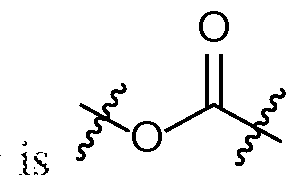
Ref document number: 24762015

Country of ref document: EP

Kind code of ref document: A1

WWE Wipo information: entry into national phase

Ref document number: 325527

Country of ref document: IL

WWE Wipo information: entry into national phase

Ref document number: AU2024308529

Country of ref document: AU

WWE Wipo information: entry into national phase

Ref document number: 2024762015

Country of ref document: EP

WWE Wipo information: entry into national phase

Ref document number: 11202508778S

Country of ref document: SG

WWP Wipo information: published in national office

Ref document number: 11202508778S

Country of ref document: SG