WO2024257883A1 - Information processing device, information processing method, and program - Google Patents
Information processing device, information processing method, and program Download PDFInfo
- Publication number
- WO2024257883A1 WO2024257883A1 PCT/JP2024/021864 JP2024021864W WO2024257883A1 WO 2024257883 A1 WO2024257883 A1 WO 2024257883A1 JP 2024021864 W JP2024021864 W JP 2024021864W WO 2024257883 A1 WO2024257883 A1 WO 2024257883A1
- Authority
- WO
- WIPO (PCT)
- Prior art keywords
- transportation
- information
- shipper
- amount
- carbon dioxide
- Prior art date
- Legal status (The legal status is an assumption and is not a legal conclusion. Google has not performed a legal analysis and makes no representation as to the accuracy of the status listed.)
- Pending
Links
Images




Classifications
-
- G—PHYSICS
- G06—COMPUTING OR CALCULATING; COUNTING
- G06Q—INFORMATION AND COMMUNICATION TECHNOLOGY [ICT] SPECIALLY ADAPTED FOR ADMINISTRATIVE, COMMERCIAL, FINANCIAL, MANAGERIAL OR SUPERVISORY PURPOSES; SYSTEMS OR METHODS SPECIALLY ADAPTED FOR ADMINISTRATIVE, COMMERCIAL, FINANCIAL, MANAGERIAL OR SUPERVISORY PURPOSES, NOT OTHERWISE PROVIDED FOR
- G06Q10/00—Administration; Management
- G06Q10/08—Logistics, e.g. warehousing, loading or distribution; Inventory or stock management
- G06Q10/083—Shipping
Definitions
- the present invention relates to an information processing device, an information processing method, and a program.
- Patent Document 1 describes a logistics management system that allocates stocked products to product orders received by retailers from customers and transmits the allocation results and delivery dates for the orders to the retailers.
- the present invention was made in light of these circumstances, and aims to realize the creation of transportation plans that efficiently reduce CO2 emissions by making the amount of CO2 emissions reduced visible not only for the logistics side but also for the shipper side.
- an information processing device comprises: In an information processing device that creates a transportation plan for transporting goods of a shipper from a transportation origin to a transportation destination by a mobile vehicle, A shipper information acquisition means for acquiring, as the shipper information, information on the shipper side, including at least the weight or volume of the commodity, and the shipping origin and the shipping destination; a logistics side information acquisition means for acquiring, as logistics side information, information on a logistics side that manages transportation of the moving body, the information including at least a transportation cost required to transport the product from the transportation origin to the transportation destination and a moving body characteristic amount that indicates a characteristic of the moving body; a carbon dioxide emission prediction means for setting a predetermined precondition including a moving route from the transportation origin to the transportation destination based on at least a part of the shipper side information and the logistics side information, and predicting a carbon dioxide emission amount per unit amount in weight or volume when the moving object moves under the precondition; A planning means for planning one or more of
- the present invention by making the amount of CO2 emissions reduction visible not only to the logistics side but also to the shipper side, it is possible to create transportation plans that efficiently reduce CO2 emissions.
- FIG. 2 is a conceptual diagram showing an overview of the present service that can be realized by various processes executed by a server according to an embodiment of the information processing device of the present invention.
- FIG. 2 is a diagram showing an example of a method for calculating CO2 emissions applied to the present service of FIG. 1.
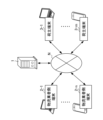
- 1 is a diagram showing a configuration of an information processing system including a server according to an embodiment of the information processing device of the present invention.
- FIG. 4 is a block diagram showing a hardware configuration of the server in FIG. 3 .
- FIG. 5 is a functional block diagram showing an example of a functional configuration of the server in FIG. 4 .
- FIG. 13 is a diagram showing an example of a screen for registering delivery destination, registering cargo, and selecting a vehicle on which a shipper enters information when searching for a transportation plan.
- FIG. 13 is a diagram showing an example of a display in which search results obtained by a shipper searching for a transportation plan are compared with conventional search results.
- 5 is a diagram showing an example of a calculation of a transportation plan executed in the planning unit of FIG. 4, which is a functional configuration of the server of FIG. 3;
- FIG. FIG. 1 is a diagram showing an example of factors that affect fuel efficiency and are required to predict CO2 emissions.
- FIG. 1 is a diagram showing an example of a CO2 emission prediction model as an AI model.
- FIG. 13 is a diagram showing a specific example to explain a general vehicle determination decision process in terms of transportation planning.
- FIG. 12 is a diagram illustrating a conventional logistics evaluation adopted in the general vehicle determination judgment process shown in FIG. 11, which is a logistics evaluation based on the unit price of a vehicle (truck). This figure shows the results of considering logistics based on the unit price of vehicles (trucks) and the minimum unit price of goods (case/weight). This figure shows that there are cases where the effect of logistics cannot be achieved simply by adopting unit case prices to improve loading efficiency.
- FIG. 13 is a diagram showing a specific example of the case unit price when switching from a 4-ton vehicle to a 10-ton vehicle.
- FIG. 15 is a diagram showing preconditions for calculating CO 2 emissions for the cases shown in FIGS.
- FIG. 11 to 14 . 17 is a diagram showing the results of calculating CO2 emissions by applying the method of calculating CO2 emissions in FIG. 2 based on the preconditions in FIG. 16 .
- FIG. This figure explains an example in which, for the cases shown in Figures 11 to 14, another embodiment of an information processing device to which the present invention is applied creates a transportation plan that takes into account CO2 emissions based on the calculation results of CO2 emissions in Figures 16 and 17.
- FIG. 11 is a diagram showing a specific example of CO2 emissions per case when switching from a 4-ton vehicle to a 10-ton vehicle.
- FIG. 1 is an image diagram showing an overview of this service that can be realized by various processes executed by a server according to an embodiment of the information processing device of the present invention.
- consumers C include companies, retail wholesalers, individuals (end users), etc., and place orders for goods with shippers S.
- order information As shown in FIG. 1, in this service, consumers C include companies, retail wholesalers, individuals (end users), etc., and place orders for goods with shippers S.
- order information when a consumer C places an order with a shipper S, the contents of the order are managed as "order information."
- Shipper S may be a manufacturer, individual, company, etc., and places an order for the supply of goods with supplier V based on the order information. In this service, when shipper S places an order with supplier V, the contents of the order are managed as "order information.”
- Supplier V consists of manufacturers, manufacturers, etc., and supplies goods to logistics company L based on order information. From the perspective of logistics company L, goods will arrive from supplier V. Also, from the perspective of shipper S, this is equivalent to requesting logistics company L to procure goods based on order information. Therefore, in this service, when shipper S requests logistics company L to procure goods (when logistics company L receives goods from supplier V), the details are managed as "procurement information (arrival information)".
- this service manages various types of information that logistics company L possesses for business purposes. Specifically, information (hereafter referred to as “vehicle information”) related to cargo transport vehicles (hereafter referred to as “trucks”) used to transport goods, such as the vehicle number, load capacity, vehicle class, and driver information (for example, name, age, working hours, overtime hours, etc.) for each cargo transport vehicle, is managed.
- vehicle information information related to cargo transport vehicles (hereafter referred to as “trucks”) used to transport goods, such as the vehicle number, load capacity, vehicle class, and driver information (for example, name, age, working hours, overtime hours, etc.) for each cargo transport vehicle.
- logistics company L ships the goods received (procured) from supplier V and delivers them to consumer C based on the order information. From the viewpoint of shipper S, this is equivalent to selling the goods to consumer C based on the order information. Therefore, in this service, when shipper S requests logistics company L to sell the goods (when logistics company L ships the goods), the details are managed as "sales information (shipping information)".
- this service makes it possible to create an effective transportation plan based on the information that logistics company L previously managed (procurement information (arrival information), vehicle information, and sales information (shipment information)) and the information that shipper S previously managed (order information and ordering information). In other words, it makes it possible to create an effective transportation plan based on information from logistics company L and information from shipper S. As a result, efficient transportation without waste can be realized.
- logistics company L itself has been carrying out various activities to reduce CO2 emissions.
- the procurement (arrival) of goods that are the basis of logistics activities is determined in response to an order from the shipper S to the supplier V.
- the sale (shipment) of goods that are the basis of logistics activities is determined in response to an order from the consumer C to the shipper S.
- the logistics activities of the distributor L are determined by the order information, which is a decision made between the consumer C and the shipper S, and the ordering information, which is a decision made between the shipper S and the supplier V.
- this service is designed to enable activities to reduce CO2 emissions from the generation stage of order information, which is a decision-making process between consumer C and shipper S, and ordering information, which is a decision-making process between shipper S and supplier V. That is, this service creates a transportation plan that takes CO2 emissions into consideration as a transportation plan for procuring (receiving) and selling (shipping) goods, and the amount of CO2 emissions is presented to and shared with shipper S and logistics company L. In other words, at least some of the shippers S and logistics companies L will be able to create optimal transportation plans for themselves while visually checking whether the presented CO2 emissions will reach the reduction target. The remaining part will be able to visually check the created transportation plans together with their CO2 emissions.
- 2.58 (tCO2/Kl) is the CO2 emission coefficient per kl of diesel, and is calculated by the following formula.
- 2.58 (tCO2/kl) unit calorific value (GJ/Kl) x emission coefficient (tC/GJ) x 22/12 (tCO2/tC) According to Notification No. 66 of the Ministry of Economy, Trade and Industry (March 29, 2006), the unit calorific value is 37.7.
- the emission coefficient is 0.0187 according to the CO2 emission calculation formula using the fuel method in the Guidelines for Calculating Greenhouse Gas Emissions from Businesses (Draft ver. 1.6) set forth by the Global Environment Bureau of the Ministry of the Environment, and the "2003 Environmentally Friendly Logistics Promotion Manual" set forth by the Japan Logistics System Association and the Ministry of Economy, Trade and Industry.
- fuel efficiency differs depending on the route, such as an ordinary road or an expressway, but does not vary significantly depending on the truck's load (weight and volume), i.e., the amount of luggage (amount of cases or pallets).
- the amount of CO2 emissions per truck does not depend on the amount of cargo carried by the truck. In other words, the worse the loading efficiency, the higher the CO2 emissions will be, not per truck, but per unit of cargo carried by one truck (per unit, assuming one case or pallet is one unit). For example, if the CO2 emissions per truck are 100, and there are 100 units of cargo, then the CO2 emissions per unit of cargo is 1. On the other hand, if there are 10 units of cargo, then the CO2 emissions per unit of cargo is 10, which is 10 times higher. Therefore, with this service, transportation plans are drawn up based on the amount of CO2 emissions per unit of cargo transported by a single truck (per unit, where one unit is a case or pallet).
- a CO2 cost is calculated based on the amount of CO2 emissions per unit of cargo transported by one truck (per unit, where one unit is a case or pallet).
- the transportation cost is also converted into the cost per unit of cargo transported by one truck (per unit, where one unit is a case or a pallet).
- the sum of the CO2 cost and transportation cost per unit of cargo transported by one truck is calculated, and a transportation plan is created based on this sum.
- FIG. 3 is a diagram showing the configuration of an information processing system including a server according to an embodiment of the information processing device of the present invention.
- the information processing system shown in FIG. 3 is composed of a server 1, logistics company terminals 2-1 through 2-n (n is an integer value of 1 or more), and shipper terminals 3-1 through 3-m (m is an integer value of 1 or more), all connected to one another via a specified network N such as the Internet.
- each of the distributor terminals 2-1 to 2-n is configured with a personal computer, a smartphone, a tablet terminal, etc.
- Each of the distributor terminals 2-1 to 2-n is operated by a person in charge of each of the n distributors L.
- the distributor side terminals 2-1 to 2-n when there is no need to distinguish between the distributor side terminals 2-1 to 2-n, they will be collectively referred to as the "distributor side terminal 2."
- each of the shipper side terminals 3-1 to 3-m is configured with a personal computer, a smartphone, a tablet terminal, etc.
- Each of the shipper side terminals 3-1 to 3-m is operated by a respective person in charge of the shipper S of m. In the following description, when there is no need to distinguish between the shipper side terminals 3-1 to 3-m, they will be collectively referred to as the "shipper side terminal 3.”
- FIG. 4 is a block diagram showing the hardware configuration of the server shown in FIG.
- the server 1 includes a CPU (Central Processing Unit) 11, a ROM (Read Only Memory) 12, a RAM (Random Access Memory) 13, a bus 14, an input/output interface 15, an input unit 16, an output unit 17, a memory unit 18, a communication unit 19, and a drive 20.
- a CPU Central Processing Unit
- ROM Read Only Memory
- RAM Random Access Memory
- the CPU 11 executes various processes according to a program recorded in the ROM 12 or a program loaded from the storage unit 18 to the RAM 13 .
- the RAM 13 also stores data and the like necessary for the CPU 11 to execute various processes.
- the CPU 11, ROM 12, and RAM 13 are interconnected via a bus 14.
- An input/output interface 15 is also connected to this bus 14.
- An input unit 16, an output unit 17, a memory unit 18, a communication unit 19, and a drive 20 are connected to the input/output interface 15.
- the input unit 16 is composed of various hardware leads and the like, and inputs various types of information.
- the output unit 17 is composed of various liquid crystal displays and the like, and outputs various information.
- the storage unit 18 is configured with a dynamic random access memory (DRAM) or the like, and stores various data.
- the communication unit 19 controls communications with other devices (for example, the distributor side terminals 2-1 to 2-n and the shipper side terminals 3-1 to 3-m in FIG. 4) via a network N including the Internet.
- the drive 20 is provided as necessary.
- Removable media 30, which may be a magnetic disk, optical disk, magneto-optical disk, or semiconductor memory, is appropriately attached to the drive 20.
- Programs read from the removable media 30 by the drive 20 are installed in the storage unit 18 as necessary.
- the removable media 30 can also store various data stored in the storage unit 18 in the same way as the storage unit 18.
- the logistics company terminal 2 and the shipper terminal 3 also have the hardware configuration shown in FIG. 4.
- FIG. 5 is a functional block diagram showing an example of the functional configuration of the server 1 of FIG.
- a shipper information acquisition unit 101 As shown in FIG. 5, in the CPU 11 of the server 1, a shipper information acquisition unit 101, a logistics information acquisition unit 102, a CO2 emission amount prediction unit 103, a planning unit 104, and a presentation unit 105 function.
- a shipper DB 401 In one area of the storage unit 18, a shipper DB 401, a logistics DB 402, and a CO2 emission prediction model 403 are provided.
- the shipper side information acquisition unit 101 acquires the order information and ordering information that the shipper S has previously managed as shipper side information.
- the shipper information acquisition unit 101 also acquires, as shipper information, information including the weight or volume of the package (cargo, goods) and the shipping origin and destination. Furthermore, the shipper side information acquisition unit 101 also acquires the delivery date desired by the shipper S as shipper side information.
- the shipper side information acquired by the shipper side information acquisition unit 101 is stored and managed in the shipper side DB 401 .
- the logistics side information acquisition unit 102 acquires, as logistics company side information, procurement information (arrival information), vehicle information, and sales information (shipment information) that were previously managed by logistics company L, as well as information on each base station for determining routes.
- the logistics side information acquisition unit 102 also acquires, as logistics side information, information including the transportation costs required to transport luggage (cargo, goods) from the transport source to the transport destination.
- the logistics side information acquisition unit 102 acquires, as logistics side information, information required to determine whether or not the delivery deadline will be met, and information regarding quality.
- the logistics side information acquired by the logistics side information acquisition unit 102 is stored and managed in the logistics side DB 402 .
- the CO2 emission prediction unit 103 sets predetermined preconditions including the travel route from the source to the destination based on at least a portion of the shipper information and the logistics information, and predicts the CO2 emission amount per unit amount for weight or volume when, for example, a truck moves under those preconditions. Specifically, the CO2 emission prediction unit 103 calculates the amount of CO2 emissions per truck based on the distance traveled and fuel efficiency when, for example, a truck moves under the above-mentioned prerequisites, and then calculates the amount of CO2 emissions per unit of weight or volume based on the amount of CO2 emissions per truck and the weight or volume of the cargo, and uses this as a predicted value of the CO2 emissions. In addition, the CO2 emission prediction unit 103 may extract the values of each input parameter from the shipper information and the logistics information, and substitute these extracted values into the CO2 emission prediction model 403 to output the result as the prediction result of the CO2 emission amount per cargo volume.
- the CO2 emission prediction model 403 is a model that predicts and outputs the amount of CO2 emission per cargo amount (pallet/case) when values of one or more input parameters are input.
- the CO2 emission prediction model 403 is provided individually according to the prediction method of the CO2 emission. For example, in the case of a model corresponding to the prediction method shown in Fig. 2 described above, which is based on the premise that fuel efficiency differs between expressways and general roads, the vehicle size (whether it is a 4-ton vehicle or a 10-ton vehicle), route information (route information that is divided into expressways and general roads and allows the distance of each to be specified), and luggage weight are input as input parameters.
- the planning unit 104 plans one or more transportation plans based on a CO2 cost per unit amount based on the CO2 emissions per unit amount for the weight or volume of the cargo, and a freight charge per unit (transportation cost) plus the CO2 cost, ie, a freight charge per unit + CO2 cost. Specifically, the planning unit 104 calculates the sum of the CO2 cost and transportation cost per amount of cargo transported by one truck (per unit, where one unit is a case or a pallet), and creates a transportation plan based on that sum. The transportation plan will be described later with reference to FIG.
- the presentation unit 105 presents the proposed transportation plan to the distributor L via the distributor's terminal 2 and to the shipper S via the shipper's terminal 3 .
- the transportation plan also presents the amount of CO2 emissions (forecast result) and the freight charge per unit + CO2 cost (CO2 cost per unit amount plus freight charge per unit (transportation cost)).
- CO2 emissions forecast result
- freight charge per unit + CO2 cost CO2 cost per unit amount plus freight charge per unit (transportation cost)
- a shipper side information acquisition unit 101 In the CPU 11 of the server 1, a shipper side information acquisition unit 101, a logistics side information acquisition unit 102, a CO2 emission prediction unit 103, a planning unit 104, and a presentation unit 105 function to create a transportation plan, which is a plan for transporting the shipper S's goods from the source to the destination, for example by truck.
- the shipper side information acquisition unit 101 acquires information on the shipper S side, which includes at least the weight or volume of the luggage (cargo, goods), as well as the shipping origin (e.g., Tokyo) and shipping destination (e.g., Osaka).
- the logistics side information acquisition unit 102 acquires, as logistics side information, information from the logistics company L that manages truck transportation, including at least the transportation costs required to transport luggage (cargo, goods) from the source (e.g., Tokyo) to the destination (e.g., Osaka) and truck characteristics (e.g., vehicle information) that indicate the characteristics of the truck.
- the CO2 emission prediction unit 103 sets predetermined preconditions including the travel route from the origin (e.g., Tokyo) to the destination (e.g., Osaka) based on at least a portion of the shipper information and logistics information, and predicts the CO2 emission amount per unit amount for weight or volume when the truck travels under those preconditions.
- the planning unit 104 plans one or more transportation plans based on a CO2 cost per unit amount based on the amount of CO2 emissions per unit amount, and a freight charge (transportation cost) per unit amount. This makes it possible to develop transportation plans that efficiently reduce CO2 emissions.
- the presentation unit 105 presents one or more proposed transportation plans, as well as their respective CO2 costs per unit amount and freight rates (transportation costs) per unit amount, to at least the shipper side terminal 3 on the shipper S side. This makes it possible to visualize the amount of CO2 emission reduction not only for the logistics company L (logistics side) but also for the shipper S side, thereby enabling the development of transportation plans that efficiently reduce CO2 emissions.
- Figure 6 shows an example of a screen for registering delivery destinations, registering cargo, and selecting vehicles, on which a shipper enters information when searching for a transportation plan.
- the screen (display) of the shipper terminal 3 operated by the shipper S displays an input section (reference numbers omitted) for performing delivery destination registration KG1 regarding the registration of the delivery destination.
- input fields such as “departure point” (corresponding to the above-mentioned transportation origin), “arrival point” (corresponding to the above-mentioned transportation destination), “delivery date”, “time designation”, “travel time”, “rest/break time”, “estimated work time”, “estimated total delivery time”, and “comments” are displayed (entry is not necessarily required, and may be automatically entered).
- the screen also displays input fields (reference numbers omitted) for performing cargo registration KG2 related to cargo registration. Specifically, as shown in the figure, input fields (reference numbers omitted) for the number of items, number of pallets, type, conditions, weight, etc. are displayed.
- the screen also displays an input field (reference numerals omitted) for selecting a vehicle KG3. Specifically, the screen displays "recommended vehicle”, “mixed cargo”, and “not selected” in the form of check boxes as shown in the figure.
- FIG. 7 is a diagram showing an example of a display of search results obtained by a shipper searching for a transportation plan, for comparison with the results of a conventional search. Note that the above conventional search results are provided by the applicant of the present application for comparison.
- transportation plans No. 1 to 3 are displayed. For each transportation plan, a checkbox-type "selection,” the transportation plan's "No.”, "truck (maximum load capacity),”"freight,” and "delivery date” are displayed. Of the transportation plans No. 1 to 3, the shipper S usually selects the transportation plan No. 1, which has the lowest freight rate.
- the "unit price per kg of cargo” shown in Figure 7 refers to the unit price per 1 kg of cargo (freight, transportation cost).
- the "CO2 cost per kg” refers to the CO2 cost per 1 kg of cargo.
- the "freight + CO2 cost per kg” refers to the sum of the unit price per 1 kg of cargo (freight, transportation cost) and the CO2 cost per 1 kg of cargo.
- the cost is “per 1 kg of cargo," but it is also possible to use the cost per unit of cargo carried by one truck (per unit, where one unit is a case or pallet).
- FIG. 8 is a diagram showing an example of calculation of a transportation plan executed in the planning unit in FIG. 4 which is the functional configuration of the server in FIG.
- the transportation plans No. 1 to 3 shown in Fig. 8 are obtained by adding preconditions for the shipper S to make a decision to the transportation plans No. 1 to 3 shown in Fig. 7.
- CO2 emissions per kg of cargo CO2 emissions per 1 kg of cargo
- unit price per kg of cargo unit price per 1 kg of cargo (freight, transportation cost)
- CO2 cost per kg CO2 cost per 1 kg of cargo
- fluorescence + CO2 cost per kg total unit price per 1 kg of cargo (freight, transportation cost) and CO2 cost per 1 kg of cargo
- CO2 emissions per kg of cargo (CO2 emissions per 1 kg of cargo) is calculated by dividing "CO2 emissions” by "cargo weight.”
- unit price per kilogram of cargo (unit price per 1 kg of cargo (freight, transportation cost)) is calculated by dividing the "freight” by the “cargo weight.”
- CO2 cost per kg (CO2 cost per kg of cargo) is calculated by multiplying the above “CO2 emissions per kg of cargo” (CO2 emissions per kg of cargo) by "CO2 per kg” (cost per kg of CO2).
- “Freight charge + CO2 cost per kg” (the sum of the unit price per kg of cargo (freight charge, transportation cost) and the CO2 cost per kg of cargo) is calculated by adding the above “unit price per kg of cargo” (unit price per kg of cargo (freight charge, transportation cost)) and the above "CO2 cost per kg” (CO2 cost per kg of cargo).
- the transportation plan was targeted at trucks, but it is not limited to this and can be used for any moving object that emits CO2 during movement, such as passenger cars, motorcycles, airplanes, ships, etc.
- the weight of the luggage is acquired and the amount of CO2 emissions per 1 kg of the luggage is calculated, but this is not intended to be limiting.
- the weight or volume of the luggage may be acquired and the amount of CO2 emissions per any unit amount converted from the weight or volume may be calculated.
- the amount of CO2 emissions per pallet and case converted from the weight may be calculated.
- the CO2 emission prediction model 403 is a model corresponding to the prediction method shown in FIG. 2, but is not limited to this.
- the CO2 emissions per truck are calculated based on fuel efficiency, and the factors that affect the fuel efficiency are only general roads and expressways.
- the only input parameters for varying the fuel efficiency are general roads and expressways.
- various kinds of elements can be adopted as input parameters (elements) for varying the fuel efficiency.
- FIG. 9 shows an example of factors that affect fuel efficiency and are required to predict CO2 emissions. For example, seasonal factors such as Obon/New Year's holiday, time of day factors, driver's habits, weather, etc. may be adopted as input parameters (factors) for varying fuel efficiency.
- the CO2 emission prediction model 403 may be a model that uses AI to convert the dispatcher's empirical rules, as shown in FIG. 10 .
- FIG. 10 is a diagram showing an example of a CO2 emission prediction model as an AI model. That is, although not shown, the server 1 or other information processing device may also include a learning unit. When a dispatcher actually drives a truck after making his or her own route decisions, the learning department collects information on the route decisions and fuel usage, as well as data on actual CO2 emissions.
- the data collection tools for route decision-making, fuel usage history, and CO2 emissions are not particularly limited, and a variety of tools can be used, such as existing vehicle dispatch systems (transportation plans), digital tachographs (operation status), drive recorders (image data, etc.), fuel tank gauges (fuel consumption data), and terminals carried by vehicle dispatchers.
- the learning unit accumulates data on CO2 emissions, and accumulates planned and actual CO2 emissions (fuel consumption) as well as error-corrected data.
- the learning unit uses the data accumulated in this manner as learning data and performs machine learning to generate or update an AI model that can propose optimization for reducing CO2 emissions as a CO2 emission prediction model 403.
- the CO2 emission prediction unit 103 and the planning unit 104 can use such an AI model to create optimal transportation plans. In this way, it will be possible to convert the dispatcher's experience into AI and propose optimization (optimal transportation plans).
- FIG. 11 shows a specific example to explain a general vehicle determination decision process in terms of transportation planning.
- the specific example in Figure 11 is an example of a pattern based on a logistics contract with a distance-based freight rate.
- the prerequisites are that the total weight of the goods of the shipper S is 2,900 kg and the travel distance is 100 km.
- the first step is a step of determining whether the vehicle is overloaded.
- the load weight of one vehicle (truck) of distributor L is compared with the total weight of goods of two shippers, 2900 kg, to evaluate whether or not there is an overload.
- Company A and Company B are overloaded and therefore unable to deliver, so the result is NG (marked with an x).
- the second step is a quality judgment step.
- the quality conditions are that the goods are refrigerated, so the vehicle is a refrigerated vehicle.
- Company D has a room temperature vehicle, so the result is NG (marked with an x).
- the third step is a step of determining the delivery date.
- the determination is whether the vehicle can be operated on the delivery date and time of the shipper.
- Company E is unable to operate on 5/7 for some reason, so the verdict is NG (marked with an x).
- the fourth step is a cost determination step.
- the freight rate agreed upon between shipper S and consumer C is 35,000 yen, so the judgement for companies D and F, which exceed this freight rate, is NG (marked with an x).
- the fifth step is a comprehensive judgment step, that is, a step of comprehensively evaluating the judgments in the first step to the fourth step.
- the first step is an item stipulated by law, and therefore is an item (absolute condition) that must be considered when making a judgment. That is, since the first step is stipulated by law, the judgment criteria must be observed, but if the consumer C or the shipper S does not require the criteria of 2. Quality and 3. Delivery date, they may skip the judgments of steps 2 and 3 and proceed to the next process (judgment of steps S4 and 5). In this example, since company C satisfies all of the judgment criteria in steps 1 to 4, it was decided to use company C's vehicle for delivery.
- the shipper S may adopt a judgment process that considers the quality of the goods, whether the specified temperature was maintained, the exterior of the goods, dirt, damage, and incorrect quantity.
- the logistics company L may adopt a judgment process that considers the inspection and daily maintenance to ensure safety of the vehicle, which is the equipment, the driving conditions such as sudden stops and sudden starts for the driver, and whether the conditions such as manners and reception of consumers were observed because the driver contacts the consumer C on behalf of the shipper S.
- a judgment process may be adopted that considers whether the transportation quality is an air suspension vehicle for goods that are sensitive to vibration, and further, the shock level when driving by attaching a vibration device.
- the safety quality taking into account the operating conditions of the logistics company L such as whether the working hours are in accordance with the law, rest, breaks, health conditions, blood pressure, etc., and the health conditions of the individuals, and to visualize the safety quality.
- the logistics evaluation adopted in the general vehicle selection process shown in Fig. 11, i.e., the conventional logistics evaluation based on a distance-based logistics contract, is a logistics (freight) evaluation based on whether the unit price of the vehicle (truck) is low or high, as shown in Fig. 12. That is, conventionally, logistics evaluation was based on the unit price of the vehicle (truck).
- FIG. 12 is a diagram for explaining a conventional logistics evaluation based on the unit price of a vehicle (truck), which is adopted in the general vehicle selection process shown in FIG.
- a distance-based logistics contract uses the difference between the contracted freight rate with Consumer C and the contracted freight rate with logistics company L as the evaluation standard. This is a logistics system in which shipper S will not incur a loss if there is a difference in freight rates or unit price of vehicles.
- FIG. 13 is a diagram showing the results of considering physical distribution based on the unit price of a vehicle (truck) and the minimum unit price of an item (case/weight).
- the minimum unit price of the goods means "the cost per unit of cargo transported by one truck (one unit when one unit is a case or a pallet)" in the above embodiment.
- the above embodiment is an embodiment in which the minimum unit price of the goods is used instead of the unit price of the vehicle.
- Company A's freight charge of 33,000 yen is the cheapest unit price for shipper S, and if the logistics quality does not change, Company A will be selected for vehicle allocation.
- Company C's delivery cost per kilogram will be 6.6 yen. Note that the prerequisite is that they receive an order for 2,177 cases. In contrast, Company A, which had a lower vehicle unit cost, will pay 12.2 yen. Therefore, if Company C takes action to improve its loading efficiency, it will be evaluated highly. However, since Company C's unit price per kg is based on a loading efficiency of 100%, it needs to devise a new transportation system to consolidate Consumer C's orders. However, unlike when the unit price of vehicles was used, using the unit price of items as the evaluation axis is likely to create an opportunity to proactively make improvements. In addition, since this study is a case study focused on evaluating logistics, the discussion of how to redesign the system has been omitted.
- FIG. 13 The results of the consideration of FIG. 13 can be summarized as follows.
- the observations in Figure 13 show that the picture changes when the evaluation framework is changed, such as the unit price of a vehicle (truck) versus the minimum unit price of goods (case/weight).
- the evaluation framework such as the unit price of a vehicle (truck) versus the minimum unit price of goods (case/weight).
- shipper S evaluates logistics based on the unit price of the vehicle, logistics costs will naturally be incurred if the goods are transported.
- distance-based freight contracts are determined by the unit price of each truck vehicle used for delivery.
- the premise is that once the maximum load capacity of a 4-ton vehicle is exceeded, a 10-ton vehicle will be adopted.
- the rule is that you can load anything as long as it does not exceed the load capacity, and you don't have to load anything at all, so the shipper S is simply adopting a distance-based freight rate.
- the logistics department of the shipper S cooperates with activities to reduce the vehicle unit price, and the sales department only cooperates with the rule on overloading.
- the shipper S has no opportunity to think about how to improve its logistics.
- the service shown in Figure 1 according to the embodiment described above is proposed from the viewpoint that it would be a good idea to minimize logistics costs (price per case, cost per weight, etc.) and to disclose the logistics costs as a percentage of the sales price, thereby disclosing the business activities of shipper S as a whole.
- FIG. 14 is a diagram showing cases where the effect of logistics cannot be achieved simply by adopting the unit case price to increase loading efficiency.
- the solid line forming the line graph shows the freight cost per case (the freight cost divided by the number of cases), which is an example of the minimum unit price of goods.
- the bar graph shows the freight cost by shipping quantity unit (distance freight cost).
- the problem with distance-based fares is that the cost per case increases when changing vehicles. This is because, in order to comply with regulations, it is necessary to change to a larger vehicle when the vehicle's maximum load capacity is exceeded.
- FIG. 15 is a diagram showing a specific example of the case unit price when switching from a 4-ton vehicle to a 10-ton vehicle.
- the order volume (shipment volume) reaches a level that requires a change in vehicle type, the cost per case jumps up and the cost per case becomes expensive until a certain amount is reached. For example, in the relationship between consumer C and shipper S, if shipper S wishes to order more than 500 cases, then a contract can be made with distributor L that specifies that orders must be placed for 900 cases or more, thereby avoiding the payment of unnecessary freight charges.
- the method for calculating the amount of CO2 emissions has already been described with reference to FIG. 2.
- the method for calculating the amount of CO2 emissions can be used as is in the embodiment of the information processing device of the present invention to which the method newly devised by the inventors is applied.
- FIG. 16 shows preconditions for calculating the amount of CO2 emissions for the cases shown in FIGS.
- FIG. 17 shows the results of calculating the amount of CO2 emissions by applying the method of calculating the amount of CO2 emissions in FIG. 2 based on the preconditions in FIG.
- Figure 18 is a diagram illustrating an example in which another embodiment of an information processing device to which the present invention is applied creates a transportation plan that takes into account CO2 emissions based on the calculation results of CO2 emissions in Figures 16 and 17 for the cases shown in Figures 11 to 14.
- the solid line forming the line graph indicates the CO2 emission per case (CO2 emission per truck divided by the number of cases).
- the CO2 emission per case is an example of the "CO2 emission per unit of weight or volume" described in the above embodiment.
- the bar graph is the same as that in Fig. 14, and indicates the freight rate (distance-based freight rate) by shipping quantity unit.
- the problem with distance-based fares is that the amount of CO2 emissions per case increases when vehicles are switched over. This is because, in order to comply with legal requirements, it is necessary to switch to a larger vehicle when the vehicle's maximum load capacity is exceeded.
- FIG. 19 is a diagram showing a specific example of CO2 emissions per case when switching from a 4-ton vehicle to a 10-ton vehicle.
- the amount of CO2 emissions per case exceeded 0.15 g-CO2/l (l: liter) in the 600 case, 700 case, and 800 case.
- the "amount of CO2 emissions per unit of weight or volume” will basically decrease, so it is preferable to evaluate logistics using the "amount of CO2 emissions per unit of weight or volume" (the amount of CO2 emissions per case in the example of Figure 18).
- the "CO2 emissions per unit amount of weight or volume” does not monotonically decrease as the order quantity (shipment quantity) increases. Rather, when the order quantity (shipment quantity) reaches a level that results in a change in vehicle, the "CO2 emissions per unit amount of weight or volume” jumps up, and thereafter exceeds a certain amount until a certain amount is reached. Therefore, for example, depending on the relationship between consumer C and shipper S, if shipper S wishes to order more than 500 cases, a rule can be made with distributor L that orders must be placed for 900 cases or more, making it possible to keep CO2 emissions below an appropriate level.
- the CO2 emission prediction unit 103 in FIG. 5 predicts the amount of carbon dioxide emission per unit amount by adopting predetermined preconditions including the condition that a distance-based fare is adopted as the fare for the vehicle and that the size of the vehicle is determined according to the load weight or load volume.
- the planning unit 104 prohibits the planning of a transportation plan and proposes a weight or volume of the vehicle that is less than or equal to the maximum CO2 emission for the size of the vehicle.
- a maximum carbon dioxide emission e.g. 0.15 g-CO2/l (l: liter) in the example of Figure 19
- the planning unit 104 prohibits the planning of a transportation plan and proposes a weight or volume of the vehicle that is less than or equal to the maximum CO2 emission for the size of the vehicle.
- each hardware configuration shown in FIG. 4 is merely an example for achieving the objectives of the present invention and is not particularly limited.
- the functional block diagram shown in FIG. 5 is merely an example and is not particularly limited. In other words, it is sufficient that the information processing system is provided with a function that can execute the above-mentioned series of processes as a whole, and the type of functional block used to realize this function is not particularly limited to the example in FIG. 6.
- the locations of the functional blocks are not limited to those shown in Fig. 5 and may be arbitrary.
- at least a part of the functional blocks on the server 1 side may be provided in the distributor's terminal 2, the shipper's terminal 3, or an information processing device (not shown), or vice versa.
- a single functional block may be configured as a single piece of hardware, or may be configured in combination with a single piece of software.
- the program constituting the software is installed into a computer or the like from a network or a recording medium.
- the computer may be a computer built into dedicated hardware, or may be a computer capable of executing various functions by installing various programs, such as a server, a general-purpose smartphone, or a personal computer.
- Recording media containing such programs are not only configured as removable media that are distributed separately from the device itself in order to provide each user with the program, but also as recording media etc. that are provided to each user in a state where they are already installed in the device itself.
- the steps of describing a program to be recorded on a recording medium include not only processes that are performed chronologically according to the order, but also processes that are not necessarily performed chronologically but are executed in parallel or individually.
- the term "system” refers to an overall device that is composed of a plurality of devices, a plurality of means, etc.
- an information processing device to which the present invention is applied (for example, the server 1 in FIG. 3)
- an information processing device that creates a transportation plan (e.g., the transportation plan in FIG. 7) for transporting merchandise of a shipper (shipper S in FIG. 1) from a transportation origin (e.g., a departure point in FIG. 6) to a transportation destination (e.g., an arrival point in FIG. 6) by a mobile object
- a shipper information acquisition unit e.g., shipper information acquisition unit 101 in FIG. 5 that acquires shipper information (e.g., shipper information in FIG.
- a logistics side information acquisition unit e.g., logistics side information acquisition unit 102 in FIG. 5
- a transportation cost e.g., freight charge in FIG. 7
- a moving object characteristic amount e.g., vehicle information in FIG. 1
- a carbon dioxide emission prediction means e.g., the CO2 emission prediction unit 103 in FIG.
- the system further includes a presentation means (e.g., the presentation unit 105 in FIG. 5) that presents the one or more transportation plans that have been prepared, and the carbon dioxide cost and the transportation cost per unit amount, respectively, to at least the shipper's terminal (e.g., the shipper's terminal 3 in FIG. 3).
- a presentation means e.g., the presentation unit 105 in FIG. 5
- the shipper's terminal e.g., the shipper's terminal 3 in FIG. 3
- the carbon dioxide emission prediction means Calculating a carbon dioxide emission amount per moving body based on a travel distance and a fuel consumption when the moving body travels under the precondition;
- the amount of carbon dioxide emission per unit amount is calculated based on the amount of carbon dioxide emission per moving object and the weight or volume of the product. This will make it possible to more reliably develop transportation plans that efficiently reduce CO2 emissions.
- the carbon dioxide emission prediction means A model obtained as a result of machine learning based on the actual carbon dioxide emission amount when the moving body moves under the actual preconditions, and when at least a part of the shipper side information and the logistics side information is input, a model that outputs the carbon dioxide emission amount per unit amount (for example, the CO2 emission prediction model 403 in FIG. 5 that has been converted into AI as shown in FIG. 10) is obtained, The model is used to calculate the amount of carbon dioxide emitted per unit amount. This will make it possible to more reliably develop transportation plans that efficiently reduce CO2 emissions.
- the shipper side information acquisition means further acquires the shipper side information including the delivery date desired by the shipper (for example, the delivery date shown in FIG. 6 );
- the logistics information acquisition means further acquires the shipper information including information necessary to determine whether the delivery date will be met and information regarding quality,
- the planning means further plans one or more transportation plans based on information indicating whether the delivery deadline will be met and the quality. This will make it possible to more reliably develop transportation plans that efficiently reduce CO2 emissions.
- the carbon dioxide emission prediction means (e.g., the CO2 emission prediction unit 103 in FIG. 5) predicts the carbon dioxide emission per unit amount by adopting the predetermined preconditions including a condition that a distance-based fare is adopted as a fare for the moving body (e.g., a vehicle such as a truck) and the size of the moving body (e.g., a 4-ton vehicle or a 10-ton vehicle) is determined according to a loading weight or a loading volume, When the predicted carbon dioxide emission per unit amount exceeds a maximum carbon dioxide emission amount (e.g., 0.15 g-CO2/l (l: liter) in the example of FIG.
- a maximum carbon dioxide emission amount e.g. 0.15 g-CO2/l (l: liter
- the planning means e.g., the planning unit 104 in FIG. 5 prohibits the planning of the transportation plan and proposes a weight or volume of the vehicle that is equal to or less than the maximum carbon dioxide emission amount for the size of the moving body. It is possible.
- 1 Server, 2: Logistics company terminal, 3: Shipper terminal, 11: CPU, 12: ROM, 13: RAM, 14: Bus, 15: Input/output interface, 16: Input section, 17: Output section, 18: Storage section, 19: Communication section, 20: Drive, 30: Removable media, 101: Shipper information acquisition section, 102: Logistics information acquisition section, 103: CO2 emissions forecast section, 104: Planning section, 105: Presentation section, 401: Shipper DB, 402: Logistics DB, 403: CO2 emissions forecast model, C: Consumer, S: Shipper, V: Supplier, L: Logistics company
Landscapes
- Business, Economics & Management (AREA)
- Engineering & Computer Science (AREA)
- Economics (AREA)
- Quality & Reliability (AREA)
- Entrepreneurship & Innovation (AREA)
- Human Resources & Organizations (AREA)
- Marketing (AREA)
- Operations Research (AREA)
- Development Economics (AREA)
- Strategic Management (AREA)
- Tourism & Hospitality (AREA)
- Physics & Mathematics (AREA)
- General Business, Economics & Management (AREA)
- General Physics & Mathematics (AREA)
- Theoretical Computer Science (AREA)
- Management, Administration, Business Operations System, And Electronic Commerce (AREA)
Abstract
Description
本発明は、情報処理装置、情報処理方法、及びプログラムに関する。 The present invention relates to an information processing device, an information processing method, and a program.
従来より、物流拠点となる倉庫で保有される在庫を管理する技術は存在する。例えば、特許文献1には、販売店が受注した顧客からの製品の注文に対して在庫製品を引当て、販売店に注文に対する引当結果及び納期を送信する物流管理システムが記載されている。
Technology for managing inventory held in warehouses that serve as logistics bases has existed for some time. For example,
しかしながら、近年、運送側の物流活動(配送、保管、作業等)で発生するCO2の削減が要求されているが、特許文献1に記載された技術を含め従来からある物流管理システムでは、CO2排出量の削減には限界がある。
これは、運送(例えば、物流業者)側が、荷主側から一方的に要求される情報に基づいて運送計画が立案されるため、このような運送計画は、CO2排出量の削減をするための効率的なものとなっていなかったためである。
即ち、物流側のみならず荷主側に対してもCO2排出量の削減量の見える化を図ることで、CO2排出量を効率的に削減する運送計画の立案が実現されること、特許文献1に記載された技術を含め従来からある物流管理システムでは荷主側に対しては何ら情報が開示されていなかった。
However, in recent years, there has been a demand to reduce the CO2 emissions generated during logistics activities (delivery, storage, work, etc.) on the transportation side, but conventional logistics management systems, including the technology described in
This is because transportation plans are drawn up by the transport company (e.g., logistics company) based on information unilaterally requested by the shipper, and such transportation plans are not efficient in reducing CO2 emissions.
In other words, by making the amount of CO2 emission reduction visible not only to the logistics side but also to the shipper side, it becomes possible to develop transportation plans that efficiently reduce CO2 emissions; however, with conventional logistics management systems, including the technology described in
本発明は、このような状況に鑑みてなされたものであり、物流側のみならず荷主側に対してもCO2排出量の削減量の見える化を図ることで、CO2排出量を効率的に削減する運送計画の立案を実現することを目的とする。 The present invention was made in light of these circumstances, and aims to realize the creation of transportation plans that efficiently reduce CO2 emissions by making the amount of CO2 emissions reduced visible not only for the logistics side but also for the shipper side.
上記目的を達成するため、本発明の一態様である情報処理装置は、
荷主の商品を運送元から運送先まで移動体で運送させるための計画を運送計画として立案する情報処理装置において、
前記荷主側の情報であって、前記商品の重量又は容積、並びに前記運送元及び前記運送先を少なくとも含む情報を、荷主側情報として取得する荷主側情報取得手段と、
前記移動体の運送を管理する物流側の情報であって、前記運送元から前記運送先まで前記商品を運送するために必要な運送コスト、及び、前記移動体の特徴を示す移動体特徴量を少なくとも含む情報を、物流側情報として取得する物流側情報取得手段と、
前記荷主側情報及び前記物流側情報の少なくとも一部に基づいて、前記運送元から前記運送先までの移動ルートを含む所定の前提条件を設定して、当該前提条件で前記移動体が移動した場合における、重量又は容積についての単位量当たりの二酸化炭素排出量を予測する二酸化炭素排出量予測手段と、
前記単位量当たりの二酸化炭素排出量に基づく当該単位量当たりの二酸化炭素コスト、及び、当該単位量当たりの前記運送コストに基づいて、前記運送計画を1以上立案する立案手段と、
を備える。
本発明の一態様の情報処理方法及びプログラムの夫々は、本発明の一態様の情報処理装置に対応する方法及びプログラムの夫々である。
In order to achieve the above object, an information processing device according to one aspect of the present invention comprises:
In an information processing device that creates a transportation plan for transporting goods of a shipper from a transportation origin to a transportation destination by a mobile vehicle,
A shipper information acquisition means for acquiring, as the shipper information, information on the shipper side, including at least the weight or volume of the commodity, and the shipping origin and the shipping destination;
a logistics side information acquisition means for acquiring, as logistics side information, information on a logistics side that manages transportation of the moving body, the information including at least a transportation cost required to transport the product from the transportation origin to the transportation destination and a moving body characteristic amount that indicates a characteristic of the moving body;
a carbon dioxide emission prediction means for setting a predetermined precondition including a moving route from the transportation origin to the transportation destination based on at least a part of the shipper side information and the logistics side information, and predicting a carbon dioxide emission amount per unit amount in weight or volume when the moving object moves under the precondition;
A planning means for planning one or more of the transportation plans based on a carbon dioxide cost per unit amount based on the carbon dioxide emission amount per unit amount and the transportation cost per unit amount;
Equipped with.
An information processing method and a program according to one aspect of the present invention are a method and a program corresponding to an information processing device according to one aspect of the present invention.
本発明によれば、物流側のみならず荷主側に対してもCO2排出量の削減量の見える化を図ることで、CO2排出量を効率的に削減する運送計画の立案を実現することができる。 According to the present invention, by making the amount of CO2 emissions reduction visible not only to the logistics side but also to the shipper side, it is possible to create transportation plans that efficiently reduce CO2 emissions.
以下、本発明の実施形態について図面を用いて説明する。 Below, an embodiment of the present invention will be explained with reference to the drawings.
図1は、本発明の情報処理装置の一実施形態に係るサーバが実行する各種処理により実現できる本サービスの概要を示すイメージ図である。 FIG. 1 is an image diagram showing an overview of this service that can be realized by various processes executed by a server according to an embodiment of the information processing device of the present invention.
図1に示すように、本サービスでは、消費者Cは、企業、小売卸業者、個人(エンドユーザ)等からなり、荷主Sに対して商品の注文を行う。
本サービスでは、消費者Cから荷主Sに対する注文があると、その内容が「注文情報」として管理される。
As shown in FIG. 1, in this service, consumers C include companies, retail wholesalers, individuals (end users), etc., and place orders for goods with shippers S.
In this service, when a consumer C places an order with a shipper S, the contents of the order are managed as "order information."
荷主Sは、製造業者、個人、企業等からなり、注文情報に基づいて、供給者Vに対して、商品の供給を発注する。本サービスでは、荷主Sから供給者Vに対する発注があると、その内容が「発注情報」として管理される。 Shipper S may be a manufacturer, individual, company, etc., and places an order for the supply of goods with supplier V based on the order information. In this service, when shipper S places an order with supplier V, the contents of the order are managed as "order information."
供給者Vは、製造業者やメーカ等からなり、発注情報に基づいて、物流業者Lに商品を供給する。物流業者Lからすると、供給者Vから商品が入荷されることになる。また、荷主Sの観点からすると、発注情報に基づいて、物流業者Lに対して商品の調達を依頼することと等価である。そこで、本サービスでは、荷主Sから物流業者Lに対する商品の調達の依頼があると(供給者Vから物流業者Lに対して商品の入荷があると)、その内容が「調達情報(入荷情報)」として管理される。 Supplier V consists of manufacturers, manufacturers, etc., and supplies goods to logistics company L based on order information. From the perspective of logistics company L, goods will arrive from supplier V. Also, from the perspective of shipper S, this is equivalent to requesting logistics company L to procure goods based on order information. Therefore, in this service, when shipper S requests logistics company L to procure goods (when logistics company L receives goods from supplier V), the details are managed as "procurement information (arrival information)".
また、本サービスでは、物流業者Lが業務上保有する各種情報が管理される。具体的には、商品の運送に用いられる貨物運搬車両(以下、「トラック」と呼ぶ)に関する情報(以下、「車両情報」と呼ぶ)として、貨物運搬車両毎の車両番号、積載量、車格、運転手に関する情報(例えば名前、年齢、労働時間、残業時間等)等が管理される。 In addition, this service manages various types of information that logistics company L possesses for business purposes. Specifically, information (hereafter referred to as "vehicle information") related to cargo transport vehicles (hereafter referred to as "trucks") used to transport goods, such as the vehicle number, load capacity, vehicle class, and driver information (for example, name, age, working hours, overtime hours, etc.) for each cargo transport vehicle, is managed.
本サービスでは、物流業者Lは、注文情報に基づいて、供給者Vから入荷(調達)した商品を出荷して、消費者Cに配送する。ここで、荷主Sの観点からすると、注文情報に基づいて、商品を消費者Cに販売することと等価である。そこで、本サービスでは、荷主Sから物流業者Lに対する商品の販売の依頼があると(物流業者Lが商品を出荷すると)、その内容が「販売情報(出荷情報)」として管理される。 In this service, logistics company L ships the goods received (procured) from supplier V and delivers them to consumer C based on the order information. From the viewpoint of shipper S, this is equivalent to selling the goods to consumer C based on the order information. Therefore, in this service, when shipper S requests logistics company L to sell the goods (when logistics company L ships the goods), the details are managed as "sales information (shipping information)".
本サービスでは、上述した注文情報、発注情報、調達情報(入荷情報)、車両情報、販売情報(出荷情報)が一括で管理され、これらの情報が考慮された柔軟な運送計画が立案される。
即ち、本サービスによれば、物流業者Lが従来管理していた情報(調達情報(入荷情報)、車両情報、及び販売情報(出荷情報))と、荷主Sが従来管理していた情報(注文情報及び発注情報)とに基づく実効的な運送計画の立案が可能となる。つまり、物流業者L側の情報と、荷主S側の情報とに基づく実効的な運送計画の立案が可能となる。その結果、無駄のない効率的な運送を実現させることができる。
With this service, the above-mentioned order information, ordering information, procurement information (arrival information), vehicle information, and sales information (shipment information) are managed all in one place, and flexible transportation plans are created that take this information into consideration.
That is, this service makes it possible to create an effective transportation plan based on the information that logistics company L previously managed (procurement information (arrival information), vehicle information, and sales information (shipment information)) and the information that shipper S previously managed (order information and ordering information). In other words, it makes it possible to create an effective transportation plan based on information from logistics company L and information from shipper S. As a result, efficient transportation without waste can be realized.
ここで、近年、物流業者L側の物流活動(配送、保管、作業等)で発生するCO2の削減が要求されている。
そこで、物流業者L自体も、CO2の削減を行うべく、各種各様な活動を行ってきてはいる。
しかしながら、上述したように、物流活動の基礎となる商品の調達(入荷)は、荷主Sから供給者Vに対する発注に応じて決定されるものである。また、物流活動の基礎となる商品の販売(出荷)は、消費者Cから荷主Sに対する注文に応じて決定されるものである。即ち、消費者Cと荷主Sとの間の意思決定である注文情報、及び荷主Sと供給者Vとの間の意思決定である発注情報とにより、物流業者L側の物流活動が決定される。
従って、物流業者Lだけでは、CO2の削減にも限界がある。
そこで、本サービスでは、消費者Cと荷主Sとの間の意思決定である注文情報、及び荷主Sと供給者Vとの間の意思決定である発注情報の生成段階から、CO2の削減の活動を行えるようになされている。即ち、本サービスでは、商品の調達(入荷)及び販売(出荷)における運送計画として、CO2排出量が考慮された運送計画が立案され、そのCO2排出量が荷主S及び物流業者L側に対して提示されて共有される。
換言すると、荷主Sや物流業者L等のうち少なくとも一部は、提示されたCO2排出量が削減目標に到達するか否かを視認しながら、自身にとって最適な運送計画を立案することが可能になる。残りの一部は、立案された運送計画を、そのCO2排出量と共に視認することが可能になる。
In recent years, there has been a demand for reduction in CO2 emissions generated in the logistics activities (delivery, storage, operations, etc.) of the logistics company L.
Therefore, logistics company L itself has been carrying out various activities to reduce CO2 emissions.
However, as described above, the procurement (arrival) of goods that are the basis of logistics activities is determined in response to an order from the shipper S to the supplier V. Also, the sale (shipment) of goods that are the basis of logistics activities is determined in response to an order from the consumer C to the shipper S. In other words, the logistics activities of the distributor L are determined by the order information, which is a decision made between the consumer C and the shipper S, and the ordering information, which is a decision made between the shipper S and the supplier V.
Therefore, there is a limit to how much CO2 can be reduced by logistics company L alone.
Therefore, this service is designed to enable activities to reduce CO2 emissions from the generation stage of order information, which is a decision-making process between consumer C and shipper S, and ordering information, which is a decision-making process between shipper S and supplier V. That is, this service creates a transportation plan that takes CO2 emissions into consideration as a transportation plan for procuring (receiving) and selling (shipping) goods, and the amount of CO2 emissions is presented to and shared with shipper S and logistics company L.
In other words, at least some of the shippers S and logistics companies L will be able to create optimal transportation plans for themselves while visually checking whether the presented CO2 emissions will reach the reduction target. The remaining part will be able to visually check the created transportation plans together with their CO2 emissions.
以下、本サービスに適用される、CO2排出量を考慮した運送計画の概要について説明する。 Below is an overview of the transportation plan that takes CO2 emissions into consideration and that will be applied to this service.
図2は、図1の本サービスに適用されるCO2排出量の算出手法の一例を示す図である。
図2に示すように、トラック1台当たりのCO2排出量(tCO2)は、次の式に示すようになる。
CO2排出量=燃料使用量(kl)×2.58(tCO2/Kl)
FIG. 2 is a diagram showing an example of a method for calculating the amount of CO2 emissions applied to the present service of FIG.
As shown in FIG. 2, the amount of CO2 emissions (tCO2) per truck is expressed by the following formula.
CO2 emissions = fuel consumption (kl) x 2.58 (tCO2/kl)
ここで、2.58(tCO2/Kl)とは、軽油の1klあたりのCO2排出係数であり、次の式により算出される。
2.58(tCO2/kl)=単位発熱量(GJ/Kl)×排出係数(tC/GJ)×22/12(tCO2/tC)
単位発熱量は、経済産業省告示第66号(平成18年3月29日)によれば、37.7である。
排出係数は、環境省地球環境局、事業者からの温室効果ガス排出量算定方法ガイドライン(試案ver.1.6) 燃料法によるCO2排出量算定式、経済産業省・(社)日ロジスティクスシステム協会「2003年度環境調和型ロジスティクス推進マニュアル」によれば、0.0187である。
Here, 2.58 (tCO2/Kl) is the CO2 emission coefficient per kl of diesel, and is calculated by the following formula.
2.58 (tCO2/kl) = unit calorific value (GJ/Kl) x emission coefficient (tC/GJ) x 22/12 (tCO2/tC)
According to Notification No. 66 of the Ministry of Economy, Trade and Industry (March 29, 2006), the unit calorific value is 37.7.
The emission coefficient is 0.0187 according to the CO2 emission calculation formula using the fuel method in the Guidelines for Calculating Greenhouse Gas Emissions from Businesses (Draft ver. 1.6) set forth by the Global Environment Bureau of the Ministry of the Environment, and the "2003 Environmentally Friendly Logistics Promotion Manual" set forth by the Japan Logistics System Association and the Ministry of Economy, Trade and Industry.
一方、燃料使用量(kl)は、次の式により算出される。
燃料使用量(kl)=走行距離(km)÷燃費(km/kl)
ここで、燃費は、一般道や高速道路等のルートによっては異なるが、トラックの積載量(重量や容積)、即ち荷物量(ケースやパレットの量)によってはさほど変化がないことが知られている。
On the other hand, the fuel consumption amount (kl) is calculated by the following formula.
Fuel consumption (kl) = distance traveled (km) ÷ fuel efficiency (km/kl)
Here, it is known that fuel efficiency differs depending on the route, such as an ordinary road or an expressway, but does not vary significantly depending on the truck's load (weight and volume), i.e., the amount of luggage (amount of cases or pallets).
即ち、同一ルートで移動するならば、最大積載量のトラックも、空のトラックも燃費は変わらず、その結果、トラック1台当たりのCO2排出量も変わらない。即ち、トラック1台当たりのCO2排出量は、トラックの荷物量に依存しない。
換言すると、トラック1台当たりではなく、1台のトラックに運搬される荷物量当たり(ケースやパレットを1単位とした場合の1単位当たり)のCO2排出量という点では、積載効率が悪い程多くなっていくことになる。例えばトラック1台当たりのCO2排出量が100である場合において、荷物量が100単位ならば、荷物量1単位当たりのCO2排出量は1である。これに対して、荷物量が10単位ならば、荷物量1単位当たりのCO2排出量は10と、10倍も多くなってしまう。
そこで、本サービスでは、1台のトラックに運搬される荷物量当たり(ケースやパレットを1単位とした場合の1単位当たり)のCO2排出量で、運送計画の立案がなされる。
In other words, if a truck is traveling the same route, the fuel efficiency is the same whether it is fully loaded or empty, and as a result, the amount of CO2 emissions per truck is the same. In other words, the amount of CO2 emissions per truck does not depend on the amount of cargo carried by the truck.
In other words, the worse the loading efficiency, the higher the CO2 emissions will be, not per truck, but per unit of cargo carried by one truck (per unit, assuming one case or pallet is one unit). For example, if the CO2 emissions per truck are 100, and there are 100 units of cargo, then the CO2 emissions per unit of cargo is 1. On the other hand, if there are 10 units of cargo, then the CO2 emissions per unit of cargo is 10, which is 10 times higher.
Therefore, with this service, transportation plans are drawn up based on the amount of CO2 emissions per unit of cargo transported by a single truck (per unit, where one unit is a case or pallet).
さらに、比較を容易にするという観点で、1台のトラックに運搬される荷物量当たり(ケースやパレットを1単位とした場合の1単位当たり)のCO2排出量に基づくCO2コストが演算される。
そして、運搬コストも、1台のトラックに運搬される荷物量当たり(ケースやパレットを1単位とした場合の1単位当たり)のコストに換算される。
そして、1台のトラックに運搬される荷物量当たり(ケースやパレットを1単位とした場合の1単位当たり)のCO2コスト及び運搬コストの総和が演算され、その総和に基づく運送計画の立案がなされる。
Furthermore, for ease of comparison, a CO2 cost is calculated based on the amount of CO2 emissions per unit of cargo transported by one truck (per unit, where one unit is a case or pallet).
The transportation cost is also converted into the cost per unit of cargo transported by one truck (per unit, where one unit is a case or a pallet).
Then, the sum of the CO2 cost and transportation cost per unit of cargo transported by one truck (per unit, where one unit is a case or pallet) is calculated, and a transportation plan is created based on this sum.
次に、本サービスを提供するための各種処理を実行するサーバ1を含む、情報処理システムの構成について説明する。
図3は、本発明の情報処理装置の一実施形態に係るサーバを含む、情報処理システムの構成を示す図である。
Next, a configuration of an information processing system including the
FIG. 3 is a diagram showing the configuration of an information processing system including a server according to an embodiment of the information processing device of the present invention.
図3に示す情報処理システムは、サーバ1と、物流業者側端末2-1乃至2-n(nは1以上の整数値)と、荷主側端末3-1乃至3-m(mは1以上の整数値)が、インターネット等の所定のネットワークNを介して相互に接続されることで構成される。
The information processing system shown in FIG. 3 is composed of a
本実施形態における物流業者側端末2-1乃至2-nの夫々は、パーソナルコンピュータ、スマートフォン、タブレット端末等で構成される。物流業者側端末2-1乃至2-nの夫々は、nの物流業者Lの夫々の担当者によって操作される。
なお、以下、物流業者側端末2-1乃至2-nの夫々を個々に区別する必要がない場合、これらをまとめて「物流業者側端末2」と呼ぶ。
In this embodiment, each of the distributor terminals 2-1 to 2-n is configured with a personal computer, a smartphone, a tablet terminal, etc. Each of the distributor terminals 2-1 to 2-n is operated by a person in charge of each of the n distributors L.
In the following description, when there is no need to distinguish between the distributor side terminals 2-1 to 2-n, they will be collectively referred to as the "
本実施形態における荷主側端末3-1乃至3-mの夫々は、パーソナルコンピュータ、スマートフォン、タブレット端末等で構成される。荷主側端末3-1乃至3-mの夫々は、mの荷主Sの夫々の担当者によって操作される。
なお、以下、荷主側端末3-1乃至3-mの夫々を個々に区別する必要がない場合、これらをまとめて「荷主側端末3」と呼ぶ。
In this embodiment, each of the shipper side terminals 3-1 to 3-m is configured with a personal computer, a smartphone, a tablet terminal, etc. Each of the shipper side terminals 3-1 to 3-m is operated by a respective person in charge of the shipper S of m.
In the following description, when there is no need to distinguish between the shipper side terminals 3-1 to 3-m, they will be collectively referred to as the "
次に、本サービスを提供するための各種処理を実行するサーバ1のハードウェア構成について説明する。
図4は、図3のサーバのハードウェア構成を示すブロック図である。
Next, a hardware configuration of the
FIG. 4 is a block diagram showing the hardware configuration of the server shown in FIG.
サーバ1は、CPU(Central Processing Unit)11と、ROM(Read Only Memory)12と、RAM(Random Access Memory)13と、バス14と、入出力インターフェース15と、入力部16と、出力部17と、記憶部18と、通信部19と、ドライブ20とを備えている。
The
CPU11は、ROM12に記録されているプログラム、又は、記憶部18からRAM13にロードされたプログラムに従って各種の処理を実行する。
RAM13には、CPU11が各種の処理を実行する上において必要なデータ等も適宜記憶される。
The
The
CPU11、ROM12及びRAM13は、バス14を介して相互に接続されている。このバス14にはまた、入出力インターフェース15も接続されている。入出力インターフェース15には、入力部16、出力部17、記憶部18、通信部19及びドライブ20が接続されている。
The
入力部16は、各種ハードウェア鉛等で構成され、各種情報を入力する。
出力部17は各種液晶ディスプレイ等で構成され、各種情報を出力する。
記憶部18は、DRAM(Dynamic Random Access Memory)等で構成され、各種データを記憶する。
通信部19は、インターネットを含むネットワークNを介して他の装置(例えば図4の物流業者側端末2-1乃至2-nや荷主側端末3-1乃至3-m)との間で行う通信を制御する。
The
The
The
The
ドライブ20は、必要に応じて設けられる。ドライブ20には磁気ディスク、光ディスク、光磁気ディスク、或いは半導体メモリ等よりなる、リムーバブルメディア30が適宜装着される。ドライブ20によってリムーバブルメディア30から読み出されたプログラムは、必要に応じて記憶部18にインストールされる。またリムーバブルメディア30は、記憶部18に記憶されている各種データも、記憶部18と同様に記憶することができる。
The
なお、図示はしないが、物流業者側端末2や荷主側端末3も図4に示すハードウェア構成を有している。
Although not shown, the
このような図4のサーバ1を含む図3の情報処理システムを構成する各種ハードウェアと各種ソフトウェアとの協働により、図1の本サービスを提供するための各種処理を実行することができる。
By cooperation of the various hardware and software constituting the information processing system of FIG. 3, including the
次に、図4のようなハードウェア構成を持つサーバ1の機能について、図5を参照しながら説明する。
図5は、図4のサーバ1の機能的構成の一例を示す機能ブロック図である。
Next, the function of the
FIG. 5 is a functional block diagram showing an example of the functional configuration of the
図5に示すように、サーバ1のCPU11においては、荷主側情報取得部101と、物流側情報取得部102と、CO2排出量予測部103と、立案部104と、提示部105とが機能する。
記憶部18の一領域には、荷主側DB401と、物流側DB402と、CO2排出量予測モデル403とが設けられている。
As shown in FIG. 5, in the
In one area of the
荷主側情報取得部101は、荷主Sが従来管理していた注文情報と発注情報とを荷主側情報として取得する。
また、荷主側情報取得部101は、荷物(貨物、商品)の重量又は容積、並びに運送元及び運送先を含む情報も荷主側情報として取得する。
さらに、荷主側情報取得部101は、荷主Sが希望する納期も荷主側情報として取得する。
荷主側情報取得部101により取得された荷主側情報は、荷主側DB401に記憶されて管理される。
The shipper side
The shipper
Furthermore, the shipper side
The shipper side information acquired by the shipper side
物流側情報取得部102は、物流業者Lが従来管理していた調達情報(入荷情報)、車両情報、及び販売情報(出荷情報)、ルートを決定するための各拠点の情報等を、物流業者側情報として取得する。
また、物流側情報取得部102は、運送元から運送先まで荷物(貨物、商品)を運送するために必要な運送コストを含む情報も物流側情報として取得する。
さらに、物流側情報取得部102は、納期に間に合うか否かを特定するために必要な情報、及び、品質に関する情報も物流側情報として取得する。
物流側情報取得部102により取得された物流側情報は、物流側DB402に記憶されて管理される。
The logistics side
The logistics side
Furthermore, the logistics side
The logistics side information acquired by the logistics side
CO2排出量予測部103は、荷主側情報及び物流側情報の少なくとも一部に基づいて、運送元から運送先までの移動ルートを含む所定の前提条件を設定して、当該前提条件で例えばトラックが移動した場合における、重量又は容積についての単位量当たりのCO2排出量を予測する。
具体的に、CO2排出量予測部103は、上記前提条件で例えばトラックが移動した場合における移動距離及び燃費に基づいて、トラック当たりのCO2排出量を演算し、そして、トラック当たりのCO2排出量、及び、荷物の重量又は容積に基づいて、重量又は容積についての単位量当たりのCO2排出量を演算し、これをCO2排出量の予測値とする。
なお、CO2排出量予測部103は、荷主側情報及び物流側情報から各入力パラメータの夫々の値を抽出し、この抽出した値をCO2排出量予測モデル403に代入して得られたものを、荷物量単位のCO2排出量の予測結果として出力してもよい。
The CO2
Specifically, the CO2
In addition, the CO2
ここで、CO2排出量予測モデル403は、1以上の入力パラメータの各値を入力すると、荷物量(パレット/ケース)単位のCO2排出量を予測して出力するモデルである。
CO2排出量予測モデル403は、CO2排出量の予測手法に応じて個別に設けられる。例えば上述の図2に示す予測手法に対応するモデルであって、高速道路と一般道の2種類で燃費が異なることが前提とされたモデルである場合には、車格(4トン車であるのか10トン車であるのか)、ルート情報(高速道路と一般道路に分けたルートであって、夫々の距離が特定可能なルートの情報)、及び荷物重量が入力パラメータとして夫々の値が入力される。
Here, the CO2
The CO2
立案部104は、荷物の重量又は容積についての単位量当たりのCO2排出量に基づく当該単位量当たりのCO2コスト、及び、このCO2コストに単位当たりの運賃(運送コスト)を加えた、単位当たり運賃+CO2コスト、に基づいて、運送計画を1以上立案する。
具体的に、立案部104は、例えば1台のトラックに運搬される荷物量当たり(ケースやパレットを1単位とした場合の1単位当たり)のCO2コスト及び運搬コストの総和を演算し、その総和に基づいて運送計画を立案する。
なお、運送計画については図7を参照しながら後述する。
The
Specifically, the
The transportation plan will be described later with reference to FIG.
提示部105は、立案された運送計画を、物流業者側端末2を通じて物流業者Lに提示すると共に、荷主側端末3を通じて荷主Sに提示する。
ここで、運送計画には、CO2排出量(予測結果)及び単位当たり運賃+CO2コスト(単位量当たりのCO2コストに単位当たりの運賃(運送コスト)を加えたもの)も提示される。このようにして、物流業者Lのみならず荷主Sにも、CO2排出量の情報、及び、単位当たり運賃+CO2コストが提示されて共有化されるようになる。その結果、物流業者Lのみならず荷主Sも併せて、物流活動で発生するCO2の削減活動に参加できるようになる。
The
Here, the transportation plan also presents the amount of CO2 emissions (forecast result) and the freight charge per unit + CO2 cost (CO2 cost per unit amount plus freight charge per unit (transportation cost)). In this way, information on the amount of CO2 emissions and the freight charge per unit + CO2 cost are presented and shared not only with the logistics company L but also with the shipper S. As a result, not only the logistics company L but also the shipper S can participate in activities to reduce CO2 generated in logistics activities.
以上まとめると、サーバ1のCPU11においては、荷主Sの商品を運送元から運送先まで例えばトラックで運送させるための計画を運送計画として立案すべく、荷主側情報取得部101と、物流側情報取得部102と、CO2排出量予測部103と、立案部104と、提示部105とが機能する。
荷主側情報取得部101は、荷主S側の情報であって、荷物(貨物、商品)の重量又は容積、並びに運送元(例えば東京)及び運送先(例えば大阪)を少なくとも含む情報を、荷主側情報として取得する。
物流側情報取得部102は、トラックの運送を管理する物流業者L側の情報であって、運送元(例えば東京)から運送先(例えば大阪)まで荷物(貨物、商品)を運送するために必要な運送コスト、及び、トラックの特徴を示すトラック特徴量(例えば車両情報)を少なくとも含む情報を、物流側情報として取得する。
CO2排出量予測部103は、荷主側情報及び物流側情報の少なくとも一部に基づいて、運送元(例えば東京)から運送先(例えば大阪)までの移動ルートを含む所定の前提条件を設定して、当該前提条件でトラックが移動した場合における、重量又は容積についての単位量当たりのCO2排出量を予測する。
立案部104は、単位量当たりのCO2排出量に基づく当該単位量当たりのCO2コスト、及び、当該単位量当たりの運賃(運送コスト)に基づいて、運送計画を1以上立案する。
これにより、CO2排出量を効率的に削減する運送計画の立案を実現することができる。
To summarize the above, in the
The shipper side
The logistics side
The CO2
The
This makes it possible to develop transportation plans that efficiently reduce CO2 emissions.
また、サーバ1のCPU11においては、提示部105は、立案された1以上の運送計画、及び夫々の単位量当たりのCO2コスト及び単位量当たりの運賃(運送コスト)を、少なくとも荷主S側の荷主側端末3に提示する。
これにより、物流業者L側(物流側)のみならず荷主S側に対してもCO2排出量の削減量の見える化を図ることができ、以てCO2排出量を効率的に削減する運送計画の立案を実現することができる。
In addition, in the
This makes it possible to visualize the amount of CO2 emission reduction not only for the logistics company L (logistics side) but also for the shipper S side, thereby enabling the development of transportation plans that efficiently reduce CO2 emissions.
図6は、荷主側が運送計画を検索するにあたり入力等をする、納品先登録、貨物登録及び車両選択の画面の一例を示す図である。 Figure 6 shows an example of a screen for registering delivery destinations, registering cargo, and selecting vehicles, on which a shipper enters information when searching for a transportation plan.
荷主S側が運送計画を検索するにあたり、荷主Sが操作する荷主側端末3における画面(表示部)には、納品先の登録に関する納品先登録KG1を行うための入力部(符号省略)が夫々表示される。具体的には、図示のような、「出発地」(上記運送元に相当)、「到着地」(上記運送先に相当)、「納期」、「時間指定」、「走行時間」、「休息・休憩時間」、「作業時間目安」、「トータル配送時間目安」、「コメント」等の入力欄(符号省略)が夫々表示される(必ずしも入力する必要はなく、自動的に入力されるようにしてもよい)。
また、上記画面には、貨物の登録に関する貨物登録KG2を行うための入力欄(符号省略)も夫々表示される。具体的には、図示のような、個数、パレット数、種類、条件、重量等の入力欄(符号省略)が夫々表示される。
また、上記画面には、車両の選択KG3を行うための入力欄(符号省略)も夫々表示される。具体的には、図示のようなチェックボックス式となる、「推奨車両」、「混載便」、「未選択」が夫々表示される。
When the shipper S searches for a transportation plan, the screen (display) of the
The screen also displays input fields (reference numbers omitted) for performing cargo registration KG2 related to cargo registration. Specifically, as shown in the figure, input fields (reference numbers omitted) for the number of items, number of pallets, type, conditions, weight, etc. are displayed.
The screen also displays an input field (reference numerals omitted) for selecting a vehicle KG3. Specifically, the screen displays "recommended vehicle", "mixed cargo", and "not selected" in the form of check boxes as shown in the figure.
荷主S側が上記入力を終えて、図示しない検索ボタンを例えばマウス等でクリックすると、検索結果として図7に示すような複数の運送計画が荷主Sに対し夫々表示される。
図7は、荷主側が運送計画を検索することにより得られた検索結果を従来の検索結果と比較するように表示した一例を示す図である。なお、上記従来の検索結果とは、本願出願人が比較をするために挙げたものである。
When the shipper S has completed the above input and clicks on a search button (not shown) with, for example, a mouse, a plurality of transportation plans as shown in FIG. 7 are displayed to the shipper S as search results.
7 is a diagram showing an example of a display of search results obtained by a shipper searching for a transportation plan, for comparison with the results of a conventional search. Note that the above conventional search results are provided by the applicant of the present application for comparison.
従来の検索結果としては、例えばNo.1乃至3の運送計画が表示される。各運送計画には、チェックボックス式の「選択」、運送計画の「No.」、「トラック(最大積載量)」、「運賃」、「納期」が表示される。
No.1乃至3の運送計画においては、通常、これらの中で運賃が一番安いNo.1の運送計画が荷主Sにより選択される。
As a conventional search result, for example, transportation plans No. 1 to 3 are displayed. For each transportation plan, a checkbox-type "selection," the transportation plan's "No.", "truck (maximum load capacity),""freight," and "delivery date" are displayed.
Of the transportation plans No. 1 to 3, the shipper S usually selects the transportation plan No. 1, which has the lowest freight rate.
これに対し今後の検索結果、即ち本実施形態では、さらに図7に示す「CO2排出量」、「貨物kgあたり単価」、「1kgあたりCO2コスト」、「1kgあたり運賃+CO2コスト」の項目が追加された運送計画が表示されることになる。
したがって、従来では、運賃が一番安いNo.1の運送計画が選択されるが、今後は図7に示す「1kgあたり運賃+CO2コスト」が一番安いNo.3の運送計画の方が選択されることになる。
本実施形態によれば、CO2排出量を効率的に削減する運送計画の立案を実現することができるようになる。
In contrast to this, future search results, i.e. in this embodiment, will display a transportation plan with the additional items shown in Figure 7: "CO2 emission amount,""unit price per kg of cargo,""CO2 cost per kg," and "freight + CO2 cost per kg."
Therefore, in the past, the No. 1 transportation plan with the lowest freight rate was selected, but in the future, the No. 3 transportation plan with the lowest "freight rate + CO2 cost per kg" shown in Figure 7 will be selected.
According to this embodiment, it becomes possible to realize the creation of a transportation plan that efficiently reduces CO2 emissions.
なお、図7に示す「貨物kgあたり単価」は、貨物1kgあたりの単価(運賃、運搬コスト)のことをいう。また、「1kgあたりCO2コスト」は、貨物1kgあたりCO2コストのことをいう。また、「1kgあたり運賃+CO2コスト」は、貨物1kgあたりの単価(運賃、運搬コスト)と貨物1kgあたりCO2コストの総和のことをいう。
図7では(後述する図8でも)、「貨物1kgあたり」としているが、1台のトラックに運搬される荷物量当たり(ケースやパレットを1単位とした場合の1単位当たり)を採用してもよいものとする。
In addition, the "unit price per kg of cargo" shown in Figure 7 refers to the unit price per 1 kg of cargo (freight, transportation cost). Also, the "CO2 cost per kg" refers to the CO2 cost per 1 kg of cargo. Also, the "freight + CO2 cost per kg" refers to the sum of the unit price per 1 kg of cargo (freight, transportation cost) and the CO2 cost per 1 kg of cargo.
In FIG. 7 (and also in FIG. 8 described later), it is stated that the cost is "per 1 kg of cargo," but it is also possible to use the cost per unit of cargo carried by one truck (per unit, where one unit is a case or pallet).
図8は、図3のサーバの機能的構成である図4の立案部において実行される運送計画の計算の一例を示す図である。
なお、図8に示すNo.1乃至3の運送計画は、図7に示すNo.1乃至3の運送計画に対し、荷主Sの意思決定するための前提条件を付加している。
FIG. 8 is a diagram showing an example of calculation of a transportation plan executed in the planning unit in FIG. 4 which is the functional configuration of the server in FIG.
In addition, the transportation plans No. 1 to 3 shown in Fig. 8 are obtained by adding preconditions for the shipper S to make a decision to the transportation plans No. 1 to 3 shown in Fig. 7.
図8に示す「貨物kgあたりCO2排出量」(貨物1kgあたりCO2排出量)、「貨物kgあたり単価」(貨物1kgあたりの単価(運賃、運搬コスト))、「1kgあたりCO2コスト」(貨物1kgあたりCO2コスト)、「1kgあたり運賃+CO2コスト」(貨物1kgあたりの単価(運賃、運搬コスト)と貨物1kgあたりCO2コストの総和)は、立案部104において算出される。
The "CO2 emissions per kg of cargo" (CO2 emissions per 1 kg of cargo), "unit price per kg of cargo" (unit price per 1 kg of cargo (freight, transportation cost)), "CO2 cost per kg" (CO2 cost per 1 kg of cargo), and "freight + CO2 cost per kg" (total unit price per 1 kg of cargo (freight, transportation cost) and CO2 cost per 1 kg of cargo) shown in FIG. 8 are calculated in the
具体的に、「貨物kgあたりCO2排出量」(貨物1kgあたりCO2排出量)は、「CO2排出量」を「貨物重量」で除して算出される。
また、「貨物kgあたり単価」(貨物1kgあたりの単価(運賃、運搬コスト))は、「運賃」を「貨物重量」で除算して求められる。
また、「1kgあたりCO2コスト」(貨物1kgあたりCO2コスト)は、上記「貨物kgあたりCO2排出量」(貨物1kgあたりCO2排出量)に対し「CO2が1kgあたり」(CO2が1kgあたりのコスト)を乗算して求められる。
また、「1kgあたり運賃+CO2コスト」(貨物1kgあたりの単価(運賃、運搬コスト)と貨物1kgあたりCO2コストの総和)は、上記「貨物kgあたり単価」(貨物1kgあたりの単価(運賃、運搬コスト))と上記「1kgあたりCO2コスト」(貨物1kgあたりCO2コスト)とを加算して求められる。
Specifically, "CO2 emissions per kg of cargo" (CO2 emissions per 1 kg of cargo) is calculated by dividing "CO2 emissions" by "cargo weight."
In addition, the "unit price per kilogram of cargo" (unit price per 1 kg of cargo (freight, transportation cost)) is calculated by dividing the "freight" by the "cargo weight."
In addition, the "CO2 cost per kg" (CO2 cost per kg of cargo) is calculated by multiplying the above "CO2 emissions per kg of cargo" (CO2 emissions per kg of cargo) by "CO2 per kg" (cost per kg of CO2).
In addition, "Freight charge + CO2 cost per kg" (the sum of the unit price per kg of cargo (freight charge, transportation cost) and the CO2 cost per kg of cargo) is calculated by adding the above "unit price per kg of cargo" (unit price per kg of cargo (freight charge, transportation cost)) and the above "CO2 cost per kg" (CO2 cost per kg of cargo).
以上、本発明の一実施形態について説明したが、本発明は、上述の実施形態に限定されるものではなく、本発明の目的を達成できる範囲での変形、改良等は本発明に含まれるものである。 Although one embodiment of the present invention has been described above, the present invention is not limited to the above-mentioned embodiment, and any modifications, improvements, etc. that can achieve the object of the present invention are included in the present invention.
例えば上述の例では、運送計画の対象はトラックとされたが、特にこれに限定されず、乗用車、自動二輪車、飛行機、船舶等、移動時にCO2を排出する移動体であれば任意のものを採用することができる。 For example, in the above example, the transportation plan was targeted at trucks, but it is not limited to this and can be used for any moving object that emits CO2 during movement, such as passenger cars, motorcycles, airplanes, ships, etc.
例えば上述の例では、荷物の重量が取得され、当該荷物1kgあたりのCO2排出量が算出されたが特にこれに限定されないものとする。言い換えると、荷物の重量又は容積が取得され、当該重量又は容積から換算された任意の単位量当たりのCO2排出量が算出されてもよい。この他、当該重量から換算された1パレット及び1ケース当たりのCO2排出量が算出されるようにしてもよい。 For example, in the above example, the weight of the luggage is acquired and the amount of CO2 emissions per 1 kg of the luggage is calculated, but this is not intended to be limiting. In other words, the weight or volume of the luggage may be acquired and the amount of CO2 emissions per any unit amount converted from the weight or volume may be calculated. In addition, the amount of CO2 emissions per pallet and case converted from the weight may be calculated.
例えばCO2排出量予測モデル403は、上述の実施形態では図2に示す予測手法に対応するモデルが採用されたが特にこれに限定されない。
For example, in the above embodiment, the CO2
具体的には例えば、図2に示す予測手法では、トラック1台当たりのCO2排出量は燃費に基づいて演算され、当該燃費が変動する要素は一般道と高速道路のみとされた。即ち、燃費を変動させるための入力パラメータとしては、一般道か高速道路のみとされた。
しかしながら、図9に示すように、燃費を変動させるための入力パラメータ(要素)としては、各種各様な要素を採用することができる。
図9は、CO2排出量を予測するために必要な燃費が変動する要素の一例を示している。
例えば、お盆/年始年末のような季節の要素、時間帯の要素、運転手の癖、天候等を、燃費を変動させるための入力パラメータ(要素)として採用してもよい。
Specifically, for example, in the prediction method shown in Fig. 2, the CO2 emissions per truck are calculated based on fuel efficiency, and the factors that affect the fuel efficiency are only general roads and expressways. In other words, the only input parameters for varying the fuel efficiency are general roads and expressways.
However, as shown in FIG. 9, various kinds of elements can be adopted as input parameters (elements) for varying the fuel efficiency.
FIG. 9 shows an example of factors that affect fuel efficiency and are required to predict CO2 emissions.
For example, seasonal factors such as Obon/New Year's holiday, time of day factors, driver's habits, weather, etc. may be adopted as input parameters (factors) for varying fuel efficiency.
また例えばCO2排出量予測モデル403は、図10に示すように、配車マンの経験則をAI化したモデルであってもよい。
図10は、AIモデルとしてのCO2排出量予測モデルの一例を示す図である。
即ち、図示はしないが、サーバ1又は他の情報処理装置は、学習部を備えることもできる。
学習部は、配車マンが、自身でルートの意思決定をしたうえでトラックを実際に運転した際には、ルートの意思決定と燃料使用実績を収集すると共に、実際のCO2排出量のデータを収集する。
ここで、ルートの意思決定、燃料使用実績、及びCO2排出量の夫々のデータ収集ツールは、特に限定されず、例えば既存の配車システム(運送計画)、デジタルタコグラフ(運行状況)、ドライブレコーダ(画像データ等)、燃料タンク計器(燃費データ)、配車マンが携帯する端末等各種各様なものを採用することができる。
学習部は、上記を繰り返すことで、CO2排出量のデータを蓄積していき、CO2排出量(燃料使用量)の予定と実績、その誤差補正をしたデータを蓄積していく。
学習部は、このようにして蓄積されたデータを学習用データとして用いて、機械学習をすることで、CO2排出量の抑制最適化を提案できるAIモデルを、CO2排出量予測モデル403として生成又は更新することができる。
CO2排出量予測部103及び立案部104は、このようなAIモデルを用いて最適な運送計画を立案することができる。
このようにして、配車マンの経験則をAI化して最適化(最適な運送計画)を提案することが可能になる。
Furthermore, for example, the CO2
FIG. 10 is a diagram showing an example of a CO2 emission prediction model as an AI model.
That is, although not shown, the
When a dispatcher actually drives a truck after making his or her own route decisions, the learning department collects information on the route decisions and fuel usage, as well as data on actual CO2 emissions.
Here, the data collection tools for route decision-making, fuel usage history, and CO2 emissions are not particularly limited, and a variety of tools can be used, such as existing vehicle dispatch systems (transportation plans), digital tachographs (operation status), drive recorders (image data, etc.), fuel tank gauges (fuel consumption data), and terminals carried by vehicle dispatchers.
By repeating the above process, the learning unit accumulates data on CO2 emissions, and accumulates planned and actual CO2 emissions (fuel consumption) as well as error-corrected data.
The learning unit uses the data accumulated in this manner as learning data and performs machine learning to generate or update an AI model that can propose optimization for reducing CO2 emissions as a CO2
The CO2
In this way, it will be possible to convert the dispatcher's experience into AI and propose optimization (optimal transportation plans).
ここで、他の実施形態として、CO2排出量を効率的に削減する運送計画の立案をする別の実施形態について具体的事例を用いて説明していく。 Here, we will explain another embodiment, using a specific example, in which a transportation plan is created that efficiently reduces CO2 emissions.
先ずは、運送計画という点で、一般的な車両決定の判定プロセスについて説明する。
図11は、運送計画という点で、一般的な車両決定の判定プロセスについて説明するための具体的事例を示している。
図11の具体的事例は、距離制運賃の物流契約に基づくパターンの事例となっている。本事例では、荷主Sの物品の総重量は2900kgであり、走行距離は100kmであることが前提条件となっている。
First, in terms of transportation planning, a general vehicle selection process will be described.
FIG. 11 shows a specific example to explain a general vehicle determination decision process in terms of transportation planning.
The specific example in Figure 11 is an example of a pattern based on a logistics contract with a distance-based freight rate. In this example, the prerequisites are that the total weight of the goods of the shipper S is 2,900 kg and the travel distance is 100 km.
図11に示すように、運送計画という点での一般的な車両決定の判定プロセスは、次の第1乃至第5ステップが存在する。 As shown in Figure 11, a typical vehicle selection decision process in terms of transportation planning involves the following five steps:
第1ステップとは、過積載判定のステップである。
第1ステップでは、物流業者Lの車両(トラック)の1積載重量と2荷主の物品総重量2900kgを比較して過積載の有無が評価される。
本事例では、A社及びB社は過積載となるので、配送することができないので、判定はNG(×印)となる。
The first step is a step of determining whether the vehicle is overloaded.
In the first step, the load weight of one vehicle (truck) of distributor L is compared with the total weight of goods of two shippers, 2900 kg, to evaluate whether or not there is an overload.
In this example, Company A and Company B are overloaded and therefore unable to deliver, so the result is NG (marked with an x).
第2ステップとは、品質判定のステップである。
本事例の品質条件では物品が冷蔵品であるので、車両は冷蔵車となる。4車両でD社は常温車なので判定はNG(×印)となる。
The second step is a quality judgment step.
In this case, the quality conditions are that the goods are refrigerated, so the vehicle is a refrigerated vehicle. Of the four vehicles, Company D has a room temperature vehicle, so the result is NG (marked with an x).
第3ステップとは、納期判定のステップである。
本事例では、8荷主の納品日時に7運行できる車両であるか否かという判定になる。
E社は、5/7は何らかの事情で運行できないので、判定はNG(×印)となる。
The third step is a step of determining the delivery date.
In this example, the determination is whether the vehicle can be operated on the delivery date and time of the shipper.
Company E is unable to operate on 5/7 for some reason, so the verdict is NG (marked with an x).
第4ステップとは、コスト判定のステップである。
本事例では、11荷主Sが消費者Cと締結している運賃が35000円なので、この運賃を超えるD社及びF社の判定はNG(×印)となる。
The fourth step is a cost determination step.
In this case, the freight rate agreed upon between shipper S and consumer C is 35,000 yen, so the judgement for companies D and F, which exceed this freight rate, is NG (marked with an x).
第5ステップとは、総合判定のステップ、即ち、第1ステップ乃至第4ステップの判定を総合的に評価するステップである。
特に、第1ステップは法令で定められている項目なので判定の有無として絶対に考慮すべき項目(絶対条件)となる。即ち、第1ステップは法令で定められていることなので、判定基準は必ず遵守する必要があるが、消費者Cや荷主Sによっては、2品質、3納期の基準を必要としない場合は、これらのステップ2及び3の判定をせずに、次のプロセス(ステップS4及び5の判定)に進んでも構わない。
本事例では、C社が、第1ステップ乃至第4ステップの各判定基準の全てを満たしているため、当該C社の車両で配送することが決定された。
The fifth step is a comprehensive judgment step, that is, a step of comprehensively evaluating the judgments in the first step to the fourth step.
In particular, the first step is an item stipulated by law, and therefore is an item (absolute condition) that must be considered when making a judgment. That is, since the first step is stipulated by law, the judgment criteria must be observed, but if the consumer C or the shipper S does not require the criteria of 2. Quality and 3. Delivery date, they may skip the judgments of
In this example, since company C satisfies all of the judgment criteria in
なお、図11の事例は、本発明の理解を容易とするための簡便的な事例に過ぎず、実際には次のようなことをさらに考慮した判定プロセスを採用してもよい。
即ち、荷主Sであれば、物品品質、指定された温度を保ったのか、物品の外装、汚損、破損、数量違い等を考慮した判定プロセスを採用してもよい。物流業者Lであれば、設備である車両について、安全を担保するための点検や日々の整備、運転手であれば急停止、急発進などの運転状況、荷主Sに代わり消費者Cに接するのでマナーや消費者の受付対応など条件を守ったか等を考慮した判定プロセスを採用してもよい。また、輸送品質も振動に弱い物品ならエアサス車であるか、さらには振動装置をつけて運転に対しての衝撃具合等を考慮した判定プロセスを採用してもよい。最近では、ステップS2の品質判定では安全運行という品質評価も含める必要があり、そのためには、拘束(労働)時間は法令通りか、休息、休憩、健康状態、血圧等の物流業者Lの運営状態や個人の健康状況も考慮した安全品質を評価し、その見える化を行うような判定プロセスを採用することは大事である。
It should be noted that the example in FIG. 11 is merely a simple example for facilitating understanding of the present invention, and in practice, a determination process may be adopted that further takes into consideration the following factors.
That is, the shipper S may adopt a judgment process that considers the quality of the goods, whether the specified temperature was maintained, the exterior of the goods, dirt, damage, and incorrect quantity. The logistics company L may adopt a judgment process that considers the inspection and daily maintenance to ensure safety of the vehicle, which is the equipment, the driving conditions such as sudden stops and sudden starts for the driver, and whether the conditions such as manners and reception of consumers were observed because the driver contacts the consumer C on behalf of the shipper S. In addition, a judgment process may be adopted that considers whether the transportation quality is an air suspension vehicle for goods that are sensitive to vibration, and further, the shock level when driving by attaching a vibration device. Recently, it is necessary to include a quality evaluation of safe operation in the quality judgment of step S2, and for this purpose, it is important to adopt a judgment process that evaluates the safety quality taking into account the operating conditions of the logistics company L such as whether the working hours are in accordance with the law, rest, breaks, health conditions, blood pressure, etc., and the health conditions of the individuals, and to visualize the safety quality.
以上説明したように、図11に示すような一般的な車両決定の判定プロセスで採用される物流評価、即ち、距離制運賃の物流契約を前提とする従来の物流評価とは、図12に示すように、車両(トラック)の単価が安いか、高いか、という基準で物流(運賃)評価がされるものである。即ち、従来は車両(トラック)の単価での物流評価がなされていた。
図12は、図11に示す一般的な車両決定の判定プロセスで採用される従来の物流評価であって、車両(トラック)の単価での物流評価を説明する図である。
As described above, the logistics evaluation adopted in the general vehicle selection process shown in Fig. 11, i.e., the conventional logistics evaluation based on a distance-based logistics contract, is a logistics (freight) evaluation based on whether the unit price of the vehicle (truck) is low or high, as shown in Fig. 12. That is, conventionally, logistics evaluation was based on the unit price of the vehicle (truck).
FIG. 12 is a diagram for explaining a conventional logistics evaluation based on the unit price of a vehicle (truck), which is adopted in the general vehicle selection process shown in FIG.
図12において、消費者Cの注文の配送エリア、納品日時はバラバラである。荷主Sは、消費者Cの注文単位で配送依頼をするので、車両の積載効率は悪くなる。荷主Sは、積載効率が悪くなっても、距離制運賃の物流契約では問題が起きない。距離制運賃の物流契約は、消費者Cとの契約運賃と物流業者Lの契約運賃の差額が評価基準となる。荷主Sは、この運賃差、車両の単価差があれば損をしないという物流の仕組みである。 In Figure 12, the delivery areas and delivery dates and times for Consumer C's orders vary. Shipper S makes delivery requests for each order from Consumer C, so vehicle loading efficiency suffers. Even if loading efficiency suffers, shipper S does not encounter any problems under a distance-based logistics contract. A distance-based logistics contract uses the difference between the contracted freight rate with Consumer C and the contracted freight rate with logistics company L as the evaluation standard. This is a logistics system in which shipper S will not incur a loss if there is a difference in freight rates or unit price of vehicles.
図12に示すように、距離制運賃が採用されていると、従来においては、車両(トラック1台あたり)の単価が基準とされていた。それ故、同じ配送・納品条件であれば、単価の安い物流業者が選択される傾向にあることは、図11の事例で示す通りである。
物流業者Lが、安全対策や人材育成等お金や時間をかけて品質改善の努力をしても報われない。燃料高騰、人材争奪戦で人件費が高騰しても、荷主Sの物流評価は「車両の単価」なので、物流業者Lにとっては、経営環境が厳しくなっていくとしても、値上げの要求に応じにくい契約形態なのである。よって、インフレ傾向の現在でも未だ価格競争の渦中にいる。
このため、果たして、車両の単価が安い運賃は、荷主Sの経営に寄与しているのだろうか、また、この評価軸はこのままで良いのであろうか、という課題を本発明者は思いつくに至った。
As shown in Figure 12, when distance-based freight rates were adopted, the unit price per vehicle (per truck) was traditionally the standard. Therefore, if the delivery and delivery conditions are the same, there is a tendency for a logistics company with a lower unit price to be selected, as shown in the example in Figure 11.
Logistics company L's efforts to improve quality, such as safety measures and human resource development, by spending money and time on them, are not rewarded. Even if fuel prices rise and labor costs rise due to the battle for talent, shipper S's logistics evaluation is based on the "unit price of the vehicle," so for logistics company L, this contract type makes it difficult to accept requests for price increases even if the business environment becomes tougher. Therefore, even in the current inflationary environment, the company is still in the midst of price competition.
For this reason, the inventor came up with the following problem: does the freight rate, which has a low unit price for a vehicle, actually contribute to the management of shipper S? Also, is this evaluation axis acceptable as it is?
そこで、本発明者は、この課題を解決すべく、共存できる時速可能な物流評価とは何かという観点で、図13に示すように、車両(トラック)の単価から物品ミニマム(ケース・重量)単価で物流について考察してみた。
図13は、車両(トラック)の単価から物品ミニマム(ケース・重量)単価で物流について考察した結果を示す図である。
In order to solve this problem, the inventor considered logistics from the viewpoint of what is a coexistent hourly speed logistics evaluation, as shown in FIG. 13, from the unit price of a vehicle (truck) to the minimum unit price of an item (case/weight).
FIG. 13 is a diagram showing the results of considering physical distribution based on the unit price of a vehicle (truck) and the minimum unit price of an item (case/weight).
図13に示すように、車両の単価から、物品のミニマム単価という視点で評価基準を変えると全く違う評価軸ができる。
ここで、物品のミニマム単価とは、上述の実施形態でいう「1台のトラックに運搬される荷物量当たり(ケースやパレットを1単位とした場合の1単位当たり)のコスト」を意味している。即ち、上述の実施形態とは、車両の単価の代わりに、物品のミニマム単価が採用された実施形態である。
具体的には例えば、車両の単価では、A社の運賃33000円が荷主Sに一番安い単価であり、物流品質が変わらないのであれば、A社が配車選択される。
一方、物品の積載効率という評価をすると、C社の1kgあたりの配送単価が6.6円となる。なお、2177ケースで注文を受けることが前提条件である。これに対して、車両単価で安かったA社は12.2円となるので、積載効率を高める活動をすれば、C社が評価されることになる。
ただし、C社の1kgあたり単価は、積載効率100%を前提としているので、消費者Cの注文をまとめる新たな運び方の仕組みを考える必要がある。
とはいえ、車両単価の時と違い、物品単価を評価軸にすることで、改善を主体的にしていこうという機運が生まれると思われる。
なお、本考察では、物流を評価するという視点の事例なので、仕組みをどうリデザインするかについては、割愛されている。
As shown in FIG. 13, if the evaluation criteria are changed from the unit price of the vehicle to the minimum unit price of the item, a completely different evaluation axis is created.
Here, the minimum unit price of the goods means "the cost per unit of cargo transported by one truck (one unit when one unit is a case or a pallet)" in the above embodiment. In other words, the above embodiment is an embodiment in which the minimum unit price of the goods is used instead of the unit price of the vehicle.
Specifically, for example, in terms of the unit price of the vehicle, Company A's freight charge of 33,000 yen is the cheapest unit price for shipper S, and if the logistics quality does not change, Company A will be selected for vehicle allocation.
On the other hand, if we evaluate the loading efficiency of goods, Company C's delivery cost per kilogram will be 6.6 yen. Note that the prerequisite is that they receive an order for 2,177 cases. In contrast, Company A, which had a lower vehicle unit cost, will pay 12.2 yen. Therefore, if Company C takes action to improve its loading efficiency, it will be evaluated highly.
However, since Company C's unit price per kg is based on a loading efficiency of 100%, it needs to devise a new transportation system to consolidate Consumer C's orders.
However, unlike when the unit price of vehicles was used, using the unit price of items as the evaluation axis is likely to create an opportunity to proactively make improvements.
In addition, since this study is a case study focused on evaluating logistics, the discussion of how to redesign the system has been omitted.
このような図13の考察の結果をまとめると、次のようになる。
即ち、車両(トラック)の単価に対して、物品ミニマム(ケース・重量)単価といったように評価の枠組みを変えると見える景色が変わるということが、図13の考察の結果である。
具体的には、荷主Sが車両の単価で物流を評価している場合、運べば当然に物流費は発生する。
そもそも距離制運賃の契約は配送する手段のトラックの1台あたりの車両の単価で決まる。
ここで、4トン車の最大積載量を超えたら10トン車が採用されるという前提条件がある。
つまり、積載量を超えない範囲ならなんでも積めるし、積まなくても良い、というルールなので、荷主Sは、距離制運賃を採用しているに過ぎない。この場合、当該荷主Sの物流部門では、車両単価の値下げ活動に協力し、営業部門では、過積載のルール程度を協力するに過ぎない。つまり、荷主Sには、物流をどうよくしていいのかと考える機会はないと感がれられる。
しかしながら、物流費をなるべくミニマム(ケース単価、重量単価等)すること、かつ、販売価格に占める物流費を開示して、荷主Sの経営活動を全体に開示したらよいのではないかという点で、上述の実施形態による図1の本サービスが提案されている。
The results of the consideration of FIG. 13 can be summarized as follows.
In other words, the observations in Figure 13 show that the picture changes when the evaluation framework is changed, such as the unit price of a vehicle (truck) versus the minimum unit price of goods (case/weight).
Specifically, if shipper S evaluates logistics based on the unit price of the vehicle, logistics costs will naturally be incurred if the goods are transported.
In the first place, distance-based freight contracts are determined by the unit price of each truck vehicle used for delivery.
Here, the premise is that once the maximum load capacity of a 4-ton vehicle is exceeded, a 10-ton vehicle will be adopted.
In other words, the rule is that you can load anything as long as it does not exceed the load capacity, and you don't have to load anything at all, so the shipper S is simply adopting a distance-based freight rate. In this case, the logistics department of the shipper S cooperates with activities to reduce the vehicle unit price, and the sales department only cooperates with the rule on overloading. In other words, it seems that the shipper S has no opportunity to think about how to improve its logistics.
However, the service shown in Figure 1 according to the embodiment described above is proposed from the viewpoint that it would be a good idea to minimize logistics costs (price per case, cost per weight, etc.) and to disclose the logistics costs as a percentage of the sales price, thereby disclosing the business activities of shipper S as a whole.
ただし、ここで重要な点は、距離制運賃を前提としている場合において、積載効率を高めるという観点で荷物の集荷数量(総ケース量)を増やすと、原則として、物品ミニマム(ケース・重量)単価は下がるが、原則通りにいかない場合があるという点である。
そこで、本発明者は、図13の考察の結果に基づいて、距離制運賃と、物品ミニマム(ケース・重量)単価とを比較して、運び方を変えるという手法を新たに考案した。
この新たな手法について、図14乃至図18を参照して説明する。
However, an important point to note here is that, assuming distance-based freight rates, if the quantity of cargo collected (total case volume) is increased in order to improve loading efficiency, the minimum unit price of goods (case/weight) will generally decrease, but there are cases where this does not necessarily happen.
Therefore, based on the results of the considerations shown in FIG. 13, the inventors have devised a new method of comparing the distance-based freight rate with the minimum unit price of goods (case/weight) and changing the method of transportation.
This new approach will now be described with reference to Figures 14 to 18.
図14は、ケース単価を採用して積載効率を高めるだけでは、物流の効果を発揮できない場合があることを示す図である。
図14の右方の図において、折れ線グラフを形成している実線は、物品ミニマム単価の1例である1ケースあたりの運賃単価(運賃をケース数で割る単価)を示している。棒グラフは、出荷数量単位別の運賃(距離制運賃)を示している。
距離制運賃の問題は、車両の切替えのタイミングでケース単価が高くなることである。これは、法令遵守の観点から車両の最大積載量を超えると大きな車両に切り替える必要があるからである。
図15は、4トン車から10トン車への切り替え時におけるケース単価の具体例を示す図である。
図15に示すように、4トン車で注文500ケースの場合、1ケースあたり80円で済む。これに対して、10トン車に切り替わった途端に600ケース、700ケース、及び、800ケースでは1ケースに占める物流コストが80円を超えてしまうことになる。
つまり、図14に示すように、最大積載量が同一の車両では、注文が増えて積載効率を上げることで、基本的にコストは下がるため、物流業者Lの事情を考慮して、ミニマム単価(図15の例ではケース単価)で物流を評価すると好適である。
ただし、注文量(出荷数量)に応じてケース単価が単調減少するわけではなく、車両の切替えとなる注文量(出荷数量)になるとケース単価が跳ね上がりその後一定の量が増加するまではケース単価のコストが割高になってしまう。
そこで、例えば、消費者Cと荷主Sの関係性にもるが、荷主Sが500ケース以上の注文を所望する場合には、900ケース以上から注文を入れるようにするというルールを流通業者Lと契約することで、無駄な運賃を支払わずに済むことになる。
FIG. 14 is a diagram showing cases where the effect of logistics cannot be achieved simply by adopting the unit case price to increase loading efficiency.
In the right diagram of Fig. 14, the solid line forming the line graph shows the freight cost per case (the freight cost divided by the number of cases), which is an example of the minimum unit price of goods. The bar graph shows the freight cost by shipping quantity unit (distance freight cost).
The problem with distance-based fares is that the cost per case increases when changing vehicles. This is because, in order to comply with regulations, it is necessary to change to a larger vehicle when the vehicle's maximum load capacity is exceeded.
FIG. 15 is a diagram showing a specific example of the case unit price when switching from a 4-ton vehicle to a 10-ton vehicle.
As shown in Figure 15, when an order is placed for 500 cases using a 4-ton truck, the cost per case is 80 yen. In contrast, as soon as a switch is made to a 10-ton truck, the logistics cost per case exceeds 80 yen for orders of 600, 700, and 800 cases.
In other words, as shown in FIG. 14, for a vehicle with the same maximum loading capacity, costs will basically decrease as the number of orders increases and loading efficiency improves. Therefore, it is preferable to evaluate logistics at the minimum unit price (case price in the example of FIG. 15) taking into account the circumstances of logistics company L.
However, the cost per case does not decrease monotonically with order volume (shipment volume). When the order volume (shipment volume) reaches a level that requires a change in vehicle type, the cost per case jumps up and the cost per case becomes expensive until a certain amount is reached.
For example, in the relationship between consumer C and shipper S, if shipper S wishes to order more than 500 cases, then a contract can be made with distributor L that specifies that orders must be placed for 900 cases or more, thereby avoiding the payment of unnecessary freight charges.
ところで、本発明者により新たに考案された手法、即ち、距離制運賃と物品ミニマム(ケース・重量)単価とを比較して、運び方を変えるという手法を、本発明の情報処理装置の一実施形態として適用するためには、当該一実施形態の情報処理装置が運送計画を立案にするあたり、CO2排出量も考慮する必要がある。 Incidentally, in order to apply the method newly devised by the present inventor, that is, the method of comparing the distance-based freight rate with the minimum unit price (case/weight) of the goods and changing the method of transportation, as one embodiment of the information processing device of the present invention, it is necessary to take into account CO2 emissions when the information processing device of the one embodiment creates a transportation plan.
CO2排出量の算出手法については、図2を参照して説明済である。本発明者により新たに考案された手法が適用された本発明の情報処理装置の実施形態でも、当該CO2排出量の算出手法をそのまま採用することができる。 The method for calculating the amount of CO2 emissions has already been described with reference to FIG. 2. The method for calculating the amount of CO2 emissions can be used as is in the embodiment of the information processing device of the present invention to which the method newly devised by the inventors is applied.
図16は、図11乃至図14に示す事例について、CO2排出量を算出する場合の前提条件を示している。
図17は、図16の前提条件に基づいて図2のCO2排出量の算出手法を適用してCO2排出量を算出した結果を示している。
図18は、図11乃至図14に示す事例について、図16及び図17のCO2排出量の算出結果に基づいて、本発明が適用される情報処理装置の別実施形態が、CO2排出量を考慮した運送計画を立案する例について説明する図である。
FIG. 16 shows preconditions for calculating the amount of CO2 emissions for the cases shown in FIGS.
FIG. 17 shows the results of calculating the amount of CO2 emissions by applying the method of calculating the amount of CO2 emissions in FIG. 2 based on the preconditions in FIG.
Figure 18 is a diagram illustrating an example in which another embodiment of an information processing device to which the present invention is applied creates a transportation plan that takes into account CO2 emissions based on the calculation results of CO2 emissions in Figures 16 and 17 for the cases shown in Figures 11 to 14.
図18の右方の図において、折れ線グラフを形成している実線は、1ケースあたりのCO2排出量(トラック単位のCO2排出量をケース数で割った量)を示している。即ち、1ケースあたりのCO2排出量とは、上述の実施形態で説明した「重量又は容積についての単位量当たりのCO2排出量」の一例である。棒グラフは、図14と同一のものであり、出荷数量単位別の運賃(距離制運賃)を示している。
距離制運賃の問題は、車両の切替えのタイミングで、1ケースあたりのCO2排出量が高くなることである。これは、法令遵守の観点から車両の最大積載量を超えると大きな車両に切り替える必要があるからである。
図19は、4トン車から10トン車への切り替え時における1ケースあたりのCO2排出量の具体例を示す図である。
図19に示すように、10トン車に切り替わった途端に600ケース、700ケース、及び800ケースでは1ケースに占めるCO2排出量が0.15g-CO2/l(l:リットル)を超えてしまうことになる。
つまり、図18に示すように、最大積載量が同一の車両では、注文が増えて積載効率を上げることで、「重量又は容積についての単位量当たりのCO2排出量」は基本的には下がるため、「重量又は容積についての単位量当たりのCO2排出量」(図18の例では1ケースに占めるCO2排出量)で物流を評価すると好適である。
ただし、注文量(出荷数量)の増加に応じて「重量又は容積についての単位量当たりのCO2排出量」が単調減少するわけではなく、車両の切替えとなる注文量(出荷数量)になると「重量又は容積についての単位量当たりのCO2排出量」が跳ね上がりその後一定の量が増加するまでは「重量又は容積についての単位量当たりのCO2排出量」が一定量を超えてしまう。
そこで、例えば、消費者Cと荷主Sの関係性にもよるが、荷主Sが500ケース以上の注文を所望する場合には、900ケース以上から注文を入れるようにするというルールを流通業者Lと契約することで、CO2排出量を適正以下に抑えることができるようになる。
In the right diagram of Fig. 18, the solid line forming the line graph indicates the CO2 emission per case (CO2 emission per truck divided by the number of cases). In other words, the CO2 emission per case is an example of the "CO2 emission per unit of weight or volume" described in the above embodiment. The bar graph is the same as that in Fig. 14, and indicates the freight rate (distance-based freight rate) by shipping quantity unit.
The problem with distance-based fares is that the amount of CO2 emissions per case increases when vehicles are switched over. This is because, in order to comply with legal requirements, it is necessary to switch to a larger vehicle when the vehicle's maximum load capacity is exceeded.
FIG. 19 is a diagram showing a specific example of CO2 emissions per case when switching from a 4-ton vehicle to a 10-ton vehicle.
As shown in FIG. 19, as soon as the vehicle was switched to a 10-ton truck, the amount of CO2 emissions per case exceeded 0.15 g-CO2/l (l: liter) in the 600 case, 700 case, and 800 case.
In other words, as shown in Figure 18, for a vehicle with the same maximum loading capacity, as the number of orders increases and loading efficiency improves, the "amount of CO2 emissions per unit of weight or volume" will basically decrease, so it is preferable to evaluate logistics using the "amount of CO2 emissions per unit of weight or volume" (the amount of CO2 emissions per case in the example of Figure 18).
However, the "CO2 emissions per unit amount of weight or volume" does not monotonically decrease as the order quantity (shipment quantity) increases. Rather, when the order quantity (shipment quantity) reaches a level that results in a change in vehicle, the "CO2 emissions per unit amount of weight or volume" jumps up, and thereafter exceeds a certain amount until a certain amount is reached.
Therefore, for example, depending on the relationship between consumer C and shipper S, if shipper S wishes to order more than 500 cases, a rule can be made with distributor L that orders must be placed for 900 cases or more, making it possible to keep CO2 emissions below an appropriate level.
以上まとめると、本発明者により新たに考案された手法、即ち、距離制運賃と物品ミニマム(ケース・重量)単価とを比較して、運び方を変えるという手法を適用した本発明の情報処理装置の別の実施形態とは、図5の機能的構成に対してさらに次のような機能的構成を有するものである。
即ち、図5のCO2排出量予測部103は、車両の運賃として距離制運賃が採用されており、積載重量又は積載容積に応じて前記車両の大きさが決定されるという条件を含む所定の前提条件を採用して、単位量当たりの二酸化炭素排出量を予測する。
立案部104は、予測された前記単位量当たりの二酸化炭素排出量が、前記商品の前記重量又は前記容積に応じて決定された前記車両の前記大きさ(例えば図18及び図19の例では10トン車)について予め指定された最大二酸化炭素排出量(例えば図19の例では0.15g-CO2/l(l:リットル))を超えている場合には、運送計画の立案を禁止し、前記車両の前記大きさで前記最大CO2排出量以下となる前記車両の重量又は容積を提案する。
To summarize the above, another embodiment of the information processing device of the present invention which applies the method newly devised by the inventor, i.e., comparing the distance-based freight rate with the minimum unit price (case/weight) of the goods and changing the method of transportation, has the following functional configuration in addition to the functional configuration of Figure 5.
That is, the CO2
If the predicted carbon dioxide emission per unit amount exceeds a maximum carbon dioxide emission (e.g., 0.15 g-CO2/l (l: liter) in the example of Figure 19) specified in advance for the size of the vehicle (e.g., a 10-ton vehicle in the examples of Figures 18 and 19) determined based on the weight or volume of the product, the
また、図4に示す各ハードウェア構成は、本発明の目的を達成するための例示に過ぎず、特に限定されない。 Furthermore, each hardware configuration shown in FIG. 4 is merely an example for achieving the objectives of the present invention and is not particularly limited.
また、図5に示す機能ブロック図は、例示に過ぎず、特に限定されない。即ち、上述した一連の処理を全体として実行できる機能が情報処理システムに備えられていれば足り、この機能を実現するためにどのような機能ブロックを用いるのかは、特に図6の例に限定されない。 Furthermore, the functional block diagram shown in FIG. 5 is merely an example and is not particularly limited. In other words, it is sufficient that the information processing system is provided with a function that can execute the above-mentioned series of processes as a whole, and the type of functional block used to realize this function is not particularly limited to the example in FIG. 6.
また、機能ブロックの存在場所も、図5に限定されず、任意でよい。例えばサーバ1側の機能ブロックの少なくとも一部を、物流業者側端末2、荷主側端末3、又は図示せぬ情報処理装置に設けてもよいし、その逆でもよい。
そして、1つの機能ブロックは、ハードウェア単体で構成してもよいし、ソフトウェア単体との組み合わせで構成してもよい。
In addition, the locations of the functional blocks are not limited to those shown in Fig. 5 and may be arbitrary. For example, at least a part of the functional blocks on the
A single functional block may be configured as a single piece of hardware, or may be configured in combination with a single piece of software.
各機能ブロックの処理をソフトウェアにより実行させる場合には、そのソフトウェアを構成するプログラムが、コンピュータ等にネットワークや記録媒体からインストールされる。
コンピュータは、専用のハードウェアに組み込まれているコンピュータであってもよい。また、コンピュータは、各種のプログラムをインストールすることで、各種の機能を実行することが可能なコンピュータ、例えばサーバの他汎用のスマートフォンやパーソナルコンピュータであってもよい。
When the processing of each functional block is executed by software, the program constituting the software is installed into a computer or the like from a network or a recording medium.
The computer may be a computer built into dedicated hardware, or may be a computer capable of executing various functions by installing various programs, such as a server, a general-purpose smartphone, or a personal computer.
このようなプログラムを含む記録媒体は、各ユーザにプログラムを提供するために装置本体とは別に配布される、リムーバブルメディアにより構成されるだけではなく、装置本体に予め組み込まれた状態で各ユーザに提供される記録媒体等で構成される。 Recording media containing such programs are not only configured as removable media that are distributed separately from the device itself in order to provide each user with the program, but also as recording media etc. that are provided to each user in a state where they are already installed in the device itself.
なお、本明細書において、記録媒体に記録されるプログラムを記述するステップは、その順序に添って時系列的に行われる処理はもちろん、必ずしも時系列的に処理されなくとも、並列的或いは個別に実行される処理をも含むものである。
また、本明細書において、システムの用語は、複数の装置や複数の手段等より構成される全体的な装置を意味するものとする。
In this specification, the steps of describing a program to be recorded on a recording medium include not only processes that are performed chronologically according to the order, but also processes that are not necessarily performed chronologically but are executed in parallel or individually.
In addition, in this specification, the term "system" refers to an overall device that is composed of a plurality of devices, a plurality of means, etc.
以上まとめると、本発明が適用される情報処理装置は、次のような構成を取れば足り、各種各様な実施形態を取ることができる。
即ち、本発明が適用される情報処理装置(例えば図3のサーバ1)は、
荷主(図1の荷主S)の商品を運送元(例えば図6の出発地)から運送先(例えば図6の到着地)まで移動体で運送させるための計画を運送計画(例えば図7の運送計画)として立案する情報処理装置において、
前記荷主側の情報であって、前記商品の重量又は容積、並びに前記運送元及び前記運送先を少なくとも含む情報を、荷主側情報(例えば図1の荷主側の情報)として取得する荷主側情報取得手段(例えば図5の荷主側情報取得部101)と、
前記移動体の運送を管理する物流側の情報であって、前記運送元から前記運送先まで前記商品を運送するために必要な運送コスト(例えば図7の運賃)、及び、前記移動体の特徴を示す移動体特徴量(例えば図1の車両情報)を少なくとも含む情報を、物流側情報として取得する物流側情報取得手段(例えば図5の物流側情報取得部102)と、
前記荷主側情報及び前記物流側情報の少なくとも一部に基づいて、前記運送元から前記運送先までの移動ルートを含む所定の前提条件(例えば図8に示す前提条件)を設定して、当該前提条件で前記移動体が移動した場合における、重量又は容積についての単位量当たりの二酸化炭素排出量(例えば図8の「貨物kgあたりCO2排出量」(貨物1kgあたりCO2排出量))を予測する二酸化炭素排出量予測手段(例えば図5のCO2排出量予測部103)と、
前記単位量当たりの二酸化炭素排出量に基づく当該単位量当たりの二酸化炭素コスト(例えば図8の「1kgあたりCO2コスト」(貨物1kgあたりCO2コスト))、及び、当該単位量当たりの前記運送コストに基づいて、前記運送計画を1以上立案する立案手段と、
を備える。
これにより、CO2排出量を効率的に削減する運送計画の立案を実現することができる。
In summary, the information processing apparatus to which the present invention is applied is sufficient if it has the following configuration, and can take various different embodiments.
That is, an information processing device to which the present invention is applied (for example, the
In an information processing device that creates a transportation plan (e.g., the transportation plan in FIG. 7) for transporting merchandise of a shipper (shipper S in FIG. 1) from a transportation origin (e.g., a departure point in FIG. 6) to a transportation destination (e.g., an arrival point in FIG. 6) by a mobile object,
A shipper information acquisition unit (e.g., shipper
a logistics side information acquisition unit (e.g., logistics side
a carbon dioxide emission prediction means (e.g., the CO2
A planning means for planning one or more of the transportation plans based on a carbon dioxide cost per unit amount based on the carbon dioxide emission amount per unit amount (for example, "CO2 cost per 1 kg" (CO2 cost per 1 kg of cargo) in FIG. 8) and the transportation cost per unit amount;
Equipped with.
This makes it possible to develop transportation plans that efficiently reduce CO2 emissions.
また、本発明が適用される情報処理装置(例えば図3のサーバ1)は、
立案された1以上の前記運送計画、及び夫々の前記単位量当たりの前記二酸化炭素コスト及び前記運送コストを、少なくとも前記荷主側の端末(例えば図3の荷主側端末3)に提示する提示手段(例えば図5の提示部105)をさらに備える。
これにより、物流業者L側(物流側)のみならず荷主S側に対してもCO2排出量の削減量の見える化を図ることができ、以てCO2排出量を効率的に削減する運送計画の立案を実現することができる。
In addition, an information processing device to which the present invention is applied (for example, the
The system further includes a presentation means (e.g., the
This makes it possible to visualize the amount of CO2 emission reduction not only for the logistics company L (logistics side) but also for the shipper S side, thereby enabling the development of transportation plans that efficiently reduce CO2 emissions.
また、本発明が適用される情報処理装置(例えば図3のサーバ1)は、
前記二酸化炭素排出量予測手段は、
前記前提条件で前記移動体が移動した場合における移動距離及び燃費に基づいて、前記移動体当たりの二酸化炭素排出量を演算し、
当該移動体当たりの二酸化炭素排出量、及び、前記商品の重量又は容積に基づいて、前記単位量当たりの二酸化炭素排出量を演算する。
これにより、CO2排出量を効率的に削減する運送計画の立案をより一層確実に実現することができる。
In addition, an information processing device to which the present invention is applied (for example, the
The carbon dioxide emission prediction means
Calculating a carbon dioxide emission amount per moving body based on a travel distance and a fuel consumption when the moving body travels under the precondition;
The amount of carbon dioxide emission per unit amount is calculated based on the amount of carbon dioxide emission per moving object and the weight or volume of the product.
This will make it possible to more reliably develop transportation plans that efficiently reduce CO2 emissions.
また、本発明が適用される情報処理装置(例えば図3のサーバ1)は、
前記二酸化炭素排出量予測手段は、
実際の前記前提条件で前記移動体が移動した場合における実際の二酸化炭素排出量に基づいて機械学習がなされた結果得られたモデルであって、前記荷主側情報及び前記物流側情報の少なくとも一部を入力すると、前記単位量当たりの二酸化炭素排出量を出力するモデル(例えば図10のようにAI化された図5のCO2排出量予測モデル403)を取得して、
当該モデルを用いて、前記単位量当たりの二酸化炭素排出量を演算する。
これにより、CO2排出量を効率的に削減する運送計画の立案をより一層確実に実現することができる。
In addition, an information processing device to which the present invention is applied (for example, the
The carbon dioxide emission prediction means
A model obtained as a result of machine learning based on the actual carbon dioxide emission amount when the moving body moves under the actual preconditions, and when at least a part of the shipper side information and the logistics side information is input, a model that outputs the carbon dioxide emission amount per unit amount (for example, the CO2
The model is used to calculate the amount of carbon dioxide emitted per unit amount.
This will make it possible to more reliably develop transportation plans that efficiently reduce CO2 emissions.
また、本発明が適用される情報処理装置(例えば図3のサーバ1)は、
前記荷主側情報取得手段は、さらに、前記荷主が希望する納期(例えば図6の納期)を含む前記荷主側情報を取得し、
前記物流側情報取得手段は、さらに、前記納期に間に合うか否かを特定するために必要な情報、及び、品質に関する情報を含む前記荷主側情報を取得し、
前記立案手段は、さらに、前記納期に間に合うか否かを示す情報、及び、前記品質に基づいて、前記運送計画を1以上立案する。
これにより、CO2排出量を効率的に削減する運送計画の立案をより一層確実に実現することができる。
In addition, an information processing device to which the present invention is applied (for example, the
The shipper side information acquisition means further acquires the shipper side information including the delivery date desired by the shipper (for example, the delivery date shown in FIG. 6 );
The logistics information acquisition means further acquires the shipper information including information necessary to determine whether the delivery date will be met and information regarding quality,
The planning means further plans one or more transportation plans based on information indicating whether the delivery deadline will be met and the quality.
This will make it possible to more reliably develop transportation plans that efficiently reduce CO2 emissions.
また、本発明が適用される情報処理装置(例えば図3のサーバ1)においては、
前記二酸化炭素排出量予測手段(例えば図5のCO2排出量予測部103)は、前記移動体(例えばトラック等の車両)の運賃として距離制運賃が採用されており、積載重量又は積載容積に応じて前記移動体の大きさ(例えば4トン車や10トン車)が決定されるという条件を含む前記所定の前提条件を採用して、前記単位量当たりの二酸化炭素排出量を予測し、
前記立案手段(例えば図5の立案部104)は、予測された前記単位量当たりの二酸化炭素排出量が、前記商品の前記重量又は前記容積に応じて決定された前記移動体の前記大きさ(例えば図18及び図19の例では10トン車)について予め指定された最大二酸化炭素排出量(例えば図19の例では0.15g-CO2/l(l:リットル))を超えている場合には、前記運送計画の立案を禁止し、前記移動体の前記大きさで前記最大二酸化炭素排出量以下となる前記車両の重量又は容積を提案する、
ことができる。
In addition, in an information processing device to which the present invention is applied (for example, the
The carbon dioxide emission prediction means (e.g., the CO2
When the predicted carbon dioxide emission per unit amount exceeds a maximum carbon dioxide emission amount (e.g., 0.15 g-CO2/l (l: liter) in the example of FIG. 19) that is specified in advance for the size of the moving body (e.g., a 10-ton vehicle in the examples of FIGS. 18 and 19) determined according to the weight or volume of the product, the planning means (e.g., the
It is possible.
1・・・サーバ、2・・・物流業者側端末、3・・・荷主側端末、11・・・CPU、12・・・ROM、13・・・RAM、14・・・バス、15・・・入出力インターフェース、16・・・入力部、17・・・出力部、18・・・記憶部、19・・・通信部、20・・・ドライブ、30・・・リムーバブルメディア、101・・・荷主側情報取得部、102・・・物流側情報取得部、103・・・CO2排出量予測部、104・・・立案部、105・・・提示部、401・・・荷主側DB、402・・・物流側DB、403・・・CO2排出量予測モデル、C・・・消費者、S・・・荷主、V・・・供給者、L・・・物流業者 1: Server, 2: Logistics company terminal, 3: Shipper terminal, 11: CPU, 12: ROM, 13: RAM, 14: Bus, 15: Input/output interface, 16: Input section, 17: Output section, 18: Storage section, 19: Communication section, 20: Drive, 30: Removable media, 101: Shipper information acquisition section, 102: Logistics information acquisition section, 103: CO2 emissions forecast section, 104: Planning section, 105: Presentation section, 401: Shipper DB, 402: Logistics DB, 403: CO2 emissions forecast model, C: Consumer, S: Shipper, V: Supplier, L: Logistics company
Claims (8)
前記荷主側の情報であって、前記商品の重量又は容積、並びに前記運送元及び前記運送先を少なくとも含む情報を、荷主側情報として取得する荷主側情報取得手段と、
前記移動体の運送を管理する物流側の情報であって、前記運送元から前記運送先まで前記商品を運送するために必要な運送コスト、及び、前記移動体の特徴を示す移動体特徴量を少なくとも含む情報を、物流側情報として取得する物流側情報取得手段と、
前記荷主側情報及び前記物流側情報の少なくとも一部に基づいて、前記運送元から前記運送先までの移動ルートを含む所定の前提条件を設定して、当該前提条件で前記移動体が移動した場合における、重量又は容積についての単位量当たりの二酸化炭素排出量を予測する二酸化炭素排出量予測手段と、
前記単位量当たりの二酸化炭素排出量に基づく当該単位量当たりの二酸化炭素コスト、及び、当該単位量当たりの前記運送コストに基づいて、前記運送計画を1以上立案する立案手段と、
を備える情報処理装置。 In an information processing device that creates a transportation plan for transporting goods of a shipper from a transportation origin to a transportation destination by a mobile vehicle,
A shipper information acquisition means for acquiring, as the shipper information, information on the shipper side, including at least the weight or volume of the commodity, and the shipping origin and the shipping destination;
a logistics side information acquisition means for acquiring, as logistics side information, information on a logistics side that manages transportation of the moving body, the information including at least a transportation cost required to transport the product from the transportation origin to the transportation destination and a moving body characteristic amount that indicates a characteristic of the moving body;
a carbon dioxide emission prediction means for setting a predetermined precondition including a moving route from the transportation origin to the transportation destination based on at least a part of the shipper side information and the logistics side information, and predicting a carbon dioxide emission amount per unit amount in weight or volume when the moving object moves under the precondition;
A planning means for planning one or more of the transportation plans based on a carbon dioxide cost per unit amount based on the carbon dioxide emission amount per unit amount and the transportation cost per unit amount;
An information processing device comprising:
をさらに備える請求項1に記載の情報処理装置。 The information processing device according to claim 1 , further comprising: a presentation means for presenting, at least on a terminal of the shipper, one or more of the transportation plans that have been prepared, and the carbon dioxide cost and the transportation cost per unit amount of each of the transportation plans.
前記前提条件で前記移動体が移動した場合における移動距離及び燃費に基づいて、前記移動体当たりの二酸化炭素排出量を演算し、
当該移動体当たりの二酸化炭素排出量、及び、前記商品の重量又は容積に基づいて、前記単位量当たりの二酸化炭素排出量を演算する、
請求項1に記載の情報処理装置。 The carbon dioxide emission prediction means
calculating a carbon dioxide emission amount per moving body based on a travel distance and a fuel consumption when the moving body travels under the precondition;
Calculating the amount of carbon dioxide emission per unit amount based on the amount of carbon dioxide emission per moving body and the weight or volume of the product;
The information processing device according to claim 1 .
実際の前記前提条件で前記移動体が移動した場合における実際の二酸化炭素排出量に基づいて機械学習がなされた結果得られたモデルであって、前記荷主側情報及び前記物流側情報の少なくとも一部を入力すると、前記単位量当たりの二酸化炭素排出量を出力するモデルを取得して、
当該モデルを用いて、前記単位量当たりの二酸化炭素排出量を演算する、
請求項1に記載の情報処理装置。 The carbon dioxide emission prediction means
A model obtained as a result of machine learning based on actual carbon dioxide emissions when the moving body moves under the actual preconditions, and when at least a part of the shipper side information and the logistics side information is input, a model that outputs the carbon dioxide emissions per unit amount is obtained,
Using the model, calculate the amount of carbon dioxide emission per unit amount.
The information processing device according to claim 1 .
前記物流側情報取得手段は、さらに、前記納期に間に合うか否かを特定するために必要な情報、及び、品質に関する情報を含む前記荷主側情報を取得し、
前記立案手段は、さらに、前記納期に間に合うか否かを示す情報、及び、前記品質に基づいて、前記運送計画を1以上立案する、
請求項1に記載の情報処理装置。 The shipper side information acquisition means further acquires the shipper side information including a delivery date desired by the shipper,
The logistics information acquisition means further acquires the shipper information including information necessary to determine whether the delivery date will be met and information regarding quality,
The planning means further plans one or more of the transportation plans based on the information indicating whether the delivery date will be met and the quality.
The information processing device according to claim 1 .
前記立案手段は、予測された前記単位量当たりの二酸化炭素排出量が、前記商品の前記重量又は前記容積に応じて決定された前記移動体の前記大きさについて予め指定された最大二酸化炭素排出量を超えている場合には、前記運送計画の立案を禁止し、前記車両の前記大きさで前記最大二酸化炭素排出量以下となる前記移動体の重量又は容積を提案する、
請求項1に記載の情報処理装置。 The carbon dioxide emission prediction means predicts the carbon dioxide emission per unit amount by adopting the predetermined preconditions including a condition that a distance-based fare is adopted as the fare for the moving body and a size of the moving body is determined according to a loading weight or a loading volume,
When the predicted carbon dioxide emission per unit amount exceeds a maximum carbon dioxide emission amount designated in advance for the size of the moving body determined according to the weight or the volume of the product, the planning means prohibits the planning of the transportation plan, and proposes a weight or volume of the moving body that is equal to or less than the maximum carbon dioxide emission amount for the size of the vehicle.
The information processing device according to claim 1 .
前記荷主側の情報であって、前記商品の重量又は容積、並びに前記運送元及び前記運送先を少なくとも含む情報を、荷主側情報として取得する荷主側情報取得ステップと、
前記移動体の運送を管理する物流側の情報であって、前記運送元から前記運送先まで前記商品を運送するために必要な運送コスト、及び、前記移動体の特徴を示す移動体特徴量を少なくとも含む情報を、物流側情報として取得する物流側情報取得ステップと、
前記荷主側情報及び前記物流側情報の少なくとも一部に基づいて、前記運送元から前記運送先までの移動ルートを含む所定の前提条件を設定して、当該前提条件で前記移動体が移動した場合における、重量又は容積についての単位量当たりの二酸化炭素排出量を予測する二酸化炭素排出量予測ステップと、
前記単位量当たりの二酸化炭素排出量に基づく当該単位量当たりの二酸化炭素コスト、及び、当該単位量当たりの前記運送コストに基づいて、前記運送計画を1以上立案する立案ステップと、
を含む情報処理方法。 An information processing method executed by an information processing device that creates a transportation plan for transporting goods of a shipper from a transportation origin to a transportation destination by a mobile vehicle, comprising:
a shipper information acquisition step of acquiring, as the shipper information, information on the shipper side, including at least the weight or volume of the commodity, and the shipping origin and the shipping destination;
a logistics side information acquisition step of acquiring, as logistics side information, information on a logistics side that manages transportation of the moving body, the information including at least a transportation cost required to transport the goods from the transportation origin to the transportation destination and a moving body characteristic amount that indicates a characteristic of the moving body;
a carbon dioxide emission prediction step of setting a predetermined precondition including a moving route from the transportation origin to the transportation destination based on at least a part of the shipper side information and the logistics side information, and predicting a carbon dioxide emission amount per unit amount for weight or volume when the moving object moves under the precondition;
A planning step of planning one or more of the transportation plans based on a carbon dioxide cost per unit amount based on the carbon dioxide emission amount per unit amount and the transportation cost per unit amount;
An information processing method comprising:
前記荷主側の情報であって、前記商品の重量又は容積、並びに前記運送元及び前記運送先を少なくとも含む情報を、荷主側情報として取得する荷主側情報取得ステップと、
前記移動体の運送を管理する物流側の情報であって、前記運送元から前記運送先まで前記商品を運送するために必要な運送コスト、及び、前記移動体の特徴を示す移動体特徴量を少なくとも含む情報を、物流側情報として取得する物流側情報取得ステップと、
前記荷主側情報及び前記物流側情報の少なくとも一部に基づいて、前記運送元から前記運送先までの移動ルートを含む所定の前提条件を設定して、当該前提条件で前記移動体が移動した場合における、重量又は容積についての単位量当たりの二酸化炭素排出量を予測する二酸化炭素排出量予測ステップと、
前記単位量当たりの二酸化炭素排出量に基づく当該単位量当たりの二酸化炭素コスト、及び、当該単位量当たりの前記運送コストに基づいて、前記運送計画を1以上立案する立案ステップと、
を含む制御処理を実行させるプログラム。 A computer that creates a transportation plan for transporting goods of a shipper from a transportation origin to a transportation destination by a mobile vehicle,
a shipper information acquisition step of acquiring, as the shipper information, information on the shipper side, including at least the weight or volume of the commodity, and the shipping origin and the shipping destination;
a logistics side information acquisition step of acquiring, as logistics side information, information on a logistics side that manages transportation of the moving body, the information including at least a transportation cost required to transport the goods from the transportation origin to the transportation destination and a moving body characteristic amount that indicates a characteristic of the moving body;
a carbon dioxide emission prediction step of setting a predetermined precondition including a moving route from the transportation origin to the transportation destination based on at least a part of the shipper side information and the logistics side information, and predicting a carbon dioxide emission amount per unit amount for weight or volume when the moving object moves under the precondition;
A planning step of planning one or more of the transportation plans based on a carbon dioxide cost per unit amount based on the carbon dioxide emission amount per unit amount and the transportation cost per unit amount;
A program that executes control processing including:
Applications Claiming Priority (2)
| Application Number | Priority Date | Filing Date | Title |
|---|---|---|---|
| JP2023098320 | 2023-06-15 | ||
| JP2023-098320 | 2023-06-15 |
Publications (1)
| Publication Number | Publication Date |
|---|---|
| WO2024257883A1 true WO2024257883A1 (en) | 2024-12-19 |
Family
ID=93852218
Family Applications (1)
| Application Number | Title | Priority Date | Filing Date |
|---|---|---|---|
| PCT/JP2024/021864 Pending WO2024257883A1 (en) | 2023-06-15 | 2024-06-17 | Information processing device, information processing method, and program |
Country Status (1)
| Country | Link |
|---|---|
| WO (1) | WO2024257883A1 (en) |
Citations (3)
| Publication number | Priority date | Publication date | Assignee | Title |
|---|---|---|---|---|
| JP2004302541A (en) * | 2003-03-28 | 2004-10-28 | Honda Motor Co Ltd | Transportation management support system |
| JP2010020592A (en) * | 2008-07-11 | 2010-01-28 | Seikatsu Kyodo Kumiai Coop Sapporo | Merchandise chart management server and merchandise chart management system |
| JP2021081991A (en) * | 2019-11-19 | 2021-05-27 | 沖電気工業株式会社 | Information processing device, information processing method, and program |
-
2024
- 2024-06-17 WO PCT/JP2024/021864 patent/WO2024257883A1/en active Pending
Patent Citations (3)
| Publication number | Priority date | Publication date | Assignee | Title |
|---|---|---|---|---|
| JP2004302541A (en) * | 2003-03-28 | 2004-10-28 | Honda Motor Co Ltd | Transportation management support system |
| JP2010020592A (en) * | 2008-07-11 | 2010-01-28 | Seikatsu Kyodo Kumiai Coop Sapporo | Merchandise chart management server and merchandise chart management system |
| JP2021081991A (en) * | 2019-11-19 | 2021-05-27 | 沖電気工業株式会社 | Information processing device, information processing method, and program |
Similar Documents
| Publication | Publication Date | Title |
|---|---|---|
| KR102343759B1 (en) | Systems and methods for computerized balanced delivery route assignment and incentive structure | |
| JP6651517B2 (en) | System and method for fulfilling e-commerce orders from a hierarchy of fulfillment centers | |
| CN103460154B (en) | Flexible logistics optimization system and method using channel order mode | |
| US8744884B2 (en) | Transport vehicle capacity maximization logistics system and method of same | |
| Villareal et al. | An introduction to distribution operational efficiency | |
| Ailawadi et al. | Logistics management | |
| US7904352B2 (en) | Method and system for managing material movement and inventory | |
| Nikiforov et al. | Wholesaler to retailer goods forwarding controlling | |
| WO2024257883A1 (en) | Information processing device, information processing method, and program | |
| JP7364280B1 (en) | Information processing device, information processing method, and program | |
| Ghomi | Cross-Docking: A Proven LTL Technique to Help Suppliers Minimize Products' Unit Costs Delivered to the Final Customers | |
| Ananth | Supply chain logistics and applications | |
| Safia et al. | Optimization of vehicle routing for smart city: Real case study in Casablanca | |
| Caldwell et al. | The impact of lead time on truckload transportation rates | |
| Martins et al. | Analyzing a fleet solution using scenarios | |
| Mateo et al. | Integrating vendor managed inventory and cooperative game theory to effectively manage supply networks | |
| De Kuyffer et al. | Intervention schedule optimization with travel time minimization for a Value-Added Reseller by solving the Capacitated Vehicle Routing Problem | |
| Ahmed et al. | E-commerce Business-to-Business (e-B2B) Distribution Strategy and Network Design for Nanostores | |
| Turgut et al. | Supply Chain Analytics | |
| da Vinci | Logistics œ Basic Concepts & Characteristics | |
| McKinnon | optimizing the road freight transport system | |
| Archambault | Planning coordinated loads to facilitate centralized dispatching in the grocery industry | |
| Akkas | Transportation resource scheduling in food retail industry | |
| Kappauf et al. | Transport logistics | |
| Ma et al. | Quantifying the impact of deployment practices on interplant freight volatility |
Legal Events
| Date | Code | Title | Description |
|---|---|---|---|
| 121 | Ep: the epo has been informed by wipo that ep was designated in this application |
Ref document number: 24823496 Country of ref document: EP Kind code of ref document: A1 |
|
| ENP | Entry into the national phase |
Ref document number: 2025528045 Country of ref document: JP Kind code of ref document: A |
|
| WWE | Wipo information: entry into national phase |
Ref document number: 2025528045 Country of ref document: JP |