WO2024243365A2 - Activation markers of t cells and method for assessing t cell activation - Google Patents
Activation markers of t cells and method for assessing t cell activation Download PDFInfo
- Publication number
- WO2024243365A2 WO2024243365A2 PCT/US2024/030656 US2024030656W WO2024243365A2 WO 2024243365 A2 WO2024243365 A2 WO 2024243365A2 US 2024030656 W US2024030656 W US 2024030656W WO 2024243365 A2 WO2024243365 A2 WO 2024243365A2
- Authority
- WO
- WIPO (PCT)
- Prior art keywords
- cells
- markers
- group
- cell
- composition
- Prior art date
- Legal status (The legal status is an assumption and is not a legal conclusion. Google has not performed a legal analysis and makes no representation as to the accuracy of the status listed.)
- Pending
Links
Classifications
-
- G—PHYSICS
- G01—MEASURING; TESTING
- G01N—INVESTIGATING OR ANALYSING MATERIALS BY DETERMINING THEIR CHEMICAL OR PHYSICAL PROPERTIES
- G01N33/00—Investigating or analysing materials by specific methods not covered by groups G01N1/00 - G01N31/00
- G01N33/48—Biological material, e.g. blood, urine; Haemocytometers
- G01N33/50—Chemical analysis of biological material, e.g. blood, urine; Testing involving biospecific ligand binding methods; Immunological testing
- G01N33/53—Immunoassay; Biospecific binding assay; Materials therefor
- G01N33/569—Immunoassay; Biospecific binding assay; Materials therefor for microorganisms, e.g. protozoa, bacteria, viruses
- G01N33/56966—Animal cells
- G01N33/56972—White blood cells
-
- C—CHEMISTRY; METALLURGY
- C12—BIOCHEMISTRY; BEER; SPIRITS; WINE; VINEGAR; MICROBIOLOGY; ENZYMOLOGY; MUTATION OR GENETIC ENGINEERING
- C12Q—MEASURING OR TESTING PROCESSES INVOLVING ENZYMES, NUCLEIC ACIDS OR MICROORGANISMS; COMPOSITIONS OR TEST PAPERS THEREFOR; PROCESSES OF PREPARING SUCH COMPOSITIONS; CONDITION-RESPONSIVE CONTROL IN MICROBIOLOGICAL OR ENZYMOLOGICAL PROCESSES
- C12Q2600/00—Oligonucleotides characterized by their use
- C12Q2600/158—Expression markers
-
- G—PHYSICS
- G01—MEASURING; TESTING
- G01N—INVESTIGATING OR ANALYSING MATERIALS BY DETERMINING THEIR CHEMICAL OR PHYSICAL PROPERTIES
- G01N2800/00—Detection or diagnosis of diseases
- G01N2800/52—Predicting or monitoring the response to treatment, e.g. for selection of therapy based on assay results in personalised medicine; Prognosis
Definitions
- the present invention relates to methods of assessing activation of T cells in a cell composition for use in connection with cell therapy or transduction of cells.
- the T cells of the cell composition can express recombinant receptor such as chimeric receptors, e.g., chimeric antigen receptors (CARs) or other transgenic receptors such as T cell receptors (TCRs).
- CARs chimeric antigen receptors
- TCRs T cell receptors
- a method for assessing activation of T cells within a cell composition comprising: (a) detecting the level of surface expression of one or more markers or the percent of cells positive for one or more markers in cells of a composition comprising T cells, wherein the one or more markers are selected from group (i) and/or group (ii), wherein: one or more markers of group (i) are selected from the group consisting of CD36L (SCARB1, SR-BI), CD 120b, CD 107b (LAMP-2), CD200 (OX2), CD357 (GITR), CD134 (0X40), CD83, CD155 (PVR), CD74, GPR56, Notch 1, CD119 (IFN-g R a chain), CD 105 (Endoglin), CD262 (DR5, TRAIL-R2), CD 170 (Siglec-5), CD73 (Ecto-5'-nucleotidase), CD360 (IL-21R ), CD20, CD107a (LAMP-1),
- the reference is the level of expression or percent of positive cells across a plurality of cell compositions, wherein each cell composition is from a different patient, subject or donor. In some of any embodiments, the reference is the average level of expression or average percent of positive cells across a plurality of cell compositions, wherein each cell composition is from a different patient, subject, or donor. In some of any embodiments, the reference is the median level of expression or median percent of positive cells across a plurality of cell compositions, wherein each cell composition is from a different patient, subject, or donor.
- a method for assessing T cells for surface expression of a T cell activation marker comprising detecting the level of surface expression of one or more markers or the percent of cells positive for one or more markers in cells of a composition comprising T cells, wherein the one or more markers are selected from group (i) and/or group (ii), wherein: one or more markers of group (i) are selected from the group consists of CD36L (SCARB1, SR-BI), CD120b, CD107b (LAMP-2), CD200 (OX2), CD357 (GITR), CD134 (0X40), CD83, CD155 (PVR), CD74, GPR56, Notch 1, CD119 (IFN-g R a chain), CD 105 (Endoglin), CD262 (DR5, TRAIL-R2), CD 170 (Siglec-5), CD73 (Ecto-5'- nucleotidase), CD360 (IL-21R ), CD20, CD107a (LAMP-1), CD109,
- the level of surface expression or percent of positive cells of the one or more markers in (i) positively correlates with T cell activation. In some of any embodiments, the level of surface expression or percent of positive cells of the one or more markers in (ii) negatively correlates with T cell activation.
- a method of comparing activation of T cells within a donor comprising: (a) detecting the level of surface expression of one or more markers or the percent of cells positive for one or more markers in cells of a composition comprising T cells, wherein the one or more markers are selected from group (i) and/or group (ii), wherein group (i) consists of CD36L (SCARB1, SR-BI), CD120b, CD107b (LAMP-2), CD200 (OX2), CD357 (GITR), CD134 (0X40), CD83, CD155 (PVR), CD74, GPR56, Notch 1, CD119 (IFN-g R a chain), CD105 (Endoglin), CD262 (DR5, TRAIL-R2), CD170 (Siglec-5), CD73 (Ecto-5'-nucleotidase), CD360 (IL-21R ), CD20, CD107a (LAMP-1), CD109, CD132 (common g chain), CD148
- the composition comprising T cells has been subjected to incubation with a T cell stimulatory agent under conditions to induce T cell activation prior to the detecting.
- the method comprises incubation of the composition with a T cell stimulatory agent prior to the detecting. In some of any embodiments, the method comprises incubation of the composition with a T cell stimulatory agent following the detecting.
- the incubation with a T cell stimulatory agent is carried out in vivo in a subject. In some of any embodiments, the incubation with a T cell stimulatory agent is carried out in vitro or ex vivo.
- the incubation with a T cell stimulatory agent is for 12-72 hours. In some of any embodiments, the incubation with a T cell stimulatory agent is for about 24 hours.
- the one or more markers of group (i) are selected from CD20, CD 100, CD 123, CD 184 (CXCR4), CD55, TIGIT (VSTM3), CD 105 (Endoglin), CD107a (LAMP-1), CD109, CD120b, CD132 (common g chain), CD134 (0X40), CD148, CD150 (SLAM), CD151 (PETA-3), CD154, CD165, CD166, CD170 (Siglec-5), CD200 (OX2), CD200 R, CD217, CD218a (IL-18Ra), CD227 (MUC-1), CD245 (p220/240), CD30, CD317 (BST2, Tetherin), CD323 (JAM3), CD357 (GITR), CD45RA, CD49c (integrin a3), CD54, CD63, CD71, CD8, CD83, CD97, Integrin b7, Mouse IgG3 k, Notch 1, Notch 2, CD107b (L
- the incubation with a T cell stimulatory agent is for about 48 hours.
- the one or more markers of group (i) are selected from CD20, CD105 (Endoglin), CD107a (LAMP-1), CD109, CD120b, CD132 (common g chain), CD134 (0X40), CD148, CD150 (SLAM), CD151 (PETA-3), CD154, CD165, CD166, CD170 (Siglec-5), CD200 (OX2), CD200 R, CD217, CD218a (IL-18Ra), CD227 (MUC-1), CD245 (p220/240), CD30, CD317 (BST2, Tetherin), CD323 (JAM3), CD357 (GITR), CD45RA, CD49c (integrin a3), CD54, CD63, CD71, CD8, CD83, CD97, Integrin b7, Mouse IgG3 k, Notch 1, Notch 2, CD107b (LAMP-2), CD155 (PVR), CD164, CD319 (CRACC), Cd355 (CRTAM),
- the one or more markers of group (i) are selected from CD107b (LAMP-2), CD120b, CD357 (GITR), CD83, CD200 (OX2), CD134 (0X40), CD155 (PVR), CD74, CD170 (Siglec-5), Notch 1, Notch 2, CD166, CD107a (LAMP-1), CD71, CD245 (p220/240), CD154, CD165, CD355 (CRTAM), and GPR56, and the one or more markers of group (ii) are selected from CD49f, CD124 (IL-4Ra), CCRL2, CD217, CD192 (CCR2), CD195 (CCR5), KLRG1 (MAFA), CD96 (TACTILE), CD127 (IL-7Ra), CDl lb, and CX3CR1.
- the one or more markers are of (i) and are selected from the group consisting of CD107b (LAMP-2), CD120b, CD357 (GITR), CD83, CD200 (0X2), CD134 (0X40), CD155 (PVR), CD74, CD170 (Siglec-5), Notch 1, Notch 2, CD166, CD107a (LAMP-1), CD71, CD245 (p220/240), CD154, CD165, CD355 (CRTAM), and GPR56.
- the one or more markers are selected from group (i) and consist of CD200 (0X2), CD357 (GITR), CD120b, CD155 (PVR), CD107b (LAMP-2).
- the one or more markers are of (ii) and are selected from the group consisting of CD49f, CD124 (IL-4Ra), CCRL2, CD217, CD192 (CCR2), CD195 (CCR5), KLRG1 (MAFA), CD96 (TACTILE), CD127 (IL-7Ra), CDl lb, and CX3CR1.
- a method of identifying an activated T cell comprising detecting the cell surface expression of one or more of markers in cells of a composition comprising T cells, wherein the one or more markers are selected from the group consisting of CD49f, CD124 (IL-4Ra), CCRL2, CD217, CD192 (CCR2), CD195 (CCR5), KLRG1 (MAFA), CD96 (TACTILE), CD127 (IL-7Ra), CDl lb, and CX3CR1, and wherein the cells expressing a low level of the one or more markers are activated T cells.
- the one or more markers are selected from the group consisting of CD49f, CD124 (IL-4Ra), CCRL2, CD217, CD192 (CCR2), CD195 (CCR5), KLRG1 (MAFA), CD96 (TACTILE), CD127 (IL-7Ra), CDl lb, and CX3CR1, and wherein the cells expressing a low level of the one or more markers are activated T cells.
- the detecting is of CD4+ or CD8+ T cells in the composition comprising T cells.
- the one or more markers from group (i) are selected from CD107b (LAMP-2), CD120b, CD357 (GITR), CD83, CD200 (OX2), CD134 (0X40), CD155 (PVR), CD74, CD170 (Siglec-5), CD355 (CRTAM), and GPR56, and the one or more markers from group (ii) are selected from CD49f, CD124 (IL-4Ra), CCRL2, CD217, CD192 (CCR2), CD96 (TACTILE), and CD195 (CCR5).
- the one or more markers from group (i) are selected from CD107b (LAMP-2), CD120b, CD357 (GITR), CD83, CD200 (0X2), CD134 (0X40), CD155 (PVR), CD74, CD170 (Siglec-5), Notch 1, Notch 2, CD166, CD107a (LAMP-1), CD71, CD245 (p220/240), CD154,and CD165, and the one or more markers from group (ii) are selected from CD49f, CD124 (IL-4Ra), CCRL2, CD217, CD192 (CCR2), CD195 (CCR5), KLRG1 (MALA), CD96 (TACTILE), and CD127 (IL-7Ra).
- a method for assessing CD4+ T cells for surface expression of a T cell activation marker comprising detecting the level of surface expression of one or more markers or the percent of cells positive for one or more markers in CD4+ T cells of a composition comprising T cells, wherein the one or more markers are selected from group (i) and/or group (ii) wherein group (i) consist of CD 107b (LAMP-2), CD 120b, CD357 (GITR), CD83, CD200 (OX2), CD134 (0X40), CD155 (PVR), CD74, CD170 (Siglec-5), Notch 1, Notch 2, CD166, CD107a (LAMP-1), CD71, CD245 (p220/240), CD154, and CD165, and group (ii) consists of CD49f, CD124 (IL-4Ra), CCRL2, CD217, CD192 (CCR2), CD195 (CCR5), KLRG1 (MALA), CD96 (TACTILE), and CD
- a method for assessing activation of CD4+ T cells comprising: (a) detecting the level of surface expression of one or more markers or the percent of cells positive for one or more marker in CD4+ T cells of a composition comprising T cells, wherein the one or more markers are selected from group (i) and/or group (ii), wherein group (i) consists of CD107b (LAMP-2), CD120b, CD357 (GITR), CD83, CD200 (OX2), CD134 (0X40), CD155 (PVR), CD74, CD170 (Siglec-5), Notch 1, Notch 2, CD166, CD107a (LAMP-1), CD71, CD245 (p220/240), CD154, and CD165, and group (ii) consists of CD49f, CD124 (IL-4Ra), CCRL2, CD217, CD192 (CCR2), CD195 (CCR5), KLRG1 (MALA), CD96 (TACTILE), and CD 127 (IL
- the detecting is of CD8+ T cells in the composition comprising T cells.
- the one or more markers selected from group (i) are selected from CD120b, CD200 (0X2), CD134 (0X40), CD107b (LAMP-2), CD357 (GITR), CD155 (PVR), CD355 (CRTAM), GPR56, CD71, CD107a (LAMP1), Notch 1, CD166, CD165, CD83, and Notch 2, and the one or more markers from group (ii) are selected from CD96 (TACTILE), CD195 (CCR5), CD217, CCRL2, CD192 (CCR2), CDl lb, CX3CR1, and CD 127 (IL-7Ra).
- the level of surface expression or percent of positive cells of the one or more markers in (i) positively correlates with CD8+ T cell activation. In some of any embodiments, the level of surface expression or percent of positive cells of the one or more markers in (ii) negatively correlates with CD8+ T cell activation.
- a method for assessing activation of CD8+ T cells comprising: (a) detecting the level of surface expression of one or more markers or the percent of cells positive for one or more markers in CD8+ T cells of a composition comprising T cells, wherein the one or more markers are selected from group (i) and/or group (ii), wherein group (i) consist of CD120b, CD200 (OX2), CD134 (0X40), CD107b (LAMP- 2), CD357 (GITR), CD155 (PVR), CD355 (CRTAM), GPR56, CD71, CD107a (LAMP1), Notch 1, CD166, CD165, CD83, and Notch 2, and group (ii) consists of CD96 (TACTILE), CD195 (CCR5), CD217, CCRL2, CD192 (CCR2), CDl lb, CX3CR1, and CD127 (IL-7Ra); and (b) comparing the level of surface expression or the percent of positive cells to the
- the composition comprising T cells comprises T cells genetically engineered to express a recombinant receptor.
- a method for assessing activation of T cells comprising: (a) detecting the level of surface expression of one or more markers or the percent of cells positive for one or more markers in CD8+ T cells of a composition comprising T cells, wherein the one or more markers are selected from group (i) and/or group (ii), wherein group (i) consists of CD120b, CD83, CD357 (GITR), CD200 (OX2), CD134 (0X40), CD107b (LAMP-2), CD355 (CTRAM), CD155 (PVR), CD74, CD170 (Siglec-5), and GPR56, and group (ii) consists of CD120b, CD83, CD357 (GITR), CD200 (0X2), CD134 (0X40), CD107b (LAMP-2), CD355 (CTRAM), CD155 (PVR), CD74, CD170 (Siglec-5), and GPR56.
- group (ii) consists of CD120b, CD83, CD357 (GITR), CD200 (0X2),
- the one or more markers from group (i) are selected from CD134 (0X40), CD107b (LAMP-2), CD155 (PVR), CD74, and CD170 (Siglec-5), and the one or more markers selected from group (ii) are selected from CD49f, CCRL2, CD 124 (IL-4Ra), CD217, CD355 (CRTAM), GPR56, and CD96 (TACTILE).
- the detecting is of recombinant receptor-expressing CD4+ T cells in the composition comprising T cells.
- the one or more markers from group (i) are selected from CD134 (0X40), CD107b (LAMP-2), CD155 (PVR), and CD74, and/or the one or more markers selected from group (ii) are selected from CD49f, CCRL2, and CD 124 (IL-4Ra).
- the detecting is of recombinant receptor-expressing CD8+ T cells in the composition comprising T cells.
- the one or more markers from group (i) are selected from CD200 (OX2), CD107b (LAMP-2), CD155 (PVR), CD355 (CRTAM), and GPR56, and/or the one or more markers selected from group (ii) are selected from CCRL2, CD217, CD96 (TACTILE).
- the one or more markers of group (i) are selected from CD36L (SCARB1, SR-BI), CD262 (DR5, Trail-R2), CD105 (Endoglin), CD73 (Betos’ -nucleotidase), CD83, CD119 (IFN-g R a chain), CD154, CD170 (Siglec-5), Notch 1, and CD360 (IL-21R), and the one or more markers of group (i) are selected from CD96 (TACTILE).
- a method for assessing activation of T cells comprising: (a) detecting the level of surface expression of one or more markers or the percent of cells positive for one or more markers in a composition of T cells, which comprises T cells expressing a recombinant receptor, wherein the one or more markers are selected from group (i) and/or group (ii), wherein group (i) consists of CD36L (SCARB1, SR-BI), CD262 (DR5, Trail-R2), CD105 (Endoglin), CD73 (Ecto-5’ -nucleotidase), CD83, CD119 (IFN-g R a chain), CD154, CD170 (Siglec-5), Notch 1, and CD360 (IL-21R), and group (ii) consists of CD96 (TACTILE).
- group (i) consists of CD36L (SCARB1, SR-BI), CD262 (DR5, Trail-R2), CD105 (Endoglin), CD73 (Ecto-5’ -nucleo
- the composition comprising T cells comprises cells that express a recombinant receptor.
- the detecting is of recombinant expressing cells of the composition of T cells
- the surface expression of the one or more markers of group (i) is increased on cells expressing the recombinant receptor compared with cells that are not expressing the recombinant receptor.
- the surface expression of the one or more markers of group (ii) is decreased on cells expressing the recombinant receptor compared with cells that are not expressing the recombinant receptor.
- the composition comprising T cells comprises T cells genetically engineered to express a recombinant receptor and wherein the T cell stimulatory agent is a recombinant receptor stimulating agent that induces recombinant receptor-dependent T cell activation.
- the recombinant receptor is a chimeric antigen receptor (CAR).
- the recombinant receptor stimulating agent comprises a recombinant target antigen recognized by the recombinant receptor.
- the recombinant receptor stimulating agent is an antibody specific to an extracellular antigen binding domain of the recombinant receptor.
- the recombinant receptor stimulating agent is an anti-idiotypic antibody specific to an extracellular antigen binding domain of the recombinant receptor.
- the recombinant receptor stimulating agent is immobilized or attached to a solid support.
- the solid support is a surface of the vessel, optionally a well of microwell plate or a flask. In some of any embodiments, the solid support is a bead.
- the recombinant receptor stimulating agent is an antigen-expressing cell, optionally wherein the cell is a clone, from a cell line, or a primary cell taken from a subject.
- the antigen-expressing cell is a cell line.
- the cell line is a tumor cell line.
- the antigen-expressing cell is a cell that has been engineered to express the antigen of the recombinant receptor.
- the detecting is of recombinant receptor-expressing T cells in the composition comprising T cells.
- the one or more markers from group (i) are selected from CD71, Notch 1, CD107a (LAMP-1), CD166, CD245 (p220/240), CD154, Notch 2, CD165, CD120b, CD83, CD357 (GITR), CD200 (OX2), and CD134 (0X40), and/or the one or more markers from group (ii) are selected from KLRG1 (MAFA), CD 195 (CCR5), CD96 (TACTILE), CD127 (IL-7Ra), CD192 (CCR2), CDl lb, and CX3CR1.
- the one or more markers from group (i) are selected from CD71, Notch 1, CD107a (LAMP-1), CD166, CD245 (p220/240), CD154, Notch 2, CD165, and CD83, and/or the one or more markers from group (ii) are selected from KLRG1 (MAFA), CD195 (CCR5), CD96 (TACTILE), CD127 (IL-7Ra), CDl lb, and CX3CR1.
- the detecting is of CD4+ T cells in the composition comprising T cells.
- the one or more markers from group (i) are selected from CD71, Notch 1, CD107a (LAMP-1), CD166, CD245 (p220/240), CD154, Notch 2, and CD 165 and/or the one or more markers from group (ii) are selected from KLRG1 (MAFA), CD195 (CCR5), CD96 (TACTILE), and CD127 (IL-7Ra).
- the detecting is of CD8+ T cells in the composition comprising T cells.
- the one or more markers from group (i) are selected from CD71, Notch 1, CD107a (LAMP-1), CD166, Notch 2, CD165, CD83, and/or the one or more markers from group (ii) are selected from CDl lb, CX3CR1, and CD127 (IL-7Ra).
- the T cell stimulatory agent is a pan-T cell activation agent.
- the pan-T cell activation reagent comprises an anti-CD3 antibody and an anti-CD28 antibody, optionally wherein the pan-T cell activation reagent comprises an anti-CD3 Fab and an anti-CD28 Fab.
- the pan-T cell activation reagent comprises anti-CD3/anti-CD28 beads.
- the pan-T cell activation reagent comprises a soluble anti-CD3/anti-CD28 streptavidin oligomeric reagent.
- the method comprises contacting cells of the composition comprising T cells with one or more binding agents which bind to the one or more markers.
- the method comprises contacting cells of the composition comprising T cells with one or more binding agent comprising a means for binding the one or more markers
- the one or more binding agents are one or more antibodies or antigen-binding fragments. In some of any embodiments, the one or more binding agents are detectably labeled. In some of any embodiments, the one or more binding agents are fluorescently labeled.
- the detecting is by flow cytometry. In some of any embodiments, the detecting of step (a) is carried out in conjunction with CITE-Seq or REAP- seq. In some of any embodiments, the detecting of step (a) is done by immunohistochemistry, optionally immunohistochemistry fluorescence.
- 1, 2, 3, 4, 5, 6, 7, 8, 9, 10, 11, 12, 13, 14, 15, 16, 17, 18, 19, 20, 21, 22, 23, 24, 25, 26, 27, 28, 29, or 30 different markers are used for detecting in step (a).
- kits for determining T cell activation comprising means for detecting the one or more markers in the methods of some of any embodiments.
- kits for determining T cell activation comprising a binding agent comprising a means for binding the one or more markers in the methods of some of any embodiments.
- the meads for detecting each of the one or more markers is an antibody.
- kits for determining T cell activation comprising a means for detecting one or more markers selected from group (i) and/or group (ii), wherein group (i) consists of CD20, CD105 (Endoglin), CD107a (LAMP-1), CD109, CD120b, CD132 (common g chain), CD134 (0X40), CD148, CD150 (SLAM), CD151 (PETA-3), CD154, CD165, CD166, CD170 (Siglec-5), CD200 (OX2), CD200 R, CD217, CD218a (IL-18Ra), CD227 (MUC-1), CD245 (p220/240), CD30, CD317 (BST2, Tetherin), CD323 (JAM3), CD357 (GITR), CD45RA, CD49c (integrin a3), CD54, CD63, CD71, CD8, CD83, CD97, Integrin b7, Mouse IgG3 k, Notch 1, Notch 2, CD107b
- kits for determining T cell activation comprising a means for detecting one or more markers selected from group (i) and/or group (ii), wherein group (i) consists of CD20, CD100, CD123, CD184 (CXCR4), CD55, TIGIT (VSTM3), CD105 (Endoglin), CD107a (LAMP-1), CD109, CD120b, CD132 (common g chain), CD134 (0X40), CD148, CD150 (SLAM), CD151 (PETA-3), CD154, CD165, CD166, CD170 (Siglec-5), CD200 (0X2), CD200 R, CD217, CD218a (IL-18Ra), CD227 (MUC-1), CD245 (p220/240), CD30, CD317 (BST2, Tetherin), CD323 (JAM3), CD357 (GITR), CD45RA, CD49c (integrin a3), CD54, CD63, CD71, CD8, CD83, CD97
- kits for determining T cell activation comprising a means for detecting one or more markers selected from group (i) and/or group (ii), wherein group (i) consists of CD20, CD105 (Endoglin), CD107a (LAMP-1), CD109, CD120b, CD132 (common g chain), CD134 (0X40), CD148, CD150 (SLAM), CD151 (PETA-3), CD154, CD165, CD166, CD170 (Siglec-5), CD200 (0X2), CD200 R, CD217, CD218a (IL-18Ra), CD227 (MUC-1), CD245 (p220/240), CD30, CD317 (BST2, Tetherin), CD323 (JAM3), CD357 (GITR), CD45RA, CD49c (integrin a3), CD54, CD63, CD71, CD8, CD83, CD97, Integrin b7, Mouse IgG3 k, Notch 1, Notch 2, CD107b (
- kits for determining T cell activation comprising a means for detecting one or more markers selected from group (i) and/or group (ii), wherein group (i) consists of CD107b (LAMP-2), CD120b, CD357 (GITR), CD83, CD200 (0X2), CD134 (0X40), CD155 (PVR), CD74, CD170 (Siglec-5), Notch 1, Notch 2, CD166, CD107a (LAMP-1), CD71, CD245 (p220/240), CD154, CD165, CD355 (CRTAM), and GPR56, and group (ii) consists of CD49f, CD124 (IL-4Ra), CCRL2, CD217, CD192 (CCR2), CD195 (CCR5), KLRG1 (MAFA), CD96 (TACTILE), CD127 (IL-7Ra), CDl lb, and CX3CR1.
- group (i) consists of CD107b (LAMP-2), CD120b, CD357 (GITR), CD83, CD
- kits for determining T cell activation comprising a means for detecting one or more markers selected from group (i) and/or group (ii), wherein group (i) consists of CD107b (LAMP-2), CD120b, CD357 (GITR), CD83, CD200 (OX2), CD134 (0X40), CD155 (PVR), CD74, CD170 (Siglec-5), CD355 (CRTAM), and GPR56, and group (ii) consists of CD49f, CD124 (IL-4Ra), CCRL2, CD217, CD192 (CCR2), CD96 (TACTILE), and CD195 (CCR5).
- group (i) consists of CD107b (LAMP-2), CD120b, CD357 (GITR), CD83, CD200 (OX2), CD134 (0X40), CD155 (PVR), CD74, CD170 (Siglec-5), CD355 (CRTAM), and GPR56
- group (ii) consists of CD49f, CD124 (IL-4R
- kits for determining T cell activation comprising a means for detecting one or more markers selected from group (i) and/or group (ii), wherein group (i) consists of CD107b (LAMP-2), CD120b, CD357 (GITR), CD83, CD200 (OX2), CD134 (0X40), CD155 (PVR), CD74, CD170 (Siglec-5), Notch 1, Notch 2, CD166, CD107a (LAMP-1), CD71, CD245 (p220/240), CD154,and CD165, and group (ii) consists of CD49f, CD124 (IL-4Ra), CCRL2, CD217, CD192 (CCR2), CD195 (CCR5), KLRG1 (MAFA), CD96 (TACTILE), and CD 127 (IL-7Ra).
- group (i) consists of CD107b (LAMP-2), CD120b, CD357 (GITR), CD83, CD200 (OX2), CD134 (0X40), CD155 (PVR), CD74,
- kits for determining T cell activation comprising a means for detecting one or more markers selected from group (i) and/or group (ii), wherein group (i) consists of CD120b, CD200 (OX2), CD134 (0X40), CD107b (LAMP-2), CD357 (GITR), CD155 (PVR), CD355 (CRTAM), GPR56, CD71, CD107a (LAMP1), Notch 1, CD166, CD165, CD83, and Notch 2, and group (ii) consists of CD96 (TACTILE), CD195 (CCR5), CD217, CCRL2, CD192 (CCR2), CDl lb, CX3CR1, and CD127 (IL-7Ra).
- group (i) consists of CD120b, CD200 (OX2), CD134 (0X40), CD107b (LAMP-2), CD357 (GITR), CD155 (PVR), CD355 (CRTAM), GPR56, CD71, CD107a (LAMP1), Notch 1, CD166,
- kits for determining T cell activation comprising a means for detecting one or more markers selected from group (i) and/or group (ii), wherein group (i) consists of CD120b, CD83, CD357 (GITR), CD200 (0X2), CD134 (0X40), CD107b (LAMP-2), CD155 (PVR), CD74, and the one or more markers selected from group (ii) consist of CD49f, CCRL2, CD124 (IL-4Ra), CD217, CD192 (CCR2), CD355 (CRTAM), GPR56, CD195 (CCR5), and CD96 (TACTILE).
- group (i) consists of CD120b, CD83, CD357 (GITR), CD200 (0X2), CD134 (0X40), CD107b (LAMP-2), CD155 (PVR), CD74, and the one or more markers selected from group (ii) consist of CD49f, CCRL2, CD124 (IL-4Ra), CD217, CD192 (CCR2), CD355 (CR
- kits for determining T cell activation comprising a means for detecting one or more markers selected from group (i) and/or group (ii), wherein group (i) consists of CD71, Notch 1, CD107a (LAMP-1), CD166, CD245 (p220/240), CD154, Notch 2, CD165, CD120b, CD83, CD357 (GITR), CD200 (OX2), and CD134 (0X40), and/or the one or more markers from group (ii) are selected from KLRG1 (MAFA), CD 195 (CCR5), CD96 (TACTILE), CD127 (IL-7Ra), CD192 (CCR2), CDl lb, and CX3CR1.
- group (i) consists of CD71, Notch 1, CD107a (LAMP-1), CD166, CD245 (p220/240), CD154, Notch 2, CD165, CD120b, CD83, CD357 (GITR), CD200 (OX2), and CD134 (0X40)
- kits for determining T cell activation comprising a means for detecting one or more markers selected from group (i) and/or group (ii), wherein group (i) consists of CD262 (DR5, Trail-R2), CD105 (Endoglin), CD36L1 (SCARB1, SR-BI), CD73 (Ecto-5’ -nucleotidase), CD83, CD119 (IFN-g R a chain), CD154, CD170 (Siglec-5), Notch 1, and CD360 (IL-21R), and/or the one or more markers from group (ii) are selected from CD96 (TACTILE).
- group (i) consists of CD262 (DR5, Trail-R2), CD105 (Endoglin), CD36L1 (SCARB1, SR-BI), CD73 (Ecto-5’ -nucleotidase), CD83, CD119 (IFN-g R a chain), CD154, CD170 (Siglec-5), Notch 1, and CD360 (IL-21
- kits for determining T cell activation comprising a binding agent comprising a means for binding one or more markers selected from group (i) and/or group (ii), wherein group (i) consists of CD36L (SCARB1, SR-BI), CD120b, CD107b (LAMP-2), CD200 (OX2), CD357 (GITR), CD134 (0X40), CD83, CD155 (PVR), CD74, GPR56, Notch 1, CD119 (IFN-g R a chain), CD105 (Endoglin), CD262 (DR5, TRAIL-R2), CD170 (Siglec-5), CD73 (Ecto-5'-nucleotidase), CD360 (IL-21R ), CD20, CD107a (LAMP- 1), CD109, CD132 (common g chain), CD148, CD150 (SLAM), CD151 (PETA-3), CD154, CD165, CD166, CD200 R, CD217, CD218a (IL-18
- kits for determining T cell activation comprising a binding agent comprising a means for binding one or more markers selected from group (i) and/or group (ii), wherein group (i) consists of CD20, CD100, CD123, CD184 (CXCR4), CD55, TIGIT (VSTM3), CD105 (Endoglin), CD107a (LAMP-1), CD109, CD120b, CD132 (common g chain), CD134 (0X40), CD148, CD150 (SLAM), CD151 (PETA-3), CD154, CD165, CD166, CD170 (Siglec-5), CD200 (0X2), CD200 R, CD217, CD218a (IL-18Ra), CD227 (MUC-1), CD245 (p220/240), CD30, CD317 (BST2, Tetherin), CD323 (JAM3), CD357 (GITR), CD45RA, CD49c (integrin a3), CD54, CD63, CD71, CD8,
- kits for determining T cell activation comprising binding agent comprising a a means for binding one or more markers selected from group (i) and/or group (ii), wherein group (i) consists of CD20, CD105 (Endoglin), CD107a (LAMP-1), CD109, CD120b, CD132 (common g chain), CD134 (0X40), CD148, CD150 (SLAM), CD151 (PETA-3), CD154, CD165, CD166, CD170 (Siglec-5), CD200 (0X2), CD200 R, CD217, CD218a (IL-18Ra), CD227 (MUC-1), CD245 (p220/240), CD30, CD317 (BST2, Tetherin), CD323 (JAM3), CD357 (GITR), CD45RA, CD49c (integrin a3), CD54, CD63, CD71, CD8, CD83, CD97, Integrin b7, Mouse IgG3 k, Notch 1, Notch
- kits for determining T cell activation comprising a binding agent comprising a means for binding one or more markers selected from group (i) and/or group (ii), wherein group (i) consists of CD 107b (LAMP-2), CD 120b, CD357 (GITR), CD83, CD200 (0X2), CD134 (0X40), CD155 (PVR), CD74, CD170 (Siglec-5), Notch 1, Notch 2, CD166, CD107a (LAMP-1), CD71, CD245 (p220/240), CD154, CD165, CD355 (CRTAM), and GPR56, and group (ii) consists of CD49f, CD124 (IL-4Ra), CCRL2, CD217, CD192 (CCR2), CD195 (CCR5), KLRG1 (MAFA), CD96 (TACTILE), CD127 (IL-7Ra), CDllb, and CX3CR1.
- group (i) consists of CD 107b (LAMP-2), CD 120b, CD357 (GITR
- kits for determining T cell activation comprising a binding agent comprising a means for binding one or more markers selected from group (i) and/or group (ii), wherein group (i) consists of CD 107b (LAMP-2), CD 120b, CD357 (GITR), CD83, CD200 (OX2), CD134 (0X40), CD155 (PVR), CD74, CD170 (Siglec-5), CD355 (CRTAM), and GPR56, and group (ii) consists of CD49f, CD124 (IL-4Ra), CCRL2, CD217, CD192 (CCR2), CD96 (TACTILE), and CD195 (CCR5).
- group (i) consists of CD 107b (LAMP-2), CD 120b, CD357 (GITR), CD83, CD200 (OX2), CD134 (0X40), CD155 (PVR), CD74, CD170 (Siglec-5), CD355 (CRTAM), and GPR56
- group (ii) consists of CD49f
- kits for determining T cell activation comprising a binding agent comprising a means for binding one or more markers selected from group (i) and/or group (ii), wherein group (i) consists of CD 107b (LAMP-2), CD 120b, CD357 (GITR), CD83, CD200 (OX2), CD134 (0X40), CD155 (PVR), CD74, CD170 (Siglec-5), Notch 1, Notch 2, CD166, CD107a (LAMP-1), CD71, CD245 (p220/240), CD154,and CD165, and group (ii) consists of CD49f, CD124 (IL-4Ra), CCRL2, CD217, CD192 (CCR2), CD195 (CCR5), KLRG1 (MAFA), CD96 (TACTILE), and CD127 (IL-7Ra).
- group (i) consists of CD 107b (LAMP-2), CD 120b, CD357 (GITR), CD83, CD200 (OX2), CD134 (0X40), CD155 (
- kits for determining T cell activation comprising a binding agent comprising a means for binding one or more markers selected from group (i) and/or group (ii), wherein group (i) consists of CD120b, CD200 (0X2), CD134 (0X40), CD107b (LAMP-2), CD357 (GITR), CD155 (PVR), CD355 (CRTAM), GPR56, CD71, CD107a (LAMP1), Notch 1, CD166, CD165, CD83, and Notch 2, and group (ii) consists of CD96 (TACTILE), CD195 (CCR5), CD217, CCRL2, CD192 (CCR2), CDl lb, CX3CR1, and CD 127 (IL-7Ra).
- group (i) consists of CD120b, CD200 (0X2), CD134 (0X40), CD107b (LAMP-2), CD357 (GITR), CD155 (PVR), CD355 (CRTAM), GPR56, CD71, CD107a (LAMP1), Notch
- kits for determining T cell activation comprising a binding agent comprising a means for binding one or more markers selected from group (i) and/or group (ii), wherein group (i) consists of CD 120b, CD83, CD357 (GITR), CD200 (OX2), CD 134 (0X40), CD 107b (LAMP-2), CD 155 (PVR), CD74, and the one or more markers selected from group (ii) consist of CD49f, CCRL2, CD124 (IL-4Ra), CD217, CD192 (CCR2), CD355 (CRTAM), GPR56, CD195 (CCR5), and CD96 (TACTILE).
- group (i) consists of CD 120b, CD83, CD357 (GITR), CD200 (OX2), CD 134 (0X40), CD 107b (LAMP-2), CD 155 (PVR), CD74, and the one or more markers selected from group (ii) consist of CD49f, CCRL2, CD124 (IL-4Ra), CD217
- kits for determining T cell activation comprising a binding agent comprising a means for binding one or more markers selected from group (i) and/or group (ii), wherein group (i) consists of CD71, Notch 1, CD107a (LAMP-1), CD166, CD245 (p220/240), CD154, Notch 2, CD165, CD120b, CD83, CD357 (GITR), CD200 (OX2), and CD 134 (0X40), and/or the one or more markers from group (ii) are selected from KLRG1 (MALA), CD195 (CCR5), CD96 (TACTILE), CD127 (IL-7Ra), CD192 (CCR2), CDl lb, and CX3CR1.
- group (i) consists of CD71, Notch 1, CD107a (LAMP-1), CD166, CD245 (p220/240), CD154, Notch 2, CD165, CD120b, CD83, CD357 (GITR), CD200 (OX2), and CD 134 (0X40)
- kits for determining T cell activation comprising a binding agent comprising a means for binding one or more markers selected from group (i) and/or group (ii), wherein group (i) consists of CD36L (SCARB1, SR-BI), CD262 (DR5, Trail-R2), CD105 (Endoglin), CD73 (Ecto-5’-nucleotidase), CD83, CD119 (IFN-g R a chain), CD154, CD170 (Siglec-5), Notch 1, and CD360 (IL-21R), and/or the one or more markers from group (ii) are selected from CD96 (TACTILE).
- group (i) consists of CD36L (SCARB1, SR-BI), CD262 (DR5, Trail-R2), CD105 (Endoglin), CD73 (Ecto-5’-nucleotidase), CD83, CD119 (IFN-g R a chain), CD154, CD170 (Siglec-5), Notch 1, and CD360 (IL
- the means for detecting the one or more markers are one or more binding agents which bind to the one or more markers.
- the one or more binding agents are one or more antibodies or antigen-binding fragments.
- the one or more binding agents are detectably labeled.
- the one or more binding agents are fluorescently labeled.
- a method for isolating activating T cells comprising identifying a population of activated T cells according to the method in some of any embodiment and isolating the population.
- a method for enriching activating T cells comprising identifying a population of activated T cells according to the method in some of any embodiment and selecting the population, thereby obtaining a cell population enriched in activated T cells.
- a cell population of activated T cells comprising identifying a population of activated T cells according to the method in some of any embodiment and depleting the population of activated T cells.
- T cell population produced according to the method in some of any embodiments.
- FIG. 1A shows the difference in percent of positive cells for each marker for CD8+ CAR+ T cells, calculated between the TO and T48 hour stimulation timepoint.
- the top 15 upregulated and bottom 5 downregulated markers are shown here and coded based on whether they are canonical or noncanonical activation markers, based on the literature.
- FIG. IB shows the difference in percent of positive cells for each marker for CD4+ CAR+ T cells, calculated between the TO and T48 hour stimulation timepoint.
- the CD4 CAR-T product is shown.
- the top 15 upregulated and bottom 5 downregulated markers are shown here and coded based on whether they are canonical or noncanonical activation markers, based on the literature.
- FIG. 2A shows the difference in percent of positive cells for each marker for CD8+ PBMC T cells, calculated between the TO and T48 hour stimulation timepoint.
- the top 15 upregulated and bottom 5 downregulated markers are shown here and coded based on whether they are canonical or noncanonical activation markers, based on the literature.
- FIG. 2B shows the difference in percent of positive cells for each marker for CD4+ PBMC T cells, calculated between the TO and T48 hour stimulation timepoint.
- the top 15 upregulated and bottom 5 downregulated markers are shown here and coded based on whether they are canonical or noncanonical activation markers, based on the literature.
- FIG. 3A shows the same data from the previous four figures, visualized differently with the top 15 upregulated and bottom 5 downregulated markers from each of the previous four figures aggregated together and displayed on the x axis.
- the CD4 components of both the PBMC and the CAR+ T cells are shown together. If a marker is blank, it does not mean the marker is absent from the CD4 component, but rather that it does not appear in the top 15 and bottom 5 marker list.
- FIG. 3B shows the same data from the previous four figures, visualized differently with the top 15 upregulated and bottom 5 downregulated markers from each of the previous four figures aggregated together and displayed on the x axis.
- the CD8 components of both the PBMC and the CAR+T cells are shown together. If a marker is blank, it does not mean the marker is absent from the CD8 component, but rather that it does not appear in the top 15 and bottom 5 marker list.
- FIG. 4 shows the abundance of 5 representative non-canonical activation markers within the CAR+T product, depending on whether cells also express at least one canonical activation marker.
- Cells are split into two bins: cells that express at least one canonical activation marker, and cells that do not express any canonical activation markers. The percentage of cells expressing the five non-canonical activation markers is shown split between the two bins. Cells that express at least one canonical marker are more likely to also express each non-canonical marker.
- FIG. 5A to 5S show pseudocolor plots of the non-canonical markers generated in Figures 1 through 3 that are upregulated, filtered onto CAR+ T cells only, and plotted against the three canonical activation markers.
- FIG. 6A to 6J show pseudocolor plots of the other canonical markers generated in Figures 1 through 3, filtered onto CAR+ T cells only, and plotted against the three canonical activation markers used in FIG. 4.
- FIG. 7 A to 7K show pseudocolor plots of the non-canonical markers generated in Figures 1 through 3 that are downregulated, filtered onto CAR+ T cells only, and plotted against the three canonical activation markers used in FIG. 4.
- FIG. 8 shows a Venn diagram of the number of markers that have a > 10% change, filtered upon all T cells (both CAR-T and PBMC), in each timepoint pair. A few representative markers from each group are shown.
- FIG. 10A to 10B shows the area under the curve (AUC) for different markers for the CAR+ and CAR- cells broken up by each manufacturing process, where the AUC was calculated for each sample by summing the percent positive for each maker across all timepoints.
- FIG. 11A to 11B shows the data and the percent positive for each marker in the CAR+ compartment plotted on the y axis, and time (in hours post-stimulation) plotted on the x axis. Each sample for each marker within each process is represented as a separate line.
- the provided methods allow for determination of duration or timing of incubations used on the T cells based on their activation.
- the provided embodiments are based on the identification of T cell markers that are upregulated or downregulated in activated T cells.
- the T cell markers in many respects include non-canonical markers that have not been previously reported to be associated with T cell activation or not commonly used to assess T cell activation.
- markers that can be used to assess or determine activation of T cells engineered with a T cell signaling recombinant receptor, such as a chimeric antigen receptor (CAR) or recombinant T cell receptor (TCR). Also provided herein are kits to assess T cell activation in a cell composition containing means for detecting the one or more markers.
- CAR chimeric antigen receptor
- TCR recombinant T cell receptor
- the provided methods allow for assessing T cell activation using markers provided herein.
- the markers are non-canonical markers.
- the results provided herein demonstrate that the markers (e.g. non-canonical markers) are upregulated in stimulated cells when compared to unstimulated cells.
- the results also demonstrate that certain markers are expressed in sub-groups of cells, such as T cells from peripheral blood mononuclear cells (PBMCs) and/or T cells with a chimeric antigen receptor (CAR), indicating that such markers can be used in assessing activation of T cells in such sub-groups.
- certain markers disclosed herein are downregulated upon T cell activation.
- results provided herein demonstrate that after T cells have been stimulated (e.g., for 72 hours, 48 hours, or 24 hours prior to detecting their activation state by examining surface expression of surface markers on the T cells), that certain markers increase or decrease their expression based on whether the cells are activated, as was verified using canonical activation markers.
- results provided herein show that if the cells are separated by whether they express a canonical marker or not, the cells expressing a canonical marker are more likely to be positive for other markers, such as CD200 (0X2), CD357 (GITR), CD120b, CD155 (PVR), and CD107b (LAMP-2).
- changes in marker expression are time sensitive and show differences in expression based on the amount of time post cell stimulation.
- changes in marker expression are cell type specific (e.g., depending on whether the cells are CD4 or CD8 T cells).
- changes in marker expression are specific for cell treatment, with changes in cell marker expression happening more drastically in PBMC or CAR+ T cells.
- the provided methods involve assessing T cell activation based on expression or surface levels of the following markers CD20, CD105 (Endoglin), CD107a (LAMP-1), CD109, CD120b, CD132 (common g chain), CD134 (0X40), CD148, CD150 (SLAM), CD151 (PETA-3), CD154, CD165, CD166, CD170 (Siglec-5), CD200 (0X2), CD200 R, CD217, CD218a (IL-18Ra), CD227 (MUC-1), CD245 (p220/240), CD30, CD317 (BST2, Tetherin), CD323 (JAM3), CD357 (GITR), CD45RA, CD49c (integrin a3), CD54, CD63, CD71, CD8, CD83, CD97, Integrin b7, Mouse IgG3 k, Notch 1, Notch 2, CD 107b (LAMP-2), CD155 (PVR), CD164, CD319 (CRACC), Cd355
- the provided methods involve assessing T cell activation in engineered T cells that express a recombinant receptor.
- the receptor is a chimeric antigen receptor (CAR).
- the provided methods involve assessing T cell activation in CD4+ T cells.
- the provided methods involve assessing T cell activation in CD8+ T cells.
- the provided methods involve assessing T cell activation in CD4+ CAR+ T cells.
- the provided methods involve assessing T cell activation in CD8+ CAR+ T cells.
- the provided methods can be used to determine if cells are ready to be transduced. In some aspects, the provided methods further comprise selecting or isolating T cells for engineering the T cells after a determination of activation. In some aspects, the provided methods further comprise engineering the T cells for which activation is determined and/or monitored to produce a cell therapy product. In some embodiments, the provided methods can be used to monitor the dynamics of T cell activation, stimulation or during cultivation such as under conditions for expansion. In some aspects, the provided methods can be used to identify relationships between activation state and outcomes, for instance how the cells evolve over time. In some aspects, the provided methods allow for determination of when cells can be administered to a patient.
- the provided methods can be used to predict the quality of T cells subjected to a manufacturing process, e.g., the quality of T cells during or after the manufacturing process.
- activation status as determined by the provided methods can be used as a readout during manufacturing, e.g., of manufacturing success or of the success of a manufacturing step (e.g., of cell stimulation).
- the provided methods can be used to monitor whether T cells are sufficiently activated, such as for expansion of the T cells to a desired threshold number, for instance to numbers needed for clinical doses of the T cells for a T cell therapy.
- the activation of T cells can lead to the differentiation of T cells.
- Higher proportions of early memory T cells, such as naive-like T cells, in T cell therapies can improve patient outcomes (see, e.g., Jiang et al., Journal of Pharmaceutical Sciences (2021) 110:1871-1876).
- the provided methods can be used to monitor the memory status of the T cells, either directly or by monitoring the activation state of the T cells.
- the activation state of the T cells is monitored to predict the memory status of the T cells.
- the cell phenotype information obtained by the provided methods can be used during process development to optimize the duration or other conditions of the manufacturing process or steps thereof in order to improve the quality of processed T cells.
- this information can be used to develop process control strategies in which, for example, when a predicted cell phenotype, such as activation state, falls outside a determined range, conditions of one or more (e.g., the current or a subsequent) manufacturing steps can be altered, e.g., the duration of the current or subsequent manufacturing step can be altered, to improve the final quality of the T cells being manufactured.
- subsequent cultivation can, in some instances, be performed under perfusion conditions and/or in the presence of small molecules for, e.g., modulating T cell phenotype towards desired profiles.
- information about activation status obtained by the provided methods can be used to assess or reduce batch-to-batch variability of T cells subjected to the manufacturing process.
- the activation status information can be used to assess or reduce batch-to-batch variability of a drug product produced using the manufacturing process. For instance, by ensuring that T cells across different cell therapy manufacturing runs are at comparable activation states, the differentiation and memory status of the T cells can be kept consistent. This can reduce variability (e.g., patient-to-patient variability) in the resulting T cell therapies (see, e.g., Jiang et al., Journal of Pharmaceutical Sciences (2021) 110:1871-1876).
- the provided methods can be used to monitor the activation state of T cells prior to or following the engineering of the T cells.
- transgene expression can be higher in activated vs. non-activated T cells, such as following the viral transduction of the T cells (see, e.g., Ghassemi et al., Nature Biomedical Engineering (2022) 6:118-128).
- electroporation efficiency for engineering can be higher in activated vs. non-activated T cells (see, e.g., Zhang et al., BMC Biotechnology (2016) 18:4).
- the T cells are monitored in accordance with the provided methods prior to engineering, for instance so that engineering can be initiated once the provided methods predict that the T cells are sufficiently activated for improved transgene expression. In some embodiments, the T cells are monitored in accordance with the provided methods following engineering, for instance to determine whether the T cells are or remain sufficiently activated following engineering to improve transgene expression.
- the provided methods involve assessing T cells for surface expression of a T cell activation marker in cells of a composition. In some embodiments, the provided methods are for assessing T cell activation within cells of a composition. Exemplary compositions are described in Section II. In some embodiments, the provided methods involve performing any of the cell processing steps described in Section II. In some 1 embodiments, the provided methods involve determining T cell activation with the T cells described in Sections II or Sections III.
- assessing T cells is done by detecting surface expression of a marker. In some embodiments, assessing T cells is done by detecting the expression of one or more markers. In some embodiments, the one or more markers are expressed on the surface of T cells. In some embodiments, the method involves determining the presence or absence of one or more markers on T cells on cells of a composition. In some embodiments, T cell activation is determined by expression of one or more marker. In some embodiment, an increase in the one or more marker indicates T cell activation. In some embodiments, a decrease in the one or more marker indicates T cell activation. In some embodiments, the one or more markers are used to determine the degree to which T cells are activated within cells of a composition. In some embodiments, the one or more markers are used to determine the number or percent of T cells that are activated within cells of a composition.
- activation of T cells is determined based on expression of a combination of one or more markers in cells of a composition. In some embodiments, T cell activation is determined based on an increase expression of some markers in the one or more markers and a decrease in other markers in the one or more markers on cells of a composition. In some embodiments, activation of T cells is determined based on expression of a combination of 2, 3, 4, 5, 6, 7, 8, 9, 10, 11, 12, 13, 14, 15, or 20 markers. In some embodiments, activation of T cells is determined based on expression of a combination of 2 markers. In some embodiments, activation of T cells is determined based on expression of a combination of 3 markers.
- activation of T cells is determined based on expression of a combination of 4 markers. In some embodiments, activation of T cells is determined based on expression of a combination of 5 markers. In some embodiments, activation of T cells is determined based on expression of a combination of 6 markers. In some embodiments, activation of T cells is determined based on expression of a combination of 7 markers. In some embodiments, activation of T cells is determined based on expression of a combination of 8 markers. In some embodiments, activation of T cells is determined based on expression of a combination of 9 markers. In some embodiments, activation of T cells is determined based on expression of a combination of 10 markers. In some embodiments, activation of T cells is determined based on expression of a combination of 15 markers.
- activation of T cells is determined based on expression of a combination of 20 markers. In some embodiments, activation of T cells is determined based on expression of a combination of between 2 and 20 markers. In some embodiments, activation of T cells is determined based on expression of a combination of between 2 and 10 markers. In some embodiments, activation of T cells is determined based on expression of a combination of between 2 and 5 markers.
- the provided methods involve determining CD4+ T cell activation in cells of a composition. In some embodiments, the provided methods involve determining CD8+ T cell activation in cells of a composition. In some embodiments, the provided methods involve determining activation of T cells containing a recombinant receptor in cells of a composition. In some embodiments, the recombinant receptor is a chimeric antigen receptor (CAR). In some embodiments, the provided methods involve determining the activation of CD4+ T cells containing a recombinant receptor in cells of a composition. In some embodiments, the provided methods involve determining activation of CD8 + T cells containing a recombinant receptor in cells of a composition.
- CAR chimeric antigen receptor
- the cells are present in vivo in a subject.
- the cells are isolated from a subject and their activation state is assessed ex vivo.
- the T cells are stimulated or activated in vitro and assessed for surface expression of the one or more markers in accord with the provided methods.
- Exemplary stimulatory reagents for activation of cells include any as described in Section III.
- the stimulatory conditions can include one or more of particular media, temperature, oxygen content, carbon dioxide content, time, agents, e.g., nutrients, amino acids, antibiotics, ions, and/or stimulatory factors, such as cytokines, chemokines, antigens, binding partners, fusion proteins, recombinant soluble receptors, and any other agents designed to activate the cells.
- the cells are stimulated and the phenotype is determined by whether or not a soluble factor, e.g., a cytokine or a chemokine, is produced or secreted.
- the stimulation is nonspecific, i.e., is not an antigen- specific stimulation.
- cells are incubated in the presence of stimulating conditions or a stimulatory agent for about 1 hour, about 2 hours, about 3 hours, about 4 hours, about 5 hours, about 6 hours, about 7 hours, about 8 hours, about 9 hours, about 10 hours, about 11 hours, about 12 hours, about 18 hours, about 24 hours, about 48 hours, about 72 hours, or for a duration of time between 1 hour and 4 hours, between 1 hour and 12 hours, between 12 hours and 24 hours, between 12 and 48 hours, or between 12 and 72 hours, each inclusive, or for more than 24 hours.
- the cells are stimulated with an agent that is an antigen or an epitope thereof that is specific to the recombinant receptor, or is an antibody or fragment thereof that binds to and/or recognizes the recombinant receptor, or a combination thereof.
- the recombinant receptor is a CAR
- the agent is an antigen or an epitope thereof that is specific to the CAR, or is an antibody or fragment thereof that binds to and/or recognizes the CAR, or a combination thereof.
- the cells are stimulated by incubating the cells in the presence of target cells with surface expression of the antigen that is recognized by the CAR.
- the recombinant receptor is a CAR
- the agent is an antibody or an active fragment, variant, or portion thereof that binds to the CAR.
- the antibody or the active fragment, variant, or portion thereof that binds to the CAR is an anti-idiotypic (anti-ID) antibody.
- the stimulating conditions or agents include one or more agent, e.g., ligand, which is capable of activating an intracellular signaling domain of a TCR complex.
- the agent turns on or initiates TCR/CD3 intracellular signaling cascade in a T cell.
- agents can include antibodies, such as those specific for a TCR component and/or costimulatory receptor, e.g., anti-CD3, anti-CD28, for example, bound to solid support such as a bead, and/or one or more cytokines.
- the one or more agents are PM A and ionomycin.
- the provided methods involve assessing T cell activation based on one or more markers present on the T cells.
- the one or more markers occur on the surface of T cells and can be used for measuring activation of T cells.
- the markers were identified through comparing surface expression of the marker on stimulated T cells compared to unstimulated T cells.
- the markers are were identified by comparing the expression of a potential marker to the expression of canonical markers on stimulated and unstimulated T cells to identify markers which correspond to activation.
- flow cytometry is used to compare potential markers to canonical markers to identify markers.
- infinity flow cytometry is used to perform a screen to identify markers by utilizing canonical markers of T cell activation as a backbone for staining across samples and then potential markers are screened across wells, each with a unique potential marker.
- an infinity flow cytometry screen can be used to correlate potential activation markers with canonical activation to assess which potential activation markers can be utilized as markers for assessing activation of T cells.
- the one or more markers for assessing activation of T cells are selected from the group consisting of CD20, CD105 (Endoglin), CD107a (LAMP-1), CD109, CD120b, CD132 (common g chain), CD134 (0X40), CD148, CD150 (SLAM), CD151 (PETA-3), CD154, CD165, CD166, CD170 (Siglec-5), CD200 (0X2), CD200 R, CD217, CD218a (IL-18Ra), CD227 (MUC-1), CD245 (p220/240), CD30, CD317 (BST2, Tetherin), CD323 (JAM3), CD357 (GITR), CD45RA, CD49c (integrin a3), CD54, CD63, CD71, CD8, CD83, CD97, Integrin b7, Mouse IgG3 k, Notch 1, Notch 2, CD 107b (LAMP- 2), CD155 (PVR), CD164, CD319 (CRACC), Cd
- the markers are either markers that (i) are upregulated upon T cell stimulation or activation or (ii) are downregulated upon T cell stimulation or activation.
- the one or more markers are selected from group (i) and/or group (ii).
- the T cells are CD3+ T cells.
- the T cells are CD4+ T cells.
- the T cells are CD8+ T cells.
- the T cells are T cells obtained from peripheral blood of a subject, such as from a PBMC sample.
- the T cells are isolated T cells that have not been engineered.
- the T cells are engineered with a recombinant receptor, such as a CAR.
- the samples are CD4+ CAR+ T cells, CD8+ CAR+ T cells, CD4+ PBMC T cells, and CD8+ PBMC T cells.
- markers of group (i) are selected from the group consisting of CD20, CD105 (Endoglin), CD107a (LAMP-1), CD109, CD120b, CD132 (common g chain), CD134 (0X40), CD148, CD150 (SLAM), CD151 (PETA-3), CD154, CD165, CD166, CD170 (Siglec-5), CD200 (0X2), CD200 R, CD217, CD218a (IL-18Ra), CD227 (MUC-1), CD245 (p220/240), CD30, CD317 (BST2, Tetherin), CD323 (JAM3), CD357 (GITR), CD45RA, CD49c (integrin a3), CD54, CD63, CD71, CD8, CD83, CD97, Integrin b7, Mouse IgG
- markers of group (ii) are selected from the group consisting of CD192 (CCR2), CD314 (NKG2D), KLRG1 (MALA), CCRL2, CD96 (TACTILE), HLA-E, CD195 (CCR5), CD124 (IL-4Ra), CD198 (CCR8), CD282 (TLR2), CD294 (CRTH2), CD337 (NKp30), CD13, CDllb, CX3CR1, NKp80, CD172g (SIRPg), CD 127 (IL-7Ra), CD49f, a/b T Cell Receptor, CD229 (Ly-9), CD84, and EGFR.
- the one or more markers are selected from group (i) and/or group (ii), wherein the one or more markers of group (i) are selected from the group consisting of CD20, CD100, CD123, CD184 (CXCR4), CD55, TIGIT (VSTM3), CD105 (Endoglin), CD107a (LAMP-1), CD109, CD120b, CD132 (common g chain), CD134 (0X40), CD148, CD150 (SLAM), CD151 (PETA-3), CD154, CD165, CD166, CD170 (Siglec-5), CD200 (0X2), CD200 R, CD217, CD218a (IL-18Ra), CD227 (MUC-1), CD245 (p220/240), CD30, CD317 (BST2, Tetherin), CD323 (JAM3), CD357 (GITR), CD45RA, CD49c (integrin a3), CD54, CD63, CD71, CD8, CD83, CD97, Integrin b
- the one or more markers are assessed 12-36 hours post stimulation. In some embodiments, the one or more markers are assessed about 24 hours post stimulation.
- the T cells are CD3+ T cells. In some embodiments, the T cells are CD4+ T cells. In some embodiments, the T cells are CD8+ T cells. In some embodiments, the T cells are T cells obtained from peripheral blood of a subject, such as from a PBMC sample. In some embodiments, the T cells are isolated T cells that have not been engineered. In some embodiments, the T cells are engineered with a recombinant receptor, such as a CAR.
- the one or more markers are selected from group (i) and/or group (ii), wherein the one or more markers of group (i) are selected from the group consisting of CD20, CD105 (Endoglin), CD107a (LAMP-1), CD109, CD120b, CD132 (common g chain), CD134 (0X40), CD148, CD150 (SLAM), CD151 (PETA-3), CD154, CD165, CD166, CD170 (Siglec-5), CD200 (0X2), CD200 R, CD217, CD218a (IL-18Ra), CD227 (MUC-1), CD245 (p220/240), CD30, CD317 (BST2, Tetherin), CD323 (JAM3), CD357 (GITR), CD45RA, CD49c (integrin a3), CD54, CD63, CD71, CD8, CD83, CD97, Integrin b7, Mouse IgG3 k, Notch 1, Notch 2, CD107b (LAMP-2), CD
- the one or more markers are assessed 24-72 hours post stimulation. In some embodiments, the one or more markers are assessed about 48 hours post stimulation.
- the T cells are CD3+ T cells. In some embodiments, the T cells are CD4+ T cells. In some embodiments, the T cells are CD8+ T cells. In some embodiments, the T cells are T cells obtained from peripheral blood of a subject, such as from a PBMC sample. In some embodiments, the T cells are isolated T cells that have not been engineered. In some embodiments, the T cells are engineered with a recombinant receptor, such as a CAR.
- the one or more markers are selected from group (i) and/or group (ii), wherein the one or more markers of group (i) are selected from the group consisting of CD107b (LAMP-2), CD120b, CD357 (GITR), CD83, CD200 (0X2), CD134 (0X40), CD155 (PVR), CD74, CD170 (Siglec-5), CD355 (CRTAM), GPR56, CD49f, CD124 (IL-4Ra), CCRL2, CD217, CD192 (CCR2), CD96 (TACTILE), and CD195 (CCR5); and one or more markers of group (ii) are selected from the group consisting of CD49f, CD124 (IL-4Ra), CCRL2, CD217, CD192 (CCR2), CD195 (CCR5), KLRG1 (MAFA), CD96 (TACTILE), CD127 (IL-7Ra), CDl lb, and CX3CR1.
- the one or more markers of group (i) are selected from the group consisting of
- the one or more markers are assessed 24-72 hours post stimulation. In some embodiments, the one or more markers are assessed 48 hours post stimulation.
- the T cells are CD3+ T cells. In some embodiments, the T cells are CD4+ T cells. In some embodiments, the T cells are CD8+ T cells. In some embodiments, the T cells are T cells obtained from peripheral blood of a subject, such as from a PBMC sample. In some embodiments, the T cells are isolated T cells that have not been engineered. In some embodiments, the T cells are engineered with a recombinant receptor, such as a CAR.
- the one or more markers are selected from the group consisting of CD107b (LAMP-2), CD120b, CD357 (GITR), CD83, CD200 (0X2), CD134 (0X40), CD155 (PVR), CD74, CD170 (Siglec-5), CD355 (CRTAM), GPR56, CD49f, CD124 (IL-4Ra), CCRL2, CD217, CD192 (CCR2), CD96 (TACTILE), and CD195 (CCR5).
- CD107b LAMP-2
- CD120b CD357
- CD83 CD200 (0X2), CD134 (0X40), CD155 (PVR), CD74, CD170 (Siglec-5), CD355 (CRTAM), GPR56, CD49f, CD124 (IL-4Ra), CCRL2, CD217, CD192 (CCR2), CD96 (TACTILE), and CD195 (CCR5).
- the one or more markers are selected from the group consisting of CD49f, CD124 (IL-4Ra), CCRL2, CD217, CD192 (CCR2), CD195 (CCR5), KLRG1 (MAFA), CD96 (TACTILE), CD127 (IL-7Ra), CDl lb, and CX3CR1.
- the one or more markers are selected from group (i) and/or group (ii), wherein the one or more markers of group (i) are selected from the group consisting of CD107b (LAMP-2), CD120b, CD357 (GITR), CD83, CD200 (0X2), CD134 (0X40), CD155 (PVR), CD74, CD170 (Siglec-5), CD355 (CRTAM), and GPR56; and/or the one or more markers of group (ii) are selected from the group consisting of CD49f, CD 124 (IL-4Ra), CCRL2, CD217, CD192 (CCR2), CD96 (TACTILE), and CD195 (CCR5).
- the one or more markers of group (i) are selected from the group consisting of CD107b (LAMP-2), CD120b, CD357 (GITR), CD83, CD200 (0X2), CD134 (0X40), CD155 (PVR), CD74, CD170 (Siglec-5), CD355 (CRTAM), and GPR56
- the one or more markers are selected from group (i) and/or group (ii), wherein the one or more markers of group (i) are selected from the group consisting of CD120b, CD83, CD357 (GITR), CD200 (0X2), CD134 (0X40), CD107b (LAMP-2), CD355 (CTRAM), CD155 (PVR), CD74, CD170 (Siglec-5), and GPR56; and/or one or more markers of group (ii) are selected from the group consisting of CD49f, CCRL2, CD124 (IL-4Ra), CD217, CD192 (CCR2), CD195 (CCR5), and CD96 (TACTILE).
- the one or more markers of group (i) are selected from the group consisting of CD120b, CD83, CD357 (GITR), CD200 (0X2), CD134 (0X40), CD107b (LAMP-2), CD355 (CTRAM), CD155 (PVR), CD74, CD170 (Siglec-5), and GPR56; and/or
- the one or more markers are assessed 24-72 hours post stimulation. In some embodiments, the one or more markers are assessed 48 hours post stimulation.
- the T cells are engineered with a recombinant receptor, such as a CAR. In some embodiments, the T cells are CD3+CAR+ T cells. In some embodiments, the T cells are CD4+ CAR+ T cells. In some embodiments, the T cells are CD8+ CAR+ T cells. In some embodiments, the sample contains CD4+CAR+ T cells and CD8+ CAR T cells. In some embodiments, the one or more markers are used to assess T cell activation on CD4+ CAR+ and/or CD8+ CAR T cells.
- the one or more markers are selected from group (i) and/or group (ii), wherein the one or more markers of group (i) are selected from the group consisting of CD107b (LAMP-2), CD120b, CD357 (GITR), CD83, CD200 (0X2), CD134 (0X40), CD155 (PVR), CD74, CD170 (Siglec-5), Notch 1, Notch 2, CD166, CD107a (LAMP-1), CD71, CD245 (p220/240), CD 154, and CD 165; and/or one or more markers of group (ii) are selected from the group consisting of CD49f, CD 124 (IL-4Ra), CCRL2, CD217, CD192 (CCR2), CD195 (CCR5), KLRG1 (MAFA), CD96 (TACTILE), and CD127 (IL-7Ra).
- the one or more markers of group (i) are selected from the group consisting of CD107b (LAMP-2), CD120b, CD357 (GITR), CD83, CD
- the one or more markers are assessed 24-72 hours post stimulation. In some embodiments, the one or more markers are assessed 48 hours post stimulation.
- the T cells are CD4+ T cells. In some embodiments, the T cells are T cells obtained from peripheral blood of a subject, such as from a PBMC sample. In some embodiments, the T cells are isolated T cells that have not been engineered. In some embodiments, the T cells are engineered with a recombinant receptor, such as a CAR. In some embodiments, the T cells are CD4+ CAR+ T cells.
- the one or more markers are selected from group (i) and/or group (ii), wherein the one or more markers of group (i) are selected from the group consisting of CD120b, CD83, CD357 (GITR), CD200 (0X2), CD134 (0X40), CD107b (LAMP-2), CD155 (PVR), CD74, and CD170 (Siglec-5); and/or one or more markers of group (ii) are selected from the group consisting of CD49f, CCRL2, CD 124 (IL-4Ra), CD217, and CD192 (CCR2).
- the one or more markers are assessed 24-72 hours post stimulation.
- the one or more markers are assessed 48 hours post stimulation.
- the T cells are CD4+ T cells engineered with a recombinant receptor, such as a CAR.
- the T cells are CD4+ CAR+ T cells.
- the one or more markers are assessed 24-72 hours post stimulation. In some embodiments, the one or more markers are assessed 48 hours post stimulation.
- the T cells are CD8+ T cells. In some embodiments, the T cells are T cells obtained from peripheral blood of a subject, such as from a PBMC sample. In some embodiments, the T cells are isolated T cells that have not been engineered. In some embodiments, the T cells are engineered with a recombinant receptor, such as a CAR. In some embodiments, the T cells are CD8+ CAR+ T cells.
- the one or more markers are selected from group (i) and/or group (ii), wherein the one or more markers of group (i) are selected from the group consisting of CD120b, CD83, CD357 (GITR), CD200 (0X2), CD134 (0X40), CD107b (LAMP-2), CD355 (CTRAM), CD155 (PVR), and GPR56; and/or one or more markers of group (ii) are selected from the group consisting of CCRL2, CD217, CD192 (CCR2), CD195 (CCR5), and CD96 (TACTILE).
- the one or more markers are assessed 24-72 hours post stimulation.
- the one or more markers are assessed 48 hours post stimulation.
- the T cells are CD8+ T cells engineered with a recombinant receptor, such as a CAR.
- the T cells are CD8+ CAR+ T cells.
- the one or more markers are selected from group (i) and/ or group (ii), wherein the one or more markers of group (i) are selected from the group consisting of CD134 (0X40), CD107b (LAMP-2), CD155 (PVR), CD74, and CD170 (Siglec-5); and one or more markers of group (ii) are selected from the group consisting of CD49f, CCRL2, CD124 (IL-4Ra), CD217, CD355 (CRTAM), GPR56, and CD96 (TACTILE).
- the one or more markers are selective for activation of CAR+ T cells.
- the T cells are selective for activation of CAR+ T cells following stimulation with a CAR-dependent agent, such as an anti-idiotypic antibody or by antigen-expressing cells.
- the one or more markers are assessed 24-72 hours post stimulation. In some embodiments, the one or more markers are assessed 48 hours post stimulation.
- the T cells are CD3+CAR+ T cells. In some embodiments, the T cells are CD4+ CAR+ T cells. In some embodiments, the T cells are CD8+ CAR+ T cells. In some embodiments, the sample contains CD4+CAR+ T cells and CD8+ CAR T cells. In some embodiments, the one or more markers are used to assess T cell activation on CD4+ CAR+ and/or CD8+ CAR T cells.
- the one or more markers are selected from group (i) and/or group (ii), wherein the one or more markers of group (i) are selected from the group consisting of CD134 (0X40), CD107b (LAMP-2), CD155 (PVR), and CD74; and/or one or more markers of group (ii) are selected from the group consisting of CD49f, CCRL2, and CD 124 (IL-4Ra).
- the one or more markers are selective for activation of CD4+CAR+ T cells.
- the T cells are selective for activation of CD4+CAR+ T cells following stimulation with a CAR-dependent reagent, such as an anti- idiotypic antibody or by antigen-expressing cells.
- the one or more markers are assessed 24-72 hours post stimulation. In some embodiments, the one or more markers are assessed 48 hours post stimulation. In some embodiments, the T cells are CD4+ CAR+ T cells. In some embodiments, the one or more markers are used to assess T cell activation on CD4+ CAR+ T cells.
- the one or more markers are selected from group (i) and/or group (ii), wherein the one or more markers of group (i) are selected from the group consisting of CD107b (LAMP-2), CD155 (PVR), CD355 (CRTAM), and GPR56; and one or more markers of group (ii) are selected from the group consisting of CCRL2, CD217, CD96 (TACTILE).
- the one or more markers are selective for activation of CD8+CAR+ T cells.
- the T cells are selective for activation of CD8+CAR+ T cells following stimulation with a CAR-dependent reagent, such as an anti- idiotypic antibody.
- the one or more markers are assessed 24-72 hours post stimulation. In some embodiments, the one or more markers are assessed 48 hours post stimulation. In some embodiments, the T cells are CD8+ CAR+ T cells. In some embodiments, the one or more markers are used to assess T cell activation on CD4+ CAR+ T cells.
- the one or more markers are selected from group (i) and/or group (ii), wherein the one or more markers of group (i) are selected from the group consisting of CD71, Notch 1, CD107a (LAMP-1), CD166, CD245 (p220/240), CD154, Notch 2, CD165, CD120b, CD83, CD357 (GITR), CD200 (0X2), and CD134 (0X40); and/or one or more markers of group (ii) are selected from the group consisting of KLRG1 (MAFA), CD195 (CCR5), CD96 (TACTILE), CD127 (IL-7Ra), CD192 (CCR2), CDl lb, and CX3CR1.
- the one or more markers are assessed 24-72 hours post stimulation. In some embodiments, the one or more markers are assessed 48 hours post stimulation.
- the T cells are CD3+ T cells. In some embodiments, the T cells are CD4+ T cells. In some embodiments, the T cells are CD8+ T cells. In some embodiments, the T cells are T cells obtained from peripheral blood of a subject, such as from a PBMC sample.
- the one or more markers are selected from group (i) and/or group (ii), wherein the one or more markers of group (i) are selected from the group consisting of CD71, Notch 1, CD107a (LAMP-1), CD166, CD245 (p220/240), CD154, Notch 2, CD165, and CD83); and/or one or more markers of group (ii) are selected from the group consisting of KLRG1 (MAFA), CD195 (CCR5), CD96 (TACTILE), CD127 (IL-7Ra), CD 11b, and CX3CR1.
- the T cells are selective for assessment of stimulation of non-engineered T cells.
- the T cells are selective for stimulation using a pan-T cell activation such as anti-CD3/anti-CD28.
- the one or more markers are assessed 24-72 hours post stimulation. In some embodiments, the one or more markers are assessed 48 hours post stimulation.
- the T cells are CD3+ T cells. In some embodiments, the T cells are CD4+ T cells. In some embodiments, the T cells are CD8+ T cells. In some embodiments, the T cells are T cells obtained from peripheral blood of a subject, such as from a PBMC sample.
- the one or more markers are selected from group (i) and/or group (ii), wherein the one or more markers of group (i) are selected from the group consisting of CD71, Notch 1, CD107a (LAMP-1), CD166, CD245 (p220/240), CD154, Notch 2, and CD 165; and/or one or more markers of group (ii) are selected from the group consisting of KLRG1 (MAFA), CD195 (CCR5), CD96 (TACTILE), and CD127 (IL-7Ra).
- the T cells are selective for assessment of stimulation of nonengineered CD4+ T cells.
- the T cells are selective for stimulation of CD4+ T cells using a pan-T cell activation such as anti-CD3/anti-CD28.
- the one or more markers are assessed 24-72 hours post stimulation. In some embodiments, the one or more markers are assessed 48 hours post stimulation.
- the T cells are CD4+ T cells. In some embodiments, the T cells are CD4+T cells obtained from peripheral blood of a subject, such as from a PBMC sample.
- the one or more markers are selected from group (i) and/or group (ii), wherein the one or more markers of group (i) are selected from the group consisting of CD71, Notch 1, CD107a (LAMP-1), CD166, Notch 2, CD165, CD83; and/or one or more markers of group (ii) are selected from the group consisting of CD1 lb, CX3CR1, and CD127 (IL-7Ra).
- the T cells are selective for assessment of stimulation of non-engineered CD8+ T cells.
- the T cells are selective for stimulation of CD8+ T cells using a pan-T cell activation such as anti- CD3/anti-CD28.
- the one or more markers are assessed 24-72 hours post stimulation. In some embodiments, the one or more markers are assessed 48 hours post stimulation.
- the T cells are CD8+ T cells. In some embodiments, the T cells are CD8+T cells obtained from peripheral blood of a subject, such as from a PBMC sample.
- the one or more markers are differentially expressed on cells that express a recombinant receptor. In some embodiments, the one or more markers are differentially expressed on cells that express a chimeric antigen receptor (CAR). In some embodiments, the recombinant receptor is a CAR. In some embodiments, the surface expression of the one or more markers is increased on cells expressing a recombinant receptor than on cells that are not expressing the recombinant receptor. In some embodiments, the surface expression of the one or more markers is decreased on cells expressing a recombinant receptor than on cells that are not expressing the recombinant receptor.
- CAR chimeric antigen receptor
- the one or more markers are selected from group (i) or group (ii), wherein the one or more markers of group (i) are selected from the group consisting of CD262 (DR5, Trail-R2), CD105 (Endoglin), CD36L1 (SCARB1, SR-BI), CD73 (Ecto-5’ -nucleotidase), CD83, CD119 (IFN-g R a chain), CD154, CD170 (Siglec-5), Notch 1, and CD360 (IL-21R), and/or the one or more markers of group (ii) are selected from CD96 (TACTILE).
- the one or more markers are expressed in a composition of T cells which comprise T cells expressing a recombinant receptor.
- the surface expression of the one or more markers of group (i) is increased on cells expressing a recombinant receptor than on cells that are not expressing the recombinant receptor.
- there surface expression of the one or more markers of group (ii) is decreased on cells expressing a recombinant receptor than on cells that are not expressing the recombinant receptor.
- the one or more markers are surface proteins. In some embodiments, the one or more markers may be involved with a variety of cellular functions. In some embodiments, the one or more markers may be involved in, inter alia, metabolism, cell proliferation, cell signaling, immune response, apoptosis, etc.
- the one or more markers are selected from group (i) or group (ii), wherein the one or more markers of group (i) are selected from the group consisting of CD262 (DR5, Trail-R2), CD105 (Endoglin), CD36L1 (SCARB1, SR-BI), CD73 (Ecto-5’ -nucleotidase), CD83, CD119 (IFN-g R a chain), CD154, CD170 (Siglec-5), Notch 1, and CD360 (IL-21R), and/or the one or more markers of group (ii) are selected from CD96 (TACTILE).
- the one or more markers are markers listed in Table 1. Table 1 lists the markers, alternative names, and a description of the marker and its role.
- the one or more markers are non-canonical markers. In some embodiments, the one or more markers are markers that are not typically used to assess activation of T cells (e.g., non-canonical markers). In some embodiments, the one or more markers are identified by comparing their expression or percent of positive cells to the expression or percent of positive cells expressing a canonical maker of activation, indicating the one or more marker is a non-canonical marker of activation.
- the T cell activation state is determined based on quantity or percent of cells that bind a binding agent.
- one or more binding agents bind specifically to the one or more markers.
- the one or more binding agents are antibodies.
- the one or more antibodies are uniquely labeled.
- the one or more antibodies are each uniquely fluorescently labeled.
- measuring the unique labels for the antibodies is used to quantify surface expression of the one or more antibodies.
- the unique fluorescent labels are used to quantify surface expression of the one or more antibodies.
- the one or more antibodies are commercially obtained antibodies.
- the markers are detected using any means for detecting a marker selected from the group consisting of CD20, CD105 (Endoglin), CD107a (LAMP-1), CD109, CD120b, CD132 (common g chain), CD134 (0X40), CD148, CD150 (SLAM), CD151 (PETA-3), CD154, CD165, CD166, CD170 (Siglec-5), CD200 (0X2), CD200 R, CD217, CD218a (IL-18Ra), CD227 (MUC-1), CD245 (p220/240), CD30, CD317 (BST2, Tetherin), CD323 (JAM3), CD357 (GITR), CD45RA, CD49c (integrin a3), CD54, CD63, CD71, CD8, CD83, CD97, Integrin b7, Mouse IgG3 k, Notch 1, Notch 2, CD 107b (LAMP- 2), CD155 (PVR), CD164, CD319 (CRACC), Cd35
- a marker selected from the
- the one or more binding agent is one or more antibodies.
- an “antibody” is an immunoglobulin (Ig) molecule capable of specific binding to a target, such as a carbohydrate, polynucleotide, lipid, or polypeptide, through at least one epitope recognition site, located in the variable region of the Ig molecule.
- a target such as a carbohydrate, polynucleotide, lipid, or polypeptide
- the term encompasses not only intact polyclonal or monoclonal antibodies, but also fragments thereof, such as dAb, Fab, Fab', F(ab')2, Fv), single chain (scFv), synthetic variants thereof, naturally occurring variants, fusion proteins comprising an antibody portion with an antigen-binding fragment of the required specificity, chimeric antibodies, nanobodies, and any other modified configuration of the immunoglobulin molecule that comprises an antigen-binding site or fragment (epitope recognition site) of the required specificity.
- Minibodies comprising a scFv joined to a CH3 domain are also included herein (S. Hu et al., Cancer Res., 56, 3055-3061, 1996).
- each of the one or more binding agents comprises a means for binding, such as specifically or preferentially binding, to the respective marker.
- binding of the binding agent (e.g, antibody) to the marker can be used for detecting one or more markers on the surface of a T cells, for example by flow cytometry, such as to determine T cell activation.
- each of the one or more binding agents (e.g, antibody) comprises a means for detecting the one or more markers for determining T cell activation.
- a binding agent such as an antibody, that "specifically binds” or “preferentially binds” (used interchangeably herein) to marker is a term well understood in the art.
- a molecule is said to exhibit “specific binding” or “preferential binding” if it reacts or associates more frequently, more rapidly, with greater duration and/or with greater affinity with a particular marker target than it does with alternative markers.
- An antibody specifically binds or preferentially binds to a target if it binds with greater affinity, avidity, more readily, and/or with greater duration than it binds to other substances. It is also understood by reading this definition that specific binding or preferential binding does not necessarily require (although it can include) exclusive binding. Methods to determine such specific or preferential binding are also well known in the art, e.g., an immunoassay.
- the antibody is selected from a monoclonal antibody, a humanized antibody, a single chain antibody, an antibody fragment and combinations thereof.
- the antibody is a full-length IgG antibody.
- the antibody is a Fab antibody fragment.
- the one or more antibodies are monoclonal. In some embodiments, the one or more antibodies are polyclonal.
- the antibody is detectably labeled.
- the detectable label is a fluorescent label, a radiolabel or an enzymatic label.
- the one or more antibodies are fluorescently labeled with one or more fluorescent moieties.
- any of a variety of antibody binding reagents are known and available for detecting any one or more of the above markers.
- Various commercial sources for antibody reagents include, but are not limited to, Thermo Fisher, Biolegend, BD Biosciences, Abeam, Bio X Cell, Invitrogen, Sigma-Aldrich, Miltenyi Biotec, Beckman, LifeSpan BioSciences Inc, Santa Cruz Bioscience, and/or Novus Biologicals.
- the one or more binding agents may include one or more of the following antibodies; anti-human CD107b (LAMP-2) (e.g., clone H4B4, clone 8E2F2, clone 6A10H10, clone 02, or clone AF488) anti-human CD120b (e.g., clone 3G7A02, clone MR2-1, clone 22221, clone utr 1, clone 80M2, clone 7G8B6, or 2H11CR), anti-human CD357 (GITR) (e.g., clone 108-17, clone 2H4, clone 621, clone OTI9G8, clone ANC7D6, clone ANC5E3, AIT 158D, clone 4H2D6, or clone aa26-162), anti-human CD83 (e.g.
- LAMP-2 anti-human
- Anti-human GPR56 e.g., clone CG4, clone REA467, or clone CG4.rMAB
- anti-human CD49f e.g., clone GoH3, clonel29CD49.6.5, clone BQ16, or clone 6B4
- anti-human CD124 IL-4Ra
- clone G077F6, clone 25463, clone 1D3, clone R401, clone R001, or clone Hil4r-M57 anti-human CCRL2 (e.g., clone K097F7, clone 12K19, or clone 1B2)
- anti-human CD217 e.g., clone W15177A, clone 49M4D2, clone 004, clone 6H1B1
- anti-human CD192 CCR2
- the binding agent such as antibody
- a fluorescent marker such as a fluorophore
- the cells may be incubated with one or more fluorescently labeled antibody.
- any fluorescent marker or fluorophore suitable for use with flow cytometry analysis can be used.
- fluorescent markers include fluorescent proteins (e.g., GFP, YFP, RFP), fluorescent moieties (e.g., fluorescein isothiocyanate) (FITC), Phycoerythrin (PE), allophycocyanin (APC), Alexa Fluor (AF)), nucleic acid colorants (e.g., 4 ', 6-diamidino-2- phenylindole (DAPI), SYT016, propidium iodide (PI), cell membrane stain (e.g., FMI-43), cell functional dyes (e.g., Fluo-4, Indo-1), and synthetic dyes (e.g., Brilliant Violet (BV)).
- fluorescent proteins e.g., GFP, YFP, RFP
- fluorescent moieties e.g., fluorescein isothiocyanate) (FITC), Phycoerythrin (PE), allophycocyanin (APC), Alexa Fluor (AF)
- nucleic acid colorants
- fluorphores include, but are not limited to, hydroxycoumarin, Cascade Blue, Dylight 405 Pacific Orange, Alexa Fluor 430, Fluorescein, Oregon Green, Alexa Fluor 488, BODIPY 493, 2,7-Diochlorofluorescien, ATTO 488, Chromeo 488, Dylight 488, HiEyte 488, Alexa Fluor 532, Alexa Fluor 555, ATTO 550, BODIPY TMR-X, CF 555, Chromeo 546, Cy3, TMR, TRITC, Dy547, Dy548, Dy549, HiEyte 555, Dylight 550, BODIPY 564, Alexa Fluor 568, Alexa Fluor 594, Rhodamine, Texas Red, Alexa Fluor 610, Alexa Fluor 633, Dylight 633, Alexa Fluor 647, APC, ATTO 655, CF633, CF640R, Chromeo642, Cy5, Dylight 650, Alexa Fluor
- the one or more antibodies are labeled with one or more of the following fluorescent moieties: DyEight 405, Alexa Fluor 405, Pacific Blue, Alexa Fluor 488, Fluorescein (FITC), DyEight 550, phycoerthrin (PE), Allophycocyanin (APC), Alexa Fluor 647, DyEight 650, Peridinin-Chlorophyll-Protein (PerCP), Alexa Fluor 700, StarBright Violet 440, StarBright Violet 515, StarBright Violet 610, StarBright Violet 670, StarBright Violet 700, PE-Alexa Fluor® 647, PE-Cy5, PerCP-Cy5.5, PE-Cy5.5, PE-Alexa Fluor® 750, PE-Cy7, APC-Cy7, cyan fluorescent protein (CFP), enhanced green fluorescent protein (EGFP), yellow fluorescent protein (YFP), red fluorescent protein (RFP), mCHERRY, Cy5, and Cy7.
- fluorescent moieties DyEight 405, Alexa Flu
- the one or more antibodies are labeled with phycoerthrin (PE).
- PE phycoerthrin
- multi-color staining or labeling is carried out using multiple fluorophores in which multiple antibodies against different markers are incubated with cells.
- the fluorescent marker e.g., conjugated to such antibodies, are selected to minimize energy transfer between them, such as to avoid or minimize overlapping emission and absorption spectra.
- each fluorescent marker has a different emission spectra.
- the multiple fluorescent marker may be excited with a single wavelength or multiple wavelengths, but detection occurs in regions where the peak emission spectra do not overlap.
- excitation of one or more of the fluorescent markers may be by light at a single or the same wavelength, but whereby different wavelengths of light are emitted therefrom.
- the one or more antibodies are each labeled with a unique fluorescent moiety.
- the one or more fluorescent markers each individually comprise a fluorophore selected from the group consisting of PE-Cy7, APC, AF700, BV421, Aqua, and BV605.
- the cells are incubated with the one or more binding agents for staining or detecting cells the level or percent of cells that express the one or more markers.
- the cell staining involves incubation with an antibody or binding agent that specifically binds to such markers, which in some embodiments is followed by washing steps and separation of cells having bound the antibody or binding partner, from those cells having not bound to the antibody or binding partner.
- a volume of cells is mixed with an amount of a desired staining reagent and incubated under conditions for staining of the cells.
- the staining or labelling is carried out at a temperature between 0°C and 25 °C, such as at or about 4°C.
- the staining or labelling is carried out for greater than 5 minutes, typically greater than 15 minutes. In some embodiments, the staining or labelling is carried out for between 15 minutes and 6 hours, such as between 30 minutes and 2 hours. In some embodiments, the staining or labelling is carried out for example, at or about 15 minutes, 30 minutes, 1 hour, 1.5 hours, 2 hours, 2.5 hours, 3 hours, or any value between any of the foregoing. In some embodiments, the labeling with the one or more staining reagents is carried out simultaneously. In some embodiments, one or more wash steps are carried out prior to measuring or determining the level of the one or more markers or the percent of cells positive for the one or more markers.
- the one or more markers are measured by quantifying binding agents which bind to the one or more markers. In some embodiments, quantifying the binding agents is done by measuring fluorescent tags on the binding agents. In some embodiments, the binding agents are fluorescently tagged antibodies which selectively bind to the one or more markers. In some embodiments, the T cells within a cell composition are incubated with antibodies. In some embodiments, the T cells are fixed after incubation with the antibodies. In some embodiments, the T cells are alive after incubation with the antibodies. In some embodiments, the T cells are incubated with antibodies which recognize markers in addition to the one or more markers. In some embodiments, the additional markers are canonical markers that help to identify cell populations within the cell composition.
- the antibodies bound to the one or more markers are measured using flow cytometry. In some embodiments, the antibodies bound to the one or more markers are measured using infinity flow cytometry. In some embodiments, the antibodies are measured through immuno-histochemistry (IHC). In some embodiments, the one or more markers are measured in a tissue. In some embodiments, the cells of the cell composition are fixed and stained with antibodies before being measured with IHC.
- IHC immuno-histochemistry
- the measurements of surface markers is analyzed in FloJo.
- populations are marked positive or negative based on gating of the cells after quantifying level of expression with flow cytometry.
- the cells of the cell composition are determined to be positive if they are in a group with a higher level of expression in a bimodal distribution of the cells. In some embodiments, the cells of the cell composition are determined to be positive if they are in a group with a higher level of expression than other cells in the composition.
- assessing activation of T cells within a cell composition is done by comparing the level of surface expression of the one or more activation markers on the T cells to the level of surface expression of the one or more activation markers on an unstimulated control.
- the unstimulated control consists of T cells.
- the unstimulated control is a composition of cells treated the same way as the cell composition whose T cells are being assessed, except the unstimulated control is not exposed to any of the stimulating reagents described in Section III.
- the unstimulated control may consist of any of the cell compositions as described in Section II but the cell composition is not exposed to any stimulatory reagent, such as those described in Section III.
- the unstimulated control comes from a patient or a donor. In some embodiments, the unstimulated control comes from the same patient or donor as the cell composition being assessed.
- assessing the activation of T cells in cells of a composition is done by comparing the level of surface expression of the one or more markers on the cells of the composition to the surface expression of the one or more markers on an unstimulated control where the surface level of the one or more markers on the cell composition and the unstimulated control were measured at the same time. In some embodiments, assessing the activation of T cells is done by comparing the level of surface expression of the one or more markers on the T cells to the surface expression of the one or more markers on an unstimulated control, where the surface level of the one or more markers on the cell composition and the unstimulated control were measured at different times.
- assessing the activation of T cells in cells of a composition is done by determining if the level or percent positive of T cells within the cell composition for each of the one or more markers is higher than the level or percent positive of cells for each of the one or more markers of the unstimulated control. In some embodiments, assessing the activation of T cells in cells of a composition is done by determining if the level or percent positive of T cells within the cell composition for each of the one or more markers is lower than the level or percent positive of cells for each of the one or more markers of the unstimulated control.
- assessing activation of T cells within a cell composition is done by comparing the level or the percent of surface expression of the one or more activation markers on the T cells within a cell composition to the level or the percent of surface expression of the one or more activation markers in a reference. In some embodiments, assessing activation of T cells within a cell composition is done by comparing the level or the percent of surface expression of the one or more activation markers on the T cells within a cell composition to the level or the percent of surface expression of the one or more activation markers in a reference, wherein the T cells having a higher level or higher percent of the one or more activation markers than the reference indicates activation.
- assessing activation of T cells within a cell composition is done by comparing the level or the percent of surface expression of the one or more activation markers on the T cells within a cell composition to the level or the percent of surface expression of the one or more activation markers in a reference, wherein the T cells having a lower level or lower percent of the one or more activation markers than the reference indicates activation.
- the reference is an unstimulated composition of cells combined from several donors or patients.
- the reference is an average level of expression or an average of percent positive cells across a plurality of cell compositions from patients or donors, wherein the cell compositions are unstimulated.
- the reference is a median level of expression or a median of percent positive cells across a plurality of cell compositions from patients or donors, wherein the cell compositions are unstimulated.
- the reference is a plurality of cell compositions, each cell composition is obtained from a different donor or patient.
- the reference is a gating scheme, wherein the gating scheme is determined based off of the level of expression or the amount of positive cells in a plurality of cell compositions, wherein each cell composition is obtain from a different patient or donor.
- T cell surface expression for the one or more markers is determined to be “low” “lower” or “decreased” if the percent of cells positive for the one or more markers is below the percent of cells positive for the one or more markers in a reference (e.g., an unstimulated control cell composition, the average percent of cells positive in a plurality of cell compositions, the median percent of cells positive in a plurality of cell compositions, the maximum percent of cells positive in a plurality of cell composition, the minimum percent of cells positive in a plurality of cell compositions, ect.).
- a reference e.g., an unstimulated control cell composition, the average percent of cells positive in a plurality of cell compositions, the median percent of cells positive in a plurality of cell compositions, the maximum percent of cells positive in a plurality of cell composition, the minimum percent of cells positive in a plurality of cell compositions, ect.
- T cell surface expression for the one or more markers is determined to be “low” “lower” or “decreased” if the surface level expression for the one or more markers is below the surface level expression for the one or more markers in a reference (e.g., the mean or median fluorescence intensity of unstimulated control cell composition, the average mean or median fluorescence intensity across a plurality of cell compositions, the median mean or median fluorescence intensity across a plurality of cell compositions, the maximum mean or median fluorescence intensity across a plurality of cell composition, the minimum mean or median fluorescence intensity across a plurality of cell compositions, ect.).
- a reference e.g., the mean or median fluorescence intensity of unstimulated control cell composition, the average mean or median fluorescence intensity across a plurality of cell compositions, the median mean or median fluorescence intensity across a plurality of cell compositions, the maximum mean or median fluorescence intensity across a plurality of cell composition, the minimum mean or median fluorescence intensity across
- T cell surface expression for the one or more markers is determined to be “high” “higher” or “increased” if the percent of cells positive for the one or more markers is above the percent of cells positive for the one or more markers in a reference (e.g., an unstimulated control cell composition, the average percent of cells positive in a plurality of cell compositions, the median percent of cells positive in a plurality of cell compositions, the maximum percent of cells positive in a plurality of cell composition, the minimum percent of cells positive in a plurality of cell compositions, ect.).
- a reference e.g., an unstimulated control cell composition, the average percent of cells positive in a plurality of cell compositions, the median percent of cells positive in a plurality of cell compositions, the maximum percent of cells positive in a plurality of cell composition, the minimum percent of cells positive in a plurality of cell compositions, ect.
- T cell surface expression for the one or more markers is determined to be “high” “higher” or “increased” if the surface level expression for the one or more markers is above the surface level expression for the one or more markers in a reference (e.g., the mean or median fluorescence intensity of unstimulated control cell composition, the average mean or median fluorescence intensity across a plurality of cell compositions, the median mean or median fluorescence intensity across a plurality of cell compositions, the maximum mean or median fluorescence intensity across a plurality of cell composition, the minimum mean or median fluorescence intensity across a plurality of cell compositions, ect.).
- a reference e.g., the mean or median fluorescence intensity of unstimulated control cell composition, the average mean or median fluorescence intensity across a plurality of cell compositions, the median mean or median fluorescence intensity across a plurality of cell compositions, the maximum mean or median fluorescence intensity across a plurality of cell composition, the minimum mean or median fluorescence intensity across
- T cell activation is assessed by T cells that are positive for (marker+ or marker pos ) or express high levels (marker 111811 ) of the one or more markers, or that are negative for or express relatively low levels (marker- or marker 1168 ) of the one or more markers.
- the terms positive, pos or + with reference to a marker of the one or more markers are used interchangeably herein.
- negative, neg or - with reference to a marker of the one or more markers are used interchangeably herein.
- markers may refer to cells that are negative for the marker as well as cells expressing relatively low levels of the marker, such as a low level that would not be readily detectable compared to control or background levels.
- markers are those that are absent or expressed at relatively low levels on certain populations of T cells but are present or expressed at relatively higher levels on certain other populations of lymphocytes (such as NK cells).
- markers are those that are present or expressed at relatively higher levels on certain populations of T cells but are absent or expressed at relatively low levels on certain other populations of lymphocytes (such as NK cells or subsets thereof).
- the method comprises incubation of the cell composition with a stimulatory reagent, such as those described in Section III. In some embodiments, the method comprises incubation of the cell composition with a stimulatory reagent before detecting T cell activation using one or more markers. In some embodiments, the method comprises incubation of the cell composition with a stimulatory reagent after detecting T cell activation using one or more markers. In some embodiments, the method comprises determining the time of incubating the cell composition with a stimulatory reagent based on the determination of T cell activation with one or more markers prior to the stimulation. In some embodiments, the method comprises determining the dose of the stimulatory reagent the cell composition is incubated with based off the determination of T cell activation with the one or more markers.
- a stimulatory reagent such as those described in Section III. In some embodiments, the method comprises incubation of the cell composition with a stimulatory reagent before detecting T cell activation using one or more markers. In some embodiments, the method comprises incubation
- the method includes engineering T cells such as described in Section III after determining T cell activation using one or more markers.
- the method includes dosing vector or virus based on determination of the activation status of the T cells.
- the method consists of incubating the T cells with a vector for a duration determined based off the detection of the one or more markers on the surface of the T cells.
- the method consists of incubating the T cells with a vector for a duration determined based off the assessment of T cell activation status.
- the method comprises cultivating and or expansion of the cell composition after assessing T cell activation. In some embodiments, the method comprises determining the length of time the cell composition is cultivated based on T cell activation assessed using the one or more markers.
- the T cell population is enriched, such as by isolation or selection, from a sample by the provided methods based on T cell activation assess by the methods disclosed herein.
- the separation is affinity- or immunoaffinity-based separation.
- the isolation in some aspects includes separation of cells and cell populations based on the expression or expression level of the one or more markers, typically cell surface markers, for example, by incubation with an antibody or binding partner that specifically binds to such markers, followed generally by washing steps and separation of cells having bound the antibody or binding partner, from those cells having not bound to the antibody or binding partner.
- incubation is static (without mixing). In some embodiments, incubation is dynamic (with mixing).
- the cells of the cell composition are engineered to express a recombinant receptor, such as those listed in Section IV.
- the recombinant receptor is a CAR.
- the method of assessing T cell activation is used to determine the potency of the cells of the cell composition.
- the method of assessing T cell activation is used to assess whether the cells of the cell composition were successfully engineered through any of the methods described in Section III.
- the cell composition is a drug product.
- the drug product consists of cells engineered using any of the methods listed in Section III.
- the drug product is a therapeutic composition, including any that are presented in Section III E.
- the drug product is delivered to a patient after the assessment of T cell activation.
- the cells of a composition are administered to a patient after assessing T cell activation.
- the cells of the cell composition being engineered to be used as a drug product.
- the cells of the cell composition are cells stimulated using any of the methods described in Section III B.
- the method for assessing T cell activation is done after the cells of the cell composition are stimulated to assess if the cells are ready to be engineered.
- the engineering is done if T cells are determined to be activated by detecting levels of surface markers using any of the methods described in Section III C.
- the cell composition is assessed for T cell activation prior to transduction or engineering of the T cells.
- the cell composition is isolated from a patient to treat a disease.
- the cell composition is a sample obtained using any of the methods in Section II.
- the cell composition is isolated from a patient and assessed for T cell activation, prior to engineering the cell to assess the ability of the cells to be engineered.
- the cell composition is a sample obtained using any of the methods in Section II, which were them stimulated using any of the stimulatory reagents and methods in Section II before T cell activation was assessed to prior to engineering of the cell composition.
- the cell composition in the method of assessing T cell activation consists of peripheral blood mononuclear cells (PBMCs).
- the method for assessing activation of T cells may be utilized in conjunction with the isolation of PBMCs.
- the method for assessing activation of T cells is used to assess the activation of T cells within PBMCs.
- PBMCs are incubated with stimulatory reagents, such as those listed in Section III B.
- the level of surface expression of one or more markers are detected to quantify the T cell activation within the PBMCs.
- PBMCs used in the methods described herein can be isolated by any standard mean.
- PBMCs may be isolated from a patient.
- PBMCs may be isolated from a healthy donor.
- PBMCs may be isolated from a patient before they are in need of treatment.
- PBMCs may be isolated from a patient after they are in need of treatment.
- PBMCs may be isolated from a donor and T cell activity is assessed to determine how they will be used.
- the methods of assessing activation of T cells within a cell composition provided herein can be used in connection with generating a therapeutic composition of engineered cells (e.g., output composition), such as engineered CD4+ T cells and/or engineered CD8+ T cells, that express a recombinant protein, e.g., a recombinant receptor such as a T cell receptor (TCR) or a chimeric antigen receptor (CAR).
- engineered cells e.g., output composition
- a recombinant protein e.g., a recombinant receptor such as a T cell receptor (TCR) or a chimeric antigen receptor (CAR).
- TCR T cell receptor
- CAR chimeric antigen receptor
- the methods provided herein are used in connection with manufacturing, generating, or producing a cell therapy, and may be used in connection with additional processing steps, such as steps for the isolation, separation, selection, activation or stimulation, transduction, washing, suspension, dilution, concentration, and/or formulation of the cells.
- the methods of generating or producing engineered cells include one or more of isolating cells from a subject, preparing, processing, incubating under stimulating conditions, and/or engineering (e.g., transducing) the cells.
- the method includes processing steps carried out in an order in which: input cells, e.g., primary cells, are first isolated, such as selected or separated, from a biological sample; input cells are incubated under stimulating conditions, engineered with vector particles, e.g., viral vector particles, to introduce a recombinant polynucleotide into the cells, e.g., by transduction or transfection; cultivating the engineered cells, e.g., transduced cells, such as to expand the cells; and collecting, harvesting, and/or filling a container with all or a portion of the cells for formulating the cells in an output composition.
- input cells e.g., primary cells
- vector particles e.g., viral vector particles
- CD4+ and CD8+ T cells are manufactured independently from one another, e.g., in separate input compositions, but the process for manufacturing includes the same processing steps. In some embodiments, CD4+ and CD8+ T cells are manufactured together, e.g., in the same input composition. In some embodiments, the cells of the generated output composition (e.g., therapeutic cell composition) are re-introduced into the same subject, before or after cryopreservation. In some embodiments, the output compositions of engineered cells (e.g., therapeutic cell composition) are suitable for use in a therapy, e.g., an autologous cell therapy, allogeneic cell therapy. Exemplary manufacturing methods are described in published international patent application, publication no. WO 2019/089855, the contents of which are incorporated herein by reference in their entirety.
- the provided methods are used in connection with isolating, selecting, and/or enriching cells from a biological sample to generate one or more input compositions of enriched cells, e.g., T cells.
- the provided methods include isolation of cells or compositions thereof from biological samples, such as those obtained from or derived from a subject, such as one having a particular disease or condition or in need of a cell therapy or to which cell therapy will be administered.
- the subject is a human, such as a subject who is a patient in need of a particular therapeutic intervention, such as the adoptive cell therapy for which cells are being isolated, processed, and/or engineered.
- the cells in some embodiments are primary cells, e.g., primary human cells.
- the samples include tissue, fluid, and other samples taken directly from the subject.
- the biological sample can be a sample obtained directly from a biological source or a sample that is processed.
- Biological samples include, but are not limited to, body fluids, such as blood, plasma, serum, cerebrospinal fluid, synovial fluid, urine and sweat, tissue and organ samples, including processed samples derived therefrom.
- cells from the circulating blood of a subject are obtained, e.g., by apheresis or leukapheresis.
- the samples contain lymphocytes, including T cells, monocytes, granulocytes, B cells, other nucleated white blood cells, red blood cells, and/or platelets, and in some aspects contains cells other than red blood cells and platelets.
- the cells are resuspended in a variety of biocompatible buffers after washing, such as, for example, Ca ++ /Mg ++ free PBS.
- components of a blood cell sample are removed and the cells directly resuspended in culture media.
- the preparation methods include steps for freezing, e.g., cryopreserving, the cells, either before or after isolation, selection and/or enrichment and/or incubation for transduction and engineering, and/or after cultivation and/or harvesting of the engineered cells.
- the freeze and subsequent thaw step removes granulocytes and, to some extent, monocytes in the cell population.
- the cells are suspended in a freezing solution, e.g., following a washing step to remove plasma and platelets. Any of a variety of known freezing solutions and parameters in some aspects may be used.
- the cells are frozen, e.g., cryofrozen or cryopreserved, in media and/or solution with a final concentration of or of about 12.5%, 12.0%, 11.5%, 11.0%, 10.5%, 10.0%, 9.5%, 9. 0%, 8.5%, 8.0%, 7.5%, 7.0%, 6.5%, 6.0%, 5.5%, or 5.0% DMSO, or between 1% and 15%, between 6% and 12%, between 5% and 10%, or between 6% and 8% DMSO.
- the cells are frozen, e.g., cryofrozen or cryopreserved, in media and/or solution with a final concentration of or of about 5.0%, 4.5%, 4.0%, 3.5%, 3.0%, 2.5%, 2.0%, 1.5%, 1.25%, 1.0%, 0.75%, 0.5%, or 0.25% HSA, or between 0.1% and -5%, between 0.25% and 4%, between 0.5% and 2%, or between 1% and 2% HSA.
- PBS containing 20% DMSO and 8% human serum albumin (HSA), or other suitable cell freezing media This is then diluted 1:1 with media so that the final concentration of DMSO and HSA are 10% and 4%, respectively.
- the cells are generally then frozen to or to about -80° C. at a rate of or of about 1° per minute and stored in the vapor phase of a liquid nitrogen storage tank.
- isolation of the cells or populations includes one or more preparation and/or non-affinity based cell separation steps.
- cells are washed, centrifuged, and/or incubated in the presence of one or more reagents, for example, to remove unwanted components, enrich for desired components, lyse or remove cells sensitive to particular reagents.
- cells are separated based on one or more property, such as density, adherent properties, size, sensitivity and/or resistance to particular components.
- the methods include density-based cell separation methods, such as the preparation of white blood cells from peripheral blood by lysing the red blood cells and centrifugation through a Percoll or Ficoll gradient.
- the selection step includes incubation of cells with a selection reagent.
- the incubation with a selection reagent or reagents e.g., as part of selection methods which may be performed using one or more selection reagents for selection of one or more different cell types based on the expression or presence in or on the cell of one or more specific molecules, such as surface markers, e.g., surface proteins, intracellular markers, or nucleic acid.
- surface markers e.g., surface proteins, intracellular markers, or nucleic acid.
- any known method using a selection reagent or reagents for separation based on such markers may be used.
- the selection reagent or reagents result in a separation that is affinity- or immunoaffinity-based separation.
- the selection in some aspects includes incubation with a reagent or reagents for separation of cells and cell populations based on the cells’ expression or expression level of one or more markers, typically cell surface markers, for example, by incubation with an antibody or binding partner that specifically binds to such markers, followed generally by washing steps and separation of cells having bound the antibody or binding partner, from those cells having not bound to the antibody or binding partner.
- a reagent or reagents for separation of cells and cell populations based on the cells’ expression or expression level of one or more markers typically cell surface markers
- an antibody or binding partner that specifically binds to such markers
- a volume of cells is mixed with an amount of a desired affinity-based selection reagent.
- the immunoaffinity-based selection can be carried out using any system or method that results in a favorable energetic interaction between the cells being separated and the molecule specifically binding to the marker on the cell, e.g., the antibody or other binding partner on the solid surface, e.g., particle.
- methods are carried out using particles such as beads, e.g., magnetic beads, that are coated with a selection agent (e.g., antibody) specific to the marker of the cells.
- the isolation or separation is carried out using a system, device, or apparatus described in International Patent Application, Publication Number W02009/072003, or US 20110003380 Al.
- the system is a system as described in International Publication Number W02016/073602.
- the user by conducting such selection steps or portions thereof (e.g., incubation with antibody-coated particles, e.g., magnetic beads) in the cavity of a centrifugal chamber, the user is able to control certain parameters, such as volume of various solutions, addition of solution during processing and timing thereof, which can provide advantages compared to other available methods.
- certain parameters such as volume of various solutions, addition of solution during processing and timing thereof, which can provide advantages compared to other available methods.
- the ability to decrease the liquid volume in the cavity during the incubation can increase the concentration of the particles (e.g., bead reagent) used in the selection, and thus the chemical potential of the solution, without affecting the total number of cells in the cavity. This in turn can enhance the pairwise interactions between the cells being processed and the particles used for selection.
- carrying out the incubation step in the chamber permits the user to effect agitation of the solution at desired time(s) during the incubation, which also can improve the interaction.
- At least a portion of the selection step is performed in a centrifugal chamber, which includes incubation of cells with a selection reagent.
- a volume of cells is mixed with an amount of a desired affinitybased selection reagent that is far less than is normally employed when performing similar selections in a tube or container for selection of the same number of cells and/or volume of cells according to manufacturer’s instructions.
- an amount of selection reagent or reagents that is/are no more than 5%, no more than 10%, no more than 15%, no more than 20%, no more than 25%, no more than 50%, no more than 60%, no more than 70% or no more than 80% of the amount of the same selection reagent(s) employed for selection of cells in a tube or container-based incubation for the same number of cells and/or the same volume of cells according to manufacturer’s instructions is employed.
- the cells are incubated in the cavity of the chamber in a composition that also contains the selection buffer with a selection reagent, such as a molecule that specifically binds to a surface marker on a cell that it desired to enrich and/or deplete, but not on other cells in the composition, such as an antibody, which optionally is coupled to a scaffold such as a polymer or surface, e.g., bead, e.g., magnetic bead, such as magnetic beads coupled to monoclonal antibodies specific for CD4 and CD8.
- a selection reagent such as a molecule that specifically binds to a surface marker on a cell that it desired to enrich and/or deplete, but not on other cells in the composition, such as an antibody, which optionally is coupled to a scaffold such as a polymer or surface, e.g., bead, e.g., magnetic bead, such as magnetic beads coupled to monoclonal antibodies specific for CD4 and CD8.
- the selection reagent is added to cells in the cavity of the chamber in an amount that is substantially less than (e.g., is no more than 5%, 10%, 20%, 30%, 40%, 50%, 60%, 70% or 80% of the amount) as compared to the amount of the selection reagent that is typically used or would be necessary to achieve about the same or similar efficiency of selection of the same number of cells or the same volume of cells when selection is performed in a tube with shaking or rotation.
- the incubation is performed with the addition of a selection buffer to the cells and selection reagent to achieve a target volume with incubation of the reagent of, for example, 10 mL to 200 mL, such as at least or about at least or about 10 mL, 20 mL, 30 mL, 40 mL, 50 mL, 60 mL, 70 mL, 80 mL, 90 mL, 100 mL, 150 mL or 200 mL.
- the selection buffer and selection reagent are pre-mixed before addition to the cells.
- the selection buffer and selection reagent are separately added to the cells.
- the selection incubation is carried out with periodic gentle mixing condition, which can aid in promoting energetically favored interactions and thereby permit the use of less overall selection reagent while achieving a high selection efficiency.
- the total duration of the incubation with the selection reagent is from 5 minutes to 6 hours or from about 5 minutes to about 6 hours, such as 30 minutes to 3 hours, for example, at least or about at least 30 minutes, 60 minutes, 120 minutes or 180 minutes.
- the incubation generally is carried out under mixing conditions, such as in the presence of spinning, generally at relatively low force or speed, such as speed lower than that used to pellet the cells, such as from 600 rpm to 1700 rpm or from about 600 rpm to about 1700 rpm (e.g., at or about or at least 600 rpm, 1000 rpm, or 1500 rpm or 1700 rpm), such as at an RCF at the sample or wall of the chamber or other container of from 80g to 100g or from about 80g to about 100g (e.g., at or about or at least 80 g, 85 g, 90 g, 95 g, or 100 g).
- relatively low force or speed such as speed lower than that used to pellet the cells
- speed lower than that used to pellet the cells such as from 600 rpm to 1700 rpm or from about 600 rpm to about 1700 rpm (e.g., at or about or at least 600 rpm, 1000 rpm, or 1500 rpm or 1700
- the spin is carried out using repeated intervals of a spin at such low speed followed by a rest period, such as a spin and/or rest for 1, 2, 3, 4, 5, 6, 7, 8, 9, or 10 seconds, such as a spin at approximately 1 or 2 seconds followed by a rest for approximately 5, 6, 7, or 8 seconds.
- a rest period such as a spin and/or rest for 1, 2, 3, 4, 5, 6, 7, 8, 9, or 10 seconds, such as a spin at approximately 1 or 2 seconds followed by a rest for approximately 5, 6, 7, or 8 seconds.
- such process is carried out within the entirely closed system to which the chamber is integral.
- this process (and in some aspects also one or more additional step, such as a previous wash step washing a sample containing the cells, such as an apheresis sample) is carried out in an automated fashion, such that the cells, reagent, and other components are drawn into and pushed out of the chamber at appropriate times and centrifugation effected, so as to complete the wash and binding step in a single closed system using an automated program.
- the incubated cells are subjected to a separation to select for cells based on the presence or absence of the particular reagent or reagents.
- the separation is performed in the same closed system in which the incubation of cells with the selection reagent was performed.
- incubated cells, including cells in which the selection reagent has bound are transferred into a system for immunoaffinity-based separation of the cells.
- the system for immunoaffinity-based separation is or contains a magnetic separation column.
- Such separation steps can be based on positive selection, in which the cells having bound the reagents, e.g., antibody or binding partner, are retained for further use, and/or negative selection, in which the cells having not bound to the reagent, e.g., antibody or binding partner, are retained. In some examples, both fractions are retained for further use. In some aspects, negative selection can be particularly useful where no antibody is available that specifically identifies a cell type in a heterogeneous population, such that separation is best carried out based on markers expressed by cells other than the desired population.
- the process steps further include negative and/or positive selection of the incubated and cells, such as using a system or apparatus that can perform an affinity-based selection.
- isolation is carried out by enrichment for a particular cell population by positive selection, or depletion of a particular cell population, by negative selection.
- positive or negative selection is accomplished by incubating cells with one or more antibodies or other binding agent that specifically bind to one or more surface markers expressed or expressed (marker+) at a relatively higher level (marker 111811 ) on the positively or negatively selected cells, respectively. Multiple rounds of the same selection step, e.g., positive or negative selection step, can be performed.
- the positively or negatively selected fraction subjected to the process for selection such as by repeating a positive or negative selection step.
- selection is repeated twice, three times, four times, five times, six times, seven times, eight times, nine times or more than nine times.
- the same selection is performed up to five times.
- the same selection step is performed three times.
- the separation need not result in 100 % enrichment or removal of a particular cell population or cells expressing a particular marker.
- positive selection of or enrichment for cells of a particular type refers to increasing the number or percentage of such cells, but need not result in a complete absence of cells not expressing the marker.
- negative selection, removal, or depletion of cells of a particular type refers to decreasing the number or percentage of such cells, but need not result in a complete removal of all such cells.
- multiple rounds of separation steps are carried out, where the positively or negatively selected fraction from one step is subjected to another separation step, such as a subsequent positive or negative selection.
- a single separation step can deplete cells expressing multiple markers simultaneously, such as by incubating cells with a plurality of antibodies or binding partners, each specific for a marker targeted for negative selection.
- multiple cell types can simultaneously be positively selected by incubating cells with a plurality of antibodies or binding partners expressed on the various cell types.
- one or more separation steps are repeated and/or performed more than once.
- the positively or negatively selected fraction resulting from a separation step is subjected to the same separation step, such as by repeating the positive or negative selection step.
- a single separation step is repeated and/or performed more than once, for example, to increase the yield of positively selected cells, to increase the purity of negatively selected cells, and/or to further remove the positively selected cells from the negatively selected fraction.
- one or more separation steps are performed and/or repeated two times, three times, four times, five times, six times, seven times, eight times, nine times, ten times, or more than ten times.
- the one or more selection steps are performed and/or repeated between one and ten times, between one and five times, or between three and five times. In certain embodiments, one or more selection steps are repeated three times.
- T cells such as cells positive or expressing high levels of one or more surface markers, e.g., CD28+, CD62L+, CCR7+, CD27+, CD127+, CD4+, CD8+, CD45RA+, and/or CD45RO+ T cells
- surface markers e.g., CD28+, CD62L+, CCR7+, CD27+, CD127+, CD4+, CD8+, CD45RA+, and/or CD45RO+ T cells
- such cells are selected by incubation with one or more antibody or binding partner that specifically binds to such markers.
- the antibody or binding partner can be conjugated, such as directly or indirectly, to a solid support or matrix to effect selection, such as a magnetic bead or paramagnetic bead.
- CD3+, CD28+ T cells can be positively selected using CD3/CD28 conjugated magnetic beads (e.g., DYNABEADS® M-450 CD3/CD28 T Cell Expander, and/or ExpACT® beads).
- T cells are separated from a PBMC sample by negative selection of markers expressed on non-T cells, such as B cells, monocytes, or other white blood cells, such as CD14.
- a CD4+ or CD8+ selection step is used to separate CD4+ helper and CD8+ cytotoxic T cells.
- Such CD4+ and CD8+ populations can be further sorted into sub-populations by positive or negative selection for markers expressed or expressed to a relatively higher degree on one or more naive, memory, and/or effector T cell subpopulations.
- CD8+ T cells are further enriched for or depleted of naive, central memory, effector memory, and/or central memory stem cells, such as by positive or negative selection based on surface antigens associated with the respective subpopulation.
- enrichment for central memory T (TCM) cells is carried out to increase efficacy, such as to improve long-term survival, expansion, and/or engraftment following administration, which in some aspects is particularly robust in such sub-populations. See Terakura et al., (2012) Blood.1:72-82; Wang et al. (2012) J Immunother. 35(9):689-701.
- combining TCM-enriched CD8+ T cells and CD4+ T cells further enhances efficacy.
- memory T cells are present in both CD62L+ and CD62L- subsets of CD8+ peripheral blood lymphocytes.
- PBMC can be enriched for or depleted of CD62L-CD8+ and/or CD62L+CD8+ fractions, such as using anti-CD8 and anti-CD62L antibodies.
- the enrichment for central memory T (TCM) cells is based on positive or high surface expression of CD45RO, CD62L, CCR7, CD28, CD3, and/or CD 127; in some aspects, it is based on negative selection for cells expressing or highly expressing CD45RA and/or granzyme B.
- isolation of a CD8+ population enriched for TCM cells is carried out by depletion of cells expressing CD4, CD 14, CD45RA, and positive selection or enrichment for cells expressing CD62L.
- enrichment for central memory T (TCM) cells is carried out starting with a negative fraction of cells selected based on CD4 expression, which is subjected to a negative selection based on expression of CD 14 and CD45RA, and a positive selection based on CD62L.
- Such selections in some aspects are carried out simultaneously and in other aspects are carried out sequentially, in either order.
- the same CD4 expression-based selection step used in preparing the CD8+ T cell population or subpopulation also is used to generate the CD4+ T cell population or sub-population, such that both the positive and negative fractions from the CD4-based separation are retained and used in subsequent steps of the methods, optionally following one or more further positive or negative selection steps.
- the selection for the CD4+ T cell population and the selection for the CD8+ T cell population are carried out simultaneously. In some embodiments, the CD4+ T cell population and the selection for the CD8+ T cell population are carried out sequentially, in either order. In some embodiments, methods for selecting cells can include those as described in published U.S. App. No. US20170037369. In some embodiments, the selected CD4+ T cell population and the selected CD8+ T cell population may be combined subsequent to the selecting. In some aspects, the selected CD4+ T cell population and the selected CD8+ T cell population may be combined in a bioreactor bag as described herein.
- the selected CD4+ T cell population and the selected CD8+ T cell population are separately processed, whereby the selected CD4+ T cell population is enriched in CD4+ T cells and incubated with a stimulatory reagent (e.g., anti- CD3/anti-CD28 magnetic beads), transduced with a viral vector encoding a recombinant protein (e.g., CAR) and cultivated under conditions to expand T cells and the selected CD8+ T cell population is enriched in CD8+ T cell and incubated with a stimulatory reagent (e.g., anti-CD3/anti-CD28 magnetic beads), transduced with a viral vector encoding a recombinant protein (e.g., CAR), such as the same recombinant protein as for engineering of the CD4+ T cells from the same donor, and cultivated under conditions to expand T cells, such as in accord with the provided methods.
- a stimulatory reagent e.g., anti- CD3/anti-CD28 magnetic beads
- a biological sample e.g., a sample of PBMCs or other white blood cells
- CD4+ T cells are subjected to selection of CD4+ T cells, where both the negative and positive fractions are retained.
- CD8+ T cells are selected from the negative fraction.
- a biological sample is subjected to selection of CD8+ T cells, where both the negative and positive fractions are retained.
- CD4+ T cells are selected from the negative fraction.
- a sample of PBMCs or other white blood cell sample is subjected to selection of CD4+ T cells, where both the negative and positive fractions are retained.
- the negative fraction then is subjected to negative selection based on expression of CD14 and CD45RA or CD19, and positive selection based on a marker characteristic of central memory T cells, such as CD62L or CCR7, where the positive and negative selections are carried out in either order.
- CD4+ T helper cells may be sorted into naive, central memory, and effector cells by identifying cell populations that have cell surface antigens.
- CD4+ lymphocytes can be obtained by standard methods.
- naive CD4+ T lymphocytes are CD45RO-, CD45RA+, CD62L+, or CD4+ T cells.
- central memory CD4+ T cells are CD62L+ and CD45RO+.
- effector CD4+ T cells are CD62L- and CD45RO-.
- the incubated sample or composition of cells to be separated is incubated with a selection reagent containing small, magnetizable or magnetically responsive material, such as magnetically responsive particles or microparticles, such as paramagnetic beads (e.g., such as Dynalbeads or MACS® beads).
- the magnetically responsive material, e.g., particle generally is directly or indirectly attached to a binding partner, e.g., an antibody, that specifically binds to a molecule, e.g., surface marker, present on the cell, cells, or population of cells that it is desired to separate, e.g., that it is desired to negatively or positively select.
- the magnetic particle or bead comprises a magnetically responsive material bound to a specific binding member, such as an antibody or other binding partner.
- a specific binding member such as an antibody or other binding partner.
- Many well-known magnetically responsive materials for use in magnetic separation methods are known, e.g., those described in Molday, U.S. Pat. No. 4,452,773, and in European Patent Specification EP 452342 B, which are hereby incorporated by reference.
- Colloidal sized particles such as those described in Owen U.S. Pat. No. 4,795,698, and Liberti et al., U.S. Pat. No. 5,200,084 also may be used.
- the incubation generally is carried out under conditions whereby the antibodies or binding partners, or molecules, such as secondary antibodies or other reagents, which specifically bind to such antibodies or binding partners, which are attached to the magnetic particle or bead, specifically bind to cell surface molecules if present on cells within the sample.
- the antibodies or binding partners, or molecules such as secondary antibodies or other reagents, which specifically bind to such antibodies or binding partners, which are attached to the magnetic particle or bead, specifically bind to cell surface molecules if present on cells within the sample.
- the magnetically responsive particles are coated in primary antibodies or other binding partners, secondary antibodies, lectins, enzymes, or streptavidin.
- the magnetic particles are attached to cells via a coating of primary antibodies specific for one or more markers.
- the cells, rather than the beads are labeled with a primary antibody or binding partner, and then cell-type specific secondary antibody- or other binding partner (e.g., streptavidin)-coated magnetic particles, are added.
- streptavidin-coated magnetic particles are used in conjunction with biotinylated primary or secondary antibodies.
- separation is achieved in a procedure in which the sample is placed in a magnetic field, and those cells having magnetically responsive or magnetizable particles attached thereto will be attracted to the magnet and separated from the unlabeled cells.
- positive selection cells that are attracted to the magnet are retained; for negative selection, cells that are not attracted (unlabeled cells) are retained.
- a combination of positive and negative selection is performed during the same selection step, where the positive and negative fractions are retained and further processed or subject to further separation steps.
- the affinity-based selection is via magnetic-activated cell sorting (MACS) (Miltenyi Biotech, Auburn, CA). Magnetic Activated Cell Sorting (MACS), e.g., CliniMACS systems are capable of high-purity selection of cells having magnetized particles attached thereto.
- MACS operates in a mode wherein the non-target and target species are sequentially eluted after the application of the external magnetic field. That is, the cells attached to magnetized particles are held in place while the unattached species are eluted.
- the species that were trapped in the magnetic field and were prevented from being eluted are freed in some manner such that they can be eluted and recovered.
- the non-target cells are labelled and depleted from the heterogeneous population of cells.
- the magnetically responsive particles are left attached to the cells that are to be subsequently incubated, cultured and/or engineered; in some aspects, the particles are left attached to the cells for administration to a patient.
- the magnetizable or magnetically responsive particles are removed from the cells. Methods for removing magnetizable particles from cells are known and include, e.g., the use of competing non-labeled antibodies, magnetizable particles or antibodies conjugated to cleavable linkers, etc. In some embodiments, the magnetizable particles are biodegradable.
- the isolation and/or selection results in one or more input compositions of enriched T cells, e.g., CD3+ T cells, CD4+ T cells, and/or CD8+ T cells.
- two or more separate input composition are isolated, selected, enriched, or obtained from a single biological sample.
- separate input compositions are isolated, selected, enriched, and/or obtained from separate biological samples collected, taken, and/or obtained from the same subject.
- the one or more input compositions is or includes a composition of enriched T cells that includes at least 60%, at least 65%, at least 70%, at least 75%, at least 80%, at least 85%, at least 90%, at least 95%, at least 98%, at least 99%, at least 99.5%, at least 99.9%, or at or at about 100% CD3+ T cells.
- the input composition of enriched T cells consists essentially of CD3+ T cells.
- the one or more input compositions is or includes a composition of enriched CD4+ T cells that includes at least 60%, at least 65%, at least 70%, at least 75%, at least 80%, at least 85%, at least 90%, at least 95%, at least 98%, at least 99%, at least 99.5%, at least 99.9%, or at or at about 100% CD4+ T cells.
- the input composition of CD4+ T cells includes less than 40%, less than 35%, less than 30%, less than 25%, less than 20%, less than 15%, less than 10%, less than 5%, less than 1%, less than 0.1%, or less than 0.01% CD8+ T cells, and/or contains no CD8+ T cells, and/or is free or substantially free of CD8+ T cells.
- the composition of enriched T cells consists essentially of CD4+ T cells.
- the one or more compositions is or includes a composition of CD8+ T cells that is or includes at least 60%, at least 65%, at least 70%, at least 75%, at least 80%, at least 85%, at least 90%, at least 95%, at least 98%, at least 99%, at least 99.5%, at least 99.9%, or at or at about 100% CD8+ T cells.
- the composition of CD8+ T cells contains less than 40%, less than 35%, less than 30%, less than 25%, less than 20%, less than 15%, less than 10%, less than 5%, less than 1%, less than 0.1%, or less than 0.01% CD4+ T cells, and/or contains no CD4+ T cells, and/or is free of or substantially free of CD4+ T cells.
- the composition of enriched T cells consists essentially of CD8+ T cells.
- the one or more input compositions of enriched T cells are frozen, e.g., cryopreserved and/or cryofrozen, after isolation, selection and/or enrichment.
- the one or more input compositions of frozen e.g., cryopreserved and/or cryofrozen, prior to any steps of incubating, activating, stimulating, engineering, transducing, transfecting, cultivating, expanding, harvesting, and/or formulating the composition of cells.
- the one or more cryofrozen input compositions are stored, e.g., at or at about -80°C, for between 12 hours and 7 days, between 24 hours and 120 hours, or between 2 days and 5 days.
- the one or more cryofrozen input compositions are stored at or at about -80°C, for an amount of time of less than 10 days, 9 days, 8 days, 7 days, 6 days, or 5 days, 4 days, 3 days, 2 days, or 1 day. In some embodiments, the one or more cryofrozen input compositions are stored at or at about -80°C, for or for about 1 day, 2 days, 3 days, 4 days, 5 days, or 6 days.
- the provided methods are used in connection with incubating cells under stimulating conditions.
- the stimulating conditions include conditions that activate or stimulate, and/or are capable of activating or stimulating a signal in the cell, e.g., a CD4+ T cell or CD8+ T cell, such as a signal generated from a TCR and/or a coreceptor.
- the stimulating conditions include one or more steps of culturing, cultivating, incubating, activating, propagating the cells with and/or in the presence of a stimulatory reagent, e.g., a reagent that activates or stimulates, and/or is capable of activating or stimulating a signal in the cell.
- the stimulatory reagent stimulates and/or activates a TCR and/or a coreceptor.
- the stimulatory reagent is a reagent described in Section II-B-1.
- the one or more compositions of enriched T cells are or include two separate compositions, e.g., separate input compositions, of enriched T cells.
- two separate compositions of enriched T cells e.g., two separate compositions of enriched T cells selected, isolated, and/or enriched from the same biological sample, are separately incubated under stimulating conditions.
- the two separate compositions include a composition of enriched CD4+ T cells.
- the two separate compositions include a composition of enriched CD8+ T cells.
- two separate compositions of enriched CD4+ T cells and enriched CD8+ T cells are separately incubated under stimulating conditions.
- a single composition of enriched T cells is incubated under stimulating conditions.
- the single composition is a composition of enriched CD4+ T cells.
- the single composition is a composition of enriched CD4+ and CD8+ T cells that have been combined from separate compositions prior to the incubation.
- the composition of enriched CD4+ T cells that is incubated under stimulating conditions includes at least 60%, at least 65%, at least 70%, at least 75%, at least 80%, at least 85%, at least 90%, at least 95%, at least 98%, at least 99%, at least 99.5%, at least 99.9%, or at or at about 100% CD4+ T cells.
- the composition of enriched CD4+ T cells that is incubated under stimulating conditions includes less than 40%, less than 35%, less than 30%, less than 25%, less than 20%, less than 15%, less than 10%, less than 5%, less than 1%, less than 0.1%, or less than 0.01% CD8+ T cells, and/or contains no CD8+ T cells, and/or is free or substantially free of CD8+ T cells.
- the composition of enriched CD8+ T cells that is incubated under stimulating conditions includes at least 60%, at least 65%, at least 70%, at least 75%, at least 80%, at least 85%, at least 90%, at least 95%, at least 98%, at least 99%, at least 99.5%, at least 99.9%, or at or at about 100% CD8+ T cells.
- the composition of enriched CD8+ T cells that is incubated under stimulating conditions includes less than 40%, less than 35%, less than 30%, less than 25%, less than 20%, less than 15%, less than 10%, less than 5%, less than 1%, less than 0.1%, or less than 0.01% CD4+ T cells, and/or contains no CD4+ T cells, and/or is free or substantially free of CD4+ T cells.
- separate compositions of enriched CD4+ and CD8+ T cells are combined into a single composition and are incubated under stimulating conditions.
- separate stimulated compositions of enriched CD4+ and enriched CD8+ T cells are combined into a single composition after the incubation has been performed and/or completed.
- separate stimulated compositions of stimulated CD4+ and stimulated CD8+ T cells are separately processed after the incubation has been performed and/or completed, whereby the stimulated CD4+ T cell population (e.g., incubated with stimulatory an anti-CD3/anti-CD28 magnetic bead stimulatory reagent) is transduced with a viral vector encoding a recombinant protein (e.g., CAR) and cultivated under conditions to expand T cells and the stimulated CD8+ T cell population (e.g., incubated with stimulatory an anti-CD3/anti-CD28 magnetic bead stimulatory reagent) is transduced with a viral vector encoding a recombinant protein (e.g., CAR), such as the same recombinant protein as for engineering of the CD4+ T cells from the same donor, and cultivated under conditions to expand T cells, such as in accord with the provided methods.
- a viral vector encoding a recombinant protein e.g., CAR
- the incubation under stimulating conditions can include culture, cultivation, stimulation, activation, propagation, including by incubation in the presence of stimulating conditions, for example, conditions designed to induce proliferation, expansion, activation, and/or survival of cells in the population, to mimic antigen exposure, and/or to prime the cells for genetic engineering, such as for the introduction of a recombinant antigen receptor.
- the stimulating conditions can include one or more of particular media, temperature, oxygen content, carbon dioxide content, time, agents, e.g., nutrients, amino acids, antibiotics, ions, and/or stimulatory factors, such as cytokines, chemokines, antigens, binding partners, fusion proteins, recombinant soluble receptors, and any other agents designed to activate the cells.
- agents e.g., nutrients, amino acids, antibiotics, ions, and/or stimulatory factors, such as cytokines, chemokines, antigens, binding partners, fusion proteins, recombinant soluble receptors, and any other agents designed to activate the cells.
- the stimulation and/or incubation under stimulating conditions is carried out in accordance with techniques such as those described in US Patent No. 6,040,1 77 to Riddell et al., Klebanoff et al. (2012) J Immunother. 35(9): 651-660, Terakura et al. (2012) Blood.1:72-82, and/or Wang et al. (2012) J Immunother. 35(9):689-701.
- the cells are expanded by adding to the culture-initiating composition feeder cells, such as non-dividing peripheral blood mononuclear cells (PBMCs) (e.g., such that the resulting population of cells contains at least about 5, 10, 20, or 40 or more PBMC feeder cells for each T lymphocyte in the initial population to be expanded); and incubating the culture (e.g., for a time sufficient to expand the numbers of T cells).
- the non-dividing feeder cells can comprise gamma- irradiated PBMC feeder cells.
- the PBMC are irradiated with gamma rays in the range of about 3000 to 3600 rads to prevent cell division.
- the feeder cells are added to culture medium prior to the addition of the populations of T cells.
- the stimulating conditions include temperature suitable for the growth of human T lymphocytes, for example, at least about 25 degrees Celsius, generally at least about 30 degrees, and generally at or about 37 degrees Celsius.
- a temperature shift is effected during culture, such as from 37 degrees Celsius to 35 degrees Celsius.
- the incubation may further comprise adding non-dividing EBV-transformed lymphoblastoid cells (LCL) as feeder cells.
- LCL can be irradiated with gamma rays in the range of about 6000 to 10,000 rads.
- the LCL feeder cells in some aspects is provided in any suitable amount, such as a ratio of LCL feeder cells to initial T lymphocytes of at least about 10:1.
- populations of CD4 + and CD8 + that are antigen specific can be obtained by stimulating naive or antigen specific T lymphocytes with antigen.
- antigen-specific T cell lines or clones can be generated to cytomegalovirus antigens by isolating T cells from infected subjects and stimulating the cells in vitro with the same antigen. Naive T cells may also be used.
- the stimulating conditions include incubating, culturing, and/or cultivating the cells with a stimulatory reagent.
- the stimulatory reagent is a reagent described in Section ILB-l.
- the stimulatory reagent contains or includes a bead.
- An exemplary stimulatory reagent is or includes anti-CD3/anti-CD28 magnetic beads.
- the start and/or initiation of the incubation, culturing, and/or cultivating cells under stimulating conditions occurs when the cells come into contact with and/or are incubated with the stimulatory reagent.
- the cells are incubated prior to, during, and/or subsequent to genetically engineering the cells, e.g., introducing a recombinant polynucleotide into the cell such as by transduction or transfection.
- the composition of enriched T cells are incubated at a ratio of stimulatory reagent and/or beads, e.g., anti-CD3/anti-CD28 magnetic beads, to cells at or at about 3:1, 2.5:1, 2:1, 1.5:1, 1.25:1, 1.2:1, 1.1:1, 1:1, 0.9:1, 0.8:1, 0.75:1, 0.67:1, 0.5:1, 0.3:1, or 0.2:1.
- the ratio of stimulatory reagent and/or beads to cells is between 2.5:1 and 0.2:1, between 2:1 and 0.5:1, between 1.5:1 and 0.75:1, between 1.25:1 and 0.8:1, between 1.1:1 and 0.9:1.
- the ratio of stimulatory reagent to cells is about 1:1 or is 1:1. In some embodiments, the ratio is determined after assessing T cell activation using the methods provided herein.
- incubating the cells at a ratio of less than 3: 1 or less than 3 stimulatory reagents reduces the amount of cell death that occurs during the incubation, e.g., such as by activation-induced cell death.
- the cells are incubated with the stimulatory reagent, e.g., anti-CD3/anti-CD28 magnetic beads, at a ratio of beads to cells of less than 3 (or 3:1 or less than 3 beads per cell).
- incubating the cells at a ratio of less than 3:1 or less than 3 beads per cell, such as a ratio of 1:1 reduces the amount of cell death that occurs during the incubation, e.g., such as by activation-induced cell death.
- the composition of enriched T cells is incubated with the stimulatory reagent, e.g., anti-CD3/anti-CD28 magnetic beads, at a ratio of less than 3:1 stimulatory reagents and/or beads per cell, such as a ratio of 1:1, and at least 50%, at least 60%, at least 70%, at least 75%, at least 80%, at least 85%, at least 90%, at least 95%, at least 99%, or at least 99.9% of the T cells survive, e.g., are viable and/or do not undergo necrosis, programed cell death, or apoptosis, during or at least 1 day, 2 days, 3 days, 4 days, 5 days, 6 days, 7 days, or more than 7 days after the incubation is complete.
- the stimulatory reagent e.g., anti-CD3/anti-CD28 magnetic beads
- the composition of enriched T cells is incubated with the stimulatory reagent at a ratio of less than 3:1 stimulatory reagents and/or beads per cell, e.g., a ratio of 1:1, and less than 50%, less than 40%, less than 30%, less than 25%, less than 20%, less than 15%, less than 10%, less than 5%, less than 1%, less than 0.1% or less than 0.01% of the cells undergo activation induced cell death during the incubation.
- the composition of enriched T cells is incubated with the stimulatory reagent, e.g., anti-CD3/anti-CD28 magnetic beads, at a ratio of less than 3:1 beads per cell, e.g., a ratio of 1:1, and the cells of the composition have at least 10%, at least 20%, at least 30%, at least 40%, at least 50%, at least 60%, at least 70%, at least 80%, at least
- the stimulatory reagent e.g., anti-CD3/anti-CD28 magnetic beads
- the composition of enriched T cells incubated with the stimulatory reagent comprises from 1.0 x 10 5 cells/mL to 1.0 x 10 8 cells/mL or from about 1.0 x 10 5 cells/mL to about 1.0 x 10 8 cells/mL, such as at least or about at least or about 1.0 x 10 5 cells/mL, 5 x 10 5 cells/mL, 1 x 10 6 cells/mL, 5 x 10 6 cells/mL, 1 x 10 7 cells/mL, 5 x 10 7 cells/mL or 1 x 10 8 cells/mL.
- the composition of enriched T cells incubated with the stimulatory reagent comprises about 0.5 x 10 6 cells/mL, 1 x 10 6 cells/mL,
- 6.5 x 10 6 cells/mL 7 x 10 6 cells/mL, 7.5 x 10 6 cells/mL, 8 x 10 6 cells/mL, 8.5 x 10 6 cells/mL, 9 x 10 6 cells/mL, 9.5 x 10 6 cells/mL, or 10 x 10 6 cells/mL, such as about 2.4 x 10 6 cells/mL.
- the composition of enriched T cells is incubated with the stimulatory reagent at a temperature from about 25 to about 38°C, such as from about 30 to about 37°C, for example at or about 37 °C ⁇ 2 °C. In some embodiments, the composition of enriched T cells is incubated with the stimulatory reagent at a CO2 level from about 2.5% to about 7.5%, such as from about 4% to about 6%, for example at or about 5% ⁇ 0.5%. In some embodiments, the composition of enriched T cells is incubated with the stimulatory reagent at a temperature of or about 37 °C and/or at a CO2 level of or about 5%.
- the stimulating conditions include incubating, culturing, and/or cultivating a composition of enriched T cells with and/or in the presence of one or more cytokines,
- the one or more cytokines are recombinant cytokines,
- the one or more cytokines are human recombinant cytokines.
- the one or more cytokines bind to and/or are capable of binding to receptors that are expressed by and/or are endogenous to T cells.
- the one or more cytokines is or includes a member of the 4-alpha- helix bundle family of cytokines.
- members of the 4-alpha-helix bundle family of cytokines include, but are not limited to, interleukin-2 (IL-2), interleukin-4 (IL-4), interleukin-7 (IL-7), interleukin-9 (IL-9), interleukin 12 (IL-12), interleukin 15 (IL- 15), granulocyte colony- stimulating factor (G-CSF), and granulocyte-macrophage colonystimulating factor (GM-CSF).
- the one or more cytokines is or includes IL- 15.
- the one or more cytokines is or includes IL-7.
- the one or more cytokines is or includes IL-2.
- the stimulating conditions include incubating composition of enriched T cells, such as enriched CD4+ T cells or enriched CD8+ T cells, in the presence of a stimulatory reagent, e.g., anti-CD3/anti-CD28 magnetic beads, as described and in the presence or one or more recombinant cytokines.
- a stimulatory reagent e.g., anti-CD3/anti-CD28 magnetic beads
- the composition of enriched CD4+ T cells are incubated with IL-2, e.g., recombinant IL-2.
- IL-2 e.g., recombinant IL-2.
- particular embodiments contemplate that CD4+ T cells that are obtained from some subjects do not produce, or do not sufficiently produce, IL-2 in amounts that allow for growth, division, and expansion throughout the process for generating a composition of output cells, e.g., engineered cells suitable for use in cell therapy.
- incubating a composition of enriched CD4+ T cells under stimulating conditions in the presence of recombinant IL-2 increases the probability or likelihood that the CD4+ T cells of the composition will continue to survive, grow, expand, and/or activate during the incubation step and throughout the process.
- incubating the composition of enriched CD4+ T cells in the presence of recombinant IL-2 increases the probability and/or likelihood that an output composition of enriched CD4+ T cells, e.g., engineered CD4+ T cells suitable for cell therapy, will be produced from the composition of enriched CD4+ T cells by at least 0.5%, at least 1%, at least 2%, at least 3%, at least 4%, at least 5%, at least 6%, at least 7%, at least 8%, at least 9%, at least 10%, at least 11%, at least 12%, at least 13%, at least 14%, at least 15%, at least 20%, at least 30%, at least 40%, at least 50%, at least 60%, at least 70%, at least 80%, at least 90%, at least 95%, at least 100%, at least 150%, at least 1-fold, at least 2-fold, at least 3-fold, at least 4-fold, at least 5-fold, at least 10-fold, at least 25-fold, at least 50-fold, or at least 100-
- the amount or concentration of the one or more cytokines are measured and/or quantified with International Units (IU).
- International units may be used to quantify vitamins, hormones, cytokines, vaccines, blood products, and similar biologically active substances.
- IU are or include units of measure of the potency of biological preparations by comparison to an international reference standard of a specific weight and strength e.g., WHO 1st International Standard for Human IL-2, 86/504.
- International Units are the only recognized and standardized method to report biological activity units that are published and are derived from an international collaborative research effort.
- the IU for composition, sample, or source of a cytokine may be obtained through product comparison testing with an analogous WHO standard product.
- the lU/mg of a composition, sample, or source of human recombinant IL-2, IL-7, or IL-15 is compared to the WHO standard IL-2 product (NIBSC code: 86/500), the WHO standard IL- 17 product (NIBSC code: 90/530) and the WHO standard IL- 15 product (NIBSC code: 95/554), respectively.
- the biological activity in lU/mg is equivalent to (ED50 in ng/ml)' 1 xlO 6 .
- the ED50 of recombinant human IL-2 or IL- 15 is equivalent to the concentration required for the half-maximal stimulation of cell proliferation (XTT cleavage) with CTLL-2 cells.
- the ED50 of recombinant human IL-7 is equivalent to the concentration required for the half-maximal stimulation for proliferation of PHA-activated human peripheral blood lymphocytes.
- a composition of enriched CD8+ T cells is incubated under stimulating conditions in the presence of IL-2 and/or IL- 15.
- a composition of enriched CD4+ T cells is incubated under stimulating conditions in the presence of IL-2, IL-7, and/or IL- 15.
- the IL-2, IL-7, and/or IL- 15 are recombinant.
- the IL-2, IL-7, and/or IL-15 are human.
- the one or more cytokines are or include human recombinant IL-2, IL-7, and/or IL- 15.
- the incubation of the enriched T cell composition also includes the presence of a stimulatory reagent, e.g., anti-CD3/anti-CD28 magnetic beads.
- the cells are incubated with a cytokine, e.g., a recombinant human cytokine, at a concentration of between 1 lU/ml and 1,000 lU/ml, between 10 lU/ml and 50 lU/ml, between 50 lU/ml and 100 lU/ml, between 100 lU/ml and 200 lU/ml, between 100 lU/ml and 500 lU/ml, between 250 lU/ml and 500 lU/ml, or between 500 lU/ml and 1,000 lU/ml.
- the lU/mL of the cytokine the cells are incubated with is based on assessing T cell activation with any of the methods provided herein.
- a composition of enriched T cells is incubated with IL-2, e.g., human recombinant IL-2, at a concentration between 1 lU/ml and 200 lU/ml, between 10 lU/ml and 200 lU/ml, between 10 lU/ml and 100 lU/ml, between 50 lU/ml and 150 lU/ml, between 80 lU/ml and 120 lU/ml, between 60 lU/ml and 90 lU/ml, or between 70 lU/ml and 90 lU/ml.
- IL-2 e.g., human recombinant IL-2
- the composition of enriched T cells is incubated with recombinant IL-2 at a concentration at or at about 50 lU/ml, 55 lU/ml, 60 lU/ml, 65 lU/ml, 70 lU/ml, 75 lU/ml, 80 lU/ml, 85 lU/ml, 90 lU/ml, 95 lU/ml, 100 lU/ml, 110 lU/ml, 120 lU/ml, 130 lU/ml, 140 lU/ml, or 150 lU/ml.
- the composition of enriched T cells is incubated in the presence of or of about 85 lU/ml recombinant IL-2.
- the composition incubated with recombinant IL-2 is enriched for a population of T cells, e.g., CD4+ T cells and/or CD8+ T cells.
- the population of T cells is a population of CD4+ T cells.
- the composition of enriched T cells is a composition of enriched CD8+ T cells.
- the composition of enriched T cells is enriched for CD8+ T cells, where CD4+ T cells are not enriched for and/or where CD4+ T cells are negatively selected for or depleted from the composition.
- the composition of enriched T cells is a composition of enriched CD4+ T cells.
- the composition of enriched T cells is enriched for CD4+ T cells, where CD8+ T cells are not enriched for and/or where CD8+ T cells are negatively selected for or depleted from the composition.
- an enriched CD4+ T cell composition incubated with recombinant IL-2 may also be incubated with recombinant IL-7 and/or recombinant IL- 15, such as in amounts described.
- an enriched CD8+ T cell composition incubated with recombinant IL-2 may also be incubated with recombinant IL- 15, such as in amounts described.
- a composition of enriched T cells is incubated with recombinant IL-7, e.g., human recombinant IL-7, at a concentration between 100 lU/ml and 2,000 lU/ml, between 500 lU/ml and 1,000 lU/ml, between 100 lU/ml and 500 lU/ml, between 500 lU/ml and 750 lU/ml, between 750 lU/ml and 1,000 lU/ml, or between 550 lU/ml and 650 lU/ml.
- recombinant IL-7 e.g., human recombinant IL-7
- the composition of enriched T cells is incubated with recombinant IL-7 at a concentration at or at about 50 IU/ml,100 lU/ml, 150 lU/ml, 200 lU/ml, 250 lU/ml, 300 lU/ml, 350 lU/ml, 400 lU/ml, 450 lU/ml, 500 lU/ml, 550 lU/ml, 600 lU/ml, 650 lU/ml, 700 lU/ml, 750 lU/ml, 800 lU/ml, 750 lU/ml, 750 lU/ml, 750 lU/ml, 750 lU/ml, or 1,000 lU/ml.
- the composition of enriched T cells is incubated in the presence of or of about 600 lU/ml of recombinant IL-7.
- the composition incubated with recombinant IL-7 is enriched for a population of T cells, e.g., CD4+ T cells.
- an enriched CD4+ T cell composition incubated with recombinant IL-7 may also be incubated with recombinant IL-2 and/or recombinant IL- 15, such as in amounts described.
- the composition of enriched T cells is enriched for CD4+ T cells, where CD8+ T cells are not enriched for and/or where CD8+ T cells are negatively selected for or depleted from the composition.
- an enriched CD8+ T cell composition is not incubated with recombinant IL-7.
- a composition of enriched T cells is incubated with recombinant IL- 15, e.g., human recombinant IL- 15, at a concentration between 0.1 lU/ml and 100 lU/ml, between 1 lU/ml and 100 lU/ml, between 1 lU/ml and 50 lU/ml, between 5 lU/ml and 25 lU/ml, between 25 lU/ml and 50 lU/ml, between 5 lU/ml and 15 lU/ml, or between 10 lU/ml and 100 lU/ml.
- recombinant IL- 15, e.g., human recombinant IL- 15 at a concentration between 0.1 lU/ml and 100 lU/ml, between 1 lU/ml and 100 lU/ml, between 1 lU/ml and 50 lU/ml, between 5 lU/ml
- the composition of enriched T cells is incubated with recombinant IL- 15 at a concentration at or at about 1 lU/ml, 2 lU/ml, 3 lU/ml, 4 lU/ml, 5 lU/ml, 6 lU/ml, 7 lU/ml, 8 lU/ml, 9 lU/ml, 10 lU/ml, 11 lU/ml, 12 lU/ml, 13 lU/ml, 14 lU/ml, 15 lU/ml, 20 lU/ml, 25 lU/ml, 30 lU/ml, 40 lU/ml, or 50 lU/ml.
- the composition of enriched T cells is incubated in or in about 10 lU/ml of recombinant IL- 15. In some embodiments, the composition incubated with recombinant IL- 15 is enriched for a population of T cells, e.g., CD4+ T cells and/or CD8+ T cells. In some embodiments, the population of T cells is a population of CD4+ T cells. In some embodiments, the composition of enriched T cells is a composition of enriched CD8+ T cells. In particular embodiments, the composition of enriched T cells is enriched for CD8+ T cells, where CD4+ T cells are not enriched for and/or where CD4+ T cells are negatively selected for or depleted from the composition.
- the composition of enriched T cells is a composition of enriched CD4+ T cells.
- the composition of enriched T cells is enriched for CD4+ T cells, where CD8+ T cells are not enriched for and/or where CD8+ T cells are negatively selected for or depleted from the composition.
- an enriched CD4+ T cell composition incubated with recombinant IL- 15 may also be incubated with recombinant IL-7 and/or recombinant IL-2, such as in amounts described.
- an enriched CD8+ T cell composition incubated with recombinant IL- 15 may also be incubated with recombinant IL-2, such as in amounts described.
- the cells are incubated with the stimulatory reagent in the presence of one or more antioxidants.
- antioxidants include, but are not limited to, one or more antioxidants comprise a tocopherol, a tocotrienol, alpha-tocopherol, beta-tocopherol, gamma-tocopherol, delta-tocopherol, alpha-tocotrienol, beta-tocotrienol, alphatocopherolquinone, Trolox (6-hydroxy-2,5,7,8-tetramethylchroman-2-carboxylic acid), butylated hydroxyanisole (BHA), butylated hydroxytoluene (BHT), a flavonoids, an isoflavone, lycopene, beta-carotene, selenium, ubiquinone, luetin, S-adenosylmethion
- the incubation of the enriched T cell composition such as enriched CD4+ T cells and/or enriched CD8+ T cells, with an antioxidant also includes the presence of a stimulatory reagent, e.g., anti-CD3/anti-CD28 magnetic beads, and one or more recombinant cytokines, such as described.
- a stimulatory reagent e.g., anti-CD3/anti-CD28 magnetic beads
- cytokines e.g., anti-CD3/anti-CD28 magnetic beads
- the one or more antioxidants is or includes a sulfur containing oxidant.
- a sulfur containing antioxidant may include thiol-containing antioxidants and/or antioxidants which exhibit one or more sulfur moieties, e.g., within a ring structure.
- the sulfur containing antioxidants may include, for example, N- acetylcysteine (NAC) and 2,3- dimercaptopropanol (DMP) , L-2- oxo-4-thiazolidinecarboxylate (OTC) and lipoic acid.
- the sulfur containing antioxidant is a glutathione precursor.
- the glutathione precursor is a molecule which may be modified in one or more steps within a cell to derived glutathione.
- a glutathione precursor may include, but is not limited to N-acetyl cysteine (NAC), L-2-oxothiazolidine-4-carboxylic acid (Procysteine), lipoic acid, S-allyl cysteine, or methylmethionine sulfonium chloride.
- incubating the cells includes incubating the cells in the presence of one or more antioxidants.
- the cells are stimulated with the stimulatory reagent in the presence of one or more antioxidants.
- the cells are incubated in the presence of between 1 ng/ml and 100 ng/ml, between 10 ng/ml and Ipg/ml, between 100 ng/ml and 10 pg/ml, between 1 pg/ml and 100 pg/ml, between 10 pg/ml and 1 mg/ml, between 100 pg/ml and 1 mg/ml, between 1 500 pg/ml and 2 mg/ml, 500 pg/ml and 5 mg/ml, between 1 mg/ml and 10 mg/ml, or between 1 mg/ml and 100 mg/ml of the one or more antioxidants.
- the cells are incubated in the presence of or of about 1 ng/ml, 10 ng/ml, 100 ng/ml, 1 pg/ml, 10 pg/ml, 100 pg/ml, 0.2 mg/ml, 0.4 mg/ml, 0.6 mg/ml, 0.8 mg/ml, 1 mg/ml, 2 mg/ml, 3 mg/ml, 4 mg/ml, 5 mg/ml, 10 mg/ml, 20 mg/ml, 25 mg/ml, 50 mg/ml, 100 mg/ml, 200 mg/ml, 300 mg/ml, 400 mg/ml, 500 mg/ml of the one or more antioxidant.
- the one or more antioxidants is or includes a sulfur containing antioxidant.
- the one or more antioxidants is or includes a glutathione precursor.
- the one or more antioxidants is or includes N-acetyl cysteine (NAC).
- NAC N-acetyl cysteine
- incubating the cells, such as enriched CD4+ T cells and/or enriched CD8+ T cells, under stimulating conditions includes incubating the cells in the presence of NAC.
- the cells are stimulated with the stimulatory reagent in the presence of NAC.
- the cells are incubated in the presence of between 1 ng/ml and 100 ng/ml, between 10 ng/ml and Ipg/ml, between 100 ng/ml and 10 pg/ml, between 1 pg/ml and 100 pg/ml, between 10 pg/ml and 1 mg/ml, between 100 pg/ml and 1 mg/ml, between 1-500 pg/ml and 2 mg/ml, 500 pg/ml and 5 mg/ml, between 1 mg/ml and 10 mg/ml, or between 1 mg/ml and 100 mg/ml of NAC.
- the cells are incubated in the presence of or of about 1 ng/ml, 10 ng/ml, 100 ng/ml, 1 pg/ml, 10 pg/ml, 100 pg/ml, 0.2 mg/ml, 0.4 mg/ml, 0.6 mg/ml, 0.8 mg/ml, 1 mg/ml, 2 mg/ml, 3 mg/ml, 4 mg/ml, 5 mg/ml, 10 mg/ml, 20 mg/ml, 25 mg/ml, 50 mg/ml, 100 mg/ml, 200 mg/ml, 300 mg/ml, 400 mg/ml, 500 mg/ml of NAC.
- the cells are incubated with or with about 0.8 mg/ml.
- incubating the composition of enriched T cells, such as enriched CD4+ T cells and/or enriched CD8+ T cells, in the presence of one or more antioxidants, e.g., NAC reduces the activation in the cells as compared to cells that are incubated in alternative and/or exemplary processes without the presence of antioxidants.
- compositions or cells such as enriched CD4+ T cells and/or enriched CD8+ T cells, are incubated in the presence of stimulating conditions or a stimulatory agent, such as described.
- stimulating conditions include those designed to induce proliferation, expansion, activation, and/or survival of cells in the population, to mimic antigen exposure, and/or to prime the cells for genetic engineering, such as for the introduction of a recombinant antigen receptor.
- exemplary stimulatory reagents such as anti-CD3/anti-CD28 magnetic beads, are described below.
- the incubation with the stimulatory reagent may also be carried out in the presence of one or more stimulatory cytokine, such as in the presence of one or more of recombinant IL-2, recombinant IL-7 and/or recombinant IL- 15 and/or in the presence of at least one antioxidant such as NAC, such as described above.
- a composition of enriched CD4+ T cells are incubated under stimulatory conditions with a stimulatory agent, recombinant IL-2, recombinant IL-7, recombinant IL- 15 and NAC, such as in amounts as described.
- a composition of enriched CD8+ T cells are incubated under stimulatory conditions with a stimulatory agent, recombinant IL-2, recombinant IL- 15 and NAC, such as in amounts as described.
- the conditions for stimulation and/or activation can include one or more of particular media, temperature, oxygen content, carbon dioxide content, time, agents, e.g., nutrients, amino acids, antibiotics, ions, and/or stimulatory factors, such as cytokines, chemokines, antigens, binding partners, fusion proteins, recombinant soluble receptors, and any other agents designed to activate the cells.
- agents e.g., nutrients, amino acids, antibiotics, ions, and/or stimulatory factors, such as cytokines, chemokines, antigens, binding partners, fusion proteins, recombinant soluble receptors, and any other agents designed to activate the cells.
- incubation is carried out in accordance with techniques such as those described in US Patent No. 6,040,1 77 to Riddell et al., Klebanoff et al. (2012) J Immunother. 35(9):651-660, Terakura et al. (2012) Blood.1:72-82, and/or Wang et al. (2012) J Immunother. 35(9):689-701.
- at least a portion of the incubation in the presence of one or more stimulating conditions or a stimulatory agents is carried out in the internal cavity of a centrifugal chamber, for example, under centrifugal rotation, such as described in International Publication Number WO2016/073602.
- At least a portion of the incubation performed in a centrifugal chamber includes mixing with a reagent or reagents to induce stimulation and/or activation.
- cells such as selected cells, are mixed with a stimulating condition or stimulatory agent in the centrifugal chamber.
- a volume of cells is mixed with an amount of one or more stimulating conditions or agents that is far less than is normally employed when performing similar stimulations in a cell culture plate or other system.
- the stimulating agent is added to cells in the cavity of the chamber in an amount that is substantially less than (e.g., is no more than 5%, 10%, 20%, 30%, 40%, 50%, 60%, 70% or 80% of the amount) as compared to the amount of the stimulating agent that is typically used or would be necessary to achieve about the same or similar efficiency of selection of the same number of cells or the same volume of cells when selection is performed without mixing in a centrifugal chamber, e.g., in a tube or bag with periodic shaking or rotation.
- the incubation is performed with the addition of an incubation buffer to the cells and stimulating agent to achieve a target volume with incubation of the reagent of, for example, about 10 mL to about 200 mL, or about 20 mL to about 125 mL, such as at least or about at least or about 10 mL, 20 mL, 30 mL, 40 mL, 50 mL, 60 mL, 70 mL, 80 mL, 90 mL, 100 mL, 105 mL, 110 mL, 115 mL, 120 mL, 125 mL, 130 mL, 135 mL, 140 mL, 145 mL, 150 mL, 160 mL, 170 mL, 180 mL, 190 mL, or 200 mL.
- an incubation buffer to the cells and stimulating agent to achieve a target volume with incubation of the reagent of, for example, about 10 mL to about 200 mL
- the incubation buffer and stimulating agent are pre-mixed before addition to the cells. In some embodiments, the incubation buffer and stimulating agent are separately added to the cells. In some embodiments, the stimulating incubation is carried out with periodic gentle mixing condition, which can aid in promoting energetically favored interactions and thereby permit the use of less overall stimulating agent while achieving stimulating and activation of cells.
- the incubation generally is carried out under mixing conditions, such as in the presence of spinning, generally at relatively low force or speed, such as speed lower than that used to pellet the cells, such as from 600 rpm to 1700 rpm or from about 600 rpm to about 1700 rpm (e.g., at or about or at least 600 rpm, 1000 rpm, or 1500 rpm or 1700 rpm), such as at an RCF at the sample or wall of the chamber or other container of from 80g to 100g or from about 80g to about 100g (e.g., at or about or at least 80 g, 85 g, 90 g, 95 g, or 100 g).
- relatively low force or speed such as speed lower than that used to pellet the cells
- speed lower than that used to pellet the cells such as from 600 rpm to 1700 rpm or from about 600 rpm to about 1700 rpm (e.g., at or about or at least 600 rpm, 1000 rpm, or 1500 rpm or 1700
- the spin is carried out using repeated intervals of a spin at such low speed followed by a rest period, such as a spin and/or rest for 1, 2, 3, 4, 5, 6, 7, 8, 9, or 10 seconds, such as a spin at approximately 1 or 2 seconds followed by a rest for approximately 5, 6, 7, or 8 seconds.
- a rest period such as a spin and/or rest for 1, 2, 3, 4, 5, 6, 7, 8, 9, or 10 seconds, such as a spin at approximately 1 or 2 seconds followed by a rest for approximately 5, 6, 7, or 8 seconds.
- the total duration of the incubation is between or between about 1 hour and 96 hours, 1 hour and 72 hours, 1 hour and 48 hours, 4 hours and 36 hours, 8 hours and 30 hours, 18 hours and 30 hours, or 12 hours and 24 hours, such as at least or about at least or about 6 hours, 12 hours, 18 hours, 24 hours, 36 hours or 72 hours.
- the further incubation is for a time between or about between 1 hour and 48 hours, 4 hours and 36 hours, 8 hours and 30 hours or 12 hours and 24 hours, inclusive.
- the cells are cultured, cultivated, and/or incubated under stimulating conditions prior to and/or during a step for introducing a polynucleotide, e.g., a polynucleotide encoding a recombinant receptor, to the cells, e.g., by transduction and/or transfection, such as described by Section II-C.
- a polynucleotide e.g., a polynucleotide encoding a recombinant receptor
- the cells are cultured, cultivated, and/or incubated under stimulating conditions for an amount of time between 30 minutes and 2 hours, between 1 hour and 8 hours, between 1 hour and 6 hours, between 6 hours and 12 hours, between 12 hours and 18 hours, between 16 hours and 24 hours, between 12 hours and 36 hours, between 24 hours and 48 hours, between 24 hours and 72 hours, between 42 hours and 54 hours, between 60 hours and 120 hours between 96 hours and 120 hours, between 90 hours and between 1 days and 7 days, between 3 days and 8 days, between 1 day and 3 days, between 4 days and 6 days, or between 4 days and 5 days prior to the genetic engineering.
- the cells are incubated for or for about 2 days prior to the engineering.
- the cells are incubated with and/or in the presence of the stimulatory reagent prior to and/or during genetically engineering the cells.
- the cells are incubated with and/or in the presence of the stimulatory reagent for an amount of time between 12 hours and 36 hours, between 24 hours and 48 hours, between 24 hours and 72 hours, between 42 hours and 54 hours, between 60 hours and 120 hours between 96 hours and 120 hours, between 90 hours and between 2 days and 7 days, between 3 days and 8 days, between 1 day and 8 days, between 4 days and 6 days, or between 4 days and 5 days.
- the cells are cultured, cultivated, and/or incubated under stimulating conditions prior to and/or during genetically engineering the cells for an amount of time of less than 10 days, 9 days, 8 days, 7 days, 6 days, or 5 days, 4 days, or for an amount of time less than 168 hours, 162 hours, 156 hours, 144 hours, 138 hours, 132 hours, 120 hours, 114 hours, 108 hours, 102 hours, or 96 hours.
- the cells are incubated with and/or in the presence of the stimulatory reagent for or for about
- the cells are incubated with and/or in the presence of the stimulatory reagent for or for about 4 days. In particular embodiments, the cells are incubated with and/or in the presence of the stimulatory reagent for or for about
- the cells are incubated with and/or in the presence of the stimulatory reagent for less than 7 days.
- incubating the cells under stimulating conditions includes incubating the cells with a stimulatory reagent that is described in Section II-B-1.
- the stimulatory reagent contains or includes a bead, such as a paramagnetic bead, and the cells are incubated with the stimulatory reagent at a ratio of less than 3:1 (beads :cells), such as a ratio of 1:1.
- the cells are incubated with the stimulatory reagent in the presence of one or more cytokines and/or one or more antioxidants.
- a composition of enriched CD4+ T cells is incubated with the stimulatory reagent at a ratio of 1:1 (beads :cells) in the presence of recombinant IL- 2, IL-7, IL- 15, and NAC.
- a composition of enriched CD8+ T cells is incubated with the stimulatory reagent at a ratio of 1:1 (beads :cells) in the presence of recombinant IL-2, IL-15, and NAC.
- the stimulatory reagent is removed and/or separated from the cells at, within, or within about 6 days, 5 days, or 4 days from the start or initiation of the incubation, e.g., from the time the stimulatory reagent is added to or contacted with the cells.
- incubating a composition of enriched cells under stimulating conditions is or includes incubating and/or contacting the composition of enriched cells with a stimulatory reagent that is capable of activating and/or expanding T cells.
- the stimulatory reagent is capable of stimulating and/or activating one or more signals in the cells.
- the one or more signals are mediated by a receptor.
- the one or more signals are or are associated with a change in signal transduction and/or a level or amount of secondary messengers, e.g., cAMP and/or intracellular calcium, a change in the amount, cellular localization, confirmation, phosphorylation, ubiquitination, and/or truncation of one or more cellular proteins, and/or a change in a cellular activity, e.g., transcription, translation, protein degradation, cellular morphology, activation state, and/or cell division.
- the stimulatory reagent activates and/or is capable of activating one or more intracellular signaling domains of one or more components of a TCR complex and/or one or more intracellular signaling domains of one or more costimulatory molecules.
- the stimulatory reagent contains a particle, e.g., a bead, that is conjugated or linked to one or more agents, e.g., biomolecules, that are capable of activating and/or expanding cells, e.g., T cells.
- the one or more agents are bound to a bead.
- the bead is biocompatible, i.e., composed of a material that is suitable for biological use.
- the beads are non-toxic to cultured cells, e.g., cultured T cells.
- the beads may be any particles which are capable of attaching agents in a manner that permits an interaction between the agent and a cell.
- a stimulatory reagent contains one or more agents that are capable of activating and/or expanding T cells, e.g., a pan-T cell activation reagent.
- the pan-T cell activation reagent comprises anti-CD3/antiCD28 beads.
- the pan-T cell activation reagent comprises anti-CD3/antiCD28 streptavidin oligomeric reagents.
- a stimulatory reagent contains one or more agents that are capable of activating and/or expanding cells, e.g., T cells, that are bound to or otherwise attached to a bead, for example to the surface of the bead.
- the bead is a non-cell particle.
- the bead may include a colloidal particle, a microsphere, nanoparticle, a magnetic bead, or the like.
- the beads are agarose beads.
- the beads are sepharose beads.
- the stimulatory reagent contains beads that are monodisperse.
- beads that are monodisperse comprise size dispersions having a diameter standard deviation of less than 5% from each other.
- the bead contains one or more agents, such as an agent that is coupled, conjugated, or linked (directly or indirectly) to the surface of the bead.
- an agent as contemplated herein can include, but is not limited to, RNA, DNA, proteins (e.g., enzymes), antigens, polyclonal antibodies, monoclonal antibodies, antibody fragments, carbohydrates, lipids lectins, or any other biomolecule with an affinity for a desired target.
- the desired target is a T cell receptor and/or a component of a T cell receptor.
- the desired target is CD3.
- the desired target is a T cell costimulatory molecule, e.g., CD28, CD137 (4-1- BB), 0X40, or ICOS.
- the one or more agents may be attached directly or indirectly to the bead by a variety of methods known and available in the art.
- the attachment may be covalent, noncovalent, electrostatic, or hydrophobic and may be accomplished by a variety of attachment means, including for example, a chemical means, a mechanical means, or an enzymatic means.
- a biomolecule e.g., a biotinylated anti-CD3 antibody
- another biomolecule e.g., anti-biotin antibody
- the stimulatory reagent contains a bead and one or more agents that directly interact with a macromolecule on the surface of a cell.
- the bead e.g., a paramagnetic bead
- the bead interacts with a cell via one or more agents (e.g., an antibody) specific for one or more macromolecules on the cell (e.g., one or more cell surface proteins).
- the bead e.g., a paramagnetic bead
- a first agent described herein such as a primary antibody (e.g., an anti-biotin antibody) or other biomolecule
- a second agent such as a secondary antibody (e.g., a biotinylated anti-CD3 antibody) or other second biomolecule (e.g., streptavidin) is added, whereby the secondary antibody or other second biomolecule specifically binds to such primary antibodies or other biomolecule on the particle.
- the stimulatory reagent contains one or more agents (e.g., antibody) that is attached to a bead (e.g., a paramagnetic bead) and specifically binds to one or more of the following macromolecules on a cell (e.g., a T cell): CD2, CD3, CD4, CD5, CD8, CD25, CD27, CD28, CD29, CD31, CD44, CD45RA, CD45RO, CD54 (ICAM-1), CD127, MHCI, MHCII, CTLA-4, ICOS, PD-1, 0X40, CD27L (CD70), 4-1BB (CD137), 4- 1BBL, CD30L, LIGHT, IL-2R, IL-12R, IL-1R, IL-15R; IFN-gammaR, TNF-alphaR, IL-4R, IL- 10R, CD18/CD1 la (LFA-1), CD62L (L-selectin), CD29/CD49
- agents e.g.
- an agent (e.g., antibody) attached to the bead specifically binds to one or more of the following macromolecules on a cell (e.g., a T cell): CD28, CD62L, CCR7, CD27, CD 127, CD3, CD4, CD8, CD45RA, and/or CD45RO.
- a cell e.g., a T cell
- CD28, CD62L, CCR7, CD27, CD 127, CD3, CD4, CD8, CD45RA, and/or CD45RO binds to one or more of the following macromolecules on a cell (e.g., a T cell): CD28, CD62L, CCR7, CD27, CD 127, CD3, CD4, CD8, CD45RA, and/or CD45RO.
- one or more of the agents attached to the bead is an antibody.
- the antibody can include a polyclonal antibody, monoclonal antibody (including full length antibodies which have an immunoglobulin Fc region), antibody compositions with polyepitopic specificity, multispecific antibodies (e.g., bispecific antibodies, diabodies, and single-chain molecules, as well as antibody fragments (e.g., Fab, F(ab')2, and Fv).
- the stimulatory reagent is an antibody fragment (including antigen-binding fragment), e.g., a Fab, Fab'-SH, Fv, scFv, or (Fab')2 fragment.
- constant regions of any isotype can be used for the antibodies contemplated herein, including IgG, IgM, IgA, IgD, and IgE constant regions, and that such constant regions can be obtained from any human or animal species (e.g., murine species).
- the agent is an antibody that binds to and/or recognizes one or more components of a T cell receptor.
- the agent is an anti-CD3 antibody.
- the agent is an antibody that binds to and/or recognizes a co-receptor.
- the stimulatory reagent comprises an anti-CD28 antibody.
- the stimulatory agent contains an anti-CD3 antibody and an anti-CD28 antibody.
- the antibody is a Fab.
- the stimulatory agent contains an anti-CD3 Fab and an anti-CD28 Fab.
- the stimulating agent is an anti-CD3/anti-CD28 streptavidin oligomeric reagent, such as described in PCT publication No. WO/2015/158868 or WO2019/197949.
- the streptavidin is a a recombinant Streptactin, which is a mutant streptavidin.
- Streptactin is a mutant streptavidin that contains mutations Val-Thr-Ala-Arg or Ile-Gly-Ala-Arg at positions 44-47 of a wild-type streptavidin thus replacing wild-type amino acids Glu-Ser-Ala-Val.
- the stimulating agent is soluble.
- the reagent is a soluble reagent of anti-CD3/CD28 Fab fragments linked to a recombinant Streptactin backbone.
- the stimulating agent is an ExpamerTM.
- the simulating agents are anti-CD3/anti-CD28 beads (e.g., DYNABEADS® M-450 CD3/CD28 T Cell Expander, and/or ExpACT® beads).
- the bead has a diameter of greater than about 0.001 pm, greater than about 0.01 pm, greater than about 0.1 pm, greater than about 1.0 pm, greater than about 10 pm, greater than about 50 pm, greater than about 100 pm or greater than about 1000 pm and no more than about 1500 pm. In some embodiments, the bead has a diameter of about 1.0 pm to about 500 pm, about 1.0 pm to about 150 pm, about 1.0 pm to about 30 pm, about 1.0 pm to about 10 pm, about 1.0 pm to about 5.0 pm, about 2.0 pm to about 5.0 pm, or about 3.0 pm to about 5.0 pm. In some embodiments, the bead has a diameter of about 3 pm to about 5 pm.
- the bead has a diameter of at least or at least about or about 0.001 pm, 0.01 pm, 0.1 pm, 0.5 pm, 1.0 pm, 1.5 pm, 2.0 pm, 2.5 pm, 3.0 pm, 3.5 pm, 4.0 pm, 4.5 pm, 5.0 pm, 5.5 pm, 6.0 pm, 6.5 pm, 7.0 pm, 7.5 pm, 8.0 pm, 8.5 pm, 9.0 pm, 9.5 pm, 10 pm, 12 pm, 14 pm, 16 pm, 18 pm or 20 pm.
- the bead has a diameter of or about 4.5 pm.
- the bead has a diameter of or about 2.8 pm.
- the beads have a density of greater than 0.001 g/cm 3 , greater than 0.01 g/cm 3 , greater than 0.05 g/cm 3 , greater than 0.1 g/cm 3 , greater than 0.5 g/cm 3 , greater than 0.6 g/cm 3 , greater than 0.7 g/cm 3 , greater than 0.8 g/cm 3 , greater than 0.9 g/cm 3 , greater than 1 g/cm 3 , greater than 1.1 g/cm 3 , greater than 1.2 g/cm 3 , greater than 1.3 g/cm 3 , greater than 1.4 g/cm 3 , greater than 1.5 g/cm 3 , greater than 2 g/cm 3 , greater than 3 g/cm 3 , greater than 4 g/cm 3 , or greater than 5g/cm 3 .
- the beads have a density of between about 0.001 g/cm 3 and about 100 g/cm 3 , about 0.01 g/cm 3 and about 50 g/cm 3 , about 0.1 g/cm 3 and about 10 g/cm 3 , about 0.1 g/cm 3 and about .5 g/cm 3 , about 0.5 g/cm 3 and about 1 g/cm 3 , about 0.5 g/cm 3 and about 1.5 g/cm 3 , about 1 g/cm 3 and about 1.5 g/cm 3 , about 1 g/cm 3 and about 2 g/cm 3 , or about 1 g/cm 3 and about 5 g/cm 3 .
- the beads have a density of about 0.5 g/cm 3 , about 0.5 g/cm 3 , about 0.6 g/cm 3 , about 0.7 g/cm 3 , about 0.8 g/cm 3 , about 0.9 g/cm 3 , about 1.0 g/cm 3 , about 1.1 g/cm 3 , about 1.2 g/cm 3 , about 1.3 g/cm 3 , about 1.4 g/cm 3 , about 1.5 g/cm 3 , about 1.6 g/cm 3 , about 1.7 g/cm 3 , about 1.8 g/cm 3 , about 1.9 g/cm 3 , or about 2.0 g/cm 3 .
- the beads have a density of about 1.6 g/cm 3 . In particular embodiments, the beads or particles have a density of about 1.5 g/cm 3 . In certain embodiments, the particles have a density of about 1.3 g/cm 3 . [0287] In certain embodiments, a plurality of the beads has a uniform density. In certain embodiments, a uniform density comprises a density standard deviation of less than 10%, less than 5%, or less than 1% of the mean bead density.
- the beads have a surface area of between about 0.001 m 2 per each gram of particles (m 2 /g) to about 1,000 m 2 /g, about .010 m 2 /g to about 100 m 2 /g, about 0.1 m 2 /g to about 10 m 2 /g, about 0.1 m 2 /g to about 1 m 2 /g, about 1 m 2 /g to about 10 m 2 /g, about 10 m 2 /g to about 100 m 2 /g, about 0.5 m 2 /g to about 20 m 2 /g, about 0.5 m 2 /g to about 5 m 2 /g, or about 1 m 2 /g to about 4 m 2 /g.
- the particles or beads have a surface area of about 1 m 2 /g to about 4 m 2 /g.
- the bead reacts in a magnetic field.
- the bead is a magnetic bead.
- the magnetic bead is paramagnetic.
- the magnetic bead is superparamagnetic.
- the beads do not display any magnetic properties unless they are exposed to a magnetic field.
- the bead comprises a magnetic core, a paramagnetic core, or a superparamagnetic core.
- the magnetic core contains a metal.
- the metal can be, but is not limited to, iron, nickel, copper, cobalt, gadolinium, manganese, tantalum, zinc, zirconium or any combinations thereof.
- the magnetic core comprises metal oxides (e.g., iron oxides), ferrites (e.g., manganese ferrites, cobalt ferrites, nickel ferrites, etc.), hematite and metal alloys (e.g., CoTaZn).
- the magnetic core comprises one or more of a ferrite, a metal, a metal alloy, an iron oxide, or chromium dioxide. In some embodiments, the magnetic core comprises elemental iron or a compound thereof. In some embodiments, the magnetic core comprises one or more of magnetite (Fe3O4), maghemite (yFe2O3), or greigite (Fe3S4). In some embodiments, the inner core comprises an iron oxide (e.g., FeaC ).
- the bead contains a magnetic, paramagnetic, and/or superparamagnetic core that is covered by a surface functionalized coat or coating.
- the coat can contain a material that can include, but is not limited to, a polymer, a polysaccharide, a silica, a fatty acid, a protein, a carbon, agarose, sepharose, or a combination thereof.
- the polymer can be a polyethylene glycol, poly (lactic-co-glycolic acid), polyglutaraldehyde, polyurethane, polystyrene, or a polyvinyl alcohol.
- the outer coat or coating comprises polystyrene.
- the outer coating is surface functionalized.
- the stimulatory reagent comprises a bead that contains a metal oxide core (e.g., an iron oxide core) and a coat, wherein the metal oxide core comprises at least one polysaccharide (e.g., dextran), and wherein the coat comprises at least one polysaccharide (e.g., amino dextran), at least one polymer (e.g., polyurethane) and silica.
- the metal oxide core is a colloidal iron oxide core.
- the one or more agents include an antibody or antigen-binding fragment thereof.
- the one or more agents include an anti-CD3 antibody and an anti-CD28 antibody or antigen-binding fragments thereof.
- the stimulatory reagent comprises an anti-CD3 antibody, anti-CD28 antibody, and an anti-biotin antibody.
- the stimulatory reagent comprises an anti-biotin antibody.
- the bead has a diameter of about 3 pm to about 10 pm. In some embodiments, the bead has a diameter of about 3 pm to about 5 pm. In certain embodiments, the bead has a diameter of about 3.5 pm.
- the stimulatory reagent comprises one or more agents that are attached to a bead comprising a metal oxide core (e.g., an iron oxide inner core) and a coat (e.g., a protective coat), wherein the coat comprises polystyrene.
- the beads are monodisperse, paramagnetic (e.g., superparamagnetic) beads comprising a paramagnetic (e.g., superparamagnetic) iron core, e.g., a core comprising magnetite ( FC3O4) and/or maghemite (yFc2O3) c and a polystyrene coat or coating.
- the bead is non-porous.
- the beads contain a functionalized surface to which the one or more agents are attached. In certain embodiments, the one or more agents are covalently bound to the beads at the surface. In some embodiments, the one or more agents include an antibody or antigen-binding fragment thereof. In some embodiments, the one or more agents include an anti-CD3 antibody and an anti-CD28 antibody. In some embodiments, the stimulatory reagent is or comprises anti- CD3/anti-CD28 magnetic beads.
- the one or more agents include an anti-CD3 antibody and/or an anti-CD28 antibody, and an antibody or antigen fragment thereof capable of binding to a labeled antibody (e.g., biotinylated antibody), such as a labeled anti-CD3 or anti-CD28 antibody.
- the beads have a density of about 1.5 g/cm 3 and a surface area of about 1 m 2 /g to about 4 m 2 /g.
- the beads are monodisperse superparamagnetic beads that have a diameter of about 4.5 pm and a density of about 1.5 g/cm 3 .
- the beads the beads are monodisperse superparamagnetic beads that have a mean diameter of about 2.8 pm and a density of about 1.3 g/cm 3 .
- the composition of enriched T cells is incubated with stimulatory reagent a ratio of beads to cells at or at about 3:1, 2.5:1, 2:1, 1.5:1, 1.25:1, 1.2:1, 1.1:1, 1:1, 0.9:1, 0.8:1, 0.75:1, 0.67:1, 0.5:1, 0.3:1, or 0.2:1.
- the ratio of beads to cells is between 2.5:1 and 0.2:1, between 2:1 and 0.5:1, between 1.5:1 and 0.75:1, between 1.25:1 and 0.8:1, between 1.1:1 and 0.9:1.
- the ratio of stimulatory reagent to cells is about 1:1 or is 1:1.
- the provided methods involve engineering cells with a recombinant antigen receptor.
- a recombinant antigen receptor e.g., CARs or TCRs
- exemplary methods include those for transfer of nucleic acids encoding the receptors, including via viral, e.g., retroviral or lentiviral, transduction, transposons, and electroporation.
- the genetic engineering generally involves introduction of a nucleic acid encoding the recombinant or engineered component into a composition containing the cells, such as by retroviral transduction, transfection, or transformation.
- the methods provided herein are used in association with engineering one or more compositions of enriched T cells.
- the engineering is or includes the introduction of a polynucleotide, e.g., a recombinant polynucleotide encoding a recombinant protein.
- the recombinant proteins are recombinant receptors, such as any described in Section II.
- Introduction of the nucleic acid molecules encoding the recombinant protein, such as recombinant receptor, in the cell may be carried out using any of a number of known vectors.
- Such vectors include viral and non- viral systems, including lentiviral and gammaretroviral systems, as well as transposon-based systems such as PiggyBac or Sleeping Beauty-based gene transfer systems.
- Exemplary methods include those for transfer of nucleic acids encoding the receptors, including via viral, e.g., retroviral or lentiviral, transduction, transposons, and electroporation.
- the engineering produces one or more engineered compositions of enriched T cells.
- one or more compositions of enriched T cells are engineered, e.g., transduced or transfected, prior to cultivating the cells, e.g., under conditions that promote proliferation and/or expansion, such as by a method provided in Section III-D.
- one or more compositions of enriched T cells are engineered after the one or more compositions have been stimulated, activated, and/or incubated under stimulating conditions, such as described in methods provided in Section III-B.
- the one or more compositions are stimulated compositions.
- the one or more stimulated compositions have been previously cryofrozen and stored, and are thawed prior to engineering.
- the one or more compositions of stimulated T cells are or include two separate stimulated compositions of enriched T cells.
- two separate compositions of enriched T cells e.g., two separate compositions of enriched T cells that have been selected, isolated, and/or enriched from the same biological sample, are separately engineered.
- the two separate compositions include a composition of enriched CD4+ T cells.
- the two separate compositions include a composition of enriched CD8+ T cells.
- two separate compositions of enriched CD4+ T cells and enriched CD8+ T cells are genetically engineered separately.
- a single composition of enriched T cells is genetically engineered.
- the single composition is a composition of enriched CD4+ T cells.
- the single composition is a composition of enriched CD4+ and CD8+ T cells that have been combined from separate compositions prior to the engineering.
- the composition of enriched CD4+ T cells such as stimulated CD4+ T cells, that is engineered, e.g., transduced or transfected, includes at least 60%, at least 65%, at least 70%, at least 75%, at least 80%, at least 85%, at least 90%, at least 95%, at least 98%, at least 99%, at least 99.5%, at least 99.9%, or at or at about 100% CD4+ T cells.
- the composition of enriched CD4+ T cells, such as stimulated CD4+ T cells, that is engineered includes less than 40%, less than 35%, less than 30%, less than 25%, less than 20%, less than 15%, less than 10%, less than 5%, less than 1%, less than 0.1%, or less than 0.01% CD8+ T cells, and/or contains no CD8+ T cells, and/or is free or substantially free of CD8+ T cells.
- the composition of enriched CD8+ T cells such as stimulated CD8+ T cells, that is engineered, e.g., transduced or transfected, includes at least 60%, at least 65%, at least 70%, at least 75%, at least 80%, at least 85%, at least 90%, at least 95%, at least 98%, at least 99%, at least 99.5%, at least 99.9%, or at or at about 100% CD8+ T cells.
- the composition of enriched CD8+ T cells that, such as stimulated CD8+ T cells, that is engineered includes less than 40%, less than 35%, less than 30%, less than 25%, less than 20%, less than 15%, less than 10%, less than 5%, less than 1%, less than 0.1%, or less than 0.01% CD4+ T cells, and/or contains no CD4+ T cells, and/or is free or substantially free of CD4+ T cells.
- separate compositions of enriched CD4+ and CD8+ T cells are combined into a single composition and are genetically engineered, e.g., transduced or transfected.
- separate engineered compositions of enriched CD4+ and enriched CD8+ T cells are combined into a single composition after the genetic engineering has been performed and/or completed.
- separate compositions of enriched CD4+ and CD8+ T cells such as separate compositions of stimulated CD4+ and CD8+ T cells are separately engineered and are separately processed for cultivation and/or expansion of T cells after the genetic engineering and been performed and/or completed.
- the introduction of a polynucleotide is carried out by contacting enriched CD4+ or CD8+ T cells, such as stimulated CD4+ or CD8+ T cells, with a viral particles containing the polynucleotide.
- contacting can be effected with centrifugation, such as spinoculation (e.g., centrifugal inoculation).
- the composition containing cells, viral particles and reagent can be rotated, generally at relatively low force or speed, such as speed lower than that used to pellet the cells, such as from 600 rpm to 1700 rpm or from about 600 rpm to about 1700 rpm (e.g., at or about or at least 600 rpm, 1000 rpm, or 1500 rpm or 1700 rpm).
- the rotation is carried at a force, e.g., a relative centrifugal force, of from 100 g to 3200 g or from about 100 g to about 3200 g (e.g., at or about or at least at or about 100 g, 200 g, 300 g, 400 g, 500 g, 1000 g, 1500 g, 2000 g, 2500 g, 3000 g or 3200 g), such as at or about 693 g, as measured for example at an internal or external wall of the chamber or cavity.
- a force e.g., a relative centrifugal force
- RCF relative centrifugal force
- an object or substance such as a cell, sample, or pellet and/or a point in the chamber or other container being rotated
- the value may be determined using well-known formulas, taking into account the gravitational force, rotation speed and the radius of rotation (distance from the axis of rotation and the object, substance, or particle at which RCF is being measured).
- At least a portion of the contacting, incubating, and/or engineering of the cells, e.g., cells from an stimulated composition of enriched CD4+ T cell or enriched CD8+ T cells, with the virus is performed with a rotation of between about 100 g and 3200 g, 1000 g and 2000 g, 1000 g and 3200 g, 500 g and 1000 g, 400 g and 1200 g, 600g and 800 g, 600 and 700g, or 500 g and 700 g. In some embodiments, the rotation is between 600 g and 700 g, e.g., at or about 693 g.
- At least a portion of the engineering, transduction, and/or transfection is performed with rotation, e.g., spinoculation and/or centrifugation.
- the rotation is performed for, for about, or for at least or about 5 minutes, 10 minutes, 15 minutes, 30 minutes, 60 minutes, 90 minutes, 1 hour, 2 hours, 3 hours, 4 hours, 6 hours, 8 hours, 12 hours, 24 hours, 48 hours, 72 hours, 2 days, 3 days, 4 days, 5 days, 6 days, or for at least 7 days.
- the rotation is performed for or for about 60 minutes.
- the rotation is performed for about 30 minutes.
- the number of viable cells to be engineered, transduced, and/or transfected ranges from about 5 x 10 6 cells to about 100 x 10 7 cells, such as from about 10 x 10 6 cells to about 100 x 10 6 cells, from about 100 x 10 6 cells to about 200 x 10 6 cells, from about 200 x 10 6 cells to about 300 x 10 6 cells, from about 300 x 10 6 cells to about 400 x 10 6 cells, from about 400 x 10 6 cells to about 500 x 10 6 cells, or from about 500 x 10 6 cells to about 100 x 10 7 cells.
- the number of viable cells to be engineered, transduced, and/or transfected is about or less than about 300 x 10 6 cells.
- At least a portion of the engineering, transduction, and/or transfection is conducted at a volume e.g., the spinoculation volume) from about 5 mL to about 100 mL, such as from about 10 mL to about 50 mL, from about 15 mL to about 45 mL, from about 20 mL to about 40 mL, from about 25 mL to about 35 mL, or at or at about 30 mL.
- the cell pellet volume after spinoculation ranges from about 1 mL to about 25 mL, such as from about 5 mL to about 20 mL, from about 5 mL to about 15 mL, from about 5 mL to about 10 mL, or at or at about 10 mL.
- gene transfer is accomplished by first stimulating the cell, such as by combining it with a stimulus that induces a response such as proliferation, survival, and/or activation, e.g., as measured by expression of a cytokine or activation marker, followed by transduction of the activated cells, and expansion in culture to numbers sufficient for clinical applications.
- the gene transfer is accomplished by first incubating the cells under stimulating conditions, such as by any of the methods described in Section LB.
- methods for genetic engineering are carried out by contacting one or more cells of a composition with a nucleic acid molecule encoding the recombinant protein, e.g., recombinant receptor.
- the contacting can be effected with centrifugation, such as spinoculation (e.g., centrifugal inoculation).
- centrifugation such as spinoculation (e.g., centrifugal inoculation).
- spinoculation e.g., centrifugal inoculation
- Such methods include any of those as described in International Publication Number WO20 16/073602.
- Exemplary centrifugal chambers include those produced and sold by Biosafe SA, including those for use with the Sepax® and Sepax® 2 system, including an A- 200/F and A-200 centrifugal chambers and various kits for use with such systems.
- Exemplary chambers, systems, and processing instrumentation and cabinets are described, for example, in US Patent No. 6,123,655, US Patent No. 6,733,433 and Published U.S. Patent Application, Publication No.: US 2008/0171951, and published international patent application, publication no. WO 00/38762, the contents of each of which are incorporated herein by reference in their entirety.
- Exemplary kits for use with such systems include, but are not limited to, single-use kits sold by BioSafe SA under product names CS-430.1, CS- 490.1, CS-600.1 or CS-900.2.
- the system is included with and/or placed into association with other instrumentation, including instrumentation to operate, automate, control and/or monitor aspects of the transduction step and one or more various other processing steps performed in the system, e.g., one or more processing steps that can be carried out with or in connection with the centrifugal chamber system as described herein or in International Publication Number W02016/073602.
- This instrumentation in some embodiments is contained within a cabinet.
- the instrumentation includes a cabinet, which includes a housing containing control circuitry, a centrifuge, a cover, motors, pumps, sensors, displays, and a user interface.
- An exemplary device is described in US Patent No. 6,123,655, US Patent No. 6,733,433 and US 2008/0171951.
- the system comprises a series of containers, e.g., bags, tubing, stopcocks, clamps, connectors, and a centrifuge chamber.
- the containers, such as bags include one or more containers, such as bags, containing the cells to be transduced and the viral vector particles, in the same container or separate containers, such as the same bag or separate bags.
- the system further includes one or more containers, such as bags, containing medium, such as diluent and/or wash solution, which is pulled into the chamber and/or other components to dilute, resuspend, and/or wash components and/or compositions during the methods.
- the containers can be connected at one or more positions in the system, such as at a position corresponding to an input line, diluent line, wash line, waste line and/or output line.
- the chamber is associated with a centrifuge, which is capable of effecting rotation of the chamber, such as around its axis of rotation. Rotation may occur before, during, and/or after the incubation in connection with transduction of the cells and/or in one or more of the other processing steps. Thus, in some embodiments, one or more of the various processing steps is carried out under rotation, e.g., at a particular force.
- the chamber is typically capable of vertical or generally vertical rotation, such that the chamber sits vertically during centrifugation and the side wall and axis are vertical or generally vertical, with the end wall(s) horizontal or generally horizontal.
- the composition containing cells and composition containing viral vector particles, and optionally air can be combined or mixed prior to providing the compositions to the cavity.
- the composition containing cells and composition containing viral vector particles, and optionally air are provided separately and combined and mixed in the cavity.
- a composition containing cells, a composition containing viral vector particles, and optionally air can be provided to the internal cavity in any order.
- a composition containing cells and viral vector particles is the input composition once combined or mixed together, whether such is combined or mixed inside or outside the centrifugal chamber and/or whether cells and viral vector particles are provided to the centrifugal chamber together or separately, such as simultaneously or sequentially.
- intake of a volume of gas, such as air occurs prior to the incubating the cells and viral vector particles, such as rotation, in the transduction method. In some embodiments, intake of the volume of gas, such as air, occurs during the incubation of the cells and viral vector particles, such as rotation, in the transduction method.
- the liquid volume of the cells or viral vector particles that make up the transduction composition, and optionally the volume of air can be a predetermined volume.
- the volume can be a volume that is programmed into and/or controlled by circuitry associated with the system.
- intake of the transduction composition, and optionally gas, such as air is controlled manually, semi-automatically and/or automatically until a desired or predetermined volume has been taken into the internal cavity of the chamber.
- a sensor associated with the system can detect liquid and/or gas flowing to and from the centrifuge chamber, such as via its color, flow rate and/or density, and can communicate with associated circuitry to stop or continue the intake as necessary until intake of such desired or predetermined volume has been achieved.
- a sensor that is programmed or able only to detect liquid in the system, but not gas (e.g., air) can be made able to permit passage of gas, such as air, into the system without stopping intake.
- a non-clear piece of tubing can be placed in the line near the sensor while intake of gas, such as air, is desired.
- intake of gas, such as air can be controlled manually.
- the internal cavity of the centrifuge chamber is subjected to high speed rotation.
- rotation is effected prior to, simultaneously, subsequently or intermittently with intake of the liquid input composition, and optionally air. In some embodiments, rotation is effected subsequent to intake of the liquid input composition, and optionally air.
- rotation is by centrifugation of the centrifugal chamber at a relative centrifugal force at the inner surface of side wall of the internal cavity and/or at a surface layer of the cells of at or about or at least at or about 800 g, 1000 g, 1100 g, 1500, 1600 g, 1800 g, 2000 g, 2200 g, 2500 g, 3000 g, 3500 g or 4000 g.
- rotation is by centrifugation at a force that is greater than or about 1100 g, such as by greater than or about 1200 g, greater than or about 1400 g, greater than or about 1600 g, greater than or about 1800 g, greater than or about 2000 g, greater than or about 2400 g, greater than or about 2800 g, greater than or about 3000 g or greater than or about 3200 g. In some embodiments, rotation is by centrifugation at a force that is or is about 1600 g.
- the method of transduction includes rotation or centrifugation of the transduction composition, and optionally air, in the centrifugal chamber for greater than or about 5 minutes, such as greater than or about 10 minutes, greater than or about 15 minutes, greater than or about 20 minutes, greater than or about 30 minutes, greater than or about 45 minutes, greater than or about 60 minutes, greater than or about 90 minutes or greater than or about 120 minutes.
- the transduction composition, and optionally air is rotated or centrifuged in the centrifugal chamber for greater than 5 minutes, but for no more than 60 minutes, no more than 45 minutes, no more than 30 minutes or no more than 15 minutes.
- the transduction includes rotation or centrifugation for or for about 60 minutes.
- the method of transduction includes rotation or centrifugation of the transduction composition, and optionally air, in the centrifugal chamber for between or between about 10 minutes and 60 minutes, 15 minutes and 60 minutes, 15 minutes and 45 minutes, 30 minutes and 60 minutes or 45 minutes and 60 minutes, each inclusive, and at a force at the internal surface of the side wall of the internal cavity and/or at a surface layer of the cells of at least or greater than or about 1000 g, 1100 g, 1200 g, 1400 g, 1500 g, 1600 g, 1800 g, 2000 g, 2200 g, 2400 g, 2800 g, 3200 g or 3600 g.
- the method of transduction includes rotation or centrifugation of the transduction composition, e.g., the cells and the viral vector particles, at or at about 1600 g for or for about 60 minutes.
- the gas, such as air, in the cavity of the chamber is expelled from the chamber.
- the gas, such as air is expelled to a container that is operably linked as part of the closed system with the centrifugal chamber.
- the container is a free or empty container.
- the air, such as gas, in the cavity of the chamber is expelled through a filter that is operably connected to the internal cavity of the chamber via a sterile tubing line.
- the air is expelled using manual, semi-automatic or automatic processes.
- air is expelled from the chamber prior to, simultaneously, intermittently or subsequently with expressing the output composition containing incubated cells and viral vector particles, such as cells in which transduction has been initiated or cells have been transduced with a viral vector, from the cavity of the chamber.
- viral vector particles such as cells in which transduction has been initiated or cells have been transduced with a viral vector
- the transduction and/or other incubation is performed as or as part of a continuous or semi-continuous process.
- a continuous process involves the continuous intake of the cells and viral vector particles, e.g., the transduction composition (either as a single pre-existing composition or by continuously pulling into the same vessel, e.g., cavity, and thereby mixing, its parts), and/or the continuous expression or expulsion of liquid, and optionally expelling of gas (e.g., air), from the vessel, during at least a portion of the incubation, e.g., while centrifuging.
- the continuous intake and continuous expression are carried out at least in part simultaneously.
- the continuous intake occurs during part of the incubation, e.g., during part of the centrifugation, and the continuous expression occurs during a separate part of the incubation.
- the two may alternate.
- the continuous intake and expression while carrying out the incubation, can allow for a greater overall volume of sample to be processed, e.g., transduced.
- the incubation is part of a continuous process, the method including, during at least a portion of the incubation, effecting continuous intake of said transduction composition into the cavity during rotation of the chamber and during a portion of the incubation, effecting continuous expression of liquid and, optionally expelling of gas (e.g., air), from the cavity through the at least one opening during rotation of the chamber.
- gas e.g., air
- the semi-continuous incubation is carried out by alternating between effecting intake of the composition into the cavity, incubation, expression of liquid from the cavity and, optionally expelling of gas (e.g., air) from the cavity, such as to an output container, and then intake of a subsequent (e.g., second, third, etc.) composition containing more cells and other reagents for processing, e.g., viral vector particles, and repeating the process.
- gas e.g., air
- the incubation is part of a semi- continuous process, the method including, prior to the incubation, effecting intake of the transduction composition into the cavity through said at least one opening, and subsequent to the incubation, effecting expression of fluid from the cavity; effecting intake of another transduction composition comprising cells and the viral vector particles into said internal cavity; and incubating the another transduction composition in said internal cavity under conditions whereby said cells in said another transduction composition are transduced with said vector.
- the process may be continued in an iterative fashion for a number of additional rounds.
- the semi-continuous or continuous methods may permit production of even greater volume and/or number of cells.
- a portion of the transduction incubation is performed in the centrifugal chamber, which is performed under conditions that include rotation or centrifugation.
- the method includes an incubation in which a further portion of the incubation of the cells and viral vector particles is carried out without rotation or centrifugation, which generally is carried out subsequent to the at least portion of the incubation that includes rotation or centrifugation of the chamber.
- the incubation of the cells and viral vector particles is carried out without rotation or centrifugation for at least 1 hour, 6 hours, 12 hours, 24 hours, 32 hours, 48 hours, 60 hours, 72 hours, 90 hours, 96 hours, 3 days, 4 days, 5 days, or greater than 5 days.
- the incubation is carried out for or for about 72 hours.
- the further incubation is effected under conditions to result in integration of the viral vector into a host genome of one or more of the cells. It is within the level of a skilled artisan to assess or determine if the incubation has resulted in integration of viral vector particles into a host genome, and hence to empirically determine the conditions for a further incubation.
- integration of a viral vector into a host genome can be assessed by measuring the level of expression of a recombinant protein, such as a heterologous protein, encoded by a nucleic acid contained in the genome of the viral vector particle following incubation.
- a number of well-known methods for assessing expression level of recombinant molecules may be used, such as detection by affinity-based methods, e.g., immunoaffinity-based methods, e.g., in the context of cell surface proteins, such as by flow cytometry.
- the expression is measured by detection of a transduction marker and/or reporter construct.
- nucleic acid encoding a truncated surface protein is included within the vector and used as a marker of expression and/or enhancement thereof.
- the composition containing cells, the vector, e.g., viral particles, and reagent can be rotated, generally at relatively low force or speed, such as speed lower than that used to pellet the cells, such as from 600 rpm to 1700 rpm or from about 600 rpm to about 1700 rpm (e.g., at or about or at least 600 rpm, 1000 rpm, or 1500 rpm or 1700 rpm).
- the rotation is carried at a force, e.g., a relative centrifugal force, of from 100 g to 3200 g or from about 100 g to about 3200 g (e.g., at or about or at least at or about 100 g, 200 g, 300 g, 400 g, 500 g, 1000 g, 1500 g, 2000 g, 2500 g, 3000 g or 3200 g), as measured for example at an internal or external wall of the chamber or cavity.
- a force e.g., a relative centrifugal force
- RCF relative centrifugal force
- an object or substance such as a cell, sample, or pellet and/or a point in the chamber or other container being rotated
- the value may be determined using well-known formulas, taking into account the gravitational force, rotation speed and the radius of rotation (distance from the axis of rotation and the object, substance, or particle at which RCF is being measured).
- the cells are transferred to the bioreactor bag assembly for culture of the genetically engineered cells, such as for cultivation or expansion of the cells, as described above.
- a composition of enriched T cells in engineered, e.g., transduced or transfected, in the presence of a transduction adjuvant.
- a composition of enriched T cells is engineered in the presence of one or more polycations.
- a composition of enriched T cells is transduced, e.g., incubated with a viral vector particle, in the presence of one or more transduction adjuvants.
- a composition of enriched T cells is transfected, e.g., incubated with a non- viral vector, in the presence of one or more transduction adjuvants.
- the presence of one or more transduction adjuvants increases the efficiency of gene delivery, such as by increasing the amount, portion, and/or percentage of cells of the composition that are engineered (e.g., transduced or transfected). In certain embodiments, the presence of one or more transduction adjuvants increases the efficiency of transfection. In certain embodiments, the presence of one or more transduction adjuvants increases the efficiency of transduction.
- At least 25%, at least 30%, at least 40%, at least 50%, at least 60%, at least 70% at least 75%, at least 80%, at least 85%, at least 90%, at least 95%, or at least 99% of the cells that are engineered in the presence of a polycation contain or express the recombinant polynucleotide.
- At least 10%, at least 20%, at least 30%, at least 40%, at least 50%, at least 60%, at least 70%, at least 80%, at least 90%, at least 95%, at least 100%, at least 150%, at least 1-fold, at least 2-fold, at least 3-fold, at least 4-fold, at least 5-fold, at least 10-fold, at least 25-fold, at least 50-fold, or at least 100-fold more cells of a composition are engineered to contain or express the recombinant transduction adjuvants in the presence of a polycation as compared to an alternative and/or exemplary method of engineering cells without the presence of a transduction adjuvant.
- the composition of enriched cells are engineered in the presence of less than 100 pg/ml, less than 90 pg/ml, less than 80 pg/ml, less than 75 pg/ml, less than 70 pg/ml, less than 60 pg/ml, less than 50 pg/ml, less than 40 pg/ml, less than 30 pg/ml, less than 25 pg/ml, less than 20 pg/ml, or less than pg/ml, less than 10 pg/ml of a transduction adjuvant.
- transduction adjuvants suitable for use with the provided methods include, but are not limited to polycations, fibronectin or fibronectinderived fragments or variants, RetroNectin, and combinations thereof.
- the cells are engineered in the presence of a cytokine, e.g., a recombinant human cytokine, at a concentration of between 1 lU/ml and 1,000 lU/ml, between 10 lU/ml and 50 lU/ml, between 50 lU/ml and 100 lU/ml, between 100 lU/ml and 200 lU/ml, between 100 lU/ml and 500 lU/ml, between 250 lU/ml and 500 lU/ml, or between 500 lU/ml and 1,000 lU/ml.
- a cytokine e.g., a recombinant human cytokine
- a composition of enriched T cells is engineered in the presence of IL-2, e.g., human recombinant IL-2, at a concentration between 1 lU/ml and 200 lU/ml, between 10 lU/ml and 100 lU/ml, between 50 lU/ml and 150 lU/ml, between 80 lU/ml and 120 lU/ml, between 60 lU/ml and 90 lU/ml, or between 70 lU/ml and 90 lU/ml.
- IL-2 e.g., human recombinant IL-2
- the composition of enriched T cells is engineered in the presence of recombinant IL-2 at a concentration at or at about 50 lU/ml, 55 lU/ml, 60 lU/ml, 65 lU/ml, 70 lU/ml, 75 lU/ml, 80 lU/ml, 85 lU/ml, 90 lU/ml, 95 lU/ml, 100 lU/ml, 110 lU/ml, 120 lU/ml, 130 lU/ml, 140 lU/ml, or 150 lU/ml.
- the composition of enriched T cells is engineered in the presence of or of about 85 lU/ml.
- the population of T cells is a population of CD4+ T cells.
- the composition of enriched T cells is enriched for CD4+ T cells, where CD8+ T cells are not enriched for and/or where CD8+ T cells are negatively selected for or depleted from the composition.
- the composition of enriched T cells is a composition of enriched CD8+ T cells.
- the composition of enriched T cells is enriched for CD8+ T cells, where CD4+ T cells are not enriched for and/or where CD4+ T cells are negatively selected for or depleted from the composition.
- a composition of enriched T cells is engineered in the presence of recombinant IL-7, e.g., human recombinant IL-7, at a concentration between 100 lU/ml and 2,000 lU/ml, between 500 lU/ml and 1,000 lU/ml, between 100 lU/ml and 500 lU/ml, between 500 lU/ml and 750 lU/ml, between 750 lU/ml and 1,000 lU/ml, or between 550 lU/ml and 650 lU/ml.
- recombinant IL-7 e.g., human recombinant IL-7
- the composition of enriched T cells is engineered in the presence of IL-7 at a concentration at or at about 50 lU/ml, 100 lU/ml, 150 lU/ml, 200 lU/ml, 250 lU/ml, 300 lU/ml, 350 lU/ml, 400 lU/ml, 450 lU/ml, 500 lU/ml, 550 lU/ml, 600 lU/ml, 650 lU/ml, 700 lU/ml, 750 lU/ml, 800 lU/ml, 750 lU/ml, 750 lU/ml, 750 lU/ml, 750 lU/ml, 750 lU/ml, or 1,000 lU/ml.
- the composition of enriched T cells is engineered in the presence of or of about 600 lU/ml of IL-7.
- the composition engineered in the presence of recombinant IL-7 is enriched for a population of T cells, e.g., CD4+ T cells.
- the composition of enriched T cells is enriched for CD4+ T cells, where CD8+ T cells are not enriched for and/or where CD8+ T cells are negatively selected for or depleted from the composition.
- a composition of enriched T cells is engineered in the presence of recombinant IL-15, e.g., human recombinant IL-15, at a concentration between 0.1 lU/ml and 100 lU/ml, between 1 lU/ml and 50 lU/ml, between 5 lU/ml and 25 lU/ml, between 25 lU/ml and 50 lU/ml, between 5 lU/ml and 15 lU/ml, or between 10 lU/ml and 100 lU/ml.
- recombinant IL-15 e.g., human recombinant IL-15
- the composition of enriched T cells is engineered in the presence of IL- 15 at a concentration at or at about 1 lU/ml, 2 lU/ml, 3 lU/ml, 4 lU/ml, 5 lU/ml, 6 lU/ml, 7 lU/ml, 8 lU/ml, 9 lU/ml, 10 lU/ml, 11 lU/ml, 12 lU/ml, 13 lU/ml, 14 lU/ml, 15 lU/ml, 20 lU/ml, 25 lU/ml, 30 lU/ml, 40 lU/ml, or 50 lU/ml.
- the composition of enriched T cells is engineered in or in about 10 lU/ml of IL-15. In some embodiments, the composition of enriched T cells is incubated in or in about 10 lU/ml of recombinant IL-15. In some embodiments, the composition engineered in the presence of recombinant IL-15 is enriched for a population of T cells, e.g., CD4+ T cells and/or CD8+ T cells. In some embodiments, the composition of enriched T cells is a composition of enriched CD8+ T cells.
- the composition of enriched T cells is enriched for CD8+ T cells, where CD4+ T cells are not enriched for and/or where CD4+ T cells are negatively selected for or depleted from the composition.
- the composition of enriched T cells is a composition of enriched CD4+ T cells.
- the composition of enriched T cells is enriched for CD4+ T cells, where CD8+ T cells are not enriched for and/or where CD8+ T cells are negatively selected for or depleted from the composition.
- a composition of enriched CD8+ T cells is engineered in the presence of IL-2 and/or IL-15.
- a composition of enriched CD4+ T cells is engineered in the presence of IL-2, IL-7, and/or IL- 15.
- the IL-2, IL-7, and/or IL-15 are recombinant.
- the IL- 2, IL-7, and/or IL-15 are human.
- the one or more cytokines are or include human recombinant IL-2, IL-7, and/or IL- 15.
- the cells are engineered in the presence of one or more antioxidants.
- antioxidants include, but are not limited to, one or more antioxidants comprise a tocopherol, a tocotrienol, alpha-tocopherol, beta-tocopherol, gammatocopherol, delta-tocopherol, alpha-tocotrienol, beta-tocotrienol, alpha-tocopherolquinone, Trolox (6-hydroxy-2,5,7,8-tetramethylchroman-2-carboxylic acid), butylated hydroxyanisole (BHA), butylated hydroxytoluene (BHT), a flavonoids, an isoflavone, lycopene, betacarotene, selenium, ubiquinone, luetin, S-adenosylmethionine, glutathione, taurine, N-acetyl cysteine (NAC), citric acid, L-cami
- the one or more antioxidants is or includes a sulfur containing oxidant.
- a sulfur containing antioxidant may include thiol-containing antioxidants and/or antioxidants which exhibit one or more sulfur moieties, e.g., within a ring structure.
- the sulfur containing antioxidants may include, for example, N- acetylcysteine (NAC) and 2,3- dimercaptopropanol (DMP) , L-2- oxo-4-thiazolidinecarboxylate (OTC) and lipoic acid.
- the sulfur containing antioxidant is a glutathione precursor.
- the glutathione precursor is a molecule which may be modified in one or more steps within a cell to derived glutathione.
- a glutathione precursor may include, but is not limited to N-acetyl cysteine (NAC), L-2-oxothiazolidine-4-carboxylic acid (Procysteine), lipoic acid, S-allyl cysteine, or methylmethionine sulfonium chloride.
- NAC N-acetyl cysteine
- Procysteine L-2-oxothiazolidine-4-carboxylic acid
- lipoic acid S-allyl cysteine
- S-allyl cysteine or methylmethionine sulfonium chloride.
- the cells are engineered in the presence of one or more antioxidants.
- the cells are engineered in the presence of between 1 ng/ml and 100 ng/ml, between 10 ng/ml and 1 pg/ml, between 100 ng/ml and 10 pg/ml, between 1 pg/ml and 100 pg/ml, between 10 pg/ml and 1 mg/ml, between 100 pg/ml and 1 mg/ml, between 500 pg/ml and 2 mg/ml, 500 pg/ml and 5 mg/ml, between 1 mg/ml and 10 mg/ml, or between 1 mg/ml and 100 mg/ml of the one or more antioxidants.
- the cells are engineered in the presence of or of about 1 ng/ml, 10 ng/ml, 100 ng/ml, 1 pg/ml, 10 pg/ml, 100 pg/ml, 0.2 mg/ml, 0.4 mg/ml, 0.6 mg/ml, 0.8 mg/ml, 1 mg/ml, 2 mg/ml, 3 mg/ml, 4 mg/ml, 5 mg/ml, 10 mg/ml, 20 mg/ml, 25 mg/ml, 50 mg/ml, 100 mg/ml, 200 mg/ml, 300 mg/ml, 400 mg/ml, 500 mg/ml of the one or more antioxidant.
- the one or more antioxidants is or includes a sulfur containing antioxidant.
- the one or more antioxidants is or includes a glutathione precursor.
- the cells are engineered in the presence of NAC. In some embodiments, the cells are engineered in the presence of between 1 ng/ml and 100 ng/ml, between 10 ng/ml and 1 pg/ml, between 100 ng/ml and 10 pg/ml, between 1 pg/ml and 100 pg/ml, between 10 pg/ml and 1 mg/ml, between 100 pg/ml and 1 mg/ml, between 1,500 pg/ml and 2 mg/ml, 500 pg/ml and 5 mg/ml, between 1 mg/ml and 10 mg/ml, or between 1 mg/ml and 100 mg/ml of NAC.
- the cells are engineered in the presence of or of about 1 ng/ml, 10 ng/ml, 100 ng/ml, 1 pg/ml, 10 pg/ml, 100 pg/ml, 0.2 mg/ml, 0.4 mg/ml, 0.6 mg/ml, 0.8 mg/ml, 1 mg/ml, 2 mg/ml, 3 mg/ml, 4 mg/ml, 5 mg/ml, 10 mg/ml, 20 mg/ml, 25 mg/ml, 50 mg/ml, 100 mg/ml, 200 mg/ml, 300 mg/ml, 400 mg/ml, 500 mg/ml of NAC.
- the cells are engineered with or with about 0.8 mg/ml.
- a composition of enriched T cells such as stimulated T cells, e.g., stimulated CD4+ T cells or stimulated CD8+ T cells, is engineered in the presence of one or more polycations.
- a composition of enriched T cells, , such as stimulated T cells, e.g., stimulated CD4+ T cells or stimulated CD8+ T cells is transduced, e.g., incubated with a viral vector particle, in the presence of one or more polycations.
- a composition of enriched T cells such as stimulated T cells, e.g., stimulated CD4+ T cells or stimulated CD8+ T cells, is transfected, e.g., incubated with a non- viral vector, in the presence of one or more polycations.
- the presence of one or more polycations increases the efficiency of gene delivery, such as by increasing the amount, portion, and/or percentage of cells of the composition that are engineered (e.g., transduced or transfected).
- the presence of one or more polycations increases the efficiency of transfection.
- the presence of one or more polycations increases the efficiency of transduction.
- At least 25%, at least 30%, at least 40%, at least 50%, at least 60%, at least 70% at least 75%, at least 80%, at least 85%, at least 90%, at least 95%, or at least 99% of the cells that are engineered in the presence of a polycation contain or express the recombinant polynucleotide.
- At least 10%, at least 20%, at least 30%, at least 40%, at least 50%, at least 60%, at least 70%, at least 80%, at least 90%, at least 95%, at least 100%, at least 150%, at least 1-fold, at least 2-fold, at least 3-fold, at least 4-fold, at least 5-fold, at least 10-fold, at least 25-fold, at least 50-fold, or at least 100-fold more cells of a composition are engineered to contain or express the recombinant polynucleotide in the presence of a polycation as compared to an alternative and/or exemplary method of engineering cells without the presence of a polycation.
- the composition of enriched cells e.g., the composition of enriched CD4+ T cells or enriched CD8+ T cells, such as stimulated T cells thereof, is engineered in the presence of a low concentration or amount of a polycation, e.g., relative to an exemplary and/or alternative method of engineering cells in the presence of a polycation.
- the composition of enriched cells such as stimulated T cells, e.g., stimulated CD4+ T cells or stimulated CD8+ T cells, is engineered in the presence of less than 90%, less than 80%, less than 75%, less than 70%, less than 60%, less than 50%, less than 40%, less than 30%, less than 25%, less than 20%, less than 10%, less than 5%, less than 1%, less than 0.1%, of less than 0.01% of the amount and/or concentration of the polycation of an exemplary and/or alternative process for engineering cells.
- stimulated T cells e.g., stimulated CD4+ T cells or stimulated CD8+ T cells
- the composition of enriched cells such as stimulated T cells, e.g., stimulated CD4+ T cells or stimulated CD8+ T cells, are engineered in the presence of less than 100 pg/ml, less than 90 pg/ml, less than 80 pg/ml, less than 75 pg/ml, less than 70 pg/ml, less than 60 pg/ml, less than 50 pg/ml, less than 40 pg/ml, less than 30 pg/ml, less than 25 pg/ml, less than 20 pg/ml, or less than pg/ml, less than 10 pg/ml of the polycation.
- the composition of enriched cells is engineered in the presence of or of about 1 pg/ml, 5 pg/ml, 10 pg/ml, 15 pg/ml, 20 pg/ml, 25 pg/ml, 30 pg/ml, 35 pg/ml, 40 pg/ml, 45 pg/ml, or 50 pg/ml, of the polycation.
- engineering the composition of enriched cells such as stimulated T cells, e.g., stimulated CD4+ T cells or stimulated CD8+ T cells, in the presence of a polycation reduces the amount of cell death, e.g., by necrosis, programed cell death, or apoptosis.
- the composition of enriched T cells is engineered in the presence of a low amount of a polycation, e.g., less than 100 pg/ml, 50 pg/ml, or 10 pg/ml, and at least 50%, at least 60%, at least 70%, at least 75%, at least 80%, at least 85%, at least 90%, at least 95%, at least 99%, or at least 99.9% of the cells survive, e.g., do not undergo necrosis, programed cell death, or apoptosis, during or at least 1 day, 2 days, 3 days, 4 days, 5 days, 6 days, 7 days, or more than 7 days after the engineering step is complete.
- a polycation e.g., less than 100 pg/ml, 50 pg/ml, or 10 pg/ml
- the composition is engineered in the presence of a low concentration or amount of polycation as compared to the alternative and/or exemplary method of engineering cells in the presence of higher amount or concentration of polycation, e.g., more than 50 pg/ml, 100 pg/ml, 500 pg/ml, or 1,000 pg/ml, and the cells of the composition have at least 10%, at least 20%, at least 30%, at least 40%, at least 50%, at least 60%, at least 70%, at least 80%, at least 90%, at least 95%, at least 100%, at least 150%, at least 1-fold, at least 2-fold, at least 3-fold, at least 4-fold, at least 5-fold, at least 10-fold, at least 25-fold, at least 50-fold, or at least 100-fold greater survival as compared to cells undergoing the exemplary and/or alternative process.
- a low concentration or amount of polycation as compared to the alternative and/or exemplary method of engineering cells in the presence of higher amount or concentration of polycation, e
- the polycation is positively-charged. In certain embodiments, the polycation reduces repulsion forces between cells and vectors, e.g., viral or non-viral vectors, and mediates contact and/or binding of the vector to the cell surface. In some embodiments, the polycation is polybrene, DEAE-dextran, protamine sulfate, poly-L- lysine, or cationic liposomes.
- the polycation is protamine sulfate.
- the composition of enriched T cells such as stimulated T cells, e.g., stimulated CD4+ T cells or stimulated CD8+ T cells, are engineered in the presence of less than or about 500 pg/ml, less than or about 400 pg/ml, less than or about 300 pg/ml, less than or about 200 pg/ml, less than or about 150 pg/ml, less than or about 100 pg/ml, less than or about 90 pg/ml, less than or about 80 pg/ml, less than or about 75 pg/ml, less than or about 70 pg/ml, less than or about 60
- the composition of enriched cells is engineered in the presence of or of about 1 pg/ml, 5 pg/ml, 10 pg/ml, 15 pg/ml, 20 pg/ml, 25 pg/ml, 30 pg/ml, 35 pg/ml, 40 pg/ml, 45 pg/ml, 50 pg/ml, 55 pg/ml, 60 pg/ml, 75 pg/ml, 80 pg/ml, 85 pg/ml, 90 pg/ml, 95 pg/ml, 100 pg/ml, 105 pg/ml, 110 pg/ml, 115 pg/ml, 120 pg/ml, 125 pg/ml, 130 pg/ml, 1
- the engineered composition of enriched CD4+ T cells includes at least 40, at least 60%, at least 65%, at least 70%, at least 75%, at least 80%, at least 85%, at least 90%, at least 95%, at least 98%, at least 99%, at least 99.5%, at least 99.9%, or at or at about 100% CD4+ T cells.
- the composition of enriched CD4+ T cells such as stimulated T cells, e.g., stimulated CD4+ T cells, that is engineered includes less than 40%, less than 35%, less than 30%, less than 25%, less than 20%, less than 15%, less than 10%, less than 5%, less than 1%, less than 0.1%, or less than 0.01% CD8+ T cells, and/or contains no CD8+ T cells, and/or is free or substantially free of CD8+ T cells.
- the composition of enriched CD8+ T cells such as stimulated T cells, e.g., stimulated CD8+ T cells, that is engineered includes at least 60%, at least 65%, at least 70%, at least 75%, at least 80%, at least 85%, at least 90%, at least 95%, at least 98%, at least 99%, at least 99.5%, at least 99.9%, or at or at about 100% CD8+ T cells.
- the composition of enriched CD8+ T cells such as stimulated T cells, e.g., stimulated CD8+ T cells, that is engineered includes less than 40%, less than 35%, less than 30%, less than 25%, less than 20%, less than 15%, less than 10%, less than 5%, less than 1%, less than 0.1%, or less than 0.01% CD4+ T cells, and/or contains no CD4+ T cells, and/or is free or substantially free of CD4+ T cells.
- engineering the cells includes a culturing, contacting, or incubation with the vector, e.g., the viral vector of the non- viral vector.
- the engineering includes culturing, contacting, and/or incubating the cells with the vector is performed for, for about, or for at least 4 hours, 6 hours, 8 hours, 12 hours, 16 hours, 18 hours, 24 hours, 30 hours, 36 hours, 40 hours, 48 hours, 54 hours, 60 hours, 72 hours, 84 hours, 1 day, 2 days, 3 days, 4 days, 5 days, 6 days, or 7 days, or more than 7 days.
- the engineering includes culturing, contacting, and/or incubating the cells with the vector for or for about 24 hours, 36 hours, 48 hours, 60 hours, 72 hours, or 84 hours, or for or for about 2 days, 3 days, 4 days, or 5 days.
- the engineering step is performed for or for about 24 hours, 36 hours, 48 hours, 60 hours, 72 hours, or 84 hours.
- the engineering is performed for about 60 hours or about 84 hours, for or for about 72 hours, or for or for about 2 days.
- the engineering is performed at a temperature from about 25 to about 38°C, such as from about 30 to about 37°C, from about 36 to about 38°C, or at or about 37 °C ⁇ 2 °C.
- the composition of enriched T cells is engineered at a CO2 level from about 2.5% to about 7.5%, such as from about 4% to about 6%, for example at or about 5% ⁇ 0.5%.
- the composition of enriched T cells is engineered at a temperature of or about 37 °C and/or at a CO2 level of or about 5%.
- the cells are cultivated, after one or more steps are performed for genetic engineering, e.g., transducing or transfection the cells to contain a polynucleotide encoding a recombinant receptor.
- the cultivation may include culture, incubation, stimulation, activation, expansion, and/or propagation.
- the further cultivation is effected under conditions to result in integration of the viral vector into a host genome of one or more of the cells.
- the incubation and/or engineering may be carried out in a culture vessel, such as a unit, chamber, well, column, tube, tubing set, valve, vial, culture dish, bag, or other container for culture or cultivating cells.
- a culture vessel such as a unit, chamber, well, column, tube, tubing set, valve, vial, culture dish, bag, or other container for culture or cultivating cells.
- the compositions or cells are incubated in the presence of stimulating conditions or a stimulatory agent.
- stimulating conditions include those designed to induce proliferation, expansion, activation, and/or survival of cells in the population, to mimic antigen exposure, and/or to prime the cells for genetic engineering, such as for the introduction of a recombinant antigen receptor.
- the further incubation is carried out at temperatures greater than room temperature, such as greater than or greater than about 25 °C, such as generally greater than or greater than about 32 °C, 35 °C or 37 °C. In some embodiments, the further incubation is effected at a temperature of at or about 37 °C ⁇ 2 °C, such as at a temperature of at or about 37 °C.
- the further incubation is performed under conditions for stimulation and/or activation of cells, which conditions can include one or more of particular media, temperature, oxygen content, carbon dioxide content, time, agents, e.g., nutrients, amino acids, antibiotics, ions, and/or stimulatory factors, such as cytokines, chemokines, antigens, binding partners, fusion proteins, recombinant soluble receptors, and any other agents designed to activate the cells.
- agents e.g., nutrients, amino acids, antibiotics, ions, and/or stimulatory factors, such as cytokines, chemokines, antigens, binding partners, fusion proteins, recombinant soluble receptors, and any other agents designed to activate the cells.
- the stimulating conditions or agents include one or more agent (e.g., stimulatory and/or accessory agents), e.g., ligand, which is capable of activating an intracellular signaling domain of a TCR complex.
- the agent turns on or initiates TCR/CD3 intracellular signaling cascade in a T cell, such as agents suitable to deliver a primary signal, e.g., to initiate activation of an ITAM-induced signal, such as those specific for a TCR component, and/or an agent that promotes a costimulatory signal, such as one specific for a T cell costimulatory receptor, e.g., anti-CD3, anti-CD28, or anti-41-BB, for example, optionally bound to solid support such as a bead, and/or one or more cytokines.
- agent e.g., stimulatory and/or accessory agents
- ligand which is capable of activating an intracellular signaling domain of a TCR complex.
- the agent turns on or initiates TCR/CD3
- the stimulating agents are anti-CD3/anti-CD28 beads (e.g., DYNABEADS® M-450 CD3/CD28 T Cell Expander, and/or ExpACT® beads).
- the expansion method may further comprise the step of adding anti-CD3 and/or anti-CD28 antibody to the culture medium.
- the stimulating agents include IL-2 and/or IL- 15, for example, an IL-2 concentration of at least about 10 units/mL.
- the stimulating conditions or agents include one or more agent, e.g., ligand, which is capable of activating an intracellular signaling domain of a TCR complex.
- the agent turns on or initiates TCR/CD3 intracellular signaling cascade in a T cell.
- agents can include antibodies, such as those specific for a TCR component and/or costimulatory receptor, e.g., anti-CD3, anti-CD28, for example, bound to solid support such as a bead, and/or one or more cytokines.
- the expansion method may further comprise the step of adding anti-CD3 and/or anti-CD28 antibody to the culture medium (e.g., at a concentration of at least about 0.5 ng/ml).
- the stimulating agents include IL-2 and/or IL- 15, for example, an IL-2 concentration of at least about 10 units/mL, at least about 50 units/mL, at least about 100 units/mL or at least about 200 units/mL.
- the conditions can include one or more of particular media, temperature, oxygen content, carbon dioxide content, time, agents, e.g., nutrients, amino acids, antibiotics, ions, and/or stimulatory factors, such as cytokines, chemokines, antigens, binding partners, fusion proteins, recombinant soluble receptors, and any other agents designed to activate the cells.
- agents e.g., nutrients, amino acids, antibiotics, ions, and/or stimulatory factors, such as cytokines, chemokines, antigens, binding partners, fusion proteins, recombinant soluble receptors, and any other agents designed to activate the cells.
- incubation is carried out in accordance with techniques such as those described in US Patent No. 6,040,1 77 to Riddell et al., Klebanoff et al. (2012) J Immunother. 35(9): 651-660, Terakura et al. (2012) Blood.1:72-82, and/or Wang et al. (2012) J Immunother. 35(9):689-701.
- the further incubation is carried out in the same container or apparatus in which the contacting occurred. In some embodiments, the further incubation is carried out without rotation or centrifugation, which generally is carried out subsequent to the at least portion of the incubation done under rotation, e.g., in connection with centrifugation or spinoculation. In some embodiments, the further incubation is carried out outside of a stationary phase, such as outside of a chromatography matrix, for example, in solution.
- the further incubation is carried out in a different container or apparatus from that in which the contacting occurred, such as by transfer, e.g., automatic transfer, of the cell composition into a different container or apparatus subsequent to contacting with the viral particles and reagent.
- the further culturing or incubation e.g., to facilitate ex vivo expansion, is carried out of for greater than or greater than about 24 hours, 2 days, 3 days, 4 days, 5 days, 6 days, 7 days, 8 days, 9 days, 10 days, 11 days, 12 days, 13 days or 14 days. In some embodiments, the further culturing or incubation is carried out for no more than 6 days, no more than 5 days, no more than 4 days, no more than 3 days, no more than 2 days or no more than 24 hours.
- the total duration of the incubation is between or between about 1 hour and 96 hours, 1 hour and 72 hours, 1 hour and 48 hours, 4 hours and 36 hours, 8 hours and 30 hours or 12 hours and 24 hours, such as at least or about at least or about 6 hours, 12 hours, 18 hours, 24 hours, 36 hours or 72 hours.
- the further incubation is for a time between or about between 1 hour and 48 hours, 4 hours and 36 hours, 8 hours and 30 hours or 12 hours and 24 hours, inclusive.
- the methods provided herein do not include further culturing or incubation, e.g., do not include ex vivo expansion step, or include a substantially shorter ex vivo expansion step.
- the stimulatory reagent is removed and/or separated from the cells prior to the engineering.
- the stimulatory reagent is removed and/or separated from the cells after the engineering.
- the stimulatory agent is removed and/or separated from the cells subsequent to the engineering and prior to cultivating the engineered cells, .e.g., under conditions that promote proliferation and/or expansion.
- the stimulatory reagent is a stimulatory reagent that is described in Section I-B-l.
- the stimulatory reagent is removed and/or separated from the cells as described in Section I-B-2.
- the cells are genetically engineered to express a recombinant receptor.
- the engineering is carried out by introducing one or more polynucleotide(s) that encode the recombinant receptor or portions or components thereof. Also provided are polynucleotides encoding a recombinant receptor, and vectors or constructs containing such nucleic acids and/or polynucleotides.
- the vector is a viral vector a non-viral vector.
- the vector is a viral vector, such as a retroviral vector, e.g., a lentiviral vector or a gammaretroviral vector.
- the polynucleotide encoding the recombinant receptor contains at least one promoter that is operatively linked to control expression of the recombinant receptor. In some examples, the polynucleotide contains two, three, or more promoters operatively linked to control expression of the recombinant receptor. In some embodiments, polynucleotide can contain regulatory sequences, such as transcription and translation initiation and termination codons, which are specific to the type of host (e.g., bacterium, fungus, plant, or animal) into which the polynucleotide is to be introduced, as appropriate and taking into consideration whether the polynucleotide is DNA- or RNA-based.
- regulatory sequences such as transcription and translation initiation and termination codons
- the promoter can be a non- viral promoter or a viral promoter, such as a cytomegalovirus (CMV) promoter, an SV40 promoter, an RSV promoter, and a promoter found in the long-terminal repeat of the murine stem cell virus.
- CMV cytomegalovirus
- SV40 SV40 promoter
- RSV RSV promoter
- promoter found in the long-terminal repeat of the murine stem cell virus a promoter found in the long-terminal repeat of the murine stem cell virus.
- Other known promoters also are contemplated.
- the promoter is or comprises a constitutive promoter.
- constitutive promoters include, e.g., simian virus 40 early promoter (SV40), cytomegalovirus immediate-early promoter (CMV), human Ubiquitin C promoter (UBC), human elongation factor la promoter (EFla), mouse phosphoglycerate kinase 1 promoter (PGK), and chicken P- Actin promoter coupled with CMV early enhancer (CAGG).
- the constitutive promoter is a synthetic or modified promoter.
- the promoter is or comprises an MND promoter, a synthetic promoter that contains the U3 region of a modified MoMuLV LTR with myeloproliferative sarcoma virus enhancer (see Challita et al. (1995) J. Virol. 69(2):748-755).
- the promoter is a tissue-specific promoter.
- the promoter is a viral promoter.
- the promoter is a non-viral promoter.
- exemplary promoters can include, but are not limited to, human elongation factor 1 alpha (EFla) promoter or a modified form thereof or the MND promoter.
- the promoter is a regulated promoter (e.g., inducible promoter).
- the promoter is an inducible promoter or a repressible promoter.
- the promoter comprises a Lac operator sequence, a tetracycline operator sequence, a galactose operator sequence or a doxycycline operator sequence, or is an analog thereof or is capable of being bound by or recognized by a Lac repressor or a tetracycline repressor, or an analog thereof.
- the polynucleotide does not include a regulatory element, e.g., promoter.
- the nucleic acid sequence encoding the recombinant receptor contains a signal sequence that encodes a signal peptide.
- signal peptides include, for example, the GMCSFR alpha chain signal peptide set forth in SEQ ID NO: 10 and encoded by the nucleotide sequence set forth in SEQ ID NO: 9, the CD8 alpha signal peptide set forth in SEQ ID NO: 11, or the CD33 signal peptide set forth in SEQ ID NO: 12.
- nucleic acid sequences introduced include nucleic acid sequences that can improve the efficacy of therapy, such as by promoting viability and/or function of transferred cells; nucleic acid sequences to provide a genetic marker for selection and/or evaluation of the cells, such as to assess in vivo survival or localization; nucleic acid sequences to improve safety, for example, by making the cell susceptible to negative selection in vivo as described by Lupton S. D. et al., Mol.
- the marker is a transduction marker or a surrogate marker.
- a transduction marker or a surrogate marker can be used to detect cells that have been introduced with the polynucleotide, e.g., a polynucleotide encoding a recombinant receptor.
- the transduction marker can indicate or confirm modification of a cell.
- the surrogate marker is a protein that is made to be coexpressed on the cell surface with the recombinant receptor, e.g., CAR.
- such a surrogate marker is a surface protein that has been modified to have little or no activity.
- the surrogate marker is encoded on the same polynucleotide that encodes the recombinant receptor.
- the nucleic acid sequence encoding the recombinant receptor is operably linked to a nucleic acid sequence encoding a marker, optionally separated by an internal ribosome entry site (IRES), or a nucleic acid encoding a self-cleaving peptide or a peptide that causes ribosome skipping, such as a 2A sequence.
- IRS internal ribosome entry site
- Extrinsic marker genes may in some cases be utilized in connection with engineered cell to permit detection or selection of cells and, in some cases, also to promote cell elimination and/or cell suicide.
- tEGFR may contain an epitope recognized by the antibody cetuximab (Erbitux®) or other therapeutic anti-EGFR antibody or binding molecule, which can be used to identify or select cells that have been engineered with the tEGFR construct and an encoded exogenous protein, and/or to eliminate or separate cells expressing the encoded exogenous protein.
- cetuximab an epitope recognized by the antibody cetuximab (Erbitux®) or other therapeutic anti-EGFR antibody or binding molecule, which can be used to identify or select cells that have been engineered with the tEGFR construct and an encoded exogenous protein, and/or to eliminate or separate cells expressing the encoded exogenous protein.
- the marker e.g., surrogate marker
- An exemplary polypeptide for a truncated EGFR comprises the sequence of amino acids set forth in SEQ ID NO: 2 or 3 or a sequence of amino acids that exhibits at least 85%, 86%, 87%, 88%, 89%, 90%, 91%, 92%, 93%, 94%, 95%, 96%, 97%, 98%, 99% or more sequence identity to SEQ ID NO: 2 or 3.
- the marker is or comprises a detectable protein, such as a fluorescent protein, such as green fluorescent protein (GFP), enhanced green fluorescent protein (EGFP), such as super-fold GFP (sfGFP), red fluorescent protein (RFP), such as tdTomato, mCherry, mStrawberry, AsRed2, DsRed or DsRed2, cyan fluorescent protein (CFP), blue green fluorescent protein (BFP), enhanced blue fluorescent protein (EBFP), and yellow fluorescent protein (YFP), and variants thereof, including species variants, monomeric variants, codon-optimized, stabilized and/or enhanced variants of the fluorescent proteins.
- GFP green fluorescent protein
- EGFP enhanced green fluorescent protein
- RFP red fluorescent protein
- CFP cyan fluorescent protein
- BFP blue green fluorescent protein
- EBFP enhanced blue fluorescent protein
- YFP yellow fluorescent protein
- the marker is or comprises an enzyme, such as a luciferase, the lacZ gene from E. coli, alkaline phosphatase, secreted embryonic alkaline phosphatase (SEAP), chloramphenicol acetyl transferase (CAT).
- exemplary light-emitting reporter genes include luciferase (luc), P-galactosidase, chloramphenicol acetyltransferase (CAT), P-glucuronidase (GUS) or variants thereof.
- expression of the enzyme can be detected by addition of a substrate that can be detected upon the expression and functional activity of the enzyme.
- any of the recombinant receptors and/or the additional polypeptide(s) described herein can be encoded by one or more polynucleotides containing one or more nucleic acid sequences encoding recombinant receptors, in any combinations, orientation or arrangements.
- one, two, three or more polynucleotides can encode one, two, three or more different polypeptides, e.g., recombinant receptors or portions or components thereof, and/or one or more additional polypeptide(s), e.g., a marker and/or an effector molecule.
- the nucleic acid sequence encoding the recombinant receptor and the nucleic acid sequence encoding the one or more additional polypeptide(s) are operably linked to two different promoters. In some embodiments, the nucleic acid encoding the recombinant receptor is present upstream of the nucleic acid encoding the one or more additional polypeptide(s). In some embodiments, the nucleic acid encoding the recombinant receptor is present downstream of the nucleic acid encoding one or more additional polypeptide(s).
- one polynucleotide contains nucleic acid sequences encode two or more different polypeptide chains, e.g., a recombinant receptor and one or more additional polypeptide(s), e.g., a marker and/or an effector molecule.
- the nucleic acid sequences encoding two or more different polypeptide chains, e.g., a recombinant receptor and one or more additional polypeptide(s) are present in two separate polynucleotides.
- two separate polynucleotides are provided, and each can be individually transferred or introduced into the cell for expression in the cell.
- nucleic acid sequences encoding the marker and the nucleic acid sequences encoding the recombinant receptor are present or inserted at different locations within the genome of the cell. In some embodiments, the nucleic acid sequences encoding the marker and the nucleic acid sequences encoding the recombinant receptor are operably linked to two different promoters.
- the coding sequences encoding each of the different polypeptide chains can be operatively linked to a promoter, which can be the same or different.
- the nucleic acid molecule can contain a promoter that drives the expression of two or more different polypeptide chains.
- such nucleic acid molecules can be multicistronic (bicistronic or tricistronic, see e.g., U.S. Patent No. 6,060,273).
- transcription units can be engineered as a bicistronic unit containing an IRES, which allows coexpression of gene products (e.g., encoding the recombinant receptor and the additional polypeptide) by a message from a single promoter.
- a single promoter may direct expression of an RNA that contains, in a single open reading frame (ORF), two or three genes (e.g., encoding the marker and encoding the recombinant receptor) separated from one another by sequences encoding a self-cleavage peptide (e.g., 2A sequences) or a protease recognition site (e.g., furin).
- ORF open reading frame
- the ORF thus encodes a single polypeptide, which, either during (in the case of 2A) or after translation, is processed into the individual proteins.
- the peptide such as a T2A
- Various 2A elements are known.
- 2A sequences that can be used in the methods and system disclosed herein, without limitation, 2A sequences from the foot-and-mouth disease virus (F2A, e.g., SEQ ID NO: 8), equine rhinitis A virus (E2A, e.g., SEQ ID NO: 7), Thosea asigna virus (T2A, e.g., SEQ ID NO: 1 or 4), and porcine teschovirus- 1 (P2A, e.g., SEQ ID NO: 5 or 6) as described in U.S. Patent Pub. No. 20070116690.
- F2A foot-and-mouth disease virus
- E2A equine rhinitis A virus
- T2A e.g., SEQ ID NO: 1 or 4
- P2A porcine teschovirus- 1
- the polynucleotide encoding the recombinant receptor and/or additional polypeptide is contained in a vector or can be cloned into one or more vector(s).
- the one or more vector(s) can be used to transform or transfect a host cell, e.g., a cell for engineering.
- Exemplary vectors include vectors designed for introduction, propagation and expansion or for expression or both, such as plasmids and viral vectors.
- the vector is an expression vector, e.g., a recombinant expression vector.
- the recombinant expression vectors can be prepared using standard recombinant DNA techniques.
- the vector can be a vector of the pUC series (Fermentas Life Sciences), the pBluescript series (Stratagene, LaJolla, Calif.), the pET series (Novagen, Madison, Wis.), the pGEX series (Pharmacia Biotech, Uppsala, Sweden), or the pEX series (Clontech, Palo Alto, Calif.).
- bacteriophage vectors such as AG IO, AGTI 1, AZa II (Stratagene), ZEMBL4, and ANM I 149, also can be used.
- plant expression vectors can be used and include pBIOl, pBI101.2, pBI101.3, pBI121 and pBIN19 (Clontech).
- animal expression vectors include pEUK-Cl, pMAM and pMAMneo (Clontech).
- the polynucleotide encoding the recombinant receptor and/or one or more additional polypeptide(s) is introduced into a composition containing cultured cells, such as by retroviral transduction, transfection, or transformation.
- the vector is a viral vector, such as a retroviral vector.
- the polynucleotide encoding the recombinant receptor and/or additional polypeptide(s) are introduced into the cell via retroviral or lentiviral vectors, or via transposons (see, e.g., Baum et al. (2006) Molecular Therapy: The Journal of the American Society of Gene Therapy. 13:1050-1063; Frecha et al. (2010) Molecular Therapy 18:1748- 1757; and hackett et al. (2010) Molecular Therapy 18:674-683).
- the vectors include viral vectors, e.g., retroviral or lentiviral, non-viral vectors or transposons, e.g., Sleeping Beauty transposon system, vectors derived from simian virus 40 (SV40), adenoviruses, adeno-associated virus (AAV), lentiviral vectors or retroviral vectors, such as gamma-retroviral vectors, retroviral vector derived from the Moloney murine leukemia virus (MoMLV), myeloproliferative sarcoma virus (MPSV), murine embryonic stem cell virus (MESV), murine stem cell virus (MSCV), spleen focus forming virus (SFFV) or adeno-associated virus (AAV).
- viral vectors e.g., retroviral or lentiviral, non-viral vectors or transposons, e.g., Sleeping Beauty transposon system
- one or more polynucleotide(s) are introduced into a T cell using electroporation (see, e.g., Chicaybam et al, (2013) PLoS ONE 8(3): e60298 and Van Tedeloo et al. (2000) Gene Therapy 7(16): 1431-1437).
- recombinant nucleic acids are transferred into T cells via transposition (see, e.g., Manuri et al. (2010) Hum Gene Ther 21(4): 427-437; Sharma et al. (2013) Molec Ther Nucl Acids 2, e74; and Huang et al. (2009) Methods Mol Biol 506: 115-126).
- the one or more polynucleotide(s) or vector(s) encoding a recombinant receptor and/or additional polypeptide(s) may be introduced into cells, e.g., T cells, either during or after expansion.
- This introduction of the polynucleotide(s) or vector(s) can be carried out with any suitable retroviral vector, for example.
- Resulting genetically engineered cells can then be liberated from the initial stimulus (e.g., anti-CD3/anti-CD28 stimulus) and subsequently be stimulated in the presence of a second type of stimulus (e.g., via a de novo introduced recombinant receptor).
- This second type of stimulus may include an antigenic stimulus in form of a peptide/MHC molecule, the cognate (cross-linking) ligand of the genetically introduced receptor (e.g., natural antigen and/or ligand of a CAR) or any ligand (such as an antibody) that directly binds within the framework of the new receptor (e.g., by recognizing constant regions within the receptor).
- the cognate (cross-linking) ligand of the genetically introduced receptor e.g., natural antigen and/or ligand of a CAR
- any ligand such as an antibody
- a vector may be used that does not require that the cells, e.g., T cells, are activated.
- the cells may be selected and/or transduced prior to activation.
- the cells may be engineered prior to, or subsequent to culturing of the cells, and in some cases at the same time as or during at least a portion of the culturing.
- one or more polynucleotide(s) are introduced into cells using recombinant infectious virus particles, such as, e.g., vectors derived from simian virus 40 (SV40), adenoviruses, adeno-associated virus (AAV).
- SV40 simian virus 40
- AAV adeno-associated virus
- one or more polynucleotide(s) are introduced into T cells using recombinant lentiviral vectors or retroviral vectors, such as gamma-retroviral vectors (see, e.g., Koste et al. (2014) Gene Therapy 2014 Apr 3. doi: 10.1038/gt.2014.25; Carlens et al.
- the vector is a retroviral vector.
- the retroviral vector has a long terminal repeat sequence (LTR), e.g., a retroviral vector derived from the Moloney murine leukemia virus (MoMLV), myeloproliferative sarcoma virus (MPSV), murine embryonic stem cell virus (MESV), murine stem cell virus (MSCV), spleen focus forming virus (SFFV), or adeno-associated virus (AAV).
- LTR long terminal repeat sequence
- MoMLV Moloney murine leukemia virus
- MPSV myeloproliferative sarcoma virus
- MMV murine embryonic stem cell virus
- MSCV murine stem cell virus
- SFFV spleen focus forming virus
- AAV adeno-associated virus
- retroviral vectors are derived from murine retroviruses.
- the retroviruses include those derived from any avian or mammalian cell source.
- the retroviruses typically are amphotropic, meaning that they are capable of infecting host cells of several species, including humans.
- the gene to be expressed replaces the retroviral gag, pol and/or env sequences.
- retroviral gag, pol and/or env sequences A number of illustrative retroviral systems have been described (e.g., U.S. Pat. Nos. 5,219,740; 6,207,453; 5,219,740; Miller and Rosman (1989) BioTechniques 7:980-990; Miller, A. D. (1990) Human Gene Therapy 1:5-14; Scarpa et al. (1991) Virology 180:849-852; Burns et al. (1993) Proc. Natl. Acad. Sci.
- the viral vector particles contain a genome derived from a retroviral genome based vector, such as derived from a lentiviral genome based vector.
- the heterologous nucleic acid encoding a recombinant receptor, such as an antigen receptor, such as a CAR is contained and/or located between the 5' LTR and 3' LTR sequences of the vector genome.
- the viral vector genome is a lentivirus genome, such as an HIV-1 genome or an SIV genome.
- lentiviral vectors have been generated by multiply attenuating virulence genes, for example, the genes env, vif, vpu and nef can be deleted, making the vector safer for therapeutic purposes. Lentiviral vectors are known. See Naldini et al., (1996 and 1998); Zufferey et al., (1997); Dull et al., 1998, U.S. Pat. Nos. 6,013,516; and 5,994,136).
- these viral vectors are plasmid-based or virus-based, and are configured to carry the essential sequences for incorporating foreign nucleic acid, for selection, and for transfer of the nucleic acid into a host cell.
- Known lentiviruses can be readily obtained from depositories or collections such as the American Type Culture Collection (“ATCC”; 10801 University Boulevard., Manassas, Va. 20110-2209), or isolated from known sources using commonly available techniques.
- Non-limiting examples of lentiviral vectors include those derived from a lentivirus, such as Human Immunodeficiency Virus 1 (HIV-1), HIV-2, an Simian Immunodeficiency Virus (SIV), Human T-lympho tropic virus 1 (HTLV-1), HTLV-2 or equine infection anemia virus (El AV).
- lentiviral vectors have been generated by multiply attenuating the HIV virulence genes, for example, the genes env, vif, vpr, vpu and nef are deleted, making the vector safer for therapeutic purposes.
- Lentiviral vectors are known in the art, see Naldini et al., (1996 and 1998); Zufferey et al., (1997); Dull et al., 1998, U.S. Pat. Nos. 6,013,516; and 5,994,136).
- these viral vectors are plasmid-based or virus-based, and are configured to carry the essential sequences for incorporating foreign nucleic acid, for selection, and for transfer of the nucleic acid into a host cell.
- Known lentiviruses can be readily obtained from depositories or collections such as the American Type Culture Collection (“ATCC”; 10801 University Boulevard., Manassas, Va. 20110-2209), or isolated from known sources using commonly available techniques.
- ATCC American Type Culture Collection
- the viral genome vector can contain sequences of the 5' and 3' LTRs of a retrovirus, such as a lentivirus.
- the viral genome construct may contain sequences from the 5' and 3' LTRs of a lentivirus, and in particular can contain the R and U5 sequences from the 5' LTR of a lentivirus and an inactivated or self-inactivating 3' LTR from a lentivirus.
- the LTR sequences can be LTR sequences from any lentivirus from any species. For example, they may be LTR sequences from HIV, SIV, FIV or BIV. Typically, the LTR sequences are HIV LTR sequences.
- the nucleic acid of a viral vector lacks additional transcriptional units.
- the vector genome can contain an inactivated or self-inactivating 3' LTR (Zufferey et al. J Virol 72: 9873, 1998; Miyoshi et al., J Virol 72:8150, 1998).
- deletion in the U3 region of the 3' LTR of the nucleic acid used to produce the viral vector RNA can be used to generate self-inactivating (SIN) vectors. This deletion can then be transferred to the 5' LTR of the proviral DNA during reverse transcription.
- a self-inactivating vector generally has a deletion of the enhancer and promoter sequences from the 3' long terminal repeat (LTR), which is copied over into the 5' LTR during vector integration.
- LTR long terminal repeat
- enough sequence can be eliminated, including the removal of a TATA box, to abolish the transcriptional activity of the LTR. This can prevent production of full-length vector RNA in transduced cells.
- the U3 element of the 3' LTR contains a deletion of its enhancer sequence, the TATA box, Spl, and NF-kappa B sites.
- the self-inactivating 3' LTR can be constructed by any method known in the art. In some embodiments, this does not affect vector titers or the in vitro or in vivo properties of the vector.
- the U3 sequence from the lentiviral 5' LTR can be replaced with a promoter sequence in the viral construct, such as a heterologous promoter sequence.
- a promoter sequence in the viral construct such as a heterologous promoter sequence.
- An enhancer sequence can also be included. Any enhancer/promoter combination that increases expression of the viral RNA genome in the packaging cell line may be used.
- the CMV enhancer/promoter sequence is used (U.S. Pat. No. 5,385,839 and U.S. Pat. No. 5,168,062).
- the risk of insertional mutagenesis can be minimized by constructing the retroviral vector genome, such as lentiviral vector genome, to be integration defective.
- retroviral vector genome such as lentiviral vector genome
- a variety of approaches can be pursued to produce a non-integrating vector genome.
- a mutation(s) can be engineered into the integrase enzyme component of the pol gene, such that it encodes a protein with an inactive integrase.
- the vector genome itself can be modified to prevent integration by, for example, mutating or deleting one or both attachment sites, or making the 3' LTR-proximal polypurine tract (PPT) non-functional through deletion or modification.
- PPT 3' LTR-proximal polypurine tract
- non-genetic approaches are available; these include pharmacological agents that inhibit one or more functions of integrase.
- the approaches are not mutually exclusive; that is, more than one of them can be used at a time.
- both the integrase and attachment sites can be non-functional, or the integrase and PPT site can be non-functional, or the attachment sites and PPT site can be non-functional, or all of them can be nonfunctional.
- Such methods and viral vector genomes are known and available (see Philpott and Thrasher, Human Gene Therapy 18:483, 2007; Engelman et al.
- the vector contains sequences for propagation in a host cell, such as a prokaryotic host cell.
- the nucleic acid of the viral vector contains one or more origins of replication for propagation in a prokaryotic cell, such as a bacterial cell.
- vectors that include a prokaryotic origin of replication also may contain a gene whose expression confers a detectable or selectable marker such as drug resistance.
- the viral vector genome is typically constructed in a plasmid form that can be transfected into a packaging or producer cell line. Any of a variety of known methods can be used to produce retroviral particles whose genome contains an RNA copy of the viral vector genome.
- at least two components are involved in making a virusbased gene delivery system: first, packaging plasmids, encompassing the structural proteins as well as the enzymes necessary to generate a viral vector particle, and second, the viral vector itself, i.e., the genetic material to be transferred. Biosafety safeguards can be introduced in the design of one or both of these components.
- the packaging plasmid can contain all retroviral, such as HIV-1, proteins other than envelope proteins (Naldini et al., 1998).
- viral vectors can lack additional viral genes, such as those that are associated with virulence, e.g., vpr, vif, vpu and nef, and/or Tat, a primary transactivator of HIV.
- lentiviral vectors such as HIV-based lentiviral vectors, comprise only three genes of the parental virus: gag, pol and rev, which reduces or eliminates the possibility of reconstitution of a wild-type virus through recombination.
- the viral vector genome is introduced into a packaging cell line that contains all the components necessary to package viral genomic RNA, transcribed from the viral vector genome, into viral particles.
- the viral vector genome may comprise one or more genes encoding viral components in addition to the one or more sequences, e.g., recombinant nucleic acids, of interest.
- endogenous viral genes required for replication are removed and provided separately in the packaging cell line.
- a packaging cell line is transfected with one or more plasmid vectors containing the components necessary to generate the particles.
- a packaging cell line is transfected with a plasmid containing the viral vector genome, including the LTRs, the cis-acting packaging sequence and the sequence of interest, i.e. a nucleic acid encoding an antigen receptor, such as a CAR; and one or more helper plasmids encoding the virus enzymatic and/or structural components, such as Gag, pol and/or rev.
- multiple vectors are utilized to separate the various genetic components that generate the retroviral vector particles.
- providing separate vectors to the packaging cell reduces the chance of recombination events that might otherwise generate replication competent viruses.
- a single plasmid vector having all of the retroviral components can be used.
- the retroviral vector particle such as lentiviral vector particle
- a retroviral vector particle such as a lentiviral vector particle
- a packaging cell line is transfected with a plasmid or polynucleotide encoding a non-native envelope glycoprotein, such as to include xenotropic, polytropic or amphotropic envelopes, such as Sindbis virus envelope, GALV or VSV-G.
- the packaging cell line provides the components, including viral regulatory and structural proteins, that are required in trans for the packaging of the viral genomic RNA into lentiviral vector particles.
- the packaging cell line may be any cell line that is capable of expressing lentiviral proteins and producing functional lentiviral vector particles.
- suitable packaging cell lines include 293 (ATCC CCL X), 293T, HeLA (ATCC CCL 2), D17 (ATCC CCL 183), MDCK (ATCC CCL 34), BHK (ATCC CCL- 10) and Cf2Th (ATCC CRL 1430) cells.
- the packaging cell line stably expresses the viral protein(s).
- a packaging cell line containing the gag, pol, rev and/or other structural genes but without the LTR and packaging components can be constructed.
- a packaging cell line can be transiently transfected with nucleic acid molecules encoding one or more viral proteins along with the viral vector genome containing a nucleic acid molecule encoding a heterologous protein, and/or a nucleic acid encoding an envelope glycoprotein.
- the viral vectors and the packaging and/or helper plasmids are introduced via transfection or infection into the packaging cell line.
- the packaging cell line produces viral vector particles that contain the viral vector genome. Methods for transfection or infection are well known. Non-limiting examples include calcium phosphate, DEAE-dextran and lipofection methods, electroporation and microinjection.
- the packaging sequences may permit the RNA transcript of the recombinant plasmid to be packaged into viral particles, which then may be secreted into the culture media.
- the media containing the recombinant retroviruses in some embodiments is then collected, optionally concentrated, and used for gene transfer.
- the viral vector particles are recovered from the culture media and titered by standard methods used by those of skill in the art.
- a retroviral vector such as a lentiviral vector
- a packaging cell line such as an exemplary HEK 293T cell line, by introduction of plasmids to allow generation of lentiviral particles.
- a packaging cell is transfected and/or contains a polynucleotide encoding gag and pol, and a polynucleotide encoding a recombinant receptor, such as an antigen receptor, for example, a CAR.
- the packaging cell line is optionally and/or additionally transfected with and/or contains a polynucleotide encoding a rev protein.
- the packaging cell line is optionally and/or additionally transfected with and/or contains a polynucleotide encoding a non-native envelope glycoprotein, such as VSV-G.
- a non-native envelope glycoprotein such as VSV-G.
- the cell supernatant contains recombinant lentiviral vectors, which can be recovered and titered.
- Recovered and/or produced retroviral vector particles can be used to transduce target cells using the methods as described. Once in the target cells, the viral RNA is reverse- transcribed, imported into the nucleus and stably integrated into the host genome. One or two days after the integration of the viral RNA, the expression of the recombinant protein, e.g., antigen receptor, such as CAR, can be detected.
- the recombinant protein e.g., antigen receptor, such as CAR
- the provided methods involve methods of transducing cells by contacting, e.g., incubating, a cell composition comprising a plurality of cells with a viral particle.
- the cells to be transfected or transduced are or comprise primary cells obtained from a subject, such as cells enriched and/or selected from a subject.
- the concentration of cells to be transduced of the composition is from 1.0 x 10 5 cells/mL to 1.0 x 10 8 cells/mL or from about 1.0 x 10 5 cells/mL to about 1.0 x 10 8 cells/mL, such as at least or about at least or about 1.0 x 10 5 cells/mL, 5 x 10 5 cells/mL, 1 x 10 6 cells/mL, 5 x 10 6 cells/mL, 1 x 10 7 cells/mL, 5 x 10 7 cells/mL or 1 x 10 8 cells/mL.
- the viral particles are provided at a certain ratio of copies of the viral vector particles or infectious units (IU) thereof, per total number of cells to be transduced (lU/cell).
- the viral particles are present during the contacting at or about or at least at or about 0.5, 1, 2, 3, 4, 5, 10, 15, 20, 30, 40, 50, or 60 IU of the viral vector particles per one of the cells.
- the titer of viral vector particles is between or between about 1 x 10 6 lU/mL and 1 x 10 8 lU/mL, such as between or between about 5 x 10 6 lU/mL and 5 x 10 7 lU/mL, such as at least 6 x 10 6 lU/mL, 7 x 10 6 lU/mL, 8 x 10 6 lU/mL, 9 x 10 6 lU/mL, 1 x 10 7 lU/mL, 2 x 10 7 lU/mL, 3 x 10 7 lU/mL, 4 x 10 7 lU/mL, or 5 x 10 7 lU/mL.
- transduction can be achieved at a multiplicity of infection (MOI) of less than 100, such as generally less than 60, 50, 40, 30, 20, 10, 5 or less.
- MOI multiplicity of infection
- the method involves contacting or incubating, the cells with the viral particles.
- the contacting is for 30 minutes to 72 hours, such as 30 minute to 48 hours, 30 minutes to 24 hours or 1 hour to 24 hours, such as at least or about at least or about 30 minutes, 1 hour, 2 hours, 6 hours, 12 hours, 24 hours, 36 hours or more.
- contacting is performed in solution.
- the cells and viral particles are contacted in a volume of from 0.5 mL to 500 mL or from about 0.5 mL to about 500 mL, such as from or from about 0.5 mL to 200 mL, 0.5 mL to 100 mL, 0.5 mL to 50 mL, 0.5 mL to 10 mL, 0.5 mL to 5 mL, 5 mL to 500 mL, 5 mL to 200 mL, 5 mL to 100 mL, 5 mL to 50 mL, 5 mL to 10 mL, 10 mL to 500 mL, 10 mL to 200 mL, 10 mL to 100 mL, 10 mL to 50 mL, 50 mL to 500 mL, 50 mL to 200 mL, 50 mL to 100 mL, 100 mL to 500 mL, 100 mL to 500 mL, 100 mL to
- the input cells are treated, incubated, or contacted with particles that comprise binding molecules that bind to or recognize the recombinant receptor that is encoded by the viral DNA.
- the incubation of the cells with the viral vector particles results in or produces an output composition comprising cells transduced with the viral vector particles.
- recombinant nucleic acids are transferred into T cells via electroporation (see, e.g., Chicaybam et al, (2013) PLoS ONE 8(3): e60298 and Van Tedeloo et al. (2000) Gene Therapy 7(16): 1431-1437).
- recombinant nucleic acids are transferred into T cells via transposition (see, e.g., Manuri et al. (2010) Hum Gene Ther 21(4): 427-437; Sharma et al. (2013) Molec Ther Nucl Acids 2, e74; and Huang et al. (2009) Methods Mol Biol 506: 115-126).
- recombinant nucleic acids are transferred into T cells via transposons.
- Transposons transposable elements
- These elements move via a conservative, “cut-and-paste” mechanism: the transposase catalyzes the excision of the transposon from its original location and promotes its reintegration elsewhere in the genome.
- Transposase- deficient elements can be mobilized if the transposase is provided by another transposase gene.
- transposons can be utilized to incorporate a foreign DNA into a host genome without the use of a viral transduction system. Examples of transposons suitable for use with mammalian cells, e.g., human primary leukocytes, include but are not limited to Sleeping Beauty and PiggyBacs.
- Transposon-based transfection is a two-component system consisting of a transposase and a transposon.
- the system comprises a transposon is engineered to comprise a foreign DNA (also referred herein as cargo DNA), e.g., a gene encoding a recombinant receptor, that is flanked by inverted repeat/direct repeat (IR/DR) sequences that are recognized by an accompanying transposase.
- a non-viral plasmid encodes a transposase under the control of a promoter.
- Transfection of the plasmid into a host cell results in a transitory expression of the transposase, thus for an initial period following transfection, the transposase is expressed at sufficiently levels to integrate the transposon into the genomic DNA.
- the transposase itself is not integrated into the genomic DNA, and therefor expression of the transposase decreases over time.
- the transposase expression is expressed by the host cell at levels sufficient to integrate a corresponding transposon for less than about 4 hours, less than about 8 hours, less than about 12 hours, less than about 24 hours, less than about 2 days, less than about 3 days, less than about 4 days, less than about 5 days, less than about 6 days, less than about 7 days, less than about 2 weeks, less than about 3 weeks, less than about 4 weeks, less than about weeks, or less than about 8 weeks.
- the cargo DNA that is introduced into the host’s genome is not subsequently removed from the host’s genome, at least because the host dose not express an endogenous transposase capable of excising the cargo DNA.
- SB Sleeping Beauty
- IR/DR inverted repeat/direct repeat
- the SB transposase mediates integration of the transposon, a mobile element encoding a cargo sequence flanked on both sides by inverted terminal repeats that harbor binding sites for the catalytic enzyme (SB). Stable expression results when SB inserts gene sequences into vertebrate chromosomes at a TA target dinucleotide through a cut-and-paste mechanism.
- This system has been used to engineer a variety of vertebrate cell types, including primary human peripheral blood leukocytes.
- the cells are contacted, incubated, and/or treated with an SB transposon comprising a cargo gene, e.g., a gene encoding a recombinant receptor or a CAR, flanked by SB IR sequences.
- the cells to be transfected are contacted, incubated, and/or treated with a plasmid comprising an SB transposon comprising a cargo gene, e.g., a gene encoding a CAR, flanked by SB IR sequences.
- the plasmid further comprises a gene encoding an SB transposase that is not flanked by SB IR sequences.
- PiggyBac is another transposon system that can be used to integrate cargo DNA into a host’s, e.g., a human’s, genomic DNA.
- the PB transposase recognizes PB transposon-specific inverted terminal repeat sequences (ITRs) located on both ends of the transposon and efficiently moves the contents from the original sites and efficiently integrates them into TTAA chromosomal sites.
- ITRs inverted terminal repeat sequences
- the PB transposon system enables genes of interest between the two ITRs in the PB vector to be mobilized into target genomes.
- the PB system has been used to engineer a variety of vertebrate cell types, including primary human cells.
- the cells to be transfected are contacted, incubated, and/or treated with a PB transposon comprising a cargo gene, e.g., a gene encoding a CAR, flanked by PB IR sequences.
- the cells to be transfected are contacted, incubated, and/or treated with a plasmid comprising a PB transposon comprising a cargo gene, e.g., a gene encoding a CAR, flanked by PB IR sequences.
- the plasmid further comprises a gene encoding an SB transposase that is not flanked by PB IR sequences.
- Fragments containing the desired nucleotide sequences are then separated from unwanted fragments of different size using conventional separation methods, e.g., by agarose gel electrophoresis.
- the desired fragments are excised from the gel and ligated together in the appropriate configuration so that a circular nucleic acid or plasmid containing the desired sequences, e.g., sequences corresponding to the various elements of the subject vectors, as described above is produced.
- the circular molecules so constructed are then amplified in a prokaryotic host, e.g., E. coli.
- Ubiquitous promoters include, but are not limited to, EFla, CMB, SV40, PGK1, Ubc, human P-actin, CAG, TRE, UAS, Ac5, CaMKIIa, and U6.
- the cargo DNA comprises a selection cassette allowing for the selection of cells with stable integration of the cargo DNA into the genomic DNA.
- Suitable selection cassettes include, but are not limited to, selection cassettes encoding a kanamycin resistance gene, spectinomycin resistance gene, streptomycin resistance gene, ampicillin resistance gene, carbenicillin resistance gene, hygromycin resistance gene, bleomycin resistance gene, erythromycin resistance gene, and polymyxin B resistance gene.
- the components for transduction with a transposon are introduced into the target cell.
- a transposon e.g., plasmids comprising an SB transposase and SB transposon
- the protocol may provide for in vitro or in vivo introduction of the system components into the target cell, depending on the location of the target cell.
- the system may be introduced directly into the cell under cell culture conditions permissive of viability of the target cell, e.g., by using standard transformation techniques.
- Such techniques include, but are not necessarily limited to: viral infection, transformation, conjugation, protoplast fusion, electroporation, particle gun technology, calcium phosphate precipitation, direct microinjection, viral vector delivery, and the like.
- the choice of method is generally dependent on the type of cell being transformed and the circumstances under which the transformation is taking place (i.e. in vitro, ex vivo, or in vivo).
- a general discussion of these methods can be found in Ausubel, et al, Short Protocols in Molecular Biology, 3rd ed., Wiley & Sons, 1995.
- the amount of vector nucleic acid comprising the transposon and the amount of vector nucleic acid encoding the transposase that is introduced into the cell is sufficient to provide for the desired excision and insertion of the transposon nucleic acid into the target cell genome.
- the amount of vector nucleic acid introduced should provide for a sufficient amount of transposase activity and a sufficient copy number of the nucleic acid that is desired to be inserted into the target cell.
- the amount of vector nucleic acid that is introduced into the target cell varies depending on the efficiency of the particular introduction protocol that is employed, e.g., the particular ex vivo administration protocol that is employed.
- the size of DNA that is inserted into a target cell genome using the subject methods ranges from about from about 1.0 kb to about 8.0 kb. In some embodiments, the size of DNA that is inserted into a target cell genome using the subject methods ranges from about 1.0 to about 200 kb. In particular embodiments, the size of DNA that is inserted into a target cell genome using the subject methods ranges from about 1.0 kb to about 8.0 kb.
- the provided methods include one or more steps for cultivating cells, e.g., cultivating cells under conditions that promote proliferation and/or expansion.
- cells are cultivated under conditions that promote proliferation and/or expansion subsequent to a step of genetically engineering, e.g., introducing a recombinant polypeptide to the cells by transduction or transfection.
- the cells are cultivated after the cells have been incubated under stimulating conditions and transduced or transfected with a recombinant polynucleotide, e.g., a polynucleotide encoding a recombinant receptor.
- the cultivation produces one or more cultivated compositions of enriched T cells.
- one or more compositions of enriched T cells are cultivated, e.g., under conditions that promote proliferation and/or expansion, prior to formulating the cells.
- the methods of cultivation, such as for promoting proliferation and/or expansion include methods provided herein, such as in Section I-F.
- one or more compositions of enriched T cells are cultivated after the one or more compositions have been engineered, e.g., transduced or transfected.
- the one or more compositions are engineered compositions.
- the one or more engineered compositions have been previously cryofrozen and stored, and are thawed prior to cultivating.
- the one or more compositions of engineered T cells are or include two separate compositions of enriched T cells.
- two separate compositions of enriched T cells e.g., two separate compositions of enriched T cells selected, isolated, and/or enriched from the same biological sample, that are introduced with a recombinant receptor (e.g., CAR) are separately cultivated under conditions that promote proliferation and/or expansion of the cells.
- the conditions are stimulating conditions.
- the two separate compositions include a composition of enriched CD4+ T cells, such as engineered CD4+ T cells that were introduced with the nucleic acid encoding the recombinant receptor and/or that express the recombinant receptor.
- the two separate compositions include a composition of enriched CD8+ T cells, such as engineered CD8+ T cells that were introduced with the nucleic acid encoding the recombinant receptor and/or that express the recombinant receptor.
- two separate compositions of enriched CD4+ T cells and enriched CD8+ T cells such as engineered CD4+ T cells and engineered CD8+ T cells, are separately cultivated, e.g., under conditions that promote proliferation and/or expansion.
- a single composition of enriched T cells is cultivated.
- the single composition is a composition of enriched CD4+ T cells.
- the single composition is a composition of enriched CD4+ and CD8+ T cells that have been combined from separate compositions prior to the cultivation.
- the composition of enriched CD4+ T cells such as engineered CD4+ T cells, that is cultivated, e.g., under conditions that promote proliferation and/or expansion, includes at least 60%, at least 65%, at least 70%, at least 75%, at least 80%, at least 85%, at least 90%, at least 95%, at least 98%, at least 99%, at least 99.5%, at least 99.9%, or at or at about 100% CD4+ T cells.
- the composition includes at least 30%, at least 40%, at least 50%, at least 60%, at least 70%, at least 80%, at least 90%, at least 95%, at least 98%, at least 99%, at least 99.5%, at least 99.9%, or at or at about 100% CD4+ T cells that express the recombinant receptor and/or have been transduced or transfected with the recombinant polynucleotide encoding the recombinant receptor.
- the composition of enriched CD4+ T cells that is cultivated includes less than 40%, less than 35%, less than 30%, less than 25%, less than 20%, less than 15%, less than 10%, less than 5%, less than 1%, less than 0.1%, or less than 0.01% CD8+ T cells, and/or contains no CD8+ T cells, and/or is free or substantially free of CD8+ T cells.
- the composition includes at least 30%, at least 40%, at least 50%, at least 60%, at least 70%, at least 80%, at least 90%, at least 95%, at least 98%, at least 99%, at least 99.5%, at least 99.9%, or at or at about 100% CD8+ T cells that express the recombinant receptor and/or have been transduced or transfected with the recombinant polynucleotide encoding the recombinant receptor.
- the composition of enriched CD8+ T cells that is incubated under stimulating conditions includes less than 40%, less than 35%, less than 30%, less than 25%, less than 20%, less than 15%, less than 10%, less than 5%, less than 1%, less than 0.1%, or less than 0.01% CD4+ T cells, and/or contains no CD4+ T cells, and/or is free or substantially free of CD4+ T cells.
- separate compositions of enriched CD4+ and CD8+ T cells are combined into a single composition and are cultivated, e.g., under conditions that promote proliferation and/or expansion.
- separate cultivated compositions of enriched CD4+ and enriched CD8+ T cells are combined into a single composition after the cultivation has been performed and/or completed.
- separate compositions of enriched CD4+ and CD8+ T cells are separately cultivated, e.g., under conditions that promote proliferation and/or expansion.
- the cells e.g., the engineered cells are cultivated in a volume of media that is, is about, or is at least 100 mL, 200 mL, 300 mL, 400 mL, 500 mL, 600 mL, 700 mL, 800 mL, 900 mL, 1,000 mL, 1,200 mL, 1,400 mL, 1,600 mL, 1,800 mL, 2,000 mL, 2,200 mL, or 2,400 mL.
- the cells are cultivated at an initial volume that is later adjusted to a different volume.
- the volume is later adjusted during the cultivation.
- the volume is increased from the initial volume during the cultivation.
- the volume is increased when the cells achieve a density during the cultivation.
- the initial volume is or is about 500 mL.
- the volume is increased from the initial volume when the cells achieve a density or concentration during the cultivation.
- the volume is increased when the cells achieve a density and/or concentration of, of about, or of at least 0.1 x 10 6 cells/ml, 0.2 x 10 6 cells/ml, 0.4 x 10 6 cells/ml, 0.6 x 10 6 cells/ml, 0.8 x 10 6 cells/ml, 1 x 10 6 cells/ml, 1.2 x 10 6 cells/ml, 1.4 x 10 6 cells/ml, 1.6 x 10 6 cells/ml, 1.8 x 10 6 cells/ml, 2.0 x 10 6 cells/ml, 2.5 x 10 6 cells/ml, 3.0 xlO 6 cells/ml, 3.5 xlO 6 cells/ml, 4.0 x 10 6 cells/ml, 4.5 x 10 6 cells/ml, 5.0 x 10 6 cells/ml, 6 x 10 6 cells/ml,
- the volume is increased from the initial volume when the cells achieve a density and/or concentration of, of at least, or of about 0.6 x 10 6 cells/ml.
- the density and/or concentration is of viable cells in the culture.
- the volume is increased when the cells achieve a density and/or concentration of, of about, or of at least 0.1 x 10 6 viable cells/ml, 0.2 x 10 6 viable cells/ml, 0.4 x 10 6 viable cells/ml, 0.6 x 10 6 viable cells/ml, 0.8 x 10 6 viable cells/ml, 1 x 10 6 viable cells/ml, 1.2 x 10 6 viable cells/ml, 1.4 x 10 6 viable cells/ml, 1.6 x 10 6 viable cells/ml, 1.8 x 10 6 viable cells/ml, 2.0 x 10 6 viable cells/ml, 2.5 x 10 6 viable cells/ml, 3.0 x 10 6 viable cells/ml, 3.5 x 10 6 viable cells/m
- the volume is increased from the initial volume when the viable cells achieve a density and/or concentration of, of at least, or of about 0.6 x 10 6 viable cells/ml.
- density and/or concentration of the cells or viable cells can be determined or monitored during the cultivation, such as by using methods as described, including optical methods, including digital holography microscopy (DHM) or differential digital holography microscopy (DDHM).
- DLM digital holography microscopy
- DDHM differential digital holography microscopy
- the cells achieve a density and/or concentration, and the volume is increased by, by about, or by at least 100 mL, 200 mL, 300 mL, 400 mL, 500 mL, 600 mL, 700 mL, 800 mL, 900 mL, 1,000 mL, 1,200 mL, 1,400 mL, 1,600 mL, 1,800 mL, 2,000 mL, 2,200 mL or 2,400 mL. In some embodiments, the volume is increased by 500 mL.
- the volume is increased to a volume of, of about, or of at least 500 mL, 600 mL, 700 mL, 800 mL, 900 mL, 1,000 mL, 1,200 mL, 1,400 mL, 1,600 mL, 1,800 mL, 2,000 mL, 2,200 mL or 2,400 mL. In certain embodiments, the volume is increased to a volume of 1,000 mL.
- the volume is increase at a rate of, of at least, or of about 5 mL, 10 mL, 20 mL, 25 mL, 30 mL, 40 mL, 50 mL, 60 mL, 70 mL, 75 mL, 80 mL, 90 mL, or 100 mL, every 1, 2, 3, 4, 5, 6, 7, 8, 9, or 10 minutes.
- the rate is or is about 50 mL every 8 minutes.
- a composition of enriched T cells is cultivated under conditions that promote proliferation and/or expansion.
- such conditions may be designed to induce proliferation, expansion, activation, and/or survival of cells in the population.
- the stimulating conditions can include one or more of particular media, temperature, oxygen content, carbon dioxide content, time, agents, e.g., nutrients, amino acids, antibiotics, ions, and/or stimulatory factors, such as cytokines, chemokines, antigens, binding partners, fusion proteins, recombinant soluble receptors, and any other agents designed to promote growth, division, and/or expansion of the cells.
- the cultivation is performed under conditions that generally include a temperature suitable for the growth of primary immune cells, such as human T lymphocytes, for example, at least about 25 degrees Celsius, generally at least about 30 degrees, and generally at or about 37 degrees Celsius.
- the composition of enriched T cells is incubated at a temperature of 25 to 38°C, such as 30 to 37°C, for example at or about 37 °C ⁇ 2 °C.
- the incubation is carried out for a time period until the culture, e.g., cultivation or expansion, results in a desired or threshold density, concentration, number or dose of cells.
- the incubation is carried out for a time period until the culture, e.g., cultivation or expansion, results in a desired or threshold density, concentration, number or dose of viable cells.
- the incubation is greater than or greater than about or is for about or 24 hours, 48 hours, 72 hours, 96 hours, 5 days, 6 days, 7 days, 8 days, 9 days or more.
- density, concentration and/or number or dose of the cells can be determined or monitored during the cultivation, such as by using methods as described, including optical methods, including digital holography microscopy (DHM) or differential digital holography microscopy (DDHM).
- DLM digital holography microscopy
- DDHM differential digital holography microscopy
- the stimulatory reagent is removed and/or separated from the cells prior to the cultivation.
- the stimulatory agent is removed and/or separated from the cells subsequent to the engineering and prior to cultivating the engineered cells, e.g., under conditions that promote proliferation and/or expansion.
- the stimulatory reagent is a stimulatory reagent that is described herein, e.g., in Section I-B-l.
- the stimulatory reagent is removed and/or separated from the cells as described herein, e.g., in Section I-B-2.
- a composition of enriched T cells is cultivated in the presence of one or more cytokines.
- the one or more cytokines are recombinant cytokines.
- the one or more cytokines are human recombinant cytokines.
- the one or more cytokines bind to and/or are capable of binding to receptors that are expressed by and/or are endogenous to T cells.
- the one or more cytokines is or includes a member of the 4-alpha-helix bundle family of cytokines.
- members of the 4-alpha-helix bundle family of cytokines include, but are not limited to, interleukin-2 (IL- 2), interleukin-4 (IL-4), interleukin-7 (IL-7), interleukin-9 (IL-9), interleukin 12 (IL- 12), interleukin 15 (IL-15), granulocyte colony-stimulating factor (G-CSF), and granulocytemacrophage colony- stimulating factor (GM-CSF).
- the one or more cytokines is or includes IL- 15.
- the one or more cytokines is or includes IL-7.
- the one or more cytokines is or includes recombinant IL-2.
- the composition of enriched CD4+ T cells is cultivated with recombinant IL-2.
- cultivating a composition of enriched CD4+ T cells, such as engineered CD4+ T cells, in the presence of recombinant IL-2 increases the probability or likelihood that the CD4+ T cells of the composition will continue to survive, grow, expand, and/or activate during the cultivation step and throughout the process.
- cultivating the composition of enriched CD4+ T cells, such as engineered CD4+ T cells, in the presence of recombinant IL- 2 increases the probability and/or likelihood that an output composition of enriched CD4+ T cells, e.g., engineered CD4+ T cells suitable for cell therapy, will be produced from the composition of enriched CD4+ T cells by at least 0.5%, at least 1%, at least 2%, at least 3%, at least 4%, at least 5%, at least 6%, at least 7%, at least 8%, at least 9%, at least 10%, at least 11%, at least 12%, at least 13%, at least 14%, at least 15%, at least 20%, at least 30%, at least 40%, at least 50%, at least 60%, at least 70%, at least 80%, at least 90%, at least 95%, at least 100%, or at least 200% CD4+ as compared to an alternative and/or exemplary method that does not cultivate the composition of enriched CD4+ T cells in the presence of re
- the cells are cultivated with a cytokine, e.g., a recombinant human cytokine, at a concentration of between 1 lU/ml and 2,000 lU/ml, between 10 lU/ml and 100 lU/ml, between 50 lU/ml and 500 lU/ml, between 100 lU/ml and 200 lU/ml, between 500 lU/ml and 1400 lU/ml, between 250 lU/ml and 500 lU/ml, or between 500 lU/ml and 2,500 lU/ml.
- a cytokine e.g., a recombinant human cytokine
- a composition of enriched of T cells is cultivated with recombinant IL-2, e.g., human recombinant IL-2, at a concentration between 2 lU/ml and 500 lU/ml, between 10 lU/ml and 250 lU/ml, between 100 lU/ml and 500 lU/ml, or between 100 lU/ml and 400 lU/ml.
- recombinant IL-2 e.g., human recombinant IL-2
- the composition of enriched T cells is cultivated with IL-2 at a concentration at or at about 50 lU/ml, 75 lU/ml, 100 lU/ml, 125 lU/ml, 150 lU/ml, 175 lU/ml, 200 lU/ml, 225 lU/ml, 250 lU/ml, 300 lU/ml, or 400 lU/ml.
- the composition of enriched T cells is cultivated with recombinant IL-2 at a concentration of 200 lU/ml.
- the composition of enriched T cells is a composition of enriched CD4+ T cells, such as a composition of engineered CD4+ T cells.
- the composition of enriched T cells is a composition of enriched CD8+ T cells, such as a composition of engineered CD8+ T cells.
- a composition of enriched T cells is cultivated with IL-7, e.g., human recombinant IL-7, at a concentration between 10 lU/ml and 5,000 lU/ml, between 500 lU/ml and 2,000 lU/ml, between 600 lU/ml and 1,500 lU/ml, between 500 lU/ml and 2,500 lU/ml, between 750 lU/ml and 1,500 lU/ml, or between 1,000 lU/ml and 2,000 lU/ml.
- IL-7 e.g., human recombinant IL-7
- the composition of enriched T cells is cultivated with IL-7 at a concentration at or at about 100 lU/ml, 200 lU/ml, 300 lU/ml, 400 lU/ml, 500 lU/ml, 600 lU/ml, 700 lU/ml, 800 lU/ml, 900 lU/ml, 1,000 lU/ml, 1,200 lU/ml, 1,400 lU/ml, or 1,600 lU/ml.
- the cells are cultivated in the presence of recombinant IL-7 at a concertation of or of about 1,200 lU/ml.
- the composition of enriched T cells is a composition of enriched CD4+ T cells, such as engineered CD4+ T cells.
- a composition of enriched T cells is cultivated with IL- 15, e.g., human recombinant IL- 15, at a concentration between 0.1 lU/ml and 200 lU/ml, between 1 lU/ml and 50 lU/ml, between 5 lU/ml and 25 lU/ml, between 25 lU/ml and 50 lU/ml, between 5 lU/ml and 15 lU/ml, or between 10 lU/ml and 100 lU/ml.
- the composition of enriched T cells is cultivated with IL- 15 at a concentration at or at about 1 lU/ml, 2 lU/ml, 3 lU/ml, 4 lU/ml, 5 lU/ml, 6 lU/ml, 7 lU/ml, 8 lU/ml, 9 lU/ml, 10 lU/ml, 11 lU/ml, 12 lU/ml, 13 lU/ml, 14 lU/ml, 15 lU/ml, 20 lU/ml, 25 lU/ml, 30 lU/ml, 40 lU/ml, 50 lU/ml, 100 lU/ml, or 200 lU/ml.
- a composition of enriched T cells is cultivated with recombinant IL- 15 at a concentration of 20 lU/ml.
- the composition of enriched T cells is a composition of enriched CD4+ T cells, such as engineered CD4+ T cells.
- the composition of enriched T cells is a composition of enriched CD8+ T cells, such as engineered CD8+ T cells.
- a composition of enriched CD8+ T cells is cultivated in the presence of IL-2 and/or IL-15, such as in amounts as described.
- a composition of enriched CD4+ T cells is cultivated in the presence of IL-2, IL-7, and/or IL-15, such as in amounts as described.
- the IL-2, IL-7, and/or IL- 15 are recombinant.
- the IL-2, IL-7, and/or IL-15 are human.
- the one or more cytokines are or include human recombinant IL-2, IL-7, and/or IL-15.
- the cultivation is performed in a closed system.
- the cultivation is performed in a closed system under sterile conditions.
- the cultivation is performed in the same closed system as one or more steps of the provided systems.
- the composition of enriched T cells is removed from a closed system and placed in and/or connected to a bioreactor for the cultivation.
- suitable bioreactors for the cultivation include, but are not limited to, GE Xuri W25, GE Xuri W5, Sartorius BioSTAT RM 20
- the bioreactor is used to perfuse and/or mix the cells during at least a portion of the cultivation step.
- cells cultivated while enclosed, connected, and/or under control of a bioreactor undergo expansion during the cultivation more rapidly than cells that are cultivated without a bioreactor, e.g., cells that are cultivated under static conditions such as without mixing, rocking, motion, and/or perfusion.
- cells cultivated while enclosed, connected, and/or under control of a bioreactor reach or achieve a threshold expansion, cell count, and/or density within 14 days, 10 days, 9 days, 8 days, 7 days, 6 days, 5 days, 4 days, 3 days, 2 days, 60 hours, 48 hours, 36 hours, 24 hours, or 12 hours.
- cells cultivated while enclosed, connected, and/or under control of a bioreactor reach or achieve a threshold expansion, cell count, and/or density at least 50%, at least 60%, at least 70%, at least 80%, at least 90%, at least 95%, at least 100%, at least 150%, at least 1- fold, at least 2-fold, at least 3-fold, at least 4-fold, at least 5-fold than cells cultivated in an exemplary and/or alternative process where cells are not cultivated while enclosed, connected, and/or under control of a bioreactor.
- the mixing is or includes rocking and/or motioning.
- the bioreactor can be subject to motioning or rocking, which, in some aspects, can increase oxygen transfer.
- Motioning the bioreactor may include, but is not limited to rotating along a horizontal axis, rotating along a vertical axis, a rocking motion along a tilted or inclined horizontal axis of the bioreactor or any combination thereof.
- at least a portion of the incubation is carried out with rocking. The rocking speed and rocking angle may be adjusted to achieve a desired agitation.
- the rock angle is 20°, 19°, 18°, 17°, 16°, 15°, 14°, 13°, 12°, 11°, 10°, 9°, 8°, 7°, 6°, 5°, 4°, 3°, 2° or 1°.
- the rock angle is between 6-16°.
- the rock angle is between 7-16°.
- the rock angle is between 8-12°.
- the rock rate is 1, 2, 3, 4, 5, 6, 7, 8, 9, 10, 11, 1 12, 13, 14 15, 16, 17, 18, 19, 20, 21, 22, 23, 24, 25, 26, 27, 28, 29, 30, 31, 32, 33, 34, 35, 36, 37, 38, 39, 40 rpm.
- the rock rate is between 4 and 12 rpm, such as between 4 and 6 rpm, inclusive.
- the bioreactor maintains the temperature at or near 37°C and CO2 levels at or near 5% with a steady air flow at, at about, or at least 0.01 L/min, 0.05 L/min, 0.1 L/min, 0.2 L/min, 0.3 L/min, 0.4 L/min, 0.5 L/min, 1.0 L/min, 1.5 L/min, or 2.0 L/min or greater than 2.0 L/min.
- At least a portion of the cultivation is performed with perfusion, such as with a rate of 290 ml/day, 580 ml/day, and/or 1160 ml/day, e.g., depending on the timing in relation to the start of the cultivation and/or density of the cultivated cells.
- at least a portion of the cell culture expansion is performed with a rocking motion, such as at an angle of between 5° and 10°, such as 6°, at a constant rocking speed, such as a speed of between 5 and 15 RPM, such as 6 RPM or 10 RPM.
- the at least a portion of the cultivation step is performed under constant perfusion, e.g., a perfusion at a slow steady rate.
- the perfusion is or include an outflow of liquid e.g., used media, and an inflow of fresh media.
- the perfusion replaces used media with fresh media.
- At least a portion of the cultivation is performed under perfusion at a steady rate of or of about or of at least 100 ml/day, 200 ml/day, 250 ml/day, 275 ml/day, 290 ml/day, 300 ml/day, 350 ml/day, 400 ml/day, 450 ml/day, 500 ml/day, 550 ml/day, 575 ml/day, 580 ml/day, 600 ml/day, 650 ml/day, 700 ml/day, 750 ml/day, 800 ml/day, 850 ml/day, 900 ml/day, 950 ml/day, 1000 ml/day, 1100 ml/day, 1160 ml/day, 1200 ml/day, 1400 ml/day, 1600 ml/day, 1800 ml/day, 2000 ml/day, 2200 ml/day
- cultivation is started under conditions with no perfusion, and perfusion started after a set and/or predetermined amount of time, such as or as about or at least 12 hours, 24 hours, 36 hours, 48 hours, 60 hours, 72 hours, or more than 72 hours after the start or initiation of the cultivation.
- perfusion is started when the density or concentration of the cells reaches a set or predetermined density or concentration.
- the perfusion is started when the cultivated cells reach a density or concentration of, of about, or at least 0.1 xlO 6 cells/ml, 0.2 xlO 6 cells/ml, 0.4 xlO 6 cells/ml, 0.6 xlO 6 cells/ml, 0.8 xlO 6 cells/ml, 1 xlO 6 cells/ml, 1.2 xlO 6 cells/ml, 1.4 xlO 6 cells/ml, 1.6 xlO 6 cells/ml, 1.8 xlO 6 cells/ml, 2.0 xlO 6 cells/ml, 2.5 xlO 6 cells/ml, 3.0 xlO 6 cells/ml, 3.5 xlO 6 cells/ml, 4.0 xlO 6 cells/ml, 4.5 xlO 6 cells/ml, 5.0 xlO 6 cells/ml, 6 xlO 6 cells/ml, 8 xlO 6 cells/ml, or 10
- perfusion is started when the density or concentration of viable cells reaches a set or predetermined density or concentration. In some embodiments, the perfusion is started when the cultivated viable cells reach a density or concentration of, of about, or at least 0.1 xlO 6 viable cells/ml, 0.2 xlO 6 viable cells/ml, 0.4 xlO 6 viable cells/ml, 0.6 xlO 6 viable cells/ml, 0.8 xlO 6 viable cells/ml, 1 xlO 6 viable cells/ml, 1.2 xlO 6 viable cells/ml, 1.4 xlO 6 viable cells/ml, 1.6 xlO 6 viable cells/ml, 1.8 xlO 6 viable cells/ml, 2.0 xlO 6 viable cells/ml, 2.5 xlO 6 viable cells/ml, 3.0 xlO 6 viable cells/ml, 3.5 xlO 6 viable cells/ml, 4.0 xlO 6 viable cells/ml, 4.5 x
- the perfusion is performed at different speeds during the cultivation.
- the rate of the perfusion depends on the density and/or concentration of the cultivated cells.
- the rate of perfusion is increased when the cells reach a set or predetermined density or concentration.
- the perfusion rate may change, e.g., change from one steady perfusion rate to an increased steady perfusion rate, once, twice, three times, four times, five times, more than five times, more than ten times, more than 15 times, more than 20 times, more than 25 times, more than 50 times, or more than 100 times during the cultivation.
- the steady perfusion rate increases when the cells reach a set or predetermined cell density or concentration of, of about, or at least 0.6 xlO 6 cells/ml, 0.8 xlO 6 cells/ml, 1 xlO 6 cells/ml, 1.2 xlO 6 cells/ml, 1.4 xlO 6 cells/ml, 1.6 xlO 6 cells/ml, 1.8 xlO 6 cells/ml, 2.0 xlO 6 cells/ml, 2.5 xlO 6 cells/ml, 3.0 xlO 6 cells/ml, 3.5 xlO 6 cells/ml, 4.0 xlO 6 cells/ml, 4.5 xlO 6 cells/ml, 5.0 xlO 6 cells/ml, 6 xlO 6 cells/ml, 8 xlO 6 cells/ml, or 10 xlO 6 cells/ml.
- the steady perfusion rate increases when the cells reach a set or predetermined viable cell density or concentration of, of about, or at least 0.6 xlO 6 viable cells/ml, 0.8 xlO 6 viable cells/ml, 1 xlO 6 viable cells/ml, 1.2 xlO 6 viable cells/ml, 1.4 xlO 6 viable cells/ml, 1.6 xlO 6 viable cells/ml, 1.8 xlO 6 viable cells/ml, 2.0 xlO 6 viable cells/ml, 2.5 xlO 6 viable cells/ml, 3.0 xlO 6 viable cells/ml, 3.5 xlO 6 viable cells/ml, 4.0 xlO 6 viable cells/ml, 4.5 xlO 6 viable cells/ml, 5.0 xlO 6 viable cells/ml, 6 xlO 6 viable cells/ml, 8 xlO 6 viable cells/ml, or 10 xlO 6 viable cells/ml.
- density and/or concentration of the cells or of the viable cells during the cultivation, such as under perfusion can be determined or monitored, such as by using methods as described, including optical methods, including digital holography microscopy (DHM) or differential digital holography microscopy (DDHM).
- DLM digital holography microscopy
- DDHM differential digital holography microscopy
- cultivation is started under conditions with no perfusion, and, perfusion is started when the density or concentration of the cells reaches a set or predetermined density or concentration.
- the perfusion is started at a rate of, of about, or of at least 100 ml/day, 200 ml/day, 250 ml/day, 275 ml/day, 290 ml/day, 300 ml/day, 350 ml/day, 400 ml/day, 450 ml/day, 500 ml/day, 550 ml/day, 575 ml/day, 580 ml/day, 600 ml/day, 650 ml/day, 700 ml/day, 750 ml/day, 800 ml/day, 850 ml/day, 900 ml/day, 950 ml/day, 1000 ml/day, 1100 ml/day, 1160 ml/day, 1200 ml/
- the perfusion is started when the cultivated cells or cultivated viable cells reach a density or concentration of, of about, or at least 0.1 xlO 6 cells/ml, 0.2 xlO 6 cells/ml, 0.4 xlO 6 cells/ml, 0.6 xlO 6 cells/ml, 0.8 xlO 6 cells/ml, 1 xlO 6 cells/ml, 1.2 xlO 6 cells/ml, 1.4 xlO 6 cells/ml, 1.6 xlO 6 cells/ml, 1.8 xlO 6 cells/ml, 2.0 xlO 6 cells/ml, 2.5 xlO 6 cells/ml, 3.0 xlO 6 cells/ml, 3.5 xlO 6 cells/ml, 4.0 xlO 6 cells/ml, 4.5 xlO 6 cells/ml, 5.0 xlO 6 cells/ml, 6 xlO 6 cells/ml, 8 xlO 6 cells/m
- At least part of the cultivation is performed with perfusion at a certain rate, and the perfusion rate is increased to, to about, or to at least 100 ml/day, 200 ml/day, 250 ml/day, 275 ml/day, 290 ml/day, 300 ml/day, 350 ml/day, 400 ml/day, 450 ml/day, 500 ml/day, 550 ml/day, 575 ml/day, 580 ml/day, 600 ml/day, 650 ml/day, 700 ml/day, 750 ml/day, 800 ml/day, 850 ml/day, 900 ml/day, 950 ml/day, 1000 ml/day, 1100 ml/day, 1160 ml/day, 1200 ml/day, 1400 ml/day, 1600 ml/day, 1800 ml/day, 2000
- the perfusion is started when the cultivated cells or cultivated viable cells reach a density or concentration of, of about, or at least 0.1 xlO 6 cells/ml, 0.2 xlO 6 cells/ml, 0.4 xlO 6 cells/ml, 0.6 xlO 6 cells/ml, 0.8 xlO 6 cells/ml, 1 xlO 6 cells/ml, 1.2 xlO 6 cells/ml, 1.4 xlO 6 cells/ml, 1.6 xlO 6 cells/ml, 1.8 xlO 6 cells/ml, 2.0 xlO 6 cells/ml, 2.5 xlO 6 cells/ml, 3.0 xlO 6 cells/ml, 3.5 xlO 6 cells/ml, 4.0 xlO 6 cells/ml, 4.5 xlO 6 cells/ml, 5.0 xlO 6 cells/ml, 6 xlO 6 cells/ml, 8 xlO 6 cells/m
- the perfusion is performed when the cells are cultivated in a volume of, of about, or at least 300 mL, 400 mL, 500 mL, 600 mL, 700 mL, 800 mL, 900 mL, or 1000 mL. In some embodiments, the volume is 1000 mL.
- cultivation is started under conditions with either no perfusion or perfusion at a certain rate, and the perfusion rate is increased to, to about, or to at 290 ml/day when the density or concentration of the cells reaches a concentration of, of about, or of at least 0.61 xlO 6 cells/ml.
- the cells are perfused at a rate of, of about, or at least 290 ml/day when the density or concentration of the cells reaches a concentration of, of about, or of at least 0.61 xlO 6 cells/ml when the cells are cultivated at a volume of, of about, or at least 1000 mL.
- the perfusion rate is increased to, to about, or to at 580 ml/day when the density or concentration of the cells reaches a concentration of, of about, or of at least 0.81 xlO 6 cells/ml. In certain embodiments, the perfusion rate is increased to, to about, or to at 1160 ml/day when the density or concentration of the cells reaches a concentration of, of about, or of at least 1.01 xlO 6 cells/ml. In some embodiments, the perfusion rate is increased to, to about, or to at 1160 ml/day when the density or concentration of the cells reaches a concentration of, of about, or of at least 1.2 xlO 6 cells/ml.
- the rate of perfusion is determined from assessing density and/or concentration of the cells or assessing the density and/or concentration of viable cells during the cultivation.
- density and/or concentration of the cells can be determined using methods as described, including optical methods, including digital holography microscopy (DHM) or differential digital holography microscopy (DDHM).
- a composition of enriched cells such as engineered T cells, e.g., engineered CD4+ T cells or engineered CD8+ T cells, is cultivated in the presence of a surfactant.
- cultivating the cells of the composition reduces the amount of shear stress that may occur during the cultivation, e.g., due to mixing, rocking, motion, and/or perfusion.
- the composition of enriched T cells such as engineered T cells, e.g., engineered CD4+ T cells or engineered CD8+ T cells, is cultivated with the surfactant and at least 50%, at least 60%, at least 70%, at least 75%, at least 80%, at least 85%, at least 90%, at least 95%, at least 99%, or at least 99.9% of the T cells survive, e.g., are viable and/or do not undergo necrosis, programed cell death, or apoptosis, during or at least 1 day, 2 days, 3 days, 4 days, 5 days, 6 days, 7 days, or more than 7 days after the cultivation is complete.
- the composition of enriched T cells such as engineered T cells, e.g., engineered CD4+ T cells or engineered CD8+ T cells, is cultivated in the presence of a surfactant and less than 50%, less than 40%, less than 30%, less than 25%, less than 20%, less than 15%, less than 10%, less than 5%, less than 1%, less than 0.1% or less than 0.01% of the cells undergo cell death, e.g., programmed cell death, apoptosis, and/or necrosis, such as due to shearing or shearing-induced stress.
- a surfactant e.g., programmed cell death, apoptosis, and/or necrosis, such as due to shearing or shearing-induced stress.
- a composition of enriched T cells such as engineered T cells, e.g., engineered CD4+ T cells or engineered CD8+ T cells, is cultivated in the presence of between 0.1 pl/ml and 10.0 pl/ml, between 0.2 pl/ml and 2.5 pl/ml, between 0.5 pl/ml and 5 pl/ml, between 1 pl/ml and 3 pl/ml, or between 2 pl/ml and 4 pl/ml of the surfactant.
- the composition of enriched T cells is cultivated in the presence of, of about, or at least 0.1 pl/ml, 0.2 pl/ml, 0.4 pl/ml, 0.6 pl/ml, 0.8 pl/ml, 1 pl/ml, 1.5 pl/ml, 2 pl/ml, 2.5 pl/ml, 5 pl/ml, 10 pl/ml, 25 pl/ml, or 50 pl/ml of the surfactant.
- the composition of enriched T cells is cultivated in the presence of or of about 2 pl/ml of the surfactant.
- a surfactant is or includes an agent that reduces the surface tension of liquids and/or solids.
- a surfactant includes a fatty alcohol (e.g., steryl alcohol), a polyoxyethylene glycol octylphenol ether (e.g., Triton X-100), or a polyoxyethylene glycol sorbitan alkyl ester (e.g., polysorbate 20, 40, 60).
- the surfactant is selected from the group consisting of Polysorbate 80 (PS80), polysorbate 20 (PS20), poloxamer 188 (P188).
- the concentration of the surfactant in chemically defined feed media is about 0.0025% to about 0.25% (v/v) of PS80; about 0.0025% to about 0.25% (v/v) of PS20; or about 0.1% to about 5.0% (w/v) of P188.
- the surfactant is or includes an anionic surfactant, a cationic surfactant, a zwitterionic surfactant, or a nonionic surfactant added thereto.
- Suitable anionic surfactants include but are not limited to alkyl sulfonates, alkyl phosphates, alkyl phosphonates, potassium laurate, triethanolamine stearate, sodium lauryl sulfate, sodium dodecylsulfate, alkyl polyoxyethylene sulfates, sodium alginate, dioctyl sodium sulfosuccinate, phosphatidyl glycerol, phosphatidyl inosine, phosphatidylinositol, diphosphatidylglycerol, phosphatidylserine, phosphatidic acid and their salts, sodium carboxymethylcellulose, cholic acid and other bile acids (e.g., cholic acid,
- suitable nonionic surfactants include: glyceryl esters, polyoxyethylene fatty alcohol ethers, polyoxyethylene sorbitan fatty acid esters (polysorbates), polyoxyethylene fatty acid esters, sorbitan esters, glycerol monostearate, polyethylene glycols, polypropylene glycols, cetyl alcohol, cetostearyl alcohol, stearyl alcohol, aryl alkyl polyether alcohols, polyoxyethylene-polyoxypropylene copolymers (poloxamers), poloxamines, methylcellulose, hydroxymethyl cellulose, hydroxypropyl cellulose, hydroxypropylmethyl cellulose, noncrystalline cellulose, polysaccharides including starch and starch derivatives such as hydroxyethylstarch (HES), polyvinyl alcohol, and polyvinylpyrrolidone.
- HES hydroxyethylstarch
- the nonionic surfactant is a polyoxyethylene and polyoxypropylene copolymer and preferably a block copolymer of propylene glycol and ethylene glycol.
- Such polymers are sold under the tradename POLOXAMER, also sometimes referred to as PLURONIC® F68 or Kolliphor® P188.
- polyoxyethylene fatty acid esters is included those having short alkyl chains.
- suitable cationic surfactants may include, but are not limited to, natural phospholipids, synthetic phospholipids, quaternary ammonium compounds, benzalkonium chloride, cetyltrimethyl ammonium bromide, chitosans, lauryl dimethyl benzyl ammonium chloride, acyl carnitine hydrochlorides, dimethyl dioctadecyl ammomium bromide (DDAB), dioleyoltrimethyl ammonium propane (DOTAP), dimyristoyl trimethyl ammonium propane (DMTAP), dimethyl amino ethane carbamoyl cholesterol (DC- Chol), l,2-diacylglycero-3-(O-alkyl) phosphocholine, O-alkylphosphatidylcholine, alkyl pyridinium halides, or long-chain alkyl amines such as, for example, n-octylamine and oleylamine.
- DDAB dimethyl di
- Zwitterionic surfactants are electrically neutral but possess local positive and negative charges within the same molecule.
- Suitable zwitterionic surfactants include but are not limited to zwitterionic phospholipids.
- Suitable phospholipids include phosphatidylcholine, phosphatidylethanolamine, diacyl-glycero-phosphoethanolamine (such as dimyristoyl-glycero-phosphoethanolamine (DMPE), dipalmitoyl-glycero- phosphoethanolamine (DPPE), distearoyl-glycero-phosphoethanolamine (DSPE), and dioleolyl-glycero-phosphoethanolamine (DOPE)).
- DMPE dimyristoyl-glycero-phosphoethanolamine
- DPPE dipalmitoyl-glycero- phosphoethanolamine
- DSPE distearoyl-glycero-phosphoethanolamine
- DOPE dioleolyl-glycero-phosphoethanolamine
- phospholipids that include anionic and zwitterionic phospholipids may be employed in this invention. Such mixtures include but are not limited to lysophospholipids, egg or soybean phospholipid or any combination thereof.
- the phospholipid, whether anionic, zwitterionic or a mixture of phospholipids, may be salted or desalted, hydrogenated or partially hydrogenated or natural semi- synthetic or synthetic.
- the surfactant is poloxamer, e.g., poloxamer 188.
- a composition of enriched T cells is cultivated in the presence of between 0.1 pl/ml and 10.0 pl/ml, between 0.2 pl/ml and 2.5 pl/ml, between 0.5 pl/ml and 5 pl/ml, between 1 pl/ml and 3 pl/ml, or between 2 pl/ml and 4 pl/ml of poloxamer.
- the composition of enriched T cells is cultivated in the presence of, of about, or at least 0.1 pl/ml, 0.2 pl/ml, 0.4 pl/ml, 0.6 pl/ml, 0.8 pl/ml, 1 pl/ml, 1.5 pl/ml, 2 pl/ml, 2.5 pl/ml, 5 pl/ml, 10 pl/ml, 25 pl/ml, or 50 pl/ml of the surfactant.
- the composition of enriched T cells is cultivated in the presence of or of about 2 pl/ml of poloxamer.
- the cultivation ends, such as by harvesting cells, when the cells achieve a threshold total amount of cells, e.g., threshold cell count. In some embodiments, the cultivation ends when the cells achieve a threshold total nucleated cell (TNC) count. In some embodiments, the cultivation ends when the cells achieve a threshold viable amount of cells, e.g., threshold viable cell count.
- a threshold total amount of cells e.g., threshold cell count.
- TMC threshold total nucleated cell
- the cultivation ends when the cells achieve a threshold viable amount of cells, e.g., threshold viable cell count.
- the threshold cell count is or is about or is at least of 50 xlO 6 cells, 100 xlO 6 cells, 200 xlO 6 cells, 300 xlO 6 cells, 400 xlO 6 cells, 600 xlO 6 cells, 800 xlO 6 cells, 1000 xlO 6 cells, 1200 xlO 6 cells, 1400 xlO 6 cells, 1600 xlO 6 cells, 1800 xlO 6 cells, 2000 xlO 6 cells, 2500 xlO 6 cells, 3000 xlO 6 cells, 4000 xlO 6 cells, 5000 xlO 6 cells, 10,000 xlO 6 cells, 12,000 xlO 6 cells, 15,000 xlO 6 cells or 20,000 xlO 6 cells, or any of the foregoing threshold of viable cells.
- the cultivation ends when the cells achieve a threshold cell count. In some embodiments, the cultivation ends at, at about, or within 6 hours, 12 hours, 24 hours, 36 hours, 1 day, 2 days, 3 days, 4 days, 5 days, 6 days, or 7 or more days, after the threshold cell count is achieved. In particular embodiments, the cultivation is ended at or about 1 day after the threshold cell count is achieved.
- the threshold density is, is about, or is at least 0.1 xlO 6 cells/ml, 0.5 xlO 6 cells/ml, 1 xlO 6 cells/ml, 1.2 xlO 6 cells/ml, 1.5 xlO 6 cells/ml, 1.6 xlO 6 cells/ml, 1.8 xlO 6 cells/ml, 2.0 xlO 6 cells/ml, 2.5 xlO 6 cells/ml, 3.0 xlO 6 cells/ml, 3.5 xlO 6 cells/ml, 4.0 xlO 6 cells/ml, 4.5 xlO 6 cells/ml, 5.0 xlO 6 cells/ml, 6 xlO 6 cells/ml, 8 xlO 6 cells/ml, or 10 xlO 6 cells/ml, or any of the foregoing threshold of viable cells.
- the cultivation ends when the cells achieve a threshold density. In some embodiments, the cultivation ends at, at about, or within 6 hours, 12 hours, 24 hours, 36 hours, 1 day, 2 days, 3 days, 4 days, 5 days, 6 days, or 7 or more days, after the threshold density is achieved. In particular embodiments, the cultivation is ended at or about 1 day after the threshold density is achieved.
- the cultivation step is performed for the amount of time required for the cells to achieve a threshold amount, density, and/or expansion. In some embodiments, the cultivation is performed for or for about, or for less than, 6 hours, 12 hours, 18 hours, 24 hours, 36 hours, 48 hours, 60 hours, 72 hours, 2 days, 3 days 4 days, 5 days, 6 days, 7 days, 7 days, 8 days, 9 days, 10 days, 1 week, 2 weeks, 3 weeks, or 4 weeks.
- the mean amount of time required for the cells of a plurality of separate compositions of enriched T cells that were isolated, enriched, and/or selected from different biological samples to achieve the threshold density is, is about, or is less than 6 hours, 12 hours, 18 hours, 24 hours, 36 hours, 48 hours, 60 hours, 72 hours, 2 days, 3 days 4 days, 5 days, 6 days, 7 days, 7 days, 8 days, 9 days, 10 days, 1 week, 2 weeks, 3 weeks, or 4 weeks.
- the mean amount of time required for the cells of a plurality of separate compositions of enriched T cells that were isolated, enriched, and/or selected from different biological samples to achieve the threshold density is, is about, or is less than 6 hours, 12 hours, 18 hours, 24 hours, 36 hours, 48 hours, 60 hours, 72 hours, 2 days, 3 days 4 days, 5 days, 6 days, 7 days, 7 days, 8 days, 9 days, 10 days, 1 week, 2 weeks, 3 weeks, or 4 weeks.
- the cultivation step is performed for a minimum of 4 days, 5 days, 6 days, 7 days, 7 days, 8 days, 9 days, or 10 days, and/or until 12 hours, 24 hours, 36 hours, 1 day, 2 days, or 3 days after the cells active a threshold cell count (or number) or threshold viable cell count (or number) of or of about 1000 xlO 6 cells, 1200 xlO 6 cells, 1400 xlO 6 cells, 1600 xlO 6 cells, 1800 xlO 6 cells, 2000 xlO 6 cells, 2500 xlO 6 cells, 3000 xlO 6 cells, 4000 xlO 6 cells, or 5000 xlO 6 cells.
- the cultivation step is performed until 1 day after the cells achieve a threshold cell count of or of about 1200 x 10 6 cells and are cultured for a minimum of 10 days, and/or until 1 day after the cells achieve a threshold cell count of or of about 5000 xlO 6 cells. In some embodiments, the cultivation step is performed until 1 day after the cells achieve a threshold cell count of or of about 1200 x 10 6 cells and are cultured for a minimum of 9 days, and/or until 1 day after the cells achieve a threshold cell count of or of about 5000 xlO 6 cells.
- the cultivation step is performed until 1 day after the cells achieve a threshold cell count of or of about 1000 x 10 6 cells and are cultured for a minimum of 8 days, and/or until 1 day after the cells achieve a threshold cell count of or of about 4000 xlO 6 cells.
- the cultivation is an expansion step and is performed for a minimum of 4 days, 5 days, 6 days, 7 days, 7 days, 8 days, 9 days, or 10 days, and/or until 12 hours, 24 hours, 36 hours, 1 day, 2 days, or 3 days after the cells active a threshold cell count (or number) or threshold viable cell count (or number) of or of about 1000 xlO 6 cells, 1200 xlO 6 cells, 1400 xlO 6 cells, 1600 xlO 6 cells, 1800 xlO 6 cells, 2000 xlO 6 cells, 2500 xlO 6 cells, 3000 xlO 6 cells, 4000 xlO 6 cells, or 5000 xlO 6 cells.
- the expansion step is performed until 1 day after the cells achieve a threshold cell count of or of about 1200 x 10 6 cells and are expanded for a minimum of 10 days, and/or until 1 day after the cells achieve a threshold cell count of or of about 5000 xlO 6 cells. In some embodiments, the expansion step is performed until 1 day after the cells achieve a threshold cell count of or of about 1200 x 10 6 cells and are expanded for a minimum of 9 days, and/or until 1 day after the cells achieve a threshold cell count of or of about 5000 xlO 6 cells.
- the expansion step is performed until 1 day after the cells achieve a threshold cell count of or of about 1000 x 10 6 cells and are expanded for a minimum of 8 days, and/or until 1 day after the cells achieve a threshold cell count of or of about 4000 xlO 6 cells. In some embodiments, the expansion step is performed until 1 day after the cells achieve a threshold cell count of or of about 1400 x 10 6 cells and are expanded for a minimum of 5 days, and/or until 1 day after the cells achieve a threshold cell count of or of about 4000 xlO 6 cells.
- the cultivation is performed for at least a minimum amount of time. In some embodiments, the cultivation is performed for at least 14 days, at least 12 days, at least 10 days, at least 7 days, at least 6 days, at least 5 days, at least 4 days, at least 3 days, at least 2 days, at least 36 hours, at least 24 hours, at least 12 hours, or at least 6 hours, even if the threshold is achieved prior to the minimum amount of time. In some embodiments, increasing the minimum amount of time that the cultivation is performed, may, in some cases, reduce the activation and/or reduce the level or one or more activation markers, in the cultivated cells, formulated cells, and/or cells of the output composition. In some embodiments, the minimum cultivation time counts from a determined point an exemplary process (e.g., a selection step; a thaw step; and/or an activation step) to the day the cells are harvested.
- an exemplary process e.g., a selection step; a thaw step; and/or an activation step
- the density and/or concentration of the cells or of the viable cells during the cultivation is monitored or carried out during the cultivation, such as until a threshold amount, density, and/or expansion is achieved as described.
- such methods include those as described, including optical methods, including digital holography microscopy (DHM) or differential digital holography microscopy (DDHM).
- the cultivated cells are output cells.
- a composition of enriched T cells, such as engineered T cells, that has been cultivated is an output composition of enriched T cells.
- CD4+ T cells and/or CD8+ T cells that have been cultivated are output CD4+ and/or CD8+ T cells.
- a composition of enriched CD4+ T cells such as engineered CD4+ T cells, that has been cultivated is an output composition of enriched CD4+ T cells.
- a composition of enriched CD8+ T cells such as engineered CD8+ T cells, that has been cultivated is an output composition of enriched CD8+ T cells.
- the cells are cultivated under conditions that promote proliferation and/or expansion in presence of one or more cytokines.
- at least a portion of the cultivation is performed with constant mixing and/or perfusion, such as mixing or perfusion controlled by a bioreactor.
- the cells are cultivated in the presence or one or more cytokines and with a surfactant, e.g., poloxamer, such as poloxamer 188, to reduce shearing and/or shear stress from constant mixing and/or perfusion.
- a surfactant e.g., poloxamer, such as poloxamer 188
- a composition of enriched CD4+ T cells is cultivated in the presence of recombinant IL-2, IL-7, IL- 15, and poloxamer, wherein at least a portion of the cultivating is performed with constant mixing and/or perfusion.
- a composition of enriched CD8+ T cells is cultivated in the presence of recombinant IL-2, IL- 15, and poloxamer, wherein at least a portion of the cultivating is performed with constant mixing and/or perfusion.
- the cultivation is performed until the cells reach as threshold expansion of at least 4-fold e.g., as compared to the start of the cultivation.
- compositions containing T cells engineered with a recombinant receptor such as a CAR.
- the compositions are made by methods for manufacturing, generating or producing a cell therapy and/or engineered cells as described, and may include formulation of genetically engineered cells resulting from the provided processing steps to produce a therapeutic cell composition containing cells expressing a recombinant receptor.
- the provided methods associated with formulation of cells include processing transduced cells, such as cells transduced and/or expanded using the processing steps described above, in a closed system.
- the cells are processed in one or more steps (e.g., carried out in the centrifugal chamber and/or closed system) for manufacturing, generating or producing a cell therapy and/or engineered cells may include formulation of cells, such as formulation of genetically engineered cells resulting from the provided transduction processing steps prior to or after the culturing, e.g., cultivation and expansion, and/or one or more other processing steps as described.
- the cells can be formulated in an amount for dosage administration, such as for a single unit dosage administration or multiple dosage administration.
- the activation of the cells of the therapeutic composition determined according to the methods provided in Section I above, is used to determine a unit dose and/or dosage administration.
- the degree of activation of the cells of the therapeutic composition is assessed according to the methods provided in Section I for purposes of determining a unit dose and/or dosage administration.
- the provided methods associated with formulation of cells include processing transduced cells, such as cells transduced and/or expanded using the processing steps described above, in a closed system.
- one or more compositions of enriched T cells such as engineered and cultivated T cells, e.g., output T cells, therapeutic cell composition
- one or more compositions of enriched T cells such as engineered and cultivated T cells, e.g., output T cells, therapeutic cell composition
- the one or more compositions are input compositions.
- the one or more input compositions have been previously cryofrozen and stored, and are thawed prior to the incubation.
- the one or more therapeutic compositions of enriched T cells are or include two separate compositions, e.g., separate engineered and/or cultivated compositions, of enriched T cells.
- two separate therapeutic compositions of enriched T cells e.g., two separate compositions of enriched CD4+ T cells and CD8+ T cells selected, isolated, and/or enriched from the same biological sample, separately engineered and separately cultivated, are separately formulated.
- the two separate therapeutic cell compositions include a composition of enriched CD4+ T cells, such as a composition of engineered and/or cultivated CD4+ T cells.
- the two separate therapeutic cell compositions include a composition of enriched CD8+ T cells, such as a composition of engineered and/or cultivated CD8+ T cells.
- two separate therapeutic compositions of enriched CD4+ T cells and enriched CD8+ T cells are separately formulated.
- a single therapeutic composition of enriched T cells is formulated.
- the single therapeutic composition is a composition of enriched CD4+ T cells, such as a composition of engineered and/or cultivated CD4+ T cells.
- the single therapeutic composition is a composition of enriched CD4+ and CD8+ T cells that have been combined from separate compositions prior to the formulation.
- separate therapeutic compositions of enriched CD4+ and CD8+ T cells are combined into a single therapeutic composition and are formulated.
- separate formulated therapeutic compositions of enriched CD4+ and enriched CD8+ T cells are combined into a single therapeutic composition after the formulation has been performed and/or completed.
- separate therapeutic compositions of enriched CD4+ and CD8+ T cells are separately formulated as separate compositions.
- the therapeutic composition of enriched CD4+ T cells such as an engineered and cultivated CD4+ T cells, e.g., output CD4+ T cells, that is formulated, includes at least 60%, at least 65%, at least 70%, at least 75%, at least 80%, at least 85%, at least 90%, at least 95%, at least 98%, at least 99%, at least 99.5%, at least 99.9%, or at or at about 100% CD4+ T cells.
- the composition includes at least 30%, at least 40%, at least 50%, at least 60%, at least 70%, at least 80%, at least 90%, at least 95%, at least 98%, at least 99%, at least 99.5%, at least 99.9%, or at or at about 100% CD4+ T cells that express a recombinant receptor and/or have been transduced or transfected with the recombinant polynucleotide.
- the therapeutic composition of enriched CD4+ T cells such as an engineered and cultivated CD4+ T cells, e.g., output CD4+ T cells, that is formulated includes less than 40%, less than 35%, less than 30%, less than 25%, less than 20%, less than 15%, less than 10%, less than 5%, less than 1%, less than 0.1%, or less than 0.01% CD8+ T cells, and/or contains no CD8+ T cells, and/or is free or substantially free of CD8+ T cells.
- the therapeutic composition of enriched CD8+ T cells such as an engineered and cultivated CD8+ T cells, e.g., output CD8+ T cells, that is formulated, includes at least 60%, at least 65%, at least 70%, at least 75%, at least 80%, at least 85%, at least 90%, at least 95%, at least 98%, at least 99%, at least 99.5%, at least 99.9%, or at or at about 100% CD8+ T cells.
- the therapeutic composition includes at least 30%, at least 40%, at least 50%, at least 60%, at least 70%, at least 80%, at least 90%, at least 95%, at least 98%, at least 99%, at least 99.5%, at least 99.9%, or at or at about 100% CD8+ T cells that express the recombinant receptor and/or have been transduced or transfected with the recombinant polynucleotide.
- the therapeutic composition of enriched CD8+ T cells such as an engineered and cultivated CD8+ T cells, e.g., output CD8+ T cells, that is incubated under stimulating conditions includes less than 40%, less than 35%, less than 30%, less than 25%, less than 20%, less than 15%, less than 10%, less than 5%, less than 1%, less than 0.1%, or less than 0.01% CD4+ T cells, and/or contains no CD4+ T cells, and/or is free or substantially free of CD4+ T cells.
- the formulated cells are output cells.
- a formulated therapeutic composition of enriched T cells such as a formulated composition of engineered and cultivated T cells, is an output composition of enriched T cells.
- the formulated CD4+ T cells and/or formulated CD8+ T cells are the output CD4+ and/or CD8+ T cells.
- a formulated composition of enriched CD4+ T cells is an output composition of enriched CD4+ T cells.
- a formulated composition of enriched CD8+ T cells is an output composition of enriched CD8+ T cells.
- cells can be formulated into a container, such as a bag or vial.
- the cells are formulated between 0 days and 10 days, between 0 and 5 days, between 2 days and 7 days, between 0.5 days and 4 days, or between 1 day and 3 days after the cells after the threshold cell count, density, and/or expansion has been achieved during the cultivation.
- the cells are formulated at or at or about or within 12 hours, 18 hours, 24 hours, 1 day, 2 days, or 3 days after the threshold cell count, density, and/or expansion has been achieved during the cultivation.
- the cells are formulated within or within about 1 day after the threshold cell count, density, and/or expansion has been achieved during the cultivation.
- the cells are formulated in a pharmaceutically acceptable buffer, which may, in some aspects, include a pharmaceutically acceptable carrier or excipient.
- the processing includes exchange of a medium into a medium or formulation buffer that is pharmaceutically acceptable or desired for administration to a subject.
- the processing steps can involve washing the transduced and/or expanded cells to replace the cells in a pharmaceutically acceptable buffer that can include one or more optional pharmaceutically acceptable carriers or excipients.
- Exemplary of such pharmaceutical forms, including pharmaceutically acceptable carriers or excipients can be any described below in conjunction with forms acceptable for administering the cells and compositions to a subject.
- the pharmaceutical composition in some embodiments contains the cells in amounts effective to treat or prevent the disease or condition, such as a therapeutically effective or prophylactically effective amount.
- pharmaceutical formulation refers to a preparation which is in such form as to permit the biological activity of an active ingredient contained therein to be effective, and which contains no additional components which are unacceptably toxic to a subject to which the formulation would be administered.
- a “pharmaceutically acceptable carrier” refers to an ingredient in a pharmaceutical formulation, other than an active ingredient, which is nontoxic to a subject.
- a pharmaceutically acceptable carrier includes, but is not limited to, a buffer, excipient, stabilizer, or preservative.
- the choice of carrier is determined in part by the particular cell and/or by the method of administration. Accordingly, there are a variety of suitable formulations.
- the pharmaceutical composition can contain preservatives. Suitable preservatives may include, for example, methylparaben, propylparaben, sodium benzoate, and benzalkonium chloride. In some aspects, a mixture of two or more preservatives is used. The preservative or mixtures thereof are typically present in an amount of about 0.0001% to about 2% by weight of the total composition. Carriers are described, e.g., by Remington's Pharmaceutical Sciences 16th edition, Osol, A. Ed. (1980).
- Pharmaceutically acceptable carriers are generally nontoxic to recipients at the dosages and concentrations employed, and include, but are not limited to: buffers such as phosphate, citrate, and other organic acids; antioxidants including ascorbic acid and methionine; preservatives (such as octadecyldimethylbenzyl ammonium chloride; hexamethonium chloride; benzalkonium chloride; benzethonium chloride; phenol, butyl or benzyl alcohol; alkyl parabens such as methyl or propyl paraben; catechol; resorcinol; cyclohexanol; 3- pentanol; and m-cresol); low molecular weight (less than about 10 residues) polypeptides; proteins, such as serum albumin, gelatin, or immunoglobulins; hydrophilic polymers such as polyvinylpyrrolidone; amino acids such as glycine, glutamine, asparagine, histidine, arg
- Buffering agents in some aspects are included in the compositions.
- Suitable buffering agents include, for example, citric acid, sodium citrate, phosphoric acid, potassium phosphate, and various other acids and salts.
- a mixture of two or more buffering agents is used.
- the buffering agent or mixtures thereof are typically present in an amount of about 0.001% to about 4% by weight of the total composition.
- Methods for preparing administrable pharmaceutical compositions are known. Exemplary methods are described in more detail in, for example, Remington: The Science and Practice of Pharmacy, Lippincott Williams & Wilkins; 21st ed. (May 1, 2005).
- the pharmaceutical composition in some embodiments contains cells in amounts effective to treat or prevent the disease or condition, such as a therapeutically effective or prophylactically effective amount.
- Therapeutic or prophylactic efficacy in some embodiments is monitored by periodic assessment of treated subjects. For repeated administrations over several days or longer, depending on the condition, the treatment is repeated until a desired suppression of disease symptoms occurs.
- other dosage regimens may be useful and can be determined.
- the desired dosage can be delivered by a single bolus administration of the composition, by multiple bolus administrations of the composition, or by continuous infusion administration of the composition.
- the cells may be administered using standard administration techniques, formulations, and/or devices. Provided are formulations and devices, such as syringes and vials, for storage and administration of the compositions. Administration of the cells can be autologous or heterologous.
- immunoresponsive cells or progenitors can be obtained from one subject, and administered to the same subject or a different, compatible subject.
- Peripheral blood derived immunoresponsive cells or their progeny e.g., in vivo, ex vivo or in vitro derived
- a therapeutic composition e.g., a pharmaceutical composition containing a genetically modified immunoresponsive cell
- it will generally be formulated in a unit dosage injectable form (solution, suspension, emulsion).
- Formulations include those for oral, intravenous, intraperitoneal, subcutaneous, pulmonary, transdermal, intramuscular, intranasal, buccal, sublingual, or suppository administration.
- the cell populations are administered parenterally.
- parenteral includes intravenous, intramuscular, subcutaneous, rectal, vaginal, and intraperitoneal administration.
- the cell populations are administered to a subject using peripheral systemic delivery by intravenous, intraperitoneal, or subcutaneous injection.
- compositions in some embodiments are provided as sterile liquid preparations, e.g., isotonic aqueous solutions, suspensions, emulsions, dispersions, or viscous compositions, which may in some aspects be buffered to a selected pH.
- sterile liquid preparations e.g., isotonic aqueous solutions, suspensions, emulsions, dispersions, or viscous compositions, which may in some aspects be buffered to a selected pH.
- Liquid preparations are normally easier to prepare than gels, other viscous compositions, and solid compositions. Additionally, liquid compositions are somewhat more convenient to administer, especially by injection. Viscous compositions, on the other hand, can be formulated within the appropriate viscosity range to provide longer contact periods with specific tissues.
- Liquid or viscous compositions can comprise carriers, which can be a solvent or dispersing medium containing, for example, water, saline, phosphate buffered saline, polyoi (for example, glycerol, propylene glycol, liquid polyethylene glycol) and suitable mixtures thereof.
- carriers can be a solvent or dispersing medium containing, for example, water, saline, phosphate buffered saline, polyoi (for example, glycerol, propylene glycol, liquid polyethylene glycol) and suitable mixtures thereof.
- Sterile injectable solutions can be prepared by incorporating the cells in a solvent, such as in admixture with a suitable carrier, diluent, or excipient such as sterile water, physiological saline, glucose, dextrose, or the like.
- a suitable carrier such as sterile water, physiological saline, glucose, dextrose, or the like.
- the compositions can also be lyophilized.
- the compositions can contain auxiliary substances such as wetting, dispersing, or emulsifying agents (e.g., methylcellulose), pH buffering agents, gelling or viscosity enhancing additives, preservatives, flavoring agents, colors, and the like, depending upon the route of administration and the preparation desired. Standard texts may in some aspects be consulted to prepare suitable preparations.
- compositions including antimicrobial preservatives, antioxidants, chelating agents, and buffers, can be added.
- antimicrobial preservatives for example, parabens, chlorobutanol, phenol, sorbic acid, and the like.
- Prolonged absorption of the injectable pharmaceutical form can be brought about by the use of agents delaying absorption, for example, aluminum monostearate and gelatin.
- the formulations to be used for in vivo administration are generally sterile. Sterility may be readily accomplished, e.g., by filtration through sterile filtration membranes
- the formulation buffer contains a cryopreservative.
- the cell are formulated with a cryopreservative solution that contains 1.0% to 30% DMSO solution, such as a 5% to 20% DMSO solution or a 5% to 10% DMSO solution.
- the cryopreservation solution is or contains, for example, PBS containing 20% DMSO and 8% human serum albumin (HSA), or other suitable cell freezing media.
- the cryopreservative solution is or contains, for example, at least or about 7.5% DMSO.
- the processing steps can involve washing the transduced and/or expanded cells to replace the cells in a cryopreservative solution.
- the cells are frozen, e.g., cryofrozen or cryopreserved, in media and/or solution with a final concentration of or of about 12.5%, 12.0%, 11.5%, 11.0%, 10.5%, 10.0%, 9.5%, 9. 0%, 8.5%, 8.0%, 7.5%, 7.0%, 6.5%, 6.0%, 5.5%, or 5.0% DMSO, or between 1% and 15%, between 6% and 12%, between 5% and 10%, or between 6% and 8% DMSO.
- the cells are frozen, e.g., cryofrozen or cryopreserved, in media and/or solution with a final concentration of or of about 5.0%, 4.5%, 4.0%, 3.5%, 3.0%, 2.5%, 2.0%, 1.5%, 1.25%, 1.0%, 0.75%, 0.5%, or 0.25% HSA, or between 0.1% and -5%, between 0.25% and 4%, between 0.5% and 2%, or between 1% and 2% HSA.
- the therapeutic composition of enriched T cells e.g., T cells that have been stimulated, engineered, and/or cultivated
- the formulated, cryofrozen cells are stored, typically in multiple vials or containers, until the cells are released for infusion.
- a vial or container of a particular therapeutic composition may be used to assess activation of the engineered T cells prior to infusion of the therapeutic cell composition.
- the formulated cryofrozen cells are stored for between 1 day and 6 months, between 1 month and 3 months, between 1 day and 14 days, between 1 day and 7 days, between 3 days and 6 days, between 6 months and 12 months, or longer than 12 months.
- the cells are cryofrozen and stored for, for about, or for less than 1 day, 2 days, 3 days, 4 days, 5 days, 6 days, or 7 days.
- the cells are thawed and administered to a subject after the storage.
- the cells are stored for or for about 5 days.
- the cells are formulated in a pharmaceutically acceptable buffer, optionally including a cryoprotectant, in a volume that is from 10 mL to 1000 mL or from about 10 mL to about 1000 mL, such as at least or about at least or about 50 mL, 100 mL, 200 mL, 300 mL, 400 mL, 500 mL, 600 mL, 700 mL, 800 mL, 900 mL or 1000 mL.
- the therapeutic cell composition is stored in a container, such as one or more vials or bags.
- the vials or bags generally contain the cells to be administered, e.g., one or more unit doses thereof.
- the unit dose may be an amount or number of the cells to be administered to the subject or twice the number (or more) of the cells to be administered. It may be the lowest dose or lowest possible dose of the cells that would be administered to the subject.
- each of the containers e.g., bags of vials individually comprises a unit dose of the cells.
- each of the containers comprises the same or approximately or substantially the same number of cells.
- each unit dose contains at least or about at least 1 x 10 6 , 2 x 10 6 , 5 x 10 6 , 1 x 10 7 , 5 x 10 7 , or 1 x 10 8 engineered cells, total cells, T cells, or PBMCs.
- the volume of the formulated cell composition in each container is 10 mL to 100 mL, such as at least or about at least or about 20 mL, 30 mL, 40 mL, 50 mL, 60 mL, 70 mL, 80 mL, 90 mL or 100 mL.
- the cells in the container e.g., bag or vials
- the container e.g., vials
- the activation state of a composition containing recombinant receptor-expressing cells is determined by measuring one or more markers of activation described herein.
- cells of the composition containing recombinant receptor-expressing cells e.g., CAR-expressing cells
- activation state may be administered to a subject for treating a disease or condition.
- the provided methods for measuring or assessing T cell activation of a therapeutic cell composition are performed or carried out on cells from a composition that contain or express, or are engineered to contain or express, a recombinant receptor, e.g., a chimeric antigen receptor (CAR), or a T cell receptor (TCR).
- a recombinant receptor e.g., a chimeric antigen receptor (CAR), or a T cell receptor (TCR).
- the methods provided herein produce and/or a capable of producing cells, or populations or compositions containing and/or enriched for cells, that are engineered to express or contain a recombinant protein, and for which activation of such produced engineered cells can be determined or measured.
- the provided methods are carried out on T cells compositions that are engineered, transformed, transduced, or transfected cells, to express one or more recombinant receptor(s).
- the receptors are antigen receptors and receptors containing one or more component thereof.
- the recombinant receptors may include chimeric receptors, such as those containing ligand-binding domains or binding fragments thereof and intracellular signaling domains or regions, functional non-TCR antigen receptors, chimeric antigen receptors (CARs), T cell receptors (TCRs), such as recombinant or transgenic TCRs, chimeric autoantibody receptor (CAAR) and components of any of the foregoing.
- the recombinant receptor such as a CAR, generally includes the extracellular antigen (or ligand) binding domain linked to one or more intracellular signaling components, in some aspects via linkers and/or transmembrane domain(s).
- the engineered cells express two or more receptors that contain different components, domains or regions.
- two or more receptors allows spatial or temporal regulation or control of specificity, activity, antigen (or ligand) binding, function and/or expression of the recombinant receptors.
- chimeric receptors such as a chimeric antigen receptors, contain one or more domains that combine a ligand-binding domain (e.g., antibody or antibody fragment) that provides specificity for a desired target (e.g., antigen (e.g., tumor antigen)) with intracellular signaling domains.
- a ligand-binding domain e.g., antibody or antibody fragment
- the intracellular signaling domain is an activating intracellular domain portion, such as a T cell activating domain, providing a primary activation signal.
- the intracellular signaling domain contains or additionally contains a costimulatory signaling domain to facilitate effector functions.
- chimeric receptors when genetically engineered into immune cells can modulate T cell activity, and, in some cases, can modulate T cell differentiation or homeostasis, thereby resulting in genetically engineered cells with improved longevity, survival and/or persistence in vivo, such as for use in adoptive cell therapy methods.
- Exemplary antigen receptors including CARs, and methods for engineering and introducing such receptors into cells, include those described, for example, in international patent application publication numbers W0200014257, WO2013126726, WO2012/129514, WO2014031687, WO2013/ 166321, W02013/071154, WO2013/ 123061, WO2015/168613, WO20 16/030414, U.S. patent application publication numbers US2002131960, US2013287748, US20130149337, US20190389925, U.S.
- the antigen receptors include a CAR as described in U.S. Patent No.: 7,446,190, and those described in International Patent Application Publication No.: WO/2014055668 Al.
- CARs examples include CARs as disclosed in any of the aforementioned publications, such as WO2014031687, US 8,339,645, US 7,446,179, US 2013/0149337, U.S. Patent No.: 7,446,190, US Patent No.: 8,389,282, Kochenderfer et al., 2013, Nature Reviews Clinical Oncology, 10, 267-276 (2013); Wang et al. (2012) J. Immunother. 35(9): 689-701; and Brentjens et al., Sci Transl Med. 2013 5(177). See also WO2014031687, US 8,339,645, US 7,446,179, US 2013/0149337, U.S. Patent No.: 7,446,190, and US Patent No.: 8,389,282.
- the chimeric receptors such as CARs, generally include an extracellular target binding domain (e.g., an antigen binding domain), such as, e.g., a portion of an antibody molecule, generally a variable heavy (VH) chain region and/or variable light (VL) chain region of the antibody, e.g., an scFv antibody fragment.
- the antigen targeted by the receptor is a polypeptide. In some embodiments, it is a carbohydrate or other molecule.
- the antigen is selectively expressed or overexpressed on cells of the disease or condition, e.g., the tumor or pathogenic cells, as compared to normal or non-targeted cells or tissues. In other embodiments, the antigen is expressed on normal cells and/or is expressed on the engineered cells.
- the antigen is or includes avP6 integrin (avb6 integrin), B cell maturation antigen (BCMA), B7-H3, B7-H6, carbonic anhydrase 9 (CA9, also known as CAIX or G250), a cancer-testis antigen, cancer/testis antigen IB (CTAG, also known as NY- ESO-1 and LAGE-2), carcinoembryonic antigen (CEA), a cyclin, cyclin A2, C-C Motif Chemokine Ligand 1 (CCL-1), CD19, CD20, CD22, CD23, CD24, CD30, CD33, CD38, CD44, CD44v6, CD44v7/8, CD123, CD133, CD138, CD171, chondroitin sulfate proteoglycan 4 (CSPG4), epidermal growth factor protein (EGFR), type III epidermal growth factor receptor mutation (EGFR vIII), epithelial glycoprotein 2 (EPG-2
- Antigens targeted by the receptors include antigens associated with a B cell malignancy, such as any of a number of known B cell marker.
- the antigen is or includes CD20, CD19, CD22, R0R1, CD45, CD21, CD5, CD33, Igkappa, Iglambda, CD79a, CD79b or CD30.
- the antigen is or includes a pathogen-specific or pathogen-expressed antigen.
- the antigen is a viral antigen (such as a viral antigen from HIV, HCV, HBV, etc.), bacterial antigens, and/or parasitic antigens.
- the antibody is an antigen-binding fragment, such as a scFv, that includes one or more linkers joining two antibody domains or regions, such as a heavy chain variable (VH) region and a light chain variable (VL) region.
- the linker typically is a peptide linker, e.g., a flexible and/or soluble peptide linker.
- the linkers are those rich in glycine and serine and/or in some cases threonine.
- the linkers further include charged residues such as lysine and/or glutamate, which can improve solubility.
- the linkers further include one or more proline.
- the linkers rich in glycine and serine (and/or threonine) include at least 80%, 85%, 90%, 91%, 92%, 93%, 94%, 95%, 96%, 97%, 98%, or 99% such amino acid(s). In some embodiments, they include at least at or about 50%, 55%, 60%, 70%, or 75%, glycine, serine, and/or threonine. In some embodiments, the linker is comprised substantially entirely of glycine, serine, and/or threonine.
- the linkers generally are between about 5 and about 50 amino acids in length, typically between at or about 10 and at or about 30, e.g., 10, 11, 12, 13, 14, 15, 16, 17, 18, 19, 20, 21, 22, 23, 24, 25, 26, 27, 28, 29, or 30, and in some examples between 10 and 25 amino acids in length.
- Exemplary linkers include linkers having various numbers of repeats of the sequence GGGGS (4GS; SEQ ID NO: 13) or GGGS (3GS; SEQ ID NO: 14), such as between 2, 3, 4, and 5 repeats of such a sequence.
- Exemplary linkers include those having or consisting of a sequence set forth in SEQ ID NO: 15 (GGGGSGGGGSGGGGS), SEQ ID NO: 16 (GSTSGSGKPGSGEGSTKG) or SEQ ID NO: 17 (SRGGGGSGGGGSGGGGSLEMA).
- Antigens targeted by the receptors include antigens associated with a B cell malignancy, such as any of a number of known B cell marker.
- the antigen targeted by the receptor is CD20, CD 19, CD22, ROR1, CD45, CD21, CD5, CD33, Igkappa, Iglambda, CD79a, CD79b or CD30.
- the antigen or antigen binding domain is CD19.
- the scFv contains a VH and a VL derived from an antibody or an antibody fragment specific to CD 19.
- the antibody or antibody fragment that binds CD19 is a mouse derived antibody such as FMC63 and SJ25C1.
- the antibody or antibody fragment is a human antibody, e.g., as described in U.S. Patent Publication No. US 2016/0152723.
- antibody herein is used in the broadest sense and includes polyclonal and monoclonal antibodies, including intact antibodies and functional (antigen-binding) antibody fragments, including fragment antigen binding (Fab) fragments, F(ab’)2 fragments, Fab’ fragments, Fv fragments, recombinant IgG (rlgG) fragments, heavy chain variable (VH) regions capable of specifically binding the antigen, single chain antibody fragments, including single chain variable fragments (scFv), and single domain antibodies (e.g., sdAb, sdFv, nanobody) fragments.
- Fab fragment antigen binding
- rlgG fragment antigen binding
- VH heavy chain variable
- immunoglobulins such as intrabodies, peptibodies, chimeric antibodies, fully human antibodies, humanized antibodies, and heteroconjugate antibodies, multispecific, e.g., bispecific or trispecific, antibodies, diabodies, triabodies, and tetrabodies, tandem di- scFv, tandem tri-scFv.
- antibody should be understood to encompass functional antibody fragments thereof also referred to herein as “antigen-binding fragments.”
- the term also encompasses intact or full-length antibodies, including antibodies of any class or sub-class, including IgG and sub-classes thereof, IgM, IgE, IgA, and IgD.
- CDR complementarity determining region
- HVR hypervariable region
- FR-H1, FR-H2, FR-H3, and FR-H4 there are four FRs in each full-length heavy chain variable region (FR-H1, FR-H2, FR-H3, and FR-H4), and four FRs in each full-length light chain variable region (FR-L1, FR-L2, FR-L3, and FR-L4).
- the boundaries of a given CDR or FR may vary depending on the scheme used for identification.
- the Kabat scheme is based on structural alignments
- the Chothia scheme is based on structural information. Numbering for both the Kabat and Chothia schemes is based upon the most common antibody region sequence lengths, with insertions accommodated by insertion letters, for example, “30a,” and deletions appearing in some antibodies. The two schemes place certain insertions and deletions (“indels”) at different positions, resulting in differential numbering.
- the Contact scheme is based on analysis of complex crystal structures and is similar in many respects to the Chothia numbering scheme.
- the AbM scheme is a compromise between Kabat and Chothia definitions based on that used by Oxford Molecular’s AbM antibody modeling software.
- Table llists exemplary position boundaries of CDR-L1, CDR-L2, CDR-L3 and CDR-H1, CDR-H2, CDR-H3 as identified by Kabat, Chothia, AbM, and Contact schemes, respectively.
- residue numbering is listed using both the Kabat and Chothia numbering schemes.
- FRs are located between CDRs, for example, with FR-L1 located before CDR-L1, FR-L2 located between CDR-L1 and CDR-L2, FR-L3 located between CDR-L2 and CDR-L3 and so forth.
- CDR complementary determining region
- individual specified CDRs e.g., CDR-H1, CDR-H2, CDR-H3
- CDR-H1, CDR-H2, CDR-H3 individual specified CDRs (e.g., CDR-H1, CDR-H2, CDR-H3), of a given antibody or region thereof, such as a variable region thereof, should be understood to encompass a (or the specific) complementary determining region as defined by any of the aforementioned schemes, or other known schemes.
- a particular CDR e.g., a CDR-H3
- a CDR-H3 contains the amino acid sequence of a corresponding CDR in a given VH or VL region amino acid sequence
- a CDR has a sequence of the corresponding CDR (e.g., CDR-H3) within the variable region, as defined by any of the aforementioned schemes, or other known schemes.
- specific CDR sequences are specified. Exemplary CDR sequences of provided antibodies are described using various numbering schemes, although it is understood that a provided antibody can include CDRs as described according to any of the other aforementioned numbering schemes or other numbering schemes known to a skilled artisan.
- FR or individual specified FR(s) e.g., FR- Hl, FR-H2, FR-H3, FR-H4
- FR- Hl, FR-H2, FR-H3, FR-H4 FR- Hl, FR-H2, FR-H3, FR-H4
- FR-Hl, FR-H2, FR-H3, FR-H4 FR- Hl, FR-H2, FR-H3, FR-H4
- the scheme for identification of a particular CDR, FR, or FRs or CDRs is specified, such as the CDR as defined by the Kabat, Chothia, AbM or Contact method, or other known schemes.
- the particular amino acid sequence of a CDR or FR is given.
- variable region refers to the domain of an antibody heavy or light chain that is involved in binding the antibody to antigen.
- the variable regions of the heavy chain and light chain (VH and VL, respectively) of a native antibody generally have similar structures, with each domain comprising four conserved framework regions (FRs) and three CDRs.
- FRs conserved framework regions
- a single VH or VL domain may be sufficient to confer antigen-binding specificity.
- antibodies that bind a particular antigen may be isolated using a VH or VL domain from an antibody that binds the antigen to screen a library of complementary VL or VH domains, respectively. See, e.g., Portolano et al., J. Immunol. 150:880-887 (1993); Clarkson et al., Nature 352:624-628 (1991).
- antibody fragments refers to a molecule other than an intact antibody that comprises a portion of an intact antibody that binds the antigen to which the intact antibody binds.
- antibody fragments include but are not limited to Fv, Fab, Fab’, Fab’-SH, F(ab’)2; diabodies; linear antibodies; heavy chain variable (VH) regions, single-chain antibody molecules such as scFvs and single-domain antibodies comprising only the VH region; and multispecific antibodies formed from antibody fragments.
- the antigen-binding domain in the provided CARs is or comprises an antibody fragment comprising a variable heavy chain (VH) and a variable light chain (VL) region.
- the antibodies are single-chain antibody fragments comprising a heavy chain variable (VH) region and/or a light chain variable (VL) region, such as scFvs.
- the scFv is derived from FMC63.
- FMC63 generally refers to a mouse monoclonal IgGl antibody raised against Nalm-1 and -16 cells expressing CD19 of human origin (Fing, N. R., et al. (1987). Leucocyte typing 111. 302).
- the FMC63 antibody comprises CDRH1 and H2 set forth in SEQ ID NOS: 18 and 19, respectively, and CDRH3 set forth in SEQ ID NO: 20 or 21 and CDRE1 set forth in SEQ ID NO: 40 and CDR E2 set forth in SEQ ID NO: 23 or 24 and CDR E3 set forth in SEQ ID NO: 25 or 26.
- the FMC63 antibody comprises the heavy chain variable region (VH) comprising the amino acid sequence of SEQ ID NO: 27 and the light chain variable region (VL) comprising the amino acid sequence of SEQ ID NO: 28.
- the scFv comprises a variable light chain containing the CDRL1 sequence of SEQ ID NO: 22, a CDRL2 sequence of SEQ ID NO: 23, and a CDRL3 sequence of SEQ ID NO: 25 and/or a variable heavy chain containing a CDRH1 sequence of SEQ ID NO: 18, a CDRH2 sequence of SEQ ID NO: 19, and a CDRH3 sequence of SEQ ID NO: 20.
- the scFv comprises a variable heavy chain region set forth in SEQ ID NO: 27 and a variable light chain region set forth in SEQ ID NO: 28.
- the variable heavy and variable light chains are connected by a linker.
- the linker is set forth in SEQ ID NO: 16.
- the scFv comprises, in order, a VH, a linker, and a VL.
- the scFv comprises, in order, a VL, a linker, and a VH.
- the scFv is encoded by a sequence of nucleotides set forth in SEQ ID NO: 29 or a sequence that exhibits at least 85%, 86%, 87%, 88%, 89%, 90%, 91%, 92%, 93%, 94%, 95%, 96%, 97%, 98%, or 99% sequence identity to SEQ ID NO: 29.
- the scFv comprises the sequence of amino acids set forth in SEQ ID NO: 30 or a sequence that exhibits at least 85%, 86%, 87%, 88%, 89%, 90%, 91%, 92%, 93%, 94%, 95%, 96%, 97%, 98%, or 99% sequence identity to SEQ ID NO: 30.
- the scFv is derived from SJ25C1.
- SJ25C1 is a mouse monoclonal IgGl antibody raised against Nalm-1 and -16 cells expressing CD19 of human origin (Ling, N. R., et al. (1987). Leucocyte typing 111. 302).
- the SJ25C1 antibody comprises CDRH1, H2 and H3 set forth in SEQ ID NOS: 36-38, respectively, and CDRL1, L2 and L3 sequences set forth in SEQ ID NOS: 33-35, respectively.
- the SJ25C1 antibody comprises the heavy chain variable region (VH) comprising the amino acid sequence of SEQ ID NO: 31 and the light chain variable region (VL) comprising the amino acid sequence of SEQ ID NO: 32.
- the scFv comprises a variable light chain containing the CDRL1 sequence of SEQ ID NO: 33, a CDRL2 sequence of SEQ ID NO: 33, and a CDRL3 sequence of SEQ ID NO: 35 and/or a variable heavy chain containing a CDRH1 sequence of SEQ ID NO: 36, a CDRH2 sequence of SEQ ID NO: 37, and a CDRH3 sequence of SEQ ID NO: 38.
- the scFv comprises a variable heavy chain region set forth in SEQ ID NO: 31 and a variable light chain region set forth in SEQ ID NO: 32.
- the variable heavy and variable light chain are connected by a linker.
- the linker is set forth in SEQ ID NO: 15.
- the scFv comprises, in order, a VH, a linker, and a VL.
- the scFv comprises, in order, a VL, a linker, and a VH.
- the scFv comprises the sequence of amino acids set forth in SEQ ID NO: 39 or a sequence that exhibits at least 85%, 86%, 87%, 88%, 89%, 90%, 91%, 92%, 93%, 94%, 95%, 96%, 97%, 98%, or 99% sequence identity to SEQ ID NO: 39.
- the antibody or an antigen-binding fragment specifically recognizes an antigen, such as BCMA.
- the antibody or antigen-binding fragment is derived from, or is a variant of, antibodies or antigen-binding fragment that specifically binds to BCMA.
- the CAR is an anti-BCMA CAR that is specific for BCMA, e.g., human BCMA.
- Chimeric antigen receptors containing anti-BCMA antibodies, including mouse anti-human BCMA antibodies and human anti-human antibodies, and cells expressing such chimeric receptors have been previously described. See Carpenter et al., Clin Cancer Res., 2013, 19(8):2048-2060, WO 2016/090320, W02016090327, W02010104949A2 and WO2017173256.
- the antigen or antigen binding domain is BCMA.
- the scFv contains a VH and a VL derived from an antibody or an antibody fragment specific to BCMA.
- the antibody or antibody fragment that binds BCMA is or contains a VH and a VL from an antibody or antibody fragment set forth in International Patent Applications, Publication Number WO 2016/090327 and WO 2016/090320.
- the anti-BCMA CAR contains an antigen-binding domain, such as an scFv, containing a variable heavy (VH) and/or a variable light (VL) region derived from an antibody described in WO 2016/090320 or W02016090327.
- the antigen-binding domain such as an scFv, contains a VH set forth in SEQ ID NO: 40 and a VL set forth in SEQ ID NO: 41.
- the antigen-binding domain, such as an scFv contains a VH set forth in SEQ ID NO: 42 and a VL set forth in SEQ ID NO: 43.
- the antigen-binding domain such as an scFv
- the antigenbinding domain such as an scFv
- the antigen-binding domain such as an scFv
- the antigen-binding domain such as an scFv
- the antigen-binding domain such as an scFv
- the VH or VL has a sequence of amino acids that exhibits at least 85%, 86%, 87%, 88%, 89%, 90%, 91%, 92%, 93%, 94%, 95%, 96%, 97%, 98%, 99% or more sequence identity to any of the foregoing VH or VL sequences, and retains binding to BCMA.
- the VH region is amino-terminal to the VL region. In some embodiments, the VH region is carboxy-terminal to the VL region.
- the antigen or antigen binding domain is GPRC5D.
- the scFv contains a VH and a VL derived from an antibody or an antibody fragment specific to GPRC5D.
- the antibody or antibody fragment that binds GPRC5D is or contains a VH and a VL from an antibody or antibody fragment set forth in International Patent Applications, Publication Number WO 2016/090329 and WO 2016/090312.
- the CAR contains a ligand- (e.g., antigen-) binding domain that binds or recognizes, e.g., specifically binds, a universal tag or a universal epitope.
- the binding domain can bind a molecule, a tag, a polypeptide and/or an epitope that can be linked to a different binding molecule (e.g., antibody or antigen-binding fragment) that recognizes an antigen associated with a disease or disorder.
- exemplary tag or epitope includes a dye (e.g., fluorescein isothiocyanate) or a biotin.
- a binding molecule (e.g., antibody or antigen-binding fragment) linked to a tag, that recognizes the antigen associated with a disease or disorder, e.g., tumor antigen, with an engineered cell expressing a CAR specific for the tag, to effect cytotoxicity or other effector function of the engineered cell.
- the specificity of the CAR to the antigen associated with a disease or disorder is provided by the tagged binding molecule (e.g., antibody), and different tagged binding molecule can be used to target different antigens.
- Exemplary CARs specific for a universal tag or a universal epitope include those described, e.g., in U.S. 9,233,125, WO 2016/030414, Urbanska et al., (2012) Cancer Res 72: 1844-1852, and Tamada et al., (2012). Clin Cancer Res 18:6436-6445.
- the antigen is or includes a pathogen- specific or pathogen- expressed antigen.
- the antigen is a viral antigen (such as a viral antigen from HIV, HCV, HBV, etc.), bacterial antigens, and/or parasitic antigens.
- the CAR contains a TCR-like antibody, such as an antibody or an antigenbinding fragment (e.g., scFv) that specifically recognizes an intracellular antigen, such as a tumor-associated antigen, presented on the cell surface as a major histocompatibility complex (MHC) -peptide complex.
- MHC major histocompatibility complex
- an antibody or antigen-binding portion thereof that recognizes an MHC-peptide complex can be expressed on cells as part of a recombinant receptor, such as an antigen receptor.
- a recombinant receptor such as an antigen receptor.
- the antigen receptors are functional non-T cell receptor (TCR) antigen receptors, such as chimeric antigen receptors (CARs).
- TCR functional non-T cell receptor
- CARs chimeric antigen receptors
- a CAR containing an antibody or antigen-binding fragment that exhibits TCR-like specificity directed against peptide-MHC complexes also may be referred to as a TCR-like CAR.
- the CAR is a TCR-like CAR and the antigen is a processed peptide antigen, such as a peptide antigen of an intracellular protein, which, like a TCR, is recognized on the cell surface in the context of an MHC molecule.
- the extracellular antigen-binding domain specific for an MHC -peptide complex of a TCR-like CAR is linked to one or more intracellular signaling components, in some aspects via linkers and/or transmembrane domain(s).
- such molecules can typically mimic or approximate a signal through a natural antigen receptor, such as a TCR, and, optionally, a signal through such a receptor in combination with a costimulatory receptor.
- MHC Major histocompatibility complex
- a protein generally a glycoprotein, that contains a polymorphic peptide binding site or binding groove that can, in some cases, complex with peptide antigens of polypeptides, including peptide antigens processed by the cell machinery.
- MHC molecules can be displayed or expressed on the cell surface, including as a complex with peptide, i.e., MHC-peptide complex, for presentation of an antigen in a conformation recognizable by an antigen receptor on T cells, such as a TCRs or TCR-like antibody.
- MHC class I molecules are heterodimers having a membrane spanning a chain, in some cases with three a domains, and a non-covalently associated P2 microglobulin.
- MHC class II molecules are composed of two transmembrane glycoproteins, a and p, both of which typically span the membrane.
- An MHC molecule can include an effective portion of an MHC that contains an antigen binding site or sites for binding a peptide and the sequences necessary for recognition by the appropriate antigen receptor.
- MHC class I molecules deliver peptides originating in the cytosol to the cell surface, where a MHC-peptide complex is recognized by T cells, such as generally CD8 + T cells, but in some cases CD4 + T cells.
- MHC class II molecules deliver peptides originating in the vesicular system to the cell surface, where they are typically recognized by CD4 + T cells.
- MHC molecules are encoded by a group of linked loci, which are collectively termed H-2 in the mouse and human leukocyte antigen (HLA) in humans.
- HLA human leukocyte antigen
- typically human MHC can also be referred to as human leukocyte antigen (HLA).
- MHC-peptide complex refers to a complex or association of a peptide antigen and an MHC molecule, such as, generally, by non-covalent interactions of the peptide in the binding groove or cleft of the MHC molecule.
- the MHC-peptide complex is present or displayed on the surface of cells.
- the MHC-peptide complex can be specifically recognized by an antigen receptor, such as a TCR, TCR-like CAR or antigen-binding portions thereof.
- a peptide, such as a peptide antigen or epitope, of a polypeptide can associate with an MHC molecule, such as for recognition by an antigen receptor.
- the peptide is derived from or based on a fragment of a longer biological molecule, such as a polypeptide or protein.
- the peptide typically is about 8 to about 24 amino acids in length.
- a peptide has a length of from or from about 9 to 22 amino acids for recognition in the MHC Class II complex.
- a peptide has a length of from or from about 8 to 13 amino acids for recognition in the MHC Class I complex.
- the antigen receptor upon recognition of the peptide in the context of an MHC molecule, such as MHC -peptide complex, the antigen receptor, such as TCR or TCR-like CAR, produces or triggers an activation signal to the T cell that induces a T cell response, such as T cell proliferation, cytokine production, a cytotoxic T cell response or other response.
- a TCR-like antibody or antigen-binding portion are known or can be produced by known methods (see e.g., US Published Application Nos. US 2002/0150914; US 2003/0223994; US 2004/0191260; US 2006/0034850; US 2007/00992530; US20090226474; US20090304679; and International App. Pub. No. WO 03/068201).
- an antibody or antigen-binding portion thereof that specifically binds to a MHC -peptide complex can be produced by immunizing a host with an effective amount of an immunogen containing a specific MHC -peptide complex.
- the peptide of the MHC-peptide complex is an epitope of antigen capable of binding to the MHC, such as a tumor antigen, for example a universal tumor antigen, myeloma antigen or other antigen as described below.
- an effective amount of the immunogen is then administered to a host for eliciting an immune response, wherein the immunogen retains a three-dimensional form thereof for a period of time sufficient to elicit an immune response against the three-dimensional presentation of the peptide in the binding groove of the MHC molecule.
- Serum collected from the host is then assayed to determine if desired antibodies that recognize a three-dimensional presentation of the peptide in the binding groove of the MHC molecule is being produced.
- the produced antibodies can be assessed to confirm that the antibody can differentiate the MHC-peptide complex from the MHC molecule alone, the peptide of interest alone, and a complex of MHC and irrelevant peptide. The desired antibodies can then be isolated.
- an antibody or antigen-binding portion thereof that specifically binds to an MHC -peptide complex can be produced by employing antibody library display methods, such as phage antibody libraries.
- phage display libraries of mutant Fab, scFv or other antibody forms can be generated, for example, in which members of the library are mutated at one or more residues of a CDR or CDRs. See e.g., US Pat. App. Pub. No. US20020150914, US20140294841; and Cohen CJ. et al. (2003) J Mol. Recogn. 16:324-332.
- the antigen is CD20.
- the scFv contains a VH and a VL derived from an antibody or an antibody fragment specific to CD20.
- the antibody or antibody fragment that binds CD20 is an antibody that is or is derived from Rituximab, such as is Rituximab scFv.
- the antigen is CD22.
- the scFv contains a VH and a VL derived from an antibody or an antibody fragment specific to CD22.
- the antibody or antibody fragment that binds CD22 is an antibody that is or is derived from m971, such as is m971 scFv.
- the chimeric antigen receptor includes an extracellular portion containing an antibody or antibody fragment. In some aspects, the chimeric antigen receptor includes an extracellular portion containing the antibody or fragment and an intracellular signaling domain. In some embodiments, the antibody or fragment includes an scFv.
- the antibody portion of the recombinant receptor e.g., CAR
- an immunoglobulin constant region such as a hinge region, e.g., an IgG4 hinge region, and/or a CH1/CL and/or Fc region.
- the constant region or portion is of a human IgG, such as IgG4 or IgGl.
- the portion of the constant region serves as a spacer region between the antigen-recognition component, e.g., scFv, and transmembrane domain.
- the spacer can be of a length that provides for increased responsiveness of the cell following antigen binding, as compared to in the absence of the spacer.
- Exemplary spacers include, but are not limited to, those described in Hudecek et al. (2013) Clin. Cancer Res., 19:3153, international patent application publication number WO2014031687, U.S. Patent No. 8,822,647 or published app. No. US2014/0271635.
- the constant region or portion is of a human IgG, such as IgG4 or IgGl.
- the spacer has the sequence ESKYGPPCPPCP (set forth in SEQ ID NO: 54), and is encoded by the sequence set forth in SEQ ID NO: 55.
- the spacer has the sequence set forth in SEQ ID NO: 56.
- the spacer has the sequence set forth in SEQ ID NO: 57.
- the constant region or portion is of IgD.
- the spacer is a portion of an immunoglobulin constant region that is or comprises the hinge sequence.
- the spacer has the sequence set forth in SEQ ID NO: 58.
- the spacer has a sequence of amino acids that exhibits at least 85%, 86%, 87%, 88%, 89%, 90%, 91%, 92%, 93%, 94%, 95%, 96%, 97%, 98%, 99% or more sequence identity to any of SEQ ID NOS: 54, 55, 56, 57, or 58. In some embodiments, the spacer has the sequence set forth in SEQ ID NOS: 59-67.
- the spacer has a sequence of amino acids that exhibits at least 85%, 86%, 87%, 88%, 89%, 90%, 91%, 92%, 93%, 94%, 95%, 96%, 97%, 98%, 99% or more sequence identity to any of SEQ ID NOS: 59-67.
- the antigen receptor comprises an intracellular domain linked directly or indirectly to the extracellular domain.
- the chimeric antigen receptor includes a transmembrane domain linking the extracellular domain and the intracellular signaling domain.
- the intracellular signaling domain comprises an IT AM.
- the antigen recognition domain e.g., extracellular domain
- the antigen recognition domain generally is linked to one or more intracellular signaling components, such as signaling components that mimic activation through an antigen receptor complex, such as a TCR complex, in the case of a CAR, and/or signal via another cell surface receptor.
- the chimeric receptor comprises a transmembrane domain linked or fused between the extracellular domain (e.g., scFv) and intracellular signaling domain.
- the antigen-binding component e.g., antibody
- the chimeric receptor comprises a transmembrane domain linked or fused between the extracellular domain (e.g., scFv) and intracellular signaling domain.
- the antigen-binding component e.g., antibody
- the chimeric receptor comprises a transmembrane domain linked or fused between the extracellular domain (e.g., scFv) and intracellular signaling domain.
- a transmembrane domain that naturally is associated with one of the domains in the receptor e.g., CAR
- the transmembrane domain is selected or modified by amino acid substitution to avoid binding of such domains to the transmembrane domains of the same or different surface membrane proteins to minimize interactions with other members of the receptor complex.
- the transmembrane domain in some embodiments is derived either from a natural or from a synthetic source. Where the source is natural, the domain in some aspects is derived from any membrane-bound or transmembrane protein.
- Transmembrane regions include those derived from (i.e. comprise at least the transmembrane region(s) of) the alpha, beta or zeta chain of the T-cell receptor, CD28, CD3 epsilon, CD45, CD4, CD5, CD8, CD9, CD16, CD22, CD33, CD37, CD64, CD80, CD86, CD134, CD137, CD154.
- the transmembrane domain in some embodiments is synthetic.
- the synthetic transmembrane domain comprises predominantly hydrophobic residues such as leucine and valine. In some aspects, a triplet of phenylalanine, tryptophan and valine will be found at each end of a synthetic transmembrane domain.
- the linkage is by linkers, spacers, and/or transmembrane domain(s). In some aspects, the transmembrane domain contains a transmembrane portion of CD28.
- the extracellular domain and transmembrane domain can be linked directly or indirectly.
- the extracellular domain and transmembrane are linked by a spacer, such as any described herein.
- the receptor contains extracellular portion of the molecule from which the transmembrane domain is derived, such as a CD28 extracellular portion.
- intracellular signaling domains are those that mimic or approximate a signal through a natural antigen receptor, a signal through such a receptor in combination with a costimulatory receptor, and/or a signal through a costimulatory receptor alone.
- a short oligo- or polypeptide linker for example, a linker of between 2 and 10 amino acids in length, such as one containing glycines and serines, e.g., glycine- serine doublet, is present and forms a linkage between the transmembrane domain and the cytoplasmic signaling domain of the CAR.
- T cell activation is in some aspects described as being mediated by two classes of cytoplasmic signaling sequences: those that initiate antigen-dependent primary activation through the TCR (primary cytoplasmic signaling sequences), and those that act in an antigenindependent manner to provide a secondary or co- stimulatory signal (secondary cytoplasmic signaling sequences).
- the CAR includes one or both of such signaling components.
- the receptor e.g., the CAR, generally includes at least one intracellular signaling component or components.
- the CAR includes a primary cytoplasmic signaling sequence that regulates primary activation of the TCR complex.
- Primary cytoplasmic signaling sequences that act in a stimulatory manner may contain signaling motifs which are known as immunoreceptor tyrosine-based activation motifs or IT AMs.
- ITAM containing primary cytoplasmic signaling sequences include those derived from CD3 zeta chain, FcR gamma, CD3 gamma, CD3 delta and CD3 epsilon.
- cytoplasmic signaling molecule(s) in the CAR contain(s) a cytoplasmic signaling domain, portion thereof, or sequence derived from CD3 zeta.
- the receptor includes an intracellular component of a TCR complex, such as a TCR CD3 chain that mediates T-cell activation and cytotoxicity, e.g., CD3 zeta chain.
- the antigen-binding portion is linked to one or more cell signaling modules.
- cell signaling modules include CD3 transmembrane domain, CD3 intracellular signaling domains, and/or other CD3 transmembrane domains.
- the receptor e.g., CAR
- the receptor further includes a portion of one or more additional molecules such as Fc receptor y, CD8, CD4, CD25, or CD 16.
- the CAR or other chimeric receptor includes a chimeric molecule between CD3-zeta (CD3-Q or Fc receptor y and CD8, CD4, CD25 or CD16.
- the cytoplasmic domain or intracellular signaling domain of the receptor activates at least one of the normal effector functions or responses of the immune cell, e.g., T cell engineered to express the CAR.
- the CAR induces a function of a T cell such as cytolytic activity or T-helper activity, such as secretion of cytokines or other factors.
- a truncated portion of an intracellular signaling domain of an antigen receptor component or costimulatory molecule is used in place of an intact immuno stimulatory chain, for example, if it transduces the effector function signal.
- the intracellular signaling domain or domains include the cytoplasmic sequences of the T cell receptor (TCR), and in some aspects also those of co-receptors that in the natural context act in concert with such receptors to initiate signal transduction following antigen receptor engagement.
- TCR T cell receptor
- full activation In the context of a natural TCR, full activation generally requires not only signaling through the TCR, but also a costimulatory signal.
- a component for generating secondary or co-stimulatory signal is also included in the CAR.
- the CAR does not include a component for generating a costimulatory signal.
- an additional CAR is expressed in the same cell and provides the component for generating the secondary or costimulatory signal.
- the chimeric antigen receptor contains an intracellular domain of a T cell costimulatory molecule.
- the CAR includes a signaling domain and/or transmembrane portion of a costimulatory receptor, such as CD28, 4- IBB, 0X40, DAP10, and ICOS.
- the same CAR includes both the activating and costimulatory components.
- the chimeric antigen receptor contains an intracellular domain derived from a T cell costimulatory molecule or a functional variant thereof, such as between the transmembrane domain and intracellular signaling domain.
- the T cell costimulatory molecule is CD28 or 41BB.
- the activating domain is included within one CAR, whereas the costimulatory component is provided by another CAR recognizing another antigen.
- the CARs include activating or stimulatory CARs, costimulatory CARs, both expressed on the same cell (see WO2014/055668).
- the cells include one or more stimulatory or activating CAR and/or a costimulatory CAR.
- the cells further include inhibitory CARs (iCARs, see Fedorov et al., Sci. Transl.
- the two receptors induce, respectively, an activating and an inhibitory signal to the cell, such that ligation of one of the receptor to its antigen activates the cell or induces a response, but ligation of the second inhibitory receptor to its antigen induces a signal that suppresses or dampens that response.
- activating CARs and inhibitory CARs iCARs
- Such a strategy may be used, for example, to reduce the likelihood of off-target effects in the context in which the activating CAR binds an antigen expressed in a disease or condition but which is also expressed on normal cells, and the inhibitory receptor binds to a separate antigen which is expressed on the normal cells but not cells of the disease or condition.
- the chimeric receptor is or includes an inhibitory CAR (e.g., iCAR) and includes intracellular components that dampen or suppress an immune response, such as an IT AM- and/or co stimulatory-promoted response in the cell.
- iCAR inhibitory CAR
- intracellular components that dampen or suppress an immune response, such as an IT AM- and/or co stimulatory-promoted response in the cell.
- intracellular signaling components are those found on immune checkpoint molecules, including PD-1, CTLA4, LAG3, BTLA, OX2R, TIM-3, TIGIT, LAIR-1, PGE2 receptors, EP2/4 Adenosine receptors including A2AR.
- the engineered cell includes an inhibitory CAR including a signaling domain of or derived from such an inhibitory molecule, such that it serves to dampen the response of the cell, for example, that induced by an activating and/or costimulatory CAR.
- the intracellular signaling domain comprises a CD28 transmembrane and signaling domain linked to a CD3 (e.g., CD3-zeta) intracellular domain.
- the intracellular signaling domain comprises a chimeric CD28 and CD 137 (4- IBB, TNFRSF9) co- stimulatory domains, linked to a CD3 zeta intracellular domain.
- the CAR encompasses one or more, e.g., two or more, costimulatory domains and an activation domain, e.g., primary activation domain, in the cytoplasmic portion.
- exemplary CARs include intracellular components of CD3-zeta, CD28, and 4- IBB.
- the antigen receptor further includes a marker and/or cells expressing the CAR or other antigen receptor further includes a surrogate marker, such as a cell surface marker, which may be used to confirm transduction or engineering of the cell to express the receptor.
- a surrogate marker such as a cell surface marker
- the marker includes all or part (e.g., truncated form) of CD34, a NGFR, or epidermal growth factor receptor, such as truncated version of such a cell surface receptor (e.g., tEGFR).
- the nucleic acid encoding the marker is operably linked to a polynucleotide encoding for a linker sequence, such as a cleavable linker sequence, e.g., T2A.
- a linker sequence such as a cleavable linker sequence, e.g., T2A.
- a marker, and optionally a linker sequence can be any as disclosed in published patent application No. WO2014031687.
- the marker can be a truncated EGFR (tEGFR) that is, optionally, linked to a linker sequence, such as a T2A cleavable linker sequence.
- An exemplary polypeptide for a truncated EGFR comprises the sequence of amino acids set forth in SEQ ID NO: 2 or 3 or a sequence of amino acids that exhibits at least 85%, 86%, 87%, 88%, 89%, 90%, 91%, 92%, 93%, 94%, 95%, 96%, 97%, 98%, 99% or more sequence identity to SEQ ID NO: 2 or 3.
- An exemplary T2A linker sequence comprises the sequence of amino acids set forth in SEQ ID NO: 1 or 4 or a sequence of amino acids that exhibits at least 85%, 86%, 87%, 88%, 89%, 90%, 91%, 92%, 93%, 94%, 95%, 96%, 97%, 98%, 99% or more sequence identity to SEQ ID NO: 1 or 4.
- the marker is a molecule, e.g., cell surface protein, not naturally found on T cells or not naturally found on the surface of T cells, or a portion thereof.
- the molecule is a non-self molecule, e.g., non-self protein, i.e., one that is not recognized as “self’ by the immune system of the host into which the cells will be adoptively transferred.
- the marker serves no therapeutic function and/or produces no effect other than to be used as a marker for genetic engineering, e.g., for selecting cells successfully engineered.
- the marker may be a therapeutic molecule or molecule otherwise exerting some desired effect, such as a ligand for a cell to be encountered in vivo, such as a costimulatory or immune checkpoint molecule to enhance and/or dampen responses of the cells upon adoptive transfer and encounter with ligand.
- CARs are referred to as first, second, and/or third generation CARs.
- a first generation CAR is one that solely provides a CD3-chain induced signal upon antigen binding;
- a second-generation CARs is one that provides such a signal and costimulatory signal, such as one including an intracellular signaling domain from a costimulatory receptor such as CD28 or CD 137;
- a third generation CAR is one that includes multiple costimulatory domains of different costimulatory receptors.
- the CAR contains an antibody, e.g., an antibody fragment, such as an scFv, specific to an antigen including any as described, a transmembrane domain that is or contains a transmembrane portion of CD28 or a functional variant thereof, and an intracellular signaling domain containing a signaling portion of CD28 or functional variant thereof and a signaling portion of CD3 zeta or functional variant thereof.
- an antibody fragment such as an scFv
- the CAR contains an antibody, e.g., antibody fragment, such as an scFv, specific to an antigen including any as described, a transmembrane domain that is or contains a transmembrane portion of CD28 or a functional variant thereof, and an intracellular signaling domain containing a signaling portion of a 4- IBB or functional variant thereof and a signaling portion of CD3 zeta or functional variant thereof.
- the receptor further includes a spacer containing a portion of an Ig molecule, such as a human Ig molecule, such as an Ig hinge, e.g., an IgG4 hinge, such as a hinge-only spacer.
- the transmembrane domain of the recombinant receptor is or includes a transmembrane domain of human CD28 (e.g., Accession No. P01747.1) or variant thereof, such as a transmembrane domain that comprises the sequence of amino acids set forth in SEQ ID NO: 68 or a sequence of amino acids that exhibits at least 85%, 86%, 87%, 88%, 89%, 90%, 91%, 92%, 93%, 94%, 95%, 96%, 97%, 98%, 99% or more sequence identity to SEQ ID NO: 68; in some embodiments, the transmembranedomain containing portion of the recombinant receptor comprises the sequence of amino acids set forth in SEQ ID NO: 69 or a sequence of amino acids having at least at or about 85%, 86%, 87%, 88%, 89%, 90%, 91%, 92%, 93%, 94%, 95%, 96%, 97%, 9
- the intracellular signaling component(s) of the recombinant receptor contains an intracellular costimulatory signaling domain of human CD28 or a functional variant or portion thereof, such as a domain with an LL to GG substitution at positions 186-187 of a native CD28 protein.
- the intracellular signaling domain can comprise the sequence of amino acids set forth in SEQ ID NO: 70 or 71 or a sequence of amino acids that exhibits at least 85%, 86%, 87%, 88%, 89%, 90%, 91%, 92%, 93%, 94%, 95%, 96%, 97%, 98%, 99% or more sequence identity to SEQ ID NO: 70 or 71.
- the intracellular domain comprises an intracellular costimulatory signaling domain of 4- IBB (e.g., (Accession No. Q07011.1) or functional variant or portion thereof, such as the sequence of amino acids set forth in SEQ ID NO: 72 or a sequence of amino acids that exhibits at least 85%, 86%, 87%, 88%, 89%, 90%, 91%, 92%, 93%, 94%, 95%, 96%, 97%, 98%, 99% or more sequence identity to SEQ ID NO: 72.
- 4- IBB e.g., (Accession No. Q07011.1
- functional variant or portion thereof such as the sequence of amino acids set forth in SEQ ID NO: 72 or a sequence of amino acids that exhibits at least 85%, 86%, 87%, 88%, 89%, 90%, 91%, 92%, 93%, 94%, 95%, 96%, 97%, 98%, 99% or more sequence identity to SEQ ID NO: 72.
- the intracellular signaling domain of the recombinant receptor comprises a human CD3 zeta stimulatory signaling domain or functional variant thereof, such as an 112 AA cytoplasmic domain of isoform 3 of human CD3( ⁇ (Accession No.: P20963.2) or a CD3 zeta signaling domain as described in U.S. Patent No.: 7,446,190 or U.S. Patent No. 8,911,993.
- a human CD3 zeta stimulatory signaling domain or functional variant thereof such as an 112 AA cytoplasmic domain of isoform 3 of human CD3( ⁇ (Accession No.: P20963.2) or a CD3 zeta signaling domain as described in U.S. Patent No.: 7,446,190 or U.S. Patent No. 8,911,993.
- the intracellular signaling domain comprises the sequence of amino acids as set forth in SEQ ID NO: 73, 74 or 75 or a sequence of amino acids that exhibits at least 85%, 86%, 87%, 88%, 89%, 90%, 91%, 92%, 93%, 94%, 95%, 96%, 97%, 98%, 99% or more sequence identity to SEQ ID NO: 73, 74 or 75.
- the spacer contains only a hinge region of an IgG, such as only a hinge of IgG4 or IgGl, such as the hinge only spacer set forth in SEQ ID NO: 54.
- the spacer is or contains an Ig hinge, e.g., an IgG4-derived hinge, optionally linked to a CH2 and/or CH3 domains.
- the spacer is an Ig hinge, e.g., an IgG4 hinge, linked to CH2 and CH3 domains, such as set forth in SEQ ID NO: 57.
- the spacer is an Ig hinge, e.g., an IgG4 hinge, linked to a CH3 domain only, such as set forth in SEQ ID NO: 56.
- the spacer is or comprises a glycine-serine rich sequence or other flexible linker such as known flexible linkers.
- the CAR includes an antibody such as an antibody fragment, including scFvs, a spacer, such as a spacer containing a portion of an immunoglobulin molecule, such as a hinge region and/or one or more constant regions of a heavy chain molecule, such as an Ig-hinge containing spacer, a transmembrane domain containing all or a portion of a CD28-derived transmembrane domain, a CD28-derived intracellular signaling domain, and a CD3 zeta signaling domain.
- an antibody such as an antibody fragment, including scFvs
- a spacer such as a spacer containing a portion of an immunoglobulin molecule, such as a hinge region and/or one or more constant regions of a heavy chain molecule, such as an Ig-hinge containing spacer, a transmembrane domain containing all or a portion of a CD28-derived transmembrane domain, a CD28-derived intracellular signaling domain
- the CAR includes an antibody or fragment, such as scFv, a spacer such as any of the Ig-hinge containing spacers, a CD28-derived transmembrane domain, a 4-lBB-derived intracellular signaling domain, and a CD3 zeta-derived signaling domain.
- Exemplary surrogate markers can include truncated forms of cell surface polypeptides, such as truncated forms that are non-functional and to not transduce or are not capable of transducing a signal or a signal ordinarily transduced by the full-length form of the cell surface polypeptide, and/or do not or are not capable of internalizing.
- Exemplary truncated cell surface polypeptides including truncated forms of growth factors or other receptors such as a truncated human epidermal growth factor receptor 2 (tHER2), a truncated epidermal growth factor receptor (tEGFR, exemplary tEGFR sequence set forth in 2 or 3) or a prostate-specific membrane antigen (PSMA) or modified form thereof.
- tEGFR may contain an epitope recognized by the antibody cetuximab (Erbitux®) or other therapeutic anti-EGFR antibody or binding molecule, which can be used to identify or select cells that have been engineered to express the tEGFR construct and an encoded exogenous protein, and/or to eliminate or separate cells expressing the encoded exogenous protein.
- cetuximab an antibody that has been engineered to express the tEGFR construct and an encoded exogenous protein, and/or to eliminate or separate cells expressing the encoded exogenous protein.
- the marker e.g., surrogate marker
- the marker includes all or part (e.g., truncated form) of CD34, a NGFR, a CD 19 or a truncated CD 19, e.g., a truncated non-human CD 19, or epidermal growth factor receptor e.g., tEGFR).
- the marker is or comprises a fluorescent protein, such as green fluorescent protein (GFP), enhanced green fluorescent protein (EGFP), such as super-fold GFP (sfGFP), red fluorescent protein (RFP), such as tdTomato, mCherry, mStrawberry, AsRed2, DsRed or DsRed2, cyan fluorescent protein (CFP), blue green fluorescent protein (BFP), enhanced blue fluorescent protein (EBFP), and yellow fluorescent protein (YFP), and variants thereof, including species variants, monomeric variants, and codon-optimized and/or enhanced variants of the fluorescent proteins.
- the marker is or comprises an enzyme, such as a luciferase, the lacZ gene from E.
- coli alkaline phosphatase, secreted embryonic alkaline phosphatase (SEAP), chloramphenicol acetyl transferase (CAT).
- exemplary light-emitting reporter genes include luciferase (luc), P- galactosidase, chloramphenicol acetyltransferase (CAT), P-glucuronidase (GUS) or variants thereof.
- the marker is a resistance marker or selection marker.
- the resistance marker or selection marker is or comprises a polypeptide that confers resistance to exogenous agents or drugs.
- the resistance marker or selection marker is an antibiotic resistance gene.
- the resistance marker or selection marker is an antibiotic resistance gene confers antibiotic resistance to a mammalian cell.
- the resistance marker or selection marker is or comprises a Puromycin resistance gene, a Hygromycin resistance gene, a Blasticidin resistance gene, a Neomycin resistance gene, a Geneticin resistance gene or a Zeocin resistance gene or a modified form thereof.
- the nucleic acid encoding the marker is operably linked to a polynucleotide encoding for a linker sequence, such as a cleavable linker sequence, e.g., a T2A.
- a linker sequence such as a cleavable linker sequence, e.g., a T2A.
- a marker, and optionally a linker sequence can be any as disclosed in PCT Pub. No. WO2014031687.
- nucleic acid molecules encoding such CAR constructs further includes a sequence encoding a T2A ribosomal skip element and/or a tEGFR sequence, e.g., downstream of the sequence encoding the CAR.
- the sequence encodes a T2A ribosomal skip element set forth in SEQ ID NO: 1 or 4, or a sequence of amino acids that exhibits at least 85%, 86%, 87%, 88%, 89%, 90%, 91%, 92%, 93%, 94%, 95%, 96%, 97%, 98%, 99% or more sequence identity to SEQ ID NO: 1 or 4.
- T cells expressing an antigen receptor can also be generated to express a truncated EGFR (tEGFR) as a non-immunogenic selection epitope (e.g., by introduction of a construct encoding the CAR and tEGFR separated by a T2A ribosome switch to express two proteins from the same construct), which then can be used as a marker to detect such cells (see e.g., U.S. Patent No. 8,802,374).
- tEGFR truncated EGFR
- the sequence encodes an tEGFR sequence set forth in SEQ ID NO: 2 or 3, or a sequence of amino acids that exhibits at least 85%, 86%, 87%, 88%, 89%, 90%, 91%, 92%, 93%, 94%, 95%, 96%, 97%, 98%, 99% or more sequence identity to SEQ ID NO: 2 or 3.
- the peptide such as T2A, can cause the ribosome to skip (ribosome skipping) synthesis of a peptide bond at the C-terminus of a 2A element, leading to separation between the end of the 2A sequence and the next peptide downstream (see, for example, de Felipe. Genetic Vaccines and. Ther.
- 2A sequences that can be used in the methods and nucleic acids disclosed herein, without limitation, 2A sequences from the foot-and-mouth disease virus (F2A, e.g., SEQ ID NO: 8), equine rhinitis A virus (E2A, e.g., SEQ ID NO: 7), Thosea asigna virus (T2A, e.g., SEQ ID NO: 1 or 4), and porcine teschovirus- 1 (P2A, e.g., SEQ ID NO: 5 or 6) as described in U.S. Patent Publication No. 20070116690.
- F2A foot-and-mouth disease virus
- E2A equine rhinitis A virus
- T2A e.g., SEQ ID NO: 1 or 4
- P2A porcine teschovirus- 1
- the recombinant receptors, such as CARs, expressed by the cells administered to the subject generally recognize or specifically bind to a molecule that is expressed in, associated with, and/or specific for the disease or condition or cells thereof being treated.
- the receptor Upon specific binding to the molecule, e.g., antigen, the receptor generally delivers an immuno stimulatory signal, such as an ITAM-transduced signal, into the cell, thereby promoting an immune response targeted to the disease or condition.
- the cells express a CAR that specifically binds to an antigen expressed by a cell or tissue of the disease or condition or associated with the disease or condition.
- CAAR Chimeric Auto- Antibody Receptor
- the recombinant receptor is a chimeric autoantibody receptor (CAAR).
- CAAR chimeric autoantibody receptor
- the CAAR binds, e.g., specifically binds, or recognizes, an autoantibody.
- a cell expressing the CAAR such as a T cell engineered to express a CAAR, can be used to bind to and kill autoantibody-expressing cells, but not normal antibody expressing cells.
- CAAR-expressing cells can be used to treat an autoimmune disease associated with expression of self-antigens, such as autoimmune diseases.
- CAAR-expressing cells can target B cells that ultimately produce the autoantibodies and display the autoantibodies on their cell surfaces, mark these B cells as disease- specific targets for therapeutic intervention.
- CAAR-expressing cells can be used to efficiently targeting and killing the pathogenic B cells in autoimmune diseases by targeting the disease-causing B cells using an antigen- specific chimeric autoantibody receptor.
- the recombinant receptor is a CAAR, such as any described in U.S. Patent Application Pub. No. US 2017/0051035.
- the CAAR comprises an autoantibody binding domain, a transmembrane domain, and one or more intracellular signaling region or domain (also interchangeably called a cytoplasmic signaling domain or region).
- the intracellular signaling region comprises an intracellular signaling domain.
- the intracellular signaling domain is or comprises a primary signaling domain, a signaling domain that is capable of stimulating and/or inducing a primary activation signal in a T cell, a signaling domain of a T cell receptor (TCR) component (e.g., an intracellular signaling domain or region of a CD3-zeta (CD3Q chain or a functional variant or signaling portion thereof), and/or a signaling domain comprising an immunoreceptor tyrosine-based activation motif (IT AM).
- TCR T cell receptor
- IT AM immunoreceptor tyrosine-based activation motif
- the autoantibody binding domain comprises an autoantigen or a fragment thereof.
- the choice of autoantigen can depend upon the type of autoantibody being targeted.
- the autoantigen may be chosen because it recognizes an autoantibody on a target cell, such as a B cell, associated with a particular disease state, e.g., an autoimmune disease, such as an autoantibody-mediated autoimmune disease.
- the autoimmune disease includes pemphigus vulgaris (PV).
- Exemplary autoantigens include desmoglein 1 (Dsgl) and Dsg3.
- TCRs T Cell Receptors
- engineered cells such as T cells
- T cells express a T cell receptor (TCR) or antigen-binding portion thereof that recognizes an peptide epitope or T cell epitope of a target polypeptide, such as an antigen of a tumor, viral or autoimmune protein.
- TCR T cell receptor
- a “T cell receptor” or “TCR” is a molecule that contains a variable a and P chains (also known as TCRa and TCRp, respectively) or a variable y and 5 chains (also known as TCRa and TCRp, respectively), or antigen-binding portions thereof, and which is capable of specifically binding to a peptide bound to an MHC molecule.
- the TCR is in the aP form.
- TCRs that exist in aP and y5 forms are generally structurally similar, but T cells expressing them may have distinct anatomical locations or functions.
- a TCR can be found on the surface of a cell or in soluble form.
- a TCR is found on the surface of T cells (or T lymphocytes) where it is generally responsible for recognizing antigens bound to major histocompatibility complex (MHC) molecules.
- MHC major histocompatibility complex
- the term “TCR” should be understood to encompass full TCRs as well as antigen-binding portions or antigen-binding fragments thereof.
- the TCR is an intact or full-length TCR, including TCRs in the aP form or y5 form.
- the TCR is an antigen-binding portion that is less than a full- length TCR but that binds to a specific peptide bound in an MHC molecule, such as binds to an MHC-peptide complex.
- an antigen-binding portion or fragment of a TCR can contain only a portion of the structural domains of a full-length or intact TCR, but yet is able to bind the peptide epitope, such as MHC-peptide complex, to which the full TCR binds.
- an antigen-binding portion contains the variable domains of a TCR, such as variable a chain and variable P chain of a TCR, sufficient to form a binding site for binding to a specific MHC-peptide complex.
- the variable chains of a TCR contain complementarity determining regions involved in recognition of the peptide, MHC and/or MHC-peptide complex.
- variable domains of the TCR contain hypervariable loops, or complementarity determining regions (CDRs), which generally are the primary contributors to antigen recognition and binding capabilities and specificity.
- CDRs complementarity determining regions
- a CDR of a TCR or combination thereof forms all or substantially all of the antigen-binding site of a given TCR molecule.
- the various CDRs within a variable region of a TCR chain generally are separated by framework regions (FRs), which generally display less variability among TCR molecules as compared to the CDRs (see, e.g., lores et al., Proc. Nat’l Acad. Sci. U.S.A.
- CDR3 is the main CDR responsible for antigen binding or specificity, or is the most important among the three CDRs on a given TCR variable region for antigen recognition, and/or for interaction with the processed peptide portion of the peptide-MHC complex.
- the CDR1 of the alpha chain can interact with the N-terminal part of certain antigenic peptides.
- CDR1 of the beta chain can interact with the C-terminal part of the peptide.
- CDR2 contributes most strongly to or is the primary CDR responsible for the interaction with or recognition of the MHC portion of the MHC -peptide complex.
- the variable region of the P-chain can contain a further hypervariable region (CDR4 or HVR4), which generally is involved in superantigen binding and not antigen recognition (Kotb (1995) Clinical Microbiology Reviews, 8:411-426).
- a TCR also can contain a constant domain, a transmembrane domain and/or a short cytoplasmic tail (see, e.g., Janeway et al., Immunobiology: The Immune System in Health and Disease, 3rd Ed., Current Biology Publications, p. 4:33, 1997).
- each chain of the TCR can possess one N- terminal immunoglobulin variable domain, one immunoglobulin constant domain, a transmembrane region, and a short cytoplasmic tail at the C-terminal end.
- a TCR is associated with invariant proteins of the CD3 complex involved in mediating signal transduction.
- a TCR chain contains one or more constant domain.
- the extracellular portion of a given TCR chain e.g., a-chain or -chain
- a constant domain e.g., a-chain constant domain or Ca, typically positions 117 to 259 of the chain based on Kabat numbering or chain constant domain or CP, typically positions 117 to 295 of the chain based on Kabat
- the extracellular portion of the TCR formed by the two chains contains two membrane-proximal constant domains, and two membrane-distal variable domains, which variable domains each contain CDRs.
- the constant domain of the TCR may contain short connecting sequences in which a cysteine residue forms a disulfide bond, thereby linking the two chains of the TCR.
- a TCR may have an additional cysteine residue in each of the a and P chains, such that the TCR contains two disulfide bonds in the constant domains.
- the TCR chains contain a transmembrane domain.
- the transmembrane domain is positively charged.
- the TCR chain contains a cytoplasmic tail.
- the structure allows the TCR to associate with other molecules like CD3 and subunits thereof.
- a TCR containing constant domains with a transmembrane region may anchor the protein in the cell membrane and associate with invariant subunits of the CD3 signaling apparatus or complex.
- the intracellular tails of CD3 signaling subunits (e.g., CD3y, CD35, CD3s and CD3( ⁇ chains) contain one or more immunoreceptor tyrosine-based activation motif or IT AM that are involved in the signaling capacity of the TCR complex.
- CD3 signaling subunits e.g., CD3y, CD35, CD3s and CD3( ⁇ chains
- IT AM immunoreceptor tyrosine-based activation motif
- the TCR may be a heterodimer of two chains a and P (or optionally y and 5) or it may be a single chain TCR construct. In some embodiments, the TCR is a heterodimer containing two separate chains (a and P chains or y and 5 chains) that are linked, such as by a disulfide bond or disulfide bonds.
- the TCR can be generated from a known TCR sequence(s), such as sequences of Va,P chains, for which a substantially full-length coding sequence is readily available. Methods for obtaining full-length TCR sequences, including V chain sequences, from cell sources are well known.
- nucleic acids encoding the TCR can be obtained from a variety of sources, such as by polymerase chain reaction (PCR) amplification of TCR-encoding nucleic acids within or isolated from a given cell or cells, or synthesis of publicly available TCR DNA sequences.
- PCR polymerase chain reaction
- the TCR is obtained from a biological source, such as from cells such as from a T cell (e.g., cytotoxic T cell), T-cell hybridomas or other publicly available source.
- the T-cells can be obtained from in vivo isolated cells.
- the TCR is a thymically selected TCR.
- the TCR is a neoepitope-restricted TCR.
- the T- cells can be a cultured T-cell hybridoma or clone.
- the TCR or antigen-binding portion thereof or antigen-binding fragment thereof can be synthetically generated from knowledge of the sequence of the TCR.
- the TCR is generated from a TCR identified or selected from screening a library of candidate TCRs against a target polypeptide antigen, or target T cell epitope thereof.
- TCR libraries can be generated by amplification of the repertoire of Va and VP from T cells isolated from a subject, including cells present in PBMCs, spleen or other lymphoid organ.
- T cells can be amplified from tumor-infiltrating lymphocytes (TILs).
- TCR libraries can be generated from CD4+ or CD8+ T cells.
- the TCRs can be amplified from a T cell source of a normal of healthy subject, i.e. normal TCR libraries.
- the TCRs can be amplified from a T cell source of a diseased subject, i.e., diseased TCR libraries.
- degenerate primers are used to amplify the gene repertoire of Va and VP, such as by RT-PCR in samples, such as T cells, obtained from humans.
- scTv libraries can be assembled from naive Va and VP libraries in which the amplified products are cloned or assembled to be separated by a linker.
- the libraries can be HLA allele- specific.
- TCR libraries can be generated by mutagenesis or diversification of a parent or scaffold TCR molecule.
- the TCRs are subjected to directed evolution, such as by mutagenesis, e.g., of the a or P chain. In some aspects, particular residues within CDRs of the TCR are altered. In some embodiments, selected TCRs can be modified by affinity maturation. In some embodiments, antigen- specific T cells may be selected, such as by screening to assess CTL activity against the peptide. In some aspects, TCRs, e.g., present on the antigen- specific T cells, may be selected, such as by binding activity, e.g., particular affinity or avidity for the antigen.
- the TCR or antigen-binding portion thereof is one that has been modified or engineered.
- directed evolution methods are used to generate TCRs with altered properties, such as with higher affinity for a specific MHC- peptide complex.
- directed evolution is achieved by display methods including, but not limited to, yeast display (Holler et al. (2003) Nat Immunol, 4, 55-62; Holler et al. (2000) Proc Natl Acad Sci U S A, 97, 5387-92), phage display (Li et al. (2005) Nat Biotechnol, 23, 349-54), or T cell display (Chervin et al. (2008) J Immunol Methods, 339, 175-84).
- display approaches involve engineering, or modifying, a known, parent or reference TCR.
- a wild-type TCR can be used as a template for producing mutagenized TCRs in which in one or more residues of the CDRs are mutated, and mutants with an desired altered property, such as higher affinity for a desired target antigen, are selected.
- peptides of a target polypeptide for use in producing or generating a TCR of interest are known or can be readily identified.
- peptides suitable for use in generating TCRs or antigen-binding portions can be determined based on the presence of an HLA-restricted motif in a target polypeptide of interest, such as a target polypeptide described below.
- peptides are identified using available computer prediction models.
- models include, but are not limited to, ProPredl (Singh and Raghava (2001) Bioinformatics 17(12):1236-1237, and SYFPEITHI (see Schuler et al. (2007) Immunoinformatics Methods in Molecular Biology, 409(1): 75-93 2007).
- the MHC -restricted epitope is HLA-A0201, which is expressed in approximately 39-46% of all Caucasians and therefore, represents a suitable choice of MHC antigen for use preparing a TCR or other MHC -peptide binding molecule.
- HLA-A0201 -binding motifs and the cleavage sites for proteasomes and immune- proteasomes using computer prediction models are known.
- such models include, but are not limited to, ProPredl (described in more detail in Singh and Raghava, ProPred: prediction of HLA-DR binding sites. BIOINFORMATICS 17(12): 1236-1237 2001), and SYFPEITHI (see Schuler et al. SYFPEITHI, Database for Searching and T-Cell Epitope Prediction, in Immunoinformatics Methods in Molecular Biology, vol 409(1): 75-93 2007).
- the TCR or antigen binding portion thereof may be a recombinantly produced natural protein or mutated form thereof in which one or more property, such as binding characteristic, has been altered.
- a TCR may be derived from one of various animal species, such as human, mouse, rat, or other mammal.
- a TCR may be cell-bound or in soluble form.
- the TCR is in cell-bound form expressed on the surface of a cell.
- the TCR is a full-length TCR. In some embodiments, the TCR is an antigen-binding portion. In some embodiments, the TCR is a dimeric TCR (dTCR). In some embodiments, the TCR is a single-chain TCR (sc-TCR). In some embodiments, a dTCR or scTCR have the structures as described in WO 03/020763, WO 04/033685, WO2011/044186.
- the TCR contains a sequence corresponding to the transmembrane sequence. In some embodiments, the TCR does contain a sequence corresponding to cytoplasmic sequences. In some embodiments, the TCR is capable of forming a TCR complex with CD3. In some embodiments, any of the TCRs, including a dTCR or scTCR, can be linked to signaling domains that yield an active TCR on the surface of a T cell. In some embodiments, the TCR is expressed on the surface of cells.
- a dTCR contains a first polypeptide wherein a sequence corresponding to a TCR a chain variable region sequence is fused to the N terminus of a sequence corresponding to a TCR a chain constant region extracellular sequence, and a second polypeptide wherein a sequence corresponding to a TCR P chain variable region sequence is fused to the N terminus a sequence corresponding to a TCR P chain constant region extracellular sequence, the first and second polypeptides being linked by a disulfide bond.
- the bond can correspond to the native inter-chain disulfide bond present in native dimeric aP TCRs. In some embodiments, the interchain disulfide bonds are not present in a native TCR.
- one or more cysteines can be incorporated into the constant region extracellular sequences of dTCR polypeptide pair.
- both a native and a non-native disulfide bond may be desirable.
- the TCR contains a transmembrane sequence to anchor to the membrane.
- a dTCR contains a TCR a chain containing a variable a domain, a constant a domain and a first dimerization motif attached to the C-terminus of the constant a domain, and a TCR P chain comprising a variable P domain, a constant P domain and a first dimerization motif attached to the C-terminus of the constant P domain, wherein the first and second dimerization motifs easily interact to form a covalent bond between an amino acid in the first dimerization motif and an amino acid in the second dimerization motif linking the TCR a chain and TCR P chain together.
- the TCR is a scTCR.
- a scTCR can be generated using methods known, See e.g., Soo Hoo, W. F. et al. PNAS (USA) 89, 4759 (1992); Wiilfing, C. and Pliickthun, A., J. Mol. Biol. 242, 655 (1994); Kurucz, I. et al. PNAS (USA) 90 3830 (1993); International published PCT Nos. WO 96/13593, WO 96/18105, W099/60120, WO99/18129, WO 03/020763, WO2011/044186; and Schlueter, C. J. et al. J.
- a scTCR contains an introduced nonnative disulfide interchain bond to facilitate the association of the TCR chains (see e.g., International published PCT No. WO 03/020763).
- a scTCR is a non- disulfide linked truncated TCR in which heterologous leucine zippers fused to the C-termini thereof facilitate chain association (see e.g., International published PCT No. W099/60120).
- a scTCR contain a TCRa variable domain covalently linked to a TCRP variable domain via a peptide linker (see e.g., International published PCT No. WO99/18129).
- a scTCR contains a first segment constituted by an amino acid sequence corresponding to a TCR a chain variable region, a second segment constituted by an amino acid sequence corresponding to a TCR P chain variable region sequence fused to the N terminus of an amino acid sequence corresponding to a TCR P chain constant domain extracellular sequence, and a linker sequence linking the C terminus of the first segment to the N terminus of the second segment.
- a scTCR contains a first segment constituted by an a chain variable region sequence fused to the N terminus of an a chain extracellular constant domain sequence, and a second segment constituted by a P chain variable region sequence fused to the N terminus of a sequence P chain extracellular constant and transmembrane sequence, and, optionally, a linker sequence linking the C terminus of the first segment to the N terminus of the second segment.
- a scTCR contains a first segment constituted by a TCR P chain variable region sequence fused to the N terminus of a P chain extracellular constant domain sequence, and a second segment constituted by an a chain variable region sequence fused to the N terminus of a sequence a chain extracellular constant and transmembrane sequence, and, optionally, a linker sequence linking the C terminus of the first segment to the N terminus of the second segment.
- the linker of a scTCRs that links the first and second TCR segments can be any linker capable of forming a single polypeptide strand, while retaining TCR binding specificity.
- the linker sequence may, for example, have the formula -P-AA-P- wherein P is proline and AA represents an amino acid sequence wherein the amino acids are glycine and serine.
- the first and second segments are paired so that the variable region sequences thereof are orientated for such binding.
- the linker has a sufficient length to span the distance between the C terminus of the first segment and the N terminus of the second segment, or vice versa, but is not too long to block or reduces bonding of the scTCR to the target ligand.
- the linker can contain from 10 to 45 amino acids or from about 10 to about 45 amino acids, such as 10 to 30 amino acids or 26 to 41 amino acids residues, for example 29, 30, 31 or 32 amino acids.
- the linker has the formula -PGGG- (SGGGG)5-P- wherein P is proline, G is glycine and S is serine (SEQ ID NO: 76).
- the linker has the sequence GSADDAKKDAAKKDGKS (SEQ ID NO: 77).
- the scTCR contains a covalent disulfide bond linking a residue of the immunoglobulin region of the constant domain of the a chain to a residue of the immunoglobulin region of the constant domain of the P chain.
- the interchain disulfide bond in a native TCR is not present.
- one or more cysteines can be incorporated into the constant region extracellular sequences of the first and second segments of the scTCR polypeptide. In some cases, both a native and a non-native disulfide bond may be desirable.
- the native disulfide bonds are not present.
- the one or more of the native cysteines forming a native interchain disulfide bonds are substituted to another residue, such as to a serine or alanine.
- an introduced disulfide bond can be formed by mutating non-cysteine residues on the first and second segments to cysteine. Exemplary non-native disulfide bonds of a TCR are described in published International PCT No. W02006/000830.
- the TCR or antigen-binding fragment thereof exhibits an affinity with an equilibrium binding constant for a target antigen of between or between about 10-5 and 10-12 M and all individual values and ranges therein.
- the target antigen is an MHC-peptide complex or ligand.
- nucleic acid or nucleic acids encoding a TCR can be amplified by PCR, cloning or other suitable means and cloned into a suitable expression vector or vectors.
- the expression vector can be any suitable recombinant expression vector, and can be used to transform or transfect any suitable host. Suitable vectors include those designed for propagation and expansion or for expression or both, such as plasmids and viruses.
- the vector can a vector of the pUC series (Fermentas Life Sciences), the pBluescript series (Stratagene, LaJolla, Calif.), the pET series (Novagen, Madison, Wis.), the pGEX series (Pharmacia Biotech, Uppsala, Sweden), or the pEX series (Clontech, Palo Alto, Calif.).
- bacteriophage vectors such as XG10, XGT11, XZapII (Stratagene), XEMBL4, and XNM1149, also can be used.
- plant expression vectors can be used and include pBIOl, pBI101.2, pBI101.3, pBI121 and pBIN19 (Clontech).
- animal expression vectors include pEUK-Cl, pMAM and pMAMneo (Clontech).
- a viral vector is used, such as a retroviral vector.
- the recombinant expression vectors can be prepared using standard recombinant DNA techniques.
- vectors can contain regulatory sequences, such as transcription and translation initiation and termination codons, which are specific to the type of host (e.g., bacterium, fungus, plant, or animal) into which the vector is to be introduced, as appropriate and taking into consideration whether the vector is DNA- or RNA-based.
- the vector can contain a nonnative promoter operably linked to the nucleotide sequence encoding the TCR or antigen-binding portion (or other MHC-peptide binding molecule).
- the promoter can be a non-viral promoter or a viral promoter, such as a cytomegalovirus (CMV) promoter, an SV40 promoter, an RSV promoter, and a promoter found in the long-terminal repeat of the murine stem cell virus.
- CMV cytomegalovirus
- SV40 SV40 promoter
- RSV RSV promoter
- promoter found in the long-terminal repeat of the murine stem cell virus a promoter found in the long-terminal repeat of the murine stem cell virus.
- Other known promoters also are contemplated.
- the a and P chains are PCR amplified from total cDNA isolated from a T cell clone expressing the TCR of interest and cloned into an expression vector.
- the a and P chains are cloned into the same vector.
- the a and P chains are cloned into different vectors.
- the generated a and P chains are incorporated into a retroviral, e.g., lentiviral, vector.
- the terms “at least on” and “one or more” may be understood to include any integer number greater than or equal to one, i.e. one, two, three, four, [... ], etc.
- the term “a plurality” may be understood to include any integer number greater than or equal to two, i.e. two, three, four, five, [... ], etc.
- phrases “at least one of’ with regard to a group of elements may be used herein to mean at least one element from the group consisting of the elements.
- the phrase “at least one of’ with regard to a group of elements may be used herein to mean a selection of: one of the listed elements, a plurality of one of the listed elements, a plurality of individual listed elements, or a plurality of a multiple of listed elements.
- an “event” or “cytometry event” refers to the data measured from a single particle, such as cells or synthetic particles, by a flow cytometer.
- the data measured from a single particle includes a number of parameters, including one or more light scattering parameters, and at least one fluorescence signal parameters.
- each event is represented as a vector of parameter measurements, wherein each measured parameter corresponds to one dimension of the data space.
- a “fluorescent marker” or “fluorescence marker” refers to a fluorescent marker, including a fluorophore, that is capable of absorbing energy at a wavelength range and releasing energy at a wavelength range other than the absorbance range. Thus, it refers to a fluorescent compound that can emit light upon excitation by light. It is understood that the term “fluorescent marker” or variations thereof can be used interchangeably with the term “fluorophore.”
- excitation wavelength refers to the range of wavelengths at which a fluorophore absorbs energy.
- emission wavelength refers to the range of wavelength that the fluorophore releases energy or fluoresces.
- fluorescent or “fluorescent intensity,” which are terms that can be used interchangeably, refer to the output of a detection system that measures the fluorescence radiance from a fluorescing sample intensity of emission of a particular florescent signal, such as emitted from a fluorescent marker, such as a fluorophore.
- a fluorescent intensity is how much light (photons) is emitted by the fluorescent marker after it has absorbed light or other electromagnetic radiation.
- a “mean fluorescent intensity” or “MFI” refers to the mean of the fluorescence intensity in a particular fluorescent channel.
- labeled refers to a state in which a detectable label, such as a fluorescent marker or stain, is attached.
- a detectable label such as a fluorescent marker or stain
- cells of a cell population can be labeled with one or more fluorescent markers such that one or more fluorescent signals can be measured by a flow cytometer.
- enriched population of cells refers to one or more particular cell type or subset or cell population that have been subjecting to an enriching, isolation or selection step to increase the number or percentage of the cell type or population, e.g., compared to their percentage in a starting population of cells. Hence, it refers to increasing the percentage or frequency of such cells, or relative to other cell types, such as by positive selection based on markers expressed by the population or cell, or by negative selection based on a marker not present on the cell population or cell to be depleted.
- the term does not require complete removal of other cells, cell type, or populations from the composition and does not require that the cells so enriched be present at or even near 100 % in the enriched composition.
- an enriched population of cells contains greater than 50%, 60%, 70%, 80%, 90%, 95% or more of a particular cell type or subset.
- an enriched population of cells may be an enriched T cell population containing greater than 50%, 60%, 70%, 80%, 90%, 95% or more T cells (e.g., CD3+ cells) or a CD4+ or CD8+ subset thereof.
- T cells e.g., CD3+ cells
- Reference to positive selection of or enrichment for cells of a particular type, such as those expressing a marker refers to increasing the number or percentage of such cells, but need not result in a complete absence of cells not expressing the marker.
- negative selection, removal, or depletion of cells of a particular type refers to decreasing the number or percentage of such cells, but need not result in a complete removal of all such cells.
- a selection of one of the CD4+ or CD8+ population enriches for said population, either the CD4+ or CD8+ population, but also can contain some residual or small percentage of other non-selected cells, which can, in some cases, include the other of the CD4 or CD8 population still being present in the enriched population.
- a statement that a cell or population of cells is “positive” for a particular marker refers to the detectable presence on or in the cell of a particular marker, typically a surface marker.
- a surface marker refers to the presence of surface expression as detected by flow cytometry, for example, by staining with an antibody that specifically binds to the marker and detecting said antibody, wherein the staining is detectable by flow cytometry at a level substantially above the staining detected carrying out the same procedure with an isotype-matched control under otherwise identical conditions and/or at a level substantially similar to that for cell known to be positive for the marker, and/or at a level substantially higher than that for a cell known to be negative for the marker.
- a statement that a cell or population of cells is “negative” for a particular marker refers to the absence of substantial detectable presence on or in the cell of a particular marker, typically a surface marker.
- a surface marker refers to the absence of surface expression as detected by flow cytometry, for example, by staining with an antibody that specifically binds to the marker and detecting said antibody, wherein the staining is not detected by flow cytometry at a level substantially above the staining detected carrying out the same procedure with an isotype-matched control under otherwise identical conditions, and/or at a level substantially lower than that for cell known to be positive for the marker, and/or at a level substantially similar as compared to that for a cell known to be negative for the marker.
- a “subject” is a mammal, such as a human or other animal, and typically is human.
- a method for assessing activation of T cells within a cell composition comprising:
- one or more markers of group (i) are selected from the group consisting of CD36L (SCARB1, SR-BI), CD120b, CD107b (LAMP-2), CD200 (0X2), CD357 (GITR), CD134 (0X40), CD83, CD155 (PVR), CD74, GPR56, Notch 1, CD119 (ILN-g R a chain), CD105 (Endoglin), CD262 (DR5, TRAIL-R2), CD 170 (Siglec-5), CD73 (Ecto-5'-nucleotidase), CD360 (IL-21R ), CD20, CD107a (LAMP-1), CD109, CD132 (common g chain), CD148, CD150 (SLAM), CD151 (PETA-3), CD154, CD165,
- a method for assessing T cells for surface expression of a T cell activation marker comprising detecting the level of surface expression of one or more markers or the percent of cells positive for one or more markers in cells of a composition comprising T cells, wherein the one or more markers are selected from group (i) and/or group (ii), wherein: one or more markers of group (i) are selected from the group consists of CD36L (SCARB1, SR-BI), CD120b, CD107b (LAMP-2), CD200 (0X2), CD357 (GITR), CD134 (0X40), CD83, CD155 (PVR), CD74, GPR56, Notch 1, CD119 (IFN-g R a chain), CD105 (Endoglin), CD262 (DR5, TRAIL-R2), CD 170 (Siglec-5), CD73 (Ecto-5'-nucleotidase), CD360 (IL-21R ), CD20, CD107a (LAMP-1), CD109, CD132 (common g chain), CD
- a method of comparing activation of T cells within a donor comprising:
- group (i) detecting the level of surface expression of one or more markers or the percent of cells positive for one or more markers in cells of a composition comprising T cells, wherein the one or more markers are selected from group (i) and/or group (ii), wherein group (i) consists of CD36L (SCARB1, SR-BI), CD 120b, CD 107b (LAMP-2), CD200 (0X2), CD357 (GITR), CD134 (0X40), CD83, CD155 (PVR), CD74, GPR56, Notch 1, CD119 (IFN-g R a chain), CD 105 (Endoglin), CD262 (DR5, TRAIL-R2), CD 170 (Siglec-5), CD73 (Ecto-5'-nucleotidase), CD360 (IL-21R ), CD20, CD107a (LAMP-1), CD109, CD132 (common g chain), CD148, CD150 (SLAM), CD151 (PETA-3), CD154, CD165, CD166, CD200 R,
- composition comprising T cells has been subjected to incubation with a T cell stimulatory agent under conditions to induce T cell activation prior to the detecting.
- the one or more markers of group (i) are selected from CD20, CD 100, CD 123, CD 184 (CXCR4), CD55, TIGIT (VSTM3), CD105 (Endoglin), CD107a (LAMP-1), CD109, CD120b, CD132 (common g chain), CD134 (0X40), CD148, CD150 (SLAM), CD151 (PETA-3), CD154, CD165, CD166, CD170 (Siglec-5), CD200 (OX2), CD200 R, CD217, CD218a (IL-18Ra), CD227 (MUC-1), CD245 (p220/240), CD30, CD317 (BST2, Tetherin), CD323 (JAM3), CD357 (GITR), CD45RA, CD49c (integrin a3), CD54, CD63, CD71, CD8, CD83, CD97, Integrin b7, Mouse IgG3 k, Notch 1, Notch 2, CD107b (
- the one or more markers of group (i) are selected from CD20, CD 105 (Endoglin), CD 107a (EAMP-1), CD109, CD120b, CD132 (common g chain), CD134 (0X40), CD148, CD150 (SLAM), CD151 (PETA-3), CD154, CD165, CD166, CD170 (Siglec-5), CD200 (OX2), CD200 R, CD217, CD218a (IL-18Ra), CD227 (MUC-1), CD245 (p220/240), CD30, CD317 (BST2, Tetherin), CD323 (JAM3), CD357 (GITR), CD45RA, CD49c (integrin a3), CD54, CD63, CD71, CD8, CD83, CD97, Integrin b7, Mouse IgG3 k, Notch 1, Notch 2, CD 107b (LAMP- 2), CD155 (PVR), CD164, CD319 (CRACC), Cd
- the one or more markers of group (i) are selected from CD 107b (LAMP-2), CD 120b, CD357 (GITR), CD83, CD200 (0X2), CD134 (0X40), CD155 (PVR), CD74, CD170 (Siglec-5), Notch 1, Notch 2, CD166, CD107a (LAMP-1), CD71, CD245 (p220/240), CD154, CD165, CD355 (CRTAM), and GPR56, and the one or more markers of group (ii) are selected from CD49f, CD 124 (IL-4Ra), CCRL2, CD217, CD192 (CCR2), CD195 (CCR5), KLRG1 (MAFA), CD96 (TACTILE), CD127 (IL-7Ra), CDl lb, and CX3CR1.
- the one or more markers are of (i) and are selected from the group consisting of CD 107b (LAMP-2), CD 120b, CD357 (GITR), CD83, CD200 (OX2), CD134 (0X40), CD155 (PVR), CD74, CD170 (Siglec-5), Notch 1, Notch 2, CD166, CD107a (LAMP-1), CD71, CD245 (p220/240), CD154, CD165, CD355 (CRTAM), and GPR56.
- a method of identifying an activated T cell comprising detecting the cell surface expression of one or more of markers in cells of a composition comprising T cells, wherein the one or more markers are selected from the group consisting of CD 107b (LAMP-2), CD120b, CD357 (GITR), CD83, CD200 (OX2), CD134 (0X40), CD155 (PVR), CD74, CD170 (Siglec-5), Notch 1, Notch 2, CD166, CD107a (LAMP-1), CD71, CD245 (p220/240), CD154, CD165, CD355 (CRTAM), and GPR56, and wherein the cells expressing a high level of the one or more markers are activated T cells.
- the one or more markers are selected from group (i) and consist of CD200 (0X2), CD357 (GITR), CD120b, CD155 (PVR), CD 107b (LAMP-2).
- the one or more markers are of (ii) and are selected from the group consisting of CD49f, CD 124 (IL-4Ra), CCRL2, CD217, CD192 (CCR2), CD195 (CCR5), KLRG1 (MAFA), CD96 (TACTILE), CD127 (IL- 7Ra), CD 11b, and CX3CR1.
- a method of identifying an activated T cell comprising detecting the cell surface expression of one or more of markers in cells of a composition comprising T cells, wherein the one or more markers are selected from the group consisting of CD49f, CD124 (IL-4Ra), CCRL2, CD217, CD192 (CCR2), CD195 (CCR5), KLRG1 (MAFA), CD96 (TACTILE), CD127 (IL-7Ra), CDl lb, and CX3CR1, and wherein the cells expressing a low level of the one or more markers are activated T cells.
- the one or more markers are selected from the group consisting of CD49f, CD124 (IL-4Ra), CCRL2, CD217, CD192 (CCR2), CD195 (CCR5), KLRG1 (MAFA), CD96 (TACTILE), CD127 (IL-7Ra), CDl lb, and CX3CR1, and wherein the cells expressing a low level of the one or more markers are activated T cells.
- the one or more markers from group (i) are selected from CD107b (LAMP-2), CD120b, CD357 (GITR), CD83, CD200 (0X2), CD134 (0X40), CD155 (PVR), CD74, CD170 (Siglec-5), Notch 1, Notch 2, CD166, CD107a (LAMP-1), CD71, CD245 (p220/240), CD154, and CD165, and the one or more markers from group (ii) are selected from CD49f, CD 124 (IL- 4Ra), CCRL2, CD217, CD192 (CCR2), CD195 (CCR5), KLRG1 (MAFA), CD96 (TACTILE), and CD 127 (IL-7Ra).
- a method for assessing CD4+ T cells for surface expression of a T cell activation marker comprising detecting the level of surface expression of one or more markers or the percent of cells positive for one or more markers in CD4+ T cells of a composition comprising T cells, wherein the one or more markers are selected from group (i) and/or group (ii) wherein group (i) consist of CD 107b (LAMP-2), CD 120b, CD357 (GITR), CD83, CD200 (0X2), CD134 (0X40), CD155 (PVR), CD74, CD170 (Siglec-5), Notch 1, Notch 2, CD166, CD107a (LAMP-1), CD71, CD245 (p220/240), CD154, and CD165, and group (ii) consists of CD49f, CD124 (IL-4Ra), CCRL2, CD217, CD192 (CCR2), CD195 (CCR5), KLRG1 (MAFA), CD96 (TACTILE), and CD127 (IL-7Ra).
- group (i)
- a method for assessing activation of CD4+ T cells comprising:
- (i) consists of CD107b (LAMP-2), CD120b, CD357 (GITR), CD83, CD200 (OX2), CD134 (0X40), CD155 (PVR), CD74, CD170 (Siglec-5), Notch 1, Notch 2, CD166, CD107a (LAMP-1), CD71, CD245 (p220/240), CD154, and CD165, and group (ii) consists of CD49f, CD124 (IL-4Ra), CCRL2, CD217, CD192 (CCR2), CD195 (CCR5), KLRG1 (MAFA), CD96 (TACTILE), and CD127 (IL-7Ra); and
- the detecting is of CD8+ T cells in the composition comprising T cells.
- the one or more markers selected from group (i) are selected from CD120b, CD200 (0X2), CD134 (0X40), CD107b (LAMP- 2), CD357 (GITR), CD155 (PVR), CD355 (CRTAM), GPR56, CD71, CD107a (LAMP1), Notch 1, CD166, CD165, CD83, and Notch 2, and the one or more markers from group (ii) are selected from CD96 (TACTILE), CD195 (CCR5), CD217, CCRL2, CD192 (CCR2), CDl lb, CX3CR1, and CD127 (IL-7Ra).
- a method for assessing CD8+ T cells for surface expression of a T cell activation marker comprising detecting the level of surface expression of one or more markers or the percent of cells positive for one or more markers in CD8+ T cells of a composition comprising T cells, wherein the one or more markers are selected from group (i) and/or group (ii) wherein group (i), consist of CD 120b, CD200 (0X2), CD 134 (0X40), CD107b (LAMP-2), CD357 (GITR), CD155 (PVR), CD355 (CRTAM), GPR56, CD71, CD107a (LAMP1), Notch 1, CD166, CD165, CD83, and Notch 2, and group (ii) consists of CD96 (TACTILE), CD195 (CCR5), CD217, CCRL2, CD192 (CCR2), CDl lb, CX3CR1, and CD127 (IL-7Ra).
- group (ii) consists of CD96 (TACTILE), CD195 (CCR5), CD217,
- a method for assessing activation of CD8+ T cells comprising:
- group (i) detecting the level of surface expression of one or more markers or the percent of cells positive for one or more markers in CD8+ T cells of a composition comprising T cells, wherein the one or more markers are selected from group (i) and/or group (ii), wherein group (i) consist of CD120b, CD200 (0X2), CD134 (0X40), CD107b (LAMP-2), CD357 (GITR), CD155 (PVR), CD355 (CRTAM), GPR56, CD71, CD107a (LAMP1), Notch 1, CD166, CD165, CD83, and Notch 2, and group (ii) consists of CD96 (TACTILE), CD195 (CCR5), CD217, CCRL2, CD192 (CCR2), CDl lb, CX3CR1, and CD127 (IL-7Ra); and
- composition comprising T cells comprises T cells genetically engineered to express a recombinant receptor.
Landscapes
- Life Sciences & Earth Sciences (AREA)
- Health & Medical Sciences (AREA)
- Cell Biology (AREA)
- Hematology (AREA)
- Immunology (AREA)
- Engineering & Computer Science (AREA)
- Molecular Biology (AREA)
- Chemical & Material Sciences (AREA)
- Urology & Nephrology (AREA)
- Biomedical Technology (AREA)
- Virology (AREA)
- Physics & Mathematics (AREA)
- Biotechnology (AREA)
- Tropical Medicine & Parasitology (AREA)
- Zoology (AREA)
- Food Science & Technology (AREA)
- Medicinal Chemistry (AREA)
- Microbiology (AREA)
- Analytical Chemistry (AREA)
- Biochemistry (AREA)
- General Health & Medical Sciences (AREA)
- General Physics & Mathematics (AREA)
- Pathology (AREA)
- Measuring Or Testing Involving Enzymes Or Micro-Organisms (AREA)
- Investigating Or Analysing Biological Materials (AREA)
Abstract
The present disclosure relates to methods of assessing T cell activation state within a cell composition which may be used in connection with cell therapy or generating the cell for cell therapy. The cells of the cell composition can express recombinant receptors such as chimeric receptors, e.g., chimeric antigen receptors (CARs) or other transgenic receptors such as T cell receptors (TCRs). The methods provide markers and how to use them for assessing the activation of T cells within a cell composition.
Description
ACTIVATION MARKERS OF T CELLS AND METHOD FOR ASSESSING T CELL ACTIVATION
Cross-Reference to Related Applications
[0001] This application claims priority to U.S. Provisional Application No. 63/468,524, filed May 23, 2023, entitled “ACTIVATION MARKERS OF T CELLS AND METHODS FOR ASSESSING T CELL ACTIVATION” the contents of which are incorporated by reference in their entirety.
Reference to An Electronic Sequence Listing
[0002] The present application is being filed with a Sequence Listing in electronic format. The Sequence Listing is provided as a file entitled 735042027540SEQLIST.xml, created on May 21, 2024, which is 99,949 bytes in size. The information in electronic format of the Sequence Listing is incorporated by reference in its entirety.
Field
[0003] The present invention relates to methods of assessing activation of T cells in a cell composition for use in connection with cell therapy or transduction of cells. The T cells of the cell composition can express recombinant receptor such as chimeric receptors, e.g., chimeric antigen receptors (CARs) or other transgenic receptors such as T cell receptors (TCRs). The methods provide an assay for assessing activation of T cells using one or more markers and examining surface level expression or the percent of cells positive for the marker to assess the activation.
Background
[0004] Various methods for determining a T cell activation state in culture or from a sample exist, often relying on markers present on the cell surface which are upregulated upon activation of the T cell. By examining these defined markers and their surface level expression or the percent of T cells positive for the markers within a cell composition, activation state is assessed. However, markers may only be present on certain subsets of T cells and so combination of markers are used to assess T cell activation, leading to a benefit in having multiple markers to choose from for assessing T cell activation. These methods of assessing T cell activation using markers rely on characterization results demonstrating which
surface markers expression levels are changed during T cell activation and benefit from larger pools of markers being available. Provided herein are methods that address such needs.
Summary
[0005] Provided herein is a method for assessing activation of T cells within a cell composition, the method comprising: (a) detecting the level of surface expression of one or more markers or the percent of cells positive for one or more markers in cells of a composition comprising T cells, wherein the one or more markers are selected from group (i) and/or group (ii), wherein: one or more markers of group (i) are selected from the group consisting of CD36L (SCARB1, SR-BI), CD 120b, CD 107b (LAMP-2), CD200 (OX2), CD357 (GITR), CD134 (0X40), CD83, CD155 (PVR), CD74, GPR56, Notch 1, CD119 (IFN-g R a chain), CD 105 (Endoglin), CD262 (DR5, TRAIL-R2), CD 170 (Siglec-5), CD73 (Ecto-5'-nucleotidase), CD360 (IL-21R ), CD20, CD107a (LAMP-1), CD109, CD132 (common g chain), CD148, CD150 (SLAM), CD151 (PETA-3), CD154, CD165, CD166, CD200 R, CD217, CD218a (IL-18Ra), CD227 (MUC-1), CD245 (p220/240), CD30, CD317 (BST2, Tetherin), CD323 (JAM3), CD45RA, CD49c (integrin a3), CD54, CD63, CD71, CD8, CD97, Integrin b7, Mouse IgG3 k, Notch 2, CD164, CD319 (CRACC), Cd355 (CRTAM), CD4, CD49a, CD49b, Ig light chain k, Ig light chain 1, IgM, CD11c, CD 146, CD183 (CXCR3), CD185 (CXCR5), CD19, CD194 (CCR4), CD21, CD210 (IL-10 R), CD22, CD221 (IGE-1R), CD226 (DNAM-1), CD23, CD258 (LIGHT), CD26, CD266 (Enl4, TWEAK R), CD276 (B7-H3), CD326 (Ep-CAM), CD49e, CD87, CD8a, CD9, DcRl (TRAIL-R3, CD263), Ganglioside GD2, MERTK, TMEM8A, CD 122 (IL-2Rb), CD 100, CD123, CD184 (CXCR4), CD55, TIGIT (VSTM3), CD196 (CCR6), CD230 (Prion), CD235ab, CD261 (DR4, TRAIL-R1), CD304 (Neuropilin- 1), CD49d, DR3 (TRAMP), CD186 (CXCR6), GARP (LRRC32), CD116, CD334 (FGFR4), CD66a/c/e, and TSLPR (TSLP-R); and one or more markers of group (ii) are selected from the group consisting of CD 192 (CCR2), CCRL2, CD96 (TACTILE), CD 195 (CCR5), CD 124 (IL-4Ra), CD49f, CD314 (NKG2D), KLRG1 (MALA), CD96 (TACTILE), HLA-E, CD195 (CCR5), CD198 (CCR8), CD282 (TLR2), CD294 (CRTH2), CD337 (NKp30), CD13, CDl lb, CX3CR1, NKp80, CD 172g (SIRPg), CD 127 (IL-7Ra), a/b T Cell Receptor, CD229 (Ly-9), CD84, and EGFR; (b) comparing the level of surface expression or the percent of positive cells in the cell composition to the level of surface expression or the percent of positive cells for each of the one or more markers in a reference, wherein a higher level or higher percent of positive
cells for a marker in (i) compared to the reference indicates the T cells are activated and a lower level or lower percent of positive cells for a marker in (ii) compared to the reference indicates the T cells are activated.
[0006] In some of any embodiments, the reference is comprised of an unstimulated control cell composition.
[0007] In some of any embodiments, the reference is the level of expression or percent of positive cells across a plurality of cell compositions, wherein each cell composition is from a different patient, subject or donor. In some of any embodiments, the reference is the average level of expression or average percent of positive cells across a plurality of cell compositions, wherein each cell composition is from a different patient, subject, or donor. In some of any embodiments, the reference is the median level of expression or median percent of positive cells across a plurality of cell compositions, wherein each cell composition is from a different patient, subject, or donor.
[0008] Provided herein is a method for assessing T cells for surface expression of a T cell activation marker, the method comprising detecting the level of surface expression of one or more markers or the percent of cells positive for one or more markers in cells of a composition comprising T cells, wherein the one or more markers are selected from group (i) and/or group (ii), wherein: one or more markers of group (i) are selected from the group consists of CD36L (SCARB1, SR-BI), CD120b, CD107b (LAMP-2), CD200 (OX2), CD357 (GITR), CD134 (0X40), CD83, CD155 (PVR), CD74, GPR56, Notch 1, CD119 (IFN-g R a chain), CD 105 (Endoglin), CD262 (DR5, TRAIL-R2), CD 170 (Siglec-5), CD73 (Ecto-5'- nucleotidase), CD360 (IL-21R ), CD20, CD107a (LAMP-1), CD109, CD132 (common g chain), CD148, CD150 (SLAM), CD151 (PETA-3), CD154, CD165, CD166, CD200 R, CD217, CD218a (IL-18Ra), CD227 (MUC-1), CD245 (p220/240), CD30, CD317 (BST2, Tetherin), CD323 (JAM3), CD45RA, CD49c (integrin a3), CD54, CD63, CD71, CD8, CD97, Integrin b7, Mouse IgG3 k, Notch 2, CD164, CD319 (CRACC), Cd355 (CRTAM), CD4, CD49a, CD49b, Ig light chain k, Ig light chain 1, IgM, CDl lc, CD146, CD183 (CXCR3), CD185 (CXCR5), CD19, CD194 (CCR4), CD21, CD210 (IL-10 R), CD22, CD221 (IGF- 1R), CD226 (DNAM-1), CD23, CD258 (LIGHT), CD26, CD266 (Fnl4, TWEAK R), CD276 (B7-H3), CD326 (Ep-CAM), CD49e, CD87, CD8a, CD9, DcRl (TRAIL-R3, CD263), Ganglioside GD2, MERTK, TMEM8A, CD122 (IL-2Rb), CD100, CD123, CD184 (CXCR4), CD55, TIGIT (VSTM3), CD196 (CCR6), CD230 (Prion), CD235ab, CD261 (DR4, TRAIL-
Rl), CD304 (Neuropilin- 1), CD49d, DR3 (TRAMP), CD186 (CXCR6), GARP (LRRC32), CD116, CD334 (FGFR4), CD66a/c/e, and TSLPR (TSLP-R);; and one or more markers of group (ii) are selected from the group consisting of CD 192 (CCR2), CCRL2, CD96 (TACTILE), CD195 (CCR5), CD124 (IL-4Ra), CD49f, CD314 (NKG2D), KLRG1 (MAFA), CD96 (TACTILE), HLA-E, CD195 (CCR5), CD198 (CCR8), CD282 (TLR2), CD294 (CRTH2), CD337 (NKp30), CD13, CDllb, CX3CR1, NKp80, CD172g (SIRPg), CD127 (IL-7Ra), a/b T Cell Receptor, CD229 (Ly-9), CD84, and EGFR.
[0009] In some of any embodiments, the level of surface expression or percent of positive cells of the one or more markers in (i) positively correlates with T cell activation. In some of any embodiments, the level of surface expression or percent of positive cells of the one or more markers in (ii) negatively correlates with T cell activation.
[0010] Provided herein is a method of comparing activation of T cells within a donor, the method comprising: (a) detecting the level of surface expression of one or more markers or the percent of cells positive for one or more markers in cells of a composition comprising T cells, wherein the one or more markers are selected from group (i) and/or group (ii), wherein group (i) consists of CD36L (SCARB1, SR-BI), CD120b, CD107b (LAMP-2), CD200 (OX2), CD357 (GITR), CD134 (0X40), CD83, CD155 (PVR), CD74, GPR56, Notch 1, CD119 (IFN-g R a chain), CD105 (Endoglin), CD262 (DR5, TRAIL-R2), CD170 (Siglec-5), CD73 (Ecto-5'-nucleotidase), CD360 (IL-21R ), CD20, CD107a (LAMP-1), CD109, CD132 (common g chain), CD148, CD150 (SLAM), CD151 (PETA-3), CD154, CD165, CD166, CD200 R, CD217, CD218a (IL-18Ra), CD227 (MUC-1), CD245 (p220/240), CD30, CD317 (BST2, Tetherin), CD323 (JAM3), CD45RA, CD49c (integrin a3), CD54, CD63, CD71, CD8, CD97, Integrin b7, Mouse IgG3 k, Notch 2, CD164, CD319 (CRACC), Cd355 (CRTAM), CD4, CD49a, CD49b, Ig light chain k, Ig light chain 1, IgM, CD11c, CD 146, CD183 (CXCR3), CD185 (CXCR5), CD19, CD194 (CCR4), CD21, CD210 (IL-10 R), CD22, CD221 (IGF-1R), CD226 (DNAM-1), CD23, CD258 (LIGHT), CD26, CD266 (Fnl4, TWEAK R), CD276 (B7-H3), CD326 (Ep-CAM), CD49e, CD87, CD8a, CD9, DcRl (TRAIL-R3, CD263), Ganglioside GD2, MERTK, TMEM8A, CD 122 (IL-2Rb), CD 100, CD123, CD184 (CXCR4), CD55, TIGIT (VSTM3), CD196 (CCR6), CD230 (Prion), CD235ab, CD261 (DR4, TRAIL-R1), CD304 (Neuropilin- 1), CD49d, DR3 (TRAMP), CD186 (CXCR6), GARP (LRRC32), CD116, CD334 (FGFR4), CD66a/c/e, and TSLPR (TSLP-R); and group (ii) consists of CD192 (CCR2), CCRL2, CD96 (TACTILE), CD195
(CCR5), CD124 (IL-4Ra), CD49f, CD314 (NKG2D), KLRG1 (MAFA), CD96 (TACTILE), HLA-E, CD195 (CCR5), CD198 (CCR8), CD282 (TLR2), CD294 (CRTH2), CD337 (NKp30), CD13, CDl lb, CX3CR1, NKp80, CD172g (SIRPg), CD127 (IL-7Ra), a/b T Cell Receptor, CD229 (Ly-9), CD84, and EGFR; (b) comparing the level of surface expression or the percent of positive cells to the level or the percent of positive cells for each of the one or more marker in an unstimulated cell composition, wherein a higher level or higher percent of positive cells for a marker in (i) compared to the unstimulated cell composition indicates the T cells are activated and a lower level or lower percent of positive cells for a marker in (ii) compared to the unstimulated cell composition indicates the T cells are activated.
[0011] In some of any embodiments, the composition comprising T cells has been subjected to incubation with a T cell stimulatory agent under conditions to induce T cell activation prior to the detecting.
[0012] In some of any embodiments, the method comprises incubation of the composition with a T cell stimulatory agent prior to the detecting. In some of any embodiments, the method comprises incubation of the composition with a T cell stimulatory agent following the detecting.
[0013] In some of any embodiments, the incubation with a T cell stimulatory agent is carried out in vivo in a subject. In some of any embodiments, the incubation with a T cell stimulatory agent is carried out in vitro or ex vivo.
[0014] In some of any embodiments, the incubation with a T cell stimulatory agent is for 12-72 hours. In some of any embodiments, the incubation with a T cell stimulatory agent is for about 24 hours.
[0015] In some of any embodiments, the one or more markers of group (i) are selected from CD20, CD 100, CD 123, CD 184 (CXCR4), CD55, TIGIT (VSTM3), CD 105 (Endoglin), CD107a (LAMP-1), CD109, CD120b, CD132 (common g chain), CD134 (0X40), CD148, CD150 (SLAM), CD151 (PETA-3), CD154, CD165, CD166, CD170 (Siglec-5), CD200 (OX2), CD200 R, CD217, CD218a (IL-18Ra), CD227 (MUC-1), CD245 (p220/240), CD30, CD317 (BST2, Tetherin), CD323 (JAM3), CD357 (GITR), CD45RA, CD49c (integrin a3), CD54, CD63, CD71, CD8, CD83, CD97, Integrin b7, Mouse IgG3 k, Notch 1, Notch 2, CD107b (LAMP-2), CD155 (PVR), CD164, CD319 (CRACC), Cd355 (CRTAM), CD4, CD49a, CD49b, CD74, GPR56, Ig light chain k, Ig light chain 1, IgM, CD116, CD334 (LGLR4), CD66a/c/e, and TSLPR (TSLP-R); and the one or more markers of group (ii) are
selected from CD195 (CCR5), CD124 (IL-4Ra), CD198 (CCR8), CD282 (TLR2), CD294 (CRTH2), CD337 (NKp30), CD192 (CCR2), CD314 (NKG2D), KLRG1 (MAFA), CCRL2, CD 172g (SIRPg), CD 127 (IL-7Ra), CD49f, a/b T Cell Receptor, CD229 (Ly-9), CD84, and EGFR.
[0016] In some of any embodiments, the incubation with a T cell stimulatory agent is for about 48 hours.
[0017] In some of any embodiments, the one or more markers of group (i) are selected from CD20, CD105 (Endoglin), CD107a (LAMP-1), CD109, CD120b, CD132 (common g chain), CD134 (0X40), CD148, CD150 (SLAM), CD151 (PETA-3), CD154, CD165, CD166, CD170 (Siglec-5), CD200 (OX2), CD200 R, CD217, CD218a (IL-18Ra), CD227 (MUC-1), CD245 (p220/240), CD30, CD317 (BST2, Tetherin), CD323 (JAM3), CD357 (GITR), CD45RA, CD49c (integrin a3), CD54, CD63, CD71, CD8, CD83, CD97, Integrin b7, Mouse IgG3 k, Notch 1, Notch 2, CD107b (LAMP-2), CD155 (PVR), CD164, CD319 (CRACC), Cd355 (CRTAM), CD4, CD49a, CD49b, CD74, GPR56, Ig light chain k, Ig light chain 1, IgM, CD119 (IFN-g R a chain), CDllc, CD146, CD183 (CXCR3), CD185 (CXCR5), CD19, CD194 (CCR4), CD21, CD210 (IL-10 R), CD22 ,CD221 (IGE-1R), CD226 (DNAM-1), CD23, CD258 (LIGHT), CD26, CD262 (DR5, TRAIL-R2), CD266 (Enl4, TWEAK R), CD276 (B7-H3), CD326 (Ep-CAM), CD36L1 (SCARB1, SR-BI), CD49e, CD87, CD8a, CD9, DcRl (TRAIL-R3, CD263), Ganglioside GD2, MERTK, TMEM8A, CD122 (IL-2Rb), CD360 (IL-21R), CD100, CD123, CD184 (CXCR4), CD55, TIGIT (VSTM3), CD230 (Prion), CD235ab, CD261 (DR4, TRAIL-R1), CD304 (Neuropilin- 1), CD49d, CD73 (Ecto-5'-nucleotidase), DR3 (TRAMP), CD186 (CXCR6), and GARP (LRRC32); and the one or more markers of group (ii) are selected from CD 192 (CCR2), CD314 (NKG2D), KLRG1 (MALA), CCRL2, CD96 (TACTILE), HLA-E, CD195 (CCR5), CD124 (IL-4Ra), CD198 (CCR8), CD282 (TLR2), CD294 (CRTH2), CD337 (NKp30), CDllb, CX3CR1, NKp80, CD127 (IL-7Ra), and CD49f.
[0018] In some of any embodiments, the one or more markers of group (i) are selected from CD107b (LAMP-2), CD120b, CD357 (GITR), CD83, CD200 (OX2), CD134 (0X40), CD155 (PVR), CD74, CD170 (Siglec-5), Notch 1, Notch 2, CD166, CD107a (LAMP-1), CD71, CD245 (p220/240), CD154, CD165, CD355 (CRTAM), and GPR56, and the one or more markers of group (ii) are selected from CD49f, CD124 (IL-4Ra), CCRL2, CD217,
CD192 (CCR2), CD195 (CCR5), KLRG1 (MAFA), CD96 (TACTILE), CD127 (IL-7Ra), CDl lb, and CX3CR1.
[0019] In some of any embodiments, the one or more markers are of (i) and are selected from the group consisting of CD107b (LAMP-2), CD120b, CD357 (GITR), CD83, CD200 (0X2), CD134 (0X40), CD155 (PVR), CD74, CD170 (Siglec-5), Notch 1, Notch 2, CD166, CD107a (LAMP-1), CD71, CD245 (p220/240), CD154, CD165, CD355 (CRTAM), and GPR56.
[0020] Provided herein is a method of identifying an activated T cell, the method comprising detecting the cell surface expression of one or more of markers in cells of a composition comprising T cells, wherein the one or more markers are selected from the group consisting of CD107b (LAMP-2), CD120b, CD357 (GITR), CD83, CD200 (OX2), CD134 (0X40), CD155 (PVR), CD74, CD170 (Siglec-5), Notch 1, Notch 2, CD166, CD107a (LAMP-1), CD71, CD245 (p220/240), CD154, CD165, CD355 (CRTAM), and GPR56, and wherein the cells expressing a high level of the one or more markers are activated T cells.
[0021] In some of any embodiments, the one or more markers are selected from group (i) and consist of CD200 (0X2), CD357 (GITR), CD120b, CD155 (PVR), CD107b (LAMP-2).
[0022] In some of any embodiments, the one or more markers are of (ii) and are selected from the group consisting of CD49f, CD124 (IL-4Ra), CCRL2, CD217, CD192 (CCR2), CD195 (CCR5), KLRG1 (MAFA), CD96 (TACTILE), CD127 (IL-7Ra), CDl lb, and CX3CR1.
[0023] Provided herein is a method of identifying an activated T cell, the method comprising detecting the cell surface expression of one or more of markers in cells of a composition comprising T cells, wherein the one or more markers are selected from the group consisting of CD49f, CD124 (IL-4Ra), CCRL2, CD217, CD192 (CCR2), CD195 (CCR5), KLRG1 (MAFA), CD96 (TACTILE), CD127 (IL-7Ra), CDl lb, and CX3CR1, and wherein the cells expressing a low level of the one or more markers are activated T cells.
[0024] In some of any embodiments, the detecting is of CD4+ or CD8+ T cells in the composition comprising T cells.
[0025] In some of any embodiments, the one or more markers from group (i) are selected from CD107b (LAMP-2), CD120b, CD357 (GITR), CD83, CD200 (OX2), CD134 (0X40), CD155 (PVR), CD74, CD170 (Siglec-5), CD355 (CRTAM), and GPR56, and the one or
more markers from group (ii) are selected from CD49f, CD124 (IL-4Ra), CCRL2, CD217, CD192 (CCR2), CD96 (TACTILE), and CD195 (CCR5).
[0026] In some of any embodiments, the detecting is of CD4+ T cells in the composition comprising T cells.
[0027] In some of any embodiments, the one or more markers from group (i) are selected from CD107b (LAMP-2), CD120b, CD357 (GITR), CD83, CD200 (0X2), CD134 (0X40), CD155 (PVR), CD74, CD170 (Siglec-5), Notch 1, Notch 2, CD166, CD107a (LAMP-1), CD71, CD245 (p220/240), CD154,and CD165, and the one or more markers from group (ii) are selected from CD49f, CD124 (IL-4Ra), CCRL2, CD217, CD192 (CCR2), CD195 (CCR5), KLRG1 (MALA), CD96 (TACTILE), and CD127 (IL-7Ra).
[0028] Provided herein is a method for assessing CD4+ T cells for surface expression of a T cell activation marker, the method comprising detecting the level of surface expression of one or more markers or the percent of cells positive for one or more markers in CD4+ T cells of a composition comprising T cells, wherein the one or more markers are selected from group (i) and/or group (ii) wherein group (i) consist of CD 107b (LAMP-2), CD 120b, CD357 (GITR), CD83, CD200 (OX2), CD134 (0X40), CD155 (PVR), CD74, CD170 (Siglec-5), Notch 1, Notch 2, CD166, CD107a (LAMP-1), CD71, CD245 (p220/240), CD154, and CD165, and group (ii) consists of CD49f, CD124 (IL-4Ra), CCRL2, CD217, CD192 (CCR2), CD195 (CCR5), KLRG1 (MALA), CD96 (TACTILE), and CD127 (IL-7Ra).
[0029] In some of any embodiments, the level of surface expression or percent of positive cells of the one or more markers in (i) positively correlates with CD4+ T cell activation. In some of any embodiments, the level of surface expression or percent of positive cells of the one or more markers in (ii) negatively correlates with CD4+ T cell activation.
[0030] Provided herein is a method for assessing activation of CD4+ T cells, the method comprising: (a) detecting the level of surface expression of one or more markers or the percent of cells positive for one or more marker in CD4+ T cells of a composition comprising T cells, wherein the one or more markers are selected from group (i) and/or group (ii), wherein group (i) consists of CD107b (LAMP-2), CD120b, CD357 (GITR), CD83, CD200 (OX2), CD134 (0X40), CD155 (PVR), CD74, CD170 (Siglec-5), Notch 1, Notch 2, CD166, CD107a (LAMP-1), CD71, CD245 (p220/240), CD154, and CD165, and group (ii) consists of CD49f, CD124 (IL-4Ra), CCRL2, CD217, CD192 (CCR2), CD195 (CCR5), KLRG1 (MALA), CD96 (TACTILE), and CD 127 (IL-7Ra); and(b) comparing the level of surface
expression or the percent of positive cells to the level or the percent of positive cells for each of the one or more marker in cells of an unstimulated control cell composition, wherein a higher level or higher percent of positive cells for a marker in (i) compared to the unstimulated control cell composition indicates the CD4+ T cells are activated and a lower level or lower percent of positive cells for a marker in (ii) compared to the unstimulated control cell composition indicates the CD4+ T cells are activated.
[0031] In some of any embodiments, the detecting is of CD8+ T cells in the composition comprising T cells.
[0032] In some of any embodiments, the one or more markers selected from group (i) are selected from CD120b, CD200 (0X2), CD134 (0X40), CD107b (LAMP-2), CD357 (GITR), CD155 (PVR), CD355 (CRTAM), GPR56, CD71, CD107a (LAMP1), Notch 1, CD166, CD165, CD83, and Notch 2, and the one or more markers from group (ii) are selected from CD96 (TACTILE), CD195 (CCR5), CD217, CCRL2, CD192 (CCR2), CDl lb, CX3CR1, and CD 127 (IL-7Ra).
[0033] Provided herein is a method for assessing CD8+ T cells for surface expression of a T cell activation marker, the method comprising detecting the level of surface expression of one or more markers or the percent of cells positive for one or more markers in CD8+ T cells of a composition comprising T cells, wherein the one or more markers are selected from group (i) and/or group (ii) wherein group (i), consist of CD120b, CD200 (OX2), CD134 (0X40), CD107b (LAMP-2), CD357 (GITR), CD155 (PVR), CD355 (CRTAM), GPR56, CD71, CD107a (LAMP1), Notch 1, CD166, CD165, CD83, and Notch 2, and group (ii) consists of CD96 (TACTILE), CD195 (CCR5), CD217, CCRL2, CD192 (CCR2), CDl lb, CX3CR1, and CD 127 (IL-7Ra).
[0034] In some of any embodiments, the level of surface expression or percent of positive cells of the one or more markers in (i) positively correlates with CD8+ T cell activation. In some of any embodiments, the level of surface expression or percent of positive cells of the one or more markers in (ii) negatively correlates with CD8+ T cell activation.
[0035] Provided herein is a method for assessing activation of CD8+ T cells, the method comprising: (a) detecting the level of surface expression of one or more markers or the percent of cells positive for one or more markers in CD8+ T cells of a composition comprising T cells, wherein the one or more markers are selected from group (i) and/or group (ii), wherein group (i) consist of CD120b, CD200 (OX2), CD134 (0X40), CD107b (LAMP-
2), CD357 (GITR), CD155 (PVR), CD355 (CRTAM), GPR56, CD71, CD107a (LAMP1), Notch 1, CD166, CD165, CD83, and Notch 2, and group (ii) consists of CD96 (TACTILE), CD195 (CCR5), CD217, CCRL2, CD192 (CCR2), CDl lb, CX3CR1, and CD127 (IL-7Ra); and (b) comparing the level of surface expression or the percent of positive cells to the level or the percent of positive cells for each of the one or more marker in cells of an unstimulated control cell composition, wherein a higher level or higher percent of positive cells for a marker in (i) compared to the unstimulated control cell composition indicates the CD8+ T cells are activated and a lower level or lower percent of positive cells for a marker in (ii) compared to the unstimulated control cell composition indicates the CD8+ T cells are activated.
[0036] In some of any embodiments, the composition comprising T cells comprises T cells genetically engineered to express a recombinant receptor.
[0037] In some of any embodiments, the one or more markers selected from group (i) consist of CD120b, CD83, CD357 (GITR), CD200 (OX2), CD134 (0X40), CD107b (LAMP-2), CD355 (CTRAM), CD155 (PVR), CD74, CD170 (Siglec-5), and GPR56, and the one or more markers selected from group (ii) consist of CD49f, CCRL2, CD 124 (IL-4Ra), CD217, CD192 (CCR2), CD195 (CCR5), and CD96 (TACTILE).
[0038] Provided herein is a method for assessing activation of T cells, the method comprising: (a) detecting the level of surface expression of one or more markers or the percent of cells positive for one or more markers in CD8+ T cells of a composition comprising T cells, wherein the one or more markers are selected from group (i) and/or group (ii), wherein group (i) consists of CD120b, CD83, CD357 (GITR), CD200 (OX2), CD134 (0X40), CD107b (LAMP-2), CD355 (CTRAM), CD155 (PVR), CD74, CD170 (Siglec-5), and GPR56, and group (ii) consists of CD120b, CD83, CD357 (GITR), CD200 (0X2), CD134 (0X40), CD107b (LAMP-2), CD355 (CTRAM), CD155 (PVR), CD74, CD170 (Siglec-5), and GPR56.
[0039] In some of any embodiments, the one or more markers from group (i) are selected from CD134 (0X40), CD107b (LAMP-2), CD155 (PVR), CD74, and CD170 (Siglec-5), and the one or more markers selected from group (ii) are selected from CD49f, CCRL2, CD 124 (IL-4Ra), CD217, CD355 (CRTAM), GPR56, and CD96 (TACTILE).
[0040] In some of any embodiments, the detecting is of recombinant receptor-expressing CD4+ T cells in the composition comprising T cells.
[0041] In some of any embodiments, the one or more markers from group (i) are selected from CD134 (0X40), CD107b (LAMP-2), CD155 (PVR), and CD74, and/or the one or more markers selected from group (ii) are selected from CD49f, CCRL2, and CD 124 (IL-4Ra).
[0042] In some of any embodiments, the detecting is of recombinant receptor-expressing CD8+ T cells in the composition comprising T cells.
[0043] In some of any embodiments, the one or more markers from group (i) are selected from CD200 (OX2), CD107b (LAMP-2), CD155 (PVR), CD355 (CRTAM), and GPR56, and/or the one or more markers selected from group (ii) are selected from CCRL2, CD217, CD96 (TACTILE).
[0044] In some of any embodiments, the one or more markers of group (i) are selected from CD36L (SCARB1, SR-BI), CD262 (DR5, Trail-R2), CD105 (Endoglin), CD73 (Betos’ -nucleotidase), CD83, CD119 (IFN-g R a chain), CD154, CD170 (Siglec-5), Notch 1, and CD360 (IL-21R), and the one or more markers of group (i) are selected from CD96 (TACTILE).
[0045] Provided herein is a method for assessing activation of T cells, the method comprising: (a) detecting the level of surface expression of one or more markers or the percent of cells positive for one or more markers in a composition of T cells, which comprises T cells expressing a recombinant receptor, wherein the one or more markers are selected from group (i) and/or group (ii), wherein group (i) consists of CD36L (SCARB1, SR-BI), CD262 (DR5, Trail-R2), CD105 (Endoglin), CD73 (Ecto-5’ -nucleotidase), CD83, CD119 (IFN-g R a chain), CD154, CD170 (Siglec-5), Notch 1, and CD360 (IL-21R), and group (ii) consists of CD96 (TACTILE).
[0046] In some embodiments, the composition comprising T cells comprises cells that express a recombinant receptor.
[0047] In some of any embodiments, the detecting is of recombinant expressing cells of the composition of T cells
[0048] In some of any embodiments, the surface expression of the one or more markers of group (i) is increased on cells expressing the recombinant receptor compared with cells that are not expressing the recombinant receptor.
[0049] In some of any embodiments, the surface expression of the one or more markers of group (ii) is decreased on cells expressing the recombinant receptor compared with cells that are not expressing the recombinant receptor.
[0050] In some of any embodiments, the composition comprising T cells comprises T cells genetically engineered to express a recombinant receptor and wherein the T cell stimulatory agent is a recombinant receptor stimulating agent that induces recombinant receptor-dependent T cell activation.
[0051] In some of any embodiments, the recombinant receptor is a chimeric antigen receptor (CAR).
[0052] In some of any embodiments, the recombinant receptor stimulating agent comprises a recombinant target antigen recognized by the recombinant receptor. In some of any embodiments, the recombinant receptor stimulating agent is an antibody specific to an extracellular antigen binding domain of the recombinant receptor. In some of any embodiments, the recombinant receptor stimulating agent is an anti-idiotypic antibody specific to an extracellular antigen binding domain of the recombinant receptor.
[0053] In some of any embodiments, the recombinant receptor stimulating agent is immobilized or attached to a solid support. In some of any embodiments, the solid support is a surface of the vessel, optionally a well of microwell plate or a flask. In some of any embodiments, the solid support is a bead.
[0054] In some of any embodiments, the recombinant receptor stimulating agent is an antigen-expressing cell, optionally wherein the cell is a clone, from a cell line, or a primary cell taken from a subject. In some of any embodiments, the antigen-expressing cell is a cell line. In some of any embodiments, the cell line is a tumor cell line. In some of any embodiments, the antigen-expressing cell is a cell that has been engineered to express the antigen of the recombinant receptor.
[0055] In some of any embodiments, the detecting is of recombinant receptor-expressing T cells in the composition comprising T cells.
[0056] In some of any embodiments, the one or more markers from group (i) are selected from CD71, Notch 1, CD107a (LAMP-1), CD166, CD245 (p220/240), CD154, Notch 2, CD165, CD120b, CD83, CD357 (GITR), CD200 (OX2), and CD134 (0X40), and/or the one or more markers from group (ii) are selected from KLRG1 (MAFA), CD 195 (CCR5), CD96 (TACTILE), CD127 (IL-7Ra), CD192 (CCR2), CDl lb, and CX3CR1.
[0057] In some of any embodiments, the one or more markers from group (i) are selected from CD71, Notch 1, CD107a (LAMP-1), CD166, CD245 (p220/240), CD154, Notch 2,
CD165, and CD83, and/or the one or more markers from group (ii) are selected from KLRG1 (MAFA), CD195 (CCR5), CD96 (TACTILE), CD127 (IL-7Ra), CDl lb, and CX3CR1.
[0058] In some of any embodiments, the detecting is of CD4+ T cells in the composition comprising T cells.
[0059] In some of any embodiments, the one or more markers from group (i) are selected from CD71, Notch 1, CD107a (LAMP-1), CD166, CD245 (p220/240), CD154, Notch 2, and CD 165 and/or the one or more markers from group (ii) are selected from KLRG1 (MAFA), CD195 (CCR5), CD96 (TACTILE), and CD127 (IL-7Ra).
[0060] In some of any embodiments, the detecting is of CD8+ T cells in the composition comprising T cells.
[0061] In some of any embodiments, the one or more markers from group (i) are selected from CD71, Notch 1, CD107a (LAMP-1), CD166, Notch 2, CD165, CD83, and/or the one or more markers from group (ii) are selected from CDl lb, CX3CR1, and CD127 (IL-7Ra).
[0062] In some of any embodiments, the T cell stimulatory agent is a pan-T cell activation agent. In some of any embodiments, the pan-T cell activation reagent comprises an anti-CD3 antibody and an anti-CD28 antibody, optionally wherein the pan-T cell activation reagent comprises an anti-CD3 Fab and an anti-CD28 Fab. In some of any embodiments, the pan-T cell activation reagent comprises anti-CD3/anti-CD28 beads. In some of any embodiments, the pan-T cell activation reagent comprises a soluble anti-CD3/anti-CD28 streptavidin oligomeric reagent.
[0063] In some of any embodiments, prior to the detecting of step (a), the method comprises contacting cells of the composition comprising T cells with one or more binding agents which bind to the one or more markers.
[0064] In some of any embodiments, prior to the detecting of step (a), the method comprises contacting cells of the composition comprising T cells with one or more binding agent comprising a means for binding the one or more markers
[0065] In some of any embodiments, the one or more binding agents are one or more antibodies or antigen-binding fragments. In some of any embodiments, the one or more binding agents are detectably labeled. In some of any embodiments, the one or more binding agents are fluorescently labeled.
[0066] In some of any embodiments, the detecting is by flow cytometry. In some of any embodiments, the detecting of step (a) is carried out in conjunction with CITE-Seq or REAP-
seq. In some of any embodiments, the detecting of step (a) is done by immunohistochemistry, optionally immunohistochemistry fluorescence.
[0067] In some of any embodiments, 1, 2, 3, 4, 5, 6, 7, 8, 9, 10, 11, 12, 13, 14, 15, 16, 17, 18, 19, 20, 21, 22, 23, 24, 25, 26, 27, 28, 29, or 30 different markers are used for detecting in step (a).
[0068] Provided herein is a kit for determining T cell activation comprising means for detecting the one or more markers in the methods of some of any embodiments.
[0069] Provided herein is a kit for determining T cell activation comprising a binding agent comprising a means for binding the one or more markers in the methods of some of any embodiments.
[0070] In some embodiments, the meads for detecting each of the one or more markers is an antibody.
[0071] Provided herein is a kit for determining T cell activation comprising a means for detecting one or more markers selected from group (i) and/or group (ii), wherein group (i) consists of CD20, CD105 (Endoglin), CD107a (LAMP-1), CD109, CD120b, CD132 (common g chain), CD134 (0X40), CD148, CD150 (SLAM), CD151 (PETA-3), CD154, CD165, CD166, CD170 (Siglec-5), CD200 (OX2), CD200 R, CD217, CD218a (IL-18Ra), CD227 (MUC-1), CD245 (p220/240), CD30, CD317 (BST2, Tetherin), CD323 (JAM3), CD357 (GITR), CD45RA, CD49c (integrin a3), CD54, CD63, CD71, CD8, CD83, CD97, Integrin b7, Mouse IgG3 k, Notch 1, Notch 2, CD107b (LAMP-2), CD155 (PVR), CD164, CD319 (CRACC), Cd355 (CRTAM), CD4, CD49a, CD49b, CD74, GPR56, Ig light chain k, Ig light chain 1, IgM, CD119 (IFN-g R a chain), CDl lc, CD146, CD183 (CXCR3), CD185 (CXCR5), CD19, CD194 (CCR4), CD21, CD210 (IL-10 R), CD22, CD221 (IGF-1R), CD226 (DNAM-1), CD23, CD258 (LIGHT), CD26, CD262 (DR5, TRAIL-R2), CD266 (Fnl4, TWEAK R), CD276 (B7-H3), CD326 (Ep-CAM), CD36L1 (SCARB1, SR-BI), CD49e, CD87, CD8a, CD9, DcRl (TRAIL-R3, CD263), Ganglioside GD2, MERTK, TMEM8A, CD122 (IL-2Rb), CD360 (IL-21R), CD100, CD123, CD184 (CXCR4), CD55, TIGIT (VSTM3), CD196 (CCR6), CD230 (Prion), CD235ab, CD261 (DR4, TRAIL-R1), CD304 (Neuropilin-1), CD49d, CD73 (Ecto-5'-nucleotidase), DR3 (TRAMP), CD186 (CXCR6), GARP (LRRC32), CD116, CD334 (FGFR4), CD66a/c/e, and TSLPR (TSLP-R), and group (ii) consists of CD192 (CCR2), CD314 (NKG2D), KLRG1 (MAFA), CCRL2, CD96 (TACTILE), HLA-E, CD195 (CCR5), CD124 (IL-4Ra), CD198 (CCR8), CD282
(TLR2), CD294 (CRTH2), CD337 (NKp30), CD13, CDllb, CX3CR1, NKp80, CD172g (SIRPg), CD 127 (IL-7Ra), CD49f, a/b T Cell Receptor, CD229 (Ly-9), CD84, and EGFR.
[0072] Provided herein is a kit for determining T cell activation comprising a means for detecting one or more markers selected from group (i) and/or group (ii), wherein group (i) consists of CD20, CD100, CD123, CD184 (CXCR4), CD55, TIGIT (VSTM3), CD105 (Endoglin), CD107a (LAMP-1), CD109, CD120b, CD132 (common g chain), CD134 (0X40), CD148, CD150 (SLAM), CD151 (PETA-3), CD154, CD165, CD166, CD170 (Siglec-5), CD200 (0X2), CD200 R, CD217, CD218a (IL-18Ra), CD227 (MUC-1), CD245 (p220/240), CD30, CD317 (BST2, Tetherin), CD323 (JAM3), CD357 (GITR), CD45RA, CD49c (integrin a3), CD54, CD63, CD71, CD8, CD83, CD97, Integrin b7, Mouse IgG3 k, Notch 1, Notch 2, CD107b (LAMP-2), CD155 (PVR), CD164, CD319 (CRACC), Cd355 (CRTAM), CD4, CD49a, CD49b, CD74, GPR56, Ig light chain k, Ig light chain 1, IgM, CD116, CD334 (LGLR4), CD66a/c/e, and TSLPR (TSLP-R) and group (ii) consists of CD195 (CCR5), CD124 (IL-4Ra), CD198 (CCR8), CD282 (TLR2), CD294 (CRTH2), CD337 (NKp30), CD192 (CCR2), CD314 (NKG2D), KLRG1 (MALA), CCRL2, CD172g (SIRPg), CD 127 (IL-7Ra), CD49f, a/b T Cell Receptor, CD229 (Ly-9), CD84, and EGER.
[0073] Provided herein is a kit for determining T cell activation comprising a means for detecting one or more markers selected from group (i) and/or group (ii), wherein group (i) consists of CD20, CD105 (Endoglin), CD107a (LAMP-1), CD109, CD120b, CD132 (common g chain), CD134 (0X40), CD148, CD150 (SLAM), CD151 (PETA-3), CD154, CD165, CD166, CD170 (Siglec-5), CD200 (0X2), CD200 R, CD217, CD218a (IL-18Ra), CD227 (MUC-1), CD245 (p220/240), CD30, CD317 (BST2, Tetherin), CD323 (JAM3), CD357 (GITR), CD45RA, CD49c (integrin a3), CD54, CD63, CD71, CD8, CD83, CD97, Integrin b7, Mouse IgG3 k, Notch 1, Notch 2, CD107b (LAMP-2), CD155 (PVR), CD164, CD319 (CRACC), Cd355 (CRTAM), CD4, CD49a, CD49b, CD74, GPR56, Ig light chain k, Ig light chain 1, IgM, CD119 (ILN-g R a chain), CDllc, CD146, CD183 (CXCR3), CD185 (CXCR5), CD19, CD194 (CCR4), CD21, CD210 (IL-10 R), CD22 ,CD221 (IGE-1R), CD226 (DNAM-1), CD23, CD258 (LIGHT), CD26, CD262 (DR5, TRAIL-R2), CD266 (Enl4, TWEAK R), CD276 (B7-H3), CD326 (Ep-CAM), CD36L1 (SCARB1, SR-BI), CD49e, CD87, CD8a, CD9, DcRl (TRAIL-R3, CD263), Ganglioside GD2, MERTK, TMEM8A, CD122 (IL-2Rb), CD360 (IL-21R), CD100, CD123, CD184 (CXCR4), CD55, TIGIT (VSTM3), CD230 (Prion), CD235ab, CD261 (DR4, TRAIL-R1), CD304 (Neuropilin-
1), CD49d, CD73 (Ecto-5'-nucleotidase), DR3 (TRAMP), CD186 (CXCR6), GARP (LRRC32) and group (ii) consists of CD192 (CCR2), CD314 (NKG2D), KLRG1 (MAFA), CCRL2, CD96 (TACTILE), HLA-E, CD195 (CCR5), CD124 (IL-4Ra), CD198 (CCR8), CD282 (TLR2), CD294 (CRTH2), CD337 (NKp30), CDl lb, CX3CR1, NKp80, CD127 (IL- 7Ra), and CD49f.
[0074] Provided herein is a kit for determining T cell activation comprising a means for detecting one or more markers selected from group (i) and/or group (ii), wherein group (i) consists of CD107b (LAMP-2), CD120b, CD357 (GITR), CD83, CD200 (0X2), CD134 (0X40), CD155 (PVR), CD74, CD170 (Siglec-5), Notch 1, Notch 2, CD166, CD107a (LAMP-1), CD71, CD245 (p220/240), CD154, CD165, CD355 (CRTAM), and GPR56, and group (ii) consists of CD49f, CD124 (IL-4Ra), CCRL2, CD217, CD192 (CCR2), CD195 (CCR5), KLRG1 (MAFA), CD96 (TACTILE), CD127 (IL-7Ra), CDl lb, and CX3CR1.
[0075] Provided herein is a kit for determining T cell activation comprising a means for detecting one or more markers selected from group (i) and/or group (ii), wherein group (i) consists of CD107b (LAMP-2), CD120b, CD357 (GITR), CD83, CD200 (OX2), CD134 (0X40), CD155 (PVR), CD74, CD170 (Siglec-5), CD355 (CRTAM), and GPR56, and group (ii) consists of CD49f, CD124 (IL-4Ra), CCRL2, CD217, CD192 (CCR2), CD96 (TACTILE), and CD195 (CCR5).
[0076] Provided herein is a kit for determining T cell activation comprising a means for detecting one or more markers selected from group (i) and/or group (ii), wherein group (i) consists of CD107b (LAMP-2), CD120b, CD357 (GITR), CD83, CD200 (OX2), CD134 (0X40), CD155 (PVR), CD74, CD170 (Siglec-5), Notch 1, Notch 2, CD166, CD107a (LAMP-1), CD71, CD245 (p220/240), CD154,and CD165, and group (ii) consists of CD49f, CD124 (IL-4Ra), CCRL2, CD217, CD192 (CCR2), CD195 (CCR5), KLRG1 (MAFA), CD96 (TACTILE), and CD 127 (IL-7Ra).
[0077] Provided herein is a kit for determining T cell activation comprising a means for detecting one or more markers selected from group (i) and/or group (ii), wherein group (i) consists of CD120b, CD200 (OX2), CD134 (0X40), CD107b (LAMP-2), CD357 (GITR), CD155 (PVR), CD355 (CRTAM), GPR56, CD71, CD107a (LAMP1), Notch 1, CD166, CD165, CD83, and Notch 2, and group (ii) consists of CD96 (TACTILE), CD195 (CCR5), CD217, CCRL2, CD192 (CCR2), CDl lb, CX3CR1, and CD127 (IL-7Ra).
[0078] Provided herein is a kit for determining T cell activation comprising a means for detecting one or more markers selected from group (i) and/or group (ii), wherein group (i) consists of CD120b, CD83, CD357 (GITR), CD200 (0X2), CD134 (0X40), CD107b (LAMP-2), CD155 (PVR), CD74, and the one or more markers selected from group (ii) consist of CD49f, CCRL2, CD124 (IL-4Ra), CD217, CD192 (CCR2), CD355 (CRTAM), GPR56, CD195 (CCR5), and CD96 (TACTILE).
[0079] Provided herein is a kit for determining T cell activation comprising a means for detecting one or more markers selected from group (i) and/or group (ii), wherein group (i) consists of CD71, Notch 1, CD107a (LAMP-1), CD166, CD245 (p220/240), CD154, Notch 2, CD165, CD120b, CD83, CD357 (GITR), CD200 (OX2), and CD134 (0X40), and/or the one or more markers from group (ii) are selected from KLRG1 (MAFA), CD 195 (CCR5), CD96 (TACTILE), CD127 (IL-7Ra), CD192 (CCR2), CDl lb, and CX3CR1.
[0080] Provided herein is a kit for determining T cell activation comprising a means for detecting one or more markers selected from group (i) and/or group (ii), wherein group (i) consists of CD262 (DR5, Trail-R2), CD105 (Endoglin), CD36L1 (SCARB1, SR-BI), CD73 (Ecto-5’ -nucleotidase), CD83, CD119 (IFN-g R a chain), CD154, CD170 (Siglec-5), Notch 1, and CD360 (IL-21R), and/or the one or more markers from group (ii) are selected from CD96 (TACTILE).
[0081] Provided herein is a kit for determining T cell activation comprising a binding agent comprising a means for binding one or more markers selected from group (i) and/or group (ii), wherein group (i) consists of CD36L (SCARB1, SR-BI), CD120b, CD107b (LAMP-2), CD200 (OX2), CD357 (GITR), CD134 (0X40), CD83, CD155 (PVR), CD74, GPR56, Notch 1, CD119 (IFN-g R a chain), CD105 (Endoglin), CD262 (DR5, TRAIL-R2), CD170 (Siglec-5), CD73 (Ecto-5'-nucleotidase), CD360 (IL-21R ), CD20, CD107a (LAMP- 1), CD109, CD132 (common g chain), CD148, CD150 (SLAM), CD151 (PETA-3), CD154, CD165, CD166, CD200 R, CD217, CD218a (IL-18Ra), CD227 (MUC-1), CD245 (p220/240), CD30, CD317 (BST2, Tetherin), CD323 (JAM3), CD45RA, CD49c (integrin a3), CD54, CD63, CD71, CD8, CD97, Integrin b7, Mouse IgG3 k, Notch 2, CD164, CD319 (CRACC), Cd355 (CRTAM), CD4, CD49a, CD49b, Ig light chain k, Ig light chain 1, IgM, CDl lc, CD146, CD183 (CXCR3), CD185 (CXCR5), CD19, CD194 (CCR4), CD21, CD210 (IL-10 R), CD22, CD221 (IGF-1R), CD226 (DNAM-1), CD23, CD258 (LIGHT), CD26, CD266 (Fnl4, TWEAK R), CD276 (B7-H3), CD326 (Ep-CAM), CD49e, CD87, CD8a,
CD9, DcRl (TRAIL-R3, CD263), Ganglioside GD2, MERTK, TMEM8A, CD122 (IL-2Rb), CD100, CD123, CD184 (CXCR4), CD55, TIGIT (VSTM3), CD196 (CCR6), CD230 (Prion), CD235ab, CD261 (DR4, TRAIL-R1), CD304 (Neuropilin- 1), CD49d, DR3 (TRAMP), CD186 (CXCR6), GARP (LRRC32), CD116, CD334 (FGFR4), CD66a/c/e, and TSLPR (TSLP-R), and group (ii) consists of CD192 (CCR2), CCRL2, CD96 (TACTILE), CD195 (CCR5), CD124 (IL-4Ra), CD49f, CD314 (NKG2D), KLRG1 (MAFA), CD96 (TACTILE), HLA-E, CD195 (CCR5), CD198 (CCR8), CD282 (TLR2), CD294 (CRTH2), CD337 (NKp30), CD13, CDllb, CX3CR1, NKp80, CD172g (SIRPg), CD127 (IL-7Ra), a/b T Cell Receptor, CD229 (Ly-9), CD84, and EGFR.
[0082] Provided herein is a kit for determining T cell activation comprising a binding agent comprising a means for binding one or more markers selected from group (i) and/or group (ii), wherein group (i) consists of CD20, CD100, CD123, CD184 (CXCR4), CD55, TIGIT (VSTM3), CD105 (Endoglin), CD107a (LAMP-1), CD109, CD120b, CD132 (common g chain), CD134 (0X40), CD148, CD150 (SLAM), CD151 (PETA-3), CD154, CD165, CD166, CD170 (Siglec-5), CD200 (0X2), CD200 R, CD217, CD218a (IL-18Ra), CD227 (MUC-1), CD245 (p220/240), CD30, CD317 (BST2, Tetherin), CD323 (JAM3), CD357 (GITR), CD45RA, CD49c (integrin a3), CD54, CD63, CD71, CD8, CD83, CD97, Integrin b7, Mouse IgG3 k, Notch 1, Notch 2, CD107b (LAMP-2), CD155 (PVR), CD164, CD319 (CRACC), Cd355 (CRTAM), CD4, CD49a, CD49b, CD74, GPR56, Ig light chain k, Ig light chain 1, IgM, CD116, CD334 (FGFR4), CD66a/c/e, and TSLPR (TSLP-R) and group (ii) consists of CD195 (CCR5), CD124 (IL-4Ra), CD198 (CCR8), CD282 (TLR2), CD294 (CRTH2), CD337 (NKp30), CD192 (CCR2), CD314 (NKG2D), KLRG1 (MAFA), CCRL2, CD 172g (SIRPg), CD 127 (IL-7Ra), CD49f, a/b T Cell Receptor, CD229 (Ly-9), CD84, and EGFR.
[0083] Provided herein is a kit for determining T cell activation comprising binding agent comprising a a means for binding one or more markers selected from group (i) and/or group (ii), wherein group (i) consists of CD20, CD105 (Endoglin), CD107a (LAMP-1), CD109, CD120b, CD132 (common g chain), CD134 (0X40), CD148, CD150 (SLAM), CD151 (PETA-3), CD154, CD165, CD166, CD170 (Siglec-5), CD200 (0X2), CD200 R, CD217, CD218a (IL-18Ra), CD227 (MUC-1), CD245 (p220/240), CD30, CD317 (BST2, Tetherin), CD323 (JAM3), CD357 (GITR), CD45RA, CD49c (integrin a3), CD54, CD63, CD71, CD8, CD83, CD97, Integrin b7, Mouse IgG3 k, Notch 1, Notch 2, CD107b (LAMP-2), CD155
(PVR), CD164, CD319 (CRACC), Cd355 (CRTAM), CD4, CD49a, CD49b, CD74, GPR56, Ig light chain k, Ig light chain 1, IgM, CD119 (IFN-g R a chain), CD11c, CD146, CD183 (CXCR3), CD185 (CXCR5), CD19, CD194 (CCR4), CD21, CD210 (IL-10 R), CD22 ,CD221 (IGF-1R), CD226 (DNAM-1), CD23, CD258 (LIGHT), CD26, CD262 (DR5, TRAIL-R2), CD266 (Fnl4, TWEAK R), CD276 (B7-H3), CD326 (Ep-CAM), CD36L1 (SCARB1, SR-BI), CD49e, CD87, CD8a, CD9, DcRl (TRAIL-R3, CD263), Ganglioside GD2, MERTK, TMEM8A, CD122 (IL-2Rb), CD360 (IL-21R), CD100, CD123, CD184 (CXCR4), CD55, TIGIT (VSTM3), CD230 (Prion), CD235ab, CD261 (DR4, TRAIL-R1), CD304 (Neuropilin-1), CD49d, CD73 (Ecto-5'-nucleotidase), DR3 (TRAMP), CD186 (CXCR6), GARP (LRRC32) and group (ii) consists of CD192 (CCR2), CD314 (NKG2D), KLRG1 (MAFA), CCRL2, CD96 (TACTILE), HLA-E, CD195 (CCR5), CD124 (IL-4Ra), CD198 (CCR8), CD282 (TLR2), CD294 (CRTH2), CD337 (NKp30), CDllb, CX3CR1, NKp80, CD 127 (IL-7Ra), and CD49f.
[0084] Provided herein is a kit for determining T cell activation comprising a binding agent comprising a means for binding one or more markers selected from group (i) and/or group (ii), wherein group (i) consists of CD 107b (LAMP-2), CD 120b, CD357 (GITR), CD83, CD200 (0X2), CD134 (0X40), CD155 (PVR), CD74, CD170 (Siglec-5), Notch 1, Notch 2, CD166, CD107a (LAMP-1), CD71, CD245 (p220/240), CD154, CD165, CD355 (CRTAM), and GPR56, and group (ii) consists of CD49f, CD124 (IL-4Ra), CCRL2, CD217, CD192 (CCR2), CD195 (CCR5), KLRG1 (MAFA), CD96 (TACTILE), CD127 (IL-7Ra), CDllb, and CX3CR1.
[0085] Provided herein is a kit for determining T cell activation comprising a binding agent comprising a means for binding one or more markers selected from group (i) and/or group (ii), wherein group (i) consists of CD 107b (LAMP-2), CD 120b, CD357 (GITR), CD83, CD200 (OX2), CD134 (0X40), CD155 (PVR), CD74, CD170 (Siglec-5), CD355 (CRTAM), and GPR56, and group (ii) consists of CD49f, CD124 (IL-4Ra), CCRL2, CD217, CD192 (CCR2), CD96 (TACTILE), and CD195 (CCR5).
[0086] Provided herein is a kit for determining T cell activation comprising a binding agent comprising a means for binding one or more markers selected from group (i) and/or group (ii), wherein group (i) consists of CD 107b (LAMP-2), CD 120b, CD357 (GITR), CD83, CD200 (OX2), CD134 (0X40), CD155 (PVR), CD74, CD170 (Siglec-5), Notch 1, Notch 2, CD166, CD107a (LAMP-1), CD71, CD245 (p220/240), CD154,and CD165, and
group (ii) consists of CD49f, CD124 (IL-4Ra), CCRL2, CD217, CD192 (CCR2), CD195 (CCR5), KLRG1 (MAFA), CD96 (TACTILE), and CD127 (IL-7Ra).
[0087] Provided herein is a kit for determining T cell activation comprising a binding agent comprising a means for binding one or more markers selected from group (i) and/or group (ii), wherein group (i) consists of CD120b, CD200 (0X2), CD134 (0X40), CD107b (LAMP-2), CD357 (GITR), CD155 (PVR), CD355 (CRTAM), GPR56, CD71, CD107a (LAMP1), Notch 1, CD166, CD165, CD83, and Notch 2, and group (ii) consists of CD96 (TACTILE), CD195 (CCR5), CD217, CCRL2, CD192 (CCR2), CDl lb, CX3CR1, and CD 127 (IL-7Ra).
[0088] Provided herein is a kit for determining T cell activation comprising a binding agent comprising a means for binding one or more markers selected from group (i) and/or group (ii), wherein group (i) consists of CD 120b, CD83, CD357 (GITR), CD200 (OX2), CD 134 (0X40), CD 107b (LAMP-2), CD 155 (PVR), CD74, and the one or more markers selected from group (ii) consist of CD49f, CCRL2, CD124 (IL-4Ra), CD217, CD192 (CCR2), CD355 (CRTAM), GPR56, CD195 (CCR5), and CD96 (TACTILE).
[0089] Provided herein is a kit for determining T cell activation comprising a binding agent comprising a means for binding one or more markers selected from group (i) and/or group (ii), wherein group (i) consists of CD71, Notch 1, CD107a (LAMP-1), CD166, CD245 (p220/240), CD154, Notch 2, CD165, CD120b, CD83, CD357 (GITR), CD200 (OX2), and CD 134 (0X40), and/or the one or more markers from group (ii) are selected from KLRG1 (MALA), CD195 (CCR5), CD96 (TACTILE), CD127 (IL-7Ra), CD192 (CCR2), CDl lb, and CX3CR1.
[0090] Provided herein is a kit for determining T cell activation comprising a binding agent comprising a means for binding one or more markers selected from group (i) and/or group (ii), wherein group (i) consists of CD36L (SCARB1, SR-BI), CD262 (DR5, Trail-R2), CD105 (Endoglin), CD73 (Ecto-5’-nucleotidase), CD83, CD119 (IFN-g R a chain), CD154, CD170 (Siglec-5), Notch 1, and CD360 (IL-21R), and/or the one or more markers from group (ii) are selected from CD96 (TACTILE).
[0091] In some of any embodiments, the means for detecting the one or more markers are one or more binding agents which bind to the one or more markers. In some of any embodiments, the one or more binding agents are one or more antibodies or antigen-binding fragments. In some of any embodiments, the one or more binding agents are detectably
labeled. In some of any embodiments, the one or more binding agents are fluorescently labeled.
[0092] Provided herein is a method for isolating activating T cells, the method comprising identifying a population of activated T cells according to the method in some of any embodiment and isolating the population.
[0093] Provided herein is a method for enriching activating T cells, the method comprising identifying a population of activated T cells according to the method in some of any embodiment and selecting the population, thereby obtaining a cell population enriched in activated T cells.
[0094] Provided herein is method of depleting a cell population of activated T cells, the method comprising identifying a population of activated T cells according to the method in some of any embodiment and depleting the population of activated T cells.
[0095] Provided herein is a T cell population produced according to the method in some of any embodiments.
Brief Description of the Drawings
[0096] FIG. 1A shows the difference in percent of positive cells for each marker for CD8+ CAR+ T cells, calculated between the TO and T48 hour stimulation timepoint. The top 15 upregulated and bottom 5 downregulated markers are shown here and coded based on whether they are canonical or noncanonical activation markers, based on the literature.
[0097] FIG. IB shows the difference in percent of positive cells for each marker for CD4+ CAR+ T cells, calculated between the TO and T48 hour stimulation timepoint. In this case, the CD4 CAR-T product is shown. The top 15 upregulated and bottom 5 downregulated markers are shown here and coded based on whether they are canonical or noncanonical activation markers, based on the literature.
[0098] FIG. 2A shows the difference in percent of positive cells for each marker for CD8+ PBMC T cells, calculated between the TO and T48 hour stimulation timepoint. The top 15 upregulated and bottom 5 downregulated markers are shown here and coded based on whether they are canonical or noncanonical activation markers, based on the literature.
[0099] FIG. 2B shows the difference in percent of positive cells for each marker for CD4+ PBMC T cells, calculated between the TO and T48 hour stimulation timepoint. The top
15 upregulated and bottom 5 downregulated markers are shown here and coded based on whether they are canonical or noncanonical activation markers, based on the literature.
[0100] FIG. 3A shows the same data from the previous four figures, visualized differently with the top 15 upregulated and bottom 5 downregulated markers from each of the previous four figures aggregated together and displayed on the x axis. The CD4 components of both the PBMC and the CAR+ T cells are shown together. If a marker is blank, it does not mean the marker is absent from the CD4 component, but rather that it does not appear in the top 15 and bottom 5 marker list.
[0101] FIG. 3B shows the same data from the previous four figures, visualized differently with the top 15 upregulated and bottom 5 downregulated markers from each of the previous four figures aggregated together and displayed on the x axis. The CD8 components of both the PBMC and the CAR+T cells are shown together. If a marker is blank, it does not mean the marker is absent from the CD8 component, but rather that it does not appear in the top 15 and bottom 5 marker list.
[0102] FIG. 4 shows the abundance of 5 representative non-canonical activation markers within the CAR+T product, depending on whether cells also express at least one canonical activation marker. Cells are split into two bins: cells that express at least one canonical activation marker, and cells that do not express any canonical activation markers. The percentage of cells expressing the five non-canonical activation markers is shown split between the two bins. Cells that express at least one canonical marker are more likely to also express each non-canonical marker.
[0103] FIG. 5A to 5S show pseudocolor plots of the non-canonical markers generated in Figures 1 through 3 that are upregulated, filtered onto CAR+ T cells only, and plotted against the three canonical activation markers.
[0104] FIG. 6A to 6J show pseudocolor plots of the other canonical markers generated in Figures 1 through 3, filtered onto CAR+ T cells only, and plotted against the three canonical activation markers used in FIG. 4.
[0105] FIG. 7 A to 7K show pseudocolor plots of the non-canonical markers generated in Figures 1 through 3 that are downregulated, filtered onto CAR+ T cells only, and plotted against the three canonical activation markers used in FIG. 4.
[0106] FIG. 8 shows a Venn diagram of the number of markers that have a > 10% change, filtered upon all T cells (both CAR-T and PBMC), in each timepoint pair. A few representative markers from each group are shown.
[0107] FIG. 9A to 9N show histograms of expression of 14 different cell surface markers in CAR+ or CAR- cells stimulated for 48 hours (T=48h), 24 hours (T-24h), or unstimulated (T=0h) broken up into CD4+ T cells and CD8+ T cells.
[0108] FIG. 10A to 10B shows the area under the curve (AUC) for different markers for the CAR+ and CAR- cells broken up by each manufacturing process, where the AUC was calculated for each sample by summing the percent positive for each maker across all timepoints.
[0109] FIG. 11A to 11B shows the data and the percent positive for each marker in the CAR+ compartment plotted on the y axis, and time (in hours post-stimulation) plotted on the x axis. Each sample for each marker within each process is represented as a separate line.
Detailed Description
[0110] Provided herein are methods for assessing T cell activation in a cell composition, the method including detecting the level of surface expression of one or more markers or the percent of cells positive for one or more markers. In some aspects, the provided methods allow for determination of duration or timing of incubations used on the T cells based on their activation. The provided embodiments are based on the identification of T cell markers that are upregulated or downregulated in activated T cells. The T cell markers in many respects include non-canonical markers that have not been previously reported to be associated with T cell activation or not commonly used to assess T cell activation. Among provided embodiments are markers that can be used to assess or determine activation of particular subsets of T cells, such as CD4+ or CD8+ T cells. Also among provided embodiments are markers that can be used to assess or determine activation of T cells engineered with a T cell signaling recombinant receptor, such as a chimeric antigen receptor (CAR) or recombinant T cell receptor (TCR). Also provided herein are kits to assess T cell activation in a cell composition containing means for detecting the one or more markers.
[0111] Existing methods for assessing T cell activation, for example during in vitro or ex vivo culture of the T cells, often rely on defined markers or surface proteins, which are expressed on the cell surface upon T cell activation. Existing methods rely on defined
canonical markers for T cell activation. Often, one marker does not perfectly align with whether all T cells present are activated, leading to a benefit in using multiple markers for assessing T cell activation.
[0112] The provided methods allow for assessing T cell activation using markers provided herein. In some aspects, the markers are non-canonical markers. The results provided herein demonstrate that the markers (e.g. non-canonical markers) are upregulated in stimulated cells when compared to unstimulated cells. The results also demonstrate that certain markers are expressed in sub-groups of cells, such as T cells from peripheral blood mononuclear cells (PBMCs) and/or T cells with a chimeric antigen receptor (CAR), indicating that such markers can be used in assessing activation of T cells in such sub-groups. In some embodiments, certain markers disclosed herein are downregulated upon T cell activation. The results provided herein demonstrate that after T cells have been stimulated (e.g., for 72 hours, 48 hours, or 24 hours prior to detecting their activation state by examining surface expression of surface markers on the T cells), that certain markers increase or decrease their expression based on whether the cells are activated, as was verified using canonical activation markers. The results provided herein show that if the cells are separated by whether they express a canonical marker or not, the cells expressing a canonical marker are more likely to be positive for other markers, such as CD200 (0X2), CD357 (GITR), CD120b, CD155 (PVR), and CD107b (LAMP-2). In addition, if markers identified as being differentially expressed on stimulated cell populations are plotted against canonical markers of cell activation, a double positive population of cells appear for non-canonical markers that are increased upon activation, while no double positive cell population appears for the non- canonical markers that decrease upon stimulation. In some embodiments, changes in marker expression are time sensitive and show differences in expression based on the amount of time post cell stimulation. In some embodiments changes in marker expression are cell type specific (e.g., depending on whether the cells are CD4 or CD8 T cells). In some embodiments, changes in marker expression are specific for cell treatment, with changes in cell marker expression happening more drastically in PBMC or CAR+ T cells.
[0113] In some aspects, the provided methods involve assessing T cell activation based on expression or surface levels of the following markers CD20, CD105 (Endoglin), CD107a (LAMP-1), CD109, CD120b, CD132 (common g chain), CD134 (0X40), CD148, CD150 (SLAM), CD151 (PETA-3), CD154, CD165, CD166, CD170 (Siglec-5), CD200 (0X2),
CD200 R, CD217, CD218a (IL-18Ra), CD227 (MUC-1), CD245 (p220/240), CD30, CD317 (BST2, Tetherin), CD323 (JAM3), CD357 (GITR), CD45RA, CD49c (integrin a3), CD54, CD63, CD71, CD8, CD83, CD97, Integrin b7, Mouse IgG3 k, Notch 1, Notch 2, CD 107b (LAMP-2), CD155 (PVR), CD164, CD319 (CRACC), Cd355 (CRTAM), CD4, CD49a, CD49b, CD74, GPR56, Ig light chain k, Ig light chain 1, IgM, CD119 (IFN-g R a chain), CDl lc, CD146, CD183 (CXCR3), CD185 (CXCR5), CD19, CD194 (CCR4), CD21, CD210 (IL-10 R), CD22, CD221 (IGF-1R), CD226 (DNAM-1), CD23, CD258 (LIGHT), CD26, CD262 (DR5, TRAIL-R2), CD266 (Fnl4, TWEAK R), CD276 (B7-H3), CD326 (Ep-CAM), CD36L1 (SCARB1, SR-BI), CD49e, CD87, CD8a, CD9, DcRl (TRAIL-R3, CD263), Ganglioside GD2, MERTK, TMEM8A, CD122 (IL-2Rb), CD360 (IL-21R), CD100, CD123, CD184 (CXCR4), CD55, TIGIT (VSTM3), CD196 (CCR6), CD230 (Prion), CD235ab, CD261 (DR4, TRAIL-R1), CD304 (Neuropilin- 1), CD49d, CD73 (Ecto-5'-nucleotidase), DR3 (TRAMP), CD186 (CXCR6), GARP (LRRC32), CD116, CD334 (FGFR4), CD66a/c/e, TSLPR (TSLP-R), CD192 (CCR2), CD314 (NKG2D), KLRG1 (MAFA), CCRL2, CD96 (TACTILE), HLA-E, CD195 (CCR5), CD124 (IL-4Ra), CD198 (CCR8), CD282 (TLR2), CD294 (CRTH2), CD337 (NKp30), CD13, CDl lb, CX3CR1, NKp80, CD172g (SIRPg), CD 127 (IL-7Ra), CD49f, a/b T Cell Receptor, CD229 (Ly-9), CD84, and EGFR. In some embodiments, the provided methods involve assessing T cell activation in engineered T cells that express a recombinant receptor. In some embodiments, the receptor is a chimeric antigen receptor (CAR). In some embodiment, the provided methods involve assessing T cell activation in CD4+ T cells. In some embodiment, the provided methods involve assessing T cell activation in CD8+ T cells. In some embodiment, the provided methods involve assessing T cell activation in CD4+ CAR+ T cells. In some embodiment, the provided methods involve assessing T cell activation in CD8+ CAR+ T cells.
[0114] In some aspects, the provided methods can be used to determine if cells are ready to be transduced. In some aspects, the provided methods further comprise selecting or isolating T cells for engineering the T cells after a determination of activation. In some aspects, the provided methods further comprise engineering the T cells for which activation is determined and/or monitored to produce a cell therapy product. In some embodiments, the provided methods can be used to monitor the dynamics of T cell activation, stimulation or during cultivation such as under conditions for expansion. In some aspects, the provided methods can be used to identify relationships between activation state and outcomes, for
instance how the cells evolve over time. In some aspects, the provided methods allow for determination of when cells can be administered to a patient.
[0115] In some embodiments, the provided methods can be used to predict the quality of T cells subjected to a manufacturing process, e.g., the quality of T cells during or after the manufacturing process. In some aspects, activation status as determined by the provided methods can be used as a readout during manufacturing, e.g., of manufacturing success or of the success of a manufacturing step (e.g., of cell stimulation). In some embodiments, the provided methods can be used to monitor whether T cells are sufficiently activated, such as for expansion of the T cells to a desired threshold number, for instance to numbers needed for clinical doses of the T cells for a T cell therapy.
[0116] In some aspects, the activation of T cells can lead to the differentiation of T cells. Higher proportions of early memory T cells, such as naive-like T cells, in T cell therapies can improve patient outcomes (see, e.g., Jiang et al., Journal of Pharmaceutical Sciences (2021) 110:1871-1876). In some embodiments, the provided methods can be used to monitor the memory status of the T cells, either directly or by monitoring the activation state of the T cells. In some embodiments, the activation state of the T cells is monitored to predict the memory status of the T cells.
[0117] In some aspects, the cell phenotype information obtained by the provided methods can be used during process development to optimize the duration or other conditions of the manufacturing process or steps thereof in order to improve the quality of processed T cells. In some instances, this information can be used to develop process control strategies in which, for example, when a predicted cell phenotype, such as activation state, falls outside a determined range, conditions of one or more (e.g., the current or a subsequent) manufacturing steps can be altered, e.g., the duration of the current or subsequent manufacturing step can be altered, to improve the final quality of the T cells being manufactured. For example, when an activation state falls outside a determined range during cultivation, subsequent cultivation can, in some instances, be performed under perfusion conditions and/or in the presence of small molecules for, e.g., modulating T cell phenotype towards desired profiles.
[0118] In some aspects, information about activation status obtained by the provided methods can be used to assess or reduce batch-to-batch variability of T cells subjected to the manufacturing process. In some aspects, the activation status information can be used to assess or reduce batch-to-batch variability of a drug product produced using the
manufacturing process. For instance, by ensuring that T cells across different cell therapy manufacturing runs are at comparable activation states, the differentiation and memory status of the T cells can be kept consistent. This can reduce variability (e.g., patient-to-patient variability) in the resulting T cell therapies (see, e.g., Jiang et al., Journal of Pharmaceutical Sciences (2021) 110:1871-1876).
[0119] In some embodiments, the provided methods can be used to monitor the activation state of T cells prior to or following the engineering of the T cells. In some aspects, transgene expression can be higher in activated vs. non-activated T cells, such as following the viral transduction of the T cells (see, e.g., Ghassemi et al., Nature Biomedical Engineering (2022) 6:118-128). In some aspects, electroporation efficiency for engineering can be higher in activated vs. non-activated T cells (see, e.g., Zhang et al., BMC Biotechnology (2018) 18:4). In some embodiments, the T cells are monitored in accordance with the provided methods prior to engineering, for instance so that engineering can be initiated once the provided methods predict that the T cells are sufficiently activated for improved transgene expression. In some embodiments, the T cells are monitored in accordance with the provided methods following engineering, for instance to determine whether the T cells are or remain sufficiently activated following engineering to improve transgene expression.
[0120] All publications, including patent documents, scientific articles and databases, referred to in this application are incorporated by reference in their entirety for all purposes to the same extent as if each individual publication were individually incorporated by reference. If a definition set forth herein is contrary to or otherwise inconsistent with a definition set forth in the patents, applications, published applications and other publications that are herein incorporated by reference, the definition set forth herein prevails over the definition that is incorporated herein by reference.
[0121] The section headings used herein are for organizational purposes only and are not to be construed as limiting the subject matter described.
I. METHODS FOR ASSESSING T CELL ACTIVATION
[0122] In some embodiments, the provided methods involve assessing T cells for surface expression of a T cell activation marker in cells of a composition. In some embodiments, the provided methods are for assessing T cell activation within cells of a composition. Exemplary compositions are described in Section II. In some embodiments, the provided methods involve performing any of the cell processing steps described in Section II. In some 1
embodiments, the provided methods involve determining T cell activation with the T cells described in Sections II or Sections III.
[0123] In some embodiments, assessing T cells is done by detecting surface expression of a marker. In some embodiments, assessing T cells is done by detecting the expression of one or more markers. In some embodiments, the one or more markers are expressed on the surface of T cells. In some embodiments, the method involves determining the presence or absence of one or more markers on T cells on cells of a composition. In some embodiments, T cell activation is determined by expression of one or more marker. In some embodiment, an increase in the one or more marker indicates T cell activation. In some embodiments, a decrease in the one or more marker indicates T cell activation. In some embodiments, the one or more markers are used to determine the degree to which T cells are activated within cells of a composition. In some embodiments, the one or more markers are used to determine the number or percent of T cells that are activated within cells of a composition.
[0124] In some embodiments, activation of T cells is determined based on expression of a combination of one or more markers in cells of a composition. In some embodiments, T cell activation is determined based on an increase expression of some markers in the one or more markers and a decrease in other markers in the one or more markers on cells of a composition. In some embodiments, activation of T cells is determined based on expression of a combination of 2, 3, 4, 5, 6, 7, 8, 9, 10, 11, 12, 13, 14, 15, or 20 markers. In some embodiments, activation of T cells is determined based on expression of a combination of 2 markers. In some embodiments, activation of T cells is determined based on expression of a combination of 3 markers. In some embodiments, activation of T cells is determined based on expression of a combination of 4 markers. In some embodiments, activation of T cells is determined based on expression of a combination of 5 markers. In some embodiments, activation of T cells is determined based on expression of a combination of 6 markers. In some embodiments, activation of T cells is determined based on expression of a combination of 7 markers. In some embodiments, activation of T cells is determined based on expression of a combination of 8 markers. In some embodiments, activation of T cells is determined based on expression of a combination of 9 markers. In some embodiments, activation of T cells is determined based on expression of a combination of 10 markers. In some embodiments, activation of T cells is determined based on expression of a combination of 15 markers. In some embodiments, activation of T cells is determined based on expression of a
combination of 20 markers. In some embodiments, activation of T cells is determined based on expression of a combination of between 2 and 20 markers. In some embodiments, activation of T cells is determined based on expression of a combination of between 2 and 10 markers. In some embodiments, activation of T cells is determined based on expression of a combination of between 2 and 5 markers.
[0125] In some embodiments, the provided methods involve determining CD4+ T cell activation in cells of a composition. In some embodiments, the provided methods involve determining CD8+ T cell activation in cells of a composition. In some embodiments, the provided methods involve determining activation of T cells containing a recombinant receptor in cells of a composition. In some embodiments, the recombinant receptor is a chimeric antigen receptor (CAR). In some embodiments, the provided methods involve determining the activation of CD4+ T cells containing a recombinant receptor in cells of a composition. In some embodiments, the provided methods involve determining activation of CD8 + T cells containing a recombinant receptor in cells of a composition.
[0126] In some embodiments, the cells are present in vivo in a subject. In some embodiments, the cells are isolated from a subject and their activation state is assessed ex vivo. In some embodiments, the T cells are stimulated or activated in vitro and assessed for surface expression of the one or more markers in accord with the provided methods. Exemplary stimulatory reagents for activation of cells include any as described in Section III.
[0127] In some embodiments, the stimulatory conditions can include one or more of particular media, temperature, oxygen content, carbon dioxide content, time, agents, e.g., nutrients, amino acids, antibiotics, ions, and/or stimulatory factors, such as cytokines, chemokines, antigens, binding partners, fusion proteins, recombinant soluble receptors, and any other agents designed to activate the cells. In some embodiments, the cells are stimulated and the phenotype is determined by whether or not a soluble factor, e.g., a cytokine or a chemokine, is produced or secreted. In some embodiments, the stimulation is nonspecific, i.e., is not an antigen- specific stimulation. In some embodiments, cells are incubated in the presence of stimulating conditions or a stimulatory agent for about 1 hour, about 2 hours, about 3 hours, about 4 hours, about 5 hours, about 6 hours, about 7 hours, about 8 hours, about 9 hours, about 10 hours, about 11 hours, about 12 hours, about 18 hours, about 24 hours, about 48 hours, about 72 hours, or for a duration of time between 1 hour and 4 hours,
between 1 hour and 12 hours, between 12 hours and 24 hours, between 12 and 48 hours, or between 12 and 72 hours, each inclusive, or for more than 24 hours.
[0128] In some embodiments, the cells are stimulated with an agent that is an antigen or an epitope thereof that is specific to the recombinant receptor, or is an antibody or fragment thereof that binds to and/or recognizes the recombinant receptor, or a combination thereof. In some embodiments, the recombinant receptor is a CAR, and the agent is an antigen or an epitope thereof that is specific to the CAR, or is an antibody or fragment thereof that binds to and/or recognizes the CAR, or a combination thereof. In particular embodiments, the cells are stimulated by incubating the cells in the presence of target cells with surface expression of the antigen that is recognized by the CAR. In certain embodiments, the recombinant receptor is a CAR, and the agent is an antibody or an active fragment, variant, or portion thereof that binds to the CAR. In certain embodiments, the antibody or the active fragment, variant, or portion thereof that binds to the CAR is an anti-idiotypic (anti-ID) antibody.
[0129] In some embodiments, the stimulating conditions or agents include one or more agent, e.g., ligand, which is capable of activating an intracellular signaling domain of a TCR complex. In some aspects, the agent turns on or initiates TCR/CD3 intracellular signaling cascade in a T cell. Such agents can include antibodies, such as those specific for a TCR component and/or costimulatory receptor, e.g., anti-CD3, anti-CD28, for example, bound to solid support such as a bead, and/or one or more cytokines. In some embodiments, the one or more agents are PM A and ionomycin.
A. Markers
[0130] In some embodiments, the provided methods involve assessing T cell activation based on one or more markers present on the T cells. In some embodiments, the one or more markers occur on the surface of T cells and can be used for measuring activation of T cells. In some embodiments, the markers were identified through comparing surface expression of the marker on stimulated T cells compared to unstimulated T cells. In some embodiments, the markers are were identified by comparing the expression of a potential marker to the expression of canonical markers on stimulated and unstimulated T cells to identify markers which correspond to activation. In some embodiments, flow cytometry is used to compare potential markers to canonical markers to identify markers. In some embodiments, infinity flow cytometry is used to perform a screen to identify markers by utilizing canonical markers of T cell activation as a backbone for staining across samples and then potential markers are
screened across wells, each with a unique potential marker. In some embodiments, an infinity flow cytometry screen can be used to correlate potential activation markers with canonical activation to assess which potential activation markers can be utilized as markers for assessing activation of T cells.
[0131] In some embodiments, the one or more markers for assessing activation of T cells are selected from the group consisting of CD20, CD105 (Endoglin), CD107a (LAMP-1), CD109, CD120b, CD132 (common g chain), CD134 (0X40), CD148, CD150 (SLAM), CD151 (PETA-3), CD154, CD165, CD166, CD170 (Siglec-5), CD200 (0X2), CD200 R, CD217, CD218a (IL-18Ra), CD227 (MUC-1), CD245 (p220/240), CD30, CD317 (BST2, Tetherin), CD323 (JAM3), CD357 (GITR), CD45RA, CD49c (integrin a3), CD54, CD63, CD71, CD8, CD83, CD97, Integrin b7, Mouse IgG3 k, Notch 1, Notch 2, CD 107b (LAMP- 2), CD155 (PVR), CD164, CD319 (CRACC), Cd355 (CRTAM), CD4, CD49a, CD49b, CD74, GPR56, Ig light chain k, Ig light chain 1, IgM, CD119 (IFN-g R a chain), CD11c, CD146, CD183 (CXCR3), CD185 (CXCR5), CD19, CD194 (CCR4), CD21, CD210 (IL-10 R), CD22, CD221 (IGF-1R), CD226 (DNAM-1), CD23, CD258 (LIGHT), CD26, CD262 (DR5, TRAIL-R2), CD266 (Fnl4, TWEAK R), CD276 (B7-H3), CD326 (Ep-CAM), CD36L1 (SCARB1, SR-BI), CD49e, CD87, CD8a, CD9, DcRl (TRAIL-R3, CD263), Ganglioside GD2, MERTK, TMEM8A, CD122 (IL-2Rb), CD360 (IL-21R), CD100, CD123, CD184 (CXCR4), CD55, TIGIT (VSTM3), CD196 (CCR6), CD230 (Prion), CD235ab, CD261 (DR4, TRAIL-R1), CD304 (Neuropilin- 1), CD49d, CD73 (Ecto-5'-nucleotidase), DR3 (TRAMP), CD186 (CXCR6), GARP (LRRC32), CD116, CD334 (FGFR4), CD66a/c/e, TSLPR (TSLP-R), CD192 (CCR2), CD314 (NKG2D), KLRG1 (MAFA), CCRL2, CD96 (TACTILE), HLA-E, CD195 (CCR5), CD124 (IL-4Ra), CD198 (CCR8), CD282 (TLR2), CD294 (CRTH2), CD337 (NKp30), CD13, CDl lb, CX3CR1, NKp80, CD172g (SIRPg), CD 127 (IL-7Ra), CD49f, a/b T Cell Receptor, CD229 (Ly-9), CD84, and EGFR.
[0132] In some embodiments, the markers are either markers that (i) are upregulated upon T cell stimulation or activation or (ii) are downregulated upon T cell stimulation or activation. In some embodiments, the one or more markers are selected from group (i) and/or group (ii). In some embodiments, the T cells are CD3+ T cells. In some embodiments, the T cells are CD4+ T cells. In some embodiments, the T cells are CD8+ T cells. In some embodiments, the T cells are T cells obtained from peripheral blood of a subject, such as from a PBMC sample. In some embodiments, the T cells are isolated T cells that have not
been engineered. In some embodiments, the T cells are engineered with a recombinant receptor, such as a CAR.
[0133] In some embodiments, the samples are CD4+ CAR+ T cells, CD8+ CAR+ T cells, CD4+ PBMC T cells, and CD8+ PBMC T cells. In some embodiments, markers of group (i) are selected from the group consisting of CD20, CD105 (Endoglin), CD107a (LAMP-1), CD109, CD120b, CD132 (common g chain), CD134 (0X40), CD148, CD150 (SLAM), CD151 (PETA-3), CD154, CD165, CD166, CD170 (Siglec-5), CD200 (0X2), CD200 R, CD217, CD218a (IL-18Ra), CD227 (MUC-1), CD245 (p220/240), CD30, CD317 (BST2, Tetherin), CD323 (JAM3), CD357 (GITR), CD45RA, CD49c (integrin a3), CD54, CD63, CD71, CD8, CD83, CD97, Integrin b7, Mouse IgG3 k, Notch 1, Notch 2, CD 107b (LAMP- 2), CD155 (PVR), CD164, CD319 (CRACC), Cd355 (CRTAM), CD4, CD49a, CD49b, CD74, GPR56, Ig light chain k, Ig light chain 1, IgM, CD119 (IFN-g R a chain), CD11c, CD146, CD183 (CXCR3), CD185 (CXCR5), CD19, CD194 (CCR4), CD21, CD210 (IL-10 R), CD22, CD221 (IGE-1R), CD226 (DNAM-1), CD23, CD258 (LIGHT), CD26, CD262 (DR5, TRAIL-R2), CD266 (Enl4, TWEAK R), CD276 (B7-H3), CD326 (Ep-CAM), CD36L1 (SCARB1, SR-BI), CD49e, CD87, CD8a, CD9, DcRl (TRAIL-R3, CD263), Ganglioside GD2, MERTK, TMEM8A, CD122 (IL-2Rb), CD360 (IL-21R), CD100, CD123, CD184 (CXCR4), CD55, TIGIT (VSTM3), CD196 (CCR6), CD230 (Prion), CD235ab, CD261 (DR4, TRAIL-R1), CD304 (Neuropilin- 1), CD49d, CD73 (Ecto-5'-nucleotidase), DR3 (TRAMP), CD186 (CXCR6), GARP (LRRC32), CD116, CD334 (FGFR4), CD66a/c/e, and TSLPR (TSLP-R). In some embodiments, markers of group (ii) are selected from the group consisting of CD192 (CCR2), CD314 (NKG2D), KLRG1 (MALA), CCRL2, CD96 (TACTILE), HLA-E, CD195 (CCR5), CD124 (IL-4Ra), CD198 (CCR8), CD282 (TLR2), CD294 (CRTH2), CD337 (NKp30), CD13, CDllb, CX3CR1, NKp80, CD172g (SIRPg), CD 127 (IL-7Ra), CD49f, a/b T Cell Receptor, CD229 (Ly-9), CD84, and EGFR.
[0134] In some embodiments, the one or more markers are selected from group (i) and/or group (ii), wherein the one or more markers of group (i) are selected from the group consisting of CD20, CD100, CD123, CD184 (CXCR4), CD55, TIGIT (VSTM3), CD105 (Endoglin), CD107a (LAMP-1), CD109, CD120b, CD132 (common g chain), CD134 (0X40), CD148, CD150 (SLAM), CD151 (PETA-3), CD154, CD165, CD166, CD170 (Siglec-5), CD200 (0X2), CD200 R, CD217, CD218a (IL-18Ra), CD227 (MUC-1), CD245 (p220/240), CD30, CD317 (BST2, Tetherin), CD323 (JAM3), CD357 (GITR), CD45RA,
CD49c (integrin a3), CD54, CD63, CD71, CD8, CD83, CD97, Integrin b7, Mouse IgG3 k, Notch 1, Notch 2, CD107b (LAMP-2), CD155 (PVR), CD164, CD319 (CRACC), Cd355 (CRTAM), CD4, CD49a, CD49b, CD74, GPR56, Ig light chain k, Ig light chain 1, IgM, CD116, CD334 (FGFR4), CD66a/c/e, and TSLPR (TSLP-R); and/or the one or more markers of group (ii) are selected from the group consisting of CD195 (CCR5), CD124 (IL-4Ra), CD198 (CCR8), CD282 (TLR2), CD294 (CRTH2), CD337 (NKp30), CD192 (CCR2), CD314 (NKG2D), KLRG1 (MAFA), CCRL2, CD172g (SIRPg), CD127 (IL-7Ra), CD49f, a/b T Cell Receptor, CD229 (Ly-9), CD84, and EGFR. In some embodiments, the one or more markers are assessed 12-36 hours post stimulation. In some embodiments, the one or more markers are assessed about 24 hours post stimulation. In some embodiments, the T cells are CD3+ T cells. In some embodiments, the T cells are CD4+ T cells. In some embodiments, the T cells are CD8+ T cells. In some embodiments, the T cells are T cells obtained from peripheral blood of a subject, such as from a PBMC sample. In some embodiments, the T cells are isolated T cells that have not been engineered. In some embodiments, the T cells are engineered with a recombinant receptor, such as a CAR.
[0135] In some embodiments, the one or more markers are selected from group (i) and/or group (ii), wherein the one or more markers of group (i) are selected from the group consisting of CD20, CD105 (Endoglin), CD107a (LAMP-1), CD109, CD120b, CD132 (common g chain), CD134 (0X40), CD148, CD150 (SLAM), CD151 (PETA-3), CD154, CD165, CD166, CD170 (Siglec-5), CD200 (0X2), CD200 R, CD217, CD218a (IL-18Ra), CD227 (MUC-1), CD245 (p220/240), CD30, CD317 (BST2, Tetherin), CD323 (JAM3), CD357 (GITR), CD45RA, CD49c (integrin a3), CD54, CD63, CD71, CD8, CD83, CD97, Integrin b7, Mouse IgG3 k, Notch 1, Notch 2, CD107b (LAMP-2), CD155 (PVR), CD164, CD319 (CRACC), Cd355 (CRTAM), CD4, CD49a, CD49b, CD74, GPR56, Ig light chain k, Ig light chain 1, IgM, CD119 (ILN-g R a chain), CDl lc, CD146, CD183 (CXCR3), CD185 (CXCR5), CD19, CD194 (CCR4), CD21, CD210 (IL-10 R), CD22 ,CD221 (IGE-1R), CD226 (DNAM-1), CD23, CD258 (LIGHT), CD26, CD262 (DR5, TRAIL-R2), CD266 (Enl4, TWEAK R), CD276 (B7-H3), CD326 (Ep-CAM), CD36L1 (SCARB1, SR-BI), CD49e, CD87, CD8a, CD9, DcRl (TRAIL-R3, CD263), Ganglioside GD2, MERTK, TMEM8A, CD122 (IL-2Rb), CD360 (IL-21R), CD100, CD123, CD184 (CXCR4), CD55, TIGIT (VSTM3), CD230 (Prion), CD235ab, CD261 (DR4, TRAIL-R1), CD304 (Neuropilin- 1), CD49d, CD73 (Ecto-5'-nucleotidase), DR3 (TRAMP), CD186 (CXCR6), and GARP
(LRRC32); and/or the one or more markers of group (ii) are selected from the group consisting of CD192 (CCR2), CD314 (NKG2D), KLRG1 (MAFA), CCRL2, CD96 (TACTILE), HLA-E, CD195 (CCR5), CD124 (IL-4Ra), CD198 (CCR8), CD282 (TLR2), CD294 (CRTH2), CD337 (NKp30), CDl lb, CX3CR1, NKp80, CD127 (IL-7Ra), and CD49f. In some embodiments, the one or more markers are assessed 24-72 hours post stimulation. In some embodiments, the one or more markers are assessed about 48 hours post stimulation. In some embodiments, the T cells are CD3+ T cells. In some embodiments, the T cells are CD4+ T cells. In some embodiments, the T cells are CD8+ T cells. In some embodiments, the T cells are T cells obtained from peripheral blood of a subject, such as from a PBMC sample. In some embodiments, the T cells are isolated T cells that have not been engineered. In some embodiments, the T cells are engineered with a recombinant receptor, such as a CAR.
[0136] In some embodiments, the one or more markers are selected from group (i) and/or group (ii), wherein the one or more markers of group (i) are selected from the group consisting of CD107b (LAMP-2), CD120b, CD357 (GITR), CD83, CD200 (0X2), CD134 (0X40), CD155 (PVR), CD74, CD170 (Siglec-5), CD355 (CRTAM), GPR56, CD49f, CD124 (IL-4Ra), CCRL2, CD217, CD192 (CCR2), CD96 (TACTILE), and CD195 (CCR5); and one or more markers of group (ii) are selected from the group consisting of CD49f, CD124 (IL-4Ra), CCRL2, CD217, CD192 (CCR2), CD195 (CCR5), KLRG1 (MAFA), CD96 (TACTILE), CD127 (IL-7Ra), CDl lb, and CX3CR1. In some embodiments, the one or more markers are assessed 24-72 hours post stimulation. In some embodiments, the one or more markers are assessed 48 hours post stimulation. In some embodiments, the T cells are CD3+ T cells. In some embodiments, the T cells are CD4+ T cells. In some embodiments, the T cells are CD8+ T cells. In some embodiments, the T cells are T cells obtained from peripheral blood of a subject, such as from a PBMC sample. In some embodiments, the T cells are isolated T cells that have not been engineered. In some embodiments, the T cells are engineered with a recombinant receptor, such as a CAR.
[0137] In some embodiments, the one or more markers are selected from the group consisting of CD107b (LAMP-2), CD120b, CD357 (GITR), CD83, CD200 (0X2), CD134 (0X40), CD155 (PVR), CD74, CD170 (Siglec-5), CD355 (CRTAM), GPR56, CD49f, CD124 (IL-4Ra), CCRL2, CD217, CD192 (CCR2), CD96 (TACTILE), and CD195 (CCR5).
[0138] In some embodiments, the one or more markers are selected from the group consisting of CD49f, CD124 (IL-4Ra), CCRL2, CD217, CD192 (CCR2), CD195 (CCR5), KLRG1 (MAFA), CD96 (TACTILE), CD127 (IL-7Ra), CDl lb, and CX3CR1.
[0139] In some embodiments, the one or more markers are selected from group (i) and/or group (ii), wherein the one or more markers of group (i) are selected from the group consisting of CD107b (LAMP-2), CD120b, CD357 (GITR), CD83, CD200 (0X2), CD134 (0X40), CD155 (PVR), CD74, CD170 (Siglec-5), CD355 (CRTAM), and GPR56; and/or the one or more markers of group (ii) are selected from the group consisting of CD49f, CD 124 (IL-4Ra), CCRL2, CD217, CD192 (CCR2), CD96 (TACTILE), and CD195 (CCR5). In some embodiments, the one or more markers are assessed 24-72 hours post stimulation. In some embodiments, the one or more markers are assessed 48 hours post stimulation. In some embodiments, the T cells are engineered with a recombinant receptor, such as a CAR. In some embodiments, the T cells are CD3+CAR+ T cells. In some embodiments, the T cells are CD4+ CAR+ T cells. In some embodiments, the T cells are CD8+ CAR+ T cells. In some embodiments, the sample contains CD4+CAR+ T cells and CD8+ CAR T cells. In some embodiments, the one or more markers are used to assess T cell activation on CD4+ CAR+ and/or CD8+ CAR T cells.
[0140] In some embodiments, the one or more markers are selected from group (i) and/or group (ii), wherein the one or more markers of group (i) are selected from the group consisting of CD120b, CD83, CD357 (GITR), CD200 (0X2), CD134 (0X40), CD107b (LAMP-2), CD355 (CTRAM), CD155 (PVR), CD74, CD170 (Siglec-5), and GPR56; and/or one or more markers of group (ii) are selected from the group consisting of CD49f, CCRL2, CD124 (IL-4Ra), CD217, CD192 (CCR2), CD195 (CCR5), and CD96 (TACTILE). In some embodiments, the one or more markers are assessed 24-72 hours post stimulation. In some embodiments, the one or more markers are assessed 48 hours post stimulation. In some embodiments, the T cells are engineered with a recombinant receptor, such as a CAR. In some embodiments, the T cells are CD3+CAR+ T cells. In some embodiments, the T cells are CD4+ CAR+ T cells. In some embodiments, the T cells are CD8+ CAR+ T cells. In some embodiments, the sample contains CD4+CAR+ T cells and CD8+ CAR T cells. In some embodiments, the one or more markers are used to assess T cell activation on CD4+ CAR+ and/or CD8+ CAR T cells.
[0141] In some embodiments, the one or more markers are selected from group (i) and/or group (ii), wherein the one or more markers of group (i) are selected from the group consisting of CD107b (LAMP-2), CD120b, CD357 (GITR), CD83, CD200 (0X2), CD134 (0X40), CD155 (PVR), CD74, CD170 (Siglec-5), Notch 1, Notch 2, CD166, CD107a (LAMP-1), CD71, CD245 (p220/240), CD 154, and CD 165; and/or one or more markers of group (ii) are selected from the group consisting of CD49f, CD 124 (IL-4Ra), CCRL2, CD217, CD192 (CCR2), CD195 (CCR5), KLRG1 (MAFA), CD96 (TACTILE), and CD127 (IL-7Ra). In some embodiments, the one or more markers are assessed 24-72 hours post stimulation. In some embodiments, the one or more markers are assessed 48 hours post stimulation. In some embodiments, the T cells are CD4+ T cells. In some embodiments, the T cells are T cells obtained from peripheral blood of a subject, such as from a PBMC sample. In some embodiments, the T cells are isolated T cells that have not been engineered. In some embodiments, the T cells are engineered with a recombinant receptor, such as a CAR. In some embodiments, the T cells are CD4+ CAR+ T cells.
[0142] In some embodiments, the one or more markers are selected from group (i) and/or group (ii), wherein the one or more markers of group (i) are selected from the group consisting of CD120b, CD83, CD357 (GITR), CD200 (0X2), CD134 (0X40), CD107b (LAMP-2), CD155 (PVR), CD74, and CD170 (Siglec-5); and/or one or more markers of group (ii) are selected from the group consisting of CD49f, CCRL2, CD 124 (IL-4Ra), CD217, and CD192 (CCR2). In some embodiments, the one or more markers are assessed 24-72 hours post stimulation. In some embodiments, the one or more markers are assessed 48 hours post stimulation. In some embodiments, the T cells are CD4+ T cells engineered with a recombinant receptor, such as a CAR. In some embodiments, the T cells are CD4+ CAR+ T cells.
[0143] In some embodiments, the one or more markers are selected from group (i) and/or group (ii), wherein the one or more markers of group (i) are selected from the group consisting of CD120b, CD200 (0X2), CD134 (0X40), CD107b (LAMP-2), CD357 (GITR), CD155 (PVR), CD355 (CRTAM), GPR56, CD71, CD107a (LAMP1), Notch 1, CD166, CD165, CD83, and Notch 2; and/or one or more markers of group (ii) are selected from the group consisting of CD96 (TACTILE), CD195 (CCR5), CD217, CCRL2, CD192 (CCR2), CDl lb, CX3CR1, and CD127 (IL-7Ra). In some embodiments, the one or more markers are assessed 24-72 hours post stimulation. In some embodiments, the one or more markers are
assessed 48 hours post stimulation. In some embodiments, the T cells are CD8+ T cells. In some embodiments, the T cells are T cells obtained from peripheral blood of a subject, such as from a PBMC sample. In some embodiments, the T cells are isolated T cells that have not been engineered. In some embodiments, the T cells are engineered with a recombinant receptor, such as a CAR. In some embodiments, the T cells are CD8+ CAR+ T cells.
[0144] In some embodiments, the one or more markers are selected from group (i) and/or group (ii), wherein the one or more markers of group (i) are selected from the group consisting of CD120b, CD83, CD357 (GITR), CD200 (0X2), CD134 (0X40), CD107b (LAMP-2), CD355 (CTRAM), CD155 (PVR), and GPR56; and/or one or more markers of group (ii) are selected from the group consisting of CCRL2, CD217, CD192 (CCR2), CD195 (CCR5), and CD96 (TACTILE). In some embodiments, the one or more markers are assessed 24-72 hours post stimulation. In some embodiments, the one or more markers are assessed 48 hours post stimulation. In some embodiments, the T cells are CD8+ T cells engineered with a recombinant receptor, such as a CAR. In some embodiments, the T cells are CD8+ CAR+ T cells.
[0145] In some embodiments, the one or more markers are selected from group (i) and/ or group (ii), wherein the one or more markers of group (i) are selected from the group consisting of CD134 (0X40), CD107b (LAMP-2), CD155 (PVR), CD74, and CD170 (Siglec-5); and one or more markers of group (ii) are selected from the group consisting of CD49f, CCRL2, CD124 (IL-4Ra), CD217, CD355 (CRTAM), GPR56, and CD96 (TACTILE). In some embodiments, the one or more markers are selective for activation of CAR+ T cells. In some embodiments, the T cells are selective for activation of CAR+ T cells following stimulation with a CAR-dependent agent, such as an anti-idiotypic antibody or by antigen-expressing cells. In some embodiments, the one or more markers are assessed 24-72 hours post stimulation. In some embodiments, the one or more markers are assessed 48 hours post stimulation. In some embodiments, the T cells are CD3+CAR+ T cells. In some embodiments, the T cells are CD4+ CAR+ T cells. In some embodiments, the T cells are CD8+ CAR+ T cells. In some embodiments, the sample contains CD4+CAR+ T cells and CD8+ CAR T cells. In some embodiments, the one or more markers are used to assess T cell activation on CD4+ CAR+ and/or CD8+ CAR T cells.
[0146] In some embodiments, the one or more markers are selected from group (i) and/or group (ii), wherein the one or more markers of group (i) are selected from the group
consisting of CD134 (0X40), CD107b (LAMP-2), CD155 (PVR), and CD74; and/or one or more markers of group (ii) are selected from the group consisting of CD49f, CCRL2, and CD 124 (IL-4Ra). In some embodiments, the one or more markers are selective for activation of CD4+CAR+ T cells. In some embodiments, the T cells are selective for activation of CD4+CAR+ T cells following stimulation with a CAR-dependent reagent, such as an anti- idiotypic antibody or by antigen-expressing cells. In some embodiments, the one or more markers are assessed 24-72 hours post stimulation. In some embodiments, the one or more markers are assessed 48 hours post stimulation. In some embodiments, the T cells are CD4+ CAR+ T cells. In some embodiments, the one or more markers are used to assess T cell activation on CD4+ CAR+ T cells.
[0147] In some embodiments, the one or more markers are selected from group (i) and/or group (ii), wherein the one or more markers of group (i) are selected from the group consisting of CD107b (LAMP-2), CD155 (PVR), CD355 (CRTAM), and GPR56; and one or more markers of group (ii) are selected from the group consisting of CCRL2, CD217, CD96 (TACTILE). In some embodiments, the one or more markers are selective for activation of CD8+CAR+ T cells. In some embodiments, the T cells are selective for activation of CD8+CAR+ T cells following stimulation with a CAR-dependent reagent, such as an anti- idiotypic antibody. In some embodiments, the one or more markers are assessed 24-72 hours post stimulation. In some embodiments, the one or more markers are assessed 48 hours post stimulation. In some embodiments, the T cells are CD8+ CAR+ T cells. In some embodiments, the one or more markers are used to assess T cell activation on CD4+ CAR+ T cells.
[0148] In some embodiments, the one or more markers are selected from group (i) and/or group (ii), wherein the one or more markers of group (i) are selected from the group consisting of CD71, Notch 1, CD107a (LAMP-1), CD166, CD245 (p220/240), CD154, Notch 2, CD165, CD120b, CD83, CD357 (GITR), CD200 (0X2), and CD134 (0X40); and/or one or more markers of group (ii) are selected from the group consisting of KLRG1 (MAFA), CD195 (CCR5), CD96 (TACTILE), CD127 (IL-7Ra), CD192 (CCR2), CDl lb, and CX3CR1. In some embodiments, the one or more markers are assessed 24-72 hours post stimulation. In some embodiments, the one or more markers are assessed 48 hours post stimulation. In some embodiments, the T cells are CD3+ T cells. In some embodiments, the T cells are CD4+ T cells. In some embodiments, the T cells are CD8+ T cells. In some
embodiments, the T cells are T cells obtained from peripheral blood of a subject, such as from a PBMC sample.
[0149] In some embodiments, the one or more markers are selected from group (i) and/or group (ii), wherein the one or more markers of group (i) are selected from the group consisting of CD71, Notch 1, CD107a (LAMP-1), CD166, CD245 (p220/240), CD154, Notch 2, CD165, and CD83); and/or one or more markers of group (ii) are selected from the group consisting of KLRG1 (MAFA), CD195 (CCR5), CD96 (TACTILE), CD127 (IL-7Ra), CD 11b, and CX3CR1. In some embodiments, the T cells are selective for assessment of stimulation of non-engineered T cells. In some embodiments, the T cells are selective for stimulation using a pan-T cell activation such as anti-CD3/anti-CD28. In some embodiments, the one or more markers are assessed 24-72 hours post stimulation. In some embodiments, the one or more markers are assessed 48 hours post stimulation. In some embodiments, the T cells are CD3+ T cells. In some embodiments, the T cells are CD4+ T cells. In some embodiments, the T cells are CD8+ T cells. In some embodiments, the T cells are T cells obtained from peripheral blood of a subject, such as from a PBMC sample.
[0150] In some embodiments, the one or more markers are selected from group (i) and/or group (ii), wherein the one or more markers of group (i) are selected from the group consisting of CD71, Notch 1, CD107a (LAMP-1), CD166, CD245 (p220/240), CD154, Notch 2, and CD 165; and/or one or more markers of group (ii) are selected from the group consisting of KLRG1 (MAFA), CD195 (CCR5), CD96 (TACTILE), and CD127 (IL-7Ra). In some embodiments, the T cells are selective for assessment of stimulation of nonengineered CD4+ T cells. In some embodiments, the T cells are selective for stimulation of CD4+ T cells using a pan-T cell activation such as anti-CD3/anti-CD28. In some embodiments, the one or more markers are assessed 24-72 hours post stimulation. In some embodiments, the one or more markers are assessed 48 hours post stimulation. In some embodiments, the T cells are CD4+ T cells. In some embodiments, the T cells are CD4+T cells obtained from peripheral blood of a subject, such as from a PBMC sample.
[0151] In some embodiments, the one or more markers are selected from group (i) and/or group (ii), wherein the one or more markers of group (i) are selected from the group consisting of CD71, Notch 1, CD107a (LAMP-1), CD166, Notch 2, CD165, CD83; and/or one or more markers of group (ii) are selected from the group consisting of CD1 lb, CX3CR1, and CD127 (IL-7Ra). In some embodiments, the T cells are selective for
assessment of stimulation of non-engineered CD8+ T cells. In some embodiments, the T cells are selective for stimulation of CD8+ T cells using a pan-T cell activation such as anti- CD3/anti-CD28. In some embodiments, the one or more markers are assessed 24-72 hours post stimulation. In some embodiments, the one or more markers are assessed 48 hours post stimulation. In some embodiments, the T cells are CD8+ T cells. In some embodiments, the T cells are CD8+T cells obtained from peripheral blood of a subject, such as from a PBMC sample.
[0152] In some embodiments, the one or more markers are differentially expressed on cells that express a recombinant receptor. In some embodiments, the one or more markers are differentially expressed on cells that express a chimeric antigen receptor (CAR). In some embodiments, the recombinant receptor is a CAR. In some embodiments, the surface expression of the one or more markers is increased on cells expressing a recombinant receptor than on cells that are not expressing the recombinant receptor. In some embodiments, the surface expression of the one or more markers is decreased on cells expressing a recombinant receptor than on cells that are not expressing the recombinant receptor.
[0153] In some embodiments, the one or more markers are selected from group (i) or group (ii), wherein the one or more markers of group (i) are selected from the group consisting of CD262 (DR5, Trail-R2), CD105 (Endoglin), CD36L1 (SCARB1, SR-BI), CD73 (Ecto-5’ -nucleotidase), CD83, CD119 (IFN-g R a chain), CD154, CD170 (Siglec-5), Notch 1, and CD360 (IL-21R), and/or the one or more markers of group (ii) are selected from CD96 (TACTILE). In some embodiments, the one or more markers are expressed in a composition of T cells which comprise T cells expressing a recombinant receptor. In some embodiments, the surface expression of the one or more markers of group (i) is increased on cells expressing a recombinant receptor than on cells that are not expressing the recombinant receptor. In some embodiments, there surface expression of the one or more markers of group (ii) is decreased on cells expressing a recombinant receptor than on cells that are not expressing the recombinant receptor.
[0154] In some embodiments, the one or more markers are surface proteins. In some embodiments, the one or more markers may be involved with a variety of cellular functions. In some embodiments, the one or more markers may be involved in, inter alia, metabolism, cell proliferation, cell signaling, immune response, apoptosis, etc. In some embodiments, the
one or more markers are selected from group (i) or group (ii), wherein the one or more markers of group (i) are selected from the group consisting of CD262 (DR5, Trail-R2), CD105 (Endoglin), CD36L1 (SCARB1, SR-BI), CD73 (Ecto-5’ -nucleotidase), CD83, CD119 (IFN-g R a chain), CD154, CD170 (Siglec-5), Notch 1, and CD360 (IL-21R), and/or the one or more markers of group (ii) are selected from CD96 (TACTILE). In some embodiments, the one or more markers are markers listed in Table 1. Table 1 lists the markers, alternative names, and a description of the marker and its role.
Table 1: Markers and their description


[0155] In some embodiments, the one or more markers are non-canonical markers. In some embodiments, the one or more markers are markers that are not typically used to assess activation of T cells (e.g., non-canonical markers). In some embodiments, the one or more markers are identified by comparing their expression or percent of positive cells to the expression or percent of positive cells expressing a canonical maker of activation, indicating the one or more marker is a non-canonical marker of activation.
B. Binding Agents
[0156] In some embodiments, the T cell activation state is determined based on quantity or percent of cells that bind a binding agent. In some embodiments, one or more binding agents bind specifically to the one or more markers. In some embodiments, the one or more binding agents are antibodies. In some embodiments, the one or more antibodies are uniquely labeled. In some embodiments, the one or more antibodies are each uniquely fluorescently labeled. In some embodiments, measuring the unique labels for the antibodies is used to quantify surface expression of the one or more antibodies. In some embodiments, the unique fluorescent labels are used to quantify surface expression of the one or more antibodies. In some embodiments, the one or more antibodies are commercially obtained antibodies.
/. Antibodies
[0157] In some embodiments, the markers are detected using any means for detecting a marker selected from the group consisting of CD20, CD105 (Endoglin), CD107a (LAMP-1), CD109, CD120b, CD132 (common g chain), CD134 (0X40), CD148, CD150 (SLAM), CD151 (PETA-3), CD154, CD165, CD166, CD170 (Siglec-5), CD200 (0X2), CD200 R, CD217, CD218a (IL-18Ra), CD227 (MUC-1), CD245 (p220/240), CD30, CD317 (BST2,
Tetherin), CD323 (JAM3), CD357 (GITR), CD45RA, CD49c (integrin a3), CD54, CD63, CD71, CD8, CD83, CD97, Integrin b7, Mouse IgG3 k, Notch 1, Notch 2, CD 107b (LAMP- 2), CD155 (PVR), CD164, CD319 (CRACC), Cd355 (CRTAM), CD4, CD49a, CD49b, CD74, GPR56, Ig light chain k, Ig light chain 1, IgM, CD119 (IFN-g R a chain), CD11c, CD146, CD183 (CXCR3), CD185 (CXCR5), CD19, CD194 (CCR4), CD21, CD210 (IL-10 R), CD22, CD221 (IGF-1R), CD226 (DNAM-1), CD23, CD258 (LIGHT), CD26, CD262 (DR5, TRAIL-R2), CD266 (Fnl4, TWEAK R), CD276 (B7-H3), CD326 (Ep-CAM), CD36L1 (SCARB1, SR-BI), CD49e, CD87, CD8a, CD9, DcRl (TRAIL-R3, CD263), Ganglioside GD2, MERTK, TMEM8A, CD122 (IL-2Rb), CD360 (IL-21R), CD100, CD123, CD184 (CXCR4), CD55, TIGIT (VSTM3), CD196 (CCR6), CD230 (Prion), CD235ab, CD261 (DR4, TRAIL-R1), CD304 (Neuropilin- 1), CD49d, CD73 (Ecto-5'-nucleotidase), DR3 (TRAMP), CD186 (CXCR6), GARP (LRRC32), CD116, CD334 (FGFR4), CD66a/c/e, TSLPR (TSLP-R), CD192 (CCR2), CD314 (NKG2D), KLRG1 (MAFA), CCRL2, CD96 (TACTILE), HLA-E, CD195 (CCR5), CD124 (IL-4Ra), CD198 (CCR8), CD282 (TLR2), CD294 (CRTH2), CD337 (NKp30), CD13, CDl lb, CX3CR1, NKp80, CD172g (SIRPg), CD 127 (IL-7Ra), CD49f, a/b T Cell Receptor, CD229 (Ly-9), CD84, and EGFR.
[0158] In some embodiments, the one or more binding agent is one or more antibodies. As is well known in the art, an “antibody” is an immunoglobulin (Ig) molecule capable of specific binding to a target, such as a carbohydrate, polynucleotide, lipid, or polypeptide, through at least one epitope recognition site, located in the variable region of the Ig molecule. As used herein, the term encompasses not only intact polyclonal or monoclonal antibodies, but also fragments thereof, such as dAb, Fab, Fab', F(ab')2, Fv), single chain (scFv), synthetic variants thereof, naturally occurring variants, fusion proteins comprising an antibody portion with an antigen-binding fragment of the required specificity, chimeric antibodies, nanobodies, and any other modified configuration of the immunoglobulin molecule that comprises an antigen-binding site or fragment (epitope recognition site) of the required specificity. Minibodies comprising a scFv joined to a CH3 domain are also included herein (S. Hu et al., Cancer Res., 56, 3055-3061, 1996). See e.g., Ward, E. S. et al., Nature 341, 544-546 (1989); Bird et al., Science, 242, 423-426, 1988; Huston et al., PNAS USA, 85, 5879-5883, 1988); PCT/US92/09965; WO94/13804; P. Holliger et al., Proc. Natl. Acad. Sci. USA 90 6444-6448, 1993; Y. Reiter et al., Nature Biotech, 14, 1239-1245, 1996; S. Hu et al., Cancer Res., 56, 3055-3061, 1996.
[0159] In some embodiments, each of the one or more binding agents (e.g., an antibody) comprises a means for binding, such as specifically or preferentially binding, to the respective marker. In some embodiments, binding of the binding agent (e.g, antibody) to the marker can be used for detecting one or more markers on the surface of a T cells, for example by flow cytometry, such as to determine T cell activation. In some embodiments, each of the one or more binding agents (e.g, antibody) comprises a means for detecting the one or more markers for determining T cell activation.
[0160] A binding agent, such as an antibody, that "specifically binds" or "preferentially binds" (used interchangeably herein) to marker is a term well understood in the art. A molecule is said to exhibit "specific binding" or "preferential binding" if it reacts or associates more frequently, more rapidly, with greater duration and/or with greater affinity with a particular marker target than it does with alternative markers. An antibody specifically binds or preferentially binds to a target if it binds with greater affinity, avidity, more readily, and/or with greater duration than it binds to other substances. It is also understood by reading this definition that specific binding or preferential binding does not necessarily require (although it can include) exclusive binding. Methods to determine such specific or preferential binding are also well known in the art, e.g., an immunoassay.
[0161] In particular embodiments, the antibody is selected from a monoclonal antibody, a humanized antibody, a single chain antibody, an antibody fragment and combinations thereof. In some embodiments, the antibody is a full-length IgG antibody. In some embodiments, the antibody is a Fab antibody fragment. In some embodiments, the one or more antibodies are monoclonal. In some embodiments, the one or more antibodies are polyclonal.
[0162] In some embodiments, the antibody is detectably labeled. In some embodiments, the detectable label is a fluorescent label, a radiolabel or an enzymatic label. In some embodiments, the one or more antibodies are fluorescently labeled with one or more fluorescent moieties.
[0163] Any of a variety of antibody binding reagents are known and available for detecting any one or more of the above markers. Various commercial sources for antibody reagents include, but are not limited to, Thermo Fisher, Biolegend, BD Biosciences, Abeam, Bio X Cell, Invitrogen, Sigma-Aldrich, Miltenyi Biotec, Beckman, LifeSpan BioSciences Inc, Santa Cruz Bioscience, and/or Novus Biologicals.
[0164] In some embodiments, the one or more binding agents may include one or more of the following antibodies; anti-human CD107b (LAMP-2) (e.g., clone H4B4, clone 8E2F2, clone 6A10H10, clone 02, or clone AF488) anti-human CD120b (e.g., clone 3G7A02, clone MR2-1, clone 22221, clone utr 1, clone 80M2, clone 7G8B6, or 2H11CR), anti-human CD357 (GITR) (e.g., clone 108-17, clone 2H4, clone 621, clone OTI9G8, clone ANC7D6, clone ANC5E3, AIT 158D, clone 4H2D6, or clone aa26-162), anti-human CD83 (e.g., clone HB15e, clone 3G10-1F4, clone 8A4C11, or clone 6H4G10), anti-human CD200 (0X2) (e.g., clone A18042B, clone OX-104, or clone 6E8B11), anti-human CD134 (0X40) (e.g., clone Ber-ACT35, clone W4-3, clone UMAB276, clone 3G5G7, or clone OTI2F12A2), anti-human CD155 (PVR) (e.g., clone TX24, clone aa314-342, clone aa220-345, clone ANC2B2, or clone ANC6A3), anti-human CD74 (e.g., clone LN2, clone BU45, clone PIN.l, B318, clone CDLA74-1, clone 2D1B11, clone M-B741, or clone 2D1B3), anti-human CD170 (Siglec-5) (e.g., clone 1A5, clone 110, clone 3F5A3, or clone 11), anti-human Notch 1 (e.g., clone MHN1-519, clone OTI3E12, clone A6, clone mNIA, or clone 4G1), anti-human Notch 2 (e.g., clone MHN2-25, clone NOD-15, clone 8A1, cloneOT13E12, cloneA6, cloneOTI2E7, or clone 487CT6.9.2), anti-human CD166 (e.g., clone 3A6, clone 3F8B12, clone 10F1G12, clone 4h9A5, or clone 8E12C7), anti-human CD107a (LAMP-1) (e.g., clone H4A3, clone 6E2, clone 5H6, cloneLylC6, or clone OTI8B1), anti-human CD71 (e.g., clone CY1G4, clone 1E6, clone H68.4, clone 3G291, cloneDF1513, clone 10F11, clone 1A1B2, MEM-189, or clone SOM4D10), anti-human CD245 (p220/240) (e.g., clone DY12, or clone OTI3F7), anti-human CD154 (e.g., clone 24-31, clone 2E2, clone 8H10F5, clone 1H4, clone301, or clone5A3A9), anti-human CD165 (e.g., clone SN2, or clone AD2), anti-human CD355 (CRTAM) (e.g., clone Cr24.1, clone 12, clone 08, clone REA1225, or clone 06),. Anti-human GPR56 (e.g., clone CG4, clone REA467, or clone CG4.rMAB), anti-human CD49f (e.g., clone GoH3, clonel29CD49.6.5, clone BQ16, or clone 6B4), anti-human CD124 (IL-4Ra) (e.g., clone G077F6, clone 25463, clone 1D3, clone R401, clone R001, or clone Hil4r-M57), anti-human CCRL2 (e.g., clone K097F7, clone 12K19, or clone 1B2), anti-human CD217 (e.g., clone W15177A, clone 49M4D2, clone 004, clone 6H1B1), anti-human CD192 (CCR2) (e.g., clone K036C2, clone 7A7, clone 3B6B1, clone 4D12, clone 2A9-a, or clone 48607), anti-human CD96 (TACTILE) (e.g., clone NK92.39, clone 6f9, clone 1C8, clone 5E6C12, or clone 8A11F8), anti-human CD127 (IL-7Ra) (e.g., clone A019D5, clone AbD11590, clone HIL-7R-M21, clone IL7R/2751, clone ANC8F2, or clone 3F5D9), anti-human CDllb (e.g.,
clone ICRF44, clone REA713, clone MI/70.15, clone CBRM1/5, clone MI/70, clone X-5, or clone 3A10H5), and anti-human CX3CR1 (e.g., clone 2A9-1, clone 2B11, or clone REA385).
[0165] In provided embodiments, the binding agent, such as antibody, is conjugated to a fluorescent marker, such as a fluorophore. For instance, the cells may be incubated with one or more fluorescently labeled antibody. In some embodiments, any fluorescent marker or fluorophore suitable for use with flow cytometry analysis can be used. Some non-limiting examples of fluorescent markers include fluorescent proteins (e.g., GFP, YFP, RFP), fluorescent moieties (e.g., fluorescein isothiocyanate) (FITC), Phycoerythrin (PE), allophycocyanin (APC), Alexa Fluor (AF)), nucleic acid colorants (e.g., 4 ', 6-diamidino-2- phenylindole (DAPI), SYT016, propidium iodide (PI), cell membrane stain (e.g., FMI-43), cell functional dyes (e.g., Fluo-4, Indo-1), and synthetic dyes (e.g., Brilliant Violet (BV)). Exemplary fluorphores include, but are not limited to, hydroxycoumarin, Cascade Blue, Dylight 405 Pacific Orange, Alexa Fluor 430, Fluorescein, Oregon Green, Alexa Fluor 488, BODIPY 493, 2,7-Diochlorofluorescien, ATTO 488, Chromeo 488, Dylight 488, HiEyte 488, Alexa Fluor 532, Alexa Fluor 555, ATTO 550, BODIPY TMR-X, CF 555, Chromeo 546, Cy3, TMR, TRITC, Dy547, Dy548, Dy549, HiEyte 555, Dylight 550, BODIPY 564, Alexa Fluor 568, Alexa Fluor 594, Rhodamine, Texas Red, Alexa Fluor 610, Alexa Fluor 633, Dylight 633, Alexa Fluor 647, APC, ATTO 655, CF633, CF640R, Chromeo642, Cy5, Dylight 650, Alexa Fluor 680, IRDye 680, Alexa Fluor 700 (AF700), Cy5.5, ICG, Alexa Fluor 750, Dylight 755, IRDye 750, Cy7, PE-Cy7, Cy7.5, Alexa Fluor 790, Dylight 800, IRDye 800, BV421, BV510, BV570, BV605, BV650, BV711, BV750, BV785, Qdot® 525, Qdot® 565, Qdot® 605, Qdot® 655, Qdot® 705, or Qdot® 800.
[0166] In some embodiments the one or more antibodies are labeled with one or more of the following fluorescent moieties: DyEight 405, Alexa Fluor 405, Pacific Blue, Alexa Fluor 488, Fluorescein (FITC), DyEight 550, phycoerthrin (PE), Allophycocyanin (APC), Alexa Fluor 647, DyEight 650, Peridinin-Chlorophyll-Protein (PerCP), Alexa Fluor 700, StarBright Violet 440, StarBright Violet 515, StarBright Violet 610, StarBright Violet 670, StarBright Violet 700, PE-Alexa Fluor® 647, PE-Cy5, PerCP-Cy5.5, PE-Cy5.5, PE-Alexa Fluor® 750, PE-Cy7, APC-Cy7, cyan fluorescent protein (CFP), enhanced green fluorescent protein (EGFP), yellow fluorescent protein (YFP), red fluorescent protein (RFP), mCHERRY, Cy5, and Cy7. In some embodiments the one or more antibodies are labeled with phycoerthrin (PE).
[0167] In some embodiments, multi-color staining or labeling is carried out using multiple fluorophores in which multiple antibodies against different markers are incubated with cells. In some embodiments, the fluorescent marker, e.g., conjugated to such antibodies, are selected to minimize energy transfer between them, such as to avoid or minimize overlapping emission and absorption spectra. In some embodiments, each fluorescent marker has a different emission spectra. In some embodiments, the multiple fluorescent marker may be excited with a single wavelength or multiple wavelengths, but detection occurs in regions where the peak emission spectra do not overlap. In some embodiments, excitation of one or more of the fluorescent markers may be by light at a single or the same wavelength, but whereby different wavelengths of light are emitted therefrom.
[0168] In some embodiments, the one or more antibodies are each labeled with a unique fluorescent moiety. In some embodiments, the one or more fluorescent markers each individually comprise a fluorophore selected from the group consisting of PE-Cy7, APC, AF700, BV421, Aqua, and BV605.
C. Measuring Marker Surface Expression
[0169] In some embodiments, the cells are incubated with the one or more binding agents for staining or detecting cells the level or percent of cells that express the one or more markers. In some embodiments, the cell staining involves incubation with an antibody or binding agent that specifically binds to such markers, which in some embodiments is followed by washing steps and separation of cells having bound the antibody or binding partner, from those cells having not bound to the antibody or binding partner. In some aspects of such processes, a volume of cells is mixed with an amount of a desired staining reagent and incubated under conditions for staining of the cells. In some embodiments, the staining or labelling is carried out at a temperature between 0°C and 25 °C, such as at or about 4°C. In some embodiments, the staining or labelling is carried out for greater than 5 minutes, typically greater than 15 minutes. In some embodiments, the staining or labelling is carried out for between 15 minutes and 6 hours, such as between 30 minutes and 2 hours. In some embodiments, the staining or labelling is carried out for example, at or about 15 minutes, 30 minutes, 1 hour, 1.5 hours, 2 hours, 2.5 hours, 3 hours, or any value between any of the foregoing. In some embodiments, the labeling with the one or more staining reagents is carried out simultaneously. In some embodiments, one or more wash steps are carried out
prior to measuring or determining the level of the one or more markers or the percent of cells positive for the one or more markers.
[0170] In some embodiments, the one or more markers are measured by quantifying binding agents which bind to the one or more markers. In some embodiments, quantifying the binding agents is done by measuring fluorescent tags on the binding agents. In some embodiments, the binding agents are fluorescently tagged antibodies which selectively bind to the one or more markers. In some embodiments, the T cells within a cell composition are incubated with antibodies. In some embodiments, the T cells are fixed after incubation with the antibodies. In some embodiments, the T cells are alive after incubation with the antibodies. In some embodiments, the T cells are incubated with antibodies which recognize markers in addition to the one or more markers. In some embodiments, the additional markers are canonical markers that help to identify cell populations within the cell composition.
[0171] In some embodiments, the antibodies bound to the one or more markers are measured using flow cytometry. In some embodiments, the antibodies bound to the one or more markers are measured using infinity flow cytometry. In some embodiments, the antibodies are measured through immuno-histochemistry (IHC). In some embodiments, the one or more markers are measured in a tissue. In some embodiments, the cells of the cell composition are fixed and stained with antibodies before being measured with IHC.
[0172] In some embodiments, the measurements of surface markers is analyzed in FloJo. In some embodiments, populations are marked positive or negative based on gating of the cells after quantifying level of expression with flow cytometry. In some embodiments, the cells of the cell composition are determined to be positive if they are in a group with a higher level of expression in a bimodal distribution of the cells. In some embodiments, the cells of the cell composition are determined to be positive if they are in a group with a higher level of expression than other cells in the composition.
D. Assessing Activation Status of T Cells
[0173] In some embodiments, assessing activation of T cells within a cell composition is done by comparing the level of surface expression of the one or more activation markers on the T cells to the level of surface expression of the one or more activation markers on an unstimulated control. In some embodiments, the unstimulated control consists of T cells. In some embodiments, the unstimulated control is a composition of cells treated the same way as the cell composition whose T cells are being assessed, except the unstimulated control is
not exposed to any of the stimulating reagents described in Section III. In some embodiments, the unstimulated control may consist of any of the cell compositions as described in Section II but the cell composition is not exposed to any stimulatory reagent, such as those described in Section III. In some embodiments, the unstimulated control comes from a patient or a donor. In some embodiments, the unstimulated control comes from the same patient or donor as the cell composition being assessed.
[0174] In some embodiments, assessing the activation of T cells in cells of a composition is done by comparing the level of surface expression of the one or more markers on the cells of the composition to the surface expression of the one or more markers on an unstimulated control where the surface level of the one or more markers on the cell composition and the unstimulated control were measured at the same time. In some embodiments, assessing the activation of T cells is done by comparing the level of surface expression of the one or more markers on the T cells to the surface expression of the one or more markers on an unstimulated control, where the surface level of the one or more markers on the cell composition and the unstimulated control were measured at different times. In some embodiments, assessing the activation of T cells in cells of a composition is done by determining if the level or percent positive of T cells within the cell composition for each of the one or more markers is higher than the level or percent positive of cells for each of the one or more markers of the unstimulated control. In some embodiments, assessing the activation of T cells in cells of a composition is done by determining if the level or percent positive of T cells within the cell composition for each of the one or more markers is lower than the level or percent positive of cells for each of the one or more markers of the unstimulated control.
[0175] In some embodiments, assessing activation of T cells within a cell composition is done by comparing the level or the percent of surface expression of the one or more activation markers on the T cells within a cell composition to the level or the percent of surface expression of the one or more activation markers in a reference. In some embodiments, assessing activation of T cells within a cell composition is done by comparing the level or the percent of surface expression of the one or more activation markers on the T cells within a cell composition to the level or the percent of surface expression of the one or more activation markers in a reference, wherein the T cells having a higher level or higher percent of the one or more activation markers than the reference indicates activation. In some
embodiments, assessing activation of T cells within a cell composition is done by comparing the level or the percent of surface expression of the one or more activation markers on the T cells within a cell composition to the level or the percent of surface expression of the one or more activation markers in a reference, wherein the T cells having a lower level or lower percent of the one or more activation markers than the reference indicates activation.
[0176] In some embodiments, the reference is an unstimulated composition of cells combined from several donors or patients. In some embodiments, the reference is an average level of expression or an average of percent positive cells across a plurality of cell compositions from patients or donors, wherein the cell compositions are unstimulated. In some embodiments, the reference is a median level of expression or a median of percent positive cells across a plurality of cell compositions from patients or donors, wherein the cell compositions are unstimulated. In some embodiments, the reference is a plurality of cell compositions, each cell composition is obtained from a different donor or patient. In some embodiments, the reference is a gating scheme, wherein the gating scheme is determined based off of the level of expression or the amount of positive cells in a plurality of cell compositions, wherein each cell composition is obtain from a different patient or donor.
[0177] In some embodiments, T cell surface expression for the one or more markers is determined to be “low” “lower” or “decreased” if the percent of cells positive for the one or more markers is below the percent of cells positive for the one or more markers in a reference (e.g., an unstimulated control cell composition, the average percent of cells positive in a plurality of cell compositions, the median percent of cells positive in a plurality of cell compositions, the maximum percent of cells positive in a plurality of cell composition, the minimum percent of cells positive in a plurality of cell compositions, ect.). In some embodiments, T cell surface expression for the one or more markers is determined to be “low” “lower” or “decreased” if the surface level expression for the one or more markers is below the surface level expression for the one or more markers in a reference (e.g., the mean or median fluorescence intensity of unstimulated control cell composition, the average mean or median fluorescence intensity across a plurality of cell compositions, the median mean or median fluorescence intensity across a plurality of cell compositions, the maximum mean or median fluorescence intensity across a plurality of cell composition, the minimum mean or median fluorescence intensity across a plurality of cell compositions, ect.).
[0178] In some embodiments, T cell surface expression for the one or more markers is determined to be “high” “higher” or “increased” if the percent of cells positive for the one or more markers is above the percent of cells positive for the one or more markers in a reference (e.g., an unstimulated control cell composition, the average percent of cells positive in a plurality of cell compositions, the median percent of cells positive in a plurality of cell compositions, the maximum percent of cells positive in a plurality of cell composition, the minimum percent of cells positive in a plurality of cell compositions, ect.). In some embodiments, T cell surface expression for the one or more markers is determined to be “high” “higher” or “increased” if the surface level expression for the one or more markers is above the surface level expression for the one or more markers in a reference (e.g., the mean or median fluorescence intensity of unstimulated control cell composition, the average mean or median fluorescence intensity across a plurality of cell compositions, the median mean or median fluorescence intensity across a plurality of cell compositions, the maximum mean or median fluorescence intensity across a plurality of cell composition, the minimum mean or median fluorescence intensity across a plurality of cell compositions, ect.).
[0179] In some embodiment, T cell activation is assessed by T cells that are positive for (marker+ or markerpos) or express high levels (marker111811) of the one or more markers, or that are negative for or express relatively low levels (marker- or marker1168) of the one or more markers. Hence, it is understood that the terms positive, pos or + with reference to a marker of the one or more markers are used interchangeably herein. Likewise, it is understood that the terms negative, neg or - with reference to a marker of the one or more markers are used interchangeably herein. Further, it is understood that reference to cells that are marker1168 herein may refer to cells that are negative for the marker as well as cells expressing relatively low levels of the marker, such as a low level that would not be readily detectable compared to control or background levels. In some cases, such markers are those that are absent or expressed at relatively low levels on certain populations of T cells but are present or expressed at relatively higher levels on certain other populations of lymphocytes (such as NK cells). In some cases, such markers are those that are present or expressed at relatively higher levels on certain populations of T cells but are absent or expressed at relatively low levels on certain other populations of lymphocytes (such as NK cells or subsets thereof).
E. Utilization of Activation Status
[0180] In some embodiments, the method comprises incubation of the cell composition with a stimulatory reagent, such as those described in Section III. In some embodiments, the method comprises incubation of the cell composition with a stimulatory reagent before detecting T cell activation using one or more markers. In some embodiments, the method comprises incubation of the cell composition with a stimulatory reagent after detecting T cell activation using one or more markers. In some embodiments, the method comprises determining the time of incubating the cell composition with a stimulatory reagent based on the determination of T cell activation with one or more markers prior to the stimulation. In some embodiments, the method comprises determining the dose of the stimulatory reagent the cell composition is incubated with based off the determination of T cell activation with the one or more markers.
[0181] In some embodiments, the method includes engineering T cells such as described in Section III after determining T cell activation using one or more markers. In some embodiments, the method includes dosing vector or virus based on determination of the activation status of the T cells. In some embodiments, the method consists of incubating the T cells with a vector for a duration determined based off the detection of the one or more markers on the surface of the T cells. In some embodiments, the method consists of incubating the T cells with a vector for a duration determined based off the assessment of T cell activation status.
[0182] In some embodiments, the method comprises cultivating and or expansion of the cell composition after assessing T cell activation. In some embodiments, the method comprises determining the length of time the cell composition is cultivated based on T cell activation assessed using the one or more markers.
[0183] In some embodiments, the T cell population is enriched, such as by isolation or selection, from a sample by the provided methods based on T cell activation assess by the methods disclosed herein. In some embodiments, T cells that are positive for (marker+ or markerpos) or express high levels (marker111811) of the one or more markers, or that are negative for or express relatively low levels (marker- or marker1168) of the one or more markers.
[0184] In some embodiments, any known method for separation based on the one or more markers may be used. In some embodiments, the separation is affinity- or immunoaffinity-based separation. For example, the isolation in some aspects includes
separation of cells and cell populations based on the expression or expression level of the one or more markers, typically cell surface markers, for example, by incubation with an antibody or binding partner that specifically binds to such markers, followed generally by washing steps and separation of cells having bound the antibody or binding partner, from those cells having not bound to the antibody or binding partner. In some embodiments, incubation is static (without mixing). In some embodiments, incubation is dynamic (with mixing).
II. CELL COMPOSITIONS
A. Drug Product
[0185] In some embodiments, the cells of the cell composition are engineered to express a recombinant receptor, such as those listed in Section IV. In some embodiments, the recombinant receptor is a CAR. In some embodiments, the method of assessing T cell activation is used to determine the potency of the cells of the cell composition. In some embodiments, the method of assessing T cell activation is used to assess whether the cells of the cell composition were successfully engineered through any of the methods described in Section III. In some embodiments, the cell composition is a drug product. In some embodiments, the drug product consists of cells engineered using any of the methods listed in Section III. In some embodiments, the drug product is a therapeutic composition, including any that are presented in Section III E. In some embodiments, the drug product is delivered to a patient after the assessment of T cell activation. In some embodiments, the cells of a composition are administered to a patient after assessing T cell activation.
B. T Cells being Engineered
[0186] In some embodiments, the cells of the cell composition being engineered to be used as a drug product. In some embodiment, the cells of the cell composition are cells stimulated using any of the methods described in Section III B. In some embodiments, the method for assessing T cell activation is done after the cells of the cell composition are stimulated to assess if the cells are ready to be engineered. In some embodiments, the engineering is done if T cells are determined to be activated by detecting levels of surface markers using any of the methods described in Section III C.
[0187] In some embodiments, the cell composition is assessed for T cell activation prior to transduction or engineering of the T cells. In some embodiments, the cell composition is isolated from a patient to treat a disease. In some embodiments, the cell composition is a
sample obtained using any of the methods in Section II. In some embodiments, the cell composition is isolated from a patient and assessed for T cell activation, prior to engineering the cell to assess the ability of the cells to be engineered. In some embodiments, the cell composition is a sample obtained using any of the methods in Section II, which were them stimulated using any of the stimulatory reagents and methods in Section II before T cell activation was assessed to prior to engineering of the cell composition.
C. Peripheral Blood Mononuclear Cells
[0188] In some embodiments, the cell composition in the method of assessing T cell activation consists of peripheral blood mononuclear cells (PBMCs). In some embodiments, the method for assessing activation of T cells may be utilized in conjunction with the isolation of PBMCs. In some embodiments, the method for assessing activation of T cells is used to assess the activation of T cells within PBMCs. In some embodiments, PBMCs are incubated with stimulatory reagents, such as those listed in Section III B. In some embodiments, after the PBMCs are incubated with the stimulatory reagents, the level of surface expression of one or more markers are detected to quantify the T cell activation within the PBMCs.
[0189] PBMCs used in the methods described herein can be isolated by any standard mean. In some embodiments, PBMCs may be isolated from a patient. In some embodiments, PBMCs may be isolated from a healthy donor. In some embodiments, PBMCs may be isolated from a patient before they are in need of treatment. In some embodiments, PBMCs may be isolated from a patient after they are in need of treatment. In some embodiments, PBMCs may be isolated from a donor and T cell activity is assessed to determine how they will be used.
III. METHODS FOR GENERATING ENGINEERED T CELLS
[0190] In some embodiments, the methods of assessing activation of T cells within a cell composition provided herein can be used in connection with generating a therapeutic composition of engineered cells (e.g., output composition), such as engineered CD4+ T cells and/or engineered CD8+ T cells, that express a recombinant protein, e.g., a recombinant receptor such as a T cell receptor (TCR) or a chimeric antigen receptor (CAR). In some embodiments, the methods provided herein are used in connection with manufacturing, generating, or producing a cell therapy, and may be used in connection with additional
processing steps, such as steps for the isolation, separation, selection, activation or stimulation, transduction, washing, suspension, dilution, concentration, and/or formulation of the cells. In some embodiments, the methods of generating or producing engineered cells, e.g., engineered CD4+ T cells and/or engineered CD8+ T cells, include one or more of isolating cells from a subject, preparing, processing, incubating under stimulating conditions, and/or engineering (e.g., transducing) the cells. In some embodiments, the method includes processing steps carried out in an order in which: input cells, e.g., primary cells, are first isolated, such as selected or separated, from a biological sample; input cells are incubated under stimulating conditions, engineered with vector particles, e.g., viral vector particles, to introduce a recombinant polynucleotide into the cells, e.g., by transduction or transfection; cultivating the engineered cells, e.g., transduced cells, such as to expand the cells; and collecting, harvesting, and/or filling a container with all or a portion of the cells for formulating the cells in an output composition. In some embodiments, CD4+ and CD8+ T cells are manufactured independently from one another, e.g., in separate input compositions, but the process for manufacturing includes the same processing steps. In some embodiments, CD4+ and CD8+ T cells are manufactured together, e.g., in the same input composition. In some embodiments, the cells of the generated output composition (e.g., therapeutic cell composition) are re-introduced into the same subject, before or after cryopreservation. In some embodiments, the output compositions of engineered cells (e.g., therapeutic cell composition) are suitable for use in a therapy, e.g., an autologous cell therapy, allogeneic cell therapy. Exemplary manufacturing methods are described in published international patent application, publication no. WO 2019/089855, the contents of which are incorporated herein by reference in their entirety.
A. Samples and Cell preparations
[0191] In particular embodiments, the provided methods are used in connection with isolating, selecting, and/or enriching cells from a biological sample to generate one or more input compositions of enriched cells, e.g., T cells. In some embodiments, the provided methods include isolation of cells or compositions thereof from biological samples, such as those obtained from or derived from a subject, such as one having a particular disease or condition or in need of a cell therapy or to which cell therapy will be administered. In some aspects, the subject is a human, such as a subject who is a patient in need of a particular therapeutic intervention, such as the adoptive cell therapy for which cells are being isolated,
processed, and/or engineered. Accordingly, the cells in some embodiments are primary cells, e.g., primary human cells. The samples include tissue, fluid, and other samples taken directly from the subject. The biological sample can be a sample obtained directly from a biological source or a sample that is processed. Biological samples include, but are not limited to, body fluids, such as blood, plasma, serum, cerebrospinal fluid, synovial fluid, urine and sweat, tissue and organ samples, including processed samples derived therefrom.
[0192] In some aspects, the sample is blood or a blood-derived sample, or is or is derived from an apheresis or leukapheresis product. Exemplary samples include whole blood, peripheral blood mononuclear cells (PBMCs), leukocytes, bone marrow, thymus, tissue biopsy, tumor, leukemia, lymphoma, lymph node, gut associated lymphoid tissue, mucosa associated lymphoid tissue, spleen, other lymphoid tissues, liver, lung, stomach, intestine, colon, kidney, pancreas, breast, bone, prostate, cervix, testes, ovaries, tonsil, or other organ, and/or cells derived therefrom. Samples include, in the context of cell therapy, e.g., adoptive cell therapy, samples from autologous and allogeneic sources.
[0193] In some examples, cells from the circulating blood of a subject are obtained, e.g., by apheresis or leukapheresis. The samples, in some aspects, contain lymphocytes, including T cells, monocytes, granulocytes, B cells, other nucleated white blood cells, red blood cells, and/or platelets, and in some aspects contains cells other than red blood cells and platelets.
[0194] In some embodiments, the blood cells collected from the subject are washed, e.g., to remove the plasma fraction and to place the cells in an appropriate buffer or media for subsequent processing steps. In some embodiments, the cells are washed with phosphate buffered saline (PBS). In some embodiments, the wash solution lacks calcium and/or magnesium and/or many or all divalent cations. In some aspects, a washing step is accomplished a semi-automated “flow-through” centrifuge (for example, the Cobe 2991 cell processor, Baxter) according to the manufacturer's instructions. In some aspects, a washing step is accomplished by tangential flow filtration (TFF) according to the manufacturer's instructions. In some embodiments, the cells are resuspended in a variety of biocompatible buffers after washing, such as, for example, Ca++/Mg++ free PBS. In certain embodiments, components of a blood cell sample are removed and the cells directly resuspended in culture media.
[0195] In some embodiments, the preparation methods include steps for freezing, e.g., cryopreserving, the cells, either before or after isolation, selection and/or enrichment and/or
incubation for transduction and engineering, and/or after cultivation and/or harvesting of the engineered cells. In some embodiments, the freeze and subsequent thaw step removes granulocytes and, to some extent, monocytes in the cell population. In some embodiments, the cells are suspended in a freezing solution, e.g., following a washing step to remove plasma and platelets. Any of a variety of known freezing solutions and parameters in some aspects may be used. In some embodiments, the cells are frozen, e.g., cryofrozen or cryopreserved, in media and/or solution with a final concentration of or of about 12.5%, 12.0%, 11.5%, 11.0%, 10.5%, 10.0%, 9.5%, 9. 0%, 8.5%, 8.0%, 7.5%, 7.0%, 6.5%, 6.0%, 5.5%, or 5.0% DMSO, or between 1% and 15%, between 6% and 12%, between 5% and 10%, or between 6% and 8% DMSO. In particular embodiments, the cells are frozen, e.g., cryofrozen or cryopreserved, in media and/or solution with a final concentration of or of about 5.0%, 4.5%, 4.0%, 3.5%, 3.0%, 2.5%, 2.0%, 1.5%, 1.25%, 1.0%, 0.75%, 0.5%, or 0.25% HSA, or between 0.1% and -5%, between 0.25% and 4%, between 0.5% and 2%, or between 1% and 2% HSA. One example involves using PBS containing 20% DMSO and 8% human serum albumin (HSA), or other suitable cell freezing media. This is then diluted 1:1 with media so that the final concentration of DMSO and HSA are 10% and 4%, respectively. The cells are generally then frozen to or to about -80° C. at a rate of or of about 1° per minute and stored in the vapor phase of a liquid nitrogen storage tank.
[0196] In some embodiments, isolation of the cells or populations includes one or more preparation and/or non-affinity based cell separation steps. In some examples, cells are washed, centrifuged, and/or incubated in the presence of one or more reagents, for example, to remove unwanted components, enrich for desired components, lyse or remove cells sensitive to particular reagents. In some examples, cells are separated based on one or more property, such as density, adherent properties, size, sensitivity and/or resistance to particular components. In some embodiments, the methods include density-based cell separation methods, such as the preparation of white blood cells from peripheral blood by lysing the red blood cells and centrifugation through a Percoll or Ficoll gradient.
[0197] In some embodiments, at least a portion of the selection step includes incubation of cells with a selection reagent. The incubation with a selection reagent or reagents, e.g., as part of selection methods which may be performed using one or more selection reagents for selection of one or more different cell types based on the expression or presence in or on the cell of one or more specific molecules, such as surface markers, e.g., surface proteins,
intracellular markers, or nucleic acid. In some embodiments, any known method using a selection reagent or reagents for separation based on such markers may be used. In some embodiments, the selection reagent or reagents result in a separation that is affinity- or immunoaffinity-based separation. For example, the selection in some aspects includes incubation with a reagent or reagents for separation of cells and cell populations based on the cells’ expression or expression level of one or more markers, typically cell surface markers, for example, by incubation with an antibody or binding partner that specifically binds to such markers, followed generally by washing steps and separation of cells having bound the antibody or binding partner, from those cells having not bound to the antibody or binding partner.
[0198] In some aspects of such processes, a volume of cells is mixed with an amount of a desired affinity-based selection reagent. The immunoaffinity-based selection can be carried out using any system or method that results in a favorable energetic interaction between the cells being separated and the molecule specifically binding to the marker on the cell, e.g., the antibody or other binding partner on the solid surface, e.g., particle. In some embodiments, methods are carried out using particles such as beads, e.g., magnetic beads, that are coated with a selection agent (e.g., antibody) specific to the marker of the cells. The particles (e.g., beads) can be incubated or mixed with cells in a container, such as a tube or bag, while shaking or mixing, with a constant cell density-to-particle (e.g., bead) ratio to aid in promoting energetically favored interactions. In other cases, the methods include selection of cells in which all or a portion of the selection is carried out in the internal cavity of a centrifugal chamber, for example, under centrifugal rotation. In some embodiments, incubation of cells with selection reagents, such as immunoaffinity-based selection reagents, is performed in a centrifugal chamber. In certain embodiments, the isolation or separation is carried out using a system, device, or apparatus described in International Patent Application, Publication Number W02009/072003, or US 20110003380 Al. In one example, the system is a system as described in International Publication Number W02016/073602.
[0199] In some embodiments, by conducting such selection steps or portions thereof (e.g., incubation with antibody-coated particles, e.g., magnetic beads) in the cavity of a centrifugal chamber, the user is able to control certain parameters, such as volume of various solutions, addition of solution during processing and timing thereof, which can provide advantages compared to other available methods. For example, the ability to decrease the
liquid volume in the cavity during the incubation can increase the concentration of the particles (e.g., bead reagent) used in the selection, and thus the chemical potential of the solution, without affecting the total number of cells in the cavity. This in turn can enhance the pairwise interactions between the cells being processed and the particles used for selection. In some embodiments, carrying out the incubation step in the chamber, e.g., when associated with the systems, circuitry, and control as described herein, permits the user to effect agitation of the solution at desired time(s) during the incubation, which also can improve the interaction.
[0200] In some embodiments, at least a portion of the selection step is performed in a centrifugal chamber, which includes incubation of cells with a selection reagent. In some aspects of such processes, a volume of cells is mixed with an amount of a desired affinitybased selection reagent that is far less than is normally employed when performing similar selections in a tube or container for selection of the same number of cells and/or volume of cells according to manufacturer’s instructions. In some embodiments, an amount of selection reagent or reagents that is/are no more than 5%, no more than 10%, no more than 15%, no more than 20%, no more than 25%, no more than 50%, no more than 60%, no more than 70% or no more than 80% of the amount of the same selection reagent(s) employed for selection of cells in a tube or container-based incubation for the same number of cells and/or the same volume of cells according to manufacturer’s instructions is employed.
[0201] In some embodiments, for selection, e.g., immunoaffinity-based selection of the cells, the cells are incubated in the cavity of the chamber in a composition that also contains the selection buffer with a selection reagent, such as a molecule that specifically binds to a surface marker on a cell that it desired to enrich and/or deplete, but not on other cells in the composition, such as an antibody, which optionally is coupled to a scaffold such as a polymer or surface, e.g., bead, e.g., magnetic bead, such as magnetic beads coupled to monoclonal antibodies specific for CD4 and CD8. In some embodiments, as described, the selection reagent is added to cells in the cavity of the chamber in an amount that is substantially less than (e.g., is no more than 5%, 10%, 20%, 30%, 40%, 50%, 60%, 70% or 80% of the amount) as compared to the amount of the selection reagent that is typically used or would be necessary to achieve about the same or similar efficiency of selection of the same number of cells or the same volume of cells when selection is performed in a tube with shaking or rotation. In some embodiments, the incubation is performed with the addition of a selection
buffer to the cells and selection reagent to achieve a target volume with incubation of the reagent of, for example, 10 mL to 200 mL, such as at least or about at least or about 10 mL, 20 mL, 30 mL, 40 mL, 50 mL, 60 mL, 70 mL, 80 mL, 90 mL, 100 mL, 150 mL or 200 mL. In some embodiments, the selection buffer and selection reagent are pre-mixed before addition to the cells. In some embodiments, the selection buffer and selection reagent are separately added to the cells. In some embodiments, the selection incubation is carried out with periodic gentle mixing condition, which can aid in promoting energetically favored interactions and thereby permit the use of less overall selection reagent while achieving a high selection efficiency.
[0202] In some embodiments, the total duration of the incubation with the selection reagent is from 5 minutes to 6 hours or from about 5 minutes to about 6 hours, such as 30 minutes to 3 hours, for example, at least or about at least 30 minutes, 60 minutes, 120 minutes or 180 minutes.
[0203] In some embodiments, the incubation generally is carried out under mixing conditions, such as in the presence of spinning, generally at relatively low force or speed, such as speed lower than that used to pellet the cells, such as from 600 rpm to 1700 rpm or from about 600 rpm to about 1700 rpm (e.g., at or about or at least 600 rpm, 1000 rpm, or 1500 rpm or 1700 rpm), such as at an RCF at the sample or wall of the chamber or other container of from 80g to 100g or from about 80g to about 100g (e.g., at or about or at least 80 g, 85 g, 90 g, 95 g, or 100 g). In some embodiments, the spin is carried out using repeated intervals of a spin at such low speed followed by a rest period, such as a spin and/or rest for 1, 2, 3, 4, 5, 6, 7, 8, 9, or 10 seconds, such as a spin at approximately 1 or 2 seconds followed by a rest for approximately 5, 6, 7, or 8 seconds.
[0204] In some embodiments, such process is carried out within the entirely closed system to which the chamber is integral. In some embodiments, this process (and in some aspects also one or more additional step, such as a previous wash step washing a sample containing the cells, such as an apheresis sample) is carried out in an automated fashion, such that the cells, reagent, and other components are drawn into and pushed out of the chamber at appropriate times and centrifugation effected, so as to complete the wash and binding step in a single closed system using an automated program.
[0205] In some embodiments, after the incubation and/or mixing of the cells and selection reagent and/or reagents, the incubated cells are subjected to a separation to select
for cells based on the presence or absence of the particular reagent or reagents. In some embodiments, the separation is performed in the same closed system in which the incubation of cells with the selection reagent was performed. In some embodiments, after incubation with the selection reagents, incubated cells, including cells in which the selection reagent has bound are transferred into a system for immunoaffinity-based separation of the cells. In some embodiments, the system for immunoaffinity-based separation is or contains a magnetic separation column.
[0206] Such separation steps can be based on positive selection, in which the cells having bound the reagents, e.g., antibody or binding partner, are retained for further use, and/or negative selection, in which the cells having not bound to the reagent, e.g., antibody or binding partner, are retained. In some examples, both fractions are retained for further use. In some aspects, negative selection can be particularly useful where no antibody is available that specifically identifies a cell type in a heterogeneous population, such that separation is best carried out based on markers expressed by cells other than the desired population.
[0207] In some embodiments, the process steps further include negative and/or positive selection of the incubated and cells, such as using a system or apparatus that can perform an affinity-based selection. In some embodiments, isolation is carried out by enrichment for a particular cell population by positive selection, or depletion of a particular cell population, by negative selection. In some embodiments, positive or negative selection is accomplished by incubating cells with one or more antibodies or other binding agent that specifically bind to one or more surface markers expressed or expressed (marker+) at a relatively higher level (marker111811) on the positively or negatively selected cells, respectively. Multiple rounds of the same selection step, e.g., positive or negative selection step, can be performed. In certain embodiments, the positively or negatively selected fraction subjected to the process for selection, such as by repeating a positive or negative selection step. In some embodiments, selection is repeated twice, three times, four times, five times, six times, seven times, eight times, nine times or more than nine times. In certain embodiments, the same selection is performed up to five times. In certain embodiments, the same selection step is performed three times.
[0208] The separation need not result in 100 % enrichment or removal of a particular cell population or cells expressing a particular marker. For example, positive selection of or enrichment for cells of a particular type, such as those expressing a marker, refers to
increasing the number or percentage of such cells, but need not result in a complete absence of cells not expressing the marker. Likewise, negative selection, removal, or depletion of cells of a particular type, such as those expressing a marker, refers to decreasing the number or percentage of such cells, but need not result in a complete removal of all such cells.
[0209] In some examples, multiple rounds of separation steps are carried out, where the positively or negatively selected fraction from one step is subjected to another separation step, such as a subsequent positive or negative selection. In some examples, a single separation step can deplete cells expressing multiple markers simultaneously, such as by incubating cells with a plurality of antibodies or binding partners, each specific for a marker targeted for negative selection. Likewise, multiple cell types can simultaneously be positively selected by incubating cells with a plurality of antibodies or binding partners expressed on the various cell types. In certain embodiments, one or more separation steps are repeated and/or performed more than once. In some embodiments, the positively or negatively selected fraction resulting from a separation step is subjected to the same separation step, such as by repeating the positive or negative selection step. In some embodiments, a single separation step is repeated and/or performed more than once, for example, to increase the yield of positively selected cells, to increase the purity of negatively selected cells, and/or to further remove the positively selected cells from the negatively selected fraction. In certain embodiments, one or more separation steps are performed and/or repeated two times, three times, four times, five times, six times, seven times, eight times, nine times, ten times, or more than ten times. In certain embodiments, the one or more selection steps are performed and/or repeated between one and ten times, between one and five times, or between three and five times. In certain embodiments, one or more selection steps are repeated three times.
[0210] For example, in some aspects, specific subpopulations of T cells, such as cells positive or expressing high levels of one or more surface markers, e.g., CD28+, CD62L+, CCR7+, CD27+, CD127+, CD4+, CD8+, CD45RA+, and/or CD45RO+ T cells, are isolated by positive or negative selection techniques. In some embodiments, such cells are selected by incubation with one or more antibody or binding partner that specifically binds to such markers. In some embodiments, the antibody or binding partner can be conjugated, such as directly or indirectly, to a solid support or matrix to effect selection, such as a magnetic bead or paramagnetic bead. For example, CD3+, CD28+ T cells can be positively selected using
CD3/CD28 conjugated magnetic beads (e.g., DYNABEADS® M-450 CD3/CD28 T Cell Expander, and/or ExpACT® beads).
[0211] In some embodiments, T cells are separated from a PBMC sample by negative selection of markers expressed on non-T cells, such as B cells, monocytes, or other white blood cells, such as CD14. In some aspects, a CD4+ or CD8+ selection step is used to separate CD4+ helper and CD8+ cytotoxic T cells. Such CD4+ and CD8+ populations can be further sorted into sub-populations by positive or negative selection for markers expressed or expressed to a relatively higher degree on one or more naive, memory, and/or effector T cell subpopulations.
[0212] In some embodiments, CD8+ T cells are further enriched for or depleted of naive, central memory, effector memory, and/or central memory stem cells, such as by positive or negative selection based on surface antigens associated with the respective subpopulation. In some embodiments, enrichment for central memory T (TCM) cells is carried out to increase efficacy, such as to improve long-term survival, expansion, and/or engraftment following administration, which in some aspects is particularly robust in such sub-populations. See Terakura et al., (2012) Blood.1:72-82; Wang et al. (2012) J Immunother. 35(9):689-701. In some embodiments, combining TCM-enriched CD8+ T cells and CD4+ T cells further enhances efficacy.
[0213] In embodiments, memory T cells are present in both CD62L+ and CD62L- subsets of CD8+ peripheral blood lymphocytes. PBMC can be enriched for or depleted of CD62L-CD8+ and/or CD62L+CD8+ fractions, such as using anti-CD8 and anti-CD62L antibodies.
[0214] In some embodiments, the enrichment for central memory T (TCM) cells is based on positive or high surface expression of CD45RO, CD62L, CCR7, CD28, CD3, and/or CD 127; in some aspects, it is based on negative selection for cells expressing or highly expressing CD45RA and/or granzyme B. In some aspects, isolation of a CD8+ population enriched for TCM cells is carried out by depletion of cells expressing CD4, CD 14, CD45RA, and positive selection or enrichment for cells expressing CD62L. In one aspect, enrichment for central memory T (TCM) cells is carried out starting with a negative fraction of cells selected based on CD4 expression, which is subjected to a negative selection based on expression of CD 14 and CD45RA, and a positive selection based on CD62L.
[0215] Such selections in some aspects are carried out simultaneously and in other aspects are carried out sequentially, in either order. In some aspects, the same CD4 expression-based selection step used in preparing the CD8+ T cell population or subpopulation, also is used to generate the CD4+ T cell population or sub-population, such that both the positive and negative fractions from the CD4-based separation are retained and used in subsequent steps of the methods, optionally following one or more further positive or negative selection steps. In some embodiments, the selection for the CD4+ T cell population and the selection for the CD8+ T cell population are carried out simultaneously. In some embodiments, the CD4+ T cell population and the selection for the CD8+ T cell population are carried out sequentially, in either order. In some embodiments, methods for selecting cells can include those as described in published U.S. App. No. US20170037369. In some embodiments, the selected CD4+ T cell population and the selected CD8+ T cell population may be combined subsequent to the selecting. In some aspects, the selected CD4+ T cell population and the selected CD8+ T cell population may be combined in a bioreactor bag as described herein. In some embodiments, the selected CD4+ T cell population and the selected CD8+ T cell population are separately processed, whereby the selected CD4+ T cell population is enriched in CD4+ T cells and incubated with a stimulatory reagent (e.g., anti- CD3/anti-CD28 magnetic beads), transduced with a viral vector encoding a recombinant protein (e.g., CAR) and cultivated under conditions to expand T cells and the selected CD8+ T cell population is enriched in CD8+ T cell and incubated with a stimulatory reagent (e.g., anti-CD3/anti-CD28 magnetic beads), transduced with a viral vector encoding a recombinant protein (e.g., CAR), such as the same recombinant protein as for engineering of the CD4+ T cells from the same donor, and cultivated under conditions to expand T cells, such as in accord with the provided methods.
[0216] In particular embodiments, a biological sample, e.g., a sample of PBMCs or other white blood cells, are subjected to selection of CD4+ T cells, where both the negative and positive fractions are retained. In certain embodiments, CD8+ T cells are selected from the negative fraction. In some embodiments, a biological sample is subjected to selection of CD8+ T cells, where both the negative and positive fractions are retained. In certain embodiments, CD4+ T cells are selected from the negative fraction.
[0217] In a particular example, a sample of PBMCs or other white blood cell sample is subjected to selection of CD4+ T cells, where both the negative and positive fractions are
retained. The negative fraction then is subjected to negative selection based on expression of CD14 and CD45RA or CD19, and positive selection based on a marker characteristic of central memory T cells, such as CD62L or CCR7, where the positive and negative selections are carried out in either order.
[0218] CD4+ T helper cells may be sorted into naive, central memory, and effector cells by identifying cell populations that have cell surface antigens. CD4+ lymphocytes can be obtained by standard methods. In some embodiments, naive CD4+ T lymphocytes are CD45RO-, CD45RA+, CD62L+, or CD4+ T cells. In some embodiments, central memory CD4+ T cells are CD62L+ and CD45RO+. In some embodiments, effector CD4+ T cells are CD62L- and CD45RO-.
[0219] In one example, to enrich for CD4+ T cells by negative selection, a monoclonal antibody cocktail typically includes antibodies to CD14, CD20, CDl lb, CD16, HLA-DR, and CD8. In some embodiments, the antibody or binding partner is bound to a solid support or matrix, such as a magnetic bead or paramagnetic bead, to allow for separation of cells for positive and/or negative selection. For example, in some embodiments, the cells and cell populations are separated or isolated using immunomagnetic (or affinitymagnetic) separation techniques (reviewed in Methods in Molecular Medicine, vol. 58: Metastasis Research Protocols, Vol. 2: Cell Behavior In Vitro and In Vivo, p 17-25 Edited by: S. A. Brooks and U. Schumacher © Humana Press Inc., Totowa, NJ).
[0220] In some aspects, the incubated sample or composition of cells to be separated is incubated with a selection reagent containing small, magnetizable or magnetically responsive material, such as magnetically responsive particles or microparticles, such as paramagnetic beads (e.g., such as Dynalbeads or MACS® beads). The magnetically responsive material, e.g., particle, generally is directly or indirectly attached to a binding partner, e.g., an antibody, that specifically binds to a molecule, e.g., surface marker, present on the cell, cells, or population of cells that it is desired to separate, e.g., that it is desired to negatively or positively select.
[0221] In some embodiments, the magnetic particle or bead comprises a magnetically responsive material bound to a specific binding member, such as an antibody or other binding partner. Many well-known magnetically responsive materials for use in magnetic separation methods are known, e.g., those described in Molday, U.S. Pat. No. 4,452,773, and in European Patent Specification EP 452342 B, which are hereby incorporated by reference.
Colloidal sized particles, such as those described in Owen U.S. Pat. No. 4,795,698, and Liberti et al., U.S. Pat. No. 5,200,084 also may be used.
[0222] The incubation generally is carried out under conditions whereby the antibodies or binding partners, or molecules, such as secondary antibodies or other reagents, which specifically bind to such antibodies or binding partners, which are attached to the magnetic particle or bead, specifically bind to cell surface molecules if present on cells within the sample.
[0223] In certain embodiments, the magnetically responsive particles are coated in primary antibodies or other binding partners, secondary antibodies, lectins, enzymes, or streptavidin. In certain embodiments, the magnetic particles are attached to cells via a coating of primary antibodies specific for one or more markers. In certain embodiments, the cells, rather than the beads, are labeled with a primary antibody or binding partner, and then cell-type specific secondary antibody- or other binding partner (e.g., streptavidin)-coated magnetic particles, are added. In certain embodiments, streptavidin-coated magnetic particles are used in conjunction with biotinylated primary or secondary antibodies.
[0224] In some aspects, separation is achieved in a procedure in which the sample is placed in a magnetic field, and those cells having magnetically responsive or magnetizable particles attached thereto will be attracted to the magnet and separated from the unlabeled cells. For positive selection, cells that are attracted to the magnet are retained; for negative selection, cells that are not attracted (unlabeled cells) are retained. In some aspects, a combination of positive and negative selection is performed during the same selection step, where the positive and negative fractions are retained and further processed or subject to further separation steps.
[0225] In some embodiments, the affinity-based selection is via magnetic-activated cell sorting (MACS) (Miltenyi Biotech, Auburn, CA). Magnetic Activated Cell Sorting (MACS), e.g., CliniMACS systems are capable of high-purity selection of cells having magnetized particles attached thereto. In certain embodiments, MACS operates in a mode wherein the non-target and target species are sequentially eluted after the application of the external magnetic field. That is, the cells attached to magnetized particles are held in place while the unattached species are eluted. Then, after this first elution step is completed, the species that were trapped in the magnetic field and were prevented from being eluted are freed in some
manner such that they can be eluted and recovered. In certain embodiments, the non-target cells are labelled and depleted from the heterogeneous population of cells.
[0226] In some embodiments, the magnetically responsive particles are left attached to the cells that are to be subsequently incubated, cultured and/or engineered; in some aspects, the particles are left attached to the cells for administration to a patient. In some embodiments, the magnetizable or magnetically responsive particles are removed from the cells. Methods for removing magnetizable particles from cells are known and include, e.g., the use of competing non-labeled antibodies, magnetizable particles or antibodies conjugated to cleavable linkers, etc. In some embodiments, the magnetizable particles are biodegradable.
[0227] In some embodiments, the isolation and/or selection results in one or more input compositions of enriched T cells, e.g., CD3+ T cells, CD4+ T cells, and/or CD8+ T cells. In some embodiments, two or more separate input composition are isolated, selected, enriched, or obtained from a single biological sample. In some embodiments, separate input compositions are isolated, selected, enriched, and/or obtained from separate biological samples collected, taken, and/or obtained from the same subject.
[0228] In certain embodiments, the one or more input compositions is or includes a composition of enriched T cells that includes at least 60%, at least 65%, at least 70%, at least 75%, at least 80%, at least 85%, at least 90%, at least 95%, at least 98%, at least 99%, at least 99.5%, at least 99.9%, or at or at about 100% CD3+ T cells. In particular embodiment, the input composition of enriched T cells consists essentially of CD3+ T cells.
[0229] In certain embodiments, the one or more input compositions is or includes a composition of enriched CD4+ T cells that includes at least 60%, at least 65%, at least 70%, at least 75%, at least 80%, at least 85%, at least 90%, at least 95%, at least 98%, at least 99%, at least 99.5%, at least 99.9%, or at or at about 100% CD4+ T cells. In certain embodiments, the input composition of CD4+ T cells includes less than 40%, less than 35%, less than 30%, less than 25%, less than 20%, less than 15%, less than 10%, less than 5%, less than 1%, less than 0.1%, or less than 0.01% CD8+ T cells, and/or contains no CD8+ T cells, and/or is free or substantially free of CD8+ T cells. In some embodiments, the composition of enriched T cells consists essentially of CD4+ T cells.
[0230] In certain embodiments, the one or more compositions is or includes a composition of CD8+ T cells that is or includes at least 60%, at least 65%, at least 70%, at least 75%, at least 80%, at least 85%, at least 90%, at least 95%, at least 98%, at least 99%, at
least 99.5%, at least 99.9%, or at or at about 100% CD8+ T cells. In certain embodiments, the composition of CD8+ T cells contains less than 40%, less than 35%, less than 30%, less than 25%, less than 20%, less than 15%, less than 10%, less than 5%, less than 1%, less than 0.1%, or less than 0.01% CD4+ T cells, and/or contains no CD4+ T cells, and/or is free of or substantially free of CD4+ T cells. In some embodiments, the composition of enriched T cells consists essentially of CD8+ T cells.
[0231] In some embodiments, the one or more input compositions of enriched T cells are frozen, e.g., cryopreserved and/or cryofrozen, after isolation, selection and/or enrichment. In some embodiments, the one or more input compositions of frozen e.g., cryopreserved and/or cryofrozen, prior to any steps of incubating, activating, stimulating, engineering, transducing, transfecting, cultivating, expanding, harvesting, and/or formulating the composition of cells. In particular embodiments, the one or more cryofrozen input compositions are stored, e.g., at or at about -80°C, for between 12 hours and 7 days, between 24 hours and 120 hours, or between 2 days and 5 days. In particular embodiments, the one or more cryofrozen input compositions are stored at or at about -80°C, for an amount of time of less than 10 days, 9 days, 8 days, 7 days, 6 days, or 5 days, 4 days, 3 days, 2 days, or 1 day. In some embodiments, the one or more cryofrozen input compositions are stored at or at about -80°C, for or for about 1 day, 2 days, 3 days, 4 days, 5 days, or 6 days.
B. Activation and Stimulation of Cells
[0232] In some embodiments, the provided methods are used in connection with incubating cells under stimulating conditions. In some embodiments, the stimulating conditions include conditions that activate or stimulate, and/or are capable of activating or stimulating a signal in the cell, e.g., a CD4+ T cell or CD8+ T cell, such as a signal generated from a TCR and/or a coreceptor. In some embodiments, the stimulating conditions include one or more steps of culturing, cultivating, incubating, activating, propagating the cells with and/or in the presence of a stimulatory reagent, e.g., a reagent that activates or stimulates, and/or is capable of activating or stimulating a signal in the cell. In some embodiments, the stimulatory reagent stimulates and/or activates a TCR and/or a coreceptor. In particular embodiments, the stimulatory reagent is a reagent described in Section II-B-1.
[0233] In certain embodiments, one or more compositions of enriched T cells are incubated under stimulating conditions prior to genetically engineering the cells, e.g., transfecting and/or transducing the cell such as by a technique provided in Section II-C. In
particular embodiments, one or more compositions of enriched T cells are incubated under stimulating conditions after the one or more compositions have been isolated, selected, enriched, or obtained from a biological sample. In particular embodiments, the one or more compositions are input compositions. In particular embodiments, the one or more input compositions have been previously cryofrozen and stored, and are thawed prior to the incubation.
[0234] In certain embodiments, the one or more compositions of enriched T cells are or include two separate compositions, e.g., separate input compositions, of enriched T cells. In particular embodiments, two separate compositions of enriched T cells, e.g., two separate compositions of enriched T cells selected, isolated, and/or enriched from the same biological sample, are separately incubated under stimulating conditions. In certain embodiments, the two separate compositions include a composition of enriched CD4+ T cells. In particular embodiments, the two separate compositions include a composition of enriched CD8+ T cells. In some embodiments, two separate compositions of enriched CD4+ T cells and enriched CD8+ T cells are separately incubated under stimulating conditions.
[0235] In some embodiments, a single composition of enriched T cells is incubated under stimulating conditions. In certain embodiments, the single composition is a composition of enriched CD4+ T cells. In some embodiments, the single composition is a composition of enriched CD4+ and CD8+ T cells that have been combined from separate compositions prior to the incubation.
[0236] In some embodiments, the composition of enriched CD4+ T cells that is incubated under stimulating conditions includes at least 60%, at least 65%, at least 70%, at least 75%, at least 80%, at least 85%, at least 90%, at least 95%, at least 98%, at least 99%, at least 99.5%, at least 99.9%, or at or at about 100% CD4+ T cells. In certain embodiments, the composition of enriched CD4+ T cells that is incubated under stimulating conditions includes less than 40%, less than 35%, less than 30%, less than 25%, less than 20%, less than 15%, less than 10%, less than 5%, less than 1%, less than 0.1%, or less than 0.01% CD8+ T cells, and/or contains no CD8+ T cells, and/or is free or substantially free of CD8+ T cells.
[0237] In some embodiments, the composition of enriched CD8+ T cells that is incubated under stimulating conditions includes at least 60%, at least 65%, at least 70%, at least 75%, at least 80%, at least 85%, at least 90%, at least 95%, at least 98%, at least 99%, at least 99.5%, at least 99.9%, or at or at about 100% CD8+ T cells. In certain embodiments, the
composition of enriched CD8+ T cells that is incubated under stimulating conditions includes less than 40%, less than 35%, less than 30%, less than 25%, less than 20%, less than 15%, less than 10%, less than 5%, less than 1%, less than 0.1%, or less than 0.01% CD4+ T cells, and/or contains no CD4+ T cells, and/or is free or substantially free of CD4+ T cells.
[0238] In some embodiments, separate compositions of enriched CD4+ and CD8+ T cells are combined into a single composition and are incubated under stimulating conditions. In certain embodiments, separate stimulated compositions of enriched CD4+ and enriched CD8+ T cells are combined into a single composition after the incubation has been performed and/or completed. In some embodiments, separate stimulated compositions of stimulated CD4+ and stimulated CD8+ T cells are separately processed after the incubation has been performed and/or completed, whereby the stimulated CD4+ T cell population (e.g., incubated with stimulatory an anti-CD3/anti-CD28 magnetic bead stimulatory reagent) is transduced with a viral vector encoding a recombinant protein (e.g., CAR) and cultivated under conditions to expand T cells and the stimulated CD8+ T cell population (e.g., incubated with stimulatory an anti-CD3/anti-CD28 magnetic bead stimulatory reagent) is transduced with a viral vector encoding a recombinant protein (e.g., CAR), such as the same recombinant protein as for engineering of the CD4+ T cells from the same donor, and cultivated under conditions to expand T cells, such as in accord with the provided methods.
[0239] In some embodiments, the incubation under stimulating conditions can include culture, cultivation, stimulation, activation, propagation, including by incubation in the presence of stimulating conditions, for example, conditions designed to induce proliferation, expansion, activation, and/or survival of cells in the population, to mimic antigen exposure, and/or to prime the cells for genetic engineering, such as for the introduction of a recombinant antigen receptor. In particular embodiments, the stimulating conditions can include one or more of particular media, temperature, oxygen content, carbon dioxide content, time, agents, e.g., nutrients, amino acids, antibiotics, ions, and/or stimulatory factors, such as cytokines, chemokines, antigens, binding partners, fusion proteins, recombinant soluble receptors, and any other agents designed to activate the cells.
[0240] In some aspects, the stimulation and/or incubation under stimulating conditions is carried out in accordance with techniques such as those described in US Patent No. 6,040,1 77 to Riddell et al., Klebanoff et al. (2012) J Immunother. 35(9): 651-660, Terakura et al. (2012) Blood.1:72-82, and/or Wang et al. (2012) J Immunother. 35(9):689-701.
[0241] In some embodiments, the cells, e.g., T cells, compositions of cells, and/or cell populations, such as CD4+ and CD8+ T cells or compositions, populations, or subpopulations thereof, are expanded by adding to the culture-initiating composition feeder cells, such as non-dividing peripheral blood mononuclear cells (PBMCs) (e.g., such that the resulting population of cells contains at least about 5, 10, 20, or 40 or more PBMC feeder cells for each T lymphocyte in the initial population to be expanded); and incubating the culture (e.g., for a time sufficient to expand the numbers of T cells). In some aspects, the non-dividing feeder cells can comprise gamma- irradiated PBMC feeder cells. In some embodiments, the PBMC are irradiated with gamma rays in the range of about 3000 to 3600 rads to prevent cell division. In some aspects, the feeder cells are added to culture medium prior to the addition of the populations of T cells.
[0242] In some embodiments, the stimulating conditions include temperature suitable for the growth of human T lymphocytes, for example, at least about 25 degrees Celsius, generally at least about 30 degrees, and generally at or about 37 degrees Celsius. In some embodiments, a temperature shift is effected during culture, such as from 37 degrees Celsius to 35 degrees Celsius. Optionally, the incubation may further comprise adding non-dividing EBV-transformed lymphoblastoid cells (LCL) as feeder cells. LCL can be irradiated with gamma rays in the range of about 6000 to 10,000 rads. The LCL feeder cells in some aspects is provided in any suitable amount, such as a ratio of LCL feeder cells to initial T lymphocytes of at least about 10:1.
[0243] In embodiments, populations of CD4+ and CD8+ that are antigen specific can be obtained by stimulating naive or antigen specific T lymphocytes with antigen. Lor example, antigen- specific T cell lines or clones can be generated to cytomegalovirus antigens by isolating T cells from infected subjects and stimulating the cells in vitro with the same antigen. Naive T cells may also be used.
[0244] In particular embodiments, the stimulating conditions include incubating, culturing, and/or cultivating the cells with a stimulatory reagent. In particular embodiments, the stimulatory reagent is a reagent described in Section ILB-l. In certain embodiments, the stimulatory reagent contains or includes a bead. An exemplary stimulatory reagent is or includes anti-CD3/anti-CD28 magnetic beads. In certain embodiments, the start and/or initiation of the incubation, culturing, and/or cultivating cells under stimulating conditions occurs when the cells come into contact with and/or are incubated with the stimulatory
reagent. In particular embodiments, the cells are incubated prior to, during, and/or subsequent to genetically engineering the cells, e.g., introducing a recombinant polynucleotide into the cell such as by transduction or transfection.
[0245] In some embodiments, the composition of enriched T cells are incubated at a ratio of stimulatory reagent and/or beads, e.g., anti-CD3/anti-CD28 magnetic beads, to cells at or at about 3:1, 2.5:1, 2:1, 1.5:1, 1.25:1, 1.2:1, 1.1:1, 1:1, 0.9:1, 0.8:1, 0.75:1, 0.67:1, 0.5:1, 0.3:1, or 0.2:1. In particular embodiments, the ratio of stimulatory reagent and/or beads to cells is between 2.5:1 and 0.2:1, between 2:1 and 0.5:1, between 1.5:1 and 0.75:1, between 1.25:1 and 0.8:1, between 1.1:1 and 0.9:1. In particular embodiments, the ratio of stimulatory reagent to cells is about 1:1 or is 1:1. In some embodiments, the ratio is determined after assessing T cell activation using the methods provided herein.
[0246] In particular embodiments, incubating the cells at a ratio of less than 3: 1 or less than 3 stimulatory reagents, e.g., anti-CD3/anti-CD28 magnetic beads per cell, such as a ratio of 1:1, reduces the amount of cell death that occurs during the incubation, e.g., such as by activation-induced cell death. In some embodiments, the cells are incubated with the stimulatory reagent, e.g., anti-CD3/anti-CD28 magnetic beads, at a ratio of beads to cells of less than 3 (or 3:1 or less than 3 beads per cell). In particular embodiments, incubating the cells at a ratio of less than 3:1 or less than 3 beads per cell, such as a ratio of 1:1, reduces the amount of cell death that occurs during the incubation, e.g., such as by activation-induced cell death.
[0247] In particular embodiments, the composition of enriched T cells is incubated with the stimulatory reagent, e.g., anti-CD3/anti-CD28 magnetic beads, at a ratio of less than 3:1 stimulatory reagents and/or beads per cell, such as a ratio of 1:1, and at least 50%, at least 60%, at least 70%, at least 75%, at least 80%, at least 85%, at least 90%, at least 95%, at least 99%, or at least 99.9% of the T cells survive, e.g., are viable and/or do not undergo necrosis, programed cell death, or apoptosis, during or at least 1 day, 2 days, 3 days, 4 days, 5 days, 6 days, 7 days, or more than 7 days after the incubation is complete. In particular embodiments, the composition of enriched T cells is incubated with the stimulatory reagent at a ratio of less than 3:1 stimulatory reagents and/or beads per cell, e.g., a ratio of 1:1, and less than 50%, less than 40%, less than 30%, less than 25%, less than 20%, less than 15%, less than 10%, less than 5%, less than 1%, less than 0.1% or less than 0.01% of the cells undergo activation induced cell death during the incubation.
[0248] In certain embodiments, the composition of enriched T cells is incubated with the stimulatory reagent, e.g., anti-CD3/anti-CD28 magnetic beads, at a ratio of less than 3:1 beads per cell, e.g., a ratio of 1:1, and the cells of the composition have at least 10%, at least 20%, at least 30%, at least 40%, at least 50%, at least 60%, at least 70%, at least 80%, at least
90%, at least 95%, at least 100%, at least 150%, at least 1-fold, at least 2-fold, at least 3-fold, at least 4-fold, at least 5-fold, at least 10-fold, at least 25-fold, at least 50-fold, or at least 100- fold greater survival as compared to cells undergoing an exemplary and/or alternative process where the composition of enriched T cells in incubated with the stimulatory reagent at a ratio of 3:1 or greater.
[0249] In some embodiments, the composition of enriched T cells incubated with the stimulatory reagent comprises from 1.0 x 10⁵ cells/mL to 1.0 x 10⁸ cells/mL or from about 1.0 x 10⁵ cells/mL to about 1.0 x 10⁸ cells/mL, such as at least or about at least or about 1.0 x 10⁵ cells/mL, 5 x 10⁵ cells/mL, 1 x 10⁶ cells/mL, 5 x 10⁶ cells/mL, 1 x 10⁷ cells/mL, 5 x 10⁷ cells/mL or 1 x 10⁸ cells/mL. In some embodiments, the composition of enriched T cells incubated with the stimulatory reagent comprises about 0.5 x 10⁶ cells/mL, 1 x 10⁶ cells/mL,
1.5 x 10⁶ cells/mL, 2 x 10⁶ cells/mL, 2.5 x 10⁶ cells/mL, 3 x 10⁶ cells/mL, 3.5 x 10⁶ cells/mL, 4 x 10⁶ cells/mL, 4.5 x 10⁶ cells/mL, 5 x 10⁶ cells/mL, 5.5 x 10⁶ cells/mL, 6 x 10⁶ cells/mL,
6.5 x 10⁶ cells/mL, 7 x 10⁶ cells/mL, 7.5 x 10⁶ cells/mL, 8 x 10⁶ cells/mL, 8.5 x 10⁶ cells/mL, 9 x 10⁶ cells/mL, 9.5 x 10⁶ cells/mL, or 10 x 106 cells/mL, such as about 2.4 x 10⁶ cells/mL.
[0250] In some embodiments, the composition of enriched T cells is incubated with the stimulatory reagent at a temperature from about 25 to about 38°C, such as from about 30 to about 37°C, for example at or about 37 °C ± 2 °C. In some embodiments, the composition of enriched T cells is incubated with the stimulatory reagent at a CO2 level from about 2.5% to about 7.5%, such as from about 4% to about 6%, for example at or about 5% ± 0.5%. In some embodiments, the composition of enriched T cells is incubated with the stimulatory reagent at a temperature of or about 37 °C and/or at a CO2 level of or about 5%.
[0251] In particular embodiments, the stimulating conditions include incubating, culturing, and/or cultivating a composition of enriched T cells with and/or in the presence of one or more cytokines, In particular embodiments, the one or more cytokines are recombinant cytokines, In some embodiments, the one or more cytokines are human recombinant cytokines. In certain embodiments, the one or more cytokines bind to and/or are capable of binding to receptors that are expressed by and/or are endogenous to T cells. In
particular embodiments, the one or more cytokines is or includes a member of the 4-alpha- helix bundle family of cytokines. In some embodiments, members of the 4-alpha-helix bundle family of cytokines include, but are not limited to, interleukin-2 (IL-2), interleukin-4 (IL-4), interleukin-7 (IL-7), interleukin-9 (IL-9), interleukin 12 (IL-12), interleukin 15 (IL- 15), granulocyte colony- stimulating factor (G-CSF), and granulocyte-macrophage colonystimulating factor (GM-CSF). In some embodiments, the one or more cytokines is or includes IL- 15. In particular embodiments, the one or more cytokines is or includes IL-7. In particular embodiments, the one or more cytokines is or includes IL-2. In some embodiments, the stimulating conditions include incubating composition of enriched T cells, such as enriched CD4+ T cells or enriched CD8+ T cells, in the presence of a stimulatory reagent, e.g., anti-CD3/anti-CD28 magnetic beads, as described and in the presence or one or more recombinant cytokines.
[0252] In particular embodiments, the composition of enriched CD4+ T cells are incubated with IL-2, e.g., recombinant IL-2. Without wishing to be bound by theory, particular embodiments contemplate that CD4+ T cells that are obtained from some subjects do not produce, or do not sufficiently produce, IL-2 in amounts that allow for growth, division, and expansion throughout the process for generating a composition of output cells, e.g., engineered cells suitable for use in cell therapy. In some embodiments, incubating a composition of enriched CD4+ T cells under stimulating conditions in the presence of recombinant IL-2 increases the probability or likelihood that the CD4+ T cells of the composition will continue to survive, grow, expand, and/or activate during the incubation step and throughout the process. In some embodiments, incubating the composition of enriched CD4+ T cells in the presence of recombinant IL-2 increases the probability and/or likelihood that an output composition of enriched CD4+ T cells, e.g., engineered CD4+ T cells suitable for cell therapy, will be produced from the composition of enriched CD4+ T cells by at least 0.5%, at least 1%, at least 2%, at least 3%, at least 4%, at least 5%, at least 6%, at least 7%, at least 8%, at least 9%, at least 10%, at least 11%, at least 12%, at least 13%, at least 14%, at least 15%, at least 20%, at least 30%, at least 40%, at least 50%, at least 60%, at least 70%, at least 80%, at least 90%, at least 95%, at least 100%, at least 150%, at least 1-fold, at least 2-fold, at least 3-fold, at least 4-fold, at least 5-fold, at least 10-fold, at least 25-fold, at least 50-fold, or at least 100-fold as compared to an alternative and/or
exemplary method that does not incubate the composition of enriched CD4+ T cells in the presence of recombinant IL-2.
[0253] In certain embodiments, the amount or concentration of the one or more cytokines are measured and/or quantified with International Units (IU). International units may be used to quantify vitamins, hormones, cytokines, vaccines, blood products, and similar biologically active substances. In some embodiments, IU are or include units of measure of the potency of biological preparations by comparison to an international reference standard of a specific weight and strength e.g., WHO 1st International Standard for Human IL-2, 86/504. International Units are the only recognized and standardized method to report biological activity units that are published and are derived from an international collaborative research effort. In particular embodiments, the IU for composition, sample, or source of a cytokine may be obtained through product comparison testing with an analogous WHO standard product. For example, in some embodiments, the lU/mg of a composition, sample, or source of human recombinant IL-2, IL-7, or IL-15 is compared to the WHO standard IL-2 product (NIBSC code: 86/500), the WHO standard IL- 17 product (NIBSC code: 90/530) and the WHO standard IL- 15 product (NIBSC code: 95/554), respectively.
[0254] In some embodiments, the biological activity in lU/mg is equivalent to (ED50 in ng/ml)'1 xlO6. In particular embodiments, the ED50 of recombinant human IL-2 or IL- 15 is equivalent to the concentration required for the half-maximal stimulation of cell proliferation (XTT cleavage) with CTLL-2 cells. In certain embodiments, the ED50 of recombinant human IL-7 is equivalent to the concentration required for the half-maximal stimulation for proliferation of PHA-activated human peripheral blood lymphocytes. Details relating to assays and calculations of IU for IL-2 are discussed in Wadhwa et al., Journal of Immunological Methods (2013), 379 (1-2): 1-7; and Gearing and Thorpe, Journal of Immunological Methods (1988), 114 (1-2): 3-9; details relating to assays and calculations of IU for IL-15 are discussed in Soman et al. Journal of Immunological Methods (2009) 348 (1- 2): 83-94; hereby incorporated by reference in their entirety.
[0255] In particular embodiments, a composition of enriched CD8+ T cells is incubated under stimulating conditions in the presence of IL-2 and/or IL- 15. In certain embodiments, a composition of enriched CD4+ T cells is incubated under stimulating conditions in the presence of IL-2, IL-7, and/or IL- 15. In some embodiments, the IL-2, IL-7, and/or IL- 15 are recombinant. In certain embodiments, the IL-2, IL-7, and/or IL-15 are human. In particular
embodiments, the one or more cytokines are or include human recombinant IL-2, IL-7, and/or IL- 15. In some aspects, the incubation of the enriched T cell composition also includes the presence of a stimulatory reagent, e.g., anti-CD3/anti-CD28 magnetic beads.
[0256] In some embodiments, the cells are incubated with a cytokine, e.g., a recombinant human cytokine, at a concentration of between 1 lU/ml and 1,000 lU/ml, between 10 lU/ml and 50 lU/ml, between 50 lU/ml and 100 lU/ml, between 100 lU/ml and 200 lU/ml, between 100 lU/ml and 500 lU/ml, between 250 lU/ml and 500 lU/ml, or between 500 lU/ml and 1,000 lU/ml. In some embodiments, the lU/mL of the cytokine the cells are incubated with is based on assessing T cell activation with any of the methods provided herein.
[0257] In some embodiments, a composition of enriched T cells is incubated with IL-2, e.g., human recombinant IL-2, at a concentration between 1 lU/ml and 200 lU/ml, between 10 lU/ml and 200 lU/ml, between 10 lU/ml and 100 lU/ml, between 50 lU/ml and 150 lU/ml, between 80 lU/ml and 120 lU/ml, between 60 lU/ml and 90 lU/ml, or between 70 lU/ml and 90 lU/ml. In particular embodiments, the composition of enriched T cells is incubated with recombinant IL-2 at a concentration at or at about 50 lU/ml, 55 lU/ml, 60 lU/ml, 65 lU/ml, 70 lU/ml, 75 lU/ml, 80 lU/ml, 85 lU/ml, 90 lU/ml, 95 lU/ml, 100 lU/ml, 110 lU/ml, 120 lU/ml, 130 lU/ml, 140 lU/ml, or 150 lU/ml. In some embodiments, the composition of enriched T cells is incubated in the presence of or of about 85 lU/ml recombinant IL-2. In some embodiments, the composition incubated with recombinant IL-2 is enriched for a population of T cells, e.g., CD4+ T cells and/or CD8+ T cells. In some embodiments, the population of T cells is a population of CD4+ T cells. In some embodiments, the composition of enriched T cells is a composition of enriched CD8+ T cells. In particular embodiments, the composition of enriched T cells is enriched for CD8+ T cells, where CD4+ T cells are not enriched for and/or where CD4+ T cells are negatively selected for or depleted from the composition. In some embodiments, the composition of enriched T cells is a composition of enriched CD4+ T cells. In particular embodiments, the composition of enriched T cells is enriched for CD4+ T cells, where CD8+ T cells are not enriched for and/or where CD8+ T cells are negatively selected for or depleted from the composition. In some embodiments, an enriched CD4+ T cell composition incubated with recombinant IL-2 may also be incubated with recombinant IL-7 and/or recombinant IL- 15, such as in amounts described. In some embodiments, an enriched CD8+ T cell composition incubated with
recombinant IL-2 may also be incubated with recombinant IL- 15, such as in amounts described.
[0258] In some embodiments, a composition of enriched T cells is incubated with recombinant IL-7, e.g., human recombinant IL-7, at a concentration between 100 lU/ml and 2,000 lU/ml, between 500 lU/ml and 1,000 lU/ml, between 100 lU/ml and 500 lU/ml, between 500 lU/ml and 750 lU/ml, between 750 lU/ml and 1,000 lU/ml, or between 550 lU/ml and 650 lU/ml. In particular embodiments, the composition of enriched T cells is incubated with recombinant IL-7 at a concentration at or at about 50 IU/ml,100 lU/ml, 150 lU/ml, 200 lU/ml, 250 lU/ml, 300 lU/ml, 350 lU/ml, 400 lU/ml, 450 lU/ml, 500 lU/ml, 550 lU/ml, 600 lU/ml, 650 lU/ml, 700 lU/ml, 750 lU/ml, 800 lU/ml, 750 lU/ml, 750 lU/ml, 750 lU/ml, or 1,000 lU/ml. In particular embodiments, the composition of enriched T cells is incubated in the presence of or of about 600 lU/ml of recombinant IL-7. In some embodiments, the composition incubated with recombinant IL-7 is enriched for a population of T cells, e.g., CD4+ T cells. In some embodiments, an enriched CD4+ T cell composition incubated with recombinant IL-7 may also be incubated with recombinant IL-2 and/or recombinant IL- 15, such as in amounts described. In particular embodiments, the composition of enriched T cells is enriched for CD4+ T cells, where CD8+ T cells are not enriched for and/or where CD8+ T cells are negatively selected for or depleted from the composition. In some embodiments, an enriched CD8+ T cell composition is not incubated with recombinant IL-7.
[0259] In some embodiments, a composition of enriched T cells is incubated with recombinant IL- 15, e.g., human recombinant IL- 15, at a concentration between 0.1 lU/ml and 100 lU/ml, between 1 lU/ml and 100 lU/ml, between 1 lU/ml and 50 lU/ml, between 5 lU/ml and 25 lU/ml, between 25 lU/ml and 50 lU/ml, between 5 lU/ml and 15 lU/ml, or between 10 lU/ml and 100 lU/ml. In particular embodiments, the composition of enriched T cells is incubated with recombinant IL- 15 at a concentration at or at about 1 lU/ml, 2 lU/ml, 3 lU/ml, 4 lU/ml, 5 lU/ml, 6 lU/ml, 7 lU/ml, 8 lU/ml, 9 lU/ml, 10 lU/ml, 11 lU/ml, 12 lU/ml, 13 lU/ml, 14 lU/ml, 15 lU/ml, 20 lU/ml, 25 lU/ml, 30 lU/ml, 40 lU/ml, or 50 lU/ml. In some embodiments, the composition of enriched T cells is incubated in or in about 10 lU/ml of recombinant IL- 15. In some embodiments, the composition incubated with recombinant IL- 15 is enriched for a population of T cells, e.g., CD4+ T cells and/or CD8+ T cells. In some embodiments, the population of T cells is a population of CD4+ T cells. In some
embodiments, the composition of enriched T cells is a composition of enriched CD8+ T cells. In particular embodiments, the composition of enriched T cells is enriched for CD8+ T cells, where CD4+ T cells are not enriched for and/or where CD4+ T cells are negatively selected for or depleted from the composition. In some embodiments, the composition of enriched T cells is a composition of enriched CD4+ T cells. In particular embodiments, the composition of enriched T cells is enriched for CD4+ T cells, where CD8+ T cells are not enriched for and/or where CD8+ T cells are negatively selected for or depleted from the composition. In some embodiments, an enriched CD4+ T cell composition incubated with recombinant IL- 15 may also be incubated with recombinant IL-7 and/or recombinant IL-2, such as in amounts described. In some embodiments, an enriched CD8+ T cell composition incubated with recombinant IL- 15 may also be incubated with recombinant IL-2, such as in amounts described.
[0260] In particular embodiments, the cells, such as enriched CD4+ T cells and/or enriched CD8+ T cells, are incubated with the stimulatory reagent in the presence of one or more antioxidants. In some embodiments, antioxidants include, but are not limited to, one or more antioxidants comprise a tocopherol, a tocotrienol, alpha-tocopherol, beta-tocopherol, gamma-tocopherol, delta-tocopherol, alpha-tocotrienol, beta-tocotrienol, alphatocopherolquinone, Trolox (6-hydroxy-2,5,7,8-tetramethylchroman-2-carboxylic acid), butylated hydroxyanisole (BHA), butylated hydroxytoluene (BHT), a flavonoids, an isoflavone, lycopene, beta-carotene, selenium, ubiquinone, luetin, S-adenosylmethionine, glutathione, taurine, N-acetyl cysteine (NAC), citric acid, L-camitine, BHT, monothioglycerol, ascorbic acid, propyl gallate, methionine, cysteine, homocysteine, gluthatione, cystamine and cysstathionine, and/or glycine-glycine-histidine. In some aspects, the incubation of the enriched T cell composition, such as enriched CD4+ T cells and/or enriched CD8+ T cells, with an antioxidant also includes the presence of a stimulatory reagent, e.g., anti-CD3/anti-CD28 magnetic beads, and one or more recombinant cytokines, such as described.
[0261] In some embodiments, the one or more antioxidants is or includes a sulfur containing oxidant. In certain embodiments, a sulfur containing antioxidant may include thiol-containing antioxidants and/or antioxidants which exhibit one or more sulfur moieties, e.g., within a ring structure. In some embodiments, the sulfur containing antioxidants may include, for example, N- acetylcysteine (NAC) and 2,3- dimercaptopropanol (DMP) , L-2-
oxo-4-thiazolidinecarboxylate (OTC) and lipoic acid. In particular embodiments, the sulfur containing antioxidant is a glutathione precursor. In some embodiments, the glutathione precursor is a molecule which may be modified in one or more steps within a cell to derived glutathione. In particular embodiments, a glutathione precursor may include, but is not limited to N-acetyl cysteine (NAC), L-2-oxothiazolidine-4-carboxylic acid (Procysteine), lipoic acid, S-allyl cysteine, or methylmethionine sulfonium chloride.
[0262] In some embodiments, incubating the cells, such as enriched CD4+ T cells and/or enriched CD8+ T cells, under stimulating conditions includes incubating the cells in the presence of one or more antioxidants. In particular embodiments, the cells are stimulated with the stimulatory reagent in the presence of one or more antioxidants. In some embodiments, the cells are incubated in the presence of between 1 ng/ml and 100 ng/ml, between 10 ng/ml and Ipg/ml, between 100 ng/ml and 10 pg/ml, between 1 pg/ml and 100 pg/ml, between 10 pg/ml and 1 mg/ml, between 100 pg/ml and 1 mg/ml, between 1 500 pg/ml and 2 mg/ml, 500 pg/ml and 5 mg/ml, between 1 mg/ml and 10 mg/ml, or between 1 mg/ml and 100 mg/ml of the one or more antioxidants. In some embodiments, the cells are incubated in the presence of or of about 1 ng/ml, 10 ng/ml, 100 ng/ml, 1 pg/ml, 10 pg/ml, 100 pg/ml, 0.2 mg/ml, 0.4 mg/ml, 0.6 mg/ml, 0.8 mg/ml, 1 mg/ml, 2 mg/ml, 3 mg/ml, 4 mg/ml, 5 mg/ml, 10 mg/ml, 20 mg/ml, 25 mg/ml, 50 mg/ml, 100 mg/ml, 200 mg/ml, 300 mg/ml, 400 mg/ml, 500 mg/ml of the one or more antioxidant. In some embodiments, the one or more antioxidants is or includes a sulfur containing antioxidant. In particular embodiments, the one or more antioxidants is or includes a glutathione precursor.
[0263] In some embodiments, the one or more antioxidants is or includes N-acetyl cysteine (NAC). In some embodiments, incubating the cells, such as enriched CD4+ T cells and/or enriched CD8+ T cells, under stimulating conditions includes incubating the cells in the presence of NAC. In particular embodiments, the cells are stimulated with the stimulatory reagent in the presence of NAC. In some embodiments, the cells are incubated in the presence of between 1 ng/ml and 100 ng/ml, between 10 ng/ml and Ipg/ml, between 100 ng/ml and 10 pg/ml, between 1 pg/ml and 100 pg/ml, between 10 pg/ml and 1 mg/ml, between 100 pg/ml and 1 mg/ml, between 1-500 pg/ml and 2 mg/ml, 500 pg/ml and 5 mg/ml, between 1 mg/ml and 10 mg/ml, or between 1 mg/ml and 100 mg/ml of NAC. In some embodiments, the cells are incubated in the presence of or of about 1 ng/ml, 10 ng/ml, 100 ng/ml, 1 pg/ml, 10 pg/ml, 100 pg/ml, 0.2 mg/ml, 0.4 mg/ml, 0.6 mg/ml, 0.8 mg/ml, 1
mg/ml, 2 mg/ml, 3 mg/ml, 4 mg/ml, 5 mg/ml, 10 mg/ml, 20 mg/ml, 25 mg/ml, 50 mg/ml, 100 mg/ml, 200 mg/ml, 300 mg/ml, 400 mg/ml, 500 mg/ml of NAC. In some embodiments, the cells are incubated with or with about 0.8 mg/ml. In particular embodiments, incubating the composition of enriched T cells, such as enriched CD4+ T cells and/or enriched CD8+ T cells, in the presence of one or more antioxidants, e.g., NAC, reduces the activation in the cells as compared to cells that are incubated in alternative and/or exemplary processes without the presence of antioxidants.
[0264] In some embodiments, the compositions or cells, such as enriched CD4+ T cells and/or enriched CD8+ T cells, are incubated in the presence of stimulating conditions or a stimulatory agent, such as described. Such conditions include those designed to induce proliferation, expansion, activation, and/or survival of cells in the population, to mimic antigen exposure, and/or to prime the cells for genetic engineering, such as for the introduction of a recombinant antigen receptor. Exemplary stimulatory reagents, such as anti-CD3/anti-CD28 magnetic beads, are described below. The incubation with the stimulatory reagent may also be carried out in the presence of one or more stimulatory cytokine, such as in the presence of one or more of recombinant IL-2, recombinant IL-7 and/or recombinant IL- 15 and/or in the presence of at least one antioxidant such as NAC, such as described above. In some embodiments, a composition of enriched CD4+ T cells are incubated under stimulatory conditions with a stimulatory agent, recombinant IL-2, recombinant IL-7, recombinant IL- 15 and NAC, such as in amounts as described. In some embodiments, a composition of enriched CD8+ T cells are incubated under stimulatory conditions with a stimulatory agent, recombinant IL-2, recombinant IL- 15 and NAC, such as in amounts as described.
[0265] In some embodiments, the conditions for stimulation and/or activation can include one or more of particular media, temperature, oxygen content, carbon dioxide content, time, agents, e.g., nutrients, amino acids, antibiotics, ions, and/or stimulatory factors, such as cytokines, chemokines, antigens, binding partners, fusion proteins, recombinant soluble receptors, and any other agents designed to activate the cells.
[0266] In some aspects, incubation is carried out in accordance with techniques such as those described in US Patent No. 6,040,1 77 to Riddell et al., Klebanoff et al. (2012) J Immunother. 35(9):651-660, Terakura et al. (2012) Blood.1:72-82, and/or Wang et al. (2012) J Immunother. 35(9):689-701.
[0267] In some embodiments, at least a portion of the incubation in the presence of one or more stimulating conditions or a stimulatory agents is carried out in the internal cavity of a centrifugal chamber, for example, under centrifugal rotation, such as described in International Publication Number WO2016/073602. In some embodiments, at least a portion of the incubation performed in a centrifugal chamber includes mixing with a reagent or reagents to induce stimulation and/or activation. In some embodiments, cells, such as selected cells, are mixed with a stimulating condition or stimulatory agent in the centrifugal chamber. In some aspects of such processes, a volume of cells is mixed with an amount of one or more stimulating conditions or agents that is far less than is normally employed when performing similar stimulations in a cell culture plate or other system.
[0268] In some embodiments, the stimulating agent is added to cells in the cavity of the chamber in an amount that is substantially less than (e.g., is no more than 5%, 10%, 20%, 30%, 40%, 50%, 60%, 70% or 80% of the amount) as compared to the amount of the stimulating agent that is typically used or would be necessary to achieve about the same or similar efficiency of selection of the same number of cells or the same volume of cells when selection is performed without mixing in a centrifugal chamber, e.g., in a tube or bag with periodic shaking or rotation. In some embodiments, the incubation is performed with the addition of an incubation buffer to the cells and stimulating agent to achieve a target volume with incubation of the reagent of, for example, about 10 mL to about 200 mL, or about 20 mL to about 125 mL, such as at least or about at least or about 10 mL, 20 mL, 30 mL, 40 mL, 50 mL, 60 mL, 70 mL, 80 mL, 90 mL, 100 mL, 105 mL, 110 mL, 115 mL, 120 mL, 125 mL, 130 mL, 135 mL, 140 mL, 145 mL, 150 mL, 160 mL, 170 mL, 180 mL, 190 mL, or 200 mL. In some embodiments, the incubation buffer and stimulating agent are pre-mixed before addition to the cells. In some embodiments, the incubation buffer and stimulating agent are separately added to the cells. In some embodiments, the stimulating incubation is carried out with periodic gentle mixing condition, which can aid in promoting energetically favored interactions and thereby permit the use of less overall stimulating agent while achieving stimulating and activation of cells.
[0269] In some embodiments, the incubation generally is carried out under mixing conditions, such as in the presence of spinning, generally at relatively low force or speed, such as speed lower than that used to pellet the cells, such as from 600 rpm to 1700 rpm or from about 600 rpm to about 1700 rpm (e.g., at or about or at least 600 rpm, 1000 rpm, or
1500 rpm or 1700 rpm), such as at an RCF at the sample or wall of the chamber or other container of from 80g to 100g or from about 80g to about 100g (e.g., at or about or at least 80 g, 85 g, 90 g, 95 g, or 100 g). In some embodiments, the spin is carried out using repeated intervals of a spin at such low speed followed by a rest period, such as a spin and/or rest for 1, 2, 3, 4, 5, 6, 7, 8, 9, or 10 seconds, such as a spin at approximately 1 or 2 seconds followed by a rest for approximately 5, 6, 7, or 8 seconds.
[0270] In some embodiments, the total duration of the incubation, e.g., with the stimulating agent, is between or between about 1 hour and 96 hours, 1 hour and 72 hours, 1 hour and 48 hours, 4 hours and 36 hours, 8 hours and 30 hours, 18 hours and 30 hours, or 12 hours and 24 hours, such as at least or about at least or about 6 hours, 12 hours, 18 hours, 24 hours, 36 hours or 72 hours. In some embodiments, the further incubation is for a time between or about between 1 hour and 48 hours, 4 hours and 36 hours, 8 hours and 30 hours or 12 hours and 24 hours, inclusive.
[0271] In some embodiments, the cells are cultured, cultivated, and/or incubated under stimulating conditions prior to and/or during a step for introducing a polynucleotide, e.g., a polynucleotide encoding a recombinant receptor, to the cells, e.g., by transduction and/or transfection, such as described by Section II-C. In certain embodiments the cells are cultured, cultivated, and/or incubated under stimulating conditions for an amount of time between 30 minutes and 2 hours, between 1 hour and 8 hours, between 1 hour and 6 hours, between 6 hours and 12 hours, between 12 hours and 18 hours, between 16 hours and 24 hours, between 12 hours and 36 hours, between 24 hours and 48 hours, between 24 hours and 72 hours, between 42 hours and 54 hours, between 60 hours and 120 hours between 96 hours and 120 hours, between 90 hours and between 1 days and 7 days, between 3 days and 8 days, between 1 day and 3 days, between 4 days and 6 days, or between 4 days and 5 days prior to the genetic engineering. In some embodiments, the cells are incubated for or for about 2 days prior to the engineering.
[0272] In certain embodiments, the cells are incubated with and/or in the presence of the stimulatory reagent prior to and/or during genetically engineering the cells. In certain embodiments the cells are incubated with and/or in the presence of the stimulatory reagent for an amount of time between 12 hours and 36 hours, between 24 hours and 48 hours, between 24 hours and 72 hours, between 42 hours and 54 hours, between 60 hours and 120 hours between 96 hours and 120 hours, between 90 hours and between 2 days and 7 days, between
3 days and 8 days, between 1 day and 8 days, between 4 days and 6 days, or between 4 days and 5 days. In particular embodiments, the cells are cultured, cultivated, and/or incubated under stimulating conditions prior to and/or during genetically engineering the cells for an amount of time of less than 10 days, 9 days, 8 days, 7 days, 6 days, or 5 days, 4 days, or for an amount of time less than 168 hours, 162 hours, 156 hours, 144 hours, 138 hours, 132 hours, 120 hours, 114 hours, 108 hours, 102 hours, or 96 hours. In particular embodiments, the cells are incubated with and/or in the presence of the stimulatory reagent for or for about
4 days, 5 days, 6 days, or 7 days. In some embodiments, the cells are incubated with and/or in the presence of the stimulatory reagent for or for about 4 days. In particular embodiments, the cells are incubated with and/or in the presence of the stimulatory reagent for or for about
5 days. In certain embodiments, the cells are incubated with and/or in the presence of the stimulatory reagent for less than 7 days.
[0273] In some embodiments, incubating the cells under stimulating conditions includes incubating the cells with a stimulatory reagent that is described in Section II-B-1. In some embodiments, the stimulatory reagent contains or includes a bead, such as a paramagnetic bead, and the cells are incubated with the stimulatory reagent at a ratio of less than 3:1 (beads :cells), such as a ratio of 1:1. In particular embodiments, the cells are incubated with the stimulatory reagent in the presence of one or more cytokines and/or one or more antioxidants. In some embodiments, a composition of enriched CD4+ T cells is incubated with the stimulatory reagent at a ratio of 1:1 (beads :cells) in the presence of recombinant IL- 2, IL-7, IL- 15, and NAC. In certain embodiments, a composition of enriched CD8+ T cells is incubated with the stimulatory reagent at a ratio of 1:1 (beads :cells) in the presence of recombinant IL-2, IL-15, and NAC. In some embodiments, the stimulatory reagent is removed and/or separated from the cells at, within, or within about 6 days, 5 days, or 4 days from the start or initiation of the incubation, e.g., from the time the stimulatory reagent is added to or contacted with the cells.
/. Stimulatory S 'eagents
[0274] In some embodiments, incubating a composition of enriched cells under stimulating conditions is or includes incubating and/or contacting the composition of enriched cells with a stimulatory reagent that is capable of activating and/or expanding T cells. In some embodiments, the stimulatory reagent is capable of stimulating and/or activating one or more signals in the cells. In some embodiments, the one or more signals are
mediated by a receptor. In particular embodiments, the one or more signals are or are associated with a change in signal transduction and/or a level or amount of secondary messengers, e.g., cAMP and/or intracellular calcium, a change in the amount, cellular localization, confirmation, phosphorylation, ubiquitination, and/or truncation of one or more cellular proteins, and/or a change in a cellular activity, e.g., transcription, translation, protein degradation, cellular morphology, activation state, and/or cell division. In particular embodiments, the stimulatory reagent activates and/or is capable of activating one or more intracellular signaling domains of one or more components of a TCR complex and/or one or more intracellular signaling domains of one or more costimulatory molecules.
[0275] In certain embodiments, the stimulatory reagent contains a particle, e.g., a bead, that is conjugated or linked to one or more agents, e.g., biomolecules, that are capable of activating and/or expanding cells, e.g., T cells. In some embodiments, the one or more agents are bound to a bead. In some embodiments, the bead is biocompatible, i.e., composed of a material that is suitable for biological use. In some embodiments, the beads are non-toxic to cultured cells, e.g., cultured T cells. In some embodiments, the beads may be any particles which are capable of attaching agents in a manner that permits an interaction between the agent and a cell.
[0276] In some embodiments, a stimulatory reagent contains one or more agents that are capable of activating and/or expanding T cells, e.g., a pan-T cell activation reagent. In some embodiments, the pan-T cell activation reagent comprises anti-CD3/antiCD28 beads. In some embodiments, the pan-T cell activation reagent comprises anti-CD3/antiCD28 streptavidin oligomeric reagents.
[0277] In some embodiments, a stimulatory reagent contains one or more agents that are capable of activating and/or expanding cells, e.g., T cells, that are bound to or otherwise attached to a bead, for example to the surface of the bead. In certain embodiments, the bead is a non-cell particle. In particular embodiments, the bead may include a colloidal particle, a microsphere, nanoparticle, a magnetic bead, or the like. In some embodiments the beads are agarose beads. In certain embodiments, the beads are sepharose beads.
[0278] In particular embodiments, the stimulatory reagent contains beads that are monodisperse. In certain embodiments, beads that are monodisperse comprise size dispersions having a diameter standard deviation of less than 5% from each other.
[0279] In some embodiments, the bead contains one or more agents, such as an agent that is coupled, conjugated, or linked (directly or indirectly) to the surface of the bead. In some embodiments, an agent as contemplated herein can include, but is not limited to, RNA, DNA, proteins (e.g., enzymes), antigens, polyclonal antibodies, monoclonal antibodies, antibody fragments, carbohydrates, lipids lectins, or any other biomolecule with an affinity for a desired target. In some embodiments, the desired target is a T cell receptor and/or a component of a T cell receptor. In certain embodiments, the desired target is CD3. In certain embodiment, the desired target is a T cell costimulatory molecule, e.g., CD28, CD137 (4-1- BB), 0X40, or ICOS. The one or more agents may be attached directly or indirectly to the bead by a variety of methods known and available in the art. The attachment may be covalent, noncovalent, electrostatic, or hydrophobic and may be accomplished by a variety of attachment means, including for example, a chemical means, a mechanical means, or an enzymatic means. In some embodiments, a biomolecule (e.g., a biotinylated anti-CD3 antibody) may be attached indirectly to the bead via another biomolecule (e.g., anti-biotin antibody) that is directly attached to the bead.
[0280] In some embodiments, the stimulatory reagent contains a bead and one or more agents that directly interact with a macromolecule on the surface of a cell. In certain embodiments, the bead (e.g., a paramagnetic bead) interacts with a cell via one or more agents (e.g., an antibody) specific for one or more macromolecules on the cell (e.g., one or more cell surface proteins). In certain embodiments, the bead (e.g., a paramagnetic bead) is labeled with a first agent described herein, such as a primary antibody (e.g., an anti-biotin antibody) or other biomolecule, and then a second agent, such as a secondary antibody (e.g., a biotinylated anti-CD3 antibody) or other second biomolecule (e.g., streptavidin), is added, whereby the secondary antibody or other second biomolecule specifically binds to such primary antibodies or other biomolecule on the particle.
[0281] In some embodiments, the stimulatory reagent contains one or more agents (e.g., antibody) that is attached to a bead (e.g., a paramagnetic bead) and specifically binds to one or more of the following macromolecules on a cell (e.g., a T cell): CD2, CD3, CD4, CD5, CD8, CD25, CD27, CD28, CD29, CD31, CD44, CD45RA, CD45RO, CD54 (ICAM-1), CD127, MHCI, MHCII, CTLA-4, ICOS, PD-1, 0X40, CD27L (CD70), 4-1BB (CD137), 4- 1BBL, CD30L, LIGHT, IL-2R, IL-12R, IL-1R, IL-15R; IFN-gammaR, TNF-alphaR, IL-4R, IL- 10R, CD18/CD1 la (LFA-1), CD62L (L-selectin), CD29/CD49d (VLA-4), Notch ligand
(e.g., Delta-like 1/4, Jagged 1/2, etc.), CCR1, CCR2, CCR3, CCR4, CCR5, CCR7, and CXCR3 or fragment thereof including the corresponding ligands to these macromolecules or fragments thereof. In some embodiments, an agent (e.g., antibody) attached to the bead specifically binds to one or more of the following macromolecules on a cell (e.g., a T cell): CD28, CD62L, CCR7, CD27, CD 127, CD3, CD4, CD8, CD45RA, and/or CD45RO.In some embodiments, one or more of the agents attached to the bead is an antibody. The antibody can include a polyclonal antibody, monoclonal antibody (including full length antibodies which have an immunoglobulin Fc region), antibody compositions with polyepitopic specificity, multispecific antibodies (e.g., bispecific antibodies, diabodies, and single-chain molecules, as well as antibody fragments (e.g., Fab, F(ab')2, and Fv). In some embodiments, the stimulatory reagent is an antibody fragment (including antigen-binding fragment), e.g., a Fab, Fab'-SH, Fv, scFv, or (Fab')2 fragment. It will be appreciated that constant regions of any isotype can be used for the antibodies contemplated herein, including IgG, IgM, IgA, IgD, and IgE constant regions, and that such constant regions can be obtained from any human or animal species (e.g., murine species).
[0282] In some embodiments, the agent is an antibody that binds to and/or recognizes one or more components of a T cell receptor. In particular embodiments, the agent is an anti-CD3 antibody. In certain embodiments, the agent is an antibody that binds to and/or recognizes a co-receptor. In some embodiments, the stimulatory reagent comprises an anti-CD28 antibody. In particular embodiments, the stimulatory agent contains an anti-CD3 antibody and an anti-CD28 antibody. In some embodiments, the antibody is a Fab. In some embodiments, the stimulatory agent contains an anti-CD3 Fab and an anti-CD28 Fab.
[0283] In some embodiments, the stimulating agent is an anti-CD3/anti-CD28 streptavidin oligomeric reagent, such as described in PCT publication No. WO/2015/158868 or WO2019/197949. In some embodiments, the streptavidin is a a recombinant Streptactin, which is a mutant streptavidin. In some embodiments, Streptactin is a mutant streptavidin that contains mutations Val-Thr-Ala-Arg or Ile-Gly-Ala-Arg at positions 44-47 of a wild-type streptavidin thus replacing wild-type amino acids Glu-Ser-Ala-Val. In some embodiments, the stimulating agent is soluble. In some embodiments, the reagent is a soluble reagent of anti-CD3/CD28 Fab fragments linked to a recombinant Streptactin backbone. In some embodiments, the stimulating agent is an Expamer™.
[0284] In some embodiments, the simulating agents are anti-CD3/anti-CD28 beads (e.g., DYNABEADS® M-450 CD3/CD28 T Cell Expander, and/or ExpACT® beads).
[0285] In some embodiments, the bead has a diameter of greater than about 0.001 pm, greater than about 0.01 pm, greater than about 0.1 pm, greater than about 1.0 pm, greater than about 10 pm, greater than about 50 pm, greater than about 100 pm or greater than about 1000 pm and no more than about 1500 pm. In some embodiments, the bead has a diameter of about 1.0 pm to about 500 pm, about 1.0 pm to about 150 pm, about 1.0 pm to about 30 pm, about 1.0 pm to about 10 pm, about 1.0 pm to about 5.0 pm, about 2.0 pm to about 5.0 pm, or about 3.0 pm to about 5.0 pm. In some embodiments, the bead has a diameter of about 3 pm to about 5 pm. In some embodiments, the bead has a diameter of at least or at least about or about 0.001 pm, 0.01 pm, 0.1 pm, 0.5 pm, 1.0 pm, 1.5 pm, 2.0 pm, 2.5 pm, 3.0 pm, 3.5 pm, 4.0 pm, 4.5 pm, 5.0 pm, 5.5 pm, 6.0 pm, 6.5 pm, 7.0 pm, 7.5 pm, 8.0 pm, 8.5 pm, 9.0 pm, 9.5 pm, 10 pm, 12 pm, 14 pm, 16 pm, 18 pm or 20 pm. In certain embodiments, the bead has a diameter of or about 4.5 pm. In certain embodiments, the bead has a diameter of or about 2.8 pm.
[0286] In some embodiments, the beads have a density of greater than 0.001 g/cm3, greater than 0.01 g/cm3, greater than 0.05 g/cm3, greater than 0.1 g/cm3, greater than 0.5 g/cm3, greater than 0.6 g/cm3, greater than 0.7 g/cm3, greater than 0.8 g/cm3, greater than 0.9 g/cm3, greater than 1 g/cm3, greater than 1.1 g/cm3, greater than 1.2 g/cm3, greater than 1.3 g/cm3, greater than 1.4 g/cm3, greater than 1.5 g/cm3, greater than 2 g/cm3, greater than 3 g/cm3, greater than 4 g/cm3, or greater than 5g/cm3. In some embodiments, the beads have a density of between about 0.001 g/cm3 and about 100 g/cm3, about 0.01 g/cm3 and about 50 g/cm3, about 0.1 g/cm3 and about 10 g/cm3, about 0.1 g/cm3 and about .5 g/cm3, about 0.5 g/cm3 and about 1 g/cm3, about 0.5 g/cm3 and about 1.5 g/cm3, about 1 g/cm3 and about 1.5 g/cm3, about 1 g/cm3 and about 2 g/cm3, or about 1 g/cm3 and about 5 g/cm3. In some embodiments, the beads have a density of about 0.5 g/cm3, about 0.5 g/cm3, about 0.6 g/cm3, about 0.7 g/cm3, about 0.8 g/cm3, about 0.9 g/cm3, about 1.0 g/cm3, about 1.1 g/cm3, about 1.2 g/cm3, about 1.3 g/cm3, about 1.4 g/cm3, about 1.5 g/cm3, about 1.6 g/cm3, about 1.7 g/cm3, about 1.8 g/cm3, about 1.9 g/cm3, or about 2.0 g/cm3. In certain embodiments, the beads have a density of about 1.6 g/cm3. In particular embodiments, the beads or particles have a density of about 1.5 g/cm3. In certain embodiments, the particles have a density of about 1.3 g/cm3.
[0287] In certain embodiments, a plurality of the beads has a uniform density. In certain embodiments, a uniform density comprises a density standard deviation of less than 10%, less than 5%, or less than 1% of the mean bead density.
[0288] In some embodiments, the beads have a surface area of between about 0.001 m2 per each gram of particles (m2/g) to about 1,000 m2/g, about .010 m2/g to about 100 m2/g, about 0.1 m2/g to about 10 m2/g, about 0.1 m2/g to about 1 m2/g, about 1 m2/g to about 10 m2/g, about 10 m2/g to about 100 m2/g, about 0.5 m2/g to about 20 m2/g, about 0.5 m2/g to about 5 m2/g, or about 1 m2/g to about 4 m2/g. In some embodiments, the particles or beads have a surface area of about 1 m2/g to about 4 m2/g.
[0289] In some embodiments, the bead reacts in a magnetic field. In some embodiments, the bead is a magnetic bead. In some embodiments, the magnetic bead is paramagnetic. In particular embodiments, the magnetic bead is superparamagnetic. In certain embodiments, the beads do not display any magnetic properties unless they are exposed to a magnetic field.
[0290] In particular embodiments, the bead comprises a magnetic core, a paramagnetic core, or a superparamagnetic core. In some embodiments, the magnetic core contains a metal. In some embodiments, the metal can be, but is not limited to, iron, nickel, copper, cobalt, gadolinium, manganese, tantalum, zinc, zirconium or any combinations thereof. In certain embodiments, the magnetic core comprises metal oxides (e.g., iron oxides), ferrites (e.g., manganese ferrites, cobalt ferrites, nickel ferrites, etc.), hematite and metal alloys (e.g., CoTaZn). In some embodiments, the magnetic core comprises one or more of a ferrite, a metal, a metal alloy, an iron oxide, or chromium dioxide. In some embodiments, the magnetic core comprises elemental iron or a compound thereof. In some embodiments, the magnetic core comprises one or more of magnetite (Fe3O4), maghemite (yFe2O3), or greigite (Fe3S4). In some embodiments, the inner core comprises an iron oxide (e.g., FeaC ).
[0291] In certain embodiments, the bead contains a magnetic, paramagnetic, and/or superparamagnetic core that is covered by a surface functionalized coat or coating. In some embodiments, the coat can contain a material that can include, but is not limited to, a polymer, a polysaccharide, a silica, a fatty acid, a protein, a carbon, agarose, sepharose, or a combination thereof. In some embodiments, the polymer can be a polyethylene glycol, poly (lactic-co-glycolic acid), polyglutaraldehyde, polyurethane, polystyrene, or a polyvinyl alcohol. In certain embodiments, the outer coat or coating comprises polystyrene. In particular embodiments, the outer coating is surface functionalized.
[0292] In some embodiments, the stimulatory reagent comprises a bead that contains a metal oxide core (e.g., an iron oxide core) and a coat, wherein the metal oxide core comprises at least one polysaccharide (e.g., dextran), and wherein the coat comprises at least one polysaccharide (e.g., amino dextran), at least one polymer (e.g., polyurethane) and silica. In some embodiments the metal oxide core is a colloidal iron oxide core. In certain embodiments, the one or more agents include an antibody or antigen-binding fragment thereof. In particular embodiments, the one or more agents include an anti-CD3 antibody and an anti-CD28 antibody or antigen-binding fragments thereof. In some embodiments, the stimulatory reagent comprises an anti-CD3 antibody, anti-CD28 antibody, and an anti-biotin antibody. In some embodiments, the stimulatory reagent comprises an anti-biotin antibody. In some embodiments, the bead has a diameter of about 3 pm to about 10 pm. In some embodiments, the bead has a diameter of about 3 pm to about 5 pm. In certain embodiments, the bead has a diameter of about 3.5 pm.
[0293] In some embodiments, the stimulatory reagent comprises one or more agents that are attached to a bead comprising a metal oxide core (e.g., an iron oxide inner core) and a coat (e.g., a protective coat), wherein the coat comprises polystyrene. In certain embodiments, the beads are monodisperse, paramagnetic (e.g., superparamagnetic) beads comprising a paramagnetic (e.g., superparamagnetic) iron core, e.g., a core comprising magnetite ( FC3O4) and/or maghemite (yFc2O3) c and a polystyrene coat or coating. In some embodiments, the bead is non-porous. In some embodiments, the beads contain a functionalized surface to which the one or more agents are attached. In certain embodiments, the one or more agents are covalently bound to the beads at the surface. In some embodiments, the one or more agents include an antibody or antigen-binding fragment thereof. In some embodiments, the one or more agents include an anti-CD3 antibody and an anti-CD28 antibody. In some embodiments, the stimulatory reagent is or comprises anti- CD3/anti-CD28 magnetic beads. In some embodiments, the one or more agents include an anti-CD3 antibody and/or an anti-CD28 antibody, and an antibody or antigen fragment thereof capable of binding to a labeled antibody (e.g., biotinylated antibody), such as a labeled anti-CD3 or anti-CD28 antibody. In certain embodiments, the beads have a density of about 1.5 g/cm3 and a surface area of about 1 m2/g to about 4 m2/g. In particular embodiments; the beads are monodisperse superparamagnetic beads that have a diameter of about 4.5 pm and a density of about 1.5 g/cm3. In some embodiments, the beads the beads
are monodisperse superparamagnetic beads that have a mean diameter of about 2.8 pm and a density of about 1.3 g/cm3.
[0294] In some embodiments, the composition of enriched T cells is incubated with stimulatory reagent a ratio of beads to cells at or at about 3:1, 2.5:1, 2:1, 1.5:1, 1.25:1, 1.2:1, 1.1:1, 1:1, 0.9:1, 0.8:1, 0.75:1, 0.67:1, 0.5:1, 0.3:1, or 0.2:1. In particular embodiments, the ratio of beads to cells is between 2.5:1 and 0.2:1, between 2:1 and 0.5:1, between 1.5:1 and 0.75:1, between 1.25:1 and 0.8:1, between 1.1:1 and 0.9:1. In particular embodiments, the ratio of stimulatory reagent to cells is about 1:1 or is 1:1.
C. Engineering Cells
[0295] In some embodiments, the provided methods involve engineering cells with a recombinant antigen receptor. Various methods for the introduction of genetically engineered components, e.g., recombinant receptors, e.g., CARs or TCRs, are well known and may be used with the provided methods and compositions. Exemplary methods include those for transfer of nucleic acids encoding the receptors, including via viral, e.g., retroviral or lentiviral, transduction, transposons, and electroporation.
[0296] Among the cells expressing the receptors and administered by the provided methods are engineered cells. The genetic engineering generally involves introduction of a nucleic acid encoding the recombinant or engineered component into a composition containing the cells, such as by retroviral transduction, transfection, or transformation.
[0297] In some embodiments, the methods provided herein are used in association with engineering one or more compositions of enriched T cells. In certain embodiments, the engineering is or includes the introduction of a polynucleotide, e.g., a recombinant polynucleotide encoding a recombinant protein. In particular embodiments, the recombinant proteins are recombinant receptors, such as any described in Section II. Introduction of the nucleic acid molecules encoding the recombinant protein, such as recombinant receptor, in the cell may be carried out using any of a number of known vectors. Such vectors include viral and non- viral systems, including lentiviral and gammaretroviral systems, as well as transposon-based systems such as PiggyBac or Sleeping Beauty-based gene transfer systems. Exemplary methods include those for transfer of nucleic acids encoding the receptors, including via viral, e.g., retroviral or lentiviral, transduction, transposons, and electroporation. In some embodiments, the engineering produces one or more engineered compositions of enriched T cells.
[0298] In certain embodiments, one or more compositions of enriched T cells are engineered, e.g., transduced or transfected, prior to cultivating the cells, e.g., under conditions that promote proliferation and/or expansion, such as by a method provided in Section III-D. In particular embodiments, one or more compositions of enriched T cells are engineered after the one or more compositions have been stimulated, activated, and/or incubated under stimulating conditions, such as described in methods provided in Section III-B. In particular embodiments, the one or more compositions are stimulated compositions. In particular embodiments, the one or more stimulated compositions have been previously cryofrozen and stored, and are thawed prior to engineering.
[0299] In certain embodiments, the one or more compositions of stimulated T cells are or include two separate stimulated compositions of enriched T cells. In particular embodiments, two separate compositions of enriched T cells, e.g., two separate compositions of enriched T cells that have been selected, isolated, and/or enriched from the same biological sample, are separately engineered. In certain embodiments, the two separate compositions include a composition of enriched CD4+ T cells. In particular embodiments, the two separate compositions include a composition of enriched CD8+ T cells. In some embodiments, two separate compositions of enriched CD4+ T cells and enriched CD8+ T cells, such as following incubation under stimulating conditions as described above, are genetically engineered separately. In some embodiments, a single composition of enriched T cells is genetically engineered. In certain embodiments, the single composition is a composition of enriched CD4+ T cells. In some embodiments, the single composition is a composition of enriched CD4+ and CD8+ T cells that have been combined from separate compositions prior to the engineering.
[0300] In some embodiments, the composition of enriched CD4+ T cells, such as stimulated CD4+ T cells, that is engineered, e.g., transduced or transfected, includes at least 60%, at least 65%, at least 70%, at least 75%, at least 80%, at least 85%, at least 90%, at least 95%, at least 98%, at least 99%, at least 99.5%, at least 99.9%, or at or at about 100% CD4+ T cells. In certain embodiments, the composition of enriched CD4+ T cells, such as stimulated CD4+ T cells, that is engineered includes less than 40%, less than 35%, less than 30%, less than 25%, less than 20%, less than 15%, less than 10%, less than 5%, less than 1%, less than 0.1%, or less than 0.01% CD8+ T cells, and/or contains no CD8+ T cells, and/or is free or substantially free of CD8+ T cells.
[0301] In some embodiments, the composition of enriched CD8+ T cells, such as stimulated CD8+ T cells, that is engineered, e.g., transduced or transfected, includes at least 60%, at least 65%, at least 70%, at least 75%, at least 80%, at least 85%, at least 90%, at least 95%, at least 98%, at least 99%, at least 99.5%, at least 99.9%, or at or at about 100% CD8+ T cells. In certain embodiments, the composition of enriched CD8+ T cells that, such as stimulated CD8+ T cells, that is engineered includes less than 40%, less than 35%, less than 30%, less than 25%, less than 20%, less than 15%, less than 10%, less than 5%, less than 1%, less than 0.1%, or less than 0.01% CD4+ T cells, and/or contains no CD4+ T cells, and/or is free or substantially free of CD4+ T cells.
[0302] In some embodiments, separate compositions of enriched CD4+ and CD8+ T cells are combined into a single composition and are genetically engineered, e.g., transduced or transfected. In certain embodiments, separate engineered compositions of enriched CD4+ and enriched CD8+ T cells are combined into a single composition after the genetic engineering has been performed and/or completed. In particular embodiments, separate compositions of enriched CD4+ and CD8+ T cells, such as separate compositions of stimulated CD4+ and CD8+ T cells are separately engineered and are separately processed for cultivation and/or expansion of T cells after the genetic engineering and been performed and/or completed.
[0303] In some embodiments, the introduction of a polynucleotide, e.g., a recombinant polynucleotide encoding a recombinant protein, is carried out by contacting enriched CD4+ or CD8+ T cells, such as stimulated CD4+ or CD8+ T cells, with a viral particles containing the polynucleotide. In some embodiments, contacting can be effected with centrifugation, such as spinoculation (e.g., centrifugal inoculation). In some embodiments, the composition containing cells, viral particles and reagent can be rotated, generally at relatively low force or speed, such as speed lower than that used to pellet the cells, such as from 600 rpm to 1700 rpm or from about 600 rpm to about 1700 rpm (e.g., at or about or at least 600 rpm, 1000 rpm, or 1500 rpm or 1700 rpm). In some embodiments, the rotation is carried at a force, e.g., a relative centrifugal force, of from 100 g to 3200 g or from about 100 g to about 3200 g (e.g., at or about or at least at or about 100 g, 200 g, 300 g, 400 g, 500 g, 1000 g, 1500 g, 2000 g, 2500 g, 3000 g or 3200 g), such as at or about 693 g, as measured for example at an internal or external wall of the chamber or cavity. The term “relative centrifugal force” or RCF is generally understood to be the effective force imparted on an object or substance
(such as a cell, sample, or pellet and/or a point in the chamber or other container being rotated), relative to the earth’s gravitational force, at a particular point in space as compared to the axis of rotation. The value may be determined using well-known formulas, taking into account the gravitational force, rotation speed and the radius of rotation (distance from the axis of rotation and the object, substance, or particle at which RCF is being measured). In some embodiments, at least a portion of the contacting, incubating, and/or engineering of the cells, e.g., cells from an stimulated composition of enriched CD4+ T cell or enriched CD8+ T cells, with the virus is performed with a rotation of between about 100 g and 3200 g, 1000 g and 2000 g, 1000 g and 3200 g, 500 g and 1000 g, 400 g and 1200 g, 600g and 800 g, 600 and 700g, or 500 g and 700 g. In some embodiments, the rotation is between 600 g and 700 g, e.g., at or about 693 g.
[0304] In certain embodiments, at least a portion of the engineering, transduction, and/or transfection is performed with rotation, e.g., spinoculation and/or centrifugation. In some embodiments, the rotation is performed for, for about, or for at least or about 5 minutes, 10 minutes, 15 minutes, 30 minutes, 60 minutes, 90 minutes, 1 hour, 2 hours, 3 hours, 4 hours, 6 hours, 8 hours, 12 hours, 24 hours, 48 hours, 72 hours, 2 days, 3 days, 4 days, 5 days, 6 days, or for at least 7 days. In some embodiments, the rotation is performed for or for about 60 minutes. In certain embodiments, the rotation is performed for about 30 minutes. In some embodiments, the rotation performed for about 30 minutes at between 600 g and 700 g, e.g., at or about 693 g.
[0305] In certain embodiments, the number of viable cells to be engineered, transduced, and/or transfected ranges from about 5 x 10⁶ cells to about 100 x 107 cells, such as from about 10 x 106 cells to about 100 x 106 cells, from about 100 x 106 cells to about 200 x 106 cells, from about 200 x 106 cells to about 300 x 106 cells, from about 300 x 106 cells to about 400 x 106 cells, from about 400 x 106 cells to about 500 x 106 cells, or from about 500 x 106 cells to about 100 x 107 cells. In particular examples, the number of viable cells to be engineered, transduced, and/or transfected is about or less than about 300 x 106 cells.
[0306] In certain embodiments, at least a portion of the engineering, transduction, and/or transfection is conducted at a volume e.g., the spinoculation volume) from about 5 mL to about 100 mL, such as from about 10 mL to about 50 mL, from about 15 mL to about 45 mL, from about 20 mL to about 40 mL, from about 25 mL to about 35 mL, or at or at about 30 mL. In certain embodiments, the cell pellet volume after spinoculation ranges from about 1
mL to about 25 mL, such as from about 5 mL to about 20 mL, from about 5 mL to about 15 mL, from about 5 mL to about 10 mL, or at or at about 10 mL.
[0307] In some embodiments, gene transfer is accomplished by first stimulating the cell, such as by combining it with a stimulus that induces a response such as proliferation, survival, and/or activation, e.g., as measured by expression of a cytokine or activation marker, followed by transduction of the activated cells, and expansion in culture to numbers sufficient for clinical applications. In certain embodiments, the gene transfer is accomplished by first incubating the cells under stimulating conditions, such as by any of the methods described in Section LB.
[0308] In some embodiments, methods for genetic engineering are carried out by contacting one or more cells of a composition with a nucleic acid molecule encoding the recombinant protein, e.g., recombinant receptor. In some embodiments, the contacting can be effected with centrifugation, such as spinoculation (e.g., centrifugal inoculation). Such methods include any of those as described in International Publication Number WO20 16/073602. Exemplary centrifugal chambers include those produced and sold by Biosafe SA, including those for use with the Sepax® and Sepax® 2 system, including an A- 200/F and A-200 centrifugal chambers and various kits for use with such systems.
Exemplary chambers, systems, and processing instrumentation and cabinets are described, for example, in US Patent No. 6,123,655, US Patent No. 6,733,433 and Published U.S. Patent Application, Publication No.: US 2008/0171951, and published international patent application, publication no. WO 00/38762, the contents of each of which are incorporated herein by reference in their entirety. Exemplary kits for use with such systems include, but are not limited to, single-use kits sold by BioSafe SA under product names CS-430.1, CS- 490.1, CS-600.1 or CS-900.2.
[0309] In some embodiments, the system is included with and/or placed into association with other instrumentation, including instrumentation to operate, automate, control and/or monitor aspects of the transduction step and one or more various other processing steps performed in the system, e.g., one or more processing steps that can be carried out with or in connection with the centrifugal chamber system as described herein or in International Publication Number W02016/073602. This instrumentation in some embodiments is contained within a cabinet. In some embodiments, the instrumentation includes a cabinet, which includes a housing containing control circuitry, a centrifuge, a cover, motors, pumps,
sensors, displays, and a user interface. An exemplary device is described in US Patent No. 6,123,655, US Patent No. 6,733,433 and US 2008/0171951.
[0310] In some embodiments, the system comprises a series of containers, e.g., bags, tubing, stopcocks, clamps, connectors, and a centrifuge chamber. In some embodiments, the containers, such as bags, include one or more containers, such as bags, containing the cells to be transduced and the viral vector particles, in the same container or separate containers, such as the same bag or separate bags. In some embodiments, the system further includes one or more containers, such as bags, containing medium, such as diluent and/or wash solution, which is pulled into the chamber and/or other components to dilute, resuspend, and/or wash components and/or compositions during the methods. The containers can be connected at one or more positions in the system, such as at a position corresponding to an input line, diluent line, wash line, waste line and/or output line.
[0311] In some embodiments, the chamber is associated with a centrifuge, which is capable of effecting rotation of the chamber, such as around its axis of rotation. Rotation may occur before, during, and/or after the incubation in connection with transduction of the cells and/or in one or more of the other processing steps. Thus, in some embodiments, one or more of the various processing steps is carried out under rotation, e.g., at a particular force. The chamber is typically capable of vertical or generally vertical rotation, such that the chamber sits vertically during centrifugation and the side wall and axis are vertical or generally vertical, with the end wall(s) horizontal or generally horizontal.
[0312] In some embodiments, the composition containing cells and composition containing viral vector particles, and optionally air, can be combined or mixed prior to providing the compositions to the cavity. In some embodiments, the composition containing cells and composition containing viral vector particles, and optionally air, are provided separately and combined and mixed in the cavity. In some embodiments, a composition containing cells, a composition containing viral vector particles, and optionally air, can be provided to the internal cavity in any order. In any of such some embodiments, a composition containing cells and viral vector particles is the input composition once combined or mixed together, whether such is combined or mixed inside or outside the centrifugal chamber and/or whether cells and viral vector particles are provided to the centrifugal chamber together or separately, such as simultaneously or sequentially.
[0313] In some embodiments, intake of a volume of gas, such as air, occurs prior to the incubating the cells and viral vector particles, such as rotation, in the transduction method. In some embodiments, intake of the volume of gas, such as air, occurs during the incubation of the cells and viral vector particles, such as rotation, in the transduction method.
[0314] In some embodiments, the liquid volume of the cells or viral vector particles that make up the transduction composition, and optionally the volume of air, can be a predetermined volume. The volume can be a volume that is programmed into and/or controlled by circuitry associated with the system.
[0315] In some embodiments, intake of the transduction composition, and optionally gas, such as air, is controlled manually, semi-automatically and/or automatically until a desired or predetermined volume has been taken into the internal cavity of the chamber. In some embodiments, a sensor associated with the system can detect liquid and/or gas flowing to and from the centrifuge chamber, such as via its color, flow rate and/or density, and can communicate with associated circuitry to stop or continue the intake as necessary until intake of such desired or predetermined volume has been achieved. In some aspects, a sensor that is programmed or able only to detect liquid in the system, but not gas (e.g., air), can be made able to permit passage of gas, such as air, into the system without stopping intake. In some such embodiments, a non-clear piece of tubing can be placed in the line near the sensor while intake of gas, such as air, is desired. In some embodiments, intake of gas, such as air, can be controlled manually.
[0316] In aspects of the provided methods, the internal cavity of the centrifuge chamber is subjected to high speed rotation. In some embodiments, rotation is effected prior to, simultaneously, subsequently or intermittently with intake of the liquid input composition, and optionally air. In some embodiments, rotation is effected subsequent to intake of the liquid input composition, and optionally air. In some embodiments, rotation is by centrifugation of the centrifugal chamber at a relative centrifugal force at the inner surface of side wall of the internal cavity and/or at a surface layer of the cells of at or about or at least at or about 800 g, 1000 g, 1100 g, 1500, 1600 g, 1800 g, 2000 g, 2200 g, 2500 g, 3000 g, 3500 g or 4000 g. In some embodiments, rotation is by centrifugation at a force that is greater than or about 1100 g, such as by greater than or about 1200 g, greater than or about 1400 g, greater than or about 1600 g, greater than or about 1800 g, greater than or about 2000 g, greater than or about 2400 g, greater than or about 2800 g, greater than or about 3000 g or greater than or
about 3200 g. In some embodiments, rotation is by centrifugation at a force that is or is about 1600 g.
[0317] In some embodiments, the method of transduction includes rotation or centrifugation of the transduction composition, and optionally air, in the centrifugal chamber for greater than or about 5 minutes, such as greater than or about 10 minutes, greater than or about 15 minutes, greater than or about 20 minutes, greater than or about 30 minutes, greater than or about 45 minutes, greater than or about 60 minutes, greater than or about 90 minutes or greater than or about 120 minutes. In some embodiments, the transduction composition, and optionally air, is rotated or centrifuged in the centrifugal chamber for greater than 5 minutes, but for no more than 60 minutes, no more than 45 minutes, no more than 30 minutes or no more than 15 minutes. In particular embodiments, the transduction includes rotation or centrifugation for or for about 60 minutes.
[0318] In some embodiments, the method of transduction includes rotation or centrifugation of the transduction composition, and optionally air, in the centrifugal chamber for between or between about 10 minutes and 60 minutes, 15 minutes and 60 minutes, 15 minutes and 45 minutes, 30 minutes and 60 minutes or 45 minutes and 60 minutes, each inclusive, and at a force at the internal surface of the side wall of the internal cavity and/or at a surface layer of the cells of at least or greater than or about 1000 g, 1100 g, 1200 g, 1400 g, 1500 g, 1600 g, 1800 g, 2000 g, 2200 g, 2400 g, 2800 g, 3200 g or 3600 g. In particular embodiments, the method of transduction includes rotation or centrifugation of the transduction composition, e.g., the cells and the viral vector particles, at or at about 1600 g for or for about 60 minutes.
[0319] In some embodiments, the gas, such as air, in the cavity of the chamber is expelled from the chamber. In some embodiments, the gas, such as air, is expelled to a container that is operably linked as part of the closed system with the centrifugal chamber. In some embodiments, the container is a free or empty container. In some embodiments, the air, such as gas, in the cavity of the chamber is expelled through a filter that is operably connected to the internal cavity of the chamber via a sterile tubing line. In some embodiments, the air is expelled using manual, semi-automatic or automatic processes. In some embodiments, air is expelled from the chamber prior to, simultaneously, intermittently or subsequently with expressing the output composition containing incubated cells and viral vector particles, such
as cells in which transduction has been initiated or cells have been transduced with a viral vector, from the cavity of the chamber.
[0320] In some embodiments, the transduction and/or other incubation is performed as or as part of a continuous or semi-continuous process. In some embodiments, a continuous process involves the continuous intake of the cells and viral vector particles, e.g., the transduction composition (either as a single pre-existing composition or by continuously pulling into the same vessel, e.g., cavity, and thereby mixing, its parts), and/or the continuous expression or expulsion of liquid, and optionally expelling of gas (e.g., air), from the vessel, during at least a portion of the incubation, e.g., while centrifuging. In some embodiments, the continuous intake and continuous expression are carried out at least in part simultaneously. In some embodiments, the continuous intake occurs during part of the incubation, e.g., during part of the centrifugation, and the continuous expression occurs during a separate part of the incubation. The two may alternate. Thus, the continuous intake and expression, while carrying out the incubation, can allow for a greater overall volume of sample to be processed, e.g., transduced.
[0321] In some embodiments, the incubation is part of a continuous process, the method including, during at least a portion of the incubation, effecting continuous intake of said transduction composition into the cavity during rotation of the chamber and during a portion of the incubation, effecting continuous expression of liquid and, optionally expelling of gas (e.g., air), from the cavity through the at least one opening during rotation of the chamber.
[0322] In some embodiments, the semi-continuous incubation is carried out by alternating between effecting intake of the composition into the cavity, incubation, expression of liquid from the cavity and, optionally expelling of gas (e.g., air) from the cavity, such as to an output container, and then intake of a subsequent (e.g., second, third, etc.) composition containing more cells and other reagents for processing, e.g., viral vector particles, and repeating the process. For example, in some embodiments, the incubation is part of a semi- continuous process, the method including, prior to the incubation, effecting intake of the transduction composition into the cavity through said at least one opening, and subsequent to the incubation, effecting expression of fluid from the cavity; effecting intake of another transduction composition comprising cells and the viral vector particles into said internal cavity; and incubating the another transduction composition in said internal cavity under conditions whereby said cells in said another transduction composition are transduced with
said vector. The process may be continued in an iterative fashion for a number of additional rounds. In this respect, the semi-continuous or continuous methods may permit production of even greater volume and/or number of cells.
[0323] In some embodiments, a portion of the transduction incubation is performed in the centrifugal chamber, which is performed under conditions that include rotation or centrifugation.
[0324] In some embodiments, the method includes an incubation in which a further portion of the incubation of the cells and viral vector particles is carried out without rotation or centrifugation, which generally is carried out subsequent to the at least portion of the incubation that includes rotation or centrifugation of the chamber. In certain embodiments, the incubation of the cells and viral vector particles is carried out without rotation or centrifugation for at least 1 hour, 6 hours, 12 hours, 24 hours, 32 hours, 48 hours, 60 hours, 72 hours, 90 hours, 96 hours, 3 days, 4 days, 5 days, or greater than 5 days. In certain embodiments, the incubation is carried out for or for about 72 hours.
[0325] In some such embodiments, the further incubation is effected under conditions to result in integration of the viral vector into a host genome of one or more of the cells. It is within the level of a skilled artisan to assess or determine if the incubation has resulted in integration of viral vector particles into a host genome, and hence to empirically determine the conditions for a further incubation. In some embodiments, integration of a viral vector into a host genome can be assessed by measuring the level of expression of a recombinant protein, such as a heterologous protein, encoded by a nucleic acid contained in the genome of the viral vector particle following incubation. A number of well-known methods for assessing expression level of recombinant molecules may be used, such as detection by affinity-based methods, e.g., immunoaffinity-based methods, e.g., in the context of cell surface proteins, such as by flow cytometry. In some examples, the expression is measured by detection of a transduction marker and/or reporter construct. In some embodiments, nucleic acid encoding a truncated surface protein is included within the vector and used as a marker of expression and/or enhancement thereof.
[0326] In some embodiments, the composition containing cells, the vector, e.g., viral particles, and reagent can be rotated, generally at relatively low force or speed, such as speed lower than that used to pellet the cells, such as from 600 rpm to 1700 rpm or from about 600 rpm to about 1700 rpm (e.g., at or about or at least 600 rpm, 1000 rpm, or 1500 rpm or 1700
rpm). In some embodiments, the rotation is carried at a force, e.g., a relative centrifugal force, of from 100 g to 3200 g or from about 100 g to about 3200 g (e.g., at or about or at least at or about 100 g, 200 g, 300 g, 400 g, 500 g, 1000 g, 1500 g, 2000 g, 2500 g, 3000 g or 3200 g), as measured for example at an internal or external wall of the chamber or cavity. The term “relative centrifugal force” or RCF is generally understood to be the effective force imparted on an object or substance (such as a cell, sample, or pellet and/or a point in the chamber or other container being rotated), relative to the earth’s gravitational force, at a particular point in space as compared to the axis of rotation. The value may be determined using well-known formulas, taking into account the gravitational force, rotation speed and the radius of rotation (distance from the axis of rotation and the object, substance, or particle at which RCF is being measured).
[0327] In some embodiments, during at least a part of the genetic engineering, e.g., transduction, and/or subsequent to the genetic engineering the cells are transferred to the bioreactor bag assembly for culture of the genetically engineered cells, such as for cultivation or expansion of the cells, as described above.
[0328] In certain embodiments, a composition of enriched T cells in engineered, e.g., transduced or transfected, in the presence of a transduction adjuvant. In some embodiments, a composition of enriched T cells is engineered in the presence of one or more polycations. In some embodiments, a composition of enriched T cells is transduced, e.g., incubated with a viral vector particle, in the presence of one or more transduction adjuvants. In particular embodiments, a composition of enriched T cells is transfected, e.g., incubated with a non- viral vector, in the presence of one or more transduction adjuvants. In certain embodiments, the presence of one or more transduction adjuvants increases the efficiency of gene delivery, such as by increasing the amount, portion, and/or percentage of cells of the composition that are engineered (e.g., transduced or transfected). In certain embodiments, the presence of one or more transduction adjuvants increases the efficiency of transfection. In certain embodiments, the presence of one or more transduction adjuvants increases the efficiency of transduction. In particular embodiments, at least 25%, at least 30%, at least 40%, at least 50%, at least 60%, at least 70% at least 75%, at least 80%, at least 85%, at least 90%, at least 95%, or at least 99% of the cells that are engineered in the presence of a polycation contain or express the recombinant polynucleotide. In some embodiments, at least 10%, at least 20%, at least 30%, at least 40%, at least 50%, at least 60%, at least 70%, at least 80%, at least 90%, at
least 95%, at least 100%, at least 150%, at least 1-fold, at least 2-fold, at least 3-fold, at least 4-fold, at least 5-fold, at least 10-fold, at least 25-fold, at least 50-fold, or at least 100-fold more cells of a composition are engineered to contain or express the recombinant transduction adjuvants in the presence of a polycation as compared to an alternative and/or exemplary method of engineering cells without the presence of a transduction adjuvant.
[0329] In some embodiments, the composition of enriched cells are engineered in the presence of less than 100 pg/ml, less than 90 pg/ml, less than 80 pg/ml, less than 75 pg/ml, less than 70 pg/ml, less than 60 pg/ml, less than 50 pg/ml, less than 40 pg/ml, less than 30 pg/ml, less than 25 pg/ml, less than 20 pg/ml, or less than pg/ml, less than 10 pg/ml of a transduction adjuvant. In certain embodiments, transduction adjuvants suitable for use with the provided methods include, but are not limited to polycations, fibronectin or fibronectinderived fragments or variants, RetroNectin, and combinations thereof.
[0330] In some embodiments, the cells are engineered in the presence of a cytokine, e.g., a recombinant human cytokine, at a concentration of between 1 lU/ml and 1,000 lU/ml, between 10 lU/ml and 50 lU/ml, between 50 lU/ml and 100 lU/ml, between 100 lU/ml and 200 lU/ml, between 100 lU/ml and 500 lU/ml, between 250 lU/ml and 500 lU/ml, or between 500 lU/ml and 1,000 lU/ml.
[0331] In some embodiments, a composition of enriched T cells is engineered in the presence of IL-2, e.g., human recombinant IL-2, at a concentration between 1 lU/ml and 200 lU/ml, between 10 lU/ml and 100 lU/ml, between 50 lU/ml and 150 lU/ml, between 80 lU/ml and 120 lU/ml, between 60 lU/ml and 90 lU/ml, or between 70 lU/ml and 90 lU/ml. In particular embodiments, the composition of enriched T cells is engineered in the presence of recombinant IL-2 at a concentration at or at about 50 lU/ml, 55 lU/ml, 60 lU/ml, 65 lU/ml, 70 lU/ml, 75 lU/ml, 80 lU/ml, 85 lU/ml, 90 lU/ml, 95 lU/ml, 100 lU/ml, 110 lU/ml, 120 lU/ml, 130 lU/ml, 140 lU/ml, or 150 lU/ml. In some embodiments, the composition of enriched T cells is engineered in the presence of or of about 85 lU/ml. In some embodiments, the population of T cells is a population of CD4+ T cells. In particular embodiments, the composition of enriched T cells is enriched for CD4+ T cells, where CD8+ T cells are not enriched for and/or where CD8+ T cells are negatively selected for or depleted from the composition. In particular embodiments, the composition of enriched T cells is a composition of enriched CD8+ T cells. In particular embodiments, the composition of
enriched T cells is enriched for CD8+ T cells, where CD4+ T cells are not enriched for and/or where CD4+ T cells are negatively selected for or depleted from the composition.
[0332] In some embodiments, a composition of enriched T cells is engineered in the presence of recombinant IL-7, e.g., human recombinant IL-7, at a concentration between 100 lU/ml and 2,000 lU/ml, between 500 lU/ml and 1,000 lU/ml, between 100 lU/ml and 500 lU/ml, between 500 lU/ml and 750 lU/ml, between 750 lU/ml and 1,000 lU/ml, or between 550 lU/ml and 650 lU/ml. In particular embodiments, the composition of enriched T cells is engineered in the presence of IL-7 at a concentration at or at about 50 lU/ml, 100 lU/ml, 150 lU/ml, 200 lU/ml, 250 lU/ml, 300 lU/ml, 350 lU/ml, 400 lU/ml, 450 lU/ml, 500 lU/ml, 550 lU/ml, 600 lU/ml, 650 lU/ml, 700 lU/ml, 750 lU/ml, 800 lU/ml, 750 lU/ml, 750 lU/ml, 750 lU/ml, or 1,000 lU/ml. In particular embodiments, the composition of enriched T cells is engineered in the presence of or of about 600 lU/ml of IL-7. In some embodiments, the composition engineered in the presence of recombinant IL-7 is enriched for a population of T cells, e.g., CD4+ T cells. In particular embodiments, the composition of enriched T cells is enriched for CD4+ T cells, where CD8+ T cells are not enriched for and/or where CD8+ T cells are negatively selected for or depleted from the composition.
[0333] In some embodiments, a composition of enriched T cells is engineered in the presence of recombinant IL-15, e.g., human recombinant IL-15, at a concentration between 0.1 lU/ml and 100 lU/ml, between 1 lU/ml and 50 lU/ml, between 5 lU/ml and 25 lU/ml, between 25 lU/ml and 50 lU/ml, between 5 lU/ml and 15 lU/ml, or between 10 lU/ml and 100 lU/ml. In particular embodiments, the composition of enriched T cells is engineered in the presence of IL- 15 at a concentration at or at about 1 lU/ml, 2 lU/ml, 3 lU/ml, 4 lU/ml, 5 lU/ml, 6 lU/ml, 7 lU/ml, 8 lU/ml, 9 lU/ml, 10 lU/ml, 11 lU/ml, 12 lU/ml, 13 lU/ml, 14 lU/ml, 15 lU/ml, 20 lU/ml, 25 lU/ml, 30 lU/ml, 40 lU/ml, or 50 lU/ml. In some embodiments, the composition of enriched T cells is engineered in or in about 10 lU/ml of IL-15. In some embodiments, the composition of enriched T cells is incubated in or in about 10 lU/ml of recombinant IL-15. In some embodiments, the composition engineered in the presence of recombinant IL-15 is enriched for a population of T cells, e.g., CD4+ T cells and/or CD8+ T cells. In some embodiments, the composition of enriched T cells is a composition of enriched CD8+ T cells. In particular embodiments, the composition of enriched T cells is enriched for CD8+ T cells, where CD4+ T cells are not enriched for and/or where CD4+ T cells are negatively selected for or depleted from the composition. In some
embodiments, the composition of enriched T cells is a composition of enriched CD4+ T cells. In particular embodiments, the composition of enriched T cells is enriched for CD4+ T cells, where CD8+ T cells are not enriched for and/or where CD8+ T cells are negatively selected for or depleted from the composition.
[0334] In particular embodiments, a composition of enriched CD8+ T cells is engineered in the presence of IL-2 and/or IL-15. In certain embodiments, a composition of enriched CD4+ T cells is engineered in the presence of IL-2, IL-7, and/or IL- 15. In some embodiments, the IL-2, IL-7, and/or IL-15 are recombinant. In certain embodiments, the IL- 2, IL-7, and/or IL-15 are human. In particular embodiments, the one or more cytokines are or include human recombinant IL-2, IL-7, and/or IL- 15.
[0335] In particular embodiments, the cells are engineered in the presence of one or more antioxidants. In some embodiments, antioxidants include, but are not limited to, one or more antioxidants comprise a tocopherol, a tocotrienol, alpha-tocopherol, beta-tocopherol, gammatocopherol, delta-tocopherol, alpha-tocotrienol, beta-tocotrienol, alpha-tocopherolquinone, Trolox (6-hydroxy-2,5,7,8-tetramethylchroman-2-carboxylic acid), butylated hydroxyanisole (BHA), butylated hydroxytoluene (BHT), a flavonoids, an isoflavone, lycopene, betacarotene, selenium, ubiquinone, luetin, S-adenosylmethionine, glutathione, taurine, N-acetyl cysteine (NAC), citric acid, L-camitine, BHT, monothioglycerol, ascorbic acid, propyl gallate, methionine, cysteine, homocysteine, gluthatione, cystamine and cystathionine, and/or glycine-glycine-histidine .
[0336] In some embodiments, the one or more antioxidants is or includes a sulfur containing oxidant. In certain embodiments, a sulfur containing antioxidant may include thiol-containing antioxidants and/or antioxidants which exhibit one or more sulfur moieties, e.g., within a ring structure. In some embodiments, the sulfur containing antioxidants may include, for example, N- acetylcysteine (NAC) and 2,3- dimercaptopropanol (DMP) , L-2- oxo-4-thiazolidinecarboxylate (OTC) and lipoic acid. In particular embodiments, the sulfur containing antioxidant is a glutathione precursor. In some embodiments, the glutathione precursor is a molecule which may be modified in one or more steps within a cell to derived glutathione. In particular embodiments, a glutathione precursor may include, but is not limited to N-acetyl cysteine (NAC), L-2-oxothiazolidine-4-carboxylic acid (Procysteine), lipoic acid, S-allyl cysteine, or methylmethionine sulfonium chloride.
[0337] In some embodiments, the cells are engineered in the presence of one or more antioxidants. In some embodiments, the cells are engineered in the presence of between 1 ng/ml and 100 ng/ml, between 10 ng/ml and 1 pg/ml, between 100 ng/ml and 10 pg/ml, between 1 pg/ml and 100 pg/ml, between 10 pg/ml and 1 mg/ml, between 100 pg/ml and 1 mg/ml, between 500 pg/ml and 2 mg/ml, 500 pg/ml and 5 mg/ml, between 1 mg/ml and 10 mg/ml, or between 1 mg/ml and 100 mg/ml of the one or more antioxidants. In some embodiments, the cells are engineered in the presence of or of about 1 ng/ml, 10 ng/ml, 100 ng/ml, 1 pg/ml, 10 pg/ml, 100 pg/ml, 0.2 mg/ml, 0.4 mg/ml, 0.6 mg/ml, 0.8 mg/ml, 1 mg/ml, 2 mg/ml, 3 mg/ml, 4 mg/ml, 5 mg/ml, 10 mg/ml, 20 mg/ml, 25 mg/ml, 50 mg/ml, 100 mg/ml, 200 mg/ml, 300 mg/ml, 400 mg/ml, 500 mg/ml of the one or more antioxidant. In some embodiments, the one or more antioxidants is or includes a sulfur containing antioxidant. In particular embodiments, the one or more antioxidants is or includes a glutathione precursor.
[0338] In some embodiments, the cells are engineered in the presence of NAC. In some embodiments, the cells are engineered in the presence of between 1 ng/ml and 100 ng/ml, between 10 ng/ml and 1 pg/ml, between 100 ng/ml and 10 pg/ml, between 1 pg/ml and 100 pg/ml, between 10 pg/ml and 1 mg/ml, between 100 pg/ml and 1 mg/ml, between 1,500 pg/ml and 2 mg/ml, 500 pg/ml and 5 mg/ml, between 1 mg/ml and 10 mg/ml, or between 1 mg/ml and 100 mg/ml of NAC. In some embodiments, the cells are engineered in the presence of or of about 1 ng/ml, 10 ng/ml, 100 ng/ml, 1 pg/ml, 10 pg/ml, 100 pg/ml, 0.2 mg/ml, 0.4 mg/ml, 0.6 mg/ml, 0.8 mg/ml, 1 mg/ml, 2 mg/ml, 3 mg/ml, 4 mg/ml, 5 mg/ml, 10 mg/ml, 20 mg/ml, 25 mg/ml, 50 mg/ml, 100 mg/ml, 200 mg/ml, 300 mg/ml, 400 mg/ml, 500 mg/ml of NAC. In some embodiments, the cells are engineered with or with about 0.8 mg/ml.
[0339] In some embodiments, a composition of enriched T cells, such as stimulated T cells, e.g., stimulated CD4+ T cells or stimulated CD8+ T cells, is engineered in the presence of one or more polycations. In some embodiments, a composition of enriched T cells, , such as stimulated T cells, e.g., stimulated CD4+ T cells or stimulated CD8+ T cells, is transduced, e.g., incubated with a viral vector particle, in the presence of one or more polycations. In particular embodiments, a composition of enriched T cells, such as stimulated T cells, e.g., stimulated CD4+ T cells or stimulated CD8+ T cells, is transfected, e.g., incubated with a non- viral vector, in the presence of one or more polycations. In certain
embodiments, the presence of one or more polycations increases the efficiency of gene delivery, such as by increasing the amount, portion, and/or percentage of cells of the composition that are engineered (e.g., transduced or transfected). In certain embodiments, the presence of one or more polycations increases the efficiency of transfection. In certain embodiments, the presence of one or more polycations increases the efficiency of transduction. In particular embodiments, at least 25%, at least 30%, at least 40%, at least 50%, at least 60%, at least 70% at least 75%, at least 80%, at least 85%, at least 90%, at least 95%, or at least 99% of the cells that are engineered in the presence of a polycation contain or express the recombinant polynucleotide. In some embodiments, at least 10%, at least 20%, at least 30%, at least 40%, at least 50%, at least 60%, at least 70%, at least 80%, at least 90%, at least 95%, at least 100%, at least 150%, at least 1-fold, at least 2-fold, at least 3-fold, at least 4-fold, at least 5-fold, at least 10-fold, at least 25-fold, at least 50-fold, or at least 100-fold more cells of a composition are engineered to contain or express the recombinant polynucleotide in the presence of a polycation as compared to an alternative and/or exemplary method of engineering cells without the presence of a polycation.
[0340] In certain embodiments, the composition of enriched cells, e.g., the composition of enriched CD4+ T cells or enriched CD8+ T cells, such as stimulated T cells thereof, is engineered in the presence of a low concentration or amount of a polycation, e.g., relative to an exemplary and/or alternative method of engineering cells in the presence of a polycation. In certain embodiments, the composition of enriched cells, , such as stimulated T cells, e.g., stimulated CD4+ T cells or stimulated CD8+ T cells, is engineered in the presence of less than 90%, less than 80%, less than 75%, less than 70%, less than 60%, less than 50%, less than 40%, less than 30%, less than 25%, less than 20%, less than 10%, less than 5%, less than 1%, less than 0.1%, of less than 0.01% of the amount and/or concentration of the polycation of an exemplary and/or alternative process for engineering cells. In some embodiments, the composition of enriched cells, , such as stimulated T cells, e.g., stimulated CD4+ T cells or stimulated CD8+ T cells, are engineered in the presence of less than 100 pg/ml, less than 90 pg/ml, less than 80 pg/ml, less than 75 pg/ml, less than 70 pg/ml, less than 60 pg/ml, less than 50 pg/ml, less than 40 pg/ml, less than 30 pg/ml, less than 25 pg/ml, less than 20 pg/ml, or less than pg/ml, less than 10 pg/ml of the polycation. In particular embodiments, the composition of enriched cells, , such as stimulated T cells, e.g., stimulated CD4+ T cells or stimulated CD8+ T cells, is engineered in the presence of or of about 1 pg/ml, 5 pg/ml, 10
pg/ml, 15 pg/ml, 20 pg/ml, 25 pg/ml, 30 pg/ml, 35 pg/ml, 40 pg/ml, 45 pg/ml, or 50 pg/ml, of the polycation.
[0341] In particular embodiments, engineering the composition of enriched cells, such as stimulated T cells, e.g., stimulated CD4+ T cells or stimulated CD8+ T cells, in the presence of a polycation reduces the amount of cell death, e.g., by necrosis, programed cell death, or apoptosis. In some embodiments, the composition of enriched T cells, such as stimulated T cells, e.g., stimulated CD4+ T cells or stimulated CD8+ T cells, is engineered in the presence of a low amount of a polycation, e.g., less than 100 pg/ml, 50 pg/ml, or 10 pg/ml, and at least 50%, at least 60%, at least 70%, at least 75%, at least 80%, at least 85%, at least 90%, at least 95%, at least 99%, or at least 99.9% of the cells survive, e.g., do not undergo necrosis, programed cell death, or apoptosis, during or at least 1 day, 2 days, 3 days, 4 days, 5 days, 6 days, 7 days, or more than 7 days after the engineering step is complete. In some embodiments, the composition is engineered in the presence of a low concentration or amount of polycation as compared to the alternative and/or exemplary method of engineering cells in the presence of higher amount or concentration of polycation, e.g., more than 50 pg/ml, 100 pg/ml, 500 pg/ml, or 1,000 pg/ml, and the cells of the composition have at least 10%, at least 20%, at least 30%, at least 40%, at least 50%, at least 60%, at least 70%, at least 80%, at least 90%, at least 95%, at least 100%, at least 150%, at least 1-fold, at least 2-fold, at least 3-fold, at least 4-fold, at least 5-fold, at least 10-fold, at least 25-fold, at least 50-fold, or at least 100-fold greater survival as compared to cells undergoing the exemplary and/or alternative process.
[0342] In some embodiments, the polycation is positively-charged. In certain embodiments, the polycation reduces repulsion forces between cells and vectors, e.g., viral or non-viral vectors, and mediates contact and/or binding of the vector to the cell surface. In some embodiments, the polycation is polybrene, DEAE-dextran, protamine sulfate, poly-L- lysine, or cationic liposomes.
[0343] In particular embodiments, the polycation is protamine sulfate. In some embodiments, the composition of enriched T cells, such as stimulated T cells, e.g., stimulated CD4+ T cells or stimulated CD8+ T cells, are engineered in the presence of less than or about 500 pg/ml, less than or about 400 pg/ml, less than or about 300 pg/ml, less than or about 200 pg/ml, less than or about 150 pg/ml, less than or about 100 pg/ml, less than or about 90 pg/ml, less than or about 80 pg/ml, less than or about 75 pg/ml, less than or about
70 pg/ml, less than or about 60 |Jg/ml, less than or about 50 |Jg/ml, less than or about 40 |jg/ml, less than or about 30 |Jg/ml, less than or about 25 |Jg/ml, less than or about 20 |Jg/ml, or less than or about 15 |Jg/ml, or less than or about 10 |Jg/ml of protamine sulfate. In particular embodiments, the composition of enriched cells, such as stimulated T cells, e.g., stimulated CD4+ T cells or stimulated CD8+ T cells, is engineered in the presence of or of about 1 pg/ml, 5 pg/ml, 10 pg/ml, 15 pg/ml, 20 pg/ml, 25 pg/ml, 30 pg/ml, 35 pg/ml, 40 pg/ml, 45 pg/ml, 50 pg/ml, 55 pg/ml, 60 pg/ml, 75 pg/ml, 80 pg/ml, 85 pg/ml, 90 pg/ml, 95 pg/ml, 100 pg/ml, 105 pg/ml, 110 pg/ml, 115 pg/ml, 120 pg/ml, 125 pg/ml, 130 pg/ml, 135 pg/ml, 140 pg/ml, 145 pg/ml, or 150 pg/ml of protamine sulfate.
[0344] In some embodiments, the engineered composition of enriched CD4+ T cells, such as stimulated T cells, e.g., stimulated CD4+ T cells, includes at least 40, at least 60%, at least 65%, at least 70%, at least 75%, at least 80%, at least 85%, at least 90%, at least 95%, at least 98%, at least 99%, at least 99.5%, at least 99.9%, or at or at about 100% CD4+ T cells. In certain embodiments, the composition of enriched CD4+ T cells, such as stimulated T cells, e.g., stimulated CD4+ T cells, that is engineered includes less than 40%, less than 35%, less than 30%, less than 25%, less than 20%, less than 15%, less than 10%, less than 5%, less than 1%, less than 0.1%, or less than 0.01% CD8+ T cells, and/or contains no CD8+ T cells, and/or is free or substantially free of CD8+ T cells.
[0345] In some embodiments, the composition of enriched CD8+ T cells, such as stimulated T cells, e.g., stimulated CD8+ T cells, that is engineered includes at least 60%, at least 65%, at least 70%, at least 75%, at least 80%, at least 85%, at least 90%, at least 95%, at least 98%, at least 99%, at least 99.5%, at least 99.9%, or at or at about 100% CD8+ T cells. In certain embodiments, the composition of enriched CD8+ T cells, such as stimulated T cells, e.g., stimulated CD8+ T cells, that is engineered includes less than 40%, less than 35%, less than 30%, less than 25%, less than 20%, less than 15%, less than 10%, less than 5%, less than 1%, less than 0.1%, or less than 0.01% CD4+ T cells, and/or contains no CD4+ T cells, and/or is free or substantially free of CD4+ T cells.
[0346] In some embodiments, engineering the cells includes a culturing, contacting, or incubation with the vector, e.g., the viral vector of the non- viral vector. In certain embodiments, the engineering includes culturing, contacting, and/or incubating the cells with the vector is performed for, for about, or for at least 4 hours, 6 hours, 8 hours, 12 hours, 16 hours, 18 hours, 24 hours, 30 hours, 36 hours, 40 hours, 48 hours, 54 hours, 60 hours, 72
hours, 84 hours, 1 day, 2 days, 3 days, 4 days, 5 days, 6 days, or 7 days, or more than 7 days. In particular embodiments, the engineering includes culturing, contacting, and/or incubating the cells with the vector for or for about 24 hours, 36 hours, 48 hours, 60 hours, 72 hours, or 84 hours, or for or for about 2 days, 3 days, 4 days, or 5 days. In some embodiments, the engineering step is performed for or for about 24 hours, 36 hours, 48 hours, 60 hours, 72 hours, or 84 hours. In certain embodiments, the engineering is performed for about 60 hours or about 84 hours, for or for about 72 hours, or for or for about 2 days.
[0347] In some embodiments, the engineering is performed at a temperature from about 25 to about 38°C, such as from about 30 to about 37°C, from about 36 to about 38°C, or at or about 37 °C ± 2 °C. In some embodiments, the composition of enriched T cells is engineered at a CO2 level from about 2.5% to about 7.5%, such as from about 4% to about 6%, for example at or about 5% ± 0.5%. In some embodiments, the composition of enriched T cells is engineered at a temperature of or about 37 °C and/or at a CO2 level of or about 5%.
[0348] In some embodiments, the cells, e.g., the CD4+ and/or the CD8+ T cells, are cultivated, after one or more steps are performed for genetic engineering, e.g., transducing or transfection the cells to contain a polynucleotide encoding a recombinant receptor. In some embodiments, the cultivation may include culture, incubation, stimulation, activation, expansion, and/or propagation. In some such embodiments, the further cultivation is effected under conditions to result in integration of the viral vector into a host genome of one or more of the cells. The incubation and/or engineering may be carried out in a culture vessel, such as a unit, chamber, well, column, tube, tubing set, valve, vial, culture dish, bag, or other container for culture or cultivating cells. In some embodiments, the compositions or cells are incubated in the presence of stimulating conditions or a stimulatory agent. Such conditions include those designed to induce proliferation, expansion, activation, and/or survival of cells in the population, to mimic antigen exposure, and/or to prime the cells for genetic engineering, such as for the introduction of a recombinant antigen receptor.
[0349] In some embodiments, the further incubation is carried out at temperatures greater than room temperature, such as greater than or greater than about 25 °C, such as generally greater than or greater than about 32 °C, 35 °C or 37 °C. In some embodiments, the further incubation is effected at a temperature of at or about 37 °C ± 2 °C, such as at a temperature of at or about 37 °C.
[0350] In some embodiments, the further incubation is performed under conditions for stimulation and/or activation of cells, which conditions can include one or more of particular media, temperature, oxygen content, carbon dioxide content, time, agents, e.g., nutrients, amino acids, antibiotics, ions, and/or stimulatory factors, such as cytokines, chemokines, antigens, binding partners, fusion proteins, recombinant soluble receptors, and any other agents designed to activate the cells.
[0351] In some embodiments, the stimulating conditions or agents include one or more agent (e.g., stimulatory and/or accessory agents), e.g., ligand, which is capable of activating an intracellular signaling domain of a TCR complex. In some aspects, the agent turns on or initiates TCR/CD3 intracellular signaling cascade in a T cell, such as agents suitable to deliver a primary signal, e.g., to initiate activation of an ITAM-induced signal, such as those specific for a TCR component, and/or an agent that promotes a costimulatory signal, such as one specific for a T cell costimulatory receptor, e.g., anti-CD3, anti-CD28, or anti-41-BB, for example, optionally bound to solid support such as a bead, and/or one or more cytokines. Among the stimulating agents are anti-CD3/anti-CD28 beads (e.g., DYNABEADS® M-450 CD3/CD28 T Cell Expander, and/or ExpACT® beads). Optionally, the expansion method may further comprise the step of adding anti-CD3 and/or anti-CD28 antibody to the culture medium. In some embodiments, the stimulating agents include IL-2 and/or IL- 15, for example, an IL-2 concentration of at least about 10 units/mL.
[0352] In some embodiments, the stimulating conditions or agents include one or more agent, e.g., ligand, which is capable of activating an intracellular signaling domain of a TCR complex. In some aspects, the agent turns on or initiates TCR/CD3 intracellular signaling cascade in a T cell. Such agents can include antibodies, such as those specific for a TCR component and/or costimulatory receptor, e.g., anti-CD3, anti-CD28, for example, bound to solid support such as a bead, and/or one or more cytokines. Optionally, the expansion method may further comprise the step of adding anti-CD3 and/or anti-CD28 antibody to the culture medium (e.g., at a concentration of at least about 0.5 ng/ml). In some embodiments, the stimulating agents include IL-2 and/or IL- 15, for example, an IL-2 concentration of at least about 10 units/mL, at least about 50 units/mL, at least about 100 units/mL or at least about 200 units/mL.
[0353] The conditions can include one or more of particular media, temperature, oxygen content, carbon dioxide content, time, agents, e.g., nutrients, amino acids, antibiotics, ions,
and/or stimulatory factors, such as cytokines, chemokines, antigens, binding partners, fusion proteins, recombinant soluble receptors, and any other agents designed to activate the cells.
[0354] In some aspects, incubation is carried out in accordance with techniques such as those described in US Patent No. 6,040,1 77 to Riddell et al., Klebanoff et al. (2012) J Immunother. 35(9): 651-660, Terakura et al. (2012) Blood.1:72-82, and/or Wang et al. (2012) J Immunother. 35(9):689-701.
[0355] In some embodiments, the further incubation is carried out in the same container or apparatus in which the contacting occurred. In some embodiments, the further incubation is carried out without rotation or centrifugation, which generally is carried out subsequent to the at least portion of the incubation done under rotation, e.g., in connection with centrifugation or spinoculation. In some embodiments, the further incubation is carried out outside of a stationary phase, such as outside of a chromatography matrix, for example, in solution.
[0356] In some embodiments, the further incubation is carried out in a different container or apparatus from that in which the contacting occurred, such as by transfer, e.g., automatic transfer, of the cell composition into a different container or apparatus subsequent to contacting with the viral particles and reagent.
[0357] In some embodiments, the further culturing or incubation, e.g., to facilitate ex vivo expansion, is carried out of for greater than or greater than about 24 hours, 2 days, 3 days, 4 days, 5 days, 6 days, 7 days, 8 days, 9 days, 10 days, 11 days, 12 days, 13 days or 14 days. In some embodiments, the further culturing or incubation is carried out for no more than 6 days, no more than 5 days, no more than 4 days, no more than 3 days, no more than 2 days or no more than 24 hours.
[0358] In some embodiments, the total duration of the incubation, e.g., with the stimulating agent, is between or between about 1 hour and 96 hours, 1 hour and 72 hours, 1 hour and 48 hours, 4 hours and 36 hours, 8 hours and 30 hours or 12 hours and 24 hours, such as at least or about at least or about 6 hours, 12 hours, 18 hours, 24 hours, 36 hours or 72 hours. In some embodiments, the further incubation is for a time between or about between 1 hour and 48 hours, 4 hours and 36 hours, 8 hours and 30 hours or 12 hours and 24 hours, inclusive.
[0359] In some embodiments, the methods provided herein do not include further culturing or incubation, e.g., do not include ex vivo expansion step, or include a substantially shorter ex vivo expansion step.
[0360] In some embodiments, the stimulatory reagent is removed and/or separated from the cells prior to the engineering. In particular embodiments, the stimulatory reagent is removed and/or separated from the cells after the engineering. In certain embodiments, the stimulatory agent is removed and/or separated from the cells subsequent to the engineering and prior to cultivating the engineered cells, .e.g., under conditions that promote proliferation and/or expansion. In certain embodiments, the stimulatory reagent is a stimulatory reagent that is described in Section I-B-l. In particular embodiments, the stimulatory reagent is removed and/or separated from the cells as described in Section I-B-2.
/. Vectors and Methods
[0361] In some embodiments, the cells, e.g., T cells, are genetically engineered to express a recombinant receptor. In some embodiments, the engineering is carried out by introducing one or more polynucleotide(s) that encode the recombinant receptor or portions or components thereof. Also provided are polynucleotides encoding a recombinant receptor, and vectors or constructs containing such nucleic acids and/or polynucleotides.
[0362] In particular embodiments, the vector is a viral vector a non-viral vector. In some cases, the vector is a viral vector, such as a retroviral vector, e.g., a lentiviral vector or a gammaretroviral vector.
[0363] In some embodiments, the polynucleotide encoding the recombinant receptor contains at least one promoter that is operatively linked to control expression of the recombinant receptor. In some examples, the polynucleotide contains two, three, or more promoters operatively linked to control expression of the recombinant receptor. In some embodiments, polynucleotide can contain regulatory sequences, such as transcription and translation initiation and termination codons, which are specific to the type of host (e.g., bacterium, fungus, plant, or animal) into which the polynucleotide is to be introduced, as appropriate and taking into consideration whether the polynucleotide is DNA- or RNA-based. In some embodiments, the polynucleotide can contain regulatory/control elements, such as a promoter, an enhancer, an intron, a polyadenylation signal, a Kozak consensus sequence, internal ribosome entry sites (IRES), a 2A sequence, and splice acceptor or donor. In some embodiments, the polynucleotide can contain a nonnative promoter operably linked to the
I ll
nucleotide sequence encoding the recombinant receptor and/or one or more additional polypeptide(s). In some embodiments, the promoter is selected from among an RNA pol I, pol II or pol III promoter. In some embodiments, the promoter is recognized by RNA polymerase II (e.g., a CMV, SV40 early region or adenovirus major late promoter). In another embodiment, the promoter is recognized by RNA polymerase III (e.g., a U6 or Hl promoter). In some embodiments, the promoter can be a non- viral promoter or a viral promoter, such as a cytomegalovirus (CMV) promoter, an SV40 promoter, an RSV promoter, and a promoter found in the long-terminal repeat of the murine stem cell virus. Other known promoters also are contemplated.
[0364] In some embodiments, the promoter is or comprises a constitutive promoter. Exemplary constitutive promoters include, e.g., simian virus 40 early promoter (SV40), cytomegalovirus immediate-early promoter (CMV), human Ubiquitin C promoter (UBC), human elongation factor la promoter (EFla), mouse phosphoglycerate kinase 1 promoter (PGK), and chicken P- Actin promoter coupled with CMV early enhancer (CAGG). In some embodiments, the constitutive promoter is a synthetic or modified promoter. In some embodiments, the promoter is or comprises an MND promoter, a synthetic promoter that contains the U3 region of a modified MoMuLV LTR with myeloproliferative sarcoma virus enhancer (see Challita et al. (1995) J. Virol. 69(2):748-755). In some embodiments, the promoter is a tissue-specific promoter. In another embodiment, the promoter is a viral promoter. In another embodiment, the promoter is a non-viral promoter. In some embodiments, exemplary promoters can include, but are not limited to, human elongation factor 1 alpha (EFla) promoter or a modified form thereof or the MND promoter.
[0365] In another embodiment, the promoter is a regulated promoter (e.g., inducible promoter). In some embodiments, the promoter is an inducible promoter or a repressible promoter. In some embodiments, the promoter comprises a Lac operator sequence, a tetracycline operator sequence, a galactose operator sequence or a doxycycline operator sequence, or is an analog thereof or is capable of being bound by or recognized by a Lac repressor or a tetracycline repressor, or an analog thereof. In some embodiments, the polynucleotide does not include a regulatory element, e.g., promoter.
[0366] In some cases, the nucleic acid sequence encoding the recombinant receptor, e.g., chimeric antigen receptor (CAR) contains a signal sequence that encodes a signal peptide. Non-limiting exemplary examples of signal peptides include, for example, the GMCSFR
alpha chain signal peptide set forth in SEQ ID NO: 10 and encoded by the nucleotide sequence set forth in SEQ ID NO: 9, the CD8 alpha signal peptide set forth in SEQ ID NO: 11, or the CD33 signal peptide set forth in SEQ ID NO: 12.
[0367] In some embodiments, the polynucleotide contains a nucleic acid sequence encoding one or more additional polypeptides, e.g., one or more marker(s) and/or one or more effector molecules. In some embodiments, the one or more marker(s) includes a transduction marker, a surrogate marker and/or a resistance marker or selection marker. Among additional nucleic acid sequences introduced, e.g., encoding for one or more additional polypeptide(s), include nucleic acid sequences that can improve the efficacy of therapy, such as by promoting viability and/or function of transferred cells; nucleic acid sequences to provide a genetic marker for selection and/or evaluation of the cells, such as to assess in vivo survival or localization; nucleic acid sequences to improve safety, for example, by making the cell susceptible to negative selection in vivo as described by Lupton S. D. et al., Mol. and Cell Biol., 11:6 (1991); and Riddell et al., Human Gene Therapy 3:319-338 (1992); see also WO 1992008796 and WO 1994028143 describing the use of bifunctional selectable fusion genes derived from fusing a dominant positive selectable marker with a negative selectable marker, and US Patent No. 6,040,177.
[0368] In some embodiments, the marker is a transduction marker or a surrogate marker. A transduction marker or a surrogate marker can be used to detect cells that have been introduced with the polynucleotide, e.g., a polynucleotide encoding a recombinant receptor. In some embodiments, the transduction marker can indicate or confirm modification of a cell. In some embodiments, the surrogate marker is a protein that is made to be coexpressed on the cell surface with the recombinant receptor, e.g., CAR. In particular embodiments, such a surrogate marker is a surface protein that has been modified to have little or no activity. In certain embodiments, the surrogate marker is encoded on the same polynucleotide that encodes the recombinant receptor. In some embodiments, the nucleic acid sequence encoding the recombinant receptor is operably linked to a nucleic acid sequence encoding a marker, optionally separated by an internal ribosome entry site (IRES), or a nucleic acid encoding a self-cleaving peptide or a peptide that causes ribosome skipping, such as a 2A sequence. Extrinsic marker genes may in some cases be utilized in connection with engineered cell to permit detection or selection of cells and, in some cases, also to promote cell elimination and/or cell suicide.
[0369] Exemplary surrogate markers can include truncated forms of cell surface polypeptides, such as truncated forms that are non-functional and to not transduce or are not capable of transducing a signal or a signal ordinarily transduced by the full-length form of the cell surface polypeptide, and/or do not or are not capable of internalizing. Exemplary truncated cell surface polypeptides including truncated forms of growth factors or other receptors such as a truncated human epidermal growth factor receptor 2 (tHER2), a truncated epidermal growth factor receptor (tEGFR, exemplary tEGFR sequence set forth in SEQ ID NO: 2 or 3) or a prostate-specific membrane antigen (PSMA) or modified form thereof, such as a truncated PSMA (tPSMA). In some aspects, tEGFR may contain an epitope recognized by the antibody cetuximab (Erbitux®) or other therapeutic anti-EGFR antibody or binding molecule, which can be used to identify or select cells that have been engineered with the tEGFR construct and an encoded exogenous protein, and/or to eliminate or separate cells expressing the encoded exogenous protein. See U.S. Patent No. 8,802,374 and Liu et al., Nature Biotech. 2016 April; 34(4): 430-434). In some aspects, the marker, e.g., surrogate marker, includes all or part (e.g., truncated form) of CD34, a NGFR, a CD 19 or a truncated CD19, e.g., a truncated non-human CD19. An exemplary polypeptide for a truncated EGFR (e.g., tEGFR) comprises the sequence of amino acids set forth in SEQ ID NO: 2 or 3 or a sequence of amino acids that exhibits at least 85%, 86%, 87%, 88%, 89%, 90%, 91%, 92%, 93%, 94%, 95%, 96%, 97%, 98%, 99% or more sequence identity to SEQ ID NO: 2 or 3.
[0370] In some embodiments, the marker is or comprises a detectable protein, such as a fluorescent protein, such as green fluorescent protein (GFP), enhanced green fluorescent protein (EGFP), such as super-fold GFP (sfGFP), red fluorescent protein (RFP), such as tdTomato, mCherry, mStrawberry, AsRed2, DsRed or DsRed2, cyan fluorescent protein (CFP), blue green fluorescent protein (BFP), enhanced blue fluorescent protein (EBFP), and yellow fluorescent protein (YFP), and variants thereof, including species variants, monomeric variants, codon-optimized, stabilized and/or enhanced variants of the fluorescent proteins. In some embodiments, the marker is or comprises an enzyme, such as a luciferase, the lacZ gene from E. coli, alkaline phosphatase, secreted embryonic alkaline phosphatase (SEAP), chloramphenicol acetyl transferase (CAT). Exemplary light-emitting reporter genes include luciferase (luc), P-galactosidase, chloramphenicol acetyltransferase (CAT), P-glucuronidase (GUS) or variants thereof. In some aspects, expression of the enzyme can be detected by
addition of a substrate that can be detected upon the expression and functional activity of the enzyme.
[0371] In some embodiments, the marker is a resistance maker or selection marker. In some embodiments, the resistance maker or selection marker is or comprises a polypeptide that confers resistance to exogenous agents or drugs. In some embodiments, the resistance marker or selection marker is an antibiotic resistance gene. In some embodiments, the resistance marker or selection marker is an antibiotic resistance gene confers antibiotic resistance to a mammalian cell. In some embodiments, the resistance marker or selection marker is or comprises a Puromycin resistance gene, a Hygromycin resistance gene, a Blasticidin resistance gene, a Neomycin resistance gene, a Geneticin resistance gene or a Zeocin resistance gene or a modified form thereof.
[0372] Any of the recombinant receptors and/or the additional polypeptide(s) described herein can be encoded by one or more polynucleotides containing one or more nucleic acid sequences encoding recombinant receptors, in any combinations, orientation or arrangements. For example, one, two, three or more polynucleotides can encode one, two, three or more different polypeptides, e.g., recombinant receptors or portions or components thereof, and/or one or more additional polypeptide(s), e.g., a marker and/or an effector molecule. In some embodiments, one polynucleotide contains a nucleic acid sequence encoding a recombinant receptor, e.g., CAR, or portion or components thereof, and a nucleic acid sequence encoding one or more additional polypeptide(s). In some embodiments, one vector or construct contains a nucleic acid sequence encoding a recombinant receptor, e.g., CAR, or portion or components thereof, and a separate vector or construct contains a nucleic acid sequence encoding one or more additional polypeptide(s). In some embodiments, the nucleic acid sequence encoding the recombinant receptor and the nucleic acid sequence encoding the one or more additional polypeptide(s) are operably linked to two different promoters. In some embodiments, the nucleic acid encoding the recombinant receptor is present upstream of the nucleic acid encoding the one or more additional polypeptide(s). In some embodiments, the nucleic acid encoding the recombinant receptor is present downstream of the nucleic acid encoding one or more additional polypeptide(s).
[0373] In certain cases, one polynucleotide contains nucleic acid sequences encode two or more different polypeptide chains, e.g., a recombinant receptor and one or more additional polypeptide(s), e.g., a marker and/or an effector molecule. In some embodiments, the nucleic
acid sequences encoding two or more different polypeptide chains, e.g., a recombinant receptor and one or more additional polypeptide(s), are present in two separate polynucleotides. For example, two separate polynucleotides are provided, and each can be individually transferred or introduced into the cell for expression in the cell. In some embodiments, the nucleic acid sequences encoding the marker and the nucleic acid sequences encoding the recombinant receptor are present or inserted at different locations within the genome of the cell. In some embodiments, the nucleic acid sequences encoding the marker and the nucleic acid sequences encoding the recombinant receptor are operably linked to two different promoters.
[0374] In some embodiments, such as those where the polynucleotide contains a first and second nucleic acid sequence, the coding sequences encoding each of the different polypeptide chains can be operatively linked to a promoter, which can be the same or different. In some embodiments, the nucleic acid molecule can contain a promoter that drives the expression of two or more different polypeptide chains. In some embodiments, such nucleic acid molecules can be multicistronic (bicistronic or tricistronic, see e.g., U.S. Patent No. 6,060,273). In some embodiments, the nucleic acid sequences encoding the recombinant receptor and the nucleic acid sequences encoding the one or more additional polypeptide(s) are operably linked to the same promoter and are optionally separated by an internal ribosome entry site (IRES), or a nucleic acid encoding a self-cleaving peptide or a peptide that causes ribosome skipping, such as a 2A element. For example, an exemplary marker, and optionally a ribosome skipping sequence sequence, can be any as disclosed in PCT Pub. No. WO2014031687.
[0375] In some embodiments, transcription units can be engineered as a bicistronic unit containing an IRES, which allows coexpression of gene products (e.g., encoding the recombinant receptor and the additional polypeptide) by a message from a single promoter. Alternatively, in some cases, a single promoter may direct expression of an RNA that contains, in a single open reading frame (ORF), two or three genes (e.g., encoding the marker and encoding the recombinant receptor) separated from one another by sequences encoding a self-cleavage peptide (e.g., 2A sequences) or a protease recognition site (e.g., furin). The ORF thus encodes a single polypeptide, which, either during (in the case of 2A) or after translation, is processed into the individual proteins. In some cases, the peptide, such as a T2A, can cause the ribosome to skip (ribosome skipping) synthesis of a peptide bond at the
C-terminus of a 2A element, leading to separation between the end of the 2A sequence and the next peptide downstream (see, e.g., de Felipe, Genetic Vaccines and Ther. 2:13 (2004) and de Felipe et al. Traffic 5:616-626 (2004)). Various 2A elements are known. Examples of 2A sequences that can be used in the methods and system disclosed herein, without limitation, 2A sequences from the foot-and-mouth disease virus (F2A, e.g., SEQ ID NO: 8), equine rhinitis A virus (E2A, e.g., SEQ ID NO: 7), Thosea asigna virus (T2A, e.g., SEQ ID NO: 1 or 4), and porcine teschovirus- 1 (P2A, e.g., SEQ ID NO: 5 or 6) as described in U.S. Patent Pub. No. 20070116690.
[0376] In some embodiments, the polynucleotide encoding the recombinant receptor and/or additional polypeptide is contained in a vector or can be cloned into one or more vector(s). In some embodiments, the one or more vector(s) can be used to transform or transfect a host cell, e.g., a cell for engineering. Exemplary vectors include vectors designed for introduction, propagation and expansion or for expression or both, such as plasmids and viral vectors. In some aspects, the vector is an expression vector, e.g., a recombinant expression vector. In some embodiments, the recombinant expression vectors can be prepared using standard recombinant DNA techniques.
[0377] In some embodiments, the vector can be a vector of the pUC series (Fermentas Life Sciences), the pBluescript series (Stratagene, LaJolla, Calif.), the pET series (Novagen, Madison, Wis.), the pGEX series (Pharmacia Biotech, Uppsala, Sweden), or the pEX series (Clontech, Palo Alto, Calif.). In some cases, bacteriophage vectors, such as AG IO, AGTI 1, AZa II (Stratagene), ZEMBL4, and ANM I 149, also can be used. In some embodiments, plant expression vectors can be used and include pBIOl, pBI101.2, pBI101.3, pBI121 and pBIN19 (Clontech). In some embodiments, animal expression vectors include pEUK-Cl, pMAM and pMAMneo (Clontech).
[0378] In some embodiments, the polynucleotide encoding the recombinant receptor and/or one or more additional polypeptide(s), is introduced into a composition containing cultured cells, such as by retroviral transduction, transfection, or transformation.
[0379] In some embodiments, the vector is a viral vector, such as a retroviral vector. In some embodiments, the polynucleotide encoding the recombinant receptor and/or additional polypeptide(s) are introduced into the cell via retroviral or lentiviral vectors, or via transposons (see, e.g., Baum et al. (2006) Molecular Therapy: The Journal of the American
Society of Gene Therapy. 13:1050-1063; Frecha et al. (2010) Molecular Therapy 18:1748- 1757; and Hackett et al. (2010) Molecular Therapy 18:674-683).
[0380] In some embodiments, the vectors include viral vectors, e.g., retroviral or lentiviral, non-viral vectors or transposons, e.g., Sleeping Beauty transposon system, vectors derived from simian virus 40 (SV40), adenoviruses, adeno-associated virus (AAV), lentiviral vectors or retroviral vectors, such as gamma-retroviral vectors, retroviral vector derived from the Moloney murine leukemia virus (MoMLV), myeloproliferative sarcoma virus (MPSV), murine embryonic stem cell virus (MESV), murine stem cell virus (MSCV), spleen focus forming virus (SFFV) or adeno-associated virus (AAV).
[0381] In some embodiments, one or more polynucleotide(s) are introduced into a T cell using electroporation (see, e.g., Chicaybam et al, (2013) PLoS ONE 8(3): e60298 and Van Tedeloo et al. (2000) Gene Therapy 7(16): 1431-1437). In some embodiments, recombinant nucleic acids are transferred into T cells via transposition (see, e.g., Manuri et al. (2010) Hum Gene Ther 21(4): 427-437; Sharma et al. (2013) Molec Ther Nucl Acids 2, e74; and Huang et al. (2009) Methods Mol Biol 506: 115-126). Other methods of introducing and expressing genetic material, e.g., polynucleotides and/or vectors, into immune cells include calcium phosphate transfection (e.g., as described in Current Protocols in Molecular Biology, John Wiley & Sons, New York. N.Y.), protoplast fusion, cationic liposome-mediated transfection; tungsten particle-facilitated microparticle bombardment (Johnston, Nature, 346: 776-777 (1990)); and strontium phosphate DNA co-precipitation (Brash et al., Mol. Cell Biol., 7: 2031-2034 (1987) and other approaches described in, e.g., International Pat. App. Pub. No. WO 2014055668, and U.S. Patent No. 7,446,190.
[0382] In some embodiments, the one or more polynucleotide(s) or vector(s) encoding a recombinant receptor and/or additional polypeptide(s) may be introduced into cells, e.g., T cells, either during or after expansion. This introduction of the polynucleotide(s) or vector(s) can be carried out with any suitable retroviral vector, for example. Resulting genetically engineered cells can then be liberated from the initial stimulus (e.g., anti-CD3/anti-CD28 stimulus) and subsequently be stimulated in the presence of a second type of stimulus (e.g., via a de novo introduced recombinant receptor). This second type of stimulus may include an antigenic stimulus in form of a peptide/MHC molecule, the cognate (cross-linking) ligand of the genetically introduced receptor (e.g., natural antigen and/or ligand of a CAR) or any ligand (such as an antibody) that directly binds within the framework of the new receptor
(e.g., by recognizing constant regions within the receptor). See, for example, Cheadle et al, “Chimeric antigen receptors for T-cell based therapy” Methods Mol Biol. 2012; 907:645-66 or Barrett et al., Chimeric Antigen Receptor Therapy for Cancer Annual Review of Medicine Vol. 65: 333-347 (2014).
[0383] In some cases, a vector may be used that does not require that the cells, e.g., T cells, are activated. In some such instances, the cells may be selected and/or transduced prior to activation. Thus, the cells may be engineered prior to, or subsequent to culturing of the cells, and in some cases at the same time as or during at least a portion of the culturing. a. Viral Vector Particles
[0384] In some embodiments, one or more polynucleotide(s) are introduced into cells using recombinant infectious virus particles, such as, e.g., vectors derived from simian virus 40 (SV40), adenoviruses, adeno-associated virus (AAV). In some embodiments, one or more polynucleotide(s) are introduced into T cells using recombinant lentiviral vectors or retroviral vectors, such as gamma-retroviral vectors (see, e.g., Koste et al. (2014) Gene Therapy 2014 Apr 3. doi: 10.1038/gt.2014.25; Carlens et al. (2000) Exp Hematol 28(10): 1137-46; Alonso- Camino et al. (2013) Mol Ther Nucl Acids 2, e93; Park et al., Trends Biotechnol. 2011 November 29(11): 550-557.
[0385] In some embodiments, the vector is a retroviral vector. In some embodiments, the retroviral vector has a long terminal repeat sequence (LTR), e.g., a retroviral vector derived from the Moloney murine leukemia virus (MoMLV), myeloproliferative sarcoma virus (MPSV), murine embryonic stem cell virus (MESV), murine stem cell virus (MSCV), spleen focus forming virus (SFFV), or adeno-associated virus (AAV). Most retroviral vectors are derived from murine retroviruses. In some embodiments, the retroviruses include those derived from any avian or mammalian cell source. The retroviruses typically are amphotropic, meaning that they are capable of infecting host cells of several species, including humans. In one embodiment, the gene to be expressed replaces the retroviral gag, pol and/or env sequences. A number of illustrative retroviral systems have been described (e.g., U.S. Pat. Nos. 5,219,740; 6,207,453; 5,219,740; Miller and Rosman (1989) BioTechniques 7:980-990; Miller, A. D. (1990) Human Gene Therapy 1:5-14; Scarpa et al. (1991) Virology 180:849-852; Burns et al. (1993) Proc. Natl. Acad. Sci. USA 90:8033-8037; and Boris-Lawrie and Temin (1993) Cur. Opin. Genet. Develop. 3:102-109.
[0386] Methods of lentiviral transduction are known. Exemplary methods are described in, e.g., Wang et al. (2012) J. Immunother. 35(9): 689-701; Cooper et al. (2003) Blood. 101:1637-1644; Verhoeyen et al. (2009) Methods Mol Biol. 506: 97-114; and Cavalieri et al. (2003) Blood. 102(2): 497-505.
[0387] In some embodiments, the viral vector particles contain a genome derived from a retroviral genome based vector, such as derived from a lentiviral genome based vector. In some aspects of the provided viral vectors, the heterologous nucleic acid encoding a recombinant receptor, such as an antigen receptor, such as a CAR, is contained and/or located between the 5' LTR and 3' LTR sequences of the vector genome.
[0388] In some embodiments, the viral vector genome is a lentivirus genome, such as an HIV-1 genome or an SIV genome. For example, lentiviral vectors have been generated by multiply attenuating virulence genes, for example, the genes env, vif, vpu and nef can be deleted, making the vector safer for therapeutic purposes. Lentiviral vectors are known. See Naldini et al., (1996 and 1998); Zufferey et al., (1997); Dull et al., 1998, U.S. Pat. Nos. 6,013,516; and 5,994,136). In some embodiments, these viral vectors are plasmid-based or virus-based, and are configured to carry the essential sequences for incorporating foreign nucleic acid, for selection, and for transfer of the nucleic acid into a host cell. Known lentiviruses can be readily obtained from depositories or collections such as the American Type Culture Collection (“ATCC”; 10801 University Blvd., Manassas, Va. 20110-2209), or isolated from known sources using commonly available techniques.
[0389] Non-limiting examples of lentiviral vectors include those derived from a lentivirus, such as Human Immunodeficiency Virus 1 (HIV-1), HIV-2, an Simian Immunodeficiency Virus (SIV), Human T-lympho tropic virus 1 (HTLV-1), HTLV-2 or equine infection anemia virus (El AV). For example, lentiviral vectors have been generated by multiply attenuating the HIV virulence genes, for example, the genes env, vif, vpr, vpu and nef are deleted, making the vector safer for therapeutic purposes. Lentiviral vectors are known in the art, see Naldini et al., (1996 and 1998); Zufferey et al., (1997); Dull et al., 1998, U.S. Pat. Nos. 6,013,516; and 5,994,136). In some embodiments, these viral vectors are plasmid-based or virus-based, and are configured to carry the essential sequences for incorporating foreign nucleic acid, for selection, and for transfer of the nucleic acid into a host cell. Known lentiviruses can be readily obtained from depositories or collections such as
the American Type Culture Collection (“ATCC”; 10801 University Blvd., Manassas, Va. 20110-2209), or isolated from known sources using commonly available techniques.
[0390] In some embodiments, the viral genome vector can contain sequences of the 5' and 3' LTRs of a retrovirus, such as a lentivirus. In some aspects, the viral genome construct may contain sequences from the 5' and 3' LTRs of a lentivirus, and in particular can contain the R and U5 sequences from the 5' LTR of a lentivirus and an inactivated or self-inactivating 3' LTR from a lentivirus. The LTR sequences can be LTR sequences from any lentivirus from any species. For example, they may be LTR sequences from HIV, SIV, FIV or BIV. Typically, the LTR sequences are HIV LTR sequences.
[0391] In some embodiments, the nucleic acid of a viral vector, such as an HIV viral vector, lacks additional transcriptional units. The vector genome can contain an inactivated or self-inactivating 3' LTR (Zufferey et al. J Virol 72: 9873, 1998; Miyoshi et al., J Virol 72:8150, 1998). For example, deletion in the U3 region of the 3' LTR of the nucleic acid used to produce the viral vector RNA can be used to generate self-inactivating (SIN) vectors. This deletion can then be transferred to the 5' LTR of the proviral DNA during reverse transcription. A self-inactivating vector generally has a deletion of the enhancer and promoter sequences from the 3' long terminal repeat (LTR), which is copied over into the 5' LTR during vector integration. In some embodiments enough sequence can be eliminated, including the removal of a TATA box, to abolish the transcriptional activity of the LTR. This can prevent production of full-length vector RNA in transduced cells. In some aspects, the U3 element of the 3' LTR contains a deletion of its enhancer sequence, the TATA box, Spl, and NF-kappa B sites. As a result of the self-inactivating 3' LTR, the provirus that is generated following entry and reverse transcription contains an inactivated 5' LTR. This can improve safety by reducing the risk of mobilization of the vector genome and the influence of the LTR on nearby cellular promoters. The self-inactivating 3' LTR can be constructed by any method known in the art. In some embodiments, this does not affect vector titers or the in vitro or in vivo properties of the vector.
[0392] Optionally, the U3 sequence from the lentiviral 5' LTR can be replaced with a promoter sequence in the viral construct, such as a heterologous promoter sequence. This can increase the titer of virus recovered from the packaging cell line. An enhancer sequence can also be included. Any enhancer/promoter combination that increases expression of the viral
RNA genome in the packaging cell line may be used. In one example, the CMV enhancer/promoter sequence is used (U.S. Pat. No. 5,385,839 and U.S. Pat. No. 5,168,062).
[0393] In certain embodiments, the risk of insertional mutagenesis can be minimized by constructing the retroviral vector genome, such as lentiviral vector genome, to be integration defective. A variety of approaches can be pursued to produce a non-integrating vector genome. In some embodiments, a mutation(s) can be engineered into the integrase enzyme component of the pol gene, such that it encodes a protein with an inactive integrase. In some embodiments, the vector genome itself can be modified to prevent integration by, for example, mutating or deleting one or both attachment sites, or making the 3' LTR-proximal polypurine tract (PPT) non-functional through deletion or modification. In some embodiments, non-genetic approaches are available; these include pharmacological agents that inhibit one or more functions of integrase. The approaches are not mutually exclusive; that is, more than one of them can be used at a time. For example, both the integrase and attachment sites can be non-functional, or the integrase and PPT site can be non-functional, or the attachment sites and PPT site can be non-functional, or all of them can be nonfunctional. Such methods and viral vector genomes are known and available (see Philpott and Thrasher, Human Gene Therapy 18:483, 2007; Engelman et al. J Virol 69:2729, 1995; Brown et al J Virol 73:9011 (1999); WO 2009/076524; McWilliams et al., J Virol 77:11150, 2003; Powell and Levin J Virol 70:5288, 1996).
[0394] In some embodiments, the vector contains sequences for propagation in a host cell, such as a prokaryotic host cell. In some embodiments, the nucleic acid of the viral vector contains one or more origins of replication for propagation in a prokaryotic cell, such as a bacterial cell. In some embodiments, vectors that include a prokaryotic origin of replication also may contain a gene whose expression confers a detectable or selectable marker such as drug resistance.
[0395] The viral vector genome is typically constructed in a plasmid form that can be transfected into a packaging or producer cell line. Any of a variety of known methods can be used to produce retroviral particles whose genome contains an RNA copy of the viral vector genome. In some embodiments, at least two components are involved in making a virusbased gene delivery system: first, packaging plasmids, encompassing the structural proteins as well as the enzymes necessary to generate a viral vector particle, and second, the viral
vector itself, i.e., the genetic material to be transferred. Biosafety safeguards can be introduced in the design of one or both of these components.
[0396] In some embodiments, the packaging plasmid can contain all retroviral, such as HIV-1, proteins other than envelope proteins (Naldini et al., 1998). In other embodiments, viral vectors can lack additional viral genes, such as those that are associated with virulence, e.g., vpr, vif, vpu and nef, and/or Tat, a primary transactivator of HIV. In some embodiments, lentiviral vectors, such as HIV-based lentiviral vectors, comprise only three genes of the parental virus: gag, pol and rev, which reduces or eliminates the possibility of reconstitution of a wild-type virus through recombination.
[0397] In some embodiments, the viral vector genome is introduced into a packaging cell line that contains all the components necessary to package viral genomic RNA, transcribed from the viral vector genome, into viral particles. Alternatively, the viral vector genome may comprise one or more genes encoding viral components in addition to the one or more sequences, e.g., recombinant nucleic acids, of interest. In some aspects, in order to prevent replication of the genome in the target cell, however, endogenous viral genes required for replication are removed and provided separately in the packaging cell line.
[0398] In some embodiments, a packaging cell line is transfected with one or more plasmid vectors containing the components necessary to generate the particles. In some embodiments, a packaging cell line is transfected with a plasmid containing the viral vector genome, including the LTRs, the cis-acting packaging sequence and the sequence of interest, i.e. a nucleic acid encoding an antigen receptor, such as a CAR; and one or more helper plasmids encoding the virus enzymatic and/or structural components, such as Gag, pol and/or rev. In some embodiments, multiple vectors are utilized to separate the various genetic components that generate the retroviral vector particles. In some such embodiments, providing separate vectors to the packaging cell reduces the chance of recombination events that might otherwise generate replication competent viruses. In some embodiments, a single plasmid vector having all of the retroviral components can be used.
[0399] In some embodiments, the retroviral vector particle, such as lentiviral vector particle, is pseudotyped to increase the transduction efficiency of host cells. For example, a retroviral vector particle, such as a lentiviral vector particle, in some embodiments is pseudotyped with a VSV-G glycoprotein, which provides a broad cell host range extending the cell types that can be transduced. In some embodiments, a packaging cell line is
transfected with a plasmid or polynucleotide encoding a non-native envelope glycoprotein, such as to include xenotropic, polytropic or amphotropic envelopes, such as Sindbis virus envelope, GALV or VSV-G.
[0400] In some embodiments, the packaging cell line provides the components, including viral regulatory and structural proteins, that are required in trans for the packaging of the viral genomic RNA into lentiviral vector particles. In some embodiments, the packaging cell line may be any cell line that is capable of expressing lentiviral proteins and producing functional lentiviral vector particles. In some aspects, suitable packaging cell lines include 293 (ATCC CCL X), 293T, HeLA (ATCC CCL 2), D17 (ATCC CCL 183), MDCK (ATCC CCL 34), BHK (ATCC CCL- 10) and Cf2Th (ATCC CRL 1430) cells.
[0401] In some embodiments, the packaging cell line stably expresses the viral protein(s). For example, in some aspects, a packaging cell line containing the gag, pol, rev and/or other structural genes but without the LTR and packaging components can be constructed. In some embodiments, a packaging cell line can be transiently transfected with nucleic acid molecules encoding one or more viral proteins along with the viral vector genome containing a nucleic acid molecule encoding a heterologous protein, and/or a nucleic acid encoding an envelope glycoprotein.
[0402] In some embodiments, the viral vectors and the packaging and/or helper plasmids are introduced via transfection or infection into the packaging cell line. The packaging cell line produces viral vector particles that contain the viral vector genome. Methods for transfection or infection are well known. Non-limiting examples include calcium phosphate, DEAE-dextran and lipofection methods, electroporation and microinjection.
[0403] When a recombinant plasmid and the retroviral LTR and packaging sequences are introduced into a special cell line (e.g., by calcium phosphate precipitation for example), the packaging sequences may permit the RNA transcript of the recombinant plasmid to be packaged into viral particles, which then may be secreted into the culture media. The media containing the recombinant retroviruses in some embodiments is then collected, optionally concentrated, and used for gene transfer. For example, in some aspects, after cotransfection of the packaging plasmids and the transfer vector to the packaging cell line, the viral vector particles are recovered from the culture media and titered by standard methods used by those of skill in the art.
[0404] In some embodiments, a retroviral vector, such as a lentiviral vector, can be produced in a packaging cell line, such as an exemplary HEK 293T cell line, by introduction of plasmids to allow generation of lentiviral particles. In some embodiments, a packaging cell is transfected and/or contains a polynucleotide encoding gag and pol, and a polynucleotide encoding a recombinant receptor, such as an antigen receptor, for example, a CAR. In some embodiments, the packaging cell line is optionally and/or additionally transfected with and/or contains a polynucleotide encoding a rev protein. In some embodiments, the packaging cell line is optionally and/or additionally transfected with and/or contains a polynucleotide encoding a non-native envelope glycoprotein, such as VSV-G. In some such embodiments, approximately two days after transfection of cells, e.g., HEK 293T cells, the cell supernatant contains recombinant lentiviral vectors, which can be recovered and titered.
[0405] Recovered and/or produced retroviral vector particles can be used to transduce target cells using the methods as described. Once in the target cells, the viral RNA is reverse- transcribed, imported into the nucleus and stably integrated into the host genome. One or two days after the integration of the viral RNA, the expression of the recombinant protein, e.g., antigen receptor, such as CAR, can be detected.
[0406] In some embodiments, the provided methods involve methods of transducing cells by contacting, e.g., incubating, a cell composition comprising a plurality of cells with a viral particle. In some embodiments, the cells to be transfected or transduced are or comprise primary cells obtained from a subject, such as cells enriched and/or selected from a subject.
[0407] In some embodiments, the concentration of cells to be transduced of the composition is from 1.0 x 10⁵ cells/mL to 1.0 x 10⁸ cells/mL or from about 1.0 x 10⁵ cells/mL to about 1.0 x 10⁸ cells/mL, such as at least or about at least or about 1.0 x 10⁵ cells/mL, 5 x 10⁵ cells/mL, 1 x 10⁶ cells/mL, 5 x 10⁶ cells/mL, 1 x 10⁷ cells/mL, 5 x 10⁷ cells/mL or 1 x 10⁸ cells/mL.
[0408] In some embodiments, the viral particles are provided at a certain ratio of copies of the viral vector particles or infectious units (IU) thereof, per total number of cells to be transduced (lU/cell). For example, in some embodiments, the viral particles are present during the contacting at or about or at least at or about 0.5, 1, 2, 3, 4, 5, 10, 15, 20, 30, 40, 50, or 60 IU of the viral vector particles per one of the cells.
[0409] In some embodiments, the titer of viral vector particles is between or between about 1 x 10⁶ lU/mL and 1 x 10⁸ lU/mL, such as between or between about 5 x 10⁶ lU/mL and 5 x 10⁷ lU/mL, such as at least 6 x 10⁶ lU/mL, 7 x 10⁶ lU/mL, 8 x 10⁶ lU/mL, 9 x 10⁶ lU/mL, 1 x 10⁷ lU/mL, 2 x 10⁷ lU/mL, 3 x 10⁷ lU/mL, 4 x 10⁷ lU/mL, or 5 x 10⁷ lU/mL.
[0410] In some embodiments, transduction can be achieved at a multiplicity of infection (MOI) of less than 100, such as generally less than 60, 50, 40, 30, 20, 10, 5 or less.
[0411] In some embodiments, the method involves contacting or incubating, the cells with the viral particles. In some embodiments, the contacting is for 30 minutes to 72 hours, such as 30 minute to 48 hours, 30 minutes to 24 hours or 1 hour to 24 hours, such as at least or about at least or about 30 minutes, 1 hour, 2 hours, 6 hours, 12 hours, 24 hours, 36 hours or more.
[0412] In some embodiments, contacting is performed in solution. In some embodiments, the cells and viral particles are contacted in a volume of from 0.5 mL to 500 mL or from about 0.5 mL to about 500 mL, such as from or from about 0.5 mL to 200 mL, 0.5 mL to 100 mL, 0.5 mL to 50 mL, 0.5 mL to 10 mL, 0.5 mL to 5 mL, 5 mL to 500 mL, 5 mL to 200 mL, 5 mL to 100 mL, 5 mL to 50 mL, 5 mL to 10 mL, 10 mL to 500 mL, 10 mL to 200 mL, 10 mL to 100 mL, 10 mL to 50 mL, 50 mL to 500 mL, 50 mL to 200 mL, 50 mL to 100 mL, 100 mL to 500 mL, 100 mL to 200 mL or 200 mL to 500 mL.
[0413] In certain embodiments, the input cells are treated, incubated, or contacted with particles that comprise binding molecules that bind to or recognize the recombinant receptor that is encoded by the viral DNA.
[0414] In some embodiments, the incubation of the cells with the viral vector particles results in or produces an output composition comprising cells transduced with the viral vector particles. b. Non- viral vectors
[0415] In some embodiments, recombinant nucleic acids are transferred into T cells via electroporation (see, e.g., Chicaybam et al, (2013) PLoS ONE 8(3): e60298 and Van Tedeloo et al. (2000) Gene Therapy 7(16): 1431-1437). In some embodiments, recombinant nucleic acids are transferred into T cells via transposition (see, e.g., Manuri et al. (2010) Hum Gene Ther 21(4): 427-437; Sharma et al. (2013) Molec Ther Nucl Acids 2, e74; and Huang et al. (2009) Methods Mol Biol 506: 115-126). Other methods of introducing and expressing genetic material in immune cells include calcium phosphate transfection (e.g., as described in
Current Protocols in Molecular Biology, John Wiley & Sons, New York. N.Y.), protoplast fusion, cationic liposome-mediated transfection; tungsten particle-facilitated microparticle bombardment (Johnston, Nature, 346: 776-777 (1990)); and strontium phosphate DNA coprecipitation (Brash et al., Mol. Cell Biol., 7: 2031-2034 (1987)).
[0416] Other approaches and vectors for transfer of the nucleic acids encoding the recombinant products are those described, e.g., in international patent application, Publication No.: WO2014055668, and U.S. Patent No. 7,446,190.
[0417] In some embodiments, recombinant nucleic acids are transferred into T cells via transposons. Transposons (transposable elements), are mobile segments of DNA that can move from one locus to another within genomes. These elements move via a conservative, “cut-and-paste” mechanism: the transposase catalyzes the excision of the transposon from its original location and promotes its reintegration elsewhere in the genome. Transposase- deficient elements can be mobilized if the transposase is provided by another transposase gene. Thus, transposons can be utilized to incorporate a foreign DNA into a host genome without the use of a viral transduction system. Examples of transposons suitable for use with mammalian cells, e.g., human primary leukocytes, include but are not limited to Sleeping Beauty and PiggyBacs.
[0418] Transposon-based transfection is a two-component system consisting of a transposase and a transposon. In some embodiments, the system comprises a transposon is engineered to comprise a foreign DNA (also referred herein as cargo DNA), e.g., a gene encoding a recombinant receptor, that is flanked by inverted repeat/direct repeat (IR/DR) sequences that are recognized by an accompanying transposase. In some embodiments, a non-viral plasmid encodes a transposase under the control of a promoter. Transfection of the plasmid into a host cell results in a transitory expression of the transposase, thus for an initial period following transfection, the transposase is expressed at sufficiently levels to integrate the transposon into the genomic DNA. In some embodiments, the transposase itself is not integrated into the genomic DNA, and therefor expression of the transposase decreases over time. In some embodiments, the transposase expression is expressed by the host cell at levels sufficient to integrate a corresponding transposon for less than about 4 hours, less than about 8 hours, less than about 12 hours, less than about 24 hours, less than about 2 days, less than about 3 days, less than about 4 days, less than about 5 days, less than about 6 days, less than about 7 days, less than about 2 weeks, less than about 3 weeks, less than about 4 weeks, less
than about weeks, or less than about 8 weeks. In some embodiments, the cargo DNA that is introduced into the host’s genome is not subsequently removed from the host’s genome, at least because the host dose not express an endogenous transposase capable of excising the cargo DNA.
[0419] Sleeping Beauty (SB) is a synthetic member of the Tc/l-mariner superfamily of transposons, reconstructed from dormant elements harbored in the salmonid fish genome. SB transposon-based transfection is a two-component system consisting of a transposase and a transposon containing inverted repeat/direct repeat (IR/DR) sequences that result in precise integration into a TA dinucleotide. The transposon is designed with an expression cassette of interest flanked by IR/DRs. The SB transposase binds specific binding sites that are located on the IR of the Sleeping beauty transposon. The SB transposase mediates integration of the transposon, a mobile element encoding a cargo sequence flanked on both sides by inverted terminal repeats that harbor binding sites for the catalytic enzyme (SB). Stable expression results when SB inserts gene sequences into vertebrate chromosomes at a TA target dinucleotide through a cut-and-paste mechanism. This system has been used to engineer a variety of vertebrate cell types, including primary human peripheral blood leukocytes. In some embodiments, the cells are contacted, incubated, and/or treated with an SB transposon comprising a cargo gene, e.g., a gene encoding a recombinant receptor or a CAR, flanked by SB IR sequences. In particular embodiments, the cells to be transfected are contacted, incubated, and/or treated with a plasmid comprising an SB transposon comprising a cargo gene, e.g., a gene encoding a CAR, flanked by SB IR sequences. In certain embodiments, the plasmid further comprises a gene encoding an SB transposase that is not flanked by SB IR sequences.
[0420] PiggyBac (PB) is another transposon system that can be used to integrate cargo DNA into a host’s, e.g., a human’s, genomic DNA. The PB transposase recognizes PB transposon-specific inverted terminal repeat sequences (ITRs) located on both ends of the transposon and efficiently moves the contents from the original sites and efficiently integrates them into TTAA chromosomal sites. The PB transposon system enables genes of interest between the two ITRs in the PB vector to be mobilized into target genomes. The PB system has been used to engineer a variety of vertebrate cell types, including primary human cells. In some embodiments, the cells to be transfected are contacted, incubated, and/or treated with a PB transposon comprising a cargo gene, e.g., a gene encoding a CAR, flanked by PB IR
sequences. In particular embodiments, the cells to be transfected are contacted, incubated, and/or treated with a plasmid comprising a PB transposon comprising a cargo gene, e.g., a gene encoding a CAR, flanked by PB IR sequences. In certain embodiments, the plasmid further comprises a gene encoding an SB transposase that is not flanked by PB IR sequences.
[0421] In some embodiments, the various elements of the transposon/transposase the employed in the subject methods, e.g., SB or PB vector(s), may be produced by standard methods of restriction enzyme cleavage, ligation and molecular cloning. One protocol for constructing the subject vectors includes the following steps. First, purified nucleic acid fragments containing desired component nucleotide sequences as well as extraneous sequences are cleaved with restriction endonucleases from initial sources, e.g., a vector comprising the transposase gene. Fragments containing the desired nucleotide sequences are then separated from unwanted fragments of different size using conventional separation methods, e.g., by agarose gel electrophoresis. The desired fragments are excised from the gel and ligated together in the appropriate configuration so that a circular nucleic acid or plasmid containing the desired sequences, e.g., sequences corresponding to the various elements of the subject vectors, as described above is produced. Where desired, the circular molecules so constructed are then amplified in a prokaryotic host, e.g., E. coli. The procedures of cleavage, plasmid construction, cell transformation and plasmid production involved in these steps are well known to one skilled in the art and the enzymes required for restriction and ligation are available commercially. (See, for example, R. Wu, Ed., Methods in Enzymology, Vol. 68, Academic Press, N.Y. (1979); T. Maniatis, E. F. Fritsch and J. Sambrook, Molecular Cloning: A Laboratory Manual, Cold Spring Harbor Laboratory Press, Cold Spring Harbor, N.Y. (1982); Catalog 1982-83, New England Biolabs, Inc.; Catalog 1982-83, Bethesda Research Laboratories, Inc. An example of how to construct the vectors employed in the subject methods is provided in the Experimental section, infra. The preparation of a representative Sleeping Beauty transposon system is also disclosed in WO 98/40510 and WO 99/25817).
[0422] In some embodiments, transduction with transposons is performed with a plasmid that comprises a transposase gene and a plasmid that comprises a transposon that contains a cargo DNA sequence that is flanked by inverted repeat/direct repeat (IR/DR) sequences that are recognized by the transposase. In certain embodiments, the cargo DNA sequence encodes a heterologous protein, e.g., a recombinant T cell receptor or a CAR. In some
embodiments, the plasmid comprises transposase and the transposon. In some embodiments, the transposase is under control of a ubiquitous promoter, or any promoter suitable to drive expression of the transposase in the target cell. Ubiquitous promoters include, but are not limited to, EFla, CMB, SV40, PGK1, Ubc, human P-actin, CAG, TRE, UAS, Ac5, CaMKIIa, and U6. In some embodiments, the cargo DNA comprises a selection cassette allowing for the selection of cells with stable integration of the cargo DNA into the genomic DNA. Suitable selection cassettes include, but are not limited to, selection cassettes encoding a kanamycin resistance gene, spectinomycin resistance gene, streptomycin resistance gene, ampicillin resistance gene, carbenicillin resistance gene, hygromycin resistance gene, bleomycin resistance gene, erythromycin resistance gene, and polymyxin B resistance gene.
[0423] In some embodiments, the components for transduction with a transposon, e.g., plasmids comprising an SB transposase and SB transposon, are introduced into the target cell. Any convenient protocol may be employed, where the protocol may provide for in vitro or in vivo introduction of the system components into the target cell, depending on the location of the target cell. For example, where the target cell is an isolated cell, the system may be introduced directly into the cell under cell culture conditions permissive of viability of the target cell, e.g., by using standard transformation techniques. Such techniques include, but are not necessarily limited to: viral infection, transformation, conjugation, protoplast fusion, electroporation, particle gun technology, calcium phosphate precipitation, direct microinjection, viral vector delivery, and the like. The choice of method is generally dependent on the type of cell being transformed and the circumstances under which the transformation is taking place (i.e. in vitro, ex vivo, or in vivo). A general discussion of these methods can be found in Ausubel, et al, Short Protocols in Molecular Biology, 3rd ed., Wiley & Sons, 1995.
[0424] In some embodiments, the SB transposon and the SB transposase source are introduced into a target cell of a multicellular organism, e.g., a mammal or a human, under conditions sufficient for excision of the inverted repeat flanked nucleic acid from the vector carrying the transposon and subsequent integration of the excised nucleic acid into the genome of the target cell. Some embodiments further comprise a step of ensuring that the requisite transposase activity is present in the target cell along with the introduced transposon. Depending on the structure of the transposon vector itself, i.e. whether or not the vector includes a region encoding a product having transposase activity,
the method may further include introducing a second vector into the target cell which encodes the requisite transposase activity.
[0425] In some embodiments, the amount of vector nucleic acid comprising the transposon and the amount of vector nucleic acid encoding the transposase that is introduced into the cell is sufficient to provide for the desired excision and insertion of the transposon nucleic acid into the target cell genome. As such, the amount of vector nucleic acid introduced should provide for a sufficient amount of transposase activity and a sufficient copy number of the nucleic acid that is desired to be inserted into the target cell. The amount of vector nucleic acid that is introduced into the target cell varies depending on the efficiency of the particular introduction protocol that is employed, e.g., the particular ex vivo administration protocol that is employed.
[0426] Once the vector DNA has entered the target cell in combination with the requisite transposase, the nucleic acid region of the vector that is flanked by inverted repeats, i.e. the vector nucleic acid positioned between the Sleeping Beauty transposase recognized inverted repeats, is excised from the vector via the provided transposase and inserted into the genome of the targeted cell. As such, introduction of the vector DNA into the target cell is followed by subsequent transposase mediated excision and insertion of the exogenous nucleic acid carried by the vector into the genome of the targeted cell. In particular embodiments, the vector is integrated into the genomes of at least 1%, at least 2%, at least 3%, at least 4%, at least 5%, at least 6% at least 7% at least 8%, at least 9%, at least 10%, at least 15%, or at least 20% of the cells that are transfected with the SB transposon and/or SB transposase. In some embodiments, integration of the nucleic acid into the target cell genome is stable, i.e., the vector nucleic acid remains present in the target cell genome for more than a transient period of time and is passed on a part of the chromosomal genetic material to the progeny of the target cell.
[0427] In certain embodiments, the transposons are used to integrate nucleic acids, i.e. polynucleotides, of various sizes into the target cell genome. In some embodiments, the size of DNA that is inserted into a target cell genome using the subject methods ranges from about 0.1 kb to 200 kb, from about 0.5 kb to 100 kb, from about 1.0 kb to about 8.0 kb, from about 1.0 to about 200 kb, from about 1.0 to about 10 kb, from about 10 kb to about 50 kb, from about 50 kb to about 100 kb, or from about 100 kb to about 200 kb. In some embodiments, the size of DNA that is inserted into a target cell genome using the subject methods ranges
from about from about 1.0 kb to about 8.0 kb. In some embodiments, the size of DNA that is inserted into a target cell genome using the subject methods ranges from about 1.0 to about 200 kb. In particular embodiments, the size of DNA that is inserted into a target cell genome using the subject methods ranges from about 1.0 kb to about 8.0 kb.
D. Cultivation and/or Expansion of Cells
[0428] In some embodiments, the provided methods include one or more steps for cultivating cells, e.g., cultivating cells under conditions that promote proliferation and/or expansion. In some embodiments, cells are cultivated under conditions that promote proliferation and/or expansion subsequent to a step of genetically engineering, e.g., introducing a recombinant polypeptide to the cells by transduction or transfection. In particular embodiments, the cells are cultivated after the cells have been incubated under stimulating conditions and transduced or transfected with a recombinant polynucleotide, e.g., a polynucleotide encoding a recombinant receptor. In some embodiments, the cultivation produces one or more cultivated compositions of enriched T cells.
[0429] In certain embodiments, one or more compositions of enriched T cells, including stimulated and transduced T cells, such as separate compositions of such CD4+ and CD8+ T cells, are cultivated, e.g., under conditions that promote proliferation and/or expansion, prior to formulating the cells. In some aspects, the methods of cultivation, such as for promoting proliferation and/or expansion include methods provided herein, such as in Section I-F. In particular embodiments, one or more compositions of enriched T cells are cultivated after the one or more compositions have been engineered, e.g., transduced or transfected. In particular embodiments, the one or more compositions are engineered compositions. In particular embodiments, the one or more engineered compositions have been previously cryofrozen and stored, and are thawed prior to cultivating.
[0430] In certain embodiments, the one or more compositions of engineered T cells are or include two separate compositions of enriched T cells. In particular embodiments, two separate compositions of enriched T cells, e.g., two separate compositions of enriched T cells selected, isolated, and/or enriched from the same biological sample, that are introduced with a recombinant receptor (e.g., CAR), are separately cultivated under conditions that promote proliferation and/or expansion of the cells. In some embodiments, the conditions are stimulating conditions. In certain embodiments, the two separate compositions include a composition of enriched CD4+ T cells, such as engineered CD4+ T cells that were introduced
with the nucleic acid encoding the recombinant receptor and/or that express the recombinant receptor. In particular embodiments, the two separate compositions include a composition of enriched CD8+ T cells, such as engineered CD8+ T cells that were introduced with the nucleic acid encoding the recombinant receptor and/or that express the recombinant receptor. In some embodiments, two separate compositions of enriched CD4+ T cells and enriched CD8+ T cells, such as engineered CD4+ T cells and engineered CD8+ T cells, are separately cultivated, e.g., under conditions that promote proliferation and/or expansion. In some embodiments, a single composition of enriched T cells is cultivated. In certain embodiments, the single composition is a composition of enriched CD4+ T cells. In some embodiments, the single composition is a composition of enriched CD4+ and CD8+ T cells that have been combined from separate compositions prior to the cultivation.
[0431] In some embodiments, the composition of enriched CD4+ T cells, such as engineered CD4+ T cells, that is cultivated, e.g., under conditions that promote proliferation and/or expansion, includes at least 60%, at least 65%, at least 70%, at least 75%, at least 80%, at least 85%, at least 90%, at least 95%, at least 98%, at least 99%, at least 99.5%, at least 99.9%, or at or at about 100% CD4+ T cells. In some embodiments, the composition includes at least 30%, at least 40%, at least 50%, at least 60%, at least 70%, at least 80%, at least 90%, at least 95%, at least 98%, at least 99%, at least 99.5%, at least 99.9%, or at or at about 100% CD4+ T cells that express the recombinant receptor and/or have been transduced or transfected with the recombinant polynucleotide encoding the recombinant receptor. In certain embodiments, the composition of enriched CD4+ T cells that is cultivated includes less than 40%, less than 35%, less than 30%, less than 25%, less than 20%, less than 15%, less than 10%, less than 5%, less than 1%, less than 0.1%, or less than 0.01% CD8+ T cells, and/or contains no CD8+ T cells, and/or is free or substantially free of CD8+ T cells.
[0432] In some embodiments, the composition of enriched CD8+ T cells, such as engineered CD8+ t cells, that is cultivated, e.g., under conditions that promote proliferation and/or expansion, includes at least 60%, at least 65%, at least 70%, at least 75%, at least 80%, at least 85%, at least 90%, at least 95%, at least 98%, at least 99%, at least 99.5%, at least 99.9%, or at or at about 100% CD8+ T cells. In particular embodiments, the composition includes at least 30%, at least 40%, at least 50%, at least 60%, at least 70%, at least 80%, at least 90%, at least 95%, at least 98%, at least 99%, at least 99.5%, at least 99.9%, or at or at about 100% CD8+ T cells that express the recombinant receptor and/or
have been transduced or transfected with the recombinant polynucleotide encoding the recombinant receptor. In certain embodiments, the composition of enriched CD8+ T cells that is incubated under stimulating conditions includes less than 40%, less than 35%, less than 30%, less than 25%, less than 20%, less than 15%, less than 10%, less than 5%, less than 1%, less than 0.1%, or less than 0.01% CD4+ T cells, and/or contains no CD4+ T cells, and/or is free or substantially free of CD4+ T cells.
[0433] In some embodiments, separate compositions of enriched CD4+ and CD8+ T cells, such as separate compositions of engineered CD4+ and engineered CD8+ T cells, are combined into a single composition and are cultivated, e.g., under conditions that promote proliferation and/or expansion. In certain embodiments, separate cultivated compositions of enriched CD4+ and enriched CD8+ T cells are combined into a single composition after the cultivation has been performed and/or completed. In particular embodiments, separate compositions of enriched CD4+ and CD8+ T cells, such as separate compositions of engineered CD4+ and engineered CD8+ T cells, are separately cultivated, e.g., under conditions that promote proliferation and/or expansion.
[0434] In some embodiments, the cells, e.g., the engineered cells are cultivated in a volume of media that is, is about, or is at least 100 mL, 200 mL, 300 mL, 400 mL, 500 mL, 600 mL, 700 mL, 800 mL, 900 mL, 1,000 mL, 1,200 mL, 1,400 mL, 1,600 mL, 1,800 mL, 2,000 mL, 2,200 mL, or 2,400 mL. In some embodiments, the cells are cultivated at an initial volume that is later adjusted to a different volume. In particular embodiments, the volume is later adjusted during the cultivation. In particular embodiments, the volume is increased from the initial volume during the cultivation. In certain embodiments, the volume is increased when the cells achieve a density during the cultivation. In certain embodiment, the initial volume is or is about 500 mL.
[0435] In particular embodiments, the volume is increased from the initial volume when the cells achieve a density or concentration during the cultivation. In particular embodiments, the volume is increased when the cells achieve a density and/or concentration of, of about, or of at least 0.1 x 10⁶ cells/ml, 0.2 x 10⁶ cells/ml, 0.4 x 10⁶ cells/ml, 0.6 x 10⁶ cells/ml, 0.8 x 10⁶ cells/ml, 1 x 10⁶ cells/ml, 1.2 x 10⁶ cells/ml, 1.4 x 10⁶ cells/ml, 1.6 x 10⁶ cells/ml, 1.8 x 10⁶ cells/ml, 2.0 x 10⁶ cells/ml, 2.5 x 10⁶ cells/ml, 3.0 xlO6 cells/ml, 3.5 xlO6 cells/ml, 4.0 x 10⁶ cells/ml, 4.5 x 10⁶ cells/ml, 5.0 x 10⁶ cells/ml, 6 x 10⁶ cells/ml, 8 x 10⁶ cells/ml, or 10 x 106 cells/ml. In some embodiments, the volume is increased from the initial
volume when the cells achieve a density and/or concentration of, of at least, or of about 0.6 x 10⁶ cells/ml. In some embodiments, the density and/or concentration is of viable cells in the culture. In particular embodiments, the volume is increased when the cells achieve a density and/or concentration of, of about, or of at least 0.1 x 10⁶ viable cells/ml, 0.2 x 10⁶ viable cells/ml, 0.4 x 10⁶ viable cells/ml, 0.6 x 10⁶ viable cells/ml, 0.8 x 10⁶ viable cells/ml, 1 x 10⁶ viable cells/ml, 1.2 x 10⁶ viable cells/ml, 1.4 x 10⁶ viable cells/ml, 1.6 x 10⁶ viable cells/ml, 1.8 x 10⁶ viable cells/ml, 2.0 x 10⁶ viable cells/ml, 2.5 x 10⁶ viable cells/ml, 3.0 x 10⁶ viable cells/ml, 3.5 x 10⁶ viable cells/ml, 4.0 x 10⁶ viable cells/ml, 4.5 x 10⁶ viable cells/ml, 5.0 x 10⁶ viable cells/ml, 6 x 10⁶ viable cells/ml, 8 x 10⁶ viable cells/ml, or 10 x 106 viable cells/ml. In some embodiments, the volume is increased from the initial volume when the viable cells achieve a density and/or concentration of, of at least, or of about 0.6 x 10⁶ viable cells/ml. In some embodiments, density and/or concentration of the cells or viable cells can be determined or monitored during the cultivation, such as by using methods as described, including optical methods, including digital holography microscopy (DHM) or differential digital holography microscopy (DDHM).
[0436] In some embodiments, the cells achieve a density and/or concentration, and the volume is increased by, by about, or by at least 100 mL, 200 mL, 300 mL, 400 mL, 500 mL, 600 mL, 700 mL, 800 mL, 900 mL, 1,000 mL, 1,200 mL, 1,400 mL, 1,600 mL, 1,800 mL, 2,000 mL, 2,200 mL or 2,400 mL. In some embodiments, the volume is increased by 500 mL. In particular embodiments, the volume is increased to a volume of, of about, or of at least 500 mL, 600 mL, 700 mL, 800 mL, 900 mL, 1,000 mL, 1,200 mL, 1,400 mL, 1,600 mL, 1,800 mL, 2,000 mL, 2,200 mL or 2,400 mL. In certain embodiments, the volume is increased to a volume of 1,000 mL. In certain embodiments, the volume is increase at a rate of, of at least, or of about 5 mL, 10 mL, 20 mL, 25 mL, 30 mL, 40 mL, 50 mL, 60 mL, 70 mL, 75 mL, 80 mL, 90 mL, or 100 mL, every 1, 2, 3, 4, 5, 6, 7, 8, 9, or 10 minutes. In certain embodiments, the rate is or is about 50 mL every 8 minutes.
[0437] In some embodiments, a composition of enriched T cells, such as engineered T cells, is cultivated under conditions that promote proliferation and/or expansion. In some embodiments, such conditions may be designed to induce proliferation, expansion, activation, and/or survival of cells in the population. In particular embodiments, the stimulating conditions can include one or more of particular media, temperature, oxygen content, carbon dioxide content, time, agents, e.g., nutrients, amino acids, antibiotics, ions, and/or stimulatory
factors, such as cytokines, chemokines, antigens, binding partners, fusion proteins, recombinant soluble receptors, and any other agents designed to promote growth, division, and/or expansion of the cells.
[0438] In some embodiments, the cultivation is performed under conditions that generally include a temperature suitable for the growth of primary immune cells, such as human T lymphocytes, for example, at least about 25 degrees Celsius, generally at least about 30 degrees, and generally at or about 37 degrees Celsius. In some embodiments, the composition of enriched T cells is incubated at a temperature of 25 to 38°C, such as 30 to 37°C, for example at or about 37 °C ± 2 °C. In some embodiments, the incubation is carried out for a time period until the culture, e.g., cultivation or expansion, results in a desired or threshold density, concentration, number or dose of cells. In some embodiments, the incubation is carried out for a time period until the culture, e.g., cultivation or expansion, results in a desired or threshold density, concentration, number or dose of viable cells. In some embodiments, the incubation is greater than or greater than about or is for about or 24 hours, 48 hours, 72 hours, 96 hours, 5 days, 6 days, 7 days, 8 days, 9 days or more. In some embodiments, density, concentration and/or number or dose of the cells can be determined or monitored during the cultivation, such as by using methods as described, including optical methods, including digital holography microscopy (DHM) or differential digital holography microscopy (DDHM).
[0439] In some embodiments, the stimulatory reagent is removed and/or separated from the cells prior to the cultivation. In certain embodiments, the stimulatory agent is removed and/or separated from the cells subsequent to the engineering and prior to cultivating the engineered cells, e.g., under conditions that promote proliferation and/or expansion. In some embodiments, the stimulatory reagent is a stimulatory reagent that is described herein, e.g., in Section I-B-l. In particular embodiments, the stimulatory reagent is removed and/or separated from the cells as described herein, e.g., in Section I-B-2.
[0440] In particular embodiments, a composition of enriched T cells, such as engineered T cells, for example separate compositions of engineered CD4+ T cells and engineered CD8+ T cells, is cultivated in the presence of one or more cytokines. In certain embodiments, the one or more cytokines are recombinant cytokines. In particular embodiments, the one or more cytokines are human recombinant cytokines. In certain embodiments, the one or more cytokines bind to and/or are capable of binding to receptors that are expressed by and/or are
endogenous to T cells. In particular embodiments, the one or more cytokines is or includes a member of the 4-alpha-helix bundle family of cytokines. In some embodiments, members of the 4-alpha-helix bundle family of cytokines include, but are not limited to, interleukin-2 (IL- 2), interleukin-4 (IL-4), interleukin-7 (IL-7), interleukin-9 (IL-9), interleukin 12 (IL- 12), interleukin 15 (IL-15), granulocyte colony-stimulating factor (G-CSF), and granulocytemacrophage colony- stimulating factor (GM-CSF). In some embodiments, the one or more cytokines is or includes IL- 15. In particular embodiments, the one or more cytokines is or includes IL-7. In particular embodiments, the one or more cytokines is or includes recombinant IL-2.
[0441] In particular embodiments, the composition of enriched CD4+ T cells, such as engineered CD4+ T cells, is cultivated with recombinant IL-2. In some embodiments, cultivating a composition of enriched CD4+ T cells, such as engineered CD4+ T cells, in the presence of recombinant IL-2 increases the probability or likelihood that the CD4+ T cells of the composition will continue to survive, grow, expand, and/or activate during the cultivation step and throughout the process. In some embodiments, cultivating the composition of enriched CD4+ T cells, such as engineered CD4+ T cells, in the presence of recombinant IL- 2 increases the probability and/or likelihood that an output composition of enriched CD4+ T cells, e.g., engineered CD4+ T cells suitable for cell therapy, will be produced from the composition of enriched CD4+ T cells by at least 0.5%, at least 1%, at least 2%, at least 3%, at least 4%, at least 5%, at least 6%, at least 7%, at least 8%, at least 9%, at least 10%, at least 11%, at least 12%, at least 13%, at least 14%, at least 15%, at least 20%, at least 30%, at least 40%, at least 50%, at least 60%, at least 70%, at least 80%, at least 90%, at least 95%, at least 100%, or at least 200% CD4+ as compared to an alternative and/or exemplary method that does not cultivate the composition of enriched CD4+ T cells in the presence of recombinant IL-2.
[0442] In some embodiments, the cells, such as separate compositions of engineered CD4+ T cells and engineered CD8+ T cells, are cultivated with a cytokine, e.g., a recombinant human cytokine, at a concentration of between 1 lU/ml and 2,000 lU/ml, between 10 lU/ml and 100 lU/ml, between 50 lU/ml and 500 lU/ml, between 100 lU/ml and 200 lU/ml, between 500 lU/ml and 1400 lU/ml, between 250 lU/ml and 500 lU/ml, or between 500 lU/ml and 2,500 lU/ml.
[0443] In some embodiments, a composition of enriched of T cells, such as separate compositions of engineered CD4+ T cells and CD8+ T cells, is cultivated with recombinant IL-2, e.g., human recombinant IL-2, at a concentration between 2 lU/ml and 500 lU/ml, between 10 lU/ml and 250 lU/ml, between 100 lU/ml and 500 lU/ml, or between 100 lU/ml and 400 lU/ml. In particular embodiments, the composition of enriched T cells is cultivated with IL-2 at a concentration at or at about 50 lU/ml, 75 lU/ml, 100 lU/ml, 125 lU/ml, 150 lU/ml, 175 lU/ml, 200 lU/ml, 225 lU/ml, 250 lU/ml, 300 lU/ml, or 400 lU/ml. In some embodiments, the composition of enriched T cells is cultivated with recombinant IL-2 at a concentration of 200 lU/ml. In some embodiments, the composition of enriched T cells is a composition of enriched CD4+ T cells, such as a composition of engineered CD4+ T cells. In particular embodiments, the composition of enriched T cells is a composition of enriched CD8+ T cells, such as a composition of engineered CD8+ T cells.
[0444] In some embodiments, a composition of enriched T cells, such as separate compositions of engineered CD4+ T cells and CD8+ T cells, is cultivated with IL-7, e.g., human recombinant IL-7, at a concentration between 10 lU/ml and 5,000 lU/ml, between 500 lU/ml and 2,000 lU/ml, between 600 lU/ml and 1,500 lU/ml, between 500 lU/ml and 2,500 lU/ml, between 750 lU/ml and 1,500 lU/ml, or between 1,000 lU/ml and 2,000 lU/ml. In particular embodiments, the composition of enriched T cells is cultivated with IL-7 at a concentration at or at about 100 lU/ml, 200 lU/ml, 300 lU/ml, 400 lU/ml, 500 lU/ml, 600 lU/ml, 700 lU/ml, 800 lU/ml, 900 lU/ml, 1,000 lU/ml, 1,200 lU/ml, 1,400 lU/ml, or 1,600 lU/ml. In some embodiments, the cells are cultivated in the presence of recombinant IL-7 at a concertation of or of about 1,200 lU/ml. In some embodiments, the composition of enriched T cells is a composition of enriched CD4+ T cells, such as engineered CD4+ T cells.
[0445] In some embodiments, a composition of enriched T cells, , such as separate compositions of engineered CD4+ T cells and CD8+ T cells, is cultivated with IL- 15, e.g., human recombinant IL- 15, at a concentration between 0.1 lU/ml and 200 lU/ml, between 1 lU/ml and 50 lU/ml, between 5 lU/ml and 25 lU/ml, between 25 lU/ml and 50 lU/ml, between 5 lU/ml and 15 lU/ml, or between 10 lU/ml and 100 lU/ml. In particular embodiments, the composition of enriched T cells is cultivated with IL- 15 at a concentration at or at about 1 lU/ml, 2 lU/ml, 3 lU/ml, 4 lU/ml, 5 lU/ml, 6 lU/ml, 7 lU/ml, 8 lU/ml, 9 lU/ml, 10 lU/ml, 11 lU/ml, 12 lU/ml, 13 lU/ml, 14 lU/ml, 15 lU/ml, 20 lU/ml, 25 lU/ml, 30 lU/ml, 40 lU/ml, 50 lU/ml, 100 lU/ml, or 200 lU/ml. In particular embodiments, a
composition of enriched T cells is cultivated with recombinant IL- 15 at a concentration of 20 lU/ml. In some embodiments, the composition of enriched T cells is a composition of enriched CD4+ T cells, such as engineered CD4+ T cells. In particular embodiments, the composition of enriched T cells is a composition of enriched CD8+ T cells, such as engineered CD8+ T cells.
[0446] In particular embodiments, a composition of enriched CD8+ T cells, such as engineered CD8+ T cells, is cultivated in the presence of IL-2 and/or IL-15, such as in amounts as described. In certain embodiments, a composition of enriched CD4+ T cells, such as engineered CD4+ T cells, is cultivated in the presence of IL-2, IL-7, and/or IL-15, such as in amounts as described. In some embodiments, the IL-2, IL-7, and/or IL- 15 are recombinant. In certain embodiments, the IL-2, IL-7, and/or IL-15 are human. In particular embodiments, the one or more cytokines are or include human recombinant IL-2, IL-7, and/or IL-15.
[0447] In particular embodiments, the cultivation is performed in a closed system. In certain embodiments, the cultivation is performed in a closed system under sterile conditions. In particular embodiments, the cultivation is performed in the same closed system as one or more steps of the provided systems. In some embodiments the composition of enriched T cells is removed from a closed system and placed in and/or connected to a bioreactor for the cultivation. Examples of suitable bioreactors for the cultivation include, but are not limited to, GE Xuri W25, GE Xuri W5, Sartorius BioSTAT RM 20 | 50, Finesse SmartRocker Bioreactor Systems, and Pall XRS Bioreactor Systems. In some embodiments, the bioreactor is used to perfuse and/or mix the cells during at least a portion of the cultivation step.
[0448] In some embodiments, cells cultivated while enclosed, connected, and/or under control of a bioreactor undergo expansion during the cultivation more rapidly than cells that are cultivated without a bioreactor, e.g., cells that are cultivated under static conditions such as without mixing, rocking, motion, and/or perfusion. In some embodiments, cells cultivated while enclosed, connected, and/or under control of a bioreactor reach or achieve a threshold expansion, cell count, and/or density within 14 days, 10 days, 9 days, 8 days, 7 days, 6 days, 5 days, 4 days, 3 days, 2 days, 60 hours, 48 hours, 36 hours, 24 hours, or 12 hours. In some embodiments, cells cultivated while enclosed, connected, and/or under control of a bioreactor reach or achieve a threshold expansion, cell count, and/or density at least 50%, at least 60%, at least 70%, at least 80%, at least 90%, at least 95%, at least 100%, at least 150%, at least 1-
fold, at least 2-fold, at least 3-fold, at least 4-fold, at least 5-fold than cells cultivated in an exemplary and/or alternative process where cells are not cultivated while enclosed, connected, and/or under control of a bioreactor.
[0449] In some embodiments, the mixing is or includes rocking and/or motioning. In some cases, the bioreactor can be subject to motioning or rocking, which, in some aspects, can increase oxygen transfer. Motioning the bioreactor may include, but is not limited to rotating along a horizontal axis, rotating along a vertical axis, a rocking motion along a tilted or inclined horizontal axis of the bioreactor or any combination thereof. In some embodiments, at least a portion of the incubation is carried out with rocking. The rocking speed and rocking angle may be adjusted to achieve a desired agitation. In some embodiments the rock angle is 20°, 19°, 18°, 17°, 16°, 15°, 14°, 13°, 12°, 11°, 10°, 9°, 8°, 7°, 6°, 5°, 4°, 3°, 2° or 1°. In certain embodiments, the rock angle is between 6-16°. In other embodiments, the rock angle is between 7-16°. In other embodiments, the rock angle is between 8-12°. In some embodiments, the rock rate is 1, 2, 3, 4, 5, 6, 7, 8, 9, 10, 11, 1 12, 13, 14 15, 16, 17, 18, 19, 20, 21, 22, 23, 24, 25, 26, 27, 28, 29, 30, 31, 32, 33, 34, 35, 36, 37, 38, 39, 40 rpm. In some embodiments, the rock rate is between 4 and 12 rpm, such as between 4 and 6 rpm, inclusive.
[0450] In some embodiments, the bioreactor maintains the temperature at or near 37°C and CO2 levels at or near 5% with a steady air flow at, at about, or at least 0.01 L/min, 0.05 L/min, 0.1 L/min, 0.2 L/min, 0.3 L/min, 0.4 L/min, 0.5 L/min, 1.0 L/min, 1.5 L/min, or 2.0 L/min or greater than 2.0 L/min. In certain embodiments, at least a portion of the cultivation is performed with perfusion, such as with a rate of 290 ml/day, 580 ml/day, and/or 1160 ml/day, e.g., depending on the timing in relation to the start of the cultivation and/or density of the cultivated cells. In some embodiments, at least a portion of the cell culture expansion is performed with a rocking motion, such as at an angle of between 5° and 10°, such as 6°, at a constant rocking speed, such as a speed of between 5 and 15 RPM, such as 6 RPM or 10 RPM.
[0451] In some embodiments, the at least a portion of the cultivation step is performed under constant perfusion, e.g., a perfusion at a slow steady rate. In some embodiments, the perfusion is or include an outflow of liquid e.g., used media, and an inflow of fresh media. In certain embodiments, the perfusion replaces used media with fresh media. In some embodiments, at least a portion of the cultivation is performed under perfusion at a steady
rate of or of about or of at least 100 ml/day, 200 ml/day, 250 ml/day, 275 ml/day, 290 ml/day, 300 ml/day, 350 ml/day, 400 ml/day, 450 ml/day, 500 ml/day, 550 ml/day, 575 ml/day, 580 ml/day, 600 ml/day, 650 ml/day, 700 ml/day, 750 ml/day, 800 ml/day, 850 ml/day, 900 ml/day, 950 ml/day, 1000 ml/day, 1100 ml/day, 1160 ml/day, 1200 ml/day, 1400 ml/day, 1600 ml/day, 1800 ml/day, 2000 ml/day, 2200 ml/day, or 2400 ml/day.
[0452] In particular embodiments, cultivation is started under conditions with no perfusion, and perfusion started after a set and/or predetermined amount of time, such as or as about or at least 12 hours, 24 hours, 36 hours, 48 hours, 60 hours, 72 hours, or more than 72 hours after the start or initiation of the cultivation. In particular embodiments, perfusion is started when the density or concentration of the cells reaches a set or predetermined density or concentration. In some embodiments, the perfusion is started when the cultivated cells reach a density or concentration of, of about, or at least 0.1 xlO6 cells/ml, 0.2 xlO6 cells/ml, 0.4 xlO6 cells/ml, 0.6 xlO6 cells/ml, 0.8 xlO6 cells/ml, 1 xlO6 cells/ml, 1.2 xlO6 cells/ml, 1.4 xlO6 cells/ml, 1.6 xlO6 cells/ml, 1.8 xlO6 cells/ml, 2.0 xlO6 cells/ml, 2.5 xlO6 cells/ml, 3.0 xlO6 cells/ml, 3.5 xlO6 cells/ml, 4.0 xlO6 cells/ml, 4.5 xlO6 cells/ml, 5.0 xlO6 cells/ml, 6 xlO6 cells/ml, 8 xlO6 cells/ml, or 10 xlO6 cells/ml. In particular embodiments, perfusion is started when the density or concentration of viable cells reaches a set or predetermined density or concentration. In some embodiments, the perfusion is started when the cultivated viable cells reach a density or concentration of, of about, or at least 0.1 xlO6 viable cells/ml, 0.2 xlO6 viable cells/ml, 0.4 xlO6 viable cells/ml, 0.6 xlO6 viable cells/ml, 0.8 xlO6 viable cells/ml, 1 xlO6 viable cells/ml, 1.2 xlO6 viable cells/ml, 1.4 xlO6 viable cells/ml, 1.6 xlO6 viable cells/ml, 1.8 xlO6 viable cells/ml, 2.0 xlO6 viable cells/ml, 2.5 xlO6 viable cells/ml, 3.0 xlO6 viable cells/ml, 3.5 xlO6 viable cells/ml, 4.0 xlO6 viable cells/ml, 4.5 xlO6 viable cells/ml, 5.0 xlO6 viable cells/ml, 6 xlO6 viable cells/ml, 8 xlO6 viable cells/ml, or 10 xlO6 viable cells/ml.
[0453] In particular embodiments, the perfusion is performed at different speeds during the cultivation. For example, in some embodiments, the rate of the perfusion depends on the density and/or concentration of the cultivated cells. In certain embodiments, the rate of perfusion is increased when the cells reach a set or predetermined density or concentration. The perfusion rate may change, e.g., change from one steady perfusion rate to an increased steady perfusion rate, once, twice, three times, four times, five times, more than five times, more than ten times, more than 15 times, more than 20 times, more than 25 times, more than 50 times, or more than 100 times during the cultivation. In some embodiments, the steady
perfusion rate increases when the cells reach a set or predetermined cell density or concentration of, of about, or at least 0.6 xlO6 cells/ml, 0.8 xlO6 cells/ml, 1 xlO6 cells/ml, 1.2 xlO6 cells/ml, 1.4 xlO6 cells/ml, 1.6 xlO6 cells/ml, 1.8 xlO6 cells/ml, 2.0 xlO6 cells/ml, 2.5 xlO6 cells/ml, 3.0 xlO6 cells/ml, 3.5 xlO6 cells/ml, 4.0 xlO6 cells/ml, 4.5 xlO6 cells/ml, 5.0 xlO6 cells/ml, 6 xlO6 cells/ml, 8 xlO6 cells/ml, or 10 xlO6 cells/ml. In some embodiments, the steady perfusion rate increases when the cells reach a set or predetermined viable cell density or concentration of, of about, or at least 0.6 xlO6 viable cells/ml, 0.8 xlO6 viable cells/ml, 1 xlO6 viable cells/ml, 1.2 xlO6 viable cells/ml, 1.4 xlO6 viable cells/ml, 1.6 xlO6 viable cells/ml, 1.8 xlO6 viable cells/ml, 2.0 xlO6 viable cells/ml, 2.5 xlO6 viable cells/ml, 3.0 xlO6 viable cells/ml, 3.5 xlO6 viable cells/ml, 4.0 xlO6 viable cells/ml, 4.5 xlO6 viable cells/ml, 5.0 xlO6 viable cells/ml, 6 xlO6 viable cells/ml, 8 xlO6 viable cells/ml, or 10 xlO6 viable cells/ml. In some embodiments, density and/or concentration of the cells or of the viable cells during the cultivation, such as under perfusion, can be determined or monitored, such as by using methods as described, including optical methods, including digital holography microscopy (DHM) or differential digital holography microscopy (DDHM).
[0454] In some embodiments, cultivation is started under conditions with no perfusion, and, perfusion is started when the density or concentration of the cells reaches a set or predetermined density or concentration. In some embodiments, the perfusion is started at a rate of, of about, or of at least 100 ml/day, 200 ml/day, 250 ml/day, 275 ml/day, 290 ml/day, 300 ml/day, 350 ml/day, 400 ml/day, 450 ml/day, 500 ml/day, 550 ml/day, 575 ml/day, 580 ml/day, 600 ml/day, 650 ml/day, 700 ml/day, 750 ml/day, 800 ml/day, 850 ml/day, 900 ml/day, 950 ml/day, 1000 ml/day, 1100 ml/day, 1160 ml/day, 1200 ml/day, 1400 ml/day, 1600 ml/day, 1800 ml/day, 2000 ml/day, 2200 ml/day, or 2400 ml/day when the density or concentration of the cells reaches a set or predetermined density or concentration. In some embodiments, the perfusion is started when the cultivated cells or cultivated viable cells reach a density or concentration of, of about, or at least 0.1 xlO6 cells/ml, 0.2 xlO6 cells/ml, 0.4 xlO6 cells/ml, 0.6 xlO6 cells/ml, 0.8 xlO6 cells/ml, 1 xlO6 cells/ml, 1.2 xlO6 cells/ml, 1.4 xlO6 cells/ml, 1.6 xlO6 cells/ml, 1.8 xlO6 cells/ml, 2.0 xlO6 cells/ml, 2.5 xlO6 cells/ml, 3.0 xlO6 cells/ml, 3.5 xlO6 cells/ml, 4.0 xlO6 cells/ml, 4.5 xlO6 cells/ml, 5.0 xlO6 cells/ml, 6 xlO6 cells/ml, 8 xlO6 cells/ml, or 10 xlO6 cells/ml.
[0455] In certain embodiments, at least part of the cultivation is performed with perfusion at a certain rate, and the perfusion rate is increased to, to about, or to at least 100 ml/day, 200
ml/day, 250 ml/day, 275 ml/day, 290 ml/day, 300 ml/day, 350 ml/day, 400 ml/day, 450 ml/day, 500 ml/day, 550 ml/day, 575 ml/day, 580 ml/day, 600 ml/day, 650 ml/day, 700 ml/day, 750 ml/day, 800 ml/day, 850 ml/day, 900 ml/day, 950 ml/day, 1000 ml/day, 1100 ml/day, 1160 ml/day, 1200 ml/day, 1400 ml/day, 1600 ml/day, 1800 ml/day, 2000 ml/day, 2200 ml/day, or 2400 ml/day when the density or concentration of the cells reaches a set or predetermined density or concentration. In some embodiments, the perfusion is started when the cultivated cells or cultivated viable cells reach a density or concentration of, of about, or at least 0.1 xlO6 cells/ml, 0.2 xlO6 cells/ml, 0.4 xlO6 cells/ml, 0.6 xlO6 cells/ml, 0.8 xlO6 cells/ml, 1 xlO6 cells/ml, 1.2 xlO6 cells/ml, 1.4 xlO6 cells/ml, 1.6 xlO6 cells/ml, 1.8 xlO6 cells/ml, 2.0 xlO6 cells/ml, 2.5 xlO6 cells/ml, 3.0 xlO6 cells/ml, 3.5 xlO6 cells/ml, 4.0 xlO6 cells/ml, 4.5 xlO6 cells/ml, 5.0 xlO6 cells/ml, 6 xlO6 cells/ml, 8 xlO6 cells/ml, or 10 xlO6 cells/ml. In some embodiments, the perfusion is performed when the cells are cultivated in a volume of, of about, or at least 300 mL, 400 mL, 500 mL, 600 mL, 700 mL, 800 mL, 900 mL, or 1000 mL. In some embodiments, the volume is 1000 mL.
[0456] In certain embodiments, cultivation is started under conditions with either no perfusion or perfusion at a certain rate, and the perfusion rate is increased to, to about, or to at 290 ml/day when the density or concentration of the cells reaches a concentration of, of about, or of at least 0.61 xlO6 cells/ml. In certain embodiments, the cells are perfused at a rate of, of about, or at least 290 ml/day when the density or concentration of the cells reaches a concentration of, of about, or of at least 0.61 xlO6 cells/ml when the cells are cultivated at a volume of, of about, or at least 1000 mL. In some embodiments, the perfusion rate is increased to, to about, or to at 580 ml/day when the density or concentration of the cells reaches a concentration of, of about, or of at least 0.81 xlO6 cells/ml. In certain embodiments, the perfusion rate is increased to, to about, or to at 1160 ml/day when the density or concentration of the cells reaches a concentration of, of about, or of at least 1.01 xlO6 cells/ml. In some embodiments, the perfusion rate is increased to, to about, or to at 1160 ml/day when the density or concentration of the cells reaches a concentration of, of about, or of at least 1.2 xlO6 cells/ml.
[0457] In aspects of the provided embodiments, the rate of perfusion, including the timing of when it is started or increased as described herein and above, is determined from assessing density and/or concentration of the cells or assessing the density and/or concentration of viable cells during the cultivation. In some embodiments, density and/or
concentration of the cells can be determined using methods as described, including optical methods, including digital holography microscopy (DHM) or differential digital holography microscopy (DDHM).
[0458] In some embodiments, a composition of enriched cells, such as engineered T cells, e.g., engineered CD4+ T cells or engineered CD8+ T cells, is cultivated in the presence of a surfactant. In particular embodiments, cultivating the cells of the composition reduces the amount of shear stress that may occur during the cultivation, e.g., due to mixing, rocking, motion, and/or perfusion. In particular embodiments, the composition of enriched T cells, such as engineered T cells, e.g., engineered CD4+ T cells or engineered CD8+ T cells, is cultivated with the surfactant and at least 50%, at least 60%, at least 70%, at least 75%, at least 80%, at least 85%, at least 90%, at least 95%, at least 99%, or at least 99.9% of the T cells survive, e.g., are viable and/or do not undergo necrosis, programed cell death, or apoptosis, during or at least 1 day, 2 days, 3 days, 4 days, 5 days, 6 days, 7 days, or more than 7 days after the cultivation is complete. In particular embodiments, the composition of enriched T cells, such as engineered T cells, e.g., engineered CD4+ T cells or engineered CD8+ T cells, is cultivated in the presence of a surfactant and less than 50%, less than 40%, less than 30%, less than 25%, less than 20%, less than 15%, less than 10%, less than 5%, less than 1%, less than 0.1% or less than 0.01% of the cells undergo cell death, e.g., programmed cell death, apoptosis, and/or necrosis, such as due to shearing or shearing-induced stress.
[0459] In particular embodiments, a composition of enriched T cells, such as engineered T cells, e.g., engineered CD4+ T cells or engineered CD8+ T cells, is cultivated in the presence of between 0.1 pl/ml and 10.0 pl/ml, between 0.2 pl/ml and 2.5 pl/ml, between 0.5 pl/ml and 5 pl/ml, between 1 pl/ml and 3 pl/ml, or between 2 pl/ml and 4 pl/ml of the surfactant. In some embodiments, the composition of enriched T cells, such as engineered T cells, e.g., engineered CD4+ T cells or engineered CD8+ T cells, is cultivated in the presence of, of about, or at least 0.1 pl/ml, 0.2 pl/ml, 0.4 pl/ml, 0.6 pl/ml, 0.8 pl/ml, 1 pl/ml, 1.5 pl/ml, 2 pl/ml, 2.5 pl/ml, 5 pl/ml, 10 pl/ml, 25 pl/ml, or 50 pl/ml of the surfactant. In certain embodiments, the composition of enriched T cells is cultivated in the presence of or of about 2 pl/ml of the surfactant.
[0460] In some embodiments, a surfactant is or includes an agent that reduces the surface tension of liquids and/or solids. For example, a surfactant includes a fatty alcohol (e.g., steryl alcohol), a polyoxyethylene glycol octylphenol ether (e.g., Triton X-100), or a
polyoxyethylene glycol sorbitan alkyl ester (e.g., polysorbate 20, 40, 60). In certain embodiments the surfactant is selected from the group consisting of Polysorbate 80 (PS80), polysorbate 20 (PS20), poloxamer 188 (P188). In an exemplary embodiment, the concentration of the surfactant in chemically defined feed media is about 0.0025% to about 0.25% (v/v) of PS80; about 0.0025% to about 0.25% (v/v) of PS20; or about 0.1% to about 5.0% (w/v) of P188.
[0461] In some embodiments, the surfactant is or includes an anionic surfactant, a cationic surfactant, a zwitterionic surfactant, or a nonionic surfactant added thereto. Suitable anionic surfactants include but are not limited to alkyl sulfonates, alkyl phosphates, alkyl phosphonates, potassium laurate, triethanolamine stearate, sodium lauryl sulfate, sodium dodecylsulfate, alkyl polyoxyethylene sulfates, sodium alginate, dioctyl sodium sulfosuccinate, phosphatidyl glycerol, phosphatidyl inosine, phosphatidylinositol, diphosphatidylglycerol, phosphatidylserine, phosphatidic acid and their salts, sodium carboxymethylcellulose, cholic acid and other bile acids (e.g., cholic acid, deoxycholic acid, glycocholic acid, taurocholic acid, glycodeoxy cholic acid) and salts thereof (e.g., sodium deoxy cholate).
[0462] In some embodiments, suitable nonionic surfactants include: glyceryl esters, polyoxyethylene fatty alcohol ethers, polyoxyethylene sorbitan fatty acid esters (polysorbates), polyoxyethylene fatty acid esters, sorbitan esters, glycerol monostearate, polyethylene glycols, polypropylene glycols, cetyl alcohol, cetostearyl alcohol, stearyl alcohol, aryl alkyl polyether alcohols, polyoxyethylene-polyoxypropylene copolymers (poloxamers), poloxamines, methylcellulose, hydroxymethyl cellulose, hydroxypropyl cellulose, hydroxypropylmethyl cellulose, noncrystalline cellulose, polysaccharides including starch and starch derivatives such as hydroxyethylstarch (HES), polyvinyl alcohol, and polyvinylpyrrolidone. In certain embodiments, the nonionic surfactant is a polyoxyethylene and polyoxypropylene copolymer and preferably a block copolymer of propylene glycol and ethylene glycol. Such polymers are sold under the tradename POLOXAMER, also sometimes referred to as PLURONIC® F68 or Kolliphor® P188. Among polyoxyethylene fatty acid esters is included those having short alkyl chains. One example of such a surfactant is SOLUTOL® HS 15, polyethylene-660-hydroxystearate.
[0463] In some embodiments, suitable cationic surfactants may include, but are not limited to, natural phospholipids, synthetic phospholipids, quaternary ammonium
compounds, benzalkonium chloride, cetyltrimethyl ammonium bromide, chitosans, lauryl dimethyl benzyl ammonium chloride, acyl carnitine hydrochlorides, dimethyl dioctadecyl ammomium bromide (DDAB), dioleyoltrimethyl ammonium propane (DOTAP), dimyristoyl trimethyl ammonium propane (DMTAP), dimethyl amino ethane carbamoyl cholesterol (DC- Chol), l,2-diacylglycero-3-(O-alkyl) phosphocholine, O-alkylphosphatidylcholine, alkyl pyridinium halides, or long-chain alkyl amines such as, for example, n-octylamine and oleylamine.
[0464] Zwitterionic surfactants are electrically neutral but possess local positive and negative charges within the same molecule. Suitable zwitterionic surfactants include but are not limited to zwitterionic phospholipids. Suitable phospholipids include phosphatidylcholine, phosphatidylethanolamine, diacyl-glycero-phosphoethanolamine (such as dimyristoyl-glycero-phosphoethanolamine (DMPE), dipalmitoyl-glycero- phosphoethanolamine (DPPE), distearoyl-glycero-phosphoethanolamine (DSPE), and dioleolyl-glycero-phosphoethanolamine (DOPE)). Mixtures of phospholipids that include anionic and zwitterionic phospholipids may be employed in this invention. Such mixtures include but are not limited to lysophospholipids, egg or soybean phospholipid or any combination thereof. The phospholipid, whether anionic, zwitterionic or a mixture of phospholipids, may be salted or desalted, hydrogenated or partially hydrogenated or natural semi- synthetic or synthetic.
[0465] In certain embodiments, the surfactant is poloxamer, e.g., poloxamer 188. In some embodiments, a composition of enriched T cells is cultivated in the presence of between 0.1 pl/ml and 10.0 pl/ml, between 0.2 pl/ml and 2.5 pl/ml, between 0.5 pl/ml and 5 pl/ml, between 1 pl/ml and 3 pl/ml, or between 2 pl/ml and 4 pl/ml of poloxamer. In some embodiments, the composition of enriched T cells is cultivated in the presence of, of about, or at least 0.1 pl/ml, 0.2 pl/ml, 0.4 pl/ml, 0.6 pl/ml, 0.8 pl/ml, 1 pl/ml, 1.5 pl/ml, 2 pl/ml, 2.5 pl/ml, 5 pl/ml, 10 pl/ml, 25 pl/ml, or 50 pl/ml of the surfactant. In certain embodiments, the composition of enriched T cells is cultivated in the presence of or of about 2 pl/ml of poloxamer.
[0466] In particular embodiments, the cultivation ends, such as by harvesting cells, when cells achieve a threshold amount, concentration, and/or expansion. In particular embodiments, the cultivation ends when the cell achieve or achieve about or at least a 1.5- fold expansion, a 2-fold expansion, a 2.5-fold expansion, a 3-fold expansion, a 3.5-fold
expansion, a 4-fold expansion, a 4.5-fold expansion, a 5-fold expansion, a 6-fold expansion, a 7-fold expansion, a 8 -fold expansion, a 9-fold expansion, a 10-fold expansion, or greater than a 10-fold expansion, e.g., with respect and/or in relation to the amount of density of the cells at the start or initiation of the cultivation. In some embodiments, the threshold expansion is a 4-fold expansion, e.g., with respect and/or in relation to the amount of density of the cells at the start or initiation of the cultivation.
[0467] In some embodiments, the cultivation ends, such as by harvesting cells, when the cells achieve a threshold total amount of cells, e.g., threshold cell count. In some embodiments, the cultivation ends when the cells achieve a threshold total nucleated cell (TNC) count. In some embodiments, the cultivation ends when the cells achieve a threshold viable amount of cells, e.g., threshold viable cell count. In some embodiments, the threshold cell count is or is about or is at least of 50 xlO6 cells, 100 xlO6 cells, 200 xlO6 cells, 300 xlO6 cells, 400 xlO6 cells, 600 xlO6 cells, 800 xlO6 cells, 1000 xlO6 cells, 1200 xlO6 cells, 1400 xlO6 cells, 1600 xlO6 cells, 1800 xlO6 cells, 2000 xlO6 cells, 2500 xlO6 cells, 3000 xlO6 cells, 4000 xlO6 cells, 5000 xlO6 cells, 10,000 xlO6 cells, 12,000 xlO6 cells, 15,000 xlO6 cells or 20,000 xlO6 cells, or any of the foregoing threshold of viable cells. In particular embodiments, the cultivation ends when the cells achieve a threshold cell count. In some embodiments, the cultivation ends at, at about, or within 6 hours, 12 hours, 24 hours, 36 hours, 1 day, 2 days, 3 days, 4 days, 5 days, 6 days, or 7 or more days, after the threshold cell count is achieved. In particular embodiments, the cultivation is ended at or about 1 day after the threshold cell count is achieved. In certain embodiments, the threshold density is, is about, or is at least 0.1 xlO6 cells/ml, 0.5 xlO6 cells/ml, 1 xlO6 cells/ml, 1.2 xlO6 cells/ml, 1.5 xlO6 cells/ml, 1.6 xlO6 cells/ml, 1.8 xlO6 cells/ml, 2.0 xlO6 cells/ml, 2.5 xlO6 cells/ml, 3.0 xlO6 cells/ml, 3.5 xlO6 cells/ml, 4.0 xlO6 cells/ml, 4.5 xlO6 cells/ml, 5.0 xlO6 cells/ml, 6 xlO6 cells/ml, 8 xlO6 cells/ml, or 10 xlO6 cells/ml, or any of the foregoing threshold of viable cells. In particular embodiments, the cultivation ends when the cells achieve a threshold density. In some embodiments, the cultivation ends at, at about, or within 6 hours, 12 hours, 24 hours, 36 hours, 1 day, 2 days, 3 days, 4 days, 5 days, 6 days, or 7 or more days, after the threshold density is achieved. In particular embodiments, the cultivation is ended at or about 1 day after the threshold density is achieved.
[0468] In some embodiments, the cultivation step is performed for the amount of time required for the cells to achieve a threshold amount, density, and/or expansion. In some
embodiments, the cultivation is performed for or for about, or for less than, 6 hours, 12 hours, 18 hours, 24 hours, 36 hours, 48 hours, 60 hours, 72 hours, 2 days, 3 days 4 days, 5 days, 6 days, 7 days, 7 days, 8 days, 9 days, 10 days, 1 week, 2 weeks, 3 weeks, or 4 weeks. In particular embodiments, the mean amount of time required for the cells of a plurality of separate compositions of enriched T cells that were isolated, enriched, and/or selected from different biological samples to achieve the threshold density is, is about, or is less than 6 hours, 12 hours, 18 hours, 24 hours, 36 hours, 48 hours, 60 hours, 72 hours, 2 days, 3 days 4 days, 5 days, 6 days, 7 days, 7 days, 8 days, 9 days, 10 days, 1 week, 2 weeks, 3 weeks, or 4 weeks. In certain embodiments, the mean amount of time required for the cells of a plurality of separate compositions of enriched T cells that were isolated, enriched, and/or selected from different biological samples to achieve the threshold density is, is about, or is less than 6 hours, 12 hours, 18 hours, 24 hours, 36 hours, 48 hours, 60 hours, 72 hours, 2 days, 3 days 4 days, 5 days, 6 days, 7 days, 7 days, 8 days, 9 days, 10 days, 1 week, 2 weeks, 3 weeks, or 4 weeks.
[0469] In certain embodiments, the cultivation step is performed for a minimum of 4 days, 5 days, 6 days, 7 days, 7 days, 8 days, 9 days, or 10 days, and/or until 12 hours, 24 hours, 36 hours, 1 day, 2 days, or 3 days after the cells active a threshold cell count (or number) or threshold viable cell count (or number) of or of about 1000 xlO6 cells, 1200 xlO6 cells, 1400 xlO6 cells, 1600 xlO6 cells, 1800 xlO6 cells, 2000 xlO6 cells, 2500 xlO6 cells, 3000 xlO6 cells, 4000 xlO6 cells, or 5000 xlO6 cells. In some embodiments, the cultivation step is performed until 1 day after the cells achieve a threshold cell count of or of about 1200 x 106 cells and are cultured for a minimum of 10 days, and/or until 1 day after the cells achieve a threshold cell count of or of about 5000 xlO6 cells. In some embodiments, the cultivation step is performed until 1 day after the cells achieve a threshold cell count of or of about 1200 x 106 cells and are cultured for a minimum of 9 days, and/or until 1 day after the cells achieve a threshold cell count of or of about 5000 xlO6 cells. In some embodiments, the cultivation step is performed until 1 day after the cells achieve a threshold cell count of or of about 1000 x 106 cells and are cultured for a minimum of 8 days, and/or until 1 day after the cells achieve a threshold cell count of or of about 4000 xlO6 cells. In certain embodiments, the cultivation is an expansion step and is performed for a minimum of 4 days, 5 days, 6 days, 7 days, 7 days, 8 days, 9 days, or 10 days, and/or until 12 hours, 24 hours, 36 hours, 1 day, 2 days, or 3 days after the cells active a threshold cell count (or number) or threshold
viable cell count (or number) of or of about 1000 xlO6 cells, 1200 xlO6 cells, 1400 xlO6 cells, 1600 xlO6 cells, 1800 xlO6 cells, 2000 xlO6 cells, 2500 xlO6 cells, 3000 xlO6 cells, 4000 xlO6 cells, or 5000 xlO6 cells. In some embodiments, the expansion step is performed until 1 day after the cells achieve a threshold cell count of or of about 1200 x 106 cells and are expanded for a minimum of 10 days, and/or until 1 day after the cells achieve a threshold cell count of or of about 5000 xlO6 cells. In some embodiments, the expansion step is performed until 1 day after the cells achieve a threshold cell count of or of about 1200 x 106 cells and are expanded for a minimum of 9 days, and/or until 1 day after the cells achieve a threshold cell count of or of about 5000 xlO6 cells. In some embodiments, the expansion step is performed until 1 day after the cells achieve a threshold cell count of or of about 1000 x 106 cells and are expanded for a minimum of 8 days, and/or until 1 day after the cells achieve a threshold cell count of or of about 4000 xlO6 cells. In some embodiments, the expansion step is performed until 1 day after the cells achieve a threshold cell count of or of about 1400 x 106 cells and are expanded for a minimum of 5 days, and/or until 1 day after the cells achieve a threshold cell count of or of about 4000 xlO6 cells.
[0470] In some embodiments, the cultivation is performed for at least a minimum amount of time. In some embodiments, the cultivation is performed for at least 14 days, at least 12 days, at least 10 days, at least 7 days, at least 6 days, at least 5 days, at least 4 days, at least 3 days, at least 2 days, at least 36 hours, at least 24 hours, at least 12 hours, or at least 6 hours, even if the threshold is achieved prior to the minimum amount of time. In some embodiments, increasing the minimum amount of time that the cultivation is performed, may, in some cases, reduce the activation and/or reduce the level or one or more activation markers, in the cultivated cells, formulated cells, and/or cells of the output composition. In some embodiments, the minimum cultivation time counts from a determined point an exemplary process (e.g., a selection step; a thaw step; and/or an activation step) to the day the cells are harvested.
[0471] In aspects of the provided embodiments, the density and/or concentration of the cells or of the viable cells during the cultivation is monitored or carried out during the cultivation, such as until a threshold amount, density, and/or expansion is achieved as described. In some embodiments such methods include those as described, including optical methods, including digital holography microscopy (DHM) or differential digital holography microscopy (DDHM).
[0472] In certain embodiments, the cultivated cells are output cells. In some embodiments, a composition of enriched T cells, such as engineered T cells, that has been cultivated is an output composition of enriched T cells. In particular embodiments, CD4+ T cells and/or CD8+ T cells that have been cultivated are output CD4+ and/or CD8+ T cells. In particular embodiments, a composition of enriched CD4+ T cells, such as engineered CD4+ T cells, that has been cultivated is an output composition of enriched CD4+ T cells. In some embodiments, a composition of enriched CD8+ T cells, such as engineered CD8+ T cells, that has been cultivated is an output composition of enriched CD8+ T cells.
[0473] In some embodiments, the cells are cultivated under conditions that promote proliferation and/or expansion in presence of one or more cytokines. In particular embodiments, at least a portion of the cultivation is performed with constant mixing and/or perfusion, such as mixing or perfusion controlled by a bioreactor. In some embodiments, the cells are cultivated in the presence or one or more cytokines and with a surfactant, e.g., poloxamer, such as poloxamer 188, to reduce shearing and/or shear stress from constant mixing and/or perfusion. In some embodiments, a composition of enriched CD4+ T cells, such as engineered CD4+ T cells, is cultivated in the presence of recombinant IL-2, IL-7, IL- 15, and poloxamer, wherein at least a portion of the cultivating is performed with constant mixing and/or perfusion. In certain embodiments, a composition of enriched CD8+ T cells, such as engineered CD8+ T cells, is cultivated in the presence of recombinant IL-2, IL- 15, and poloxamer, wherein at least a portion of the cultivating is performed with constant mixing and/or perfusion. In some embodiments, the cultivation is performed until the cells reach as threshold expansion of at least 4-fold e.g., as compared to the start of the cultivation.
E. Compositions of Recombinant Receptor Engineered Cells
[0474] Also provided are compositions containing T cells engineered with a recombinant receptor, such as a CAR. In some embodiments, the compositions are made by methods for manufacturing, generating or producing a cell therapy and/or engineered cells as described, and may include formulation of genetically engineered cells resulting from the provided processing steps to produce a therapeutic cell composition containing cells expressing a recombinant receptor. In some embodiments, the provided methods associated with formulation of cells include processing transduced cells, such as cells transduced and/or expanded using the processing steps described above, in a closed system.
[0475] In some cases, the cells are processed in one or more steps (e.g., carried out in the centrifugal chamber and/or closed system) for manufacturing, generating or producing a cell therapy and/or engineered cells may include formulation of cells, such as formulation of genetically engineered cells resulting from the provided transduction processing steps prior to or after the culturing, e.g., cultivation and expansion, and/or one or more other processing steps as described. In some cases, the cells can be formulated in an amount for dosage administration, such as for a single unit dosage administration or multiple dosage administration. In some embodiments, the activation of the cells of the therapeutic composition, determined according to the methods provided in Section I above, is used to determine a unit dose and/or dosage administration. In some embodiments, the degree of activation of the cells of the therapeutic composition is assessed according to the methods provided in Section I for purposes of determining a unit dose and/or dosage administration. In some embodiments, the provided methods associated with formulation of cells include processing transduced cells, such as cells transduced and/or expanded using the processing steps described above, in a closed system.
[0476] In certain embodiments, one or more compositions of enriched T cells, such as engineered and cultivated T cells, e.g., output T cells, therapeutic cell composition, are formulated. In particular embodiments, one or more compositions of enriched T cells, such as engineered and cultivated T cells, e.g., output T cells, therapeutic cell composition, are formulated after the one or more compositions have been engineered and/or cultivated. In particular embodiments, the one or more compositions are input compositions. In some embodiments, the one or more input compositions have been previously cryofrozen and stored, and are thawed prior to the incubation.
[0477] In certain embodiments, the one or more therapeutic compositions of enriched T cells, such as engineered and cultivated T cells, e.g., output T cells, are or include two separate compositions, e.g., separate engineered and/or cultivated compositions, of enriched T cells. In particular embodiments, two separate therapeutic compositions of enriched T cells, e.g., two separate compositions of enriched CD4+ T cells and CD8+ T cells selected, isolated, and/or enriched from the same biological sample, separately engineered and separately cultivated, are separately formulated. In certain embodiments, the two separate therapeutic cell compositions include a composition of enriched CD4+ T cells, such as a composition of engineered and/or cultivated CD4+ T cells. In particular embodiments, the
two separate therapeutic cell compositions include a composition of enriched CD8+ T cells, such as a composition of engineered and/or cultivated CD8+ T cells. In some embodiments, two separate therapeutic compositions of enriched CD4+ T cells and enriched CD8+ T cells, such as separate compositions of engineered and cultivated CD4+ T cells and engineered and cultivated CD8+ T cells, are separately formulated. In some embodiments, a single therapeutic composition of enriched T cells is formulated. In certain embodiments, the single therapeutic composition is a composition of enriched CD4+ T cells, such as a composition of engineered and/or cultivated CD4+ T cells. In some embodiments, the single therapeutic composition is a composition of enriched CD4+ and CD8+ T cells that have been combined from separate compositions prior to the formulation.
[0478] In some embodiments, separate therapeutic compositions of enriched CD4+ and CD8+ T cells, such as separate compositions of engineered and cultivated CD4+ and CD8+ T cells, are combined into a single therapeutic composition and are formulated. In certain embodiments, separate formulated therapeutic compositions of enriched CD4+ and enriched CD8+ T cells are combined into a single therapeutic composition after the formulation has been performed and/or completed. In particular embodiments, separate therapeutic compositions of enriched CD4+ and CD8+ T cells, such as separate compositions of engineered and cultivated CD4+ and CD8+ T cells, are separately formulated as separate compositions.
[0479] In some embodiments, the therapeutic composition of enriched CD4+ T cells, such as an engineered and cultivated CD4+ T cells, e.g., output CD4+ T cells, that is formulated, includes at least 60%, at least 65%, at least 70%, at least 75%, at least 80%, at least 85%, at least 90%, at least 95%, at least 98%, at least 99%, at least 99.5%, at least 99.9%, or at or at about 100% CD4+ T cells. In some embodiments, the composition includes at least 30%, at least 40%, at least 50%, at least 60%, at least 70%, at least 80%, at least 90%, at least 95%, at least 98%, at least 99%, at least 99.5%, at least 99.9%, or at or at about 100% CD4+ T cells that express a recombinant receptor and/or have been transduced or transfected with the recombinant polynucleotide. In certain embodiments, the therapeutic composition of enriched CD4+ T cells, such as an engineered and cultivated CD4+ T cells, e.g., output CD4+ T cells, that is formulated includes less than 40%, less than 35%, less than 30%, less than 25%, less than 20%, less than 15%, less than 10%, less than 5%, less than 1%,
less than 0.1%, or less than 0.01% CD8+ T cells, and/or contains no CD8+ T cells, and/or is free or substantially free of CD8+ T cells.
[0480] In some embodiments, the therapeutic composition of enriched CD8+ T cells, such as an engineered and cultivated CD8+ T cells, e.g., output CD8+ T cells, that is formulated, includes at least 60%, at least 65%, at least 70%, at least 75%, at least 80%, at least 85%, at least 90%, at least 95%, at least 98%, at least 99%, at least 99.5%, at least 99.9%, or at or at about 100% CD8+ T cells. In certain embodiments, the therapeutic composition includes at least 30%, at least 40%, at least 50%, at least 60%, at least 70%, at least 80%, at least 90%, at least 95%, at least 98%, at least 99%, at least 99.5%, at least 99.9%, or at or at about 100% CD8+ T cells that express the recombinant receptor and/or have been transduced or transfected with the recombinant polynucleotide. In certain embodiments, the therapeutic composition of enriched CD8+ T cells, such as an engineered and cultivated CD8+ T cells, e.g., output CD8+ T cells, that is incubated under stimulating conditions includes less than 40%, less than 35%, less than 30%, less than 25%, less than 20%, less than 15%, less than 10%, less than 5%, less than 1%, less than 0.1%, or less than 0.01% CD4+ T cells, and/or contains no CD4+ T cells, and/or is free or substantially free of CD4+ T cells.
[0481] In certain embodiments, the formulated cells are output cells. In some embodiments, a formulated therapeutic composition of enriched T cells, such as a formulated composition of engineered and cultivated T cells, is an output composition of enriched T cells. In particular embodiments, the formulated CD4+ T cells and/or formulated CD8+ T cells are the output CD4+ and/or CD8+ T cells. In particular embodiments, a formulated composition of enriched CD4+ T cells is an output composition of enriched CD4+ T cells. In some embodiments, a formulated composition of enriched CD8+ T cells is an output composition of enriched CD8+ T cells.
[0482] In some embodiments, cells can be formulated into a container, such as a bag or vial. In some embodiments, the cells are formulated between 0 days and 10 days, between 0 and 5 days, between 2 days and 7 days, between 0.5 days and 4 days, or between 1 day and 3 days after the cells after the threshold cell count, density, and/or expansion has been achieved during the cultivation. In certain embodiments, the cells are formulated at or at or about or within 12 hours, 18 hours, 24 hours, 1 day, 2 days, or 3 days after the threshold cell count, density, and/or expansion has been achieved during the cultivation. In some embodiments,
the cells are formulated within or within about 1 day after the threshold cell count, density, and/or expansion has been achieved during the cultivation.
[0483] In some embodiments, the cells are formulated in a pharmaceutically acceptable buffer, which may, in some aspects, include a pharmaceutically acceptable carrier or excipient. In some embodiments, the processing includes exchange of a medium into a medium or formulation buffer that is pharmaceutically acceptable or desired for administration to a subject. In some embodiments, the processing steps can involve washing the transduced and/or expanded cells to replace the cells in a pharmaceutically acceptable buffer that can include one or more optional pharmaceutically acceptable carriers or excipients. Exemplary of such pharmaceutical forms, including pharmaceutically acceptable carriers or excipients, can be any described below in conjunction with forms acceptable for administering the cells and compositions to a subject. The pharmaceutical composition in some embodiments contains the cells in amounts effective to treat or prevent the disease or condition, such as a therapeutically effective or prophylactically effective amount.
[0484] The term “pharmaceutical formulation” refers to a preparation which is in such form as to permit the biological activity of an active ingredient contained therein to be effective, and which contains no additional components which are unacceptably toxic to a subject to which the formulation would be administered.
[0485] A “pharmaceutically acceptable carrier” refers to an ingredient in a pharmaceutical formulation, other than an active ingredient, which is nontoxic to a subject. A pharmaceutically acceptable carrier includes, but is not limited to, a buffer, excipient, stabilizer, or preservative.
[0486] In some aspects, the choice of carrier is determined in part by the particular cell and/or by the method of administration. Accordingly, there are a variety of suitable formulations. For example, the pharmaceutical composition can contain preservatives. Suitable preservatives may include, for example, methylparaben, propylparaben, sodium benzoate, and benzalkonium chloride. In some aspects, a mixture of two or more preservatives is used. The preservative or mixtures thereof are typically present in an amount of about 0.0001% to about 2% by weight of the total composition. Carriers are described, e.g., by Remington's Pharmaceutical Sciences 16th edition, Osol, A. Ed. (1980). Pharmaceutically acceptable carriers are generally nontoxic to recipients at the dosages and concentrations employed, and include, but are not limited to: buffers such as phosphate,
citrate, and other organic acids; antioxidants including ascorbic acid and methionine; preservatives (such as octadecyldimethylbenzyl ammonium chloride; hexamethonium chloride; benzalkonium chloride; benzethonium chloride; phenol, butyl or benzyl alcohol; alkyl parabens such as methyl or propyl paraben; catechol; resorcinol; cyclohexanol; 3- pentanol; and m-cresol); low molecular weight (less than about 10 residues) polypeptides; proteins, such as serum albumin, gelatin, or immunoglobulins; hydrophilic polymers such as polyvinylpyrrolidone; amino acids such as glycine, glutamine, asparagine, histidine, arginine, or lysine; monosaccharides, disaccharides, and other carbohydrates including glucose, mannose, or dextrins; chelating agents such as EDTA; sugars such as sucrose, mannitol, trehalose or sorbitol; salt-forming counter-ions such as sodium; metal complexes (e.g., Zn- protein complexes); and/or non-ionic surfactants such as polyethylene glycol (PEG).
[0487] Buffering agents in some aspects are included in the compositions. Suitable buffering agents include, for example, citric acid, sodium citrate, phosphoric acid, potassium phosphate, and various other acids and salts. In some aspects, a mixture of two or more buffering agents is used. The buffering agent or mixtures thereof are typically present in an amount of about 0.001% to about 4% by weight of the total composition. Methods for preparing administrable pharmaceutical compositions are known. Exemplary methods are described in more detail in, for example, Remington: The Science and Practice of Pharmacy, Lippincott Williams & Wilkins; 21st ed. (May 1, 2005).
[0488] The pharmaceutical composition in some embodiments contains cells in amounts effective to treat or prevent the disease or condition, such as a therapeutically effective or prophylactically effective amount. Therapeutic or prophylactic efficacy in some embodiments is monitored by periodic assessment of treated subjects. For repeated administrations over several days or longer, depending on the condition, the treatment is repeated until a desired suppression of disease symptoms occurs. However, other dosage regimens may be useful and can be determined. The desired dosage can be delivered by a single bolus administration of the composition, by multiple bolus administrations of the composition, or by continuous infusion administration of the composition.
[0489] The cells may be administered using standard administration techniques, formulations, and/or devices. Provided are formulations and devices, such as syringes and vials, for storage and administration of the compositions. Administration of the cells can be autologous or heterologous. For example, immunoresponsive cells or progenitors can be
obtained from one subject, and administered to the same subject or a different, compatible subject. Peripheral blood derived immunoresponsive cells or their progeny (e.g., in vivo, ex vivo or in vitro derived) can be administered via localized injection, including catheter administration, systemic injection, localized injection, intravenous injection, or parenteral administration. When administering a therapeutic composition (e.g., a pharmaceutical composition containing a genetically modified immunoresponsive cell), it will generally be formulated in a unit dosage injectable form (solution, suspension, emulsion).
[0490] Formulations include those for oral, intravenous, intraperitoneal, subcutaneous, pulmonary, transdermal, intramuscular, intranasal, buccal, sublingual, or suppository administration. In some embodiments, the cell populations are administered parenterally. The term “parenteral,” as used herein, includes intravenous, intramuscular, subcutaneous, rectal, vaginal, and intraperitoneal administration. In some embodiments, the cell populations are administered to a subject using peripheral systemic delivery by intravenous, intraperitoneal, or subcutaneous injection.
[0491] Compositions in some embodiments are provided as sterile liquid preparations, e.g., isotonic aqueous solutions, suspensions, emulsions, dispersions, or viscous compositions, which may in some aspects be buffered to a selected pH. Liquid preparations are normally easier to prepare than gels, other viscous compositions, and solid compositions. Additionally, liquid compositions are somewhat more convenient to administer, especially by injection. Viscous compositions, on the other hand, can be formulated within the appropriate viscosity range to provide longer contact periods with specific tissues. Liquid or viscous compositions can comprise carriers, which can be a solvent or dispersing medium containing, for example, water, saline, phosphate buffered saline, polyoi (for example, glycerol, propylene glycol, liquid polyethylene glycol) and suitable mixtures thereof.
[0492] Sterile injectable solutions can be prepared by incorporating the cells in a solvent, such as in admixture with a suitable carrier, diluent, or excipient such as sterile water, physiological saline, glucose, dextrose, or the like. The compositions can also be lyophilized. The compositions can contain auxiliary substances such as wetting, dispersing, or emulsifying agents (e.g., methylcellulose), pH buffering agents, gelling or viscosity enhancing additives, preservatives, flavoring agents, colors, and the like, depending upon the route of administration and the preparation desired. Standard texts may in some aspects be consulted to prepare suitable preparations.
[0493] Various additives which enhance the stability and sterility of the compositions, including antimicrobial preservatives, antioxidants, chelating agents, and buffers, can be added. Prevention of the action of microorganisms can be ensured by various antibacterial and antifungal agents, for example, parabens, chlorobutanol, phenol, sorbic acid, and the like. Prolonged absorption of the injectable pharmaceutical form can be brought about by the use of agents delaying absorption, for example, aluminum monostearate and gelatin.
[0494] The formulations to be used for in vivo administration are generally sterile. Sterility may be readily accomplished, e.g., by filtration through sterile filtration membranes
[0495] In some embodiments, the formulation buffer contains a cryopreservative. In some embodiments, the cell are formulated with a cryopreservative solution that contains 1.0% to 30% DMSO solution, such as a 5% to 20% DMSO solution or a 5% to 10% DMSO solution. In some embodiments, the cryopreservation solution is or contains, for example, PBS containing 20% DMSO and 8% human serum albumin (HSA), or other suitable cell freezing media. In some embodiments, the cryopreservative solution is or contains, for example, at least or about 7.5% DMSO. In some embodiments, the processing steps can involve washing the transduced and/or expanded cells to replace the cells in a cryopreservative solution. In some embodiments, the cells are frozen, e.g., cryofrozen or cryopreserved, in media and/or solution with a final concentration of or of about 12.5%, 12.0%, 11.5%, 11.0%, 10.5%, 10.0%, 9.5%, 9. 0%, 8.5%, 8.0%, 7.5%, 7.0%, 6.5%, 6.0%, 5.5%, or 5.0% DMSO, or between 1% and 15%, between 6% and 12%, between 5% and 10%, or between 6% and 8% DMSO. In particular embodiments, the cells are frozen, e.g., cryofrozen or cryopreserved, in media and/or solution with a final concentration of or of about 5.0%, 4.5%, 4.0%, 3.5%, 3.0%, 2.5%, 2.0%, 1.5%, 1.25%, 1.0%, 0.75%, 0.5%, or 0.25% HSA, or between 0.1% and -5%, between 0.25% and 4%, between 0.5% and 2%, or between 1% and 2% HSA.
[0496] In particular embodiments, the therapeutic composition of enriched T cells, e.g., T cells that have been stimulated, engineered, and/or cultivated, are formulated, cryofrozen, and then stored for an amount of time. In certain embodiments, the formulated, cryofrozen cells are stored, typically in multiple vials or containers, until the cells are released for infusion. In some embodiments, a vial or container of a particular therapeutic composition may be used to assess activation of the engineered T cells prior to infusion of the therapeutic cell composition. In particular embodiments, the formulated cryofrozen cells are stored for
between 1 day and 6 months, between 1 month and 3 months, between 1 day and 14 days, between 1 day and 7 days, between 3 days and 6 days, between 6 months and 12 months, or longer than 12 months. In some embodiments, the cells are cryofrozen and stored for, for about, or for less than 1 day, 2 days, 3 days, 4 days, 5 days, 6 days, or 7 days. In certain embodiments, the cells are thawed and administered to a subject after the storage. In certain embodiments, the cells are stored for or for about 5 days.
[0497] In some embodiments, the cells are formulated in a pharmaceutically acceptable buffer, optionally including a cryoprotectant, in a volume that is from 10 mL to 1000 mL or from about 10 mL to about 1000 mL, such as at least or about at least or about 50 mL, 100 mL, 200 mL, 300 mL, 400 mL, 500 mL, 600 mL, 700 mL, 800 mL, 900 mL or 1000 mL. In some embodiments, the therapeutic cell composition is stored in a container, such as one or more vials or bags. In some embodiments, the vials or bags generally contain the cells to be administered, e.g., one or more unit doses thereof. The unit dose may be an amount or number of the cells to be administered to the subject or twice the number (or more) of the cells to be administered. It may be the lowest dose or lowest possible dose of the cells that would be administered to the subject.
[0498] In some embodiments, each of the containers, e.g., bags of vials individually comprises a unit dose of the cells. Thus in some embodiments, each of the containers comprises the same or approximately or substantially the same number of cells. In some embodiments, each unit dose contains at least or about at least 1 x 10⁶, 2 x 10⁶, 5 x 10⁶, 1 x 10⁷, 5 x 10⁷, or 1 x 10⁸ engineered cells, total cells, T cells, or PBMCs. In some embodiments, the volume of the formulated cell composition in each container, e.g., bag or vial, is 10 mL to 100 mL, such as at least or about at least or about 20 mL, 30 mL, 40 mL, 50 mL, 60 mL, 70 mL, 80 mL, 90 mL or 100 mL. In some embodiments, the cells in the container, e.g., bag or vials, can be cryopreserved. In some embodiments, the container, e.g., vials, can be stored in liquid nitrogen until further use.
[0499] In some embodiments, the activation state of a composition containing recombinant receptor-expressing cells (e.g., CAR-expressing cells), such as produced by a method including on or more of the described steps, is determined by measuring one or more markers of activation described herein. In some embodiments, cells of the composition containing recombinant receptor-expressing cells (e.g., CAR-expressing cells), such as
produced by a method including on or more of the described steps and/or for which activation state has been determined may be administered to a subject for treating a disease or condition.
IV. RECOMBINANT RECEPTORS
[0500] In some embodiments, the provided methods for measuring or assessing T cell activation of a therapeutic cell composition, are performed or carried out on cells from a composition that contain or express, or are engineered to contain or express, a recombinant receptor, e.g., a chimeric antigen receptor (CAR), or a T cell receptor (TCR). In certain embodiments, the methods provided herein produce and/or a capable of producing cells, or populations or compositions containing and/or enriched for cells, that are engineered to express or contain a recombinant protein, and for which activation of such produced engineered cells can be determined or measured. In various embodiments, the provided methods are carried out on T cells compositions that are engineered, transformed, transduced, or transfected cells, to express one or more recombinant receptor(s).
[0501] Among the receptors are antigen receptors and receptors containing one or more component thereof. The recombinant receptors may include chimeric receptors, such as those containing ligand-binding domains or binding fragments thereof and intracellular signaling domains or regions, functional non-TCR antigen receptors, chimeric antigen receptors (CARs), T cell receptors (TCRs), such as recombinant or transgenic TCRs, chimeric autoantibody receptor (CAAR) and components of any of the foregoing. The recombinant receptor, such as a CAR, generally includes the extracellular antigen (or ligand) binding domain linked to one or more intracellular signaling components, in some aspects via linkers and/or transmembrane domain(s). In some embodiments, the engineered cells express two or more receptors that contain different components, domains or regions. In some aspects, two or more receptors allows spatial or temporal regulation or control of specificity, activity, antigen (or ligand) binding, function and/or expression of the recombinant receptors.
A. Chimeric Antigen Receptors (CARs)
[0502] In some embodiments of the provided methods, chimeric receptors, such as a chimeric antigen receptors, contain one or more domains that combine a ligand-binding domain (e.g., antibody or antibody fragment) that provides specificity for a desired target (e.g., antigen (e.g., tumor antigen)) with intracellular signaling domains. In some
embodiments, the intracellular signaling domain is an activating intracellular domain portion, such as a T cell activating domain, providing a primary activation signal. In some embodiments, the intracellular signaling domain contains or additionally contains a costimulatory signaling domain to facilitate effector functions. In some embodiments, chimeric receptors when genetically engineered into immune cells can modulate T cell activity, and, in some cases, can modulate T cell differentiation or homeostasis, thereby resulting in genetically engineered cells with improved longevity, survival and/or persistence in vivo, such as for use in adoptive cell therapy methods.
[0503] Exemplary antigen receptors, including CARs, and methods for engineering and introducing such receptors into cells, include those described, for example, in international patent application publication numbers W0200014257, WO2013126726, WO2012/129514, WO2014031687, WO2013/ 166321, W02013/071154, WO2013/ 123061, WO2015/168613, WO20 16/030414, U.S. patent application publication numbers US2002131960, US2013287748, US20130149337, US20190389925, U.S. Patent Nos.: 6,451,995, 7,446,190, 8,252,592, , 8,339,645, 8,398,282, 7,446,179, 6,410,319, 7,070,995, 7,265,209, 7,354,762, 7,446,191, 8,324,353, 8,479,118, 10,266,580 and European patent application number EP2537416, and/or those described by Sadelain et al., Cancer Discov. 2013 April; 3(4): 388— 398; Davila et al. (2013) PLoS ONE 8(4): e61338; Turtle et al., Curr. Opin. Immunol., 2012 October; 24(5): 633-39; Wu et al., Cancer, 2012 March 18(2): 160-75. In some aspects, the antigen receptors include a CAR as described in U.S. Patent No.: 7,446,190, and those described in International Patent Application Publication No.: WO/2014055668 Al.
Examples of the CARs include CARs as disclosed in any of the aforementioned publications, such as WO2014031687, US 8,339,645, US 7,446,179, US 2013/0149337, U.S. Patent No.: 7,446,190, US Patent No.: 8,389,282, Kochenderfer et al., 2013, Nature Reviews Clinical Oncology, 10, 267-276 (2013); Wang et al. (2012) J. Immunother. 35(9): 689-701; and Brentjens et al., Sci Transl Med. 2013 5(177). See also WO2014031687, US 8,339,645, US 7,446,179, US 2013/0149337, U.S. Patent No.: 7,446,190, and US Patent No.: 8,389,282.
[0504] The chimeric receptors, such as CARs, generally include an extracellular target binding domain (e.g., an antigen binding domain), such as, e.g., a portion of an antibody molecule, generally a variable heavy (VH) chain region and/or variable light (VL) chain region of the antibody, e.g., an scFv antibody fragment.
[0505] In some embodiments, the antigen targeted by the receptor is a polypeptide. In some embodiments, it is a carbohydrate or other molecule. In some embodiments, the antigen is selectively expressed or overexpressed on cells of the disease or condition, e.g., the tumor or pathogenic cells, as compared to normal or non-targeted cells or tissues. In other embodiments, the antigen is expressed on normal cells and/or is expressed on the engineered cells.
[0506] In some embodiments, the antigen is or includes avP6 integrin (avb6 integrin), B cell maturation antigen (BCMA), B7-H3, B7-H6, carbonic anhydrase 9 (CA9, also known as CAIX or G250), a cancer-testis antigen, cancer/testis antigen IB (CTAG, also known as NY- ESO-1 and LAGE-2), carcinoembryonic antigen (CEA), a cyclin, cyclin A2, C-C Motif Chemokine Ligand 1 (CCL-1), CD19, CD20, CD22, CD23, CD24, CD30, CD33, CD38, CD44, CD44v6, CD44v7/8, CD123, CD133, CD138, CD171, chondroitin sulfate proteoglycan 4 (CSPG4), epidermal growth factor protein (EGFR), type III epidermal growth factor receptor mutation (EGFR vIII), epithelial glycoprotein 2 (EPG-2), epithelial glycoprotein 40 (EPG-40), ephrinB2, ephrin receptor A2 (EPHa2), estrogen receptor, Fc receptor like 5 (FCRL5; also known as Fc receptor homolog 5 or FCRH5), fetal acetylcholine receptor (fetal AchR), a folate binding protein (FBP), folate receptor alpha, ganglioside GD2, O-acetylated GD2 (OGD2), ganglioside GD3, glycoprotein 100 (gplOO), glypican-3 (GPC3), G Protein Coupled Receptor 5D (GPRC5D), Her2/neu (receptor tyrosine kinase erb-B2), Her3 (erb-B3), Her4 (erb-B4), erbB dimers, Human high molecular weight-melanoma- associated antigen (HMW-MAA), hepatitis B surface antigen, Human leukocyte antigen Al (HLA-A1), Human leukocyte antigen A2 (HLA-A2), IL- 22 receptor alpha(IL-22Ra), IL- 13 receptor alpha 2 (IL-13Ra2), kinase insert domain receptor (kdr), kappa light chain, LI cell adhesion molecule (LI -CAM), CE7 epitope of LI -CAM, Leucine Rich Repeat Containing 8 Family Member A (LRRC8A), Lewis Y, Melanoma-associated antigen (MAGE)-Al, MAGE-A3, MAGE-A6, MAGE-A10, mesothelin (MSLN), c-Met, murine cytomegalovirus (CMV), mucin 1 (MUC1), MUC16, natural killer group 2 member D (NKG2D) ligands, melan A (MART-1), neural cell adhesion molecule (NCAM), oncofetal antigen, Preferentially expressed antigen of melanoma (PRAME), progesterone receptor, a prostate specific antigen, prostate stem cell antigen (PSCA), prostate specific membrane antigen (PSMA), Receptor Tyrosine Kinase Like Orphan Receptor 1 (ROR1), survivin, Trophoblast glycoprotein (TPBG also known as 5T4), tumor- associated glycoprotein 72 (TAG72),
Tyrosinase related protein 1 (TRP1, also known as TYRP1 or gp75), Tyrosinase related protein 2 (TRP2, also known as dopachrome tautomerase, dopachrome delta-isomerase or DCT), vascular endothelial growth factor receptor (VEGFR), vascular endothelial growth factor receptor 2 (VEGFR2), Wilms Tumor 1 (WT-1), a pathogen- specific or pathogen- expressed antigen, or an antigen that comprises or is associated with a universal tag, and/or biotinylated molecules, and/or molecules expressed by HIV, HCV, HBV or other pathogens. Antigens targeted by the receptors in some embodiments include antigens associated with a B cell malignancy, such as any of a number of known B cell marker. In some embodiments, the antigen is or includes CD20, CD19, CD22, R0R1, CD45, CD21, CD5, CD33, Igkappa, Iglambda, CD79a, CD79b or CD30. In some embodiments, the antigen is or includes a pathogen-specific or pathogen-expressed antigen. In some embodiments, the antigen is a viral antigen (such as a viral antigen from HIV, HCV, HBV, etc.), bacterial antigens, and/or parasitic antigens.
[0507] In some embodiments, the antibody is an antigen-binding fragment, such as a scFv, that includes one or more linkers joining two antibody domains or regions, such as a heavy chain variable (VH) region and a light chain variable (VL) region. The linker typically is a peptide linker, e.g., a flexible and/or soluble peptide linker. Among the linkers are those rich in glycine and serine and/or in some cases threonine. In some embodiments, the linkers further include charged residues such as lysine and/or glutamate, which can improve solubility. In some embodiments, the linkers further include one or more proline. In some aspects, the linkers rich in glycine and serine (and/or threonine) include at least 80%, 85%, 90%, 91%, 92%, 93%, 94%, 95%, 96%, 97%, 98%, or 99% such amino acid(s). In some embodiments, they include at least at or about 50%, 55%, 60%, 70%, or 75%, glycine, serine, and/or threonine. In some embodiments, the linker is comprised substantially entirely of glycine, serine, and/or threonine. The linkers generally are between about 5 and about 50 amino acids in length, typically between at or about 10 and at or about 30, e.g., 10, 11, 12, 13, 14, 15, 16, 17, 18, 19, 20, 21, 22, 23, 24, 25, 26, 27, 28, 29, or 30, and in some examples between 10 and 25 amino acids in length. Exemplary linkers include linkers having various numbers of repeats of the sequence GGGGS (4GS; SEQ ID NO: 13) or GGGS (3GS; SEQ ID NO: 14), such as between 2, 3, 4, and 5 repeats of such a sequence. Exemplary linkers include those having or consisting of a sequence set forth in SEQ ID NO: 15
(GGGGSGGGGSGGGGS), SEQ ID NO: 16 (GSTSGSGKPGSGEGSTKG) or SEQ ID NO: 17 (SRGGGGSGGGGSGGGGSLEMA).
[0508] Antigens targeted by the receptors in some embodiments include antigens associated with a B cell malignancy, such as any of a number of known B cell marker. In some embodiments, the antigen targeted by the receptor is CD20, CD 19, CD22, ROR1, CD45, CD21, CD5, CD33, Igkappa, Iglambda, CD79a, CD79b or CD30.
[0509] In some embodiments, the antigen or antigen binding domain is CD19. In some embodiments, the scFv contains a VH and a VL derived from an antibody or an antibody fragment specific to CD 19. In some embodiments, the antibody or antibody fragment that binds CD19 is a mouse derived antibody such as FMC63 and SJ25C1. In some embodiments, the antibody or antibody fragment is a human antibody, e.g., as described in U.S. Patent Publication No. US 2016/0152723.
[0510] The term “antibody” herein is used in the broadest sense and includes polyclonal and monoclonal antibodies, including intact antibodies and functional (antigen-binding) antibody fragments, including fragment antigen binding (Fab) fragments, F(ab’)2 fragments, Fab’ fragments, Fv fragments, recombinant IgG (rlgG) fragments, heavy chain variable (VH) regions capable of specifically binding the antigen, single chain antibody fragments, including single chain variable fragments (scFv), and single domain antibodies (e.g., sdAb, sdFv, nanobody) fragments. The term encompasses genetically engineered and/or otherwise modified forms of immunoglobulins, such as intrabodies, peptibodies, chimeric antibodies, fully human antibodies, humanized antibodies, and heteroconjugate antibodies, multispecific, e.g., bispecific or trispecific, antibodies, diabodies, triabodies, and tetrabodies, tandem di- scFv, tandem tri-scFv. Unless otherwise stated, the term “antibody” should be understood to encompass functional antibody fragments thereof also referred to herein as “antigen-binding fragments.” The term also encompasses intact or full-length antibodies, including antibodies of any class or sub-class, including IgG and sub-classes thereof, IgM, IgE, IgA, and IgD.
[0511] The terms “complementarity determining region,” and “CDR,” synonymous with “hypervariable region” or “HVR,” are known in the art to refer to non-contiguous sequences of amino acids within antibody variable regions, which confer antigen specificity and/or binding affinity. In general, there are three CDRs in each heavy chain variable region (CDR- Hl, CDR-H2, CDR-H3) and three CDRs in each light chain variable region (CDR-E1, CDR- E2, CDR-E3). “Framework regions” and “FR” are known in the art to refer to the non-CDR
portions of the variable regions of the heavy and light chains. In general, there are four FRs in each full-length heavy chain variable region (FR-H1, FR-H2, FR-H3, and FR-H4), and four FRs in each full-length light chain variable region (FR-L1, FR-L2, FR-L3, and FR-L4).
[0512] The precise amino acid sequence boundaries of a given CDR or FR can be readily determined using any of a number of well-known schemes, including those described by Kabat et al. (1991), “Sequences of Proteins of Immunological Interest,” 5th Ed. Public Health Service, National Institutes of Health, Bethesda, MD (“Kabat” numbering scheme); Al- Lazikani et al., (1997) JMB 273,927-948 (“Chothia” numbering scheme); MacCallum et al., J. Mol. Biol. 262:732-745 (1996), “Antibody-antigen interactions: Contact analysis and binding site topography,” J. Mol. Biol. 262, 732-745.” (“Contact” numbering scheme); Lefranc MP et al., “IMGT unique numbering for immunoglobulin and T cell receptor variable domains and Ig superfamily V-like domains,” Dev Comp Immunol, 2003 Jan;27(l):55-77 (“IMGT” numbering scheme); Honegger A and Pliickthun A, “Yet another numbering scheme for immunoglobulin variable domains: an automatic modeling and analysis tool,” J Mol Biol, 2001 Jun 8;309(3):657-70, (“Aho” numbering scheme); and Martin et al., “Modeling antibody hypervariable loops: a combined algorithm,” PNAS, 1989, 86(23):9268-9272, (“AbM” numbering scheme).
[0513] The boundaries of a given CDR or FR may vary depending on the scheme used for identification. For example, the Kabat scheme is based on structural alignments, while the Chothia scheme is based on structural information. Numbering for both the Kabat and Chothia schemes is based upon the most common antibody region sequence lengths, with insertions accommodated by insertion letters, for example, “30a,” and deletions appearing in some antibodies. The two schemes place certain insertions and deletions (“indels”) at different positions, resulting in differential numbering. The Contact scheme is based on analysis of complex crystal structures and is similar in many respects to the Chothia numbering scheme. The AbM scheme is a compromise between Kabat and Chothia definitions based on that used by Oxford Molecular’s AbM antibody modeling software.
[0514] Table llists exemplary position boundaries of CDR-L1, CDR-L2, CDR-L3 and CDR-H1, CDR-H2, CDR-H3 as identified by Kabat, Chothia, AbM, and Contact schemes, respectively. For CDR-H1, residue numbering is listed using both the Kabat and Chothia numbering schemes. FRs are located between CDRs, for example, with FR-L1 located before CDR-L1, FR-L2 located between CDR-L1 and CDR-L2, FR-L3 located between
CDR-L2 and CDR-L3 and so forth. It is noted that because the shown Kabat numbering scheme places insertions at H35A and H35B, the end of the Chothia CDR-H1 loop when numbered using the shown Kabat numbering convention varies between H32 and H34, depending on the length of the loop.
[0515] Thus, unless otherwise specified, a “CDR” or “complementary determining region,” or individual specified CDRs (e.g., CDR-H1, CDR-H2, CDR-H3), of a given antibody or region thereof, such as a variable region thereof, should be understood to encompass a (or the specific) complementary determining region as defined by any of the aforementioned schemes, or other known schemes. For example, where it is stated that a particular CDR (e.g., a CDR-H3) contains the amino acid sequence of a corresponding CDR in a given VH or VL region amino acid sequence, it is understood that such a CDR has a sequence of the corresponding CDR (e.g., CDR-H3) within the variable region, as defined by any of the aforementioned schemes, or other known schemes. In some embodiments, specific CDR sequences are specified. Exemplary CDR sequences of provided antibodies are described using various numbering schemes, although it is understood that a provided antibody can include CDRs as described according to any of the other aforementioned numbering schemes or other numbering schemes known to a skilled artisan.
[0516] Likewise, unless otherwise specified, a FR or individual specified FR(s) (e.g., FR- Hl, FR-H2, FR-H3, FR-H4), of a given antibody or region thereof, such as a variable region thereof, should be understood to encompass a (or the specific) framework region as defined by any of the known schemes. In some instances, the scheme for identification of a particular CDR, FR, or FRs or CDRs is specified, such as the CDR as defined by the Kabat, Chothia, AbM or Contact method, or other known schemes. In other cases, the particular amino acid sequence of a CDR or FR is given.
[0517] The term “variable region” or “variable domain” refers to the domain of an antibody heavy or light chain that is involved in binding the antibody to antigen. The variable regions of the heavy chain and light chain (VH and VL, respectively) of a native antibody generally have similar structures, with each domain comprising four conserved framework regions (FRs) and three CDRs. (See, e.g., Kindt el al. Kuby Immunology, 6th ed., W.H. Freeman and Co., page 91 (2007). A single VH or VL domain may be sufficient to confer antigen-binding specificity. Furthermore, antibodies that bind a particular antigen may be isolated using a VH or VL domain from an antibody that binds the antigen to screen a
library of complementary VL or VH domains, respectively. See, e.g., Portolano et al., J. Immunol. 150:880-887 (1993); Clarkson et al., Nature 352:624-628 (1991).
[0518] Among the antibodies included in the provided CARs are antibody fragments. An “antibody fragment” or “antigen-binding fragment” refers to a molecule other than an intact antibody that comprises a portion of an intact antibody that binds the antigen to which the intact antibody binds. Examples of antibody fragments include but are not limited to Fv, Fab, Fab’, Fab’-SH, F(ab’)2; diabodies; linear antibodies; heavy chain variable (VH) regions, single-chain antibody molecules such as scFvs and single-domain antibodies comprising only the VH region; and multispecific antibodies formed from antibody fragments. In some embodiments, the antigen-binding domain in the provided CARs is or comprises an antibody fragment comprising a variable heavy chain (VH) and a variable light chain (VL) region. In particular embodiments, the antibodies are single-chain antibody fragments comprising a heavy chain variable (VH) region and/or a light chain variable (VL) region, such as scFvs.
[0519] In some embodiments, the scFv is derived from FMC63. FMC63 generally refers to a mouse monoclonal IgGl antibody raised against Nalm-1 and -16 cells expressing CD19 of human origin (Fing, N. R., et al. (1987). Leucocyte typing 111. 302). In some embodiments, the FMC63 antibody comprises CDRH1 and H2 set forth in SEQ ID NOS: 18 and 19, respectively, and CDRH3 set forth in SEQ ID NO: 20 or 21 and CDRE1 set forth in SEQ ID NO: 40 and CDR E2 set forth in SEQ ID NO: 23 or 24 and CDR E3 set forth in SEQ ID NO: 25 or 26. In some embodiments, the FMC63 antibody comprises the heavy chain variable region (VH) comprising the amino acid sequence of SEQ ID NO: 27 and the light chain variable region (VL) comprising the amino acid sequence of SEQ ID NO: 28.
[0520] In some embodiments, the scFv comprises a variable light chain containing the CDRL1 sequence of SEQ ID NO: 22, a CDRL2 sequence of SEQ ID NO: 23, and a CDRL3 sequence of SEQ ID NO: 25 and/or a variable heavy chain containing a CDRH1 sequence of SEQ ID NO: 18, a CDRH2 sequence of SEQ ID NO: 19, and a CDRH3 sequence of SEQ ID NO: 20. In some embodiments, the scFv comprises a variable heavy chain region set forth in SEQ ID NO: 27 and a variable light chain region set forth in SEQ ID NO: 28. In some embodiments, the variable heavy and variable light chains are connected by a linker. In some embodiments, the linker is set forth in SEQ ID NO: 16. In some embodiments, the scFv comprises, in order, a VH, a linker, and a VL. In some embodiments, the scFv comprises, in order, a VL, a linker, and a VH. In some embodiments, the scFv is encoded by a sequence of
nucleotides set forth in SEQ ID NO: 29 or a sequence that exhibits at least 85%, 86%, 87%, 88%, 89%, 90%, 91%, 92%, 93%, 94%, 95%, 96%, 97%, 98%, or 99% sequence identity to SEQ ID NO: 29. In some embodiments, the scFv comprises the sequence of amino acids set forth in SEQ ID NO: 30 or a sequence that exhibits at least 85%, 86%, 87%, 88%, 89%, 90%, 91%, 92%, 93%, 94%, 95%, 96%, 97%, 98%, or 99% sequence identity to SEQ ID NO: 30.
[0521] In some embodiments the scFv is derived from SJ25C1. SJ25C1 is a mouse monoclonal IgGl antibody raised against Nalm-1 and -16 cells expressing CD19 of human origin (Ling, N. R., et al. (1987). Leucocyte typing 111. 302). In some embodiments, the SJ25C1 antibody comprises CDRH1, H2 and H3 set forth in SEQ ID NOS: 36-38, respectively, and CDRL1, L2 and L3 sequences set forth in SEQ ID NOS: 33-35, respectively. In some embodiments, the SJ25C1 antibody comprises the heavy chain variable region (VH) comprising the amino acid sequence of SEQ ID NO: 31 and the light chain variable region (VL) comprising the amino acid sequence of SEQ ID NO: 32.
[0522] In some embodiments, the scFv comprises a variable light chain containing the CDRL1 sequence of SEQ ID NO: 33, a CDRL2 sequence of SEQ ID NO: 33, and a CDRL3 sequence of SEQ ID NO: 35 and/or a variable heavy chain containing a CDRH1 sequence of SEQ ID NO: 36, a CDRH2 sequence of SEQ ID NO: 37, and a CDRH3 sequence of SEQ ID NO: 38. In some embodiments, the scFv comprises a variable heavy chain region set forth in SEQ ID NO: 31 and a variable light chain region set forth in SEQ ID NO: 32. In some embodiments, the variable heavy and variable light chain are connected by a linker. In some embodiments, the linker is set forth in SEQ ID NO: 15. In some embodiments, the scFv comprises, in order, a VH, a linker, and a VL. In some embodiments, the scFv comprises, in order, a VL, a linker, and a VH. In some embodiments, the scFv comprises the sequence of amino acids set forth in SEQ ID NO: 39 or a sequence that exhibits at least 85%, 86%, 87%, 88%, 89%, 90%, 91%, 92%, 93%, 94%, 95%, 96%, 97%, 98%, or 99% sequence identity to SEQ ID NO: 39.
[0523] In some embodiments, the antibody or an antigen-binding fragment (e.g., scFv or VH domain) specifically recognizes an antigen, such as BCMA. In some embodiments, the antibody or antigen-binding fragment is derived from, or is a variant of, antibodies or antigen-binding fragment that specifically binds to BCMA.
[0524] In some embodiments, the CAR is an anti-BCMA CAR that is specific for BCMA, e.g., human BCMA. Chimeric antigen receptors containing anti-BCMA antibodies,
including mouse anti-human BCMA antibodies and human anti-human antibodies, and cells expressing such chimeric receptors have been previously described. See Carpenter et al., Clin Cancer Res., 2013, 19(8):2048-2060, WO 2016/090320, W02016090327, W02010104949A2 and WO2017173256. In some embodiments, the antigen or antigen binding domain is BCMA. In some embodiments, the scFv contains a VH and a VL derived from an antibody or an antibody fragment specific to BCMA. In some embodiments, the antibody or antibody fragment that binds BCMA is or contains a VH and a VL from an antibody or antibody fragment set forth in International Patent Applications, Publication Number WO 2016/090327 and WO 2016/090320.
[0525] In some embodiments, the anti-BCMA CAR contains an antigen-binding domain, such as an scFv, containing a variable heavy (VH) and/or a variable light (VL) region derived from an antibody described in WO 2016/090320 or W02016090327. In some embodiments, the antigen-binding domain, such as an scFv, contains a VH set forth in SEQ ID NO: 40 and a VL set forth in SEQ ID NO: 41. In some embodiments, the antigen-binding domain, such as an scFv, contains a VH set forth in SEQ ID NO: 42 and a VL set forth in SEQ ID NO: 43. In some embodiments, the antigen-binding domain, such as an scFv, contains a VH set forth in SEQ ID NO: 44 and a VL set forth in SEQ ID NO: 45. In some embodiments, the antigenbinding domain, such as an scFv, contains a VH set forth in SEQ ID NO: 46 and a VL set forth in SEQ ID NO: 47. In some embodiment the antigen-binding domain, such as an scFv, contains a VH set forth in SEQ ID NO: 48 and a VL set forth in SEQ ID NO: 49. In some embodiments, the antigen-binding domain, such as an scFv, contains a VH set forth in SEQ ID NO: 50 and a VL set forth in SEQ ID NO: 51. In some embodiments, the antigen-binding domain, such as an scFv, contains a VH set forth in SEQ ID NO: 52 and a VL set forth in SEQ ID NO: 53. In some embodiments, the VH or VL has a sequence of amino acids that exhibits at least 85%, 86%, 87%, 88%, 89%, 90%, 91%, 92%, 93%, 94%, 95%, 96%, 97%, 98%, 99% or more sequence identity to any of the foregoing VH or VL sequences, and retains binding to BCMA. In some embodiments, the VH region is amino-terminal to the VL region. In some embodiments, the VH region is carboxy-terminal to the VL region.
[0526] In some embodiments, the antigen or antigen binding domain is GPRC5D. In some embodiments, the scFv contains a VH and a VL derived from an antibody or an antibody fragment specific to GPRC5D. In some embodiments, the antibody or antibody fragment that binds GPRC5D is or contains a VH and a VL from an antibody or antibody
fragment set forth in International Patent Applications, Publication Number WO 2016/090329 and WO 2016/090312.
[0527] In some aspects, the CAR contains a ligand- (e.g., antigen-) binding domain that binds or recognizes, e.g., specifically binds, a universal tag or a universal epitope. In some aspects, the binding domain can bind a molecule, a tag, a polypeptide and/or an epitope that can be linked to a different binding molecule (e.g., antibody or antigen-binding fragment) that recognizes an antigen associated with a disease or disorder. Exemplary tag or epitope includes a dye (e.g., fluorescein isothiocyanate) or a biotin. In some aspects, a binding molecule (e.g., antibody or antigen-binding fragment) linked to a tag, that recognizes the antigen associated with a disease or disorder, e.g., tumor antigen, with an engineered cell expressing a CAR specific for the tag, to effect cytotoxicity or other effector function of the engineered cell. In some aspects, the specificity of the CAR to the antigen associated with a disease or disorder is provided by the tagged binding molecule (e.g., antibody), and different tagged binding molecule can be used to target different antigens. Exemplary CARs specific for a universal tag or a universal epitope include those described, e.g., in U.S. 9,233,125, WO 2016/030414, Urbanska et al., (2012) Cancer Res 72: 1844-1852, and Tamada et al., (2012). Clin Cancer Res 18:6436-6445.
[0528] In some embodiments, the antigen is or includes a pathogen- specific or pathogen- expressed antigen. In some embodiments, the antigen is a viral antigen (such as a viral antigen from HIV, HCV, HBV, etc.), bacterial antigens, and/or parasitic antigens. In some embodiments, the CAR contains a TCR-like antibody, such as an antibody or an antigenbinding fragment (e.g., scFv) that specifically recognizes an intracellular antigen, such as a tumor-associated antigen, presented on the cell surface as a major histocompatibility complex (MHC) -peptide complex. In some embodiments, an antibody or antigen-binding portion thereof that recognizes an MHC-peptide complex can be expressed on cells as part of a recombinant receptor, such as an antigen receptor. Among the antigen receptors are functional non-T cell receptor (TCR) antigen receptors, such as chimeric antigen receptors (CARs). In some embodiments, a CAR containing an antibody or antigen-binding fragment that exhibits TCR-like specificity directed against peptide-MHC complexes also may be referred to as a TCR-like CAR. In some embodiments, the CAR is a TCR-like CAR and the antigen is a processed peptide antigen, such as a peptide antigen of an intracellular protein, which, like a TCR, is recognized on the cell surface in the context of an MHC molecule. In
some embodiments, the extracellular antigen-binding domain specific for an MHC -peptide complex of a TCR-like CAR is linked to one or more intracellular signaling components, in some aspects via linkers and/or transmembrane domain(s). In some embodiments, such molecules can typically mimic or approximate a signal through a natural antigen receptor, such as a TCR, and, optionally, a signal through such a receptor in combination with a costimulatory receptor.
[0529] Reference to “Major histocompatibility complex” (MHC) refers to a protein, generally a glycoprotein, that contains a polymorphic peptide binding site or binding groove that can, in some cases, complex with peptide antigens of polypeptides, including peptide antigens processed by the cell machinery. In some cases, MHC molecules can be displayed or expressed on the cell surface, including as a complex with peptide, i.e., MHC-peptide complex, for presentation of an antigen in a conformation recognizable by an antigen receptor on T cells, such as a TCRs or TCR-like antibody. Generally, MHC class I molecules are heterodimers having a membrane spanning a chain, in some cases with three a domains, and a non-covalently associated P2 microglobulin. Generally, MHC class II molecules are composed of two transmembrane glycoproteins, a and p, both of which typically span the membrane. An MHC molecule can include an effective portion of an MHC that contains an antigen binding site or sites for binding a peptide and the sequences necessary for recognition by the appropriate antigen receptor. In some embodiments, MHC class I molecules deliver peptides originating in the cytosol to the cell surface, where a MHC-peptide complex is recognized by T cells, such as generally CD8+ T cells, but in some cases CD4+ T cells. In some embodiments, MHC class II molecules deliver peptides originating in the vesicular system to the cell surface, where they are typically recognized by CD4+ T cells. Generally, MHC molecules are encoded by a group of linked loci, which are collectively termed H-2 in the mouse and human leukocyte antigen (HLA) in humans. Hence, typically human MHC can also be referred to as human leukocyte antigen (HLA).
[0530] The term “MHC-peptide complex” or “peptide-MHC complex” or variations thereof, refers to a complex or association of a peptide antigen and an MHC molecule, such as, generally, by non-covalent interactions of the peptide in the binding groove or cleft of the MHC molecule. In some embodiments, the MHC-peptide complex is present or displayed on the surface of cells. In some embodiments, the MHC-peptide complex can be specifically
recognized by an antigen receptor, such as a TCR, TCR-like CAR or antigen-binding portions thereof.
[0531] In some embodiments, a peptide, such as a peptide antigen or epitope, of a polypeptide can associate with an MHC molecule, such as for recognition by an antigen receptor. Generally, the peptide is derived from or based on a fragment of a longer biological molecule, such as a polypeptide or protein. In some embodiments, the peptide typically is about 8 to about 24 amino acids in length. In some embodiments, a peptide has a length of from or from about 9 to 22 amino acids for recognition in the MHC Class II complex. In some embodiments, a peptide has a length of from or from about 8 to 13 amino acids for recognition in the MHC Class I complex. In some embodiments, upon recognition of the peptide in the context of an MHC molecule, such as MHC -peptide complex, the antigen receptor, such as TCR or TCR-like CAR, produces or triggers an activation signal to the T cell that induces a T cell response, such as T cell proliferation, cytokine production, a cytotoxic T cell response or other response.
[0532] In some embodiments, a TCR-like antibody or antigen-binding portion, are known or can be produced by known methods (see e.g., US Published Application Nos. US 2002/0150914; US 2003/0223994; US 2004/0191260; US 2006/0034850; US 2007/00992530; US20090226474; US20090304679; and International App. Pub. No. WO 03/068201).
[0533] In some embodiments, an antibody or antigen-binding portion thereof that specifically binds to a MHC -peptide complex, can be produced by immunizing a host with an effective amount of an immunogen containing a specific MHC -peptide complex. In some cases, the peptide of the MHC-peptide complex is an epitope of antigen capable of binding to the MHC, such as a tumor antigen, for example a universal tumor antigen, myeloma antigen or other antigen as described below. In some embodiments, an effective amount of the immunogen is then administered to a host for eliciting an immune response, wherein the immunogen retains a three-dimensional form thereof for a period of time sufficient to elicit an immune response against the three-dimensional presentation of the peptide in the binding groove of the MHC molecule. Serum collected from the host is then assayed to determine if desired antibodies that recognize a three-dimensional presentation of the peptide in the binding groove of the MHC molecule is being produced. In some embodiments, the produced antibodies can be assessed to confirm that the antibody can differentiate the MHC-peptide
complex from the MHC molecule alone, the peptide of interest alone, and a complex of MHC and irrelevant peptide. The desired antibodies can then be isolated.
[0534] In some embodiments, an antibody or antigen-binding portion thereof that specifically binds to an MHC -peptide complex can be produced by employing antibody library display methods, such as phage antibody libraries. In some embodiments, phage display libraries of mutant Fab, scFv or other antibody forms can be generated, for example, in which members of the library are mutated at one or more residues of a CDR or CDRs. See e.g., US Pat. App. Pub. No. US20020150914, US20140294841; and Cohen CJ. et al. (2003) J Mol. Recogn. 16:324-332.
[0535] In some embodiments, the antigen is CD20. In some embodiments, the scFv contains a VH and a VL derived from an antibody or an antibody fragment specific to CD20. In some embodiments, the antibody or antibody fragment that binds CD20 is an antibody that is or is derived from Rituximab, such as is Rituximab scFv.
[0536] In some embodiments, the antigen is CD22. In some embodiments, the scFv contains a VH and a VL derived from an antibody or an antibody fragment specific to CD22. In some embodiments, the antibody or antibody fragment that binds CD22 is an antibody that is or is derived from m971, such as is m971 scFv.
[0537] In some embodiments, the chimeric antigen receptor includes an extracellular portion containing an antibody or antibody fragment. In some aspects, the chimeric antigen receptor includes an extracellular portion containing the antibody or fragment and an intracellular signaling domain. In some embodiments, the antibody or fragment includes an scFv.
[0538] In some embodiments, the antibody portion of the recombinant receptor, e.g., CAR, further includes at least a portion of an immunoglobulin constant region, such as a hinge region, e.g., an IgG4 hinge region, and/or a CH1/CL and/or Fc region. In some embodiments, the constant region or portion is of a human IgG, such as IgG4 or IgGl. In some aspects, the portion of the constant region serves as a spacer region between the antigen-recognition component, e.g., scFv, and transmembrane domain. The spacer can be of a length that provides for increased responsiveness of the cell following antigen binding, as compared to in the absence of the spacer. Exemplary spacers include, but are not limited to, those described in Hudecek et al. (2013) Clin. Cancer Res., 19:3153, international patent
application publication number WO2014031687, U.S. Patent No. 8,822,647 or published app. No. US2014/0271635.
[0539] In some embodiments, the constant region or portion is of a human IgG, such as IgG4 or IgGl. In some embodiments, the spacer has the sequence ESKYGPPCPPCP (set forth in SEQ ID NO: 54), and is encoded by the sequence set forth in SEQ ID NO: 55. In some embodiments, the spacer has the sequence set forth in SEQ ID NO: 56. In some embodiments, the spacer has the sequence set forth in SEQ ID NO: 57. In some embodiments, the constant region or portion is of IgD. In some embodiments, the spacer is a portion of an immunoglobulin constant region that is or comprises the hinge sequence. In some embodiments, the spacer has the sequence set forth in SEQ ID NO: 58. In some embodiments, the spacer has a sequence of amino acids that exhibits at least 85%, 86%, 87%, 88%, 89%, 90%, 91%, 92%, 93%, 94%, 95%, 96%, 97%, 98%, 99% or more sequence identity to any of SEQ ID NOS: 54, 55, 56, 57, or 58. In some embodiments, the spacer has the sequence set forth in SEQ ID NOS: 59-67. In some embodiments, the spacer has a sequence of amino acids that exhibits at least 85%, 86%, 87%, 88%, 89%, 90%, 91%, 92%, 93%, 94%, 95%, 96%, 97%, 98%, 99% or more sequence identity to any of SEQ ID NOS: 59-67.
[0540] In some embodiments, the antigen receptor comprises an intracellular domain linked directly or indirectly to the extracellular domain. In some embodiments, the chimeric antigen receptor includes a transmembrane domain linking the extracellular domain and the intracellular signaling domain. In some embodiments, the intracellular signaling domain comprises an IT AM. For example, in some aspects, the antigen recognition domain (e.g., extracellular domain) generally is linked to one or more intracellular signaling components, such as signaling components that mimic activation through an antigen receptor complex, such as a TCR complex, in the case of a CAR, and/or signal via another cell surface receptor. In some embodiments, the chimeric receptor comprises a transmembrane domain linked or fused between the extracellular domain (e.g., scFv) and intracellular signaling domain. Thus, in some embodiments, the antigen-binding component (e.g., antibody) is linked to one or more transmembrane and intracellular signaling domains.
[0541] In one embodiment, a transmembrane domain that naturally is associated with one of the domains in the receptor, e.g., CAR, is used. In some instances, the transmembrane domain is selected or modified by amino acid substitution to avoid binding of such domains
to the transmembrane domains of the same or different surface membrane proteins to minimize interactions with other members of the receptor complex.
[0542] The transmembrane domain in some embodiments is derived either from a natural or from a synthetic source. Where the source is natural, the domain in some aspects is derived from any membrane-bound or transmembrane protein. Transmembrane regions include those derived from (i.e. comprise at least the transmembrane region(s) of) the alpha, beta or zeta chain of the T-cell receptor, CD28, CD3 epsilon, CD45, CD4, CD5, CD8, CD9, CD16, CD22, CD33, CD37, CD64, CD80, CD86, CD134, CD137, CD154. Alternatively the transmembrane domain in some embodiments is synthetic. In some aspects, the synthetic transmembrane domain comprises predominantly hydrophobic residues such as leucine and valine. In some aspects, a triplet of phenylalanine, tryptophan and valine will be found at each end of a synthetic transmembrane domain. In some embodiments, the linkage is by linkers, spacers, and/or transmembrane domain(s). In some aspects, the transmembrane domain contains a transmembrane portion of CD28.
[0543] In some embodiments, the extracellular domain and transmembrane domain can be linked directly or indirectly. In some embodiments, the extracellular domain and transmembrane are linked by a spacer, such as any described herein. In some embodiments, the receptor contains extracellular portion of the molecule from which the transmembrane domain is derived, such as a CD28 extracellular portion.
[0544] Among the intracellular signaling domains are those that mimic or approximate a signal through a natural antigen receptor, a signal through such a receptor in combination with a costimulatory receptor, and/or a signal through a costimulatory receptor alone. In some embodiments, a short oligo- or polypeptide linker, for example, a linker of between 2 and 10 amino acids in length, such as one containing glycines and serines, e.g., glycine- serine doublet, is present and forms a linkage between the transmembrane domain and the cytoplasmic signaling domain of the CAR.
[0545] T cell activation is in some aspects described as being mediated by two classes of cytoplasmic signaling sequences: those that initiate antigen-dependent primary activation through the TCR (primary cytoplasmic signaling sequences), and those that act in an antigenindependent manner to provide a secondary or co- stimulatory signal (secondary cytoplasmic signaling sequences). In some aspects, the CAR includes one or both of such signaling components.
[0546] The receptor, e.g., the CAR, generally includes at least one intracellular signaling component or components. In some aspects, the CAR includes a primary cytoplasmic signaling sequence that regulates primary activation of the TCR complex. Primary cytoplasmic signaling sequences that act in a stimulatory manner may contain signaling motifs which are known as immunoreceptor tyrosine-based activation motifs or IT AMs. Examples of ITAM containing primary cytoplasmic signaling sequences include those derived from CD3 zeta chain, FcR gamma, CD3 gamma, CD3 delta and CD3 epsilon. In some embodiments, cytoplasmic signaling molecule(s) in the CAR contain(s) a cytoplasmic signaling domain, portion thereof, or sequence derived from CD3 zeta.
[0547] In some embodiments, the receptor includes an intracellular component of a TCR complex, such as a TCR CD3 chain that mediates T-cell activation and cytotoxicity, e.g., CD3 zeta chain. Thus, in some aspects, the antigen-binding portion is linked to one or more cell signaling modules. In some embodiments, cell signaling modules include CD3 transmembrane domain, CD3 intracellular signaling domains, and/or other CD3 transmembrane domains. In some embodiments, the receptor, e.g., CAR, further includes a portion of one or more additional molecules such as Fc receptor y, CD8, CD4, CD25, or CD 16. For example, in some aspects, the CAR or other chimeric receptor includes a chimeric molecule between CD3-zeta (CD3-Q or Fc receptor y and CD8, CD4, CD25 or CD16.
[0548] In some embodiments, upon ligation of the CAR or other chimeric receptor, the cytoplasmic domain or intracellular signaling domain of the receptor activates at least one of the normal effector functions or responses of the immune cell, e.g., T cell engineered to express the CAR. For example, in some contexts, the CAR induces a function of a T cell such as cytolytic activity or T-helper activity, such as secretion of cytokines or other factors. In some embodiments, a truncated portion of an intracellular signaling domain of an antigen receptor component or costimulatory molecule is used in place of an intact immuno stimulatory chain, for example, if it transduces the effector function signal. In some embodiments, the intracellular signaling domain or domains include the cytoplasmic sequences of the T cell receptor (TCR), and in some aspects also those of co-receptors that in the natural context act in concert with such receptors to initiate signal transduction following antigen receptor engagement.
[0549] In the context of a natural TCR, full activation generally requires not only signaling through the TCR, but also a costimulatory signal. Thus, in some embodiments, to
promote full activation, a component for generating secondary or co-stimulatory signal is also included in the CAR. In other embodiments, the CAR does not include a component for generating a costimulatory signal. In some aspects, an additional CAR is expressed in the same cell and provides the component for generating the secondary or costimulatory signal.
[0550] In some embodiments, the chimeric antigen receptor contains an intracellular domain of a T cell costimulatory molecule. In some embodiments, the CAR includes a signaling domain and/or transmembrane portion of a costimulatory receptor, such as CD28, 4- IBB, 0X40, DAP10, and ICOS. In some aspects, the same CAR includes both the activating and costimulatory components. In some embodiments, the chimeric antigen receptor contains an intracellular domain derived from a T cell costimulatory molecule or a functional variant thereof, such as between the transmembrane domain and intracellular signaling domain. In some aspects, the T cell costimulatory molecule is CD28 or 41BB.
[0551] In some embodiments, the activating domain is included within one CAR, whereas the costimulatory component is provided by another CAR recognizing another antigen. In some embodiments, the CARs include activating or stimulatory CARs, costimulatory CARs, both expressed on the same cell (see WO2014/055668). In some aspects, the cells include one or more stimulatory or activating CAR and/or a costimulatory CAR. In some embodiments, the cells further include inhibitory CARs (iCARs, see Fedorov et al., Sci. Transl. Medicine, 5(215) (December, 2013), such as a CAR recognizing an antigen other than the one associated with and/or specific for the disease or condition whereby an activating signal delivered through the disease-targeting CAR is diminished or inhibited by binding of the inhibitory CAR to its ligand, e.g., to reduce off-target effects.
[0552] In some embodiments, the two receptors induce, respectively, an activating and an inhibitory signal to the cell, such that ligation of one of the receptor to its antigen activates the cell or induces a response, but ligation of the second inhibitory receptor to its antigen induces a signal that suppresses or dampens that response. Examples are combinations of activating CARs and inhibitory CARs (iCARs). Such a strategy may be used, for example, to reduce the likelihood of off-target effects in the context in which the activating CAR binds an antigen expressed in a disease or condition but which is also expressed on normal cells, and the inhibitory receptor binds to a separate antigen which is expressed on the normal cells but not cells of the disease or condition.
[0553] In some aspects, the chimeric receptor is or includes an inhibitory CAR (e.g., iCAR) and includes intracellular components that dampen or suppress an immune response, such as an IT AM- and/or co stimulatory-promoted response in the cell. Exemplary of such intracellular signaling components are those found on immune checkpoint molecules, including PD-1, CTLA4, LAG3, BTLA, OX2R, TIM-3, TIGIT, LAIR-1, PGE2 receptors, EP2/4 Adenosine receptors including A2AR. In some aspects, the engineered cell includes an inhibitory CAR including a signaling domain of or derived from such an inhibitory molecule, such that it serves to dampen the response of the cell, for example, that induced by an activating and/or costimulatory CAR.
[0554] In certain embodiments, the intracellular signaling domain comprises a CD28 transmembrane and signaling domain linked to a CD3 (e.g., CD3-zeta) intracellular domain. In some embodiments, the intracellular signaling domain comprises a chimeric CD28 and CD 137 (4- IBB, TNFRSF9) co- stimulatory domains, linked to a CD3 zeta intracellular domain.
[0555] In some embodiments, the CAR encompasses one or more, e.g., two or more, costimulatory domains and an activation domain, e.g., primary activation domain, in the cytoplasmic portion. Exemplary CARs include intracellular components of CD3-zeta, CD28, and 4- IBB.
[0556] In some embodiments, the antigen receptor further includes a marker and/or cells expressing the CAR or other antigen receptor further includes a surrogate marker, such as a cell surface marker, which may be used to confirm transduction or engineering of the cell to express the receptor. In some aspects, the marker includes all or part (e.g., truncated form) of CD34, a NGFR, or epidermal growth factor receptor, such as truncated version of such a cell surface receptor (e.g., tEGFR). In some embodiments, the nucleic acid encoding the marker is operably linked to a polynucleotide encoding for a linker sequence, such as a cleavable linker sequence, e.g., T2A. For example, a marker, and optionally a linker sequence, can be any as disclosed in published patent application No. WO2014031687. For example, the marker can be a truncated EGFR (tEGFR) that is, optionally, linked to a linker sequence, such as a T2A cleavable linker sequence.
[0557] An exemplary polypeptide for a truncated EGFR (e.g., tEGFR) comprises the sequence of amino acids set forth in SEQ ID NO: 2 or 3 or a sequence of amino acids that exhibits at least 85%, 86%, 87%, 88%, 89%, 90%, 91%, 92%, 93%, 94%, 95%, 96%, 97%,
98%, 99% or more sequence identity to SEQ ID NO: 2 or 3. An exemplary T2A linker sequence comprises the sequence of amino acids set forth in SEQ ID NO: 1 or 4 or a sequence of amino acids that exhibits at least 85%, 86%, 87%, 88%, 89%, 90%, 91%, 92%, 93%, 94%, 95%, 96%, 97%, 98%, 99% or more sequence identity to SEQ ID NO: 1 or 4.
[0558] In some embodiments, the marker is a molecule, e.g., cell surface protein, not naturally found on T cells or not naturally found on the surface of T cells, or a portion thereof. In some embodiments, the molecule is a non-self molecule, e.g., non-self protein, i.e., one that is not recognized as “self’ by the immune system of the host into which the cells will be adoptively transferred.
[0559] In some embodiments, the marker serves no therapeutic function and/or produces no effect other than to be used as a marker for genetic engineering, e.g., for selecting cells successfully engineered. In other embodiments, the marker may be a therapeutic molecule or molecule otherwise exerting some desired effect, such as a ligand for a cell to be encountered in vivo, such as a costimulatory or immune checkpoint molecule to enhance and/or dampen responses of the cells upon adoptive transfer and encounter with ligand.
[0560] In some cases, CARs are referred to as first, second, and/or third generation CARs. In some aspects, a first generation CAR is one that solely provides a CD3-chain induced signal upon antigen binding; in some aspects, a second-generation CARs is one that provides such a signal and costimulatory signal, such as one including an intracellular signaling domain from a costimulatory receptor such as CD28 or CD 137; in some aspects, a third generation CAR is one that includes multiple costimulatory domains of different costimulatory receptors.
[0561] For example, in some embodiments, the CAR contains an antibody, e.g., an antibody fragment, such as an scFv, specific to an antigen including any as described, a transmembrane domain that is or contains a transmembrane portion of CD28 or a functional variant thereof, and an intracellular signaling domain containing a signaling portion of CD28 or functional variant thereof and a signaling portion of CD3 zeta or functional variant thereof. In some embodiments, the CAR contains an antibody, e.g., antibody fragment, such as an scFv, specific to an antigen including any as described, a transmembrane domain that is or contains a transmembrane portion of CD28 or a functional variant thereof, and an intracellular signaling domain containing a signaling portion of a 4- IBB or functional variant thereof and a signaling portion of CD3 zeta or functional variant thereof. In some such
embodiments, the receptor further includes a spacer containing a portion of an Ig molecule, such as a human Ig molecule, such as an Ig hinge, e.g., an IgG4 hinge, such as a hinge-only spacer.
[0562] In some embodiments, the transmembrane domain of the recombinant receptor, e.g., the CAR, is or includes a transmembrane domain of human CD28 (e.g., Accession No. P01747.1) or variant thereof, such as a transmembrane domain that comprises the sequence of amino acids set forth in SEQ ID NO: 68 or a sequence of amino acids that exhibits at least 85%, 86%, 87%, 88%, 89%, 90%, 91%, 92%, 93%, 94%, 95%, 96%, 97%, 98%, 99% or more sequence identity to SEQ ID NO: 68; in some embodiments, the transmembranedomain containing portion of the recombinant receptor comprises the sequence of amino acids set forth in SEQ ID NO: 69 or a sequence of amino acids having at least at or about 85%, 86%, 87%, 88%, 89%, 90%, 91%, 92%, 93%, 94%, 95%, 96%, 97%, 98%, 99% or more sequence identity thereto.
[0563] In some embodiments, the intracellular signaling component(s) of the recombinant receptor, e.g., the CAR, contains an intracellular costimulatory signaling domain of human CD28 or a functional variant or portion thereof, such as a domain with an LL to GG substitution at positions 186-187 of a native CD28 protein. For example, the intracellular signaling domain can comprise the sequence of amino acids set forth in SEQ ID NO: 70 or 71 or a sequence of amino acids that exhibits at least 85%, 86%, 87%, 88%, 89%, 90%, 91%, 92%, 93%, 94%, 95%, 96%, 97%, 98%, 99% or more sequence identity to SEQ ID NO: 70 or 71. In some embodiments, the intracellular domain comprises an intracellular costimulatory signaling domain of 4- IBB (e.g., (Accession No. Q07011.1) or functional variant or portion thereof, such as the sequence of amino acids set forth in SEQ ID NO: 72 or a sequence of amino acids that exhibits at least 85%, 86%, 87%, 88%, 89%, 90%, 91%, 92%, 93%, 94%, 95%, 96%, 97%, 98%, 99% or more sequence identity to SEQ ID NO: 72.
[0564] In some embodiments, the intracellular signaling domain of the recombinant receptor, e.g., the CAR, comprises a human CD3 zeta stimulatory signaling domain or functional variant thereof, such as an 112 AA cytoplasmic domain of isoform 3 of human CD3(^ (Accession No.: P20963.2) or a CD3 zeta signaling domain as described in U.S. Patent No.: 7,446,190 or U.S. Patent No. 8,911,993. For example, in some embodiments, the intracellular signaling domain comprises the sequence of amino acids as set forth in SEQ ID NO: 73, 74 or 75 or a sequence of amino acids that exhibits at least 85%, 86%, 87%, 88%,
89%, 90%, 91%, 92%, 93%, 94%, 95%, 96%, 97%, 98%, 99% or more sequence identity to SEQ ID NO: 73, 74 or 75.
[0565] In some aspects, the spacer contains only a hinge region of an IgG, such as only a hinge of IgG4 or IgGl, such as the hinge only spacer set forth in SEQ ID NO: 54. In other embodiments, the spacer is or contains an Ig hinge, e.g., an IgG4-derived hinge, optionally linked to a CH2 and/or CH3 domains. In some embodiments, the spacer is an Ig hinge, e.g., an IgG4 hinge, linked to CH2 and CH3 domains, such as set forth in SEQ ID NO: 57. In some embodiments, the spacer is an Ig hinge, e.g., an IgG4 hinge, linked to a CH3 domain only, such as set forth in SEQ ID NO: 56. In some embodiments, the spacer is or comprises a glycine-serine rich sequence or other flexible linker such as known flexible linkers.
[0566] For example, in some embodiments, the CAR includes an antibody such as an antibody fragment, including scFvs, a spacer, such as a spacer containing a portion of an immunoglobulin molecule, such as a hinge region and/or one or more constant regions of a heavy chain molecule, such as an Ig-hinge containing spacer, a transmembrane domain containing all or a portion of a CD28-derived transmembrane domain, a CD28-derived intracellular signaling domain, and a CD3 zeta signaling domain. In some embodiments, the CAR includes an antibody or fragment, such as scFv, a spacer such as any of the Ig-hinge containing spacers, a CD28-derived transmembrane domain, a 4-lBB-derived intracellular signaling domain, and a CD3 zeta-derived signaling domain.
[0567] Exemplary surrogate markers can include truncated forms of cell surface polypeptides, such as truncated forms that are non-functional and to not transduce or are not capable of transducing a signal or a signal ordinarily transduced by the full-length form of the cell surface polypeptide, and/or do not or are not capable of internalizing. Exemplary truncated cell surface polypeptides including truncated forms of growth factors or other receptors such as a truncated human epidermal growth factor receptor 2 (tHER2), a truncated epidermal growth factor receptor (tEGFR, exemplary tEGFR sequence set forth in 2 or 3) or a prostate-specific membrane antigen (PSMA) or modified form thereof. tEGFR may contain an epitope recognized by the antibody cetuximab (Erbitux®) or other therapeutic anti-EGFR antibody or binding molecule, which can be used to identify or select cells that have been engineered to express the tEGFR construct and an encoded exogenous protein, and/or to eliminate or separate cells expressing the encoded exogenous protein. See U.S. Patent No. 8,802,374 and Liu et al., Nature Biotech. 2016 April; 34(4): 430-434). In some aspects, the
marker, e.g., surrogate marker, includes all or part (e.g., truncated form) of CD34, a NGFR, a CD 19 or a truncated CD 19, e.g., a truncated non-human CD 19, or epidermal growth factor receptor e.g., tEGFR). In some embodiments, the marker is or comprises a fluorescent protein, such as green fluorescent protein (GFP), enhanced green fluorescent protein (EGFP), such as super-fold GFP (sfGFP), red fluorescent protein (RFP), such as tdTomato, mCherry, mStrawberry, AsRed2, DsRed or DsRed2, cyan fluorescent protein (CFP), blue green fluorescent protein (BFP), enhanced blue fluorescent protein (EBFP), and yellow fluorescent protein (YFP), and variants thereof, including species variants, monomeric variants, and codon-optimized and/or enhanced variants of the fluorescent proteins. In some embodiments, the marker is or comprises an enzyme, such as a luciferase, the lacZ gene from E. coli, alkaline phosphatase, secreted embryonic alkaline phosphatase (SEAP), chloramphenicol acetyl transferase (CAT). Exemplary light-emitting reporter genes include luciferase (luc), P- galactosidase, chloramphenicol acetyltransferase (CAT), P-glucuronidase (GUS) or variants thereof.
[0568] In some embodiments, the marker is a resistance marker or selection marker. In some embodiments, the resistance marker or selection marker is or comprises a polypeptide that confers resistance to exogenous agents or drugs. In some embodiments, the resistance marker or selection marker is an antibiotic resistance gene. In some embodiments, the resistance marker or selection marker is an antibiotic resistance gene confers antibiotic resistance to a mammalian cell. In some embodiments, the resistance marker or selection marker is or comprises a Puromycin resistance gene, a Hygromycin resistance gene, a Blasticidin resistance gene, a Neomycin resistance gene, a Geneticin resistance gene or a Zeocin resistance gene or a modified form thereof.
[0569] In some embodiments, the nucleic acid encoding the marker is operably linked to a polynucleotide encoding for a linker sequence, such as a cleavable linker sequence, e.g., a T2A. For example, a marker, and optionally a linker sequence, can be any as disclosed in PCT Pub. No. WO2014031687.
[0570] In some embodiments, nucleic acid molecules encoding such CAR constructs further includes a sequence encoding a T2A ribosomal skip element and/or a tEGFR sequence, e.g., downstream of the sequence encoding the CAR. In some embodiments, the sequence encodes a T2A ribosomal skip element set forth in SEQ ID NO: 1 or 4, or a
sequence of amino acids that exhibits at least 85%, 86%, 87%, 88%, 89%, 90%, 91%, 92%, 93%, 94%, 95%, 96%, 97%, 98%, 99% or more sequence identity to SEQ ID NO: 1 or 4.
[0571] In some embodiments, T cells expressing an antigen receptor (e.g., CAR) can also be generated to express a truncated EGFR (tEGFR) as a non-immunogenic selection epitope (e.g., by introduction of a construct encoding the CAR and tEGFR separated by a T2A ribosome switch to express two proteins from the same construct), which then can be used as a marker to detect such cells (see e.g., U.S. Patent No. 8,802,374). In some embodiments, the sequence encodes an tEGFR sequence set forth in SEQ ID NO: 2 or 3, or a sequence of amino acids that exhibits at least 85%, 86%, 87%, 88%, 89%, 90%, 91%, 92%, 93%, 94%, 95%, 96%, 97%, 98%, 99% or more sequence identity to SEQ ID NO: 2 or 3. In some cases, the peptide, such as T2A, can cause the ribosome to skip (ribosome skipping) synthesis of a peptide bond at the C-terminus of a 2A element, leading to separation between the end of the 2A sequence and the next peptide downstream (see, for example, de Felipe. Genetic Vaccines and. Ther. 2:13 (2004) and deFelipe et al. Traffic 5:616-626 (2004)). Many 2A elements are known. Examples of 2A sequences that can be used in the methods and nucleic acids disclosed herein, without limitation, 2A sequences from the foot-and-mouth disease virus (F2A, e.g., SEQ ID NO: 8), equine rhinitis A virus (E2A, e.g., SEQ ID NO: 7), Thosea asigna virus (T2A, e.g., SEQ ID NO: 1 or 4), and porcine teschovirus- 1 (P2A, e.g., SEQ ID NO: 5 or 6) as described in U.S. Patent Publication No. 20070116690.
[0572] The recombinant receptors, such as CARs, expressed by the cells administered to the subject generally recognize or specifically bind to a molecule that is expressed in, associated with, and/or specific for the disease or condition or cells thereof being treated. Upon specific binding to the molecule, e.g., antigen, the receptor generally delivers an immuno stimulatory signal, such as an ITAM-transduced signal, into the cell, thereby promoting an immune response targeted to the disease or condition. For example, in some embodiments, the cells express a CAR that specifically binds to an antigen expressed by a cell or tissue of the disease or condition or associated with the disease or condition.
B. Chimeric Auto- Antibody Receptor (CAAR)
[0573] In some embodiments, the recombinant receptor is a chimeric autoantibody receptor (CAAR). In some embodiments, the CAAR binds, e.g., specifically binds, or recognizes, an autoantibody. In some embodiments, a cell expressing the CAAR, such as a T cell engineered to express a CAAR, can be used to bind to and kill autoantibody-expressing
cells, but not normal antibody expressing cells. In some embodiments, CAAR-expressing cells can be used to treat an autoimmune disease associated with expression of self-antigens, such as autoimmune diseases. In some embodiments, CAAR-expressing cells can target B cells that ultimately produce the autoantibodies and display the autoantibodies on their cell surfaces, mark these B cells as disease- specific targets for therapeutic intervention. In some embodiments, CAAR-expressing cells can be used to efficiently targeting and killing the pathogenic B cells in autoimmune diseases by targeting the disease-causing B cells using an antigen- specific chimeric autoantibody receptor. In some embodiments, the recombinant receptor is a CAAR, such as any described in U.S. Patent Application Pub. No. US 2017/0051035.
[0574] In some embodiments, the CAAR comprises an autoantibody binding domain, a transmembrane domain, and one or more intracellular signaling region or domain (also interchangeably called a cytoplasmic signaling domain or region). In some embodiments, the intracellular signaling region comprises an intracellular signaling domain. In some embodiments, the intracellular signaling domain is or comprises a primary signaling domain, a signaling domain that is capable of stimulating and/or inducing a primary activation signal in a T cell, a signaling domain of a T cell receptor (TCR) component (e.g., an intracellular signaling domain or region of a CD3-zeta (CD3Q chain or a functional variant or signaling portion thereof), and/or a signaling domain comprising an immunoreceptor tyrosine-based activation motif (IT AM).
[0575] In some embodiments, the autoantibody binding domain comprises an autoantigen or a fragment thereof. The choice of autoantigen can depend upon the type of autoantibody being targeted. For example, the autoantigen may be chosen because it recognizes an autoantibody on a target cell, such as a B cell, associated with a particular disease state, e.g., an autoimmune disease, such as an autoantibody-mediated autoimmune disease. In some embodiments, the autoimmune disease includes pemphigus vulgaris (PV). Exemplary autoantigens include desmoglein 1 (Dsgl) and Dsg3.
C. T Cell Receptors (TCRs)
[0576] In some embodiments, engineered cells, such as T cells, are provided that express a T cell receptor (TCR) or antigen-binding portion thereof that recognizes an peptide epitope or T cell epitope of a target polypeptide, such as an antigen of a tumor, viral or autoimmune protein.
[0577] In some embodiments, a “T cell receptor” or “TCR” is a molecule that contains a variable a and P chains (also known as TCRa and TCRp, respectively) or a variable y and 5 chains (also known as TCRa and TCRp, respectively), or antigen-binding portions thereof, and which is capable of specifically binding to a peptide bound to an MHC molecule. In some embodiments, the TCR is in the aP form. Typically, TCRs that exist in aP and y5 forms are generally structurally similar, but T cells expressing them may have distinct anatomical locations or functions. A TCR can be found on the surface of a cell or in soluble form. Generally, a TCR is found on the surface of T cells (or T lymphocytes) where it is generally responsible for recognizing antigens bound to major histocompatibility complex (MHC) molecules.
[0578] Unless otherwise stated, the term “TCR” should be understood to encompass full TCRs as well as antigen-binding portions or antigen-binding fragments thereof. In some embodiments, the TCR is an intact or full-length TCR, including TCRs in the aP form or y5 form. In some embodiments, the TCR is an antigen-binding portion that is less than a full- length TCR but that binds to a specific peptide bound in an MHC molecule, such as binds to an MHC-peptide complex. In some cases, an antigen-binding portion or fragment of a TCR can contain only a portion of the structural domains of a full-length or intact TCR, but yet is able to bind the peptide epitope, such as MHC-peptide complex, to which the full TCR binds. In some cases, an antigen-binding portion contains the variable domains of a TCR, such as variable a chain and variable P chain of a TCR, sufficient to form a binding site for binding to a specific MHC-peptide complex. Generally, the variable chains of a TCR contain complementarity determining regions involved in recognition of the peptide, MHC and/or MHC-peptide complex.
[0579] In some embodiments, the variable domains of the TCR contain hypervariable loops, or complementarity determining regions (CDRs), which generally are the primary contributors to antigen recognition and binding capabilities and specificity. In some embodiments, a CDR of a TCR or combination thereof forms all or substantially all of the antigen-binding site of a given TCR molecule. The various CDRs within a variable region of a TCR chain generally are separated by framework regions (FRs), which generally display less variability among TCR molecules as compared to the CDRs (see, e.g., lores et al., Proc. Nat’l Acad. Sci. U.S.A. 87:9138, 1990; Chothia et al., EMBO J. 7:3745, 1988; see also Lefranc et al., Dev. Comp. Immunol. 27:55, 2003). In some embodiments, CDR3 is the main
CDR responsible for antigen binding or specificity, or is the most important among the three CDRs on a given TCR variable region for antigen recognition, and/or for interaction with the processed peptide portion of the peptide-MHC complex. In some contexts, the CDR1 of the alpha chain can interact with the N-terminal part of certain antigenic peptides. In some contexts, CDR1 of the beta chain can interact with the C-terminal part of the peptide. In some contexts, CDR2 contributes most strongly to or is the primary CDR responsible for the interaction with or recognition of the MHC portion of the MHC -peptide complex. In some embodiments, the variable region of the P-chain can contain a further hypervariable region (CDR4 or HVR4), which generally is involved in superantigen binding and not antigen recognition (Kotb (1995) Clinical Microbiology Reviews, 8:411-426).
[0580] In some embodiments, a TCR also can contain a constant domain, a transmembrane domain and/or a short cytoplasmic tail (see, e.g., Janeway et al., Immunobiology: The Immune System in Health and Disease, 3rd Ed., Current Biology Publications, p. 4:33, 1997). In some aspects, each chain of the TCR can possess one N- terminal immunoglobulin variable domain, one immunoglobulin constant domain, a transmembrane region, and a short cytoplasmic tail at the C-terminal end. In some embodiments, a TCR is associated with invariant proteins of the CD3 complex involved in mediating signal transduction.
[0581] In some embodiments, a TCR chain contains one or more constant domain. For example, the extracellular portion of a given TCR chain (e.g., a-chain or -chain) can contain two immunoglobulin-like domains, such as a variable domain (e.g., Va or VP; typically amino acids 1 to 116 based on Kabat numbering Kabat et al., “Sequences of Proteins of Immunological Interest, US Dept. Health and Human Services, Public Health Service National Institutes of Health, 1991, 5th ed.) and a constant domain (e.g., a-chain constant domain or Ca, typically positions 117 to 259 of the chain based on Kabat numbering or chain constant domain or CP, typically positions 117 to 295 of the chain based on Kabat) adjacent to the cell membrane. For example, in some cases, the extracellular portion of the TCR formed by the two chains contains two membrane-proximal constant domains, and two membrane-distal variable domains, which variable domains each contain CDRs. The constant domain of the TCR may contain short connecting sequences in which a cysteine residue forms a disulfide bond, thereby linking the two chains of the TCR. In some
embodiments, a TCR may have an additional cysteine residue in each of the a and P chains, such that the TCR contains two disulfide bonds in the constant domains.
[0582] In some embodiments, the TCR chains contain a transmembrane domain. In some embodiments, the transmembrane domain is positively charged. In some cases, the TCR chain contains a cytoplasmic tail. In some cases, the structure allows the TCR to associate with other molecules like CD3 and subunits thereof. For example, a TCR containing constant domains with a transmembrane region may anchor the protein in the cell membrane and associate with invariant subunits of the CD3 signaling apparatus or complex. The intracellular tails of CD3 signaling subunits (e.g., CD3y, CD35, CD3s and CD3(^ chains) contain one or more immunoreceptor tyrosine-based activation motif or IT AM that are involved in the signaling capacity of the TCR complex.
[0583] In some embodiments, the TCR may be a heterodimer of two chains a and P (or optionally y and 5) or it may be a single chain TCR construct. In some embodiments, the TCR is a heterodimer containing two separate chains (a and P chains or y and 5 chains) that are linked, such as by a disulfide bond or disulfide bonds.
[0584] In some embodiments, the TCR can be generated from a known TCR sequence(s), such as sequences of Va,P chains, for which a substantially full-length coding sequence is readily available. Methods for obtaining full-length TCR sequences, including V chain sequences, from cell sources are well known. In some embodiments, nucleic acids encoding the TCR can be obtained from a variety of sources, such as by polymerase chain reaction (PCR) amplification of TCR-encoding nucleic acids within or isolated from a given cell or cells, or synthesis of publicly available TCR DNA sequences.
[0585] In some embodiments, the TCR is obtained from a biological source, such as from cells such as from a T cell (e.g., cytotoxic T cell), T-cell hybridomas or other publicly available source. In some embodiments, the T-cells can be obtained from in vivo isolated cells. In some embodiments, the TCR is a thymically selected TCR. In some embodiments, the TCR is a neoepitope-restricted TCR. In some embodiments, the T- cells can be a cultured T-cell hybridoma or clone. In some embodiments, the TCR or antigen-binding portion thereof or antigen-binding fragment thereof can be synthetically generated from knowledge of the sequence of the TCR.
[0586] In some embodiments, the TCR is generated from a TCR identified or selected from screening a library of candidate TCRs against a target polypeptide antigen, or target T
cell epitope thereof. TCR libraries can be generated by amplification of the repertoire of Va and VP from T cells isolated from a subject, including cells present in PBMCs, spleen or other lymphoid organ. In some cases, T cells can be amplified from tumor-infiltrating lymphocytes (TILs). In some embodiments, TCR libraries can be generated from CD4+ or CD8+ T cells. In some embodiments, the TCRs can be amplified from a T cell source of a normal of healthy subject, i.e. normal TCR libraries. In some embodiments, the TCRs can be amplified from a T cell source of a diseased subject, i.e., diseased TCR libraries. In some embodiments, degenerate primers are used to amplify the gene repertoire of Va and VP, such as by RT-PCR in samples, such as T cells, obtained from humans. In some embodiments, scTv libraries can be assembled from naive Va and VP libraries in which the amplified products are cloned or assembled to be separated by a linker. Depending on the source of the subject and cells, the libraries can be HLA allele- specific. Alternatively, in some embodiments, TCR libraries can be generated by mutagenesis or diversification of a parent or scaffold TCR molecule. In some aspects, the TCRs are subjected to directed evolution, such as by mutagenesis, e.g., of the a or P chain. In some aspects, particular residues within CDRs of the TCR are altered. In some embodiments, selected TCRs can be modified by affinity maturation. In some embodiments, antigen- specific T cells may be selected, such as by screening to assess CTL activity against the peptide. In some aspects, TCRs, e.g., present on the antigen- specific T cells, may be selected, such as by binding activity, e.g., particular affinity or avidity for the antigen.
[0587] In some embodiments, the TCR or antigen-binding portion thereof is one that has been modified or engineered. In some embodiments, directed evolution methods are used to generate TCRs with altered properties, such as with higher affinity for a specific MHC- peptide complex. In some embodiments, directed evolution is achieved by display methods including, but not limited to, yeast display (Holler et al. (2003) Nat Immunol, 4, 55-62; Holler et al. (2000) Proc Natl Acad Sci U S A, 97, 5387-92), phage display (Li et al. (2005) Nat Biotechnol, 23, 349-54), or T cell display (Chervin et al. (2008) J Immunol Methods, 339, 175-84). In some embodiments, display approaches involve engineering, or modifying, a known, parent or reference TCR. For example, in some cases, a wild-type TCR can be used as a template for producing mutagenized TCRs in which in one or more residues of the CDRs are mutated, and mutants with an desired altered property, such as higher affinity for a desired target antigen, are selected.
[0588] In some embodiments, peptides of a target polypeptide for use in producing or generating a TCR of interest are known or can be readily identified. In some embodiments, peptides suitable for use in generating TCRs or antigen-binding portions can be determined based on the presence of an HLA-restricted motif in a target polypeptide of interest, such as a target polypeptide described below. In some embodiments, peptides are identified using available computer prediction models. In some embodiments, for predicting MHC class I binding sites, such models include, but are not limited to, ProPredl (Singh and Raghava (2001) Bioinformatics 17(12):1236-1237, and SYFPEITHI (see Schuler et al. (2007) Immunoinformatics Methods in Molecular Biology, 409(1): 75-93 2007). In some embodiments, the MHC -restricted epitope is HLA-A0201, which is expressed in approximately 39-46% of all Caucasians and therefore, represents a suitable choice of MHC antigen for use preparing a TCR or other MHC -peptide binding molecule.
[0589] HLA-A0201 -binding motifs and the cleavage sites for proteasomes and immune- proteasomes using computer prediction models are known. For predicting MHC class I binding sites, such models include, but are not limited to, ProPredl (described in more detail in Singh and Raghava, ProPred: prediction of HLA-DR binding sites. BIOINFORMATICS 17(12): 1236-1237 2001), and SYFPEITHI (see Schuler et al. SYFPEITHI, Database for Searching and T-Cell Epitope Prediction, in Immunoinformatics Methods in Molecular Biology, vol 409(1): 75-93 2007).
[0590] In some embodiments, the TCR or antigen binding portion thereof may be a recombinantly produced natural protein or mutated form thereof in which one or more property, such as binding characteristic, has been altered. In some embodiments, a TCR may be derived from one of various animal species, such as human, mouse, rat, or other mammal. A TCR may be cell-bound or in soluble form. In some embodiments, for purposes of the provided methods, the TCR is in cell-bound form expressed on the surface of a cell.
[0591] In some embodiments, the TCR is a full-length TCR. In some embodiments, the TCR is an antigen-binding portion. In some embodiments, the TCR is a dimeric TCR (dTCR). In some embodiments, the TCR is a single-chain TCR (sc-TCR). In some embodiments, a dTCR or scTCR have the structures as described in WO 03/020763, WO 04/033685, WO2011/044186.
[0592] In some embodiments, the TCR contains a sequence corresponding to the transmembrane sequence. In some embodiments, the TCR does contain a sequence
corresponding to cytoplasmic sequences. In some embodiments, the TCR is capable of forming a TCR complex with CD3. In some embodiments, any of the TCRs, including a dTCR or scTCR, can be linked to signaling domains that yield an active TCR on the surface of a T cell. In some embodiments, the TCR is expressed on the surface of cells.
[0593] In some embodiments a dTCR contains a first polypeptide wherein a sequence corresponding to a TCR a chain variable region sequence is fused to the N terminus of a sequence corresponding to a TCR a chain constant region extracellular sequence, and a second polypeptide wherein a sequence corresponding to a TCR P chain variable region sequence is fused to the N terminus a sequence corresponding to a TCR P chain constant region extracellular sequence, the first and second polypeptides being linked by a disulfide bond. In some embodiments, the bond can correspond to the native inter-chain disulfide bond present in native dimeric aP TCRs. In some embodiments, the interchain disulfide bonds are not present in a native TCR. For example, in some embodiments, one or more cysteines can be incorporated into the constant region extracellular sequences of dTCR polypeptide pair. In some cases, both a native and a non-native disulfide bond may be desirable. In some embodiments, the TCR contains a transmembrane sequence to anchor to the membrane.
[0594] In some embodiments, a dTCR contains a TCR a chain containing a variable a domain, a constant a domain and a first dimerization motif attached to the C-terminus of the constant a domain, and a TCR P chain comprising a variable P domain, a constant P domain and a first dimerization motif attached to the C-terminus of the constant P domain, wherein the first and second dimerization motifs easily interact to form a covalent bond between an amino acid in the first dimerization motif and an amino acid in the second dimerization motif linking the TCR a chain and TCR P chain together.
[0595] In some embodiments, the TCR is a scTCR. Typically, a scTCR can be generated using methods known, See e.g., Soo Hoo, W. F. et al. PNAS (USA) 89, 4759 (1992); Wiilfing, C. and Pliickthun, A., J. Mol. Biol. 242, 655 (1994); Kurucz, I. et al. PNAS (USA) 90 3830 (1993); International published PCT Nos. WO 96/13593, WO 96/18105, W099/60120, WO99/18129, WO 03/020763, WO2011/044186; and Schlueter, C. J. et al. J. Mol. Biol. 256, 859 (1996). In some embodiments, a scTCR contains an introduced nonnative disulfide interchain bond to facilitate the association of the TCR chains (see e.g., International published PCT No. WO 03/020763). In some embodiments, a scTCR is a non-
disulfide linked truncated TCR in which heterologous leucine zippers fused to the C-termini thereof facilitate chain association (see e.g., International published PCT No. W099/60120). In some embodiments, a scTCR contain a TCRa variable domain covalently linked to a TCRP variable domain via a peptide linker (see e.g., International published PCT No. WO99/18129).
[0596] In some embodiments, a scTCR contains a first segment constituted by an amino acid sequence corresponding to a TCR a chain variable region, a second segment constituted by an amino acid sequence corresponding to a TCR P chain variable region sequence fused to the N terminus of an amino acid sequence corresponding to a TCR P chain constant domain extracellular sequence, and a linker sequence linking the C terminus of the first segment to the N terminus of the second segment.
[0597] In some embodiments, a scTCR contains a first segment constituted by an a chain variable region sequence fused to the N terminus of an a chain extracellular constant domain sequence, and a second segment constituted by a P chain variable region sequence fused to the N terminus of a sequence P chain extracellular constant and transmembrane sequence, and, optionally, a linker sequence linking the C terminus of the first segment to the N terminus of the second segment.
[0598] In some embodiments, a scTCR contains a first segment constituted by a TCR P chain variable region sequence fused to the N terminus of a P chain extracellular constant domain sequence, and a second segment constituted by an a chain variable region sequence fused to the N terminus of a sequence a chain extracellular constant and transmembrane sequence, and, optionally, a linker sequence linking the C terminus of the first segment to the N terminus of the second segment.
[0599] In some embodiments, the linker of a scTCRs that links the first and second TCR segments can be any linker capable of forming a single polypeptide strand, while retaining TCR binding specificity. In some embodiments, the linker sequence may, for example, have the formula -P-AA-P- wherein P is proline and AA represents an amino acid sequence wherein the amino acids are glycine and serine. In some embodiments, the first and second segments are paired so that the variable region sequences thereof are orientated for such binding. Hence, in some cases, the linker has a sufficient length to span the distance between the C terminus of the first segment and the N terminus of the second segment, or vice versa, but is not too long to block or reduces bonding of the scTCR to the target ligand. In some
embodiments, the linker can contain from 10 to 45 amino acids or from about 10 to about 45 amino acids, such as 10 to 30 amino acids or 26 to 41 amino acids residues, for example 29, 30, 31 or 32 amino acids. In some embodiments, the linker has the formula -PGGG- (SGGGG)5-P- wherein P is proline, G is glycine and S is serine (SEQ ID NO: 76). In some embodiments, the linker has the sequence GSADDAKKDAAKKDGKS (SEQ ID NO: 77).
[0600] In some embodiments, the scTCR contains a covalent disulfide bond linking a residue of the immunoglobulin region of the constant domain of the a chain to a residue of the immunoglobulin region of the constant domain of the P chain. In some embodiments, the interchain disulfide bond in a native TCR is not present. For example, in some embodiments, one or more cysteines can be incorporated into the constant region extracellular sequences of the first and second segments of the scTCR polypeptide. In some cases, both a native and a non-native disulfide bond may be desirable.
[0601] In some embodiments of a dTCR or scTCR containing introduced interchain disulfide bonds, the native disulfide bonds are not present. In some embodiments, the one or more of the native cysteines forming a native interchain disulfide bonds are substituted to another residue, such as to a serine or alanine. In some embodiments, an introduced disulfide bond can be formed by mutating non-cysteine residues on the first and second segments to cysteine. Exemplary non-native disulfide bonds of a TCR are described in published International PCT No. W02006/000830.
[0602] In some embodiments, the TCR or antigen-binding fragment thereof exhibits an affinity with an equilibrium binding constant for a target antigen of between or between about 10-5 and 10-12 M and all individual values and ranges therein. In some embodiments, the target antigen is an MHC-peptide complex or ligand.
[0603] In some embodiments, nucleic acid or nucleic acids encoding a TCR, such as a and P chains, can be amplified by PCR, cloning or other suitable means and cloned into a suitable expression vector or vectors. The expression vector can be any suitable recombinant expression vector, and can be used to transform or transfect any suitable host. Suitable vectors include those designed for propagation and expansion or for expression or both, such as plasmids and viruses.
[0604] In some embodiments, the vector can a vector of the pUC series (Fermentas Life Sciences), the pBluescript series (Stratagene, LaJolla, Calif.), the pET series (Novagen, Madison, Wis.), the pGEX series (Pharmacia Biotech, Uppsala, Sweden), or the pEX series
(Clontech, Palo Alto, Calif.). In some cases, bacteriophage vectors, such as XG10, XGT11, XZapII (Stratagene), XEMBL4, and XNM1149, also can be used. In some embodiments, plant expression vectors can be used and include pBIOl, pBI101.2, pBI101.3, pBI121 and pBIN19 (Clontech). In some embodiments, animal expression vectors include pEUK-Cl, pMAM and pMAMneo (Clontech). In some embodiments, a viral vector is used, such as a retroviral vector.
[0605] In some embodiments, the recombinant expression vectors can be prepared using standard recombinant DNA techniques. In some embodiments, vectors can contain regulatory sequences, such as transcription and translation initiation and termination codons, which are specific to the type of host (e.g., bacterium, fungus, plant, or animal) into which the vector is to be introduced, as appropriate and taking into consideration whether the vector is DNA- or RNA-based. In some embodiments, the vector can contain a nonnative promoter operably linked to the nucleotide sequence encoding the TCR or antigen-binding portion (or other MHC-peptide binding molecule). In some embodiments, the promoter can be a non-viral promoter or a viral promoter, such as a cytomegalovirus (CMV) promoter, an SV40 promoter, an RSV promoter, and a promoter found in the long-terminal repeat of the murine stem cell virus. Other known promoters also are contemplated.
[0606] In some embodiments, to generate a vector encoding a TCR, the a and P chains are PCR amplified from total cDNA isolated from a T cell clone expressing the TCR of interest and cloned into an expression vector. In some embodiments, the a and P chains are cloned into the same vector. In some embodiments, the a and P chains are cloned into different vectors. In some embodiments, the generated a and P chains are incorporated into a retroviral, e.g., lentiviral, vector.
V. DEFINITIONS
[0607] Unless defined otherwise, all terms of art, notations and other technical and scientific terms or terminology used herein are intended to have the same meaning as is commonly understood by one of ordinary skill in the art to which the claimed subject matter pertains. In some cases, terms with commonly understood meanings are defined herein for clarity and/or for ready reference, and the inclusion of such definitions herein should not necessarily be construed to represent a substantial difference over what is generally understood in the art
[0608] As used herein, the singular forms “a,” “an,” and “the” include plural referents unless the context clearly dictates otherwise. For example, “a” or “an” means “at least one” or “one or more.” It is understood that aspects and variations described herein include “consisting” and/or “consisting essentially of’ aspects and variations.
[0609] The terms “at least on” and “one or more” may be understood to include any integer number greater than or equal to one, i.e. one, two, three, four, [... ], etc. The term “a plurality” may be understood to include any integer number greater than or equal to two, i.e. two, three, four, five, [... ], etc.
[0610] The phrase “at least one of’ with regard to a group of elements may be used herein to mean at least one element from the group consisting of the elements. For example, the phrase “at least one of’ with regard to a group of elements may be used herein to mean a selection of: one of the listed elements, a plurality of one of the listed elements, a plurality of individual listed elements, or a plurality of a multiple of listed elements.
[0611] Throughout this disclosure, various aspects of the claimed subject matter are presented in a range format. It should be understood that the description in range format is merely for convenience and brevity and should not be construed as an inflexible limitation on the scope of the claimed subject matter. Accordingly, the description of a range should be considered to have specifically disclosed all the possible sub-ranges as well as individual numerical values within that range. For example, where a range of values is provided, it is understood that each intervening value, between the upper and lower limit of that range and any other stated or intervening value in that stated range is encompassed within the claimed subject matter. The upper and lower limits of these smaller ranges may independently be included in the smaller ranges, and are also encompassed within the claimed subject matter, subject to any specifically excluded limit in the stated range. Where the stated range includes one or both of the limits, ranges excluding either or both of those included limits are also included in the claimed subject matter. This applies regardless of the breadth of the range.
[0612] The term “about” as used herein refers to the usual error range for the respective value readily known. Reference to “about” a value or parameter herein includes (and describes) embodiments that are directed to that value or parameter per se. For example, description referring to “about X” includes description of “X”.
[0613] As used herein, an “event” or “cytometry event” refers to the data measured from a single particle, such as cells or synthetic particles, by a flow cytometer. Typically, the data
measured from a single particle includes a number of parameters, including one or more light scattering parameters, and at least one fluorescence signal parameters. Thus, each event is represented as a vector of parameter measurements, wherein each measured parameter corresponds to one dimension of the data space.
[0614] A “fluorescent marker” or “fluorescence marker” refers to a fluorescent marker, including a fluorophore, that is capable of absorbing energy at a wavelength range and releasing energy at a wavelength range other than the absorbance range. Thus, it refers to a fluorescent compound that can emit light upon excitation by light. It is understood that the term “fluorescent marker” or variations thereof can be used interchangeably with the term “fluorophore.” The term “excitation wavelength” refers to the range of wavelengths at which a fluorophore absorbs energy. The term “emission wavelength” refers to the range of wavelength that the fluorophore releases energy or fluoresces.
[0615] As used herein, “fluorescence” or “fluorescent intensity,” which are terms that can be used interchangeably, refer to the output of a detection system that measures the fluorescence radiance from a fluorescing sample intensity of emission of a particular florescent signal, such as emitted from a fluorescent marker, such as a fluorophore. A fluorescent intensity is how much light (photons) is emitted by the fluorescent marker after it has absorbed light or other electromagnetic radiation.
[0616] As used herein, a “mean fluorescent intensity” or “MFI” refers to the mean of the fluorescence intensity in a particular fluorescent channel.
[0617] As used herein “labeled” refers to a state in which a detectable label, such as a fluorescent marker or stain, is attached. For instance, cells of a cell population can be labeled with one or more fluorescent markers such that one or more fluorescent signals can be measured by a flow cytometer.
[0618] As used herein, reference to an “enriched” population of cells refers to one or more particular cell type or subset or cell population that have been subjecting to an enriching, isolation or selection step to increase the number or percentage of the cell type or population, e.g., compared to their percentage in a starting population of cells. Hence, it refers to increasing the percentage or frequency of such cells, or relative to other cell types, such as by positive selection based on markers expressed by the population or cell, or by negative selection based on a marker not present on the cell population or cell to be depleted. The term does not require complete removal of other cells, cell type, or populations from the
composition and does not require that the cells so enriched be present at or even near 100 % in the enriched composition. In some embodiments, an enriched population of cells contains greater than 50%, 60%, 70%, 80%, 90%, 95% or more of a particular cell type or subset. For instance, an enriched population of cells may be an enriched T cell population containing greater than 50%, 60%, 70%, 80%, 90%, 95% or more T cells (e.g., CD3+ cells) or a CD4+ or CD8+ subset thereof. Reference to positive selection of or enrichment for cells of a particular type, such as those expressing a marker, refers to increasing the number or percentage of such cells, but need not result in a complete absence of cells not expressing the marker. Likewise, negative selection, removal, or depletion of cells of a particular type, such as those expressing a marker, refers to decreasing the number or percentage of such cells, but need not result in a complete removal of all such cells. For example, in some aspects, a selection of one of the CD4+ or CD8+ population enriches for said population, either the CD4+ or CD8+ population, but also can contain some residual or small percentage of other non-selected cells, which can, in some cases, include the other of the CD4 or CD8 population still being present in the enriched population.
[0619] As used herein, a statement that a cell or population of cells is “positive” for a particular marker refers to the detectable presence on or in the cell of a particular marker, typically a surface marker. When referring to a surface marker, the term refers to the presence of surface expression as detected by flow cytometry, for example, by staining with an antibody that specifically binds to the marker and detecting said antibody, wherein the staining is detectable by flow cytometry at a level substantially above the staining detected carrying out the same procedure with an isotype-matched control under otherwise identical conditions and/or at a level substantially similar to that for cell known to be positive for the marker, and/or at a level substantially higher than that for a cell known to be negative for the marker.
[0620] As used herein, a statement that a cell or population of cells is “negative” for a particular marker refers to the absence of substantial detectable presence on or in the cell of a particular marker, typically a surface marker. When referring to a surface marker, the term refers to the absence of surface expression as detected by flow cytometry, for example, by staining with an antibody that specifically binds to the marker and detecting said antibody, wherein the staining is not detected by flow cytometry at a level substantially above the staining detected carrying out the same procedure with an isotype-matched control under
otherwise identical conditions, and/or at a level substantially lower than that for cell known to be positive for the marker, and/or at a level substantially similar as compared to that for a cell known to be negative for the marker.
[0621] As used herein, a “subject” is a mammal, such as a human or other animal, and typically is human.
VI. EXEMPLARY EMBODIMENTS
[0622] Among the provided embodiments are:
1. A method for assessing activation of T cells within a cell composition, the method comprising:
(a) detecting the level of surface expression of one or more markers or the percent of cells positive for one or more markers in cells of a composition comprising T cells, wherein the one or more markers are selected from group (i) and/or group (ii), wherein: one or more markers of group (i) are selected from the group consisting of CD36L (SCARB1, SR-BI), CD120b, CD107b (LAMP-2), CD200 (0X2), CD357 (GITR), CD134 (0X40), CD83, CD155 (PVR), CD74, GPR56, Notch 1, CD119 (ILN-g R a chain), CD105 (Endoglin), CD262 (DR5, TRAIL-R2), CD 170 (Siglec-5), CD73 (Ecto-5'-nucleotidase), CD360 (IL-21R ), CD20, CD107a (LAMP-1), CD109, CD132 (common g chain), CD148, CD150 (SLAM), CD151 (PETA-3), CD154, CD165, CD166, CD200 R, CD217, CD218a (IL-18Ra), CD227 (MUC-1), CD245 (p220/240), CD30, CD317 (BST2, Tetherin), CD323 (JAM3), CD45RA, CD49c (integrin a3), CD54, CD63, CD71, CD8, CD97, Integrin b7, Mouse IgG3 k, Notch 2, CD164, CD319 (CRACC), Cd355 (CRTAM), CD4, CD49a, CD49b, Ig light chain k, Ig light chain 1, IgM, CDl lc, CD146, CD183 (CXCR3), CD185 (CXCR5), CD19, CD194 (CCR4), CD21, CD210 (IL-10 R), CD22, CD221 (IGE-1R), CD226 (DNAM- 1), CD23, CD258 (LIGHT), CD26, CD266 (Enl4, TWEAK R), CD276 (B7-H3), CD326 (Ep-CAM), CD49e, CD87, CD8a, CD9, DcRl (TRAIL-R3, CD263), Ganglioside GD2, MERTK, TMEM8A, CD 122 (IL-2Rb), CD 100, CD 123, CD 184 (CXCR4), CD55, TIGIT (VSTM3), CD196 (CCR6), CD230 (Prion), CD235ab, CD261 (DR4, TRAIL-R1), CD304 (Neuropilin-1), CD49d, DR3 (TRAMP), CD186 (CXCR6), GARP (LRRC32), CD116, CD334 (EGER4), CD66a/c/e, and TSLPR (TSLP-R); and one or more markers of group (ii) are selected from the group consisting of CD192 (CCR2), CCRL2, CD96 (TACTILE), CD195 (CCR5), CD124 (IL-4Ra), CD49f,
CD314 (NKG2D), KLRG1 (MAFA), CD96 (TACTILE), HLA-E, CD195 (CCR5), CD198 (CCR8), CD282 (TLR2), CD294 (CRTH2), CD337 (NKp30), CD13, CDl lb, CX3CR1, NKp80, CD 172g (SIRPg), CD 127 (IL-7Ra), a/b T Cell Receptor, CD229 (Ly-9), CD84, and EGFR;
(b) comparing the level of surface expression or the percent of positive cells in the cell composition to the level of surface expression or the percent of positive cells for each of the one or more markers in a reference, wherein a higher level or higher percent of positive cells for a marker in (i) compared to the reference indicates the T cells are activated and a lower level or lower percent of positive cells for a marker in (ii) compared to the reference indicates the T cells are activated.
2. The method of embodiment 1, wherein the reference is comprised of an unstimulated control cell composition.
3. The method of embodiment 1, wherein the reference is the level of expression or percent of positive cells across a plurality of cell compositions, wherein each cell composition is from a different patient, subject, or donor.
4. The method of embodiment 1, wherein the reference is the average level of expression or average percent of positive cells across a plurality of cell compositions, wherein each cell composition is from a different patient, subject, or donor.
5. The method of embodiment 1, wherein the reference is the median level of expression or median percent of positive cells across a plurality of cell compositions, wherein each cell composition is from a different patient, subject, or donor.
6. A method for assessing T cells for surface expression of a T cell activation marker, the method comprising detecting the level of surface expression of one or more markers or the percent of cells positive for one or more markers in cells of a composition comprising T cells, wherein the one or more markers are selected from group (i) and/or group (ii), wherein: one or more markers of group (i) are selected from the group consists of CD36L (SCARB1, SR-BI), CD120b, CD107b (LAMP-2), CD200 (0X2), CD357 (GITR), CD134 (0X40), CD83, CD155 (PVR), CD74, GPR56, Notch 1, CD119 (IFN-g R a chain), CD105 (Endoglin), CD262 (DR5, TRAIL-R2), CD 170 (Siglec-5), CD73 (Ecto-5'-nucleotidase), CD360 (IL-21R ), CD20, CD107a (LAMP-1), CD109, CD132 (common g chain), CD148, CD150 (SLAM), CD151 (PETA-3), CD154, CD165, CD166, CD200 R, CD217, CD218a
(IL-18Ra), CD227 (MUC-1), CD245 (p220/240), CD30, CD317 (BST2, Tetherin), CD323 (JAM3), CD45RA, CD49c (integrin a3), CD54, CD63, CD71, CD8, CD97, Integrin b7, Mouse IgG3 k, Notch 2, CD164, CD319 (CRACC), Cd355 (CRTAM), CD4, CD49a, CD49b, Ig light chain k, Ig light chain 1, IgM, CDllc, CD146, CD183 (CXCR3), CD185 (CXCR5), CD19, CD194 (CCR4), CD21, CD210 (IL-10 R), CD22, CD221 (IGF-1R), CD226 (DNAM- 1), CD23, CD258 (LIGHT), CD26, CD266 (Fnl4, TWEAK R), CD276 (B7-H3), CD326 (Ep-CAM), CD49e, CD87, CD8a, CD9, DcRl (TRAIL-R3, CD263), Ganglioside GD2, MERTK, TMEM8A, CD 122 (IL-2Rb), CD 100, CD 123, CD 184 (CXCR4), CD55, TIGIT (VSTM3), CD196 (CCR6), CD230 (Prion), CD235ab, CD261 (DR4, TRAIL-R1), CD304 (Neuropilin-1), CD49d, DR3 (TRAMP), CD186 (CXCR6), GARP (LRRC32), CD116, CD334 (FGFR4), CD66a/c/e, and TSLPR (TSLP-R); and one or more markers of group (ii) are selected from the group consisting of CD 192 (CCR2), CCRL2, CD96 (TACTILE), CD195 (CCR5), CD124 (IL-4Ra), CD49f, CD314 (NKG2D), KLRG1 (MAFA), CD96 (TACTILE), HLA-E, CD195 (CCR5), CD198 (CCR8), CD282 (TLR2), CD294 (CRTH2), CD337 (NKp30), CD13, CDllb, CX3CR1, NKp80, CD172g (SIRPg), CD127 (IL-7Ra), a/b T Cell Receptor, CD229 (Ly-9), CD84, and EGFR.
7. The method of embodiment 6, wherein the level of surface expression or percent of positive cells of the one or more markers in (i) positively correlates with T cell activation.
8. The method of embodiment 6 or 7, wherein the level of surface expression or percent of positive cells of the one or more markers in (ii) negatively correlates with T cell activation.
9. A method of comparing activation of T cells within a donor, the method comprising:
(a) detecting the level of surface expression of one or more markers or the percent of cells positive for one or more markers in cells of a composition comprising T cells, wherein the one or more markers are selected from group (i) and/or group (ii), wherein group (i) consists of CD36L (SCARB1, SR-BI), CD 120b, CD 107b (LAMP-2), CD200 (0X2), CD357 (GITR), CD134 (0X40), CD83, CD155 (PVR), CD74, GPR56, Notch 1, CD119 (IFN-g R a chain), CD 105 (Endoglin), CD262 (DR5, TRAIL-R2), CD 170 (Siglec-5), CD73 (Ecto-5'-nucleotidase), CD360 (IL-21R ), CD20, CD107a (LAMP-1), CD109, CD132 (common g chain), CD148, CD150 (SLAM), CD151 (PETA-3), CD154, CD165, CD166,
CD200 R, CD217, CD218a (IL-18Ra), CD227 (MUC-1), CD245 (p220/240), CD30, CD317 (BST2, Tetherin), CD323 (JAM3), CD45RA, CD49c (integrin a3), CD54, CD63, CD71, CD8, CD97, Integrin b7, Mouse IgG3 k, Notch 2, CD164, CD319 (CRACC), Cd355 (CRTAM), CD4, CD49a, CD49b, Ig light chain k, Ig light chain 1, IgM, CD11c, CD 146, CD183 (CXCR3), CD185 (CXCR5), CD19, CD194 (CCR4), CD21, CD210 (IL-10 R), CD22, CD221 (IGF-1R), CD226 (DNAM-1), CD23, CD258 (LIGHT), CD26, CD266 (Fnl4, TWEAK R), CD276 (B7-H3), CD326 (Ep-CAM), CD49e, CD87, CD8a, CD9, DcRl (TRAIL-R3, CD263), Ganglioside GD2, MERTK, TMEM8A, CD 122 (IL-2Rb), CD 100, CD123, CD184 (CXCR4), CD55, TIGIT (VSTM3), CD196 (CCR6), CD230 (Prion), CD235ab, CD261 (DR4, TRAIL-R1), CD304 (Neuropilin- 1), CD49d, DR3 (TRAMP), CD186 (CXCR6), GARP (LRRC32), CD116, CD334 (FGFR4), CD66a/c/e, and TSLPR (TSLP-R); and group (ii) consists of CD192 (CCR2), CCRL2, CD96 (TACTILE), CD195 (CCR5), CD124 (IL-4Ra), CD49f, CD314 (NKG2D), KLRG1 (MAFA), CD96 (TACTILE), HLA-E, CD195 (CCR5), CD198 (CCR8), CD282 (TLR2), CD294 (CRTH2), CD337 (NKp30), CD13, CDl lb, CX3CR1, NKp80, CD172g (SIRPg), CD127 (IL-7Ra), a/b T Cell Receptor, CD229 (Ly-9), CD84, and EGFR;
(b) comparing the level of surface expression or the percent of positive cells to the level or the percent of positive cells for each of the one or more marker in an unstimulated cell composition, wherein a higher level or higher percent of positive cells for a marker in (i) compared to the unstimulated cell composition indicates the T cells are activated and a lower level or lower percent of positive cells for a marker in (ii) compared to the unstimulated cell composition indicates the T cells are activated.
10. The method of any one of embodiments 1-9, wherein the composition comprising T cells has been subjected to incubation with a T cell stimulatory agent under conditions to induce T cell activation prior to the detecting.
11. The method of any one of embodiments 1-9, wherein the method comprises incubation of the composition with a T cell stimulatory agent prior to the detecting.
12. The method of any one of embodiments 1-9, wherein the method comprises incubation of the composition with a T cell stimulatory agent following the detecting.
13. The method of any one of embodiments 10-12, wherein the incubation with a T cell stimulatory agent is carried out in vivo in a subject.
14. The method of any one of embodiments 10-12, wherein the incubation with a T cell stimulatory agent is carried out in vitro or ex vivo.
15. The method of any one of embodiments 10-14, wherein the incubation with a T cell stimulatory agent is for 12-72 hours.
16. The method of any one of embodiments 10-15, wherein the incubation with a T cell stimulatory agent is for about 24 hours.
17. The method of any of embodiments 1-16, wherein the one or more markers of group (i) are selected from CD20, CD 100, CD 123, CD 184 (CXCR4), CD55, TIGIT (VSTM3), CD105 (Endoglin), CD107a (LAMP-1), CD109, CD120b, CD132 (common g chain), CD134 (0X40), CD148, CD150 (SLAM), CD151 (PETA-3), CD154, CD165, CD166, CD170 (Siglec-5), CD200 (OX2), CD200 R, CD217, CD218a (IL-18Ra), CD227 (MUC-1), CD245 (p220/240), CD30, CD317 (BST2, Tetherin), CD323 (JAM3), CD357 (GITR), CD45RA, CD49c (integrin a3), CD54, CD63, CD71, CD8, CD83, CD97, Integrin b7, Mouse IgG3 k, Notch 1, Notch 2, CD107b (LAMP-2), CD155 (PVR), CD164, CD319 (CRACC), Cd355 (CRTAM), CD4, CD49a, CD49b, CD74, GPR56, Ig light chain k, Ig light chain 1, IgM, CD116, CD334 (FGFR4), CD66a/c/e, and TSLPR (TSLP-R); and the one or more markers of group (ii) are selected from CD195 (CCR5), CD124 (IL-4Ra), CD198 (CCR8), CD282 (TLR2), CD294 (CRTH2), CD337 (NKp30), CD192 (CCR2), CD314 (NKG2D), KLRG1 (MAFA), CCRE2, CD172g (SIRPg), CD127 (IE-7Ra), CD49f, a/b T Cell Receptor, CD229 (Ly-9), CD84, and EGFR.
18. The method of any one of embodiments 10-15, wherein the incubation with a T cell stimulatory agent is for about 48 hours.
19. The method of any of embodiments 1-15 and 18, wherein the one or more markers of group (i) are selected from CD20, CD 105 (Endoglin), CD 107a (EAMP-1), CD109, CD120b, CD132 (common g chain), CD134 (0X40), CD148, CD150 (SLAM), CD151 (PETA-3), CD154, CD165, CD166, CD170 (Siglec-5), CD200 (OX2), CD200 R, CD217, CD218a (IL-18Ra), CD227 (MUC-1), CD245 (p220/240), CD30, CD317 (BST2, Tetherin), CD323 (JAM3), CD357 (GITR), CD45RA, CD49c (integrin a3), CD54, CD63, CD71, CD8, CD83, CD97, Integrin b7, Mouse IgG3 k, Notch 1, Notch 2, CD 107b (LAMP- 2), CD155 (PVR), CD164, CD319 (CRACC), Cd355 (CRTAM), CD4, CD49a, CD49b, CD74, GPR56, Ig light chain k, Ig light chain 1, IgM, CD119 (IFN-g R a chain), CD11c, CD146, CD183 (CXCR3), CD185 (CXCR5), CD19, CD194 (CCR4), CD21, CD210 (IL-10
R), CD22 ,CD221 (IGF-1R), CD226 (DNAM-1), CD23, CD258 (LIGHT), CD26, CD262 (DR5, TRAIL-R2), CD266 (Fnl4, TWEAK R), CD276 (B7-H3), CD326 (Ep-CAM), CD36L1 (SCARB1, SR-BI), CD49e, CD87, CD8a, CD9, DcRl (TRAIL-R3, CD263), Ganglioside GD2, MERTK, TMEM8A, CD122 (IL-2Rb), CD360 (IL-21R), CD100, CD123, CD 184 (CXCR4), CD55, TIGIT (VSTM3), CD230 (Prion), CD235ab, CD261 (DR4, TRAIL-R1), CD304 (Neuropilin- 1), CD49d, CD73 (Ecto-5'-nucleotidase), DR3 (TRAMP), CD 186 (CXCR6), and GARP (LRRC32) and the one or more markers of group (ii) are selected from CD192 (CCR2), CD314 (NKG2D), KLRG1 (MAFA), CCRL2, CD96 (TACTILE), HLA-E, CD195 (CCR5), CD124 (IL-4Ra), CD198 (CCR8), CD282 (TLR2), CD294 (CRTH2), CD337 (NKp30), CDl lb, CX3CR1, NKp80, CD 127 (IL-7Ra), and CD49f.
20. The method of any of embodiments 1-19, wherein the one or more markers of group (i) are selected from CD 107b (LAMP-2), CD 120b, CD357 (GITR), CD83, CD200 (0X2), CD134 (0X40), CD155 (PVR), CD74, CD170 (Siglec-5), Notch 1, Notch 2, CD166, CD107a (LAMP-1), CD71, CD245 (p220/240), CD154, CD165, CD355 (CRTAM), and GPR56, and the one or more markers of group (ii) are selected from CD49f, CD 124 (IL-4Ra), CCRL2, CD217, CD192 (CCR2), CD195 (CCR5), KLRG1 (MAFA), CD96 (TACTILE), CD127 (IL-7Ra), CDl lb, and CX3CR1.
21. The method of any of embodiments 1-20, wherein the one or more markers are of (i) and are selected from the group consisting of CD 107b (LAMP-2), CD 120b, CD357 (GITR), CD83, CD200 (OX2), CD134 (0X40), CD155 (PVR), CD74, CD170 (Siglec-5), Notch 1, Notch 2, CD166, CD107a (LAMP-1), CD71, CD245 (p220/240), CD154, CD165, CD355 (CRTAM), and GPR56.
22. A method of identifying an activated T cell, the method comprising detecting the cell surface expression of one or more of markers in cells of a composition comprising T cells, wherein the one or more markers are selected from the group consisting of CD 107b (LAMP-2), CD120b, CD357 (GITR), CD83, CD200 (OX2), CD134 (0X40), CD155 (PVR), CD74, CD170 (Siglec-5), Notch 1, Notch 2, CD166, CD107a (LAMP-1), CD71, CD245 (p220/240), CD154, CD165, CD355 (CRTAM), and GPR56, and wherein the cells expressing a high level of the one or more markers are activated T cells.
23. The method of any of embodiments 1-22, wherein the one or more markers are selected from group (i) and consist of CD200 (0X2), CD357 (GITR), CD120b, CD155 (PVR), CD 107b (LAMP-2).
24. The method of any of embodiments 1-20, wherein the one or more markers are of (ii) and are selected from the group consisting of CD49f, CD 124 (IL-4Ra), CCRL2, CD217, CD192 (CCR2), CD195 (CCR5), KLRG1 (MAFA), CD96 (TACTILE), CD127 (IL- 7Ra), CD 11b, and CX3CR1.
25. A method of identifying an activated T cell, the method comprising detecting the cell surface expression of one or more of markers in cells of a composition comprising T cells, wherein the one or more markers are selected from the group consisting of CD49f, CD124 (IL-4Ra), CCRL2, CD217, CD192 (CCR2), CD195 (CCR5), KLRG1 (MAFA), CD96 (TACTILE), CD127 (IL-7Ra), CDl lb, and CX3CR1, and wherein the cells expressing a low level of the one or more markers are activated T cells.
26. The method of any of embodiments 1-25, wherein the detecting is of CD4+ or CD8+ T cells in the composition comprising T cells.
27. The method of any of embodiments 1-26, wherein the one or more markers from group (i) are selected from CD 107b (LAMP-2), CD 120b, CD357 (GITR), CD83, CD200 (OX2), CD134 (0X40), CD155 (PVR), CD74, CD170 (Siglec-5), CD355 (CRTAM), and GPR56, and the one or more markers from group (ii) are selected from CD49f, CD 124 (IL- 4Ra), CCRL2, CD217, CD192 (CCR2), CD96 (TACTILE), and CD195 (CCR5).
28. The method of any of embodiments 1-25, wherein the detecting is of CD4+ T cells in the composition comprising T cells.
29. The method of embodiment 28, wherein the one or more markers from group (i) are selected from CD107b (LAMP-2), CD120b, CD357 (GITR), CD83, CD200 (0X2), CD134 (0X40), CD155 (PVR), CD74, CD170 (Siglec-5), Notch 1, Notch 2, CD166, CD107a (LAMP-1), CD71, CD245 (p220/240), CD154, and CD165, and the one or more markers from group (ii) are selected from CD49f, CD 124 (IL- 4Ra), CCRL2, CD217, CD192 (CCR2), CD195 (CCR5), KLRG1 (MAFA), CD96 (TACTILE), and CD 127 (IL-7Ra).
30. A method for assessing CD4+ T cells for surface expression of a T cell activation marker, the method comprising detecting the level of surface expression of one or
more markers or the percent of cells positive for one or more markers in CD4+ T cells of a composition comprising T cells, wherein the one or more markers are selected from group (i) and/or group (ii) wherein group (i) consist of CD 107b (LAMP-2), CD 120b, CD357 (GITR), CD83, CD200 (0X2), CD134 (0X40), CD155 (PVR), CD74, CD170 (Siglec-5), Notch 1, Notch 2, CD166, CD107a (LAMP-1), CD71, CD245 (p220/240), CD154, and CD165, and group (ii) consists of CD49f, CD124 (IL-4Ra), CCRL2, CD217, CD192 (CCR2), CD195 (CCR5), KLRG1 (MAFA), CD96 (TACTILE), and CD127 (IL-7Ra).
31. The method of embodiment 30, wherein the level of surface expression or percent of positive cells of the one or more markers in (i) positively correlates with CD4+ T cell activation.
32. The method of embodiment 30 or 31, wherein the level of surface expression or percent of positive cells of the one or more markers in (ii) negatively correlates with CD4+ T cell activation.
33. A method for assessing activation of CD4+ T cells, the method comprising:
(a) detecting the level of surface expression of one or more markers or the percent of cells positive for one or more marker in CD4+ T cells of a composition comprising T cells, wherein the one or more markers are selected from group (i) and/or group (ii), wherein group
(i) consists of CD107b (LAMP-2), CD120b, CD357 (GITR), CD83, CD200 (OX2), CD134 (0X40), CD155 (PVR), CD74, CD170 (Siglec-5), Notch 1, Notch 2, CD166, CD107a (LAMP-1), CD71, CD245 (p220/240), CD154, and CD165, and group (ii) consists of CD49f, CD124 (IL-4Ra), CCRL2, CD217, CD192 (CCR2), CD195 (CCR5), KLRG1 (MAFA), CD96 (TACTILE), and CD127 (IL-7Ra); and
(b) comparing the level of surface expression or the percent of positive cells to the level or the percent of positive cells for each of the one or more marker in cells of an unstimulated control cell composition, wherein a higher level or higher percent of positive cells for a marker in (i) compared to the unstimulated control cell composition indicates the CD4+ T cells are activated and a lower level or lower percent of positive cells for a marker in
(ii) compared to the unstimulated control cell composition indicates the CD4+ T cells are activated.
34. The method of any of embodiments 1-25, wherein the detecting is of CD8+ T cells in the composition comprising T cells.
35. The method of embodiment 34, wherein the one or more markers selected from group (i) are selected from CD120b, CD200 (0X2), CD134 (0X40), CD107b (LAMP- 2), CD357 (GITR), CD155 (PVR), CD355 (CRTAM), GPR56, CD71, CD107a (LAMP1), Notch 1, CD166, CD165, CD83, and Notch 2, and the one or more markers from group (ii) are selected from CD96 (TACTILE), CD195 (CCR5), CD217, CCRL2, CD192 (CCR2), CDl lb, CX3CR1, and CD127 (IL-7Ra).
36. A method for assessing CD8+ T cells for surface expression of a T cell activation marker, the method comprising detecting the level of surface expression of one or more markers or the percent of cells positive for one or more markers in CD8+ T cells of a composition comprising T cells, wherein the one or more markers are selected from group (i) and/or group (ii) wherein group (i), consist of CD 120b, CD200 (0X2), CD 134 (0X40), CD107b (LAMP-2), CD357 (GITR), CD155 (PVR), CD355 (CRTAM), GPR56, CD71, CD107a (LAMP1), Notch 1, CD166, CD165, CD83, and Notch 2, and group (ii) consists of CD96 (TACTILE), CD195 (CCR5), CD217, CCRL2, CD192 (CCR2), CDl lb, CX3CR1, and CD127 (IL-7Ra).
37. The method of embodiment 36, wherein the level of surface expression or percent of positive cells of the one or more markers in (i) positively correlates with CD8+ T cell activation.
38. The method of embodiment 37, wherein the level of surface expression or percent of positive cells of the one or more markers in (ii) negatively correlates with CD8+ T cell activation.
39. A method for assessing activation of CD8+ T cells, the method comprising:
(a) detecting the level of surface expression of one or more markers or the percent of cells positive for one or more markers in CD8+ T cells of a composition comprising T cells, wherein the one or more markers are selected from group (i) and/or group (ii), wherein group (i) consist of CD120b, CD200 (0X2), CD134 (0X40), CD107b (LAMP-2), CD357 (GITR), CD155 (PVR), CD355 (CRTAM), GPR56, CD71, CD107a (LAMP1), Notch 1, CD166, CD165, CD83, and Notch 2, and group (ii) consists of CD96 (TACTILE), CD195 (CCR5), CD217, CCRL2, CD192 (CCR2), CDl lb, CX3CR1, and CD127 (IL-7Ra); and
(b) comparing the level of surface expression or the percent of positive cells to the level or the percent of positive cells for each of the one or more marker in cells of an
unstimulated control cell composition, wherein a higher level or higher percent of positive cells for a marker in (i) compared to the unstimulated control cell composition indicates the CD8+ T cells are activated and a lower level or lower percent of positive cells for a marker in (ii) compared to the unstimulated control cell composition indicates the CD8+ T cells are activated.
40. The method of any of embodiments 1-39, wherein the composition comprising T cells comprises T cells genetically engineered to express a recombinant receptor.
41. The method of embodiment 27, wherein the one or more markers selected from group (i) consist of CD120b, CD83, CD357 (GITR), CD200 (0X2), CD134 (0X40), CD107b (LAMP-2), CD355 (CTRAM), CD155 (PVR), CD74, CD170 (Siglec-5), and GPR56, and the one or more markers selected from group (ii) consist of CD49f, CCRL2, CD124 (IL-4Ra), CD217, CD192 (CCR2), CD195 (CCR5), and CD96 (TACTILE).
42. A method for assessing activation of T cells, the method comprising:
(a) detecting the level of surface expression of one or more markers or the percent of cells positive for one or more markers in CD8+ T cells of a composition comprising T cells, wherein the one or more markers are selected from group (i) and/or group (ii), wherein group (i) consists of CD120b, CD83, CD357 (GITR), CD200 (0X2), CD134 (0X40), CD107b (LAMP-2), CD355 (CTRAM), CD155 (PVR), CD74, CD170 (Siglec-5), and GPR56, and group (ii) consists of CD120b, CD83, CD357 (GITR), CD200 (0X2), CD134 (0X40), CD107b (LAMP-2), CD355 (CTRAM), CD155 (PVR), CD74, CD170 (Siglec-5), and GPR56.
43. The method of embodiment 41 or embodiment 42, wherein the one or more markers from group (i) are selected from CD134 (0X40), CD107b (LAMP-2), CD155 (PVR), CD74, and CD 170 (Siglec-5), and the one or more markers selected from group (ii) are selected from CD49f, CCRL2, CD124 (IL-4Ra), CD217, CD355 (CRTAM), GPR56, and CD96 (TACTILE).
44. The method of any of embodiments 41-43, wherein the detecting is of recombinant receptor-expressing CD4+ T cells in the composition comprising T cells.
45. The method of embodiment 44, wherein the one or more markers from group (i) are selected from CD134 (0X40), CD107b (LAMP-2), CD155 (PVR), and CD74,
and/or the one or more markers selected from group (ii) are selected from CD49f, CCRL2, and CD 124 (IL-4Ra).
46. The method of any of embodiments 41-43, wherein the detecting is of recombinant receptor-expressing CD8+ T cells in the composition comprising T cells.
47. The method of embodiment 46, wherein the one or more markers from group (i) are selected from CD200 (0X2), CD107b (LAMP-2), CD155 (PVR), CD355 (CRTAM), and GPR56, and/or the one or more markers selected from group (ii) are selected from CCRL2, CD217, CD96 (TACTILE).
48. The method of any of embodiments 1-16, wherein the one or more markers of group (i) are selected from CD36L (SCARB1, SR-BI), CD262 (DR5, Trail-R2), CD105 (Endoglin), CD73 (Ecto-5’-nucleotidase), CD83, CD119 (IFN-g R a chain), CD154, CD170 (Siglec-5), Notch 1, and CD360 (IL-21R), and the one or more markers of group (i) are selected from CD96 (TACTILE).
49. A method for assessing activation of T cells, the method comprising:
(a) detecting the level of surface expression of one or more markers or the percent of cells positive for one or more markers in a composition of T cells, which comprises T cells expressing a recombinant receptor, wherein the one or more markers are selected from group (i) and/or group (ii), wherein group (i) consists of CD36L (SCARB1, SR-BI), CD262 (DR5, Trail-R2), CD105 (Endoglin), CD73 (Ecto-5’-nucleotidase), CD83, CD119 (IFN-g R a chain), CD154, CD170 (Siglec-5), Notch 1, and CD360 (IL-21R), and group (ii) consists of CD96 (TACTILE).
50. The method of embodiment 48, wherein the composition comprising T cells comprises cells that express a recombinant receptor.
51. The method of embodiment 49 or embodiment 50, wherein the detecting is of recombinant receptor expressing cells of the composition of T cells
52. The method of any of embodiments 49-51, wherein the surface expression of the one or more markers of group (i) is increased on cells expressing the recombinant receptor than cells that are not expressing the recombinant receptor.
53. The method of any of embodiments 49-52, wherein the surface expression of the one or more markers of group (ii) is decreased on cells expressing the recombinant receptor than cells that are not expressing the recombinant receptor.
54. The method of any one of embodiments 3-47, wherein the composition comprising T cells comprises T cells genetically engineered to express a recombinant receptor and wherein the T cell stimulatory agent is a recombinant receptor stimulating agent that induces recombinant receptor-dependent T cell activation.
55. The method of any one of embodiments 27-54, wherein the recombinant receptor is a chimeric antigen receptor (CAR).
56. The method of embodiment 54 or embodiment 55, wherein the recombinant receptor stimulating agent comprises a recombinant target antigen recognized by the recombinant receptor.
57. The method of embodiment 54 or embodiment 55, wherein the recombinant receptor stimulating agent is an antibody specific to an extracellular antigen binding domain of the recombinant receptor.
58. The method of embodiment 54 or embodiment 55, wherein the recombinant receptor stimulating agent is an anti-idiotypic antibody specific to an extracellular antigen binding domain of the recombinant receptor.
59. The method of any one of embodiments 54-58, wherein the recombinant receptor stimulating agent is immobilized or attached to a solid support.
60. The method of embodiment 59, wherein the solid support is a surface of the vessel, optionally a well of microwell plate or a flask.
61. The method of embodiment 59, wherein the solid support is a bead.
62. The method of embodiment 54 or embodiment 55, wherein the recombinant receptor stimulating agent is an antigen-expressing cell, optionally wherein the cell is a clone, from a cell line, or a primary cell taken from a subject.
63. The method of embodiment 62, wherein the antigen-expressing cell is a cell line.
64. The method of embodiment 63, wherein the cell line is a tumor cell line.
65. The method of embodiment 63, wherein the antigen-expressing cell is a cell that has been engineered to express the antigen of the recombinant receptor.
66. The method of any one of embodiments 27-65, wherein the detecting is of recombinant receptor-expressing T cells in the composition comprising T cells.
67. The method of any one of embodiments 1-26, wherein the one or more markers from group (i) are selected from CD71, Notch 1, CD107a (LAMP-1), CD166,
CD245 (p220/240), CD154, Notch 2, CD165, CD120b, CD83, CD357 (GITR), CD200 (0X2), and CD134 (0X40), and/or the one or more markers from group (ii) are selected from KLRG1 (MAFA), CD195 (CCR5), CD96 (TACTILE), CD127 (IL-7Ra), CD192 (CCR2), CDl lb, and CX3CR1.
68. The method of any one of embodiments 1-26, wherein the one or more markers from group (i) are selected from CD71, Notch 1, CD107a (LAMP-1), CD166, CD245 (p220/240), CD154, Notch 2, CD165, and CD83, and/or the one or more markers from group (ii) are selected from KLRG1 (MAFA), CD195 (CCR5), CD96 (TACTILE), CD127 (IL-7Ra), CDl lb, and CX3CR1.
69. The method of embodiment 67 or 68, wherein the detecting is of CD4+ T cells in the composition comprising T cells.
70. The method of embodiment 69, wherein the one or more markers from group (i) are selected from CD71, Notch 1, CD107a (LAMP-1), CD166, CD245 (p220/240),
CD 154, Notch 2, and CD 165 and/or the one or more markers from group (ii) are selected from KLRG1 (MAFA), CD195 (CCR5), CD96 (TACTILE), and CD127 (IL-7Ra).
71. The method of embodiment 67 or 68, wherein the detecting is of CD8+ T cells in the composition comprising T cells.
72. The method of embodiment 71, wherein the one or more markers from group (i) are selected from CD71, Notch 1, CD107a (LAMP-1), CD166, Notch 2, CD165, CD83, and/or the one or more markers from group (ii) are selected from CD1 lb, CX3CR1, and CD127 (IL-7Ra).
73. The method of any one of embodiments 67-72, wherein the T cell stimulatory agent is a pan-T cell activation agent.
74. The method of embodiment 73, wherein the pan-T cell activation reagent comprises an anti-CD3 antibody and an anti-CD28 antibody, optionally wherein the pan-T cell activation reagent comprises an anti-CD3 Fab and an anti-CD28 Fab.
75. The method of embodiment 73 or embodiment 74, wherein the pan-T cell activation reagent comprises anti-CD3/anti-CD28 beads.
76. The method of embodiment 73 or embodiment 74, wherein the pan-T cell activation reagent comprises a soluble anti-CD3/anti-CD28 streptavidin oligomeric reagent.
77. The method of any one of embodiments 1-76, wherein prior to the detecting of step (a), the method comprises contacting cells of the composition comprising T cells with one or more binding agents which bind to the one or more markers.
78. The method of any one of embodiments 1-76, wherein prior to the detecting of step (a), the method comprises contacting cells of the composition comprising T cells with one or more binding agent comprising a means for binding the one or more markers.
79. The method of embodiment 77 or embodiment 78, wherein the one or more binding agents are one or more antibodies or antigen-binding fragments.
80. The method of any of embodiments 77-79, wherein the one or more binding agents are detectably labeled.
81. The method of embodiment 80, wherein the one or more binding agents are fluorescently labeled.
82. The method of any of one embodiments 1-81, wherein the detecting is by flow cytometry.
83. The method of any of one embodiments 1-81, wherein the detecting of step (a) is carried out in conjunction with CITE-Seq or REAP-seq.
84. The method of any of one embodiments 1-81, wherein the detecting of step (a) is done by immunohistochemistry, optionally immunohistochemistry fluorescence.
85. The method of any one of embodiments 1-84, wherein 1, 2, 3, 4, 5, 6, 7, 8, 9, 10, 11, 12, 13, 14, 15, 16, 17, 18, 19, 20, 21, 22, 23, 24, 25, 26, 27, 28, 29, or 30 different markers are used for detecting in step (a).
86. A kit for determining T cell activation comprising a binding agent comprising a means for binding the one or more markers in the methods of any of embodiments 1-85.
87. The kit of embodiment 86, wherein the means for detecting each of the one or more markers is an antibody.
88. A kit for determining T cell activation comprising a binding agent comprising a means for binding one or more markers selected from group (i) and/or group (ii), wherein group (i) consists of CD36L (SCARB1, SR-BI), CD120b, CD107b (LAMP-2), CD200 (OX2), CD357 (GITR), CD134 (0X40), CD83, CD155 (PVR), CD74, GPR56, Notch 1, CD119 (IFN-g R a chain), CD105 (Endoglin), CD262 (DR5, TRAIL-R2), CD170 (Siglec-5), CD73 (Ecto-5'-nucleotidase), CD360 (IL-21R ), CD20, CD107a (LAMP-1), CD109, CD132 (common g chain), CD148, CD150 (SLAM), CD151 (PETA-3), CD154, CD165, CD166,
CD200 R, CD217, CD218a (IL-18Ra), CD227 (MUC-1), CD245 (p220/240), CD30, CD317 (BST2, Tetherin), CD323 (JAM3), CD45RA, CD49c (integrin a3), CD54, CD63, CD71, CD8, CD97, Integrin b7, Mouse IgG3 k, Notch 2, CD164, CD319 (CRACC), Cd355 (CRTAM), CD4, CD49a, CD49b, Ig light chain k, Ig light chain 1, IgM, CD11c, CD 146, CD183 (CXCR3), CD185 (CXCR5), CD19, CD194 (CCR4), CD21, CD210 (IL-10 R), CD22, CD221 (IGF-1R), CD226 (DNAM-1), CD23, CD258 (LIGHT), CD26, CD266 (Fnl4, TWEAK R), CD276 (B7-H3), CD326 (Ep-CAM), CD49e, CD87, CD8a, CD9, DcRl (TRAIL-R3, CD263), Ganglioside GD2, MERTK, TMEM8A, CD 122 (IL-2Rb), CD 100, CD123, CD184 (CXCR4), CD55, TIGIT (VSTM3), CD196 (CCR6), CD230 (Prion), CD235ab, CD261 (DR4, TRAIL-R1), CD304 (Neuropilin- 1), CD49d, DR3 (TRAMP), CD186 (CXCR6), GARP (LRRC32), CD116, CD334 (FGFR4), CD66a/c/e, and TSLPR (TSLP-R), and group (ii) consists of CD192 (CCR2), CCRL2, CD96 (TACTILE), CD195 (CCR5), CD124 (IL-4Ra), CD49f, CD314 (NKG2D), KLRG1 (MAFA), CD96 (TACTILE), HLA-E, CD195 (CCR5), CD198 (CCR8), CD282 (TLR2), CD294 (CRTH2), CD337 (NKp30), CD13, CDllb, CX3CR1, NKp80, CD172g (SIRPg), CD127 (IL-7Ra), a/b T Cell Receptor, CD229 (Ly-9), CD84, and EGFR.
89. A kit for determining T cell activation comprising a binding agent comprising a means for binding one or more markers selected from group (i) and/or group (ii), wherein group (i) consists of CD20, CD100, CD123, CD184 (CXCR4), CD55, TIGIT (VSTM3), CD105 (Endoglin), CD107a (LAMP-1), CD109, CD120b, CD132 (common g chain), CD134 (0X40), CD148, CD150 (SLAM), CD151 (PETA-3), CD154, CD165, CD166, CD170 (Siglec-5), CD200 (OX2), CD200 R, CD217, CD218a (IL-18Ra), CD227 (MUC-1), CD245 (p220/240), CD30, CD317 (BST2, Tetherin), CD323 (JAM3), CD357 (GITR), CD45RA, CD49c (integrin a3), CD54, CD63, CD71, CD8, CD83, CD97, Integrin b7, Mouse IgG3 k, Notch 1, Notch 2, CD107b (LAMP-2), CD155 (PVR), CD164, CD319 (CRACC), Cd355 (CRTAM), CD4, CD49a, CD49b, CD74, GPR56, Ig light chain k, Ig light chain 1, IgM, CD116, CD334 (FGFR4), CD66a/c/e, and TSLPR (TSLP-R) and group (ii) consists of CD195 (CCR5), CD124 (IL-4Ra), CD198 (CCR8), CD282 (TLR2), CD294 (CRTH2), CD337 (NKp30), CD192 (CCR2), CD314 (NKG2D), KLRG1 (MAFA), CCRL2, CD 172g (SIRPg), CD 127 (IL-7Ra), CD49f, a/b T Cell Receptor, CD229 (Ly-9), CD84, and EGFR.
90. A kit for determining T cell activation comprising binding agent comprising a a means for binding one or more markers selected from group (i) and/or group (ii), wherein group (i) consists of CD20, CD105 (Endoglin), CD107a (LAMP-1), CD109, CD120b, CD132 (common g chain), CD134 (0X40), CD148, CD150 (SLAM), CD151 (PETA-3), CD154, CD165, CD166, CD170 (Siglec-5), CD200 (0X2), CD200 R, CD217, CD218a (IL- 18Ra), CD227 (MUC-1), CD245 (p220/240), CD30, CD317 (BST2, Tetherin), CD323 (JAM3), CD357 (GITR), CD45RA, CD49c (integrin a3), CD54, CD63, CD71, CD8, CD83, CD97, Integrin b7, Mouse IgG3 k, Notch 1, Notch 2, CD107b (LAMP-2), CD155 (PVR), CD 164, CD319 (CRACC), Cd355 (CRTAM), CD4, CD49a, CD49b, CD74, GPR56, Ig light chain k, Ig light chain 1, IgM, CD119 (IFN-g R a chain), CD11c, CD146, CD183 (CXCR3), CD185 (CXCR5), CD19, CD194 (CCR4), CD21, CD210 (IL-10 R), CD22 ,CD221 (IGF- 1R), CD226 (DNAM-1), CD23, CD258 (LIGHT), CD26, CD262 (DR5, TRAIL-R2), CD266 (Fnl4, TWEAK R), CD276 (B7-H3), CD326 (Ep-CAM), CD36L1 (SCARB1, SR-BI), CD49e, CD87, CD8a, CD9, DcRl (TRAIL-R3, CD263), Ganglioside GD2, MERTK, TMEM8A, CD122 (IL-2Rb), CD360 (IL-21R), CD100, CD123, CD184 (CXCR4), CD55, TIGIT (VSTM3), CD230 (Prion), CD235ab, CD261 (DR4, TRAIL-R1), CD304 (Neuropilin- 1), CD49d, CD73 (Ecto-5'-nucleotidase), DR3 (TRAMP), CD186 (CXCR6), GARP (LRRC32) and group (ii) consists of CD192 (CCR2), CD314 (NKG2D), KLRG1 (MAFA), CCRL2, CD96 (TACTILE), HLA-E, CD195 (CCR5), CD124 (IL-4Ra), CD198 (CCR8), CD282 (TLR2), CD294 (CRTH2), CD337 (NKp30), CDllb, CX3CR1, NKp80, CD127 (IL- 7Ra), and CD49f.
91. A kit for determining T cell activation comprising a binding agent comprising a means for binding one or more markers selected from group (i) and/or group (ii), wherein group (i) consists of CD107b (LAMP-2), CD120b, CD357 (GITR), CD83, CD200 (0X2), CD134 (0X40), CD155 (PVR), CD74, CD170 (Siglec-5), Notch 1, Notch 2, CD166, CD107a (LAMP-1), CD71, CD245 (p220/240), CD154, CD165, CD355 (CRTAM), and GPR56, and group (ii) consists of CD49f, CD124 (IL-4Ra), CCRL2, CD217, CD192 (CCR2), CD195 (CCR5), KLRG1 (MAFA), CD96 (TACTILE), CD127 (IL-7Ra), CDllb, and CX3CR1.
92. A kit for determining T cell activation comprising a binding agent comprising a means for binding one or more markers selected from group (i) and/or group (ii), wherein group (i) consists of CD107b (LAMP-2), CD120b, CD357 (GITR), CD83, CD200 (0X2), CD134 (0X40), CD155 (PVR), CD74, CD170 (Siglec-5), CD355 (CRTAM), and GPR56, and group (ii) consists of CD49f, CD124 (IL-4Ra), CCRL2, CD217, CD192 (CCR2), CD96 (TACTILE), and CD195 (CCR5).
93. A kit for determining T cell activation comprising a binding agent comprising a means for binding one or more markers selected from group (i) and/or group (ii), wherein group (i) consists of CD107b (LAMP-2), CD120b, CD357 (GITR), CD83, CD200 (0X2), CD134 (0X40), CD155 (PVR), CD74, CD170 (Siglec-5), Notch 1, Notch 2, CD166, CD107a (LAMP-1), CD71, CD245 (p220/240), CD154,and CD165, and group (ii) consists of CD49f, CD124 (IL-4Ra), CCRL2, CD217, CD192 (CCR2), CD195 (CCR5), KLRG1 (MAFA), CD96 (TACTILE), and CD127 (IL-7Ra).
94. A kit for determining T cell activation comprising a binding agent comprising a means for binding one or more markers selected from group (i) and/or group (ii), wherein group (i) consists of CD120b, CD200 (0X2), CD134 (0X40), CD107b (LAMP-2), CD357 (GITR), CD155 (PVR), CD355 (CRTAM), GPR56, CD71, CD107a (LAMP1), Notch 1, CD166, CD165, CD83, and Notch 2, and group (ii) consists of CD96 (TACTILE), CD 195 (CCR5), CD217, CCRL2, CD192 (CCR2), CDl lb, CX3CR1, and CD127 (IL-7Ra).
95. A kit for determining T cell activation comprising a binding agent comprising a means for binding one or more markers selected from group (i) and/or group (ii), wherein group (i) consists of CD120b, CD83, CD357 (GITR), CD200 (0X2), CD134 (0X40), CD107b (LAMP-2), CD155 (PVR), CD74, and the one or more markers selected from group (ii) consist of CD49f, CCRL2, CD124 (IL-4Ra), CD217, CD192 (CCR2), CD355 (CRTAM), GPR56, CD195 (CCR5), and CD96 (TACTILE).
96. A kit for determining T cell activation comprising a binding agent comprising a means for binding one or more markers selected from group (i) and/or group (ii), wherein group (i) consists of CD71, Notch 1, CD107a (LAMP-1), CD166, CD245 (p220/240), CD154, Notch 2, CD165, CD120b, CD83, CD357 (GITR), CD200 (0X2), and CD134 (0X40),
and/or the one or more markers from group (ii) are selected from KLRG1 (MAFA), CD195 (CCR5), CD96 (TACTILE), CD127 (IL-7Ra), CD192 (CCR2), CDl lb, and CX3CR1.
97. A kit for determining T cell activation comprising a binding agent comprising a means for binding one or more markers selected from group (i) and/or group (ii), wherein group (i) consists of CD36L (SCARB1, SR-BI), CD262 (DR5, Trail-R2), CD105 (Endoglin), CD73 (Ecto-5’ -nucleotidase), CD83, CD119 (IFN-g R a chain), CD154, CD170 (Siglec-5), Notch 1, and CD360 (IL-21R), and/or the one or more markers from group (ii) are selected from CD96 (TACTILE).
98. The kit of any of embodiments 86-97, wherein the binding agent is one or more antibodies or antigen-binding fragments.
99. The kit of any of embodiments 86-98, wherein the binding agent is detectably labeled.
100. The kit of embodiment 99, wherein the binding agent is fluorescently labeled.
101. A method for isolating activating T cells, the method comprising identifying a population of activated T cells according to the method of any of embodiments 1-85 and isolating the population.
102. A method for enriching activating T cells, the method comprising identifying a population of activated T cells according to the method of any of embodiments 1-85 and selecting the population, thereby obtaining a cell population enriched in activated T cells.
103. A method of depleting a cell population of activated T cells, the method comprising identifying a population of activated T cells according to the method of any of embodiments 1-85 and depleting the population of activated T cells.
104. A T cell population produced according to the method of any of embodiments 101-103.
VII. EXAMPLES
[0623] The following examples are included for illustrative purposes only and are not intended to limit the scope of the invention.
Example 1: Identification of markers for T cell activation
[0624] An Infinity Flow assay was performed to assess T cell surface markers that are differentially expressed by activation of T cells. Either healthy donor T cells or T cells
engineered with a chimeric antigen receptor (CAR) were stimulated and the change in the percent positive cells was calculated based on comparison of signal to a blank sample without staining antibody added.
A. T cell Stimulation and Staining
/. T cell samples for analysis
[0625] T cell compositions containing anti-CD19 CAR-expressing T cells were generated from leukapheresis samples from three healthy human adult donors by a process including immunoaffinity-based selection of T cells (including CD4+ and CD8+ cells) from the samples, resulting in two compositions, enriched for CD8+ and CD4+ cells, respectively. Cells of the enriched CD4+ and CD8+ compositions were separately activated with anti- CD3/anti-CD28 beads and subjected to lentiviral transduction with a vector encoding an antiCD 19 chimeric antigen receptor (CAR). The anti-CD19 CAR contained an anti-CD19 scFv derived from a murine antibody (variable region derived from FMC63), an immunoglobulinderived spacer, a transmembrane domain derived from CD28, a costimulatory region derived from 4- IBB, and a CD3-zeta intracellular signaling domain. Transduced populations then were separately incubated in the presence of stimulating reagents for cell expansion. Expanded CD8+ and CD4+ cells were formulated and cryopreserved separately and stored.
[0626] Peripheral blood mononuclear cells (PBMCs) from a healthy donor apheresis was also obtained and cryopreserved.
2. T cell Stimulation
[0627] For stimulation of the CAR-engineered T cell samples, thawed CD4+ and CD8+ compositions that had been separately engineered with the anti-CD19 CAR were combined at a 1:1 ratio of CD8 and CD4 T cells. The cells were then subjected to a CAR-dependent stimulation by transfer of 100 x 106 cells from the CAR-expressing CD4/CD8 T cell composition sample into a culture flask pre-coated with an anti-idiotype antibody against the anti-CD19 CAR (see e.g., published PCT Appl. No. WO2018023100). The culture flask was coated with 50 mL of an 11.8 pg/mL anti-idiotype solution.
[0628] For stimulation of the PBMC sample, the PBMCs from the apheresis sample were thawed and 100 x 106 cells were subjected to a pan-T cell stimulation by transfer into a culture flask containing beads conjugated with anti-CD3 and anti-CD28 antibodies (e.g., Dynabeads) at a 1:1 bead to cell ratio.
[0629] Both samples were incubated in media containing 5% human serum supplemented with IL-2, IL-7, and IL- 15 at 110, 600, and 20 IU respectively. A fresh set of the same samples were thawed as unstimulated controls, and a cellular control sample was also assessed in each experimental run.
3. Infinity Flow Staining
[0630] After stimulation for either 24 hours or 48 hours, 50xl06 cells from each of the samples were transferred to 15 mL conical tubes and washed with Dulbecco’s phosphate- buffered saline (DPBS) before staining with Live/Dead Blue. Samples were then blocked with a surface block cocktail containing 10% normal mouse serum and 10 pg/mL of human IgG in DPBS.
[0631] Next, samples were fluorescently barcoded by staining each sample with a unique combination of CD45-fluorophore conjugated antibodies, which is shown in Table El. Then, samples were washed, combined into one 50mL conical tube, and stained with a 25- color backbone antibody cocktail shown in Table E2. This multiplexed sample was then split across wells of one or more 96-well plate (e.g., about 300). Each well of the plate contained a unique antibody conjugated to PE, such that during acquisition, each well was stained with the backbone cocktail plus one unique marker on PE, except one well, which did not have a PE antibody and was used as a blank well. All antibodies used were titered for optimal concentration beforehand. Single- stain reference controls were generated using compensation beads. Reference controls were lot-matched to the antibodies used for staining and were acquired using the same experimental conditions.
[0632] Red blood cells were lysed, and the samples were fixed and stored at 4°C while being protected from light overnight and then were analyzed by flow cytometry on a 5-laser Cytek Aurora.
Table El: CD45 barcodes | |
 Table E2: 25 color backbone panel


[0633] The cell samples were stained for analysis by Infinity Llow in which data was processed using massively-parallel cytometry using machine learning. Post-acquisition, unmixing-correction was manually performed. Samples were gated to live single cells using OMIQ software and exported as cleaned flow cytometry standard (PCS) files. The cleaned data were then gated into subsets of interest (CD4 T cells, CD8 T cells, B cells, etc). Within each subset, the percent PE positive was calculated using the PE blank wells as a fluorescence-minus-one (PMO) control. Within each subset, the median fluorescence intensity (MPI) of the PE channel was also exported. The percent PE positive statistics were exported and the data were transferred into R Studio for analysis using R package infinityplow. The difference in percent PE positive for each marker/subset/sample/timepoint combination of interest was computed.
B. Results
[0634] The data was interrogated in several different ways to analyze differential expression of T cell activation markers on cells of the stimulated samples.
1. Examination of markers across samples
[0635] The data were filtered to focus on the differences between the stimulation 48 hours before (-48 hour) and unstimulated 0 hour control timepoints from four compartments: CD4+ PBMC cells, CD8+ PBMC cells, CD4+ anti-CD19 CAR+ cells, and CD8+ anti-CD19 CAR+ cells. The top 15 upregulated markers (based on percent increase in % PE positive) and the top 5 downregulated markers (based on percent decrease in % PE positive cells) was determined across various cell subsets in 48-hour stimulated samples compared to unstimulated samples The top 15 upregulated T cell activation markers and the top 5
downregulated activation markers for CD8+ anti-CD19 CAR+ T cells comparing between the -48 hour stimulated samples to the 0 hour unstimulated samples are shown in FIG. 1A, and the top 15 upregulated T cell activation markers and bottom 5 downregulated T cell activation markers for CD4+ anti-CD19 CAR+ T cells comparing between the -48 hour stimulated samples to the 0 hour unstimulated samples are shown in FIG. IB. The top 15 upregulated T cell activation markers and the top 5 downregulated T cell activation markers for CD8+ PBMC T cells comparing between the -48 hour stimulated samples to the 0 hour unstimulated samples are shown in FIG. 2A, and the top 15 upregulated T cell activation markers and the top 5 downregulated T cell activation markers for CD4+ PBMC T cells comparing between the -48 hour stimulated samples to the 0 hour unstimulated samples are shown in FIG. 2B. Across all groups, among the top 15 upregulated T cell activation markers are non-canonical markers (e.g markers not canonically known to be associated with activation state) that are highly increased, indicating their utility as activation markers in T cells.
[0636] The markers identified above were analyzed to determine if upregulation of markers were specific to either PBMC T cells or anti-CD19 CAR+ T cells or both, or specific to either CD4+ or CD8+ T cells or both. As shown in FIG. 3A (CD4+ T cells) and FIG. 3B (CD8+ T cells), certain T cell activation markers were upregulated more highly after pan-T cell activation of PBMCs or were upregulated more highly after CAR-dependent stimulation of CAR-expressing T cells. In some cases, the markers were upregulated after stimulation of both PBMCs and CAR-expressing T cells. The absence of a particular bar indicating % positive PE cells for certain markers does not mean those markers were the same between unstimulated and stimulated samples, only that they did not appear in the top 15 upregulated markers or the bottom 5 downregulated markers for either CD4+ or CD8+ T cells upon stimulation of either the PBMC or CAR-expressing T cell composition sample.
2. Non-canonical markers enriched in activated cells
[0637] The anti-CD19 CAR+ T cell activation markers that were upregulated by stimulation were further assessed for their prevalence on activated T cells by comparison to standard canonical markers. In R Studio, a boolean “OR” gate was created on 3 canonical activation markers in the backbone panel: HLA-DR, CD25, and 4- IBB, and a “NOT” gate was created based on the “HLA-DR OR CD25 OR 41BB” gate. The three canonical markers were used as standard markers to assess T cell activation. Non-canonical markers was gated
within the “activation OR” gate and the “activation NOT” gate. By this analysis, a subset of five non-canonical markers (CD200, CD357, CD120b, CD155 and CD107b) were identified in which the percent positive of the non-canonical markers was much higher in the “activation OR” gate compared to the “activation NOT” gate as shown in FIG. 4. Because each of these non-canonical markers are increased on cells that show activation using the canonical markers, the results indicate that these non-canonical markers can be used to assess activation.
3. Relationships between non-canonical and canonical markers
[0638] Scatter plots were generated for each of the 40 markers displayed in FIGs. 1A-B and 2A-B with each marker compared with the three standard markers (HLA-DR, CD25, and 41BB) used to generate FIG. 4. FIGs. 5A-5S show results for the non-canonical markers found to be upregulated in activated T cells, which include CD71, CD165, CD107a (LAMP- 1), CD107b (LAMP-2), CD200 (0X2), CD245 (p220/240), CD74, CD83, GPR56, CD134, CD154, CD170 (Siglec-5) Notch 1, CD155 (PVR), CD357 (GITR), CD166, CD355 (CRTAM), Notch 2, and CD 120b. FIGs. 6A-J show results for the canonical markers found to be upregulated in activated T cells, which include CD70, CD 109, CD223 (LAG-3), CD25, CD62L, CD69, CD137 (4-1BB), CD152 (CTLA-4), CD274 (B7-H1, PD-L1), and CD179 (PD-1). FIG. 7A-K show results for the non-canonical marker found to be downregulated in activated T cells, which include CD 11b, CD96 (TACTILE), CD 127 (IL-7Ra), CCRL2, CD49f, CD195 (CCR5), CX3CR1, CD217, CD124 (IL-4Ra), CD192 (CCR2), KLRG1 (MAFA). There is a linear relationship between the standard markers and some of the non- canonical and canonical markers that are upregulated upon T cell activation, indicating a relationship between non-canonical and standard markers. There does not appear to be a linear relationship between the non-canonical markers downregulated upon T cell activation to the standard markers (FIGs. 7A-5K) with low double positive populations seen across the scatterplots.
4. Examination of timepoint-specific marker upregulation
[0639] To determine if markers were upregulated specifically at different timepoints, the differences in marker upregulation at different timepoints of stimulation was examined for different cell populations (CD4+ PBMC cells, CD8+ PBMC cells, CD4+ anti-CD19 CAR+ cells, and CD8+ anti-CD19 CAR+ cells). The timepoints that were assessed included: (1) 48 hour stimulation to 0 hour unstimulated control (T0-T48), (2) 48 hour stimulation to 24 hour
stimulation (T24-T48), and (3) 24 hour stimulation to the unstimulated 0 hour sample (T0- T24). All makers with a 10 percent difference between the timepoints being compared were plotted in a Venn diagram shown in FIG. 8 with the number of markers present in each area listed along with representative markers from each group. A total of 145 markers were identified with some markers upregulated across all three comparisons, shown in the center, while others were specific for different comparisons, indicating that certain makers are timing specific after stimulation for detecting cell activation.
Example 2: Identification of T cell surface markers modulated by CAR-mediated T cell activation
[0640] The data generated as part of Example 1 was reanalyzed to find if any activation markers are differentially expressed between the CAR+ and CAR- compartments. A description of the analysis strategy is provided below.
A. Results
[0641] Post acquisition, unmixing-correction was manually performed. Samples were gated to live single cells using OMIQ software. The cleaned data were then demultiplexed into individual samples following the fluorescent barcoding schemed used. After sample demultiplexing, four primary subsets of interest were gated: CD4+ CAR+, CD4+CAR-, CD8+CAR+, and CD8+CAR-. Within each subset, the percent PE positive was calculated using the blank wells as a fluorescence-minus-one (FMO) control within each subset, the percent PE positive statistic was exported. The difference between the CAR- and CAR+ compartment was computed for each marker for each CD4+ and CD8+ subset at each timepoint. The markers with the greatest differences between the CAR- and CAR+ compartment were aggregated and cross referenced against the flow data to identify the fourteen markers with the largest differences between the CAR+ and CAR- cells by 48 hours post stimulation.
[0642] Histograms for each of the fourteen markers were generated for CD4+CAR+, CD4+CAR-, CD8+CAR+ and CD8+CAR- cells for the unstimulated group, the 24 hour (T=24h) stimulated group, and the 48 hour (T=48h) stimulated group (FIG. 9A-9N). Table E3 lists the fourteen markers along with whether they were upregulated or downregulated in the T=48h CAR+ group compared to the unstimulated (T=0) control and which figure each marker is shown in. Of the 14 markers, all except CD96 increased over time during the
stimulation. CD96 decreased over time during the stimulation. Most markers show a change in expression in the CD8+ T cells before the CD4+ T cells and the difference in expression between the CAR+ and CAR- cells for each marker is usually greater in the CD8+ T cells. Of the 14 markers identified, only CD137L (4-1BB), CD178 (Fas-L), and CD152 (CTLA-4) were canonical markers of T cell activation.
Table E3: Markers with greatest difference between CAR- and CAR+ cells | | | | | | | |

Example 3: Comparison of T cell surface markers modulated by CAR-mediated T cell activation in different CAR-Engineered T cell compositions
[0643] A conventional flow cytometry assay was performed to assess expression of the 14 markers identified in Example 2 at 72 hours of stimulation, 48 hours of stimulation, 24 hours of stimulation, and unstimulated cells across different CAR-engineered T cell
compositions engineered with a different CAR and/or produced using a different manufacturing process.
A. T cell Stimulation and Staining
[0644] T cell compositions containing CAR expressing T cells were generated from leukapheresis samples from three different donors for each manufacturing process. In this example, four different manufacturing processes were compared (Process 1, Process 2, Process 3, and Process 4). Process 3 was the same process that was used to generate antiCD 19 CAR-expressing T cells used in Example 1 and Example 2. Process 1 differed from Process 3 in that PBMCs were the starting source for cells, the PBMCs were not enriched for CD4+ and CD8+ T cells before transduction, and the cells were engineered with a different CAR directed against BCMA. Process 2 differed from Process 3 because after selecting CD4+ and CD8+ T cells, the selected T cells were combined at a 1:1 ratio and then the combined CD4+ and CD 8+ T cells were transduced with a viral vector encoding a bispecific CAR directed to CD 19 (containing the VH and VL variable regions of the murine derived FMC63 antibody), and then were expanded. Process 4 was similar to Process 2 in which CD4+ and CD8+ T cells were selected, combined at a 1:1 ratio and then transduced with a viral vector encoding a CAR (in this case an anti-CD19 CAR similar to the CAR described in Examplel), however, in this process the cells were incubated with minimal expansion.
[0645] In total, engineered compositions from 3 donor samples were generated using each manufacturing process. All samples came from healthy donors except the samples for Process 1, which came from multiple myeloma patients.
[0646] T cell compositions from each of the four different processing methods were thawed and counted. For Process 3, separate thawed CD4+ and CD8+ T cells were combined at a 1:1 ratio, similar to methods described in Examples 1 and 2. For all other processes, the thawed compositions contained CD4+ and CD8+ T cells.
[0647] After thawing and counting, each T cell composition was subjected to a CAR- dependent stimulation. For cell compositions generated from all processes except Process 1, cells from the compositions were exposed to an anti-idiotype antibody (directed against the FMC63 variable domains of the anti-CD19 CAR substantially as described in Examples 1 and 2) that was coated at 11.84ug/mE on a well of a microplate. For Process 1 samples, cells from the compositions were exposed to a human Fc BCMA conjugate (to stimulate anti- BCMA CARs) coated on a well of a microplate. All samples were incubated in media
containing 5% human serum supplemented with IL-2, IL-7, and IL- 15 at 200, 1200, and 200 IU respectively.
[0648] After stimulation for either 72 hours, 48 hours, and 24 hours, between 0.5xl06 and
2xl06 live cells from each sample were transferred into a 96 well plate and washed with
DPBS before staining with Live/Dead Blue. Samples were blocked with a surface block cocktail containing 10% normal mouse serum and 10 pg/mL of human IgG in DPBS.
[0649] Next, samples were fluorescently barcoded by staining each sample with a unique combination of CD45-fluoreophore conjugated antibodies, such that each sample within a processing method had a unique CD45 barcode. The CD45 barcodes are shown in Example 1, Table El. Then samples were washed and combined with other samples from the same processing method in a 15 mL conical tube. Next, all tubes were stained with gamma-delta T cell receptor (gdTCR) antibody for 10 minutes, before staining with the 24-color backbone antibody cocktail described in Table E4. The multiplexed samples from each program were then split across 15 wells of a 96 well plate. Fourteen of the 15 wells contained a unique PE- conjugated activation marker that as described in Example 2. The fifteenth well contained no PE antibody to act as a fluorescence-minus-one (FMO) control. All antibodies used were tittered for optimal concentration beforehand. Single- stain reference controls were generated using Slingshot Spectracomp and Viacomp beads. Reference controls were lot matched to antibodies used for staining and were acquired using the same experimental conditions.
Table E4: 24-color backbone panel for Example 3.


[0650] The samples were fixed and analyzed immediately by flow cytometry on a 5-laser Cytek Aurora.
[0651] Post-acquisition, unmixing-correction was manually performed. Samples were gated to live single cells using OMIQ software. The cleaned data were then demultiplexed into individual samples following the fluorescent barcoding scheme used. After demultiplexing, samples were gated on CAR+ and CAR-. Within each subset, the percent PE positive (%PE+) was gated individually for each barcode and marker, and the %PE+ metric was exported. The exported data was then transferred to R studio for subsequent analysis.
B. Results
[0652] The data were plotted as a mock area-under- the-curve (AUC), where an AUC value was calculated for each sample within each manufacturing process for both the CAR+
and CAR- cells by summing the percent positive for PE (%PE) for each marker across all timepoints.
[0653] The data is show in FIG. 10A-10B which shows the AUC for each marker for the CAR+ and CAR- cells broken up by each manufacturing process. The significance testing was performed using the rstatix package using a paired t test and Benjamini-Hochberg correction for multiple hypothesis testing. In FIG. 10A-10B, the significance for each process and marker is shown as an asterisk (*) above the bar for the CAR+ cells in each manufacturing process for each marker. In this graph, the rstatix package’s default significance indicators are applied, wherein a p value of >0.05 has no indicator, a p value of <0.05 is indicated as
 and a p value of <0.01 is indicated as
 p values for the comparison of the AUC between the CAR+ and CAR- compartments for each marker within each manufacturing process is listed in Table E5.
Together, the results demonstrate similar modulation of T cell surface markers after CAR-dependent stimulation among the different processes. Among these, certain markers such as CD83, Notch, CD26L1, CD262, CD170, CD154, and CD73 , as well as canonical markers FasL and 4- IBB, exhibited a statistically significant upregulation in marker surface expression after CAR-dependent stimulation. Table E5: p-values for AUC comparisons


[0654] To visualize when each marker reaches peak expression in the CAR+ compartment, the expression for each of the markers over time, split by manufacturing process, sample ID, and the marker was plotted. FIG. 11A-11B shows the data and the percent positive for each marker in the CAR + compartment plotted on the y axis, and time (in hours post-stimulation) plotted on the x axis. Each sample for each marker and for each process is represented as a separate line. Table E6 shows the timepoint that each marker peaks for each of the manufacturing processes.
Table E6: Timepoint with peak expression for each marker

[0655] Markers used in this experiment demonstrate enrichment or depletion in the CAR+ compartment upon antigen- specific stimulation. In general, the trends were consistent both within and across programs, indicating their use as markers of T cell activation and proliferation regardless of manufacturing process and regardless of the CAR used. Without
wishing to be bound by theory, these results support use of these markers to assess functional quality of T cells produced by different manufacturing processes.
[0656] The present invention is not intended to be limited in scope to the particular disclosed embodiments, which are provided, for example, to illustrate various aspects of the invention. Various modifications to the compositions and methods described will become apparent from the description and teachings herein. Such variations may be practiced without departing from the true scope and spirit of the disclosure and are intended to fall within the scope of the present disclosure.
SEQUENCES


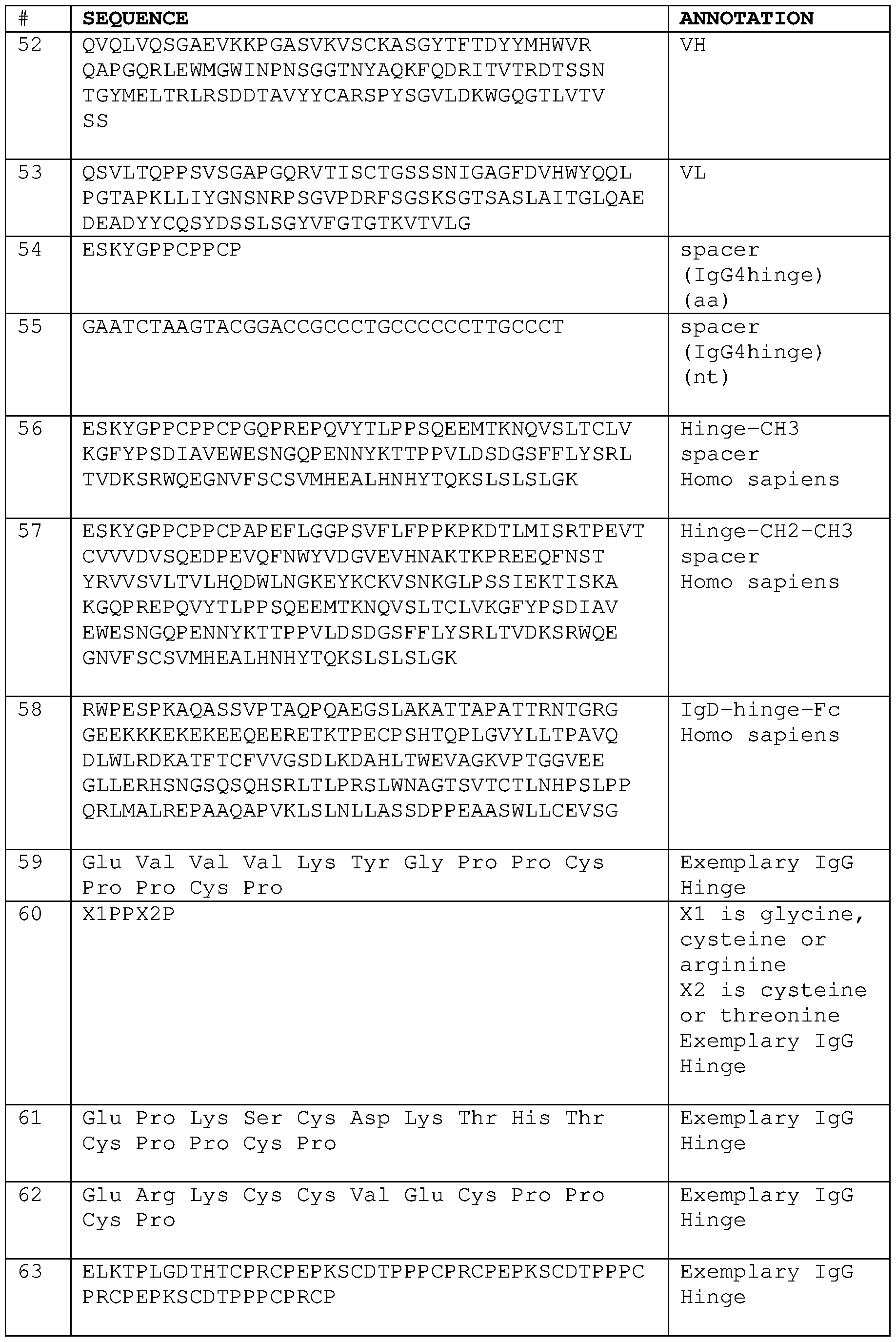
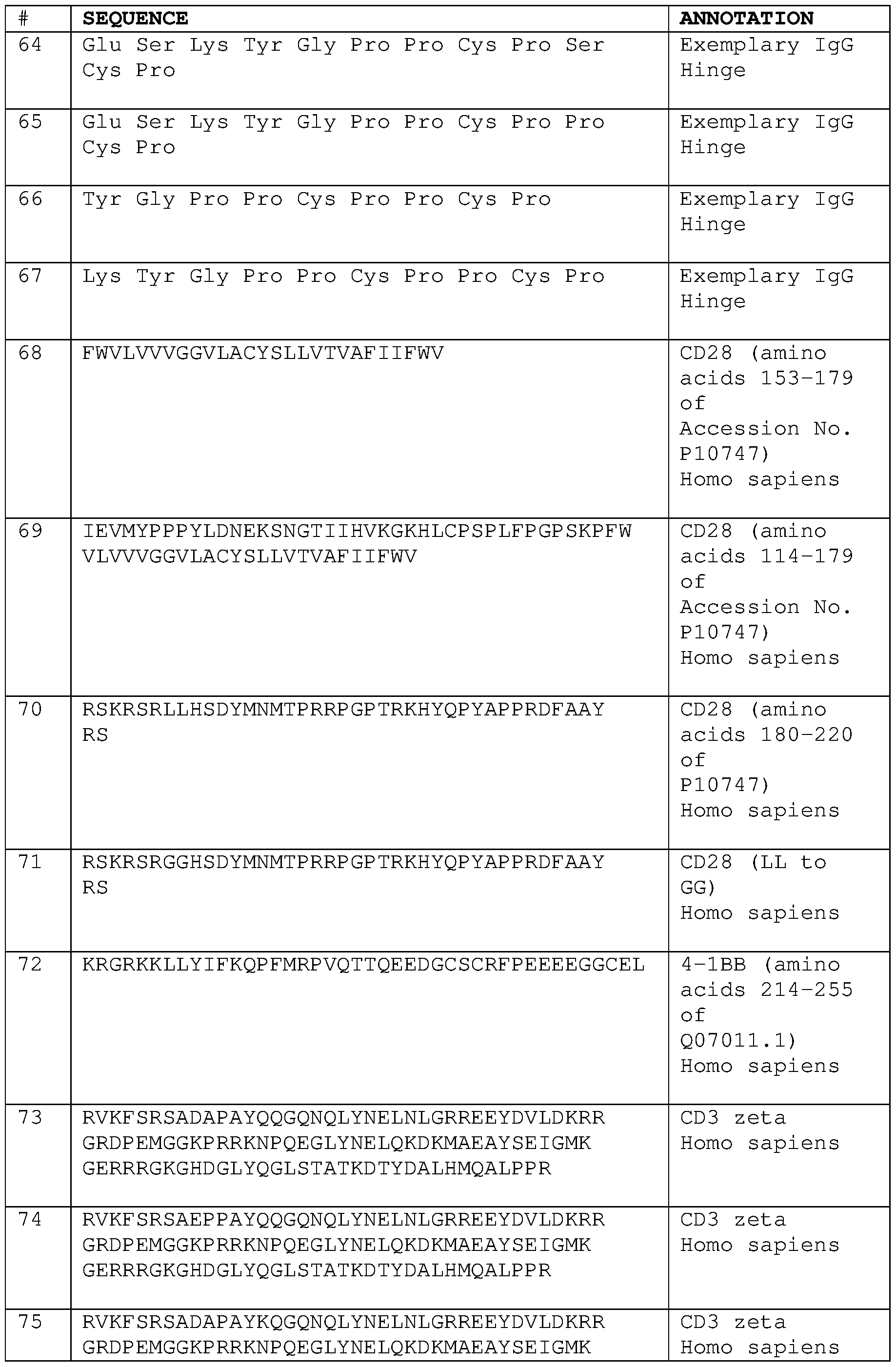

Claims
1. A method for assessing activation of T cells within a cell composition, the method comprising:
(a) detecting the level of surface expression of one or more markers or the percent of cells positive for one or more markers in cells of a composition comprising T cells, wherein the one or more markers are selected from group (i) and/or group (ii), wherein: one or more markers of group (i) are selected from the group consisting of CD36L (SCARB1, SR-BI), CD120b, CD107b (LAMP-2), CD200 (0X2), CD357 (GITR), CD134 (0X40), CD83, CD155 (PVR), CD74, GPR56, Notch 1, CD119 (IFN-g R a chain), CD105 (Endoglin), CD262 (DR5, TRAIL-R2), CD 170 (Siglec-5), CD73 (Ecto-5'-nucleotidase), CD360 (IL-21R ), CD20, CD107a (LAMP-1), CD109, CD132 (common g chain), CD148, CD150 (SLAM), CD151 (PETA-3), CD154, CD165, CD166, CD200 R, CD217, CD218a (IL-18Ra), CD227 (MUC-1), CD245 (p220/240), CD30, CD317 (BST2, Tetherin), CD323 (JAM3), CD45RA, CD49c (integrin a3), CD54, CD63, CD71, CD8, CD97, Integrin b7, Mouse IgG3 k, Notch 2, CD164, CD319 (CRACC), Cd355 (CRTAM), CD4, CD49a, CD49b, Ig light chain k, Ig light chain 1, IgM, CDl lc, CD146, CD183 (CXCR3), CD185 (CXCR5), CD19, CD194 (CCR4), CD21, CD210 (IL-10 R), CD22, CD221 (IGF-1R), CD226 (DNAM- 1), CD23, CD258 (LIGHT), CD26, CD266 (Fnl4, TWEAK R), CD276 (B7-H3), CD326 (Ep-CAM), CD49e, CD87, CD8a, CD9, DcRl (TRAIL-R3, CD263), Ganglioside GD2, MERTK, TMEM8A, CD 122 (IL-2Rb), CD 100, CD 123, CD 184 (CXCR4), CD55, TIGIT (VSTM3), CD196 (CCR6), CD230 (Prion), CD235ab, CD261 (DR4, TRAIL-R1), CD304 (Neuropilin-1), CD49d, DR3 (TRAMP), CD186 (CXCR6), GARP (LRRC32), CD116, CD334 (FGFR4), CD66a/c/e, and TSLPR (TSLP-R); and one or more markers of group (ii) are selected from the group consisting of CD192 (CCR2), CCRL2, CD96 (TACTILE), CD195 (CCR5), CD124 (IL-4Ra), CD49f, CD314 (NKG2D), KLRG1 (MAFA), CD96 (TACTILE), HLA-E, CD195 (CCR5), CD198 (CCR8), CD282 (TLR2), CD294 (CRTH2), CD337 (NKp30), CD13, CDl lb, CX3CR1, NKp80, CD 172g (SIRPg), CD 127 (IL-7Ra), a/b T Cell Receptor, CD229 (Ly-9), CD84, and EGFR;
(b) comparing the level of surface expression or the percent of positive cells in the cell composition to the level of surface expression or the percent of positive cells for each
of the one or more markers in a reference, wherein a higher level or higher percent of positive cells for a marker in (i) compared to the reference indicates the T cells are activated and a lower level or lower percent of positive cells for a marker in (ii) compared to the reference indicates the T cells are activated.
2. The method of claim 1, wherein the reference is comprised of an unstimulated control cell composition.
3. The method of claim 1, wherein the reference is the level of expression or percent of positive cells across a plurality of cell compositions, wherein each cell composition is from a different patient, subject, or donor.
4. The method of claim 1, wherein the reference is the average level of expression or average percent of positive cells across a plurality of cell compositions, wherein each cell composition is from a different patient, subject, or donor.
5. The method of claim 1, wherein the reference is the median level of expression or median percent of positive cells across a plurality of cell compositions, wherein each cell composition is from a different patient, subject, or donor.
6. A method for assessing T cells for surface expression of a T cell activation marker, the method comprising detecting the level of surface expression of one or more markers or the percent of cells positive for one or more markers in cells of a composition comprising T cells, wherein the one or more markers are selected from group (i) and/or group (ii), wherein: one or more markers of group (i) are selected from the group consists of CD36L (SCARB1, SR-BI), CD120b, CD107b (LAMP-2), CD200 (0X2), CD357 (GITR), CD134 (0X40), CD83, CD155 (PVR), CD74, GPR56, Notch 1, CD119 (IFN-g R a chain), CD105 (Endoglin), CD262 (DR5, TRAIL-R2), CD 170 (Siglec-5), CD73 (Ecto-5'-nucleotidase), CD360 (IL-21R ), CD20, CD107a (LAMP-1), CD109, CD132 (common g chain), CD148, CD150 (SLAM), CD151 (PETA-3), CD154, CD165, CD166, CD200 R, CD217, CD218a (IL-18Ra), CD227 (MUC-1), CD245 (p220/240), CD30, CD317 (BST2, Tetherin), CD323 (JAM3), CD45RA, CD49c (integrin a3), CD54, CD63, CD71, CD8, CD97, Integrin b7,
Mouse IgG3 k, Notch 2, CD164, CD319 (CRACC), Cd355 (CRTAM), CD4, CD49a, CD49b, Ig light chain k, Ig light chain 1, IgM, CDl lc, CD146, CD183 (CXCR3), CD185 (CXCR5), CD19, CD194 (CCR4), CD21, CD210 (IL-10 R), CD22, CD221 (IGF-1R), CD226 (DNAM- 1), CD23, CD258 (LIGHT), CD26, CD266 (Fnl4, TWEAK R), CD276 (B7-H3), CD326 (Ep-CAM), CD49e, CD87, CD8a, CD9, DcRl (TRAIL-R3, CD263), Ganglioside GD2, MERTK, TMEM8A, CD 122 (IL-2Rb), CD 100, CD 123, CD 184 (CXCR4), CD55, TIGIT (VSTM3), CD196 (CCR6), CD230 (Prion), CD235ab, CD261 (DR4, TRAIL-R1), CD304 (Neuropilin-1), CD49d, DR3 (TRAMP), CD186 (CXCR6), GARP (LRRC32), CD116, CD334 (FGFR4), CD66a/c/e, and TSLPR (TSLP-R); and one or more markers of group (ii) are selected from the group consisting of CD 192 (CCR2), CCRL2, CD96 (TACTILE), CD195 (CCR5), CD124 (IL-4Ra), CD49f, CD314 (NKG2D), KLRG1 (MAFA), CD96 (TACTILE), HLA-E, CD195 (CCR5), CD198 (CCR8), CD282 (TLR2), CD294 (CRTH2), CD337 (NKp30), CD13, CDl lb, CX3CR1, NKp80, CD172g (SIRPg), CD127 (IL-7Ra), a/b T Cell Receptor, CD229 (Ly-9), CD84, and EGFR.
7. The method of claim 6, wherein the level of surface expression or percent of positive cells of the one or more markers in (i) positively correlates with T cell activation.
8. The method of claim 6 or 7, wherein the level of surface expression or percent of positive cells of the one or more markers in (ii) negatively correlates with T cell activation.
9. A method of comparing activation of T cells within a donor, the method comprising:
(a) detecting the level of surface expression of one or more markers or the percent of cells positive for one or more markers in cells of a composition comprising T cells, wherein the one or more markers are selected from group (i) and/or group (ii), wherein group (i) consists of CD36L (SCARB1, SR-BI), CD 120b, CD 107b (LAMP-2), CD200 (0X2), CD357 (GITR), CD134 (0X40), CD83, CD155 (PVR), CD74, GPR56, Notch 1, CD119 (IFN-g R a chain), CD 105 (Endoglin), CD262 (DR5, TRAIL-R2), CD 170 (Siglec-5), CD73 (Ecto-5'-nucleotidase), CD360 (IL-21R ), CD20, CD107a (LAMP-1), CD109, CD132 (common g chain), CD148, CD150 (SLAM), CD151 (PETA-3), CD154, CD165, CD166, CD200 R, CD217, CD218a (IL-18Ra), CD227 (MUC-1), CD245 (p220/240), CD30, CD317
(BST2, Tetherin), CD323 (JAM3), CD45RA, CD49c (integrin a3), CD54, CD63, CD71, CD8, CD97, Integrin b7, Mouse IgG3 k, Notch 2, CD164, CD319 (CRACC), Cd355 (CRTAM), CD4, CD49a, CD49b, Ig light chain k, Ig light chain 1, IgM, CD11c, CD 146, CD183 (CXCR3), CD185 (CXCR5), CD19, CD194 (CCR4), CD21, CD210 (IL-10 R), CD22, CD221 (IGF-1R), CD226 (DNAM-1), CD23, CD258 (LIGHT), CD26, CD266 (Fnl4, TWEAK R), CD276 (B7-H3), CD326 (Ep-CAM), CD49e, CD87, CD8a, CD9, DcRl (TRAIL-R3, CD263), Ganglioside GD2, MERTK, TMEM8A, CD 122 (IL-2Rb), CD 100, CD123, CD184 (CXCR4), CD55, TIGIT (VSTM3), CD196 (CCR6), CD230 (Prion), CD235ab, CD261 (DR4, TRAIL-R1), CD304 (Neuropilin- 1), CD49d, DR3 (TRAMP), CD186 (CXCR6), GARP (LRRC32), CD116, CD334 (FGFR4), CD66a/c/e, and TSLPR (TSLP-R); and group (ii) consists of CD192 (CCR2), CCRL2, CD96 (TACTILE), CD195 (CCR5), CD124 (IL-4Ra), CD49f, CD314 (NKG2D), KLRG1 (MAFA), CD96 (TACTILE), HLA-E, CD195 (CCR5), CD198 (CCR8), CD282 (TLR2), CD294 (CRTH2), CD337 (NKp30), CD13, CDl lb, CX3CR1, NKp80, CD172g (SIRPg), CD127 (IL-7Ra), a/b T Cell Receptor, CD229 (Ly-9), CD84, and EGFR;
(b) comparing the level of surface expression or the percent of positive cells to the level or the percent of positive cells for each of the one or more marker in an unstimulated cell composition, wherein a higher level or higher percent of positive cells for a marker in (i) compared to the unstimulated cell composition indicates the T cells are activated and a lower level or lower percent of positive cells for a marker in (ii) compared to the unstimulated cell composition indicates the T cells are activated.
10. The method of any one of claims 1-9, wherein the composition comprising T cells has been subjected to incubation with a T cell stimulatory agent under conditions to induce T cell activation prior to the detecting.
11. The method of any one of claims 1-9, wherein the method comprises incubation of the composition with a T cell stimulatory agent prior to the detecting.
12. The method of any one of claims 1-9, wherein the method comprises incubation of the composition with a T cell stimulatory agent following the detecting.
13. The method of any one of claims 10-12, wherein the incubation with a T cell stimulatory agent is carried out in vivo in a subject.
14. The method of any one of claims 10-12, wherein the incubation with a T cell stimulatory agent is carried out in vitro or ex vivo.
15. The method of any one of claims 10-14, wherein the incubation with a T cell stimulatory agent is for 12-72 hours.
16. The method of any one of claims 10-15, wherein the incubation with a T cell stimulatory agent is for about 24 hours.
17. The method of any of claims 1-16, wherein the one or more markers of group (i) are selected from CD20, CD 100, CD 123, CD 184 (CXCR4), CD55, TIGIT (VSTM3), CD105 (Endoglin), CD107a (LAMP-1), CD109, CD120b, CD132 (common g chain), CD134 (0X40), CD148, CD150 (SLAM), CD151 (PETA-3), CD154, CD165, CD166, CD170 (Siglec-5), CD200 (OX2), CD200 R, CD217, CD218a (IL-18Ra), CD227 (MUC-1), CD245 (p220/240), CD30, CD317 (BST2, Tetherin), CD323 (JAM3), CD357 (GITR), CD45RA, CD49c (integrin a3), CD54, CD63, CD71, CD8, CD83, CD97, Integrin b7, Mouse IgG3 k, Notch 1, Notch 2, CD107b (LAMP-2), CD155 (PVR), CD164, CD319 (CRACC), Cd355 (CRTAM), CD4, CD49a, CD49b, CD74, GPR56, Ig light chain k, Ig light chain 1, IgM, CD116, CD334 (FGFR4), CD66a/c/e, and TSLPR (TSLP-R); and the one or more markers of group (ii) are selected from CD195 (CCR5), CD124 (IL-4Ra), CD198 (CCR8), CD282 (TLR2), CD294 (CRTH2), CD337 (NKp30), CD192 (CCR2), CD314 (NKG2D), KLRG1 (MAFA), CCRE2, CD172g (SIRPg), CD127 (IE-7Ra), CD49f, a/b T Cell Receptor, CD229 (Ly-9), CD84, and EGFR.
18. The method of any one of claims 10-15, wherein the incubation with a T cell stimulatory agent is for about 48 hours.
19. The method of any of claims 1-15 and 18, wherein the one or more markers of group (i) are selected from CD20, CD105 (Endoglin), CD107a (LAMP-1), CD109, CD120b,
CD132 (common g chain), CD134 (0X40), CD148, CD150 (SLAM), CD151 (PETA-3), CD154, CD165, CD166, CD170 (Siglec-5), CD200 (0X2), CD200 R, CD217, CD218a (IL- 18Ra), CD227 (MUC-1), CD245 (p220/240), CD30, CD317 (BST2, Tetherin), CD323 (JAM3), CD357 (GITR), CD45RA, CD49c (integrin a3), CD54, CD63, CD71, CD8, CD83, CD97, Integrin b7, Mouse IgG3 k, Notch 1, Notch 2, CD107b (LAMP-2), CD155 (PVR), CD 164, CD319 (CRACC), Cd355 (CRTAM), CD4, CD49a, CD49b, CD74, GPR56, Ig light chain k, Ig light chain 1, IgM, CD119 (IFN-g R a chain), CD11c, CD146, CD183 (CXCR3), CD185 (CXCR5), CD19, CD194 (CCR4), CD21, CD210 (IL-10 R), CD22 ,CD221 (IGE- 1R), CD226 (DNAM-1), CD23, CD258 (LIGHT), CD26, CD262 (DR5, TRAIL-R2), CD266 (Enl4, TWEAK R), CD276 (B7-H3), CD326 (Ep-CAM), CD36L1 (SCARB1, SR-BI), CD49e, CD87, CD8a, CD9, DcRl (TRAIL-R3, CD263), Ganglioside GD2, MERTK, TMEM8A, CD122 (IL-2Rb), CD360 (IL-21R), CD100, CD123, CD184 (CXCR4), CD55, TIGIT (VSTM3), CD230 (Prion), CD235ab, CD261 (DR4, TRAIL-R1), CD304 (Neuropilin- 1), CD49d, CD73 (Ecto-5'-nucleotidase), DR3 (TRAMP), CD186 (CXCR6), and GARP (LRRC32) and the one or more markers of group (ii) are selected from CD192 (CCR2), CD314 (NKG2D), KLRG1 (MALA), CCRL2, CD96 (TACTILE), HLA-E, CD195 (CCR5), CD124 (IL-4Ra), CD198 (CCR8), CD282 (TLR2), CD294 (CRTH2), CD337 (NKp30), CDl lb, CX3CR1, NKp80, CD 127 (IL-7Ra), and CD49f.
20. The method of any of claims 1-19, wherein the one or more markers of group (i) are selected from CD107b (LAMP-2), CD120b, CD357 (GITR), CD83, CD200 (0X2), CD134 (0X40), CD155 (PVR), CD74, CD170 (Siglec-5), Notch 1, Notch 2, CD166, CD107a (LAMP-1), CD71, CD245 (p220/240), CD154, CD165, CD355 (CRTAM), and GPR56, and the one or more markers of group (ii) are selected from CD49f, CD 124 (IL-4Ra), CCRL2, CD217, CD192 (CCR2), CD195 (CCR5), KLRG1 (MALA), CD96 (TACTILE), CD127 (IL-7Ra), CDl lb, and CX3CR1.
21. The method of any of claims 1-20, wherein the one or more markers are of (i) and are selected from the group consisting of CD 107b (LAMP-2), CD 120b, CD357 (GITR), CD83, CD200 (0X2), CD134 (0X40), CD155 (PVR), CD74, CD170 (Siglec-5), Notch 1, Notch 2, CD166, CD107a (LAMP-1), CD71, CD245 (p220/240), CD154, CD165, CD355 (CRTAM), and GPR56.
22. A method of identifying an activated T cell, the method comprising detecting the cell surface expression of one or more of markers in cells of a composition comprising T cells, wherein the one or more markers are selected from the group consisting of CD 107b (LAMP-2), CD120b, CD357 (GITR), CD83, CD200 (OX2), CD134 (0X40), CD155 (PVR), CD74, CD170 (Siglec-5), Notch 1, Notch 2, CD166, CD107a (LAMP-1), CD71, CD245 (p220/240), CD154, CD165, CD355 (CRTAM), and GPR56, and wherein the cells expressing a high level of the one or more markers are activated T cells.
23. The method of any of claims 1-22, wherein the one or more markers are selected from group (i) and consist of CD200 (0X2), CD357 (GITR), CD120b, CD155 (PVR), CD 107b (LAMP-2).
24. The method of any of claims 1-20, wherein the one or more markers are of (ii) and are selected from the group consisting of CD49f, CD124 (IL-4Ra), CCRL2, CD217, CD192 (CCR2), CD195 (CCR5), KLRG1 (MAFA), CD96 (TACTILE), CD127 (IL-7Ra), CD 11b, and CX3CRl.
25. A method of identifying an activated T cell, the method comprising detecting the cell surface expression of one or more of markers in cells of a composition comprising T cells, wherein the one or more markers are selected from the group consisting of CD49f, CD124 (IL-4Ra), CCRL2, CD217, CD192 (CCR2), CD195 (CCR5), KLRG1 (MAFA), CD96 (TACTILE), CD127 (IL-7Ra), CDl lb, and CX3CR1, and wherein the cells expressing a low level of the one or more markers are activated T cells.
26. The method of any of claims 1-25, wherein the detecting is of CD4+ or CD 8+ T cells in the composition comprising T cells.
27. The method of any of claims 1-26, wherein the one or more markers from group (i) are selected from CD 107b (LAMP-2), CD 120b, CD357 (GITR), CD83, CD200 (0X2), CD134 (0X40), CD155 (PVR), CD74, CD170 (Siglec-5), CD355 (CRTAM), and
GPR56, and the one or more markers from group (ii) are selected from CD49f, CD 124 (IL- 4Ra), CCRL2, CD217, CD192 (CCR2), CD96 (TACTILE), and CD195 (CCR5).
28. The method of any of claims 1-25, wherein the detecting is of CD4+ T cells in the composition comprising T cells.
29. The method of claim 28, wherein the one or more markers from group (i) are selected from CD107b (LAMP-2), CD120b, CD357 (GITR), CD83, CD200 (0X2), CD134 (0X40), CD155 (PVR), CD74, CD170 (Siglec-5), Notch 1, Notch 2, CD166, CD107a (LAMP-1), CD71, CD245 (p220/240), CD154,and CD165, and the one or more markers from group (ii) are selected from CD49f, CD 124 (IL- 4Ra), CCRL2, CD217, CD192 (CCR2), CD195 (CCR5), KLRG1 (MAFA), CD96 (TACTILE), and CD 127 (IL-7Ra).
30. A method for assessing CD4+ T cells for surface expression of a T cell activation marker, the method comprising detecting the level of surface expression of one or more markers or the percent of cells positive for one or more markers in CD4+ T cells of a composition comprising T cells, wherein the one or more markers are selected from group (i) and/or group (ii) wherein group (i) consist of CD 107b (LAMP-2), CD 120b, CD357 (GITR), CD83, CD200 (0X2), CD134 (0X40), CD155 (PVR), CD74, CD170 (Siglec-5), Notch 1, Notch 2, CD166, CD107a (LAMP-1), CD71, CD245 (p220/240), CD154, and CD165, and group (ii) consists of CD49f, CD124 (IL-4Ra), CCRL2, CD217, CD192 (CCR2), CD195 (CCR5), KLRG1 (MAFA), CD96 (TACTILE), and CD127 (IL-7Ra).
31. The method of claim 30, wherein the level of surface expression or percent of positive cells of the one or more markers in (i) positively correlates with CD4+ T cell activation.
32. The method of claim 30 or 31, wherein the level of surface expression or percent of positive cells of the one or more markers in (ii) negatively correlates with CD4+ T cell activation.
33. A method for assessing activation of CD4+ T cells, the method comprising:
(a) detecting the level of surface expression of one or more markers or the percent of cells positive for one or more marker in CD4+ T cells of a composition comprising T cells, wherein the one or more markers are selected from group (i) and/or group (ii), wherein group
(i) consists of CD107b (LAMP-2), CD120b, CD357 (GITR), CD83, CD200 (0X2), CD134 (0X40), CD155 (PVR), CD74, CD170 (Siglec-5), Notch 1, Notch 2, CD166, CD107a (LAMP-1), CD71, CD245 (p220/240), CD154, and CD165, and group (ii) consists of CD49f, CD124 (IL-4Ra), CCRL2, CD217, CD192 (CCR2), CD195 (CCR5), KLRG1 (MAFA), CD96 (TACTILE), and CD127 (IL-7Ra); and
(b) comparing the level of surface expression or the percent of positive cells to the level or the percent of positive cells for each of the one or more marker in cells of an unstimulated control cell composition, wherein a higher level or higher percent of positive cells for a marker in (i) compared to the unstimulated control cell composition indicates the CD4+ T cells are activated and a lower level or lower percent of positive cells for a marker in
(ii) compared to the unstimulated control cell composition indicates the CD4+ T cells are activated.
34. The method of any of claims 1-25, wherein the detecting is of CD8+ T cells in the composition comprising T cells.
35. The method of claim 34, wherein the one or more markers selected from group (i) are selected from CD120b, CD200 (0X2), CD134 (0X40), CD107b (LAMP-2), CD357 (GITR), CD155 (PVR), CD355 (CRTAM), GPR56, CD71, CD107a (LAMP1), Notch 1, CD166, CD165, CD83, and Notch 2, and the one or more markers from group (ii) are selected from CD96 (TACTILE), CD195 (CCR5), CD217, CCRL2, CD192 (CCR2), CDl lb, CX3CR1, and CD127 (IL-7Ra).
36. A method for assessing CD8+ T cells for surface expression of a T cell activation marker, the method comprising detecting the level of surface expression of one or more markers or the percent of cells positive for one or more markers in CD8+ T cells of a composition comprising T cells, wherein the one or more markers are selected from group (i) and/or group (ii) wherein group (i), consist of CD 120b, CD200 (0X2), CD 134 (0X40), CD 107b (LAMP-2), CD357 (GITR), CD 155 (PVR), CD355 (CRTAM), GPR56, CD71, CD107a (LAMP1), Notch 1, CD166, CD165, CD83, and Notch 2, and group (ii) consists of CD96 (TACTILE), CD195 (CCR5), CD217, CCRL2, CD192 (CCR2), CDl lb, CX3CR1, and CD127 (IL-7Ra).
37. The method of claim 36, wherein the level of surface expression or percent of positive cells of the one or more markers in (i) positively correlates with CD8+ T cell activation.
38. The method of claim 37, wherein the level of surface expression or percent of positive cells of the one or more markers in (ii) negatively correlates with CD8+ T cell activation.
39. A method for assessing activation of CD8+ T cells, the method comprising:
(a) detecting the level of surface expression of one or more markers or the percent of cells positive for one or more markers in CD8+ T cells of a composition comprising T cells, wherein the one or more markers are selected from group (i) and/or group (ii), wherein group (i) consist of CD120b, CD200 (0X2), CD134 (0X40), CD107b (LAMP-2), CD357 (GITR), CD155 (PVR), CD355 (CRTAM), GPR56, CD71, CD107a (LAMP1), Notch 1, CD166, CD165, CD83, and Notch 2, and group (ii) consists of CD96 (TACTILE), CD195 (CCR5), CD217, CCRL2, CD192 (CCR2), CDl lb, CX3CR1, and CD127 (IL-7Ra); and
(b) comparing the level of surface expression or the percent of positive cells to the level or the percent of positive cells for each of the one or more marker in cells of an unstimulated control cell composition, wherein a higher level or higher percent of positive cells for a marker in (i) compared to the unstimulated control cell composition indicates the CD8+ T cells are activated and a lower level or lower percent of positive cells for a marker in
(ii) compared to the unstimulated control cell composition indicates the CD8+ T cells are activated.
40. The method of any of claims 1-39, wherein the composition comprising T cells comprises T cells genetically engineered to express a recombinant receptor.
41. The method of claim 27, wherein the one or more markers selected from group (i) consist of CD120b, CD83, CD357 (GITR), CD200 (0X2), CD134 (0X40), CD107b (LAMP-2), CD355 (CTRAM), CD155 (PVR), CD74, CD170 (Siglec-5), and GPR56, and the one or more markers selected from group (ii) consist of CD49f, CCRL2, CD124 (IL-4Ra), CD217, CD192 (CCR2), CD195 (CCR5), and CD96 (TACTILE).
42. A method for assessing activation of T cells, the method comprising:
(a) detecting the level of surface expression of one or more markers or the percent of cells positive for one or more markers in CD8+ T cells of a composition comprising T cells, wherein the one or more markers are selected from group (i) and/or group (ii), wherein group (i) consists of CD120b, CD83, CD357 (GITR), CD200 (0X2), CD134 (0X40), CD107b (LAMP-2), CD355 (CTRAM), CD155 (PVR), CD74, CD170 (Siglec-5), and GPR56, and group (ii) consists of CD120b, CD83, CD357 (GITR), CD200 (0X2), CD134 (0X40), CD107b (LAMP-2), CD355 (CTRAM), CD155 (PVR), CD74, CD170 (Siglec-5), and GPR56.
43. The method of claim 41 or claim 42, wherein the one or more markers from group (i) are selected from CD134 (0X40), CD107b (LAMP-2), CD155 (PVR), CD74, and CD 170 (Siglec-5), and the one or more markers selected from group (ii) are selected from CD49f, CCRL2, CD124 (IL-4Ra), CD217, CD355 (CRTAM), GPR56, and CD96 (TACTILE).
44. The method of any of claims 41-43, wherein the detecting is of recombinant receptor-expressing CD4+ T cells in the composition comprising T cells.
45. The method of claim 44, wherein the one or more markers from group (i) are selected from CD134 (0X40), CD107b (LAMP-2), CD155 (PVR), and CD74, and/or the one or more markers selected from group (ii) are selected from CD49f, CCRL2, and CD 124 (IL-4Ra).
46. The method of any of claims 41-43, wherein the detecting is of recombinant receptor-expressing CD8+ T cells in the composition comprising T cells.
47. The method of claim 46, wherein the one or more markers from group (i) are selected from CD200 (0X2), CD107b (LAMP-2), CD155 (PVR), CD355 (CRTAM), and GPR56, and/or the one or more markers selected from group (ii) are selected from CCRL2, CD217, CD96 (TACTILE).
48. The method of any of claims 1-16, wherein the one or more markers of group (i) are selected from CD36L (SCARB1, SR-BI), CD262 (DR5, Trail-R2), CD105 (Endoglin), CD73 (Ecto-5’ -nucleotidase), CD83, CD119 (IFN-g R a chain), CD154, CD170 (Siglec-5), Notch 1, and CD360 (IL-21R), and the one or more markers of group (i) are selected from CD96 (TACTILE).
49. A method for assessing activation of T cells, the method comprising:
(a) detecting the level of surface expression of one or more markers or the percent of cells positive for one or more markers in a composition of T cells, which comprises T cells expressing a recombinant receptor, wherein the one or more markers are selected from group (i) and/or group (ii), wherein group (i) consists of CD36L (SCARB1, SR-BI), CD262 (DR5, Trail-R2), CD105 (Endoglin), CD73 (Ecto-5’-nucleotidase), CD83, CD119 (IFN-g R a chain), CD154, CD170 (Siglec-5), Notch 1, and CD360 (IL-21R), and group (ii) consists of CD96 (TACTILE).
50. The method of claim 48, wherein the composition comprising T cells comprises cells that express a recombinant receptor.
51. The method of claim 49 or claim 50, wherein the detecting is of recombinant receptor expressing cells of the composition of T cells
52. The method of any of claims 49-51, wherein the surface expression of the one or more markers of group (i) is increased on cells expressing the recombinant receptor compared with cells that are not expressing the recombinant receptor.
53. The method of any of claims 49-52, wherein the surface expression of the one or more markers of group (ii) is decreased on cells expressing the recombinant receptor compared with cells that are not expressing the recombinant receptor.
54. The method of any one of claims 3-47, wherein the composition comprising T cells comprises T cells genetically engineered to express a recombinant receptor and wherein the T cell stimulatory agent is a recombinant receptor stimulating agent that induces recombinant receptor-dependent T cell activation.
55. The method of any one of claims 27-54, wherein the recombinant receptor is a chimeric antigen receptor (CAR).
56. The method of claim 54 or claim 55, wherein the recombinant receptor stimulating agent comprises a recombinant target antigen recognized by the recombinant receptor.
57. The method of claim 54 or claim 55, wherein the recombinant receptor stimulating agent is an antibody specific to an extracellular antigen binding domain of the recombinant receptor.
58. The method of claim 54 or claim 55, wherein the recombinant receptor stimulating agent is an anti-idiotypic antibody specific to an extracellular antigen binding domain of the recombinant receptor.
59. The method of any one of claims 54-58, wherein the recombinant receptor stimulating agent is immobilized or attached to a solid support.
60. The method of claim 59, wherein the solid support is a surface of the vessel, optionally a well of microwell plate or a flask.
61. The method of claim 59, wherein the solid support is a bead.
62. The method of claim 54 or claim 55, wherein the recombinant receptor stimulating agent is an antigen-expressing cell, optionally wherein the cell is a clone, from a cell line, or a primary cell taken from a subject.
63. The method of claim 62, wherein the antigen-expressing cell is a cell line.
64. The method of claim 63, wherein the cell line is a tumor cell line.
65. The method of claim 63, wherein the antigen-expressing cell is a cell that has been engineered to express the antigen of the recombinant receptor.
66. The method of any one of claims 27-65, wherein the detecting is of recombinant receptor-expressing T cells in the composition comprising T cells.
67. The method of any one of claims 1-26, wherein the one or more markers from group (i) are selected from CD71, Notch 1, CD107a (LAMP-1), CD166, CD245 (p220/240), CD154, Notch 2, CD165, CD120b, CD83, CD357 (GITR), CD200 (0X2), and CD134 (0X40), and/or the one or more markers from group (ii) are selected from KLRG1 (MAFA), CD195 (CCR5), CD96 (TACTILE), CD127 (IL-7Ra), CD192 (CCR2), CDl lb, and CX3CR1.
68. The method of any one of claims 1-26, wherein the one or more markers from group (i) are selected from CD71, Notch 1, CD107a (LAMP-1), CD166, CD245 (p220/240),
CD154, Notch 2, CD165, and CD83, and/or the one or more markers from group (ii) are selected from KLRG1 (MAFA), CD195 (CCR5), CD96 (TACTILE), CD127 (IL-7Ra), CDl lb, and CX3CR1.
69. The method of claim 67 or 68, wherein the detecting is of CD4+ T cells in the composition comprising T cells.
70. The method of claim 69, wherein the one or more markers from group (i) are selected from CD71, Notch 1, CD107a (LAMP-1), CD166, CD245 (p220/240), CD154, Notch 2, and CD 165 and/or the one or more markers from group (ii) are selected from KLRG1 (MAFA), CD195 (CCR5), CD96 (TACTILE), and CD127 (IL-7Ra).
71. The method of claim 67 or 68, wherein the detecting is of CD8+ T cells in the composition comprising T cells.
72. The method of claim 71, wherein the one or more markers from group (i) are selected from CD71, Notch 1, CD107a (LAMP-1), CD166, Notch 2, CD165, CD83, and/or the one or more markers from group (ii) are selected from CD1 lb, CX3CR1, and CD127 (IL-7Ra).
73. The method of any one of claims 67-72, wherein the T cell stimulatory agent is a pan-T cell activation agent.
74. The method of claim 73, wherein the pan-T cell activation reagent comprises an anti-CD3 antibody and an anti-CD28 antibody, optionally wherein the pan-T cell activation reagent comprises an anti-CD3 Fab and an anti-CD28 Fab.
75. The method of claim 73 or claim 74, wherein the pan-T cell activation reagent comprises anti-CD3/anti-CD28 beads.
76. The method of claim 73 or claim 74, wherein the pan-T cell activation reagent comprises a soluble anti-CD3/anti-CD28 streptavidin oligomeric reagent.
77. The method of any one of claims 1-76, wherein prior to the detecting of step (a), the method comprises contacting cells of the composition comprising T cells with one or more binding agents which bind to the one or more markers.
78. The method of any one of claims 1-76, wherein prior to the detecting of step (a), the method comprises contacting cells of the composition comprising T cells with one or more binding agent comprising a means for binding the one or more markers.
79. The method of claim 77 or claim 78, wherein the one or more binding agents are one or more antibodies or antigen-binding fragments.
80. The method of any of claims 77-79, wherein the one or more binding agents are detectably labeled.
81. The method of claim 80, wherein the one or more binding agents are fluorescently labeled.
82. The method of any of one claims 1-81, wherein the detecting is by flow cytometry.
83. The method of any of one claims 1-81, wherein the detecting of step (a) is carried out in conjunction with CITE-Seq or REAP-seq.
84. The method of any of one claims 1-81, wherein the detecting of step (a) is done by immunohistochemistry, optionally immunohistochemistry fluorescence.
85. The method of any one of claims 1-84, wherein 1, 2, 3, 4, 5, 6, 7, 8, 9, 10, 11, 12, 13, 14, 15, 16, 17, 18, 19, 20, 21, 22, 23, 24, 25, 26, 27, 28, 29, or 30 different markers are used for detecting in step (a).
86. A kit for determining T cell activation comprising a binding agent comprising a means for binding the one or more markers in the methods of any of claims 1-85.
87. The kit of claim 86, wherein the means for detecting each of the one or more markers is an antibody.
88. A kit for determining T cell activation comprising a binding agent comprising a means for bindingone or more markers selected from group (i) and/or group (ii), wherein group (i) consists of CD36L (SCARB1, SR-BI), CD120b, CD107b (LAMP-2), CD200 (0X2), CD357 (GITR), CD134 (0X40), CD83, CD155 (PVR), CD74, GPR56, Notch 1, CD119 (IFN-g R a chain), CD105 (Endoglin), CD262 (DR5, TRAIL-R2), CD170 (Siglec-5), CD73 (Ecto-5'-nucleotidase), CD360 (IL-21R ), CD20, CD107a (LAMP-1), CD109, CD132 (common g chain), CD148, CD150 (SLAM), CD151 (PETA-3), CD154, CD165, CD166, CD200 R, CD217, CD218a (IL-18Ra), CD227 (MUC-1), CD245 (p220/240), CD30, CD317 (BST2, Tetherin), CD323 (JAM3), CD45RA, CD49c (integrin a3), CD54, CD63, CD71, CD8, CD97, Integrin b7, Mouse IgG3 k, Notch 2, CD164, CD319 (CRACC), Cd355 (CRTAM), CD4, CD49a, CD49b, Ig light chain k, Ig light chain 1, IgM, CD11c, CD 146, CD183 (CXCR3), CD185 (CXCR5), CD19, CD194 (CCR4), CD21, CD210 (IL-10 R), CD22, CD221 (IGE-1R), CD226 (DNAM-1), CD23, CD258 (LIGHT), CD26, CD266 (Enl4, TWEAK R), CD276 (B7-H3), CD326 (Ep-CAM), CD49e, CD87, CD8a, CD9, DcRl (TRAIL-R3, CD263), Ganglioside GD2, MERTK, TMEM8A, CD 122 (IL-2Rb), CD 100, CD123, CD184 (CXCR4), CD55, TIGIT (VSTM3), CD196 (CCR6), CD230 (Prion), CD235ab, CD261 (DR4, TRAIL-R1), CD304 (Neuropilin- 1), CD49d, DR3 (TRAMP), CD186 (CXCR6), GARP (LRRC32), CD116, CD334 (FGFR4), CD66a/c/e, and TSLPR (TSLP-R), and group (ii) consists of CD192 (CCR2), CCRL2, CD96 (TACTILE), CD195 (CCR5), CD124 (IL-4Ra), CD49f, CD314 (NKG2D), KLRG1 (MALA), CD96 (TACTILE), HLA-E, CD195 (CCR5), CD198 (CCR8), CD282 (TLR2), CD294 (CRTH2), CD337
(NKp30), CD13, CDllb, CX3CR1, NKp80, CD172g (SIRPg), CD127 (IL-7Ra), a/b T Cell Receptor, CD229 (Ly-9), CD84, and EGFR.
89. A kit for determining T cell activation comprising a binding agent comprising a means for binding one or more markers selected from group (i) and/or group (ii), wherein group (i) consists of CD20, CD100, CD123, CD184 (CXCR4), CD55, TIGIT (VSTM3), CD105 (Endoglin), CD107a (LAMP-1), CD109, CD120b, CD132 (common g chain), CD134 (0X40), CD148, CD150 (SLAM), CD151 (PETA-3), CD154, CD165, CD166, CD170 (Siglec-5), CD200 (0X2), CD200 R, CD217, CD218a (IL-18Ra), CD227 (MUC-1), CD245 (p220/240), CD30, CD317 (BST2, Tetherin), CD323 (JAM3), CD357 (GITR), CD45RA, CD49c (integrin a3), CD54, CD63, CD71, CD8, CD83, CD97, Integrin b7, Mouse IgG3 k, Notch 1, Notch 2, CD107b (LAMP-2), CD155 (PVR), CD164, CD319 (CRACC), Cd355 (CRTAM), CD4, CD49a, CD49b, CD74, GPR56, Ig light chain k, Ig light chain 1, IgM, CD116, CD334 (FGFR4), CD66a/c/e, and TSLPR (TSLP-R) and group (ii) consists of CD195 (CCR5), CD124 (IL-4Ra), CD198 (CCR8), CD282 (TLR2), CD294 (CRTH2), CD337 (NKp30), CD192 (CCR2), CD314 (NKG2D), KLRG1 (MAFA), CCRE2, CD 172g (SIRPg), CD 127 (IE-7Ra), CD49f, a/b T Cell Receptor, CD229 (Ey-9), CD84, and EGFR.
90. A kit for determining T cell activation comprising binding agent comprising a a means for binding one or more markers selected from group (i) and/or group (ii), wherein group (i) consists of CD20, CD105 (Endoglin), CD107a (EAMP-1), CD109, CD120b, CD132 (common g chain), CD134 (0X40), CD148, CD150 (SLAM), CD151 (PETA-3), CD154, CD165, CD166, CD170 (Siglec-5), CD200 (0X2), CD200 R, CD217, CD218a (IL- 18Ra), CD227 (MUC-1), CD245 (p220/240), CD30, CD317 (BST2, Tetherin), CD323 (JAM3), CD357 (GITR), CD45RA, CD49c (integrin a3), CD54, CD63, CD71, CD8, CD83, CD97, Integrin b7, Mouse IgG3 k, Notch 1, Notch 2, CD107b (LAMP-2), CD155 (PVR), CD 164, CD319 (CRACC), Cd355 (CRTAM), CD4, CD49a, CD49b, CD74, GPR56, Ig light chain k, Ig light chain 1, IgM, CD119 (IFN-g R a chain), CD11c, CD146, CD183 (CXCR3), CD185 (CXCR5), CD19, CD194 (CCR4), CD21, CD210 (IL-10 R), CD22 ,CD221 (IGF- 1R), CD226 (DNAM-1), CD23, CD258 (LIGHT), CD26, CD262 (DR5, TRAIL-R2), CD266 (Fnl4, TWEAK R), CD276 (B7-H3), CD326 (Ep-CAM), CD36L1 (SCARB1, SR-BI),
CD49e, CD87, CD8a, CD9, DcRl (TRAIL-R3, CD263), Ganglioside GD2, MERTK, TMEM8A, CD122 (IL-2Rb), CD360 (IL-21R), CD100, CD123, CD184 (CXCR4), CD55, TIGIT (VSTM3), CD230 (Prion), CD235ab, CD261 (DR4, TRAIL-R1), CD304 (Neuropilin- 1), CD49d, CD73 (Ecto-5'-nucleotidase), DR3 (TRAMP), CD186 (CXCR6), GARP (LRRC32) and group (ii) consists of CD192 (CCR2), CD314 (NKG2D), KLRG1 (MAFA), CCRL2, CD96 (TACTILE), HLA-E, CD195 (CCR5), CD124 (IL-4Ra), CD198 (CCR8), CD282 (TLR2), CD294 (CRTH2), CD337 (NKp30), CDllb, CX3CR1, NKp80, CD127 (IL- 7Ra), and CD49f.
91. A kit for determining T cell activation comprising a binding agent comprising a means for binding one or more markers selected from group (i) and/or group (ii), wherein group (i) consists of CD107b (LAMP-2), CD120b, CD357 (GITR), CD83, CD200 (0X2), CD134 (0X40), CD155 (PVR), CD74, CD170 (Siglec-5), Notch 1, Notch 2, CD166, CD107a (LAMP-1), CD71, CD245 (p220/240), CD154, CD165, CD355 (CRTAM), and GPR56, and group (ii) consists of CD49f, CD124 (IL-4Ra), CCRL2, CD217, CD192 (CCR2), CD195 (CCR5), KLRG1 (MAFA), CD96 (TACTILE), CD127 (IL-7Ra), CDllb, and CX3CR1.
92. A kit for determining T cell activation comprising a binding agent comprising a means for binding one or more markers selected from group (i) and/or group (ii), wherein group (i) consists of CD107b (LAMP-2), CD120b, CD357 (GITR), CD83, CD200 (0X2), CD134 (0X40), CD155 (PVR), CD74, CD170 (Siglec-5), CD355 (CRTAM), and GPR56, and group (ii) consists of CD49f, CD124 (IL-4Ra), CCRL2, CD217, CD192 (CCR2), CD96 (TACTILE), and CD195 (CCR5).
93. A kit for determining T cell activation comprising a binding agent comprising a means for binding one or more markers selected from group (i) and/or group (ii), wherein group (i) consists of CD107b (LAMP-2), CD120b, CD357 (GITR), CD83, CD200 (0X2), CD134 (0X40), CD155 (PVR), CD74, CD170 (Siglec-5), Notch 1, Notch 2, CD166, CD107a (LAMP-1), CD71, CD245 (p220/240), CD154,and CD165,
and group (ii) consists of CD49f, CD124 (IL-4Ra), CCRL2, CD217, CD192 (CCR2), CD195 (CCR5), KLRG1 (MAFA), CD96 (TACTILE), and CD127 (IL-7Ra).
94. A kit for determining T cell activation comprising a binding agent comprising a means for binding one or more markers selected from group (i) and/or group (ii), wherein group (i) consists of CD120b, CD200 (0X2), CD134 (0X40), CD107b (LAMP-2), CD357 (GITR), CD155 (PVR), CD355 (CRTAM), GPR56, CD71, CD107a (LAMP1), Notch 1, CD166, CD165, CD83, and Notch 2, and group (ii) consists of CD96 (TACTILE), CD 195 (CCR5), CD217, CCRL2, CD192 (CCR2), CDl lb, CX3CR1, and CD127 (IL-7Ra).
95. A kit for determining T cell activation comprising a binding agent comprising a means for binding one or more markers selected from group (i) and/or group (ii), wherein group (i) consists of CD120b, CD83, CD357 (GITR), CD200 (0X2), CD134 (0X40), CD107b (LAMP-2), CD155 (PVR), CD74, and the one or more markers selected from group (ii) consist of CD49f, CCRL2, CD124 (IL-4Ra), CD217, CD192 (CCR2), CD355 (CRTAM), GPR56, CD195 (CCR5), and CD96 (TACTILE).
96. A kit for determining T cell activation comprising a binding agent comprising a means for binding one or more markers selected from group (i) and/or group (ii), wherein group (i) consists of CD71, Notch 1, CD107a (LAMP-1), CD166, CD245 (p220/240), CD154, Notch 2, CD165, CD120b, CD83, CD357 (GITR), CD200 (0X2), and CD134 (0X40), and/or the one or more markers from group (ii) are selected from KLRG1 (MALA), CD195 (CCR5), CD96 (TACTILE), CD127 (IL-7Ra), CD192 (CCR2), CDl lb, and CX3CR1.
97. A kit for determining T cell activation comprising a binding agent comprising a means for binding one or more markers selected from group (i) and/or group (ii), wherein group (i) consists of CD36L (SCARB1, SR-BI), CD262 (DR5, Trail-R2), CD105 (Endoglin),
CD73 (Ecto-5’ -nucleotidase), CD83, CD119 (IFN-g R a chain), CD154, CD170 (Siglec-5), Notch 1, and CD360 (IL-21R), and/or the one or more markers from group (ii) are selected from CD96 (TACTILE).
98. The kit of any of claims 86-97, wherein the binding agent is one or more antibodies or antigen-binding fragments.
99. The kit of any of claims 86-98, wherein the binding agent is detectably labeled.
100. The kit of claim 99, wherein the binding agent is fluorescently labeled.
101. A method for isolating activating T cells, the method comprising identifying a population of activated T cells according to the method of any of claims 1-85 and isolating the population.
102. A method for enriching activating T cells, the method comprising identifying a population of activated T cells according to the method of any of claims 1-85 and selecting the population, thereby obtaining a cell population enriched in activated T cells.
103. A method of depleting a cell population of activated T cells, the method comprising identifying a population of activated T cells according to the method of any of claims 1-85 and depleting the population of activated T cells.
104. A T cell population produced according to the method of any of claims 101-
103.
Priority Applications (1)
| Application Number | Priority Date | Filing Date | Title |
|---|---|---|---|
| CN202480045753.6A CN121464348A (en) | 2023-05-23 | 2024-05-22 | T cell activation markers and methods for assessing T cell activation |
Applications Claiming Priority (2)
| Application Number | Priority Date | Filing Date | Title |
|---|---|---|---|
| US202363468524P | 2023-05-23 | 2023-05-23 | |
| US63/468,524 | 2023-05-23 |
Publications (2)
| Publication Number | Publication Date |
|---|---|
| WO2024243365A2 true WO2024243365A2 (en) | 2024-11-28 |
| WO2024243365A3 WO2024243365A3 (en) | 2025-01-09 |
Family
ID=91586286
Family Applications (1)
| Application Number | Title | Priority Date | Filing Date |
|---|---|---|---|
| PCT/US2024/030656 Pending WO2024243365A2 (en) | 2023-05-23 | 2024-05-22 | Activation markers of t cells and method for assessing t cell activation |
Country Status (2)
| Country | Link |
|---|---|
| CN (1) | CN121464348A (en) |
| WO (1) | WO2024243365A2 (en) |
Citations (81)
| Publication number | Priority date | Publication date | Assignee | Title |
|---|---|---|---|---|
| US4452773A (en) | 1982-04-05 | 1984-06-05 | Canadian Patents And Development Limited | Magnetic iron-dextran microspheres |
| US4795698A (en) | 1985-10-04 | 1989-01-03 | Immunicon Corporation | Magnetic-polymer particles |
| WO1992008796A1 (en) | 1990-11-13 | 1992-05-29 | Immunex Corporation | Bifunctional selectable fusion genes |
| US5168062A (en) | 1985-01-30 | 1992-12-01 | University Of Iowa Research Foundation | Transfer vectors and microorganisms containing human cytomegalovirus immediate-early promoter-regulatory DNA sequence |
| US5200084A (en) | 1990-09-26 | 1993-04-06 | Immunicon Corporation | Apparatus and methods for magnetic separation |
| US5219740A (en) | 1987-02-13 | 1993-06-15 | Fred Hutchinson Cancer Research Center | Retroviral gene transfer into diploid fibroblasts for gene therapy |
| WO1994013804A1 (en) | 1992-12-04 | 1994-06-23 | Medical Research Council | Multivalent and multispecific binding proteins, their manufacture and use |
| EP0452342B1 (en) | 1988-12-28 | 1994-11-30 | MILTENYI, Stefan | Methods and materials for high gradient magnetic separation of biological materials |
| WO1994028143A1 (en) | 1993-05-21 | 1994-12-08 | Targeted Genetics Corporation | Bifunctional selectable fusion genes based on the cytosine deaminase (cd) gene |
| WO1996013593A2 (en) | 1994-10-26 | 1996-05-09 | Procept, Inc. | Soluble single chain t cell receptors |
| WO1996018105A1 (en) | 1994-12-06 | 1996-06-13 | The President And Fellows Of Harvard College | Single chain t-cell receptor |
| WO1998040510A1 (en) | 1997-03-11 | 1998-09-17 | Regents Of The University Of Minnesota | Dna-based transposon system for the introduction of nucleic acid into dna of a cell |
| WO1999018129A1 (en) | 1997-10-02 | 1999-04-15 | Sunol Molecular Corporation | Soluble single-chain t-cell receptor proteins |
| WO1999025817A2 (en) | 1997-11-13 | 1999-05-27 | Regents Of The University Of Minnesota | Tc1-based transposon vectors |
| WO1999060120A2 (en) | 1998-05-19 | 1999-11-25 | Avidex Limited | Soluble t cell receptor |
| US5994136A (en) | 1997-12-12 | 1999-11-30 | Cell Genesys, Inc. | Method and means for producing high titer, safe, recombinant lentivirus vectors |
| US6013516A (en) | 1995-10-06 | 2000-01-11 | The Salk Institute For Biological Studies | Vector and method of use for nucleic acid delivery to non-dividing cells |
| WO2000014257A1 (en) | 1998-09-04 | 2000-03-16 | Sloan-Kettering Institute For Cancer Research | Fusion receptors specific for prostate-specific membrane antigen and uses thereof |
| US6040177A (en) | 1994-08-31 | 2000-03-21 | Fred Hutchinson Cancer Research Center | High efficiency transduction of T lymphocytes using rapid expansion methods ("REM") |
| US6060273A (en) | 1992-08-27 | 2000-05-09 | Beiersdorf Ag | Multicistronic expression units and their use |
| WO2000038762A1 (en) | 1998-12-24 | 2000-07-06 | Biosafe S.A. | Blood separation system particularly for concentrating hematopoietic stem cells |
| US6123655A (en) | 1996-04-24 | 2000-09-26 | Fell; Claude | Cell separation system with variable size chamber for the processing of biological fluids |
| US6207453B1 (en) | 1996-03-06 | 2001-03-27 | Medigene Ag | Recombinant AAV vector-based transduction system and use of same |
| US6410319B1 (en) | 1998-10-20 | 2002-06-25 | City Of Hope | CD20-specific redirected T cells and their use in cellular immunotherapy of CD20+ malignancies |
| US6451995B1 (en) | 1996-03-20 | 2002-09-17 | Sloan-Kettering Institute For Cancer Research | Single chain FV polynucleotide or peptide constructs of anti-ganglioside GD2 antibodies, cells expressing same and related methods |
| US20020131960A1 (en) | 2000-06-02 | 2002-09-19 | Michel Sadelain | Artificial antigen presenting cells and methods of use thereof |
| US20020150914A1 (en) | 1995-06-30 | 2002-10-17 | Kobenhavns Universitet | Recombinant antibodies from a phage display library, directed against a peptide-MHC complex |
| WO2003020763A2 (en) | 2001-08-31 | 2003-03-13 | Avidex Limited | Soluble t cell receptor |
| WO2003068201A2 (en) | 2002-02-13 | 2003-08-21 | Technion Research & Development Foundation Ltd. | High affinity antibody having a tcr-like specificity and use in detection and treatment |
| US20030223994A1 (en) | 2002-02-20 | 2003-12-04 | Hoogenboom Henricus Renerus Jacobus Mattheus | MHC-peptide complex binding ligands |
| WO2004033685A1 (en) | 2002-10-09 | 2004-04-22 | Avidex Ltd | Single chain recombinant t cell receptors |
| US20040191260A1 (en) | 2003-03-26 | 2004-09-30 | Technion Research & Development Foundation Ltd. | Compositions capable of specifically binding particular human antigen presenting molecule/pathogen-derived antigen complexes and uses thereof |
| WO2006000830A2 (en) | 2004-06-29 | 2006-01-05 | Avidex Ltd | Cells expressing a modified t cell receptor |
| US20060034850A1 (en) | 2004-05-27 | 2006-02-16 | Weidanz Jon A | Antibodies as T cell receptor mimics, methods of production and uses thereof |
| US7070995B2 (en) | 2001-04-11 | 2006-07-04 | City Of Hope | CE7-specific redirected immune cells |
| US20070116690A1 (en) | 2001-12-10 | 2007-05-24 | Lili Yang | Method for the generation of antigen-specific lymphocytes |
| US20080171951A1 (en) | 2005-03-23 | 2008-07-17 | Claude Fell | Integrated System for Collecting, Processing and Transplanting Cell Subsets, Including Adult Stem Cells, for Regenerative Medicine |
| US7446179B2 (en) | 2000-11-07 | 2008-11-04 | City Of Hope | CD19-specific chimeric T cell receptor |
| US7446190B2 (en) | 2002-05-28 | 2008-11-04 | Sloan-Kettering Institute For Cancer Research | Nucleic acids encoding chimeric T cell receptors |
| WO2009072003A2 (en) | 2007-12-07 | 2009-06-11 | Miltenyi Biotec Gmbh | Sample processing system and methods |
| WO2009076524A2 (en) | 2007-12-11 | 2009-06-18 | The University Of North Carolina At Chapel Hill | Polypurine tract modified retroviral vectors |
| US20090226474A1 (en) | 2004-05-27 | 2009-09-10 | Weidanz Jon A | Antibodies as T cell receptor mimics, methods of production and uses thereof |
| US20090304679A1 (en) | 2004-05-27 | 2009-12-10 | Weidanz Jon A | Antibodies as T cell receptor mimics, methods of production and uses thereof |
| WO2010104949A2 (en) | 2009-03-10 | 2010-09-16 | Biogen Idec Ma Inc. | Anti-bcma antibodies |
| WO2011044186A1 (en) | 2009-10-06 | 2011-04-14 | The Board Of Trustees Of The University Of Illinois | Human single-chain t cell receptors |
| WO2012129514A1 (en) | 2011-03-23 | 2012-09-27 | Fred Hutchinson Cancer Research Center | Method and compositions for cellular immunotherapy |
| US8324353B2 (en) | 2001-04-30 | 2012-12-04 | City Of Hope | Chimeric immunoreceptor useful in treating human gliomas |
| US8339645B2 (en) | 2008-05-27 | 2012-12-25 | Canon Kabushiki Kaisha | Managing apparatus, image processing apparatus, and processing method for the same, wherein a first user stores a temporary object having attribute information specified but not partial-area data, at a later time an object is received from a second user that includes both partial-area data and attribute information, the storage unit is searched for the temporary object that matches attribute information of the received object, and the first user is notified in response to a match |
| EP2537416A1 (en) | 2007-03-30 | 2012-12-26 | Memorial Sloan-Kettering Cancer Center | Constitutive expression of costimulatory ligands on adoptively transferred T lymphocytes |
| US8398282B2 (en) | 2011-05-12 | 2013-03-19 | Delphi Technologies, Inc. | Vehicle front lighting assembly and systems having a variable tint electrowetting element |
| WO2013071154A1 (en) | 2011-11-11 | 2013-05-16 | Fred Hutchinson Cancer Research Center | Cyclin a1-targeted t-cell immunotherapy for cancer |
| US20130149337A1 (en) | 2003-03-11 | 2013-06-13 | City Of Hope | Method of controlling administration of cancer antigen |
| US8479118B2 (en) | 2007-12-10 | 2013-07-02 | Microsoft Corporation | Switching search providers within a browser search box |
| WO2013123061A1 (en) | 2012-02-13 | 2013-08-22 | Seattle Children's Hospital D/B/A Seattle Children's Research Institute | Bispecific chimeric antigen receptors and therapeutic uses thereof |
| WO2013126726A1 (en) | 2012-02-22 | 2013-08-29 | The Trustees Of The University Of Pennsylvania | Double transgenic t cells comprising a car and a tcr and their methods of use |
| US20130287748A1 (en) | 2010-12-09 | 2013-10-31 | The Trustees Of The University Of Pennsylvania | Use of Chimeric Antigen Receptor-Modified T-Cells to Treat Cancer |
| WO2013166321A1 (en) | 2012-05-03 | 2013-11-07 | Fred Hutchinson Cancer Research Center | Enhanced affinity t cell receptors and methods for making the same |
| WO2014031687A1 (en) | 2012-08-20 | 2014-02-27 | Jensen, Michael | Method and compositions for cellular immunotherapy |
| WO2014055668A1 (en) | 2012-10-02 | 2014-04-10 | Memorial Sloan-Kettering Cancer Center | Compositions and methods for immunotherapy |
| US8802374B2 (en) | 2009-11-03 | 2014-08-12 | City Of Hope | Truncated epiderimal growth factor receptor (EGFRt) for transduced T cell selection |
| US8822647B2 (en) | 2008-08-26 | 2014-09-02 | City Of Hope | Method and compositions using a chimeric antigen receptor for enhanced anti-tumor effector functioning of T cells |
| US20140271635A1 (en) | 2013-03-16 | 2014-09-18 | The Trustees Of The University Of Pennsylvania | Treatment of cancer using humanized anti-cd19 chimeric antigen receptor |
| US20140294841A1 (en) | 2011-04-01 | 2014-10-02 | Eureka Therapeutics, Inc. | T cell receptor-like antibodies specific for a wti peptide presented by hla-a2 |
| WO2015158868A2 (en) | 2014-04-16 | 2015-10-22 | Juno Therapeutics Gmbh | Methods, kits and apparatus for expanding a population of cells |
| WO2015168613A2 (en) | 2014-05-02 | 2015-11-05 | The Trustees Of The University Of Pennsylvania | Compositions and methods of chimeric autoantibody receptor t cells |
| US9209965B2 (en) | 2014-01-14 | 2015-12-08 | Microsemi Semiconductor Ulc | Network interface with clock recovery module on line card |
| US9233125B2 (en) | 2010-12-14 | 2016-01-12 | University Of Maryland, Baltimore | Universal anti-tag chimeric antigen receptor-expressing T cells and methods of treating cancer |
| WO2016030414A1 (en) | 2014-08-29 | 2016-03-03 | Gemoab Monoclonals Gmbh | Universal chimeric antigen receptor expressing immune cells for targeting of diverse multiple antigens and method of manufacturing the same and use of the same for treatment of cancer, infections and autoimmune disorders |
| WO2016073602A2 (en) | 2014-11-05 | 2016-05-12 | Juno Therapeutics, Inc. | Methods for transduction and cell processing |
| US20160152723A1 (en) | 2014-08-28 | 2016-06-02 | Juno Therapeutics, Inc. | Antibodies and chimeric antigen receptors specific for cd19 |
| WO2016090329A2 (en) | 2014-12-05 | 2016-06-09 | Memorial Sloan-Kettering Cancer Center | Antibodies targeting g-protein coupled receptor and methods of use |
| WO2016090320A1 (en) | 2014-12-05 | 2016-06-09 | Memorial Sloan-Kettering Cancer Center | Chimeric antigen receptors targeting b-cell maturation antigen and uses thereof |
| WO2016090327A2 (en) | 2014-12-05 | 2016-06-09 | Memorial Sloan-Kettering Cancer Center | Antibodies targeting b-cell maturation antigen and methods of use |
| WO2016090312A1 (en) | 2014-12-05 | 2016-06-09 | Memorial Sloan-Kettering Cancer Center | Chimeric antigen receptors targeting g-protein coupled receptor and uses thereof |
| US20170037369A1 (en) | 2014-04-23 | 2017-02-09 | Juno Therapeutics, Inc. | Methods for isolating, culturing, and genetically engineering immune cell populations for adoptive therapy |
| WO2017173256A1 (en) | 2016-04-01 | 2017-10-05 | Kite Pharma, Inc. | Chimeric antigen and t cell receptors and methods of use |
| WO2018023100A2 (en) | 2016-07-29 | 2018-02-01 | Juno Therapeutics, Inc. | Anti-idiotypic antibodies and related methods |
| US10266580B2 (en) | 2011-09-22 | 2019-04-23 | The Trustees Of The University Of Pennsylvania | Universal immune receptor expressed by T cells for the targeting of diverse and multiple antigens |
| WO2019089855A1 (en) | 2017-11-01 | 2019-05-09 | Juno Therapeutics, Inc. | Process for generating therapeutic compositions of engineered cells |
| WO2019197949A1 (en) | 2018-04-09 | 2019-10-17 | King Abdullah University Of Science And Technology | Low power water cut sensing |
| US20190389925A1 (en) | 2015-12-22 | 2019-12-26 | The Trustees Of The University Of Pennsylvania | Spycatcher and spytag: universal immune receptors for t cells |
Family Cites Families (7)
| Publication number | Priority date | Publication date | Assignee | Title |
|---|---|---|---|---|
| WO2018106732A1 (en) * | 2016-12-05 | 2018-06-14 | Juno Therapeutics, Inc. | Production of engineered cells for adoptive cell therapy |
| KR20200064060A (en) * | 2017-07-29 | 2020-06-05 | 주노 쎄러퓨티크스 인코퍼레이티드 | Reagent for cell amplification expressing a recombinant receptor |
| ES2959953T3 (en) * | 2017-08-09 | 2024-02-29 | Juno Therapeutics Inc | Methods for producing genetically modified cellular compositions and related compositions |
| KR20220066892A (en) * | 2019-08-22 | 2022-05-24 | 주노 쎄러퓨티크스 인코퍼레이티드 | Combination therapy of T cell therapy and Zest homologue 2 enhancer (EH2) inhibitor and related methods |
| CN114616467A (en) * | 2019-10-03 | 2022-06-10 | 瑞泽恩制药公司 | High throughput method for screening homologous T cell and epitope reactivity in primary human cells |
| US20210130438A1 (en) * | 2019-10-28 | 2021-05-06 | The Broad Institute, Inc. | Pan-cancer t cell exhaustion genes |
| CN114966060A (en) * | 2022-07-14 | 2022-08-30 | 浙江省肿瘤医院 | Gastric cancer prognosis biomarker and application thereof |
-
2024
- 2024-05-22 CN CN202480045753.6A patent/CN121464348A/en active Pending
- 2024-05-22 WO PCT/US2024/030656 patent/WO2024243365A2/en active Pending
Patent Citations (91)
| Publication number | Priority date | Publication date | Assignee | Title |
|---|---|---|---|---|
| US4452773A (en) | 1982-04-05 | 1984-06-05 | Canadian Patents And Development Limited | Magnetic iron-dextran microspheres |
| US5385839A (en) | 1985-01-30 | 1995-01-31 | University Of Iowa Research Foundation | Transfer vectors and microorganisms containing human cytomegalovirus immediate-early promoter regulatory DNA sequence |
| US5168062A (en) | 1985-01-30 | 1992-12-01 | University Of Iowa Research Foundation | Transfer vectors and microorganisms containing human cytomegalovirus immediate-early promoter-regulatory DNA sequence |
| US4795698A (en) | 1985-10-04 | 1989-01-03 | Immunicon Corporation | Magnetic-polymer particles |
| US5219740A (en) | 1987-02-13 | 1993-06-15 | Fred Hutchinson Cancer Research Center | Retroviral gene transfer into diploid fibroblasts for gene therapy |
| EP0452342B1 (en) | 1988-12-28 | 1994-11-30 | MILTENYI, Stefan | Methods and materials for high gradient magnetic separation of biological materials |
| US5200084A (en) | 1990-09-26 | 1993-04-06 | Immunicon Corporation | Apparatus and methods for magnetic separation |
| WO1992008796A1 (en) | 1990-11-13 | 1992-05-29 | Immunex Corporation | Bifunctional selectable fusion genes |
| US6060273A (en) | 1992-08-27 | 2000-05-09 | Beiersdorf Ag | Multicistronic expression units and their use |
| WO1994013804A1 (en) | 1992-12-04 | 1994-06-23 | Medical Research Council | Multivalent and multispecific binding proteins, their manufacture and use |
| WO1994028143A1 (en) | 1993-05-21 | 1994-12-08 | Targeted Genetics Corporation | Bifunctional selectable fusion genes based on the cytosine deaminase (cd) gene |
| US6040177A (en) | 1994-08-31 | 2000-03-21 | Fred Hutchinson Cancer Research Center | High efficiency transduction of T lymphocytes using rapid expansion methods ("REM") |
| WO1996013593A2 (en) | 1994-10-26 | 1996-05-09 | Procept, Inc. | Soluble single chain t cell receptors |
| WO1996018105A1 (en) | 1994-12-06 | 1996-06-13 | The President And Fellows Of Harvard College | Single chain t-cell receptor |
| US20020150914A1 (en) | 1995-06-30 | 2002-10-17 | Kobenhavns Universitet | Recombinant antibodies from a phage display library, directed against a peptide-MHC complex |
| US6013516A (en) | 1995-10-06 | 2000-01-11 | The Salk Institute For Biological Studies | Vector and method of use for nucleic acid delivery to non-dividing cells |
| US6207453B1 (en) | 1996-03-06 | 2001-03-27 | Medigene Ag | Recombinant AAV vector-based transduction system and use of same |
| US6451995B1 (en) | 1996-03-20 | 2002-09-17 | Sloan-Kettering Institute For Cancer Research | Single chain FV polynucleotide or peptide constructs of anti-ganglioside GD2 antibodies, cells expressing same and related methods |
| US6123655A (en) | 1996-04-24 | 2000-09-26 | Fell; Claude | Cell separation system with variable size chamber for the processing of biological fluids |
| WO1998040510A1 (en) | 1997-03-11 | 1998-09-17 | Regents Of The University Of Minnesota | Dna-based transposon system for the introduction of nucleic acid into dna of a cell |
| WO1999018129A1 (en) | 1997-10-02 | 1999-04-15 | Sunol Molecular Corporation | Soluble single-chain t-cell receptor proteins |
| WO1999025817A2 (en) | 1997-11-13 | 1999-05-27 | Regents Of The University Of Minnesota | Tc1-based transposon vectors |
| US5994136A (en) | 1997-12-12 | 1999-11-30 | Cell Genesys, Inc. | Method and means for producing high titer, safe, recombinant lentivirus vectors |
| WO1999060120A2 (en) | 1998-05-19 | 1999-11-25 | Avidex Limited | Soluble t cell receptor |
| WO2000014257A1 (en) | 1998-09-04 | 2000-03-16 | Sloan-Kettering Institute For Cancer Research | Fusion receptors specific for prostate-specific membrane antigen and uses thereof |
| US6410319B1 (en) | 1998-10-20 | 2002-06-25 | City Of Hope | CD20-specific redirected T cells and their use in cellular immunotherapy of CD20+ malignancies |
| WO2000038762A1 (en) | 1998-12-24 | 2000-07-06 | Biosafe S.A. | Blood separation system particularly for concentrating hematopoietic stem cells |
| US6733433B1 (en) | 1998-12-24 | 2004-05-11 | Biosafe S.A. | Blood separation system particularly for concentrating hematopoietic stem cells |
| US20020131960A1 (en) | 2000-06-02 | 2002-09-19 | Michel Sadelain | Artificial antigen presenting cells and methods of use thereof |
| US7446179B2 (en) | 2000-11-07 | 2008-11-04 | City Of Hope | CD19-specific chimeric T cell receptor |
| US7265209B2 (en) | 2001-04-11 | 2007-09-04 | City Of Hope | CE7-specific chimeric T cell receptor |
| US7446191B2 (en) | 2001-04-11 | 2008-11-04 | City Of Hope | DNA construct encoding CE7-specific chimeric T cell receptor |
| US7070995B2 (en) | 2001-04-11 | 2006-07-04 | City Of Hope | CE7-specific redirected immune cells |
| US7354762B2 (en) | 2001-04-11 | 2008-04-08 | City Of Hope | Method for producing CE7-specific redirected immune cells |
| US8324353B2 (en) | 2001-04-30 | 2012-12-04 | City Of Hope | Chimeric immunoreceptor useful in treating human gliomas |
| WO2003020763A2 (en) | 2001-08-31 | 2003-03-13 | Avidex Limited | Soluble t cell receptor |
| US20070116690A1 (en) | 2001-12-10 | 2007-05-24 | Lili Yang | Method for the generation of antigen-specific lymphocytes |
| WO2003068201A2 (en) | 2002-02-13 | 2003-08-21 | Technion Research & Development Foundation Ltd. | High affinity antibody having a tcr-like specificity and use in detection and treatment |
| US20030223994A1 (en) | 2002-02-20 | 2003-12-04 | Hoogenboom Henricus Renerus Jacobus Mattheus | MHC-peptide complex binding ligands |
| US7446190B2 (en) | 2002-05-28 | 2008-11-04 | Sloan-Kettering Institute For Cancer Research | Nucleic acids encoding chimeric T cell receptors |
| WO2004033685A1 (en) | 2002-10-09 | 2004-04-22 | Avidex Ltd | Single chain recombinant t cell receptors |
| US20130149337A1 (en) | 2003-03-11 | 2013-06-13 | City Of Hope | Method of controlling administration of cancer antigen |
| US20040191260A1 (en) | 2003-03-26 | 2004-09-30 | Technion Research & Development Foundation Ltd. | Compositions capable of specifically binding particular human antigen presenting molecule/pathogen-derived antigen complexes and uses thereof |
| US20090226474A1 (en) | 2004-05-27 | 2009-09-10 | Weidanz Jon A | Antibodies as T cell receptor mimics, methods of production and uses thereof |
| US20060034850A1 (en) | 2004-05-27 | 2006-02-16 | Weidanz Jon A | Antibodies as T cell receptor mimics, methods of production and uses thereof |
| US20070092530A1 (en) | 2004-05-27 | 2007-04-26 | Weidanz Jon A | Antibodies as T cell receptor mimics, methods of production and uses thereof |
| US20090304679A1 (en) | 2004-05-27 | 2009-12-10 | Weidanz Jon A | Antibodies as T cell receptor mimics, methods of production and uses thereof |
| WO2006000830A2 (en) | 2004-06-29 | 2006-01-05 | Avidex Ltd | Cells expressing a modified t cell receptor |
| US20080171951A1 (en) | 2005-03-23 | 2008-07-17 | Claude Fell | Integrated System for Collecting, Processing and Transplanting Cell Subsets, Including Adult Stem Cells, for Regenerative Medicine |
| EP2537416A1 (en) | 2007-03-30 | 2012-12-26 | Memorial Sloan-Kettering Cancer Center | Constitutive expression of costimulatory ligands on adoptively transferred T lymphocytes |
| US8389282B2 (en) | 2007-03-30 | 2013-03-05 | Memorial Sloan-Kettering Cancer Center | Constitutive expression of costimulatory ligands on adoptively transferred T lymphocytes |
| WO2009072003A2 (en) | 2007-12-07 | 2009-06-11 | Miltenyi Biotec Gmbh | Sample processing system and methods |
| US20110003380A1 (en) | 2007-12-07 | 2011-01-06 | Stefan Miltenyi | Sample Processing System and Methods |
| US8479118B2 (en) | 2007-12-10 | 2013-07-02 | Microsoft Corporation | Switching search providers within a browser search box |
| WO2009076524A2 (en) | 2007-12-11 | 2009-06-18 | The University Of North Carolina At Chapel Hill | Polypurine tract modified retroviral vectors |
| US8339645B2 (en) | 2008-05-27 | 2012-12-25 | Canon Kabushiki Kaisha | Managing apparatus, image processing apparatus, and processing method for the same, wherein a first user stores a temporary object having attribute information specified but not partial-area data, at a later time an object is received from a second user that includes both partial-area data and attribute information, the storage unit is searched for the temporary object that matches attribute information of the received object, and the first user is notified in response to a match |
| US8822647B2 (en) | 2008-08-26 | 2014-09-02 | City Of Hope | Method and compositions using a chimeric antigen receptor for enhanced anti-tumor effector functioning of T cells |
| WO2010104949A2 (en) | 2009-03-10 | 2010-09-16 | Biogen Idec Ma Inc. | Anti-bcma antibodies |
| WO2011044186A1 (en) | 2009-10-06 | 2011-04-14 | The Board Of Trustees Of The University Of Illinois | Human single-chain t cell receptors |
| US8802374B2 (en) | 2009-11-03 | 2014-08-12 | City Of Hope | Truncated epiderimal growth factor receptor (EGFRt) for transduced T cell selection |
| US8911993B2 (en) | 2010-12-09 | 2014-12-16 | The Trustees Of The University Of Pennsylvania | Compositions for treatment of cancer |
| US20130287748A1 (en) | 2010-12-09 | 2013-10-31 | The Trustees Of The University Of Pennsylvania | Use of Chimeric Antigen Receptor-Modified T-Cells to Treat Cancer |
| US9233125B2 (en) | 2010-12-14 | 2016-01-12 | University Of Maryland, Baltimore | Universal anti-tag chimeric antigen receptor-expressing T cells and methods of treating cancer |
| WO2012129514A1 (en) | 2011-03-23 | 2012-09-27 | Fred Hutchinson Cancer Research Center | Method and compositions for cellular immunotherapy |
| US20140294841A1 (en) | 2011-04-01 | 2014-10-02 | Eureka Therapeutics, Inc. | T cell receptor-like antibodies specific for a wti peptide presented by hla-a2 |
| US8398282B2 (en) | 2011-05-12 | 2013-03-19 | Delphi Technologies, Inc. | Vehicle front lighting assembly and systems having a variable tint electrowetting element |
| US10266580B2 (en) | 2011-09-22 | 2019-04-23 | The Trustees Of The University Of Pennsylvania | Universal immune receptor expressed by T cells for the targeting of diverse and multiple antigens |
| WO2013071154A1 (en) | 2011-11-11 | 2013-05-16 | Fred Hutchinson Cancer Research Center | Cyclin a1-targeted t-cell immunotherapy for cancer |
| WO2013123061A1 (en) | 2012-02-13 | 2013-08-22 | Seattle Children's Hospital D/B/A Seattle Children's Research Institute | Bispecific chimeric antigen receptors and therapeutic uses thereof |
| WO2013126726A1 (en) | 2012-02-22 | 2013-08-29 | The Trustees Of The University Of Pennsylvania | Double transgenic t cells comprising a car and a tcr and their methods of use |
| WO2013166321A1 (en) | 2012-05-03 | 2013-11-07 | Fred Hutchinson Cancer Research Center | Enhanced affinity t cell receptors and methods for making the same |
| WO2014031687A1 (en) | 2012-08-20 | 2014-02-27 | Jensen, Michael | Method and compositions for cellular immunotherapy |
| WO2014055668A1 (en) | 2012-10-02 | 2014-04-10 | Memorial Sloan-Kettering Cancer Center | Compositions and methods for immunotherapy |
| US20140271635A1 (en) | 2013-03-16 | 2014-09-18 | The Trustees Of The University Of Pennsylvania | Treatment of cancer using humanized anti-cd19 chimeric antigen receptor |
| US9209965B2 (en) | 2014-01-14 | 2015-12-08 | Microsemi Semiconductor Ulc | Network interface with clock recovery module on line card |
| WO2015158868A2 (en) | 2014-04-16 | 2015-10-22 | Juno Therapeutics Gmbh | Methods, kits and apparatus for expanding a population of cells |
| US20170037369A1 (en) | 2014-04-23 | 2017-02-09 | Juno Therapeutics, Inc. | Methods for isolating, culturing, and genetically engineering immune cell populations for adoptive therapy |
| WO2015168613A2 (en) | 2014-05-02 | 2015-11-05 | The Trustees Of The University Of Pennsylvania | Compositions and methods of chimeric autoantibody receptor t cells |
| US20170051035A1 (en) | 2014-05-02 | 2017-02-23 | The Trustees Of The University Of Pennsylvania | Compositions and methods of chimeric autoantibody receptor t cells |
| US20160152723A1 (en) | 2014-08-28 | 2016-06-02 | Juno Therapeutics, Inc. | Antibodies and chimeric antigen receptors specific for cd19 |
| WO2016030414A1 (en) | 2014-08-29 | 2016-03-03 | Gemoab Monoclonals Gmbh | Universal chimeric antigen receptor expressing immune cells for targeting of diverse multiple antigens and method of manufacturing the same and use of the same for treatment of cancer, infections and autoimmune disorders |
| WO2016073602A2 (en) | 2014-11-05 | 2016-05-12 | Juno Therapeutics, Inc. | Methods for transduction and cell processing |
| WO2016090327A2 (en) | 2014-12-05 | 2016-06-09 | Memorial Sloan-Kettering Cancer Center | Antibodies targeting b-cell maturation antigen and methods of use |
| WO2016090312A1 (en) | 2014-12-05 | 2016-06-09 | Memorial Sloan-Kettering Cancer Center | Chimeric antigen receptors targeting g-protein coupled receptor and uses thereof |
| WO2016090320A1 (en) | 2014-12-05 | 2016-06-09 | Memorial Sloan-Kettering Cancer Center | Chimeric antigen receptors targeting b-cell maturation antigen and uses thereof |
| WO2016090329A2 (en) | 2014-12-05 | 2016-06-09 | Memorial Sloan-Kettering Cancer Center | Antibodies targeting g-protein coupled receptor and methods of use |
| US20190389925A1 (en) | 2015-12-22 | 2019-12-26 | The Trustees Of The University Of Pennsylvania | Spycatcher and spytag: universal immune receptors for t cells |
| WO2017173256A1 (en) | 2016-04-01 | 2017-10-05 | Kite Pharma, Inc. | Chimeric antigen and t cell receptors and methods of use |
| WO2018023100A2 (en) | 2016-07-29 | 2018-02-01 | Juno Therapeutics, Inc. | Anti-idiotypic antibodies and related methods |
| WO2019089855A1 (en) | 2017-11-01 | 2019-05-09 | Juno Therapeutics, Inc. | Process for generating therapeutic compositions of engineered cells |
| WO2019197949A1 (en) | 2018-04-09 | 2019-10-17 | King Abdullah University Of Science And Technology | Low power water cut sensing |
Non-Patent Citations (91)
| Title |
|---|
| "Antibody-antigen interactions: Contact analysis and binding site topography", J. MOL. BIOL., vol. 262, pages 732 - 745 |
| "Methods in Enzymology", vol. 68, 1979, ACADEMIC PRESS |
| "Remington: The Science and Practice of Pharmacy", 1 May 2005, LIPPINCOTT WILLIAMS & WILKINS |
| "Remington's Pharmaceutical Sciences", 1980 |
| AL-LAZIKANI ET AL., JMB, vol. 273, 1997, pages 927 - 948 |
| ALONSO-CAMINO ET AL., MOL THER NUCL ACIDS, vol. 2, 2013, pages e93 |
| BARRETT ET AL., CHIMERIC ANTIGEN RECEPTOR THERAPY FOR CANCER ANNUAL REVIEW OF MEDICINE, vol. 65, 2014, pages 333 - 347 |
| BAUM ET AL., MOLECULAR THERAPY: THE JOURNAL OF THE AMERICAN SOCIETY OF GENE THERAPY, vol. 13, 2006, pages 1050 - 1063 |
| BIRD ET AL., SCIENCE, vol. 242, 1988, pages 423 - 426 |
| BORIS-LAWRIETEMIN, CUR. OPIN. GENET. DEVELOP., vol. 3, 1993, pages 102 - 109 |
| BRASH ET AL., MOL. CELL BIOL., vol. 7, 1987, pages 2031 - 2034 |
| BRENTJENS ET AL., SCI TRANSL MED., no. 177, 2013, pages 5 |
| BROWN ET AL., J VIROL, vol. 73, 1999, pages 9011 |
| CARLENS ET AL., EXP HEMATOL, vol. 28, no. 10, 2000, pages 1137 - 46 |
| CARPENTER ET AL., CLIN CANCER RES., vol. 19, no. 8, 2013, pages 2048 - 2060 |
| CHALLITA ET AL., J. VIROL., vol. 69, no. 2, 1995, pages 748 - 755 |
| CHEADLE ET AL.: "Chimeric antigen receptors for T-cell based therapy", METHODS MOL BIOL., vol. 907, 2012, pages 645 - 66, XP009179541, DOI: 10.1007/978-1-61779-974-7_36 |
| CHERVIN ET AL., J IMMUNOL METHODS, vol. 339, 2008, pages 175 - 84 |
| CHICAYBAM ET AL., PLOS ONE, vol. 8, no. 4, 2013, pages e61338 |
| CHOTHIA ET AL., EMBO J., vol. 7, 1988, pages 3745 |
| CLARKSON ET AL., NATURE, vol. 352, 1991, pages 624 - 628 |
| COHEN CJ. ET AL., J MOL. RECOGN., vol. 16, 2003, pages 324 - 332 |
| COOPER ET AL., BLOOD, vol. 102, no. 2, 2003, pages 1637 - 1644 |
| DE FELIPE, GENETIC VACCINES AND THER, vol. 2, no. 13, 2004 |
| DEFELIPE ET AL., TRAFFIC, vol. 5, 2004, pages 616 - 626 |
| ENGELMAN ET AL., J VIROL, vol. 69, 1995, pages 2729 |
| FEDOROV ET AL., SCI. TRANSL. MEDICINE, vol. 5, no. 215, December 2013 (2013-12-01) |
| GEARINGTHORPE, JOURNAL OF IMMUNOLOGICAL METHODS, vol. 114, no. 1-2, 1988, pages 3 - 9 |
| GHASSEMI ET AL., NATURE BIOMEDICAL ENGINEERING, vol. 6, 2022, pages 118 - 128 |
| HACKETT ET AL., MOLECULAR THERAPY, vol. 18, 2010, pages 1748 - 1757 |
| HOLLER ET AL., NAT IMMUNOL, vol. 4, 2003, pages 55 - 62 |
| HOLLER ET AL., PROC NATL ACAD SCI U S A, vol. 97, 2000, pages 5387 - 92 |
| HONEGGER APLÜCKTHUN A: "Yet another numbering scheme for immunoglobulin variable domains: an automatic modeling and analysis tool", J MOL BIOL, vol. 309, no. 3, 8 June 2001 (2001-06-08), pages 657 - 70, XP004626893, DOI: 10.1006/jmbi.2001.4662 |
| HUANG ET AL., METHODS MOL BIOL, vol. 506, 2009, pages 115 - 126 |
| HUDECEK ET AL., CLIN. CANCER RES., vol. 19, 2013, pages 3153 |
| HUSTON ET AL., PNAS USA, vol. 85, 1988, pages 5879 - 5883 |
| JANEWAY ET AL.: "Immunobiology: The Immune System in Health and Disease", 1997, CURRENT BIOLOGY PUBLICATIONS, pages: 4 |
| JIANG ET AL., JOURNAL OF PHARMACEUTICAL SCIENCES, vol. 110, 2021, pages 1871 - 1876 |
| JOHNSTON, NATURE, vol. 346, 1990, pages 776 - 777 |
| JORES ET AL., PROC. NAT'L ACAD. SCI. U.S.A., vol. 87, no. 9138, 1990 |
| KABAT ET AL.: "Sequences of Proteins of Immunological Interest", 1991, US DEPT. HEALTH AND HUMAN SERVICES |
| KLEBANOFF ET AL., J IMMUNOTHER, vol. 35, no. 9, 2012, pages 651 - 660 |
| KLEBANOFF ET AL., J IMMUNOTHER., vol. 35, no. 9, 2012, pages 651 - 660 |
| KOCHENDERFER ET AL., NATURE REVIEWS CLINICAL ONCOLOGY, vol. 10, 2013, pages 267 - 276 |
| KOSTE ET AL., GENE THERAPY, 3 April 2014 (2014-04-03) |
| KOTB, CLINICAL MICROBIOLOGY REVIEWS, vol. 8, 1995, pages 411 - 426 |
| KURUCZ, I. ET AL., PNAS (USA, vol. 90, 1993, pages 3830 |
| LEFRANC ET AL., DEV. COMP. IMMUNOL., vol. 27, 2003, pages 55 |
| LEFRANC MP ET AL.: "IMGT unique numbering for immunoglobulin and T cell receptor variable domains and Ig superfamily V-like domains", DEV COMP IMMUNOL, vol. 27, no. 1, January 2003 (2003-01-01), pages 55 - 77, XP055585227, DOI: 10.1016/S0145-305X(02)00039-3 |
| LI ET AL., NAT BIOTECHNOL, vol. 23, 2005, pages 349 - 54 |
| LING, N. R. ET AL., LEUCOCYTE TYPING, vol. III, 1987, pages 302 |
| LIU ET AL., NATURE BIOTECH., vol. 34, no. 4, April 2016 (2016-04-01), pages 430 - 434 |
| LUPTON S. D. ET AL., MOL. AND CELL BIOL., vol. 11, 1991, pages 6 |
| MANURI ET AL., HUM GENE THER, vol. 21, no. 4, 2010, pages 427 - 437 |
| MARTIN ET AL.: "Modeling antibody hypervariable loops: a combined algorithm", PNAS, vol. 86, no. 23, 1989, pages 9268 - 9272, XP000165667, DOI: 10.1073/pnas.86.23.9268 |
| MCWILLIAMS ET AL., J VIROL, vol. 77, 2003, pages 11150 |
| METASTASIS RESEARCH PROTOCOLS, vol. 2 |
| METHODS IN MOLECULAR MEDICINE, vol. 58 |
| MILLER, A. D., HUMAN GENE THERAPY, vol. 1, 1990, pages 5 - 14 |
| MILLERROSMAN, BIOTECHNIQUES, vol. 7, 1989, pages 980 - 990 |
| MIYOSHI VIROL, VIROL, vol. 72, 1998, pages 8150 |
| P. HOLLIGER ET AL., PROC. NATL. ACAD. SCI. USA, vol. 90, 1993, pages 8033 - 8037 |
| PARK ET AL., TRENDS BIOTECHNOL., no. 11, 29 November 2011 (2011-11-29), pages 550 - 557 |
| PHILPOTTTHRASHER, HUMAN GENE THERAPY, vol. 18, 2007, pages 483 |
| PORTOLANO ET AL., J. IMMUNOL., vol. 150, 1993, pages 880 - 887 |
| POWELLLEVIN, J VIROL, vol. 70, 1996, pages 5288 |
| RIDDELL ET AL., HUMAN GENE THERAPY, vol. 3, 1992, pages 319 - 338 |
| S. HU ET AL., CANCER RES., vol. 56, 1996, pages 3055 - 3061 |
| SADELAIN ET AL., CANCER DISCOV., vol. 3, no. 4, April 2013 (2013-04-01), pages 388 - 398 |
| SCARPA, VIROLOGY, vol. 180, 1991, pages 849 - 852 |
| SCHLUETER, C. J. ET AL., J. MOL. BIOL., vol. 256, 1996, pages 859 - 745 |
| SCHULER ET AL.: "Database for Searching and T-Cell Epitope Prediction", IMMUNOINFORMATICS METHODS IN MOLECULAR BIOLOGY, vol. 409, no. 1, 2007, pages 75 - 93 |
| SHARMA ET AL., MOLEC THER NUCL ACIDS, vol. 2, 2013, pages e74 |
| SINGHRAGHAVA, BIOINFORMATICS, vol. 17, no. 12, 2001, pages 1236 - 1237 |
| SOMAN ET AL., JOURNAL OF IMMUNOLOGICAL METHODS, vol. 348, no. 1-2, 2009, pages 83 - 94 |
| SOO HOO, W. F. ET AL., PNAS (USA, vol. 89, 1992, pages 4759 |
| T. MANIATISE. F. FRITSCHJ. SAMBROOK: "Molecular Cloning: A Laboratory Manual", 1982, COLD SPRING HARBOR LABORATORY PRESS |
| TAMADA ET AL., CLIN CANCER RES, vol. 18, 2012, pages 6436 - 6445 |
| TERAKURA ET AL., BLOOD, vol. 1, 2012, pages 72 - 82 |
| TURTLE ET AL., CURR. OPIN. IMMUNOL., vol. 24, no. 5, October 2012 (2012-10-01), pages 633 - 39 |
| URBANSKA ET AL., CANCER RES, vol. 72, 2012, pages 1844 - 1852 |
| VAN TEDELOO ET AL., GENE THERAPY, vol. 7, no. 16, 2000, pages 1431 - 1437 |
| VERHOEYEN ET AL., METHODS MOL BIOL., vol. 506, 2009, pages 97 - 114 |
| WADHWA ET AL., JOURNAL OF IMMUNOLOGICAL METHODS, vol. 379, no. 1-2, 2013, pages 17 - 25 |
| WANG ET AL., J. IMMUNOTHER., vol. 35, no. 9, 2012, pages 689 - 701 |
| WARD, E. S. ET AL., NATURE, vol. 341, 1989, pages 544 - 546 |
| WU ET AL., CANCER, no. 2, 18 March 2012 (2012-03-18), pages 160 - 75 |
| WÜLFING, C.PLÜCKTHUN, A., J. MOL. BIOL., vol. 242, 1994, pages 655 |
| Y. REITER ET AL., NATURE BIOTECH, vol. 14, 1996, pages 1239 - 1245 |
| ZHANG ET AL., BMC BIOTECHNOLOGY, vol. 18, no. 4, 2018 |
| ZUFFEREY ET AL., J VIROL, vol. 72, 1998, pages 9873 |
Also Published As
| Publication number | Publication date |
|---|---|
| CN121464348A (en) | 2026-02-03 |
| WO2024243365A3 (en) | 2025-01-09 |
Similar Documents
| Publication | Publication Date | Title |
|---|---|---|
| US20250171739A1 (en) | Process for generating therapeutic compositions of engineered cells | |
| US12215348B2 (en) | Methods for producing genetically engineered cell compositions and related compositions | |
| JP2022058727A (en) | Production of engineered cells for adoptive cell therapy | |
| US20240168012A1 (en) | Methods of determining potency of a therapeutic cell composition | |
| EP4150640A1 (en) | Methods of identifying features associated with clinical response and uses thereof | |
| KR20240137075A (en) | Method for preparing a cell composition | |
| WO2024243365A2 (en) | Activation markers of t cells and method for assessing t cell activation | |
| KR20250169631A (en) | Cytotoxicity assay to evaluate the efficacy of therapeutic cell compositions | |
| HK40122442A (en) | Process for generating therapeutic compositions of engineered cells | |
| RU2780156C2 (en) | Production of constructed cells for adoptive cell therapy |
Legal Events
| Date | Code | Title | Description |
|---|---|---|---|
| 121 | Ep: the epo has been informed by wipo that ep was designated in this application |
Ref document number: 24734606 Country of ref document: EP Kind code of ref document: A2 |
|
| WWE | Wipo information: entry into national phase |
Ref document number: 2024734606 Country of ref document: EP |
|
| NENP | Non-entry into the national phase |
Ref country code: DE |