WO2024241258A1 - Oral pharmaceutical composition of isavuconazonium or its pharmaceutically acceptable salts thereof - Google Patents
Oral pharmaceutical composition of isavuconazonium or its pharmaceutically acceptable salts thereof Download PDFInfo
- Publication number
- WO2024241258A1 WO2024241258A1 PCT/IB2024/055014 IB2024055014W WO2024241258A1 WO 2024241258 A1 WO2024241258 A1 WO 2024241258A1 IB 2024055014 W IB2024055014 W IB 2024055014W WO 2024241258 A1 WO2024241258 A1 WO 2024241258A1
- Authority
- WO
- WIPO (PCT)
- Prior art keywords
- composition
- stable
- isavuconazonium
- pharmaceutically acceptable
- isavuconazonium sulfate
- Prior art date
- Legal status (The legal status is an assumption and is not a legal conclusion. Google has not performed a legal analysis and makes no representation as to the accuracy of the status listed.)
- Pending
Links
Classifications
-
- A—HUMAN NECESSITIES
- A61—MEDICAL OR VETERINARY SCIENCE; HYGIENE
- A61P—SPECIFIC THERAPEUTIC ACTIVITY OF CHEMICAL COMPOUNDS OR MEDICINAL PREPARATIONS
- A61P31/00—Antiinfectives, i.e. antibiotics, antiseptics, chemotherapeutics
- A61P31/10—Antimycotics
-
- A—HUMAN NECESSITIES
- A61—MEDICAL OR VETERINARY SCIENCE; HYGIENE
- A61K—PREPARATIONS FOR MEDICAL, DENTAL OR TOILETRY PURPOSES
- A61K31/00—Medicinal preparations containing organic active ingredients
- A61K31/33—Heterocyclic compounds
- A61K31/395—Heterocyclic compounds having nitrogen as a ring hetero atom, e.g. guanethidine or rifamycins
- A61K31/435—Heterocyclic compounds having nitrogen as a ring hetero atom, e.g. guanethidine or rifamycins having six-membered rings with one nitrogen as the only ring hetero atom
- A61K31/44—Non condensed pyridines; Hydrogenated derivatives thereof
- A61K31/4427—Non condensed pyridines; Hydrogenated derivatives thereof containing further heterocyclic ring systems
- A61K31/4439—Non condensed pyridines; Hydrogenated derivatives thereof containing further heterocyclic ring systems containing a five-membered ring with nitrogen as a ring hetero atom, e.g. omeprazole
-
- A—HUMAN NECESSITIES
- A61—MEDICAL OR VETERINARY SCIENCE; HYGIENE
- A61K—PREPARATIONS FOR MEDICAL, DENTAL OR TOILETRY PURPOSES
- A61K9/00—Medicinal preparations characterised by special physical form
- A61K9/48—Preparations in capsules, e.g. of gelatin, of chocolate
- A61K9/4816—Wall or shell material
-
- A—HUMAN NECESSITIES
- A61—MEDICAL OR VETERINARY SCIENCE; HYGIENE
- A61K—PREPARATIONS FOR MEDICAL, DENTAL OR TOILETRY PURPOSES
- A61K9/00—Medicinal preparations characterised by special physical form
- A61K9/48—Preparations in capsules, e.g. of gelatin, of chocolate
- A61K9/4833—Encapsulating processes; Filling of capsules
-
- A—HUMAN NECESSITIES
- A61—MEDICAL OR VETERINARY SCIENCE; HYGIENE
- A61K—PREPARATIONS FOR MEDICAL, DENTAL OR TOILETRY PURPOSES
- A61K9/00—Medicinal preparations characterised by special physical form
- A61K9/48—Preparations in capsules, e.g. of gelatin, of chocolate
- A61K9/4841—Filling excipients; Inactive ingredients
- A61K9/4866—Organic macromolecular compounds
Definitions
- the present invention relates to an oral pharmaceutical composition of isavuconazonium or its pharmaceutically acceptable salts thereof.
- the present invention relates to a process for preparing an oral pharmaceutical composition of isavuconazonium or its pharmaceutically acceptable salts thereof.
- the present invention relates to use of oral pharmaceutical composition of isavuconazonium or its pharmaceutically acceptable salts thereof for the treatment of invasive aspergillosis or invasive mucormycosis.
- Invasive aspergillosis is a life-threatening infection that is seen predominantly in immunocompromised patients. Patients at greatest risk are those with prolonged neutropenia related to antineoplastic chemotherapy and/or hematopoietic stem cell transplantation (HSCT), those receiving immunosuppressants following solid organ transplants, advanced HIV infection and those given high doses of corticosteroids.
- HSCT hematopoietic stem cell transplantation
- ABPA allergic bronchopulmonary aspergillosis
- CNPA chronic necrotizing pulmonary aspergillosis
- Aspergilloma invasive aspergillosis.
- ABPA allergic bronchopulmonary aspergillosis
- CNPA chronic necrotizing pulmonary aspergillosis
- Aspergillus may hematogenously disseminate beyond the lungs and the CNS, cardiovascular system, and other tissues may be infected as a result.
- Invasive aspergillosis is treated with systemic antifungal agents, such as polyenes (Amphotericin B), mould active triazoles (voriconazole, itraconazole, posaconazole) and echinocandins (caspofungin, micafungin, and anidulafungin).
- systemic antifungal agents such as polyenes (Amphotericin B), mould active triazoles (voriconazole, itraconazole, posaconazole) and echinocandins (caspofungin, micafungin, and anidulafungin).
- Rhizopus species are the most common causative organisms. Mucoraceae are ubiquitous fungi that are commonly found in soil and in decaying matter. Rhizopus can be found in moldy bread. Most humans are exposed to these organisms on a daily or weekly basis. The major route of infection is via inhalation of conidia; other routes include ingestion and traumatic inoculation. They rarely cause disease because of the low virulence of the organisms; instead, they mainly affect immunocompromised patients.
- Patients with cancer especially those who are neutropenic and receiving broad- spectrum antibiotics as well as individuals receiving immunosuppressive agents including oral or intravenous steroids and tumor necrosis factor (TNF) alpha blockers are at risk.
- immunosuppressive agents including oral or intravenous steroids and tumor necrosis factor (TNF) alpha blockers
- hematologic cancer patients with opportunistic herpetic infections e.g., cytomegalovirus
- graft versus host disease are at increased risk.
- mucormycosis infections are life-threatening. Severe infection of the facial sinuses, which may extend into the brain, is the most common presentation. Pulmonary, cutaneous, and gastrointestinal (GI) infections are also recognized. Rhinocerebral disease causes significant morbidity in patients who survive, because treatment usually requires extensive, and often disfiguring, facial surgery. Surviving mucormycosis requires rapid diagnosis and aggressive coordinated medical and surgical therapy. Successful mucormycosis treatment requires correction of the underlying risk factor(s), antifungal therapy with liposomal amphotericin B, and aggressive surgery. Still mucormycosis carries a mortality rate of 50-85%. The mortality rate associated with rhinocerebral disease is 50- 70%. Pulmonary and gastrointestinal (GI) diseases carry an even higher mortality rate, because these forms are typically diagnosed late in the disease course. Disseminated disease carries a mortality rate that approaches 100%. Cutaneous disease carries the lowest mortality rate (15%).
- CRESEMBA® (Isavuconazonium sulfate) capsule 186mg got approved in USA on March 6, 2015.
- CRESEMBA® is an azole antifungal indicated for patients 18 years of age and older for the treatment of invasive aspergillosis or invasive mucormycosis.
- CRESEMBA® (Isavuconazonium sulfate) capsules are available for oral administration.
- Each CRESEMBA® capsule contains 186mg Isavuconazonium sulfate, equivalent to lOOmg Isavuconazole.
- the inactive ingredients include magnesium citrate, microcrystalline cellulose, talc, colloidal silicon dioxide, stearic acid, Hypromellose, red iron oxide, titanium dioxide, purified water, gellan gum, potassium acetate, disodium edetate, sodium lauryl sulfate, shellac, propylene glycol, strong ammonia solution, potassium hydroxide and black iron oxide.
- Isavuconazonium sulfate is the prodrug of Isavuconazole, an azole antifungal drug.
- Isavuconazonium sulfate drug substance is an amorphous, white to yellowish-white powder.
- Isavuconazonium sulfate is glycine, N-methyl-[2-[[[l-[l-[(2R,3R)-3-[4-(4- cyanophenyl)-2-thiazolyl]-2-(2,5-difluorophenyl)-2-hydroxybutyl]-4H- 1,2,4- triazolium-4yl] ethoxy ] carbonyl] methylamino] -3 -pyridinyl] methyl ester, sulfate (1:1) with the following structure:
- CRESEMBA® European Medicines Agency assessment report on CRESEMBA® (Isavuconazonium sulfate) describes it as an amorphous material. Its solubility is >1.0 g/ml in any of the pH conditions tested (pH 1, 3, 5 and 7) and it is a BCS class I substance.
- the active moiety (Isavuconazole) is poorly water soluble but is highly permeable; the mean absolute bioavailability of Isavuconazole after a single oral dose of Isavuconazonium sulfate hard capsules (equivalent to 400 mg Isavuconazole) was 98%, demonstrating complete absorption.
- the capsule manufacturing uses a standard dry granulation process.
- dried trimagnesium dicitrate can bond the entire water of crystallization of amoxicilline trihydrate. Due to this test, it has been proved specifically that dried trimagnesium dicitrate mixed into a solid form can bond relatively vast amounts of water and dry the constituents of this mixture, in particular a moisture-sensitive active ingredient so as to largely avoid a disintegration caused by water of the active ingredient, a solid medicinal form, containing at least one active ingredient and at least one pharmaceutically compatible, water-soluble drying agent, which is selected from trimagnesium dicitrate, calcium chloride and combinations thereof, characterized in that the solid composition has a drying loss, measured at 120° C/30 min of at most 6% and a relative equilibrium moisture content, measured at 25° C of 25% or less.
- Suitable drying agents are calcium chloride, magnesium sulfate, tricalcium citrate, carnitine. Trimagnesium dicitrate is the best to comply with the above-mentioned preferred properties of an internal drying agent.
- US 10206879 also teaches slugging or dry granulation process of making a solid medicinal form which is storage- stable and suitable for active ingredients that are overly sensitive to moisture.
- storage- stable oral dosage form comprising isavuconazonium or its pharmaceutically acceptable salts thereof and one or more pharmaceutically acceptable excipients.
- storage- stable oral dosage form contains isavuconazonium sulfate.
- a storage- stable oral dosage form of isavuconazonium sulfate is among powder, granule, capsule, dispersible tablet, effervescent tablet, or a mixture thereof.
- an isavuconazonium sulfate capsule dosage form filled with a composition comprising of isavuconazonium sulfate and atleast one pharmaceutically acceptable excipients, and the composition is devoid of drying agents like trimagnesium dicitrate and calcium chloride.
- the oral dosage form comprising isavuconazonium sulfate is used for treatment of invasive aspergillosis or invasive Mucormycosis.
- oral dosage form comprising isavuconazonium or pharmaceutically acceptable salt thereof.
- active ingredient or “API” or “drug” refers to a therapeutically active compound, as well as any prodrugs thereof and pharmaceutically acceptable salt, hydrates and solvates of the compound and the prodrugs of Isavuconazonium or pharmaceutically acceptable salt thereof.
- oral dosage form comprising of Isavuconazonium sulfate in crystalline or amorphous form. API can be stored at -20°C or 2 to 8 °C.
- the stability of moisture sensitive active ingredients must be ensured during the entire product shelf life thereof.
- the term stability comprises the chemical stability of the active ingredient and also the physico-technical properties, such as flowability, freedom from agglomerates, and very important aspects, such as appearance, avoidance of change in color of the product and in particular taste which is very important for e.g., capsules, lozenges, chewable tablets or forms, such as effervescent tablets or drinking granules, which are to be dissolved before being applied.
- the chemical stability over the entire life of the preparation is extremely important since the active ingredient content shall not be reduced, if possible, and also the formation of degradation products which may be quite toxic shall be avoided to the greatest possible extent.
- storage-stable and/or “stable” can be used interchangeably which includes physical and chemical stability of oral medicinal dosage form comprising of isavuconazonium sulfate. It includes a hydroxypropylmethylcellulose capsule comprising isavuconazonium sulfate and at least one pharmaceutically acceptable excipients is stable for at least eighteen months when stored at 25°C ⁇ 2°C/60%RH ⁇ 5%RH.
- a first embodiment relates to a storage- stable oral dosage form filled with a composition comprising of isavuconazonium sulfate and atleast one pharmaceutically acceptable excipients, wherein the composition is stable for at least eighteen months when stored at 25°C ⁇ 2°C/60%RH ⁇ 5%RH and is devoid of drying agents that stabilizes the isavuconazonium sulfate against hydrolysis during storage.
- the storage-stable oral dosage form of isavuconazonium sulfate is among powder, granule, capsule, dispersible tablet, effervescent tablet, or a mixture thereof.
- the storage- stable oral dosage form comprises of one or more pharmaceutically acceptable excipients selected from the group comprising of additives or diluents, disintegrants, lubricants, glidants, antioxidants and mixtures thereof.
- a hydroxypropylmethylcellulose capsule filled with a composition comprising isavuconazonium sulfate and atleast one pharmaceutically acceptable excipients, wherein the composition is stable for at least eighteen months when stored at 25°C ⁇ 2°C/60%RH ⁇ 5%RH and is devoid of drying agents that stabilizes the isavuconazonium sulfate against hydrolysis during storage.
- the oral dosage form can contain diluents like microcrystalline cellulose, silicified microcrystalline cellulose, lactose, mannitol, xylitol and disintegrants, such as sodium starch glycolate, cross-linked povidone or cross-linked sodium carboxymethyl cellulose.
- diluents like microcrystalline cellulose, silicified microcrystalline cellulose, lactose, mannitol, xylitol and disintegrants, such as sodium starch glycolate, cross-linked povidone or cross-linked sodium carboxymethyl cellulose.
- colloidal silicon dioxide is particularly suited as a glidant and talc as a sliding agent.
- Typical lubricants such as magnesium stearate and stearic acid, may also be contained.
- the oral dosage form preferably contains microcrystalline cellulose or silicified microcrystalline cellulose, a lubricant, a flow regulator and/or sliding agents and optionally a disintegrant. Also, antioxidants to help combat the deterioration of drugs like Butylated Hydroxytoluene can be incorporated.
- a stable isavuconazonium sulfate composition having not more than 5.0%w/w of individual known impurities.
- a stable isavuconazonium sulfate composition having not more than 0.5%w/w of individual unknown impurities.
- a stable isavuconazonium sulfate composition having not more than 10.0%w/w of total impurities.
- the known impurities of Isavuconazonium sulfate are impurity- A, impurity-B, impurity-C, impurity-D, impurity-E and unknown impurities are impurity-F, impurity-G and impurity-H.
- a stable isavuconazonium sulfate composition comprising of 30 to 70% by weight of isavuconazonium sulfate to the total weight of the composition.
- a stable isavuconazonium sulfate composition devoid of drying agents and having less than 15%w/w of water content.
- a stable isavuconazonium sulfate composition comprising of Microcrystalline cellulose, Talc, Colloidal silicon dioxide and stearic acid.
- a third embodiment relates to use of a stable isavuconazonium sulfate composition for the treatment of invasive aspergillosis or invasive Mucormycosis. While preferred embodiments of the present invention have been shown and described herein, it will be obvious to those skilled in the art that such embodiments are provided by way of example only. Numerous variations, changes, and substitutions will now occur to those skilled in the art without departing from the invention. It should be understood that various alternatives to the embodiments of the invention described herein may be employed in practicing the invention. It is intended that the following claims define the scope of the invention and that methods and structures within the scope of these claims and their equivalents be covered thereby.
- Step-1 material was co-sifted through #30 mesh with microcrystalline cellulose or silicified microcrystalline cellulose, half quantities of croscarmellose sodium or sodium starch glycolate, or total quantity of butylated hydroxy toluene. 3. Step-2 material was blended for 10 minutes.
- Step-4 material was added to Step-3 material and blended for 15 minutes.
- Step-5 material was blended with #60 mesh pre-sifted stearic acid for 5 minutes. 7.
- the lubricated blend of Step-6 was stored under nitrogen purging and silica gel desiccant at 2°C to 8 °C.
- Step-7 material was encapsulated in size 0EL hydroxypropylmethylcellulose capsules and stored in Polybags with nitrogen purging and with desiccants (silica gel) and stored at 2°C to 8°C.
- Capsules were packed in blister packs with one pocket containing capsule and the other pocket for the desiccants (silica gel) to protect the capsule from the moisture, and blisters were stored at room temperature, or capsules were packed in amber coloured glass bottles with desiccants (silica gel) and then stored at room temperature.
- the manufacturing process was carried out under normal processing conditions at 25°C/60%RH.
Landscapes
- Health & Medical Sciences (AREA)
- Veterinary Medicine (AREA)
- Chemical & Material Sciences (AREA)
- Medicinal Chemistry (AREA)
- Pharmacology & Pharmacy (AREA)
- Life Sciences & Earth Sciences (AREA)
- Animal Behavior & Ethology (AREA)
- General Health & Medical Sciences (AREA)
- Public Health (AREA)
- Epidemiology (AREA)
- Communicable Diseases (AREA)
- Oncology (AREA)
- Chemical Kinetics & Catalysis (AREA)
- General Chemical & Material Sciences (AREA)
- Nuclear Medicine, Radiotherapy & Molecular Imaging (AREA)
- Organic Chemistry (AREA)
- Medicinal Preparation (AREA)
- Pharmaceuticals Containing Other Organic And Inorganic Compounds (AREA)
Abstract
The present invention relates to an oral pharmaceutical composition of isavuconazonium or its pharmaceutically acceptable salts thereof. The present invention also relates to a process for preparing an oral pharmaceutical composition of isavuconazonium or its pharmaceutically acceptable salts thereof. It further relates to use of such compositions for the treatment of invasive aspergillosis or invasive Mucormycosis.
Description
ORAL PHARMACEUTICAL COMPOSITION OF
ISAVUCONAZONIUM OR ITS PHARMACEUTICALLY ACCEPTABLE SALTS THEREOF
Field of Invention:
The present invention relates to an oral pharmaceutical composition of isavuconazonium or its pharmaceutically acceptable salts thereof.
The present invention relates to a process for preparing an oral pharmaceutical composition of isavuconazonium or its pharmaceutically acceptable salts thereof.
The present invention relates to use of oral pharmaceutical composition of isavuconazonium or its pharmaceutically acceptable salts thereof for the treatment of invasive aspergillosis or invasive mucormycosis.
Background of the Invention:
Invasive aspergillosis is a life-threatening infection that is seen predominantly in immunocompromised patients. Patients at greatest risk are those with prolonged neutropenia related to antineoplastic chemotherapy and/or hematopoietic stem cell transplantation (HSCT), those receiving immunosuppressants following solid organ transplants, advanced HIV infection and those given high doses of corticosteroids.
The transmission of fungal spores to the human host is via inhalation and Aspergillus primarily affects the lungs, causing 4 main syndromes: allergic bronchopulmonary aspergillosis (ABPA), chronic necrotizing Aspergillus pneumonia (also termed chronic necrotizing pulmonary aspergillosis [CNPA]), aspergilloma, and invasive aspergillosis. The majority of human illness is caused by Aspergillus fumigatus and Aspergillus niger and, less frequently, by Aspergillus flavus and Aspergillus clavatus. Aspergillus may hematogenously
disseminate beyond the lungs and the CNS, cardiovascular system, and other tissues may be infected as a result.
Invasive aspergillosis is treated with systemic antifungal agents, such as polyenes (Amphotericin B), mould active triazoles (voriconazole, itraconazole, posaconazole) and echinocandins (caspofungin, micafungin, and anidulafungin). Certain conditions of invasive aspergillosis warrant consideration for surgical resection of the infected focus. Despite the current available antifungal therapies (AFTs) for invasive aspergillosis IFD is still associated with high mortality rates (30-40% in treated and 95% in untreated patients). Mucormycosis is extremely rare and refers to several different diseases caused by infection with fungi in the order of Mucorales. Rhizopus species are the most common causative organisms. Mucoraceae are ubiquitous fungi that are commonly found in soil and in decaying matter. Rhizopus can be found in moldy bread. Most humans are exposed to these organisms on a daily or weekly basis. The major route of infection is via inhalation of conidia; other routes include ingestion and traumatic inoculation. They rarely cause disease because of the low virulence of the organisms; instead, they mainly affect immunocompromised patients.
Patients with uncontrolled diabetes mellitus, especially with ketoacidosis, are at elevated risk. Patients with cancer especially those who are neutropenic and receiving broad- spectrum antibiotics as well as individuals receiving immunosuppressive agents including oral or intravenous steroids and tumor necrosis factor (TNF) alpha blockers are at risk. In addition, hematologic cancer patients with opportunistic herpetic infections (e.g., cytomegalovirus) and graft versus host disease are at increased risk.
Most mucormycosis infections are life-threatening. Severe infection of the facial sinuses, which may extend into the brain, is the most common presentation. Pulmonary, cutaneous, and gastrointestinal (GI) infections are also recognized.
Rhinocerebral disease causes significant morbidity in patients who survive, because treatment usually requires extensive, and often disfiguring, facial surgery. Surviving mucormycosis requires rapid diagnosis and aggressive coordinated medical and surgical therapy. Successful mucormycosis treatment requires correction of the underlying risk factor(s), antifungal therapy with liposomal amphotericin B, and aggressive surgery. Still mucormycosis carries a mortality rate of 50-85%. The mortality rate associated with rhinocerebral disease is 50- 70%. Pulmonary and gastrointestinal (GI) diseases carry an even higher mortality rate, because these forms are typically diagnosed late in the disease course. Disseminated disease carries a mortality rate that approaches 100%. Cutaneous disease carries the lowest mortality rate (15%).
US patent No. 6,300,353 discloses Isavuconazole and its process. It has chemical name [(2R,3R)-3-[4-(4- cyanophenyl)thiazol-2-yl)]-l -(lH-l,2,4-triazol-l-yl)-2- (2,5-difluorophenyl)43utan-2-ol; and has the structural formula I:

CRESEMBA® (Isavuconazonium sulfate) capsule 186mg got approved in USA on March 6, 2015. CRESEMBA® is an azole antifungal indicated for patients 18 years of age and older for the treatment of invasive aspergillosis or invasive mucormycosis. CRESEMBA® (Isavuconazonium sulfate) capsules are available for oral administration. Each CRESEMBA® capsule contains 186mg Isavuconazonium sulfate, equivalent to lOOmg Isavuconazole. The inactive ingredients include magnesium citrate, microcrystalline cellulose, talc, colloidal silicon dioxide, stearic acid, Hypromellose, red iron oxide, titanium dioxide, purified water, gellan gum, potassium acetate, disodium edetate, sodium lauryl
sulfate, shellac, propylene glycol, strong ammonia solution, potassium hydroxide and black iron oxide.
According to CRESEMBA® USA product label, Isavuconazonium sulfate is the prodrug of Isavuconazole, an azole antifungal drug. Isavuconazonium sulfate drug substance is an amorphous, white to yellowish-white powder. Chemically, Isavuconazonium sulfate is glycine, N-methyl-[2-[[[l-[l-[(2R,3R)-3-[4-(4- cyanophenyl)-2-thiazolyl]-2-(2,5-difluorophenyl)-2-hydroxybutyl]-4H- 1,2,4- triazolium-4yl] ethoxy ] carbonyl] methylamino] -3 -pyridinyl] methyl ester, sulfate (1:1) with the following structure:

European Medicines Agency assessment report on CRESEMBA® (Isavuconazonium sulfate) describes it as an amorphous material. Its solubility is >1.0 g/ml in any of the pH conditions tested (pH 1, 3, 5 and 7) and it is a BCS class I substance. The active moiety (Isavuconazole) is poorly water soluble but is highly permeable; the mean absolute bioavailability of Isavuconazole after a single oral dose of Isavuconazonium sulfate hard capsules (equivalent to 400 mg Isavuconazole) was 98%, demonstrating complete absorption. The capsule manufacturing uses a standard dry granulation process.
US 10206879 provides a solid medicinal form which is storage- stable and suitable for active ingredients that are extremely sensitive to moisture. It has been found
that by using certain water-soluble drying agents that do not only have a high drying capacity but can also firmly bond water, it is possible to produce solid medicinal forms having excellent storage stability. In particular, moisturesensitive active ingredients show a particularly good stability in the medicinal forms. For example, the results of the test with amoxicilline trihydrate (see Example 2 of US 10206879) which prove that dried trimagnesium dicitrate has a bonding tendency for water higher than that of the known drying agent silica gel, are fully surprising to the person skilled in the art. Contrary to silica gel, dried trimagnesium dicitrate can bond the entire water of crystallization of amoxicilline trihydrate. Due to this test, it has been proved specifically that dried trimagnesium dicitrate mixed into a solid form can bond relatively vast amounts of water and dry the constituents of this mixture, in particular a moisture-sensitive active ingredient so as to largely avoid a disintegration caused by water of the active ingredient, a solid medicinal form, containing at least one active ingredient and at least one pharmaceutically compatible, water-soluble drying agent, which is selected from trimagnesium dicitrate, calcium chloride and combinations thereof, characterized in that the solid composition has a drying loss, measured at 120° C/30 min of at most 6% and a relative equilibrium moisture content, measured at 25° C of 25% or less. Suitable drying agents are calcium chloride, magnesium sulfate, tricalcium citrate, carnitine. Trimagnesium dicitrate is the best to comply with the above-mentioned preferred properties of an internal drying agent. US 10206879 also teaches slugging or dry granulation process of making a solid medicinal form which is storage- stable and suitable for active ingredients that are overly sensitive to moisture.
Usually, it requires manufacturing controls like low RH conditions for making stable formulations of moisture sensitive active ingredients. Also, it is challenging to process/stabilize -20°C Isavuconazonium sulfate API into a dosage form at 25°C. Also, excessive costs are involved in the incorporation of drying agents into isavuconazonium sulfate formulations and also compaction/dry granulation is not a simple process of making such formulations. Thus, there is an unmet need for a
simple composition and alternate process of making storage- stable formulations of isavuconazonium sulfate.
Summary of the Invention:
Provided herein is a storage- stable oral dosage form comprising isavuconazonium or its pharmaceutically acceptable salts thereof and one or more pharmaceutically acceptable excipients. In another aspect, storage- stable oral dosage form contains isavuconazonium sulfate.
In another aspect, provided herein is a storage- stable oral dosage form of isavuconazonium sulfate is among powder, granule, capsule, dispersible tablet, effervescent tablet, or a mixture thereof.
In another aspect, provided herein is an isavuconazonium sulfate capsule dosage form filled with a composition comprising of isavuconazonium sulfate and atleast one pharmaceutically acceptable excipients, and the composition is devoid of drying agents like trimagnesium dicitrate and calcium chloride.
In another aspect, provided herein are process of making isavuconazonium sulfate oral dosage form.
In another aspect, the oral dosage form comprising isavuconazonium sulfate is used for treatment of invasive aspergillosis or invasive Mucormycosis.
Detailed Description of the Invention:
Provided herein are storage- stable oral dosage form comprising isavuconazonium or pharmaceutically acceptable salt thereof.
The term "active ingredient" or “API” or “drug” refers to a therapeutically active compound, as well as any prodrugs thereof and pharmaceutically acceptable salt, hydrates and solvates of the compound and the prodrugs of Isavuconazonium or pharmaceutically acceptable salt thereof. In a preferred embodiment oral dosage form comprising of Isavuconazonium sulfate in crystalline or amorphous form. API can be stored at -20°C or 2 to 8 °C.
As used herein and in the appended claims, the singular forms "a", "an", and "the" include plural reference unless the context clearly dictates otherwise. Thus, for example, reference to "an excipient" is a reference to one or more excipients and equivalents thereof known to those skilled in the art, and so forth.
The term "about" is used to indicate that a value includes the standard level of error for the device or method being employed to determine the value. The use of the term "or" in the claims is used to mean "and/or" unless explicitly indicated to refer to alternatives only or the alternatives are mutually exclusive, although the disclosure supports a definition that refers to only alternatives and to "and/or." The terms "comprise," "have" and "include" are open-ended linking verbs. Any forms or tenses of one or more of these verbs, such as "comprises," "comprising," "has," "having," "includes" and "including," are also open-ended. For example, any method that "comprises," "has" or "includes" one or more steps is not limited to possessing only those one or more steps and also covers other unlisted steps.
The stability of moisture sensitive active ingredients must be ensured during the entire product shelf life thereof. The term stability comprises the chemical stability of the active ingredient and also the physico-technical properties, such as flowability, freedom from agglomerates, and very important aspects, such as appearance, avoidance of change in color of the product and in particular taste which is very important for e.g., capsules, lozenges, chewable tablets or forms, such as effervescent tablets or drinking granules, which are to be dissolved before being applied. In the pharmaceutical field, the chemical stability over the entire
life of the preparation is extremely important since the active ingredient content shall not be reduced, if possible, and also the formation of degradation products which may be quite toxic shall be avoided to the greatest possible extent.
Along with oxygen, in particular water which every active ingredient and every excipient contain in different amounts, is responsible for all kinds of stability, such as chemical stability, stability towards change in color.
The term “storage-stable” and/or “stable” can be used interchangeably which includes physical and chemical stability of oral medicinal dosage form comprising of isavuconazonium sulfate. It includes a hydroxypropylmethylcellulose capsule comprising isavuconazonium sulfate and at least one pharmaceutically acceptable excipients is stable for at least eighteen months when stored at 25°C± 2°C/60%RH ± 5%RH.
A first embodiment relates to a storage- stable oral dosage form filled with a composition comprising of isavuconazonium sulfate and atleast one pharmaceutically acceptable excipients, wherein the composition is stable for at least eighteen months when stored at 25°C± 2°C/60%RH ± 5%RH and is devoid of drying agents that stabilizes the isavuconazonium sulfate against hydrolysis during storage.
The storage-stable oral dosage form of isavuconazonium sulfate is among powder, granule, capsule, dispersible tablet, effervescent tablet, or a mixture thereof. The storage- stable oral dosage form comprises of one or more pharmaceutically acceptable excipients selected from the group comprising of additives or diluents, disintegrants, lubricants, glidants, antioxidants and mixtures thereof.
In one aspect of the first embodiment, relates to a hydroxypropylmethylcellulose capsule filled with a composition comprising isavuconazonium sulfate and atleast one pharmaceutically acceptable excipients, wherein the composition is stable for
at least eighteen months when stored at 25°C± 2°C/60%RH ± 5%RH and is devoid of drying agents that stabilizes the isavuconazonium sulfate against hydrolysis during storage.
The conventional excipients, as described in “Die Tablette” W. A. Ritschel, A. Bauer-Brandl, Editio Cantor Verlag Aulendorf, 2002, whose content is herewith inserted in this application. The oral dosage form can contain diluents like microcrystalline cellulose, silicified microcrystalline cellulose, lactose, mannitol, xylitol and disintegrants, such as sodium starch glycolate, cross-linked povidone or cross-linked sodium carboxymethyl cellulose. For example, colloidal silicon dioxide is particularly suited as a glidant and talc as a sliding agent. Typical lubricants such as magnesium stearate and stearic acid, may also be contained.
The oral dosage form preferably contains microcrystalline cellulose or silicified microcrystalline cellulose, a lubricant, a flow regulator and/or sliding agents and optionally a disintegrant. Also, antioxidants to help combat the deterioration of drugs like Butylated Hydroxytoluene can be incorporated.
In one aspect of the first embodiment, relates to a stable isavuconazonium sulfate composition having not more than 5.0%w/w of individual known impurities.
In one aspect of the first embodiment, relates to a stable isavuconazonium sulfate composition having not more than 0.5%w/w of individual unknown impurities.
In one aspect of the first embodiment, relates to a stable isavuconazonium sulfate composition having not more than 10.0%w/w of total impurities. The known impurities of Isavuconazonium sulfate are impurity- A, impurity-B, impurity-C, impurity-D, impurity-E and unknown impurities are impurity-F, impurity-G and impurity-H.


In one aspect of the first embodiment, relates to a stable isavuconazonium sulfate composition comprising of 30 to 70% by weight of isavuconazonium sulfate to the total weight of the composition.
In one aspect of the first embodiment, relates to a stable isavuconazonium sulfate composition devoid of drying agents and having less than 15%w/w of water content.
In one aspect of the first embodiment, relates to a stable isavuconazonium sulfate composition comprising of Microcrystalline cellulose, Talc, Colloidal silicon dioxide and stearic acid.
A second embodiment relates to a process for the preparation of a stable isavuconazonium sulfate composition comprising of:
(a) mixing isavuconazonium sulfate and one or more pharmaceutically acceptable excipient to obtain homogeneous blend composition;
(b) storing the blend under nitrogen purging and with a desiccant at 2- 8 °C;
(c) encapsulation of final blend composition into a hydroxypropylmethylcellulose capsule;
(d) storing the capsules under nitrogen purging and with a desiccant at 2-8°C;
(d) packing capsule into a blister with a desiccant like silica gel.
A third embodiment relates to use of a stable isavuconazonium sulfate composition for the treatment of invasive aspergillosis or invasive Mucormycosis.
While preferred embodiments of the present invention have been shown and described herein, it will be obvious to those skilled in the art that such embodiments are provided by way of example only. Numerous variations, changes, and substitutions will now occur to those skilled in the art without departing from the invention. It should be understood that various alternatives to the embodiments of the invention described herein may be employed in practicing the invention. It is intended that the following claims define the scope of the invention and that methods and structures within the scope of these claims and their equivalents be covered thereby.
EXAMPLES
The following eight experiments are provided to illustrate the present invention.
It should be understood, however, that the invention is not to be limited to the specific conditions or details described in these examples.


# Size 0 EL capsule shell weight is 109 mg.
Manufacturing process:
1. Isavuconazonium sulfate along with half quantities of talc & colloidal silicon dioxide or total quantity of magnesium alumino metasilicate were co-sifted through #30 mesh.
2. Step-1 material was co-sifted through #30 mesh with microcrystalline cellulose or silicified microcrystalline cellulose, half quantities of croscarmellose sodium or sodium starch glycolate, or total quantity of butylated hydroxy toluene. 3. Step-2 material was blended for 10 minutes.
4. Remaining half quantities of talc, colloidal silicon dioxide and croscarmellose sodium or sodium starch glycolate were co-sifted through #40 mesh.
5. Step-4 material was added to Step-3 material and blended for 15 minutes.
6. Step-5 material was blended with #60 mesh pre-sifted stearic acid for 5 minutes. 7. The lubricated blend of Step-6 was stored under nitrogen purging and silica gel desiccant at 2°C to 8 °C.
8. Step-7 material was encapsulated in size 0EL hydroxypropylmethylcellulose capsules and stored in Polybags with nitrogen purging and with desiccants (silica gel) and stored at 2°C to 8°C.
9. Capsules were packed in blister packs with one pocket containing capsule and the other pocket for the desiccants (silica gel) to protect the capsule from the moisture, and blisters were stored at room temperature, or capsules were packed in amber coloured glass bottles with desiccants (silica gel) and then stored at room temperature.
Note:
1. The manufacturing process was carried out under normal processing conditions at 25°C/60%RH.
2. Isavuconazonium sulfate crystalline API stored at -20°C was taken for the trials.
Comparative example: Isavuconazonium sulfate capsules having identical qualitative and quantitative composition of Example 1 were manufactured in the same way except the following:
1. No Nitrogen purging and no use of silica gel desiccants for storing lubricated blend composition in polybags;
2. No Nitrogen purging and no use of silica gel desiccants for storing filled capsules in polybags;
3. No use of silica gel desiccants in blister packs.
Isavuconazonium sulfate capsules of Comparative example & Example 1 were tested for Water content and impurity levels and results given under below table:
Isavuconazonium sulfate capsules (Comparative example):
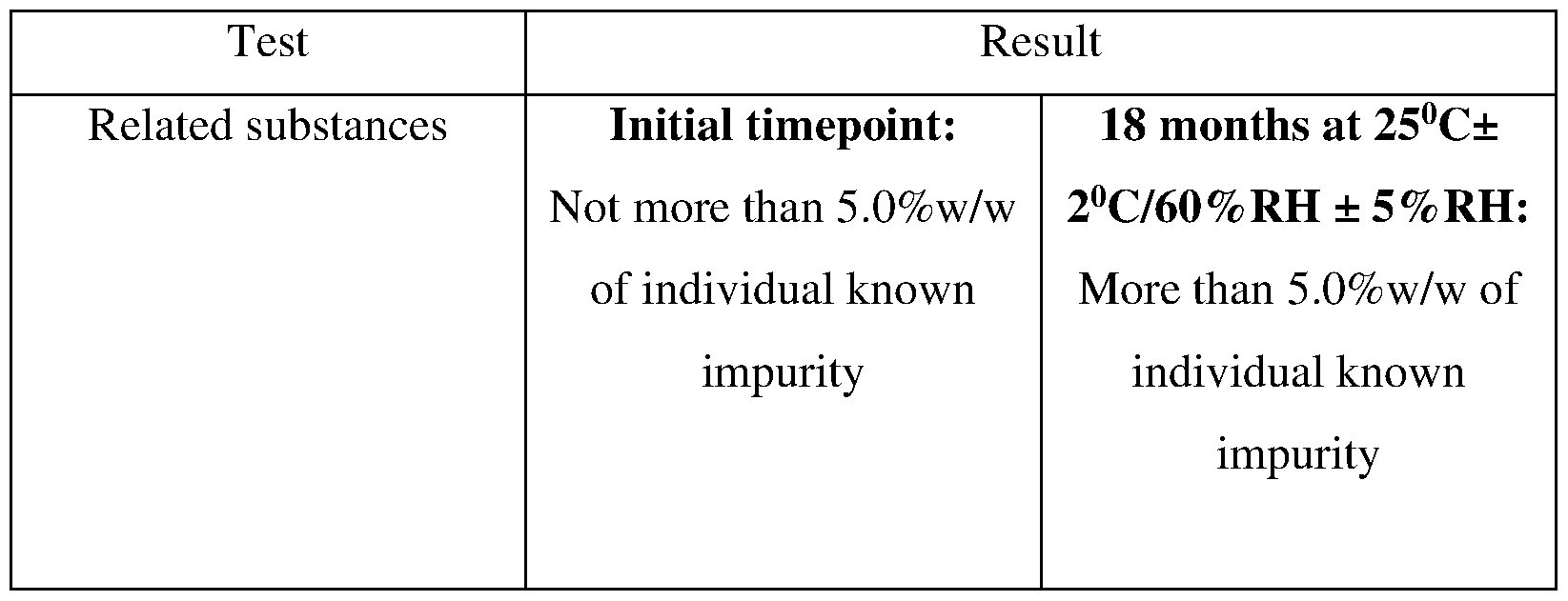

Isavuconazonium sulfate capsules (Example- 1):


Claims
1. A hydroxypropylmethylcellulose capsule filled with a composition comprising isavuconazonium sulfate and atleast one pharmaceutically acceptable excipients, wherein the composition is stable for at least eighteen months when stored at 25°C± 2°C/60%RH ± 5%RH and the composition is devoid of drying agents that stabilizes the isavuconazonium sulfate against hydrolysis during storage.
2. The capsule of claim 1 wherein the composition is having less than 15%w/w of water content.
3. The capsule of claim 1 wherein the composition comprising of 30 to 70% by weight of isavuconazonium sulfate to the total weight of the composition.
4. The stable composition of claim 1 comprising of pharmaceutically acceptable excipients are microcrystalline cellulose, talc, colloidal silicon dioxide and stearic acid.
5. The stable composition of claim 1 wherein the composition comprising of not more than 5.0%w/w of individual known impurity and not more than 0.5%w/w of any individual unknown impurity.
6. The stable composition of claim 1 wherein the composition comprising of not more than 10.0%w/w of total impurities.
7. A process for the preparation of stable isavuconazonium sulfate composition comprising of:
(a) mixing isavuconazonium sulfate and one or more pharmaceutically acceptable excipient to obtain homogeneous blend composition;
(b) storing the blend under nitrogen purging and with a desiccant at 2-8°C;
(c) encapsulation of final blend composition into a hydroxypropylmethylcellulose capsule;
(d) storing the capsules under nitrogen purging and with a desiccant at 2-8°C;
(d) packing capsule into a blister with a desiccant.
8. The blister of claim 6 wherein the desiccant is a silica gel.
9. The stable composition of claims 1-8 wherein the composition is prepared using isavuconazonium sulfate stored at -20°C.
10. The stable composition of claims 1-9 wherein the composition is indicated for the of invasive aspergillosis or invasive mucormycosis.
Applications Claiming Priority (2)
| Application Number | Priority Date | Filing Date | Title |
|---|---|---|---|
| IN202341035913 | 2023-05-24 | ||
| IN202341035913 | 2023-05-24 |
Publications (1)
| Publication Number | Publication Date |
|---|---|
| WO2024241258A1 true WO2024241258A1 (en) | 2024-11-28 |
Family
ID=93589770
Family Applications (1)
| Application Number | Title | Priority Date | Filing Date |
|---|---|---|---|
| PCT/IB2024/055014 Pending WO2024241258A1 (en) | 2023-05-24 | 2024-05-23 | Oral pharmaceutical composition of isavuconazonium or its pharmaceutically acceptable salts thereof |
Country Status (1)
| Country | Link |
|---|---|
| WO (1) | WO2024241258A1 (en) |
Citations (1)
| Publication number | Priority date | Publication date | Assignee | Title |
|---|---|---|---|---|
| WO2021163023A1 (en) * | 2020-02-10 | 2021-08-19 | TRYAGx Labs Inc. | Stable formulations of dronabinol |
-
2024
- 2024-05-23 WO PCT/IB2024/055014 patent/WO2024241258A1/en active Pending
Patent Citations (1)
| Publication number | Priority date | Publication date | Assignee | Title |
|---|---|---|---|---|
| WO2021163023A1 (en) * | 2020-02-10 | 2021-08-19 | TRYAGx Labs Inc. | Stable formulations of dronabinol |
Similar Documents
| Publication | Publication Date | Title |
|---|---|---|
| US6423351B2 (en) | Inhibiting oxidative degradation of pharmaceutical formulations | |
| CN101951889A (en) | Imatinib compositions | |
| US20070264332A1 (en) | Sustained Release Pharmaceutical Formulation | |
| KR101136655B1 (en) | Pharmaceutical formulation comprising levothyroxine sodium | |
| JP5529165B2 (en) | Formulation for oral mucosal administration of lipid-lowering drugs | |
| ES2895951T3 (en) | Pharmaceutical compositions containing doravirine, tenofovir disoproxil fumarate and lamivudine | |
| US12274790B1 (en) | Thyroid hormone oral dosage forms and methods of using the same | |
| US20020143058A1 (en) | Process for preparing non-hygroscopic sodium valproate composition | |
| WO2024241258A1 (en) | Oral pharmaceutical composition of isavuconazonium or its pharmaceutically acceptable salts thereof | |
| WO2025195452A1 (en) | Isavuconazole pharmaceutical composition and preparation method therefor | |
| WO2008132756A1 (en) | Stable pharmaceutical compositions of ramipril | |
| US5091191A (en) | Pharmaceutical composition with improved dissolution property | |
| JP2005314413A (en) | Pharmaceutical composition for oral administration | |
| US20070155780A1 (en) | Stabilized composition containing 4-amino-5-chloro-n-[(1r, 3r, 5s)-8-methyl-8-azabicyclo[3.2.1]oct-3-y1]-2-[1-methylbut-2-ynyloxy]benzamide | |
| US20060167100A1 (en) | Orodispersible pharmaceutical composition of an antithrombotic compound | |
| EP1880722A1 (en) | Pharmaceutical compositions of ciprofloxacin | |
| KR20040091135A (en) | Tablet containing pilsicainide hydrochloride(dry) | |
| AU2007355452B2 (en) | Improved pharmaceutical formulation containing an HMG-CoA reductase inhibitor and method for the preparation thereof | |
| JP7608444B2 (en) | Pharmaceutical formulations of indoleamine 2,3-dioxygenase inhibitors | |
| RU2248205C1 (en) | Medicinal agent as gelatin capsule | |
| US20090186083A1 (en) | Method for stabilization of isoxazole compound | |
| KR102486815B1 (en) | A pharmaceutical composition comprising NEP inhibitor and ARB, and method for preparing the same | |
| AU2013250251A1 (en) | Encapsulated formulation | |
| JP2014070061A (en) | Tablet containing composite with cyclodextrin | |
| KR20240173178A (en) | Pharmaceutical composition containing crisdesalazine with improved stability and dissolution rate |
Legal Events
| Date | Code | Title | Description |
|---|---|---|---|
| 121 | Ep: the epo has been informed by wipo that ep was designated in this application |
Ref document number: 24810577 Country of ref document: EP Kind code of ref document: A1 |
|
| NENP | Non-entry into the national phase |
Ref country code: DE |
|
| WWE | Wipo information: entry into national phase |
Ref document number: 2024810577 Country of ref document: EP |