[go: up one dir, main page]

WO2024240634A1 - Anti-met antibodies, antibody-drug conjugates, compositions and uses thereof - Google Patents

Anti-met antibodies, antibody-drug conjugates, compositions and uses thereof Download PDF

Info

Publication number
WO2024240634A1
WO2024240634A1 PCT/EP2024/063676 EP2024063676W WO2024240634A1 WO 2024240634 A1 WO2024240634 A1 WO 2024240634A1 EP 2024063676 W EP2024063676 W EP 2024063676W WO 2024240634 A1 WO2024240634 A1 WO 2024240634A1
Authority
WO
WIPO (PCT)
Prior art keywords
antibody
cancer
antigen
met
seq
Prior art date
Legal status (The legal status is an assumption and is not a legal conclusion. Google has not performed a legal analysis and makes no representation as to the accuracy of the status listed.)
Pending
Application number
PCT/EP2024/063676
Other languages
French (fr)
Inventor
Ana Leticia MARAGNO
Vesela KOSTOVA
Sabine PLANTIER
Sandra HAUMONT
Gaëtane LE TOUMELIN-BRAIZAT
Laura BRESSON
Michael Monrad Grandal
Current Assignee (The listed assignees may be inaccurate. Google has not performed a legal analysis and makes no representation or warranty as to the accuracy of the list.)
Les Laboratoires Servier SAS
Original Assignee
Les Laboratoires Servier SAS
Priority date (The priority date is an assumption and is not a legal conclusion. Google has not performed a legal analysis and makes no representation as to the accuracy of the date listed.)
Filing date
Publication date
Application filed by Les Laboratoires Servier SAS filed Critical Les Laboratoires Servier SAS
Priority to AU2024277829A priority Critical patent/AU2024277829A1/en
Publication of WO2024240634A1 publication Critical patent/WO2024240634A1/en
Priority to IL324556A priority patent/IL324556A/en
Anticipated expiration legal-status Critical
Pending legal-status Critical Current

Links

Classifications

    • AHUMAN NECESSITIES
    • A61MEDICAL OR VETERINARY SCIENCE; HYGIENE
    • A61KPREPARATIONS FOR MEDICAL, DENTAL OR TOILETRY PURPOSES
    • A61K47/00Medicinal preparations characterised by the non-active ingredients used, e.g. carriers or inert additives; Targeting or modifying agents chemically bound to the active ingredient
    • A61K47/50Medicinal preparations characterised by the non-active ingredients used, e.g. carriers or inert additives; Targeting or modifying agents chemically bound to the active ingredient the non-active ingredient being chemically bound to the active ingredient, e.g. polymer-drug conjugates
    • A61K47/51Medicinal preparations characterised by the non-active ingredients used, e.g. carriers or inert additives; Targeting or modifying agents chemically bound to the active ingredient the non-active ingredient being chemically bound to the active ingredient, e.g. polymer-drug conjugates the non-active ingredient being a modifying agent
    • A61K47/68Medicinal preparations characterised by the non-active ingredients used, e.g. carriers or inert additives; Targeting or modifying agents chemically bound to the active ingredient the non-active ingredient being chemically bound to the active ingredient, e.g. polymer-drug conjugates the non-active ingredient being a modifying agent the modifying agent being an antibody, an immunoglobulin or a fragment thereof, e.g. an Fc-fragment
    • A61K47/6801Drug-antibody or immunoglobulin conjugates defined by the pharmacologically or therapeutically active agent
    • A61K47/6803Drugs conjugated to an antibody or immunoglobulin, e.g. cisplatin-antibody conjugates
    • A61K47/68031Drugs conjugated to an antibody or immunoglobulin, e.g. cisplatin-antibody conjugates the drug being an auristatin
    • AHUMAN NECESSITIES
    • A61MEDICAL OR VETERINARY SCIENCE; HYGIENE
    • A61KPREPARATIONS FOR MEDICAL, DENTAL OR TOILETRY PURPOSES
    • A61K47/00Medicinal preparations characterised by the non-active ingredients used, e.g. carriers or inert additives; Targeting or modifying agents chemically bound to the active ingredient
    • A61K47/50Medicinal preparations characterised by the non-active ingredients used, e.g. carriers or inert additives; Targeting or modifying agents chemically bound to the active ingredient the non-active ingredient being chemically bound to the active ingredient, e.g. polymer-drug conjugates
    • A61K47/51Medicinal preparations characterised by the non-active ingredients used, e.g. carriers or inert additives; Targeting or modifying agents chemically bound to the active ingredient the non-active ingredient being chemically bound to the active ingredient, e.g. polymer-drug conjugates the non-active ingredient being a modifying agent
    • A61K47/68Medicinal preparations characterised by the non-active ingredients used, e.g. carriers or inert additives; Targeting or modifying agents chemically bound to the active ingredient the non-active ingredient being chemically bound to the active ingredient, e.g. polymer-drug conjugates the non-active ingredient being a modifying agent the modifying agent being an antibody, an immunoglobulin or a fragment thereof, e.g. an Fc-fragment
    • A61K47/6835Medicinal preparations characterised by the non-active ingredients used, e.g. carriers or inert additives; Targeting or modifying agents chemically bound to the active ingredient the non-active ingredient being chemically bound to the active ingredient, e.g. polymer-drug conjugates the non-active ingredient being a modifying agent the modifying agent being an antibody, an immunoglobulin or a fragment thereof, e.g. an Fc-fragment the modifying agent being an antibody or an immunoglobulin bearing at least one antigen-binding site
    • A61K47/6849Medicinal preparations characterised by the non-active ingredients used, e.g. carriers or inert additives; Targeting or modifying agents chemically bound to the active ingredient the non-active ingredient being chemically bound to the active ingredient, e.g. polymer-drug conjugates the non-active ingredient being a modifying agent the modifying agent being an antibody, an immunoglobulin or a fragment thereof, e.g. an Fc-fragment the modifying agent being an antibody or an immunoglobulin bearing at least one antigen-binding site the antibody targeting a receptor, a cell surface antigen or a cell surface determinant
    • AHUMAN NECESSITIES
    • A61MEDICAL OR VETERINARY SCIENCE; HYGIENE
    • A61PSPECIFIC THERAPEUTIC ACTIVITY OF CHEMICAL COMPOUNDS OR MEDICINAL PREPARATIONS
    • A61P35/00Antineoplastic agents
    • CCHEMISTRY; METALLURGY
    • C07ORGANIC CHEMISTRY
    • C07KPEPTIDES
    • C07K16/00Immunoglobulins [IGs], e.g. monoclonal or polyclonal antibodies
    • C07K16/18Immunoglobulins [IGs], e.g. monoclonal or polyclonal antibodies against material from animals or humans
    • C07K16/28Immunoglobulins [IGs], e.g. monoclonal or polyclonal antibodies against material from animals or humans against receptors, cell surface antigens or cell surface determinants
    • C07K16/2863Immunoglobulins [IGs], e.g. monoclonal or polyclonal antibodies against material from animals or humans against receptors, cell surface antigens or cell surface determinants against receptors for growth factors, growth regulators
    • AHUMAN NECESSITIES
    • A61MEDICAL OR VETERINARY SCIENCE; HYGIENE
    • A61KPREPARATIONS FOR MEDICAL, DENTAL OR TOILETRY PURPOSES
    • A61K39/00Medicinal preparations containing antigens or antibodies
    • A61K2039/505Medicinal preparations containing antigens or antibodies comprising antibodies
    • CCHEMISTRY; METALLURGY
    • C07ORGANIC CHEMISTRY
    • C07KPEPTIDES
    • C07K2317/00Immunoglobulins specific features
    • C07K2317/30Immunoglobulins specific features characterized by aspects of specificity or valency
    • C07K2317/33Crossreactivity, e.g. for species or epitope, or lack of said crossreactivity
    • CCHEMISTRY; METALLURGY
    • C07ORGANIC CHEMISTRY
    • C07KPEPTIDES
    • C07K2317/00Immunoglobulins specific features
    • C07K2317/90Immunoglobulins specific features characterized by (pharmaco)kinetic aspects or by stability of the immunoglobulin
    • C07K2317/92Affinity (KD), association rate (Ka), dissociation rate (Kd) or EC50 value

Definitions

  • the mesenchymal-epithelial transition factor (MET or cMET) is a receptor tyrosine kinase comprising a 50 kDa a-subunit and a 145 kDa p-subunit.
  • the only known ligand for MET is hepatocyte growth factor (HGF), which is also known as scatter factor.
  • Binding of HGF to MET leads to receptor dimerization and autophosphorylation of p-subunit residues Y1349 and Y1356, activating downstream signaling pathways that include the phosphoinositol 3-kinase (PI3K)- protein kinase B (Akt) pathway, the signal transducer and activator of transcription factor (STAT) pathway, the mitogen-activated protein kinase (MAPK) pathway, and the nuclear factor kappa-light-chain-enhancer of activated B cells (NFKB) pathway. This ultimately leads to increased mitogenesis, cell proliferation, cell survival, and cell motility.
  • PI3K phosphoinositol 3-kinase
  • STAT signal transducer and activator of transcription factor
  • MAPK mitogen-activated protein kinase
  • NFKB nuclear factor kappa-light-chain-enhancer of activated B cells
  • Dysregulation of MET or HGF activity may occur, e.g., through overexpression, gene amplification, mutation, or alternative splicing of MET, or through HGF ligand-induced autocrine/paracrine loop signaling.
  • Such dysregulation plays a role in many cancers by facilitating cancer invasiveness, angiogenesis, metastasis, and tumor growth, thus leading to a more aggressive cancer phenotype and a poorer prognosis.
  • MET is also known to interact with signaling pathways involving other receptors, such as EGFR, TGF-p, and HER3, and may play a role in resistance to treatments targeting those receptors.
  • MET inhibitors such as anti-MET antibodies, thus may be effective in combination with other receptor inhibitors in overcoming resistant phenotypes.
  • MET inhibitors include both monoclonal antibodies, which may target either MET or its ligand, HGF, and small molecule kinase inhibitors.
  • Known anti- MET small molecule receptor tyrosine kinase inhibitors include tivantinib, cabozantinib, foretinib, golvatinib, and crizotinib.
  • no anti-cMET antibodies have been approved for therapeutic use.
  • Known antibodies targeting the cMET pathway include onartuzumab (Genentech, WO 2006/015371), ARGX- 111 (Argenx, WO 2012/059561), emibetuzumab (LY2875358; Eli Lilly, WO 2010/059654), SAIT-301 (Samsung, US 2014-0154251), telisotuzumab (ABT-700, Abbott/ Abbvie, WO 2017/201204) and Sym015 (Symphogen, WO 2016/042412).
  • Bispecific antibodies targeting MET have also been described, such as the amivantamab bispecific antibody targeting EGFR and MET (JNJ-61186372, Jansseb Biotech, US 9593164).
  • MET receptor is an active target in cancer treatment and an attractive target for the development of anti-MET therapeutic antibodies and antibody drug conjugates.
  • the present invention relates to a novel recombinant antibody or antigen-binding portion thereof targeting MET, as well as ADCs comprising this antibody or antigen-binding portion thereof, compositions comprising this antibody or antigenbinding portion thereof, compositions comprising the ADC comprising said anti- MET antibody or antigen-binding portion thereof, the use of said antibody or antigen-binding portion thereof or ADC, and said compositions comprising anti- MET antibody or antigen-binding portion thereof or anti-MET ADC, for treatment of cancers, including cancers that express MET or rely on MET pathway activation, such as melanoma, uveal melanoma, renal cancer, thyroid cancer, mesothelioma, liver hepatocellular cancer, lung cancer including non-small cell lung cancer and small cell lung cancer, gastric cancer including stomach cancer, pancreatic cancer, colorectal cancer, esophageal cancer, cholangiocarcinoma, head and neck cancer including oral cancer, cervical and endocer
  • the antibodies of the invention, ADCs comprising the antibodies of the invention and compositions comprising the antibody of the invention or ADCs of the invention are surprisingly effective on cancer cells.
  • the present invention provides an anti-MET antibody or an antigen-binding portion thereof.
  • the antibody or antigenbinding portion thereof competes for binding to human MET with an antibody whose H-CDR1, H-CDR2, H-CDR3, L-CDR1, L-CDR2, and L-CDR3 comprise or consist of the amino acid sequences of SEQ ID NOs: 1, 2, 3, 4, 5, and 6, respectively.
  • the anti-MET antibody or antigen-binding portion thereof binds to the same epitope of human MET as an antibody whose H- CDR1, H-CDR2, H-CDR3, L-CDR1, L-CDR2, and L-CDR3 comprise or consist of the amino acid sequences of SEQ ID NOs: 1, 2, 3, 4, 5, and 6, respectively.
  • the present invention provides an anti-MET antibody or antigen-binding portion thereof comprising an H-CDR1, H-CDR2, and H-CDR3 that comprise or consist of the amino acid sequences of SEQ ID NOs: 1 , 2, and 3, respectively.
  • the anti-MET antibody or antigen-binding portion thereof comprises a heavy chain variable domain (VH) that is at least 90% identical in sequence to the amino acid sequence of SEQ ID NO: 7.
  • the anti-MET antibody or antigen-binding portion thereof comprises a VH that comprises or consists of the amino acid sequence of SEQ ID NO: 7.
  • the anti-MET antibody or antigen-binding portion thereof comprises a heavy chain (HC) that comprises or consists of the amino acid sequence of SEQ ID NO: 11 or 13.
  • the anti-MET antibody or antigen-binding portion thereof comprises a L-CDR1 , L-CDR2, and L-CDR3 that comprise or consist of the amino acid sequences of SEQ ID NOs: 4, 5, and 6.
  • the anti-MET antibody or antigen-binding portion thereof comprises a light chain variable domain (VL) that is at least 90% identical in sequence to the amino acid sequence of SEQ ID NO: 8.
  • the anti-MET antibody or antigen-binding portion thereof comprises a VL that comprises or consists of the amino acid sequence of SEQ ID NO: 8.
  • the anti-MET antibody or antigen-binding portion thereof comprises a light chain (LC) that comprises or consists of the amino acid sequence of SEQ ID NO: 12 or 14.
  • the anti-MET antibody or antigen-binding portion thereof comprises a H-CDR1 , H-CDR2, H-CDR3, L-CDR1, L-CDR2, and L-CDR3 that comprise or consist of the amino acid sequences of SEQ ID NOs: 1, 2, 3, 4, 5, and 6, respectively.
  • the anti-MET antibody or antigen-binding portion thereof comprises a VH that is at least 90% identical in sequence to the amino acid sequence of SEQ ID NO: 7 and a VL that is at least 90% identical in sequence to the amino acid sequence of SEQ ID NO: 8.
  • the anti-MET antibody or antigen-binding portion thereof comprises a VH that comprises or consists of the amino acid sequence of SEQ ID NO: 7 and a VL that comprises or consists of the amino acid sequence of SEQ ID NO: 8.
  • the anti-MET antibody or antigen-binding portion thereof comprises an HC that comprises or consists of the amino acid sequence of SEQ ID NO: 11 or 13 and an LC that comprises or consists of the amino acid sequence of SEQ ID NO: 12 or 14.
  • the anti-MET antibody or antigen-binding portion thereof comprises an HC and LC comprising or consisting of the amino acid sequences of SEQ ID NOs: 11 and 12, respectively, or the HC and LC comprising or consisting of the amino acid sequences of SEQ ID NOs: 13 and 14, respectively.
  • the antibody may be of isotype IgG. In certain embodiments, the antibody is of isotype subclass lgG1. In certain embodiments, the anti-MET antibody is of isotype subclass lgG2.
  • the present invention also provides a multi-specific (e.g., bi-specific) binding molecule comprising the antigen-binding portion of an anti-MET antibody described herein, and the antigen-binding portion of another distinct antibody such as another anti-MET antibody or an antibody that targets a different protein.
  • the bispecific binding molecule comprises an antigenbinding portion of an antibody whose H-CDR1, H-CDR2, H-CDR3, L-CDR1, L- CDR2, and L-CDR3 comprise the amino acid sequences of SEQ ID NOs: 1, 2, 3, 4, 5, and 6, respectively.
  • the present disclosure provides, novel antibody-drug conjugate (ADC) compounds comprising the anti-MET antibodies of the present invention.
  • ADC antibody-drug conjugate
  • the ADC compounds show biological activity against cancer cells and may slow, inhibit, and/or reverse tumor growth in mammals, and/or may be useful for treating human cancer patients.
  • the present disclosure more specifically relates, in some embodiments, to ADC compounds that are capable of binding and killing cancer cells.
  • the ADC compounds are also capable of internalizing into a target cell after binding.
  • the ADC may be represented by Ab-(L-D)p, wherein Ab is an anti-Met antibody or an antigen-binding portion thereof; D is a payload or drug or any compound to be linked to the Ab with the linker L; L is a linker that covalently attaches Ab to D; and p is an integer from 1 to 16.
  • the ADC comprises an anti-Met antibody or an antigenbinding portion thereof whose H-CDR1, H-CDR2, H-CDR3, L-CDR1 , L-CDR2, and L-CDR3 comprise the amino acid sequences of SEQ ID NOs: 1 , 2, 3, 4, 5, and 6, respectively.
  • L-D refers to the linker-drugs, linker-payloads, or linkercompounds.
  • p is an integer from 1 to 16.
  • the linker (L) may be a cleavable or non-cleavable linker.
  • D refers to a drug moiety or payload and is selected from an Eg5 inhibitor, a V-ATPase inhibitor, a HSP90 inhibitor, an IAP inhibitor, an mTor inhibitor, a microtubule stabilizer, a microtubule destabilizer, an auristatin (such as Monomethyl Auristatin E or MMAE), a dolastatin, a maytansinoid, a MetAP (methionine aminopeptidase), an inhibitor of nuclear export of proteins CRM1, a DPPIV inhibitor, an inhibitor of phosphoryl transfer reactions in mitochondria, a protein synthesis inhibitor, a kinase inhibitor, a CDK2 inhibitor, a CDK9 inhibitor, a proteasome inhibitor, a kinesin inhibitor, an HDAC inhibitor, a DNA damaging agent, a DNA alkylating agent, a DNA intercalator, a DNA minor groove binder, an RNA polymerase inhibitor, an amanitin, a spliceosome inhibitor,
  • the present invention also provides antibody compositions comprising an anti- MET antibody or antigen-binding portion thereof described herein.
  • the antibody composition comprises an anti-MET antibody or antigen-binding portion thereof that competes for binding to human MET with an antibody whose H-CDR1, H-CDR2, H-CDR3 and L-CDR1, L-CDR2, and L-CDR3 comprise the amino acid sequences of SEQ ID NOs: 1, 2, 3, 4, 5, and 6, respectively.
  • the antibody composition comprises an anti-MET antibody or antigen-binding portion thereof that binds to the same epitope of human MET as an antibody whose H-CDR1, H-CDR2, H-CDR3, L-CDR1, L-CDR2, and L-CDR3 comprise the amino acid sequences of SEQ ID NOs: 1 , 2, 3, 4, 5, and 6, respectively.
  • the antibody composition comprises the anti-MET antibody or antigen-binding portion thereof comprises a H-CDR1, H-CDR2, H-CDR3, L- CDR1, L-CDR2, and L-CDR3 that comprise the amino acid sequences of SEQ ID NOs: 1, 2, 3, 4, 5, and 6, respectively.
  • the antibody composition comprises an anti-MET antibody or antigen-binding portion thereof that comprises a VH and VL that are at least 90% identical in sequence to the amino acid sequences of SEQ ID NOs: 7 and 8, respectively.
  • the antibody composition comprises an anti-MET antibody or antigen-binding portion thereof that comprises a VH and VL comprising the amino acid sequences of SEQ ID NOs: 7 and 8, respectively.
  • the antibody composition comprises an anti-MET antibody or antigen-binding portion thereof that comprises an HC and LC comprising the amino acid sequences of SEQ ID NOs: 11 and 12, respectively, or the HC and LC comprising the amino acid sequences of SEQ ID NOs: 13 and 14, respectively.
  • the antibody composition comprises an anti-MET antibody or antigen-binding portion thereof comprises an HC and LC comprising the amino acid sequences of SEQ ID NOs: 11 and 12, respectively, or the HC and LC comprising the amino acid sequences of SEQ ID NOs: 13 and 14, respectively.
  • the present invention also provides ADC compositions comprising an ADC comprising an anti-MET antibody or antigen-binding portion thereof described herein.
  • the ADC composition comprises an ADC wherein the anti- MET antibody or antigen-binding portion thereof comprises a H-CDR1, H-CDR2, H-CDR3, L-CDR1, L-CDR2, and L-CDR3 that comprise the amino acid sequences of SEQ ID NOs: 1 , 2, 3, 4, 5, and 6, respectively.
  • the ADC composition comprises an ADC comprising an anti-MET antibody or antigenbinding portion thereof that comprises a VH and VL that are at least 90% identical in sequence to the amino acid sequences of SEQ ID NOs: 7 and 8, respectively.
  • the ADC composition comprises an ADC wherein the anti- MET antibody or antigen-binding portion thereof that comprises a VH and VL comprising the amino acid sequences of SEQ ID NOs: 7 and 8, respectively.
  • the ADC composition comprises an ADC wherein the anti- MET antibody or antigen-binding portion thereof that comprises an HC and LC that are at least 90% identical in sequence to the amino acid sequences of SEQ ID NOs: 11 and 12, respectively, or the HC and LC that are at least 90% identical in sequence to the amino acid sequences of SEQ ID NOs: 13 and 14, respectively.
  • the present invention provides an isolated nucleic acid molecule comprising a nucleotide sequence that encodes the heavy chain or an antigen-binding portion thereof, a nucleotide sequence that encodes the light chain or an antigen-binding portion thereof, or both, of an anti-MET antibody described herein.
  • the isolated nucleic acid molecule comprises a nucleotide sequence selected from the group consisting of SEQ ID NOs: 9 or 10.
  • the present invention also provides a vector comprising the isolated nucleic acid molecule, wherein said vector further comprises an expression control sequence.
  • the present invention also provides a host cell comprising a nucleotide sequence that encodes the heavy chain or an antigen-binding portion thereof, a nucleotide sequence that encodes the light chain or an antigen-binding portion thereof, or both, of an anti-MET antibody described herein.
  • the host cell comprises a nucleotide sequence selected from the group consisting of SEQ ID NOs: 9 or 10.
  • the present invention also provides a non-human transgenic animal or plant comprising a nucleotide sequence that encodes the heavy chain or an antigenbinding portion thereof, a nucleotide sequence that encodes the light chain or an antigen-binding portion thereof, or both, of an anti-MET antibody described herein, wherein said animal or plant expresses the nucleotide sequence(s).
  • the animal or plant comprises a nucleotide sequence selected from the group consisting of SEQ ID NOs: 9 or 10.
  • the present invention also provides a method for producing an anti-MET antibody or antigen-binding portion thereof described herein, comprising providing the above-described host cell, cultivating said host cell under conditions suitable for expression of the antibody or portion, and isolating the resulting antibody or portion. Methods of producing ADC compounds comprising the anti-MET antibodies of the present invention are also disclosed.
  • the present invention also provides a method for treating a patient with a MET- mediated disorder, comprising administering to said patient an anti-MET antibody or antigen-binding portion thereof as described herein, an ADC comprising an anti- Met antibody or an antigen-binding portion thereof as described herein, an antibody composition comprising an anti-MET antibody or antigen-binding portion thereof or an ADC comprising an anti-Met antibody as described herein, or a pharmaceutical composition comprising the anti-MET antibody composition or the ADC comprising an anti-Met antibody composition.
  • the present disclosure provides methods of treating a cancer (e.g., a cancer that expresses the MET antigen targeted by the antibody or antigen-binding portion of the ADC). In some embodiments, the present disclosure provides methods of reducing or slowing the expansion of a cancer cell population in a subject.
  • a cancer e.g., a cancer that expresses the MET antigen targeted by the antibody or antigen-binding portion of the ADC.
  • the present invention also provides a method for treating a patient having or suspected of having a cancer, comprising administering to said patient an anti- MET antibody or antigen-binding portion thereof, an ADC comprising an anti-Met antibody or an antigen-binding portion thereof as described herein, or a composition or a pharmaceutical composition comprising the anti-MET antibody or antigen-binding portion thereof or the ADC comprising an anti-Met antibody or an antigen-binding portion thereof.
  • Another exemplary embodiment is a method of reducing or inhibiting the growth of a tumor in a patient, comprising administering to the subject a therapeutically effective amount of an anti-MET antibody or antigen-binding portion thereof, an ADC comprising an anti-Met antibody or an antigen-binding portion thereof, a composition or pharmaceutical composition comprising the anti-MET antibody or antigen-binding portion thereof or comprising the ADC comprising anti-MET antibody or antigen-binding portion thereof.
  • Another exemplary embodiment is a method of reducing or slowing the expansion of a cancer cell population in a patient, comprising administering to the subject a therapeutically effective amount of an anti-MET antibody or antigen-binding portion thereof, an ADC comprising an anti-Met antibody or an antigen-binding portion thereof, a composition or pharmaceutical composition comprising the anti-MET antibody or antigen-binding portion thereof or comprising the ADC comprising an anti-MET antibody or antigen-binding portion thereof.
  • the cancer is dependent on MET activation and/or MET expression.
  • Each VH and VL is composed of three CDRs (H-CDR herein designates a CDR from the heavy chain; and L-CDR herein designates a CDR from the light chain) and four FRs, arranged from amino-terminus to carboxyl-terminus in the following order: FR1, CDR1, FR2, CDR2, FR3, CDR3, FR4.
  • the assignment of amino acids to each region may be in accordance with IMGT® definitions (Lefranc et al., Dev Comp Immunol 27(1):55-77 (2003); or the definitions of Kabat, Sequences of Proteins of Immunological Interest (National Institutes of Health, Bethesda, MD (1987 and 1991)); Chothia & Lesk, J. Mol.
  • antibody portion refers to one or more portions or fragments of an antibody that retain the ability to specifically bind to an antigen (e.g., human MET, or a portion thereof). It has been shown that certain portions or fragments of a full-length antibody can perform the antigen-binding function of the antibody.
  • binding specificity refers to the ability of an individual antibody or antigen binding portion to preferentially react with one antigenic determinant over a different antigenic determinant. The degree of specificity indicates the extent to which an antibody or portion preferentially binds to one antigenic determinant over a different antigenic determinant.
  • the term “specific,” “specifically binds,” and “binds specifically” refers to a binding reaction between an antibody or antigen-binding portion (e.g., an anti-Met antibody) and a target antigen (e.g., MET) in a heterogeneous population of proteins and other biologies.
  • a “specific antibody” or a “target-specific antibody” is one that only binds the target antigen (e.g., MET), but does not bind (or exhibits minimal binding) to other antigens.
  • variant refers to a nucleic acid sequence or an amino acid sequence that differs from a reference nucleic acid sequence or amino acid sequence respectively, but retains one or more biological properties of the reference sequence.
  • a variant may contain one or more amino acid substitutions, deletions, and/or insertions (or corresponding substitution, deletion, and/or insertion of codons) with respect to a reference sequence. Changes in a nucleic acid variant may not alter the amino acid sequence of a peptide encoded by the reference nucleic acid sequence, or may result in amino acid substitutions, additions, deletions, fusions, and/or truncations.
  • a nucleic acid variant disclosed herein encodes an identical amino acid sequence to that encoded by the unmodified nucleic acid or encodes a modified amino acid sequence that retains one or more functional properties of the unmodified amino acid sequence. Changes in the sequence of peptide variants are typically limited or conservative, so that the sequences of the unmodified peptide and the variant are closely similar overall and, in many regions, identical. In some embodiments, a peptide variant retains one or more functional properties of the unmodified peptide sequence. A variant and unmodified peptide can differ in amino acid sequence by one or more substitutions, additions, deletions in any combination.
  • a peptide variant encompasses polypeptides having amino acid substitutions, deletions, and/or insertions as long as the polypeptide has at least 80%, at least 85%, at least 90%, at least 91%, at least 92%, at least 93%, at least 94%, at least 95%, at least 96%, at least 97%, at least 98%, at least 99% amino acid sequence identity with a reference sequence, or with a corresponding segment (e.g., a functional fragment) of a reference sequence, e.g., those variants that also retain one or more functions of the reference sequence.
  • a corresponding segment e.g., a functional fragment
  • the percent identity between the two sequences is a function of the number of identical positions shared by the sequences, taking into account the number of gaps, and the length of each gap, which need to be introduced for optimal alignment of the two sequences.
  • amino acid identity or homology between proteins disclosed herein and variants thereof, including variants of target antigens (such as MET) and variants of antibody variable domains (including individual variant CDRs) is at least 80% to the sequences depicted herein, e.g., identities or homologies of at least 85%, 90%, 91%, 92%, 93%, 94%, 95%, 96%, 97%, 98%, 99%, almost 100%, or 100%.
  • antibody-drug conjugate refers to one or more therapeutic compounds that is linked to one or more antibodies or antigenbinding portions.
  • Ab an antibody or antigen-binding portion (e.g., an anti-Met antibody or antigen-binding portion thereof)
  • L a linker moiety
  • D a drug moiety
  • p the number of drug moieties per antibody or antigen-binding portion.
  • the present invention relates to a novel anti-MET antibody 8902 directed against human MET, or an antigen-binding portion of said antibody.
  • Variable domain heavy and light chain (VH and VL) amino acid sequences of this antibody are provided in SEQ ID NOs: 7 and 8, respectively, and corresponding nucleotide sequences are provided in SEQ ID NOs: 9 and 10, respectively.
  • Full-length heavy and light chain amino acid sequences (HC and LC) are available in SEQ ID NOs: 11 and 12 (lgG1 chain) and in SEQ ID NOs: 13 and 14 (lgG2 chain), respectively.
  • Amino acid sequences of heavy chain CDRs (H-CDR1, H-CDR2 and H-CDR3) and light chain CDRs (L-CDR1, L-CDR-2 and L-CDR3) of 8902 antibody are shown in SEQ ID NOs: 1 , 2 and 3 and in SEQ ID NOs: 4, 5 ad 6, respectively.
  • the CDR sequences were assigned in accordance with IMGT® definitions.
  • an anti-MET antibody or an antigen-binding portion thereof that competes for binding to human MET with an antibody having an H-CDR1 , H-CDR2, H-CDR3, L-CDR1 , L-CDR2, and L-CDR3 that comprise or consist of the amino acid sequences of SEQ ID NOs: 1 , 2, 3, 4, 5, and 6, respectively;
  • the anti-MET antibody or antigen-binding portion thereof comprises an L-CDR1 , L-CDR2, and L-CDR3 comprising or consisting of the amino acid sequences of SEQ ID NOs: 4, 5, and 6, respectively.
  • the anti-MET antibody or antigen-binding portion thereof comprises a heavy chain that comprises or consists of the amino acid sequence of SEQ ID NO: 11 and a light chain that comprises or consists the amino acid sequence of SEQ ID NO: 12.
  • An anti-MET antibody can also be derivatized with a chemical group such as polyethylene glycol (PEG), a methyl or ethyl group, or a carbohydrate group. These groups may be useful to improve the biological characteristics of the antibody, e.g., to increase serum half-life.
  • PEG polyethylene glycol
  • the antibodies of the invention may be present in a neutral form (including zwitter ionic forms) or as a positively or negatively-charged species. In some embodiments, the antibodies may be complexed with a counterion to form a pharmaceutically acceptable salt.
  • salts refers to a salt which does not abrogate the biological activity and properties of the compounds of the invention, and does not cause significant irritation to a subject to which it is administered.
  • examples of such salts include, but are not limited to: (a) acid addition salts formed with inorganic acids, for example, hydrochloric acid, hydrobromic acid, sulfuric acid, phosphoric acid, nitric acid and the like; and salts formed with organic acids, for example, acetic acid, oxalic acid, tartaric acid, succinic acid, maleic acid, fumaric acid, gluconic acid, citric acid, malic acid, ascorbic acid, benzoic acid, tannic acid, palmitic acid, alginic acid, polyglutamic acid, naphthalenesulfonic acid, methanesulfonic acid, p-toluenesulfonic acid, naphthalenedisulfonic acid, polygalacturonic acid, and the like
  • the antibody-drug conjugates (ADCs) described herein can contain a monovalent anionic counterion. Any suitable anionic counterion can be used. In certain embodiments, the monovalent anionic counterion is a pharmaceutically acceptable monovalent anionic counterion. In certain embodiments, the monovalent anionic counterion can be selected from bromide, chloride, iodide, acetate, trifluoroacetate, benzoate, mesylate, tosylate, triflate, formate, or the like.
  • the bispecific binding molecule may comprise an anti-MET antibody or an antigen-binding portion thereof having a heavy chain variable domain comprising or consisting of the amino acid sequence of SEQ ID NO: 7 and/or a light chain variable domain comprising or consisting of the amino acid sequence of SEQ ID NO: 8.
  • the bispecific binding molecule may comprise an anti-MET antibody or an antigen-binding portion thereof having a heavy chain comprising or consisting of the amino acid sequence of SEQ ID NO: 11 and/or a light chain comprising or consisting of the amino acid sequence of SEQ ID NO: 12.
  • the bispecific binding molecule may be a dual variable domain antibody, i.e. , wherein the two arms of the antibody comprise two different variable domains, or may be in the form of an antibody fragment such as a bispecific Fab fragment or a bispecific scFv. This is also useful if one wants to create a divalent or polyvalent antibody on a single polypeptide chain.
  • Bispecific binding molecules or polyvalent antibodies may have the binding specificity of an anti-MET antibody or antigen-binding portion thereof described herein and the binding specificity of another antibody that targets a same or a different protein, such as an immune checkpoint protein, a cancer antigen, or a cell surface molecule whose activity mediates a disease condition such as cancer.
  • a bispecific binding molecule has the binding specificities of the first anti-Met antibody 8902 and a second antibody or antigen-binding portions thereof.
  • a bispecific binding molecule has the binding specificities of the first anti-Met antibody 8902 and the second anti-Met antibody 9006 or antigen-binding portions thereof.
  • the bispecific binding molecule comprises an antigen-binding portion of a first antibody having a heavy chain variable domain (VH) comprising the amino acid sequence of SEQ ID NO: 11 and a light chain variable domain (VL) comprising the amino acid sequence of SEQ ID NO:12 and an antigen-binding portion of a second antibody having a heavy chain variable domain (VH) comprising the amino acid sequence of SEQ ID NO:19 and a light chain variable domain (VL) comprising the amino acid sequence of SEQ ID NQ:20.
  • VH heavy chain variable domain
  • VL light chain variable domain
  • the bispecific binding molecule comprises an antigen-binding portion of a first antibody having a heavy chain variable domain (VH) comprising the amino acid sequence of SEQ ID NO: 13 and a light chain variable domain (VL) comprising the amino acid sequence of SEQ ID NO:14 and an antigen-binding portion of a second antibody having a heavy chain variable domain (VH) comprising the amino acid sequence of SEQ ID NO:21 and a light chain variable domain (VL) comprising the amino acid sequence of SEQ ID NO:22.
  • VH heavy chain variable domain
  • VL light chain variable domain
  • ADC Antibody-Drug Conjugates
  • the antibody-drug conjugate (ADC) compounds of the present disclosure include an anti-MET antibody or antigen-binding portion thereof conjugated (i.e., covalently attached by a linker) to a drug moiety, wherein the drug moiety when not conjugated to an antibody or antigen-binding portion has a cytotoxic or cytostatic effect.
  • the ADC may provide improved activity, better cytotoxic specificity, and/or reduced off-target killing as compared to the drug moiety when administered alone.
  • the components of the ADC are selected to (i) retain one or more therapeutic properties exhibited by the antibody and drug moieties in isolation, (ii) maintain the specific binding properties of the antibody or antigen-binding portion; (iii) optimize drug loading and drug-to-antibody ratios; (iv) allow delivery, e.g., intracellular delivery, of the drug moiety via stable attachment to the antibody or antigen-binding portion; (v) retain ADC stability as an intact conjugate until transport or delivery to a target site; (vi) minimize aggregation of the ADC prior to or after administration; (vii) allow for the therapeutic effect, e.g., cytotoxic effect, of the drug moiety after cleavage or other release mechanism in the cellular environment; (viii) exhibit in vivo anti-cancer treatment efficacy comparable to or superior to that of the antibody and drug moieties in isolation; (ix) minimize off-target killing by the drug moiety; and/or (x) exhibit desirable pharmacokinetic and pharma
  • the ADC compounds of the present disclosure may selectively deliver an effective dose of a cytotoxic or cytostatic agent to cancer cells or to tumor tissue.
  • the cytotoxic and/or cytostatic activity of the ADC is dependent on target antigen expression in a cell.
  • the disclosed ADCs are particularly effective at killing cancer cells expressing a target antigen while minimizing off-target killing.
  • the disclosed ADCs do not exhibit a cytotoxic and/or cytostatic effect on cancer cells that do not express a target antigen.
  • ADC compounds comprising an anti-Met antibody or antigen-binding portion thereof (Ab), a drug moiety (D), and a linker moiety (L) that covalently attaches Ab to D.
  • the antibody or antigen-binding portion is able to bind to a tumor-associated antigen (e.g., MET), e.g., with high specificity and high affinity.
  • MET tumor-associated antigen
  • the antibody or antigen-binding portion is internalized into a target cell upon binding, e.g., into a degradative compartment in the cell.
  • the ADCs internalize upon binding to a target cell, undergo degradation, and release drug moiety to kill cancer cells.
  • the drug moiety may be released from the antibody and/or the linker moiety of the ADC by enzymatic action, hydrolysis, oxidation, or any other mechanism.
  • average p refers to the average number of -L-D moieties per antibody or antigenbinding portion, also referred to as “average drug loading.”
  • the anti-Met antibody or antigen-binding thereof in the antibody drug conjugates of the present disclosure is the anti-Met antibody 8902 or antigen-binding thereof.
  • the invention provides an ADC comprising an anti-MET antibody or antigen-binding portion thereof selected from the group consisting of:
  • an anti-MET antibody or antigen-binding portion thereof comprising at least two, three, four or five CDR sequences selected from the group consisting of H-CDR1 SEQ ID NO: 1, H-CDR2 SEQ ID NO: 2, H-CDR3 SEQ ID NO: 3, L-CDR1 SEQ ID NO: 4, L-CDR2 SEQ ID NO: 5, and L-CDR3 SEQ ID NO: 6;
  • an anti-MET antibody or an antigen-binding portion thereof having an H- CDR1, H-CDR2, and H-CDR3 comprising or consisting of the amino acid sequences of SEQ ID NOs: 1, 2, and 3, respectively, and an L-CDR1, L- CDR2, and L-CDR3 comprising or consisting of the amino acid sequences of SEQ ID NOs: 4, 5, and 6, respectively;
  • an anti-MET antibody or an antigen-binding portion thereof having a heavy chain variable domain comprising or consisting of the amino acid sequence of SEQ ID NO: 7;
  • an anti-MET antibody or an antigen-binding portion thereof having a light chain variable domain comprising or consisting of the amino acid sequence of SEQ ID NO: 8;
  • an anti-MET antibody or an antigen-binding portion thereof having a heavy chain variable domain at least 91%, 92%, 93%, 94%, 95%, 96%, 97%, 98%, or 99% identical to the amino acid sequence of SEQ ID NO: 7 and a light chain variable domain at least 91%, 92%, 93%, 94%, 95%, 96%, 97%, 98%, or 99% identical to the amino acid sequence of SEQ ID NO: 8;
  • an anti-MET antibody or an antigen-binding portion thereof having a heavy chain comprising or consisting of the amino acid sequence of SEQ ID NO: 13 and a light chain comprising or consisting of the amino acid sequence of SEQ ID NO: 14;
  • an anti-MET antibody or an antigen-binding portion thereof having a heavy chain at least 91%, 92%, 93%, 94%, 95%, 96%, 97%, 98%, or 99% identical to the amino acid sequence of SEQ ID NO: 11 and a light chain at least 91%, 92%, 93%, 94%, 95%, 96%, 97%, 98%, or 99% identical to the amino acid sequence of SEQ ID NO: 12; and
  • the ADC comprises an anti-MET antibody or antigen-binding portion thereof comprising at least two, three, four or five CDR sequences selected from the group consisting of H-CDR1 SEQ ID NO: 1 , H-CDR2 SEQ ID NO: 2, H- CDR3 SEQ ID NO: 3, L-CDR1 SEQ ID NO: 4, L-CDR2 SEQ ID NO: 5, and L- CDR3 SEQ ID NO: 6.
  • the ADC comprises an anti-MET antibody or an antigenbinding portion thereof having a heavy chain comprising or consisting of the amino acid sequence of SEQ ID NO: 11 and a light chain comprising or consisting of the amino acid sequence of SEQ ID NO: 12.
  • the ADC comprises an anti-MET antibody or an antigenbinding portion thereof having a heavy chain at least 91%, 92%, 93%, 94%, 95%, 96%, 97%, 98%, or 99% identical to the amino acid sequence of SEQ ID NO: 11 and a light chain at least 91%, 92%, 93%, 94%, 95%, 96%, 97%, 98%, or 99% identical to the amino acid sequence of SEQ ID NO: 12.
  • the ADC comprises a bispecific binding molecule comprising an anti-MET antibody or an antigen-binding portion thereof having an H-CDR1, H-CDR2, and H-CDR3 comprising or consisting of the amino acid sequences of SEQ ID NOs: 1 , 2, and 3, respectively, and an L-CDR1, L- CDR2, and L-CDR3 comprising or consisting of the amino acid sequences of SEQ ID NOs: 4, 5, and 6, respectively.
  • the ADC comprises a bispecific binding molecule comprising an anti-MET antibody or an antigen-binding portion thereof having a heavy chain at least 91%, 92%, 93%, 94%, 95%, 96%, 97%, 98%, or 99% identical to the amino acid sequence of SEQ ID NO: 13 and/or a light chain at least 91%, 92%, 93%, 94%, 95%, 96%, 97%, 98%, or 99% identical to the amino acid sequence of SEQ ID NO: 14.
  • the ADC comprises a bispecific binding molecule comprising an antigen-binding portion of a first antibody having a heavy chain variable domain (VH) comprising the amino acid sequence of SEQ ID NO:13 and a light chain variable domain (VL) comprising the amino acid sequence of SEQ ID NO:14 and an antigen-binding portion of a second antibody having a heavy chain variable domain (VH) comprising the amino acid sequence of SEQ ID NO:17 and a light chain variable domain (VL) comprising the amino acid sequence of SEQ ID NO:18.
  • VH heavy chain variable domain
  • VL light chain variable domain
  • the ADC comprises a bispecific binding molecule has the binding specificities of a first anti-Met antibody 8902 and a second anti-Met antibody 9338 or antigen-binding portions thereof.
  • the ADC comprises a bispecific binding molecule comprising an antigen-binding portion of a first antibody having a heavy chain variable domain (VH) comprising the amino acid sequence of SEQ ID NO: 11 and a light chain variable domain (VL) comprising the amino acid sequence of SEQ ID NO:12 and an antigen-binding portion of a second antibody having a heavy chain variable domain (VH) comprising the amino acid sequence of SEQ ID NO:19 and a light chain variable domain (VL) comprising the amino acid sequence of SEQ ID NQ:20.
  • VH heavy chain variable domain
  • VL light chain variable domain
  • Whether a linker is stable extracellularly can be determined, for example, by including an ADC in plasma for a predetermined time period (e.g., 2, 4, 6, 8, 16, 24, 48, or 72 hours) and then quantifying the amount of free drug moiety present in the plasma. Stability may allow the ADC time to localize to target cancer cells and prevent the premature release of the drug moiety, which could lower the therapeutic index of the ADC by indiscriminately damaging both normal and cancer tissues.
  • the linker is stable outside of a target cell and releases the drug moiety from the ADC once inside of the cell, such that the drug can bind to its target.
  • an effective linker will: (i) maintain the specific binding properties of the antibody or antigen-binding portion; (ii) allow delivery, e.g., intracellular delivery, of the drug moiety via stable attachment to the antibody or antigen-binding portion; (iii) remain stable and intact until the ADC has been transported or delivered to its target site; and (iv) allow for the therapeutic effect, e.g., cytotoxic effect, of the drug moiety after cleavage or alternate release mechanism.
  • Linkers may impact the physico-chemical properties of an ADC. As many cytotoxic agents are hydrophobic in nature, linking them to the antibody with an additional hydrophobic moiety may lead to aggregation. ADC aggregates are insoluble and often limit achievable drug loading onto the antibody, which can negatively affect the potency of the ADC. Protein aggregates of biologies, in general, have also been linked to increased immunogenicity. As shown below, ADCs disclosed below have low aggregation levels and desirable levels of drug loading. A linker may be "cleavable” or “non-cleavable” (Ducry and Stump (2010) Bioconjugate Chem. 21:5-13).
  • Cleavable linkers are designed to release the drug moiety when subjected to certain environment factors, e.g., when internalized into the target cell, whereas non-cleavable linkers generally rely on the degradation of the antibody or antigen-binding portion itself.
  • the linker MC-VC-PAB is a protease cleavable linker.
  • an intermediate which is the precursor of the linker moiety, is reacted with the drug moiety or payload under appropriate conditions.
  • reactive groups are used on the drug or payload (such as MMAE standing for MonoMethyl Auristatin E) and/or the intermediate or linker.
  • the product of the reaction between the drug or payload and the intermediate, or the derivatized drug or payload (drug/payload plus linker) is subsequently reacted with the antibody or antigen-binding portion under conditions that facilitate conjugation of the drug and intermediate or derivatized drug/payload and antibody or antigen-binding portion.
  • the intermediate or linker may first be reacted with the antibody or antigen-binding portion, or a derivatized antibody or antigen-binding portion, and then reacted with the drug or derivatized drug.
  • a number of different reactions are available for covalent attachment of the drug moiety and/or linker moiety to the antibody or antigen-binding portion. This is often accomplished by reaction of one or more amino acid residues of the antibody or antigen-binding portion with techniques that are known to the skilled artisan.
  • the linker moiety (L) of the ADC attaches to the antibody or antigen-binding portion through a chemically active group on one or more amino acid residues on the antibody or antigen-binding portion.
  • the linker may be attached to the antibody or antigen-binding portion via a free amino, imino, hydroxyl, thiol, or carboxyl group (e.g., to the N- or C-terminus, to the epsilon amino group of one or more lysine residues, to the free carboxylic acid group of one or more glutamic acid or aspartic acid residues, or to the sulfhydryl group of one or more cysteine residues).
  • the site to which the linker is attached can be a natural residue in the amino acid sequence of the antibody or antigenbinding portion, or it can be introduced into the antibody or antigen-binding portion, e.g., by DNA recombinant technology (e.g., by introducing a cysteine residue into the amino acid sequence) or by protein biochemistry (e.g., by reduction, pH adjustment, or hydrolysis).
  • the conjugation is done stochastically on native antibodies.
  • the number of drug moieties that can be conjugated to an antibody or antigen-binding portion is limited by the number of free cysteine residues.
  • an antibody may have only one or a few cysteine thiol groups, or may have only one or a few sufficiently reactive thiol groups through which a linker may be attached.
  • antibodies do not contain many free and reactive cysteine thiol groups that may be linked to a drug moiety. Indeed, most cysteine thiol residues in antibodies are involved in either interchain or intrachain disulfide bonds. Conjugation to cysteines can therefore, in some embodiments, require at least partial reduction of the antibody. Over-attachment of linker-toxin to an antibody may destabilize the antibody by reducing the cysteine residues available to form disulfide bonds.
  • an optimal drug:antibody ratio should increase potency of the ADC (by increasing the number of attached drug moieties per antibody) without destabilizing the antibody or antigen-binding portion.
  • an optimal ratio may be 2, 4, 6, or 8.
  • an optimal ratio may be 2 or 4.
  • an antibody or antigen-binding portion is exposed to reducing conditions prior to conjugation in order to generate one or more free cysteine residues.
  • An antibody in some embodiments, may be reduced with a reducing agent such as dithiothreitol (DTT) or tris(2- carboxyethyl)phosphine (TCEP), under partial or total reducing conditions, to generate reactive cysteine thiol groups.
  • DTT dithiothreitol
  • TCEP tris(2- carboxyethyl)phosphine
  • Unpaired cysteines may be generated through partial reduction with limited molar equivalents of TCEP, which can reduce the interchain disulfide bonds which link the light chain and heavy chain (one pair per H-L pairing) and the two heavy chains in the hinge region (two pairs per H-H pairing in the case of human lgG1) while leaving the intrachain disulfide bonds intact (Stefano et al. (2013) Methods Mol Biol. 1045:145-71).
  • disulfide bonds within the antibodies are reduced electrochemically, e.g., by employing a working electrode that applies an alternating reducing and oxidizing voltage.
  • This approach can allow for on-line coupling of disulfide bond reduction to an analytical device (e.g., an electrochemical detection device, an NMR spectrometer, or a mass spectrometer) or a chemical separation device (e.g., a liquid chromatograph (e.g., an HPLC) or an electrophoresis device (see, e.g., US 2014/0069822)).
  • an analytical device e.g., an electrochemical detection device, an NMR spectrometer, or a mass spectrometer
  • a chemical separation device e.g., a liquid chromatograph (e.g., an HPLC) or an electrophoresis device (see, e.g., US 2014/0069822)
  • an antibody is subjected to denaturing conditions to reveal reactive nucleophilic groups on amino acid residues, such as cysteine.
  • the drug loading of an ADC may be controlled in different ways, e.g., by: (i) limiting the molar excess of drug-linker intermediate or linker reagent relative to antibody; (ii) limiting the conjugation reaction time or temperature; (iii) partial or limiting reductive conditions for cysteine thiol modification; and/or (iv) engineering by recombinant techniques the amino acid sequence of the antibody such that the number and position of cysteine residues is modified for control of the number and/or position of linker-drug attachments.
  • free cysteine residues are introduced into the amino acid sequence of the antibody or antigenbinding portion.
  • cysteine engineered antibodies can be prepared wherein one or more amino acids of a parent antibody are replaced with a cysteine amino acid. Any form of antibody may be so engineered, i.e. mutated.
  • a parent Fab antibody fragment may be engineered to form a cysteine engineered Fab referred to as a "ThioFab.”
  • a parent monoclonal antibody may be engineered to form a "ThioMab.”
  • a single site mutation yields a single engineered cysteine residue in a ThioFab, whereas a single site mutation yields two engineered cysteine residues in a ThioMab, due to the dimeric nature of the IgG antibody.
  • the parent antibody is engineered by incorporating cystein mutations inside the heavy chain by replacing the serine at position 400 (Ell numbering) and inside the light chain by replacing the valine at position 205 (Ell numbering) (respectively, HC S400C and LC V205C) of the peptide scaffold.
  • one or more free cysteine residues are already present in an antibody or antigen-binding portion, without the use of engineering, in which case the existing free cysteine residues may be used to conjugate the antibody or antigen-binding portion to a drug moiety.
  • the resulting product can be a mixture of ADC compounds with a distribution of one or more drug moieties attached to each copy of the antibody or antigenbinding portion in the mixture.
  • the drug loading in a mixture of ADCs resulting from a conjugation reaction ranges from 1 to 16 drug moieties attached per antibody or antigen-binding portion.
  • the average number of drug moieties per antibody or antigen-binding portion may be calculated by any conventional method known in the art, e.g., by mass spectrometry (e.g., liquid chromatography-mass spectrometry (LC-MS)) and/or high-performance liquid chromatography (e.g., HIC-HPLC).
  • mass spectrometry e.g., liquid chromatography-mass spectrometry (LC-MS)
  • HIC-HPLC high-performance liquid chromatography
  • the average number of drug moieties per antibody or antigenbinding portion is determined by liquid chromatography-mass spectrometry (LC- MS).
  • the average number of drug moieties per antibody or antigen-binding portion is from 1.5 to 3.5, from 2.5 to 4.5, from 3.5 to 5.5, from 4.5 to 6.5, from 5.5 to 7.5, from 6.5 to 8.5, or from 7.5 to 9.5. In some embodiments, the average number of drug moieties per antibody or antigen-binding portion is from 2 to 4, from 3 to 5, from 4 to 6, from 5 to 7, from 6 to 8, from 7 to 9, from 2 to 8, or from 4 to 8. In some embodiments, the average number of drug moieties per antibody or antigen-binding portion is 2, 3, 4, 5 or 6.
  • ADC compounds may be identified in the mixture by mass spectroscopy and separated by, e.g., LIPLC or HPLC, e.g. hydrophobic interaction chromatography (HIC- HPLC).
  • a homogeneous or nearly homogenous ADC product with a single loading value may be isolated from the conjugation mixture, e.g., by electrophoresis or chromatography.
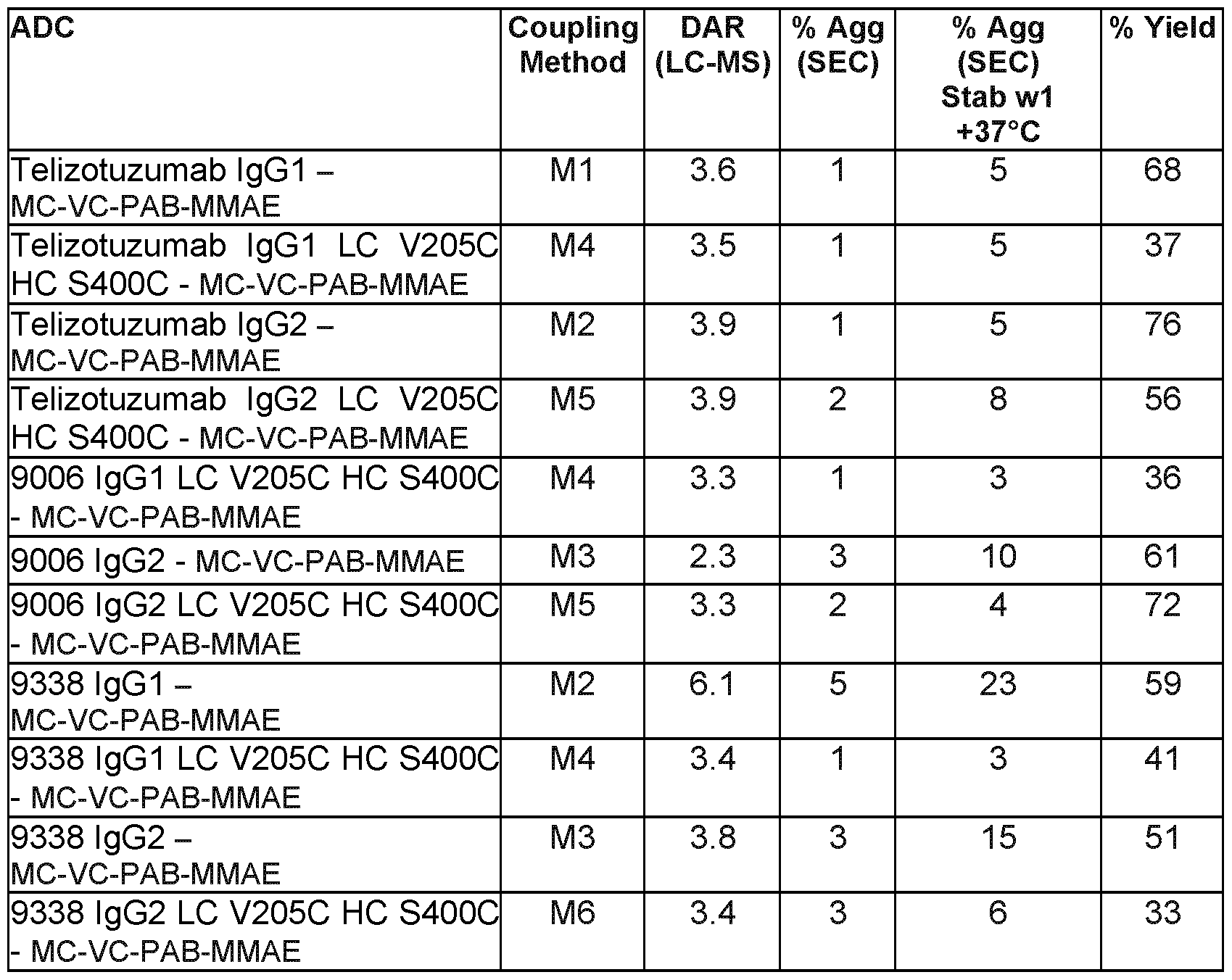
  • the present disclosure includes methods of producing the described ADCs (in Example 5 and Table 6).
  • the ADCs prepared may be subjected to a purification step.
  • the purification step may involve any biochemical methods known in the art for purifying proteins, or any combination of methods thereof.
  • THF tangential flow filtration
  • affinity chromatography affinity chromatography
  • ion exchange chromatography any charge or isoelectric point-based chromatography
  • mixed mode chromatography e.g., CHT (ceramic hydroxyapatite)
  • hydrophobic interaction chromatography size exclusion chromatography
  • dialysis filtration, selective precipitation, or any combination thereof.
  • the invention provides an antibody composition comprising an anti- MET antibody or antigen-binding portion thereof of this invention.
  • the invention provides an ADC composition comprising an anti- MET ADC wherein the ADC comprises an anti-MET antibody or antigen-binding portion thereof of this invention.
  • the composition is an antibody composition comprising an anti-MET antibody or an antigen-binding portion thereof selected from the group consisting of:
  • an anti-MET antibody or an antigen-binding portion thereof that competes for binding to human MET with an antibody having an H-CDR1 , H-CDR2, H-CDR3, L-CDR1, L-CDR2, and L-CDR3 that comprise or consist of the amino acid sequences of SEQ ID NOs: 1, 2, 3, 4, 5, and 6, respectively;
  • an anti-MET antibody or an antigen-binding portion thereof that competes for binding to human MET with an antibody having a heavy chain variable domain comprising or consisting of the amino acid sequence of SEQ ID NO: 7 and a light chain variable domain comprising or consisting of the amino acid sequence of SEQ ID NO: 8; and
  • the composition is an antibody composition or an ADC composition comprising an anti-MET antibody or an antigen-binding portion thereof selected from the group consisting of:
  • an anti-MET antibody or an antigen-binding portion thereof having an H- CDR1 , H-CDR2, and H-CDR3 comprising or consisting of the amino acid sequences of SEQ ID NOs: 1 , 2, and 3, respectively;
  • an anti-MET antibody or an antigen-binding portion thereof having an L- CDR1 , L-CDR2, and L-CDR3 comprising or consisting of the amino acid sequences of SEQ ID NOs: 4, 5, and 6, respectively;
  • an anti-MET antibody or antigen-binding portion thereof comprising at least two, three, four or five CDR sequences selected from the group consisting of H-CDR1 SEQ ID NO: 1, H-CDR2 SEQ ID NO: 2, H-CDR3 SEQ ID NO: 3, L-CDR1 SEQ ID NO: 4, L-CDR2 SEQ ID NO: 5, and L-CDR3 SEQ ID NO: 6;
  • an anti-MET antibody or an antigen-binding portion thereof having an H- CDR1, H-CDR2, and H-CDR3 comprising or consisting of the amino acid sequences of SEQ ID NOs: 1, 2, and 3, respectively, and an L-CDR1, L- CDR2, and L-CDR3 comprising or consisting of the amino acid sequences of SEQ ID NOs: 4, 5, and 6, respectively;
  • an anti-MET antibody or an antigen-binding portion thereof having a heavy chain variable domain comprising or consisting of the amino acid sequence of SEQ ID NO: 7;
  • an anti-MET antibody or an antigen-binding portion thereof having a light chain variable domain comprising or consisting of the amino acid sequence of SEQ ID NO: 8;
  • an anti-MET antibody or an antigen-binding portion thereof having a heavy chain variable domain comprising or consisting of the amino acid sequence of SEQ ID NO: 7 and a light chain variable domain comprising or consisting of the amino acid sequence of SEQ ID NO: 8;
  • an anti-MET antibody or an antigen-binding portion thereof having a heavy chain variable domain at least 91%, 92%, 93%, 94%, 95%, 96%, 97%, 98%, or 99% identical to the amino acid sequence of SEQ ID NO: 7 and a light chain variable domain at least 91%, 92%, 93%, 94%, 95%, 96%, 97%, 98%, or 99% identical to the amino acid sequence of SEQ ID NO: 8;
  • an anti-MET antibody or an antigen-binding portion thereof having a heavy chain comprising or consisting of the amino acid sequence of SEQ ID NO: 11 and a light chain comprising or consisting of the amino acid sequence of SEQ ID NO: 12;
  • an anti-MET antibody or an antigen-binding portion thereof having a heavy chain comprising or consisting of the amino acid sequence of SEQ ID NO: 13 and a light chain comprising or consisting of the amino acid sequence of SEQ ID NO: 14;
  • an anti-MET antibody or an antigen-binding portion thereof having a heavy chain at least 91%, 92%, 93%, 94%, 95%, 96%, 97%, 98%, or 99% identical to the amino acid sequence of SEQ ID NO: 11 and a light chain at least 91%, 92%, 93%, 94%, 95%, 96%, 97%, 98%, or 99% identical to the amino acid sequence of SEQ ID NO: 12; and
  • an anti-MET antibody or an antigen-binding portion thereof having a heavy chain at least 91%, 92%, 93%, 94%, 95%, 96%, 97%, 98%, or 99% identical to the amino acid sequence of SEQ ID NO: 13 and a light chain at least 91%, 92%, 93%, 94%, 95%, 96%, 97%, 98%, or 99% identical to the amino acid sequence of SEQ ID NO: 14.
  • the antibody composition comprises an anti-MET antibody or an antigen-binding portion thereof that competes for binding to human MET with an antibody having an H-CDR1, H-CDR2, H-CDR3, L-CDR1, L-CDR2, and L- CDR3 that comprise or consist of the amino acid sequences of SEQ ID NOs: 1 , 2, 3, 4, 5, and 6, respectively.
  • the antibody composition comprises an anti-MET antibody or an antigen-binding portion thereof that binds to the same epitope of human MET as an antibody having an H-CDR1, H-CDR2, H-CDR3, L-CDR1, L-CDR2, and L- CDR3 that comprise or consist of the amino acid sequences of SEQ ID NOs: 1, 2, 3, 4, 5, and 6, respectively.
  • the antibody composition comprises an anti-MET antibody or an antigen-binding portion thereof that competes for binding to human MET with an antibody having a heavy chain variable domain comprising or consisting of the amino acid sequence of SEQ ID NO: 7 and a light chain variable domain comprising or consisting of the amino acid sequence of SEQ ID NO: 8.
  • the antibody composition comprises an anti-MET antibody or an antigen-binding portion thereof that binds to the same epitope of human MET as an antibody having a heavy chain variable domain comprising or consisting of the amino acid sequence of SEQ ID NO: 7 and a light chain variable domain comprising or consisting of the amino acid sequence of SEQ ID NO: 8.
  • the composition is an antibody composition or an ADC composition comprising an anti-MET antibody or antigen-binding portion thereof that has an H-CDR1 , H-CDR2, and H-CDR3 comprising or consisting of the amino acid sequences of SEQ ID NOs: 1, 2, and 3, respectively.
  • the composition is an antibody composition or an ADC composition comprising an anti-MET antibody or antigen-binding portion thereof that has an L-CDR1 , L-CDR2, and L-CDR3 comprising or consisting of the amino acid sequences of SEQ ID NOS: 4, 5, and 6, respectively.
  • the composition is an antibody composition or an ADC composition comprising an anti-MET antibody or antigen-binding portion thereof that comprises at least two, three, four or five CDR sequences selected from the group consisting of H-CDR1 SEQ ID NO: 1 , H-CDR2 SEQ ID NO: 2, H-CDR3 SEQ ID NO: 3, L-CDR1 SEQ ID NO: 4, L-CDR2 SEQ ID NO: 5, and L-CDR3 SEQ ID NO: 6.
  • the composition is an antibody composition or an ADC composition comprising an anti-MET antibody or antigen-binding portion thereof that has an H-CDR1, H-CDR2, and H-CDR3 comprising or consisting of the amino acid sequences of SEQ ID NOs: 1 , 2, and 3, respectively, and an L-CDR1, L- CDR2, and L-CDR3 comprising or consisting of the amino acid sequences of SEQ ID NOS: 4, 5, and 6, respectively.
  • the composition is an antibody composition or an ADC composition comprising an anti-MET antibody or antigen-binding portion thereof that has a heavy chain variable domain comprising or consisting of the amino acid sequence of SEQ ID NO: 7 and a light chain variable domain comprising or consisting of the amino acid sequence of SEQ ID NO: 8.
  • the composition is an antibody composition or an ADC composition comprising an anti-MET antibody or antigen-binding portion thereof that has a heavy chain comprising or consisting of the amino acid sequence of SEQ ID NO: 11 and a light chain comprising or consisting of the amino acid sequence of SEQ ID NO: 12.
  • the composition is an antibody composition or an ADC composition comprising an anti-MET antibody or antigen-binding portion thereof that has a heavy chain comprising or consisting of the amino acid sequence of SEQ ID NO: 13 and a light chain comprising or consisting of the amino acid sequence of SEQ ID NO: 14.
  • the composition is an antibody composition or an ADC composition comprising an anti-MET antibody or antigen-binding portion thereof that has a heavy chain variable domain at least 91%, 92%, 93%, 94%, 95%, 96%, 97%, 98%, or 99% identical to the amino acid sequence of SEQ ID NO: 7 and a light chain variable domain at least 91%, 92%, 93%, 94%, 95%, 96%, 97%, 98%, or 99% identical to the amino acid sequence of SEQ ID NO: 8.
  • the composition is an antibody composition or an ADC composition comprising an anti-MET antibody or antigen-binding portion thereof that has a heavy chain at least 91%, 92%, 93%, 94%, 95%, 96%, 97%, 98%, or 99% identical to the amino acid sequence of SEQ ID NO: 11 and a light chain at least 91%, 92%, 93%, 94%, 95%, 96%, 97%, 98%, or 99% identical to the amino acid sequence of SEQ ID NO: 12.
  • the composition is an antibody composition or an ADC composition comprising an anti-MET antibody or antigen-binding portion thereof that has a heavy chain at least 91%, 92%, 93%, 94%, 95%, 96%, 97%, 98%, or 99% identical to the amino acid sequence of SEQ ID NO: 13 and a light chain at least 91%, 92%, 93%, 94%, 95%, 96%, 97%, 98%, or 99% identical to the amino acid sequence of SEQ ID NO: 14.
  • the invention provides a bispecific antibody composition comprising a bispecific antibody comprising an anti-MET antibody or antigen-binding portion thereof of this invention.
  • the bispecific antibody composition may comprise a bispecific binding molecule comprising the anti-MET antibody 8902.
  • the bispecific antibody composition comprises an anti-MET antibody or an antigenbinding portion thereof having an H-CDR1, H-CDR2, and H-CDR3 comprising or consisting of the amino acid sequences of SEQ ID NOs: 1 , 2, and 3, respectively, and/or an L-CDR1, L-CDR2, and L-CDR3 comprising or consisting of the amino acid sequences of SEQ ID NOs: 4, 5, and 6, respectively.
  • the bispecific antibody composition comprises an anti-MET antibody or an antigen-binding portion thereof having a heavy chain variable domain comprising or consisting of the amino acid sequence of SEQ ID NO: 7 and/or a light chain variable domain comprising or consisting of the amino acid sequence of SEQ ID NO: 8.
  • the bispecific antibody composition comprises an anti-MET antibody or an antigen-binding portion thereof having a heavy chain comprising or consisting of the amino acid sequence of SEQ ID NO: 11 and/or a light chain comprising or consisting of the amino acid sequence of SEQ ID NO: 12.
  • the bispecific antibody composition comprises an anti-MET antibody or an antigen-binding portion thereof having a heavy chain comprising or consisting of the amino acid sequence of SEQ ID NO: 13 and/or a light chain comprising or consisting of the amino acid sequence of SEQ ID NO: 14.
  • the bispecific antibody composition may comprise a bispecific binding molecule having a dual variable domain antibody, i.e., wherein the two arms of the antibody comprise two different variable domains, or may be in the form of an antibody fragment such as a bispecific Fab fragment or a bispecific scFv.
  • Such bispecific antibody composition may comprise bispecific binding molecules or polyvalent antibodies having the binding specificity of an anti-MET antibody or antigen-binding portion thereof described herein and the binding specificity of another antibody that targets a same or a different protein, such as an immune checkpoint protein, a cancer antigen, or a cell surface molecule whose activity mediates a disease condition such as cancer.
  • the bispecific antibody composition comprises a bispecific binding molecule that has the binding specificities of the first anti-Met antibody 8902 and a second antibody or antigen-binding portions thereof. In some embodiments, the bispecific antibody composition comprises a bispecific binding molecule having the binding specificities of the first anti-Met antibody 8902 and the second anti-Met antibody 9006 or antigen-binding portions thereof. In some embodiments, the bispecific antibody composition comprises a bispecific binding molecule having the binding specificities of the first anti-Met antibody 8902 and the second anti-Met antibody 9338 or antigen-binding portions thereof.
  • the present invention also provides nucleic acid molecules and sequences encoding anti-MET antibodies or antigen-binding portions thereof described herein.
  • different nucleic acid molecules encode the heavy chain and light chain amino acid sequences of the anti-MET antibody or an antigen-binding portion thereof.
  • the same nucleic acid molecule encodes the heavy chain and light chain amino acid sequences of the anti-MET antibody or an antigen-binding portion thereof.
  • a reference to a nucleotide sequence encompasses its complement unless otherwise specified. Thus, a reference to a nucleic acid having a particular sequence should be understood to encompass its complementary strand, with its complementary sequence.
  • polynucleotide as referred to herein means a polymeric form of nucleotides of at least 10 bases in length, either ribonucleotides or deoxynucleotides or a modified form of either type of nucleotide. The term includes single and double stranded forms.
  • FASTA which includes, e.g., the programs FASTA2 and FASTA3, provides alignments and percent sequence identity of the regions of the best overlap between the query and search sequences (Pearson, Methods Enzymol. 183:63-98 (1990); Pearson, Methods Mol. Biol. 132:185-219 (2000); Pearson, Methods Enzymol. 266:227-258 (1996); Pearson, J. Mol. Biol. 276:71-84 (1998)). Unless otherwise specified, default parameters for a particular program or algorithm are used. For instance, percent sequence identity between nucleic acid sequences can be determined using FASTA with its default parameters (a word size of 6 and the NOPAM factor for the scoring matrix) or using Gap with its default parameters as provided in GCG Version 6.1.
  • the invention provides a nucleic acid molecule comprising a nucleotide sequence of SEQ ID NOs: 9 or 10.
  • the nucleic acid molecule may comprise the nucleotide sequences of SEQ ID NOs: 9 and 10.
  • the nucleic acid molecules may be isolated.
  • the present invention provides a vector suitable for expressing one of the chains of an antibody or antigen-binding portion thereof as described herein.
  • the term “vector”, as used herein, means a nucleic acid molecule capable of transporting another nucleic acid to which it has been linked.
  • the vector is a plasmid, i.e., a circular double stranded piece of DNA into which additional DNA segments may be ligated.
  • the vector is a viral vector, wherein additional DNA segments may be ligated into the viral genome.
  • the vectors are capable of autonomous replication in a host cell into which they are introduced (e.g., bacterial vectors having a bacterial origin of replication and episomal mammalian vectors).
  • the vectors e.g., non-episomal mammalian vectors
  • the vectors can be integrated into the genome of a host cell upon introduction into the host cell, and thereby are replicated along with the host genome.
  • certain vectors are capable of directing the expression of genes to which they are operatively linked. Such vectors are referred to herein as “recombinant expression vectors” (or simply, “expression vectors”).
  • the invention provides vectors comprising nucleic acid molecules that encode the heavy chain of an anti-MET antibody of the invention or an antigen-binding portion thereof, the light chain of an anti-MET antibody of the invention or an antigenbinding portion thereof, or both the heavy and light chains of an anti-MET antibody of the invention or an antigen-binding portion thereof.
  • the invention further provides vectors comprising nucleic acid molecules encoding fusion proteins, modified antibodies, antibody fragments, and probes thereof.
  • a nucleic acid molecule encoding the heavy and/or light chain of an anti-MET antibody or portion thereof can be isolated from any source that produces such an antibody or portion.
  • the nucleic acid molecules are isolated from B cells that express an anti-MET antibody isolated from an animal immunized with a human MET antigen, or from an immortalized cell produced from such a B cell. Methods of isolating nucleic acids encoding an antibody are well- known in the art.
  • mRNA may be isolated and used to produce cDNA for use in polymerase chain reaction (PCR) or cDNA cloning of antibody genes.
  • PCR polymerase chain reaction
  • a nucleic acid molecule of the invention can be synthesized rather than isolated.
  • a nucleic acid molecule of the invention can comprise a nucleotide sequence encoding a VH domain from an anti-MET antibody or antigen-binding portion of the invention joined in-frame to a nucleotide sequence encoding a heavy chain constant domain from any source.
  • a nucleic acid molecule of the invention can comprise a nucleotide sequence encoding a VL domain from an anti-MET antibody or antigen-binding portion of the invention joined in-frame to a nucleotide sequence encoding a light chain constant domain from any source.
  • nucleic acid molecules encoding the variable domain of the heavy (VH) and/or light (VL) chains may be “converted” to full-length antibody genes.
  • nucleic acid molecules encoding the VH or VL domains are converted to full-length antibody genes by insertion into an expression vector already encoding heavy chain constant (CH) or light chain constant (CL) domains, respectively, such that the VH segment is operatively linked to the CH segment(s) within the vector, and/or the VL segment is operatively linked to the CL segment within the vector.
  • CH heavy chain constant
  • CL light chain constant
  • nucleic acid molecules encoding the VH and/or VL domains are converted into full- length antibody genes by linking, e.g., ligating, a nucleic acid molecule encoding a VH and/or VL domains to a nucleic acid molecule encoding a CH and/or CL domain using standard molecular biological techniques. Nucleic acid molecules encoding the full-length heavy and/or light chains may then be expressed from a cell into which they have been introduced and the anti-MET antibody isolated.
  • the nucleic acid molecules may be used to recombinantly express large quantities of anti-MET antibodies.
  • the nucleic acid molecules also may be used to produce chimeric antibodies, bispecific antibodies, single chain antibodies, immunoadhesins, diabodies, mutated antibodies and antibody derivatives, as described herein.
  • a nucleic acid molecule of the invention is used as a probe or PCR primer for a specific antibody sequence.
  • the nucleic acid can be used as a probe in diagnostic methods or as a PCR primer to amplify regions of DNA that could be used, inter alia, to isolate additional nucleic acid molecules encoding variable domains of anti-MET antibodies.
  • the nucleic acid molecules are oligonucleotides. In some embodiments, the oligonucleotides are from highly variable domains of the heavy and light chains of the antibody of interest.
  • the oligonucleotides encode all or a part of one or more of the CDRs of the anti-MET antibodies or antigen-binding portions thereof of the invention as described herein.
  • the nucleic acid molecules and vectors may be used to make mutated anti-MET antibodies.
  • the antibodies may be mutated in the variable domains of the heavy and/or light chains, e.g., to alter a binding property of the antibody.
  • a mutation may be made in one or more of the CDR regions to increase or decrease the KD of the anti-MET antibody, to increase or decrease k O ff, or to alter the binding specificity of the antibody.
  • one or more mutations are made at an amino acid residue that is known to be changed compared to the germline in a monoclonal antibody of the invention.
  • the mutations may be made in a CDR region or framework region of a variable domain, or in a constant domain.
  • the mutations are made in a variable domain.
  • one or more mutations are made at an amino acid residue that is known to be changed compared to the germline in a CDR region or framework region of a variable domain of an antibody or antigen-binding portion thereof of the invention.
  • the framework region(s) are mutated so that the resulting framework region(s) have the amino acid sequence of the corresponding germline gene.
  • a mutation may be made in a framework region or constant domain to increase the half-life of the anti-MET antibody. See, e.g., PCT Publication WO 00/09560.
  • a mutation in a framework region or constant domain also can be made to alter the immunogenicity of the antibody, and/or to provide a site for covalent or non-covalent binding to another molecule.
  • a single antibody may have mutations in any one or more of the CDRs or framework regions of the variable domain or in the constant domain.
  • the anti-MET antibodies of the invention or antigen-binding portions thereof are expressed by inserting DNAs encoding partial or full-length light and heavy chains, obtained as described above, into expression vectors such that the genes are operatively linked to necessary expression control sequences such as transcriptional and translational control sequences.
  • Expression vectors include plasmids, retroviruses, adenoviruses, adeno-associated viruses (AAV), plant viruses such as cauliflower mosaic virus, tobacco mosaic virus, cosmids, YACs, EBV derived episomes, and the like.
  • the antibody gene may be ligated into a vector such that transcriptional and translational control sequences within the vector serve their intended function of regulating the transcription and translation of the antibody gene.
  • the expression vector and expression control sequences may be chosen to be compatible with the expression host cell used.
  • the antibody light chain gene and the antibody heavy chain gene can be inserted into separate vectors. In one embodiment, both genes are inserted into the same expression vector.
  • the antibody genes may be inserted into the expression vector by standard methods (e.g., ligation of complementary restriction sites on the antibody gene fragment and vector, or blunt end ligation if no restriction sites are present).
  • a convenient vector is one that encodes a functionally complete human CH or CL immunoglobulin sequence, with appropriate restriction sites engineered so that any VH or VL sequence can easily be inserted and expressed, as described above.
  • splicing usually occurs between the splice donor site in the inserted J region and the splice acceptor site preceding the human C domain, and also at the splice regions that occur within the human CH exons. Polyadenylation and transcription termination may occur at native chromosomal sites downstream of the coding regions.
  • the recombinant expression vector also can encode a signal peptide that facilitates secretion of the antibody chain from a host cell.
  • the antibody chain gene may be cloned into the vector such that the signal peptide is linked in-frame to the amino terminus of the immunoglobulin chain.
  • the signal peptide can be an immunoglobulin signal peptide or a heterologous signal peptide (i.e. , a signal peptide from a non-immunoglobulin protein).
  • the recombinant expression vectors of the invention may carry regulatory sequences that control the expression of the antibody chain genes in a host cell. It will be appreciated by those skilled in the art that the design of the expression vector, including the selection of regulatory sequences, may depend on such factors as the choice of the host cell to be transformed, the level of expression of protein desired, etc.
  • Preferred regulatory sequences for mammalian host cell expression include viral elements that direct high levels of protein expression in mammalian cells, such as promoters and/or enhancers derived from retroviral LTRs, cytomegalovirus (CMV) (such as the CMV promoter/enhancer), Simian Virus 40 (SV40) (such as the SV40 promoter/enhancer), adenovirus, (e.g., the adenovirus major late promoter (AdMLP)), polyoma and strong mammalian promoters such as native immunoglobulin and actin promoters.
  • CMV cytomegalovirus
  • SV40 Simian Virus 40
  • AdMLP adenovirus major late promoter
  • polyoma e.g., the adenovirus major late promoter (AdMLP)
  • AdMLP adenovirus major late promoter
  • polyoma such as native immunoglobulin and actin promoters.
  • viral regulatory elements for further description of viral regulatory elements, and sequences thereof, see e.g., US Patents 5,168,062, 4,510,245 and 4,968,615.
  • Methods for expressing antibodies in plants including a description of promoters and vectors, as well as transformation of plants, are known in the art. See, e.g., US Patent 6,517,529.
  • Methods of expressing polypeptides in bacterial cells or fungal cells, e.g., yeast cells are also well known in the art.
  • the recombinant expression vectors of the invention may carry additional sequences, such as sequences that regulate replication of the vector in host cells (e.g., origins of replication) and selectable marker genes.
  • the selectable marker gene facilitates selection of host cells into which the vector has been introduced (see e.g., US Patents 4,399,216, 4,634,665 and 5,179,017).
  • the selectable marker gene confers resistance to drugs, such as G418, hygromycin or methotrexate, on a host cell into which the vector has been introduced.
  • selectable marker genes include the dihydrofolate reductase (DHFR) gene (for use in dhfr-host cells with methotrexate selection/amplification), the neo gene (for G418 selection), and the glutamate synthetase gene.
  • DHFR dihydrofolate reductase
  • expression control sequence means polynucleotide sequences that are necessary to effect the expression and processing of coding sequences to which they are ligated.
  • Expression control sequences include appropriate transcription initiation, termination, promoter and enhancer sequences; efficient RNA processing signals such as splicing and polyadenylation signals; sequences that stabilize cytoplasmic mRNA; sequences that enhance translation efficiency (i.e., Kozak consensus sequence); sequences that enhance protein stability; and when desired, sequences that enhance protein secretion.
  • control sequences differs depending upon the host organism; in prokaryotes, such control sequences generally include promoter, ribosomal binding site, and transcription termination sequence; in eukaryotes, generally, such control sequences include promoters and transcription termination sequence.
  • control sequences is intended to include, at a minimum, all components whose presence is essential for expression and processing, and can also include additional components whose presence is advantageous, for example, leader sequences and fusion partner sequences.
  • the invention provides methods for producing a cell line that produces a human monoclonal antibody or an antigen-binding portion thereof directed against MET, comprising (a) immunizing a non-human transgenic animal with MET, a portion of MET or a cell or tissue expressing MET; (b) allowing the transgenic animal to mount an immune response to MET; (c) isolating antibody- producing cells from the transgenic animal; (d) immortalizing the antibodyproducing cells; (e) creating individual monoclonal populations of the immortalized antibody-producing cells; and (f) screening the immortalized antibody-producing cells to identify an antibody directed against MET.
  • the invention provides a cell line that produces a human anti- MET antibody.
  • the cell line is a hybridoma cell line.
  • the hybridomas are mouse hybridomas, as described above.
  • the hybridomas are produced in a non-human, non-mouse species such as rats, sheep, pigs, goats, cattle or horses.
  • the hybridomas are human hybridomas.
  • a transgenic animal is immunized with an MET antigen
  • primary cells e.g., spleen or peripheral blood B cells
  • individual cells producing antibodies specific for the desired antigen are identified.
  • Polyadenylated mRNA from each individual cell is isolated and reverse transcription polymerase chain reaction (RT-PCR) is performed using sense primers that anneal to variable domain sequences, e.g., degenerate primers that recognize most or all of the FR1 regions of human heavy and light chain variable domain genes and anti-sense primers that anneal to constant or joining region sequences.
  • RT-PCR reverse transcription polymerase chain reaction
  • cDNAs of the heavy and light chain variable domains are then cloned and expressed in any suitable host cell, e.g., a myeloma cell, as chimeric antibodies with respective immunoglobulin constant regions, such as the heavy chain and K or A constant domains. See Babcook et al., Proc Natl Acad Sci USA 93:7843-48 (1996). Anti-MET antibodies may then be identified and isolated as described herein.
  • the invention provides a method for producing an anti-MET antibody or antigenbinding portion thereof comprising the steps of synthesizing a library of human antibodies on phage, screening the library with MET or an antibody-binding portion thereof, isolating phage that bind to MET, and obtaining the antibody from the phage.
  • one method for preparing the library of antibodies for use in phage display techniques comprises the steps of immunizing a non-human animal with MET or an antigenic portion thereof to create an immune response, extracting antibody-producing cells from the immunized animal; isolating RNA encoding heavy and light chains of antibodies of the invention from the extracted cells, reverse transcribing the RNA to produce cDNA, amplifying the cDNA using primers, and inserting the cDNA into a phage display vector such that antibodies are expressed on the phage.
  • Recombinant anti-MET antibodies of the invention may be obtained in this way.
  • Recombinant human anti-MET antibodies of the invention can be isolated by screening a recombinant combinatorial antibody library.
  • the library is a scFv phage display library, generated using human VL and VH cDNAs prepared from mRNA isolated from B cells. Methods for preparing and screening such libraries are known in the art. Kits for generating phage display libraries are commercially available (e.g., the Pharmacia Recombinant Phage Antibody System, catalog no. 27-9400-01; and the Stratagene SurfZAPTM phage display kit, catalog no. 240612). There also are other methods and reagents that can be used in generating and screening antibody display libraries (see, e.g., U.S.
  • a human anti-MET antibody as described herein is first used to select human heavy and light chain sequences having similar binding activity toward MET, using the epitope imprinting methods described in PCT Publication WO 93/06213, incorporated herein by reference.
  • the antibody libraries used in this method are preferably scFv libraries prepared and screened as described in PCT Publication WO 92/01047, McCafferty et al., Nature 348:552-554 (1990); and Griffiths et al., EMBO J 12:725-734 (1993).
  • the scFv antibody libraries preferably are screened using human MET as the antigen.
  • VL and VH segments of the preferred VL/VH pair(s) can be randomly mutated, preferably within the CDR3 region of VH and/or VL, in a process analogous to the in vivo somatic mutation process responsible for affinity maturation of antibodies during a natural immune response.
  • This in vitro affinity maturation can be accomplished by amplifying VH and VL domains using PCR primers complimentary to the VH CDR3 or VL CDR3, respectively, which primers have been “spiked” with a random mixture of the four nucleotide bases at certain positions such that the resultant PCR products encode VH and VL segments into which random mutations have been introduced into the VH and/or VL CDR3 regions. These randomly mutated VH and VL segments can be re-screened for binding to MET.
  • nucleic acids encoding the selected antibody can be recovered from the display package (e.g., from the phage genome) and subcloned into other expression vectors by standard recombinant DNA techniques. If desired, the nucleic acid can further be manipulated to create other antibody forms of the invention, as described herein.
  • the DNA encoding the antibody is cloned into a recombinant expression vector and introduced into a mammalian host cell, as described herein.
  • An additional aspect of the invention relates to methods for producing the antibody compositions and antibodies and antigen-binding portions thereof of the invention.
  • One embodiment of this aspect of the invention relates to a method for producing an antibody as defined herein, comprising providing a recombinant host cell capable of expressing the antibody, cultivating said host cell under conditions suitable for expression of the antibody, and isolating the resulting antibody.
  • Antibodies produced by such expression in such recombinant host cells are referred to herein as “recombinant antibodies”.
  • the invention also provides progeny cells of such host cells, and antibodies produced by same.
  • the term “recombinant host cell” (or simply “host cell”), as used herein, means a cell into which a recombinant expression vector has been introduced.
  • the invention provides host cells that may comprise, e.g., a vector according to the invention described above.
  • the invention also provides host cells that comprise, e.g., a nucleotide sequence encoding the heavy chain or an antigen-binding portion thereof, a nucleotide sequence encoding the light chain or an antigenbinding portion thereof, or both, of an anti-MET antibody or antigen-binding portion thereof of the invention.
  • “recombinant host cell” and “host cell” mean not only the particular subject cell but also the progeny of such a cell. Because certain modifications may occur in succeeding generations due to either mutation or environmental influences, such progeny may not, in fact, be identical to the parent cell, but are still included within the scope of the term “host cell” as used herein.
  • Nucleic acid molecules encoding anti-MET antibodies and vectors comprising these nucleic acid molecules can be used for transfection of a suitable mammalian, plant, bacterial or yeast host cell. Transformation can be by any known method for introducing polynucleotides into a host cell. Methods for introduction of heterologous polynucleotides into mammalian cells are well known in the art and include dextran-mediated transfection, calcium phosphate precipitation, polybrene-mediated transfection, protoplast fusion, electroporation, encapsulation of the polynucleotide(s) in liposomes, and direct microinjection of the DNA into nuclei. In addition, nucleic acid molecules may be introduced into mammalian cells by viral vectors.
  • Methods of transforming cells are well known in the art. See, e.g., US Patents 4,399,216, 4,912,040, 4,740,461, and 4,959,455.
  • Methods of transforming plant cells are well known in the art, including, e.g., Agrobacterium-mediated transformation, biolistic transformation, direct injection, electroporation and viral transformation.
  • Methods of transforming bacterial and yeast cells are also well known in the art.
  • Mammalian cell lines available as hosts for expression are well known in the art and include many immortalized cell lines available from the American Type Culture Collection (ATCC). These include, inter alia, Chinese hamster ovary (CHO) cells, NSO cells, SP2 cells, HEK-293T cells, 293 Freestyle cells (Invitrogen), NIH-3T3 cells, HeLa cells, baby hamster kidney (BHK) cells, African green monkey kidney cells (COS), human hepatocellular carcinoma cells (e.g., Hep G2), A549 cells, and a number of other cell lines. Cell lines of particular preference are selected through determining which cell lines have high expression levels. Other cell lines that may be used are insect cell lines, such as Sf9 or Sf21 cells.
  • the antibodies When recombinant expression vectors encoding antibody genes are introduced into mammalian host cells, the antibodies are produced by culturing the host cells for a period of time sufficient to allow for expression of the antibody in the host cells or, more preferably, secretion of the antibody into the culture medium in which the host cells are grown. Antibodies can be recovered from the culture medium using standard protein purification methods.
  • Plant host cells include, e.g., Nicotiana, Arabidopsis, duckweed, corn, wheat, potato, etc.
  • Bacterial host cells include E. coli and Streptomyces species.
  • Yeast host cells include Schizosaccharomyces pombe, Saccharomyces cerevisiae and Pichia pastoris.
  • the glutamine synthetase gene expression system (the GS system) is a common approach for enhancing expression under certain conditions.
  • the GS system is discussed in whole or part in connection with EP patents 0216 846, 0256 055, 0 323 997 and 0 338 841.
  • An antibody or antigen-binding portion thereof or antibody composition of the present invention may be produced by methods generally known in the art for production of recombinant monoclonal or polyclonal antibodies.
  • any method known in the art for production of recombinant monoclonal antibodies may be used.
  • the individual antibodies may be produced separately, i.e., each antibody being produced in a separate bioreactor, or the individual antibodies may be produced together in single bioreactor. If the antibody composition is produced in more than one bioreactor, the purified antibody composition can be obtained by pooling the antibodies obtained from individually purified supernatants from each bioreactor.
  • Various approaches for production of a polyclonal antibody composition in multiple bioreactors, where the cell lines or antibody preparations are combined at a later point upstream or prior to or during downstream processing, are described in WO 2009/129814.
  • WO 2004/061104 In the case of producing individual antibodies in a single bioreactor, this may be performed, e.g., as described in WO 2004/061104 or WO 2008/145133.
  • the method described in WO 2004/061104 is based on site-specific integration of the antibody coding sequence into the genome of the individual host cells, while the method of WO 2008/145133 involves an alternative approach using random integration to produce antibodies in a single bioreactor.
  • Anti-MET antibodies and antigen-binding portions thereof of the invention also can be produced transgenically through the generation of a mammal or plant that is transgenic for the immunoglobulin heavy and light chain sequences of interest and production of the antibody in a recoverable form therefrom.
  • anti-MET antibodies and portions can be produced in, and recovered from, the milk of goats, cows, or other mammals. See, e.g., US patents 5,827,690, 5,756,687, 5,750,172, and 5,741 ,957.
  • non-human transgenic animals that comprise human immunoglobulin loci are immunized with human MET or an immunogenic portion thereof, as described above. Methods for making antibodies in plants are described, e.g., in US patents 6,046,037 and 5,959,177.
  • non-human transgenic animals or plants are produced by introducing one or more nucleic acid molecules encoding an anti-MET antibody or antigen-binding portion thereof of the invention (e.g., any of the above-described nucleic acid molecules encoding an anti-MET antibody or antigen-binding portion thereof) into the animal or plant by standard transgenic techniques. See, e.g., US Patent 6,417,429.
  • the transgenic cells used for making the transgenic animal can be embryonic stem cells or somatic cells or a fertilized egg.
  • the transgenic non- human organisms can be chimeric, nonchimeric heterozygotes, and nonchimeric homozygotes.
  • the transgenic non-human animals have a targeted disruption and replacement by a targeting construct that encodes a heavy chain and/or a light chain of interest.
  • the non-human transgenic animals or plants may comprise, e.g., a nucleotide sequence encoding the heavy chain or an antigen-binding portion thereof, a nucleotide sequence encoding the light chain or an antigen-binding portion thereof, or both, of an anti-MET antibody of the invention.
  • the transgenic animals comprise and express nucleic acid molecules encoding heavy and light chains, or antigenbinding portions thereof, that specifically bind to human MET.
  • the anti-MET antibodies or portions may be made in any transgenic animal.
  • the non-human animals are mice, rats, sheep, pigs, goats, cattle or horses.
  • the non-human transgenic animal may express said encoded polypeptides in, e.g., blood, milk, urine, saliva, tears, mucus and other bodily fluids.
  • compositions comprising as an active ingredient (or as the sole active ingredient) an anti-MET antibody or antigen-binding portion thereof, an ADC comprising an anti-MET antibody or antigen-binding portion thereof, or an anti-MET antibody composition or an anti- MET antibody comprising ADC composition of the invention.
  • the compositions are intended for amelioration, prevention, and/or treatment of a MET-mediated disorder (e.g., a disorder characterized by overexpression of MET) and/or cancer.
  • compositions are intended for amelioration, prevention, and/or treatment of non-small cell lung cancer, gastric cancer, hepatocellular carcinoma, oesophageal cancer, colorectal cancer, kidney papillary cell cancer, glioblastoma, renal cell carcinoma, prostate cancer, and/or adrenocortical carcinoma.
  • the antibodies of the invention or antigen-binding portions thereof are suitable to be administered as a formulation in association with one or more pharmaceutically acceptable excipient(s).
  • excipient is used herein to describe any ingredient other than the compound(s) of the invention. The choice of excipient(s) will to a large extent depend on factors such as the particular mode of administration, the effect of the excipient on solubility and stability, and the nature of the dosage form.
  • pharmaceutically acceptable excipient includes any and all solvents, dispersion media, coatings, antibacterial and antifungal agents, isotonic and absorption delaying agents, and the like that are physiologically compatible.
  • compositions examples include water, saline, phosphate buffered saline, dextrose, glycerol, ethanol and the like, as well as combinations thereof.
  • isotonic agents for example, sugars, polyalcohols such as mannitol, sorbitol, or sodium chloride in the composition.
  • additional examples of pharmaceutically acceptable substances are wetting agents or minor amounts of auxiliary substances such as wetting or emulsifying agents, preservatives or buffers, which enhance the shelf life or effectiveness of the antibody.
  • compositions of the present invention and methods for their preparation will be readily apparent to those skilled in the art. Such compositions and methods for their preparation may be found, for example, in Remington’s Pharmaceutical Sciences, 19th Edition (Mack Publishing Company, 1995). Pharmaceutical compositions are preferably manufactured under GMP (good manufacturing practices) conditions.
  • a pharmaceutical composition of the invention may be prepared, packaged, or sold in bulk, as a single unit dose, or as a plurality of single unit doses.
  • a “unit dose” is a discrete amount of the pharmaceutical composition comprising a predetermined amount of the active ingredient.
  • the amount of the active ingredient is generally equal to the dosage of the active ingredient which would be administered to a subject or a convenient fraction of such a dosage such as, for example, one-half or one-third of such a dosage.
  • Any method for administering peptides, proteins or antibodies accepted in the art may suitably be employed for the antibodies and antigen-binding portions of the invention.
  • parenteral administration of a pharmaceutical composition includes any route of administration characterized by physical breaching of a tissue of a subject and administration of the pharmaceutical composition through the breach in the tissue, thus generally resulting in the direct administration into the blood stream, into muscle, or into an internal organ.
  • Parenteral administration thus includes, but is not limited to, administration of a pharmaceutical composition by injection of the composition, by application of the composition through a surgical incision, by application of the composition through a tissue-penetrating non-surgical wound, and the like.
  • parenteral administration is contemplated to include, but is not limited to, subcutaneous, intraperitoneal, intramuscular, intrasternal, intravenous, intraarterial, intrathecal, intraventricular, intraurethral, intracranial, intrasynovial injection or infusions; and kidney dialytic infusion techniques. Regional perfusion is also contemplated. Preferred embodiments include the intravenous and the subcutaneous routes.
  • Formulations of a pharmaceutical composition suitable for parenteral administration typically comprise the active ingredient combined with a pharmaceutically acceptable carrier, such as sterile water or sterile isotonic saline. Such formulations may be prepared, packaged, or sold in a form suitable for bolus administration or for continuous administration. Injectable formulations may be prepared, packaged, or sold in unit dosage form, such as in ampoules or in multi-dose containers containing a preservative. Formulations for parenteral administration include, but are not limited to, suspensions, solutions, emulsions in oily or aqueous vehicles, pastes, and the like. Such formulations may further comprise one or more additional ingredients including, but not limited to, suspending, stabilizing, or dispersing agents.
  • a pharmaceutically acceptable carrier such as sterile water or sterile isotonic saline.
  • Such formulations may be prepared, packaged, or sold in a form suitable for bolus administration or for continuous administration.
  • injectable formulations may be prepared, packaged, or sold in unit dosage
  • the active ingredient is provided in dry (i.e., powder or granular) form for reconstitution with a suitable vehicle (e.g., sterile pyrogen-free water) prior to parenteral administration of the reconstituted composition.
  • a suitable vehicle e.g., sterile pyrogen-free water
  • Parenteral formulations also include aqueous solutions which may contain excipients such as salts, carbohydrates and buffering agents (preferably to a pH of from 3 to 9), but, for some applications, they may be more suitably formulated as a sterile non-aqueous solution or as a dried form to be used in conjunction with a suitable vehicle such as sterile, pyrogen-free water.
  • parenteral administration forms include solutions or suspensions in sterile aqueous solutions, for example, aqueous propylene glycol or dextrose solutions. Such dosage forms can be suitably buffered, if desired.
  • Other parentally-administrable formulations which are useful include those which comprise the active ingredient in microcrystalline form, or in a liposomal preparation.
  • Formulations for parenteral administration may be formulated to be immediate and/or modified release. Modified release formulations include delayed-, sustained-, pulsed-, controlled-, targeted and programmed release.
  • sterile injectable solutions can be prepared by incorporating the anti-MET antibody or antigen-binding portion thereof or anti-MET antibody composition in the required amount in an appropriate solvent with one or a combination of ingredients enumerated above, as required, followed by filtered sterilization.
  • dispersions are prepared by incorporating the active compound into a sterile vehicle that contains a basic dispersion medium and the required other ingredients from those enumerated above.
  • the preferred methods of preparation are vacuum drying and freeze-drying that yields a powder of the active ingredient plus any additional desired ingredient from a previously sterile-filtered solution thereof.
  • the proper fluidity of a solution can be maintained, for example, by the use of a coating such as lecithin, by the maintenance of the required particle size in the case of dispersion and by the use of surfactants.
  • Prolonged absorption of injectable compositions can be brought about by including in the composition an agent that delays absorption, for example, monostearate salts and gelatin, and/or by using modified-release coatings (e.g., slow-release coatings).
  • the antibodies of the invention can also be administered intranasally or by inhalation, typically in the form of a dry powder (either alone, as a mixture, or as a mixed component particle, for example, mixed with a suitable pharmaceutically acceptable excipient) from a dry powder inhaler, as an aerosol spray from a pressurised container, pump, spray, atomiser (preferably an atomiser using electrohydrodynamics to produce a fine mist), or nebuliser, with or without the use of a suitable propellant, or as nasal drops.
  • a dry powder either alone, as a mixture, or as a mixed component particle, for example, mixed with a suitable pharmaceutically acceptable excipient
  • atomiser preferably an atomiser using electrohydrodynamics to produce a fine mist
  • nebuliser preferably an atomiser using electrohydrodynamics to produce a fine mist
  • the pressurised container, pump, spray, atomizer, or nebuliser generally contains a solution or suspension of an antibody of the invention comprising, for example, a suitable agent for dispersing, solubilising, or extending release of the active, a propellant(s) as solvent.
  • a suitable agent for dispersing, solubilising, or extending release of the active, a propellant(s) as solvent Prior to use in a dry powder or suspension formulation, the drug product is generally micronised to a size suitable for delivery by inhalation (typically less than 5 microns). This may be achieved by any appropriate comminuting method, such as spiral jet milling, fluid bed jet milling, supercritical fluid processing to form nanoparticles, high pressure homogenisation, or spray drying.
  • Capsules, blisters and cartridges for use in an inhaler or insufflator may be formulated to contain a powder mix of the compound of the invention, a suitable powder base and a performance modifier.
  • a suitable solution formulation for use in an atomiser using electrohydrodynamics to produce a fine mist may contain a suitable dose of the antibody of the invention per actuation and the actuation volume may for example vary from 1 pL to 100 pL.
  • Suitable flavours, such as menthol and levomenthol, or sweeteners, such as saccharin or saccharin sodium, may be added to those formulations of the invention intended for inhaled/intranasal administration.
  • Formulations for inhaled/intranasal administration may be formulated to be immediate and/or modified release.
  • Modified release formulations include delayed- , sustained-, pulsed-, controlled-, targeted and programmed release.
  • the dosage unit is determined by means of a valve which delivers a metered amount.
  • Units in accordance with the invention are typically arranged to administer a metered dose or “puff” of an antibody of the invention.
  • the overall daily dose will typically be administered in a single dose or, more usually, as divided doses throughout the day.
  • the antibodies and antibody portions of the invention may also be formulated for an oral route administration.
  • Oral administration may involve swallowing, so that the compound enters the gastrointestinal tract, and/or buccal, lingual, or sublingual administration by which the compound enters the blood stream directly from the mouth.
  • Formulations suitable for oral administration include solid, semi-solid and liquid systems such as tablets; soft or hard capsules containing multi- or nanoparticulates, liquids, or powders; lozenges (including liquid-filled); chews; gels; fast dispersing dosage forms; films; ovules; sprays; and buccal/mucoadhesive patches.
  • Liquid formulations include suspensions, solutions, syrups and elixirs. Such formulations may be employed as fillers in soft or hard capsules (made, for example, from gelatin or hydroxypropylmethylcellulose) and typically comprise a carrier, for example, water, ethanol, polyethylene glycol, propylene glycol, methylcellulose, or a suitable oil, and one or more emulsifying agents and/or suspending agents. Liquid formulations may also be prepared by the reconstitution of a solid, for example, from a sachet.
  • antibody compositions and antibodies and antigen-binding portions thereof of the invention is in the form of immunoconjugates, i.e., antibodies or antigen-binding portions conjugated to one or more agents such as anti-cancer agents.
  • anti-cancer agents may be conjugated to the antibodies of the invention, including cytotoxic agents (e.g., conventional chemotherapy agents and other small molecule anti-cancer drugs), cytokines (in which case the conjugate may be termed an “immunocytokine”), toxins (in which case the conjugate may be termed an “immunotoxin”) and radionuclides.
  • cytotoxic agents e.g., conventional chemotherapy agents and other small molecule anti-cancer drugs
  • cytokines in which case the conjugate may be termed an “immunocytokine”
  • toxins in which case the conjugate may be termed an “immunotoxin”
  • radionuclides radionuclides.
  • immunoconjugates have already been approved for clinical use. These include Zevalin® (a murine anti- CD20 antibody conjugated to 90 Y), Bexxar® (a murine anti-CD20 antibody conjugated to 131 1) and Mylotarg® (a humanized anti-CD33 antibody conjug
  • immunoconjugates that have been tested in clinical trials include antibodies conjugated to, e.g., doxorubicin or a maytansinoid compound.
  • Immunotoxins that have been tested in clinical trials include several antibodies conjugated to a truncated Pseudomonas exotoxin A.
  • An immunocytokine comprising a humanized EpCAM antibody conjugated to IL-2 has also been tested.
  • antibodies of the invention conjugated to cytotoxic agents may belong, e.g., to any of the major classes of chemotherapy drugs, including alkylating agents (e.g., carboplatin, cisplatin, oxaliplatin), antimetabolites (e.g., methotrexate, capecitabine, gemcitabine), anthracyclines (e.g., bleomycin, doxorubicin, mitomycin-C) and plant alkaloids (e.g., taxanes such as docetaxel and paclitaxel, and vinca alkaloids such as vinblastine, vincristine and vinorelbine).
  • alkylating agents e.g., carboplatin, cisplatin, oxaliplatin
  • antimetabolites e.g., methotrexate, capecitabine, gemcitabine
  • anthracyclines e.g., bleomycin, doxorubicin, mitomycin-C
  • immunoconjugates based on the antibodies of the invention may advantageously be based on highly cytotoxic agents such as calicheamicin or maytansine derivatives, or on toxins such as bacterial toxins (e.g., Pseudomonas exotoxin A, diphtheria toxin) or plant toxins (e.g., ricin).
  • highly cytotoxic agents such as calicheamicin or maytansine derivatives
  • toxins such as bacterial toxins (e.g., Pseudomonas exotoxin A, diphtheria toxin) or plant toxins (e.g., ricin).
  • the conjugated anti-cancer agent in an immunoconjugate is generally linked to the antibody by means of a labile linker that is relatively stable in serum but which allows release of the agent when the immunoconjugate is internalized into the target cell.
  • Suitable linkers include, for example, chemical linkers that are stable at neutral pH in serum but are subjected to acid hydrolysis in the mildly acidic conditions within the lysosomes subsequent to internalization, disulfide linkers that are cleaved by intracellular thiols, and peptide linkers that are stable in serum but which are subjected to enzymatic cleavage in intracellular compartments.
  • the anti-MET antibodies and antigen-binding portions thereof and anti-MET compositions of the invention are used in the treatment of a MET- mediated disorder.
  • the MET-mediated disorder is a condition characterized by overexpression of MET.
  • the pharmaceutical composition is for use in the treatment of cancer, e.g., non-small cell lung cancer, gastric cancer, hepatocellular carcinoma, esophageal cancer, colorectal cancer, kidney papillary cell cancer, glioblastoma, adrenocortical carcinoma, renal cell carcinoma, prostate cancer, and other cancers that express or overexpress MET or rely on MET pathway activation.
  • the antibodies or antibody compositions are used to treat a disorder, such as a cancer, characterized by abnormal MET overactivity.
  • a disorder such as a cancer
  • the abnormal overactivity stems from gene amplification, protein overexpression, a MET activating gene mutation (e.g., a point mutation or abnormal gene splicing event), or HGF overexpression.
  • the anti-MET antibodies and antigen-binding portions thereof and anti-MET compositions of the invention may be used to treat a patient who is resistant to treatment with an agent targeting a different tyrosine kinase receptor.
  • the patient is resistant to treatment with an ErbB kinase inhibitor.
  • the ErbB kinase inhibitor targets EGFR, ErbB2, ErbB3, or ErbB4.
  • the ErbB kinase inhibitor targets EGFR.
  • the ErbB kinase inhibitor targets HER3.
  • the ErbB kinase inhibitor may be selected from, e.g., gefitinib, erlotinib, cetuximab, pantinumumab, trastuzumab, or any combination thereof.
  • agent is used herein to refer to a chemical compound, a mixture of chemical compounds, a biological molecule, an extract made from biological molecules, or a combination of two or more thereof.
  • therapeutic agent or “drug” refers to an agent that is capable of modulating a biological process and/or has biological activity.
  • chemotherapeutic agent or “anti-cancer agent” is used herein to refer to all agents that are effective in treating cancer (regardless of mechanism of action). Inhibition of metastasis or angiogenesis is frequently a property of a chemotherapeutic agent.
  • Chemotherapeutic agents include antibodies, biological molecules, and small molecules.
  • a chemotherapeutic agent may be a cytotoxic or cytostatic agent.
  • cytostatic agent refers to an agent that inhibits or suppresses cell growth and/or multiplication of cells.
  • cytotoxic agent refers to a substance that causes cell death primarily by interfering with a cell’s expression activity and/or functioning.
  • cancer refers to the presence of cells possessing characteristics typical of cancer-causing cells, such as excessive cell growth or proliferation, uncontrolled proliferation, immortality, metastatic potential, rapid growth and proliferation rate, and/or certain morphological features. Often, cancer cells can be in the form of a tumor or mass, but such cells may exist alone within a subject, or may circulate in the blood stream as independent cells, such as leukemic or lymphoma cells.
  • cancer includes all types of cancers and cancer metastases, including hematological cancers, solid tumors, sarcomas, carcinomas and other solid and non-solid tumor cancers.
  • Hematological cancers may include B-cell malignancies, cancers of the blood (leukemias), cancers of plasma cells (myelomas, e.g., multiple myeloma), or cancers of the lymph nodes (lymphomas).
  • B-cell malignancies include chronic lymphocytic leukemia (CLL), follicular lymphoma, mantle cell lymphoma, and diffuse large B- cell lymphoma.
  • CLL chronic lymphocytic leukemia
  • follicular lymphoma mantle cell lymphoma
  • mantle cell lymphoma mantle cell lymphoma
  • diffuse large B- cell lymphoma diffuse large B- cell lymphoma.
  • Leukemias may include acute lymphoblastic leukemia (ALL), acute myeloid leukemia (AML), chronic lymphocytic leukemia (CLL), chronic myelogenous leukemia (CML), chronic myelomonocytic leukemia (CMML), acute monocytic leukemia (AMoL), etc.
  • ALL acute lymphoblastic leukemia
  • AML acute myeloid leukemia
  • CLL chronic lymphocytic leukemia
  • CML chronic myelogenous leukemia
  • CMML chronic myelomonocytic leukemia
  • AoL acute monocytic leukemia
  • Lymphomas may include Hodgkin's lymphoma, non-Hodgkin's lymphoma, etc.
  • Other hematologic cancers may include myelodysplasia syndrome (MDS).
  • Solid tumors may include carcinomas such as adenocarcinoma, e.g., breast cancer, pancreatic cancer, prostate cancer, colon or colorectal cancer, lung cancer, gastric cancer, cervical cancer, endometrial cancer, ovarian cancer, cholangiocarcinoma, glioma, melanoma, etc.
  • carcinomas such as adenocarcinoma, e.g., breast cancer, pancreatic cancer, prostate cancer, colon or colorectal cancer, lung cancer, gastric cancer, cervical cancer, endometrial cancer, ovarian cancer, cholangiocarcinoma, glioma, melanoma, etc.
  • the cancer is a melanoma, uveal melanoma, renal cancer, kidney cancer thyroid cancer, mesothelioma, liver hepatocellular cancer, lung cancer including non-small cell lung cancer and small cell lung cancer, gastric cancer including stomach cancer, pancreatic cancer, colorectal cancer, esophageal cancer, cholangiocarcinoma, head and neck cancer including oral cancer, cervical and endocervical cancer, bladder and urothelial cancer, uterine cancer, ovarian cancer, breast cancer, prostate cancer, sarcoma, testicular cancer, glioblastoma, adrenocortical cancer, brain cancer, spleen cancer, thymoma, multiple myeloma, plasma cell myeloma, leukemia, lymphoma, acute myeloid leukemia, bone marrow cancer, chronic lymphocytic leukemia, lymphoblastic leukemia including acute lymphoblastic leukemia
  • the cancer is a lung cancer, pancreatic cancer or gastric cancer.
  • tumor and “cancer” may be used interchangeably herein, and refer to a cellular mass of excessive cell growth or proliferation.
  • tumor cell and “cancer cell” may be used interchangeably herein.
  • Non-human animals include all vertebrates (e.g., mammals and non-mammals) such as any mammal.
  • Nonlimiting examples of mammals include humans, chimpanzees, apes, monkeys, cattle, horses, sheep, goats, swine, rabbits, dogs, cats, rats, mice, and guinea pigs.
  • Non-limiting examples of non-mammals include birds and fish.
  • the patient is a human.
  • a subject in need of treatment refers to a subject that would benefit biologically, medically, or in quality of life from a treatment (e.g., a treatment with any one or more of the exemplary antibody or ADC compound).
  • treatment refers to any improvement of any consequence of disease, disorder, or condition, such as prolonged survival, less morbidity, and/or a lessening of side effects which result from an alternative therapeutic modality.
  • treatment comprises delaying or ameliorating a disease, disorder, or condition (i.e., slowing or arresting or reducing the development of a disease or at least one of the clinical symptoms thereof).
  • treatment comprises delaying, alleviating, or ameliorating at least one physical parameter of a disease, disorder, or condition, including those which may not be discernible by the patient.
  • treatment comprises modulating a disease, disorder, or condition, either physically (e.g., stabilization of a discernible symptom), physiologically (e.g., stabilization of a physical parameter), or both.
  • treatment comprises administration of a described antibody or ADC compound or composition to a subject, e.g., a patient, to obtain a treatment benefit enumerated herein.
  • the treatment can be to cure, heal, alleviate, delay, prevent, relieve, alter, remedy, ameliorate, palliate, improve, or affect a disease, disorder, or condition (e.g., a cancer), the symptoms of a disease, disorder, or condition (e.g., a cancer), or a predisposition toward a disease, disorder, or condition (e.g., a cancer).
  • a composition disclosed herein in addition to treating a subject having a disease, disorder, or condition, can also be provided prophylactically to prevent or reduce the likelihood of developing that disease, disorder, or condition.
  • the term “prevent”, “preventing,” or “prevention” of a disease, disorder, or condition refers to the prophylactic treatment of the disease, disorder, or condition; or delaying the onset or progression of the disease, disorder, or condition.
  • the term “therapeutically effective amount” or “therapeutically effective dose” refers to an amount of a compound described herein, e.g., an anti- MET antibody or antigen-binding portion thereof, an ADC compound comprising an anti-MET antibody or antigen-binding portion thereof or an anti-MET antibody or ADC compound composition described herein, to effect the desired therapeutic result (i.e., reduction or inhibition of an enzyme or a protein activity, amelioration of symptoms, alleviation of symptoms or conditions, delay of disease progression, a reduction in tumor size, inhibition of tumor growth, prevention of metastasis).
  • a compound described herein e.g., an anti- MET antibody or antigen-binding portion thereof, an ADC compound comprising an anti-MET antibody or antigen-binding portion thereof or an anti-MET antibody or ADC compound composition described herein, to effect the desired therapeutic result (i.e., reduction or inhibition of an enzyme or a protein activity, amelioration of symptoms, alleviation of symptoms or conditions, delay of disease progression, a reduction in tumor
  • a therapeutically effective amount is effective for detectable killing, reduction, and/or inhibition of the growth or spread of cancer cells, the size or number of tumors, and/or other measure of the level, stage, progression and/or severity of a cancer.
  • the term also applies to a dose that will induce a particular response in target cells, e.g., a reduction, slowing, or inhibition of cell growth.
  • a therapeutically effective amount can be determined by first administering a low dose, and then incrementally increasing that dose until the desired effect is achieved.
  • a therapeutically effective amount of an ani-MET antibody or of an ADC comprising an anti-MET antibody may reduce the number of cancer cells, reduce tumor size, inhibit (e.g., slow or stop) tumor metastasis, inhibit (e.g., slow or stop) tumor growth, and/or relieve one or more symptoms.
  • prophylactically effective amount refers to an amount of a compound disclosed herein, e.g., an anti- MET antibody or antigen-binding portion thereof, an ADC compound comprising an anti-MET antibody or antigen-binding portion thereof or an anti-MET antibody or ADC compound composition described herein, that is effective, at dosages and for periods of time necessary, to achieve the desired prophylactic result.
  • a prophylactic dose is used in subjects prior to or at an earlier stage of disease, the prophylactically effective amount will be less than the therapeutically effective amount.
  • a prophylactically effective amount can prevent the onset of disease symptoms, including symptoms associated with a cancer.
  • the antibody compositions or antibodies or antigen-binding portions thereof of the invention may be administered alone or in combination with one or more other drugs or antibodies (or as any combination thereof).
  • the pharmaceutical compositions, methods and uses of the invention thus also encompass embodiments of combinations (co-administration) with other active agents, as detailed below.
  • the terms “co-administration”, “co-administered” and “in combination with,” referring to the antibody compositions and antibodies and antigen-binding portions thereof with one or more other therapeutic agents, is intended to mean, and does refer to and include the following: simultaneous administration of such combination of antibody composition I antibody I antigen-binding portion of the invention and therapeutic agent(s) to a patient in need of treatment, when such components are formulated together into a single dosage form which releases said components at substantially the same time to said patient, substantially simultaneous administration of such combination of antibody composition I antibody I antigen-binding portion of the invention and therapeutic agent(s) to a patient in need of treatment, when such components are formulated apart from each other into separate dosage forms which are taken at substantially the same time by said patient, whereupon said components are released at substantially the same time to said patient, sequential administration of such combination of antibody composition I antibody I antigen-binding portion of the invention and therapeutic agent(s) to a patient in need of treatment, when such components are formulated apart from each other into separate dosage forms which
  • the antibodies or ADCs compositions of the invention, the anti-MET antibodies and antigen-binding portions thereof or ADCs of the invention may be administered without additional therapeutic treatments, i.e., as a stand-alone therapy.
  • treatment with the antibodies or ADCs compositions of the invention, the anti-MET antibodies and antigen-binding portions thereof or ADCs of the invention may include at least one additional therapeutic treatment (combination therapy).
  • the antibodies or ADCs compositions of the invention, the anti-MET antibodies and antigen-binding portions thereof or ADCs of the invention may be co-administered or formulated with another medication/drug for the treatment of cancer.
  • the additional therapeutic treatment may comprise, e.g., an chemotherapeutic agent, an anti- neoplastic agent, an anti-angiogenic agent, a different anti-cancer antibody, a tyrosine kinase inhibitor, a MET pathway inhibitor and/or radiation therapy.
  • an chemotherapeutic agent e.g., an anti- neoplastic agent, an anti-angiogenic agent, a different anti-cancer antibody, a tyrosine kinase inhibitor, a MET pathway inhibitor and/or radiation therapy.
  • antibodies or ADCs compositions of the invention By combining antibodies or ADCs compositions of the invention, anti-MET antibodies and antigen-binding portions thereof or ADCs of the invention with agents known to induce terminal differentiation of cancer cells, the effect may be improved further.
  • Such compounds may, for example, be selected from the group consisting of retinoic acid, trans-retinoic acids, cis-retinoic acids, phenyl butyrate, nerve growth factor, dimethyl sulfoxide, active form vitamin D3, peroxisome proliferator-activated receptor gamma, 12-O-tetradecanoylphorbol 13-acetate, hexamethylene-bis-acetamide, transforming growth factor-beta, butyric acid, cyclic AMP, and vesnarinone.
  • the compound is selected from the group consisting of retinoic acid, phenylbutyrate, all-trans-retinoic acid and active form vitamin D.
  • compositions of the invention comprising an antibody or ADC compositions of the invention, an anti-MET antibody and antigen-binding portions thereof or an ADC of the invention, and at least one other agent (e.g., a chemotherapeutic, anti- neoplastic, or anti-angiogenic agent) may be used as a combination treatment for simultaneous, separate or successive administration in cancer therapy.
  • agent e.g., a chemotherapeutic, anti- neoplastic, or anti-angiogenic agent
  • the other agent may by any agent suitable for treatment of the particular cancer in question, for example, an agent selected from the group consisting of alkylating agents, e.g., platinum derivatives such as cisplatin, carboplatin and/or oxaliplatin; plant alkoids, e.g., paclitaxel, docetaxel and/or irinotecan; antitumor antibiotics, e.g., doxorubicin (adriamycin), daunorubicin, epirubicin, idarubicin mitoxantrone, dactinomycin, bleomycin, actinomycin, luteomycin, and/or mitomycin; topoisomerase inhibitors such as topotecan; and/or antimetabolites, e.g., fluorouracil and/or other fluoropyrimidines.
  • alkylating agents e.g., platinum derivatives such as cisplatin, carboplatin and/or
  • an antibody or ADC compositions of the invention may be used in adjunctive therapy in connection with tyrosine kinase inhibitors.
  • tyrosine kinase inhibitors synthetic, mainly quinazoline-derived, low molecular weight molecules that interact with the intracellular tyrosine kinase domain of receptors and inhibiting ligand-induced receptor phosphorylation by competing for the intracellular Mg-ATP binding site.
  • Pharmaceutical articles comprising an antibody composition of the invention and at least one TKI targeting MET thus may also be used as a combination treatment for simultaneous, separate or successive administration in cancer therapy.
  • the antibody or ADC compositions of the invention, the anti- MET antibody and antigen-binding portions thereof or the ADC of the invention may be administered in combination with another inhibitor of the MET pathway, which may target MET or HGF.
  • the inhibitor is selected from the group consisting of, but not limited to, AMG 102, AMG 208, AMG 458, ARQ 197, AV299, BAY-853474, CGEN241, DN30, E7050, EMD 1204831, EMD 1214063, INCB28060, JNJ38877605, K252a, LY-2875358, MGCD265, MK-2461, MP-470, NK4, OA-5D5, PF-02341066, PF-04217903, PF-02341066, PHA-665752, SGX-523, SU5416, SU 11274, TAK701, XL184, XL880, cabozantinib, crizotinib
  • the antibody or ADC compositions of the invention, the anti-MET antibody and antigen-binding portions thereof or the ADC of the invention may be administered in combination with an ErbB inhibitor (such as gefitinib or erlotinib) or a heat shock protein 90 (hsp90) inhibitor (such as 17-AAG).
  • an ErbB inhibitor such as gefitinib or erlotinib
  • hsp90 heat shock protein 90
  • the antibody or ADC compositions of the invention, the anti- MET antibody and antigen-binding portions thereof or the ADC of the invention may be used in combination with other antibody therapeutics, e.g., an antibody against VEGF (e.g., Avastin®).
  • the antibody or ADC compositions of the invention, the anti-MET antibody and antigen-binding portions thereof or the ADC of the invention may be used in combination with an agent known to stimulate cells of the immune system, such combination treatment leading to enhanced immune-mediated enhancement of the efficacy of the antibody compositions of the invention.
  • an agent known to stimulate cells of the immune system such combination treatment leading to enhanced immune-mediated enhancement of the efficacy of the antibody compositions of the invention.
  • immune-stimulating agents include recombinant interleukins (e.g., IL-21 and IL-2).
  • the antibody or ADC compositions of the invention, the anti- MET antibody and antigen-binding portions thereof or the ADC of the invention may be used in a method of treatment as described above, may be for use in a treatment as described above, and/or may be for use in the manufacture of a medicament for a treatment as described above.
  • the antibody compositions or ADC compositions of the invention will be administered in an effective amount for treatment of the condition in question, i.e. , at dosages and for periods of time necessary to achieve a desired result.
  • a therapeutically effective amount may vary according to factors such as the particular condition being treated, the age, sex and weight of the patient, and whether the antibodies or ADCs are being administered as a stand-alone treatment or in combination with one or more additional anti-cancer treatments.
  • Dosage regimens may be adjusted to provide the optimum desired response. For example, a single bolus may be administered, several divided doses may be administered over time or the dose may be proportionally reduced or increased as indicated by the exigencies of the therapeutic situation. It is especially advantageous to formulate parenteral compositions in dosage unit form for ease of administration and uniformity of dosage.
  • Dosage unit form refers to physically discrete units suited as unitary dosages for the patients/subjects to be treated; each unit containing a predetermined quantity of active compound calculated to produce the desired therapeutic effect in association with the required pharmaceutical carrier.
  • the specification for the dosage unit forms of the invention are generally dictated by and directly dependent on (a) the unique characteristics of the chemotherapeutic agent and the particular therapeutic or prophylactic effect to be achieved, and (b) the limitations inherent in the art of compounding such an active compound for the treatment of sensitivity in individuals.
  • the dose and dosing regimen is adjusted in accordance with methods well-known in the therapeutic arts. That is, the maximum tolerable dose can be readily established, and the effective amount providing a detectable therapeutic benefit to a patient may also be determined, as can the temporal requirements for administering each agent to provide a detectable therapeutic benefit to the patient. Accordingly, while certain dose and administration regimens are exemplified herein, these examples in no way limit the dose and administration regimen that may be provided to a patient in practicing the present invention.
  • dosage values may vary with the type and severity of the condition to be alleviated, and may include single or multiple doses. It is to be further understood that for any particular subject, specific dosage regimens should be adjusted over time according to the individual need and the professional judgment of the person administering or supervising the administration of the compositions, and that dosage ranges set forth herein are exemplary only and are not intended to limit the scope or practice of the embodied composition. Further, the dosage regimen with the compositions of this invention may be based on a variety of factors, including the type of disease, the age, weight, sex, medical condition of the patient, the severity of the condition, the route of administration, and the particular antibody employed. Thus, the dosage regimen can vary widely, but can be determined routinely using standard methods.
  • doses may be adjusted based on pharmacokinetic or pharmacodynamic parameters, which may include clinical effects such as toxic effects and/or laboratory values.
  • the present invention encompasses intra-patient dose-escalation as determined by the skilled artisan. Determining appropriate dosages and regimens are well-known in the relevant art and would be understood to be encompassed by the skilled artisan once provided the teachings disclosed herein.
  • a suitable dose of an antibody composition or an ADC composition of the invention will be in the range of 0.1-100 mg/kg, such as about 0.5-50 mg/kg, e.g., about 1-20 mg/kg.
  • the antibody composition may for example be administered in a dosage of at least 0.25 mg/kg, e.g., at least 0.5 mg/kg, such as at least 1 mg/kg, e.g., at least 1.5 mg/kg, such as at least 2 mg/kg, e.g., at least 3 mg/kg, such as at least 4 mg/kg, e.g., at least 5 mg/kg; and e.g., up to at most 50 mg/kg, such as up to at the most 30 mg/kg, e.g., up to at the most 20 mg/kg, such as up to at the most 15 mg/kg.
  • Administration will normally be repeated at suitable intervals, e.g., once every week, once every two weeks, once every three weeks, or once every four weeks, and for as
  • An effective amount for tumor therapy may be measured by its ability to stabilize disease progression and/or ameliorate symptoms in a patient, and preferably to reverse disease progression, e.g., by reducing tumor size.
  • the ability of an antibody or composition of the invention to inhibit cancer may be evaluated by in vitro assays, e.g., as described in the examples, as well as in suitable animal models that are predictive of the efficacy in human tumors.
  • Suitable dosage regimens will be selected in order to provide an optimum therapeutic response in each particular situation, for example, administered as a single bolus or as a continuous infusion, and with possible adjustment of the dosage as indicated by the exigencies of each case.
  • the antibodies of the present invention and the ADCs of the present invention also are useful in diagnostic processes (e.g., in vitro, ex vivo).
  • the antibodies and the ADCs can be used to detect and/or measure the level of MET in a sample from a patient (e.g., a tissue sample, or a body fluid sample such as an inflammatory exudate, blood, serum, bowel fluid, saliva, or urine).
  • a sample from a patient e.g., a tissue sample, or a body fluid sample such as an inflammatory exudate, blood, serum, bowel fluid, saliva, or urine.
  • Suitable detection and measurement methods include immunological methods such as flow cytometry, enzyme-linked immunosorbent assays (ELISA), chemiluminescence assays, radioimmunoassay, and immunohistology.
  • kits e.g., diagnostic kits comprising the antibodies described herein.
  • Anti-MET antibodies were obtained using the SymplexTM procedure essentially as described in WO 2005/042774. Briefly, BALB/c, C57 and C3H mice were immunized bi-weekly with human cancer cell lines over-expressing MET (HCT- 116), recombinant human MET protein (Sino Biologicals), recombinant human MET protein pre-incubated with ligand (HGF), or trypsin-digested MET.
  • HCT- 116 human cancer cell lines over-expressing MET
  • HGF recombinant human MET protein pre-incubated with ligand
  • trypsin-digested MET trypsin-digested MET.
  • Murine plasma cells obtained from spleens and inguinal lymph nodes were FACS sorted, and linkage of VH and VL coding sequences was performed on the sorted plasma cells, facilitating cognate pairing of the sequences, utilizing a two-step PCR procedure based on a one-step multiplex overlap-extension RT-PCR followed by nested PCR.
  • the principle for linkage of cognate VH and VL sequences is described in detail in WO 2005/042774 and in Meijer et al., J Mol Biol 358(3):764- 72 (2006).
  • VH and VL coding sequences obtained above were expressed as full-length antibodies. This involved insertion of the repertoire of VH and VL coding pairs into an expression vector and transfection into a host cell using the method described in WO 2012/059858.
  • the specificity of the produced antibodies was determined by ELISA using as antigen either the extracellular domain of the MET protein or the extracellular domain of the MET protein translationally fused to a human immunoglobulin Fc domain.
  • Nunc MaxiSorp plates (Cat. No. 464718) were coated with 1 pg/ml of the recombinant MET protein diluted in PBS at 4°C overnight. The plates were washed once with PBS + 0.05% Tween 20 (PBS-T) prior to blocking in 50 pl 2% Milk- PBS-T. The plates were washed once again with PBS-T, then 20 pl of 2% milk-PBS-T.
  • VH and VL domains of the novel anti-MET antibody 8902 directed against human MET is provided in the present specification, as well as DNA sequences corresponding to said VH and VL.
  • VH and VL amino acid sequences are provided in SEQ ID NOs: 7 and 8, respectively, and corresponding nucleotide sequences are provided in SEQ ID NOs: 9 and 10, respectively.
  • Full-length heavy and light chain amino acid sequences are available in SEQ ID NOs: 11 and 12 (lgG1 chain) and in SEQ ID NOs: 13 and 14 (lgG2 chain), respectively.
  • Amino acid sequences of heavy chain CDRs (H-CDR1 , H-CDR2 and H-CDR3) and light chain CDRs (L- CDR1, L-CDR-2 and L-CDR3) of 8902 antibody are shown in SEQ ID NOs: 1, 2 and 3 and in SEQ ID NOs: 4, 5 and 6, respectively.
  • the CDR sequences were assigned in accordance with IMGT® definitions.
  • This example describes the grouping of anti-MET antibodies into epitope bins based on paired competition patterns measured by Biolayer Interferometry (BLI). Antibodies belonging to different bins recognize different epitopes on the cMET extracellular domain (ECD).
  • BBI Biolayer Interferometry
  • the competition analysis of cMET antibodies was performed by BLI as a tandem assay: The human recombinant biotinylated cMET antigen was captured, and at saturating antigen binding conditions the 1st antibody was bound followed by binding of the 2nd antibody. Antibody pairs were defined as blockers or nonblockers based on a lack of response or a response above 0,1 nm, respectively.
  • Tables 1 and 2 below show the competition of the anti-cMET antibodies, 9338 (HC and LC sequences provided herein in SEQ ID NOs: 19 and 20 in lgG1 format and in SEQ ID NOs: 21 and 22 in lgG2 format), 9006 (HC and LC sequences provided in SEQ ID NOs: 15 and 16 in lgG1 format and in SEQ ID NOs: 17 and 18 in lgG2 format), 8902, Telisotuzumab (HC and LC sequences provided in SEQ ID NOs: 23 and 24 in lgG1 format and in SEQ ID NOs: 25 and 26 in lgG2 format) and bispecific Amivantamab in lgG1 format (HC-1 and HC-2 sequences provided in SEQ ID NOs: 27 and 28 and LC-1 and LC-2 sequences provided in SEQ ID NOs: 29 and 30). Responses (nm) of second antibody binding captured antigenantibody complex are shown. Dark grey highlight self-blocking. The group
  • Table 1 Heatmap of the tested lgG1 anti-cMET antibodies.
  • Table 2 Heatmap of the tested lgG2 anti-cMET antibodies.
  • the epitope is independent of isotype as confirmed by the comparable epitope binning data of lgG1 and lgG2 antibodies. All antibodies were self-competing as shown by dark gray.
  • the epitope binning analysis showed that the cMET antibodies could be grouped into four distinct epitope bins highlighted in light grey and numbered bin 1-4.
  • the antibodies 9338 and Amivantamab bound a similar epitope (bin 2), while the antibodies 8902 (bin 1), 9006 (bin 4) and Telisotuzumab (bin 3) each bound non-competing unique epitopes.
  • Anti-human IgG (Fc) antibodies (Human antibody capture kit, Cytiva) were immobilized by amine coupling on 2 flow cells of a CM5 sensor chip (Cytiva) according to the manufacturer’s instructions (reference and active flow cell). Anti- MET antibodies were captured at 200 ng/mL on active flow cell during 60s at 10pL/min.
  • Binding is measured by injection of 5 sequential injections of increasing concentrations (SCK - Single Cycle Kinetics) of human or cynomolgus MET ECD with associations of 240s and dissociation of 900s, both at 50pl/min.
  • a regeneration is performed to wash the surface of anti-MET / MET complexes by injecting a solution of 3M MgCI2 during 30s at 20pl/min on both flow cell.
  • Anti-cMET antibodies 9006, 8902 and 9338 in lgG1 or lgG2 format have been tested for binding to human and cynomolgus cMET-ECD transiently transfected into CHO-S cells by flow cytometry (iQue® Screener PLUS, IntelliCyt, Sartorius). Further, reference anti-cMET antibodies telisotuzumab in lgG1 or lgG2 format and amivantamab in lgG1 format have also been tested for binding to human or cynomolgus cMET in CHO-S cells. lgG1 or lgG2 isotype control antibodies and mock-transfected cells have been used as negative controls. Antibodies have been titrated in duplicates, in a 3-fold dilution from 30 pg/ml to 0.5 ng/ml.
  • the different populations of transfected CHO-S cells were labeled with encoder dye VL-1 BV421 (Sartorius, 97055) or BL-1 FITC (Sartorius, 90355) in different intensities to make it possible to test more targets per well and still be able to discriminate the different cell populations.
  • Antibodies were incubated on ice with CHO-S cells for 30 minutes. After washing step, a secondary AF647-fluorochrome labelled goat anti-human lgG(H+L) (A- 21445, Invitrogen) was added and cells were incubated 20 minutes on ice. After washing step, antibody binding was detected using the high-throughput flow cytometer iQue Screener PLUS (Sartorius) measuring the geometric mean (GeoMean) of AF647 signal in each well of both experiments.
  • EC50 values are given in ng/ml in Table 5.
  • ADCs antibody-drug conjugates
  • linker-payload abbreviated by MC-VC-PAB-MMAE for maleimide caproyle (MC) valine citrulline (VC) para-aminobenzyle (PAB) monomethyl auristatine E (MMAE) (CAS:646502-53-6, Interchim) was used for the synthesis of the exemplified ADCs, wherein the linker is MC-VC-PAB and the payload is MMAE.
  • Either the exemplified ADCs were synthesised using native 8902, 9006, 9338 and telizotuzumab antibodies and the conjugation to the maleimide group of the linkerpayload was carried out via naturally present interchain disulphide bonds through stochastic conjugation for an average DAR4. Or 8902, 9006, 9338 and telizotuzumab antibodies were endowed with cysteine mutations incorporated inside the heavy chain (HC S400C) and the light chain (LC V205C) of the peptide scaffold and their conjugation was performed to the maleimide group of the linkerpayload to afford an average DAR4.
  • HC S400C heavy chain
  • LC V205C light chain
  • the conjugations on lgG1 mAb were performed in a range of 6 mg antibody.
  • To the antibody was added 10mM EDTA solution in PBS 1X pH7.4 at a ratio 1/1 v/v, followed by 3-fold molar excess of 1M solution of TCEP.HCI in PBS 1X pH7.4.
  • the mixture was incubated for 2 hours at +37°C. After reduction, the antibody solution was cooled down to room temperature and 6-fold molar excess of 5 mM linkerpayload solution was added to the mixture. The reaction was incubated at +4°C for 1h30.
  • the conjugation was monitored by Hydrophobic Interaction Column (HIC) using TSKgel Butyl-NPR column (Tosoh Bioscience, 0014947) with mobile phase A (1.5M Ammonium Sulfate (NH4)2SO4, 25mM Potassium Phosphate dibasic (K2HPO4), adjusted at pH 7) and B (25mM Potassium Phosphate dibasic (K2HPO4), 20% Isopropanol, adjusted at pH 7).
  • HIC Hydrophobic Interaction Column
  • All exemplified ADCs synthesized with this method were buffer exchanged by dialysis (Thermo Fisher, 88254) in PBS 1X pH 7.4 (Sigma Life Science, P3813, 10PAK) at room temperature for 2 hours, purified by SEC column HiLoad® 26/600 Superdex® 200 prep grade with PBS 1X pH 7.4 and concentrated using Vivaspin 20, 50KD, PES (Sartorius Stedim, VS2031), filtered sterilely through 0.2pm sterile PES Filter, 25mm (Whatmann, G896-2502) and stored at +4°C. 5.1.b - Conjugation method M2
  • the conjugations on lgG1 or lgG2 mAb were performed in a range of 6 mg antibody.
  • To the antibody was added 10mM EDTA solution in PBS 1X pH7.4 at a ratio 1/1 v/v, followed by 6-fold molar excess of 1M solution of TCEP.HCI in PBS 1X pH7.4.
  • the mixture was incubated for 2 hours at +37°C.
  • All exemplified ADCs synthesized with this method were buffer exchanged by dialysis (Thermo Fisher, 88254) in PBS 1X pH 7.4 (Sigma Life Science, P3813, 10PAK) at room temperature for 2 hours, purified by SEC column HiLoad® 26/600 Superdex® 200 prep grade with PBS 1X pH 7.4 and concentrated using Vivaspin 20, 50KD, PES (Sartorius Stedim, VS2031), filtered sterilely through 0.2pm sterile PES Filter, 25mm (Whatmann, G896-2502) and stored at +4°C.
  • the conjugations on lgG2 mAb were performed in a range of 13 mg antibody.
  • To the antibody was added 10mM EDTA solution in PBS 1X pH7.4 at a ratio 1/1 v/v, followed by 50-fold molar excess of 1M solution of TCEP.HCI in PBS 1X pH7.4.
  • the mixture was incubated for 2 hours at +37°C. After reduction, the antibody solution was cooled down to room temperature and 25-fold molar excess of 5 mM linker-payload solution was added to the mixture. The reaction was incubated at +4°C for 1h30.
  • This step was carried out by adding PBS 1X pH7.4 in order to obtain only 5% solvent in the slurry and by mixing in Biorad sized disposable column for 30 minutes.
  • the ADC was eluted with the IgG elution buffer and was buffer exchanged by dialysis (Thermo Fisher, 88254) in PBS 1X pH 7.4 (Sigma Life Science, P3813, 10PAK) at room temperature for 2 hours.
  • All exemplified ADCs by this method were purified by SEC column HiLoad® 26/600 Superdex® 200 prep grade with PBS 1X pH 7.4, concentrated using Vivaspin 20, 50KD, PES (Sartorius Stedim, VS2031), filtered sterilely through 0.2pm sterile PES Filter, 25mm (Whatmann, G896-2502) and stored at +4°C.
  • the conjugations were performed in a range of 10 mg antibody.
  • To the antibody was added 10mM EDTA solution in PBS 1X pH7.4 at a ratio 1/1 v/v, followed by 10-fold molar excess of 1M solution of TCEP.HCI in PBS 1X pH7.4.
  • the mixture was stirred for 2 hours at +37°C.
  • After reduction, the antibody was cooled to room temperature and buffer exchanged by diafiltration using Vivaspin 20, 50KD, PES (Sartorius Stedim, VS2031).
  • the conjugations were performed in a range of 10 mg antibody.
  • To the monoclonal antibody was added 10mM EDTA solution in PBS 1X pH7.4 at a ratio 1/1 v/v, followed by 10-fold molar excess of 1M solution of TCEP.HCI in PBS 1X pH7.4. The mixture was stirred for 2 hours at +37°C. After reduction, the antibody was cooled to room temperature and buffer exchanged by diafiltration using Vivaspin 20, 50KD, PES (Sartorius Stedim, VS2031).
  • the conjugations were performed in a range of 10 mg antibody.
  • To the monoclonal antibody was added 10mM EDTA solution in PBS 1X pH7.4 at a ratio 1/1 v/v, followed by 10-fold molar excess of 1M solution of TCEP.HCI in PBS 1X pH7.4. The mixture was stirred for 2 hours at +37°C. After reduction, the antibody was cooled to room temperature and buffer exchanged by diafiltration using Vivaspin 20, 50KD, PES (Sartorius Stedim, VS2031).
  • Drug-to-antibody ratio (DAR) of the exemplary ADCs was determined by liquid chromatography hyphenated with mass spectrometry (LC-MS) (80% Phase A (Water/0.1% FA), 20% Phase B (Acetonitrile/0.1%FA)).
  • the ADC was either analysed in intact condition with a deglycosylation step using PNGase F enzyme (New England Biolabs®, P0705L) or following reduction with 5 mM (final concentration) of dithiothreitol DTT (Thermo Scientific, Rockford, IL, 20291).
  • the ADC was loaded onto a Bioresolve RP mAb Polyphenyl, column 450A, 2.7pm, 2.1*150mm (Waters, Saint- Quentin-en-Yvelines, France, 186008946).
  • a desalting step was performed for 1.5 min at 20% of B with a flow rate of 0.6 mL/min.
  • Elution step was performed with a gradient from 1.5 min at 20% B to 16.5 min at 50 % B with a flow rate of 0.6 mL/min.
  • a wash step was set from 16.8 min to 18.8 min at 100% B with a flow rate of 0.6 mL/min.
  • mobile phase A was ultrapure water obtained with Mili-Q® system and mobile phase B was MS grade acetonitrile (Biosolve, Dieuze, France, 0001204101 BS) supplemented with 0.1% of FA (Fisher Chemical: A117-50- 50ML). Column temperature was set at +80°C.
  • LC-MS analysis was performed using a Waters UPLC H-Class Bio chromatography system hyphenated with a Xevo G2 XS Q-TOF ESI mass spectrometer (Waters, Manchester, UK). Electrospray-ionization time-of-flight mass spectra of the analytes were acquired using UNI FlTM acquisition software (Waters, Manchester, UK). Then, the extracted intensity vs. m/z spectrum was deconvoluted using Maximum Entropy (MaxEntl) method of MassLynxTM software in order to determine the mass of each intact antibody species or each reduced antibody fragment depending on the treatment.
  • Maximum Entropy MaxEntl
  • DAR was determined from the deconvoluted spectra by summing the integrated MS (total ion current) peak area of unconjugated and conjugated given species (mAb or associated fragment). For the DAR determination, the percentage of each specie identified was calculated by intensity peak value from deconvoluted spectra. The percentage obtained, was multiplied by the number of drugs attached. The summed results produced an estimation of the final average DAR value for the full ADC*2.
  • Size exclusion chromatography was performed for the quality control of each ADCs by measuring monomer percentage of the conjugate. The analysis was performed on analytical column Superdex 200 Increase 5/150 GL (GE Healthcare, 28990945) in isocratic conditions 100% PBS pH7.4 (Sigma Life Science, P3813, 10PAK), flow 0.45 ml/min for 12 minutes. The % aggregate fraction of the conjugate sample was quantified based on the peak area absorbance at 280 nm. Its calculation was based on the ratio between the high molecular weight eluent at 280 nm divided by the sum of peak area absorbance at the same wavelength of the high molecular weight and monomeric eluents multiplied by 100.
  • Characterization of the exemplary ADCs was summarized in Table 6 (coupling method, LC-MS method, DAR, aggregation status after conjugation (%Agg), ADC stability (%Agg, stab w1 + 37°C) and yield.
  • the average DAR values were determined using the above LC-MS methods and the percentage of aggregates was measured by size exclusion chromatography (SEC) during the quality control of the ADC and after the stability study (incubation at +37°C for 168 h in PBS buffer).
  • the cell lines EBC-1, SNll-5 (both being MET amplified) and H1650 (MET nonamplified, mentioned here as H1650 3D) were cultured at 37°C in a humidified atmosphere containing 5% CO2. Cells were seeded in 96 well clear bottom plates and exposed to the anti-MET monoclonal antibodies or to the anti-MET ADCs for 120h.
  • IC50s were calculated using standard four-parametric curve fitting. IC50 is defined as the compound concentration at which the CTG signal is reduced to 50% of that measured for the control. Two independent experiments were performed. IC50 data of each experiment and the arithmetic mean is shown in Tables 7 and 8 for all the antibodies and ADCs tested. For some antibodies and ADCs, the curves are shown in Fig. 2A and 2B.
  • ADCs comprising lgG1 or lgG2 antibodies in those MET amplified cell lines
  • all the ADCs were more potent than the payload MMAE, the ADC comprising the antibody 8902 lgG1 being one of the most potent ADCs as compared to the ADCs comprising other antibodies (IC50 of 0.025nM in EBC-1 and 0.013nM in SNU-5 for 8902 lgG1 ADC and IC50 of 0.025nM in EBC-1 and 0.015 nM in SNU-5 for 8902 lgG2 ADC) (Table 7).
  • both lgG1 and lgG2 naked antibodies do not show a significant dose-dependent effect (Figure 2A and Figure 2B).
  • the ADCs were less potent than the payload MMAE, the ADCs show a strong dose-dependent effect on cell viability.
  • the ADCs comprising the 8902 lgG1 or lgG2 antibodies show a potent activity in this model, with an IC50 of 33.85nM and 44.2nM respectively (Table 7).
  • 8902 antibody either in lgG1 or lgG2 format show a potent activity on cell viability of MET amplified cell lines.
  • ADCs comprising 8902 antibody either in lgG1 or lgG2 format shows a strong effect on cell viability in either MET amplified or non-amplified cell lines.
  • SNll-5 cells obtained from ATCC, were cultured in IMDM supplemented with 20% FBS and 0.5% Penicillin-Streptomycin. Cells were resuspended in RPMI without red phenol and 0.2ml containing 5x10 6 cells were subcutaneously inoculated into the right flank of female SCID mice, provided by Charles River. SNll-5 tumor cell implantation was performed 24 to 72 hours after a whole-body irradiation with a gamma-source (1.44 Gy, 60Co, BioMep, France).
  • Animals were randomized based on their individual tumor volume. Randomization was performed when values reach a mean of 100-200 mm3. Animals (60/84) were randomized into ten groups of six animals each. Homogeneity between groups was tested by an analysis of variance (ANOVA). 8902 lgG2 Met antibody (15mg/kg) was injected once IV in PBS.

Landscapes

  • Health & Medical Sciences (AREA)
  • Chemical & Material Sciences (AREA)
  • Life Sciences & Earth Sciences (AREA)
  • Bioinformatics & Cheminformatics (AREA)
  • Engineering & Computer Science (AREA)
  • Medicinal Chemistry (AREA)
  • Immunology (AREA)
  • General Health & Medical Sciences (AREA)
  • Public Health (AREA)
  • Pharmacology & Pharmacy (AREA)
  • Veterinary Medicine (AREA)
  • Organic Chemistry (AREA)
  • Animal Behavior & Ethology (AREA)
  • Epidemiology (AREA)
  • Genetics & Genomics (AREA)
  • Biophysics (AREA)
  • Molecular Biology (AREA)
  • Cell Biology (AREA)
  • Biochemistry (AREA)
  • Proteomics, Peptides & Aminoacids (AREA)
  • Chemical Kinetics & Catalysis (AREA)
  • General Chemical & Material Sciences (AREA)
  • Nuclear Medicine, Radiotherapy & Molecular Imaging (AREA)
  • Peptides Or Proteins (AREA)
  • Medicines Containing Antibodies Or Antigens For Use As Internal Diagnostic Agents (AREA)
  • Preparation Of Compounds By Using Micro-Organisms (AREA)

Abstract

The present invention relates to a novel recombinant antibody or antigen-binding portion thereof targeting MET, as well as ADCs comprising this antibody or antigen-binding portion thereof, compositions comprising this antibody or antigen- binding portion thereof, compositions comprising ADCs comprising said anti-MET antibody or antigen-binding portion thereof, the use of said antibody or antigen- binding portion thereof or of said ADCs or of said compositions comprising anti- MET antibody or anti-MET ADC.

Description

TITLE OF THE INVENTION ANTI-MET ANTIBODIES, ANTIBODY-DRUG CONJUGATES, COMPOSITIONS AND USES THEREOF
BACKGROUND OF THE INVENTION
The mesenchymal-epithelial transition factor (MET or cMET) is a receptor tyrosine kinase comprising a 50 kDa a-subunit and a 145 kDa p-subunit. The only known ligand for MET is hepatocyte growth factor (HGF), which is also known as scatter factor. Binding of HGF to MET leads to receptor dimerization and autophosphorylation of p-subunit residues Y1349 and Y1356, activating downstream signaling pathways that include the phosphoinositol 3-kinase (PI3K)- protein kinase B (Akt) pathway, the signal transducer and activator of transcription factor (STAT) pathway, the mitogen-activated protein kinase (MAPK) pathway, and the nuclear factor kappa-light-chain-enhancer of activated B cells (NFKB) pathway. This ultimately leads to increased mitogenesis, cell proliferation, cell survival, and cell motility. Dysregulation of MET or HGF activity may occur, e.g., through overexpression, gene amplification, mutation, or alternative splicing of MET, or through HGF ligand-induced autocrine/paracrine loop signaling. Such dysregulation plays a role in many cancers by facilitating cancer invasiveness, angiogenesis, metastasis, and tumor growth, thus leading to a more aggressive cancer phenotype and a poorer prognosis.
MET is also known to interact with signaling pathways involving other receptors, such as EGFR, TGF-p, and HER3, and may play a role in resistance to treatments targeting those receptors. MET inhibitors, such as anti-MET antibodies, thus may be effective in combination with other receptor inhibitors in overcoming resistant phenotypes.
Current MET inhibitors include both monoclonal antibodies, which may target either MET or its ligand, HGF, and small molecule kinase inhibitors. Known anti- MET small molecule receptor tyrosine kinase inhibitors include tivantinib, cabozantinib, foretinib, golvatinib, and crizotinib. However, no anti-cMET antibodies have been approved for therapeutic use. Known antibodies targeting the cMET pathway include onartuzumab (Genentech, WO 2006/015371), ARGX- 111 (Argenx, WO 2012/059561), emibetuzumab (LY2875358; Eli Lilly, WO 2010/059654), SAIT-301 (Samsung, US 2014-0154251), telisotuzumab (ABT-700, Abbott/ Abbvie, WO 2017/201204) and Sym015 (Symphogen, WO 2016/042412). Bispecific antibodies targeting MET have also been described, such as the amivantamab bispecific antibody targeting EGFR and MET (JNJ-61186372, Jansseb Biotech, US 9593164).
Considering its role in cancer biology and overexpression in several types of cancer, MET receptor is an active target in cancer treatment and an attractive target for the development of anti-MET therapeutic antibodies and antibody drug conjugates.
SUMMARY OF THE INVENTION
The present invention relates to a novel recombinant antibody or antigen-binding portion thereof targeting MET, as well as ADCs comprising this antibody or antigen-binding portion thereof, compositions comprising this antibody or antigenbinding portion thereof, compositions comprising the ADC comprising said anti- MET antibody or antigen-binding portion thereof, the use of said antibody or antigen-binding portion thereof or ADC, and said compositions comprising anti- MET antibody or antigen-binding portion thereof or anti-MET ADC, for treatment of cancers, including cancers that express MET or rely on MET pathway activation, such as melanoma, uveal melanoma, renal cancer, thyroid cancer, mesothelioma, liver hepatocellular cancer, lung cancer including non-small cell lung cancer and small cell lung cancer, gastric cancer including stomach cancer, pancreatic cancer, colorectal cancer, esophageal cancer, cholangiocarcinoma, head and neck cancer including oral cancer, cervical and endocervical cancer, bladder and urothelial cancer, uterine cancer, ovarian cancer, breast cancer, prostate cancer, sarcoma, testicular cancer, glioblastoma, adrenocortical cancer, brain cancer, spleen cancer, kidney cancer, thymoma, multiple myeloma, plasma cell myeloma, leukemia, lymphoma, acute myeloid leukemia, bone marrow cancer, chronic lymphocytic leukemia, lymphoblastic leukemia including acute lymphoblastic leukemia, follicular lymphoma, lymphoid malignancies of T-cell or B-cell origin, hematological cancer, myelogenous leukemia, or myeloma. Compared to currently available treatments for such cancers, including antibody or ADC treatments, it is contemplated that the antibodies of the invention, ADCs comprising the antibodies of the invention and compositions comprising the antibody of the invention or ADCs of the invention are surprisingly effective on cancer cells. In one embodiment, the present invention provides an anti-MET antibody or an antigen-binding portion thereof. In some embodiments, the antibody or antigenbinding portion thereof competes for binding to human MET with an antibody whose H-CDR1, H-CDR2, H-CDR3, L-CDR1, L-CDR2, and L-CDR3 comprise or consist of the amino acid sequences of SEQ ID NOs: 1, 2, 3, 4, 5, and 6, respectively. In some embodiments, the anti-MET antibody or antigen-binding portion thereof binds to the same epitope of human MET as an antibody whose H- CDR1, H-CDR2, H-CDR3, L-CDR1, L-CDR2, and L-CDR3 comprise or consist of the amino acid sequences of SEQ ID NOs: 1, 2, 3, 4, 5, and 6, respectively.
In one embodiment, the present invention provides an anti-MET antibody or antigen-binding portion thereof comprising an H-CDR1, H-CDR2, and H-CDR3 that comprise or consist of the amino acid sequences of SEQ ID NOs: 1 , 2, and 3, respectively. In some embodiments, the anti-MET antibody or antigen-binding portion thereof comprises a heavy chain variable domain (VH) that is at least 90% identical in sequence to the amino acid sequence of SEQ ID NO: 7. In some embodiments, the anti-MET antibody or antigen-binding portion thereof comprises a VH that comprises or consists of the amino acid sequence of SEQ ID NO: 7. In some embodiments, the anti-MET antibody or antigen-binding portion thereof comprises a heavy chain (HC) that comprises or consists of the amino acid sequence of SEQ ID NO: 11 or 13.
In some embodiments, the anti-MET antibody or antigen-binding portion thereof comprises a L-CDR1 , L-CDR2, and L-CDR3 that comprise or consist of the amino acid sequences of SEQ ID NOs: 4, 5, and 6. In some embodiments, the anti-MET antibody or antigen-binding portion thereof comprises a light chain variable domain (VL) that is at least 90% identical in sequence to the amino acid sequence of SEQ ID NO: 8. In some embodiments, the anti-MET antibody or antigen-binding portion thereof comprises a VL that comprises or consists of the amino acid sequence of SEQ ID NO: 8. In some embodiments, the anti-MET antibody or antigen-binding portion thereof comprises a light chain (LC) that comprises or consists of the amino acid sequence of SEQ ID NO: 12 or 14.
In some embodiments, the anti-MET antibody or antigen-binding portion thereof comprises a H-CDR1 , H-CDR2, H-CDR3, L-CDR1, L-CDR2, and L-CDR3 that comprise or consist of the amino acid sequences of SEQ ID NOs: 1, 2, 3, 4, 5, and 6, respectively. In some embodiments, the anti-MET antibody or antigen-binding portion thereof comprises a VH that is at least 90% identical in sequence to the amino acid sequence of SEQ ID NO: 7 and a VL that is at least 90% identical in sequence to the amino acid sequence of SEQ ID NO: 8. In some embodiments, the anti-MET antibody or antigen-binding portion thereof comprises a VH that comprises or consists of the amino acid sequence of SEQ ID NO: 7 and a VL that comprises or consists of the amino acid sequence of SEQ ID NO: 8. In some embodiments, the anti-MET antibody or antigen-binding portion thereof comprises an HC that comprises or consists of the amino acid sequence of SEQ ID NO: 11 or 13 and an LC that comprises or consists of the amino acid sequence of SEQ ID NO: 12 or 14. In some embodiments of the antibodies and antigen-binding portions thereof, the anti-MET antibody or antigen-binding portion thereof comprises an HC and LC comprising or consisting of the amino acid sequences of SEQ ID NOs: 11 and 12, respectively, or the HC and LC comprising or consisting of the amino acid sequences of SEQ ID NOs: 13 and 14, respectively.
In some embodiments of the antibodies and antigen-binding portions thereof described herein, the antibody may be of isotype IgG. In certain embodiments, the antibody is of isotype subclass lgG1. In certain embodiments, the anti-MET antibody is of isotype subclass lgG2.
The present invention also provides a multi-specific (e.g., bi-specific) binding molecule comprising the antigen-binding portion of an anti-MET antibody described herein, and the antigen-binding portion of another distinct antibody such as another anti-MET antibody or an antibody that targets a different protein. In certain embodiments, the bispecific binding molecule comprises an antigenbinding portion of an antibody whose H-CDR1, H-CDR2, H-CDR3, L-CDR1, L- CDR2, and L-CDR3 comprise the amino acid sequences of SEQ ID NOs: 1, 2, 3, 4, 5, and 6, respectively.
In some embodiments, the present disclosure provides, novel antibody-drug conjugate (ADC) compounds comprising the anti-MET antibodies of the present invention. The ADC compounds show biological activity against cancer cells and may slow, inhibit, and/or reverse tumor growth in mammals, and/or may be useful for treating human cancer patients. The present disclosure more specifically relates, in some embodiments, to ADC compounds that are capable of binding and killing cancer cells. In some embodiments, the ADC compounds are also capable of internalizing into a target cell after binding. In some embodiments, the ADC may be represented by Ab-(L-D)p, wherein Ab is an anti-Met antibody or an antigen-binding portion thereof; D is a payload or drug or any compound to be linked to the Ab with the linker L; L is a linker that covalently attaches Ab to D; and p is an integer from 1 to 16.
In certain embodiments, the ADC comprises an anti-Met antibody or an antigenbinding portion thereof whose H-CDR1, H-CDR2, H-CDR3, L-CDR1 , L-CDR2, and L-CDR3 comprise the amino acid sequences of SEQ ID NOs: 1 , 2, 3, 4, 5, and 6, respectively.
As used herein, “L-D” refers to the linker-drugs, linker-payloads, or linkercompounds. In some embodiments, p is an integer from 1 to 16. The linker (L) may be a cleavable or non-cleavable linker. D refers to a drug moiety or payload and is selected from an Eg5 inhibitor, a V-ATPase inhibitor, a HSP90 inhibitor, an IAP inhibitor, an mTor inhibitor, a microtubule stabilizer, a microtubule destabilizer, an auristatin (such as Monomethyl Auristatin E or MMAE), a dolastatin, a maytansinoid, a MetAP (methionine aminopeptidase), an inhibitor of nuclear export of proteins CRM1, a DPPIV inhibitor, an inhibitor of phosphoryl transfer reactions in mitochondria, a protein synthesis inhibitor, a kinase inhibitor, a CDK2 inhibitor, a CDK9 inhibitor, a proteasome inhibitor, a kinesin inhibitor, an HDAC inhibitor, a DNA damaging agent, a DNA alkylating agent, a DNA intercalator, a DNA minor groove binder, an RNA polymerase inhibitor, an amanitin, a spliceosome inhibitor, a topoisomerase inhibitor, a DHFR inhibitor, and a pro- apoptotic agent.
The present invention also provides antibody compositions comprising an anti- MET antibody or antigen-binding portion thereof described herein. For example, the antibody composition comprises an anti-MET antibody or antigen-binding portion thereof that competes for binding to human MET with an antibody whose H-CDR1, H-CDR2, H-CDR3 and L-CDR1, L-CDR2, and L-CDR3 comprise the amino acid sequences of SEQ ID NOs: 1, 2, 3, 4, 5, and 6, respectively. In some embodiments, the antibody composition comprises an anti-MET antibody or antigen-binding portion thereof that binds to the same epitope of human MET as an antibody whose H-CDR1, H-CDR2, H-CDR3, L-CDR1, L-CDR2, and L-CDR3 comprise the amino acid sequences of SEQ ID NOs: 1 , 2, 3, 4, 5, and 6, respectively. In some embodiments, the antibody composition comprises the anti-MET antibody or antigen-binding portion thereof comprises a H-CDR1, H-CDR2, H-CDR3, L- CDR1, L-CDR2, and L-CDR3 that comprise the amino acid sequences of SEQ ID NOs: 1, 2, 3, 4, 5, and 6, respectively. In some embodiments, the antibody composition comprises an anti-MET antibody or antigen-binding portion thereof that comprises a VH and VL that are at least 90% identical in sequence to the amino acid sequences of SEQ ID NOs: 7 and 8, respectively. In some embodiments, the antibody composition comprises an anti-MET antibody or antigen-binding portion thereof that comprises a VH and VL comprising the amino acid sequences of SEQ ID NOs: 7 and 8, respectively. In some embodiments, the antibody composition comprises an anti-MET antibody or antigen-binding portion thereof that comprises an HC and LC comprising the amino acid sequences of SEQ ID NOs: 11 and 12, respectively, or the HC and LC comprising the amino acid sequences of SEQ ID NOs: 13 and 14, respectively. In some embodiments, the antibody composition comprises an anti-MET antibody or antigen-binding portion thereof comprises an HC and LC comprising the amino acid sequences of SEQ ID NOs: 11 and 12, respectively, or the HC and LC comprising the amino acid sequences of SEQ ID NOs: 13 and 14, respectively.
The present invention also provides ADC compositions comprising an ADC comprising an anti-MET antibody or antigen-binding portion thereof described herein. For example, the ADC composition comprises an ADC wherein the anti- MET antibody or antigen-binding portion thereof comprises a H-CDR1, H-CDR2, H-CDR3, L-CDR1, L-CDR2, and L-CDR3 that comprise the amino acid sequences of SEQ ID NOs: 1 , 2, 3, 4, 5, and 6, respectively. In some embodiments, the ADC composition comprises an ADC comprising an anti-MET antibody or antigenbinding portion thereof that comprises a VH and VL that are at least 90% identical in sequence to the amino acid sequences of SEQ ID NOs: 7 and 8, respectively. In some embodiments, the ADC composition comprises an ADC wherein the anti- MET antibody or antigen-binding portion thereof that comprises a VH and VL comprising the amino acid sequences of SEQ ID NOs: 7 and 8, respectively. In some embodiments, the ADC composition comprises an ADC wherein the anti- MET antibody or antigen-binding portion thereof that comprises an HC and LC that are at least 90% identical in sequence to the amino acid sequences of SEQ ID NOs: 11 and 12, respectively, or the HC and LC that are at least 90% identical in sequence to the amino acid sequences of SEQ ID NOs: 13 and 14, respectively. In some embodiments, the ADC composition comprises an ADC wherein the anti- MET antibody or antigen-binding portion thereof comprises an HC and LC comprising the amino acid sequences of SEQ ID NOs: 11 and 12, respectively, or the HC and LC comprising the amino acid sequences of SEQ ID NOs: 13 and 14, respectively.
The present invention also provides a pharmaceutical composition comprising an anti-MET antibody composition described herein or an ADC composition described herein, and a pharmaceutically acceptable excipient.
The present invention provides an isolated nucleic acid molecule comprising a nucleotide sequence that encodes the heavy chain or an antigen-binding portion thereof, a nucleotide sequence that encodes the light chain or an antigen-binding portion thereof, or both, of an anti-MET antibody described herein. In some embodiments, the isolated nucleic acid molecule comprises a nucleotide sequence selected from the group consisting of SEQ ID NOs: 9 or 10.
The present invention also provides a vector comprising the isolated nucleic acid molecule, wherein said vector further comprises an expression control sequence.
The present invention also provides a host cell comprising a nucleotide sequence that encodes the heavy chain or an antigen-binding portion thereof, a nucleotide sequence that encodes the light chain or an antigen-binding portion thereof, or both, of an anti-MET antibody described herein. In some embodiments, the host cell comprises a nucleotide sequence selected from the group consisting of SEQ ID NOs: 9 or 10.
The present invention also provides a non-human transgenic animal or plant comprising a nucleotide sequence that encodes the heavy chain or an antigenbinding portion thereof, a nucleotide sequence that encodes the light chain or an antigen-binding portion thereof, or both, of an anti-MET antibody described herein, wherein said animal or plant expresses the nucleotide sequence(s). In some embodiments, the animal or plant comprises a nucleotide sequence selected from the group consisting of SEQ ID NOs: 9 or 10.
The present invention also provides a method for producing an anti-MET antibody or antigen-binding portion thereof described herein, comprising providing the above-described host cell, cultivating said host cell under conditions suitable for expression of the antibody or portion, and isolating the resulting antibody or portion. Methods of producing ADC compounds comprising the anti-MET antibodies of the present invention are also disclosed.
The present invention also provides a method for treating a patient with a MET- mediated disorder, comprising administering to said patient an anti-MET antibody or antigen-binding portion thereof as described herein, an ADC comprising an anti- Met antibody or an antigen-binding portion thereof as described herein, an antibody composition comprising an anti-MET antibody or antigen-binding portion thereof or an ADC comprising an anti-Met antibody as described herein, or a pharmaceutical composition comprising the anti-MET antibody composition or the ADC comprising an anti-Met antibody composition.
Further provided herein, in some embodiments, are therapeutic uses for the described anti-MET antibody or antigen-binding portion thereof, for the ADC compounds comprising described anti-MET antibody or antigen-binding portion thereof and for the compositions, e.g., in treating a cancer. In some embodiments, the present disclosure provides methods of treating a cancer (e.g., a cancer that expresses the MET antigen targeted by the antibody or antigen-binding portion of the ADC). In some embodiments, the present disclosure provides methods of reducing or slowing the expansion of a cancer cell population in a subject.
The present invention also provides a method for treating a patient having or suspected of having a cancer, comprising administering to said patient an anti- MET antibody or antigen-binding portion thereof, an ADC comprising an anti-Met antibody or an antigen-binding portion thereof as described herein, or a composition or a pharmaceutical composition comprising the anti-MET antibody or antigen-binding portion thereof or the ADC comprising an anti-Met antibody or an antigen-binding portion thereof. Another exemplary embodiment is a method of reducing or inhibiting the growth of a tumor in a patient, comprising administering to the subject a therapeutically effective amount of an anti-MET antibody or antigen-binding portion thereof, an ADC comprising an anti-Met antibody or an antigen-binding portion thereof, a composition or pharmaceutical composition comprising the anti-MET antibody or antigen-binding portion thereof or comprising the ADC comprising anti-MET antibody or antigen-binding portion thereof. Another exemplary embodiment is a method of reducing or slowing the expansion of a cancer cell population in a patient, comprising administering to the subject a therapeutically effective amount of an anti-MET antibody or antigen-binding portion thereof, an ADC comprising an anti-Met antibody or an antigen-binding portion thereof, a composition or pharmaceutical composition comprising the anti-MET antibody or antigen-binding portion thereof or comprising the ADC comprising an anti-MET antibody or antigen-binding portion thereof. In some embodiments, the cancer is dependent on MET activation and/or MET expression. In some embodiments, the cancer is a melanoma, uveal melanoma, renal cancer, thyroid cancer, mesothelioma, liver hepatocellular cancer, lung cancer including non-small cell lung cancer and small cell lung cancer, gastric cancer including stomach cancer, pancreatic cancer, colorectal cancer, esophageal cancer, cholangiocarcinoma, head and neck cancer including oral cancer, cervical and endocervical cancer, bladder and urothelial cancer, uterine cancer, ovarian cancer, breast cancer, prostate cancer, sarcoma, testicular cancer, glioblastoma, adrenocortical cancer, brain cancer, spleen cancer, kidney cancer, thymoma, multiple myeloma, plasma cell myeloma, leukemia, lymphoma, acute myeloid leukemia, bone marrow cancer, chronic lymphocytic leukemia, lymphoblastic leukemia including acute lymphoblastic leukemia, follicular lymphoma, lymphoid malignancies of T-cell or B-cell origin, hematological cancer, myelogenous leukemia, or myeloma. In some embodiments, the cancer is a lung cancer, pancreatic cancer or gastric cancer. In some embodiments, the cancer is a hematological cancer, such as chronic lymphocytic leukemia (CLL), follicular lymphoma, mantle cell lymphoma, diffuse large B-cell lymphoma, acute lymphoblastic leukemia (ALL), acute myeloid leukemia (AML), chronic lymphocytic leukemia (CLL), chronic myelogenous leukemia (CML), chronic myelomonocytic leukemia (CMML), acute monocytic leukemia (AMoL), Hodgkin's lymphoma, nonHodgkin's lymphoma, or myelodysplasia syndrome (MDS).
Another exemplary embodiment is an anti-MET antibody or antigen-binding portion thereof, an ADC comprising an anti-Met antibody or an antigen-binding portion thereof as described herein, or a composition or a pharmaceutical composition comprising the anti-MET antibody or antigen-binding portion thereof or the ADC comprising an anti-Met antibody or an antigen-binding portion thereof for use in treating a patient having or suspected of having a cancer. Another embodiment is a use of an anti-MET antibody or antigen-binding portion thereof, an ADC comprising an anti-Met antibody or an antigen-binding portion thereof as described herein, or a composition or a pharmaceutical composition comprising the anti-MET antibody or antigen-binding portion thereof or the ADC comprising an anti-Met antibody or an antigen-binding portion thereof in treating a patient having or suspected of having a cancer. In some embodiments, the cancer is dependent on MET activation and/or MET expression. In some embodiments, the cancer is a melanoma, uveal melanoma, renal cancer, thyroid cancer, mesothelioma, liver hepatocellular cancer, lung cancer including non-small cell lung cancer and small cell lung cancer, gastric cancer including stomach cancer, pancreatic cancer, colorectal cancer, esophageal cancer, cholangiocarcinoma, head and neck cancer including oral cancer, cervical and endocervical cancer, bladder and urothelial cancer, uterine cancer, ovarian cancer, breast cancer, prostate cancer, sarcoma, testicular cancer, glioblastoma, adrenocortical cancer, brain cancer, spleen cancer, kidney cancer, thymoma, multiple myeloma, plasma cell myeloma, leukemia, lymphoma, acute myeloid leukemia, bone marrow cancer, chronic lymphocytic leukemia, lymphoblastic leukemia including acute lymphoblastic leukemia, follicular lymphoma, lymphoid malignancies of T-cell or B-cell origin, hematological cancer, myelogenous leukemia, or myeloma. In some embodiments, the cancer is a lung cancer, pancreatic cancer or gastric cancer. In some embodiments, the cancer is a hematological cancer, such as chronic lymphocytic leukemia (CLL), follicular lymphoma, mantle cell lymphoma, diffuse large B-cell lymphoma, acute lymphoblastic leukemia (ALL), acute myeloid leukemia (AML), chronic lymphocytic leukemia (CLL), chronic myelogenous leukemia (CML), chronic myelomonocytic leukemia (CMML), acute monocytic leukemia (AMoL), Hodgkin's lymphoma, non-Hodgkin's lymphoma, or myelodysplasia syndrome (MDS).
Further, the present invention provides a use of an anti-MET antibody or antigenbinding portion thereof, an ADC comprising an anti-Met antibody or an antigenbinding portion thereof as described herein, or a composition or a pharmaceutical composition comprising the anti-MET antibody or antigen-binding portion thereof or the ADC comprising an anti-Met antibody or an antigen-binding portion thereof, in a method of manufacturing a medicament for treating a patient having or suspected of having a cancer. In some embodiments, the cancer is dependent on MET activation and/or MET expression. In some embodiments, the cancer is a melanoma, uveal melanoma, renal cancer, thyroid cancer, mesothelioma, liver hepatocellular cancer, lung cancer including non-small cell lung cancer and small cell lung cancer, gastric cancer including stomach cancer, pancreatic cancer, colorectal cancer, esophageal cancer, cholangiocarcinoma, head and neck cancer including oral cancer, cervical and endocervical cancer, bladder and urothelial cancer, uterine cancer, ovarian cancer, breast cancer, prostate cancer, sarcoma, testicular cancer, glioblastoma, adrenocortical cancer, brain cancer, spleen cancer, kidney cancer, thymoma, multiple myeloma, plasma cell myeloma, leukemia, lymphoma, acute myeloid leukemia, bone marrow cancer, chronic lymphocytic leukemia, lymphoblastic leukemia including acute lymphoblastic leukemia, follicular lymphoma, lymphoid malignancies of T-cell or B-cell origin, hematological cancer, myelogenous leukemia, or myeloma. In some embodiments, the cancer is a lung cancer, pancreatic cancer or gastric cancer. In some embodiments, the cancer is a hematological cancer, such as chronic lymphocytic leukemia (CLL), follicular lymphoma, mantle cell lymphoma, diffuse large B-cell lymphoma, acute lymphoblastic leukemia (ALL), acute myeloid leukemia (AML), chronic lymphocytic leukemia (CLL), chronic myelogenous leukemia (CML), chronic myelomonocytic leukemia (CMML), acute monocytic leukemia (AMoL), Hodgkin's lymphoma, non-Hodgkin's lymphoma, or myelodysplasia syndrome (MDS).
In some embodiments of the methods of treatment described herein, the patient is a mammal. In certain embodiments, the patient is a primate. In particular embodiments, the patient is a human.
Further, the present invention provides use of the antibodies to detect and/or measure the level of MET in a sample from a patient. The invention further encompasses kits (e.g., diagnostic kits) comprising the antibodies described herein.
BRIEF DESCRIPTION OF THE DRAWINGS
Figure 1 shows the dose-response binding avidity in CHO-S cells to either human cMET or cynomolgus cMET of anti-MET antibodies either in lgG1 format (Figure 1A) or in lgG2 format (Figure 1B): 9006 (plain circle), 8902 (plain square), 9338 (plain diamond), telizotuzumab (half-empty diamond), amivantamab (half-empty triangle), isotype control (empty circle). As a negative control, CHO-S cells are transfected with an empty vector and referred to as mock. Data are expressed as means ± SEM.
Figure 2 shows the dose-dependent effect on cell viability in MET amplified or MET non amplified cell lines exposed to the anti-MET monoclonal antibodies (Mabs) or to the anti-MET ADCs either in lgG1 format (Figure 2A) or in lgG2 format (figure 2B) for 120h. Figure 2A : Telisotuzumab Mab (plain square), Telisotuzumab ADC (empty circle), 9006 Mab (plain star), 9006 ADC (empty square), 9338 Mab (cross), 9338 ADC (empty triangle), 8902 Mab (plus), 8902 ADC (plain circle). The activity of Mabs or ADCs was compared with the payload MMAE alone (circle with cross). Figure 2B: Telisotuzumab Mab (plain circle), Telisotuzumab ADC (plain square), 9006 Mab (empty triangle), 9006 ADC (plain star), 9338 Mab (plus), 9338 ADC (empty circle), 8902 Mab (cross) and 8902 ADC (empty square). The activity of Mabs or ADCs was compared with the payload MMAE alone (circle with cross). Data are expressed as means IC50 ± SEM.
Figure 3A shows the mean tumor volume on SCID mice inoculated with SNll-5 cells, untreated (plain circle) or following 8902 antibody treatment (plain diamond). The reversed triangle shows the time of antibody administration. Data are expressed as means ± SD.
Figure 3B shows the mean body weight volume on SCID mice inoculated with SNll-5 cells, untreated (plain circle) or following 8902 antibody treatment (plain square). The reversed triangle shows the time of antibody administration. Data are expressed as means ± SD. DETAILED DESCRIPTION
General definitions
Unless otherwise defined herein, scientific and technical terms used in connection with the present invention shall have the meanings that are commonly understood by those of ordinary skill in the art. Exemplary methods and materials are described below, although methods and materials similar or equivalent to those described herein can also be used in the practice or testing of the present invention.
Further, the singular forms “a,” “an,” and “the” include plural forms unless the context clearly dictates otherwise. The terms “comprising”, “having”, “being of” as in “being of a chemical formula”, “including”, and “containing” are to be construed as open terms (i.e. , meaning “including but not limited to”) unless otherwise noted. Additionally whenever “comprising” or another open-ended term is used in an embodiment, it is to be understood that the same embodiment can be more narrowly claimed using the intermediate term “consisting essentially of” or the closed term “consisting of”.
Unless otherwise stated, as used herein, “MET” refers to human MET (otherwise known as human c-MET, cMET, MET proto-oncogene receptor tyrosine kinase, Hepatocyte growth factor receptor or HGF receptor). A human MET polypeptide sequence is 1390 amino acids length, being available under Uniprot reference P08581 shown here as SEQ ID NO: 31. Unless otherwise specified, MET refers to the amino acid sequence of SEQ ID NO: 31. Human MET also exists in different isoforms (isoform 2 shown in SEQ ID NO: 32 and isoform 3 shown in SEQ ID NO: 33). “MET” also encompasses functional variants or fragments of human MET, including but not limited to splice variants, allelic variants, and isoforms that retain one or more biologic functions of human MET. MET can be isolated from human or may be produced recombinantly or by synthetic methods. Human MET extracellular domain consists of amino acids residues 1 to 927 and is mentioned as MET ECD herein.
The term "antibody" (Ab) is used in the broadest sense to refer to an immunoglobulin (Ig) molecule that recognizes, specifically binds and has a binding specificity to a target, such as a protein, polypeptide, carbohydrate, polynucleotide, lipid, or combinations of the foregoing through at least one antigen recognition site within the variable region of the immunoglobulin molecule. An antibody can be polyclonal or monoclonal, multiple or single chain, or an intact immunoglobulin, and may be derived from natural sources or from recombinant sources. An “intact” antibody or immunoglobulin, as used herein, refers to a tetramer comprising two heavy (H) chains (about 50-70 kDa) and two light (L) chains (about 25 kDa) interconnected by disulfide bonds. Each heavy chain is comprised of a heavy chain variable domain (VH) and a heavy chain constant region (CH). Each light chain is composed of a light chain variable domain (VL) and a light chain constant region (CL). The VH and VL domains can be subdivided further into regions of hypervariability, termed “complementarity determining regions” (CDRs), interspersed with regions that are more conserved, termed “framework regions” (FRs). Each VH and VL is composed of three CDRs (H-CDR herein designates a CDR from the heavy chain; and L-CDR herein designates a CDR from the light chain) and four FRs, arranged from amino-terminus to carboxyl-terminus in the following order: FR1, CDR1, FR2, CDR2, FR3, CDR3, FR4. The assignment of amino acids to each region may be in accordance with IMGT® definitions (Lefranc et al., Dev Comp Immunol 27(1):55-77 (2003); or the definitions of Kabat, Sequences of Proteins of Immunological Interest (National Institutes of Health, Bethesda, MD (1987 and 1991)); Chothia & Lesk, J. Mol. Biol. 196:901-917 (1987); or Chothia et al., Nature 342:878-883 (1989). The variable regions of the heavy and light chains contain a binding domain that interacts with an antigen. The constant regions of the antibodies may mediate the binding of the immunoglobulin to host tissues or factors, including various cells of the immune system (e.g., effector cells) and the first component (C1q) of the classical complement system. An antibody can be a monoclonal antibody, human antibody, humanized antibody, camelised antibody, or chimeric antibody. The antibodies can be of any isotype (e.g., IgG, IgE, IgM, IgD, IgA and IgY), class (e.g., lgG1, lgG2, lgG3, lgG4, lgA1 and lgA2), or subclass. An antibody can be an intact antibody or an antigen-binding portion thereof.
The term “recombinant antibody” refers to an antibody that is expressed from a cell or cell line comprising the nucleotide sequence(s) that encode the antibody, wherein said nucleotide sequence(s) are not naturally associated with the cell.
The term “antigen-binding portion” of an antibody (or simply “antibody portion”), as used herein, refers to one or more portions or fragments of an antibody that retain the ability to specifically bind to an antigen (e.g., human MET, or a portion thereof). It has been shown that certain portions or fragments of a full-length antibody can perform the antigen-binding function of the antibody. Examples of binding fragments encompassed within the term “antigen-binding portion” include (i) a Fab fragment: a monovalent fragment consisting of the VL, VH, CL and CH1 domains; (ii) a F(ab')2 fragment: a bivalent fragment comprising two Fab fragments linked by a disulfide bridge at the hinge region; (iii) an Fd fragment consisting of the VH and CH1 domains; (iv) a Fv fragment consisting of the L and VH domains of a single arm of an antibody, (v) a dAb fragment, which consists of a VH domain; and (vi) an isolated complementarity determining region (CDR) capable of specifically binding to an antigen. Furthermore, although the two domains of the Fv fragment, VL and VH, are encoded by separate genes, they can be joined, using recombinant methods, by a synthetic linker that enables them to be made as a single protein chain in which the VL and VH regions pair to form monovalent molecules (known as single chain Fv (scFv)). Also within the invention are antigen-binding molecules comprising a VH and/or a VL, In the case of a VH, the molecule may also comprise one or more of a CH1, hinge, CH2, or CH3 region. Such single chain antibodies are also intended to be encompassed within the term “antigen-binding portion” of an antibody. Other forms of single chain antibodies, such as diabodies, are also encompassed. Diabodies are bivalent, bispecific antibodies in which VH and VL domains are expressed on a single polypeptide chain, but using a linker that is too short to allow for pairing between the two domains on the same chain, thereby forcing the domains to pair with complementary domains of another chain and creating two antigen-binding sites.
Antibody portions, such as Fab and F(ab')2 fragments, can be prepared from whole antibodies using conventional techniques, such as papain or pepsin digestion of whole antibodies. Moreover, antibodies, antibody portions and immunoadhesion molecules can be obtained using standard recombinant DNA techniques, e.g., as described herein.
In one embodiment, the antibody of the invention is a monoclonal antibody. As used herein, the acronym “mAb” refers to a monoclonal antibody, i.e., an antibody synthesized and secreted by an individual clonal population of cells. The clonal population can be a clonal population of immortalized cells. In some embodiments, the immortalized cells in the clonal population are hybrid cells - hybridomas - typically produced by the fusion of individual B lymphocytes from an immunized animal with individual cells from a lymphocytic tumour.
The class (isotype) and subclass of antibodies may be determined by any method known in the art. In general, the class and subclass of an antibody may be determined using antibodies that are specific for a particular class and subclass of antibody. Such antibodies are available commercially. The class and subclass can be determined by ELISA, Western Blot as well as other techniques. Alternatively, the class and subclass may be determined by sequencing all or a portion of the constant domains of the heavy and/or light chains of the antibodies, comparing their amino acid sequences to the known amino acid sequences of various classes and subclasses of immunoglobulins, and determining the class and subclass of the antibodies.
The term “antibody composition” refers to a combination of two or more antibodies or antigen-binding portions thereof. An antibody composition may be monoclonal (i.e., consisting of identical antibody or antigen-binding portion molecules) or polyclonal (i.e., consisting of two or more different antibodies or antigen-binding portions reacting with the same or different epitopes on the same antigen or even on distinct, different antigens).
The term “isolated protein”, “isolated polypeptide” or “isolated antibody” refers to a protein, polypeptide or antibody that by virtue of its origin or source of derivation (1) is not associated with naturally associated components that accompany it in its native state, (2) is free of other proteins from the same species, (3) is expressed by a cell from a different species, or (4) does not occur in nature. Thus, a polypeptide that is chemically synthesized or synthesized in a cellular system different from the cell from which it naturally originates will be “isolated” from its naturally associated components. A protein may also be rendered substantially free of naturally associated components by isolation, using protein purification techniques well known in the art.
The term “binding specificity” as used herein, refers to the ability of an individual antibody or antigen binding portion to preferentially react with one antigenic determinant over a different antigenic determinant. The degree of specificity indicates the extent to which an antibody or portion preferentially binds to one antigenic determinant over a different antigenic determinant. Also, as used herein, the term "specific," "specifically binds," and "binds specifically" refers to a binding reaction between an antibody or antigen-binding portion (e.g., an anti-Met antibody) and a target antigen (e.g., MET) in a heterogeneous population of proteins and other biologies. A “specific antibody” or a “target-specific antibody” is one that only binds the target antigen (e.g., MET), but does not bind (or exhibits minimal binding) to other antigens.
The term “affinity” refers to a measure of the attraction between an antigen and an antibody. The term "kon" or "ka" refers to the on-rate constant for association of an antibody to the antigen to form the antibody/antigen complex. The rate can be determined using standard assays, such as a surface plasmon resonance, biolayer interferometry, or ELISA assay. The term "koff" or "kd" refers to the off- rate constant for dissociation of an antibody from the antibody/antigen complex. The rate can be determined using standard assays, such as a surface plasmon resonance, biolayer interferometry, or ELISA assay. The term "KD" refers to the equilibrium dissociation constant of a particular antibody-antigen interaction. KD is calculated by ka/kd. The rate can be determined using standard assays, such as a surface plasmon resonance, biolayer interferometry, or ELISA assay. The intrinsic attractiveness of the antibody for the antigen is typically expressed as the KD of a particular antibody-antigen interaction. An antibody is said to specifically bind to an antigen when the KD is < 1 mM, preferably < 100 nM.
The term “epitope” as used herein refers to a portion (determinant) of an antigen that specifically binds to an antibody or a related molecule such as a bispecific binding molecule. Epitopic determinants generally consist of chemically active surface groupings of molecules such as amino acids or carbohydrate or sugar side chains and generally have specific three-dimensional structural characteristics, as well as specific charge characteristics. An epitope may be “linear” or “conformational.” In a linear epitope, all of the points of interaction between a protein (e.g., an antigen) and an interacting molecule (such as an antibody) occur linearly along the primary amino acid sequence of the protein. In a conformational epitope, the points of interaction occur across amino acid residues on the protein that are separated from one another in the primary amino acid sequence. Once a desired epitope on an antigen is determined, it is possible to generate antibodies to that epitope using techniques well known in the art. Further, the generation and characterization of antibodies may elucidate information about desirable epitopes. From this information, it is then possible to competitively screen antibodies for binding to the same or similar epitopes, e.g., by conducting competition studies to find antibodies compete for binding to the antigen. One can determine whether an antibody binds to the same epitope or cross competes for binding with an anti- MET antibody by using methods known in the art. In one embodiment, one allows the anti-MET antibody of the invention to bind to MET under saturating conditions and then measures the ability of the test antibody to bind to MET. If the test antibody is able to bind to MET at the same time as the reference anti-MET antibody, then the test antibody binds to a different epitope than the reference anti- MET antibody. However, if the test antibody is not able to bind to MET at the same time, then the test antibody binds to the same epitope, an overlapping epitope, or an epitope that is in close proximity to the epitope bound by the anti-MET antibody of the invention. This experiment can be performed using ELISA, RIA, BIACORE™, Bio-Layer Interferometry or flow cytometry. To test whether an anti- MET antibody cross-com petes with another anti-MET antibody, one may use the competition method described above in two directions, i.e., determining if the known antibody blocks the test antibody and vice versa. In a preferred embodiment, the experiment is performed using Octet™. Epitope binning can also be used to determine antibodies sharing identical or overlapping epitopes. Competitive binding is then used to sort groups of binding proteins that share similar epitopes. Binding proteins that compete for binding can be “binned” as a group of binding proteins that have overlapping or nearby epitopes, while those that do not compete are placed in a separate group of binding proteins (separate bin) that do not have overlapping or nearby epitopes.
As used herein, the terms "peptide," "polypeptide," and "protein" are used interchangeably to refer to a polymer of amino acid residues. The terms encompass amino acid polymers comprising two or more amino acids joined to each other by peptide bonds, amino acid polymers in which one or more amino acid residues is an artificial chemical mimetic of a corresponding naturally- occurring amino acid, as well as naturally-occurring amino acid polymers and non- naturally-occurring amino acid polymers. The terms include, for example, biologically active fragments, substantially homologous polypeptides, oligopeptides, homodimers, heterodimers, variants of polypeptides, modified polypeptides, derivatives, analogs, fusion proteins, among others. The terms also include natural peptides, recombinant peptides, synthetic peptides, or a combination thereof. Unless otherwise indicated, a particular polypeptide sequence also implicitly encompasses conservatively modified variants thereof.
As used herein, the term “variant” refers to a nucleic acid sequence or an amino acid sequence that differs from a reference nucleic acid sequence or amino acid sequence respectively, but retains one or more biological properties of the reference sequence. A variant may contain one or more amino acid substitutions, deletions, and/or insertions (or corresponding substitution, deletion, and/or insertion of codons) with respect to a reference sequence. Changes in a nucleic acid variant may not alter the amino acid sequence of a peptide encoded by the reference nucleic acid sequence, or may result in amino acid substitutions, additions, deletions, fusions, and/or truncations. In some embodiments, a nucleic acid variant disclosed herein encodes an identical amino acid sequence to that encoded by the unmodified nucleic acid or encodes a modified amino acid sequence that retains one or more functional properties of the unmodified amino acid sequence. Changes in the sequence of peptide variants are typically limited or conservative, so that the sequences of the unmodified peptide and the variant are closely similar overall and, in many regions, identical. In some embodiments, a peptide variant retains one or more functional properties of the unmodified peptide sequence. A variant and unmodified peptide can differ in amino acid sequence by one or more substitutions, additions, deletions in any combination. A variant of a nucleic acid or peptide can be a naturally-occurring variant or a variant that is not known to occur naturally. Variants of nucleic acids and peptides may be made by mutagenesis techniques, by direct synthesis, or by other techniques known in the art. In some embodiments, a variant has high sequence identity (i.e., 80% nucleic acid or amino acid sequence identity or higher) as compared to a reference sequence. In some embodiments, a peptide variant encompasses polypeptides having amino acid substitutions, deletions, and/or insertions as long as the polypeptide has at least 80%, at least 85%, at least 90%, at least 91%, at least 92%, at least 93%, at least 94%, at least 95%, at least 96%, at least 97%, at least 98%, at least 99% amino acid sequence identity with a reference sequence, or with a corresponding segment (e.g., a functional fragment) of a reference sequence, e.g., those variants that also retain one or more functions of the reference sequence. In some embodiments, a nucleic acid variant encompasses polynucleotides having amino acid substitutions, deletions, and/or insertions as long as the polynucleotide has at least 80%, at least 85%, at least 90%, at least 91%, at least 92%, at least 93%, at least 94%, at least 95%, at least 96%, at least 97%, at least 98%, at least 99% nucleic acid sequence identity with a reference sequence, or with a corresponding segment (e.g., a functional fragment) of a reference sequence.
Percentage of “sequence identity” can be determined by comparing two optimally aligned sequences over a comparison window, where the fragment of the amino acid sequence in the comparison window may comprise additions or deletions (e.g., gaps or overhangs) as compared to the reference sequence (which does not comprise additions or deletions) for optimal alignment of the two sequences. The percentage can be calculated by determining the number of positions at which the identical amino acid residue occurs in both sequences to yield the number of matched positions, dividing the number of matched positions by the total number of positions in the window of comparison, and multiplying the result by 100 to yield the percentage of sequence identity. The output is the percent identity of the subject sequence with respect to the query sequence. The percent identity between the two sequences is a function of the number of identical positions shared by the sequences, taking into account the number of gaps, and the length of each gap, which need to be introduced for optimal alignment of the two sequences. Generally, the amino acid identity or homology between proteins disclosed herein and variants thereof, including variants of target antigens (such as MET) and variants of antibody variable domains (including individual variant CDRs), is at least 80% to the sequences depicted herein, e.g., identities or homologies of at least 85%, 90%, 91%, 92%, 93%, 94%, 95%, 96%, 97%, 98%, 99%, almost 100%, or 100%.
The terms “antibody-drug conjugate,” “antibody conjugate,” “conjugate,” “immunoconjugate,” and “ADC” are used interchangeably, and refer to one or more therapeutic compounds that is linked to one or more antibodies or antigenbinding portions. In some embodiments, the ADC is defined by the generic formula: Ab-(L-D)p, wherein Ab = an antibody or antigen-binding portion (e.g., an anti-Met antibody or antigen-binding portion thereof), L = a linker moiety, D = a drug moiety, and p = the number of drug moieties per antibody or antigen-binding portion. Anti-MET Antibodies
The present invention relates to a novel anti-MET antibody 8902 directed against human MET, or an antigen-binding portion of said antibody. Variable domain heavy and light chain (VH and VL) amino acid sequences of this antibody are provided in SEQ ID NOs: 7 and 8, respectively, and corresponding nucleotide sequences are provided in SEQ ID NOs: 9 and 10, respectively. Full-length heavy and light chain amino acid sequences (HC and LC) are available in SEQ ID NOs: 11 and 12 (lgG1 chain) and in SEQ ID NOs: 13 and 14 (lgG2 chain), respectively. Amino acid sequences of heavy chain CDRs (H-CDR1, H-CDR2 and H-CDR3) and light chain CDRs (L-CDR1, L-CDR-2 and L-CDR3) of 8902 antibody are shown in SEQ ID NOs: 1 , 2 and 3 and in SEQ ID NOs: 4, 5 ad 6, respectively. The CDR sequences were assigned in accordance with IMGT® definitions.
In certain embodiments, the invention provides:
- an anti-MET antibody or an antigen-binding portion thereof that competes for binding to human MET with an antibody having an H-CDR1 , H-CDR2, H-CDR3, L-CDR1 , L-CDR2, and L-CDR3 that comprise or consist of the amino acid sequences of SEQ ID NOs: 1 , 2, 3, 4, 5, and 6, respectively;
- an anti-MET antibody or an antigen-binding portion thereof that binds to the same epitope of human MET as an antibody having an H-CDR1 , H-CDR2, H-CDR3, L-CDR1, L-CDR2, and L-CDR3 that comprise or consist of the amino acid sequences of SEQ ID NOs: 1, 2, 3, 4, 5, and 6, respectively;
- an anti-MET antibody or an antigen-binding portion thereof that competes for binding to human MET with an antibody having a heavy chain variable domain comprising or consisting of the amino acid sequence of SEQ ID NO: 7 and a light chain variable domain comprising or consisting of the amino acid sequence of SEQ ID NO: 8;
- an anti-MET antibody or an antigen-binding portion thereof that binds to the same epitope of human MET as an antibody having a heavy chain variable domain comprising or consisting of the amino acid sequence of SEQ ID NO: 7 and a light chain variable domain comprising or consisting of the amino acid sequence of SEQ ID NO: 8;
- an anti-MET antibody or an antigen-binding portion thereof that competes for binding to human MET with an antibody having a heavy chain comprising or consisting of the amino acid sequence of SEQ ID NO: 11 and a light chain comprising or consisting of the amino acid sequence of SEQ ID NO: 12;
- an anti-MET antibody or an antigen-binding portion thereof that binds to the same epitope of human MET as an antibody having a heavy chain comprising or consisting of the amino acid sequence of SEQ ID NO: 11 and a light chain comprising or consisting of the amino acid sequence of SEQ ID NO: 12;
- an anti-MET antibody or an antigen-binding portion thereof that competes for binding to human MET with an antibody having a heavy chain comprising or consisting of the amino acid sequence of SEQ ID NO: 13 and a light chain comprising or consisting of the amino acid sequence of SEQ ID NO: 14; and
- an anti-MET antibody or an antigen-binding portion thereof that binds to the same epitope of human MET as an antibody having a heavy chain comprising or consisting of the amino acid sequence of SEQ ID NO: 13 and a light chain comprising or consisting of the amino acid sequence of SEQ ID NO: 14.
In one embodiment, the anti-MET antibody or antigen-binding portion thereof comprises an H-CDR1 , H-CDR2, and H-CDR3 comprising or consisting of the amino acid sequences of SEQ ID NOs: 1 , 2, and 3, respectively.
In one embodiment, the anti-MET antibody or antigen-binding portion thereof comprises an L-CDR1 , L-CDR2, and L-CDR3 comprising or consisting of the amino acid sequences of SEQ ID NOs: 4, 5, and 6, respectively.
In one embodiment, the anti-MET antibody or antigen-binding portion thereof comprises at least two, three, four or five CDR sequences selected from the group consisting of H-CDR1 SEQ ID NO: 1 , H-CDR2 SEQ ID NO: 2, H-CDR3 SEQ ID NO: 3, L-CDR1 SEQ ID NO: 4, L-CDR2 SEQ ID NO: 5, and L-CDR3 SEQ ID NO: 6.
In one embodiment, the anti-MET antibody or antigen-binding portion thereof comprises an H-CDR1 , H-CDR2, and H-CDR3 comprising or consisting of the amino acid sequences of SEQ ID NOs: 1 , 2, and 3, respectively, and an L-CDR1 , L-CDR2, and L-CDR3 comprising or consisting of the amino acid sequences of SEQ ID NOs: 4, 5, and 6, respectively. In one embodiment, the anti-MET antibody or antigen-binding portion thereof has a heavy chain variable domain comprising or consisting of the amino acid sequence of SEQ ID NO: 7. In one embodiment, the anti-MET antibody or antigenbinding portion thereof has a light chain variable domain comprising or consisting of the amino acid sequence of SEQ ID NO: 8. In one embodiment, the anti-MET antibody or antigen-binding portion thereof has a heavy chain variable domain comprising or consisting of the amino acid sequence of SEQ ID NO: 7 and a light chain variable domain comprising or consisting of the amino acid sequence of SEQ ID NO: 8.
In certain embodiments, the anti-MET antibody or antigen-binding portion thereof comprises a heavy chain that comprises or consists of the amino acid sequence of SEQ ID NO: 11 and a light chain that comprises or consists the amino acid sequence of SEQ ID NO: 12.
In certain embodiments, the anti-MET antibody or antigen-binding portion thereof comprises a heavy chain that comprises or consists of the amino acid sequence of SEQ ID NO: 13 and a light chain that comprises or consists of the amino acid sequence of SEQ ID NO: 14.
In another aspect, the present invention provides a variant of an antibody or portion thereof as described above, wherein said variant differs from the antibody or portion thereof by 1 , 2, 3, 4, 5, 6, 7, 8, 9 or 10 amino acid substitutions.
In one embodiment, the invention provides an anti-MET antibody that comprises a heavy chain variable domain that is at least 90% identical in amino acid sequence to SEQ ID NO: 7, or an antigen-binding portion of said antibody. In certain embodiments, the heavy chain variable domain is at least 91%, 92%, 93%, 94%, 95%, 96%, 97%, 98%, or 99% identical in amino acid sequence to SEQ ID NO: 7. In one embodiment, the invention provides an anti-MET antibody that comprises a light chain variable domain that is at least 90% identical in amino acid sequence to SEQ ID NO: 8, or an antigen-binding portion of said antibody. In certain embodiments, the light chain variable domain is at least 91%, 92%, 93%, 94%, 95%, 96%, 97%, 98%, or 99% identical in amino acid sequence to SEQ ID NO: 8. The anti-MET antibody may also comprise any combination of the abovereferenced heavy and light chain variable domains.
In one embodiment, the invention provides an anti-MET antibody that comprises a heavy chain that is at least 90% identical in amino acid sequence to SEQ ID NO: 11 or 13, or an antigen-binding portion of said antibody. In certain embodiments, the heavy chain is at least 91%, 92%, 93%, 94%, 95%, 96%, 97%, 98%, or 99% identical in amino acid sequence to SEQ ID NO: 11 or 13. In one embodiment, the invention provides an anti-MET antibody that comprises a light chain that is at least 90% identical in amino acid sequence to SEQ ID NO: 12 or 14, or an antigen-binding portion of said antibody. In certain embodiments, the light chain is at least 91%, 92%, 93%, 94%, 95%, 96%, 97%, 98%, or 99% identical in amino acid sequence to SEQ ID NO: 12 or 14. The anti-MET antibody may also comprise any combination of the above-referenced heavy and light chain variable domains. The anti-MET antibody of the invention can be an IgG, an IgM, an IgE, an IgA, or an IgD molecule, but is typically of the IgG isotype, e.g. of IgG subclass lgG1, lgG2, lgG3 or lgG4. In one embodiment, the antibody is an lgG1. In another embodiment, the antibody is an lgG2.
Sequence similarity for polypeptides, which is also referred to as sequence identity, is typically measured using sequence analysis software. Protein analysis software matches similar sequences using measures of similarity assigned to various substitutions, deletions and other modifications, including conservative amino acid substitutions. For instance, GCG contains programs such as “Gap” and “Bestfit” which can be used with default parameters to determine sequence homology or sequence identity between closely related polypeptides, such as homologous polypeptides from different species of organisms or between a wild type protein and a mutein thereof. See, e.g., GCG Version 6.1. Polypeptide sequences also can be compared using FASTA employing default or recommended parameters; a program in GCG Version 6.1. FASTA (e.g., FASTA2 and FASTA3) provides alignments and percent sequence identity of the regions of best overlap between the query and search sequences (Pearson, Methods Enzymol. 183:63-98 (1990); Pearson, Methods Mol. Biol. 132:185-219 (2000)). Another preferred algorithm when comparing a sequence of the invention to a database containing a large number of sequences from different organisms is the computer program BLAST, especially blastp or tblastn, using default parameters. See, e.g., Altschul et al., J. Mol. Biol. 215:403-410 (1990); Altschul et al., Nucleic Acids Res. 25:3389-402 (1997.
The length of polypeptide sequences compared for homology will generally be at least about 16 amino acid residues, usually at least about 20 residues, more usually at least about 24 residues, typically at least about 28 residues, and preferably more than about 35 residues.
According to the invention, one type of amino acid substitution that may be made is to change one or more cysteines in the antibody, which may be chemically reactive, to another residue, such as, without limitation, alanine or serine. In one embodiment, there is a substitution of a non-canonical cysteine. The substitution can be made in a CDR or framework region of a variable domain or in the constant domain of an antibody. In some embodiments, the cysteine is canonical.
Another type of amino acid substitution that may be made is to remove potential proteolytic sites in the antibody. Such sites may occur in a CDR or framework region of a variable domain or in the constant domain of an antibody. Substitution of cysteine residues and removal of proteolytic sites may decrease the risk of heterogeneity in the antibody product and thus increase its homogeneity.
Another type of amino acid substitution is to eliminate asparagine-glycine pairs, which form potential deamidation sites, by altering one or both of the residues.
Another type of amino acid substitution that may be made in one of the variants according to the invention is a conservative amino acid substitution. A “conservative amino acid substitution” is one in which an amino acid residue is substituted by another amino acid residue having a side chain R group) with similar chemical properties (e.g., charge or hydrophobicity). In general, a conservative amino acid substitution will not substantially change the functional properties of a protein. In cases where two or more amino acid sequences differ from each other by conservative substitutions, the percent sequence identity or degree of similarity may be adjusted upwards to correct for the conservative nature of the substitution. Means for making this adjustment are well known to those of skill in the art. See, e.g., Pearson, Methods Mol. Biol. 243:307-31 (1994). Examples of groups of amino acids that have side chains with similar chemical properties include 1) aliphatic side chains: glycine, alanine, valine, leucine, and isoleucine; 2) aliphatic-hydroxyl side chains: serine and threonine; 3) amide- containing side chains: asparagine and glutamine; 4) aromatic side chains: phenylalanine, tyrosine, and tryptophan; 5) basic side chains: lysine, arginine, and histidine; 6) acidic side chains: aspartic acid and glutamic acid; and 7) sulfur- containing side chains: cysteine and methionine. Preferred conservative amino acids substitution groups are: valine-leucine-isoleucine, phenylalanine-tyrosine, lysine-arginine, alanine-valine, glutamate-aspartate, and asparagine-glutamine.
In one embodiment, one or both of the amino acid residues at positions 234 and 235 may be mutated, for example from Leu to Ala (L234A/L235A). These mutations reduce effector function of the Fc region of lgG1 antibodies.
In some embodiments, where the antibody is of the lgG4 subclass, it may comprise the mutation S228P, i.e. having a proline in position 228, where the amino acid position is numbered according to the Ell numbering or IMGT® numbering scheme. This mutation is known to reduce undesired Fab arm exchange.
In some embodiments, the amino acid residue at position 233 may be mutated, e.g., to Pro, the amino acid residue at position 234 may be mutated, e.g., to Vai, and/or the amino acid residue at position 235 may be mutated, e.g., to Ala. The amino acid positions are numbered according to the Ell numbering or IMGT® numbering scheme.
Alternatively, a conservative replacement may be defined as any change having a positive value in the PAM250 log-likelihood matrix disclosed in Gonnet et al., Science 256:1443-45 (1992). A “moderately conservative” replacement is any change having a nonnegative value in the PAM250 log-likelihood matrix.
In certain embodiments, amino acid substitutions to an antibody or antigen-binding portion of the invention are those which: (1) reduce susceptibility to proteolysis, (2) reduce susceptibility to oxidation, (3) alter binding affinity for forming protein complexes, and (4) confer or modify other physicochemical or functional properties of such analogs, but still retain specific binding to human MET. Analogs can include various substitutions to the normally-occurring peptide sequence. For example, single or multiple amino acid substitutions, preferably conservative amino acid substitutions, may be made in the normally-occurring sequence, for example in the portion of the polypeptide outside the domain(s) forming intermolecular contacts. Amino acid substitutions can also be made in the domain(s) that form intermolecular contacts that can improve the activity of the polypeptide. A conservative amino acid substitution should not substantially change the structural characteristics of the parent sequence; e.g., a replacement amino acid should not alter the anti-parallel p-sheet that makes up the immunoglobulin binding domain that occurs in the parent sequence, or disrupt other types of secondary structure that characterizes the parent sequence. In general, glycine and proline would not be used in an anti-parallel p-sheet. Examples of art-recognized polypeptide secondary and tertiary structures are described in Proteins, Structures and Molecular Principles (Creighton, Ed., W. H. Freeman and Company, New York (1984)); Introduction to Protein Structure (C. Branden and J. Tooze, eds., Garland Publishing, New York, N.Y. (1991)); and Thornton et al., Nature 354:105 (1991).
In another aspect of the invention, the antibody may be deimmunized to reduce its immunogenicity using the techniques described in, e.g., PCT Publications WO 98/52976 and WO 00/34317.
In some embodiments, the antibody or antibody portion disclosed herein include modified or engineered amino acid residues, e.g., one or more cysteine residues, as sites for conjugation to a drug moiety (Junutula JR, et al., Nat Biotechnol 2008, 26:925-932). In one embodiment, the disclosure provides a modified antibody or antibody portion comprising a substitution of one or more amino acids with cysteine. Sites for cysteine substitution are in the constant regions of the antibody or antibody portion and are thus applicable to a variety of antibody or antibody portion, and the sites are selected to provide stable and homogeneous conjugates. A modified antibody or antibody portion can have one, two or more cysteine substitutions, and these substitutions can be used in combination with other modification and conjugation methods as described herein. Methods for inserting cysteine at specific locations of an antibody are known in the art, see, e.g., Lyons et al., (1990) Protein Eng., 3:703-708.
As used herein, the term “inhibits growth” (e.g., referring to cells) is intended to include any measurable decrease in the proliferation (increase in number of cells) or metabolism of a cell when contacted with an anti-MET antibody or antigenbinding portion or anti-MET antibody composition as compared to the growth of the same cells in the absence of the antibody or composition, e.g., inhibition of growth of a cell culture by at least about 10%, and preferably more, such as at least about 20% or 30%, more preferably at least about 40% or 50%, such as at least about 60%, 70%, 80%, 90%, 95% or 99%, or even about 100%. Growth inhibition can be determined in relevant cancer cell lines, e.g., as described in the examples below. The class of an anti-MET antibody obtained by the methods described herein may be switched with another class. In one aspect of the invention, a nucleic acid molecule encoding VL or VH is isolated using methods well-known in the art such that it does not include nucleic acid sequences encoding CL or CH. The nucleic acid molecules encoding VL or VH then are operatively linked to a nucleic acid sequence encoding a CL or CH, respectively, from a different class of immunoglobulin molecule. This may be achieved using a vector or nucleic acid molecule that comprises a CL or CH chain, as described above. For example, an anti-MET antibody that was originally IgM may be class switched to IgG. Further, the class switching may be used to convert one IgG subclass to another, e.g., from lgG1 to lgG2. A preferred method for producing an antibody of the invention with a desired isotype comprises the steps of isolating a nucleic acid molecule encoding the heavy chain of an anti-MET antibody and a nucleic acid molecule encoding the light chain of an anti-MET antibody, obtaining the variable domain of the heavy chain, ligating the variable domain of the heavy chain with the constant domain of a heavy chain of the desired isotype, expressing the light chain and the ligated heavy chain in a cell, and collecting the anti-MET antibody with the desired isotype.
The anti-MET antibody of the invention can be an IgG, an IgM, an IgE, an IgA, or an IgD molecule. In one embodiment, the anti-MET antibody is an IgG molecule and is of the lgG1, lgG2, lgG3, or lgG4 subclass. In certain embodiments, the antibody is of subclass lgG1. In certain embodiments, the antibody is of subclass lgG2.
In certain embodiments, an antibody or antigen-binding portion thereof of the invention may be part of a larger immunoadhesion molecule, formed by covalent or noncovalent association of the antibody or antibody portion with one or more other proteins or peptides. Examples of such immunoadhesion molecules include use of the streptavidin core region to make a tetrameric scFv molecule (Kipriyanov et al., Human Antibodies and Hybridomas 6:93-101 (1995)) and use of a cysteine residue, a marker peptide and a C-terminal polyhistidine tag to make bivalent and biotinylated scFv molecules (Kipriyanov et al., Mol. Immunol. 31 :1047-1058 (1994)). Other examples include where one or more CDRs from an antibody are incorporated into a molecule either covalently or noncovalently to make it an immunoadhesin that specifically binds to an antigen of interest. In such embodiments, the CDR(s) may be incorporated as part of a larger polypeptide chain, may be covalently linked to another polypeptide chain, or may be incorporated noncovalently.
In another embodiment, a fusion antibody or immunoadhesin may be made that comprises all or a portion of an anti-MET antibody of the invention linked to another polypeptide. In certain embodiments, only the variable domains of the anti-MET antibody are linked to the polypeptide. In certain embodiments, the VH domain of an anti-MET antibody is linked to a first polypeptide, while the VL domain of an anti-MET antibody is linked to a second polypeptide that associates with the first polypeptide in a manner such that the VH and VL domains can interact with one another to form an antigen-binding site. In another preferred embodiment, the VH domain is separated from the VL domain by a linker such that the VH and VL domains can interact with one another (e.g., single-chain antibodies). The VH-linker-VL antibody is then linked to the polypeptide of interest. In addition, fusion antibodies can be created in which two (or more) single-chain antibodies are linked to one another. This is useful if one wants to create a divalent or polyvalent antibody on a single polypeptide chain, or if one wants to create a bispecific antibody.
To create a single chain antibody (scFv), the VH- and VL-encoding DNA fragments are operatively linked to another fragment encoding a flexible linker, e.g., encoding the amino acid sequence (Gly4 -Ser)3, such that the VH and VL sequences can be expressed as a contiguous single-chain protein, with the VL and VH domains joined by the flexible linker. See, e.g., Bird et al., Science 242:423-426 (1988); Huston et al., Proc. Natl. Acad. Sci. USA 85:5879-5883 (1988); and McCafferty et al., Nature 348:552-554 (1990). The single chain antibody may be monovalent, if only a single VH and VL are used; bivalent, if two VH and VL are used; or polyvalent, if more than two VH and VL are used. Bispecific or polyvalent antibodies may be generated that bind specifically to human MET and to another molecule, for instance.
In other embodiments, other modified antibodies may be prepared using anti-MET antibody-encoding nucleic acid molecules. For instance, “kappa bodies” (III et al., Protein Eng. 10:949-57 (1997)), “minibodies” (Martin et al., EMBO J. 13:5303-9 (1994)), “diabodies” (Holliger et al., Proc. Natl. Acad. Sci. USA 90:6444-6448 (1993)), or “Janusins” (Traunecker et al., EMBO J. 10:3655-3659 (1991) and Traunecker et al., Int. J. Cancer (Suppl.) 7:51-52 (1992)) may be prepared using standard molecular biological techniques following the teachings of the specification.
An anti-MET antibody or antigen-binding portion of the invention can be derivatized or linked to another molecule (e.g., another peptide or protein). In general, the antibodies or portions thereof are derivatized such that MET binding is not affected adversely by the derivatization or labeling. Accordingly, the antibodies and antibody portions of the invention are intended to include both intact and modified forms of the human anti-MET antibodies described herein. For example, an antibody or antibody portion of the invention can be functionally linked (by chemical coupling, genetic fusion, noncovalent association or otherwise) to one or more other molecular entities, such as another antibody (e.g., a bispecific antibody or a diabody), a detection agent, a pharmaceutical agent, and/or a protein or peptide that can mediate association of the antibody or antibody portion with another molecule (such as a streptavidin core region or a polyhistidine tag).
One type of derivatized antibody is produced by crosslinking two or more antibodies (of the same type or of different types, e.g., to create bispecific antibodies). Suitable crosslinkers include those that are heterobifunctional, having two distinctly reactive groups separated by an appropriate spacer (e.g., m-maleimidobenzoyl-N-hydroxysuccinimide ester) or homobifunctional (e.g., disuccinimidyl suberate).
An anti-MET antibody can also be derivatized with a chemical group such as polyethylene glycol (PEG), a methyl or ethyl group, or a carbohydrate group. These groups may be useful to improve the biological characteristics of the antibody, e.g., to increase serum half-life.
An antibody according to the present invention may also be labeled. As used herein, the terms “label” or “labeled” refers to incorporation of another molecule in the antibody. In one embodiment, the label is a detectable marker, e.g., incorporation of a radiolabeled amino acid or attachment to a polypeptide of biotinyl moieties that can be detected by marked avidin (e.g., streptavidin containing a fluorescent marker or enzymatic activity that can be detected by optical or colorimetric methods). In another embodiment, the label or marker can be therapeutic, e.g., a drug conjugate or toxin. Various methods of labeling polypeptides and glycoproteins are known in the art and may be used. Examples of labels for polypeptides include, but are not limited to, the following: radioisotopes or radionuclides (e.g., 3H, 14C, 15N, 35S, 90Y, 99Tc, 1111n, 1251, 1311), fluorescent labels (e.g., FITC, rhodamine, lanthanide phosphors), enzymatic labels (e.g., horseradish peroxidase, p-galactosidase, luciferase, alkaline phosphatase), chemiluminescent markers, biotinyl groups, predetermined polypeptide epitopes recognized by a secondary reporter (e.g., leucine zipper pair sequences, binding sites for secondary antibodies, metal binding domains, epitope tags), magnetic agents, such as gadolinium chelates, toxins such as pertussis toxin, taxol, cytochalasin B, gramicidin D, ethidium bromide, emetine, mitomycin, etoposide, tenoposide, vincristine, vinblastine, colchicine, doxorubicin, daunorubicin, dihydroxy anthracin dione, mitoxantrone, mithramycin, actinomycin D, 1 -dehydrotestosterone, glucocorticoids, procaine, tetracaine, lidocaine, propranolol, and puromycin and analogs or homologs thereof. In some embodiments, labels are attached by spacer arms of various lengths to reduce potential steric hindrance.
In certain embodiments, the antibodies of the invention may be present in a neutral form (including zwitter ionic forms) or as a positively or negatively-charged species. In some embodiments, the antibodies may be complexed with a counterion to form a pharmaceutically acceptable salt.
The term “pharmaceutically acceptable salt” refers to a salt which does not abrogate the biological activity and properties of the compounds of the invention, and does not cause significant irritation to a subject to which it is administered. Examples of such salts include, but are not limited to: (a) acid addition salts formed with inorganic acids, for example, hydrochloric acid, hydrobromic acid, sulfuric acid, phosphoric acid, nitric acid and the like; and salts formed with organic acids, for example, acetic acid, oxalic acid, tartaric acid, succinic acid, maleic acid, fumaric acid, gluconic acid, citric acid, malic acid, ascorbic acid, benzoic acid, tannic acid, palmitic acid, alginic acid, polyglutamic acid, naphthalenesulfonic acid, methanesulfonic acid, p-toluenesulfonic acid, naphthalenedisulfonic acid, polygalacturonic acid, and the like; and (b) salts formed from elemental anions such as chlorine, bromine, and iodine. See, e.g., Haynes et al., “Commentary: Occurrence of Pharmaceutically Acceptable Anions and Cations in the Cambridge Structural Database,” J. Pharmaceutical Sciences, vol. 94, no. 10 (2005), and Berge et al., “Pharmaceutical Salts,” J. Pharmaceutical Sciences, vol. 66, no. 1 (1977).
In some embodiments, depending on their electronic charge, the antibody-drug conjugates (ADCs) described herein can contain a monovalent anionic counterion. Any suitable anionic counterion can be used. In certain embodiments, the monovalent anionic counterion is a pharmaceutically acceptable monovalent anionic counterion. In certain embodiments, the monovalent anionic counterion can be selected from bromide, chloride, iodide, acetate, trifluoroacetate, benzoate, mesylate, tosylate, triflate, formate, or the like.
Bispecific Binding Molecules
In a further aspect, the binding specificities of an antibody disclosed herein may be combined in one bispecific binding molecule. For example, a bispecific binding molecule may have the binding specificities of anti-MET antibody 8902. For example, a bispecific binding molecule may comprise the anti-MET antibody 8902. In some embodiments, the bispecific binding molecule may comprise an anti-MET antibody or an antigen-binding portion thereof having an H-CDR1 , H-CDR2, and H-CDR3 comprising or consisting of the amino acid sequences of SEQ ID NOs: 1 , 2, and 3, respectively. In some embodiments, the bispecific binding molecule may comprise an anti-MET antibody or an antigen-binding portion thereof having an L- CDR1 , L-CDR2, and L-CDR3 comprising or consisting of the amino acid sequences of SEQ ID NOs: 4, 5, and 6, respectively. In some embodiments, the bispecific binding molecule may comprise an anti-MET antibody or an antigenbinding portion thereof having an H-CDR1, H-CDR2, and H-CDR3 comprising or consisting of the amino acid sequences of SEQ ID NOs: 1 , 2, and 3, respectively, and an L-CDR1, L-CDR2, and L-CDR3 comprising or consisting of the amino acid sequences of SEQ ID NOs: 4, 5, and 6, respectively.
In some embodiments, the bispecific binding molecule may comprise an anti-MET antibody or an antigen-binding portion thereof having a heavy chain variable domain comprising or consisting of the amino acid sequence of SEQ ID NO: 7 and/or a light chain variable domain comprising or consisting of the amino acid sequence of SEQ ID NO: 8.
In some embodiments, the bispecific binding molecule may comprise an anti-MET antibody or an antigen-binding portion thereof having a heavy chain comprising or consisting of the amino acid sequence of SEQ ID NO: 11 and/or a light chain comprising or consisting of the amino acid sequence of SEQ ID NO: 12.
In some embodiments, the bispecific binding molecule may comprise an anti-MET antibody or an antigen-binding portion thereof having a heavy chain comprising or consisting of the amino acid sequence of SEQ ID NO: 13 and/or a light chain comprising or consisting of the amino acid sequence of SEQ ID NO: 14.
In one embodiment, the bispecific binding molecule may comprise an anti-MET antibody or an antigen-binding portion thereof having a heavy chain variable domain at least 91%, 92%, 93%, 94%, 95%, 96%, 97%, 98%, or 99% identical to the amino acid sequence of SEQ ID NO: 7 and/or a light chain variable domain at least 91%, 92%, 93%, 94%, 95%, 96%, 97%, 98%, or 99% identical to the amino acid sequence of SEQ ID NO: 8.
In one embodiment, the bispecific binding molecule may comprise an anti-MET antibody or an antigen-binding portion thereof having a heavy chain at least 91%, 92%, 93%, 94%, 95%, 96%, 97%, 98%, or 99% identical to the amino acid sequence of SEQ ID NO: 11 and/or a light chain at least 91%, 92%, 93%, 94%, 95%, 96%, 97%, 98%, or 99% identical to the amino acid sequence of SEQ ID NO: 12.
In one embodiment, the bispecific binding molecule may comprise an anti-MET antibody or an antigen-binding portion thereof having a heavy chain at least 91%, 92%, 93%, 94%, 95%, 96%, 97%, 98%, or 99% identical to the amino acid sequence of SEQ ID NO: 13 and/or a light chain at least 91%, 92%, 93%, 94%, 95%, 96%, 97%, 98%, or 99% identical to the amino acid sequence of SEQ ID NO: 14.
In some embodiments, the bispecific binding molecule may be a dual variable domain antibody, i.e. , wherein the two arms of the antibody comprise two different variable domains, or may be in the form of an antibody fragment such as a bispecific Fab fragment or a bispecific scFv. This is also useful if one wants to create a divalent or polyvalent antibody on a single polypeptide chain.
Bispecific binding molecules or polyvalent antibodies may have the binding specificity of an anti-MET antibody or antigen-binding portion thereof described herein and the binding specificity of another antibody that targets a same or a different protein, such as an immune checkpoint protein, a cancer antigen, or a cell surface molecule whose activity mediates a disease condition such as cancer. In some embodiments, a bispecific binding molecule has the binding specificities of the first anti-Met antibody 8902 and a second antibody or antigen-binding portions thereof. In some embodiments, a bispecific binding molecule has the binding specificities of the first anti-Met antibody 8902 and the second anti-Met antibody 9006 or antigen-binding portions thereof. In some embodiments, the bispecific binding molecule comprises an antigen-binding portion of a first antibody having a heavy chain variable domain (VH) comprising the amino acid sequence of SEQ ID NO: 11 and a light chain variable domain (VL) comprising the amino acid sequence of SEQ ID NO:12 and an antigen-binding portion of a second antibody having a heavy chain variable domain (VH) comprising the amino acid sequence of SEQ ID NO:15 and a light chain variable domain (VL) comprising the amino acid sequence of SEQ ID NO:16. In some embodiments, the bispecific binding molecule comprises an antigen-binding portion of a first antibody having a heavy chain variable domain (VH) comprising the amino acid sequence of SEQ ID NO: 13 and a light chain variable domain (VL) comprising the amino acid sequence of SEQ ID NO:14 and an antigen-binding portion of a second antibody having a heavy chain variable domain (VH) comprising the amino acid sequence of SEQ ID NO: 17 and a light chain variable domain (VL) comprising the amino acid sequence of SEQ ID NO:18. In some embodiments, a bispecific binding molecule has the binding specificities of the first anti-Met antibody 8902 and the second anti-Met antibody 9338 or antigen-binding portions thereof. In some embodiments, the bispecific binding molecule comprises an antigen-binding portion of a first antibody having a heavy chain variable domain (VH) comprising the amino acid sequence of SEQ ID NO: 11 and a light chain variable domain (VL) comprising the amino acid sequence of SEQ ID NO:12 and an antigen-binding portion of a second antibody having a heavy chain variable domain (VH) comprising the amino acid sequence of SEQ ID NO:19 and a light chain variable domain (VL) comprising the amino acid sequence of SEQ ID NQ:20. In some embodiments, the bispecific binding molecule comprises an antigen-binding portion of a first antibody having a heavy chain variable domain (VH) comprising the amino acid sequence of SEQ ID NO: 13 and a light chain variable domain (VL) comprising the amino acid sequence of SEQ ID NO:14 and an antigen-binding portion of a second antibody having a heavy chain variable domain (VH) comprising the amino acid sequence of SEQ ID NO:21 and a light chain variable domain (VL) comprising the amino acid sequence of SEQ ID NO:22.
Antibody-Drug Conjugates (ADC or ADCs)
The antibody-drug conjugate (ADC) compounds of the present disclosure include an anti-MET antibody or antigen-binding portion thereof conjugated (i.e., covalently attached by a linker) to a drug moiety, wherein the drug moiety when not conjugated to an antibody or antigen-binding portion has a cytotoxic or cytostatic effect. Also, without being bound by theory, by conjugating the drug moiety to an antibody that binds an antigen associated with expression in a cancer, the ADC may provide improved activity, better cytotoxic specificity, and/or reduced off-target killing as compared to the drug moiety when administered alone.
In some embodiments, therefore, the components of the ADC are selected to (i) retain one or more therapeutic properties exhibited by the antibody and drug moieties in isolation, (ii) maintain the specific binding properties of the antibody or antigen-binding portion; (iii) optimize drug loading and drug-to-antibody ratios; (iv) allow delivery, e.g., intracellular delivery, of the drug moiety via stable attachment to the antibody or antigen-binding portion; (v) retain ADC stability as an intact conjugate until transport or delivery to a target site; (vi) minimize aggregation of the ADC prior to or after administration; (vii) allow for the therapeutic effect, e.g., cytotoxic effect, of the drug moiety after cleavage or other release mechanism in the cellular environment; (viii) exhibit in vivo anti-cancer treatment efficacy comparable to or superior to that of the antibody and drug moieties in isolation; (ix) minimize off-target killing by the drug moiety; and/or (x) exhibit desirable pharmacokinetic and pharmacodynamics properties, formulatability, and toxicologic/immunologic profiles. Each of these properties may provide for an improved ADC for therapeutic use (Ab et al. (2015) Mol Cancer Ther. 14:1605-13). The ADC compounds of the present disclosure may selectively deliver an effective dose of a cytotoxic or cytostatic agent to cancer cells or to tumor tissue. In some embodiments, the cytotoxic and/or cytostatic activity of the ADC is dependent on target antigen expression in a cell. In some embodiments, the disclosed ADCs are particularly effective at killing cancer cells expressing a target antigen while minimizing off-target killing. In some embodiments, the disclosed ADCs do not exhibit a cytotoxic and/or cytostatic effect on cancer cells that do not express a target antigen.
Provided herein, in certain aspects, are ADC compounds comprising an anti-Met antibody or antigen-binding portion thereof (Ab), a drug moiety (D), and a linker moiety (L) that covalently attaches Ab to D. In some embodiments, the antibody or antigen-binding portion is able to bind to a tumor-associated antigen (e.g., MET), e.g., with high specificity and high affinity. In some embodiments, the antibody or antigen-binding portion is internalized into a target cell upon binding, e.g., into a degradative compartment in the cell. In some embodiments, the ADCs internalize upon binding to a target cell, undergo degradation, and release drug moiety to kill cancer cells. The drug moiety may be released from the antibody and/or the linker moiety of the ADC by enzymatic action, hydrolysis, oxidation, or any other mechanism.
An exemplary ADC is represented as Ab-(L-D)p, wherein Ab is an anti-Met antibody or antigen-binding portion, L is a linker moiety, D is a drug moiety or payload (such as MMAE), and p is the number of drug moieties per antibody or antigen-binding portion thereof. The term “p” may be used interchangeably with the terms “drug loading” or “drug:antibody ratio” or “drug-to-antibody ratio” or “DAR”. For example, if two drug moieties D are linked to the antibody or antigenbinding portion thereof, p = 2. In compositions comprising multiple copies of ADCs, “average p” refers to the average number of -L-D moieties per antibody or antigenbinding portion, also referred to as “average drug loading.” In some embodiments, the anti-Met antibody or antigen-binding thereof in the antibody drug conjugates of the present disclosure is the anti-Met antibody 8902 or antigen-binding thereof.
In one aspect, the invention provides an ADC comprising an anti-MET antibody or antigen-binding portion thereof selected from the group consisting of:
- an anti-MET antibody or an antigen-binding portion thereof having an H- CDR1 , H-CDR2, and H-CDR3 comprising or consisting of the amino acid sequences of SEQ ID NOs: 1 , 2, and 3, respectively;
- an anti-MET antibody or an antigen-binding portion thereof having an L- CDR1 , L-CDR2, and L-CDR3 comprising or consisting of the amino acid sequences of SEQ ID NOs: 4, 5, and 6, respectively;
- an anti-MET antibody or antigen-binding portion thereof comprising at least two, three, four or five CDR sequences selected from the group consisting of H-CDR1 SEQ ID NO: 1, H-CDR2 SEQ ID NO: 2, H-CDR3 SEQ ID NO: 3, L-CDR1 SEQ ID NO: 4, L-CDR2 SEQ ID NO: 5, and L-CDR3 SEQ ID NO: 6;
- an anti-MET antibody or an antigen-binding portion thereof having an H- CDR1, H-CDR2, and H-CDR3 comprising or consisting of the amino acid sequences of SEQ ID NOs: 1, 2, and 3, respectively, and an L-CDR1, L- CDR2, and L-CDR3 comprising or consisting of the amino acid sequences of SEQ ID NOs: 4, 5, and 6, respectively;
- an anti-MET antibody or an antigen-binding portion thereof having a heavy chain variable domain comprising or consisting of the amino acid sequence of SEQ ID NO: 7;
- an anti-MET antibody or an antigen-binding portion thereof having a light chain variable domain comprising or consisting of the amino acid sequence of SEQ ID NO: 8;
- an anti-MET antibody or an antigen-binding portion thereof having a heavy chain variable domain comprising or consisting of the amino acid sequence of SEQ ID NO: 7 and a light chain variable domain comprising or consisting of the amino acid sequence of SEQ ID NO: 8;
- an anti-MET antibody or an antigen-binding portion thereof having a heavy chain variable domain at least 91%, 92%, 93%, 94%, 95%, 96%, 97%, 98%, or 99% identical to the amino acid sequence of SEQ ID NO: 7 and a light chain variable domain at least 91%, 92%, 93%, 94%, 95%, 96%, 97%, 98%, or 99% identical to the amino acid sequence of SEQ ID NO: 8;
- an anti-MET antibody or an antigen-binding portion thereof having a heavy chain comprising or consisting of the amino acid sequence of SEQ ID NO: 11 and a light chain comprising or consisting of the amino acid sequence of SEQ ID NO: 12;
- an anti-MET antibody or an antigen-binding portion thereof having a heavy chain comprising or consisting of the amino acid sequence of SEQ ID NO: 13 and a light chain comprising or consisting of the amino acid sequence of SEQ ID NO: 14; and
- an anti-MET antibody or an antigen-binding portion thereof having a heavy chain at least 91%, 92%, 93%, 94%, 95%, 96%, 97%, 98%, or 99% identical to the amino acid sequence of SEQ ID NO: 11 and a light chain at least 91%, 92%, 93%, 94%, 95%, 96%, 97%, 98%, or 99% identical to the amino acid sequence of SEQ ID NO: 12; and
- an anti-MET antibody or an antigen-binding portion thereof having a heavy chain at least 91%, 92%, 93%, 94%, 95%, 96%, 97%, 98%, or 99% identical to the amino acid sequence of SEQ ID NO: 13 and a light chain at least 91%, 92%, 93%, 94%, 95%, 96%, 97%, 98%, or 99% identical to the amino acid sequence of SEQ ID NO: 14.
In one embodiment, the ADC comprises an anti-MET antibody or an antigenbinding portion thereof having an H-CDR1 , H-CDR2, and H-CDR3 comprising or consisting of the amino acid sequences of SEQ ID NOs: 1 , 2, and 3, respectively.
In one embodiment, the ADC comprises an anti-MET antibody or an antigenbinding portion thereof having an L-CDR1 , L-CDR2, and L-CDR3 comprising or consisting of the amino acid sequences of SEQ ID NOS: 4, 5, and 6, respectively.
In one embodiment, the ADC comprises an anti-MET antibody or antigen-binding portion thereof comprising at least two, three, four or five CDR sequences selected from the group consisting of H-CDR1 SEQ ID NO: 1 , H-CDR2 SEQ ID NO: 2, H- CDR3 SEQ ID NO: 3, L-CDR1 SEQ ID NO: 4, L-CDR2 SEQ ID NO: 5, and L- CDR3 SEQ ID NO: 6.
In one embodiment, the ADC comprises an anti-MET antibody or an antigenbinding portion thereof having an H-CDR1, H-CDR2, and H-CDR3 comprising or consisting of the amino acid sequences of SEQ ID NOs: 1 , 2, and 3, respectively, and an L-CDR1 , L-CDR2, and L-CDR3 comprising or consisting of the amino acid sequences of SEQ ID NOS: 4, 5, and 6, respectively.
In one embodiment, the ADC comprises an anti-MET antibody or an antigenbinding portion thereof having a heavy chain variable domain comprising or consisting of the amino acid sequence of SEQ ID NO: 7 and a light chain variable domain comprising or consisting of the amino acid sequence of SEQ ID NO: 8.
In one embodiment, the ADC comprises an anti-MET antibody or an antigenbinding portion thereof having a heavy chain comprising or consisting of the amino acid sequence of SEQ ID NO: 11 and a light chain comprising or consisting of the amino acid sequence of SEQ ID NO: 12.
In one embodiment, the ADC comprises an anti-MET antibody or an antigenbinding portion thereof having a heavy chain comprising or consisting of the amino acid sequence of SEQ ID NO: 13 and a light chain comprising or consisting of the amino acid sequence of SEQ ID NO: 14.
In one embodiment, the ADC comprises an anti-MET antibody or an antigenbinding portion thereof having a heavy chain variable domain at least 91%, 92%, 93%, 94%, 95%, 96%, 97%, 98%, or 99% identical to the amino acid sequence of SEQ ID NO: 7 and a light chain variable domain at least 91%, 92%, 93%, 94%, 95%, 96%, 97%, 98%, or 99% identical to the amino acid sequence of SEQ ID NO: 8.
In one embodiment, the ADC comprises an anti-MET antibody or an antigenbinding portion thereof having a heavy chain at least 91%, 92%, 93%, 94%, 95%, 96%, 97%, 98%, or 99% identical to the amino acid sequence of SEQ ID NO: 11 and a light chain at least 91%, 92%, 93%, 94%, 95%, 96%, 97%, 98%, or 99% identical to the amino acid sequence of SEQ ID NO: 12.
In one embodiment, the ADC comprises an anti-MET antibody or an antigenbinding portion thereof having a heavy chain at least 91%, 92%, 93%, 94%, 95%, 96%, 97%, 98%, or 99% identical to the amino acid sequence of SEQ ID NO: 13 and a light chain at least 91%, 92%, 93%, 94%, 95%, 96%, 97%, 98%, or 99% identical to the amino acid sequence of SEQ ID NO: 14.
In some embodiments, the anti-Met antibody or antigen-binding portion of an ADC disclosed herein is an anti-Met bispecific binding molecule. For example, the bispecific binding molecule may have the binding specificities of anti-MET antibody 8902. For example, the bispecific binding molecule may comprise the anti-MET antibody 8902.
In some embodiments, the ADC comprises a bispecific binding molecule comprising an anti-MET antibody or an antigen-binding portion thereof having an H-CDR1 , H-CDR2, and H-CDR3 comprising or consisting of the amino acid sequences of SEQ ID NOs: 1 , 2, and 3, respectively. In some embodiments, the ADC comprises a bispecific binding molecule comprising an anti-MET antibody or an antigen-binding portion thereof having an L-CDR1 , L-CDR2, and L-CDR3 comprising or consisting of the amino acid sequences of SEQ ID NOs: 4, 5, and 6, respectively. In some embodiments, the ADC comprises a bispecific binding molecule comprising an anti-MET antibody or an antigen-binding portion thereof having an H-CDR1, H-CDR2, and H-CDR3 comprising or consisting of the amino acid sequences of SEQ ID NOs: 1 , 2, and 3, respectively, and an L-CDR1, L- CDR2, and L-CDR3 comprising or consisting of the amino acid sequences of SEQ ID NOs: 4, 5, and 6, respectively.
In some embodiments, the ADC comprises a bispecific binding molecule comprising an anti-MET antibody or an antigen-binding portion thereof having a heavy chain variable domain comprising or consisting of the amino acid sequence of SEQ ID NO: 7 and/or a light chain variable domain comprising or consisting of the amino acid sequence of SEQ ID NO: 8.
In some embodiments, the ADC comprises a bispecific binding molecule comprising an anti-MET antibody or an antigen-binding portion thereof having a heavy chain comprising or consisting of the amino acid sequence of SEQ ID NO: 11 and/or a light chain comprising or consisting of the amino acid sequence of SEQ ID NO: 12.
In some embodiments, the ADC comprises a bispecific binding molecule comprising an anti-MET antibody or an antigen-binding portion thereof having a heavy chain comprising or consisting of the amino acid sequence of SEQ ID NO: 13 and/or a light chain comprising or consisting of the amino acid sequence of SEQ ID NO: 14.
In one embodiment, the ADC comprises a bispecific binding molecule comprising an anti-MET antibody or an antigen-binding portion thereof having a heavy chain variable domain at least 91%, 92%, 93%, 94%, 95%, 96%, 97%, 98%, or 99% identical to the amino acid sequence of SEQ ID NO: 7 and/or a light chain variable domain at least 91%, 92%, 93%, 94%, 95%, 96%, 97%, 98%, or 99% identical to the amino acid sequence of SEQ ID NO: 8.
In one embodiment, the ADC comprises a bispecific binding molecule comprising an anti-MET antibody or an antigen-binding portion thereof having a heavy chain at least 91%, 92%, 93%, 94%, 95%, 96%, 97%, 98%, or 99% identical to the amino acid sequence of SEQ ID NO: 11 and/or a light chain at least 91%, 92%, 93%, 94%, 95%, 96%, 97%, 98%, or 99% identical to the amino acid sequence of SEQ ID NO: 12.
In one embodiment, the ADC comprises a bispecific binding molecule comprising an anti-MET antibody or an antigen-binding portion thereof having a heavy chain at least 91%, 92%, 93%, 94%, 95%, 96%, 97%, 98%, or 99% identical to the amino acid sequence of SEQ ID NO: 13 and/or a light chain at least 91%, 92%, 93%, 94%, 95%, 96%, 97%, 98%, or 99% identical to the amino acid sequence of SEQ ID NO: 14.
In some embodiments, the ADC comprises a bispecific binding molecule that may have the binding specificity of an anti-MET antibody or antigen-binding portion thereof described herein and the binding specificity of another antibody that targets a same or a different protein, such as an immune checkpoint protein, a cancer antigen, or a cell surface molecule whose activity mediates a disease condition such as cancer.
In some embodiments, the ADC comprises a bispecific binding molecule having the binding specificities of the anti-Met antibody 8902 and a second antibody or antigen-binding portions thereof.
In some embodiments, the ADC comprises a bispecific binding molecule having the binding specificities of a first anti-Met antibody 8902 and a second anti-Met antibody 9006 or antigen-binding portions thereof. In some embodiments, the ADC comprises a bispecific binding molecule comprising an antigen-binding portion of a first antibody having a heavy chain variable domain (VH) comprising the amino acid sequence of SEQ ID NO: 11 and a light chain variable domain (VL) comprising the amino acid sequence of SEQ ID NO:12 and an antigen-binding portion of a second antibody having a heavy chain variable domain (VH) comprising the amino acid sequence of SEQ ID NO:15 and a light chain variable domain (VL) comprising the amino acid sequence of SEQ ID NO: 16. In some embodiments, the ADC comprises a bispecific binding molecule comprising an antigen-binding portion of a first antibody having a heavy chain variable domain (VH) comprising the amino acid sequence of SEQ ID NO:13 and a light chain variable domain (VL) comprising the amino acid sequence of SEQ ID NO:14 and an antigen-binding portion of a second antibody having a heavy chain variable domain (VH) comprising the amino acid sequence of SEQ ID NO:17 and a light chain variable domain (VL) comprising the amino acid sequence of SEQ ID NO:18.
In some embodiments, the ADC comprises a bispecific binding molecule has the binding specificities of a first anti-Met antibody 8902 and a second anti-Met antibody 9338 or antigen-binding portions thereof. In some embodiments, the ADC comprises a bispecific binding molecule comprising an antigen-binding portion of a first antibody having a heavy chain variable domain (VH) comprising the amino acid sequence of SEQ ID NO: 11 and a light chain variable domain (VL) comprising the amino acid sequence of SEQ ID NO:12 and an antigen-binding portion of a second antibody having a heavy chain variable domain (VH) comprising the amino acid sequence of SEQ ID NO:19 and a light chain variable domain (VL) comprising the amino acid sequence of SEQ ID NQ:20. In some embodiments, the ADC comprises a bispecific binding molecule comprising an antigen-binding portion of a first antibody having a heavy chain variable domain (VH) comprising the amino acid sequence of SEQ ID NO: 13 and a light chain variable domain (VL) comprising the amino acid sequence of SEQ ID NO:14 and an antigen-binding portion of a second antibody having a heavy chain variable domain (VH) comprising the amino acid sequence of SEQ ID NO:21 and a light chain variable domain (VL) comprising the amino acid sequence of SEQ ID NO:22.
The term “drug moiety” or “payload” as used herein refers to a chemical moiety that is conjugated or is suitable for conjugation to an antibody or antigen binding fragment, and can include any therapeutic or diagnostic agent and a metabolite of the antibody drug conjugate disclosed herein that has the desired therapeutic or diagnostic properties, for example, an anti-cancer, anti-inflammatory, anti-infective (e.g., anti-fungal, antibacterial, anti-parasitic, anti-viral), or an anesthetic agent. In certain aspects, a drug moiety is selected from an Eg5 inhibitor, a V-ATPase inhibitor, a HSP90 inhibitor, an IAP inhibitor, an mTor inhibitor, a microtubule stabilizer, a microtubule destabilizer, an auristatin, a dolastatin, a maytansinoid, a MetAP (methionine aminopeptidase), an inhibitor of nuclear export of proteins CRM1 , a DPPIV inhibitor, an inhibitor of phosphoryl transfer reactions in mitochondria, a protein synthesis inhibitor, a kinase inhibitor, a CDK2 inhibitor, a CDK9 inhibitor, a proteasome inhibitor, a kinesin inhibitor, an HDAC inhibitor, a DNA damaging agent, a DNA alkylating agent, a DNA intercalator, a DNA minor groove binder, an RNA polymerase inhibitor, an amanitin, a spliceosome inhibitor, a topoisomerase inhibitor, a DHFR inhibitor, and a pro-apoptotic agent.
In some embodiments, the linker L in an ADC is stable extracellularly in a sufficient manner to be therapeutically effective. In some embodiments, the linker is stable outside a cell, such that the ADC remains intact when present in extracellular conditions (e.g., prior to transport or delivery into a cell). The term “intact,” used in the context of an ADC, means that the antibody or antigen-binding portion remains attached to the drug moiety or payload D. In some embodiments, the ADCs disclosed herein can remain intact for more than about 48 hours, more than 60 hours, more than about 72 hours, more than about 84 hours, or more than about 96 hours. Whether a linker is stable extracellularly can be determined, for example, by including an ADC in plasma for a predetermined time period (e.g., 2, 4, 6, 8, 16, 24, 48, or 72 hours) and then quantifying the amount of free drug moiety present in the plasma. Stability may allow the ADC time to localize to target cancer cells and prevent the premature release of the drug moiety, which could lower the therapeutic index of the ADC by indiscriminately damaging both normal and cancer tissues. In some embodiments, the linker is stable outside of a target cell and releases the drug moiety from the ADC once inside of the cell, such that the drug can bind to its target. Thus, an effective linker will: (i) maintain the specific binding properties of the antibody or antigen-binding portion; (ii) allow delivery, e.g., intracellular delivery, of the drug moiety via stable attachment to the antibody or antigen-binding portion; (iii) remain stable and intact until the ADC has been transported or delivered to its target site; and (iv) allow for the therapeutic effect, e.g., cytotoxic effect, of the drug moiety after cleavage or alternate release mechanism.
Linkers may impact the physico-chemical properties of an ADC. As many cytotoxic agents are hydrophobic in nature, linking them to the antibody with an additional hydrophobic moiety may lead to aggregation. ADC aggregates are insoluble and often limit achievable drug loading onto the antibody, which can negatively affect the potency of the ADC. Protein aggregates of biologies, in general, have also been linked to increased immunogenicity. As shown below, ADCs disclosed below have low aggregation levels and desirable levels of drug loading. A linker may be "cleavable" or "non-cleavable" (Ducry and Stump (2010) Bioconjugate Chem. 21:5-13). Cleavable linkers are designed to release the drug moiety when subjected to certain environment factors, e.g., when internalized into the target cell, whereas non-cleavable linkers generally rely on the degradation of the antibody or antigen-binding portion itself. For example, the linker MC-VC-PAB is a protease cleavable linker.
In some embodiments, an intermediate, which is the precursor of the linker moiety, is reacted with the drug moiety or payload under appropriate conditions. In some embodiments, reactive groups are used on the drug or payload (such as MMAE standing for MonoMethyl Auristatin E) and/or the intermediate or linker. The product of the reaction between the drug or payload and the intermediate, or the derivatized drug or payload (drug/payload plus linker), is subsequently reacted with the antibody or antigen-binding portion under conditions that facilitate conjugation of the drug and intermediate or derivatized drug/payload and antibody or antigen-binding portion. Alternatively, the intermediate or linker may first be reacted with the antibody or antigen-binding portion, or a derivatized antibody or antigen-binding portion, and then reacted with the drug or derivatized drug. A number of different reactions are available for covalent attachment of the drug moiety and/or linker moiety to the antibody or antigen-binding portion. This is often accomplished by reaction of one or more amino acid residues of the antibody or antigen-binding portion with techniques that are known to the skilled artisan.
Drug loading is represented by p, and is also referred to herein as the drug-to- antibody ratio (DAR). Drug loading may range from 1 to 16 drug moieties per antibody or antigen-binding portion. In some embodiments, p is an integer from 1 to 8. In some embodiments, p is an integer from 1 to 5. In some embodiments, p is an integer from 2 to 4. In some embodiments, p is 1 , 2, 3, 4, 5, 6, 7, or 8. In some embodiments, p is 2. In some embodiments, p is 4. Drug loading may be limited by the number of attachment sites on the antibody or antigen-binding portion. In some embodiments, the linker moiety (L) of the ADC attaches to the antibody or antigen-binding portion through a chemically active group on one or more amino acid residues on the antibody or antigen-binding portion. For example, the linker may be attached to the antibody or antigen-binding portion via a free amino, imino, hydroxyl, thiol, or carboxyl group (e.g., to the N- or C-terminus, to the epsilon amino group of one or more lysine residues, to the free carboxylic acid group of one or more glutamic acid or aspartic acid residues, or to the sulfhydryl group of one or more cysteine residues). The site to which the linker is attached can be a natural residue in the amino acid sequence of the antibody or antigenbinding portion, or it can be introduced into the antibody or antigen-binding portion, e.g., by DNA recombinant technology (e.g., by introducing a cysteine residue into the amino acid sequence) or by protein biochemistry (e.g., by reduction, pH adjustment, or hydrolysis). In some embodiments, the conjugation is done stochastically on native antibodies. In some embodiments, the number of drug moieties that can be conjugated to an antibody or antigen-binding portion is limited by the number of free cysteine residues. For example, where the attachment is a cysteine thiol group, an antibody may have only one or a few cysteine thiol groups, or may have only one or a few sufficiently reactive thiol groups through which a linker may be attached. Generally, antibodies do not contain many free and reactive cysteine thiol groups that may be linked to a drug moiety. Indeed, most cysteine thiol residues in antibodies are involved in either interchain or intrachain disulfide bonds. Conjugation to cysteines can therefore, in some embodiments, require at least partial reduction of the antibody. Over-attachment of linker-toxin to an antibody may destabilize the antibody by reducing the cysteine residues available to form disulfide bonds. Therefore, an optimal drug:antibody ratio should increase potency of the ADC (by increasing the number of attached drug moieties per antibody) without destabilizing the antibody or antigen-binding portion. In some embodiments, an optimal ratio may be 2, 4, 6, or 8. In some embodiments, an optimal ratio may be 2 or 4. In some embodiments, an antibody or antigen-binding portion is exposed to reducing conditions prior to conjugation in order to generate one or more free cysteine residues. An antibody, in some embodiments, may be reduced with a reducing agent such as dithiothreitol (DTT) or tris(2- carboxyethyl)phosphine (TCEP), under partial or total reducing conditions, to generate reactive cysteine thiol groups. Unpaired cysteines may be generated through partial reduction with limited molar equivalents of TCEP, which can reduce the interchain disulfide bonds which link the light chain and heavy chain (one pair per H-L pairing) and the two heavy chains in the hinge region (two pairs per H-H pairing in the case of human lgG1) while leaving the intrachain disulfide bonds intact (Stefano et al. (2013) Methods Mol Biol. 1045:145-71). In embodiments, disulfide bonds within the antibodies are reduced electrochemically, e.g., by employing a working electrode that applies an alternating reducing and oxidizing voltage. This approach can allow for on-line coupling of disulfide bond reduction to an analytical device (e.g., an electrochemical detection device, an NMR spectrometer, or a mass spectrometer) or a chemical separation device (e.g., a liquid chromatograph (e.g., an HPLC) or an electrophoresis device (see, e.g., US 2014/0069822)). In some embodiments, an antibody is subjected to denaturing conditions to reveal reactive nucleophilic groups on amino acid residues, such as cysteine. The drug loading of an ADC may be controlled in different ways, e.g., by: (i) limiting the molar excess of drug-linker intermediate or linker reagent relative to antibody; (ii) limiting the conjugation reaction time or temperature; (iii) partial or limiting reductive conditions for cysteine thiol modification; and/or (iv) engineering by recombinant techniques the amino acid sequence of the antibody such that the number and position of cysteine residues is modified for control of the number and/or position of linker-drug attachments. In some embodiments, free cysteine residues are introduced into the amino acid sequence of the antibody or antigenbinding portion. For example, cysteine engineered antibodies can be prepared wherein one or more amino acids of a parent antibody are replaced with a cysteine amino acid. Any form of antibody may be so engineered, i.e. mutated. For example, a parent Fab antibody fragment may be engineered to form a cysteine engineered Fab referred to as a "ThioFab." Similarly, a parent monoclonal antibody may be engineered to form a "ThioMab." A single site mutation yields a single engineered cysteine residue in a ThioFab, whereas a single site mutation yields two engineered cysteine residues in a ThioMab, due to the dimeric nature of the IgG antibody. In some embodiments, the parent antibody is engineered by incorporating cystein mutations inside the heavy chain by replacing the serine at position 400 (Ell numbering) and inside the light chain by replacing the valine at position 205 (Ell numbering) (respectively, HC S400C and LC V205C) of the peptide scaffold. In some embodiments, one or more free cysteine residues are already present in an antibody or antigen-binding portion, without the use of engineering, in which case the existing free cysteine residues may be used to conjugate the antibody or antigen-binding portion to a drug moiety. Where more than one nucleophilic group reacts with a drug-linker intermediate or a linker moiety reagent followed by drug moiety reagent, in a reaction mixture comprising multiple copies of the antibody or antigen-binding portion and linker moiety, then the resulting product can be a mixture of ADC compounds with a distribution of one or more drug moieties attached to each copy of the antibody or antigenbinding portion in the mixture. In some embodiments, the drug loading in a mixture of ADCs resulting from a conjugation reaction ranges from 1 to 16 drug moieties attached per antibody or antigen-binding portion. The average number of drug moieties per antibody or antigen-binding portion (i.e., the average drug loading, or average p) may be calculated by any conventional method known in the art, e.g., by mass spectrometry (e.g., liquid chromatography-mass spectrometry (LC-MS)) and/or high-performance liquid chromatography (e.g., HIC-HPLC). In some embodiments, the average number of drug moieties per antibody or antigenbinding portion is determined by liquid chromatography-mass spectrometry (LC- MS). In some embodiments, the average number of drug moieties per antibody or antigen-binding portion is from 1.5 to 3.5, from 2.5 to 4.5, from 3.5 to 5.5, from 4.5 to 6.5, from 5.5 to 7.5, from 6.5 to 8.5, or from 7.5 to 9.5. In some embodiments, the average number of drug moieties per antibody or antigen-binding portion is from 2 to 4, from 3 to 5, from 4 to 6, from 5 to 7, from 6 to 8, from 7 to 9, from 2 to 8, or from 4 to 8. In some embodiments, the average number of drug moieties per antibody or antigen-binding portion is 2, 3, 4, 5 or 6. Individual ADC compounds, or “species,” may be identified in the mixture by mass spectroscopy and separated by, e.g., LIPLC or HPLC, e.g. hydrophobic interaction chromatography (HIC- HPLC). In some embodiments, a homogeneous or nearly homogenous ADC product with a single loading value may be isolated from the conjugation mixture, e.g., by electrophoresis or chromatography. The present disclosure includes methods of producing the described ADCs (in Example 5 and Table 6). The ADCs prepared may be subjected to a purification step. The purification step may involve any biochemical methods known in the art for purifying proteins, or any combination of methods thereof. These include, but are not limited to, tangential flow filtration (TFF), affinity chromatography, ion exchange chromatography, any charge or isoelectric point-based chromatography, mixed mode chromatography, e.g., CHT (ceramic hydroxyapatite), hydrophobic interaction chromatography, size exclusion chromatography, dialysis, filtration, selective precipitation, or any combination thereof.
Anti-MET Antibody and Anti-MET ADC Compositions
In one aspect, the invention provides an antibody composition comprising an anti- MET antibody or antigen-binding portion thereof of this invention.
In another aspect, the invention provides an ADC composition comprising an anti- MET ADC wherein the ADC comprises an anti-MET antibody or antigen-binding portion thereof of this invention.
In one embodiment, the composition is an antibody composition comprising an anti-MET antibody or an antigen-binding portion thereof selected from the group consisting of:
- an anti-MET antibody or an antigen-binding portion thereof that competes for binding to human MET with an antibody having an H-CDR1 , H-CDR2, H-CDR3, L-CDR1, L-CDR2, and L-CDR3 that comprise or consist of the amino acid sequences of SEQ ID NOs: 1, 2, 3, 4, 5, and 6, respectively;
- an anti-MET antibody or an antigen-binding portion thereof that binds to the same epitope of human MET as an antibody having an H-CDR1 , H-CDR2, H-CDR3, L-CDR1, L-CDR2, and L-CDR3 that comprise or consist of the amino acid sequences of SEQ ID NOs: 1 , 2, 3, 4, 5, and 6, respectively;
- an anti-MET antibody or an antigen-binding portion thereof that competes for binding to human MET with an antibody having a heavy chain variable domain comprising or consisting of the amino acid sequence of SEQ ID NO: 7 and a light chain variable domain comprising or consisting of the amino acid sequence of SEQ ID NO: 8; and
- an anti-MET antibody or an antigen-binding portion thereof that binds to the same epitope of human MET as an antibody having a heavy chain variable domain comprising or consisting of the amino acid sequence of SEQ ID NO: 7 and a light chain variable domain comprising or consisting of the amino acid sequence of SEQ ID NO: 8.
In one embodiment, the composition is an antibody composition or an ADC composition comprising an anti-MET antibody or an antigen-binding portion thereof selected from the group consisting of:
- an anti-MET antibody or an antigen-binding portion thereof having an H- CDR1 , H-CDR2, and H-CDR3 comprising or consisting of the amino acid sequences of SEQ ID NOs: 1 , 2, and 3, respectively;
- an anti-MET antibody or an antigen-binding portion thereof having an L- CDR1 , L-CDR2, and L-CDR3 comprising or consisting of the amino acid sequences of SEQ ID NOs: 4, 5, and 6, respectively;
- an anti-MET antibody or antigen-binding portion thereof comprising at least two, three, four or five CDR sequences selected from the group consisting of H-CDR1 SEQ ID NO: 1, H-CDR2 SEQ ID NO: 2, H-CDR3 SEQ ID NO: 3, L-CDR1 SEQ ID NO: 4, L-CDR2 SEQ ID NO: 5, and L-CDR3 SEQ ID NO: 6;
- an anti-MET antibody or an antigen-binding portion thereof having an H- CDR1, H-CDR2, and H-CDR3 comprising or consisting of the amino acid sequences of SEQ ID NOs: 1, 2, and 3, respectively, and an L-CDR1, L- CDR2, and L-CDR3 comprising or consisting of the amino acid sequences of SEQ ID NOs: 4, 5, and 6, respectively;
- an anti-MET antibody or an antigen-binding portion thereof having a heavy chain variable domain comprising or consisting of the amino acid sequence of SEQ ID NO: 7;
- an anti-MET antibody or an antigen-binding portion thereof having a light chain variable domain comprising or consisting of the amino acid sequence of SEQ ID NO: 8;
- an anti-MET antibody or an antigen-binding portion thereof having a heavy chain variable domain comprising or consisting of the amino acid sequence of SEQ ID NO: 7 and a light chain variable domain comprising or consisting of the amino acid sequence of SEQ ID NO: 8;
- an anti-MET antibody or an antigen-binding portion thereof having a heavy chain variable domain at least 91%, 92%, 93%, 94%, 95%, 96%, 97%, 98%, or 99% identical to the amino acid sequence of SEQ ID NO: 7 and a light chain variable domain at least 91%, 92%, 93%, 94%, 95%, 96%, 97%, 98%, or 99% identical to the amino acid sequence of SEQ ID NO: 8;
- an anti-MET antibody or an antigen-binding portion thereof having a heavy chain comprising or consisting of the amino acid sequence of SEQ ID NO: 11 and a light chain comprising or consisting of the amino acid sequence of SEQ ID NO: 12;
- an anti-MET antibody or an antigen-binding portion thereof having a heavy chain comprising or consisting of the amino acid sequence of SEQ ID NO: 13 and a light chain comprising or consisting of the amino acid sequence of SEQ ID NO: 14;
- an anti-MET antibody or an antigen-binding portion thereof having a heavy chain at least 91%, 92%, 93%, 94%, 95%, 96%, 97%, 98%, or 99% identical to the amino acid sequence of SEQ ID NO: 11 and a light chain at least 91%, 92%, 93%, 94%, 95%, 96%, 97%, 98%, or 99% identical to the amino acid sequence of SEQ ID NO: 12; and
- an anti-MET antibody or an antigen-binding portion thereof having a heavy chain at least 91%, 92%, 93%, 94%, 95%, 96%, 97%, 98%, or 99% identical to the amino acid sequence of SEQ ID NO: 13 and a light chain at least 91%, 92%, 93%, 94%, 95%, 96%, 97%, 98%, or 99% identical to the amino acid sequence of SEQ ID NO: 14.
In one embodiment, the antibody composition comprises an anti-MET antibody or an antigen-binding portion thereof that competes for binding to human MET with an antibody having an H-CDR1, H-CDR2, H-CDR3, L-CDR1, L-CDR2, and L- CDR3 that comprise or consist of the amino acid sequences of SEQ ID NOs: 1 , 2, 3, 4, 5, and 6, respectively.
In one embodiment, the antibody composition comprises an anti-MET antibody or an antigen-binding portion thereof that binds to the same epitope of human MET as an antibody having an H-CDR1, H-CDR2, H-CDR3, L-CDR1, L-CDR2, and L- CDR3 that comprise or consist of the amino acid sequences of SEQ ID NOs: 1, 2, 3, 4, 5, and 6, respectively.
In one embodiment, the antibody composition comprises an anti-MET antibody or an antigen-binding portion thereof that competes for binding to human MET with an antibody having a heavy chain variable domain comprising or consisting of the amino acid sequence of SEQ ID NO: 7 and a light chain variable domain comprising or consisting of the amino acid sequence of SEQ ID NO: 8.
In one embodiment, the antibody composition comprises an anti-MET antibody or an antigen-binding portion thereof that binds to the same epitope of human MET as an antibody having a heavy chain variable domain comprising or consisting of the amino acid sequence of SEQ ID NO: 7 and a light chain variable domain comprising or consisting of the amino acid sequence of SEQ ID NO: 8.
In one embodiment, the composition is an antibody composition or an ADC composition comprising an anti-MET antibody or antigen-binding portion thereof that has an H-CDR1 , H-CDR2, and H-CDR3 comprising or consisting of the amino acid sequences of SEQ ID NOs: 1, 2, and 3, respectively.
In one embodiment, the composition is an antibody composition or an ADC composition comprising an anti-MET antibody or antigen-binding portion thereof that has an L-CDR1 , L-CDR2, and L-CDR3 comprising or consisting of the amino acid sequences of SEQ ID NOS: 4, 5, and 6, respectively.
In one embodiment, the composition is an antibody composition or an ADC composition comprising an anti-MET antibody or antigen-binding portion thereof that comprises at least two, three, four or five CDR sequences selected from the group consisting of H-CDR1 SEQ ID NO: 1 , H-CDR2 SEQ ID NO: 2, H-CDR3 SEQ ID NO: 3, L-CDR1 SEQ ID NO: 4, L-CDR2 SEQ ID NO: 5, and L-CDR3 SEQ ID NO: 6.
In one embodiment, the composition is an antibody composition or an ADC composition comprising an anti-MET antibody or antigen-binding portion thereof that has an H-CDR1, H-CDR2, and H-CDR3 comprising or consisting of the amino acid sequences of SEQ ID NOs: 1 , 2, and 3, respectively, and an L-CDR1, L- CDR2, and L-CDR3 comprising or consisting of the amino acid sequences of SEQ ID NOS: 4, 5, and 6, respectively.
In one embodiment, the composition is an antibody composition or an ADC composition comprising an anti-MET antibody or antigen-binding portion thereof that has a heavy chain variable domain comprising or consisting of the amino acid sequence of SEQ ID NO: 7 and a light chain variable domain comprising or consisting of the amino acid sequence of SEQ ID NO: 8.
In one embodiment, the composition is an antibody composition or an ADC composition comprising an anti-MET antibody or antigen-binding portion thereof that has a heavy chain comprising or consisting of the amino acid sequence of SEQ ID NO: 11 and a light chain comprising or consisting of the amino acid sequence of SEQ ID NO: 12.
In one embodiment, the composition is an antibody composition or an ADC composition comprising an anti-MET antibody or antigen-binding portion thereof that has a heavy chain comprising or consisting of the amino acid sequence of SEQ ID NO: 13 and a light chain comprising or consisting of the amino acid sequence of SEQ ID NO: 14.
In one embodiment, the composition is an antibody composition or an ADC composition comprising an anti-MET antibody or antigen-binding portion thereof that has a heavy chain variable domain at least 91%, 92%, 93%, 94%, 95%, 96%, 97%, 98%, or 99% identical to the amino acid sequence of SEQ ID NO: 7 and a light chain variable domain at least 91%, 92%, 93%, 94%, 95%, 96%, 97%, 98%, or 99% identical to the amino acid sequence of SEQ ID NO: 8.
In one embodiment, the composition is an antibody composition or an ADC composition comprising an anti-MET antibody or antigen-binding portion thereof that has a heavy chain at least 91%, 92%, 93%, 94%, 95%, 96%, 97%, 98%, or 99% identical to the amino acid sequence of SEQ ID NO: 11 and a light chain at least 91%, 92%, 93%, 94%, 95%, 96%, 97%, 98%, or 99% identical to the amino acid sequence of SEQ ID NO: 12.
In one embodiment, the composition is an antibody composition or an ADC composition comprising an anti-MET antibody or antigen-binding portion thereof that has a heavy chain at least 91%, 92%, 93%, 94%, 95%, 96%, 97%, 98%, or 99% identical to the amino acid sequence of SEQ ID NO: 13 and a light chain at least 91%, 92%, 93%, 94%, 95%, 96%, 97%, 98%, or 99% identical to the amino acid sequence of SEQ ID NO: 14.
In one aspect, the invention provides a bispecific antibody composition comprising a bispecific antibody comprising an anti-MET antibody or antigen-binding portion thereof of this invention.
For example, the bispecific antibody composition may comprise a bispecific binding molecule comprising the anti-MET antibody 8902. In some embodiments, the bispecific antibody composition comprises an anti-MET antibody or an antigenbinding portion thereof having an H-CDR1, H-CDR2, and H-CDR3 comprising or consisting of the amino acid sequences of SEQ ID NOs: 1 , 2, and 3, respectively, and/or an L-CDR1, L-CDR2, and L-CDR3 comprising or consisting of the amino acid sequences of SEQ ID NOs: 4, 5, and 6, respectively.
In some embodiments, the bispecific antibody composition comprises an anti-MET antibody or an antigen-binding portion thereof having a heavy chain variable domain comprising or consisting of the amino acid sequence of SEQ ID NO: 7 and/or a light chain variable domain comprising or consisting of the amino acid sequence of SEQ ID NO: 8.
In some embodiments, the bispecific antibody composition comprises an anti-MET antibody or an antigen-binding portion thereof having a heavy chain comprising or consisting of the amino acid sequence of SEQ ID NO: 11 and/or a light chain comprising or consisting of the amino acid sequence of SEQ ID NO: 12.
In some embodiments, the bispecific antibody composition comprises an anti-MET antibody or an antigen-binding portion thereof having a heavy chain comprising or consisting of the amino acid sequence of SEQ ID NO: 13 and/or a light chain comprising or consisting of the amino acid sequence of SEQ ID NO: 14.
In some embodiments, the bispecific antibody composition may comprise a bispecific binding molecule having a dual variable domain antibody, i.e., wherein the two arms of the antibody comprise two different variable domains, or may be in the form of an antibody fragment such as a bispecific Fab fragment or a bispecific scFv. Such bispecific antibody composition may comprise bispecific binding molecules or polyvalent antibodies having the binding specificity of an anti-MET antibody or antigen-binding portion thereof described herein and the binding specificity of another antibody that targets a same or a different protein, such as an immune checkpoint protein, a cancer antigen, or a cell surface molecule whose activity mediates a disease condition such as cancer.
In some embodiments, the bispecific antibody composition comprises a bispecific binding molecule that has the binding specificities of the first anti-Met antibody 8902 and a second antibody or antigen-binding portions thereof. In some embodiments, the bispecific antibody composition comprises a bispecific binding molecule having the binding specificities of the first anti-Met antibody 8902 and the second anti-Met antibody 9006 or antigen-binding portions thereof. In some embodiments, the bispecific antibody composition comprises a bispecific binding molecule having the binding specificities of the first anti-Met antibody 8902 and the second anti-Met antibody 9338 or antigen-binding portions thereof.
Nucleic Acid Molecules and Vectors
The present invention also provides nucleic acid molecules and sequences encoding anti-MET antibodies or antigen-binding portions thereof described herein. In some embodiments, different nucleic acid molecules encode the heavy chain and light chain amino acid sequences of the anti-MET antibody or an antigen-binding portion thereof. In other embodiments, the same nucleic acid molecule encodes the heavy chain and light chain amino acid sequences of the anti-MET antibody or an antigen-binding portion thereof.
A reference to a nucleotide sequence encompasses its complement unless otherwise specified. Thus, a reference to a nucleic acid having a particular sequence should be understood to encompass its complementary strand, with its complementary sequence. The term “polynucleotide” as referred to herein means a polymeric form of nucleotides of at least 10 bases in length, either ribonucleotides or deoxynucleotides or a modified form of either type of nucleotide. The term includes single and double stranded forms.
The invention also provides nucleotide sequences that are at least 70%, 75%, 80%, 85%, 90%, 95%, 97%, 98% or 99% identical to one or more of the above- recited nucleotide sequences or to a nucleotide sequence encoding an amino acid sequence selected from the group consisting of SEQ ID NOs: 7 and 8. The term “percent sequence identity” in the context of nucleic acid sequences refers to the residues in two sequences that are the same when aligned for maximum correspondence. The length of sequence identity comparison may be over a stretch of at least about nine nucleotides, usually at least about 18 nucleotides, more usually at least about 24 nucleotides, typically at least about 28 nucleotides, more typically at least about 32 nucleotides, and preferably at least about 36, 48 or more nucleotides. There are a number of different algorithms known in the art which can be used to measure nucleotide sequence identity. For instance, polynucleotide sequences can be compared using FASTA, Gap or Bestfit, which are programs in Wisconsin Package Version 10.0, Genetics Computer Group (GCG), Madison, Wisconsin. FASTA, which includes, e.g., the programs FASTA2 and FASTA3, provides alignments and percent sequence identity of the regions of the best overlap between the query and search sequences (Pearson, Methods Enzymol. 183:63-98 (1990); Pearson, Methods Mol. Biol. 132:185-219 (2000); Pearson, Methods Enzymol. 266:227-258 (1996); Pearson, J. Mol. Biol. 276:71-84 (1998)). Unless otherwise specified, default parameters for a particular program or algorithm are used. For instance, percent sequence identity between nucleic acid sequences can be determined using FASTA with its default parameters (a word size of 6 and the NOPAM factor for the scoring matrix) or using Gap with its default parameters as provided in GCG Version 6.1.
In one aspect, the invention provides a nucleic acid molecule comprising a nucleotide sequence of SEQ ID NOs: 9 or 10. In some embodiments, the nucleic acid molecule may comprise the nucleotide sequences of SEQ ID NOs: 9 and 10. In any of the above embodiments, the nucleic acid molecules may be isolated.
In a further aspect, the present invention provides a vector suitable for expressing one of the chains of an antibody or antigen-binding portion thereof as described herein. The term “vector”, as used herein, means a nucleic acid molecule capable of transporting another nucleic acid to which it has been linked. In some embodiments, the vector is a plasmid, i.e., a circular double stranded piece of DNA into which additional DNA segments may be ligated. In some embodiments, the vector is a viral vector, wherein additional DNA segments may be ligated into the viral genome. In some embodiments, the vectors are capable of autonomous replication in a host cell into which they are introduced (e.g., bacterial vectors having a bacterial origin of replication and episomal mammalian vectors). In other embodiments, the vectors (e.g., non-episomal mammalian vectors) can be integrated into the genome of a host cell upon introduction into the host cell, and thereby are replicated along with the host genome. Moreover, certain vectors are capable of directing the expression of genes to which they are operatively linked. Such vectors are referred to herein as “recombinant expression vectors” (or simply, “expression vectors”).
The invention provides vectors comprising nucleic acid molecules that encode the heavy chain of an anti-MET antibody of the invention or an antigen-binding portion thereof, the light chain of an anti-MET antibody of the invention or an antigenbinding portion thereof, or both the heavy and light chains of an anti-MET antibody of the invention or an antigen-binding portion thereof. The invention further provides vectors comprising nucleic acid molecules encoding fusion proteins, modified antibodies, antibody fragments, and probes thereof.
A nucleic acid molecule encoding the heavy and/or light chain of an anti-MET antibody or portion thereof can be isolated from any source that produces such an antibody or portion. In various embodiments, the nucleic acid molecules are isolated from B cells that express an anti-MET antibody isolated from an animal immunized with a human MET antigen, or from an immortalized cell produced from such a B cell. Methods of isolating nucleic acids encoding an antibody are well- known in the art. mRNA may be isolated and used to produce cDNA for use in polymerase chain reaction (PCR) or cDNA cloning of antibody genes. In certain embodiments, a nucleic acid molecule of the invention can be synthesized rather than isolated.
In some embodiments, a nucleic acid molecule of the invention can comprise a nucleotide sequence encoding a VH domain from an anti-MET antibody or antigen-binding portion of the invention joined in-frame to a nucleotide sequence encoding a heavy chain constant domain from any source. Similarly, a nucleic acid molecule of the invention can comprise a nucleotide sequence encoding a VL domain from an anti-MET antibody or antigen-binding portion of the invention joined in-frame to a nucleotide sequence encoding a light chain constant domain from any source. In a further aspect of the invention, nucleic acid molecules encoding the variable domain of the heavy (VH) and/or light (VL) chains may be “converted” to full-length antibody genes. In one embodiment, nucleic acid molecules encoding the VH or VL domains are converted to full-length antibody genes by insertion into an expression vector already encoding heavy chain constant (CH) or light chain constant (CL) domains, respectively, such that the VH segment is operatively linked to the CH segment(s) within the vector, and/or the VL segment is operatively linked to the CL segment within the vector. In another embodiment, nucleic acid molecules encoding the VH and/or VL domains are converted into full- length antibody genes by linking, e.g., ligating, a nucleic acid molecule encoding a VH and/or VL domains to a nucleic acid molecule encoding a CH and/or CL domain using standard molecular biological techniques. Nucleic acid molecules encoding the full-length heavy and/or light chains may then be expressed from a cell into which they have been introduced and the anti-MET antibody isolated.
The nucleic acid molecules may be used to recombinantly express large quantities of anti-MET antibodies. The nucleic acid molecules also may be used to produce chimeric antibodies, bispecific antibodies, single chain antibodies, immunoadhesins, diabodies, mutated antibodies and antibody derivatives, as described herein.
In another embodiment, a nucleic acid molecule of the invention is used as a probe or PCR primer for a specific antibody sequence. For instance, the nucleic acid can be used as a probe in diagnostic methods or as a PCR primer to amplify regions of DNA that could be used, inter alia, to isolate additional nucleic acid molecules encoding variable domains of anti-MET antibodies. In some embodiments, the nucleic acid molecules are oligonucleotides. In some embodiments, the oligonucleotides are from highly variable domains of the heavy and light chains of the antibody of interest. In some embodiments, the oligonucleotides encode all or a part of one or more of the CDRs of the anti-MET antibodies or antigen-binding portions thereof of the invention as described herein. In another embodiment, the nucleic acid molecules and vectors may be used to make mutated anti-MET antibodies. The antibodies may be mutated in the variable domains of the heavy and/or light chains, e.g., to alter a binding property of the antibody. For example, a mutation may be made in one or more of the CDR regions to increase or decrease the KD of the anti-MET antibody, to increase or decrease kOff, or to alter the binding specificity of the antibody. In another embodiment, one or more mutations are made at an amino acid residue that is known to be changed compared to the germline in a monoclonal antibody of the invention. The mutations may be made in a CDR region or framework region of a variable domain, or in a constant domain. In a preferred embodiment, the mutations are made in a variable domain. In some embodiments, one or more mutations are made at an amino acid residue that is known to be changed compared to the germline in a CDR region or framework region of a variable domain of an antibody or antigen-binding portion thereof of the invention.
In another embodiment, the framework region(s) are mutated so that the resulting framework region(s) have the amino acid sequence of the corresponding germline gene. A mutation may be made in a framework region or constant domain to increase the half-life of the anti-MET antibody. See, e.g., PCT Publication WO 00/09560. A mutation in a framework region or constant domain also can be made to alter the immunogenicity of the antibody, and/or to provide a site for covalent or non-covalent binding to another molecule. According to the invention, a single antibody may have mutations in any one or more of the CDRs or framework regions of the variable domain or in the constant domain.
In some embodiments, the anti-MET antibodies of the invention or antigen-binding portions thereof are expressed by inserting DNAs encoding partial or full-length light and heavy chains, obtained as described above, into expression vectors such that the genes are operatively linked to necessary expression control sequences such as transcriptional and translational control sequences. Expression vectors include plasmids, retroviruses, adenoviruses, adeno-associated viruses (AAV), plant viruses such as cauliflower mosaic virus, tobacco mosaic virus, cosmids, YACs, EBV derived episomes, and the like. The antibody gene may be ligated into a vector such that transcriptional and translational control sequences within the vector serve their intended function of regulating the transcription and translation of the antibody gene. The expression vector and expression control sequences may be chosen to be compatible with the expression host cell used. The antibody light chain gene and the antibody heavy chain gene can be inserted into separate vectors. In one embodiment, both genes are inserted into the same expression vector. The antibody genes may be inserted into the expression vector by standard methods (e.g., ligation of complementary restriction sites on the antibody gene fragment and vector, or blunt end ligation if no restriction sites are present).
A convenient vector is one that encodes a functionally complete human CH or CL immunoglobulin sequence, with appropriate restriction sites engineered so that any VH or VL sequence can easily be inserted and expressed, as described above. In such vectors, splicing usually occurs between the splice donor site in the inserted J region and the splice acceptor site preceding the human C domain, and also at the splice regions that occur within the human CH exons. Polyadenylation and transcription termination may occur at native chromosomal sites downstream of the coding regions. The recombinant expression vector also can encode a signal peptide that facilitates secretion of the antibody chain from a host cell. The antibody chain gene may be cloned into the vector such that the signal peptide is linked in-frame to the amino terminus of the immunoglobulin chain. The signal peptide can be an immunoglobulin signal peptide or a heterologous signal peptide (i.e. , a signal peptide from a non-immunoglobulin protein).
In addition to the antibody chain genes, the recombinant expression vectors of the invention may carry regulatory sequences that control the expression of the antibody chain genes in a host cell. It will be appreciated by those skilled in the art that the design of the expression vector, including the selection of regulatory sequences, may depend on such factors as the choice of the host cell to be transformed, the level of expression of protein desired, etc. Preferred regulatory sequences for mammalian host cell expression include viral elements that direct high levels of protein expression in mammalian cells, such as promoters and/or enhancers derived from retroviral LTRs, cytomegalovirus (CMV) (such as the CMV promoter/enhancer), Simian Virus 40 (SV40) (such as the SV40 promoter/enhancer), adenovirus, (e.g., the adenovirus major late promoter (AdMLP)), polyoma and strong mammalian promoters such as native immunoglobulin and actin promoters. For further description of viral regulatory elements, and sequences thereof, see e.g., US Patents 5,168,062, 4,510,245 and 4,968,615. Methods for expressing antibodies in plants, including a description of promoters and vectors, as well as transformation of plants, are known in the art. See, e.g., US Patent 6,517,529. Methods of expressing polypeptides in bacterial cells or fungal cells, e.g., yeast cells, are also well known in the art. In addition to the antibody chain genes and regulatory sequences, the recombinant expression vectors of the invention may carry additional sequences, such as sequences that regulate replication of the vector in host cells (e.g., origins of replication) and selectable marker genes. The selectable marker gene facilitates selection of host cells into which the vector has been introduced (see e.g., US Patents 4,399,216, 4,634,665 and 5,179,017). For example, typically the selectable marker gene confers resistance to drugs, such as G418, hygromycin or methotrexate, on a host cell into which the vector has been introduced. For example, selectable marker genes include the dihydrofolate reductase (DHFR) gene (for use in dhfr-host cells with methotrexate selection/amplification), the neo gene (for G418 selection), and the glutamate synthetase gene.
The term “expression control sequence” as used herein means polynucleotide sequences that are necessary to effect the expression and processing of coding sequences to which they are ligated. Expression control sequences include appropriate transcription initiation, termination, promoter and enhancer sequences; efficient RNA processing signals such as splicing and polyadenylation signals; sequences that stabilize cytoplasmic mRNA; sequences that enhance translation efficiency (i.e., Kozak consensus sequence); sequences that enhance protein stability; and when desired, sequences that enhance protein secretion. The nature of such control sequences differs depending upon the host organism; in prokaryotes, such control sequences generally include promoter, ribosomal binding site, and transcription termination sequence; in eukaryotes, generally, such control sequences include promoters and transcription termination sequence. The term “control sequences” is intended to include, at a minimum, all components whose presence is essential for expression and processing, and can also include additional components whose presence is advantageous, for example, leader sequences and fusion partner sequences.
Hybridoma Methods of Producing Antibodies of the Invention
In certain embodiments, the invention provides methods for producing a cell line that produces a human monoclonal antibody or an antigen-binding portion thereof directed against MET, comprising (a) immunizing a non-human transgenic animal with MET, a portion of MET or a cell or tissue expressing MET; (b) allowing the transgenic animal to mount an immune response to MET; (c) isolating antibody- producing cells from the transgenic animal; (d) immortalizing the antibodyproducing cells; (e) creating individual monoclonal populations of the immortalized antibody-producing cells; and (f) screening the immortalized antibody-producing cells to identify an antibody directed against MET.
In another aspect, the invention provides a cell line that produces a human anti- MET antibody. In some embodiments the cell line is a hybridoma cell line. In some embodiments, the hybridomas are mouse hybridomas, as described above. In other embodiments, the hybridomas are produced in a non-human, non-mouse species such as rats, sheep, pigs, goats, cattle or horses. In another embodiment, the hybridomas are human hybridomas.
In another embodiment, a transgenic animal is immunized with an MET antigen, primary cells, e.g., spleen or peripheral blood B cells, are isolated from the immunized transgenic animal and individual cells producing antibodies specific for the desired antigen are identified. Polyadenylated mRNA from each individual cell is isolated and reverse transcription polymerase chain reaction (RT-PCR) is performed using sense primers that anneal to variable domain sequences, e.g., degenerate primers that recognize most or all of the FR1 regions of human heavy and light chain variable domain genes and anti-sense primers that anneal to constant or joining region sequences. cDNAs of the heavy and light chain variable domains are then cloned and expressed in any suitable host cell, e.g., a myeloma cell, as chimeric antibodies with respective immunoglobulin constant regions, such as the heavy chain and K or A constant domains. See Babcook et al., Proc Natl Acad Sci USA 93:7843-48 (1996). Anti-MET antibodies may then be identified and isolated as described herein.
Phage Display Libraries
The invention provides a method for producing an anti-MET antibody or antigenbinding portion thereof comprising the steps of synthesizing a library of human antibodies on phage, screening the library with MET or an antibody-binding portion thereof, isolating phage that bind to MET, and obtaining the antibody from the phage. By way of example, one method for preparing the library of antibodies for use in phage display techniques comprises the steps of immunizing a non-human animal with MET or an antigenic portion thereof to create an immune response, extracting antibody-producing cells from the immunized animal; isolating RNA encoding heavy and light chains of antibodies of the invention from the extracted cells, reverse transcribing the RNA to produce cDNA, amplifying the cDNA using primers, and inserting the cDNA into a phage display vector such that antibodies are expressed on the phage. Recombinant anti-MET antibodies of the invention may be obtained in this way.
Recombinant human anti-MET antibodies of the invention can be isolated by screening a recombinant combinatorial antibody library. Preferably the library is a scFv phage display library, generated using human VL and VH cDNAs prepared from mRNA isolated from B cells. Methods for preparing and screening such libraries are known in the art. Kits for generating phage display libraries are commercially available (e.g., the Pharmacia Recombinant Phage Antibody System, catalog no. 27-9400-01; and the Stratagene SurfZAP™ phage display kit, catalog no. 240612). There also are other methods and reagents that can be used in generating and screening antibody display libraries (see, e.g., U.S. Patent 5,223,409; PCT Publications. WO 92/18619, WO 91/17271 , WO 92/20791, WO 92/15679, WO 93/01288, WO 92/01047, and WO 92/09690; Fuchs et al., Bio/Technology 9:1370-1372 (1991); Hay et al., Hum Antibod Hybridomas 3:81-85 (1992); Huse et al., Science 246:1275-1281 (1989); McCafferty et al., Nature 348:552-554 (1990); Griffiths et al., EMBO J 12:725-734 (1993); Hawkins et al., J Mol Biol 226:889-896 (1992); Clackson et al., Nature 352:624-628 (1991); Gram et al., Proc Natl Acad Sci USA 89:3576-3580 (1992); Garrad et al., Bio/Technology 9:1373-1377 (1991); Hoogenboom et al., Nuc Acid Res 19:4133-4137 (1991); and Barbas et al., Proc Natl Acad Sci USA 88:7978-7982 (1991).
In one embodiment, to isolate and produce human anti-MET antibodies with the desired characteristics, a human anti-MET antibody as described herein is first used to select human heavy and light chain sequences having similar binding activity toward MET, using the epitope imprinting methods described in PCT Publication WO 93/06213, incorporated herein by reference. The antibody libraries used in this method are preferably scFv libraries prepared and screened as described in PCT Publication WO 92/01047, McCafferty et al., Nature 348:552-554 (1990); and Griffiths et al., EMBO J 12:725-734 (1993). The scFv antibody libraries preferably are screened using human MET as the antigen.
Once initial human VL and VH domains are selected, “mix and match” experiments can be performed, in which different pairs of the initially selected VL and VH segments are screened for MET binding to select preferred VL/VH pair combinations. Additionally, to further improve the quality of the antibody, the VL and VH segments of the preferred VL/VH pair(s) can be randomly mutated, preferably within the CDR3 region of VH and/or VL, in a process analogous to the in vivo somatic mutation process responsible for affinity maturation of antibodies during a natural immune response. This in vitro affinity maturation can be accomplished by amplifying VH and VL domains using PCR primers complimentary to the VH CDR3 or VL CDR3, respectively, which primers have been “spiked” with a random mixture of the four nucleotide bases at certain positions such that the resultant PCR products encode VH and VL segments into which random mutations have been introduced into the VH and/or VL CDR3 regions. These randomly mutated VH and VL segments can be re-screened for binding to MET.
Following screening and isolation of an anti-MET antibody of the invention from a recombinant immunoglobulin display library, nucleic acids encoding the selected antibody can be recovered from the display package (e.g., from the phage genome) and subcloned into other expression vectors by standard recombinant DNA techniques. If desired, the nucleic acid can further be manipulated to create other antibody forms of the invention, as described herein. To express a recombinant human antibody isolated by screening of a combinatorial library, the DNA encoding the antibody is cloned into a recombinant expression vector and introduced into a mammalian host cell, as described herein.
Non-Hybridoma Host Cells and Methods of Antibody and Antibody Composition Production
An additional aspect of the invention relates to methods for producing the antibody compositions and antibodies and antigen-binding portions thereof of the invention. One embodiment of this aspect of the invention relates to a method for producing an antibody as defined herein, comprising providing a recombinant host cell capable of expressing the antibody, cultivating said host cell under conditions suitable for expression of the antibody, and isolating the resulting antibody. Antibodies produced by such expression in such recombinant host cells are referred to herein as “recombinant antibodies”. The invention also provides progeny cells of such host cells, and antibodies produced by same. The term “recombinant host cell” (or simply “host cell”), as used herein, means a cell into which a recombinant expression vector has been introduced. The invention provides host cells that may comprise, e.g., a vector according to the invention described above. The invention also provides host cells that comprise, e.g., a nucleotide sequence encoding the heavy chain or an antigen-binding portion thereof, a nucleotide sequence encoding the light chain or an antigenbinding portion thereof, or both, of an anti-MET antibody or antigen-binding portion thereof of the invention. It should be understood that “recombinant host cell” and “host cell” mean not only the particular subject cell but also the progeny of such a cell. Because certain modifications may occur in succeeding generations due to either mutation or environmental influences, such progeny may not, in fact, be identical to the parent cell, but are still included within the scope of the term “host cell” as used herein.
Nucleic acid molecules encoding anti-MET antibodies and vectors comprising these nucleic acid molecules can be used for transfection of a suitable mammalian, plant, bacterial or yeast host cell. Transformation can be by any known method for introducing polynucleotides into a host cell. Methods for introduction of heterologous polynucleotides into mammalian cells are well known in the art and include dextran-mediated transfection, calcium phosphate precipitation, polybrene-mediated transfection, protoplast fusion, electroporation, encapsulation of the polynucleotide(s) in liposomes, and direct microinjection of the DNA into nuclei. In addition, nucleic acid molecules may be introduced into mammalian cells by viral vectors. Methods of transforming cells are well known in the art. See, e.g., US Patents 4,399,216, 4,912,040, 4,740,461, and 4,959,455. Methods of transforming plant cells are well known in the art, including, e.g., Agrobacterium-mediated transformation, biolistic transformation, direct injection, electroporation and viral transformation. Methods of transforming bacterial and yeast cells are also well known in the art.
Mammalian cell lines available as hosts for expression are well known in the art and include many immortalized cell lines available from the American Type Culture Collection (ATCC). These include, inter alia, Chinese hamster ovary (CHO) cells, NSO cells, SP2 cells, HEK-293T cells, 293 Freestyle cells (Invitrogen), NIH-3T3 cells, HeLa cells, baby hamster kidney (BHK) cells, African green monkey kidney cells (COS), human hepatocellular carcinoma cells (e.g., Hep G2), A549 cells, and a number of other cell lines. Cell lines of particular preference are selected through determining which cell lines have high expression levels. Other cell lines that may be used are insect cell lines, such as Sf9 or Sf21 cells. When recombinant expression vectors encoding antibody genes are introduced into mammalian host cells, the antibodies are produced by culturing the host cells for a period of time sufficient to allow for expression of the antibody in the host cells or, more preferably, secretion of the antibody into the culture medium in which the host cells are grown. Antibodies can be recovered from the culture medium using standard protein purification methods. Plant host cells include, e.g., Nicotiana, Arabidopsis, duckweed, corn, wheat, potato, etc. Bacterial host cells include E. coli and Streptomyces species. Yeast host cells include Schizosaccharomyces pombe, Saccharomyces cerevisiae and Pichia pastoris.
Further, expression of antibodies of the invention or antigen-binding portions thereof from production cell lines can be enhanced using a number of known techniques. For example, the glutamine synthetase gene expression system (the GS system) is a common approach for enhancing expression under certain conditions. The GS system is discussed in whole or part in connection with EP patents 0216 846, 0256 055, 0 323 997 and 0 338 841.
It is likely that antibodies expressed by different cell lines or in transgenic animals will have different glycosylation patterns from each other. However, all antibodies encoded by the nucleic acid molecules provided herein, or comprising the amino acid sequences provided herein are part of the instant invention, regardless of the glycosylation state of the antibodies, and more generally, regardless of the presence or absence of post-translational modification(s).
An antibody or antigen-binding portion thereof or antibody composition of the present invention may be produced by methods generally known in the art for production of recombinant monoclonal or polyclonal antibodies. Thus, in the case of production of a single antibody of the invention, any method known in the art for production of recombinant monoclonal antibodies may be used. For production of an antibody composition of the invention comprising a mixture of antibodies, the individual antibodies may be produced separately, i.e., each antibody being produced in a separate bioreactor, or the individual antibodies may be produced together in single bioreactor. If the antibody composition is produced in more than one bioreactor, the purified antibody composition can be obtained by pooling the antibodies obtained from individually purified supernatants from each bioreactor. Various approaches for production of a polyclonal antibody composition in multiple bioreactors, where the cell lines or antibody preparations are combined at a later point upstream or prior to or during downstream processing, are described in WO 2009/129814.
In the case of producing individual antibodies in a single bioreactor, this may be performed, e.g., as described in WO 2004/061104 or WO 2008/145133. The method described in WO 2004/061104 is based on site-specific integration of the antibody coding sequence into the genome of the individual host cells, while the method of WO 2008/145133 involves an alternative approach using random integration to produce antibodies in a single bioreactor.
Further information regarding methods suitable for preparing the antibodies and compositions of the invention may be found in WO 2012/059857.
Transgenic Animals and Plants
Anti-MET antibodies and antigen-binding portions thereof of the invention also can be produced transgenically through the generation of a mammal or plant that is transgenic for the immunoglobulin heavy and light chain sequences of interest and production of the antibody in a recoverable form therefrom. In connection with transgenic production in mammals, anti-MET antibodies and portions can be produced in, and recovered from, the milk of goats, cows, or other mammals. See, e.g., US patents 5,827,690, 5,756,687, 5,750,172, and 5,741 ,957. In some embodiments, non-human transgenic animals that comprise human immunoglobulin loci are immunized with human MET or an immunogenic portion thereof, as described above. Methods for making antibodies in plants are described, e.g., in US patents 6,046,037 and 5,959,177.
In some embodiments, non-human transgenic animals or plants are produced by introducing one or more nucleic acid molecules encoding an anti-MET antibody or antigen-binding portion thereof of the invention (e.g., any of the above-described nucleic acid molecules encoding an anti-MET antibody or antigen-binding portion thereof) into the animal or plant by standard transgenic techniques. See, e.g., US Patent 6,417,429. The transgenic cells used for making the transgenic animal can be embryonic stem cells or somatic cells or a fertilized egg. The transgenic non- human organisms can be chimeric, nonchimeric heterozygotes, and nonchimeric homozygotes. See, e.g., Hogan et al., Manipulating the Mouse Embryo: A Laboratory Manual 2nd ed., Cold Spring Harbor Press (1999); Jackson et al., Mouse Genetics and Transgenics: A Practical Approach, Oxford University Press (2000); and Pinkert, Transgenic Animal Technology: A Laboratory Handbook, Academic Press (1999). In some embodiments, the transgenic non-human animals have a targeted disruption and replacement by a targeting construct that encodes a heavy chain and/or a light chain of interest. The non-human transgenic animals or plants may comprise, e.g., a nucleotide sequence encoding the heavy chain or an antigen-binding portion thereof, a nucleotide sequence encoding the light chain or an antigen-binding portion thereof, or both, of an anti-MET antibody of the invention. In a preferred embodiment, the transgenic animals comprise and express nucleic acid molecules encoding heavy and light chains, or antigenbinding portions thereof, that specifically bind to human MET. The anti-MET antibodies or portions may be made in any transgenic animal. In a preferred embodiment, the non-human animals are mice, rats, sheep, pigs, goats, cattle or horses. The non-human transgenic animal may express said encoded polypeptides in, e.g., blood, milk, urine, saliva, tears, mucus and other bodily fluids.
Pharmaceutical Compositions
Another aspect of the invention is a pharmaceutical composition comprising as an active ingredient (or as the sole active ingredient) an anti-MET antibody or antigen-binding portion thereof, an ADC comprising an anti-MET antibody or antigen-binding portion thereof, or an anti-MET antibody composition or an anti- MET antibody comprising ADC composition of the invention. In some embodiments, the compositions are intended for amelioration, prevention, and/or treatment of a MET-mediated disorder (e.g., a disorder characterized by overexpression of MET) and/or cancer. In certain embodiments, the compositions are intended for amelioration, prevention, and/or treatment of non-small cell lung cancer, gastric cancer, hepatocellular carcinoma, oesophageal cancer, colorectal cancer, kidney papillary cell cancer, glioblastoma, renal cell carcinoma, prostate cancer, and/or adrenocortical carcinoma.
Generally, the antibodies of the invention or antigen-binding portions thereof are suitable to be administered as a formulation in association with one or more pharmaceutically acceptable excipient(s). The term “excipient” is used herein to describe any ingredient other than the compound(s) of the invention. The choice of excipient(s) will to a large extent depend on factors such as the particular mode of administration, the effect of the excipient on solubility and stability, and the nature of the dosage form. As used herein, “pharmaceutically acceptable excipient” includes any and all solvents, dispersion media, coatings, antibacterial and antifungal agents, isotonic and absorption delaying agents, and the like that are physiologically compatible. Some examples of pharmaceutically acceptable excipients are water, saline, phosphate buffered saline, dextrose, glycerol, ethanol and the like, as well as combinations thereof. In many cases, it will be preferable to include isotonic agents, for example, sugars, polyalcohols such as mannitol, sorbitol, or sodium chloride in the composition. Additional examples of pharmaceutically acceptable substances are wetting agents or minor amounts of auxiliary substances such as wetting or emulsifying agents, preservatives or buffers, which enhance the shelf life or effectiveness of the antibody.
Pharmaceutical compositions of the present invention and methods for their preparation will be readily apparent to those skilled in the art. Such compositions and methods for their preparation may be found, for example, in Remington’s Pharmaceutical Sciences, 19th Edition (Mack Publishing Company, 1995). Pharmaceutical compositions are preferably manufactured under GMP (good manufacturing practices) conditions.
A pharmaceutical composition of the invention may be prepared, packaged, or sold in bulk, as a single unit dose, or as a plurality of single unit doses. As used herein, a “unit dose” is a discrete amount of the pharmaceutical composition comprising a predetermined amount of the active ingredient. The amount of the active ingredient is generally equal to the dosage of the active ingredient which would be administered to a subject or a convenient fraction of such a dosage such as, for example, one-half or one-third of such a dosage.
Any method for administering peptides, proteins or antibodies accepted in the art may suitably be employed for the antibodies and antigen-binding portions of the invention.
The pharmaceutical compositions of the invention are typically suitable for parenteral administration. As used herein, “parenteral administration” of a pharmaceutical composition includes any route of administration characterized by physical breaching of a tissue of a subject and administration of the pharmaceutical composition through the breach in the tissue, thus generally resulting in the direct administration into the blood stream, into muscle, or into an internal organ. Parenteral administration thus includes, but is not limited to, administration of a pharmaceutical composition by injection of the composition, by application of the composition through a surgical incision, by application of the composition through a tissue-penetrating non-surgical wound, and the like. In particular, parenteral administration is contemplated to include, but is not limited to, subcutaneous, intraperitoneal, intramuscular, intrasternal, intravenous, intraarterial, intrathecal, intraventricular, intraurethral, intracranial, intrasynovial injection or infusions; and kidney dialytic infusion techniques. Regional perfusion is also contemplated. Preferred embodiments include the intravenous and the subcutaneous routes.
Formulations of a pharmaceutical composition suitable for parenteral administration typically comprise the active ingredient combined with a pharmaceutically acceptable carrier, such as sterile water or sterile isotonic saline. Such formulations may be prepared, packaged, or sold in a form suitable for bolus administration or for continuous administration. Injectable formulations may be prepared, packaged, or sold in unit dosage form, such as in ampoules or in multi-dose containers containing a preservative. Formulations for parenteral administration include, but are not limited to, suspensions, solutions, emulsions in oily or aqueous vehicles, pastes, and the like. Such formulations may further comprise one or more additional ingredients including, but not limited to, suspending, stabilizing, or dispersing agents. In one embodiment of a formulation for parenteral administration, the active ingredient is provided in dry (i.e., powder or granular) form for reconstitution with a suitable vehicle (e.g., sterile pyrogen-free water) prior to parenteral administration of the reconstituted composition. Parenteral formulations also include aqueous solutions which may contain excipients such as salts, carbohydrates and buffering agents (preferably to a pH of from 3 to 9), but, for some applications, they may be more suitably formulated as a sterile non-aqueous solution or as a dried form to be used in conjunction with a suitable vehicle such as sterile, pyrogen-free water. Exemplary parenteral administration forms include solutions or suspensions in sterile aqueous solutions, for example, aqueous propylene glycol or dextrose solutions. Such dosage forms can be suitably buffered, if desired. Other parentally-administrable formulations which are useful include those which comprise the active ingredient in microcrystalline form, or in a liposomal preparation. Formulations for parenteral administration may be formulated to be immediate and/or modified release. Modified release formulations include delayed-, sustained-, pulsed-, controlled-, targeted and programmed release.
For example, in one aspect, sterile injectable solutions can be prepared by incorporating the anti-MET antibody or antigen-binding portion thereof or anti-MET antibody composition in the required amount in an appropriate solvent with one or a combination of ingredients enumerated above, as required, followed by filtered sterilization. Generally, dispersions are prepared by incorporating the active compound into a sterile vehicle that contains a basic dispersion medium and the required other ingredients from those enumerated above. In the case of sterile powders for the preparation of sterile injectable solutions, the preferred methods of preparation are vacuum drying and freeze-drying that yields a powder of the active ingredient plus any additional desired ingredient from a previously sterile-filtered solution thereof. The proper fluidity of a solution can be maintained, for example, by the use of a coating such as lecithin, by the maintenance of the required particle size in the case of dispersion and by the use of surfactants. Prolonged absorption of injectable compositions can be brought about by including in the composition an agent that delays absorption, for example, monostearate salts and gelatin, and/or by using modified-release coatings (e.g., slow-release coatings).
The antibodies of the invention can also be administered intranasally or by inhalation, typically in the form of a dry powder (either alone, as a mixture, or as a mixed component particle, for example, mixed with a suitable pharmaceutically acceptable excipient) from a dry powder inhaler, as an aerosol spray from a pressurised container, pump, spray, atomiser (preferably an atomiser using electrohydrodynamics to produce a fine mist), or nebuliser, with or without the use of a suitable propellant, or as nasal drops.
The pressurised container, pump, spray, atomizer, or nebuliser generally contains a solution or suspension of an antibody of the invention comprising, for example, a suitable agent for dispersing, solubilising, or extending release of the active, a propellant(s) as solvent. Prior to use in a dry powder or suspension formulation, the drug product is generally micronised to a size suitable for delivery by inhalation (typically less than 5 microns). This may be achieved by any appropriate comminuting method, such as spiral jet milling, fluid bed jet milling, supercritical fluid processing to form nanoparticles, high pressure homogenisation, or spray drying.
Capsules, blisters and cartridges for use in an inhaler or insufflator may be formulated to contain a powder mix of the compound of the invention, a suitable powder base and a performance modifier.
A suitable solution formulation for use in an atomiser using electrohydrodynamics to produce a fine mist may contain a suitable dose of the antibody of the invention per actuation and the actuation volume may for example vary from 1 pL to 100 pL. Suitable flavours, such as menthol and levomenthol, or sweeteners, such as saccharin or saccharin sodium, may be added to those formulations of the invention intended for inhaled/intranasal administration.
Formulations for inhaled/intranasal administration may be formulated to be immediate and/or modified release. Modified release formulations include delayed- , sustained-, pulsed-, controlled-, targeted and programmed release.
In the case of dry powder inhalers and aerosols, the dosage unit is determined by means of a valve which delivers a metered amount. Units in accordance with the invention are typically arranged to administer a metered dose or “puff” of an antibody of the invention. The overall daily dose will typically be administered in a single dose or, more usually, as divided doses throughout the day.
The antibodies and antibody portions of the invention may also be formulated for an oral route administration. Oral administration may involve swallowing, so that the compound enters the gastrointestinal tract, and/or buccal, lingual, or sublingual administration by which the compound enters the blood stream directly from the mouth.
Formulations suitable for oral administration include solid, semi-solid and liquid systems such as tablets; soft or hard capsules containing multi- or nanoparticulates, liquids, or powders; lozenges (including liquid-filled); chews; gels; fast dispersing dosage forms; films; ovules; sprays; and buccal/mucoadhesive patches.
Liquid formulations include suspensions, solutions, syrups and elixirs. Such formulations may be employed as fillers in soft or hard capsules (made, for example, from gelatin or hydroxypropylmethylcellulose) and typically comprise a carrier, for example, water, ethanol, polyethylene glycol, propylene glycol, methylcellulose, or a suitable oil, and one or more emulsifying agents and/or suspending agents. Liquid formulations may also be prepared by the reconstitution of a solid, for example, from a sachet.
Immunoconjugates
Another option for therapeutic use of the antibody compositions and antibodies and antigen-binding portions thereof of the invention is in the form of immunoconjugates, i.e., antibodies or antigen-binding portions conjugated to one or more agents such as anti-cancer agents.
Various types of anti-cancer agents may be conjugated to the antibodies of the invention, including cytotoxic agents (e.g., conventional chemotherapy agents and other small molecule anti-cancer drugs), cytokines (in which case the conjugate may be termed an “immunocytokine”), toxins (in which case the conjugate may be termed an “immunotoxin”) and radionuclides. A few immunoconjugates have already been approved for clinical use. These include Zevalin® (a murine anti- CD20 antibody conjugated to 90Y), Bexxar® (a murine anti-CD20 antibody conjugated to 1311) and Mylotarg® (a humanized anti-CD33 antibody conjugated to calicheamicin). Other immunoconjugates that have been tested in clinical trials include antibodies conjugated to, e.g., doxorubicin or a maytansinoid compound. Immunotoxins that have been tested in clinical trials include several antibodies conjugated to a truncated Pseudomonas exotoxin A. An immunocytokine comprising a humanized EpCAM antibody conjugated to IL-2 has also been tested.
In the case of antibodies of the invention conjugated to cytotoxic agents, these may belong, e.g., to any of the major classes of chemotherapy drugs, including alkylating agents (e.g., carboplatin, cisplatin, oxaliplatin), antimetabolites (e.g., methotrexate, capecitabine, gemcitabine), anthracyclines (e.g., bleomycin, doxorubicin, mitomycin-C) and plant alkaloids (e.g., taxanes such as docetaxel and paclitaxel, and vinca alkaloids such as vinblastine, vincristine and vinorelbine). Since the use of immunoconjugates specifically directs the anti-cancer agent to the tumors, immunoconjugates based on the antibodies of the invention may advantageously be based on highly cytotoxic agents such as calicheamicin or maytansine derivatives, or on toxins such as bacterial toxins (e.g., Pseudomonas exotoxin A, diphtheria toxin) or plant toxins (e.g., ricin).
The conjugated anti-cancer agent in an immunoconjugate is generally linked to the antibody by means of a labile linker that is relatively stable in serum but which allows release of the agent when the immunoconjugate is internalized into the target cell. Suitable linkers include, for example, chemical linkers that are stable at neutral pH in serum but are subjected to acid hydrolysis in the mildly acidic conditions within the lysosomes subsequent to internalization, disulfide linkers that are cleaved by intracellular thiols, and peptide linkers that are stable in serum but which are subjected to enzymatic cleavage in intracellular compartments.
For further information on anti-cancer immunoconjugates, see Wu et al., Nature Biotechnology 23(9):1137-1146 (2005); Schrama et al., Nature Reviews/Drug Discovery 5:147-159 (2006); and Rohrer, Chimica Oggi/Chemistry Today 27(5):56-60 (2009).
Therapeutic Uses of Antibodies and Compositions of the Invention
In one aspect, the anti-MET antibodies and antigen-binding portions thereof and anti-MET compositions of the invention are used in the treatment of a MET- mediated disorder. In some embodiments, the MET-mediated disorder is a condition characterized by overexpression of MET. In certain embodiments, the pharmaceutical composition is for use in the treatment of cancer, e.g., non-small cell lung cancer, gastric cancer, hepatocellular carcinoma, esophageal cancer, colorectal cancer, kidney papillary cell cancer, glioblastoma, adrenocortical carcinoma, renal cell carcinoma, prostate cancer, and other cancers that express or overexpress MET or rely on MET pathway activation.
In some aspects, the antibodies or antibody compositions are used to treat a disorder, such as a cancer, characterized by abnormal MET overactivity. In some embodiments, the abnormal overactivity stems from gene amplification, protein overexpression, a MET activating gene mutation (e.g., a point mutation or abnormal gene splicing event), or HGF overexpression.
In certain aspects, the anti-MET antibodies and antigen-binding portions thereof and anti-MET compositions of the invention may be used to treat a patient who is resistant to treatment with an agent targeting a different tyrosine kinase receptor. In some embodiments, the patient is resistant to treatment with an ErbB kinase inhibitor. In certain embodiments, the ErbB kinase inhibitor targets EGFR, ErbB2, ErbB3, or ErbB4. In a particular embodiment, the ErbB kinase inhibitor targets EGFR. In another embodiment, the ErbB kinase inhibitor targets HER3. The ErbB kinase inhibitor may be selected from, e.g., gefitinib, erlotinib, cetuximab, pantinumumab, trastuzumab, or any combination thereof.
The term “agent” is used herein to refer to a chemical compound, a mixture of chemical compounds, a biological molecule, an extract made from biological molecules, or a combination of two or more thereof. The term “therapeutic agent” or “drug” refers to an agent that is capable of modulating a biological process and/or has biological activity.
The term "chemotherapeutic agent" or “anti-cancer agent” is used herein to refer to all agents that are effective in treating cancer (regardless of mechanism of action). Inhibition of metastasis or angiogenesis is frequently a property of a chemotherapeutic agent. Chemotherapeutic agents include antibodies, biological molecules, and small molecules. A chemotherapeutic agent may be a cytotoxic or cytostatic agent. The term “cytostatic agent” refers to an agent that inhibits or suppresses cell growth and/or multiplication of cells. The term "cytotoxic agent" refers to a substance that causes cell death primarily by interfering with a cell’s expression activity and/or functioning.
The term “cancer” as used herein, refers to the presence of cells possessing characteristics typical of cancer-causing cells, such as excessive cell growth or proliferation, uncontrolled proliferation, immortality, metastatic potential, rapid growth and proliferation rate, and/or certain morphological features. Often, cancer cells can be in the form of a tumor or mass, but such cells may exist alone within a subject, or may circulate in the blood stream as independent cells, such as leukemic or lymphoma cells. The term "cancer" includes all types of cancers and cancer metastases, including hematological cancers, solid tumors, sarcomas, carcinomas and other solid and non-solid tumor cancers. Hematological cancers may include B-cell malignancies, cancers of the blood (leukemias), cancers of plasma cells (myelomas, e.g., multiple myeloma), or cancers of the lymph nodes (lymphomas). Exemplary B-cell malignancies include chronic lymphocytic leukemia (CLL), follicular lymphoma, mantle cell lymphoma, and diffuse large B- cell lymphoma. Leukemias may include acute lymphoblastic leukemia (ALL), acute myeloid leukemia (AML), chronic lymphocytic leukemia (CLL), chronic myelogenous leukemia (CML), chronic myelomonocytic leukemia (CMML), acute monocytic leukemia (AMoL), etc. The terms “acute lymphoblastic leukemia” and “acute lymphocytic leukemia” can be used interchangeably to describe ALL. Lymphomas may include Hodgkin's lymphoma, non-Hodgkin's lymphoma, etc. Other hematologic cancers may include myelodysplasia syndrome (MDS). Solid tumors may include carcinomas such as adenocarcinoma, e.g., breast cancer, pancreatic cancer, prostate cancer, colon or colorectal cancer, lung cancer, gastric cancer, cervical cancer, endometrial cancer, ovarian cancer, cholangiocarcinoma, glioma, melanoma, etc. In some embodiments, the cancer is a melanoma, uveal melanoma, renal cancer, kidney cancer thyroid cancer, mesothelioma, liver hepatocellular cancer, lung cancer including non-small cell lung cancer and small cell lung cancer, gastric cancer including stomach cancer, pancreatic cancer, colorectal cancer, esophageal cancer, cholangiocarcinoma, head and neck cancer including oral cancer, cervical and endocervical cancer, bladder and urothelial cancer, uterine cancer, ovarian cancer, breast cancer, prostate cancer, sarcoma, testicular cancer, glioblastoma, adrenocortical cancer, brain cancer, spleen cancer, thymoma, multiple myeloma, plasma cell myeloma, leukemia, lymphoma, acute myeloid leukemia, bone marrow cancer, chronic lymphocytic leukemia, lymphoblastic leukemia including acute lymphoblastic leukemia, follicular lymphoma, lymphoid malignancies of T-cell or B-cell origin, hematological cancer, myelogenous leukemia, or myeloma. In some embodiments, the cancer is a lung cancer, pancreatic cancer or gastric cancer. The terms “tumor” and “cancer” may be used interchangeably herein, and refer to a cellular mass of excessive cell growth or proliferation. The terms “tumor cell” and “cancer cell” may be used interchangeably herein.
The terms “patient” and “subject” are used interchangeably herein to refer to any human or non-human animal in need of treatment. Non-human animals include all vertebrates (e.g., mammals and non-mammals) such as any mammal. Nonlimiting examples of mammals include humans, chimpanzees, apes, monkeys, cattle, horses, sheep, goats, swine, rabbits, dogs, cats, rats, mice, and guinea pigs. Non-limiting examples of non-mammals include birds and fish. In some embodiments, the patient is a human. The term “a subject in need of treatment,” as used herein, refers to a subject that would benefit biologically, medically, or in quality of life from a treatment (e.g., a treatment with any one or more of the exemplary antibody or ADC compound).
As used herein, the term “treat,” “treating,” or “treatment” refers to any improvement of any consequence of disease, disorder, or condition, such as prolonged survival, less morbidity, and/or a lessening of side effects which result from an alternative therapeutic modality. In some embodiments, treatment comprises delaying or ameliorating a disease, disorder, or condition (i.e., slowing or arresting or reducing the development of a disease or at least one of the clinical symptoms thereof). In some embodiments, treatment comprises delaying, alleviating, or ameliorating at least one physical parameter of a disease, disorder, or condition, including those which may not be discernible by the patient. In some embodiments, treatment comprises modulating a disease, disorder, or condition, either physically (e.g., stabilization of a discernible symptom), physiologically (e.g., stabilization of a physical parameter), or both. In some embodiments, treatment comprises administration of a described antibody or ADC compound or composition to a subject, e.g., a patient, to obtain a treatment benefit enumerated herein. The treatment can be to cure, heal, alleviate, delay, prevent, relieve, alter, remedy, ameliorate, palliate, improve, or affect a disease, disorder, or condition (e.g., a cancer), the symptoms of a disease, disorder, or condition (e.g., a cancer), or a predisposition toward a disease, disorder, or condition (e.g., a cancer). In some embodiments, in addition to treating a subject having a disease, disorder, or condition, a composition disclosed herein can also be provided prophylactically to prevent or reduce the likelihood of developing that disease, disorder, or condition.
As used herein, the term “prevent”, “preventing," or “prevention” of a disease, disorder, or condition refers to the prophylactic treatment of the disease, disorder, or condition; or delaying the onset or progression of the disease, disorder, or condition.
As used herein, the term “therapeutically effective amount” or “therapeutically effective dose” refers to an amount of a compound described herein, e.g., an anti- MET antibody or antigen-binding portion thereof, an ADC compound comprising an anti-MET antibody or antigen-binding portion thereof or an anti-MET antibody or ADC compound composition described herein, to effect the desired therapeutic result (i.e., reduction or inhibition of an enzyme or a protein activity, amelioration of symptoms, alleviation of symptoms or conditions, delay of disease progression, a reduction in tumor size, inhibition of tumor growth, prevention of metastasis). In some embodiments, a therapeutically effective amount is effective for detectable killing, reduction, and/or inhibition of the growth or spread of cancer cells, the size or number of tumors, and/or other measure of the level, stage, progression and/or severity of a cancer. The term also applies to a dose that will induce a particular response in target cells, e.g., a reduction, slowing, or inhibition of cell growth. A therapeutically effective amount can be determined by first administering a low dose, and then incrementally increasing that dose until the desired effect is achieved. In the case of cancer, a therapeutically effective amount of an ani-MET antibody or of an ADC comprising an anti-MET antibody may reduce the number of cancer cells, reduce tumor size, inhibit (e.g., slow or stop) tumor metastasis, inhibit (e.g., slow or stop) tumor growth, and/or relieve one or more symptoms.
As used herein, the term “prophylactically effective amount” or “prophylactically effective dose,” refers to an amount of a compound disclosed herein, e.g., an anti- MET antibody or antigen-binding portion thereof, an ADC compound comprising an anti-MET antibody or antigen-binding portion thereof or an anti-MET antibody or ADC compound composition described herein, that is effective, at dosages and for periods of time necessary, to achieve the desired prophylactic result. Typically, since a prophylactic dose is used in subjects prior to or at an earlier stage of disease, the prophylactically effective amount will be less than the therapeutically effective amount. In some embodiments, a prophylactically effective amount can prevent the onset of disease symptoms, including symptoms associated with a cancer.
The antibody compositions or antibodies or antigen-binding portions thereof of the invention may be administered alone or in combination with one or more other drugs or antibodies (or as any combination thereof). The pharmaceutical compositions, methods and uses of the invention thus also encompass embodiments of combinations (co-administration) with other active agents, as detailed below.
As used herein, the terms “co-administration”, “co-administered” and “in combination with,” referring to the antibody compositions and antibodies and antigen-binding portions thereof with one or more other therapeutic agents, is intended to mean, and does refer to and include the following: simultaneous administration of such combination of antibody composition I antibody I antigen-binding portion of the invention and therapeutic agent(s) to a patient in need of treatment, when such components are formulated together into a single dosage form which releases said components at substantially the same time to said patient, substantially simultaneous administration of such combination of antibody composition I antibody I antigen-binding portion of the invention and therapeutic agent(s) to a patient in need of treatment, when such components are formulated apart from each other into separate dosage forms which are taken at substantially the same time by said patient, whereupon said components are released at substantially the same time to said patient, sequential administration of such combination of antibody composition I antibody I antigen-binding portion of the invention and therapeutic agent(s) to a patient in need of treatment, when such components are formulated apart from each other into separate dosage forms which are taken at consecutive times by said patient with a significant time interval between each administration, whereupon said components are released at substantially different times to said patient; and sequential administration of such combination of antibody composition I antibody I antigen-binding portion of the invention and therapeutic agent(s) to a patient in need of treatment, when such components are formulated together into a single dosage form which releases said components in a controlled manner whereupon they are concurrently, consecutively, and/or overlappingly released at the same and/or different times to said patient, where each part may be administered by either the same or a different route.
The antibodies or ADCs compositions of the invention, the anti-MET antibodies and antigen-binding portions thereof or ADCs of the invention may be administered without additional therapeutic treatments, i.e., as a stand-alone therapy. Alternatively, treatment with the antibodies or ADCs compositions of the invention, the anti-MET antibodies and antigen-binding portions thereof or ADCs of the invention may include at least one additional therapeutic treatment (combination therapy). In some embodiments, the antibodies or ADCs compositions of the invention, the anti-MET antibodies and antigen-binding portions thereof or ADCs of the invention may be co-administered or formulated with another medication/drug for the treatment of cancer. The additional therapeutic treatment may comprise, e.g., an chemotherapeutic agent, an anti- neoplastic agent, an anti-angiogenic agent, a different anti-cancer antibody, a tyrosine kinase inhibitor, a MET pathway inhibitor and/or radiation therapy.
By combining antibodies or ADCs compositions of the invention, anti-MET antibodies and antigen-binding portions thereof or ADCs of the invention with agents known to induce terminal differentiation of cancer cells, the effect may be improved further. Such compounds may, for example, be selected from the group consisting of retinoic acid, trans-retinoic acids, cis-retinoic acids, phenyl butyrate, nerve growth factor, dimethyl sulfoxide, active form vitamin D3, peroxisome proliferator-activated receptor gamma, 12-O-tetradecanoylphorbol 13-acetate, hexamethylene-bis-acetamide, transforming growth factor-beta, butyric acid, cyclic AMP, and vesnarinone. In some embodiments, the compound is selected from the group consisting of retinoic acid, phenylbutyrate, all-trans-retinoic acid and active form vitamin D.
Pharmaceutical articles comprising an antibody or ADC compositions of the invention, an anti-MET antibody and antigen-binding portions thereof or an ADC of the invention, and at least one other agent (e.g., a chemotherapeutic, anti- neoplastic, or anti-angiogenic agent) may be used as a combination treatment for simultaneous, separate or successive administration in cancer therapy. The other agent may by any agent suitable for treatment of the particular cancer in question, for example, an agent selected from the group consisting of alkylating agents, e.g., platinum derivatives such as cisplatin, carboplatin and/or oxaliplatin; plant alkoids, e.g., paclitaxel, docetaxel and/or irinotecan; antitumor antibiotics, e.g., doxorubicin (adriamycin), daunorubicin, epirubicin, idarubicin mitoxantrone, dactinomycin, bleomycin, actinomycin, luteomycin, and/or mitomycin; topoisomerase inhibitors such as topotecan; and/or antimetabolites, e.g., fluorouracil and/or other fluoropyrimidines.
It is also contemplated that an antibody or ADC compositions of the invention, an anti-MET antibody and antigen-binding portions thereof or an ADC of the invention, may be used in adjunctive therapy in connection with tyrosine kinase inhibitors. These are synthetic, mainly quinazoline-derived, low molecular weight molecules that interact with the intracellular tyrosine kinase domain of receptors and inhibiting ligand-induced receptor phosphorylation by competing for the intracellular Mg-ATP binding site. Pharmaceutical articles comprising an antibody composition of the invention and at least one TKI targeting MET thus may also be used as a combination treatment for simultaneous, separate or successive administration in cancer therapy.
In certain aspects, the antibody or ADC compositions of the invention, the anti- MET antibody and antigen-binding portions thereof or the ADC of the invention may be administered in combination with another inhibitor of the MET pathway, which may target MET or HGF. In some embodiments, the inhibitor is selected from the group consisting of, but not limited to, AMG 102, AMG 208, AMG 458, ARQ 197, AV299, BAY-853474, CGEN241, DN30, E7050, EMD 1204831, EMD 1214063, INCB28060, JNJ38877605, K252a, LY-2875358, MGCD265, MK-2461, MP-470, NK4, OA-5D5, PF-02341066, PF-04217903, PF-02341066, PHA-665752, SGX-523, SU5416, SU 11274, TAK701, XL184, XL880, cabozantinib, crizotinib, ficlatuzumab, foretinib, golvatinib, onartuzumab, amivantamab, rilotumumab, and tivantinib.
In some embodiments, the antibody or ADC compositions of the invention, the anti-MET antibody and antigen-binding portions thereof or the ADC of the invention may be administered in combination with an ErbB inhibitor (such as gefitinib or erlotinib) or a heat shock protein 90 (hsp90) inhibitor (such as 17-AAG). In other embodiments, the antibody or ADC compositions of the invention, the anti- MET antibody and antigen-binding portions thereof or the ADC of the invention may be used in combination with other antibody therapeutics, e.g., an antibody against VEGF (e.g., Avastin®). In yet other embodiments, the antibody or ADC compositions of the invention, the anti-MET antibody and antigen-binding portions thereof or the ADC of the invention may be used in combination with an agent known to stimulate cells of the immune system, such combination treatment leading to enhanced immune-mediated enhancement of the efficacy of the antibody compositions of the invention. Examples of such immune-stimulating agents include recombinant interleukins (e.g., IL-21 and IL-2).
It is understood that the antibody or ADC compositions of the invention, the anti- MET antibody and antigen-binding portions thereof or the ADC of the invention may be used in a method of treatment as described above, may be for use in a treatment as described above, and/or may be for use in the manufacture of a medicament for a treatment as described above. Dose and Route of Administration
The antibody compositions or ADC compositions of the invention will be administered in an effective amount for treatment of the condition in question, i.e. , at dosages and for periods of time necessary to achieve a desired result. A therapeutically effective amount may vary according to factors such as the particular condition being treated, the age, sex and weight of the patient, and whether the antibodies or ADCs are being administered as a stand-alone treatment or in combination with one or more additional anti-cancer treatments.
Dosage regimens may be adjusted to provide the optimum desired response. For example, a single bolus may be administered, several divided doses may be administered over time or the dose may be proportionally reduced or increased as indicated by the exigencies of the therapeutic situation. It is especially advantageous to formulate parenteral compositions in dosage unit form for ease of administration and uniformity of dosage. Dosage unit form, as used herein, refers to physically discrete units suited as unitary dosages for the patients/subjects to be treated; each unit containing a predetermined quantity of active compound calculated to produce the desired therapeutic effect in association with the required pharmaceutical carrier. The specification for the dosage unit forms of the invention are generally dictated by and directly dependent on (a) the unique characteristics of the chemotherapeutic agent and the particular therapeutic or prophylactic effect to be achieved, and (b) the limitations inherent in the art of compounding such an active compound for the treatment of sensitivity in individuals.
Thus, the skilled artisan would appreciate, based upon the disclosure provided herein, that the dose and dosing regimen is adjusted in accordance with methods well-known in the therapeutic arts. That is, the maximum tolerable dose can be readily established, and the effective amount providing a detectable therapeutic benefit to a patient may also be determined, as can the temporal requirements for administering each agent to provide a detectable therapeutic benefit to the patient. Accordingly, while certain dose and administration regimens are exemplified herein, these examples in no way limit the dose and administration regimen that may be provided to a patient in practicing the present invention.
It is to be noted that dosage values may vary with the type and severity of the condition to be alleviated, and may include single or multiple doses. It is to be further understood that for any particular subject, specific dosage regimens should be adjusted over time according to the individual need and the professional judgment of the person administering or supervising the administration of the compositions, and that dosage ranges set forth herein are exemplary only and are not intended to limit the scope or practice of the embodied composition. Further, the dosage regimen with the compositions of this invention may be based on a variety of factors, including the type of disease, the age, weight, sex, medical condition of the patient, the severity of the condition, the route of administration, and the particular antibody employed. Thus, the dosage regimen can vary widely, but can be determined routinely using standard methods. For example, doses may be adjusted based on pharmacokinetic or pharmacodynamic parameters, which may include clinical effects such as toxic effects and/or laboratory values. Thus, the present invention encompasses intra-patient dose-escalation as determined by the skilled artisan. Determining appropriate dosages and regimens are well-known in the relevant art and would be understood to be encompassed by the skilled artisan once provided the teachings disclosed herein.
It is contemplated that a suitable dose of an antibody composition or an ADC composition of the invention will be in the range of 0.1-100 mg/kg, such as about 0.5-50 mg/kg, e.g., about 1-20 mg/kg. The antibody composition may for example be administered in a dosage of at least 0.25 mg/kg, e.g., at least 0.5 mg/kg, such as at least 1 mg/kg, e.g., at least 1.5 mg/kg, such as at least 2 mg/kg, e.g., at least 3 mg/kg, such as at least 4 mg/kg, e.g., at least 5 mg/kg; and e.g., up to at most 50 mg/kg, such as up to at the most 30 mg/kg, e.g., up to at the most 20 mg/kg, such as up to at the most 15 mg/kg. Administration will normally be repeated at suitable intervals, e.g., once every week, once every two weeks, once every three weeks, or once every four weeks, and for as long as deemed appropriate by the responsible doctor, who may optionally increase or decrease the dosage as necessary.
An effective amount for tumor therapy may be measured by its ability to stabilize disease progression and/or ameliorate symptoms in a patient, and preferably to reverse disease progression, e.g., by reducing tumor size. The ability of an antibody or composition of the invention to inhibit cancer may be evaluated by in vitro assays, e.g., as described in the examples, as well as in suitable animal models that are predictive of the efficacy in human tumors. Suitable dosage regimens will be selected in order to provide an optimum therapeutic response in each particular situation, for example, administered as a single bolus or as a continuous infusion, and with possible adjustment of the dosage as indicated by the exigencies of each case.
Diagnostic Uses and Compositions
The antibodies of the present invention and the ADCs of the present invention also are useful in diagnostic processes (e.g., in vitro, ex vivo). For example, the antibodies and the ADCs can be used to detect and/or measure the level of MET in a sample from a patient (e.g., a tissue sample, or a body fluid sample such as an inflammatory exudate, blood, serum, bowel fluid, saliva, or urine). Suitable detection and measurement methods include immunological methods such as flow cytometry, enzyme-linked immunosorbent assays (ELISA), chemiluminescence assays, radioimmunoassay, and immunohistology. The invention further encompasses kits (e.g., diagnostic kits) comprising the antibodies described herein.
In order that this invention may be better understood, the following examples are set forth. These examples are for purposes of illustration only and are not to be construed as limiting the scope of the invention in any manner.
Although the foregoing invention has been described in some detail by way of illustration and example for purposes of clarity of understanding, it will be readily apparent to those of ordinary skill in the art in light of the teachings of this invention that certain changes and modifications may be made thereto without departing from the spirit or scope of the appended embodiments.
EXAMPLES
Example 1 - Cloning of Anti-MET Antibodies
Anti-MET antibodies were obtained using the Symplex™ procedure essentially as described in WO 2005/042774. Briefly, BALB/c, C57 and C3H mice were immunized bi-weekly with human cancer cell lines over-expressing MET (HCT- 116), recombinant human MET protein (Sino Biologicals), recombinant human MET protein pre-incubated with ligand (HGF), or trypsin-digested MET. Murine plasma cells obtained from spleens and inguinal lymph nodes were FACS sorted, and linkage of VH and VL coding sequences was performed on the sorted plasma cells, facilitating cognate pairing of the sequences, utilizing a two-step PCR procedure based on a one-step multiplex overlap-extension RT-PCR followed by nested PCR. The principle for linkage of cognate VH and VL sequences is described in detail in WO 2005/042774 and in Meijer et al., J Mol Biol 358(3):764- 72 (2006).
In order to identify antibodies with binding specificity to MET, the VH and VL coding sequences obtained above were expressed as full-length antibodies. This involved insertion of the repertoire of VH and VL coding pairs into an expression vector and transfection into a host cell using the method described in WO 2012/059858.
The specificity of the produced antibodies was determined by ELISA using as antigen either the extracellular domain of the MET protein or the extracellular domain of the MET protein translationally fused to a human immunoglobulin Fc domain. Nunc MaxiSorp plates (Cat. No. 464718) were coated with 1 pg/ml of the recombinant MET protein diluted in PBS at 4°C overnight. The plates were washed once with PBS + 0.05% Tween 20 (PBS-T) prior to blocking in 50 pl 2% Milk- PBS-T. The plates were washed once again with PBS-T, then 20 pl of 2% milk-PBS-T. 10 pl of supernatants from the FreeStyle293 transfectants were added and incubated for 1 hour at room temperature, after which the plates were washed once with PBS-T. Secondary antibody (HRP-Goat-anti-human kappa light chain, Serotec, Cat. No. STAR 100P) diluted 1 :25000 in 2% milk-PBS-T was added to detect the antibodies bound to the wells and incubated for 1 hour at room temperature. The plates were washed once in PBS-T before addition of 25 pl substrate (Kem-En-Tec Diagnostics, Cat. No. 4518) and incubation for 5 min. 25 pl 1M sulphuric acid was added after the incubation to stop the reaction. Specific signal was detected on an ELISA reader at 450 nm. From the ELISA data, positive antibody clones were identified, i.e 9338, 8902 and 9006 antibodies, and selected for sequence analysis and validation of binding to MET.
SEQ ID numbers of the CDRs, VH and VL domains of the novel anti-MET antibody 8902 directed against human MET is provided in the present specification, as well as DNA sequences corresponding to said VH and VL. Variable domain heavy and light chain (VH and VL) amino acid sequences are provided in SEQ ID NOs: 7 and 8, respectively, and corresponding nucleotide sequences are provided in SEQ ID NOs: 9 and 10, respectively. Full-length heavy and light chain amino acid sequences (HC and LC) are available in SEQ ID NOs: 11 and 12 (lgG1 chain) and in SEQ ID NOs: 13 and 14 (lgG2 chain), respectively. Amino acid sequences of heavy chain CDRs (H-CDR1 , H-CDR2 and H-CDR3) and light chain CDRs (L- CDR1, L-CDR-2 and L-CDR3) of 8902 antibody are shown in SEQ ID NOs: 1, 2 and 3 and in SEQ ID NOs: 4, 5 and 6, respectively. The CDR sequences were assigned in accordance with IMGT® definitions.
Example 2 - Epitope binning of anti-MET antibodies
This example describes the grouping of anti-MET antibodies into epitope bins based on paired competition patterns measured by Biolayer Interferometry (BLI). Antibodies belonging to different bins recognize different epitopes on the cMET extracellular domain (ECD).
Investigation of paired antibody competition was performed by BLI using an Octet® RH96 instrument (Sartorius). All proteins were diluted in kinetic buffer (Sartorius): PBS 1 :10 and experiments were performed at 25°C. Human Recombinant his-tagged cMET (Sino Biological) was captured on pre-equilibrated and regenerated anti-Penta-HIS (HIS1K) Biosensors (Sartorius) for 300 s, followed by 150 s association of 300 nM anti-MET antibody (1st antibody), and 300s association of the second cMET antibody (2nd antibody) at 300 nM. Sensors were regenerated in 10 mM 1.5 glycine pH 1.5. Data was analyzed in the Octet BLI Analysis Studio (v12).
The competition analysis of cMET antibodies was performed by BLI as a tandem assay: The human recombinant biotinylated cMET antigen was captured, and at saturating antigen binding conditions the 1st antibody was bound followed by binding of the 2nd antibody. Antibody pairs were defined as blockers or nonblockers based on a lack of response or a response above 0,1 nm, respectively.
Tables 1 and 2 below show the competition of the anti-cMET antibodies, 9338 (HC and LC sequences provided herein in SEQ ID NOs: 19 and 20 in lgG1 format and in SEQ ID NOs: 21 and 22 in lgG2 format), 9006 (HC and LC sequences provided in SEQ ID NOs: 15 and 16 in lgG1 format and in SEQ ID NOs: 17 and 18 in lgG2 format), 8902, Telisotuzumab (HC and LC sequences provided in SEQ ID NOs: 23 and 24 in lgG1 format and in SEQ ID NOs: 25 and 26 in lgG2 format) and bispecific Amivantamab in lgG1 format (HC-1 and HC-2 sequences provided in SEQ ID NOs: 27 and 28 and LC-1 and LC-2 sequences provided in SEQ ID NOs: 29 and 30). Responses (nm) of second antibody binding captured antigenantibody complex are shown. Dark grey highlight self-blocking. The grouping of epitope bin 1-4 is highlighted in the tables as light grey and numbering.
Table 1 : Heatmap of the tested lgG1 anti-cMET antibodies.
Figure imgf000086_0001
Table 2: Heatmap of the tested lgG2 anti-cMET antibodies.
Figure imgf000086_0002
The epitope is independent of isotype as confirmed by the comparable epitope binning data of lgG1 and lgG2 antibodies. All antibodies were self-competing as shown by dark gray. The epitope binning analysis showed that the cMET antibodies could be grouped into four distinct epitope bins highlighted in light grey and numbered bin 1-4. The antibodies 9338 and Amivantamab bound a similar epitope (bin 2), while the antibodies 8902 (bin 1), 9006 (bin 4) and Telisotuzumab (bin 3) each bound non-competing unique epitopes.
Example 3 - Affinity measurements of human and cynomolgus MET for anti- MET antibodies by Surface Plasmon Resonance (SPR)
Experiments were performed on a Biacore T200 (Cytiva) at 25°C in 10 mM Hepes, 150 mM NaCI pH7.4, 0,05% P20 as running buffer.
Anti-human IgG (Fc) antibodies (Human antibody capture kit, Cytiva) were immobilized by amine coupling on 2 flow cells of a CM5 sensor chip (Cytiva) according to the manufacturer’s instructions (reference and active flow cell). Anti- MET antibodies were captured at 200 ng/mL on active flow cell during 60s at 10pL/min.
Binding is measured by injection of 5 sequential injections of increasing concentrations (SCK - Single Cycle Kinetics) of human or cynomolgus MET ECD with associations of 240s and dissociation of 900s, both at 50pl/min.
A regeneration is performed to wash the surface of anti-MET / MET complexes by injecting a solution of 3M MgCI2 during 30s at 20pl/min on both flow cell.
The double reference was using by subtracting both reference flow cell and previous blank cycle (with running buffer). Sensorgrams were fitted with a monovalent 1 :1 kinetic binding model with the Biacore T200 evaluation software (version 3.2).
Fits allowed to determine the association rate constant (ka), dissociation rate constant (kd) and dissociation constant (KD = kd/ka) for each complex.
The following tables show mean values for each antibody with human MET ECD (Table 3) and cynomolgus MET ECD (Table 4), and corresponding mean error. Table 3. Binding affinities and binding kinetics parameters of human MET ECD to anti-MET antibodies.
Figure imgf000088_0001
Table 4. Binding affinities and binding kinetics parameters of cynomolgus MET ECD to anti-MET antibodies.
Figure imgf000089_0001
The affinity and kinetic measurements showed that all anti-MET antibodies bind to either human or cynomolgus MET ECD, independently of the isotype format I gG 1 or lgG2 and independently of the mutation V205C and S400C carried respectively in their light chain and heavy chain. 8902 antibodies show the best affinity for human MET ECD (similar to telisotuzumab), compared to 9006 and 9338 antibodies.
Example 4 - Measurement of antibody avidity against cMET using flow cytometry
Anti-cMET antibodies 9006, 8902 and 9338 in lgG1 or lgG2 format have been tested for binding to human and cynomolgus cMET-ECD transiently transfected into CHO-S cells by flow cytometry (iQue® Screener PLUS, IntelliCyt, Sartorius). Further, reference anti-cMET antibodies telisotuzumab in lgG1 or lgG2 format and amivantamab in lgG1 format have also been tested for binding to human or cynomolgus cMET in CHO-S cells. lgG1 or lgG2 isotype control antibodies and mock-transfected cells have been used as negative controls. Antibodies have been titrated in duplicates, in a 3-fold dilution from 30 pg/ml to 0.5 ng/ml.
The different populations of transfected CHO-S cells were labeled with encoder dye VL-1 BV421 (Sartorius, 97055) or BL-1 FITC (Sartorius, 90355) in different intensities to make it possible to test more targets per well and still be able to discriminate the different cell populations.
Antibodies were incubated on ice with CHO-S cells for 30 minutes. After washing step, a secondary AF647-fluorochrome labelled goat anti-human lgG(H+L) (A- 21445, Invitrogen) was added and cells were incubated 20 minutes on ice. After washing step, antibody binding was detected using the high-throughput flow cytometer iQue Screener PLUS (Sartorius) measuring the geometric mean (GeoMean) of AF647 signal in each well of both experiments.
The binding curves of anti-cMET antibodies 9006, 8902 and 9338, telisotuzumab and amivantamab to human or cynomolgus cMET ECD expressed on CHO-S cells are shown in Figures 1A and 1B, respectively in lgG1 or lgG2 format. The assayed antibodies bind to cell-displayed human and cynomolgus cMET protein. 8902 and 9338 antibodies bind to both human and cynomolgus cMET with a better potency than 9006 and telisotuzumab. However, 9338 antibody binds, to some extent, to mock-transfected CHO-S cells. The lgG1 format seems to be more potent than lgG2 for 8902 and 9338 antibodies, however antibody binding in IgG 1 and lgG2 format remains overall comparable.
EC50 values are given in ng/ml in Table 5.
Table 5. EC50 values to human and cynomolgus cMET
Figure imgf000091_0001
n.a.= not available
Example 5 - Antibody-drug conjugates synthesis
Exemplary antibody-drug conjugates (ADCs) were synthesized with 8902, 9006, 9338 and telizotuzumab antibodies, either in lgG1 format or in lgG2 format, using the conjugation methods described below.
Commercially available linker-payload abbreviated by MC-VC-PAB-MMAE for maleimide caproyle (MC) valine citrulline (VC) para-aminobenzyle (PAB) monomethyl auristatine E (MMAE) (CAS:646502-53-6, Interchim) was used for the synthesis of the exemplified ADCs, wherein the linker is MC-VC-PAB and the payload is MMAE. Either the exemplified ADCs were synthesised using native 8902, 9006, 9338 and telizotuzumab antibodies and the conjugation to the maleimide group of the linkerpayload was carried out via naturally present interchain disulphide bonds through stochastic conjugation for an average DAR4. Or 8902, 9006, 9338 and telizotuzumab antibodies were endowed with cysteine mutations incorporated inside the heavy chain (HC S400C) and the light chain (LC V205C) of the peptide scaffold and their conjugation was performed to the maleimide group of the linkerpayload to afford an average DAR4.
5.1 - Procedure for stochastic conjugation on lgG1 and lgG2 native antibodies
5.1. a - Conjugation method M1
The conjugations on lgG1 mAb were performed in a range of 6 mg antibody. To the antibody was added 10mM EDTA solution in PBS 1X pH7.4 at a ratio 1/1 v/v, followed by 3-fold molar excess of 1M solution of TCEP.HCI in PBS 1X pH7.4. The mixture was incubated for 2 hours at +37°C. After reduction, the antibody solution was cooled down to room temperature and 6-fold molar excess of 5 mM linkerpayload solution was added to the mixture. The reaction was incubated at +4°C for 1h30. The conjugation was monitored by Hydrophobic Interaction Column (HIC) using TSKgel Butyl-NPR column (Tosoh Bioscience, 0014947) with mobile phase A (1.5M Ammonium Sulfate (NH4)2SO4, 25mM Potassium Phosphate dibasic (K2HPO4), adjusted at pH 7) and B (25mM Potassium Phosphate dibasic (K2HPO4), 20% Isopropanol, adjusted at pH 7). All exemplified ADCs synthesized with this method were buffer exchanged by dialysis (Thermo Fisher, 88254) in PBS 1X pH 7.4 (Sigma Life Science, P3813, 10PAK) at room temperature for 2 hours, purified by SEC column HiLoad® 26/600 Superdex® 200 prep grade with PBS 1X pH 7.4 and concentrated using Vivaspin 20, 50KD, PES (Sartorius Stedim, VS2031), filtered sterilely through 0.2pm sterile PES Filter, 25mm (Whatmann, G896-2502) and stored at +4°C. 5.1.b - Conjugation method M2
The conjugations on lgG1 or lgG2 mAb were performed in a range of 6 mg antibody. To the antibody was added 10mM EDTA solution in PBS 1X pH7.4 at a ratio 1/1 v/v, followed by 6-fold molar excess of 1M solution of TCEP.HCI in PBS 1X pH7.4. The mixture was incubated for 2 hours at +37°C. After reduction, the antibody solution was cooled down to room temperature and 10-fold molar excess of 5 mM linker-payload solution was added to the mixture. The reaction was incubated at +4°C for 2 hours. The conjugation was monitored by HIC using TSKgel Butyl-NPR column (Tosoh Bioscience, 0014947) with mobile phase A (1.5M Ammonium Sulfate (NH4)2SO4, 25mM Potassium Phosphate dibasic (K2HPO4), adjusted at pH 7) and B (25mM Potassium Phosphate dibasic (K2HPO4), 20% Isopropanol, adjusted at pH 7). All exemplified ADCs synthesized with this method were buffer exchanged by dialysis (Thermo Fisher, 88254) in PBS 1X pH 7.4 (Sigma Life Science, P3813, 10PAK) at room temperature for 2 hours, purified by SEC column HiLoad® 26/600 Superdex® 200 prep grade with PBS 1X pH 7.4 and concentrated using Vivaspin 20, 50KD, PES (Sartorius Stedim, VS2031), filtered sterilely through 0.2pm sterile PES Filter, 25mm (Whatmann, G896-2502) and stored at +4°C.
5.1.c - Conjugation method M3
The conjugations on lgG2 mAb were performed in a range of 13 mg antibody. To the antibody was added 10mM EDTA solution in PBS 1X pH7.4 at a ratio 1/1 v/v, followed by 50-fold molar excess of 1M solution of TCEP.HCI in PBS 1X pH7.4. The mixture was incubated for 2 hours at +37°C. After reduction, the antibody solution was cooled down to room temperature and 25-fold molar excess of 5 mM linker-payload solution was added to the mixture. The reaction was incubated at +4°C for 1h30. The conjugation was monitored by HIC using TSKgel Butyl-NPR column (Tosoh Bioscience, 0014947) with mobile phase A (1.5M Ammonium Sulfate (NH4)2SO4, 25mM Potassium Phosphate dibasic (K2HPO4), adjusted at pH 7) and B (25mM Potassium Phosphate dibasic (K2HPO4), 20% Isopropanol, adjusted at pH 7). All exemplified ADCs synthesized with this method were bound on reduction modifiable protein Protein A resin (GE Healthcare) at a ratio of 10 mg Ab to 1 ml resin. This step was carried out by adding PBS 1X pH7.4 in order to obtain only 5% solvent in the slurry and by mixing in Biorad sized disposable column for 30 minutes. After eliminating the excess of linker-payload by washing the resin 5x50 CV with 5% solution of DMSO/PBS followed by 5x50CV of PBS 1X pH 7.4 on a vacuum manifold, the ADC was eluted with the IgG elution buffer and was buffer exchanged by dialysis (Thermo Fisher, 88254) in PBS 1X pH 7.4 (Sigma Life Science, P3813, 10PAK) at room temperature for 2 hours. All exemplified ADCs by this method were purified by SEC column HiLoad® 26/600 Superdex® 200 prep grade with PBS 1X pH 7.4, concentrated using Vivaspin 20, 50KD, PES (Sartorius Stedim, VS2031), filtered sterilely through 0.2pm sterile PES Filter, 25mm (Whatmann, G896-2502) and stored at +4°C.
5.2 - Procedure for site-specific cysteine conjugation on HC S400C LC V205C antibodies
5.2.a - Conjugation method M4 on lgG1 monoclonal antibody
The conjugations were performed in a range of 10 mg antibody. To the antibody was added 10mM EDTA solution in PBS 1X pH7.4 at a ratio 1/1 v/v, followed by 10-fold molar excess of 1M solution of TCEP.HCI in PBS 1X pH7.4. The mixture was stirred for 2 hours at +37°C. After reduction, the antibody was cooled to room temperature and buffer exchanged by diafiltration using Vivaspin 20, 50KD, PES (Sartorius Stedim, VS2031). To the collected reduced antibody was added PBS 1X pH7.4 to reach the initial antibody’s volume, then the monoclonal antibody was reoxydized with 20-fold molar excess of 10mM solution of DHAA in DMSO/PBS (1/1) for 1h45min at RT. After eliminating the excess of DHAA by diafiltration using Vivaspin 20, 50KD, PES (Sartorius Stedim, VS2031), to the solution was added PBS 1X pH 7.4 to reach the initial antibody’s volume. To the mixture was added DMSO not exceeding 20% solvent in the final reaction volume and 10-fold molar excess of 5 mM solution of linker-payload. The reaction was stirred at room temperature for 2 h at 500rpm. To monitor the conjugation, it was used a reverse phase chromatography using an Agilent PLRP-S column 4000A 5 urn, 4.6 x 50 mm column (Buffer A water, 0.1% TFA; Buffer B Acetonitrile, 0.1% TFA; column held at +80°C; Flowrate 1.5 ml/min). All exemplified ADCs by this method were purified by SEC column HiLoad® 26/600 Superdex® 200 prep grade with PBS 1X pH 7.4, concentrated using Vivaspin 20, 50KD, PES (Sartorius Stedim, VS2031), filtered sterilely through 0.2pm sterile PES Filter, 25mm (Whatmann, G896-2502) and stored at +4°C.
5.2. b - Conjugation method M5 on lgG2 monoclonal antibody
The conjugations were performed in a range of 10 mg antibody. To the monoclonal antibody was added 10mM EDTA solution in PBS 1X pH7.4 at a ratio 1/1 v/v, followed by 10-fold molar excess of 1M solution of TCEP.HCI in PBS 1X pH7.4. The mixture was stirred for 2 hours at +37°C. After reduction, the antibody was cooled to room temperature and buffer exchanged by diafiltration using Vivaspin 20, 50KD, PES (Sartorius Stedim, VS2031). To the collected reduced antibody was added PBS 1X pH7.4 to reach the initial antibody’s volume, then the antibody was reoxydized with 40-fold molar excess of 10mM solution of DHAA in DMSO/PBS (1/1) for 3h at room temperature. After eliminating the excess of DHAA by diafiltration using Vivaspin 20, 50KD, PES (Sartorius Stedim, VS2031), to the solution was added PBS 1X pH 7.4 to reach the initial antibody’s volume. Then to the mixture was added DMSO not exceeding 20% solvent in the final reaction volume and 10-fold molar excess of 5 mM solution of linker-payload. The reaction was stirred at room temperature for 2 h at 500rpm. To monitor the conjugation, it was used a reverse phase chromatography using an Agilent PLRP- S column 4000A 5 urn, 4.6 x 50 mm column (Buffer A water, 0.1% TFA; Buffer B Acetonitrile, 0.1% TFA; column held at +80°C; Flowrate 1.5 ml/min). All exemplified ADCs by this method were purified by SEC column HiLoad® 26/600 Superdex® 200 prep grade with PBS 1X pH 7.4, concentrated using Vivaspin 20, 50KD, PES (Sartorius Stedim, VS2031), filtered sterilely through 0.2pm sterile PES Filter, 25mm (Whatmann, G896-2502) and stored at +4°C.
5.2. c - Conjugation method M6 on lgG2 monoclonal antibody
The conjugations were performed in a range of 10 mg antibody. To the monoclonal antibody was added 10mM EDTA solution in PBS 1X pH7.4 at a ratio 1/1 v/v, followed by 10-fold molar excess of 1M solution of TCEP.HCI in PBS 1X pH7.4. The mixture was stirred for 2 hours at +37°C. After reduction, the antibody was cooled to room temperature and buffer exchanged by diafiltration using Vivaspin 20, 50KD, PES (Sartorius Stedim, VS2031). To the collected reduced antibody was added PBS 1X pH7.4 to reach the initial antibody’s volume, then the antibody was reoxydized with 60-fold molar excess of 10mM solution of DHAA in DMSO/PBS (1/1) for 1 hour at RT. After eliminating the excess of DHAA by diafiltration using Vivaspin 20, 50KD, PES (Sartorius Stedim, VS2031), to the solution was added PBS 1X pH 7.4 to reach the initial antibody’s volume. Then to the mixture was added DMSO not exceeding 20% solvent in the final reaction volume and 10-fold molar excess of 5 mM solution of linker-payload. The reaction was stirred at room temperature for 2 h at 500rpm. To monitor the conjugation, it was used a reverse phase chromatography using an Agilent PLRP-S column 4000A 5 urn, 4.6 x 50 mm column (Buffer A water, 0.1% TFA; Buffer B Acetonitrile, 0.1% TFA; column held at +80°C; Flowrate 1.5 ml/min). All exemplified ADCs by this method were purified by SEC column HiLoad® 26/600 Superdex® 200 prep grade with PBS 1X pH 7.4, concentrated using Vivaspin 20, 50KD, PES (Sartorius Stedim, VS2031), filtered sterilely through 0.2pm sterile PES Filter, 25mm (Whatmann, G896-2502) and stored at +4°C.
5.3 - ADC analytical characterization
All synthesized ADCs were characterized by analytical size exclusion chromatography Superdex 200 Increase 5/150 GL (GE Healthcare, 28990945) to determine monomer percentage and LC-MS for DAR determination.
Drug-to-antibody ratio (DAR) of the exemplary ADCs was determined by liquid chromatography hyphenated with mass spectrometry (LC-MS) (80% Phase A (Water/0.1% FA), 20% Phase B (Acetonitrile/0.1%FA)).
The ADC was either analysed in intact condition with a deglycosylation step using PNGase F enzyme (New England Biolabs®, P0705L) or following reduction with 5 mM (final concentration) of dithiothreitol DTT (Thermo Scientific, Rockford, IL, 20291). The ADC was loaded onto a Bioresolve RP mAb Polyphenyl, column 450A, 2.7pm, 2.1*150mm (Waters, Saint- Quentin-en-Yvelines, France, 186008946). For analysis in both intact and reduced conditions, a desalting step was performed for 1.5 min at 20% of B with a flow rate of 0.6 mL/min. Elution step was performed with a gradient from 1.5 min at 20% B to 16.5 min at 50 % B with a flow rate of 0.6 mL/min. A wash step was set from 16.8 min to 18.8 min at 100% B with a flow rate of 0.6 mL/min. Finally, a conditioning step was used at 19.2 min for 1.8 min at 20 % B with a flow rate of 0.6 mL/min (Total run time=21min).
For this method, mobile phase A was ultrapure water obtained with Mili-Q® system and mobile phase B was MS grade acetonitrile (Biosolve, Dieuze, France, 0001204101 BS) supplemented with 0.1% of FA (Fisher Chemical: A117-50- 50ML). Column temperature was set at +80°C.
LC-MS analysis was performed using a Waters UPLC H-Class Bio chromatography system hyphenated with a Xevo G2 XS Q-TOF ESI mass spectrometer (Waters, Manchester, UK). Electrospray-ionization time-of-flight mass spectra of the analytes were acquired using UNI Fl™ acquisition software (Waters, Manchester, UK). Then, the extracted intensity vs. m/z spectrum was deconvoluted using Maximum Entropy (MaxEntl) method of MassLynx™ software in order to determine the mass of each intact antibody species or each reduced antibody fragment depending on the treatment. Finally, DAR was determined from the deconvoluted spectra by summing the integrated MS (total ion current) peak area of unconjugated and conjugated given species (mAb or associated fragment). For the DAR determination, the percentage of each specie identified was calculated by intensity peak value from deconvoluted spectra. The percentage obtained, was multiplied by the number of drugs attached. The summed results produced an estimation of the final average DAR value for the full ADC*2.
Size exclusion chromatography (SEC) was performed for the quality control of each ADCs by measuring monomer percentage of the conjugate. The analysis was performed on analytical column Superdex 200 Increase 5/150 GL (GE Healthcare, 28990945) in isocratic conditions 100% PBS pH7.4 (Sigma Life Science, P3813, 10PAK), flow 0.45 ml/min for 12 minutes. The % aggregate fraction of the conjugate sample was quantified based on the peak area absorbance at 280 nm. Its calculation was based on the ratio between the high molecular weight eluent at 280 nm divided by the sum of peak area absorbance at the same wavelength of the high molecular weight and monomeric eluents multiplied by 100.
5.4 - Results
Characterization of the exemplary ADCs was summarized in Table 6 (coupling method, LC-MS method, DAR, aggregation status after conjugation (%Agg), ADC stability (%Agg, stab w1 + 37°C) and yield. The average DAR values were determined using the above LC-MS methods and the percentage of aggregates was measured by size exclusion chromatography (SEC) during the quality control of the ADC and after the stability study (incubation at +37°C for 168 h in PBS buffer).
Table 6. ADC analytical characterization and coupling methodology
Figure imgf000098_0001
Figure imgf000099_0001
All exemplified ADCs described above in the Table 6 displayed efficient conjugation except 9006 lgG2 linked through stochastic cysteine conjugation with DAR 2.3. The majority of the ADCs demonstrated good stability after incubation in PBS buffer at +37°C for one week. Some variations in the stability were detected for conjugates containing antibodies 9006 lgG2,9338 lgG2, 8902 lgG1 and 9338 lgG1 probably due to the conjugation site. The results led to the conclusion that MMAE is successful conjugated to the exemplified antibodies and the site-specific cysteine conjugation on mutated position V205C S400C stabilised the ADC conjugates in comparison to stochastic conjugation.
Example 6 - Activity ofanti-MET antibodies and anti-MET ADCs
The cell lines EBC-1, SNll-5 (both being MET amplified) and H1650 (MET nonamplified, mentioned here as H1650 3D) were cultured at 37°C in a humidified atmosphere containing 5% CO2. Cells were seeded in 96 well clear bottom plates and exposed to the anti-MET monoclonal antibodies or to the anti-MET ADCs for 120h.
Effects of the anti-MET monoclonal antibodies or to the anti-MET ADCs on cell viability were assessed after 5 days of incubation by quantification of cellular ATP levels using CellTiter-Glo (CTG) reagent (Promega) at 75pL reagent/well. All the conditions were tested either in triplicates or in duplicates. Luminescence was quantified on a multipurpose plate reader.
IC50s were calculated using standard four-parametric curve fitting. IC50 is defined as the compound concentration at which the CTG signal is reduced to 50% of that measured for the control. Two independent experiments were performed. IC50 data of each experiment and the arithmetic mean is shown in Tables 7 and 8 for all the antibodies and ADCs tested. For some antibodies and ADCs, the curves are shown in Fig. 2A and 2B.
In MET amplified EBC-1 and SNll-5 cell lines, treatment with lgG1 and lgG2 naked anti-MET antibodies show a dose-dependent effect on cell viability (Figure 2A and Figure 2B), 8902 lgG1 antibody being among the most potent antibodies as compared to the other IgG 1 naked antibodies.
Considering the activity of ADCs comprising lgG1 or lgG2 antibodies in those MET amplified cell lines, all the ADCs were more potent than the payload MMAE, the ADC comprising the antibody 8902 lgG1 being one of the most potent ADCs as compared to the ADCs comprising other antibodies (IC50 of 0.025nM in EBC-1 and 0.013nM in SNU-5 for 8902 lgG1 ADC and IC50 of 0.025nM in EBC-1 and 0.015 nM in SNU-5 for 8902 lgG2 ADC) (Table 7).
In the MET non-amplified H1650 cell line, both lgG1 and lgG2 naked antibodies do not show a significant dose-dependent effect (Figure 2A and Figure 2B). Even though the ADCs were less potent than the payload MMAE, the ADCs show a strong dose-dependent effect on cell viability. Particularly, the ADCs comprising the 8902 lgG1 or lgG2 antibodies show a potent activity in this model, with an IC50 of 33.85nM and 44.2nM respectively (Table 7).
In conclusion, 8902 antibody either in lgG1 or lgG2 format show a potent activity on cell viability of MET amplified cell lines. ADCs comprising 8902 antibody either in lgG1 or lgG2 format, shows a strong effect on cell viability in either MET amplified or non-amplified cell lines.
Overall, these results show a strong effect on cell viability of 8902 antibody and ADCs comprising 8902 antibody. Table 7. IC50 values in EBC-1, SNU-5 and H1650 cell lines
Figure imgf000101_0001
Figure imgf000101_0002
Figure imgf000102_0001
Example 7 - In vivo efficacy of 8902 MET naked antibody in SNU5, MET amplified in vivo model
We determined the in vivo therapeutic effect of a 8902 antibody targeting MET protein formulated in Phosphate-Buffered Saline (PBS) in a MET amplified SNll-5 human cell line of stomach carcinoma after intravenous (IV) administration.
SNll-5 cells, obtained from ATCC, were cultured in IMDM supplemented with 20% FBS and 0.5% Penicillin-Streptomycin. Cells were resuspended in RPMI without red phenol and 0.2ml containing 5x10⁶ cells were subcutaneously inoculated into the right flank of female SCID mice, provided by Charles River. SNll-5 tumor cell implantation was performed 24 to 72 hours after a whole-body irradiation with a gamma-source (1.44 Gy, 60Co, BioMep, France).
Animals were randomized based on their individual tumor volume. Randomization was performed when values reach a mean of 100-200 mm3. Animals (60/84) were randomized into ten groups of six animals each. Homogeneity between groups was tested by an analysis of variance (ANOVA). 8902 lgG2 Met antibody (15mg/kg) was injected once IV in PBS.
As shown in Figure 3A, one administration of the anti-MET 8902 lgG2 antibody at 15mg/kg induced strong tumor regression in SNll-5 human gastric cancer model. Importantly, no significant effect was observed in the body weight of the animals treated (Figure 3B), indicating a good tolerance of this antibody in mice at an efficacious dose.

Claims

1. An anti-MET antibody or an antigen-binding portion thereof, wherein said antibody is selected from the group consisting of: a. an antibody whose H-CDR1 , H-CDR2, H-CDR3 comprise the amino acid sequences of SEQ ID NOs: 1, 2, and 3, respectively; b. an antibody whose L-CDR1, L-CDR2, L-CDR3 comprise the amino acid sequences of SEQ ID NOs: 4, 5, and 6, respectively; c. an antibody whose VH is at least 90% identical in sequence to the amino acid sequence of SEQ ID NO: 7; d. an antibody whose VL is at least 90% identical in sequence to the amino acid sequence of SEQ ID NO: 8; e. an antibody whose VH comprises the amino acid sequence of SEQ ID NO: 7; f. an antibody whose VL comprises the amino acid sequence of SEQ ID NO: 8; g. an antibody whose HC is at least 90% identical in sequence to the amino acid sequence of SEQ ID NO: 11 or 13; h. an antibody whose LC is at least 90% identical in sequence to the amino acid sequence of SEQ ID NO: 12 or 14; i. an antibody whose HC comprises the amino acid sequence of SEQ ID NO: 11; j. an antibody whose LC comprises the amino acid sequence of SEQ ID NO: 12; k. an antibody whose HC comprises the amino acid sequence of SEQ ID NO: 13; and l. an antibody whose LC comprises the amino acid sequence of SEQ ID NO: 14.
2. The anti-MET antibody or antigen-binding portion of claim 1 , wherein the H- CDR1 , H-CDR2, H-CDR3 and L-CDR1 , L-CDR2, L-CDR3 of said antibody comprise the amino acid sequences of SEQ ID NOs: 1 , 2, 3, 4, 5, and 6, respectively.
3. The anti-MET antibody or antigen-binding portion of claim 2, wherein said antibody has a heavy chain variable domain (VH) with at least 90% sequence identity to the amino acid sequence of SEQ ID NO: 7 and a light chain variable domain (VL) with at least 90% sequence identity to the amino acid sequence of SEQ ID NO: 8.
4. The anti-MET antibody or antigen-binding portion of claim 2, wherein said antibody has a heavy chain variable domain (VH) comprising the amino acid sequence of SEQ ID NO: 7 and a light chain variable domain (VL) comprising the amino acid sequence of SEQ ID NO: 8.
5. The anti-MET antibody or antigen-binding portion of claim 2, wherein the heavy chain (HC) of said antibody is at least 90% identical in sequence to the amino acid sequence of SEQ ID NO: 11 or 13 and the light chain (LC) of said antibody is at least 90% identical in sequence to the amino acid sequence of SEQ ID NO: 12 or 14.
6. The anti-MET antibody or an antigen-binding portion thereof of claim 2, wherein the heavy chain (HC) of said antibody comprises the amino acid sequence of SEQ ID NO: 11 and the light chain (LC) of said antibody comprises the amino acid sequence of SEQ ID NO: 12.
7. The anti-MET antibody or an antigen-binding portion thereof of claim 2, wherein the heavy chain (HC) of said antibody comprises the amino acid sequence of SEQ ID NO: 13 and the light chain (LC) of said antibody comprises the amino acid sequence of SEQ ID NO: 14.
8. The antibody or antigen-binding portion of claim 1 , wherein the antibody is of isotype IgG.
9. The antibody or antigen-binding portion of any one of claims 8, wherein the antibody is of isotype I gG1 or lgG2.
10. An isolated nucleic acid molecule comprising a nucleotide sequence that encodes the heavy chain or an antigen-binding portion thereof, a nucleotide sequence that encodes the light chain or an antigen-binding portion thereof, or both, of the anti-MET antibody of any one of claims 1-9.
11. The isolated nucleic acid molecule of claim 10, comprising the nucleotide sequence of SEQ ID NO: 9 or 10.
12. A vector comprising the isolated nucleic acid molecule of claim 10 or 11 , wherein said vector further comprises an expression control sequence.
13. A host cell comprising a nucleotide sequence that encodes the heavy chain or an antigen-binding portion thereof and/or a nucleotide sequence that encodes the light chain or an antigen-binding portion thereof of the anti- MET antibody of any one of claims 1-9.
14. The host cell comprising the isolated nucleic acid molecule sequence of any one of claims 10-11.
15. A non-human transgenic animal or plant comprising a nucleotide sequence that encodes the heavy chain or an antigen-binding portion thereof and/or a nucleotide sequence that encodes the light chain or an antigen-binding portion thereof of the anti-MET antibody of any one of claims 1-9, wherein said animal or plant expresses the nucleotide sequences.
16. The non-human transgenic animal or plant comprising the isolated nucleic acid molecule sequence of any one of claims 10-11.
17. A bispecific binding molecule having the binding specificities of the anti- MET antibody or antigen-binding portion thereof of claim 1.
18. The bispecific binding molecule of claim 17, wherein said bispecific binding molecule comprises an antigen-binding portion of an antibody whose H- CDR1 , H-CDR2, H-CDR3 and L-CDR1, L-CDR2, L-CDR3 comprise the amino acid sequences of SEQ ID NOs: 1 , 2, 3, 4, 5, and 6, respectively.
19. An antibody drug conjugate (ADC) of formula Ab-(L-D)p, wherein Ab is the anti-Met antibody or an antigen-binding portion thereof of claim 1 , D is a payload or drug moiety, L is a linker that covalently attaches Ab to D, and p is an integer from 1 to 16.
20. The ADC of claim 19, wherein Ab is an anti-Met antibody or an antigenbinding portion thereof whose H-CDR1 , H-CDR2, H-CDR3 and L-CDR1, L- CDR2, L-CDR3 comprise the amino acid sequences of SEQ ID NOs: 1 , 2, 3, 4, 5, and 6, respectively.
21. The ADC of claim 19 or 20, wherein the drug moiety is selected from an Eg5 inhibitor, a V-ATPase inhibitor, a HSP90 inhibitor, an IAP inhibitor, an mTor inhibitor, a microtubule stabilizer, a microtubule destabilizer, an auristatin, a dolastatin, a maytansinoid, a MetAP (methionine aminopeptidase), an inhibitor of nuclear export of proteins CRM1 , a DPPIV inhibitor, an inhibitor of phosphoryl transfer reactions in mitochondria, a protein synthesis inhibitor, a kinase inhibitor, a CDK2 inhibitor, a CDK9 inhibitor, a proteasome inhibitor, a kinesin inhibitor, an HDAC inhibitor, a DNA damaging agent, a DNA alkylating agent, a DNA intercalator, a DNA minor groove binder, an RNA polymerase inhibitor, an amanitin, a spliceosome inhibitor, a topoisomerase inhibitor, a DHFR inhibitor, and a pro-apoptotic agent.
22. A composition comprising the anti-MET antibody or antigen-binding portion of any one of claims 1-9, the bispecific binding molecule of any one of claims 17-18 or the ADC of any one of claims 19-21.
23. A pharmaceutical composition comprising the composition of claim 22 and a pharmaceutically acceptable excipient.
24. A method for producing the antibody or antigen-binding portion thereof of any one of claims 1-9, comprising providing a host cell according to any one of claims 13-14, cultivating said host cell under conditions suitable for expression of the antibody or portion, and isolating the resulting antibody or portion.
25. A method for treating a patient with a MET-mediated disorder, comprising administering to said patient the anti-MET antibody or antigen-binding portion thereof of claims 1-9, the bispecific binding molecule of any one of claims 17-18, the ADC of any one of claims 19-21, the composition of claim 22 or the pharmaceutical composition of claim 23.
26. A method for treating a patient having or suspected of having a cancer, comprising administering to said patient the anti-MET antibody or antigenbinding portion thereof of claims 1-9, the bispecific binding molecule of any one of claims 17-18, the ADC of any one of claims 19-21 , the composition of claim 22 or the pharmaceutical composition of claim 23.
27. A method of reducing or inhibiting the growth of a tumor in a patient, comprising administering to said patient the anti-MET antibody or antigenbinding portion thereof of claims 1-9, the bispecific binding molecule of any one of claims 17-18, the ADC of any one of claims 19-21 , the composition of claim 22 or the pharmaceutical composition of claim 23.
28. A method of reducing or slowing the expansion of a cancer cell population in a patient, comprising administering to said patient the anti-MET antibody or antigen-binding portion thereof of claims 1-9, the bispecific binding molecule of any one of claims 17-18, the ADC of any one of claims 19-21, the composition of claim 22 or the pharmaceutical composition of claim 23.
29. The method of any one of claims 25-28, wherein the cancer is dependent on MET activation and/or MET expression.
30. The method of any one of claims 25-29, wherein the cancer is a melanoma, uveal melanoma, renal cancer, thyroid cancer, mesothelioma, liver hepatocellular cancer, lung cancer including non-small cell lung cancer and small cell lung cancer, gastric cancer including stomach cancer, pancreatic cancer, colorectal cancer, esophageal cancer, cholangiocarcinoma, head and neck cancer including oral cancer, cervical and endocervical cancer, bladder and urothelial cancer, uterine cancer, ovarian cancer, breast cancer, prostate cancer, sarcoma, testicular cancer, glioblastoma, adrenocortical cancer, brain cancer, spleen cancer, kidney cancer, thymoma, multiple myeloma, plasma cell myeloma, leukemia, lymphoma, acute myeloid leukemia, bone marrow cancer, chronic lymphocytic leukemia, lymphoblastic leukemia including acute lymphoblastic leukemia, follicular lymphoma, lymphoid malignancies of T- cell or B-cell origin, a hematological cancer, myelogenous leukemia, or myeloma.
31. The method of claim 30, wherein the cancer is a lung cancer, pancreatic cancer or gastric cancer.
32. The method of claim 31 , wherein the cancer is a hematological cancer.
33. The method of claim 32, wherein the hematological cancer is chronic lymphocytic leukemia (CLL), follicular lymphoma, mantle cell lymphoma, diffuse large B-cell lymphoma, acute lymphoblastic leukemia (ALL), acute myeloid leukemia (AML), chronic lymphocytic leukemia (CLL), chronic myelogenous leukemia (CML), chronic myelomonocytic leukemia (CMML), acute monocytic leukemia (AMoL), Hodgkin's lymphoma, non-Hodgkin's lymphoma, or myelodysplasia syndrome (MDS).
34. The method of any one of claims 25-28, further comprising administering at least one additional therapeutic treatment.
35. The method of claim 34, wherein the additional therapeutic treatment is a chemotherapeutic agent, an anti-neoplastic agent, an anti-angiogenic agent, a different anti-cancer antibody, a tyrosine kinase inhibitor, a MET pathway inhibitor and/or radiation therapy.
36. Use of the anti-MET antibody or antigen-binding portion thereof of claims 1- 9, the bispecific binding molecule of any one of claims 17-18, the ADC of any one of claims 19-21, the composition of claim 22 or the pharmaceutical composition of claim 23 to treat a patient with a MET-mediated disorder.
37. Use of the anti-MET antibody or antigen-binding portion thereof of claims 1- 9, the bispecific binding molecule of any one of claims 17-18, the ADC of any one of claims 19-21, the composition of claim 22 or the pharmaceutical composition of claim 23 to treat a patient having or suspected of having a cancer.
38. Use of the anti-MET antibody or antigen-binding portion thereof of claims 1- 9, the bispecific binding molecule of any one of claims 17-18, the ADC of any one of claims 19-21, the composition of claim 22 or the pharmaceutical composition of claim 23 to reduce or inhibit the growth of a tumor in a patient.
39. Use of the anti-MET antibody or antigen-binding portion thereof of claims 1- 9, the bispecific binding molecule of any one of claims 17-18, the ADC of any one of claims 19-21, the composition of claim 22 or the pharmaceutical composition of claim 23 to reduce or slow the expansion of a cancer cell population in a patient.
40. The use of any one of claims 36-39, wherein the cancer is dependent on MET activation and/or MET expression.
41. The use of any one of claims 36-40, wherein the cancer is a melanoma, uveal melanoma, renal cancer, thyroid cancer, mesothelioma, liver hepatocellular cancer, lung cancer including non-small cell lung cancer and small cell lung cancer, gastric cancer including stomach cancer, pancreatic cancer, colorectal cancer, esophageal cancer, cholangiocarcinoma, head and neck cancer including oral cancer, cervical and endocervical cancer, bladder and urothelial cancer, uterine cancer, ovarian cancer, breast cancer, prostate cancer, sarcoma, testicular cancer, glioblastoma, adrenocortical cancer, brain cancer, spleen cancer, kidney cancer, thymoma, multiple myeloma, plasma cell myeloma, leukemia, lymphoma, acute myeloid leukemia, bone marrow cancer, chronic lymphocytic leukemia, lymphoblastic leukemia including acute lymphoblastic leukemia, follicular lymphoma, lymphoid malignancies of T-cell or B-cell origin, a hematological cancer, myelogenous leukemia, or myeloma.
42. The use of claim 41, wherein the cancer is a lung cancer, pancreatic cancer or gastric cancer.
43. The use of claim 41 , wherein the cancer is a hematological cancer.
44. The use of claim 43, wherein the hematological cancer is chronic lymphocytic leukemia (CLL), follicular lymphoma, mantle cell lymphoma, diffuse large B-cell lymphoma, acute lymphoblastic leukemia (ALL), acute myeloid leukemia (AML), chronic lymphocytic leukemia (CLL), chronic myelogenous leukemia (CML), chronic myelomonocytic leukemia (CMML), acute monocytic leukemia (AMoL), Hodgkin's lymphoma, non-Hodgkin's lymphoma, or myelodysplasia syndrome (MDS).
45. The use of any one of claims 36-39, further comprising administering at least one additional therapeutic treatment.
46. The use of claim 45, wherein the additional therapeutic treatment is a chemotherapeutic agent, an anti-neoplastic agent, an anti-angiogenic agent, a different anti-cancer antibody, a tyrosine kinase inhibitor, a MET pathway inhibitor and/or radiation therapy.
47. Use of the anti-MET antibody or antigen-binding portion thereof of claims 1- 9 to detect and/or measure the level of MET in a sample from a patient. Ill
48. A kit comprising the anti-MET antibody or antigen-binding portion thereof of claims 1-9.
PCT/EP2024/063676 2023-05-19 2024-05-17 Anti-met antibodies, antibody-drug conjugates, compositions and uses thereof Pending WO2024240634A1 (en)

Priority Applications (2)

Application Number Priority Date Filing Date Title
AU2024277829A AU2024277829A1 (en) 2023-05-19 2024-05-17 Anti-met antibodies, antibody-drug conjugates, compositions and uses thereof
IL324556A IL324556A (en) 2023-05-19 2025-11-10 Anti-met antibodies, antibody-drug conjugates, compositions and uses thereof

Applications Claiming Priority (2)

Application Number Priority Date Filing Date Title
EP23315207.3 2023-05-19
EP23315207 2023-05-19

Publications (1)

Publication Number Publication Date
WO2024240634A1 true WO2024240634A1 (en) 2024-11-28

Family

ID=87001902

Family Applications (1)

Application Number Title Priority Date Filing Date
PCT/EP2024/063676 Pending WO2024240634A1 (en) 2023-05-19 2024-05-17 Anti-met antibodies, antibody-drug conjugates, compositions and uses thereof

Country Status (5)

Country Link
AR (1) AR132710A1 (en)
AU (1) AU2024277829A1 (en)
IL (1) IL324556A (en)
TW (1) TW202500584A (en)
WO (1) WO2024240634A1 (en)

Citations (45)

* Cited by examiner, † Cited by third party
Publication number Priority date Publication date Assignee Title
US4399216A (en) 1980-02-25 1983-08-16 The Trustees Of Columbia University Processes for inserting DNA into eucaryotic cells and for producing proteinaceous materials
US4510245A (en) 1982-11-18 1985-04-09 Chiron Corporation Adenovirus promoter system
US4634665A (en) 1980-02-25 1987-01-06 The Trustees Of Columbia University In The City Of New York Processes for inserting DNA into eucaryotic cells and for producing proteinaceous materials
EP0216846A1 (en) 1985-04-01 1987-04-08 Celltech Ltd TRANSFORMED MYELOMA CELL LINE AND METHOD FOR EXPRESSING A GENE ENCODING A EUKARYOTIC POLYPEPTIDE EMPLOYING THIS LINE.
EP0256055A1 (en) 1986-01-23 1988-02-24 Celltech Ltd RECOMBINANT DNA SEQUENCES, VECTORS CONTAINING THEM AND METHOD OF USING THE SAME.
US4740461A (en) 1983-12-27 1988-04-26 Genetics Institute, Inc. Vectors and methods for transformation of eucaryotic cells
EP0323997A1 (en) 1987-07-23 1989-07-19 Celltech Limited Recombinant dna expression vectors
EP0338841A1 (en) 1988-04-18 1989-10-25 Celltech Limited Recombinant DNA methods, vectors and host cells
US4912040A (en) 1986-11-14 1990-03-27 Genetics Institute, Inc. Eucaryotic expression system
US4959455A (en) 1986-07-14 1990-09-25 Genetics Institute, Inc. Primate hematopoietic growth factors IL-3 and pharmaceutical compositions
US4968615A (en) 1985-12-18 1990-11-06 Ciba-Geigy Corporation Deoxyribonucleic acid segment from a virus
WO1991017271A1 (en) 1990-05-01 1991-11-14 Affymax Technologies N.V. Recombinant library screening methods
WO1992001047A1 (en) 1990-07-10 1992-01-23 Cambridge Antibody Technology Limited Methods for producing members of specific binding pairs
WO1992009690A2 (en) 1990-12-03 1992-06-11 Genentech, Inc. Enrichment method for variant proteins with altered binding properties
WO1992015679A1 (en) 1991-03-01 1992-09-17 Protein Engineering Corporation Improved epitode displaying phage
WO1992018619A1 (en) 1991-04-10 1992-10-29 The Scripps Research Institute Heterodimeric receptor libraries using phagemids
WO1992020791A1 (en) 1990-07-10 1992-11-26 Cambridge Antibody Technology Limited Methods for producing members of specific binding pairs
US5168062A (en) 1985-01-30 1992-12-01 University Of Iowa Research Foundation Transfer vectors and microorganisms containing human cytomegalovirus immediate-early promoter-regulatory DNA sequence
US5179017A (en) 1980-02-25 1993-01-12 The Trustees Of Columbia University In The City Of New York Processes for inserting DNA into eucaryotic cells and for producing proteinaceous materials
WO1993001288A1 (en) 1991-07-08 1993-01-21 Deutsches Krebsforschungszentrum Stiftung des öffentlichen Rechts Phagemide for screening antibodies
WO1993006213A1 (en) 1991-09-23 1993-04-01 Medical Research Council Production of chimeric antibodies - a combinatorial approach
US5223409A (en) 1988-09-02 1993-06-29 Protein Engineering Corp. Directed evolution of novel binding proteins
US5741957A (en) 1989-12-01 1998-04-21 Pharming B.V. Transgenic bovine
US5750172A (en) 1987-06-23 1998-05-12 Pharming B.V. Transgenic non human mammal milk
US5756687A (en) 1993-03-09 1998-05-26 Genzyme Transgenics Corporation Isolation of components of interest from milk
US5827690A (en) 1993-12-20 1998-10-27 Genzyme Transgenics Corporatiion Transgenic production of antibodies in milk
WO1998052976A1 (en) 1997-05-21 1998-11-26 Biovation Limited Method for the production of non-immunogenic proteins
US5959177A (en) 1989-10-27 1999-09-28 The Scripps Research Institute Transgenic plants expressing assembled secretory antibodies
WO2000009560A2 (en) 1998-08-17 2000-02-24 Abgenix, Inc. Generation of modified molecules with increased serum half-lives
US6046037A (en) 1994-12-30 2000-04-04 Hiatt; Andrew C. Method for producing immunoglobulins containing protection proteins in plants and their use
WO2000034317A2 (en) 1998-12-08 2000-06-15 Biovation Limited Method for reducing immunogenicity of proteins
US6517529B1 (en) 1999-11-24 2003-02-11 Radius International Limited Partnership Hemodialysis catheter
WO2004061104A2 (en) 2003-01-07 2004-07-22 Symphogen A/S Method for manufacturing recombinant polyclonal proteins
WO2005042774A2 (en) 2003-09-18 2005-05-12 Symphogen A/S Method for linking sequences of interest
WO2006015371A2 (en) 2004-08-05 2006-02-09 Genentech, Inc. Humanized anti-cmet antagonists
WO2008145133A2 (en) 2007-05-25 2008-12-04 Symphogen A/S Method for manufacturing a recombinant polyclonal protein
WO2009129814A1 (en) 2008-04-23 2009-10-29 Symphogen A/S Methods for manufacturing a polyclonal protein
WO2010059654A1 (en) 2008-11-21 2010-05-27 Eli Lilly And Company c-MET ANTIBODIES
WO2012059857A2 (en) 2010-11-01 2012-05-10 Symphogen A/S Pan-her antibody composition
WO2012059561A1 (en) 2010-11-03 2012-05-10 Argen-X-Bv Anti c-met antibodies
US20140069822A1 (en) 2012-09-10 2014-03-13 Antec Leyden B.V. Electrochemical reduction of disulfide bonds in proteinaceous substances and electrochemical cell for carrying out such reduction
US20140154251A1 (en) 2011-10-05 2014-06-05 Samsung Electronics Co., Ltd. Anti c-met antibody and uses thereof
WO2016042412A1 (en) 2014-09-16 2016-03-24 Symphogen A/S Anti-met antibodies and compositions
US9593164B2 (en) 2012-11-21 2017-03-14 Janssen Biotech, Inc. Bispecific EGFR/c-Met antibodies
WO2017201204A1 (en) 2016-05-17 2017-11-23 Abbvie Biotherapeutics Inc. ANTI-cMet ANTIBODY DRUG CONJUGATES AND METHODS FOR THEIR USE

Patent Citations (47)

* Cited by examiner, † Cited by third party
Publication number Priority date Publication date Assignee Title
US4634665A (en) 1980-02-25 1987-01-06 The Trustees Of Columbia University In The City Of New York Processes for inserting DNA into eucaryotic cells and for producing proteinaceous materials
US4399216A (en) 1980-02-25 1983-08-16 The Trustees Of Columbia University Processes for inserting DNA into eucaryotic cells and for producing proteinaceous materials
US5179017A (en) 1980-02-25 1993-01-12 The Trustees Of Columbia University In The City Of New York Processes for inserting DNA into eucaryotic cells and for producing proteinaceous materials
US4510245A (en) 1982-11-18 1985-04-09 Chiron Corporation Adenovirus promoter system
US4740461A (en) 1983-12-27 1988-04-26 Genetics Institute, Inc. Vectors and methods for transformation of eucaryotic cells
US5168062A (en) 1985-01-30 1992-12-01 University Of Iowa Research Foundation Transfer vectors and microorganisms containing human cytomegalovirus immediate-early promoter-regulatory DNA sequence
EP0216846A1 (en) 1985-04-01 1987-04-08 Celltech Ltd TRANSFORMED MYELOMA CELL LINE AND METHOD FOR EXPRESSING A GENE ENCODING A EUKARYOTIC POLYPEPTIDE EMPLOYING THIS LINE.
US4968615A (en) 1985-12-18 1990-11-06 Ciba-Geigy Corporation Deoxyribonucleic acid segment from a virus
EP0256055A1 (en) 1986-01-23 1988-02-24 Celltech Ltd RECOMBINANT DNA SEQUENCES, VECTORS CONTAINING THEM AND METHOD OF USING THE SAME.
US4959455A (en) 1986-07-14 1990-09-25 Genetics Institute, Inc. Primate hematopoietic growth factors IL-3 and pharmaceutical compositions
US4912040A (en) 1986-11-14 1990-03-27 Genetics Institute, Inc. Eucaryotic expression system
US5750172A (en) 1987-06-23 1998-05-12 Pharming B.V. Transgenic non human mammal milk
EP0323997A1 (en) 1987-07-23 1989-07-19 Celltech Limited Recombinant dna expression vectors
EP0338841A1 (en) 1988-04-18 1989-10-25 Celltech Limited Recombinant DNA methods, vectors and host cells
US5223409A (en) 1988-09-02 1993-06-29 Protein Engineering Corp. Directed evolution of novel binding proteins
US6417429B1 (en) 1989-10-27 2002-07-09 The Scripps Research Institute Transgenic plants expressing assembled secretory antibodies
US5959177A (en) 1989-10-27 1999-09-28 The Scripps Research Institute Transgenic plants expressing assembled secretory antibodies
US5741957A (en) 1989-12-01 1998-04-21 Pharming B.V. Transgenic bovine
WO1991017271A1 (en) 1990-05-01 1991-11-14 Affymax Technologies N.V. Recombinant library screening methods
WO1992020791A1 (en) 1990-07-10 1992-11-26 Cambridge Antibody Technology Limited Methods for producing members of specific binding pairs
WO1992001047A1 (en) 1990-07-10 1992-01-23 Cambridge Antibody Technology Limited Methods for producing members of specific binding pairs
WO1992009690A2 (en) 1990-12-03 1992-06-11 Genentech, Inc. Enrichment method for variant proteins with altered binding properties
WO1992015679A1 (en) 1991-03-01 1992-09-17 Protein Engineering Corporation Improved epitode displaying phage
WO1992018619A1 (en) 1991-04-10 1992-10-29 The Scripps Research Institute Heterodimeric receptor libraries using phagemids
WO1993001288A1 (en) 1991-07-08 1993-01-21 Deutsches Krebsforschungszentrum Stiftung des öffentlichen Rechts Phagemide for screening antibodies
WO1993006213A1 (en) 1991-09-23 1993-04-01 Medical Research Council Production of chimeric antibodies - a combinatorial approach
US5756687A (en) 1993-03-09 1998-05-26 Genzyme Transgenics Corporation Isolation of components of interest from milk
US5827690A (en) 1993-12-20 1998-10-27 Genzyme Transgenics Corporatiion Transgenic production of antibodies in milk
US6046037A (en) 1994-12-30 2000-04-04 Hiatt; Andrew C. Method for producing immunoglobulins containing protection proteins in plants and their use
WO1998052976A1 (en) 1997-05-21 1998-11-26 Biovation Limited Method for the production of non-immunogenic proteins
WO2000009560A2 (en) 1998-08-17 2000-02-24 Abgenix, Inc. Generation of modified molecules with increased serum half-lives
WO2000034317A2 (en) 1998-12-08 2000-06-15 Biovation Limited Method for reducing immunogenicity of proteins
US6517529B1 (en) 1999-11-24 2003-02-11 Radius International Limited Partnership Hemodialysis catheter
WO2004061104A2 (en) 2003-01-07 2004-07-22 Symphogen A/S Method for manufacturing recombinant polyclonal proteins
WO2005042774A2 (en) 2003-09-18 2005-05-12 Symphogen A/S Method for linking sequences of interest
WO2006015371A2 (en) 2004-08-05 2006-02-09 Genentech, Inc. Humanized anti-cmet antagonists
WO2008145133A2 (en) 2007-05-25 2008-12-04 Symphogen A/S Method for manufacturing a recombinant polyclonal protein
WO2009129814A1 (en) 2008-04-23 2009-10-29 Symphogen A/S Methods for manufacturing a polyclonal protein
WO2010059654A1 (en) 2008-11-21 2010-05-27 Eli Lilly And Company c-MET ANTIBODIES
WO2012059858A1 (en) 2010-11-01 2012-05-10 Symphogen A/S Anti-her3 antibodies and compositions
WO2012059857A2 (en) 2010-11-01 2012-05-10 Symphogen A/S Pan-her antibody composition
WO2012059561A1 (en) 2010-11-03 2012-05-10 Argen-X-Bv Anti c-met antibodies
US20140154251A1 (en) 2011-10-05 2014-06-05 Samsung Electronics Co., Ltd. Anti c-met antibody and uses thereof
US20140069822A1 (en) 2012-09-10 2014-03-13 Antec Leyden B.V. Electrochemical reduction of disulfide bonds in proteinaceous substances and electrochemical cell for carrying out such reduction
US9593164B2 (en) 2012-11-21 2017-03-14 Janssen Biotech, Inc. Bispecific EGFR/c-Met antibodies
WO2016042412A1 (en) 2014-09-16 2016-03-24 Symphogen A/S Anti-met antibodies and compositions
WO2017201204A1 (en) 2016-05-17 2017-11-23 Abbvie Biotherapeutics Inc. ANTI-cMet ANTIBODY DRUG CONJUGATES AND METHODS FOR THEIR USE

Non-Patent Citations (45)

* Cited by examiner, † Cited by third party
Title
"Proteins, Structures and Molecular Principles", 1984, W. H. FREEMAN AND COMPANY
"Remington's Pharmaceutical Sciences", 1995, MACK PUBLISHING COMPANY
AB ET AL., MOL CANCER THER, vol. 14, 2015, pages 1605 - 13
ALTSCHUL ET AL., J. MOL. BIOL., vol. 215, 1990, pages 403 - 410
ALTSCHUL ET AL., NUCLEIC ACIDS RES., vol. 25, 1997, pages 3389 - 402
BABCOOK ET AL., PROC NATL ACAD SCI USA, vol. 93, 1996, pages 7843 - 48
BARBAS ET AL., PROC NATL ACAD SCI USA, vol. 88, 1991, pages 7978 - 7982
BERGE ET AL.: "Pharmaceutical Salts", J. PHARMACEUTICAL SCIENCES, vol. 66, no. 1, 1977, XP002675560, DOI: 10.1002/jps.2600660104
BIRD ET AL., SCIENCE, vol. 242, 1988, pages 423 - 426
CHOTHIALESK: "Sequences of Proteins of Immunological Interest", vol. 196, 1987, NATIONAL INSTITUTES OF HEALTH, pages: 901 - 917
CLACKSON ET AL., NATURE, vol. 352, 1991, pages 624 - 628
DUCRYSTUMP, BIOCONJUGATE CHEM, vol. 21, 2010, pages 5 - 13
GARRAD ET AL., BIOLTECHNOLOGY, vol. 9, 1991, pages 1373 - 1377
GONNET ET AL., SCIENCE, vol. 256, 1992, pages 1443 - 45
GRAM ET AL., PROC NATL ACAD SCI USA, vol. 89, 1992, pages 3576 - 3580
GRIFFITHS ET AL., EMBO J, vol. 12, 1993, pages 725 - 734
HAWKINS ET AL., J MOL BIOL, vol. 226, 1992, pages 889 - 896
HAY ET AL., HUM ANTIBOD HYBRIDOMAS, vol. 3, 1992, pages 81 - 85
HAYNES ET AL.: "Commentary: Occurrence of Pharmaceutically Acceptable Anions and Cations in the Cambridge Structural Database", J. PHARMACEUTICAL SCIENCES, vol. 94, no. 10, 2005, XP002593272
HOGAN ET AL.: "Manipulating the Mouse Embryo: A Laboratory Manual 2", 1999, COLD SPRING HARBOR PRESS
HOLLIGER ET AL., PROC. NATL. ACAD. SCI. USA, vol. 90, pages 6444 - 6448
HOOGENBOOM ET AL., NUC ACID RES, vol. 19, 1991, pages 4133 - 4137
HUSE ET AL., SCIENCE, vol. 246, 1989, pages 1275 - 1281
JACKSON ET AL.: "Mouse Genetics and Transgenics: A Practical Approach", 2000, OXFORD UNIVERSITY PRESS
JIEYI WANG ET AL: "Anti-c-Met monoclonal antibody ABT-700 breaks oncogene addiction in tumors with MET amplification", BMC CANCER, vol. 16, no. 1, 16 February 2016 (2016-02-16), XP055394355, DOI: 10.1186/s12885-016-2138-z *
JUNUTULA JR ET AL., NAT BIOTECHNOL, vol. 26, 2008, pages 925 - 932
KIPRIYANOV ET AL., HUMAN ANTIBODIES AND HYBRIDOMAS, vol. 6, 1995, pages 93 - 101
KIPRIYANOV ET AL., MOL. IMMUNOL., vol. 31, 1994, pages 1047 - 1058
LEFRANC ET AL., DEV COMP IMMUNOL, vol. 27, no. 1, 2003, pages 55 - 77
LYONS ET AL., PROTEIN ENG., vol. 3, 1990, pages 703 - 708
MARTIN ET AL., EMBO J., vol. 13, 1994, pages 5303 - 9
MCCAFFERTY ET AL., NATURE, vol. 348, 1990, pages 552 - 554
MEIJER ET AL., J MOL BIOL, vol. 358, no. 3, 2006, pages 764 - 72
PEARSON, J. MOL. BIOL., vol. 276, 1998, pages 71 - 84
PEARSON, METHODS ENZYMOL., vol. 183, 1990, pages 63 - 98
PEARSON, METHODS ENZYMOL., vol. 266, 1996, pages 227 - 258
PEARSON, METHODS MOL. BIOL., vol. 132, 2000, pages 185 - 219
PEARSON, METHODS MOL. BIOL., vol. 243, 1994, pages 307 - 31
PROTEIN ENG, vol. 10, 1997, pages 949 - 57
ROHRER, CHIMICA OGGI/CHEMISTRY TODAY, vol. 27, no. 5, 2009, pages 56 - 60
SCHRAMA ET AL., NATURE REVIEWS/DRUG DISCOVERY, vol. 5, 2006, pages 147 - 159
STEFANO ET AL., METHODS MOL BIOL, vol. 1045, 2013, pages 145 - 71
TRAUNECKER ET AL., EMBO J, vol. 10, 1991, pages 3655 - 3659
TRAUNECKER ET AL., INT. J. CANCER, vol. 7, 1992, pages 51 - 52
WU ET AL., NATURE BIOTECHNOLOGY, vol. 23, no. 9, 2005, pages 1137 - 1146

Also Published As

Publication number Publication date
AU2024277829A9 (en) 2025-12-11
AR132710A1 (en) 2025-07-23
IL324556A (en) 2026-01-01
AU2024277829A1 (en) 2025-12-04
TW202500584A (en) 2025-01-01

Similar Documents

Publication Publication Date Title
JP7118117B2 (en) Selective method for producing antibody-drug conjugates
CN114502592B (en) Antibodies targeting CLDN18.2 and preparation methods and applications thereof
US20220002428A1 (en) Binding molecules to the human ox40 receptor
TWI751981B (en) Anti-pd-1 antibodies and compositions
JP6810687B2 (en) Combination therapy with FAP and DR5-specific bispecific antibodies and chemotherapeutic agents
KR102453226B1 (en) Anti-axl antibodies
KR102408356B1 (en) Anti-axl antibodies
EP3194444B1 (en) Anti-met antibodies and compositions
TWI726936B (en) Binding molecules specific for asct2 and uses thereof
CN109311997B (en) Anti-AXL antagonistic antibody
US12415861B2 (en) Anti C-MET antibodies
TW201731531A (en) Site specific HER2 antibody drug conjugates
JP2021531825A (en) Antibodies specific for folic acid receptor alpha
EP4142793A1 (en) Antibodies specific to abcb5 and uses thereof
JP2025134713A (en) PD1 and VEGFR2 dual binding agents
TW202246323A (en) Antibodies against claudin-6 and uses thereof
WO2022222992A1 (en) Antibodies binding trop2 and uses thereof
IL323270A (en) Anti-ptk7 antibody and uses thereof
CA3091307A1 (en) Csf1r binding agents
WO2024240634A1 (en) Anti-met antibodies, antibody-drug conjugates, compositions and uses thereof
KR20260016936A (en) Anti-MET antibodies, antibody-drug conjugates, compositions and uses thereof
US20260042850A1 (en) Anti c-met antibodies
WO2026007196A1 (en) Antibody specifically binding to fgfr2b and drug conjugate thereof
HK40062721A (en) Anti-axl antibodies
HK40057042A (en) Anti-axl antibodies

Legal Events

Date Code Title Description
121 Ep: the epo has been informed by wipo that ep was designated in this application

Ref document number: 24728922

Country of ref document: EP

Kind code of ref document: A1

WWE Wipo information: entry into national phase

Ref document number: 324556

Country of ref document: IL

WWE Wipo information: entry into national phase

Ref document number: AU2024277829

Country of ref document: AU

ENP Entry into the national phase

Ref document number: 2024277829

Country of ref document: AU

Date of ref document: 20240517

Kind code of ref document: A

WWE Wipo information: entry into national phase

Ref document number: 1020257042254

Country of ref document: KR

WWE Wipo information: entry into national phase

Ref document number: 2025135544

Country of ref document: RU

Ref document number: 2024728922

Country of ref document: EP

NENP Non-entry into the national phase

Ref country code: DE

WWP Wipo information: published in national office

Ref document number: 324556

Country of ref document: IL