[go: up one dir, main page]

WO2024226471A2 - Compositions and methods for treating stxbp1 disorders - Google Patents

Compositions and methods for treating stxbp1 disorders Download PDF

Info

Publication number
WO2024226471A2
WO2024226471A2 PCT/US2024/025787 US2024025787W WO2024226471A2 WO 2024226471 A2 WO2024226471 A2 WO 2024226471A2 US 2024025787 W US2024025787 W US 2024025787W WO 2024226471 A2 WO2024226471 A2 WO 2024226471A2
Authority
WO
WIPO (PCT)
Prior art keywords
aso
stxbp1
seq
another embodiment
sugars
Prior art date
Legal status (The legal status is an assumption and is not a legal conclusion. Google has not performed a legal analysis and makes no representation as to the accuracy of the status listed.)
Pending
Application number
PCT/US2024/025787
Other languages
French (fr)
Other versions
WO2024226471A3 (en
Inventor
Jan Hsi LUI
Jonathan Lebowitz
Guoying Karen YU
Xing Tang
Arthur WUSTER
David Reid JACOBY
Yumaine CHONG
Erle Marie HOLGERSEN
Mark George Ford SUN
Janine Jia-Ying TRUONG
Current Assignee (The listed assignees may be inaccurate. Google has not performed a legal analysis and makes no representation or warranty as to the accuracy of the list.)
Deep Genomics Inc
Biomarin Pharmaceutical Inc
Original Assignee
Deep Genomics Inc
Biomarin Pharmaceutical Inc
Priority date (The priority date is an assumption and is not a legal conclusion. Google has not performed a legal analysis and makes no representation as to the accuracy of the date listed.)
Filing date
Publication date
Application filed by Deep Genomics Inc, Biomarin Pharmaceutical Inc filed Critical Deep Genomics Inc
Publication of WO2024226471A2 publication Critical patent/WO2024226471A2/en
Publication of WO2024226471A3 publication Critical patent/WO2024226471A3/en
Anticipated expiration legal-status Critical
Pending legal-status Critical Current

Links

Classifications

    • CCHEMISTRY; METALLURGY
    • C12BIOCHEMISTRY; BEER; SPIRITS; WINE; VINEGAR; MICROBIOLOGY; ENZYMOLOGY; MUTATION OR GENETIC ENGINEERING
    • C12NMICROORGANISMS OR ENZYMES; COMPOSITIONS THEREOF; PROPAGATING, PRESERVING, OR MAINTAINING MICROORGANISMS; MUTATION OR GENETIC ENGINEERING; CULTURE MEDIA
    • C12N15/00Mutation or genetic engineering; DNA or RNA concerning genetic engineering, vectors, e.g. plasmids, or their isolation, preparation or purification; Use of hosts therefor
    • C12N15/09Recombinant DNA-technology
    • C12N15/11DNA or RNA fragments; Modified forms thereof; Non-coding nucleic acids having a biological activity
    • C12N15/113Non-coding nucleic acids modulating the expression of genes, e.g. antisense oligonucleotides; Antisense DNA or RNA; Triplex- forming oligonucleotides; Catalytic nucleic acids, e.g. ribozymes; Nucleic acids used in co-suppression or gene silencing
    • CCHEMISTRY; METALLURGY
    • C12BIOCHEMISTRY; BEER; SPIRITS; WINE; VINEGAR; MICROBIOLOGY; ENZYMOLOGY; MUTATION OR GENETIC ENGINEERING
    • C12NMICROORGANISMS OR ENZYMES; COMPOSITIONS THEREOF; PROPAGATING, PRESERVING, OR MAINTAINING MICROORGANISMS; MUTATION OR GENETIC ENGINEERING; CULTURE MEDIA
    • C12N2310/00Structure or type of the nucleic acid
    • C12N2310/10Type of nucleic acid
    • C12N2310/11Antisense
    • CCHEMISTRY; METALLURGY
    • C12BIOCHEMISTRY; BEER; SPIRITS; WINE; VINEGAR; MICROBIOLOGY; ENZYMOLOGY; MUTATION OR GENETIC ENGINEERING
    • C12NMICROORGANISMS OR ENZYMES; COMPOSITIONS THEREOF; PROPAGATING, PRESERVING, OR MAINTAINING MICROORGANISMS; MUTATION OR GENETIC ENGINEERING; CULTURE MEDIA
    • C12N2310/00Structure or type of the nucleic acid
    • C12N2310/30Chemical structure
    • C12N2310/31Chemical structure of the backbone
    • C12N2310/315Phosphorothioates
    • CCHEMISTRY; METALLURGY
    • C12BIOCHEMISTRY; BEER; SPIRITS; WINE; VINEGAR; MICROBIOLOGY; ENZYMOLOGY; MUTATION OR GENETIC ENGINEERING
    • C12NMICROORGANISMS OR ENZYMES; COMPOSITIONS THEREOF; PROPAGATING, PRESERVING, OR MAINTAINING MICROORGANISMS; MUTATION OR GENETIC ENGINEERING; CULTURE MEDIA
    • C12N2320/00Applications; Uses
    • C12N2320/30Special therapeutic applications
    • C12N2320/33Alteration of splicing

Definitions

  • compositions comprising ASOs, and methods of using the ASOs and compositions for treating, preventing, or delaying the onset of an STXBP1 disorder or a disorder in which disease processes lower STXBP1 levels.
  • STXBP1 Syntaxin binding protein 1
  • STXBP1 is encoded by the STXBP1 gene (also referred to as Muncl8-1) and is involved in synaptic vesicle fusion with the neuronal cell membrane via its multiple interactions with the soluble N-ethylmaleimide sensitive factor adaptor protein receptors (SNARE) complex, and thus vital for neurotransmitter release (Rizo J et al. Annu. Rev. Biophys. 2015, 44, 339-67; Misura KM, et al Nature 2000, 404, 355-62; Dulubova 1, et al PNAS 2007. 104, 2697-702; Shen J. et al Cell 2006, 128. 183-95).
  • SNARE soluble N-ethylmaleimide sensitive factor adaptor protein receptors
  • the STXBP1 gene is located on chromosome 9q34. 1. Its association with disease was discovered in 2008 in studies of patients with Ohtahara Syndrome, a severe early onset epilepsy. In these studies, five patients with Ohtahara syndrome, a severe, early-onset epilepsy characterized by a suppression-burst pattern on EEG and severe psychomotor retardation, were described with a variety of mutations in the STXBP1 gene, including missense, frameshift, splice site, and nonsense mutations (Saitsu H. et al Nat Genet. 2008, 40(6), 782-8).
  • Arg406His is the most common recurrent mutation. Missense mutations occur throughout the protein structure with a couple of minor hotspots (Xian J, et al, supra; Abramov D, et al J. Neurochem. 2021. 157, 165-78) and most missense mutations studied to date cause protein destabilization, aggregation, and degradation (Abramov D, et al, supra). Multiple mutations result in the formation of premature termination codons, which have been found early in the protein sequence (L36X) as well as quite late (W522X) (Stamberger H. et al, supra). Diseasecausing mutations associated with STXBP1 include missense, nonsense, frameshift, and splice-site mutations, as well as intragenic, whole gene, and multi-gene deletions.
  • STXBP 1 -related disorders A recent estimate of the incidence for STXBP 1 -related disorders is approximately 1 :30,000 births (Lopez-Rivera JA, et al Brain 2020, 143, 1099-1105) and STXBP1 is the fifth most implicated gene associated with epileptic developmental disorders (Symonds JD et al Eur. J. Paediatr. Neurol. 2020, 24, 15-23), suggesting that these disorders are not as rare as once believed.
  • STXBP 1 Autism Xian J, et al, supra.
  • HPO Human Phenotype Ontology
  • haploinsufficiency The primary mechanism of disorder formation is haploinsufficiency, as approximately 50%-60% of the reported mutations are either deletions, nonsense, frameshift, or splice site variants (Stamberger H, et al, supra,' Xian J, et al, supra). A subset of missense mutations studied appear to promote aggregation and may decrease wild type protein levels, thus potentially producing a dominant-negative effect (Guiberson NGL, et al Nature Comm. 2018, 9, 3986-4009). In animal models, haploinsufficiency has been demonstrated to recapitulate several patient phenotypes (Kovacevik J.
  • Genotype-Phenotype relationships have been difficult to establish.
  • 534 STXBP1 patients Xian J, et al, supra
  • five genetic hotspots with recurrent variants were identified in more than 10 individuals but none were associated with a specific phenotypic feature, though there were several nominal associations.
  • STXBP1 disorders including epilepsy, global delay, cognitive impairment (mild to profound), movement disorders, hypotonia and autism.
  • ASOs Provided herein are ASOs, compositions containing the ASOs, and methods of treating or delaying an STXBP1 disorder using the ASOs.
  • the ASOs provided herein are useful for modulating expression of STXBP1.
  • the ASOs are useful for increasing expression of STXBP1 in a cell such as a neuronal cell.
  • the ASOs hybridize with, bind to, or target an STXBP1 mRNA or pre-mRNA.
  • the ASOs modulate splicing of a STXBP1 pre-mRNA.
  • the ASOs induce exon skipping in STXBPl pre- mRNA.
  • the ASOs hybridize with, bind to. or target a 5'- or 3'- untranslated region (“UTR”) in a STXBP1 mRNA or pre-mRNA.
  • the STXBP1 mRNA or pre-mRNA is a wild type STXBP1 mRNA or pre-mRNA.
  • the STXBP1 mRNA or pre-mRNA is a mutant STXBP1 mRNA or pre-mRNA, such as a mutant STXBP1 mRNA or pre-mRNA associated with an STXBP1 disorder.
  • the ASOs provided herein are complementary to an STXBP1 mRNA or pre-mRNA. In another embodiment, the ASOs provided herein are reverse complementary’ to an STXBP1 mRNA or pre-mRNA.
  • provided herein is a method of treating or delaying the onset of an STXBP1 disorder by administering to subject having an STXBP1 disorder an ASO provided herein.
  • the STXBP1 disorder is epilepsy, global delay, cognitive impairment (mild to profound), a movement disorder, hypotonia or autism.
  • the subject having an STXBP1 disorder is characterized by STXBP1 haploinsufficiency.
  • FIGs. 1A-G show 6-point dose-response curves generated using STXBP1 Het iNeurons treated by gymnosis with ASOs provided herein.
  • FIG. 1A SEQ ID NO: 2;
  • FIG. IB SEQ ID NO: 17;
  • FIG. 1C SEQ ID NO: 75;
  • FIG. ID SEQ ID NO: 168;
  • FIG. IE SEQ ID NO: 197;
  • FIG. IF SEQ ID NO: 188;
  • FIG. 1G SEQ ID NO: 225.
  • FIGs. 2A-G show the effect of treatment with ASOs provided herein and controls for 17-days at a 5 pM dose on cell viability determined using a Cell-Titer Fluor Assay.
  • FIG. 2A SEQ ID NO: 2;
  • FIG. 2B SEQ ID NO: 75;
  • FIG. 2C SEQ ID NO: 17;
  • FIG. 2D SEQ ID NO: 168;
  • FIG. 2E SEQ ID NO: 188;
  • FIG. 2F SEQ ID NO: 197;
  • FIG. 2G SEQ ID NO: 225
  • FIG. 3 shows the immunostimulatory effects on cytokine production following treatment of PBMCs for 24 hours at 10 pM with ASOs provided herein and controls.
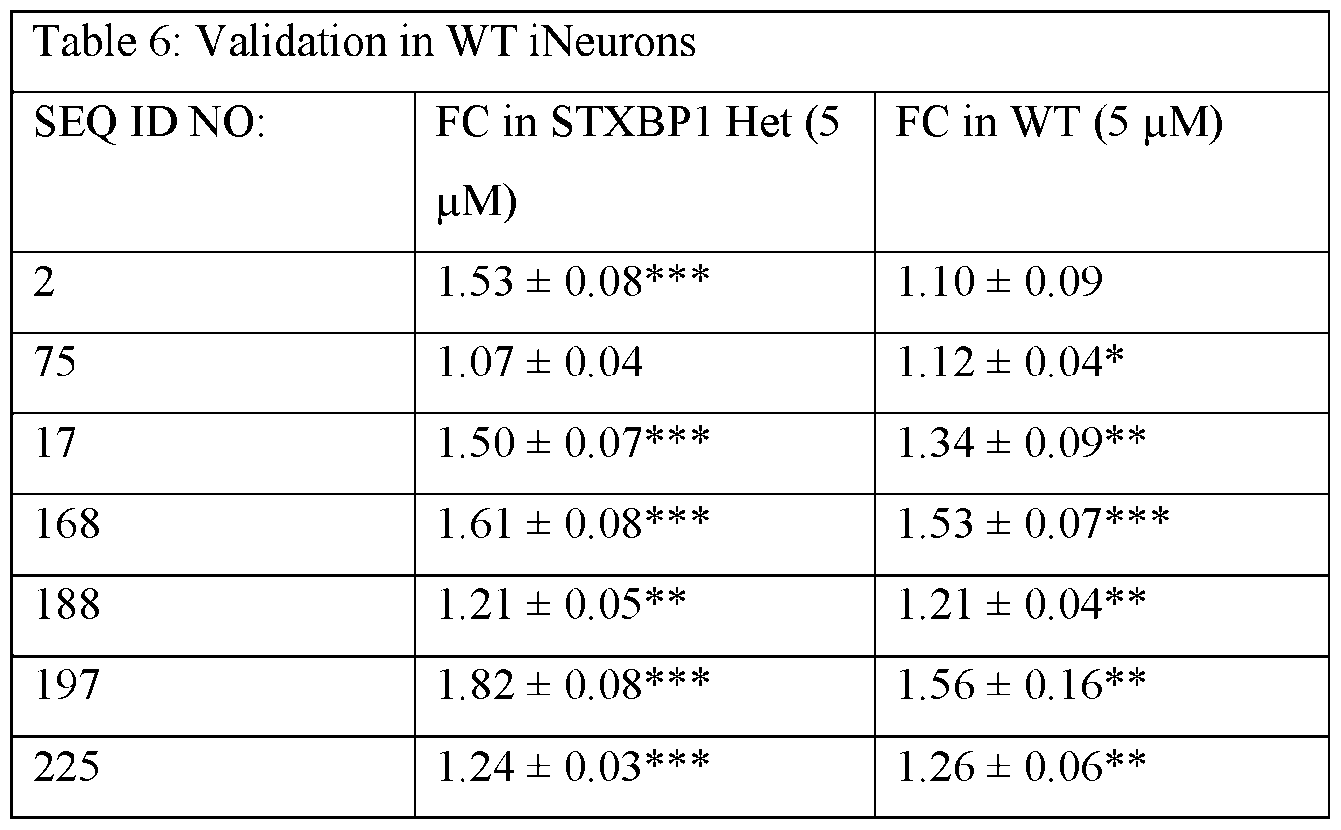
  • FIGs. 4A-J show the results from orthogonal validation of ASOs provided herein and controls using ELISA using STXBP1 Het iNeurons along with each ASO’s NHP mismatches.
  • FIG. 5 shows the results from an ELISA screen at 5 pM using non-HiBiT tagged STXBP1 Het iNeurons for ASOs provided herein and controls.
  • FIG. 6 shows the level of synaptically-localized STXBP1 protein in STXBP1 +/- (HZ) Ngn2-induced neuron cultures, cultured without glia, after treatment with ASOs provided herein and controls.
  • FIG. 7 shows the level of synaptically-localized STXBP1 protein in WT Ngn2- induced neuron cultures after treatment with ASOs provided herein and controls.
  • FIG. 8 shows the level of synaptically-localized STXBP1 protein in STXBP1 +/- (HZ) Ngn2-induced neuron cultures, cultured with rat glia, after treatment with ASOs provided herein and controls.
  • FIG. 9 shows the level of bulk STXBP1 protein in Ngn2-induced neuron cultures, cultured without glia, after treatment with ASOs provided herein and controls.
  • subject is an animal, such as a mammal, including human, such as a patient.
  • biological activity refers to the in vivo activities of an ASO or physiological responses that result upon in vivo administration of an ASO, composition or other mixture.
  • Biological activity thus, encompasses therapeutic effects and pharmacokinetic behavior of such ASOs, compositions and mixtures.
  • Biological activities can be observed in in vitro systems designed to test for such activities.
  • the biological activity 7 of the ASO refers to modulating gene expression. Methods for detecting and/or quantifying changes in gene expression are known in the art, including but not limited to the methods disclosed in the Examples.
  • oligonucleotide As used herein, when the word “oligonucleotide” is used it may be replaced by “antisense oligonucleotide” and vice versa unless otherwise indicated.
  • the term “complementary” encompasses both forward complementary and reverse complementary sequences, as will be apparent to a skilled person from the context.
  • an oligonucleotide is complementary, it is understood that it can also be reverse complementary.
  • an oligonucleotide is complementary to’' a target sequence is used, this means that said oligonucleotide is reverse complementary to said target sequence as the sequence of the oligonucleotide is the reverse complement of the target sequence, unless otherwise stated.
  • an antisense oligonucleotide is complementary to a target sequence
  • the term “(reverse) complementarity” means a stretch of nucleic acids that can hybridize to another stretch of nucleic acids under physiological conditions.
  • An antisense strand is generally said to be complementary' to a matching sense strand.
  • an antisense oligonucleotide is complementary to its target.
  • Hybridization conditions are defined herein. It is thus not absolutely required that all the bases in the region of complementarity 7 are capable of pairing with bases in the opposing strand. For instance, when designing an antisense oligonucleotide, one may want to incorporate for instance a residue that does not base pair with the base on the complementary strand.
  • the ASOs provided herein have 1 or 2 mismatches with a target sequence, such as a target sequence within a STXBP1 mRNA or pre-mRNA.
  • the term “binds to” can be replaced with “complementary to”, “hybridizes to”, “overlaps with” and/or “targets” when used in the context of an antisense oligonucleotide which is complementary to a part of a pre-mRNA as identified herein. In this disclosure, such terms are synonymous.
  • “hybridizes” is used under physiological conditions in a cell. In one embodiment, the cell is a neuronal cell unless otherwise indicated.
  • the ASOs provided herein may have one or more substitutions or modifications relative to ASOs made up of unmodified single stranded DNA or RNA oligonucleotides.
  • a substitution replaces one chemical group, which might be hydrogen, by another chemical group.
  • an RNA monomer is inherently 2'-substituted because it has a hydroxyl group at its 2'-position. A DNA monomer would therefore not be 2'-substituted, and an RNA monomer can be seen as a 2'-substituted DNA monomer.
  • 2'-0-methyl RNA is a 2'-substituted monomer (-OMe substitutes -H) and a 2 -substituted RNA monomer (-OMe substitutes -OH) and a 2'-O-substituted RNA monomer (-Me substitutes -H), while 2'-F RNA is a 2'-substituted RNA monomer (-F substitutes -OH or -H) yet not a 2'-O-substituted RNA monomer (2'-0 is either no longer present, or is not substituted).
  • 2'-F RNA where F is substituted for 2'-OH is a 2'-F-2'-deoxy RNA, which is also a 2'-F DNA.
  • bicyclic nucleic acid may be replaced by conformationally restricted scaffold modification, locked scaffold modification, locked nucleotide, locked nucleoside, locked monomer, or Tm enhancing scaffold modification, or high-affinity modification and the like, as appropriate.
  • sequence identity means a relationship between two or more nucleic acid (polynucleotide or nucleotide or oligonucleotide) sequences, as determined by comparing the sequences. In one embodiment, sequence identity is calculated based on the full length of two given SEQ ID NO or on part thereof. Part thereof means at least 50%, 60%, 70%, 80%, 90%, or 100% of both SEQ ID NO. As used herein, “identity” also means the degree of sequence relatedness between nucleic acid sequences, as the case may be, as determined by the match between strings of such sequences.
  • Methods to determine identity are designed to give the largest match between the sequences tested. Methods to determine identity and similarity are codified in publicly available computer programs. Computer program methods to determine identity and similarity between two sequences include, e.g., the GCG program package (Devereux, J., et al., Nucleic Acids Research 12 (1): 387 (1984)), BestFit, BLASTN, and FASTA (Altschul, S. F. et al., J. Mol. Biol. 215:403-410 (1990)).
  • the BLAST X program is publicly available from NCBI and other sources (BLAST Manual, Altschul, S., et al., NCBI NLM NIH Bethesda, MD 20894; Altschul, S., et al., J. Mol. Biol. 215:403-410 (1990)).
  • the well-known Smith Waterman algorithm may also be used to determine identity.
  • Hybridization conditions for a nucleic acid molecule may have low or medium or high stringency (southern blotting procedures).
  • Low or medium or high stringency conditions means pre-hybridization and hybridization at 42 °C in 5x SSPE, 0.3% SDS, 200pg/ml sheared and denatured salmon sperm DNA, and either 25% or 35% or 50% formamide for low or medium or high stringencies respectively.
  • the hybridization reaction is washed three times for 30 minutes each using 2x SSC, 0.2% SDS and either 55 °C or 65 °C, or 75 °C for low 7 or medium or high stringencies respectively.
  • treatment means any manner in which one or more of the symptoms of a disease or disorder are ameliorated or otherwise beneficially altered. Treatment also encompasses any pharmaceutical use of the compositions herein, such as use for treating an STXBP1 disorder.
  • amelioration of the symptoms of a particular disorder byadministration of a particular ASO or pharmaceutical composition refers to any lessening, whether permanent or temporary, lasting or transient that can be attributed to or associated with administration of the ASO or pharmaceutical composition.
  • Certain ASOs provided herein possess asy mmetric atoms (optical centers) or double bonds; the racemates, diastereomers, tautomers, geometric isomers and individual isomers are encompassed within the scope of the present disclosure.
  • the ASOs provided herein do not include those which are known in the art to be too unstable to synthesize and/or isolate.
  • the ASOs provided herein may also contain unnatural proportions of atomic isotopes at one or more of the atoms that constitute such ASOs.
  • the ASOs maybe radiolabeled with radioactive isotopes, such as for example tritium ( 3 H). iodine- 125 ( 125 I) or carbon- 14 ( 14 C). All isotopic variations of the ASOs provided herein, whether radioactive or not, are encompassed w ithin the scope of the present disclosure.
  • an STXBP1 gene is well known in the art.
  • the coding strand of the human STXBP1 gene spans -80,423 bp and is set forth in NCBI Accession No. NC 000009.12.
  • Mutant STXBP1 genes are also w ell known in the art.
  • the STXBP1 gene encodes two major splice variants: i) NM_003165 (isoform a), in which 19 consecutive exons are translated to generate a 68.7 kDa protein of 603 amino acids; and ii) NM_001032221 (isoform b), in which exon 19 is skipped, and a stop codon in exon 20 terminates translation to generate a 67.6 kDa protein of 594 amino acids.
  • ASOs antisense oligonucleotides
  • the ASOs provided herein are single stranded oligonucleotides.
  • the ASOs provided herein contain fewer than 50 nucleotides.
  • the ASOs provided herein comprise a base sequence that is complementary to a target sequence in an STXBP1 mRNA or pre-mRNA.
  • the ASOs provided herein target or bind to a portion of a complementary nucleic acid molecule, such as a mRNA or pre-mRNA corresponding to the coding strand of the human STXBP1 gene set forth in NCBI Accession No. NC 000009 12.
  • the ASOs provided herein target or bind to a portion of a complementary nucleic acid molecule, such as a mRNA or pre-mRNA corresponding to human STXBP1 gene splice variants NM_003165 or NM_001032221.
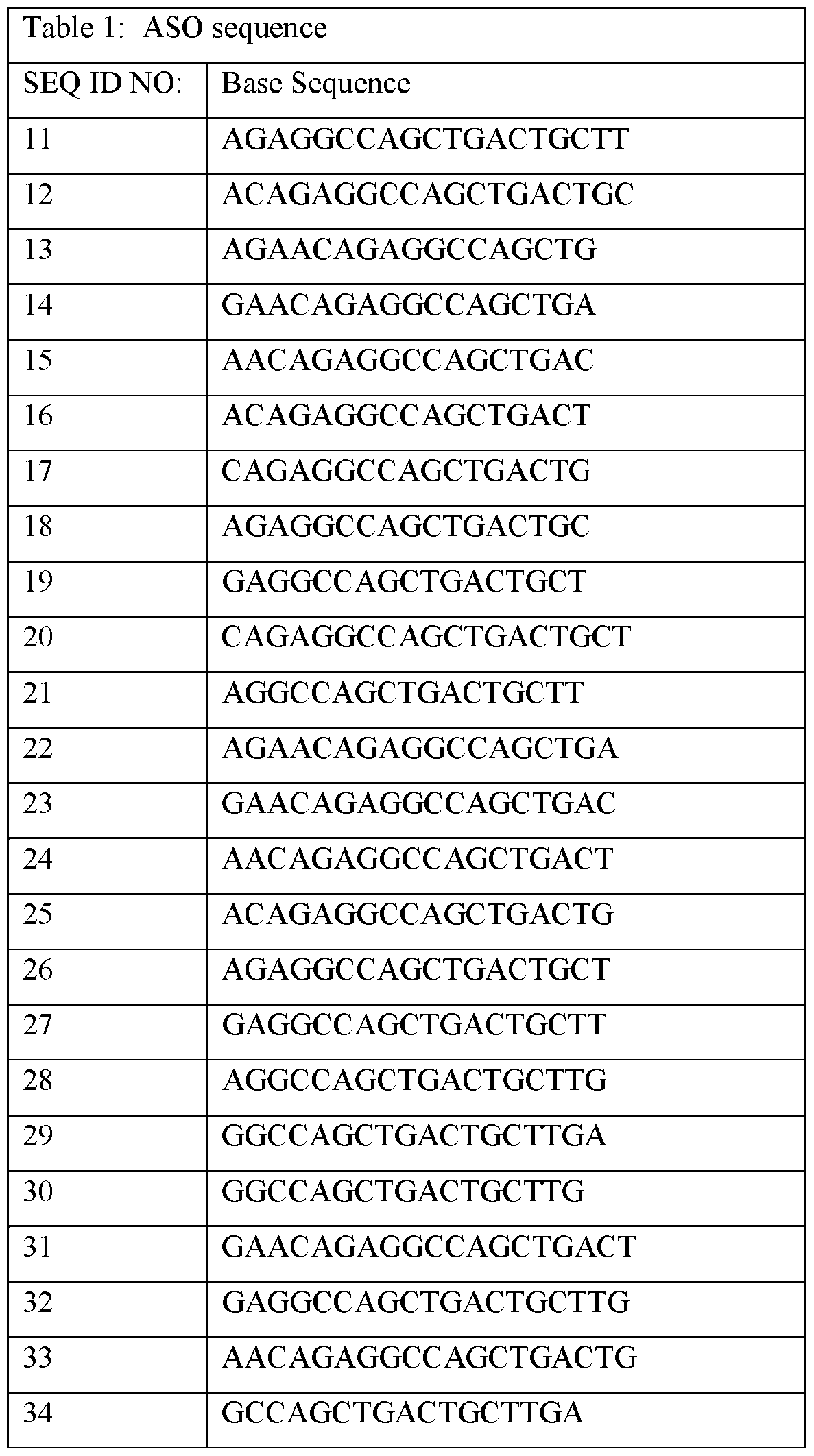
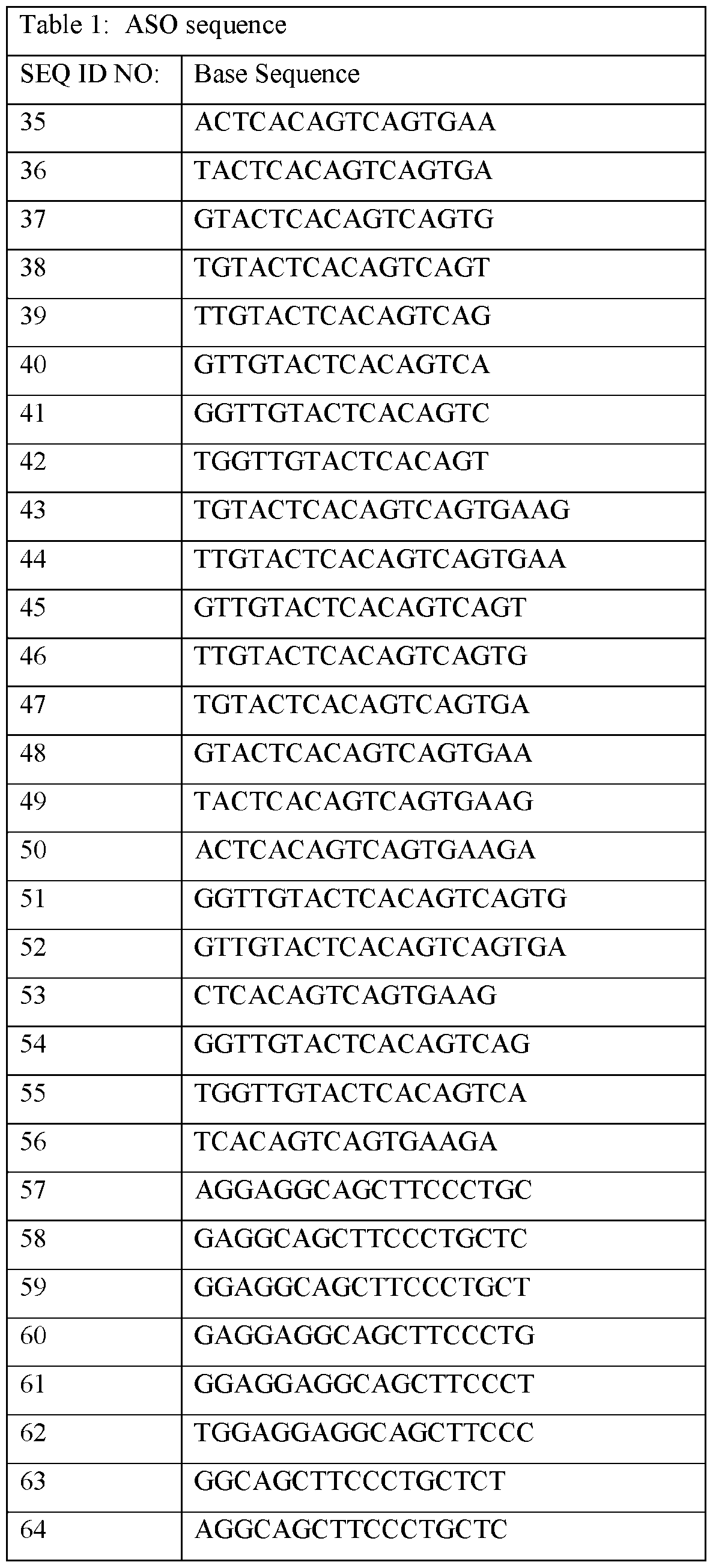
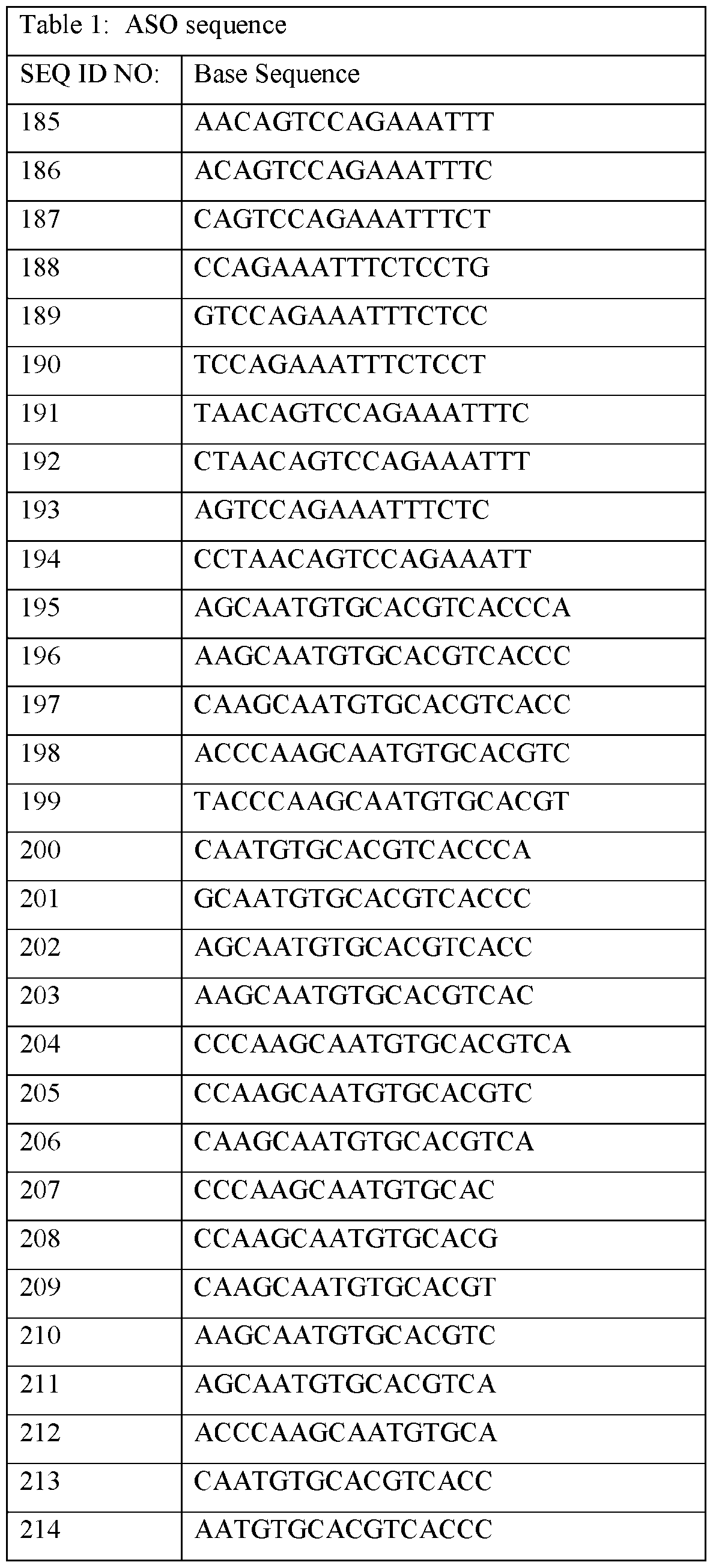
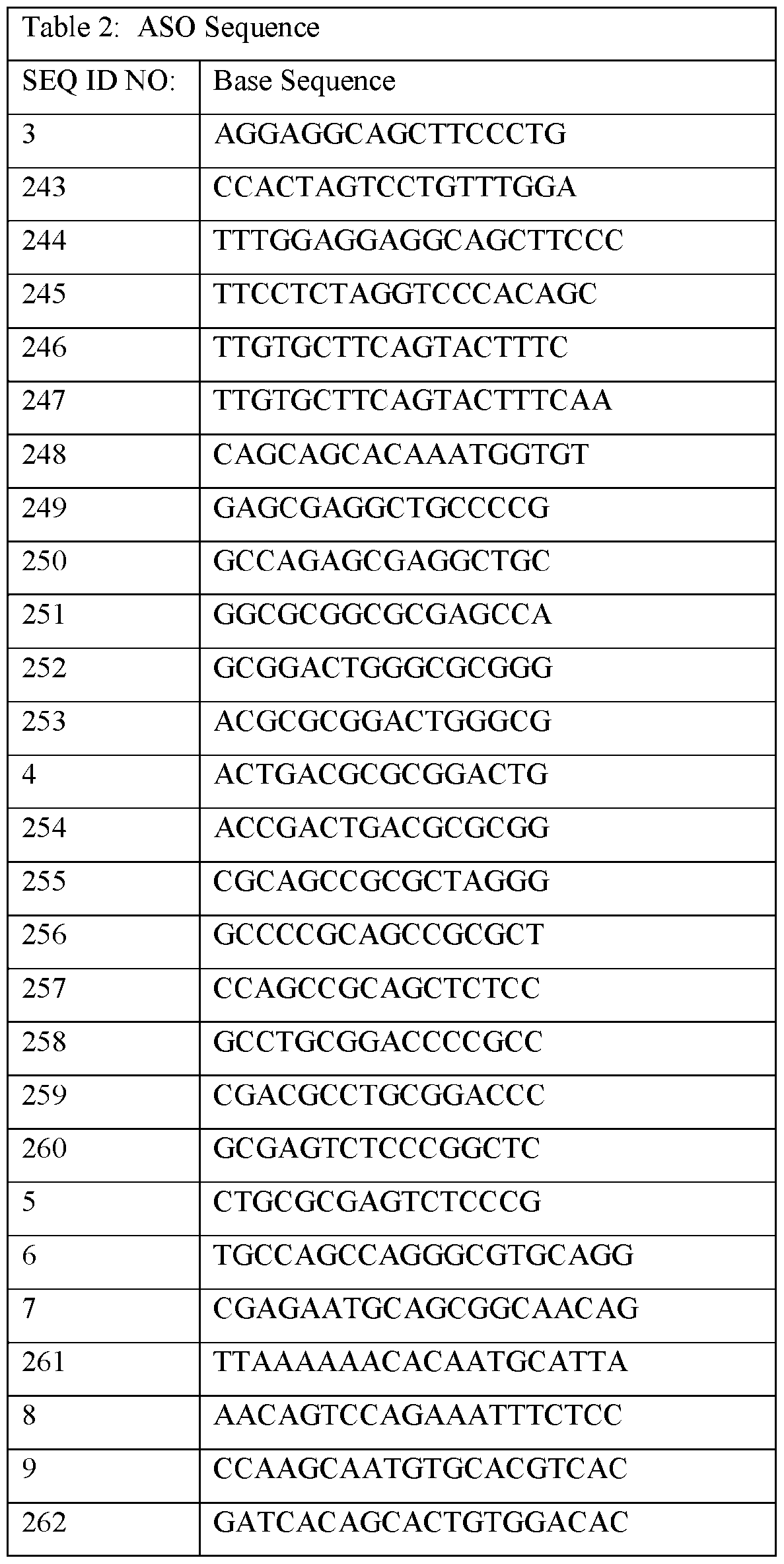
  • the ASOs provided herein comprise a base sequence set forth in any one of SEQ ID NOs: 1-626.
  • the base sequence consists of a sequence set forth in any one of SEQ ID NOs: 1-626.
  • the ASO provided herein comprises a base sequence with at least 80%, 85%, 90% or 95% sequence identity to any one of SEQ ID NOs: 1-626 and when contacted with a cell increases expression of STXBP1 protein.
  • the cell is a neuronal cell, optionally in vivo or in vitro, and the ASO provided herein increases a level of functional STXBP1 protein in the neuronal cell relative to a control cell not contacted with the ASO.
  • the ASOs provided herein contain at least 10, 11, 12, 13, 14, 15 or 16 consecutive bases of one of the following sequences: CAGAGGCCAGCTGACTGC (SEQ ID NO: 1), TGTACTCACAGTCAGTG (SEQ ID NO: 2), AGGAGGCAGCTTCCCTG (SEQ ID NO: 3), ACTGACGCGCGGACTG (SEQ ID NO: 4), CTGCGCGAGTCTCCCG (SEQ ID NO: 5), TGCCAGCCAGGGCGTGCAGG (SEQ ID NO: 6), CGAGAATGCAGCGGCAACAG (SEQ ID NO: 7), AACAGTCCAGAAATTTCTCC (SEQ ID NO: 8), CCAAGCAATGTGCACGTCAC (SEQ ID NO: 9), CAAAGAGATGGAGGCTTCCA (SEQ ID NO: 10), CAGAGGCCAGCTGACTG (SEQ ID NO: 17), AGGAGGCAGCTTCCCT (SEQ ID NO: 75), CACGAGAATGCAGCGGCA (SEQ ID NO:
  • SEQ ID NOs: 1-3, 17 and 75 target a splice site and/or an exon splicing enhancer (ESE) of a mutant STXBP1 pre-mRNA, and/or induce exon skipping or inclusion in a mutant STXBP1 pre-mRNA.
  • ESE exon splicing enhancer
  • SEQ ID NOs: 4 and 5 target a 5'-UTR of an STXBP1 mRNA.
  • SEQ ID NOs: 6-10, 168, 188, 197 and 225 target a 3'-UTR of an STXBP1 mRNA.
  • the ASOs provided herein are complementary or reverse complementary to their intended mRNA or pre-mRNA target.
  • the terms complementarity and reverse complementarity are used herein to refer to a stretch of nucleic acids that can hybridize to another stretch of nucleic acids under physiological conditions in a cell. Such hybridization generally follows well-known A-T(U)/G-C base pairing.
  • T also includes the corresponding ASO containing a U instead of the T.
  • the ASOs provided herein are fully T containing ASOs.
  • the ASOs provided herein are fully U containing ASOs.
  • the ASOs provided herein contain a mixture of T and U bases.
  • the ASOs provided herein are fully complementary or reverse complementary to their target. In another embodiment, the ASOs provided herein are less than fully complementary' or reverse complementary' to their target. In such embodiments, such “mismatches” are within the scope of this disclosure to the extent that the resulting ASO hybridizes to its target under physiological conditions in a cell. In certain embodiments, the degree of complementarity' or reverse complementarity of the ASO provided herein to its target is at least 85%, 90%, 95%, 96%, 97%, 98%, 99% or is 100%.
  • the ASOs specifically disclosed herein, represented by SEQ ID NOs are 100% reverse complementary to their target.
  • the ASO provided herein has a length of less than 50 nucleotides, or from 8-40, 10-33 or 15-25 nucleotides. In another embodiment, the ASO provided herein has a length of 12-30 nucleotides. In another embodiment, the ASO provided herein has a length of 16-25 nucleotides. In another embodiment, the ASO provided herein has a length of 16-20 nucleotides. In another embodiment, the ASO provided herein has a length of 16, 17, 18, 19 or 20 nucleotides.
  • the ASO provided herein has one or more modified bases, one or more modified sugars, and/or one or more modified intemucleoside linkages. In another embodiment, the ASO provided herein has one or more modified bases. In another embodiment, the ASO provided herein has one or more modified sugars. In another embodiment, the ASO provided herein has one or more modified intemucleoside linkages.
  • the ASO provided herein has one or more modified bases selected from hypoxanthine, pseudouracil, pseudocytosine, 1 -methylpseudouracil, orotic acid, agmatidine, lysidine, 2-thiouracil, 2-thiothymine, 5-halouracil, 5-halomethyluracil, 5- trifluoromethyluracil, 5-propynyluracil, 5 -methylcytosine, 5-propynylcytosine.
  • modified bases selected from hypoxanthine, pseudouracil, pseudocytosine, 1 -methylpseudouracil, orotic acid, agmatidine, lysidine, 2-thiouracil, 2-thiothymine, 5-halouracil, 5-halomethyluracil, 5- trifluoromethyluracil, 5-propynyluracil, 5 -methylcytosine, 5-propynylcytosine.
  • the ASO provided herein has one or more modified sugars selected from 2'-substituted RNA sugars including threose nucleic acid sugars, 2'-F sugars, 2'- O-substituted RNA sugars including 2'-OMe and 2'-M0E (2'-O-(2-methoxyethyl)) sugars, and a bicyclic (BNA) or tricyclic (TNA) nucleic acid sugars.
  • BNA bicyclic
  • TAA tricyclic
  • the ASO provided herein has one or more BNAs and/or TNAs selected from a conformationally restricted nucleotide (CRN) monomer, a locked nucleic acid (LNA) monomer, a xylo-LNA monomer, an a-LNA monomer, an a-L-LNA monomer, a -D-LNA monomer, a 2'-amino- LNA monomer, a 2'-(alkylamino)-LNA monomer, a 2'-(acylamino)-LN A monomer, a 2'-N- substituted-2'-amino-LNA monomer, a 2'-thio-LNA monomer, a (2'-O,4'-C) constrained ethyl (cEt) BNA monomer, a (2'-O,4'-C) constrained methoxyethyl (cMOE) BNA monomer, a 2',4'-BNANC
  • the ASO provided herein has more than one distinct modified sugar.
  • the ASO provided herein has a combination of 2'-O- substituted RNA sugars and BNAs.
  • the ASO provided herein has a combination of 2'-M0E and LNA sugars.
  • the ASO provided herein has all 2'-M0E sugars. See, e.g.. Seth et al.. J. Org. Chem. 2010, 75, 1569-1581; Osawa et al., J. Org. Chem., 2015, 80 (21), pp 10474-10481; WO 2014/145356; WO 2014/126229; Yamamoto et al. Org. Biomol.
  • the ASO provided herein has a modified intemucleoside linkage, such as a phosphorothioate or phosphoroamidate. In another embodiment, the ASO provided herein has a phosphorothioate intemucleoside linkage. In another embodiment, the ASO provided herein has at least 50%, 60%, 70%, 80%, 90% or all phosphorothioate intemucleoside linkages.
  • the ASO provided herein is a phosphorodiamidate morpholino oligomer (PMO), or is incorporated into a conjugate, such as a pepti deconjugated PMO (PPMO) or an ASO-antibody conjugate.
  • PMO phosphorodiamidate morpholino oligomer
  • PPMO pepti deconjugated PMO
  • ASO-antibody conjugate See, e.g., WO 2022/192749.
  • the ASO provided herein has a combination of 2 -MOE and LNA sugars and all phosphorothioate intemucleoside linkages. In another embodiment, the ASO provided herein has all 2'-MOE sugars and all phosphorothioate intemucleoside linkages.
  • the ASO provided herein contains at least 10, 11, 12, 13, 14, 15 or 16 consecutive bases of CTGCGCGAGTCTCCCG (SEQ ID NO: 1), and optionally has all 2'-MOE sugars and all phosphorothioate intemucleoside linkages.
  • the ASO provided herein is 16-25 nucleotides in length, contains at least 10, 11, 12, 13, 14, 15 or 16 consecutive bases of CTGCGCGAGTCTCCCG (SEQ ID NO: 1), and optionally has all 2'-MOE sugars and all phosphorothioate intemucleoside linkages.
  • the ASO provided herein is 16-20 nucleotides in length, contains at least 10, 11, 12, 13, 14, 15 or 16 consecutive bases of CTGCGCGAGTCTCCCG (SEQ ID NO: 1), and optionally has all 2'-MOE sugars and all phosphorothioate intemucleoside linkages. In another embodiment, the ASO provided herein contains at least 10, 11, 12, 13. 14, 15 or 16 consecutive bases of CTGCGCGAGTCTCCCG (SEQ ID NO: 1), has all 2'- MOE sugars and all phosphorothioate intemucleoside linkages.
  • the ASO provided herein is 16-25 nucleotides in length, contains at least 10, 11, 12, 13, 14, 15 or 16 consecutive bases of CTGCGCGAGTCTCCCG (SEQ ID NO: 1), has all 2'-M0E sugars and all phosphorothioate intemucleoside linkages.
  • the ASO provided herein is 16-20 nucleotides in length, contains at least 10. 11. 12, 13, 14, 15 or 16 consecutive bases of CTGCGCGAGTCTCCCG (SEQ ID NO: 1), has all 2'-M0E sugars and all phosphorothioate intemucleoside linkages.
  • the ASO provided herein contains at least 10, 11, 12. 13, 14, 15 or 16 consecutive bases of TGTACTCACAGTCAGTG (SEQ ID NO: 2), and optionally has all 2'-M0E sugars and all phosphorothioate intemucleoside linkages.
  • the ASO provided herein is 16-25 nucleotides in length, contains at least 10, 11, 12, 13, 14, 15 or 16 consecutive bases of TGTACTCACAGTCAGTG (SEQ ID NO: 2), and optionally has all 2'-M0E sugars and all phosphorothioate intemucleoside linkages.
  • the ASO provided herein is 16-20 nucleotides in length, contains at least 10, 11, 12, 13, 14, 15 or 16 consecutive bases of TGTACTCACAGTCAGTG (SEQ ID NO: 2), and optionally has all 2'-M0E sugars and all phosphorothioate intemucleoside linkages. In another embodiment, the ASO provided herein contains at least 10, 11, 12, 13, 14, 15 or 16 consecutive bases of TGTACTCACAGTCAGTG (SEQ ID NO: 2), has all 2'-M0E sugars and all phosphorothioate intemucleoside linkages. In another embodiment, the ASO provided herein is 16-25 nucleotides in length, contains at least 10, 11, 12, 13.
  • TGTACTCACAGTCAGTG SEQ ID NO: 2
  • ASO provided herein is 16-20 nucleotides in length, contains at least 10, 11, 12, 13, 14, 15 or 16 consecutive bases of TGTACTCACAGTCAGTG (SEQ ID NO: 2), has all 2'-MOE sugars and all phosphorothioate intemucleoside linkages.
  • the ASO provided herein contains at least 10, 11, 12. 13. 14, 15 or 16 consecutive bases of AGGAGGCAGCTTCCCTG (SEQ ID NO: 3), and optionally has all 2'-M0E sugars and all phosphorothioate intemucleoside linkages.
  • the ASO provided herein is 16-25 nucleotides in length, contains at least 10, 11, 12, 13, 14, 15 or 16 consecutive bases of AGGAGGCAGCTTCCCTG (SEQ ID NO: 3), and optionally has all 2'-M0E sugars and all phosphorothioate intemucleoside linkages.
  • the ASO provided herein is 16-20 nucleotides in length, contains at least 10, 11, 12, 13, 14, 15 or 16 consecutive bases of AGGAGGCAGCTTCCCTG (SEQ ID NO: 3), and optionally has all 2'-M0E sugars and all phosphorothioate intemucleoside linkages. In another embodiment, the ASO provided herein contains at least 10, 11, 12, 13, 14, 15 or 16 consecutive bases of AGGAGGCAGCTTCCCTG (SEQ ID NO: 3), has all 2'-M0E sugars and all phosphorothioate intemucleoside linkages.
  • the ASO provided herein is 16-25 nucleotides in length, contains at least 10, 11, 12, 13, 14, 15 or 16 consecutive bases of AGGAGGCAGCTTCCCTG (SEQ ID NO: 3), has all 2'-M0E sugars and all phosphorothioate intemucleoside linkages.
  • the ASO provided herein is 16-20 nucleotides in length, contains at least 10, 11, 12, 13, 14. 15 or 16 consecutive bases of AGGAGGCAGCTTCCCTG (SEQ ID NO: 3), has all 2’-M0E sugars and all phosphorothioate intemucleoside linkages.
  • the ASO provided herein contains at least 10, 11, 12, 13, 14, 15 or 16 consecutive bases of ACTGACGCGCGGACTG (SEQ ID NO: 4), and optionally has all 2’-MOE sugars and all phosphorothioate intemucleoside linkages.
  • the ASO provided herein is 16-25 nucleotides in length, contains at least 10, 11, 12, 13, 14, 15 or 16 consecutive bases of ACTGACGCGCGGACTG (SEQ ID NO: 4), and optionally has all 2'-M0E sugars and all phosphorothioate intemucleoside linkages.
  • the ASO provided herein is 16-20 nucleotides in length, contains at least 1 , 1 1, 12, 13, 14, 15 or 16 consecutive bases of ACTGACGCGCGGACTG (SEQ ID NO: 4), and optionally has all 2'-M0E sugars and all phosphorothioate intemucleoside linkages.
  • the ASO provided herein contains at least 10, 11, 12, 13, 14, 15 or 16 consecutive bases of ACTGACGCGCGGACTG (SEQ ID NO: 4), has all 2'-MOE sugars and all phosphorothioate intemucleoside linkages.
  • the ASO provided herein is 16-25 nucleotides in length, contains at least 10, 11, 12, 13, 14, 15 or 16 consecutive bases of ACTGACGCGCGGACTG (SEQ ID NO: 4), has all 2'-M0E sugars and all phosphorothioate intemucleoside linkages.
  • the ASO provided herein is 16-20 nucleotides in length, contains at least 10, 11, 12, 13, 14, 15 or 16 consecutive bases of ACTGACGCGCGGACTG (SEQ ID NO: 4), has all 2'-M0E sugars and all phosphorothioate intemucleoside linkages.
  • the ASO provided herein contains at least 10, 11, 12. 13, 14, 15 or 16 consecutive bases of CTGCGCGAGTCTCCCG (SEQ ID NO: 5), and optionally has all 2'-M0E sugars and all phosphorothioate intemucleoside linkages.
  • the ASO provided herein is 16-25 nucleotides in length, contains at least 10, 11, 12, 13, 14, 15 or 16 consecutive bases of CTGCGCGAGTCTCCCG (SEQ ID NO: 5), and optionally has all 2'-M0E sugars and all phosphorothioate intemucleoside linkages.
  • the ASO provided herein is 16-20 nucleotides in length, contains at least 10, 11, 12, 13, 14, 15 or 16 consecutive bases of CTGCGCGAGTCTCCCG (SEQ ID NO: 5), and optionally has all 2'-M0E sugars and all phosphorothioate intemucleoside linkages.
  • the ASO provided herein contains at least 10, 11, 12, 13. 14, 15 or 16 consecutive bases of CTGCGCGAGTCTCCCG (SEQ ID NO: 5), has all 2'- MOE sugars and all phosphorothioate intemucleoside linkages.
  • the ASO provided herein is 16-25 nucleotides in length, contains at least 10, 11, 12, 13, 14, 15 or 16 consecutive bases of CTGCGCGAGTCTCCCG (SEQ ID NO: 5). has all 2'-M0E sugars and all phosphorothioate intemucleoside linkages.
  • the ASO provided herein is 16-20 nucleotides in length, contains at least 10, 11, 12, 13, 14, 15 or 16 consecutive bases of CTGCGCGAGTCTCCCG (SEQ ID NO: 5), has all 2'-M0E sugars and all phosphorothioate intemucleoside linkages.
  • the ASO provided herein contains at least 10, 11, 12. 13. 14, 15 or 16 consecutive bases of TGCCAGCCAGGGCGTGCAGG (SEQ ID NO: 6), and optionally has all 2'-M0E sugars and all phosphorothioate intemucleoside linkages.
  • the ASO provided herein is 16-25 nucleotides in length, contains at least 10, 11, 12, 13, 14, 15 or 16 consecutive bases of TGCCAGCCAGGGCGTGCAGG (SEQ ID NO: 6), and optionally has all 2'-M0E sugars and all phosphorothioate intemucleoside linkages.
  • the ASO provided herein is 16-20 nucleotides in length, contains at least 10, 11, 12, 13, 14, 15 or 16 consecutive bases of TGCCAGCCAGGGCGTGCAGG (SEQ ID NO: 6), and optionally has all 2'-M0E sugars and all phosphorothioate intemucleoside linkages.
  • the ASO provided herein contains at least 10, 11, 12, 13, 14, 15 or 16 consecutive bases of TGCCAGCCAGGGCGTGCAGG (SEQ ID NO: 6), has all 2'-M0E sugars and all phosphorothioate intemucleoside linkages.
  • the ASO provided herein is 16-25 nucleotides in length, contains at least 10, 11, 12, 13. 14.
  • the ASO provided herein is 16-20 nucleotides in length, contains at least 10, 11, 12, 13, 14. 15 or 16 consecutive bases of TGCCAGCCAGGGCGTGCAGG (SEQ ID NO: 6), has all 2'-M0E sugars and all phosphorothioate intemucleoside linkages.
  • the ASO provided herein contains at least 10, 11, 12, 13, 14, 15 or 16 consecutive bases of CGAGAATGCAGCGGCAACAG (SEQ ID NO: 7).
  • the ASO provided herein is 16-25 nucleotides in length, contains at least 10, 11, 12, 13, 14, 15 or 16 consecutive bases of CGAGAATGCAGCGGCAACAG (SEQ ID NO: 7). and optionally has all 2'-M0E sugars and all phosphorothioate intemucleoside linkages.
  • the ASO provided herein is 16-20 nucleotides in length, contains at least 10, 11, 12, 13, 14, 15 or 16 consecutive bases of CGAGAATGCAGCGGCAACAG (SEQ ID NO: 7), and optionally has all 2'-M0E sugars and all phosphorothioate intemucleoside linkages. In another embodiment, the ASO provided herein contains at least 10. 11. 12, 13, 14, 15 or 16 consecutive bases of CGAGAATGCAGCGGCAACAG (SEQ ID NO: 7), has all 2'-MOE sugars and all phosphorothioate intemucleoside linkages.
  • the ASO provided herein is 16-25 nucleotides in length, contains at least 10, 11, 12, 13, 14, 15 or 16 consecutive bases of CGAGAATGCAGCGGCAACAG (SEQ ID NO: 7), has all 2'-M0E sugars and all phosphorothioate intemucleoside linkages.
  • the ASO provided herein is 16-20 nucleotides in length, contains at least 10, 11, 12, 13, 14, 15 or 16 consecutive bases of CGAGAATGCAGCGGCAACAG (SEQ ID NO: 7), has all 2'-M0E sugars and all phosphorothioate intemucleoside linkages.
  • the ASO provided herein contains at least 10, 11, 12. 13. 14, 15 or 16 consecutive bases of AAC AGTCC AGAAATTTCTCC (SEQ ID NO: 8), and optionally has all 2'-M0E sugars and all phosphorothioate intemucleoside linkages.
  • the ASO provided herein is 16-25 nucleotides in length, contains at least 10, 11, 12, 13, 14, 15 or 16 consecutive bases of AAC AGTCC AGAAATTTCTCC (SEQ ID NO: 8), and optionally has all 2'-M0E sugars and all phosphorothioate intemucleoside linkages.
  • the ASO provided herein is 16-20 nucleotides in length, contains at least 10, 11, 12, 13, 14, 15 or 16 consecutive bases of AACAGTCCAGAAATTTCTCC (SEQ ID NO: 8), and optionally has all 2'-MOE sugars and all phosphorothioate intemucleoside linkages.
  • the ASO provided herein contains at least 10, 1 1, 12, 13, 14, 15 or 16 consecutive bases of AACAGTCCAGAAATTTCTCC (SEQ ID NO: 8), has all 2'-M0E sugars and all phosphorothioate intemucleoside linkages.
  • the ASO provided herein is 16-25 nucleotides in length, contains at least 10, 11, 12, 13, 14.
  • ASO provided herein is 16-20 nucleotides in length, contains at least 10, 11, 12, 13, 14. 15 or 16 consecutive bases of AACAGTCCAGAAATTTCTCC (SEQ ID NO: 8), has all 2'-M0E sugars and all phosphorothioate intemucleoside linkages.
  • the ASO provided herein contains at least 10, 11, 12, 13, 14, 15 or 16 consecutive bases of CCAAGCAATGTGCACGTCAC (SEQ ID NO: 9), and optionally has all 2'-M0E sugars and all phosphorothioate intemucleoside linkages.
  • the ASO provided herein is 16-25 nucleotides in length, contains at least 10, 11, 12, 13, 14, 15 or 16 consecutive bases of CCAAGCAATGTGCACGTCAC (SEQ ID NO: 9). and optionally has all 2'-M0E sugars and all phosphorothioate intemucleoside linkages.
  • the ASO provided herein is 16-20 nucleotides in length, contains at least 10, 11, 12, 13, 14, 15 or 16 consecutive bases of CCAAGCAATGTGCACGTCAC (SEQ ID NO: 9), and optionally has all 2'-M0E sugars and all phosphorothioate intemucleoside linkages.
  • the ASO provided herein contains at least 10, 11, 12, 13, 14, 15 or 16 consecutive bases of CCAAGCAATGTGCACGTCAC (SEQ ID NO: 9). has all 2'-M0E sugars and all phosphorothioate intemucleoside linkages.
  • the ASO provided herein is 16-25 nucleotides in length, contains at least 10, 11, 12, 13, 14, 15 or 16 consecutive bases of CCAAGCAATGTGCACGTCAC (SEQ ID NO: 9), has all 2'-M0E sugars and all phosphorothioate intemucleoside linkages.
  • the ASO provided herein is 16-20 nucleotides in length, contains at least 10, 1 1 , 12, 13, 14, 15 or 16 consecutive bases of CCAAGCAATGTGCACGTCAC (SEQ ID NO: 9), has all 2'-M0E sugars and all phosphorothioate intemucleoside linkages.
  • the ASO provided herein contains at least 10, 11, 12. 13. 14, 15 or 16 consecutive bases of C AAAGAGATGGAGGCTTCCA (SEQ ID NO: 10), and optionally has all 2'-M0E sugars and all phosphorothioate intemucleoside linkages.
  • the ASO provided herein is 16-25 nucleotides in length, contains at least 10, 11, 12, 13, 14, 15 or 16 consecutive bases of CAAAGAGATGGAGGCTTCCA (SEQ ID NO: 10), and optionally has all 2'-M0E sugars and all phosphorothioate intemucleoside linkages.
  • the ASO provided herein is 16-20 nucleotides in length, contains at least 10, 11, 12, 13, 14, 15 or 16 consecutive bases of CAAAGAGATGGAGGCTTCCA (SEQ ID NO: 10), and optionally has all 2'-M0E sugars and all phosphorothioate intemucleoside linkages.
  • the ASO provided herein contains at least 10, 1 1, 12, 13, 14, 15 or 16 consecutive bases of CAAAGAGATGGAGGCTTCCA (SEQ ID NO: 10), has all 2'-MOE sugars and all phosphorothioate intemucleoside linkages.
  • the ASO provided herein is 16-25 nucleotides in length, contains at least 10, 11, 12, 13, 14, 15 or 16 consecutive bases of CAAAGAGATGGAGGCTTCCA (SEQ ID NO: 10), has all 2'-M0E sugars and all phosphorothioate intemucleoside linkages.
  • the ASO provided herein is 16-20 nucleotides in length, contains at least 10, 11, 12, 13, 14. 15 or 16 consecutive bases of CAAAGAGATGGAGGCTTCCA (SEQ ID NO: 10), has all 2'-M0E sugars and all phosphorothioate intemucleoside linkages.
  • the ASO provided herein contains at least 10, 11, 12, 13, 14, 15 or 16 consecutive bases of CAGAGGCCAGCTGACTG (SEQ ID NO: 17), and optionally has all 2'-M0E sugars and all phosphorothioate intemucleoside linkages.
  • the ASO provided herein is 16-25 nucleotides in length, contains at least 10, 11, 12, 13, 14, 15 or 16 consecutive bases of CAGAGGCCAGCTGACTG (SEQ ID NO: 17), and optionally has all 2'-MOE sugars and all phosphorothioate intemucleoside linkages.
  • the ASO provided herein is 16-20 nucleotides in length, contains at least 10, 11, 12, 13, 14, 15 or 16 consecutive bases of CAGAGGCCAGCTGACTG (SEQ ID NO: 17), and optionally has all 2'-M0E sugars and all phosphorothioate intemucleoside linkages. In another embodiment, the ASO provided herein contains at least 10, 11, 12, 13, 14, 15 or 16 consecutive bases of CAGAGGCCAGCTGACTG (SEQ ID NO: 17), has all 2'-M0E sugars and all phosphorothioate intemucleoside linkages.
  • the ASO provided herein is 16-25 nucleotides in length, contains at least 10, 11, 12, 13, 14, 15 or 16 consecutive bases of CAGAGGCCAGCTGACTG (SEQ ID NO: 17), has all 2'-MOE sugars and all phosphorothioate intemucleoside linkages.
  • the ASO provided herein is 16-20 nucleotides in length, contains at least 10, 11, 12, 13, 14, 15 or 16 consecutive bases of CAGAGGCCAGCTGACTG (SEQ ID NO: 17), has all 2'-MOE sugars and all phosphorothioate intemucleoside linkages.
  • the ASO provided herein contains at least 10, 11, 12. 13. 14. 15 or 16 consecutive bases of AGGAGGCAGCTTCCCT (SEQ ID NO: 75), and optionally has all 2’-M0E sugars and all phosphorothioate intemucleoside linkages.
  • the ASO provided herein is 16-25 nucleotides in length, contains at least 10, 11, 12, 13, 14, 15 or 16 consecutive bases of AGGAGGCAGCTTCCCT (SEQ ID NO: 75), and optionally has all 2'-MOE sugars and all phosphorothioate intemucleoside linkages.
  • the ASO provided herein is 16-20 nucleotides in length, contains at least 10, 11, 12, 13, 14, 15 or 16 consecutive bases of AGGAGGCAGCTTCCCT (SEQ ID NO: 75), and optionally has all 2'-M0E sugars and all phosphorothioate intemucleoside linkages.
  • the ASO provided herein contains at least 10, 11, 12, 13, 14, 15 or 16 consecutive bases of AGGAGGCAGCTTCCCT (SEQ ID NO: 75), has all 2'-M0E sugars and all phosphorothioate intemucleoside linkages.
  • the ASO provided herein is 16-25 nucleotides in length, contains at least 10, 11, 12. 13. 14.
  • the ASO provided herein is 16-20 nucleotides in length, contains at least 10, 11, 12, 13, 14, 15 or 16 consecutive bases of AGGAGGCAGCTTCCCT (SEQ ID NO: 75), has all 2'-M0E sugars and all phosphorothioate intemucleoside linkages.
  • the ASO provided herein contains at least 10, 11, 12, 13, 14, 15 or 16 consecutive bases of CACGAGAATGCAGCGGCA (SEQ ID NO: 168), and optionally has all 2'-M0E sugars and all phosphorothioate intemucleoside linkages.
  • the ASO provided herein is 16-25 nucleotides in length, contains at least 10, 11, 12, 13, 14, 15 or 16 consecutive bases of CACGAGAATGCAGCGGCA (SEQ ID NO: 168), and optionally has all 2'-M0E sugars and all phosphorothioate intemucleoside linkages.
  • the ASO provided herein is 16-20 nucleotides in length, contains at least 10, 11, 12, 13, 14, 15 or 16 consecutive bases of CACGAGAATGCAGCGGCA (SEQ ID NO: 168). and optionally has all 2'-MOE sugars and all phosphorothioate intemucleoside linkages. In another embodiment, the ASO provided herein contains at least 10, 11, 12, 13, 14, 15 or 16 consecutive bases of CACGAGAATGCAGCGGCA (SEQ ID NO: 168), has all 2'-M0E sugars and all phosphorothioate intemucleoside linkages.
  • the ASO provided herein is 16-25 nucleotides in length, contains at least 10, 11, 12, 13, 14, 15 or 16 consecutive bases of CACGAGAATGCAGCGGCA (SEQ ID NO: 168), has all 2'-M0E sugars and all phosphorothioate intemucleoside linkages.
  • the ASO provided herein is 16-20 nucleotides in length, contains at least 10, 11, 12, 13, 14. 15 or 16 consecutive bases of CACGAGAATGCAGCGGCA (SEQ ID NO: 168), has all 2'-M0E sugars and all phosphorothioate intemucleoside linkages.
  • the ASO provided herein contains at least 10, 11, 12, 13, 14, 15 or 16 consecutive bases of CCAGAAATTTCTCCTG (SEQ ID NO: 188), and optionally has all 2'-M0E sugars and all phosphorothioate intemucleoside linkages.
  • the ASO provided herein is 16-25 nucleotides in length, contains at least 10, 11, 12, 13, 14, 15 or 16 consecutive bases of CCAGAAATTTCTCCTG (SEQ ID NO: 188), and optionally has all 2'-M0E sugars and all phosphorothioate intemucleoside linkages.
  • the ASO provided herein is 16-20 nucleotides in length, contains at least 10, 11, 12, 13, 14, 15 or 16 consecutive bases of CCAGAAATTTCTCCTG (SEQ ID NO: 188), and optionally has all 2'-M0E sugars and all phosphorothioate intemucleoside linkages. In another embodiment, the ASO provided herein contains at least 10. 11. 12, 13, 14, 15 or 16 consecutive bases of CCAGAAATTTCTCCTG (SEQ ID NO: 188), has all 2'-M0E sugars and all phosphorothioate intemucleoside linkages.
  • the ASO provided herein is 16-25 nucleotides in length, contains at least 10, 11, 12, 13, 14, 15 or 16 consecutive bases of CCAGAAATTTCTCCTG (SEQ ID NO: 188), has all 2'-M0E sugars and all phosphorothioate intemucleoside linkages.
  • the ASO provided herein is 16-20 nucleotides in length, contains at least 10, 11, 12, 13, 14, 15 or 16 consecutive bases of CCAGAAATTTCTCCTG (SEQ ID NO: 188), has all 2'-M0E sugars and all phosphorothioate intemucleoside linkages.
  • the ASO provided herein contains at least 10, 11, 12. 13. 14. 15 or 16 consecutive bases of CAAGC AATGTGCACGTCACC (SEQ ID NO: 197). and optionally has all 2'-M0E sugars and all phosphorothioate intemucleoside linkages.
  • the ASO provided herein is 16-25 nucleotides in length, contains at least 10, 11, 12, 13, 14, 15 or 16 consecutive bases of CAAGCAATGTGCACGTCACC (SEQ ID NO: 197), and optionally has all 2'-M0E sugars and all phosphorothioate intemucleoside linkages.
  • the ASO provided herein is 16-20 nucleotides in length, contains at least 10, 11, 12, 13, 14, 15 or 16 consecutive bases of CAAGCAATGTGCACGTCACC (SEQ ID NO: 197), and optionally has all 2'-M0E sugars and all phosphorothioate intemucleoside linkages.
  • the ASO provided herein contains at least 10, 1 1, 12, 13, 14, 15 or 16 consecutive bases of CAAGCAATGTGCACGTCACC (SEQ ID NO: 197), has all 2'-M0E sugars and all phosphorothioate intemucleoside linkages.
  • the ASO provided herein is 16-25 nucleotides in length, contains at least 10, 11, 12, 13, 14.
  • the ASO provided herein is 16-20 nucleotides in length, contains at least 10, 11, 12, 13, 14, 15 or 16 consecutive bases of CAAGCAATGTGCACGTCACC (SEQ ID NO: 197), has all 2'-M0E sugars and all phosphorothioate intemucleoside linkages.
  • the ASO provided herein contains at least 10, 11, 12, 13, 14, 15 or 16 consecutive bases of TTCC AAAGAGATGGAGGCTT (SEQ ID NO: 225), and optionally has all 2'-M0E sugars and all phosphorothioate intemucleoside linkages.
  • the ASO provided herein is 16-25 nucleotides in length, contains at least 10, 11, 12, 13, 14, 15 or 16 consecutive bases of TTCC AAAGAGATGGAGGCTT (SEQ ID NO: 225), and optionally has all 2'-M0E sugars and all phosphorothioate intemucleoside linkages.
  • the ASO provided herein is 16-20 nucleotides in length, contains at least 10, 11, 12, 13, 14, 15 or 16 consecutive bases of TTCCAAAGAGATGGAGGCTT (SEQ ID NO: 225), and optionally has all 2'-M0E sugars and all phosphorothioate intemucleoside linkages. In another embodiment, the ASO provided herein contains at least 10. 11. 12, 13, 14, 15 or 16 consecutive bases of TTCCAAAGAGATGGAGGCTT (SEQ ID NO: 225), has all 2'-M0E sugars and all phosphorothioate intemucleoside linkages.
  • the ASO provided herein is 16-25 nucleotides in length, contains at least 10, 11, 12, 13, 14, 15 or 16 consecutive bases of TTCCAAAGAGATGGAGGCTT (SEQ ID NO: 225), has all 2'-M0E sugars and all phosphorothioate intemucleoside linkages.
  • the ASO provided herein is 16-20 nucleotides in length, contains at least 10, 11, 12, 13, 14, 15 or 16 consecutive bases of TTCCAAAGAGATGGAGGCTT (SEQ ID NO: 225), has all 2'-M0E sugars and all phosphorothioate intemucleoside linkages.
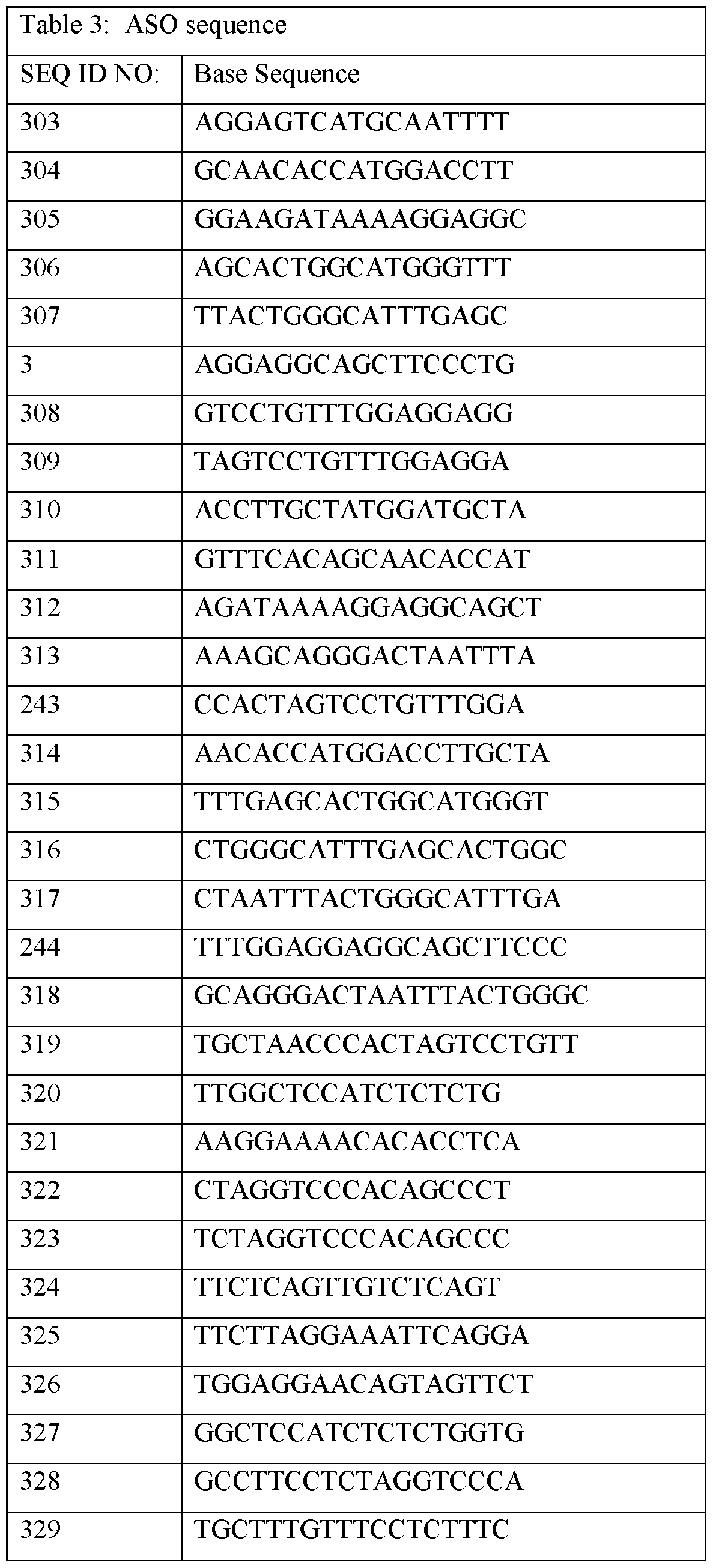
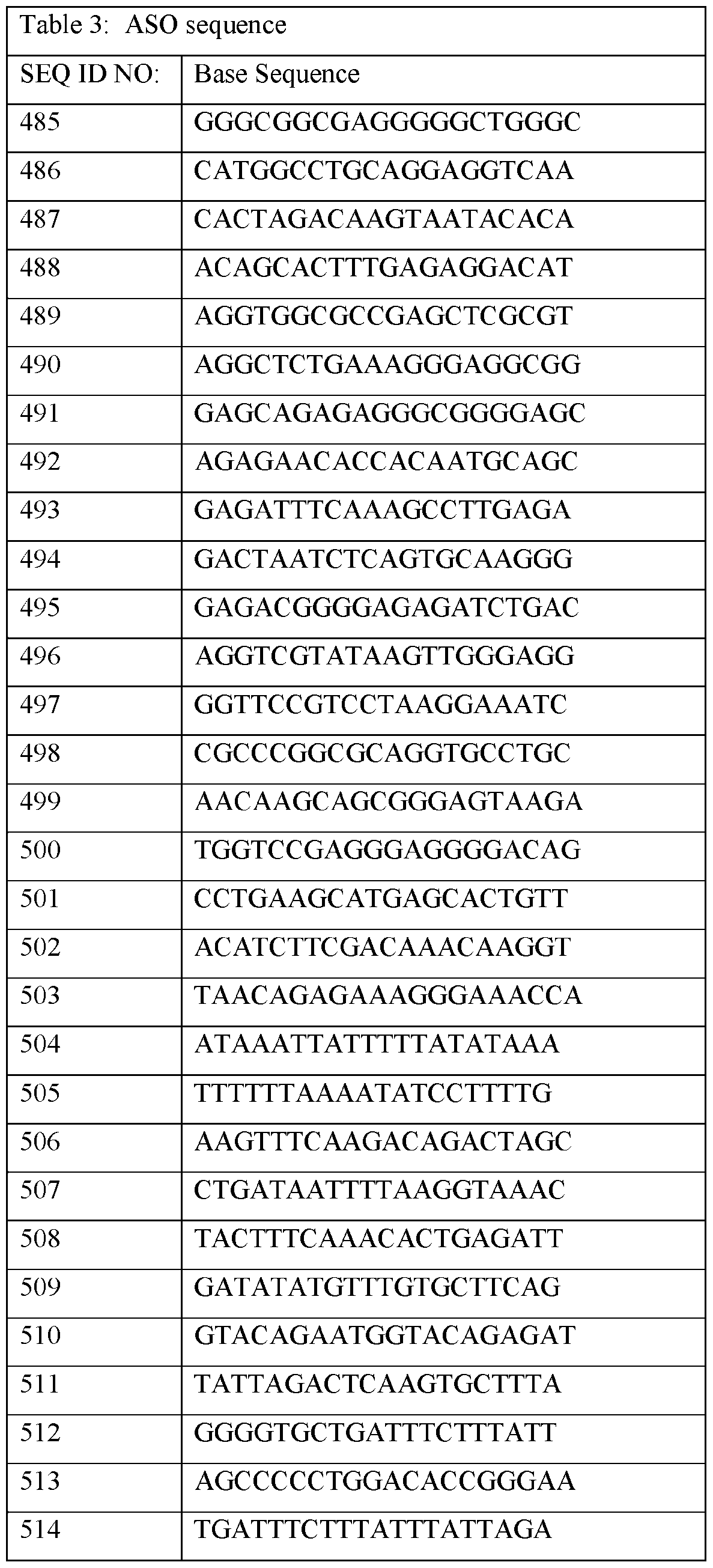
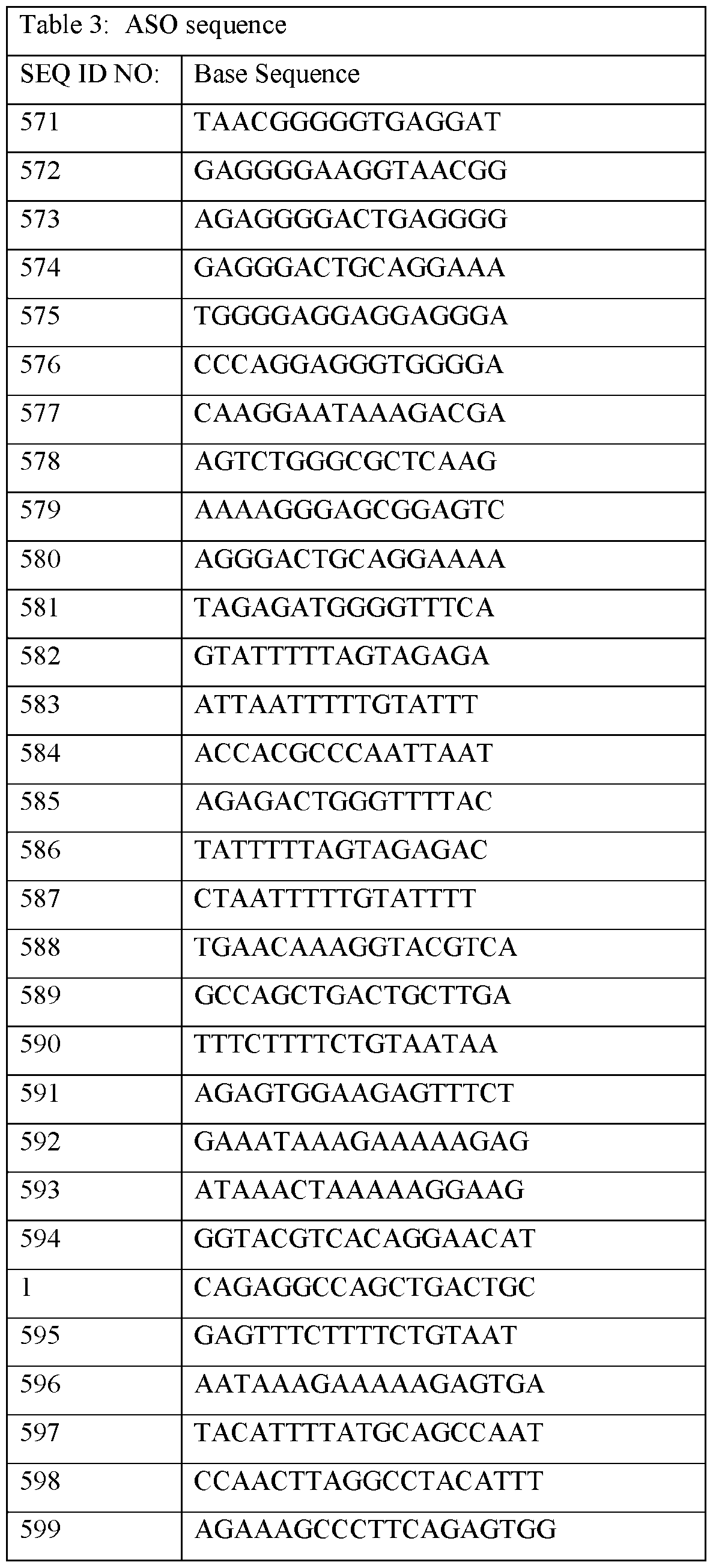
  • an ASO comprising a base sequence with at least 80%, 85%, 90%, 95% or 100% sequence identity to a sequence set forth in any one of Tables 1-4.
  • an ASO comprising at least 8, 9, 10, 11, 12, 13, 14, 15, 16, 17, 18, 19 or 20 consecutive bases of a sequence set forth in any one of Tables 1-4.
  • an ASO comprising between 16-25 nucleotides and containing at least 8, 9, 10, 11, 12, 13, 14, 15, 17, 17, 18 19 or 20 consecutive bases of any one of SEQ ID Nos: 1-626.
  • an ASO comprising a base sequence set forth in Table 1 or Table 2.
  • an ASO comprising a base sequence selected from SEQ ID NOs: 2, 17, 75, 168. 188, 197 and 225.
  • the ASO provided herein comprises one or more modified bases, one or more modified sugars, and/or one or more modified intemucleoside linkages.
  • the ASO provided herein comprises one or more 2’-M0E sugars and one or more phosphorothioate intemucleoside linkages.
  • at least 50%, 75%, 90% or all of the sugars in the ASO provided herein are 2’-M0E sugars and, independently, at least 50%, 75%, 90% or all of the intemucleoside linkages in the ASO provided herein are phosphorothioate intemucleoside linkages.
  • the ASO provided herein comprises a base sequence selected from those in Table 1, optionally wherein the ASO has one or more modified bases, one or more modified sugars, and/or one or more modified intemucleoside linkages.
  • the ASO provided herein has all 2 -MOE sugars and all phosphorothioate intemucleoside linkages, and has a base sequence selected from those in Table I:
  • the ASO provided herein comprises a base sequence selected from those in Table 2, optionally wherein the ASO has one or more modified bases, one or more modified sugars, and/or one or more modified intemucleoside linkages.
  • the ASO provided herein has all 2 -MOE sugars and all phosphorothioate intemucleoside linkages, and has a base sequence selected from those in Table 2:
  • the ASO provided herein comprises a base sequence selected from those in Table 3, optionally wherein the ASO has one or more modified bases, one or more modified sugars, and/or one or more modified intemucleoside linkages.
  • the ASO provided herein has all 2 -MOE sugars and all phosphorothioate intemucleoside linkages, and has a base sequence selected from those in Table 3:
  • the ASO provided herein comprises a base sequence selected from SEQ ID NOs: 2, 17, 75, 168, 188, 197 and 225, optionally wherein the ASO has one or more modified bases, one or more modified sugars, and/or one or more modified intemucleoside linkages.
  • the ASO provided herein has all 2'-M0E sugars and all phosphorothioate intemucleoside linkages, and has a base sequence selected from SEQ ID NOs: 2, 17, 75, 168, 188, 197 and 225.
  • ASOs provided herein may be prepared according to standard methods well known in the art. See, e.g., Beaucage, et al. Tetrahedron 1992, 48(12), 2223; Reese Org. & Biomol. Chem. 2005, 3(21). 3851-3868.
  • compositions provided herein contain therapeutically effective amounts of one or more of the ASOs provided herein and a pharmaceutically acceptable carrier, diluent or excipient.
  • the ASOs can be formulated into suitable pharmaceutical preparations such as solutions, suspensions, in sterile solutions or suspensions for ophthalmic or parenteral administration, as well as transdermal patch preparation.
  • suitable pharmaceutical preparations such as solutions, suspensions, in sterile solutions or suspensions for ophthalmic or parenteral administration, as well as transdermal patch preparation.
  • the ASOs described above are formulated into pharmaceutical compositions using techniques and procedures well known in the art (see, e.g.. Ansel Introduction to Pharmaceutical Dosage Forms. Twelfth Edition 2021).
  • compositions effective concentrations of one or more ASOs or pharmaceutically acceptable salts is (are) mixed with a suitable pharmaceutical carrier or vehicle.
  • concentrations of the ASOs in the compositions are effective for delivery of an amount, upon administration, that treats, prevents, or ameliorates one or more of the symptoms and/or progression of a disease or disorder disclosed herein.
  • the compositions are formulated for single dosage administration.
  • the weight fraction of ASO is dissolved, suspended, dispersed or otherwise mixed in a selected vehicle at an effective concentration such that the treated condition is relieved or ameliorated.
  • Pharmaceutical carriers or vehicles suitable for administration of the ASOs provided herein include any such carriers known to those skilled in the art to be suitable for the particular mode of administration.
  • the ASOs may be formulated as the sole pharmaceutically active ingredient in the composition or may be combined with other active ingredients.
  • Liposomal suspensions including tissue-targeted liposomes, may also be suitable as pharmaceutically acceptable carriers. These may be prepared according to methods known to those skilled in the art.
  • liposome formulations may be prepared as known in the art. Briefly, liposomes such as multilamellar vesicles (MLVs) may be formed by drying down egg phosphatidyl choline and brain phosphatidyl serine (7:3 molar ratio) on the inside of a flask.
  • MLVs multilamellar vesicles
  • a solution of an ASO provided herein in phosphate buffered saline lacking divalent cations (PBS) is added and the flask shaken until the lipid film is dispersed.
  • PBS phosphate buffered saline lacking divalent cations
  • the active ASO is included in the pharmaceutically acceptable carrier in an amount sufficient to exert a therapeutically useful effect in the absence of undesirable side effects on the subject treated.
  • the therapeutically effective concentration may be determined empirically by testing the ASOs in in vitro and in vivo systems described herein and then extrapolated therefrom for dosages for humans.
  • the active ASO is administered in a method to achieve a therapeutically effective concentration of the drug.
  • a companion diagnostic see, e.g., Olsen D and Jorgensen J T, Front. Oncol., 2014 May 16, 4: 105, doi: 10.3389/fonC.2014.00105 is used to determine the therapeutic concentration and safety profile of the active ASO in specific subjects or subject populations.
  • the concentration of active ASO in the pharmaceutical composition will depend on tissue distribution, inactivation and excretion rates of the active ASO, the physicochemical characteristics of the ASO, the dosage schedule, and amount administered as well as other factors known to those of skill in the art. For example, the amount that is delivered is sufficient to ameliorate one or more of the symptoms of a disease or disorder disclosed herein.
  • a therapeutically effective dosage should produce a serum concentration of active ingredient of from about 0.1 ng/mL to about 50-100 pg/mL.
  • the pharmaceutical compositions provide a dosage of from about 0.001 mg to about 2000 mg of ASO per kilogram of body weight per day.
  • Pharmaceutical dosage unit forms are prepared to provide from about 1 mg to about 1000 mg and in certain embodiments, from about 10 to about 500 mg of the essential active ingredient or a combination of essential ingredients per dosage unit form.
  • the active ingredient may be administered at once, or may be divided into a number of smaller doses to be administered at intervals of time. It is understood that the precise dosage and duration of treatment is a function of the disease being treated and may be determined empirically using known testing protocols or by extrapolation from in vivo or in vitro test data. It is to be noted that concentrations and dosage values may also vary with the severity of the condition to be alleviated. It is to be further understood that for any particular subject, specific dosage regimens should be adjusted over time according to the individual need and the professional judgment of the person administering or supervising the administration of the compositions, and that the concentration ranges set forth herein are exemplary only and are not intended to limit the scope or practice of the claimed compositions.
  • compositions are mixed with a suitable pharmaceutical carrier or vehicle for systemic, topical or local administration to form pharmaceutical compositions.
  • ASOs are included in an amount effective for ameliorating one or more symptoms of, or for treating, retarding progression, or preventing.
  • concentration of active ASO in the composition will depend on absorption, tissue distribution, inactivation, excretion rates of the active ASO, the dosage schedule, amount administered, particular formulation as well as other factors know n to those of skill in the art.
  • compositions are intended to be administered by a suitable route, including but not limited to parenteral, subcutaneous, intravenous, intramuscular, intraperitoneal, intrathecal, intracerebroventricular, intraocular, mucosal, dermal, transdermal, buccal, rectal, topical or local.
  • the compositions are in liquid, semi-liquid or solid form and are formulated in a manner suitable for each route of administration.
  • intracerebroventricular refers to administration of a composition into the ventricular system of the brain, e.g., via injection, infusion, or implantation (for example, into a ventricle of the brain).
  • intraocular refers to the administration of a composition to the eye region, e.g., via injection, infusion, or implantation (for example, into the eyeball) or topical/ophthalmic administration (for example, using a cream, ointment, gel or liquid drops).
  • intrathecal refers to administration of a composition into the lumbar region, e.g., via injection, infusion, or implantation (for example, into the subarachnoid space of the spinal cord).
  • Solutions or suspensions used for parenteral, intradermal, subcutaneous, or topical application can include any of the following components: a sterile diluent, such as water for injection, saline solution, fixed oil, polyethylene glycol, glycerin, propylene glycol, dimethyl acetamide or other synthetic solvent; antimicrobial agents, such as benzyl alcohol and methyl parabens; antioxidants, such as ascorbic acid and sodium bisulfite; chelating agents, such as ethylenediaminetetraacetic acid (EDTA); buffers, such as acetates, citrates and phosphates; and agents for the adjustment of tonicity such as sodium chloride or dextrose.
  • a sterile diluent such as water for injection, saline solution, fixed oil, polyethylene glycol, glycerin, propylene glycol, dimethyl acetamide or other synthetic solvent
  • antimicrobial agents such as benzyl alcohol and methyl parabens
  • ASOs exhibit insufficient solubility
  • methods for solubilizing ASOs may be used. Such methods are known to those of skill in this art, and include, but are not limited to, using cosolvents, such as dimethylsulfoxide (DMSO), using surfactants, such as TWEEN®, or dissolution in aqueous sodium bicarbonate.
  • cosolvents such as dimethylsulfoxide (DMSO)
  • surfactants such as TWEEN®
  • the resulting mixture may be a solution, suspension, emulsion or the like.
  • the form of the resulting mixture depends upon a number of factors, including the intended mode of administration and the solubility of the ASO in the selected carrier or vehicle.
  • the effective concentration is sufficient for ameliorating the symptoms of the disease, disorder or condition treated and may be empirically determined.
  • the pharmaceutical compositions are provided for administration to humans and animals in unit dosage forms, such as powders, granules, sterile parenteral solutions or suspensions, and oil water emulsions containing suitable quantities of the ASOs or pharmaceutically acceptable salts thereof.
  • the pharmaceutically therapeutically active ASOs and salts thereof are formulated and administered in unit dosage forms or multiple dosage forms.
  • Unit dose forms as used herein refer to physically discrete units suitable for human and animal subjects and packaged individually as is known in the art. Each unit dose contains a predetermined quantity of the therapeutically active ASO sufficient to produce the desired therapeutic effect, in association with the required pharmaceutical carrier, vehicle or diluent. Examples of unit dose forms include ampules and syringes and individually packaged tablets or capsules. Unit dose forms may be administered in fractions or multiples thereof.
  • a multiple dose form is a plurality of identical unit dosage forms packaged in a single container to be administered in segregated unit dose form. Examples of multiple dose forms include vials, bottles of tablets or capsules or bottles of pints or gallons. Hence, multiple dose form is a multiple of unit doses which are not segregated in packaging.
  • sustained-release preparations can also be prepared. Suitable examples of sustained- release preparations include semipermeable matrices of solid hydrophobic polymers containing the ASO provided herein, which matrices are in the form of shaped articles, e.g., films, or microcapsule.
  • sustained-release matrices include iontophoresis patches, polyesters, hydrogels (for example, poly(2-hydroxyethyl-methaciylate), or poly(vinylalcohol)), polylactides, copolymers of L-glutamic acid and ethyl-L-glutamate, non- degradable ethylene-vinyl acetate, degradable lactic acid-glycolic acid copolymers such as the LUPRON DEPOTTM (injectable microspheres composed of lactic acid-glycolic acid copolymer and leuprolide acetate), and poly-D-(-)-3-hydroxybutyric acid.
  • iontophoresis patches for example, polyesters, hydrogels (for example, poly(2-hydroxyethyl-methaciylate), or poly(vinylalcohol)), polylactides, copolymers of L-glutamic acid and ethyl-L-glutamate, non- degradable ethylene-
  • stabilization may be achieved by modifying sulfhydry l residues, lyophilizing from acidic solutions, controlling moisture content, using appropriate additives, and developing specific polymer matrix compositions.
  • compositions containing active ingredient in the range of 0.005% to 100% with the balance made up from non-toxic carrier may be prepared.
  • a pharmaceutically acceptable non-toxic composition is formed by the incorporation of any of the normally employed excipients, such as, for example pharmaceutical grades of mannitol, lactose, starch, magnesium stearate, talcum, cellulose derivatives, sodium croscarmellose, glucose, sucrose, magnesium carbonate or sodium saccharin.
  • compositions include solutions, suspensions, powders and sustained release formulations, such as, but not limited to, implants and microencapsulated delivery systems, and biodegradable, biocompatible polymers, such as collagen, ethylene vinyl acetate, polyanhydrides, polygly colic acid, polyorthoesters, polylactic acid and others. Methods for preparation of these compositions are know n to those skilled in the art.
  • the contemplated compositions may contain about 0.001% 100% active ingredient, in certain embodiments, about 0.1 85% or about 75-95%.
  • the active ASOs or pharmaceutically acceptable salts may be prepared with carriers that protect the ASO against rapid elimination from the body, such as time release formulations or coatings.
  • compositions may include other active ASOs to obtain desired combinations of properties.
  • the ASOs provided herein, or pharmaceutically acceptable salts thereof as described herein may also be advantageously administered for therapeutic or prophylactic purposes together with another pharmacological agent known in the general art to be of value in treating one or more of the diseases or medical conditions referred to hereinabove, such as diseases related to STXBP1 haploinsufficiency. It is to be understood that such combination therapy constitutes a further aspect of the compositions and methods of treatment provided herein.
  • anhydrous pharmaceutical compositions and dosage forms containing an ASO provided herein.
  • water e.g., 5%
  • water and heat accelerate the decomposition of some ASOs.
  • the effect of water on a formulation can be of great significance since moisture and/or humidity are commonly encountered during manufacture, handling, packaging, storage, shipment and use of formulations.
  • Anhydrous pharmaceutical compositions and dosage forms provided herein can be prepared using anhydrous or low moisture containing ingredients and low moisture or low humidity conditions.
  • Pharmaceutical compositions and dosage forms that comprise lactose and at least one active ingredient that comprises a primary or secondary’ amine are anhydrous if substantial contact w ith moisture and/or humidity during manufacturing, packaging, and/or storage is expected.
  • anhydrous pharmaceutical composition should be prepared and stored such that its anhydrous nature is maintained. Accordingly, anhy drous compositions are packaged using materials known to prevent exposure to water such that they can be included in suitable formulary kits. Examples of suitable packaging include, but are not limited to, hermetically sealed foils, plastics, unit dose containers (e.g., vials), blister packs and strip packs.
  • Parenteral administration generally characterized by injection, either intrathecally, intracerebroventricularly, intraocularly, subcutaneously, intramuscularly or intravenously is also contemplated herein.
  • injectables can be prepared in conventional forms, either as liquid solutions or suspensions, solid forms suitable for solution or suspension in liquid prior to injection, or as emulsions.
  • the suspension is a suspension of microparticles or nanoparticles.
  • the emulsion is an emulsion of microparticles or nanoparticles.
  • Suitable excipients are, for example, water, saline, dextrose, glycerol or ethanol.
  • compositions to be administered may also contain minor amounts of non-toxic auxiliary substances such as wetting or emulsifying agents. pH buffering agents, stabilizers, solubility enhancers, and other such agents, such as for example, sodium acetate, sorbitan monolaurate. triethanolamine oleate and cyclodextrins.
  • auxiliary substances such as wetting or emulsifying agents. pH buffering agents, stabilizers, solubility enhancers, and other such agents, such as for example, sodium acetate, sorbitan monolaurate. triethanolamine oleate and cyclodextrins.
  • preservatives, stabilizers or excipients may be used in the composition.
  • numerous well known and routinely employed preservatives, stabilizers and excipients useful for formulations for intrathecal or intracerebroventricular delivery are known in the art.
  • an ASO provided herein is dispersed in a solid inner matrix, e.g., polymethylmethacrylate, poly butyl methacryl ate.
  • plasticized or unplasticized polyvinylchloride plasticized nylon, plasticized polyethyleneterephthalate, natural rubber, polyisoprene, polyisobutylene, polybutadiene, polyethylene, ethylene-vinylacetate copolymers, silicone rubbers, polydimethylsiloxanes, silicone carbonate copolymers, hydrophilic polymers such as hydrogels of esters of acrylic and methacry lic acid, collagen, cross-linked polyvinylalcohol and cross-linked partially hydrolyzed polyvinyl acetate, that is surrounded by an outer polymeric membrane, e.g., polyethylene, polypropylene, ethylene/propylene copolymers, ethylene/ethyl acrylate copolymers, ethylene/vinylacetate copolymers, silicone rubbers, poly dimethyl siloxanes, neoprene rubber, chlorinated polyethylene, polyvinylchloride, vinylchloride copolymers with vinyl acetate, vinyli
  • Parenteral administration of the compositions includes intrathecal, intracerebroventricular, intraocular, intravenous, subcutaneous and intramuscular administrations.
  • Preparations for parenteral administration include sterile solutions ready for injection, sterile dry soluble products, such as lyophilized powders, ready to be combined with a solvent just prior to use, including hypodermic tablets, sterile suspensions ready for injection, sterile dry insoluble products ready to be combined with a vehicle just prior to use and sterile emulsions.
  • the solutions may be either aqueous or nonaqueous.
  • suitable carriers include physiological saline or phosphate buffered saline (PBS), and solutions containing thickening and solubilizing agents, such as glucose, polyethylene glycol, and polypropylene glycol and mixtures thereof.
  • suitable carriers include physiological saline or phosphate buffered saline (PBS), and solutions containing thickening and solubilizing agents, such as glucose, polyethylene glycol, and polypropylene glycol and mixtures thereof.
  • Pharmaceutically acceptable carriers used in parenteral preparations include aqueous vehicles, nonaqueous vehicles, antimicrobial agents, isotonic agents, buffers, antioxidants, local anesthetics, suspending and dispersing agents, emulsifying agents, sequestering or chelating agents and other pharmaceutically acceptable substances.
  • aqueous vehicles include Sodium Chloride Injection, Ringers Injection, Isotonic Dextrose Injection, Sterile Water Injection, Dextrose and Lactated Ringers Injection.
  • Nonaqueous parenteral vehicles include fixed oils of vegetable origin, cottonseed oil, com oil. sesame oil and peanut oil.
  • Antimicrobial agents in bacteriostatic or fungistatic concentrations must be added to parenteral preparations packaged in multiple dose containers which include phenols or cresols, mercurials, benzy l alcohol, chlorobutanol, methyl and propyl p hy droxy benzoic acid esters, thimerosal, benzalkonium chloride and benzethonium chloride.
  • Isotonic agents include sodium chloride and dextrose. Buffers include phosphate and citrate. Antioxidants include sodium bisulfate. Local anesthetics include procaine hydrochloride. Suspending and dispersing agents include sodium carboxymethylcelluose, hydroxypropyl methylcellulose and polyvinylpyrrolidone. Emulsifying agents include Polysorbate 80 (TWEEN® 80). A sequestering or chelating agent of metal ions include EDTA. Pharmaceutical carriers also include ethyl alcohol, polyethylene glycol and propylene glycol for water miscible vehicles and sodium hydroxide, hydrochloric acid, citric acid or lactic acid for pH adjustment.
  • the concentration of the pharmaceutically active ASO is adjusted so that an injection provides an effective amount to produce the desired pharmacological effect.
  • the exact dose depends on the age, weight and condition of the subject or animal as is known in the art.
  • the unit dose parenteral preparations are packaged in an ampule, a vial or a syringe with a needle. All preparations for parenteral administration must be sterile, as is known and practiced in the art.
  • intravenous or intraarterial infusion of a sterile aqueous solution containing an active ASO is an effective mode of administration.
  • Another embodiment is a sterile aqueous or oily solution or suspension containing an active material injected as necessary to produce the desired pharmacological effect.
  • Injectables are designed for local and systemic administration.
  • a therapeutically effective dosage is formulated to contain a concentration of at least about 0.1% w/w up to about 90% w/w or more, such as more than 1% w/w of the active ASO to the treated tissue(s).
  • the active ingredient may be administered at once, or may be divided into a number of smaller doses to be administered at intervals of time.
  • the precise dosage and duration of treatment is a function of the tissue being treated and may be determined empirically using known testing protocols or by extrapolation from in vivo or in vitro test data. It is to be noted that concentrations and dosage values may also vary with the age of the individual treated. It is to be further understood that for any particular subject, specific dosage regimens should be adjusted over time according to the individual need and the professional judgment of the person administering or supervising the administration of the formulations, and that the concentration ranges set forth herein are exemplary only and are not intended to limit the scope or practice of the claimed formulations.
  • the ASO may be suspended in micronized or other suitable form or may be derivatized to produce a more soluble active product or to produce a prodrug.
  • the form of the resulting mixture depends upon a number of factors, including the intended mode of administration and the solubility of the ASO in the selected carrier or vehicle.
  • the effective concentration is sufficient for ameliorating the symptoms of the condition and may be empirically determined.
  • lyophilized powders which can be reconstituted for administration as solutions, emulsions and other mixtures. They may also be reconstituted and formulated as solids or gels.
  • the sterile, lyophilized powder is prepared by dissolving an ASO provided herein, or a pharmaceutically acceptable salt thereof, in a suitable solvent.
  • the solvent may contain an excipient which improves the stability or other pharmacological component of the powder or reconstituted solution, prepared from the powder. Excipients that may be used include, but are not limited to, dextrose, sorbitol, fructose, com syrup, xylitol, glycerin, glucose, sucrose or other suitable agent.
  • the solvent may also contain a buffer, such as citrate, sodium or potassium phosphate or other such buffer known to those of skill in the art at, in one embodiment, about neutral pH.
  • lyophilized powder can be stored under appropriate conditions, such as at about 4° C. to room temperature.
  • Reconstitution of this lyophilized powder with water for injection provides a formulation for use in parenteral administration.
  • about 1-50 mg, about 5- 35 mg, or about 9-30 mg of lyophilized powder is added per mL of sterile water or other suitable carrier.
  • the precise amount depends upon the selected ASO. Such amount can be empirically determined.
  • Topical mixtures are prepared as described for the local and systemic administration.
  • the resulting mixture may be a solution, suspension, emulsion or the like and are formulated as creams, gels, ointments, emulsions, solutions, elixirs, lotions, suspensions, tinctures, pastes, foams, aerosols, irrigations, sprays, suppositories, bandages, dermal patches or any other formulations suitable for topical administration.
  • the ASOs or pharmaceutically acceptable salts thereof may be formulated as aerosols for topical application, such as by inhalation (see, e.g., U.S. Pat. Nos. 4,044.126, 4,414,209. and 4,364,923. which describe aerosols for delivery of a steroid useful for treatment of inflammatory diseases, particularly asthma).
  • These formulations for administration to the respiratory 7 tract can be in the form of an aerosol or solution for a nebulizer, or as a microfine powder for insufflation, alone or in combination with an inert carrier such as lactose. In such a case, the particles of the formulation will have diameters of less than 50 microns or less than 10 microns.
  • the ASOs may be formulated for local or topical application, such as for topical application to the skin and mucous membranes, such as in the eye, in the form of gels, creams, and lotions and for application to the eye or for intracistemal or intraspinal application.
  • Topical administration is contemplated for trans dermal delivery and also for administration to the eyes or mucosa, or for inhalation therapies.
  • Nasal solutions of the active ASO alone or in combination with other pharmaceutically acceptable excipients can also be administered.
  • solutions particularly those intended for ophthalmic use. may be formulated as 0.01%-10% isotonic solutions, pH about 5-7, with appropriate salts.
  • Active ingredients provided herein can be administered by controlled release means or by delivery devices that are well known to those of ordinary skill in the art. Examples include, but are not limited to, those described in U.S. Pat. Nos. 3,845,770; 3,916,899; 3,536,809; 3,598,123; and U.S. Pat. Nos. 4,008,719, 5,674,533, 5,059,595, 5,591,767, 5,120,548, 5.073,543, 5,639.476, 5,354,556, 5,639,480.
  • Such dosage forms can be used to provide slow or controlled-release of one or more active ingredients using, for example, hydroxypropylmethyl cellulose, other polymer matrices, gels, permeable membranes, osmotic systems, multilayer coatings, microparticles, liposomes, microspheres, or a combination thereof to provide the desired release profile in varying proportions.
  • Suitable controlled- release formulations known to those of ordinary skill in the art, including those described herein, can be readily selected for use with the active ingredients provided herein.
  • controlled-release pharmaceutical products have a common goal of improving drug therapy over that achieved by their non-controlled counterparts.
  • the use of an optimally designed controlled-release preparation in medical treatment is characterized by a minimum of drug substance being employed to cure or control the condition in a minimum amount of time.
  • advantages of controlled- release formulations include extended activity of the drug, reduced dosage frequency, and increased subject compliance.
  • controlled-release formulations can be used to affect the time of onset of action or other characteristics, such as blood levels of the drug, and can thus affect the occurrence of side (e.g., adverse) effects.
  • Controlled release of an active ingredient can be stimulated by various conditions including, but not limited to, pH, temperature, enzymes, water, or other physiological conditions or ASOs.
  • the agent may be administered using intravenous infusion, an implantable osmotic pump, a transdermal patch, liposomes, or other modes of administration.
  • a pump may be used (see, Sefton, CRC Crit. Ref.
  • polymeric materials can be used.
  • a controlled release system can be placed in proximity of the therapeutic target, i.e., thus requiring only a fraction of the systemic dose (see, e.g., Goodson, Medical Applications of Controlled Release, vol. 2, pp. 115-138 (1984).
  • a controlled release device is introduced into a subject in proximity of the site of inappropriate immune activation or a tumor.
  • the active ingredient can be dispersed in a solid inner matrix, e.g., polymethylmethacrylate, polybutylmethacrylate, plasticized or unplasticized polyvinylchloride, plasticized nylon, plasticized polyethyleneterephthalate, natural rubber, polyisoprene, polyisobutylene, polybutadiene, polyethylene, ethylene-vinylacetate copolymers, silicone rubbers, polydimethylsiloxanes, silicone carbonate copolymers, hydrophilic polymers such as hydrogels of esters of acrylic and methacrylic acid, collagen, cross-linked polyvinylalcohol and cross-linked partially hydrolyzed polyvinyl acetate, that is surrounded by an outer polymeric membrane, e.g., polyethylene, poly
  • the ASOs provided herein, or pharmaceutically acceptable salts thereof, may also be formulated to be targeted to a particular tissue, receptor, or other area of the body of the subject to be treated, including liposome-, resealed erythrocyte-, and antibody-based delivery systems. Many such targeting methods are well known to those of skill in the art. All such targeting methods are contemplated herein for use in the instant compositions. For nonlimiting examples of targeting methods, see, e.g., U.S. Pat. Nos. 6,316.652. 6,274,552.
  • the antibody-based delivery system is an antibody-drug conjugate ("ADC"), e.g.. as described in Hamilton G S, Biologicals, 2015 September, 43(5):318-32; Kim E G and Kim K M, Biomol. Ther. (Seoul), 2015 November, 23(6):493- 509; and Peters C and Brown S, Biosci. Rep., 2015 Jun. 12, 35(4) pii: e00225, each of which is incorporated herein by reference.
  • ADC antibody-drug conjugate
  • liposomal suspensions including tissue-targeted liposomes, such as tumor-targeted liposomes, may also be suitable as pharmaceutically acceptable carriers.
  • tissue-targeted liposomes such as tumor-targeted liposomes
  • liposome formulations may be prepared according to methods known to those skilled in the art.
  • liposome formulations may be prepared as described in U.S. Pat. No. 4,522,811. Briefly, liposomes such as multilamellar vesicles (MLV's) may be formed by drying down egg phosphatidyl choline and brain phosphatidyl serine (7:3 molar ratio) on the inside of a flask.
  • MLV's multilamellar vesicles
  • a solution of an ASO provided herein in phosphate buffered saline lacking divalent cations (PBS) is added and the flask shaken until the lipid film is dispersed.
  • PBS phosphate buffered saline lacking divalent cations
  • ASOs and pharmaceutical compositions provided herein may be dosed in certain therapeutically or prophylactically effective amounts, certain time intervals, certain dosage forms, and certain dosage administration methods as described below.
  • a therapeutically or prophylactically effective amount of the ASO is from about 0.005 to about 1,000 mg per day, from about 0.01 to about 500 mg per day, from about 0.01 to about 250 mg per day, from about 0.01 to about 100 mg per day. from about 0. 1 to about 100 mg per day. from about 0.5 to about 100 mg per day, from about 1 to about 100 mg per day, from about 0.01 to about 50 mg per day, from about 0.1 to about 50 mg per day, from about 0.5 to about 50 mg per day, from about 1 to about 50 mg per day, from about 0.02 to about 25 mg per day. from about 0.05 to about 10 mg per day, from about 0.05 to about 5 mg per day, from about 0. 1 to about 5 mg per day, or from about 0.5 to about 5 mg per day.
  • the therapeutically or prophylactically effective amount is about 0.1, about 0.2, about 0.5, about 1, about 2, about 3, about 4, about 5, about 6, about 7, about 8, about 9, about 10, about 15, about 20, about 25, about 30, about 40, about 45, about 50. about 60. about 70. about 80, about 90, about 100. or about 150 mg per day.
  • the recommended daily dose range of the ASO provided herein, or a derivative thereof, for the conditions described herein he within the range of from about 0.5 mg to about 50 mg per day, in one embodiment given as a single once-a-day dose, or in divided doses throughout a day.
  • the dosage ranges from about 1 mg to about 50 mg per day.
  • the dosage ranges from about 0.5 to about 5 mg per day.
  • Specific doses per day include 0.1, 0.2, 0.5, 1, 2, 3, 4, 5, 6, 7, 8, 9, 10, 11, 12, 13, 14, 15, 16, 17, 18, 19, 20, 21, 22, 23, 24, 25, 26, 27. 28. 29. 30, 31, 32, 33, 34, 35, 36, 37, 38, 39, 40, 41, 42, 43, 44, 45, 46, 47, 48, 49 or 50 mg per day.
  • the recommended starting dosage may be 0.5, 1, 2, 3, 4, 5, 10, 15, 20, 25 or 50 mg per day. In another embodiment, the recommended starting dosage may be 0.5, 1, 2, 3. 4, or 5 mg per day.
  • the dose may be escalated to 15, 20, 25, 30, 35, 40, 45 and 50 mg/day.
  • the ASO can be administered in an amount of about 25 mg/day. In a particular embodiment, the ASO can be administered in an amount of about 10 mg/day. In a particular embodiment, the ASO can be administered in an amount of about 5 mg/day. In a particular embodiment, the ASO can be administered in an amount of about 4 mg/day. In a particular embodiment, the ASO can be administered in an amount of about 3 mg/day.
  • the therapeutically or prophylactically effective amount is from about 0.001 to about 100 mg/kg/day, from about 0.01 to about 50 mg/kg/day, from about 0.01 to about 25 mg/kg/day. from about 0.01 to about 10 mg/kg/day, from about 0.01 to about 9 mg/kg/day, 0.01 to about 8 mg/kg/day. from about 0.01 to about 7 mg/kg/day. from about 0.01 to about 6 mg/kg/day, from about 0.01 to about 5 mg/kg/day, from about 0.01 to about 4 mg/kg/day, from about 0.01 to about 3 mg/kg/day, from about 0.01 to about 2 mg/kg/day. from about 0.01 to about 1 mg/kg/day, or from about 0.01 to about 0.05 mg/kg/day.
  • the administered dose can also be expressed in units other than mg/kg/day.
  • doses for parenteral administration can be expressed as mg/m 2 /day.
  • doses for parenteral administration can be expressed as mg/m 2 /day.
  • One of ordinary skill in the art would readily know how to convert doses from mg/kg/day to mg/m 2 /day to given either the height or weight of a subject or both (see. www.fda.gov/cder/cancer/animalframe.htm).
  • a dose of 1 mg/kg/day for a 65 kg human is approximately equal to 38 mg/m 2 /day.
  • the amount of the ASO administered is sufficient to provide a plasma concentration of the ASO at steady state, ranging from about 0.001 to about 500 pM, about 0.002 to about 200 pM, about 0.005 to about 100 pM, about 0.01 to about 50 pM, from about 1 to about 50 pM, about 0.02 to about 25 pM, from about 0.05 to about 20 pM, from about 0. 1 to about 20 pM, from about 0.5 to about 20 pM, or from about 1 to about 20 pM.
  • the amount of the ASO administered is sufficient to provide a plasma concentration of the ASO at steady state, ranging from about 5 to about 100 nM, about 5 to about 50 nM, about 10 to about 100 nM, about 10 to about 50 nM or from about 50 to about 100 nM.
  • plasma concentration at steady state is the concentration reached after a period of administration of an ASO provided herein, or a derivative thereof. Once steady state is reached, there are minor peaks and troughs on the time dependent curve of the plasma concentration of the ASO.
  • the amount of the ASO administered is sufficient to provide a maximum plasma concentration (peak concentration) of the ASO, ranging from about 0.001 to about 50 pM, about 0.002 to about 200 pM, about 0.005 to about 100 pM, about 0.01 to about 50 pM, from about 1 to about 50 pM, about 0.02 to about 25 pM, from about 0.05 to about 20 pM, from about 0. 1 to about 20 pM. from about 0.5 to about 20 pM, or from about 1 to about 20 pM.
  • the amount of the ASO administered is sufficient to provide a minimum plasma concentration (trough concentration) of the ASO, ranging from about 0.001 to about 500 pM, about 0.002 to about 200 pM, about 0.005 to about 100 pM. about 0.01 to about 50 pM, from about 1 to about 50 pM. about 0.01 to about 25 pM, from about 0.01 to about 20 pM, from about 0.02 to about 20 pM, from about 0.02 to about 20 pM, or from about 0.01 to about 20 pM.
  • the amount of the ASO administered is sufficient to provide an area under the curve (AUC) of the ASO. ranging from about 100 to about 100,000 ng*hr/mL, from about 1 ,000 to about 50,000 ng*hr/mL, from about 5,000 to about 25,000 ng*hr/mL, or from about 5,000 to about 10,000 ng*hr/mL.
  • AUC area under the curve
  • the methods provided herein encompass treating a patient regardless of subject's age, although some diseases or disorders are more common in certain age groups.
  • the ASO provided herein, or a derivative thereof may be administered by oral, parenteral (e.g., intramuscular, intraperitoneal, intravenous, CIV, intracistemal injection or infusion, subcutaneous injection, or implant), inhalation, nasal, vaginal, rectal, sublingual, or topical (e.g.. transdermal or local) routes of administration.
  • parenteral e.g., intramuscular, intraperitoneal, intravenous, CIV, intracistemal injection or infusion, subcutaneous injection, or implant
  • inhalation nasal, vaginal, rectal, sublingual, or topical (e.g.. transdermal or local) routes of administration.
  • the ASO provided herein, or a derivative thereof may be formulated, alone or together, in suitable dosage unit with pharmaceutically acceptable excipients, carriers, adjuvants and vehicles, appropriate for each route of administration.
  • the ASO provided herein, or a derivative thereof is administered orally. In another embodiment, the ASO provided herein, or a derivative thereof, is administered parenterally. In yet another embodiment, the ASO provided herein, or a derivative thereof, is administered intravenously.
  • the ASO provided herein, or a derivative thereof can be delivered as a single dose such as, e.g., a single bolus injection, or oral tablets or pills; or over time, such as, e.g., continuous infusion over time or divided bolus doses over time.
  • the ASO can be administered repeatedly if necessary, for example, until the subject experiences stable disease or regression, or until the subject experiences disease progression or unacceptable toxicity.
  • stable disease for solid tumors generally means that the perpendicular diameter of measurable lesions has not increased by 25% or more from the last measurement.
  • Stable disease or lack thereof is determined by methods known in the art such as evaluation of patient symptoms, physical examination, visualization of the tumor that has been imaged using X-ray, CAT, PET, or MRI scan and other commonly accepted evaluation modalities.
  • the ASO provided herein, or a derivative thereof can be administered once daily (QD), or divided into multiple daily doses such as twice daily (BID), three times daily (TID), and four times daily (QID).
  • the administration can be continuous (i.e., daily for consecutive days or every day), intermittent, e.g., in cycles (i.e., including days, weeks, or months of rest without drug).
  • the term "daily” is intended to mean that a therapeutic ASO, such as the ASO provided herein, or a derivative thereof, is administered once or more than once each day, for example, for a period of time.
  • continuous is intended to mean that a therapeutic ASO, such as the ASO provided herein or a derivative thereof, is administered daily for an uninterrupted period of at least 10 days to 52 weeks.
  • intermittent or “intermittently” as used herein is intended to mean stopping and starting at either regular or irregular intervals.
  • intermittent administration of the ASO provided herein or a derivative thereof is administration for one to six days per week, administration in cycles (e.g., daily administration for two to eight consecutive weeks, then a rest period with no administration for up to one week), or administration on alternate days.
  • cycling as used herein is intended to mean that a therapeutic ASO, such as the ASO provided herein or a derivative thereof, is administered daily or continuously but with a rest period. In some such embodiments, administration is once a day for two to six days, then a rest period with no administration for five to seven days.
  • the frequency of administration is in the range of about a daily dose to about a monthly dose.
  • administration is once a day. twice a day, three times a day, four times a day, once every other day, twice a week, once every week, once every two weeks, once every three weeks, or once every four weeks.
  • the ASO provided herein, or a derivative thereof is administered once a day.
  • the ASO provided herein, or a derivative thereof is administered twice a day.
  • the ASO provided herein, or a derivative thereof is administered three times a day.
  • the ASO provided herein, or a derivative thereof is administered four times a day.
  • the ASO provided herein, or a derivative thereof is administered once per day from one day to six months, from one week to three months, from one w eek to four w eeks, from one week to three weeks, or from one week to two w eeks. In certain embodiments, the ASO provided herein, or a derivative thereof, is administered once per day for one week, two weeks, three weeks, or four weeks. In one embodiment, the ASO provided herein, or a derivative thereof, is administered once per day for 4 days. In one embodiment, the ASO provided herein, or a derivative thereof, is administered once per day for 5 days. In one embodiment, the ASO provided herein, or a derivative thereof, is administered once per day for 6 days.
  • the ASO provided herein, or a derivative thereof is administered once per day for one week. In another embodiment, the ASO provided herein, or a derivative thereof, is administered once per day for two weeks. In yet another embodiment, the ASO provided herein, or a derivative thereof, is administered once per day for three weeks. In still another embodiment, the ASO provided herein, or a derivative thereof, is administered once per day for four weeks.
  • the AS Os provided herein are useful for increasing expression of STXBP1.
  • the ASOs provided herein increase the expression of STXBP1 protein when contacted with a cell such as a neuronal cell.
  • an ASO provided herein increases a level of functional STXBP1 protein in a neuronal cell relative to a control cell not contacted with the ASO.
  • an ASO provided herein increases the synaptic local expression of STXBP1 protein in a composition containing neuronal cells.
  • the composition containing neuronal cells is in vivo.
  • the ASOs provided herein modulate expression of STXBP1.
  • the ASOs provided herein increase expression of STXBP1 in a neuronal cell.
  • the neuronal cell is haploinsufficient for STXBP1 and/or heterozygous for a deleterious mutation in STXBP1.
  • Also provided is a method of treating, preventing, or delaying the onset of an STXBP1 disorder using the ASOs provided herein.
  • the methods provided herein result in increased levels of STXBP1 in a cell and therefore are useful in methods of treatment of diseases which are associated with STXBP1 defects (i.e., reduced STXBP1 levels and/or loss-of-function mutations of the STXBP1 gene).
  • the methods provided herein can be performed in vitro, ex vivo or in vivo.
  • the STXBP1 disorder is associated with STXBP1 haploinsufficiency.
  • the STXBP1 disorder is encephalopathy.
  • the STXBP1 disorder is STXBP1 encephalopathy.
  • the STXBP1 disorder is epilepsy.
  • the STXBP1 disorder is epileptic encephalopathy.
  • the STXBP1 disorder is a severe early onset epileptic encephalopathy or a non-syndromic epilepsy selected from Ohtahara syndrome, West syndrome, Lennox-Gastaut syndrome, Dravet syndrome, early myoclonic encephalopathy, an unclassified early onset epileptic encephalopathy that is associated with STXBP1 haploinsufficiency, atypical Rett syndrome and a severe intellectual disability without epilepsy associated with STXBP1 haploinsufficiency.
  • the STXBP1 disorder is epilepsy, global delay, cognitive impairment (mild to profound), a movement disorder, hypotonia or autism.
  • the STXBP1 disorder is DEE4, Developmental and epileptic encephalopathy 4, Developmental and epileptic encephalopathy, type 4, Early- infantile epileptic encephalopathy 4, EIEE4, STXBP1 encephalopathy with epilepsy, STXBP1 epileptic encephalopathy, STXBP1 -related developmental and epileptic encephalopathy, STXBP1 -related early-onset encephalopathy, or STXBP1 -related epileptic encephalopathy.
  • a method for treating, preventing or delaying the onset of a disorder caused by an STXBP 1 mutation using an ASO provided herein is provided.
  • Many such mutations, many of which are missense mutations, are known (see, e.g., www. stxbp 1 disorders, org/what-is-stxbp 1 ).
  • provided is a method for treating, preventing, or delaying the onset of a disease in which disease processes lower STXBP 1 levels using an ASO provided herein.
  • the disease is amyotrophic lateral sclerosis (ALS).
  • the STXBP 1 gene may not carry a mutation.
  • the ASO provided herein, or a derivative thereof, can also be combined or used in combination w ith other therapeutic agents useful in the treatment and/or prevention of an STXBP 1 disorder.
  • provided herein is a method of treating, preventing, or delaying an STXBP 1 disorder, comprising administering to a subject an ASO provided herein, or a derivative thereof; in combination with one or more second active agents.
  • the term "in combination” includes the use of more than one therapy (e.g., one or more prophylactic and/or therapeutic agents). However, the use of the term “in combination” does not restrict the order in which therapies (e g., prophylactic and/or therapeutic agents) are administered to a subject with a disease or disorder.
  • a first therapy e.g., a prophylactic or therapeutic agent such as an ASO provided herein, an ASO provided herein, e.g., the ASO provided herein, or a derivative thereof
  • can be administered prior to e.g., 5 minutes, 15 minutes, 30 minutes, 45 minutes, 1 hour, 2 hours. 4 hours, 6 hours, 12 hours, 24 hours, 48 hours, 72 hours, 96 hours.
  • a second therapy e.g., a prophylactic or therapeutic agent
  • Triple therapy is also contemplated herein.
  • Administration of the ASO provided herein, or a derivative thereof and one or more second active agents to a subject can occur simultaneously or sequentially by the same or different routes of administration.
  • the suitability of a particular route of administration employed for a particular active agent will depend on the active agent itself (e.g.. whether it can be administered orally without decomposing prior to entering the blood stream) and the disease or disorder being treated.
  • the route of administration of the ASO provided herein, or a derivative thereof is independent of the route of administration of a second therapy.
  • the ASO provided herein, or a derivative thereof is administered intrathecally, intracerebroventricularly, intraocularly or intravenously.
  • the ASO provided herein, or a derivative thereof is administered intrathecally, intracerebroventricularly, intraocularly or intravenously
  • the second therapy can be administered orally, parenterally, intraperitoneally, intravenously, intraarterially, transdermally, sublingually, intramuscularly, rectally, transbuccally, intranasally, liposomally, via inhalation, vaginally, intraoccularly, via local delivery by catheter or stent, subcutaneously, intraadiposally. intraarticularly, intrathecally, intracerebroventricularly, or in a slow release dosage form.
  • the ASO provided herein, or a derivative thereof, and a second therapy are administered by the same mode of administration, e.g., intrathecally, intracerebroventricularly, intraocularly or intravenously.
  • the ASO provided herein, or a derivative thereof is administered by one mode of administration, e.g., intrathecally, intracerebroventricularly, intraocularly or intravenously, whereas the second agent is administered by another mode of administration, e.g., orally.
  • the second active agent is administered intravenously or subcutaneously and once or twice daily in an amount of from about 1 to about 1000 mg, from about 5 to about 500 mg. from about 10 to about 350 mg.
  • the specific amount of the second active agent will depend on the specific agent used, the type of disease being treated or managed, the severity and stage of disease, and the amount of the ASO provided herein, or a derivative thereof, and any optional additional active agents concurrently administered to the subject.
  • Second active ingredients or agents can be used together with the ASO provided herein, or a derivative thereof, in the methods and compositions provided herein.
  • Second active agents can be large molecules (e.g.. proteins) or small molecules (e.g., synthetic inorganic, organometallic, or organic molecules).
  • large molecule active agents include, but are not limited to, hematopoietic growth factors, cytokines, and monoclonal and polyclonal antibodies.
  • Typical large molecule active agents are biological molecules, such as naturally occurring or synthetic or recombinant proteins.
  • the second active agent is stiripentol. cannabidiol, levetiracetam, a gene therapy, 4-phenylbutyrate, adrenocorticotropic hormone (ACTH), topiramate or prednisone.
  • cannabidiol cannabidiol
  • levetiracetam a gene therapy
  • 4-phenylbutyrate 4-phenylbutyrate
  • adrenocorticotropic hormone (ACTH) topiramate or prednisone.
  • ASOs with varying lengths were designed to the STXBP1 mRNA sequence and then tested in STXBP1 heterozygous iPSC-derived neurons cell line model for resuce of the STXBP1 protein levels.
  • An artificial intelligent (Al)-based platform developed by Deep Genomics, Inc. (Toronto, Canada) was used to design ASOs that target STXBP1 mRNA or pre-mRNA and predicted to rescue or increase STXBP1 expression using a variety of different mechanisms.
  • the set of 390 ASOs identified in Table 3 were then selected for primary' screening in vitro using an STXBP1 haploinsufficient cell model with a HiBiT-Tag Luciferase System as set out below.
  • iPSC-derived neurons obtained under licence from iPS Academia Japan (Kyoto, Japan) were used as a physiologically-relevant model. As iNeurons mature in culture, they form functional pre- and postsynaptic specializations, and by 3 weeks in vitro, they exhibit action potentials, voltage-gated Na+ and K+ currents and evoke excitatory postsynaptic currents (Zhang et al.. Neuron 78, no. 5 (June 2013): 785-98; Meijer et al., Cell Reports 27, no. 7 (May 2019): 2199-221 l.e6). Calcium imaging and multi-electrode array recordings have also shown spontaneous and synaptically-mediated action potentials that are blocked by glutamate receptor antagonist CNQX.
  • the model used has a neurogenin-2 (NGN2) transgene under the control of an inducible promoter.
  • NGN2 neurogenin-2
  • iPSCs with this NGN2 inducible system robustly express neurogenin-2, which rapidly and irreversibly induces their differentiation into excitatory' iNeurons.
  • CRISPR-Cas9 was used to edit cells with a guide RNA (5’-TGGTGGATCAGTTAAGCATG-3 ) (SEQ ID NO: 627) that cuts specifically and efficiently at position chr9: 127,653,738 (hg38).
  • a guide RNA 5’-TGGTGGATCAGTTAAGCATG-3
  • One successfully edited clone (1 A2) showed a 2 nucleotide deletion on one allele, leading to a disruption in the reading frame to make the STXBP1 Het-HiBiT iNeurons (i.e., STXBP1 heterozygous clones).
  • STXBP1 Het-HiBiT iNeurons i.e., STXBP1 heterozygous clones.
  • a HiBiT tag was introduced at aa527 of the STXBP1 protein of clone 1 A2 (524-531 loop).
  • the resulting clone 1A2-E11 was tested for protein stability using the Jess WB system.
  • STXBP1 Heterozygous HiBiT-tagged iNeurons showed approximately half the amount of STXBP1 protein when compared to untagged WT iNeurons, indicating that protein stability was not adversely affected by the HiBiT tag.
  • STXBP1 Het-HiBiT iNeurons (clone 1A2-E11) were seeded into pre-coated PDL 96-well plates at a density of 25.000 cells/well. On the day after plating, media was removed and ASOs were added at a final concentration of 5 pM. After 10 days, a Cell-Titer Fluor assay was used to estimate the number of viable cells and a HiBiT assay was conducted.
  • HiBiT values were normalized to CTF values using a linear regression. Fold change values were calculated relative to the average of non-targeting controls. Data from the HiBiT- tag assay are provided in Table 4 below showing the fold change over a non-targeting control.
  • a subset of the ASOs from Table 4 were selected for further validation by ELISA (Example 2) based on reproducability and a fold-change threshold.
  • ASOs were screened with ELISA at 5 pM. Briefly, non-HiBiT tagged STXBP1 Het iNeurons were seeded into pre-coated PDL 96-well plates at a density of 50,000 cells/well. On the day after plating, media was removed and ASOs were added at a final concentration of 5 pM. After 17 days, a Cell-Titer Fluor assay was used to estimate the number of viable cells and cells were lysed for ELISA. To avoid artifacts from normalization, concentration values from ELISA were not normalized to the CTF values. Rather, both sets of values were considered individually when evaluating the ASOs. ELISA fold changes were calculated relative to the average of non-targeting controls within the plate. Results are shown in FIGs.
  • ASOs provided herein were evaluated with a 6-point, 1 :2 dilution series doseresponse study. Briefly, STXBP1 Het iNeurons were treated by gymnosis with ASOs at 0.3125 pM, 0.625 pM, 1.25 pM, 2.5 pM, 5 pM, and 10 pM. STXBP1 protein levels were measured using the Jess WB system. STXBP1 signals were normalized to a corresponding gamma-tubulin signal as a loading control. Fold change values were calculated relative to non-targeting control at the equivalent dose and displayed in FIGs. 1A-G. Each point represents a technical replicate. Analysis was performed using a median fit to a four- parameter logistic curve. ECso and Ymax. where calculable, are shown in Table 5 below.
  • STXBP1 heterozygous (Het) and wild-type (WT) iNeurons were treated in parallel at a 5 pM dose. Data were collected from 2 independent biological replicates, each of which were conducted on different days, used a different batch of neurons and were treated with an independently synthesized lot of ASO compounds. For STXBP1 Het only, data from the 5 pM treatment dose from the doseresponse study (Example 3) were included as an additional third biological replicate.
  • STXBP1 protein levels were measured using the Jess WB system.
  • STXBP1 signals were normalized to a corresponding gamma-tubulin signal as a loading control.
  • Fold change values were calculated relative to the respective STXBP1 Het or WT iNeurons treated with non-targeting control and displayed in the table below.
  • a MaxWell high-density multi-electrode array (hd-MEA) system was used to evaluate the effect of ASOs provided herein on synaptic function. As neurons mature in vitro, synapse formation leads to synchronized bursts of action potentials, in which the burst frequency is partially regulated by presynaptic function. Sun and Sudhof (2021) Journal of Neuroscience Methods 349, 109041, previously demonstrated with calcium imaging that burst frequency in STXBP1 heterozygous neurons is reduced when compared to WT neurons.
  • STXBP1 Het iNeurons and WT iNeurons were separately co-cultured with human primary' astrocytes at a ratio of 5: 1 (iNeuron: astrocyte). ASOs were added on Day 1 and Day 15 after plating. Following this protocol, unsynchronized action potential activity can typically be detected approximately two weeks after plating. By -17-20 days in vitro, action potentials begin to synchronize, however, burst frequency tends to be inconsistent and fluctuates within minutes. To avoid capturing inaccurate burst frequency data during this period, the burst frequency was measured at 28 and 35 days in vitro (DIV) once bursting activity had stabilized. Burst frequency at both time points is displayed in the table below as a percentage of WT.
  • the burst frequency of STXBP1 Het iNeurons treated with nontargeting ASO control at DIV28 is 52.4% of WT, the estimated baseline when evaluating the ASOs provided herein for functional rescue.
  • STXBP1 Het iNeurons treated with non-targeting ASO control a two-tailed t-test assuming unequal variance was used (* p ⁇ 0.05, ** p ⁇ 0.01. ***p ⁇ 0.001). The data are provided in Table 7 below.
  • Cell viability was evaluated after a 17-day treatment at a 5 pM dose. Cell viability was determined from using a Cell-Titer Fluor Assay. To facilitate comparisons, raw CTF values (in relative fluorescence units) from 4 technical replicates for each of ASOs were replotted in FIGs. 2A-G alongside values from non-targeting ASO controls that were collected from the same plate as the targeted ASO. The cell viability was also calculated as a percentage of the non-targeting ASO controls and displayed in Table 8 below.
  • PBMC peripheral blood mononuclear cell
  • the ASOs provided herein were tested for STXBP1 RNA modulation, protein increase, synaptic localization, synaptic function, and in vitro network function in neuronal cell cultures. In addition to excitatory neurons that lack one copy of the gene which serve as the baseline, the ASOs provided herein will also be tested in inhibitory neurons and isogenic cell lines engineered with pathogenic patient mutations.
  • WT Ngn2-induced neuron (BIONiOlO-C-13), cultured without glia, were treated with vehicle, 5 pM ASOs, and compared with controls: WT isogenic control cell line + vehicle, WT + lenti virus overexpressing STXBP1, or WT + non-targeting control ASO.
  • Horizontal lines represent the median of the distribution.
  • STXBP1 +/- (CRISPR engineered) Ngn2-induced neuron (BIONi010-C-13), cultured with rat glia, were treated with vehicle, 1 pM, 2.5 pM, 5 pM, or 10 pM ASOs, and compared with controls: HZ + lentivirus overexpressing STXBP1, or HZ + non-targeting control ASO.
  • Viohn plots represent the distribution of data points (which are individual fields of view collected across two independent biological replicates). Horizontal lines represent the median of the distribution.
  • STXBP1 +/- neurons when cultured with rat glia, and treated with ASOs having SEQ ID NOS: 17 or 197 have significantly elevated synaptic STXBP1 expression compared to treatment with vehicle.
  • Experimental parameters Cell type: Ngn2-induced neurons cultured with rat glia (DIV28); Gymnosis; Treatment: ASOs at 5 or 10 pM; immunostaining: 20 days after ASO treatment
  • ELISA analysis of bulk STXBP1 protein was performed using a RayBiotech kit (ELH-STXBP1-A, 0621222675), with the calibration curve generated from recombinant human Muncl8-1 protein (Abeam: ab267979, GR3337760-2).
  • Each dot represents a cell culture well (technical replicate), and data was collected across three independent biological replicates. Horizontal lines represent the median of the distribution.
  • the cynomolgus monkey will used for testing the tolerability of ASO provided herein administered through intrathecal injection.
  • ASOs that have perfect homology between human and monkey, we further expect that STXBP1 protein will increase, in vivo. These studies will determine the ASOs tolerability- and pharmacodynamics in a wild type monkey.

Landscapes

  • Health & Medical Sciences (AREA)
  • Life Sciences & Earth Sciences (AREA)
  • Engineering & Computer Science (AREA)
  • Genetics & Genomics (AREA)
  • Biomedical Technology (AREA)
  • Chemical & Material Sciences (AREA)
  • Molecular Biology (AREA)
  • Organic Chemistry (AREA)
  • Biotechnology (AREA)
  • General Engineering & Computer Science (AREA)
  • Zoology (AREA)
  • Bioinformatics & Cheminformatics (AREA)
  • Wood Science & Technology (AREA)
  • Microbiology (AREA)
  • Plant Pathology (AREA)
  • Physics & Mathematics (AREA)
  • Biochemistry (AREA)
  • General Health & Medical Sciences (AREA)
  • Biophysics (AREA)
  • Pharmaceuticals Containing Other Organic And Inorganic Compounds (AREA)

Abstract

Provided herein are antisense oligonucleotides (ASOs) and pharmaceutically acceptable derivatives thereof that modulate expression of STXBP1 and have activity in treating STXBP1 disorders. Also provided are pharmaceutical compositions containing the ASOs and methods of using the ASOs for treating a subject with an STXBP1 disorder.

Description

COMPOSITIONS AND METHODS FOR TREATING STXBP1 DISORDERS
RELATED APPLICATION
[0001] This application claims priority to U.S. provisional application no. 63/497,836, filed April 24, 2023. The contents of the above-referenced application are incorporated by reference herein in their entirety.
FIELD
[0002] Provided herein are antisense oligonucleotides (”ASOs"). compositions comprising ASOs, and methods of using the ASOs and compositions for treating, preventing, or delaying the onset of an STXBP1 disorder or a disorder in which disease processes lower STXBP1 levels.
INCORPORATION BY REFERENCE
[0003] All of the patents, patent applications and publications referred to herein are incorporated by reference herein in their entireties. Citation or identification of any reference in this application is not an admission that such reference is available as prior art to this application.
SEQUENCE LISTING
[0004] This application contains a Sequence Listing, which is being submitted herewith as an XML file named ”0100STX0 I WO SL.xml”, created on March 20, 2024, size 1,103,905 bytes, which is incorporated by reference herein in its entirety.
BACKGROUND
[0005] Syntaxin binding protein 1 (“STXBP1”) is encoded by the STXBP1 gene (also referred to as Muncl8-1) and is involved in synaptic vesicle fusion with the neuronal cell membrane via its multiple interactions with the soluble N-ethylmaleimide sensitive factor adaptor protein receptors (SNARE) complex, and thus vital for neurotransmitter release (Rizo J et al. Annu. Rev. Biophys. 2015, 44, 339-67; Misura KM, et al Nature 2000, 404, 355-62; Dulubova 1, et al PNAS 2007. 104, 2697-702; Shen J. et al Cell 2006, 128. 183-95).
[0006] The STXBP1 gene is located on chromosome 9q34. 1. Its association with disease was discovered in 2008 in studies of patients with Ohtahara Syndrome, a severe early onset epilepsy. In these studies, five patients with Ohtahara syndrome, a severe, early-onset epilepsy characterized by a suppression-burst pattern on EEG and severe psychomotor retardation, were described with a variety of mutations in the STXBP1 gene, including missense, frameshift, splice site, and nonsense mutations (Saitsu H. et al Nat Genet. 2008, 40(6), 782-8). Soon after, patients presenting with other early-onset epileptic encephalopathies including West syndrome, Lennox-Gastaut syndrome, and Dravet syndrome were identified with STXBP1 mutations (Otsuka M, et al Epilepsia 2010, 51, 2449- 52; Carvill GL, et al Neurology 2014, 82, 1245-53; Allen AS, et al Nature 2013, 501, 217-21; Grone BP, et al PLoS ONE 2016, 11, e0151148, doi: 10.1371/joumal.pone.0151148). Since then, a variety of de novo mutations in the STXBP 1 gene have been found in individuals resulting in severe encephalopathies with a diverse set of phenotypes (Deprez L, et al Neurology 2010, 75,1159-65; Hamdan FF, et al Eur. J. Hum. Genet. 2011, 19, 607-9; Stamberger H, et al Neurology 2016, 86, 954-62; Xian J, et al Brain. 2021, awab327, https://doi.org/10.1093/brain/awab327). The majority of the mutations in STXBP1 are spread across the STXBP 1 gene, but there are a few- mutational hotspots. For example p. Arg406His is the most common recurrent mutation. Missense mutations occur throughout the protein structure with a couple of minor hotspots (Xian J, et al, supra; Abramov D, et al J. Neurochem. 2021. 157, 165-78) and most missense mutations studied to date cause protein destabilization, aggregation, and degradation (Abramov D, et al, supra). Multiple mutations result in the formation of premature termination codons, which have been found early in the protein sequence (L36X) as well as quite late (W522X) (Stamberger H. et al, supra). Diseasecausing mutations associated with STXBP1 include missense, nonsense, frameshift, and splice-site mutations, as well as intragenic, whole gene, and multi-gene deletions.
[0007] A recent estimate of the incidence for STXBP 1 -related disorders is approximately 1 :30,000 births (Lopez-Rivera JA, et al Brain 2020, 143, 1099-1105) and STXBP1 is the fifth most implicated gene associated with epileptic developmental disorders (Symonds JD et al Eur. J. Paediatr. Neurol. 2020, 24, 15-23), suggesting that these disorders are not as rare as once believed.
[0008] Individuals having an STXBP 1 disorder display the following symptoms in vary ing severities: epilepsy, global delay, cognitive impairment (mild to profound), movement disorders, hypotonia and autism. STXBP 1 changes are typically new in families and a single copy of a damaged gene is enough to cause the disorder. Virtually all STXBP1 patients demonstrate developmental delay and intellectual disability7, the majority7 of whom can be classified as severe to profound. Approximately 85%-90% of patients experience some form of epilepsy, which usually manifests within the first year. Over 30 types of seizures have been reported in individuals with the most common being focal-onset seizures, generalized- onset seizures, and epileptic spasms (Xian J, et al, supra). About 90% of patients have motor deficits such as dystonia, spasticity, ataxia, hypotonia, and tremor and behavioral issues including hyperactivity, anxiety, aggressiveness, and autism are common occurrences in subsets of patients. The variety of clinical disease phenotypes in the STXBP1 patient population is illustrated in a recent analysis of 534 STXBP1 patients (Xian J, et al, supra). The number of Human Phenotype Ontology (HPO) assigned terms used to describe their clinical features revealed 592 unique terms, with the median number of HPO terms used per patient being 10 (range 1-53); the most common assigned initial HPO terms were ‘Global developmental delay’, ‘Absent speech’, and ‘Infantile spasms.’
[0009] The primary mechanism of disorder formation is haploinsufficiency, as approximately 50%-60% of the reported mutations are either deletions, nonsense, frameshift, or splice site variants (Stamberger H, et al, supra,' Xian J, et al, supra). A subset of missense mutations studied appear to promote aggregation and may decrease wild type protein levels, thus potentially producing a dominant-negative effect (Guiberson NGL, et al Nature Comm. 2018, 9, 3986-4009). In animal models, haploinsufficiency has been demonstrated to recapitulate several patient phenotypes (Kovacevik J. et al Brain 2018, 141, 1350-1374; Chen W, et al eLife 2020, 9, e48705 DOI: 10.7554/eLife.48705). Genotype-Phenotype relationships have been difficult to establish. In the recent analysis of 534 STXBP1 patients (Xian J, et al, supra), five genetic hotspots with recurrent variants were identified in more than 10 individuals but none were associated with a specific phenotypic feature, though there were several nominal associations.
[0010] Thus, there is a need for treatment of STXBP1 disorders, including epilepsy, global delay, cognitive impairment (mild to profound), movement disorders, hypotonia and autism.
SUMMARY
[0011] Provided herein are ASOs, compositions containing the ASOs, and methods of treating or delaying an STXBP1 disorder using the ASOs. As demonstrated in the Examples, the ASOs provided herein are useful for modulating expression of STXBP1. In one embodiment, the ASOs are useful for increasing expression of STXBP1 in a cell such as a neuronal cell. In one embodiment, the ASOs hybridize with, bind to, or target an STXBP1 mRNA or pre-mRNA. In another embodiment, the ASOs modulate splicing of a STXBP1 pre-mRNA. In another embodiment, the ASOs induce exon skipping in STXBPl pre- mRNA. In another embodiment, the ASOs hybridize with, bind to. or target a 5'- or 3'- untranslated region (“UTR”) in a STXBP1 mRNA or pre-mRNA. In one embodiment, the STXBP1 mRNA or pre-mRNA is a wild type STXBP1 mRNA or pre-mRNA. In another embodiment, the STXBP1 mRNA or pre-mRNA is a mutant STXBP1 mRNA or pre-mRNA, such as a mutant STXBP1 mRNA or pre-mRNA associated with an STXBP1 disorder.
[0012] In one embodiment, the ASOs provided herein are complementary to an STXBP1 mRNA or pre-mRNA. In another embodiment, the ASOs provided herein are reverse complementary’ to an STXBP1 mRNA or pre-mRNA.
[0013] In another embodiment, provided herein is a method of treating or delaying the onset of an STXBP1 disorder by administering to subject having an STXBP1 disorder an ASO provided herein. In certain embodiments, the STXBP1 disorder is epilepsy, global delay, cognitive impairment (mild to profound), a movement disorder, hypotonia or autism. In one embodiment, the subject having an STXBP1 disorder is characterized by STXBP1 haploinsufficiency.
BRIEF DESCRIPTION OF THE DRAWINGS
[0014] FIGs. 1A-G show 6-point dose-response curves generated using STXBP1 Het iNeurons treated by gymnosis with ASOs provided herein. FIG. 1A: SEQ ID NO: 2; FIG. IB: SEQ ID NO: 17; FIG. 1C: SEQ ID NO: 75; FIG. ID: SEQ ID NO: 168; FIG. IE: SEQ ID NO: 197; FIG. IF: SEQ ID NO: 188; FIG. 1G: SEQ ID NO: 225.
[0015] FIGs. 2A-G show the effect of treatment with ASOs provided herein and controls for 17-days at a 5 pM dose on cell viability determined using a Cell-Titer Fluor Assay. FIG. 2A: SEQ ID NO: 2; FIG. 2B: SEQ ID NO: 75; FIG. 2C: SEQ ID NO: 17; FIG. 2D: SEQ ID NO: 168; FIG. 2E: SEQ ID NO: 188; FIG. 2F: SEQ ID NO: 197; FIG. 2G: SEQ ID NO: 225
[0016] FIG. 3 shows the immunostimulatory effects on cytokine production following treatment of PBMCs for 24 hours at 10 pM with ASOs provided herein and controls.
[0017] FIGs. 4A-J show the results from orthogonal validation of ASOs provided herein and controls using ELISA using STXBP1 Het iNeurons along with each ASO’s NHP mismatches.
[0018] FIG. 5 shows the results from an ELISA screen at 5 pM using non-HiBiT tagged STXBP1 Het iNeurons for ASOs provided herein and controls.
[0019] FIG. 6 shows the level of synaptically-localized STXBP1 protein in STXBP1 +/- (HZ) Ngn2-induced neuron cultures, cultured without glia, after treatment with ASOs provided herein and controls. [0020] FIG. 7 shows the level of synaptically-localized STXBP1 protein in WT Ngn2- induced neuron cultures after treatment with ASOs provided herein and controls.
[0021] FIG. 8 shows the level of synaptically-localized STXBP1 protein in STXBP1 +/- (HZ) Ngn2-induced neuron cultures, cultured with rat glia, after treatment with ASOs provided herein and controls.
[0022] FIG. 9 shows the level of bulk STXBP1 protein in Ngn2-induced neuron cultures, cultured without glia, after treatment with ASOs provided herein and controls.
DETAILED DESCRIPTION
I. DEFINITIONS
[0023] To facilitate understanding of the disclosure set forth herein, a number of terms are defined below.
[0024] Unless defined otherwise, all technical and scientific terms used herein have the same meaning as is commonly understood by one of ordinary skill in the art. All patents, applications, published applications and other publications are incorporated by reference in their entirety. In the event that there are a plurality of definitions for a term herein, those in this section prevail unless stated otherwise.
[0025] The singular forms "a," "an," and "the" include plural references, unless the context clearly dictates otherwise.
[0026] As used herein "subject" is an animal, such as a mammal, including human, such as a patient.
[0027] As used herein, biological activity refers to the in vivo activities of an ASO or physiological responses that result upon in vivo administration of an ASO, composition or other mixture. Biological activity, thus, encompasses therapeutic effects and pharmacokinetic behavior of such ASOs, compositions and mixtures. Biological activities can be observed in in vitro systems designed to test for such activities. For example, in one embodiment the biological activity7 of the ASO refers to modulating gene expression. Methods for detecting and/or quantifying changes in gene expression are known in the art, including but not limited to the methods disclosed in the Examples.
[0028] As used herein, when the word “oligonucleotide” is used it may be replaced by “antisense oligonucleotide” and vice versa unless otherwise indicated.
[0029] As used herein, the term “complementary” encompasses both forward complementary and reverse complementary sequences, as will be apparent to a skilled person from the context. When an oligonucleotide is complementary, it is understood that it can also be reverse complementary. As such, when “an oligonucleotide is complementary to’' a target sequence is used, this means that said oligonucleotide is reverse complementary to said target sequence as the sequence of the oligonucleotide is the reverse complement of the target sequence, unless otherwise stated. When “an antisense oligonucleotide is complementary to” a target sequence is used, this means that said antisense oligonucleotide is complementary to said target sequence as the sequence of the antisense oligonucleotide is the reverse complement of the target sequence, unless otherwise stated.
[0030] As used herein, the term “(reverse) complementarity” means a stretch of nucleic acids that can hybridize to another stretch of nucleic acids under physiological conditions. An antisense strand is generally said to be complementary' to a matching sense strand. In this context, an antisense oligonucleotide is complementary to its target. Hybridization conditions are defined herein. It is thus not absolutely required that all the bases in the region of complementarity7 are capable of pairing with bases in the opposing strand. For instance, when designing an antisense oligonucleotide, one may want to incorporate for instance a residue that does not base pair with the base on the complementary strand. Mismatches may to some extent be allowed, if under the circumstances in the cell, the stretch of nucleotides is capable of hybridizing to the complementary7 part. In one embodiment, the ASOs provided herein have 1 or 2 mismatches with a target sequence, such as a target sequence within a STXBP1 mRNA or pre-mRNA.
[0031] As used herein, unless mentioned otherwise, the term “binds to” can be replaced with “complementary to”, “hybridizes to”, “overlaps with” and/or “targets” when used in the context of an antisense oligonucleotide which is complementary to a part of a pre-mRNA as identified herein. In this disclosure, such terms are synonymous. As used herein, “hybridizes” is used under physiological conditions in a cell. In one embodiment, the cell is a neuronal cell unless otherwise indicated.
[0032] In one embodiment, the ASOs provided herein may have one or more substitutions or modifications relative to ASOs made up of unmodified single stranded DNA or RNA oligonucleotides. Generally, a substitution replaces one chemical group, which might be hydrogen, by another chemical group. When considering the carbon skeleton of organic molecules, an RNA monomer is inherently 2'-substituted because it has a hydroxyl group at its 2'-position. A DNA monomer would therefore not be 2'-substituted, and an RNA monomer can be seen as a 2'-substituted DNA monomer. When an RNA monomer in turn is 2 -substituted, this substitution can have replaced either the 2'-OH or the 2'-H. When an RNA monomer is 2'-0-substituted, this substitution replaces the H of the 2'-OH moiety. As a non- limiting example, 2'-0-methyl RNA is a 2'-substituted monomer (-OMe substitutes -H) and a 2 -substituted RNA monomer (-OMe substitutes -OH) and a 2'-O-substituted RNA monomer (-Me substitutes -H), while 2'-F RNA is a 2'-substituted RNA monomer (-F substitutes -OH or -H) yet not a 2'-O-substituted RNA monomer (2'-0 is either no longer present, or is not substituted). 2'-F RNA where F is substituted for 2'-OH is a 2'-F-2'-deoxy RNA, which is also a 2'-F DNA.
[0033] As will be understood by a skilled person, throughout this application, the terms “bicyclic nucleic acid”, “BNA”, “BNA scaffold”, “BNA nucleotide”, “BNA nucleoside”, “BNA modification”, or “BNA scaffold modification” may be replaced by conformationally restricted scaffold modification, locked scaffold modification, locked nucleotide, locked nucleoside, locked monomer, or Tm enhancing scaffold modification, or high-affinity modification and the like, as appropriate.
[0034] As used herein, "sequence identity" means a relationship between two or more nucleic acid (polynucleotide or nucleotide or oligonucleotide) sequences, as determined by comparing the sequences. In one embodiment, sequence identity is calculated based on the full length of two given SEQ ID NO or on part thereof. Part thereof means at least 50%, 60%, 70%, 80%, 90%, or 100% of both SEQ ID NO. As used herein, "identity" also means the degree of sequence relatedness between nucleic acid sequences, as the case may be, as determined by the match between strings of such sequences.
[0035] Methods to determine identity are designed to give the largest match between the sequences tested. Methods to determine identity and similarity are codified in publicly available computer programs. Computer program methods to determine identity and similarity between two sequences include, e.g., the GCG program package (Devereux, J., et al., Nucleic Acids Research 12 (1): 387 (1984)), BestFit, BLASTN, and FASTA (Altschul, S. F. et al., J. Mol. Biol. 215:403-410 (1990)). The BLAST X program is publicly available from NCBI and other sources (BLAST Manual, Altschul, S., et al., NCBI NLM NIH Bethesda, MD 20894; Altschul, S., et al., J. Mol. Biol. 215:403-410 (1990)). The well-known Smith Waterman algorithm may also be used to determine identity.
[0036] Parameters for nucleic acid comparison include the following: Algorithm: Needleman and Wunsch, J. Mol. Biol. 48:443-453 (1970); Comparison matrix: matches=+10, mismatch=0; Gap Penalty: 50; Gap Length Penalty: 3. Available as the Gap program from Genetics Computer Group, located in Madison, Wis.
[0037] Hybridization conditions for a nucleic acid molecule may have low or medium or high stringency (southern blotting procedures). Low or medium or high stringency conditions means pre-hybridization and hybridization at 42 °C in 5x SSPE, 0.3% SDS, 200pg/ml sheared and denatured salmon sperm DNA, and either 25% or 35% or 50% formamide for low or medium or high stringencies respectively. Subsequently, the hybridization reaction is washed three times for 30 minutes each using 2x SSC, 0.2% SDS and either 55 °C or 65 °C, or 75 °C for low7 or medium or high stringencies respectively.
[0038] As used herein, treatment means any manner in which one or more of the symptoms of a disease or disorder are ameliorated or otherwise beneficially altered. Treatment also encompasses any pharmaceutical use of the compositions herein, such as use for treating an STXBP1 disorder.
[0039] As used herein, amelioration of the symptoms of a particular disorder byadministration of a particular ASO or pharmaceutical composition refers to any lessening, whether permanent or temporary, lasting or transient that can be attributed to or associated with administration of the ASO or pharmaceutical composition.
[0040] Certain ASOs provided herein possess asy mmetric atoms (optical centers) or double bonds; the racemates, diastereomers, tautomers, geometric isomers and individual isomers are encompassed within the scope of the present disclosure. The ASOs provided herein do not include those which are known in the art to be too unstable to synthesize and/or isolate.
[0041] The ASOs provided herein may also contain unnatural proportions of atomic isotopes at one or more of the atoms that constitute such ASOs. For example, the ASOs maybe radiolabeled with radioactive isotopes, such as for example tritium (3H). iodine- 125 (125I) or carbon- 14 (14C). All isotopic variations of the ASOs provided herein, whether radioactive or not, are encompassed w ithin the scope of the present disclosure.
[0042] As used herein, an STXBP1 gene is well known in the art. In one embodiment, the coding strand of the human STXBP1 gene spans -80,423 bp and is set forth in NCBI Accession No. NC 000009.12. Mutant STXBP1 genes are also w ell known in the art. The STXBP1 gene encodes two major splice variants: i) NM_003165 (isoform a), in which 19 consecutive exons are translated to generate a 68.7 kDa protein of 603 amino acids; and ii) NM_001032221 (isoform b), in which exon 19 is skipped, and a stop codon in exon 20 terminates translation to generate a 67.6 kDa protein of 594 amino acids.
II. ANTISENSE OLIGONUCLEOTIDES FOR USE IN COMPOSITIONS AND METHODS
[0043] In one embodiment, provided are antisense oligonucleotides (ASOs) that target or bind to STXBP1 mRNA or pre-mRNA. In one embodiment, the ASOs provided herein are single stranded oligonucleotides. In one embodiment, the ASOs provided herein contain fewer than 50 nucleotides. In one embodiment, the ASOs provided herein comprise a base sequence that is complementary to a target sequence in an STXBP1 mRNA or pre-mRNA. In one embodiment, the ASOs provided herein target or bind to a portion of a complementary nucleic acid molecule, such as a mRNA or pre-mRNA corresponding to the coding strand of the human STXBP1 gene set forth in NCBI Accession No. NC 000009 12. In another embodiment, the ASOs provided herein target or bind to a portion of a complementary nucleic acid molecule, such as a mRNA or pre-mRNA corresponding to human STXBP1 gene splice variants NM_003165 or NM_001032221.
[0044] In one embodiment, the ASOs provided herein comprise a base sequence set forth in any one of SEQ ID NOs: 1-626. In one embodiment, the base sequence consists of a sequence set forth in any one of SEQ ID NOs: 1-626. In one embodiment, the ASO provided herein comprises a base sequence with at least 80%, 85%, 90% or 95% sequence identity to any one of SEQ ID NOs: 1-626 and when contacted with a cell increases expression of STXBP1 protein. In one embodiment, the cell is a neuronal cell, optionally in vivo or in vitro, and the ASO provided herein increases a level of functional STXBP1 protein in the neuronal cell relative to a control cell not contacted with the ASO.
In another embodiment, the ASOs provided herein contain at least 10, 11, 12, 13, 14, 15 or 16 consecutive bases of one of the following sequences: CAGAGGCCAGCTGACTGC (SEQ ID NO: 1), TGTACTCACAGTCAGTG (SEQ ID NO: 2), AGGAGGCAGCTTCCCTG (SEQ ID NO: 3), ACTGACGCGCGGACTG (SEQ ID NO: 4), CTGCGCGAGTCTCCCG (SEQ ID NO: 5), TGCCAGCCAGGGCGTGCAGG (SEQ ID NO: 6), CGAGAATGCAGCGGCAACAG (SEQ ID NO: 7), AACAGTCCAGAAATTTCTCC (SEQ ID NO: 8), CCAAGCAATGTGCACGTCAC (SEQ ID NO: 9), CAAAGAGATGGAGGCTTCCA (SEQ ID NO: 10), CAGAGGCCAGCTGACTG (SEQ ID NO: 17), AGGAGGCAGCTTCCCT (SEQ ID NO: 75), CACGAGAATGCAGCGGCA (SEQ ID NO: 168), CCAGAAATTTCTCCTG (SEQ ID NO: 188), CAAGCAATGTGCACGTCACC (SEQ ID NO: 197), and TTCCAAAGAGATGGAGGCTT (SEQ ID NO: 225). [0045] Without being bound by any theory, it is believed that SEQ ID NOs: 1-3, 17 and 75 target a splice site and/or an exon splicing enhancer (ESE) of a mutant STXBP1 pre-mRNA, and/or induce exon skipping or inclusion in a mutant STXBP1 pre-mRNA. Without being bound by any theory, it is believed that SEQ ID NOs: 4 and 5 target a 5'-UTR of an STXBP1 mRNA. Without being bound by any theory, it is believed that SEQ ID NOs: 6-10, 168, 188, 197 and 225 target a 3'-UTR of an STXBP1 mRNA.
[0046] In all embodiments herein, the ASOs provided herein are complementary or reverse complementary to their intended mRNA or pre-mRNA target. The terms complementarity and reverse complementarity are used herein to refer to a stretch of nucleic acids that can hybridize to another stretch of nucleic acids under physiological conditions in a cell. Such hybridization generally follows well-known A-T(U)/G-C base pairing. Thus, reference to T herein also includes the corresponding ASO containing a U instead of the T. In one embodiment, the ASOs provided herein are fully T containing ASOs. In another embodiment, the ASOs provided herein are fully U containing ASOs. In another embodiment, the ASOs provided herein contain a mixture of T and U bases. In one embodiment, the ASOs provided herein are fully complementary or reverse complementary to their target. In another embodiment, the ASOs provided herein are less than fully complementary' or reverse complementary' to their target. In such embodiments, such “mismatches” are within the scope of this disclosure to the extent that the resulting ASO hybridizes to its target under physiological conditions in a cell. In certain embodiments, the degree of complementarity' or reverse complementarity of the ASO provided herein to its target is at least 85%, 90%, 95%, 96%, 97%, 98%, 99% or is 100%. The ASOs specifically disclosed herein, represented by SEQ ID NOs, are 100% reverse complementary to their target. Thus, unless otherwise indicated, recitation of a specific SEQ ID NO herein, which is 100% complementary or reverse complementary to its target, also encompasses ASOs containing mismatches that are at least 85%, 90%, 95%, 96%, 97%, 98%, 99% complementary' or reverse complementary to the same target. In one embodiment, the ASOs provided herein have 1 or 2 mismatches to their target, such as a STXBP1 mRNA or pre- mRNA sequence.
[0047] In one embodiment, the ASO provided herein has a length of less than 50 nucleotides, or from 8-40, 10-33 or 15-25 nucleotides. In another embodiment, the ASO provided herein has a length of 12-30 nucleotides. In another embodiment, the ASO provided herein has a length of 16-25 nucleotides. In another embodiment, the ASO provided herein has a length of 16-20 nucleotides. In another embodiment, the ASO provided herein has a length of 16, 17, 18, 19 or 20 nucleotides.
[0048] In one embodiment, the ASO provided herein has one or more modified bases, one or more modified sugars, and/or one or more modified intemucleoside linkages. In another embodiment, the ASO provided herein has one or more modified bases. In another embodiment, the ASO provided herein has one or more modified sugars. In another embodiment, the ASO provided herein has one or more modified intemucleoside linkages. [0049] In another embodiment, the ASO provided herein has one or more modified bases selected from hypoxanthine, pseudouracil, pseudocytosine, 1 -methylpseudouracil, orotic acid, agmatidine, lysidine, 2-thiouracil, 2-thiothymine, 5-halouracil, 5-halomethyluracil, 5- trifluoromethyluracil, 5-propynyluracil, 5 -methylcytosine, 5-propynylcytosine. 5- aminomethyluracil, 5-hydroxymethyluracil, 5-aminomethylcytosine, 5- hydroxymethylcytosine, 7-deazaguanine, 7-deazaadenine, 7-aza-2,6-diaminopurine, 8-aza-7- deazaguanine, 8-aza-7-deazaadenine, 8-aza-7-deaza-2,6-diaminopurine, pseudoisocytosine, N4-ethylcytosine, N2-cyclopentylguanine (cPent-G), N2-cyclopentyl-2-aminopurine (cPent- AP), or N2-propyl-2-aminopurine (Pr-AP).
[0050] In another embodiment, the ASO provided herein has one or more modified sugars selected from 2'-substituted RNA sugars including threose nucleic acid sugars, 2'-F sugars, 2'- O-substituted RNA sugars including 2'-OMe and 2'-M0E (2'-O-(2-methoxyethyl)) sugars, and a bicyclic (BNA) or tricyclic (TNA) nucleic acid sugars. In another embodiment, the ASO provided herein has one or more BNAs and/or TNAs selected from a conformationally restricted nucleotide (CRN) monomer, a locked nucleic acid (LNA) monomer, a xylo-LNA monomer, an a-LNA monomer, an a-L-LNA monomer, a -D-LNA monomer, a 2'-amino- LNA monomer, a 2'-(alkylamino)-LNA monomer, a 2'-(acylamino)-LN A monomer, a 2'-N- substituted-2'-amino-LNA monomer, a 2'-thio-LNA monomer, a (2'-O,4'-C) constrained ethyl (cEt) BNA monomer, a (2'-O,4'-C) constrained methoxyethyl (cMOE) BNA monomer, a 2',4'-BNANC(N-H) monomer, a 2',4'-BNANC(N-Me) monomer, a 2',4'-BNANC(N-Bn) monomer, an ethylene-bridged nucleic acid (ENA) monomer, a carba LNA (cLNA) monomer, a 3,4-dihydro-2H-pyran nucleic acid (DpNA) monomer, a 2'-C-bridged bicyclic nucleotide (CBBN) monomer, a heterocyclic-bridged BNA monomer (such as triazolyl or tetrazolyl-linked), an amido-bridged BNA monomer, an urea-bridged BNA monomer, a sulfonamide-bridged BNA monomer, a bicyclic carbocyclic nucleotide monomer, a TriNA monomer, an a-L-TriNA monomer, a bicyclo DNA (bcDNA) monomer, an F-bcDNA monomer, a tricyclo DNA (tcDNA) monomer, an F-tcDNA monomer, an oxetane nucleotide monomer, a locked PMO monomer derived from 2'-amino-LNA, a guanidine-bridged nucleic acid (GuNA) monomer, a spirocyclopropylene-bridged nucleic acid (scpBNA) monomer, and derivatives thereof. In one embodiment, the ASO provided herein has more than one distinct modified sugar. In another embodiment, the ASO provided herein has a combination of 2'-O- substituted RNA sugars and BNAs. In another embodiment, the ASO provided herein has a combination of 2'-M0E and LNA sugars. In another embodiment, the ASO provided herein has all 2'-M0E sugars. See, e.g.. Seth et al.. J. Org. Chem. 2010, 75, 1569-1581; Osawa et al., J. Org. Chem., 2015, 80 (21), pp 10474-10481; WO 2014/145356; WO 2014/126229; Yamamoto et al. Org. Biomol. Chem. 2015, 13, 3757; Nishida et al. Chem. Commun. 2010, 46, 5283; WO 2015/142910; Hanessian et al., J. Org. Chem., 2013, 78 (18), pp 9064-9075; Bolli et al.. Chem Biol. 1996 Mar;3(3): 197-206; Murray et al., Nucl. Acids Res.. 2012. Vol. 40, No. 13 6135-6143; WO 2011/097641 and WO 2016/017422.
[0051] In another embodiment, the ASO provided herein has a modified intemucleoside linkage, such as a phosphorothioate or phosphoroamidate. In another embodiment, the ASO provided herein has a phosphorothioate intemucleoside linkage. In another embodiment, the ASO provided herein has at least 50%, 60%, 70%, 80%, 90% or all phosphorothioate intemucleoside linkages.
[0052] In another embodiment, the ASO provided herein is a phosphorodiamidate morpholino oligomer (PMO), or is incorporated into a conjugate, such as a pepti deconjugated PMO (PPMO) or an ASO-antibody conjugate. See, e.g., WO 2022/192749. WO 2020/028832, WO 2021/142307, WO 2022/020107, WO 2022/140535.
[0053] In another embodiment, the ASO provided herein has a combination of 2 -MOE and LNA sugars and all phosphorothioate intemucleoside linkages. In another embodiment, the ASO provided herein has all 2'-MOE sugars and all phosphorothioate intemucleoside linkages.
[0054] In another embodiment, the ASO provided herein contains at least 10, 11, 12, 13, 14, 15 or 16 consecutive bases of CTGCGCGAGTCTCCCG (SEQ ID NO: 1), and optionally has all 2'-MOE sugars and all phosphorothioate intemucleoside linkages. In another embodiment, the ASO provided herein is 16-25 nucleotides in length, contains at least 10, 11, 12, 13, 14, 15 or 16 consecutive bases of CTGCGCGAGTCTCCCG (SEQ ID NO: 1), and optionally has all 2'-MOE sugars and all phosphorothioate intemucleoside linkages. In another embodiment, the ASO provided herein is 16-20 nucleotides in length, contains at least 10, 11, 12, 13, 14, 15 or 16 consecutive bases of CTGCGCGAGTCTCCCG (SEQ ID NO: 1), and optionally has all 2'-MOE sugars and all phosphorothioate intemucleoside linkages. In another embodiment, the ASO provided herein contains at least 10, 11, 12, 13. 14, 15 or 16 consecutive bases of CTGCGCGAGTCTCCCG (SEQ ID NO: 1), has all 2'- MOE sugars and all phosphorothioate intemucleoside linkages. In another embodiment, the ASO provided herein is 16-25 nucleotides in length, contains at least 10, 11, 12, 13, 14, 15 or 16 consecutive bases of CTGCGCGAGTCTCCCG (SEQ ID NO: 1), has all 2'-M0E sugars and all phosphorothioate intemucleoside linkages. In another embodiment, the ASO provided herein is 16-20 nucleotides in length, contains at least 10. 11. 12, 13, 14, 15 or 16 consecutive bases of CTGCGCGAGTCTCCCG (SEQ ID NO: 1), has all 2'-M0E sugars and all phosphorothioate intemucleoside linkages.
[0055] In another embodiment, the ASO provided herein contains at least 10, 11, 12. 13, 14, 15 or 16 consecutive bases of TGTACTCACAGTCAGTG (SEQ ID NO: 2), and optionally has all 2'-M0E sugars and all phosphorothioate intemucleoside linkages. In another embodiment, the ASO provided herein is 16-25 nucleotides in length, contains at least 10, 11, 12, 13, 14, 15 or 16 consecutive bases of TGTACTCACAGTCAGTG (SEQ ID NO: 2), and optionally has all 2'-M0E sugars and all phosphorothioate intemucleoside linkages. In another embodiment, the ASO provided herein is 16-20 nucleotides in length, contains at least 10, 11, 12, 13, 14, 15 or 16 consecutive bases of TGTACTCACAGTCAGTG (SEQ ID NO: 2), and optionally has all 2'-M0E sugars and all phosphorothioate intemucleoside linkages. In another embodiment, the ASO provided herein contains at least 10, 11, 12, 13, 14, 15 or 16 consecutive bases of TGTACTCACAGTCAGTG (SEQ ID NO: 2), has all 2'-M0E sugars and all phosphorothioate intemucleoside linkages. In another embodiment, the ASO provided herein is 16-25 nucleotides in length, contains at least 10, 11, 12, 13. 14, 15 or 16 consecutive bases of TGTACTCACAGTCAGTG (SEQ ID NO: 2), has all 2'-MOE sugars and all phosphorothioate intemucleoside linkages. In another embodiment, the ASO provided herein is 16-20 nucleotides in length, contains at least 10, 11, 12, 13, 14, 15 or 16 consecutive bases of TGTACTCACAGTCAGTG (SEQ ID NO: 2), has all 2'-MOE sugars and all phosphorothioate intemucleoside linkages.
[0056] In another embodiment, the ASO provided herein contains at least 10, 11, 12. 13. 14, 15 or 16 consecutive bases of AGGAGGCAGCTTCCCTG (SEQ ID NO: 3), and optionally has all 2'-M0E sugars and all phosphorothioate intemucleoside linkages. In another embodiment, the ASO provided herein is 16-25 nucleotides in length, contains at least 10, 11, 12, 13, 14, 15 or 16 consecutive bases of AGGAGGCAGCTTCCCTG (SEQ ID NO: 3), and optionally has all 2'-M0E sugars and all phosphorothioate intemucleoside linkages. In another embodiment, the ASO provided herein is 16-20 nucleotides in length, contains at least 10, 11, 12, 13, 14, 15 or 16 consecutive bases of AGGAGGCAGCTTCCCTG (SEQ ID NO: 3), and optionally has all 2'-M0E sugars and all phosphorothioate intemucleoside linkages. In another embodiment, the ASO provided herein contains at least 10, 11, 12, 13, 14, 15 or 16 consecutive bases of AGGAGGCAGCTTCCCTG (SEQ ID NO: 3), has all 2'-M0E sugars and all phosphorothioate intemucleoside linkages. In another embodiment, the ASO provided herein is 16-25 nucleotides in length, contains at least 10, 11, 12, 13, 14, 15 or 16 consecutive bases of AGGAGGCAGCTTCCCTG (SEQ ID NO: 3), has all 2'-M0E sugars and all phosphorothioate intemucleoside linkages. In another embodiment, the ASO provided herein is 16-20 nucleotides in length, contains at least 10, 11, 12, 13, 14. 15 or 16 consecutive bases of AGGAGGCAGCTTCCCTG (SEQ ID NO: 3), has all 2’-M0E sugars and all phosphorothioate intemucleoside linkages.
[0057] In another embodiment, the ASO provided herein contains at least 10, 11, 12, 13, 14, 15 or 16 consecutive bases of ACTGACGCGCGGACTG (SEQ ID NO: 4), and optionally has all 2’-MOE sugars and all phosphorothioate intemucleoside linkages. In another embodiment, the ASO provided herein is 16-25 nucleotides in length, contains at least 10, 11, 12, 13, 14, 15 or 16 consecutive bases of ACTGACGCGCGGACTG (SEQ ID NO: 4), and optionally has all 2'-M0E sugars and all phosphorothioate intemucleoside linkages. In another embodiment, the ASO provided herein is 16-20 nucleotides in length, contains at least 1 , 1 1, 12, 13, 14, 15 or 16 consecutive bases of ACTGACGCGCGGACTG (SEQ ID NO: 4), and optionally has all 2'-M0E sugars and all phosphorothioate intemucleoside linkages. In another embodiment, the ASO provided herein contains at least 10, 11, 12, 13, 14, 15 or 16 consecutive bases of ACTGACGCGCGGACTG (SEQ ID NO: 4), has all 2'-MOE sugars and all phosphorothioate intemucleoside linkages. In another embodiment, the ASO provided herein is 16-25 nucleotides in length, contains at least 10, 11, 12, 13, 14, 15 or 16 consecutive bases of ACTGACGCGCGGACTG (SEQ ID NO: 4), has all 2'-M0E sugars and all phosphorothioate intemucleoside linkages. In another embodiment, the ASO provided herein is 16-20 nucleotides in length, contains at least 10, 11, 12, 13, 14, 15 or 16 consecutive bases of ACTGACGCGCGGACTG (SEQ ID NO: 4), has all 2'-M0E sugars and all phosphorothioate intemucleoside linkages.
[0058] In another embodiment, the ASO provided herein contains at least 10, 11, 12. 13, 14, 15 or 16 consecutive bases of CTGCGCGAGTCTCCCG (SEQ ID NO: 5), and optionally has all 2'-M0E sugars and all phosphorothioate intemucleoside linkages. In another embodiment, the ASO provided herein is 16-25 nucleotides in length, contains at least 10, 11, 12, 13, 14, 15 or 16 consecutive bases of CTGCGCGAGTCTCCCG (SEQ ID NO: 5), and optionally has all 2'-M0E sugars and all phosphorothioate intemucleoside linkages. In another embodiment, the ASO provided herein is 16-20 nucleotides in length, contains at least 10, 11, 12, 13, 14, 15 or 16 consecutive bases of CTGCGCGAGTCTCCCG (SEQ ID NO: 5), and optionally has all 2'-M0E sugars and all phosphorothioate intemucleoside linkages. In another embodiment, the ASO provided herein contains at least 10, 11, 12, 13. 14, 15 or 16 consecutive bases of CTGCGCGAGTCTCCCG (SEQ ID NO: 5), has all 2'- MOE sugars and all phosphorothioate intemucleoside linkages. In another embodiment, the ASO provided herein is 16-25 nucleotides in length, contains at least 10, 11, 12, 13, 14, 15 or 16 consecutive bases of CTGCGCGAGTCTCCCG (SEQ ID NO: 5). has all 2'-M0E sugars and all phosphorothioate intemucleoside linkages. In another embodiment, the ASO provided herein is 16-20 nucleotides in length, contains at least 10, 11, 12, 13, 14, 15 or 16 consecutive bases of CTGCGCGAGTCTCCCG (SEQ ID NO: 5), has all 2'-M0E sugars and all phosphorothioate intemucleoside linkages.
[0059] In another embodiment, the ASO provided herein contains at least 10, 11, 12. 13. 14, 15 or 16 consecutive bases of TGCCAGCCAGGGCGTGCAGG (SEQ ID NO: 6), and optionally has all 2'-M0E sugars and all phosphorothioate intemucleoside linkages. In another embodiment, the ASO provided herein is 16-25 nucleotides in length, contains at least 10, 11, 12, 13, 14, 15 or 16 consecutive bases of TGCCAGCCAGGGCGTGCAGG (SEQ ID NO: 6), and optionally has all 2'-M0E sugars and all phosphorothioate intemucleoside linkages. In another embodiment, the ASO provided herein is 16-20 nucleotides in length, contains at least 10, 11, 12, 13, 14, 15 or 16 consecutive bases of TGCCAGCCAGGGCGTGCAGG (SEQ ID NO: 6), and optionally has all 2'-M0E sugars and all phosphorothioate intemucleoside linkages. In another embodiment, the ASO provided herein contains at least 10, 11, 12, 13, 14, 15 or 16 consecutive bases of TGCCAGCCAGGGCGTGCAGG (SEQ ID NO: 6), has all 2'-M0E sugars and all phosphorothioate intemucleoside linkages. In another embodiment, the ASO provided herein is 16-25 nucleotides in length, contains at least 10, 11, 12, 13. 14. 15 or 16 consecutive bases of TGCCAGCCAGGGCGTGCAGG (SEQ ID NO: 6), has all 2'-M0E sugars and all phosphorothioate intemucleoside linkages. In another embodiment, the ASO provided herein is 16-20 nucleotides in length, contains at least 10, 11, 12, 13, 14. 15 or 16 consecutive bases of TGCCAGCCAGGGCGTGCAGG (SEQ ID NO: 6), has all 2'-M0E sugars and all phosphorothioate intemucleoside linkages. [0060] In another embodiment, the ASO provided herein contains at least 10, 11, 12, 13, 14, 15 or 16 consecutive bases of CGAGAATGCAGCGGCAACAG (SEQ ID NO: 7). and optionally has all 2'-M0E sugars and all phosphorothioate intemucleoside linkages. In another embodiment, the ASO provided herein is 16-25 nucleotides in length, contains at least 10, 11, 12, 13, 14, 15 or 16 consecutive bases of CGAGAATGCAGCGGCAACAG (SEQ ID NO: 7). and optionally has all 2'-M0E sugars and all phosphorothioate intemucleoside linkages. In another embodiment, the ASO provided herein is 16-20 nucleotides in length, contains at least 10, 11, 12, 13, 14, 15 or 16 consecutive bases of CGAGAATGCAGCGGCAACAG (SEQ ID NO: 7), and optionally has all 2'-M0E sugars and all phosphorothioate intemucleoside linkages. In another embodiment, the ASO provided herein contains at least 10. 11. 12, 13, 14, 15 or 16 consecutive bases of CGAGAATGCAGCGGCAACAG (SEQ ID NO: 7), has all 2'-MOE sugars and all phosphorothioate intemucleoside linkages. In another embodiment, the ASO provided herein is 16-25 nucleotides in length, contains at least 10, 11, 12, 13, 14, 15 or 16 consecutive bases of CGAGAATGCAGCGGCAACAG (SEQ ID NO: 7), has all 2'-M0E sugars and all phosphorothioate intemucleoside linkages. In another embodiment, the ASO provided herein is 16-20 nucleotides in length, contains at least 10, 11, 12, 13, 14, 15 or 16 consecutive bases of CGAGAATGCAGCGGCAACAG (SEQ ID NO: 7), has all 2'-M0E sugars and all phosphorothioate intemucleoside linkages.
[0061] In another embodiment, the ASO provided herein contains at least 10, 11, 12. 13. 14, 15 or 16 consecutive bases of AAC AGTCC AGAAATTTCTCC (SEQ ID NO: 8), and optionally has all 2'-M0E sugars and all phosphorothioate intemucleoside linkages. In another embodiment, the ASO provided herein is 16-25 nucleotides in length, contains at least 10, 11, 12, 13, 14, 15 or 16 consecutive bases of AAC AGTCC AGAAATTTCTCC (SEQ ID NO: 8), and optionally has all 2'-M0E sugars and all phosphorothioate intemucleoside linkages. In another embodiment, the ASO provided herein is 16-20 nucleotides in length, contains at least 10, 11, 12, 13, 14, 15 or 16 consecutive bases of AACAGTCCAGAAATTTCTCC (SEQ ID NO: 8), and optionally has all 2'-MOE sugars and all phosphorothioate intemucleoside linkages. In another embodiment, the ASO provided herein contains at least 10, 1 1, 12, 13, 14, 15 or 16 consecutive bases of AACAGTCCAGAAATTTCTCC (SEQ ID NO: 8), has all 2'-M0E sugars and all phosphorothioate intemucleoside linkages. In another embodiment, the ASO provided herein is 16-25 nucleotides in length, contains at least 10, 11, 12, 13, 14. 15 or 16 consecutive bases of AACAGTCCAGAAATTTCTCC (SEQ ID NO: 8), has all 2'-M0E sugars and all phosphorothioate intemucleoside linkages. In another embodiment, the ASO provided herein is 16-20 nucleotides in length, contains at least 10, 11, 12, 13, 14. 15 or 16 consecutive bases of AACAGTCCAGAAATTTCTCC (SEQ ID NO: 8), has all 2'-M0E sugars and all phosphorothioate intemucleoside linkages.
[0062] In another embodiment, the ASO provided herein contains at least 10, 11, 12, 13, 14, 15 or 16 consecutive bases of CCAAGCAATGTGCACGTCAC (SEQ ID NO: 9), and optionally has all 2'-M0E sugars and all phosphorothioate intemucleoside linkages. In another embodiment, the ASO provided herein is 16-25 nucleotides in length, contains at least 10, 11, 12, 13, 14, 15 or 16 consecutive bases of CCAAGCAATGTGCACGTCAC (SEQ ID NO: 9). and optionally has all 2'-M0E sugars and all phosphorothioate intemucleoside linkages. In another embodiment, the ASO provided herein is 16-20 nucleotides in length, contains at least 10, 11, 12, 13, 14, 15 or 16 consecutive bases of CCAAGCAATGTGCACGTCAC (SEQ ID NO: 9), and optionally has all 2'-M0E sugars and all phosphorothioate intemucleoside linkages. In another embodiment, the ASO provided herein contains at least 10, 11, 12, 13, 14, 15 or 16 consecutive bases of CCAAGCAATGTGCACGTCAC (SEQ ID NO: 9). has all 2'-M0E sugars and all phosphorothioate intemucleoside linkages. In another embodiment, the ASO provided herein is 16-25 nucleotides in length, contains at least 10, 11, 12, 13, 14, 15 or 16 consecutive bases of CCAAGCAATGTGCACGTCAC (SEQ ID NO: 9), has all 2'-M0E sugars and all phosphorothioate intemucleoside linkages. In another embodiment, the ASO provided herein is 16-20 nucleotides in length, contains at least 10, 1 1 , 12, 13, 14, 15 or 16 consecutive bases of CCAAGCAATGTGCACGTCAC (SEQ ID NO: 9), has all 2'-M0E sugars and all phosphorothioate intemucleoside linkages.
[0063] In another embodiment, the ASO provided herein contains at least 10, 11, 12. 13. 14, 15 or 16 consecutive bases of C AAAGAGATGGAGGCTTCCA (SEQ ID NO: 10), and optionally has all 2'-M0E sugars and all phosphorothioate intemucleoside linkages. In another embodiment, the ASO provided herein is 16-25 nucleotides in length, contains at least 10, 11, 12, 13, 14, 15 or 16 consecutive bases of CAAAGAGATGGAGGCTTCCA (SEQ ID NO: 10), and optionally has all 2'-M0E sugars and all phosphorothioate intemucleoside linkages. In another embodiment, the ASO provided herein is 16-20 nucleotides in length, contains at least 10, 11, 12, 13, 14, 15 or 16 consecutive bases of CAAAGAGATGGAGGCTTCCA (SEQ ID NO: 10), and optionally has all 2'-M0E sugars and all phosphorothioate intemucleoside linkages. In another embodiment, the ASO provided herein contains at least 10, 1 1, 12, 13, 14, 15 or 16 consecutive bases of CAAAGAGATGGAGGCTTCCA (SEQ ID NO: 10), has all 2'-MOE sugars and all phosphorothioate intemucleoside linkages. In another embodiment, the ASO provided herein is 16-25 nucleotides in length, contains at least 10, 11, 12, 13, 14, 15 or 16 consecutive bases of CAAAGAGATGGAGGCTTCCA (SEQ ID NO: 10), has all 2'-M0E sugars and all phosphorothioate intemucleoside linkages. In another embodiment, the ASO provided herein is 16-20 nucleotides in length, contains at least 10, 11, 12, 13, 14. 15 or 16 consecutive bases of CAAAGAGATGGAGGCTTCCA (SEQ ID NO: 10), has all 2'-M0E sugars and all phosphorothioate intemucleoside linkages.
[0064] In another embodiment, the ASO provided herein contains at least 10, 11, 12, 13, 14, 15 or 16 consecutive bases of CAGAGGCCAGCTGACTG (SEQ ID NO: 17), and optionally has all 2'-M0E sugars and all phosphorothioate intemucleoside linkages. In another embodiment, the ASO provided herein is 16-25 nucleotides in length, contains at least 10, 11, 12, 13, 14, 15 or 16 consecutive bases of CAGAGGCCAGCTGACTG (SEQ ID NO: 17), and optionally has all 2'-MOE sugars and all phosphorothioate intemucleoside linkages. In another embodiment, the ASO provided herein is 16-20 nucleotides in length, contains at least 10, 11, 12, 13, 14, 15 or 16 consecutive bases of CAGAGGCCAGCTGACTG (SEQ ID NO: 17), and optionally has all 2'-M0E sugars and all phosphorothioate intemucleoside linkages. In another embodiment, the ASO provided herein contains at least 10, 11, 12, 13, 14, 15 or 16 consecutive bases of CAGAGGCCAGCTGACTG (SEQ ID NO: 17), has all 2'-M0E sugars and all phosphorothioate intemucleoside linkages. In another embodiment, the ASO provided herein is 16-25 nucleotides in length, contains at least 10, 11, 12, 13, 14, 15 or 16 consecutive bases of CAGAGGCCAGCTGACTG (SEQ ID NO: 17), has all 2'-MOE sugars and all phosphorothioate intemucleoside linkages. In another embodiment, the ASO provided herein is 16-20 nucleotides in length, contains at least 10, 11, 12, 13, 14, 15 or 16 consecutive bases of CAGAGGCCAGCTGACTG (SEQ ID NO: 17), has all 2'-MOE sugars and all phosphorothioate intemucleoside linkages.
[0065] In another embodiment, the ASO provided herein contains at least 10, 11, 12. 13. 14. 15 or 16 consecutive bases of AGGAGGCAGCTTCCCT (SEQ ID NO: 75), and optionally has all 2’-M0E sugars and all phosphorothioate intemucleoside linkages. In another embodiment, the ASO provided herein is 16-25 nucleotides in length, contains at least 10, 11, 12, 13, 14, 15 or 16 consecutive bases of AGGAGGCAGCTTCCCT (SEQ ID NO: 75), and optionally has all 2'-MOE sugars and all phosphorothioate intemucleoside linkages. In another embodiment, the ASO provided herein is 16-20 nucleotides in length, contains at least 10, 11, 12, 13, 14, 15 or 16 consecutive bases of AGGAGGCAGCTTCCCT (SEQ ID NO: 75), and optionally has all 2'-M0E sugars and all phosphorothioate intemucleoside linkages. In another embodiment, the ASO provided herein contains at least 10, 11, 12, 13, 14, 15 or 16 consecutive bases of AGGAGGCAGCTTCCCT (SEQ ID NO: 75), has all 2'-M0E sugars and all phosphorothioate intemucleoside linkages. In another embodiment, the ASO provided herein is 16-25 nucleotides in length, contains at least 10, 11, 12. 13. 14. 15 or 16 consecutive bases of AGGAGGCAGCTTCCCT (SEQ ID NO: 75), has all 2'-M0E sugars and all phosphorothioate intemucleoside linkages. In another embodiment, the ASO provided herein is 16-20 nucleotides in length, contains at least 10, 11, 12, 13, 14, 15 or 16 consecutive bases of AGGAGGCAGCTTCCCT (SEQ ID NO: 75), has all 2'-M0E sugars and all phosphorothioate intemucleoside linkages.
[0066] In another embodiment, the ASO provided herein contains at least 10, 11, 12, 13, 14, 15 or 16 consecutive bases of CACGAGAATGCAGCGGCA (SEQ ID NO: 168), and optionally has all 2'-M0E sugars and all phosphorothioate intemucleoside linkages. In another embodiment, the ASO provided herein is 16-25 nucleotides in length, contains at least 10, 11, 12, 13, 14, 15 or 16 consecutive bases of CACGAGAATGCAGCGGCA (SEQ ID NO: 168), and optionally has all 2'-M0E sugars and all phosphorothioate intemucleoside linkages. In another embodiment, the ASO provided herein is 16-20 nucleotides in length, contains at least 10, 11, 12, 13, 14, 15 or 16 consecutive bases of CACGAGAATGCAGCGGCA (SEQ ID NO: 168). and optionally has all 2'-MOE sugars and all phosphorothioate intemucleoside linkages. In another embodiment, the ASO provided herein contains at least 10, 11, 12, 13, 14, 15 or 16 consecutive bases of CACGAGAATGCAGCGGCA (SEQ ID NO: 168), has all 2'-M0E sugars and all phosphorothioate intemucleoside linkages. In another embodiment, the ASO provided herein is 16-25 nucleotides in length, contains at least 10, 11, 12, 13, 14, 15 or 16 consecutive bases of CACGAGAATGCAGCGGCA (SEQ ID NO: 168), has all 2'-M0E sugars and all phosphorothioate intemucleoside linkages. In another embodiment, the ASO provided herein is 16-20 nucleotides in length, contains at least 10, 11, 12, 13, 14. 15 or 16 consecutive bases of CACGAGAATGCAGCGGCA (SEQ ID NO: 168), has all 2'-M0E sugars and all phosphorothioate intemucleoside linkages.
[0067] In another embodiment, the ASO provided herein contains at least 10, 11, 12, 13, 14, 15 or 16 consecutive bases of CCAGAAATTTCTCCTG (SEQ ID NO: 188), and optionally has all 2'-M0E sugars and all phosphorothioate intemucleoside linkages. In another embodiment, the ASO provided herein is 16-25 nucleotides in length, contains at least 10, 11, 12, 13, 14, 15 or 16 consecutive bases of CCAGAAATTTCTCCTG (SEQ ID NO: 188), and optionally has all 2'-M0E sugars and all phosphorothioate intemucleoside linkages. In another embodiment, the ASO provided herein is 16-20 nucleotides in length, contains at least 10, 11, 12, 13, 14, 15 or 16 consecutive bases of CCAGAAATTTCTCCTG (SEQ ID NO: 188), and optionally has all 2'-M0E sugars and all phosphorothioate intemucleoside linkages. In another embodiment, the ASO provided herein contains at least 10. 11. 12, 13, 14, 15 or 16 consecutive bases of CCAGAAATTTCTCCTG (SEQ ID NO: 188), has all 2'-M0E sugars and all phosphorothioate intemucleoside linkages. In another embodiment, the ASO provided herein is 16-25 nucleotides in length, contains at least 10, 11, 12, 13, 14, 15 or 16 consecutive bases of CCAGAAATTTCTCCTG (SEQ ID NO: 188), has all 2'-M0E sugars and all phosphorothioate intemucleoside linkages. In another embodiment, the ASO provided herein is 16-20 nucleotides in length, contains at least 10, 11, 12, 13, 14, 15 or 16 consecutive bases of CCAGAAATTTCTCCTG (SEQ ID NO: 188), has all 2'-M0E sugars and all phosphorothioate intemucleoside linkages.
[0068] In another embodiment, the ASO provided herein contains at least 10, 11, 12. 13. 14. 15 or 16 consecutive bases of CAAGC AATGTGCACGTCACC (SEQ ID NO: 197). and optionally has all 2'-M0E sugars and all phosphorothioate intemucleoside linkages. In another embodiment, the ASO provided herein is 16-25 nucleotides in length, contains at least 10, 11, 12, 13, 14, 15 or 16 consecutive bases of CAAGCAATGTGCACGTCACC (SEQ ID NO: 197), and optionally has all 2'-M0E sugars and all phosphorothioate intemucleoside linkages. In another embodiment, the ASO provided herein is 16-20 nucleotides in length, contains at least 10, 11, 12, 13, 14, 15 or 16 consecutive bases of CAAGCAATGTGCACGTCACC (SEQ ID NO: 197), and optionally has all 2'-M0E sugars and all phosphorothioate intemucleoside linkages. In another embodiment, the ASO provided herein contains at least 10, 1 1, 12, 13, 14, 15 or 16 consecutive bases of CAAGCAATGTGCACGTCACC (SEQ ID NO: 197), has all 2'-M0E sugars and all phosphorothioate intemucleoside linkages. In another embodiment, the ASO provided herein is 16-25 nucleotides in length, contains at least 10, 11, 12, 13, 14. 15 or 16 consecutive bases of CAAGCAATGTGCACGTCACC (SEQ ID NO: 197), has all 2'-M0E sugars and all phosphorothioate intemucleoside linkages. In another embodiment, the ASO provided herein is 16-20 nucleotides in length, contains at least 10, 11, 12, 13, 14, 15 or 16 consecutive bases of CAAGCAATGTGCACGTCACC (SEQ ID NO: 197), has all 2'-M0E sugars and all phosphorothioate intemucleoside linkages. [0069] In another embodiment, the ASO provided herein contains at least 10, 11, 12, 13, 14, 15 or 16 consecutive bases of TTCC AAAGAGATGGAGGCTT (SEQ ID NO: 225), and optionally has all 2'-M0E sugars and all phosphorothioate intemucleoside linkages. In another embodiment, the ASO provided herein is 16-25 nucleotides in length, contains at least 10, 11, 12, 13, 14, 15 or 16 consecutive bases of TTCC AAAGAGATGGAGGCTT (SEQ ID NO: 225), and optionally has all 2'-M0E sugars and all phosphorothioate intemucleoside linkages. In another embodiment, the ASO provided herein is 16-20 nucleotides in length, contains at least 10, 11, 12, 13, 14, 15 or 16 consecutive bases of TTCCAAAGAGATGGAGGCTT (SEQ ID NO: 225), and optionally has all 2'-M0E sugars and all phosphorothioate intemucleoside linkages. In another embodiment, the ASO provided herein contains at least 10. 11. 12, 13, 14, 15 or 16 consecutive bases of TTCCAAAGAGATGGAGGCTT (SEQ ID NO: 225), has all 2'-M0E sugars and all phosphorothioate intemucleoside linkages. In another embodiment, the ASO provided herein is 16-25 nucleotides in length, contains at least 10, 11, 12, 13, 14, 15 or 16 consecutive bases of TTCCAAAGAGATGGAGGCTT (SEQ ID NO: 225), has all 2'-M0E sugars and all phosphorothioate intemucleoside linkages. In another embodiment, the ASO provided herein is 16-20 nucleotides in length, contains at least 10, 11, 12, 13, 14, 15 or 16 consecutive bases of TTCCAAAGAGATGGAGGCTT (SEQ ID NO: 225), has all 2'-M0E sugars and all phosphorothioate intemucleoside linkages.
[0070] In one embodiment, provided herein is an ASO comprising a base sequence with at least 80%, 85%, 90%, 95% or 100% sequence identity to a sequence set forth in any one of Tables 1-4. In another embodiment, provided herein is an ASO comprising at least 8, 9, 10, 11, 12, 13, 14, 15, 16, 17, 18, 19 or 20 consecutive bases of a sequence set forth in any one of Tables 1-4. In another embodiment, provided herein is an ASO comprising between 16-25 nucleotides and containing at least 8, 9, 10, 11, 12, 13, 14, 15, 17, 17, 18 19 or 20 consecutive bases of any one of SEQ ID Nos: 1-626.
[0071] In one embodiment, provided herein is an ASO comprising a base sequence set forth in Table 1 or Table 2. In another embodiment, provided herein is an ASO comprising a base sequence selected from SEQ ID NOs: 2, 17, 75, 168. 188, 197 and 225.
[0072] In one embodiment, the ASO provided herein comprises one or more modified bases, one or more modified sugars, and/or one or more modified intemucleoside linkages. In another embodiment, the ASO provided herein comprises one or more 2’-M0E sugars and one or more phosphorothioate intemucleoside linkages. In one embodiment, at least 50%, 75%, 90% or all of the sugars in the ASO provided herein are 2’-M0E sugars and, independently, at least 50%, 75%, 90% or all of the intemucleoside linkages in the ASO provided herein are phosphorothioate intemucleoside linkages.
[0073] In one embodiment, the ASO provided herein comprises a base sequence selected from those in Table 1, optionally wherein the ASO has one or more modified bases, one or more modified sugars, and/or one or more modified intemucleoside linkages. In another embodiment, the ASO provided herein has all 2 -MOE sugars and all phosphorothioate intemucleoside linkages, and has a base sequence selected from those in Table I:
Figure imgf000023_0001
Figure imgf000024_0001
Figure imgf000025_0001
Figure imgf000026_0001
Figure imgf000027_0001
Figure imgf000028_0001
Figure imgf000029_0001
Figure imgf000030_0001
[0074] In one embodiment, the ASO provided herein comprises a base sequence selected from those in Table 2, optionally wherein the ASO has one or more modified bases, one or more modified sugars, and/or one or more modified intemucleoside linkages. In another embodiment, the ASO provided herein has all 2 -MOE sugars and all phosphorothioate intemucleoside linkages, and has a base sequence selected from those in Table 2:
Figure imgf000031_0001
Figure imgf000032_0001
[0075] In one embodiment the ASO provided herein comprises a base sequence selected from those in Table 3, optionally wherein the ASO has one or more modified bases, one or more modified sugars, and/or one or more modified intemucleoside linkages. In another embodiment, the ASO provided herein has all 2 -MOE sugars and all phosphorothioate intemucleoside linkages, and has a base sequence selected from those in Table 3:
Figure imgf000032_0002
Figure imgf000033_0001
Figure imgf000034_0001
Figure imgf000035_0001
Figure imgf000036_0001
Figure imgf000037_0001
Figure imgf000038_0001
Figure imgf000039_0001
Figure imgf000040_0001
Figure imgf000041_0001
Figure imgf000042_0001
Figure imgf000043_0001
Figure imgf000044_0001
Figure imgf000045_0001
[0076] In one embodiment, the ASO provided herein comprises a base sequence selected from SEQ ID NOs: 2, 17, 75, 168, 188, 197 and 225, optionally wherein the ASO has one or more modified bases, one or more modified sugars, and/or one or more modified intemucleoside linkages. In another embodiment, the ASO provided herein has all 2'-M0E sugars and all phosphorothioate intemucleoside linkages, and has a base sequence selected from SEQ ID NOs: 2, 17, 75, 168, 188, 197 and 225.
III. SYNTHESIS OF THE ANTISENSE OLIGONUCLEOTIDES
[0077] The ASOs provided herein may be prepared according to standard methods well known in the art. See, e.g., Beaucage, et al. Tetrahedron 1992, 48(12), 2223; Reese Org. & Biomol. Chem. 2005, 3(21). 3851-3868.
IV. PHARMACEUTICAL COMPOSITIONS
[0078] The pharmaceutical compositions provided herein contain therapeutically effective amounts of one or more of the ASOs provided herein and a pharmaceutically acceptable carrier, diluent or excipient.
[0079] The ASOs can be formulated into suitable pharmaceutical preparations such as solutions, suspensions, in sterile solutions or suspensions for ophthalmic or parenteral administration, as well as transdermal patch preparation. Typically, the ASOs described above are formulated into pharmaceutical compositions using techniques and procedures well known in the art (see, e.g.. Ansel Introduction to Pharmaceutical Dosage Forms. Twelfth Edition 2021).
[0080] In the compositions, effective concentrations of one or more ASOs or pharmaceutically acceptable salts is (are) mixed with a suitable pharmaceutical carrier or vehicle. In certain embodiments, the concentrations of the ASOs in the compositions are effective for delivery of an amount, upon administration, that treats, prevents, or ameliorates one or more of the symptoms and/or progression of a disease or disorder disclosed herein. [0081] Typically, the compositions are formulated for single dosage administration. To formulate a composition, the weight fraction of ASO is dissolved, suspended, dispersed or otherwise mixed in a selected vehicle at an effective concentration such that the treated condition is relieved or ameliorated. Pharmaceutical carriers or vehicles suitable for administration of the ASOs provided herein include any such carriers known to those skilled in the art to be suitable for the particular mode of administration.
[0082] In addition, the ASOs may be formulated as the sole pharmaceutically active ingredient in the composition or may be combined with other active ingredients. Liposomal suspensions, including tissue-targeted liposomes, may also be suitable as pharmaceutically acceptable carriers. These may be prepared according to methods known to those skilled in the art. For example, liposome formulations may be prepared as known in the art. Briefly, liposomes such as multilamellar vesicles (MLVs) may be formed by drying down egg phosphatidyl choline and brain phosphatidyl serine (7:3 molar ratio) on the inside of a flask. A solution of an ASO provided herein in phosphate buffered saline lacking divalent cations (PBS) is added and the flask shaken until the lipid film is dispersed. The resulting vesicles are washed to remove unencapsulated ASO, pelleted by centrifugation, and then resuspended in PBS.
[0083] The active ASO is included in the pharmaceutically acceptable carrier in an amount sufficient to exert a therapeutically useful effect in the absence of undesirable side effects on the subject treated. The therapeutically effective concentration may be determined empirically by testing the ASOs in in vitro and in vivo systems described herein and then extrapolated therefrom for dosages for humans. In some embodiments, the active ASO is administered in a method to achieve a therapeutically effective concentration of the drug. In some embodiments, a companion diagnostic (see, e.g., Olsen D and Jorgensen J T, Front. Oncol., 2014 May 16, 4: 105, doi: 10.3389/fonC.2014.00105) is used to determine the therapeutic concentration and safety profile of the active ASO in specific subjects or subject populations.
[0084] The concentration of active ASO in the pharmaceutical composition will depend on tissue distribution, inactivation and excretion rates of the active ASO, the physicochemical characteristics of the ASO, the dosage schedule, and amount administered as well as other factors known to those of skill in the art. For example, the amount that is delivered is sufficient to ameliorate one or more of the symptoms of a disease or disorder disclosed herein.
[0085] In certain embodiments, a therapeutically effective dosage should produce a serum concentration of active ingredient of from about 0.1 ng/mL to about 50-100 pg/mL. In one embodiment, the pharmaceutical compositions provide a dosage of from about 0.001 mg to about 2000 mg of ASO per kilogram of body weight per day. Pharmaceutical dosage unit forms are prepared to provide from about 1 mg to about 1000 mg and in certain embodiments, from about 10 to about 500 mg of the essential active ingredient or a combination of essential ingredients per dosage unit form.
[0086] The active ingredient may be administered at once, or may be divided into a number of smaller doses to be administered at intervals of time. It is understood that the precise dosage and duration of treatment is a function of the disease being treated and may be determined empirically using known testing protocols or by extrapolation from in vivo or in vitro test data. It is to be noted that concentrations and dosage values may also vary with the severity of the condition to be alleviated. It is to be further understood that for any particular subject, specific dosage regimens should be adjusted over time according to the individual need and the professional judgment of the person administering or supervising the administration of the compositions, and that the concentration ranges set forth herein are exemplary only and are not intended to limit the scope or practice of the claimed compositions.
[0087] Thus, effective concentrations or amounts of one or more of the ASOs described herein or pharmaceutically acceptable salts thereof are mixed with a suitable pharmaceutical carrier or vehicle for systemic, topical or local administration to form pharmaceutical compositions. ASOs are included in an amount effective for ameliorating one or more symptoms of, or for treating, retarding progression, or preventing. The concentration of active ASO in the composition will depend on absorption, tissue distribution, inactivation, excretion rates of the active ASO, the dosage schedule, amount administered, particular formulation as well as other factors know n to those of skill in the art.
[0088] The compositions are intended to be administered by a suitable route, including but not limited to parenteral, subcutaneous, intravenous, intramuscular, intraperitoneal, intrathecal, intracerebroventricular, intraocular, mucosal, dermal, transdermal, buccal, rectal, topical or local. The compositions are in liquid, semi-liquid or solid form and are formulated in a manner suitable for each route of administration. The term “intracerebroventricular” refers to administration of a composition into the ventricular system of the brain, e.g., via injection, infusion, or implantation (for example, into a ventricle of the brain). The term “intraocular” refers to the administration of a composition to the eye region, e.g., via injection, infusion, or implantation (for example, into the eyeball) or topical/ophthalmic administration (for example, using a cream, ointment, gel or liquid drops). The term “intrathecal” refers to administration of a composition into the lumbar region, e.g., via injection, infusion, or implantation (for example, into the subarachnoid space of the spinal cord).
[0089] Solutions or suspensions used for parenteral, intradermal, subcutaneous, or topical application can include any of the following components: a sterile diluent, such as water for injection, saline solution, fixed oil, polyethylene glycol, glycerin, propylene glycol, dimethyl acetamide or other synthetic solvent; antimicrobial agents, such as benzyl alcohol and methyl parabens; antioxidants, such as ascorbic acid and sodium bisulfite; chelating agents, such as ethylenediaminetetraacetic acid (EDTA); buffers, such as acetates, citrates and phosphates; and agents for the adjustment of tonicity such as sodium chloride or dextrose. Parenteral preparations can be enclosed in ampules, pens, disposable syringes or single or multiple dose vials made of glass, plastic or other suitable material.
[0090] In instances in which the ASOs exhibit insufficient solubility, methods for solubilizing ASOs may be used. Such methods are known to those of skill in this art, and include, but are not limited to, using cosolvents, such as dimethylsulfoxide (DMSO), using surfactants, such as TWEEN®, or dissolution in aqueous sodium bicarbonate.
[0091] Upon mixing or addition of the ASO(s), the resulting mixture may be a solution, suspension, emulsion or the like. The form of the resulting mixture depends upon a number of factors, including the intended mode of administration and the solubility of the ASO in the selected carrier or vehicle. The effective concentration is sufficient for ameliorating the symptoms of the disease, disorder or condition treated and may be empirically determined. [0092] The pharmaceutical compositions are provided for administration to humans and animals in unit dosage forms, such as powders, granules, sterile parenteral solutions or suspensions, and oil water emulsions containing suitable quantities of the ASOs or pharmaceutically acceptable salts thereof. The pharmaceutically therapeutically active ASOs and salts thereof are formulated and administered in unit dosage forms or multiple dosage forms. Unit dose forms as used herein refer to physically discrete units suitable for human and animal subjects and packaged individually as is known in the art. Each unit dose contains a predetermined quantity of the therapeutically active ASO sufficient to produce the desired therapeutic effect, in association with the required pharmaceutical carrier, vehicle or diluent. Examples of unit dose forms include ampules and syringes and individually packaged tablets or capsules. Unit dose forms may be administered in fractions or multiples thereof. A multiple dose form is a plurality of identical unit dosage forms packaged in a single container to be administered in segregated unit dose form. Examples of multiple dose forms include vials, bottles of tablets or capsules or bottles of pints or gallons. Hence, multiple dose form is a multiple of unit doses which are not segregated in packaging.
[0093] Sustained-release preparations can also be prepared. Suitable examples of sustained- release preparations include semipermeable matrices of solid hydrophobic polymers containing the ASO provided herein, which matrices are in the form of shaped articles, e.g., films, or microcapsule. Examples of sustained-release matrices include iontophoresis patches, polyesters, hydrogels (for example, poly(2-hydroxyethyl-methaciylate), or poly(vinylalcohol)), polylactides, copolymers of L-glutamic acid and ethyl-L-glutamate, non- degradable ethylene-vinyl acetate, degradable lactic acid-glycolic acid copolymers such as the LUPRON DEPOT™ (injectable microspheres composed of lactic acid-glycolic acid copolymer and leuprolide acetate), and poly-D-(-)-3-hydroxybutyric acid. While polymers such as ethylene- vinyl acetate and lactic acid-glycolic acid enable release of molecules for over 100 days, certain hydrogels release proteins for shorter time periods. When encapsulated ASO remain in the body for a long time, they may denature or aggregate as a result of exposure to moisture at 37° C., resulting in a loss of biological activity and possible changes in their structure. Rational strategies can be devised for stabilization depending on the mechanism of action involved. For example, if the aggregation mechanism is discovered to be intermolecular S-S bond formation through thio-disulfide interchange, stabilization may be achieved by modifying sulfhydry l residues, lyophilizing from acidic solutions, controlling moisture content, using appropriate additives, and developing specific polymer matrix compositions.
[0094] Dosage forms or compositions containing active ingredient in the range of 0.005% to 100% with the balance made up from non-toxic carrier may be prepared. For oral administration, a pharmaceutically acceptable non-toxic composition is formed by the incorporation of any of the normally employed excipients, such as, for example pharmaceutical grades of mannitol, lactose, starch, magnesium stearate, talcum, cellulose derivatives, sodium croscarmellose, glucose, sucrose, magnesium carbonate or sodium saccharin. Such compositions include solutions, suspensions, powders and sustained release formulations, such as, but not limited to, implants and microencapsulated delivery systems, and biodegradable, biocompatible polymers, such as collagen, ethylene vinyl acetate, polyanhydrides, polygly colic acid, polyorthoesters, polylactic acid and others. Methods for preparation of these compositions are know n to those skilled in the art. The contemplated compositions may contain about 0.001% 100% active ingredient, in certain embodiments, about 0.1 85% or about 75-95%.
[0095] The active ASOs or pharmaceutically acceptable salts may be prepared with carriers that protect the ASO against rapid elimination from the body, such as time release formulations or coatings.
[0096] The compositions may include other active ASOs to obtain desired combinations of properties. The ASOs provided herein, or pharmaceutically acceptable salts thereof as described herein, may also be advantageously administered for therapeutic or prophylactic purposes together with another pharmacological agent known in the general art to be of value in treating one or more of the diseases or medical conditions referred to hereinabove, such as diseases related to STXBP1 haploinsufficiency. It is to be understood that such combination therapy constitutes a further aspect of the compositions and methods of treatment provided herein.
[0097] Further encompassed are anhydrous pharmaceutical compositions and dosage forms containing an ASO provided herein. For example, the addition of water (e.g., 5%) is widely accepted in the pharmaceutical arts as a means of simulating long-term storage in order to determine characteristics such as shelf-life or the stability of formulations over time. See, e.g., Jens T. Carstensen, Drug Stability: Principles & Practice, 2d. Ed., Marcel Dekker. NY, N.Y., 1995, pp. 379-80. In effect, water and heat accelerate the decomposition of some ASOs. Thus, the effect of water on a formulation can be of great significance since moisture and/or humidity are commonly encountered during manufacture, handling, packaging, storage, shipment and use of formulations.
[0098] Anhydrous pharmaceutical compositions and dosage forms provided herein can be prepared using anhydrous or low moisture containing ingredients and low moisture or low humidity conditions. Pharmaceutical compositions and dosage forms that comprise lactose and at least one active ingredient that comprises a primary or secondary’ amine are anhydrous if substantial contact w ith moisture and/or humidity during manufacturing, packaging, and/or storage is expected.
[0099] An anhydrous pharmaceutical composition should be prepared and stored such that its anhydrous nature is maintained. Accordingly, anhy drous compositions are packaged using materials known to prevent exposure to water such that they can be included in suitable formulary kits. Examples of suitable packaging include, but are not limited to, hermetically sealed foils, plastics, unit dose containers (e.g., vials), blister packs and strip packs.
A. INJECTABLES, SOLUTIONS AND EMULSIONS
[0100] Parenteral administration, generally characterized by injection, either intrathecally, intracerebroventricularly, intraocularly, subcutaneously, intramuscularly or intravenously is also contemplated herein. Injectables can be prepared in conventional forms, either as liquid solutions or suspensions, solid forms suitable for solution or suspension in liquid prior to injection, or as emulsions. In some embodiments, the suspension is a suspension of microparticles or nanoparticles. In some embodiments, the emulsion is an emulsion of microparticles or nanoparticles. Suitable excipients are, for example, water, saline, dextrose, glycerol or ethanol. In addition, if desired, the pharmaceutical compositions to be administered may also contain minor amounts of non-toxic auxiliary substances such as wetting or emulsifying agents. pH buffering agents, stabilizers, solubility enhancers, and other such agents, such as for example, sodium acetate, sorbitan monolaurate. triethanolamine oleate and cyclodextrins. For intrathecal or intracerebroventricular delivery', one or more preservatives, stabilizers or excipients may be used in the composition. In this regard, numerous well known and routinely employed preservatives, stabilizers and excipients useful for formulations for intrathecal or intracerebroventricular delivery are known in the art. More specifically, examples of such additives to formulations for use in intrathecal or intracerebroventricular delivery are described in WO 2013/096899. Implantation of a slow release or sustained release system, such that a constant level of dosage is maintained is also contemplated herein. Briefly, an ASO provided herein is dispersed in a solid inner matrix, e.g., polymethylmethacrylate, poly butyl methacryl ate. plasticized or unplasticized polyvinylchloride, plasticized nylon, plasticized polyethyleneterephthalate, natural rubber, polyisoprene, polyisobutylene, polybutadiene, polyethylene, ethylene-vinylacetate copolymers, silicone rubbers, polydimethylsiloxanes, silicone carbonate copolymers, hydrophilic polymers such as hydrogels of esters of acrylic and methacry lic acid, collagen, cross-linked polyvinylalcohol and cross-linked partially hydrolyzed polyvinyl acetate, that is surrounded by an outer polymeric membrane, e.g., polyethylene, polypropylene, ethylene/propylene copolymers, ethylene/ethyl acrylate copolymers, ethylene/vinylacetate copolymers, silicone rubbers, poly dimethyl siloxanes, neoprene rubber, chlorinated polyethylene, polyvinylchloride, vinylchloride copolymers with vinyl acetate, vinylidene chloride, ethylene and propylene, ionomer polyethylene terephthalate, butyl rubber epichlorohydrin rubbers, ethylene/vinyl alcohol copolymer, ethylene/vinyl acetate/vinyl alcohol terpolymer, and ethylene/vinyloxyethanol copolymer, that is insoluble in body fluids. The ASO diffuses through the outer polymeric membrane in a release rate controlling step. The percentage of active ASO contained in such parenteral compositions is highly dependent on the specific nature thereof, as well as the activity of the ASO and the needs of the subject.
[0101] Parenteral administration of the compositions includes intrathecal, intracerebroventricular, intraocular, intravenous, subcutaneous and intramuscular administrations. Preparations for parenteral administration include sterile solutions ready for injection, sterile dry soluble products, such as lyophilized powders, ready to be combined with a solvent just prior to use, including hypodermic tablets, sterile suspensions ready for injection, sterile dry insoluble products ready to be combined with a vehicle just prior to use and sterile emulsions. The solutions may be either aqueous or nonaqueous. [0102] If administered intravenously, suitable carriers include physiological saline or phosphate buffered saline (PBS), and solutions containing thickening and solubilizing agents, such as glucose, polyethylene glycol, and polypropylene glycol and mixtures thereof. [0103] Pharmaceutically acceptable carriers used in parenteral preparations include aqueous vehicles, nonaqueous vehicles, antimicrobial agents, isotonic agents, buffers, antioxidants, local anesthetics, suspending and dispersing agents, emulsifying agents, sequestering or chelating agents and other pharmaceutically acceptable substances.
[0104] Examples of aqueous vehicles include Sodium Chloride Injection, Ringers Injection, Isotonic Dextrose Injection, Sterile Water Injection, Dextrose and Lactated Ringers Injection. Nonaqueous parenteral vehicles include fixed oils of vegetable origin, cottonseed oil, com oil. sesame oil and peanut oil. Antimicrobial agents in bacteriostatic or fungistatic concentrations must be added to parenteral preparations packaged in multiple dose containers which include phenols or cresols, mercurials, benzy l alcohol, chlorobutanol, methyl and propyl p hy droxy benzoic acid esters, thimerosal, benzalkonium chloride and benzethonium chloride. Isotonic agents include sodium chloride and dextrose. Buffers include phosphate and citrate. Antioxidants include sodium bisulfate. Local anesthetics include procaine hydrochloride. Suspending and dispersing agents include sodium carboxymethylcelluose, hydroxypropyl methylcellulose and polyvinylpyrrolidone. Emulsifying agents include Polysorbate 80 (TWEEN® 80). A sequestering or chelating agent of metal ions include EDTA. Pharmaceutical carriers also include ethyl alcohol, polyethylene glycol and propylene glycol for water miscible vehicles and sodium hydroxide, hydrochloric acid, citric acid or lactic acid for pH adjustment.
[0105] The concentration of the pharmaceutically active ASO is adjusted so that an injection provides an effective amount to produce the desired pharmacological effect. The exact dose depends on the age, weight and condition of the subject or animal as is known in the art.
[0106] The unit dose parenteral preparations are packaged in an ampule, a vial or a syringe with a needle. All preparations for parenteral administration must be sterile, as is known and practiced in the art.
[0107] Illustratively, intravenous or intraarterial infusion of a sterile aqueous solution containing an active ASO is an effective mode of administration. Another embodiment is a sterile aqueous or oily solution or suspension containing an active material injected as necessary to produce the desired pharmacological effect. [0108] Injectables are designed for local and systemic administration. Typically, a therapeutically effective dosage is formulated to contain a concentration of at least about 0.1% w/w up to about 90% w/w or more, such as more than 1% w/w of the active ASO to the treated tissue(s). The active ingredient may be administered at once, or may be divided into a number of smaller doses to be administered at intervals of time. It is understood that the precise dosage and duration of treatment is a function of the tissue being treated and may be determined empirically using known testing protocols or by extrapolation from in vivo or in vitro test data. It is to be noted that concentrations and dosage values may also vary with the age of the individual treated. It is to be further understood that for any particular subject, specific dosage regimens should be adjusted over time according to the individual need and the professional judgment of the person administering or supervising the administration of the formulations, and that the concentration ranges set forth herein are exemplary only and are not intended to limit the scope or practice of the claimed formulations.
[0109] The ASO may be suspended in micronized or other suitable form or may be derivatized to produce a more soluble active product or to produce a prodrug. The form of the resulting mixture depends upon a number of factors, including the intended mode of administration and the solubility of the ASO in the selected carrier or vehicle. The effective concentration is sufficient for ameliorating the symptoms of the condition and may be empirically determined.
B. LYOPHILIZED POWDERS
[0110] Of interest herein are also lyophilized powders, which can be reconstituted for administration as solutions, emulsions and other mixtures. They may also be reconstituted and formulated as solids or gels.
[OHl] The sterile, lyophilized powder is prepared by dissolving an ASO provided herein, or a pharmaceutically acceptable salt thereof, in a suitable solvent. The solvent may contain an excipient which improves the stability or other pharmacological component of the powder or reconstituted solution, prepared from the powder. Excipients that may be used include, but are not limited to, dextrose, sorbitol, fructose, com syrup, xylitol, glycerin, glucose, sucrose or other suitable agent. The solvent may also contain a buffer, such as citrate, sodium or potassium phosphate or other such buffer known to those of skill in the art at, in one embodiment, about neutral pH. Subsequent sterile filtration of the solution followed by lyophilization under standard conditions known to those of skill in the art provides the desired formulation. Generally, the resulting solution will be apportioned into vials for lyophilization. Each vial will contain a single dosage (including but not limited to 10-1000 mg or 100-500 mg) or multiple dosages of the ASO. The lyophilized powder can be stored under appropriate conditions, such as at about 4° C. to room temperature.
[0112] Reconstitution of this lyophilized powder with water for injection provides a formulation for use in parenteral administration. For reconstitution, about 1-50 mg, about 5- 35 mg, or about 9-30 mg of lyophilized powder, is added per mL of sterile water or other suitable carrier. The precise amount depends upon the selected ASO. Such amount can be empirically determined.
C. TOPICAL ADMINISTRATION
[0113] Topical mixtures are prepared as described for the local and systemic administration. The resulting mixture may be a solution, suspension, emulsion or the like and are formulated as creams, gels, ointments, emulsions, solutions, elixirs, lotions, suspensions, tinctures, pastes, foams, aerosols, irrigations, sprays, suppositories, bandages, dermal patches or any other formulations suitable for topical administration.
[0114] The ASOs or pharmaceutically acceptable salts thereof may be formulated as aerosols for topical application, such as by inhalation (see, e.g., U.S. Pat. Nos. 4,044.126, 4,414,209. and 4,364,923. which describe aerosols for delivery of a steroid useful for treatment of inflammatory diseases, particularly asthma). These formulations for administration to the respiratory7 tract can be in the form of an aerosol or solution for a nebulizer, or as a microfine powder for insufflation, alone or in combination with an inert carrier such as lactose. In such a case, the particles of the formulation will have diameters of less than 50 microns or less than 10 microns.
[0115] The ASOs may be formulated for local or topical application, such as for topical application to the skin and mucous membranes, such as in the eye, in the form of gels, creams, and lotions and for application to the eye or for intracistemal or intraspinal application. Topical administration is contemplated for trans dermal delivery and also for administration to the eyes or mucosa, or for inhalation therapies. Nasal solutions of the active ASO alone or in combination with other pharmaceutically acceptable excipients can also be administered.
[0116] These solutions, particularly those intended for ophthalmic use. may be formulated as 0.01%-10% isotonic solutions, pH about 5-7, with appropriate salts.
D. SUSTAINED RELEASE COMPOSITIONS
[0117] Active ingredients provided herein can be administered by controlled release means or by delivery devices that are well known to those of ordinary skill in the art. Examples include, but are not limited to, those described in U.S. Pat. Nos. 3,845,770; 3,916,899; 3,536,809; 3,598,123; and U.S. Pat. Nos. 4,008,719, 5,674,533, 5,059,595, 5,591,767, 5,120,548, 5.073,543, 5,639.476, 5,354,556, 5,639,480. 5,733,566, 5.739,108, 5,891.474, 5,922,356, 5,972,891, 5,980,945, 5,993,855, 6,045,830, 6,087,324, 6,113,943, 6,197,350, 6,248,363, 6,264,970, 6,267,981, 6,376,461, 6,419,961, 6,589,548, 6,613,358, 6,699,500 and 6,740,634, each of which is incorporated herein by reference. Such dosage forms can be used to provide slow or controlled-release of one or more active ingredients using, for example, hydroxypropylmethyl cellulose, other polymer matrices, gels, permeable membranes, osmotic systems, multilayer coatings, microparticles, liposomes, microspheres, or a combination thereof to provide the desired release profile in varying proportions. Suitable controlled- release formulations known to those of ordinary skill in the art, including those described herein, can be readily selected for use with the active ingredients provided herein.
[0118] All controlled-release pharmaceutical products have a common goal of improving drug therapy over that achieved by their non-controlled counterparts. In one embodiment, the use of an optimally designed controlled-release preparation in medical treatment is characterized by a minimum of drug substance being employed to cure or control the condition in a minimum amount of time. In certain embodiments, advantages of controlled- release formulations include extended activity of the drug, reduced dosage frequency, and increased subject compliance. In addition, controlled-release formulations can be used to affect the time of onset of action or other characteristics, such as blood levels of the drug, and can thus affect the occurrence of side (e.g., adverse) effects.
[0119] Most controlled-release formulations are designed to initially release an amount of drug (active ingredient) that promptly produces the desired therapeutic effect, and gradually and continually release of other amounts of drug to maintain this level of therapeutic or prophylactic effect over an extended period of time. In order to maintain this constant level of drug in the body, the drug must be released from the dosage form at a rate that will replace the amount of drug being metabolized and excreted from the body. Controlled release of an active ingredient can be stimulated by various conditions including, but not limited to, pH, temperature, enzymes, water, or other physiological conditions or ASOs.
[0120] In certain embodiments, the agent may be administered using intravenous infusion, an implantable osmotic pump, a transdermal patch, liposomes, or other modes of administration. In one embodiment, a pump may be used (see, Sefton, CRC Crit. Ref.
Biomed. Eng. 14:201 (1987); Buchwald et al.. Surgery' 88:507 (1980); Saudek et al., N. Engl. J. Med. 321 :574 (1989). In another embodiment, polymeric materials can be used. In yet another embodiment, a controlled release system can be placed in proximity of the therapeutic target, i.e., thus requiring only a fraction of the systemic dose (see, e.g., Goodson, Medical Applications of Controlled Release, vol. 2, pp. 115-138 (1984).
[0121] In some embodiments, a controlled release device is introduced into a subject in proximity of the site of inappropriate immune activation or a tumor. Other controlled release systems are discussed in the review by Langer (Science 249: 1527-1533 (1990). The active ingredient can be dispersed in a solid inner matrix, e.g., polymethylmethacrylate, polybutylmethacrylate, plasticized or unplasticized polyvinylchloride, plasticized nylon, plasticized polyethyleneterephthalate, natural rubber, polyisoprene, polyisobutylene, polybutadiene, polyethylene, ethylene-vinylacetate copolymers, silicone rubbers, polydimethylsiloxanes, silicone carbonate copolymers, hydrophilic polymers such as hydrogels of esters of acrylic and methacrylic acid, collagen, cross-linked polyvinylalcohol and cross-linked partially hydrolyzed polyvinyl acetate, that is surrounded by an outer polymeric membrane, e.g., polyethylene, polypropylene, ethylene/propylene copolymers, ethylene/ethyl acrylate copolymers, ethylene/vinylacetate copolymers, silicone rubbers, poly dimethyl siloxanes, neoprene rubber, chlorinated polyethylene, polyvinylchloride, vinylchloride copolymers with vinyl acetate, vinylidene chloride, ethylene and propylene, ionomer polyethylene terephthalate, butyl rubber epichlorohydrin rubbers, ethylene/vinyl alcohol copolymer, ethylene/vinyl acetate/vinyl alcohol terpolymer, and ethylene/vinyloxyethanol copolymer, that is insoluble in body fluids. The active ingredient then diffuses through the outer polymeric membrane in a release rate controlling step. The percentage of active ingredient contained in such parenteral compositions is highly dependent on the specific nature thereof, as well as the needs of the subject.
E. TARGETED FORMULATIONS
[0122] The ASOs provided herein, or pharmaceutically acceptable salts thereof, may also be formulated to be targeted to a particular tissue, receptor, or other area of the body of the subject to be treated, including liposome-, resealed erythrocyte-, and antibody-based delivery systems. Many such targeting methods are well known to those of skill in the art. All such targeting methods are contemplated herein for use in the instant compositions. For nonlimiting examples of targeting methods, see, e.g., U.S. Pat. Nos. 6,316.652. 6,274,552. 6,271,359, 6,253,872, 6,139,865, 6,131,570, 6,120,751, 6,071,495, 6,060,082, 6,048,736, 6,039,975, 6,004,534, 5,985,307, 5,972,366, 5,900,252, 5,840,674, 5,759,542 and 5,709,874. [0123] In one embodiment, the antibody-based delivery system is an antibody-drug conjugate ("ADC"), e.g.. as described in Hamilton G S, Biologicals, 2015 September, 43(5):318-32; Kim E G and Kim K M, Biomol. Ther. (Seoul), 2015 November, 23(6):493- 509; and Peters C and Brown S, Biosci. Rep., 2015 Jun. 12, 35(4) pii: e00225, each of which is incorporated herein by reference.
[0124] In one embodiment, liposomal suspensions, including tissue-targeted liposomes, such as tumor-targeted liposomes, may also be suitable as pharmaceutically acceptable carriers. These may be prepared according to methods known to those skilled in the art. For example, liposome formulations may be prepared as described in U.S. Pat. No. 4,522,811. Briefly, liposomes such as multilamellar vesicles (MLV's) may be formed by drying down egg phosphatidyl choline and brain phosphatidyl serine (7:3 molar ratio) on the inside of a flask. A solution of an ASO provided herein in phosphate buffered saline lacking divalent cations (PBS) is added and the flask shaken until the lipid film is dispersed. The resulting vesicles are washed to remove unencapsulated ASO, pelleted by centrifugation, and then resuspended in PBS.
V. DOSING
[0125] The ASOs and pharmaceutical compositions provided herein may be dosed in certain therapeutically or prophylactically effective amounts, certain time intervals, certain dosage forms, and certain dosage administration methods as described below.
[0126] In certain embodiments, a therapeutically or prophylactically effective amount of the ASO is from about 0.005 to about 1,000 mg per day, from about 0.01 to about 500 mg per day, from about 0.01 to about 250 mg per day, from about 0.01 to about 100 mg per day. from about 0. 1 to about 100 mg per day. from about 0.5 to about 100 mg per day, from about 1 to about 100 mg per day, from about 0.01 to about 50 mg per day, from about 0.1 to about 50 mg per day, from about 0.5 to about 50 mg per day, from about 1 to about 50 mg per day, from about 0.02 to about 25 mg per day. from about 0.05 to about 10 mg per day, from about 0.05 to about 5 mg per day, from about 0. 1 to about 5 mg per day, or from about 0.5 to about 5 mg per day.
[0127] In certain embodiments, the therapeutically or prophylactically effective amount is about 0.1, about 0.2, about 0.5, about 1, about 2, about 3, about 4, about 5, about 6, about 7, about 8, about 9, about 10, about 15, about 20, about 25, about 30, about 40, about 45, about 50. about 60. about 70. about 80, about 90, about 100. or about 150 mg per day.
[0128] In one embodiment, the recommended daily dose range of the ASO provided herein, or a derivative thereof, for the conditions described herein he within the range of from about 0.5 mg to about 50 mg per day, in one embodiment given as a single once-a-day dose, or in divided doses throughout a day. In some embodiments, the dosage ranges from about 1 mg to about 50 mg per day. In other embodiments, the dosage ranges from about 0.5 to about 5 mg per day. Specific doses per day include 0.1, 0.2, 0.5, 1, 2, 3, 4, 5, 6, 7, 8, 9, 10, 11, 12, 13, 14, 15, 16, 17, 18, 19, 20, 21, 22, 23, 24, 25, 26, 27. 28. 29. 30, 31, 32, 33, 34, 35, 36, 37, 38, 39, 40, 41, 42, 43, 44, 45, 46, 47, 48, 49 or 50 mg per day.
[0129] In a specific embodiment, the recommended starting dosage may be 0.5, 1, 2, 3, 4, 5, 10, 15, 20, 25 or 50 mg per day. In another embodiment, the recommended starting dosage may be 0.5, 1, 2, 3. 4, or 5 mg per day. The dose may be escalated to 15, 20, 25, 30, 35, 40, 45 and 50 mg/day. In a specific embodiment, the ASO can be administered in an amount of about 25 mg/day. In a particular embodiment, the ASO can be administered in an amount of about 10 mg/day. In a particular embodiment, the ASO can be administered in an amount of about 5 mg/day. In a particular embodiment, the ASO can be administered in an amount of about 4 mg/day. In a particular embodiment, the ASO can be administered in an amount of about 3 mg/day.
[0130] In certain embodiments, the therapeutically or prophylactically effective amount is from about 0.001 to about 100 mg/kg/day, from about 0.01 to about 50 mg/kg/day, from about 0.01 to about 25 mg/kg/day. from about 0.01 to about 10 mg/kg/day, from about 0.01 to about 9 mg/kg/day, 0.01 to about 8 mg/kg/day. from about 0.01 to about 7 mg/kg/day. from about 0.01 to about 6 mg/kg/day, from about 0.01 to about 5 mg/kg/day, from about 0.01 to about 4 mg/kg/day, from about 0.01 to about 3 mg/kg/day, from about 0.01 to about 2 mg/kg/day. from about 0.01 to about 1 mg/kg/day, or from about 0.01 to about 0.05 mg/kg/day.
[0131] The administered dose can also be expressed in units other than mg/kg/day. For example, doses for parenteral administration can be expressed as mg/m2/day. One of ordinary skill in the art would readily know how to convert doses from mg/kg/day to mg/m2/day to given either the height or weight of a subject or both (see. www.fda.gov/cder/cancer/animalframe.htm). For example, a dose of 1 mg/kg/day for a 65 kg human is approximately equal to 38 mg/m2/day.
[0132] In certain embodiments, the amount of the ASO administered is sufficient to provide a plasma concentration of the ASO at steady state, ranging from about 0.001 to about 500 pM, about 0.002 to about 200 pM, about 0.005 to about 100 pM, about 0.01 to about 50 pM, from about 1 to about 50 pM, about 0.02 to about 25 pM, from about 0.05 to about 20 pM, from about 0. 1 to about 20 pM, from about 0.5 to about 20 pM, or from about 1 to about 20 pM.
[0133] In other embodiments, the amount of the ASO administered is sufficient to provide a plasma concentration of the ASO at steady state, ranging from about 5 to about 100 nM, about 5 to about 50 nM, about 10 to about 100 nM, about 10 to about 50 nM or from about 50 to about 100 nM.
[0134] As used herein, the term "plasma concentration at steady state" is the concentration reached after a period of administration of an ASO provided herein, or a derivative thereof. Once steady state is reached, there are minor peaks and troughs on the time dependent curve of the plasma concentration of the ASO.
[0135] In certain embodiments, the amount of the ASO administered is sufficient to provide a maximum plasma concentration (peak concentration) of the ASO, ranging from about 0.001 to about 50 pM, about 0.002 to about 200 pM, about 0.005 to about 100 pM, about 0.01 to about 50 pM, from about 1 to about 50 pM, about 0.02 to about 25 pM, from about 0.05 to about 20 pM, from about 0. 1 to about 20 pM. from about 0.5 to about 20 pM, or from about 1 to about 20 pM.
[0136] In certain embodiments, the amount of the ASO administered is sufficient to provide a minimum plasma concentration (trough concentration) of the ASO, ranging from about 0.001 to about 500 pM, about 0.002 to about 200 pM, about 0.005 to about 100 pM. about 0.01 to about 50 pM, from about 1 to about 50 pM. about 0.01 to about 25 pM, from about 0.01 to about 20 pM, from about 0.02 to about 20 pM, from about 0.02 to about 20 pM, or from about 0.01 to about 20 pM.
[0137] In certain embodiments, the amount of the ASO administered is sufficient to provide an area under the curve (AUC) of the ASO. ranging from about 100 to about 100,000 ng*hr/mL, from about 1 ,000 to about 50,000 ng*hr/mL, from about 5,000 to about 25,000 ng*hr/mL, or from about 5,000 to about 10,000 ng*hr/mL.
[0138] The methods provided herein encompass treating a patient regardless of subject's age, although some diseases or disorders are more common in certain age groups.
[0139] Depending on the disease to be treated and the subject's condition, the ASO provided herein, or a derivative thereof, may be administered by oral, parenteral (e.g., intramuscular, intraperitoneal, intravenous, CIV, intracistemal injection or infusion, subcutaneous injection, or implant), inhalation, nasal, vaginal, rectal, sublingual, or topical (e.g.. transdermal or local) routes of administration. The ASO provided herein, or a derivative thereof, may be formulated, alone or together, in suitable dosage unit with pharmaceutically acceptable excipients, carriers, adjuvants and vehicles, appropriate for each route of administration.
[0140] In one embodiment, the ASO provided herein, or a derivative thereof, is administered orally. In another embodiment, the ASO provided herein, or a derivative thereof, is administered parenterally. In yet another embodiment, the ASO provided herein, or a derivative thereof, is administered intravenously.
[0141] The ASO provided herein, or a derivative thereof, can be delivered as a single dose such as, e.g., a single bolus injection, or oral tablets or pills; or over time, such as, e.g., continuous infusion over time or divided bolus doses over time. The ASO can be administered repeatedly if necessary, for example, until the subject experiences stable disease or regression, or until the subject experiences disease progression or unacceptable toxicity. For example, stable disease for solid tumors generally means that the perpendicular diameter of measurable lesions has not increased by 25% or more from the last measurement. Response Evaluation Criteria in Solid Tumors (RECIST) Guidelines, Journal of the National Cancer Institute 92(3): 205 216 (2000). Stable disease or lack thereof is determined by methods known in the art such as evaluation of patient symptoms, physical examination, visualization of the tumor that has been imaged using X-ray, CAT, PET, or MRI scan and other commonly accepted evaluation modalities.
[0142] The ASO provided herein, or a derivative thereof, can be administered once daily (QD), or divided into multiple daily doses such as twice daily (BID), three times daily (TID), and four times daily (QID). In addition, the administration can be continuous (i.e., daily for consecutive days or every day), intermittent, e.g., in cycles (i.e., including days, weeks, or months of rest without drug). As used herein, the term "daily" is intended to mean that a therapeutic ASO, such as the ASO provided herein, or a derivative thereof, is administered once or more than once each day, for example, for a period of time. The term "continuous" is intended to mean that a therapeutic ASO, such as the ASO provided herein or a derivative thereof, is administered daily for an uninterrupted period of at least 10 days to 52 weeks. The term "intermittent" or "intermittently" as used herein is intended to mean stopping and starting at either regular or irregular intervals. For example, intermittent administration of the ASO provided herein or a derivative thereof is administration for one to six days per week, administration in cycles (e.g., daily administration for two to eight consecutive weeks, then a rest period with no administration for up to one week), or administration on alternate days. The term "cycling" as used herein is intended to mean that a therapeutic ASO, such as the ASO provided herein or a derivative thereof, is administered daily or continuously but with a rest period. In some such embodiments, administration is once a day for two to six days, then a rest period with no administration for five to seven days.
[0143] In some embodiments, the frequency of administration is in the range of about a daily dose to about a monthly dose. In certain embodiments, administration is once a day. twice a day, three times a day, four times a day, once every other day, twice a week, once every week, once every two weeks, once every three weeks, or once every four weeks. In one embodiment, the ASO provided herein, or a derivative thereof, is administered once a day. In another embodiment, the ASO provided herein, or a derivative thereof, is administered twice a day. In yet another embodiment, the ASO provided herein, or a derivative thereof, is administered three times a day. In still another embodiment, the ASO provided herein, or a derivative thereof, is administered four times a day.
[0144] In certain embodiments, the ASO provided herein, or a derivative thereof, is administered once per day from one day to six months, from one week to three months, from one w eek to four w eeks, from one week to three weeks, or from one week to two w eeks. In certain embodiments, the ASO provided herein, or a derivative thereof, is administered once per day for one week, two weeks, three weeks, or four weeks. In one embodiment, the ASO provided herein, or a derivative thereof, is administered once per day for 4 days. In one embodiment, the ASO provided herein, or a derivative thereof, is administered once per day for 5 days. In one embodiment, the ASO provided herein, or a derivative thereof, is administered once per day for 6 days. In one embodiment, the ASO provided herein, or a derivative thereof, is administered once per day for one week. In another embodiment, the ASO provided herein, or a derivative thereof, is administered once per day for two weeks. In yet another embodiment, the ASO provided herein, or a derivative thereof, is administered once per day for three weeks. In still another embodiment, the ASO provided herein, or a derivative thereof, is administered once per day for four weeks.
VI. METHODS OF TREATMENT
[0145] In one embodiment, the AS Os provided herein are useful for increasing expression of STXBP1. In another embodiment the ASOs provided herein increase the expression of STXBP1 protein when contacted with a cell such as a neuronal cell. In another embodiment, an ASO provided herein increases a level of functional STXBP1 protein in a neuronal cell relative to a control cell not contacted with the ASO. In another embodiment, an ASO provided herein increases the synaptic local expression of STXBP1 protein in a composition containing neuronal cells. In one embodiment, the composition containing neuronal cells is in vivo.
[0146] In one embodiment, the ASOs provided herein modulate expression of STXBP1. In another embodiment, the ASOs provided herein increase expression of STXBP1 in a neuronal cell. In another embodiment, the neuronal cell is haploinsufficient for STXBP1 and/or heterozygous for a deleterious mutation in STXBP1. [0147] Also provided is a method of treating, preventing, or delaying the onset of an STXBP1 disorder using the ASOs provided herein. In one embodiment, the methods provided herein result in increased levels of STXBP1 in a cell and therefore are useful in methods of treatment of diseases which are associated with STXBP1 defects (i.e., reduced STXBP1 levels and/or loss-of-function mutations of the STXBP1 gene). In another embodiment, provided are methods of treating, preventing, or delaying the onset of diseases caused by a quantitative decrease in the predetermined, normal STXBP1 protein level. In certain embodiments, the methods provided herein can be performed in vitro, ex vivo or in vivo.
[0148] In one embodiment, the STXBP1 disorder is associated with STXBP1 haploinsufficiency. In one embodiment, the STXBP1 disorder is encephalopathy. In another embodiment, the STXBP1 disorder is STXBP1 encephalopathy. In another embodiment, the STXBP1 disorder is epilepsy. In another embodiment, the STXBP1 disorder is epileptic encephalopathy.
[0149] In another embodiment, the STXBP1 disorder is a severe early onset epileptic encephalopathy or a non-syndromic epilepsy selected from Ohtahara syndrome, West syndrome, Lennox-Gastaut syndrome, Dravet syndrome, early myoclonic encephalopathy, an unclassified early onset epileptic encephalopathy that is associated with STXBP1 haploinsufficiency, atypical Rett syndrome and a severe intellectual disability without epilepsy associated with STXBP1 haploinsufficiency. In certain embodiments, the STXBP1 disorder is epilepsy, global delay, cognitive impairment (mild to profound), a movement disorder, hypotonia or autism.
[0150] In another embodiment, the STXBP1 disorder is DEE4, Developmental and epileptic encephalopathy 4, Developmental and epileptic encephalopathy, type 4, Early- infantile epileptic encephalopathy 4, EIEE4, STXBP1 encephalopathy with epilepsy, STXBP1 epileptic encephalopathy, STXBP1 -related developmental and epileptic encephalopathy, STXBP1 -related early-onset encephalopathy, or STXBP1 -related epileptic encephalopathy.
[0151] In another embodiment, provided is a method for treating, preventing or delaying the onset of a disorder caused by an STXBP 1 mutation using an ASO provided herein. Many such mutations, many of which are missense mutations, are known (see, e.g., www. stxbp 1 disorders, org/what-is-stxbp 1 ).
[0152] In another embodiment, provided is a method for treating, preventing, or delaying the onset of a disease in which disease processes lower STXBP 1 levels using an ASO provided herein. In another embodiment, provided is a method of increasing STXBP 1 levels in a subject having a disease in which disease processes lower STXBP 1 levels by administering to the subject an ASO provided herein. In another embodiment, the disease is amyotrophic lateral sclerosis (ALS). In these embodiments, the STXBP 1 gene may not carry a mutation.
VII. COMBINATION THERAPY WITH A SECOND ACTIVE AGENT
[0153] The ASO provided herein, or a derivative thereof, can also be combined or used in combination w ith other therapeutic agents useful in the treatment and/or prevention of an STXBP 1 disorder.
[0154] In one embodiment, provided herein is a method of treating, preventing, or delaying an STXBP 1 disorder, comprising administering to a subject an ASO provided herein, or a derivative thereof; in combination with one or more second active agents.
[0155] As used herein, the term "in combination" includes the use of more than one therapy (e.g., one or more prophylactic and/or therapeutic agents). However, the use of the term "in combination" does not restrict the order in which therapies (e g., prophylactic and/or therapeutic agents) are administered to a subject with a disease or disorder. A first therapy (e g., a prophylactic or therapeutic agent such as an ASO provided herein, an ASO provided herein, e.g., the ASO provided herein, or a derivative thereof) can be administered prior to (e.g., 5 minutes, 15 minutes, 30 minutes, 45 minutes, 1 hour, 2 hours. 4 hours, 6 hours, 12 hours, 24 hours, 48 hours, 72 hours, 96 hours. 1 week, 2 weeks. 3 weeks. 4 weeks, 5 weeks, 6 weeks, 8 w?eeks, or 12 weeks before), concomitantly with, or subsequent to (e.g., 5 minutes, 15 minutes, 30 minutes, 45 minutes, 1 hour, 2 hours, 4 hours, 6 hours, 12 hours, 24 hours, 48 hours, 72 hours, 96 hours, 1 week, 2 w eeks, 3 weeks, 4 weeks, 5 weeks, 6 weeks, 8 weeks, or 12 weeks after) the administration of a second therapy (e.g., a prophylactic or therapeutic agent) to the subject. Triple therapy is also contemplated herein.
[0156] Administration of the ASO provided herein, or a derivative thereof and one or more second active agents to a subject can occur simultaneously or sequentially by the same or different routes of administration. The suitability of a particular route of administration employed for a particular active agent will depend on the active agent itself (e.g.. whether it can be administered orally without decomposing prior to entering the blood stream) and the disease or disorder being treated.
[0157] The route of administration of the ASO provided herein, or a derivative thereof, is independent of the route of administration of a second therapy. In another embodiment, the ASO provided herein, or a derivative thereof, is administered intrathecally, intracerebroventricularly, intraocularly or intravenously. Thus, in accordance with these embodiments, the ASO provided herein, or a derivative thereof, is administered intrathecally, intracerebroventricularly, intraocularly or intravenously, and the second therapy can be administered orally, parenterally, intraperitoneally, intravenously, intraarterially, transdermally, sublingually, intramuscularly, rectally, transbuccally, intranasally, liposomally, via inhalation, vaginally, intraoccularly, via local delivery by catheter or stent, subcutaneously, intraadiposally. intraarticularly, intrathecally, intracerebroventricularly, or in a slow release dosage form. In one embodiment, the ASO provided herein, or a derivative thereof, and a second therapy are administered by the same mode of administration, e.g., intrathecally, intracerebroventricularly, intraocularly or intravenously. In another embodiment, the ASO provided herein, or a derivative thereof, is administered by one mode of administration, e.g., intrathecally, intracerebroventricularly, intraocularly or intravenously, whereas the second agent is administered by another mode of administration, e.g., orally. [0158] In one embodiment, the second active agent is administered intravenously or subcutaneously and once or twice daily in an amount of from about 1 to about 1000 mg, from about 5 to about 500 mg. from about 10 to about 350 mg. or from about 50 to about 200 mg. The specific amount of the second active agent will depend on the specific agent used, the type of disease being treated or managed, the severity and stage of disease, and the amount of the ASO provided herein, or a derivative thereof, and any optional additional active agents concurrently administered to the subject.
[0159] One or more second active ingredients or agents can be used together with the ASO provided herein, or a derivative thereof, in the methods and compositions provided herein. Second active agents can be large molecules (e.g.. proteins) or small molecules (e.g., synthetic inorganic, organometallic, or organic molecules).
[0160] Examples of large molecule active agents include, but are not limited to, hematopoietic growth factors, cytokines, and monoclonal and polyclonal antibodies. Typical large molecule active agents are biological molecules, such as naturally occurring or synthetic or recombinant proteins.
[0161] In one embodiment, the second active agent is stiripentol. cannabidiol, levetiracetam, a gene therapy, 4-phenylbutyrate, adrenocorticotropic hormone (ACTH), topiramate or prednisone.
VIII. EXAMPLES
[0162] The examples below are meant to illustrate certain embodiments provided herein, and not to limit the scope of this disclosure. EXAMPLE 1
[0163] ASOs with varying lengths, were designed to the STXBP1 mRNA sequence and then tested in STXBP1 heterozygous iPSC-derived neurons cell line model for resuce of the STXBP1 protein levels.
[0164] AI-Based ASO Design
[0165] An artificial intelligent (Al)-based platform developed by Deep Genomics, Inc. (Toronto, Canada) was used to design ASOs that target STXBP1 mRNA or pre-mRNA and predicted to rescue or increase STXBP1 expression using a variety of different mechanisms. The set of 390 ASOs identified in Table 3 were then selected for primary' screening in vitro using an STXBP1 haploinsufficient cell model with a HiBiT-Tag Luciferase System as set out below.
[0166] STXBP1 Cell Model
[0167] iPSC-derived neurons (iNeurons) obtained under licence from iPS Academia Japan (Kyoto, Japan) were used as a physiologically-relevant model. As iNeurons mature in culture, they form functional pre- and postsynaptic specializations, and by 3 weeks in vitro, they exhibit action potentials, voltage-gated Na+ and K+ currents and evoke excitatory postsynaptic currents (Zhang et al.. Neuron 78, no. 5 (June 2013): 785-98; Meijer et al., Cell Reports 27, no. 7 (May 2019): 2199-221 l.e6). Calcium imaging and multi-electrode array recordings have also shown spontaneous and synaptically-mediated action potentials that are blocked by glutamate receptor antagonist CNQX.
[0168] The model used has a neurogenin-2 (NGN2) transgene under the control of an inducible promoter. iPSCs with this NGN2 inducible system robustly express neurogenin-2, which rapidly and irreversibly induces their differentiation into excitatory' iNeurons.
[0169] STXBP1 Haploinsufficiency
[0170] The pathogenic mechanism of STXBP1 mutations is consistent with haploinsufficiency (Stamberger et al., supra). Therefore, this was modeled by introducing a frameshift mutation near the 5’ end of the STXBP1 transcript.
[0171] CRISPR-Cas9 Editing
[0172] Starting with NGN2-inducible iPSCs as described above, CRISPR-Cas9 was used to edit cells with a guide RNA (5’-TGGTGGATCAGTTAAGCATG-3 ) (SEQ ID NO: 627) that cuts specifically and efficiently at position chr9: 127,653,738 (hg38). One successfully edited clone (1 A2) showed a 2 nucleotide deletion on one allele, leading to a disruption in the reading frame to make the STXBP1 Het-HiBiT iNeurons (i.e., STXBP1 heterozygous clones). [0173] Protein Quantification of STXBP1 Heterozygous Clones
[0174] Disruption of the reading frame leading to a decrease in STXBP1 protein was confirmed in 2 independent batches of iNeurons. Protein lysates were collected 7 days after neuronal induction and STXBP1 protein levels were measured using the Jess WB system. STXBP1 signals were normalized to a corresponding gamma-tubulin signal as a loading control. Clone 1A2 exhibited an approximately 50% reduction in STXBP1 protein.
[0175] HiBiT-TagLuciferase System
[0176] A HiBiT tag was introduced at aa527 of the STXBP1 protein of clone 1 A2 (524-531 loop). The resulting clone 1A2-E11 was tested for protein stability using the Jess WB system. STXBP1 Heterozygous HiBiT-tagged iNeurons showed approximately half the amount of STXBP1 protein when compared to untagged WT iNeurons, indicating that protein stability was not adversely affected by the HiBiT tag.
[0177] HiBiT-Tag Screening
[0178] STXBP1 Het-HiBiT iNeurons (clone 1A2-E11) were seeded into pre-coated PDL 96-well plates at a density of 25.000 cells/well. On the day after plating, media was removed and ASOs were added at a final concentration of 5 pM. After 10 days, a Cell-Titer Fluor assay was used to estimate the number of viable cells and a HiBiT assay was conducted.
[0179] HiBiT values were normalized to CTF values using a linear regression. Fold change values were calculated relative to the average of non-targeting controls. Data from the HiBiT- tag assay are provided in Table 4 below showing the fold change over a non-targeting control.
Figure imgf000067_0001
Figure imgf000068_0001
Figure imgf000069_0001
Figure imgf000070_0001
Figure imgf000071_0001
Figure imgf000072_0001
Figure imgf000073_0001
Figure imgf000074_0001
Figure imgf000075_0001
Figure imgf000076_0001
Figure imgf000077_0001
Figure imgf000078_0001
Figure imgf000079_0001
Figure imgf000080_0001
Figure imgf000081_0001
Figure imgf000082_0001
Figure imgf000083_0001
Figure imgf000084_0001
Figure imgf000085_0001
Figure imgf000086_0001
Figure imgf000087_0001
Figure imgf000088_0001
[0180] A subset of the ASOs from Table 4 were selected for further validation by ELISA (Example 2) based on reproducability and a fold-change threshold.
EXAMPLE 2
[0181] The selected ASOs to STXBP1 from Example 1 were evaluated by ELISA as a separate validation of increased STXBP1 levels.
[0182] ASOs were screened with ELISA at 5 pM. Briefly, non-HiBiT tagged STXBP1 Het iNeurons were seeded into pre-coated PDL 96-well plates at a density of 50,000 cells/well. On the day after plating, media was removed and ASOs were added at a final concentration of 5 pM. After 17 days, a Cell-Titer Fluor assay was used to estimate the number of viable cells and cells were lysed for ELISA. To avoid artifacts from normalization, concentration values from ELISA were not normalized to the CTF values. Rather, both sets of values were considered individually when evaluating the ASOs. ELISA fold changes were calculated relative to the average of non-targeting controls within the plate. Results are shown in FIGs.
4A-J and 5. EXAMPLE 3
[0183] Dose-Response Study
[0184] ASOs provided herein were evaluated with a 6-point, 1 :2 dilution series doseresponse study. Briefly, STXBP1 Het iNeurons were treated by gymnosis with ASOs at 0.3125 pM, 0.625 pM, 1.25 pM, 2.5 pM, 5 pM, and 10 pM. STXBP1 protein levels were measured using the Jess WB system. STXBP1 signals were normalized to a corresponding gamma-tubulin signal as a loading control. Fold change values were calculated relative to non-targeting control at the equivalent dose and displayed in FIGs. 1A-G. Each point represents a technical replicate. Analysis was performed using a median fit to a four- parameter logistic curve. ECso and Ymax. where calculable, are shown in Table 5 below.
Figure imgf000089_0001
EXAMPLE 4
[0185] Validation in iNeurons cell lines
[0186] To test the efficacy of ASOs provided herein, STXBP1 heterozygous (Het) and wild-type (WT) iNeurons were treated in parallel at a 5 pM dose. Data were collected from 2 independent biological replicates, each of which were conducted on different days, used a different batch of neurons and were treated with an independently synthesized lot of ASO compounds. For STXBP1 Het only, data from the 5 pM treatment dose from the doseresponse study (Example 3) were included as an additional third biological replicate.
[0187] As in the dose-response study described in Example 3, STXBP1 protein levels were measured using the Jess WB system. STXBP1 signals were normalized to a corresponding gamma-tubulin signal as a loading control. Fold change values were calculated relative to the respective STXBP1 Het or WT iNeurons treated with non-targeting control and displayed in the table below.
[0188] To test for significant increases in fold change, a one-sample one-sided t-test was used on each ASO against a null hypothesis of 1, where a Fold Change (FC) of 1 implies no change from the non-targeting control p < (* p<0.05, ** p<0.01, *** p<0.001). Data are provided below in Table 6.
Figure imgf000090_0001
EXAMPLE 5
[0189] Functional Validation
[0190] A MaxWell high-density multi-electrode array (hd-MEA) system was used to evaluate the effect of ASOs provided herein on synaptic function. As neurons mature in vitro, synapse formation leads to synchronized bursts of action potentials, in which the burst frequency is partially regulated by presynaptic function. Sun and Sudhof (2021) Journal of Neuroscience Methods 349, 109041, previously demonstrated with calcium imaging that burst frequency in STXBP1 heterozygous neurons is reduced when compared to WT neurons. [0191] Briefly, STXBP1 Het iNeurons and WT iNeurons were separately co-cultured with human primary' astrocytes at a ratio of 5: 1 (iNeuron: astrocyte). ASOs were added on Day 1 and Day 15 after plating. Following this protocol, unsynchronized action potential activity can typically be detected approximately two weeks after plating. By -17-20 days in vitro, action potentials begin to synchronize, however, burst frequency tends to be inconsistent and fluctuates within minutes. To avoid capturing inaccurate burst frequency data during this period, the burst frequency was measured at 28 and 35 days in vitro (DIV) once bursting activity had stabilized. Burst frequency at both time points is displayed in the table below as a percentage of WT. Note that the burst frequency of STXBP1 Het iNeurons treated with nontargeting ASO control at DIV28 is 52.4% of WT, the estimated baseline when evaluating the ASOs provided herein for functional rescue. To test for significant differences at each time point between the treatment conditions and control condition (STXBP1 Het iNeurons treated with non-targeting ASO control), a two-tailed t-test assuming unequal variance was used (* p<0.05, ** p<0.01. ***p<0.001). The data are provided in Table 7 below.
[0192]
Figure imgf000091_0001
EXAMPLE 6
[0193] The effect of ASOs on cell viability was evaluated.
[0194] Cell Viability
[0195] Cell viability was evaluated after a 17-day treatment at a 5 pM dose. Cell viability was determined from using a Cell-Titer Fluor Assay. To facilitate comparisons, raw CTF values (in relative fluorescence units) from 4 technical replicates for each of ASOs were replotted in FIGs. 2A-G alongside values from non-targeting ASO controls that were collected from the same plate as the targeted ASO. The cell viability was also calculated as a percentage of the non-targeting ASO controls and displayed in Table 8 below.
[0196] To test for significant differences in cell viability between the ASOs provided herein and non-targeting ASO controls, a two-tailed t-test was used assuming unequal variance (* p<0.0
Figure imgf000091_0002
Figure imgf000092_0001
EXAMPLE 7
[0197] PBMC Study
[0198] To test for possible immunostimulatory effects from the ASOs provided herein, a human peripheral blood mononuclear cell (PBMC) study was conducted. Selected ASOs shown in Table 9 below were HPLC-purified (>85% full length), their identity was confirmed by ESI-MS (+/-0.05%) and were endotoxin tested (<0. 1 EU/mg). PBMCs were sourced from 7 donors, out of which 5 were selected for the assay. From each of the 5 donors, 100,000 PBMCs were seeded per well (96wp) and ASOs were added for gymnosis at 0.08 pM, 0.4 pM, 2 pM, 10 pM and 40 pM in triplicate. After 24h, levels of cytokines IL-6, IL- 1(3. IL-12p70, IFNa2a. IFN-y and TNF-a were measured using the MSD U-Plex platform. [0199] Internal quality control checks on each of the 5 donors were performed using PBS- and media-only controls in order to assess donor suitability. If any donors were found to consistently exhibit elevated cytokine levels in the absence of any treatment, the results from that donor were considered unsuitable for inclusion in these analyses. For this study, none of the 5 donors used in the PBMC assay were excluded from analyses.
[0200] The ASO mediated IL-6 response has been shown to cause immunostimulatory issues in clinical trials. IL-6 results after treatment at 10 pM are displayed in FIG. 3. Error bars represent standard error of the mean. Table 9 below summarizes the mean cytokine concentration values (pg/mL) at 0.4 pM.
Figure imgf000092_0002
Figure imgf000093_0001
EXAMPLE 8
[0201] In vitro Efficacy Studies in Human induced pluripotent stem (iPS)-Cell Derived Neuronal and Pathogenic STXBP1 Cell Lines
[0202] The ASOs provided herein were tested for STXBP1 RNA modulation, protein increase, synaptic localization, synaptic function, and in vitro network function in neuronal cell cultures. In addition to excitatory neurons that lack one copy of the gene which serve as the baseline, the ASOs provided herein will also be tested in inhibitory neurons and isogenic cell lines engineered with pathogenic patient mutations.
[0203] These studies will determine the biological efficacy of the ASO compounds provided herein, in a human patient cell line context.
[0204] STXBP1 +/- (HZ) Ngn2-Induced neuron cultures, cultured without glia
[0205] STXBP1 +/- (CRISPR engineered) Ngn2-induced neuron (BIONi010-C-13), cultured without glia, were treated with vehicle, 5 pM, or 10 pM ASOs, and compared with controls: WT isogenic control cell line + vehicle, HZ + lentivirus overexpressing STXBP1, or HZ + non-targeting control ASO.
[0206] Cells were plated at 30k density, treated with ASOs after 8 and 15 days in vitro, and fixed after 28 days in vitro for immunostaining analysis.
[0207] Neuronal cultures were immunostained for STXBP1 (Sigma: HPA023483) and Synaptophysin 1 (Synaptic Systems: SYSY101004). STXBP1 staining co-localized with Synaptophysin 1 was quantified as the primary readout in FIG. 6. Each dot represents a field of view, and fields of view were collected across two independent biological replicates. Horizontal lines represent the median of the distribution.
[0208] A key result was that STXBP1 +/- neurons treated with ASOs of SEQ ID NOS: 17, 168 and 225 have significantly elevated synaptic STXBP1 expression compared to treatment with vehicle.
[0209] Experimental parameters: Cell type: Ngn2-induced neurons with no glia (D1V28); Gymnosis; Treatment: ASOs at 5 or 10 pM; immunostaining: 20 days after ASO treatment [0210] * P < 0.05 [0211] ** P < 0.01
[0212] *** P < 0.001
[0213] WT Ngn2-induced neuron cultures
[0214] WT Ngn2-induced neuron (BIONiOlO-C-13), cultured without glia, were treated with vehicle, 5 pM ASOs, and compared with controls: WT isogenic control cell line + vehicle, WT + lenti virus overexpressing STXBP1, or WT + non-targeting control ASO.
[0215] Cells were plated at 30k density, treated with ASOs after 8 and 15 days in vitro, and fixed after 28 days in vitro for immunostaining analysis.
[0216] Neuronal cultures were immunostained for STXBP1 (Sigma: HPA023483) and Synaptophysin 1 (Synaptic Systems: SYSY101004). STXBP1 staining co-localized with Synaptophysin 1 was quantified as the primary readout in FIG. 7. Each dot represents a field of view, and fields of view were collected across two independent biological replicates.
Horizontal lines represent the median of the distribution.
[0217] A key result was that STXBP1 WT neurons treated with an ASO of SEQ ID NO: 17 have significantly elevated synaptic STXBP1 expression compared to treatment with vehicle.
[0218] Experimental parameters: Cell type: Ngn2-induced neurons with no glia (DIV28); Gymnosis; Treatment: ASOs at 5 pM; immunostaining: 20 days after ASO treatment
[0219] * P < 0.05
[0220] STXBP1 +/- (HZ) Ngn2-induced neuron cultures, cultured with rat glia
[0221] STXBP1 +/- (CRISPR engineered) Ngn2-induced neuron (BIONi010-C-13), cultured with rat glia, were treated with vehicle, 1 pM, 2.5 pM, 5 pM, or 10 pM ASOs, and compared with controls: HZ + lentivirus overexpressing STXBP1, or HZ + non-targeting control ASO.
[0222] Cells were plated at 30k density, treated with ASOs after 8 and 15 days in vitro, and fixed after 28 days in vitro for immunostaining analysis.
[0223] Neuronal cultures were immunostained for STXBP1 (Sigma: HPA023483) and Synaptophysin 1 (Synaptic Systems: SYSY101004). STXBP1 staining co-localized with Synaptophysin 1 was quantified as the primary readout in FIG. 8.
[0224] Viohn plots represent the distribution of data points (which are individual fields of view collected across two independent biological replicates). Horizontal lines represent the median of the distribution.
[0225] A key result was that STXBP1 +/- neurons, when cultured with rat glia, and treated with ASOs having SEQ ID NOS: 17 or 197 have significantly elevated synaptic STXBP1 expression compared to treatment with vehicle. [0226] Experimental parameters: Cell type: Ngn2-induced neurons cultured with rat glia (DIV28); Gymnosis; Treatment: ASOs at 5 or 10 pM; immunostaining: 20 days after ASO treatment
[0227] * P < 0.05
[0228] *** P < 0.001
[0229] Ngn2-induced neuron cultures
[0230] STXBP1 +/- (CRISPR engineered) Ngn2-induced neuron (BIONi010-C-13), cultured without glia, were treated with vehicle, 5 pM. or 10 pM ASOs, and compared with control: WT isogenic control cell line + vehicle,
[0231] Cells were plated at 30k density, treated with ASOs after 8 days in vitro, and bulk cell lysate was collected after 15 days in vitro for ELISA analysis.
[0232] ELISA analysis of bulk STXBP1 protein was performed using a RayBiotech kit (ELH-STXBP1-A, 0621222675), with the calibration curve generated from recombinant human Muncl8-1 protein (Abeam: ab267979, GR3337760-2).
[0233] Each dot represents a cell culture well (technical replicate), and data was collected across three independent biological replicates. Horizontal lines represent the median of the distribution.
[0234] A key result was that STXBP1 +/- neurons treated with ASOs having SEQ ID NOS: 17 and 225 have significantly elevated synaptic STXBP1 expression compared to treatment with vehicle.
[0235] Experimental parameters: Cell type: Ngn2-induced neurons with no glia (DIV15); Gymnosis; Treatment: ASOs at 5 or 10 pM; ELISA: 7 days after ASO treatment
[0236] ** P < 0.01
[0237] *** P < 0.001
EXAMPLE 9
[0238] In vivo Tolerability and Biodistribution Studies
[0239] The tolerability of the ASOs provided herein will be tested by intrathecal injection into adult rats, monitoring for signs of acute in-hfe toxicity, and brain pathology and biodistribution post-mortem will be analyzed. A parallel mouse intracerebroventricular injection will be performed and long-term toxicity and neurodegeneration will be monitored. [0240] These studies will determine toxicity and biodistribution of the ASO compounds provide herein in a rodent model. EXAMPLE 10
[0241] In vivo Tolerability- and Pharmacodynamics Studies
[0242] The cynomolgus monkey will used for testing the tolerability of ASO provided herein administered through intrathecal injection. For ASOs that have perfect homology between human and monkey, we further expect that STXBP1 protein will increase, in vivo. These studies will determine the ASOs tolerability- and pharmacodynamics in a wild type monkey.
[0243] This disclosure is not to be limited in scope by the embodiments disclosed in the examples which are intended as single illustrations of individual aspects, and any equivalents are within the scope of this disclosure. Various modifications in addition to those shown and described herein will become apparent to those skilled in the art from the foregoing description. Such modifications are intended to fall within the scope of the appended claims.

Claims

WHAT IS CLAIMED IS:
1. An antisense oligonucleotide (ASO) comprising a base sequence that is complementary or reverse complementary to a portion of STXBP1 mRNA or pre-mRNA.
2. The ASO of claim 1, wherein the STXBP1 pre-mRNA is identical to the coding strand ofNCBI Accession No. NC_000009.12 where all thymines fire replaced with uracils.
3. The ASO of claim 2 that, when administered to a subject or contacted with a cell, increases expression of STXBP1 protein.
4. The ASO of claim 3, wherein the cell is a neuronal cell and the ASO increases a level of functional STXBP1 protein in the neuronal cell relative to a control neuronal cell not contacted with the ASO.
5. The ASO of any one of claims 1-4, wherein the base sequence i) comprises or consists of any one of SEQ ID NOs: 1-626, ii) has at least 80%, 85%, 90%, 95% or 100 % sequence identity to any one of SEQ ID Nos: 1-626, or iii) comprises 10, 11, 12, 13, 14, 15 or 16 consecutive bases of any one of SEQ ID NOs.: 1-626.
6. The ASO of any one of claims 1-5, wherein the base sequence is at least 90%, 95%, 96%. 97%. 98%. 99% or is 100% complementary or reverse complementary to the STXBP1 mRNA or pre-mRNA, optional a mutant STXBP1 mRNA or pre-mRNA.
7. The ASO of any one of claims 1-6, w herein the base sequence has 1 or 2 mismatches with the STXBP1 mRNA or pre-mRNA.
8. The ASO of any one of claims 1-7, wherein the base sequence has fewer than 50 nucleotides, optionally that has a length of 10-33 nucleotides.
9. The ASO of any one of claims 1-8, comprising one or more modified bases, one or more modified sugars, and/or one or more modified intemucleoside linkages.
10. The ASO of any one of claims 1-9 that has at least 50%, 75%, 80%, 85%, 90% or all 2'-M0E sugars and, independently, at least 50%, 75%, 80%, 85%, 90% or all phosphorothioate intemucleoside linkages.
11. The ASO of any one of claims 1-10, comprising the base sequence of any one of SEQ ID NOs: 1-10 and 243-279, or 10, 11, 12, 13, 14, 15 or 16 consecutive bases of any one of SEQ ID NOs.: 1-10 and 243-279.
12. The ASO of any one of claims 1-10, comprising the base sequence of any one of SEQ ID NOs: 1-10, or 10, 11, 12, 13, 14, 15 or 16 consecutive bases of any one of SEQ ID NOs.: 1-10.
13. The ASO of any one of claims 1-10, comprising the base sequence of any one of SEQ ID NOs: 2, 17, 75, 168, 188, 197 and 225, or 10. 11. 12. 13, 14, 15 or 16 consecutive bases of any one of SEQ ID NOs.: 2, 17, 75, 168, 188, 197 and 225.
14. An ASO conjugate, comprising the ASO of any one of claims 1-13.
15. The ASO conjugate of claim 14, wherein the conjugate comprises a targeting moiety.
16. The ASO conjugate of claim 14 or claim 15. which is a peptide- ASO conjugate, including a PPMO conjugate, or an antibody-ASO conjugate.
17. A pharmaceutical composition, comprising the ASO of any one of claims 1-13 or the ASO conjugate of any one of claims 14-16, and a pharmaceutically acceptable carrier.
18. A method of treating a subject having an STXBP1 disorder, comprising administering to the subject the ASO of any one of claims 1-13 or the ASO conjugate of any one of claims 14-1 or the pharmaceutical composition of claim 17.
19. The method of claim 18, wherein the STXBP1 disorder is associated with STXBP1 haploinsufficiency .
20. The method of claim 18 or claim 19. wherein the STXBP1 disorder is encephalopathy, STXBP1 encephalopathy, epilepsy, epileptic encephalopathy, a severe early onset epileptic encephalopathy, a non-syndromic epilepsy, Ohtahara syndrome, West syndrome, Lennox-Gastaut syndrome. Dravet syndrome, early myoclonic encephalopathy, an unclassified early onset epileptic encephalopathy that is associated with STXBP1 haploinsufficiency, atypical Rett syndrome, a severe intellectual disability without epilepsy associated with STXBP1 haploinsufficiency, global delay, cognitive impairment (mild to profound), a movement disorder, hypotonia, autism, DEE4, Developmental and epileptic encephalopathy 4, Developmental and epileptic encephalopathy, type 4, Early-infantile epileptic encephalopathy 4, EIEE4, STXBP1 encephalopathy with epilepsy, STXBP1 epileptic encephalopathy, STXBP1 -related developmental and epileptic encephalopathy, STXBP1 -related early-onset encephalopathy, or STXBP1 -related epileptic encephalopathy.
21. A method for treating, preventing or delaying the onset of a disorder caused by an STXBP1 mutation in a subject, comprising administering to the subject the ASO of any one of claims 1-13 or the ASO conjugate of any one of claims 14-16 or the pharmaceutical composition of claim 17.
22. A method of increasing STXBP 1 expression in a cell, comprising contacting the cell with the ASO of any one of claims 1-13 or the ASO conjugate of any one of claims 14-16 or the pharmaceutical composition of claim 17.
23. The method of claim 22, wherein the cell is in vitro.
24. The method of claim 22, wherein the cell is in vivo.
25. The method of any one of claims 22-24, wherein the cell is a neuronal cell.
26. The method of any one of claims 22-24, wherein increasing STXBP1 expression in the cell increases a level of STXBP1 protein in the cell relative to a control cell not contacted with the ASO.
27. A method of increasing the synaptic local expression of STXBP1 protein in a composition containing neuronal cells, comprising contacting the composition with the ASO of any one of claims 1-13 or the ASO conjugate of any one of claims 14-16 or the pharmaceutical composition of claim 17.
28. The method of claim 27, wherein the composition containing neuronal cells is in vivo.
PCT/US2024/025787 2023-04-24 2024-04-23 Compositions and methods for treating stxbp1 disorders Pending WO2024226471A2 (en)

Applications Claiming Priority (2)

Application Number Priority Date Filing Date Title
US202363497836P 2023-04-24 2023-04-24
US63/497,836 2023-04-24

Publications (2)

Publication Number Publication Date
WO2024226471A2 true WO2024226471A2 (en) 2024-10-31
WO2024226471A3 WO2024226471A3 (en) 2024-12-12

Family

ID=91193468

Family Applications (1)

Application Number Title Priority Date Filing Date
PCT/US2024/025787 Pending WO2024226471A2 (en) 2023-04-24 2024-04-23 Compositions and methods for treating stxbp1 disorders

Country Status (1)

Country Link
WO (1) WO2024226471A2 (en)

Citations (63)

* Cited by examiner, † Cited by third party
Publication number Priority date Publication date Assignee Title
US3536809A (en) 1969-02-17 1970-10-27 Alza Corp Medication method
US3598123A (en) 1969-04-01 1971-08-10 Alza Corp Bandage for administering drugs
US3845770A (en) 1972-06-05 1974-11-05 Alza Corp Osmatic dispensing device for releasing beneficial agent
US3916899A (en) 1973-04-25 1975-11-04 Alza Corp Osmotic dispensing device with maximum and minimum sizes for the passageway
US4008719A (en) 1976-02-02 1977-02-22 Alza Corporation Osmotic system having laminar arrangement for programming delivery of active agent
US4044126A (en) 1972-04-20 1977-08-23 Allen & Hanburys Limited Steroidal aerosol compositions and process for the preparation thereof
US4364923A (en) 1972-04-20 1982-12-21 Allen & Hanburs Limited Chemical compounds
US4522811A (en) 1982-07-08 1985-06-11 Syntex (U.S.A.) Inc. Serial injection of muramyldipeptides and liposomes enhances the anti-infective activity of muramyldipeptides
US5059595A (en) 1989-03-22 1991-10-22 Bioresearch, S.P.A. Pharmaceutical compositions containing 5-methyltetrahydrofolic acid, 5-formyltetrahydrofolic acid and their pharmaceutically acceptable salts in controlled-release form active in the therapy of organic mental disturbances
US5073543A (en) 1988-07-21 1991-12-17 G. D. Searle & Co. Controlled release formulations of trophic factors in ganglioside-lipsome vehicle
US5120548A (en) 1989-11-07 1992-06-09 Merck & Co., Inc. Swelling modulated polymeric drug delivery device
US5354556A (en) 1984-10-30 1994-10-11 Elan Corporation, Plc Controlled release powder and process for its preparation
US5591767A (en) 1993-01-25 1997-01-07 Pharmetrix Corporation Liquid reservoir transdermal patch for the administration of ketorolac
US5639480A (en) 1989-07-07 1997-06-17 Sandoz Ltd. Sustained release formulations of water soluble peptides
US5639476A (en) 1992-01-27 1997-06-17 Euro-Celtique, S.A. Controlled release formulations coated with aqueous dispersions of acrylic polymers
US5674533A (en) 1994-07-07 1997-10-07 Recordati, S.A., Chemical And Pharmaceutical Company Pharmaceutical composition for the controlled release of moguisteine in a liquid suspension
US5709874A (en) 1993-04-14 1998-01-20 Emory University Device for local drug delivery and methods for using the same
US5733566A (en) 1990-05-15 1998-03-31 Alkermes Controlled Therapeutics Inc. Ii Controlled release of antiparasitic agents in animals
US5739108A (en) 1984-10-04 1998-04-14 Monsanto Company Prolonged release of biologically active polypeptides
US5759542A (en) 1994-08-05 1998-06-02 New England Deaconess Hospital Corporation Compositions and methods for the delivery of drugs by platelets for the treatment of cardiovascular and other diseases
US5840674A (en) 1990-11-01 1998-11-24 Oregon Health Sciences University Covalent microparticle-drug conjugates for biological targeting
US5891474A (en) 1997-01-29 1999-04-06 Poli Industria Chimica, S.P.A. Time-specific controlled release dosage formulations and method of preparing same
US5900252A (en) 1990-04-17 1999-05-04 Eurand International S.P.A. Method for targeted and controlled release of drugs in the intestinal tract and more particularly in the colon
US5922356A (en) 1996-10-09 1999-07-13 Sumitomo Pharmaceuticals Company, Limited Sustained release formulation
US5972891A (en) 1992-12-07 1999-10-26 Takeda Chemical Industries, Ltd. Sustained-release preparation
US5972366A (en) 1994-11-28 1999-10-26 The Unites States Of America As Represented By The Secretary Of The Army Drug releasing surgical implant or dressing material
US5980945A (en) 1996-01-16 1999-11-09 Societe De Conseils De Recherches Et D'applications Scientifique S.A. Sustained release drug formulations
US5985307A (en) 1993-04-14 1999-11-16 Emory University Device and method for non-occlusive localized drug delivery
US5993855A (en) 1995-09-18 1999-11-30 Shiseido Company, Ltd. Delayed drug-releasing microspheres
US6004534A (en) 1993-07-23 1999-12-21 Massachusetts Institute Of Technology Targeted polymerized liposomes for improved drug delivery
US6039975A (en) 1995-10-17 2000-03-21 Hoffman-La Roche Inc. Colon targeted delivery system
US6045830A (en) 1995-09-04 2000-04-04 Takeda Chemical Industries, Ltd. Method of production of sustained-release preparation
US6048736A (en) 1998-04-29 2000-04-11 Kosak; Kenneth M. Cyclodextrin polymers for carrying and releasing drugs
US6060082A (en) 1997-04-18 2000-05-09 Massachusetts Institute Of Technology Polymerized liposomes targeted to M cells and useful for oral or mucosal drug delivery
US6071495A (en) 1989-12-22 2000-06-06 Imarx Pharmaceutical Corp. Targeted gas and gaseous precursor-filled liposomes
US6087324A (en) 1993-06-24 2000-07-11 Takeda Chemical Industries, Ltd. Sustained-release preparation
US6113943A (en) 1996-10-31 2000-09-05 Takeda Chemical Industries, Ltd. Sustained-release preparation capable of releasing a physiologically active substance
US6120751A (en) 1997-03-21 2000-09-19 Imarx Pharmaceutical Corp. Charged lipids and uses for the same
US6131570A (en) 1998-06-30 2000-10-17 Aradigm Corporation Temperature controlling device for aerosol drug delivery
US6139865A (en) 1996-10-01 2000-10-31 Eurand America, Inc. Taste-masked microcapsule compositions and methods of manufacture
US6197350B1 (en) 1996-12-20 2001-03-06 Takeda Chemical Industries, Ltd. Method of producing a sustained-release preparation
US6248363B1 (en) 1999-11-23 2001-06-19 Lipocine, Inc. Solid carriers for improved delivery of active ingredients in pharmaceutical compositions
US6253872B1 (en) 1996-05-29 2001-07-03 Gmundner Fertigteile Gesellschaft M.B.H & Co., Kg Track soundproofing arrangement
US6264970B1 (en) 1996-06-26 2001-07-24 Takeda Chemical Industries, Ltd. Sustained-release preparation
US6267981B1 (en) 1995-06-27 2001-07-31 Takeda Chemical Industries, Ltd. Method of producing sustained-release preparation
US6271359B1 (en) 1999-04-14 2001-08-07 Musc Foundation For Research Development Tissue-specific and pathogen-specific toxic agents and ribozymes
US6274552B1 (en) 1993-03-18 2001-08-14 Cytimmune Sciences, Inc. Composition and method for delivery of biologically-active factors
US6316652B1 (en) 1995-06-06 2001-11-13 Kosta Steliou Drug mitochondrial targeting agents
US6419961B1 (en) 1996-08-29 2002-07-16 Takeda Chemical Industries, Ltd. Sustained release microcapsules of a bioactive substance and a biodegradable polymer
US6589548B1 (en) 1998-05-16 2003-07-08 Mogam Biotechnology Research Institute Controlled drug delivery system using the conjugation of drug to biodegradable polyester
US6613358B2 (en) 1998-03-18 2003-09-02 Theodore W. Randolph Sustained-release composition including amorphous polymer
US6740634B1 (en) 1998-01-16 2004-05-25 Takeda Chemical Industries, Ltd. Sustained release compositions, process for producing the same and utilization thereof
WO2011097641A1 (en) 2010-02-08 2011-08-11 Isis Pharmaceuticals, Inc. Methods and compositions useful in treatment of diseases or conditions related to repeat expansion
WO2013096899A2 (en) 2011-12-23 2013-06-27 Shire Human Genetic Therapies, Inc. Stable formulations for cns delivery of arylsulfatase a
WO2014126229A1 (en) 2013-02-18 2014-08-21 塩野義製薬株式会社 Nucleoside and nucleotide, having nitrogen-containing hetercycle structure
WO2014145356A1 (en) 2013-03-15 2014-09-18 MiRagen Therapeutics, Inc. Bridged bicyclic nucleosides
WO2015142910A1 (en) 2014-03-17 2015-09-24 Isis Pharmaceuticals, Inc. Bicyclic carbocyclic nucleosides and oligomeric compounds prepared therefrom
WO2016017422A1 (en) 2014-07-31 2016-02-04 国立大学法人大阪大学 Crosslinking nucleoside and nucleotide
WO2020028832A1 (en) 2018-08-02 2020-02-06 Dyne Therapeutics, Inc. Muscle targeting complexes and uses thereof for treating dystrophinopathies
WO2021142307A1 (en) 2020-01-10 2021-07-15 Dyne Therapeutics, Inc. Muscle targeting complexes and uses thereof for treating dystrophinopathies
WO2022020107A1 (en) 2020-07-23 2022-01-27 Dyne Therapeutics, Inc. Muscle targeting complexes and uses thereof for treating dystrophinopathies
WO2022140535A1 (en) 2020-12-23 2022-06-30 Sarepta Therapeutics, Inc. Compositions comprising exon skipping oligonucleotide conjugates for treating muscular dystrophy
WO2022192749A2 (en) 2021-03-12 2022-09-15 Pepgen Inc. Methods of treating duchenne muscular dystrophy using peptide-oligonucleotide conjugates

Family Cites Families (3)

* Cited by examiner, † Cited by third party
Publication number Priority date Publication date Assignee Title
EP4104867A3 (en) * 2015-12-14 2023-03-01 Cold Spring Harbor Laboratory Compositions and methods for treatment of central nervous system diseases
US20220228146A1 (en) * 2019-05-06 2022-07-21 The Children's Hospital Of Philadelphia Micro-rna site blocking oligonucleotides for the treatment of epileptic encephalopathy and neurodevelopmental disorders
CA3233095A1 (en) * 2021-09-23 2023-03-30 Q-State Biosciences, Inc. Therapeutics for haploinsufficiency conditions

Patent Citations (66)

* Cited by examiner, † Cited by third party
Publication number Priority date Publication date Assignee Title
US3536809A (en) 1969-02-17 1970-10-27 Alza Corp Medication method
US3598123A (en) 1969-04-01 1971-08-10 Alza Corp Bandage for administering drugs
US4044126A (en) 1972-04-20 1977-08-23 Allen & Hanburys Limited Steroidal aerosol compositions and process for the preparation thereof
US4364923A (en) 1972-04-20 1982-12-21 Allen & Hanburs Limited Chemical compounds
US4414209A (en) 1972-04-20 1983-11-08 Allen & Hanburys Limited Micronized aerosol steroids
US3845770A (en) 1972-06-05 1974-11-05 Alza Corp Osmatic dispensing device for releasing beneficial agent
US3916899A (en) 1973-04-25 1975-11-04 Alza Corp Osmotic dispensing device with maximum and minimum sizes for the passageway
US4008719A (en) 1976-02-02 1977-02-22 Alza Corporation Osmotic system having laminar arrangement for programming delivery of active agent
US4522811A (en) 1982-07-08 1985-06-11 Syntex (U.S.A.) Inc. Serial injection of muramyldipeptides and liposomes enhances the anti-infective activity of muramyldipeptides
US5739108A (en) 1984-10-04 1998-04-14 Monsanto Company Prolonged release of biologically active polypeptides
US5354556A (en) 1984-10-30 1994-10-11 Elan Corporation, Plc Controlled release powder and process for its preparation
US5073543A (en) 1988-07-21 1991-12-17 G. D. Searle & Co. Controlled release formulations of trophic factors in ganglioside-lipsome vehicle
US5059595A (en) 1989-03-22 1991-10-22 Bioresearch, S.P.A. Pharmaceutical compositions containing 5-methyltetrahydrofolic acid, 5-formyltetrahydrofolic acid and their pharmaceutically acceptable salts in controlled-release form active in the therapy of organic mental disturbances
US5639480A (en) 1989-07-07 1997-06-17 Sandoz Ltd. Sustained release formulations of water soluble peptides
US5120548A (en) 1989-11-07 1992-06-09 Merck & Co., Inc. Swelling modulated polymeric drug delivery device
US6071495A (en) 1989-12-22 2000-06-06 Imarx Pharmaceutical Corp. Targeted gas and gaseous precursor-filled liposomes
US5900252A (en) 1990-04-17 1999-05-04 Eurand International S.P.A. Method for targeted and controlled release of drugs in the intestinal tract and more particularly in the colon
US5733566A (en) 1990-05-15 1998-03-31 Alkermes Controlled Therapeutics Inc. Ii Controlled release of antiparasitic agents in animals
US5840674A (en) 1990-11-01 1998-11-24 Oregon Health Sciences University Covalent microparticle-drug conjugates for biological targeting
US5639476A (en) 1992-01-27 1997-06-17 Euro-Celtique, S.A. Controlled release formulations coated with aqueous dispersions of acrylic polymers
US5972891A (en) 1992-12-07 1999-10-26 Takeda Chemical Industries, Ltd. Sustained-release preparation
US5591767A (en) 1993-01-25 1997-01-07 Pharmetrix Corporation Liquid reservoir transdermal patch for the administration of ketorolac
US6274552B1 (en) 1993-03-18 2001-08-14 Cytimmune Sciences, Inc. Composition and method for delivery of biologically-active factors
US5709874A (en) 1993-04-14 1998-01-20 Emory University Device for local drug delivery and methods for using the same
US5985307A (en) 1993-04-14 1999-11-16 Emory University Device and method for non-occlusive localized drug delivery
US6376461B1 (en) 1993-06-24 2002-04-23 Takeda Chemical Industries, Ltd. Sustained-release preparation
US6087324A (en) 1993-06-24 2000-07-11 Takeda Chemical Industries, Ltd. Sustained-release preparation
US6004534A (en) 1993-07-23 1999-12-21 Massachusetts Institute Of Technology Targeted polymerized liposomes for improved drug delivery
US5674533A (en) 1994-07-07 1997-10-07 Recordati, S.A., Chemical And Pharmaceutical Company Pharmaceutical composition for the controlled release of moguisteine in a liquid suspension
US5759542A (en) 1994-08-05 1998-06-02 New England Deaconess Hospital Corporation Compositions and methods for the delivery of drugs by platelets for the treatment of cardiovascular and other diseases
US5972366A (en) 1994-11-28 1999-10-26 The Unites States Of America As Represented By The Secretary Of The Army Drug releasing surgical implant or dressing material
US6316652B1 (en) 1995-06-06 2001-11-13 Kosta Steliou Drug mitochondrial targeting agents
US6267981B1 (en) 1995-06-27 2001-07-31 Takeda Chemical Industries, Ltd. Method of producing sustained-release preparation
US6045830A (en) 1995-09-04 2000-04-04 Takeda Chemical Industries, Ltd. Method of production of sustained-release preparation
US5993855A (en) 1995-09-18 1999-11-30 Shiseido Company, Ltd. Delayed drug-releasing microspheres
US6039975A (en) 1995-10-17 2000-03-21 Hoffman-La Roche Inc. Colon targeted delivery system
US5980945A (en) 1996-01-16 1999-11-09 Societe De Conseils De Recherches Et D'applications Scientifique S.A. Sustained release drug formulations
US6253872B1 (en) 1996-05-29 2001-07-03 Gmundner Fertigteile Gesellschaft M.B.H & Co., Kg Track soundproofing arrangement
US6264970B1 (en) 1996-06-26 2001-07-24 Takeda Chemical Industries, Ltd. Sustained-release preparation
US6419961B1 (en) 1996-08-29 2002-07-16 Takeda Chemical Industries, Ltd. Sustained release microcapsules of a bioactive substance and a biodegradable polymer
US6139865A (en) 1996-10-01 2000-10-31 Eurand America, Inc. Taste-masked microcapsule compositions and methods of manufacture
US5922356A (en) 1996-10-09 1999-07-13 Sumitomo Pharmaceuticals Company, Limited Sustained release formulation
US6699500B2 (en) 1996-10-31 2004-03-02 Takeda Chemical Industries, Ltd. Sustained-release preparation capable of releasing a physiologically active substance
US6113943A (en) 1996-10-31 2000-09-05 Takeda Chemical Industries, Ltd. Sustained-release preparation capable of releasing a physiologically active substance
US6197350B1 (en) 1996-12-20 2001-03-06 Takeda Chemical Industries, Ltd. Method of producing a sustained-release preparation
US5891474A (en) 1997-01-29 1999-04-06 Poli Industria Chimica, S.P.A. Time-specific controlled release dosage formulations and method of preparing same
US6120751A (en) 1997-03-21 2000-09-19 Imarx Pharmaceutical Corp. Charged lipids and uses for the same
US6060082A (en) 1997-04-18 2000-05-09 Massachusetts Institute Of Technology Polymerized liposomes targeted to M cells and useful for oral or mucosal drug delivery
US6740634B1 (en) 1998-01-16 2004-05-25 Takeda Chemical Industries, Ltd. Sustained release compositions, process for producing the same and utilization thereof
US6613358B2 (en) 1998-03-18 2003-09-02 Theodore W. Randolph Sustained-release composition including amorphous polymer
US6048736A (en) 1998-04-29 2000-04-11 Kosak; Kenneth M. Cyclodextrin polymers for carrying and releasing drugs
US6589548B1 (en) 1998-05-16 2003-07-08 Mogam Biotechnology Research Institute Controlled drug delivery system using the conjugation of drug to biodegradable polyester
US6131570A (en) 1998-06-30 2000-10-17 Aradigm Corporation Temperature controlling device for aerosol drug delivery
US6271359B1 (en) 1999-04-14 2001-08-07 Musc Foundation For Research Development Tissue-specific and pathogen-specific toxic agents and ribozymes
US6248363B1 (en) 1999-11-23 2001-06-19 Lipocine, Inc. Solid carriers for improved delivery of active ingredients in pharmaceutical compositions
WO2011097641A1 (en) 2010-02-08 2011-08-11 Isis Pharmaceuticals, Inc. Methods and compositions useful in treatment of diseases or conditions related to repeat expansion
WO2013096899A2 (en) 2011-12-23 2013-06-27 Shire Human Genetic Therapies, Inc. Stable formulations for cns delivery of arylsulfatase a
WO2014126229A1 (en) 2013-02-18 2014-08-21 塩野義製薬株式会社 Nucleoside and nucleotide, having nitrogen-containing hetercycle structure
WO2014145356A1 (en) 2013-03-15 2014-09-18 MiRagen Therapeutics, Inc. Bridged bicyclic nucleosides
WO2015142910A1 (en) 2014-03-17 2015-09-24 Isis Pharmaceuticals, Inc. Bicyclic carbocyclic nucleosides and oligomeric compounds prepared therefrom
WO2016017422A1 (en) 2014-07-31 2016-02-04 国立大学法人大阪大学 Crosslinking nucleoside and nucleotide
WO2020028832A1 (en) 2018-08-02 2020-02-06 Dyne Therapeutics, Inc. Muscle targeting complexes and uses thereof for treating dystrophinopathies
WO2021142307A1 (en) 2020-01-10 2021-07-15 Dyne Therapeutics, Inc. Muscle targeting complexes and uses thereof for treating dystrophinopathies
WO2022020107A1 (en) 2020-07-23 2022-01-27 Dyne Therapeutics, Inc. Muscle targeting complexes and uses thereof for treating dystrophinopathies
WO2022140535A1 (en) 2020-12-23 2022-06-30 Sarepta Therapeutics, Inc. Compositions comprising exon skipping oligonucleotide conjugates for treating muscular dystrophy
WO2022192749A2 (en) 2021-03-12 2022-09-15 Pepgen Inc. Methods of treating duchenne muscular dystrophy using peptide-oligonucleotide conjugates

Non-Patent Citations (46)

* Cited by examiner, † Cited by third party
Title
"NCBI", Database accession no. NC_000009, 1 2
"Response Evaluation Criteria in Solid Tumors (RECIST) Guidelines", JOURNAL OF THE NATIONAL CANCER INSTITUTE, vol. 92, no. 3, 2000, pages 205 - 216
ABRAMOV D ET AL., J. NEUROCHEM., vol. 157, 2021, pages 165 - 78
ALLEN AS ET AL., NATURE, vol. 501, 2013, pages 217 - 21
ALTSCHUL, S. F. ET AL., J. MOL. BIOL., vol. 215, 1990, pages 403 - 410
BEAUCAGE ET AL., TETRAHEDRON, vol. 48, no. 12, 1992, pages 2223
BOLLI ET AL., CHEM BIOL., vol. 3, no. 3, March 1996 (1996-03-01), pages 197 - 206
BUCHWALD ET AL., SURGERY, vol. 88, 1980, pages 507
CARVILL GL ET AL., NEUROLOGY, vol. 82, 2014, pages 1245 - 53
CHEN W ET AL., ELIFE, vol. 9, 2020, pages e48705
DEPREZ L ET AL., NEUROLOGY, vol. 75, 2010, pages 1159 - 65
DEVERE , J. ET AL., NUCLEIC ACIDS RESEARCH, vol. 12, no. 1, 1984, pages 387
DULUBOVA 1 ET AL., PNAS, vol. 104, 2007, pages 2697 - 702
GOODSON, MEDICAL APPLICATIONS OF CONTROLLED RELEASE, vol. 2, 1984, pages 115 - 138
GRONE BP ET AL., PLOS ONE, vol. 11, 2016, pages e0151148
GUIBERSON NGL ET AL., NATURE COMM, vol. 9, 2018, pages 3986 - 4009
HAMDAN FF ET AL., EUR. J. HUM. GENET., vol. 19, 2011, pages 607 - 9
HAMILTON G S, BIOLOGICALS, vol. 3, no. 5, 4 September 2015 (2015-09-04), pages 318 - 32
HANESSIAN ET AL., J. ORG. CHEM., vol. 78, no. 18, 2013, pages 9064 - 9075
JENS T. CARSTENSEN: "Drug Stability: Principles & Practice", 1995, MARCEL DEKKER, pages: 379 - 80
KIM E GKIM K M, BIOMOL. THER. (SEOUL, vol. 23, no. 6, November 2015 (2015-11-01), pages 493 - 509
KOVACEVIK J ET AL., BRAIN, vol. 141, 2018, pages 1350 - 1374
LANGER, SCIENCE, vol. 249, 1990, pages 1527 - 1533
LOPEZ-RIVERA JA ET AL., BRAIN, vol. 143, 2020, pages 1099 - 1105
MEIJER ET AL., CELL REPORTS, vol. 27, no. 7, May 2019 (2019-05-01), pages 2199 - 2211
MISURA KM ET AL., NATURE, vol. 404, 2000, pages 355 - 62
MURRAY ET AL., NUCL. ACIDS RES., vol. 40, no. 13, 2012, pages 6135 - 6143
NEEDLEMANWUNSCH, J. MOL. BIOL., vol. 48, 1970, pages 443 - 453
NISHIDA ET AL., CHEM. COMMUN., vol. 46, 2010, pages 5283
OLSEN DJORGENSEN J T, FRONT. ONCOL., vol. 4, 16 May 2014 (2014-05-16), pages 105
OSAWA ET AL., J. ORG. CHEM., vol. 80, no. 21, 2015, pages 10474 - 10481
OTSUKA M ET AL., EPILEPSIA, vol. 51, 2010, pages 2449 - 52
PETERS CBROWN S, BIOSCI. REP., vol. 35, no. 4, 12 June 2015 (2015-06-12), pages e00225
REESE, ORG. & BIOMOL. CHEM., vol. 3, no. 21, 2005, pages 3851 - 3868
RIZO J ET AL., ANNU. REV. BIOPHYS., vol. 44, 2015, pages 339 - 67
SAITSU H ET AL., NAT GENET, vol. 40, no. 6, 2008, pages 782 - 8
SAUDEK ET AL., N. ENGL. J. MED., vol. 321, 1989, pages 574
SEFTON, CRC CRIT. REF. BIOMED. ENG., vol. 14, 1987, pages 201
SETH ET AL., J. ORG. CHEM., vol. 75, 2010, pages 1569 - 1581
SHEN J. ET AL., CELL, vol. 128, 2006, pages 183 - 95
STAMBERGER H ET AL., NEUROLOGY, vol. 86, 2016, pages 954 - 62
SUNSUDHOF, JOURNAL OF NEUROSCIENCE METHODS, vol. 349, 2021, pages 109041
SYMONDS JD ET AL., EUR. J. PAEDIATR. NEUROL., vol. 24, 2020, pages 15 - 23
XIAN J ET AL., BRAIN, 2021, pages awab327, Retrieved from the Internet <URL:https://doi.org/10.1093/brain/awab327>
YAMAMOTO ET AL., ORG. BIOMOL. CHEM., vol. 13, 2015, pages 3757
ZHANG ET AL., NEURON, vol. 78, no. 5, June 2013 (2013-06-01), pages 785 - 98

Also Published As

Publication number Publication date
WO2024226471A3 (en) 2024-12-12

Similar Documents

Publication Publication Date Title
Lyu et al. Microglial responses to brain injury and disease: functional diversity and new opportunities
US9539307B2 (en) Compositions and methods for treating amyotrophic lateral sclerosis
WO2019246262A2 (en) Methods of treating or inhibiting onset of huntington&#39;s disease
US20200016189A1 (en) Method for treating schizophrenia
JP2025114630A (en) Treatment and detection of hereditary neuropathies and related disorders
US20220380777A1 (en) Exon skipping of fc-epsilon-ri-beta and ms4a6a in combination for the treatment of allergic diseases
RU2663100C2 (en) Mi-rna and their use in methods and compositions for treatment and / or prevention of eye conditions
JP2022537581A (en) PPM1 inhibitors and methods of use thereof
JP2025525099A (en) Compounds for the Treatment of Conditions and Diseases
EP3622958A1 (en) Use of potassium ion channel inhibitor for treatment of depression and pharmaceutical composition
US20140161769A1 (en) Methods for treating inflammatory autoimmune disorders
US20220372492A1 (en) Compounds for modulating fc-epsilon-ri-beta expression and uses thereof
WO2024226471A2 (en) Compositions and methods for treating stxbp1 disorders
US20110313016A1 (en) Treatment of Intestinal Conditions
Crosson et al. IL-13 promotes sensory-sympathetic neurons crosstalk in asthma
KR20250155076A (en) Antisense oligomer formulations
WO2008007131A2 (en) Treatment for demyelinating disease
US20250136980A1 (en) Modulation of microrna-335-5p for the treatment of sodium channelopathies
Orozco-Suárez et al. Epilepsy: Experimental and Human Studies
US20250283086A1 (en) Compositions and methods for treatment of kidney disease
Orozco-Suárez et al. GABAergic Neurotransmission Abnormalities in Pharmacoresistant Epilepsy: Experimental and Human Studies
TW202346585A (en) Methods and compositions for treating epilepsy
WO2025111653A1 (en) Improved compositions and methods for treatment of monogenic neurodevelopmental disorders
TW202515583A (en) Oligonucleotides for modulating kcnt1 expression
EP4642913A2 (en) Splice-switching oligonucleotides for treating syngap1-associated disorders

Legal Events

Date Code Title Description
121 Ep: the epo has been informed by wipo that ep was designated in this application
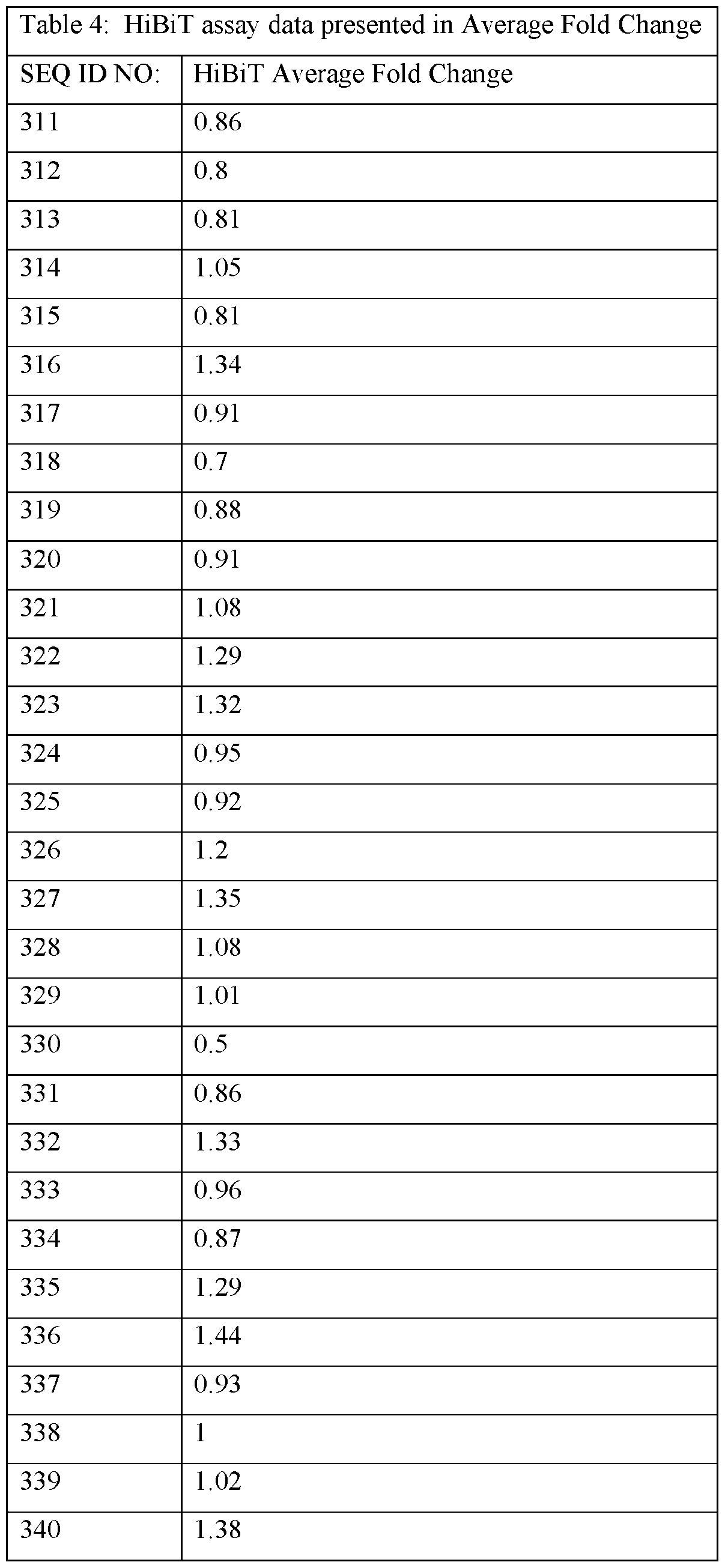
Ref document number: 24727865

Country of ref document: EP

Kind code of ref document: A2

ENP Entry into the national phase

Ref document number: 2024727865

Country of ref document: EP

Effective date: 20251124

WWE Wipo information: entry into national phase

Ref document number: 2024727865

Country of ref document: EP

NENP Non-entry into the national phase

Ref country code: DE

ENP Entry into the national phase

Ref document number: 2024727865

Country of ref document: EP

Effective date: 20251124

ENP Entry into the national phase

Ref document number: 2024727865

Country of ref document: EP

Effective date: 20251124

ENP Entry into the national phase

Ref document number: 2024727865

Country of ref document: EP

Effective date: 20251124