WO2024206125A1 - Use of prime editing for treating sickle cell disease - Google Patents
Use of prime editing for treating sickle cell disease Download PDFInfo
- Publication number
- WO2024206125A1 WO2024206125A1 PCT/US2024/021103 US2024021103W WO2024206125A1 WO 2024206125 A1 WO2024206125 A1 WO 2024206125A1 US 2024021103 W US2024021103 W US 2024021103W WO 2024206125 A1 WO2024206125 A1 WO 2024206125A1
- Authority
- WO
- WIPO (PCT)
- Prior art keywords
- sequence
- seq
- epegrna
- cell
- prime
- Prior art date
- Legal status (The legal status is an assumption and is not a legal conclusion. Google has not performed a legal analysis and makes no representation as to the accuracy of the status listed.)
- Ceased
Links
Classifications
-
- A—HUMAN NECESSITIES
- A61—MEDICAL OR VETERINARY SCIENCE; HYGIENE
- A61P—SPECIFIC THERAPEUTIC ACTIVITY OF CHEMICAL COMPOUNDS OR MEDICINAL PREPARATIONS
- A61P7/00—Drugs for disorders of the blood or the extracellular fluid
- A61P7/06—Antianaemics
-
- C—CHEMISTRY; METALLURGY
- C12—BIOCHEMISTRY; BEER; SPIRITS; WINE; VINEGAR; MICROBIOLOGY; ENZYMOLOGY; MUTATION OR GENETIC ENGINEERING
- C12N—MICROORGANISMS OR ENZYMES; COMPOSITIONS THEREOF; PROPAGATING, PRESERVING, OR MAINTAINING MICROORGANISMS; MUTATION OR GENETIC ENGINEERING; CULTURE MEDIA
- C12N15/00—Mutation or genetic engineering; DNA or RNA concerning genetic engineering, vectors, e.g. plasmids, or their isolation, preparation or purification; Use of hosts therefor
- C12N15/09—Recombinant DNA-technology
- C12N15/11—DNA or RNA fragments; Modified forms thereof; Non-coding nucleic acids having a biological activity
- C12N15/113—Non-coding nucleic acids modulating the expression of genes, e.g. antisense oligonucleotides; Antisense DNA or RNA; Triplex- forming oligonucleotides; Catalytic nucleic acids, e.g. ribozymes; Nucleic acids used in co-suppression or gene silencing
-
- C—CHEMISTRY; METALLURGY
- C12—BIOCHEMISTRY; BEER; SPIRITS; WINE; VINEGAR; MICROBIOLOGY; ENZYMOLOGY; MUTATION OR GENETIC ENGINEERING
- C12N—MICROORGANISMS OR ENZYMES; COMPOSITIONS THEREOF; PROPAGATING, PRESERVING, OR MAINTAINING MICROORGANISMS; MUTATION OR GENETIC ENGINEERING; CULTURE MEDIA
- C12N2310/00—Structure or type of the nucleic acid
- C12N2310/10—Type of nucleic acid
- C12N2310/20—Type of nucleic acid involving clustered regularly interspaced short palindromic repeats [CRISPR]
-
- C—CHEMISTRY; METALLURGY
- C12—BIOCHEMISTRY; BEER; SPIRITS; WINE; VINEGAR; MICROBIOLOGY; ENZYMOLOGY; MUTATION OR GENETIC ENGINEERING
- C12N—MICROORGANISMS OR ENZYMES; COMPOSITIONS THEREOF; PROPAGATING, PRESERVING, OR MAINTAINING MICROORGANISMS; MUTATION OR GENETIC ENGINEERING; CULTURE MEDIA
- C12N2310/00—Structure or type of the nucleic acid
- C12N2310/30—Chemical structure
- C12N2310/35—Nature of the modification
- C12N2310/351—Conjugate
- C12N2310/3519—Fusion with another nucleic acid
Definitions
- Sickle cell disease is an autosomal recessive disorder caused by an A «T-to- T «A mutation at nucleotide position 20 in the hemoglobin subunit beta (HBB) gene, resulting in the pathogenic HBB S allele encoding a Glu — Vai substitution.
- This mutation changes normal adult P-globin (p A ) to sickle P-globin (P s ) and results in replacement of normal adult hemoglobin (HbA, CX2P2) with sickle hemoglobin (HbS, CX2p S 2).
- HbS forms rigid polymers that cause characteristic red blood cell (RBC) shape changes and initiate a complex pathophysiology that includes hemolysis, microvascular occlusions, and inflammation.
- Clinical manifestations include anemia, immunodeficiency, multi-organ damage, severe acute and chronic pain, and premature death 1 .
- HSCT allogeneic hematopoietic stem cell transplantation
- most patients lack ideal donors, and the procedure is associated with serious toxicities, including graft-vs-host disease and graft rejection 7 .
- Correction of the patient’s own hematopoietic stem cells (HSCs) bypasses immune complications and eliminates the need for a tissue-compatible donor.
- Current strategies for therapeutic manipulation of SCD HSPCs being examined in clinical trials include lentiviral expression of an anti-sickling P-like globin 8 , the use of genome editing nucleases or base editors to activate ⁇
- HbF, OC2V2 Cas9 nuclease-initiated homology-directed repair (HDR) using an AAV6 DNA template to correct the SCD mutation 15 .
- a base editing strategy using an adenine base editor to convert the pathogenic HBB S allele into the non-pathogenic, naturally occurring Makassar allele (HBB G ) has also been developed 16 . While each of these strategies has distinct advantages and disadvantages, reverting the SCD Glu — Vai substitution, which requires a T «A-to-A «T transversion, represents the most physiological approach for disease correction.
- HDR nuclease-mediated homology directed repair
- DSB double- stranded DNA breaks
- Indel on-target loss-of-function insertion and deletion
- co-delivery of the HDR template by AAV transduction 15,26 has the potential to impair HSC engraftment 18,27 .
- a treatment for SCD that would permanently revert HBB S to wild-type HBB A with minimal or no deleterious genomic alterations or cell state changes is therefore needed.
- Prime editing replaces a target segment of DNA with a specified new sequence up to hundreds of base pairs in length, thus enabling the installation of targeted insertions, deletions, and any base-to-base substitutions directly into the genome of living cells and animals, without requiring DSBs 2 4 ' 2S 32 .
- Described herein is the development of a prime editing strategy that reverts the SCD allele back to wild-type HBB A with high on-target efficiency, low frequencies of indel byproducts, and minimal off-target editing.
- Edited HSPCs of SCD human patients maintained prime editing levels at 17 weeks after transplantation in mice, with engrafted cells showing an allele correction frequency of up to 41%, and up to 42% of blood cells containing at least one wild-type HBB A allele, indicating robust editing of hematopoietic stem cells at levels that exceed the estimated therapeutic threshold (a correction frequency of approximately 20% is estimated to be the therapeutic threshold for improvement of at least some disease parameters).
- Treated cells also showed a significant reduction in sickling when cultured in hypoxic conditions.
- Minimal off-target editing was detected following the analysis of over 100 experimentally identified CIRCLE- seq-nominated candidate off-target sites engaged by the prime editing system, suggesting a high degree of target DNA specificity.
- the present disclosure provides methods of treating sickle cell disease comprising contacting a target nucleotide sequence with a prime editor and an engineered prime editing guide RNA (epegRNA), wherein the epegRNA comprises the structure 5 '-[spacer sequence] -[single guide RNA (sgRNA) scaffold sequence] -[extension arm sequence] -[optional engineered linker sequence]-[3' structured motif]-3', wherein each instance of ]-[ comprises an optional linker sequence.
- epegRNA engineered prime editing guide RNA
- the epegRNA comprises the spacer sequence 5'-CATGGTGCACCTGACTCCTG-3' (SEQ ID NO: 127), or a sequence at least 90%, at least 95%, at least 96%, at least 97%, at least 98%, or at least 99% identical to the sequence 5'-CATGGTGCACCTGACTCCTG-3' (SEQ ID NO: 127) or a fragment thereof.
- the epegRNA comprises the sequence 5'- CATGGTGCACCTGACTCCTGGTTTTAGAGCTAGAAATAGCAAGTTAAAATAAGGC TAGTCCGTTATCAACTTGAAAAAGTGGCACCGAGTCGGTGCAGACTTCTCTTCAGG AGTCAGGTGCACAGAATAAACGCGGTTCTATCTAGTTACGCGTTAAACCAACTAG AA-3' (SEQ ID NO: 115), or a sequence at least 90%, at least 95%, at least 96%, at least 97%, at least 98%, or at least 99% identical to the sequence of SEQ ID NO: 115.
- the epegRNA comprises the sequence 5'- CATGGTGCACCTGACTCCTGGTTTTAGAGCTAGAAATAGCAAGTTAAAATAAGGC TAGTCCGTTATCAACTTGAAAAAGTGGCACCGAGTCGGTGCAGACTTCTCTTCAGG AGTCAGGTGCACAGAATAAACGCGGTTCTATCTAGTTACGCGTTAAACCAACTAG AATTT-3' (SEQ ID NO: 116), or a sequence at least 90%, at least 95%, at least 96%, at least 97%, at least 98%, or at least 99% identical to the sequence of SEQ ID NO: 116.
- the methods described herein may result in the correction of an ATT A transversion mutation at nucleotide position 20 in the P-globin gene (HBB).
- correction of the A TT A trans version mutation in HBB reverts the sickle cell disease allele to the wild type allele.
- correction of the A TT A transversion mutation in HBB results in the correction of a valine mutation in the P-globin protein to a wild type glutamic acid residue.
- the method further results in the introduction of a silent PAM-disrupting edit in the HBB gene, e.g., a G — > A silent PAM-disrupting edit at the nucleotide position following the ATT A transversion mutation. Introduction of such a PAM- disrupting edit in the HBB gene may help the prime editing intermediate that is produced prior to incorporation of the edit to avoid reversion to the unedited sequence by the cellular DNA mismatch repair pathway.
- the methods provided herein further comprise nicking the non- PAM-containing strand of the target nucleotide sequence using a nicking sgRNA.
- a nicking gRNA may facilitate incorporation of the edit by cellular DNA repair mechanisms.
- the spacer sequence of the nicking sgRNA comprises the nucleotide sequence 5'-CCTTGATACCAACCTGCCCA-3' (SEQ ID NO: 128), 5'- GTAACGGCAGACTTCTCTTC-3' (SEQ ID NO: 129), 5'-CACGTTCACCTTGCCCCACA- 3' (SEQ ID NO: 130), or 5'-TCCACATGCCCAGTTTCTAT-3' (SEQ ID NO: 131), or a sequence at least 90%, at least 95%, at least 96%, at least 97%, at least 98%, or at least 99% identical to the sequence 5'-CCTTGATACCAACCTGCCCA-3' (SEQ ID NO: 128), 5'- GTAACGGCAGACTTCTCTTC-3' (SEQ ID NO: 129), 5'-CACGTTCACCTTGCCCCACA- 3' (SEQ ID NO: 130), or 5'-TCCACATGCCCAGTTTCTAT-3' (SEQ ID NO: 13
- the prime editor comprises PEmax architecture (e.g., PE3max, PE3bmax, PE4max, PE5max, or PE5bmax). In certain embodiments, the prime editor is PE3max. In certain embodiments, the prime editor is PE3bmax.
- the contacting is performed in a cell (e.g., a eukaryotic cell, such as a human cell).
- the cell is a hematopoietic stem or progenitor cell (HSPC), for example, an HSPC from a patient who is being treated for SCD.
- the cell is a hemateopoetic stem cell (HSC).
- HSC hemateopoetic stem cell
- an HSC edited using the methods described herein is able to retain the edits introduced into its sublineages (e.g., CD34 + cells, CD235a + cells, CD33 + cells, CD19 + cells, etc.).
- HSPCs are significantly more amenable to delivery of RNA, e.g., specifically by electroporation.
- the prime editor is delivered to the cell as mRNA
- the epegRNA is delivered to the cell as RNA.
- a nicking sgRNA is also delivered to the cell as RNA.
- the prime editor mRNA, epegRNA, and/or nicking sgRNA are delivered to a cell by electroporation (e.g., facilitating the editing of HSPCs ex vivo that can then be delivered to a sickle cell disease patient).
- the prime editor mRNA, epegRNA, and nicking sgRNA comprise approximately 20% of the total electroporation volume.
- the molar ratio of the amount of epegRNA to the amount of nicking sgRNA delivered to the cell is approximately 1.5:1.
- any of the methods described herein may be performed in vitro.
- the methods described herein are performed ex vivo.
- the methods described herein are performed in a cell (e.g., an HSPC, HSC, or other human cell type) ex vivo, and the edited cell is subsequently transplanted into a subject to be treated for sickle cell disease.
- an HSC edited using the methods described herein is able to retain the edits introduced into its sub-lineages (e.g., CD34 + cells, CD235a + cells, CD33 + cells, CD19 + cells, etc.).
- the methods described herein are performed in vivo (e.g., in a subject).
- bone marrow cells in a subject are edited.
- the methods provided herein provide several advantages over previously disclosed gene editing methods for treating sickle cell disease, including increased editing efficiency and lower rates of off-target effects.
- the methods provided herein may result in a greater than 20%, greater than 25%, greater than 30%, greater than 35%, or greater than 40% efficiency of conversion of an A T:T- A transversion mutation at nucleotide position 20 in the P-globin gene to the wild type sequence.
- a greater than 40% efficiency of conversion of an A T:T- A transversion mutation at nucleotide position 20 in the P-globin gene to the wild type sequence is observed.
- the methods provided herein result in an edit-to-indel ratio of greater than 5, greater than 5.5, greater than 6, greater than 6.5, greater than 7, or greater than 7.5. In certain embodiments, a greater than 7.5 edit-to-indel ratio is observed. In some embodiments, the methods provided herein result in at least 30%, at least 35%, or at least 40% of cells edited using the method retaining the edit following transplantation into a subject. In certain embodiments, the methods provided herein result in at least 40% of cells edited using the method retaining the edit following transplantation into a subject. In some embodiments, the methods provided herein are performed with a prime editing efficiency of at least 60%, at least 65%, at least 70%, at least 75%, or at least 80%.
- the methods provided herein are performed with a prime editing efficiency of at least 80%. In some embodiments, the methods provided herein result in an indel frequency of less than 10%, less than 9%, less than 8%, less than 7%, less than 6%, less than 5%, or less than 4%. In certain embodiments, the methods provided herein result in an indel frequency of less than 4%.
- the present disclosure provides methods of treating sickle cell disease comprising contacting a target nucleotide sequence with a prime editor and a prime editing guide RNA (pegRNA), wherein the prime editor is PE3max or PE3bmax, and wherein the pegRNA comprises the structure 5'-[spacer sequence]-[single guide RNA (sgRNA) scaffold sequence] -[extension arm sequence]-3', wherein each instance of ]-[ comprises an optional linker sequence.
- pegRNA prime editing guide RNA
- the present disclosure provides methods of treating sickle cell disease comprising contacting a target nucleotide sequence with a prime editor, a prime editing guide RNA (pegRNA), and a nicking single guide RNA (sgRNA), wherein the pegRNA comprises the structure 5'-[spacer sequence]-[sgRNA scaffold sequence] -[extension arm sequence] -3', wherein each instance of ]-[ comprises an optional linker sequence, and wherein the spacer sequence of the nicking sgRNA comprises the nucleotide sequence 5'- GTAACGGCAGACTTCTCTTC-3' (SEQ ID NO: 129), 5'- CACGTTCACCTTGCCCCACA-3' (SEQ ID NO: 130), or 5'- TCCACATGCCCAGTTTCTAT-3' (SEQ ID NO: 131), or a sequence at least 90%, at least 95%, at least 96%, at least 97%, at least 98%, or at least 99% identical to the sequence 5'-
- the present disclosure provides engineered prime editing guide RNAs (epegRNAs) targeting the P-globin gene (HBB), wherein the epegRNA comprises the structure 5 '-[spacer sequence] -[single guide RNA (sgRNA) scaffold sequence] -[extension arm sequence] -[optional engineered linker sequence]-[3' structured motif]-3', wherein each instance of ]-[ comprises an optional linker sequence.
- HBB P-globin gene
- the present disclosure provides complexes comprising a prime editor (e.g., PE3max or PE3bmax) and any of the epegRNAs disclosed herein.
- a prime editor e.g., PE3max or PE3bmax
- the present disclosure provides polynucleotides encoding any of the epegRNAs provided herein, or multiple polynucleotides encoding an epegRNA, a prime editor, and/or a nicking sgRNA as provided herein.
- the present disclosure provides vectors comprising any of the polynucleotides provided herein.
- compositions comprising any of the epegRNAs, nicking sgRNAs, complexes, polynucleotides, or vectors provided herein.
- a pharmaceutical composition comprises any of the epegRNAs provided herein and an mRNA encoding a prime editor.
- the present disclosure provides cells comprising any of the epegRNAs, nicking sgRNAs, complexes, polynucleotides, vectors, or combinations thereof provided herein.
- the cell is an HSPC.
- the cell is an HSC.
- the cell is a CD34 + cell.
- the cell is a CD235a + cell.
- the cell is a CD33 + cell.
- the cell is a CD19 + cell.
- the cell is a human cell.
- kits comprising any of the epegRNAs, nicking sgRNAs, complexes, polynucleotides, vectors, or combinations thereof provided herein.
- the present disclosure provides for the use of any of the epegRNAs, nicking sgRNAs, complexes, polynucleotides, vectors, or pharmaceutical compositions provided herein for the treatment of sickle cell disease.
- the present disclosure provides for the use of any of the epegRNAs, nicking sgRNAs, complexes, polynucleotides, vectors, or pharmaceutical compositions provided herein for the manufacture of a medicament for the treatment of sickle cell disease, for example, in a patient whose genome contains the A T:T A transversion mutation at nucleotide position 20 in the P-globin gene.
- the present disclosure provides cells comprising DNA comprising the sequence 5'-ATGGTGCACCTGACTCCTGAAGAGAAG-3' (SEQ ID NO: 78) (e.g., in the chromosomal DNA of the cell).
- a cell comprises DNA comprising a sequence at least 90%, at least 95%, at least 96%, at least 97%, at least 98%, or at least 99% identical to the sequence 5'-ATGGTGCACCTGACTCCTGAAGAGAAG-3' (SEQ ID NO: 78), wherein the underlined nucleotide is an A (z.e., the PAM-disrupting mutation introduced into the DNA as discussed above).
- the cell is an HSPC.
- the cell is an HSC. In certain embodiments, the cell is a CD34 + cell. In certain embodiments, the cell is a CD235a + cell. In certain embodiments, the cell is a CD33 + cell. In certain embodiments, the cell is a CD19 + cell. In certain embodiments, the cell is a human cell.
- FIG. 1A shows that PE can revert the HBB S allele back to wild-type HBB by correcting the pathogenic T at position +4 (bold).
- FIG. IB shows prime editing efficiencies 3 days post-electroporation at various endogenous genomic loci in 5xl0 5 human CD34 + hematopoietic stem and progenitor cells (HSPCs) when epegRNAs were used with the canonical PE3 system or with the PE3 system using the improved PEmax prime editor architecture (PE3max).
- HSPCs hematopoietic stem and progenitor cells
- FIG. 1C shows editing efficiencies for 5xl0 5 cells per condition for PE2max and PE4max 3 days post-electroporation.
- FIG. ID shows editing efficiencies for 5xl0 5 cells per condition for PE3max and PE5max 3 days postelectroporation.
- FIGs. 2A-2F Optimization of prime editing HBB in human CD34 + HSPCs from healthy donors and from SCD patients.
- 5xl0 5 healthy donor HSPCs and 4-5xl0 6 sickle cell disease (SCD) patient HPSCs were electroporated. All healthy donor HSPCs and IxlO 5 SCD patient HSPCs were cultured for 72 hours following electroporation. The remaining SCD patient HSPCs were cryopreserved for later mouse engraftment experiments. Editing efficiencies for healthy donor cells are for the +5 G>A P AM-disrupting edit, and editing efficiencies reported for SCD patient HSPCs reference correction of the pathogenic +4 T>A HBB S mutation.
- SCD sickle cell disease
- FIG. 2A shows quantification of editing efficiencies for different nicking sgRNAs targeting HBB.
- FIG. 2B shows the distance between the epegRNA-induced nick and the nicking sgRNA-induced nick on the opposite strand for four nicking sgRNA candidates at HBB.
- FIG. 2C shows electroporation components and total combined volume of PEmax mRNA, epegRNA, and nicking sgRNAs for various PE3max electroporation strategies.
- FIG. 2D shows editing efficiency quantification for each condition listed in FIG. 2C.
- FIG. 2E shows quantification of editing efficiencies using the 2x PE3max strategy with the top-performing nicking sgRNAs from FIG. 2A.
- FIG. 2F shows editing efficiency of reversion of the pathogenic HBB S allele back to HBB A in SCD patient CD34 + HSPCs with PE3max NG1. 4-5xl0 6 cells total were edited per donor in parallel electroporations of 5xl0 5 cells per replicate and pooled together for subsequent in vitro culture or cryopreserved for later injection into mice.
- FIGs. 3A-3F Engraftment of prime edited SCD patient CD34 + HSPCs after transplantation into immunodeficient mice. 2xl0 5 2x PE3max edited HSPCs were transplanted from SCD patients into the tail vein of two to five busulfan-treated NBSGW mice per donor. Mouse bone marrow was harvested and analyzed 17 weeks posttransplantation.
- FIG. 3A shows an experimental overview of engraftment experiments.
- FIG. 3B shows human cell engraftment in recipient bone marrow measured by percentage of human CD45 + cells (hCD45 + ). Lines represent mean+SD and each individual shape represents a single mouse.
- FIG. 3C shows percentages of human T cells (hCD3 + ), myeloid cells (hCD33 + ), and B cells (hCD19 + ) in the hCD45 + cell population in recipient bone marrow. Bar height represents cumulative average of each lineage with error bars for +SD.
- FIG. 3D shows the percentage of human erythroid precursor cells (hCD235 + ) as a percentage of human and mouse CD45" cells in recipient bone marrow. Lines shown at mean+SD.
- FIG. 3E shows HBB s - o-HBB A editing efficiency for desired editing with no indels or other undesired products at the target site across human CD34 + cell-derived lineages in recipient bone marrow. Each lineage was isolated using antibodies against appropriate surface markers: hCD235 for erythroid lineages, hCD34 for HSPCs, hCD33 for myeloid cells, and CD19 for B cells. Lines shown at mean+SD. Each individual dot represents a single mouse.
- FIG. 3F shows average allelic editing for each of the four patient donors across 454 BFU-E colonies derived from PE treated CD34 + HSPCs. Lin cells were isolated and plated to achieve 95-120 individual colonies per donor.
- HBB high-throughput sequencing
- FIGs. 4A-4C Phenotypic rescue of sickle-cell disease characteristics in ex vivo- differentiated PE3max-treated human reticulocytes from HSPCs transplanted into immunodeficient mice.
- FIG. 4A shows the percentage of P-like globins measured by ion exchange HPLC in CD235a + cells from human SCD patient cells. Bars represent cumulative averages of each protein with error bars for +SD across 2-5 mice per donor.
- FIG. 4B shows representative phase-contrast images of reticulocytes derived from PE3max edited or untreated SCD HSPCs incubated for 8 h with 2% oxygen. Scale bars, 100 pM.
- FIG. 4C shows quantification of sickle reticulocytes from images as in FIG.
- FIG. 5A shows rhAmpSeq quantification of the first epegRNA-encoded mismatch at CIRCLE-seq nominated off-target loci in SCD patient HSPCs.
- the graph also includes epegRNA OT49, which had to be analyzed separately with HTS since the primers for the locus were not amenable to pooled rhAmpSeq analysis.
- FIG. 5B shows rhAmpSeq quantification of indels at nicking sgRNA off-target loci nominated by CIRCLE-seq in SCD patient HSPCs.
- Nick OT32 was not amenable to rhAmpSeq analysis or PCR amplification and therefore could not be analyzed.
- Nick OT22 was the on-target NG1 site.
- FIGs. 6A-6C Optimization of epegRNA modification, viability and recovery of healthy donor CD34 + HSPCs following editing, and PE3max editing outcomes in SCD patient and healthy donor CD34 + HSPCs.
- FIG. 6C shows quantification of editing efficiencies for both SCD patient and healthy donor HSPCs.
- Both the reversion of the pathogenic +4 T>A edit and the +5 A>G edit could be measured directly in SCD patient cells, while only the latter edit can be made in healthy donor cells.
- FIGs. 7A-7B Flow cytometry analysis of human HSC lineage populations and indel analysis of BFU-E colonies.
- FIG. 7A shows representative immune-flow cytometry for T cells (hCD3+), B cells (hCD19+), myeloid cells (hCD33+), and erythroid cells (hCD235a+).
- SSC-A side scatter area
- SSC-W side scatter width
- FSC-A forward scatter area
- DAPI live-dead stain.
- FIG. 7B shows average allelic editing across each of the four patient donors for the 4% of colonies (16 colonies out of 454 total BFU-E colonies) derived from PE-treated CD34 + HSPCs with indels as in FIG. 3F. Colonies were categorized by whether they had a biallelic edit with indels, a monoallelic edit with indels, or indels without any desired editing. Bar heights represent cumulative averages of each outcome.
- FIGs. 8A-8E In vitro erythroid differentiation of SCD CD34 + HSPCs.
- FIG. 8A shows representative immuno-flow cytometry for erythroid maturation markers at days 8 and 13 in culture for in vitro differentiation. Gating strategy to identify single hCD235a + cells.
- FIG. 8B shows a gating strategy to track progression of erythroid differentiation based on hCD49d and Band3 expression in hCD235a + cells 13,61 .
- SSC-A side scatter area
- SSC-W side scatter width
- FSC- A forward scatter area.
- FIG. 8C shows percentage of P-like globins measured by ion exchange HPLC in differentiated reticulocytes from human SCD patient cells.
- FIG. 8D shows quantification of terminally differentiating HSPCs in vitro based on Band3 and CD49d at differentiation days 8, 13, 18, and 21 13,61 as in FIG. 8B. Bars represent cumulative averages with error bars reflecting standard deviation (SD).
- FIG. 9 shows an example of how epegRNA-encoded off-target prime editing was identified, as described herein. Since DNA sequencing errors and cellular genomic heterogeneity (observed in both edited cells and untreated cells) were the sources of the vast majority of DNA sequence differences between samples and the reference sequence, potential off-target prime editing was identified by counting sequences that contain the first mismatch encoded by the epegRNA reverse transcriptase template (RTT) as putative epegRNA-encoded off-target prime edits.
- RTT epegRNA reverse transcriptase template
- nick-induced indels near sites targeted by epegRNAs or nicking sgRNAs were also separately identified (see FIGs. 5A-5B). Sequences shown correspond (top-bottom) to SEQ ID NOs: 376-397.
- an “aptamer” refers to an oligonucleotide or peptide molecule that binds to a specific target molecule.
- an epegRNA comprises an aptamer as a structured motif attached to its 3' end.
- Aptamers include DNA or RNA aptamers that are short singlestranded DNA- or RNA-based oligonucleotides that can selectively bind to small molecular ligands or protein targets with high affinity and specificity, when folded into their unique three-dimensional structures. On the molecular level, aptamers bind to its cognate target through various non-covalent interactions, electrostatic interactions, hydrophobic interactions, and induced fitting.
- aptamers may be obtained from APTAGEN (aptagen.com) and include, but are not limited to, thrombin (15mer), HIV-1 TAR RNA hairpin loop (B22-19), human immunoglobulin G (IgG) (Apt 8), reactive green 19 (GR-30), abrin toxin (TA6), malachite green (MG-4), PSMA aptamer (A10-3), tenascin-C (GBI-10), and methylenedianiline (Ml).
- thrombin 15mer
- HIV-1 TAR RNA hairpin loop B22-19
- human immunoglobulin G IgG
- GR-30 reactive green 19
- TA6 abrin toxin
- MG-4 malachite green
- PSMA aptamer A10-3
- tenascin-C GBI-10
- Ml methylenedianiline
- prequeosinei-1 riboswitch aptamer one of the smallest natural tertiary
- Cas9 or “Cas9 nuclease” refers to an RNA-guided nuclease comprising a Cas9 domain, or a fragment thereof (e.g., a protein comprising an active or inactive DNA cleavage domain of Cas9, and/or the gRNA binding domain of Cas9).
- a “Cas9 domain,” as used herein, is a protein fragment comprising an active or fully or partly inactive cleavage domain of Cas9 and/or the gRNA binding domain of Cas9.
- a “Cas9 protein” is a full length Cas9 protein.
- a Cas9 nuclease is also referred to sometimes as a casnl nuclease or a CRISPR (Clustered Regularly Interspaced Short Palindromic Repeat)-associated nuclease.
- CRISPR is an adaptive immune system that provides protection against mobile genetic elements (viruses, transposable elements, and conjugative plasmids).
- CRISPR clusters contain spacers, sequences complementary to antecedent mobile elements, and target invading nucleic acids.
- CRISPR clusters are transcribed and processed into CRISPR RNA (crRNA).
- tracrRNA trans-encoded small RNA
- me endogenous ribonuclease 3
- Cas9 domain The tracrRNA serves as a guide for ribonuclease 3-aided processing of pre-crRNA.
- Cas9/crRNA/tracrRNA endonucleolytically cleaves a linear or circular dsDNA target complementary to the spacer.
- the strand in the target DNA not complementary to crRNA is first cut endonucleolytically, then trimmed 3'-5' exonucleolytically.
- DNA-binding and cleavage typically requires protein and both RNAs.
- single guide RNAs (“sgRNA”, or simply “gRNA”) can be engineered so as to incorporate aspects of both the crRNA and tracrRNA into a single RNA species. See, e.g., Jinek M., Chylinski K., Fonfara I., Hauer M., Doudna J. A., Charpentier E. Science 337:816-821(2012), the contents of which are incorporated herein by reference.
- Cas9 recognizes a short motif in the CRISPR repeat sequences (the PAM or protospacer adjacent motif) to help distinguish self versus non-self.
- Cas9 nuclease sequences and structures are well known to those of skill in the art (see, e.g., “Complete genome sequence of an Ml strain of Streptococcus pyogenes.” Ferretti et al., J.J., McShan W.M., Ajdic D.J., Savic D.J., Savic G., Lyon K., Primeaux C., Sezate S., Suvorov A.N., Kenton S., Lai H.S., Lin S.P., Qian Y., Jia H.G., Najar E.Z., Ren Q., Zhu H., Song L., White J., Yuan X., Clifton S.W., Roe B.A., McLaughlin R.E., Proc.
- Cas9 orthologs have been described in various species, including, but not limited to, S. pyogenes and 5. thermophilus. Additional suitable Cas9 nucleases and sequences will be apparent to those of skill in the art based on this disclosure, and such Cas9 nucleases and sequences include Cas9 sequences from the organisms and loci disclosed in Chylinski, Rhun, and Charpentier, “The tracrRNA and Cas9 families of type II CRISPR-Cas immunity systems” (2013) RNA Biology 10:5, 726-737; the entire contents of which are incorporated herein by reference.
- a Cas9 nuclease comprises one or more mutations that partially impair or inactivate the DNA cleavage domain.
- a nuclease-inactivated Cas9 domain may interchangeably be referred to as a “dCas9” protein (for nuclease-“dead” Cas9).
- Methods for generating a Cas9 domain (or a fragment thereof) having an inactive DNA cleavage domain are known (see, e.g., Jinek et al., Science. 337:816-821(2012); Qi et al., “Repurposing CRISPR as an RNA-Guided Platform for Sequence-Specific Control of Gene Expression” (2013) Cell. 28; 152(5): 1173-83, the entire contents of each of which are incorporated herein by reference).
- the DNA cleavage domain of Cas9 is known to include two subdomains, the HNH nuclease subdomain and the RuvCl subdomain.
- the HNH subdomain cleaves the strand complementary to the gRNA, whereas the RuvCl subdomain cleaves the non-complementary strand. Mutations within these subdomains can silence the nuclease activity of Cas9.
- the mutations D10A and H840A or H839A in SEQ ID NO: 8 completely inactivate the nuclease activity of .S'. pyogenes Cas9 (Jinek et al., Science. 337:816-821(2012); Qi et al., Cell.
- proteins comprising fragments of a Cas9 protein are provided.
- a protein comprises one of two Cas9 domains: (1) the gRNA binding domain of Cas9; or (2) the DNA cleavage domain of Cas9.
- proteins comprising Cas9, or fragments thereof are referred to as “Cas9 variants.”
- a Cas9 variant shares homology to Cas9, or a fragment thereof.
- a Cas9 variant is at least about 70% identical, at least about 80% identical, at least about 90% identical, at least about 95% identical, at least about 96% identical, at least about 97% identical, at least about 98% identical, at least about 99% identical, at least about 99.5% identical, at least about 99.8% identical, or at least about 99.9% identical to wild type Cas9 (e.g., SpCas9 of SEQ ID NO: 6).
- wild type Cas9 e.g., SpCas9 of SEQ ID NO: 6
- the Cas9 variant may have 1, 2, 3, 4, 5, 6, 7, 8, 9, 10, 11, 12, 13, 14, 15, 16, 17, 18, 19, 20, 21, 22, 21, 24, 25, 26, 27, 28, 29, 30, 31, 32, 33, 34, 35, 36, 37, 38, 39, 40, 41, 42, 43, 44, 45, 46, 47, 48, 49, 50, or more amino acid changes compared to wild type Cas9 e.g., SpCas9 of SEQ ID NO: 6).
- the Cas9 variant comprises a fragment of SEQ ID NO: 6 Cas9 e.g., a gRNA binding domain or a DNA-cleavage domain), such that the fragment is at least about 70% identical, at least about 80% identical, at least about 90% identical, at least about 95% identical, at least about 96% identical, at least about 97% identical, at least about 98% identical, at least about 99% identical, at least about 99.5% identical, or at least about 99.9% identical to the corresponding fragment of wild type Cas9 (e.g., SpCas9 of SEQ ID NO: 6).
- wild type Cas9 e.g., SpCas9 of SEQ ID NO: 6
- the fragment is at least 30%, at least 35%, at least 40%, at least 45%, at least 50%, at least 55%, at least 60%, at least 65%, at least 70%, at least 75%, at least 80%, at least 85%, at least 90%, at least 95% identical, at least 96%, at least 97%, at least 98%, at least 99%, or at least 99.5% of the amino acid length of a corresponding wild type Cas9 (e.g., SpCas9 of SEQ ID NO: 6).
- CRISPR CRISPR
- CRISPR is a family of DNA sequences (z.e., CRISPR clusters) in bacteria and archaea that represent snippets of prior infections by a virus that have invaded the prokaryote.
- the snippets of DNA are used by the prokaryotic cell to detect and destroy DNA from subsequent attacks by similar viruses and effectively compose, along with an array of CRISPR- associated proteins (including Cas9 and homologs thereof) and CRISPR-associated RNA, a prokaryotic immune defense system.
- CRISPR clusters are transcribed and processed into CRISPR RNA (crRNA).
- tracrRNA trans-encoded small RNA
- me endogenous ribonuclease 3
- Cas9 protein a trans-encoded small RNA
- the tracrRNA serves as a guide for ribonuclease 3-aided processing of pre-crRNA.
- Cas9/crRNA/tracrRNA endonucleolytically cleaves a linear or circular dsDNA target complementary to the RNA. Specifically, the DNA strand in the target that is not complementary to crRNA is first cut endonucleolytically, then trimmed 3 '-5' exonucleolytically.
- RNA-binding and cleavage typically requires protein and both RNAs.
- single guide RNAs (“sgRNA”, or simply “gRNA”) can be engineered so as to incorporate aspects of both the crRNA and tracrRNA into a single RNA species - the guide RNA.
- sgRNA single guide RNAs
- Cas9 recognizes a short motif in the CRISPR repeat sequences (the PAM or protospacer adjacent motif) to help distinguish self versus non-self.
- Cas9 orthologs have been described in various species, including, but not limited to, 5. pyogenes and .S'. thermophilus. Additional suitable Cas9 nucleases and sequences will be apparent to those of skill in the art based on this disclosure, and such Cas9 nucleases and sequences include Cas9 sequences from the organisms and loci disclosed in Chylinski, Rhun, and Charpentier, “The tracrRNA and Cas9 families of type II CRISPR-Cas immunity systems” (2013) RNA Biology 10:5, 726-737; the entire contents of which are incorporated herein by reference.
- a “CRISPR system” refers collectively to transcripts and other elements involved in the expression of or directing the activity of CRISPR-associated (“Cas”) genes, including sequences encoding a Cas gene, a tracr (trans-activating CRISPR) sequence (e.g., tracrRNA or an active partial tracrRNA), a tracr mate sequence (encompassing a “direct repeat” and a tracrRNA-processed partial direct repeat in the context of an endogenous CRISPR system), a guide sequence (also referred to as a “spacer”), or other sequences and transcripts from a CRISPR locus.
- the tracrRNA of the system is complementary (fully or partially) to the tracr mate sequence present on the guide RNA.
- DNA synthesis template or reverse transcription template (RTT)
- DNA synthesis template and “reverse transcription template (RTT)” refer to the region or portion of the extension arm of a PEgRNA or epegRNA that is utilized as a template by a polymerase of a prime editor to encode a 3' single- strand DNA flap that contains the desired edit and which then, through the mechanism of prime editing, replaces the corresponding endogenous strand of DNA at the target site.
- the extension arm including the DNA synthesis template, may be comprised of DNA or RNA.
- the polymerase of the prime editor can be an RNA-dependent DNA polymerase (e.g., a reverse transcriptase).
- the polymerase of the prime editor can be a DNA-dependent DNA polymerase.
- the DNA synthesis template may comprise the “edit template” and the “homology arm”, and all or a portion of an optional 5' end modifier region and/or an optional 3' end modifier region.
- the DNA synthesis template can include the portion of the extension arm that spans from the 5' end of the primer binding site (PBS) to 3' end of the gRNA core that may operate as a template for the synthesis of a single- strand of DNA by a polymerase (e.g., a reverse transcriptase).
- a polymerase e.g., a reverse transcriptase
- the DNA synthesis template can include the portion of the extension arm that spans from the 5' end of the PEgRNA molecule to the 5' end of the PBS.
- Certain embodiments described here refer to a “DNA synthesis template,” an “RT template,” or an “RTT,” which is also inclusive of the edit template and the homology arm, but wherein the RT edit template reflects the use of a prime editor having a polymerase that is a reverse transcriptase, and wherein the DNA synthesis template reflects more broadly the use of a prime editor having any polymerase.
- an RT template may be used to refer to a template polynucleotide for reverse transcription, e.g., in a prime editing system, complex, or method using a prime editor having a polymerase that is a reverse transcriptase.
- a DNA synthesis template may be used to refer to a template polynucleotide for DNA polymerization, e.g., RNA-dependent DNA polymerization or DNA-dependent polymerization, e.g., in a prime editing system, complex, or method using a prime editor having a polymerase that is an RNA-dependent DNA polymerase or a DNA-dependent DNA polymerase.
- edit template refers to a portion of the extension arm that encodes the desired edit in the single strand 3' DNA flap that is synthesized by the polymerase, e.g., a DNA-dependent DNA polymerase or an RNA-dependent DNA polymerase (e.g., a reverse transcriptase).
- the polymerase e.g., a DNA-dependent DNA polymerase or an RNA-dependent DNA polymerase (e.g., a reverse transcriptase).
- DNA synthesis template refers to the region or portion of the extension arm of a pegRNA that is utilized as a template strand by a polymerase of a prime editor to encode a 3' single- strand DNA flap that contains the desired edit and which then, through the mechanism of prime editing, replaces the corresponding endogenous strand of DNA at the target site.
- the extension arm including the DNA synthesis template, may be comprised of DNA or RNA.
- the polymerase of the prime editor can be an RNA-dependent DNA polymerase (e.g., a reverse transcriptase).
- the polymerase of the prime editor can be a DNA-dependent DNA polymerase.
- the DNA synthesis template comprises an the “edit template” and a “homology arm.”
- the DNA synthesis template may comprise the “edit template” and a “homology arm”, and all or a portion of the optional 5' end modifier region, e2. That is, depending on the nature of the e2 region (e.g., whether it includes a hairpin, toeloop, or stem/loop secondary structure), the polymerase may encode none, some, or all of the e2 region, as well.
- the DNA synthesis template can include the portion of the extension arm that spans from the 5' end of the primer binding site (PBS) to 3' end of the gRNA core that may operate as a template for the synthesis of a single-strand of DNA by a polymerase (e.g., a reverse transcriptase).
- a polymerase e.g., a reverse transcriptase
- the DNA synthesis template can include the portion of the extension arm that spans from the 5' end of the pegRNA molecule to the 3' end of the edit template.
- the DNA synthesis template excludes the primer binding site (PBS) of pegRNAs either having a 3' extension arm or a 5' extension arm.
- an RT template which is inclusive of the edit template and the homology arm, i.e., the sequence of the pegRNA extension arm which is actually used as a template during DNA synthesis.
- the term “RT template” is equivalent to the term “DNA synthesis template.”
- an RT template may be used to refer to a template polynucleotide for reverse transcription, e.g., in a prime editing system, complex or method using a prime editor having a polymerase that is a reverse transcriptase.
- a DNA synthesis template may be used to refer to a template polynucleotide for DNA polymerization, e.g., RNA-dependent DNA polymerization or DNA-dependent polymerization, e.g., in a prime editing system, complex, or method using a prime editor having a polymerase that is an RNA-dependent DNA polymerase or a DNA-dependent DNA polymerase.
- the DNA synthesis template is a single- stranded portion of the PEgRNA that is 5' of the PBS and comprises a region of complementarity to the PAM strand (i.e., the non-target strand or the edit strand), and comprises one or more nucleotide edits compared to the endogenous sequence of the double stranded target DNA.
- the DNA synthesis template is complementary or substantially complementary to a sequence on the non-target strand that is downstream of a nick site, except for one or more non-complementary nucleotides at the intended nucleotide edit positions.
- the DNA synthesis template is complementary or substantially complementary to a sequence on the non-target strand that is immediately downstream (i.e., directly downstream) of a nick site, except for one or more non-complementary nucleotides at the intended nucleotide edit positions. In some embodiments, one or more of the non- complementary nucleotides at the intended nucleotide edit positions are immediately downstream of a nick site. In some embodiments, the DNA synthesis template comprises one or more nucleotide edits relative to the double-stranded target DNA sequence. In some embodiments, the DNA synthesis template comprises one or more nucleotide edits relative to the non-target strand of the double-stranded target DNA sequence.
- a nick site is characteristic of the particular napDNAbp to which the gRNA core of the PEgRNA associates and is also characteristic of the particular PAM required for recognition and function of the napDNAbp.
- the nick site in the phosphodiester bond between bases three (“-3” position relative to the position 1 of the PAM sequence) and four (“-4” position relative to position 1 of the PAM sequence).
- the DNA synthesis template and the primer binding site are immediately adjacent to each other.
- nucleotide edit refers to a specific nucleotide edit, e.g., a specific deletion of one or more nucleotides, a specific insertion of one or more nucleotides, a specific substitution(s) of one or more nucleotides, or a combination thereof, at a specific position in a DNA synthesis template of a PEgRNA to be incorporated in a target DNA sequence.
- the DNA synthesis template comprises more than one nucleotide edit relative to the double-stranded target DNA sequence.
- each nucleotide edit is a specific nucleotide edit at a specific position in the DNA synthesis template, each nucleotide edit is at a different specific position relative to any of the other nucleotide edits in the DNA synthesis template, and each nucleotide edit is independently selected from a specific deletion of one or more nucleotides, a specific insertion of one or more nucleotides, a specific substitution(s) of one or more nucleotides, or a combination thereof.
- a nucleotide edit may refer to the edit on the DNA synthesis template as compared to the sequence on the target strand of the double stranded target DNA, or may refer to the edit encoded by the DNA synthesis template on the newly synthesized single stranded DNA that replaces the endogenous target DNA sequence on the non-target strand.
- the DNA synthesis template/reverse transcriptase template encodes a sequence comprising the correction of an A T:T- A transversion mutation at nucleotide position 20 in the P-globin gene (HBB).
- the DNA synthesis template/reverse transcriptase template further encodes a G A silent PAM-disrupting edit at the nucleotide position following the A T:T- A transversion mutation.
- the terms “edit strand” and “non-edit strand” are terms that may be used when describing the mechanism of a prime editing system on a double-stranded DNA substrate.
- the “edit strand” refers to the strand of DNA that is nicked by the prime editor complex to form a 3' end, which is then extended as a newly synthesized single stranded DNA (also referred herein as the newly synthesized 3' DNA flap), which comprises a desired edit and ultimately displaces and replaces the single strand region of DNA just downstream of the nick, thereby installing the 3' DNA flap containing the desired edit downstream of the nick on the “edit strand.”
- the newly synthesized 3' DNA flap comprising the nucleotide edit is paired in a heteroduplex with the non-edit strand that does not comprise the nucleotide edit, thereby creating a mismatch.
- the mismatch is recognized by DNA repair machinery, and/or replication machinery, e.g., an endogenous DNA repair machinery.
- the intended nucleotide edit is incorporated into both strands of the target double- stranded DNA substrate.
- the application may also refer to the “edit strand” as the “protospacer strand” or the “PAM strand” since these elements are present in that strand.
- the “edit strand” may also be called the “non-target strand” since the edit strand is not the strand that becomes annealed to the spacer of the PEgRNA molecule, but rather is the complement of the strand that is annealed by the spacer of the PEgRNA.
- non-edit strand is not directly edited by the PE system. Rather, the desired edit created by the PE system in the 3' DNA flap is incorporated into the “non-edited strand” through DNA replication and/or repair.
- the “nonedit strand” is the strand that anneals to the spacer of the PEgRNA, and thus is also called the “target strand.” Extension arm
- extension arm refers to a nucleotide sequence component of a PEgRNA which comprises a primer binding site (PBS) and a DNA synthesis template for a polymerase e.g., an RT template for reverse transcriptase).
- the extension arm is located at the 3' end of the guide RNA. In other embodiments, the extension arm is located at the 5' end of the guide RNA.
- the extension arm comprises a DNA synthesis template and a primer binding site. In some embodiments, the extension arm comprises the following components in a 5' to 3' direction: the DNA synthesis template, and the primer binding site. In some embodiments, the extension arm also includes a homology arm.
- the extension arm comprises the following components in a 5' to 3' direction: the homology arm, the edit template, and the primer binding site. Since polymerization activity of the reverse transcriptase is in the 5' to 3' direction, the preferred arrangement of the homology arm, edit template, and primer binding site is in the 5' to 3' direction such that the reverse transcriptase, once primed by an annealed primer sequence, polymerizes a single strand of DNA using the edit template as a complementary template strand.
- the extension arm may be described as comprising generally two regions: a primer binding site (PBS) and a DNA synthesis template, for instance.
- the primer binding site binds to a primer sequence, for example, a single stranded primer sequence containing a free 3' end at the nick site that is formed from the endogenous DNA strand of the target site when it becomes nicked by the prime editor complex, thereby exposing a 3' end on the endogenous nicked strand.
- the binding of the primer sequence to the primer binding site on the extension arm of the PEgRNA creates a duplex region with an exposed 3' end (z.e., the 3' of the primer sequence), which then provides a substrate for a polymerase to begin polymerizing a single strand of DNA from the exposed 3' end along the length of the DNA synthesis template.
- the sequence of the single strand DNA product is the complement of the DNA synthesis template. Polymerization continues towards the 5' of the DNA synthesis template (or extension arm) until polymerization terminates.
- the DNA synthesis template represents the portion of the extension arm that is encoded into a single strand DNA product (z.e., the 3' single strand DNA flap containing the desired nucleotide edit) by the polymerase of the prime editor complex and that ultimately replaces the corresponding endogenous DNA strand of the target site that sits immediately downstream of the PE- induced nick site.
- polymerase of the prime editor complex z.e., the 3' single strand DNA flap containing the desired nucleotide edit
- Polymerization may terminate in a variety of ways, including, but not limited to (a) reaching a 5' terminus of the PEgRNA (e.g., in the case of the 5' extension arm wherein the DNA polymerase simply runs out of template), (b) reaching an impassable RNA secondary structure (e.g., hairpin or stem/loop), or (c) reaching a replication termination signal, e.g., a specific nucleotide sequence that blocks or inhibits the polymerase, or a nucleic acid topological signal, such as supercoiled DNA or RNA.
- a 5' terminus of the PEgRNA e.g., in the case of the 5' extension arm wherein the DNA polymerase simply runs out of template
- an impassable RNA secondary structure e.g., hairpin or stem/loop
- a replication termination signal e.g., a specific nucleotide sequence that blocks or inhibits the polymerase, or a nucleic acid topological signal, such as superc
- fusion protein refers to a hybrid polypeptide which comprises protein domains from at least two different proteins.
- One protein may be located at the amino-terminal (N-terminal) portion of the fusion protein or at the carboxy-terminal (C- terminal) protein thus forming an “amino-terminal fusion protein” or a “carboxy-terminal fusion protein,” respectively.
- a protein may comprise different domains, for example, a nucleic acid-programmable DNA-binding domain (e.g., the gRNA binding domain of Cas9 that directs the binding of the protein to a target site) and a reverse transcriptase (z.e., a prime editor).
- any of the fusion proteins provided herein may be produced by any method known in the art.
- the prime editor fusion proteins provided herein may be produced via recombinant protein expression and purification, which is especially suited for fusion proteins comprising a peptide linker.
- Methods for recombinant protein expression and purification are well known, and include those described by Green and Sambrook, Molecular Cloning: A Laboratory Manual (4 th ed., Cold Spring Harbor Laboratory Press, Cold Spring Harbor, N.Y. (2012)), which is incorporated herein by reference.
- gRNA Guide RNA
- guide RNA is a particular type of guide nucleic acid that is mostly commonly associated with a Cas protein of a CRISPR-Cas9 and that associates with Cas9, directing the Cas9 protein to a specific sequence in a DNA molecule that includes complementarity to the spacer sequence of the guide RNA.
- this term also embraces the equivalent guide nucleic acid molecules that associate with Cas9 equivalents, homologs, orthologs, or paralogs, whether naturally occurring or non-naturally occurring (e.g., engineered or recombinant), and which otherwise program the Cas9 equivalent to localize to a specific target nucleotide sequence.
- the Cas9 equivalents may include other napDNAbp from any type of CRISPR system (e.g., type II, V, VI), including Cpfl (a type-V CRISPR- Cas systems), C2cl (a type V CRISPR-Cas system), C2c2 (a type VI CRISPR-Cas system), and C2c3 (a type V CRISPR-Cas system).
- Cpfl a type-V CRISPR- Cas systems
- C2cl a type V CRISPR-Cas system
- C2c2 a type VI CRISPR-Cas system
- C2c3 a type V CRISPR-Cas system
- guide RNA may also be referred to as a “traditional guide RNA” to contrast it with the modified forms of guide RNA termed “prime editing guide RNAs” (or “PEgRNAs”) and “engineered PEgRNAs” (or epegRNAs”).
- PgRNAs primary editing guide RNAs
- epegRNAs engineered PEgRNAs
- single guide RNA (sgRNA) refers to a single guide RNA molecule that contains both a spacer sequence (designed to target a particular nucleotide sequence) and a guide RNA scaffold sequence.
- Guide RNAs, sgRNAs, or PEgRNAs/epegRNAs may comprise various structural elements that include, but are not limited to:
- Spacer sequence the sequence in the guide RNA or pegRNA/epegRNA (having about 20 nts in length) that has the same sequence as the protospacer in the target DNA, except that the guide RNA or PEgRNA/epegRNA comprises uracil and the target protospacer contains thymine.
- gRNA core (or gRNA scaffold or backbone sequence) - the sequence within the gRNA that is responsible for binding with a nucleic acid programmable DNA binding protein, e.g., a Cas9. It does not include the spacer sequence that is used to guide Cas9 to target DNA.
- Transcription terminator - the guide RNA or PEgRNA may comprise a transcriptional termination sequence at the 3' of the molecule.
- a pegRNA or epegRNA may also comprise an extension arm - a single strand extension at the 3' end or the 5' end of the PEgRNA which comprises a primer binding site and a DNA synthesis template sequence that encodes via a polymerase (e.g., a reverse transcriptase) a single stranded DNA flap containing the desired nucleotide change, which then integrates into the endogenous DNA by replacing the corresponding endogenous strand, thereby installing the desired nucleotide change.
- a polymerase e.g., a reverse transcriptase
- a guide RNA is a “nicking guide RNA.”
- Nicking guide RNAs may be used to nick the non-edited strand of a target nucleic acid molecule, which may facilitate incorporation of the edit by cellular DNA repair mechanisms.
- G-quadruplex is a complex three-dimensional nucleic acid moiety formed in nucleic acid sequences that are rich in guanine (G). They are helical in shape and formed from interconnected stacks of guanine tetrads (or “G-tetrads”), which individually are flat, ring-shaped structures formed from four guanines, and which can be stabilized by the presence of a cation (e.g., potassium) that sits in a central channel between pairs of G-tetrads. G-quadruplexes are a diverse collection of structures and not a single structure.
- an epegRNA comprises a G-quadruplex as a structured motif on its 3' end, which may facilitate the stabilization of the epegRNA or otherwise prevent its degradation.
- linker refers to a molecule linking two other molecules or moieties.
- the linker can be an amino acid sequence in the case of a peptide linker joining two domains of a fusion protein.
- a napDNAbp e.g., Cas9
- the linker can also be a nucleotide sequence in the case of joining two nucleotide sequences together (e.g., in a gRNA).
- the traditional guide RNA is linked via a spacer or linker nucleotide sequence to the RNA extension of a prime editing guide RNA which may comprise an RT template sequence and an RT primer binding site.
- the linker is an organic molecule, group, polymer, or chemical moiety.
- the linker is 5- 200 amino acids in length, for example, 5, 6, 7, 8, 9, 10, 11, 12, 13, 14, 15, 16, 17, 18, 19, 20, 21, 22, 23, 24, 25, 26, 27, 28, 29, 30, 30-35, 35-40, 40-45, 45-50, 50-60, 60-70, 70-80, 80-90, 90-100, 100-150, or 150-200 amino acids in length. Longer or shorter linkers are also contemplated.
- the epegRNAs provided herein comprise a linker that has been engineered to allow the attachment of a 3' structured motif to the pegRNA without disrupting the structure or function of the pegRNA.
- such an engineered linker comprises the sequence 5'-AGAATAAA-3' and is placed between the extension arm sequence and the 3' structured motif.
- the engineered linker is at least 90%, at least 95%, at least 96%, at least 97%, at least 98%, or at least 99% identical to the sequence 5'-AGAATAAA-3' or a fragment thereof.
- nucleic acid programmable DNA binding protein or “napDNAbp,” of which Cas9 is an example, refers to a protein that uses RNA:DNA hybridization to target and bind to specific sequences in a DNA molecule.
- Each napDNAbp is associated with at least one guide nucleic acid (e.g., guide RNA), which localizes the napDNAbp to a DNA sequence that comprises a DNA strand (z.e., a target strand) that is complementary to the guide nucleic acid, or a portion thereof (e.g., the protospacer of a guide RNA).
- the guide nucleic-acid “programs” the napDNAbp (e.g., Cas9 or equivalent) to localize and bind to a complementary sequence.
- the binding mechanism of a napDNAbp-guide RNA complex includes the step of forming an R-loop whereby the napDNAbp induces the unwinding of a double- strand DNA target, thereby separating the strands in the region bound by the napDNAbp.
- the guide RNA protospacer then hybridizes to the “target strand.” This displaces a “non-target strand” that is complementary to the target strand, which forms the single strand region of the R-loop.
- the napDNAbp includes one or more nuclease activities, which then cut the DNA, leaving various types of lesions.
- the napDNAbp may comprise a nuclease activity that cuts the non-target strand at a first location, and/or cuts the target strand at a second location.
- the target DNA can be cut to form a “double- stranded break” whereby both strands are cut.
- the target DNA can be cut at only a single site, i.e.. the DNA is “nicked” on one strand.
- Exemplary napDNAbp with different nuclease activities include “Cas9 nickase” (“nCas9”) and a deactivated Cas9 having no nuclease activities (“dead Cas9” or “dCas9”). Exemplary sequences for these and other napDNAbp are provided herein.
- a “nickase” refers to a napDNAbp (e.g., a Cas protein) which is capable of cleaving only one of the two complementary strands of a double- stranded target DNA sequence, thereby generating a nick in that strand.
- the nickase cleaves a non-target strand of a double stranded target DNA sequence.
- the nickase comprises an amino acid sequence with one or more mutations in a catalytic domain of a canonical napDNAbp (e.g., a Cas protein), wherein the one or more mutations reduces or abolishes nuclease activity of the catalytic domain.
- the nickase is a Cas9 that comprises one or more mutations in a RuvC-like domain relative to a wild type Cas9 sequence or to an equivalent amino acid position in other Cas9 variants or Cas9 equivalents. In some embodiments, the nickase is a Cas9 that comprises one or more mutations in an HNH-like domain relative to a wild type Cas9 sequence or to an equivalent amino acid position in other Cas9 variants or Cas9 equivalents.
- the nickase is a Cas9 that comprises an aspartate-to-alanine substitution (D10A) in the RuvC I catalytic domain of Cas9 relative to a canonical SpCas9 sequence or to an equivalent amino acid position in other Cas9 variants or Cas9 equivalents.
- the nickase is a Cas9 that comprises an H840A (or H839A in SEQ ID NO: 8), N854A, and/or N863A mutation relative to a canonical SpCas9 sequence, or to an equivalent amino acid position in other Cas9 variants or Cas9 equivalents.
- the term “Cas9 nickase” refers to a Cas9 with one of the two nuclease domains inactivated. This enzyme is capable of cleaving only one strand of a target DNA.
- the nickase is a Cas protein that is not a Cas9 nickase.
- the napDNAbp of the prime editing complex comprises an endonuclease having nucleic acid programmable DNA binding ability.
- the napDNAbp comprises an active endonuclease capable of cleaving both strands of a double stranded target DNA.
- the napDNAbp is a nuclease active endonuclease, e.g., a nuclease active Cas protein, that can cleave both strands of a double stranded target DNA by generating a nick on each strand.
- a nuclease active Cas protein can generate a cleavage (a nick) on each strand of a double stranded target DNA.
- the two nicks on both strands are staggered nicks, for example, generated by a napDNAbp comprising a Casl2a or Casl2bl.
- the two nicks on both strands are at the same genomic position, for example, generated by a napDNAbp comprising a nuclease active Cas9.
- the napDNAbp comprises an endonuclease that is a nickase.
- the napDNAbp comprises an endonuclease comprising one or more mutations that reduce nuclease activity of the endonuclease, rendering it a nickase.
- the napDNAbp comprises an inactive endonuclease, for example, in some embodiments, the napDNAbp comprises an endonuclease comprising one or more mutations that abolish the nuclease activity.
- the napDNAbp is a Cas9 protein or variant thereof.
- the napDNAbp can also be a nuclease active Cas9, a nuclease inactive Cas9 (dCas9), or a Cas9 nickase (nCas9).
- the napDNAbp is Cas9 nickase (nCas9) that nicks only a single strand.
- the napDNAbp can be selected from the group consisting of: Cas9, Casl2e, Casl2d, Casl2a, Casl2bl, Casl2b2, Casl3a, Casl2c, Casl2d, Casl2e, Casl2h, Casl2i, Casl2g, Casl2f (Casl4), Casl2fl, Casl2j (Cas ), and Argonaute and optionally has a nickase activity such that only one strand is cut.
- the napDNAbp is selected from Cas9, Casl2e, Casl2d, Casl2a, Casl2bl, Casl2b2, Casl3a, Casl2c, Casl2d, Casl2e, Casl2h, Casl2i, Casl2g, Casl2f (Casl4), Casl2fl, Casl2j (CasO), and Argonaute and optionally has a nickase activity such that one DNA strand is cut preferentially to the other DNA strand.
- nuclear localization sequence refers to an amino acid sequence that promotes import of a protein into the cell nucleus, for example, by nuclear transport.
- Nuclear localization sequences are known in the art and would be apparent to the skilled artisan. For example, NLS sequences are described in Plank et al., international PCT application, PCT/EP2000/011690, filed November 23, 2000, published as WO 2001/038547 on May 31, 2001, the contents of which are incorporated herein by reference for its disclosure of exemplary nuclear localization sequences.
- an NLS comprises the amino acid sequence PKKKRKV (SEQ ID NO: 94), MDSLLMNRRKFLYQFKNVRWAKGRRETYLC (SEQ ID NO: 99), KRTADGSEFESPKKKRKV (SEQ ID NO: 97), KRTADGSEFEPKKKRKV (SEQ ID NO: 106), NLSKRPAAIKKAGQAKKKK (SEQ ID NO: 107), PAAKRVKLD (SEQ ID NO: 98), RQRRNELKRSF (SEQ ID NO: 108), or
- nucleic acid refers to a polymer of nucleotides.
- the polymer may include natural nucleosides (z.e., adenosine, thymidine, guanosine, cytidine, uridine, deoxyadenosine, deoxythymidine, deoxyguanosine, and deoxy cytidine), nucleoside analogs (e.g., 2-aminoadenosine, 2-thiothymidine, inosine, pyrrolo-pyrimidine, 3-methyl adenosine, 5-methylcytidine, C5 bromouridine, C5 fluorouridine, C5 iodouridine, C5 propynyl uridine, C5 propynyl cytidine, C5 methylcytidine, 7-deazaadenosine, 7- deazaguanosine, 8-oxoadenosine,
- nucleoside analogs e.
- a nucleic acid is a pegRNA or an epegRNA. In certain embodiments, a nucleic acid comprises one or more 2'-O-methyl modified thymidines. In certain embodiments, a nucleic acid comprises one or more phosphorothioate linkages, e.g., between one or more thymidines.
- the terms “prime editing guide RNA” or “PEgRNA” or “pegRNA” or “extended guide RNA” refer to a specialized form of a guide RNA that has been modified to include one or more additional sequences for implementing the prime editing methods and compositions described herein.
- the prime editing guide RNAs comprise one or more “extended regions,” also referred to herein as “extension arms,” of nucleic acid sequence.
- the extended regions may comprise, but are not limited to, single- stranded RNA or DNA. Further, the extended regions may occur at the 3' end of a traditional guide RNA. In other arrangements, the extended regions may occur at the 5' end of a traditional guide RNA.
- the extended region may occur at an intramolecular region of the traditional guide RNA, for example, in the gRNA core region which associates and/or binds to the napDNAbp.
- the extended region comprises a “DNA synthesis template” or “reverse transcriptase template” that encodes (by the polymerase/reverse transcriptase of the prime editor) a single- stranded DNA which, in turn, has been designed to be (a) homologous with the endogenous target DNA to be edited, and (b) which comprises at least one desired nucleotide change (e.g., a transition, a transversion, a deletion, or an insertion) to be introduced or integrated into the endogenous target DNA.
- a desired nucleotide change e.g., a transition, a transversion, a deletion, or an insertion
- the extended region may also comprise other functional sequence elements, such as, but not limited to, a “primer binding site” and a “linker” sequence, or other structural elements, such as, but not limited to, aptamers, stem loops, hairpins, toe-loops (e.g., a 3' toeloop), or an RNA-protein recruitment domain (e.g., MS2 hairpin).
- a “primer binding site” comprises a sequence that hybridizes to a single- strand DNA sequence having a 3' end generated from the nicked DNA of the R-loop.
- the PEgRNAs have a 3' extension arm, a spacer, and a gRNA core.
- the 3' extension arm further comprises in the 5' to 3' direction a DNA synthesis template, a primer binding site, and a linker.
- the DNA synthesis template may also be referred to more broadly as the “DNA synthesis template” where the polymerase of a prime editor described herein is not an RT, but another type of polymerase.
- the PEgRNAs have a 5' extension arm, a spacer, and a gRNA core.
- the 5' extension further comprises in the 5' to 3' direction a DNA synthesis template, a primer binding site, and a linker.
- the DNA synthesis template may also be referred to more broadly as the “DNA synthesis template” where the polymerase of a prime editor described herein is not an RT, but another type of polymerase.
- the PEgRNAs have in the 5' to 3' direction a spacer, a gRNA core, and an extension arm.
- the extension arm is at the 3' end of the PEgRNA.
- the extension arm further comprises in the 5' to 3' direction a homology arm, an edit template, and a primer binding site.
- the extension arm may also comprise an optional modifier region at the 3' and 5' ends, which may be the same sequences or different sequences.
- the 3' end of the PEgRNA may comprise a transcriptional terminator sequence.
- the PEgRNAs have in the 5' to 3' direction an extension arm, a spacer, and a gRNA core.
- the extension arm is at the 5' end of the PEgRNA.
- the extension arm further comprises in the 3' to 5' direction a primer binding site, an edit template, and a homology arm.
- the extension arm may also comprise an optional modifier region at the 3' and 5' ends, which may be the same sequences or different sequences.
- the PEgRNAs may also comprise a transcriptional terminator sequence at the 3' end.
- epegRNAs provided in the present disclosure comprise a spacer sequence 5'-CATGGTGCACCTGACTCCTG-3' (SEQ ID NO: 127), or a sequence at least 90%, at least 95%, at least 96%, at least 97%, at least 98%, or at least 99% identical to the sequence 5'-CATGGTGCACCTGACTCCTG-3' (SEQ ID NO: 127) or a fragment thereof (e.g., at least 5, 6, 7, 8, 9, 10, 11, 12, 13, 14, 15, or more nucleotides of the sequence).
- epegRNAs provided in the present disclosure comprise the sgRNA scaffold sequence 5'-
- GTTTTAGAGCTAGAAATAGCAAGTTAAAATAAGGCTAGTCCGTTATCAACTTGAA AAAGTGGCACCGAGTCGGTGC-3' (SEQ ID NO: 126) or a fragment thereof (e.g., at least 5, 6, 7, 8, 9, 10, 11, 12, 13, 14, 15, or more nucleotides of the sequence).
- epegRNAs provided in the present disclosure comprise the extension arm sequence 5'-AGACTTCTCTTCAGGAGTCAGGTGCAC-3' (SEQ ID NO: 111), or a sequence at least 90%, at least 95%, at least 96%, at least 97%, at least 98%, or at least 99% identical to the sequence 5'-AGACTTCTCTTCAGGAGTCAGGTGCAC-3' (SEQ ID NO: 111) or a fragment thereof (e.g., at least 5, 6, 7, 8, 9, 10, 11, 12, 13, 14, 15, or more nucleotides of the sequence).
- epegRNAs provided in the present disclosure comprise the sequence 5'-AGACTTCTCTTCAGGAGTCAGGTGCAC-3' (SEQ ID NO: 111), or a sequence at least 90%, at least 95%, at least 96%, at least 97%, at least 98%, or at least 99% identical to the sequence 5'-AGACTTCTCTTCAGGAGTCAGGTGCAC-3' (SEQ ID NO: 111) or a fragment thereof (e
- SEQ ID NO: 115 CATGGTGCACCTGACTCCTGGTTTTAGAGCTAGAAATAGCAAGTTAAAATAAGG CTAGTCCGTTATCAACTTGAAAAAGTGGCACCGAGTCGGTGCAGACTTCTCTTCA GGAGTCAGGTGCACAGAATAAACGCGGTTCTATCTAGTTACGCGTTAAACCAAC TAGAA-3' (SEQ ID NO: 115), or a sequence at least 90%, at least 95%, at least 96%, at least 97%, at least 98%, or at least 99% identical to the sequence of SEQ ID NO: 115.
- epegRNAs provided herein comprise the sequence 5'- CATGGTGCACCTGACTCCTGGTTTTAGAGCTAGAAATAGCAAGTTAAAATAAGG CTAGTCCGTTATCAACTTGAAAAAGTGGCACCGAGTCGGTGCAGACTTCTCTTCA GGAGTCAGGTGCACAGAATAAACGCGGTTCTATCTAGTTACGCGTTAAACCAAC TAGAATTT-3' (SEQ ID NO: 116), or a sequence at least 90%, at least 95%, at least 96%, at least 97%, at least 98%, or at least 99% identical to the sequence of SEQ ID NO: 116.
- a pegRNA is an “engineered pegRNA” (“epegRNA”).
- an epegRNA comprises an additional structured motif, for example, attached to its 3' end.
- additional structured motifs may stabilize the pegRNA or otherwise prevent it from being degraded.
- Suitable structured motifs include, but are not limited to, toe-loops, hairpins, stem-loops, pseudoknots, aptamers, G-quadruplexes, tRNAs, riboswitches, and ribozymes.
- a 3' structured motif comprises evopreql.
- a 3' structured motif comprises a nucleotide sequence of any one of SEQ ID NOs: 48-77, or a sequence at least 90%, at least 95%, at least 96%, at least 97%, at least 98%, or at least 99% identical to the sequence of any one of SEQ ID NOs: 48-77 or a fragment thereof (e.g., at least 5, 6, 7, 8, 9, 10, 11, 12, 13, 14, 15, or more nucleotides of the sequence).
- a 3' structured motif comprises the sequence 5'-CGCGGTTCTATCTAGTTACGCGTTAAACCAACTAGAA-3' (SEQ ID NO: 72), or a sequence at least 90%, at least 95%, at least 96%, at least 97%, at least 98%, or at least 99% identical to the sequence 5'- CGCGGTTCTATCTAGTTACGCGTTAAACCAACTAGAA-3' (SEQ ID NO: 72), or a fragment thereof (e.g., at least 5, 6, 7, 8, 9, 10, 11, 12, 13, 14, 15, or more nucleotides of the sequence).
- an epegRNA comprises a 3' structured motif connected to the rest of the pegRNA by an engineered linker (e.g., an engineered linker comprising the sequence 5'-AGAATAAA-3' between the extension arm sequence and the 3' structured motif, or a sequence at least 90%, at least 95%, at least 96%, at least 97%, at least 98%, or at least 99% identical to the sequence 5'-AGAATAAA-3' or a fragment thereof (e.g., at least 4, 5, 6, or more nucleotides of the sequence).
- an engineered linker e.g., an engineered linker comprising the sequence 5'-AGAATAAA-3' between the extension arm sequence and the 3' structured motif, or a sequence at least 90%, at least 95%, at least 96%, at least 97%, at least 98%, or at least 99% identical to the sequence 5'-AGAATAAA-3' or a fragment thereof (e.g., at least 4, 5, 6, or more nucleotides of the sequence).
- PEI refers to a prime editing composition
- a fusion protein comprising a Cas9 protein variant Cas9(H840A) and a wild type MMLV RT having the following structure: [NLS]-[Cas9(H840A)]-[linker]-[MMLV_RT(wt)] -NLS and 2) a desired PEgRNA, wherein the fusion protein (referred to as the PEI protein) has the amino acid sequence of SEQ ID NO: 3, which is shown as follows.
- M-MLV reverse transcriptase (SEQ ID NO: 30).
- PE2 refers to a prime editing composition
- a fusion protein comprising a Cas9 protein variant Cas9(H840A) and a variant MMLV RT having the following structure: [NLS]-[Cas9(H840A)]-[linker]- [MMLV_RT(D200N)(T330P)(L603W)(T306K)(W313F)] -NLS and 2) a desired PEgRNA, wherein the fusion protein (referred to as the PE2 protein) has the amino acid sequence of SEQ ID NO: 4, which is shown as follows: MKRTADGSEFESPKKKRKVDKKYSIGLDIGTNSVGWAVITDEYKVPSKKFKVLG
- M-MLV reverse transcriptase (SEQ ID NO: 31).
- PE3 refers to a prime editing composition comprising a PE2 prime editor and further comprising a second-strand nicking guide RNA that complexes with PE2 and introduces a nick in the non-edit DNA strand in order to induce preferential replacement of the edit strand.
- PE3b refers to a prime editing composition comprising PE2 and further comprising a second- strand nicking guide RNA that complexes with PE2 and introduces a nick in the non-edit DNA strand, wherein the second-strand nicking guide RNA is designed for temporal control such that the second strand nick is not introduced until after the installation of the desired edit.
- This is achieved by designing the second strand nicking guide RNA with a spacer sequence that comprises complementarity to, and only hybridizes with, the edited strand after installation of the desired nucleotide edit(s), but not the endogenous target DNA sequence. Using this strategy, mismatches between the nicking guide RNA spacer and the unedited target DNA should disfavor nicking by the sgRNA until after the editing event on the PAM strand takes place.
- PE4 refers to a prime editing composition comprising a PE2 and further comprising an MLH1 dominant negative protein variant (z.e., wild- type MLH1 with amino acids 754-756 truncated, which may be referred to herein as “MLH1 A754-756” or “MLHldn”).
- the MLH1 dominant negative protein variant may be expressed in trans in some embodiments.
- a PE4 system comprises a fusion protein comprising a PE2 protein and an MLH1 dominant negative protein joined via an optional linker.
- PE5 refers to a prime editing composition comprising a PE3 prime editor and further comprising an MLH1 dominant negative protein variant (z.e., wild-type MLH1 with amino acids 754-756 truncated, which may be referred to as “MLH1 A754-756” or “MLHldn”).
- the MLH1 dominant negative variant may be expressed in trans in some embodiments.
- a PE5 system comprises a fusion protein comprising a PE2 protein and an MLH1 dominant negative protein joined via an optional linker.
- PE5b refers to a prime editing composition comprising a PE3 and an MLH1 dominant negative protein, wherein the second- strand nicking guide RNA is designed for temporal control such that the second strand nick is not introduced until after the installation of the desired edit. This is achieved by designing the second strand nicking guide RNA with a spacer sequence that comprise complementarity to, and hybridize with, only the edited strand after installation of the desired nucleotide edit(s), but not the endogenous target DNA sequence.
- PEmax refers to a prime editing composition
- a fusion protein comprising a Cas9 protein variant Cas9(R221K N39K H840A) and a variant MMLV RT having the following structure: [bipartite NLS]-[Cas9(R221K)(N394K)(H840A)]- [linker]-[MMLV_RT(D200N)(T330P)(L603W)]-[bipartite NLS]-[NLS] and 2) a desired PEgRNA.
- PEmax architecture As long as it comprises such mutations and structure (e.g., PE3 may comprise PEmax architecture to form “PE3max”).
- PE3 may comprise PEmax architecture to form “PE3max”).
- a PEmax fusion protein has the amino acid sequence of SEQ ID NO: 5, which is shown as follows:
- PE3max refers to a prime editing composition comprising a PEmax protein, a desired pegRNA, and a second strand nicking guide RNA. In some embodiments, PE3max can be considered as PE3 except wherein the PE2 component is substituted with PEmax.
- PE3bmax refers to a prime editing composition comprising a PEmax protein, a desired pegRNA, and a second strand nicking guide RNA, wherein the second-strand nicking guide RNA is designed for temporal control such that the second strand nick is not introduced until after the installation of the desired edit. This is achieved by designing the second strand nicking guide RNA with a spacer sequence that comprise complementarity to, and hybridizes with, only the edited strand after installation of the desired nucleotide edit(s), but not the endogenous target DNA sequence.
- PE4max refers to PE4 but wherein the PE2 component is substituted with PEmax.
- PE5max refers to PE5, but wherein the PE2 component of PE3 is substituted with PEmax.
- PE5bmax refers to PE5b wherein the PE2 component of PE3 is substituted with PEmax.
- polymerase refers to an enzyme that synthesizes a nucleotide strand and that may be used in connection with the prime editor delivery systems described herein.
- the polymerase can be a “template-dependent” polymerase (z.e., a polymerase that synthesizes a nucleotide strand based on the order of nucleotide bases of a template strand).
- the polymerase can also be a “template-independent” polymerase (z.e., a polymerase that synthesizes a nucleotide strand without the requirement of a template strand).
- a polymerase may also be further categorized as a “DNA polymerase” or an “RNA polymerase.”
- the prime editor system comprises a DNA polymerase.
- the DNA polymerase can be a “DNA-dependent DNA polymerase” (z.e., whereby the template molecule is a strand of DNA).
- the DNA template molecule can be a PEgRNA, wherein the extension arm comprises a strand of DNA.
- the PEgRNA may be referred to as a chimeric or hybrid PEgRNA that comprises an RNA portion (z.e., the guide RNA components, including the spacer and the gRNA core) and a DNA portion (z.e., the extension arm).
- the DNA polymerase can be an “RNA-dependent DNA polymerase” (z.e., whereby the template molecule is a strand of RNA).
- the PEgRNA is RNA, i.e., including an RNA extension.
- the term “polymerase” may also refer to an enzyme that catalyzes the polymerization of nucleotides (i.e., the polymerase activity). Generally, the enzyme will initiate synthesis at the 3 '-end of a primer annealed to a polynucleotide template sequence (e.g., such as a primer sequence annealed to the primer binding site of a PEgRNA) and will proceed toward the 5' end of the template strand.
- DNA polymerase catalyzes the polymerization of deoxynucleotides.
- DNA polymerase includes a “functional fragment thereof.”
- a “functional fragment thereof’ refers to any portion of a wild-type or mutant DNA polymerase that encompasses less than the entire amino acid sequence of the polymerase and which retains the ability, under at least one set of conditions, to catalyze the polymerization of a polynucleotide.
- Such a functional fragment may exist as a separate entity, or it may be a constituent of a larger polypeptide, such as a fusion protein.
- the term “prime editing” refers to an approach for gene editing using napDNAbps, a polymerase (e.g.. a reverse transcriptase), and specialized guide RNAs that include a primer binding site and a DNA synthesis template for encoding desired new genetic information (or deleting genetic information) that is then incorporated into a target DNA sequence.
- Prime editing is described in Anzalone, A. V. et al., Search-and-replace genome editing without double-strand breaks or donor DNA. Nature 576, 149-157 (2019), which is incorporated herein by reference. See also International PCT Application, PCT/US2020/023721, filed March 19, 2020, and published as WO 2020/191239, which is incorporated herein by reference.
- Prime editing represents a platform for genome editing that is a versatile and precise method to directly write new genetic information into a specified DNA site using a nucleic acid programmable DNA binding protein (“napDNAbp”) working in association with a polymerase (z.e., in the form of a fusion protein or otherwise provided in trans with the napDNAbp), wherein the prime editing system is programmed with a prime editing (PE) guide RNA (“PEgRNA”) that both specifies the target site and templates the synthesis of the desired edit in the form of a replacement DNA strand by way of an extension (either DNA or RNA) engineered onto a guide RNA (e.g., at the 5' or 3' end, or at an internal portion of a guide RNA).
- PE prime editing
- PEgRNA prime editing guide RNA
- the replacement strand containing the desired edit (e.g., a single nucleobase substitution) shares the same sequence as the endogenous strand (or is homologous to it) immediately downstream of the nick site of the target site to be edited (with the exception that it includes the desired edit).
- the endogenous strand downstream of the nick site is replaced by the newly synthesized replacement strand containing the desired edit.
- prime editing may be thought of as a “search-and-replace” genome editing technology since the prime editors, as described herein, not only search and locate the desired target site to be edited, but at the same time, encode a replacement strand containing a desired edit that is installed in place of the corresponding target site endogenous DNA strand.
- the prime editors of the present disclosure relate, in part, to the discovery that the mechanism of target-primed reverse transcription (TPRT) or “prime editing” can be leveraged or adapted for conducting precision CRISPR/Cas-based genome editing with high efficiency and genetic flexibility.
- TPRT is naturally used by mobile DNA elements, such as mammalian non-LTR retrotransposons and bacterial Group II introns.
- Cas protein-reverse transcriptase fusions or related systems are used to target a specific DNA sequence with a guide RNA, generate a single strand nick at the target site, and use the nicked DNA as a primer for reverse transcription of an engineered DNA synthesis template that is integrated with the guide RNA.
- prime editors that use reverse transcriptase as the DNA polymerase component
- the prime editors described herein are not limited to reverse transcriptases but may include the use of virtually any DNA polymerase. Indeed, while the application throughout may refer to prime editors with “reverse transcriptases,” it is set forth here that reverse transcriptases are only one type of DNA polymerase that may work with prime editing. Thus, wherever the specification mentions a “reverse transcriptase,” the person having ordinary skill in the art should appreciate that any suitable DNA polymerase may be used in place of the reverse transcriptase.
- the prime editors may comprise Cas9 (or an equivalent napDNAbp), which is programmed to target a DNA sequence by associating it with a specialized guide RNA (z.e., PEgRNA) containing a spacer sequence that anneals to a complementary sequence (the complementary sequence to an endogenous protospacer sequence) in the target DNA.
- the PEgRNA also contains new genetic information in the form of an extension that encodes a replacement strand of DNA containing a desired nucleotide change which is used to replace a corresponding endogenous DNA strand at the target site.
- the mechanism of prime editing involves nicking the target site in one strand of the DNA to expose a 3'- hydroxyl group.
- the exposed 3'-hydroxyl group can then be used to prime the DNA polymerization of the edit-encoding extension on PEgRNA directly into the target site.
- the extension — which provides the template for polymerization of the replacement strand containing the edit — can be formed from RNA or DNA.
- the polymerase of the prime editor can be an RNA-dependent DNA polymerase (such as a reverse transcriptase).
- the polymerase of the prime editor may be a DNA-dependent DNA polymerase.
- the newly synthesized strand (z.e., the replacement DNA strand containing the desired nucleotide edit) that is formed by the prime editor would be homologous to the genomic target sequence (z.e., have the same sequence as), except for the inclusion of one or more desired nucleotide changes (e.g., a single nucleotide substitution, a deletion, or an insertion, or a combination thereof).
- the newly synthesized (or replacement) strand of DNA may also be referred to as a single strand DNA flap, which would compete for hybridization with the complementary homologous endogenous DNA strand, thereby displacing the corresponding endogenous strand.
- Resolution of the hybridized intermediate (also referred to as a heteroduplex, comprising the single strand DNA flap synthesized by the reverse transcriptase hybridized to the endogenous DNA strand with the exception of mismatches at positions where desired nucleotide edits are installed in the edit strand) can include removal of the resulting displaced flap of endogenous DNA (e.g., with a 5' end DNA flap endonuclease, FEN1), ligation of the synthesized single strand DNA flap to the target DNA, and assimilation of the desired nucleotide changes as a result of cellular DNA repair and/or replication processes.
- endogenous DNA e.g., with a 5' end DNA flap endonuclease, FEN1
- FEN1 5' end DNA flap endonuclease
- prime editing operates by contacting a target DNA molecule (for which a change in the nucleotide sequence is desired to be introduced) with a nucleic acid programmable DNA binding protein (napDNAbp) complexed with a prime editing guide RNA (PEgRNA).
- a target DNA molecule for which a change in the nucleotide sequence is desired to be introduced
- napDNAbp nucleic acid programmable DNA binding protein
- PgRNA prime editing guide RNA
- the prime editing guide RNA comprises an extension at the 3' or 5' end of the guide RNA, or at an intramolecular location in the guide RNA, and encodes the desired nucleotide change (e.g., single nucleotide substitution, insertion, or deletion).
- the napDNAbp/extended gRNA complex contacts the DNA molecule, and the extended gRNA guides the napDNAbp to bind to a target locus.
- a nick in one of the strands of DNA of the target locus is introduced (e.g., by a nuclease or chemical agent), thereby creating an available 3' end in one of the strands of the target locus.
- the nick is created in the strand of DNA that corresponds to the R-loop strand, i.e., the strand that is not hybridized to the guide RNA sequence, i.e., the “non-target strand.”
- the nick could be introduced in either of the strands.
- the nick could be introduced into the R-loop “target strand” (i.e., the strand hybridized to the protospacer of the extended gRNA) or the “non-target strand” (i.e., the strand forming the single- stranded portion of the R-loop and which is complementary to the target strand).
- target strand i.e., the strand hybridized to the protospacer of the extended gRNA
- the “non-target strand” i.e., the strand forming the single- stranded portion of the R-loop and which is complementary to the target strand.
- the 3' end of the DNA strand (formed by the nick) interacts with the extended portion of the guide RNA in order to prime reverse transcription (i.e., “target-primed RT”).
- the 3' end DNA strand hybridizes to a specific RT priming sequence on the extended portion of the guide RNA, i.e., the “reverse transcriptase priming sequence” or “primer binding site” on the PEgRNA.
- a reverse transcriptase (or other suitable DNA polymerase) is introduced that synthesizes a single strand of DNA from the 3' end of the primed site towards the 5' end of the prime editing guide RNA.
- the DNA polymerase e.g., reverse transcriptase
- This forms a single- strand DNA flap comprising the desired nucleotide change (e.g., the single base change, insertion, or deletion, or a combination thereof) and that is otherwise homologous to the endogenous DNA at or adjacent to the nick site.
- the napDNAbp and guide RNA are released.
- the final two steps relate to the resolution of the single strand DNA flap such that the desired nucleotide change becomes incorporated into the target locus. This process can be driven towards the desired product formation by removing the corresponding 5' endogenous DNA flap that forms once the 3' single strand DNA flap invades and hybridizes to the endogenous DNA sequence.
- the cell s endogenous DNA repair and replication processes resolve the mismatched DNA to incorporate the nucleotide change(s) to form the desired altered product.
- the process can also be driven towards product formation with “second strand nicking.” This process may introduce at least one or more of the following genetic changes: transversions, transitions, deletions, and insertions.
- Prime editor refers to the polypeptide or polypeptide components involved in prime editing as described herein.
- a prime editor comprises a fusion construct comprising a napDNAbp (e.g., Cas9 nickase) and a reverse transcriptase.
- a prime editor is capable of carrying out prime editing on a target nucleotide sequence in the presence of a PEgRNA (or “extended guide RNA”).
- a prime editor comprises a napDNAbp (e.g., Cas9 nickase) and a reverse transcriptase provided in trans, i.e., the napDNAbp and the reverse transcriptase are not fused.
- a prime editor composition, system, or complex provided herein comprises a fusion protein or a fusion protein complexed with a PEgRNA, and/or further complexed with a second-strand nicking sgRNA.
- the prime editor system may also refer to the complex comprising a fusion protein (reverse transcriptase fused to a napDNAbp), a PEgRNA, and a regular guide RNA capable of directing the second-site nicking step of the non-edited strand as described herein.
- a fusion protein reverse transcriptase fused to a napDNAbp
- PEgRNA reverse transcriptase fused to a napDNAbp
- regular guide RNA capable of directing the second-site nicking step of the non-edited strand as described herein.
- primer binding site refers to the portion of a PEgRNA as a component of the extension arm (e.g., at the 3' end of the extension arm), and is a singlestranded portion of the PEgRNA as a component of the extension arm that comprises a region of complementarity to a sequence on the non-target strand of a double stranded target DNA.
- the primer binding site is complementary to a region upstream of a nick site in a non-target strand.
- the primer binding site is complementary to a region immediately upstream of a nick site in the non-target strand.
- the primer binding site is capable of binding to the primer sequence that is formed after nicking of the edit strand (the non-target strand) of the target DNA sequence by the prime editor.
- the prime editor e.g., by a Cas9 nickase component of a prime editor
- nicks the edit strand of the target DNA sequence a free 3' end is formed in the edit strand, which serves as a primer sequence that anneals to the primer binding site on the PEgRNA to prime reverse transcription.
- the PBS is complementary to or substantially complementary to and can anneal to a free 3' end on the non-target strand of the double stranded target DNA at the nick site.
- the PBS anneals to the free 3' end on the non-target strand can initiate target-primed DNA synthesis.
- Protein peptide, and polypeptide
- protein refers to a polymer of amino acid residues linked together by peptide (amide) bonds.
- the terms refer to a protein, peptide, or polypeptide of any size, structure, or function. Typically, a protein, peptide, or polypeptide will be at least three amino acids long.
- a protein, peptide, or polypeptide may refer to an individual protein or a collection of proteins.
- One or more of the amino acids in a protein, peptide, or polypeptide may be modified, for example, by the addition of a chemical entity such as a carbohydrate group, a hydroxyl group, a phosphate group, a famesyl group, an isofamesyl group, a fatty acid group, a linker for conjugation, functionalization, or other modification, etc.
- a protein, peptide, or polypeptide may also be a single molecule or may be a multi-molecular complex.
- a protein, peptide, or polypeptide may be just a fragment of a naturally occurring protein or peptide.
- a protein, peptide, or polypeptide may be naturally occurring, recombinant, or synthetic, or any combination thereof.
- any of the proteins provided herein may be produced by any method known in the art.
- the proteins provided herein may be produced via recombinant protein expression and purification, which is especially suited for fusion proteins comprising a peptide linker.
- Methods for recombinant protein expression and purification are well known, and include those described by Green and Sambrook, Molecular Cloning: A Laboratory Manual (4th ed., Cold Spring Harbor Laboratory Press, Cold Spring Harbor, N.Y. (2012)), the contents of which are incorporated herein by reference.
- the term “protospacer” refers to the sequence (e.g., of ⁇ 20 bp) in DNA adjacent to the PAM (protospacer adjacent motif) sequence.
- the protospacer shares the same sequence as the spacer sequence of the guide RNA (except that a protospacer contains Thymine and the spacer sequence contains Uracil).
- the guide RNA anneals to the complement of the protospacer sequence on the target DNA (specifically, one strand thereof, i.e., the “target strand” versus the “non-target strand” of the target DNA sequence).
- a Cas nickase component of a prime editor in order for a Cas nickase component of a prime editor to function, it also requires a specific protospacer adjacent motif (PAM) that varies depending on the Cas protein component itself, e.g., the type of Cas protein and the bacterial species from which it is derived.
- PAM protospacer adjacent motif
- pyogenes recognizes a PAM sequence of NGG that is directly downstream of the protospacer sequence in the genomic DNA, on the non-target strand.
- PAM Protospacer adjacent motif
- the term “protospacer adjacent motif’ or “PAM” refers to a DNA sequence (e.g., an approximately 2-6 nucleotide sequence) that is an important targeting component of a Cas nuclease, e.g., a Cas9.
- a Cas nuclease e.g., a Cas9.
- the PAM sequence is on either strand and is downstream in the 5' to 3' direction of the Cas9 cut site.
- the canonical PAM sequence i.e., the PAM sequence that is associated with the Cas9 nuclease of Streptococcus pyogenes or SpCas9 is 5'-NGG-3', wherein “N” is any nucleobase followed by two guanine (“G”) nucleobases.
- SpCas9 can also recognize additional non-canonical PAMs (e.g., NAG and NGA).
- any given Cas9 nuclease e.g., SpCas9
- reverse transcriptase describes a class of polymerases characterized as RNA-dependent DNA polymerases. All known reverse transcriptases require a primer to synthesize a DNA transcript from an RNA template. Historically, reverse transcriptase has been used primarily to transcribe mRNA into cDNA, which can then be cloned into a vector for further manipulation. Avian myoblastosis virus (AMV) reverse transcriptase was the first widely used RNA-dependent DNA polymerase (Verma, Biochim. Biophys. Acta 473:1 (1977)). The enzyme has 5'-3' RNA-directed DNA polymerase activity, 5'-3' DNA-directed DNA polymerase activity, and RNase H activity.
- AMV Avian myoblastosis virus
- RNase H is a processive 5' and 3' ribonuclease specific for the RNA strand for RNA-DNA hybrids (Perbal, A Practical Guide to Molecular Cloning, New York: Wiley & Sons (1984)). Errors in transcription cannot be corrected by reverse transcriptase because known viral reverse transcriptases lack the 3 '-5' exonuclease activity necessary for proofreading (Saunders and Saunders, Microbial Genetics Applied to Biotechnology, London: Croom Helm (1987)). A detailed study of the activity of AMV reverse transcriptase and its associated RNaseH activity has been presented by Berger et al., Biochemistry 22:2365-2372 (1983).
- M-MLV Moloney murine leukemia virus
- MMLV Moloney murine leukemia virus
- the prime editors used in the systems and methods provided herein comprise MMLV RT, or a variant or fragment of MMLV RT.
- reverse transcription indicates the capability of an enzyme to synthesize a DNA strand (that is, complementary DNA or cDNA) using RNA as a template.
- the reverse transcription can be “error-prone reverse transcription,” which refers to the properties of certain reverse transcriptase enzymes that are error-prone in their DNA polymerization activity.
- prime editing involves the resolution of heteroduplex DNA (i.e., containing one edited and one non-edited strand) formed as a result of installation of one or more desired nucleotide changes in the edit strand but not (yet) in the non-edit strand of the target DNA sequence.
- Resolution of the heteroduplex DNA (the edited strand paired with the endogenous non-edited strand) and installation of nucleotide changes corresponding to the desired nucleotide edits in the non-edit strand permanently integrates the desired edits in the target DNA sequence.
- the approach of “second-strand nicking” can be used herein to help drive the resolution of heteroduplex DNA in favor of permanent integration of the edited strand into the DNA molecule.
- second-strand nicking refers to the introduction of a second nick on the unedited strand.
- a second nick is introduced at a location on the non-edit strand corresponding to a position downstream of the first nick (i.e., the initial nick site that provides the free 3' end for use in priming of the reverse transcriptase on the extended portion of the guide RNA) on the edit strand.
- the first nick (introduced by the prime editor in combination with the PEgRNA)
- the second nick introduction of the prime editor and a second-strand nicking guide RNA) are on opposite strands.
- the first nick is on the non-target strand (z.e., the strand that forms the single strand portion of the R-loop), and the second nick is on the target strand.
- the first nick is on the edit strand
- the second nick is on the non-edit strand.
- the second nick can be introduced in the nonedit strand at a position that is opposite at least 1, 2, 3, 4, or 5 nucleotides downstream or upstream of the first nick of the edit strand, or that is opposite at least 6, 7, 8, 9, 10, 11, 12, 13, 14, 15, 16, 17, 18, 19, 20, 21, 22, 23, 24, 25, 26, 27, 28, 29, 30, 40, 50, 60, 70, 80, 90, 100, 110, 120, 130, 140, or 150 or more nucleotides downstream or upstream of the first nick of the edit strand.
- the second nick can also be introduced in the non-edit strand at a position that is opposite at least 1, 2, 3, 4, or 5 nucleotides downstream or upstream of the edit site of the edit strand, or that is opposite at least 6, 7, 8, 9, 10, 11, 12, 13, 14, 15, 16, 17, 18, 19, 20, 21, 22, 23, 24, 25, 26, 27, 28, 29, 30, 40, 50, 60, 70, 80, 90, 100, 110, 120, 130, 140, or 150 or more nucleotides downstream or upstream of the edit site of the edit strand.
- the second nick in certain embodiments, can be introduced in the non-edit strand at a position that is opposite about 1-150 nucleotides downstream or upstream of the first nick of the edit strand, or that is opposite about 1-140, or about 1-130, or about 1-120, or about 1-110, or about 1- 100, or about 1-90, or about 1-80, or about 1-70, or about 1-60, or about 1-50, or about 1-40, or about 1-30, or about 1-20, or about 1-10 nucleotides downstream or upstream of the first nick of the edit strand.
- the second nick induces the cell’s endogenous DNA repair and replication processes towards replacement of the non-edit strand, thereby permanently installing the edited sequence on both strands of the target DNA and resolving the heteroduplex that is formed as a result of PE.
- the second strand nicking guide RNA (also referred to herein as the nicking guide RNA, ngRNA, secondary nicking RNA, or second strand nicking sgRNA) may include a spacer sequence that preferentially and/or selectively only anneals to the edit strand after the desired nucleotide edit(s) are installed but not to the original strand of DNA the becomes replaced by the edited strand (z.e., the 5' single- strand DNA flap that is displaced and ultimately removed during heteroduplex resolution).
- This can be referred to as “temporal second-strand nicking” because the second strand nicking occurs only after prime editing has generated the new 3' DNA flap containing the desired edit. This avoids the introduction of a double strand cut during prime editing that would otherwise result from the simultaneous or approximately simultaneous cutting of opposite strands by the PE complex comprising the PEgRNA and the PE complex comprising the second-strand cutting guide RNA.
- Sickle cell disease is an autosomal recessive disorder caused by an A «T-to- T «A mutation in the hemoglobin subunit beta (HBB) gene, resulting in the pathogenic HBB S allele encoding a Glu — Vai substitution.
- This mutation changes normal adult P-globin (P A ) to sickle P-globin (P s ) and results in replacement of normal adult hemoglobin (HbA, CX2P2) with sickle hemoglobin (HbS, CX2p S 2).
- HbS forms rigid polymers that cause characteristic red blood cell shape changes and initiate a complex pathophysiology that includes hemolysis, microvascular occlusions, and inflammation. The result is sickled red blood cells that are poor oxygen transporters and prone to aggregation.
- Clinical manifestations include anemia, immunodeficiency, multi-organ damage, severe acute and chronic pain, and premature death. Symptoms can be life-threatening.
- Sickle cell disease occurs when a person inherits two abnormal copies of the P-globin gene (HBB) that makes hemoglobin, one from each parent. This gene occurs in chromosome 11. Several subtypes exist, depending on the exact mutation in each hemoglobin gene. An attack can be set off by temperature changes, stress, dehydration, and high altitude. A person with a single abnormal copy of HBB does not usually have symptoms and is said to have sickle cell trait. Such people are also referred to as carriers. Diagnosis is by a blood test, and some countries test all babies at birth for the disease. Diagnosis is also possible during pregnancy.
- HBB P-globin gene
- nucleotide sequence of the HBB gene in the genome is provided below (NCBI Gene ID #3043), with the position at which the pathogenic A «T-to-T «A substitution occurs shown in bold:
- spacer sequence in connection with a guide RNA or a PEgRNA refers to the portion of the guide RNA or PEgRNA of about 20 nucleotides that contains a nucleotide sequence that shares the same sequence as the protospacer sequence in the target DNA sequence.
- the spacer sequence anneals to the complement of the protospacer sequence to form a ssRNA/ssDNA hybrid structure at the target site and a corresponding R loop ssDNA structure of the endogenous DNA strand.
- the term “subject,” as used herein, refers to an individual organism, for example, an individual mammal.
- the subject is a human.
- the subject is a non-human mammal.
- the subject is a non-human primate.
- the subject is a rodent.
- the subject is a sheep, a goat, a cow, a cat, or a dog.
- the subject is a vertebrate, an amphibian, a reptile, a fish, an insect, a fly, or a nematode.
- the subject is a research animal.
- the subject is genetically engineered, e.g., a genetically engineered non-human subject.
- the subject may be of either sex and may be at any stage of development.
- the subject has sickle cell disease, or is suspected of having sickle cell disease.
- the genome of the subject encodes the pathogenic Glu (E) — Vai (V) substitution in the HBB protein.
- target site refers to a sequence within a nucleic acid molecule (z.e., within the HBB gene sequence) that is edited by a prime editor (PE) disclosed herein.
- PE prime editor
- the target site further refers to the sequence within a nucleic acid molecule to which a complex of the prime editor (PE) and gRNA binds.
- treatment refers to a clinical intervention aimed to reverse, alleviate, delay the onset of, or inhibit the progress of a disease or disorder (e.g., sickle cell disease), or one or more symptoms thereof, as described herein.
- a disease or disorder e.g., sickle cell disease
- the terms “treatment,” “treat,” and “treating” refer to a clinical intervention aimed to reverse, alleviate, delay the onset of, or inhibit the progress of sickle cell disease, or one or more symptoms thereof, as described herein.
- treatment may be administered after one or more symptoms have developed and/or after sickle cell disease has been diagnosed.
- treatment may be administered in the absence of symptoms, e.g., to prevent or delay onset of a symptom or inhibit onset or progression of sickle cell disease.
- treatment may be administered to a susceptible individual prior to the onset of symptoms e.g., in light of a history of symptoms and/or in light of genetic or other susceptibility factors). Treatment may also be continued after symptoms have resolved, for example, to prevent or delay their recurrence.
- variant should be taken to mean the exhibition of qualities that have a pattern that deviates from what occurs in nature.
- variant encompasses homologous proteins having at least 70%, at least 75%, at least 80%, at least 85%, at least 90%, at least 95%, at least 96%, at least 975, at least 98%, or at least 99% identity with a reference sequence and having the same or substantially the same functional activity or activities as the reference sequence.
- the term also encompasses mutants, truncations, or domains of a reference sequence that display the same or substantially the same functional activity or activities as the reference sequence.
- vector refers to a nucleic acid that can be modified to encode a gene of interest and that is able to enter a host cell, mutate, and replicate within the host cell, and then transfer a replicated form of the vector into another host cell.
- exemplary suitable vectors include viral vectors, such as retroviral vectors or bacteriophages and filamentous phage, and conjugative plasmids. Additional suitable vectors will be apparent to those of skill in the art based on the instant disclosure.
- wild type is a term of the art understood by skilled persons and means the typical form of an organism, strain, gene, or characteristic as it occurs in nature as distinguished from mutant or variant forms.
- Sickle cell disease is a monogenic disorder that affects millions of individuals and is caused by an A «T-to-T «A transversion mutation at nucleotide position 20 in the P- globin gene (HBB).
- HBB P- globin gene
- the present disclosure provides prime editing systems developed and optimized to directly revert the SCD allele to the wild-type allele with high ratios of desired edit to indel by-products.
- HSPCs Sickle-cell patient hematopoietic stem and progenitor cells
- the present disclosure provides methods, compositions, and systems for treating sickle cell disease using prime editing.
- the present disclosure also provides epegRNAs targeting the HBB gene, which may be useful for treating sickle cell disease.
- prime editor complexes, polynucleotides, vectors, pharmaceutical compositions, kits, and cells useful for performing the methods described herein.
- the present disclosure provides methods for editing the P-globin (HBB) gene.
- the present disclosure provides methods for treating sickle cell disease.
- the methods provided herein comprise contacting a target nucleotide sequence with a prime editor and an engineered prime editing guide RNA (epegRNA), wherein the epegRNA comprises the structure 5'-[spacer sequence] -[single guide RNA (sgRNA) scaffold sequence] -[extension arm sequence] -[optional engineered linker sequence] -[3' structured motif] -3'.
- sgRNA engineered prime editing guide RNA
- the epegRNAs used in the methods provided herein comprise a spacer sequence that targets a prime editor to a portion of the HBB gene.
- the epegRNAs used in the methods provided herein may comprise the spacer sequence 5'- CATGGTGCACCTGACTCCTG-3' (SEQ ID NO: 127).
- the epegRNAs used in the methods provided herein comprise a sequence at least 90%, at least 95%, at least 96%, at least 97%, at least 98%, or at least 99% identical to the sequence 5'- CATGGTGCACCTGACTCCTG-3' (SEQ ID NO: 127), or to a fragment thereof (e.g., at least 5, 6, 7, 8, 9, 10, 11, 12, 13, 14, 15, or more nucleotides of the sequence).
- the spacer sequence may also be shifted in the 5' or 3' direction on the HBB gene sequence. For example, the spacer sequence may be shifted 1, 2, 3, 4, 5, or more nucleotides in the 5' or 3' direction on the HBB gene sequence.
- the sgRNA scaffold sequence is a sequence that can be recognized and bound by a Cas9. In certain embodiments, the sgRNA scaffold sequence is a sequence that can be recognized and bound by SpCas9. In some embodiments, the sgRNA scaffold sequence of the epegRNAs used in the methods described herein comprises the sequence 5'- GTTTTAGAGCTAGAAATAGCAAGTTAAAATAAGGCTAGTCCGTTATCAACTTGAA AAAGTGGCACCGAGTCGGTGC-3' (SEQ ID NO: 126), or a sequence at least 90%, at least 95%, at least 96%, at least 97%, at least 98%, or at least 99% identical to the sequence 5'-
- any sgRNA scaffold sequence known in the art in the epegRNAs provided herein is contemplated by the present disclosure.
- any sgRNA scaffold sequences capable of being recognized and bound by the Cas9 protein of a prime editor is contemplated by the present disclosure.
- the epegRNAs used in the methods described herein comprise an extension arm sequence encoding the correction of a mutation in the HBB gene, e.g., a mutation known to cause, thought to cause, or otherwise associated with sickle cell disease.
- the epegRNAs used in the methods provided herein may comprise the extension arm sequence 5'-AGACTTCTCTTCAGGAGTCAGGTGCAC-3' (SEQ ID NO: 111).
- the epegRNAs used in the methods provided herein comprise a sequence at least 90%, at least 95%, at least 96%, at least 97%, at least 98%, or at least 99% identical to the sequence 5'-AGACTTCTCTTCAGGAGTCAGGTGCAC-3' (SEQ ID NO: 111), or a fragment thereof (e.g., at least 5, 6, 7, 8, 9, 10, 11, 12, 13, 14, 15, or more nucleotides of the sequence).
- an epegRNA comprises the extension arm sequence 5'- AGACTCCTCTTCAGGAGTCAGGTGCAC-3' (SEQ ID NO: 112), or a sequence at least 90%, at least 95%, at least 96%, at least 97%, at least 98%, or at least 99% identical to the sequence 5'-AGACTCCTCTTCAGGAGTCAGGTGCAC-3' (SEQ ID NO: 112), or a fragment thereof (e.g., at least 5, 6, 7, 8, 9, 10, 11, 12, 13, 14, 15, or more nucleotides of the sequence)
- the epegRNAs used in the methods described herein comprise an additional structured motif that may, for example, be appended to the 3' end of a pegRNA sequence, optionally via a linker.
- the inclusion of such a 3' structured motif may facilitate the structural stabilization of the pegRNA, prevent or reduce its degradation, or otherwise increase the efficiency of prime editing by increasing the stability or lifespan of the pegRNA.
- Examples of such 3' structured motifs that may be used in the epegRNAs provided herein include, but are not limited to, toe-loops, hairpins, stem-loops, pseudoknots, aptamers, G- quadruplexes, tRNAs, riboswitches, and ribozymes.
- the structured motif in the epegRNAs described herein is a pseudoknot. In certain embodiments, the structured motif in the epegRNAs described herein comprise evopreql. Exemplary sequences of 3' structured motifs that may be used in the epegRNAs provided herein include, but are not limited to, those of SEQ ID NOs: 48-77, or those of any sequence at least 90%, at least 95%, at least 96%, at least 97%, at least 98%, or at least 99% identical to the sequence of any one of SEQ ID NOs: 48-77 or a fragment thereof:
- CAACCC (SEQ ID NO: 54);
- CAACCC (SEQ ID NO: 55);
- CAACCC (SEQ ID NO: 56);
- GGGAGGGAGGGCTAGGG (SEQ ID NO: 62);
- the epegRNAs provided herein comprise a 3' structured motif comprising the sequence 5'-CGCGGTTCTATCTAGTTACGCGTTAAACCAACTAGAA-3' (SEQ ID NO: 72), or a sequence at least 90%, at least 95%, at least 96%, at least 97%, at least 98%, or at least 99% identical to the sequence 5'- CGCGGTTCTATCTAGTTACGCGTTAAACCAACTAGAA-3' (SEQ ID NO: 72), or a fragment thereof.
- a structured motif is appended directly to the 3' end of an epegRNA.
- a structured motif is joined to the 3' end of an epegRNA via a linker. Any of the linkers described herein may be used to connect a structured motif to an epegRNA.
- the epegRNAs provided herein comprise a linker that has been engineered to optimize the efficiency of prime editing at a particular target site in the HBB gene.
- the epegRNAs provided herein may comprise the engineered linker sequence 5'-AGAATAAA-3' between the extension arm sequence and the 3' structured motif.
- the epegRNAs provided herein comprise an engineered linker sequence at least 90%, at least 95%, at least 96%, at least 97%, at least 98%, or at least 99% identical to the sequence 5'-AGAATAAA-3', or a fragment thereof (e.g., at least 4, 5, 6, or more nucleotides of the sequence), between the extension arm sequence and the 3' structured motif.
- an epegRNA for treating sickle cell disease using the methods described herein comprises the sequence 5'- CATGGTGCACCTGACTCCTGGTTTTAGAGCTAGAAATAGCAAGTTAAAATAAGG CTAGTCCGTTATCAACTTGAAAAAGTGGCACCGAGTCGGTGCAGACTTCTCTTCA GGAGTCAGGTGCACAGAATAAACGCGGTTCTATCTAGTTACGCGTTAAACCAAC TAGAA-3' (SEQ ID NO: 115), or a sequence at least 90%, at least 95%, at least 96%, at least 97%, at least 98%, or at least 99% identical to the sequence of SEQ ID NO: 115.
- an epegRNA for treating sickle cell disease using the methods described herein comprises the sequence 5'- CATGGTGCACCTGACTCCTGGTTTTAGAGCTAGAAATAGCAAGTTAAAATAAGG CTAGTCCGTTATCAACTTGAAAAAGTGGCACCGAGTCGGTGCAGACTCCTCTTCA GGAGTCAGGTGCACAGAATAAACGCGGTTCTATCTAGTTACGCGTTAAACCAAC TAGAA-3' (SEQ ID NO: 113), or a sequence at least 90%, at least 95%, at least 96%, at least 97%, at least 98%, or at least 99% identical to the sequence of SEQ ID NO: 113.
- the epegRNAs used in the methods provided herein further comprise additional nucleotides on their 3' ends.
- the epegRNAs further comprise one or more thymine nucleotides on their 3' ends (e.g., 1, 2, 3, 4, 5, 6, 7, 8, 9, 10, or more than 10 thymine nucleotides).
- an epegRNA further comprises the sequence 5'-TTT-3' on its 3' end.
- an epegRNA for treating sickle cell disease using the methods described herein comprises the sequence 5'- CATGGTGCACCTGACTCCTGGTTTTAGAGCTAGAAATAGCAAGTTAAAATAAGG CTAGTCCGTTATCAACTTGAAAAAGTGGCACCGAGTCGGTGCAGACTTCTCTTCA GGAGTCAGGTGCACAGAATAAACGCGGTTCTATCTAGTTACGCGTTAAACCAAC TAGAATTT-3' (SEQ ID NO: 116), or a sequence at least 90%, at least 95%, at least 96%, at least 97%, at least 98%, or at least 99% identical to the sequence of SEQ ID NO: 116.
- an epegRNA for treating sickle cell disease using the methods described herein comprises the sequence 5'-
- SEQ ID NO: 114 CATGGTGCACCTGACTCCTGGTTTTAGAGCTAGAAATAGCAAGTTAAAATAAGG CTAGTCCGTTATCAACTTGAAAAAGTGGCACCGAGTCGGTGCAGACTCCTCTTCA GGAGTCAGGTGCACAGAATAAACGCGGTTCTATCTAGTTACGCGTTAAACCAAC TAGAATTT-3' (SEQ ID NO: 114), or a sequence at least 90%, at least 95%, at least 96%, at least 97%, at least 98%, or at least 99% identical to the sequence of SEQ ID NO: 114.
- At least one nucleotide of the 5'-TTT-3' sequence comprises a chemical modification.
- the chemical modification is a 2'-O-methyl modification.
- all three nucleotides of the 5'-TTT-3' sequence comprise a chemical modification.
- all three nucleotides of the 5'-TTT-3' sequence comprise a 2'-O-methyl modification.
- at least one nucleotide of the 5'-TTT-3' sequence is connected by a phosphorothioate linkage.
- all three nucleotides of the 5'-TTT-3' sequence are connected by phosphorothioate linkages.
- the methods provided herein may result in the correction of a mutation in the P-globin gene (HBB).
- the methods result in the correction of an A T:T- A transversion mutation in HBB.
- the A T:T- A transversion mutation that is corrected is at nucleotide position 20 in HBB.
- Correcting the A T:T- A transversion mutation at nucleotide position 20 in HBB using the methods provided herein results in the reversion the sickle cell disease allele to the wild type allele, thus treating sickle cell disease.
- correction of the A T:T- A transversion mutation in HBB results in the correction of a valine mutation in the P-globin protein to a glutamic acid residue, as in wild type HBB.
- the methods provided herein result in the conversion of the bolded and underlined amino acid in the mutant P-globin protein sequence: MVHLTPVEKSAVTALWGKVNVDEVGGEALGRLLVVYPWTQRFFESFGDLSTPDAV MGNPKVKAHGKKVLGAFSDGLAHLDNLKGTFATLSELHCDKLHVDPENFRLLGNV LVCVLAHHFGKEFTPPVQAAYQKVVAGVANALAHKYH (SEQ ID NO: 132) to the bolded and underlined amino acid in the wild type P-globin protein sequence: MVHLTPEEKSAVTALWGKVNVDEVGGEALGRLLVVYPWTQRFFESFGDLSTPDAV MGNPKVKAHGKKVLGAFSDGLAHLDNLKGTFATLSELHCDKLHVDPENFRLLGNV LVCVLAHHFGKEFTPPVQAAYQKVVAGVANALAHKYH (SEQ ID NO: 1)
- the methods provided herein result in the conversion of the bolded and underlined nucleotide in the mutant P-globin gene sequence:
- the methods provided herein result in the conversion of the bolded and underlined nucleotide in the mutant P-globin gene sequence:
- any of the methods provided herein may further result in the introduction of a silent PAM-disrupting edit in the HBB gene.
- Introduction of such a PAM- disrupting edit in the HBB gene may help the prime editing intermediate that is produced prior to incorporation of the edit to avoid reversion to the unedited sequence by the cellular DNA mismatch repair pathway.
- the methods provided herein further result in the introduction of a G — > A silent PAM-disrupting edit at the nucleotide position following the A T:T A transversion mutation in HBB that is corrected using the methods described herein.
- any of the methods provided herein may further comprise nicking the non-PAM-containing strand of the target nucleotide sequence using a nicking sgRNA.
- a nicking sgRNA in the methods described herein allows the Cas9 protein of the prime editor to nick the unedited strand at a position determined by the nicking guide.
- nicking the unedited strand may bias the cellular DNA repair process to incorporate the edit introduced by the prime editor into both DNA strands rather than reverting the edit to the unedited sequence.
- a nicking sgRNA used in the methods provided herein comprises the nucleotide sequence 5'-CCTTGATACCAACCTGCCCA-3' (SEQ ID NO: 128), 5'-GTAACGGCAGACTTCTCTTC-3' (SEQ ID NO: 129), 5'- CACGTTCACCTTGCCCCACA-3' (SEQ ID NO: 130), or 5'- TCCACATGCCCAGTTTCTAT-3' (SEQ ID NO: 131), or a sequence at least 90%, at least 95%, at least 96%, at least 97%, at least 98%, or at least 99% identical to the sequence 5'- CCTTGATACCAACCTGCCCA-3' (SEQ ID NO: 128), 5'- GTAACGGCAGACTTCTCTTC-3' (SEQ ID NO: 129), 5'- CACGTTCACCTTGCCCCACA-3' (SEQ ID NO: 130), or 5'- TCCACATGCCCAGTTTCTAT-3' (SEQ ID NO: 128)
- the spacer sequence of the nicking sgRNA comprises the nucleotide sequence 5'-CCTTGATACCAACCTGCCCA-3' (SEQ ID NO: 128), or a sequence at least 90%, at least 95%, at least 96%, at least 97%, at least 98%, or at least 99% identical to the sequence 5'-CCTTGATACCAACCTGCCCA-3' (SEQ ID NO: 128) or a fragment thereof.
- the spacer sequence of the nicking sgRNA comprises the nucleotide sequence 5'-GTAACGGCAGACTTCTCTTC-3' (SEQ ID NO: 129), 5'- CACGTTCACCTTGCCCCACA-3' (SEQ ID NO: 130), or 5'- TCCACATGCCCAGTTTCTAT-3' (SEQ ID NO: 131), or a sequence at least 90%, at least 95%, at least 96%, at least 97%, at least 98%, or at least 99% identical to the sequence 5'- GTAACGGCAGACTTCTCTTC-3' (SEQ ID NO: 129), 5'- CACGTTCACCTTGCCCCACA-3' (SEQ ID NO: 130), or 5'- TCCACATGCCCAGTTTCTAT-3' (SEQ ID NO: 131) or a fragment thereof.
- any prime editor described herein or known in the art in the methods provided herein is contemplated by the present disclosure.
- the prime editors used in the methods described herein may comprise any nucleic acid-programmable DNA-binding protein (napDNAbp) provided herein, and any reverse transcriptase provided herein.
- the napDNAbp is a Cas9 protein.
- the napDNAbp is a Cas9 nickase (e.g., an SpCas9 nickase).
- the prime editors used in the methods provided herein comprise PEmax architecture, i.e., as described elsewhere herein, they comprise the Cas9 protein variant Cas9(R221K N39K H840A), the MMLV RT variant MMLV_RT(D200N)(T330P)(L603W), and the following structure: [bipartite NLS]- [Cas9(R221 K)(N394K)(H840A)]- [linker] - [MMLV_RT(D200N)(T330P)(L603W)] - [bipartite NLS]-[NLS].
- the prime editor is PE3max, PE3bmax, PE4max, PE5max, or PE5bmax.
- the prime editor is PE3max.
- the prime editor is PE3bmax.
- the methods described herein are performed in a cell. In some embodiments, the methods described herein are performed in a eukaryotic cell. In some embodiments, the methods described herein are performed in a human cell. In certain embodiments, the cell is a hematopoietic stem or progenitor cell (HSPC).
- HSPC hematopoietic stem or progenitor cell
- the prime editor may be delivered to the cell as a protein, and the epegRNA may be delivered to the cell as RNA.
- the prime editor and epegRNA may be delivered to the cell as a ribonucleoprotein (RNP).
- RNP ribonucleoprotein
- the prime editor may be delivered to the cell as mRNA, and the epegRNA may be delivered to the cell as RNA.
- a nicking sgRNA is also delivered to the cell as RNA.
- HSPCs are particularly amenable to electroporation of RNA, while electroporation of DNA and other means of transfection or transformation are significantly less efficient.
- a prime editor is delivered to a cell (e.g., an HSPC, an HSC, or any other human cell type) as mRNA by electroporation, and an epegRNA is delivered to the cell as RNA by electroporation.
- a nicking sgRNA is also delivered to the cell as RNA by electroporation.
- the prime editor mRNA, epegRNA, and nicking sgRNA comprise approximately 15%, approximately 16%, approximately 17%, approximately 18%, approximately 19%, approximately 20%, approximately 21%, approximately 22%, approximately 23%, approximately 24%, or approximately 25% of the total electroporation volume.
- the prime editor mRNA, epegRNA, and nicking sgRNA comprise approximately 20% of the total electroporation volume.
- the molar ratio of the amount of epegRNA to the amount of nicking sgRNA delivered to the cell is approximately 2:1, approximately 1.9:1, approximately 1.8:1, approximately 1.7:1, approximately 1.6:1, approximately 1.5:1, approximately 1.4:1, approximately 1.3:1, approximately 1.2:1, approximately 1.1:1, or approximately 1:1.
- the molar ratio of the amount of epegRNA to the amount of nicking sgRNA delivered to the cell is approximately 1.5:1.
- the prime editors, epegRNAs, and optional nicking gRNAs are delivered to the cell using lipid nanoparticles (LNPs).
- the prime editors, epegRNAs, and optional nicking gRNAs are delivered to the cell using AAVs.
- the prime editors, epegRNAs, and optional nicking gRNAs are delivered to the cell using non- viral vectors.
- the prime editors, epegRNAs, and optional nicking gRNAs are delivered to the cell using virus-like particles (VLPs).
- VLPs virus-like particles
- any of the methods described herein may be performed in vitro. Any of the methods described herein may also be performed ex vivo. In some embodiments, the method is performed in a cell ex vivo, and then the edited cell is subsequently transplanted into a subject to be treated for sickle cell disease. Any of the methods described herein may also be performed in vivo. In some embodiments, the method is performed in a subject. In certain embodiments, the subject is a human. In some embodiments, the subject has or is suspected of having sickle cell disease. In some embodiments, the genome of the subject has an A T:T- A transversion mutation at nucleotide position 20 in HBB.
- the methods provided herein result in a greater than 20%, greater than 25%, greater than 30%, greater than 35%, or greater than 40% efficiency of conversion of an A T:T- A transversion mutation at nucleotide position 20 in HBB to the wild type sequence. In certain embodiments, the methods provided herein result in a greater than 40% efficiency of conversion of an A T:T- A transversion mutation at nucleotide position 20 in HBB to the wild type sequence. In some embodiments, the methods provided herein result in an edit-to-indel ratio of greater than 5, greater than 5.5, greater than 6, greater than 6.5, greater than 7, or greater than 7.5. In certain embodiments, the methods provided herein result in an edit-to-indel ratio of greater than 7.5.
- the methods provided herein result in at least 30%, at least 35%, or at least 40% of cells edited using the method retaining the edit following transplantation into a subject. In certain embodiments, the methods provided herein result in at least 40% of cells edited using the method retaining the edit following transplantation into a subject. In some embodiments, the methods provided herein are performed with a prime editing efficiency of at least 60%, at least 65%, at least 70%, at least 75%, or at least 80%. In certain embodiments, the methods provided herein are performed with a prime editing efficiency of at least 80%.
- the methods provided herein result in an indel frequency of less than 10%, less than 9%, less than 8%, less than 7%, less than 6%, less than 5%, or less than 4%. In certain embodiments, the methods provided herein result in an indel frequency of less than 4%.
- the present disclosure provides methods of treating sickle cell disease comprising contacting a target nucleotide sequence with a prime editor and a prime editing guide RNA (pegRNA), wherein the prime editor is PE3max or PE3bmax, and wherein the pegRNA comprises the structure 5'-[spacer sequence]-[single guide RNA (sgRNA) scaffold sequence] -[extension arm sequence]-3', wherein each instance of ]-[ comprises an optional linker sequence.
- pegRNA prime editing guide RNA
- the present disclosure provides methods of treating sickle cell disease comprising contacting a target nucleotide sequence with a prime editor, a prime editing guide RNA (pegRNA), and a nicking single guide RNA (sgRNA), wherein the pegRNA comprises the structure 5'-[spacer sequence]-[sgRNA scaffold sequence] -[extension arm sequence] -3', wherein each instance of ]-[ comprises an optional linker sequence, and wherein the spacer sequence of the nicking sgRNA comprises the nucleotide sequence 5'- GTAACGGCAGACTTCTCTTC-3' (SEQ ID NO: 129), 5'- CACGTTCACCTTGCCCCACA-3' (SEQ ID NO: 130), or 5'- TCCACATGCCCAGTTTCTAT-3' (SEQ ID NO: 131), or a sequence at least 90%, at least 95%, at least 96%, at least 97%, at least 98%, or at least 99% identical to the sequence 5'
- the present disclosure provides for the use of any of the epegRNAs, complexes, polynucleotides, vectors, pharmaceutical compositions, or combinations thereof provided herein for the treatment of sickle cell disease.
- the present disclosure provides for the use of any of the epegRNAs, complexes, polynucleotides, vectors, pharmaceutical compositions, or combinations thereof provided herein for the manufacture of a medicament for the treatment of sickle cell disease.
- napDNAbp any of the epegRNAs, complexes, polynucleotides, vectors, pharmaceutical compositions, or combinations thereof provided herein for the manufacture of a medicament for the treatment of sickle cell disease.
- prime editors utilized in the methods and complexes described herein comprise a nucleic acid programmable DNA binding protein (napDNAbp).
- prime editors may include a napDNAbp domain having a wild type Cas9 sequence, including, for example, the canonical Streptococcus pyogenes Cas9 sequence of SEQ ID NO: 6, shown as follows.
- the prime editors may include a napDNAbp domain having a modified Cas9 sequence, including, for example the nickase variant of Streptococcus pyogenes Cas9 of SEQ ID NO: 7 having an H840A substitution relative to the wild type any of the modified Cas9 sequences described above, or any variant thereof having at least 80%, at least 85%, at least 90%, at least 95%, or at least 99% sequence identity thereto.
- the prime editors used in the methods and complexes described herein include any of the following other wild type SpCas9 sequences, which may be modified with one or more of the mutations described herein at corresponding amino acid positions: [0142]
- the prime editors used in the methods and complexes described herein may include any of the above SpCas9 sequences, or any variant thereof having at least 80%, at least 85%, at least 90%, at least 95%, or at least 99% sequence identity thereto.
- the Cas9 protein can be a wild type Cas9 ortholog from another bacterial species different from the canonical Cas9 from .S'. pyogenes.
- modified versions of the following Cas9 orthologs can be used in connection with the prime editors described in this specification by making mutations at positions corresponding to H840A (or H839A in SEQ ID NO: 8) or any other amino acids of interest in wild type SpCas9.
- any variant Cas9 orthologs having at least 80%, at least 85%, at least 90%, at least 95%, or at least 99% sequence identity to any of the below orthologs may also be used with the prime editors.
- the napDNAbps in the prime editors used in the methods and complexes described herein may include any suitable homologs and/or orthologs or naturally occurring enzymes, such as Cas9.
- Cas9 homologs and/or orthologs have been described in various species, including, but not limited to, S. pyogenes and 5. thermophilus.
- the Cas moiety may be configured (e.g., mutagenized, recombinantly engineered, or otherwise obtained from nature) as a nickase, z.e., capable of cleaving only a single strand of the target double-stranded DNA.
- a Cas9 nuclease has an inactive (e.g., an inactivated) DNA cleavage domain; that is, the Cas9 is a nickase.
- the Cas9 protein comprises an amino acid sequence that is at least 85%, at least 90%, at least 92%, at least 95%, at least 96%, at least 97%, at least 98%, at least 99%, or at least 99.5% identical to the amino acid sequence of a Cas9 protein as provided by any one of the Cas9 orthologs in the above tables.
- Cas9 nucleases and sequences include Cas9 sequences from the organisms and loci disclosed in Chylinski, Rhun, and Charpentier, “The tracrRNA and Cas9 families of type II CRISPR-Cas immunity systems” (2013) RNA Biology 10:5, 726-737; the entire contents of which are incorporated herein by reference.
- Additional exemplary Cas variants and homologs include, but are not limited to, Cas9 (e.g., dCas9 and nCas9), Cpfl, CasX, CasY, C2cl, C2c2, C2c3, GeoCas9, CjCas9, Cas 12a, Cas 12b, Cas 12g, Casl2h, Casl2i, Cas 13b, Cas 13c, Cas 13d, Cas 14, Csn2, xCas9, SpCas9-NG, Nme2Cas9, circularly permuted Cas9, Argonaute (Ago), Cas9-KKH, SmacCas9, Spy-macCas9, SpCas9-VRQR, SpCas9-NRRH, SpaCas9-NRTH, SpCas9-NRCH, LbCasl2a, AsCasl2a, CeCasl2a
- the prime editors used in the methods and complexes described herein comprise a reverse transcriptase domain.
- the reverse transcriptase domain is a wild type MMLV reverse transcriptase.
- the reverse transcriptase domain is a variant of wild type MMLV reverse transcriptase having the amino acid sequence of SEQ ID NO: 31.
- PE2 and PEmax comprise a variant reverse transcriptase domain of SEQ ID NO: 31, which is based on the wild type MMLV reverse transcriptase domain of SEQ ID NO: 30 (and, in particular, a Genscript codon optimized MMLV reverse transcriptase having the nucleotide sequence of SEQ ID NO: 30) and which comprises amino acid substitutions D200N, T306K, W313F, T330P, and L603W relative to the wild type MMLV RT of SEQ ID NO: 30.
- the amino acid sequence of the variant RT of PE2 and PEmax is SEQ ID NO: 31.
- the RT used in the prime editors used in the methods provided herein comprises the amino acid sequence of SEQ ID NO: 31, or an amino acid sequence at least 70%, at least 75%, at least 80%, at least 85%, at least 90%, at least 95%, at least 96%, at least 97%, at least 98%, or at least 99% identical to the amino acid sequence of SEQ ID NO: 31.
- Prime editors may also comprise other variant RTs as well.
- the prime editors used in the methods described herein can include a variant RT comprising one or more of the following mutations: P51L, S67K, E69K, L139P, T197A, D200N, H204R, F209N, E302K, E302R, T306K, F309N, W313F, T330P, L345G, L435G, N454K, D524G, E562Q, D583N, H594Q, L603W, E607K, or D653N in the wild type M-MLV RT of SEQ ID NO: 30, or at a corresponding amino acid position in another wild type RT polypeptide sequence.
- exemplary reverse transcriptases that can be fused to napDNAbp proteins or provided as individual proteins according to various embodiments of this disclosure are provided below.
- exemplary reverse transcriptases include variants with at least 80%, at least 85%, at least 90%, at least 95%, or at least 99% sequence identity to the following wild-type enzymes or partial enzymes:
- the prime editors utilized in the methods and complexes described herein can include a variant RT comprising one or more of the following mutations: P51X, S67X, E69X, L139X, T197X, D200X, H204X, F209X, E302X, T306X, F309X, W313X, T330X, L345X, L435X, N454X, D524X, E562X, D583X, H594X, L603X, E607X, or D653X in the wild type M- MLV RT of SEQ ID NO: 30, or at a corresponding amino acid position in another wild type RT polypeptide sequence, wherein “X” can be any amino acid.
- the prime editors used in the methods and complexes described herein may comprise any publicly-available reverse transcriptase described or disclosed in any of the following U.S. patents (each of which are incorporated by reference): U.S. Patent Nos: 10,202,658;
- the prime editors used in the methods and complexes described herein may comprise one or more nuclear localization sequences (NLS), which help promote translocation of a protein into the cell nucleus.
- NLS nuclear localization sequences
- Such sequences are well-known in the art and can include the following examples:
- the NLS examples above are non-limiting.
- the prime editors used in the presently described methods and complexes may comprise any known NLS sequence, including any of those described in Cokol et al., “Finding nuclear localization signals,” EMBO Rep., 2000, 1(5): 411-415 and Freitas et al., “Mechanisms and Signals for the Nuclear Import of Proteins,” Current Genomics, 2009, 10(8): 550-7, each of which are incorporated herein by reference.
- the fusion proteins used in the methods and complexes described herein further comprise one or more (and preferably at least two) nuclear localization sequences.
- the fusion proteins comprise at least two NLSs.
- the NLSs can be the same NLSs or they can be different NLSs.
- one or more of the NLSs are bipartite NLSs (“bpNLS”).
- the prime editors comprise two bipartite NLSs. In some embodiments, the prime editors comprise more than two bipartite NLSs.
- the location of the NLS fusion can be at the N-terminus, the C-terminus, or within a sequence of a fusion protein (e.g., inserted between the encoded napDNAbp component (e.g.. Cas9) and a polymerase domain e.g., a reverse transcriptase).
- a fusion protein e.g., inserted between the encoded napDNAbp component (e.g.. Cas9) and a polymerase domain e.g., a reverse transcriptase.
- the NLSs may be any known NLS sequence in the art.
- the NLSs may also be any future-discovered NLSs for nuclear localization.
- the NLSs also may be any naturally- occurring NLS, or any non-naturally occurring NLS (e.g.. an NLS with one or more desired mutations).
- NLS nuclear localization sequence
- NLS refers to an amino acid sequence that promotes import of a protein into the cell nucleus, for example, by nuclear transport. Nuclear localization sequences are known in the art and would be apparent to the skilled artisan.
- an NLS comprises the amino acid sequence PKKKRKV (SEQ ID NO: 94), MDSLLMNRRKFLYQFKNVRWAKGRRETYLC (SEQ ID NO: 99), KRTADGSEFESPKKKRKV (SEQ ID NO: 97), or KRTADGSEFEPKKKRKV (SEQ ID NO: 106).
- an NLS comprises the amino acid sequences NLSKRPAAIKKAGQAKKKK (SEQ ID NO: 107), PAAKRVKLD (SEQ ID NO: 98), RQRRNELKRSF (SEQ ID NO: 108), or NQSSNFGPMKGGNFGGRSSGPYGGGGQYFAKPRNQGGY (SEQ ID NO: 109).
- a prime editor or other fusion protein used in the methods and complexes described herein may be modified with one or more nuclear localization sequences (NLS), preferably at least two NLSs.
- the prime editors are modified with two or more NLSs.
- the disclosure contemplates the use of any nuclear localization sequence known in the art at the time of the disclosure, or any nuclear localization sequence that is identified or otherwise made available in the state of the art after the time of the instant filing.
- a representative nuclear localization sequence is a peptide sequence that directs the protein to the nucleus of the cell in which the sequence is expressed.
- a nuclear localization signal is predominantly basic, can be positioned almost anywhere in a protein's amino acid sequence, generally comprises a short sequence of four amino acids (Autieri & Agrawal, (1998) J. Biol. Chem. 273: 14731-37, incorporated herein by reference) to eight amino acids, and is typically rich in lysine and arginine residues (Magin et al., (2000) Virology 274: 11-16, incorporated herein by reference).
- Nuclear localization sequences often comprise proline residues.
- a variety of nuclear localization sequences have been identified and have been used to effect transport of biological molecules from the cytoplasm to the nucleus of a cell. See, e.g., Tinland et al., (1992) Proc.
- NLSs can be classified in three general groups: (i) a monopartite NLS exemplified by the SV40 large T antigen NLS (PKKKRKV (SEQ ID NO: 94)); (ii) a bipartite motif consisting of two basic domains separated by a variable number of spacer amino acids and exemplified by the Xenopus nucleoplasmin NLS (KRXXXXXXXXXKKKL (SEQ ID NO: 110)); and (iii) noncanonical sequences such as M9 of the hnRNP Al protein, the influenza virus nucleoprotein NLS, and the yeast Gal4 protein NLS (Dingwall and Laskey 1991).
- Nuclear localization sequences appear at various points in the amino acid sequences of proteins. NLS have been identified at the N-terminus, the C-terminus, and in the central region of proteins. Thus, the disclosure provides fusion proteins that may be modified with one or more NLSs at the C-terminus and/or the N-terminus, as well as at internal regions of the fusion protein. The residues of a longer sequence that do not function as component NLS residues should be selected so as not to interfere, for example, tonically or sterically, with the nuclear localization signal itself. Therefore, although there are no strict limits on the composition of an NLS-comprising sequence, in practice, such a sequence can be functionally limited in length and composition.
- the present disclosure contemplates any suitable means by which to modify a prime editor to include one or more NLSs.
- the prime editors may be engineered to express a prime editor that is translationally fused at its N-terminus or its C-terminus (or both) to one or more NLSs, z.e., to form a prime editor-NLS fusion construct.
- a prime editor-encoding nucleotide sequence may be genetically modified to incorporate a reading frame that encodes one or more NLSs in an internal region of the encoded prime editor.
- the NLSs may include various amino acid linkers or spacer regions encoded between the prime editor and the N-terminally, C-terminally, or internally attached NLS amino acid sequence, e.g., and in the central region of proteins.
- the present disclosure also provides for nucleotide constructs, vectors, and host cells for expressing fusion proteins that comprise a prime editor and one or more NLSs, among other components.
- the prime editors used in the methods and complexes described herein may also comprise nuclear localization sequences that are linked to a prime editor through one or more linkers, e.g., a polymeric, amino acid, nucleic acid, polysaccharide, chemical, or nucleic acid linker element.
- linkers within the contemplated scope of the disclosure are not intended to have any limitations and can be any suitable type of molecule e.g., polymer, amino acid, polysaccharide, nucleic acid, lipid, or any synthetic chemical linker domain) and can be joined to the prime editor by any suitable strategy that effectuates forming a bond e.g., covalent linkage, hydrogen bonding) between the prime editor and the one or more NLSs.
- the prime editors used in the methods provided herein comprise an NLS comprising the amino acid sequence of SEQ ID NO: 95, or an amino acid sequence at least 70%, at least 75%, at least 80%, at least 85%, at least 90%, at least 95%, at least 96%, at least 97%, at least 98%, or at least 99% identical to the amino acid sequence of SEQ ID NO: 95.
- the prime editors used in the methods provided herein comprise an NLS comprising the amino acid sequence of SEQ ID NO: 97, or an amino acid sequence at least 70%, at least 75%, at least 80%, at least 85%, at least 90%, at least 95%, at least 96%, at least 97%, at least 98%, or at least 99% identical to the amino acid sequence of SEQ ID NO: 97.
- the prime editors used in the methods provided herein comprise an NLS comprising the amino acid sequence of SEQ ID NO: 98, or an amino acid sequence at least 70%, at least 75%, at least 80%, at least 85%, at least 90%, at least 95%, at least 96%, at least 97%, at least 98%, or at least 99% identical to the amino acid sequence of SEQ ID NO: 98.
- the prime editors used in the methods provided herein comprise a first NLS comprising the amino acid sequence of SEQ ID NO: 95, or an amino acid sequence at least 70%, at least 75%, at least 80%, at least 85%, at least 90%, at least 95%, at least 96%, at least 97%, at least 98%, or at least 99% identical to the amino acid sequence of SEQ ID NO: 95, a second NLS comprising the amino acid sequence of SEQ ID NO: 97, or an amino acid sequence at least 70%, at least 75%, at least 80%, at least 85%, at least 90%, at least 95%, at least 96%, at least 97%, at least 98%, or at least 99% identical to the amino acid sequence of SEQ ID NO: 97, and a third NLS comprising the amino acid sequence of SEQ ID NO: 98, or an amino acid sequence at least 70%, at least 75%, at least 80%, at least 85%, at least 90%, at least 95%, at least 96%, at least 97%, at least 98%,
- the prime editors used in the methods and complexes described herein may include one or more linkers.
- linker refers to a chemical group or a molecule linking two molecules or moieties, e.g., a binding domain and a cleavage domain of a nuclease.
- a linker joins a gRNA binding domain of an RNA-programmable nuclease and a polymerase (e.g., a reverse transcriptase).
- a linker joins a Cas9 nickase and a reverse transcriptase.
- the linker is positioned between, or flanked by, two groups, molecules, or other moieties and connected to each one via a covalent bond, thus connecting the two.
- the linker is an amino acid or a plurality of amino acids (e.g., a peptide or protein).
- the linker is an organic molecule, group, polymer, or chemical moiety.
- the linker is 5-100 amino acids in length, for example, 5, 6, 7, 8, 9, 10, 11, 12, 13, 14, 15, 16, 17, 18, 19, 20, 21, 22, 23, 24, 25, 26, 27, 28, 29, 30, 30-35, 35-40, 40-45, 45-50, 50-60, 60- 70, 70-80, 80-90, 90-100, 100-150, or 150-200 amino acids in length. Longer or shorter linkers are also contemplated.
- the linker may be as simple as a covalent bond, or it may be a polymeric linker many atoms in length.
- the linker is a polypeptide, or amino acid-based. In other embodiments, the linker is not peptide-like.
- the linker is a covalent bond (e.g., a carbon-carbon bond, disulfide bond, carbon-heteroatom bond, etc.).
- the linker is a carbon-nitrogen bond of an amide linkage.
- the linker is a cyclic or acyclic, substituted or unsubstituted, branched or unbranched, aliphatic or heteroaliphatic linker.
- the linker is polymeric (e.g., polyethylene, polyethylene glycol, polyamide, polyester, etc.). In certain embodiments, the linker comprises a monomer, dimer, or polymer of aminoalkanoic acid. In certain embodiments, the linker comprises an aminoalkanoic acid (e.g., glycine, ethanoic acid, alanine, beta- alanine, 3-aminopropanoic acid, 4- aminobutanoic acid, 5-pentanoic acid, etc.). In certain embodiments, the linker comprises a monomer, dimer, or polymer of aminohexanoic acid (Ahx).
- Ahx aminohexanoic acid
- the linker is based on a carbocyclic moiety (e.g., cyclopentane, cyclohexane). In other embodiments, the linker comprises a polyethylene glycol moiety (PEG). In other embodiments, the linker comprises amino acids. In certain embodiments, the linker comprises a peptide. In certain embodiments, the linker comprises an aryl or heteroaryl moiety. In certain embodiments, the linker is based on a phenyl ring.
- the linker may include functionalized moieties to facilitate attachment of a nucleophile (e.g., thiol, amino) from the peptide to the linker. Any electrophile may be used as part of the linker. Exemplary electrophiles include, but are not limited to, activated esters, activated amides, Michael acceptors, alkyl halides, aryl halides, acyl halides, and isothiocyanates.
- the linker comprises the amino acid sequence (GGGGS) n (SEQ ID NO: 84), (G) n (SEQ ID NO: 85), (EAAAK) n (SEQ ID NO: 86), (GGS) n (SEQ ID NO: 87), (SGGS)n (SEQ ID NO: 81), (XP) n (SEQ ID NO: 88), or any combination thereof, wherein n is independently an integer between 1 and 30, and wherein X is any amino acid.
- the linker comprises the amino acid sequence (GGS) n (SEQ ID NO: 87), wherein n is 1, 3, or 7.
- the linker comprises the amino acid sequence SGSETPGTSESATPES (SEQ ID NO: 89). In some embodiments, the linker comprises the amino acid sequence SGGSSGGSSGSETPGTSESATPESSGGSSGGS (SEQ ID NO: 90). In some embodiments, the linker comprises the amino acid sequence SGGSGGSGGS (SEQ ID NO: 91). In some embodiments, the linker comprises the amino acid sequence SGGS (SEQ ID NO: 82). In other embodiments, the linker comprises the amino acid sequence SGGSSGGSSGSETPGTSESATPESAGSYPYDVPDYAGSAAPAAKKKKLDGSGSGGSS GGS (SEQ ID NO: 83, 60AA).
- the linker comprises the amino acid sequence GGS, GGSGGS (SEQ ID NO: 92), GGSGGSGGS (SEQ ID NO: 93), SGGSSGGSSGSETPGTSESATPESSGGSSGGSS (SEQ ID NO: 80), SGSETPGTSESATPES (SEQ ID NO: 89), or
- linkers may be used to link any of the peptides or peptide domains or moieties of the invention (e.g., a napDNAbp linked or fused to a reverse transcriptase domain, and/or a napDNAbp linked to one or more NLS). Any of the domains of the fusion proteins used in the systems and methods described herein may also be connected to one another through any of the presently described linkers.
- one or more linkers may be used to join one or more portions of a pegRNA or epegRNA to one another.
- a linker is used to join a structured motif, such as evopreql, to the 3' end of an epegRNA.
- the linker has been engineered to ensure that the 3' structured motif (e.g., evopreql) does not disrupt the activity and/or the structure of the epegRNA.
- such a linker comprises the sequence 5'-AGAATAAA-3', or a sequence at least 90%, at least 95%, at least 96%, at least 97%, at least 98%, or at least 99% identical to the sequence 5'- AGAAT AAA-3', or a fragment thereof.
- the prime editors used in the methods, complexes, compositions, and kits provided herein comprise a linker of SEQ ID NO: 79, for example, joining the napDNAbp and the reverse transcriptase to one another.
- the prime editors used in the methods, complexes, compositions, and kits provided herein comprise a linker of SEQ ID NO: 82, for example, joining the reverse transcriptase and an NLS.
- the prime editors used in the methods, complexes, compositions, and kits provided herein comprise a linker of the sequence GSG, for example, joining one NLS to another NLS.
- the prime editor is PE2, PE3, PE3b, PE4, PE5, or PE5b.
- the prime editor comprises PEmax architecture.
- the prime editor is PE2max, PE3max, PE3bmax, PE4max, PE5max, or PE5bmax.
- compositions for treating sickle cell disease comprising any of the epegRNAs, nicking gRNAs, prime editors, and/or complexes described herein, or any of the polynucleotides or vectors encoding such epegRNAs, prime editors, and/or complexes described herein.
- pharmaceutical composition refers to a composition formulated for pharmaceutical use.
- the pharmaceutical composition further comprises a pharmaceutically acceptable carrier.
- the pharmaceutical composition comprises additional agents (e.g., for specific delivery, increasing half-life, or other therapeutic compounds).
- the term “pharmaceutically-acceptable carrier” means a pharmaceutically-acceptable material, composition, or vehicle, such as a liquid or solid filler, diluent, excipient, manufacturing aid (e.g., lubricant, talc magnesium, calcium or zinc stearate, or steric acid), or solvent encapsulating material, involved in carrying or transporting the compound from one site (e.g., the delivery site) of the body, to another site (e.g., an organ, tissue, or other part of the body).
- a pharmaceutically-acceptable material such as a liquid or solid filler, diluent, excipient, manufacturing aid (e.g., lubricant, talc magnesium, calcium or zinc stearate, or steric acid), or solvent encapsulating material, involved in carrying or transporting the compound from one site (e.g., the delivery site) of the body, to another site (e.g., an organ, tissue, or other part of the body).
- manufacturing aid
- a pharmaceutically acceptable carrier is “acceptable” in the sense of being compatible with the other ingredients of the formulation and not injurious to the tissue of the subject (e.g., physiologically compatible, sterile, physiologic pH, etc.).
- materials that can serve as pharmaceutically-acceptable carriers include: (1) sugars, such as lactose, glucose and sucrose; (2) starches, such as com starch and potato starch; (3) cellulose, and its derivatives, such as sodium carboxymethyl cellulose, methylcellulose, ethyl cellulose, microcrystalline cellulose and cellulose acetate; (4) powdered tragacanth; (5) malt; (6) gelatin; (7) lubricating agents, such as magnesium stearate, sodium lauryl sulfate and talc; (8) excipients, such as cocoa butter and suppository waxes; (9) oils, such as peanut oil, cottonseed oil, safflower oil, sesame oil, olive oil, corn oil, and soybean oil; (10) glyco
- wetting agents, coloring agents, release agents, coating agents, sweetening agents, flavoring agents, perfuming agents, preservatives, and antioxidants can also be present in the formulation.
- excipient e.g., pharmaceutically acceptable carrier, or the like are used interchangeably herein.
- the pharmaceutical composition is formulated for delivery to a subject, e.g., for gene editing.
- Suitable routes of administering the pharmaceutical composition described herein include, without limitation: topical, subcutaneous, transdermal, intradermal, intralesional, intraarticular, intraperitoneal, intravesical, transmucosal, gingival, intradental, intracochlear, transtympanic, intraorgan, epidural, intrathecal, intramuscular, intravenous, intravascular, intraosseus, periocular, intratumoral, intracerebral, and intracerebroventricular administration.
- the pharmaceutical composition described herein is administered locally to a diseased site e.g., tumor site).
- the pharmaceutical composition described herein is administered to a subject by injection, by means of a catheter, by means of a suppository, or by means of an implant, the implant being of a porous, non-porous, or gelatinous material, including a membrane, such as a sialastic membrane, or a fiber.
- the pharmaceutical composition described herein is delivered in a controlled release system.
- a pump may be used (see, e.g., Langer, 1990, Science 249:1527-1533; Sefton, 1989, CRC Crit. Ref. Biomed. Eng. 14:201; Buchwald et al., 1980, Surgery 88:507; Saudek et al., 1989, N. Engl. J. Med. 321:574).
- polymeric materials can be used.
- the pharmaceutical composition is formulated in accordance with routine procedures as a composition adapted for intravenous or subcutaneous administration to a subject, e.g., a human.
- pharmaceutical compositions for administration by injection are solutions in sterile isotonic aqueous buffer.
- the pharmaceutical composition can also include a solubilizing agent and a local anesthetic such as lignocaine to ease pain at the site of the injection.
- the ingredients are supplied either separately or mixed together in unit dosage form, for example, as a dry lyophilized powder or water free concentrate in a hermetically sealed container such as an ampoule or sachette indicating the quantity of active agent.
- the pharmaceutical composition is to be administered by infusion, it can be dispensed with an infusion bottle containing sterile pharmaceutical grade water or saline.
- an ampoule of sterile water for injection or saline can be provided so that the ingredients can be mixed prior to administration.
- a pharmaceutical composition for systemic administration may be a liquid, e.g., sterile saline, lactated Ringer’s or Hank’s solution.
- the pharmaceutical composition can be in solid forms and re-dissolved or suspended immediately prior to use. Lyophilized forms are also contemplated.
- the pharmaceutical composition can be contained within a lipid particle or vesicle, such as a liposome or microcrystal, which is also suitable for parenteral administration.
- the particles can be of any suitable structure, such as unilamellar or plurilamellar, so long as compositions are contained therein.
- Compounds can be entrapped in “stabilized plasmid-lipid particles” (SPLP) containing the fusogenic lipid dioleoylphosphatidylethanolamine (DOPE), low levels (5-10 mol%) of cationic lipid and stabilized by a polyethyleneglycol (PEG) coating (Zhang Y. P. et al., Gene Ther. 1999, 6:1438-47).
- SPLP stabilized plasmid-lipid particles
- lipids such as N-[l-(2,3-dioleoyloxi)propyl]-N,N,N-trimethyl-amoniummethylsulfate, or “DOTAP,” are particularly preferred for such particles and vesicles.
- DOTAP N-[l-(2,3-dioleoyloxi)propyl]-N,N,N-trimethyl-amoniummethylsulfate
- the preparation of such lipid particles is well known. See, e.g., U.S. Patent Nos. 4,880,635; 4,906,477; 4,911,928; 4,917,951; 4,920,016; and 4,921,757; each of which is incorporated herein by reference.
- the pharmaceutical compositions described herein may be administered or packaged as a unit dose, for example.
- unit dose when used in reference to a pharmaceutical composition of the present disclosure refers to physically discrete units suitable as unitary dosage for the subject, each unit containing a predetermined quantity of active material calculated to produce the desired therapeutic effect in association with the required diluent; i.e., carrier, or vehicle.
- the pharmaceutical composition can be provided as a pharmaceutical kit comprising (a) a container containing a compound of the invention in lyophilized form and (b) a second container containing a pharmaceutically acceptable diluent (e.g., sterile water) for injection.
- a pharmaceutically acceptable diluent e.g., sterile water
- the pharmaceutically acceptable diluent can be used for reconstitution or dilution of the lyophilized compound of the invention.
- Optionally associated with such container(s) can be a notice in the form prescribed by a governmental agency regulating the manufacture, use, or sale of pharmaceuticals or biological products, which notice reflects approval by the agency of manufacture, use, or sale for human administration.
- an article of manufacture containing materials useful for the treatment of the diseases described above is included.
- the article of manufacture comprises a container and a label.
- Suitable containers include, for example, bottles, vials, syringes, and test tubes.
- the containers may be formed from a variety of materials such as glass or plastic.
- the container holds a composition that is effective for treating a disease and may have a sterile access port.
- the container may be an intravenous solution bag or a vial having a stopper pierce-able by a hypodermic injection needle.
- the active agent in the composition is a compound of the invention.
- the label on or associated with the container indicates that the composition is used for treating the disease of choice.
- the article of manufacture may further comprise a second container comprising a pharmaceutically acceptable buffer, such as phosphate-buffered saline, Ringer's solution, or dextrose solution. It may further include other materials desirable from a commercial and user standpoint, including other buffers, diluents, filters, needles, syringes, and package inserts with instructions for use.
- the present disclosure provides polynucleotides and vectors encoding any of the epegRNAs, nicking gRNAs, and/or prime editors provided herein.
- the present disclosure provides one or more polynucleotides and vectors encoding any of the complexes provided herein.
- the polynucleotides and vectors provided herein comprise DNA.
- the polynucleotides and vectors provided herein comprise RNA.
- the present disclosure provides mRNA polynucleotides for producing any of the prime editors described herein.
- any of the polynucleotides described herein may be provided in a vector.
- kits The epegRNAs, nicking gRNAs, prime editors, complexes, polynucleotides, and/or vectors of the present disclosure may be assembled into kits.
- the kit comprises polynucleotides for expression of any of the epegRNAs, nicking gRNAs, prime editors, and/or complexes provided herein.
- the kit further comprises appropriate epegRNAs or nucleic acid vectors for the expression of such epegRNAs, to target the Cas9 protein of the prime editors to the desired target sequence, e.g., in the P-globin (HBB) gene for the treatment of sickle cell disease.
- HBB P-globin
- kits described herein may include one or more containers housing components for performing the methods described herein, and optionally instructions for use.
- the kits include instructions for editing the HBB gene.
- the kits include instructions for editing the HBB gene in a cell (e.g., in an HSPC).
- Any of the kits described herein may further comprise components needed for performing any of the methods described herein (e.g., for editing HBB and/or for treating sickle cell disease, for example, by correcting an A T:T- A transversion mutation at nucleotide position 20 in HBB).
- Each component of the kits where applicable, may be provided in liquid form (e.g., in solution) or in solid form, (e.g., a dry powder).
- some of the components may be reconstitutable or otherwise processible (e.g., to an active form), for example, by the addition of a suitable solvent or other species (for example, water), which may or may not be provided with the kit.
- kits may optionally include instructions and/or promotion for use of the components provided.
- “instructions” can define a component of instruction and/or promotion, and typically involve written instructions on or associated with packaging of the disclosure. Instructions also can include any oral or electronic instructions provided in any manner such that a user will clearly recognize that the instructions are to be associated with the kit, for example, audiovisual (e.g., videotape, DVD, etc.), internet, and/or web-based communications, etc.
- the written instructions may be in a form prescribed by a governmental agency regulating the manufacture, use, or sale of pharmaceuticals or biological products, which can also reflect approval by the agency of manufacture, use, or sale for animal administration.
- kits includes all methods of doing business including methods of education, hospital and other clinical instruction, scientific inquiry, drug discovery or development, academic research, pharmaceutical industry activity including pharmaceutical sales, and any advertising or other promotional activity including written, oral, and electronic communication of any form, associated with the disclosure. Additionally, the kits may include other components depending on the specific application, as described herein.
- kits may contain any one or more of the components described herein in one or more containers.
- the components may be prepared sterilely, packaged in a syringe, and shipped refrigerated. Alternatively, they may be housed in a vial or other container for storage. A second container may have other components prepared sterilely. Alternatively, the kits may include the active agents premixed and shipped in a vial, tube, or other container.
- the kits may have a variety of forms, such as a blister pouch, a shrink-wrapped pouch, a vacuum sealable pouch, a sealable thermoformed tray, or a similar pouch or tray form, with the accessories loosely packed within the pouch, one or more tubes, containers, a box, or a bag.
- kits may be sterilized after the accessories are added, thereby allowing the individual accessories in the container to be otherwise unwrapped.
- the kits can be sterilized using any appropriate sterilization techniques, such as radiation sterilization, heat sterilization, or other sterilization methods known in the art.
- the kits may also include other components, depending on the specific application, for example, containers, cell media, salts, buffers, reagents, syringes, needles, a fabric, such as gauze, for applying or removing a disinfecting agent, disposable gloves, a support for the agents prior to administration, etc.
- kits comprising a nucleic acid construct comprising a nucleotide sequence encoding the prime editor systems described herein, or various components thereof (e.g., the epegRNAs, prime editors, complexes, polynucleotides, and/or vectors provided herein).
- the nucleotide sequence(s) comprises a heterologous promoter (or more than a single promoter) that drives expression of the prime editor system components.
- Cells that may contain any of the epegRNAs, complexes, polynucleotides, and/or vectors described herein include prokaryotic cells and eukaryotic cells.
- the methods described herein may be used to deliver an epegRNA and a prime editor into a eukaryotic cell (e.g., a mammalian cell, such as a human cell).
- a eukaryotic cell e.g., a mammalian cell, such as a human cell.
- mRNA for producing the prime editor is delivered to the cell.
- the cell is a hematopoietic stem or progenitor cell (HSPC).
- the cell is in vitro (e.g., a cultured cell).
- the cell is in vivo (e.g., in a subject, such as a human subject). In some embodiments, the cell is ex vivo (e.g., isolated from a subject and may be administered back to the same or a different subject). In certain embodiments, a cell (e.g., an HSPC) is isolated from a subject, edited using the methods described herein, and delivered back into the subject, for example, in order to treat sickle cell disease by editing the DNA in the cell to correct one or more mutations in the HBB gene, e.g., an A T:T- A transversion mutation at nucleotide position 20 in HBB.
- a cell e.g., an HSPC
- a host cell is transiently or non-transiently transfected or electroporated with one or more vectors described herein.
- a cell is transfected or electroporated as it naturally occurs in a subject.
- a cell that is transfected or electroporated is taken from a subject.
- the cell is derived from cells taken from a subject, such as a cell line.
- cells e.g., HSPCs
- a cell comprises DNA comprising a sequence at least 90%, at least 95%, at least 96%, at least 97%, at least 98%, or at least 99% identical to the sequence 5'-ATGGTGCACCTGACTCCTGAAGAGAAG-3' (SEQ ID NO: 78), wherein the underlined nucleotide is an A (i.e., the PAM-disrupting mutation introduced into the genome along with the corrected amino acid substitution as described herein).
- the cell is an HSPC. In certain embodiments, the cell is an isolated cell.
- Example 1 Ex vivo prime editing reverts the sickle-cell allele in hematopoietic stem cells and corrects disease phenotypes in mice
- Sickle cell disease a monogenic disorder affecting millions of individuals, is caused by an A «T-to-T «A transversion mutation in the P-globin gene (HBB) 1 .
- HBB P-globin gene
- a prime editing 2 system was developed and optimized to directly revert the SCD allele to the wild-type allele (HBB A ) with high ratios of desired edit to indel byproducts.
- Sickle-cell patient hematopoietic stem and progenitor cells electroporated with PEmax mRNA 3 , an engineered pegRNA (epegRNA) 4 , and a nicking single-guide RNA (sgRNA) yielded up to 41% conversion of HBB S to HBB A .
- epegRNA engineered pegRNA
- sgRNA nicking single-guide RNA
- pegRNAs engineered pegRNAs 4 that incorporate a 3' structured motif to protect the reverse transcriptase template (RTT) from exonuclease degradation and an 8-nt linker that hinders potential interference between the motif and the RTT were designed.
- RTT reverse transcriptase template
- PEmax an improved prime editor architecture with an optimized Cas9 sequence and nuclear localization sequence, and codon usage, was developed 3 .
- Prime editing outcomes can be improved by inhibiting mismatch repair using transient coexpression of MLHldn, a dominant negative MLH1 variant 3 , or by installing benign or silent mutations near the desired edit that cause the prime editing intermediate to naturally evade mismatch repair.
- PE4 and PE5 systems transiently coexpress MLHldn with PE2 and PE3, respectively 3 . Impeding mismatch repair increases prime editing efficiencies for small substitutions, insertions, and deletions and decreases the formation of indel byproducts in a wide variety of cells 3,34 .
- PE4max or PE5max might increase desired editing outcomes over PE2max and PE3max in primary human HSPCs, in vztro-transcribed RNA encoding all prime editing components and MLHldn were electroporated into healthy donor cells.
- transient MLH1 expression did not improve prime editing over PE2max or PE3max in HSPCs (FIGs. 1C-1D).
- the +5 G>T edit at DNMT1 is a silent PAM alteration that may help the prime editing intermediate natively evade mismatch repair, without MLHldn.
- UUU trinucleotide was appended to the 3' end of the epegRNA for additional protection from degradation, with each uracil harboring a 2'-O-methyl modification and with three phosphorothioate linkages, one before each 3' uracil nucleotide 4 .
- epegRNAs containing this modified trinucleotide conferred a 1.4-fold increase in prime editing efficiency with a similar product purity compared to epegRNAs lacking the 3' modified UUU (FIG. 6A).
- a silent, PAM-disrupting edit was also included in the epegRNA (+5 G>A), which prevents the reengagement of target DNA after prime editing and serves as a marker to assess prime editing efficiencies in healthy donor CD34 + cells that lack the pathogenic +4 T>A HBB S mutation.
- NGs T/BB-nicking sgRNAs
- FIGs. 2A-2B Three additional NGs were tested, including a PE3b nicking sgRNA that cannot nick the unedited strand until after the desired prime edit has occurred on the opposite strand.
- PE3b editing strategies minimize indel byproducts from prime editing by reducing the frequency of intermediates containing simultaneous nicks in both DNA strands 2 . Indel formation at this target site can eliminate HBB expression or create non-functional mutant proteins.
- NG2 PE3b nicking sgRNA
- desired on-target editing using NG2 was lower than the original nicking sgRNA (NG1), which resulted in 27+4.3% desired editing and 6.2+2.2% indels.
- NG3 resulted in higher on- target editing (32+0.81%)
- this increased editing efficiency was accompanied by higher levels of indels (12+1.8%).
- NG4 achieved only 14+4.3% editing with 2.0+0.58% indels.
- each nicking sgRNA was tested and compared (FIG. 2E). Increased desired editing was observed using the original nicking sgRNA, NG1 (46+9.5% desired editing with no other target site changes) with modest indel frequency (7.4+1.8%); NG2, the PE3b nicking sgRNA, (34+11%) with minimal indels (0.61+0.36%); and NG3 (43+5.3%) with high indel levels (20+8%). Together, these results indicate that the improvement in editing efficiency from using a 2x volume of reagents in the electroporation reaction is applicable across multiple nicking sites.
- one donor achieved higher editing levels in all human cell populations harvested from mouse bone marrow compared to input editing levels at day 3 (donor 4, FIG. 3E).
- This engrafted donor was the only one in which CD34 + cells were isolated from cryopreserved bone marrow, while all HSPC populations were collected from Plerixafor- mobilized blood. It is plausible to speculate that the propensity of HSCs for prime editing may vary according to the HSPC source. Although the editing frequencies of repopulating cells was higher than that of input cells for this donor, all donor-derived lineages present in recipient bone marrow exhibited similar editing frequencies (FIG. 3E), consistent with the findings that PE-mediated conversion of HBB S to HBB A in bone marrow-repopulating HSCs can be as efficient as what occurs in the bulk HSPC population, and that prime editing does not impact HSC lineage outcomes.
- mice [0237] Next, clonal editing outcomes among engrafted cells in mice were determined at 17 weeks post-transplantation.
- Human HSPCs (CD34 + ) and CD235a + cells were isolated from the bone marrow of PE3max treated or untreated mice via magnetic-activated cell sorting (MACS) and seeded into semi- solid methylcellulose medium to generate clonal burstforming unit-erythroid (BFU-E) colonies. 454 colonies distributed approximately equally from mice transplanted were isolated with four different HSPC donors. On average, 42% of clones harbored the reversion edit in one (29%) or both (13%) HBB S alleles without any target site indels, and 54% were unedited (FIG. 3F).
- Prime editing corrects SCD characteristics in red blood cells from transplanted human HSCs
- CD235a + cells were isolated from the bone marrow of transplanted mice, and the relative fractions of P-like globin proteins were quantified by HPLC.
- Three of the four donors were edited with over 20% efficiency, with 28-43% HbA in bone marrow-derived CD235a + cells.
- the hallmark phenotype of SCD is sickling of RBCs under hypoxic conditions.
- prime editing of SCD patient HSPCs to revert HBB S to wild-type HBB A reduces sickling in hypoxic conditions.
- purified reticulocytes from mice 17 weeks after transplantation were incubated in 2% O2. All reticulocytes from mice receiving prime-edited cells showed a substantial reduction in sickling from an average of 63% sickled cells in untreated controls to 37% sickled cells in cells derived from prime-edited mice (FIGs. 4B- 4C). The reduction of sickling was approximately proportional to the level of HbA in edited cells.
- Prime editing causes substantially lower levels of off-target editing compared to other CRISPR gene editing methods, consistent with the mechanism of prime editing, which requires three separate base pairing events between a target DNA strand and either the pegRNA or the pegRNA-derived flap, each of which provides an opportunity to reject an off-target sequence without modification 2 29 ' 40 4S .
- Off-target prime editing outcomes from the disclosed HBB S correction strategy were assessed in CD34 + cells.
- the experimental genome-wide off-target identification method CIRCLE- seq 49 was used to nominate potential off-target loci engaged by the Cas9 domain and guide RNAs used in the prime editing experiments above, and then off-target editing was measured by high-throughput sequencing of the nominated sites in prime-edited HSPCs from SCD patient donors.
- CIRCLE-seq was performed using the optimized epegRNA, using an sgRNA surrogate containing the identical protospacer, or using the NG1 nicking sgRNA.
- CIRCLE-seq nominated 516 off-target sites when using the epegRNA, 437 sites when using an sgRNA with the epegRNA spacer, and 281 sites when using the nicking sgRNA.
- rhAmpSeq was used to perform multiplex-targeted DNA sequencing of the top 50 sites for each of these three categories, excluding the on-target sites and sites not amenable to pooling with the other loci (Table 4).
- Only 13 of the top 50 sites nominated using the surrogate sgRNA version of the epegRNA were not also nominated in the top 50 sites using the epegRNA. Of those 13 sites, all of them were within the top 173 sites for the epegRNA.
- 63 nominated off-target candidates were examined in depth, including the top 50 sites from both lists.
- PE3b nicking sgRNA has a spacer sequence that does not match any sequence in HBD or any other region of human genome sequence hg38.
- the strategy disclosed herein yields up to 41% prime editing in SCD patient HSPCs by day 3 that was maintained in bone- marrow repopulating HSCs in transplanted mice after 17 weeks.
- Red blood cells derived from repopulated HSCs after prime editing and transplantation in mice showed a reduction in HbS and sickling, and a rise in HbA, proportional to on-target editing.
- Ratios of HBB S reversion to indels were high, and off-target editing was minimal after investigating 112 CIRCLE- seq- nominated candidate off-target sites.
- the prime editing strategy described here results in a higher desired edit-to-indel ratio, and more efficient targeting of long-term HSCs with similar levels of pretransplantation and post-transplantation HBB s - o-HBB A correction.
- the untreated control patient HSCs engrafted at the same level as prime-edited patient HSCs.
- HSCs with rAAV6-delivered donor template engrafted significantly less efficiently than mock- electroporated cells 18 , consistent with a recent report that long-term HSCs engraft more poorly following HDR editing with rAAV6-delivered donor templates 27 .
- Prime editing strategy does not require DSBs. Therefore, compared to nuclease-dependent approaches, prime editing can reduce the likelihood of undesired DSB outcomes such as uncontrolled mixtures of indels — which in HBB can lead to P-thalassemia-like loss-of-function 17,18 — as well as large deletions, chromosomal loss, translocations, chromothripsis, and other undesired cell state changes 19 23 .
- An additional feature of the prime editing strategy disclosed herein is that it does not require DNA delivery, viral transduction, or drug selection to enrich edited cells.
- DNA delivery is required for homology-directed repair and gene therapy, but can also lead to increased toxicity, lower engraftment frequency, or insertional mutagenesis 18,25,27,51-53 .
- Converting HBB S to the benign, naturally-occurring P-globin Makassar (HBB G ) variant with an adenine base editor 16,54 also offers advantages over Cas nuclease-based approaches and occurs more efficiently with fewer indels than reverting HBB S to HBB A with PE3max 16,54 .
- the prime editing approach generates the natural adult P-globin allele and produces fewer off target edits than previously described HBB s o-HBB G adenine base editing 16,54 .
- Cas -independent off-target editing of DNA or RNA can occur with some base editors 55 57 but was not detected with prime editing in several studies that investigated this possibility 2 2940 45 .
- the ex vivo mRNA delivery method used in this Example is similar to current methods used for HSC editing in clinical trials 11 12,33 . Much like ribonucleoproteins (RNPs), mRNA delivery reduces off-target editing compared to DNA delivery due to its transient expression 16,59,60 . With a single electroporation, cells could be efficiently edited and cryopreserved. After being injected upon thawing to minimize loss of multipotency in vitro, edited cells efficiently engrafted into animal recipients with no loss of target prime editing efficiency after 17 weeks. The observed reduction in HbS levels, increase in HbA levels, and reduction in sickling propensity are suggestive of exceeding the predicted levels required for therapeutic benefit in SCD patients 5,6 . These findings collectively suggesting that prime editing and transplanting patient HSPCs may represent a promising therapeutic strategy as a one-time autologous treatment for SCD.
- RNPs ribonucleoproteins
- Genomic DNA was isolated from cells using lysis buffer lysis buffer (10 mM Tris-HCl, pH 7.5, 0.05% SDS, 25 pg/ml proteinase K (ThermoFisher Scientific)). Genomic DNA lysis was incubated at 37 °C for 1 hour followed by heat inactivation at 80 °C for 30 min. Primers for amplification of the DNMT1 , HEK3, RNF2, RUNX1, HBB, and BCL11A loci are provided in Table 1. Primers include adapters for Illumina sequencing.
- PCR products were pooled and purified by electrophoresis with a 2% agarose gel and a QIAquick Gel Extraction Kit (Qiagen), eluting with 30 pL of warm water. DNA concentration was determined using a Qubit dsDNA High-Sensitivity Assay Kit (ThermoFisher Scientific) and sequenced on an Illumina MiSeq instrument (single-end read, 280 cycles) according to the manufacturers’ protocols.
- the mRNA was transcribed using the T7 High-Yield RNA Kit (New England Biolabs) according to the manufacturer’s instructions with the exception of full substitution of N1 -methylpseudouridine (Trilink) for uridine and co-transcriptional capping with CleanCap AG (Trilink).
- Trilink N1 -methylpseudouridine
- Trilink co-transcriptional capping with CleanCap AG
- the resulting mRNA was purified via lithium chloride precipitation and resuspended in TE buffer (10 nM Tris, 1 mM EDTA, pH 8.0 at room temperature).
- MLH1 dominant negative mRNA (MLHldn) was transcribed analogously.
- Synthetic epegRNAs were ordered from Integrated DNA Technologies. Each contained 2'-O-methyl modifications at the first and last three nucleotides and phosphorothioate linkages between the three first and last nucleotides. For all epegRNAs, the pegLIT program was used as previously described 4 . Synthetic nicking sgRNAs were obtained from Synthego and included 2'-O-methyl modifications at the first and last three bases as well as phosphorothioate bonds between the first three and last two bases.
- Circulating G-CSF-mobilized human mononuclear cells were obtained from deidentified healthy adult donors (Fred Hutchinson Research Center). Plerixafor-mobilized CD34 + cells or harvested bone marrow from deidentified SCD patient donors were collected according to the protocol “Peripheral Blood Stem Cell Collection for Sickle Cell Disease Patients” (ClinicalTrials.gov identifier NCT03226691), which was approved by the human subject research institutional review boards at the National Institutes of Health and St. Jude Children’s Research Hospital.
- HSPCs were maintained in stem cell culture media: X-VIVO- 15 (Lonza, 04-418Q) media supplemented with 100 ng/pL human SCF (R&D systems, 255- SC/CF), 100 ng/pL human TPO (R&D systems, 288-TP/CF), and 100 ng/pL human Fit- 3 ligand (R&D systems, 308-FK/CF). Cells were seeded and maintained at a density of l-2xl0 6 cells/mL. PE electroporation of human HSPC
- Electroporations were performed with the Lonza 4-D Nucleofector System using program DS- 130. All electroporations were performed in 20 pL reactions using the P3 Primary Cell X Kit S (Lonza, V4XP) with 15 pL of supplemented P3 buffer according to the manufacturer’s instructions. Lor a standard PE3 electroporation, 1000 ng of in vitro transcribed PEmax mRNA was mixed with 90 pmol of synthetic epegRNA and 60 pmol of synthetic nicking sgRNA in 2 pL. For PE4 and PE5 electroporations, 1500 ng of in vitro transcribed MLHldn mRNA was also used.
- the concentrations were increased without increasing the standard volume of 2 pL.
- the volume of the editing reagents was increased to 2 pL, 4 pL, or 6 pL while keeping the standard concentrations.
- Cells were thawed and allowed to recover in X- VIVO 15 cytokine-supplemented media for 24 hours before electroporation. 5xl0 5 -lxl0 6 cells were electroporated per reaction and cultured at a density of 2xl0 6 cells per mL.
- the cells were cryopreserved 24 hours post-electroporation. All epegRNA and nicking sgRNA sequences can be found in Table 2.
- BFU-E assays were performed as previously described 16 .
- Hemoglobin was quantified via HPLC using ion exchange columns as previously described 16 .
- the in vitro sickling assay was performed as previously described 16 . Briefly, erythroid cells were seeded into 96-well plates with 100 pL of phase 3 erythroid differentiation medium under hypoxic conditions (2% oxygen) for 24 hours. Cells were monitored for 8 hours with the IncuCyte S3 Live-Cell Analysis system, and images of the cells were taken at 20x objective. A blinded researcher quantified sickling of each condition by counting over 300 cells per condition.
- Off-target sites nominated by CIRCLE-seq were amplified from PE3max-treated or untreated HSPCs from sickle-cell donors 3 days post-electroporation using the rhAmpSeq system (IDT).
- a pooled sequencing library was generated using the rhAmpSeq design tool (primers located in Table 4). Genomic DNA was amplified using the pooled library according to the manufacturer’s instructions and sequenced on an Illumina MiSeq instrument with 270 single-end reads.
- epegRNA off-target analysis the percentage of mismatches that could be encoded by the epegRNA was quantified.
- nicking sgRNA off-target analysis the percentage of indels at the off-target loci was quantified. Both epegRNA OT49 and Nick OT32 were not compatible with the pooled rhAmpSeq analysis. EpegRNA OT49 was analyzed via HTS with forward primer 5'-
- ACACTCTTTCCCTACACGACGCTCTTCCGATCTNNNN (SEQ ID NO: 137); Reverse primer 5' extension: TGGAGTTCAGACGTGTGCTCTTCCGATCT (SEQ ID NO: 255)
- the invention encompasses all variations, combinations, and permutations in which one or more limitations, elements, clauses, and descriptive terms from one or more of the listed claims are introduced into another claim.
- any claim that is dependent on another claim can be modified to include one or more limitations found in any other claim that is dependent on the same base claim.
- elements are presented as lists, e.g., in Markush group format, each subgroup of the elements is also disclosed, and any element(s) can be removed from the group. It should it be understood that, in general, where the invention, or aspects of the invention, is/are referred to as comprising particular elements and/or features, certain embodiments of the invention or aspects of the invention consist, or consist essentially of, such elements and/or features.
Landscapes
- Health & Medical Sciences (AREA)
- Life Sciences & Earth Sciences (AREA)
- Engineering & Computer Science (AREA)
- Genetics & Genomics (AREA)
- Organic Chemistry (AREA)
- Biomedical Technology (AREA)
- Bioinformatics & Cheminformatics (AREA)
- Chemical & Material Sciences (AREA)
- Molecular Biology (AREA)
- Zoology (AREA)
- Biotechnology (AREA)
- General Engineering & Computer Science (AREA)
- General Health & Medical Sciences (AREA)
- Wood Science & Technology (AREA)
- Biophysics (AREA)
- Chemical Kinetics & Catalysis (AREA)
- Biochemistry (AREA)
- Plant Pathology (AREA)
- Physics & Mathematics (AREA)
- Diabetes (AREA)
- Hematology (AREA)
- Microbiology (AREA)
- General Chemical & Material Sciences (AREA)
- Medicinal Chemistry (AREA)
- Nuclear Medicine, Radiotherapy & Molecular Imaging (AREA)
- Pharmacology & Pharmacy (AREA)
- Animal Behavior & Ethology (AREA)
- Public Health (AREA)
- Veterinary Medicine (AREA)
- Micro-Organisms Or Cultivation Processes Thereof (AREA)
Abstract
The present disclosure provides methods for treating sickle cell disease using prime editing. The present disclosure also provides epegRNAs targeting the β-globin (HBB) gene, which may be useful for treating sickle cell disease. Also provided herein are prime editor complexes, polynucleotides, vectors, pharmaceutical compositions, kits, and cells useful for performing the methods described herein.
Description
USE OF PRIME EDITING FOR TREATING SICKLE CELL DISEASE
RELATED APPLICATIONS
[0001] This application claims priority under 35 U.S.C. § 119(e) to U.S. Provisional Application, U.S.S.N. 63/454,583, filed March 24, 2023, which is incorporated herein by reference.
REFERENCE TO AN ELECTRONIC SEQUENCE LISTING
[0002] The contents of the electronic sequence listing (B119570181WO00-SEQ-TNG.xml; Size: 499,442 bytes; and Date of Creation: March 21, 2024) is herein incorporated by reference in its entirety.
GOVERNMENT SUPPORT
[0003] This invention was made with government support under Grant Nos. U01 AI142756, RM1 HG009490, R35 GM118062, R01 HL156647, and R01 HL136135, awarded by the National Institutes of Health. The government has certain rights in the invention.
BACKGROUND OF THE INVENTION
[0004] Sickle cell disease (SCD) is an autosomal recessive disorder caused by an A«T-to- T«A mutation at nucleotide position 20 in the hemoglobin subunit beta (HBB) gene, resulting in the pathogenic HBBS allele encoding a Glu — Vai substitution. This mutation changes normal adult P-globin (pA) to sickle P-globin (Ps) and results in replacement of normal adult hemoglobin (HbA, CX2P2) with sickle hemoglobin (HbS, CX2pS2). At low oxygen tension, HbS forms rigid polymers that cause characteristic red blood cell (RBC) shape changes and initiate a complex pathophysiology that includes hemolysis, microvascular occlusions, and inflammation. Clinical manifestations include anemia, immunodeficiency, multi-organ damage, severe acute and chronic pain, and premature death1.
[0005] The only FDA-approved cure for SCD is allogeneic hematopoietic stem cell transplantation (HSCT). However, most patients lack ideal donors, and the procedure is associated with serious toxicities, including graft-vs-host disease and graft rejection7. Correction of the patient’s own hematopoietic stem cells (HSCs) bypasses immune complications and eliminates the need for a tissue-compatible donor. Current strategies for therapeutic manipulation of SCD HSPCs being examined in clinical trials include lentiviral
expression of an anti-sickling P-like globin8, the use of genome editing nucleases or base editors to activate \|/-globin gene transcription for induction of fetal hemoglobin
(HbF, OC2V2)9'14, and Cas9 nuclease-initiated homology-directed repair (HDR) using an AAV6 DNA template to correct the SCD mutation15. A base editing strategy using an adenine base editor to convert the pathogenic HBBS allele into the non-pathogenic, naturally occurring Makassar allele (HBBG) has also been developed16. While each of these strategies has distinct advantages and disadvantages, reverting the SCD Glu — Vai substitution, which requires a T«A-to-A«T transversion, represents the most physiological approach for disease correction. However, base editors developed thus far cannot convert T«A to A«T, and nuclease-mediated homology directed repair (HDR) requires double- stranded DNA breaks (DSB) that can cause on-target loss-of-function insertion and deletion (indel) mutations18, p53 activation, and chromosomal abnormalities19-23,25. Moreover, co-delivery of the HDR template by AAV transduction15,26 has the potential to impair HSC engraftment18,27. A treatment for SCD that would permanently revert HBBS to wild-type HBBA with minimal or no deleterious genomic alterations or cell state changes is therefore needed.
SUMMARY OF THE INVENTION
[0006] Prime editing replaces a target segment of DNA with a specified new sequence up to hundreds of base pairs in length, thus enabling the installation of targeted insertions, deletions, and any base-to-base substitutions directly into the genome of living cells and animals, without requiring DSBs2 4'2S 32. Described herein is the development of a prime editing strategy that reverts the SCD allele back to wild-type HBBA with high on-target efficiency, low frequencies of indel byproducts, and minimal off-target editing. Edited HSPCs of SCD human patients maintained prime editing levels at 17 weeks after transplantation in mice, with engrafted cells showing an allele correction frequency of up to 41%, and up to 42% of blood cells containing at least one wild-type HBBA allele, indicating robust editing of hematopoietic stem cells at levels that exceed the estimated therapeutic threshold (a correction frequency of approximately 20% is estimated to be the therapeutic threshold for improvement of at least some disease parameters). Treated cells also showed a significant reduction in sickling when cultured in hypoxic conditions. Minimal off-target editing was detected following the analysis of over 100 experimentally identified CIRCLE- seq-nominated candidate off-target sites engaged by the prime editing system, suggesting a high degree of target DNA specificity. Taken together, these results are among the first
examples of therapeutic prime editing in human HSCs and demonstrate a potential strategy for a one-time autologous SCD treatment that corrects the sickle globin allele back to wildtype HBB without requiring DSBs or donor DNA templates.
[0007] Thus, in one aspect, the present disclosure provides methods of treating sickle cell disease comprising contacting a target nucleotide sequence with a prime editor and an engineered prime editing guide RNA (epegRNA), wherein the epegRNA comprises the structure 5 '-[spacer sequence] -[single guide RNA (sgRNA) scaffold sequence] -[extension arm sequence] -[optional engineered linker sequence]-[3' structured motif]-3', wherein each instance of ]-[ comprises an optional linker sequence. In some embodiments, the epegRNA comprises the spacer sequence 5'-CATGGTGCACCTGACTCCTG-3' (SEQ ID NO: 127), or a sequence at least 90%, at least 95%, at least 96%, at least 97%, at least 98%, or at least 99% identical to the sequence 5'-CATGGTGCACCTGACTCCTG-3' (SEQ ID NO: 127) or a fragment thereof. In certain embodiments, the epegRNA comprises the sequence 5'- CATGGTGCACCTGACTCCTGGTTTTAGAGCTAGAAATAGCAAGTTAAAATAAGGC TAGTCCGTTATCAACTTGAAAAAGTGGCACCGAGTCGGTGCAGACTTCTCTTCAGG AGTCAGGTGCACAGAATAAACGCGGTTCTATCTAGTTACGCGTTAAACCAACTAG AA-3' (SEQ ID NO: 115), or a sequence at least 90%, at least 95%, at least 96%, at least 97%, at least 98%, or at least 99% identical to the sequence of SEQ ID NO: 115. In certain embodiments, the epegRNA comprises the sequence 5'- CATGGTGCACCTGACTCCTGGTTTTAGAGCTAGAAATAGCAAGTTAAAATAAGGC TAGTCCGTTATCAACTTGAAAAAGTGGCACCGAGTCGGTGCAGACTTCTCTTCAGG AGTCAGGTGCACAGAATAAACGCGGTTCTATCTAGTTACGCGTTAAACCAACTAG AATTT-3' (SEQ ID NO: 116), or a sequence at least 90%, at least 95%, at least 96%, at least 97%, at least 98%, or at least 99% identical to the sequence of SEQ ID NO: 116.
[0008] The methods described herein may result in the correction of an ATT A transversion mutation at nucleotide position 20 in the P-globin gene (HBB). In some embodiments, correction of the A TT A trans version mutation in HBB reverts the sickle cell disease allele to the wild type allele. In some embodiments, correction of the A TT A transversion mutation in HBB results in the correction of a valine mutation in the P-globin protein to a wild type glutamic acid residue. In certain embodiments, the method further results in the introduction of a silent PAM-disrupting edit in the HBB gene, e.g., a G — > A silent PAM-disrupting edit at the nucleotide position following the ATT A transversion mutation. Introduction of such a PAM- disrupting edit in the HBB gene may help the prime editing intermediate that is produced
prior to incorporation of the edit to avoid reversion to the unedited sequence by the cellular DNA mismatch repair pathway.
[0009] In some embodiments, the methods provided herein further comprise nicking the non- PAM-containing strand of the target nucleotide sequence using a nicking sgRNA. The use of such a nicking gRNA may facilitate incorporation of the edit by cellular DNA repair mechanisms. In certain embodiments, the spacer sequence of the nicking sgRNA comprises the nucleotide sequence 5'-CCTTGATACCAACCTGCCCA-3' (SEQ ID NO: 128), 5'- GTAACGGCAGACTTCTCTTC-3' (SEQ ID NO: 129), 5'-CACGTTCACCTTGCCCCACA- 3' (SEQ ID NO: 130), or 5'-TCCACATGCCCAGTTTCTAT-3' (SEQ ID NO: 131), or a sequence at least 90%, at least 95%, at least 96%, at least 97%, at least 98%, or at least 99% identical to the sequence 5'-CCTTGATACCAACCTGCCCA-3' (SEQ ID NO: 128), 5'- GTAACGGCAGACTTCTCTTC-3' (SEQ ID NO: 129), 5'-CACGTTCACCTTGCCCCACA- 3' (SEQ ID NO: 130), or 5'-TCCACATGCCCAGTTTCTAT-3' (SEQ ID NO: 131) or a fragment thereof.
[0010] In some embodiments, the prime editor comprises PEmax architecture (e.g., PE3max, PE3bmax, PE4max, PE5max, or PE5bmax). In certain embodiments, the prime editor is PE3max. In certain embodiments, the prime editor is PE3bmax.
[0011] In some embodiments, the contacting is performed in a cell (e.g., a eukaryotic cell, such as a human cell). In certain embodiments, the cell is a hematopoietic stem or progenitor cell (HSPC), for example, an HSPC from a patient who is being treated for SCD. In some embodiments, the cell is a hemateopoetic stem cell (HSC). In some embodiments, an HSC edited using the methods described herein is able to retain the edits introduced into its sublineages (e.g., CD34+ cells, CD235a+ cells, CD33+ cells, CD19+ cells, etc.).
[0012] As described herein, delivery of DNA, such as plasmids or other vectors, to HSPCs is generally difficult and inefficient, but HSPCs are significantly more amenable to delivery of RNA, e.g., specifically by electroporation. Thus, in some embodiments, the prime editor is delivered to the cell as mRNA, and the epegRNA is delivered to the cell as RNA. In certain embodiments, a nicking sgRNA is also delivered to the cell as RNA. In some embodiments, the prime editor mRNA, epegRNA, and/or nicking sgRNA are delivered to a cell by electroporation (e.g., facilitating the editing of HSPCs ex vivo that can then be delivered to a sickle cell disease patient). In certain embodiments, the prime editor mRNA, epegRNA, and nicking sgRNA comprise approximately 20% of the total electroporation volume. In certain
embodiments, the molar ratio of the amount of epegRNA to the amount of nicking sgRNA delivered to the cell is approximately 1.5:1.
[0013] Any of the methods described herein may be performed in vitro. In some embodiments, the methods described herein are performed ex vivo. In certain embodiments, the methods described herein are performed in a cell (e.g., an HSPC, HSC, or other human cell type) ex vivo, and the edited cell is subsequently transplanted into a subject to be treated for sickle cell disease. In some embodiments, an HSC edited using the methods described herein is able to retain the edits introduced into its sub-lineages (e.g., CD34+ cells, CD235a+ cells, CD33+ cells, CD19+ cells, etc.). In some embodiments, the methods described herein are performed in vivo (e.g., in a subject). In some embodiments, bone marrow cells in a subject are edited.
[0014] The methods provided herein provide several advantages over previously disclosed gene editing methods for treating sickle cell disease, including increased editing efficiency and lower rates of off-target effects. In some embodiments, the methods provided herein may result in a greater than 20%, greater than 25%, greater than 30%, greater than 35%, or greater than 40% efficiency of conversion of an A T:T- A transversion mutation at nucleotide position 20 in the P-globin gene to the wild type sequence. In certain embodiments, a greater than 40% efficiency of conversion of an A T:T- A transversion mutation at nucleotide position 20 in the P-globin gene to the wild type sequence is observed. In some embodiments, the methods provided herein result in an edit-to-indel ratio of greater than 5, greater than 5.5, greater than 6, greater than 6.5, greater than 7, or greater than 7.5. In certain embodiments, a greater than 7.5 edit-to-indel ratio is observed. In some embodiments, the methods provided herein result in at least 30%, at least 35%, or at least 40% of cells edited using the method retaining the edit following transplantation into a subject. In certain embodiments, the methods provided herein result in at least 40% of cells edited using the method retaining the edit following transplantation into a subject. In some embodiments, the methods provided herein are performed with a prime editing efficiency of at least 60%, at least 65%, at least 70%, at least 75%, or at least 80%. In certain embodiments, the methods provided herein are performed with a prime editing efficiency of at least 80%. In some embodiments, the methods provided herein result in an indel frequency of less than 10%, less than 9%, less than 8%, less than 7%, less than 6%, less than 5%, or less than 4%. In certain embodiments, the methods provided herein result in an indel frequency of less than 4%.
[0015] In another aspect, the present disclosure provides methods of treating sickle cell disease comprising contacting a target nucleotide sequence with a prime editor and a prime editing guide RNA (pegRNA), wherein the prime editor is PE3max or PE3bmax, and wherein the pegRNA comprises the structure 5'-[spacer sequence]-[single guide RNA (sgRNA) scaffold sequence] -[extension arm sequence]-3', wherein each instance of ]-[ comprises an optional linker sequence.
[0016] In another aspect, the present disclosure provides methods of treating sickle cell disease comprising contacting a target nucleotide sequence with a prime editor, a prime editing guide RNA (pegRNA), and a nicking single guide RNA (sgRNA), wherein the pegRNA comprises the structure 5'-[spacer sequence]-[sgRNA scaffold sequence] -[extension arm sequence] -3', wherein each instance of ]-[ comprises an optional linker sequence, and wherein the spacer sequence of the nicking sgRNA comprises the nucleotide sequence 5'- GTAACGGCAGACTTCTCTTC-3' (SEQ ID NO: 129), 5'- CACGTTCACCTTGCCCCACA-3' (SEQ ID NO: 130), or 5'- TCCACATGCCCAGTTTCTAT-3' (SEQ ID NO: 131), or a sequence at least 90%, at least 95%, at least 96%, at least 97%, at least 98%, or at least 99% identical to the sequence 5'- GTAACGGCAGACTTCTCTTC-3' (SEQ ID NO: 129), 5'- CACGTTCACCTTGCCCCACA-3' (SEQ ID NO: 130), or 5'- TCCACATGCCCAGTTTCTAT-3' (SEQ ID NO: 131), or a fragment thereof.
[0017] In another aspect, the present disclosure provides engineered prime editing guide RNAs (epegRNAs) targeting the P-globin gene (HBB), wherein the epegRNA comprises the structure 5 '-[spacer sequence] -[single guide RNA (sgRNA) scaffold sequence] -[extension arm sequence] -[optional engineered linker sequence]-[3' structured motif]-3', wherein each instance of ]-[ comprises an optional linker sequence.
[0018] In another aspect, the present disclosure provides complexes comprising a prime editor (e.g., PE3max or PE3bmax) and any of the epegRNAs disclosed herein.
[0019] In another aspect, the present disclosure provides polynucleotides encoding any of the epegRNAs provided herein, or multiple polynucleotides encoding an epegRNA, a prime editor, and/or a nicking sgRNA as provided herein. In another aspect, the present disclosure provides vectors comprising any of the polynucleotides provided herein.
[0020] In another aspect, the present disclosure provides pharmaceutical compositions comprising any of the epegRNAs, nicking sgRNAs, complexes, polynucleotides, or vectors
provided herein. In some embodiments, a pharmaceutical composition comprises any of the epegRNAs provided herein and an mRNA encoding a prime editor.
[0021] In another aspect, the present disclosure provides cells comprising any of the epegRNAs, nicking sgRNAs, complexes, polynucleotides, vectors, or combinations thereof provided herein. In certain embodiments, the cell is an HSPC. In certain embodiments, the cell is an HSC. In certain embodiments, the cell is a CD34+ cell. In certain embodiments, the cell is a CD235a+ cell. In certain embodiments, the cell is a CD33+ cell. In certain embodiments, the cell is a CD19+ cell. In certain embodiments, the cell is a human cell.
[0022] In another aspect, the present disclosure provides kits comprising any of the epegRNAs, nicking sgRNAs, complexes, polynucleotides, vectors, or combinations thereof provided herein.
[0023] In another aspect, the present disclosure provides for the use of any of the epegRNAs, nicking sgRNAs, complexes, polynucleotides, vectors, or pharmaceutical compositions provided herein for the treatment of sickle cell disease.
[0024] In another aspect, the present disclosure provides for the use of any of the epegRNAs, nicking sgRNAs, complexes, polynucleotides, vectors, or pharmaceutical compositions provided herein for the manufacture of a medicament for the treatment of sickle cell disease, for example, in a patient whose genome contains the A T:T A transversion mutation at nucleotide position 20 in the P-globin gene.
[0025] In another aspect, the present disclosure provides cells comprising DNA comprising the sequence 5'-ATGGTGCACCTGACTCCTGAAGAGAAG-3' (SEQ ID NO: 78) (e.g., in the chromosomal DNA of the cell). In some embodiments, a cell comprises DNA comprising a sequence at least 90%, at least 95%, at least 96%, at least 97%, at least 98%, or at least 99% identical to the sequence 5'-ATGGTGCACCTGACTCCTGAAGAGAAG-3' (SEQ ID NO: 78), wherein the underlined nucleotide is an A (z.e., the PAM-disrupting mutation introduced into the DNA as discussed above). In certain embodiments, the cell is an HSPC. In certain embodiments, the cell is an HSC. In certain embodiments, the cell is a CD34+ cell. In certain embodiments, the cell is a CD235a+ cell. In certain embodiments, the cell is a CD33+ cell. In certain embodiments, the cell is a CD19+ cell. In certain embodiments, the cell is a human cell.
[0026] It should be appreciated that the foregoing concepts, and additional concepts discussed below, may be arranged in any suitable combination, as the present disclosure is not limited in this respect. Further, other advantages and novel features of the present
disclosure will become apparent from the following detailed description of various nonlimiting embodiments when considered in conjunction with the accompanying Figures.
BRIEF DESCRIPTION OF THE DRAWINGS
[0027] The following Figures form part of the present specification and are included to further demonstrate certain aspects of the present disclosure, which can be better understood by reference to one or more of these drawings in combination with the detailed description of specific embodiments presented herein.
[0028] FIGs. 1A-1D: Assessment of prime editing strategies in healthy human CD34+ hematopoietic stem and progenitor cells (HSPCs). Cells were thawed and allowed to recover 24 h before electroporation. Bars reflect mean+SD of n=3 independent biological replicates, with replicate values shown as individual dots. All intended edit values include only the desired prime editing product with no indels or other changes at the target site. Indels are shown as separate bars in each plot. FIG. 1A shows that PE can revert the HBBS allele back to wild-type HBB by correcting the pathogenic T at position +4 (bold). Including a +5 G>A P AM-disrupting edit (underline) improves editing by eliminating the NGG PAM after the edit has been made and may also help the prime editing intermediate evade mismatch repair3. Sequences shown correspond (top-bottom) to SEQ ID NOs: 372-375. FIG. IB shows prime editing efficiencies 3 days post-electroporation at various endogenous genomic loci in 5xl05 human CD34+ hematopoietic stem and progenitor cells (HSPCs) when epegRNAs were used with the canonical PE3 system or with the PE3 system using the improved PEmax prime editor architecture (PE3max). FIG. 1C shows editing efficiencies for 5xl05 cells per condition for PE2max and PE4max 3 days post-electroporation. FIG. ID shows editing efficiencies for 5xl05 cells per condition for PE3max and PE5max 3 days postelectroporation.
[0029] FIGs. 2A-2F: Optimization of prime editing HBB in human CD34+ HSPCs from healthy donors and from SCD patients. To assess on-target editing, 5xl05 healthy donor HSPCs and 4-5xl06 sickle cell disease (SCD) patient HPSCs were electroporated. All healthy donor HSPCs and IxlO5 SCD patient HSPCs were cultured for 72 hours following electroporation. The remaining SCD patient HSPCs were cryopreserved for later mouse engraftment experiments. Editing efficiencies for healthy donor cells are for the +5 G>A P AM-disrupting edit, and editing efficiencies reported for SCD patient HSPCs reference correction of the pathogenic +4 T>A HBBS mutation. Bars reflect mean+SD with replicate values shown as individual dots for both healthy and patient cells. For healthy donor HSPC
editing n=3 independent biological replicates. For SCD patient donor editing n=4 independent biological replicates. All editing values include only the desired prime editing product with no indels or other changes at the target site. Indels are shown as separate bars in each plot. FIG. 2A shows quantification of editing efficiencies for different nicking sgRNAs targeting HBB. FIG. 2B shows the distance between the epegRNA-induced nick and the nicking sgRNA-induced nick on the opposite strand for four nicking sgRNA candidates at HBB. In the PE3b strategy, nicking of the unedited strand cannot take place until after editing and ligation of the other strand is complete. FIG. 2C shows electroporation components and total combined volume of PEmax mRNA, epegRNA, and nicking sgRNAs for various PE3max electroporation strategies. FIG. 2D shows editing efficiency quantification for each condition listed in FIG. 2C. FIG. 2E shows quantification of editing efficiencies using the 2x PE3max strategy with the top-performing nicking sgRNAs from FIG. 2A. FIG. 2F shows editing efficiency of reversion of the pathogenic HBBS allele back to HBBA in SCD patient CD34+ HSPCs with PE3max NG1. 4-5xl06 cells total were edited per donor in parallel electroporations of 5xl05 cells per replicate and pooled together for subsequent in vitro culture or cryopreserved for later injection into mice.
[0030] FIGs. 3A-3F: Engraftment of prime edited SCD patient CD34+ HSPCs after transplantation into immunodeficient mice. 2xl05 2x PE3max edited HSPCs were transplanted from SCD patients into the tail vein of two to five busulfan-treated NBSGW mice per donor. Mouse bone marrow was harvested and analyzed 17 weeks posttransplantation. FIG. 3A shows an experimental overview of engraftment experiments. FIG. 3B shows human cell engraftment in recipient bone marrow measured by percentage of human CD45+ cells (hCD45+). Lines represent mean+SD and each individual shape represents a single mouse. Each donor is coded with a unique shape: healthy donor = grey diamonds; SCD donor 1 = circles; SCD donor 2 = squares; SCD donor 3 = triangles; SCD donor 4 = upside-down triangle. FIG. 3C shows percentages of human T cells (hCD3+), myeloid cells (hCD33+), and B cells (hCD19+) in the hCD45+ cell population in recipient bone marrow. Bar height represents cumulative average of each lineage with error bars for +SD. FIG. 3D shows the percentage of human erythroid precursor cells (hCD235+) as a percentage of human and mouse CD45" cells in recipient bone marrow. Lines shown at mean+SD. FIG. 3E shows HBBs- o-HBBA editing efficiency for desired editing with no indels or other undesired products at the target site across human CD34+ cell-derived lineages in recipient bone marrow. Each lineage was isolated using antibodies against appropriate
surface markers: hCD235 for erythroid lineages, hCD34 for HSPCs, hCD33 for myeloid cells, and CD19 for B cells. Lines shown at mean+SD. Each individual dot represents a single mouse. FIG. 3F shows average allelic editing for each of the four patient donors across 454 BFU-E colonies derived from PE treated CD34+ HSPCs. Lin cells were isolated and plated to achieve 95-120 individual colonies per donor. After 12 days in culture, colonies were picked into cell lysis buffer, and desired prime editing at the HBB locus was measured by high-throughput sequencing (HTS). Colonies were categorized by whether they had a biallelic edit without indels, a monoallelic edit without indels, no desired editing, or indels. Bar height represents cumulative average of each outcome with error bars for +SD.
[0031] FIGs. 4A-4C: Phenotypic rescue of sickle-cell disease characteristics in ex vivo- differentiated PE3max-treated human reticulocytes from HSPCs transplanted into immunodeficient mice. FIG. 4A shows the percentage of P-like globins measured by ion exchange HPLC in CD235a+ cells from human SCD patient cells. Bars represent cumulative averages of each protein with error bars for +SD across 2-5 mice per donor. FIG. 4B shows representative phase-contrast images of reticulocytes derived from PE3max edited or untreated SCD HSPCs incubated for 8 h with 2% oxygen. Scale bars, 100 pM. FIG. 4C shows quantification of sickle reticulocytes from images as in FIG. 4B from over 400 randomly selected cells per image. Cells were counted by a blinded observer for all conditions. Lines with error bars represent mean+SD, with each dot representing the percentage of sickled cells in one image from the specified donor. Significance was determined with one-sided multiple-paired t-tests correcting for multiple comparisons using the Hohn-Sidak correction method. **p<0.01; ***p<0.001.
[0032] FIGs. 5A-5B: Off-target editing and DNA damage response in prime-edited CD34+ HSPCs. Bars reflect mean+SD of n=3 independent biological replicates, with replicate values shown as individual dots. Significance for both epegRNA and nicking sgRNA off-target editing was determined with one-sided multiple-paired t-tests correcting for multiple comparisons using the Hohn-Sidak correction method. FIG. 5A shows rhAmpSeq quantification of the first epegRNA-encoded mismatch at CIRCLE-seq nominated off-target loci in SCD patient HSPCs. The graph also includes epegRNA OT49, which had to be analyzed separately with HTS since the primers for the locus were not amenable to pooled rhAmpSeq analysis. FIG. 5B shows rhAmpSeq quantification of indels at nicking sgRNA off-target loci nominated by CIRCLE-seq in SCD patient HSPCs. Nick OT32 was not
amenable to rhAmpSeq analysis or PCR amplification and therefore could not be analyzed. Nick OT22 was the on-target NG1 site.
[0033] FIGs. 6A-6C: Optimization of epegRNA modification, viability and recovery of healthy donor CD34+ HSPCs following editing, and PE3max editing outcomes in SCD patient and healthy donor CD34+ HSPCs. FIG. 6A shows that 5xl05 cells per condition were electroporated with 2x PE3max with an epegRNA with or without a modified (phosphorothioate-linked) UUU trinucleotide at the 3' end (Table 2). Bars reflect mean+SD of n=2 independent biological replicates, with replicate values shown as individual dots. All intended edit values include only desired prime editing products with no indels or other changes at the target site. Editing efficiency was measured 6 days after electroporation by high-throughput DNA sequencing. FIG. 6B shows that 48 hours-post electroporation, cell viability and recovery were measured using a Chemometec Nucleocounter-300. Acridine orange and DAPI were used to stain the total cell number and dead, permeabilized cells, respectively. The percent viability was calculated as the DAPI stained cells divided by the acridine orange stained cells within each sample. The percent recovery was normalized to the cell count of the unedited sample, which was not electroporated. Bar values represent mean+SD for n=2 to 5 independent biological replicate values, with replicate values shown as individual dots. All replates with near 0% cell recovery originate from the same vial of HSPCs in which there was massive cell death upon initial thaw, before editing occurred.
FIG. 6C shows quantification of editing efficiencies for both SCD patient and healthy donor HSPCs. Both the reversion of the pathogenic +4 T>A edit and the +5 A>G edit could be measured directly in SCD patient cells, while only the latter edit can be made in healthy donor cells. Bar values represent mean+SD for n=5 independent biological replicates for SCD patient HSPCs or n=3 independent biological replicates for healthy donor HSPCs, with individual dots representing replicate values. All intended edit values include only desired prime editing products with no indels or other changes at the target site.
[0034] FIGs. 7A-7B: Flow cytometry analysis of human HSC lineage populations and indel analysis of BFU-E colonies. FIG. 7A shows representative immune-flow cytometry for T cells (hCD3+), B cells (hCD19+), myeloid cells (hCD33+), and erythroid cells (hCD235a+). SSC-A, side scatter area; SSC-W, side scatter width; FSC-A, forward scatter area; DAPI, live-dead stain. FIG. 7B shows average allelic editing across each of the four patient donors for the 4% of colonies (16 colonies out of 454 total BFU-E colonies) derived from PE-treated CD34+ HSPCs with indels as in FIG. 3F. Colonies were categorized by whether they had a
biallelic edit with indels, a monoallelic edit with indels, or indels without any desired editing. Bar heights represent cumulative averages of each outcome.
[0035] FIGs. 8A-8E: In vitro erythroid differentiation of SCD CD34+ HSPCs. FIG. 8A shows representative immuno-flow cytometry for erythroid maturation markers at days 8 and 13 in culture for in vitro differentiation. Gating strategy to identify single hCD235a+ cells. FIG. 8B shows a gating strategy to track progression of erythroid differentiation based on hCD49d and Band3 expression in hCD235a+ cells13,61. SSC-A, side scatter area; SSC-W, side scatter width; FSC- A, forward scatter area. FIG. 8C shows percentage of P-like globins measured by ion exchange HPLC in differentiated reticulocytes from human SCD patient cells. 5xl04 cells were differentiated per donor, per condition. Bars represent cumulative averages of each protein. FIG. 8D shows quantification of terminally differentiating HSPCs in vitro based on Band3 and CD49d at differentiation days 8, 13, 18, and 2113,61 as in FIG. 8B. Bars represent cumulative averages with error bars reflecting standard deviation (SD). FIG. 8E shows the percentage of enucleated differentiated erythrocytes at day 21. Bars represent mean+SD for n=l-4 biological replicates, with individual dots representing values for each replicate.
[0036] FIG 9: Identification of off-target prime editing. FIG. 9 shows an example of how epegRNA-encoded off-target prime editing was identified, as described herein. Since DNA sequencing errors and cellular genomic heterogeneity (observed in both edited cells and untreated cells) were the sources of the vast majority of DNA sequence differences between samples and the reference sequence, potential off-target prime editing was identified by counting sequences that contain the first mismatch encoded by the epegRNA reverse transcriptase template (RTT) as putative epegRNA-encoded off-target prime edits. In addition to epegRNA-encoded off-target editing, nick-induced indels near sites targeted by epegRNAs or nicking sgRNAs were also separately identified (see FIGs. 5A-5B). Sequences shown correspond (top-bottom) to SEQ ID NOs: 376-397.
DEFINITIONS
[0037] Unless defined otherwise, all technical and scientific terms used herein have the meaning commonly understood by a person skilled in the art to which this invention belongs. The following references provide one of skill with a general definition of many of the terms used in this invention: Singleton et al., Dictionary of Microbiology and. Molecular Biology (2nd ed. 1994); The Cambridge Dictionary of Science and Technology (Walker ed., 1988); The Glossary of Genetics, 5th Ed., R. Rieger et al. (eds.), Springer Verlag (1991); and Hale &
Marham, The Harper Collins Dictionary of Biology (1991). As used herein, the following terms have the meanings ascribed to them unless specified otherwise.
Aptamer
[0038] An “aptamer” refers to an oligonucleotide or peptide molecule that binds to a specific target molecule. In some embodiments, an epegRNA comprises an aptamer as a structured motif attached to its 3' end. Aptamers include DNA or RNA aptamers that are short singlestranded DNA- or RNA-based oligonucleotides that can selectively bind to small molecular ligands or protein targets with high affinity and specificity, when folded into their unique three-dimensional structures. On the molecular level, aptamers bind to its cognate target through various non-covalent interactions, electrostatic interactions, hydrophobic interactions, and induced fitting. Further reference can be made to Ku et al., Nucleic Acid Aptamers: An Emerging Tool for Biotechnology and Biomedical Sensing. Sensors 2015, 15(7): 16281-16313. The present disclosure contemplates the use of any aptamer, including those obtained from commercial sources. For example, numerous aptamers may be obtained from APTAGEN (aptagen.com) and include, but are not limited to, thrombin (15mer), HIV-1 TAR RNA hairpin loop (B22-19), human immunoglobulin G (IgG) (Apt 8), reactive green 19 (GR-30), abrin toxin (TA6), malachite green (MG-4), PSMA aptamer (A10-3), tenascin-C (GBI-10), and methylenedianiline (Ml). Another example is prequeosinei-1 riboswitch aptamer — one of the smallest natural tertiary RNA structures (also known as evopreQi-1).
Cas9
[0039] The term “Cas9” or “Cas9 nuclease” refers to an RNA-guided nuclease comprising a Cas9 domain, or a fragment thereof (e.g., a protein comprising an active or inactive DNA cleavage domain of Cas9, and/or the gRNA binding domain of Cas9). A “Cas9 domain,” as used herein, is a protein fragment comprising an active or fully or partly inactive cleavage domain of Cas9 and/or the gRNA binding domain of Cas9. A “Cas9 protein” is a full length Cas9 protein. A Cas9 nuclease is also referred to sometimes as a casnl nuclease or a CRISPR (Clustered Regularly Interspaced Short Palindromic Repeat)-associated nuclease. CRISPR is an adaptive immune system that provides protection against mobile genetic elements (viruses, transposable elements, and conjugative plasmids). CRISPR clusters contain spacers, sequences complementary to antecedent mobile elements, and target invading nucleic acids. CRISPR clusters are transcribed and processed into CRISPR RNA (crRNA). In type II CRISPR systems, correct processing of pre-crRNA requires a trans-encoded small RNA (tracrRNA), endogenous ribonuclease 3 (me), and a Cas9 domain. The tracrRNA serves as a
guide for ribonuclease 3-aided processing of pre-crRNA. Subsequently, Cas9/crRNA/tracrRNA endonucleolytically cleaves a linear or circular dsDNA target complementary to the spacer. The strand in the target DNA not complementary to crRNA is first cut endonucleolytically, then trimmed 3'-5' exonucleolytically. In nature, DNA-binding and cleavage typically requires protein and both RNAs. However, single guide RNAs (“sgRNA”, or simply “gRNA”) can be engineered so as to incorporate aspects of both the crRNA and tracrRNA into a single RNA species. See, e.g., Jinek M., Chylinski K., Fonfara I., Hauer M., Doudna J. A., Charpentier E. Science 337:816-821(2012), the contents of which are incorporated herein by reference. Cas9 recognizes a short motif in the CRISPR repeat sequences (the PAM or protospacer adjacent motif) to help distinguish self versus non-self. Cas9 nuclease sequences and structures are well known to those of skill in the art (see, e.g., “Complete genome sequence of an Ml strain of Streptococcus pyogenes.” Ferretti et al., J.J., McShan W.M., Ajdic D.J., Savic D.J., Savic G., Lyon K., Primeaux C., Sezate S., Suvorov A.N., Kenton S., Lai H.S., Lin S.P., Qian Y., Jia H.G., Najar E.Z., Ren Q., Zhu H., Song L., White J., Yuan X., Clifton S.W., Roe B.A., McLaughlin R.E., Proc. Natl. Acad. Sci. U.S.A. 98:4658-4663(2001); “CRISPR RNA maturation by trans-encoded small RNA and host factor RNase III.” Deltcheva E., Chylinski K., Sharma C.M., Gonzales K., Chao Y., Pirzada Z.A., Eckert M.R., Vogel J., Charpentier E., Nature 471:602-607(2011); and “A programmable dual-RNA-guided DNA endonuclease in adaptive bacterial immunity.” Jinek M., Chylinski K., Fonfara I., Hauer M., Doudna J. A., Charpentier E. Science 337:816- 821(2012), the entire contents of each of which are incorporated herein by reference). Cas9 orthologs have been described in various species, including, but not limited to, S. pyogenes and 5. thermophilus. Additional suitable Cas9 nucleases and sequences will be apparent to those of skill in the art based on this disclosure, and such Cas9 nucleases and sequences include Cas9 sequences from the organisms and loci disclosed in Chylinski, Rhun, and Charpentier, “The tracrRNA and Cas9 families of type II CRISPR-Cas immunity systems” (2013) RNA Biology 10:5, 726-737; the entire contents of which are incorporated herein by reference. In some embodiments, a Cas9 nuclease comprises one or more mutations that partially impair or inactivate the DNA cleavage domain.
[0040] A nuclease-inactivated Cas9 domain may interchangeably be referred to as a “dCas9” protein (for nuclease-“dead” Cas9). Methods for generating a Cas9 domain (or a fragment thereof) having an inactive DNA cleavage domain are known (see, e.g., Jinek et al., Science. 337:816-821(2012); Qi et al., “Repurposing CRISPR as an RNA-Guided Platform for
Sequence-Specific Control of Gene Expression” (2013) Cell. 28; 152(5): 1173-83, the entire contents of each of which are incorporated herein by reference). For example, the DNA cleavage domain of Cas9 is known to include two subdomains, the HNH nuclease subdomain and the RuvCl subdomain. The HNH subdomain cleaves the strand complementary to the gRNA, whereas the RuvCl subdomain cleaves the non-complementary strand. Mutations within these subdomains can silence the nuclease activity of Cas9. For example, the mutations D10A and H840A (or H839A in SEQ ID NO: 8) completely inactivate the nuclease activity of .S'. pyogenes Cas9 (Jinek et al., Science. 337:816-821(2012); Qi et al., Cell. 28; 152(5): 1173-83 (2013)). In some embodiments, proteins comprising fragments of a Cas9 protein are provided. For example, in some embodiments, a protein comprises one of two Cas9 domains: (1) the gRNA binding domain of Cas9; or (2) the DNA cleavage domain of Cas9. In some embodiments, proteins comprising Cas9, or fragments thereof, are referred to as “Cas9 variants.” A Cas9 variant shares homology to Cas9, or a fragment thereof. For example, a Cas9 variant is at least about 70% identical, at least about 80% identical, at least about 90% identical, at least about 95% identical, at least about 96% identical, at least about 97% identical, at least about 98% identical, at least about 99% identical, at least about 99.5% identical, at least about 99.8% identical, or at least about 99.9% identical to wild type Cas9 (e.g., SpCas9 of SEQ ID NO: 6). In some embodiments, the Cas9 variant may have 1, 2, 3, 4, 5, 6, 7, 8, 9, 10, 11, 12, 13, 14, 15, 16, 17, 18, 19, 20, 21, 22, 21, 24, 25, 26, 27, 28, 29, 30, 31, 32, 33, 34, 35, 36, 37, 38, 39, 40, 41, 42, 43, 44, 45, 46, 47, 48, 49, 50, or more amino acid changes compared to wild type Cas9 e.g., SpCas9 of SEQ ID NO: 6). In some embodiments, the Cas9 variant comprises a fragment of SEQ ID NO: 6 Cas9 e.g., a gRNA binding domain or a DNA-cleavage domain), such that the fragment is at least about 70% identical, at least about 80% identical, at least about 90% identical, at least about 95% identical, at least about 96% identical, at least about 97% identical, at least about 98% identical, at least about 99% identical, at least about 99.5% identical, or at least about 99.9% identical to the corresponding fragment of wild type Cas9 (e.g., SpCas9 of SEQ ID NO: 6). In some embodiments, the fragment is at least 30%, at least 35%, at least 40%, at least 45%, at least 50%, at least 55%, at least 60%, at least 65%, at least 70%, at least 75%, at least 80%, at least 85%, at least 90%, at least 95% identical, at least 96%, at least 97%, at least 98%, at least 99%, or at least 99.5% of the amino acid length of a corresponding wild type Cas9 (e.g., SpCas9 of SEQ ID NO: 6).
CRISPR
[0041] CRISPR is a family of DNA sequences (z.e., CRISPR clusters) in bacteria and archaea that represent snippets of prior infections by a virus that have invaded the prokaryote. The snippets of DNA are used by the prokaryotic cell to detect and destroy DNA from subsequent attacks by similar viruses and effectively compose, along with an array of CRISPR- associated proteins (including Cas9 and homologs thereof) and CRISPR-associated RNA, a prokaryotic immune defense system. In nature, CRISPR clusters are transcribed and processed into CRISPR RNA (crRNA). In certain types of CRISPR systems (e.g., type II CRISPR systems), correct processing of pre-crRNA requires a trans-encoded small RNA (tracrRNA), endogenous ribonuclease 3 (me), and a Cas9 protein. The tracrRNA serves as a guide for ribonuclease 3-aided processing of pre-crRNA. Subsequently, Cas9/crRNA/tracrRNA endonucleolytically cleaves a linear or circular dsDNA target complementary to the RNA. Specifically, the DNA strand in the target that is not complementary to crRNA is first cut endonucleolytically, then trimmed 3 '-5' exonucleolytically. In nature, DNA-binding and cleavage typically requires protein and both RNAs. However, single guide RNAs (“sgRNA”, or simply “gRNA”) can be engineered so as to incorporate aspects of both the crRNA and tracrRNA into a single RNA species - the guide RNA. See, e.g., Jinek M., Chylinski K., Fonfara I., Hauer M., Doudna J.A., Charpentier E. Science 337:816-821(2012), the entire contents of which is hereby incorporated by reference. Cas9 recognizes a short motif in the CRISPR repeat sequences (the PAM or protospacer adjacent motif) to help distinguish self versus non-self. CRISPR biology, as well as Cas9 nuclease sequences and structures are well known to those of skill in the art (see, e.g., “Complete genome sequence of an Ml strain of Streptococcus pyogenes.” Ferretti et al., J.J., McShan W.M., Ajdic D .J., Savic D .J., Savic G., Lyon K., Primeaux C., Sezate S., Suvorov A.N., Kenton S., Lai H.S., Lin S.P., Qian Y., Jia H.G., Najar E.Z., Ren Q., Zhu H., Song L., White J., Yuan X., Clifton S.W., Roe B.A., McLaughlin R.E., Proc. Natl. Acad. Sci. U.S.A. 98:4658-4663(2001); “CRISPR RNA maturation by trans-encoded small RNA and host factor RNase III.” Deltcheva E., Chylinski K., Sharma C.M., Gonzales K., Chao Y., Pirzada Z.A., Eckert M.R., Vogel J., Charpentier E., Nature 471:602-607(2011); and “A programmable dual-RNA-guided DNA endonuclease in adaptive bacterial immunity.” Jinek M., Chylinski K., Fonfara I., Hauer M., Doudna J. A., Charpentier E. Science 337:816- 821(2012), the entire contents of each of which are incorporated herein by reference). Cas9 orthologs have been described in various species, including, but not limited to, 5. pyogenes
and .S'. thermophilus. Additional suitable Cas9 nucleases and sequences will be apparent to those of skill in the art based on this disclosure, and such Cas9 nucleases and sequences include Cas9 sequences from the organisms and loci disclosed in Chylinski, Rhun, and Charpentier, “The tracrRNA and Cas9 families of type II CRISPR-Cas immunity systems” (2013) RNA Biology 10:5, 726-737; the entire contents of which are incorporated herein by reference.
[0042] In general, a “CRISPR system” refers collectively to transcripts and other elements involved in the expression of or directing the activity of CRISPR-associated (“Cas”) genes, including sequences encoding a Cas gene, a tracr (trans-activating CRISPR) sequence (e.g., tracrRNA or an active partial tracrRNA), a tracr mate sequence (encompassing a “direct repeat” and a tracrRNA-processed partial direct repeat in the context of an endogenous CRISPR system), a guide sequence (also referred to as a “spacer”), or other sequences and transcripts from a CRISPR locus. The tracrRNA of the system is complementary (fully or partially) to the tracr mate sequence present on the guide RNA.
DNA synthesis template (or reverse transcription template (RTT))
[0043] As used herein, the terms “DNA synthesis template” and “reverse transcription template (RTT)” refer to the region or portion of the extension arm of a PEgRNA or epegRNA that is utilized as a template by a polymerase of a prime editor to encode a 3' single- strand DNA flap that contains the desired edit and which then, through the mechanism of prime editing, replaces the corresponding endogenous strand of DNA at the target site. The extension arm, including the DNA synthesis template, may be comprised of DNA or RNA. In the case of RNA, the polymerase of the prime editor can be an RNA-dependent DNA polymerase (e.g., a reverse transcriptase). In the case of DNA, the polymerase of the prime editor can be a DNA-dependent DNA polymerase. In various embodiments, the DNA synthesis template may comprise the “edit template” and the “homology arm”, and all or a portion of an optional 5' end modifier region and/or an optional 3' end modifier region. Said another way, in the case of a 3' extension arm, the DNA synthesis template can include the portion of the extension arm that spans from the 5' end of the primer binding site (PBS) to 3' end of the gRNA core that may operate as a template for the synthesis of a single- strand of DNA by a polymerase (e.g., a reverse transcriptase). In the case of a 5' extension arm, the DNA synthesis template can include the portion of the extension arm that spans from the 5' end of the PEgRNA molecule to the 5' end of the PBS. Certain embodiments described here refer to a “DNA synthesis template,” an “RT template,” or an “RTT,” which is also inclusive
of the edit template and the homology arm, but wherein the RT edit template reflects the use of a prime editor having a polymerase that is a reverse transcriptase, and wherein the DNA synthesis template reflects more broadly the use of a prime editor having any polymerase. In certain embodiments, an RT template may be used to refer to a template polynucleotide for reverse transcription, e.g., in a prime editing system, complex, or method using a prime editor having a polymerase that is a reverse transcriptase. In some embodiments, a DNA synthesis template may be used to refer to a template polynucleotide for DNA polymerization, e.g., RNA-dependent DNA polymerization or DNA-dependent polymerization, e.g., in a prime editing system, complex, or method using a prime editor having a polymerase that is an RNA-dependent DNA polymerase or a DNA-dependent DNA polymerase. The term “edit template” refers to a portion of the extension arm that encodes the desired edit in the single strand 3' DNA flap that is synthesized by the polymerase, e.g., a DNA-dependent DNA polymerase or an RNA-dependent DNA polymerase (e.g., a reverse transcriptase).
[0044] As used herein, the term “DNA synthesis template” refers to the region or portion of the extension arm of a pegRNA that is utilized as a template strand by a polymerase of a prime editor to encode a 3' single- strand DNA flap that contains the desired edit and which then, through the mechanism of prime editing, replaces the corresponding endogenous strand of DNA at the target site. The extension arm, including the DNA synthesis template, may be comprised of DNA or RNA. In the case of RNA, the polymerase of the prime editor can be an RNA-dependent DNA polymerase (e.g., a reverse transcriptase). In the case of DNA, the polymerase of the prime editor can be a DNA-dependent DNA polymerase. In various embodiments, the DNA synthesis template comprises an the “edit template” and a “homology arm.” In various embodiments, the DNA synthesis template may comprise the “edit template” and a “homology arm”, and all or a portion of the optional 5' end modifier region, e2. That is, depending on the nature of the e2 region (e.g., whether it includes a hairpin, toeloop, or stem/loop secondary structure), the polymerase may encode none, some, or all of the e2 region, as well. Said another way, in the case of a 3' extension arm, the DNA synthesis template can include the portion of the extension arm that spans from the 5' end of the primer binding site (PBS) to 3' end of the gRNA core that may operate as a template for the synthesis of a single-strand of DNA by a polymerase (e.g., a reverse transcriptase). In the case of a 5' extension arm, the DNA synthesis template can include the portion of the extension arm that spans from the 5' end of the pegRNA molecule to the 3' end of the edit template. In some embodiments, the DNA synthesis template excludes the primer binding site
(PBS) of pegRNAs either having a 3' extension arm or a 5' extension arm. Certain embodiments refer to an “RT template,” which is inclusive of the edit template and the homology arm, i.e., the sequence of the pegRNA extension arm which is actually used as a template during DNA synthesis. The term “RT template” is equivalent to the term “DNA synthesis template.” In certain embodiments, an RT template may be used to refer to a template polynucleotide for reverse transcription, e.g., in a prime editing system, complex or method using a prime editor having a polymerase that is a reverse transcriptase. In some embodiments, a DNA synthesis template may be used to refer to a template polynucleotide for DNA polymerization, e.g., RNA-dependent DNA polymerization or DNA-dependent polymerization, e.g., in a prime editing system, complex, or method using a prime editor having a polymerase that is an RNA-dependent DNA polymerase or a DNA-dependent DNA polymerase.
[0045] In some embodiments, the DNA synthesis template is a single- stranded portion of the PEgRNA that is 5' of the PBS and comprises a region of complementarity to the PAM strand (i.e., the non-target strand or the edit strand), and comprises one or more nucleotide edits compared to the endogenous sequence of the double stranded target DNA. In some embodiments, the DNA synthesis template is complementary or substantially complementary to a sequence on the non-target strand that is downstream of a nick site, except for one or more non-complementary nucleotides at the intended nucleotide edit positions. In some embodiments, the DNA synthesis template is complementary or substantially complementary to a sequence on the non-target strand that is immediately downstream (i.e., directly downstream) of a nick site, except for one or more non-complementary nucleotides at the intended nucleotide edit positions. In some embodiments, one or more of the non- complementary nucleotides at the intended nucleotide edit positions are immediately downstream of a nick site. In some embodiments, the DNA synthesis template comprises one or more nucleotide edits relative to the double-stranded target DNA sequence. In some embodiments, the DNA synthesis template comprises one or more nucleotide edits relative to the non-target strand of the double-stranded target DNA sequence. For each PEgRNA described herein, a nick site is characteristic of the particular napDNAbp to which the gRNA core of the PEgRNA associates and is also characteristic of the particular PAM required for recognition and function of the napDNAbp. For example, for a PEgRNA that comprises a gRNA core that associates with a SpCas9, the nick site in the phosphodiester bond between bases three (“-3” position relative to the position 1 of the PAM sequence) and four (“-4”
position relative to position 1 of the PAM sequence). In some embodiments, the DNA synthesis template and the primer binding site are immediately adjacent to each other. The terms “nucleotide edit”, “nucleotide change”, “desired nucleotide change”, and “desired nucleotide edit” are used interchangeably to refer to a specific nucleotide edit, e.g., a specific deletion of one or more nucleotides, a specific insertion of one or more nucleotides, a specific substitution(s) of one or more nucleotides, or a combination thereof, at a specific position in a DNA synthesis template of a PEgRNA to be incorporated in a target DNA sequence. In some embodiments, the DNA synthesis template comprises more than one nucleotide edit relative to the double-stranded target DNA sequence. In such embodiments, each nucleotide edit is a specific nucleotide edit at a specific position in the DNA synthesis template, each nucleotide edit is at a different specific position relative to any of the other nucleotide edits in the DNA synthesis template, and each nucleotide edit is independently selected from a specific deletion of one or more nucleotides, a specific insertion of one or more nucleotides, a specific substitution(s) of one or more nucleotides, or a combination thereof. A nucleotide edit may refer to the edit on the DNA synthesis template as compared to the sequence on the target strand of the double stranded target DNA, or may refer to the edit encoded by the DNA synthesis template on the newly synthesized single stranded DNA that replaces the endogenous target DNA sequence on the non-target strand. In some embodiments, the DNA synthesis template/reverse transcriptase template encodes a sequence comprising the correction of an A T:T- A transversion mutation at nucleotide position 20 in the P-globin gene (HBB). In some embodiments, the DNA synthesis template/reverse transcriptase template further encodes a G A silent PAM-disrupting edit at the nucleotide position following the A T:T- A transversion mutation.
Edit strand and non-edit strand
[0046] The terms “edit strand” and “non-edit strand” are terms that may be used when describing the mechanism of a prime editing system on a double-stranded DNA substrate. The “edit strand” refers to the strand of DNA that is nicked by the prime editor complex to form a 3' end, which is then extended as a newly synthesized single stranded DNA (also referred herein as the newly synthesized 3' DNA flap), which comprises a desired edit and ultimately displaces and replaces the single strand region of DNA just downstream of the nick, thereby installing the 3' DNA flap containing the desired edit downstream of the nick on the “edit strand.” In some embodiments, the newly synthesized 3' DNA flap comprising the nucleotide edit is paired in a heteroduplex with the non-edit strand that does not comprise the
nucleotide edit, thereby creating a mismatch. In some embodiments, the mismatch is recognized by DNA repair machinery, and/or replication machinery, e.g., an endogenous DNA repair machinery. In some embodiments, through DNA repair, the intended nucleotide edit is incorporated into both strands of the target double- stranded DNA substrate. The application may also refer to the “edit strand” as the “protospacer strand” or the “PAM strand” since these elements are present in that strand. The “edit strand” may also be called the “non-target strand” since the edit strand is not the strand that becomes annealed to the spacer of the PEgRNA molecule, but rather is the complement of the strand that is annealed by the spacer of the PEgRNA. The “non-edit” strand is not directly edited by the PE system. Rather, the desired edit created by the PE system in the 3' DNA flap is incorporated into the “non-edited strand” through DNA replication and/or repair. In some embodiments, the “nonedit strand” is the strand that anneals to the spacer of the PEgRNA, and thus is also called the “target strand.” Extension arm
[0047] The term “extension arm” refers to a nucleotide sequence component of a PEgRNA which comprises a primer binding site (PBS) and a DNA synthesis template for a polymerase e.g., an RT template for reverse transcriptase). In some embodiments, the extension arm is located at the 3' end of the guide RNA. In other embodiments, the extension arm is located at the 5' end of the guide RNA. In some embodiments, the extension arm comprises a DNA synthesis template and a primer binding site. In some embodiments, the extension arm comprises the following components in a 5' to 3' direction: the DNA synthesis template, and the primer binding site. In some embodiments, the extension arm also includes a homology arm. In various embodiments, the extension arm comprises the following components in a 5' to 3' direction: the homology arm, the edit template, and the primer binding site. Since polymerization activity of the reverse transcriptase is in the 5' to 3' direction, the preferred arrangement of the homology arm, edit template, and primer binding site is in the 5' to 3' direction such that the reverse transcriptase, once primed by an annealed primer sequence, polymerizes a single strand of DNA using the edit template as a complementary template strand.
[0048] The extension arm may be described as comprising generally two regions: a primer binding site (PBS) and a DNA synthesis template, for instance. The primer binding site binds to a primer sequence, for example, a single stranded primer sequence containing a free 3' end at the nick site that is formed from the endogenous DNA strand of the target site when it
becomes nicked by the prime editor complex, thereby exposing a 3' end on the endogenous nicked strand. As explained herein, the binding of the primer sequence to the primer binding site on the extension arm of the PEgRNA creates a duplex region with an exposed 3' end (z.e., the 3' of the primer sequence), which then provides a substrate for a polymerase to begin polymerizing a single strand of DNA from the exposed 3' end along the length of the DNA synthesis template. The sequence of the single strand DNA product is the complement of the DNA synthesis template. Polymerization continues towards the 5' of the DNA synthesis template (or extension arm) until polymerization terminates. Thus, the DNA synthesis template represents the portion of the extension arm that is encoded into a single strand DNA product (z.e., the 3' single strand DNA flap containing the desired nucleotide edit) by the polymerase of the prime editor complex and that ultimately replaces the corresponding endogenous DNA strand of the target site that sits immediately downstream of the PE- induced nick site. Without being bound by theory, polymerization of the DNA synthesis template continues towards the 5' end of the extension arm until a termination event. Polymerization may terminate in a variety of ways, including, but not limited to (a) reaching a 5' terminus of the PEgRNA (e.g., in the case of the 5' extension arm wherein the DNA polymerase simply runs out of template), (b) reaching an impassable RNA secondary structure (e.g., hairpin or stem/loop), or (c) reaching a replication termination signal, e.g., a specific nucleotide sequence that blocks or inhibits the polymerase, or a nucleic acid topological signal, such as supercoiled DNA or RNA.
Fusion protein
[0049] The term “fusion protein” as used herein refers to a hybrid polypeptide which comprises protein domains from at least two different proteins. One protein may be located at the amino-terminal (N-terminal) portion of the fusion protein or at the carboxy-terminal (C- terminal) protein thus forming an “amino-terminal fusion protein” or a “carboxy-terminal fusion protein,” respectively. A protein may comprise different domains, for example, a nucleic acid-programmable DNA-binding domain (e.g., the gRNA binding domain of Cas9 that directs the binding of the protein to a target site) and a reverse transcriptase (z.e., a prime editor). Any of the fusion proteins provided herein may be produced by any method known in the art. For example, the prime editor fusion proteins provided herein may be produced via recombinant protein expression and purification, which is especially suited for fusion proteins comprising a peptide linker. Methods for recombinant protein expression and purification are well known, and include those described by Green and Sambrook, Molecular Cloning: A
Laboratory Manual (4th ed., Cold Spring Harbor Laboratory Press, Cold Spring Harbor, N.Y. (2012)), which is incorporated herein by reference.
Guide RNA (“gRNA”)
[0050] As used herein, the term “guide RNA” is a particular type of guide nucleic acid that is mostly commonly associated with a Cas protein of a CRISPR-Cas9 and that associates with Cas9, directing the Cas9 protein to a specific sequence in a DNA molecule that includes complementarity to the spacer sequence of the guide RNA. However, this term also embraces the equivalent guide nucleic acid molecules that associate with Cas9 equivalents, homologs, orthologs, or paralogs, whether naturally occurring or non-naturally occurring (e.g., engineered or recombinant), and which otherwise program the Cas9 equivalent to localize to a specific target nucleotide sequence. The Cas9 equivalents may include other napDNAbp from any type of CRISPR system (e.g., type II, V, VI), including Cpfl (a type-V CRISPR- Cas systems), C2cl (a type V CRISPR-Cas system), C2c2 (a type VI CRISPR-Cas system), and C2c3 (a type V CRISPR-Cas system). Further Cas-equivalents are described in Makarova et al., “C2c2 is a single-component programmable RNA-guided RNA-targeting CRISPR effector,” Science 2016; 353(6299), the contents of which are incorporated herein by reference. Exemplary sequences and structures of guide RNAs are provided herein. In addition, methods for designing appropriate guide RNA sequences are provided herein. As used herein, the “guide RNA” may also be referred to as a “traditional guide RNA” to contrast it with the modified forms of guide RNA termed “prime editing guide RNAs” (or “PEgRNAs”) and “engineered PEgRNAs” (or epegRNAs”). The term “single guide RNA (sgRNA)” refers to a single guide RNA molecule that contains both a spacer sequence (designed to target a particular nucleotide sequence) and a guide RNA scaffold sequence. [0051] Guide RNAs, sgRNAs, or PEgRNAs/epegRNAs may comprise various structural elements that include, but are not limited to:
[0052] Spacer sequence - the sequence in the guide RNA or pegRNA/epegRNA (having about 20 nts in length) that has the same sequence as the protospacer in the target DNA, except that the guide RNA or PEgRNA/epegRNA comprises uracil and the target protospacer contains thymine.
[0053] gRNA core (or gRNA scaffold or backbone sequence) - the sequence within the gRNA that is responsible for binding with a nucleic acid programmable DNA binding protein, e.g., a Cas9. It does not include the spacer sequence that is used to guide Cas9 to target DNA.
[0054] Transcription terminator - the guide RNA or PEgRNA may comprise a transcriptional termination sequence at the 3' of the molecule.
[0055] In some embodiments, a pegRNA or epegRNA may also comprise an extension arm - a single strand extension at the 3' end or the 5' end of the PEgRNA which comprises a primer binding site and a DNA synthesis template sequence that encodes via a polymerase (e.g., a reverse transcriptase) a single stranded DNA flap containing the desired nucleotide change, which then integrates into the endogenous DNA by replacing the corresponding endogenous strand, thereby installing the desired nucleotide change.
[0056] In some embodiments, a guide RNA is a “nicking guide RNA.” Nicking guide RNAs may be used to nick the non-edited strand of a target nucleic acid molecule, which may facilitate incorporation of the edit by cellular DNA repair mechanisms.
G-quadruplex
[0057] A “G-quadruplex” is a complex three-dimensional nucleic acid moiety formed in nucleic acid sequences that are rich in guanine (G). They are helical in shape and formed from interconnected stacks of guanine tetrads (or “G-tetrads”), which individually are flat, ring-shaped structures formed from four guanines, and which can be stabilized by the presence of a cation (e.g., potassium) that sits in a central channel between pairs of G-tetrads. G-quadruplexes are a diverse collection of structures and not a single structure. Further reference to G-quadruplexes can be found in (1) Kwok et al., G-Quadruplexes: Prediction, Characterization, and Biological Application, Trends in Biotechnology , 2017, Vol.35(10; pp.997- 1013; (2) Hansel-Hertsch R. et al., DNA G-quadruplexes in the human genome: detection, functions and therapeutic potential, Nat. Rev. Mol. Cell Biol., 2017; 18: 279-284; and (3) Millevoi S. et al., “G-quadruplexes in RNA biology, “Wiley Interdiscip. Rev. RNA, 2012; 3: 495-507, each of which are incorporated herein by reference. In some embodiments, an epegRNA comprises a G-quadruplex as a structured motif on its 3' end, which may facilitate the stabilization of the epegRNA or otherwise prevent its degradation.
Linker
[0058] The term “linker,” as used herein, refers to a molecule linking two other molecules or moieties. The linker can be an amino acid sequence in the case of a peptide linker joining two domains of a fusion protein. For example, a napDNAbp (e.g., Cas9) can be fused to a reverse transcriptase by an amino acid linker sequence. The linker can also be a nucleotide sequence in the case of joining two nucleotide sequences together (e.g., in a gRNA). For example, in the instant case, the traditional guide RNA is linked via a spacer or linker nucleotide
sequence to the RNA extension of a prime editing guide RNA which may comprise an RT template sequence and an RT primer binding site. In other embodiments, the linker is an organic molecule, group, polymer, or chemical moiety. In some embodiments, the linker is 5- 200 amino acids in length, for example, 5, 6, 7, 8, 9, 10, 11, 12, 13, 14, 15, 16, 17, 18, 19, 20, 21, 22, 23, 24, 25, 26, 27, 28, 29, 30, 30-35, 35-40, 40-45, 45-50, 50-60, 60-70, 70-80, 80-90, 90-100, 100-150, or 150-200 amino acids in length. Longer or shorter linkers are also contemplated.
[0059] In some embodiments, the epegRNAs provided herein comprise a linker that has been engineered to allow the attachment of a 3' structured motif to the pegRNA without disrupting the structure or function of the pegRNA. In some embodiments, such an engineered linker comprises the sequence 5'-AGAATAAA-3' and is placed between the extension arm sequence and the 3' structured motif. In some embodiments, the engineered linker is at least 90%, at least 95%, at least 96%, at least 97%, at least 98%, or at least 99% identical to the sequence 5'-AGAATAAA-3' or a fragment thereof. napDNAbp
[0060] As used herein, the term “nucleic acid programmable DNA binding protein” or “napDNAbp,” of which Cas9 is an example, refers to a protein that uses RNA:DNA hybridization to target and bind to specific sequences in a DNA molecule. Each napDNAbp is associated with at least one guide nucleic acid (e.g., guide RNA), which localizes the napDNAbp to a DNA sequence that comprises a DNA strand (z.e., a target strand) that is complementary to the guide nucleic acid, or a portion thereof (e.g., the protospacer of a guide RNA). In other words, the guide nucleic-acid “programs” the napDNAbp (e.g., Cas9 or equivalent) to localize and bind to a complementary sequence.
[0061] Without being bound by theory, the binding mechanism of a napDNAbp-guide RNA complex, in general, includes the step of forming an R-loop whereby the napDNAbp induces the unwinding of a double- strand DNA target, thereby separating the strands in the region bound by the napDNAbp. The guide RNA protospacer then hybridizes to the “target strand.” This displaces a “non-target strand” that is complementary to the target strand, which forms the single strand region of the R-loop. In some embodiments, the napDNAbp includes one or more nuclease activities, which then cut the DNA, leaving various types of lesions. For example, the napDNAbp may comprise a nuclease activity that cuts the non-target strand at a first location, and/or cuts the target strand at a second location. Depending on the nuclease activity, the target DNA can be cut to form a “double- stranded break” whereby both strands
are cut. In other embodiments, the target DNA can be cut at only a single site, i.e.. the DNA is “nicked” on one strand. Exemplary napDNAbp with different nuclease activities include “Cas9 nickase” (“nCas9”) and a deactivated Cas9 having no nuclease activities (“dead Cas9” or “dCas9”). Exemplary sequences for these and other napDNAbp are provided herein. Nickase
[0062] As used herein, a “nickase” refers to a napDNAbp (e.g., a Cas protein) which is capable of cleaving only one of the two complementary strands of a double- stranded target DNA sequence, thereby generating a nick in that strand. In some embodiments, the nickase cleaves a non-target strand of a double stranded target DNA sequence. In some embodiments, the nickase comprises an amino acid sequence with one or more mutations in a catalytic domain of a canonical napDNAbp (e.g., a Cas protein), wherein the one or more mutations reduces or abolishes nuclease activity of the catalytic domain. In some embodiments, the nickase is a Cas9 that comprises one or more mutations in a RuvC-like domain relative to a wild type Cas9 sequence or to an equivalent amino acid position in other Cas9 variants or Cas9 equivalents. In some embodiments, the nickase is a Cas9 that comprises one or more mutations in an HNH-like domain relative to a wild type Cas9 sequence or to an equivalent amino acid position in other Cas9 variants or Cas9 equivalents. In some embodiments, the nickase is a Cas9 that comprises an aspartate-to-alanine substitution (D10A) in the RuvC I catalytic domain of Cas9 relative to a canonical SpCas9 sequence or to an equivalent amino acid position in other Cas9 variants or Cas9 equivalents. In some embodiments, the nickase is a Cas9 that comprises an H840A (or H839A in SEQ ID NO: 8), N854A, and/or N863A mutation relative to a canonical SpCas9 sequence, or to an equivalent amino acid position in other Cas9 variants or Cas9 equivalents. In some embodiments, the term “Cas9 nickase” refers to a Cas9 with one of the two nuclease domains inactivated. This enzyme is capable of cleaving only one strand of a target DNA. In some embodiments, the nickase is a Cas protein that is not a Cas9 nickase.
[0063] In some embodiments, the napDNAbp of the prime editing complex comprises an endonuclease having nucleic acid programmable DNA binding ability. In some embodiments, the napDNAbp comprises an active endonuclease capable of cleaving both strands of a double stranded target DNA. In some embodiments, the napDNAbp is a nuclease active endonuclease, e.g., a nuclease active Cas protein, that can cleave both strands of a double stranded target DNA by generating a nick on each strand. For example, a nuclease active Cas protein can generate a cleavage (a nick) on each strand of a double stranded target DNA. In
some embodiments, the two nicks on both strands are staggered nicks, for example, generated by a napDNAbp comprising a Casl2a or Casl2bl. In some embodiments, the two nicks on both strands are at the same genomic position, for example, generated by a napDNAbp comprising a nuclease active Cas9. In some embodiments, the napDNAbp comprises an endonuclease that is a nickase. For example, in some embodiments, the napDNAbp comprises an endonuclease comprising one or more mutations that reduce nuclease activity of the endonuclease, rendering it a nickase. In some embodiments, the napDNAbp comprises an inactive endonuclease, for example, in some embodiments, the napDNAbp comprises an endonuclease comprising one or more mutations that abolish the nuclease activity. In various embodiments, the napDNAbp is a Cas9 protein or variant thereof. The napDNAbp can also be a nuclease active Cas9, a nuclease inactive Cas9 (dCas9), or a Cas9 nickase (nCas9). In a preferred embodiment, the napDNAbp is Cas9 nickase (nCas9) that nicks only a single strand. In other embodiments, the napDNAbp can be selected from the group consisting of: Cas9, Casl2e, Casl2d, Casl2a, Casl2bl, Casl2b2, Casl3a, Casl2c, Casl2d, Casl2e, Casl2h, Casl2i, Casl2g, Casl2f (Casl4), Casl2fl, Casl2j (Cas ), and Argonaute and optionally has a nickase activity such that only one strand is cut. In some embodiments, the napDNAbp is selected from Cas9, Casl2e, Casl2d, Casl2a, Casl2bl, Casl2b2, Casl3a, Casl2c, Casl2d, Casl2e, Casl2h, Casl2i, Casl2g, Casl2f (Casl4), Casl2fl, Casl2j (CasO), and Argonaute and optionally has a nickase activity such that one DNA strand is cut preferentially to the other DNA strand.
Nuclear localization sequence (NLS)
[0064] The term “nuclear localization sequence” or “NLS” refers to an amino acid sequence that promotes import of a protein into the cell nucleus, for example, by nuclear transport. Nuclear localization sequences are known in the art and would be apparent to the skilled artisan. For example, NLS sequences are described in Plank et al., international PCT application, PCT/EP2000/011690, filed November 23, 2000, published as WO 2001/038547 on May 31, 2001, the contents of which are incorporated herein by reference for its disclosure of exemplary nuclear localization sequences. In some embodiments, an NLS comprises the amino acid sequence PKKKRKV (SEQ ID NO: 94), MDSLLMNRRKFLYQFKNVRWAKGRRETYLC (SEQ ID NO: 99), KRTADGSEFESPKKKRKV (SEQ ID NO: 97), KRTADGSEFEPKKKRKV (SEQ ID NO: 106), NLSKRPAAIKKAGQAKKKK (SEQ ID NO: 107), PAAKRVKLD (SEQ ID NO: 98),
RQRRNELKRSF (SEQ ID NO: 108), or
NQSSNFGPMKGGNFGGRSSGPYGGGGQYFAKPRNQGGY (SEQ ID NO: 109).
Nucleic acid
[0065] The term “nucleic acid,” as used herein, refers to a polymer of nucleotides. The polymer may include natural nucleosides (z.e., adenosine, thymidine, guanosine, cytidine, uridine, deoxyadenosine, deoxythymidine, deoxyguanosine, and deoxy cytidine), nucleoside analogs (e.g., 2-aminoadenosine, 2-thiothymidine, inosine, pyrrolo-pyrimidine, 3-methyl adenosine, 5-methylcytidine, C5 bromouridine, C5 fluorouridine, C5 iodouridine, C5 propynyl uridine, C5 propynyl cytidine, C5 methylcytidine, 7-deazaadenosine, 7- deazaguanosine, 8-oxoadenosine, 8-oxoguanosine, O(6)-methylguanine, 4-acetylcytidine, 5- (carboxyhydroxymethyl)uridine, dihydrouridine, methylpseudouridine, 1 -methyl adenosine, 1-methyl guanosine, N6-methyl adenosine, and 2-thiocytidine), chemically modified bases, biologically modified bases (e.g., methylated bases), intercalated bases, modified sugars (e.g., 2'-fluororibose, ribose, 2'-deoxyribose, 2'-O-methylcytidine, arabinose, and hexose), or modified phosphate groups (e.g., phosphorothioates and 5' N phosphoramidite linkages). In some embodiments, a nucleic acid is a pegRNA or an epegRNA. In certain embodiments, a nucleic acid comprises one or more 2'-O-methyl modified thymidines. In certain embodiments, a nucleic acid comprises one or more phosphorothioate linkages, e.g., between one or more thymidines.
PEgRNA
[0066] As used herein, the terms “prime editing guide RNA” or “PEgRNA” or “pegRNA” or “extended guide RNA” refer to a specialized form of a guide RNA that has been modified to include one or more additional sequences for implementing the prime editing methods and compositions described herein. As described herein, the prime editing guide RNAs comprise one or more “extended regions,” also referred to herein as “extension arms,” of nucleic acid sequence. The extended regions may comprise, but are not limited to, single- stranded RNA or DNA. Further, the extended regions may occur at the 3' end of a traditional guide RNA. In other arrangements, the extended regions may occur at the 5' end of a traditional guide RNA. In still other arrangements, the extended region may occur at an intramolecular region of the traditional guide RNA, for example, in the gRNA core region which associates and/or binds to the napDNAbp. The extended region comprises a “DNA synthesis template” or “reverse transcriptase template” that encodes (by the polymerase/reverse transcriptase of the prime editor) a single- stranded DNA which, in turn, has been designed to be (a) homologous with
the endogenous target DNA to be edited, and (b) which comprises at least one desired nucleotide change (e.g., a transition, a transversion, a deletion, or an insertion) to be introduced or integrated into the endogenous target DNA. The extended region may also comprise other functional sequence elements, such as, but not limited to, a “primer binding site” and a “linker” sequence, or other structural elements, such as, but not limited to, aptamers, stem loops, hairpins, toe-loops (e.g., a 3' toeloop), or an RNA-protein recruitment domain (e.g., MS2 hairpin). As used herein, the “primer binding site” comprises a sequence that hybridizes to a single- strand DNA sequence having a 3' end generated from the nicked DNA of the R-loop.
[0067] In certain embodiments, the PEgRNAs have a 3' extension arm, a spacer, and a gRNA core. The 3' extension arm further comprises in the 5' to 3' direction a DNA synthesis template, a primer binding site, and a linker. The DNA synthesis template may also be referred to more broadly as the “DNA synthesis template” where the polymerase of a prime editor described herein is not an RT, but another type of polymerase.
[0068] In certain other embodiments, the PEgRNAs have a 5' extension arm, a spacer, and a gRNA core. The 5' extension further comprises in the 5' to 3' direction a DNA synthesis template, a primer binding site, and a linker. The DNA synthesis template may also be referred to more broadly as the “DNA synthesis template” where the polymerase of a prime editor described herein is not an RT, but another type of polymerase.
[0069] In still other embodiments, the PEgRNAs have in the 5' to 3' direction a spacer, a gRNA core, and an extension arm. The extension arm is at the 3' end of the PEgRNA. The extension arm further comprises in the 5' to 3' direction a homology arm, an edit template, and a primer binding site. The extension arm may also comprise an optional modifier region at the 3' and 5' ends, which may be the same sequences or different sequences. In addition, the 3' end of the PEgRNA may comprise a transcriptional terminator sequence. These sequence elements of the PEgRNAs are further described and defined herein.
[0070] In still other embodiments, the PEgRNAs have in the 5' to 3' direction an extension arm, a spacer, and a gRNA core. The extension arm is at the 5' end of the PEgRNA. The extension arm further comprises in the 3' to 5' direction a primer binding site, an edit template, and a homology arm. The extension arm may also comprise an optional modifier region at the 3' and 5' ends, which may be the same sequences or different sequences. The PEgRNAs may also comprise a transcriptional terminator sequence at the 3' end. These sequence elements of the PEgRNAs are further described and defined herein.
[0071] In some embodiments, epegRNAs provided in the present disclosure comprise a spacer sequence 5'-CATGGTGCACCTGACTCCTG-3' (SEQ ID NO: 127), or a sequence at least 90%, at least 95%, at least 96%, at least 97%, at least 98%, or at least 99% identical to the sequence 5'-CATGGTGCACCTGACTCCTG-3' (SEQ ID NO: 127) or a fragment thereof (e.g., at least 5, 6, 7, 8, 9, 10, 11, 12, 13, 14, 15, or more nucleotides of the sequence). In some embodiments, epegRNAs provided in the present disclosure comprise the sgRNA scaffold sequence 5'-
GTTTTAGAGCTAGAAATAGCAAGTTAAAATAAGGCTAGTCCGTTATCAACTTGAA AAAGTGGCACCGAGTCGGTGC-3' (SEQ ID NO: 126), or a sequence at least 90%, at least 95%, at least 96%, at least 97%, at least 98%, or at least 99% identical to the sequence 5'-
GTTTTAGAGCTAGAAATAGCAAGTTAAAATAAGGCTAGTCCGTTATCAACTTGAA AAAGTGGCACCGAGTCGGTGC-3' (SEQ ID NO: 126) or a fragment thereof (e.g., at least 5, 6, 7, 8, 9, 10, 11, 12, 13, 14, 15, or more nucleotides of the sequence). In some embodiments, epegRNAs provided in the present disclosure comprise the extension arm sequence 5'-AGACTTCTCTTCAGGAGTCAGGTGCAC-3' (SEQ ID NO: 111), or a sequence at least 90%, at least 95%, at least 96%, at least 97%, at least 98%, or at least 99% identical to the sequence 5'-AGACTTCTCTTCAGGAGTCAGGTGCAC-3' (SEQ ID NO: 111) or a fragment thereof (e.g., at least 5, 6, 7, 8, 9, 10, 11, 12, 13, 14, 15, or more nucleotides of the sequence). In certain embodiments, epegRNAs provided in the present disclosure comprise the sequence 5'-
CATGGTGCACCTGACTCCTGGTTTTAGAGCTAGAAATAGCAAGTTAAAATAAGG CTAGTCCGTTATCAACTTGAAAAAGTGGCACCGAGTCGGTGCAGACTTCTCTTCA GGAGTCAGGTGCACAGAATAAACGCGGTTCTATCTAGTTACGCGTTAAACCAAC TAGAA-3' (SEQ ID NO: 115), or a sequence at least 90%, at least 95%, at least 96%, at least 97%, at least 98%, or at least 99% identical to the sequence of SEQ ID NO: 115. In certain embodiments, epegRNAs provided herein comprise the sequence 5'- CATGGTGCACCTGACTCCTGGTTTTAGAGCTAGAAATAGCAAGTTAAAATAAGG CTAGTCCGTTATCAACTTGAAAAAGTGGCACCGAGTCGGTGCAGACTTCTCTTCA GGAGTCAGGTGCACAGAATAAACGCGGTTCTATCTAGTTACGCGTTAAACCAAC TAGAATTT-3' (SEQ ID NO: 116), or a sequence at least 90%, at least 95%, at least 96%, at least 97%, at least 98%, or at least 99% identical to the sequence of SEQ ID NO: 116.
[0072] In some embodiments, a pegRNA is an “engineered pegRNA” (“epegRNA”).
Relative to a pegRNA, an epegRNA comprises an additional structured motif, for example, attached to its 3' end. Such additional structured motifs may stabilize the pegRNA or otherwise prevent it from being degraded. Suitable structured motifs include, but are not limited to, toe-loops, hairpins, stem-loops, pseudoknots, aptamers, G-quadruplexes, tRNAs, riboswitches, and ribozymes. In some embodiments, a 3' structured motif comprises evopreql. In some embodiments, a 3' structured motif comprises a nucleotide sequence of any one of SEQ ID NOs: 48-77, or a sequence at least 90%, at least 95%, at least 96%, at least 97%, at least 98%, or at least 99% identical to the sequence of any one of SEQ ID NOs: 48-77 or a fragment thereof (e.g., at least 5, 6, 7, 8, 9, 10, 11, 12, 13, 14, 15, or more nucleotides of the sequence). In certain embodiments, a 3' structured motif comprises the sequence 5'-CGCGGTTCTATCTAGTTACGCGTTAAACCAACTAGAA-3' (SEQ ID NO: 72), or a sequence at least 90%, at least 95%, at least 96%, at least 97%, at least 98%, or at least 99% identical to the sequence 5'- CGCGGTTCTATCTAGTTACGCGTTAAACCAACTAGAA-3' (SEQ ID NO: 72), or a fragment thereof (e.g., at least 5, 6, 7, 8, 9, 10, 11, 12, 13, 14, 15, or more nucleotides of the sequence). In some embodiments, an epegRNA comprises a 3' structured motif connected to the rest of the pegRNA by an engineered linker (e.g., an engineered linker comprising the sequence 5'-AGAATAAA-3' between the extension arm sequence and the 3' structured motif, or a sequence at least 90%, at least 95%, at least 96%, at least 97%, at least 98%, or at least 99% identical to the sequence 5'-AGAATAAA-3' or a fragment thereof (e.g., at least 4, 5, 6, or more nucleotides of the sequence).
PEI
[0073] As used herein, “PEI” refers to a prime editing composition comprising 1) a fusion protein comprising a Cas9 protein variant Cas9(H840A) and a wild type MMLV RT having the following structure: [NLS]-[Cas9(H840A)]-[linker]-[MMLV_RT(wt)] -NLS and 2) a desired PEgRNA, wherein the fusion protein (referred to as the PEI protein) has the amino acid sequence of SEQ ID NO: 3, which is shown as follows.
MKRTADGSEFESPKKKRKVDKKYSIGLDIGTNSVGWAVITDEYKVPSKKFKVLGN TDRHSIKKNLIGALLFDSGETAEATRLKRTARRRYTRRKNRICYLQEIFSNEMAK VDDSFFHRLEESFLVEEDKKHERHPIFGNIVDEVAYHEKYPTIYHLRKKLVDSTD KADLRLIYLALAHMIKFRGHFLIEGDLNPDNSDVDKLFIQLVQTYNQLFEENPIN ASGVDAKAILSARLSKSRRLENLIAQLPGEKKNGLFGNLIALSLGLTPNFKSNFD LAEDAKLQLSKDTYDDDLDNLLAQIGDQYADLFLAAKNLSDAILLSDILRVNTEI TKAPLSASMIKRYDEHHQDLTLLKALVRQQLPEKYKEIFFDQSKNGYAGYIDGG ASQEEFYKFIKPILEKMDGTEELLVKLNREDLLRKQRTFDNGSIPHQIHLGELHA
ILRRQEDFYPFLKDNREKIEKILTFRIPYYVGPLARGNSRFAWMTRKSEETITPW NFEEVVDKGASAQSFIERMTNFDKNLPNEKVLPKHSLLYEYFTVYNELTKVKYV TEGMRKPAFLSGEQKKAIVDLLFKTNRKVTVKQLKEDYFKKIECFDSVEISGVE DRFNASLGTYHDLLKIIKDKDFLDNEENEDILEDIVLTLTLFEDREMIEERLKTYA HLFDDKVMKQLKRRRYTGWGRLSRKLINGIRDKQSGKTILDFLKSDGFANRNF MQLIHDDSLTFKEDIQKAQVSGQGDSLHEHIANLAGSPAIKKGILQTVKVVDELV KVMGRHKPENIVIEMARENQTTQKGQKNSRERMKRIEEGIKELGSQILKEHPV ENTQLQNEKLYLYYLQNGRDMYVDQELDINRLSDYDVDAIVPQSFLKDDSIDNK VLTRSDKNRGKSDNVPSEEVVKKMKNYWRQLLNAKLITQRKFDNLTKAERGGL SELDKAGFIKRQLVETRQITKHVAQILDSRMNTKYDENDKLIREVKVITLKSKLV SDFRKDFQFYKVREINNYHHAHDAYLNAVVGTALIKKYPKLESEFVYGDYKVYD VRKMIAKSEQEIGKATAKYFFYSNIMNFFKTEITLANGEIRKRPLIETNGETGEIV WDKGRDFATVRKVLSMPQVNIVKKTEVQTGGFSKESILPKRNSDKLIARKKDW DPKKYGGFDSPTVAYSVLVVAKVEKGKSKKLKSVKELLGITIMERSSFEKNPIDF
LEAKGYKEVKKDLIIKLPKYSLFELENGRKRMLASAGELQKGNELALPSKYVNF LYLASHYEKLKGSPEDNEQKQLFVEQHKHYLDEIIEQISEFSKRVILADANLDKV LSAYNKHRDKPIREQAENIIHLFTLTNLGAPAAFKYFDTTIDRKRYTSTKEVLDAT LIHQSITGLYETRIDLSOLGGDSGGSSGGSSGSETPGTSESATPESSGGSSGGSSTL
NIEDEYRLHETSKEPDVSLGSTWLSDFPQAWAETGGMGLAVRQAPLIIPLKATSTPVSIKQY PMSQEAREGIKPHIQREEDQGIEVPCQSPWNTPEEPVKKPGTNDYRPVQDEREVNKRVED 1HPTVPNPYNEESGEPPSHQWYTVEDEKDAFFCEREHPTSQPEFAFEWRDPEMG1SGQET WTREPQGFKNSPTEFDEAEHRDEADFRIQHPDEIEEQYVDDEEEAATSEEDCQQGTRAEE QTEGNEGYRASAKKAQICQKQVKYEGYEEKEGQRWETEARKETVMGQPTPKTPRQEREF LGTAGFCREWIPGFAEMAAPLYPLTKTGTLFNX GPDQQKAYQEIKQALLTAPALGLPDLTK PFEEFVDEKQGYAKGVETQKEGPWRRPVAYESKKEDPVAAGWPPCERMVAAIAVETKDAG KETMGQPEVIEAPHAVEAEVKQPPDRWESNARMTHYQAEEEDTDRVQFGPVVAENPATEE PEPEEGEQHNCEDIEAEAHGTRPDETDQPEPDADHTWYTDGSSEEQEGQRKAGAAVTTET EVIWAKAEPAGTSAQRAEEIAETQAEKMAEGKKENVYTDSRYAFATAHIHGEIYRRRGEETSE GKEIKNKDEIEAEEKAEFEPKRESIIHCPGHQKGHSAEARGNRMADQAARKAAITETPDTS TLLZEASSPSGGSKRTADGSEFEPKKKRKV (SEQ ID NO: 3)
KEY:
NUCLEAR LOCALIZATION SEQUENCE (NLS) TOP:(SEQ ID NO: 95), BOTTOM: (SEQ ID NO: 96)
CAS9(H840A) (SEQ ID NO: 10)
33-AMINO ACID LINKER (SEQ ID NO: 80)
M-MLV reverse transcriptase (SEQ ID NO: 30).
PE2
[0074] As used herein, “PE2” refers to a prime editing composition comprising 1) a fusion protein comprising a Cas9 protein variant Cas9(H840A) and a variant MMLV RT having the following structure: [NLS]-[Cas9(H840A)]-[linker]- [MMLV_RT(D200N)(T330P)(L603W)(T306K)(W313F)] -NLS and 2) a desired PEgRNA, wherein the fusion protein (referred to as the PE2 protein) has the amino acid sequence of SEQ ID NO: 4, which is shown as follows:
MKRTADGSEFESPKKKRKVDKKYSIGLDIGTNSVGWAVITDEYKVPSKKFKVLG
NTDRHSIKKNLIGALLFDSGETAEATRLKRTARRRYTRRKNRICYLQEIFSNEMA KVDDSFFHRLEESFLVEEDKKHERHPIFGNIVDEVAYHEKYPTIYHLRKKLVDST DKADLRLIYLALAHMIKFRGHFLIEGDLNPDNSDVDKLFIQLVQTYNQLFEENPI NASGVDAKAILSARLSKSRRLENLIAQLPGEKKNGLFGNLIALSLGLTPNFKSNF DLAEDAKLQLSKDTYDDDLDNLLAQIGDQYADLFLAAKNLSDAILLSDILRVNT EITKAPLSASMIKRYDEHHQDLTLLKALVRQQLPEKYKEIFFDQSKNGYAGYID GGASQEEFYKFIKPILEKMDGTEELLVKLNREDLLRKQRTFDNGSIPHQIHLGE LHAILRRQEDFYPFLKDNREKIEKILTFRIPYYVGPLARGNSRFAWMTRKSEETI TPWNFEEVVDKGASAQSFIERMTNFDKNLPNEKVLPKHSLLYEYFTVYNELTKV KYVTEGMRKPAFLSGEQKKAIVDLLFKTNRKVTVKQLKEDYFKKIECFDSVEIS GVEDRFNASLGTYHDLLKIIKDKDFLDNEENEDILEDIVLTLTLFEDREMIEERL KTYAHLFDDKVMKQLKRRRYTGWGRLSRKLINGIRDKQSGKTILDFLKSDGFA
NRNFMQLIHDDSLTFKEDIQKAQVSGQGDSLHEHIANLAGSPAIKKGILQTVKV VDELVKVMGRHKPENIVIEMARENQTTQKGQKNSRERMKRIEEGIKELGSQIL KEHPVENTQLQNEKLYLYYLQNGRDMYVDQELDINRLSDYDVDAIVPQSFLKD DSIDNKVLTRSDKNRGKSDNVPSEEVVKKMKNYWRQLLNAKLITQRKFDNLTK AERGGLSELDKAGFIKRQLVETRQITKHVAQILDSRMNTKYDENDKLIREVKVI TLKSKLVSDFRKDFQFYKVREINNYHHAHDAYLNAVVGTALIKKYPKLESEFVY GDYKVYDVRKMIAKSEQEIGKATAKYFFYSNIMNFFKTEITLANGEIRKRPLIET NGETGEIVWDKGRDFATVRKVLSMPQVNIVKKTEVQTGGFSKESILPKRNSDKL IARKKDWDPKKYGGFDSPTVAYSVLVVAKVEKGKSKKLKSVKELLGITIMERSS FEKNPIDFLEAKGYKEVKKDLIIKLPKYSLFELENGRKRMLASAGELQKGNELA LPSKYVNFLYLASHYEKLKGSPEDNEQKQLFVEQHKHYLDEIIEQISEFSKRVIL ADANLDKVLSAYNKHRDKPIREQAENIIHLFTLTNLGAPAAFKYFDTTIDRKRYT STKEVLDATLIHQSITGLYETRIDLSOLGGDSGGSSGGSSGSETPGTSESATPESS
GGSSGGSSTENIEDEYREHETSKEPDVSEGSTWESDFPQA WAETGGMGLA VRQAPEIIPE KATSTPVSIKQYPMSQEAREGIKPHIQREEDQGIEVPCQSPWNTPEEPVKKPGTNDYRPVQ DEREVNKRVED1HPTVPNPYNEESGEPPSHQWYTVEDEKDAFFCEREHPTSQPEFAFEWR DPEMG1SGQETWTREPQGFKNSPTEFNEAEHRDEADFR1QHPDE1EEQYVDDEEEAATSEE DCQQGTRAEEQTEGNEGYRASAKKAQICQKQVKYEGYEEKEGQRWETEARKETVMGQPT PKTPRQLREFLGKAGFCRLFIPGFAEMAAPLYPLTKPGTLFNXYGPDQQKA YQEIKQALLT APAEGEPDETKPFEEFVDEKQGYAKGVETQKEGPWRRPVAYESKKEDPVAAGWPPCERM VAAIAVETKDAGKETMGQPEVIEAPHAVEAEVKQPPDRWESNARMTHYQAEEEDTDRVQF GPVVAENPATEEPEPEEGEQHNCEDIEAEAHGTRPDETDQPEPDADHTWYTDGSSEEQEG QRKAGAAVTTETEV1WAKAEPAGTSAQRAEE1AETQAEKMAEGKKENVYTDSRYAFATAH1 HGEIYRRRGWETSEGKEIKNKDEIEAEEKAEFEPKRESIIHCPGHQKGHSAEARGNRMADQ AARKAAITETPDTSTLLIENSSPSGGSKRYADGSEFEPKKKRKN (SEQ ID NO: 4)
KEY:
NUCLEAR LOCALIZATION SEQUENCE (NLS) TOP:(SEQ ID NO: 95), BOTTOM: (SEQ ID NO: 96)
CAS9(H840A) (SEQ ID NO: 10)
33-AMINO ACID LINKER (SEQ ID NO: 80)
M-MLV reverse transcriptase (SEQ ID NO: 31).
PE3
[0075] As used herein, “PE3” refers to a prime editing composition comprising a PE2 prime editor and further comprising a second-strand nicking guide RNA that complexes with PE2
and introduces a nick in the non-edit DNA strand in order to induce preferential replacement of the edit strand.
PE3b
[0076] As used herein, “PE3b” refers to a prime editing composition comprising PE2 and further comprising a second- strand nicking guide RNA that complexes with PE2 and introduces a nick in the non-edit DNA strand, wherein the second-strand nicking guide RNA is designed for temporal control such that the second strand nick is not introduced until after the installation of the desired edit. This is achieved by designing the second strand nicking guide RNA with a spacer sequence that comprises complementarity to, and only hybridizes with, the edited strand after installation of the desired nucleotide edit(s), but not the endogenous target DNA sequence. Using this strategy, mismatches between the nicking guide RNA spacer and the unedited target DNA should disfavor nicking by the sgRNA until after the editing event on the PAM strand takes place.
PE4
[0077] As used herein, “PE4” refers to a prime editing composition comprising a PE2 and further comprising an MLH1 dominant negative protein variant (z.e., wild- type MLH1 with amino acids 754-756 truncated, which may be referred to herein as “MLH1 A754-756” or “MLHldn”). The MLH1 dominant negative protein variant may be expressed in trans in some embodiments. In some embodiments, a PE4 system comprises a fusion protein comprising a PE2 protein and an MLH1 dominant negative protein joined via an optional linker.
PE5 and PE5b
[0078] As used herein, “PE5” refers to a prime editing composition comprising a PE3 prime editor and further comprising an MLH1 dominant negative protein variant (z.e., wild-type MLH1 with amino acids 754-756 truncated, which may be referred to as “MLH1 A754-756” or “MLHldn”). The MLH1 dominant negative variant may be expressed in trans in some embodiments. In some embodiments, a PE5 system comprises a fusion protein comprising a PE2 protein and an MLH1 dominant negative protein joined via an optional linker. “PE5b” refers to a prime editing composition comprising a PE3 and an MLH1 dominant negative protein, wherein the second- strand nicking guide RNA is designed for temporal control such that the second strand nick is not introduced until after the installation of the desired edit. This is achieved by designing the second strand nicking guide RNA with a spacer sequence
that comprise complementarity to, and hybridize with, only the edited strand after installation of the desired nucleotide edit(s), but not the endogenous target DNA sequence.
PEmax
[0079] As used herein, “PEmax” refers to a prime editing composition comprising 1) a fusion protein comprising a Cas9 protein variant Cas9(R221K N39K H840A) and a variant MMLV RT having the following structure: [bipartite NLS]-[Cas9(R221K)(N394K)(H840A)]- [linker]-[MMLV_RT(D200N)(T330P)(L603W)]-[bipartite NLS]-[NLS] and 2) a desired PEgRNA. A prime editor may be said to have “PEmax architecture” as long as it comprises such mutations and structure (e.g., PE3 may comprise PEmax architecture to form “PE3max”). In some embodiments, a PEmax fusion protein has the amino acid sequence of SEQ ID NO: 5, which is shown as follows:
MKRTADGSEFESPKKKRKVDKKYSIGLDIGTNSVGWAVITDEYKVPSKKFKVLG NTDRHSIKKNLIGALLFDSGETAEATRLKRTARRRYTRRKNRICYLQEIFSNEMA KVDDSFFHRLEESFLVEEDKKHERHPIFGNIVDEVAYHEKYPTIYHLRKKLVDST DKADLRLIYLALAHMIKFRGHFLIEGDLNPDNSDVDKLFIQLVQTYNQLFEENPI NASGVDAKAILSARLSKSRKLENLIAQLPGEKKNGLFGNLIALSLGLTPNFKSNF DLAEDAKLQLSKDTYDDDLDNLLAQIGDQYADLFLAAKNLSDAILLSDILRVNT EITKAPLSASMIKRYDEHHQDLTLLKALVRQQLPEKYKEIFFDQSKNGYAGYID GGASQEEFYKFIKPILEKMDGTEELLVKLKREDLLRKQRTFDNGSIPHQIHLGE LHAILRRQEDFYPFLKDNREKIEKILTFRIPYYVGPLARGNSRFAWMTRKSEETI
TPWNFEEVVDKGASAQSFIERMTNFDKNLPNEKVLPKHSLLYEYFTVYNELTKV KYVTEGMRKPAFLSGEQKKAIVDLLFKTNRKVTVKQLKEDYFKKIECFDSVEIS GVEDRFNASLGTYHDLLKIIKDKDFLDNEENEDILEDIVLTLTLFEDREMIEERL KTYAHLFDDKVMKQLKRRRYTGWGRLSRKLINGIRDKQSGKTILDFLKSDGFA NRNFMQLIHDDSLTFKEDIQKAQVSGQGDSLHEHIANLAGSPAIKKGILQTVKV VDELVKVMGRHKPENIVIEMARENQTTQKGQKNSRERMKRIEEGIKELGSQIL KEHPVENTQLQNEKLYLYYLQNGRDMYVDQELDINRLSDYDVDAIVPQSFLKD DSIDNKVLTRSDKNRGKSDNVPSEEVVKKMKNYWRQLLNAKLITQRKFDNLTK AERGGLSELDKAGFIKRQLVETRQITKHVAQILDSRMNTKYDENDKLIREVKVI TLKSKLVSDFRKDFQFYKVREINNYHHAHDAYLNAVVGTALIKKYPKLESEFVY GDYKVYDVRKMIAKSEQEIGKATAKYFFYSNIMNFFKTEITLANGEIRKRPLIET NGETGEIVWDKGRDFATVRKVLSMPQVNIVKKTEVQTGGFSKESILPKRNSDKL IARKKDWDPKKYGGFDSPTVAYSVLVVAKVEKGKSKKLKSVKELLGITIMERSS FEKNPIDFLEAKGYKEVKKDLIIKLPKYSLFELENGRKRMLASAGELQKGNELA LPSKYVNFLYLASHYEKLKGSPEDNEQKQLFVEQHKHYLDEIIEQISEFSKRVIL ADANLDKVLSAYNKHRDKPIREQAENIIHLFTLTNLGAPAAFKYFDTTIDRKRYT STKEVLDATLIHQSITGLYETRIDLSOLGGDSGGSSGGSKRTADGSEFESPKKKR
KVSGGSSGGSTLNIEDEYRLHETSKEPDVSLGSTWLSDFPOAWAETGGMGLAVRQA PLIIPLKATSTPVSIKQYPMSQEARLGIKPHIQRLLDQGILVPCQSPWNTPLLPVKKPGT NDYRPVQDLREVNKRVEDIHPTVPNPYNLLSGLPPSHQWYTVLDLKDAFFCLRLHPT SQPLFAFEWRDPEMGISGQLTWTRLPQGFKNSPTLFNEALHRDLADFRIQHPDLILLQ YVDDLLLAATSELDCQQGTRALLQTLGNLGYRASAKKAQICQKQVKYLGYLLKEG QRWLTEARKETVMGQPTPKTPRQLREFLGKAGFCRLFIPGFAEMAAPLYPLTKPGTL FNWGPDQQKAYQEIKQALLTAPALGLPDLTKPFELFVDEKQGYAKGVLTQKLGPWR
RPVAYLSKKLDPVAAGWPPCLRMVAAIAVLTKDAGKLTMGQPLVILAPHAVEALV KQPPDRWLSNARMTHYQALLLDTDRVQFGPVVALNPATLLPLPEEGLQHNCLDILA EAHGTRPDLTDQPLPDADHTWYTDGSSLLQEGQRKAGAAVTTETEVIWAKALPAGT SAQRAELIALTQALKMAEGKKLNVYTDSRYAFATAHIHGEIYRRRGWLTSEGKEIKN KDEILALLKALFLPKRLSIIHCPGHQKGHSAEARGNRMADQAARKAAITETPDTSTLL IENSSPSGGSKRTADGSEFESPKKKRKVGSGPAAKRV LD (SEQ ID NO: 5)
KEY:
BIPARTITE SV40 NUCLEAR LOCALIZATION SEQUENCE (NLS) TOP: (SEQ ID NO: 95),
CAS9(R221K N39K H840A) (SEQ ID NO: 11)
SGGSx2-BIPARTITE SV40NLS-SGGSx2 LINKER (SEQ ID NO: 79)
M-MLV reverse transcriptase(D200N T306K W313F T330P L603W) (SEQ ID NO: 31) Other linker sequence (SEQ ID NO: 82) BIPARTITE SV40NLS (SEQ ID NO: 97) Other linker sequence c-Myc NLS (SEQ ID NO: 98)
PE3max and PE3bmax
[0080] As used herein, “PE3max” refers to a prime editing composition comprising a PEmax protein, a desired pegRNA, and a second strand nicking guide RNA. In some embodiments, PE3max can be considered as PE3 except wherein the PE2 component is substituted with PEmax. “PE3bmax” refers to a prime editing composition comprising a PEmax protein, a desired pegRNA, and a second strand nicking guide RNA, wherein the second-strand nicking guide RNA is designed for temporal control such that the second strand nick is not introduced until after the installation of the desired edit. This is achieved by designing the second strand nicking guide RNA with a spacer sequence that comprise complementarity to, and hybridizes with, only the edited strand after installation of the desired nucleotide edit(s), but not the endogenous target DNA sequence.
PE4max
[0081] As used herein, “PE4max” refers to PE4 but wherein the PE2 component is substituted with PEmax.
PE5max and PE5bmax
[0082] As used herein, “PE5max” refers to PE5, but wherein the PE2 component of PE3 is substituted with PEmax. “PE5bmax” refers to PE5b wherein the PE2 component of PE3 is substituted with PEmax.
Polymerase
[0083] As used herein, the term “polymerase” refers to an enzyme that synthesizes a nucleotide strand and that may be used in connection with the prime editor delivery systems described herein. The polymerase can be a “template-dependent” polymerase (z.e., a polymerase that synthesizes a nucleotide strand based on the order of nucleotide bases of a template strand). The polymerase can also be a “template-independent” polymerase (z.e., a polymerase that synthesizes a nucleotide strand without the requirement of a template strand). A polymerase may also be further categorized as a “DNA polymerase” or an “RNA polymerase.” In various embodiments, the prime editor system comprises a DNA polymerase. In various embodiments, the DNA polymerase can be a “DNA-dependent DNA polymerase” (z.e., whereby the template molecule is a strand of DNA). In such cases, the DNA template molecule can be a PEgRNA, wherein the extension arm comprises a strand of DNA. In such cases, the PEgRNA may be referred to as a chimeric or hybrid PEgRNA that comprises an RNA portion (z.e., the guide RNA components, including the spacer and the gRNA core) and a DNA portion (z.e., the extension arm). In various other embodiments, the DNA polymerase can be an “RNA-dependent DNA polymerase” (z.e., whereby the template molecule is a strand of RNA). In such cases, the PEgRNA is RNA, i.e., including an RNA extension. The term “polymerase” may also refer to an enzyme that catalyzes the polymerization of nucleotides (i.e., the polymerase activity). Generally, the enzyme will initiate synthesis at the 3 '-end of a primer annealed to a polynucleotide template sequence (e.g., such as a primer sequence annealed to the primer binding site of a PEgRNA) and will proceed toward the 5' end of the template strand. A “DNA polymerase” catalyzes the polymerization of deoxynucleotides. As used herein in reference to a DNA polymerase, the term DNA polymerase includes a “functional fragment thereof.” A “functional fragment thereof’ refers to any portion of a wild-type or mutant DNA polymerase that encompasses less than the entire amino acid sequence of the polymerase and which retains the ability, under at least one set of conditions, to catalyze the polymerization of a polynucleotide. Such a functional fragment may exist as a separate entity, or it may be a constituent of a larger polypeptide, such as a fusion protein.
Prime editing
[0084] As used herein, the term “prime editing” refers to an approach for gene editing using napDNAbps, a polymerase (e.g.. a reverse transcriptase), and specialized guide RNAs that include a primer binding site and a DNA synthesis template for encoding desired new genetic
information (or deleting genetic information) that is then incorporated into a target DNA sequence. Prime editing is described in Anzalone, A. V. et al., Search-and-replace genome editing without double-strand breaks or donor DNA. Nature 576, 149-157 (2019), which is incorporated herein by reference. See also International PCT Application, PCT/US2020/023721, filed March 19, 2020, and published as WO 2020/191239, which is incorporated herein by reference.
[0085] Prime editing represents a platform for genome editing that is a versatile and precise method to directly write new genetic information into a specified DNA site using a nucleic acid programmable DNA binding protein (“napDNAbp”) working in association with a polymerase (z.e., in the form of a fusion protein or otherwise provided in trans with the napDNAbp), wherein the prime editing system is programmed with a prime editing (PE) guide RNA (“PEgRNA”) that both specifies the target site and templates the synthesis of the desired edit in the form of a replacement DNA strand by way of an extension (either DNA or RNA) engineered onto a guide RNA (e.g., at the 5' or 3' end, or at an internal portion of a guide RNA). The replacement strand containing the desired edit (e.g., a single nucleobase substitution) shares the same sequence as the endogenous strand (or is homologous to it) immediately downstream of the nick site of the target site to be edited (with the exception that it includes the desired edit). Through DNA repair and/or replication machinery, the endogenous strand downstream of the nick site is replaced by the newly synthesized replacement strand containing the desired edit. In some cases, prime editing may be thought of as a “search-and-replace” genome editing technology since the prime editors, as described herein, not only search and locate the desired target site to be edited, but at the same time, encode a replacement strand containing a desired edit that is installed in place of the corresponding target site endogenous DNA strand. The prime editors of the present disclosure relate, in part, to the discovery that the mechanism of target-primed reverse transcription (TPRT) or “prime editing” can be leveraged or adapted for conducting precision CRISPR/Cas-based genome editing with high efficiency and genetic flexibility. TPRT is naturally used by mobile DNA elements, such as mammalian non-LTR retrotransposons and bacterial Group II introns. Cas protein-reverse transcriptase fusions or related systems are used to target a specific DNA sequence with a guide RNA, generate a single strand nick at the target site, and use the nicked DNA as a primer for reverse transcription of an engineered DNA synthesis template that is integrated with the guide RNA. However, while the concept begins with prime editors that use reverse transcriptase as the DNA polymerase component,
the prime editors described herein are not limited to reverse transcriptases but may include the use of virtually any DNA polymerase. Indeed, while the application throughout may refer to prime editors with “reverse transcriptases,” it is set forth here that reverse transcriptases are only one type of DNA polymerase that may work with prime editing. Thus, wherever the specification mentions a “reverse transcriptase,” the person having ordinary skill in the art should appreciate that any suitable DNA polymerase may be used in place of the reverse transcriptase. Thus, in one aspect, the prime editors may comprise Cas9 (or an equivalent napDNAbp), which is programmed to target a DNA sequence by associating it with a specialized guide RNA (z.e., PEgRNA) containing a spacer sequence that anneals to a complementary sequence (the complementary sequence to an endogenous protospacer sequence) in the target DNA. The PEgRNA also contains new genetic information in the form of an extension that encodes a replacement strand of DNA containing a desired nucleotide change which is used to replace a corresponding endogenous DNA strand at the target site. To transfer information from the PEgRNA to the target DNA, the mechanism of prime editing involves nicking the target site in one strand of the DNA to expose a 3'- hydroxyl group. The exposed 3'-hydroxyl group can then be used to prime the DNA polymerization of the edit-encoding extension on PEgRNA directly into the target site. In various embodiments, the extension — which provides the template for polymerization of the replacement strand containing the edit — can be formed from RNA or DNA. In the case of an RNA extension, the polymerase of the prime editor can be an RNA-dependent DNA polymerase (such as a reverse transcriptase). In the case of a DNA extension, the polymerase of the prime editor may be a DNA-dependent DNA polymerase. The newly synthesized strand (z.e., the replacement DNA strand containing the desired nucleotide edit) that is formed by the prime editor would be homologous to the genomic target sequence (z.e., have the same sequence as), except for the inclusion of one or more desired nucleotide changes (e.g., a single nucleotide substitution, a deletion, or an insertion, or a combination thereof). The newly synthesized (or replacement) strand of DNA may also be referred to as a single strand DNA flap, which would compete for hybridization with the complementary homologous endogenous DNA strand, thereby displacing the corresponding endogenous strand.
Resolution of the hybridized intermediate (also referred to as a heteroduplex, comprising the single strand DNA flap synthesized by the reverse transcriptase hybridized to the endogenous DNA strand with the exception of mismatches at positions where desired nucleotide edits are installed in the edit strand) can include removal of the resulting displaced flap of endogenous
DNA (e.g., with a 5' end DNA flap endonuclease, FEN1), ligation of the synthesized single strand DNA flap to the target DNA, and assimilation of the desired nucleotide changes as a result of cellular DNA repair and/or replication processes.
[0086] In various embodiments, prime editing operates by contacting a target DNA molecule (for which a change in the nucleotide sequence is desired to be introduced) with a nucleic acid programmable DNA binding protein (napDNAbp) complexed with a prime editing guide RNA (PEgRNA). In various embodiments, the prime editing guide RNA (PEgRNA) comprises an extension at the 3' or 5' end of the guide RNA, or at an intramolecular location in the guide RNA, and encodes the desired nucleotide change (e.g., single nucleotide substitution, insertion, or deletion). First, the napDNAbp/extended gRNA complex contacts the DNA molecule, and the extended gRNA guides the napDNAbp to bind to a target locus. Next, a nick in one of the strands of DNA of the target locus is introduced (e.g., by a nuclease or chemical agent), thereby creating an available 3' end in one of the strands of the target locus. In certain embodiments, the nick is created in the strand of DNA that corresponds to the R-loop strand, i.e., the strand that is not hybridized to the guide RNA sequence, i.e., the “non-target strand.” The nick, however, could be introduced in either of the strands. That is, the nick could be introduced into the R-loop “target strand” (i.e., the strand hybridized to the protospacer of the extended gRNA) or the “non-target strand” (i.e., the strand forming the single- stranded portion of the R-loop and which is complementary to the target strand). In the next step, the 3' end of the DNA strand (formed by the nick) interacts with the extended portion of the guide RNA in order to prime reverse transcription (i.e., “target-primed RT”). In certain embodiments, the 3' end DNA strand hybridizes to a specific RT priming sequence on the extended portion of the guide RNA, i.e., the “reverse transcriptase priming sequence” or “primer binding site” on the PEgRNA. In the next step, a reverse transcriptase (or other suitable DNA polymerase) is introduced that synthesizes a single strand of DNA from the 3' end of the primed site towards the 5' end of the prime editing guide RNA. The DNA polymerase (e.g., reverse transcriptase) can be fused to the napDNAbp or alternatively can be provided in trans to the napDNAbp. This forms a single- strand DNA flap comprising the desired nucleotide change (e.g., the single base change, insertion, or deletion, or a combination thereof) and that is otherwise homologous to the endogenous DNA at or adjacent to the nick site. In the next step, the napDNAbp and guide RNA are released. The final two steps relate to the resolution of the single strand DNA flap such that the desired nucleotide change becomes incorporated into the target locus. This process can be driven
towards the desired product formation by removing the corresponding 5' endogenous DNA flap that forms once the 3' single strand DNA flap invades and hybridizes to the endogenous DNA sequence. Without being bound by theory, the cell’s endogenous DNA repair and replication processes resolve the mismatched DNA to incorporate the nucleotide change(s) to form the desired altered product. The process can also be driven towards product formation with “second strand nicking.” This process may introduce at least one or more of the following genetic changes: transversions, transitions, deletions, and insertions.
Prime editor
[0087] The term “prime editor” refers to the polypeptide or polypeptide components involved in prime editing as described herein. In some embodiments, a prime editor comprises a fusion construct comprising a napDNAbp (e.g., Cas9 nickase) and a reverse transcriptase. In some embodiments, a prime editor is capable of carrying out prime editing on a target nucleotide sequence in the presence of a PEgRNA (or “extended guide RNA”). In some embodiments, a prime editor comprises a napDNAbp (e.g., Cas9 nickase) and a reverse transcriptase provided in trans, i.e., the napDNAbp and the reverse transcriptase are not fused. The in trans napDNAbp and the reverse transcriptase may be tethered via a non-peptide linkage, e.g., an MS2 RNA-protein binding RNA sequence and a MS2 coat protein fused to either the napDNAbp or the reverse transcriptase, or may be unlinked to each other and simply recruited by the pegRNA. In some embodiments, a prime editor composition, system, or complex provided herein comprises a fusion protein or a fusion protein complexed with a PEgRNA, and/or further complexed with a second-strand nicking sgRNA. In some embodiments, the prime editor system may also refer to the complex comprising a fusion protein (reverse transcriptase fused to a napDNAbp), a PEgRNA, and a regular guide RNA capable of directing the second-site nicking step of the non-edited strand as described herein.
Primer binding site
[0088] The term “primer binding site” or “PBS” refers to the portion of a PEgRNA as a component of the extension arm (e.g., at the 3' end of the extension arm), and is a singlestranded portion of the PEgRNA as a component of the extension arm that comprises a region of complementarity to a sequence on the non-target strand of a double stranded target DNA. In some embodiments, the primer binding site is complementary to a region upstream of a nick site in a non-target strand. In some embodiments, the primer binding site is complementary to a region immediately upstream of a nick site in the non-target strand. In some embodiments, the primer binding site is capable of binding to the primer sequence that
is formed after nicking of the edit strand (the non-target strand) of the target DNA sequence by the prime editor. When the prime editor (e.g., by a Cas9 nickase component of a prime editor) nicks the edit strand of the target DNA sequence, a free 3' end is formed in the edit strand, which serves as a primer sequence that anneals to the primer binding site on the PEgRNA to prime reverse transcription. In some embodiments, the PBS is complementary to or substantially complementary to and can anneal to a free 3' end on the non-target strand of the double stranded target DNA at the nick site. In some embodiments, the PBS anneals to the free 3' end on the non-target strand can initiate target-primed DNA synthesis.
Protein, peptide, and polypeptide
[0089] The terms “protein,” “peptide,” and “polypeptide” are used interchangeably herein and refer to a polymer of amino acid residues linked together by peptide (amide) bonds. The terms refer to a protein, peptide, or polypeptide of any size, structure, or function. Typically, a protein, peptide, or polypeptide will be at least three amino acids long. A protein, peptide, or polypeptide may refer to an individual protein or a collection of proteins. One or more of the amino acids in a protein, peptide, or polypeptide may be modified, for example, by the addition of a chemical entity such as a carbohydrate group, a hydroxyl group, a phosphate group, a famesyl group, an isofamesyl group, a fatty acid group, a linker for conjugation, functionalization, or other modification, etc. A protein, peptide, or polypeptide may also be a single molecule or may be a multi-molecular complex. A protein, peptide, or polypeptide may be just a fragment of a naturally occurring protein or peptide. A protein, peptide, or polypeptide may be naturally occurring, recombinant, or synthetic, or any combination thereof. Any of the proteins provided herein may be produced by any method known in the art. For example, the proteins provided herein may be produced via recombinant protein expression and purification, which is especially suited for fusion proteins comprising a peptide linker. Methods for recombinant protein expression and purification are well known, and include those described by Green and Sambrook, Molecular Cloning: A Laboratory Manual (4th ed., Cold Spring Harbor Laboratory Press, Cold Spring Harbor, N.Y. (2012)), the contents of which are incorporated herein by reference.
Protospacer
[0090] As used herein, the term “protospacer” refers to the sequence (e.g., of ~20 bp) in DNA adjacent to the PAM (protospacer adjacent motif) sequence. The protospacer shares the same sequence as the spacer sequence of the guide RNA (except that a protospacer contains Thymine and the spacer sequence contains Uracil). The guide RNA anneals to the
complement of the protospacer sequence on the target DNA (specifically, one strand thereof, i.e., the “target strand” versus the “non-target strand” of the target DNA sequence). In some embodiments, in order for a Cas nickase component of a prime editor to function, it also requires a specific protospacer adjacent motif (PAM) that varies depending on the Cas protein component itself, e.g., the type of Cas protein and the bacterial species from which it is derived. The most commonly used Cas9 nuclease, derived from 5. pyogenes, recognizes a PAM sequence of NGG that is directly downstream of the protospacer sequence in the genomic DNA, on the non-target strand.
Protospacer adjacent motif (PAM)
[0091] As used herein, the term “protospacer adjacent motif’ or “PAM” refers to a DNA sequence (e.g., an approximately 2-6 nucleotide sequence) that is an important targeting component of a Cas nuclease, e.g., a Cas9. For example, in some embodiments for a Cas9 nuclease, the PAM sequence is on either strand and is downstream in the 5' to 3' direction of the Cas9 cut site. The canonical PAM sequence (i.e., the PAM sequence that is associated with the Cas9 nuclease of Streptococcus pyogenes or SpCas9) is 5'-NGG-3', wherein “N” is any nucleobase followed by two guanine (“G”) nucleobases. In some embodiments, SpCas9 can also recognize additional non-canonical PAMs (e.g., NAG and NGA).
[0092] Different PAM sequences can be associated with different Cas9 nucleases or equivalent proteins from different organisms. In addition, any given Cas9 nuclease, e.g., SpCas9, may be modified to alter the PAM specificity of the nuclease such that the nuclease recognizes an alternative PAM sequence.
Reverse transcriptase
[0093] The term “reverse transcriptase” describes a class of polymerases characterized as RNA-dependent DNA polymerases. All known reverse transcriptases require a primer to synthesize a DNA transcript from an RNA template. Historically, reverse transcriptase has been used primarily to transcribe mRNA into cDNA, which can then be cloned into a vector for further manipulation. Avian myoblastosis virus (AMV) reverse transcriptase was the first widely used RNA-dependent DNA polymerase (Verma, Biochim. Biophys. Acta 473:1 (1977)). The enzyme has 5'-3' RNA-directed DNA polymerase activity, 5'-3' DNA-directed DNA polymerase activity, and RNase H activity. RNase H is a processive 5' and 3' ribonuclease specific for the RNA strand for RNA-DNA hybrids (Perbal, A Practical Guide to Molecular Cloning, New York: Wiley & Sons (1984)). Errors in transcription cannot be corrected by reverse transcriptase because known viral reverse transcriptases lack the 3 '-5'
exonuclease activity necessary for proofreading (Saunders and Saunders, Microbial Genetics Applied to Biotechnology, London: Croom Helm (1987)). A detailed study of the activity of AMV reverse transcriptase and its associated RNaseH activity has been presented by Berger et al., Biochemistry 22:2365-2372 (1983). Another reverse transcriptase that is used extensively in molecular biology is reverse transcriptase originating from Moloney murine leukemia virus (M-MLV or “MMLV”). See, e.g., Gerard, G. R., DNA 5:271-279 (1986) and Kotewicz, M. L., et al., Gene 35:249-258 (1985). M-MLV reverse transcriptase substantially lacking in RNase H activity has also been described. See, e.g., U.S. Pat. No. 5,244,797. The invention contemplates the use of any such reverse transcriptases, or variants or mutants thereof. In some embodiments, the prime editors used in the systems and methods provided herein comprise MMLV RT, or a variant or fragment of MMLV RT.
Reverse transcription
[0094] As used herein, the term “reverse transcription” indicates the capability of an enzyme to synthesize a DNA strand (that is, complementary DNA or cDNA) using RNA as a template. In some embodiments, the reverse transcription can be “error-prone reverse transcription,” which refers to the properties of certain reverse transcriptase enzymes that are error-prone in their DNA polymerization activity.
Second-strand nicking
[0095] In some embodiments, prime editing involves the resolution of heteroduplex DNA (i.e., containing one edited and one non-edited strand) formed as a result of installation of one or more desired nucleotide changes in the edit strand but not (yet) in the non-edit strand of the target DNA sequence. Resolution of the heteroduplex DNA (the edited strand paired with the endogenous non-edited strand) and installation of nucleotide changes corresponding to the desired nucleotide edits in the non-edit strand permanently integrates the desired edits in the target DNA sequence. The approach of “second-strand nicking” can be used herein to help drive the resolution of heteroduplex DNA in favor of permanent integration of the edited strand into the DNA molecule. As used herein, the concept of “second-strand nicking” refers to the introduction of a second nick on the unedited strand. In some embodiments, a second nick is introduced at a location on the non-edit strand corresponding to a position downstream of the first nick (i.e., the initial nick site that provides the free 3' end for use in priming of the reverse transcriptase on the extended portion of the guide RNA) on the edit strand. Thus, the first nick (introduced by the prime editor in combination with the PEgRNA) and the second nick (introduced by the prime editor and a second-strand nicking guide RNA) are on opposite
strands. Said another way, the first nick is on the non-target strand (z.e., the strand that forms the single strand portion of the R-loop), and the second nick is on the target strand. Said still another way, the first nick (introduced by the prime editor in combination with the PEgRNA) is on the edit strand, and the second nick (introduced by the prime editor and second strand nicking guide RNA) is on the non-edit strand. The second nick can be introduced in the nonedit strand at a position that is opposite at least 1, 2, 3, 4, or 5 nucleotides downstream or upstream of the first nick of the edit strand, or that is opposite at least 6, 7, 8, 9, 10, 11, 12, 13, 14, 15, 16, 17, 18, 19, 20, 21, 22, 23, 24, 25, 26, 27, 28, 29, 30, 40, 50, 60, 70, 80, 90, 100, 110, 120, 130, 140, or 150 or more nucleotides downstream or upstream of the first nick of the edit strand. The second nick can also be introduced in the non-edit strand at a position that is opposite at least 1, 2, 3, 4, or 5 nucleotides downstream or upstream of the edit site of the edit strand, or that is opposite at least 6, 7, 8, 9, 10, 11, 12, 13, 14, 15, 16, 17, 18, 19, 20, 21, 22, 23, 24, 25, 26, 27, 28, 29, 30, 40, 50, 60, 70, 80, 90, 100, 110, 120, 130, 140, or 150 or more nucleotides downstream or upstream of the edit site of the edit strand. The second nick, in certain embodiments, can be introduced in the non-edit strand at a position that is opposite about 1-150 nucleotides downstream or upstream of the first nick of the edit strand, or that is opposite about 1-140, or about 1-130, or about 1-120, or about 1-110, or about 1- 100, or about 1-90, or about 1-80, or about 1-70, or about 1-60, or about 1-50, or about 1-40, or about 1-30, or about 1-20, or about 1-10 nucleotides downstream or upstream of the first nick of the edit strand. Without being bound by theory, the second nick induces the cell’s endogenous DNA repair and replication processes towards replacement of the non-edit strand, thereby permanently installing the edited sequence on both strands of the target DNA and resolving the heteroduplex that is formed as a result of PE.
[0096] In certain embodiments, the second strand nicking guide RNA (also referred to herein as the nicking guide RNA, ngRNA, secondary nicking RNA, or second strand nicking sgRNA) may include a spacer sequence that preferentially and/or selectively only anneals to the edit strand after the desired nucleotide edit(s) are installed but not to the original strand of DNA the becomes replaced by the edited strand (z.e., the 5' single- strand DNA flap that is displaced and ultimately removed during heteroduplex resolution). This can operate by designing the second strand nicking guide RNA to comprise a spacer sequence that anneals only to the edited region of the edited strand (and thus, wherein the spacer of the second strand nicking guide RNA comprises a nucleotide sequence that is the complement of the edited sequence or region thereof and includes the complement of the edit) and thus, can
discriminate between the edited strand and the original strand of the displaced 5' single- strand DNA flap that is immediately downstream of the cut site of the edited strand. This can be referred to as “temporal second-strand nicking” because the second strand nicking occurs only after prime editing has generated the new 3' DNA flap containing the desired edit. This avoids the introduction of a double strand cut during prime editing that would otherwise result from the simultaneous or approximately simultaneous cutting of opposite strands by the PE complex comprising the PEgRNA and the PE complex comprising the second-strand cutting guide RNA.
Sickle Cell Disease (SCD)
[0097] Sickle cell disease (SCD) is an autosomal recessive disorder caused by an A«T-to- T«A mutation in the hemoglobin subunit beta (HBB) gene, resulting in the pathogenic HBBS allele encoding a Glu — Vai substitution. This mutation changes normal adult P-globin (PA) to sickle P-globin (Ps) and results in replacement of normal adult hemoglobin (HbA, CX2P2) with sickle hemoglobin (HbS, CX2pS2). At low oxygen tension, HbS forms rigid polymers that cause characteristic red blood cell shape changes and initiate a complex pathophysiology that includes hemolysis, microvascular occlusions, and inflammation. The result is sickled red blood cells that are poor oxygen transporters and prone to aggregation. Clinical manifestations include anemia, immunodeficiency, multi-organ damage, severe acute and chronic pain, and premature death. Symptoms can be life-threatening.
[0098] Sickle cell disease occurs when a person inherits two abnormal copies of the P-globin gene (HBB) that makes hemoglobin, one from each parent. This gene occurs in chromosome 11. Several subtypes exist, depending on the exact mutation in each hemoglobin gene. An attack can be set off by temperature changes, stress, dehydration, and high altitude. A person with a single abnormal copy of HBB does not usually have symptoms and is said to have sickle cell trait. Such people are also referred to as carriers. Diagnosis is by a blood test, and some countries test all babies at birth for the disease. Diagnosis is also possible during pregnancy.
[0099] The amino acid sequence of the wild type HBB protein is provided below, with the position at which the pathogenic Glu (E) — Vai (V) substitution occurs in those with sickle cell disease shown in bold:
MVHLTPEEKSAVTALWGKVNVDEVGGEALGRLLVVYPWTQRFFESFGDLSTPDAV MGNPKVKAHGKKVLGAFSDGLAHLDNLKGTFATLSELHCDKLHVDPENFRLLGNV LVCVLAHHFGKEFTPPVQAAYQKVVAGVANALAHKYH (SEQ ID NO: 1).
[0100] The nucleotide sequence of the HBB gene cDNA is provided below (NCBI Gene ID #3043), with the position at which the pathogenic A«T-to-T«A substitution occurs shown in bold:
ATGGTGCACCTGACTCCTGAGGAGAAGTCTGCCGTTACTGCCCTGTGGGGCAAG GTGAACGTGGATGAAGTTGGTGGTGAGGCCCTGGGCAGGCTGCTGGTGGTCTAC CCTTGGACCCAGAGGTTCTTTGAGTCCTTTGGGGATCTGTCCACTCCTGATGCTGT
TATGGGCAACCCTAAGGTGAAGGCTCATGGCAAGAAAGTGCTCGGTGCCTTTAG TGATGGCCTGGCTCACCTGGACAACCTCAAGGGCACCTTTGCCACACTGAGTGAG CTGCACTGTGACAAGCTGCACGTGGATCCTGAGAACTTCAGGCTCCTGGGCAAC
GTGCTGGTCTGTGTGCTGGCCCATCACTTTGGCAAAGAATTCACCCCACCAGTGC AGGCTGCCTATCAGAAAGTGGTGGCTGGTGTGGCTAATGCCCTGGCCCACAAGT ATCACTAA (SEQ ID NO: 2)
[0101] The nucleotide sequence of the HBB gene in the genome (including introns and other non-coding sequences) is provided below (NCBI Gene ID #3043), with the position at which the pathogenic A«T-to-T«A substitution occurs shown in bold:
ACATTTGCTTCTGACACAACTGTGTTCACTAGCAACCTCAAACAGACACCATGGT GCACCTGACTCCTGAGGAGAAGTCTGCCGTTACTGCCCTGTGGGGCAAGGTGAA CGTGGATGAAGTTGGTGGTGAGGCCCTGGGCAGGTTGGTATCAAGGTTACAAGA
CAGGTTTAAGGAGACCAATAGAAACTGGGCATGTGGAGACAGAGAAGACTCTTG GGTTTCTGATAGGCACTGACTCTCTCTGCCTATTGGTCTATTTTCCCACCCTTAGG CTGCTGGTGGTCTACCCTTGGACCCAGAGGTTCTTTGAGTCCTTTGGGGATCTGTC
CACTCCTGATGCTGTTATGGGCAACCCTAAGGTGAAGGCTCATGGCAAGAAAGT GCTCGGTGCCTTTAGTGATGGCCTGGCTCACCTGGACAACCTCAAGGGCACCTTT GCCACACTGAGTGAGCTGCACTGTGACAAGCTGCACGTGGATCCTGAGAACTTC
AGGGTGAGTCTATGGGACGCTTGATGTTTTCTTTCCCCTTCTTTTCTATGGTTAAG TTCATGTCATAGGAAGGGGATAAGTAACAGGGTACAGTTTAGAATGGGAAACAG ACGAATGATTGCATCAGTGTGGAAGTCTCAGGATCGTTTTAGTTTCTTTTATTTGC
TGTTCATAACAATTGTTTTCTTTTGTTTAATTCTTGCTTTCTTTTTTTTTCTTCTCCG CAATTTTTACTATTATACTTAATGCCTTAACATTGTGTATAACAAAAGGAAATAT CTCTGAGATACATTAAGTAACTTAAAAAAAAACTTTACACAGTCTGCCTAGTACA
TTACTATTTGGAATATATGTGTGCTTATTTGCATATTCATAATCTCCCTACTTTATT TTCTTTTATTTTTAATTGATACATAATCATTATACATATTTATGGGTTAAAGTGTA ATGTTTTAATATGTGTACACATATTGACCAAATCAGGGTAATTTTGCATTTGTAAT
TTTAAAAAATGCTTTCTTCTTTTAATATACTTTTTTGTTTATCTTATTTCTAATACT TTCCCTAATCTCTTTCTTTCAGGGCAATAATGATACAATGTATCATGCCTCTTTGC ACCATTCTAAAGAATAACAGTGATAATTTCTGGGTTAAGGCAATAGCAATATCTC TGCATATAAATATTTCTGCATATAAATTGTAACTGATGTAAGAGGTTTCATATTG CTAATAGCAGCTACAATCCAGCTACCATTCTGCTTTTATTTTATGGTTGGGATAAG GCTGGATTATTCTGAGTCCAAGCTAGGCCCTTTTGCTAATCATGTTCATACCTCTT ATCTTCCTCCCACAGCTCCTGGGCAACGTGCTGGTCTGTGTGCTGGCCCATCACTT TGGCAAAGAATTCACCCCACCAGTGCAGGCTGCCTATCAGAAAGTGGTGGCTGG TGTGGCTAATGCCCTGGCCCACAAGTATCACTAAGCTCGCTTTCTTGCTGTCCAA TTTCTATTAAAGGTTCCTTTGTTCCCTAAGTCCAACTACTAAACTGGGGGATATTA TGAAGGGCCTTGAGCATCTGGATTCTGCCTAATAAAAAACATTTATTTTCATTGC (SEQ ID NO: 133)
Spacer sequence
[0102] As used herein, the term “spacer sequence” in connection with a guide RNA or a PEgRNA refers to the portion of the guide RNA or PEgRNA of about 20 nucleotides that contains a nucleotide sequence that shares the same sequence as the protospacer sequence in the target DNA sequence. The spacer sequence anneals to the complement of the protospacer sequence to form a ssRNA/ssDNA hybrid structure at the target site and a corresponding R loop ssDNA structure of the endogenous DNA strand.
Subject
[0103] The term “subject,” as used herein, refers to an individual organism, for example, an individual mammal. In some embodiments, the subject is a human. In some embodiments, the subject is a non-human mammal. In some embodiments, the subject is a non-human primate. In some embodiments, the subject is a rodent. In some embodiments, the subject is a sheep, a goat, a cow, a cat, or a dog. In some embodiments, the subject is a vertebrate, an amphibian, a reptile, a fish, an insect, a fly, or a nematode. In some embodiments, the subject is a research animal. In some embodiments, the subject is genetically engineered, e.g., a genetically engineered non-human subject. The subject may be of either sex and may be at any stage of development. In some embodiments, the subject has sickle cell disease, or is suspected of having sickle cell disease. In some embodiments, the genome of the subject encodes the pathogenic Glu (E) — Vai (V) substitution in the HBB protein.
Target site
[0104] The term “target site” refers to a sequence within a nucleic acid molecule (z.e., within the HBB gene sequence) that is edited by a prime editor (PE) disclosed herein. The target site further refers to the sequence within a nucleic acid molecule to which a complex of the prime editor (PE) and gRNA binds.
Treatment
[0105] The terms “treatment,” “treat,” and “treating” refer to a clinical intervention aimed to reverse, alleviate, delay the onset of, or inhibit the progress of a disease or disorder (e.g., sickle cell disease), or one or more symptoms thereof, as described herein. As used herein, the terms “treatment,” “treat,” and “treating” refer to a clinical intervention aimed to reverse, alleviate, delay the onset of, or inhibit the progress of sickle cell disease, or one or more symptoms thereof, as described herein. In some embodiments, treatment may be administered after one or more symptoms have developed and/or after sickle cell disease has been diagnosed. In other embodiments, treatment may be administered in the absence of symptoms, e.g., to prevent or delay onset of a symptom or inhibit onset or progression of sickle cell disease. For example, treatment may be administered to a susceptible individual prior to the onset of symptoms e.g., in light of a history of symptoms and/or in light of genetic or other susceptibility factors). Treatment may also be continued after symptoms have resolved, for example, to prevent or delay their recurrence.
Variant
[0106] As used herein, the term “variant” should be taken to mean the exhibition of qualities that have a pattern that deviates from what occurs in nature. The term “variant” encompasses homologous proteins having at least 70%, at least 75%, at least 80%, at least 85%, at least 90%, at least 95%, at least 96%, at least 975, at least 98%, or at least 99% identity with a reference sequence and having the same or substantially the same functional activity or activities as the reference sequence. The term also encompasses mutants, truncations, or domains of a reference sequence that display the same or substantially the same functional activity or activities as the reference sequence.
Vector
[0107] The term “vector,” as used herein, refers to a nucleic acid that can be modified to encode a gene of interest and that is able to enter a host cell, mutate, and replicate within the host cell, and then transfer a replicated form of the vector into another host cell. Exemplary suitable vectors include viral vectors, such as retroviral vectors or bacteriophages and
filamentous phage, and conjugative plasmids. Additional suitable vectors will be apparent to those of skill in the art based on the instant disclosure.
Wild type
[0108] As used herein the term “wild type” is a term of the art understood by skilled persons and means the typical form of an organism, strain, gene, or characteristic as it occurs in nature as distinguished from mutant or variant forms.
DETAILED DESCRIPTION OF CERTAIN EMBODIMENTS
[0109] Sickle cell disease (SCD) is a monogenic disorder that affects millions of individuals and is caused by an A«T-to-T«A transversion mutation at nucleotide position 20 in the P- globin gene (HBB). The present disclosure provides prime editing systems developed and optimized to directly revert the SCD allele to the wild-type allele with high ratios of desired edit to indel by-products. Sickle-cell patient hematopoietic stem and progenitor cells (HSPCs) electroporated with PEmax mRNA, an engineered pegRNA (epegRNA), and a nicking single-guide RNA (sgRNA) yielded up to 41% conversion of the disease allele to the wild type allele. Extensive analysis of candidate off-target sites detected minimal off-target editing from all prime editing components used for the corrective edit. These results represent one of the first prime editing-based therapeutic strategies for HSPCs, demonstrating the feasibility of a one-time treatment for sickle cell disease that directly corrects the pathogenic allele to wild type, does not require delivery of any viral or non- viral DNA template, and minimizes undesired consequences associated with DNA double- strand breaks. HSCs were also editing in vivo, and were able to retain the edits introduced into its sub-lineages (e.g., CD34+ cells, CD235a+ cells, CD33+ cells, CD19+ cells, etc.).
[0110] Thus, the present disclosure provides methods, compositions, and systems for treating sickle cell disease using prime editing. The present disclosure also provides epegRNAs targeting the HBB gene, which may be useful for treating sickle cell disease. Also provided herein are prime editor complexes, polynucleotides, vectors, pharmaceutical compositions, kits, and cells useful for performing the methods described herein.
Methods and epegRNAs for Treating Sickle Cell Disease
[0111] In some aspects, the present disclosure provides methods for editing the P-globin (HBB) gene. In some aspects, the present disclosure provides methods for treating sickle cell disease. In some embodiments, the methods provided herein comprise contacting a target nucleotide sequence with a prime editor and an engineered prime editing guide RNA
(epegRNA), wherein the epegRNA comprises the structure 5'-[spacer sequence] -[single guide RNA (sgRNA) scaffold sequence] -[extension arm sequence] -[optional engineered linker sequence] -[3' structured motif] -3'. Each instance of ]-[ may independently comprise an optional linker sequence (e.g., an optional nucleic acid linker sequence).
[0112] In some embodiments, the epegRNAs used in the methods provided herein comprise a spacer sequence that targets a prime editor to a portion of the HBB gene. For example, the epegRNAs used in the methods provided herein may comprise the spacer sequence 5'- CATGGTGCACCTGACTCCTG-3' (SEQ ID NO: 127). In some embodiments, the epegRNAs used in the methods provided herein comprise a sequence at least 90%, at least 95%, at least 96%, at least 97%, at least 98%, or at least 99% identical to the sequence 5'- CATGGTGCACCTGACTCCTG-3' (SEQ ID NO: 127), or to a fragment thereof (e.g., at least 5, 6, 7, 8, 9, 10, 11, 12, 13, 14, 15, or more nucleotides of the sequence). The spacer sequence may also be shifted in the 5' or 3' direction on the HBB gene sequence. For example, the spacer sequence may be shifted 1, 2, 3, 4, 5, or more nucleotides in the 5' or 3' direction on the HBB gene sequence.
[0113] In some embodiments, the sgRNA scaffold sequence is a sequence that can be recognized and bound by a Cas9. In certain embodiments, the sgRNA scaffold sequence is a sequence that can be recognized and bound by SpCas9. In some embodiments, the sgRNA scaffold sequence of the epegRNAs used in the methods described herein comprises the sequence 5'- GTTTTAGAGCTAGAAATAGCAAGTTAAAATAAGGCTAGTCCGTTATCAACTTGAA AAAGTGGCACCGAGTCGGTGC-3' (SEQ ID NO: 126), or a sequence at least 90%, at least 95%, at least 96%, at least 97%, at least 98%, or at least 99% identical to the sequence 5'-
GTTTTAGAGCTAGAAATAGCAAGTTAAAATAAGGCTAGTCCGTTATCAACTTGAA AAAGTGGCACCGAGTCGGTGC-3' (SEQ ID NO: 126), or a fragment thereof (e.g., at least 5, 6, 7, 8, 9, 10, 11, 12, 13, 14, 15, or more nucleotides of the sequence). The use of any sgRNA scaffold sequence known in the art in the epegRNAs provided herein is contemplated by the present disclosure. In particular, the use of any sgRNA scaffold sequences capable of being recognized and bound by the Cas9 protein of a prime editor is contemplated by the present disclosure.
[0114] In some embodiments, the epegRNAs used in the methods described herein comprise an extension arm sequence encoding the correction of a mutation in the HBB gene, e.g., a
mutation known to cause, thought to cause, or otherwise associated with sickle cell disease. For example, the epegRNAs used in the methods provided herein may comprise the extension arm sequence 5'-AGACTTCTCTTCAGGAGTCAGGTGCAC-3' (SEQ ID NO: 111). In some embodiments, the epegRNAs used in the methods provided herein comprise a sequence at least 90%, at least 95%, at least 96%, at least 97%, at least 98%, or at least 99% identical to the sequence 5'-AGACTTCTCTTCAGGAGTCAGGTGCAC-3' (SEQ ID NO: 111), or a fragment thereof (e.g., at least 5, 6, 7, 8, 9, 10, 11, 12, 13, 14, 15, or more nucleotides of the sequence). In some embodiments, an epegRNA comprises the extension arm sequence 5'- AGACTCCTCTTCAGGAGTCAGGTGCAC-3' (SEQ ID NO: 112), or a sequence at least 90%, at least 95%, at least 96%, at least 97%, at least 98%, or at least 99% identical to the sequence 5'-AGACTCCTCTTCAGGAGTCAGGTGCAC-3' (SEQ ID NO: 112), or a fragment thereof (e.g., at least 5, 6, 7, 8, 9, 10, 11, 12, 13, 14, 15, or more nucleotides of the sequence)
[0115] In some embodiments, the epegRNAs used in the methods described herein comprise an additional structured motif that may, for example, be appended to the 3' end of a pegRNA sequence, optionally via a linker. The inclusion of such a 3' structured motif may facilitate the structural stabilization of the pegRNA, prevent or reduce its degradation, or otherwise increase the efficiency of prime editing by increasing the stability or lifespan of the pegRNA. Examples of such 3' structured motifs that may be used in the epegRNAs provided herein include, but are not limited to, toe-loops, hairpins, stem-loops, pseudoknots, aptamers, G- quadruplexes, tRNAs, riboswitches, and ribozymes. In certain embodiments, the structured motif in the epegRNAs described herein is a pseudoknot. In certain embodiments, the structured motif in the epegRNAs described herein comprise evopreql. Exemplary sequences of 3' structured motifs that may be used in the epegRNAs provided herein include, but are not limited to, those of SEQ ID NOs: 48-77, or those of any sequence at least 90%, at least 95%, at least 96%, at least 97%, at least 98%, or at least 99% identical to the sequence of any one of SEQ ID NOs: 48-77 or a fragment thereof:
GGGTCAGGAGCCCCCCCCCTGAACCCAGGATAACCCTCAAAGTCGGGGGGCAAC CC (SEQ ID NO: 48);
GGGTCAGGAGCCCCCCCCCTGAACCCAGGATAACCCTCAAAGTCGGGGGGC
(SEQ ID NO: 49);
GTCAGGGTCAGGAGCCCCCCCCCTGAACCCAGGATAACCCTCAAAGTCGGGGGG CAACCC (SEQ ID NO: 50);
GGGTCAGGAGCCCCCCCCCTGAACCCAGGAAAACCCTCAAAGTCGGGGGGCAAC
CC (SEQ ID NO: 51);
GGGTCAGGAGCCCCCCCCCTGCACCCAGGAAAACCCTCAAAGTCGGGGGGCAAC
CC (SEQ ID NO: 52);
GGGTCAGGAGCCCCCCCCCTGCACCCAGGATAACCCTCAAAGTCGGGGGGCAAC
CC (SEQ ID NO: 53);
GTCAGGGTCAGGAGCCCCCCCCCTGAACCCAGGAAAACCCTCAAAGTCGGGGGG
CAACCC (SEQ ID NO: 54);
GTCAGGGTCAGGAGCCCCCCCCCTGCACCCAGGAAAACCCTCAAAGTCGGGGGG
CAACCC (SEQ ID NO: 55);
GTCAGGGTCAGGAGCCCCCCCCCTGCACCCAGGATAACCCTCAAAGTCGGGGGG
CAACCC (SEQ ID NO: 56);
GGGCTGGGATGGGAAAGGG (SEQ ID NO: 57);
GGGACAGGGCAGGGACAGGG (SEQ ID NO: 58);
GGGTCCGGGTCTGGGTCTGGG (SEQ ID NO: 59);
GGGCTCTGGGTGGGCCGGG (SEQ ID NO: 60);
GGGTGGGCTGGGAAGGG (SEQ ID NO: 61);
GGGAGGGAGGGCTAGGG (SEQ ID NO: 62);
GGGCTGGGCTGGGCAGGG (SEQ ID NO: 63);
GGGCAGGGCTGGGAGGG (SEQ ID NO: 64);
GGGTGGGAGGGCTGGG (SEQ ID NO: 65);
GGGCAGGGTCTGGGCTGGG (SEQ ID NO: 66);
TGGTGGTGGTGG (SEQ ID NO: 67);
TTGACGCGGTTCTATCTAGTTACGCGTTAAACCAACTAGAAA (SEQ ID NO: 68);
CGCGAGTCTAGGGGATAACGCGTTAAACTTCCTAGAAGGCGGTT (SEQ ID NO:
69);
CGCGGATCTAGATTGTAACGCGTTAAACCATCTAGAAGGCGGTT (SEQ ID NO:
70);
CGCGTCGCTACCGCCCGGCGCGTTAAACACACTAGAAGGCGGTT (SEQ ID NO:
71);
CGCGGTTCTATCTAGTTACGCGTTAAACCAACTAGAA (SEQ ID NO: 72);
TTGACGCGCTTCTATCTAGTTACGCGTTAAACCAACTAGAAA (SEQ ID NO: 73);
TTGACGCGGTTCTATCTACTTACGCGTTAAACCAACTAGAAA (SEQ ID NO: 74);
GGCGGGGCTCGTTGGTCTAGGGGTATGATTCTCGCTTCGGGTGCGAGAGGTCCCG GGTTCAAATCCCGGACGAGCCCCGCC (SEQ ID NO: 75);
GCGTAACCTCCATCCGAGTTGCAAGAGAGGGAAACGCAGTCTC (SEQ ID NO: 76); and
GGAATTGCGGGAAAGGGGTCAACAGCCGTTCAGTACCAAGTCTCAGGGGAAACT TTGAGATGGCCTTGCAAAGGGTATGGTAATAAGCTGACGGACATGGTCCTAACC ACGCAGCCAAGTCCTAAGTCAACAGATCTTCTGTTGATATGGATGCAGTTCA (SEQ ID NO: 77).
[0116] In certain embodiments, the epegRNAs provided herein comprise a 3' structured motif comprising the sequence 5'-CGCGGTTCTATCTAGTTACGCGTTAAACCAACTAGAA-3' (SEQ ID NO: 72), or a sequence at least 90%, at least 95%, at least 96%, at least 97%, at least 98%, or at least 99% identical to the sequence 5'- CGCGGTTCTATCTAGTTACGCGTTAAACCAACTAGAA-3' (SEQ ID NO: 72), or a fragment thereof.
[0117] In some embodiments, a structured motif is appended directly to the 3' end of an epegRNA. In some embodiments, a structured motif is joined to the 3' end of an epegRNA via a linker. Any of the linkers described herein may be used to connect a structured motif to an epegRNA. In some embodiments, the epegRNAs provided herein comprise a linker that has been engineered to optimize the efficiency of prime editing at a particular target site in the HBB gene. For example, the epegRNAs provided herein may comprise the engineered linker sequence 5'-AGAATAAA-3' between the extension arm sequence and the 3' structured motif. In some embodiments, the epegRNAs provided herein comprise an engineered linker sequence at least 90%, at least 95%, at least 96%, at least 97%, at least 98%, or at least 99% identical to the sequence 5'-AGAATAAA-3', or a fragment thereof (e.g., at least 4, 5, 6, or more nucleotides of the sequence), between the extension arm sequence and the 3' structured motif.
[0118] In certain embodiments, an epegRNA for treating sickle cell disease using the methods described herein comprises the sequence 5'- CATGGTGCACCTGACTCCTGGTTTTAGAGCTAGAAATAGCAAGTTAAAATAAGG CTAGTCCGTTATCAACTTGAAAAAGTGGCACCGAGTCGGTGCAGACTTCTCTTCA GGAGTCAGGTGCACAGAATAAACGCGGTTCTATCTAGTTACGCGTTAAACCAAC TAGAA-3' (SEQ ID NO: 115), or a sequence at least 90%, at least 95%, at least 96%, at least 97%, at least 98%, or at least 99% identical to the sequence of SEQ ID NO: 115. In certain
embodiments, an epegRNA for treating sickle cell disease using the methods described herein comprises the sequence 5'- CATGGTGCACCTGACTCCTGGTTTTAGAGCTAGAAATAGCAAGTTAAAATAAGG CTAGTCCGTTATCAACTTGAAAAAGTGGCACCGAGTCGGTGCAGACTCCTCTTCA GGAGTCAGGTGCACAGAATAAACGCGGTTCTATCTAGTTACGCGTTAAACCAAC TAGAA-3' (SEQ ID NO: 113), or a sequence at least 90%, at least 95%, at least 96%, at least 97%, at least 98%, or at least 99% identical to the sequence of SEQ ID NO: 113.
[0119] In some embodiments, the epegRNAs used in the methods provided herein further comprise additional nucleotides on their 3' ends. In some embodiments, the epegRNAs further comprise one or more thymine nucleotides on their 3' ends (e.g., 1, 2, 3, 4, 5, 6, 7, 8, 9, 10, or more than 10 thymine nucleotides). In certain embodiments, an epegRNA further comprises the sequence 5'-TTT-3' on its 3' end.
[0120] In certain embodiments, an epegRNA for treating sickle cell disease using the methods described herein comprises the sequence 5'- CATGGTGCACCTGACTCCTGGTTTTAGAGCTAGAAATAGCAAGTTAAAATAAGG CTAGTCCGTTATCAACTTGAAAAAGTGGCACCGAGTCGGTGCAGACTTCTCTTCA GGAGTCAGGTGCACAGAATAAACGCGGTTCTATCTAGTTACGCGTTAAACCAAC TAGAATTT-3' (SEQ ID NO: 116), or a sequence at least 90%, at least 95%, at least 96%, at least 97%, at least 98%, or at least 99% identical to the sequence of SEQ ID NO: 116. In certain embodiments, an epegRNA for treating sickle cell disease using the methods described herein comprises the sequence 5'-
CATGGTGCACCTGACTCCTGGTTTTAGAGCTAGAAATAGCAAGTTAAAATAAGG CTAGTCCGTTATCAACTTGAAAAAGTGGCACCGAGTCGGTGCAGACTCCTCTTCA GGAGTCAGGTGCACAGAATAAACGCGGTTCTATCTAGTTACGCGTTAAACCAAC TAGAATTT-3' (SEQ ID NO: 114), or a sequence at least 90%, at least 95%, at least 96%, at least 97%, at least 98%, or at least 99% identical to the sequence of SEQ ID NO: 114.
[0121] In some embodiments, at least one nucleotide of the 5'-TTT-3' sequence comprises a chemical modification. In certain embodiments, the chemical modification is a 2'-O-methyl modification. In some embodiments, all three nucleotides of the 5'-TTT-3' sequence comprise a chemical modification. In certain embodiments, all three nucleotides of the 5'-TTT-3' sequence comprise a 2'-O-methyl modification. In some embodiments, at least one nucleotide of the 5'-TTT-3' sequence is connected by a phosphorothioate linkage. In certain
embodiments, all three nucleotides of the 5'-TTT-3' sequence are connected by phosphorothioate linkages.
[0122] In various embodiments, the methods provided herein may result in the correction of a mutation in the P-globin gene (HBB). In some embodiments, the methods result in the correction of an A T:T- A transversion mutation in HBB. In certain embodiments, the A T:T- A transversion mutation that is corrected is at nucleotide position 20 in HBB.
Correcting the A T:T- A transversion mutation at nucleotide position 20 in HBB using the methods provided herein results in the reversion the sickle cell disease allele to the wild type allele, thus treating sickle cell disease. In some embodiments, correction of the A T:T- A transversion mutation in HBB results in the correction of a valine mutation in the P-globin protein to a glutamic acid residue, as in wild type HBB.
[0123] For example, in some embodiments, the methods provided herein result in the conversion of the bolded and underlined amino acid in the mutant P-globin protein sequence: MVHLTPVEKSAVTALWGKVNVDEVGGEALGRLLVVYPWTQRFFESFGDLSTPDAV MGNPKVKAHGKKVLGAFSDGLAHLDNLKGTFATLSELHCDKLHVDPENFRLLGNV LVCVLAHHFGKEFTPPVQAAYQKVVAGVANALAHKYH (SEQ ID NO: 132) to the bolded and underlined amino acid in the wild type P-globin protein sequence: MVHLTPEEKSAVTALWGKVNVDEVGGEALGRLLVVYPWTQRFFESFGDLSTPDAV MGNPKVKAHGKKVLGAFSDGLAHLDNLKGTFATLSELHCDKLHVDPENFRLLGNV LVCVLAHHFGKEFTPPVQAAYQKVVAGVANALAHKYH (SEQ ID NO: 1)
[0124] In some embodiments, the methods provided herein result in the conversion of the bolded and underlined nucleotide in the mutant P-globin gene sequence:
ATGGTGCACCTGACTCCTGTGGAGAAGTCTGCCGTTACTGCCCTGTGGGGCAAGG TGAACGTGGATGAAGTTGGTGGTGAGGCCCTGGGCAGGCTGCTGGTGGTCTACC CTTGGACCCAGAGGTTCTTTGAGTCCTTTGGGGATCTGTCCACTCCTGATGCTGTT ATGGGCAACCCTAAGGTGAAGGCTCATGGCAAGAAAGTGCTCGGTGCCTTTAGT GATGGCCTGGCTCACCTGGACAACCTCAAGGGCACCTTTGCCACACTGAGTGAG CTGCACTGTGACAAGCTGCACGTGGATCCTGAGAACTTCAGGCTCCTGGGCAAC GTGCTGGTCTGTGTGCTGGCCCATCACTTTGGCAAAGAATTCACCCCACCAGTGC AGGCTGCCTATCAGAAAGTGGTGGCTGGTGTGGCTAATGCCCTGGCCCACAAGT ATCACTAA (SEQ ID NO: 135) to the bolded and underlined nucleotide in the wild-type P-globin gene sequence:
ATGGTGCACCTGACTCCTGAGGAGAAGTCTGCCGTTACTGCCCTGTGGGGCAAG GTGAACGTGGATGAAGTTGGTGGTGAGGCCCTGGGCAGGCTGCTGGTGGTCTAC CCTTGGACCCAGAGGTTCTTTGAGTCCTTTGGGGATCTGTCCACTCCTGATGCTGT
TATGGGCAACCCTAAGGTGAAGGCTCATGGCAAGAAAGTGCTCGGTGCCTTTAG
TGATGGCCTGGCTCACCTGGACAACCTCAAGGGCACCTTTGCCACACTGAGTGAG
CTGCACTGTGACAAGCTGCACGTGGATCCTGAGAACTTCAGGCTCCTGGGCAAC
GTGCTGGTCTGTGTGCTGGCCCATCACTTTGGCAAAGAATTCACCCCACCAGTGC
AGGCTGCCTATCAGAAAGTGGTGGCTGGTGTGGCTAATGCCCTGGCCCACAAGT
ATCACTAA (SEQ ID NO: 2)
[0125] In some embodiments, the methods provided herein result in the conversion of the bolded and underlined nucleotide in the mutant P-globin gene sequence:
ACATTTGCTTCTGACACAACTGTGTTCACTAGCAACCTCAAACAGACACCATGGT
GCACCTGACTCCTGTGGAGAAGTCTGCCGTTACTGCCCTGTGGGGCAAGGTGAA
CGTGGATGAAGTTGGTGGTGAGGCCCTGGGCAGGTTGGTATCAAGGTTACAAGA
CAGGTTTAAGGAGACCAATAGAAACTGGGCATGTGGAGACAGAGAAGACTCTTG
GGTTTCTGATAGGCACTGACTCTCTCTGCCTATTGGTCTATTTTCCCACCCTTAGG
CTGCTGGTGGTCTACCCTTGGACCCAGAGGTTCTTTGAGTCCTTTGGGGATCTGTC
CACTCCTGATGCTGTTATGGGCAACCCTAAGGTGAAGGCTCATGGCAAGAAAGT
GCTCGGTGCCTTTAGTGATGGCCTGGCTCACCTGGACAACCTCAAGGGCACCTTT
GCCACACTGAGTGAGCTGCACTGTGACAAGCTGCACGTGGATCCTGAGAACTTC
AGGGTGAGTCTATGGGACGCTTGATGTTTTCTTTCCCCTTCTTTTCTATGGTTAAG
TTCATGTCATAGGAAGGGGATAAGTAACAGGGTACAGTTTAGAATGGGAAACAG
ACGAATGATTGCATCAGTGTGGAAGTCTCAGGATCGTTTTAGTTTCTTTTATTTGC
TGTTCATAACAATTGTTTTCTTTTGTTTAATTCTTGCTTTCTTTTTTTTTCTTCTCCG
CAATTTTTACTATTATACTTAATGCCTTAACATTGTGTATAACAAAAGGAAATAT
CTCTGAGATACATTAAGTAACTTAAAAAAAAACTTTACACAGTCTGCCTAGTACA
TTACTATTTGGAATATATGTGTGCTTATTTGCATATTCATAATCTCCCTACTTTATT
TTCTTTTATTTTTAATTGATACATAATCATTATACATATTTATGGGTTAAAGTGTA
ATGTTTTAATATGTGTACACATATTGACCAAATCAGGGTAATTTTGCATTTGTAAT
TTTAAAAAATGCTTTCTTCTTTTAATATACTTTTTTGTTTATCTTATTTCTAATACT
TTCCCTAATCTCTTTCTTTCAGGGCAATAATGATACAATGTATCATGCCTCTTTGC
ACCATTCTAAAGAATAACAGTGATAATTTCTGGGTTAAGGCAATAGCAATATCTC
TGCATATAAATATTTCTGCATATAAATTGTAACTGATGTAAGAGGTTTCATATTG
CTAATAGCAGCTACAATCCAGCTACCATTCTGCTTTTATTTTATGGTTGGGATAAG
GCTGGATTATTCTGAGTCCAAGCTAGGCCCTTTTGCTAATCATGTTCATACCTCTT
ATCTTCCTCCCACAGCTCCTGGGCAACGTGCTGGTCTGTGTGCTGGCCCATCACTT
TGGCAAAGAATTCACCCCACCAGTGCAGGCTGCCTATCAGAAAGTGGTGGCTGG
TGTGGCTAATGCCCTGGCCCACAAGTATCACTAAGCTCGCTTTCTTGCTGTCCAA
TTTCTATTAAAGGTTCCTTTGTTCCCTAAGTCCAACTACTAAACTGGGGGATATTA
TGAAGGGCCTTGAGCATCTGGATTCTGCCTAATAAAAAACATTTATTTTCATTGC
(SEQ ID NO: 134) to the bolded and underlined nucleotide in the wild-type P-globin gene sequence:
ACATTTGCTTCTGACACAACTGTGTTCACTAGCAACCTCAAACAGACACCATGGT
GCACCTGACTCCTGAGGAGAAGTCTGCCGTTACTGCCCTGTGGGGCAAGGTGAA
CGTGGATGAAGTTGGTGGTGAGGCCCTGGGCAGGTTGGTATCAAGGTTACAAGA
CAGGTTTAAGGAGACCAATAGAAACTGGGCATGTGGAGACAGAGAAGACTCTTG
GGTTTCTGATAGGCACTGACTCTCTCTGCCTATTGGTCTATTTTCCCACCCTTAGG
CTGCTGGTGGTCTACCCTTGGACCCAGAGGTTCTTTGAGTCCTTTGGGGATCTGTC
CACTCCTGATGCTGTTATGGGCAACCCTAAGGTGAAGGCTCATGGCAAGAAAGT
GCTCGGTGCCTTTAGTGATGGCCTGGCTCACCTGGACAACCTCAAGGGCACCTTT
GCCACACTGAGTGAGCTGCACTGTGACAAGCTGCACGTGGATCCTGAGAACTTC
AGGGTGAGTCTATGGGACGCTTGATGTTTTCTTTCCCCTTCTTTTCTATGGTTAAG
TTCATGTCATAGGAAGGGGATAAGTAACAGGGTACAGTTTAGAATGGGAAACAG
ACGAATGATTGCATCAGTGTGGAAGTCTCAGGATCGTTTTAGTTTCTTTTATTTGC
TGTTCATAACAATTGTTTTCTTTTGTTTAATTCTTGCTTTCTTTTTTTTTCTTCTCCG
CAATTTTTACTATTATACTTAATGCCTTAACATTGTGTATAACAAAAGGAAATAT
CTCTGAGATACATTAAGTAACTTAAAAAAAAACTTTACACAGTCTGCCTAGTACA
TTACTATTTGGAATATATGTGTGCTTATTTGCATATTCATAATCTCCCTACTTTATT
TTCTTTTATTTTTAATTGATACATAATCATTATACATATTTATGGGTTAAAGTGTA
ATGTTTTAATATGTGTACACATATTGACCAAATCAGGGTAATTTTGCATTTGTAAT
TTTAAAAAATGCTTTCTTCTTTTAATATACTTTTTTGTTTATCTTATTTCTAATACT
TTCCCTAATCTCTTTCTTTCAGGGCAATAATGATACAATGTATCATGCCTCTTTGC
ACCATTCTAAAGAATAACAGTGATAATTTCTGGGTTAAGGCAATAGCAATATCTC
TGCATATAAATATTTCTGCATATAAATTGTAACTGATGTAAGAGGTTTCATATTG
CTAATAGCAGCTACAATCCAGCTACCATTCTGCTTTTATTTTATGGTTGGGATAAG
GCTGGATTATTCTGAGTCCAAGCTAGGCCCTTTTGCTAATCATGTTCATACCTCTT
ATCTTCCTCCCACAGCTCCTGGGCAACGTGCTGGTCTGTGTGCTGGCCCATCACTT TGGCAAAGAATTCACCCCACCAGTGCAGGCTGCCTATCAGAAAGTGGTGGCTGG TGTGGCTAATGCCCTGGCCCACAAGTATCACTAAGCTCGCTTTCTTGCTGTCCAA TTTCTATTAAAGGTTCCTTTGTTCCCTAAGTCCAACTACTAAACTGGGGGATATTA TGAAGGGCCTTGAGCATCTGGATTCTGCCTAATAAAAAACATTTATTTTCATTGC (SEQ ID NO: 133)
[0126] In some embodiments, any of the methods provided herein may further result in the introduction of a silent PAM-disrupting edit in the HBB gene. Introduction of such a PAM- disrupting edit in the HBB gene may help the prime editing intermediate that is produced prior to incorporation of the edit to avoid reversion to the unedited sequence by the cellular DNA mismatch repair pathway. In certain embodiments, the methods provided herein further result in the introduction of a G — > A silent PAM-disrupting edit at the nucleotide position following the A T:T A transversion mutation in HBB that is corrected using the methods described herein.
[0127] In some embodiments, any of the methods provided herein may further comprise nicking the non-PAM-containing strand of the target nucleotide sequence using a nicking sgRNA. Use of a nicking sgRNA in the methods described herein allows the Cas9 protein of the prime editor to nick the unedited strand at a position determined by the nicking guide. Nicking the unedited strand may bias the cellular DNA repair process to incorporate the edit introduced by the prime editor into both DNA strands rather than reverting the edit to the unedited sequence. In some embodiments, a nicking sgRNA used in the methods provided herein comprises the nucleotide sequence 5'-CCTTGATACCAACCTGCCCA-3' (SEQ ID NO: 128), 5'-GTAACGGCAGACTTCTCTTC-3' (SEQ ID NO: 129), 5'- CACGTTCACCTTGCCCCACA-3' (SEQ ID NO: 130), or 5'- TCCACATGCCCAGTTTCTAT-3' (SEQ ID NO: 131), or a sequence at least 90%, at least 95%, at least 96%, at least 97%, at least 98%, or at least 99% identical to the sequence 5'- CCTTGATACCAACCTGCCCA-3' (SEQ ID NO: 128), 5'- GTAACGGCAGACTTCTCTTC-3' (SEQ ID NO: 129), 5'- CACGTTCACCTTGCCCCACA-3' (SEQ ID NO: 130), or 5'- TCCACATGCCCAGTTTCTAT-3' (SEQ ID NO: 131) or a fragment thereof. In certain embodiments, the spacer sequence of the nicking sgRNA comprises the nucleotide sequence 5'-CCTTGATACCAACCTGCCCA-3' (SEQ ID NO: 128), or a sequence at least 90%, at least 95%, at least 96%, at least 97%, at least 98%, or at least 99% identical to the sequence
5'-CCTTGATACCAACCTGCCCA-3' (SEQ ID NO: 128) or a fragment thereof. In certain embodiments, the spacer sequence of the nicking sgRNA comprises the nucleotide sequence 5'-GTAACGGCAGACTTCTCTTC-3' (SEQ ID NO: 129), 5'- CACGTTCACCTTGCCCCACA-3' (SEQ ID NO: 130), or 5'- TCCACATGCCCAGTTTCTAT-3' (SEQ ID NO: 131), or a sequence at least 90%, at least 95%, at least 96%, at least 97%, at least 98%, or at least 99% identical to the sequence 5'- GTAACGGCAGACTTCTCTTC-3' (SEQ ID NO: 129), 5'- CACGTTCACCTTGCCCCACA-3' (SEQ ID NO: 130), or 5'- TCCACATGCCCAGTTTCTAT-3' (SEQ ID NO: 131) or a fragment thereof.
[0128] Use of any prime editor described herein or known in the art in the methods provided herein is contemplated by the present disclosure. The prime editors used in the methods described herein may comprise any nucleic acid-programmable DNA-binding protein (napDNAbp) provided herein, and any reverse transcriptase provided herein. In some embodiments, the napDNAbp is a Cas9 protein. In certain embodiments, the napDNAbp is a Cas9 nickase (e.g., an SpCas9 nickase). In some embodiments, the prime editors used in the methods provided herein comprise PEmax architecture, i.e., as described elsewhere herein, they comprise the Cas9 protein variant Cas9(R221K N39K H840A), the MMLV RT variant MMLV_RT(D200N)(T330P)(L603W), and the following structure: [bipartite NLS]- [Cas9(R221 K)(N394K)(H840A)]- [linker] - [MMLV_RT(D200N)(T330P)(L603W)] - [bipartite NLS]-[NLS]. In some embodiments, the prime editor is PE3max, PE3bmax, PE4max, PE5max, or PE5bmax. In certain embodiments, the prime editor is PE3max. In certain embodiments, the prime editor is PE3bmax.
[0129] In some embodiments, the methods described herein are performed in a cell. In some embodiments, the methods described herein are performed in a eukaryotic cell. In some embodiments, the methods described herein are performed in a human cell. In certain embodiments, the cell is a hematopoietic stem or progenitor cell (HSPC).
[0130] In various embodiments, the prime editor may be delivered to the cell as a protein, and the epegRNA may be delivered to the cell as RNA. In various embodiments, the prime editor and epegRNA may be delivered to the cell as a ribonucleoprotein (RNP). In various embodiments, the prime editor may be delivered to the cell as mRNA, and the epegRNA may be delivered to the cell as RNA. In some embodiments, a nicking sgRNA is also delivered to the cell as RNA. As described herein, HSPCs are particularly amenable to electroporation of RNA, while electroporation of DNA and other means of transfection or transformation are
significantly less efficient. Thus, in some embodiments of the methods provided herein, a prime editor is delivered to a cell (e.g., an HSPC, an HSC, or any other human cell type) as mRNA by electroporation, and an epegRNA is delivered to the cell as RNA by electroporation. In certain embodiments, a nicking sgRNA is also delivered to the cell as RNA by electroporation. In some embodiments, the prime editor mRNA, epegRNA, and nicking sgRNA comprise approximately 15%, approximately 16%, approximately 17%, approximately 18%, approximately 19%, approximately 20%, approximately 21%, approximately 22%, approximately 23%, approximately 24%, or approximately 25% of the total electroporation volume. In certain embodiments, the prime editor mRNA, epegRNA, and nicking sgRNA comprise approximately 20% of the total electroporation volume. In some embodiments, the molar ratio of the amount of epegRNA to the amount of nicking sgRNA delivered to the cell is approximately 2:1, approximately 1.9:1, approximately 1.8:1, approximately 1.7:1, approximately 1.6:1, approximately 1.5:1, approximately 1.4:1, approximately 1.3:1, approximately 1.2:1, approximately 1.1:1, or approximately 1:1. In certain embodiments, the molar ratio of the amount of epegRNA to the amount of nicking sgRNA delivered to the cell is approximately 1.5:1.
[0131] In some embodiments, the prime editors, epegRNAs, and optional nicking gRNAs are delivered to the cell using lipid nanoparticles (LNPs). In some embodiments, the prime editors, epegRNAs, and optional nicking gRNAs are delivered to the cell using AAVs. In some embodiments, the prime editors, epegRNAs, and optional nicking gRNAs are delivered to the cell using non- viral vectors. In some embodiments, the prime editors, epegRNAs, and optional nicking gRNAs are delivered to the cell using virus-like particles (VLPs).
[0132] Any of the methods described herein may be performed in vitro. Any of the methods described herein may also be performed ex vivo. In some embodiments, the method is performed in a cell ex vivo, and then the edited cell is subsequently transplanted into a subject to be treated for sickle cell disease. Any of the methods described herein may also be performed in vivo. In some embodiments, the method is performed in a subject. In certain embodiments, the subject is a human. In some embodiments, the subject has or is suspected of having sickle cell disease. In some embodiments, the genome of the subject has an A T:T- A transversion mutation at nucleotide position 20 in HBB.
[0133] In some embodiments, the methods provided herein result in a greater than 20%, greater than 25%, greater than 30%, greater than 35%, or greater than 40% efficiency of conversion of an A T:T- A transversion mutation at nucleotide position 20 in HBB to the wild
type sequence. In certain embodiments, the methods provided herein result in a greater than 40% efficiency of conversion of an A T:T- A transversion mutation at nucleotide position 20 in HBB to the wild type sequence. In some embodiments, the methods provided herein result in an edit-to-indel ratio of greater than 5, greater than 5.5, greater than 6, greater than 6.5, greater than 7, or greater than 7.5. In certain embodiments, the methods provided herein result in an edit-to-indel ratio of greater than 7.5. In some embodiments, the methods provided herein result in at least 30%, at least 35%, or at least 40% of cells edited using the method retaining the edit following transplantation into a subject. In certain embodiments, the methods provided herein result in at least 40% of cells edited using the method retaining the edit following transplantation into a subject. In some embodiments, the methods provided herein are performed with a prime editing efficiency of at least 60%, at least 65%, at least 70%, at least 75%, or at least 80%. In certain embodiments, the methods provided herein are performed with a prime editing efficiency of at least 80%. In some embodiments, the methods provided herein result in an indel frequency of less than 10%, less than 9%, less than 8%, less than 7%, less than 6%, less than 5%, or less than 4%. In certain embodiments, the methods provided herein result in an indel frequency of less than 4%.
[0134] In some embodiments, the present disclosure provides methods of treating sickle cell disease comprising contacting a target nucleotide sequence with a prime editor and a prime editing guide RNA (pegRNA), wherein the prime editor is PE3max or PE3bmax, and wherein the pegRNA comprises the structure 5'-[spacer sequence]-[single guide RNA (sgRNA) scaffold sequence] -[extension arm sequence]-3', wherein each instance of ]-[ comprises an optional linker sequence.
[0135] In some embodiments, the present disclosure provides methods of treating sickle cell disease comprising contacting a target nucleotide sequence with a prime editor, a prime editing guide RNA (pegRNA), and a nicking single guide RNA (sgRNA), wherein the pegRNA comprises the structure 5'-[spacer sequence]-[sgRNA scaffold sequence] -[extension arm sequence] -3', wherein each instance of ]-[ comprises an optional linker sequence, and wherein the spacer sequence of the nicking sgRNA comprises the nucleotide sequence 5'- GTAACGGCAGACTTCTCTTC-3' (SEQ ID NO: 129), 5'- CACGTTCACCTTGCCCCACA-3' (SEQ ID NO: 130), or 5'- TCCACATGCCCAGTTTCTAT-3' (SEQ ID NO: 131), or a sequence at least 90%, at least 95%, at least 96%, at least 97%, at least 98%, or at least 99% identical to the sequence 5'- GTAACGGCAGACTTCTCTTC-3' (SEQ ID NO: 129), 5'-
CACGTTCACCTTGCCCCACA-3' (SEQ ID NO: 130), or 5'- TCCACATGCCCAGTTTCTAT-3' (SEQ ID NO: 131) or a fragment thereof.
[0136] In some embodiments, the present disclosure provides for the use of any of the epegRNAs, complexes, polynucleotides, vectors, pharmaceutical compositions, or combinations thereof provided herein for the treatment of sickle cell disease.
[0137] In some embodiments, the present disclosure provides for the use of any of the epegRNAs, complexes, polynucleotides, vectors, pharmaceutical compositions, or combinations thereof provided herein for the manufacture of a medicament for the treatment of sickle cell disease. napDNAbp
[0138] In various embodiments, the prime editors utilized in the methods and complexes described herein comprise a nucleic acid programmable DNA binding protein (napDNAbp). [0139] In various embodiments, prime editors may include a napDNAbp domain having a wild type Cas9 sequence, including, for example, the canonical Streptococcus pyogenes Cas9 sequence of SEQ ID NO: 6, shown as follows.
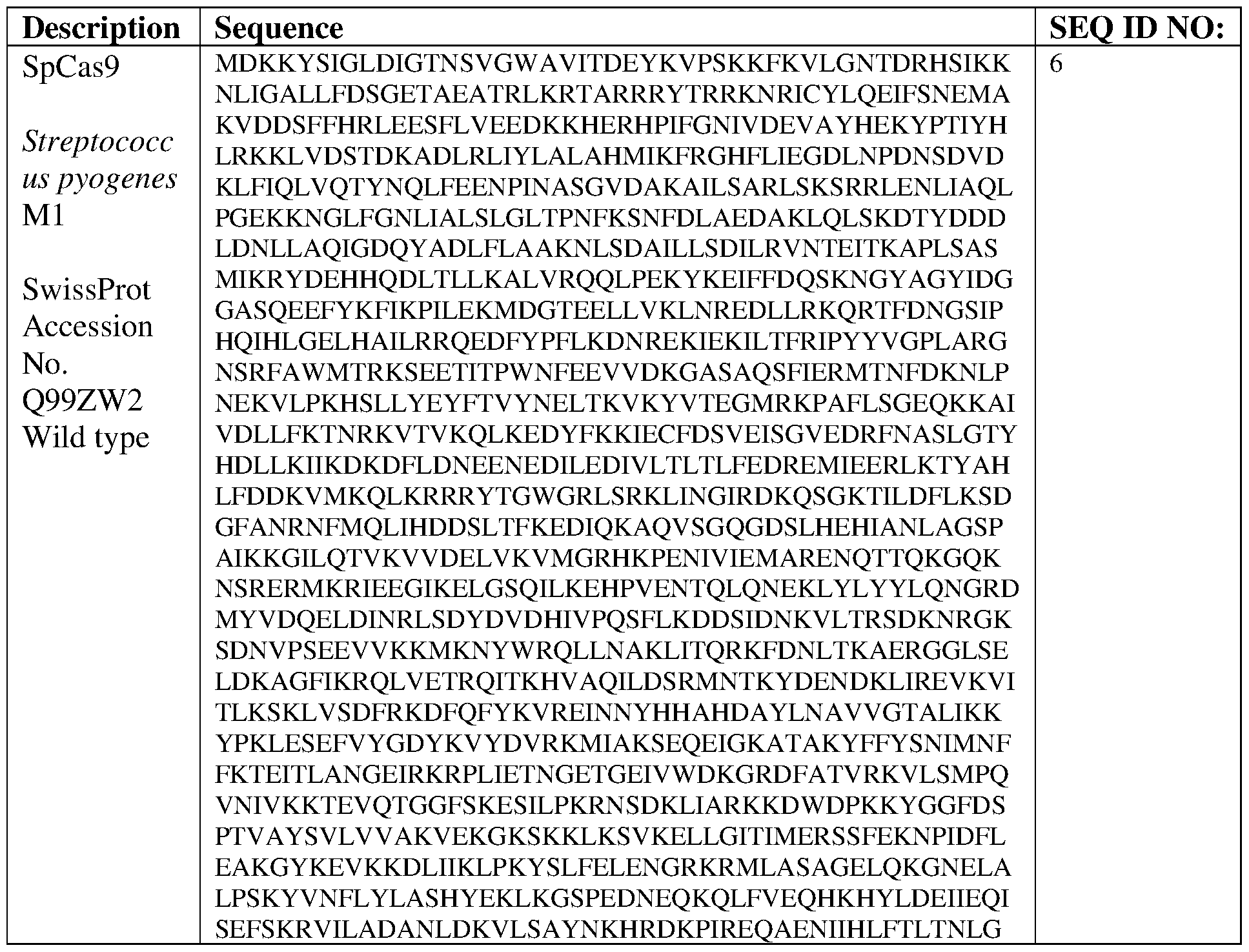

[0140] In other embodiments, the prime editors may include a napDNAbp domain having a modified Cas9 sequence, including, for example the nickase variant of Streptococcus pyogenes Cas9 of SEQ ID NO: 7 having an H840A substitution relative to the wild type
 any of the modified Cas9 sequences described above, or any variant thereof having at least 80%, at least 85%, at least 90%, at least 95%, or at least 99% sequence identity thereto. In some embodiments, the prime editors used in the methods and complexes described herein include any of the following other wild type SpCas9 sequences, which may be modified with one or more of the mutations described herein at corresponding amino acid positions:
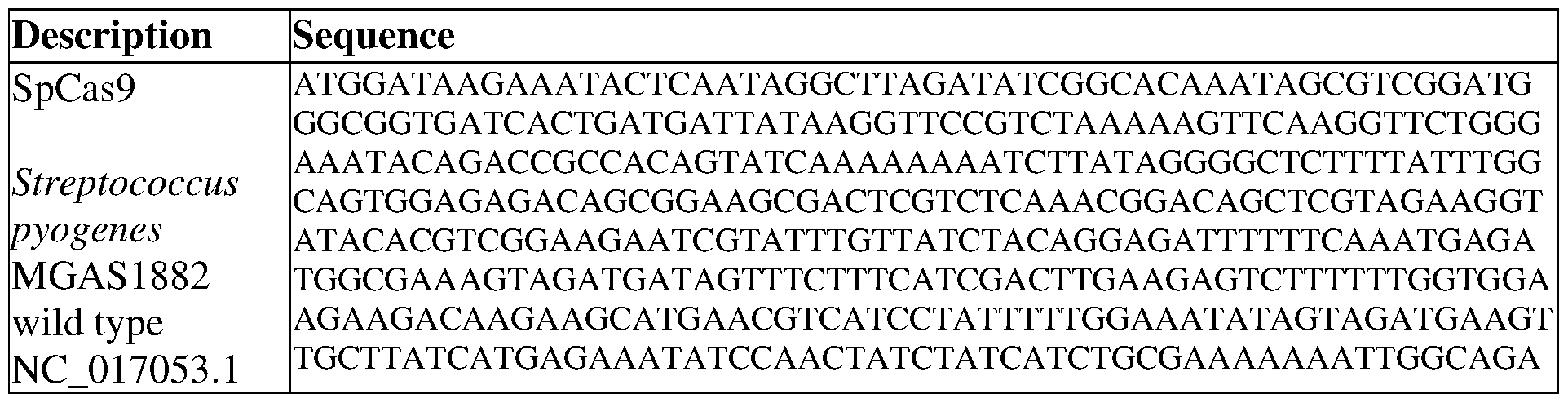
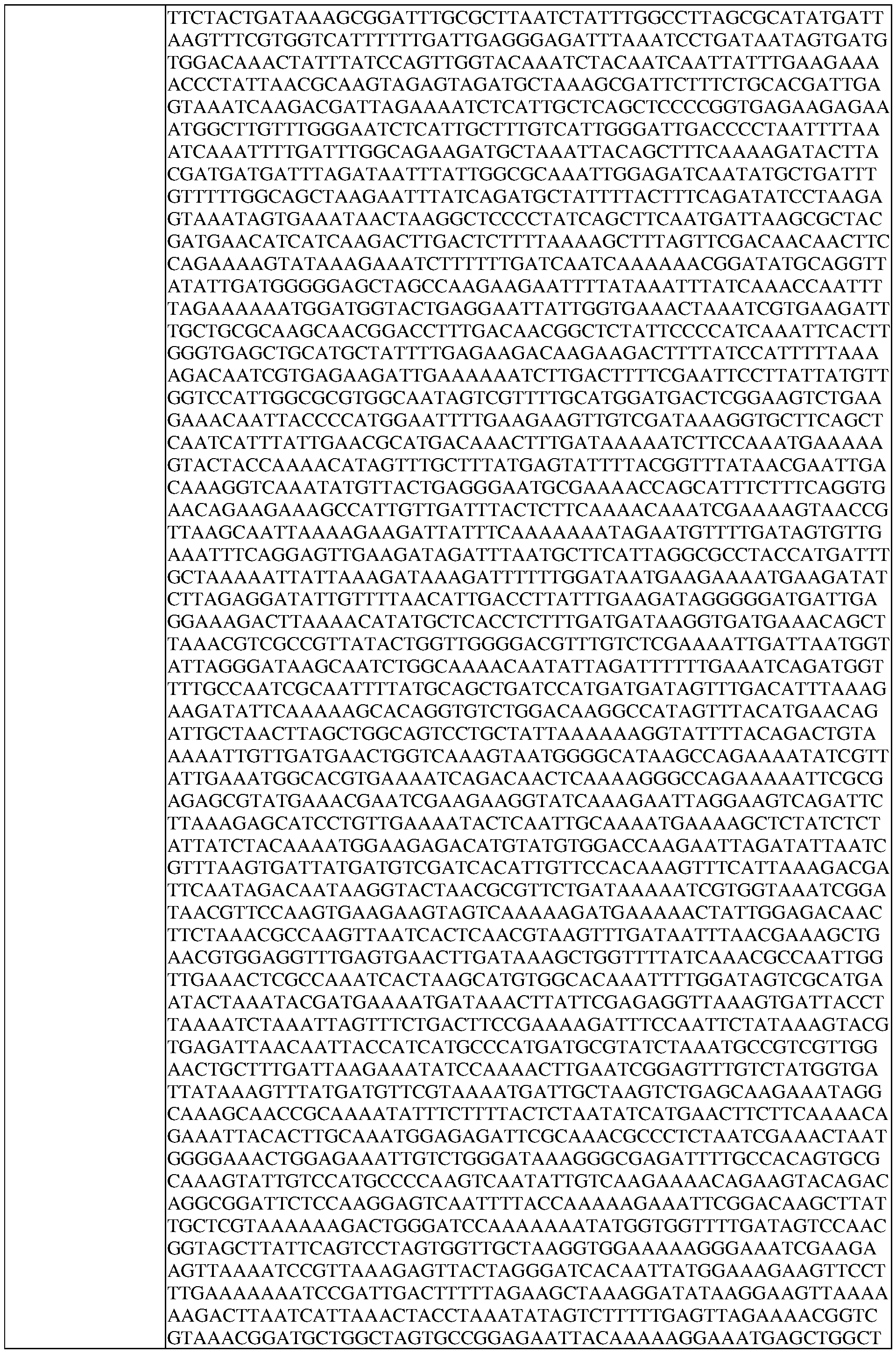
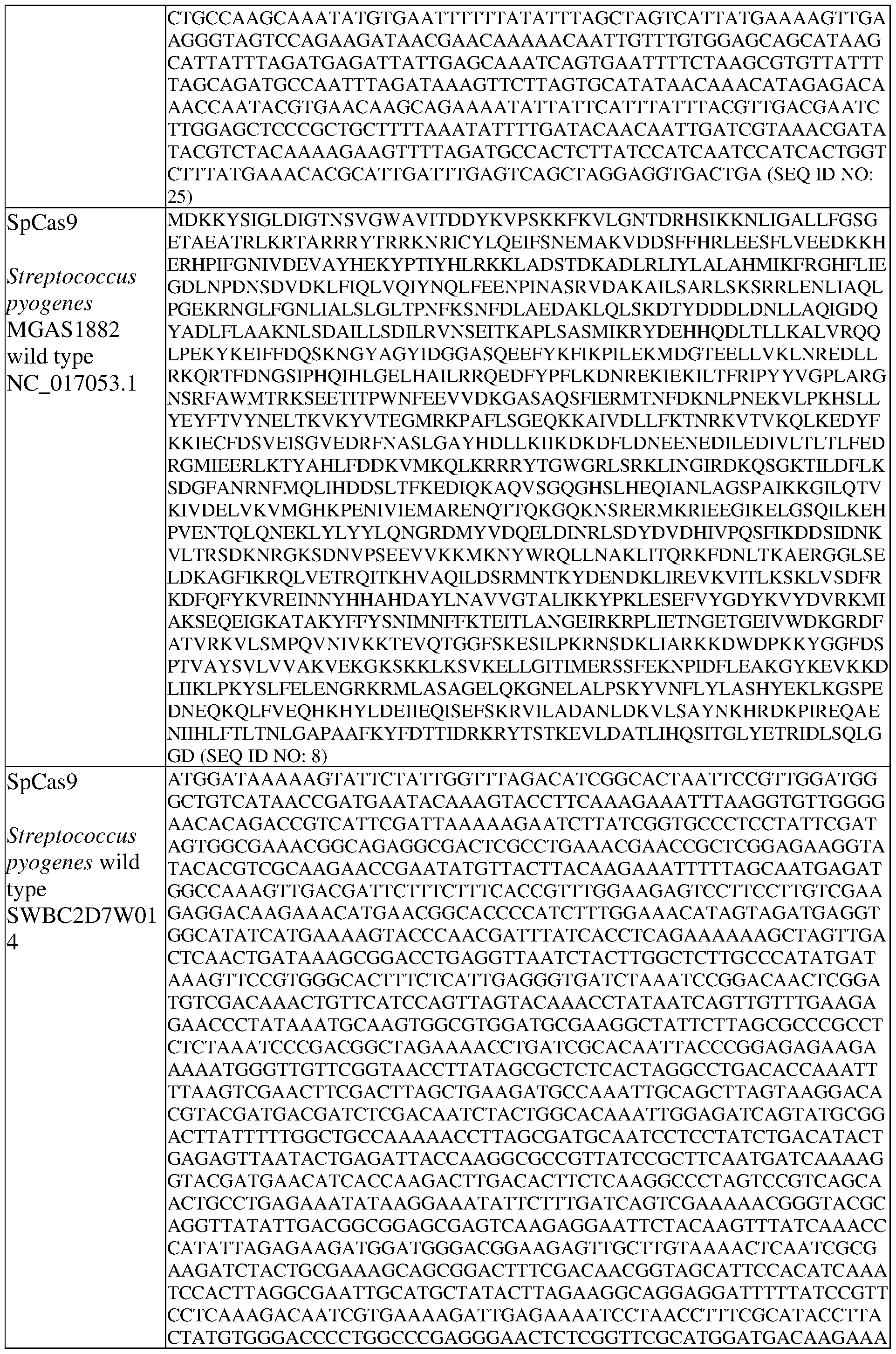


 [0142] The prime editors used in the methods and complexes described herein may include any of the above SpCas9 sequences, or any variant thereof having at least 80%, at least 85%, at least 90%, at least 95%, or at least 99% sequence identity thereto. In other embodiments, the Cas9 protein can be a wild type Cas9 ortholog from another bacterial species different from the canonical Cas9 from .S'. pyogenes. For example, modified versions of the following Cas9 orthologs can be used in connection with the prime editors described in this specification by making mutations at positions corresponding to H840A (or H839A in SEQ ID NO: 8) or any other amino acids of interest in wild type SpCas9. In addition, any variant Cas9 orthologs having at least 80%, at least 85%, at least 90%, at least 95%, or at least 99% sequence identity to any of the below orthologs may also be used with the prime editors.
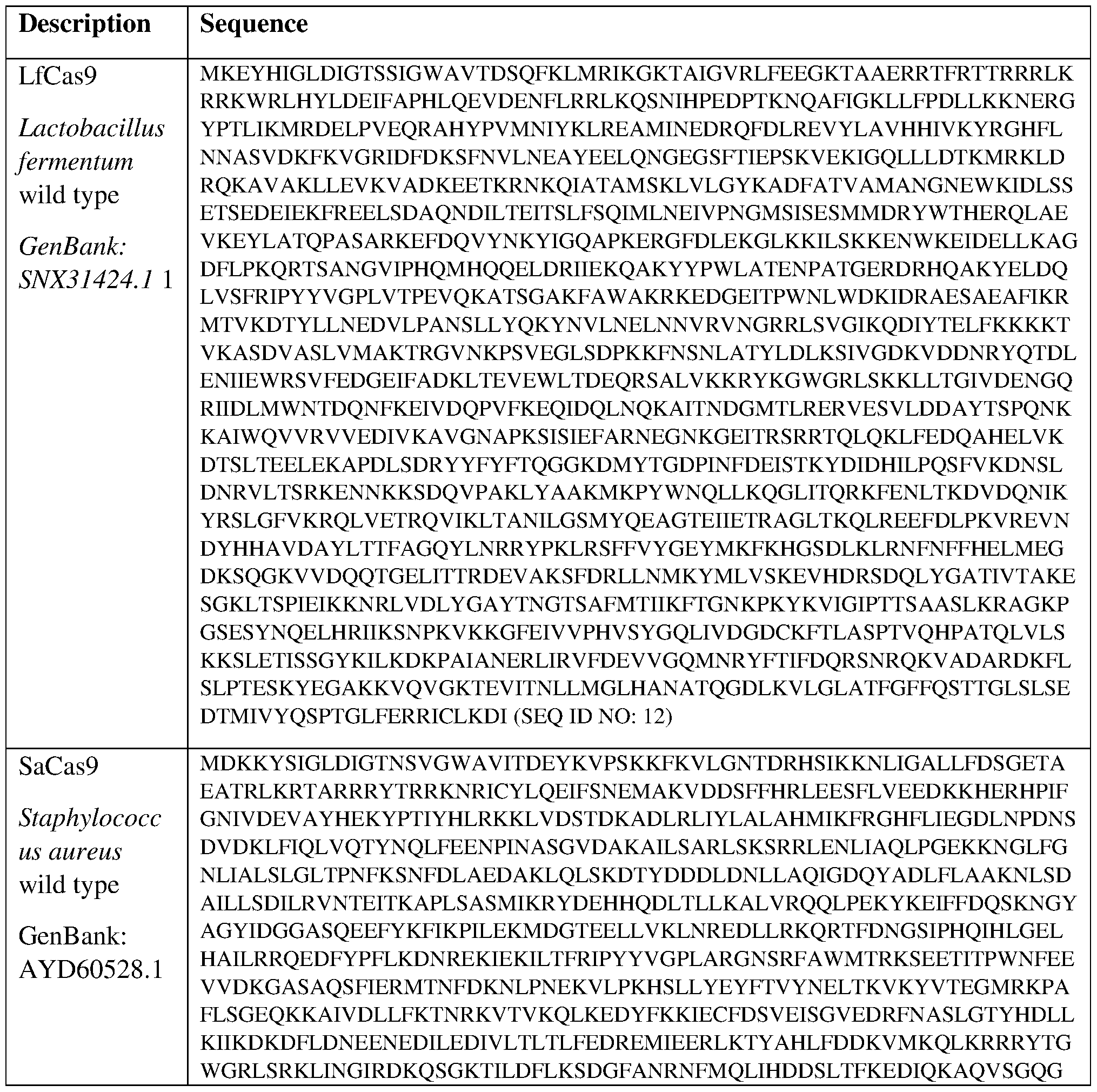

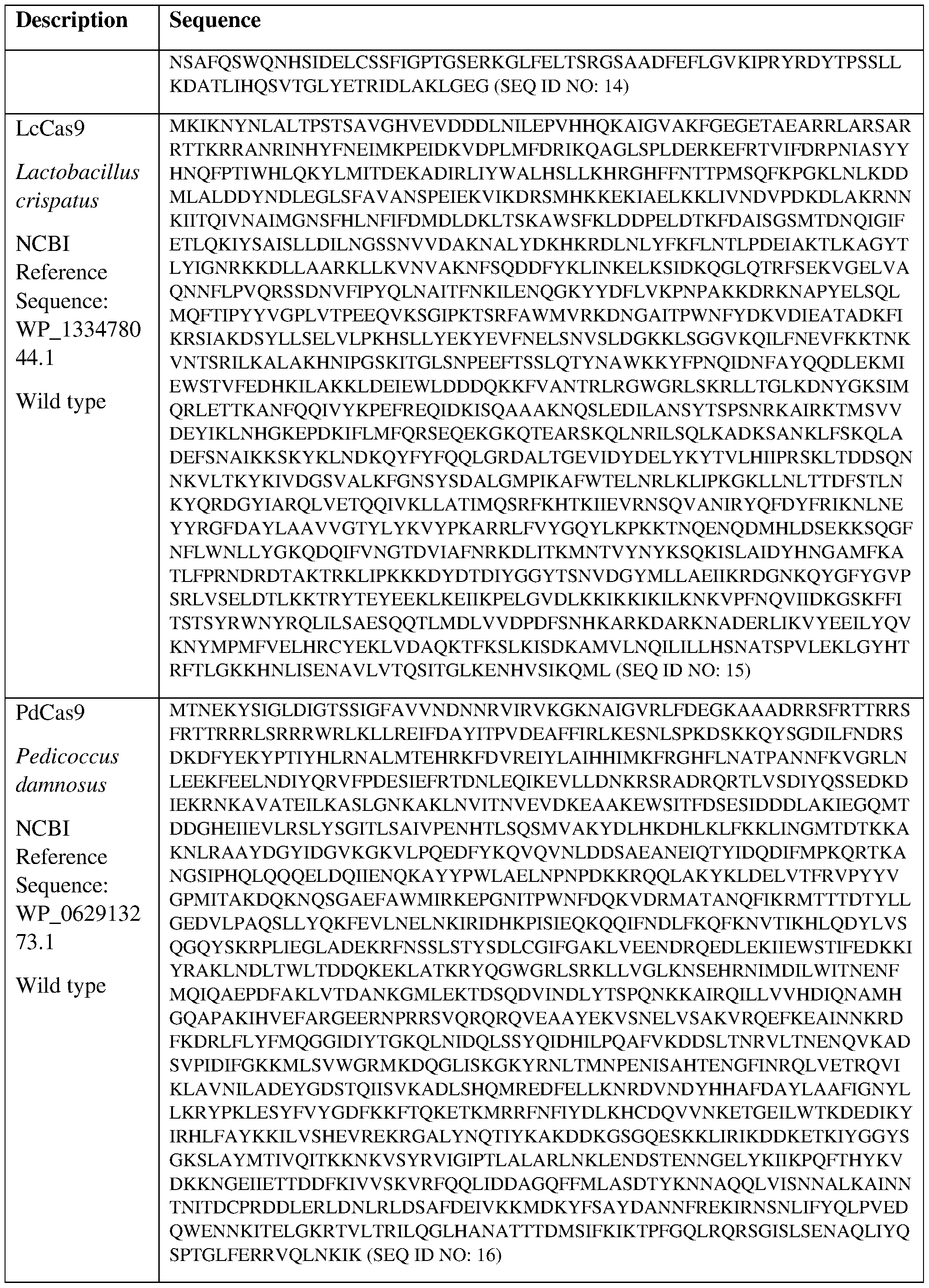


[0143] The napDNAbps in the prime editors used in the methods and complexes described herein may include any suitable homologs and/or orthologs or naturally occurring enzymes, such as Cas9. Cas9 homologs and/or orthologs have been described in various species, including, but not limited to, S. pyogenes and 5. thermophilus. The Cas moiety may be configured (e.g., mutagenized, recombinantly engineered, or otherwise obtained from nature) as a nickase, z.e., capable of cleaving only a single strand of the target double-stranded DNA. In some embodiments, a Cas9 nuclease has an inactive (e.g., an inactivated) DNA cleavage domain; that is, the Cas9 is a nickase. In some embodiments, the Cas9 protein comprises an amino acid sequence that is at least 85%, at least 90%, at least 92%, at least 95%, at least 96%, at least 97%, at least 98%, at least 99%, or at least 99.5% identical to the amino acid sequence of a Cas9 protein as provided by any one of the Cas9 orthologs in the above tables. [0144] Additional suitable napDNAbp sequences that can be used in prime editors used in the methods and complexes described herein will be apparent to those of skill in the art based on this disclosure, and such Cas9 nucleases and sequences include Cas9 sequences from the organisms and loci disclosed in Chylinski, Rhun, and Charpentier, “The tracrRNA and Cas9 families of type II CRISPR-Cas immunity systems” (2013) RNA Biology 10:5, 726-737; the entire contents of which are incorporated herein by reference. Additional exemplary Cas variants and homologs include, but are not limited to, Cas9 (e.g., dCas9 and nCas9), Cpfl, CasX, CasY, C2cl, C2c2, C2c3, GeoCas9, CjCas9, Cas 12a, Cas 12b, Cas 12g, Casl2h, Casl2i, Cas 13b, Cas 13c, Cas 13d, Cas 14, Csn2, xCas9, SpCas9-NG, Nme2Cas9, circularly
permuted Cas9, Argonaute (Ago), Cas9-KKH, SmacCas9, Spy-macCas9, SpCas9-VRQR, SpCas9-NRRH, SpaCas9-NRTH, SpCas9-NRCH, LbCasl2a, AsCasl2a, CeCasl2a, MbCasl2a, Cas3, Cas , and circularly permuted Cas9 domains, such as CP1012, CP1028, CP1041, CP1249, and CP1300, and variants and homologs thereof.
Reverse transcriptase domain
[0145] In various embodiments, the prime editors used in the methods and complexes described herein comprise a reverse transcriptase domain. In some embodiments, the reverse transcriptase domain is a wild type MMLV reverse transcriptase. In some embodiments, the reverse transcriptase domain is a variant of wild type MMLV reverse transcriptase having the amino acid sequence of SEQ ID NO: 31.
[0146] For example, PE2 and PEmax comprise a variant reverse transcriptase domain of SEQ ID NO: 31, which is based on the wild type MMLV reverse transcriptase domain of SEQ ID NO: 30 (and, in particular, a Genscript codon optimized MMLV reverse transcriptase having the nucleotide sequence of SEQ ID NO: 30) and which comprises amino acid substitutions D200N, T306K, W313F, T330P, and L603W relative to the wild type MMLV RT of SEQ ID NO: 30. The amino acid sequence of the variant RT of PE2 and PEmax is SEQ ID NO: 31. In some embodiments, the RT used in the prime editors used in the methods provided herein comprises the amino acid sequence of SEQ ID NO: 31, or an amino acid sequence at least 70%, at least 75%, at least 80%, at least 85%, at least 90%, at least 95%, at least 96%, at least 97%, at least 98%, or at least 99% identical to the amino acid sequence of SEQ ID NO: 31. [0147] Prime editors may also comprise other variant RTs as well. In various embodiments, the prime editors used in the methods described herein (with RT provided as either a fusion partner or in trans) can include a variant RT comprising one or more of the following mutations: P51L, S67K, E69K, L139P, T197A, D200N, H204R, F209N, E302K, E302R, T306K, F309N, W313F, T330P, L345G, L435G, N454K, D524G, E562Q, D583N, H594Q, L603W, E607K, or D653N in the wild type M-MLV RT of SEQ ID NO: 30, or at a corresponding amino acid position in another wild type RT polypeptide sequence.
[0148] Some exemplary reverse transcriptases that can be fused to napDNAbp proteins or provided as individual proteins according to various embodiments of this disclosure are provided below. Exemplary reverse transcriptases include variants with at least 80%, at least 85%, at least 90%, at least 95%, or at least 99% sequence identity to the following wild-type enzymes or partial enzymes:
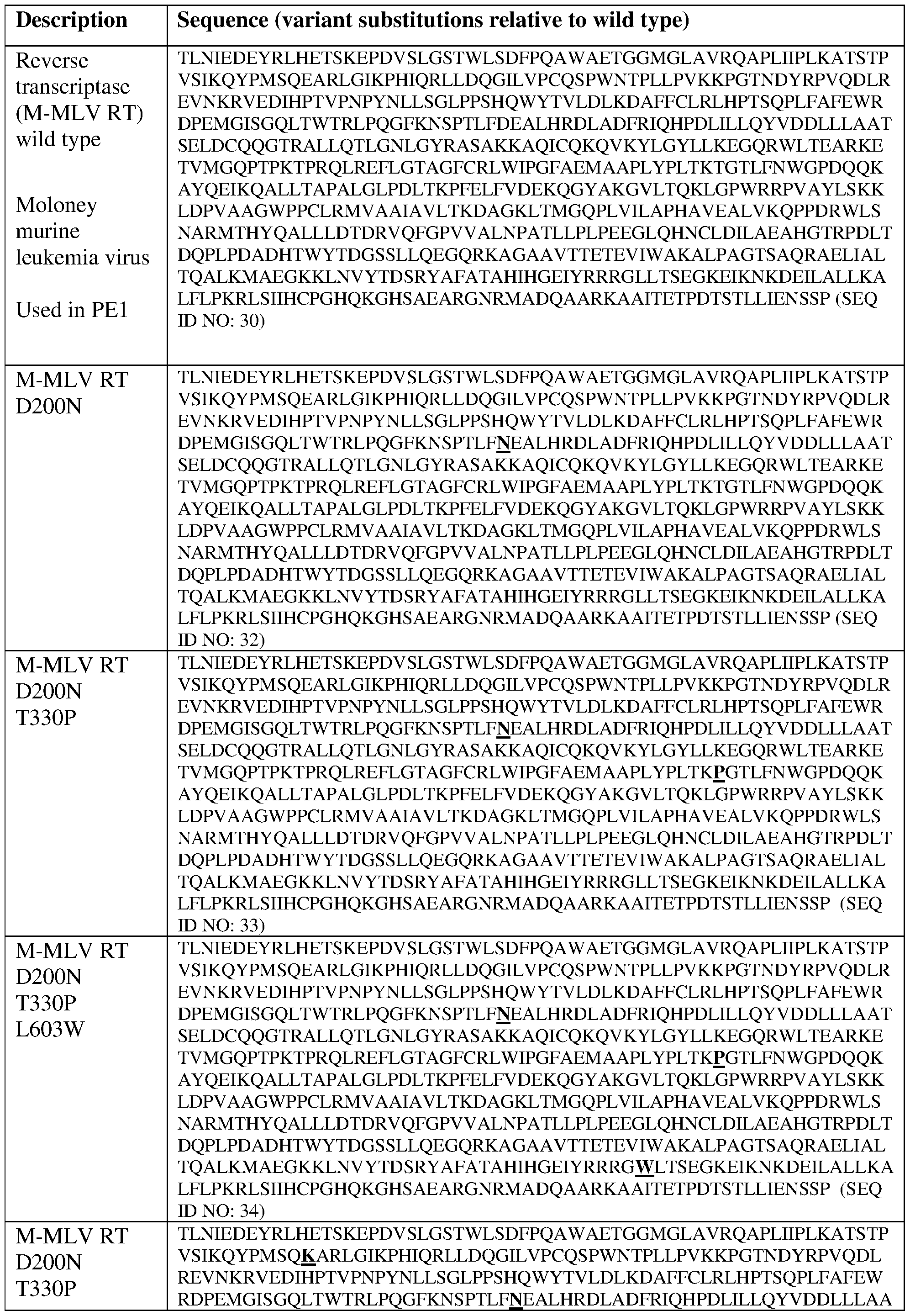


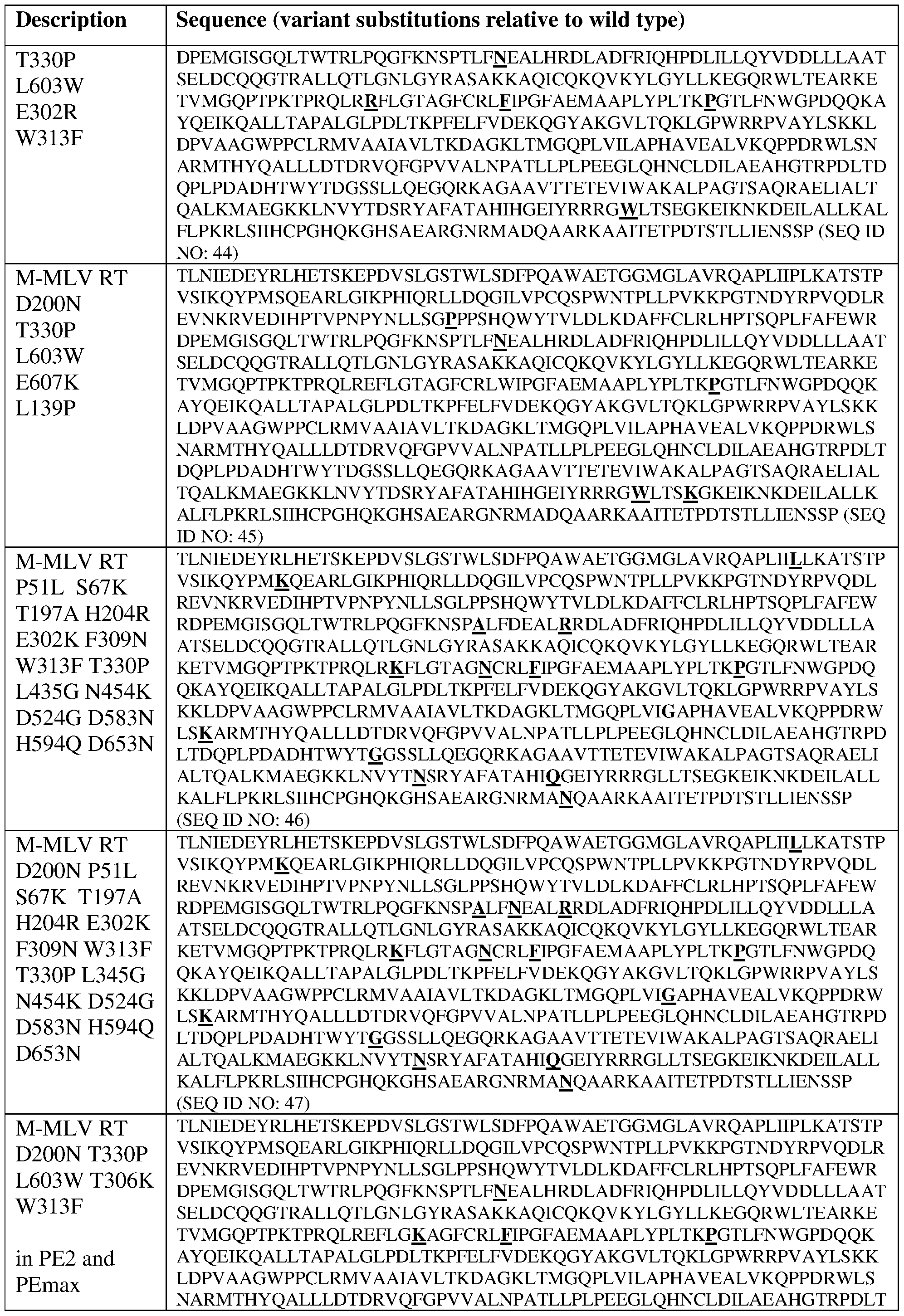

[0149] In various embodiments, the prime editors utilized in the methods and complexes described herein (with RT provided as either a fusion partner or in trans) can include a variant RT comprising one or more of the following mutations: P51X, S67X, E69X, L139X, T197X, D200X, H204X, F209X, E302X, T306X, F309X, W313X, T330X, L345X, L435X, N454X, D524X, E562X, D583X, H594X, L603X, E607X, or D653X in the wild type M- MLV RT of SEQ ID NO: 30, or at a corresponding amino acid position in another wild type RT polypeptide sequence, wherein “X” can be any amino acid.
[0150] The prime editors used in the methods and complexes described herein may comprise any publicly-available reverse transcriptase described or disclosed in any of the following U.S. patents (each of which are incorporated by reference): U.S. Patent Nos: 10,202,658;
10,189,831; 10,150,955; 9,932,567; 9,783,791; 9,580,698; 9,534,201; and 9,458,484, and any variant thereof that can be made using known methods for installing mutations or known methods for evolving proteins. The following references describe reverse transcriptases in known the art. Each of their disclosures are incorporated herein by reference.
[0151] Herzig, E., Voronin, N., Kucherenko, N. & Hizi, A. A Novel Leu92 Mutant of HIV- 1 Reverse Transcriptase with a Selective Deficiency in Strand Transfer Causes a Loss of Viral Replication. J. Virol. 89, 8119-8129 (2015).
[0152] Mohr, G. et al. A Reverse Transcriptase-Cas 1 Fusion Protein Contains a Cas6 Domain Required for Both CRISPR RNA Biogenesis and RNA Spacer Acquisition. Mol. Cell 72, 700-714. e8 (2018).
[0153] Zhao, C., Liu, F. & Pyle, A. M. An ultraprocessive, accurate reverse transcriptase encoded by a metazoan group II intron. RNA 24, 183-195 (2018).
[0154] Zimmerly, S. & Wu, L. An Unexplored Diversity of Reverse Transcriptases in Bacteria. Microbiol Spectr 3, MDNA3-0058-2014 (2015).
[0155] Ostertag, E. M. & Kazazian Jr, H. H. Biology of Mammalian LI Retrotransposons. Annual Review of Genetics 35, 501-538 (2001).
[0156] Perach, M. & Hizi, A. Catalytic Features of the Recombinant Reverse Transcriptase of Bovine Leukemia Virus Expressed in Bacteria. Virology 259, 176-189 (1999).
[0157] Lim, D. ct al. Crystal structure of the moloney murine leukemia virus RNase H domain. J. Virol. 80, 8379-8389 (2006).
[0158] Zhao, C. & Pyle, A. M. Crystal structures of a group II intron maturase reveal a missing link in spliceosome evolution. Nature Structural & Molecular Biology 23, 558-565 (2016).
[0159] Griffiths, D. J. Endogenous retroviruses in the human genome sequence. Genome Biol. 2, REVIEWS 1017 (2001).
[0160] Baranauskas, A. et al., Generation and characterization of new highly thermostable and processive M-MuLV reverse transcriptase variants. Protein Eng Des Sei 25, 657-668 (2012).
[0161] Zimmerly, S., Guo, H., Perlman, P. S. & Lambowltz, A. M. Group II intron mobility occurs by target DNA-primed reverse transcription. Cell 82, 545-554 (1995).
[0162] Feng, Q., Moran, J. V., Kazazian, H. H. & Boeke, J. D. Human LI retrotransposon encodes a conserved endonuclease required for retrotransposition. Cell 87, 905-916 (1996).
[0163] Berkhout, B., Jebbink, M. & Zsiros, J. Identification of an Active Reverse Transcriptase Enzyme Encoded by a Human Endogenous HERV-K Retrovirus. Journal of Virology 73, 2365-2375 (1999).
[0164] Kotewicz, M. L., Sampson, C. M., D’Alessio, J. M. & Gerard, G. F. Isolation of cloned Moloney murine leukemia virus reverse transcriptase lacking ribonuclease H activity. Nucleic Acids Res 16, 265-277 (1988).
[0165] Arezi, B. & Hogrefe, H. Novel mutations in Moloney Murine Leukemia Virus reverse transcriptase increase thermostability through tighter binding to template-primer. Nucleic Acids Res 37, 473-481 (2009).
[0166] Blain, S. W. & Goff, S. P. Nuclease activities of Moloney murine leukemia virus reverse transcriptase. Mutants with altered substrate specificities. J. Biol. Chem. 268, 23585- 23592 (1993).
[0167] Xiong, Y. & Eickbush, T. H. Origin and evolution of retroelements based upon their reverse transcriptase sequences. EMBO J 9, 3353-3362 (1990).
[0168] Herschhorn, A. & Hizi, A. Retroviral reverse transcriptases. Cell. Mol. Eife Sci. 67, 2717-2747 (2010).
[0169] Taube, R., Loya, S., Avidan, O., Perach, M. & Hizi, A. Reverse transcriptase of mouse mammary tumour virus: expression in bacteria, purification and biochemical characterization. Biochem. J. 329 ( Pt 3), 579-587 (1998).
[0170] Liu, M. et al. Reverse Transcriptase-Mediated Tropism Switching in Bordetella Bacteriophage. Science 295, 2091-2094 (2002).
[0171] Luan, D. D., Korman, M. H., Jakubczak, J. L. & Eickbush, T. H. Reverse transcription of R2Bm RNA is primed by a nick at the chromosomal target site: a mechanism for non-LTR retrotransposition. Cell 'll, 595-605 (1993).
[0172] Nottingham, R. M. et al. RNA-seq of human reference RNA samples using a thermostable group II intron reverse transcriptase. RNA 22, 597-613 (2016).
[0173] Telesnitsky, A. & Goff, S. P. RNase H domain mutations affect the interaction between Moloney murine leukemia virus reverse transcriptase and its primer-template. Proc. Natl. Acad. Sci. U.S.A. 90, 1276-1280 (1993).
[0174] Halvas, E. K., Svarovskaia, E. S. & Pathak, V. K. Role of Murine Leukemia Virus Reverse Transcriptase Deoxyribonucleoside Triphosphate-Binding Site in Retroviral Replication and In Vivo Fidelity. Journal of Virology 74, 10349-10358 (2000).
[0175] Nowak, E. et al., Structural analysis of monomeric retroviral reverse transcriptase in complex with an RNA/DNA hybrid. Nucleic Acids Res 41, 3874-3887 (2013).
[0176] Stamos, J. L., Lentzsch, A. M. & Lambowitz, A. M. Structure of a Thermostable Group II Intron Reverse Transcriptase with Template-Primer and Its Functional and Evolutionary Implications. Molecular Cell 68, 926-939. e4 (2017).
[0177] Das, D. & Georgiadis, M. M. The Crystal Structure of the Monomeric Reverse Transcriptase from Moloney Murine Leukemia Virus. Structure 12, 819-829 (2004).
[0178] Avidan, O., Meer, M. E., Oz, I. & Hizi, A. The processivity and fidelity of DNA synthesis exhibited by the reverse transcriptase of bovine leukemia virus. European Journal of Biochemistry 269, 859-867 (2002).
[0179] Gerard, G. F. et al. The role of template-primer in protection of reverse transcriptase from thermal inactivation. Nucleic Acids Res 30, 3118-3129 (2002).
[0180] Monot, C. et al. The Specificity and Flexibility of LI Reverse Transcription Priming at Imperfect T-Tracts. PLOS Genetics 9, el003499 (2013).
[0181] Mohr, S. et al. Thermostable group II intron reverse transcriptase fusion proteins and their use in cDNA synthesis and next-generation RNA sequencing. RNA 19, 958-970 (2013).
Nuclear localization sequences (NLS)
[0182] In various embodiments, the prime editors used in the methods and complexes described herein may comprise one or more nuclear localization sequences (NLS), which help promote translocation of a protein into the cell nucleus. Such sequences are well-known in the art and can include the following examples:

[0183] The NLS examples above are non-limiting. The prime editors used in the presently described methods and complexes may comprise any known NLS sequence, including any of those described in Cokol et al., “Finding nuclear localization signals,” EMBO Rep., 2000, 1(5): 411-415 and Freitas et al., “Mechanisms and Signals for the Nuclear Import of Proteins,” Current Genomics, 2009, 10(8): 550-7, each of which are incorporated herein by reference.
[0184] In various embodiments, the fusion proteins used in the methods and complexes described herein further comprise one or more (and preferably at least two) nuclear localization sequences. In certain embodiments, the fusion proteins comprise at least two NLSs. In embodiments with at least two NLSs, the NLSs can be the same NLSs or they can be different NLSs. In some embodiments, one or more of the NLSs are bipartite NLSs (“bpNLS”). In certain embodiments, the prime editors comprise two bipartite NLSs. In some embodiments, the prime editors comprise more than two bipartite NLSs.
[0185] The location of the NLS fusion can be at the N-terminus, the C-terminus, or within a sequence of a fusion protein (e.g., inserted between the encoded napDNAbp component (e.g.. Cas9) and a polymerase domain e.g., a reverse transcriptase).
[0186] The NLSs may be any known NLS sequence in the art. The NLSs may also be any future-discovered NLSs for nuclear localization. The NLSs also may be any naturally- occurring NLS, or any non-naturally occurring NLS (e.g.. an NLS with one or more desired mutations).
[0187] The term “nuclear localization sequence” or “NLS” refers to an amino acid sequence that promotes import of a protein into the cell nucleus, for example, by nuclear transport. Nuclear localization sequences are known in the art and would be apparent to the skilled artisan. For example, NLS sequences are described in Plank et al., International PCT application PCT/EP2000/011690, filed November 23, 2000, published as WO/2001/038547 on May 31, 2001, the contents of which are incorporated herein by reference. In some embodiments, an NLS comprises the amino acid sequence PKKKRKV (SEQ ID NO: 94), MDSLLMNRRKFLYQFKNVRWAKGRRETYLC (SEQ ID NO: 99), KRTADGSEFESPKKKRKV (SEQ ID NO: 97), or KRTADGSEFEPKKKRKV (SEQ ID NO: 106). In other embodiments, an NLS comprises the amino acid sequences NLSKRPAAIKKAGQAKKKK (SEQ ID NO: 107), PAAKRVKLD (SEQ ID NO: 98), RQRRNELKRSF (SEQ ID NO: 108), or NQSSNFGPMKGGNFGGRSSGPYGGGGQYFAKPRNQGGY (SEQ ID NO: 109).
[0188] In one aspect of the disclosure, a prime editor or other fusion protein used in the methods and complexes described herein may be modified with one or more nuclear localization sequences (NLS), preferably at least two NLSs. In certain embodiments, the prime editors are modified with two or more NLSs. The disclosure contemplates the use of any nuclear localization sequence known in the art at the time of the disclosure, or any nuclear localization sequence that is identified or otherwise made available in the state of the art after the time of the instant filing. A representative nuclear localization sequence is a peptide sequence that directs the protein to the nucleus of the cell in which the sequence is expressed. A nuclear localization signal is predominantly basic, can be positioned almost anywhere in a protein's amino acid sequence, generally comprises a short sequence of four amino acids (Autieri & Agrawal, (1998) J. Biol. Chem. 273: 14731-37, incorporated herein by reference) to eight amino acids, and is typically rich in lysine and arginine residues (Magin et al., (2000) Virology 274: 11-16, incorporated herein by reference). Nuclear localization sequences often comprise proline residues. A variety of nuclear localization sequences have been identified and have been used to effect transport of biological molecules from the cytoplasm to the nucleus of a cell. See, e.g., Tinland et al., (1992) Proc. Natl. Acad. Sci. U.S.A. 89:7442-46; Moede et al., (1999) FEBS Lett. 461:229-34, which is incorporated herein by reference. Translocation is currently thought to involve nuclear pore proteins.
[0189] Most NLSs can be classified in three general groups: (i) a monopartite NLS exemplified by the SV40 large T antigen NLS (PKKKRKV (SEQ ID NO: 94)); (ii) a bipartite
motif consisting of two basic domains separated by a variable number of spacer amino acids and exemplified by the Xenopus nucleoplasmin NLS (KRXXXXXXXXXXKKKL (SEQ ID NO: 110)); and (iii) noncanonical sequences such as M9 of the hnRNP Al protein, the influenza virus nucleoprotein NLS, and the yeast Gal4 protein NLS (Dingwall and Laskey 1991).
[0190] Nuclear localization sequences appear at various points in the amino acid sequences of proteins. NLS have been identified at the N-terminus, the C-terminus, and in the central region of proteins. Thus, the disclosure provides fusion proteins that may be modified with one or more NLSs at the C-terminus and/or the N-terminus, as well as at internal regions of the fusion protein. The residues of a longer sequence that do not function as component NLS residues should be selected so as not to interfere, for example, tonically or sterically, with the nuclear localization signal itself. Therefore, although there are no strict limits on the composition of an NLS-comprising sequence, in practice, such a sequence can be functionally limited in length and composition.
[0191] The present disclosure contemplates any suitable means by which to modify a prime editor to include one or more NLSs. In one aspect, the prime editors may be engineered to express a prime editor that is translationally fused at its N-terminus or its C-terminus (or both) to one or more NLSs, z.e., to form a prime editor-NLS fusion construct. In other embodiments, a prime editor-encoding nucleotide sequence may be genetically modified to incorporate a reading frame that encodes one or more NLSs in an internal region of the encoded prime editor. In addition, the NLSs may include various amino acid linkers or spacer regions encoded between the prime editor and the N-terminally, C-terminally, or internally attached NLS amino acid sequence, e.g., and in the central region of proteins. Thus, the present disclosure also provides for nucleotide constructs, vectors, and host cells for expressing fusion proteins that comprise a prime editor and one or more NLSs, among other components.
[0192] The prime editors used in the methods and complexes described herein may also comprise nuclear localization sequences that are linked to a prime editor through one or more linkers, e.g., a polymeric, amino acid, nucleic acid, polysaccharide, chemical, or nucleic acid linker element. The linkers within the contemplated scope of the disclosure are not intended to have any limitations and can be any suitable type of molecule e.g., polymer, amino acid, polysaccharide, nucleic acid, lipid, or any synthetic chemical linker domain) and can be
joined to the prime editor by any suitable strategy that effectuates forming a bond e.g., covalent linkage, hydrogen bonding) between the prime editor and the one or more NLSs. [0193] In some embodiments, the prime editors used in the methods provided herein comprise an NLS comprising the amino acid sequence of SEQ ID NO: 95, or an amino acid sequence at least 70%, at least 75%, at least 80%, at least 85%, at least 90%, at least 95%, at least 96%, at least 97%, at least 98%, or at least 99% identical to the amino acid sequence of SEQ ID NO: 95. In some embodiments, the prime editors used in the methods provided herein comprise an NLS comprising the amino acid sequence of SEQ ID NO: 97, or an amino acid sequence at least 70%, at least 75%, at least 80%, at least 85%, at least 90%, at least 95%, at least 96%, at least 97%, at least 98%, or at least 99% identical to the amino acid sequence of SEQ ID NO: 97. In some embodiments, the prime editors used in the methods provided herein comprise an NLS comprising the amino acid sequence of SEQ ID NO: 98, or an amino acid sequence at least 70%, at least 75%, at least 80%, at least 85%, at least 90%, at least 95%, at least 96%, at least 97%, at least 98%, or at least 99% identical to the amino acid sequence of SEQ ID NO: 98. In certain embodiments, the prime editors used in the methods provided herein comprise a first NLS comprising the amino acid sequence of SEQ ID NO: 95, or an amino acid sequence at least 70%, at least 75%, at least 80%, at least 85%, at least 90%, at least 95%, at least 96%, at least 97%, at least 98%, or at least 99% identical to the amino acid sequence of SEQ ID NO: 95, a second NLS comprising the amino acid sequence of SEQ ID NO: 97, or an amino acid sequence at least 70%, at least 75%, at least 80%, at least 85%, at least 90%, at least 95%, at least 96%, at least 97%, at least 98%, or at least 99% identical to the amino acid sequence of SEQ ID NO: 97, and a third NLS comprising the amino acid sequence of SEQ ID NO: 98, or an amino acid sequence at least 70%, at least 75%, at least 80%, at least 85%, at least 90%, at least 95%, at least 96%, at least 97%, at least 98%, or at least 99% identical to the amino acid sequence of SEQ ID NO: 98.
Linkers
[0194] The prime editors used in the methods and complexes described herein may include one or more linkers. As defined above, the term “linker,” as used herein, refers to a chemical group or a molecule linking two molecules or moieties, e.g., a binding domain and a cleavage domain of a nuclease. In some embodiments, a linker joins a gRNA binding domain of an RNA-programmable nuclease and a polymerase (e.g., a reverse transcriptase). In some embodiments, a linker joins a Cas9 nickase and a reverse transcriptase. Typically, the linker is positioned between, or flanked by, two groups, molecules, or other moieties and connected
to each one via a covalent bond, thus connecting the two. In some embodiments, the linker is an amino acid or a plurality of amino acids (e.g., a peptide or protein). In some embodiments, the linker is an organic molecule, group, polymer, or chemical moiety. In some embodiments, the linker is 5-100 amino acids in length, for example, 5, 6, 7, 8, 9, 10, 11, 12, 13, 14, 15, 16, 17, 18, 19, 20, 21, 22, 23, 24, 25, 26, 27, 28, 29, 30, 30-35, 35-40, 40-45, 45-50, 50-60, 60- 70, 70-80, 80-90, 90-100, 100-150, or 150-200 amino acids in length. Longer or shorter linkers are also contemplated.
[0195] The linker may be as simple as a covalent bond, or it may be a polymeric linker many atoms in length. In certain embodiments, the linker is a polypeptide, or amino acid-based. In other embodiments, the linker is not peptide-like. In certain embodiments, the linker is a covalent bond (e.g., a carbon-carbon bond, disulfide bond, carbon-heteroatom bond, etc.). In certain embodiments, the linker is a carbon-nitrogen bond of an amide linkage. In certain embodiments, the linker is a cyclic or acyclic, substituted or unsubstituted, branched or unbranched, aliphatic or heteroaliphatic linker. In certain embodiments, the linker is polymeric (e.g., polyethylene, polyethylene glycol, polyamide, polyester, etc.). In certain embodiments, the linker comprises a monomer, dimer, or polymer of aminoalkanoic acid. In certain embodiments, the linker comprises an aminoalkanoic acid (e.g., glycine, ethanoic acid, alanine, beta- alanine, 3-aminopropanoic acid, 4- aminobutanoic acid, 5-pentanoic acid, etc.). In certain embodiments, the linker comprises a monomer, dimer, or polymer of aminohexanoic acid (Ahx). In certain embodiments, the linker is based on a carbocyclic moiety (e.g., cyclopentane, cyclohexane). In other embodiments, the linker comprises a polyethylene glycol moiety (PEG). In other embodiments, the linker comprises amino acids. In certain embodiments, the linker comprises a peptide. In certain embodiments, the linker comprises an aryl or heteroaryl moiety. In certain embodiments, the linker is based on a phenyl ring. The linker may include functionalized moieties to facilitate attachment of a nucleophile (e.g., thiol, amino) from the peptide to the linker. Any electrophile may be used as part of the linker. Exemplary electrophiles include, but are not limited to, activated esters, activated amides, Michael acceptors, alkyl halides, aryl halides, acyl halides, and isothiocyanates.
[0196] In some other embodiments, the linker comprises the amino acid sequence (GGGGS)n (SEQ ID NO: 84), (G)n (SEQ ID NO: 85), (EAAAK)n (SEQ ID NO: 86), (GGS)n (SEQ ID NO: 87), (SGGS)n (SEQ ID NO: 81), (XP)n (SEQ ID NO: 88), or any combination thereof, wherein n is independently an integer between 1 and 30, and wherein X is any amino acid. In
some embodiments, the linker comprises the amino acid sequence (GGS)n (SEQ ID NO: 87), wherein n is 1, 3, or 7. In some embodiments, the linker comprises the amino acid sequence SGSETPGTSESATPES (SEQ ID NO: 89). In some embodiments, the linker comprises the amino acid sequence SGGSSGGSSGSETPGTSESATPESSGGSSGGS (SEQ ID NO: 90). In some embodiments, the linker comprises the amino acid sequence SGGSGGSGGS (SEQ ID NO: 91). In some embodiments, the linker comprises the amino acid sequence SGGS (SEQ ID NO: 82). In other embodiments, the linker comprises the amino acid sequence SGGSSGGSSGSETPGTSESATPESAGSYPYDVPDYAGSAAPAAKKKKLDGSGSGGSS GGS (SEQ ID NO: 83, 60AA). In some embodiments, the linker comprises the amino acid sequence GGS, GGSGGS (SEQ ID NO: 92), GGSGGSGGS (SEQ ID NO: 93), SGGSSGGSSGSETPGTSESATPESSGGSSGGSS (SEQ ID NO: 80), SGSETPGTSESATPES (SEQ ID NO: 89), or
SGGSSGGSSGSETPGTSESATPESAGSYPYDVPDYAGSAAPAAKKKKLDGSGSGGSS GGS (SEQ ID NO: 83).
[0197] In certain embodiments, linkers may be used to link any of the peptides or peptide domains or moieties of the invention (e.g., a napDNAbp linked or fused to a reverse transcriptase domain, and/or a napDNAbp linked to one or more NLS). Any of the domains of the fusion proteins used in the systems and methods described herein may also be connected to one another through any of the presently described linkers.
[0198] In some embodiments, one or more linkers may be used to join one or more portions of a pegRNA or epegRNA to one another. In certain embodiments, a linker is used to join a structured motif, such as evopreql, to the 3' end of an epegRNA. In some embodiments, the linker has been engineered to ensure that the 3' structured motif (e.g., evopreql) does not disrupt the activity and/or the structure of the epegRNA. In certain embodiments, such a linker comprises the sequence 5'-AGAATAAA-3', or a sequence at least 90%, at least 95%, at least 96%, at least 97%, at least 98%, or at least 99% identical to the sequence 5'- AGAAT AAA-3', or a fragment thereof.
[0199] In certain embodiments, the prime editors used in the methods, complexes, compositions, and kits provided herein comprise a linker of SEQ ID NO: 79, for example, joining the napDNAbp and the reverse transcriptase to one another. In certain embodiments, the prime editors used in the methods, complexes, compositions, and kits provided herein comprise a linker of SEQ ID NO: 82, for example, joining the reverse transcriptase and an NLS. In certain embodiments, the prime editors used in the methods, complexes,
compositions, and kits provided herein comprise a linker of the sequence GSG, for example, joining one NLS to another NLS.
Complexes
[0200] Other aspects of the present disclosure relate to complexes comprising a prime editor and any of the epegRNAs disclosed herein. In some embodiments, the prime editor is PE2, PE3, PE3b, PE4, PE5, or PE5b. In some embodiments, the prime editor comprises PEmax architecture. In some embodiments, the prime editor is PE2max, PE3max, PE3bmax, PE4max, PE5max, or PE5bmax.
Pharmaceutical compositions
[0201] Other aspects of the present disclosure relate to pharmaceutical compositions for treating sickle cell disease comprising any of the epegRNAs, nicking gRNAs, prime editors, and/or complexes described herein, or any of the polynucleotides or vectors encoding such epegRNAs, prime editors, and/or complexes described herein. The term “pharmaceutical composition”, as used herein, refers to a composition formulated for pharmaceutical use. In some embodiments, the pharmaceutical composition further comprises a pharmaceutically acceptable carrier. In some embodiments, the pharmaceutical composition comprises additional agents (e.g., for specific delivery, increasing half-life, or other therapeutic compounds).
[0202] As used herein, the term “pharmaceutically-acceptable carrier” means a pharmaceutically-acceptable material, composition, or vehicle, such as a liquid or solid filler, diluent, excipient, manufacturing aid (e.g., lubricant, talc magnesium, calcium or zinc stearate, or steric acid), or solvent encapsulating material, involved in carrying or transporting the compound from one site (e.g., the delivery site) of the body, to another site (e.g., an organ, tissue, or other part of the body). A pharmaceutically acceptable carrier is “acceptable” in the sense of being compatible with the other ingredients of the formulation and not injurious to the tissue of the subject (e.g., physiologically compatible, sterile, physiologic pH, etc.). Some examples of materials that can serve as pharmaceutically-acceptable carriers include: (1) sugars, such as lactose, glucose and sucrose; (2) starches, such as com starch and potato starch; (3) cellulose, and its derivatives, such as sodium carboxymethyl cellulose, methylcellulose, ethyl cellulose, microcrystalline cellulose and cellulose acetate; (4) powdered tragacanth; (5) malt; (6) gelatin; (7) lubricating agents, such as magnesium stearate, sodium lauryl sulfate and talc; (8) excipients, such as cocoa butter and suppository
waxes; (9) oils, such as peanut oil, cottonseed oil, safflower oil, sesame oil, olive oil, corn oil, and soybean oil; (10) glycols, such as propylene glycol; (11) polyols, such as glycerin, sorbitol, mannitol and polyethylene glycol (PEG); (12) esters, such as ethyl oleate and ethyl laurate; (13) agar; (14) buffering agents, such as magnesium hydroxide and aluminum hydroxide; (15) alginic acid; (16) pyrogen-free water; (17) isotonic saline; (18) Ringer’s solution; (19) ethyl alcohol; (20) pH buffered solutions; (21) polyesters, polycarbonates and/or poly anhydrides; (22) bulking agents, such as polypeptides and amino acids; (23) serum component, such as serum albumin, HDL, and LDL; (22) C2-C12 alcohols, such as ethanol; and (23) other non-toxic compatible substances employed in pharmaceutical formulations. Wetting agents, coloring agents, release agents, coating agents, sweetening agents, flavoring agents, perfuming agents, preservatives, and antioxidants can also be present in the formulation. The terms such as “excipient,” “carrier,” “pharmaceutically acceptable carrier,” or the like are used interchangeably herein.
[0203] In some embodiments, the pharmaceutical composition is formulated for delivery to a subject, e.g., for gene editing. Suitable routes of administering the pharmaceutical composition described herein include, without limitation: topical, subcutaneous, transdermal, intradermal, intralesional, intraarticular, intraperitoneal, intravesical, transmucosal, gingival, intradental, intracochlear, transtympanic, intraorgan, epidural, intrathecal, intramuscular, intravenous, intravascular, intraosseus, periocular, intratumoral, intracerebral, and intracerebroventricular administration.
[0204] In some embodiments, the pharmaceutical composition described herein is administered locally to a diseased site e.g., tumor site). In some embodiments, the pharmaceutical composition described herein is administered to a subject by injection, by means of a catheter, by means of a suppository, or by means of an implant, the implant being of a porous, non-porous, or gelatinous material, including a membrane, such as a sialastic membrane, or a fiber.
[0205] In other embodiments, the pharmaceutical composition described herein is delivered in a controlled release system. In one embodiment, a pump may be used (see, e.g., Langer, 1990, Science 249:1527-1533; Sefton, 1989, CRC Crit. Ref. Biomed. Eng. 14:201; Buchwald et al., 1980, Surgery 88:507; Saudek et al., 1989, N. Engl. J. Med. 321:574). In another embodiment, polymeric materials can be used. (See, e.g., Medical Applications of Controlled Release (Langer and Wise eds., CRC Press, Boca Raton, Ela., 1974); Controlled Drug Bioavailability, Drug Product Design and Performance (Smolen and Ball eds., Wiley, New
York, 1984); Ranger and Peppas, 1983, Macromol. Sci. Rev. Macromol. Chem. 23:61. See also Levy et al., 1985, Science 228:190; During et al., 1989, Ann. Neurol. 25:351; Howard et al., 1989, J. Neurosurg. 71:105). Other controlled release systems are discussed, for example, in Langer, supra.
[0206] In some embodiments, the pharmaceutical composition is formulated in accordance with routine procedures as a composition adapted for intravenous or subcutaneous administration to a subject, e.g., a human. In some embodiments, pharmaceutical compositions for administration by injection are solutions in sterile isotonic aqueous buffer. Where necessary, the pharmaceutical composition can also include a solubilizing agent and a local anesthetic such as lignocaine to ease pain at the site of the injection. Generally, the ingredients are supplied either separately or mixed together in unit dosage form, for example, as a dry lyophilized powder or water free concentrate in a hermetically sealed container such as an ampoule or sachette indicating the quantity of active agent. Where the pharmaceutical composition is to be administered by infusion, it can be dispensed with an infusion bottle containing sterile pharmaceutical grade water or saline. Where the pharmaceutical composition is administered by injection, an ampoule of sterile water for injection or saline can be provided so that the ingredients can be mixed prior to administration.
[0207] A pharmaceutical composition for systemic administration may be a liquid, e.g., sterile saline, lactated Ringer’s or Hank’s solution. In addition, the pharmaceutical composition can be in solid forms and re-dissolved or suspended immediately prior to use. Lyophilized forms are also contemplated.
[0208] The pharmaceutical composition can be contained within a lipid particle or vesicle, such as a liposome or microcrystal, which is also suitable for parenteral administration. The particles can be of any suitable structure, such as unilamellar or plurilamellar, so long as compositions are contained therein. Compounds can be entrapped in “stabilized plasmid-lipid particles” (SPLP) containing the fusogenic lipid dioleoylphosphatidylethanolamine (DOPE), low levels (5-10 mol%) of cationic lipid and stabilized by a polyethyleneglycol (PEG) coating (Zhang Y. P. et al., Gene Ther. 1999, 6:1438-47). Positively charged lipids such as N-[l-(2,3-dioleoyloxi)propyl]-N,N,N-trimethyl-amoniummethylsulfate, or “DOTAP,” are particularly preferred for such particles and vesicles. The preparation of such lipid particles is well known. See, e.g., U.S. Patent Nos. 4,880,635; 4,906,477; 4,911,928; 4,917,951; 4,920,016; and 4,921,757; each of which is incorporated herein by reference.
[0209] The pharmaceutical compositions described herein may be administered or packaged as a unit dose, for example. The term “unit dose” when used in reference to a pharmaceutical composition of the present disclosure refers to physically discrete units suitable as unitary dosage for the subject, each unit containing a predetermined quantity of active material calculated to produce the desired therapeutic effect in association with the required diluent; i.e., carrier, or vehicle.
[0210] Further, the pharmaceutical composition can be provided as a pharmaceutical kit comprising (a) a container containing a compound of the invention in lyophilized form and (b) a second container containing a pharmaceutically acceptable diluent (e.g., sterile water) for injection. The pharmaceutically acceptable diluent can be used for reconstitution or dilution of the lyophilized compound of the invention. Optionally associated with such container(s) can be a notice in the form prescribed by a governmental agency regulating the manufacture, use, or sale of pharmaceuticals or biological products, which notice reflects approval by the agency of manufacture, use, or sale for human administration.
[0211] In another aspect, an article of manufacture containing materials useful for the treatment of the diseases described above is included. In some embodiments, the article of manufacture comprises a container and a label. Suitable containers include, for example, bottles, vials, syringes, and test tubes. The containers may be formed from a variety of materials such as glass or plastic. In some embodiments, the container holds a composition that is effective for treating a disease and may have a sterile access port. For example, the container may be an intravenous solution bag or a vial having a stopper pierce-able by a hypodermic injection needle. The active agent in the composition is a compound of the invention. In some embodiments, the label on or associated with the container indicates that the composition is used for treating the disease of choice. The article of manufacture may further comprise a second container comprising a pharmaceutically acceptable buffer, such as phosphate-buffered saline, Ringer's solution, or dextrose solution. It may further include other materials desirable from a commercial and user standpoint, including other buffers, diluents, filters, needles, syringes, and package inserts with instructions for use.
Polynucleotides, Vectors, Kits, and Cells
[0212] In some aspects, the present disclosure provides polynucleotides and vectors encoding any of the epegRNAs, nicking gRNAs, and/or prime editors provided herein. In some aspects, the present disclosure provides one or more polynucleotides and vectors encoding any of the complexes provided herein. In some embodiments, the polynucleotides and vectors
provided herein comprise DNA. In some embodiments, the polynucleotides and vectors provided herein comprise RNA. In some embodiments, the present disclosure provides mRNA polynucleotides for producing any of the prime editors described herein. In some aspects, any of the polynucleotides described herein may be provided in a vector.
[0213] The epegRNAs, nicking gRNAs, prime editors, complexes, polynucleotides, and/or vectors of the present disclosure may be assembled into kits. In some embodiments, the kit comprises polynucleotides for expression of any of the epegRNAs, nicking gRNAs, prime editors, and/or complexes provided herein. In other embodiments, the kit further comprises appropriate epegRNAs or nucleic acid vectors for the expression of such epegRNAs, to target the Cas9 protein of the prime editors to the desired target sequence, e.g., in the P-globin (HBB) gene for the treatment of sickle cell disease.
[0214] The kits described herein may include one or more containers housing components for performing the methods described herein, and optionally instructions for use. In some embodiments, the kits include instructions for editing the HBB gene. In some embodiments, the kits include instructions for editing the HBB gene in a cell (e.g., in an HSPC). Any of the kits described herein may further comprise components needed for performing any of the methods described herein (e.g., for editing HBB and/or for treating sickle cell disease, for example, by correcting an A T:T- A transversion mutation at nucleotide position 20 in HBB). Each component of the kits, where applicable, may be provided in liquid form (e.g., in solution) or in solid form, (e.g., a dry powder). In certain cases, some of the components may be reconstitutable or otherwise processible (e.g., to an active form), for example, by the addition of a suitable solvent or other species (for example, water), which may or may not be provided with the kit.
[0215] In some embodiments, the kits may optionally include instructions and/or promotion for use of the components provided. As used herein, “instructions” can define a component of instruction and/or promotion, and typically involve written instructions on or associated with packaging of the disclosure. Instructions also can include any oral or electronic instructions provided in any manner such that a user will clearly recognize that the instructions are to be associated with the kit, for example, audiovisual (e.g., videotape, DVD, etc.), internet, and/or web-based communications, etc. The written instructions may be in a form prescribed by a governmental agency regulating the manufacture, use, or sale of pharmaceuticals or biological products, which can also reflect approval by the agency of manufacture, use, or sale for animal administration. As used herein, “promoted” includes all methods of doing
business including methods of education, hospital and other clinical instruction, scientific inquiry, drug discovery or development, academic research, pharmaceutical industry activity including pharmaceutical sales, and any advertising or other promotional activity including written, oral, and electronic communication of any form, associated with the disclosure. Additionally, the kits may include other components depending on the specific application, as described herein.
[0216] The kits may contain any one or more of the components described herein in one or more containers. The components may be prepared sterilely, packaged in a syringe, and shipped refrigerated. Alternatively, they may be housed in a vial or other container for storage. A second container may have other components prepared sterilely. Alternatively, the kits may include the active agents premixed and shipped in a vial, tube, or other container. [0217] The kits may have a variety of forms, such as a blister pouch, a shrink-wrapped pouch, a vacuum sealable pouch, a sealable thermoformed tray, or a similar pouch or tray form, with the accessories loosely packed within the pouch, one or more tubes, containers, a box, or a bag. The kits may be sterilized after the accessories are added, thereby allowing the individual accessories in the container to be otherwise unwrapped. The kits can be sterilized using any appropriate sterilization techniques, such as radiation sterilization, heat sterilization, or other sterilization methods known in the art. The kits may also include other components, depending on the specific application, for example, containers, cell media, salts, buffers, reagents, syringes, needles, a fabric, such as gauze, for applying or removing a disinfecting agent, disposable gloves, a support for the agents prior to administration, etc. Some aspects of this disclosure provide kits comprising a nucleic acid construct comprising a nucleotide sequence encoding the prime editor systems described herein, or various components thereof (e.g., the epegRNAs, prime editors, complexes, polynucleotides, and/or vectors provided herein). In some embodiments, the nucleotide sequence(s) comprises a heterologous promoter (or more than a single promoter) that drives expression of the prime editor system components.
[0218] Cells that may contain any of the epegRNAs, complexes, polynucleotides, and/or vectors described herein include prokaryotic cells and eukaryotic cells. The methods described herein may be used to deliver an epegRNA and a prime editor into a eukaryotic cell (e.g., a mammalian cell, such as a human cell). In some embodiments, mRNA for producing the prime editor is delivered to the cell. In certain embodiments, the cell is a hematopoietic stem or progenitor cell (HSPC). In some embodiments, the cell is in vitro (e.g., a cultured
cell). In some embodiments, the cell is in vivo (e.g., in a subject, such as a human subject). In some embodiments, the cell is ex vivo (e.g., isolated from a subject and may be administered back to the same or a different subject). In certain embodiments, a cell (e.g., an HSPC) is isolated from a subject, edited using the methods described herein, and delivered back into the subject, for example, in order to treat sickle cell disease by editing the DNA in the cell to correct one or more mutations in the HBB gene, e.g., an A T:T- A transversion mutation at nucleotide position 20 in HBB.
[0219] Some aspects of this disclosure provide cells comprising any of the constructs disclosed herein. In some embodiments, a host cell is transiently or non-transiently transfected or electroporated with one or more vectors described herein. In some embodiments, a cell is transfected or electroporated as it naturally occurs in a subject. In some embodiments, a cell that is transfected or electroporated is taken from a subject. In some embodiments, the cell is derived from cells taken from a subject, such as a cell line. In some embodiments, cells (e.g., HSPCs) are electroporated to introduce an epegRNA and mRNA for producing a prime editor as described herein.
[0220] Some aspects of this disclosure provide cells comprising DNA comprising the sequence 5'-ATGGTGCACCTGACTCCTGAAGAGAAG-3' (SEQ ID NO: 78) (e.g., in the chromosomal DNA of the cell). In some embodiments, a cell comprises DNA comprising a sequence at least 90%, at least 95%, at least 96%, at least 97%, at least 98%, or at least 99% identical to the sequence 5'-ATGGTGCACCTGACTCCTGAAGAGAAG-3' (SEQ ID NO: 78), wherein the underlined nucleotide is an A (i.e., the PAM-disrupting mutation introduced into the genome along with the corrected amino acid substitution as described herein). In certain embodiments, the cell is an HSPC. In certain embodiments, the cell is an isolated cell. [0221] The function and advantage of these and other embodiments of the present invention will be more fully understood from the Examples below. The following Examples are intended to illustrate the benefits of the present invention and to describe particular embodiments but are not intended to exemplify the full scope of the invention. Accordingly, it will be understood that the Examples are not meant to limit the scope of the invention.
EXAMPLES
Example 1. Ex vivo prime editing reverts the sickle-cell allele in hematopoietic stem cells and corrects disease phenotypes in mice
[0222] Sickle cell disease (SCD), a monogenic disorder affecting millions of individuals, is caused by an A«T-to-T«A transversion mutation in the P-globin gene (HBB)1. As described
herein, a prime editing2 system was developed and optimized to directly revert the SCD allele to the wild-type allele (HBBA) with high ratios of desired edit to indel byproducts.
Sickle-cell patient hematopoietic stem and progenitor cells (HSPCs) electroporated with PEmax mRNA3, an engineered pegRNA (epegRNA)4, and a nicking single-guide RNA (sgRNA) yielded up to 41% conversion of HBBS to HBBA. Seventeen weeks after transplantation of prime edited HSPCs into immunodeficient mice, high-level correction of HBBS was maintained in all donor derived cells, with no alterations detected in the frequency of engraftment, hematopoietic differentiation, or lineage maturation compared to unedited healthy donor HSPCs. On average, 42% of human erythroblasts and reticulocytes isolated 17 weeks after transplantation of prime-edited HSPCs from four SCD patient donors contained monoallelic or biallelic HBB correction, exceeding the levels predicted to be required for therapeutic benefit in patients5,6. Red blood cells derived from prime-edited SCD HSPCs contained significantly reduced levels of sickle hemoglobin (HbS), had a proportionate increase in normal adult hemoglobin (HbA) of up to 42%, and were resistant to hypoxia- induced sickling. An extensive analysis of over 100 candidate off-target sites nominated by an unbiased genome-wide experimental approach detected minimal off-target editing from all prime editing components used for the corrective edit. These results represent one of the first PE-based therapeutic strategies for HSCs, suggesting the potential of a one-time treatment for sickle cell disease that directly corrects pathogenic HBBS to wild-type HBBA, does not require delivery of any viral or non- viral DNA template, and minimizes undesired consequences associated with DNA double-strand breaks.
Results
Optimizing prime editing systems for HSPCs
[0223] The use of prime editing to correct HBBS by plasmid transfection in HEK293T cells containing the SCD mutation has previously been reported, reaching up to 58% efficiency (FIG. 1A)2. In contrast to HEK293T cells, HSPCs are difficult to transfect with plasmid DNA but are amenable to RNA electroporation, an ex vivo delivery method that has been used in the clinic to manipulate HSPCs prior to transplantation11,12,33. To that end, an RNA electroporation-based prime editing strategy for HSPCs that incorporates recent prime editing advances was sought. Recently, improved engineered pegRNAs (epegRNAs)4 that incorporate a 3' structured motif to protect the reverse transcriptase template (RTT) from exonuclease degradation and an 8-nt linker that hinders potential interference between the
motif and the RTT were designed. In addition, PEmax, an improved prime editor architecture with an optimized Cas9 sequence and nuclear localization sequence, and codon usage, was developed3. Editing outcomes were compared following the electroporation of in vitro transcribed PE and PEmax mRNA with synthetic epegRNAs in healthy human donor HSPCs to install various edits across four genomic loci — DNMT1, HEK293T genomic site 3 (hereafter referred to as HEK3), RUNX1, and RNF2 (Tables 1-2). Both PE and PEmax mRNA together with epegRNAs and nicking single-guide (sgRNAs) supported substantial prime editing efficiencies in HSPCs (up to 80%), with PEmax conferring 1.3-to-3.5-fold average increases in editing efficiency over PE (FIG. IB). Thus, PEmax mRNA can be electroporated together with synthetic epegRNAs and nicking sgRNAs to robustly edit primary human HSPCs.
[0224] In addition to the improved PEmax architecture, it was previously reported that prime editing outcomes can be improved by inhibiting mismatch repair using transient coexpression of MLHldn, a dominant negative MLH1 variant3, or by installing benign or silent mutations near the desired edit that cause the prime editing intermediate to naturally evade mismatch repair. PE4 and PE5 systems transiently coexpress MLHldn with PE2 and PE3, respectively3. Impeding mismatch repair increases prime editing efficiencies for small substitutions, insertions, and deletions and decreases the formation of indel byproducts in a wide variety of cells3,34. To determine if PE4max or PE5max might increase desired editing outcomes over PE2max and PE3max in primary human HSPCs, in vztro-transcribed RNA encoding all prime editing components and MLHldn were electroporated into healthy donor cells. Surprisingly, transient MLH1 expression did not improve prime editing over PE2max or PE3max in HSPCs (FIGs. 1C-1D). The +5 G>T edit at DNMT1 is a silent PAM alteration that may help the prime editing intermediate natively evade mismatch repair, without MLHldn.
[0225] However, the intermediate mismatch to install the +1 HEK3 T>A is a known substrate for MMR3, and the prime editing efficiency in HSPCs of +1 HEK3 T>A also does not significantly benefit from the addition of MLHldn (FIGs. 1C-1D). These observations suggest that cellular mismatch repair may not limit prime editing in HSPCs. Therefore, optimizations using prime editing systems with epegRNAs and PE3max were continued without MLHldn.
Optimization of prime editing agents to revert HBBS to HBBA
[0226] Next, editing outcomes were optimized at the HBBS locus in primary human CD34+ cells. An epegRNA was designed that would both revert the pathogenic sickle mutation and also allow optimization in healthy (homozygous HBB f donor CD34+ cells by including a silent PAM edit. First, the 5' G required for efficient guide expression from plasmids was removed, and an 8-nt linker designed by pegLIT, a computational tool that identifies noninterfering nucleotide linkers between pegRNAs and 3' epegRNA motifs, was included4. Additionally, a UUU trinucleotide was appended to the 3' end of the epegRNA for additional protection from degradation, with each uracil harboring a 2'-O-methyl modification and with three phosphorothioate linkages, one before each 3' uracil nucleotide4. On average, epegRNAs containing this modified trinucleotide conferred a 1.4-fold increase in prime editing efficiency with a similar product purity compared to epegRNAs lacking the 3' modified UUU (FIG. 6A). A silent, PAM-disrupting edit was also included in the epegRNA (+5 G>A), which prevents the reengagement of target DNA after prime editing and serves as a marker to assess prime editing efficiencies in healthy donor CD34+ cells that lack the pathogenic +4 T>A HBBS mutation.
[0227] The newly designed synthetic epegRNA was electroporated together with in vitro- transcribed PEmax mRNA and synthetic nicking sgRNA NG1 (constituting a PE3max system) into healthy human donor HSPCs (FIG. 2A). Genomic DNA was harvested from treated cells (without enriching for transfected cells) three days following electroporation, and on-target editing was assessed by high-throughput sequencing (HTS). The desired precise prime editing outcome was observed without any indels or other unwanted target site changes at an average efficiency of 27% (FIG. 2A). This observation demonstrated that synthetic epegRNAs containing a modified 3' UUU trinucleotide support substantial prime editing efficiencies in primary human CD34+ cells.
[0228] To further optimize the PE3max system, multiple T/BB-nicking sgRNAs were screened (NGs, FIGs. 2A-2B). Three additional NGs were tested, including a PE3b nicking sgRNA that cannot nick the unedited strand until after the desired prime edit has occurred on the opposite strand. It was previously established that PE3b editing strategies minimize indel byproducts from prime editing by reducing the frequency of intermediates containing simultaneous nicks in both DNA strands2. Indel formation at this target site can eliminate HBB expression or create non-functional mutant proteins. Indeed, the PE3b nicking sgRNA (NG2), yielded the best ratio of desired edit to indel byproducts, with 16+3.5% desired
editing and only 0.75+0.16% indels 3 days post-electroporation (FIG. 2A). However, desired on-target editing using NG2 was lower than the original nicking sgRNA (NG1), which resulted in 27+4.3% desired editing and 6.2+2.2% indels. While NG3 resulted in higher on- target editing (32+0.81%), this increased editing efficiency was accompanied by higher levels of indels (12+1.8%). NG4 achieved only 14+4.3% editing with 2.0+0.58% indels. Together, these results establish that the choice of the nicking sgRNA substantially impacts HBBS prime editing outcomes.
Optimizing ratios and volumes of electroporation editing reagents
[0229] Next, efficiency bottlenecks were identified in ex vivo prime editing of HSPCs, and the optimal ratio of PEmax mRNA to synthetic epegRNA and nicking sgRNA was determined. Keeping the guide RNAs and PEmax mRNA at 10% of the total electroporation volume following to the Lonza 4-D manufacturer’ s recommendation, the concentration of guide RNAs, PEmax mRNA, or both was doubled (FIG. 2C). Additionally, the total volume of all RNAs added per electroporation was doubled, tripled, or quadrupled beyond the manufacturer’s suggestion. Finally, the addition of RNasin was tested, which has been previously reported to increase the efficiency of RNA-based electroporations by inhibiting endogenous RNase activity35 (FIG. 2C).
[0230] Among these variables, it was found that increasing the total volume of editing reagents, but not changing the ratio of PEmax mRNA:guide RNAs, or adding RNasin, had the largest effect on prime editing outcomes. The standard volumes of PEmax mRNA and guide RNAs resulted in 23% desired editing without other target site changes. However, increasing the volume of the delivered RNAs to 2-fold higher than the amount recommended by Lonza increased on-target editing to 36% (FIG. 2D). A 3-fold increase of RNA editing reagents over the recommended volumes further increased on-target editing to 46%.
However, cell viability decreased from 87% to 70% (FIG. 6B). A 4-fold increase over the suggested volume of RNAs substantially reduced editing efficiency to 16% and greatly reduced cell viability to 17%. All other conditions tested failed to outperform the 2-fold increase of delivered RNAs. These results show that editing efficiency can be enhanced by optimizing the ratio between the in vitro transcribed PEmax mRNA and the synthetic guide RNAs, and that increasing the volume of editor reagents above 20% of the total volume of electroporation harms cell viability. In light of these results, 20% by volume PEmax mRNA and guide RNAs were used for all subsequent electroporation experiments.
[0231] To determine whether 20% by volume of PE3max could improve editing with different nicking guides (NG1-3), each nicking sgRNA was tested and compared (FIG. 2E). Increased desired editing was observed using the original nicking sgRNA, NG1 (46+9.5% desired editing with no other target site changes) with modest indel frequency (7.4+1.8%); NG2, the PE3b nicking sgRNA, (34+11%) with minimal indels (0.61+0.36%); and NG3 (43+5.3%) with high indel levels (20+8%). Together, these results indicate that the improvement in editing efficiency from using a 2x volume of reagents in the electroporation reaction is applicable across multiple nicking sites. Since the frequency of indel-free on- target editing (46%) was the highest for NG1, this nicking sgRNA, the epegRNA optimized above, and in vitro transcribed PEmax mRNA were used to directly revert the HBBS allele in HSPCs from SCD patients.
HBBS correction in SCD patient HSPCs
[0232] For prime editing of patient HSPCs, cryopreserved Plerixafor-mobilized CD34+ cells from three SCD patient donors, or CD34+ cells isolated from cryopreserved bone marrow from two additional SCD patient donors were thawed and then allowed to recover for 24 hours. Next, the patient cells and healthy donor HSPCs were electroporated in parallel using the optimized PE3max system. 100,000 cells were maintained in culture to extract genomic DNA at days 3 and 6, and the remaining cells were cryopreserved for mouse engraftment experiments. Edited CD34+ cells from four different SCD patient donors showed an average of 26+10% desired prime editing of HBBS to wild-type HBBA by day 3 and 27+10% editing by day 6 (FIG. 2F). Compared to these samples, CD34+ HSPCs from a fifth SCD patient exhibited poor editing with extensive cell aggregation at day 3 and were not carried forward into subsequent experiments.
[0233] Indel frequencies in prime-edited HSPCs remained low, averaging 3.9+ 1.2% and 4.6+1.8% on days 3 and 6 respectively, reinforcing that prime editing leads to much fewer indels and much higher desired edit-to-indel ratios (5.9-6.7) than current HBBS correction strategies that utilize Cas9 nuclease-HDR, which have reported indel frequencies of 28-45% and edit-to-indel ratios of 0.74-1.62 17 18. The most efficiently edited patient HSPCs exhibited 41% HBBs-to-HBBA correction, with 5.2% indels at day 3, representing an edit-to-indel ratio of 7.9. Editing efficiency for the silent, PAM-disrupting +5 G>A edit was nearly identical to that of the +4 T>A reversion edit for all SCD patient donors, consistent with the processive mechanism of prime editing2 (FIG. 6C). Thus, the optimized prime editing system described
herein robustly reverts the HBBS allele back to wild-type HBBA in SCD patient HSPCs with high reversion to indel ratios.
Transplantation of prime-edited human HSPCs into mice
[0234] To determine whether prime-edited HSPCs from SCD donors can repopulate bone marrow in vivo, cryopreserved prime-edited and untreated HSPCs from four SCD donors were thawed, then each was transplanted via tail- vein injection into 2-5 immunodeficient NOD B6.SCID Il2ry~/~KitW4l/W41 (NBSGW) mice, which were pretreated with low-dose busulfan 2 days prior to injection to enhance donor HSC engraftment36 (FIG. 3A). The bone marrow of the mice was harvested for analysis 17 weeks post-injection, a time when most or all remaining human cells have been demonstrated to be derived from bone marrow- repopulating HSCs37.
[0235] The engraftment, expansion, and differentiation of human HSCs can be altered by genome editing38,39. To investigate whether these parameters were affected by prime editing of HBBS, flow cytometry with human- specific antibodies was used to quantify human donor cells in recipient mouse bone marrow. Human cells expressing the CD45 hematopoietic antigen represented approximately 98% of all bone marrow cells in recipient mice (FIG. 3B), in which the prime-edited cells engrafted with efficiencies comparable to untreated cells, indicating that there was no engraftment impairment, in contrast with nuclease-initiated HDR methods18. The frequencies of human B-cells (CD19+), myeloid cells (CD33+), T cells (CD3+), and erythroid cells (CD235a+) were similar in bone marrow reconstituted with prime-edited HSPCs and untreated control HSPCs (FIGs. 3C-3D, Table 3). Next, lineagespecific antibodies were used to purify SCD patient donor mononuclear cells (CD45+, “total bone marrow”), erythroblasts (CD235a+), HSPCs (CD34+), myeloid cells (CD33+), and B cells (CD19+) (Table 3, FIG. 7A), and the frequency of HBBS reversion across all lineages was quantified for each of the four donors. The prime editing frequencies of the injected cell population (15 to 41%) largely matched the levels of editing across all lineages (12+0.62 to 40+1.6%) recovered at 17 weeks post-transplantation (FIG. 3E). Together, these findings indicated that prime editing is retained at high frequency in bone marrow-repopulating HSCs, which remains a challenge for some editing strategies that require DSBs18. Moreover, prime editing did not appear to alter HSC differentiation or maintenance of the lineages examined after bone marrow transplantation.
[0236] Of note, one donor achieved higher editing levels in all human cell populations harvested from mouse bone marrow compared to input editing levels at day 3 (donor 4, FIG.
3E). This engrafted donor was the only one in which CD34+ cells were isolated from cryopreserved bone marrow, while all HSPC populations were collected from Plerixafor- mobilized blood. It is tempting to speculate that the propensity of HSCs for prime editing may vary according to the HSPC source. Although the editing frequencies of repopulating cells was higher than that of input cells for this donor, all donor-derived lineages present in recipient bone marrow exhibited similar editing frequencies (FIG. 3E), consistent with the findings that PE-mediated conversion of HBBS to HBBA in bone marrow-repopulating HSCs can be as efficient as what occurs in the bulk HSPC population, and that prime editing does not impact HSC lineage outcomes.
[0237] Next, clonal editing outcomes among engrafted cells in mice were determined at 17 weeks post-transplantation. Human HSPCs (CD34+) and CD235a+ cells were isolated from the bone marrow of PE3max treated or untreated mice via magnetic-activated cell sorting (MACS) and seeded into semi- solid methylcellulose medium to generate clonal burstforming unit-erythroid (BFU-E) colonies. 454 colonies distributed approximately equally from mice transplanted were isolated with four different HSPC donors. On average, 42% of clones harbored the reversion edit in one (29%) or both (13%) HBBS alleles without any target site indels, and 54% were unedited (FIG. 3F). The remaining 4% of clones had indels in at least one allele, with 75% of those colonies also containing an intact allele with the desired edit (FIG. 7B). These clonal editing outcomes reveal that PE3max treated cells are corrected at a level that substantially exceeds the 20% correction thought to be therapeutic in SCD patients5,6. Overall, these results demonstrate that prime-edited cells support hematopoietic repopulation and sustain predicted therapeutic levels of editing in long-term HSC populations.
Prime editing corrects SCD characteristics in red blood cells from transplanted human HSCs [0238] To determine the phenotypic impact of prime editing-mediated reversion of the sickle-cell mutation, CD235a+ cells were isolated from the bone marrow of transplanted mice, and the relative fractions of P-like globin proteins were quantified by HPLC. A decrease in HbS and an increase in HbA, proportional to the frequency of editing observed in total bone marrow and other lineages, were observed (FIG. 4A). Three of the four donors were edited with over 20% efficiency, with 28-43% HbA in bone marrow-derived CD235a+ cells. A similar result in SCD patient HSPCs differentiated toward erythroid cells in vitro was observed (FIG. 8A), with HbA production ranging from 28-43% (FIGs. 8B-8C). On average, the maturation stages of erythroid precursors, including anucleate reticulocytes, was
similar between mice that received prime-edited SCD HSPCs or those that received unedited healthy donor HSPCs (FIGs. 8D-8E). These results reveal that direct reversion of HBBS with the optimized prime editing strategy rescued HbA production, proportionately reduced pathogenic HbS levels, and did not alter erythroid maturation.
[0239] The hallmark phenotype of SCD is sickling of RBCs under hypoxic conditions. To determine if prime editing of SCD patient HSPCs to revert HBBS to wild-type HBBA reduces sickling in hypoxic conditions, purified reticulocytes from mice 17 weeks after transplantation were incubated in 2% O2. All reticulocytes from mice receiving prime-edited cells showed a substantial reduction in sickling from an average of 63% sickled cells in untreated controls to 37% sickled cells in cells derived from prime-edited mice (FIGs. 4B- 4C). The reduction of sickling was approximately proportional to the level of HbA in edited cells. These data together establish that prime editing can durably modify repopulating human HSCs, resulting in the production of HbA-expressing reticulocytes that resist hypoxia- induced sickling.
Genome-wide off-target editing analysis
[0240] Previous studies have reported that prime editing causes substantially lower levels of off-target editing compared to other CRISPR gene editing methods, consistent with the mechanism of prime editing, which requires three separate base pairing events between a target DNA strand and either the pegRNA or the pegRNA-derived flap, each of which provides an opportunity to reject an off-target sequence without modification2 29'40 4S.
[0241] Off-target prime editing outcomes from the disclosed HBBS correction strategy were assessed in CD34+ cells. The experimental genome-wide off-target identification method CIRCLE- seq49 was used to nominate potential off-target loci engaged by the Cas9 domain and guide RNAs used in the prime editing experiments above, and then off-target editing was measured by high-throughput sequencing of the nominated sites in prime-edited HSPCs from SCD patient donors. Since Cas9 nuclease activity when complexed with epegRNAs is modestly decreased compared to Cas9 with the corresponding sgRNA4, CIRCLE-seq was performed using the optimized epegRNA, using an sgRNA surrogate containing the identical protospacer, or using the NG1 nicking sgRNA.
[0242] CIRCLE-seq nominated 516 off-target sites when using the epegRNA, 437 sites when using an sgRNA with the epegRNA spacer, and 281 sites when using the nicking sgRNA. rhAmpSeq was used to perform multiplex-targeted DNA sequencing of the top 50 sites for each of these three categories, excluding the on-target sites and sites not amenable to pooling
with the other loci (Table 4). Only 13 of the top 50 sites nominated using the surrogate sgRNA version of the epegRNA were not also nominated in the top 50 sites using the epegRNA. Of those 13 sites, all of them were within the top 173 sites for the epegRNA. In total, from the epegRNA and surrogate sgRNA CIRCLE-seq results, 63 nominated off-target candidates were examined in depth, including the top 50 sites from both lists.
[0243] To assess off-target editing at CIRCLE- seq-detected sites of engagement by Cas9*epegRNA or Cas9*surrogate sgRNA complexes, the mutation frequency was quantified at the position of the first nucleotide change that would be introduced by the epegRNA RTT at each off-target site (FIG. 9). This position is the most likely nucleotide to be modified during prime editing2. One nominated off-target site, pegOT49, was not compatible with rhAmpSeq amplification and was analyzed separately. No epegRNA-dependent off-target prime editing was detected in treated cells compared to untreated controls at any of the 63 CIRCLE- seq-nominated sites (FIG. 5A). This high degree of DNA specificity is consistent with previous reports of low off-target prime editing, and likely arises from the three distinct DNA hybridization events that must take place to result in productive prime editing2,29,40'48. [0244] To determine off-target editing at CIRCLE- seq-nominated off-target sites for the nicking sgRNA, the frequency of indels at the top 50 sites was quantified. One nominated off-target site, Nick OT32, was not compatible with rhAmpSeq or PCR amplification and could not be analyzed. Among the remaining 49 loci, the highest observed level of any editing (averaging 0.91%) was at NickOT20, a genomic site that contains the identical protospacer targeted by NG1. This level of editing was not statistically significant (p=0.27) in treated cells compared to untreated controls when analyzed using one-sided, paired multiple comparisons t-tests correcting for multiple comparisons using the Holm-Sidak method (FIG.
5B).
[0245] Collectively, the analysis of prime edited HSPCs at a total of 112 CIRCLE-seq- nominated candidate off-target sites engaged by Cas9 complexed with the HBBS -targeting epegRNA, a corresponding sgRNA, or the NG1 nicking sgRNA did not detect any significant off-target editing. Though it was not statistically validated as a bona fide off-target locus, the nominated NickOT20 site contains the same NG1 protospacer sequence that occurs within the HBD gene encoding hemoglobin delta, which makes up only 3% of adult globin content50. It is noted that the PE3b nicking sgRNA has a spacer sequence that does not match any sequence in HBD or any other region of human genome sequence hg38. Overall, these
results suggest that the prime editing strategy used to revert HBBS causes minimal off-target edits in the human genome.
Discussion
[0246] Advancements in genome editing technologies have provided many options for treating SCD. While the best strategy has not yet been determined, and multiple strategies may offer clinical benefit, reverting the SCD allele back to wild-type is the most physiological approach. Correction strategies using nuclease-initiated HDR face several challenges including donor DNA template delivery, perturbation of engraftment potential18,27, and low ratios of desired editing to indel byproducts17,18. Described herein is a prime editing strategy that directly reverts the SCD allele to wild- type HBB without requiring double- strand DNA breaks, viral transduction, or any donor DNA templates. Following extensive optimization of key parameters including the choice of PE3max, the design of the pegRNA, the total volume of RNAs electroporated, and the position of the nicking guide, the strategy disclosed herein yields up to 41% prime editing in SCD patient HSPCs by day 3 that was maintained in bone- marrow repopulating HSCs in transplanted mice after 17 weeks. Red blood cells derived from repopulated HSCs after prime editing and transplantation in mice showed a reduction in HbS and sickling, and a rise in HbA, proportional to on-target editing. Ratios of HBBS reversion to indels were high, and off-target editing was minimal after investigating 112 CIRCLE- seq- nominated candidate off-target sites.
[0247] There are several autologous transplantation approaches being developed or in clinical trials towards a treatment for SCD8-11,15,16,26, and it is not yet known which strategy will be the safest and most effective for patients. The prime editing strategy described herein offers several potential advantages. It directly eliminates the pathogenic HBBS allele and converts it back to the wild-type allele, in contrast with strategies that rely on lentiviral expression of non-sickling globin or induction of fetal hemoglobin (HbF).
[0248] Current strategies to correct HBBS in SCD patient HSCs using nuclease-initiated HDR electroporate wild-type or a high-fidelity (HiFi) Cas9 nuclease complexed with a chemically- modified sgRNA, and a donor DNA template either delivered as single-stranded oligodeoxynucleotide donor (ssODN)17 or through recombinant adeno-associated virus serotype 6 (rAAV6)-mediated delivery18. Compared to non-viral donor template delivery17, the prime editing strategy described herein leads to similar levels of desired correction in patient HSCs with a much higher desired edit-to-indel ratio and far fewer off-target indels. Similarly, compared to an HDR strategy that uses rAAV6-mediated donor template
delivery18, the prime editing strategy described here results in a higher desired edit-to-indel ratio, and more efficient targeting of long-term HSCs with similar levels of pretransplantation and post-transplantation HBBs- o-HBBA correction. The untreated control patient HSCs engrafted at the same level as prime-edited patient HSCs. In contrast, HSCs with rAAV6-delivered donor template engrafted significantly less efficiently than mock- electroporated cells18, consistent with a recent report that long-term HSCs engraft more poorly following HDR editing with rAAV6-delivered donor templates27. These observations suggest that prime-edited HSCs engraft at higher rates.
[0249] Another important advantage of the prime editing strategy described here is that it does not require DSBs. Therefore, compared to nuclease-dependent approaches, prime editing can reduce the likelihood of undesired DSB outcomes such as uncontrolled mixtures of indels — which in HBB can lead to P-thalassemia-like loss-of-function17,18 — as well as large deletions, chromosomal loss, translocations, chromothripsis, and other undesired cell state changes 19 23. Several studies have used whole-genome sequencing, whole transcriptome sequencing, and other broad analytical methods following prime editing to assess potential genome- or transcriptome-wide changes in mammalian cells, and thus far no changes in single-nucleotide variants (SNPs), indels, telomere length, endogenous retrotransposon activity, gene expression, or splicing have been reported, nor any off-target RNA editing43-44-46 44.
[0250] An additional feature of the prime editing strategy disclosed herein is that it does not require DNA delivery, viral transduction, or drug selection to enrich edited cells. DNA delivery is required for homology-directed repair and gene therapy, but can also lead to increased toxicity, lower engraftment frequency, or insertional mutagenesis 18,25,27,51-53.
[0251] CIRCLE- seq off-target site nomination using an sgRNA containing the epegRNA spacer sequence was compared to CIRCLE-seq using the epegRNA directly. The overlap between top hits was substantial. Of the 112 candidate off-target sites that were assessed with HTS, only one site (NickOT20) showed off-target editing consistently above that of untreated cells. While the observed level of off-target editing at NickOT20 (0.91%) was not statistically significant, this candidate off-target site contains an identical protospacer sequence to the nicking sgRNA.
[0252] Converting HBBS to the benign, naturally-occurring P-globin Makassar (HBBG) variant with an adenine base editor16,54 also offers advantages over Cas nuclease-based approaches and occurs more efficiently with fewer indels than reverting HBBS to HBBA with
PE3max16,54. However, the prime editing approach generates the natural adult P-globin allele and produces fewer off target edits than previously described HBBs o-HBBG adenine base editing16,54. Cas -independent off-target editing of DNA or RNA can occur with some base editors55 57 but was not detected with prime editing in several studies that investigated this possibility2 2940 45.
[0253] The ex vivo mRNA delivery method used in this Example is similar to current methods used for HSC editing in clinical trials11 12,33. Much like ribonucleoproteins (RNPs), mRNA delivery reduces off-target editing compared to DNA delivery due to its transient expression16,59,60. With a single electroporation, cells could be efficiently edited and cryopreserved. After being injected upon thawing to minimize loss of multipotency in vitro, edited cells efficiently engrafted into animal recipients with no loss of target prime editing efficiency after 17 weeks. The observed reduction in HbS levels, increase in HbA levels, and reduction in sickling propensity are suggestive of exceeding the predicted levels required for therapeutic benefit in SCD patients5,6. These findings collectively suggesting that prime editing and transplanting patient HSPCs may represent a promising therapeutic strategy as a one-time autologous treatment for SCD.
Methods
High-throughput sequencing
[0254] High-throughput sequencing of genomic DNA extracted from human CD34+ cells was performed as previously described16. Genomic DNA was isolated from cells using lysis buffer lysis buffer (10 mM Tris-HCl, pH 7.5, 0.05% SDS, 25 pg/ml proteinase K (ThermoFisher Scientific)). Genomic DNA lysis was incubated at 37 °C for 1 hour followed by heat inactivation at 80 °C for 30 min. Primers for amplification of the DNMT1 , HEK3, RNF2, RUNX1, HBB, and BCL11A loci are provided in Table 1. Primers include adapters for Illumina sequencing. Following Illumina barcoding, PCR products were pooled and purified by electrophoresis with a 2% agarose gel and a QIAquick Gel Extraction Kit (Qiagen), eluting with 30 pL of warm water. DNA concentration was determined using a Qubit dsDNA High-Sensitivity Assay Kit (ThermoFisher Scientific) and sequenced on an Illumina MiSeq instrument (single-end read, 280 cycles) according to the manufacturers’ protocols.
Alignment of fasq files and quantification of editing frequency was performed using CRISPResso2 in batch mode with a window width spanning at least 10 nt past each nick site.
PE, PEmax, and MLHldn mRNA in vitro transcription
[0255] In vitro transcription of PE2 and PEmax mRNA was performed as previously described3,4. Briefly, the 5' untranslated region (UTR), Kozak sequence, PE2, or PEmax open reading frame (ORF) and 3' UTR were cloned into a plasmid containing an inactive T7 (dT7) promoter. The mRNA transcription template was generated via PCR with primers that correct the dT7 promoter sequence into a functional one and install a poly(A) tail. The mRNA was transcribed using the T7 High-Yield RNA Kit (New England Biolabs) according to the manufacturer’s instructions with the exception of full substitution of N1 -methylpseudouridine (Trilink) for uridine and co-transcriptional capping with CleanCap AG (Trilink). The resulting mRNA was purified via lithium chloride precipitation and resuspended in TE buffer (10 nM Tris, 1 mM EDTA, pH 8.0 at room temperature). MLH1 dominant negative mRNA (MLHldn) was transcribed analogously.
Synthetic epegRNA and nicking single-guide RNA generation
[0256] Synthetic epegRNAs were ordered from Integrated DNA Technologies. Each contained 2'-O-methyl modifications at the first and last three nucleotides and phosphorothioate linkages between the three first and last nucleotides. For all epegRNAs, the pegLIT program was used as previously described4. Synthetic nicking sgRNAs were obtained from Synthego and included 2'-O-methyl modifications at the first and last three bases as well as phosphorothioate bonds between the first three and last two bases.
Isolation and culture ofCD34+ human HSPCs
[0257] Circulating G-CSF-mobilized human mononuclear cells were obtained from deidentified healthy adult donors (Fred Hutchinson Research Center). Plerixafor-mobilized CD34+ cells or harvested bone marrow from deidentified SCD patient donors were collected according to the protocol “Peripheral Blood Stem Cell Collection for Sickle Cell Disease Patients” (ClinicalTrials.gov identifier NCT03226691), which was approved by the human subject research institutional review boards at the National Institutes of Health and St. Jude Children’s Research Hospital. HSPCs were maintained in stem cell culture media: X-VIVO- 15 (Lonza, 04-418Q) media supplemented with 100 ng/pL human SCF (R&D systems, 255- SC/CF), 100 ng/pL human TPO (R&D systems, 288-TP/CF), and 100 ng/pL human Fit- 3 ligand (R&D systems, 308-FK/CF). Cells were seeded and maintained at a density of l-2xl06 cells/mL.
PE electroporation of human HSPC
[0258] Electroporations were performed with the Lonza 4-D Nucleofector System using program DS- 130. All electroporations were performed in 20 pL reactions using the P3 Primary Cell X Kit S (Lonza, V4XP) with 15 pL of supplemented P3 buffer according to the manufacturer’s instructions. Lor a standard PE3 electroporation, 1000 ng of in vitro transcribed PEmax mRNA was mixed with 90 pmol of synthetic epegRNA and 60 pmol of synthetic nicking sgRNA in 2 pL. For PE4 and PE5 electroporations, 1500 ng of in vitro transcribed MLHldn mRNA was also used. For electroporations in which either the PEmax mRNA, the guide RNAs, or both had increased concentrations, the concentrations were increased without increasing the standard volume of 2 pL. For 2-fold, 3-fold, and 4-fold electroporations, the volume of the editing reagents was increased to 2 pL, 4 pL, or 6 pL while keeping the standard concentrations. Cells were thawed and allowed to recover in X- VIVO 15 cytokine-supplemented media for 24 hours before electroporation. 5xl05-lxl06 cells were electroporated per reaction and cultured at a density of 2xl06 cells per mL. For SCD patient HSPCs to be transplanted into NBSGW mice, the cells were cryopreserved 24 hours post-electroporation. All epegRNA and nicking sgRNA sequences can be found in Table 2.
Cryopreservation of edited HSPCs
[0259] 1 X10⁶-2X10⁶ edited cells were allowed to recover in cytokine- supplemented X-VIVO 15 media for 24 hours before cryopreservation. Cell pellets were collected and resuspended in equal volumes of Plasma- lyte- A media (Baxter International Inc) supplemented with 25% human serum albumin (HSA, Grifols Biologicals, LLC) and pentastarch media (Preservation Solutions Inc.) supplemented with DMSO (ATCC) and HSA.
Mouse experiments
[0260] No statistical test was used to predetermine sample size. All recipient mice were randomly selected for transplantation conditions by a blinded investigator who determined which mice would receive which cells. Investigators were blinded to the conditions each mouse was assigned with identification numbers. All assays were performed before identification numbers were matched to each experimental group.
Ill
Transplantation of gene-edited CD34+ HSPCs into NOD.Cg'KltW'41J Tyr+ Prkdcsad Il2rgtmlWjl/ThomJ (NBSGW) mice
[0261] Transplantation experiments were performed as previously described16 with the following exception: cryopreserved cells were thawed, counted, and immediately injected into recipients. All antibodies used in the study can be found in Table 3.
Erythroid culture
[0262] Erythroid differentiation was completed as previously described16.
Colony forming assay and analysis of clonal editing outcomes [0263] BFU-E assays were performed as previously described16.
Hemoglobin quantification
[0264] Hemoglobin was quantified via HPLC using ion exchange columns as previously described16.
In vitro sickling assay
[0265] The in vitro sickling assay was performed as previously described16. Briefly, erythroid cells were seeded into 96-well plates with 100 pL of phase 3 erythroid differentiation medium under hypoxic conditions (2% oxygen) for 24 hours. Cells were monitored for 8 hours with the IncuCyte S3 Live-Cell Analysis system, and images of the cells were taken at 20x objective. A blinded researcher quantified sickling of each condition by counting over 300 cells per condition.
CIRCLE-seq off-target editing analysis
[0266] CIRCLE-seq off-target nomination and analysis was conducted as previously described16.
Targeted off-target amplicon sequencing and analysis by rhAmpSeq
[0267] Off-target sites nominated by CIRCLE-seq were amplified from PE3max-treated or untreated HSPCs from sickle-cell donors 3 days post-electroporation using the rhAmpSeq system (IDT). A pooled sequencing library was generated using the rhAmpSeq design tool (primers located in Table 4). Genomic DNA was amplified using the pooled library
according to the manufacturer’s instructions and sequenced on an Illumina MiSeq instrument with 270 single-end reads.
[0268] For epegRNA off-target analysis, the percentage of mismatches that could be encoded by the epegRNA was quantified. For nicking sgRNA off-target analysis, the percentage of indels at the off-target loci was quantified. Both epegRNA OT49 and Nick OT32 were not compatible with the pooled rhAmpSeq analysis. EpegRNA OT49 was analyzed via HTS with forward primer 5'-
ACACTCTTTCCCTACACGACGCTCTTCCGATCTNNNNTGGGTGTTATGGCCATCAT GA-3' (SEQ ID NO: 136) and reverse primer 5'-
TGGAGTTCAGACGTGTGCTCTTCCGATCTCCTCAACAAACTGAGGCATAC-3 ' (SEQ ID NO: 254). Nick OT32 could not be analyzed because it was not amenable to PCR amplification.
Tables
Table 1. Sequencing primers.
[0269] Sequences of primers for genomic amplification are shown. Each included the relevant overhang for HTS as follows: Forward primer 5' extension:
ACACTCTTTCCCTACACGACGCTCTTCCGATCTNNNN (SEQ ID NO: 137); Reverse primer 5' extension: TGGAGTTCAGACGTGTGCTCTTCCGATCT (SEQ ID NO: 255)

Table 2. Sequences of epegRNAs, nicking guide RNAs, and sgRNAs.
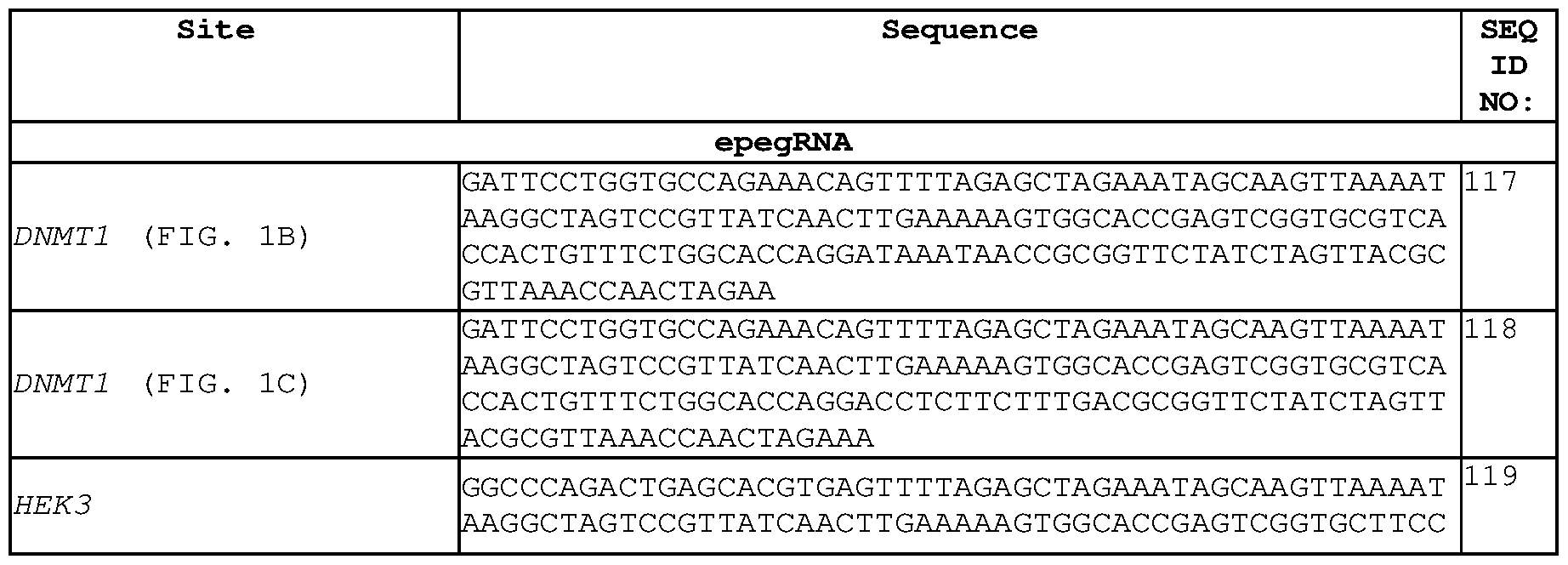
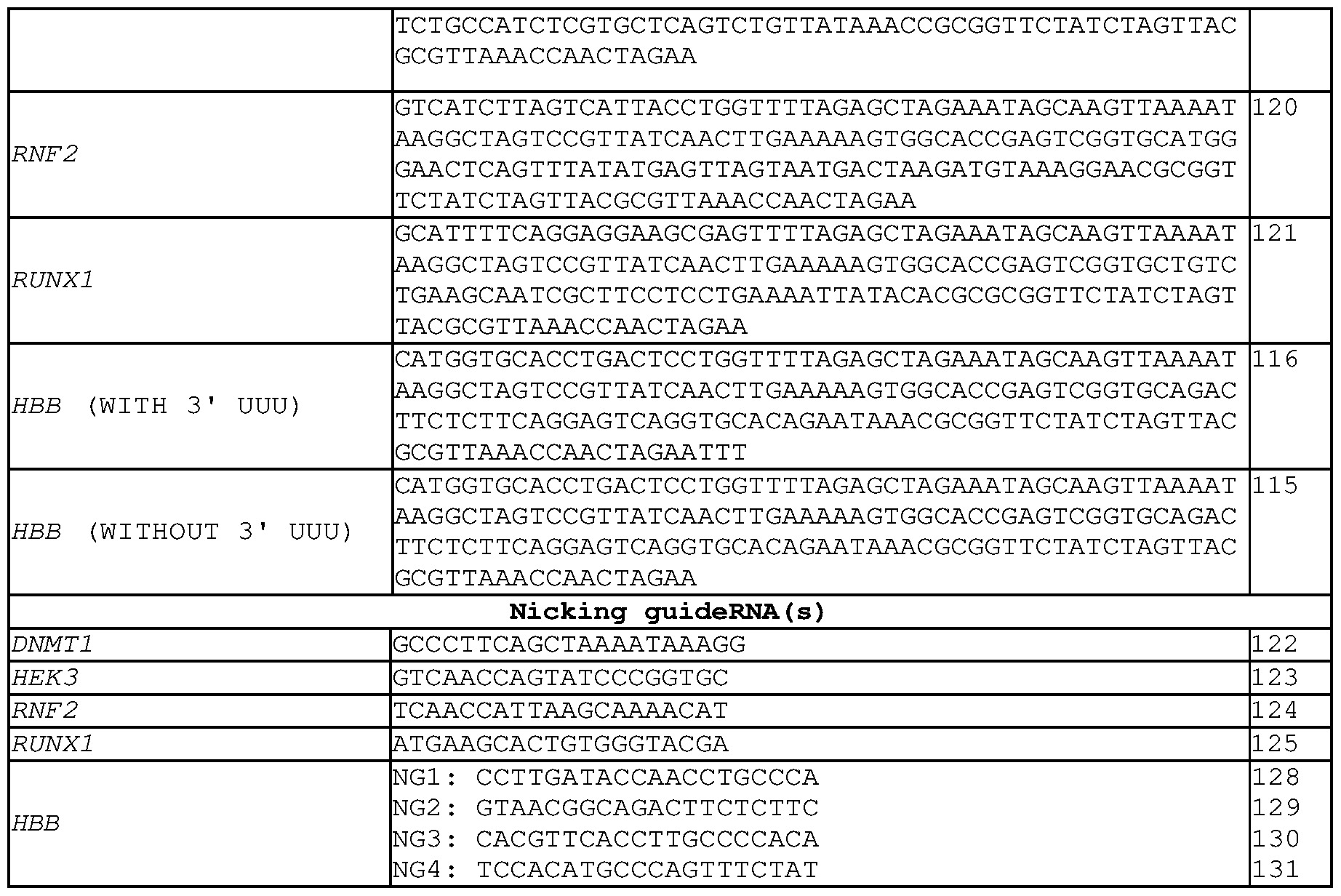
Table 3. Antibodies used in this Example.


Table 4. Pooled DNA sequencing primers for rhAmpSeq assay.
[0270] Primers were designed using IDT’s online rhAmpSeq assay design tool. Design run
ID: RHC.06B5E2470E054BE.
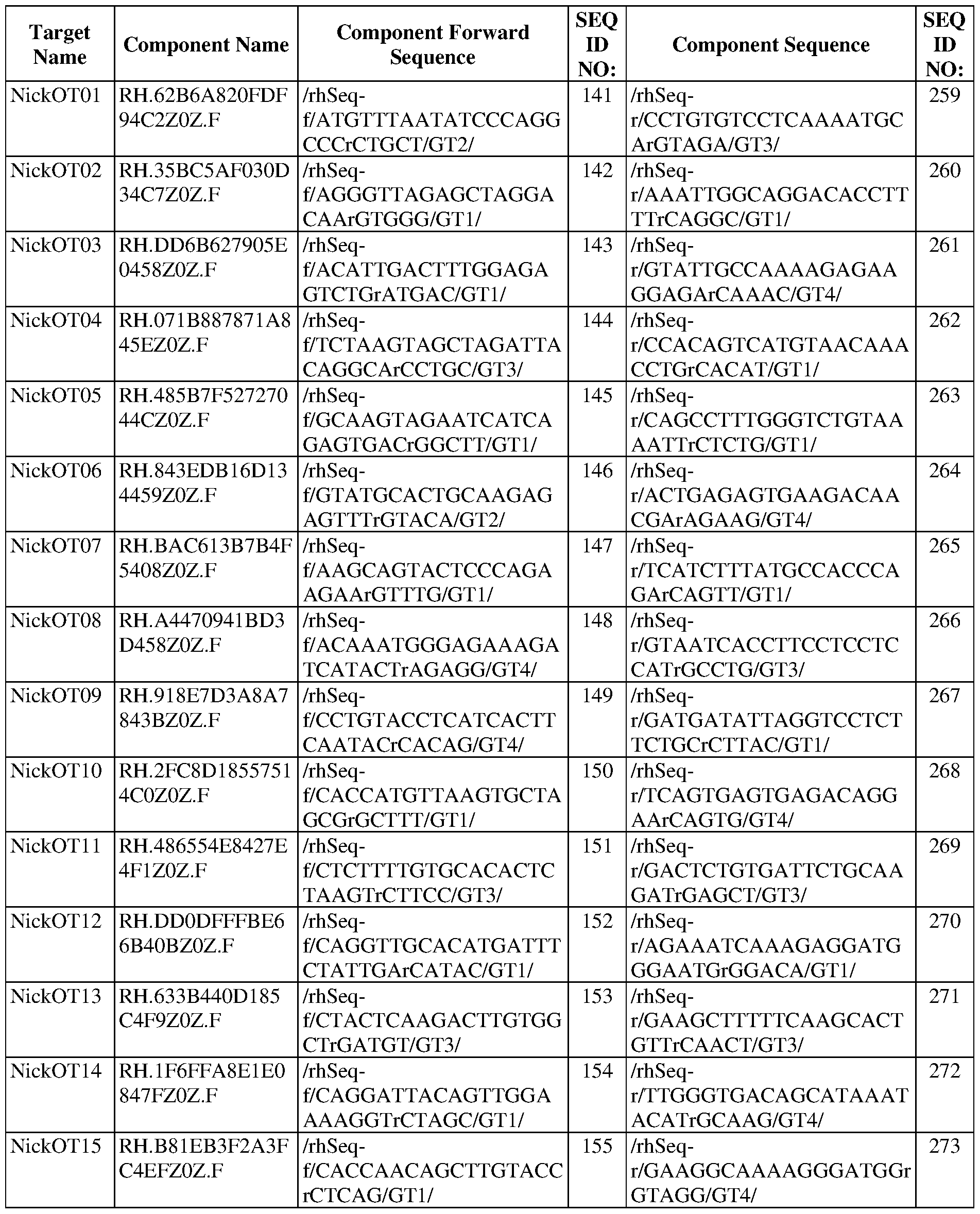
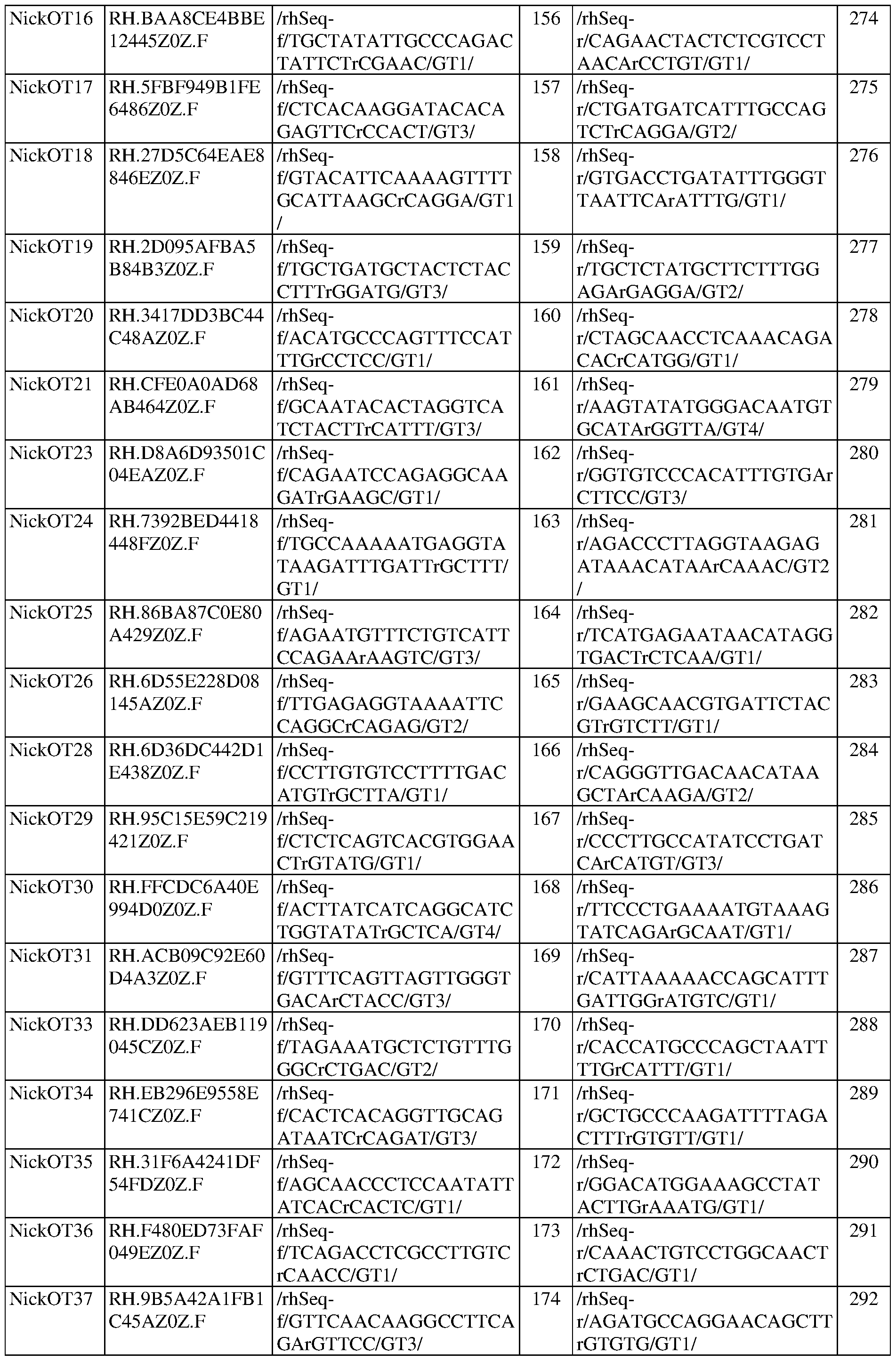


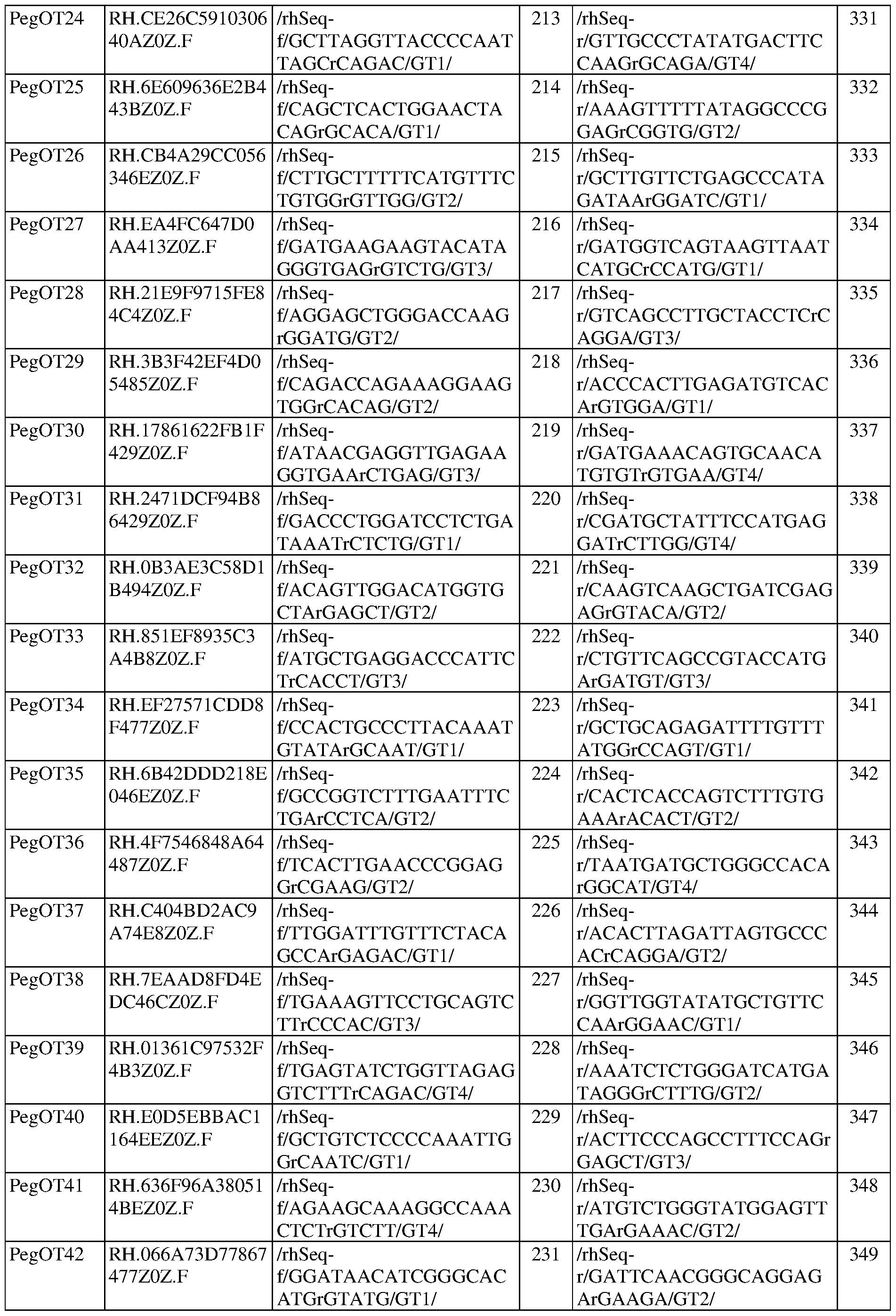
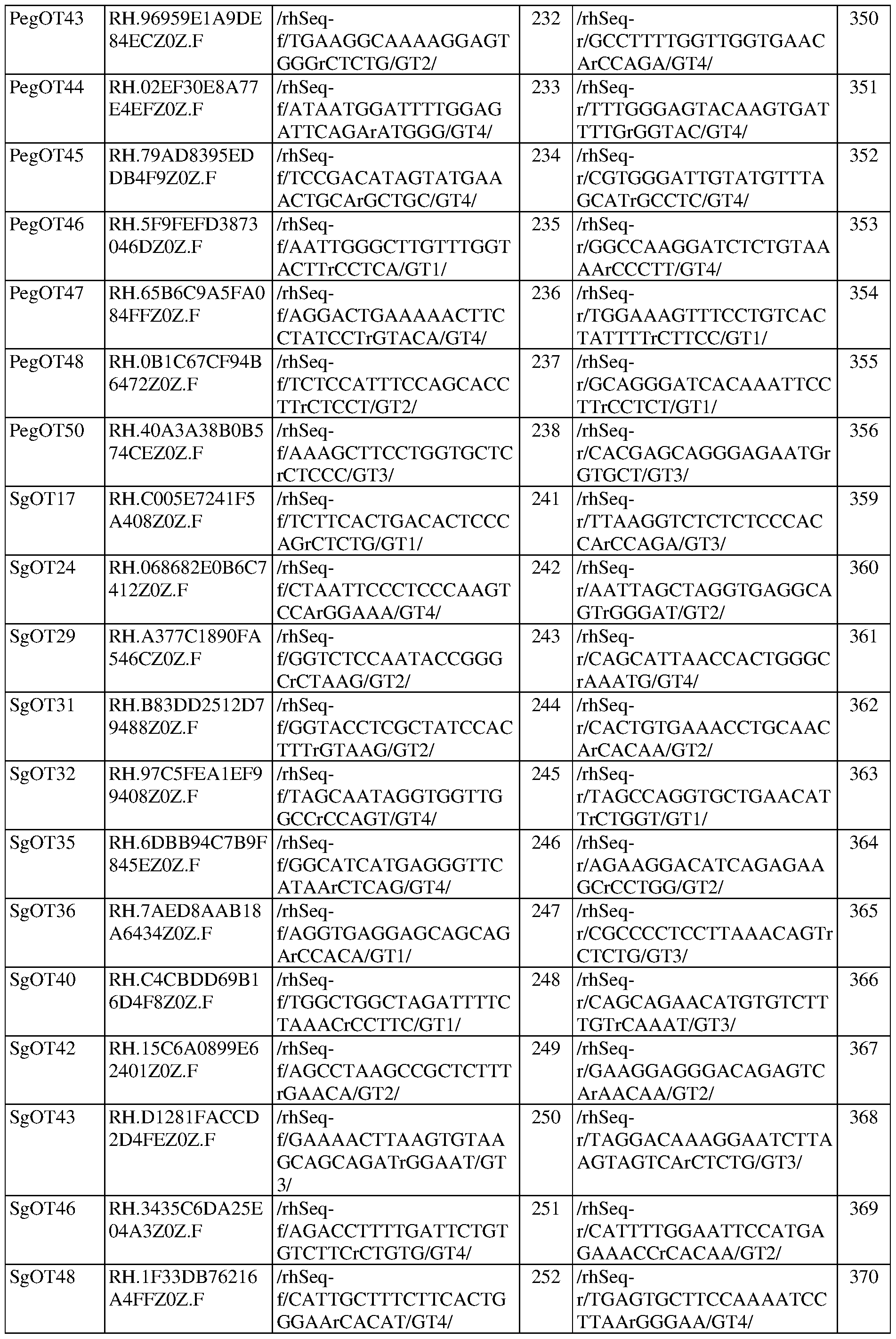

REFERENCES
1. Piel, F. B., Steinberg, M. H., & Rees, D. C. Sickle Cell Disease. N. Engl. J. Med. 376, 1561-1573 (2017).
2. Anzalone, A. V. et al. Search-and-replace genome editing without double-strand breaks or donor DNA. Nature (2019) doi:10.1038/s41586-019-1711-4.
3. Chen, P. J. et al. Enhanced prime editing systems by manipulating cellular determinants of editing outcomes. Cell 184, 5635-5652. e29 (2021).
4. Nelson, J. W. et al. Engineered pegRNAs improve prime editing efficiency. Nat. Biotechnol. 40, 402-410 (2022).
5. Fitzhugh, C. D. et al. At least 20% donor myeloid chimerism is necessary to reverse the sickle phenotype after allogeneic HSCT. Blood 130, 1946-1948 (2017).
6. Walters, M. C. et al. Stable mixed hematopoietic chimerism after bone marrow transplantation for sickle cell anemia. Biol. Blood Marrow Transplant. 7, 665-673 (2001).
7. Khemani, K., Katoch, D., & Krishnamurti, L. Curative Therapies for Sickle Cell Disease. Ochsner J. 19, 131-137 (2019).
8. Kanter, J. et al. Biologic and Clinical Efficacy of LentiGlobin for Sickle Cell Disease. N. Engl. J. Med. 386, 617-628 (2022).
9. Zeng, J. et al. Therapeutic base editing of human hematopoietic stem cells. Nat. Med. (2020) doi:10.1038/s41591-020-0790-y.
10. Esrick, E. B. et al. Post-Transcriptional Genetic Silencing of BCE11A to Treat Sickle Cell Disease. N. Engl. J. Med. 384, 205-215 (2021).
11. Frangoul, H. et al. CRISPR-Cas9 Gene Editing for Sickle Cell Disease and P- Thalassemia. N. Engl. J. Med. 384, 252-260 (2021).
12. Lessard, S. et al. Zinc Finger Nuclease-Mediated Disruption of the BCL11A Erythroid Enhancer Results in Enriched Biallelic Editing, Increased Fetal Hemoglobin, and Reduced Sickling in Erythroid Cells Derived from Sickle Cell Disease Patients. Blood 134, 974-974 (2019).
13. Traxler, E. A. et al. A genome-editing strategy to treat P-hemoglobinopathies that recapitulates a mutation associated with a benign genetic condition. Nat. Med. 22, 987- 990 (2016).
14. Metais, J.-Y. et al. Genome editing of HBG1 and HBG2 to induce fetal hemoglobin.
Blood Adv. 3, 3379-3392 (2019).
15. Wilkinson, A. C. et al. Cas9-AAV6 gene correction of beta-globin in autologous HSCs improves sickle cell disease erythropoiesis in mice. Nat. Commun. 12, 686 (2021).
16. Newby, G. A. et al. Base editing of haematopoietic stem cells rescues sickle cell disease in mice. Nature 595, 295-302 (2021).
17. Magis, W. et al. High-level correction of the sickle mutation is amplified in vivo during erythroid differentiation. iScience 25, 104374 (2022).
18. Lattanzi, A. et al. Development of P-globin gene correction in human hematopoietic stem cells as a potential durable treatment for sickle cell disease. Sci. Transl. Med. 13, eabf2444 (2021).
19. Zuccaro, M. V. et al. Allele-Specific Chromosome Removal after Cas9 Cleavage in Human Embryos. Cell 183, 1650-1664. el5 (2020).
20. Enache, O. M. et al. Cas9 activates the p53 pathway and selects for p53-inactivating mutations. Nat. Genet. 52, 662-668 (2020).
21. Ihry, R. J. et al. p53 inhibits CRISPR-Cas9 engineering in human pluripotent stem cells. Nat. Med. A, 939-946 (2018).
22. Kosicki, M., Tomberg, K., & Bradley, A. Repair of double-strand breaks induced by CRISPR-Cas9 leads to large deletions and complex rearrangements. Nat. Biotechnol. 36, 765-771 (2018).
23. Haapaniemi, E., Botla, S., Persson, J., Schmierer, B., & Taipale, J. CRISPR-Cas9 genome editing induces a p53-mediated DNA damage response. Nat. Med. 24, 927-930 (2018).
24. Ferrari, S. et al. Choice of template delivery mitigates the genotoxic risk and adverse impact of editing in human hematopoietic stem cells. Cell Stem Cell 29, 1428- 1444. e9 (2022).
25. Schiroli, G. et al. Precise Gene Editing Preserves Hematopoietic Stem Cell Function following Transient p53-Mediated DNA Damage Response. Cell Stem Cell 24, 551- 565. e8 (2019).
26. Dever, D. P. et al. CRISPR/Cas9 P-globin gene targeting in human haematopoietic stem cells. Nature 539, 384-389 (2016).
27. Romero, Z. et al. Editing the Sickle Cell Disease Mutation in Human Hematopoietic Stem Cells: Comparison of Endonucleases and Homologous Donor Templates. Mol. Ther.
27, 1389-1406 (2019).
28. Chen, P. J. & Liu, D. R. Prime editing for precise and highly versatile genome
manipulation. Nat. Rev. Genet. (2022) doi:10.1038/s41576-022-00541-l.
29. Jin, S. et al. Genome-wide specificity of prime editors in plants. Nat. Biotechnol. 39, 1292-1299 (2021).
30. Anzalone, A. V. et al. Programmable deletion, replacement, integration and inversion of large DNA sequences with twin prime editing. Nat. Biotechnol. 40, 731-740 (2022).
31. Choi, J. et al. Precise genomic deletions using paired prime editing. Nat. Biotechnol.
40, 218-226 (2022).
32. Lin, Q. et al. High-efficiency prime editing with optimized, paired pegRNAs in plants. Nat. Biotechnol. 39, 923-927 (2021).
33. De Dreuzy, E. et al. EDIT-301: An Experimental Autologous Cell Therapy Comprising Casl2a-RNP Modified mPB-CD34+ Cells for the Potential Treatment of SCD. Blood 134, 4636-4636 (2019).
34. Ferreira da Silva, J. et al. Prime editing efficiency and fidelity are enhanced in the absence of mismatch repair. Nat. Commun. 13, 760 (2022).
35. Peterson, C. W. et al. Intracellular RNase activity dampens zinc finger nuclease- mediated gene editing in hematopoietic stem and progenitor cells. Mol. Ther. - Methods Clin. Dev. 24, 30-39 (2022).
36. Leonard, A. et al. Low-Dose Busulfan Reduces Human CD34+ Cell Doses Required for Engraftment in c-kit Mutant Immunodeficient Mice. Mol. Ther. - Methods Clin. Dev. 15, 430-437 (2019).
37. McIntosh, B. E. et al. Nonirradiated NOD,B6.SCID D2ry-/- KitW41/W41 (NBSGW) Mice Support Multilineage Engraftment of Human Hematopoietic Cells. Stem Cell Rep. 4, 171- 180 (2015).
38. Luc, S. et al. Bell la Deficiency Leads to Hematopoietic Stem Cell Defects with an Aging-like Phenotype. Cell Rep. 16, 3181-3194 (2016).
39. Kurup, S. P., Moioffer, S. J., Pewe, L. L., & Harty, J. T. p53 Hinders CRISPR/Cas9- Mediated Targeted Gene Disruption in Memory CD8 T Cells In Vivo. J. Immunol. 205, 2222-2230 (2020).
40. Schene, I. F. et al. Prime editing for functional repair in patient-derived disease models. Nat. Commun. 11, 5352 (2020).
41. Kim, D. Y., Moon, S. B., Ko, J.-H., Kim, Y.-S., & Kim, D. Unbiased investigation of specificities of prime editing systems in human cells. Nucleic Acids Res. 48, 10576-10589 (2020).
42. Liu, Y. et al. Efficient generation of mouse models with the prime editing system. Cell Discov. 6, 27 (2020).
43. Geurts, M. H. et al. Evaluating CRISPR-based prime editing for cancer modeling and CFTR repair in organoids. Life Sci. Alliance 4, e202000940 (2021).
44. Park, S.-J. et al. Targeted mutagenesis in mouse cells and embryos using an enhanced prime editor. Genome Biol. 22, 170 (2021).
45. Gao, P. et al. Prime editing in mice reveals the essentiality of a single base in driving tissue-specific gene expression. Genome Biol. 22, 83 (2021).
46. Lin, J. et al. Modeling a cataract disorder in mice with prime editing. Mol. Ther. - Nucleic Acids 25, 494-501 (2021).
47. Habib, O., Habib, G., Hwang, G.-H., & Bae, S. Comprehensive analysis of prime editing outcomes in human embryonic stem cells. Nucleic Acids Res. 50, 1187-1197 (2022).
48. Gao, R. et al. Genomic and Transcriptomic Analyses of Prime Editing Guide RNA- Independent Off-Target Effects by Prime Editors. CRISPR J. 5, 276-293 (2022).
49. Tsai, S. Q. et al. CIRCLE-seq: a highly sensitive in vitro screen for genome-wide CRISPR-Cas9 nuclease off-targets. Nat. Methods 14, 607-614 (2017).
50. Sankaran, V. G. & Orkin, S. H. The Switch from Fetal to Adult Hemoglobin. Cold Spring Harb. Perspect. Med. 3, a011643-a011643 (2013).
51. Pattabhi, S. et al. In Vivo Outcome of Homology-Directed Repair at the HBB Gene in HSC Using Alternative Donor Template Delivery Methods. Mol. Ther. - Nucleic Acids 17, 277- 288 (2019).
52. Howe, S. J. et al. Insertional mutagenesis combined with acquired somatic mutations causes leukemogenesis following gene therapy of SCID-X1 patients. J. Clin. Invest. 118, 3143-3150 (2008).
53. Stein, S. et al. Genomic instability and myelodysplasia with monosomy 7 consequent to EVH activation after gene therapy for chronic granulomatous disease. Nat. Med. 16, 198— 204 (2010).
54. Chu, S. H. et al. Rationally Designed Base Editors for Precise Editing of the Sickle Cell Disease Mutation. CRISPR J. 4, 169-177 (2021).
55. Doman, J. L., Raguram, A., Newby, G. A., & Liu, D. R. Evaluation and minimization of Cas9-independent off-target DNA editing by cytosine base editors. Nat. Biotechnol. 38, 620-628 (2020).
56. Jin, S. et al. Cytosine, but not adenine, base editors induce genome-wide off-target
mutations in rice. Science 364, 292-295 (2019).
57. Zuo, E. et al. Cytosine base editor generates substantial off-target single-nucleotide variants in mouse embryos. Science 364, 289-292 (2019).
58. Banskota, S. et al. Engineered virus-like particles for efficient in vivo delivery of therapeutic proteins. Cell 185, 250-265.el6 (2022).
59. Kaczmarek, J. C., Kowalski, P. S., & Anderson, D. G. Advances in the delivery of RNA therapeutics: from concept to clinical reality. Genome Med. 9, 60 (2017).
60. Hendel, A. et al. Chemically modified guide RNAs enhance CRISPR-Cas genome editing in human primary cells. Nat. Biotechnol. 33, 985-989 (2015).
61. Hu, J. et al. Isolation and functional characterization of human erythroblasts at distinct stages: implications for understanding of normal and disordered erythropoiesis in vivo. Blood 121, 3246-3253 (2013).
EQUIVALENTS AND SCOPE
[0271] In the claims articles such as “a,” “an,” and “the” may mean one or more than one unless indicated to the contrary or otherwise evident from the context. Claims or descriptions that include “or” between one or more members of a group are considered satisfied if one, more than one, or all of the group members are present in, employed in, or otherwise relevant to a given product or process unless indicated to the contrary or otherwise evident from the context. The invention includes embodiments in which exactly one member of the group is present in, employed in, or otherwise relevant to a given product or process. The invention includes embodiments in which more than one, or all of the group members are present in, employed in, or otherwise relevant to a given product or process.
[6272] Furthermore, the invention encompasses all variations, combinations, and permutations in which one or more limitations, elements, clauses, and descriptive terms from one or more of the listed claims are introduced into another claim. For example, any claim that is dependent on another claim can be modified to include one or more limitations found in any other claim that is dependent on the same base claim. Where elements are presented as lists, e.g., in Markush group format, each subgroup of the elements is also disclosed, and any element(s) can be removed from the group. It should it be understood that, in general, where the invention, or aspects of the invention, is/are referred to as comprising particular elements and/or features, certain embodiments of the invention or aspects of the invention consist, or consist essentially of, such elements and/or features. For purposes of simplicity, those embodiments have not been specifically set forth in haec verba herein. It is also noted that
the terms “comprising” and “containing” are intended to be open and permits the inclusion of additional elements or steps. Where ranges are given, endpoints are included. Furthermore, unless otherwise indicated or otherwise evident from the context and understanding of one of ordinary skill in the art, values that are expressed as ranges can assume any specific value or sub-range within the stated ranges in different embodiments of the invention, to the tenth of the unit of the lower limit of the range, unless the context clearly dictates otherwise.
[0273] This application refers to various issued patents, published patent applications, journal articles, and other publications, all of which are incorporated herein by reference. If there is a conflict between any of the incorporated references and the instant specification, the specification shall control. In addition, any particular embodiment of the present invention that falls within the prior art may be explicitly excluded from any one or more of the claims. Because such embodiments are deemed to be known to one of ordinary skill in the art, they may be excluded even if the exclusion is not set forth explicitly herein. Any particular embodiment of the invention can be excluded from any claim, for any reason, whether or not related to the existence of prior art.
[0274] Those skilled in the art will recognize or be able to ascertain using no more than routine experimentation many equivalents to the specific embodiments described herein. The scope of the present embodiments described herein is not intended to be limited to the above Description, but rather is as set forth in the appended claims. Those of ordinary skill in the art will appreciate that various changes and modifications to this description may be made without departing from the spirit or scope of the present invention, as defined in the following claims.
Claims
1. A method of treating sickle cell disease comprising contacting a target nucleotide sequence with a prime editor and an engineered prime editing guide RNA (epegRNA), wherein the epegRNA comprises the structure 5'-[spacer sequence] -[single guide RNA (sgRNA) scaffold sequence] -[extension arm sequence] -[optional engineered linker sequence]-[3' structured motif]-3', wherein each instance of ]-[ comprises an optional linker sequence.
2. The method of claim 1, wherein the epegRNA comprises the spacer sequence 5'- CATGGTGCACCTGACTCCTG-3' (SEQ ID NO: 127), or a sequence at least 90%, at least 95%, at least 96%, at least 97%, at least 98%, or at least 99% identical to the sequence 5'- CATGGTGCACCTGACTCCTG-3' (SEQ ID NO: 127) or a fragment thereof.
3. The method of claim 1 or 2, wherein the epegRNA comprises the sgRNA scaffold sequence 5'- GTTTTAGAGCTAGAAATAGCAAGTTAAAATAAGGCTAGTCCGTTATCAACTTGAA AAAGTGGCACCGAGTCGGTGC-3' (SEQ ID NO: 126), or a sequence at least 90%, at least 95%, at least 96%, at least 97%, at least 98%, or at least 99% identical to the sequence 5'-
GTTTTAGAGCTAGAAATAGCAAGTTAAAATAAGGCTAGTCCGTTATCAACTTGAA AAAGTGGCACCGAGTCGGTGC-3' (SEQ ID NO: 126) or a fragment thereof.
4. The method of any one of claims 1-3, wherein the epegRNA comprises the extension arm sequence 5'-AGACTTCTCTTCAGGAGTCAGGTGCAC-3' (SEQ ID NO: 111), or a sequence at least 90%, at least 95%, at least 96%, at least 97%, at least 98%, or at least 99% identical to the sequence 5'-AGACTTCTCTTCAGGAGTCAGGTGCAC-3' (SEQ ID NO:
111) or a fragment thereof.
5. The method of any one of claims 1-4, wherein the epegRNA comprises the engineered linker sequence 5'-AGAATAAA-3' between the extension arm sequence and the
3' structured motif, or a sequence at least 90%, at least 95%, at least 96%, at least 97%, at least 98%, or at least 99% identical to the sequence 5'-AGAATAAA-3' or a fragment thereof.
6. The method of any one of claims 1-5, wherein the 3' structured motif comprises a toeloop, a hairpin, a stem-loop, a pseudoknot, an aptamer, a G-quadruplex, a tRNA, a riboswitch, or a ribozyme, optionally wherein the structured motif is a pseudoknot (e.g., evopreql).
7. The method of any one of claims 1-6, wherein the epegRNA comprises a 3' structured motif comprising a nucleotide sequence of any one of SEQ ID NOs: 48-77 or a sequence at least 90%, at least 95%, at least 96%, at least 97%, at least 98%, or at least 99% identical to the sequence of any one of SEQ ID NOs: 48-77 or a fragment thereof.
8. The method of any one of claims 1-7, wherein the epegRNA comprises a 3' structured motif comprising the sequence 5'- CGCGGTTCTATCTAGTTACGCGTTAAACCAACTAGAA-3' (SEQ ID NO: 72), or a sequence at least 90%, at least 95%, at least 96%, at least 97%, at least 98%, or at least 99% identical to the sequence 5'-CGCGGTTCTATCTAGTTACGCGTTAAACCAACTAGAA-3' (SEQ ID NO: 72) or a fragment thereof.
9. The method of any one of claims 1-8, wherein the epegRNA comprises the sequence 5'-
CATGGTGCACCTGACTCCTGGTTTTAGAGCTAGAAATAGCAAGTTAAAATAAGG CTAGTCCGTTATCAACTTGAAAAAGTGGCACCGAGTCGGTGCAGACTTCTCTTCA GGAGTCAGGTGCACAGAATAAACGCGGTTCTATCTAGTTACGCGTTAAACCAAC TAGAA-3' (SEQ ID NO: 115), or a sequence at least 90%, at least 95%, at least 96%, at least 97%, at least 98%, or at least 99% identical to the sequence of SEQ ID NO: 115.
10. The method of any one of claims 1-9, wherein the epegRNA further comprises the sequence 5'-TTT-3' on the 3' end.
11. The method of any one of claims 1-10, wherein the epegRNA comprises the sequence 5'-
CATGGTGCACCTGACTCCTGGTTTTAGAGCTAGAAATAGCAAGTTAAAATAAGG CTAGTCCGTTATCAACTTGAAAAAGTGGCACCGAGTCGGTGCAGACTTCTCTTCA GGAGTCAGGTGCACAGAATAAACGCGGTTCTATCTAGTTACGCGTTAAACCAAC
TAGAATTT-3' (SEQ ID NO: 116), or a sequence at least 90%, at least 95%, at least 96%, at least 97%, at least 98%, or at least 99% identical to the sequence of SEQ ID NO: 116.
12. The method of claim 10 or 11, wherein at least one nucleotide of the 5'-TTT-3' sequence comprises a 2'-O-methyl modification, optionally wherein all three of the nucleotides of the 5'-TTT-3' sequence comprise a 2'-O-methyl modification.
13. The method of any one of claims 10-12, wherein at least one nucleotide of the 5'- TTT-3' sequence is connected by a phosphorothioate linkage, optionally wherein all three of the nucleotides of the 5'-TTT-3' sequence are connected by phosphorothioate linkages.
14. The method of any one of claims 1-13, wherein the method results in the correction of an A T:T A transversion mutation at nucleotide position 20 in the P-globin gene (HBB).
15. The method of claim 14, wherein correction of the A T:T- A transversion mutation in HBB reverts the sickle cell disease allele to the wild type allele.
16. The method of claim 14 or 15, wherein correction of the A T:T- A transversion mutation in HBB results in the correction of a valine mutation in the P-globin protein to a glutamic acid residue.
17. The method of any one of claims 14-16, wherein the method further results in the introduction of a G — > A silent PAM-disrupting edit at the nucleotide position following the A T:T- A transversion mutation.
18. The method of any one of claims 1-17 further comprising nicking the non-PAM- containing strand of the target nucleotide sequence using a nicking sgRNA.
19. The method of claim 18, wherein the spacer sequence of the nicking sgRNA comprises the nucleotide sequence 5'-CCTTGATACCAACCTGCCCA-3' (SEQ ID NO:
128), 5'-GTAACGGCAGACTTCTCTTC-3' (SEQ ID NO: 129), 5'- CACGTTCACCTTGCCCCACA-3' (SEQ ID NO: 130), or 5'- TCCACATGCCCAGTTTCTAT-3' (SEQ ID NO: 131), or a sequence at least 90%, at least 95%, at least 96%, at least 97%, at least 98%, or at least 99% identical to the sequence 5'- CCTTGATACCAACCTGCCCA-3' (SEQ ID NO: 128), 5'- GTAACGGCAGACTTCTCTTC-3' (SEQ ID NO: 129), 5'- CACGTTCACCTTGCCCCACA-3' (SEQ ID NO: 130), or 5'- TCCACATGCCCAGTTTCTAT-3' (SEQ ID NO: 131) or a fragment thereof.
20. The method of claim 18 or 19, wherein the spacer sequence of the nicking sgRNA comprises the nucleotide sequence 5'-CCTTGATACCAACCTGCCCA-3' (SEQ ID NO: 128), or a sequence at least 90%, at least 95%, at least 96%, at least 97%, at least 98%, or at least 99% identical to the sequence 5'-CCTTGATACCAACCTGCCCA-3' (SEQ ID NO:
128) or a fragment thereof.
21. The method of claim 18 or 19, wherein the spacer sequence of the nicking sgRNA comprises the nucleotide sequence 5'-GTAACGGCAGACTTCTCTTC-3' (SEQ ID NO:
129), 5'-CACGTTCACCTTGCCCCACA-3' (SEQ ID NO: 130), or 5'- TCCACATGCCCAGTTTCTAT-3' (SEQ ID NO: 131), or a sequence at least 90%, at least 95%, at least 96%, at least 97%, at least 98%, or at least 99% identical to the sequence 5'- GTAACGGCAGACTTCTCTTC-3' (SEQ ID NO: 129), 5'- CACGTTCACCTTGCCCCACA-3' (SEQ ID NO: 130), or 5'- TCCACATGCCCAGTTTCTAT-3' (SEQ ID NO: 131) or a fragment thereof.
22. The method of any one of claims 1-21, wherein the prime editor comprises PEmax architecture.
23. The method of any one of claims 1-22, wherein the prime editor is PE3max, PE3bmax, PE4max, PE5max, or PE5bmax.
24. The method of any one of claims 1-23, wherein the prime editor is PE3max or
PE3bmax.
25. The method of any one of claims 1-24, wherein the contacting is performed in a cell.
26. The method of claim 25, wherein the cell is a eukaryotic cell.
27. The method of claim 25 or 26, wherein the cell is a human cell.
28. The method of any one of claims 25-27, wherein the cell is a hematopoietic stem or progenitor cell (HSPC) or a hematopoietic stem cell (HSC).
29. The method of claim 28, wherein the cell is an HSC, and wherein the HSC retains the edits introduced in its genome in its sub-lineage cells.
30. The method of any one of claims 25-27, wherein the cell is a CD34+ cell, a CD235a+ cell, a CD33+ cell, or a CD19+ cell.
31. The method of any one of claims 25-30, wherein the prime editor is delivered to the cell as a protein and the epegRNA is delivered to the cell as RNA, optionally wherein a nicking sgRNA is also delivered to the cell as RNA.
32. The method of any one of claims 25-30, wherein the prime editor is delivered to the cell as mRNA and the epegRNA is delivered to the cell as RNA, optionally wherein a nicking sgRNA is also delivered to the cell as RNA.
33. The method of claim 32, wherein the prime editor is delivered to the cell as mRNA by electroporation and the epegRNA is delivered to the cell as RNA by electroporation, optionally wherein a nicking sgRNA is also delivered to the cell as RNA by electroporation.
34. The method of claim 33, wherein the prime editor mRNA, epegRNA, and nicking sgRNA comprise approximately 20% of the total electroporation volume.
35. The method of claim 33 or 34, wherein the molar ratio of the amount of epegRNA to the amount of nicking sgRNA delivered to the cell is approximately 1.5:1.
36. The method of any one of claims 1-35, wherein the method is performed in vitro.
37. The method of any one of claims 1-35, wherein the method is performed ex vivo.
38. The method of claim 37, wherein the method is performed in a cell ex vivo, and wherein the edited cell is subsequently transplanted into a subject to be treated.
39. The method of any one of claims 1-35, wherein the method is performed in vivo.
40. The method of any one of claims 1-35 or 39, wherein the method is performed in a subject.
41. The method of claim 38 or 40, wherein the subject is a human.
42. The method of claim 38, 40, or 41, wherein the subject has or is suspected of having sickle cell disease.
43. The method of any one of claims 1-42, wherein the method results in a greater than 20%, greater than 25%, greater than 30%, greater than 35%, or greater than 40% efficiency of conversion of an A T:T- A transversion mutation at nucleotide position 20 in the P-globin gene (HBB) to the wild type sequence.
44. The method of any one of claims 1-43, wherein the method results in an edit-to-indel ratio of greater than 5, greater than 5.5, greater than 6, greater than 6.5, greater than 7, or greater than 7.5.
45. The method of any one of claims 1-44, wherein the method results in at least 30%, at least 35%, or at least 40% of cells edited using the method retaining the edit following transplantation into a subject.
46. The method of any one of claims 1-45, wherein the method is performed with a prime editing efficiency of at least 60%, at least 65%, at least 70%, at least 75%, or at least 80%.
47. The method of any one of claims 1-46, wherein the method results in an indel frequency of less than 10%, less than 9%, less than 8%, less than 7%, less than 6%, less than
5%, or less than 4%.
48. A method of treating sickle cell disease comprising contacting a target nucleotide sequence with a prime editor and a prime editing guide RNA (pegRNA), wherein the prime editor is PE3max or PE3bmax, and wherein the pegRNA comprises the structure 5 '-[spacer sequence] -[single guide RNA (sgRNA) scaffold sequence] -[extension arm sequence]-3', wherein each instance of ]-[ comprises an optional linker sequence.
49. A method of treating sickle cell disease comprising contacting a target nucleotide sequence with a prime editor, a prime editing guide RNA (pegRNA), and a nicking single guide RNA (sgRNA), wherein the pegRNA comprises the structure 5 '-[spacer sequence] - [sgRNA scaffold sequence] -[extension arm sequence]-3', wherein each instance of ]-[ comprises an optional linker sequence, and wherein the spacer sequence of the nicking sgRNA comprises the nucleotide sequence 5'-GTAACGGCAGACTTCTCTTC-3' (SEQ ID NO: 129), 5'-CACGTTCACCTTGCCCCACA-3' (SEQ ID NO: 130), or 5'- TCCACATGCCCAGTTTCTAT-3' (SEQ ID NO: 131), or a sequence at least 90%, at least 95%, at least 96%, at least 97%, at least 98%, or at least 99% identical to the sequence 5'- GTAACGGCAGACTTCTCTTC-3' (SEQ ID NO: 129), 5'- CACGTTCACCTTGCCCCACA-3' (SEQ ID NO: 130), or 5'- TCCACATGCCCAGTTTCTAT-3' (SEQ ID NO: 131) or a fragment thereof.
50. An engineered prime editing guide RNA (epegRNA) targeting the P-globin gene (HBB), wherein the epegRNA comprises the structure 5 '-[spacer sequence] -[single guide RNA (sgRNA) scaffold sequence] -[extension arm sequence] -[optional engineered linker sequence]-[3' structured motif]-3', wherein each instance of ]-[ comprises an optional linker sequence.
51. The epegRNA of claim 50, wherein the epegRNA comprises the spacer sequence 5'- CATGGTGCACCTGACTCCTG-3' (SEQ ID NO: 127), or a sequence at least 90%, at least 95%, at least 96%, at least 97%, at least 98%, or at least 99% identical to the sequence 5'- CATGGTGCACCTGACTCCTG-3' (SEQ ID NO: 127) or a fragment thereof.
52. The epegRNA of claim 50 or 51, wherein the epegRNA comprises the sgRNA scaffold sequence 5'- GTTTTAGAGCTAGAAATAGCAAGTTAAAATAAGGCTAGTCCGTTATCAACTTGAA AAAGTGGCACCGAGTCGGTGC-3' (SEQ ID NO: 126), or a sequence at least 90%, at least 95%, at least 96%, at least 97%, at least 98%, or at least 99% identical to the sequence 5'-
GTTTTAGAGCTAGAAATAGCAAGTTAAAATAAGGCTAGTCCGTTATCAACTTGAA AAAGTGGCACCGAGTCGGTGC-3' (SEQ ID NO: 126) or a fragment thereof.
53. The epegRNA of any one of claims 50-52, wherein the epegRNA comprises the extension arm sequence 5'-AGACTTCTCTTCAGGAGTCAGGTGCAC-3' (SEQ ID NO:
111), or a sequence at least 90%, at least 95%, at least 96%, at least 97%, at least 98%, or at least 99% identical to the sequence 5'-AGACTTCTCTTCAGGAGTCAGGTGCAC-3' (SEQ ID NO: 111) or a fragment thereof.
54. The epegRNA of any one of claims 50-53, wherein the epegRNA comprises the engineered linker sequence 5'-AGAATAAA-3' between the extension arm sequence and the 3' structured motif, or a sequence at least 90%, at least 95%, at least 96%, at least 97%, at least 98%, or at least 99% identical to the sequence 5'-AGAATAAA-3' or a fragment thereof.
55. The epegRNA of any one of claims 50-54, wherein the 3' structured motif comprises a toe-loop, a hairpin, a stem-loop, a pseudoknot, an aptamer, a G-quadruplex, a tRNA, a riboswitch, or a ribozyme.
56. The epegRNA of any one of claims 50-55, wherein the epegRNA comprises a 3' structured motif of any one of SEQ ID NOs: 48-77, or a sequence at least 90%, at least 95%, at least 96%, at least 97%, at least 98%, or at least 99% identical to the sequence of any one of SEQ ID NOs: 48-77 or a fragment thereof.
57. The epegRNA of any one of claims 50-56, wherein the epegRNA comprises a 3' structured motif comprising the sequence 5'- CGCGGTTCTATCTAGTTACGCGTTAAACCAACTAGAA-3' (SEQ ID NO: 72), or a
sequence at least 90%, at least 95%, at least 96%, at least 97%, at least 98%, or at least 99% identical to the sequence 5'-CGCGGTTCTATCTAGTTACGCGTTAAACCAACTAGAA-3' (SEQ ID NO: 72) or a fragment thereof.
58. The epegRNA of any one of claims 50-57, wherein the epegRNA comprises the sequence 5'- CATGGTGCACCTGACTCCTGGTTTTAGAGCTAGAAATAGCAAGTTAAAATAAGG
CTAGTCCGTTATCAACTTGAAAAAGTGGCACCGAGTCGGTGCAGACTTCTCTTCA GGAGTCAGGTGCACAGAATAAACGCGGTTCTATCTAGTTACGCGTTAAACCAAC TAGAA-3' (SEQ ID NO: 115), or a sequence at least 90%, at least 95%, at least 96%, at least 97%, at least 98%, or at least 99% identical to the sequence of SEQ ID NO: 115.
59. The epegRNA of any one of claims 50-58, wherein the epegRNA further comprises the sequence 5'-TTT-3' at the 3' end.
60. The epegRNA of any one of claims 50-59, wherein the epegRNA comprises the sequence 5'- CATGGTGCACCTGACTCCTGGTTTTAGAGCTAGAAATAGCAAGTTAAAATAAGG
CTAGTCCGTTATCAACTTGAAAAAGTGGCACCGAGTCGGTGCAGACTTCTCTTCA GGAGTCAGGTGCACAGAATAAACGCGGTTCTATCTAGTTACGCGTTAAACCAAC TAGAATTT-3' (SEQ ID NO: 116), or a sequence at least 90%, at least 95%, at least 96%, at least 97%, at least 98%, or at least 99% identical to the sequence of SEQ ID NO: 116.
61. The epegRNA of claim 59 or 60, wherein at least one nucleotide of the 5'-TTT-3' sequence comprises a 2'-O-methyl modification, optionally wherein all three of the nucleotides of the 5'-TTT-3' sequence comprise a 2'-O-methyl modification.
62. The epegRNA of any one of claims 59-61, wherein at least one nucleotide of the 5'- TTT-3' sequence is connected by a phosphorothioate linkage, optionally wherein all three of the nucleotides of the 5'-TTT-3' sequence are connected by phosphorothioate linkages.
63. A complex comprising a prime editor and an epegRNA of any one of claims 50-62.
64. The complex of claim 63, wherein the prime editor comprises PEmax architecture.
65. The complex of claim 63 or 64, wherein the prime editor comprises PE3max, PE3bmax, PE4max, PE5max, or PE5bmax.
66. The complex of any one of claims 63-65, wherein the prime editor comprises PE3max or PE3bmax.
67. A polynucleotide encoding the epegRNA of any one of claims 50-62.
68. One or more polynucleotides encoding the prime editor and the epegRNA of the complex of any one of claims 63-66.
69. A vector comprising the polynucleotide of claim 67.
70. One or more vectors comprising the one or more polynucleotides of claim 68.
71. A pharmaceutical composition comprising the epegRNA of any one of claims 50-62, the complex of any one of claims 63-66, the one or more polynucleotides of claim 67 or 68, or the one or more vectors of claim 69 or 70.
72. A pharmaceutical composition comprising the epegRNA of any one of claims 50-62 and an mRNA encoding a prime editor.
73. A pharmaceutical composition comprising a cell edited using the method of any one of claims 1-49.
74. A cell comprising the epegRNA of any one of claims 50-62, the complex of any one of claims 63-66, the one or more polynucleotides of claim 67 or 68, or the one or more vectors of claim 69 or 70.
75. The cell of claim 74, wherein the cell is a hematopoietic stem or progenitor cell (HSPC) or a hematopoietic stem cell (HSC).
76. A kit comprising the epegRNA of any one of claims 50-62, the complex of any one of claims 63-66, the one or more polynucleotides of claim 67 or 68, or the one or more vectors of claim 69 or 70.
77. Use of the epegRNA of any one of claims 50-62, the complex of any one of claims 63-66, the one or more polynucleotides of claim 67 or 68, the one or more vectors of claim 69 or 70, or the pharmaceutical composition of any one of claims 71-73 for the treatment of sickle cell disease.
78. Use of the epegRNA of any one of claims 50-62, the complex of any one of claims 63-66, the one or more polynucleotides of claim 67 or 68, the one or more vectors of claim 69 or 70, or the pharmaceutical composition of any one of claims 71-73 in the manufacture of a medicament for the treatment of sickle cell disease.
79. A cell comprising DNA comprising the sequence 5'-ATGGTGCACCTGACTCCTGA AGAGAAG-3' (SEQ ID NO: 78), or a sequence at least 90%, at least 95%, at least 96%, at least 97%, at least 98%, or at least 99% identical to the sequence 5'- ATGGTGCACCTGACTCCTGAAGAGAAG-3' (SEQ ID NO: 78), wherein the underlined nucleotide is an A.
80. The cell of claim 79, wherein the DNA is chromosomal DNA.
81. The cell of claim 79 or 80, wherein the cell is an HSPC or an HSC.
Applications Claiming Priority (2)
| Application Number | Priority Date | Filing Date | Title |
|---|---|---|---|
| US202363454583P | 2023-03-24 | 2023-03-24 | |
| US63/454,583 | 2023-03-24 |
Publications (1)
| Publication Number | Publication Date |
|---|---|
| WO2024206125A1 true WO2024206125A1 (en) | 2024-10-03 |
Family
ID=90828929
Family Applications (1)
| Application Number | Title | Priority Date | Filing Date |
|---|---|---|---|
| PCT/US2024/021103 Ceased WO2024206125A1 (en) | 2023-03-24 | 2024-03-22 | Use of prime editing for treating sickle cell disease |
Country Status (1)
| Country | Link |
|---|---|
| WO (1) | WO2024206125A1 (en) |
Citations (19)
| Publication number | Priority date | Publication date | Assignee | Title |
|---|---|---|---|---|
| US4880635A (en) | 1984-08-08 | 1989-11-14 | The Liposome Company, Inc. | Dehydrated liposomes |
| US4906477A (en) | 1987-02-09 | 1990-03-06 | Kabushiki Kaisha Vitamin Kenkyusyo | Antineoplastic agent-entrapping liposomes |
| US4911928A (en) | 1987-03-13 | 1990-03-27 | Micro-Pak, Inc. | Paucilamellar lipid vesicles |
| US4917951A (en) | 1987-07-28 | 1990-04-17 | Micro-Pak, Inc. | Lipid vesicles formed of surfactants and steroids |
| US4920016A (en) | 1986-12-24 | 1990-04-24 | Linear Technology, Inc. | Liposomes with enhanced circulation time |
| US4921757A (en) | 1985-04-26 | 1990-05-01 | Massachusetts Institute Of Technology | System for delayed and pulsed release of biologically active substances |
| US5244797A (en) | 1988-01-13 | 1993-09-14 | Life Technologies, Inc. | Cloned genes encoding reverse transcriptase lacking RNase H activity |
| WO2001038547A2 (en) | 1999-11-24 | 2001-05-31 | Mcs Micro Carrier Systems Gmbh | Polypeptides comprising multimers of nuclear localization signals or of protein transduction domains and their use for transferring molecules into cells |
| US9458484B2 (en) | 2010-10-22 | 2016-10-04 | Bio-Rad Laboratories, Inc. | Reverse transcriptase mixtures with improved storage stability |
| US9534201B2 (en) | 2007-04-26 | 2017-01-03 | Ramot At Tel-Aviv University Ltd. | Culture of pluripotent autologous stem cells from oral mucosa |
| US9580698B1 (en) | 2016-09-23 | 2017-02-28 | New England Biolabs, Inc. | Mutant reverse transcriptase |
| US9783791B2 (en) | 2005-08-10 | 2017-10-10 | Agilent Technologies, Inc. | Mutant reverse transcriptase and methods of use |
| US10150955B2 (en) | 2009-03-04 | 2018-12-11 | Board Of Regents, The University Of Texas System | Stabilized reverse transcriptase fusion proteins |
| US10189831B2 (en) | 2012-10-08 | 2019-01-29 | Merck Sharp & Dohme Corp. | Non-nucleoside reverse transcriptase inhibitors |
| US10202658B2 (en) | 2005-02-18 | 2019-02-12 | Monogram Biosciences, Inc. | Methods for determining hypersusceptibility of HIV-1 to non-nucleoside reverse transcriptase inhibitors |
| WO2020191239A1 (en) | 2019-03-19 | 2020-09-24 | The Broad Institute, Inc. | Methods and compositions for editing nucleotide sequences |
| WO2022067130A2 (en) * | 2020-09-24 | 2022-03-31 | The Broad Institute, Inc. | Prime editing guide rnas, compositions thereof, and methods of using the same |
| WO2022150790A2 (en) * | 2021-01-11 | 2022-07-14 | The Broad Institute, Inc. | Prime editor variants, constructs, and methods for enhancing prime editing efficiency and precision |
| WO2023039440A2 (en) * | 2021-09-08 | 2023-03-16 | Flagship Pioneering Innovations Vi, Llc | Hbb-modulating compositions and methods |
-
2024
- 2024-03-22 WO PCT/US2024/021103 patent/WO2024206125A1/en not_active Ceased
Patent Citations (22)
| Publication number | Priority date | Publication date | Assignee | Title |
|---|---|---|---|---|
| US4880635B1 (en) | 1984-08-08 | 1996-07-02 | Liposome Company | Dehydrated liposomes |
| US4880635A (en) | 1984-08-08 | 1989-11-14 | The Liposome Company, Inc. | Dehydrated liposomes |
| US4921757A (en) | 1985-04-26 | 1990-05-01 | Massachusetts Institute Of Technology | System for delayed and pulsed release of biologically active substances |
| US4920016A (en) | 1986-12-24 | 1990-04-24 | Linear Technology, Inc. | Liposomes with enhanced circulation time |
| US4906477A (en) | 1987-02-09 | 1990-03-06 | Kabushiki Kaisha Vitamin Kenkyusyo | Antineoplastic agent-entrapping liposomes |
| US4911928A (en) | 1987-03-13 | 1990-03-27 | Micro-Pak, Inc. | Paucilamellar lipid vesicles |
| US4917951A (en) | 1987-07-28 | 1990-04-17 | Micro-Pak, Inc. | Lipid vesicles formed of surfactants and steroids |
| US5244797A (en) | 1988-01-13 | 1993-09-14 | Life Technologies, Inc. | Cloned genes encoding reverse transcriptase lacking RNase H activity |
| US5244797B1 (en) | 1988-01-13 | 1998-08-25 | Life Technologies Inc | Cloned genes encoding reverse transcriptase lacking rnase h activity |
| WO2001038547A2 (en) | 1999-11-24 | 2001-05-31 | Mcs Micro Carrier Systems Gmbh | Polypeptides comprising multimers of nuclear localization signals or of protein transduction domains and their use for transferring molecules into cells |
| US10202658B2 (en) | 2005-02-18 | 2019-02-12 | Monogram Biosciences, Inc. | Methods for determining hypersusceptibility of HIV-1 to non-nucleoside reverse transcriptase inhibitors |
| US9783791B2 (en) | 2005-08-10 | 2017-10-10 | Agilent Technologies, Inc. | Mutant reverse transcriptase and methods of use |
| US9534201B2 (en) | 2007-04-26 | 2017-01-03 | Ramot At Tel-Aviv University Ltd. | Culture of pluripotent autologous stem cells from oral mucosa |
| US10150955B2 (en) | 2009-03-04 | 2018-12-11 | Board Of Regents, The University Of Texas System | Stabilized reverse transcriptase fusion proteins |
| US9458484B2 (en) | 2010-10-22 | 2016-10-04 | Bio-Rad Laboratories, Inc. | Reverse transcriptase mixtures with improved storage stability |
| US10189831B2 (en) | 2012-10-08 | 2019-01-29 | Merck Sharp & Dohme Corp. | Non-nucleoside reverse transcriptase inhibitors |
| US9932567B1 (en) | 2016-09-23 | 2018-04-03 | New England Biolabs, Inc. | Mutant reverse transcriptase |
| US9580698B1 (en) | 2016-09-23 | 2017-02-28 | New England Biolabs, Inc. | Mutant reverse transcriptase |
| WO2020191239A1 (en) | 2019-03-19 | 2020-09-24 | The Broad Institute, Inc. | Methods and compositions for editing nucleotide sequences |
| WO2022067130A2 (en) * | 2020-09-24 | 2022-03-31 | The Broad Institute, Inc. | Prime editing guide rnas, compositions thereof, and methods of using the same |
| WO2022150790A2 (en) * | 2021-01-11 | 2022-07-14 | The Broad Institute, Inc. | Prime editor variants, constructs, and methods for enhancing prime editing efficiency and precision |
| WO2023039440A2 (en) * | 2021-09-08 | 2023-03-16 | Flagship Pioneering Innovations Vi, Llc | Hbb-modulating compositions and methods |
Non-Patent Citations (136)
| Title |
|---|
| "Medical Applications of Controlled Release", 1974, CRC PRESS |
| ANZALONE, A. V. ET AL.: "Programmable deletion, replacement, integration and inversion of large DNA sequences with twin prime editing.", NAT. BIOTECHNOL., vol. 40, 2022, pages 731 - 740, XP037927032, DOI: 10.1038/s41587-021-01133-w |
| ANZALONE, A. V. ET AL.: "Search-and-replace genome editing without double-strand breaks or donor DNA", NATURE, vol. 576, 2019, pages 149 - 157, XP055980447, DOI: 10.1038/s41586-019-1711-4 |
| AREZI, B.HOGREFE, H.: "Novel mutations in Moloney Murine Leukemia Virus reverse transcriptase increase thermostability through tighter binding to template-primer", NUCLEIC ACIDS RES, vol. 37, 2009, pages 473 - 481, XP002556110, DOI: 10.1093/nar/gkn952 |
| AUTIERIAGRAWAL, J. BIOL. CHEM., vol. 273, 1998, pages 14731 - 37 |
| AVIDAN, O.MEER, M. E.OZ, IHIZI, A: "The processivity and fidelity of DNA synthesis exhibited by the reverse transcriptase of bovine leukemia virus", EUROPEAN JOURNAL OF BIOCHEMISTRY, vol. 269, 2002, pages 859 - 867 |
| BANSKOTA, S. ET AL.: "Engineered virus-like particles for efficient in vivo delivery of therapeutic proteins", CELL, vol. 185, 2022, pages 250 - 265 |
| BARANAUSKAS, A. ET AL.: "Generation and characterization of new highly thermostable and processive M-MuLV reverse transcriptase variants", PROTEIN ENG DES SEL, vol. 25, 2012, pages 657 - 668, XP055071799, DOI: 10.1093/protein/gzs034 |
| BERGER ET AL., BIOCHEMISTRY, vol. 22, 1983, pages 2365 - 2372 |
| BERKHOUT, B.JEBBINK, M.ZSÍROS, J.: "Identification of an Active Reverse Transcriptase Enzyme Encoded by a Human Endogenous HERV-K Retrovirus", JOURNAL OF VIROLOGY, vol. 73, 1999, pages 2365 - 2375, XP002361440 |
| BLAIN, S. W.GOFF, S. P.: "Nuclease activities of Moloney murine leukemia virus reverse transcriptase. Mutants with altered substrate specificities", J. BIOL. CHEM., vol. 268, 1993, pages 23585 - 23592, XP055491482 |
| BUCHWALD ET AL., SURGERY, vol. 88, 1980, pages 507 |
| CHEN, P. J. ET AL.: "Enhanced prime editing systems by manipulating cellular determinants of editing outcomes", CELL, vol. 184, 2021, pages 5635 - 5652 |
| CHEN, P. J.LIU, D. R.: "Prime editing for precise and highly versatile genome manipulation.", NAT. REV. GENET., 2022 |
| CHOI, J. ET AL.: "Precise genomic deletions using paired prime editing", NAT. BIOTECHNOL., vol. 40, 2022, pages 218 - 226, XP037691460, DOI: 10.1038/s41587-021-01025-z |
| CHU, S. H. ET AL.: "Rationally Designed Base Editors for Precise Editing of the Sickle Cell Disease Mutation", CRISPR J., vol. 4, 2021, pages 169 - 177 |
| CHYLINSKIRHUNCHARPENTIER: "The tracrRNA and Cas9 families of type II CRISPR-Cas immunity systems", RNA BIOLOGY, vol. 10, no. 5, 2013, pages 726 - 737, XP055116068, DOI: 10.4161/rna.24321 |
| COKOL ET AL.: "Finding nuclear localization signals", EMBO REP., vol. 1, no. 5, 2000, pages 411 - 415, XP072230221, DOI: 10.1093/embo-reports/kvd092 |
| DAS, D.GEORGIADIS, M. M.: "The Crystal Structure of the Monomeric Reverse Transcriptase from Moloney Murine Leukemia Virus", STRUCTURE, vol. 12, 2004, pages 819 - 829, XP025941534, DOI: 10.1016/j.str.2004.02.032 |
| DE DREUZY, E. ET AL.: "EDIT-301: An Experimental Autologous Cell Therapy Comprising Cas 12a-RNP Modified mPB-CD34+ Cells for the Potential Treatment of SCD", BLOOD, vol. 134, 2019, pages 4636 - 4636 |
| DELTCHEVA E.CHYLINSKI K.SHARMA C.M.GONZALES K.CHAO Y.PIRZADA Z.A.ECKERT M.R.VOGEL J.CHARPENTIER E.: "CRISPR RNA maturation by trans-encoded small RNA and host factor RNase III.", NATURE, vol. 471, 2011, pages 602 - 607, XP055308803, DOI: 10.1038/nature09886 |
| DEVER, D. P. ET AL.: "CRISPR/Cas9 0-globin gene targeting in human haematopoietic stem cells.", NATURE, vol. 539, 2016, pages 384 - 389, XP037555923, DOI: 10.1038/nature20134 |
| DOMAN, J. L.RAGURAM, A.NEWBY, G. A.LIU, D. R.: "Evaluation and minimization of Cas9-independent off-target DNA editing by cytosine base editors", NAT. BIOTECHNOL., vol. 38, 2020, pages 620 - 628, XP093078898, DOI: 10.1038/s41587-020-0414-6 |
| DURING ET AL., ANN. NEUROL., vol. 25, 1989, pages 351 |
| ENACHE, O. M. ET AL.: "Cas9 activates the p53 pathway and selects for p53-inactivating mutations", NAT. GENET., vol. 52, 2020, pages 662 - 668, XP037525537, DOI: 10.1038/s41588-020-0623-4 |
| ESRICK, E. B. ET AL.: "Post-Transcriptional Genetic Silencing of BCE11A to Treat Sickle Cell Disease", N. ENGL. J. MED., vol. 384, 2021, pages 205 - 215 |
| EVERETTE KELCEE A. ET AL: "Ex vivo prime editing of patient haematopoietic stem cells rescues sickle-cell disease phenotypes after engraftment in mice", NATURE BIOMEDICAL ENGINEERING, vol. 7, no. 5, 17 April 2023 (2023-04-17), pages 616 - 628, XP093113740, ISSN: 2157-846X, DOI: 10.1038/s41551-023-01026-0 * |
| FENG, Q.MORAN, J. V.KAZAZIAN, H. H.BOEKE, J. D.: "Human L1 retrotransposon encodes a conserved endonuclease required for retrotransposition", CELL, vol. 87, 1996, pages 905 - 916 |
| FERRARI, S. ET AL.: "Choice of template delivery mitigates the genotoxic risk and adverse impact of editing in human hematopoietic stem cells", CELL STEM CELL, vol. 29, 2022, pages 1428 - 1444 |
| FERREIRA DA SILVA, J. ET AL.: "Prime editing efficiency and fidelity are enhanced in the absence of mismatch repair", NAT. COMMUN., vol. 13, 2022, pages 760 |
| FERRETTIJ.J., MCSHAN W.M.AJDIC D.J.SAVIC D.J.SAVIC G.LYON K.PRIMEAUX C.SEZATE S.SUVOROV A.N.KENTON S.: "Complete genome sequence of an M1 strain of Streptococcus pyogenes.", PROC. NATL. ACAD. SCI. U.S.A., vol. 98, 2001, pages 4658 - 4663 |
| FITZHUGH, C. D. ET AL.: "At least 20% donor myeloid chimerism is necessary to reverse the sickle phenotype after allogeneic HSCT", BLOOD, vol. 130, 2017, pages 1946 - 1948 |
| FRANGOUL, H. ET AL.: "CRISPR-Cas9 Gene Editing for Sickle Cell Disease and β-Thalassemia", N. ENGL. J. MED., vol. 384, 2021, pages 252 - 260, XP093005338, DOI: 10.1056/NEJMoa2031054 |
| FREITAS ET AL.: "Mechanisms and Signals for the Nuclear Import of Proteins", CURRENT GENOMICS, vol. 10, no. 8, 2009, pages 550 - 7 |
| GAO, P. ET AL.: "Prime editing in mice reveals the essentiality of a single base in driving tissue-specific gene expression", GENOME BIOL., vol. 22, 2021, pages 83 |
| GAO, R. ET AL.: "Genomic and Transcriptomic Analyses of Prime Editing Guide RNA-Independent Off-Target Effects by Prime Editors", CRISPR J., vol. 5, 2022, pages 276 - 293 |
| GEORGE ANILA ET AL: "Efficient and error-free correction of sickle mutation in human erythroid cells using prime editor-2", FRONTIERS IN GENOME EDITING, vol. 4, 20 December 2022 (2022-12-20), XP093176448, ISSN: 2673-3439, DOI: 10.3389/fgeed.2022.1085111 * |
| GERARD, G. F ET AL.: "The role of template-primer in protection of reverse transcriptase from thermal inactivation", NUCLEIC ACIDS RES, vol. 30, 2002, pages 3118 - 3129, XP002556108, DOI: 10.1093/nar/gkf417 |
| GERARD, G. R., DNA, vol. 5, 1986, pages 271 - 279 |
| GEURTS, M. H. ET AL.: "Evaluating CRISPR-based prime editing for cancer modeling and CFTR repair in organoids", LIFE SCI. ALLIANCE, vol. 4, 2021, pages e202000940 |
| GRIFFITHS, D. J.: "Endogenous retroviruses in the human genome sequence", GENOME BIOL., vol. 2, 2001, XP002996132 |
| HAAPANIEMI, E.BOTLA, S.PERSSON, J.SCHMIERER, B.TAIPALE, J.: "CRISPR-Cas9 genome editing induces a p53-mediated DNA damage response", NAT. MED., vol. 24, 2018, pages 927 - 930, XP036542072, DOI: 10.1038/s41591-018-0049-z |
| HABIB, O.HABIB, G.HWANG, G.-H.BAE, S.: "Comprehensive analysis of prime editing outcomes in human embryonic stem cells", NUCLEIC ACIDS RES., vol. 50, 2022, pages 1187 - 1197, XP093103276, DOI: 10.1093/nar/gkab1295 |
| HALEMARHAM, THE HARPER COLLINS DICTIONARY OF BIOLOGY, 1991 |
| HALVAS, E. K.SVAROVSKAIA, E. S.PATHAK, V. K.: "Role of Murine Leukemia Virus Reverse Transcriptase Deoxyribonucleoside Triphosphate-Binding Site in Retroviral Replication and In Vivo Fidelity", JOURNAL OF VIROLOGY, vol. 74, 2000, pages 10349 - 10358 |
| HANSEL-HERTSCH R. ET AL.: "DNA G-quadruplexes in the human genome: detection, functions and therapeutic potential", NAT. REV. MOL. CELL BIOL., vol. 18, 2017, pages 279 - 284 |
| HENDEL, A. ET AL.: "Chemically modified guide RNAs enhance CRISPR-Cas genome editing in human primary cells", NAT. BIOTECHNOL., vol. 33, 2015, pages 985 - 989, XP055548372, DOI: 10.1038/nbt.3290 |
| HERSCHHORN, A.HIZI, A.: "Retroviral reverse transcriptases", CELL. MOL. LIFE SCI., vol. 67, 2010, pages 2717 - 2747, XP019837855 |
| HERZIG, E.VORONIN, N.KUCHERENKO, N.HIZI, A: "A Novel Leu92 Mutant of HIV-1 Reverse Transcriptase with a Selective Deficiency in Strand Transfer Causes a Loss of Viral Replication", J. VIROL., vol. 89, 2015, pages 8119 - 8129 |
| HOWARD ET AL., J. NEUROSURG., vol. 71, 1989, pages 105 |
| HOWE, S. J. ET AL.: "Insertional mutagenesis combined with acquired somatic mutations causes leukemogenesis following gene therapy of SCID-Xl patients", J. CLIN. INVEST., vol. 118, 2008, pages 3143 - 3150 |
| HU, J. ET AL.: "Isolation and functional characterization of human erythroblasts at distinct stages: implications for understanding of normal and disordered erythropoiesis in vivo", BLOOD, vol. 121, 2013, pages 3246 - 3253, XP086727957, DOI: 10.1182/blood-2013-01-476390 |
| IHRY, R. J. ET AL.: "p53 inhibits CRISPR-Cas9 engineering in human pluripotent stem cells", NAT. MED., vol. 24, 2018, pages 939 - 946, XP036542073, DOI: 10.1038/s41591-018-0050-6 |
| JIN, S. ET AL.: "Cytosine, but not adenine, base editors induce genome-wide off-target mutations in rice.", SCIENCE, vol. 364, 2019, pages 292 - 295, XP093047049, DOI: 10.1126/science.aaw7166 |
| JIN, S. ET AL.: "enome-wide specificity of prime editors in plants", NAT. BIOTECHNOL., vol. 39, 2021, pages 1292 - 1299, XP037583600, DOI: 10.1038/s41587-021-00891-x |
| JINEK ET AL., SCIENCE, vol. 337, 2012, pages 816 - 821 |
| JINEK M.CHYLINSKI K.FONFARA I.HAUER M.DOUDNA J.A., CHARPENTIER E. SCIENCE, vol. 337, 2012, pages 816 - 821 |
| JINEK M.CHYLINSKI K.FONFARA I.HAUER M.DOUDNA J.A.CHARPENTIER E.: "A programmable dual-RNA-guided DNA endonuclease in adaptive bacterial immunity.", SCIENCE, vol. 337, 2012, pages 816 - 821, XP055229606, DOI: 10.1126/science.1225829 |
| KACZMAREK, J. C.KOWALSKI, P. S.ANDERSON, D. G.: "Advances in the delivery of RNA therapeutics: from concept to clinical reality", GENOME MED., vol. 9, 2017, pages 60, XP055464283, DOI: 10.1186/s13073-017-0450-0 |
| KANTER, J.: "Biologic and Clinical Efficacy of LentiGlobin for Sickle Cell Disease.", N. ENGL. J. MED., vol. 386, 2022, pages 617 - 628, XP093018358, DOI: 10.1056/NEJMoa2117175 |
| KHEMANI, K.KATOCH, D.KRISHNAMURTI, L.: "Curative Therapies for Sickle Cell Disease", OCHSNER J., vol. 19, 2019, pages 131 - 137 |
| KIM, D. Y.MOON, S. B.KO, J.-H.KIM, Y.-S.KIM, D.: "Unbiased investigation of specificities of prime editing systems in human cells", NUCLEIC ACIDS RES., vol. 48, 2020, pages 10576 - 10589 |
| KOSICKI, M.TOMBERG, K.BRADLEY, A.: "Repair of double-strand breaks induced by CRISPR-Cas9 leads to large deletions and complex rearrangements", NAT. BIOTECHNOL., vol. 36, 2018, pages 765 - 771, XP036929645, DOI: 10.1038/nbt.4192 |
| KOTEWICZ, M. L. ET AL., GENE, vol. 35, 1985, pages 249 - 258 |
| KOTEWICZ, M. L.SAMPSON, C. M.D'ALESSIO, J. M.GERARD, G. F.: "Isolation of cloned Moloney murine leukemia virus reverse transcriptase lacking ribonuclease H activity", NUCLEIC ACIDS RES, vol. 16, 1988, pages 265 - 277 |
| KU ET AL.: "Nucleic Acid Aptamers: An Emerging Tool for Biotechnology and Biomedical Sensing", SENSORS, vol. 15, no. 7, 2015, pages 16281 - 16313, XP055384582, DOI: 10.3390/s150716281 |
| KURUP, S. P.MOIOFFER, S. J.PEWE, L. L.HARTY, J. T: "p53 Hinders CRISPR/Cas9-Mediated Targeted Gene Disruption in Memory CD8 T Cells In Vivo", J. IMMUNOL., vol. 205, 2020, pages 2222 - 2230 |
| KWOK ET AL.: "G-Quadruplexes: Prediction, Characterization, and Biological Application", TRENDS IN BIOTECHNOLOGY, vol. 35, no. 10, 2017, pages 997 - 1013, XP055708910, DOI: 10.1016/j.tibtech.2017.06.012 |
| LANGER, SCIENCE, vol. 249, 1990, pages 1527 - 1533 |
| LATTANZI, A. ET AL.: "Development of β-globin gene correction in human hematopoietic stem cells as a potential durable treatment for sickle cell disease", SCI. TRANSL. MED., vol. 13, 2021 |
| LEONARD, A. ET AL.: "Low-Dose Busulfan Reduces Human CD34+ Cell Doses Required for Engraftment in c-kit Mutant Immunodeficient Mice.", MOL. THER. - METHODS CLIN. DEV., vol. 15, 2019, pages 430 - 437 |
| LESSARD, S. ET AL.: "Zinc Finger Nuclease-Mediated Disruption of the BCL11A Erythroid Enhancer Results in Enriched Biallelic Editing, Increased Fetal Hemoglobin, and Reduced Sickling in Erythroid Cells Derived from Sickle Cell Disease Patients", BLOOD, vol. 134, 2019, pages 974 - 974, XP086666598, DOI: 10.1182/blood-2019-126048 |
| LEVY ET AL., SCIENCE, vol. 228, 1985, pages 190 |
| LI CHANG ET AL: "In vivo HSC prime editing rescues Sickle Cell Disease in a mouse model - Suppl. Materials", BLOOD, 21 February 2023 (2023-02-21), pages 1 - 21, XP093176555, Retrieved from the Internet <URL:https://ash.silverchair-cdn.com/ash/content_public/journal/blood/141/17/10.1182_blood.2022018252/5/blood_bld-2022-018252-mmc1.pdf?Expires=1720693126&Signature=l~YzxOS1yondXPC~FNPdwFE-GVXt~8lfoJ3MEW3uFdjur5VJ8OnmWEuvEw-L6VK567Lp891vHW41NBKgIWorfJUMePObpk8canXgZCczXUUgWlgVZABrwCOvp--Zg0W6gcp7okiMTOSP1> [retrieved on 20240619] * |
| LI CHANG ET AL: "In vivo HSC prime editing rescues Sickle Cell Disease in a mouse model - table S5", BLOOD, 21 February 2023 (2023-02-21), XP093176565, Retrieved from the Internet <URL:https://ash.silverchair-cdn.com/ash/content_public/journal/blood/141/17/10.1182_blood.2022018252/5/blood_bld-2022-018252-mmc2.xlsx?Expires=1720693126&Signature=ZRUCBExprofzTEq~48R2fHsd~Aietow1qh-waiWp4pmad3fJzVkkcwhPxIo6JF~hkwyPIUtsrxFtDO2xy89WtdMp0cQRbCowRlPWvXJ-~3bOgiba~fDe5dekTIr4pqDcD-sRiGoLL30N> [retrieved on 20240619] * |
| LI CHANG ET AL: "In vivo HSC prime editing rescues sickle cell disease in a mouse model", BLOOD, AMERICAN SOCIETY OF HEMATOLOGY, US, vol. 141, no. 17, 21 February 2023 (2023-02-21), pages 2085 - 2099, XP087306115, ISSN: 0006-4971, [retrieved on 20230221], DOI: 10.1182/BLOOD.2022018252 * |
| LIM, D. ET AL.: "Crystal structure of the moloney murine leukemia virus RNase H domain", J. VIROL., vol. 80, 2006, pages 8379 - 8389 |
| LIN, J. ET AL.: "Modeling a cataract disorder in mice with prime editing", MOL. THER. - NUCLEIC ACIDS, vol. 25, 2021, pages 494 - 501 |
| LIN, Q. ET AL.: "High-efficiency prime editing with optimized, paired pegRNAs in plants", NAT. BIOTECHNOL., vol. 39, 2021, pages 923 - 927, XP037534483, DOI: 10.1038/s41587-021-00868-w |
| LIU, M. ET AL.: "Reverse Transcriptase-Mediated Tropism Switching in Bordetella Bacteriophage", SCIENCE, vol. 295, 2002, pages 2091 - 2094, XP002384941, DOI: 10.1126/science.1067467 |
| LIU, Y. ET AL.: "Efficient generation of mouse models with the prime editing system", CELL DISCOV., vol. 6, 2020, pages 27 |
| LUAN, D. D.KORMAN, M. H.JAKUBCZAK, J. L.EICKBUSH, T. H.: "Reverse transcription of R2Bm RNA is primed by a nick at the chromosomal target site: a mechanism for non-LTR retrotransposition", CELL, vol. 72, 1993, pages 595 - 605, XP024245568, DOI: 10.1016/0092-8674(93)90078-5 |
| LUC, S. ET AL.: "Bell la Deficiency Leads to Hematopoietic Stem Cell Defects with an Aging-like Phenotype", CELL REP., vol. 16, 2016, pages 3181 - 3194 |
| MAGIN ET AL., VIROLOGY, vol. 274, 2000, pages 11 - 16 |
| MAGIS, W. ET AL.: "High-level correction of the sickle mutation is amplified in vivo during erythroid differentiation", ISCIENCE, vol. 25, 2022, pages 104374 |
| MAKAROVA ET AL.: "C2c2 is a single-component programmable RNA-guided RNA-targeting CRISPR effector", SCIENCE, vol. 353, no. 6299, 2016, XP055407082, DOI: 10.1126/science.aaf5573 |
| MCINTOSH, B. E. ET AL.: "Nonirradiated NOD,B6.SCID 112ry-/- KitW41/W41 (NBSGW) Mice Support Multilineage Engraftment of Human Hematopoietic Cells", STEM CELL REP., vol. 4, 2015, pages 171 - 180, XP055805815, DOI: 10.1016/j.stemcr.2014.12.005 |
| METAIS, J.-Y.: "Genome editing of HBG1 and HBG2 to induce fetal hemoglobin.", BLOOD ADV., vol. 3, 2019, pages 3379 - 3392, XP093065347 |
| MILLEVOI S. ET AL.: "RNA", vol. 3, 2012, WILEY INTERDISCIP. REV, article "G-quadruplexes in RNA biology", pages: 495 - 507 |
| MOEDE ET AL., FEBS LETT., vol. 461, 1999, pages 229 - 34 |
| MOHR, G. ET AL.: "A Reverse Transcriptase-Cas 1 Fusion Protein Contains a Cas6 Domain Required for Both CRISPR RNA Biogenesis and RNA Spacer Acquisition", MOL. CELL, vol. 72, 2018, pages 700 - 714 |
| MOHR, S. ET AL.: "Thermostable group II intron reverse transcriptase fusion proteins and their use in cDNA synthesis and next-generation RNA sequencing", RNA, vol. 19, 2013, pages 958 - 970, XP055149277, DOI: 10.1261/rna.039743.113 |
| MONOT, C. ET AL.: "The Specificity and Flexibility of L1 Reverse Transcription Priming at Imperfect T-Tracts", PLOS GENETICS, vol. 9, 2013, pages e1003499 |
| NELSON JAMES W ET AL: "Engineered pegRNAs improve prime editing efficiency - Supplementary Table 2", NATURE BIOTECHNOLOGY, 4 October 2021 (2021-10-04), pages 1 - 2, XP093176882, Retrieved from the Internet <URL:https://static-content.springer.com/esm/art%3A10.1038%2Fs41587-021-01039-7/MediaObjects/41587_2021_1039_MOESM3_ESM.xlsx> [retrieved on 20240619] * |
| NELSON JAMES W ET AL: "Engineered pegRNAs improve prime editing efficiency", NATURE BIOTECHNOLOGY, NATURE PUBLISHING GROUP US, NEW YORK, vol. 40, no. 3, 4 October 2021 (2021-10-04), pages 402 - 410, XP037720612, ISSN: 1087-0156, [retrieved on 20211004], DOI: 10.1038/S41587-021-01039-7 * |
| NELSON, J. W. ET AL.: "Engineered pegRNAs improve prime editing efficiency", NAT. BIOTECHNOL., vol. 40, 2022, pages 402 - 410, XP093043230, DOI: 10.1038/s41587-021-01039-7 |
| NEWBY, G. A. ET AL.: "Base editing of haematopoietic stem cells rescues sickle cell disease in mice", NATURE, vol. 595, 2021, pages 295 - 302, XP037514383, DOI: 10.1038/s41586-021-03609-w |
| NOTTINGHAM, R. M. ET AL.: "RNA-seq of human reference RNA samples using a thermostable group II intron reverse transcriptase", RNA, vol. 22, 2016, pages 597 - 613 |
| NOWAK, E. ET AL.: "Structural analysis of monomeric retroviral reverse transcriptase in complex with an RNA/DNA hybrid", NUCLEIC ACIDS RES, vol. 41, 2013, pages 3874 - 3887 |
| OSTERTAG, E. M.KAZAZIAN JR, H. H: "Biology of Mammalian L1 Retrotransposons", ANNUAL REVIEW OF GENETICS, vol. 35, 2001, pages 501 - 538, XP002474549 |
| PARK, S.-J. ET AL.: "Targeted mutagenesis in mouse cells and embryos using an enhanced prime editor", GENOME BIOL., vol. 22, 2021, pages 170 |
| PATTABHI, S. ET AL.: "In Vivo Outcome of Homology-Directed Repair at the HBB Gene in HSC Using Alternative Donor Template Delivery Methods", MOL. THER. - NUCLEIC ACIDS, vol. 17, 2019, pages 277 - 288, XP055728861, DOI: 10.1016/j.omtn.2019.05.025 |
| PERACH, M.HIZI, A.: "Catalytic Features of the Recombinant Reverse Transcriptase of Bovine Leukemia Virus Expressed in Bacteria", VIROLOGY, vol. 259, 1999, pages 176 - 189, XP004450354, DOI: 10.1006/viro.1999.9761 |
| PERBAL: "Controlled Drug Bioavailability, Drug Product Design and Performance", 1984, WILEY & SONS |
| PETERSON, C. W. ET AL.: "Intracellular RNase activity dampens zinc finger nuclease-mediated gene editing in hematopoietic stem and progenitor cells.", MOL. THER. - METHODS CLIN. DEV., vol. 24, 2022, pages 30 - 39 |
| PIEL, F. B.STEINBERG, M. H.REES, D. C.: "Sickle Cell Disease", N. ENGL. J. MED., vol. 376, 2017, pages 1561 - 1573 |
| QI ET AL., CELL, vol. 28, no. 5, 2013, pages 1173 - 83 |
| QI ET AL.: "Repurposing CRISPR as an RNA-Guided Platform for Sequence-Specific Control of Gene Expression", CELL, vol. 28, no. 5, 2013, pages 1173 - 83, XP055346792, DOI: 10.1016/j.cell.2013.02.022 |
| RANGERPEPPAS, MACROMOL. SCI. REV. MACROMOL. CHEM., vol. 23, 1983, pages 61 |
| ROMERO, Z. ET AL.: "Editing the Sickle Cell Disease Mutation in Human Hematopoietic Stem Cells: Comparison of Endonucleases and Homologous Donor Templates", MOL. THER., vol. 27, 2019, pages 1389 - 1406, XP055857667, DOI: 10.1016/j.ymthe.2019.05.014 |
| SANKARAN, V. G.ORKIN, S. H.: "The Switch from Fetal to Adult Hemoglobin", COLD SPRING HARB. PERSPECT. MED., vol. 3, 2013, pages a011643 - a011643, XP055341053, DOI: 10.1101/cshperspect.a011643 |
| SAUDEK ET AL., N. ENGL. J. MED., vol. 321, 1989, pages 574 |
| SAUNDERSSAUNDERS: "Microbial Genetics Applied to Biotechnology", 1987, CROOM HELM |
| SCHENE, I. F. ET AL.: "Prime editing for functional repair in patient-derived disease models", NAT. COMMUN., vol. 11, 2020, pages 5352 |
| SCHIROLI, G ET AL.: "Precise Gene Editing Preserves Hematopoietic Stem Cell Function following Transient p53-Mediated DNA Damage Response", CELL STEM CELL, vol. 24, 2019, pages 551 - 565 |
| SEFTON, CRC CRIT. REF. BIOMED. ENG., vol. 14, 1989, pages 201 |
| SINGLETON ET AL.: "Dictionary of Microbiology and Molecular Biology", 1994 |
| STAMOS, J. L.LENTZSCH, A. M.LAMBOWITZ, A. M.: "Structure of a Thermostable Group II Intron Reverse Transcriptase with Template-Primer and Its Functional and Evolutionary Implications", MOLECULAR CELL, vol. 68, 2017, pages 926 - 939 |
| STEIN, S. ET AL.: "Genomic instability and myelodysplasia with monosomy 7 consequent to EVIl activation after gene therapy for chronic granulomatous disease", NAT. MED., vol. 16, 2010, pages 198 - 204, XP002592237, DOI: 10.1038/NM.2088 |
| TAUBE, R.LOYA, S.AVIDAN, O.PERACH, M.HIZI, A.: "Reverse transcriptase of mouse mammary tumour virus: expression in bacteria, purification and biochemical characterization", BIOCHEM. J., vol. 329, 1998, pages 579 - 587, XP055980374, DOI: 10.1042/bj3290579 |
| TELESNITSKY, A.GOFF, S. P.: "RNase H domain mutations affect the interaction between Moloney murine leukemia virus reverse transcriptase and its primer-template", PROC. NATL. ACAD. SCI. U.S.A., vol. 90, 1993, pages 1276 - 1280 |
| TINLAND ET AL., PROC. NATL. ACAD. SCI. U.S.A., vol. 89, 1992, pages 7442 - 46 |
| TRAXLER, E. A. ET AL.: "A genome-editing strategy to treat β-hemoglobinopathies that recapitulates a mutation associated with a benign genetic condition", NAT. MED., vol. 22, 2016, pages 987 - 990, XP055372350, DOI: 10.1038/nm.4170 |
| TSAI, S. Q. ET AL.: "CIRCLE-seq: a highly sensitive in vitro screen for genome-wide CRISPR-Cas9 nuclease off-targets", NAT. METHODS, vol. 14, 2017, pages 607 - 614, XP055424040, DOI: 10.1038/nmeth.4278 |
| VERMA, BIOCHIM. BIOPHYS. ACTA, vol. 473, no. 1, 1977 |
| WALTERS, M. C. ET AL.: "Stable mixed hematopoietic chimerism after bone marrow transplantation for sickle cell anemia", BIOL. BLOOD MARROW TRANSPLANT., vol. 7, 2001, pages 665 - 673 |
| WILKINSON, A. C. ET AL.: "Cas9-AAV6 gene correction of beta-globin in autologous HSCs improves sickle cell disease erythropoiesis in mice", NAT. COMMUN., vol. 12, 2021, pages 686 |
| XIONG, Y.EICKBUSH, T. H.: "Origin and evolution of retroelements based upon their reverse transcriptase sequences", EMBO J, vol. 9, 1990, pages 3353 - 3362 |
| ZENG, J. ET AL.: "Therapeutic base editing of human hematopoietic stem cells", NAT. MED., 2020 |
| ZHANG Y. P. ET AL., GENE THER., vol. 6, 1999, pages 1438 - 47 |
| ZHAO, C.LIU, FPYLE, A. M: "An ultraprocessive, accurate reverse transcriptase encoded by a metazoan group II intron", RNA, vol. 24, 2018, pages 183 - 195 |
| ZHAO, C.PYLE, A. M.: "Crystal structures of a group II intron maturase reveal a missing link in spliceosome evolution", NATURE STRUCTURAL & MOLECULAR BIOLOGY, vol. 23, 2016, pages 558 - 565, XP055556551, DOI: 10.1038/nsmb.3224 |
| ZIMMERLY, S.GUO, H.PERLMAN, P. S.LAMBOWLTZ, A. M.: "Group II intron mobility occurs by target DNA-primed reverse transcription", CELL, vol. 82, 1995, pages 545 - 554 |
| ZIMMERLY, S.WU, L.: "An Unexplored Diversity of Reverse Transcriptases in Bacteria", MICROBIOL SPECTR 3, 2015 |
| ZUCCARO, M. V. ET AL.: "Allele-Specific Chromosome Removal after Cas9 Cleavage in Human Embryos", CELL, vol. 183, 2020, pages 1650 - 1664 |
| ZUO, E. ET AL.: "Cytosine base editor generates substantial off-target single-nucleotide variants in mouse embryos", SCIENCE, vol. 364, 2019, pages 289 - 292, XP055791090, DOI: 10.1126/science.aav9973 |
Similar Documents
| Publication | Publication Date | Title |
|---|---|---|
| US20240417719A1 (en) | Methods and compositions for editing a genome with prime editing and a recombinase | |
| JP2024503437A (en) | Prime editing factor variants, constructs, and methods to improve prime editing efficiency and accuracy | |
| JP2021166514A (en) | Compositions and methods for treatment of hemoglobinopathies | |
| US20230021641A1 (en) | Cas9 variants having non-canonical pam specificities and uses thereof | |
| US20200399626A1 (en) | Uses of adenosine base editors | |
| CN114072496A (en) | Adenosine deaminase base editor and method for modifying nucleobases in target sequence by using same | |
| CN114096666A (en) | Compositions and methods for treating heme disorders | |
| US12497614B2 (en) | Compositions and methods for editing beta-globin for treatment of hemaglobinopathies | |
| AU2016262521A1 (en) | CRISPR/CAS-related methods and compositions for treating HIV infection and AIDS | |
| EP4314257A1 (en) | Methods and compositions for editing nucleotide sequences | |
| EP4314265A2 (en) | Novel crispr enzymes, methods, systems and uses thereof | |
| CN117321201A (en) | Guided editor variants, constructs, and methods for enhancing guided editing efficiency and accuracy | |
| US20230405116A1 (en) | Vectors, systems and methods for eukaryotic gene editing | |
| WO2024206125A1 (en) | Use of prime editing for treating sickle cell disease | |
| WO2023205687A1 (en) | Improved prime editing methods and compositions | |
| WO2024138087A2 (en) | Methods and compositions for modulating cellular factors to increase prime editing efficiencies | |
| WO2024077267A1 (en) | Prime editing methods and compositions for treating triplet repeat disorders | |
| KR20240155953A (en) | Compositions, systems and methods for eukaryotic gene editing | |
| CA3215435A1 (en) | Genetic modification of hepatocytes | |
| US20250327045A1 (en) | Prime editor variants, constructs, and methods for enhancing prime editing efficiency and precision | |
| WO2024108092A1 (en) | Prime editor delivery by aav | |
| WO2024243415A1 (en) | Evolved and engineered prime editors with improved editing efficiency | |
| WO2025217616A1 (en) | Prime editing and base editing of the atp1a3 gene for the treatment of alternating hemiplegia of childhood | |
| HK40080440A (en) | Compositions and methods for the treatment of hemoglobinopathies | |
| CN120225674A (en) | Rate syndrome therapy |
Legal Events
| Date | Code | Title | Description |
|---|---|---|---|
| 121 | Ep: the epo has been informed by wipo that ep was designated in this application |
Ref document number: 24721293 Country of ref document: EP Kind code of ref document: A1 |
|
| NENP | Non-entry into the national phase |
Ref country code: DE |