[go: up one dir, main page]

WO2024163875A2 - Anti-csp antibody variants - Google Patents

Anti-csp antibody variants Download PDF

Info

Publication number
WO2024163875A2
WO2024163875A2 PCT/US2024/014226 US2024014226W WO2024163875A2 WO 2024163875 A2 WO2024163875 A2 WO 2024163875A2 US 2024014226 W US2024014226 W US 2024014226W WO 2024163875 A2 WO2024163875 A2 WO 2024163875A2
Authority
WO
WIPO (PCT)
Prior art keywords
antibody
less
epitope
csp
amino acid
Prior art date
Legal status (The legal status is an assumption and is not a legal conclusion. Google has not performed a legal analysis and makes no representation as to the accuracy of the status listed.)
Ceased
Application number
PCT/US2024/014226
Other languages
French (fr)
Other versions
WO2024163875A3 (en
Inventor
Daniel Eric EMERLING
Katherine L. WILLIAMS
Steve GUERRERO
Current Assignee (The listed assignees may be inaccurate. Google has not performed a legal analysis and makes no representation or warranty as to the accuracy of the list.)
Atreca Inc
Original Assignee
Atreca Inc
Priority date (The priority date is an assumption and is not a legal conclusion. Google has not performed a legal analysis and makes no representation as to the accuracy of the date listed.)
Filing date
Publication date
Application filed by Atreca Inc filed Critical Atreca Inc
Priority to IL322413A priority Critical patent/IL322413A/en
Priority to CN202480015902.4A priority patent/CN120813601A/en
Priority to AU2024214379A priority patent/AU2024214379A1/en
Priority to EP24751105.8A priority patent/EP4658682A2/en
Publication of WO2024163875A2 publication Critical patent/WO2024163875A2/en
Publication of WO2024163875A3 publication Critical patent/WO2024163875A3/en
Priority to MX2025008963A priority patent/MX2025008963A/en
Anticipated expiration legal-status Critical
Ceased legal-status Critical Current

Links

Classifications

    • AHUMAN NECESSITIES
    • A61MEDICAL OR VETERINARY SCIENCE; HYGIENE
    • A61PSPECIFIC THERAPEUTIC ACTIVITY OF CHEMICAL COMPOUNDS OR MEDICINAL PREPARATIONS
    • A61P33/00Antiparasitic agents
    • A61P33/02Antiprotozoals, e.g. for leishmaniasis, trichomoniasis, toxoplasmosis
    • A61P33/06Antimalarials
    • CCHEMISTRY; METALLURGY
    • C07ORGANIC CHEMISTRY
    • C07KPEPTIDES
    • C07K16/00Immunoglobulins [IGs], e.g. monoclonal or polyclonal antibodies
    • C07K16/18Immunoglobulins [IGs], e.g. monoclonal or polyclonal antibodies against material from animals or humans
    • C07K16/20Immunoglobulins [IGs], e.g. monoclonal or polyclonal antibodies against material from animals or humans from protozoa
    • C07K16/205Plasmodium
    • AHUMAN NECESSITIES
    • A61MEDICAL OR VETERINARY SCIENCE; HYGIENE
    • A61KPREPARATIONS FOR MEDICAL, DENTAL OR TOILETRY PURPOSES
    • A61K39/00Medicinal preparations containing antigens or antibodies
    • A61K2039/505Medicinal preparations containing antigens or antibodies comprising antibodies
    • CCHEMISTRY; METALLURGY
    • C07ORGANIC CHEMISTRY
    • C07KPEPTIDES
    • C07K2317/00Immunoglobulins specific features
    • C07K2317/20Immunoglobulins specific features characterized by taxonomic origin
    • C07K2317/21Immunoglobulins specific features characterized by taxonomic origin from primates, e.g. man
    • CCHEMISTRY; METALLURGY
    • C07ORGANIC CHEMISTRY
    • C07KPEPTIDES
    • C07K2317/00Immunoglobulins specific features
    • C07K2317/30Immunoglobulins specific features characterized by aspects of specificity or valency
    • C07K2317/34Identification of a linear epitope shorter than 20 amino acid residues or of a conformational epitope defined by amino acid residues
    • CCHEMISTRY; METALLURGY
    • C07ORGANIC CHEMISTRY
    • C07KPEPTIDES
    • C07K2317/00Immunoglobulins specific features
    • C07K2317/70Immunoglobulins specific features characterized by effect upon binding to a cell or to an antigen
    • C07K2317/76Antagonist effect on antigen, e.g. neutralization or inhibition of binding
    • CCHEMISTRY; METALLURGY
    • C07ORGANIC CHEMISTRY
    • C07KPEPTIDES
    • C07K2317/00Immunoglobulins specific features
    • C07K2317/90Immunoglobulins specific features characterized by (pharmaco)kinetic aspects or by stability of the immunoglobulin
    • C07K2317/92Affinity (KD), association rate (Ka), dissociation rate (Kd) or EC50 value

Definitions

  • the present disclosure relates to compositions for treating or preventing malaria, and to antibodies conferring protection against infection by malarial parasites such as Plasmodium falciparum by insect vector transmission.
  • the present disclosure also relates to methods for treating, preventing, or diagnosing Plasmodium infection in a mammal.
  • CSP anti-circumsporozoite
  • the present disclosure provides recombinant anti-circumsporozoite (CSP) antibodies that bind to a first epitope present in the central repeat region of CSP and bind to a second epitope of CSP.
  • the first epitope includes the amino acid sequence NPNA.
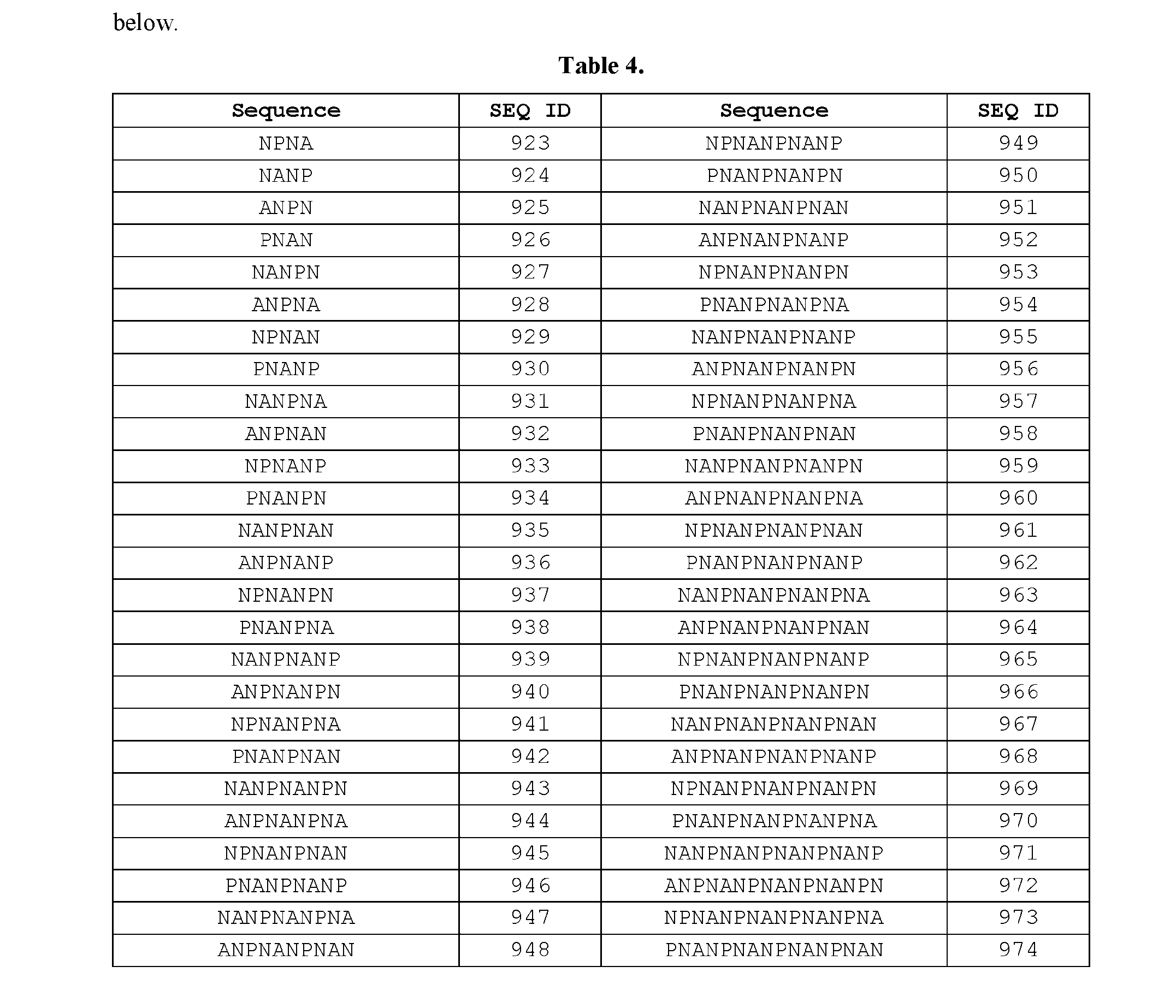
  • the first epitope consists of the amino acid sequence selected from SEQ ID NOs: 923-974.
  • the second epitope is heterologous to epitopes present in the RTS,S vaccine.
  • the second epitope includes a minor repeat region of CSP and/or a junctional region of CSP.
  • the second epitope includes a DPNA/NPNV-containing minor-repeat amino acid sequence and/or a DPNA/NPNV-containing junctional amino acid sequence. In certain embodiments, the second epitope consists of the amino acid sequence selected from SEQ ID NOs: 975-1195. [0008] In certain embodiments, the antibody binds to at least one additional epitope of CSP. In certain embodiments, the at least one additional epitope comprises a DPNA/NPNV- containing minor-repeat amino acid sequence and/or a DPNA/NPNV-containing junctional amino acid sequence.
  • the at least one additional epitope consists of an amino acid sequence selected from the group consisting of SEQ ID NOs: 975-1195.
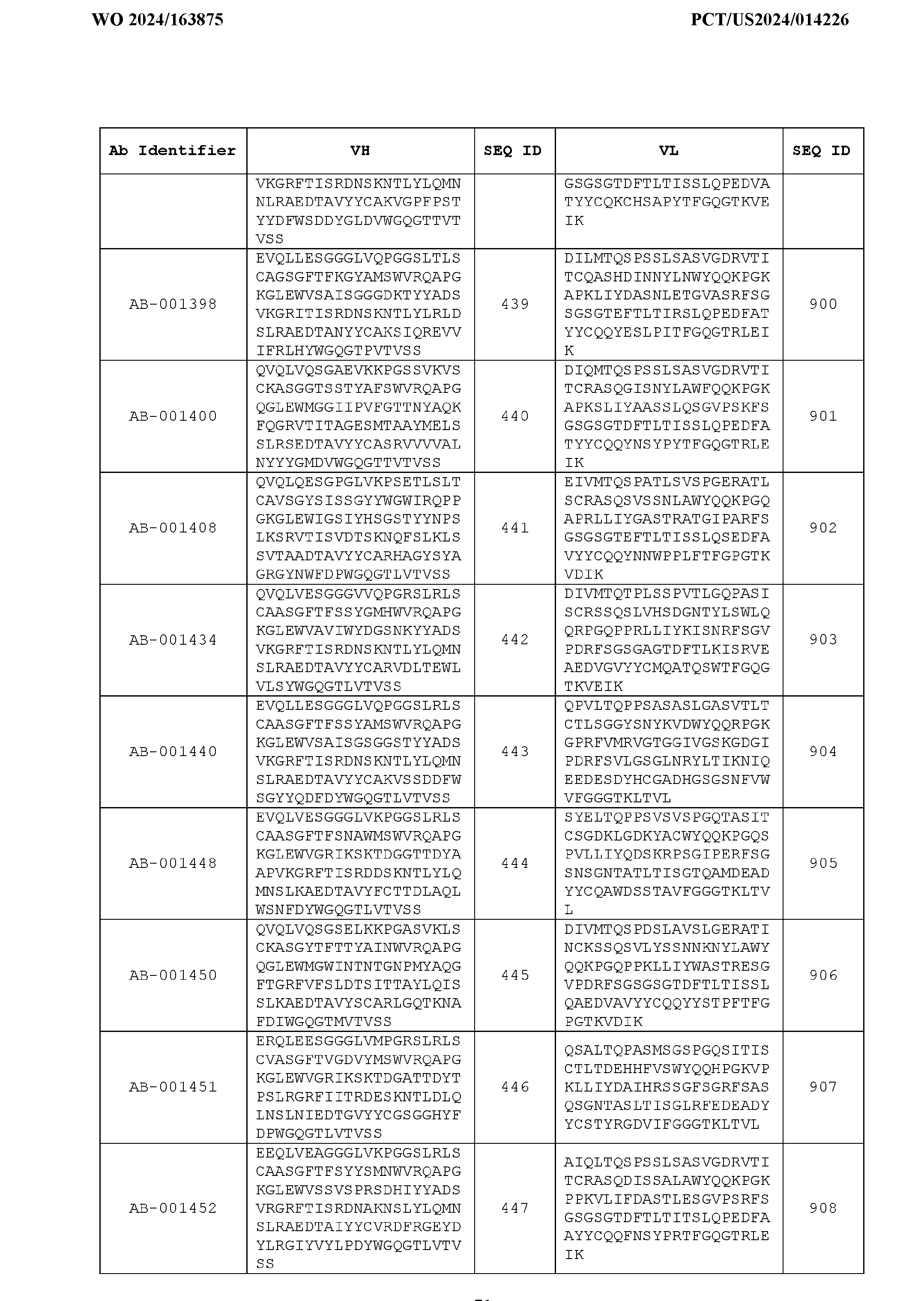
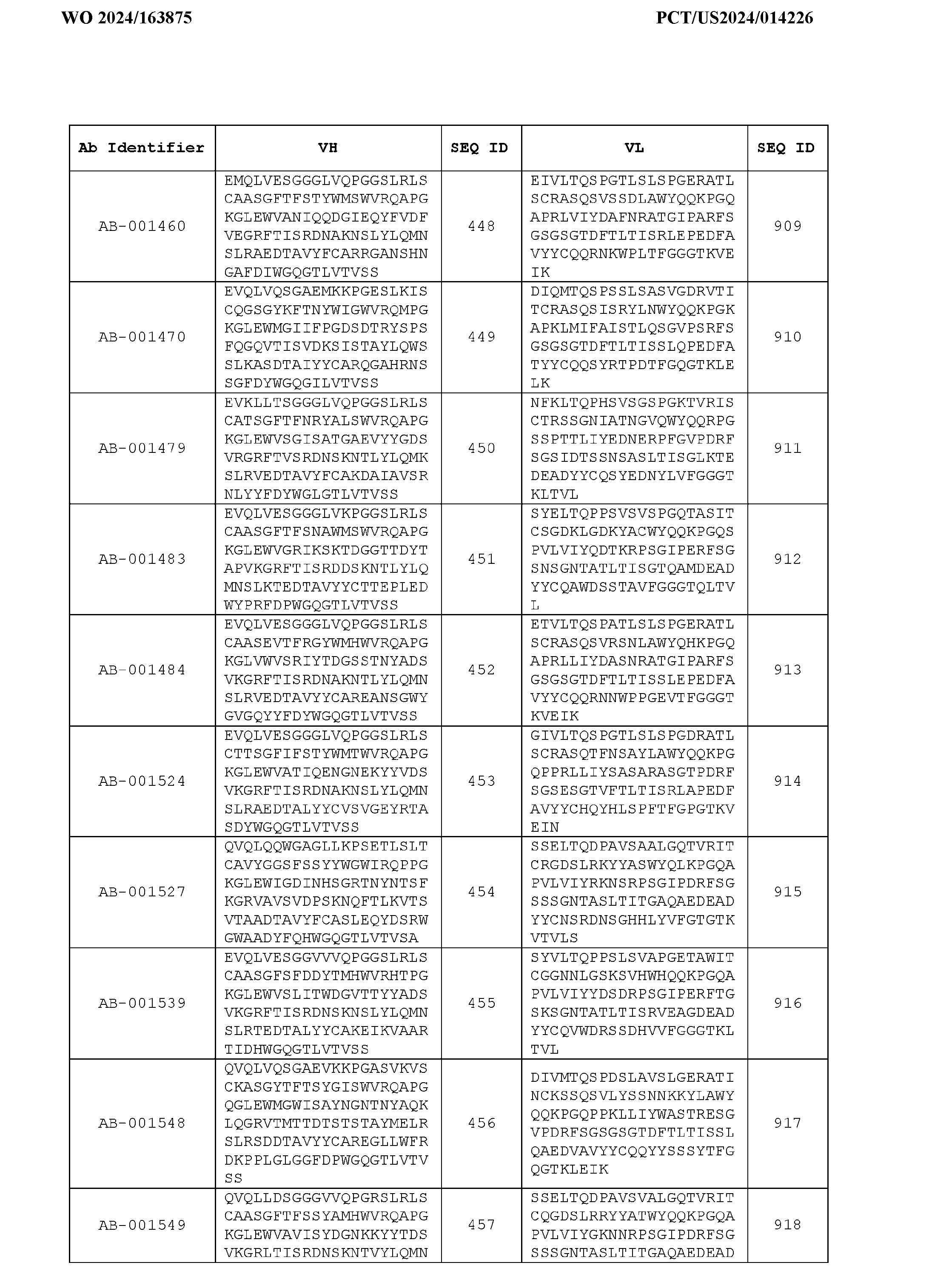
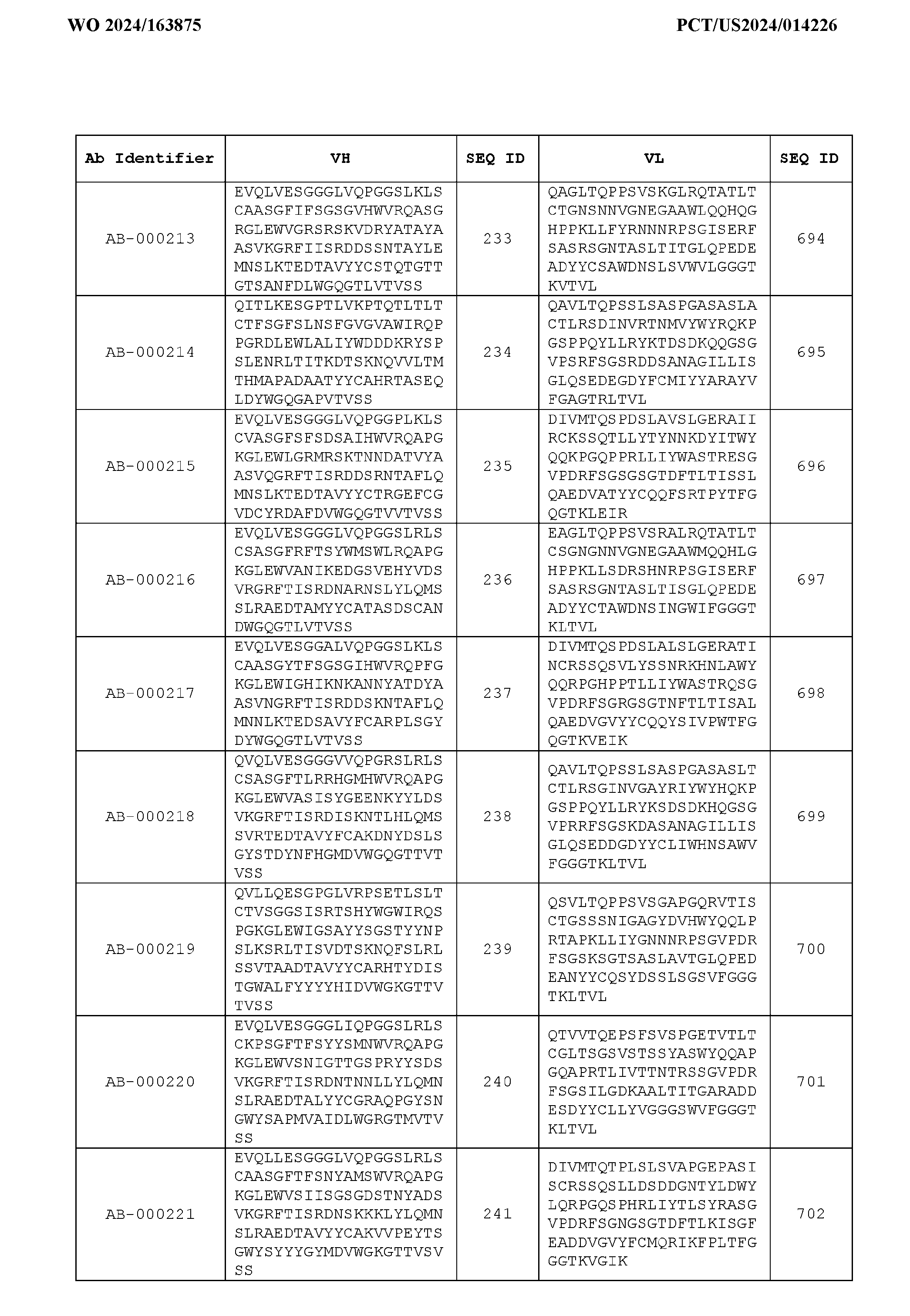
  • the recombinant antibody includes a heavy chain variable region (VH) including an amino acid sequence that is at least about 80% identical to the amino acid sequence selected from SEQ ID NOs: 1-461.
  • the recombinant antibody includes a VH including an amino acid sequence selected from the group consisting of SEQ ID NOs: 1-461.
  • the recombinant antibody includes a light chain variable region (VL) including an amino acid sequence that is at least about 80% identical to an amino acid Active 105508124.2 2
  • the recombinant antibody includes a VL including an amino acid sequence selected from the group consisting of SEQ ID NOs: 462-922.
  • the recombinant antibody includes VH including an amino acid sequence that is at least about 80% identical to an amino acid sequence selected from the group consisting of SEQ ID NOs: 1-461, and a VL including an amino acid sequence that is at least about 80% identical to an amino acid sequence selected from the group consisting of SEQ ID NOs: 462-922.
  • the recombinant antibody includes a VH including an amino acid sequence selected from the group consisting of SEQ ID NOs: 1-461, and a VL including the amino acid sequence selected from SEQ ID NOs: 462-922.
  • the recombinant antibody includes a heavy chain variable region (VH) and a light chain variable region (VH), wherein the heavy chain variable region includes a CDR1, a CDR2, and a CDR3 of the heavy chain variable sequence set forth in SEQ ID NOs: 1-461, and the light chain variable region includes a CDR1, a CDR2, and a CDR3 of the light chain variable sequence set forth in SEQ ID NOs: 462-922.
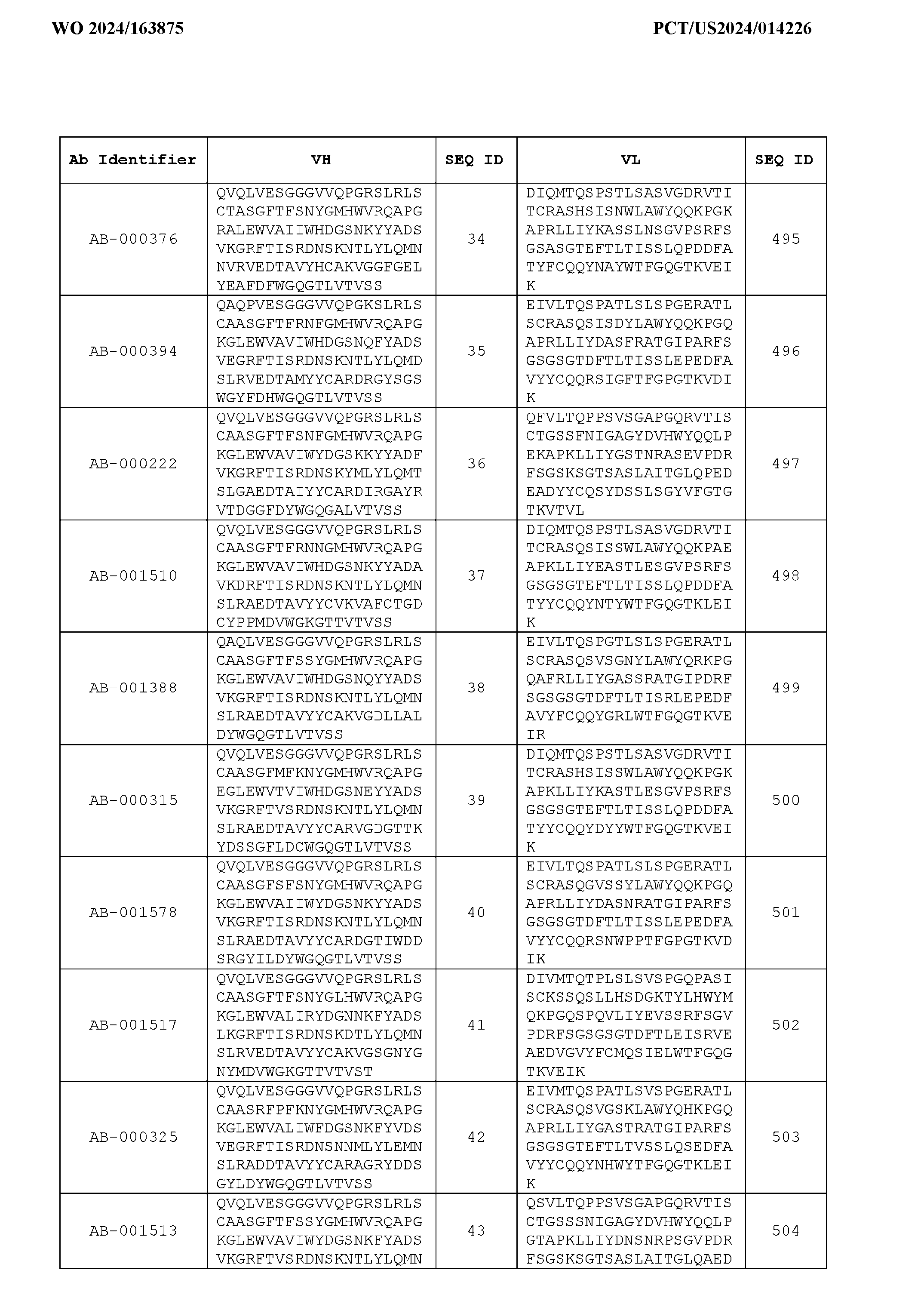
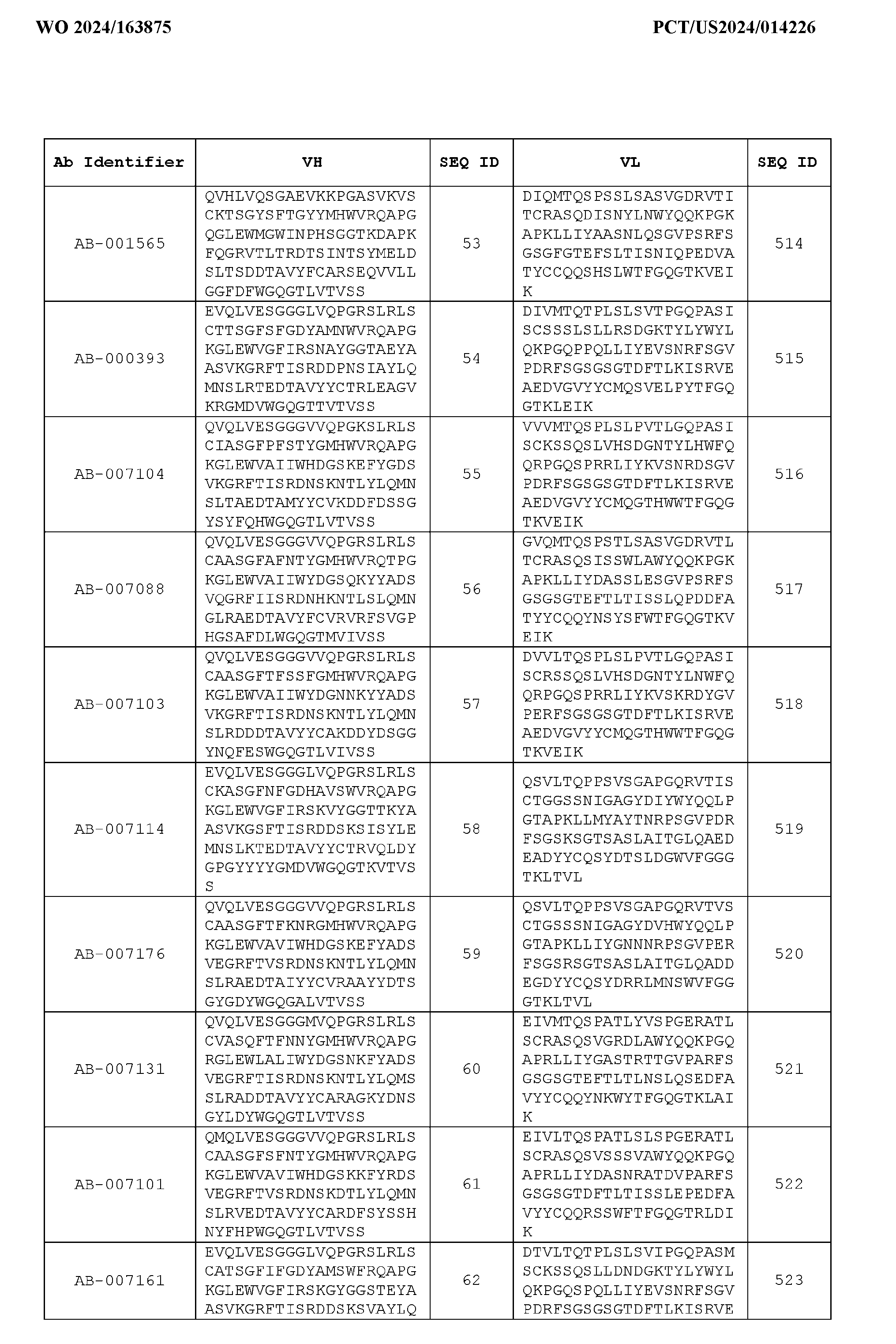
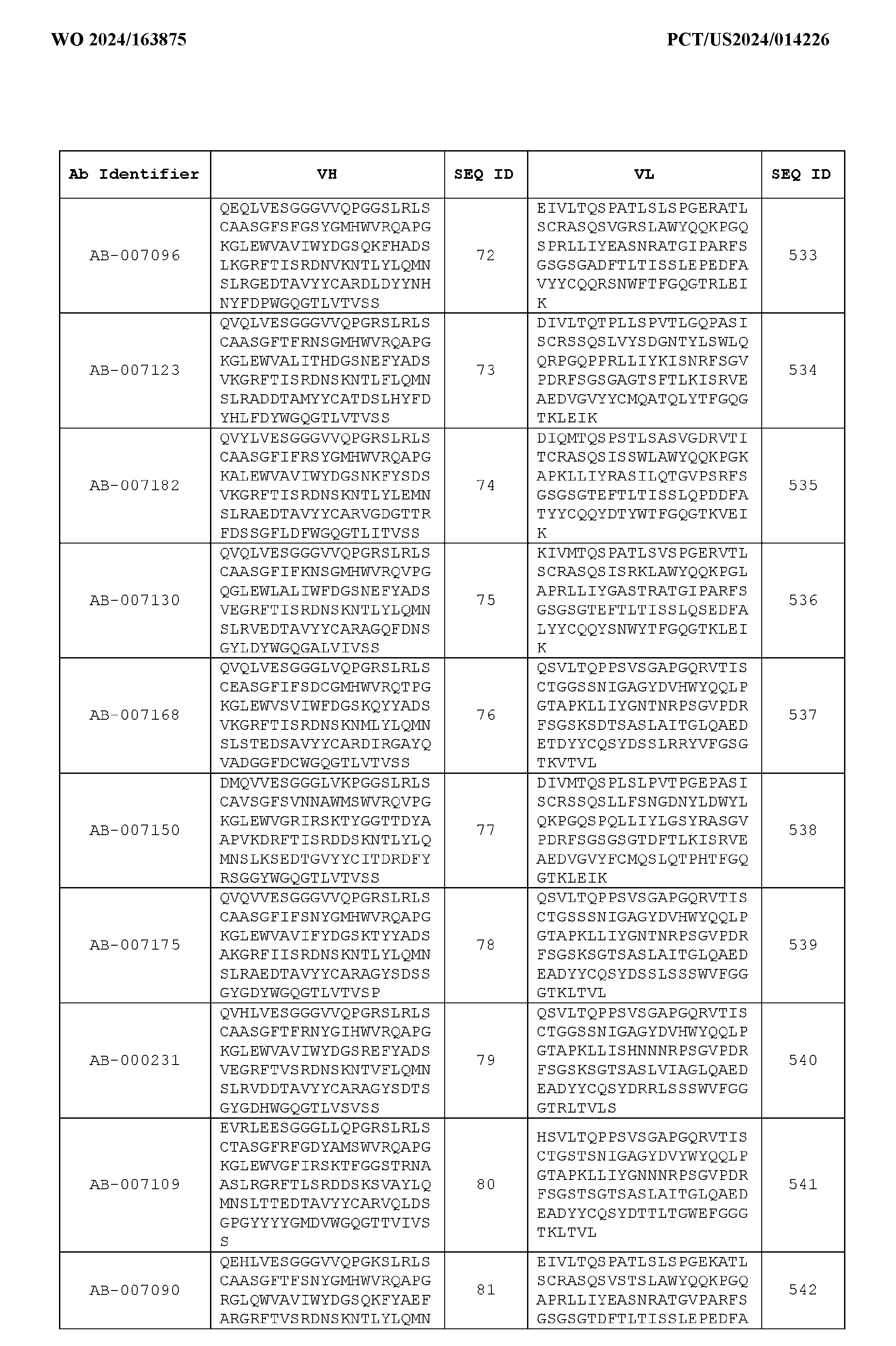
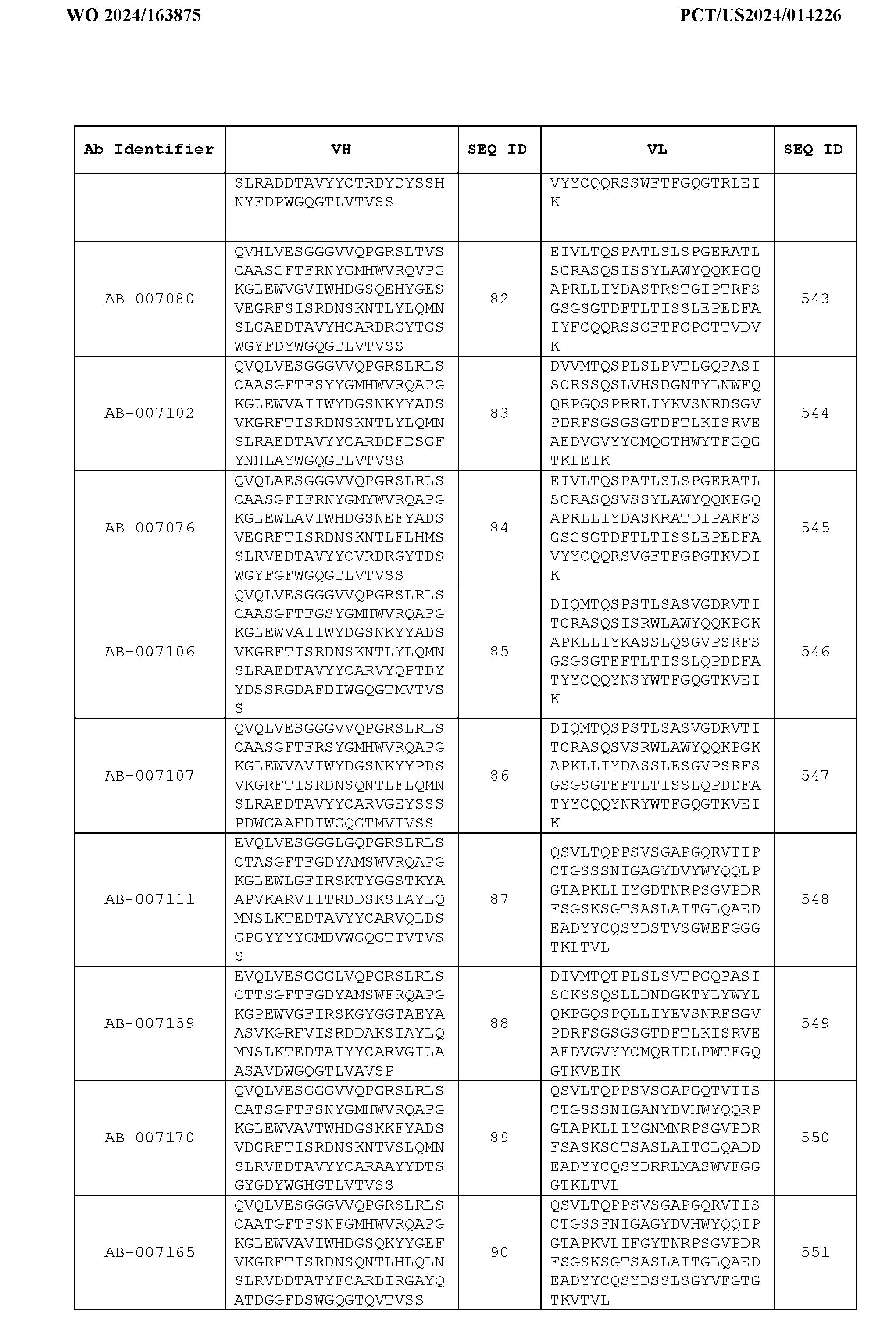
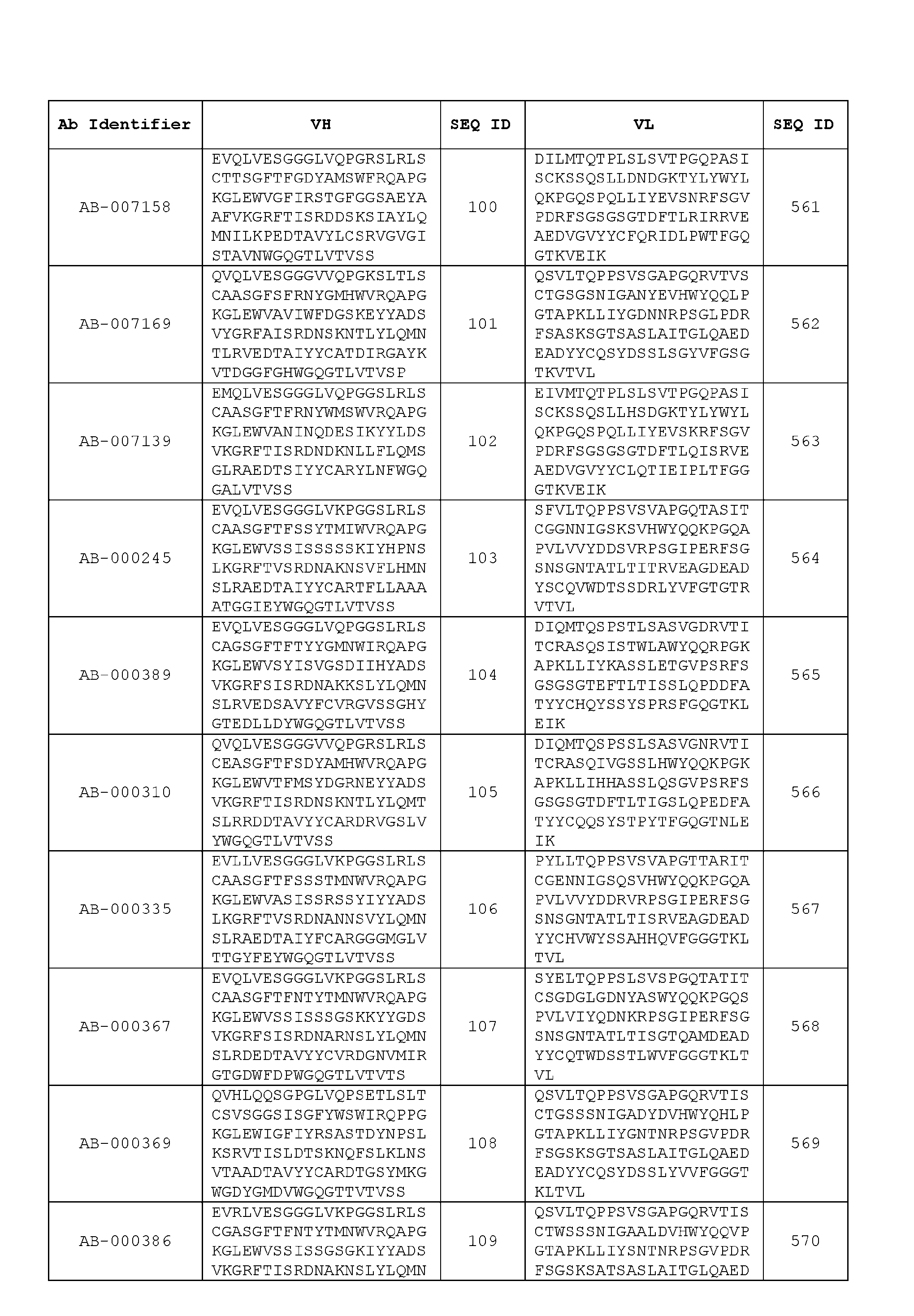
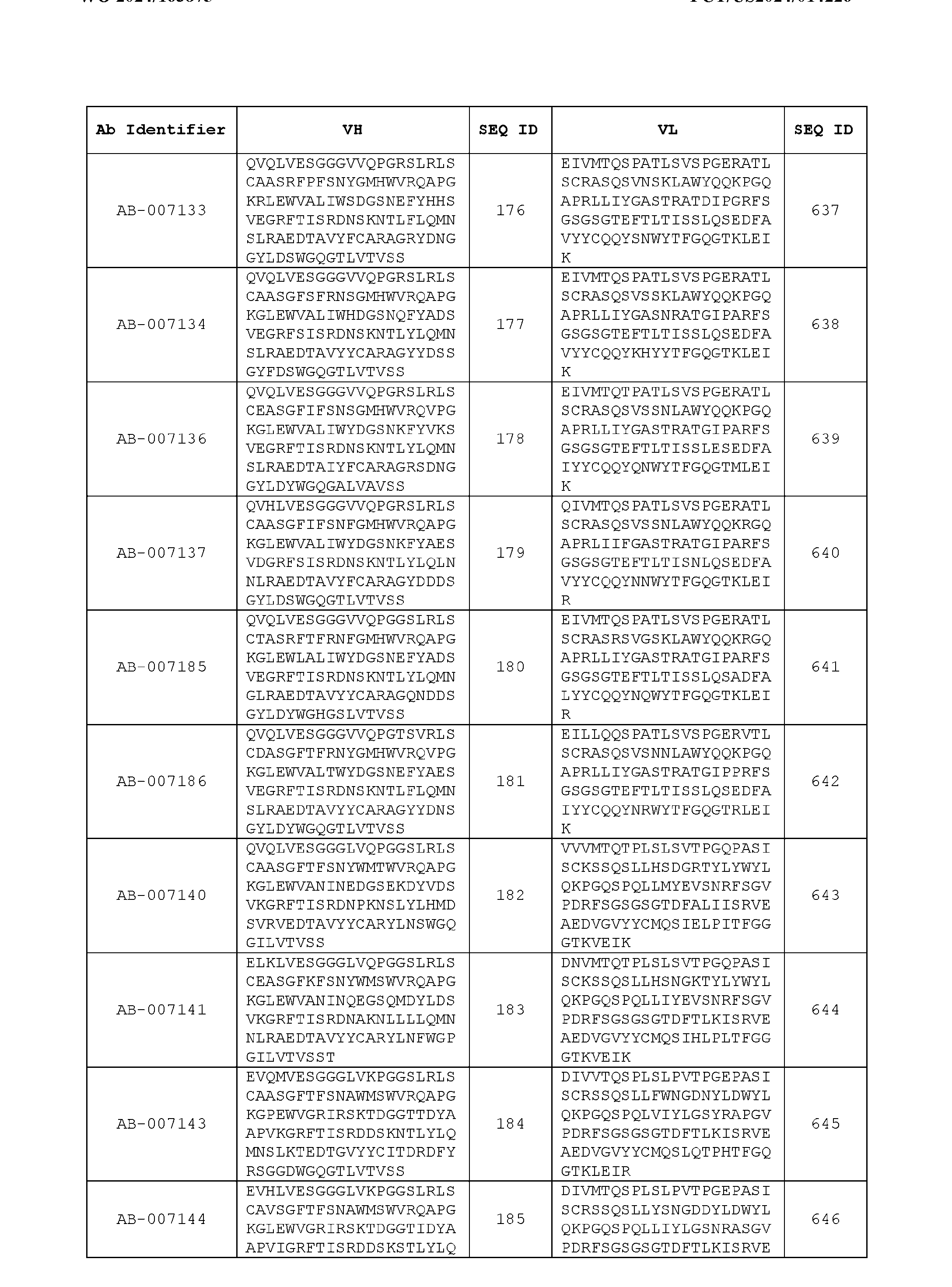
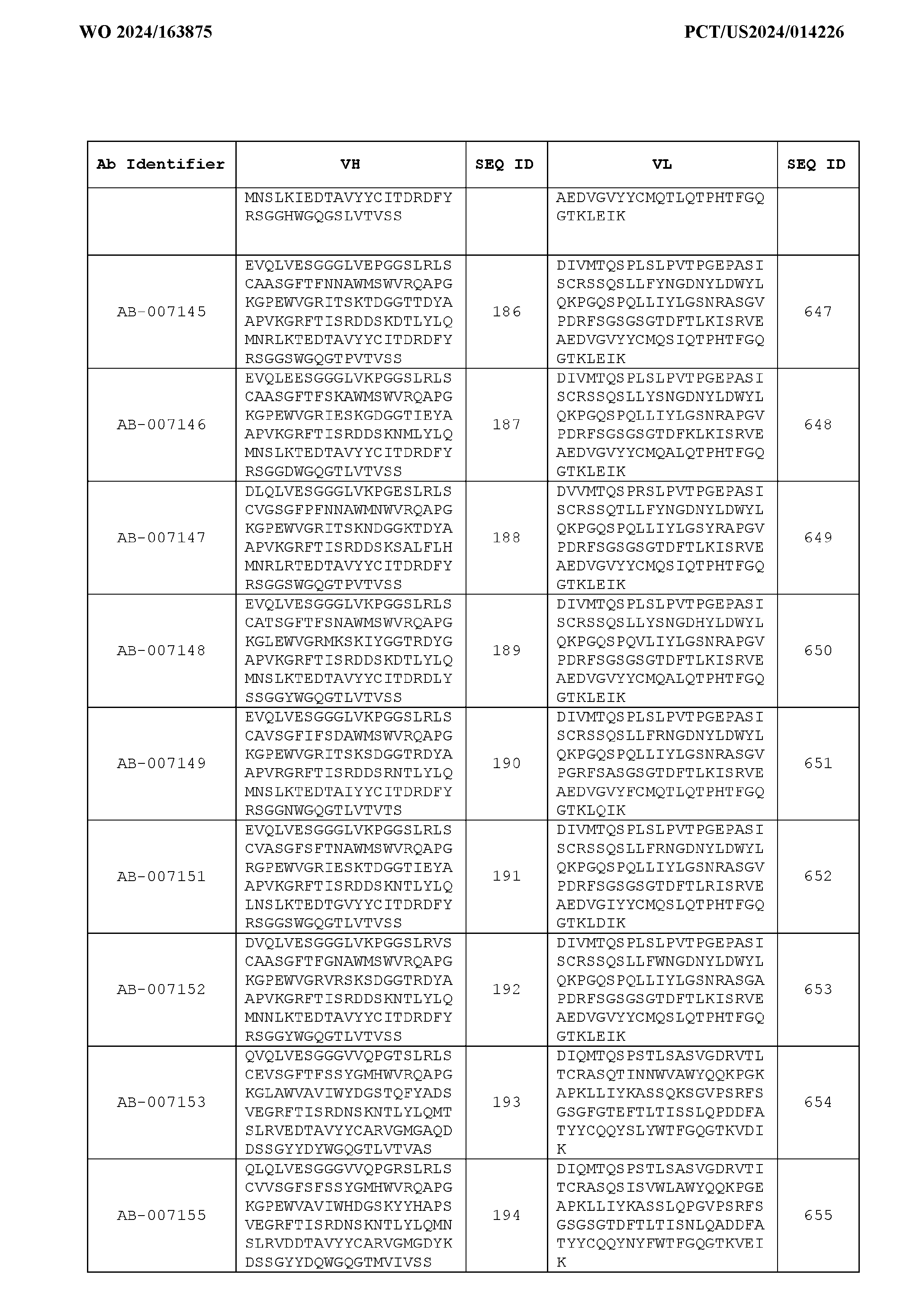
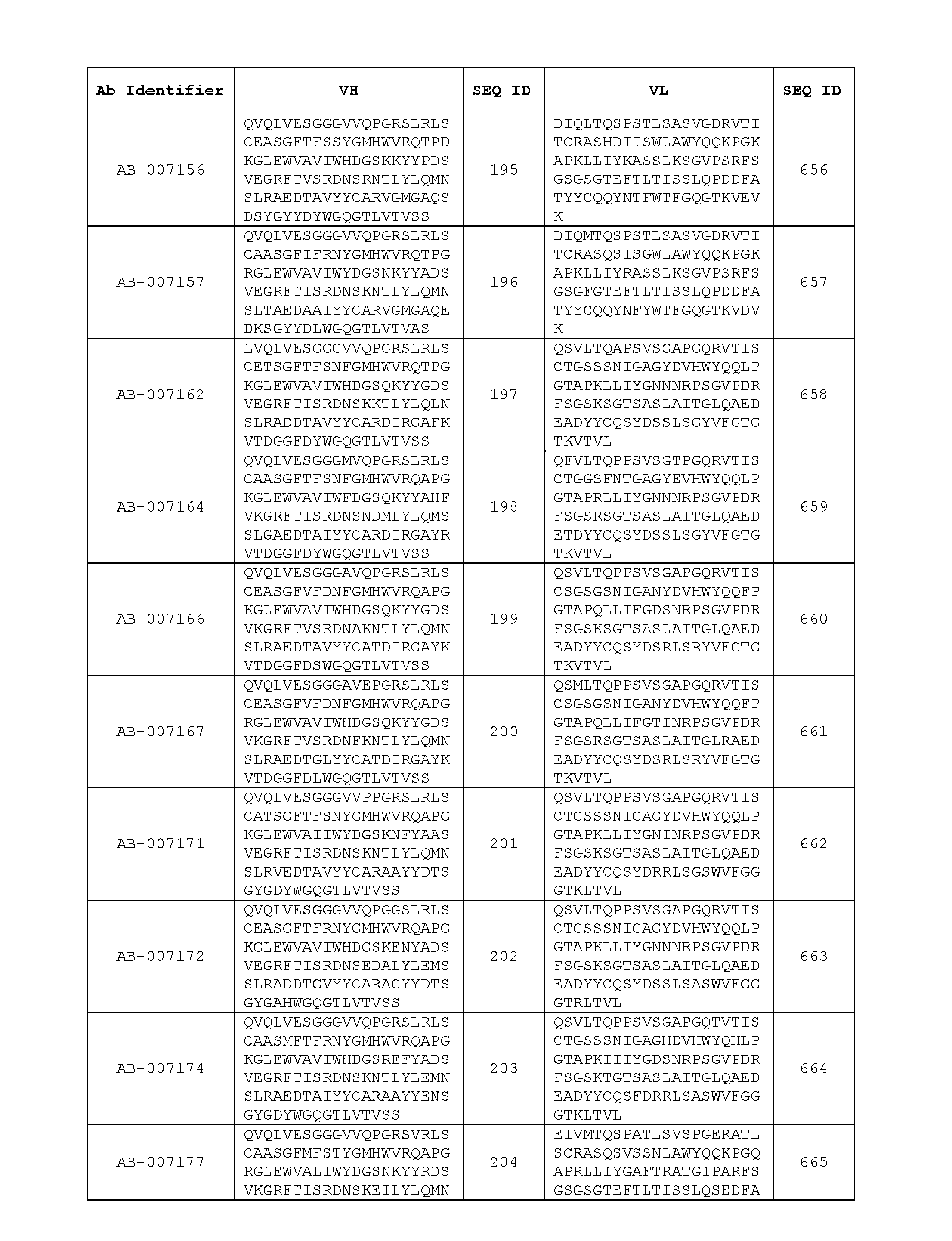
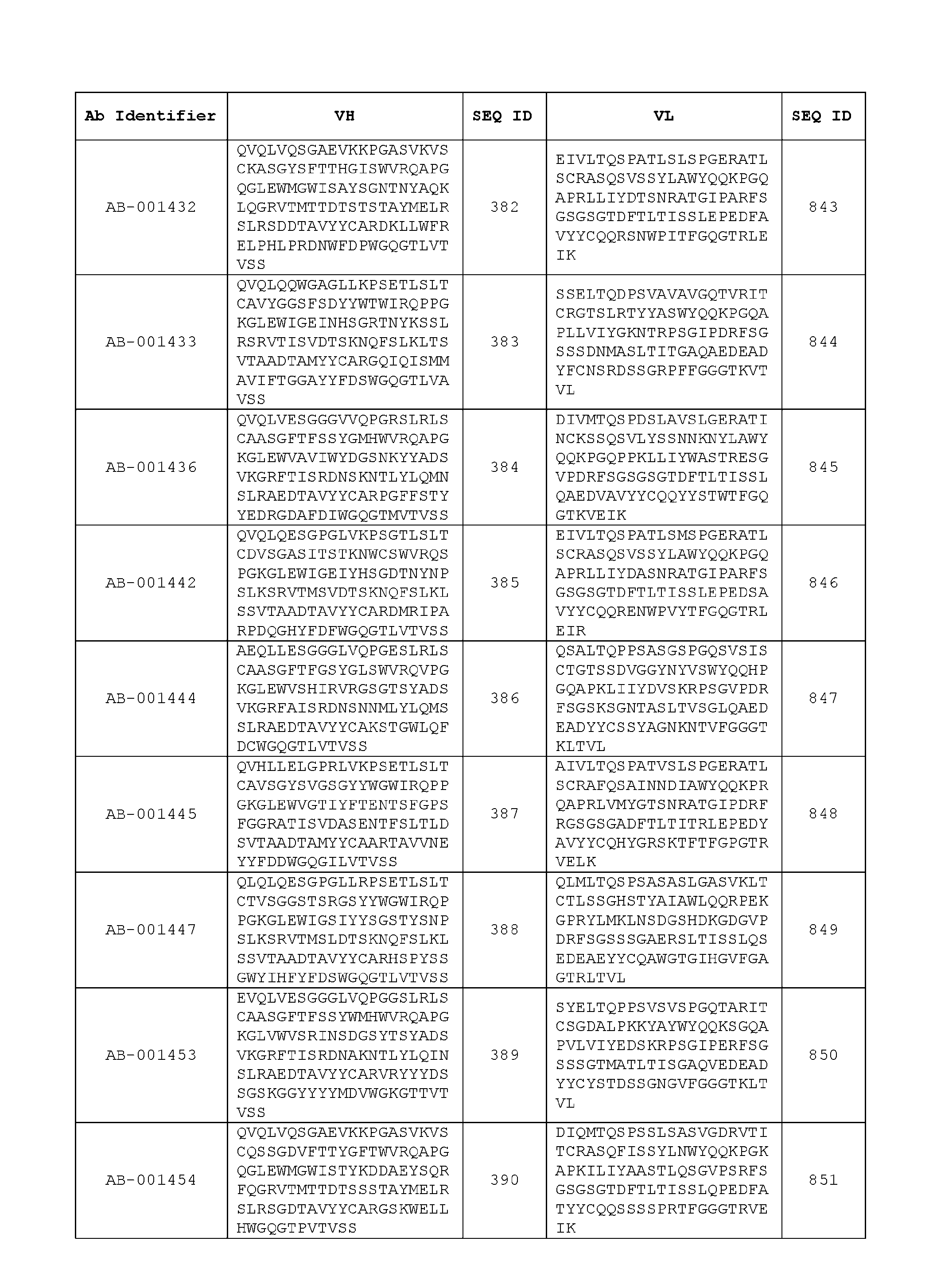
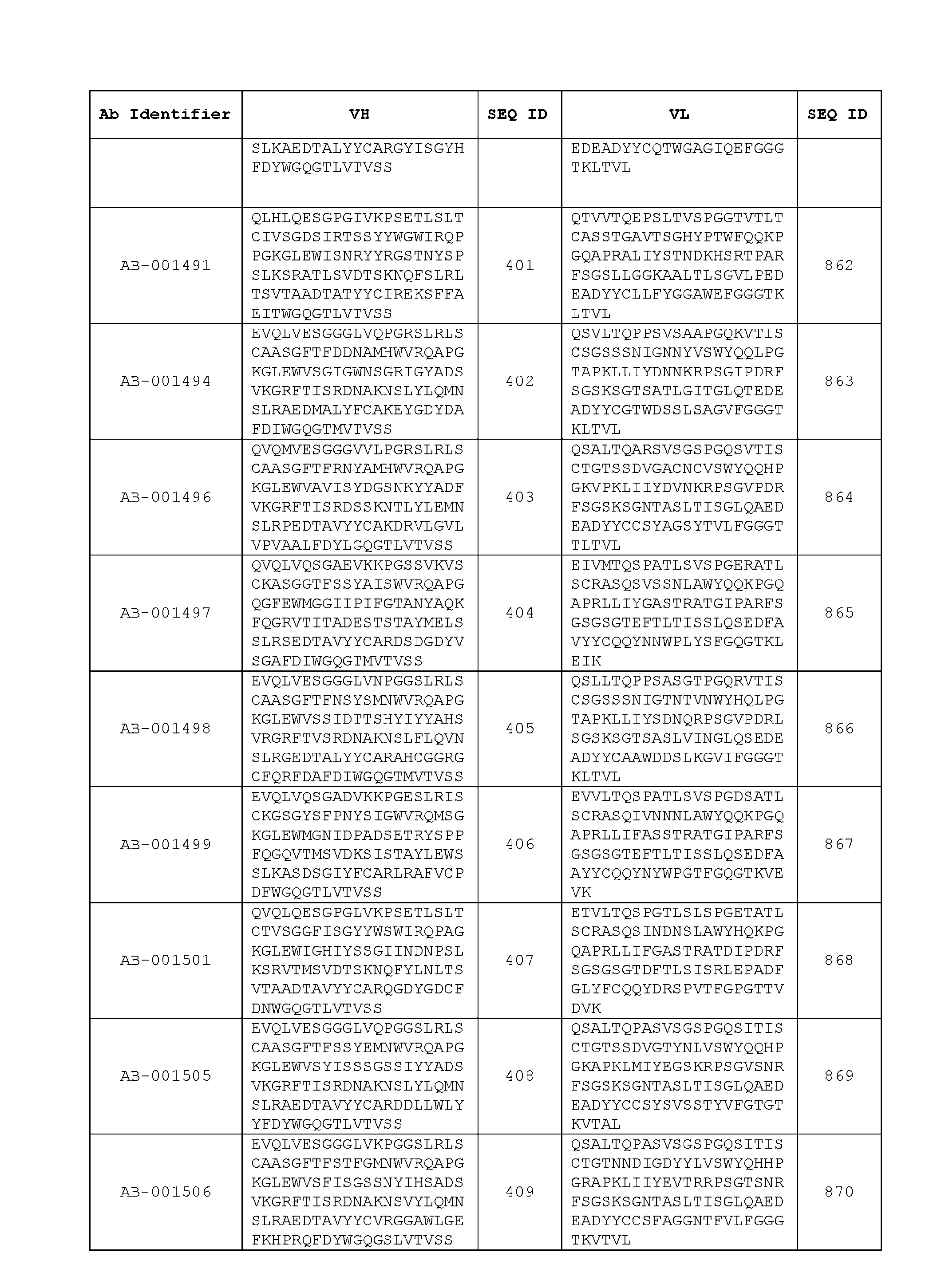
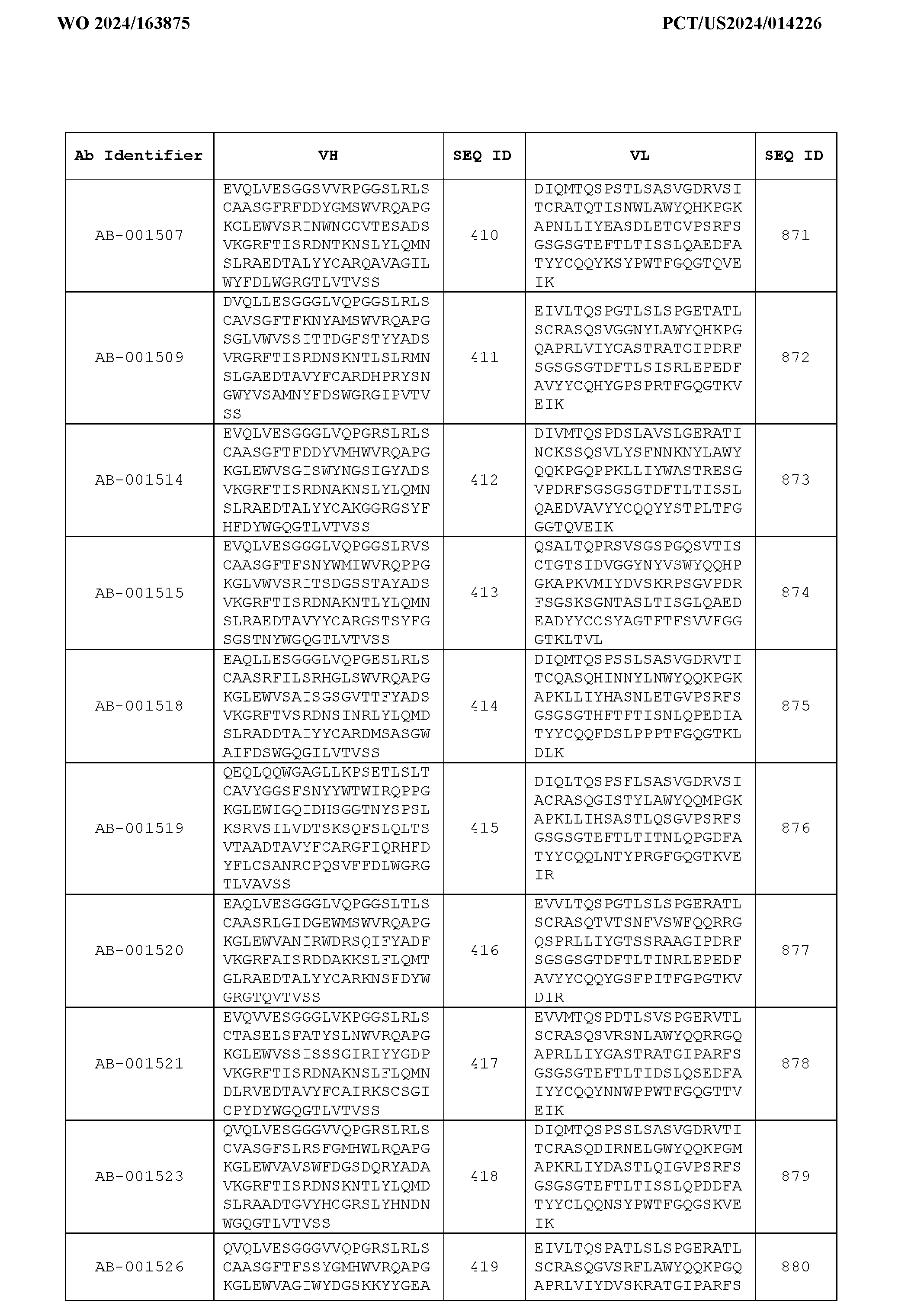
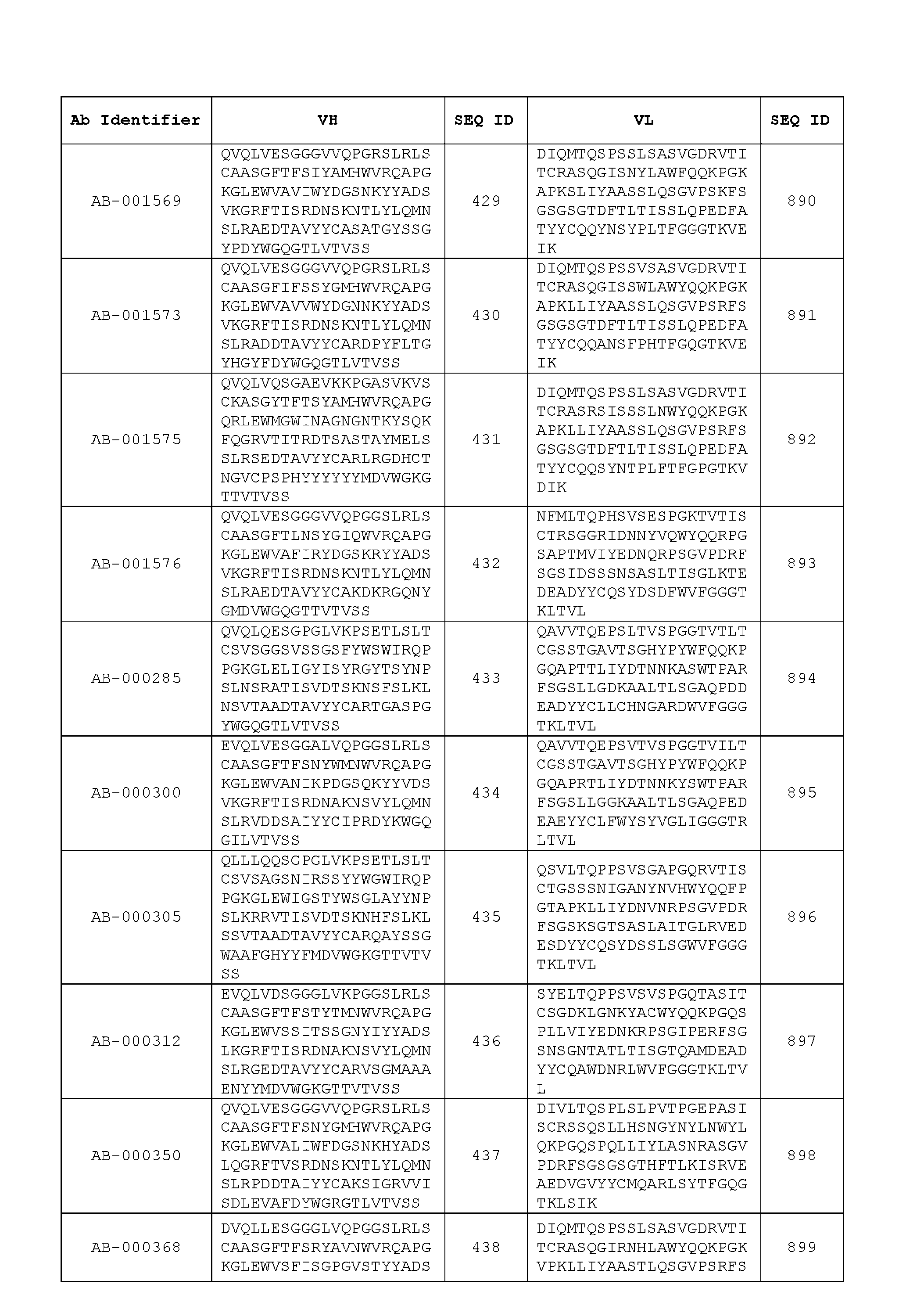
  • the recombinant antibody includes a heavy chain variable region (VH) and a light chain variable region (VH) set forth in Table 3.
  • VH heavy chain variable region
  • VH light chain variable region
  • the antibody exhibits at least 20% reduction in parasite liver load as compared to a reference antibody. In certain embodiments, the antibody exhibits at least 20% increase in survival rate as compared to a reference antibody. In certain embodiments, the antibody exhibits increased conformational stability as compared to a reference antibody. In certain embodiments, the antibody exhibits increased colloidal stability as compared to a reference antibody. In certain embodiments, the reference antibody is AB-000317, AB-000224, or AB- 007088.
  • the present disclosure relates to a polynucleotide encoding a presently disclosed antibody.
  • the present disclosure relates to an expression vector and/or a host cell including the polynucleotides disclosed herein.
  • the present disclosure also relates to compositions including the antibodies disclosed herein.
  • the compositions further include a pharmaceutically acceptable carrier.
  • the present disclosure relates to methods of preventing or treating malaria in a subject in need thereof including administering an effective Active 105508124.2 3
  • the present disclosure relates to methods of selecting an antibody as an anti-malaria therapeutic antibody.
  • the methods include: a) analyzing the antibody for binding to a first epitope of the central repeat region of CSP; and b) analyzing the antibody for binding to a second epitope of CSP that is heterologous to epitopes present in the RTS,S vaccine; wherein the antibody is selected if it binds to both the first epitope and the second epitope.
  • the methods further comprise: c) analyzing the antibody for binding to at least one additional epitope of CSP that is heterologous to epitopes present in the RTS,S vaccine; wherein the antibody is selected if it binds to the first epitope, the second epitope, and the at least one additional epitope [0018]
  • the present disclosure relates to methods of selecting an antibody as an anti-malaria therapeutic antibody.
  • the methods include selecting the antibody if i) the antibody binds to a first epitope of the central repeat region of CSP, and ii) the antibody binds to a second epitope that is heterologous to epitopes present in the RTS,S vaccine.
  • the methods include selecting the antibody if i) the antibody binds to a first epitope of the central repeat region of CSP; ii) the antibody binds to a second epitope that is heterologous to epitopes present in the RTS,S vaccine; and iii) the antibody binds to at least one additional epitope that is heterologous to epitopes present in the RTS,S vaccine.
  • the first epitope includes the amino acid sequence NPNA.
  • the first epitope consists of the amino acid sequence selected from SEQ ID NOs: 923-974.
  • the second epitope is heterologous to epitopes present in the RTS,S vaccine.
  • the second epitope includes a minor repeat region of CSP and/or a junctional region of CSP. In certain embodiments, the second epitope includes a DPNA/NPNV-containing minor-repeat amino acid sequence and/or a DPNA/NPNV-containing junctional amino acid sequence. In certain embodiments, the second epitope consists of the amino acid sequence selected from SEQ ID NOs: 975-1195. In certain embodiments, the first epitope consists of the amino acid sequence selected from SEQ ID NOs: 923-974 and the second epitope consists of the amino acid sequence selected from SEQ ID NOs: 975-1195.
  • the antibody binds to the first epitope with a binding affinity (KD) that is less than about 10 -6 M, less than about 10 -7 M, less than about 10 -8 M, less than about 10 -9 M, less than about 10 -10 M, less than about 10 -11 M, less than about 10 -12 M, or less than about 10 -13 M.
  • KD binding affinity
  • the antibody binds to the second epitope with KD that is Active 105508124.2 4
  • the antibody binds to the first epitope with KD that is less than about 10 -6 M, less than about 10 -7 M, less than about 10 -8 M, less than about 10 -9 M, less than about 10 -10 M, less than about 10 -11 M, less than about 10 -12 M, or less than about 10 -13 M; and to the second epitope with K D that is less than about 10 -6 M, less than about 10 -7 M, less than about 10 -8 M, less than about 10 -9 M, less than about 10 -10 M, less than about 10 -11 M, less than about 10 -12 M, or less than about 10 -13 M.
  • the first epitope consists of the amino acid sequence selected from SEQ ID NOs: 923-974; b) the second epitope consists of the amino acid sequence selected from SEQ ID NOs: 975-1195; and c) the at least one additional epitope consists of the amino acid sequence selected from SEQ ID NOs: 975-1195.
  • the antibody binds to the at least one additional epitope with K D that is less than about 10 -6 M, less than about 10 -7 M, less than about 10 -8 M, less than about 10 -9 M, less than about 10 -10 M, less than about 10 -11 M, less than about 10 -12 M, or less than about 10 -13 M.
  • the antibody binds a) to the first epitope with K D that is less than about 10 -6 M, less than about 10 -7 M, less than about 10 -8 M, less than about 10 -9 M, less than about 10 -10 M, less than about 10 -11 M, less than about 10 -12 M, or less than about 10 -13 M; b) to the second epitope with K D that is less than about 10 -6 M, less than about 10 -7 M, less than about 10 -8 M, less than about 10 -9 M, less than about 10 -10 M, less than about 10 -11 M, less than about 10- 12 M, or less than about 10 -13 M; and c) to the at least one additional epitope with K D that is less than about 10 -6 M, less than about 10 -7 M, less than about 10 -8 M, less than about 10 -9 M, less than about 10 -10 M, less than about 10 -11 M, less than about 10 -12 M, or less than about 10 -13 M.
  • Figures 1A-1G show that functional antibodies bind CSP-derived peptides not present in the RTS,S vaccine.
  • NPDPNANPNVDPNANP, Junction to RTS,S.
  • Examples are shown of an antibody with a broadly promiscuous binding profile (green, AB-007163), an antibody with a profile relatively biased to homologous peptides (purple, AB-007143), and one with a profile in between these extremes (blue, AB-007175).
  • SHM germline
  • k off log-transformed SPR binding off-rate
  • Figures 2A-2M show in vivo pharmacology, SHM, and binding of anti-CSP antibodies.
  • Figures 2B-2C showing data from AB-000224 and AB-000317 of parasite bioluminescence in the liver (total flux, photons/sec) (Figure 2B), *P ⁇ 0.035, and serum concentrations (Serum[Ab], ⁇ g/ml) of antibody at time of sporozoite challenge (Figure 2C), lines and bars indicate geometric mean and geometric standard deviation, P > 0.2 (“ns”), two-tailed Mann–Whitney test.
  • Figures 2L-2M show survival curves from repeat experiments in comparison to AB-000317 of AB-000224 [0.74 (0.15, 3.8)] ( Figure 2L) and AB-007088 [0.61 (0.097, 3.8)] ( Figure 2M), two-sided, non-parametric log-rank [Mantel– Haenszel hazard ratio (95% confidence intervals)].
  • Figures 3A-3H illustrate CSP-reactive lineages from blood PBs after the third dose of RTS,S.
  • Figure 3C shows, by vaccinee, the size of each expanded lineage was calculated by dividing the number of PBs in that lineage by the number of PBs in all expanded lineages within each repertoire and then assigning a rank-size. Boxes indicate interquartile ranges, lines within boxes are medians, and whiskers represent minimum and maximum across vaccinees for each rank-size, with the top four rank-size lineages containing 33% of PBs in all expanded lineages (dotted line).
  • Figures 3D-3G, ELISA reactivity, SHM levels and vaccinee protection status of mAbs from expanded lineages (n 349).
  • each symbol indicates a single lineage.
  • Figures 5A-5I show IgG sequence and repertoire features of the PB response after the third dose of RTS,S.
  • Figure 5C shows specific pairings of heavy and light chain genes.
  • Figure 5D shows three heavy chain germline genes, IGHV3-73, IGHV4-61, and IGHV5-51, were initially associated with vaccinees’ protection status (P ⁇ 0.05, Wilcoxon Rank Sum test) but were not associated after correcting for multiple hypothesis testing. All were P > 0.05, Benjamini–Hochberg or Bonferroni tests.
  • Figures 6A-6C show antibody lineages tested in binding assays and reactivity to CSP or HBsAg. Rank-size of expanded lineages in each protected and not protected vaccinee repertoire from PBs collected 7 days after the third dose of RTS,S.
  • Circle sizes are proportional to the fraction of lineages tested among all lineages observed at each rank-size and vaccinee. Lineages from a vaccinee that have the same number of PBs have the same rank-size. The largest circles indicate all lineages from the vaccinee at that rank-size were Active 105508124.2 8
  • an "antibody” means an isolated or recombinant binding agent that comprises the necessary variable region sequences to specifically bind an antigenic epitope. Therefore, an "antibody” as used herein is any form of antibody or fragment thereof that exhibits the desired biological activity, e.g., binding the specific target antigen.
  • Antibody fragments comprise a portion of an intact antibody, for example, the antigen-binding or variable region of the intact antibody. Examples of antibody fragments include Fab, Fab', F(ab')2, and Fv fragments; diabodies; linear antibodies (e.g., Zapata et al., Protein Eng.
  • Fab antigen-binding fragments
  • Fc residual antigen
  • Pepsin treatment yields an F(ab')2 fragment that has two antigen combining sites and is still capable of cross-linking antigen.
  • anti-CSP antibody and “CSP antibody” are used synonymously and refer to an antibody that binds to Plasmodium falciparum circumsporozoite (CSP) antigen.
  • an "antibody that binds to the same epitope" as a reference antibody refers to an antibody that blocks binding of the reference antibody to its antigen in a competition assay by 50% or more, and conversely, the reference antibody blocks binding of the antibody to its antigen in a competition assay by 50% or more.
  • V-region refers to an antibody variable region domain comprising the segments of Framework 1, CDR1, Framework 2, CDR2, Framework 3, CDR3, and Framework 4.
  • the heavy chain V-region, VH is a consequence of rearrangement of a V-gene (HV), a D-gene (HD), and a J-gene (HJ), in what is known as V(D)J recombination during B-cell differentiation.
  • the light chain V-region, VL is a consequence of the rearrangement of a V-gene (LV) and a J- gene.
  • CDR complementarity-determining region
  • VH CDR3 is located in the variable domain of the heavy chain of the antibody in which it is found
  • VL CDR3 is the CDR3 from the variable domain of the light chain of the antibody in which it is found.
  • CDR is used interchangeably with "HVR” when referring to CDR sequences.
  • the amino acid sequences of the CDRs and framework regions can be determined using various definitions in the art, e.g., Kabat, Chothia, international ImMunoGeneTics database (IMGT), and AbM (see, e.g., Chothia & Lesk, 1987, Canonical structures for the hypervariable regions of immunoglobulins. J. Mol. Biol.
  • CDRs as determined by Kabat numbering is based, for example, on Kabat et al., Sequences of Proteins of Immunological Interest, 5th Ed. Public Health Service, National Institute of Health, Bethesda, MD (1991)). Chothia CDRs are determined as defined by Chothia (see, e.g., Chothia and Lesk J. Mol. Biol. 196:901-917 (1987)). The CDRs can also be determined using available in silico systems as Active 105508124.2 11
  • Fc region refers to the constant region of an antibody excluding the first constant region immunoglobulin domain.
  • Fc refers to the last two constant region immunoglobulin domains of IgA, IgD, and IgG, and the last three constant region immunoglobulin domains of IgE and IgM, and the flexible hinge N-terminal to these domains.
  • IgA and IgM Fc may include the J chain.
  • Fc comprises immunoglobulin domains Cy2 and Cy3 and the hinge between Cyl and Cy.
  • Fc region may vary, however, the human IgG heavy chain Fc region is usually defined to comprise residues C226 or P230 to its carboxyl-terminus, using the numbering according to the EU index as in Kabat et al. (1991, NIH Publication 91-3242, National Technical Information Service, Springfield, Va.).
  • the term "Fc region” may refer to this region in isolation or this region in the context of an antibody or antibody fragment. "Fc region” includes naturally occurring allelic variants of the Fc region as well as modifications that modulate effector function. Fc regions also include variants that don't result in alterations to biological function.
  • one or more amino acids can be deleted from the N-terminus or C-terminus of the Fc region of an immunoglobulin without substantial loss of biological function.
  • Such variants can be selected according to general rules known in the art to have minimal effect on activity (see, e.g., Bowie, et al., Science 247:306-1310, 1990).
  • a single amino acid substitution S228P according to Kabat numbering; designated IgG4Pro
  • IgG4Pro a single amino acid substitution
  • IgG4Pro an amino acid substitution
  • the Fc region includes substitutions that improve pharmacokinetics properties of an antibody, e.g., increased serum half-life.
  • substitutions of the Fc region can be found in U.S. Patent No.8,088,376, the content of which is incorporated by reference in its entirety.
  • the term "equilibrium dissociation constant” abbreviated (KD) refers to the dissociation rate constant (kd, time -1 ) divided by the association rate constant (ka, time -1 M -1 ). Equilibrium dissociation constants can be measured using any method.
  • the antibodies of the present disclosure have a KD of less than about 50 nM, typically less than about 25 nM, or less than 10 nM, e.g., less than about 5 nM, or than about 1 nM and often less than about 10 nM as determined by surface plasmon resonance analysis using a biosensor system such as a Biacore® system performed at 37°C.
  • an antibody of the present disclosure has a KD of less than 5 x 10 -5 M, less than 10 -5 M, less than 5 x 10 -6 M, less than 10 -6 M, less than 5 x 10 -7 M, less than 10 -7 M, less than 5 x 10 -8 M, less than 10 -8 M, Active 105508124.2 12
  • an "improved" KD refers to a lower KD.
  • an antibody of the present disclosure has a KD of less than 5 x 10 -5 M, less than 10- 5 M, less than 5 x 10 -6 M, less than 10 -6 M, less than 5 x 10 -7 M, less than 10 -7 M, less than 5 x 10 -8 M, less than 10 -8 M, less than 5 x 10 -9 M, less than 10 -9 M, less than 5 x10 -10 M, less than 10 -10 M, less than 5 x 10 -11 M, less than 10 -11 M, less than 5 x 10 -12 M, less than 10 -12 M, less than 5 x 10 -13 M, less than 10 -13 M, less than 5 x 10 -14 M, less than 10 -14 M, less than 5 x 10 -15 M, or less than 10 -15 M or lower as measured as a monovalent antibody, such as a monovalent Fab.
  • an anti-CSP antibody of the present disclosure has KD less than 100 pM, e.g., or less than 75 pM, e.g., in the range of 1 to 100 pM, when measured by surface plasmon resonance analysis using a biosensor system such as a Biacore® system performed at 37°C.
  • an anti- CSP antibody of the present disclosure has KD of greater than 100 pM, e.g., in the range of 100- 1000 pM or 200-1000 pM when measured by surface plasmon resonance analysis using a biosensor system such as a Biacore® system performed at 37°C.
  • the term "monovalent molecule” as used herein refers to a molecule that has one antigen-binding site, e.g., a Fab or scFv.
  • the term "bivalent molecule” as used herein refers to a molecule that has two antigen-binding sites.
  • a bivalent molecule of the present invention is a bivalent antibody or a bivalent fragment thereof.
  • a bivalent molecule of the present invention is a bivalent antibody.
  • a bivalent molecule of the present invention is an IgG.
  • monoclonal antibodies have a bivalent basic structure.
  • IgG and IgE have only one bivalent unit, while IgA and IgM consist of multiple bivalent units (2 and 5, respectively) and thus have higher valencies. This bivalency increases the avidity of antibodies for antigens.
  • the terms "monovalent binding” or “monovalently binds to” as used herein refer to the binding of one antigen-binding site to its antigen.
  • the terms "bivalent binding” or “bivalently binds to” as used herein refer to the binding of both antigen-binding sites of a bivalent molecule to its antigen. In certain embodiments, both antigen-binding sites of a bivalent molecule share the same antigen specificity.
  • valency refers to the number of different binding sites of an antibody for an antigen.
  • a monovalent antibody includes one binding site for an antigen.
  • a bivalent antibody e.g., a bivalent IgG antibody
  • affinity refers to either the single or combined strength of one or both arms of an antibody (e.g., an IgG antibody) binding to either a simple or complex antigen-expressing one or more epitopes. As defined here, the term “affinity” does not imply a specific number of valencies between the two binding partners.
  • identity in the context of two or more polypeptide sequences, refer to two or more sequences or subsequences that are the same or have a specified percentage of amino acid residues that are the same (e.g., at least 70%, at least 75%, at least 80%, 85%, 90%, 91%, 92%, 93%, 94%, 95%, 96%, 97%, 98%, 99%, or higher) identity over a specified region, e.g., the length of the two sequences, when compared and aligned for maximum correspondence over a comparison window or designated region.
  • Alignment for purposes of determining percent amino acid sequence identity can be performed in various methods, including, without any limitation, BLAST, BLAST-2, ALIGN, or Megalign (DNASTAR) software. Examples of algorithms that are suitable for determining percent sequence identity and sequence similarity the BLAST 2.0 algorithms, which are described in Altschul et al., Nuc. Acids Res. 25:3389-3402 (1977) and Altschul et al., J. Mol. Biol. 215:403-410 (1990). In certain embodiments, BLAST 2.0 can be used with the default parameters to determine percent sequence identity.
  • substitution denotes the replacement of one or more amino acids or nucleotides by different amino acids or nucleotides, respectively.
  • a “conservative” substitution as used herein refers to a substitution of an amino acid such that charge, polarity, hydropathy (hydrophobic, neutral, or hydrophilic), and/or size of the side group chain is maintained.
  • Illustrative sets of amino acids that may be substituted for one another include (i) positively-charged amino acids Lys and Arg; and His at pH of about 6; (ii) negatively charged amino acids Glu and Asp; (iii) aromatic amino acids Phe, Tyr and Trp; (iv) nitrogen ring amino acids His and Trp; (v) aliphatic hydrophobic amino acids Ala, Val, Leu and Ile, (vi) hydrophobic sulfur-containing amino acids Met and Cys, which are not as hydrophobic as Val, Leu, and Ile, (vii) small polar uncharged amino acids Ser, Thr, Asp, and Asn (viii) small hydrophobic or neutral amino acids Gly, Ala, and Pro; (ix) amide-comprising amino acids Asn and Gln; and (xi) beta-branched amino acids Thr, Val, and Ile.
  • Reference to the charge of an amino acid refers to the charge at pH 6-7. Active 105508124.2 14
  • nucleic acid and “polynucleotide” are used interchangeably and as used herein refer to both sense and anti-sense strands of RNA, cDNA, genomic DNA, and synthetic forms and mixed polymers of the above.
  • a polynucleotide refers to a polyribonucleotide, polydeoxynucleotide or a modified form of either type of nucleotide, and combinations thereof. The terms also include, but are not limited to, single- and double-stranded forms of DNA.
  • a polynucleotide e.g., a cDNA or mRNA
  • a polynucleotide may include either or both naturally occurring and modified nucleotides linked together by naturally occurring and/or non-naturally occurring nucleotide linkages.
  • the nucleic acid molecules may be modified chemically or biochemically or may contain non-natural or derivatized nucleotide bases, as will be readily appreciated by those of skill in the art.
  • Such modifications include, for example, labels, methylation, substitutions of one or more of the naturally occurring nucleotides with an analogue, internucleotide modifications such as uncharged linkages (e.g., methyl phosphonates, phosphotriesters, phosphoramidates, carbamates, etc.), charged linkages (e.g., phosphorothioates, phosphorodithioates, etc.), pendent moieties (e.g., polypeptides), intercalators (e.g., acridine, psoralen, etc.), chelators, alkylators, and modified linkages (e.g., alpha anomeric nucleic acids, etc.).
  • uncharged linkages e.g., methyl phosphonates, phosphotriesters, phosphoramidates, carbamates, etc.
  • charged linkages e.g., phosphorothioates, phosphorodithioates, etc.
  • nucleic acid sequence encompasses its complement unless otherwise specified.
  • a reference to a nucleic acid molecule having a particular sequence should be understood to encompass its complementary strand, with its complementary sequence.
  • the term also includes codon-optimized nucleic acids that encode the same polypeptide sequence.
  • An "isolated" nucleic acid refers to a nucleic acid molecule that has been separated from a component of its natural environment.
  • isolated nucleic acid includes a nucleic acid molecule contained in cells that ordinarily contain the nucleic acid molecule, but the nucleic acid molecule is present extrachromosomally or at a chromosomal location that is different from its natural chromosomal location.
  • isolated nucleic acid encoding an antibody or fragment thereof refers to one or more nucleic acid molecules encoding antibody heavy and light chains (or fragments thereof), including such nucleic acid molecule(s) in a single vector or separate vectors, and such nucleic acid molecule(s) present at one or more locations in a host cell.
  • vector refers to a nucleic acid molecule capable of propagating another nucleic acid to which it is linked.
  • the term includes the vector as a self- replicating nucleic acid structure as well as the vector incorporated into the genome of a host cell into which it has been introduced.
  • a "vector,” as used herein, refers to a recombinant construct in Active 105508124.2 15
  • vectors can direct the expression of nucleic acids to which they are operatively linked. Such vectors are referred to herein as "expression vectors”.
  • expression vectors are referred to herein as "expression vectors”.
  • host cell can be a recombinant host cell and includes the primary transformed cell and progeny derived therefrom without regard to the number of passages.
  • a polypeptide "variant,” as the term is used herein, is a polypeptide that typically differs from a polypeptide specifically disclosed herein in one or more substitutions, deletions, additions, and/or insertions.
  • a “variant” with reference to the sequences described in the "Anti-CSP Antibody Variants” section refers to an engineered sequence, rather than a naturally occurring sequence.
  • “recombinant antibody” refers to an antibody wherein the exact amino acid sequence of the antibody is not naturally found in a given organism (e.g., an antibody from a mammal).
  • this term can refer to an antibody including one or more amino acid residues that are not found in a naturally occurring antibody.
  • a recombinant antibody can have a CDR including an amino acid residue that is not found in a naturally occurring antibody (e.g., an antibody from a mammal).
  • a recombinant antibody can have a framework (FR) including an amino acid residue that is not found in a naturally occurring antibody (e.g., an antibody from a mammal).
  • FR framework
  • a recombinant antibody can have a constant region including an amino acid residue that is not found in a naturally occurring antibody (e.g., an antibody from a mammal).
  • KD dissociation constant
  • the ratio between the first KD (the KD of the binding reaction between the first antibody and the target) and the second KD (the KD of the binding reaction between the second antibody and the target) is within the range of 1:3 or 3:1, endpoints exclusive.
  • a lower KD value denotes stronger binding.
  • an antibody variant that has stronger binding as compared to AB-000224 binds to the target with a KD that is at least 1/3 of the KD measured against the same target for AB-000224.
  • Anti-CSP Antibodies [0061] The present disclosure provides anti-CSP antibodies and variants thereof.
  • the malaria antibodies disclosed herein were discovered in antibody repertoires generated by Immune Active 105508124.2 16
  • the RTS,S vaccine is a pseudo-viral particle vaccine that combines the hepatitis B surface antigen and the central repeat and C-terminal regions of the Plasmodium falciparum (P. falciparum) circumsporozoite protein (CSP).
  • RTS,S consists of two polypeptides; RTS is a single polypeptide chain corresponding to amino acids 207 to 395 of P. falciparum (3D7) that is fused to HBsAg and S is a polypeptide of 226 amino acids that corresponds to HBsAg.
  • RTS is a single polypeptide chain corresponding to amino acids 207 to 395 of P. falciparum (3D7) that is fused to HBsAg
  • S is a polypeptide of 226 amino acids that corresponds to HBsAg.
  • CSP comprises three main domains: i) an N-terminus; ii) a central repeat (CR) region composed of multiple (25–40) tetrapeptides of NANP (“major repeat”) interspersed with an NPDP tetrapeptide and 2-4 NVDP (“minor repeat”) tetrapeptides; and iii) a C-terminal domain.
  • the central repeat region of CSP is highly immunogenic, and in all P.
  • the repeat region is composed of 1 NPDP repeat, 3–5 NVDP repeats, and 35–41 NANP repeats (e.g., a total of 1/4/38 of NPDP/NVDP/NANP motifs are present in the P. falciparum 3D7 strain).
  • the repeat region begins with the junctional NPDP sequence, typically followed by three alternations of NANP and NVDP sequences, and continues with the remaining NANP repeats, with most P. falciparum strains having one NVDP interspersed in the middle of the long NANP repeat region. Pholcharee, T. et al., J. Mol. Bio.432: 1048-1063 (2020).
  • an anti-CSP antibody disclosed herein binds to a first epitope present in the central repeat region of CSP and binds to a second epitope of CSP.
  • the central repeat region of CSP epitope comprises the amino acid sequence NPNA.
  • Epitopes comprising NPNA include, for example, NPNANP, NANPNA, ANPNAN, NANPNANP, ANPNANPN, NPNANPNA, PNANPNAN, (NPNA)3 or (NPNA)4.
  • an anti-CSP antibody disclosed herein binds, in addition to the epitope comprising NPNA, a second epitope that is heterologous to epitopes present in the RTS,S vaccine, as referred to herein as heterologous epitopes.
  • Heterologous epitopes include epitopes of the minor repeat region of CSP, including epitopes comprising DPNA/NPNV and epitopes of the junctional region of CSP, including epitopes comprising DPNA.
  • Anti-CSP Antibodies and Variants Thereof the present disclosure provides anti-CSP antibody variants of the antibodies isolated from the human subjects.
  • the variants exhibit protective effects in vivo, e.g., as shown by a reduction in parasite number in a mouse model of malaria infection.
  • Active 105508124.2 18 In certain embodiments, the anti-CSP variants disclosed herein maintain the binding specificity, activity and stability and/or manufacturing properties of the parental antibody.
  • the anti-CSP variants disclosed herein generated have improved developability, e.g., as identified through various in vitro assays, such as aggregation assessment by HPLC or UPLC, hydrophobic interaction chromatography (HIC), polyspecificity assays (e.g., baculovirus particle binding), self-interaction nanoparticle spectroscopy (SINS), or mass spec analysis after incubation in an accelerated degradation condition such as high temperature, low pH, high pH, or oxidative H2O2. Mutations are successful if the activity is maintained (or enhanced) while removing or reducing the severity of the liability.
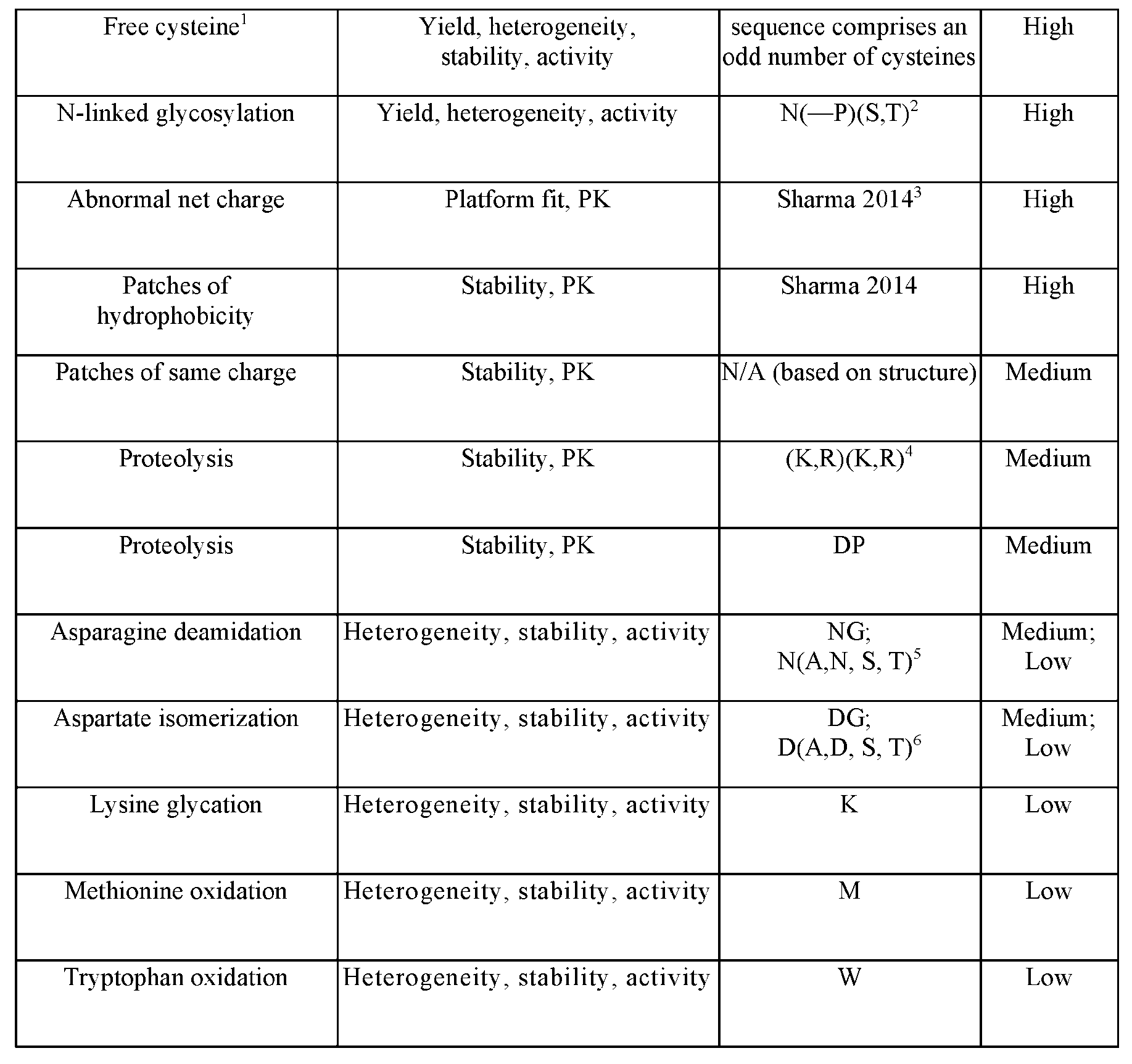
  • Antibody liabilities are further described in Table 1 below: Table 1. Description of potential development liabilities Free cysteine 1 Yield, heterogeneity, sequence comprises an High stability, activity odd number of cysteines m m m ; ; Active 105508124.2 19
  • Free cysteine refers to a cysteine that does not form a disulfide bond with another cysteine and thus is left “free” as thiols.
  • the presence of free cysteines in the antibody can be a potential development liability. Typically, an odd net number of cysteines in the protein shows a likelihood there is a free cysteine.
  • the N-linked glycosylation site is N-X-S/T, where X is any residue other than proline. 3 Sharma et al., Proc. Natl. Acad. Sci. USA 111:18601-18606, 2014. 4 This motif consists of a K or R, followed by a K or R. Stated differently, the motif can be KK, KR, RK, or RR.
  • the dipeptide NG poses a medium risk of development liability.
  • the dipeptides NA, NN, NS, and NT pose a low risk of development liability.
  • N may also exhibit low risk of liability for other successor residues, e.g., D, H, or P.
  • dipeptide ND, NH, or NP poses a low risk of development liability.
  • the dipeptide DG poses a medium risk of development liability.
  • the dipeptides DA, DD, DS, and DT pose a low risk of development liability.
  • D may also exhibit low risk of development liability for other successor residues, e.g., N, H, or P.
  • Another goal for engineering variants is to reduce the risk of clinical immunogenicity.
  • the anti-CSP antibody variants have reduced immunogenicity as compared to the parental antibody.
  • the factors that drive clinical immunogenicity can be classified into two groups. First are factors that are intrinsic to the drug, such as sequence, post-translational modifications, aggregates, degradation products, and contaminants. Second are factors related to how the drug is used, such as dose level, dose frequency, route of administration, patient immune status, and patient HLA type. [0073] One approach to engineering a variant to be as much like self as possible is to identify a close germline sequence and mutate as many mismatched positions (also known as "germline deviations") to the germline residue type as possible.
  • Germline gene IGHD codes for part of the H-CDR3 region but typically exhibits too much variation in how it is recombined with IGHV and IGHJ (e.g., forward or reverse orientation, any of three translation frames, and 5' and 3' modifications and non-templated additions) to present a "self” sequence template from a population perspective.
  • Each germline gene can present as different alleles in the population.
  • the least immunogenic drug candidate in terms of minimizing the percent of patients with an immunogenic Active 105508124.2 20 response, would likely be one that matches an allele commonly found in the patient population.
  • Single nucleotide polymorphism (SNP) data from the human genome can be used to approximate the frequency of alleles in the population.
  • SNP single nucleotide polymorphism
  • Another approach to engineering a lead for reduced immunogenicity risk is to use in silico predictions of immunogenicity, such as the prediction of T cell epitopes, or use in vitro assays of immunogenicity, such as ex vivo human T cell activation. For example, services such as those offered by Lonza, United Kingdom, are available that employ platforms for prediction of HLA binding and in vitro assessment to further identify potential epitopes.
  • antibody variants are additionally designed to enhance the efficacy of the antibody.
  • Design parameters for this aspect focused on CDRs, e.g., CDR3. Positions to be mutated were identified based on structural analysis of antibody-antigen co-crystals (Oyen et al., Proc. Natl. Acad Sci. USA 114:E10438-E10445, 2017) and based on sequence information of other antibodies from the same lineage as AB-000224 or AB-007088.
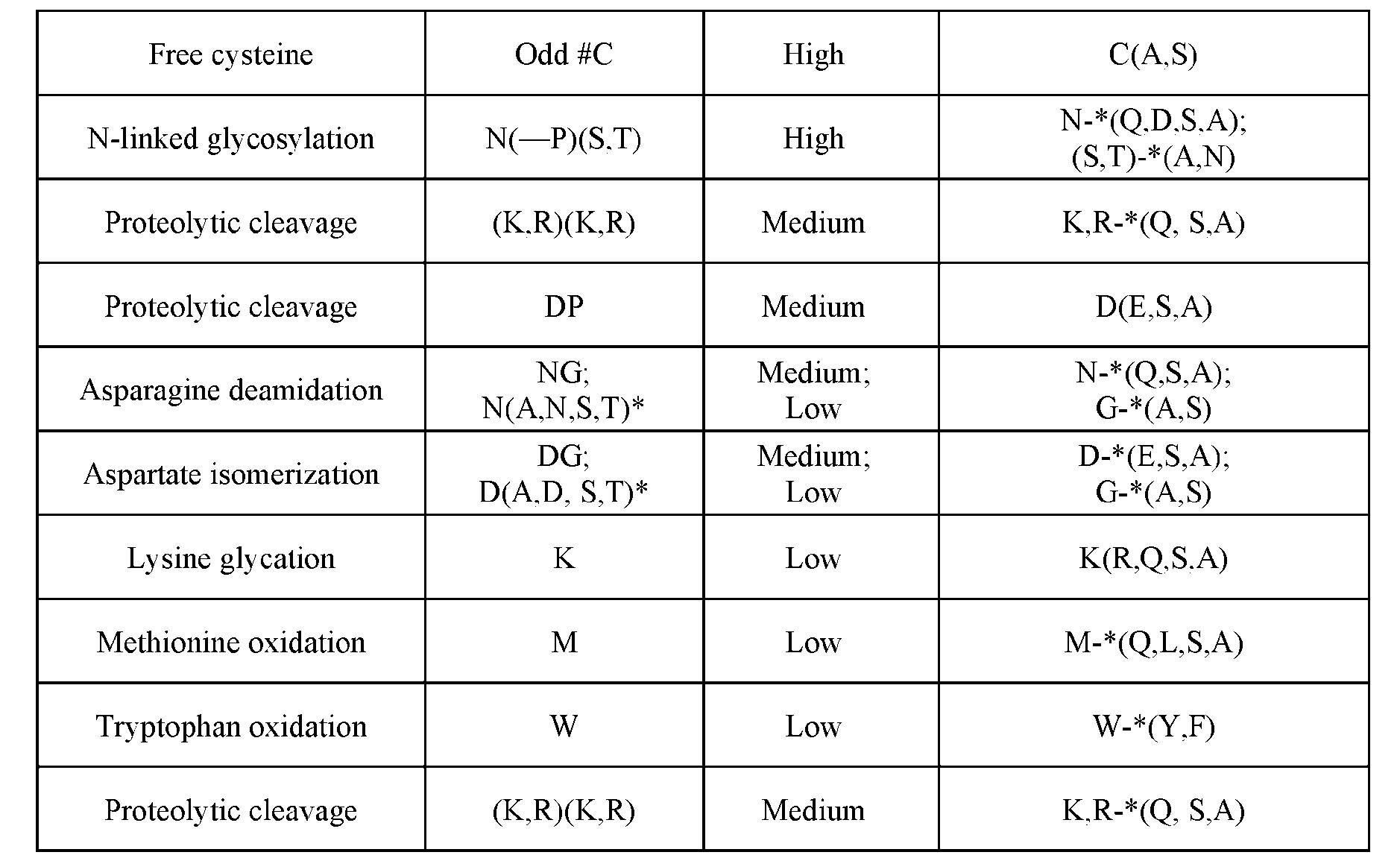
  • Approaches to mutation design [0077] Development liabilities can be removed or reduced by one or more mutations. Mutations are designed to preserve antibody structure and function while removing or reducing development liabilities and improving function.
  • mutations to chemically similar residues were identified to maintain size, shape, charge, and/or polarity.
  • Non-limiting examples of mutations are described in Table 2 below: Table 2 Free cysteine Odd #C High C(A,S) ct ve 05508 .
  • a variant of an anti-CSP antibody disclosed herein comprises modifications compared to parental antibody that provide improved pharmacokinetic properties, increased serum stability, stronger binding, and/or improved in vivo protective effects compared to parent.
  • a variant of an anti-CSP antibody disclosed herein exhibits reduced immunogenicity and/or increased manufacturability as compared to the parent.
  • a variant of an anti-CSP antibody disclosed herein has at least one modification, e.g., substitution, relative to the parent variable heavy chain or light chain sequence described herein, and has improved developability, e.g., decreased heterogeneity, increased yield, increased stability, improved net charges to improve pharmacokinetics, and/or reduced immunogenicity.
  • a VH region or a VL region of such a variant of an anti- CSP antibody disclosed herein has at least two, three, four, five, or six, or more modifications, e.g., substitutions.
  • a variant of an anti-CSP antibody disclosed herein exhibits increased serum half-life as compared to the parental antibody.
  • a variant of an anti-CSP antibody disclosed herein has at least one modification, e.g., substitution, relative to the native Fc region of the heavy chain or light chain sequence described herein, and has improved pharmacokinetics properties, e.g., half-life.
  • an Fc region of the heavy chain or an Fc region of the light chain of such a variant of an anti-CSP antibody disclosed herein has at least two, three, four, five, or six, or more modifications, e.g., substitutions.
  • a variant of an anti-CSP antibody disclosed herein has a total of 1, 2, 3, 4, 5, 6, 7, 8, 9, 10, 11, 12, 13, 14, 15, 16, 17, 18, 19, 20, 21, 22, 23, 24, 25, 26, 27, 28, 29, 30, 31, 32, 33, 34, 35, 36, 37, 38, 39, 40, 41, 42, 43, 44, 45, 46, 47, 48, 49, or 50 modifications, e.g. substitutions, including both heavy and light chains, compared to the parental antibody.
  • an Fc region of the heavy chain of a variant of an anti-CSP antibody disclosed herein can include an isoleucine at position 250, a tyrosine at position 252, an isoleucine at position 259, a glutamine at position 307, a phenylalanine at position 308, a leucine at position 319, a leucine at position 428, a histidine at position 434, a phenylalanine at position 434, an alanine at position 434, a serine at position 434, a methionine at position 434, or a combination thereof, wherein the numbering is defined by EU index as in Kabat.
  • an Fc region of the heavy chain of a variant of an anti-CSP antibody disclosed herein includes a leucine at position 428 and a serine at position 434, wherein the numbering is defined by EU index as in Kabat.
  • the anti-CSP antibodies disclosed herein comprise a heavy chain variable region and a light variable region.
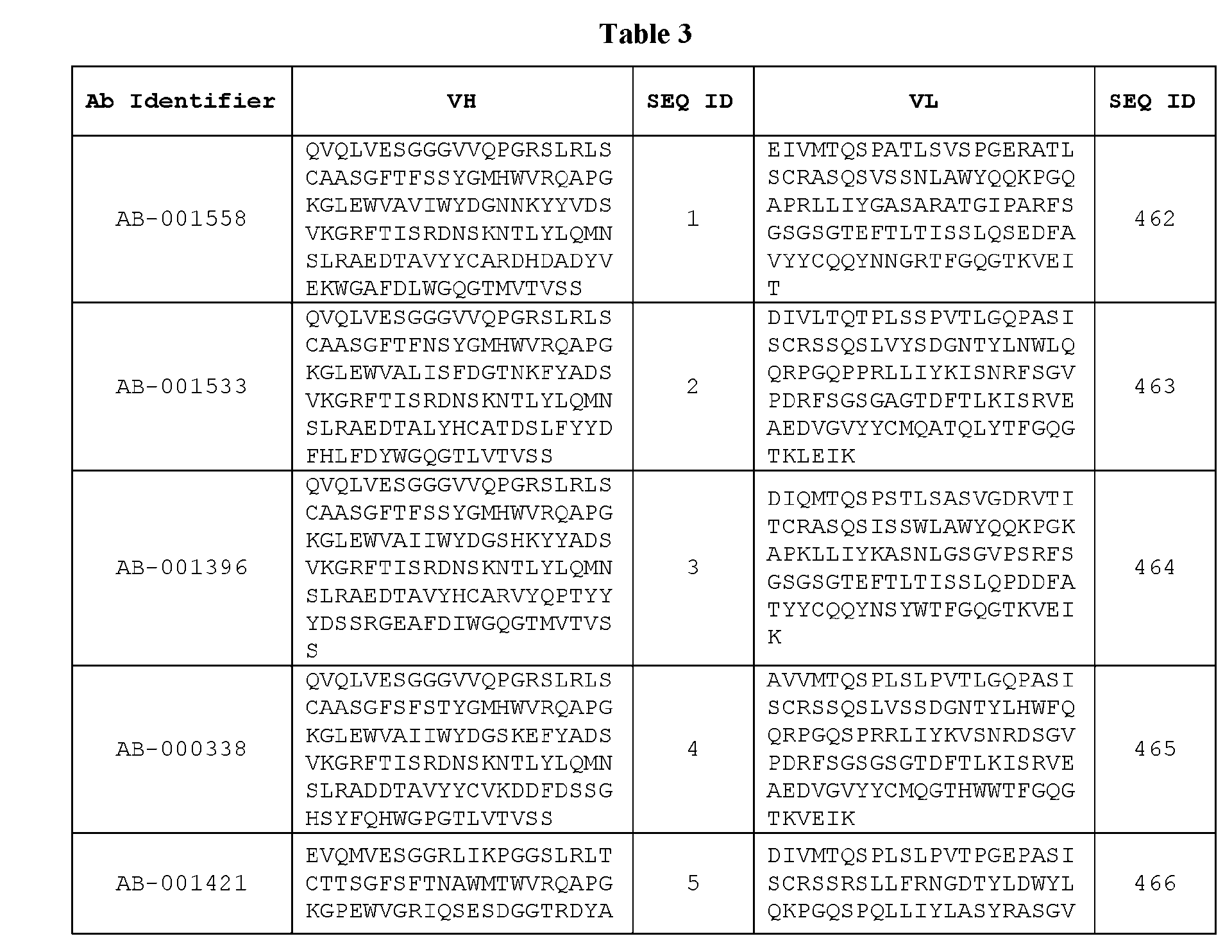
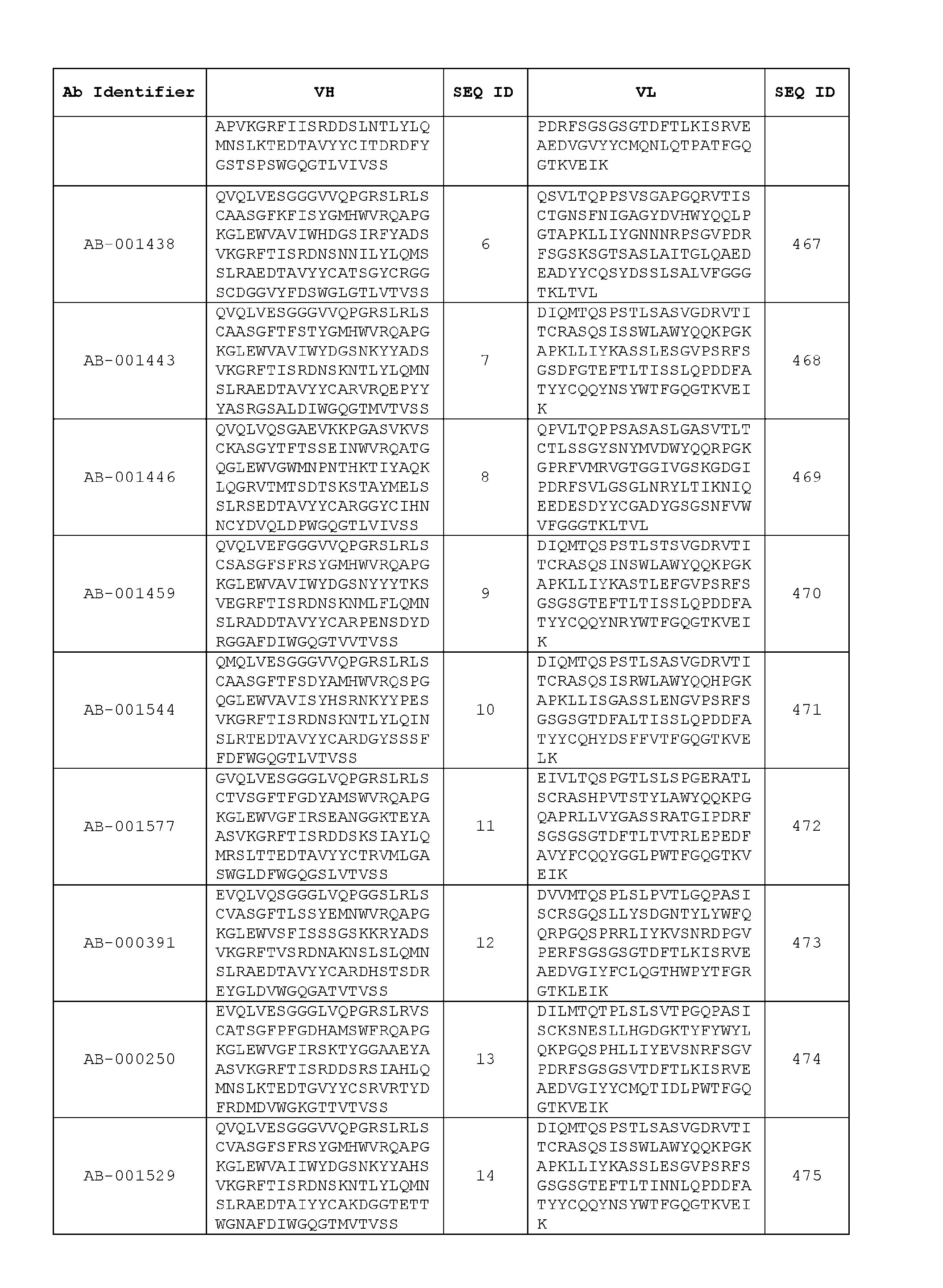
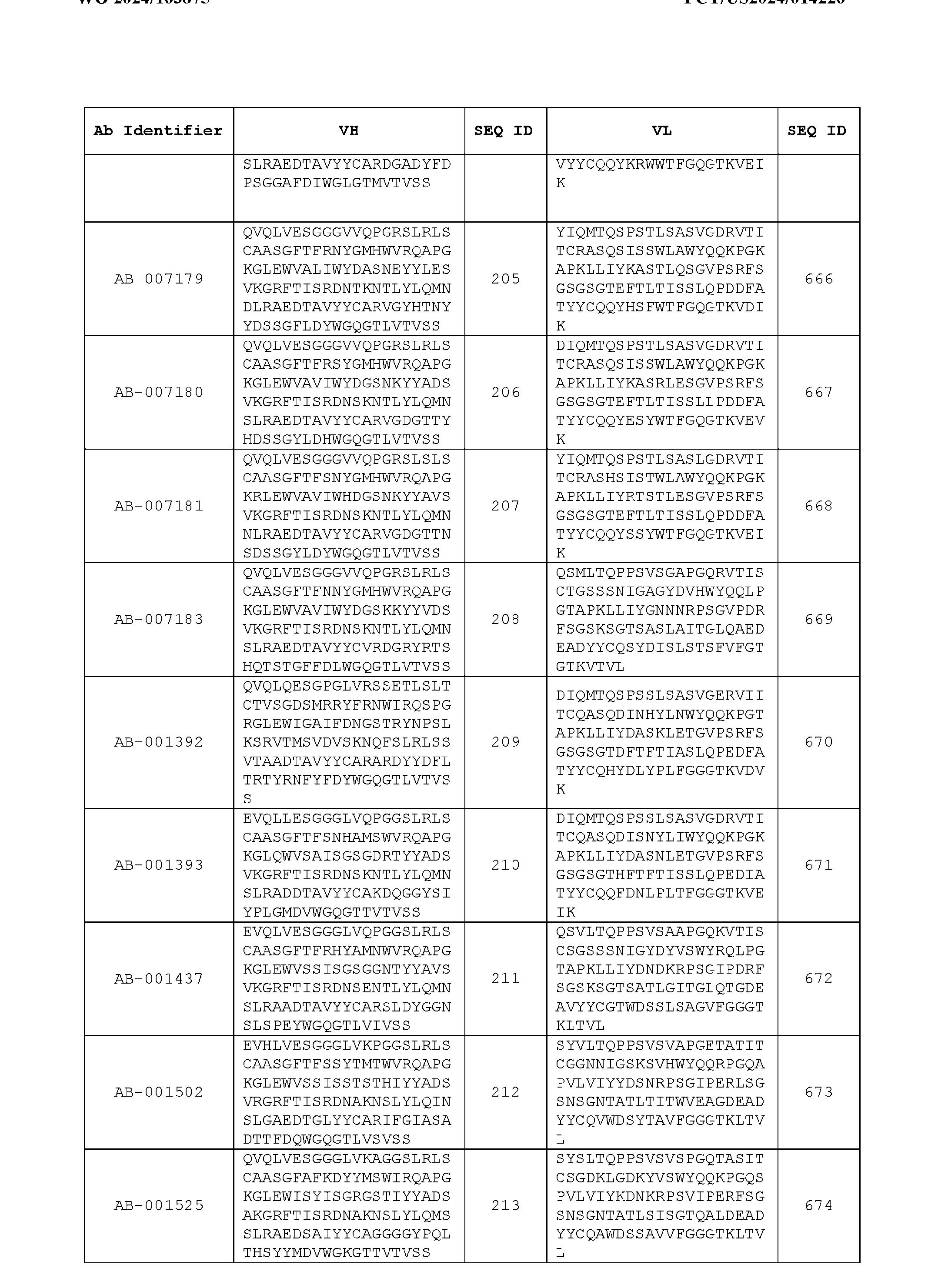
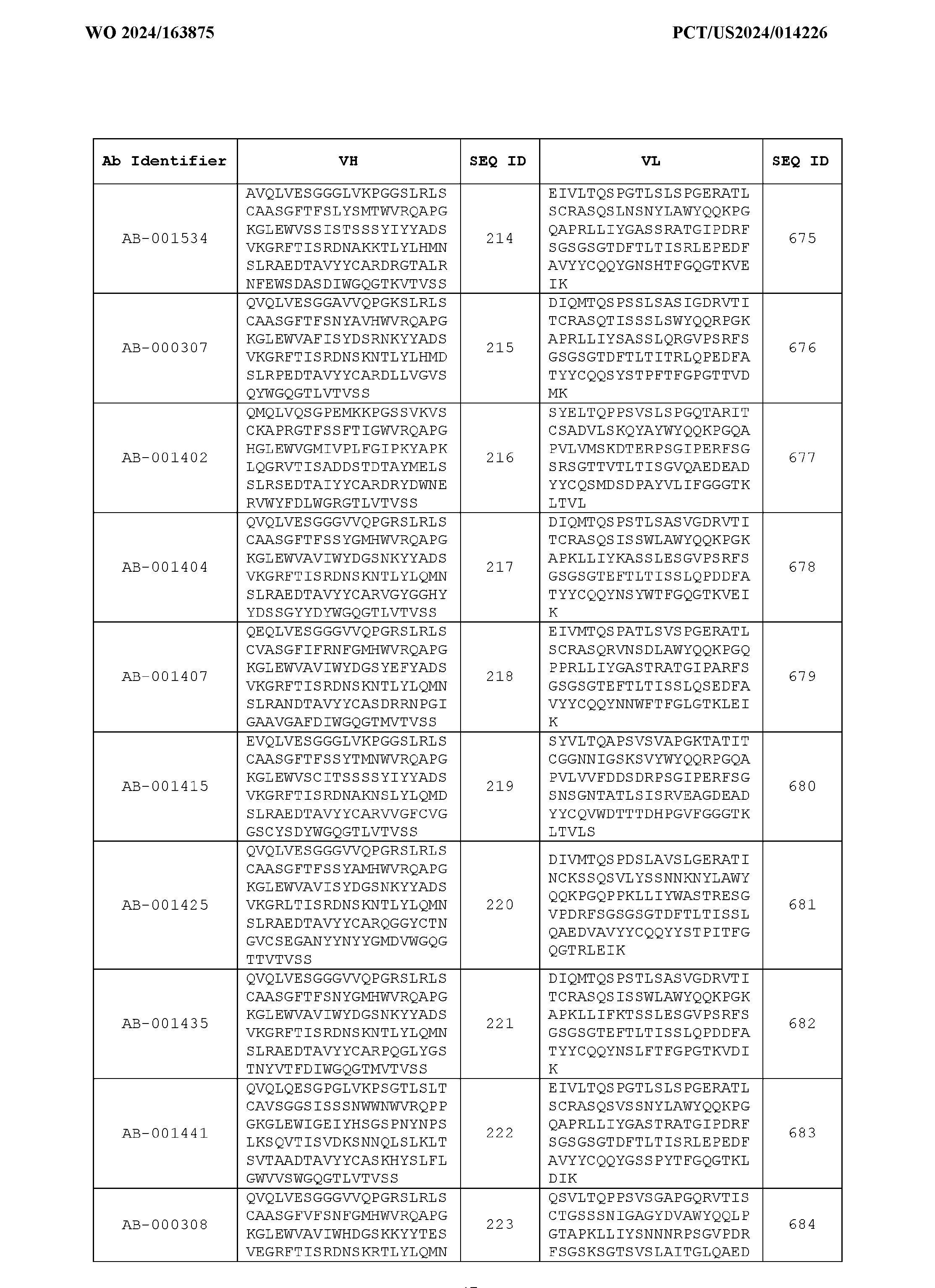
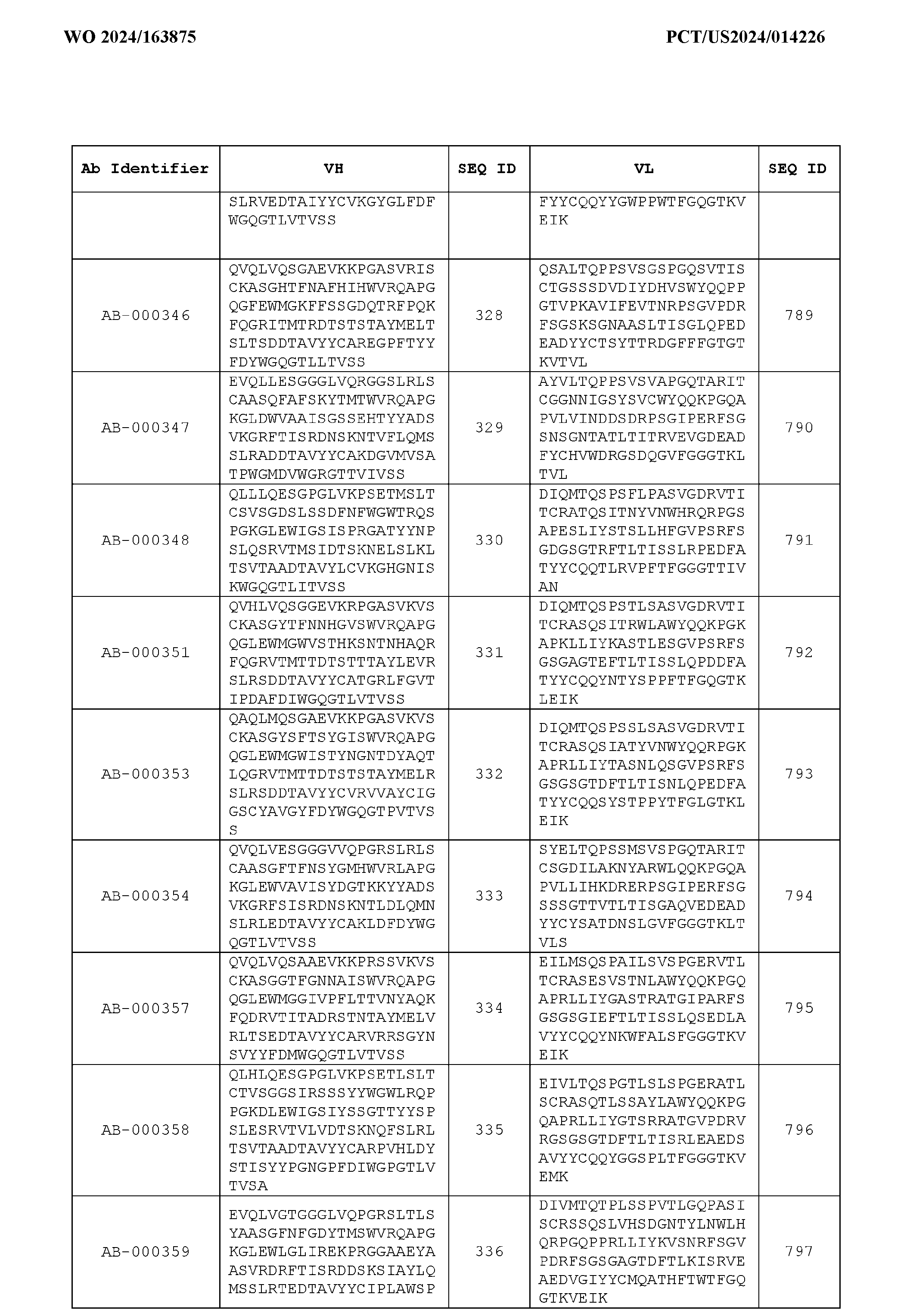
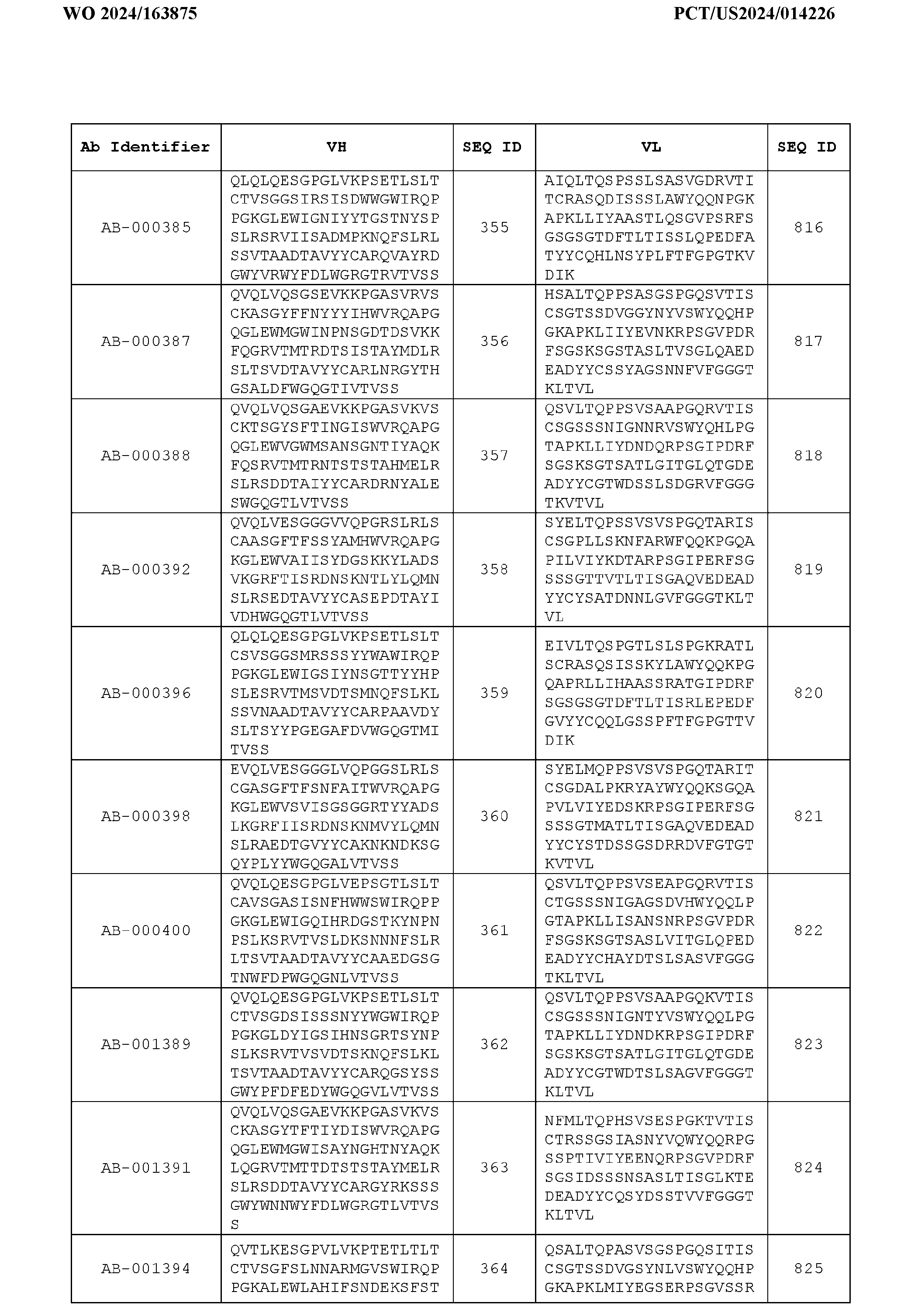
  • the heavy chain variable region comprises an amino acid sequence that is at least about 80%, about 85%, about 90%, about 95%, about 96%, about 97%, about 98%, about 99% identical to the amino acid sequence set forth in SEQ ID Nos. 1-461, as shown in Table 3.
  • the light chain variable region comprises an amino acid sequence that is at least about 80%, about 85%, about 90%, about 95%, about 96%, about 97%, about 98%, about 99% identical to the amino acid sequence set forth in SEQ ID Nos.462-922, as shown in Table 3.
  • the heavy chain variable region comprises an amino acid sequence that is at least about 80%, about 85%, about 90%, about 95%, about 96%, about 97%, about 98%, about 99% identical to the amino acid sequence set forth in SEQ ID Nos. 1-461; and b) the light chain variable region comprises an amino acid sequence that is at least about 80%, about 85%, about 90%, about 95%, about 96%, about 97%, about 98%, about 99% identical to the amino acid sequence set forth in SEQ ID Nos.462-922. [0081] In certain embodiments, the heavy chain variable region comprises the amino acid sequence set forth in SEQ ID Nos.1-461, as shown in Table 3.
  • the light chain variable region comprises the amino acid sequence set forth in SEQ ID Nos. 462-922, as shown in Table 3.
  • a) the heavy chain variable region comprises the amino acid sequence set forth in SEQ ID Nos.1-461; and b) the light chain variable region comprises the amino acid sequence set forth in SEQ ID Nos.462-922.
  • the heavy chain variable region consists of the amino acid sequence set forth in SEQ ID Nos.1-461, as shown in Table 3.
  • the light chain variable region consists of the amino acid sequence set forth in SEQ ID Nos. 462-922, as shown in Table 3.
  • the heavy chain variable region consists of the amino acid sequence set forth in SEQ ID Nos.1-461; and b) the light chain variable region consists of the amino acid sequence set forth in SEQ ID Nos.462-922.
  • the heavy chain variable region comprises a CDR1, a CDR2, and a CDR3 of the heavy chain variable sequence set forth in SEQ ID NOs: 1-461, as shown in Table 3.
  • the light chain variable region comprises a CDR1, a CDR2, and a CDR3 of the light chain variable sequence set forth in SEQ ID NOs: 462-922, as shown in Table 3.
  • the heavy chain variable region comprises a CDR1, a CDR2, and a CDR3 of the heavy chain variable sequence set forth in SEQ ID NOs: 1-461; and b) the light chain variable region comprises a CDR1, a CDR2, and a CDR3 of the light chain variable sequence set forth in SEQ ID NOs: 462-922.
  • Active 105508124.2 23 the anti-CSP antibodies disclosed herein comprise a heavy chain variable region comprising a CDR1, a CDR2, and a CDR3 and having the amino acid sequence set forth in SEQ ID NOs: 1-461, as shown in Table 3.
  • the anti- CSP antibody variant comprises a light chain variable region comprising a CDR1, a CDR2, and a CDR3 and having the amino acid sequence set forth in SEQ ID NOs: 462-922, as shown in Table 3.
  • the anti-CSP antibody variant comprises a) a heavy chain variable region comprising a CDR1, a CDR2, and a CDR3 and having the amino acid sequence set forth in SEQ ID NOs: 1-461; and b) a light chain variable region comprising a CDR1, a CDR2, and a CDR3 and having the amino acid sequence set forth in SEQ ID NOs: 462-922.
  • Table 3 is provided below.
  • the anti-CSP antibody variant is designated as indicated in Table 3.
  • the anti-CSP antibody variant comprising the heavy chain variable region having the amino acid sequence set forth in SEQ ID NO: 1 and the light chain variable region having the amino acid sequence set forth in SEQ ID NO: 462 is designated as “AB-001558”.
  • the anti-CSP antibodies disclosed herein bind to a first epitope of CSP.
  • CSP is composed of an N-terminal domain containing a heparan sulfate binding site for hepatocyte adhesion, a central repeat region, and a structured C-terminal ⁇ -thrombospondin repeat ( ⁇ TSR) that is followed by a GPI anchor, which attaches CSP to the sporozoite membrane.
  • ⁇ TSR ⁇ -thrombospondin repeat
  • the central repeat region of CSP is highly immunogenic, and in all P.
  • the repeat region is composed of 1 NPDP repeat, 3–5 NVDP repeats, and 35–41 NANP repeats (e.g., a total of 1/4/38 of NPDP/NVDP/NANP motifs are present in the P. falciparum 3D7 strain).
  • the repeat region begins with the junctional NPDP sequence, typically followed by three alternations of NANP and NVDP sequences, and continues with the remaining NANP repeats, with most P. falciparum strains having one NVDP interspersed in the middle of the long NANP repeat region. Pholcharee, T. et al., J. Mol. Bio.132: 1048-1063 (2020).
  • the anti-CSP antibodies disclosed herein bind to the central repeat region of P. falciparum CSP. In certain embodiments, the antibodies disclosed herein bind to P. falciparum CSP protein in the repeat and/or junctional regions that contain NPNA, NPDP, and/or NVDP motifs. In certain embodiments, the anti-CSP antibodies disclosed herein bind to the NANP repeat region of P. falciparum CSP. In certain embodiments, the anti-CSP antibodies Active 105508124.2 73 disclosed herein bind to a polypeptide comprising the amino acid sequence set forth in SEQ ID NO: 923.
  • the first epitope comprises the amino acid sequence set forth in SEQ ID NOs: 923-974. In certain embodiments, the first epitope consists of the amino acid sequence set forth in SEQ ID NOs: 923-974. SEQ ID NO: 923-974 are provided in Table 4 below. Table 4. second epitope of CSP. In certain embodiments, the second epitope is heterologous to epitopes present in the RTS,S vaccine.
  • the RTS,S vaccine is a pseudo-viral particle vaccine that combines the hepatitis B surface antigen and the central repeat and C-terminal regions of the Plasmodium falciparum (P. falciparum) circumsporozoite protein (CSP).
  • RTS,S consists of two polypeptides; RTS is a single polypeptide chain corresponding to amino acids 207 to 395 of P. falciparum (3D7) Active 105508124.2 74 that is fused to HBsAg and S is a polypeptide of 226 amino acids that corresponds to HBsAg. Stoute, et. al., N Engl J Med; 336:86-91(1997); RTS,S Clinical Trials Partnership, PLoS Med.11(7):e1001685, (2014), WO1993/10152. [0090] In certain embodiments, the second epitope comprises a minor repeat or a junctional region of CSP.
  • the second epitope comprises a minor repeat and a junctional region of CSP.
  • the minor repeat is a DPNA/NPNV-containing minor repeat.
  • the junctional region is a DPNA/NPNV-containing junctional region.
  • the second epitope comprises the amino acid sequence set forth in SEQ ID NOs: 975-1195.
  • the second epitope consists of the amino acid sequence set forth in SEQ ID NOs: 975-1195. SEQ ID NO: 975-1195 are provided in Table 5 below. Table 5
  • the first epitope comprises an amino acid sequence set forth in SEQ ID NO. 923-974
  • the second epitope comprises an amino acid sequence set forth in SEQ ID NO. 975-1195.
  • the first epitope consists of an amino acid sequence set forth in SEQ ID NO. 923-974
  • the second epitope consists of an amino acid sequence set forth tin SEQ ID NO.975-1195.
  • the first epitope consists of an amino acid sequence set forth in SEQ ID NO. 923- 974
  • the second epitope consists of an amino acid sequence set forth in SEQ ID NO. 975-1195
  • the at least one additional epitope consists of an amino acid sequence set forth in SEQ ID NO. 975-1195.
  • Antibody Fc regions are generally post-translationally modified via the addition of N-glycans at specific asparagine residues on the antibody heavy chain.
  • IgG molecules bear a N-linked glycosylation asparagine of each heavy chain. It has been shown that a modified glycosylation profile can regulate the antibody functions. For example, without any limitation, altered glycosylation can improve the binding affinity or the half-life of the antibody as compared to the non-modified form.
  • the present disclosure provides anti-CSP antibodies and variants thereof with modified glycosylation.
  • the antibodies disclosed herein include an Fc region with increased glycosylation.
  • the Fc region with increased glycosylation includes increased amounts of bisected oligosaccharides.
  • the Fc region with increased glycosylation includes increased amounts of nonfucosylated oligosaccharides.
  • the Fc region with increased glycosylation includes increased amounts of fucose-containing oligosaccharides.
  • the antibodies disclosed herein include an Fc region with decreased glycosylation.
  • the Fc region with decreased glycosylation includes reduced amounts of bisected oligosaccharides. In certain embodiments, the Fc region with decreased glycosylation includes reduced amounts of nonfucosylated oligosaccharides. In certain embodiments, the Fc region with increased glycosylation includes reduced amounts of fucose-containing oligosaccharides. [0095] In certain embodiments, the antibodies disclosed herein include a V region with increased glycosylation. In certain non-limiting embodiments, the V region with increased glycosylation includes increased amounts of bisected oligosaccharides. In certain embodiments, the V region with increased glycosylation includes increased amounts of nonfucosylated Active 105508124.2 78
  • the V region with increased glycosylation includes increased amounts of fucose-containing oligosaccharides.
  • the antibodies disclosed herein include a V region with decreased glycosylation. In certain non-limiting embodiments, the V region with decreased glycosylation includes reduced amounts of bisected oligosaccharides. In certain embodiments, the V region with decreased glycosylation includes reduced amounts of nonfucosylated oligosaccharides. In certain embodiments, the V region with increased glycosylation includes reduced amounts of fucose-containing oligosaccharides.
  • the modified glycosylation can be obtained by expressing any of the antibodies disclosed herein in a host cell with altered glycosylation machinery.
  • a host cell can include a functional disruption of the fucosyltransferase gene and antibodies expressed in this host cell with show reduced glycosylation, e.g., reduced fucosylation (see PCT Patent Publication No. WO 99/54342).
  • the present disclosure provides anti-CSP antibody variants disclosed herein including one or more amino acid substitution resulting in the alteration of a glycosylation acceptor site.
  • the alteration includes the elimination of the glycosylation acceptor site.
  • the alteration includes modification of a glycosylation acceptor site. In certain embodiments, the alteration includes insertion of a glycosylation acceptor site.
  • glycosylation acceptor site refers to an amino acid residue of the light chain or heavy chain of the antibody which can be N- or O-glycosylated.
  • the N-linked glycosylation acceptor site can be an asparagine residue.
  • the O-linked glycosylation acceptor site can be a serine residue, a threonine residue, a tyrosine residue, a hydroxylysine residue, or a hydroxyproline residue.
  • the Fc region of the antibodies disclosed herein includes one or more glycosylation acceptor site.
  • the V region of any of the antibodies disclosed herein includes one or more glycosylation acceptor site.
  • the light chain of any of the antibodies disclosed herein includes one or more glycosylation acceptor site.
  • the heavy chain of any one of the antibodies disclosed herein includes one or more glycosylation acceptor site.
  • the light chain variable region of any of the antibodies disclosed herein includes one or more glycosylation acceptor site.
  • the heavy chain variable region of any of the antibodies disclosed herein includes one or more glycosylation acceptor site.
  • the heavy chain variable region of any of the antibodies disclosed herein includes one or more glycosylation acceptor site. Active 105508124.2 79
  • the present disclosure provides anti-CSP antibodies and variants thereof including additional modifications.
  • the modifications can improve pharmacological properties of the antibodies, e.g., half-life.
  • the modification includes PEGylation, deamination, derivatization with polymers, lipidation, removal and/or introduction of disulfide bonds, oxidation, and removal of C-terminal lysine [00102]
  • the modification is a PEGylation.
  • PEGylation of antibodies and engineered antibodies includes attachment of one or more polyethylene glycol (PEG) to the antibody.
  • the PEGylation can be carried out by an acylation reaction or an alkylation reaction with a reactive PEG molecule (or an analogous reactive water-soluble polymer).
  • a reactive PEG molecule or an analogous reactive water-soluble polymer.
  • polyethylene glycol refers to any of the forms of PEG that have been used to derivatize other proteins, such as mono (C1-C10) alkoxy- or aryloxy-polyethylene glycol or polyethylene glycol-maleimide.
  • the modification is the derivatization with a hydrophilic polymer.
  • the hydrophilic polymer can be carboxymethylcellulose, dextran, polyvinyl alcohol, polyvinyl pyrrolidone, poly-1, 3-dioxolane, poly-1,3,6-trioxane, ethylene/maleic anhydride copolymer, polyaminoacids (either homopolymers or random copolymers), and dextran or poly(n-vinyl pyrrolidone)polyethylene glycol, propropylene glycol homopolymers, prolypropylene oxide/ethylene oxide co-polymers, polyoxyethylated polyols (e.g., glycerol), polyvinyl alcohol, and mixtures thereof.
  • dextran polyvinyl alcohol
  • polyvinyl pyrrolidone poly-1, 3-dioxolane
  • poly-1,3,6-trioxane ethylene/maleic anhydride copolymer
  • polyaminoacids either homopolymers or random copolymers
  • the modification is a lipidation.
  • Lipidation is the conjugation of a protein with a lipid. Lipidation of peptides improves metabolic stability, membrane permeability, bioavailability, and changes the pharmacokinetic and pharmacodynamic properties of the peptides.
  • a lipidated peptide has a high affinity with serum albumin resulting in increased half-life and stability.
  • the lipid can be myristic acid, palmitic acid, stearic acid, lauric acid, cholesterol, and mixtures thereof.
  • the modification is a substitution of an amino acid residue to form a disulfide bond.
  • the amino acid substitution introduces a cysteine.
  • two cysteines can form a non-natural disulfide bond.
  • the disulfide bond improves the stability of the antibody, e.g., corrected pairing of the antibody chains.
  • the cysteine is introduced in the V region.
  • the cysteine is introduced in the Fc region. In certain Active 105508124.2 80
  • the modification is a substitution of an amino acid residue to remove a disulfide bond.
  • the amino acid substitution removes a cysteine.
  • the cysteine is substituted with a serine.
  • removing a cysteine improves the stability of the antibody, e.g., improved long-term stability.
  • the cysteine is removed in the V region.
  • the cysteine is removed in the Fc region.
  • Anti-CSP antibody and Anti-CSP antibody variants conjugates [00106]
  • the present disclosure provides an anti-CSP antibody or variant thereof conjugated or linked to therapeutic and/or imaging/detectable moieties.
  • the anti-CSP antibody or variant thereof can be conjugated to a detectable marker, a toxin, or a therapeutic agent.
  • the moiety may be linked to the antibody covalently or by non-covalent linkages.
  • the antibody or variant thereof is conjugated to cytotoxic moiety or other moiety that inhibits cell proliferation.
  • the antibody or variant thereof is conjugated to a cytotoxic agent including, but not limited to, a ricin A chain, doxorubicin, daunorubicin, a maytansinoid, taxol, ethidium bromide, mitomycin, etoposide, tenoposide, vincristine, vinblastine, colchicine, dihydroxy anthracin dione, actinomycin, a diphtheria toxin, extotoxin A from Pseudomonas, Pseudomonas exotoxin (PE) A, PE40, abrin, abrin A chain, modeccin A chain, alpha sarcin, gelonin, mitogellin, restrictocin, cobran venom factor, a ribonuclease, phenomycin, enomycin, curicin, crotin, calicheamicin, Saponaria officinalis inhibitor, glucocor
  • the antibody or variant thereof can be linked to an agent such as an enzyme inhibitor, a proliferation inhibitor, a lytic agent, a DNA or RNA synthesis inhibitors, a membrane permeability modifier, a DNA metabolites, a dichloroethyl sulfide derivative, a protein production inhibitor, a ribosome inhibitor, or an inducer of apoptosis.
  • an agent such as an enzyme inhibitor, a proliferation inhibitor, a lytic agent, a DNA or RNA synthesis inhibitors, a membrane permeability modifier, a DNA metabolites, a dichloroethyl sulfide derivative, a protein production inhibitor, a ribosome inhibitor, or an inducer of apoptosis.
  • the antibody or variant thereof can be linked to a radionuclide, an iron-related compound, a dye, a fluorescent agent, or an imaging agent.
  • an antibody may be linked to agents, such as, but not limited to, metals; metal chelators; lanthanides; lanthanide chelators; radiometals; radiometal chelators; positron-emitting nuclei; microbubbles (for ultrasound); liposomes; molecules microencapsulated in liposomes or nanosphere; monocrystalline iron oxide nano-compounds; magnetic resonance imaging contrast agents; light absorbing, reflecting and/or scattering agents; colloidal particles; fluorophores, such as near-infrared fluorophores. Active 105508124.2 81
  • the present disclosure provides bispecific molecules comprising an anti-CSP antibody, a variant thereof, or a fragment thereof, disclosed herein.
  • the anti-CSP antibody, anti-CSP antibody variant or antigen-binding portions thereof can be derivatized or linked to another functional molecule, e.g., another peptide or protein (e.g., another antibody or ligand for a receptor) to generate a bispecific molecule that binds to at least two different binding sites or target molecules.
  • the anti-CSP antibody or variant thereof disclosed herein can be derivatized or linked to more than one other functional molecule to generate multispecific molecules that bind to more than two different binding sites (e.g., two different epitopes on the CSP protein) and/or target molecules; such multispecific molecules are also intended to be encompassed by the term "bispecific molecule" as used herein.
  • an antibody of the invention can be functionally linked (e.g., by chemical coupling, genetic fusion, noncovalent association, or otherwise) to one or more other binding molecules, such as another antibody, antibody fragment, peptide or binding mimetic, such that a bispecific molecule results.
  • the bispecific antibody can be created using the knobs-into-holes strategy.
  • This strategy typically involves creation of a first half of a first antibody that recognizes a first antigen, e.g., CSP, and a second half of the antibody that recognizes a second antigen or binding site, and then joining the two halves to create the bispecific antibody.
  • the first antigen and the second antigen are different epitopes of the CSP protein.
  • Activity [00110] The activity of any of the anti-CSP antibodies disclosed herein can be assessed by using different endpoints.
  • the activity is assessed for binding to CSP, either binding to a series of linear peptides with varying lengths representing the immunodominant regions of the CSP protein or to the entire CSP protein.
  • the activity is assessed for the ability to protect against challenge with Plasmodium that comprises P. falciparum CSP, e.g., in in vivo animal models of malaria.
  • effector function e.g., ADCC
  • the binding activity of an anti-CSP antibody disclosed herein to P. falciparum CSP protein can be assessed by surface plasmon resonance (SPR) using a biosensor system.
  • SPR surface plasmon resonance
  • each antibody can be either directly immobilized to a Carterra CMD200M Chip or captured to the CMD200M Carterra Chip with a goat anti-human IgG Fc antibody.
  • the uncoupled antibodies can be washed off and various Active 105508124.2 82
  • concentration gradients of the targets can be flowed over the antibodies.
  • the highest concentration of each target can be in the range of 0.5-8 ⁇ g/mL.
  • each antibody can be immobilized in different locations (e.g., at least 2) on the chip, and the affinity for each antibody-target combination can be determined using multiple (e.g., 4-5) target concentrations according to standard methods. If the variation between the two duplicates is >3- fold, the antibody-target measurement is repeated.
  • the binding activity of an anti-CSP antibody disclosed herein to P. falciparum CSP protein can be assessed by bio-layer interferometry (BLI).
  • each of the antigens can be immobilized on sensors according to the manufacturer’s instructions.
  • Systems suitable for use in BLI include, but are not limited to, OctetTM (ForteBio, Fremont, CA) and GatorTM (Probelife, Palo Alto, CA).
  • the antigen can be biotinylated and immobilized to streptavidin sensors.
  • each antibody can be evaluated in replicates at a suitable concentration (e.g., 5 ⁇ g/mL). If the variation between the two duplicates is >3-fold, the antibody-target measurement is repeated.
  • the assays are typically performed under conditions according to the manufacturer’s instructions.
  • the assays can be performed under a temperature in the range of 20°C to 37°C, for example, 20°C- 25 °C. In certain embodiments, the assay is performed at 25°C. In certain embodiments, the assay is performed at 37°C. [00113] In certain embodiments, binding to CSP protein is assessed in a competitive assay format with a reference antibody A. In certain embodiments, a variant anti-CSP antibody disclosed herein can block binding of the reference antibody in a competition assay by about 50% or more. [00114] Anti-CSP antibodies and anti-CSP antibody variants of the present disclosure may also be evaluated in various assays for their ability to mediate FcR-dependent activity.
  • the activity of an anti-CSP antibody can be evaluated in vivo in an animal model, e.g., as described in the Examples section.
  • the mouse malaria liver burden assay can be used, as disclosed in Flores-Garcia Y, et al. Malar J. 2019;18(1):426, doi:10.1186/s12936-019-3055-9, the content of which is herein incorporated by reference. Mice are administered antibody and infected with transgenic P. berghei expressing GFP-luciferase and P. falciparum CSP protein.
  • Parasite liver load can be evaluated, e.g., by RT-qPCR or by measuring bioluminescence with an IVIS Spectrum imager.
  • a reduction in parasite liver load reflects the prophylactic activity of an antibody.
  • the activity of an anti-CSP antibody can be determined by evaluating the in vivo protection and survival of animal models, e.g., mice. For example, but without any limitation, mice are administered antibody and challenged with transgenic P. berghei Active 105508124.2 83
  • an anti-CSP antibody disclosed herein has at least 20%, or at least 30%, or at least 40%, or at least 50%, or at least 60%, or 70%, or greater, of the activity of antibody AB-000317 when evaluated under the same assay conditions.
  • an anti-CSP antibody exhibits improved activity, i.e., greater than 100%, activity compared to antibody AB-000317.
  • an anti-CSP antibody disclosed herein exhibits at least 20%, or at least 30%, or at least 40%, or at least 50%, or at least 60%, or 70%, or greater reduction in parasite liver load as compared to antibody AB-000317.
  • an anti-CSP antibody disclosed herein exhibits at least 20%, or at least 30%, or at least 40%, or at least 50%, or at least 60%, or 70%, or greater increase in survival rate as compared to antibody AB-000317.
  • an anti-CSP antibody variant disclosed herein has at least 50%, or at least 60%, or 70%, or greater, of the activity of AB-000224 when evaluated under the same assay conditions. In certain embodiments, an anti-CSP antibody exhibits improved activity, i.e., greater than 100%, activity compared to AB-000224. In certain embodiments, the anti-CSP antibody variants disclosed herein have similar activity against malaria infection as compared to AB-000224. In certain embodiment, an anti-CSP antibody variant disclosed herein has at least 50%, or at least 60%, or 70%, or greater, of the activity of AB-007088 when evaluated under the same assay conditions.
  • an anti-CSP antibody exhibits improved activity, i.e., greater than 100%, activity compared to AB-007088.
  • the anti-CSP antibody variants disclosed herein have similar activity against malaria infection as compared to AB-007088.
  • similar activity when used to compare in vivo activity of antibodies, refers to that two measurements of the activity is no more than 30%, no more than 25%, no more than 20%, no more than 15% different, no more than 10%, no more than 8%, or no more than 5% different from each other.
  • CSP antibodies and variants thereof disclosed herein can be produced using vectors and recombinant methodology (see, e.g., Sambrook & Russell, Molecular Cloning: A Laboratory Manual, Cold Spring Harbor Laboratory Press; Ausubel, Current Protocols in Molecular Biology). Reagents, cloning vectors, and kits for genetic manipulation are available from commercial vendors. Active 105508124.2 84
  • the present disclosure provides isolated nucleic acids encoding a VH and/or VL region, or fragment thereof, of any of the anti-CSP antibodies and anti-CSP antibody variants disclosed herein.
  • the present disclosure provides vectors comprising said nucleic acids and host cells into which the nucleic acids are introduced that are used to replicate the antibody-encoding nucleic acids and/or to express the antibodies.
  • These nucleic acids can encode an amino acid sequence containing the VL, and/or an amino acid sequence containing the VH of the anti-CSP antibody or variant thereof (e.g., the light and/or heavy chains of the antibody).
  • the host cell contains (1) a vector containing a polynucleotide that encodes the VL amino acid sequence and a polynucleotide that encodes the VH amino acid sequence, or (2) a first vector containing a polynucleotide that encodes the VL amino acid sequence and a second vector containing a polynucleotide that encodes the VH amino acid sequence.
  • the present disclosure provides a method of making an anti-CSP antibody disclosed herein.
  • the method includes culturing a host cell previously described under conditions suitable for expression of the antibody.
  • the antibody is subsequently recovered from the host cell (or host cell culture medium).
  • Suitable vectors containing polynucleotides encoding antibodies of the present disclosure, or fragments thereof include cloning vectors and expression vectors. While the cloning vector selected can vary according to the host cell intended to be used, useful cloning vectors generally can self-replicate, can possess a single target for a particular restriction endonuclease, and/or may carry genes for a marker that can be used in selecting clones containing the vector.
  • Non-limiting examples include plasmids and bacterial viruses, e.g., pUC18, pUC19, Bluescript (e.g., pBS SK+) and its derivatives, mp18, mp19, pBR322, pMB9, ColEl plasmids, pCR1, RP4, phage DNAs, and shuttle vectors.
  • Expression vectors generally are replicable polynucleotide constructs that contain a nucleic acid of the present disclosure. The expression vector can replicate in the host cells either as episomes or as an integral part of the chromosomal DNA.
  • Suitable expression vectors include, but are not limited to, plasmids and viral vectors, including adenoviruses, adeno-associated viruses, retroviruses, and any other vector.
  • Suitable host cells for expressing an anti-CSP antibody or anti-CSP antibody variant disclosed herein include both prokaryotic or eukaryotic cells.
  • anti-CSP antibodies can be produced in bacteria, in particular when glycosylation and Fc effector function are not needed. After expression, the antibody can be isolated from the bacterial cell lysate in a soluble fraction and can be further purified.
  • eukaryotic host cell can be a eukaryotic host cell, including, without limitation, eukaryotic microorganisms, such as filamentous fungi or yeast, fungi and yeast strains whose glycosylation pathways have been "humanized,” resulting in the production of an antibody with a partially or fully human glycosylation pattern, vertebrate, invertebrate, and plant cells.
  • eukaryotic microorganisms such as filamentous fungi or yeast, fungi and yeast strains whose glycosylation pathways have been "humanized,” resulting in the production of an antibody with a partially or fully human glycosylation pattern, vertebrate, invertebrate, and plant cells.
  • invertebrate cells include insect cells. Numerous baculoviral strains have been identified which may be used in conjunction with insect cells. Plant cell cultures can also be utilized as host cells.
  • vertebrate host cells are used for producing anti-CSP antibodies of the present disclosure.
  • mammalian cell lines that can be used to express anti-CSP antibodies include monkey kidney CV1 line transformed by SV40 (COS-7); human embryonic kidney line (293 or 293 cells); baby hamster kidney cells (BHK); mouse Sertoli cells (TM4 cells); monkey kidney cells (CV1); African green monkey kidney cells (VERO-76); human cervical carcinoma cells (HELA); canine kidney cells (MDCK; buffalo rat liver cells (BRL 3A); human lung cells (W138); human liver cells (Hep G2); mouse mammary tumor (MMT 060562); TRI cells; MRC 5 cells; and FS4 cells.
  • COS-7 monkey kidney CV1 line transformed by SV40
  • BHK baby hamster kidney cells
  • TM4 cells monkey kidney cells
  • CV1 African green monkey kidney cells
  • HELA human cervical carcinoma cells
  • canine kidney cells MDCK
  • buffalo rat liver cells BRL 3A
  • human lung cells W138
  • human liver cells Hep G2
  • the mammalian cell line used to express anti-CSP antibodies can be Chinese hamster ovary (CHO) cell line; DHFR-CHO cell line (Urlaub et al., Proc. Natl. Acad. Sci. USA 77:4216, 1980); and myeloma cell lines such as YO, NSO, and Sp2/0.
  • Host cells of the present disclosure also include, without limitation, isolated cells, in vitro cultured cells, and ex vivo cultured cells.
  • a host cell transfected with an expression vector encoding an anti-CSP antibody of the present disclosure, or fragment thereof, can be cultured under appropriate conditions to allow expression of the polypeptide to occur.
  • polypeptides can be secreted and isolated from a mixture of cells and medium containing the polypeptides. Alternatively, the polypeptide can be retained in the cytoplasm or a membrane fraction and the cells harvested, lysed, and the polypeptide isolated using a desired method.
  • Pharmaceutical Compositions and Methods of Treatment [00127] In certain embodiments, the present disclosure provides pharmaceutical compositions for the administration of an anti-CSP antibody and variants thereof.
  • the pharmaceutical compositions can be administered to a mammalian subject, e.g., a human, who has malaria or is at risk for malaria, in a therapeutically effective amount and according to a schedule sufficient to prevent Plasmodium infection, e.g., infection with Plasmodium falciparum or a Plasmodium sp. having a cross-reactive CSP protein, or to reduce a symptom of malaria in the subject.
  • the pharmaceutical compositions can include any of the anti-CSP antibodies and variants thereof disclosed herein, or a polynucleotide encoding the same, and a pharmaceutically acceptable diluent or carrier.
  • a polynucleotide encoding the antibody can be contained in a plasmid vector for delivery, or a viral vector.
  • the pharmaceutical composition comprises a therapeutically effective amount of the antibody.
  • a therapeutically effective dose or a “therapeutically effective amount” refers to an amount sufficient to prevent, cure, or at least partially arrest malaria or symptoms of malaria.
  • a therapeutically effective dose can be determined by monitoring a patient's response to therapy. Typical benchmarks indicative of a therapeutically effective dose include amelioration or prevention of symptoms of malaria in the patient, including, for example, and without limitation, reduction in the number of parasites.
  • the antibody is administered at a pre-erythrocyte stage of infection, i.e., the antibody is administered in a time frame to prevent or reduce hepatocyte infection.
  • Various pharmaceutically acceptable diluents, carriers, and excipients, and techniques for the preparation and use of pharmaceutical compositions are also disclosed herein.
  • each carrier, diluent, or excipient is "acceptable" in the sense of being compatible with the other ingredients of the pharmaceutical composition and not injurious to the subject.
  • the pharmaceutically acceptable carrier is an aqueous pH-buffered solution.
  • pharmaceutically-acceptable carriers, diluents or excipients include water; buffers, e.g., phosphate- buffered saline; sugars, such as lactose, glucose and sucrose; starches, such as corn starch and potato starch; cellulose, and its derivatives, such as sodium carboxymethyl cellulose, ethyl cellulose and cellulose acetate; powdered tragacanth; malt; gelatin; talc; excipients, such as cocoa butter and suppository waxes; oils, such as peanut oil, cottonseed oil, safflower oil, sesame oil, olive oil, corn oil and soybean oil; glycols, such as propylene glycol; polyols, such as glycerin, sorbitol, mannitol and polyethylene glycol; esters, such as ethyl oleate and ethyl laurate; agar; buffering
  • buffers e.g.,
  • the pharmaceutical composition can be formulated for any suitable route of administration, including for example, parenteral, intrapulmonary, intranasal, or local administration.
  • Parenteral administration can include intramuscular, intravenous, intraarterial, intraperitoneal, oral, or subcutaneous administration.
  • the pharmaceutical composition is formulated for intravenous administration and has a concentration of antibody of 10-100 mg/ml, 10-50 mg/ml, 20 to 40 mg/ml, or about 30 mg/ml.
  • the pharmaceutical composition is formulated for subcutaneous injection and has a concentration of antibody of 50-500 mg/ml, 50-250 mg/ml, or 100 to 150 mg/ml, and a viscosity less than 50 cP, less than 30 cP, less than 20 cP, or about 10 cP.
  • the pharmaceutical compositions are liquids or solids.
  • the pharmaceutical compositions are formulated for parenteral, e.g., intravenous, subcutaneous, intraperitoneal, or intramuscular administration. [00131]
  • the formulation of and delivery methods of pharmaceutical compositions are adapted according to the site and the disease to be treated.
  • formulations include those in which the antibody is encapsulated in micelles, liposomes, or drug-release capsules (active agents incorporated within a biocompatible coating designed for slow-release); ingestible formulations; formulations for topical use, such as creams, ointments, and gels; and other formulations such as inhalants, aerosols, and sprays.
  • the antibodies or antigen-binding fragments thereof are formulated in a unit dosage injectable form (solution, suspension, emulsion) in association with a pharmaceutically acceptable, parenteral vehicle.
  • Non-limiting examples of vehicles include water, saline, Ringer's solution, dextrose solution, and 5% human serum albumin.
  • Nonaqueous vehicles such as fixed oils and ethyl oleate may also be used.
  • the dose and dosage regimen depend upon a variety of factors readily determined by a physician, such as the nature of the infection, the characteristics of the subject, and the subject's history.
  • the amount of antibody or antigen-binding fragment thereof administered or provided to the subject is in the range of about 0.1 mg/kg to about 50 mg/kg of the subject's body weight.
  • about 0.1 mg/kg to about 50 mg/kg body weight (e.g., about 0.1-15 mg/kg/dose) of antibody or antigen-binding fragment thereof may be provided as an initial candidate dosage to the patient, whether, for example, by one or more separate administrations, or by continuous infusion.
  • An antibody or variant thereof of the present disclosure can be administered to a subject using any route of administration, e.g., systemic, parenterally, locally, in accordance with known methods.
  • routes of administration include, but are not limited to, intravenous administration, e.g., as a bolus or by continuous infusion over a period of time, by intramuscular, intraperitoneal, intracerobrospinal, subcutaneous, intraarticular, intrasynovial, intrathecal, oral, topical, or inhalation routes.
  • a subject can be administered an antibody of the present invention one or more times; and can be administered before, after, or concurrently with another therapeutic agent as further described below.
  • the antibodies or variants thereof of the present disclosure can be administered to prevent malaria.
  • the antibodies disclosed herein can inhibit or reduce the risk of Plasmodium infection.
  • the antibodies disclosed herein can inhibit or reduce the pre-erythrocytic or sporozoite stage of infection.
  • the antibodies disclosed herein can prevent malaria by targeting the Plasmodium at an early stage of entry to the vertebrate of a subject, to thereby arrest the infection from taking place.
  • an anti-CSP antibody of the present disclosure can be administered to treat malaria.
  • the antibodies disclosed herein can inhibit or reduce the progression of Plasmodium infection in the blood stream. In certain embodiments, the antibodies disclosed herein can inhibit or reduce the risk of transmission of Plasmodium from a subject to another via insect feeding, e.g., mosquito bite or via contact with infected blood.
  • the pharmaceutical compositions disclosed herein can be administered to a pediatric patient.
  • the term “pediatric patient” refers to a patient up to the age of 18 years old. In certain embodiments, the pediatric patient is a patient from age 3 months to less than 12 years old.
  • the pediatric patient can be a patient between from about 1 year old to about 2 years old, from about 2 years old to about 3 years old, from about 3 years old to about 4 years old, from about 4 years old to about 5 years old, from about 5 years old to about 6 years old, from about 6 years old to about 7 years old, from about 7 years old to about 8 years old, from about 8 years old to about 9 years old, from about 9 years old to about 10 years old, or from about 11 years old to about 12 years old.
  • the pediatric patient is not responsive or poorly responsive to another treatment to malaria.
  • the pediatric patient is human. Active 105508124.2 89
  • the dose of the pharmaceutical compositions disclosed herein is administered based on the weight of the pediatric patient.
  • the dose of the pharmaceutical compositions is about 5 mg/kg, about 10 mg/kg, about 15 mg/kg, about 20 mg/kg about 25 mg/kg, about 50 mg/kg, about 75 mg/kg, about 100 mg/kg, about 150 mg/kg, about 200 mg/kg, about 250 mg/kg, about 300 mg/kg, or about 350 mg/kg.
  • the pediatric patient has a weight of from about 2.5 kg to about 5 kg, from about 5 kg to about 10 kg, from about 10 kg to about 15 kg, from about 15 kg to about 20 kg, from about 20 kg to about 30 kg, or from about 30 kg to about 40 kg.
  • the antibody is provided to the subject in combination with one or more additional therapeutic agents used to treat or prevent malaria or a related disease or disorder.
  • a method for treating or preventing malaria comprising administering to the human a therapeutically effective amount of an antibody as disclosed herein, or a pharmaceutically acceptable salt thereof, in combination with a therapeutically effective amount of one or more additional therapeutic agents.
  • a method for treating malaria in a human having or at risk of having the infection comprising administering to the human a therapeutically effective amount of an antibody as disclosed herein, or a pharmaceutically acceptable salt thereof, in combination with a therapeutically effective amount of one or more additional therapeutic agents.
  • an antibody of the present disclosure as described herein when combined with one or more additional therapeutic agents as described above, the components of the composition are administered as a simultaneous or sequential regimen. When administered sequentially, the combination may be administered in two or more administrations.
  • an antibody as disclosed herein is combined with one or more additional therapeutic agents in a unitary dosage form for simultaneous administration to a patient.
  • a "patient” refers to any subject receiving the antibody regardless of whether they have malaria.
  • a "patient” is a non-human subject, e.g., an animal that is used as a model for evaluating the effects of antibody administration.
  • "Co-administration" of an antibody disclosed herein with one or more additional therapeutic agents generally refers to simultaneous or sequential administration of an antibody or fragment thereof disclosed herein and one or more additional therapeutic agents, such that therapeutically effective amounts of the antibody or fragment thereof disclosed herein and one or more additional therapeutic agents are both present in the body of the patient. Co-administration includes administration of unit dosages of the antibody disclosed herein before or after Active 105508124.2 90
  • unit dosages of one or more additional therapeutic agents for example, and without limitation, administration of the antibody within seconds, minutes, or hours of the administration of one or more additional therapeutic agents.
  • a unit dose of an antibody disclosed herein is administered first, followed within seconds or minutes by administration of a unit dose of one or more additional therapeutic agents.
  • a unit dose of one or more additional therapeutic agents is administered first, followed by administration of a unit dose of an antibody within seconds or minutes.
  • a unit dose of an antibody disclosed herein is administered first, followed, after a period of hours (e.g., 1-12 hours), by administration of a unit dose of one or more additional therapeutic agents.
  • a unit dose of one or more additional therapeutic agents is administered first, followed, after a period of hours (e.g., 1-12 hours), by administration of a unit dose of the antibody.
  • the combined administration may be co-administration, using separate pharmaceutical compositions or a single pharmaceutical composition, or consecutive administration in either order, wherein there is optionally a time period while both (or all) therapeutic agents simultaneously exert their biological activities. Such combined therapy may result in a synergistic therapeutic effect.
  • the antibody can be administered by gene therapy via a nucleic acid comprising one or more polynucleotides encoding the antibody.
  • the polynucleotide encodes an scFv.
  • the polynucleotide comprises DNA, cDNA or RNA.
  • the polynucleotide is present in a vector, e.g., a viral vector.
  • the method comprises analyzing the antibody for binding to a first epitope of the central repeat region of CSP and for binding to a second epitope of CSP that is heterologous to epitopes present Active 105508124.2 91
  • the method comprises selecting the antibody as an anti-malaria therapeutic antibody if the antibody binds to a first epitope of the central repeat region of CSP and binds to a second epitope that is heterologous to epitopes present in the RTS,S vaccine (heterologous epitope).
  • the central repeat region of CSP epitope comprises the amino acid sequence NPNA.
  • Epitopes comprising NPNA include, for example, NPNANP, NANPNA, ANPNAN, NANPNANP, ANPNANPN, NPNANPNA, PNANPNAN, (NPNA)3 or (NPNA)4.
  • heterologous epitopes include epitopes of the minor repeat region of CSP, including epitopes comprising DPNA/NPNV and epitopes of the junctional region of CSP, including epitopes comprising DPNA.
  • CSP antibodies and variants thereof disclosed herein can be selected as anti-malaria therapeutic antibodies based on their binding specificities.
  • the CSP antibodies and variants thereof disclosed herein can specifically bind to a first epitope (e.g., one disclosed in Table 4) and a second epitope (e.g., one disclosed in Table 5).
  • the method comprises analyzing the antibody for binding to a first epitope of CSP.
  • the first epitope is included in the central repeat region of CSP.
  • the first epitope comprises the amino acid sequence set forth in SEQ ID NOs: 923-974.
  • the first epitope consists of the amino acid sequence set forth in SEQ ID NOs: 923-974.
  • the method also comprises analyzing the antibody for binding to a second epitope of CSP.
  • the second epitope is heterologous to epitopes present in the RTS,S vaccine.
  • the second epitope comprises the amino acid sequence set forth in SEQ ID NOs: 975-1195.
  • the second epitope consists of the amino acid sequence set forth in SEQ ID NOs: 975-1195.
  • the antibody is selected as an anti- malaria therapeutic antibody if it binds to both the first epitope and the second epitope.
  • the method further comprises analyzing the antibody for binding to at least one additional epitope of CSP.
  • the at least one additional epitope is heterologous to epitopes present in the RTS,S vaccine.
  • the at least one additional epitope comprises the amino acid sequence set forth in SEQ ID NOs: 975-1195.
  • the at least one additional epitope consists of the amino acid sequence set forth in SEQ ID NOs: 975-1195.
  • the antibody binds to the first epitope with a binding affinity (K D ) that is less than about 10 -6 M, less than about 10 -7 M, less than about 10 -8 M, less than about 10 -9 M, less than about 10 -10 M, less than about 10 -11 M, less than about 10 -12 M, or less than about 10 -13 M.
  • K D binding affinity
  • the antibody binds to the second epitope with K D that is less than about 10 -6 M, less than about 10 -7 M, less than about 10 -8 M, less than about 10 -9 M, less than about 10 -10 M, less than about 10 -11 M, less than about 10 -12 M, or less than about 10 -13 M.
  • the antibody binds to the first epitope with a KD that is less than about 10 -6 M, less than about 10 -7 M, less than about 10 -8 M, less than about 10 -9 M, less than about 10 -10 M, less than about 10 -11 M, less than about 10 -12 M, or less than about 10 -13 M; and to the second epitope with K D that is less than about 10 -6 M, less than about 10 -7 M, less than about 10 -8 M, less than about 10 -9 M, less than about 10 -10 M, less than about 10 -11 M, less than about 10 -12 M, or less than about 10 -13 M.
  • the antibody further binds to the at least one additional epitope with K D that is less than about 10 -6 M, less than about 10 -7 M, less than about 10 -8 M, less than about 10 -9 M, less than about 10 -10 M, less than about 10 -11 M, less than about 10 -12 M, or less than about 10 -13 M.
  • the antibody binds to the first epitope with a KD that is less than about 10 -6 M, less than about 10 -7 M, less than about 10 -8 M, less than about 10 -9 M, less than about 10 -10 M, less than about 10 -11 M, less than about 10 -12 M, or less than about 10 -13 M; to the second epitope with K D that is less than about 10 -6 M, less than about 10 -7 M, less than about 10 -8 M, less than about 10 -9 M, less than about 10 -10 M, less than about 10 -11 M, less than about 10 -12 M, or less than about 10 -13 M; and to the at least one additional epitope with K D that is less than about 10 -6 M, less than about 10 -7 M, less than about 10 -8 M, less than about 10 -9 M, less than about 10 -10 M, less than about 10 -11 M, less than about 10 -12 M, or less than about 10 -13 M.
  • the KD can be measured using surface plasmon resonance assays using a BIACORE® at 25° C with immobilized antigen CM5 chips at ⁇ 10 response units (RU). Briefly, after activation of carboxymethylated dextran biosensor chips, each epitope is diluted before injection at a consistent flow rate (e.g., 5 ⁇ l/minute). Following the injection of the epitopes, unreacted groups are blocked. Association rates (kon or ka) and dissociation rates (k off or k d ) are calculated using binding models that simultaneously fit the association and dissociation sensorgrams.
  • the equilibrium dissociation constant KD is calculated as the ratio k d /k a ( k off /k on ). Additional information on the calculation of the K D can be found in Chen et al., J. Mol. Biol.293 (1999) 865-881. Active 105508124.2 93
  • the RTS,S vaccine is a pseudo-viral particle vaccine that combines the hepatitis B surface antigen and the central repeat and C-terminal regions of the CSP protein.
  • RTS,S consists of two polypeptides; RTS is a single polypeptide chain corresponding to amino acids 207 to 395 of P. falciparum (3D7) that is fused to HBsAg and S is a polypeptide of 226 amino acids that corresponds to HBsAg. Stoute, et.
  • AS01B is a liposome-based formulation that contains the immunostimulants monophosphoryl lipid A (MPL) and QS21 and was shown to be more immunogenic than another adjuvant, AS02A, used in initial studies.
  • MPL monophosphoryl lipid A
  • AS02A another adjuvant
  • Vaccinees were challenged with malaria in a controlled human malaria infection (CHMI) model after the third dose.
  • CHMI human malaria infection
  • a subset received a fourth dose and were challenged a second time with malaria.
  • Lineage size ranged from 1–84 (P3D) or 1–93 (P4D) PBs.
  • PBs have a short half-life in blood and were isolated from a small volume of blood ( ⁇ 10 ml)
  • detection of lineages with ⁇ 2 PBs indicates recent expansion in lymphoid organs.
  • This library included almost all (96%) of the largest lineages (rank-size 1) across all vaccinees; approximately half (56%) of the second, third, and fourth rank-size lineages across all vaccinees; a small subset (6.9%) of expanded, sub- dominant lineages (rank-size ⁇ 5), and a few single-PB lineages (0.18% of the 10,841 single-cell lineages). All antibodies were screened in a CSP enzyme-linked immunosorbent assay (ELISA) ( Figures 3D and 6B), and approximately one-third were screened against the other RTS,S component, hepatitis B surface antigen (HBsAg, Figure 6C).
  • ELISA enzyme-linked immunosorbent assay
  • Antibodies displayed a broad range of affinities against CSP (KD by surface plasmon resonance [SPR] of 11 pM–9.8 nM, Figure 1B, Tables 7 and 8).
  • Antibodies were also evaluated for binding to short (12–15 residues) and long (20– 24 residues) peptides derived from the varied tetrapeptide-based homologous (NPNA3 and NANP6 peptides) and heterologous epitopes (NPDPNANPNVDPNANP, NVDP3NANP2 and junctional [KQPADJNPDPNANPN] peptides) of CSP ( Figure 1B).
  • NPNA3 and NANP6 peptides varied tetrapeptide-based homologous and NANP6 peptides
  • NPDPNANPNVDPNANP heterologous epitopes
  • NVDP3NANP2 NVDP3NANP2
  • junctional [KQPADJNPDPNANPN] peptides junctional [KQPADJNPDPNANPN] peptides
  • Antibodies inhibited 44.1%–97.5% of sporozoite liver burden (47.4%–103.8% of AB-000317 inhibition, Tables 7 and 8).
  • Serum concentrations for most antibodies were at least 1000-fold higher than the CSP KD of the respective antibodies ( Figure 2C, Tables 7 and 8), indicating that antibodies demonstrating weak inhibition were not likely due to low levels of circulating antibody.
  • the present example further down-selected 26 mAbs representing 15 lineages for evaluation in the parasitemia challenge model as an alternate endpoint for assessing in vivo function.
  • This set included AB-000317, AB-000224, 23 other mAbs with liver burden inhibitory activity similar to AB-000317, and one mAb with weaker activity than AB-000317. All except two mAbs were significantly more likely to prevent parasitemia than the negative control.
  • negative control mAb ID HR 95% CI HR, replicate 95% CI, replicate AB-007104 0.097 0.012, 0.81 AB-007088 0.015 0.0017, 0.14 0.015 0.0017, 0.14 AB-000224 0.015 0.0017, 0.14 AB-000399 0.050 0.0062, 0.40 AB-007114 0.072 0.0091, 0.58 0.029 0.0038, 0.22 AB-000364 0.097 0.012, 0.81 AB-000317 0.015 0.0017, 0.14 0.015 0.0017, 0.14 AB-007154 0.050 0.0062, 0.40 AB-007163 0.030 0.0036, 0.25 AB-007110 0.050 0.0062, 0.40 0.030 0.0036, 0.25 AB-000334 0.050 0.0062, 0.40 AB-007130 0.015 0.0017, 0.14 AB-007168 0.12 0.014, 1.1 AB-0071
  • Vaccinees, plasmablast isolation, IgG sequencing [00182] The collection of PBs was part of the phase 2a clinical trial of RTS,S/AS01 (MosquirixTM) vaccine with fractional third and fourth dose, of which the protocol was approved by the Walter Reed Army Institute of Research Institutional Review Board and the Western Institutional Review Board, and written informed consent was obtained from each subject before study procedures were initiated (ClinicalTrials.gov identifier: NCT01857869). Unique samples from trial participants obtained as PBMC for this study were used exhaustively and are not available. [00183] Plasmablast isolation, cloning, and sequencing were performed using protocols publicly available as follows.
  • PBMC peripheral blood mononuclear cells
  • HCD14 anti-CD19-BV421 (BioLegend, cat# 302234, clone HIB19), anti-CD20-PerCP/cy5.5 (BD, cat# 340955, clone L27), anti-CD27-BV510 (BioLegend, cat# 302836, clone O323), anti- CD38-PE/cy7 (BioLegend, cat# 356607, clone HB-7), anti-IgA-FITC (Miltenyi, cat# 130- 113- 175, clone IS11-8E10), anti-IgM-APC/cy7 (BioLegend, cat# 314520, clone MHM-88).
  • IgG+ PBs were single-cell sorted into 96-well PCR plates containing hypotonic buffer (330 nM dNTPs (NEB, cat#N0447L), 1 ⁇ g/ml BSA (NEB, cat# B9000S), 2mM DTT (Sigma-Aldrich, cat# 43816), 0.5% IGEPAL-430 (Sigma-Aldrich, cat#I8896), and 200 unit/ml of Ribolock (Thermo Fisher Scientific, cat#EO0384)) based on gating for CD3-CD14-CD19+CD20 ⁇ CD27+CD38++IgA ⁇ IgM ⁇ cells.
  • hypotonic buffer 330 nM dNTPs (NEB, cat#N0447L)
  • 1 ⁇ g/ml BSA NAB, cat# B9000S
  • 2mM DTT Sigma-Aldrich, cat# 43816
  • 0.5% IGEPAL-430 Sigma-Aldrich, cat#
  • DNA barcode assignment and sequence assembly were performed as described: a minimum coverage of 10 reads was required for each heavy and light chain assembly to be acceptable. Both heavy and light chain reads were required to assemble unique contigs within a well. In cases where there was more than one contig, the well was rejected from consideration unless one of the contigs included at least 90% of the reads. Sequence, lineage and repertoire feature analyses Germline assignments and determination of SHM levels [00185] Variable (V), diversity (D) and joining (J) gene segment assignment and mutation identifica-tion were performed using an implementation of Somatic Diversification Analysis (SoDA)65 and the IMGT human immunoglobulin germline database release, IMGT_20203166.
  • SoDA Somatic Diversification Analysis
  • SHM substitutions were counted for each antibody by aligning the heavy and light variable domains (start of framework 1 to end of framework 4) with a hidden Markov model that includes states for germline aligning regions (VDJ for heavy, VJ for light) and N nucleotide regions, and that counts the substitutions with respect to the germline sequence in just the aligned portion (not including the rare, observed indels).
  • IgG Isotype (IgG1–4) assignment was performed by aligning the sequence 3’ of framework 4 to the IMGT human Ig constant region sequences from IMGT_20203166.
  • CDR3 and lineage assignments Active 105508124.2 113
  • Complementarity determining region 3 (CDR3) sequences were defined by the Kabat annotation plus the first amino acid residue of framework 4, from which CDR3 lengths were calculated.
  • Natively paired IgG sequence clones were assigned to the same lineage if they are derived from the same vaccinee, have the same IGHV and IGK/LV germline gene assignments, the same heavy chain CDR3 (H3) lengths, the same light chain CDR3 (L3) lengths, and at least 75% nucleic acid sequence identity across concatenated H3 and L3.
  • H3 heavy chain CDR3
  • L3 same light chain CDR3
  • nucleic acid sequence identity across concatenated H3 and L3.
  • clones with IGHV3-33 and IGHV3-30 met all the criteria to be assigned to the same lineage, except for the difference in IGHV.
  • the clones were assigned to the same lineage.
  • Lineages were assigned rank-size based on lineage frequency (number of PBs expressing clones in the lineage divided by the total number of PBs in the repertoire). In some cases, more than one lineage in a repertoire had the same rank-size, because the lineages had the same number of PBs.
  • IgG clones were defined as convergent if they derived from different vaccinees, had the same IGHV and IGK/LV germline gene assignments, the same H3 lengths, the same light chain CDR3 (L3) lengths, and at least 85% BLOSUM62-weighted amino acid sequence identity between the concatenated H3 and L3.
  • a lineage was defined as convergent with another lineage if they derived from different vaccinees and if there was at least one IgG clone in the first lineage that was convergent with at least one IgG clone in the second line-age.
  • Clonality was summarized as the normalized entropy across all lineages in each P3D vaccinee repertoire. Specifically, the sum over i in 1..N of -(Ki/N * log(Ki/N))) / log(N), where N equals the number of lineages in the repertoire and Ki is the size of each lineage as the number of PB, with i being 1 to N.
  • the normalized entropy takes values between 0 and 1 inclusive, where 0 implies a single lineage is totally dominant in abundance, and 1 implies that some sets of lineages N>1 are all equally abundant.
  • the clone is that identified by a “leafiest descent” of a phylogenetic tree of the lineage in which terminal clades of leaves are ranked according their number of leaves with the largest terminal clade defined as the leafiest (“leafiest decent clone”); and/or iv) the clone has the greatest number of nucleic acid mutations from germline among all clones in the lineage (“most mutated clone”). Three clones (0.8% of the screening library) did not meet any of these criteria due to errors that were not detected until after screening occurred.
  • each DNA construct was transiently transfected into HEK293 cells using a cationic lipid transfection method.
  • the cells were maintained as a batch-fed culture until the end of the production run.
  • the conditioned media from the transient production run was harvested and clarified by centrifugation and filtration.
  • the supernatant was loaded over a Protein A column pre-equilibrated with binding buffer. Washing buffer was passed through the column until the OD280 value (NanoDrop, Thermo Scientific) was measured to be zero.
  • the target protein was eluted with a low pH buffer, fractions were collected, and the OD280 value of each fraction was recorded.
  • HBsAg ELISA [00191] The MONOLISA Anti-HBs EIA kit [Bio-Rad Cat. No. 25220] was used for the determination of HBsAg reactivity of antibodies. A four-point 1:3 dilution series was prepared for each tested article in duplicate.
  • the maximal stock input was 10% of the purified total volume for each of the 139 tested antibodies.
  • the starting concentration for each tested anti-body was individually adjusted to 300 nM if it required ⁇ 10% of the purified total volume. Otherwise, the starting concentration was based on the protein amount included in 10% of the purified total volume.
  • the Cutoff Calibrator from the kit was performed in quadruplicate, while both negative controls were each performed in duplicate.
  • Antibodies were considered HBsAg-positive if the signal met the Cutoff Calibrator Criteria for at least one concentration ⁇ 30 nM.
  • Antibodies were considered “borderline” HBsAg-reactive if the signal was negative at concentrations tested ⁇ 30 nM but did meet the Cutoff Calibrator Criteria for any concentration >30 nM. Antibodies were considered negative if the signal did not meet the Cutoff Calibrator Criteria for any concentration tested. Selection of mAbs for initial characterization in the mouse sporozoite challenge model [00192] Among the 102 antibodies that were reactive in the NANP6 peptide ELISA ( Figure 1D), 69 were originally selected to be screened in vivo based on representation of IGHV, vaccine protection status, and levels of SHM.
  • IGHV3-11 C-terminal (Pf16) binders from protected vaccinees (IGHV3-11, IGHV3-21, IGHV3-30, IGHV3-48, and IGHV4-59).
  • One antibody from these selections did not express enough material to be tested in vivo (the only mAb that contained IGHV3-11).
  • the binding kinetics measurements of antibody interaction with CSP antigens were made using the Carterra LSA high throughput SPR platform and CMD200M sensor chips (Carterra) at 25 ⁇ C.
  • the antigen panel included a recombinant CSP and synthetic peptides NPNA3 (NPNANPNANPNA), NANP6 (NANPNANPNANPNANPNANPNANP), junction peptide (KQPADGNPDPNANPN), NPDPNANP2NVDP (NPDPNANPNVDPNANP) and NVDP3NANP2 (NVDPNANPNVDPNANPNVDP) that were custom made by CPC scientific.
  • NANP6 contains an N-terminal biotin-aminohexanoic acid tag and an unmodified C-terminus.
  • the chip was first activated by 100 mM N-Hydroxysuccinimide (NHS) and 100 mM 1 Ethyl-3-(3-dimethylaminopropyl) carbodiimide hydrochloride (EDC) (GE healthcare, mixed 1:1:1 with 0.1 M MES buffer at pH 5.5) for 400 seconds, followed by immobilization of anti-Human IgG Fc (in 10 mM Sodium Acetate at pH 4.5) at 50 ⁇ g/ml for 900 seconds. Unreactive esters were quenched with a 400-second injection of 1 M Ethanolamine-HCl at pH 8.5. The chip was then exposed to double pulses (30 seconds per pulse) of 10 mM Glycine at pH 2.0.
  • NHS N-Hydroxysuccinimide
  • EDC Ethyl-3-(3-dimethylaminopropyl) carbodiimide hydrochloride
  • Unreactive esters were quenched with a 400-second
  • the CSP-specific antibodies were then captured on anti-Hu IgG Fc surfaces by injection of antibodies at 10 ⁇ g/ml or 5 ⁇ g/ml concentration for 400 seconds using the 96PH, with 1X HBSTE buffer (10 mM HEPES pH 7.4, 150 mM NaCl, 3 mM EDTA and 0.01% Tween-20) as running buffer and antibody diluent. If CSP-peptide antigens were used as analytes, the chip was activated by NHS/EDC for 400 seconds, followed by direct immobilization of CSP-specific antibodies (in 10 mM Sodium Acetate at pH 4.5) injected at 10 ⁇ g/ml or 5 ⁇ g/ml concentrations for 400 seconds using the 96PH.
  • Unreactive esters were then quenched with a 400-second injection of 1 M ethanolamine-HCl at pH 8.5. Then 45 cycles of 1X HBSTE buffer injections with 1X HBSTE also as running buffer were used to wash off non-specifically bound IgG overnight from the sensor chip surface without using regeneration buffer. Except for the capture of antibodies by anti-Human IgG Fc and washing of non-specifically bound IgG, the running buffer was 10 mM MES buffer at pH 5.5 with 0.01% Tween-20. Unless specified above, the steps were done using the SFC. [00197] During the initial screening, each antibody at a given diluted concentration was immobilized onto two separate spots of the same chip, enabling duplicate measurements of binding kinetics.
  • each antibody was immobilized onto three different spots enabling triplicate measurements.
  • a two-fold dilution series of the antigen was prepared in 1x HBSTE buffer. The top concentration for full-length CSP and all CSP-peptide antigens was 8 ⁇ g/ml (0.25 ⁇ M for CSP, 2.92 ⁇ M for NANP6, 6.41 ⁇ M for NPNA3, 3.76 ⁇ M for NVDP3NANP2, 4.70 ⁇ M for NPDPNANPNVDPNANP, 5.03 ⁇ M for N-Interface).
  • the antigen at different concentrations was then injected using SFC onto the chip surface from the lowest to the highest concentration without regeneration, including eight injections of buffer before the lowest non-zero concentration for signal stabilization.
  • the data collection involved 120 seconds of baseline step and 900 seconds of dissociation steps.
  • the duration of the association step was 240 seconds Active 105508124.2 118
  • the running buffer for titration was 1X HBSTE.
  • the kinetics titration data collected were first pre-processed in the NextGenKIT (Carterra) software, including reference subtraction, buffer subtraction and data smoothing. The data were then exported and analyzed using the TitrationAnalysis tool developed in-house68. The specific binding time courses for each antibody construct immobilized on different spots were fitted to a 1:1 Langmuir model to derive ka (“kon”), kd (“koff”) and KD values. The KD values determined for antigens with multiple repeats of epitopes include the avidity effect.
  • mice Forty-two hours later, mice were euthanized, and their livers excised to extract RNA, to perform RTqPCR to measure plasmodial 18s rRNA, using forward primer 5’-TGGGAGATTGGTTTTGACGTTTATGT-3’ and reverse primer 5’- AAGCATTAAATAAAGCGAATACATCCTTAC-3’.
  • Parasite loads were expressed as P. berghei 18s rRNA copy number and percent inhibition of load was calculated compared to negative controls.
  • All other liver burden assays were performed as described by Flores-Garcia et al20. Briefly, Anopheles stephensi mosquitoes infected with transgenic P. berghei sporozoites expressing the P.
  • mice were administered (passively immunized) with 100 ⁇ g of antibody per mouse and challenged 16 hours later with 2000 sporozoites injected intravenously. Control mice received either irrelevant or no antibodies. Forty-two hours after the challenge, mice were injected with 100 ⁇ l of D-luciferin (30 mg/ml), anaesthetized with isoflurane and the bioluminescence ex-pressed by the parasites in Active 105508124.2 119
  • Capture antibody (AffiniPure mouse anti-human IgG Fc fragment specific, Jackson ImmunoResearch #209-005-098) was adsorbed overnight at 21°C onto 96-well polystyrene microplates (Immuno Plate Maxisorp, ThermoFisher Scientific #439454) in PBS [Dulbecco’s Phosphate Buffered Saline, without Calcium and Magnesium, sterile pH 7.4, Wisent #311-425- LL]) and then washed 3 times in wash buffer (0.05% TWEEN 20 [Sigma #P2287] in PBS).
  • Microplates were blocked for 1 hour at 21°C with assay buffer (1% bovine serum albumin [Blocker BSA, Thermofisher #37525] in wash buffer). After washing with wash buffer 3 times, serum samples from mice and control-standards were added in duplicate at serially dilutions in normal mouse serum that were then further diluted 100-fold in assay buffer prior to incubation for 1 hour at 21°C. Control-standards consisted of AB-000317 serially diluted at 1.6-fold increments from 0.146-25.6 ug/ml.
  • Microplates were then washed 3 times with wash buffer and incubated with mouse, monoclonal anti-human IgG antibody conjugated to horse radish peroxidase (HRP- conjugated clone JDC-101, Southern Biotech #9040-05) in assay buffer for 1 hour at 21°C. Following 3 washes with wash buffer, peroxidase substrate, TMB (Bio-Rad #1721068), was added, followed by a stop solution (TMB stop solution [650nm], Southern Biotech #0413-01L).
  • HRP- conjugated clone JDC-101 horse radish peroxidase
  • falciparum CSP repeat region contains three distinct epitopes required for protection by antibodies in vivo.
  • the light chain of the L9 antibody is critical for binding circumsporozoite protein minor repeats and preventing malaria.

Landscapes

  • Health & Medical Sciences (AREA)
  • Chemical & Material Sciences (AREA)
  • Tropical Medicine & Parasitology (AREA)
  • Organic Chemistry (AREA)
  • Medicinal Chemistry (AREA)
  • Veterinary Medicine (AREA)
  • Life Sciences & Earth Sciences (AREA)
  • General Health & Medical Sciences (AREA)
  • Molecular Biology (AREA)
  • General Chemical & Material Sciences (AREA)
  • Biophysics (AREA)
  • Proteomics, Peptides & Aminoacids (AREA)
  • Biochemistry (AREA)
  • Immunology (AREA)
  • Chemical Kinetics & Catalysis (AREA)
  • Genetics & Genomics (AREA)
  • Nuclear Medicine, Radiotherapy & Molecular Imaging (AREA)
  • Pharmacology & Pharmacy (AREA)
  • Animal Behavior & Ethology (AREA)
  • Public Health (AREA)
  • Peptides Or Proteins (AREA)
  • Medicines Containing Antibodies Or Antigens For Use As Internal Diagnostic Agents (AREA)

Abstract

The present disclosure provides anti-circumsporozoite (CSP) antibodies, compositions comprising such antibodies. Also disclosed are methods of producing the disclosed antibodies and methods of treating or preventing malaria using the same. Also disclosed are methods of selecting an antibody as an anti-malaria therapeutic antibody.

Description
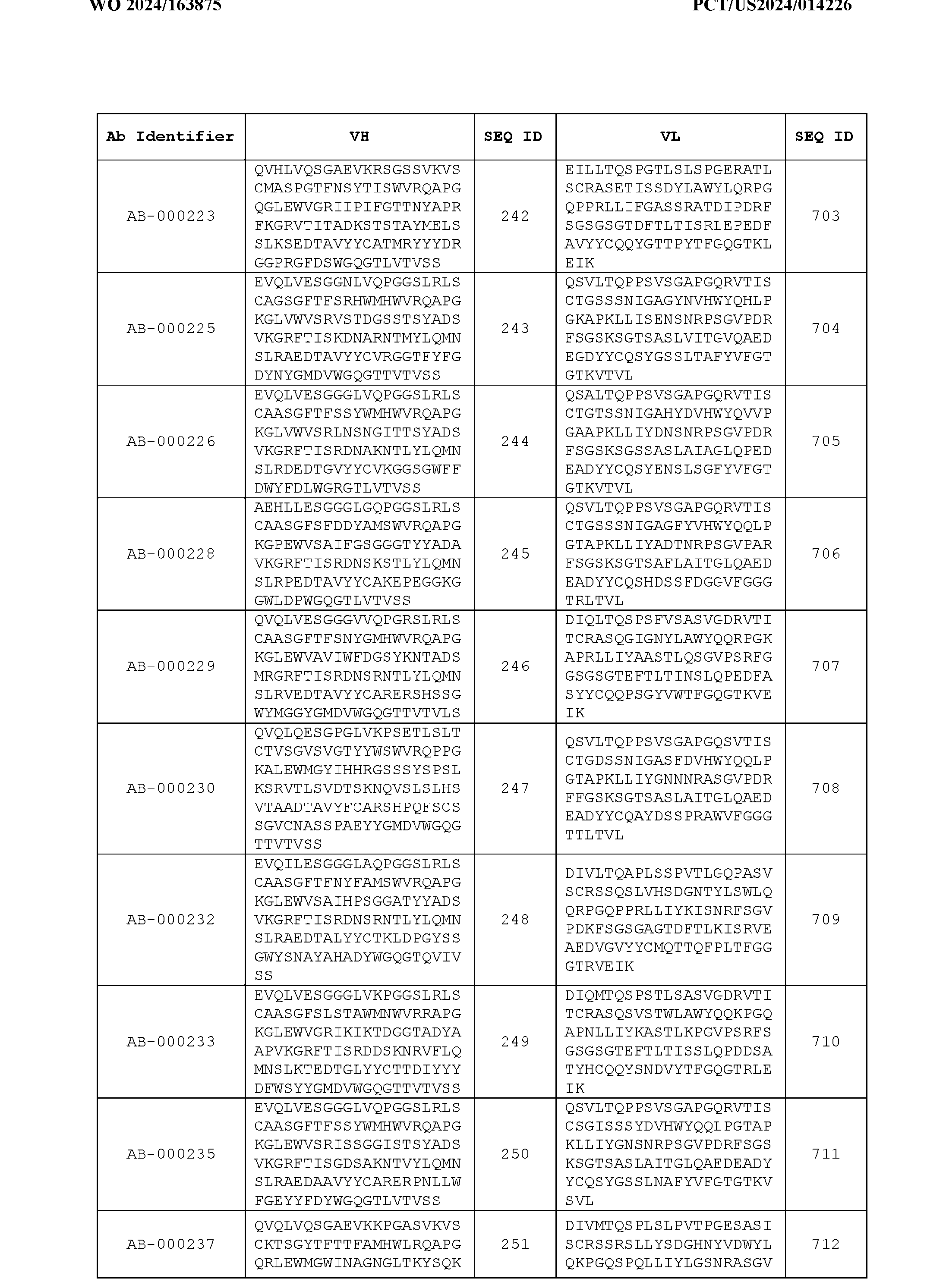
ANTI-CSP ANTIBODY VARIANTS
CROSS REFERENCE TO RELATED APPLICATIONS
[0001] This application claims priority to U.S. Provisional Application No. 63/483,052, filed on February- 3, 2023, and U.S. Provisional Application No. 63/542,164, filed on October 3, 2023. The entire content of said provisional applications is herein incorporated by reference for all purposes.
FIELD
[0002] The present disclosure relates to compositions for treating or preventing malaria, and to antibodies conferring protection against infection by malarial parasites such as Plasmodium falciparum by insect vector transmission. The present disclosure also relates to methods for treating, preventing, or diagnosing Plasmodium infection in a mammal.
BACKGROUND
[0003] Malaria causes a large burden of morbidity and mortality, especially in the developing world. The causative agent of malaria is a protozoal parasite, which is transmitted by mosquitoes. Several infectious Plasmodium species cause malaria, the deadliest of which is Plasmodium falciparum. Others include P. vivax. P. ovale, and P. malariae. Over 80% of malaria- attributable deaths are in children under five. The most advanced vaccine, and the only one recommended for use by the WHO, RTS,S/AS01 (Mosquirix™), targets the circumsporozoite protein (CSP) of Plasmodium falciparum (Pf), the malaria species primarily responsible for mortality in Africa. Three immunizations with RTS,S/AS01 induce anti-PfCSP antibodies that act by binding to sporozoites, the infective form of the malaria parasite introduced by mosquito bite, and inhibiting their initial infection of liver cells. However, the immune response induced by Mosquirix™ in children is limited to 45% vaccine efficacy against clinical malaria after the first dose, waning to 36% over 4 years of follow-up. Thus, other immunization approaches will be needed to achieve the WHO's goal of reducing the malaria case incidence and mortality- rates by 90% by 2030.
[0004] Recent reports show that treatment with mAbs can completely prevent malaria after controlled infection and provide 88% efficacy for 6 months (prevention of infection) in an endemic region. Thus. mAbs with durability lasting 4-6 months could provide an intervention with greater protective efficacy than seen with RTS,S, significantly aiding efforts to prevent seasonal transmission. The mAbs tested in clinical trials, L911 and CIS438,9, were isolated from B cells of
1 vaccinees immunized with whole sporozoites, and can prevent malaria infection by targeting specific epitopes on CSP. Given the published support for prophylaxis with mAbs as a strategy against malaria, and the productive advancement of mAbs as therapeutics and prophylactics against infectious diseases in general, the need exists to generate additional protective anti-CSP antibodies with improved therapeutic profiles. SUMMARY [0005] The present disclosure provides anti-circumsporozoite (CSP) antibodies, compositions comprising such antibodies. Also disclosed are methods of producing the disclosed antibodies and methods of treating or preventing malaria using the same. Also disclosed are methods of selecting an antibody as an anti-malaria therapeutic antibody. [0006] In certain non-limiting embodiments, the present disclosure provides recombinant anti-circumsporozoite (CSP) antibodies that bind to a first epitope present in the central repeat region of CSP and bind to a second epitope of CSP. In certain embodiments, the first epitope includes the amino acid sequence NPNA. In certain embodiments, the first epitope consists of the amino acid sequence selected from SEQ ID NOs: 923-974. [0007] In certain embodiments, the second epitope is heterologous to epitopes present in the RTS,S vaccine. In certain embodiments, the second epitope includes a minor repeat region of CSP and/or a junctional region of CSP. In certain embodiments, the second epitope includes a DPNA/NPNV-containing minor-repeat amino acid sequence and/or a DPNA/NPNV-containing junctional amino acid sequence. In certain embodiments, the second epitope consists of the amino acid sequence selected from SEQ ID NOs: 975-1195. [0008] In certain embodiments, the antibody binds to at least one additional epitope of CSP. In certain embodiments, the at least one additional epitope comprises a DPNA/NPNV- containing minor-repeat amino acid sequence and/or a DPNA/NPNV-containing junctional amino acid sequence. In certain embodiments, the at least one additional epitope consists of an amino acid sequence selected from the group consisting of SEQ ID NOs: 975-1195. [0009] In certain embodiments, the recombinant antibody includes a heavy chain variable region (VH) including an amino acid sequence that is at least about 80% identical to the amino acid sequence selected from SEQ ID NOs: 1-461. In certain embodiments, the recombinant antibody includes a VH including an amino acid sequence selected from the group consisting of SEQ ID NOs: 1-461. [0010] In certain embodiments, the recombinant antibody includes a light chain variable region (VL) including an amino acid sequence that is at least about 80% identical to an amino acid Active 105508124.2 2
sequence selected from the group consisting of SEQ ID NOs: 462-922. In certain embodiments, the recombinant antibody includes a VL including an amino acid sequence selected from the group consisting of SEQ ID NOs: 462-922. [0011] In certain embodiments, the recombinant antibody includes VH including an amino acid sequence that is at least about 80% identical to an amino acid sequence selected from the group consisting of SEQ ID NOs: 1-461, and a VL including an amino acid sequence that is at least about 80% identical to an amino acid sequence selected from the group consisting of SEQ ID NOs: 462-922. In certain embodiments, the recombinant antibody includes a VH including an amino acid sequence selected from the group consisting of SEQ ID NOs: 1-461, and a VL including the amino acid sequence selected from SEQ ID NOs: 462-922. [0012] In certain embodiments, the recombinant antibody includes a heavy chain variable region (VH) and a light chain variable region (VH), wherein the heavy chain variable region includes a CDR1, a CDR2, and a CDR3 of the heavy chain variable sequence set forth in SEQ ID NOs: 1-461, and the light chain variable region includes a CDR1, a CDR2, and a CDR3 of the light chain variable sequence set forth in SEQ ID NOs: 462-922. In certain embodiments, the recombinant antibody includes a heavy chain variable region (VH) and a light chain variable region (VH) set forth in Table 3. [0013] In certain embodiments, the antibody exhibits at least 20% reduction in parasite liver load as compared to a reference antibody. In certain embodiments, the antibody exhibits at least 20% increase in survival rate as compared to a reference antibody. In certain embodiments, the antibody exhibits increased conformational stability as compared to a reference antibody. In certain embodiments, the antibody exhibits increased colloidal stability as compared to a reference antibody. In certain embodiments, the reference antibody is AB-000317, AB-000224, or AB- 007088. [0014] In certain non-limiting embodiments, the present disclosure relates to a polynucleotide encoding a presently disclosed antibody. In certain non-limiting embodiments, the present disclosure relates to an expression vector and/or a host cell including the polynucleotides disclosed herein. [0015] In certain non-limiting embodiments, the present disclosure also relates to compositions including the antibodies disclosed herein. In certain embodiments, the compositions further include a pharmaceutically acceptable carrier. [0016] In certain non-limiting embodiments, the present disclosure relates to methods of preventing or treating malaria in a subject in need thereof including administering an effective Active 105508124.2 3
amount of the antibodies or the compositions disclosed herein. In certain embodiments, the patient is a pediatric patient. [0017] In certain non-limiting embodiments, the present disclosure relates to methods of selecting an antibody as an anti-malaria therapeutic antibody. In certain embodiments, the methods include: a) analyzing the antibody for binding to a first epitope of the central repeat region of CSP; and b) analyzing the antibody for binding to a second epitope of CSP that is heterologous to epitopes present in the RTS,S vaccine; wherein the antibody is selected if it binds to both the first epitope and the second epitope. In certain embodiments, the methods further comprise: c) analyzing the antibody for binding to at least one additional epitope of CSP that is heterologous to epitopes present in the RTS,S vaccine; wherein the antibody is selected if it binds to the first epitope, the second epitope, and the at least one additional epitope [0018] In certain non-limiting embodiments, the present disclosure relates to methods of selecting an antibody as an anti-malaria therapeutic antibody. In certain embodiments, the methods include selecting the antibody if i) the antibody binds to a first epitope of the central repeat region of CSP, and ii) the antibody binds to a second epitope that is heterologous to epitopes present in the RTS,S vaccine. In certain embodiments, the methods include selecting the antibody if i) the antibody binds to a first epitope of the central repeat region of CSP; ii) the antibody binds to a second epitope that is heterologous to epitopes present in the RTS,S vaccine; and iii) the antibody binds to at least one additional epitope that is heterologous to epitopes present in the RTS,S vaccine. [0019] In certain embodiments, the first epitope includes the amino acid sequence NPNA. In certain embodiments, the first epitope consists of the amino acid sequence selected from SEQ ID NOs: 923-974. In certain embodiments, the second epitope is heterologous to epitopes present in the RTS,S vaccine. In certain embodiments, the second epitope includes a minor repeat region of CSP and/or a junctional region of CSP. In certain embodiments, the second epitope includes a DPNA/NPNV-containing minor-repeat amino acid sequence and/or a DPNA/NPNV-containing junctional amino acid sequence. In certain embodiments, the second epitope consists of the amino acid sequence selected from SEQ ID NOs: 975-1195. In certain embodiments, the first epitope consists of the amino acid sequence selected from SEQ ID NOs: 923-974 and the second epitope consists of the amino acid sequence selected from SEQ ID NOs: 975-1195. [0020] In certain embodiments, the antibody binds to the first epitope with a binding affinity (KD) that is less than about 10-6 M, less than about 10-7 M, less than about 10-8 M, less than about 10-9 M, less than about 10-10 M, less than about 10-11 M, less than about 10-12 M, or less than about 10-13 M. In certain embodiments, the antibody binds to the second epitope with KD that is Active 105508124.2 4
less than about 10-6 M, less than about 10-7 M, less than about 10-8 M, less than about 10-9 M, less than about 10-10 M, less than about 10-11 M, less than about 10-12 M, or less than about 10-13 M. In certain embodiments, the antibody binds to the first epitope with KD that is less than about 10-6 M, less than about 10-7 M, less than about 10-8 M, less than about 10-9 M, less than about 10-10 M, less than about 10-11 M, less than about 10-12 M, or less than about 10-13 M; and to the second epitope with KD that is less than about 10-6 M, less than about 10-7 M, less than about 10-8 M, less than about 10-9 M, less than about 10-10 M, less than about 10-11 M, less than about 10-12 M, or less than about 10-13 M. [0021] In certain embodiments, a) the first epitope consists of the amino acid sequence selected from SEQ ID NOs: 923-974; b) the second epitope consists of the amino acid sequence selected from SEQ ID NOs: 975-1195; and c) the at least one additional epitope consists of the amino acid sequence selected from SEQ ID NOs: 975-1195. [0022] In certain embodiments, the antibody binds to the at least one additional epitope with KD that is less than about 10-6 M, less than about 10-7 M, less than about 10-8 M, less than about 10-9 M, less than about 10-10 M, less than about 10-11 M, less than about 10-12 M, or less than about 10-13 M. In certain embodiments, the antibody binds a) to the first epitope with KD that is less than about 10-6 M, less than about 10-7 M, less than about 10-8 M, less than about 10-9 M, less than about 10-10 M, less than about 10-11 M, less than about 10-12 M, or less than about 10-13 M; b) to the second epitope with KD that is less than about 10-6 M, less than about 10-7 M, less than about 10-8 M, less than about 10-9 M, less than about 10-10 M, less than about 10-11 M, less than about 10- 12 M, or less than about 10-13 M; and c) to the at least one additional epitope with KD that is less than about 10-6 M, less than about 10-7 M, less than about 10-8 M, less than about 10-9 M, less than about 10-10 M, less than about 10-11 M, less than about 10-12 M, or less than about 10-13 M. BRIEF DESCRIPTION OF THE DRAWINGS [0023] Figures 1A-1G show that functional antibodies bind CSP-derived peptides not present in the RTS,S vaccine. Figure 1A shows percent inhibition in the sporozoite liver burden mouse model and number of nucleotide mutations from germline are shown for mAbs reactive to NANP6 repeat-region peptide (circles, n = 67) or to the C-terminal region peptide (squares, n = 10) and are indicated as originating from vaccinees who were protected (green) or unprotected (blue) and who received the standard (012M, closed symbols) or the fractional (Fx017M, open symbols) dose. Figure 1B shows SPR-determined binding potencies (KD) of antibodies (n = 141) selected from 35 of the most efficacious lineages tested against CSP and a panel of CSP-derived peptides that are homologous (NANP6, NPNA3) or heterologous (NVDP3NANP2, Active 105508124.2 5
NPDPNANPNVDPNANP, Junction) to RTS,S. Examples are shown of an antibody with a broadly promiscuous binding profile (green, AB-007163), an antibody with a profile relatively biased to homologous peptides (purple, AB-007143), and one with a profile in between these extremes (blue, AB-007175). Figures 1C-1G show linear regression comparing the number of nucleotide mutations from germline (SHM) per heavy chain versus log-transformed SPR binding off-rate (koff) against peptides, with Figure 1C showing short, major repeat (NPNA3, n=140), Figure 1D showing junctional (KQPADGNPDPNANPN, n = 68), Figure 1E showing short, minor repeat (NPDPNANPNVDPNANP, n =109), , Figure 1F showing long, major repeat (NANP6, n = 141), and, Figure 1G showing long, minor repeat (NVDP3NANP2, n = 129). For correlations of non-transformed data, P < 0.03 for all comparisons (Spearman test), and P < 0.04 for all comparisons (Pearson test) except P > 0.5 for NVDP3NANP2. [0024] Figures 2A-2M show in vivo pharmacology, SHM, and binding of anti-CSP antibodies. Figures 2A-2C show data from a liver burden model with Figure 2A showing percent inhibition of n = 69 antibodies (32 lineages) compared to AB-000317 with colors other than grey indicating the six lineages that contain the most efficacious antibodies (*P > 0.05, †P < 0.05, two- sided, non-parametric log-rank), Figures 2B-2C showing data from AB-000224 and AB-000317 of parasite bioluminescence in the liver (total flux, photons/sec) (Figure 2B), *P < 0.035, and serum concentrations (Serum[Ab], μg/ml) of antibody at time of sporozoite challenge (Figure 2C), lines and bars indicate geometric mean and geometric standard deviation, P > 0.2 (“ns”), two-tailed Mann–Whitney test. Figures 2D-2I show percent liver burden inhibitory activity normalized to the activity of AB-000317 with each antibody indicated as having activity significantly better (dark blue triangle), not different (green circles), or weaker (light blue triangles) than AB-000317 (two- sided, non-parametric log-rank) versus Figures 2D-2G showing binding off-rate (SPR, koff) against, CSP (n = 70) (Figure 2D), major repeat (NPNA3, n = 70) (Figure 2E), junctional (KQPADGNPDPNANPN, n = 42) (Figure 2F), and minor repeat (NPDPNANPNVDPNANP, n = 60) (Figure 2G) peptides, and versus, Figures 2H-2I showing the number of amino acid residue changes from SHM for each antibody (n = 70), heavy (Figure 2H) and light chains (Figure 2I), linear regression of log-transformed data is shown. For correlations of non-transformed data, P < 0.005 for all comparisons (Pearson test), and P < 0.05 for all comparisons (Spearman test) except P > 0.06 for liver burden inhibition versus koff [NPDPNANPNVDPNANP]. Figure 2J shows SPR binding off- (k) versus on-rates (kon) against NPNA3 peptide of antibodies with high SHM (green, ≥20 mutations per clone, n = 56) or low SHM (blue, <20 mutations per clone, n = 14) and with activity weaker (down triangles), no different (circles), or better (up triangle) than AB-000317 (two-sided, non-parametric log-rank). Monoclonal antibodies from a lineage reported to bind CSP Active 105508124.2 6
with Fab–Fab homotypic interactions indicated (red circles, AB-00039942 AB-007159, AB- 007160, AB-007161). Figure 2K shows hazard ratios of n = 25 antibodies (14 lineages) compared to AB-000317 in the mosquito-bite parasitemia model with colors other than grey indicating the five lineages that contain the most efficacious antibodies, and, Figures 2L-2M show survival curves from repeat experiments in comparison to AB-000317 of AB-000224 [0.74 (0.15, 3.8)] (Figure 2L) and AB-007088 [0.61 (0.097, 3.8)] (Figure 2M), two-sided, non-parametric log-rank [Mantel– Haenszel hazard ratio (95% confidence intervals)]. [0025] Figures 3A-3H illustrate CSP-reactive lineages from blood PBs after the third dose of RTS,S. Figures 3A and 3B show IgG lineages for each vaccinee (bars, n = 45) that are clonally expanded (i.e. have ≥2 distinct nucleotide clones; green), that are cellularly expanded but with only one IgG clone observed (i.e. have ≥2 identical nucleotide clones; grey), or that lack evidence of recent expansion and contain only one observed PB (blue) are shown by, Figure 3A, number of lineages or, Figure 3B, number of PBs per vaccinee. Figure 3C shows, by vaccinee, the size of each expanded lineage was calculated by dividing the number of PBs in that lineage by the number of PBs in all expanded lineages within each repertoire and then assigning a rank-size. Boxes indicate interquartile ranges, lines within boxes are medians, and whiskers represent minimum and maximum across vaccinees for each rank-size, with the top four rank-size lineages containing 33% of PBs in all expanded lineages (dotted line). Figures 3D-3G, ELISA reactivity, SHM levels and vaccinee protection status of mAbs from expanded lineages (n = 349). Figure 3D shows number of nucleotide mutations from germline (SHM) for mAbs that are not reactive (dark blue, n = 185), show indeterminant, weak signal (orange, n = 29), or are reactive (light green, n = 135) in a CSP ELISA. Domain specificity for CSP-reactive mAbs is shown in the light green box. Monoclonal antibodies reactive by ELISA to NANP6 repeat-region peptide (light green, n = 98), to the C- terminal region peptide (Pfs16, light blue, n = 20), or that are not reactive in either peptide ELISA (light green, n = 9), lines are medians, ***P < 0.0001, **P < 0.001, unpaired two-tailed Mann– Whitney test. CSP-reactive mAbs that were not tested in peptide ELISAs (n = 8) are not shown. Figures 3E-3G show percent of tested antibodies from expanded lineages that originate from protected (green, n = 36) and not protected (blue, n = 9) vaccinees that are, CSP-reactive (82/249 and 53/100 mAbs, respectively; Figure 3E), repeat-region, NANP6 peptide-reactive (59/244 and 39/97 mAbs, respectively; Figure 3F), and, the subset from just the dominant rank-size 1–4 lineages that are CSP-reactive (52/142 and 31/46 mAbs, respectively; Figure 3G), **P < 0.001, *P < 0.01, Fisher’s exact test. In Figure 3H, for vaccinees shown on the x-axis, each symbol indicates a single lineage. The lineages (n = 369) from which a clone was selected for testing are indicated by CSP reactivity: CSP-reactive (green dots, n = 139), indeterminant (orange dots, n = Active 105508124.2 7
29), or not reactive (blue triangles, n = 201). All lineages that were not tested are shown (grey circles, n = 13,134; 2,313 expanded and 10,821 single-PB lineages). Protected vaccinees have a lower ratio of CSP-reactive versus non-reactive lineages than not protected vaccinees (bootstrap analysis, P = 0.0011). Red circles indicate the two lineages that contain the amino acid sequence of AB-000317. [0026] Figure 4 shows histogram of the number of nucleotide mutations from germline (SHM) of combined IgG heavy and light chains from blood PBs collected 7 days after administration of the third dose (blue, n = 22,319) or fourth dose (grey, n = 10,429) of RTS,S. [0027] Figures 5A-5I show IgG sequence and repertoire features of the PB response after the third dose of RTS,S. Figures 5A-5C show germline V-gene usage compared between protected (green, n = 36) and not protected (blue, n = 9) subjects and across dose groups (standard dose group, “012M”, n = 15; fractional dose group, “Fx017M”, n = 30) for heavy (Figure 5A) and light (Figure 5B) chains, with IGHV3-30, IGHV3-33, KV1-5, KV3-20, and LV1-40 showing high prevalence. Figure 5C shows specific pairings of heavy and light chain genes. Figure 5D shows three heavy chain germline genes, IGHV3-73, IGHV4-61, and IGHV5-51, were initially associated with vaccinees’ protection status (P < 0.05, Wilcoxon Rank Sum test) but were not associated after correcting for multiple hypothesis testing. All were P > 0.05, Benjamini–Hochberg or Bonferroni tests. No significant associations were detected between vaccinees’ protection status and dose groups for, Figures 5E-5F, IgG heavy and light chain constant region subclass (P > 0.05 for all analyses, Wilcoxon Rank Sum test), Figure 5G, repertoire clonality for analyses that included the lineages that contain only one PB (Normalized Shannon entropy, P > 0.05 for all analyses, Wilcoxon rank sum test or Kolmogorov–Smirnov test), and length of the heavy (Figure 5H) or light (Figure 5I) chain complementarity determining region 3 (CDR3, P > 0.05 for both, Wilcoxon Rank Sum test). Boxes indicate interquartile ranges, lines within boxes are medians, whiskers represent farthest data points within 1.5 x the interquartile range, and points outside whiskers are plotted individually as outliers. [0028] Figures 6A-6C show antibody lineages tested in binding assays and reactivity to CSP or HBsAg. Rank-size of expanded lineages in each protected and not protected vaccinee repertoire from PBs collected 7 days after the third dose of RTS,S. Figure 6A shows expanded PB antibody lineages (circles representing ≥1 lineages) for each rank-size and vaccinee from which a mAb was selected, recombinantly expressed and screened (n = 349 mAbs, 282 circles) in the CSP ELISA. Circle sizes are proportional to the fraction of lineages tested among all lineages observed at each rank-size and vaccinee. Lineages from a vaccinee that have the same number of PBs have the same rank-size. The largest circles indicate all lineages from the vaccinee at that rank-size were Active 105508124.2 8
tested. The smallest circle indicates only one 1 of the 58 lineages observed from the vaccinee at that rank-size was tested. In some cases, none of the lineages from a vaccinee at an indicated rank- size were tested (grey bars). Figures 6B and 6C show expanded PB antibody lineages (circles representing 1–5 lineages) for each rank-size and vaccinee from which a mAb was tested in, Figure 6B, a CSP ELISA, reactive (green, n = 135 mAbs, 94 circles), indeterminant (grey, n = 29 mAbs, 14 circles), not reactive (blue, n = 185 mAbs, 144 circles), or a combination of these outcomes for different mAbs from lineages of same rank-size and vaccinee (pie charts of mixed colors, 30 circles), and tested in, Figure 6C, an HBsAg ELISA, reactive (green, n = 38 mAbs, 36 circles), indeterminant (grey, n = 3 mAbs, three circles), not reactive (blue, n = 77 mAbs, 72 circles), or a combination of these outcomes for different mAbs from lineages of same rank-size and vaccinee (pie charts of mixed colors, two circles). [0029] Figures 7A and 7B show SHM and CSP-peptide binding of mAbs versus RTS,S dose group and vaccinee protection status. Distribution of SHM levels for mAbs from expanded lineages of vaccinees, Figure 7A, administered a third standard dose (012M, dark blue, n = 15) or a delayed fractional dose (Fx017M, orange, n = 30) of RTS,S with mAbs shown reactive to CSP repeat region (NANP6, n = 45 and n = 53, respectively), to the CSP C-terminal region (C-terminal, n = 4 and n = 16, respectively), or neither peptide (negative, n = 5 and n = 4, respectively) in comparison to mAbs not reactive in the CSP ELISA (n = 72 and n = 113, respectively), and, Figure 7B, from vaccinees that were protected (green, n = 36) or not protected (light blue, n = 9) with mAbs shown reactive to CSP repeat region (n = 59 and n = 39, respectively)], to the CSP C-terminal region (n = 12 and n = 8, respectively), or neither peptide (negative, n = 6 and n = 3, respectively) in comparison to mAbs not reactive in CSP ELISA (n = 147 and n = 38, respectively), lines are medians, ***P < 0.0001, **P < 0.001, *P < 0.02, or P > 0.1 (“ns”), unpaired two-tailed Mann–Whitney test. DETAILED DESCRIPTION Definitions [0030] For purposes of interpreting this specification, the following definitions will apply and whenever appropriate, terms used in the singular will also include the plural and vice versa. In the event that any definition set forth below conflicts with any document incorporated herein by reference, the definition set forth below shall control. [0031] Unless defined otherwise, technical and scientific terms used herein have the same meaning as commonly understood by one of ordinary skill in the art to which this invention belongs. Singleton et al., Dictionary of Microbiology and Molecular Biology 2nd ed., J. Wiley & Active 105508124.2 9
Sons (New York, N.Y. 1994), and March, Advanced Organic Chemistry Reactions, Mechanisms and Structure 4th ed., John Wiley & Sons (New York, N.Y. 1992), provide one skilled in the art with a general guide to many of the terms used in the present application. [0032] As used in this specification and the appended claims, the singular forms “a,” “an” and “the” include plural referents unless the context dictates otherwise. Thus, for example, reference to “a protein” or an “antibody” includes a plurality of proteins or antibodies, respectively; reference to “a cell” includes mixtures of cells and the like. [0033] As used herein, the term “about” or “approximately” refers to the usual error range for the respective value readily known to the skilled person in this technical field, for example, ± 20%, ± 10%, or ± 5%, are within the intended meaning of the recited value. [0034] As used herein, the term "antibody" means an isolated or recombinant binding agent that comprises the necessary variable region sequences to specifically bind an antigenic epitope. Therefore, an "antibody" as used herein is any form of antibody or fragment thereof that exhibits the desired biological activity, e.g., binding the specific target antigen. Thus, it is used in the broadest sense and specifically covers monoclonal antibodies (including full-length monoclonal antibodies), human antibodies, chimeric antibodies, nanobodies, diabodies, multispecific antibodies (e.g., bispecific antibodies), and antibody fragments including but not limited to scFv, Fab, and the like so long as they exhibit the desired biological activity. [0035] "Antibody fragments" comprise a portion of an intact antibody, for example, the antigen-binding or variable region of the intact antibody. Examples of antibody fragments include Fab, Fab', F(ab')2, and Fv fragments; diabodies; linear antibodies (e.g., Zapata et al., Protein Eng. 8(10): 1057-1062 (1995)); single-chain antibody molecules (e.g., scFv); and multispecific antibodies formed from antibody fragments. Papain digestion of antibodies produces two identical antigen-binding fragments, called "Fab" fragments, each with a single antigen-binding site, and a residual "Fc" fragment, a designation reflecting the ability to crystallize readily. Pepsin treatment yields an F(ab')2 fragment that has two antigen combining sites and is still capable of cross-linking antigen. [0036] As used herein, the terms, "anti-CSP antibody" and "CSP antibody" are used synonymously and refer to an antibody that binds to Plasmodium falciparum circumsporozoite (CSP) antigen. [0037] An "antibody that binds to the same epitope" as a reference antibody refers to an antibody that blocks binding of the reference antibody to its antigen in a competition assay by 50% or more, and conversely, the reference antibody blocks binding of the antibody to its antigen in a competition assay by 50% or more. Active 105508124.2 10
[0038] As used herein, "V-region" refers to an antibody variable region domain comprising the segments of Framework 1, CDR1, Framework 2, CDR2, Framework 3, CDR3, and Framework 4. The heavy chain V-region, VH, is a consequence of rearrangement of a V-gene (HV), a D-gene (HD), and a J-gene (HJ), in what is known as V(D)J recombination during B-cell differentiation. The light chain V-region, VL, is a consequence of the rearrangement of a V-gene (LV) and a J- gene. [0039] As used herein, "complementarity-determining region (CDR)" refers to the three hypervariable regions (HVRs) in each chain that interrupt the four "framework" regions established by the light and heavy chain variable regions. The CDRs are the primary contributors to binding to an epitope of an antigen. The CDRs of each chain are referred to as CDR1, CDR2, and CDR3 numbered sequentially starting from the N-terminus, and are also identified by the chain in which the particular CDR is located. Thus, a VH CDR3 (HCDR3) is located in the variable domain of the heavy chain of the antibody in which it is found, whereas a VL CDR3 (LCDR3) is the CDR3 from the variable domain of the light chain of the antibody in which it is found. The term "CDR" is used interchangeably with "HVR" when referring to CDR sequences. [0040] The amino acid sequences of the CDRs and framework regions can be determined using various definitions in the art, e.g., Kabat, Chothia, international ImMunoGeneTics database (IMGT), and AbM (see, e.g., Chothia & Lesk, 1987, Canonical structures for the hypervariable regions of immunoglobulins. J. Mol. Biol. 196, 901-917; Chothia C. et al., 1989, Conformations of immunoglobulin hypervariable regions. Nature 342, 877-883; Chothia C. et al., 1992, Structural repertoire of the human VH segments J. Mol. Biol. 227, 799¬817; Al-Lazikani et al., J.Mol.Biol 1997, 273(4)). Definitions of antigen combining sites are also described in the following: Ruiz et al., IMGT, the international ImMunoGeneTics database. Nucleic Acids Res., 28, 219-221 (2000); and Lefranc,M.-P. IMGT, the international ImMunoGeneTics database. Nucleic Acids Res. Jan 1;29(1):207-9 (2001); MacCallum et al, Antibody-antigen interactions: Contact analysis and binding site topography, J. Mol. Biol., 262 (5), 732-745 (1996); and Martin et al, Proc. Natl Acad. Sci. USA, 86, 9268-9272 (1989); Martin, et al, Methods Enzymol., 203, 121-153, (1991); Pedersen et al, Immunomethods, 1, 126, (1992); and Rees et al, In Sternberg M.J.E. (ed.), Protein Structure Prediction. Oxford University Press, Oxford, 141-1721996). Reference to CDRs as determined by Kabat numbering is based, for example, on Kabat et al., Sequences of Proteins of Immunological Interest, 5th Ed. Public Health Service, National Institute of Health, Bethesda, MD (1991)). Chothia CDRs are determined as defined by Chothia (see, e.g., Chothia and Lesk J. Mol. Biol. 196:901-917 (1987)). The CDRs can also be determined using available in silico systems as Active 105508124.2 11
described in Swindells et al., Journal of molecular biology 429.3 (2017): 356-364, the content of which is incorporated by reference in its entirety. [0041] An "Fc region" refers to the constant region of an antibody excluding the first constant region immunoglobulin domain. Thus, Fc refers to the last two constant region immunoglobulin domains of IgA, IgD, and IgG, and the last three constant region immunoglobulin domains of IgE and IgM, and the flexible hinge N-terminal to these domains. For IgA and IgM Fc may include the J chain. For IgG, Fc comprises immunoglobulin domains Cy2 and Cy3 and the hinge between Cyl and Cy. It is understood in the art that the boundaries of the Fc region may vary, however, the human IgG heavy chain Fc region is usually defined to comprise residues C226 or P230 to its carboxyl-terminus, using the numbering according to the EU index as in Kabat et al. (1991, NIH Publication 91-3242, National Technical Information Service, Springfield, Va.). The term "Fc region" may refer to this region in isolation or this region in the context of an antibody or antibody fragment. "Fc region" includes naturally occurring allelic variants of the Fc region as well as modifications that modulate effector function. Fc regions also include variants that don't result in alterations to biological function. For example, one or more amino acids can be deleted from the N-terminus or C-terminus of the Fc region of an immunoglobulin without substantial loss of biological function. Such variants can be selected according to general rules known in the art to have minimal effect on activity (see, e.g., Bowie, et al., Science 247:306-1310, 1990). For example, for IgG4 antibodies, a single amino acid substitution (S228P according to Kabat numbering; designated IgG4Pro) may be introduced to abolish the heterogeneity observed in recombinant IgG4 antibodies (see, e.g., Angal, et al., Mol Immunol 30:105-108, 1993). In certain embodiments, the Fc region includes substitutions that improve pharmacokinetics properties of an antibody, e.g., increased serum half-life. Non-limiting examples of substitutions of the Fc region can be found in U.S. Patent No.8,088,376, the content of which is incorporated by reference in its entirety. [0042] The term "equilibrium dissociation constant" abbreviated (KD), refers to the dissociation rate constant (kd, time-1) divided by the association rate constant (ka, time-1 M-1). Equilibrium dissociation constants can be measured using any method. Thus, in certain embodiments, the antibodies of the present disclosure have a KD of less than about 50 nM, typically less than about 25 nM, or less than 10 nM, e.g., less than about 5 nM, or than about 1 nM and often less than about 10 nM as determined by surface plasmon resonance analysis using a biosensor system such as a Biacore® system performed at 37°C. In certain embodiments, an antibody of the present disclosure has a KD of less than 5 x 10⁻⁵M, less than 10-5M, less than 5 x 10⁻⁶M, less than 10-6M, less than 5 x 10⁻⁷M, less than 10-7M, less than 5 x 10⁻⁸M, less than 10-8 M, Active 105508124.2 12
less than 5 x 10⁻⁹M, less than 10-9M, less than 5 x10⁻¹⁰M, less than 10-10M, less than 5 x 10-11M, less than 10-11M, less than 5 x 10-12M, less than 10-12M, less than 5 x 10-13M, less than 10-13M, less than 5 x 10-14M, less than 10-14M, less than 5 x 10-15M, or less than 10-15M or lower as measured as a bivalent antibody. As used herein, an "improved" KD refers to a lower KD. In certain embodiments, an antibody of the present disclosure has a KD of less than 5 x 10⁻⁵M, less than 10- 5M, less than 5 x 10⁻⁶M, less than 10-6M, less than 5 x 10⁻⁷M, less than 10-7M, less than 5 x 10⁻⁸M, less than 10-8 M, less than 5 x 10⁻⁹M, less than 10-9M, less than 5 x10⁻¹⁰M, less than 10-10M, less than 5 x 10-11M, less than 10-11M, less than 5 x 10-12M, less than 10-12M, less than 5 x 10-13M, less than 10-13M, less than 5 x 10-14M, less than 10-14M, less than 5 x 10-15M, or less than 10-15M or lower as measured as a monovalent antibody, such as a monovalent Fab. In certain embodiments, an anti-CSP antibody of the present disclosure has KD less than 100 pM, e.g., or less than 75 pM, e.g., in the range of 1 to 100 pM, when measured by surface plasmon resonance analysis using a biosensor system such as a Biacore® system performed at 37°C. In certain embodiments, an anti- CSP antibody of the present disclosure has KD of greater than 100 pM, e.g., in the range of 100- 1000 pM or 200-1000 pM when measured by surface plasmon resonance analysis using a biosensor system such as a Biacore® system performed at 37°C. [0043] The term "monovalent molecule" as used herein refers to a molecule that has one antigen-binding site, e.g., a Fab or scFv. [0044] The term "bivalent molecule" as used herein refers to a molecule that has two antigen-binding sites. In certain embodiments, a bivalent molecule of the present invention is a bivalent antibody or a bivalent fragment thereof. In certain embodiments, a bivalent molecule of the present invention is a bivalent antibody. In certain embodiments, a bivalent molecule of the present invention is an IgG. In certain embodiments, monoclonal antibodies have a bivalent basic structure. IgG and IgE have only one bivalent unit, while IgA and IgM consist of multiple bivalent units (2 and 5, respectively) and thus have higher valencies. This bivalency increases the avidity of antibodies for antigens. [0045] The terms "monovalent binding" or "monovalently binds to" as used herein refer to the binding of one antigen-binding site to its antigen. [0046] The terms "bivalent binding" or "bivalently binds to" as used herein refer to the binding of both antigen-binding sites of a bivalent molecule to its antigen. In certain embodiments, both antigen-binding sites of a bivalent molecule share the same antigen specificity. [0047] The term "valency" as used herein refers to the number of different binding sites of an antibody for an antigen. A monovalent antibody includes one binding site for an antigen. A bivalent antibody (e.g., a bivalent IgG antibody) includes two binding sites for the same antigen. Active 105508124.2 13
[0048] The term "affinity" as used herein refers to either the single or combined strength of one or both arms of an antibody (e.g., an IgG antibody) binding to either a simple or complex antigen-expressing one or more epitopes. As defined here, the term "affinity" does not imply a specific number of valencies between the two binding partners. [0049] The phrase "specifically (or selectively) binds" to an antigen or target or "specifically (or selectively) immunoreactive with," when referring to a protein or peptide, refers to a binding reaction whereby the antibody binds to the antigen or target of interest with an affinity that can be distinguished from non-specific interactions occurring between two proteins. [0050] The terms "identical" or percent "identity," in the context of two or more polypeptide sequences, refer to two or more sequences or subsequences that are the same or have a specified percentage of amino acid residues that are the same (e.g., at least 70%, at least 75%, at least 80%, 85%, 90%, 91%, 92%, 93%, 94%, 95%, 96%, 97%, 98%, 99%, or higher) identity over a specified region, e.g., the length of the two sequences, when compared and aligned for maximum correspondence over a comparison window or designated region. Alignment for purposes of determining percent amino acid sequence identity can be performed in various methods, including, without any limitation, BLAST, BLAST-2, ALIGN, or Megalign (DNASTAR) software. Examples of algorithms that are suitable for determining percent sequence identity and sequence similarity the BLAST 2.0 algorithms, which are described in Altschul et al., Nuc. Acids Res. 25:3389-3402 (1977) and Altschul et al., J. Mol. Biol. 215:403-410 (1990). In certain embodiments, BLAST 2.0 can be used with the default parameters to determine percent sequence identity. [0051] A "substitution," as used herein, denotes the replacement of one or more amino acids or nucleotides by different amino acids or nucleotides, respectively. [0052] A "conservative" substitution as used herein refers to a substitution of an amino acid such that charge, polarity, hydropathy (hydrophobic, neutral, or hydrophilic), and/or size of the side group chain is maintained. Illustrative sets of amino acids that may be substituted for one another include (i) positively-charged amino acids Lys and Arg; and His at pH of about 6; (ii) negatively charged amino acids Glu and Asp; (iii) aromatic amino acids Phe, Tyr and Trp; (iv) nitrogen ring amino acids His and Trp; (v) aliphatic hydrophobic amino acids Ala, Val, Leu and Ile, (vi) hydrophobic sulfur-containing amino acids Met and Cys, which are not as hydrophobic as Val, Leu, and Ile, (vii) small polar uncharged amino acids Ser, Thr, Asp, and Asn (viii) small hydrophobic or neutral amino acids Gly, Ala, and Pro; (ix) amide-comprising amino acids Asn and Gln; and (xi) beta-branched amino acids Thr, Val, and Ile. Reference to the charge of an amino acid refers to the charge at pH 6-7. Active 105508124.2 14
[0053] As used herein, the terms "nucleic acid" and "polynucleotide" are used interchangeably and as used herein refer to both sense and anti-sense strands of RNA, cDNA, genomic DNA, and synthetic forms and mixed polymers of the above. In certain embodiments, a polynucleotide refers to a polyribonucleotide, polydeoxynucleotide or a modified form of either type of nucleotide, and combinations thereof. The terms also include, but are not limited to, single- and double-stranded forms of DNA. In addition, a polynucleotide, e.g., a cDNA or mRNA, may include either or both naturally occurring and modified nucleotides linked together by naturally occurring and/or non-naturally occurring nucleotide linkages. The nucleic acid molecules may be modified chemically or biochemically or may contain non-natural or derivatized nucleotide bases, as will be readily appreciated by those of skill in the art. Such modifications include, for example, labels, methylation, substitutions of one or more of the naturally occurring nucleotides with an analogue, internucleotide modifications such as uncharged linkages (e.g., methyl phosphonates, phosphotriesters, phosphoramidates, carbamates, etc.), charged linkages (e.g., phosphorothioates, phosphorodithioates, etc.), pendent moieties (e.g., polypeptides), intercalators (e.g., acridine, psoralen, etc.), chelators, alkylators, and modified linkages (e.g., alpha anomeric nucleic acids, etc.). The above term is also intended to include any topological conformation, including single- stranded, double-stranded, partially duplexed, triplex, hairpinned, circular, and padlocked conformations. A reference to a nucleic acid sequence encompasses its complement unless otherwise specified. Thus, a reference to a nucleic acid molecule having a particular sequence should be understood to encompass its complementary strand, with its complementary sequence. The term also includes codon-optimized nucleic acids that encode the same polypeptide sequence. [0054] An "isolated" nucleic acid refers to a nucleic acid molecule that has been separated from a component of its natural environment. An isolated nucleic acid includes a nucleic acid molecule contained in cells that ordinarily contain the nucleic acid molecule, but the nucleic acid molecule is present extrachromosomally or at a chromosomal location that is different from its natural chromosomal location. [0055] "Isolated nucleic acid encoding an antibody or fragment thereof” refers to one or more nucleic acid molecules encoding antibody heavy and light chains (or fragments thereof), including such nucleic acid molecule(s) in a single vector or separate vectors, and such nucleic acid molecule(s) present at one or more locations in a host cell. [0056] The term "vector," as used herein, refers to a nucleic acid molecule capable of propagating another nucleic acid to which it is linked. The term includes the vector as a self- replicating nucleic acid structure as well as the vector incorporated into the genome of a host cell into which it has been introduced. A "vector," as used herein, refers to a recombinant construct in Active 105508124.2 15
which a nucleic acid sequence of interest is inserted into the vector. Certain vectors can direct the expression of nucleic acids to which they are operatively linked. Such vectors are referred to herein as "expression vectors". [0057] The terms "host cell," "host cell line," and "host cell culture" are used interchangeably and refer to cells into which exogenous nucleic acid has been introduced, including the progeny of such cells. A host cell can be a recombinant host cell and includes the primary transformed cell and progeny derived therefrom without regard to the number of passages. [0058] A polypeptide "variant," as the term is used herein, is a polypeptide that typically differs from a polypeptide specifically disclosed herein in one or more substitutions, deletions, additions, and/or insertions. In the present invention, a "variant" with reference to the sequences described in the "Anti-CSP Antibody Variants" section refers to an engineered sequence, rather than a naturally occurring sequence. [0059] As used herein, “recombinant antibody” refers to an antibody wherein the exact amino acid sequence of the antibody is not naturally found in a given organism (e.g., an antibody from a mammal). In certain embodiments, this term can refer to an antibody including one or more amino acid residues that are not found in a naturally occurring antibody. In certain embodiments, a recombinant antibody can have a CDR including an amino acid residue that is not found in a naturally occurring antibody (e.g., an antibody from a mammal). In another exemplary embodiment, a recombinant antibody can have a framework (FR) including an amino acid residue that is not found in a naturally occurring antibody (e.g., an antibody from a mammal). In certain embodiments, a recombinant antibody can have a constant region including an amino acid residue that is not found in a naturally occurring antibody (e.g., an antibody from a mammal). [0060] The term "comparable," in the context of describing the strength of binding of two antibodies to the same target, refers to two dissociation constant (KD) values calculated from two binding reactions that are within three (3) fold from each other. In certain embodiments, the ratio between the first KD (the KD of the binding reaction between the first antibody and the target) and the second KD (the KD of the binding reaction between the second antibody and the target) is within the range of 1:3 or 3:1, endpoints exclusive. A lower KD value denotes stronger binding. For example, without any limitation, an antibody variant that has stronger binding as compared to AB-000224 binds to the target with a KD that is at least 1/3 of the KD measured against the same target for AB-000224. Anti-CSP Antibodies [0061] The present disclosure provides anti-CSP antibodies and variants thereof. The malaria antibodies disclosed herein were discovered in antibody repertoires generated by Immune Active 105508124.2 16
Repertoire Capture® (IRC®) technology from plasmablast B cells isolated from two donors enrolled in a Phase 2a study evaluating the efficacy of the RTS,S vaccine in preventing malaria infection. The IRC® technology and its use in antibody discovery is well known and disclosed in, e.g., WO 2012148497A2, the entire content of which is herein incorporated by reference. The RTS,S vaccine is a pseudo-viral particle vaccine that combines the hepatitis B surface antigen and the central repeat and C-terminal regions of the Plasmodium falciparum (P. falciparum) circumsporozoite protein (CSP). RTS,S consists of two polypeptides; RTS is a single polypeptide chain corresponding to amino acids 207 to 395 of P. falciparum (3D7) that is fused to HBsAg and S is a polypeptide of 226 amino acids that corresponds to HBsAg. Stoute, et. al., N Engl J Med; 336:86-91(1997); RTS,S Clinical Trials Partnership, PLoS Med.11(7):e1001685, (2014), WO1993/10152. [0062] CSP comprises three main domains: i) an N-terminus; ii) a central repeat (CR) region composed of multiple (25–40) tetrapeptides of NANP (“major repeat”) interspersed with an NPDP tetrapeptide and 2-4 NVDP (“minor repeat”) tetrapeptides; and iii) a C-terminal domain. The central repeat region of CSP is highly immunogenic, and in all P. falciparum strains with a CSP sequence available, the repeat region is composed of 1 NPDP repeat, 3–5 NVDP repeats, and 35–41 NANP repeats (e.g., a total of 1/4/38 of NPDP/NVDP/NANP motifs are present in the P. falciparum 3D7 strain). The repeat region begins with the junctional NPDP sequence, typically followed by three alternations of NANP and NVDP sequences, and continues with the remaining NANP repeats, with most P. falciparum strains having one NVDP interspersed in the middle of the long NANP repeat region. Pholcharee, T. et al., J. Mol. Bio.432: 1048-1063 (2020). [0063] Analysis of anti-CSP antibodies disclosed herein indicated an inverse relationship between the percentage of CSP-specific IgG-expressing plamablasts and protection in antibodies isolated after third dose of vaccine (P3D). These data suggest that, despite the well-reported association between anti-CSP antibodies and protection, more cells expressing anti-CSP, NANP repeat-binding antibodies may not drive greater protection. This result may indicate that the simple presence of potent, inhibitory antibodies by P3D plamablasts is insufficient for protection. Rather relative levels of such antibodies versus other repeat-binding antibodies may be important in providing consistent protection. [0064] The analysis additionally indicated that antibody sporozoite inhibitory activity in vivo does not correlate with binding kinetics to the long NANP6 peptide (Table 9) but does significantly correlate with koff to CSP and with binding kinetics to both the short NANP- containing peptide (NPNA3) and peptides of minor repeat and junctional region (JR) (Table 9). These data suggest that protective antibodies induced following RTS,S vaccination affinity mature Active 105508124.2 17
to short NANP repeats but also gain or retain promiscuous binding activity to the minor repeat and junctional epitopes which are not present in RTS,S. Consistent with this interpretation, aggregate levels of SHM in both heavy and light chains of protective antibodies are correlated with binding kinetics to NANP-, NVDP, and NPDP-containing short peptides (Figures 1C-1E, Table 9) as well as with inhibitory activity in the sporozoite-challenge model (Figures 2H-2I, Table 9). Thus, affinity maturation and function appear associated with short peptide sequences both included and excluded from RTS,S but not with long NANP-repeat sequences. [0065] Furthermore, the correlation between in vivo activity and binding kinetics with NVDP- and NPDP-containing peptides absent in RTS,S (Figures 2F-G, Table 9), correlation between in vivo activity and binding kinetics to the short NPNA3 but not the longer NANP6 peptide (Figure 2E, Table 9); and the inverse relationship between NANP6-reactivity of expanded antibody lineages and protection against CHMI, are consistent with a hypothesis where multiple NANP repeats act as an immune “decoy” that diverts and dilutes protective immunity. Under this hypothesis, antibody lineages that solely bind to NANP repeat-region epitopes, but provide limited protection, are preferentially expanded, diluting the protective capacity of the broader anti-CSP repertoire. Whereas promiscuous antibodies which also bind to multiple NANP repeats and similarly exist at a high density on CSP, could further enhance antibody on-rates to heterologous epitopes. Thus, avidity afforded by promiscuous binding could drive more protective responses in vivo. [0066] In certain embodiments, an anti-CSP antibody disclosed herein binds to a first epitope present in the central repeat region of CSP and binds to a second epitope of CSP. In certain embodiments, the central repeat region of CSP epitope comprises the amino acid sequence NPNA. Epitopes comprising NPNA include, for example, NPNANP, NANPNA, ANPNAN, NANPNANP, ANPNANPN, NPNANPNA, PNANPNAN, (NPNA)3 or (NPNA)4. [0067] In certain embodiments, an anti-CSP antibody disclosed herein binds, in addition to the epitope comprising NPNA, a second epitope that is heterologous to epitopes present in the RTS,S vaccine, as referred to herein as heterologous epitopes. Heterologous epitopes include epitopes of the minor repeat region of CSP, including epitopes comprising DPNA/NPNV and epitopes of the junctional region of CSP, including epitopes comprising DPNA. Anti-CSP Antibodies and Variants Thereof [0068] In certain embodiments, the present disclosure provides anti-CSP antibody variants of the antibodies isolated from the human subjects. In certain embodiments, the variants exhibit protective effects in vivo, e.g., as shown by a reduction in parasite number in a mouse model of malaria infection. Active 105508124.2 18 [0069] In certain embodiments, the anti-CSP variants disclosed herein maintain the binding specificity, activity and stability and/or manufacturing properties of the parental antibody. In certain embodiments, the anti-CSP variants disclosed herein generated have improved developability, e.g., as identified through various in vitro assays, such as aggregation assessment by HPLC or UPLC, hydrophobic interaction chromatography (HIC), polyspecificity assays (e.g., baculovirus particle binding), self-interaction nanoparticle spectroscopy (SINS), or mass spec analysis after incubation in an accelerated degradation condition such as high temperature, low pH, high pH, or oxidative H2O2. Mutations are successful if the activity is maintained (or enhanced) while removing or reducing the severity of the liability. [0070] Antibody liabilities are further described in Table 1 below: Table 1. Description of potential development liabilities Free cysteine1 Yield, heterogeneity, sequence comprises an High stability, activity odd number of cysteines m m m ; ;
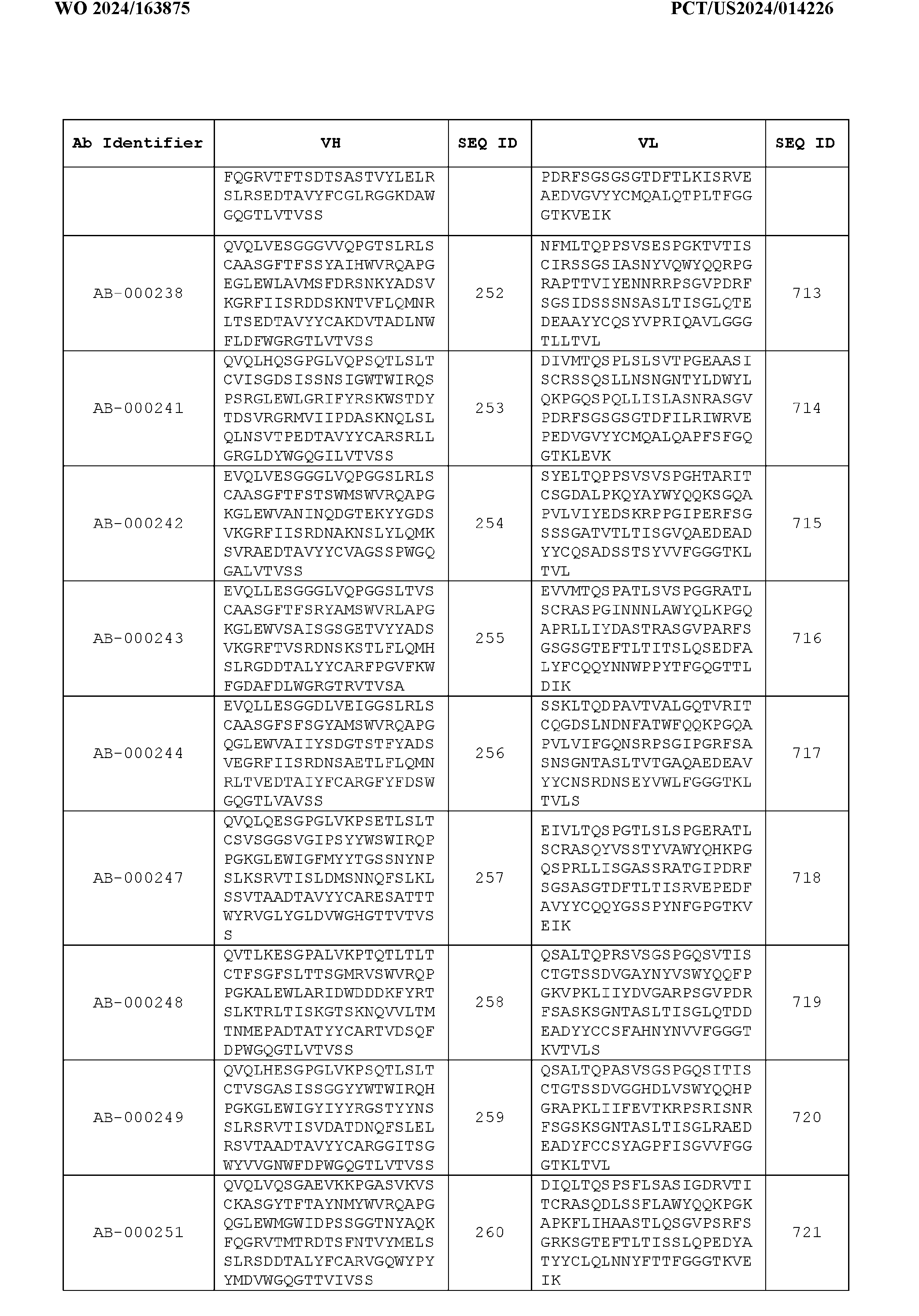
Figure imgf000021_0001
Active 105508124.2 19
1 “Free cysteine" refers to a cysteine that does not form a disulfide bond with another cysteine and thus is left "free" as thiols. The presence of free cysteines in the antibody can be a potential development liability. Typically, an odd net number of cysteines in the protein shows a likelihood there is a free cysteine. 2 The N-linked glycosylation site is N-X-S/T, where X is any residue other than proline. 3 Sharma et al., Proc. Natl. Acad. Sci. USA 111:18601-18606, 2014. 4 This motif consists of a K or R, followed by a K or R. Stated differently, the motif can be KK, KR, RK, or RR. 5 The dipeptide NG poses a medium risk of development liability. The dipeptides NA, NN, NS, and NT pose a low risk of development liability. N may also exhibit low risk of liability for other successor residues, e.g., D, H, or P. Stated differently, dipeptide ND, NH, or NP poses a low risk of development liability. 6 Similarly to the above, the dipeptide DG poses a medium risk of development liability. The dipeptides DA, DD, DS, and DT pose a low risk of development liability. D may also exhibit low risk of development liability for other successor residues, e.g., N, H, or P. [0071] Another goal for engineering variants is to reduce the risk of clinical immunogenicity. For example, reducing the generation of anti-drug antibodies against the therapeutic antibody. In certain embodiments, the anti-CSP antibody variants have reduced immunogenicity as compared to the parental antibody. [0072] The factors that drive clinical immunogenicity can be classified into two groups. First are factors that are intrinsic to the drug, such as sequence, post-translational modifications, aggregates, degradation products, and contaminants. Second are factors related to how the drug is used, such as dose level, dose frequency, route of administration, patient immune status, and patient HLA type. [0073] One approach to engineering a variant to be as much like self as possible is to identify a close germline sequence and mutate as many mismatched positions (also known as "germline deviations") to the germline residue type as possible. This approach applies for germline genes IGHV, IGHJ, IGKV, IGKJ, IGLV, and IGLJ, and accounts for all of the variable heavy (V11) and variable light (VL) regions except for part of H-CDR3. Germline gene IGHD codes for part of the H-CDR3 region but typically exhibits too much variation in how it is recombined with IGHV and IGHJ (e.g., forward or reverse orientation, any of three translation frames, and 5' and 3' modifications and non-templated additions) to present a "self” sequence template from a population perspective. [0074] Each germline gene can present as different alleles in the population. The least immunogenic drug candidate, in terms of minimizing the percent of patients with an immunogenic Active 105508124.2 20 response, would likely be one that matches an allele commonly found in the patient population. Single nucleotide polymorphism (SNP) data from the human genome can be used to approximate the frequency of alleles in the population. [0075] Another approach to engineering a lead for reduced immunogenicity risk is to use in silico predictions of immunogenicity, such as the prediction of T cell epitopes, or use in vitro assays of immunogenicity, such as ex vivo human T cell activation. For example, services such as those offered by Lonza, United Kingdom, are available that employ platforms for prediction of HLA binding and in vitro assessment to further identify potential epitopes. [0076] In certain embodiments, antibody variants are additionally designed to enhance the efficacy of the antibody. Design parameters for this aspect focused on CDRs, e.g., CDR3. Positions to be mutated were identified based on structural analysis of antibody-antigen co-crystals (Oyen et al., Proc. Natl. Acad Sci. USA 114:E10438-E10445, 2017) and based on sequence information of other antibodies from the same lineage as AB-000224 or AB-007088. Approaches to mutation design [0077] Development liabilities can be removed or reduced by one or more mutations. Mutations are designed to preserve antibody structure and function while removing or reducing development liabilities and improving function. In certain embodiments, mutations to chemically similar residues were identified to maintain size, shape, charge, and/or polarity. Non-limiting examples of mutations are described in Table 2 below: Table 2 Free cysteine Odd #C High C(A,S)
Figure imgf000023_0001
ct ve 05508 .
[0078] In certain embodiments, a variant of an anti-CSP antibody disclosed herein comprises modifications compared to parental antibody that provide improved pharmacokinetic properties, increased serum stability, stronger binding, and/or improved in vivo protective effects compared to parent. In certain embodiments, a variant of an anti-CSP antibody disclosed herein exhibits reduced immunogenicity and/or increased manufacturability as compared to the parent. In certain embodiments, a variant of an anti-CSP antibody disclosed herein has at least one modification, e.g., substitution, relative to the parent variable heavy chain or light chain sequence described herein, and has improved developability, e.g., decreased heterogeneity, increased yield, increased stability, improved net charges to improve pharmacokinetics, and/or reduced immunogenicity. In certain embodiments, a VH region or a VL region of such a variant of an anti- CSP antibody disclosed herein has at least two, three, four, five, or six, or more modifications, e.g., substitutions. [0079] In certain embodiments, a variant of an anti-CSP antibody disclosed herein exhibits increased serum half-life as compared to the parental antibody. In certain embodiments, a variant of an anti-CSP antibody disclosed herein has at least one modification, e.g., substitution, relative to the native Fc region of the heavy chain or light chain sequence described herein, and has improved pharmacokinetics properties, e.g., half-life. In certain embodiments, an Fc region of the heavy chain or an Fc region of the light chain of such a variant of an anti-CSP antibody disclosed herein has at least two, three, four, five, or six, or more modifications, e.g., substitutions. In certain embodiments, a variant of an anti-CSP antibody disclosed herein has a total of 1, 2, 3, 4, 5, 6, 7, 8, 9, 10, 11, 12, 13, 14, 15, 16, 17, 18, 19, 20, 21, 22, 23, 24, 25, 26, 27, 28, 29, 30, 31, 32, 33, 34, 35, 36, 37, 38, 39, 40, 41, 42, 43, 44, 45, 46, 47, 48, 49, or 50 modifications, e.g. substitutions, including both heavy and light chains, compared to the parental antibody. In certain non-limiting embodiments, an Fc region of the heavy chain of a variant of an anti-CSP antibody disclosed herein can include an isoleucine at position 250, a tyrosine at position 252, an isoleucine at position 259, a glutamine at position 307, a phenylalanine at position 308, a leucine at position 319, a leucine at position 428, a histidine at position 434, a phenylalanine at position 434, an alanine at position 434, a serine at position 434, a methionine at position 434, or a combination thereof, wherein the numbering is defined by EU index as in Kabat. In certain embodiments, an Fc region of the heavy chain of a variant of an anti-CSP antibody disclosed herein includes a leucine at position 428 and a serine at position 434, wherein the numbering is defined by EU index as in Kabat. Antibodies Sequences and Variants Thereof Active 105508124.2 22
[0080] In certain embodiments, the anti-CSP antibodies disclosed herein comprise a heavy chain variable region and a light variable region. In certain embodiments, the heavy chain variable region comprises an amino acid sequence that is at least about 80%, about 85%, about 90%, about 95%, about 96%, about 97%, about 98%, about 99% identical to the amino acid sequence set forth in SEQ ID Nos. 1-461, as shown in Table 3. In certain embodiments, the light chain variable region comprises an amino acid sequence that is at least about 80%, about 85%, about 90%, about 95%, about 96%, about 97%, about 98%, about 99% identical to the amino acid sequence set forth in SEQ ID Nos.462-922, as shown in Table 3. In certain embodiments, a) the heavy chain variable region comprises an amino acid sequence that is at least about 80%, about 85%, about 90%, about 95%, about 96%, about 97%, about 98%, about 99% identical to the amino acid sequence set forth in SEQ ID Nos. 1-461; and b) the light chain variable region comprises an amino acid sequence that is at least about 80%, about 85%, about 90%, about 95%, about 96%, about 97%, about 98%, about 99% identical to the amino acid sequence set forth in SEQ ID Nos.462-922. [0081] In certain embodiments, the heavy chain variable region comprises the amino acid sequence set forth in SEQ ID Nos.1-461, as shown in Table 3. In certain embodiments, the light chain variable region comprises the amino acid sequence set forth in SEQ ID Nos. 462-922, as shown in Table 3. In certain embodiments, a) the heavy chain variable region comprises the amino acid sequence set forth in SEQ ID Nos.1-461; and b) the light chain variable region comprises the amino acid sequence set forth in SEQ ID Nos.462-922. [0082] In certain embodiments, the heavy chain variable region consists of the amino acid sequence set forth in SEQ ID Nos.1-461, as shown in Table 3. In certain embodiments, the light chain variable region consists of the amino acid sequence set forth in SEQ ID Nos. 462-922, as shown in Table 3. In certain embodiments, a) the heavy chain variable region consists of the amino acid sequence set forth in SEQ ID Nos.1-461; and b) the light chain variable region consists of the amino acid sequence set forth in SEQ ID Nos.462-922. [0083] In certain embodiments, the heavy chain variable region comprises a CDR1, a CDR2, and a CDR3 of the heavy chain variable sequence set forth in SEQ ID NOs: 1-461, as shown in Table 3. In certain embodiments, the light chain variable region comprises a CDR1, a CDR2, and a CDR3 of the light chain variable sequence set forth in SEQ ID NOs: 462-922, as shown in Table 3. In certain embodiments, a) the heavy chain variable region comprises a CDR1, a CDR2, and a CDR3 of the heavy chain variable sequence set forth in SEQ ID NOs: 1-461; and b) the light chain variable region comprises a CDR1, a CDR2, and a CDR3 of the light chain variable sequence set forth in SEQ ID NOs: 462-922. Active 105508124.2 23 [0084] In certain embodiments, the anti-CSP antibodies disclosed herein comprise a heavy chain variable region comprising a CDR1, a CDR2, and a CDR3 and having the amino acid sequence set forth in SEQ ID NOs: 1-461, as shown in Table 3. In certain embodiments, the anti- CSP antibody variant comprises a light chain variable region comprising a CDR1, a CDR2, and a CDR3 and having the amino acid sequence set forth in SEQ ID NOs: 462-922, as shown in Table 3. In certain embodiments, the anti-CSP antibody variant comprises a) a heavy chain variable region comprising a CDR1, a CDR2, and a CDR3 and having the amino acid sequence set forth in SEQ ID NOs: 1-461; and b) a light chain variable region comprising a CDR1, a CDR2, and a CDR3 and having the amino acid sequence set forth in SEQ ID NOs: 462-922. Table 3 is provided below. [0085] In certain embodiments, the anti-CSP antibody variant is designated as indicated in Table 3. For example, but without any limitation, the anti-CSP antibody variant comprising the heavy chain variable region having the amino acid sequence set forth in SEQ ID NO: 1 and the light chain variable region having the amino acid sequence set forth in SEQ ID NO: 462 is designated as “AB-001558”. Table 3 D
Figure imgf000026_0001
Figure imgf000027_0001
Figure imgf000028_0001
Active 105508124.2 26
Figure imgf000029_0001
Active 105508124.2 27
Figure imgf000030_0001
Active 105508124.2 28
Figure imgf000031_0001
Figure imgf000032_0001
Figure imgf000033_0001
Figure imgf000034_0001
ctve 05508 . 3
Figure imgf000035_0001
Figure imgf000036_0001
Active 105508124.2 34
Figure imgf000037_0001
Active 105508124.2 35
Figure imgf000038_0001
Active 105508124.2 36
Figure imgf000039_0001
Active 105508124.2 37
Figure imgf000040_0001
Active 105508124.2 38
Figure imgf000041_0001
Figure imgf000042_0001
Active 105508124.2 40
Figure imgf000043_0001
ctve 05508 .
Figure imgf000044_0001
Active 105508124.2 42
Figure imgf000045_0001
Active 105508124.2 43
Figure imgf000046_0001
ctve 05508 .
Figure imgf000047_0001
Figure imgf000048_0001
ctve 05508 . 6
Figure imgf000049_0001
Figure imgf000050_0001
Figure imgf000051_0001
Active 105508124.2 49
Figure imgf000052_0001
Figure imgf000053_0001
ctve 05508 . 5
Figure imgf000054_0001
Figure imgf000055_0001
Active 105508124.2 53
Figure imgf000056_0001
Figure imgf000057_0001
ctve 05508 . 55
Figure imgf000058_0001
Figure imgf000059_0001
Figure imgf000060_0001
Figure imgf000061_0001
Figure imgf000062_0001
Figure imgf000063_0001
Figure imgf000064_0001
Figure imgf000065_0001
Active 105508124.2 63
Figure imgf000066_0001
Figure imgf000067_0001
Active 105508124.2 65
Figure imgf000068_0001
Figure imgf000069_0001
Active 105508124.2 67
Figure imgf000070_0001
Figure imgf000071_0001
Active 105508124.2 69
Figure imgf000072_0001
Figure imgf000073_0001
Figure imgf000074_0001
Figure imgf000075_0001
[0086] In certain embodiments, the anti-CSP antibodies disclosed herein bind to a first epitope of CSP. CSP is composed of an N-terminal domain containing a heparan sulfate binding site for hepatocyte adhesion, a central repeat region, and a structured C-terminal α-thrombospondin repeat (αTSR) that is followed by a GPI anchor, which attaches CSP to the sporozoite membrane. The central repeat region of CSP is highly immunogenic, and in all P. falciparum strains with a CSP sequence available, the repeat region is composed of 1 NPDP repeat, 3–5 NVDP repeats, and 35–41 NANP repeats (e.g., a total of 1/4/38 of NPDP/NVDP/NANP motifs are present in the P. falciparum 3D7 strain). The repeat region begins with the junctional NPDP sequence, typically followed by three alternations of NANP and NVDP sequences, and continues with the remaining NANP repeats, with most P. falciparum strains having one NVDP interspersed in the middle of the long NANP repeat region. Pholcharee, T. et al., J. Mol. Bio.132: 1048-1063 (2020). [0087] In certain embodiments, the anti-CSP antibodies disclosed herein bind to the central repeat region of P. falciparum CSP. In certain embodiments, the antibodies disclosed herein bind to P. falciparum CSP protein in the repeat and/or junctional regions that contain NPNA, NPDP, and/or NVDP motifs. In certain embodiments, the anti-CSP antibodies disclosed herein bind to the NANP repeat region of P. falciparum CSP. In certain embodiments, the anti-CSP antibodies Active 105508124.2 73 disclosed herein bind to a polypeptide comprising the amino acid sequence set forth in SEQ ID NO: 923. [0088] In certain embodiments, the first epitope comprises the amino acid sequence set forth in SEQ ID NOs: 923-974. In certain embodiments, the first epitope consists of the amino acid sequence set forth in SEQ ID NOs: 923-974. SEQ ID NO: 923-974 are provided in Table 4 below. Table 4.
Figure imgf000076_0001
second epitope of CSP. In certain embodiments, the second epitope is heterologous to epitopes present in the RTS,S vaccine. The RTS,S vaccine is a pseudo-viral particle vaccine that combines the hepatitis B surface antigen and the central repeat and C-terminal regions of the Plasmodium falciparum (P. falciparum) circumsporozoite protein (CSP). RTS,S consists of two polypeptides; RTS is a single polypeptide chain corresponding to amino acids 207 to 395 of P. falciparum (3D7) Active 105508124.2 74 that is fused to HBsAg and S is a polypeptide of 226 amino acids that corresponds to HBsAg. Stoute, et. al., N Engl J Med; 336:86-91(1997); RTS,S Clinical Trials Partnership, PLoS Med.11(7):e1001685, (2014), WO1993/10152. [0090] In certain embodiments, the second epitope comprises a minor repeat or a junctional region of CSP. In certain embodiments, the second epitope comprises a minor repeat and a junctional region of CSP. In certain embodiments, the minor repeat is a DPNA/NPNV-containing minor repeat. In certain embodiments, the junctional region is a DPNA/NPNV-containing junctional region. In certain embodiments, the second epitope comprises the amino acid sequence set forth in SEQ ID NOs: 975-1195. In certain embodiments, the second epitope consists of the amino acid sequence set forth in SEQ ID NOs: 975-1195. SEQ ID NO: 975-1195 are provided in Table 5 below. Table 5
Figure imgf000077_0001
Sequence SEQ ID Sequence SEQ ID NANPNV 1003 DPNANPNANPNAN 1114 NPDPNA 1004 DPNANPNVDPNAN 1115 NPNVDP 1005 GNPDPNANPNVDP 1116 NVDPNA 1006 NANPNVDPNANPN 1117 PADGNP 1007 NPDPNANPNVDPN 1118 PDPNAN 1008 NPNVDPNANPNAN 1119 PNVDPN 1009 NPNVDPNANPNVD 1120 VDPNAN 1010 NVDPNANPNANPN 1121 ADGNPDP 1011 NVDPNANPNVDPN 1122 ANPNVDP 1012 PADGNPDPNANPN 1123 DGNPDPN 1013 PDPNANPNVDPNA 1124 DPNANPN 1014 PNANPNVDPNANP 1125 GNPDPNA 1015 PNVDPNANPNANP 1126 NANPNVD 1016 PNVDPNANPNVDP 1127 NPDPNAN 1017 VDPNANPNANPNA 1128 NPNVDPN 1018 VDPNANPNVDPNA 1129 NVDPNAN 1019 ADGNPDPNANPNVD 1130 PADGNPD 1020 ANPNVDPNANPNAN 1131 PDPNANP 1021 ANPNVDPNANPNVD 1132 PNANPNV 1022 DGNPDPNANPNVDP 1133 PNVDPNA 1023 DPNANPNANPNANP 1134 VDPNANP 1024 DPNANPNVDPNANP 1135 ADGNPDPN 1025 GNPDPNANPNVDPN 1136 ANPNVDPN 1026 NANPNVDPNANPNA 1137 DGNPDPNA 1027 NANPNVDPNANPNV 1138 DPNANPNA 1028 NPDPNANPNVDPNA 1139 DPNANPNV 1029 NPNVDPNANPNANP 1140 GNPDPNAN 1030 NPNVDPNANPNVDP 1141 NANPNVDP 1031 NVDPNANPNANPNA 1142 NPDPNANP 1032 NVDPNANPNVDPNA 1143 NPNVDPNA 1033 PADGNPDPNANPNV 1144 NVDPNANP 1034 PDPNANPNVDPNAN 1145 PADGNPDP 1035 PNANPNVDPNANPN 1146 PDPNANPN 1036 PNVDPNANPNANPN 1147 PNANPNVD 1037 PNVDPNANPNVDPN 1148 PNVDPNAN 1038 VDPNANPNANPNAN 1149 VDPNANPN 1039 VDPNANPNVDPNAN 1150 ADGNPDPNA 1040 ADGNPDPNANPNVDP 1151 ANPNVDPNA 1041 ANPNVDPNANPNANP 1152 DGNPDPNAN 1042 ANPNVDPNANPNVDP 1153 DPNANPNAN 1043 DGNPDPNANPNVDPN 1154 DPNANPNVD 1044 DPNANPNANPNANPN 1155 GNPDPNANP 1045 DPNANPNVDPNANPN 1156 NANPNVDPN 1046 GNPDPNANPNVDPNA 1157 Active 105508124.2 76
Sequence SEQ ID Sequence SEQ ID NPDPNANPN 1047 NANPNVDPNANPNAN 1158 NPNVDPNAN 1048 NANPNVDPNANPNVD 1159 NVDPNANPN 1049 NPDPNANPNVDPNAN 1160 PADGNPDPN 1050 NPNVDPNANPNANPN 1161 PDPNANPNV 1051 NPNVDPNANPNVDPN 1162 PNANPNVDP 1052 NVDPNANPNANPNAN 1163 PNVDPNANP 1053 NVDPNANPNVDPNAN 1164 VDPNANPNA 1054 PADGNPDPNANPNVD 1165 VDPNANPNV 1055 PDPNANPNVDPNANP 1166 ADGNPDPNAN 1056 PNANPNVDPNANPNA 1167 ANPNVDPNAN 1057 PNANPNVDPNANPNV 1168 DGNPDPNANP 1058 PNVDPNANPNANPNA 1169 DPNANPNANP 1059 PNVDPNANPNVDPNA 1170 DPNANPNVDP 1060 VDPNANPNANPNANP 1171 GNPDPNANPN 1061 VDPNANPNVDPNANP 1172 NANPNVDPNA 1062 ADGNPDPNANPNVDPN 1173 NPDPNANPNV 1063 ANPNVDPNANPNANPN 1174 NPNVDPNANP 1064 ANPNVDPNANPNVDPN 1175 NVDPNANPNA 1065 DGNPDPNANPNVDPNA 1176 NVDPNANPNV 1066 DPNANPNANPNANPNA 1177 PADGNPDPNA 1067 DPNANPNVDPNANPNA 1178 PDPNANPNVD 1068 DPNANPNVDPNANPNV 1179 PNANPNVDPN 1069 GNPDPNANPNVDPNAN 1180 PNVDPNANPN 1070 NANPNVDPNANPNANP 1181 VDPNANPNAN 1071 NANPNVDPNANPNVDP 1182 VDPNANPNVD 1072 NPDPNANPNVDPNANP 1183 ADGNPDPNANP 1073 NPNVDPNANPNANPNA 1184 ANPNVDPNANP 1074 NPNVDPNANPNVDPNA 1185 DGNPDPNANPN 1075 NVDPNANPNANPNANP 1186 DPNANPNANPN 1076 NVDPNANPNVDPNANP 1187 DPNANPNVDPN 1077 PADGNPDPNANPNVDP 1188 GNPDPNANPNV 1078 PDPNANPNVDPNANPN 1189 NANPNVDPNAN 1079 PNANPNVDPNANPNAN 1190 NPDPNANPNVD 1080 PNANPNVDPNANPNVD 1191 NPNVDPNANPN 1081 PNVDPNANPNANPNAN 1192 NVDPNANPNAN 1082 PNVDPNANPNVDPNAN 1193 NVDPNANPNVD 1083 VDPNANPNANPNANPN 1194 PADGNPDPNAN 1084 VDPNANPNVDPNANPN 1195 PDPNANPNVDP 1085 [0091] In certain embodiments, an anti-CSP antibody disclosed herein specifically binds to a first epitope of CSP and a second epitope of CSP. In certain embodiments, the anti-CSP antibody binds to at least one additional epitope of CSP. In certain embodiments, the first epitope Active 105508124.2 77
comprises an amino acid sequence set forth in SEQ ID NO. 923-974, and the second epitope comprises an amino acid sequence set forth in SEQ ID NO. 975-1195. In certain embodiments, the first epitope consists of an amino acid sequence set forth in SEQ ID NO. 923-974, and the second epitope consists of an amino acid sequence set forth tin SEQ ID NO.975-1195. In certain embodiments, the first epitope consists of an amino acid sequence set forth in SEQ ID NO. 923- 974, the second epitope consists of an amino acid sequence set forth in SEQ ID NO. 975-1195, and the at least one additional epitope consists of an amino acid sequence set forth in SEQ ID NO. 975-1195. Glycosylation of Anti-CSP Antibodies and Variants Thereof [0092] Glycosylation of antibodies and engineered antibodies has been previously disclosed (see, e.g., U.S. Patent No.6,602,684, the content of which is incorporated in its entirety). Antibody Fc regions are generally post-translationally modified via the addition of N-glycans at specific asparagine residues on the antibody heavy chain. IgG molecules bear a N-linked glycosylation asparagine of each heavy chain. It has been shown that a modified glycosylation profile can regulate the antibody functions. For example, without any limitation, altered glycosylation can improve the binding affinity or the half-life of the antibody as compared to the non-modified form. [0093] In certain embodiments, the present disclosure provides anti-CSP antibodies and variants thereof with modified glycosylation. In certain embodiments, the antibodies disclosed herein include an Fc region with increased glycosylation. In certain non-limiting embodiments, the Fc region with increased glycosylation includes increased amounts of bisected oligosaccharides. In certain embodiments, the Fc region with increased glycosylation includes increased amounts of nonfucosylated oligosaccharides. In certain embodiments, the Fc region with increased glycosylation includes increased amounts of fucose-containing oligosaccharides. [0094] In certain embodiments, the antibodies disclosed herein include an Fc region with decreased glycosylation. In certain non-limiting embodiments, the Fc region with decreased glycosylation includes reduced amounts of bisected oligosaccharides. In certain embodiments, the Fc region with decreased glycosylation includes reduced amounts of nonfucosylated oligosaccharides. In certain embodiments, the Fc region with increased glycosylation includes reduced amounts of fucose-containing oligosaccharides. [0095] In certain embodiments, the antibodies disclosed herein include a V region with increased glycosylation. In certain non-limiting embodiments, the V region with increased glycosylation includes increased amounts of bisected oligosaccharides. In certain embodiments, the V region with increased glycosylation includes increased amounts of nonfucosylated Active 105508124.2 78
oligosaccharides. In certain embodiments, the V region with increased glycosylation includes increased amounts of fucose-containing oligosaccharides. [0096] In certain embodiments, the antibodies disclosed herein include a V region with decreased glycosylation. In certain non-limiting embodiments, the V region with decreased glycosylation includes reduced amounts of bisected oligosaccharides. In certain embodiments, the V region with decreased glycosylation includes reduced amounts of nonfucosylated oligosaccharides. In certain embodiments, the V region with increased glycosylation includes reduced amounts of fucose-containing oligosaccharides. [0097] In certain embodiments, the modified glycosylation can be obtained by expressing any of the antibodies disclosed herein in a host cell with altered glycosylation machinery. For example, without any limitation, a host cell can include a functional disruption of the fucosyltransferase gene and antibodies expressed in this host cell with show reduced glycosylation, e.g., reduced fucosylation (see PCT Patent Publication No. WO 99/54342). [0098] In certain embodiments, the present disclosure provides anti-CSP antibody variants disclosed herein including one or more amino acid substitution resulting in the alteration of a glycosylation acceptor site. In certain embodiments, the alteration includes the elimination of the glycosylation acceptor site. In certain embodiments, the alteration includes modification of a glycosylation acceptor site. In certain embodiments, the alteration includes insertion of a glycosylation acceptor site. [0099] As used herein, “glycosylation acceptor site” refers to an amino acid residue of the light chain or heavy chain of the antibody which can be N- or O-glycosylated. In certain embodiments, the N-linked glycosylation acceptor site can be an asparagine residue. In certain embodiments, the O-linked glycosylation acceptor site can be a serine residue, a threonine residue, a tyrosine residue, a hydroxylysine residue, or a hydroxyproline residue. [00100] In certain embodiments, the Fc region of the antibodies disclosed herein includes one or more glycosylation acceptor site. In certain embodiments, the V region of any of the antibodies disclosed herein includes one or more glycosylation acceptor site. In certain embodiments, the light chain of any of the antibodies disclosed herein includes one or more glycosylation acceptor site. In certain embodiments, the heavy chain of any one of the antibodies disclosed herein includes one or more glycosylation acceptor site. In certain embodiments, the light chain variable region of any of the antibodies disclosed herein includes one or more glycosylation acceptor site. In certain embodiments, the heavy chain variable region of any of the antibodies disclosed herein includes one or more glycosylation acceptor site. Active 105508124.2 79
PEGylation and Other Chemical Modifications of Anti-CSP Antibodies and Variants Thereof [00101] The present disclosure provides anti-CSP antibodies and variants thereof including additional modifications. In certain embodiments, the modifications can improve pharmacological properties of the antibodies, e.g., half-life. In certain non-limiting embodiments, the modification includes PEGylation, deamination, derivatization with polymers, lipidation, removal and/or introduction of disulfide bonds, oxidation, and removal of C-terminal lysine [00102] In certain embodiments, the modification is a PEGylation. PEGylation of antibodies and engineered antibodies includes attachment of one or more polyethylene glycol (PEG) to the antibody. In certain non-limitation embodiments, for example, the PEGylation can be carried out by an acylation reaction or an alkylation reaction with a reactive PEG molecule (or an analogous reactive water-soluble polymer). As used herein, the term “polyethylene glycol” refers to any of the forms of PEG that have been used to derivatize other proteins, such as mono (C1-C10) alkoxy- or aryloxy-polyethylene glycol or polyethylene glycol-maleimide. [00103] In certain embodiments, the modification is the derivatization with a hydrophilic polymer. In certain non-limiting embodiments, for example, the hydrophilic polymer can be carboxymethylcellulose, dextran, polyvinyl alcohol, polyvinyl pyrrolidone, poly-1, 3-dioxolane, poly-1,3,6-trioxane, ethylene/maleic anhydride copolymer, polyaminoacids (either homopolymers or random copolymers), and dextran or poly(n-vinyl pyrrolidone)polyethylene glycol, propropylene glycol homopolymers, prolypropylene oxide/ethylene oxide co-polymers, polyoxyethylated polyols (e.g., glycerol), polyvinyl alcohol, and mixtures thereof. [00104] In certain embodiments, the modification is a lipidation. Lipidation is the conjugation of a protein with a lipid. Lipidation of peptides improves metabolic stability, membrane permeability, bioavailability, and changes the pharmacokinetic and pharmacodynamic properties of the peptides. For example, a lipidated peptide has a high affinity with serum albumin resulting in increased half-life and stability. In certain non-limiting embodiments, for example, the lipid can be myristic acid, palmitic acid, stearic acid, lauric acid, cholesterol, and mixtures thereof. [00105] In certain embodiments, the modification is a substitution of an amino acid residue to form a disulfide bond. In certain embodiments, the amino acid substitution introduces a cysteine. Under certain redox conditions, two cysteines can form a non-natural disulfide bond. In certain non-limiting embodiments, the disulfide bond improves the stability of the antibody, e.g., corrected pairing of the antibody chains. In certain embodiments, the cysteine is introduced in the V region. In certain embodiments, the cysteine is introduced in the Fc region. In certain Active 105508124.2 80
embodiments, the modification is a substitution of an amino acid residue to remove a disulfide bond. In certain embodiments, the amino acid substitution removes a cysteine. In certain embodiments, the cysteine is substituted with a serine. In certain non-limiting embodiments, removing a cysteine improves the stability of the antibody, e.g., improved long-term stability. In certain embodiments, the cysteine is removed in the V region. In certain embodiments, the cysteine is removed in the Fc region. Anti-CSP antibody and Anti-CSP antibody variants conjugates [00106] In certain embodiments, the present disclosure provides an anti-CSP antibody or variant thereof conjugated or linked to therapeutic and/or imaging/detectable moieties. For example, without any limitation, the anti-CSP antibody or variant thereof can be conjugated to a detectable marker, a toxin, or a therapeutic agent. The moiety may be linked to the antibody covalently or by non-covalent linkages. [00107] In certain embodiments, the antibody or variant thereof is conjugated to cytotoxic moiety or other moiety that inhibits cell proliferation. In certain embodiments, the antibody or variant thereof is conjugated to a cytotoxic agent including, but not limited to, a ricin A chain, doxorubicin, daunorubicin, a maytansinoid, taxol, ethidium bromide, mitomycin, etoposide, tenoposide, vincristine, vinblastine, colchicine, dihydroxy anthracin dione, actinomycin, a diphtheria toxin, extotoxin A from Pseudomonas, Pseudomonas exotoxin (PE) A, PE40, abrin, abrin A chain, modeccin A chain, alpha sarcin, gelonin, mitogellin, restrictocin, cobran venom factor, a ribonuclease, phenomycin, enomycin, curicin, crotin, calicheamicin, Saponaria officinalis inhibitor, glucocorticoid, auristatin, auromycin, yttrium, bismuth, combrestatin, duocarmycins, dolastatin, cc1065, or a cisplatin. In certain embodiments, the antibody or variant thereof can be linked to an agent such as an enzyme inhibitor, a proliferation inhibitor, a lytic agent, a DNA or RNA synthesis inhibitors, a membrane permeability modifier, a DNA metabolites, a dichloroethyl sulfide derivative, a protein production inhibitor, a ribosome inhibitor, or an inducer of apoptosis. [00108] In certain embodiments, the antibody or variant thereof can be linked to a radionuclide, an iron-related compound, a dye, a fluorescent agent, or an imaging agent. In certain embodiments, an antibody may be linked to agents, such as, but not limited to, metals; metal chelators; lanthanides; lanthanide chelators; radiometals; radiometal chelators; positron-emitting nuclei; microbubbles (for ultrasound); liposomes; molecules microencapsulated in liposomes or nanosphere; monocrystalline iron oxide nano-compounds; magnetic resonance imaging contrast agents; light absorbing, reflecting and/or scattering agents; colloidal particles; fluorophores, such as near-infrared fluorophores. Active 105508124.2 81
[00109] In certain embodiments, the present disclosure provides bispecific molecules comprising an anti-CSP antibody, a variant thereof, or a fragment thereof, disclosed herein. The anti-CSP antibody, anti-CSP antibody variant or antigen-binding portions thereof can be derivatized or linked to another functional molecule, e.g., another peptide or protein (e.g., another antibody or ligand for a receptor) to generate a bispecific molecule that binds to at least two different binding sites or target molecules. The anti-CSP antibody or variant thereof disclosed herein can be derivatized or linked to more than one other functional molecule to generate multispecific molecules that bind to more than two different binding sites (e.g., two different epitopes on the CSP protein) and/or target molecules; such multispecific molecules are also intended to be encompassed by the term "bispecific molecule" as used herein. To create a bispecific molecule of the invention, an antibody of the invention can be functionally linked (e.g., by chemical coupling, genetic fusion, noncovalent association, or otherwise) to one or more other binding molecules, such as another antibody, antibody fragment, peptide or binding mimetic, such that a bispecific molecule results. In certain non-limiting embodiments, for example and without any limitation, the bispecific antibody can be created using the knobs-into-holes strategy. This strategy typically involves creation of a first half of a first antibody that recognizes a first antigen, e.g., CSP, and a second half of the antibody that recognizes a second antigen or binding site, and then joining the two halves to create the bispecific antibody. In certain embodiments, the first antigen and the second antigen are different epitopes of the CSP protein. Activity [00110] The activity of any of the anti-CSP antibodies disclosed herein can be assessed by using different endpoints. In certain embodiments, the activity is assessed for binding to CSP, either binding to a series of linear peptides with varying lengths representing the immunodominant regions of the CSP protein or to the entire CSP protein. In certain embodiments, the activity is assessed for the ability to protect against challenge with Plasmodium that comprises P. falciparum CSP, e.g., in in vivo animal models of malaria. In certain embodiments, effector function, e.g., ADCC, is also evaluated. [00111] In certain embodiments, the binding activity of an anti-CSP antibody disclosed herein to P. falciparum CSP protein can be assessed by surface plasmon resonance (SPR) using a biosensor system. Systems suitable for use in SPR are, for example, and without any limitation, LSATM (Carterra, Dublin, CA), BiacoreTM (General Electric, Boston, MA), and OpenSPR (Nicoya, East Kitchener, ON, Canada). In an exemplary SPR assay, each antibody can be either directly immobilized to a Carterra CMD200M Chip or captured to the CMD200M Carterra Chip with a goat anti-human IgG Fc antibody. The uncoupled antibodies can be washed off and various Active 105508124.2 82
concentration gradients of the targets can be flowed over the antibodies. In certain experimental conditions, the highest concentration of each target can be in the range of 0.5-8 µg/mL. For better accuracy, each antibody can be immobilized in different locations (e.g., at least 2) on the chip, and the affinity for each antibody-target combination can be determined using multiple (e.g., 4-5) target concentrations according to standard methods. If the variation between the two duplicates is >3- fold, the antibody-target measurement is repeated. [00112] In certain embodiments, the binding activity of an anti-CSP antibody disclosed herein to P. falciparum CSP protein can be assessed by bio-layer interferometry (BLI). For BLI, each of the antigens can be immobilized on sensors according to the manufacturer’s instructions. Systems suitable for use in BLI include, but are not limited to, OctetTM (ForteBio, Fremont, CA) and GatorTM (Probelife, Palo Alto, CA). In certain embodiments, for example and without any limitation, the antigen can be biotinylated and immobilized to streptavidin sensors. For better accuracy, each antibody can be evaluated in replicates at a suitable concentration (e.g., 5 μg/mL). If the variation between the two duplicates is >3-fold, the antibody-target measurement is repeated. The assays are typically performed under conditions according to the manufacturer’s instructions. The assays can be performed under a temperature in the range of 20°C to 37°C, for example, 20°C- 25 °C. In certain embodiments, the assay is performed at 25°C. In certain embodiments, the assay is performed at 37°C. [00113] In certain embodiments, binding to CSP protein is assessed in a competitive assay format with a reference antibody A. In certain embodiments, a variant anti-CSP antibody disclosed herein can block binding of the reference antibody in a competition assay by about 50% or more. [00114] Anti-CSP antibodies and anti-CSP antibody variants of the present disclosure may also be evaluated in various assays for their ability to mediate FcR-dependent activity. [00115] In certain embodiments, the activity of an anti-CSP antibody can be evaluated in vivo in an animal model, e.g., as described in the Examples section. In certain non-limiting embodiments, for example, the mouse malaria liver burden assay can be used, as disclosed in Flores-Garcia Y, et al. Malar J. 2019;18(1):426, doi:10.1186/s12936-019-3055-9, the content of which is herein incorporated by reference. Mice are administered antibody and infected with transgenic P. berghei expressing GFP-luciferase and P. falciparum CSP protein. Parasite liver load can be evaluated, e.g., by RT-qPCR or by measuring bioluminescence with an IVIS Spectrum imager. A reduction in parasite liver load reflects the prophylactic activity of an antibody. [00116] In certain embodiments, the activity of an anti-CSP antibody can be determined by evaluating the in vivo protection and survival of animal models, e.g., mice. For example, but without any limitation, mice are administered antibody and challenged with transgenic P. berghei Active 105508124.2 83
expressing P. falciparum CSP protein. The in vivo protection can be determined by detecting blood-stage parasitaemia in microscopy. The survival rate can be determined using the absence of parasitaemia during an observation period, e.g., two weeks, immediately following the challenge. An increased survival rate reflects the prophylactic and/or therapeutic activity of an antibody. [00117] In certain embodiments, an anti-CSP antibody disclosed herein has at least 20%, or at least 30%, or at least 40%, or at least 50%, or at least 60%, or 70%, or greater, of the activity of antibody AB-000317 when evaluated under the same assay conditions. In certain embodiments, an anti-CSP antibody exhibits improved activity, i.e., greater than 100%, activity compared to antibody AB-000317. In certain non-limiting embodiments, an anti-CSP antibody disclosed herein exhibits at least 20%, or at least 30%, or at least 40%, or at least 50%, or at least 60%, or 70%, or greater reduction in parasite liver load as compared to antibody AB-000317. In certain non- limiting embodiments, an anti-CSP antibody disclosed herein exhibits at least 20%, or at least 30%, or at least 40%, or at least 50%, or at least 60%, or 70%, or greater increase in survival rate as compared to antibody AB-000317. [00118] In certain embodiments, an anti-CSP antibody variant disclosed herein has at least 50%, or at least 60%, or 70%, or greater, of the activity of AB-000224 when evaluated under the same assay conditions. In certain embodiments, an anti-CSP antibody exhibits improved activity, i.e., greater than 100%, activity compared to AB-000224. In certain embodiments, the anti-CSP antibody variants disclosed herein have similar activity against malaria infection as compared to AB-000224. In certain embodiment, an anti-CSP antibody variant disclosed herein has at least 50%, or at least 60%, or 70%, or greater, of the activity of AB-007088 when evaluated under the same assay conditions. In certain embodiments, an anti-CSP antibody exhibits improved activity, i.e., greater than 100%, activity compared to AB-007088. In certain embodiments, the anti-CSP antibody variants disclosed herein have similar activity against malaria infection as compared to AB-007088. The term "similar activity," when used to compare in vivo activity of antibodies, refers to that two measurements of the activity is no more than 30%, no more than 25%, no more than 20%, no more than 15% different, no more than 10%, no more than 8%, or no more than 5% different from each other. Generation of Antibodies [00119] CSP antibodies and variants thereof disclosed herein can be produced using vectors and recombinant methodology (see, e.g., Sambrook & Russell, Molecular Cloning: A Laboratory Manual, Cold Spring Harbor Laboratory Press; Ausubel, Current Protocols in Molecular Biology). Reagents, cloning vectors, and kits for genetic manipulation are available from commercial vendors. Active 105508124.2 84
[00120] The present disclosure provides isolated nucleic acids encoding a VH and/or VL region, or fragment thereof, of any of the anti-CSP antibodies and anti-CSP antibody variants disclosed herein. In certain embodiments, the present disclosure provides vectors comprising said nucleic acids and host cells into which the nucleic acids are introduced that are used to replicate the antibody-encoding nucleic acids and/or to express the antibodies. These nucleic acids can encode an amino acid sequence containing the VL, and/or an amino acid sequence containing the VH of the anti-CSP antibody or variant thereof (e.g., the light and/or heavy chains of the antibody). In certain embodiments, the host cell contains (1) a vector containing a polynucleotide that encodes the VL amino acid sequence and a polynucleotide that encodes the VH amino acid sequence, or (2) a first vector containing a polynucleotide that encodes the VL amino acid sequence and a second vector containing a polynucleotide that encodes the VH amino acid sequence. [00121] In certain embodiments, the present disclosure provides a method of making an anti-CSP antibody disclosed herein. In certain embodiments, the method includes culturing a host cell previously described under conditions suitable for expression of the antibody. In certain embodiments, the antibody is subsequently recovered from the host cell (or host cell culture medium). [00122] Suitable vectors containing polynucleotides encoding antibodies of the present disclosure, or fragments thereof, include cloning vectors and expression vectors. While the cloning vector selected can vary according to the host cell intended to be used, useful cloning vectors generally can self-replicate, can possess a single target for a particular restriction endonuclease, and/or may carry genes for a marker that can be used in selecting clones containing the vector. Non-limiting examples include plasmids and bacterial viruses, e.g., pUC18, pUC19, Bluescript (e.g., pBS SK+) and its derivatives, mp18, mp19, pBR322, pMB9, ColEl plasmids, pCR1, RP4, phage DNAs, and shuttle vectors. [00123] Expression vectors generally are replicable polynucleotide constructs that contain a nucleic acid of the present disclosure. The expression vector can replicate in the host cells either as episomes or as an integral part of the chromosomal DNA. Suitable expression vectors include, but are not limited to, plasmids and viral vectors, including adenoviruses, adeno-associated viruses, retroviruses, and any other vector. [00124] Suitable host cells for expressing an anti-CSP antibody or anti-CSP antibody variant disclosed herein include both prokaryotic or eukaryotic cells. For example, but without any limitation, anti-CSP antibodies can be produced in bacteria, in particular when glycosylation and Fc effector function are not needed. After expression, the antibody can be isolated from the bacterial cell lysate in a soluble fraction and can be further purified. Alternatively, the host cell Active 105508124.2 85
can be a eukaryotic host cell, including, without limitation, eukaryotic microorganisms, such as filamentous fungi or yeast, fungi and yeast strains whose glycosylation pathways have been "humanized," resulting in the production of an antibody with a partially or fully human glycosylation pattern, vertebrate, invertebrate, and plant cells. Non-limiting examples of invertebrate cells include insect cells. Numerous baculoviral strains have been identified which may be used in conjunction with insect cells. Plant cell cultures can also be utilized as host cells. [00125] In certain embodiments, vertebrate host cells are used for producing anti-CSP antibodies of the present disclosure. For example, without any limitation, mammalian cell lines that can be used to express anti-CSP antibodies include monkey kidney CV1 line transformed by SV40 (COS-7); human embryonic kidney line (293 or 293 cells); baby hamster kidney cells (BHK); mouse Sertoli cells (TM4 cells); monkey kidney cells (CV1); African green monkey kidney cells (VERO-76); human cervical carcinoma cells (HELA); canine kidney cells (MDCK; buffalo rat liver cells (BRL 3A); human lung cells (W138); human liver cells (Hep G2); mouse mammary tumor (MMT 060562); TRI cells; MRC 5 cells; and FS4 cells. In certain embodiments, the mammalian cell line used to express anti-CSP antibodies can be Chinese hamster ovary (CHO) cell line; DHFR-CHO cell line (Urlaub et al., Proc. Natl. Acad. Sci. USA 77:4216, 1980); and myeloma cell lines such as YO, NSO, and Sp2/0. Host cells of the present disclosure also include, without limitation, isolated cells, in vitro cultured cells, and ex vivo cultured cells. [00126] A host cell transfected with an expression vector encoding an anti-CSP antibody of the present disclosure, or fragment thereof, can be cultured under appropriate conditions to allow expression of the polypeptide to occur. The polypeptides can be secreted and isolated from a mixture of cells and medium containing the polypeptides. Alternatively, the polypeptide can be retained in the cytoplasm or a membrane fraction and the cells harvested, lysed, and the polypeptide isolated using a desired method. Pharmaceutical Compositions and Methods of Treatment [00127] In certain embodiments, the present disclosure provides pharmaceutical compositions for the administration of an anti-CSP antibody and variants thereof. In certain embodiments, the pharmaceutical compositions can be administered to a mammalian subject, e.g., a human, who has malaria or is at risk for malaria, in a therapeutically effective amount and according to a schedule sufficient to prevent Plasmodium infection, e.g., infection with Plasmodium falciparum or a Plasmodium sp. having a cross-reactive CSP protein, or to reduce a symptom of malaria in the subject. In certain embodiments, the pharmaceutical compositions can include any of the anti-CSP antibodies and variants thereof disclosed herein, or a polynucleotide encoding the same, and a pharmaceutically acceptable diluent or carrier. In certain embodiments, Active 105508124.2 86
a polynucleotide encoding the antibody can be contained in a plasmid vector for delivery, or a viral vector. In certain embodiments, the pharmaceutical composition comprises a therapeutically effective amount of the antibody. As used herein, a "therapeutically effective dose" or a "therapeutically effective amount" refers to an amount sufficient to prevent, cure, or at least partially arrest malaria or symptoms of malaria. A therapeutically effective dose can be determined by monitoring a patient's response to therapy. Typical benchmarks indicative of a therapeutically effective dose include amelioration or prevention of symptoms of malaria in the patient, including, for example, and without limitation, reduction in the number of parasites. Amounts effective for this use will depend upon the severity of the disease and the general state of the patient's health, including other factors such as age, weight, gender, administration route, etc. Single or multiple administrations of the antibody will be dependent on the dosage and frequency as required and tolerated by the patient. [00128] In certain embodiments, the antibody is administered at a pre-erythrocyte stage of infection, i.e., the antibody is administered in a time frame to prevent or reduce hepatocyte infection. [00129] Various pharmaceutically acceptable diluents, carriers, and excipients, and techniques for the preparation and use of pharmaceutical compositions are also disclosed herein. Illustrative pharmaceutical compositions and pharmaceutically acceptable diluents, carriers, and excipients are also described in Remington: The Science and Practice of Pharmacy 20th Ed. (Lippincott, Williams & Wilkins 2012). In certain embodiments, each carrier, diluent, or excipient is "acceptable" in the sense of being compatible with the other ingredients of the pharmaceutical composition and not injurious to the subject. Often, the pharmaceutically acceptable carrier is an aqueous pH-buffered solution. In certain non-limiting embodiments, for example, pharmaceutically-acceptable carriers, diluents or excipients include water; buffers, e.g., phosphate- buffered saline; sugars, such as lactose, glucose and sucrose; starches, such as corn starch and potato starch; cellulose, and its derivatives, such as sodium carboxymethyl cellulose, ethyl cellulose and cellulose acetate; powdered tragacanth; malt; gelatin; talc; excipients, such as cocoa butter and suppository waxes; oils, such as peanut oil, cottonseed oil, safflower oil, sesame oil, olive oil, corn oil and soybean oil; glycols, such as propylene glycol; polyols, such as glycerin, sorbitol, mannitol and polyethylene glycol; esters, such as ethyl oleate and ethyl laurate; agar; buffering agents, such as magnesium hydroxide and aluminum hydroxide; alginic acid; pyrogen- free water; isotonic saline; Ringer's solution; ethyl alcohol; phosphate buffer solutions; and other non-toxic compatible substances employed in pharmaceutical formulations. Wetting agents, emulsifiers and lubricants, such as sodium lauryl sulfate and magnesium stearate, as well as Active 105508124.2 87
coloring agents, release agents, coating agents, sweetening, flavoring and perfuming agents, preservatives and antioxidants can also be present in the compositions. [00130] In certain embodiments, the pharmaceutical composition can be formulated for any suitable route of administration, including for example, parenteral, intrapulmonary, intranasal, or local administration. Parenteral administration can include intramuscular, intravenous, intraarterial, intraperitoneal, oral, or subcutaneous administration. In certain embodiments, the pharmaceutical composition is formulated for intravenous administration and has a concentration of antibody of 10-100 mg/ml, 10-50 mg/ml, 20 to 40 mg/ml, or about 30 mg/ml. In certain embodiments, the pharmaceutical composition is formulated for subcutaneous injection and has a concentration of antibody of 50-500 mg/ml, 50-250 mg/ml, or 100 to 150 mg/ml, and a viscosity less than 50 cP, less than 30 cP, less than 20 cP, or about 10 cP. In certain embodiments, the pharmaceutical compositions are liquids or solids. In certain embodiments, the pharmaceutical compositions are formulated for parenteral, e.g., intravenous, subcutaneous, intraperitoneal, or intramuscular administration. [00131] In certain embodiments, the formulation of and delivery methods of pharmaceutical compositions are adapted according to the site and the disease to be treated. For example, without any limitation, formulations include those in which the antibody is encapsulated in micelles, liposomes, or drug-release capsules (active agents incorporated within a biocompatible coating designed for slow-release); ingestible formulations; formulations for topical use, such as creams, ointments, and gels; and other formulations such as inhalants, aerosols, and sprays. [00132] In certain non-limiting embodiments, for example for parenteral administration, the antibodies or antigen-binding fragments thereof are formulated in a unit dosage injectable form (solution, suspension, emulsion) in association with a pharmaceutically acceptable, parenteral vehicle. Non-limiting examples of vehicles include water, saline, Ringer's solution, dextrose solution, and 5% human serum albumin. Nonaqueous vehicles such as fixed oils and ethyl oleate may also be used. [00133] The dose and dosage regimen depend upon a variety of factors readily determined by a physician, such as the nature of the infection, the characteristics of the subject, and the subject's history. In certain embodiments, the amount of antibody or antigen-binding fragment thereof administered or provided to the subject is in the range of about 0.1 mg/kg to about 50 mg/kg of the subject's body weight. Depending on the type and severity of the infection, in certain embodiments, about 0.1 mg/kg to about 50 mg/kg body weight (e.g., about 0.1-15 mg/kg/dose) of antibody or antigen-binding fragment thereof may be provided as an initial candidate dosage to the patient, whether, for example, by one or more separate administrations, or by continuous infusion. Active 105508124.2 88
The progress of the therapy is readily monitored by conventional methods and assays and based on criteria known to the physician or other persons of skill in the art. [00134] An antibody or variant thereof of the present disclosure can be administered to a subject using any route of administration, e.g., systemic, parenterally, locally, in accordance with known methods. Such routes include, but are not limited to, intravenous administration, e.g., as a bolus or by continuous infusion over a period of time, by intramuscular, intraperitoneal, intracerobrospinal, subcutaneous, intraarticular, intrasynovial, intrathecal, oral, topical, or inhalation routes. A subject can be administered an antibody of the present invention one or more times; and can be administered before, after, or concurrently with another therapeutic agent as further described below. [00135] In certain embodiments, the antibodies or variants thereof of the present disclosure can be administered to prevent malaria. In certain embodiments, the antibodies disclosed herein can inhibit or reduce the risk of Plasmodium infection. In certain embodiments, the antibodies disclosed herein can inhibit or reduce the pre-erythrocytic or sporozoite stage of infection. In certain embodiments, the antibodies disclosed herein can prevent malaria by targeting the Plasmodium at an early stage of entry to the vertebrate of a subject, to thereby arrest the infection from taking place. [00136] In certain embodiments, an anti-CSP antibody of the present disclosure can be administered to treat malaria. In certain embodiments, the antibodies disclosed herein can inhibit or reduce the progression of Plasmodium infection in the blood stream. In certain embodiments, the antibodies disclosed herein can inhibit or reduce the risk of transmission of Plasmodium from a subject to another via insect feeding, e.g., mosquito bite or via contact with infected blood. [00137] In certain embodiments, the pharmaceutical compositions disclosed herein can be administered to a pediatric patient. As used herein, the term “pediatric patient” refers to a patient up to the age of 18 years old. In certain embodiments, the pediatric patient is a patient from age 3 months to less than 12 years old. In certain non-limiting embodiments, the pediatric patient can be a patient between from about 1 year old to about 2 years old, from about 2 years old to about 3 years old, from about 3 years old to about 4 years old, from about 4 years old to about 5 years old, from about 5 years old to about 6 years old, from about 6 years old to about 7 years old, from about 7 years old to about 8 years old, from about 8 years old to about 9 years old, from about 9 years old to about 10 years old, or from about 11 years old to about 12 years old. In certain embodiments, the pediatric patient is not responsive or poorly responsive to another treatment to malaria. In certain embodiments, the pediatric patient is human. Active 105508124.2 89
[00138] In certain embodiments, the dose of the pharmaceutical compositions disclosed herein is administered based on the weight of the pediatric patient. In certain non-limiting embodiments, the dose of the pharmaceutical compositions is about 5 mg/kg, about 10 mg/kg, about 15 mg/kg, about 20 mg/kg about 25 mg/kg, about 50 mg/kg, about 75 mg/kg, about 100 mg/kg, about 150 mg/kg, about 200 mg/kg, about 250 mg/kg, about 300 mg/kg, or about 350 mg/kg. In certain embodiments, the pediatric patient has a weight of from about 2.5 kg to about 5 kg, from about 5 kg to about 10 kg, from about 10 kg to about 15 kg, from about 15 kg to about 20 kg, from about 20 kg to about 30 kg, or from about 30 kg to about 40 kg. [00139] In certain embodiments, the antibody is provided to the subject in combination with one or more additional therapeutic agents used to treat or prevent malaria or a related disease or disorder. In certain embodiments, a method for treating or preventing malaria is provided, comprising administering to the human a therapeutically effective amount of an antibody as disclosed herein, or a pharmaceutically acceptable salt thereof, in combination with a therapeutically effective amount of one or more additional therapeutic agents. In certain embodiments, a method for treating malaria in a human having or at risk of having the infection is provided, comprising administering to the human a therapeutically effective amount of an antibody as disclosed herein, or a pharmaceutically acceptable salt thereof, in combination with a therapeutically effective amount of one or more additional therapeutic agents. [00140] In certain embodiments, when an antibody of the present disclosure as described herein is combined with one or more additional therapeutic agents as described above, the components of the composition are administered as a simultaneous or sequential regimen. When administered sequentially, the combination may be administered in two or more administrations. [00141] In certain embodiments, an antibody as disclosed herein is combined with one or more additional therapeutic agents in a unitary dosage form for simultaneous administration to a patient. [00142] A "patient" refers to any subject receiving the antibody regardless of whether they have malaria. In certain embodiments, a "patient" is a non-human subject, e.g., an animal that is used as a model for evaluating the effects of antibody administration. [00143] "Co-administration" of an antibody disclosed herein with one or more additional therapeutic agents generally refers to simultaneous or sequential administration of an antibody or fragment thereof disclosed herein and one or more additional therapeutic agents, such that therapeutically effective amounts of the antibody or fragment thereof disclosed herein and one or more additional therapeutic agents are both present in the body of the patient. Co-administration includes administration of unit dosages of the antibody disclosed herein before or after Active 105508124.2 90
administration of unit dosages of one or more additional therapeutic agents, for example, and without limitation, administration of the antibody within seconds, minutes, or hours of the administration of one or more additional therapeutic agents. In certain non-limiting embodiments, for example, a unit dose of an antibody disclosed herein is administered first, followed within seconds or minutes by administration of a unit dose of one or more additional therapeutic agents. In certain non-limiting embodiments, a unit dose of one or more additional therapeutic agents is administered first, followed by administration of a unit dose of an antibody within seconds or minutes. In certain embodiments, a unit dose of an antibody disclosed herein is administered first, followed, after a period of hours (e.g., 1-12 hours), by administration of a unit dose of one or more additional therapeutic agents. In certain embodiments, a unit dose of one or more additional therapeutic agents is administered first, followed, after a period of hours (e.g., 1-12 hours), by administration of a unit dose of the antibody. [00144] The combined administration may be co-administration, using separate pharmaceutical compositions or a single pharmaceutical composition, or consecutive administration in either order, wherein there is optionally a time period while both (or all) therapeutic agents simultaneously exert their biological activities. Such combined therapy may result in a synergistic therapeutic effect. In certain embodiments, it is desirable to combine administration of an antibody of the invention with another antibody directed against another Plasmodium falciparum antigen, or against a different CSP target epitope. [00145] In certain embodiments, the antibody can be administered by gene therapy via a nucleic acid comprising one or more polynucleotides encoding the antibody. In certain embodiments, the polynucleotide encodes an scFv. In certain embodiments, the polynucleotide comprises DNA, cDNA or RNA. In certain embodiments, the polynucleotide is present in a vector, e.g., a viral vector. Methods of Selecting Anti-CSP Antibodies as Anti-malaria Therapeutic Antibodies [00146] Based on the analysis of anti-CSP antibodies as described herein showing that a) antibody protective activity in vivo does not correlate with binding kinetics to the long NANP6 peptide (Table 9) but does significantly correlate with koff to CSP and with binding kinetics to both the short NANP-containing peptide (NPNA3) and tetrapeptides of minor repeat and junctional region (JR) (Table 9), and that b) avidity afforded by promiscuous binding could drive more protective responses in vivo, provided herein are methods of selecting an anti-CSP antibody for prevention or treatment of malaria (an anti-malaria therapeutic antibody). In certain embodiments, the method comprises analyzing the antibody for binding to a first epitope of the central repeat region of CSP and for binding to a second epitope of CSP that is heterologous to epitopes present Active 105508124.2 91
in the RTS,S vaccine, wherein the antibody is selected if it binds to both the first epitope of the central repeat region of CSP and the second epitope that is heterologous to epitopes present in the RTS,S vaccine (heterologous epitope). In certain embodiments, the method comprises selecting the antibody as an anti-malaria therapeutic antibody if the antibody binds to a first epitope of the central repeat region of CSP and binds to a second epitope that is heterologous to epitopes present in the RTS,S vaccine (heterologous epitope). [00147] In certain embodiments, the central repeat region of CSP epitope comprises the amino acid sequence NPNA. Epitopes comprising NPNA include, for example, NPNANP, NANPNA, ANPNAN, NANPNANP, ANPNANPN, NPNANPNA, PNANPNAN, (NPNA)3 or (NPNA)4. In certain embodiments, heterologous epitopes include epitopes of the minor repeat region of CSP, including epitopes comprising DPNA/NPNV and epitopes of the junctional region of CSP, including epitopes comprising DPNA. [00148] CSP antibodies and variants thereof disclosed herein can be selected as anti-malaria therapeutic antibodies based on their binding specificities. For example, but without any limitation, the CSP antibodies and variants thereof disclosed herein can specifically bind to a first epitope (e.g., one disclosed in Table 4) and a second epitope (e.g., one disclosed in Table 5). [00149] In certain embodiments, the method comprises analyzing the antibody for binding to a first epitope of CSP. In certain embodiments, the first epitope is included in the central repeat region of CSP. In certain embodiments, the first epitope comprises the amino acid sequence set forth in SEQ ID NOs: 923-974. In certain embodiments, the first epitope consists of the amino acid sequence set forth in SEQ ID NOs: 923-974. In certain embodiments, the method also comprises analyzing the antibody for binding to a second epitope of CSP. In certain embodiments, the second epitope is heterologous to epitopes present in the RTS,S vaccine. In certain embodiments, the second epitope comprises the amino acid sequence set forth in SEQ ID NOs: 975-1195. In certain embodiments, the second epitope consists of the amino acid sequence set forth in SEQ ID NOs: 975-1195. In certain embodiments, the antibody is selected as an anti- malaria therapeutic antibody if it binds to both the first epitope and the second epitope. [00150] In certain embodiments, the method further comprises analyzing the antibody for binding to at least one additional epitope of CSP. In certain embodiments, the at least one additional epitope is heterologous to epitopes present in the RTS,S vaccine. In certain embodiments, the at least one additional epitope comprises the amino acid sequence set forth in SEQ ID NOs: 975-1195. In certain embodiments, the at least one additional epitope consists of the amino acid sequence set forth in SEQ ID NOs: 975-1195. In certain embodiments, the antibody Active 105508124.2 92
is selected as an anti-malaria therapeutic antibody if it binds to the first epitope, the second epitope, and the at least one additional epitope. [00151] In certain embodiments, the antibody binds to the first epitope with a binding affinity (KD) that is less than about 10-6 M, less than about 10-7 M, less than about 10-8 M, less than about 10-9 M, less than about 10-10 M, less than about 10-11 M, less than about 10-12 M, or less than about 10-13 M. In certain embodiments, the antibody binds to the second epitope with KD that is less than about 10-6 M, less than about 10-7 M, less than about 10-8 M, less than about 10-9 M, less than about 10-10 M, less than about 10-11 M, less than about 10-12 M, or less than about 10-13 M. In certain embodiments, the antibody binds to the first epitope with a KD that is less than about 10-6 M, less than about 10-7 M, less than about 10-8 M, less than about 10-9 M, less than about 10-10 M, less than about 10-11 M, less than about 10-12 M, or less than about 10-13 M; and to the second epitope with KD that is less than about 10-6 M, less than about 10-7 M, less than about 10-8 M, less than about 10-9 M, less than about 10-10 M, less than about 10-11 M, less than about 10-12 M, or less than about 10-13 M. [00152] In certain embodiments, the antibody further binds to the at least one additional epitope with KD that is less than about 10-6 M, less than about 10-7 M, less than about 10-8 M, less than about 10-9 M, less than about 10-10 M, less than about 10-11 M, less than about 10-12 M, or less than about 10-13 M. In certain embodiments, the antibody binds to the first epitope with a KD that is less than about 10-6 M, less than about 10-7 M, less than about 10-8 M, less than about 10-9 M, less than about 10-10 M, less than about 10-11 M, less than about 10-12 M, or less than about 10-13 M; to the second epitope with KD that is less than about 10-6 M, less than about 10-7 M, less than about 10-8 M, less than about 10-9 M, less than about 10-10 M, less than about 10-11 M, less than about 10-12 M, or less than about 10-13 M; and to the at least one additional epitope with KD that is less than about 10-6 M, less than about 10-7 M, less than about 10-8 M, less than about 10-9 M, less than about 10-10 M, less than about 10-11 M, less than about 10-12 M, or less than about 10-13 M. [00153] In certain non-limiting embodiments, the KD can be measured using surface plasmon resonance assays using a BIACORE® at 25° C with immobilized antigen CM5 chips at ~10 response units (RU). Briefly, after activation of carboxymethylated dextran biosensor chips, each epitope is diluted before injection at a consistent flow rate (e.g., 5 µl/minute). Following the injection of the epitopes, unreacted groups are blocked. Association rates (kon or ka) and dissociation rates (koff or kd) are calculated using binding models that simultaneously fit the association and dissociation sensorgrams. The equilibrium dissociation constant KD is calculated as the ratio kd/ka ( koff/kon). Additional information on the calculation of the KD can be found in Chen et al., J. Mol. Biol.293 (1999) 865-881. Active 105508124.2 93
* * * * * [00154] From the foregoing description, it will be apparent that variations and modifications may be made to the presently disclosed subject matter to adopt it to various usages and conditions. Such embodiments are also within the scope of the following claims. [00155] The recitation of a listing of elements in any definition of a variable herein includes definitions of that variable as any single element or combination (or sub-combination) of listed elements. The recitation of an embodiment herein includes that embodiment as any single embodiment or in combination with any other embodiments or portions thereof. [00156] All patents and publications mentioned in this specification are herein incorporated by reference to the same extent as if each independent patent and publication was specifically and individually indicated to be incorporated by reference. [00157] All of the features disclosed in this specification may be combined in any combination. Each feature disclosed in this specification may be replaced by an alternative feature serving the same, equivalent, or similar purpose. Thus, unless expressly stated otherwise, each feature disclosed is only an example of a generic series of equivalent or similar features. [00158] The foregoing written description is considered to be sufficient to enable one skilled in the art to practice the methods and/or obtain the compositions described herein. The following examples and detailed description are offered by way of illustration and not by way of limitation. [00159] The disclosures of all references in the specification are expressly incorporated herein by reference. EXAMPLES [00160] The Examples are offered for illustrative purposes only, and are not intended to limit the scope of the present invention in any way. Indeed, various modifications in addition to those shown and described herein will become apparent to those skilled in the art from the foregoing description and fall within the scope of the appended claims. [00161] It is understood that various other embodiments may be practiced, given the general description provided above. Example 1. Identification of Functionally Active Anti-CSP Antibodies PBs skewed to dominant, mutated immunoglobulin G lineages post-RTS,S vaccination [00162] The anti-CSP antibodies were discovered in antibody repertoires generated by Immune Repertoire Capture® (IRC®) technology from plasmablast B cells isolated from two donors enrolled in a Phase 2a study evaluating the efficacy of the RTS,S vaccine in preventing Active 105508124.2 94
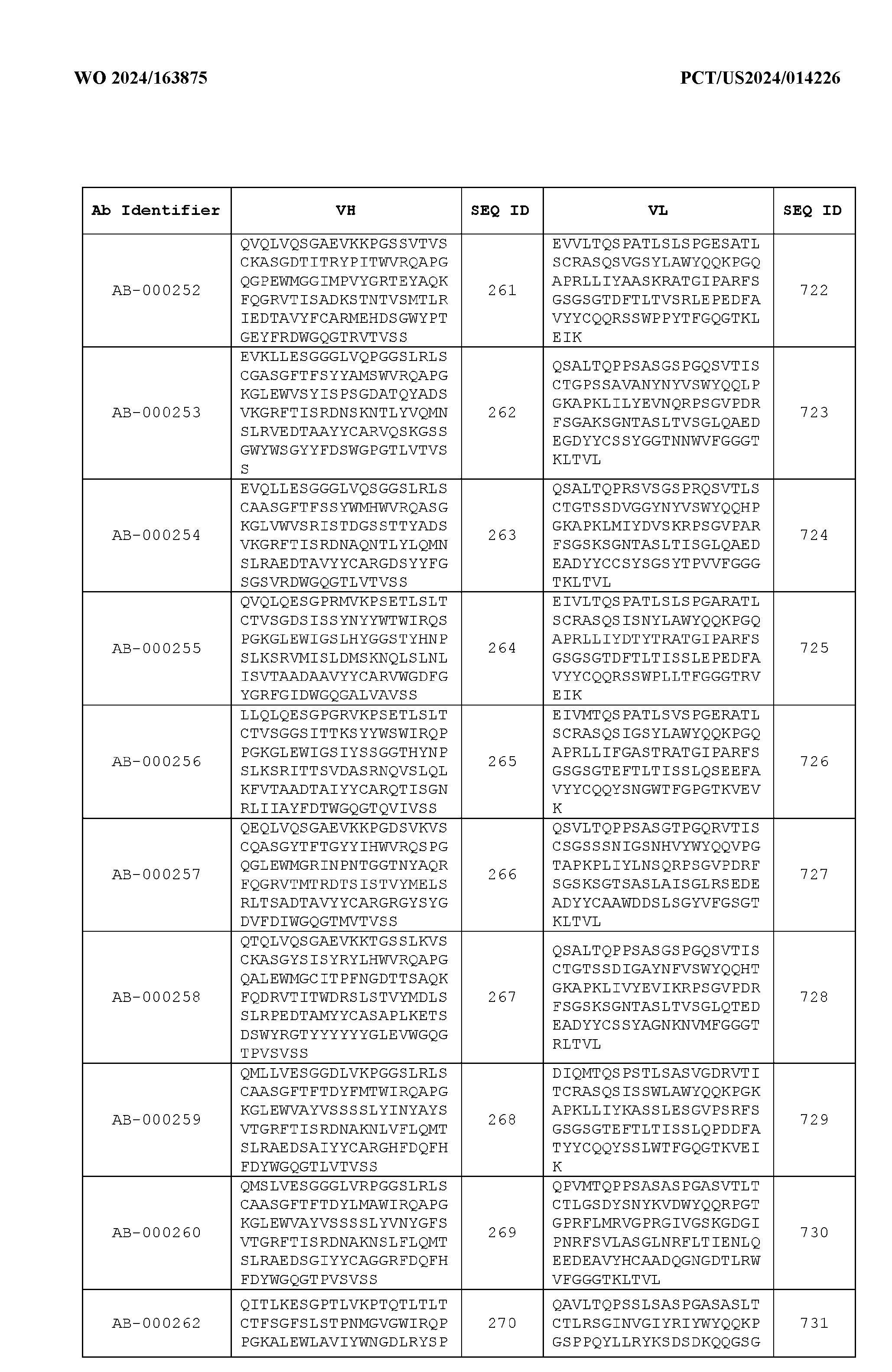
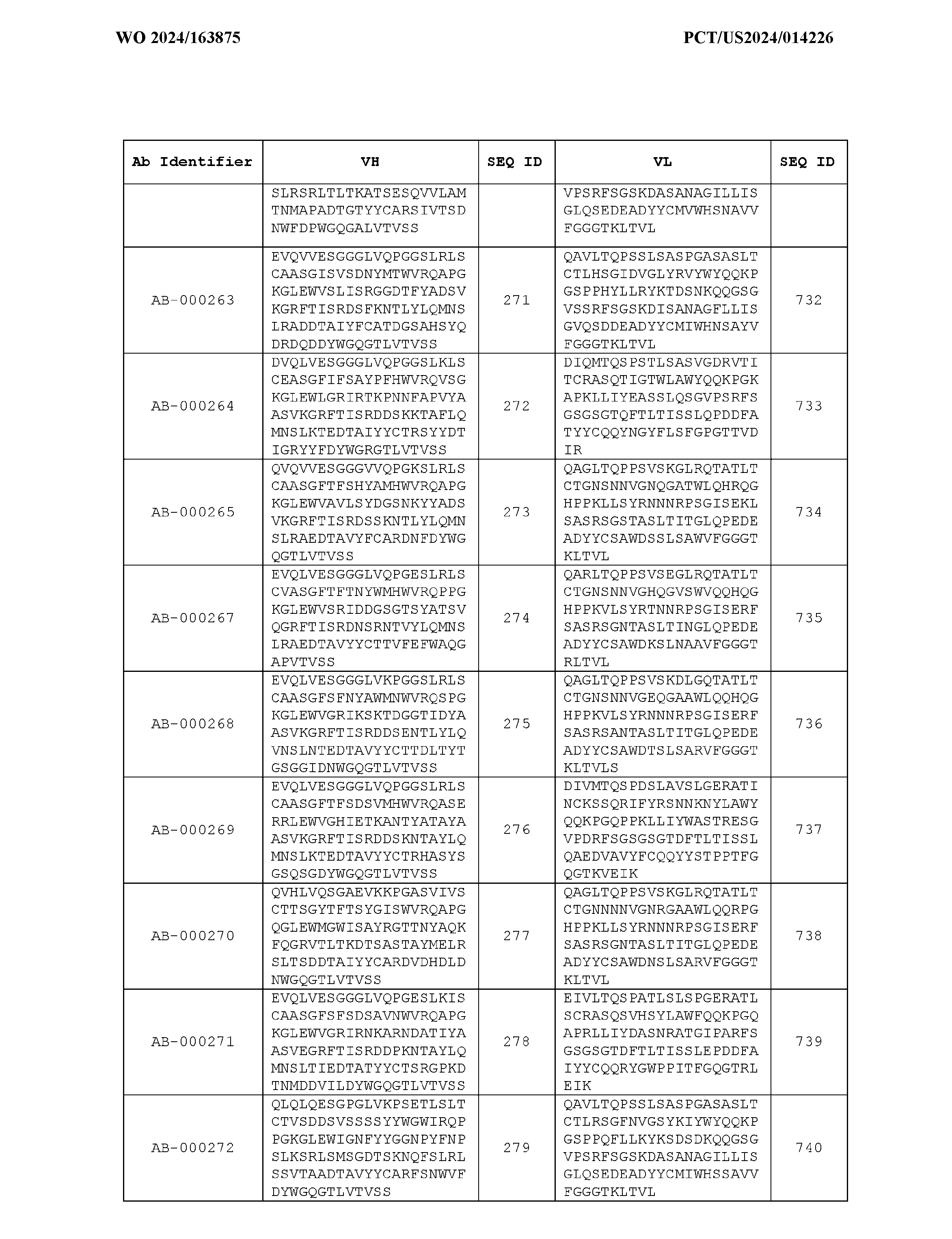
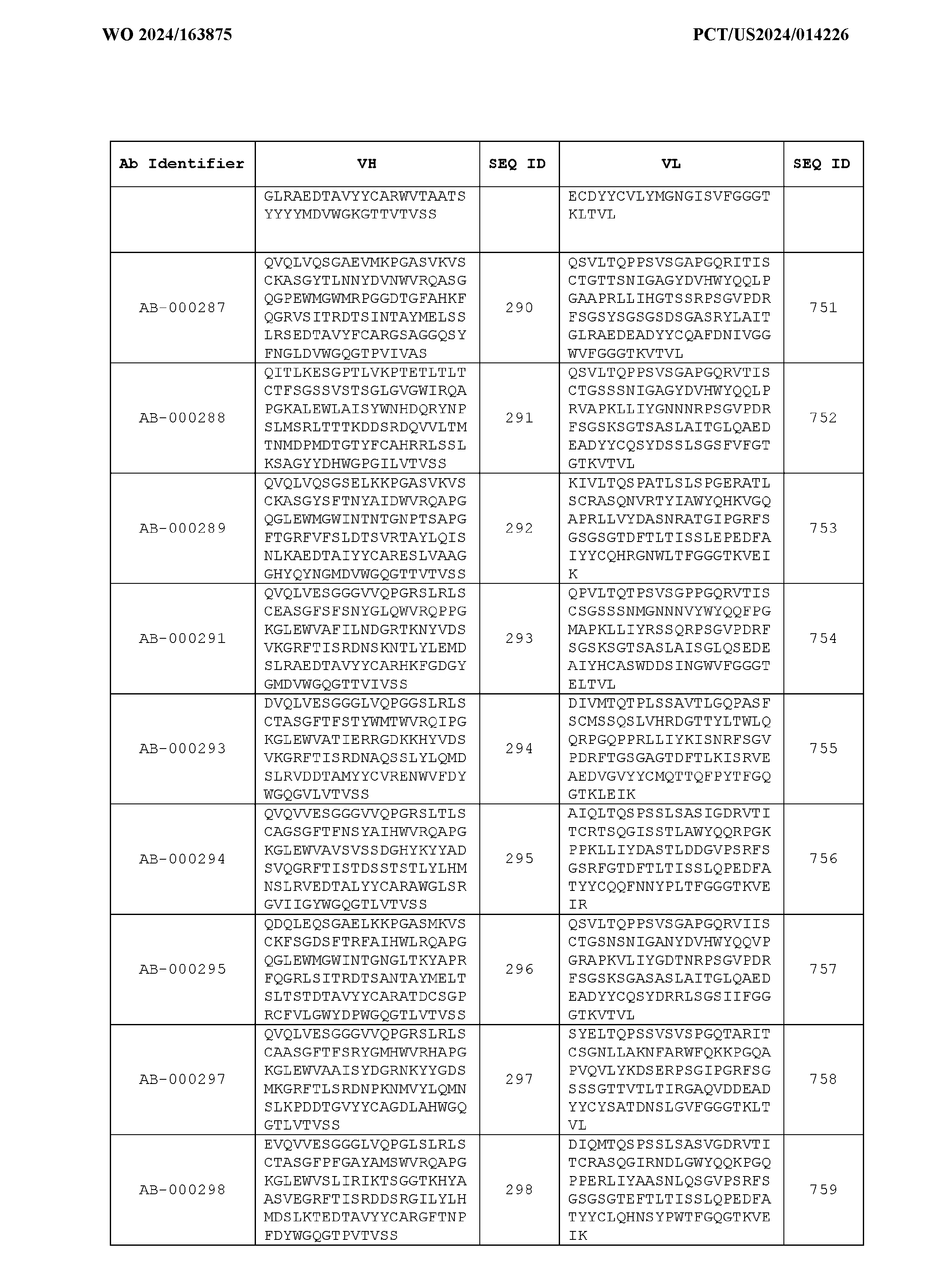
malaria infection. The IRC® technology and its use in antibody discovery is well known and disclosed in, e.g., WO 2012148497A2, the entire content of which is herein incorporated by reference. The RTS,S vaccine is a pseudo-viral particle vaccine that combines the hepatitis B surface antigen and the central repeat and C-terminal regions of the CSP protein. RTS,S consists of two polypeptides; RTS is a single polypeptide chain corresponding to amino acids 207 to 395 of P. falciparum (3D7) that is fused to HBsAg and S is a polypeptide of 226 amino acids that corresponds to HBsAg. Stoute, et. al., N Engl J Med; 336:86-91(1997); RTS,S Clinical Trials Partnership, PLoS Med.11(7):e1001685, (2014), WO1993/10152. The RTS,S vaccine was administered with the adjuvant AS01B to increase efficacy. AS01B is a liposome-based formulation that contains the immunostimulants monophosphoryl lipid A (MPL) and QS21 and was shown to be more immunogenic than another adjuvant, AS02A, used in initial studies. Kester, et al., J Infect Dis 200: 337–346 (2009). All study participants were vaccinated with one of two vaccine schedules (standard full-dose: 0,1,2 M or fractional-third dose: 0,1,7 M), or placebo and subsequently challenged with a controlled human malaria parasite infection (CHMI). [00163] Plasmablasts (PBs) were isolated from PBMCs collected 7 days post-third (P3D; n = 22,319 PB) and post-fourth doses (P4D; n = 10,429 PB; Table 9) prior to CHMI and were used to generate natively paired heavy and light chain IgG sequences. Almost all (99.2%) of the antibody sequences were divergent from inferred germline precursor sequences. Consistent with previous malaria studies, specific germline heavy and light chain genes and pairings, including IGHV3-30/33, KV1-5, KV3-20, and LV1-40 were observed frequently in the dataset. No significant associations were observed between protection status and multiple IgG sequence and repertoire features examined. [00164] The messenger RNA of immunoglobulin (Ig)G-expressing PBs isolated from peripheral blood mononuclear cells (PBMCs) of individuals (n = 45) vaccinated with RTS,S in a phase 2a clinical trial was sequenced using the Immune Repertoire Capture® sequencing platform. In this trial, participants either received three full doses of RTS,S/AS01 E 1 month apart (012M; n = 15) or two full doses 1 month apart, followed by a smaller (one fifth, "fractional") dose 6 months later (Fx017M, n = 30). Vaccinees were challenged with malaria in a controlled human malaria infection (CHMI) model after the third dose. A subset received a fourth dose and were challenged a second time with malaria. PBs were isolated from PBMCs collected 7 days post-third (P3D; n = 22,319 PB) and post-fourth doses (P4D; n = 10,429 PB; Table 6) prior to CHMI and were used to generate natively paired heavy and light chain IgG sequences. Almost all (99.2%) of the antibody sequences were divergent from inferred germline precursor sequences (Figure 4). Consistent with previous malaria studies, specific germline heavy and light chain genes and pairings, including Active 105508124.2 95
IGHV3-30/33, KV1-5, KV3-20, and LV1-40 were observed frequently in the dataset (Figures 5A- 5C). No significant associations were observed between protection status and multiple IgG sequence and repertoire features examined (Figures 5D-5I). Table 6 Table 6 | Plasmablasts isolated and sequenced from PBMC of RTS,S vaccinees Number of PB Sequenced P3D sample P4D sample CHMI status Vaccinee ID RTS,S dose P3D Sample P4D Sample % PB/B cells % PB/PBMC % B cells/PBMC % PB/B cells % PB/PBMC % B cells/PBMC P3D P4D 1 Fx017M 263 NA 0.61 0.034 5.6 NA NA NA P NA 3 Fx017M 672 539 4.4 0.25 5.7 3.7 0.30 8.0 P P 5 Fx017M 620 944 4.1 0.22 5.5 1.3 0.12 8.9 P P 6 Fx017M 520 NA 1.0 0.056 5.3 NA NA NA P NA 7 Fx017M 374 811 0.56 0.056 10 0.48 0.054 11 P P 8 Fx017M 596 NA 0.86 0.063 7.3 NA NA NA P NA 14 Fx017M 536 735 2.1 0.16 7.7 0.73 0.071 9.7 P NP 15 Fx017M 529 NA 1.5 0.15 9.7 NA NA NA P NA 16 Fx017M 136 358 0.63 0.027 4.2 0.97 0.041 4.2 P P 22 Fx017M 476 NA 2.0 0.24 12 NA NA NA P NA 23 Fx017M 586 NA 1.2 0.11 9.5 NA NA NA NP NA 24 Fx017M 491 NA 0.57 0.026 4.5 NA NA NA P NA 25 Fx017M 626 5 5.9 0.27 4.7 0.69 0.044 6.4 NP P 26 Fx017M 516 NA 0.85 0.078 9.2 NA NA NA P NA 29 Fx017M 574 NA 0.69 0.053 7.7 NA NA NA P NA 34 Fx017M 735 432 1.5 0.13 8.5 0.89 0.085 9.6 P P 38 Fx017M 397 NA 0.54 0.048 8.9 NA NA NA P NA 39 Fx017M 693 NA 1.8 0.084 4.7 NA NA NA P NA 40 Fx017M 685 NA 3.1 0.17 5.6 NA NA NA P NA 41 Fx017M 606 84 0.63 0.042 6.7 0.21 0.019 8.9 P P 46 Fx017M 474 769 9.8 0.52 5.3 3.7 0.17 4.6 P P 48 Fx017M 583 NA 3.7 0.091 2.5 NA NA NA P NA 49 Fx017M 569 NA 1.4 0.11 7.8 NA NA NA NP NA 51 Fx017M 607 NA 2.0 0.13 6.6 NA NA NA P NA 52 Fx017M 401 NA 0.73 0.026 3.6 NA NA NA P NA 53 Fx017M 565 842 0.72 0.032 4.5 0.66 0.052 7.8 P P 54 Fx017M 236 1027 0.84 0.034 4.1 1.1 0.072 6.4 NP P 60 Fx017M 632 NA 1.3 0.061 4.8 NA NA NA P NA 63 Fx017M 206 NA 0.71 0.015 2.1 NA NA NA P NA 64 Fx017M 940 777 2.5 0.11 4.6 1.7 0.11 6.7 P P 201 012M 167 NA 1.4 0.097 7.0 NA NA NA P NA 202 012M 402 653 9.0 0.43 4.7 1.1 0.066 5.8 NP NP 203 012M 592 923 2.4 0.13 5.4 2.3 0.14 6.3 P NP 205 012M 193 511 1.0 0.062 5.9 0.66 0.066 10.0 P NP 207 012M 469 177 1.3 0.039 3.1 0.97 0.032 3.3 P P 208 012M 425 NA 1.3 0.083 6.4 NA NA NA NP NA 209 012M 324 NA 0.92 0.063 6.9 NA NA NA P NA 216 012M 430 NA 1.5 0.15 10 NA NA NA P NA 221 012M 385 NA 1.1 0.13 12 NA NA NA P NA 228 012M 509 477 4.9 0.27 5.6 2.1 0.14 6.6 NP P 229 012M 561 NA 1.0 0.059 5.8 NA NA NA P NA 230 012M 482 385 1.6 0.091 5.6 0.65 0.036 5.5 NP P 233 012M 561 180 2.2 0.16 7.2 0.52 0.031 6.0 P NP 234 012M 403 NA 2.1 0.071 3.3 NA NA NA NP NA 236 012M 572 NA 1.4 0.090 6.7 NA NA NA P NA NA, not applicable; P, protected; NP, not protected; P3D, post-third dose RTS,S; P4D, post-fourth dose RTS,S [00165] P3D and P4D PBs were grouped into Ig lineages (n = 18,980), defined here as PB sequences that were likely derived from a common progenitor B-cell clone (see Example 2). Lineage size ranged from 1–84 (P3D) or 1–93 (P4D) PBs. As PBs have a short half-life in blood and were isolated from a small volume of blood (~10 ml), detection of lineages with ≥2 PBs indicates recent expansion in lymphoid organs. One-fifth of lineages were cellularly expanded and contained at least two PBs with either the same or divergent B-cell nucleotide sequences (19.4%, n = 3,684 lineages, Figure 3A). Consistent with antigen-driven selection pressure following Active 105508124.2 96
vaccination, most of the cellularly expanded lineages also showed evidence of clonal expansion (Figure 3B), a hallmark of affinity maturation. Furthermore, several lineages had clonal representatives that were observed after both the third and fourth immunizations, referred to here as “recalled” lineages (4.1%–26.6% of vaccinee P3D expanded lineages). In addition, when sequences were compared between the vaccinees, many of these expanded lineages also show evidence of sequence convergence between ≥2 vaccinees (7.3%–46.7% of vaccinee P3D expanded lineages). Not surprisingly, lineages with only a single observed PB in P3D repertoires (n = 10,841) had significantly lower rates of convergence (2.0%–13.8%) and recall (1.2%–18.6%) than the expanded lineages (P < 0.0001 and P < 0.001, respectively, Wilcoxon matched-pairs, two- tailed test) and had higher levels of somatic hypermutation (SHM). Thus, to increase the chances of identifying antibodies derived against RTS,S antigen, efforts of subsequent analyses were focused on expanded lineages (Figure 3B). [00166] It was hypothesized that lineages with the largest number of PBs per vaccinee, referred to here as “dominant lineages”, were more likely to target the vaccine, as they had outcompeted other PB lineages for antigen binding and/or T-cell help in lymphoid organs. Thus, for each vaccinee, expanded P3D lineages (9–99 expanded lineages observed per vaccinee) were rank-ordered by size (“rank-size”). The sum of PBs in the lineages of the top four rank-sizes for each vaccinee constituted 17%–100% of the total number of PBs in each vaccinee’s P3D repertoire of expanded lineages and 33% of the PBs among the P3D-expanded lineages from all vaccinees (Figure 3C). Because this pattern of PB distribution was consistent across protection status and dose regimens, an antibody screening library was generated for in vitro and in vivo characterization that was biased toward the dominant P3D lineages of both protected and non-protected vaccinees. CSP-reactivity of expanded P3D PBs is associated with lower SHM and lack of protection [00167] A clone from each of 369 unique P3D lineages was chosen, gene synthesized, and recombinantly expressed for testing (Figure 6A). This library included almost all (96%) of the largest lineages (rank-size 1) across all vaccinees; approximately half (56%) of the second, third, and fourth rank-size lineages across all vaccinees; a small subset (6.9%) of expanded, sub- dominant lineages (rank-size ≥5), and a few single-PB lineages (0.18% of the 10,841 single-cell lineages). All antibodies were screened in a CSP enzyme-linked immunosorbent assay (ELISA) (Figures 3D and 6B), and approximately one-third were screened against the other RTS,S component, hepatitis B surface antigen (HBsAg, Figure 6C). Of the antibodies screened in both assays (n = 130), 52% were reactive to CSP or HBsAg (67/130). In total, 38% (139/369) bound to CSP, and binding for an additional 29 antibodies was indeterminate. Of the CSP-reactive Active 105508124.2 97
antibodies, 73% (102/139) bound peptides from the NANP CR region and 20 bound peptides from the C-terminal region (data not shown). [00168] Given that expanded lineages were more likely to show evidence of convergence and recall as compared to single PBs, it was tested whether those same features were associated with CSP-reactivity. Indeed, antibodies from lineages that show sequence convergence across ≥2 vaccinees were more likely to bind to CSP (54%, 55/102) than clones from lineages that lacked evidence of convergence (31%, 84/267, P = 0.0001, Fisher’s exact, two-sided). Recalled lineages were also more likely to be CSP-reactive (49%, 43/87) as compared to lineages only observed P3D (19%, 16/83 P < 0.0001, Fisher’s exact). [00169] As noted previously for immunization with whole sporozoites, the SHM levels of CSP-reactive antibodies were found to be significantly lower than SHM levels of CSP-negative antibodies (P < 0.0001, Figure 3D), and SHM levels of NANP-specific antibodies were lower than SHM levels of C-terminal binding antibodies (P < 0.006, Figure 3D). Consistent with observations about these sequence repertoires, SHM levels of NANP-binding antibodies were not correlated with vaccinee protection status P3D (P > 0.6, Figure 7B). Further, the percentage of antibodies that were CSP-specific and NANP-specific were surprisingly lower among P3D-protected vaccinees than P3D-non-protected vaccinees (P < 0.0007 for CSP, P < 0.006 for NANP, Fisher’s exact, Figures 3E and 3F). This inverse correlation between antibody binding and P3D protection status is also observed when the analysis is restricted to just the antibodies from the most dominant lineages (rank-size 1–4, P < 0.0004, Figure 3G), as well as when all antibodies, including the 20 from lineages that have only 1 PB, are combined in the analysis (P < 0.0005 Fisher’s exact and P < 0.00105 by bootstrap analysis, Figure 3H). These data suggest that the quality of the CSP- specific antibody repertoire may be more important in driving protection than the overall quantity of circulating, CSP- or repeat-specific PBs. Sporozoite inhibitory antibodies in P3D PBs are not sufficient for P3D protection. [00170] Given this surprising inverse association and the well-reported protective activity of CSP-binding antibodies in both humans and mice, antibodies were selected to advance as potential anti-malaria prophylactics without assuming any correlate of protection. Seventy-seven antibodies (77 unique lineages) were selected that included NANP- and C-terminal-reactive antibodies from protected (n = 26) and not protected (n = 8) vaccinees, and from dominant and sub-dominant lineages of either high or low SHM levels (respectively, ≥20 or <20 nucleotide mutations from germline per antibody). As in vitro functional assays have demonstrated limited predictive power for in vivo, anti-malaria activity, the antibodies were screened for activity using a mouse sporozoite-infection model. Over half of these antibodies (44/77) provided ≥95% Active 105508124.2 98
inhibition of sporozoite liver burden, and some offered near-complete protection (≥99.9% inhibition). All 44 antibodies bind to the NANP-repeat region of CSP, most derived from the IGHV3-33 germline, some from other IGHV3 genes, and one from IGHV1. Thirteen additional NANP binding, IGHV3-30/33 antibodies demonstrated limited inhibition of parasite liver burden (80%–95%), and 12 antibodies, including three C-terminal peptide binders, showed minimal, but detectable inhibition (20%–80%, Figure 1A). [00171] Roughly a third of the tested antibodies (30%, 23/77) were from unprotected vaccinees, including half (7/14) that showed near-complete protection in mice (≥99.9% inhibition, Figure 1A). These data suggest expression of these inhibitory antibodies by circulating, expanded P3D PB lineages is insufficient to drive protection. For example, the highly effective antibody AB- 000317 is observed in both a protected vaccinee and a not protected vaccinee (Figure 3H, red circles). However, PB expansion levels for this antibody lineage differed between the two vaccinees. In the protected vaccinee, the antibody was a member of the largest PB lineage, while in the unprotected vaccinee, the antibody was expressed in the seventh rank-size lineage (respectively, 15.8% versus 1.7% of PB in expanded P3D lineages, and 10% versus 0.9% of all circulating P3D PBs). These data are consistent with the hypothesis that, in addition to the functional activity of an antibody, the number of PBs expressing the antibody may affect protection status by ultimately influencing titer in blood and/or representation in immune memory. Inhibitory antibodies from vaccinees bind CSP peptides not present in RTS,S [00172] To explore the developability of these inhibitory antibodies as potential drugs, 35 NANP-repeat-binding lineages were selected for further pharmacology studies from the 52 that demonstrated ≥90% inhibition in the sporozoite-challenge screen. To avoid sequence features that can potentially act as liabilities during the development of antibody drugs, and to survey clones from lineages that have extensive clonal diversity, more than one unique antibody clone was chosen from some (n = 23) lineages. Overall, up to 141 antibodies, from 21 protected vaccinees of both RTS,S dose regimens, representing a range of high and low SHM levels, were tested in binding assays. [00173] Antibodies displayed a broad range of affinities against CSP (KD by surface plasmon resonance [SPR] of 11 pM–9.8 nM, Figure 1B, Tables 7 and 8). Despite the inverse correlation observed between vaccinee protection status and the percentage of CSP-reactive antibodies observed in the original screening library (Figures 3E-3H), these down-selected, inhibitory antibodies had a significant association between CSP-binding affinity (KD) and SHM levels (P < 0.005, r = –0.26 and P < 0.0001, r = –0.39 for heavy and light chain, respectively, Spearman test), indicating that affinity maturation to CSP occurred following vaccination. These Active 105508124.2 99
correlations are likely driven by two relationships: binding association rates (kon) to CSP and heavy and light chain SHM levels (Figures 10A and 10B, Table 9) and binding dissociation rates (koff) from CSP and SHM levels in the light chain (P < 0.0005, r = –0.29, Spearman; Table 9). Table 7 Table 7 | Binding and in vivo pharmacology of lead mAbs Binding constants (surface plasmon resonance) KD CSP KD NANP6 KD NPNA3 KD NVDP3NANP2 KD NANPNVDPNANP KD Junction mAb ID (nM) (nM) (nM) (nM) (nM) (nM) AB- 007104 5.74E-02 3.66E-02 6.17E-01 1.16E-01 5.67E-01 7.11E+03 AB- 007088 2.15E-01 2.36E-01 4.68E+00 1.97E+00 NA 2.52E+02 AB- 007103 2.10E-02 4.42E-02 1.70E+00 4.38E-01 4.13E+02 NA AB- 000224 3.66E-02 9.94E-02 4.53E+00 1.68E+00 1.42E+03 NA AB- 000399 3.25E-01 1.35E+00 9.79E+02 2.23E+02 3.00E+03 NA AB- 007114 8.67E-02 3.13E+00 1.37E-01 3.24E+00 7.85E+03 NA AB- 001529 2.28E-01 3.13E-01 4.75E+02 8.09E+02 NA NA AB- 000364 3.03E-02 6.37E-01 2.55E+00 7.72E-01 7.12E+00 3.29E+03 AB- 001480 5.18E-01 3.18E+00 2.23E+02 9.87E+00 5.05E+03 2.16E+04 AB- 007176 4.94E-02 3.88E-02 2.61E-01 3.97E-02 3.89E-01 2.37E+03 AB- 000317 5.44E-02 1.29E+00 8.04E+00 2.75E+03 1.44E+04 NA AB- 007131 5.35E-02 5.93E-01 1.37E+00 6.41E-01 6.97E+00 NA AB- 007101 8.39E-01 1.17E-01 1.84E+00 1.16E+00 2.51E+01 3.13E+04 AB- 007161 1.19E+00 6.49E+00 3.39E+03 8.23E+01 9.45E+03 2.07E+04 AB- 007121 2.59E-02 7.57E-02 8.97E-01 3.74E-01 1.32E+00 5.43E+02 AB- 007173 5.31E-02 6.03E-01 1.11E+02 9.35E+00 1.94E+04 8.38E+03 AB- 007154 2.67E-02 7.87E-01 1.65E+01 8.99E-01 3.12E+00 5.49E+03 AB- 007083 1.41E-01 6.59E-02 2.08E+00 1.26E+00 1.91E+00 9.40E+02 AB- 001558 1.05E+00 3.23E-01 1.74E+03 5.32E+00 2.03E+03 6.82E+03 AB- 001387 3.74E-01 1.87E+00 4.01E+03 1.24E+01 NA NA AB- 007462 1.07E-02 7.71E-02 4.36E-02 3.22E-01 3.69E-01 3.17E+01 AB- 007087 6.53E-02 9.86E-02 4.43E+00 5.15E-01 6.37E-01 5.05E+02 AB- 000397 6.46E-02 1.26E-01 4.34E+01 7.79E+03 1.54E+04 NA AB- 001428 5.87E-01 3.80E-01 8.34E+02 8.30E+00 7.62E+03 2.44E+04 AB- 007178 1.20E-01 5.33E-01 3.42E+00 5.47E+00 6.37E+01 2.95E+04 AB- 000391 1.16E-01 7.60E-02 9.63E-01 NA NA NA AB- 007120 1.66E-01 6.91E-01 8.68E+01 1.02E+01 5.27E+03 1.48E+04 AB- 007110 4.20E-02 7.26E-02 2.13E+00 1.22E+00 3.14E+02 4.19E+04 Active 105508124.2 100
AB- 000334 5.75E-01 7.49E-01 3.15E+01 6.58E-01 8.50E-01 1.66E+02 AB- 007096 2.04E-01 1.33E-01 8.22E+00 6.59E+00 8.41E+02 NA AB- 007123 2.17E-01 7.57E+00 1.55E+00 6.10E-01 1.12E+00 4.15E+02 AB- 001472 9.77E-01 1.56E-01 1.38E+03 2.01E+03 NA NA AB- 007182 1.58E-01 6.45E-01 1.10E+03 2.81E+00 1.70E+03 6.05E+04 AB- 001554 5.15E-01 2.31E-01 2.24E+02 9.49E+02 NA NA AB- 007130 2.01E-01 4.47E-02 6.63E-01 3.25E-01 3.34E+00 4.04E+03 AB- 007168 3.98E-02 5.87E-01 1.91E+00 2.68E-01 1.29E+00 2.49E+02 AB- 000356 2.44E-01 1.11E-01 1.93E+00 4.59E+00 1.31E+03 NA AB- 007150 1.88E-02 5.11E-02 9.63E+00 3.38E+02 2.98E+02 4.65E+03 AB- 001455 2.86E-01 6.15E-02 6.94E+00 1.36E+01 NA NA AB- 007175 3.28E-02 2.81E-02 2.16E+00 7.92E-01 1.23E+01 9.71E+02 AB- 000373 1.71E-01 3.16E-02 4.09E+00 9.34E-01 1.94E+01 1.12E+04 AB- 001533 7.50E-02 6.13E-02 8.86E-01 4.34E-01 2.54E+00 8.77E+02 AB- 001458 2.51E-01 3.19E-01 2.09E+03 1.02E+02 7.19E+01 NA AB- 000231 2.25E-02 4.14E-02 4.38E-01 2.87E-01 8.97E-01 7.77E+00 AB- 001396 2.34E-01 2.79E-01 3.18E+01 7.09E+00 3.38E+02 6.79E+04 AB- 007109 8.36E-02 9.10E-02 6.39E+00 1.54E+00 4.17E+02 NA AB- 007090 1.56E-01 5.10E-02 1.72E+00 1.73E+00 1.23E+02 2.74E+04 AB- 007080 2.27E-01 2.55E-02 1.62E-01 4.84E-01 8.42E+00 4.31E+03 AB- 007102 4.19E-02 5.85E-02 1.50E+02 1.25E+01 NA NA AB- 000376 2.62E-01 1.92E-01 4.48E+02 1.44E+01 2.25E+04 5.29E+04 AB- 007076 1.24E-01 2.64E-02 7.10E-02 7.07E-02 1.20E+00 1.92E+03 AB- 007106 6.53E-01 1.91E+00 1.44E+02 1.06E+01 1.27E+03 NA AB- 007107 1.16E+00 1.32E-01 4.87E+02 5.39E+02 NA NA AB- 007111 3.29E-02 2.28E-01 5.08E+00 1.85E+00 1.37E+03 NA AB- 007159 8.86E-02 3.27E-01 5.26E+02 8.69E+02 1.79E+04 NA AB- 007170 2.41E-02 3.13E-02 4.79E-01 1.64E-01 7.86E-01 8.41E+03 AB- 007165 8.00E-02 1.88E-01 6.71E-01 4.19E-02 5.97E-01 4.21E+02 AB- 007115 2.17E-01 3.61E-01 2.15E+01 1.02E+01 7.36E+01 5.74E+03 AB- 007138 6.67E-02 5.32E-01 8.61E+00 4.62E+01 1.06E+02 9.62E+02 AB- 000327 2.95E-02 4.68E-02 1.04E+01 1.97E+00 5.36E+02 1.15E+04 AB- 007160 3.78E-01 2.74E+00 7.73E+02 2.35E+03 2.18E+04 NA AB- 007112 8.84E-02 1.78E-01 2.15E-01 1.54E+00 5.41E+02 NA AB- 007142 1.33E-01 5.62E-02 1.06E+01 3.05E+02 1.43E+04 NA AB- 007126 1.03E-01 8.98E-02 9.81E-01 NA NA NA AB- 007113 4.37E-02 2.11E+00 1.37E+01 1.32E+00 1.17E+03 NA Active 105508124.2 101
AB- 007108 1.02E-01 2.49E-01 6.14E+01 3.23E+00 1.01E+04 NA AB- 007118 2.92E-02 2.64E+00 3.18E+01 6.37E+01 7.49E+01 8.40E+03 AB- 007158 3.27E-01 9.93E-02 1.09E+02 1.08E+02 1.48E+03 4.13E+03 AB- 007169 1.75E-02 5.29E-02 9.73E-01 6.18E-01 1.47E+00 1.27E+03 AB- 007139 2.97E-02 1.33E-01 4.52E+00 1.33E+02 9.94E+01 2.53E+03 AB- 000394 1.10E-01 3.94E-02 2.78E-01 3.01E-01 5.05E-01 5.09E+03 AB- 007075 1.06E-01 1.31E-01 2.27E-01 6.19E-01 1.60E+00 NA AB- 007077 2.36E-01 2.67E-01 3.26E-01 5.91E-01 2.41E+00 NA AB- 007078 1.59E-01 5.19E-02 6.86E-01 1.73E+00 2.35E+02 3.50E+04 AB- 007079 2.25E-01 5.70E-02 4.51E-01 5.88E-01 2.47E+01 NA AB- 007081 1.50E-01 2.80E-02 2.51E-01 3.74E-02 8.38E-01 1.10E+04 AB- 007082 1.35E-01 1.88E-02 9.90E-01 1.45E+00 1.54E+01 3.63E+04 AB- 007084 8.00E-02 3.43E-01 2.29E+00 1.23E+00 1.36E+00 9.44E+01 AB- 007085 5.04E-02 1.23E-01 6.44E+00 3.10E+00 1.89E+01 9.37E+02 AB- 007086 1.61E-01 2.24E-01 7.08E+00 1.22E+00 1.04E+01 1.26E+02 AB- 001545 1.71E+00 4.36E+01 2.50E+03 NA NA NA AB- 007089 1.55E-01 7.38E-01 1.04E+01 4.46E+00 2.14E+03 NA AB- 007091 1.88E+00 1.43E+00 2.26E+03 6.02E+02 NA NA AB- 007092 9.75E+00 3.61E+01 1.16E+04 NA NA NA AB- 007093 3.67E-01 7.75E-02 8.21E-01 1.81E+00 1.52E+02 2.56E+04 AB- 007094 1.36E+00 1.44E+00 2.81E+02 1.69E+02 NA NA AB- 007095 1.50E+00 5.99E-01 4.04E+01 5.04E+01 NA NA AB- 007097 6.54E-01 3.88E-01 7.22E+01 2.74E+01 2.04E+03 NA AB- 007098 1.55E+00 1.37E-01 1.56E+01 1.45E+02 NA NA AB- 007099 5.55E-01 1.14E-01 8.85E+00 1.00E+01 4.41E+03 NA AB- 007100 1.72E-01 1.38E+00 3.95E+02 2.20E+02 NA NA AB- 007184 1.37E-01 1.30E-01 6.99E+00 1.21E+00 6.88E+02 NA AB- 001511 1.23E+00 1.97E+00 3.89E+02 1.05E+02 NA NA AB- 001578 1.00E+00 3.06E+00 4.38E+02 3.55E+02 1.97E+04 NA AB- 007105 1.49E+00 3.97E+00 9.57E+01 3.26E+02 NA 8.89E+04 AB- 007116 5.78E-01 1.39E+01 3.13E+03 1.16E+03 1.02E+04 9.39E+03 AB- 007117 2.77E+00 4.21E+01 8.34E+03 NA NA NA AB- 007119 2.23E-01 2.06E-02 4.60E+00 5.05E-01 1.43E+01 NA AB- 007122 2.23E-02 1.10E+00 5.33E+00 6.85E-01 1.51E+01 2.18E+03 AB- 007124 2.78E-02 4.68E-01 3.40E+01 1.36E+00 2.75E+02 6.37E+03 AB- 007125 1.31E+00 2.05E-01 1.42E+03 NA NA NA AB- 007127 1.03E-01 9.62E-02 2.33E+00 NA NA NA Active 105508124.2 102
AB- 007128 5.66E-02 7.99E-01 1.19E+00 NA NA NA AB- 000325 1.39E-01 8.60E-02 8.85E-01 6.05E-01 1.12E+01 NA AB- 007129 7.48E+00 1.26E+01 NA NA NA NA AB- 007132 1.72E-01 7.33E-02 6.94E+00 1.78E+00 2.11E+02 NA AB- 007133 2.18E-01 5.67E-01 6.35E+02 1.02E+00 4.04E+02 NA AB- 007134 3.21E-01 1.50E+00 4.92E+03 1.30E+02 NA NA AB- 007136 3.50E-01 1.61E+00 5.02E+02 1.97E+03 NA NA AB- 007137 6.23E-01 2.13E+00 2.99E+03 5.24E+02 NA NA AB- 007185 7.49E-02 5.77E-01 5.70E+00 1.56E+00 5.01E+03 NA AB- 007186 2.87E-02 3.90E-02 1.49E+00 8.15E-01 1.06E+02 NA AB- 007140 1.80E+00 1.80E+00 7.94E+02 NA NA NA AB- 007141 7.62E-01 1.42E+00 6.29E+01 1.33E+04 1.60E+04 2.14E+04 AB- 007143 2.36E-02 5.31E-02 4.70E+00 3.60E+02 1.29E+03 2.09E+04 AB- 007144 5.77E-02 1.02E+00 4.09E+01 NA NA NA AB- 007145 3.74E-02 9.73E-01 1.28E+01 4.86E+02 2.15E+04 NA AB- 007146 1.74E-01 6.93E-01 1.44E+01 2.29E+03 1.29E+04 3.45E+04 AB- 007147 4.74E-02 4.66E-01 4.09E+00 1.61E+03 5.50E+03 2.47E+04 AB- 007148 4.99E-02 2.47E+00 1.35E+02 NA NA NA AB- 007149 4.39E-02 9.02E-02 2.96E+01 1.79E+04 1.84E+04 NA AB- 007151 1.07E-01 4.73E-01 8.79E+00 7.73E+01 2.30E+03 NA AB- 007152 4.03E-02 5.60E-02 1.12E+01 5.56E+02 1.55E+04 NA AB- 007153 1.29E-01 4.06E-02 1.43E+03 6.93E+00 5.91E+02 NA AB- 007155 6.32E-02 4.28E-02 1.35E+00 2.64E-02 2.96E-01 5.90E+00 AB- 007156 2.16E-01 1.24E+00 2.60E+01 7.14E-01 1.00E+01 2.45E+04 AB- 007157 2.24E-02 2.76E-02 2.18E+02 8.36E-01 1.32E+00 NA AB- 000222 8.59E-02 3.08E-02 6.49E-01 1.20E-01 2.64E-01 3.88E+02 AB- 007162 1.93E-02 5.71E-02 1.35E+00 6.79E-02 5.27E-01 2.51E+03 AB- 007164 7.12E-02 4.16E-01 9.48E-01 4.95E-01 5.87E-01 7.71E+02 AB- 007166 2.88E-01 4.49E-02 9.59E-01 4.17E-02 7.96E-01 8.98E+02 AB- 007167 4.71E-02 4.08E-01 5.80E-01 2.78E-01 5.26E-01 4.58E+02 AB- 007171 2.01E-02 2.41E-02 9.79E-01 3.01E-01 NA 1.66E+04 AB- 007172 1.56E-01 5.28E-02 7.25E+00 2.64E+00 1.88E+03 NA AB- 007174 1.84E-02 4.09E-02 3.35E-01 8.85E-01 1.22E+01 NA AB- 000337 2.51E-01 1.88E-01 1.37E+01 8.71E+00 8.89E+02 1.83E+04 AB- 007177 7.00E-02 6.57E-02 2.59E+01 4.14E+00 5.94E+01 6.44E+03 AB- 007179 3.73E-01 3.84E-02 6.66E+02 1.63E+00 2.13E+02 NA AB- 007180 2.32E-01 2.77E-01 3.57E+02 7.26E+00 6.66E+03 NA Active 105508124.2 103
AB- 007181 1.73E-01 9.33E-01 9.88E+02 1.51E+01 1.15E+04 NA AB- 007183 2.72E-01 1.64E-01 2.00E+03 3.94E+01 NA NA Table 8 Table 8 | Binding and in vivo pharmacology of lead mAbs Liver burden inhibition Liver burden mAb sera concentration Inhibition AB-000317 Comparison to AB- [mAb]sera / [mAb]sera, avg. [mAb]sera, mAb ID (%) normalized (%)a 000317b KDCSP-SPR (µg/ml) avg. (M) AB- 007104 88.9 95.5 Comparable, p>0.05 4,818 41.5 2.77E-07 AB- 007088 83.5 94.1 Comparable, p>0.05 1,129 46.1 3.07E-07 AB- 007103 82.5 88.6 Worse, p<0.05 18,857 59.3 3.95E-07 AB- 000224 97.3 101.9 Better, p<0.05 9,939 54.6 3.64E-07 AB- 000399 95.7 100.2 Comparable, p>0.05 865 42.1 2.81E-07 AB- 007114 97.5 102.1 Comparable, p>0.05 3,386 44.0 2.94E-07 AB- 001529 69.8 73.0 Worse, p<0.05 1,264 53.4 3.56E-07 AB- 000364 95.8 100.3 Comparable, p>0.05 10,271 48.0 3.20E-07 AB- 001480 56.2 59.5 Worse, p<0.05 739 57.4 3.83E-07 AB- 007176 94.3 101.3 Comparable, p>0.05 7,708 57.1 3.81E-07 AB- 000317 92.7 NA NA 8,743 71.3 4.75E-07 AB- 007131 91.8 98.5 Comparable, p>0.05 6,937 55.7 3.71E-07 AB- 007101 88.3 94.8 Comparable, p>0.05 154 57.1 3.81E-07 AB- 007161 85.1 91.4 Comparable, p>0.05 322 57.4 3.83E-07 AB- 007121 80.3 86.3 Worse, p<0.05 12,303 47.9 3.19E-07 AB- 007173 44.1 47.4 Worse, p<0.05 6,695 53.3 3.55E-07 AB- 007154 90.0 95.3 Comparable, p>0.05 14,212 58.2 3.88E-07 AB- 007083 88.5 93.8 Comparable, p>0.05 2,291 48.3 3.22E-07 AB- 001558 86.1 90.9 Worse, p<0.05 371 58.3 3.89E-07 AB- 001387 48.2 53.3 Worse, p<0.05 1,184 66.4 4.42E-07 AB- 007163 88.7 98.7 Comparable, p>0.05 38,759 62.2 4.15E-07 AB- 007087 85.6 90.7 Worse, p<0.05 2,825 27.7 1.85E-07 AB- 000397 70.9 76.3 Worse, p<0.05 ND ND ND AB- 001428 62.0 68.9 Worse, p<0.05 305 26.9 1.79E-07 AB- 007178 83.8 88.8 Worse, p<0.05 2,967 53.3 3.55E-07 AB- 000391 75.9 81.7 Worse, p<0.05 ND ND ND AB- 007120 57.6 62.1 Worse, p<0.05 ND ND ND AB- 007110 94.2 102.0 Comparable, p>0.05 7,917 49.8 3.32E-07 AB- 000334 91.9 96.2 Comparable, p>0.05 604 52.2 3.48E-07 AB- 007096 84.2 89.1 Worse, p<0.05 1,918 58.8 3.92E-07 Active 105508124.2 104
AB- 007123 81.1 87.8 Worse, p<0.05 1,850 60.3 4.02E-07 AB- 001472 79.0 83.3 Worse, p<0.05 103 59.0 3.94E-07 AB- 007182 56.4 62.7 Worse, p<0.05 2,353 55.8 3.72E-07 AB- 001554 51.1 56.8 Worse, p<0.05 199 15.4 1.02E-07 AB- 007130 92.2 97.7 Comparable, p>0.05 1,859 56.0 3.73E-07 AB- 007168 86.8 96.5 Comparable, p>0.05 9,023 53.8 3.59E-07 AB- 000356 86.5 91.6 Worse, p<0.05 1,656 60.6 4.04E-07 AB- 007150 84.4 95.2 Comparable, p>0.05 19,835 55.9 3.73E-07 AB- 001455 82.1 88.3 Worse, p<0.05 ND ND ND AB- 007175 78.0 86.7 Worse, p<0.05 10,936 53.8 3.59E-07 AB- 000373 75.5 83.5 Worse, p<0.05 2,191 56.1 3.74E-07 AB- 001533 72.9 78.5 Worse, p<0.05 ND ND ND AB- 001458 50.1 55.4 Worse, p<0.05 1,867 70.3 4.68E-07 AB- 000231 93.4 103.8 Comparable, p>0.05 6,195 20.9 1.39E-07 AB- 001396 91.7 96.8 Comparable, p>0.05 1,666 58.4 3.89E-07 AB- 007109 90.7 96.1 Comparable, p>0.05 3,206 40.2 2.68E-07 AB- 007090 90.3 95.6 Comparable, p>0.05 2,857 66.9 4.46E-07 AB- 007080 85.9 90.9 Comparable, p>0.05 1,722 58.7 3.91E-07 AB- 007102 74.5 80.2 Worse, p<0.05 ND ND ND AB- 000376 56.1 62.0 Worse, p<0.05 1,102 55.2 3.68E-07 AB- 007076 90.6 100.2 Comparable, p>0.05 3,148 58.6 3.91E-07 AB- 007106 83.7 88.3 Worse, p<0.05 263 55.1 3.67E-07 AB- 007107 49.4 52.1 Worse, p<0.05 338 58.9 3.93E-07 AB- 007111 93.6 101.3 Comparable, p>0.05 10,340 51.1 3.40E-07 AB- 007159 89.0 96.3 Comparable, p>0.05 2,271 30.2 2.01E-07 AB- 007170 88.1 97.5 Comparable, p>0.05 17,892 64.7 4.31E-07 AB- 007165 86.5 95.6 Comparable, p>0.05 5,638 67.7 4.51E-07 AB- 007115 79.8 86.4 Worse, p<0.05 1,257 50.7 3.38E-07 AB- 007138 72.3 81.5 Worse, p<0.05 6,074 60.8 4.05E-07 AB- 000327 66.3 73.7 Worse, p<0.05 5,646 25.0 1.66E-07 AB- 007160 94.9 99.4 Comparable, p>0.05 726 41.1 2.74E-07 AB- 007112 92.3 100.0 Comparable, p>0.05 3,992 53.0 3.53E-07 AB- 007142 85.7 92.2 Worse, p<0.05 ND ND ND AB- 007126 71.1 76.6 Worse, p<0.05 ND ND ND AB- 007113 94.4 100.0 Comparable, p>0.05 8,996 58.9 3.93E-07 AB- 007108 92.5 98.0 Comparable, p>0.05 3,618 55.1 3.68E-07 AB- 007118 91.6 99.2 Comparable, p>0.05 14,118 63.1 4.21E-07 Active 105508124.2 105
AB- 007158 85.1 92.2 Worse, p<0.05 643 31.5 2.10E-07 AB- 007169 93.3 103.1 Comparable, p>0.05 25,685 67.3 4.49E-07 AB- 007139 73.1 82.4 Worse, p<0.05 12,667 56.3 3.76E-07 Active 105508124.2 106
Table 9 Heavy chain Light chain SHM (nucleotide) SHM (amino acid) SHM (nucleotide) SHM (amino acid) LB Inhibitionc Binding peptide in SPR Bindinga Testb p r p r p r p r p r CSP (3D7) Koff S >0.8 -0.02 >0.7 0.03 >0.08 -0.17 >0.07 -0.17 >0.2 -0.18 CSP (3D7) Koff P >0.3 -0.09 >0.7 -0.03 >0.1 -0.14 >0.1 -0.14 <0.01 -0.37 CSP (3D7) K off LR >0.3 -0.09 nd nd nd nd nd nd <0.03 -0.32 NPNA3 Koff S <0.0001 -0.48 <0.0001 -0.52 <0.0001 -0.34 <0.0002 -0.32 <0.0001 -0.48 NPNA3 Koff P <0.0001 -0.34 <0.0004 -0.30 <0.03 -0.19 <0.05 -0.17 <0.0001 -0.53 NPNA3 K off LR <0.0001 -0.48 nd nd nd nd nd nd <0.0001 -0.60 Junction Koff S <0.03 -0.26 <0.04 -0.25 <0.003 -0.36 <0.006 -0.33 <0.05 -0.31 Junction Koff P <0.03 -0.27 <0.04 -0.25 <0.004 -0.35 <0.004 -0.35 <0.005 -0.43 Junction Koff LR <0.05 -0.24 nd nd nd nd nd nd <0.03 -0.35 NPDPNANP2NVDP Koff S <0.002 -0.30 <0.002 -0.30 >0.06 -0.18 >0.09 -0.16 >0.07 -0.24 NPDPNANP2NVDP Koff P <0.04 -0.20 >0.07 -0.17 >0.1 -0.16 >0.2 -0.12 <0.003 -0.38 NPDPNANP2NVDP Koff LR <0.002 -0.30 nd nd nd nd nd nd <0.005 -0.37 NVDP3NANP2 Koff S <0.02 -0.24 <0.05 -0.18 <0.04 -0.20 <0.05 -0.18 <0.002 -0.40 NVDP3NANP2 Koff P >0.4 0.06 >0.2 0.10 >0.6 -0.04 >0.9 -0.01 >0.3 -0.13 NVDP3NANP2 Koff LR >0.05 -0.18 nd nd nd nd nd nd <0.0007 -0.42 NANP6 Koff S >0.3 -0.11 >0.6 -0.05 >0.7 0.04 >0.2 0.14 >0.3 0.15 NANP6 Koff P >0.06 -0.20 >0.1 -0.15 >0.1 -0.16 >0.1 -0.15 >0.6 0.09 NANP6 Koff LR >0.2 -0.12 nd nd nd nd nd nd >0.7 0.05 CSP (3D7) Kon S <0.008 0.22 <0.0008 0.28 <0.02 0.20 <0.008 0.22 >0.4 0.09 CSP (3D7) Kon P <0.004 0.25 <0.0007 0.28 <0.02 0.21 <0.007 0.23 >0.4 0.09 CSP (3D7) Kon LR <0.0005 0.42 nd nd nd nd nd nd >0.5 0.07 NPNA3 Kon S <0.0001 0.47 <0.0001 0.53 <0.007 0.23 <0.02 0.20 <0.04 0.25 NPNA3 Kon P <0.0001 0.40 <0.0001 0.47 <0.05 0.17 >0.07 0.15 <0.02 0.31 NPNA3 Kon LR <0.0001 0.59 nd nd nd nd nd nd <0.04 0.26 Junction Kon S <0.004 0.35 <0.0008 0.40 <0.008 0.32 <0.005 0.34 >0.05 0.30 Junction Kon P <0.03 0.27 <0.008 0.32 <0.03 0.28 <0.004 0.35 >0.09 0.26 Junction Kon LR <0.003 0.45 nd nd nd nd nd nd <0.04 0.32 NPDPNANP2NVDP Kon S <0.0001 0.40 <0.0001 0.44 >0.1 0.13 >0.06 0.17 >0.1 0.20 NPDPNANP2NVDP Kon P <0.001 0.31 <0.0002 0.36 >0.3 0.10 >0.1 0.13 <0.05 0.27 NPDPNANP2NVDP Kon LR <0.0009 0.43 nd nd nd nd nd nd >0.06 0.24 NVDP3NANP2 Kon S <0.003 0.27 <0.0002 0.33 <0.02 0.22 <0.02 0.22 >0.4 0.09 NVDP3NANP2 Kon P <0.004 0.26 <0.0004 0.31 >0.1 0.13 >0.1 0.14 >0.8 0.03 NVDP3NANP2 Kon LR <0.002 0.38 nd nd nd nd nd nd >0.5 0.08 NANP6 Kon S <0.0009 0.28 <0.0001 0.34 <0.04 0.18 >0.05 0.16 >0.8 -0.02 NANP6 Kon P <0.009 0.22 <0.0004 0.29 <0.03 0.19 <0.04 0.18 >0.7 0.05 NANP6 Kon LR <0.005 0.34 nd nd nd nd nd nd >0.7 -0.04 CSP (3D7) KD S <0.004 -0.27 <0.006 -0.26 <0.0003 -0.34 <0.0005 -0.33 >0.2 -0.17 CSP (3D7) KD P >0.06 -0.18 >0.1 -0.14 <0.03 -0.22 <0.03 -0.22 >0.1 -0.20 CSP (3D7) KD LR <0.002 -0.46 nd nd nd nd nd nd >0.1 -0.22 NPNA3 KD S <0.0001 -0.53 <0.0001 -0.57 <0.0001 -0.33 <0.0004 -0.30 <0.0003 -0.43 NPNA3 KD P <0.002 -0.27 <0.004 -0.25 <0.03 -0.20 <0.03 -0.20 <0.003 -0.36 NPNA3 KD LR <0.0001 -0.70 nd nd nd nd nd nd <0.0001 -0.54 Junction KD S <0.008 -0.32 <0.005 -0.34 <0.005 -0.34 <0.005 -0.34 >0.06 -0.29 Junction KD P <0.004 -0.35 <0.002 -0.39 <0.005 -0.34 <0.005 -0.34 <0.05 -0.31 Junction KD LR <0.009 -0.40 nd nd nd nd nd nd <0.02 -0.38 NPDPNANP2NVDP KD S <0.0001 -0.38 <0.0001 -0.40 >0.06 -0.18 <0.05 -0.19 >0.08 -0.22 NPDPNANP2NVDP KD P <0.02 -0.23 <0.02 -0.23 <0.05 -0.19 >0.1 -0.16 <0.02 -0.33 NPDPNANP2NVDP KD LR <0.002 -0.40 nd nd nd nd nd nd <0.009 -0.34 NVDP3NANP2 KD S <0.0002 -0.34 <0.0002 -0.34 <0.002 -0.28 <0.003 -0.27 <0.002 -0.40 NVDP3NANP2 KD P >0.3 0.09 >0.2 0.10 >0.6 -0.04 >0.8 -0.02 >0.3 -0.11 NVDP3NANP2 KD LR <0.0005 -0.43 nd nd nd nd nd nd <0.006 -0.35 NANP6 KD S <0.0005 -0.37 <0.0009 -0.35 <0.04 -0.22 >0.4 -0.09 >0.2 0.18 NANP6 KD P <0.002 -0.33 <0.003 -0.32 <0.02 -0.27 <0.008 -0.28 >0.4 0.13 NANP6 KD LR >0.1 -0.27 nd nd nd nd nd nd >0.5 0.10 Functional activity in vivo vs. SHM Test b p r p r p r p r Liver burden inhibition c S <0.02 0.30 <0.0006 0.41 <0.0002 0.44 <0.0001 0.50 NA NA Liver burden inhibition c P <0.0005 0.41 <0.0001 0.48 <0.0004 0.42 <0.0001 0.47 NA NA Liver burden inhibition c LR <0.0006 0.41 <0.0001 0.48 <0.0004 0.42 <0.0001 0.47 NA NA nd , not done; NA, not applicable; LB, liver burden mouse model; NPNA3, NPNANPNANPNA; Junction, KQPADGNPDPNANPN; NPDPNANP2NVDP, NPDPNANPNVDPNANP; NVDP3NANP2, NVDPNANPNVDPNANPNVDP; NANP6, NANPNANPNANPNANPNANPNANP aSPR determined k on (k a ), K off (k d ), and KD , see methods bS, Spearman correlation; P, Pearson correlation; LR, simple linear regression using log transformed K off , K on , or KD data c liver burden inhibition normalized to percent inhibition of AB-000317 tested in parallel Active 105508124.2 107
[00174] Antibodies were also evaluated for binding to short (12–15 residues) and long (20– 24 residues) peptides derived from the varied tetrapeptide-based homologous (NPNA3 and NANP6 peptides) and heterologous epitopes (NPDPNANPNVDPNANP, NVDP3NANP2 and junctional [KQPADJNPDPNANPN] peptides) of CSP (Figure 1B). Among the strongest correlations observed were inverse relationships between SHM and koff to the short major repeat peptide, the short minor repeat peptide, and the JR peptide (Figures 1C-1E). Koff rates calculated against the long homologous and heterologous peptides and against CSP either show weaker, but still statistically significant, correlations with SHM levels or altogether insignificant correlations (Figures 1F-1G, Table 9). Indeed, the strongest correlation was observed between SHM and binding rates to the short, homologous peptide even though the long version of the homologous peptide contains more repeats of the same epitope (Table 9). [00175] Furthermore, correlations between SHM levels and binding rates to the JR peptide, which is heterologous to epitopes in RTS,S, were stronger than for the long homologous peptide (Table 9). These data indicate that B cell receptor maturation of these highly functional antibodies may have been preferentially driven by interactions with short versus long NANP epitopes that benefited maturation to heterologous peptide sequences. These observations are consistent with reports that protective antibodies from anti-CSP immune responses can display promiscuous binding across distinct CSP epitopes, though other reports indicate that such promiscuity is not necessarily required for protection. Anti-sporozoite activity correlates with CSP-peptide binding and SHM levels [00176] Seventy antibodies, representing 33 of the 35 protective lineages evaluated in binding studies, were directly compared in intravenous sporozoite-challenge mouse models to the highly efficacious antibody AB-000317. Antibodies inhibited 44.1%–97.5% of sporozoite liver burden (47.4%–103.8% of AB-000317 inhibition, Tables 7 and 8). Overall, about half of the antibodies demonstrated comparable inhibition to AB-000317 (n = 32), while the other half demonstrated significantly weaker inhibition (n = 36), and one, AB-000224, showed activity that was superior to AB-000317 (Figures 2A-2B, Tables 7 and 8). Serum concentrations for most antibodies were at least 1000-fold higher than the CSP KD of the respective antibodies (Figure 2C, Tables 7 and 8), indicating that antibodies demonstrating weak inhibition were not likely due to low levels of circulating antibody. Lineages with at least one antibody that demonstrated activity consistent with AB-000317 were considered for further advancement. [00177] To determine if RTS,S-driven affinity maturation contributed to antibody inhibition, we assessed whether percent inhibition compared to AB-000317 correlated with peptide binding kinetics or SHM levels. Relative activity was associated with slower koff from CSP (Figure Active 105508124.2 108
2D), with slower koff from the short homologous peptide, NPNA3 (Figure 2E), and with slower koff from the JR and the other short, heterologous peptide (Figure 2F-2G, Table 9). Strikingly, no significant correlations were observed between inhibitory activity and binding kinetics with the long homologous peptide, NANP6 (P > 0.3 [koff]; P > 0.7 [kon], Spearman and Pearson, Table 9), despite this peptide being the most representative of both RTS,S and CSP. Taken together, the data evaluating these inhibitory antibodies suggest that while binding to NPNA epitopes may be required, mutations which favor binding to heterologous peptides may be preferred over mutations that simply improve binding to the longer, homologous NPNA epitopes. [00178] Affinity maturation via SHM likely underlies the correlations between in vivo function and binding kinetics, as inhibitory activity significantly correlates with heavy and light chain nucleotide and amino acid changes from germline (Figures 2H-2I, Table 9). Consistent with this observation, low SHM antibodies were more likely to demonstrate significantly weaker inhibition compared to AB-000317 than antibodies with higher mutational burden (86% [12/14], versus 44% [24/55], P = 0.0069; Fisher’s exact, two-sided). Taken together, these correlations between higher SHM levels and binding kinetics to homologous (Figures 1C and 1F) and heterologous epitopes (Figures 1D-1E, and 1G), and between higher SHM levels and inhibitory activity (Figure 2H-2I), suggest that affinity maturation to epitopes of RTS,S includes bystander maturation to heterologous epitopes that may be functionally important. [00179] Despite the correlations between SHM levels, inhibitory activity, and koff from CSP and short peptides, some antibodies with high SHM levels are exceptions. In some cases, high SHM antibodies have relatively fast koff, and slow kon, and are comparatively poor inhibitors like many of the low SHM antibodies (Figure 2J). These antibodies may have resulted from inefficient affinity maturation, affinity maturation resulting in less inhibitory paratopes, and/or aberrant selection mechanisms limiting survival in and recall from memory (Figures 3E-3H) . In other cases, some high SHM antibodies have relatively fast koff and slow kon to short peptides but are still relatively good inhibitors despite their unfavorable binding kinetics (Figure 2J). In these latter cases, affinity maturation toward antibody homotypic Fab–Fab interactions, not CSP epitopes, may contribute to the relatively strong activity. Inter-antibody binding events can contribute to anti- CSP-binding potency and increased functional activity, and have been reported for some antibodies described here. Such homotypic interactions may not be reflected in binding kinetics to short NPNA3 peptides, which due to their short length, cannot sterically accommodate multiple simultaneous binding events. Indeed, four antibodies that have relatively fast koff to short peptides, but are comparable to AB-000317 in activity, are from a lineage containing an antibody that binds via Fab–Fab homotypic interactions (AB-000399, Figure 2J, red circles) Overall, the data are Active 105508124.2 109
consistent with antibody affinity maturation via multiple, different modes of binding, and reveal several antibodies (>30) with activity comparable to that of AB-000317 and the potential to be developed into clinical leads. [00180] Using the sporozoite liver burden data, the present example further down-selected 26 mAbs representing 15 lineages for evaluation in the parasitemia challenge model as an alternate endpoint for assessing in vivo function. This set included AB-000317, AB-000224, 23 other mAbs with liver burden inhibitory activity similar to AB-000317, and one mAb with weaker activity than AB-000317. All except two mAbs were significantly more likely to prevent parasitemia than the negative control. Seven mAbs, including AB-000224 and two other mAbs from the same lineage, displayed a trend towards superior protection versus AB-000317 (non-parametric log-rank hazard ratios <1 versus AB-000317, Figure 2K; Tables 10-12). Serum concentrations for almost all mAbs (25/26) at the time of infection were at least 1000-fold higher than the respective mAb’s KDCSP- SPR (Tables 7 and 8), indicating that mAbs more efficacious than AB-000317 were likely not missed due to low levels of circulating antibody. Table 10 Bite parasitemia vs. negative control mAb ID HR 95% CI HR, replicate 95% CI, replicate AB-007104 0.097 0.012, 0.81 AB-007088 0.015 0.0017, 0.14 0.015 0.0017, 0.14 AB-000224 0.015 0.0017, 0.14 AB-000399 0.050 0.0062, 0.40 AB-007114 0.072 0.0091, 0.58 0.029 0.0038, 0.22 AB-000364 0.097 0.012, 0.81 AB-000317 0.015 0.0017, 0.14 0.015 0.0017, 0.14 AB-007154 0.050 0.0062, 0.40 AB-007163 0.030 0.0036, 0.25 AB-007110 0.050 0.0062, 0.40 0.030 0.0036, 0.25 AB-000334 0.050 0.0062, 0.40 AB-007130 0.015 0.0017, 0.14 AB-007168 0.12 0.014, 1.1 AB-007150 0.050 0.0062, 0.40 AB-000231 0.12 0.014, 1.1 0.14 0.021, 0.89 AB-001396 0.072 0.0091, 0.58 0.066 0.0097, 0.45 AB-007090 0.050 0.0062, 0.40 AB-007076 0.072 0.0091, 0.58 AB-007111 0.030 0.0036, 0.25 0.010 0.0011, 0.094 AB-007159 0.030 0.0036, 0.25 AB-007170 0.050 0.0062, 0.40 Active 105508124.2 110
AB-007160 0.030 0.0036, 0.25 AB-007112 0.030 0.0036, 0.25 AB-007142 0.097 0.012, 0.81 AB-007118 0.050 0.0062, 0.40 AB-007169 0.050 0.0062, 0.40 Table 11 Bite parasitemia vs. AB-000317 mAb ID HR 95% CI HR, replicate 95% CI, replicate AB-007104 3.5 0.98, 13 AB-007088 0.64 0.10, 4.1 0.61 0.097, 3.8 AB-000224 0.42 0.097, 1.8 0.74 0.15, 3.8 AB-000399 4.3 1.1, 16 AB-007114 1.3 0.37, 4.5 2.3 0.40, 13 AB-000364 3.1 0.86, 11 AB-000317 AB-007154 3.2 0.71, 14 AB-007163 2.0 0.50, 7.8 AB-007110 0.37 0.050, 2.7 1.2 0.31, 4.3 AB-000334 3.3 0.77, 14 AB-007130 0.12 0.0070, 2.1 AB-007168 5.1 1.3, 20 AB-007150 0.97 0.27, 3.5 AB-000231 2.9 0.81, 10 1.8 0.27, 12 AB-001396 1.2 0.34, 4.4 3.5 0.64, 19 AB-007090 1.7 0.36, 8.3 AB-007076 3.6 0.78, 17 AB-007111 0.12 0.0070, 2.1 1.8 0.43, 7.5 AB-007159 2.1 0.51, 8.8 AB-007170 0.72 0.12, 4.4 AB-007160 1.6 0.35, 7.3 AB-007112 1.7 0.42, 6.5 AB-007142 3.5 0.98, 13 AB-007118 1.7 0.35, 7.9 AB-007169 1.6 0.24, 10 Table 12 Bite parasitemia mAb sera concentration mAb ID [mAb]sera / KDCSP-SPR [mAb]sera, avg. (µg/ml) [mAb]sera, avg. (M) AB-007104 7,809 67.2 4.48E-07 AB-007088 2,320 74.8 4.98E-07 Active 105508124.2 111
AB-000224 13,066 71.7 4.78E-07 AB-000399 1,248 60.8 4.05E-07 AB-007114 5,970 77.6 5.18E-07 AB-000364 17,139 77.8 5.19E-07 AB-000317 11,774 96.1 6.40E-07 AB-007154 22,697 91.1 6.07E-07 AB-007163 65,421 105.0 7.00E-07 AB-007110 10,913 68.7 4.58E-07 AB-000334 893 77.1 5.14E-07 AB-007130 3,014 90.7 6.05E-07 AB-007168 11,963 71.3 4.76E-07 AB-007150 29,650 83.6 5.57E-07 AB-000231 27,017 91.1 6.08E-07 AB-001396 3,172 111.2 7.41E-07 AB-007090 4,151 97.2 6.48E-07 AB-007076 5,094 94.9 6.33E-07 AB-007111 17,734 87.6 5.84E-07 AB-007159 1,487 19.8 1.32E-07 AB-007170 21,877 79.1 5.27E-07 AB-007160 1,201 68.1 4.54E-07 AB-007112 6,018 79.8 5.32E-07 AB-007142 4,443 88.4 5.89E-07 AB-007118 18,510 81.1 5.40E-07 AB-007169 40,359 105.8 7.05E-07 Example 2. Methods [00181] The present example provides details on methods and experimental strategy adopted for the results illustrated in Example 1 above. Vaccinees, plasmablast isolation, IgG sequencing [00182] The collection of PBs was part of the phase 2a clinical trial of RTS,S/AS01 (Mosquirix™) vaccine with fractional third and fourth dose, of which the protocol was approved by the Walter Reed Army Institute of Research Institutional Review Board and the Western Institutional Review Board, and written informed consent was obtained from each subject before study procedures were initiated (ClinicalTrials.gov identifier: NCT01857869). Unique samples from trial participants obtained as PBMC for this study were used exhaustively and are not available. [00183] Plasmablast isolation, cloning, and sequencing were performed using protocols publicly available as follows. PBMC were stained with the following mAbs: anti-CD3-FITC (BioLegend, cat# 300406, clone UCHT1), anti-CD14-FITC (BioLegend, cat# 325604, clone Active 105508124.2 112
HCD14), anti-CD19-BV421 (BioLegend, cat# 302234, clone HIB19), anti-CD20-PerCP/cy5.5 (BD, cat# 340955, clone L27), anti-CD27-BV510 (BioLegend, cat# 302836, clone O323), anti- CD38-PE/cy7 (BioLegend, cat# 356607, clone HB-7), anti-IgA-FITC (Miltenyi, cat# 130- 113- 175, clone IS11-8E10), anti-IgM-APC/cy7 (BioLegend, cat# 314520, clone MHM-88). IgG+ PBs were single-cell sorted into 96-well PCR plates containing hypotonic buffer (330 nM dNTPs (NEB, cat#N0447L), 1 μg/ml BSA (NEB, cat# B9000S), 2mM DTT (Sigma-Aldrich, cat# 43816), 0.5% IGEPAL-430 (Sigma-Aldrich, cat#I8896), and 200 unit/ml of Ribolock (Thermo Fisher Scientific, cat#EO0384)) based on gating for CD3-CD14-CD19+CD20−CD27+CD38++IgA−IgM− cells. Sequencing of IgG mRNA isolated from single-cell sorted PBs was performed with the following modifications: Desthiobiotinylated Oligo(dT) and Maxima H- Reverse Transcriptase (Thermo Fisher Scientific, cat# EP0753) were used for reverse transcription, cDNA was extracted using Dynabeads™ MyOne™ C1 Streptavidin beads (Thermo Fisher Scientific, cat# 65001), concentrations of final NGS library preparations were determined using qPCR (KAPA SYBR® FAST qPCR Kit for Titanium, Kapa Biosystems), and natively paired IgG heavy and light chain amplicons were sequenced using Roche FLX+ 154 Titanium sequencing. [00184] DNA barcode assignment and sequence assembly were performed as described: a minimum coverage of 10 reads was required for each heavy and light chain assembly to be acceptable. Both heavy and light chain reads were required to assemble unique contigs within a well. In cases where there was more than one contig, the well was rejected from consideration unless one of the contigs included at least 90% of the reads. Sequence, lineage and repertoire feature analyses Germline assignments and determination of SHM levels [00185] Variable (V), diversity (D) and joining (J) gene segment assignment and mutation identifica-tion were performed using an implementation of Somatic Diversification Analysis (SoDA)65 and the IMGT human immunoglobulin germline database release, IMGT_20203166. SHM substitutions were counted for each antibody by aligning the heavy and light variable domains (start of framework 1 to end of framework 4) with a hidden Markov model that includes states for germline aligning regions (VDJ for heavy, VJ for light) and N nucleotide regions, and that counts the substitutions with respect to the germline sequence in just the aligned portion (not including the rare, observed indels). IgG Isotype (IgG1–4) assignment was performed by aligning the sequence 3’ of framework 4 to the IMGT human Ig constant region sequences from IMGT_20203166. CDR3 and lineage assignments Active 105508124.2 113
[00186] Complementarity determining region 3 (CDR3) sequences were defined by the Kabat annotation plus the first amino acid residue of framework 4, from which CDR3 lengths were calculated. Natively paired IgG sequence clones were assigned to the same lineage if they are derived from the same vaccinee, have the same IGHV and IGK/LV germline gene assignments, the same heavy chain CDR3 (H3) lengths, the same light chain CDR3 (L3) lengths, and at least 75% nucleic acid sequence identity across concatenated H3 and L3. In some cases, clones with IGHV3-33 and IGHV3-30 (germline genes that have high sequence identity) met all the criteria to be assigned to the same lineage, except for the difference in IGHV. In these cases, the clones were assigned to the same lineage. Lineages were assigned rank-size based on lineage frequency (number of PBs expressing clones in the lineage divided by the total number of PBs in the repertoire). In some cases, more than one lineage in a repertoire had the same rank-size, because the lineages had the same number of PBs. Convergence, clonality and recall [00187] Two IgG clones were defined as convergent if they derived from different vaccinees, had the same IGHV and IGK/LV germline gene assignments, the same H3 lengths, the same light chain CDR3 (L3) lengths, and at least 85% BLOSUM62-weighted amino acid sequence identity between the concatenated H3 and L3. A lineage was defined as convergent with another lineage if they derived from different vaccinees and if there was at least one IgG clone in the first lineage that was convergent with at least one IgG clone in the second line-age. Clonality was summarized as the normalized entropy across all lineages in each P3D vaccinee repertoire. Specifically, the sum over i in 1..N of -(Ki/N * log(Ki/N))) / log(N), where N equals the number of lineages in the repertoire and Ki is the size of each lineage as the number of PB, with i being 1 to N. The normalized entropy takes values between 0 and 1 inclusive, where 0 implies a single lineage is totally dominant in abundance, and 1 implies that some sets of lineages N>1 are all equally abundant. Recalled lineages were defined as those lineages with at least one PB antibody clone observed in both P3D and P4D repertoires among vaccinees (n = 17) from whom at least 100 PB were sequenced from P4D PBMC samples. Selection of lineages and clones for CSP ELISA screening library [00188] PB lineages (n = 369) for initial screening of CSP-reactivity were selected as described in the Example 2 and the specific clone from each selected lineage was chosen for recombinant expression and screening based on ≥1 of the following properties: i) the clone has the paired heavy and light chain amino acid sequence expressed by more PBs in the lineage than any other clone (“dominant clone”); and/or ii) the specific antibody sequence selected is convergent with at least one other specific antibody sequence in a lineage of another vaccinee with Active 105508124.2 114
convergence defined by the method described above in, “Convergence, clonality and recall” (“convergent clone”); and/or iii) the clone is that identified by a “leafiest descent” of a phylogenetic tree of the lineage in which terminal clades of leaves are ranked according their number of leaves with the largest terminal clade defined as the leafiest (“leafiest decent clone”); and/or iv) the clone has the greatest number of nucleic acid mutations from germline among all clones in the lineage (“most mutated clone”). Three clones (0.8% of the screening library) did not meet any of these criteria due to errors that were not detected until after screening occurred. Proportions of antibodies that meet each criterion from protected and not protected vaccinees are not statistically different than the proportions seen for all antibodies in the screening library, Fisher’s exact. Recombinant antibody production [00189] Each antibody gene sequence was cloned into high expression mammalian vector. Briefly, variable regions sequences were synthesized and subcloned into expression vectors containing human heavy chain IgG1 and appropriate human kappa or lambda light chain constant region coding domain sequences. Each completed construct was sequence confirmed before proceeding to DNA plasmid production scale up. Suspension HEK293 cells were seeded in a shake flask and were expanded using serum-free chemically defined medium. On the day of transfection, the expanded cells were seeded into a new flask with fresh medium. Each DNA construct was transiently transfected into HEK293 cells using a cationic lipid transfection method. The cells were maintained as a batch-fed culture until the end of the production run. The conditioned media from the transient production run was harvested and clarified by centrifugation and filtration. The supernatant was loaded over a Protein A column pre-equilibrated with binding buffer. Washing buffer was passed through the column until the OD280 value (NanoDrop, Thermo Scientific) was measured to be zero. The target protein was eluted with a low pH buffer, fractions were collected, and the OD280 value of each fraction was recorded. Fractions containing the target protein were pooled and filtered through a 0.2 μm membrane filter. Purified antibodies were dialyzed against PBS and analyzed using LabChip GXII. Endotoxin measurements were performed using the chromogenic Limulus Amebocyte Lysate method with Pyrochrome (Associates of Cape Cod) CSP, NANP peptide and C-terminal peptide ELISA [00190] Antibodies were mapped to CSP using a nearly full-length CSP, the (NANPx6) peptide and a CSP C-terminal peptide (Pf16). For the purpose of this study, antibodies were classified as ‘positive’, ‘negative’, or ‘indeterminant’. All antibodies were evaluated at either 0.15 or 0.04 µg/ml concentrations. The ELISA optical density (OD) was converted to a fold-induction over the average of four negative control antibodies run in each experiment. The range of OD responses observed in each experiment was then used to determine a borderline ‘indeterminant’ Active 105508124.2 115
range for that experiment. Antibody ODs that failed to exceed average negative control antibody OD + 3x standard deviations were classified as ‘negative’. Antibodies with ODs above average negative control antibody OD + 3x standard deviations but not yet exceeding negative threshold + 20% of OD range for the experiment were classified as ‘indeterminant’. Any antibody OD above the experimental ‘indeterminant’ threshold was classified as ‘positive.’ HBsAg ELISA [00191] The MONOLISA Anti-HBs EIA kit [Bio-Rad Cat. No. 25220] was used for the determination of HBsAg reactivity of antibodies. A four-point 1:3 dilution series was prepared for each tested article in duplicate. The maximal stock input was 10% of the purified total volume for each of the 139 tested antibodies. The starting concentration for each tested anti-body was individually adjusted to 300 nM if it required <10% of the purified total volume. Otherwise, the starting concentration was based on the protein amount included in 10% of the purified total volume. The Cutoff Calibrator from the kit was performed in quadruplicate, while both negative controls were each performed in duplicate. A four-point, 1:3 dilution dose–response curve of PC3, starting at 150 pM, was also performed in duplicate. Antibodies were considered HBsAg-positive if the signal met the Cutoff Calibrator Criteria for at least one concentration ≤30 nM. Antibodies were considered “borderline” HBsAg-reactive if the signal was negative at concentrations tested ≤30 nM but did meet the Cutoff Calibrator Criteria for any concentration >30 nM. Antibodies were considered negative if the signal did not meet the Cutoff Calibrator Criteria for any concentration tested. Selection of mAbs for initial characterization in the mouse sporozoite challenge model [00192] Among the 102 antibodies that were reactive in the NANP6 peptide ELISA (Figure 1D), 69 were originally selected to be screened in vivo based on representation of IGHV, vaccine protection status, and levels of SHM. Specifically, the 102 antibodies were divided into 11 groups based on the 11 different IGHV expressed among them (IGHV1-2, 1-69, 1-8, 3-15, 3-23, 3-30, 3- 33, 3-48, 3-49, 3-7, and 5-51), and at least half of the mAbs in each set were selected including mAbs from both protected (n = 26) and unprotected (n = 8) vaccines. Only antibodies with high levels of SHM (≥20 nucleotide mutations from germline per antibody) were selected, except for the sets that contained IGHV3-33 and 3-49 from which some antibodies with low levels of SHM (<20 nucleotide mutations from germline per antibody) were also included. Two antibodies from these selections did not express enough material to be tested in vivo (the only antibody that contained IGHV3-23 and one of the two antibodies that contained IGHV5-51). [00193] Among the 20 antibodies that were reactive in the C-terminal (Pf16) peptide ELISA, 11 of the 12 that were from protected vaccines were originally selected to be screened in vivo. Active 105508124.2 116
These included all of the IGHV germline genes observed among C-terminal (Pf16) binders from protected vaccinees (IGHV3-11, IGHV3-21, IGHV3-30, IGHV3-48, and IGHV4-59). One antibody from these selections did not express enough material to be tested in vivo (the only mAb that contained IGHV3-11). Selection of antibodies for library used in surface plasmon resonance (SPR) binding analyses [00194] Among the 52 mAbs, representing 52 unique lineages, that demonstrated ≥90% inhibition in the initial sporozoite liver burden mouse model screen, all of those that originated from protected vaccinees (n = 36) were selected for further binding analyses except for one mAb that was observed to be reactive in the HBsAg ELISA (AB-000239). For each of these 35 antibodies, representing 35 unique lineages, the original hit antibody was picked if it contained no high-risk liability (i.e. odd number of cysteines in CDRs, any canonical N-linked glycosylation sites in CDRs, Fv net charge (at pH 5.5) >9, or hydrophobicity index >6.5). In cases where the original hit had ≥1 liabilities, other clones were selected from the lineage from either P3D or P4D PB repertoires. In addition, more than one clone was selected from lineages with extensive inter- clonal sequence diversity. This was done using the following algorithm: i) query each clone of lineage in leafiest-descent order; ii) skip any clones with >0 high-risk liabilities; iii) skip any clones that are too close to any already-picked clones with the distance between clones determined as the fraction of CDR amino acids that are non-conserved between the clones using BLOSUM62 matrix (≤0); iv) adjust the distance that is acceptable between clones so that a total of 141 clones were ultimately selected from the 35 lineages. High throughput SPR [00195] The binding kinetics measurements of antibody interaction with CSP antigens were made using the Carterra LSA high throughput SPR platform and CMD200M sensor chips (Carterra) at 25˚C. The antigen panel included a recombinant CSP and synthetic peptides NPNA3 (NPNANPNANPNA), NANP6 (NANPNANPNANPNANPNANPNANP), junction peptide (KQPADGNPDPNANPN), NPDPNANP2NVDP (NPDPNANPNVDPNANP) and NVDP3NANP2 (NVDPNANPNVDPNANPNVDP) that were custom made by CPC scientific. Except for the NANP6, all other peptides were acetylated at N-termini and amidated at C-termini. NANP6 contained an N-terminal biotin-aminohexanoic acid tag and an unmodified C-terminus. Two microfluidic modules, a 96-channel print-head (96PH) and a single flow cell (SFC), were used to deliver liquids onto the sensor chip. A single analyte antigen was titrated in each assay against the immobilized antibodies. Active 105508124.2 117
[00196] The immobilization of antibodies onto the CMD200M chips depended on the type of analyte used during titration. In assays involving recombinant CSP used as an analyte, a goat anti-Human IgG Fc antibody (Millipore) was first immobilized onto the chip through amine- coupling. The chip was first activated by 100 mM N-Hydroxysuccinimide (NHS) and 100 mM 1 Ethyl-3-(3-dimethylaminopropyl) carbodiimide hydrochloride (EDC) (GE healthcare, mixed 1:1:1 with 0.1 M MES buffer at pH 5.5) for 400 seconds, followed by immobilization of anti-Human IgG Fc (in 10 mM Sodium Acetate at pH 4.5) at 50 µg/ml for 900 seconds. Unreactive esters were quenched with a 400-second injection of 1 M Ethanolamine-HCl at pH 8.5. The chip was then exposed to double pulses (30 seconds per pulse) of 10 mM Glycine at pH 2.0. The CSP-specific antibodies were then captured on anti-Hu IgG Fc surfaces by injection of antibodies at 10 µg/ml or 5 µg/ml concentration for 400 seconds using the 96PH, with 1X HBSTE buffer (10 mM HEPES pH 7.4, 150 mM NaCl, 3 mM EDTA and 0.01% Tween-20) as running buffer and antibody diluent. If CSP-peptide antigens were used as analytes, the chip was activated by NHS/EDC for 400 seconds, followed by direct immobilization of CSP-specific antibodies (in 10 mM Sodium Acetate at pH 4.5) injected at 10 µg/ml or 5 µg/ml concentrations for 400 seconds using the 96PH. Unreactive esters were then quenched with a 400-second injection of 1 M ethanolamine-HCl at pH 8.5. Then 45 cycles of 1X HBSTE buffer injections with 1X HBSTE also as running buffer were used to wash off non-specifically bound IgG overnight from the sensor chip surface without using regeneration buffer. Except for the capture of antibodies by anti-Human IgG Fc and washing of non-specifically bound IgG, the running buffer was 10 mM MES buffer at pH 5.5 with 0.01% Tween-20. Unless specified above, the steps were done using the SFC. [00197] During the initial screening, each antibody at a given diluted concentration was immobilized onto two separate spots of the same chip, enabling duplicate measurements of binding kinetics. For binding measurements of engineered variants, each antibody was immobilized onto three different spots enabling triplicate measurements. [00198] A two-fold dilution series of the antigen was prepared in 1x HBSTE buffer. The top concentration for full-length CSP and all CSP-peptide antigens was 8 µg/ml (0.25 µM for CSP, 2.92 µM for NANP6, 6.41 µM for NPNA3, 3.76 µM for NVDP3NANP2, 4.70 µM for NPDPNANPNVDPNANP, 5.03 µM for N-Interface). The antigen at different concentrations was then injected using SFC onto the chip surface from the lowest to the highest concentration without regeneration, including eight injections of buffer before the lowest non-zero concentration for signal stabilization. For each concentration, the data collection involved 120 seconds of baseline step and 900 seconds of dissociation steps. The duration of the association step was 240 seconds Active 105508124.2 118
for full-length CSP and NANP6 antigens and 300 seconds for all other CSP-peptide antigens. For all assays, the running buffer for titration was 1X HBSTE. [00199] The kinetics titration data collected were first pre-processed in the NextGenKIT (Carterra) software, including reference subtraction, buffer subtraction and data smoothing. The data were then exported and analyzed using the TitrationAnalysis tool developed in-house68. The specific binding time courses for each antibody construct immobilized on different spots were fitted to a 1:1 Langmuir model to derive ka (“kon”), kd (“koff”) and KD values. The KD values determined for antigens with multiple repeats of epitopes include the avidity effect. The average values of duplicate measurements were reported for each antibody–antigen pair from the initial screening panel. For the engineered variants, average values of triplicate measurements were reported with the following data acceptance criteria: i) standard error of the estimated kon, koff and KD in each replicate ≤20% and ii) fold-change for all three parameters within the triplicate ≤3. In vivo functional assessments [00200] The assays using mice were performed in strict accordance with the recommendations in the Guide for the Care and Use of Laboratory Animals of the National Institutes of Health. The protocol was approved by the Animal Care and Use Committee of the Johns Hopkins University, protocols number MO18H419 and MO21H417 Sporozoite-challenge liver burden mouse models [00201] Initial functional screening was performed in mice that were immunized with anti- CSP antibodies and challenged 16 h later intravenously with 2,000 P. berghei transgenic sporozoites expressing the full P. falciparum CSP. Forty-two hours later, mice were euthanized, and their livers excised to extract RNA, to perform RTqPCR to measure plasmodial 18s rRNA, using forward primer 5’-TGGGAGATTGGTTTTGACGTTTATGT-3’ and reverse primer 5’- AAGCATTAAATAAAGCGAATACATCCTTAC-3’. Parasite loads were expressed as P. berghei 18s rRNA copy number and percent inhibition of load was calculated compared to negative controls. [00202] All other liver burden assays were performed as described by Flores-Garcia et al20. Briefly, Anopheles stephensi mosquitoes infected with transgenic P. berghei sporozoites expressing the P. falciparum CSP and luciferase were maintained in an incubator at 19 °C. Sporozoites from mosquitoes were harvested at days 20–23 post-infection in HBSS-FBS 2%. Mice were administered (passively immunized) with 100 μg of antibody per mouse and challenged 16 hours later with 2000 sporozoites injected intravenously. Control mice received either irrelevant or no antibodies. Forty-two hours after the challenge, mice were injected with 100 µl of D-luciferin (30 mg/ml), anaesthetized with isoflurane and the bioluminescence ex-pressed by the parasites in Active 105508124.2 119
the liver was measured using an IVIS Spectrum imager, Perkin Elmer. Results are expressed as photons/second. Mosquito-bite challenge parasitemia mouse models [00203] The mosquito-bite challenge to evaluate sterile protection was performed as described by Flores-Garcia, et al. Briefly, 7–8 weeks old mice were passively immunized with 150 µg/mouse of the indicated antibody, 16 hours later, mice were anesthetized and placed for 10 minutes on the top of cages containing five mosquitoes infected with P. berghei sporozoites expressing the P. falciparum CSP and luciferase. From days 4 to 10 after the challenge, blood smears stained with Giemsa were observed under a light microscope to deter-mine the appearance of parasitemia. Control mice receiving irrelevant or no antibodies were challenged similarly. Assessment of mAb concentrations in sera samples [00204] Capture antibody (AffiniPure mouse anti-human IgG Fc fragment specific, Jackson ImmunoResearch #209-005-098) was adsorbed overnight at 21°C onto 96-well polystyrene microplates (Immuno Plate Maxisorp, ThermoFisher Scientific #439454) in PBS [Dulbecco’s Phosphate Buffered Saline, without Calcium and Magnesium, sterile pH 7.4, Wisent #311-425- LL]) and then washed 3 times in wash buffer (0.05% TWEEN 20 [Sigma #P2287] in PBS). Microplates were blocked for 1 hour at 21°C with assay buffer (1% bovine serum albumin [Blocker BSA, Thermofisher #37525] in wash buffer). After washing with wash buffer 3 times, serum samples from mice and control-standards were added in duplicate at serially dilutions in normal mouse serum that were then further diluted 100-fold in assay buffer prior to incubation for 1 hour at 21°C. Control-standards consisted of AB-000317 serially diluted at 1.6-fold increments from 0.146-25.6 ug/ml. Microplates were then washed 3 times with wash buffer and incubated with mouse, monoclonal anti-human IgG antibody conjugated to horse radish peroxidase (HRP- conjugated clone JDC-101, Southern Biotech #9040-05) in assay buffer for 1 hour at 21°C. Following 3 washes with wash buffer, peroxidase substrate, TMB (Bio-Rad #1721068), was added, followed by a stop solution (TMB stop solution [650nm], Southern Biotech #0413-01L). Absorbance was measured at 650nm (Molecular Devices microplate reader using SoftMaxPro GxP version 6.5.1) and concentrations of human IgG in test samples were calculated using the standard curve generated from the control antibody by interpolation of the OD values on the 5-parameter logistic standard curve (derived from the mean ODs of duplicate standard samples) and adjusted according to their corresponding dilution factor. Final sample concentrations were then determined by calculating the average of all concentrations, for a sample, obtained within the range of the standard curve. References Active 105508124.2 120
[00205] World Health Organization. World malaria report 2022. https://apps.who.int/iris/handle/10665/365169 (2022). [00206] Sinnis, P. & Fidock, D. A. The RTS,S vaccine—a chance to regain the upper hand against malaria? Cell 185, 750–754 (2022). [00207] March, S. et al. A microscale human liver platform that supports the hepatic stages of Plasmodium falciparum and vivax. Cell Host Microbe 14, 104–115 (2013). [00208] Campo, J. J. et al. RTS,S vaccination is associated with serologic evidence of decreased exposure to Plasmodium falciparum liver- and blood-stage parasites. Mol Cell Proteomics 14, 519–531 (2015). [00209] RTS,S Clinical Trials Partnership. Efficacy and safety of RTS,S/AS01 malaria vaccine with or without a booster dose in infants and children in Africa: final results of a phase 3, individually randomised, controlled trial. Lancet 386, 31–45 (2015). [00210] World Health Organization. Global technical strategy for malaria 2016-2030, 2021 update. (World Health Organization, 2021). [00211] Daily, J. P. Monoclonal antibodies — A different approach to combat malaria. N Engl J Med 387, 460–461 (2022). [00212] Gaudinski, M. R. et al. A monoclonal antibody for malaria prevention. N Engl J Med 385, 803–814 (2021). [00213] Kayentao, K. et al. Safety and efficacy of a monoclonal antibody against malaria in Mali. N Engl J Med 387, 1833–1842 (2022). [00214] Birkett, A., Miller, R. S. & Soisson, L. A. The Importance of Exercising Caution When Comparing Results from Malaria Vaccines Administered on the EPI Schedule and on a Seasonal Schedule. Am J Trop Med Hyg 107, 1356 (2022). [00215] Wu, R. L. et al. Low-dose subcutaneous or intravenous monoclonal antibody to prevent malaria. N Engl J Med 387, 397–407 (2022). [00216] Dame, J. B. et al. Structure of the gene encoding the immunodominant surface antigen on the sporozoite of the human malaria parasite Plasmodium falciparum. Science 225, 593–599 (1984). [00217] Zavala, F., Cochrane, A. H., Nardin, E. H., Nussenzweig, R. S. & Nussenzweig, V. Circumsporozoite proteins of malaria parasites contain a single immunodominant region with two or more identical epitopes. Journal of Experimental Medicine 157, 1947–1957 (1983). [00218] Wang, L. T. et al. A potent anti-malarial human monoclonal antibody targets circumsporozoite protein minor repeats and neutralizes sporozoites in the liver. Immunity 53, 733- 744.e8 (2020). Active 105508124.2 121
[00219] Kisalu, N. K. et al. A human monoclonal antibody prevents malaria infection by targeting a new site of vulnerability on the parasite. Nat Med 24, 408–416 (2018). [00220] Zeeshan, M. et al. Genetic variation in the Plasmodium falciparum circumsporozoite protein in India and its relevance to RTS,S malaria vaccine. PLoS One 7, e43430 (2012). [00221] Weber, J. L. & Hockmeyer, W. T. Structure of the circumsporozoite protein gene in 18 strains of Plasmodium falciparum. Mol Biochem Parasitol 15, 305–316 (1985). [00222] Oyen, D. et al. Structural basis for antibody recognition of the NANP repeats in Plasmodium falciparum circumsporozoite protein. Proc. Natl. Acad. Sci. U.S.A. 114, E10438– E10445 (2017). [00223] Flores-Garcia, Y. et al. Optimization of an in vivo model to study immunity to Plasmodium falciparum pre-erythrocytic stages. Malar J 18, 426 (2019). [00224] Otsubo, R. & Yasui, T. Monoclonal antibody therapeutics for infectious diseases: Beyond normal human immunoglobulin. Pharmacology & Therapeutics 240, 108233 (2022). [00225] Kelley, B., Renshaw, T. & Kamarck, M. Process and operations strategies to enable global access to antibody therapies. Biotechnol Progress 37, e3139 (2021). [00226] World Health Organization. Monoclonal antibodies for malaria prevention: preferred product characteristics and clinical development considerations. https://www.who.int/publications/i/item/9789240070981. [00227] Regules, J. A. et al. Fractional third and fourth dose of RTS,S/AS01 malaria candidate vaccine: A phase 2a controlled human malaria parasite infection and immunogenicity study. J Infect Dis.214, 762–771 (2016). [00228] Triller, G. et al. Natural parasite exposure induces protective human anti-malarial antibodies. Immunity 47, 1197-1209.e10 (2017). [00229] Tan, J. et al. A public antibody lineage that potently inhibits malaria infection through dual binding to the circumsporozoite protein. Nat Med 24, 401–407 (2018). [00230] Imkeller, K. et al. Antihomotypic affinity maturation improves human B cell responses against a repetitive epitope. Science 360, 1358–1362 (2018). [00231] Murugan, R. et al. Evolution of protective human antibodies against Plasmodium falciparum circumsporozoite protein repeat motifs. Nat Med 26, 1135–1145 (2020). [00232] Cox, R. J. et al. An early humoral immune response in peripheral blood following parenteral inactivated influenza vaccination. Vaccine 12, 993–999 (1994). [00233] Radbruch, A. et al. Competence and competition: the challenge of becoming a long- lived plasma cell. Nat Rev Immunol 6, 741–750 (2006). Active 105508124.2 122
[00234] Nutt, S. L., Hodgkin, P. D., Tarlinton, D. M. & Corcoran, L. M. The generation of antibody-secreting plasma cells. Nat Rev Immunol 15, 160–171 (2015). [00235] Murugan, R. et al. Clonal selection drives protective memory B cell responses in controlled human malaria infection. Sci. Immunol.3, eaap8029 (2018). [00236] Foquet, L. et al. Vaccine-induced monoclonal antibodies targeting circumsporozoite protein prevent Plasmodium falciparum infection. J. Clin. Invest.124, 140–144 (2014). [00237] Flores-Garcia, Y. et al. The P. falciparum CSP repeat region contains three distinct epitopes required for protection by antibodies in vivo. PLoS Pathog 17, e1010042 (2021). [00238] Raghunandan, R. et al. Characterization of two in vivo challenge models to measure functional activity of monoclonal antibodies to Plasmodium falciparum circumsporozoite protein. Malar J 19, 113 (2020). [00239] Suscovich, T. J. et al. Mapping functional humoral correlates of protection against malaria challenge following RTS,S/AS01 vaccination. Sci. Transl. Med.12, eabb4757 (2020). [00240] Chatterjee, D. et al. Avid binding by B cells to the Plasmodium circumsporozoite protein repeat suppresses responses to protective subdominant epitopes. Cell Reports 35, 108996 (2021). [00241] Livingstone, M. C. et al. In vitro and in vivo inhibition of malaria parasite infection by monoclonal antibodies against Plasmodium falciparum circumsporozoite protein (CSP). Sci Rep 11, 5318 (2021). [00242] Oyen, D. et al. Cryo-EM structure of P. falciparum circumsporozoite protein with a vaccine-elicited antibody is stabilized by somatically mutated inter-Fab contacts. Sci. Adv. 4, eaau8529 (2018). [00243] Pholcharee, T. et al. Diverse antibody responses to conserved structural motifs in Plasmodium falciparum circumsporozoite protein. Journal of Molecular Biology 432, 1048–1063 (2020). [00244] Pholcharee, T. et al. Structural and biophysical correlation of anti-NANP antibodies with in vivo protection against P. falciparum. Nat Commun 12, 1063 (2021). [00245] Martin, G. M. et al. Affinity-matured homotypic interactions induce spectrum of PfCSP-antibody structures that influence protection from malaria infection. 2022.09.20.508747 Preprint at https://www.biorxiv.org/content/10.1101/2022.09.20.508747v1 (2022). [00246] Dennison, S. M. et al. Breadth of human monoclonal antibodies isolated from RTS,S/AS01 vaccinees binding to Plasmodium falciparum circumsporozoite protein antigens. Biophysical Journal 116, 480a (2019). Active 105508124.2 123
[00247] Wang, L. T. et al. Protective effects of combining monoclonal antibodies and vaccines against the Plasmodium falciparum circumsporozoite protein. PLoS Pathog 17, e1010133 (2021). [00248] Langowski, M. D. et al. Restricted valency (NPNA)n repeats and junctional epitope-based circumsporozoite protein vaccines against Plasmodium falciparum. NPJ Vaccines 7, 13 (2022). [00249] McNamara, H. A. et al. Antibody feedback limits the expansion of B cell responses to malaria vaccination but drives diversification of the humoral response. Cell Host & Microbe 28, 572-585.e7 (2020). [00250] Vijayan, K. et al. Antibody interference by a non-neutralizing antibody abrogates humoral protection against Plasmodium yoelii liver stage. Cell Reports 36, 109489 (2021). [00251] Vijay, R. et al. Infection-induced plasmablasts are a nutrient sink that impairs humoral immunity to malaria. Nat Immunol 21, 790–801 (2020). [00252] Kucharska, I. et al. High-density binding to Plasmodium falciparum circumsporozoite protein repeats by inhibitory antibody elicited in mouse with human immunoglobulin repertoire. PLoS Pathog 18, e1010999 (2022). [00253] Xu, Y. et al. Structure, heterogeneity and developability assessment of therapeutic antibodies. mAbs 11, 239–264 (2019). [00254] Fernández-Quintero, M. L. et al. Assessing developability early in the discovery process for novel biologics. MAbs 15, 2171248 (2023). [00255] Gunasekaran, K., Hagler, A. T. & Gierasch, L. M. Sequence and structural analysis of cellular retinoic acid-binding proteins reveals a network of conserved hydrophobic interactions. Proteins: Structure, Function, and Bioinformatics 54, 179–194 (2004). [00256] Kerwin, B. A. et al. Framework mutations of the 10-1074 bnAb increase conformational stability, manufacturability, and stability while preserving full neutralization activity. J Pharm Sci 109, 233–246 (2020). [00257] Zalevsky, J. et al. Enhanced antibody half-life improves in vivo activity. Nat Biotechnol 28, 157–159 (2010). [00258] Kurtovic, L. et al. Multifunctional antibodies are induced by the RTS,S malaria vaccine and associated with protection in a phase 1/2a trial. The Journal of Infectious Diseases 224, 1128–1138 (2021). [00259] White, M. T. et al. The Relationship between RTS,S Vaccine-Induced Antibodies, CD4+ T Cell Responses and Protection against Plasmodium falciparum Infection. PLoS ONE 8, e61395 (2013). Active 105508124.2 124
[00260] Kester, K. E. et al. A phase I/IIa safety, immunogenicity, and efficacy bridging randomized study of a two-dose regimen of liquid and lyophilized formulations of the candidate malaria vaccine RTS,S/AS02A in malaria-naïve adults. Vaccine 25, 5359–5366 (2007). [00261] Ockenhouse, C. F. et al. Ad35.CS.01 - RTS,S/AS01 Heterologous Prime Boost Vaccine Efficacy against Sporozoite Challenge in Healthy Malaria-Naïve Adults. PLoS ONE 10, e0131571 (2015). [00262] Chaudhury, S. et al. The biological function of antibodies induced by the RTS,S/AS01 malaria vaccine candidate is determined by their fine specificity. Malar J 15, 301 (2016). [00263] Pallikkuth, S. et al. A delayed fractionated dose RTS,S AS01 vaccine regimen mediates protection via improved T follicular helper and B cell responses. eLife 9, e51889 (2020). [00264] Dennison, S. M. et al. Magnitude, Specificity, and Avidity of Sporozoite-Specific Antibodies Associate With Protection Status and Distinguish Among RTS,S/AS01 Dose Regimens. Open Forum Infectious Diseases 8, ofaa644 (2021). [00265] Langowski, M. D. et al. Optimization of a Plasmodium falciparum circumsporozoite protein repeat vaccine using the tobacco mosaic virus platform. Proc Natl Acad Sci U S A 117, 3114–3122 (2020). [00266] Chatterjee, D. & Cockburn, I. A. The challenges of a circumsporozoite protein- based malaria vaccine. Expert Review of Vaccines 20, 113–125 (2021). [00267] Cockburn, I. A. & Seder, R. A. Malaria prevention: from immunological concepts to effective vaccines and protective antibodies. Nat Immunol 19, 1199–1211 (2018). [00268] Wang, L. T. et al. The light chain of the L9 antibody is critical for binding circumsporozoite protein minor repeats and preventing malaria. Cell Reports 38, 110367 (2022). [00269] Calvo-Calle, J. M., Mitchell, R., Altszuler, R., Othoro, C. & Nardin, E. Identification of a neutralizing epitope within minor repeat region of Plasmodium falciparum CS protein. npj Vaccines 6, 10 (2021). [00270] Hou, N. et al. Low-Complexity Repetitive Epitopes of Plasmodium falciparum Are Decoys for Humoural Immune Responses. Front Immunol 11, 610 (2020). [00271] Rénia, L. & Goh, Y. S. Malaria Parasites: The Great Escape. Front. Immunol. 7, (2016). [00272] Schofield, L. The circumsporozoite protein of Plasmodium: a mechanism of immune evasion by the malaria parasite? Bull World Health Organ 68, 66–73 (1990). [00273] Schofield, L. & Uadia, P. Lack of Ir gene control in the immune response to malaria. I. A thymus-independent antibody response to the repetitive surface protein of sporozoites.9. Active 105508124.2 125
[00274] Raghavan, M. et al. Antibodies to repeat-containing antigens in Plasmodium falciparum are exposure-dependent and short-lived in children in natural malaria infections. Elife 12, e81401 (2023). [00275] Friedman-Klabanoff, D. J. et al. Epitope-Specific Antibody Responses to a Plasmodium falciparum Subunit Vaccine Target in a Malaria-Endemic Population. The Journal of Infectious Diseases 223, 1943–1947 (2021). [00276] Anders, R. F. et al. Antigenic Repeat Structures in Proteins of Plasmodium Falciparum. in Ciba Foundation Symposium 119 - Synthetic Peptides as Antigens 164–183 (John Wiley & Sons, Ltd). doi:10.1002/9780470513286.ch10. [00277] Dennison, S. M. et al. Qualified Biolayer Interferometry Avidity Measurements Distinguish the Heterogeneity of Antibody Interactions with Plasmodium falciparum Circumsporozoite Protein Antigens. J.I.201, 1315–1326 (2018). [00278] Kucharska, I. et al. Structural ordering of the Plasmodium berghei circumsporozoite protein repeats by inhibitory antibody 3D11. eLife 9, e59018 (2020). [00279] Tan, Y.-C. et al. Sequencing antibody repertoires provides evidence for original antigenic sin shaping the antibody response to influenza vaccination. Clin Immunol 151, 55–65 (2014). [00280] Volpe, J. M., Cowell, L. G. & Kepler, T. B. SoDA: implementation of a 3D alignment algorithm for inference of antigen receptor recombinations. Bioinformatics 22, 438–444 (2006). [00281] Giudicelli, V. IMGT/LIGM-DB, the IMGT(R) comprehensive database of immunoglobulin and T cell receptor nucleotide sequences. Nucleic Acids Research 34, D781– D784 (2006). [00282] Schwenk, R. et al. IgG2 antibodies against a clinical grade Plasmodium falciparum CSP vaccine antigen associate with protection against transgenic sporozoite challenge in mice. PLoS One 9, e111020 (2014). [00283] Li, K., Horn, G. Q., Alam, S. M., Tomaras, G. D. & Dennison, S. M. Titration analysis: A tool for high-throughput analysis of binding kinetics data for multiple label-free platforms. Biophysical Journal 120, 265a–266a (2021). [00284] Bruña-Romero, O. et al. Detection of malaria liver-stages in mice infected through the bite of a single Anopheles mosquito using a highly sensitive real-time PCR. International Journal for Parasitology 31, 1499–1502 (2001). [00285] Liu, Y. et al. High-throughput screening for developability during early-stage antibody discovery using self-interaction nanoparticle spectroscopy. MAbs 6, 483–492 (2014). Active 105508124.2 126
[00286] Kohli, N. et al. A novel screening method to assess developability of antibody-like molecules. MAbs 7, 752–758 (2015). [00287] Honegger, A. & Plückthun, A. Yet another numbering scheme for immunoglobulin variable domains: an automatic modeling and analysis tool. J Mol Biol 309, 657–670 (2001). [00288] Rogers, R. S. et al. A view on the importance of “Multi-Attribute Method” for measuring purity of biopharmaceuticals and improving overall control strategy. AAPS J 20, 7 (2017). [00289] Ong, E.-C., Smidt, P. & McGrew, J. T. Limiting the metabolic burden of recombinant protein expression during selection yields pools with higher expression levels. Biotechnol Prog 35, e2839 (2019). [00290] Bodwell, J., Swiff, F. & Richardson, J. Long duration electroporation for achieving high level expression of glucocorticoid receptors in mammalian cell lines. J Steroid Biochem Mol Biol 68, 77–82 (1999). Active 105508124.2 127

Claims

WHAT IS CLAIMED IS: 1. A recombinant anti-circumsporozoite (CSP) antibody that binds to a first epitope present in the central repeat region of CSP and binds to a second epitope of CSP.
2. The recombinant antibody of claim 1, wherein the first epitope comprises the amino acid sequence NPNA.
3. The recombinant antibody of claim 1 or 2, wherein the first epitope consists of an amino acid sequence selected from the group consisting of SEQ ID NOs: 923-974.
4. The recombinant antibody of any one of claims 1-3, wherein the second epitope is heterologous to epitopes present in the RTS,S vaccine.
5. The recombinant antibody of any one of claims 1-4, wherein the second epitope comprises a minor repeat region of CSP and/or a junctional region of CSP.
6. The recombinant antibody of claim 5, wherein the second epitope comprises a DPNA/NPNV-containing minor-repeat amino acid sequence and/or a DPNA/NPNV-containing junctional amino acid sequence.
7. The recombinant antibody of any one of claims 1-6, wherein the second epitope consists of an amino acid sequence selected from the group consisting of SEQ ID NOs: 975-1195.
8. The recombinant antibody of any one of claims 1-7, wherein the antibody binds to at least one additional epitope of CSP.
9. The recombinant antibody of claim 8, wherein the at least one additional epitope comprises a DPNA/NPNV-containing minor-repeat amino acid sequence and/or a DPNA/NPNV- containing junctional amino acid sequence.
10. The recombinant antibody of claim 8 or 9, wherein the at least one additional epitope consists of an amino acid sequence selected from the group consisting of SEQ ID NOs: 975- 1195.
11. The recombinant antibody of any one of claims 1-7 comprising a heavy chain variable region (VH) comprising an amino acid sequence that is at least about 80% identical to an amino acid sequence selected from the group consisting of SEQ ID NOs: 1-461. Active 105508124.2 128
12. The recombinant antibody of any one of claims 1-7 comprising a VH comprising an amino acid sequence selected from the group consisting of SEQ ID NOs: 1-461.
13. The recombinant antibody of any one of claims 1-7 comprising a light chain variable region (VL) comprising an amino acid sequence that is at least about 80% identical to the amino acid sequence selected from SEQ ID NOs: 462-922.
14. The recombinant antibody of any one of claims 1-7 comprising a VL comprising the amino acid sequence selected from SEQ ID NOs: 462-922.
15. The recombinant antibody of any one of claims 1-7 comprising a VH comprising an amino acid sequence that is at least about 80% identical to the amino acid sequence selected from SEQ ID NOs: 1-461, and a VL comprising an amino acid sequence that is at least about 80% identical to the amino acid sequence selected from SEQ ID NOs: 462-922.
16. The recombinant antibody of any one of claims 1-7 comprising a VH comprising the amino acid sequence selected from SEQ ID NOs: 11-461, and a VL comprising the amino acid sequence selected from SEQ ID NOs: 462-922.
17. The recombinant antibody of any one of claims 1-7 comprising a heavy chain variable region (VH) and a comprising a light chain variable region (VH), wherein the heavy chain variable region comprises a CDR1, a CDR2, and a CDR3 of the heavy chain variable sequence set forth in SEQ ID NOs: 1-461, and the light chain variable region comprises a CDR1, a CDR2, and a CDR3 of the light chain variable sequence set forth in SEQ ID NOs: 462-922.
18. The recombinant antibody of any one of claims 1-7 comprising a heavy chain variable region (VH) and a comprising a light chain variable region (VH) set forth in Table 3.
19. The recombinant antibody of any one of claims 1-18, wherein the antibody exhibits at least 20% reduction in parasite liver load as compared to a reference antibody.
20. The recombinant antibody of any one of claims 1-19, wherein the antibody exhibits at least 20% increase in survival rate as compared to a reference antibody.
21. The recombinant antibody of any one of claims 1-20, wherein the antibody exhibits increased conformational stability as compared to a reference antibody. Active 105508124.2 129
22. The recombinant antibody of any one of claims 1-20, wherein the antibody exhibits increased colloidal stability as compared to a reference antibody.
23. The recombinant antibody of any one of claims 20, 21, or 22, wherein the reference antibody is AB-000317, AB-000224, or AB-007088.
24. A polynucleotide encoding an antibody of any one of claims 1-23.
25. An expression vector comprising the polynucleotide of claim 24.
26. A host cell comprising the polynucleotide of claim 24 or the expression vector of claim 22.
27. A composition comprising the antibody of any one of claims 1-23.
28. The composition of claim 27, further comprising a pharmaceutically acceptable carrier.
29. A method of preventing or treating malaria in a subject in need thereof, comprising administering an effective amount of the antibody of any one of claims 1-23.
30. A method of preventing or treating malaria in a subject in need thereof, comprising administering an effective amount of the composition of claim 27 or 28.
31. The method of claim 29 or 30, wherein the patient is a pediatric patient.
32. The recombinant antibody of any one of claims 1-23 or the composition of claim 27 or 28 for use in preventing or treating malaria in a subject in need thereof.
33. The recombinant antibody or the composition for use of claim 32, wherein the patient is a pediatric patient.
34. Use of recombinant antibody of any one of claims 1-23 or the composition of claim 27 or 28 for the manufacturing of a medicament for preventing or treating malaria in a subject in need thereof.
35. Use of claim 34, wherein the patient is a pediatric patient.
36. A method of selecting an antibody as an anti-malaria therapeutic antibody, the method comprising: a) analyzing the antibody for binding to a first epitope of the central repeat region of CSP; Active 105508124.2 130
and b) analyzing the antibody for binding to a second epitope of CSP that is heterologous to epitopes present in the RTS,S vaccine; wherein the antibody is selected if it binds to both the first epitope and the second epitope.
37. The method of claim 36, further comprising: c) analyzing the antibody for binding to at least one additional epitope of CSP that is heterologous to epitopes present in the RTS,S vaccine; wherein the antibody is selected if it binds to the first epitope, the second epitope, and the at least one additional epitope.
38. A method of selecting an antibody as an anti-malaria therapeutic antibody, the method comprising: selecting the antibody if i) the antibody binds to a first epitope of the central repeat region of CSP, and ii) the antibody binds to a second epitope that is heterologous to epitopes present in the RTS,S vaccine.
39. A method of selecting an antibody as an anti-malaria therapeutic antibody, the method comprising: selecting the antibody if i) the antibody binds to a first epitope of the central repeat region of CSP; ii) the antibody binds to a second epitope that is heterologous to epitopes present in the RTS,S vaccine; and iii) the antibody binds to at least one additional epitope that is heterologous to epitopes present in the RTS,S vaccine.
40. The method of any one of claims 36-39, wherein the first epitope comprises the amino acid sequence NPNA.
41. The method of claim 40, wherein the first epitope consists of the amino acid sequence selected from SEQ ID NOs: 923-974.
42. The method of any one of claims 36-41, wherein the second epitope is heterologous to epitopes present in the RTS,S vaccine. Active 105508124.2 131
43. The method of claim 42, wherein the second epitope comprises a minor repeat region of CSP and/or a junctional region of CSP.
44. The method of claim 43, wherein the second epitope comprises a DPNA/NPNV- containing minor-repeat amino acid sequence and/or a DPNA/NPNV-containing junctional amino acid sequence.
45. The method of any one of claims 42-44, wherein the second epitope consists of an amino acid sequence selected from the group consisting of SEQ ID NOs: 975-1195.
46. The method of any one of claims 36-45, wherein the first epitope consists of the amino acid sequence selected from SEQ ID NOs: 923-974 and the second epitope consists of an amino acid sequence selected from the group consisting of SEQ ID NOs: 975-1195.
47. The method of any one of claims 36-46, wherein the antibody binds to the first epitope with a binding affinity (KD) that is less than about 10-6 M, less than about 10-7 M, less than about 10-8 M, less than about 10-9 M, less than about 10-10 M, less than about 10-11 M, less than about 10-12 M, or less than about 10-13 M.
48. The method of any one of claims 36-47, wherein the antibody binds to the second epitope with KD that is less than about 10-6 M, less than about 10-7 M, less than about 10-8 M, less than about 10-9 M, less than about 10-10 M, less than about 10-11 M, less than about 10-12 M, or less than about 10-13 M.
49. The method of any one of claims 36-48, wherein the antibody binds a) to the first epitope with KD that is less than about 10-6 M, less than about 10-7 M, less than about 10-8 M, less than about 10-9 M, less than about 10-10 M, less than about 10-11 M, less than about 10-12 M, or less than about 10-13 M, and b) to the second epitope with KD that is less than about 10-6 M, less than about 10-7 M, less than about 10-8 M, less than about 10-9 M, less than about 10-10 M, less than about 10-11 M, less than about 10-12 M, or less than about 10-13 M.
50. The method of claim 37 or 39, wherein a) the first epitope consists of an amino acid sequence selected from the group consisting of SEQ ID NOs: 923-974; b) the second epitope consists of an amino acid sequence selected from the group consisting of SEQ ID NOs: 975-1195; and Active 105508124.2 132
c) the at least one additional epitope consists of an amino acid sequence selected from the group consisting of SEQ ID NOs: 975-1195.
51. The method of claim 50, wherein the antibody binds to the at least one additional epitope with KD that is less than about 10-6 M, less than about 10-7 M, less than about 10-8 M, less than about 10-9 M, less than about 10-10 M, less than about 10-11 M, less than about 10-12 M, or less than about 10-13 M.
52. The method of any one of claims 36-48, wherein the antibody binds a) to the first epitope with KD that is less than about 10-6 M, less than about 10-7 M, less than about 10-8 M, less than about 10-9 M, less than about 10-10 M, less than about 10-11 M, less than about 10-12 M, or less than about 10-13 M; b) to the second epitope with KD that is less than about 10-6 M, less than about 10-7 M, less than about 10-8 M, less than about 10-9 M, less than about 10-10 M, less than about 10-11 M, less than about 10-12 M, or less than about 10-13 M; and c) to the at least one additional epitope with KD that is less than about 10-6 M, less than about 10-7 M, less than about 10-8 M, less than about 10-9 M, less than about 10-10 M, less than about 10-11 M, less than about 10-12 M, or less than about 10-13 M. Active 105508124.2 133
PCT/US2024/014226 2023-02-03 2024-02-02 Anti-csp antibody variants Ceased WO2024163875A2 (en)

Priority Applications (5)

Application Number Priority Date Filing Date Title
IL322413A IL322413A (en) 2023-02-03 2024-02-02 Anti-csp antibody variants
CN202480015902.4A CN120813601A (en) 2023-02-03 2024-02-02 Anti-CSP antibody variants
AU2024214379A AU2024214379A1 (en) 2023-02-03 2024-02-02 Anti-csp antibody variants
EP24751105.8A EP4658682A2 (en) 2023-02-03 2024-02-02 Anti-csp antibody variants
MX2025008963A MX2025008963A (en) 2023-02-03 2025-07-31 Anti-csp antibody variants

Applications Claiming Priority (4)

Application Number Priority Date Filing Date Title
US202363483052P 2023-02-03 2023-02-03
US63/483,052 2023-02-03
US202363542164P 2023-10-03 2023-10-03
US63/542,164 2023-10-03

Publications (2)

Publication Number Publication Date
WO2024163875A2 true WO2024163875A2 (en) 2024-08-08
WO2024163875A3 WO2024163875A3 (en) 2024-10-03

Family

ID=92147387

Family Applications (1)

Application Number Title Priority Date Filing Date
PCT/US2024/014226 Ceased WO2024163875A2 (en) 2023-02-03 2024-02-02 Anti-csp antibody variants

Country Status (6)

Country Link
EP (1) EP4658682A2 (en)
CN (1) CN120813601A (en)
AU (1) AU2024214379A1 (en)
IL (1) IL322413A (en)
MX (1) MX2025008963A (en)
WO (1) WO2024163875A2 (en)

Family Cites Families (3)

* Cited by examiner, † Cited by third party
Publication number Priority date Publication date Assignee Title
WO2018193063A2 (en) * 2017-04-19 2018-10-25 Institute For Research In Biomedicine Novel malaria vaccines and antibodies binding to plasmodium sporozoites
US12269872B2 (en) * 2019-05-03 2025-04-08 The United States Of America, As Represented By The Secretary, Department Of Health And Human Services Neutralizing antibodies to Plasmodium falciparum circumsporozoite protein and their use
EP4355774A4 (en) * 2021-06-17 2025-05-07 Atreca, Inc. ANTI-CSP ANTIBODIES

Also Published As

Publication number Publication date
CN120813601A (en) 2025-10-17
AU2024214379A1 (en) 2025-08-21
IL322413A (en) 2025-09-01
EP4658682A2 (en) 2025-12-10
WO2024163875A3 (en) 2024-10-03
MX2025008963A (en) 2025-10-01

Similar Documents

Publication Publication Date Title
US12398205B2 (en) Anti-interferon gamma antibodies and uses thereof
CN109608544B (en) PD-L1 antibody, antigen binding fragment thereof and medical application thereof
JP6502959B2 (en) PD-1 antibodies, antigen binding fragments thereof and their medical use
CN113735967A (en) Human IgG1 FC region variants and uses thereof
TW201103561A (en) Anti-VEGF antibodies and their uses
TW202300524A (en) Antibody drug conjugates for ablating hematopoietic stem cells
KR20140108520A (en) ANTIBODIES TO CD1d
CN114206921B (en) Antibodies that bind to circumsporozoite proteins of plasmodium and uses thereof
US11655290B2 (en) Anti-CSP antibodies
AU2024214379A1 (en) Anti-csp antibody variants
JP2026504392A (en) Anti-CSP antibody variants
US20220195023A1 (en) Anti-csp antibody variants
US12545723B2 (en) Anti-CSP antibodies
US20250011406A1 (en) Neutralizing antibodies to plasmodium falciparum circumsporozoite protein and their use
WO2025194069A1 (en) Anti-csp antibody variants
OA21630A (en) Anti-CSP antibodies.
WO2025171256A1 (en) Compositions and methods for treating malaria
JP2020514273A (en) Anti-human CXCR3 antibody for the treatment of vitiligo
HK40070165A (en) Antibodies binding to plasmodium circumsporozoite protein and uses thereof

Legal Events

Date Code Title Description
121 Ep: the epo has been informed by wipo that ep was designated in this application
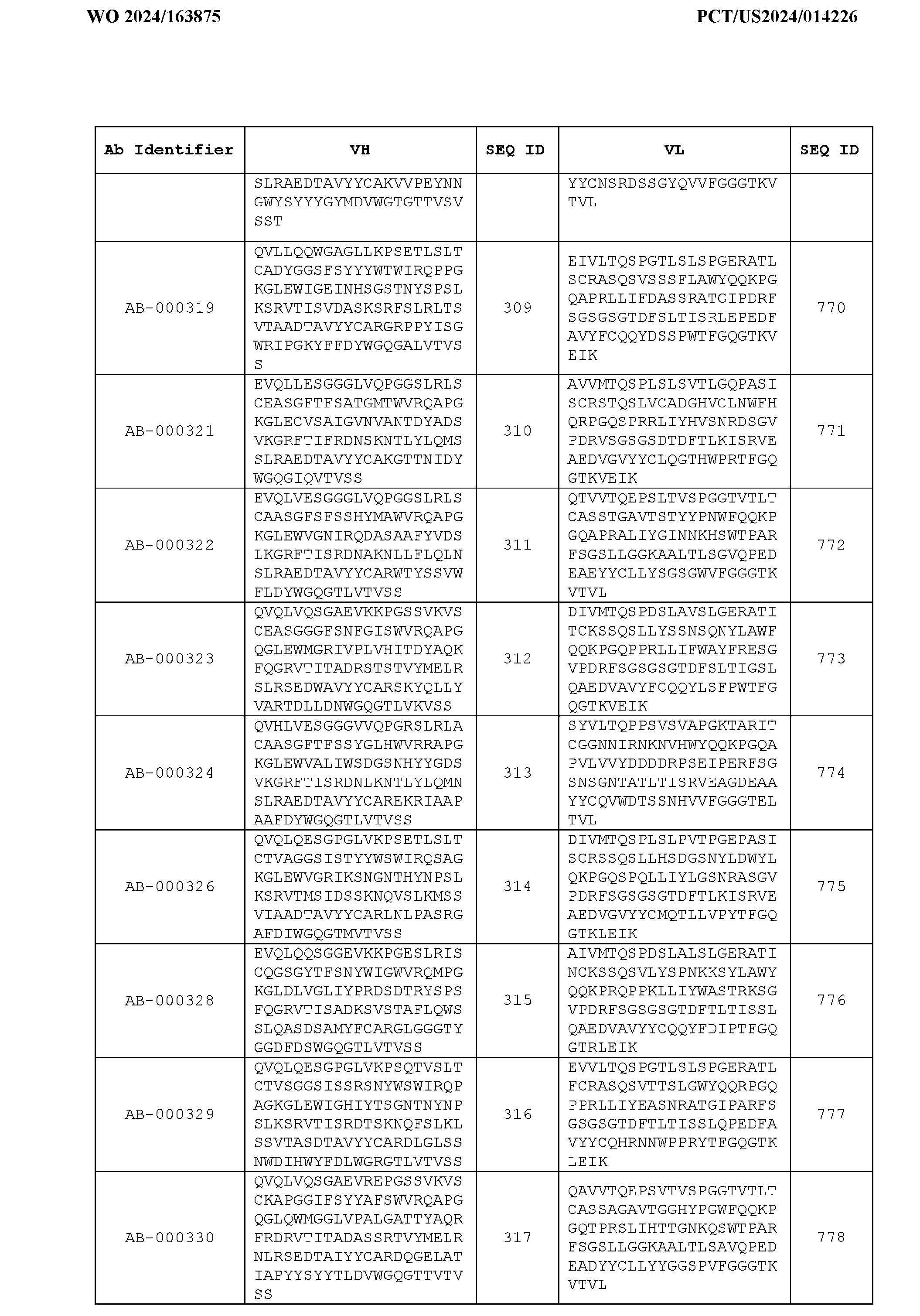
Ref document number: 24751105

Country of ref document: EP

Kind code of ref document: A2

WWE Wipo information: entry into national phase

Ref document number: 322413

Country of ref document: IL

ENP Entry into the national phase

Ref document number: 2025544366

Country of ref document: JP

Kind code of ref document: A

WWE Wipo information: entry into national phase

Ref document number: MX/A/2025/008963

Country of ref document: MX

WWE Wipo information: entry into national phase

Ref document number: AU2024214379

Country of ref document: AU

Ref document number: 823923

Country of ref document: NZ

WWE Wipo information: entry into national phase

Ref document number: 202517078766

Country of ref document: IN

ENP Entry into the national phase

Ref document number: 2024214379

Country of ref document: AU

Date of ref document: 20240202

Kind code of ref document: A

WWE Wipo information: entry into national phase

Ref document number: 202480015902.4

Country of ref document: CN

WWP Wipo information: published in national office

Ref document number: 823923

Country of ref document: NZ

NENP Non-entry into the national phase

Ref country code: DE

WWP Wipo information: published in national office

Ref document number: 202517078766

Country of ref document: IN

WWP Wipo information: published in national office

Ref document number: MX/A/2025/008963

Country of ref document: MX

WWP Wipo information: published in national office

Ref document number: 202480015902.4

Country of ref document: CN

WWP Wipo information: published in national office

Ref document number: 2024751105

Country of ref document: EP