[go: up one dir, main page]

WO2024155503A1 - Retrieving configuration schema api for operation and maintenance functions - Google Patents

Retrieving configuration schema api for operation and maintenance functions Download PDF

Info

Publication number
WO2024155503A1
WO2024155503A1 PCT/US2024/011192 US2024011192W WO2024155503A1 WO 2024155503 A1 WO2024155503 A1 WO 2024155503A1 US 2024011192 W US2024011192 W US 2024011192W WO 2024155503 A1 WO2024155503 A1 WO 2024155503A1
Authority
WO
WIPO (PCT)
Prior art keywords
configuration schema
http
valid
api
request
Prior art date
Legal status (The legal status is an assumption and is not a legal conclusion. Google has not performed a legal analysis and makes no representation as to the accuracy of the status listed.)
Ceased
Application number
PCT/US2024/011192
Other languages
French (fr)
Inventor
Pankaj SHETE
Awn Muhammad
Current Assignee (The listed assignees may be inaccurate. Google has not performed a legal analysis and makes no representation or warranty as to the accuracy of the list.)
Rakuten Mobile Inc
Rakuten Mobile USA LLC
Original Assignee
Rakuten Mobile Inc
Rakuten Mobile USA LLC
Priority date (The priority date is an assumption and is not a legal conclusion. Google has not performed a legal analysis and makes no representation as to the accuracy of the date listed.)
Filing date
Publication date
Application filed by Rakuten Mobile Inc, Rakuten Mobile USA LLC filed Critical Rakuten Mobile Inc
Priority to US18/699,958 priority Critical patent/US20250247295A1/en
Priority to JP2025538383A priority patent/JP2026501582A/en
Priority to EP24745012.5A priority patent/EP4652711A1/en
Publication of WO2024155503A1 publication Critical patent/WO2024155503A1/en
Anticipated expiration legal-status Critical
Ceased legal-status Critical Current

Links

Classifications

    • HELECTRICITY
    • H04ELECTRIC COMMUNICATION TECHNIQUE
    • H04LTRANSMISSION OF DIGITAL INFORMATION, e.g. TELEGRAPHIC COMMUNICATION
    • H04L41/00Arrangements for maintenance, administration or management of data switching networks, e.g. of packet switching networks
    • H04L41/08Configuration management of networks or network elements
    • H04L41/085Retrieval of network configuration; Tracking network configuration history
    • H04L41/0853Retrieval of network configuration; Tracking network configuration history by actively collecting configuration information or by backing up configuration information
    • HELECTRICITY
    • H04ELECTRIC COMMUNICATION TECHNIQUE
    • H04LTRANSMISSION OF DIGITAL INFORMATION, e.g. TELEGRAPHIC COMMUNICATION
    • H04L41/00Arrangements for maintenance, administration or management of data switching networks, e.g. of packet switching networks
    • H04L41/40Arrangements for maintenance, administration or management of data switching networks, e.g. of packet switching networks using virtualisation of network functions or resources, e.g. SDN or NFV entities

Definitions

  • Systems and methods consistent with example embodiments of the present disclosure relate to providing a method for retrieving configuration schemas API’s for radio access network (RAN) operation and maintenance (0AM) functions.
  • RAN radio access network
  • (0AM) maintenance
  • a radio access network is an important component in a telecommunications system, as it connects end-user devices (or user equipment (UE)) to other parts of the network.
  • the RAN includes a combination of various network elements (NEs) that connect the end-user devices to a core network.
  • NEs network elements
  • telco technologies enable many telco services to be realized virtually, in the form of software.
  • RANs such as Open RAN (0-RAN) architectures, disaggregate one network component into multiple functional elements.
  • a baseband unit (BBU) or base station i.e., eNB or gNB
  • eNB eNB
  • gNB base station
  • DU distributed unit
  • CU centralized unit
  • CU-CP Centralized Unit-Control Plane
  • CU-UP Centralized Unit-User Plane
  • RAN functions in the O-RAN architecture are controlled and optimized by a RIC.
  • the RIC is a software-defined component that implements modular applications to facilitate the multivendor operability required in the O-RAN system, as well as to automate and optimize RAN operations.
  • the RIC is divided into two types: a non-real-time RIC (Non-RT RIC) and a near-realtime RIC (Near-RT RIC).
  • the Non-RT RIC is the control point of a non-real-time control loop and operates on a timescale greater than 1 second within the Service Management and Orchestration (SMO) framework. Its functionalities are implemented through modular applications called rApps, and include: providing policy based guidance and enrichment across the Al interface, which is the interface that enables communication between the Non-RT RIC and the Near-RT RIC; performing data analytics; Artificial Intelligence/Machine Learning (AI/ML) training and inference for RAN optimization; and/or recommending configuration management actions over the 01 interface, which is the interface that connects the SMO to RAN managed elements (e.g., Near-RT RIC, O- RAN centralized Unit (O-CU), O-RAN Distributed Unit (O-DU), etc.).
  • RAN managed elements e.g., Near-RT RIC, O- RAN centralized Unit (O-CU), O-RAN Distributed Unit (O-DU), etc.
  • the SMO framework manages and orchestrates RAN elements.
  • the SMO includes a Federated O-Cloud Orchestration and Management (FOCOM), a Network Function Orchestrator (NFO) that manages Virtual Machines (VM) based VNF and container (i.e., instance) based VNF, and the Operation and Management (0AM) as a part of the SMO that manages and orchestrates what is referred to as the O-Ran Cloud (O-Cloud).
  • FOCOM Federated O-Cloud Orchestration and Management
  • NFO Network Function Orchestrator
  • VM Virtual Machines
  • container i.e., instance
  • Operation and Management 0AM
  • the SMO may include an operational support system (OSS) and an element management system (EMS), each of which is configurable to perform one or more of: fault management operations, configuration management operations, account management operations, performance management operations, and security management operations (FCAPS operations), on one or more services hosted or deployed in the servers.
  • the service management system may include a plurality of EMSs, each of the plurality of EMSs may be configured to manage a single service or a group of services associated with a particular vendor/service provider, and the OSS interfaces between the monitoring system, orchestrator, and the plurality of EMSs.
  • the SMO may provide a single control point for managing a plurality of services (associated with multiple vendors/network service providers) via only one monitoring system and one orchestrator system (i.e., one monitoring system and one orchestrator system can be utilized to manage services associated with multiple vendor s/service providers).
  • a service producer as an API consumer, may need to obtain a configuration schema from an API producer (e.g., the definitions of a configuration field, that is, what field a particular node has).
  • a configuration schema e.g., the definitions of a configuration field, that is, what field a particular node has.
  • the related art does not describe any procedure concerning the above. Accordingly, there is a need to be able to retrieve configuration schema.
  • a method may include: receiving, by an API producer, a HTTP GET configuration schema request, wherein the HTTP GET configuration schema request originates from an API consumer, and wherein the GET configuration schema request includes a resource URI and query criteria, wherein the query criteria includes at least one or more of a scope parameter and a filter parameter; determining, by the API producer, whether the HTTP GET configuration schema request is valid or not; upon determining that the HTTP GET configuration schema request is valid, obtaining, by the API producer, a configuration schema based on the resource URI and the query criteria; and sending, by the API producer, a HTTP GET response, wherein the HTTP GET response includes a message based on the determination of whether the HTTP GET configuration schema request is valid or not, wherein the message includes the configuration schema if the HTTP GET configuration schema request was determined as being valid.
  • the embodiments of the embodiments of the embodiments of the HTTP GET configuration schema request originates from an API consumer, and wherein the GET configuration schema request includes a resource URI and query criteria, where
  • an apparatus for implementing an API producer may be provided.
  • the apparatus may be configured to: receive a HTTP GET configuration schema request, wherein the HTTP GET configuration schema request originates from an API consumer, and wherein the GET configuration schema request includes a resource URI and query criteria, wherein the query criteria includes at least one or more of a scope parameter and a filter parameter; determine whether the HTTP GET configuration schema request is valid or not; upon determining that the HTTP GET configuration schema request is valid, obtain a configuration schema based on the resource URI and the query criteria; and send a HTTP GET response, wherein the HTTP GET response includes a message based on the determination of whether the HTTP GET configuration schema request is valid or not, wherein the message includes the configuration schema if the HTTP GET configuration schema request was determined as being valid.
  • a non-transitory computer-readable recording medium having recorded thereon instructions to perform a method including: receiving, by an API producer, a HTTP GET configuration schema request, wherein the HTTP GET configuration schema request originates from an API consumer, and wherein the GET configuration schema request includes a resource URI and query criteria, wherein the query criteria includes at least one or more of a scope parameter and a filter parameter; determining, by the API producer, whether the HTTP GET configuration schema request is valid or not; upon determining that the HTTP GET configuration schema request is valid, obtaining, by the API producer, a configuration schema based on the resource URI and the query criteria; and sending, by the API producer, a HTTP GET response, wherein the HTTP GET response includes a message based on the determination of whether the HTTP GET configuration schema request is valid or not, wherein the message includes the configuration schema if the HTTP GET configuration schema request was determined as being valid.
  • FIG. 1 illustrates a flowchart of a method for retrieving configuration schema API, according to an embodiment
  • FIG. 2 illustrates a call flow for retrieving configuration schema API, according to an embodiment
  • FIG. 3 is a diagram of an example environment in which systems and/or methods, described herein, may be implemented;
  • FIG. 4 is a diagram of example components of a device according to an embodiment.
  • FIG. 5 is a retrieve configuration schema information use case flow diagram according to an embodiment.
  • Example embodiments of the present disclosure provide a method and system for retrieving configuration schema API for a RAN OAM-related function.
  • an API producer may receive a GET configuration schema request from an API consumer.
  • the request may contain parameters such as a URI and query criteria.
  • the API producer may obtain the configuration schema based on the URI and the query criteria, and send a GET configuration schema response back to the API consumer.
  • the response may include a message that includes the configuration schema.
  • the embodiments of the present disclosure may provide an optimized method for retrieving configuration schema API while avoiding any data validation errors and the like.
  • FIG. 1 illustrates a flowchart of an example method 100 for retrieving a configuration schema, according to an embodiment. Operations in the example method 100 may be performed by an API producer, according to an embodiment.
  • the API producer may receive a HTTP GET configuration schema request which originates from an API consumer.
  • the HTTP GET configuration schema request may comprise a resource URI, and a query criteria.
  • the query criteria may be optional, that is, the request may indicate that it wishes to obtain all the resources at the URI.
  • the resource URI may comprise a rApp identifier, a URI-LDN-first-part, and a class name identifier.
  • the rApp identifier may be further specified in terms of an API root and an API major version, and the class name identifier may comprise both the class name of the targeted resource and the identifier of the targeted resource as separate parameters.
  • the query criteria may comprise a scope parameter, and a filter parameter.
  • the scope parameter may include a scopeType and a scopeLevel.
  • the scopeType may be defined as a parameter which extends the set of targeted resources beyond the base resource identified with the authority and path component of the URI.
  • the scopeLevel is an integer which may be used together with scopeType to extend the set of targeted resources beyond the base resource identified with the path component of the URI.
  • scopeLevel may include BASE ONLY, BASE ALL, BASE NTH LEVEL, and BASE SUBTREE, which are described as follows:
  • BASE_ONLY may selects only the base resource.
  • the "scopeLevel" parameter shall be absent or ignored if present.
  • BASE ALL may select the base resource and all of its subordinate resources (incl. the leaf resources).
  • the "scopeLevel” parameter shall be absent or ignored if present.
  • BASE_NTH_LEVEL may select all resources on the level, which is indicated by the "scopeLevel” parameter, below the base resource.
  • the base resource is at "scopeLevel” zero.
  • BASE SUBTREE may select the base resource and all of its subordinate resources down to and including the resources on the level indicated by the "scopeLevel" parameter.
  • the base resource is at "scopeLevel” zero.
  • the fdter parameter may be used to reduce the set of objects/resources obtained, by applying a fdter to the scoped set of resource representations. Only resource representations for which the fdter construct (which may be written in a variety of formats, such as XPath 1.0) evaluates to "true" may be targeted.
  • the fdter parameter may be written in the form of a condition of some attribute of the resource. Accordingly, the objects which are obtained may have an attribute which match the fdter parameter.
  • the API producer may check whether the HTTP GET configuration schema request is valid or not. According to some embodiments, this may comprise checking whether the API consumer is authorized/valid or not. In the case where it is not valid, an error may be indicated to have occurred
  • the API producer may obtain the resources based on the HTTP GET configuration schema request.
  • operation SI 30 may only be performed if it is determined that the HTTP GET configuration schema request in operation S120 is valid.
  • the resources may be obtained based on the resource URI and the query criteria. That is, the resources may be those which are located at the resource URI and match the query criteria.
  • the API producer may send an HTTP GET configuration schema response to the API consumer.
  • the HTTP GET configuration schema response may comprise a message.
  • the message may include the configuration schema (e.g., the resources obtained in operation S130), as well as a response code (e.g., to indicate that the operation was successful).
  • the message may instead contain an indication that an error occurred.
  • the error message may comprise a response code (for example, some error code which indicates to the service operator what error has occurred), and a detailed problem description. Nevertheless, it should be appreciated that any format can be used to indicate the error.
  • FIG. 2 illustrates an example call flow for retrieving configuration schema API according to an embodiment.
  • API consumer 200 and API producer 210 may be similar to the API consumer and API producer described with respect to FIG. 1.
  • Operations SI 10, SI 20, SI 30, and S140 may be substantially similar to Operations S220, S221, S222, and S223 respectively, accordingly, redundant descriptions may be omitted.
  • API consumer 200 may send an HTTP GET (configuration schema) request to API producer 210.
  • HTTP GET configuration schema
  • API producer 210 evaluates whether the request sent in operation S220 is valid or not.
  • API producer 210 obtains the objects/resources of the configuration schema based on the HTTP GET request from operation S220. It should be reiterated that operation S222 may only occur if operation S221 had a “valid” result, according to some embodiments.
  • API producer returns the HTTP GET configuration schema response back to API consumer 200.
  • This response may include a message, either including the requested configuration schema, or an error message, as explained in the description of similar operation SI 40 above.
  • the above embodiments can accordingly provide an optimized method for retrieving configuration schema API while avoiding any data validation errors and the like.
  • FIG. 3 is a diagram of an example environment 300 in which systems and/or methods, described herein, may be implemented.
  • environment 300 may include a user device 310, a platform 320, and a network 330.
  • Devices of environment 300 may interconnect via wired connections, wireless connections, or a combination of wired and wireless connections. In embodiments, any of the functions and operations described with reference to FIGS. 6 through 7 above may be performed by any combination of elements illustrated in FIG. 3.
  • User device 310 includes one or more devices capable of receiving, generating, storing, processing, and/or providing information associated with platform 320.
  • user device 310 may include a computing device (e.g., a desktop computer, a laptop computer, a tablet computer, a handheld computer, a smart speaker, a server, etc.), a mobile phone (e g., a smart phone, a radiotelephone, etc.), a wearable device (e.g., a pair of smart glasses or a smart watch), or a similar device.
  • a computing device e.g., a desktop computer, a laptop computer, a tablet computer, a handheld computer, a smart speaker, a server, etc.
  • a mobile phone e.g., a smart phone, a radiotelephone, etc.
  • a wearable device e.g., a pair of smart glasses or a smart watch
  • user device 310 may receive information from and/or transmit information to platform 320.
  • Platform 320 includes one or more devices capable of receiving, generating, storing, processing, and/or providing information.
  • platform 320 may include a cloud server or a group of cloud servers.
  • platform 320 may be designed to be modular such that certain software components may be swapped in or out depending on a particular need. As such, platform 320 may be easily and/or quickly reconfigured for different uses.
  • platform 320 may be hosted in cloud computing environment 322.
  • platform 320 may not be cloud-based (i.e., may be implemented outside of a cloud computing environment) or may be partially cloud-based.
  • Cloud computing environment 322 includes an environment that hosts platform 320.
  • Cloud computing environment 322 may provide computation, software, data access, storage, etc., services that do not require end-user (e.g., user device 310) knowledge of a physical location and configuration of system(s) and/or device(s) that hosts platform 320.
  • cloud computing environment 322 may include a group of computing resources 324 (referred to collectively as “computing resources 324” and individually as “computing resource 324”).
  • Computing resource 324 includes one or more personal computers, a cluster of computing devices, workstation computers, server devices, or other types of computation and/or communication devices.
  • computing resource 324 may host platform 320.
  • the cloud resources may include compute instances executing in computing resource 324, storage devices provided in computing resource 324, data transfer devices provided by computing resource 324, etc.
  • computing resource 324 may communicate with other computing resources 324 via wired connections, wireless connections, or a combination of wired and wireless connections.
  • computing resource 324 includes a group of cloud resources, such as one or more applications (“APPs”) 324-1, one or more virtual machines (“VMs”)
  • APPs applications
  • VMs virtual machines
  • Application 324-1 includes one or more software applications that may be provided to or accessed by user device 310. Application 324-1 may eliminate a need to install and execute the software applications on user device 310. For example, application 324-1 may include software associated with platform 320 and/or any other software capable of being provided via cloud computing environment 322. In some implementations, one application 324-1 may send/receive information to/from one or more other applications 324-1, via virtual machine 324-2.
  • Virtual machine 324-2 includes a software implementation of a machine (e.g., a computer) that executes programs like a physical machine.
  • Virtual machine 324-2 may be either a system virtual machine or a process virtual machine, depending upon use and degree of correspondence to any real machine by virtual machine 324-2.
  • a system virtual machine may provide a complete system platform that supports execution of a complete operating system (“OS”).
  • a process virtual machine may execute a single program, and may support a single process.
  • virtual machine 324-2 may execute on behalf of a user (e.g., user device 310), and may manage infrastructure of cloud computing environment 322, such as data management, synchronization, or long-duration data transfers.
  • Virtualized storage 324-3 includes one or more storage systems and/or one or more devices that use virtualization techniques within the storage systems or devices of computing resource 324.
  • types of virtualizations may include block virtualization and file virtualization.
  • Block virtualization may refer to abstraction (or separation) of logical storage from physical storage so that the storage system may be accessed without regard to physical storage or heterogeneous structure. The separation may permit administrators of the storage system flexibility in how the administrators manage storage for end users.
  • File virtualization may eliminate dependencies between data accessed at a file level and a location where files are physically stored. This may enable optimization of storage use, server consolidation, and/or performance of non-disruptive file migrations.
  • Hypervisor 324-4 may provide hardware virtualization techniques that allow multiple operating systems (e.g., “guest operating systems”) to execute concurrently on a host computer, such as computing resource 324.
  • Hypervisor 324-4 may present a virtual operating platform to the guest operating systems, and may manage the execution of the guest operating systems. Multiple instances of a variety of operating systems may share virtualized hardware resources.
  • Network 330 includes one or more wired and/or wireless networks.
  • network 230 may include a cellular network (e.g., a fifth generation (5G) network, a long-term evolution (LTE) network, a third generation (3G) network, a code division multiple access (CDMA) network, etc.), a public land mobile network (PLMN), a local area network (LAN), a wide area network (WAN), a metropolitan area network (MAN), a telephone network (e.g., the Public Switched Telephone Network (PSTN)), a private network, an ad hoc network, an intranet, the Internet, a fiber optic-based network, or the like, and/or a combination of these or other types of networks.
  • 5G fifth generation
  • LTE long-term evolution
  • 3G third generation
  • CDMA code division multiple access
  • PLMN public land mobile network
  • LAN local area network
  • WAN wide area network
  • MAN metropolitan area network
  • PSTN Public Switched Telephone Network
  • FIG. 3 The number and arrangement of devices and networks shown in FIG. 3 are provided as an example. In practice, there may be additional devices and/or networks, fewer devices and/or networks, different devices and/or networks, or differently arranged devices and/or networks than those shown in FIG. 3. Furthermore, two or more devices shown in FIG. 3 may be implemented within a single device, or a single device shown in FIG. 3 may be implemented as multiple, distributed devices. Additionally, or alternatively, a set of devices (e.g., one or more devices) of environment 300 may perform one or more functions described as being performed by another set of devices of environment 300.
  • a set of devices e.g., one or more devices
  • FIG. 4 is a diagram of example components of a device 400.
  • Device 400 may correspond to user device 310 and/or platform 320.
  • device 400 may include a bus 410, a processor 420, a memory 430, a storage component 440, an input component 450, an output component 460, and a communication interface 470.
  • Bus 410 includes a component that permits communication among the components of device 400.
  • Processor 420 may be implemented in hardware, firmware, or a combination of hardware and software.
  • Processor 420 may be a central processing unit (CPU), a graphics processing unit (GPU), an accelerated processing unit (APU), a microprocessor, a microcontroller, a digital signal processor (DSP), a field-programmable gate array (FPGA), an application-specific integrated circuit (ASIC), or another type of processing component.
  • processor 420 includes one or more processors capable of being programmed to perform a function.
  • Memory 430 includes a random access memory (RAM), a read only memory (ROM), and/or another type of dynamic or static storage device (e.g., a flash memory, a magnetic memory, and/or an optical memory) that stores information and/or instructions for use by processor 420.
  • RAM random access memory
  • ROM read only memory
  • static storage device e.g., a flash memory, a magnetic memory, and/or an optical memory
  • Storage component 440 stores information and/or software related to the operation and use of device 400.
  • storage component 440 may include a hard disk (e.g., a magnetic disk, an optical disk, a magneto-optic disk, and/or a solid state disk), a compact disc (CD), a digital versatile disc (DVD), a floppy disk, a cartridge, a magnetic tape, and/or another type of non-transitory computer-readable medium, along with a corresponding drive.
  • Input component 450 includes a component that permits device 400 to receive information, such as via user input (e.g., a touch screen display, a keyboard, a keypad, a mouse, a button, a switch, and/or a microphone).
  • input component 450 may include a sensor for sensing information (e.g., a global positioning system (GPS) component, an accelerometer, a gyroscope, and/or an actuator).
  • Output component 460 includes a component that provides output information from device 400 (e.g., a display, a speaker, and/or one or more light-emitting diodes (LEDs)).
  • a sensor for sensing information e.g., a global positioning system (GPS) component, an accelerometer, a gyroscope, and/or an actuator).
  • output component 460 includes a component that provides output information from device 400 (e.g., a display, a speaker, and/or one or more light-emitting diodes (LEDs)).
  • LEDs light-emitting diodes
  • Communication interface 470 includes a transceiver-like component (e.g., a transceiver and/or a separate receiver and transmitter) that enables device 400 to communicate with other devices, such as via a wired connection, a wireless connection, or a combination of wired and wireless connections.
  • Communication interface 470 may permit device 400 to receive information from another device and/or provide information to another device.
  • communication interface 470 may include an Ethernet interface, an optical interface, a coaxial interface, an infrared interface, a radio frequency (RF) interface, a universal serial bus (USB) interface, a Wi-Fi interface, a cellular network interface, or the like.
  • RF radio frequency
  • USB universal serial bus
  • Device 400 may perform one or more processes described herein. Device 400 may perform these processes in response to processor 420 executing software instructions stored by a non-transitory computer-readable medium, such as memory 430 and/or storage component 440.
  • a computer-readable medium is defined herein as a non-transitory memory device.
  • a memory device includes memory space within a single physical storage device or memory space spread across multiple physical storage devices.
  • Software instructions may be read into memory 430 and/or storage component 440 from another computer-readable medium or from another device via communication interface 470. When executed, software instructions stored in memory 430 and/or storage component 440 may cause processor 420 to perform one or more processes described herein.
  • hardwired circuitry may be used in place of or in combination with software instructions to perform one or more processes described herein.
  • implementations described herein are not limited to any specific combination of hardware circuitry and software.
  • device 400 may include additional components, fewer components, different components, or differently arranged components than those shown in FIG. 4. Additionally, or alternatively, a set of components (e.g., one or more components) of device 400 may perform one or more functions described as being performed by another set of components of device 400.
  • any one of the operations or processes of FIGS 1 and 2 may be implemented by or using any one of the elements illustrated in FIGS. 3 and 4. It is understood that other embodiments are not limited thereto, and may be implemented in a variety of different architectures (e.g., bare metal architecture, any cloud-based architecture or deployment architecture such as Kubernetes, Docker, OpenStack, etc.).
  • Some embodiments may relate to a system, a method, and/or a computer readable medium at any possible technical detail level of integration. Further, one or more of the above components described above may be implemented as instructions stored on a computer readable medium and executable by at least one processor (and/or may include at least one processor).
  • the computer readable medium may include a computer-readable non-transitory storage medium (or media) having computer readable program instructions thereon for causing a processor to carry out operations.
  • the computer readable storage medium can be a tangible device that can retain and store instructions for use by an instruction execution device.
  • the computer readable storage medium may be, for example, but is not limited to, an electronic storage device, a magnetic storage device, an optical storage device, an electromagnetic storage device, a semiconductor storage device, or any suitable combination of the foregoing.
  • a non-exhaustive list of more specific examples of the computer readable storage medium includes the following: a portable computer diskette, a hard disk, a random access memory (RAM), a read-only memory (ROM), an erasable programmable read-only memory (EPROM or Flash memory), a static random access memory (SRAM), a portable compact disc read-only memory (CD-ROM), a digital versatile disk (DVD), a memory stick, a floppy disk, a mechanically encoded device such as punch-cards or raised structures in a groove having instructions recorded thereon, and any suitable combination of the foregoing.
  • RAM random access memory
  • ROM read-only memory
  • EPROM or Flash memory erasable programmable read-only memory
  • SRAM static random access memory
  • CD-ROM compact disc read-only memory
  • DVD digital versatile disk
  • memory stick a floppy disk
  • a mechanically encoded device such as punch-cards or raised structures in a groove having instructions recorded thereon
  • a computer readable storage medium is not to be construed as being transitory signals per se, such as radio waves or other freely propagating electromagnetic waves, electromagnetic waves propagating through a waveguide or other transmission media (e.g., light pulses passing through a fiber-optic cable), or electrical signals transmitted through a wire.
  • Computer readable program instructions described herein can be downloaded to respective computing/processing devices from a computer readable storage medium or to an external computer or external storage device via a network, for example, the Internet, a local area network, a wide area network and/or a wireless network.
  • the network may comprise copper transmission cables, optical transmission fibers, wireless transmission, routers, firewalls, switches, gateway computers and/or edge servers.
  • a network adapter card or network interface in each computing/processing device receives computer readable program instructions from the network and forwards the computer readable program instructions for storage in a computer readable storage medium within the respective computing/processing device.
  • Computer readable program code/instructions for carrying out operations may be assembler instructions, instruction-set-architecture (ISA) instructions, machine instructions, machine dependent instructions, microcode, firmware instructions, state-setting data, configuration data for integrated circuitry, or either source code or object code written in any combination of one or more programming languages, including an object oriented programming language such as Smalltalk, C++, or the like, and procedural programming languages, such as the "C" programming language or similar programming languages.
  • the computer readable program instructions may execute entirely on the user's computer, partly on the user's computer, as a standalone software package, partly on the user's computer and partly on a remote computer or entirely on the remote computer or server.
  • the remote computer may be connected to the user's computer through any type of network, including a local area network (LAN) or a wide area network (WAN), or the connection may be made to an external computer (for example, through the Internet using an Internet Service Provider).
  • electronic circuitry including, for example, programmable logic circuitry, field-programmable gate arrays (FPGA), or programmable logic arrays (PLA) may execute the computer readable program instructions by utilizing state information of the computer readable program instructions to personalize the electronic circuitry, in order to perform aspects or operations.
  • These computer readable program instructions may be provided to a processor of a general purpose computer, special purpose computer, or other programmable data processing apparatus to produce a machine, such that the instructions, which execute via the processor of the computer or other programmable data processing apparatus, create means for implementing the functions/acts specified in the flowchart and/or block diagram block or blocks.
  • These computer readable program instructions may also be stored in a computer readable storage medium that can direct a computer, a programmable data processing apparatus, and/or other devices to function in a particular manner, such that the computer readable storage medium having instructions stored therein comprises an article of manufacture including instructions which implement aspects of the function/act specified in the flowchart and/or block diagram block or blocks.
  • the computer readable program instructions may also be loaded onto a computer, other programmable data processing apparatus, or other device to cause a series of operational steps to be performed on the computer, other programmable apparatus or other device to produce a computer implemented process, such that the instructions which execute on the computer, other programmable apparatus, or other device implement the functions/acts specified in the flowchart and/or block diagram block or blocks.
  • each block in the flowchart or block diagrams may represent a microservice(s), module, segment, or portion of instructions, which comprises one or more executable instructions for implementing the specified logical function(s).
  • the method, computer system, and computer readable medium may include additional blocks, fewer blocks, different blocks, or differently arranged blocks than those depicted in the Figures.
  • the functions noted in the blocks may occur out of the order noted in the Figures.
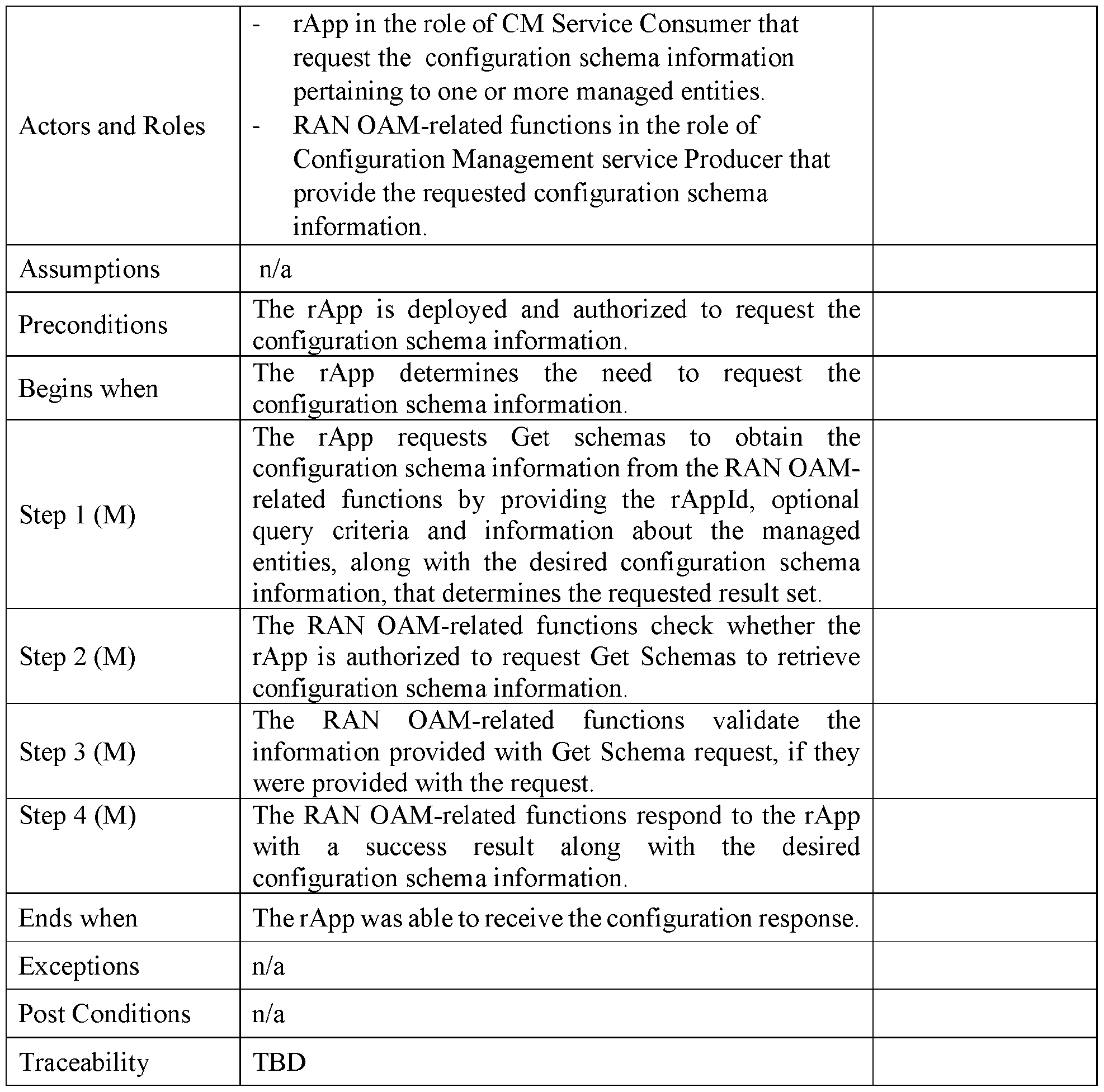
  • This use-case allows an rApp acting as a CM Service Consumer to retrieve information pertaining to the configuration schemas of one or more managed entities.
  • An rApp acting as a CM Service Consumer can retrieve information pertaining to one or more managed entities from the Configuration management Service Producer.
  • Producer (a) receives the Get Schemas request to retrieve configuration schema information related to one or more managed entities, (b) provides the response of success or failure result to the Get schema request.
  • rApp supports functionality to initiate Get schemas procedure to retrieve the configuration schema information.
  • FIG. 5 illustrates a retrieve configuration schema information use case flow diagram according to the above embodiment described with respect to Table 1.
  • the use case flow diagram also corresponds to the uml code below from @startuml to @enduml.
  • participant [0104] participant "RAN OAM-related functions" as cmsp
  • the Get schemas request for retrieval of configuration schemas information contains the rAppId, and query criteria (including information about the related managed entities and about the requested configuration schemas information).
  • the Get schemas response is scoped by the information provided in the request.
  • Item [1] A method including: receiving, by an API producer, a HTTP GET configuration schema request, wherein the HTTP GET configuration schema request originates from an API consumer, and wherein the GET configuration schema request includes a resource URI and query criteria, wherein the query criteria includes at least one or more of a scope parameter and a filter parameter; determining, by the API producer, whether the HTTP GET configuration schema request is valid or not; upon determining that the HTTP GET configuration schema request is valid, obtaining, by the API producer, a configuration schema based on the resource URI and the query criteria; and sending, by the API producer, a HTTP GET response, wherein the HTTP GET response includes a message based on the determination of whether the HTTP GET configuration schema request is valid or not, wherein the message includes the configuration schema if the HTTP GET configuration schema request was determined as being valid.
  • Item [2] The method according to Item [1], wherein determining whether the HTTP GET configuration schema request is valid or not further includes: determining, by the API producer, whether the
  • Item [3] The method according to any one of Items [ 1 ]-[2], wherein the resource URI includes an rApp identifier, a URI-LDN-first-part, and a class name identifier.
  • Item [4] The method according to any one of Items [l]-[3], wherein if determined that the HTTP GET configuration schema request is not valid, the message indicates that an error has occurred.
  • Item [5] The method according to any one of Items [l]-[4], wherein obtaining the configuration schema based on the resource URI and the query criteria further includes: obtaining objects, wherein the obtained objects have a scope level which match the scope parameter.
  • Item [6] The method according to Item [5], wherein the obtained objects have an attribute which match the filter parameter.
  • Item [7] The method according to Item [6], wherein the filter parameter is applied by checking whether a filter construct evaluates to true or false.
  • An apparatus for implementing an API producer configured to: receive a HTTP GET configuration schema request, wherein the HTTP GET configuration schema request originates from an API consumer, and wherein the GET configuration schema request includes a resource URI and query criteria, wherein the query criteria includes at least one or more of a scope parameter and a filter parameter; determine whether the HTTP GET configuration schema request is valid or not; upon determining that the HTTP GET configuration schema request is valid, obtain a configuration schema based on the resource URI and the query criteria; and send a HTTP GET response, wherein the HTTP GET response includes a message based on the determination of whether the HTTP GET configuration schema request is valid or not, wherein the message includes the configuration schema if the HTTP GET configuration schema request was determined as being valid.
  • Item [9] The apparatus according to Item [8], wherein the device is further configured to determine whether the HTTP GET configuration schema request is valid or not by: determining whether the HTTP GET configuration schema request originates from a valid API consumer.
  • Item [10] The apparatus according to any one of Items [8]-[9], wherein the resource URI includes an rApp identifier, a URI-LDN-first-part, and a class name identifier.
  • Item [11] The apparatus according to any one of Items [8]-[10], wherein if determined that the HTTP GET configuration schema request is not valid, the message indicates that an error has occurred.
  • Item [13] The apparatus according to Item [12], wherein the obtained objects have an attribute which match the filter parameter.
  • Item [14] The apparatus according to Item [13], wherein the filter parameter is applied by checking whether a filter construct evaluates to true or false.
  • a non-transitory computer-readable recording medium having recorded thereon instructions to perform a method including: receiving, by an API producer, a HTTP GET configuration schema request, wherein the HTTP GET configuration schema request originates from an API consumer, and wherein the GET configuration schema request includes a resource URI and query criteria, wherein the query criteria includes at least one or more of a scope parameter and a filter parameter; determining, by the API producer, whether the HTTP GET configuration schema request is valid or not; upon determining that the HTTP GET configuration schema request is valid, obtaining, by the API producer, a configuration schema based on the resource URI and the query criteria; and sending, by the API producer, a HTTP GET response, wherein the HTTP GET response includes a message based on the determination of whether the HTTP GET configuration schema request is valid or not, wherein the message includes the configuration schema if the HTTP GET configuration schema request was determined as being valid.
  • Item [16] The non-transitory computer-readable recording medium according to Item [15], wherein determining whether the HTTP GET configuration schema request is valid or not further includes: determining, by the API producer, whether the HTTP GET configuration schema request originates from a valid API consumer.
  • Item [17] The non-transitory computer-readable recording medium according to any one of Items [15]-[16], , wherein the resource URI includes an rApp identifier, a URI-LDN-first-part, and a class name identifier.
  • Item [18] The non-transitory computer-readable recording medium according to any one of Items [1 ]-[17], , wherein if determined that the HTTP GET configuration schema request is not valid, the message indicates that an error has occurred.
  • Item [19] The non-transitory computer-readable recording medium according to any one of Items [15]-[18], wherein obtaining the configuration schema based on the resource URI and the query criteria further includes: obtaining objects, wherein the obtained objects have a scope level which match the scope parameter.

Landscapes

  • Engineering & Computer Science (AREA)
  • Computer Networks & Wireless Communication (AREA)
  • Signal Processing (AREA)
  • Computer And Data Communications (AREA)
  • Management, Administration, Business Operations System, And Electronic Commerce (AREA)
  • Software Systems (AREA)
  • Theoretical Computer Science (AREA)
  • Physics & Mathematics (AREA)
  • General Engineering & Computer Science (AREA)
  • General Physics & Mathematics (AREA)

Abstract

Example embodiments of the present disclosure relate to retrieving configuration schemas API's for radio access network (RAN) operation and maintenance (OAM) functions. In particular, a method may be implemented by an API producer and include receiving a configuration schema request originating from an API consumer, the configuration schema request including a resource URI and query criteria, the query criteria including at least one or more of a scope parameter and a filter parameter; determining whether the configuration schema request is valid or not; upon determining that the configuration schema request is valid, obtaining a configuration schema based on the resource URI and the query criteria; and sending a response, wherein the response includes a message based on the determination of whether the configuration schema request is valid or not, wherein the message includes the configuration schema if the configuration schema request was determined as being valid.

Description

RETRIEVING CONFIGURATION SCHEMA API FOR OPERATION AND MAINTENANCE FUNCTIONS
TECHNICAL FIELD
[0001] Systems and methods consistent with example embodiments of the present disclosure relate to providing a method for retrieving configuration schemas API’s for radio access network (RAN) operation and maintenance (0AM) functions.
BACKGROUND
[0002] A radio access network (RAN) is an important component in a telecommunications system, as it connects end-user devices (or user equipment (UE)) to other parts of the network. The RAN includes a combination of various network elements (NEs) that connect the end-user devices to a core network. Traditionally, hardware and/or software of a particular RAN is vendor specific.
[0003] Recently, the evolution of telco technologies enables many telco services to be realized virtually, in the form of software. For instance, RANs such as Open RAN (0-RAN) architectures, disaggregate one network component into multiple functional elements. By way of example, a baseband unit (BBU) or base station (i.e., eNB or gNB) is disaggregated into a number of functional elements including a distributed unit (DU) and a centralized unit (CU), wherein the CU can be further disaggregated into Centralized Unit-Control Plane (CU-CP) and Centralized Unit-User Plane (CU-UP). The disaggregation of network elements enables the telco services and the associated functions to be defined and provided in software-based form or virtual network services, such as Virtualized Network Functions (VNFs), Cloud-native Network Functions (CNFs) or Software Defined Networking (SDN), among others. [0004] RAN functions in the O-RAN architecture are controlled and optimized by a RIC. The RIC is a software-defined component that implements modular applications to facilitate the multivendor operability required in the O-RAN system, as well as to automate and optimize RAN operations. The RIC is divided into two types: a non-real-time RIC (Non-RT RIC) and a near-realtime RIC (Near-RT RIC).
[0005] The Non-RT RIC is the control point of a non-real-time control loop and operates on a timescale greater than 1 second within the Service Management and Orchestration (SMO) framework. Its functionalities are implemented through modular applications called rApps, and include: providing policy based guidance and enrichment across the Al interface, which is the interface that enables communication between the Non-RT RIC and the Near-RT RIC; performing data analytics; Artificial Intelligence/Machine Learning (AI/ML) training and inference for RAN optimization; and/or recommending configuration management actions over the 01 interface, which is the interface that connects the SMO to RAN managed elements (e.g., Near-RT RIC, O- RAN centralized Unit (O-CU), O-RAN Distributed Unit (O-DU), etc.).
[0006] The SMO framework manages and orchestrates RAN elements. Specifically, the SMO includes a Federated O-Cloud Orchestration and Management (FOCOM), a Network Function Orchestrator (NFO) that manages Virtual Machines (VM) based VNF and container (i.e., instance) based VNF, and the Operation and Management (0AM) as a part of the SMO that manages and orchestrates what is referred to as the O-Ran Cloud (O-Cloud).
[0007] Further, the SMO may include an operational support system (OSS) and an element management system (EMS), each of which is configurable to perform one or more of: fault management operations, configuration management operations, account management operations, performance management operations, and security management operations (FCAPS operations), on one or more services hosted or deployed in the servers. In some embodiments, the service management system may include a plurality of EMSs, each of the plurality of EMSs may be configured to manage a single service or a group of services associated with a particular vendor/service provider, and the OSS interfaces between the monitoring system, orchestrator, and the plurality of EMSs. Accordingly, the SMO may provide a single control point for managing a plurality of services (associated with multiple vendors/network service providers) via only one monitoring system and one orchestrator system (i.e., one monitoring system and one orchestrator system can be utilized to manage services associated with multiple vendor s/service providers).
SUMMARY
[0008] In the related art, for an 0AM related service, a service producer, as an API consumer, may need to obtain a configuration schema from an API producer (e.g., the definitions of a configuration field, that is, what field a particular node has). However, the related art does not describe any procedure concerning the above. Accordingly, there is a need to be able to retrieve configuration schema.
[0009] According to embodiments, systems and methods are provided for retrieving configuration schemas API’s for radio access network (RAN) operation and maintenance (0AM) functions. In particular, a method may include: receiving, by an API producer, a HTTP GET configuration schema request, wherein the HTTP GET configuration schema request originates from an API consumer, and wherein the GET configuration schema request includes a resource URI and query criteria, wherein the query criteria includes at least one or more of a scope parameter and a filter parameter; determining, by the API producer, whether the HTTP GET configuration schema request is valid or not; upon determining that the HTTP GET configuration schema request is valid, obtaining, by the API producer, a configuration schema based on the resource URI and the query criteria; and sending, by the API producer, a HTTP GET response, wherein the HTTP GET response includes a message based on the determination of whether the HTTP GET configuration schema request is valid or not, wherein the message includes the configuration schema if the HTTP GET configuration schema request was determined as being valid. Accordingly, the embodiments of the present disclosure may provide an optimized method for retrieving configuration schema API while avoiding any data validation errors and the like.
[0010] According to embodiments, an apparatus for implementing an API producer may be provided. The apparatus may be configured to: receive a HTTP GET configuration schema request, wherein the HTTP GET configuration schema request originates from an API consumer, and wherein the GET configuration schema request includes a resource URI and query criteria, wherein the query criteria includes at least one or more of a scope parameter and a filter parameter; determine whether the HTTP GET configuration schema request is valid or not; upon determining that the HTTP GET configuration schema request is valid, obtain a configuration schema based on the resource URI and the query criteria; and send a HTTP GET response, wherein the HTTP GET response includes a message based on the determination of whether the HTTP GET configuration schema request is valid or not, wherein the message includes the configuration schema if the HTTP GET configuration schema request was determined as being valid.
[0011 ] According to embodiments, a non-transitory computer-readable recording medium may be provided, having recorded thereon instructions to perform a method including: receiving, by an API producer, a HTTP GET configuration schema request, wherein the HTTP GET configuration schema request originates from an API consumer, and wherein the GET configuration schema request includes a resource URI and query criteria, wherein the query criteria includes at least one or more of a scope parameter and a filter parameter; determining, by the API producer, whether the HTTP GET configuration schema request is valid or not; upon determining that the HTTP GET configuration schema request is valid, obtaining, by the API producer, a configuration schema based on the resource URI and the query criteria; and sending, by the API producer, a HTTP GET response, wherein the HTTP GET response includes a message based on the determination of whether the HTTP GET configuration schema request is valid or not, wherein the message includes the configuration schema if the HTTP GET configuration schema request was determined as being valid.
[0012] Additional aspects will be set forth in part in the description that follows and, in part, will be apparent from the description, or may be realized by practice of the presented embodiments of the disclosure.
BRIEF DESCRIPTION OF THE DRAWINGS
[0013] Features, aspects and advantages of certain exemplary embodiments of the disclosure will be described below with reference to the accompanying drawings, in which like reference numerals denote like elements, and wherein:
[0014] FIG. 1 illustrates a flowchart of a method for retrieving configuration schema API, according to an embodiment;
[0015] FIG. 2 illustrates a call flow for retrieving configuration schema API, according to an embodiment; [0016] FIG. 3 is a diagram of an example environment in which systems and/or methods, described herein, may be implemented;
[0017] FIG. 4 is a diagram of example components of a device according to an embodiment; and
[0018] FIG. 5 is a retrieve configuration schema information use case flow diagram according to an embodiment.
DETAILED DESCRIPTION
[0019] The following detailed description of example embodiments refers to the accompanying drawings.
[0020] The foregoing disclosure provides illustration and description, but is not intended to be exhaustive or to limit the implementations to the precise form disclosed. Modifications and variations are possible in light of the above disclosure or may be acquired from practice of the implementations. Further, one or more features or components of one embodiment may be incorporated into or combined with another embodiment (or one or more features of another embodiment). Additionally, in the flowcharts and descriptions of operations provided below, it is understood that one or more operations may be omitted, one or more operations may be added, one or more operations may be performed simultaneously (at least in part), and the order of one or more operations may be switched.
[0021] It will be apparent that systems and/or methods, described herein, may be implemented in different forms of hardware, firmware, or a combination of hardware and software. The actual specialized control hardware or software code used to implement these systems and/or methods is not limiting of the implementations. Thus, the operation and behavior of the systems and/or methods were described herein without reference to specific software code. It is understood that software and hardware may be designed to implement the systems and/or methods based on the description herein.
[0022] Even though particular combinations of features are recited in the claims and/or disclosed in the specification, these combinations are not intended to limit the disclosure of possible implementations. In fact, many of these features may be combined in ways not specifically recited in the claims and/or disclosed in the specification. Although each dependent claim listed below may directly depend on only one claim, the disclosure of possible implementations includes each dependent claim in combination with every other claim in the claim set.
[0023] No element, act, or instruction used herein should be construed as critical or essential unless explicitly described as such. Also, as used herein, the articles “a” and “an” are intended to include one or more items, and may be used interchangeably with “one or more.” Where only one item is intended, the term “one” or similar language is used. Also, as used herein, the terms “has,” “have,” “having,” “include,” “including,” or the like are intended to be open- ended terms. Further, the phrase “based on” is intended to mean “based, at least in part, on” unless explicitly stated otherwise. Furthermore, expressions such as “at least one of [A] and [B]” or “at least one of [A] or [B]” are to be understood as including only A, only B, or both A and B.
[0024] Furthermore, the described features, advantages, and characteristics of the present disclosure may be combined in any suitable manner in one or more embodiments. One skilled in the relevant art will recognize, in light of the description herein, that the present disclosure can be practiced without one or more of the specific features or advantages of a particular embodiment. In other instances, additional features and advantages may be recognized in certain embodiments that may not be present in all embodiments of the present disclosure.
[0025] Example embodiments of the present disclosure provide a method and system for retrieving configuration schema API for a RAN OAM-related function. Particularly, according to embodiments, an API producer may receive a GET configuration schema request from an API consumer. The request may contain parameters such as a URI and query criteria. After determining that the request is valid, the API producer may obtain the configuration schema based on the URI and the query criteria, and send a GET configuration schema response back to the API consumer. The response may include a message that includes the configuration schema.
[0026] Accordingly, the embodiments of the present disclosure may provide an optimized method for retrieving configuration schema API while avoiding any data validation errors and the like.
[0027] FIG. 1 illustrates a flowchart of an example method 100 for retrieving a configuration schema, according to an embodiment. Operations in the example method 100 may be performed by an API producer, according to an embodiment.
[0028] At operation SI 10, the API producer may receive a HTTP GET configuration schema request which originates from an API consumer. The HTTP GET configuration schema request may comprise a resource URI, and a query criteria. It should be noted that according to some embodiments, the query criteria may be optional, that is, the request may indicate that it wishes to obtain all the resources at the URI.
[0029] According to an embodiment, the resource URI may comprise a rApp identifier, a URI-LDN-first-part, and a class name identifier. According to an embodiment, the rApp identifier may be further specified in terms of an API root and an API major version, and the class name identifier may comprise both the class name of the targeted resource and the identifier of the targeted resource as separate parameters.
[0030] According to an embodiment, the query criteria may comprise a scope parameter, and a filter parameter.
[0031] As an example of an implementation for including the scope parameter, the scope parameter may include a scopeType and a scopeLevel. The scopeType may be defined as a parameter which extends the set of targeted resources beyond the base resource identified with the authority and path component of the URI. The scopeLevel is an integer which may be used together with scopeType to extend the set of targeted resources beyond the base resource identified with the path component of the URI. scopeLevel may include BASE ONLY, BASE ALL, BASE NTH LEVEL, and BASE SUBTREE, which are described as follows:
[0032] BASE_ONLY may selects only the base resource. The "scopeLevel" parameter shall be absent or ignored if present.
[0033] BASE ALL may select the base resource and all of its subordinate resources (incl. the leaf resources). The "scopeLevel" parameter shall be absent or ignored if present.
[0034] BASE_NTH_LEVEL may select all resources on the level, which is indicated by the "scopeLevel" parameter, below the base resource. The base resource is at "scopeLevel" zero.
[0035] BASE SUBTREE may select the base resource and all of its subordinate resources down to and including the resources on the level indicated by the "scopeLevel" parameter. The base resource is at "scopeLevel" zero. [0036] It should be appreciated that the above example embodiment involving scopeType and scopeLevel uses placeholder variable names, and the syntax may vary depending on the implementation.
[0037] According to an embodiment, the fdter parameter may be used to reduce the set of objects/resources obtained, by applying a fdter to the scoped set of resource representations. Only resource representations for which the fdter construct (which may be written in a variety of formats, such as XPath 1.0) evaluates to "true" may be targeted. The fdter parameter may be written in the form of a condition of some attribute of the resource. Accordingly, the objects which are obtained may have an attribute which match the fdter parameter.
[0038] At operation SI 20, the API producer may check whether the HTTP GET configuration schema request is valid or not. According to some embodiments, this may comprise checking whether the API consumer is authorized/valid or not. In the case where it is not valid, an error may be indicated to have occurred
[0039] At operation SI 30, the API producer may obtain the resources based on the HTTP GET configuration schema request. According to an embodiment, operation SI 30 may only be performed if it is determined that the HTTP GET configuration schema request in operation S120 is valid. The resources may be obtained based on the resource URI and the query criteria. That is, the resources may be those which are located at the resource URI and match the query criteria.
[0040] At operation S140, the API producer may send an HTTP GET configuration schema response to the API consumer. According to an embodiment, the HTTP GET configuration schema response may comprise a message. The message may include the configuration schema (e.g., the resources obtained in operation S130), as well as a response code (e.g., to indicate that the operation was successful). However, in the event that there was an error (for example, the verification step in operation SI 20, or if any error occurred in operation SI 30), the message may instead contain an indication that an error occurred.
[0041] According to an embodiment, the error message may comprise a response code (for example, some error code which indicates to the service operator what error has occurred), and a detailed problem description. Nevertheless, it should be appreciated that any format can be used to indicate the error.
[0042] FIG. 2 illustrates an example call flow for retrieving configuration schema API according to an embodiment. API consumer 200 and API producer 210 may be similar to the API consumer and API producer described with respect to FIG. 1. Operations SI 10, SI 20, SI 30, and S140 may be substantially similar to Operations S220, S221, S222, and S223 respectively, accordingly, redundant descriptions may be omitted.
[0043] At operation S220, API consumer 200 may send an HTTP GET (configuration schema) request to API producer 210.
[0044] At operation S221, API producer 210 evaluates whether the request sent in operation S220 is valid or not.
[0045] At operation S222, API producer 210 obtains the objects/resources of the configuration schema based on the HTTP GET request from operation S220. It should be reiterated that operation S222 may only occur if operation S221 had a “valid” result, according to some embodiments.
[0046] At operation S223, API producer returns the HTTP GET configuration schema response back to API consumer 200. This response may include a message, either including the requested configuration schema, or an error message, as explained in the description of similar operation SI 40 above.
[0047] The above embodiments can accordingly provide an optimized method for retrieving configuration schema API while avoiding any data validation errors and the like.
[0048] FIG. 3 is a diagram of an example environment 300 in which systems and/or methods, described herein, may be implemented. As shown in FIG. 3, environment 300 may include a user device 310, a platform 320, and a network 330. Devices of environment 300 may interconnect via wired connections, wireless connections, or a combination of wired and wireless connections. In embodiments, any of the functions and operations described with reference to FIGS. 6 through 7 above may be performed by any combination of elements illustrated in FIG. 3. [0049] User device 310 includes one or more devices capable of receiving, generating, storing, processing, and/or providing information associated with platform 320. For example, user device 310 may include a computing device (e.g., a desktop computer, a laptop computer, a tablet computer, a handheld computer, a smart speaker, a server, etc.), a mobile phone (e g., a smart phone, a radiotelephone, etc.), a wearable device (e.g., a pair of smart glasses or a smart watch), or a similar device. In some implementations, user device 310 may receive information from and/or transmit information to platform 320.
[0050] Platform 320 includes one or more devices capable of receiving, generating, storing, processing, and/or providing information. In some implementations, platform 320 may include a cloud server or a group of cloud servers. In some implementations, platform 320 may be designed to be modular such that certain software components may be swapped in or out depending on a particular need. As such, platform 320 may be easily and/or quickly reconfigured for different uses. [0051] In some implementations, as shown, platform 320 may be hosted in cloud computing environment 322. Notably, while implementations described herein describe platform 320 as being hosted in cloud computing environment 322, in some implementations, platform 320 may not be cloud-based (i.e., may be implemented outside of a cloud computing environment) or may be partially cloud-based.
[0052] Cloud computing environment 322 includes an environment that hosts platform 320. Cloud computing environment 322 may provide computation, software, data access, storage, etc., services that do not require end-user (e.g., user device 310) knowledge of a physical location and configuration of system(s) and/or device(s) that hosts platform 320. As shown, cloud computing environment 322 may include a group of computing resources 324 (referred to collectively as “computing resources 324” and individually as “computing resource 324”).
[0053] Computing resource 324 includes one or more personal computers, a cluster of computing devices, workstation computers, server devices, or other types of computation and/or communication devices. In some implementations, computing resource 324 may host platform 320. The cloud resources may include compute instances executing in computing resource 324, storage devices provided in computing resource 324, data transfer devices provided by computing resource 324, etc. In some implementations, computing resource 324 may communicate with other computing resources 324 via wired connections, wireless connections, or a combination of wired and wireless connections.
[0054] As further shown in FIG. 3, computing resource 324 includes a group of cloud resources, such as one or more applications (“APPs”) 324-1, one or more virtual machines (“VMs”)
324-2, virtualized storage (“VSs”) 324-3, one or more hypervisors (“HYPs”) 324-4, or the like. [0055] Application 324-1 includes one or more software applications that may be provided to or accessed by user device 310. Application 324-1 may eliminate a need to install and execute the software applications on user device 310. For example, application 324-1 may include software associated with platform 320 and/or any other software capable of being provided via cloud computing environment 322. In some implementations, one application 324-1 may send/receive information to/from one or more other applications 324-1, via virtual machine 324-2.
[0056] Virtual machine 324-2 includes a software implementation of a machine (e.g., a computer) that executes programs like a physical machine. Virtual machine 324-2 may be either a system virtual machine or a process virtual machine, depending upon use and degree of correspondence to any real machine by virtual machine 324-2. A system virtual machine may provide a complete system platform that supports execution of a complete operating system (“OS”). A process virtual machine may execute a single program, and may support a single process. In some implementations, virtual machine 324-2 may execute on behalf of a user (e.g., user device 310), and may manage infrastructure of cloud computing environment 322, such as data management, synchronization, or long-duration data transfers.
[0057] Virtualized storage 324-3 includes one or more storage systems and/or one or more devices that use virtualization techniques within the storage systems or devices of computing resource 324. In some implementations, within the context of a storage system, types of virtualizations may include block virtualization and file virtualization. Block virtualization may refer to abstraction (or separation) of logical storage from physical storage so that the storage system may be accessed without regard to physical storage or heterogeneous structure. The separation may permit administrators of the storage system flexibility in how the administrators manage storage for end users. File virtualization may eliminate dependencies between data accessed at a file level and a location where files are physically stored. This may enable optimization of storage use, server consolidation, and/or performance of non-disruptive file migrations.
[0058] Hypervisor 324-4 may provide hardware virtualization techniques that allow multiple operating systems (e.g., “guest operating systems”) to execute concurrently on a host computer, such as computing resource 324. Hypervisor 324-4 may present a virtual operating platform to the guest operating systems, and may manage the execution of the guest operating systems. Multiple instances of a variety of operating systems may share virtualized hardware resources.
[0059] Network 330 includes one or more wired and/or wireless networks. For example, network 230 may include a cellular network (e.g., a fifth generation (5G) network, a long-term evolution (LTE) network, a third generation (3G) network, a code division multiple access (CDMA) network, etc.), a public land mobile network (PLMN), a local area network (LAN), a wide area network (WAN), a metropolitan area network (MAN), a telephone network (e.g., the Public Switched Telephone Network (PSTN)), a private network, an ad hoc network, an intranet, the Internet, a fiber optic-based network, or the like, and/or a combination of these or other types of networks.
[0060] The number and arrangement of devices and networks shown in FIG. 3 are provided as an example. In practice, there may be additional devices and/or networks, fewer devices and/or networks, different devices and/or networks, or differently arranged devices and/or networks than those shown in FIG. 3. Furthermore, two or more devices shown in FIG. 3 may be implemented within a single device, or a single device shown in FIG. 3 may be implemented as multiple, distributed devices. Additionally, or alternatively, a set of devices (e.g., one or more devices) of environment 300 may perform one or more functions described as being performed by another set of devices of environment 300.
[0061] FIG. 4 is a diagram of example components of a device 400. Device 400 may correspond to user device 310 and/or platform 320. As shown in FIG. 4, device 400 may include a bus 410, a processor 420, a memory 430, a storage component 440, an input component 450, an output component 460, and a communication interface 470.
[0062] Bus 410 includes a component that permits communication among the components of device 400. Processor 420 may be implemented in hardware, firmware, or a combination of hardware and software. Processor 420 may be a central processing unit (CPU), a graphics processing unit (GPU), an accelerated processing unit (APU), a microprocessor, a microcontroller, a digital signal processor (DSP), a field-programmable gate array (FPGA), an application-specific integrated circuit (ASIC), or another type of processing component. In some implementations, processor 420 includes one or more processors capable of being programmed to perform a function. Memory 430 includes a random access memory (RAM), a read only memory (ROM), and/or another type of dynamic or static storage device (e.g., a flash memory, a magnetic memory, and/or an optical memory) that stores information and/or instructions for use by processor 420.
[0063] Storage component 440 stores information and/or software related to the operation and use of device 400. For example, storage component 440 may include a hard disk (e.g., a magnetic disk, an optical disk, a magneto-optic disk, and/or a solid state disk), a compact disc (CD), a digital versatile disc (DVD), a floppy disk, a cartridge, a magnetic tape, and/or another type of non-transitory computer-readable medium, along with a corresponding drive. Input component 450 includes a component that permits device 400 to receive information, such as via user input (e.g., a touch screen display, a keyboard, a keypad, a mouse, a button, a switch, and/or a microphone). Additionally, or alternatively, input component 450 may include a sensor for sensing information (e.g., a global positioning system (GPS) component, an accelerometer, a gyroscope, and/or an actuator). Output component 460 includes a component that provides output information from device 400 (e.g., a display, a speaker, and/or one or more light-emitting diodes (LEDs)).
[0064] Communication interface 470 includes a transceiver-like component (e.g., a transceiver and/or a separate receiver and transmitter) that enables device 400 to communicate with other devices, such as via a wired connection, a wireless connection, or a combination of wired and wireless connections. Communication interface 470 may permit device 400 to receive information from another device and/or provide information to another device. For example, communication interface 470 may include an Ethernet interface, an optical interface, a coaxial interface, an infrared interface, a radio frequency (RF) interface, a universal serial bus (USB) interface, a Wi-Fi interface, a cellular network interface, or the like.
[0065] Device 400 may perform one or more processes described herein. Device 400 may perform these processes in response to processor 420 executing software instructions stored by a non-transitory computer-readable medium, such as memory 430 and/or storage component 440. A computer-readable medium is defined herein as a non-transitory memory device. A memory device includes memory space within a single physical storage device or memory space spread across multiple physical storage devices. [0066] Software instructions may be read into memory 430 and/or storage component 440 from another computer-readable medium or from another device via communication interface 470. When executed, software instructions stored in memory 430 and/or storage component 440 may cause processor 420 to perform one or more processes described herein.
[0067] Additionally, or alternatively, hardwired circuitry may be used in place of or in combination with software instructions to perform one or more processes described herein. Thus, implementations described herein are not limited to any specific combination of hardware circuitry and software.
[0068] The number and arrangement of components shown in FIG. 4 are provided as an example. In practice, device 400 may include additional components, fewer components, different components, or differently arranged components than those shown in FIG. 4. Additionally, or alternatively, a set of components (e.g., one or more components) of device 400 may perform one or more functions described as being performed by another set of components of device 400.
[0069] In embodiments, any one of the operations or processes of FIGS 1 and 2 may be implemented by or using any one of the elements illustrated in FIGS. 3 and 4. It is understood that other embodiments are not limited thereto, and may be implemented in a variety of different architectures (e.g., bare metal architecture, any cloud-based architecture or deployment architecture such as Kubernetes, Docker, OpenStack, etc.).
[0070] The foregoing disclosure provides illustration and description, but is not intended to be exhaustive or to limit the implementations to the precise form disclosed. Modifications and variations are possible in light of the above disclosure or may be acquired from practice of the implementations. [0071] Some embodiments may relate to a system, a method, and/or a computer readable medium at any possible technical detail level of integration. Further, one or more of the above components described above may be implemented as instructions stored on a computer readable medium and executable by at least one processor (and/or may include at least one processor). The computer readable medium may include a computer-readable non-transitory storage medium (or media) having computer readable program instructions thereon for causing a processor to carry out operations.
[0072] The computer readable storage medium can be a tangible device that can retain and store instructions for use by an instruction execution device. The computer readable storage medium may be, for example, but is not limited to, an electronic storage device, a magnetic storage device, an optical storage device, an electromagnetic storage device, a semiconductor storage device, or any suitable combination of the foregoing. A non-exhaustive list of more specific examples of the computer readable storage medium includes the following: a portable computer diskette, a hard disk, a random access memory (RAM), a read-only memory (ROM), an erasable programmable read-only memory (EPROM or Flash memory), a static random access memory (SRAM), a portable compact disc read-only memory (CD-ROM), a digital versatile disk (DVD), a memory stick, a floppy disk, a mechanically encoded device such as punch-cards or raised structures in a groove having instructions recorded thereon, and any suitable combination of the foregoing. A computer readable storage medium, as used herein, is not to be construed as being transitory signals per se, such as radio waves or other freely propagating electromagnetic waves, electromagnetic waves propagating through a waveguide or other transmission media (e.g., light pulses passing through a fiber-optic cable), or electrical signals transmitted through a wire. [0073] Computer readable program instructions described herein can be downloaded to respective computing/processing devices from a computer readable storage medium or to an external computer or external storage device via a network, for example, the Internet, a local area network, a wide area network and/or a wireless network. The network may comprise copper transmission cables, optical transmission fibers, wireless transmission, routers, firewalls, switches, gateway computers and/or edge servers. A network adapter card or network interface in each computing/processing device receives computer readable program instructions from the network and forwards the computer readable program instructions for storage in a computer readable storage medium within the respective computing/processing device.
[0074] Computer readable program code/instructions for carrying out operations may be assembler instructions, instruction-set-architecture (ISA) instructions, machine instructions, machine dependent instructions, microcode, firmware instructions, state-setting data, configuration data for integrated circuitry, or either source code or object code written in any combination of one or more programming languages, including an object oriented programming language such as Smalltalk, C++, or the like, and procedural programming languages, such as the "C" programming language or similar programming languages. The computer readable program instructions may execute entirely on the user's computer, partly on the user's computer, as a standalone software package, partly on the user's computer and partly on a remote computer or entirely on the remote computer or server. In the latter scenario, the remote computer may be connected to the user's computer through any type of network, including a local area network (LAN) or a wide area network (WAN), or the connection may be made to an external computer (for example, through the Internet using an Internet Service Provider). In some embodiments, electronic circuitry including, for example, programmable logic circuitry, field-programmable gate arrays (FPGA), or programmable logic arrays (PLA) may execute the computer readable program instructions by utilizing state information of the computer readable program instructions to personalize the electronic circuitry, in order to perform aspects or operations.
[0075] These computer readable program instructions may be provided to a processor of a general purpose computer, special purpose computer, or other programmable data processing apparatus to produce a machine, such that the instructions, which execute via the processor of the computer or other programmable data processing apparatus, create means for implementing the functions/acts specified in the flowchart and/or block diagram block or blocks. These computer readable program instructions may also be stored in a computer readable storage medium that can direct a computer, a programmable data processing apparatus, and/or other devices to function in a particular manner, such that the computer readable storage medium having instructions stored therein comprises an article of manufacture including instructions which implement aspects of the function/act specified in the flowchart and/or block diagram block or blocks.
[0076] The computer readable program instructions may also be loaded onto a computer, other programmable data processing apparatus, or other device to cause a series of operational steps to be performed on the computer, other programmable apparatus or other device to produce a computer implemented process, such that the instructions which execute on the computer, other programmable apparatus, or other device implement the functions/acts specified in the flowchart and/or block diagram block or blocks.
[0077] The flowchart and block diagrams in the Figures illustrate the architecture, functionality, and operation of possible implementations of systems, methods, and computer readable media according to various embodiments. In this regard, each block in the flowchart or block diagrams may represent a microservice(s), module, segment, or portion of instructions, which comprises one or more executable instructions for implementing the specified logical function(s). The method, computer system, and computer readable medium may include additional blocks, fewer blocks, different blocks, or differently arranged blocks than those depicted in the Figures. In some alternative implementations, the functions noted in the blocks may occur out of the order noted in the Figures. For example, two blocks shown in succession may, in fact, be executed concurrently or substantially concurrently, or the blocks may sometimes be executed in the reverse order, depending upon the functionality involved. It will also be noted that each block of the block diagrams and/or flowchart illustration, and combinations of blocks in the block diagrams and/or flowchart illustration, can be implemented by special purpose hardware-based systems that perform the specified functions or acts or carry out combinations of special purpose hardware and computer instructions.
[0078] It will be apparent that systems and/or methods, described herein, may be implemented in different forms of hardware, firmware, or a combination of hardware and software. The actual specialized control hardware or software code used to implement these systems and/or methods is not limiting of the implementations. Thus, the operation and behavior of the systems and/or methods were described herein without reference to specific software code — it being understood that software and hardware may be designed to implement the systems and/or methods based on the description herein.
[0079] A use-case for RAN OAM-Related services according to an embodiment is described herein below. [0080] Use cases for RAN OAM-Related Services:
[0081] RAN OAM-Related use case: Retrieving configuration schemas
[0082] Overview:
[0083] This use-case allows an rApp acting as a CM Service Consumer to retrieve information pertaining to the configuration schemas of one or more managed entities.
[0084] Background and goal of the use-case:
[0085] An rApp acting as a CM Service Consumer can retrieve information pertaining to one or more managed entities from the Configuration management Service Producer.
[0086] Entities/resources involved in the use-case:
[0087] 1) RAN OAM-related functions as Configuration Management Service
Producer, (a) receives the Get Schemas request to retrieve configuration schema information related to one or more managed entities, (b) provides the response of success or failure result to the Get schema request.
[0088] 2) rApp (a) supports functionality to initiate Get schemas procedure to retrieve the configuration schema information.
[0089] Solutions:
[0090] Retrieve configuration schema information
[0091] Table 1 : Retrieve Configuration Schema information use-case
Figure imgf000024_0001
Figure imgf000025_0001
[0092] FIG. 5 illustrates a retrieve configuration schema information use case flow diagram according to the above embodiment described with respect to Table 1. The use case flow diagram also corresponds to the uml code below from @startuml to @enduml.
[0093] @startuml [0094] (pragma teoz true
[0095] skinparam ParticipantPadding 70
[0096] skinparam BoxPadding 10
[0097] skinparam defaultFontSize 12
[0098] skinparam lifelineStrategy solid
[0099] box "Non-RT RIC" #whitesmoke
[0100] box #ivory
[0101] participant "rApp" as rapp
[0102] endbox
[0103] box "Non-anchored functions in SMO/Non-RT RIC Framework" #cadetBlue
[0104] participant "RAN OAM-related functions" as cmsp
[0105] endbox
[0106] endbox
[0107] rapp -> cmsp: «R1» Get schemas request(rApp!d, queryCriteria)
[0108] cmsp — > cmsp: AuthZ
[0109] note right
[0110] Check authorization in
[0111] Collaboration with SME functions
[0112] end note
[0113] cmsp — > cmsp: Validate request
[0114] cmsp -> rapp: «Rl»Get schema response (Configurationschema)
[0115] @enduml [0116] Required data:
[0117] The Get schemas request for retrieval of configuration schemas information contains the rAppId, and query criteria (including information about the related managed entities and about the requested configuration schemas information). The Get schemas response is scoped by the information provided in the request.
[0118] NOTE: It is up to the design of the authorization mechanism whether the rAppId will be passed as a separate piece of information or will be embedded in or implied by the authorization information.
[0119] Various Aspects of Embodiments
[0120] Various further respective aspects and features of embodiments of the present disclosure may be defined by the following items:
Item [1]: A method including: receiving, by an API producer, a HTTP GET configuration schema request, wherein the HTTP GET configuration schema request originates from an API consumer, and wherein the GET configuration schema request includes a resource URI and query criteria, wherein the query criteria includes at least one or more of a scope parameter and a filter parameter; determining, by the API producer, whether the HTTP GET configuration schema request is valid or not; upon determining that the HTTP GET configuration schema request is valid, obtaining, by the API producer, a configuration schema based on the resource URI and the query criteria; and sending, by the API producer, a HTTP GET response, wherein the HTTP GET response includes a message based on the determination of whether the HTTP GET configuration schema request is valid or not, wherein the message includes the configuration schema if the HTTP GET configuration schema request was determined as being valid. Item [2]: The method according to Item [1], wherein determining whether the HTTP GET configuration schema request is valid or not further includes: determining, by the API producer, whether the HTTP GET configuration schema request originates from a valid API consumer.
Item [3]: The method according to any one of Items [ 1 ]-[2], wherein the resource URI includes an rApp identifier, a URI-LDN-first-part, and a class name identifier.
Item [4]: The method according to any one of Items [l]-[3], wherein if determined that the HTTP GET configuration schema request is not valid, the message indicates that an error has occurred.
Item [5]: The method according to any one of Items [l]-[4], wherein obtaining the configuration schema based on the resource URI and the query criteria further includes: obtaining objects, wherein the obtained objects have a scope level which match the scope parameter.
Item [6]: The method according to Item [5], wherein the obtained objects have an attribute which match the filter parameter.
Item [7]: The method according to Item [6], wherein the filter parameter is applied by checking whether a filter construct evaluates to true or false.
Item [8], An apparatus for implementing an API producer, the apparatus configured to: receive a HTTP GET configuration schema request, wherein the HTTP GET configuration schema request originates from an API consumer, and wherein the GET configuration schema request includes a resource URI and query criteria, wherein the query criteria includes at least one or more of a scope parameter and a filter parameter; determine whether the HTTP GET configuration schema request is valid or not; upon determining that the HTTP GET configuration schema request is valid, obtain a configuration schema based on the resource URI and the query criteria; and send a HTTP GET response, wherein the HTTP GET response includes a message based on the determination of whether the HTTP GET configuration schema request is valid or not, wherein the message includes the configuration schema if the HTTP GET configuration schema request was determined as being valid.
Item [9]: The apparatus according to Item [8], wherein the device is further configured to determine whether the HTTP GET configuration schema request is valid or not by: determining whether the HTTP GET configuration schema request originates from a valid API consumer.
Item [10]: The apparatus according to any one of Items [8]-[9], wherein the resource URI includes an rApp identifier, a URI-LDN-first-part, and a class name identifier.
Item [11]: The apparatus according to any one of Items [8]-[10], wherein if determined that the HTTP GET configuration schema request is not valid, the message indicates that an error has occurred. Item [12]: The apparatus according to any one of Items [8]-[l 1], wherein the apparatus is further configured to obtaining the configuration schema based on the resource URI and the query criteria by: obtaining objects, wherein the obtained objects have a scope level which match the scope parameter.
Item [13]: The apparatus according to Item [12], wherein the obtained objects have an attribute which match the filter parameter.
Item [14]: The apparatus according to Item [13], wherein the filter parameter is applied by checking whether a filter construct evaluates to true or false.
Item [15]: A non-transitory computer-readable recording medium having recorded thereon instructions to perform a method including: receiving, by an API producer, a HTTP GET configuration schema request, wherein the HTTP GET configuration schema request originates from an API consumer, and wherein the GET configuration schema request includes a resource URI and query criteria, wherein the query criteria includes at least one or more of a scope parameter and a filter parameter; determining, by the API producer, whether the HTTP GET configuration schema request is valid or not; upon determining that the HTTP GET configuration schema request is valid, obtaining, by the API producer, a configuration schema based on the resource URI and the query criteria; and sending, by the API producer, a HTTP GET response, wherein the HTTP GET response includes a message based on the determination of whether the HTTP GET configuration schema request is valid or not, wherein the message includes the configuration schema if the HTTP GET configuration schema request was determined as being valid.
Item [16]: The non-transitory computer-readable recording medium according to Item [15], wherein determining whether the HTTP GET configuration schema request is valid or not further includes: determining, by the API producer, whether the HTTP GET configuration schema request originates from a valid API consumer.
Item [17]: The non-transitory computer-readable recording medium according to any one of Items [15]-[16], , wherein the resource URI includes an rApp identifier, a URI-LDN-first-part, and a class name identifier.
Item [18]: The non-transitory computer-readable recording medium according to any one of Items [1 ]-[17], , wherein if determined that the HTTP GET configuration schema request is not valid, the message indicates that an error has occurred.
Item [19]: The non-transitory computer-readable recording medium according to any one of Items [15]-[18], wherein obtaining the configuration schema based on the resource URI and the query criteria further includes: obtaining objects, wherein the obtained objects have a scope level which match the scope parameter. Item [20]: The non-transitory computer-readable recording medium according to Item [19], wherein the obtained objects have an attribute which match the fdter parameter.
[0121] It can be understood that numerous modifications and variations of the present disclosure are possible in light of the above teachings. It will be apparent that within the scope of the appended clauses, the present disclosures may be practiced otherwise than as specifically described herein.

Claims

What is claimed is:
1. A method comprising: receiving, by an API producer, a HTTP GET configuration schema request, wherein the HTTP GET configuration schema request originates from an API consumer, and wherein the GET configuration schema request comprises a resource URI and query criteria, wherein the query criteria includes at least one or more of a scope parameter and a filter parameter; determining, by the API producer, whether the HTTP GET configuration schema request is valid or not; upon determining that the HTTP GET configuration schema request is valid, obtaining, by the API producer, a configuration schema based on the resource URI and the query criteria; and sending, by the API producer, a HTTP GET response, wherein the HTTP GET response comprises a message based on the determination of whether the HTTP GET configuration schema request is valid or not, wherein the message includes the configuration schema if the HTTP GET configuration schema request was determined as being valid.
2. The method as claimed in claim 1, wherein determining whether the HTTP GET configuration schema request is valid or not further comprises: determining, by the API producer, whether the HTTP GET configuration schema request originates from a valid API consumer.
3. The method as claimed in claim 1, wherein the resource URI comprises an rApp identifier, a URI-LDN-first-part, and a class name identifier.
4. The method as claimed in claim 1, wherein if determined that the HTTP GET configuration schema request is not valid, the message indicates that an error has occurred.
5. The method as claimed in claim 1, wherein obtaining the configuration schema based on the resource URI and the query criteria further comprises: obtaining objects, wherein the obtained objects have a scope level which match the scope parameter.
6. The method as claimed in claim 5, wherein the obtained objects have an attribute which match the filter parameter.
7. The method as claimed in claim 6, wherein the filter parameter is applied by checking whether a filter construct evaluates to true or false.
8. An apparatus for implementing an API producer, the apparatus configured to: receive a HTTP GET configuration schema request, wherein the HTTP GET configuration schema request originates from an API consumer, and wherein the GET configuration schema request comprises a resource URI and query criteria, wherein the query criteria includes at least one or more of a scope parameter and a filter parameter; determine whether the HTTP GET configuration schema request is valid or not; upon determining that the HTTP GET configuration schema request is valid, obtain a configuration schema based on the resource URI and the query criteria; and send a HTTP GET response, wherein the HTTP GET response comprises a message based on the determination of whether the HTTP GET configuration schema request is valid or not, wherein the message includes the configuration schema if the HTTP GET configuration schema request was determined as being valid.
9. The apparatus as claimed in claim 8, wherein the device is further configured to determine whether the HTTP GET configuration schema request is valid or not by: determining whether the HTTP GET configuration schema request originates from a valid API consumer.
10. The apparatus as claimed in claim 8, wherein the resource URI comprises an rApp identifier, a URI-LDN-first-part, and a class name identifier.
11. The apparatus as claimed in claim 8, wherein if determined that the HTTP GET configuration schema request is not valid, the message indicates that an error has occurred.
12. The apparatus as claimed in claim 8, wherein the apparatus is further configured to obtaining the configuration schema based on the resource URI and the query criteria by: obtaining objects, wherein the obtained objects have a scope level which match the scope parameter.
13. The apparatus as claimed in claim 12, wherein the obtained objects have an attribute which match the filter parameter.
14. The apparatus as claimed in claim 13, wherein the filter parameter is applied by checking whether a filter construct evaluates to true or false.
15. A non-transitory computer-readable recording medium having recorded thereon instructions to perform a method comprising: receiving, by an API producer, a HTTP GET configuration schema request, wherein the HTTP GET configuration schema request originates from an API consumer, and wherein the GET configuration schema request comprises a resource URI and query criteria, wherein the query criteria includes at least one or more of a scope parameter and a filter parameter; determining, by the API producer, whether the HTTP GET configuration schema request is valid or not; upon determining that the HTTP GET configuration schema request is valid, obtaining, by the API producer, a configuration schema based on the resource URI and the query criteria; and sending, by the API producer, a HTTP GET response, wherein the HTTP GET response comprises a message based on the determination of whether the HTTP GET configuration schema request is valid or not, wherein the message includes the configuration schema if the HTTP GET configuration schema request was determined as being valid.
16. The non-transitory computer-readable recording medium as claimed in claim 15, wherein determining whether the HTTP GET configuration schema request is valid or not further comprises: determining, by the API producer, whether the HTTP GET configuration schema request originates from a valid API consumer.
17. The non-transitory computer-readable recording medium as claimed in claim 15, wherein the resource URI comprises an rApp identifier, a URI-LDN-first-part, and a class name identifier.
18. The non-transitory computer-readable recording medium as claimed in claim 15, wherein if determined that the HTTP GET configuration schema request is not valid, the message indicates that an error has occurred.
19. The non-transitory computer-readable recording medium as claimed in claim 15, wherein obtaining the configuration schema based on the resource URI and the query criteria further comprises: obtaining objects, wherein the obtained objects have a scope level which match the scope parameter.
20. The non-transitory computer-readable recording medium as claimed in claim 19, wherein the obtained objects have an attribute which match the filter parameter.
PCT/US2024/011192 2023-01-20 2024-01-11 Retrieving configuration schema api for operation and maintenance functions Ceased WO2024155503A1 (en)

Priority Applications (3)

Application Number Priority Date Filing Date Title
US18/699,958 US20250247295A1 (en) 2023-01-20 2024-01-11 Retrieving configuration schema api for operation and maintenance functions
JP2025538383A JP2026501582A (en) 2023-01-20 2024-01-11 Retrieval of configuration schema API for operation and maintenance functions
EP24745012.5A EP4652711A1 (en) 2023-01-20 2024-01-11 Retrieving configuration schema api for operation and maintenance functions

Applications Claiming Priority (2)

Application Number Priority Date Filing Date Title
US202363440162P 2023-01-20 2023-01-20
US63/440,162 2023-01-20

Publications (1)

Publication Number Publication Date
WO2024155503A1 true WO2024155503A1 (en) 2024-07-25

Family

ID=91956459

Family Applications (2)

Application Number Title Priority Date Filing Date
PCT/US2023/086133 Ceased WO2024155430A1 (en) 2023-01-20 2023-12-28 Reading retrieving configuration data api for oam functions
PCT/US2024/011192 Ceased WO2024155503A1 (en) 2023-01-20 2024-01-11 Retrieving configuration schema api for operation and maintenance functions

Family Applications Before (1)

Application Number Title Priority Date Filing Date
PCT/US2023/086133 Ceased WO2024155430A1 (en) 2023-01-20 2023-12-28 Reading retrieving configuration data api for oam functions

Country Status (4)

Country Link
US (2) US20250039053A1 (en)
EP (2) EP4652720A1 (en)
JP (2) JP2026502892A (en)
WO (2) WO2024155430A1 (en)

Citations (5)

* Cited by examiner, † Cited by third party
Publication number Priority date Publication date Assignee Title
US20180302391A1 (en) * 2017-04-12 2018-10-18 Cisco Technology, Inc. System and method for authenticating clients
US10630689B2 (en) * 2000-09-14 2020-04-21 Joshua Haghpassand Strong identity management and cyber security software
US20220131946A1 (en) * 2015-09-23 2022-04-28 Convida Wireless, Llc Enhanced Restful Operations
US11552936B2 (en) * 2014-05-29 2023-01-10 Shape Security, Inc. Management of dynamic credentials
WO2023283192A1 (en) * 2021-07-06 2023-01-12 Intel Corporation A1 policy functions for open radio access network (o-ran) systems

Family Cites Families (5)

* Cited by examiner, † Cited by third party
Publication number Priority date Publication date Assignee Title
EP2092433B1 (en) * 2006-10-31 2018-08-01 Mitel Networks Corporation Method and system for network entity configuration
US11026087B2 (en) * 2019-04-29 2021-06-01 Charter Communications Operating, Llc Systems and methods for provisioning user devices using a zero touch configuration proxy
CN112953737B (en) * 2019-11-26 2023-07-28 中兴通讯股份有限公司 Configuration abnormality detection method, server, and storage medium
EP3974960B1 (en) * 2020-09-29 2024-05-01 Tata Consultancy Services Limited Method and system for automated testing of web service apis
CN115167855A (en) * 2022-07-12 2022-10-11 中国建设银行股份有限公司 Front-end page generation method, device and equipment applied to matching transaction system

Patent Citations (5)

* Cited by examiner, † Cited by third party
Publication number Priority date Publication date Assignee Title
US10630689B2 (en) * 2000-09-14 2020-04-21 Joshua Haghpassand Strong identity management and cyber security software
US11552936B2 (en) * 2014-05-29 2023-01-10 Shape Security, Inc. Management of dynamic credentials
US20220131946A1 (en) * 2015-09-23 2022-04-28 Convida Wireless, Llc Enhanced Restful Operations
US20180302391A1 (en) * 2017-04-12 2018-10-18 Cisco Technology, Inc. System and method for authenticating clients
WO2023283192A1 (en) * 2021-07-06 2023-01-12 Intel Corporation A1 policy functions for open radio access network (o-ran) systems

Also Published As

Publication number Publication date
WO2024155430A1 (en) 2024-07-25
JP2026502892A (en) 2026-01-27
EP4652720A1 (en) 2025-11-26
US20250039053A1 (en) 2025-01-30
US20250247295A1 (en) 2025-07-31
EP4652711A1 (en) 2025-11-26
JP2026501582A (en) 2026-01-16

Similar Documents

Publication Publication Date Title
US12328607B2 (en) Apparatuses and methods for implementing O2 related functions definitions within a telecommunications network
US12408013B2 (en) Apparatus and method for providing centralized policy management in telecommunications system
US12301421B2 (en) System and method for providing a cloud resource optimization policy in telecommunications system
US12464408B2 (en) NRT RIC architecture supporting FCAPS and cloud orchestration
US20240259873A1 (en) Intent based optimization of ran and o-cloud resources in smo o-ran framework
US20240365168A1 (en) Method and system for reading configuration data for rapp
US20250247291A1 (en) Systems and methods for implementing writing configuration changes in a non-real-time radio access network intelligence controller (nrt-ric) architecture within a telecommunications network
US12501246B2 (en) Apparatuses and methods for implementing an R1-O1 application protocol within a telecommunications network
US20250247295A1 (en) Retrieving configuration schema api for operation and maintenance functions
US20250088420A1 (en) Method and system for retrieving configuration schema for rapp
US20250097113A1 (en) Policy-based mechanism to manage access to sensitive bootstrapping data in o-cloud
WO2025049265A1 (en) Configuration management api for operation and maintenance functions in r1 interface

Legal Events

Date Code Title Description
WWE Wipo information: entry into national phase

Ref document number: 18699958

Country of ref document: US

121 Ep: the epo has been informed by wipo that ep was designated in this application

Ref document number: 24745012

Country of ref document: EP

Kind code of ref document: A1

ENP Entry into the national phase

Ref document number: 2025538383

Country of ref document: JP

Kind code of ref document: A

WWE Wipo information: entry into national phase

Ref document number: 2025538383

Country of ref document: JP

WWP Wipo information: published in national office

Ref document number: 18699958

Country of ref document: US

NENP Non-entry into the national phase

Ref country code: DE

WWP Wipo information: published in national office

Ref document number: 2024745012

Country of ref document: EP