WO2024143276A1 - Oligonucleotide production method - Google Patents
Oligonucleotide production method Download PDFInfo
- Publication number
- WO2024143276A1 WO2024143276A1 PCT/JP2023/046424 JP2023046424W WO2024143276A1 WO 2024143276 A1 WO2024143276 A1 WO 2024143276A1 JP 2023046424 W JP2023046424 W JP 2023046424W WO 2024143276 A1 WO2024143276 A1 WO 2024143276A1
- Authority
- WO
- WIPO (PCT)
- Prior art keywords
- oligonucleotide
- group
- mer
- flp
- less
- Prior art date
- Legal status (The legal status is an assumption and is not a legal conclusion. Google has not performed a legal analysis and makes no representation as to the accuracy of the status listed.)
- Ceased
Links
Images

Classifications
-
- C—CHEMISTRY; METALLURGY
- C07—ORGANIC CHEMISTRY
- C07H—SUGARS; DERIVATIVES THEREOF; NUCLEOSIDES; NUCLEOTIDES; NUCLEIC ACIDS
- C07H21/00—Compounds containing two or more mononucleotide units having separate phosphate or polyphosphate groups linked by saccharide radicals of nucleoside groups, e.g. nucleic acids
-
- C—CHEMISTRY; METALLURGY
- C07—ORGANIC CHEMISTRY
- C07H—SUGARS; DERIVATIVES THEREOF; NUCLEOSIDES; NUCLEOTIDES; NUCLEIC ACIDS
- C07H1/00—Processes for the preparation of sugar derivatives
-
- C—CHEMISTRY; METALLURGY
- C07—ORGANIC CHEMISTRY
- C07H—SUGARS; DERIVATIVES THEREOF; NUCLEOSIDES; NUCLEOTIDES; NUCLEIC ACIDS
- C07H21/00—Compounds containing two or more mononucleotide units having separate phosphate or polyphosphate groups linked by saccharide radicals of nucleoside groups, e.g. nucleic acids
- C07H21/02—Compounds containing two or more mononucleotide units having separate phosphate or polyphosphate groups linked by saccharide radicals of nucleoside groups, e.g. nucleic acids with ribosyl as saccharide radical
Definitions
- a method for decomposing the branch bodies is known in which, for example, triethylamine trihydrofluoride is mixed with the branch bodies to decompose the branch bodies (see Non-Patent Document 2).
- a method for decomposing phosphoramidate bonds using 80% aqueous acetic acid is also known (see Non-Patent Document 3).
- these methods require harsh reaction conditions, and the target oligonucleotide is also decomposed. Therefore, a method for selectively decomposing the branch bodies under milder conditions is required.
- aqueous solutions having a pH of 1 to less than 6.8 include aqueous solutions of acetic acid or acetate salts.
- aqueous solutions having a pH of 6.8 or more and 8 or less include Tris-HCl buffer.
- the reaction conditions in the "step of reacting an n-mer oligonucleotide (n is any integer of 2 or more) with water or an aqueous solution having a pH of 1 to 8 to degrade the branched body" require mixing an n-mer oligonucleotide (n is any integer of 2 or more) with water or an aqueous solution having a pH of 1 to 8 and reacting for a certain period of time or more.
- the reaction time may vary depending on the oligonucleotide reactant used, the water or aqueous solution having a pH of 1 to 8, the reaction temperature, etc., and is not particularly limited as long as the conditions are such that decomposition of the branched body can be sufficiently achieved, but for example, 10 minutes or more is preferable.
- the reaction time may be from several tens of minutes to several weeks, and examples of the reaction time include 10 minutes, 30 minutes, 1 hour, 2 hours, 3 hours, 6 hours, 12 hours, 24 hours, 48 hours (2 days), 72 hours (3 days), 1 week, several weeks, 1 month, and several months.
- the reaction time is preferably shorter, for example, at least 10 minutes, 30 minutes, or 60 minutes, while it is at least 1 week, 72 hours, 24 hours, or 12 hours.
- Specific reaction times include, for example, 30 minutes to 1 week, 2 hours to 72 hours, and 6 hours to 24 hours, and more preferably 30 minutes to 24 hours.
- the reaction temperature may vary depending on the oligonucleotide reactant used, the water or aqueous solution with a pH of 1 to 8, the reaction time, etc., and is not particularly limited as long as the conditions are such that sufficient decomposition of the branched body can be achieved.
- a lower reaction temperature is preferable. Specific examples include 0°C or higher, room temperature or higher (e.g., 25°C or higher), 40°C or higher, and 50°C or higher, while examples include 60°C or lower, 50°C or lower, and 40°C or lower.
- Specific reaction temperatures include, for example, 0°C to 60°C, 10 to 60°C, 20 to 60°C, 20 to 50°C, and 20 to 40°C.
- the reaction conditions for the decomposition reaction of the branch body include, but are not limited to, conditions in which the pH of the aqueous solution is 1-2 and the reaction temperature is 0-30°C, conditions in which the pH of the aqueous solution is 3-4 and the reaction temperature is 0-50°C, and conditions in which the pH of the aqueous solution is 5-8 and the reaction temperature is 20-60°C.
- Reaction conditions for the decomposition reaction of the branched body include, but are not limited to, for example, a condition in which the pH of the aqueous solution is 1-2, the reaction temperature is 0-30°C, and the reaction time is 10 minutes to 12 hours (e.g., 30 minutes to 2 hours), a condition in which the pH of the aqueous solution is 3-4, the reaction temperature is 0-50°C, and the reaction time is 6 hours to 48 hours (e.g., 12 hours to 24 hours), and a condition in which the pH of the aqueous solution is 5-8, the reaction temperature is 20-60°C, and the reaction time is 48 hours to several weeks (e.g., 24 hours to 1 week).
- R 1 in the above formula (A) includes, but is not limited to, a hydrogen atom, an alkyl group (e.g., a methyl group, an ethyl group), and the like.
- the crude oligonucleotide subjected to the decomposition reaction of the branched body may be a generally known crude oligonucleotide after liquid phase synthesis before purification, for example, a crude oligonucleotide with protected nucleobases, or a crude oligonucleotide with deprotected nucleobases before purification.
- it may be a crude oligonucleotide after solid phase synthesis before purification, for example, a crude oligonucleotide with protected nucleobases, or a crude oligonucleotide with deprotected nucleobases before purification. It is preferable that it is a crude oligonucleotide after solid phase synthesis.
- the protecting group may be any that can be used in the amidite method, for example, 2'-tert-butyldimethylsilyl (TBDMS) group, 2'-bis (2-acetoxyethoxy) methyl (ACE) group, 2'- (triisopropylsilyloxy) methyl (TOM) group, 2'- (2-cyanoethoxy) ethyl (CEE) group, 2'- (2-cyanoethoxy) methyl (CEM) group, 2'-para-tolylsulfonylethoxymethyl (TEM) group, 2'-EMM group (WO 2006/022323), as well as those described in WO 2013/027843 and WO 2019/208571.
- TDMS 2'-tert-butyldimethylsilyl
- ACE ACE
- TOM triisopropylsilyloxy) methyl
- CEE 2'- (2-cyanoethoxy) ethyl
- CEM 2'-para
- the uridine derivatives described in the following examples and comparative examples refer to compounds represented by the following structural formula.
- the circle illustrated in the following structural formula is a schematic representation of CPG.
- Example 3 3 mg of the crude product obtained in Reference Example 1 was placed in a 2 mL glass vial (manufactured by Agilent) and dissolved in 1 mL of 0.5% aqueous acetic acid solution. The vial containing the mixed solution was placed in an incubator (manufactured by Kenis) whose temperature was adjusted to 25° C., and allowed to stand for 24 hours. After standing, the vial was removed from the incubator, and the ratio of branch body and FLP was calculated by the method described in the measurement method 1 above. The results are shown in Table 2.
- Example 5 3 mg of the crude product obtained in Reference Example 1 was placed in a 2 mL glass vial (manufactured by Agilent) and dissolved in 1 mL of UF water. The vial containing the mixed solution was placed in an incubator (manufactured by Kenis) whose temperature was adjusted to 25° C., and allowed to stand for one week. After standing, the vial was removed from the incubator, and the ratio of branch body and FLP was calculated by the method described in the measurement method 1 above. The results are shown in Table 2.
- Example 6 3 mg of the crude product obtained in Reference Example 1 was placed in a 2 mL glass vial (manufactured by Agilent) and dissolved in 1 mL of UF water. The vial containing the mixed solution was placed in an incubator (manufactured by Kenis) whose temperature was adjusted to 40° C., and allowed to stand for 72 hours. After standing, the vial was taken out of the incubator and cooled to room temperature, and the ratio of branch body and FLP was calculated by the method described in the measurement method 1 above. The results are shown in Table 2.
- Example 7 3 mg of the crude product obtained in Reference Example 1 was placed in a 2 mL glass vial (manufactured by Agilent) and dissolved in 1 mL of UF water. The vial containing the mixed solution was placed in an incubator (manufactured by Kenis) whose temperature was adjusted to 50° C., and allowed to stand for 24 hours. After standing, the vial was taken out of the incubator and cooled to room temperature, and the ratio of branch body and FLP was calculated by the method described in the measurement method 1 above. The results are shown in Table 2.
- Example 8 3 mg of the crude product obtained in Reference Example 1 was placed in a 2 mL glass vial (manufactured by Agilent) and dissolved in 1 mL of UF water. The vial containing the mixed solution was placed in an incubator (manufactured by Kenis) whose temperature was adjusted to 60° C., and allowed to stand for 6 hours. After standing, the vial was taken out of the incubator and cooled to room temperature, and the ratio of branch body and FLP was calculated by the method described in the measurement method 1 above. The results are shown in Table 2.
- Comparative Example 2 (Initial value: before reaction) 3 mg of the crude product obtained in Reference Example 1 was dissolved in 1 mL of UF water, and the ratio of branch body to FLP was calculated by the method described in the above-mentioned Measurement Method 1. The results are shown in Table 2.
- Comparative Example 3 (Reaction conditions described in Non-Patent Document 2) According to the method described in Non-Patent Document 2 (Oligonucleotides 2006, 16, 181-185), the crude oligonucleotide after synthesis was treated with triethylamine trihydrofluoride. Specifically, 3 mg of the crude product obtained in Reference Example 1 was placed in a 2 mL glass vial (manufactured by Agilent) and triethylamine trihydrofluoride was added. The vial containing the mixture was placed in an incubator (manufactured by Kenis) whose temperature was adjusted to 65° C. and allowed to stand for 1.5 hours. After standing, the vial was taken out of the incubator and cooled to room temperature, and the ratio of branch body and FLP was calculated by the method described in the measurement method 1. The results are shown in Table 2.
- the branch body proportion means the proportion (area percentage) of the branch body in the oligonucleotide, determined by analyzing the oligonucleotide using the above-mentioned Measurement Method 1.
- the FLP proportion means the proportion (area percentage) of FLP in the oligonucleotide, determined by analyzing the oligonucleotide using the above-mentioned Measurement Method 1.
- the manufacturing method of the present invention makes it possible to selectively decompose the branch bodies produced during the production of oligonucleotides, which is expected to improve the yield and purity of oligonucleotides.
- Sequence numbers 1 to 10 in the sequence table represent the base sequences of oligonucleotides produced according to the method for producing oligonucleotides of the present invention.
Landscapes
- Chemical & Material Sciences (AREA)
- Organic Chemistry (AREA)
- Health & Medical Sciences (AREA)
- Life Sciences & Earth Sciences (AREA)
- Biochemistry (AREA)
- Molecular Biology (AREA)
- Engineering & Computer Science (AREA)
- Biotechnology (AREA)
- General Health & Medical Sciences (AREA)
- Genetics & Genomics (AREA)
- Saccharide Compounds (AREA)
Abstract
Description
本特許出願は、日本国特許出願2022-208672号(2022年12月26日出願)に基づくパリ条約上の優先権および利益を主張するものであり、ここに引用することによって、上記出願に記載された内容の全体が、本明細書中に組み込まれるものとする。 This patent application claims priority and the benefit of Japanese Patent Application No. 2022-208672 (filed December 26, 2022) under the Paris Convention, the entire contents of which are incorporated herein by reference.
本発明は、温和な条件下で合成オリゴヌクレオチドの不純物としてのブランチ体を選択的に分解することを含む、オリゴヌクレオチドの製造方法に関する。 The present invention relates to a method for producing oligonucleotides, which involves selectively decomposing branched bodies, which are impurities in synthetic oligonucleotides, under mild conditions.
近年、核酸分子の医療分野への応用に関心が高まっている。例えば、アンチセンス核酸、アプタマー、リボザイム、およびsiRNAなどのRNA干渉(RNAi)を誘導する核酸などが挙げられ、これらは核酸医薬品と呼ばれている。 In recent years, there has been growing interest in the application of nucleic acid molecules in the medical field. Examples include antisense nucleic acids, aptamers, ribozymes, and nucleic acids that induce RNA interference (RNAi), such as siRNA, which are known as nucleic acid drugs.
オリゴヌクレオチドは、ホスホロアミダイト法(以下、「アミダイト法」と称する)を用いて合成することができ、リボースを含むオリゴヌクレオチドは、リボースの2’位の水酸基の保護基を脱保護して除いて、目的とするオリゴヌクレオチドが製造されている。 Oligonucleotides can be synthesized using the phosphoramidite method (hereafter referred to as the "amidite method"). For oligonucleotides containing ribose, the protecting group of the hydroxyl group at the 2' position of ribose is removed by deprotection to produce the desired oligonucleotide.
合成オリゴヌクレオチドの製造における主な不純物として、ブランチ体が知られる(非特許文献1を参照)。ブランチ体とは、ヌクレオチドの塩基部分において、ホスホロアミダート結合を介してオリゴヌクレオチドが結合したものである。ブランチ体が生成することにより、所望する合成オリゴヌクレオチドの収率および純度が低下するという問題がある。 Branch bodies are known to be the main impurities in the production of synthetic oligonucleotides (see Non-Patent Document 1). Branch bodies are oligonucleotides that are linked to the base moiety of a nucleotide via a phosphoramidate bond. The formation of branch bodies poses the problem of reduced yield and purity of the desired synthetic oligonucleotide.
ブランチ体を分解する方法としては、例えば、トリエチルアミン三フッ化水素酸塩とブランチ体を混合し、ブランチ体を分解する方法が知られている(非特許文献2を参照)。また、ホスホロアミダート結合を分解する方法として、80%酢酸水を用いる方法も知られている(非特許文献3を参照)。しかし、これらの方法では、反応条件が厳しく、目的とするオリゴヌクレオチドも分解される。従って、より温和な条件で、ブランチ体を選択的に分解する方法が求められている。 A method for decomposing the branch bodies is known in which, for example, triethylamine trihydrofluoride is mixed with the branch bodies to decompose the branch bodies (see Non-Patent Document 2). In addition, a method for decomposing phosphoramidate bonds using 80% aqueous acetic acid is also known (see Non-Patent Document 3). However, these methods require harsh reaction conditions, and the target oligonucleotide is also decomposed. Therefore, a method for selectively decomposing the branch bodies under milder conditions is required.
本発明は、オリゴヌクレオチドの製造方法において、オリゴヌクレオチドを温和な条件下で処理することにより、副生成物としてのブランチ体を分解することを含む、ブランチ体の含有量が低下したオリゴヌクレオチドの製造方法を提供することを目的とする。 The present invention aims to provide a method for producing oligonucleotides with a reduced content of branch bodies, which includes treating oligonucleotides under mild conditions to decompose branch bodies as by-products.
本発明者らは、上記目的を達成すべく鋭意研究を重ねた結果、オリゴヌクレオチドと、pHが1~8の水または水溶液とを反応させることにより、ブランチ体の選択的な分解が進行し、得られるオリゴヌクレオチドの収率および純度が向上することを見出した。その結果、本発明は、オリゴヌクレオチドの製造方法であって、n個重合オリゴヌクレオチド(nは、2以上の任意の整数を示す。)と、pHが1~8の水または水溶液とを反応させて、ブランチ体を分解する工程を含む、オリゴヌクレオチドの製造方法、並びに、オリゴヌクレオチド中のブランチ体の含有量比が一定量以下である、オリゴヌクレオチド、を提供する。 The inventors of the present invention have conducted extensive research to achieve the above object, and have found that reacting an oligonucleotide with water or an aqueous solution having a pH of 1 to 8 leads to selective decomposition of the branch body, improving the yield and purity of the resulting oligonucleotide. As a result, the present invention provides a method for producing an oligonucleotide, which comprises the step of reacting an n-mer oligonucleotide (n is any integer of 2 or more) with water or an aqueous solution having a pH of 1 to 8 to decompose the branch body, and an oligonucleotide in which the content ratio of the branch body in the oligonucleotide is a certain amount or less.
本発明は、以下の態様を包含するが、これらに限定されるものではない。
[1] オリゴヌクレオチドの製造方法であって、
n個重合オリゴヌクレオチド(nは、2以上の任意の整数を示す。)と、pHが1~8の水または水溶液とを反応させて、ブランチ体を分解する工程を含む、オリゴヌクレオチドの製造方法。
[2] ブランチ体を分解する工程が、ブランチ体のホスホロアミダート結合を選択的に切断する反応を含む、[1]に記載のオリゴヌクレオチドの製造方法。
[3] 固相合成後の粗オリゴヌクレオチドを出発物質として用いる、[1]または[2]のいずれか記載のオリゴヌクレオチドの製造方法。
[4] ブランチ体を分解する工程が、n個重合オリゴヌクレオチド(nは、2以上の任意の整数を示す。)と、pHが1~8の水または水溶液中とを混合し、10分以上反応させる工程を含む、[1]~[3]のいずれか1項に記載のオリゴヌクレオチドの製造方法。
[5] 前記反応温度が0~60℃である、[1]~[4]のいずれか1項に記載の製造方法。
[6] 前記pHが1~8の水または水溶液が、酢酸または酢酸塩を含む水溶液である、[1]~[5]のいずれか1項に記載の製造方法。
[7] 前記pHが1~8の水または水溶液が、pHが7~8のトリス塩酸バッファーである、[1]~[5]のいずれか1項に記載の製造方法。
[8] 前記pHが1~8の水または水溶液が、水である、[1]~[5]のいずれか1項に記載の製造方法。
[9] 前記n個重合オリゴヌクレオチドが、2’-OMeを有するヌクレオチドを含むn個重合オリゴヌクレオチドである、[1]~[8]の何れか一項に記載の製造方法。
[10] 前記n個重合オリゴヌクレオチドが、2’-OHを有するヌクレオチドを含むn個重合オリゴヌクレオチドである、[1]~[9]の何れか一項に記載の製造方法。
[11] 前記水溶液のpHが1~2であり、かつ、反応温度が0~30℃である、[1]~[10]の何れか一項に記載の製造方法。
[12] 前記水溶液のpHが3~4であり、かつ、反応温度が0~50℃である、[1]~[10]の何れか一項に記載の製造方法。
[13] 前記水溶液のpHが5~8であり、かつ、反応温度が20~60℃である、[1]~[10]の何れか一項に記載の製造方法。
[14] ブランチ体の含有量比が完全鎖長体(FLP)に対して15%以下である、オリゴヌクレオチド。
[15] ブランチ体の含有量比がFLPに対して5%以下である、オリゴヌクレオチド。
[16] ブランチ体の含有量比がFLPに対して5%以下である、50鎖長以上のオリゴヌクレオチド。
[17] ブランチ体の含有量比がFLPに対して5%以下である、100鎖長以上のオリゴヌクレオチド。
[18] オリゴヌクレオチドがRNAである、[1]~[13]のいずれか1つに記載の製造方法。
[19] オリゴヌクレオチドがRNAである、[14]~[17]のいずれか1つに記載のオリゴヌクレオチド。
The present invention includes the following aspects, but is not limited to these.
[1] A method for producing an oligonucleotide, comprising the steps of:
A method for producing an oligonucleotide, comprising the step of reacting an n-mer oligonucleotide (n is any integer of 2 or more) with water or an aqueous solution having a pH of 1 to 8 to decompose the branched bodies.
[2] The method for producing the oligonucleotide according to [1], wherein the step of decomposing the branched body comprises a reaction of selectively cleaving the phosphoramidate bond of the branched body.
[3] The method for producing the oligonucleotide according to either [1] or [2], in which a crude oligonucleotide obtained after solid phase synthesis is used as a starting material.
[4] The method for producing the oligonucleotide according to any one of [1] to [3], wherein the step of decomposing the branched bodies comprises a step of mixing an n-mer oligonucleotide (n is any integer of 2 or more) with water or an aqueous solution having a pH of 1 to 8 and reacting for 10 minutes or more.
[5] The method according to any one of [1] to [4], wherein the reaction temperature is 0 to 60° C.
[6] The method according to any one of [1] to [5], wherein the water or aqueous solution having a pH of 1 to 8 is an aqueous solution containing acetic acid or an acetate salt.
[7] The method according to any one of [1] to [5], wherein the water or aqueous solution having a pH of 1 to 8 is a Tris-HCl buffer having a pH of 7 to 8.
[8] The method according to any one of [1] to [5], wherein the water or the aqueous solution having a pH of 1 to 8 is water.
[9] The method according to any one of [1] to [8], wherein the n-mer oligonucleotide is an n-mer oligonucleotide containing a nucleotide having 2'-OMe.
[10] The method according to any one of [1] to [9], wherein the n-mer oligonucleotide is an n-mer oligonucleotide containing a nucleotide having a 2'-OH group.
[11] The method according to any one of [1] to [10], wherein the aqueous solution has a pH of 1 to 2 and the reaction temperature is 0 to 30° C.
[12] The method according to any one of [1] to [10], wherein the aqueous solution has a pH of 3 to 4 and the reaction temperature is 0 to 50° C.
[13] The method according to any one of [1] to [10], wherein the aqueous solution has a pH of 5 to 8 and the reaction temperature is 20 to 60° C.
[14] An oligonucleotide having a branched form content ratio of 15% or less relative to the full length oligonucleotide (FLP).
[15] An oligonucleotide having a branched body content ratio of 5% or less relative to FLP.
[16] An oligonucleotide having a chain length of 50 or more, the content ratio of branched bodies being 5% or less relative to FLP.
[17] An oligonucleotide having a chain length of 100 or more, the content ratio of branched bodies being 5% or less relative to FLP.
[18] The method according to any one of [1] to [13], wherein the oligonucleotide is RNA.
[19] The oligonucleotide according to any one of [14] to [17], wherein the oligonucleotide is RNA.
本発明は、オリゴヌクレオチドをpHが1~8の水または水溶液と反応させることにより、反応副生成物であるブランチ体の選択的な分解反応が効率よく進行することを特徴とする、オリゴヌクレオチドの製造方法を提供する。本発明の製造方法により、製造されるオリゴヌクレオチドの収率および純度の向上が期待できる。 The present invention provides a method for producing oligonucleotides, characterized in that selective decomposition of the branched bodies, which are reaction by-products, proceeds efficiently by reacting the oligonucleotides with water or an aqueous solution having a pH of 1 to 8. The production method of the present invention is expected to improve the yield and purity of the produced oligonucleotides.
本発明の1実施態様によれば、本発明は、
オリゴヌクレオチドの製造方法であって、
n個重合オリゴヌクレオチド(nは、2以上の任意の整数を示す。)と、pHが1~8の水または水溶液とを反応させて、ブランチ体を分解する工程を含む、オリゴヌクレオチドの製造方法、に関する。
According to one embodiment of the present invention, the present invention comprises:
1. A method for producing an oligonucleotide, comprising:
The present invention relates to a method for producing an oligonucleotide, which comprises a step of reacting an n-mer oligonucleotide (n is any integer of 2 or more) with water or an aqueous solution having a pH of 1 to 8 to decompose the branched bodies.
本発明の1実施態様によれば、本発明のブランチ体の分解反応の代表的な反応スキームを下記に示す。

式中、「Base」はそれぞれ独立して同一又は相異なって、核酸塩基を表し、Yは、それぞれ独立して同一又は相異なって、酸素原子または硫黄原子を表し、Rはそれぞれ独立して同一又は相異なって、水素原子、フッ素原子またはOQ基を表し、Qはそれぞれ独立して同一又は相異なって、水素原子、メチル基、2-メトキシエチル基、リボースの4’位の炭素原子と結合しているメチレン基、リボースの4’位の炭素原子と結合しているエチレン基、またはリボースの4’位の炭素原子と結合しているエチリデン基を表し、そして、R1はそれぞれ独立して同一又は相異なって、水素原子またはアルキル基を表すが、これに限定されるものではない。
According to one embodiment of the present invention, a representative reaction scheme for the decomposition reaction of the branched body of the present invention is shown below.
In the formula, each "Base" is independently the same or different and represents a nucleic acid base; each Y is independently the same or different and represents an oxygen atom or a sulfur atom; each R is independently the same or different and represents a hydrogen atom, a fluorine atom, or an OQ group; each Q is independently the same or different and represents a hydrogen atom, a methyl group, a 2-methoxyethyl group, a methylene group bonded to the carbon atom at the 4' position of ribose, an ethylene group bonded to the carbon atom at the 4' position of ribose, or an ethylidene group bonded to the carbon atom at the 4' position of ribose; and each R1 is independently the same or different and represents a hydrogen atom or an alkyl group, but is not limited thereto.
本明細書中で使用する用語「ブランチ体」とは、合成オリゴヌクレオチドの製造における副生成物であって、反応体であるヌクレオチドの塩基部分において、ホスホロアミダート結合を介してオリゴヌクレオチドが結合した化合物であり、また、当該化合物のヌクレオチドにおいて更に1個以上のヌクレオチドが重合した化合物をも含む。ブランチ体は合成オリゴヌクレオチドの製造反応後に生成するオリゴヌクレオチドを含む粗反応生成物内に含まれる。本明細書中で使用する用語「粗オリゴヌクレオチド」または「粗オリゴヌクレオチドオリゴマー」とは、合成反応後のオリゴヌクレオチドおよびブランチ体を含む混合物をも言う。 The term "branched body" as used herein refers to a by-product in the production of synthetic oligonucleotides, a compound in which an oligonucleotide is bound to the base portion of the reactant nucleotide via a phosphoramidate bond, and also includes compounds in which one or more nucleotides are further polymerized in the nucleotide of the compound. Branched bodies are contained in the crude reaction product containing oligonucleotides produced after the synthetic oligonucleotide production reaction. The terms "crude oligonucleotide" or "crude oligonucleotide oligomer" as used herein also refer to a mixture containing oligonucleotides and branched bodies after the synthesis reaction.
本明細書中で使用する用語「ブランチ体を分解する」とは、上述のブランチ体の塩基部分におけるホスホロアミダート結合を切断する、ことを意味する。本明細書中で使用する用語「ブランチ体を選択的に分解する」とは、所望する目的のオリゴヌクレオチド内のホスホロジエステル結合またはホスホロチオエート結合を切断することなく、上述のブランチ体の塩基部分におけるホスホロアミダート結合を選択的に切断する、ことを意味する。 As used herein, the term "degrading the branch body" means cleaving the phosphoramidate bond at the base portion of the branch body. As used herein, the term "selectively degrading the branch body" means selectively cleaving the phosphoramidate bond at the base portion of the branch body without cleaving the phosphorodiester bond or phosphorothioate bond in the desired target oligonucleotide.
本明細書中で使用する用語「pHが1~8の水または水溶液」としては、具体的には、pHが1~8である水または酸もしくはその塩の水溶液が挙げられる。水溶液としては、有機酸またはその塩を含む水溶液、および無機酸またはその塩を含む水溶液が挙げられ、具体的には、例えば、酢酸または酢酸塩(例えば、酢酸ナトリウム、酢酸アンモニウム、酢酸カリウム、酢酸カルシウム)を含む水溶液、およびトリス塩酸バッファーなどが挙げられるが、これらに限定されない。
また、水としては、UF水(限外濾過水)を挙げられるが、これらに限定されるものではない。pHが1~6.8未満である水溶液としては、酢酸または酢酸塩の水溶液が挙げられる。pHが6.8であるUF水が挙げられる。pHが6.8より大きく8以下の水溶液としては、トリス塩酸バッファーが挙げられる。
The term "water or an aqueous solution having a pH of 1 to 8" as used herein specifically includes water or an aqueous solution of an acid or a salt thereof having a pH of 1 to 8. Examples of the aqueous solution include an aqueous solution containing an organic acid or a salt thereof, and an aqueous solution containing an inorganic acid or a salt thereof, and specific examples thereof include, but are not limited to, an aqueous solution containing acetic acid or an acetate salt (e.g., sodium acetate, ammonium acetate, potassium acetate, calcium acetate), and Tris-HCl buffer.
Examples of water include, but are not limited to, UF water (ultrafiltered water). Examples of aqueous solutions having a pH of 1 to less than 6.8 include aqueous solutions of acetic acid or acetate salts. Examples of aqueous solutions having a pH of 6.8 or more and 8 or less include Tris-HCl buffer.
本発明における「n個重合オリゴヌクレオチド(nは、2以上の任意の整数を示す。)と、pHが1~8の水または水溶液とを反応させて、ブランチ体を分解する工程」における、反応条件としては、n個重合オリゴヌクレオチド(nは、2以上の任意の整数を示す。)と、pHが1~8の水または水溶液中とを混合し、一定時間以上、反応させる、ことを要する。反応時間は、使用するオリゴヌクレオチド反応体、pHが1~8の水または水溶液、および反応温度等に起因して変わり得て、ブランチ体の分解が十分に達成され得る条件であれば、特に制限されないが、例えば、10分間以上が好ましい。具体的には、数十分間~数週間が挙げられ、10分間、30分間、1時間、2時間、3時間、6時間、12時間、24時間、48時間(2日間)、72時間(3日間)、1週間、数週間、1か月、および数カ月等が挙げられる。pHが1~8の水または水溶液中での得られるオリゴヌクレオチドの安定性を考慮して、反応時間はより短い方が好ましく、例えば、少なくとも10分間以上、30分間以上、または60分間以上が挙げられ、一方で、少なくとも1週間以下、72時間以下、24時間以下、および12時間以下が挙げられる。具体的な反応時間は、例えば、30分間~1週間、2時間~72時間、および6時間~24時間、等が挙げられ、より好ましい態様としては、30分間~24時間が挙げられる。 In the present invention, the reaction conditions in the "step of reacting an n-mer oligonucleotide (n is any integer of 2 or more) with water or an aqueous solution having a pH of 1 to 8 to degrade the branched body" require mixing an n-mer oligonucleotide (n is any integer of 2 or more) with water or an aqueous solution having a pH of 1 to 8 and reacting for a certain period of time or more. The reaction time may vary depending on the oligonucleotide reactant used, the water or aqueous solution having a pH of 1 to 8, the reaction temperature, etc., and is not particularly limited as long as the conditions are such that decomposition of the branched body can be sufficiently achieved, but for example, 10 minutes or more is preferable. Specifically, the reaction time may be from several tens of minutes to several weeks, and examples of the reaction time include 10 minutes, 30 minutes, 1 hour, 2 hours, 3 hours, 6 hours, 12 hours, 24 hours, 48 hours (2 days), 72 hours (3 days), 1 week, several weeks, 1 month, and several months. Considering the stability of the resulting oligonucleotide in water or an aqueous solution having a pH of 1 to 8, the reaction time is preferably shorter, for example, at least 10 minutes, 30 minutes, or 60 minutes, while it is at least 1 week, 72 hours, 24 hours, or 12 hours. Specific reaction times include, for example, 30 minutes to 1 week, 2 hours to 72 hours, and 6 hours to 24 hours, and more preferably 30 minutes to 24 hours.
反応温度は、使用するオリゴヌクレオチド反応体、pHが1~8の水または水溶液、および反応時間等に起因して変わり得て、ブランチ体の分解が十分に達成され得る条件であれば、特に制限されないが、生成するオリゴヌクレオチドの安定性を考慮して、反応温度はより低いことが好ましい。具体的には、0℃以上、室温以上(例えば、25℃以上)、40℃以上、50℃以上が挙げられ、一方で、60℃以下、50℃以下、40℃以下が挙げられる。具体的な反応温度は、例えば、0℃~60℃、10~60℃、20~60℃、20~50℃、20~40℃等が挙げられる。 The reaction temperature may vary depending on the oligonucleotide reactant used, the water or aqueous solution with a pH of 1 to 8, the reaction time, etc., and is not particularly limited as long as the conditions are such that sufficient decomposition of the branched body can be achieved. However, taking into consideration the stability of the resulting oligonucleotide, a lower reaction temperature is preferable. Specific examples include 0°C or higher, room temperature or higher (e.g., 25°C or higher), 40°C or higher, and 50°C or higher, while examples include 60°C or lower, 50°C or lower, and 40°C or lower. Specific reaction temperatures include, for example, 0°C to 60°C, 10 to 60°C, 20 to 60°C, 20 to 50°C, and 20 to 40°C.
ブランチ体の分解反応の反応条件として、pHと反応温度との関係は、これらに限定されるものではないが、例えば、前記水溶液のpHが1~2であり、かつ、反応温度が0~30℃である条件、前記水溶液のpHが3~4であり、かつ、反応温度が0~50℃である条件、および前記水溶液のpHが5~8であり、かつ、反応温度が20~60℃である条件が挙げられる。 The reaction conditions for the decomposition reaction of the branch body, with respect to the relationship between pH and reaction temperature, include, but are not limited to, conditions in which the pH of the aqueous solution is 1-2 and the reaction temperature is 0-30°C, conditions in which the pH of the aqueous solution is 3-4 and the reaction temperature is 0-50°C, and conditions in which the pH of the aqueous solution is 5-8 and the reaction temperature is 20-60°C.
ブランチ体の分解反応の反応条件として、これらに限定されるものではないが、例えば、前記水溶液のpHが1~2であり、反応温度が0~30℃であり、そして反応時間が10分間~12時間(例えば、30分間~2時間)である条件、前記水溶液のpHが3~4であり、反応温度が0~50℃であり、そして反応時間が6時間~48時間(例えば、12時間~24時間)である条件、前記水溶液のpHが5~8であり、反応温度が20~60℃であり、そして反応時間が48時間~数週間(例えば、24時間~1週間)である条件、が挙げられる。 Reaction conditions for the decomposition reaction of the branched body include, but are not limited to, for example, a condition in which the pH of the aqueous solution is 1-2, the reaction temperature is 0-30°C, and the reaction time is 10 minutes to 12 hours (e.g., 30 minutes to 2 hours), a condition in which the pH of the aqueous solution is 3-4, the reaction temperature is 0-50°C, and the reaction time is 6 hours to 48 hours (e.g., 12 hours to 24 hours), and a condition in which the pH of the aqueous solution is 5-8, the reaction temperature is 20-60°C, and the reaction time is 48 hours to several weeks (e.g., 24 hours to 1 week).
ブランチ体の分解反応の反応条件として、通常、pHがより酸性条件では分解反応の進行は速く、反応温度は低く、反応時間は短く、一方でpHが中性条件近くでは分解反応の進行は遅く、反応温度は高く、反応時間は長く、なる傾向がある。 As for the reaction conditions for the decomposition reaction of branch bodies, generally, when the pH is more acidic, the decomposition reaction proceeds faster, the reaction temperature is lower, and the reaction time is shorter, whereas when the pH is closer to neutral, the decomposition reaction proceeds slower, the reaction temperature is higher, and the reaction time is longer.
本明細書中で使用する用語「ブランチ体」において、上記の式(A)中、R1は水素原子、アルキル基(例えば、メチル基、エチル基)等が挙げられるが、これらに限定されるものではない。 In the term "branched body" used herein, R 1 in the above formula (A) includes, but is not limited to, a hydrogen atom, an alkyl group (e.g., a methyl group, an ethyl group), and the like.
本明細書中で使用する用語「n個重合オリゴヌクレオチド(nは、2以上の任意の整数を示す。)」は、一般的なヌクレオチドの5’末端と3’末端とでホスホロジエステル結合またはホスホロチオエート結合を介して重合反応した、n個(nは、2以上の任意の整数を示す)のヌクレオチドが重合した重合オリゴヌクレオチドを表す。
n個重合オリゴヌクレオチドは、その具体的な構造は特に限定されるものではないが、例えば、2’-OMeを有するヌクレオチドを含むオリゴヌクレオチド、および2’-OHを有するヌクレオチドを含むオリゴヌクレオチド、を含む。
The term "n-unit polymerized oligonucleotide (n is any integer equal to or greater than 2)" as used herein refers to a polymerized oligonucleotide in which n units (n is any integer equal to or greater than 2) of nucleotides are polymerized via a phosphorodiester bond or a phosphorothioate bond at the 5'-end and 3'-end of a general nucleotide.
The specific structure of the n-mer oligonucleotide is not particularly limited, but examples thereof include an oligonucleotide containing a nucleotide having 2'-OMe and an oligonucleotide containing a nucleotide having 2'-OH.
本明細書において、「オリゴヌクレオチド」を「核酸オリゴマー」と、および「ヌクレオチド」を「核酸分子」と称することもある。 In this specification, "oligonucleotides" may also be referred to as "nucleic acid oligomers" and "nucleotides" as "nucleic acid molecules."
本明細書において、ブランチ体の分解反応にかける粗オリゴヌクレオチドは、一般的に知られる、液相合成後の精製前の粗オリゴヌクレオチドであってもよく、例えば、核酸塩基が保護された粗オリゴヌクレオチドであってもよく、核酸塩基が脱保護された精製前の粗オリゴヌクレオチドであってもよい。あるいは、固相合成後の精製前の粗オリゴヌクレオチドであってもよく、例えば、核酸塩基が保護された粗オリゴヌクレオチドであってもよく、核酸塩基が脱保護された精製前の粗オリゴヌクレオチドであってもよい。固相合成後の粗オリゴヌクレオチドであることが好ましい。 In this specification, the crude oligonucleotide subjected to the decomposition reaction of the branched body may be a generally known crude oligonucleotide after liquid phase synthesis before purification, for example, a crude oligonucleotide with protected nucleobases, or a crude oligonucleotide with deprotected nucleobases before purification. Alternatively, it may be a crude oligonucleotide after solid phase synthesis before purification, for example, a crude oligonucleotide with protected nucleobases, or a crude oligonucleotide with deprotected nucleobases before purification. It is preferable that it is a crude oligonucleotide after solid phase synthesis.
本明細書でおいて、オリゴヌクレオチドの核酸分子内に含まれるヌクレオシド(リボース、およびデオキシリボース)としては、合成したDNAおよびRNAのいずれをも含み得るが、好ましくはRNAを含み得る。 In this specification, the nucleosides (ribose and deoxyribose) contained in the nucleic acid molecules of the oligonucleotides may include either synthetic DNA or RNA, but preferably RNA.
オリゴヌクレオチドの鎖長(N)は、特に限定されるものではないが、例えば、2鎖長(mer)以上、3鎖長以上、5鎖長以上、10鎖長以上、20鎖長以上、30鎖長以上、40鎖長以上、50鎖長以上、60鎖長以上、80鎖長以上、100鎖長以上、150鎖長以上、200鎖長以上、250鎖長以上、300鎖長以上、2鎖長以上~300鎖長以下、2鎖長以上~200鎖長以下、10鎖長以上~300鎖長以下、10鎖長以上~200鎖長以下、10鎖長以上~150鎖長以下、20鎖長以上~300鎖長以下、20鎖長以上~200鎖長以下、20鎖長以上~100鎖長以下、50鎖長以上~300鎖長以下、50鎖長以上~200鎖長以下、50鎖長以上~100鎖長以下、80鎖長以上~300鎖長以下、80鎖長以上~250鎖長以下、80鎖長以上~200鎖長以下、100鎖長以上~300鎖長以下、100鎖長以上~250鎖長以下、100鎖長以上~200鎖長以下が例示されるが、これらに限定されない。 The chain length (N) of the oligonucleotide is not particularly limited, but may be, for example, 2 mers or more, 3 mers or more, 5 mers or more, 10 mers or more, 20 mers or more, 30 mers or more, 40 mers or more, 50 mers or more, 60 mers or more, 80 mers or more, 100 mers or more, 150 mers or more, 200 mers or more, 250 mers or more, 300 mers or more, 2 mers or more to 300 mers or less, 2 mers or more to 200 mers or less, 10 mers or more to 300 mers or less, 10 mers or more to 2 ...10 mers or less, Examples include, but are not limited to, from 1 to 150 chain lengths, from 20 to 300 chain lengths, from 20 to 200 chain lengths, from 20 to 100 chain lengths, from 50 to 300 chain lengths, from 50 to 200 chain lengths, from 50 to 100 chain lengths, from 80 to 300 chain lengths, from 80 to 250 chain lengths, from 80 to 200 chain lengths, from 100 to 300 chain lengths, from 100 to 250 chain lengths, and from 100 to 200 chain lengths.
本発明のブランチ体の選択的分解工程によって得られるオリゴヌクレオチド内の、ブランチ体の含有量比は、完全鎖長体(FLP)に対して15%以下、14%以下、13%以下、12%以下、11%以下、10%以下、9%以下、8%以下、7%以下、6%以下、5%以下、4%以下、3%以下、2%以下、1%以下であり、好ましくは5.0%以下、5.0%未満、4.5%以下、4.1%以下、4.0%以下、3.5%以下、3.4%以下、3.0%以下、2.5%以下、2.2%以下、2.0%以下、1.5%以下、1.0%以下、が例示されるが、これらに限定されない。ブランチ体の含有量比は、粗オリゴヌクレオチドまたは粗オリゴヌクレオチドオリゴマーのサンプル所定量を高速液体クロマトグラフィー(HPLC)で分析することにより実施される。
ここで、オリゴヌクレオチドにおいて、オリゴヌクレオチド中の完全鎖長体(FLP(Full Length Product))に対するブランチ体の含有量、即ち、オリゴヌクレオチド中の完全鎖長体(FLP)の含量を100%としたときの、ブランチ体の含有量(%)を「ブランチ体含有量比」と定義する。
The content ratio of the branch body in the oligonucleotide obtained by the selective degradation process of the branch body of the present invention is 15% or less, 14% or less, 13% or less, 12% or less, 11% or less, 10% or less, 9% or less, 8% or less, 7% or less, 6% or less, 5% or less, 4% or less, 3% or less, 2% or less, or 1% or less, preferably 5.0% or less, less than 5.0%, 4.5% or less, 4.1% or less, 4.0% or less, 3.5% or less, 3.4% or less, 3.0% or less, 2.5% or less, 2.2% or less, 2.0% or less, 1.5% or less, or 1.0% or less, but is not limited thereto. The content ratio of the branch body is carried out by analyzing a predetermined amount of a sample of the crude oligonucleotide or crude oligonucleotide oligomer by high performance liquid chromatography (HPLC).
Here, the content of branch bodies relative to the full length product (FLP) in an oligonucleotide, i.e., the content (%) of branch bodies when the content of full length products (FLP) in an oligonucleotide is taken as 100%, is defined as the "branch body content ratio."
HPLCによるブランチ体の分析は、通常、オリゴヌクレオチドHPLCカラム(例えばThermo Fisher製のDNAPacTM PA200)を用いて行われる。移動相としては、例えば、移動相Aとして、Tris-HClバッファー、ウレアを含むCH3CN溶液を用い、移動相Bとして、NaClO4、Tris-HClバッファー、ウレアを含むCH3CN溶液を用いたグラジエントで実施される。UV検出波長は、典型的には、260nmである。 Analysis of branched bodies by HPLC is usually performed using an oligonucleotide HPLC column (e.g., DNAPac ™ PA200 manufactured by Thermo Fisher). For example, the mobile phase is performed with a gradient of mobile phase A containing Tris-HCl buffer and CH 3 CN solution containing urea, and mobile phase B containing NaClO 4 , Tris-HCl buffer and CH 3 CN solution containing urea. The UV detection wavelength is typically 260 nm.
次いで、ホスホロアミダイト法(アミダイト法)による核酸分子の製造方法について説明する。 Next, we will explain how to produce nucleic acid molecules using the phosphoramidite method (amidite method).
亜リン酸トリエステル結合を持つ前駆体としては、式(4)で示される核酸化合物が例示される。

G1は、水酸基の保護基を表し、
G2は、それぞれ独立して、同一又は相異なって、水酸基の保護基を表し、
Baは、それぞれ独立して、同一又は相異なって、保護基で保護されていてもよい核酸塩基を表し、
Rは、それぞれ独立して、同一又は相異なって、保護された水酸基、水素原子、フッ素原子、メトキシ基、2-メトキシエチル基、OQ’基、またはNQ’基を表し、
Q’は、それぞれ独立して、同一又は相異なって、リボースの4’位の炭素原子と結合しているアルキレン基またはカルボニル基を表す。
An example of the precursor having a phosphite triester bond is a nucleic acid compound represented by formula (4).
G represents a protecting group for a hydroxyl group;
Each G2 is independently the same or different and represents a hydroxyl-protecting group;
B a are each independently the same or different and each independently represent a nucleobase which may be protected by a protecting group;
R's may be the same or different and each independently represent a protected hydroxyl group, a hydrogen atom, a fluorine atom, a methoxy group, a 2-methoxyethyl group, an OQ' group, or an NQ'group;
Each Q' is independently the same or different and represents an alkylene group or a carbonyl group bonded to the 4' carbon atom of ribose.
式(4)において、RがOQ’基またはNQ’基を表し、Q’がリボースの4’位の炭素原子と結合しているアルキレン基またはカルボニル基を表すとき、当該構造としては、具体的には下記式(10)のLNA-1~LNA-7が例示される。
式(10):
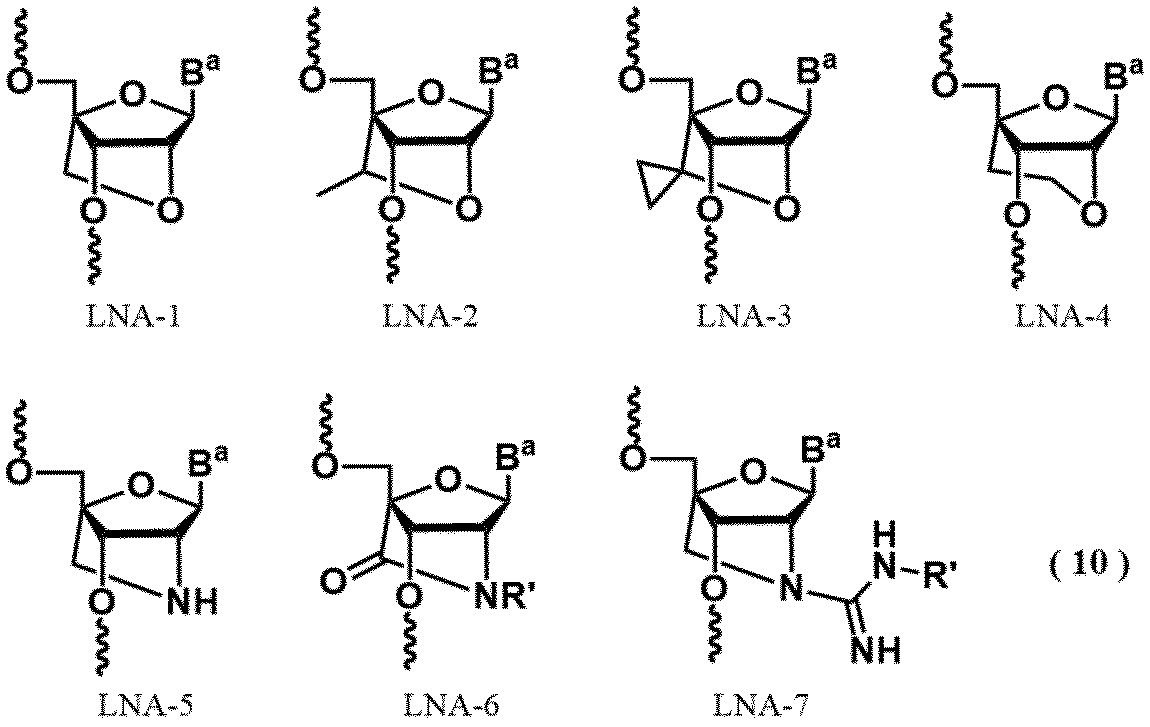
Baは、保護されていてもよい核酸塩基を表し、
R’は、水素原子またはメチル基を表す。)
In formula (4), when R represents an OQ′ group or an NQ′ group, and Q′ represents an alkylene group or a carbonyl group bonded to the carbon atom at the 4′-position of ribose, specific examples of the structure include LNA-1 to LNA-7 of formula (10) below.
Formula (10):
B represents an optionally protected nucleobase;
R' represents a hydrogen atom or a methyl group.
本発明で使用される核酸分子に含まれるヌクレオチドユニットとしては、DNA、RNA、2’-O-Me、2’-F、2’-O-MOE(2’-O-メトキシエチル)、UNA、モルフォリノ核酸、および前記LNAが例示されるが、これらに限定されるものではない。 Nucleotide units contained in the nucleic acid molecules used in the present invention include, but are not limited to, DNA, RNA, 2'-O-Me, 2'-F, 2'-O-MOE (2'-O-methoxyethyl), UNA, morpholino nucleic acid, and the above-mentioned LNA.
Zで示される、固相担体、および固相担体と核酸オリゴマー(「オリゴヌクレオチド」とも呼称する)の3’末端のリボースの2’位もしくは3’位の水酸基の酸素原子とをつなぐ連結部からなる基としては、より具体的には、下記式(11)で示される構造が挙げられる。より具体的には、下記式(11)で示される構造が挙げられる。

スペーサー(Sp)としては、例えば、下記式(12)に示す構造式を有するものが例示される。
More specifically, the group consisting of a solid phase carrier and a linking portion connecting the solid phase carrier and the oxygen atom of the hydroxyl group at the 2'-position or 3'-position of ribose at the 3'-end of a nucleic acid oligomer (also called "oligonucleotide"), represented by Z, includes a structure represented by the following formula (11). More specifically, the group includes a structure represented by the following formula (11).
An example of the spacer (Sp) is one having the structural formula shown in formula (12) below.

Linkerは、例えば、下記式(13)に示す構造でもよいし、または式(13)の構造においてヘキサメチレンアミノ基部分を有さない構造であって、アミノプロピル基がSiに結合した構造でもよい。または、Linkerは下記式(14)で示す構造でもよい。

Aは、水酸基、アルコキシ基、またはアルキル基のいずれかであってもよい。アルコキシ基としては、例えばメトキシ基およびエトキシ基が挙げられる。アルキル基としては、例えばメチル基、エチル基、イソプロピル基、n-プロピル基が挙げられる。Siは、担体表面の水酸基の酸素と結合していることを示す。)
Solid supportとしては、無機多孔質担体や有機系樹脂担体などが挙げられる。無機多孔質担体には、例えば、Controlled Pore Glass(CPG)およびゼオライトが挙げられる。有機系樹脂担体には、例えば、ポリスチレンからなる担体が挙げられる。
The linker may be, for example, a structure shown in the following formula (13), or a structure not having a hexamethyleneamino group portion in the structure of formula (13) and having an aminopropyl group bonded to Si. Alternatively, the linker may be a structure shown in the following formula (14).
A may be any of a hydroxyl group, an alkoxy group, and an alkyl group. Examples of the alkoxy group include a methoxy group and an ethoxy group. Examples of the alkyl group include a methyl group, an ethyl group, an isopropyl group, and an n-propyl group. Si indicates that it is bonded to the oxygen of a hydroxyl group on the surface of the carrier.
Examples of the solid support include inorganic porous supports and organic resin supports. Examples of the inorganic porous support include controlled pore glass (CPG) and zeolite. Examples of the organic resin support include a support made of polystyrene.
固相合成法による核酸分子の合成方法における各種工程は、大気雰囲気下で行うことができるが、不活性ガス(例えば、窒素、アルゴン)雰囲気下で行うことが好ましい。 The various steps in the synthesis of nucleic acid molecules using solid-phase synthesis can be carried out under air, but are preferably carried out under an inert gas (e.g., nitrogen, argon) atmosphere.
固相合成法による核酸分子の合成方法は、典型的には、以下の工程を含む。
(1)固相担体にリンカーを介して結合している、水酸基が保護されたヌクレオシドの5’位の水酸基を脱保護する工程、
(2)前記工程で生成した5’位の水酸基をアミダイトとカップリング反応させて亜リン酸トリエステル化合物を得る工程、
(3)前記工程で生成した亜リン酸トリエステルを酸化してリン酸トリエステルに変換して伸長した核酸分子を製造する工程、
(4)前記工程(1)~(3)、すなわち、生成した核酸分子の5’位の水酸基の脱保護工程、5’位の水酸基とアミダイト化合物とのカップリング工程、および、生成した亜リン酸トリエステルの酸化工程、から構成される一連の反応のサイクルを、任意の回数繰り返し、固相担体上に核酸分子を合成する工程、
(5)工程(4)で生成した固相担体上の核酸分子を、切り出しおよび脱保護する工程に供し、固相担体から遊離させて、保護基が除かれた核酸分子を製造する工程、および、
(6)核酸分子を構成するリボースの2’位もしくは3’末端の3’位の水酸基の保護基を脱保護する工程。
ただし、前記核酸分子の合成方法においては、工程(2)または(3)に続けて、アミダイトとのカップリング反応が進行しなかった5’位の水酸基をキャッピングする工程を含んでいてもよく、工程(4)を構成する一連の反応のサイクルの何れかの工程の間にキャッピング工程が付加されていてもよい。
A method for synthesizing a nucleic acid molecule by solid phase synthesis typically includes the following steps.
(1) deprotecting the 5'-hydroxyl group of a hydroxyl-protected nucleoside bound to a solid phase support via a linker;
(2) a step of coupling the hydroxyl group at the 5' position generated in the above step with an amidite to obtain a phosphite triester compound;
(3) oxidizing the phosphite triester produced in the previous step to convert it to a phosphate triester to produce an extended nucleic acid molecule;
(4) synthesizing a nucleic acid molecule on a solid support by repeating a series of reaction cycles consisting of the steps (1) to (3), i.e., the step of deprotecting the hydroxyl group at the 5' position of the generated nucleic acid molecule, the step of coupling the hydroxyl group at the 5' position with an amidite compound, and the step of oxidizing the generated phosphite triester, any number of times;
(5) subjecting the nucleic acid molecule on the solid phase carrier produced in step (4) to a step of excision and deprotection to release it from the solid phase carrier to produce a nucleic acid molecule from which the protecting groups have been removed; and
(6) A step of deprotecting the protecting group of the hydroxyl group at the 2'-position or the 3'-position of the 3'-terminus of ribose constituting the nucleic acid molecule.
However, the method for synthesizing a nucleic acid molecule may include, following step (2) or (3), a step of capping the hydroxyl group at the 5'-position where the coupling reaction with the amidite did not proceed, and a capping step may be added between any of the steps in the series of reaction cycles constituting step (4).
前記(5)の工程は、より具体的には、工程(4)で生成した固相担体上の核酸分子を、以下の工程(5-1)および(5-2)の反応の順に実施される。ここで工程(5-1)の反応の実施は、任意であってもよいし、工程(5-2)の反応の実施は、特許第4705716号公報に記載の方法を用いてもよい。その結果、固相担体から遊離した核酸分子から保護基が除かれた核酸分子、あるいは、5’末端の水酸基が保護された核酸分子を製造することができる。
(5-1)核酸分子の5’末端の水酸基の保護基を脱保護する反応、
(5-2)核酸分子を固相担体から切りだして遊離させる反応、および核酸塩基の保護基を脱保護する反応。
More specifically, the step (5) is carried out by subjecting the nucleic acid molecule on the solid phase carrier produced in step (4) to the following reactions in the order of steps (5-1) and (5-2). The reaction in step (5-1) may be carried out as desired, and the reaction in step (5-2) may be carried out using the method described in Japanese Patent No. 4705716. As a result, a nucleic acid molecule from which a protecting group has been removed from the nucleic acid molecule released from the solid phase carrier, or a nucleic acid molecule in which the hydroxyl group at the 5'-end is protected, can be produced.
(5-1) a reaction for deprotecting the protecting group of the hydroxyl group at the 5' end of a nucleic acid molecule;
(5-2) A reaction for cleaving and releasing the nucleic acid molecule from the solid phase support, and a reaction for deprotecting the protecting groups of the nucleic acid bases.
前記(6)の工程は、より具体的には、工程(5)で得られた、固相担体から遊離され、保護基が除かれた核酸分子を、以下の工程(6)の脱保護反応に供することにより実施される。
(6)核酸分子を構成するリボースの2’位もしくは3’末端の3’位の水酸基の保護基を脱保護する反応。
More specifically, the step (6) is carried out by subjecting the nucleic acid molecule obtained in the step (5), which has been released from the solid phase support and from which the protecting groups have been removed, to a deprotection reaction in the following step (6).
(6) A reaction for removing the protecting group of the hydroxyl group at the 2'-position or 3'-position of the 3'-terminus of ribose constituting a nucleic acid molecule.
前記工程(1)から(6)のスキームを、図1のスキームAに示す。前記工程(1)から(5)のアミダイト法による核酸化合物の合成は、一般的に公知の方法(例えば、前記の特許第5157168号公報または特許第5554881号公報に記載の方法)に従って、脱保護工程、縮合工程、の各工程を繰り返し行うことにより、核酸伸長反応を行うことができる。 The scheme of steps (1) to (6) is shown in Scheme A of Figure 1. The synthesis of nucleic acid compounds by the amidite method in steps (1) to (5) can be carried out by repeating the deprotection step and condensation step according to a generally known method (for example, the method described in the above-mentioned Japanese Patent No. 5,157,168 or Japanese Patent No. 5,554,881) to carry out a nucleic acid extension reaction.
以下、各工程について説明する。スキームAにおける化学式中の置換基のうち、G1、G2、Ba、およびRの定義は、前記定義のとおりである。また、G3、G4、G5、Bc、およびR’の定義は、後述のとおりである。また、スキームAの化学式中、Yは、それぞれ独立して、同一又は相異なって、酸素原子または硫黄原子を表し、
Xは、R基を表すか、または、OZ基を表し、ここで、Zは、前記定義のとおりであり、
Wは、XがR基を表すとき、OZ基を表し、ここで、Zは、前記定義のとおりであり、あるいは、Wは、XがOZ基を表すとき、OV基を表し、ここで、Vは、水酸基の保護基を表し、
Wは、W基から誘導された基(例えば、固相担体から切り出された残基、脱保護された基など)をも含み得て、
Xは、X基から誘導された基(例えば、固相担体から切り出された残基、脱保護された基など)をも含み得て、
nは、1以上300以下の何れかの整数を示し、そして、
mは、1以上300以下の何れかの整数を示す。
Each step will be described below. Among the substituents in the chemical formula in Scheme A, G 1 , G 2 , B a , and R are defined as above. In addition, G 3 , G 4 , G 5 , B c , and R′ are defined as described below. In addition, in the chemical formula in Scheme A, Y each independently represents an oxygen atom or a sulfur atom, whether the same or different;
X represents an R group or an OZ group, where Z is as previously defined;
W, when X is an R group, represents an OZ group, where Z is as defined above, or W, when X is an OZ group, represents an OV group, where V is a protecting group for a hydroxyl group;
W may also include groups derived from W groups (e.g., residues cleaved from a solid support, deprotected groups, etc.)
X may also include groups derived from X groups (e.g., residues cleaved from a solid support, deprotected groups, etc.),
n is an integer between 1 and 300,
m represents an integer of 1 or more and 300 or less.
G1としては、保護基として機能し得るものであれば特に制限なく使用することができ、アミダイト化合物で使用される公知の保護基を広く使用することができる。 As G1 , there is no particular limitation so long as it can function as a protecting group, and a wide variety of known protecting groups used in amidite compounds can be used.
G1は、好ましくは、以下の基である。
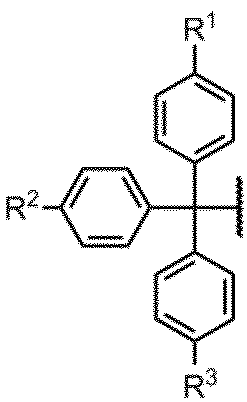
R1、R2及びR3は、1つが水素であり、残りの2つが同一または相異なる(同一が好ましい)アルコキシ基であることが好ましく、アルコキシ基としてはメトキシ基が特に好ましい。 It is preferred that one of R 1 , R 2 and R 3 is hydrogen and the remaining two are the same or different (preferably the same) alkoxy groups, and the alkoxy group is particularly preferably a methoxy group.
G2としては、保護基として機能し得るものであれば特に制限なく使用することができ、アミダイト化合物で使用される公知の保護基を広く使用することができる。G2としては、例えば、アルキル基、アルケニル基、アルキニル基、シクロアルキル基、ハロアルキル基、アリール基、ヘテロアリール基、アリールアルキル基、シクロアルケニル基、シクロアルキルアルキル基、シクリルアルキル基、ヒドロキシアルキル基、アミノアルキル基、アルコキシアルキル基、ヘテロシクリルアルケニル基、ヘテロシクリルアルキル基、ヘテロアリールアルキル基、シリル基、シリルオキシアルキル基、モノ、ジ又はトリアルキルシリル基、モノ、ジ又はトリアルキルシリルオキシアルキル基などが挙げられ、これらは1つ以上の電子求引基で置換されていてもよい。 G2 can be used without any particular limitation as long as it can function as a protecting group, and a wide variety of known protecting groups used in amidite compounds can be used. G2 can be exemplified by alkyl groups, alkenyl groups, alkynyl groups, cycloalkyl groups, haloalkyl groups, aryl groups, heteroaryl groups, arylalkyl groups, cycloalkenyl groups, cycloalkylalkyl groups, cyclylalkyl groups, hydroxyalkyl groups, aminoalkyl groups, alkoxyalkyl groups, heterocyclylalkenyl groups, heterocyclylalkyl groups, heteroarylalkyl groups, silyl groups, silyloxyalkyl groups, mono-, di- or trialkylsilyl groups, mono-, di- or trialkylsilyloxyalkyl groups, etc., which may be substituted with one or more electron-withdrawing groups.
G2は、好ましくは、電子求引基で置換されたアルキル基である。当該電子求引基としては、例えば、シアノ基、ニトロ基、アルキルスルホニル基、ハロゲン原子、アリールスルホニル基、トリハロメチル基、トリアルキルアミノ基などが挙げられ、好ましくはシアノ基である。 G2 is preferably an alkyl group substituted with an electron-withdrawing group, such as a cyano group, a nitro group, an alkylsulfonyl group, a halogen atom, an arylsulfonyl group, a trihalomethyl group, a trialkylamino group, etc., and is preferably a cyano group.
G2としては、特に好ましいのは、2-シアノエチル基(下記式で表される基)である。
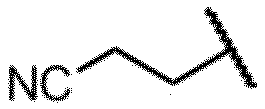
G3は、2つのG3が互いに結合して環状構造を形成していてもよい。G3としては、両方がイソプロピル基であることが好ましい。 Two G 3 may be bonded to each other to form a cyclic structure. It is preferable that both G 3 are isopropyl groups.
前記R1、R2、R3、G2、及びG3の定義におけるアルキル基は、直鎖状又は分岐鎖状のいずれでもよく、好ましくは炭素数1~12のアルキル基、より好ましくは炭素数1~6のアルキル基である。具体的なアルキル基の例としては、例えば、メチル、エチル、n-プロピル、イソプロピル、n-ブチル、イソブチル、tert-ブチル、n-ペンチル、イソペンチル、及びn-ヘキシルが挙げられる。前記置換基の定義におけるアルコキシ基を構成するアルキル基部分は、ここでのアルキル基の定義と同じ定義を有する。 The alkyl group in the definitions of R 1 , R 2 , R 3 , G 2 , and G 3 may be either linear or branched, and is preferably an alkyl group having 1 to 12 carbon atoms, more preferably an alkyl group having 1 to 6 carbon atoms. Specific examples of the alkyl group include methyl, ethyl, n-propyl, isopropyl, n-butyl, isobutyl, tert-butyl, n-pentyl, isopentyl, and n-hexyl. The alkyl group moiety constituting the alkoxy group in the definition of the substituent has the same definition as the alkyl group here.
本明細書においては、核酸塩基とは、天然型あるいは非天然型の核酸塩基骨格を有する基を意味する。前記核酸塩基は、天然型あるいは非天然型の核酸塩基骨格が修飾された修飾体も包含する。 In this specification, a nucleobase refers to a group having a natural or non-natural nucleobase backbone. The nucleobase also includes modified forms in which a natural or non-natural nucleobase backbone has been modified.
Baで示される保護基で保護されていてもよい核酸塩基は、特に限定されない。当該核酸塩基としては、アデニン、シトシン、グアニン、ウラシル、チミン、5-メチルシトシン、シュードウラシル、1-メチルシュードウラシルなどが挙げられる。また、核酸塩基は、置換基により置換されていてもよい。そのような置換基としては、例えば、フルオロ基やクロロ基やブロモ基やヨード基のようなハロゲン原子、アセチル基のようなアシル基、メチル基やエキル基のようなアルキル基、ベンジル基のようなアリールアルキル基、メトキシ基のようなアルコキシ基、メトキシエチル基のようなアルコキシアルキル基、シアノエチル基のようなシアノアルキル基、ヒドロキシ基、ヒドロキシアルキル基、アシルオキシメチル基、アミノ基、モノアルキルアミノ基、ジアルキルアミノ基、カルボキシ基、シアノ基、およびニトロ基など、並びにそれらの2種類以上の置換基の組み合わせが挙げられる。 The nucleic acid base which may be protected by a protecting group represented by B a is not particularly limited. Examples of the nucleic acid base include adenine, cytosine, guanine, uracil, thymine, 5-methylcytosine, pseudouracil, and 1-methylpseudouracil. The nucleic acid base may also be substituted with a substituent. Examples of such a substituent include halogen atoms such as fluoro, chloro, bromo, and iodo groups, acyl groups such as acetyl groups, alkyl groups such as methyl and ethyl groups, arylalkyl groups such as benzyl groups, alkoxy groups such as methoxy groups, alkoxyalkyl groups such as methoxyethyl groups, cyanoalkyl groups such as cyanoethyl groups, hydroxy groups, hydroxyalkyl groups, acyloxymethyl groups, amino groups, monoalkylamino groups, dialkylamino groups, carboxy groups, cyano groups, and nitro groups, as well as combinations of two or more of these substituents.
核酸塩基が環外にアミノ基を有する場合、当該アミノ基の保護基としては、特に限定されず、公知の核酸化学で用いられる保護基を使用することができる。そのような保護基としては、例えば、ベンゾイル基、4-メトキシベンゾイル基、アセチル基、プロピオニル基、ブチリル基、イソブチリル基、フェニルアセチル基、フェノキシアセチル基、4-tert-ブチルフェノキシアセチル基、4-イソプロピルフェノキシアセチル基、および(ジメチルアミノ)メチレン基など、並びにそれらの2種類以上の保護基の組み合わせが挙げられる。 When the nucleic acid base has an amino group outside the ring, the protecting group for the amino group is not particularly limited, and any protecting group used in known nucleic acid chemistry can be used. Examples of such protecting groups include benzoyl, 4-methoxybenzoyl, acetyl, propionyl, butyryl, isobutyryl, phenylacetyl, phenoxyacetyl, 4-tert-butylphenoxyacetyl, 4-isopropylphenoxyacetyl, and (dimethylamino)methylene groups, as well as combinations of two or more of these protecting groups.
Baで表される核酸塩基としては、より具体的には、以下の構造が例示される。
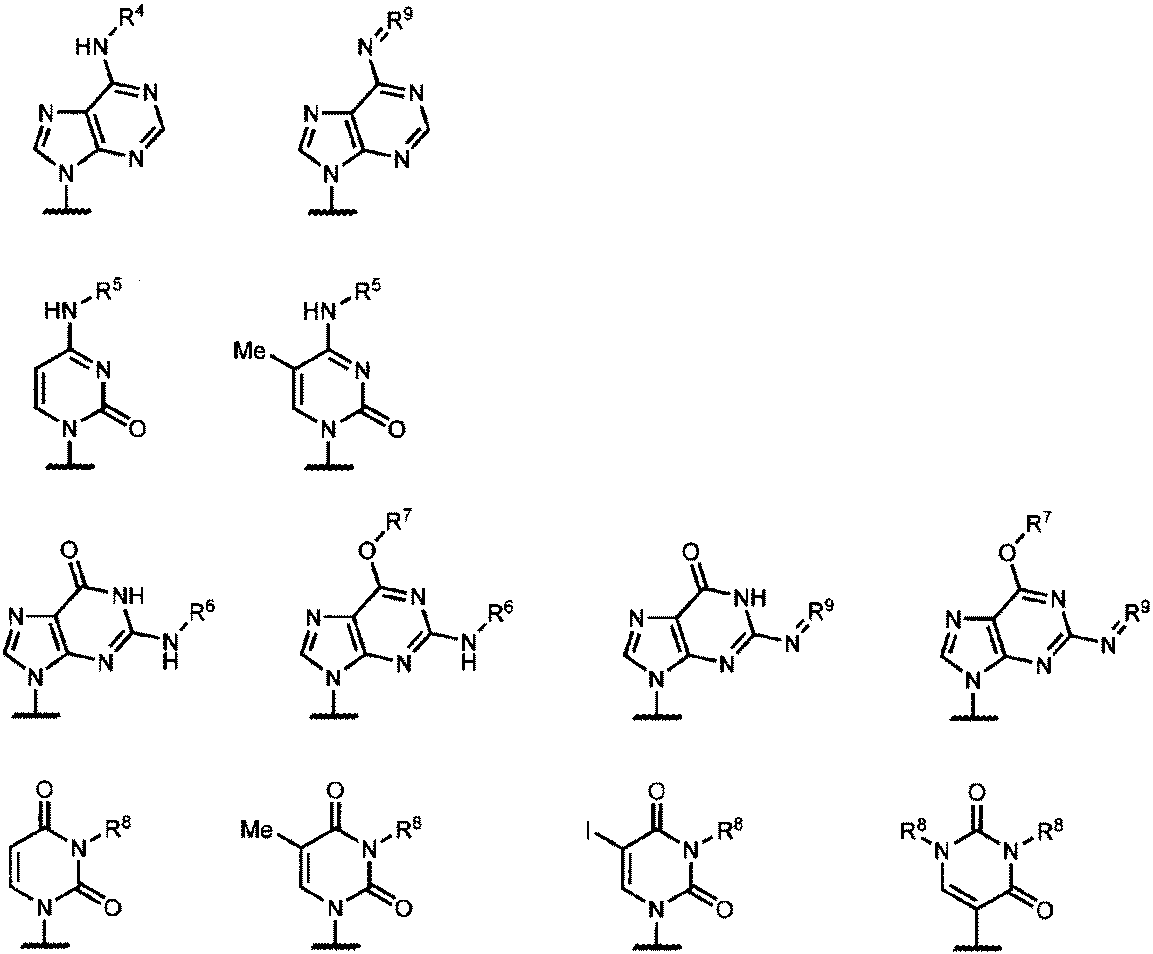
(上記式中、
R4は、水素原子、メチル基、フェノキシアセチル基、4-tert-ブチルフェノキシアセチル基、4-イソプロピルフェノキシアセチル基、フェニルアセチル基、アセチル基又はベンゾイル基を表し、
R5は、水素原子、アセチル基、イソブチリル基又はベンゾイル基を表し、
R6は、水素原子、フェノキシアセチル基、4-tert-ブチルフェノキシアセチル基、4-イソプロピルフェノキシアセチル基、フェニルアセチル基、アセチル基又はイソブチリル基を表し、
R7は、2-シアノエチル基を表し、
R8は、水素原子、メチル基、ベンゾイル基、4-メトキシベンゾイル基又は4-メチルベンゾイル基を表し、そして、
R9は、ジメチルアミノメチレン基を表す。)
のいずれかで表される基を表す。
(In the above formula,
R4 represents a hydrogen atom, a methyl group, a phenoxyacetyl group, a 4-tert-butylphenoxyacetyl group, a 4-isopropylphenoxyacetyl group, a phenylacetyl group, an acetyl group, or a benzoyl group;
R5 represents a hydrogen atom, an acetyl group, an isobutyryl group, or a benzoyl group;
R6 represents a hydrogen atom, a phenoxyacetyl group, a 4-tert-butylphenoxyacetyl group, a 4-isopropylphenoxyacetyl group, a phenylacetyl group, an acetyl group, or an isobutyryl group;
R7 represents a 2-cyanoethyl group;
R 8 represents a hydrogen atom, a methyl group, a benzoyl group, a 4-methoxybenzoyl group, or a 4-methylbenzoyl group, and
R9 represents a dimethylaminomethylene group.
The group represented by any one of the following formulas:
また、本発明の方法において、アミダイトは、フリーの状態又は塩の状態で使用することができる。アミダイトの塩としては、塩基付加塩または酸付加塩が挙げられるが、特に制限されない。塩基付加塩としては、具体的には、ナトリウム塩、マグネシウム塩、カリウム塩、カルシウム塩、アルミニウム塩等の無機塩基との塩;メチルアミン、エチルアミン、エタノールアミン等の有機塩基との塩;リジン、オルニチン、アルギニン等の塩基性アミノ酸との塩;及びアンモニウム塩が挙げられる。酸付加塩としては、具体的には、塩酸、臭化水素酸、ヨウ化水素酸、硫酸、硝酸、リン酸等の鉱酸;ギ酸、酢酸、プロピオン酸、シュウ酸、マロン酸、リンゴ酸、酒石酸、フマル酸、コハク酸、乳酸、マレイン酸、クエン酸、メタンスルホン酸、トリフルオロメタンスルホン酸、エタンスルホン酸等の有機酸;および、アスパラギン酸、グルタミン酸等の酸性アミノ酸との酸付加塩が挙げられる。アミダイト化合物には、塩、水和物、溶媒和物、結晶多形などの形態も含まれる。 In the method of the present invention, the amidite can be used in a free state or in a salt state. Examples of the salt of the amidite include, but are not limited to, base addition salts and acid addition salts. Specific examples of the base addition salts include salts with inorganic bases such as sodium salts, magnesium salts, potassium salts, calcium salts, and aluminum salts; salts with organic bases such as methylamine, ethylamine, and ethanolamine; salts with basic amino acids such as lysine, ornithine, and arginine; and ammonium salts. Specific examples of the acid addition salts include mineral acids such as hydrochloric acid, hydrobromic acid, hydroiodic acid, sulfuric acid, nitric acid, and phosphoric acid; organic acids such as formic acid, acetic acid, propionic acid, oxalic acid, malonic acid, malic acid, tartaric acid, fumaric acid, succinic acid, lactic acid, maleic acid, citric acid, methanesulfonic acid, trifluoromethanesulfonic acid, and ethanesulfonic acid; and acid addition salts with acidic amino acids such as aspartic acid and glutamic acid. Amidite compounds also include salts, hydrates, solvates, and crystal polymorphs.
Rが、保護された水酸基を示すとき、その保護基は、アミダイト法において使用できるものであればよく、例えば、2’-tert-ブチルジメチルシリル(TBDMS)基、2’-ビス(2-アセトキシエトキシ)メチル(ACE)基、2’-(トリイソプロピルシリロキシ)メチル(TOM)基、2’-(2-シアノエトキシ)エチル(CEE)基、2’-(2-シアノエトキシ)メチル(CEM)基、2’-パラ-トルイルスルホニルエトキシメチル(TEM)基、2’-EMM基(国際公開2006/022323号)の他に、国際公開第2013/027843号および国際公開第2019/208571号に記載のものが使用できる。これらのリボヌクレオシド(RNA)の2’保護基のうち、式(15)で示される保護基が好ましい保護基として例示される。さらに好ましくは、EWで示される電子求引基としてシアノ基を有する式(16)で示される保護基が例示される。


qは、1~5の整数を表し、
RaおよびRbは各々、それぞれ同一又は相異なって、メチル基、エチル基または水素原子を表し、
**印のついた結合は、保護された水酸基の酸素に結合し、そして、
EWは、電子求引基を表す。)
When R represents a protected hydroxyl group, the protecting group may be any that can be used in the amidite method, for example, 2'-tert-butyldimethylsilyl (TBDMS) group, 2'-bis (2-acetoxyethoxy) methyl (ACE) group, 2'- (triisopropylsilyloxy) methyl (TOM) group, 2'- (2-cyanoethoxy) ethyl (CEE) group, 2'- (2-cyanoethoxy) methyl (CEM) group, 2'-para-tolylsulfonylethoxymethyl (TEM) group, 2'-EMM group (WO 2006/022323), as well as those described in WO 2013/027843 and WO 2019/208571. Of these ribonucleoside (RNA) 2' protecting groups, the protecting group represented by formula (15) is exemplified as a preferred protecting group. More preferably, the protecting group is represented by the formula (16) having a cyano group as the electron-withdrawing group represented by EW .
q represents an integer of 1 to 5;
R a and R b are the same or different and each represents a methyl group, an ethyl group, or a hydrogen atom;
The bond marked with an asterisk (*) is attached to the oxygen of a protected hydroxyl group, and
EW represents an electron-withdrawing group.
式(16)で示される保護基は、例えば国際公開第2013/027843号および国際公開第2019/208571号に記載に従って合成することができ、かかる保護基を有するアミダイトを核酸分子の製造に使用することができる。
核酸の伸長反応には、図1のスキームAに記載の式(3)のアミダイトが使用される。
The protecting group represented by formula (16) can be synthesized, for example, as described in WO 2013/027843 and WO 2019/208571, and an amidite having such a protecting group can be used for producing a nucleic acid molecule.
For the extension reaction of nucleic acid, an amidite of formula (3) shown in scheme A of FIG. 1 is used.
(核酸伸長反応)
本明細書において、「核酸伸長反応」とは、ホスホロジエステル結合またはホスホロチオエート結合を介して、ヌクレオチドを順次結合させることにより、核酸分子を伸長させる反応を意味する。核酸伸長反応は、一般的なアミダイト法(ホスホロアミダイト法)の手順に従い行うことができる。核酸伸長反応は、アミダイト法を採用する核酸自動合成装置等を用いて行ってもよい。
(Nucleic acid extension reaction)
In this specification, the term "nucleic acid extension reaction" refers to a reaction in which nucleotides are sequentially linked via phosphorodiester bonds or phosphorothioate bonds to extend a nucleic acid molecule. The nucleic acid extension reaction can be carried out according to the procedure of the general amidite method (phosphoramidite method). The nucleic acid extension reaction may be carried out using an automatic nucleic acid synthesizer that employs the amidite method.
核酸オリゴマーの鎖長は、例えば、2~300merや10~200mer、15~150merであってもよい。 The chain length of the nucleic acid oligomer may be, for example, 2-300 mer, 10-200 mer, or 15-150 mer.
工程(1)の5’脱保護工程は、固相担体上に担持されるRNA鎖末端の5’ヒドロキシル基の保護基を脱保護する工程である。一般的な保護基としては、4,4’-ジメトキシトリチル基(DMTr基)や4-モノメトキシトリチル基、4,4’,4”-トリメトキシトリチル基が用いられる。脱保護は、酸を用いて行うことができる。脱保護用の酸としては、例えば、トリフルオロ酢酸、ジクロロ酢酸、トリフルオロメタンスルホン酸、トリクロロ酢酸、メタンスルホン酸、塩酸、酢酸、p-トルエンスルホン酸等が挙げられる。 The 5' deprotection step in step (1) is a step in which the protecting group of the 5' hydroxyl group at the end of the RNA chain supported on the solid phase carrier is deprotected. Common protecting groups include the 4,4'-dimethoxytrityl group (DMTr group), the 4-monomethoxytrityl group, and the 4,4',4"-trimethoxytrityl group. Deprotection can be carried out using an acid. Examples of acids for deprotection include trifluoroacetic acid, dichloroacetic acid, trifluoromethanesulfonic acid, trichloroacetic acid, methanesulfonic acid, hydrochloric acid, acetic acid, and p-toluenesulfonic acid.
工程(2)の縮合工程は、前記脱保護工程により脱保護したオリゴヌクレオチド鎖末端の5’ヒドロキシル基に対して、図1のスキームAに記載の下記式(3)で示されるヌクレオシドアミダイトを結合させる反応である。なお、核酸伸長に用いるアミダイトとしては、式(3)で示されるアミダイト化合物を用いる。また、他に使用可能なアミダイトとして、2’-OMe、2’-F、2’-O-tert-ブチルジメチルシリル基,2’-O-メトキシエチル基,2’-H,2'-フルオロ-2’-デオキシ-β-D-アラビノフラノシル等が挙げられる。前記ヌクレオシドアミダイトとしては、5’ヒドロキシル基が保護基(例、DMTr基)で保護されたものを用いる。縮合工程は、前記ヌクレオシドアミダイトを活性化する活性化剤を用いて行うことができる。活性化剤としては、例えば、5-ベンジルチオ-1H-テトラゾール(BTT)、1H-テトラゾール、4,5-ジシアノイミダゾール(DCI)、5-エチルチオ-1H-テトラゾール(ETT)、N-メチルベンズイミダゾリウムトリフラート(N-MeBIT)、ベンズイミダゾリウムトリフラート(BIT)、N-フェニルイミダゾリウムトリフラート(N-PhIMT)、イミダゾリウムトリフラート(IMT)、5-ニトロベンズイミダゾリウムトリフラート(NBT)、1-ヒドロキシベンゾトリアゾール(HOBT)又は5-(ビス-3,5-トリフルオロメチルフェニル)-1H-テトラゾール等が挙げられる。 The condensation step of step (2) is a reaction in which a nucleoside amidite represented by the following formula (3) shown in Scheme A of FIG. 1 is bonded to the 5' hydroxyl group at the end of the oligonucleotide chain deprotected in the deprotection step. The amidite compound represented by formula (3) is used as the amidite used for nucleic acid elongation. Other usable amidites include 2'-OMe, 2'-F, 2'-O-tert-butyldimethylsilyl group, 2'-O-methoxyethyl group, 2'-H, 2'-fluoro-2'-deoxy-β-D-arabinofuranosyl, and the like. The nucleoside amidite used has a 5' hydroxyl group protected by a protecting group (e.g., DMTr group). The condensation step can be carried out using an activator that activates the nucleoside amidite. Examples of activators include 5-benzylthio-1H-tetrazole (BTT), 1H-tetrazole, 4,5-dicyanoimidazole (DCI), 5-ethylthio-1H-tetrazole (ETT), N-methylbenzimidazolium triflate (N-MeBIT), benzimidazolium triflate (BIT), N-phenylimidazolium triflate (N-PhIMT), imidazolium triflate (IMT), 5-nitrobenzimidazolium triflate (NBT), 1-hydroxybenzotriazole (HOBT), and 5-(bis-3,5-trifluoromethylphenyl)-1H-tetrazole.
図1のスキームAに記載の式(3)で示されるヌクレオシドアミダイト(以下、アミダイトと呼称する)とは、以下のとおりである。
式:
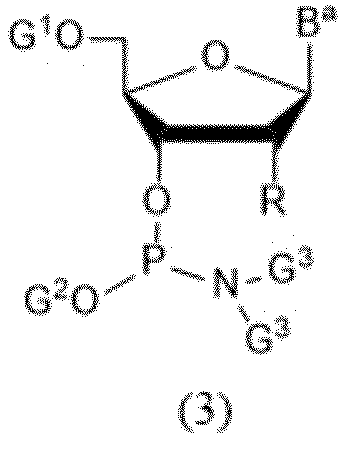
formula:
縮合工程の後は、適宜、未反応の5’ヒドロキシル基をキャッピングしてもよい。キャッピングは、無水酢酸-テトラヒドロフラン溶液、フェノキシ酢酸無水物/N-メチルイミダゾール溶液等の公知のキャッピング溶液を用いて行うことができる。 After the condensation step, any unreacted 5' hydroxyl groups may be capped as appropriate. Capping can be performed using a known capping solution such as an acetic anhydride-tetrahydrofuran solution or a phenoxyacetic anhydride/N-methylimidazole solution.
工程(3)の酸化工程は、前記縮合工程により形成された亜リン酸基をリン酸基又はチオリン酸基に変換する工程である。本工程は、3価のリンから5価のリンに酸化剤を使用して変換する反応であり、固相担体に担持されているオリゴ核酸誘導体に酸化剤を作用させることにより実施することができる。
亜リン酸基をリン酸基に変換する場合には、「酸化剤」として、例えば、ヨウ素を使用することができる。該酸化剤は、0.005~2Mの濃度になるように調製して使用することができる。酸化の酸素源としては水を用いることができ、反応を進行させる塩基としてはピリジン、N-メチルイミダゾール(NMI)、N-メチルモルフォリン、トリエチルアミンを用いることができる。また、溶媒としては、反応に関与しなければ特に限定されないが、アセトニトリル、テトラヒドロフラン(THF)又はこれらの任意の割合で混合して使用することもできる。例えば、ヨウ素/水/ピリジン/アセトニトリル、あるいはヨウ素/水/ピリジンあるいはヨウ素/水/ピリジン/NMI、あるいはヨウ素/水/ピリジン/THFを用いることができる。反応温度は、5℃~50℃が好ましい。反応時間は、通常1分~30分が適当である。使用する試薬の量は固相担体に担持されている化合物1molに対して1~100molが好ましく、より好ましくは1~10molである。
The oxidation step (3) is a step of converting the phosphorous acid group formed in the condensation step into a phosphorous or thiophosphoric acid group. This step is a reaction of converting trivalent phosphorus into pentavalent phosphorus using an oxidizing agent, and can be carried out by allowing the oxidizing agent to act on an oligonucleic acid derivative supported on a solid phase carrier.
When converting a phosphorous group to a phosphoric group, for example, iodine can be used as an "oxidizing agent". The oxidizing agent can be prepared to have a concentration of 0.005 to 2M. Water can be used as an oxygen source for oxidation, and pyridine, N-methylimidazole (NMI), N-methylmorpholine, and triethylamine can be used as bases for promoting the reaction. In addition, the solvent is not particularly limited as long as it is not involved in the reaction, and acetonitrile, tetrahydrofuran (THF), or a mixture of these in any ratio can be used. For example, iodine/water/pyridine/acetonitrile, iodine/water/pyridine, iodine/water/pyridine/NMI, or iodine/water/pyridine/THF can be used. The reaction temperature is preferably 5°C to 50°C. The reaction time is usually appropriate to be 1 minute to 30 minutes. The amount of the reagent used is preferably 1 to 100 mol, more preferably 1 to 10 mol, relative to 1 mol of the compound supported on the solid phase carrier.
亜リン酸トリエステル基をチオリン酸基に変換する場合には、酸化剤として、例えば、硫黄、3H-1,2-ベンゾジチオール-3-オン-1,1-ジオキシド(Beaucage試薬)、3-アミノ-1,2,4-ジチアゾール-5-チオン(A DTT)、5-フェニル-3H-1,2,4-ジチアゾール-3-オン(POS)、[( N,N-ジメチルアミノメチリデン)アミノ]-3H-1,2,4-ジチアゾリン-3- チオン(DDTT)、およびフェニルアセチルジスルフィド(PADS)を使用することができる。該酸化剤は、0.001~2Mの濃度になるように適当な溶媒で希釈して使用することができる。反応に使用する溶媒としては、反応に関与しなければ特に限定されないが、例えば、ジクロロメタン、アセトニトリル、ピリジン又はこれらの任意の割合の混合溶媒が挙げられる。酸化工程は、前記キャッピング操作の後で行ってもよいし、逆に、該酸化工程の後でキャッピング操作を行ってよいし、この順序は限定されない。 When converting a phosphite triester group to a thiophosphate group, examples of oxidizing agents that can be used include sulfur, 3H-1,2-benzodithiol-3-one-1,1-dioxide (Beaucage's reagent), 3-amino-1,2,4-dithiazole-5-thione (ADTT), 5-phenyl-3H-1,2,4-dithiazol-3-one (POS), [(N,N-dimethylaminomethylidene)amino]-3H-1,2,4-dithiazoline-3-thione (DDTT), and phenylacetyl disulfide (PADS). The oxidizing agent can be diluted with an appropriate solvent to a concentration of 0.001 to 2M. There are no particular limitations on the solvent used in the reaction as long as it is not involved in the reaction, and examples include dichloromethane, acetonitrile, pyridine, or a mixture of these in any ratio. The oxidation step may be performed after the capping step, or conversely, the capping step may be performed after the oxidation step; this order is not limited.
工程(5)において、リン酸保護基を脱保護する工程は、所望の配列を有する核酸の合成が完了した後は、リン酸部分の保護基を脱保護するためにアミン化合物を作用させる。アミン化合物としては、例えば、特許第4705716号公報に記載されるジエチルアミン等が挙げられる。 In step (5), after the synthesis of the nucleic acid having the desired sequence is completed, an amine compound is used to remove the protecting group of the phosphate moiety. Examples of amine compounds include diethylamine, which is described in Japanese Patent No. 4705716.
伸長の最後に導入したヌクレオシドの5’ヒドロキシル基の保護基は、後述の固相担体からの切り出し及び保護基の脱保護の後、5’保護基をタグとするカラム精製のために使用してもよく、カラム精製後、5’ヒドロキシル基の保護基を脱保護してもよい。 The protecting group of the 5' hydroxyl group of the nucleoside introduced at the end of the elongation may be used for column purification using the 5' protecting group as a tag after cleavage from the solid phase support and deprotection of the protecting group as described below, and the protecting group of the 5' hydroxyl group may be deprotected after column purification.
工程(5)における、固相担体上で所望の鎖長に伸長した核酸オリゴマーの、固相担体からの切り出しは、通常、切り出し剤として濃アンモニア水を用いて実施される。 In step (5), the nucleic acid oligomer that has been elongated to the desired length on the solid phase support is usually excised from the solid phase support using concentrated aqueous ammonia as the excision agent.
更にアンモニア又はアミン化合物等を用いて、例えば、固相担体からオリゴヌクレオチド鎖を切断して回収する。アミン化合物としては、例えば、メチルアミン、エチルアミン、イソプロピルアミン、エチレンジアミン、ジエチルアミン等が挙げられる。 Furthermore, the oligonucleotide chain is cleaved from the solid phase support and recovered using ammonia or an amine compound. Examples of amine compounds include methylamine, ethylamine, isopropylamine, ethylenediamine, diethylamine, etc.
工程(6)において、固相担体から切り出された核酸化合物(6)のリボースの2位もしくは3位の水酸基の保護基は、国際公開第2006/022323号)、国際公開第2013/027843号、または国際公開第2019/208571号に記載の方法に従って除くことができて、脱保護した核酸オリゴマー(7)を得ることができる。 In step (6), the protecting group of the hydroxyl group at the 2nd or 3rd position of the ribose of the nucleic acid compound (6) cleaved from the solid support can be removed according to the method described in WO 2006/022323), WO 2013/027843, or WO 2019/208571, to obtain a deprotected nucleic acid oligomer (7).
式(4)におけるR基が、水酸基以外の置換基であるヌクレオチドおよびアミダイトは、特許第3745226号公報などに記載された公知の方法、国際公開第2001/053528号公報あるいは特開2014-221817号公報およびそれらに引用される公知の方法で合成されるヌクレオシドから製造することもでき、さらには、市販品として入手可能なものを用いて、後述する実施例に記載の方法に則して又はこれらの方法に適宜変更を加えた方法により製造することができる。 Nucleotides and amidites in which the R group in formula (4) is a substituent other than a hydroxyl group can be produced from nucleosides synthesized by known methods such as those described in Japanese Patent No. 3745226, WO 2001/053528, or JP 2014-221817 and known methods cited therein, or can be produced from commercially available products in accordance with the methods described in the Examples below or with appropriate modifications to these methods.
本発明の製造方法を用いて製造可能な核酸分子としては、核酸分子内に含まれるヌクレオシドが、RNA、DNA、並びに2’-O-MOE、2’-O-Me、2’-Fを有するRNA、およびLNAである核酸分子が挙げられるが、これらに限定されるものではない。例えば、Xiulong, Shenら著、Nucleic Acids Research, 2018, Vol. 46, No.46, 1584-1600、およびDaniel O'Reillyら著、Nucleic Acids Research, 2019, Vol. 47, No.2, 546-558に記載された、様々なヌクレオシドの例が挙げられる。好ましくは、本発明の方法で製造される核酸分子はRNAである。 Nucleic acid molecules that can be produced using the production method of the present invention include, but are not limited to, nucleic acid molecules in which the nucleosides contained therein are RNA, DNA, and RNA having 2'-O-MOE, 2'-O-Me, 2'-F, and LNA. For example, examples of various nucleosides are described in Xiulong, Shen et al., Nucleic Acids Research, 2018, Vol. 46, No. 46, 1584-1600, and Daniel O'Reilly et al., Nucleic Acids Research, 2019, Vol. 47, No. 2, 546-558. Preferably, the nucleic acid molecule produced by the method of the present invention is RNA.
本発明の製造方法を用いることにより、一つの態様として、オリゴヌクレオチド中のブランチ体の含有量が低減したオリゴヌクレオチドを製造することができる。
具体的なオリゴヌクレオチドとしては、具体的には以下のものが例示されるが、これらに限定されない。
オリゴヌクレオチド中のブランチ体の含有量比が完全鎖長体(FLP)に対して15%以下である、オリゴヌクレオチド。
オリゴヌクレオチド中のブランチ体の含有量比が完全鎖長体(FLP)に対して5.0%以下である、オリゴヌクレオチド。
オリゴヌクレオチド中のブランチ体の含有量比が完全鎖長体(FLP)に対して4.5%以下である、オリゴヌクレオチド。
オリゴヌクレオチド中のブランチ体の含有量比が完全鎖長体(FLP)に対して4.1%以下である、オリゴヌクレオチド。
オリゴヌクレオチド中のブランチ体の含有量比が完全鎖長体(FLP)に対して3.4%以下である、オリゴヌクレオチド。
オリゴヌクレオチド中のブランチ体の含有量比が完全鎖長体(FLP)に対して3.0%以下である、オリゴヌクレオチド。
オリゴヌクレオチド中のブランチ体の含有量比が完全鎖長体(FLP)に対して2.5%以下である、オリゴヌクレオチド。
オリゴヌクレオチド中のブランチ体の含有量比が完全鎖長体(FLP)に対して2.2%以下である、オリゴヌクレオチド。
オリゴヌクレオチド中のブランチ体の含有量比が完全鎖長体(FLP)に対して2.0%以下である、オリゴヌクレオチド。
オリゴヌクレオチド中のブランチ体の含有量比が完全鎖長体(FLP)に対して1.5%以下である、オリゴヌクレオチド。
オリゴヌクレオチド中のブランチ体の含有量比が完全鎖長体(FLP)に対して1.0%以下である、オリゴヌクレオチド。
In one embodiment, the production method of the present invention can be used to produce an oligonucleotide having a reduced content of branched bodies.
Specific examples of oligonucleotides include, but are not limited to, the following:
An oligonucleotide, the content ratio of branched forms in the oligonucleotide being 15% or less relative to full length forms (FLP).
An oligonucleotide, the content ratio of branched forms in the oligonucleotide being 5.0% or less relative to full length forms (FLP).
An oligonucleotide, the content ratio of branched forms in the oligonucleotide being 4.5% or less relative to full length forms (FLP).
An oligonucleotide, the content ratio of branched forms in the oligonucleotide being 4.1% or less relative to full length forms (FLP).
An oligonucleotide, the content ratio of branched forms in the oligonucleotide being 3.4% or less relative to full length forms (FLP).
An oligonucleotide, the content ratio of branched forms in the oligonucleotide being 3.0% or less relative to full length forms (FLP).
An oligonucleotide, the content ratio of branched forms in the oligonucleotide being 2.5% or less relative to full length forms (FLP).
An oligonucleotide, the content ratio of branched forms in the oligonucleotide being 2.2% or less relative to full length forms (FLP).
An oligonucleotide, the content ratio of branched forms in the oligonucleotide being 2.0% or less relative to full length forms (FLP).
An oligonucleotide, the content ratio of branched forms in the oligonucleotide being 1.5% or less relative to full length forms (FLP).
An oligonucleotide, the content ratio of branched forms in the oligonucleotide being 1.0% or less relative to full length forms (FLP).
オリゴヌクレオチドの鎖長が100mer以上であり、オリゴヌクレオチド中のブランチ体の含有量比が完全鎖長体(FLP)に対して15%以下である、オリゴヌクレオチド。
オリゴヌクレオチドの鎖長が100mer以上であり、オリゴヌクレオチド中のブランチ体の含有量比が完全鎖長体(FLP)に対して5.0%以下である、オリゴヌクレオチド。
オリゴヌクレオチドの鎖長が100mer以上であり、オリゴヌクレオチド中のブランチ体の含有量比が完全鎖長体(FLP)に対して4.5%以下である、オリゴヌクレオチド。
オリゴヌクレオチドの鎖長が100mer以上であり、オリゴヌクレオチド中のブランチ体の含有量比が完全鎖長体(FLP)に対して4.1%以下である、オリゴヌクレオチド。
オリゴヌクレオチドの鎖長が100mer以上であり、オリゴヌクレオチド中のブランチ体の含有量比が完全鎖長体(FLP)に対して3.4%以下である、オリゴヌクレオチド。
オリゴヌクレオチドの鎖長が100mer以上であり、オリゴヌクレオチド中のブランチ体の含有量比が完全鎖長体(FLP)に対して3.0%以下である、オリゴヌクレオチド。
オリゴヌクレオチドの鎖長が100mer以上であり、オリゴヌクレオチド中のブランチ体の含有量比が完全鎖長体(FLP)に対して2.5%以下である、オリゴヌクレオチド。
オリゴヌクレオチドの鎖長が100mer以上であり、オリゴヌクレオチド中のブランチ体の含有量比が完全鎖長体(FLP)に対して2.2%以下である、オリゴヌクレオチド。
オリゴヌクレオチドの鎖長が50mer以上であり、オリゴヌクレオチド中のブランチ体の含有量比が完全鎖長体(FLP)に対して15%以下である、オリゴヌクレオチド。
オリゴヌクレオチドの鎖長が50mer以上であり、オリゴヌクレオチド中のブランチ体の含有量比が完全鎖長体(FLP)に対して5.0%以下である、オリゴヌクレオチド。
オリゴヌクレオチドの鎖長が50mer以上であり、オリゴヌクレオチド中のブランチ体の含有量比が完全鎖長体(FLP)に対して4.5%以下である、オリゴヌクレオチド。
オリゴヌクレオチドの鎖長が50mer以上であり、オリゴヌクレオチド中のブランチ体の含有量比が完全鎖長体(FLP)に対して4.1%以下である、オリゴヌクレオチド。
オリゴヌクレオチドの鎖長が50mer以上であり、オリゴヌクレオチド中のブランチ体の含有量比が完全鎖長体(FLP)に対して3.4%以下である、オリゴヌクレオチド。
オリゴヌクレオチドの鎖長が50mer以上であり、オリゴヌクレオチド中のブランチ体の含有量比が完全鎖長体(FLP)に対して3.0%以下である、オリゴヌクレオチド。
オリゴヌクレオチドの鎖長が50mer以上であり、オリゴヌクレオチド中のブランチ体の含有量比が完全鎖長体(FLP)に対して2.5%以下である、オリゴヌクレオチド。
オリゴヌクレオチドの鎖長が50mer以上であり、オリゴヌクレオチド中のブランチ体の含有量比が完全鎖長体(FLP)に対して2.2%以下である、オリゴヌクレオチド。
オリゴヌクレオチドの鎖長が50mer以上200mer以下であり、オリゴヌクレオチド中のブランチ体の含有量比が完全鎖長体(FLP)に対して15%以下である、オリゴヌクレオチド。
オリゴヌクレオチドの鎖長が50mer以上200mer以下であり、オリゴヌクレオチド中のブランチ体の含有量比が完全鎖長体(FLP)に対して5.0%以下である、オリゴヌクレオチド。
オリゴヌクレオチドの鎖長が50mer以上200mer以下であり、オリゴヌクレオチド中のブランチ体の含有量比が完全鎖長体(FLP)に対して4.5%以下である、オリゴヌクレオチド。
オリゴヌクレオチドの鎖長が50mer以上200mer以下であり、オリゴヌクレオチド中のブランチ体の含有量比が完全鎖長体(FLP)に対して4.1%以下である、オリゴヌクレオチド。
オリゴヌクレオチドの鎖長が50mer以上200mer以下であり、オリゴヌクレオチド中のブランチ体の含有量比が完全鎖長体(FLP)に対して3.4%以下である、オリゴヌクレオチド。
オリゴヌクレオチドの鎖長が50mer以上200mer以下であり、オリゴヌクレオチド中のブランチ体の含有量比が完全鎖長体(FLP)に対して3.0%以下である、オリゴヌクレオチド。
オリゴヌクレオチドの鎖長が50mer以上200mer以下であり、オリゴヌクレオチド中のブランチ体の含有量比が完全鎖長体(FLP)に対して2.5%以下である、オリゴヌクレオチド。
オリゴヌクレオチドの鎖長が50mer以上200mer以下であり、オリゴヌクレオチド中のブランチ体の含有量比が完全鎖長体(FLP)に対して2.2%以下である、オリゴヌクレオチド。
オリゴヌクレオチドの鎖長が50mer以上300mer以下であり、オリゴヌクレオチド中のブランチ体の含有量比が完全鎖長体(FLP)に対して15%以下である、オリゴヌクレオチド。
オリゴヌクレオチドの鎖長が50mer以上300mer以下であり、オリゴヌクレオチド中のブランチ体の含有量比が完全鎖長体(FLP)に対して5.0%以下である、オリゴヌクレオチド。
オリゴヌクレオチドの鎖長が50mer以上300mer以下であり、オリゴヌクレオチド中のブランチ体の含有量比が完全鎖長体(FLP)に対して4.5%以下である、オリゴヌクレオチド。
オリゴヌクレオチドの鎖長が50mer以上300mer以下であり、オリゴヌクレオチド中のブランチ体の含有量比が完全鎖長体(FLP)に対して4.1%以下である、オリゴヌクレオチド。
オリゴヌクレオチドの鎖長が50mer以上300mer以下であり、オリゴヌクレオチド中のブランチ体の含有量比が完全鎖長体(FLP)に対して3.4%以下である、オリゴヌクレオチド。
オリゴヌクレオチドの鎖長が50mer以上300mer以下であり、オリゴヌクレオチド中のブランチ体の含有量比が完全鎖長体(FLP)に対して3.0%以下である、オリゴヌクレオチド。
オリゴヌクレオチドの鎖長が50mer以上300mer以下であり、オリゴヌクレオチド中のブランチ体の含有量比が完全鎖長体(FLP)に対して2.5%以下である、オリゴヌクレオチド。
オリゴヌクレオチドの鎖長が50mer以上300mer以下であり、オリゴヌクレオチド中のブランチ体の含有量比が完全鎖長体(FLP)に対して2.2%以下である、オリゴヌクレオチド。
オリゴヌクレオチドの鎖長が100mer以上300mer以下であり、オリゴヌクレオチド中のブランチ体の含有量比が完全鎖長体(FLP)に対して15%以下である、オリゴヌクレオチド。
オリゴヌクレオチドの鎖長が100mer以上300mer以下であり、オリゴヌクレオチド中のブランチ体の含有量比が完全鎖長体(FLP)に対して5.0%以下である、オリゴヌクレオチド。
オリゴヌクレオチドの鎖長が100mer以上300mer以下であり、オリゴヌクレオチド中のブランチ体の含有量比が完全鎖長体(FLP)に対して4.5%以下である、オリゴヌクレオチド。
オリゴヌクレオチドの鎖長が100mer以上300mer以下であり、オリゴヌクレオチド中のブランチ体の含有量比が完全鎖長体(FLP)に対して4.1%以下である、オリゴヌクレオチド。
オリゴヌクレオチドの鎖長が100mer以上300mer以下であり、オリゴヌクレオチド中のブランチ体の含有量比が完全鎖長体(FLP)に対して3.4%以下である、オリゴヌクレオチド。
オリゴヌクレオチドの鎖長が100mer以上300mer以下であり、オリゴヌクレオチド中のブランチ体の含有量比が完全鎖長体(FLP)に対して3.0%以下である、オリゴヌクレオチド。
オリゴヌクレオチドの鎖長が100mer以上300mer以下であり、オリゴヌクレオチド中のブランチ体の含有量比が完全鎖長体(FLP)に対して2.5%以下である、オリゴヌクレオチド。
オリゴヌクレオチドの鎖長が100mer以上300mer以下であり、オリゴヌクレオチド中のブランチ体の含有量比が完全鎖長体(FLP)に対して2.2%以下である、オリゴヌクレオチド。
An oligonucleotide having a chain length of 100 mer or more, and a content ratio of branched forms in the oligonucleotide of 15% or less relative to full length forms (FLP).
An oligonucleotide having a chain length of 100 mer or more, and a content ratio of branched forms in the oligonucleotide of 5.0% or less relative to full length forms (FLP).
An oligonucleotide having a chain length of 100 mer or more, and a content ratio of branched forms in the oligonucleotide relative to full length forms (FLP) of 4.5% or less.
An oligonucleotide having a chain length of 100 mer or more, and a content ratio of branched forms in the oligonucleotide relative to full length forms (FLP) of 4.1% or less.
An oligonucleotide having a chain length of 100 mer or more, and a content ratio of branched forms in the oligonucleotide relative to full length forms (FLP) of 3.4% or less.
An oligonucleotide having a chain length of 100 mer or more, and a content ratio of branched forms in the oligonucleotide relative to full length forms (FLP) of 3.0% or less.
An oligonucleotide having a chain length of 100 mer or more, and a content ratio of branched forms in the oligonucleotide of 2.5% or less relative to full length forms (FLP).
An oligonucleotide having a chain length of 100 mer or more, and a content ratio of branched forms in the oligonucleotide of 2.2% or less relative to the full length form (FLP).
An oligonucleotide having a chain length of 50 mer or more, and a content ratio of branched forms in the oligonucleotide of 15% or less relative to full length forms (FLP).
An oligonucleotide having a chain length of 50 mer or more, and a content ratio of branched forms in the oligonucleotide of 5.0% or less relative to full length forms (FLP).
An oligonucleotide having a chain length of 50 mer or more, and a content ratio of branched forms in the oligonucleotide relative to full length forms (FLP) of 4.5% or less.
An oligonucleotide having a chain length of 50 mer or more, and a content ratio of branched forms in the oligonucleotide relative to full length forms (FLP) of 4.1% or less.
An oligonucleotide having a chain length of 50 mer or more, and a content ratio of branched forms in the oligonucleotide relative to full length forms (FLP) of 3.4% or less.
An oligonucleotide having a chain length of 50 mer or more, and a content ratio of branched forms in the oligonucleotide relative to full length forms (FLP) of 3.0% or less.
An oligonucleotide having a chain length of 50 mer or more, and a content ratio of branched forms in the oligonucleotide of 2.5% or less relative to the full length form (FLP).
An oligonucleotide having a chain length of 50 mer or more, and a content ratio of branched forms in the oligonucleotide of 2.2% or less relative to the full length form (FLP).
An oligonucleotide having a chain length of 50 mer or more and 200 mer or less, and a content ratio of branched forms in the oligonucleotide relative to full length forms (FLP) of 15% or less.
An oligonucleotide having a chain length of 50 mer or more and 200 mer or less, and a content ratio of branched forms in the oligonucleotide relative to full length forms (FLP) of 5.0% or less.
An oligonucleotide having a chain length of 50 mer or more and 200 mer or less, and a content ratio of branched forms in the oligonucleotide relative to full length forms (FLP) of 4.5% or less.
An oligonucleotide having a chain length of 50 mer or more and 200 mer or less, and a content ratio of branched forms in the oligonucleotide relative to full length forms (FLP) of 4.1% or less.
An oligonucleotide having a chain length of 50 mer or more and 200 mer or less, and a content ratio of branched forms in the oligonucleotide relative to full length forms (FLP) of 3.4% or less.
An oligonucleotide having a chain length of 50 mer or more and 200 mer or less, and a content ratio of branched forms in the oligonucleotide relative to full length forms (FLP) of 3.0% or less.
An oligonucleotide having a chain length of 50 mer or more and 200 mer or less, and a content ratio of branched forms in the oligonucleotide relative to full length forms (FLP) of 2.5% or less.
An oligonucleotide having a chain length of 50 mer or more and 200 mer or less, and a content ratio of branched forms in the oligonucleotide relative to full length forms (FLP) of 2.2% or less.
An oligonucleotide having a chain length of 50 mer or more and 300 mer or less, and a content ratio of branched forms in the oligonucleotide relative to full length forms (FLP) of 15% or less.
An oligonucleotide having a chain length of 50 mer or more and 300 mer or less, and a content ratio of branched forms in the oligonucleotide relative to full length forms (FLP) of 5.0% or less.
An oligonucleotide having a chain length of 50 mer or more and 300 mer or less, and a content ratio of branched forms in the oligonucleotide relative to full length forms (FLP) of 4.5% or less.
An oligonucleotide having a chain length of 50 mer or more and 300 mer or less, and a content ratio of branched forms in the oligonucleotide relative to full length forms (FLP) of 4.1% or less.
An oligonucleotide having a chain length of 50 mer or more and 300 mer or less, and a content ratio of branched forms in the oligonucleotide relative to full length forms (FLP) of 3.4% or less.
An oligonucleotide having a chain length of 50 mer or more and 300 mer or less, and a content ratio of branched forms in the oligonucleotide relative to full length forms (FLP) of 3.0% or less.
An oligonucleotide having a chain length of 50 mer or more and 300 mer or less, and a content ratio of branched forms in the oligonucleotide relative to full length forms (FLP) of 2.5% or less.
An oligonucleotide having a chain length of 50 mer or more and 300 mer or less, and a content ratio of branched forms in the oligonucleotide relative to full length forms (FLP) of 2.2% or less.
An oligonucleotide having a chain length of 100 mer or more and 300 mer or less, and a content ratio of branched forms in the oligonucleotide relative to full length forms (FLP) of 15% or less.
An oligonucleotide having a chain length of 100 mer or more and 300 mer or less, and a content ratio of branched forms in the oligonucleotide relative to full length forms (FLP) of 5.0% or less.
An oligonucleotide having a chain length of 100 mer or more and 300 mer or less, and a content ratio of branched forms in the oligonucleotide relative to full length forms (FLP) of 4.5% or less.
An oligonucleotide having a chain length of 100 mer or more and 300 mer or less, and a content ratio of branched forms in the oligonucleotide relative to full length forms (FLP) of 4.1% or less.
An oligonucleotide having a chain length of 100 mer or more and 300 mer or less, and a content ratio of branched forms in the oligonucleotide relative to full length forms (FLP) of 3.4% or less.
An oligonucleotide having a chain length of 100 mer or more and 300 mer or less, and a content ratio of branched forms in the oligonucleotide relative to full length forms (FLP) of 3.0% or less.
An oligonucleotide having a chain length of 100 mer or more and 300 mer or less, and a content ratio of branched forms in the oligonucleotide relative to full length forms (FLP) of 2.5% or less.
An oligonucleotide having a chain length of 100 mer or more and 300 mer or less, and a content ratio of branched forms in the oligonucleotide of 2.2% or less relative to a full length form (FLP).
本発明の製造方法において使用可能な核酸分子の典型的な例を、実施例に記載の例に加えて下記の例を示すが、これらに限定されるものではない。
以下、配列の説明中、Uはウリジン(ST.25形式)を、Cはシチジンを、Aはアデノシンを、またGはグアノシンを示す。
Typical examples of nucleic acid molecules that can be used in the production method of the present invention are shown below in addition to the examples described in the Examples, but are not limited to these.
In the following explanation of the sequences, U represents uridine (ST.25 format), C represents cytidine, A represents adenosine, and G represents guanosine.
国際公開第2019/060442号に記載されている、下記の配列(A)および(B)を有する核酸分子が挙げられる。
配列(A):5’-AUGGAAUmACUCUUGGUUmACdTdT-3’(ST.25形式に準じる)(5’-ATGGAATmACTCTTGGTTmACdTdT-3’(ST.26形式に準じる))(Antisense)(配列番号1)21mer
配列(B):5’-GUmAACmCmAAGAGUmAUmUmCmCmAUmdTdT-3’(ST.25形式に準じる)(5’-GTmAACmCmAAGAGTmATmTmCmCmATmdTdT-3’(ST.26形式に準じる))(Sense)(配列番号2)21mer
配列(A)および(B)中、Umは2'-O-メチルウリジン(ST.25形式)を、Tmは2'-O-メチルウリジン(ST.26形式)を、Cmは2'-O-メチルシチジンを、またdTはチミジンを示す。本明細書中、特に断らない限り、配列における略号はST.25形式およびST.26形式の両方に適用する。
Examples of such nucleic acid molecules include those having the following sequences (A) and (B) described in International Publication No. 2019/060442.
Sequence (A): 5'-AUGGAAUmACUCUUGGUUmACdTdT-3' (based on ST.25 format) (5'-ATGGAATmACTCTTGGTTmACdTdT-3' (based on ST.26 format)) (Antisense) (SEQ ID NO: 1) 21 mer
Sequence (B): 5'-GUmAACmCmAAGAGUmAUmUmCmCmAUmdTdT-3' (conforming to ST.25 format) (5'-GTmAACmCmAAGAGTmATmTmCmCmATmdTdT-3' (conforming to ST.26 format)) (Sense) (SEQ ID NO: 2) 21mer
In sequences (A) and (B), Um stands for 2'-O-methyluridine (ST.25 format), Tm stands for 2'-O-methyluridine (ST.26 format), Cm stands for 2'-O-methylcytidine, and dT stands for thymidine. In this specification, unless otherwise specified, the abbreviations in the sequences apply to both the ST.25 format and the ST.26 format.
Daniel O'Reillyら著、Nucleic Acids Research, 2019, Vol. 47, No.2, 546-558に記載されている核酸分子(553頁参照)が挙げられる。典型例として、下記の配列(C)を有する核酸分子が挙げられる。
配列(C):5’-AGAGCCAGCCUUCUUAUUGUUUUAGAGCUAUGCUGU-3’(ST.25形式に準じる)(5’-AGAGCCAGCCTTCTTATTGTTTTAGAGCTATGCTGT-3’(ST.26形式に準じる))(配列番号3)36mer
Examples of such nucleic acid molecules include those described in Daniel O'Reilly et al., Nucleic Acids Research, 2019, Vol. 47, No. 2, 546-558 (see page 553). A typical example is a nucleic acid molecule having the following sequence (C):
Sequence (C): 5'-AGAGCCAGCCUUCUUAUUGUUUUAGAGCUAUGCUGU-3' (conforming to ST.25 format) (5'-AGAGCCAGCCTTCTTATTGTTTTAGAGCTATGCTGT-3' (conforming to ST.26 format)) (SEQ ID NO: 3) 36mer
Nucleic Acids Research, 2019, Vol. 47, No. 2: 547に記載されている、下記の配列(D)を有する核酸分子が挙げられる。
配列(D):5’-ACAGCAUAGCAAGUUAAAAUAAGGCUAGUCCGUUAUCAACUUGAAAAAGUGGCACCGAGUCGGUGCU-3’(ST.25形式に準じる)(5’-ACAGCATAGCAAGTTAAAATAAGGCTAGTCCGTTATCAACTTGAAAAAGTGGCACCGAGTCGGTGCT-3’(ST.26形式に準じる))(配列番号4)67mer
An example is a nucleic acid molecule having the following sequence (D) described in Nucleic Acids Research, 2019, Vol. 47, No. 2: 547.
Sequence (D): 5'-ACAGCAUAGCAAGUUAAAAUAAGGCUAGUCCGUUAUCAACUUGAAAAAGUGGCACCGAGUCGGUGCU-3' (conforming to ST.25 format) (5'-ACAGCATAGCAAGTTAAAATAAGGCTAGTCCGTTATCAACTTGAAAAAGTGGCACCGAGTCGGTGCT-3' (conforming to ST.26 format)) (SEQ ID NO: 4) 67mer
特表2015-523856号公報、173頁に記載されている、下記の配列(E)を有する核酸分子が挙げられる。
配列(E):5’-GUUUUCCCUUUUCAAAGAAAUCUCCUGGGCACCUAUCUUCUUAGGUGCCCUCCCUUGUUUAAACCUGACCAGUUAACCGGCUGGUUAGGUUUUU-3’(ST.25形式に準じる)(5’-GTTTTCCCTTTTCAAAGAAATCTCCTGGGCACCTATCTTCTTAGGTGCCCTCCCTTGTTTAAACCTGACCAGTTAACCGGCTGGTTAGGTTTT-3’(ST.26形式に準じる))(配列番号5)94mer
An example is a nucleic acid molecule having the following sequence (E), which is described on page 173 of JP-A-2015-523856:
Sequence (E): 5'-GUUUUCCCUUUUCAAAGAAAUCUCCUGGGCACCUAUCUUCUUAGGUGCCCUCCCUUGUUUAAACCUGACCAGUUAACCGGCUGGUUAGGUUUUU-3' (based on ST.25 format) (5'-GTTTTCCCTTTTCAAAGAAATCTCCTGGGCACCTATCTTCTTAGGTGCCCTCCCTTGTTTAAACCTGACCAGTTAACCGGCTGGTTAGGTTTT-3' (based on ST.26 format)) (SEQ ID NO:5) 94mer
特表2017-537626号公報に記載されている核酸分子が挙げられる。典型例として、下記の配列(F)、(G)、(H)、および(I)を有する核酸分子が挙げられる。
配列(F):5’-AGUCCUCAUCUCCCUCAAGCGUUUUAGAGCUAGUAAUAGCAAGUUAAAAUAAGGCUAGUCCGUUAUCAACUUGAAAAAGUGGCACCGAGUCGGUGCUUUU-3’(ST.25形式に準じる)(5’-AGTCCTCATCTCCCTCAAGCGTTTTAGAGCTAGTAATAGCAAGTTAAAATAAGGCTAGTCCGTTATCAACTTGAAAAAGTGGCACCGAGTCGGTGCTTTT-3’(ST.26形式に準じる))(配列番号6)100mer
配列(G):5’-GCAGAUGUAGUGUUUCCACAGUUUAAGAGCUAUGCUGGAAACAGCAUAGCAAGUUUAAAUAAGGCUAGUCCGUUAUCAACUUGAAAAAGUGGCACCGAGUCGGUGCUUUUUUU-3’(ST.25形式に準じる)(5’-GCAGATGTAGTGTTTCCACAGTTTAAGAGCTATGCTGGAAACAGCATAGCAAGTTTAAATAAGGCTAGTCCGTTATCAACTTGAAAAAGTGGCACCGAGTCGGTGCTTTTTTT-3’(ST.26形式に準じる))(配列番号7)113mer
配列(H):5’-dAdGdTdCdCdTdCdAdTdCdTdCdCdCdTdCdAdAdGdCGUUUAAGAGCUAUGCUGGUAACAGCAUAGCAAGUUUAAAUAAGGCUAGUCCGUUAUCAACUUGAAAAAGUGGCACCGAGUCGGUGCUUUUUUU-3’(ST.25形式に準じる)(5’-dAdGdTdCdCdTdCdAdTdCdTdCdCdCdTdCdAdAdGdCGTTTAAGAGCTATGCTGGTAACAGCATAGCAAGTTTAAATAAGGCTAGTCCGTTATCAACTTGAAAAAGTGGCACCGAGTCGGTGCTTTTTTT-3’(ST.26形式に準じる))(配列番号8)113mer
配列(H)中、dTはチミジンを、dCは2'-デオキシシチジンを、dAは2'-デオキシアデノシンを、またdGは2'-デオキシグアノシンを示す。
配列(I):5’-AmsGmsUmsCCUCAUCUCCCUCAAGCGUUUAAGAGCUAUGCUGGUAACAGCAUAGCAAGUUUAAAUAAGGCUAGUCCGUUAUCAACUUGAAAAAGUGGCACCGAGUCGGUGCUUUUmsUmsUmsU-3’(ST.25形式に準じる)(5’-AmsGmsTmsCCTCATCTCCCTCAAGCGTTTAAGAGCTATGCTGGTAACAGCATAGCAAGTTTAAATAAGGCTAGTCCGTTATCAACTTGAAAAAGTGGCACCGAGTCGGTGCTTTTmsTmsTmsT-3’(ST.26形式に準じる))(配列番号9)113mer
配列(I)中、Umは2'-O-メチルウリジン(ST.25形式)を、Tmは2'-O-メチルウリジン(ST.26形式)を、Amは2'-O-メチルアデノシンを、Gmは2'-O-メチルグアノシンを、またsはホスホロチオエート修飾を示す。
Examples of the nucleic acid molecule include those described in JP-A-2017-537626. Typical examples include nucleic acid molecules having the following sequences (F), (G), (H), and (I).
Sequence (F): 5'-AGUCCUCAUCUCCCUCAAGCGUUUUAGAGCUAGUAAUAGCAAGUUAAAAUAAGGCUAGUCCGUUAUCAACUUGAAAAAGUGGCACCGAGUCGGUGCUUUU-3' (conforming to ST.25 format) (5'-AGTCCTCATCTCCCTCAAGCGTTTTAGAGCTAGTAATAGCAAGTTAAAATAAGGCTAGTCCGTTATCAACTTGAAAAAGTGGCACCGAGTCGGTGCTTTT-3' (conforming to ST.26 format)) (SEQ ID NO: 6) 100mer
Sequence (G): 5'-GCAGAUGUAGUGUUUCCACAGUUUAAGAGCUAUGCUGGAAACAGCAUAGCAAGUUUAAAUAAGGCUAGUCCGUUAUCAACUUGAAAAAGUGGCACCGAGUCGGUGCUUUUUUU-3' (based on ST.25 format) (5'-GCAGATGTAGTGTTTCCACAGTTTAAGAGCTATGCTGGAAACAGCATAGCAAGTTTAAATAAGGCTAGTCCGTTATCAACTTGAAAAAGTGGCACCGAGTCGGTGCTTTTTTT-3' (based on ST.26 format)) (SEQ ID NO: 7) 113mer
Sequence (H): 5'-dAdGdTdCdCdTdCdAdTdCdTdCdCdTdCdCdAdGdCGUUUAAGAGCUAUGCUGGUAACAGCAUAGCAAGUUUAAAUAAGGCUAGUCCGUUAUCAACUUGAAAAAGUGGCACCGAGUCGGUGCUUUUUUU-3' (conforming to ST.25 format) (5'-dAdGdTdCdCdTdCdAdTdCdTdCdCdCdTdCdAdGdCGTTTAAGAGCTATGCTGGTAACAGCATAGCAAGTTTAAATAAGGCTAGTCCGTTATCAACTTGAAAAAGTGGCACCGAGTCGGTGCTTTTTTT-3' (conforming to ST.26 format)) (SEQ ID NO: 8) 113mer
In sequence (H), dT represents thymidine, dC represents 2'-deoxycytidine, dA represents 2'-deoxyadenosine, and dG represents 2'-deoxyguanosine.
Sequence (I): 5'-AmsGmsUmsCCUCAUCUCCCUCAAGCGUUUAAGAGCUAUGCUGGUAACAGCAUAGCAAGUUUAAAUAAGGCUAGUCCGUUAUCAACUUGAAAAAGUGGCACCGAGUCGGUGCUUUUmsUmsU-3' (conforming to ST.25 format) (5'-AmsGmsTmsCCTCATCTCCCTCAAGCGTTTAAGAGCTATGCTGGTAACAGCATAGCAAGTTTAAATAAGGCTAGTCCGTTATCAACTTGAAAAAGTGGCACCGAGTCGGTGCTTTTmsTmsTmsT-3' (conforming to ST.26 format)) (SEQ ID NO: 9) 113mer
In sequence (I), Um represents 2'-O-methyluridine (ST.25 format), Tm represents 2'-O-methyluridine (ST.26 format), Am represents 2'-O-methyladenosine, Gm represents 2'-O-methylguanosine, and s represents a phosphorothioate modification.
以下、実施例により本発明をさらに詳細に説明するが、本発明はこれらの実施例に限定されるものではない。
本明細書において、Meはメチル基を表す。UF水とは限外濾過水を意味する。
The present invention will be described in more detail below with reference to examples, but the present invention is not limited to these examples.
In this specification, Me represents a methyl group. UF water means ultrafiltered water.
測定方法
まず、以下の試験で用いた各種測定方法を以下に示す。
Measurement Methods First, the various measurement methods used in the following tests are shown below.
(測定方法1:オリゴヌクレオチド中のFLP割合およびブランチ体割合の測定)
オリゴヌクレオチド中のFLP割合およびブランチ体割合は、HPLCを用いて測定した。FLPとは完全鎖長体(Full Length Product)を意味する。
HPLC測定条件を下記表1に示す。
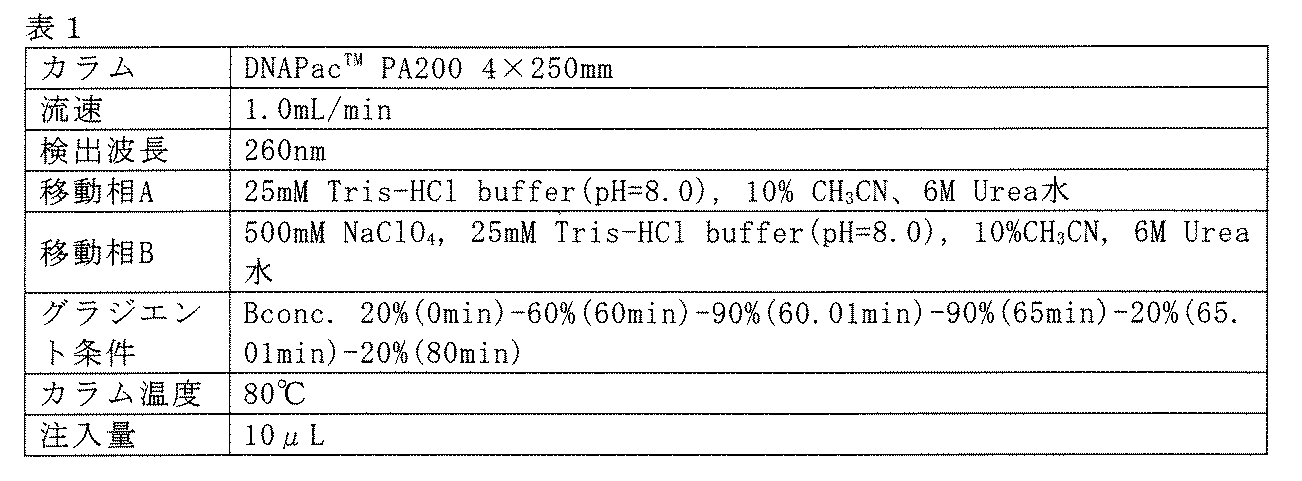
The FLP and branched product ratios in the oligonucleotides were measured by HPLC. FLP stands for full length product.
The HPLC measurement conditions are shown in Table 1 below.
オリゴヌクレオチドの固相合成
配列(J):5’-AmsUmsAmsACUCAAUUUGUAAAAAAGUUUUAGAGCUAGAAAUAGCAAGUUAAAAUAAGGCUAGUCCGUUAUCAACUUGAAAAAGUGGCACCGAGUCGGUGCUmsUmsUmsU-3’(ST.25形式に準じる)(5’-AmsCmsTmsCAATTTGTAAAAAAGTTTTAGAGCTAGAAATAGCAAGTTAAAATAAGGCTAGTCCGTTATCAACTTGAAAAAGTGGCACCGAGTCGGTGCTTTTmsTmsTmsT-3’(ST.26形式に準じる))(配列番号10)100mer
配列(J)において、”A”は、以下の式(A1)において波線で区切られる部分構造で示される。”C”は、以下の式(A2)において波線で区切られる部分構造で示される。”G”は、以下の式(A3)において波線で区切られる部分構造で示される。Uは、以下の式(A4)において波線で区切られる部分構造で示される。”Ums”は、以下の式(A5)において波線で区切られる部分構造で示される。”Ams”は、以下の式(A6)において波線で区切られる部分構造で示される。なお、5’末端の”Ams”は、以下の式(A7)において波線で区切られる上部の部分構造で示される。また、3’末端の”U”は、以下の式(A8)において波線で区切られる下部の部分構造で示される。但し、構造式中のリン酸基は塩であってもよい。
Solid phase synthesis of oligonucleotides Sequence (J): 5'-AmsUmsAmsACUCAAUUUGUAAAAAAGUUUUAGAGCUAGAAAUAGCAAGUUAAAAUAAGGCUAGUCCGUUAUCAACUUGAAAAAGUGGCACCGAGUCGGUGCUmsUmsUmsU-3' (based on ST.25 format) (5'-AmsCmsTmsCAATTTGTAAAAAAGTTTTAGAGCTAGAAATAGCAAGTTAAAATAAGGCTAGTCCGTTATCAACTTGAAAAAGTGGCACCGAGTCGGTGCTTTTmsTmsTmsT-3' (based on ST.26 format)) (SEQ ID NO: 10) 100mer
In sequence (J), "A" is represented by a partial structure separated by a wavy line in the following formula (A1). "C" is represented by a partial structure separated by a wavy line in the following formula (A2). "G" is represented by a partial structure separated by a wavy line in the following formula (A3). U is represented by a partial structure separated by a wavy line in the following formula (A4). "Ums" is represented by a partial structure separated by a wavy line in the following formula (A5). "Ams" is represented by a partial structure separated by a wavy line in the following formula (A6). Note that "Ams" at the 5'-terminus is represented by an upper partial structure separated by a wavy line in the following formula (A7). Also, "U" at the 3'-terminus is represented by a lower partial structure separated by a wavy line in the following formula (A8). However, the phosphate group in the structural formula may be a salt.

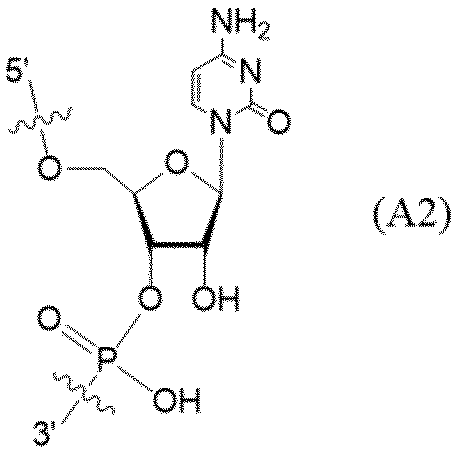
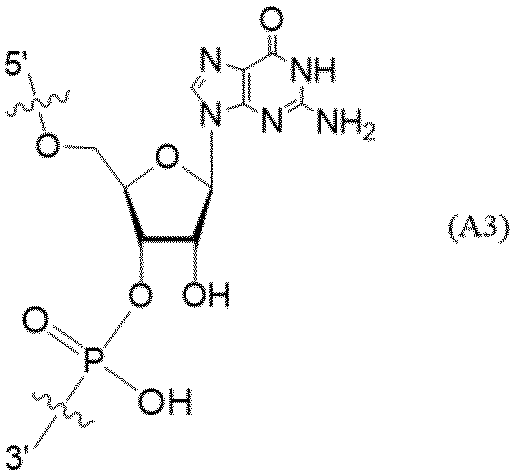
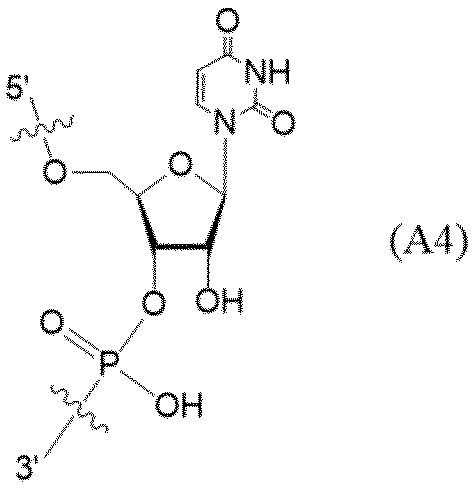


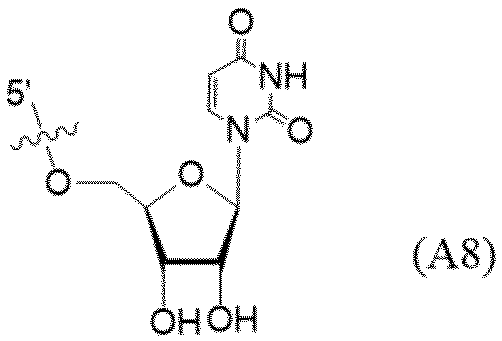
固相担体として、コントロールド・ポア・ガラス(Controlled Pore Glass(CPG))を使用し、核酸合成機としてAKTA oligopilot plus100(GEヘルスケア社製)を用いて、ホスホロアミダイト固相合成法により、上記配列(J)からなるオリゴヌクレオチドを3’側から5’側に向かって合成した。合成は9.79μmolスケールにて実施した。また、合成には、国際公開第2019/208571号に記載のアデノシンPMMアミダイト(化合物(A9))、シチジンPMMアミダイト(化合物(A10))、グアノシンPMMアミダイト(化合物(A11))、およびウリジンPMMアミダイト(化合物(A12))、ならびにアデノシン2’-OMeアミダイト(化合物(A13))、およびウリジン2’-OMeアミダイト(化合物(A14))を使用し、デブロッキング溶液としてジクロロ酢酸トルエン溶液を使用し、縮合剤として5-ベンジルメルカプト-1H-テトラゾールを使用し、酸化剤としてヨウ素溶液を使用し、キャッピング溶液としてフェノキシ酢酸無水物溶液とN-メチルイミダゾール溶液を使用した。核酸伸長終了後担体上の核酸にジエチルアミン溶液を反応させることでリン酸部分のシアノエチル保護基を選択的に脱保護した。ここで、PMMは、(((1-シアノプロパン-2-イル)オキシ)メトキシ)メチル基の略号である。 Controlled pore glass (CPG) was used as the solid phase support, and an AKTA oligopilot plus 100 (GE Healthcare) was used as the nucleic acid synthesizer to synthesize the oligonucleotide consisting of the above sequence (J) from the 3' to the 5' side by phosphoramidite solid phase synthesis. The synthesis was carried out on a 9.79 μmol scale. In addition, for the synthesis, adenosine PMM amidite (compound (A9)), cytidine PMM amidite (compound (A10)), guanosine PMM amidite (compound (A11)), and uridine PMM amidite (compound (A12)) described in WO 2019/208571 were used, as well as adenosine 2'-OMe amidite (compound (A13)), and uridine 2'-OMe amidite (compound (A14)). A dichloroacetic acid toluene solution was used as a deblocking solution, 5-benzylmercapto-1H-tetrazole was used as a condensing agent, an iodine solution was used as an oxidizing agent, and a phenoxyacetic anhydride solution and an N-methylimidazole solution were used as capping solutions. After completion of nucleic acid elongation, the cyanoethyl protecting group of the phosphoric acid moiety was selectively deprotected by reacting a diethylamine solution with the nucleic acid on the carrier. Here, PMM is an abbreviation for the (((1-cyanopropan-2-yl)oxy)methoxy)methyl group.
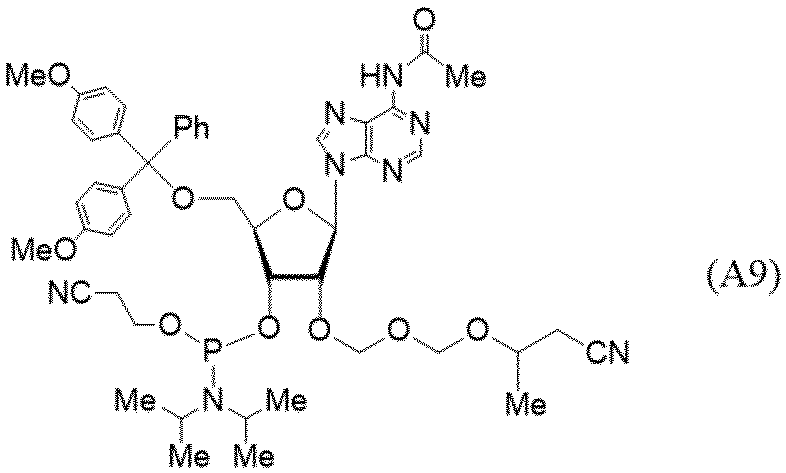


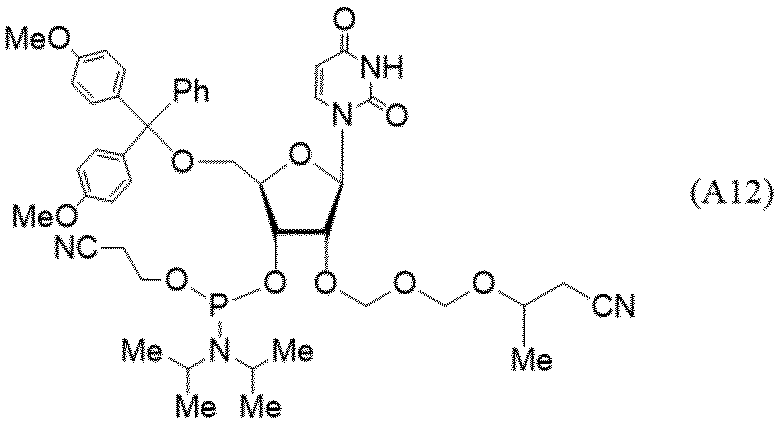


次に、本発明の製法により製造されるオリゴヌクレオチド(核酸オリゴマー)の具体的な製造例を示す。ここで、下記の実施例において本発明の製法により製造されるオリゴヌクレオチドは、前記配列番号10で示される配列(J)を有するオリゴヌクレオチドである。 Next, a specific example of the production of an oligonucleotide (nucleic acid oligomer) produced by the method of the present invention will be shown. Here, in the following example, the oligonucleotide produced by the method of the present invention is an oligonucleotide having the sequence (J) shown in SEQ ID NO: 10.
また、以下の実施例および比較例中に記載するウリジン誘導体とは、下記の構造式で示される化合物を意味する。下記構造式において図示されたサークルは、CPGを模式的に示すものである。 The uridine derivatives described in the following examples and comparative examples refer to compounds represented by the following structural formula. The circle illustrated in the following structural formula is a schematic representation of CPG.

参考例1
9.79μmolのウリジン誘導体を担持したCPGと、式(A9)、式(A10)、式(A11)、式(A12)、式(A13)、または式(A14)に示すアミダイトとを用いて、配列(J)の固相合成をAKTA oligopilot plus100により実施した。その後、5.01μmol分のオリゴヌクレオチドを担持したCPG担体を採取し、28%アンモニア水2.85mLとエタノール0.95mLを流入し、混合物を40℃で6時間保温することでオリゴヌクレオチドを固相担体から遊離させた。次に、濃縮により溶媒を除去し、遊離オリゴヌクレオチドをジメチルスルホキシド3.78mLに溶解後、アセトニトリル1.06mL、ニトロメタン67μLと撹拌子を入れた後、モレキュラーシーブ4Aにて脱水処理を施した1Mのフッ化テトラ-n-ブチルアンモニウム(TBAF)のジメチルスルホキシド溶液7.02mLをスターラーによる撹拌下室温で1時間かけて滴下し、混合物を33℃で4時間保温することで2’位のPMM保護基の脱保護を行った。その後、オリゴヌクレオチドオリゴマーの粗生成物を沈殿操作により得た。
Reference Example 1
Using CPG carrying 9.79 μmol of a uridine derivative and the amidite shown in formula (A9), formula (A10), formula (A11), formula (A12), formula (A13), or formula (A14), solid-phase synthesis of sequence (J) was carried out with AKTA oligopilot plus 100. Thereafter, the CPG carrier carrying 5.01 μmol of oligonucleotide was collected, and 2.85 mL of 28% aqueous ammonia and 0.95 mL of ethanol were poured into the carrier, and the mixture was incubated at 40° C. for 6 hours to liberate the oligonucleotide from the solid-phase carrier. Next, the solvent was removed by concentration, and the free oligonucleotide was dissolved in 3.78 mL of dimethyl sulfoxide. Then, 1.06 mL of acetonitrile, 67 μL of nitromethane, and a stir bar were added, and 7.02 mL of a 1 M dimethyl sulfoxide solution of tetra-n-butylammonium fluoride (TBAF) that had been dehydrated with molecular sieves 4A was added dropwise at room temperature over 1 hour while stirring with a stirrer, and the mixture was kept at 33° C. for 4 hours to deprotect the PMM protecting group at the 2' position. Then, a crude product of the oligonucleotide oligomer was obtained by precipitation.
実施例1
参考例1において得られた粗生成物3mgを容量2mLのガラス製バイアル(Agilent社製)に入れ、50%酢酸水溶液1mLに溶解させた。混合溶液の入ったバイアルを25℃に温調されたインキュベータ(ケニス社製)に入れ、30分静置した。静置後、バイアルをインキュベータから取り出し、前記測定方法1に記載の方法でブランチ体とFLPの割合を算出した。結果を表2に示す。
Example 1
3 mg of the crude product obtained in Reference Example 1 was placed in a 2 mL glass vial (manufactured by Agilent) and dissolved in 1 mL of 50% aqueous acetic acid. The vial containing the mixed solution was placed in an incubator (manufactured by Kenis) whose temperature was adjusted to 25° C., and allowed to stand for 30 minutes. After standing, the vial was removed from the incubator, and the ratio of branch body and FLP was calculated by the method described in
実施例2
参考例1において得られた粗生成物3mgを容量2mLのガラス製バイアル(Agilent社製)に入れ、10%酢酸水溶液1mLに溶解させた。混合溶液の入ったバイアルを25℃に温調されたインキュベータ(ケニス社製)に入れ、2時間静置した。静置後、バイアルをインキュベータから取り出し、前記測定方法1に記載の方法でブランチ体とFLPの割合を算出した。結果を表2に示す。
Example 2
3 mg of the crude product obtained in Reference Example 1 was placed in a 2 mL glass vial (manufactured by Agilent) and dissolved in 1 mL of 10% aqueous acetic acid. The vial containing the mixed solution was placed in an incubator (manufactured by Kenis) whose temperature was adjusted to 25° C., and allowed to stand for 2 hours. After standing, the vial was removed from the incubator, and the ratio of branch body and FLP was calculated by the method described in
実施例3
参考例1において得られた粗生成物3mgを容量2mLのガラス製バイアル(Agilent社製)に入れ、0.5%酢酸水溶液1mLに溶解させた。混合溶液の入ったバイアルを25℃に温調されたインキュベータ(ケニス社製)に入れ、24時間静置した。静置後、バイアルをインキュベータから取り出し、前記測定方法1に記載の方法でブランチ体とFLPの割合を算出した。結果を表2に示す。
Example 3
3 mg of the crude product obtained in Reference Example 1 was placed in a 2 mL glass vial (manufactured by Agilent) and dissolved in 1 mL of 0.5% aqueous acetic acid solution. The vial containing the mixed solution was placed in an incubator (manufactured by Kenis) whose temperature was adjusted to 25° C., and allowed to stand for 24 hours. After standing, the vial was removed from the incubator, and the ratio of branch body and FLP was calculated by the method described in the
実施例4
参考例1において得られた粗生成物3mgを容量2mLのガラス製バイアル(Agilent社製)に入れ、0.1M酢酸ナトリウムバッファー1mL(pH=5.2)に溶解させた。混合溶液の入ったバイアルを25℃に温調されたインキュベータ(ケニス社製)に入れ、48時間静置した。静置後、バイアルをインキュベータから取り出し、前記測定方法1に記載の方法でブランチ体とFLPの割合を算出した。結果を表2に示す。
Example 4
3 mg of the crude product obtained in Reference Example 1 was placed in a 2 mL glass vial (Agilent) and dissolved in 1 mL of 0.1 M sodium acetate buffer (pH = 5.2). The vial containing the mixed solution was placed in an incubator (Kenis) whose temperature was adjusted to 25°C and allowed to stand for 48 hours. After standing, the vial was removed from the incubator, and the ratio of branch body and FLP was calculated by the method described in
実施例5
参考例1において得られた粗生成物3mgを容量2mLのガラス製バイアル(Agilent社製)に入れ、UF水1mLに溶解させた。混合溶液の入ったバイアルを25℃に温調されたインキュベータ(ケニス社製)に入れ、1週間静置した。静置後、バイアルをインキュベータから取り出し、前記測定方法1に記載の方法でブランチ体とFLPの割合を算出した。結果を表2に示す。
Example 5
3 mg of the crude product obtained in Reference Example 1 was placed in a 2 mL glass vial (manufactured by Agilent) and dissolved in 1 mL of UF water. The vial containing the mixed solution was placed in an incubator (manufactured by Kenis) whose temperature was adjusted to 25° C., and allowed to stand for one week. After standing, the vial was removed from the incubator, and the ratio of branch body and FLP was calculated by the method described in the
実施例6
参考例1において得られた粗生成物3mgを容量2mLのガラス製バイアル(Agilent社製)に入れ、UF水1mLに溶解させた。混合溶液の入ったバイアルを40℃に温調されたインキュベータ(ケニス社製)に入れ、72時間静置した。静置後、インキュベータから取り出したバイアルを室温まで冷却し、前記測定方法1に記載の方法でブランチ体とFLPの割合を算出した。結果を表2に示す。
Example 6
3 mg of the crude product obtained in Reference Example 1 was placed in a 2 mL glass vial (manufactured by Agilent) and dissolved in 1 mL of UF water. The vial containing the mixed solution was placed in an incubator (manufactured by Kenis) whose temperature was adjusted to 40° C., and allowed to stand for 72 hours. After standing, the vial was taken out of the incubator and cooled to room temperature, and the ratio of branch body and FLP was calculated by the method described in the
実施例7
参考例1において得られた粗生成物3mgを容量2mLのガラス製バイアル(Agilent社製)に入れ、UF水1mLに溶解させた。混合溶液の入ったバイアルを50℃に温調されたインキュベータ(ケニス社製)に入れ、24時間静置した。静置後、インキュベータから取り出したバイアルを室温まで冷却し、前記測定方法1に記載の方法でブランチ体とFLPの割合を算出した。結果を表2に示す。
Example 7
3 mg of the crude product obtained in Reference Example 1 was placed in a 2 mL glass vial (manufactured by Agilent) and dissolved in 1 mL of UF water. The vial containing the mixed solution was placed in an incubator (manufactured by Kenis) whose temperature was adjusted to 50° C., and allowed to stand for 24 hours. After standing, the vial was taken out of the incubator and cooled to room temperature, and the ratio of branch body and FLP was calculated by the method described in the
実施例8
参考例1において得られた粗生成物3mgを容量2mLのガラス製バイアル(Agilent社製)に入れ、UF水1mLに溶解させた。混合溶液の入ったバイアルを60℃に温調されたインキュベータ(ケニス社製)に入れ、6時間静置した。静置後、インキュベータから取り出したバイアルを室温まで冷却し、前記測定方法1に記載の方法でブランチ体とFLPの割合を算出した。結果を表2に示す。
Example 8
3 mg of the crude product obtained in Reference Example 1 was placed in a 2 mL glass vial (manufactured by Agilent) and dissolved in 1 mL of UF water. The vial containing the mixed solution was placed in an incubator (manufactured by Kenis) whose temperature was adjusted to 60° C., and allowed to stand for 6 hours. After standing, the vial was taken out of the incubator and cooled to room temperature, and the ratio of branch body and FLP was calculated by the method described in the
実施例9
参考例1において得られた粗生成物3mgを容量2mLのガラス製バイアル(Agilent社製)に入れ、0.1Mトリス塩酸バッファー(pH=7.5)1mLに溶解させた。混合溶液の入ったバイアルを60℃に温調されたインキュベータ(ケニス社製)に入れ、24時間静置した。静置後、インキュベータから取り出したバイアルを室温まで冷却し、前記測定方法1に記載の方法でブランチ体とFLPの割合を算出した。結果を表2に示す。
Example 9
3 mg of the crude product obtained in Reference Example 1 was placed in a 2 mL glass vial (Agilent) and dissolved in 1 mL of 0.1 M Tris-HCl buffer (pH = 7.5). The vial containing the mixed solution was placed in an incubator (Kenis) whose temperature was adjusted to 60°C and allowed to stand for 24 hours. After standing, the vial was taken out of the incubator and cooled to room temperature, and the ratio of branch body and FLP was calculated by the method described in
比較例1
参考例1において得られた粗生成物3mgを容量2mLのガラス製バイアル(Agilent社製)に入れ、0.1Mトリス塩酸バッファー(pH=9.0)1mLに溶解させた。混合溶液の入ったバイアルを60℃に温調されたインキュベータ(ケニス社製)に入れ、6時間静置した。静置後、インキュベータから取り出したバイアルを室温まで冷却し、前記測定方法1に記載の方法でブランチ体とFLPの割合を算出した。結果を表2に示す。
Comparative Example 1
3 mg of the crude product obtained in Reference Example 1 was placed in a 2 mL glass vial (Agilent) and dissolved in 1 mL of 0.1 M Tris-HCl buffer (pH = 9.0). The vial containing the mixed solution was placed in an incubator (Kenis) whose temperature was adjusted to 60°C and allowed to stand for 6 hours. After standing, the vial was taken out of the incubator and cooled to room temperature, and the ratio of branch body and FLP was calculated by the method described in
比較例2(初期値:反応前)
参考例1において得られた粗生成物3mgをUF水1mLに溶解し、前記測定方法1に記載の方法でブランチ体とFLPの割合を算出した。結果を表2に示す。
Comparative Example 2 (Initial value: before reaction)
3 mg of the crude product obtained in Reference Example 1 was dissolved in 1 mL of UF water, and the ratio of branch body to FLP was calculated by the method described in the above-mentioned
比較例3(非特許文献2に記載の反応条件)
非特許文献2(Oligonucleotides 2006, 16, 181-185)に記載の方法に従って、トリエチルアミン三フッ化水素酸塩を用いて、合成後の粗オリゴヌクレオチドを処理した。具体的には、参考例1において得られた粗生成物3mgを容量2mLのガラス製バイアル(Agilent社製)に入れ、トリエチルアミン三フッ化水素酸塩を加えた。混合物の入ったバイアルを65℃に温調されたインキュベータ(ケニス社製)に入れ、1.5時間静置した。静置後、インキュベータから取り出したバイアルを室温まで冷却し、前記測定方法1に記載の方法でブランチ体とFLPの割合を算出した。結果を表2に示す。
Comparative Example 3 (Reaction conditions described in Non-Patent Document 2)
According to the method described in Non-Patent Document 2 (Oligonucleotides 2006, 16, 181-185), the crude oligonucleotide after synthesis was treated with triethylamine trihydrofluoride. Specifically, 3 mg of the crude product obtained in Reference Example 1 was placed in a 2 mL glass vial (manufactured by Agilent) and triethylamine trihydrofluoride was added. The vial containing the mixture was placed in an incubator (manufactured by Kenis) whose temperature was adjusted to 65° C. and allowed to stand for 1.5 hours. After standing, the vial was taken out of the incubator and cooled to room temperature, and the ratio of branch body and FLP was calculated by the method described in the
比較例4(非特許文献3に記載の反応条件)
非特許文献3(J. Org. Chem., 1970, 35, 3800-3803)に記載の方法に従って、80%酢酸水溶液を用いて100℃で、合成後の粗オリゴヌクレオチドを処理した。具体的には、参考例1において得られた粗生成物3mgを容量2mLのガラス製バイアル(Agilent社製)に入れ、80%酢酸水溶液1mLに溶解させた。混合溶液の入ったバイアルを100℃に温調されたオイルバスに入れ、20分静置した。静置後、オイルバスから取り出したバイアルを室温まで冷却し、前記測定方法1に記載の方法でブランチ体とFLPの割合を算出した。結果を表2に示す。
Comparative Example 4 (Reaction conditions described in Non-Patent Document 3)
According to the method described in Non-Patent Document 3 (J. Org. Chem., 1970, 35, 3800-3803), the crude oligonucleotide after synthesis was treated with an 80% aqueous acetic acid solution at 100°C. Specifically, 3 mg of the crude product obtained in Reference Example 1 was placed in a 2 mL glass vial (manufactured by Agilent) and dissolved in 1 mL of an 80% aqueous acetic acid solution. The vial containing the mixed solution was placed in an oil bath adjusted to 100°C and allowed to stand for 20 minutes. After standing, the vial was removed from the oil bath and cooled to room temperature, and the ratio of branched bodies and FLP was calculated by the method described in the
実施例1~9、比較例1~4の結果を、表2に示す。表2において、N.D.は未検出を意味する。

表2において、ブランチ体割合とは、オリゴヌクレオチドを前記測定方法1で分析することにより求めた、オリゴヌクレオチド中のブランチ体の割合(面積百分率)を意味する。また、FLP割合とは、オリゴヌクレオチドを前記測定方法1で分析することにより求めた、オリゴヌクレオチド中のFLPの割合(面積百分率)を意味する。「ブランチ体/FLP」とは、オリゴヌクレオチド中のFLPの割合を100%としたときの、ブランチ体の含有量比を意味し、次式で求められる。
「ブランチ体/FLP」(%)=ブランチ体割合/FLP割合×100
In Table 2, the branch body proportion means the proportion (area percentage) of the branch body in the oligonucleotide, determined by analyzing the oligonucleotide using the above-mentioned
"Branch body/FLP" (%) = branch body ratio/FLP ratio x 100
本発明の製造方法により、オリゴヌクレオチドの製造において生成するブランチ体を選択的に分解することができ、それによって、オリゴヌクレオチドの収率および純度の向上が期待できる。 The manufacturing method of the present invention makes it possible to selectively decompose the branch bodies produced during the production of oligonucleotides, which is expected to improve the yield and purity of oligonucleotides.
配列表の配列番号1~10は、本発明のオリゴヌクレオチドの製造方法に従って製造されるオリゴヌクレオチドの塩基配列を表す。
Claims (19)
n個重合オリゴヌクレオチド(nは、2以上の任意の整数を示す。)と、pHが1~8の水または水溶液とを反応させて、ブランチ体を分解する工程を含む、オリゴヌクレオチドの製造方法。 1. A method for producing an oligonucleotide, comprising:
A method for producing an oligonucleotide, comprising the step of reacting an n-mer oligonucleotide (n is any integer of 2 or more) with water or an aqueous solution having a pH of 1 to 8 to decompose the branched bodies.
Priority Applications (4)
| Application Number | Priority Date | Filing Date | Title |
|---|---|---|---|
| EP23912055.3A EP4644404A1 (en) | 2022-12-26 | 2023-12-25 | Oligonucleotide production method |
| KR1020257019981A KR20250128304A (en) | 2022-12-26 | 2023-12-25 | Method for producing oligonucleotides |
| CN202380086686.8A CN120418262A (en) | 2022-12-26 | 2023-12-25 | Method for producing oligonucleotide |
| JP2024567802A JPWO2024143276A1 (en) | 2022-12-26 | 2023-12-25 |
Applications Claiming Priority (2)
| Application Number | Priority Date | Filing Date | Title |
|---|---|---|---|
| JP2022208672 | 2022-12-26 | ||
| JP2022-208672 | 2022-12-26 |
Publications (1)
| Publication Number | Publication Date |
|---|---|
| WO2024143276A1 true WO2024143276A1 (en) | 2024-07-04 |
Family
ID=91717985
Family Applications (1)
| Application Number | Title | Priority Date | Filing Date |
|---|---|---|---|
| PCT/JP2023/046424 Ceased WO2024143276A1 (en) | 2022-12-26 | 2023-12-25 | Oligonucleotide production method |
Country Status (5)
| Country | Link |
|---|---|
| EP (1) | EP4644404A1 (en) |
| JP (1) | JPWO2024143276A1 (en) |
| KR (1) | KR20250128304A (en) |
| CN (1) | CN120418262A (en) |
| WO (1) | WO2024143276A1 (en) |
Citations (11)
| Publication number | Priority date | Publication date | Assignee | Title |
|---|---|---|---|---|
| WO2001053528A1 (en) | 2000-01-18 | 2001-07-26 | Isis Pharmaceuticals, Inc. | Antisense inhibition of ptp1b expression |
| JP3745226B2 (en) | 1998-09-29 | 2006-02-15 | アイシス・ファーマシューティカルス・インコーポレーテッド | Antisense modulation of survivin expression |
| WO2006022323A1 (en) | 2004-08-26 | 2006-03-02 | Nippon Shinyaku Co., Ltd. | Phosphoramidite compound and method for producing oligo-rna |
| JP4705716B2 (en) | 1999-02-05 | 2011-06-22 | ジーイー・ヘルスケア・バイオサイエンス・コーポレイション | Oligonucleotide deprotection |
| WO2013027843A1 (en) | 2011-08-25 | 2013-02-28 | 株式会社ボナック | Glucoside compound, method for producing thioether, ether, method for producing ether, method for producing glucoside compound, method for producing nucleic acid |
| JP2014221817A (en) | 2006-10-18 | 2014-11-27 | アイシス ファーマシューティカルズ, インコーポレーテッド | Antisense compound |
| JP2015523856A (en) | 2012-05-25 | 2015-08-20 | ザ リージェンツ オブ ザ ユニバーシティ オブ カリフ | Methods and compositions for RNA-dependent target DNA modification and RNA-dependent transcriptional regulation |
| WO2017104836A1 (en) * | 2015-12-16 | 2017-06-22 | 味の素株式会社 | Oligonucleotide production method, and nucleoside, nucleotide, or oligonucleotide |
| JP2017537626A (en) | 2014-12-03 | 2017-12-21 | アジレント・テクノロジーズ・インクAgilent Technologies, Inc. | Guide RNA with chemical modification |
| WO2019060442A1 (en) | 2017-09-19 | 2019-03-28 | Alnylam Pharmaceuticals, Inc. | Compositions and methods for treating transthyretin (ttr) mediated amyloidosis |
| WO2019208571A1 (en) | 2018-04-24 | 2019-10-31 | 住友化学株式会社 | Amidite compound and method for producing polynucleotide using said compound |
-
2023
- 2023-12-25 WO PCT/JP2023/046424 patent/WO2024143276A1/en not_active Ceased
- 2023-12-25 CN CN202380086686.8A patent/CN120418262A/en active Pending
- 2023-12-25 EP EP23912055.3A patent/EP4644404A1/en active Pending
- 2023-12-25 KR KR1020257019981A patent/KR20250128304A/en active Pending
- 2023-12-25 JP JP2024567802A patent/JPWO2024143276A1/ja active Pending
Patent Citations (13)
| Publication number | Priority date | Publication date | Assignee | Title |
|---|---|---|---|---|
| JP3745226B2 (en) | 1998-09-29 | 2006-02-15 | アイシス・ファーマシューティカルス・インコーポレーテッド | Antisense modulation of survivin expression |
| JP4705716B2 (en) | 1999-02-05 | 2011-06-22 | ジーイー・ヘルスケア・バイオサイエンス・コーポレイション | Oligonucleotide deprotection |
| WO2001053528A1 (en) | 2000-01-18 | 2001-07-26 | Isis Pharmaceuticals, Inc. | Antisense inhibition of ptp1b expression |
| WO2006022323A1 (en) | 2004-08-26 | 2006-03-02 | Nippon Shinyaku Co., Ltd. | Phosphoramidite compound and method for producing oligo-rna |
| JP5157168B2 (en) | 2004-08-26 | 2013-03-06 | 日本新薬株式会社 | Method for producing phosphoramidite compound and oligo RNA |
| JP2014221817A (en) | 2006-10-18 | 2014-11-27 | アイシス ファーマシューティカルズ, インコーポレーテッド | Antisense compound |
| JP5554881B2 (en) | 2011-08-25 | 2014-07-23 | 株式会社ボナック | Glycoside compound, method for producing thioether, ether, method for producing ether, method for producing glycoside compound, method for producing nucleic acid |
| WO2013027843A1 (en) | 2011-08-25 | 2013-02-28 | 株式会社ボナック | Glucoside compound, method for producing thioether, ether, method for producing ether, method for producing glucoside compound, method for producing nucleic acid |
| JP2015523856A (en) | 2012-05-25 | 2015-08-20 | ザ リージェンツ オブ ザ ユニバーシティ オブ カリフ | Methods and compositions for RNA-dependent target DNA modification and RNA-dependent transcriptional regulation |
| JP2017537626A (en) | 2014-12-03 | 2017-12-21 | アジレント・テクノロジーズ・インクAgilent Technologies, Inc. | Guide RNA with chemical modification |
| WO2017104836A1 (en) * | 2015-12-16 | 2017-06-22 | 味の素株式会社 | Oligonucleotide production method, and nucleoside, nucleotide, or oligonucleotide |
| WO2019060442A1 (en) | 2017-09-19 | 2019-03-28 | Alnylam Pharmaceuticals, Inc. | Compositions and methods for treating transthyretin (ttr) mediated amyloidosis |
| WO2019208571A1 (en) | 2018-04-24 | 2019-10-31 | 住友化学株式会社 | Amidite compound and method for producing polynucleotide using said compound |
Non-Patent Citations (11)
| Title |
|---|
| "Mass Spectrometry", REVIEWS, vol. 40, 2021, pages 75 - 109 |
| CAZENAVE CHRISTIAN, BATHANY KATELL, RAYNER BERNARD: "Formation of N -Branched Oligonucleotides as By-products in Solid-Phase Oligonucleotide Synthesis", OLIGONUCLEOTIDES, vol. 16, no. 2, 1 June 2006 (2006-06-01), pages 181 - 185, XP093188243, ISSN: 1545-4576, DOI: 10.1089/oli.2006.16.181 * |
| DANIEL O'REILLY ET AL., NUCLEIC ACIDS RESEARCH, vol. 47, no. 2, 2019, pages 547 - 558 |
| HOSONO HIROKI, ERI NISHIYAMA: "Continued: Basic Bioengineering Course - Bio Chit Chat - Oligonucleotide (primer) synthesis: the secret to its speed", SEIBUTSU KOGAKU KAISHI = JOURNAL OF THE SOCIETY FOR BIOSCIENCE AND BIOENGINEERING, JAPAN, NIPPON SEIBUTSU KOGAKKAI, SUITA,, JP, vol. 100, no. 11, 1 January 2022 (2022-01-01), JP , pages 611 - 615, XP093188240, ISSN: 0919-3758, DOI: 10.34565/seibutsukogaku.100.11_611 * |
| J. ORG. CHEM., vol. 35, 1970, pages 3800 - 3803 |
| KURATA, C. ; BRADLEY, K. ; GAUS, H. ; LUU, N. ; CEDILLO, I. ; RAVIKUMAR, V.T. ; SOOY, K.V. ; MCARDLE, J.V. ; CAPALDI, D.C.: "Characterization of high molecular weight impurities in synthetic phosphorothioate oligonucleotides", BIOORGANIC & MEDICINAL CHEMISTRY LETTERS, ELSEVIER, AMSTERDAM NL, vol. 16, no. 3, 1 February 2006 (2006-02-01), Amsterdam NL , pages 607 - 614, XP027965842, ISSN: 0960-894X * |
| LETSINGER R. L., MUNGALL W. S.: "PHOSPHORAMIDATE ANALOGS OF OLIGONUCLEOTIDES.", THE JOURNAL OF ORGANIC CHEMISTRY, AMERICAN CHEMICAL SOCIETY, UNITED STATES, vol. 35., no. 11., 1 January 1970 (1970-01-01), United States, pages 3800 - 3803., XP000857918, ISSN: 0022-3263, DOI: 10.1021/jo00836a048 * |
| OLIGONUCLEOTIDES, vol. 16, 2006, pages 181 - 185 |
| POURSHAHIAN SOHEIL: "THERAPEUTIC OLIGONUCLEOTIDES, IMPURITIES, DEGRADANTS, AND THEIR CHARACTERIZATION BY MASS SPECTROMETRY", MASS SPECTROMETRY REVIEWS., JOHN WILEY AND SONS, NEW YORK, NY., US, vol. 40, no. 2, 1 March 2021 (2021-03-01), US , pages 75 - 109, XP093133172, ISSN: 0277-7037, DOI: 10.1002/mas.21615 * |
| SEKINE M, OHKUBO A, SEIO K: "proton-block strategy for the synthesis of oligodeoxynucleotides without base protection", THE JOURNAL OF ORGANIC CHEMISTRY, AMERICAN CHEMICAL SOCIETY, UNITED STATES, vol. 68, no. 14, 11 July 2003 (2003-07-11), United States, pages 5478 - 5492, XP002553901, ISSN: 0022-3263, DOI: 10.1021/jo034204k * |
| XIULONG, SHEN ET AL., NUCLEIC ACIDS RESEARCH, vol. 46, no. 46, 2018, pages 1584 - 1600 |
Also Published As
| Publication number | Publication date |
|---|---|
| EP4644404A1 (en) | 2025-11-05 |
| JPWO2024143276A1 (en) | 2024-07-04 |
| CN120418262A (en) | 2025-08-01 |
| KR20250128304A (en) | 2025-08-27 |
Similar Documents
| Publication | Publication Date | Title |
|---|---|---|
| JP7777452B2 (en) | Method for producing nucleic acid oligomers | |
| JP7719788B2 (en) | Method for producing nucleic acid oligomers | |
| JP7667788B2 (en) | Method for producing nucleic acid oligomer | |
| JP7759323B2 (en) | Method for producing nucleic acid oligomers | |
| JP7698631B2 (en) | Method for producing nucleic acid oligomer | |
| EP4559925A1 (en) | Production method of oligonucleotide | |
| WO2024143276A1 (en) | Oligonucleotide production method | |
| EP4563559A1 (en) | Thionizing solution | |
| EP4410770A1 (en) | Production method for purified dichloroacetic acid | |
| WO2024089953A1 (en) | Method for producing oligonucleotide | |
| WO2025229953A1 (en) | Method for producing oligonucleotide | |
| WO2025244124A1 (en) | Method for producing nucleic acid oligomer |
Legal Events
| Date | Code | Title | Description |
|---|---|---|---|
| 121 | Ep: the epo has been informed by wipo that ep was designated in this application |
Ref document number: 23912055 Country of ref document: EP Kind code of ref document: A1 |
|
| WWE | Wipo information: entry into national phase |
Ref document number: 2024567802 Country of ref document: JP |
|
| WWE | Wipo information: entry into national phase |
Ref document number: 202380086686.8 Country of ref document: CN |
|
| WWE | Wipo information: entry into national phase |
Ref document number: 2023912055 Country of ref document: EP |
|
| NENP | Non-entry into the national phase |
Ref country code: DE |
|
| WWP | Wipo information: published in national office |
Ref document number: 202380086686.8 Country of ref document: CN |
|
| WWP | Wipo information: published in national office |
Ref document number: 1020257019981 Country of ref document: KR |
|
| WWP | Wipo information: published in national office |
Ref document number: 2023912055 Country of ref document: EP |