WO2024137392A1 - Method of preparing self-circularized rna - Google Patents
Method of preparing self-circularized rna Download PDFInfo
- Publication number
- WO2024137392A1 WO2024137392A1 PCT/US2023/084296 US2023084296W WO2024137392A1 WO 2024137392 A1 WO2024137392 A1 WO 2024137392A1 US 2023084296 W US2023084296 W US 2023084296W WO 2024137392 A1 WO2024137392 A1 WO 2024137392A1
- Authority
- WO
- WIPO (PCT)
- Prior art keywords
- seq
- 3wjc
- 3wjb
- 3wja
- rna
- Prior art date
- Legal status (The legal status is an assumption and is not a legal conclusion. Google has not performed a legal analysis and makes no representation as to the accuracy of the status listed.)
- Ceased
Links
Classifications
-
- C—CHEMISTRY; METALLURGY
- C12—BIOCHEMISTRY; BEER; SPIRITS; WINE; VINEGAR; MICROBIOLOGY; ENZYMOLOGY; MUTATION OR GENETIC ENGINEERING
- C12N—MICROORGANISMS OR ENZYMES; COMPOSITIONS THEREOF; PROPAGATING, PRESERVING, OR MAINTAINING MICROORGANISMS; MUTATION OR GENETIC ENGINEERING; CULTURE MEDIA
- C12N15/00—Mutation or genetic engineering; DNA or RNA concerning genetic engineering, vectors, e.g. plasmids, or their isolation, preparation or purification; Use of hosts therefor
- C12N15/09—Recombinant DNA-technology
- C12N15/11—DNA or RNA fragments; Modified forms thereof; Non-coding nucleic acids having a biological activity
- C12N15/113—Non-coding nucleic acids modulating the expression of genes, e.g. antisense oligonucleotides; Antisense DNA or RNA; Triplex- forming oligonucleotides; Catalytic nucleic acids, e.g. ribozymes; Nucleic acids used in co-suppression or gene silencing
-
- C—CHEMISTRY; METALLURGY
- C12—BIOCHEMISTRY; BEER; SPIRITS; WINE; VINEGAR; MICROBIOLOGY; ENZYMOLOGY; MUTATION OR GENETIC ENGINEERING
- C12N—MICROORGANISMS OR ENZYMES; COMPOSITIONS THEREOF; PROPAGATING, PRESERVING, OR MAINTAINING MICROORGANISMS; MUTATION OR GENETIC ENGINEERING; CULTURE MEDIA
- C12N15/00—Mutation or genetic engineering; DNA or RNA concerning genetic engineering, vectors, e.g. plasmids, or their isolation, preparation or purification; Use of hosts therefor
- C12N15/09—Recombinant DNA-technology
- C12N15/11—DNA or RNA fragments; Modified forms thereof; Non-coding nucleic acids having a biological activity
- C12N15/111—General methods applicable to biologically active non-coding nucleic acids
-
- C—CHEMISTRY; METALLURGY
- C12—BIOCHEMISTRY; BEER; SPIRITS; WINE; VINEGAR; MICROBIOLOGY; ENZYMOLOGY; MUTATION OR GENETIC ENGINEERING
- C12N—MICROORGANISMS OR ENZYMES; COMPOSITIONS THEREOF; PROPAGATING, PRESERVING, OR MAINTAINING MICROORGANISMS; MUTATION OR GENETIC ENGINEERING; CULTURE MEDIA
- C12N15/00—Mutation or genetic engineering; DNA or RNA concerning genetic engineering, vectors, e.g. plasmids, or their isolation, preparation or purification; Use of hosts therefor
- C12N15/09—Recombinant DNA-technology
- C12N15/63—Introduction of foreign genetic material using vectors; Vectors; Use of hosts therefor; Regulation of expression
- C12N15/64—General methods for preparing the vector, for introducing it into the cell or for selecting the vector-containing host
-
- C—CHEMISTRY; METALLURGY
- C12—BIOCHEMISTRY; BEER; SPIRITS; WINE; VINEGAR; MICROBIOLOGY; ENZYMOLOGY; MUTATION OR GENETIC ENGINEERING
- C12N—MICROORGANISMS OR ENZYMES; COMPOSITIONS THEREOF; PROPAGATING, PRESERVING, OR MAINTAINING MICROORGANISMS; MUTATION OR GENETIC ENGINEERING; CULTURE MEDIA
- C12N15/00—Mutation or genetic engineering; DNA or RNA concerning genetic engineering, vectors, e.g. plasmids, or their isolation, preparation or purification; Use of hosts therefor
- C12N15/09—Recombinant DNA-technology
- C12N15/63—Introduction of foreign genetic material using vectors; Vectors; Use of hosts therefor; Regulation of expression
-
- C—CHEMISTRY; METALLURGY
- C12—BIOCHEMISTRY; BEER; SPIRITS; WINE; VINEGAR; MICROBIOLOGY; ENZYMOLOGY; MUTATION OR GENETIC ENGINEERING
- C12N—MICROORGANISMS OR ENZYMES; COMPOSITIONS THEREOF; PROPAGATING, PRESERVING, OR MAINTAINING MICROORGANISMS; MUTATION OR GENETIC ENGINEERING; CULTURE MEDIA
- C12N15/00—Mutation or genetic engineering; DNA or RNA concerning genetic engineering, vectors, e.g. plasmids, or their isolation, preparation or purification; Use of hosts therefor
- C12N15/09—Recombinant DNA-technology
- C12N15/63—Introduction of foreign genetic material using vectors; Vectors; Use of hosts therefor; Regulation of expression
- C12N15/66—General methods for inserting a gene into a vector to form a recombinant vector using cleavage and ligation; Use of non-functional linkers or adaptors, e.g. linkers containing the sequence for a restriction endonuclease
-
- C—CHEMISTRY; METALLURGY
- C12—BIOCHEMISTRY; BEER; SPIRITS; WINE; VINEGAR; MICROBIOLOGY; ENZYMOLOGY; MUTATION OR GENETIC ENGINEERING
- C12N—MICROORGANISMS OR ENZYMES; COMPOSITIONS THEREOF; PROPAGATING, PRESERVING, OR MAINTAINING MICROORGANISMS; MUTATION OR GENETIC ENGINEERING; CULTURE MEDIA
- C12N15/00—Mutation or genetic engineering; DNA or RNA concerning genetic engineering, vectors, e.g. plasmids, or their isolation, preparation or purification; Use of hosts therefor
- C12N15/09—Recombinant DNA-technology
- C12N15/63—Introduction of foreign genetic material using vectors; Vectors; Use of hosts therefor; Regulation of expression
- C12N15/67—General methods for enhancing the expression
-
- C—CHEMISTRY; METALLURGY
- C12—BIOCHEMISTRY; BEER; SPIRITS; WINE; VINEGAR; MICROBIOLOGY; ENZYMOLOGY; MUTATION OR GENETIC ENGINEERING
- C12N—MICROORGANISMS OR ENZYMES; COMPOSITIONS THEREOF; PROPAGATING, PRESERVING, OR MAINTAINING MICROORGANISMS; MUTATION OR GENETIC ENGINEERING; CULTURE MEDIA
- C12N15/00—Mutation or genetic engineering; DNA or RNA concerning genetic engineering, vectors, e.g. plasmids, or their isolation, preparation or purification; Use of hosts therefor
- C12N15/09—Recombinant DNA-technology
- C12N15/63—Introduction of foreign genetic material using vectors; Vectors; Use of hosts therefor; Regulation of expression
- C12N15/79—Vectors or expression systems specially adapted for eukaryotic hosts
- C12N15/85—Vectors or expression systems specially adapted for eukaryotic hosts for animal cells
-
- C—CHEMISTRY; METALLURGY
- C12—BIOCHEMISTRY; BEER; SPIRITS; WINE; VINEGAR; MICROBIOLOGY; ENZYMOLOGY; MUTATION OR GENETIC ENGINEERING
- C12P—FERMENTATION OR ENZYME-USING PROCESSES TO SYNTHESISE A DESIRED CHEMICAL COMPOUND OR COMPOSITION OR TO SEPARATE OPTICAL ISOMERS FROM A RACEMIC MIXTURE
- C12P19/00—Preparation of compounds containing saccharide radicals
- C12P19/26—Preparation of nitrogen-containing carbohydrates
- C12P19/28—N-glycosides
- C12P19/30—Nucleotides
- C12P19/34—Polynucleotides, e.g. nucleic acids, oligoribonucleotides
-
- C—CHEMISTRY; METALLURGY
- C12—BIOCHEMISTRY; BEER; SPIRITS; WINE; VINEGAR; MICROBIOLOGY; ENZYMOLOGY; MUTATION OR GENETIC ENGINEERING
- C12P—FERMENTATION OR ENZYME-USING PROCESSES TO SYNTHESISE A DESIRED CHEMICAL COMPOUND OR COMPOSITION OR TO SEPARATE OPTICAL ISOMERS FROM A RACEMIC MIXTURE
- C12P21/00—Preparation of peptides or proteins
- C12P21/02—Preparation of peptides or proteins having a known sequence of two or more amino acids, e.g. glutathione
-
- C—CHEMISTRY; METALLURGY
- C12—BIOCHEMISTRY; BEER; SPIRITS; WINE; VINEGAR; MICROBIOLOGY; ENZYMOLOGY; MUTATION OR GENETIC ENGINEERING
- C12N—MICROORGANISMS OR ENZYMES; COMPOSITIONS THEREOF; PROPAGATING, PRESERVING, OR MAINTAINING MICROORGANISMS; MUTATION OR GENETIC ENGINEERING; CULTURE MEDIA
- C12N2310/00—Structure or type of the nucleic acid
- C12N2310/10—Type of nucleic acid
- C12N2310/12—Type of nucleic acid catalytic nucleic acids, e.g. ribozymes
- C12N2310/124—Type of nucleic acid catalytic nucleic acids, e.g. ribozymes based on group I or II introns
-
- C—CHEMISTRY; METALLURGY
- C12—BIOCHEMISTRY; BEER; SPIRITS; WINE; VINEGAR; MICROBIOLOGY; ENZYMOLOGY; MUTATION OR GENETIC ENGINEERING
- C12N—MICROORGANISMS OR ENZYMES; COMPOSITIONS THEREOF; PROPAGATING, PRESERVING, OR MAINTAINING MICROORGANISMS; MUTATION OR GENETIC ENGINEERING; CULTURE MEDIA
- C12N2310/00—Structure or type of the nucleic acid
- C12N2310/50—Physical structure
- C12N2310/53—Physical structure partially self-complementary or closed
- C12N2310/531—Stem-loop; Hairpin
-
- C—CHEMISTRY; METALLURGY
- C12—BIOCHEMISTRY; BEER; SPIRITS; WINE; VINEGAR; MICROBIOLOGY; ENZYMOLOGY; MUTATION OR GENETIC ENGINEERING
- C12N—MICROORGANISMS OR ENZYMES; COMPOSITIONS THEREOF; PROPAGATING, PRESERVING, OR MAINTAINING MICROORGANISMS; MUTATION OR GENETIC ENGINEERING; CULTURE MEDIA
- C12N2310/00—Structure or type of the nucleic acid
- C12N2310/50—Physical structure
- C12N2310/53—Physical structure partially self-complementary or closed
- C12N2310/532—Closed or circular
-
- C—CHEMISTRY; METALLURGY
- C12—BIOCHEMISTRY; BEER; SPIRITS; WINE; VINEGAR; MICROBIOLOGY; ENZYMOLOGY; MUTATION OR GENETIC ENGINEERING
- C12N—MICROORGANISMS OR ENZYMES; COMPOSITIONS THEREOF; PROPAGATING, PRESERVING, OR MAINTAINING MICROORGANISMS; MUTATION OR GENETIC ENGINEERING; CULTURE MEDIA
- C12N2840/00—Vectors comprising a special translation-regulating system
- C12N2840/20—Vectors comprising a special translation-regulating system translation of more than one cistron
- C12N2840/203—Vectors comprising a special translation-regulating system translation of more than one cistron having an IRES
-
- C—CHEMISTRY; METALLURGY
- C12—BIOCHEMISTRY; BEER; SPIRITS; WINE; VINEGAR; MICROBIOLOGY; ENZYMOLOGY; MUTATION OR GENETIC ENGINEERING
- C12Y—ENZYMES
- C12Y301/00—Hydrolases acting on ester bonds (3.1)
- C12Y301/03—Phosphoric monoester hydrolases (3.1.3)
-
- C—CHEMISTRY; METALLURGY
- C12—BIOCHEMISTRY; BEER; SPIRITS; WINE; VINEGAR; MICROBIOLOGY; ENZYMOLOGY; MUTATION OR GENETIC ENGINEERING
- C12Y—ENZYMES
- C12Y605/00—Ligases forming phosphoric ester bonds (6.5)
- C12Y605/01—Ligases forming phosphoric ester bonds (6.5) forming phosphoric ester bonds (6.5.1)
- C12Y605/01003—RNA ligase (ATP) (6.5.1.3)
Definitions
- RNA messenger RNA
- mRNA messenger RNA
- One fundamental limitation to its use may be its relatively short half-life in biological systems.
- RNA messages there is a need to extend the duration of protein expression from full-length RNA messages.
- the present disclosure relates to method of preparing a circular RNA, including: transcribing a vector to form a precursor RNA, in which the vector comprises the following elements operably connected to each other and arranged in the following sequence: a) a 5' element comprising none or at least one stem-loop structure, b) a 3' Group I self-splicing intron fragment containing a 3' splice site dinucleotide, c) none or an element containing an internal ribosome entry site (IRES) and a protein coding region or an element containing a noncoding region, d) a 5' Group I self-splicing intron fragment containing a 5' splice site dinucleotide, e) a 3' element comprising none or at least one stem-loop structure; provided that, when the 5’ element does not comprise a stem-loop structure, then the 3’ element comprises at least one stem-loop structure; and, when the 3’ element
- thermodynamically stable multiple way junction RNA structure may be a 3-way junction (3WJ), a 4-way junction (4WJ), a 5-way junction (5WJ), hand in hand interaction, kissing loops, or pseudo knots.
- 3WJ 3-way junction
- 4WJ 4-way junction
- 5WJ 5-way junction
- hand in hand interaction structure one loop sequence may have high affinity with another loop sequence to form a closed interacted dimer structure (Shu et al., “Stable RNA nanoparticles as potential new generation drugs for cancer therapy.” Advanced drug delivery reviews. 66(2014) 74-89; the content of which is hereby incorporated by reference in its entirety).
- Pseudoknot structure may contain at least two stem-loop structures, in which half of one stem may be interacted between the two halves of another stem (Staple et al., “Pseudoknots: RNA structures with diverse functions.” PLOSBio 3(6):e213; the content of which is hereby incorporated by reference in its entirety).
- 3WJ may include a first branch of the 3WJ domain that may be formed from a 5' portion of the 3WJa sequence and a 3' portion of the 3WJc sequence and may include a first helical region
- a second branch of the 3WJ domain may be formed from a 3' portion of the 3WJa sequence and a 5' portion of the 3WJb sequence and may include a second helical region
- a third branch of the 3WJ domain may be formed from a 3' portion of the 3WJb sequence and a 5' portion of the 3WJc sequence and may include a third helical region, in which each of said helical regions may include a plurality of RNA nucleotide pairs that form canonical Watson-Crick bonds.
- 3WJa, 3WJb, and 3WJc sequences may be as follows: the 3WJa comprises or consists of SEQ ID NO: 1 , 3WJb comprises or consists of SEQ ID NO: 2, and 3WJc comprises or consists of SEQ ID NO: 3; or the 3WJa comprises or consists of SEQ ID NO: 4, 3WJb comprises or consists of SEQ ID NO: 5, and 3WJc comprises or consists of SEQ ID NO: 6; or the 3WJa comprises or consists of SEQ ID NO: 10, 3WJb comprises or consists of SEQ ID NO: 11 , and 3WJc comprises or consists of SEQ ID NO: 12; or the 3WJa comprises or consists of SEQ ID NO: 13, 3WJb comprises or consists of SEQ ID NO: 2, and 3WJc comprises or consists of SEQ ID NO: 13; or the 3WJa comprises or consists of SEQ ID NO: 13, 3WJb comprises or consists of SEQ ID NO: 2, and
- 4WJ may include a first branch of the 4WJ domain that may be formed from a 5' portion of the 4WJa sequence and a 3' portion of the 4WJd sequence and may include a first helical region
- a second branch of the 4WJ domain may be formed from a 3' portion of the 4WJa sequence and a 5' portion of the 4WJb sequence and may include a second helical region
- a third branch of the 4WJ domain may be formed from a 3' portion of the 4WJb sequence and a 5' portion of the 4WJc sequence and may include a third helical region
- a fourth branch of the 4WJ domain may be formed from a 3' portion of the 4WJc sequence and a 5' portion of the 4WJd sequence and may include a fourth helical region, in which each of said helical regions may include a plurality of RNA nucleotide pairs that form canonical Watson-Crick bonds.
- 4WJa, 4WJb, 4WJc, and 4WJd sequences may be as follows: the 4WJa comprises or consists of SEQ ID NO: 7, 4WJb comprises or consists of SEQ ID NO: 8, 4WJc comprises or consists of SEQ ID NO: 9, and 4WJd comprises or consists of SEQ ID NO: 102; or the 4WJa comprises or consists of SEQ ID NO: 103, 4WJb comprises or consists of SEQ ID NO: 104, 4WJc comprises or consists of SEQ ID NO: 105, and 4WJd comprises or consists of SEQ ID NO: 106; or the 4WJa comprises or consists of SEQ ID NO: 115, 4WJb comprises or consists of SEQ ID NO: 116, 4WJc comprises or consists of SEQ ID NO: 117, and 4WJd comprises or consists of SEQ ID NO: 118; or the 4WJa comprises UGCAGGUG, 4
- 5WJ may include a first branch of the 5WJ domain that may be formed from a 5' portion of the 5WJa sequence and a 3' portion of the 5WJe sequence and may include a first helical region
- a second branch of the 5WJ domain may be formed from a 3' portion of the 5WJa sequence and a 5' portion of the 5WJb sequence and may include a second helical region
- a third branch of the 5WJ domain may be formed from a 3' portion of the 5WJb sequence and a 5' portion of the 5WJc sequence and may include a third helical region
- a fourth branch of the 5WJ domain may be formed from a 3' portion of the 5WJc sequence and a 5' portion of the 5WJd sequence and may include a fourth helical region
- a fifth branch of the 5WJ domain may be formed from a 3' portion of the 5WJd sequence and a 5' portion of the 5WJe sequence and may include a first
- 5WJa comprises or consists of SEQ ID NO: 107
- 5WJb comprises or consists of SEQ ID NO: 108
- 5WJc comprises or consists of SEQ ID NO: 109
- 5WJd comprises or consists of SEQ ID NO: 110
- 5WJe comprises or consists of SEQ ID NO: 111 ; or the 5WJa comprises GUGA, the 5WJb comprises UUGC, the 5WJc comprises GUGU, the 5WJd comprises AUGC, and the 5WJe comprises GUGC.
- vector may further include an internal ribosome entry site (IRES) located at the 5’ end of c), in which the IRES may be selected from an IRES sequence from a virus or a gene selected from the group consisting of: Taura syndrome virus, Triatoma virus, Theiler's encephalomyelitis virus, simian Virus 40, Solenopsis invicta virus 1 , Rhopalosiphum padi virus, Reticuloendotheliosis virus, fuman poliovirus 1 , Plautia stall intestine virus, Kashmir bee virus, Human rhinovirus 2, Homalodisca coagulata virus-1 , Human Immunodeficiency Virus type 1 , Homalodisca coagulata virus-1 , Himetobi P virus, Hepatitis C virus, Hepatitis A virus, Hepatitis GB virus, foot and mouth disease virus, Human enterovirus 71 , Equine rhinitis virus, Ectropis o
- IRES internal rib
- TFIID cerevisiae transcription factor II D
- YAP1 S. cerevisiae Yes1 Associated Transcriptional Regulator
- c-src Human proto-oncogene tyrosine-protein kinase Src
- FGF-1 Human fibroblast growth factor 1
- Simian picomavirus Turnip crinkle virus
- CVB3 Coxsackievirus B3
- CVB1/2 Coxsackievirus A
- vector may further include an RNA polymerase promoter.
- RNA polymerase promoter may be a T7 virus RNA polymerase promoter, T6 virus RNA polymerase promoter, SP6 virus RNA polymerase promoter, T3 virus RNA polymerase promoter, or T4 virus RNA polymerase promoter.
- 3' Group I self-splicing intron fragment and the 5' Group I self-splicing intron fragment may be from a Cyanobacterium anabaena sp. Pre- tRNA-Leu gene.
- 3' Group I self-splicing intron fragment and 5' Group I self-splicing intron fragment may be from a T4 phage Td gene.
- method of the present disclosure may further include forming the circular RNA by splint-mediated ligation of the precursor RNA.
- vector may be transfected into the cell using lipofection or electroporation prior to transcription.
- vector may be transfected into the cell using a nanocarrier prior to transcription.
- nanocarrier may be a lipid, polymer, or lipo-polymeric hybrid.
- method of the present disclosure may further include forming the circular RNA and purifying the circular RNA using a size-exclusion column in tris-EDTA or ion-paired reverse phase HPLC.
- method of the present disclosure may further include forming the circular RNA and purifying the circular RNA in a triethylammonium acetate (TEAA)-acetonitrile buffer in a high-performance liquid chromatography (HPLC) system at a flow rate of about 0.01-5 mL/minute at a pH in the range of about 4-10.
- TEAA triethylammonium acetate
- HPLC high-performance liquid chromatography
- method of the present disclosure may further include forming the circular RNA and purifying the circular RNA using a phosphatase treatment.
- method of the present disclosure may further include incubating the precursor RNA in the presence of (i) magnesium ions and/or (ii) guanosine nucleotides or guanosine nucleosides.
- incubation of the precursor RNA may occur at a temperature of between about 20° C. and about 60° C.
- transcription of vector may occur in the presence of a nucleoside or nucleotide monophosphate or diphosphate for the incorporation of said nucleoside or nucleotide as the first nucleotide of the precursor RNA transcribed from said vector.
- precursor RNA may include a monophosphate 5' terminus capable of being ligated using a ligase enzyme.
- transcription of the vector may occur in the presence of a) guanosine nucleosides or nucleotide mono- or di-phosphates; b) cytidine nucleosides or nucleotide mono- or di-phosphates; c) uracil nucleosides or nucleotide mono- or di-phosphates; d) adenosine nucleosides or nucleotide mono- or di-phosphates; or e) a combination thereof, for incorporation of nucleosides or nucleotide mono- or di-phosphates as the first nucleotide of RNA strands transcribed from vector or transcripts arising from vector.
- protein encoding region may encode a non-natural protein including one or more synthetic protein elements.
- vector may include a 5’ spacer element located at the 3’ end of b).
- vector may include a 3’ spacer element located at the 5’ end of d).
- 5’ spacer element or 3’ spacer element may include a polyA sequence or a polyA-C sequence.
- noncoding region may include an element encoding one or more RNA selected from the group consisting of antisense RNA, transfer RNA (tRNA), transfer-messenger RNA (tmRNA), ribosomal RNA (rRNA), signal recognition particle RNA (7SL RNA or SRP RNA), small nuclear RNAs (snRNA), small nucleolar RNA (snoRNA), SmY RNA (SmY), small cajal body-specific RNA (scaRNA), guide RNA (gRNA), Y RNA, spliced leader RNA (SL RNA), microRNAs (miRNA), small Interfering RNA (siRNA), cis-natural antisense transcript (cis-NAT), CRISPR RNA (crRNA), long noncoding RNA (IncRNA), Piwi-interacting RNA (piRNA), short hairpin RNA (shRNA), trans-acting siRNA (tasiRNA), Repeat associated siRNA (rasiRNA), 7SK RNA (7SK),
- the present disclosure relates to precursor RNA containing the following elements operably connected to each other and arranged in the following sequence: a) a 5' element comprising none or at least one stem-loop structure, b) a 3' Group I self-splicing intron fragment containing a 3' splice site dinucleotide, c) a protein coding region or noncoding region, d) a 5' Group I self- splicing intron fragment containing a 5' splice site dinucleotide, e) a 3' element comprising none or at least one stem-loop structure; provided that, when the 5’ element does not comprise a stem-loop structure, then the 3’ element comprises at least one stem-loop structure; and, when the 3’ element does not comprise a stem- loop structure, then the 5’ element comprises at least one stem-loop structure, in which the 5’ element and the 3’ element form a thermodynamically stable multiple way junction, in which the precursor
- vector may encode precursor RNA of the present disclosure.
- vector may be a plasmid, a viral vector, a polymerase chain reaction (PCR) product, a cosmid, a bacterial artificial chromosome (BAC), or a yeast artificial chromosome (YAC).
- PCR polymerase chain reaction
- cosmid a cosmid
- BAC bacterial artificial chromosome
- YAC yeast artificial chromosome
- the present disclosure relates to methods of preparing a circular ribonucleic acid (RNA), including transcribing a vector to form a precursor RNA containing the following elements operably connected to each other and arranged in tandem in a 5’ to 3’ orientation: a) a 5' element, b) a 3' Group I self- splicing intron fragment containing a 3' splice site dinucleotide, c) none or an element comprising an internal ribosome entry site (IRES) and a protein coding region or an element comprising a noncoding region, d) a 5' Group I self-splicing intron fragment containing a 5' splice site dinucleotide, ande) a 3' element; in which the 5’ element and the 3’ element form a stable structure with a Gibbs free energy (AG) from -190 kcal/mol to -9.0 kcal/mol, provided that the stable structure is not
- the present disclosure relates to precursor RNAs containing the following elements operably connected to each other and arranged in tandem in a 5’ to 3’ orientation: a) a 5' element, b) a 3' Group I self-splicing intron fragment containing a 3' splice site dinucleotide, c) none or an element comprising an IRES and a protein coding region or an element comprising a noncoding region, d) a 5' Group I self-splicing intron fragment containing a 5' splice site dinucleotide, and e) a 3’ element, in which the 5’ element and the 3’ element form a stable structure with a Gibbs free energy (AG) from -190 kcal/mol to -9.0 kcal/mol, provided that the stable structure is not a duplex with at least 95% base pairing between the 5’ element and the 3’ element, in which the 3’ Group I self-splicing intron fragment and
- AG Gibbs free
- the present disclosure relates to methods of producing a protein in a cell, including introducing to the cell the precursor RNA containing the protein coding region or the vector containing the protein coding region of the present disclosure, and producing the protein.
- the present disclosure relates to methods of editing a gene in a cell, including introducing to the cell the precursor RNA containing the noncoding region capable of editing the gene or the vector containing the noncoding region capable of editing the gene of the present disclosure, and editing the gene.
- FIG. 1 shows a three-way junction” (“3WJ”) domain in accordance with one embodiment of the present disclosure.
- FIG. 2 shows a 3WJ domain in accordance with another embodiment of the present disclosure.
- FIG. 3 shows a 3WJ domain in accordance with another embodiment of the present disclosure.
- FIG. 4 shows a method of making circularized RNA (circRNA) in accordance with one embodiment of the present disclosure.
- FIG. 5 shows a method of making circularized RNA (circRNA) in accordance with another embodiment of the present disclosure.
- FIG. 6 shows a 4WJ domain in accordance with one embodiment of the present disclosure.
- FIG. 7 shows a 4WJ domain in accordance with another embodiment of the present disclosure.
- FIG. 8 shows a method of making circularized RNA (circRNA) in accordance with one embodiment of the present disclosure.
- FIG. 9 shows a 5WJ domain in accordance with one embodiment of the present disclosure.
- FIG. 10 shows a method of making circularized RNA (circRNA) in accordance with one embodiment of the present disclosure.
- FIG. 11 shows a method of making circularized RNA (circRNA) in accordance with another embodiment of the present disclosure.
- FIG. 12 shows purity of circRNA prepared by methods in accordance with some embodiments of the present disclosure.
- FIG. 13 shows circRNA/precursor RNA ratio of circRNA prepared by methods in accordance with some embodiments of the present disclosure.
- FIG. 14A shows HPLC-purified circRNA prepared by methods in accordance with one embodiment of the present disclosure.
- FIG. 14B shows purity of circRNA prepared by methods in accordance with one embodiment of the present disclosure.
- FIG. 15A shows HPLC-purified circRNA prepared by methods in accordance with another embodiment of the present disclosure.
- FIG. 15B shows purity of circRNA prepared by methods in accordance with another embodiment of the present disclosure.
- FIG. 16 shows gene expression of circRNA prepared by methods in accordance with some embodiments of the present disclosure.
- FIG. 17 shows gene expression of circRNA prepared by methods in accordance with some embodiments of the present disclosure.
- FIG. 18 shows gene expression of circRNA overtime prepared by methods in accordance with some embodiments of the present disclosure.
- FIG. 19 shows gene expression of circRNA overtime prepared by methods in accordance with some embodiments of the present disclosure.
- FIG. 20 shows purity of circRNA prepared by methods in accordance with some embodiments of the present disclosure.
- FIG. 21A shows RNA circularization efficiency determined by agarose gel electrophoresis with densitometry analysis in accordance with some embodiments of the present disclosure.
- FIG. 21 B shows RNA circularization efficiency determined by high- performance liquid chromatography (HPLC) in accordance with some embodiments of the present disclosure.
- FIG. 21 C shows RNA circularization efficiency determined by HPLC in accordance with some embodiments of the present disclosure.
- FIG. 22A shows gene expression of circRNA overtime prepared by methods in accordance with some embodiments of the present disclosure.
- FIG. 22B shows fold-change of gene expression in FIG. 22A.
- FIG. 23A shows gene expression of circRNA overtime prepared by methods in accordance with some embodiments of the present disclosure.
- FIG. 23B shows fold-change of gene expression in FIG. 23A.
- FIG. 24A shows copy number of circRNA overtime prepared by methods in accordance with some embodiments of the present disclosure.
- FIG. 24B shows fold-change of copy number in FIG. 24A.
- mRNA has been proven to be a great platform for RNA based therapeutics and vaccine development.
- mRNA vaccines developed for use in human may need a 5’ cap and 3’ polyA component for efficient mRNA expression in vivo, which may require a cap dependent mechanism to recruit ribosome for translation. These requirements may present a challenge for high quality mRNA production since polyA tail may tend to get lost during plasmid preparation step.
- the stability of linear mRNA sequences may be another limitation for in vitro preservation and in vivo half-life by exonuclease degradation.
- Exogenous circular RNA was developed to extend the duration of protein expression from full-length RNA sequences.
- a ribozymatic method utilizing a permuted group I catalytic intron may be more applicable to long RNA circularization and may require only the addition of GTP and Mg2+ as cofactors.
- Functional protein may be produced from these circRNAs in eukaryotic cells and translation incorporating different internal ribosome entry sites (IRES) and internal polyadenosine tracts may be maximized.
- This permuted intron-exon (PIE) splicing strategy may contain fused partial exons flanked by half-intron sequences. In vitro, these constructs can undergo the double transesterification reactions characteristic of group I catalytic introns, but because the exons are already fused they are excised as covalently 5' to 3' linked circles.
- Circular RNA may be designed with a PIE (permuted intron-exon) flanked with sequences at the 5’end and 3’end forming a highly thermodynamically stable scaffold with low Gibbs free energy, ⁇ -40kcal/mol. The lower free energy to drive the formation of ribozyme using the intron sequences on the 5’ends and 3’ends of circular RNA.
- the thermodynamic stable motif flanked at the 5’end and 3’end of precursor circular RNA may have high affinity to associate with each other to form a complex structure to facilitate the formation of a multiway junction motif and ribozyme structure.
- 3-way junction may have a rapid “on” state to form the 3WJ structure with an association rate constant of 1 .37 x 10 5 M-1 s -1 (Binzel et al., “Mechanism of three-component collision to produce ultrastable pRNA three-way junction of Phi29 DNA-packaging motor by kinetic assessment.” RNA. 2016 Nov;22(11):1710-1718, the content of which is hereby incorporated by reference in its entirety) and very low dissociation constant.
- RNA molecules do not dissociate at pmol range (Shu et al., “Thermodynamically stable RNA three-way junction for constructing multifunctional nanoparticles for delivery of therapeutics.” Nature Nanotechnology 2011 ;6(10):658-67; the content of which is hereby incorporated by reference in its entirety). This property may enable the formation of ribozyme from two ends of long precursor RNA.
- thermodynamic motif formed from this design can further forms 3D structure (Zhang et al., “Crystal Structure of 3WJ Core Revealing Divalent Ion-promoted Thermostability and Assembly of the Phi29 Hexameric Motor pRNA.” RNA 2013 Sep;19(9):1226-37; the content of which is hereby incorporated by reference in its entirety) with high affinity that can further ensure the correct folding of its adjacent ribozyme structure formation by the introns.
- a “homology arm” or “homology region,” or “duplex forming region” may be any contiguous sequence that may be 1 ) predicted to form base pairs with at least about 50%, at least about 55%, at least about 60%, at least about 65%, at least about 70%, at least about 75%, at least about 80%, at least about 85%, at least about 90%, at least about 95%, at least about 96%, at least about 97%, at least about 98%, at least about 99%, about 100%, 100% of another sequence in the RNA, such as another homology arm, 2) at least about 3, 4, 5, 6, 7, 8, 9, 10, 11 , 12, 13, 14, 15, 16, 17, 18, 19, 20, 21 , 22, 23, 24, 25, 26, 27, 28, 29, 30, 31 , 32, 33, 34, 35, 36, 37, 38, 39, 40, 41 , 42, 43, 44, 45, 46, 47, 48, 49 or 50 nucleotides in length and no longer than 250 nt, 3) located before and adjacent to, or included within, the 3
- the homology arms or homology regions or duplex forming regions may have a length of about 9 to about 50 nucleotides. In one embodiment, the homology arms or homology regions or duplex forming regions may have a length of about 9 to about 19 nucleotides. In some embodiments, the homology arms or homology regions or duplex forming regions may have a length of about 20 to about 40 nucleotides. In certain embodiments, the homology arms or homology regions or duplex forming regions may have a length of about 30 nucleotides.
- the 5' and 3' homology arms or homology regions or duplex forming regions can be synthetic sequences and are distinct from the internal homology regions but similar in function.
- the homology arms or homology regions or duplex forming regions can be, e.g., about 5-50 nucleotides in length, about 9-19 nucleotides in length, for example, about 5, about 10, about 20, about 30, about 40, or about 50 nucleotides in length.
- the homology arms or homology regions or duplex forming regions can be 9 nucleotides in length.
- the homology arms or homology regions or duplex forming regions can be 19 nucleotides in length.
- the homology arms or homology regions or duplex forming regions are at least 5, 6, 7, 8, 9, 10, 11 , 12,
- the homology arms or homology regions or duplex forming regions are no more than 50, 45, 40, 35, 30, 25 or 20 nucleotides in length. In some embodiments, the homology arms or homology regions or duplex forming regions are 5, 6, 7, 8, 9, 10, 11 , 12, 13,
- 5' and 3' regions of the present disclosure may hybridize to form multiple way junctions (WJ), e.g., 3WJ, 4WJ, and 5WJ, as described below.
- WJ multiple way junctions
- a 3' group I intron fragment is a contiguous sequence that is at least 75% (e.g., at least 80%, at least 85%, at least 90%, at least 95%, 100%) homologous to a 3' proximal fragment of a natural group I intron, including the 3' splice site dinucleotide, and, optionally, the adjacent exon sequence at least 1 nucleotide in length (e.g., at least 5 nucleotides in length, at least 10 nucleotides in length, at least 15 nucleotides in length, at least 20 nucleotides in length, at least 25 nucleotides in length, at least 50 nucleotides in length).
- the included adjacent exon sequence is about the length of the natural exon.
- a 5' group I intron fragment is a contiguous sequence that is at least 75% (e.g., at least 80%, at least 85%, at least 90%, at least 95%, 100%) homologous to a 5' proximal fragment of a natural group I intron, including the 5' splice site dinucleotide and, optionally, the adjacent exon sequence at least 1 nucleotide in length (e.g., at least 5 nucleotides in length, at least 10 nucleotides in length, at least 15 nucleotides in length, at least 20 nucleotides in length, at least 25 nucleotides in length, at least 50 nucleotides in length).
- the included adjacent exon sequence is about the length of the natural exon.
- Group I intron self-splicing sequences include, but are not limited to, self-splicing permuted intron-exon sequences derived from T4 bacteriophage gene td or Cyanobacterium anabaena sp. pre-tRNA-Leu gene.
- a “spacer” refers to any contiguous nucleotide sequence that is 1) predicted to avoid interfering with proximal structures, for example, from the IRES, coding or noncoding region, or intron, 2) at least 7 nucleotides long (and optionally no longer than 100 nucleotides), 3) located downstream of and adjacent to the 3' intron fragment and/or upstream of and adjacent to the 5' intron fragment, and/or 4) contains one or more of the following: a) an unstructured region at least 5 nt long, b) a region predicted base pairing at least 5 nt long to a distal (i.e., non- adjacent) sequence, including another spacer, and/or c) a structured region at least 1 nt long limited in scope to the sequence of the spacer.
- sequences refers to sequence(s) predicted or empirically determined to alter the folding of other structures in the RNA, such as the IRES or group I intron-derived sequences.
- RNA refers to an RNA sequence that is not predicted by the RNAFold software or similar predictive tools to form a structure (e.g., a hairpin loop) with itself or other sequences in the same RNA molecule.
- RNA refers to an RNA sequence that is predicted by the RNAFold software or similar predictive tools to form a structure (e.g., a hairpin loop) with itself or other sequences in the same RNA molecule.
- the spacer sequence can be, for example, at least 10 nucleotides in length, at least 15 nucleotides in length, or at least 30 nucleotides in length. In some embodiments, the spacer sequence is at least 7, 8, 9, 10, 11 , 12, 13, 14, 15, 16, 17, 18, 19, 20, 25 or 30 nucleotides in length. In some embodiments, the spacer sequence is no more than 100, 90, 80, 70, 60, 50, 45, 40, 35 or 30 nucleotides in length. In some embodiments the spacer sequence is between 20 and 50 nucleotides in length.
- the spacer sequence is 10, 11 , 12, 13, 14, 15, 16, 17, 18, 19, 20, 21 , 22, 23, 24, 25, 26, 27, 28, 29, 30, 31 , 32, 33, 34, 35, 36, 37, 38, 39, 40, 41 , 42, 43, 44, 45, 46, 47, 48, 49 or 50 nucleotides in length.
- the spacer sequences can be polyA sequences, polyA-C sequences, polyC sequences, or poly-ll sequences, or the spacer sequences can be specifically engineered depending on the IRES.
- Spacer sequences as described herein can have two functions: (1 ) promote circularization and (2) promote functionality by allowing the introns and IRES to fold correctly. More specifically, the spacer sequences as described herein were engineered with three priorities: 1 ) to be inert with regards to the folding of proximal intron and IRES structures; 2) to sufficiently separate intron and IRES secondary structures; and 3) to contain a region of spacer- spacer complementarity to promote the formation of a ‘splicing bubble’.
- the vectors may be compatible with many possible IRES and coding or noncoding regions and two spacer sequences.
- the vector can comprise a 5' spacer sequence, but not a 3' spacer sequence. In another embodiment, the vector can comprise a 3' spacer sequence, but not a 5' spacer sequence. In another embodiment, the vector can comprise neither a 5' spacer sequence, nor a 3' spacer sequence. In another embodiment, the vector does not comprise an IRES sequence. In a further embodiment, the vector does not comprise an IRES sequence, a 5' spacer sequence or a 3' spacer sequence.
- a “vector” means a piece of DNA, that is synthesized (e.g., using PCR), or that is taken from a virus, plasmid, or cell of a higher organism into which a foreign DNA fragment can be or has been inserted for cloning and/or expression purposes.
- a vector can be stably maintained in an organism.
- a vector can comprise, for example, an origin of replication, a selectable marker or reporter gene, such as antibiotic resistance or GFP, and/or a multiple cloning site (MCS).
- the term may include linear DNA fragments (e.g., PCR products, linearized plasmid fragments), plasmid vectors, viral vectors, cosmids, bacterial artificial chromosomes (BACs), yeast artificial chromosomes (YACs), and the like.
- the vectors provided herein comprise a multiple cloning site (MCS). In another embodiment, the vectors provided herein do not comprise an MCS.
- Cells according to the present disclosure may include any cell into which foreign nucleic acids can be introduced and expressed as described herein. It is to be understood that the basic concepts of the present disclosure described herein are not limited by cell type.
- Cells according to the present disclosure may include somatic cells, stem cells, eukaryotic cells, prokaryotic cells, animal cells, plant cells, fungal cells, archael cells, eubacterial cells and the like.
- Cells may include eukaryotic cells, such as yeast cells, plant cells, and animal cells. Particular cells may include mammalian cells, such as human cells. Further, cells may include any cells, in which it would be beneficial or desirable to express circRNA.
- the protein coding region for gene of interest can encode a protein of eukaryotic or prokaryotic origin.
- the protein can be any protein for therapeutic use or diagnostic use.
- the protein coding region can encode human protein or antibodies.
- the protein can be selected from, but not limited to, chimeric antigen receptors (CAR), T cell receptor (TCR), antibody, human factor IX (hFIX), pulmonary-associated surfactant protein B (SP-B), vascular endothelial growth factor A (VEGF-A), human methylmalonyl-CoA mutase (hMUT), CF transmembrane conductance regulator (CFTR), cancer self- antigens, and additional gene editing enzymes like Clustered Regularly Interspaced Short Palindromic Repeats (CRISPR)-associated (Cas) protein, e.g., Cas9 and Cpf1 , zinc finger nucleases (ZFNs) and transcription activator- 1 ike effector nucleases (TALENs).
- CRISPR Clustered Regularly Interspaced Short Palindromic Repeats
- Cas9 and Cpf1 Cas9 and Cpf1
- ZFNs zinc finger nucleases
- TALENs transcription activator- 1
- the vector may comprise an IRES sequence located at the 5’ end of gene of interest (GOI) that encodes protein.
- the IRES sequence can be selected from, but not limited to, an IRES sequence of a Taura syndrome virus, Triatoma virus, Theiler's encephalomyelitis virus, simian Virus 40, Solenopsis invicta virus 1 , Rhopalosiphum padi virus, Reticuloendotheliosis virus, fuman poliovirus 1 , Plautia stali intestine virus, Kashmir bee virus, Human rhinovirus 2, Homalodisca coagulata virus-1 , Human Immunodeficiency Virus type 1 , Homalodisca coagulata virus-1 , Himetobi P virus, Hepatitis C virus, Hepatitis A virus, Hepatitis GB virus, foot and mouth disease virus, Human enterovirus 71 , Equine rhinitis virus, Ectropis obliqua picorna
- IRES sequences can also be modified and be effective in the invention. In some embodiments, the IRES sequence is about 50 nucleotides in length.
- gene of interest may be replaced by nucleic acid that encode one or more RNA molecules including, but not limiting to, antisense RNA, transfer RNA (tRNA), transfer-messenger RNA (tmRNA), ribosomal RNA (rRNA), signal recognition particle RNA (7SL RNA or SRP RNA), small nuclear RNAs (snRNA), small nucleolar RNA (snoRNA), SmY RNA (SmY), small cajal body- specific RNA (scaRNA), guide RNA (gRNA), Y RNA, spliced leader RNA (SL RNA), microRNAs (miRNA), small Interfering RNA (siRNA), cis-natural antisense transcript (cis-NAT), CRISPR RNA (crRNA), long noncoding RNA (IncRNA), Piwi-interacting RNA (piRNA), short hairpin RNA (shRNA), trans-acting siRNA (tasiRNA), Repeat associated siRNA (
- Circular RNA can be purified by the method of running the RNA through a reverse phase column in triethylammonium acetate (TEAA) buffer in a high- performance liquid chromatography (HPLC) system.
- RNA may be run through the RP-HPLC column in TEAA-acetonitrile buffer at pH in the range of about 4-10 at a flow rate of about 0.01-5 mL/minute.
- RNA polymerase promoter positioned upstream of the 5' homology arm
- the use of a nucleotide, nucleoside, or a chemically modified nucleotide or nucleoside in the in vitro transcription reactions described herein may be at an excess concentration relative to the analogous nucleotide triphosphate.
- “Excess concentration” is defined as greater than the concentration of the analogous nucleotide triphosphate, with the purpose of changing the 5' end nucleotide, specifically to reduce the immunogenicity of circRNA preparations by preventing the inclusion of a 5' triphosphate motif or to allow for the enzymatic circularization of precursor molecules by including the necessary 5' monophosphate motif.
- the nucleotide used in excess may be guanosine monophosphate (GMP).
- the nucleotide used in excess may be GDP, ADP, GDP, UDP, AMP, CMP, UMP, guanosine, adenosine, cytidine, uridine, or any chemically modified nucleotide or nucleoside.
- the excess may be about a 10-fold excess. In some embodiments, the excess may be about a 12.5-fold excess.
- the nucleotide, nucleoside, or a chemically modified nucleotide or nucleoside may be used at concentrations at least about 10x in excess of the analogous nucleotide triphosphate in the in vitro transcription reaction.
- the circRNA that results from precursor RNA synthesized in the presence of a nucleotide, nucleoside, or a chemically modified nucleotide or nucleoside at least about 10* in excess of the analogous nucleotide triphosphate in the in vitro transcription reaction may be then purified by HPLC to achieve minimal immunogenicity.
- Embodiments of the present disclosure may include methods of preparing precursor RNA with a thermodynamically stable multiway junction next to the splicing bubble to prepare self-circularized RNA more efficiently in vitro.
- the efficiency of self-circularization reaction of precursor RNA using permuted intron exon design may be highly dependent on the efficiency of self- splicing bubble formation.
- Traditional approach relies on the homology arm from 5’ end and 3’ end of the precursor RNA to form a duplex RNA structure to bring the splicing bubble to fold into its secondary structure for splicing function. Due to the breathing dynamics nature of RNA duplex, the self-circularization reaction efficiency may be generally less than 60%.
- embodiments of the present disclosure may include stable RNA motifs composing at least 2 stems and 1 loop to lock the splicing bubble into its secondary structure to facilitate its correct folding and splicing efficiency.
- stable RNA motifs may include an asymmetric three-way junction (3WJ) structure to lock the splicing bubble to facilitate correct folding and splicing efficiency, such as a thermodynamically stable multiway junction structure of RNA described in the packaging RNA of phi29 DNA packaging motor (Shu et al., “Thermodynamically stable RNA three-way junction for constructing multifunctional nanoparticles for delivery of therapeutics.” Nat Nanotechnol.
- the multiway junction structure can be formed by breaking from one stem loop position and allocate the sequences at 5’ end and 3’ end of the precursor RNA sequence respectively.
- Packaging (or prohead) ribonucleic acid (pRNA) three-way junction (3WJ) motifs have applications in biotechnology, such as in targeting of human immunodeficiency virus (HIV) and cancer.
- pRNA ribonucleic acid
- 3WJ three-way junction
- HIV human immunodeficiency virus
- the phi29 bacteriophage pRNA 3WJ nanomotif has been successfully used as a building block in the rational design of nanostructures with, for example cancer targeting functionalities (U.S. Patent No. 9,297,013, the content of which is hereby incorporated by reference in its entirety).
- 3WJ three-way junction
- trifurcate scaffold or domain
- FIG. 1 shows that a 3WJ domain (10) may be constructed from three (5' ⁇ 3') strands of RNA (referred to as 3WJa, 3WJb, and 3WJc), which base pair with one another.
- a first (5' ⁇ 3') RNA oligonucleotide sequence designated as 3WJa, a second (5' ⁇ 3') RNA oligonucleotide sequence designated as 3WJb, and a third (5' ⁇ 3') RNA oligonucleotide sequence designated as 3WJc, may be combined and base pair to form trifurcate 3WJ domain (10), in which a first branch (11 ) of the 3WJ domain is formed from a 5' portion of the 3WJa sequence and a 3' portion of the 3WJc sequence, a second branch (12) of the 3WJ domain is formed from a 3' portion of the 3WJa sequence and a 5' portion of the 3WJb sequence, and a third branch (13) of the 3WJ domain is formed from a 3' portion of the 3WJb sequence and a 5' portion of the 3WJc sequence, in which each of the first (11 ), second (12), and third (13) branches may contain a helical region
- One, two and/or three of the branches of the 3WJs of the present disclosure may also include non-Watson-Crick nucleotide pairs or bulges, such as, but not limited to, G-U wobble base pairs, or buldges with few extra non-pairing bases.
- the 3’ end of 3WJb may be connected to the 5’ end of 3WJc via a linker sequence (14).
- linker sequence (14) linking 3WJb and 3WJc may be completely unpaired, e.g., forming a stem-loop structure.
- linker sequence (14) may be partially paired with its sequence, e.g., forming loops and stems.
- the linker sequence (14) may be completely paired with its sequence, e.g., forming a stem. In some embodiments, the linker sequence (14) may be absent, e.g., the 3’ end of 3WJb may be connected directly to the 5’ end of 3WJc.
- a stem-loop structure can occur in single-stranded RNA.
- the structure may also be known as a hairpin or hairpin loop and may contain a stem and a (terminal) loop within a continuous sequence, where the stem may be formed by two adjacent fully or partially inversely complementary sequences separated by a short sequence as a kind of spacer that forms a loop stem-loop structures.
- Two adjacent fully or partially inversely complementary sequences can be defined, for example, as elements of the stem-loop structure sequence 1 and sequence 2.
- the stem-loop structure may be formed when these two adjacent fully or partially inverse complementary sequences, for example, the stem-loop structure elements sequence 1 and sequence 2, form base pairs with each other, which leads to the formation of a double-stranded nucleic acid sequence containing at its end, an unpaired loop formed by a short sequence located between the elements of the stem - loop structure sequence 1 and sequence 2 in a continuous sequence.
- an unpaired loop as a rule, may be a region of nucleic acid that is not capable of pairing with any of these elements of the stem-loop structure.
- the resulting multi-way junction structure domain folds into a tight structure with lower Gibbs free energy (AG), thus increase the thermodynamic stability of this structure formulation, and facilitating the splicing bubble formation into its authentic structure.
- the stability of the paired elements of the stem-loop structure may be determined by the length and GC pair ratios, the number of inconsistencies or loops contained in it (a small number of inconsistencies are usually permissible, especially in a large double- stranded region) and the base composition of the paired region.
- a loop length of 3 to 15 bases may be permissible, although a more preferred loop length may be 3-20 bases, preferably 3 to 19, 3 to 18, 3 to 17, 3 to 16, 3 to 15, 3 to 14, 3 to 13, 3 to 12, 3 to 11 , 3 to 10, 3 to 9, 3 to 8, 3 to 7, 3 to 6, 3 to 5, or more preferably 4 up to 5 bases, and most preferably 4 bases.
- the length of the stem sequence forming the double-stranded structure may be from 5 to 20 bases, preferably from 5 to 19, 5 to 18, 5 to 17, 5 to 16, 5 to 15, 5 to 14, 5 to 13, 5 to 12, 5 to 11 , 5 to 10, 5 to 9, 5 to 8, 5 to 7, or 5 to 6 bases.
- the Gibbs free energy (AG) for each RNA scaffold to form is calculated using M Fold for RNA folding form, which is available on the UNAFold Web server (Mfold web server for nucleic acid folding and hybridization prediction. Nucleic Acids Res. 31 (13), 3406-15, (2003)).
- the AG is calculated based on the RNA to be folded at 37°C in 1 M NaCI ionic conditions.
- AG of multi-way junctions of the present disclosure may be from about - 200 kcal/mol to about -5 kcal/mol, from about -195 kcal/mol to about -6 kcal/mol, from about -190 kcal/mol to about -7 kcal/mol, from about -190 kcal/mol to about -8 kcal/mol, from about -190 kcal/mol to about -9 kcal/mol, from about -189 kcal/mol to about -9.5 kcal/mol, from about -188.7 kcal/mol to about -9.8 kcal/mol, from about - 188.7 kcal/mol to about -9.8 kcal/mol, from about -188.7 kcal/mol to about -9.8 kcal/mol, from about -188.7 kcal/mol to about -27.1 kcal/mol, from about -188.7 kcal/mol to about -35.8 kcal/mol
- each of the 3WJa, 3WJb, and 3WJc oligonucleotide sequences of the 3WJ scaffolds or domains of the present disclosure may include, independently, from 8 to 36 nucleotides (e.g., 8, 9, 10, 11 , 12, 13, 14, 15, 16, 17, 18, 19, 20, 21 , 22, 23, 24, 25, 26, 27, 28, 29, 30, 31 , 32, 33, 34, 35, or 36 nucleotides) not including RNA linkers or RNA portions of biologically-active moieties conjugated to the 3WJ scaffolds.
- 8 to 36 nucleotides e.g., 8, 9, 10, 11 , 12, 13, 14, 15, 16, 17, 18, 19, 20, 21 , 22, 23, 24, 25, 26, 27, 28, 29, 30, 31 , 32, 33, 34, 35, or 36 nucleotides
- Four-way junction (4WJ) domain may be constructed from four (5' ⁇ 3') strands of RNA (referred to as 4WJa, 4WJb, 4WJc, and 4WJd, which base pair with one another.
- a first (5' ⁇ 3') RNA oligonucleotide sequence designated as 4Wja, a second (5' ⁇ 3') RNA oligonucleotide sequence designated as 4WJb, a third (5' ⁇ 3') RNA oligonucleotide sequence designated as 4WJc, and a fourth (5' ⁇ 3') RNA oligonucleotide sequence designated as 4WJd may be combined and base pair to form 4WJ domain.
- each of the first, second, third, and fourth branches may contain a helical region having a plurality of RNA nucleotide pairs that form canonical Watson-Crick bonds.
- One, two, three, and/or four of the branches of each 4WJ of the present disclosure may also include non-Watson-Crick nucleotide pairs, such as, but not limited to, G-U.
- the 3’ end of 4Wja may be connected to the 5’ end of 4WJb via a linker sequence and the 3’ end of 4WJc may be connected to the 5’ end of 4WJd via a linker sequence.
- one or more linker sequence linking 4Wja and 4WJb and linker sequence linking 4WJc and 4WJd may be completely unpaired, e.g, forming stem-loop structures.
- one or more linker sequence may be partially paired with its sequence, e.g., forming loops and stems . In some embodiments, one or more linker sequence may be completely paired with its sequence, e.g., forming stems. In some embodiments, one or more linker sequence may be absent, e.g., the 3’ end of 4Wja may be connected directly to the 5’ end of 4WJb and the 3’ end of 4WJc may be connected directly to the 5’ end of 4WJd.
- Five-way junction (5WJ) domain may be constructed from five (5' ⁇ 3') strands of RNA (referred to as 5WJa, 5WJb, 5WJc, 5WJd, and 5WJe, which base pair with one another.
- a first (5' ⁇ 3') RNA oligonucleotide sequence designated as 5WJa, a second (5' ⁇ 3') RNA oligonucleotide sequence designated as 5WJb, a third (5' ⁇ 3') RNA oligonucleotide sequence designated as 5WJc, a fourth (5' ⁇ 3') RNA oligonucleotide sequence designated as 5WJd, and a fifth (5' ⁇ 3') RNA oligonucleotide sequence designated as 5WJe may be combined and base pair to form 5WJ domain.
- FIG. 9 shows a first branch (1 st BR) of the 5WJ domain is formed from a 5' portion of the 5WJa sequence and a 3' portion of the 5WJe sequence
- a second branch (2 nd BR) of the 5WJ domain is formed from a 3' portion of the 5WJa sequence and a 5' portion of the 5WJb sequence
- a third branch (3 rd BR) of the 5WJ domain is formed from a 3' portion of the 5WJb sequence and a 5’ portion of the 5WJc sequence
- a fourth branch (4 th BR) of the 5WJ domain is formed from a 3' portion of the 5WJc sequence and a 5' portion of the 5WJd sequence
- a fifth branch (5 th BR) of the 5WJ domain is formed from a 3' portion of the 5WJd sequence and a 5' portion of the 5WJe sequence, in which each of the first, second, third, fourth, and fifth branches may contain a
- One, two, three, four, and/or five of the branches of each 5WJ of the present disclosure may also include non-Watson-Crick nucleotide pairs, such as, but not limited to, G-U.
- the 3’ end of 5WJa may be connected to the 5’ end of 5WJb via a linker sequence
- the 3’ end of 5WJc may be connected to the 5’ end of 5WJd via a linker sequence
- the 3’ end of 5WJd may be connected to the 5’ end of 5WJe via a linker sequence.
- one or more linker sequence linking 5WJa and 5WJb, linker sequence linking 5WJc and 5WJd, and linker sequence linking 5WJd and 5WJe may be completely unpaired, e.g., forming stem-loop structures.
- one or more linker sequence may be partially paired with its sequence, e.g., forming loops and stems .
- one or more linker sequence may be completely paired with its sequence, e.g., forming stems.
- one or more linker sequence may be absent, e.g., the 3’ end of 5WJa may be connected directly to the 5’ end of 5WJb, the 3’ end of 5WJc may be connected directly to the 5’ end of 5WJd, and/or the 3’ end of 5WJd may be connected directly to the 5’ end of 5WJe.
- each multi-way junction e.g., 3WJ, 4WJ, and 5WJ
- the duplexes formed by each multi-way junction may not impact the core structure formation (Khisamutdinov et al., “Enhancing immunomodulation on innate immunity by shape transition among RNA triangle, square and pentagon nanovehicles.” Nucleic Acids Res. 2014 Nov 1;42(15):9996-10004; the content of which is hereby incorporated by reference in its entirety). Changing nucleotides (N) while forming base paired duplex with its corresponding arm may not impact junction formation.
- a 3WJ may form a 60 degree angle between two arms, the flanking duplex sequence may be designed with different length to form triangle, square, or pentagon junction structure with good flexibility for the thermodynamically stable 3WJ structure.
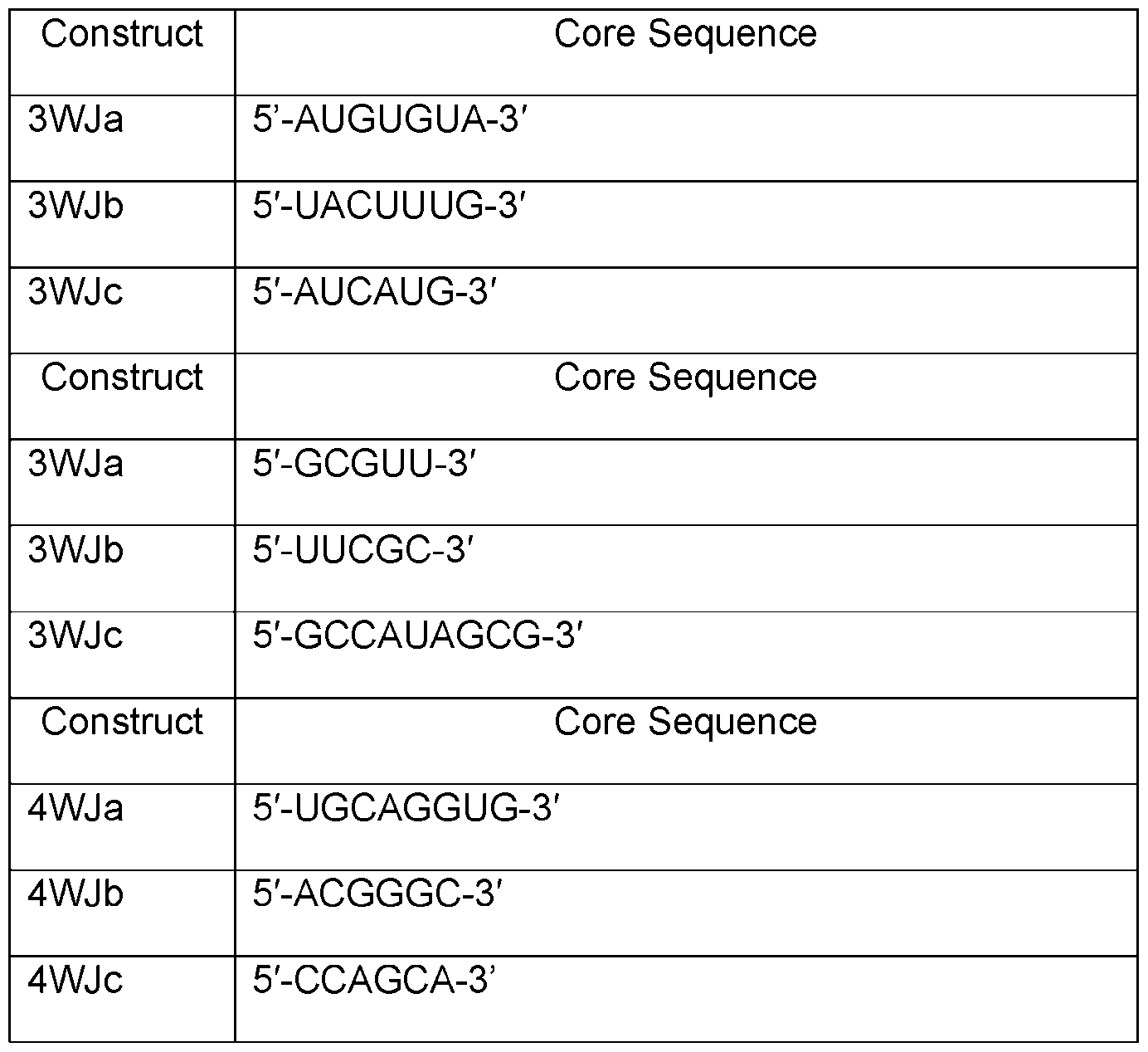
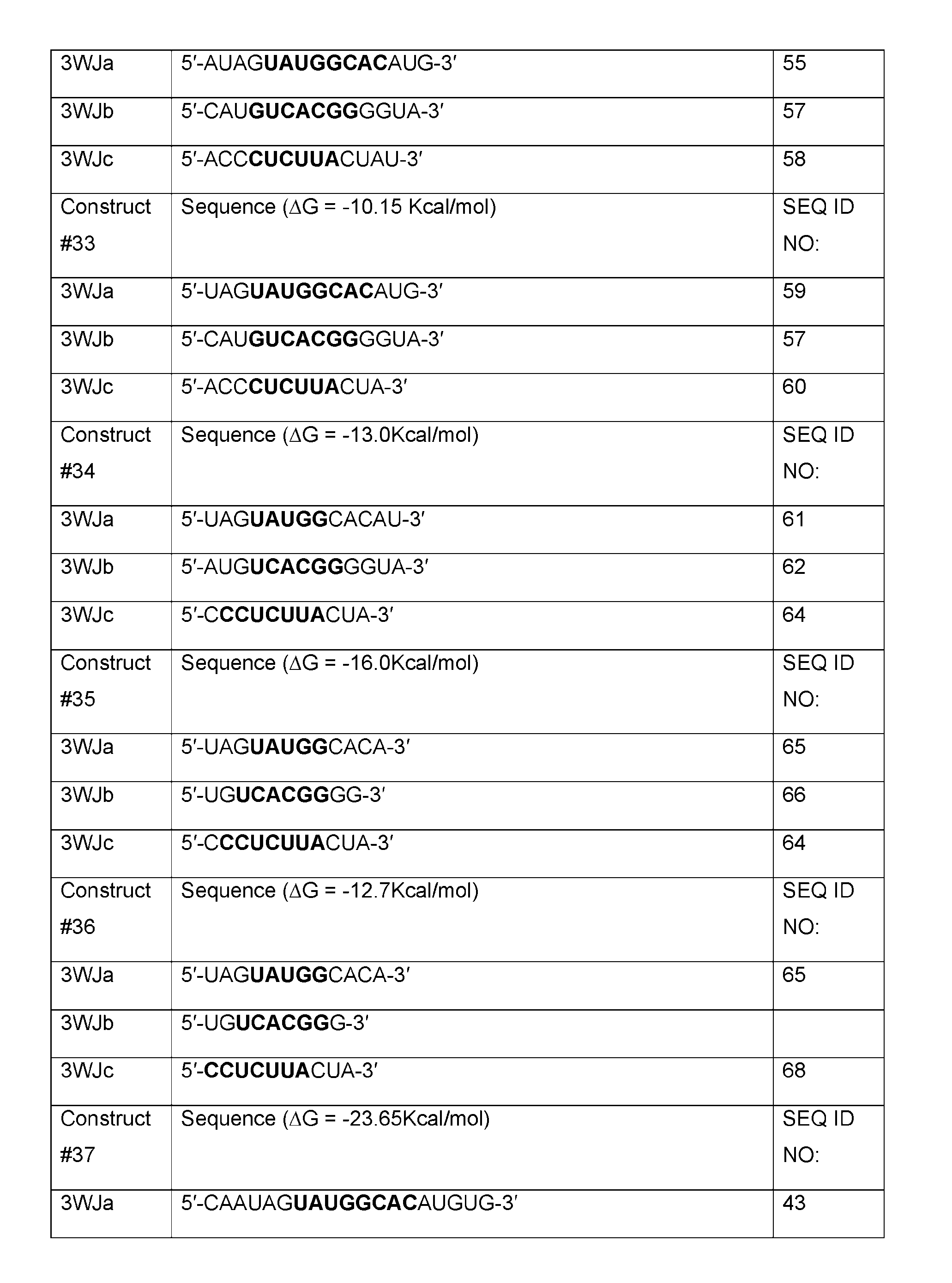
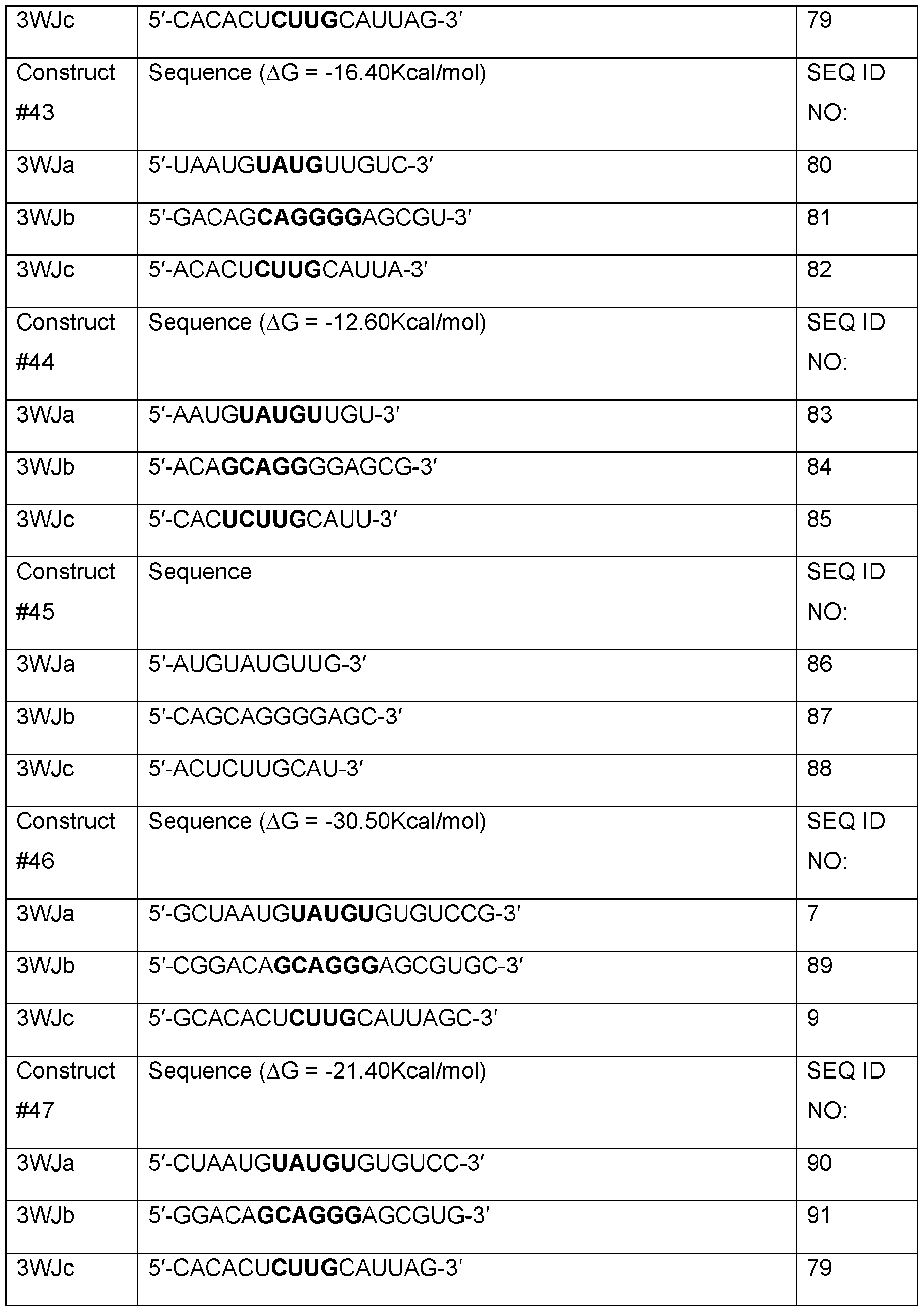
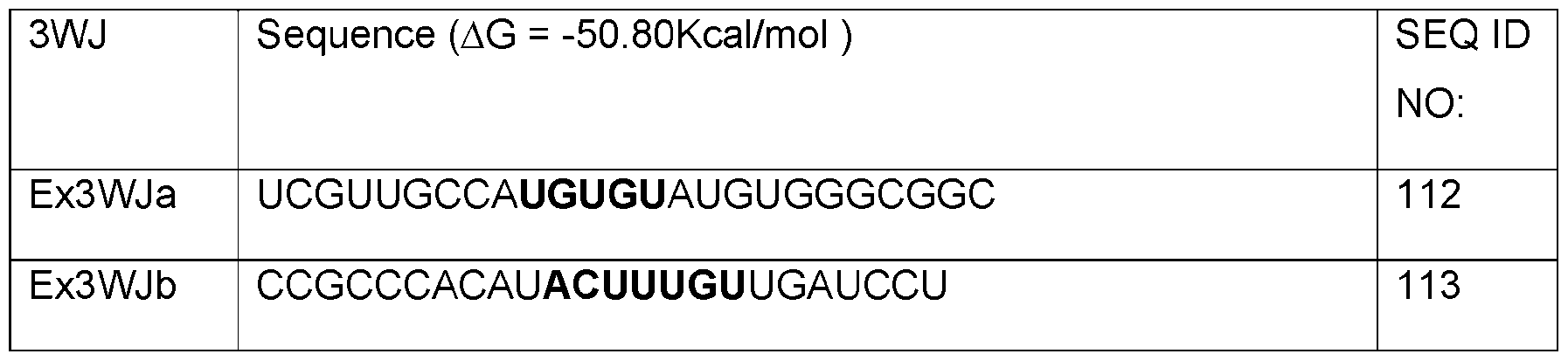
- Table A shows sequences of core structures of 3WJ, 4WJ, and 5WJ in accordance with some embodiments of the present disclosure.
- Table 1 shows examples of 3WJ, 4WJ, and 5WJ sequences in accordance with some embodiments of the present disclosure.
- the 3WJ, 4WJ, and 5WJ motifs can be designed using the bolded sequence forming a core structure, and extending the arms with duplexes to enhance its thermodynamic stability.
- the three fragments co-assembled into the 3WJ structure with extraordinary speed and affinity via a two- step reaction mechanism[ref1].
- An internal ribosome entry site e.g., from encephalomyocarditis virus (EMCV), a gene of interest (GOI), such as an enhanced green fluorescent protein (eGFP), can be inserted and may be flanked by two short regions corresponding to exon fragments (E1 and E2) of the permuted intron-exon (PIE) construct between the 3' and 5' introns of the permuted group I catalytic intron (11 and I2), e.g., from the thymidylate synthase (Td) gene of the T4 phage.
- thermodynamically stable 3WJ can be formed by using 3WJa and 3WJb at the 5’ end and 3WJc at the 3’ end.
- Precursor RNA was synthesized by in vitro transcription in conditions known in the art using the plasmid DNA linearized after the 3’ end of the precursor RNA design and then heated in the presence of magnesium ions and GTP to promote self-circularization before or after purification of the crude IVT reaction products.
- a first branch (1 st BR) of the 3WJ domain may be formed from a 5' portion of the 3WJa sequence and a 3' portion of the 3WJc sequence
- a second branch (2 nd BR) of the 3WJ domain may be formed from a 3' portion of the 3WJa sequence and a 5' portion of the 3WJb sequence
- a third branch (3 rd BR) of the 3WJ domain may be formed from a 3' portion of the 3WJb sequence and a 5' portion of the 3WJc sequence.
- the 3 rd BR may be formed prior to self-circularization. For example, a 3’ portion of the 3WJb sequence and a 5' portion of the 3WJc sequence may base pair to form the 3 rd BR before circularization takes place.
- the third branch may be formed during self-circularization.
- Each of the branches may contain a plurality of RNA nucleotide pairs that form canonical Watson-Crick bonds. During splicing, the 3' hydroxyl group of a guanosine nucleotide engages in a transesterification reaction at the 5' splice site.
- the 5' intron half (11 ) is excised, and the freed hydroxyl group at the end of the intermediate engages in a second transesterification at the 3' splice site, resulting in circularization of the intervening region and excision of the 3' intron (I2) together with 3WJ domain.
- An internal ribosome entry site e.g., from encephalomyocarditis virus (EMCV), a gene of interest (GOI), such as an enhanced green fluorescent protein (eGFP), can be inserted and may be flanked by two short regions corresponding to exon fragments (E1 and E2) of the permuted intron-exon (PIE) construct between the 3' and 5' introns of the permuted group I catalytic intron (11 and I2), e.g., from the thymidylate synthase (Td) gene of the T4 phage.
- 5WJa, 5WJb, and 4WJc at the 5’ end and 5WJd and 5WJe at the 3’ end
- An internal ribosome entry site e.g., from encephalomyocarditis virus (EMCV), a gene of interest (GOI), such as an enhanced green fluorescent protein (eGFP), can be inserted and may be flanked by two short regions corresponding to exon fragments (E1 and E2) of the permuted intron-exon (PIE) construct between the 3' and 5' introns of the permuted group I catalytic intron (11 and I2), e.g., from the thymidylate synthase (Td) gene of the T4 phage.
- thermodynamically stable 5WJ can be formed by using 5WJa and 5WJb at the 5’ end and 5WJc, 5WJd, and 5WJe at the 3’ end.
- precursor RNAs synthesized by in vitro transcription from a vector encoding eGFP with a 3WJa element at the 5’ end and 3WJb/3WJc at the 3’ end were analyzed by gel electrophoresis.
- FIG. 12 shows that crude circular RNA formed by conventual homology RNA design without column purification (Lanes 1 and 3) (3WJ-) yielded -30% unreacted precursor RNA, as shown by the distinct middle bands, and yielded - 50% of circularized RNA, as shown by the top bands.
- circular RNA formed by 3WJ-circular RNA design without column purification (Lane 5) (3WJ+) yielded -80% circularized RNA, as shown by the top band, and yielded -5% unreacted precursor RNA and - 15% of nicked RNA, as shown by the middle band and the lower band, respectively.
- 3WJ-circular RNA that yielded less unreacted precursor RNA were purified with ion pairing reverse phase HPLC (Lane 6) more efficiently than homology-circular RNA that yielded more unreacted precursor RNA (Lanes 2 and 4).
- FIG. 13 shows that 3WJ-circular RNA design (3WJ+) yielded higher ratio of circRNA/precursor RNA than conventional homology circular RNA design (3WJ-) as determined by bioanalyzer. CircRNA generated by 3WJ-circular RNA design can be readily purified by reverse phase HPLC.
- circular RNA encoding eGFP was generated with homology arm, e.g., without 3WJ (3WJ (-)), and the crude product was fractionated using reverse phase HPLC (FIG. 14A) then analyzed via agarose gel electrophoresis (FIG. 14B).
- circular RNA encoding eGFP was generated using a 3WJ (3WJ (+)) and the crude product was fractionated using reverse phase HPLC (FIG. 15A) then analyzed via agarose gel electrophoresis (FIG. 15B).
- G-Luc Gaussia luciferase
- FIG. 16 shows that higher purity of circular RNA produced by 3WJ-circular RNA design in A549 cells exhibited superior circular RNA expression levels (3WJ+, purified+), as shown by higher relative fluorescence units (RFU) as compared to that of conventional homology arm designed circular RNA (3WJ-, purified+).
- REU relative fluorescence units
- FIG. 17 shows that higher purity of circular RNA produced by 3WJ-circular RNA design in 293 cells exhibited superior circular RNA expression levels (3WJ+, purified+), as shown by higher relative fluorescence units (RFU) as compared to that of conventional homology arm designed circular RNA (3WJ-, purified+).
- Mock transfection served as controls.
- A549 cells were transfected with circRNAs encoding eGFP produced -/+ 3WJ or with mRNA encoding eGFP. Fluorescence was analyzed via flow cytometry for up to 6 days following transfection (10,000 cells were analyzed per condition at each time point).
- FIG. 18 and 19 show that, consistent with those samples purified in HPLC (FIG. 14A, 14B, 15A, and 15B), 3WJ produced circRNA (3WJ+) has superior expression to that produced by homology arm (3WJ-) and mRNA.
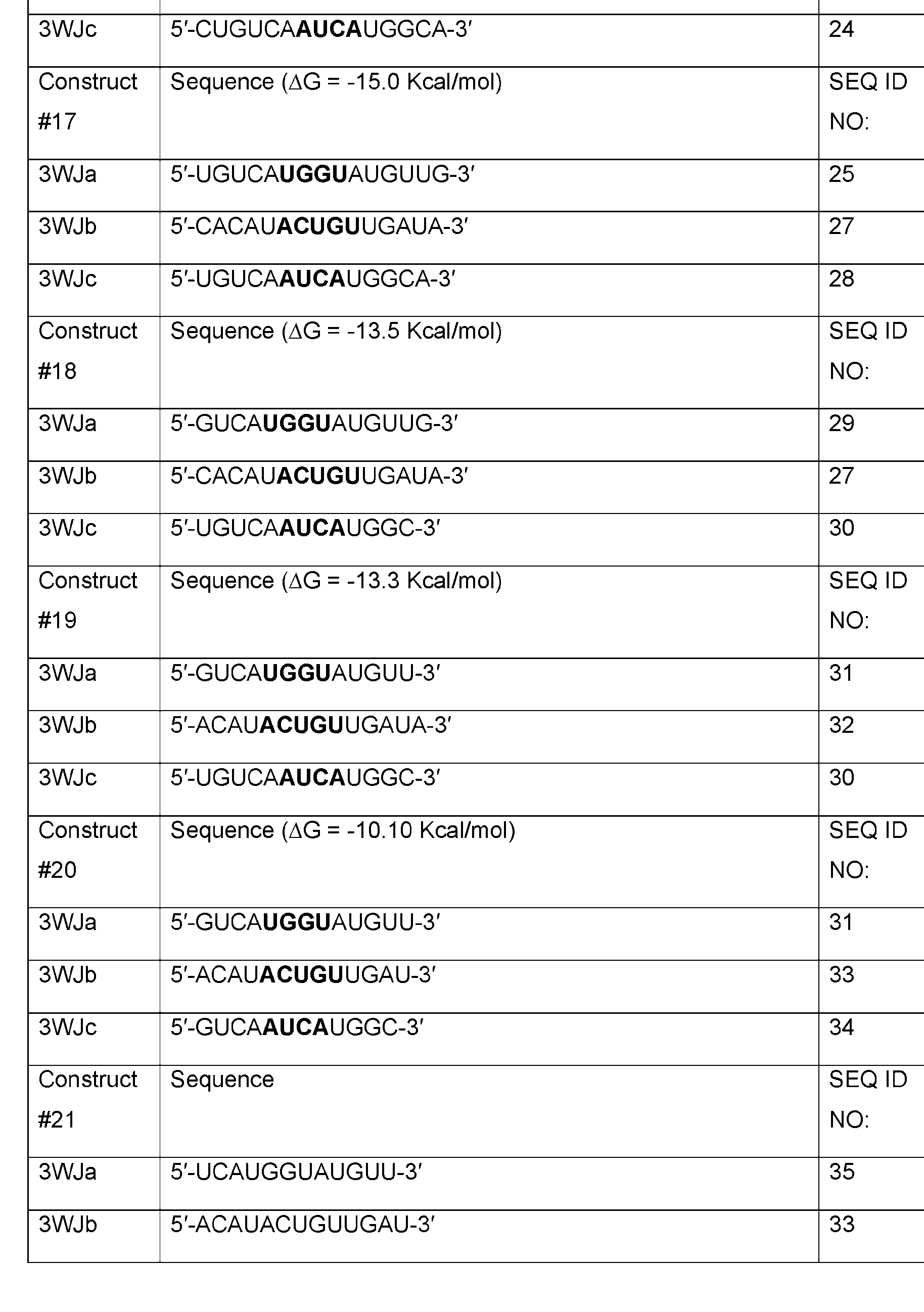
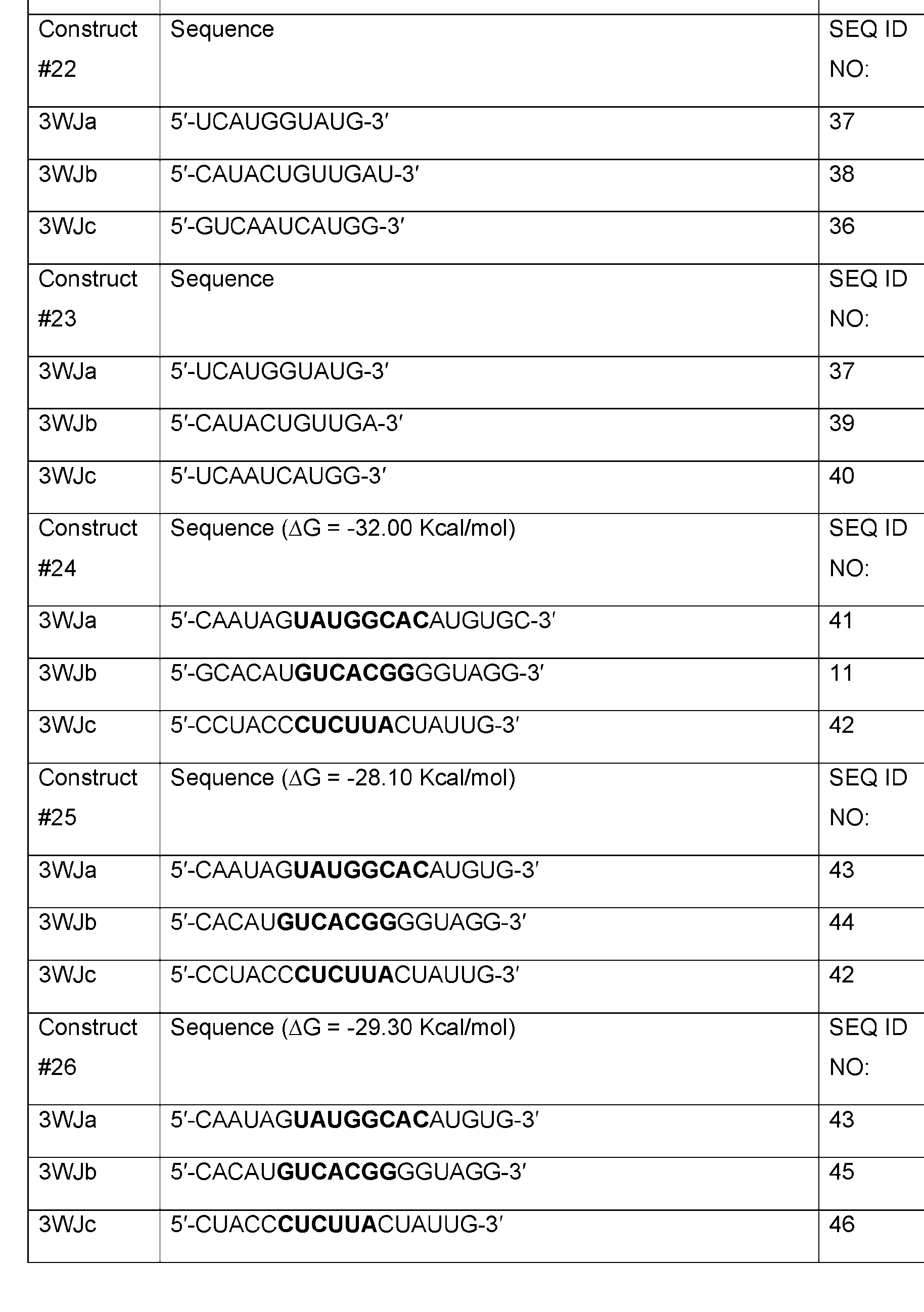
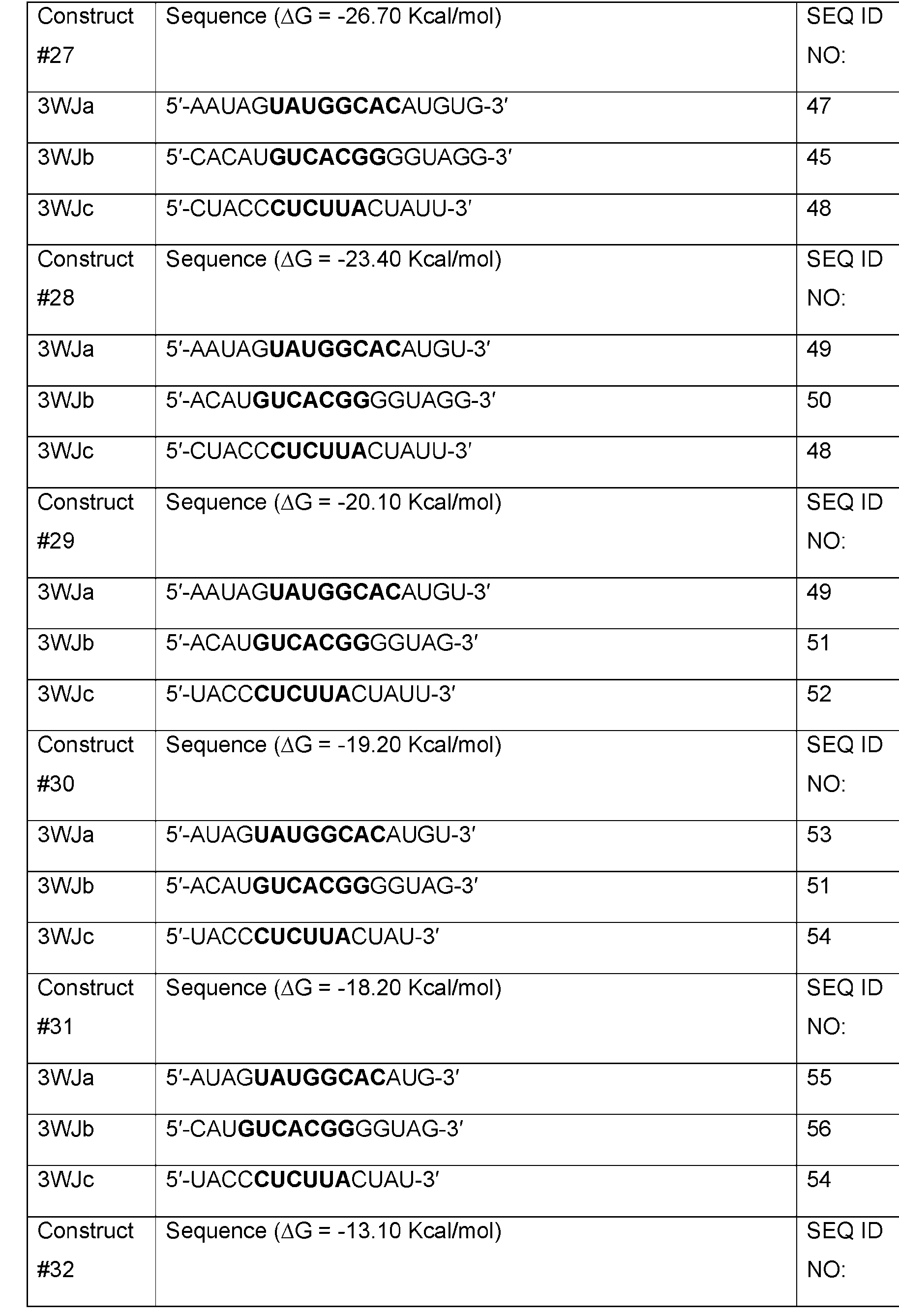
- a 3WJ Table 3, SEQ ID NO: 119-121
- RNA copy number was determined by quantitative PCR (cDNA synthesized from extracted cellular RNA was analyzed using the standard curve method (FIG. 24A) and normalized to the well volume (FIG. 24B)).
- the present invention may be defined by the following aspects:
- a method of preparing a circular RNA comprising: transcribing a vector to form a precursor RNA, wherein the vector comprises the following elements operably connected to each other and arranged in the following sequence: a) a 5' element comprising none or a sequence that forms at least one stem-loop structure, b) a 3' Group I self-splicing intron fragment containing a 3' splice site dinucleotide, c) a protein coding region or noncoding region, d) a 5' Group I self-splicing intron fragment containing a 5' splice site dinucleotide, e) a 3' element comprising none or a sequence that forms at least one stem-loop structure; provided that, when the 5’ element does not comprise a stem- loop structure, then the 3’ element comprises at least one stem-loop structure; and, when the 3’ element does not comprise a stem-loop structure, then the 5’ element comprises at least one stem-loop structure, where
- thermodynamically stable multiple way junction is a 3-way junction (3WJ), a 4-way junction (4WJ), or a 5-way junction (5WJ).
- the 3WJ comprises a first branch of the 3WJ domain is formed from a 5' portion of a 3WJa sequence and a 3' portion of a 3WJc sequence and comprises a first helical region
- a second branch of the 3WJ domain is formed from a 3' portion of the 3WJa sequence and a 5' portion of a 3WJb sequence and comprises a second helical region
- a third branch of the 3WJ domain is formed from a 3' portion of the 3WJb sequence and a 5' portion of the 3WJc sequence and comprises a third helical region
- each of said helical regions comprises a plurality of RNA nucleotide pairs that form canonical Watson-Crick bonds.
- the 5WJ comprises a first branch of the 5WJ domain is formed from a 5' portion of a 5WJa sequence and a 3' portion of a 5WJe sequence and comprises a first helical region
- a second branch of the 5WJ domain is formed from a 3' portion of the 5WJa sequence and a 5' portion of a 5WJb sequence and comprises a second helical region
- a third branch of the 5WJ domain is formed from a 3' portion of the 5WJb sequence and a 5' portion of a 5WJc sequence and comprises a third helical region
- a fourth branch of the 5WJ domain is formed from a 3' portion of the 5WJc sequence and a 5' portion of a 5WJd sequence and comprises a fourth helical region
- a fifth branch of the 5WJ domain is formed from a 3' portion of the 5WJd sequence and a 5' portion of the 5WJe sequence and comprises a fifth helical region
- the 5WJa comprises or consists of SEQ ID NO: 107
- the 5WJb comprises or consists of SEQ ID NO: 108
- the 5WJc comprises or consists of SEQ ID NO: 109
- the 5WJd comprises or consists of SEQ ID NO: 110
- the 5WJe comprises or consists of SEQ ID NO: 111 ; or the 5WJa comprises GUGA, the 5WJb comprises UUGC, the 5WJc comprises GUGU, the 5WJd comprises AUGC, and the 5WJe comprises GUGC.
- the vector further comprises an internal ribosome entry site (IRES) located at the 5’ end of c), wherein the IRES is selected from an IRES sequence from a virus or a gene selected from the group consisting of: Taura syndrome virus, Triatoma virus, Theiler's encephalomyelitis virus, simian Virus 40, Solenopsis invicta virus 1 , Rhopalosiphum padi virus, Reticuloendotheliosis virus, fuman poliovirus 1 , Plautia stall intestine virus, Kashmir bee virus, Human rhinovirus 2, Homalodisca coagulata virus-1 , Human Immunodeficiency Virus type 1 , Homalodisca coagulata virus-1 , Himetobi P virus, Hepatitis C virus, Hepatitis A virus, Hepatitis GB virus, foot and mouth disease virus, Human enterovirus 71 , Equine rhinitis virus, Ectropis
- IRES internal ribosome entry
- TFIID cerevisiae transcription factor II D
- YAP1 S. cerevisiae Yes1 Associated Transcriptional Regulator
- c-src Human proto-oncogene tyrosine-protein kinase Src
- FGF-1 Human fibroblast growth factor 1
- Simian picomavirus Turnip crinkle virus
- CVB3 Coxsackievirus B3
- CVB1/2 Coxsackievirus A
- RNA polymerase promoter is a T7 virus RNA polymerase promoter, T6 virus RNA polymerase promoter, SP6 virus RNA polymerase promoter, T3 virus RNA polymerase promoter, or T4 virus RNA polymerase promoter.
- nanocarrier is a lipid, polymer, or lipo- polymeric hybrid.
- RNA comprises a monophosphate 5' terminus capable of being ligated using a ligase enzyme.
- nucleoside modification is selected from the group consisting of: N 6 -methyladenosine (m6A), pseudouridine ('+'), N 1 - methylpseudouridine (m1 ⁇ ), and 5-methoxyuridine (5moll).
- the noncoding region comprises an element encoding one or more RNA selected from the group consisting of antisense RNA, transfer RNA (tRNA), transfer-messenger RNA (tmRNA), ribosomal RNA (rRNA), signal recognition particle RNA (7SL RNA or SRP RNA), small nuclear RNAs (snRNA), small nucleolar RNA (snoRNA), SmY RNA (SmY), small cajal body- specific RNA (scaRNA), guide RNA (gRNA), Y RNA, spliced leader RNA (SL RNA), microRNAs (miRNA), small Interfering RNA (siRNA), cis-natural antisense transcript (cis-NAT), CRISPR RNA (crRNA), long noncoding RNA (IncRNA), Piwi-interacting RNA (piRNA), short hairpin RNA (shRNA), trans-acting siRNA (tasiRNA), Repeat associated siRNA (rasiRNA),
- RNA transfer RNA
- tmRNA transfer
- a precursor RNA comprising the following elements operably connected to each other and arranged in the following sequence: a) a 5' element comprising none or at least one stem-loop structure, b) a 3' Group I self-splicing intron fragment containing a 3' splice site dinucleotide, c) a protein coding region or noncoding region, d) a 5' Group I self-splicing intron fragment containing a 5' splice site dinucleotide, e) a 3' element comprising none or at least one stem-loop structure; provided that, when the 5’ element does not comprise a stem-loop structure, then the 3’ element comprises at least one stem-loop structure; and, when the 3’ element does not comprise a stem- loop structure, then the 5’ element comprises at least one stem- loop structure, wherein the 5’ element and the 3’ element form a thermodynamically stable multiple way junction, wherein the precursor RNA is capable of forming a circular RNA that
- thermodynamically stable multiple way junction is a 3-way junction (3WJ), a 4-way junction (4WJ), or a 5-way junction (5WJ).
- RNA of aspect 34 wherein the 3WJ comprises a first branch of the 3WJ domain is formed from a 5' portion of a 3WJa sequence and a 3' portion of a 3WJc sequence and comprises a first helical region, a second branch of the 3WJ domain is formed from a 3' portion of the 3WJa sequence and a 5' portion of a 3WJb sequence and comprises a second helical region, and a third branch of the 3WJ domain is formed from a 3' portion of the 3WJb sequence and a 5' portion of the 3WJc sequence and comprises a third helical region, wherein each of said helical regions comprises a plurality of RNA nucleotide pairs that form canonical Watson-Crick bonds.
- the 3WJa comprises or consists of SEQ ID NO: 1, 3WJb comprises or consists of SEQ ID NO: 2, and 3WJc comprises or consists of SEQ ID NO: 3; or the 3WJa comprises or consists of SEQ ID NO: 4, 3WJb comprises or consists of SEQ ID NO: 5, and 3WJc comprises or consists of SEQ ID NO: 6; or the 3WJa comprises or consists of SEQ ID NO: 10, 3WJb comprises or consists of SEQ ID NO: 11 , and 3WJc comprises or consists of SEQ ID NO: 12; or the 3WJa comprises or consists of SEQ ID NO: 13, 3WJb comprises or consists of SEQ ID NO: 2, and 3WJc comprises or consists of SEQ ID NO: 13; or the 3WJa comprises or consists of SEQ ID NO: 13, 3WJb comprises or consists of SEQ ID NO: 14, and 3WJc comprises or consists of SEQ ID NO: 3;
- RNA of aspect 34 wherein the 4WJ comprises a first branch of the 4WJ domain is formed from a 5' portion of a 4WJa sequence and a 3' portion of a 4WJd sequence and comprises a first helical region, a second branch of the 4WJ domain is formed from a 3' portion of the 4WJa sequence and a 5' portion of a 4WJb sequence and comprises a second helical region, and a third branch of the 4WJ domain is formed from a 3' portion of the 4WJb sequence and a 5' portion of a 4WJc sequence and comprises a third helical region, and a fourth branch of the 4WJ domain is formed from a 3' portion of the 4WJc sequence and a 5' portion of the 4WJd sequence and comprises a fourth helical region, wherein each of said helical regions comprises a plurality of RNA nucleotide pairs that form canonical Watson-Crick bonds.
- the 4WJa comprises or consists of SEQ ID NO: 7, 4WJb comprises or consists of SEQ ID NO: 8, 4WJc comprises or consists of SEQ ID NO: 9, and 4WJd comprises or consists of SEQ ID NO: 102; or the 4WJa comprises or consists of SEQ ID NO: 103, 4WJb comprises or consists of SEQ ID NO: 104, 4WJc comprises or consists of SEQ ID NO: 105, and 4WJd comprises or consists of SEQ ID NO: 106; or the 4WJa comprises or consists of SEQ ID NO: 115, 4WJb comprises or consists of SEQ ID NO: 116, 4WJc comprises or consists of SEQ ID NO: 117, and 4WJd comprises or consists of SEQ ID NO: 118; or the 4WJa comprises UGCAGGUG, 4WJb comprises ACGGGC, 4WJc comprises CCAGCA, and 4WJd comprises SEQ ID NO: 118; or the
- the 5WJa comprises or consists of SEQ ID NO: 107
- the 5WJb comprises or consists of SEQ ID NO: 108
- the 5WJc comprises or consists of SEQ ID NO: 109
- the 5WJd comprises or consists of SEQ ID NO: 110
- the 5WJe comprises or consists of SEQ ID NO: 111 ; or the 5WJa comprises GUGA, the 5WJb comprises UUGC, the 5WJc comprises GUGU, the 5WJd comprises AUGC, and the 5WJe comprises GUGC.
- RNA any one of aspects 33-40, wherein the noncoding region comprises one or more RNA selected from the group consisting of antisense RNA, transfer RNA (tRNA), transfer-messenger RNA (tmRNA), ribosomal RNA (rRNA), signal recognition particle RNA (7SL RNA or SRP RNA), small nuclear RNAs (snRNA), small nucleolar RNA (snoRNA), SmY RNA (SmY), small cajal body- specific RNA (scaRNA), guide RNA (gRNA), Y RNA, spliced leader RNA (SL RNA), microRNAs (miRNA), small Interfering RNA (siRNA), cis-natural antisense transcript (cis-NAT), CRISPR RNA (crRNA), long noncoding RNA (IncRNA), Piwi-interacting RNA (piRNA), short hairpin RNA (shRNA), trans-acting siRNA (tasiRNA), Repeat associated siRNA (rasiRNA), 7SK
- the vector of aspect 42 is a plasmid, a viral vector, a polymerase chain reaction (PCR) product, a cosmid, a bacterial artificial chromosome (BAC), or a yeast artificial chromosome (YAC).
- PCR polymerase chain reaction
- BAC bacterial artificial chromosome
- YAC yeast artificial chromosome
- Advantages of the present disclosure may include Integrating RNA nanotechnology design, such as thermodynamically stable 3WJ, 4WJ, and 5WJ structures, into artificial circular RNA self-splicing process to facilitate correct folding and to improve self-splicing efficiency, and thus to pave a way for batch production of high quality of circular RNA for therapeutics development.
- Integrating RNA nanotechnology design such as thermodynamically stable 3WJ, 4WJ, and 5WJ structures
Landscapes
- Health & Medical Sciences (AREA)
- Life Sciences & Earth Sciences (AREA)
- Genetics & Genomics (AREA)
- Engineering & Computer Science (AREA)
- Chemical & Material Sciences (AREA)
- Organic Chemistry (AREA)
- Wood Science & Technology (AREA)
- Zoology (AREA)
- Biomedical Technology (AREA)
- Biotechnology (AREA)
- General Engineering & Computer Science (AREA)
- Bioinformatics & Cheminformatics (AREA)
- Molecular Biology (AREA)
- Microbiology (AREA)
- Biochemistry (AREA)
- General Health & Medical Sciences (AREA)
- Plant Pathology (AREA)
- Biophysics (AREA)
- Physics & Mathematics (AREA)
- Chemical Kinetics & Catalysis (AREA)
- General Chemical & Material Sciences (AREA)
- Proteomics, Peptides & Aminoacids (AREA)
- Cell Biology (AREA)
- Medicines That Contain Protein Lipid Enzymes And Other Medicines (AREA)
- Preparation Of Compounds By Using Micro-Organisms (AREA)
- Micro-Organisms Or Cultivation Processes Thereof (AREA)
Abstract
Description







Claims
Priority Applications (5)
| Application Number | Priority Date | Filing Date | Title |
|---|---|---|---|
| JP2025535975A JP2025542215A (en) | 2022-12-22 | 2023-12-15 | Method for producing self-circularized RNA |
| CN202380087466.7A CN120476212A (en) | 2022-12-22 | 2023-12-15 | Preparation method of self-circularized RNA |
| KR1020257023963A KR20250122519A (en) | 2022-12-22 | 2023-12-15 | Method for producing self-circularized RNA |
| EP23908220.9A EP4638755A1 (en) | 2022-12-22 | 2023-12-15 | Method of preparing self-circularized rna |
| US18/775,784 US12441997B2 (en) | 2022-12-22 | 2024-07-17 | Method of preparing self-circularized RNA |
Applications Claiming Priority (2)
| Application Number | Priority Date | Filing Date | Title |
|---|---|---|---|
| US202263476864P | 2022-12-22 | 2022-12-22 | |
| US63/476,864 | 2022-12-22 |
Related Child Applications (1)
| Application Number | Title | Priority Date | Filing Date |
|---|---|---|---|
| US18/775,784 Continuation US12441997B2 (en) | 2022-12-22 | 2024-07-17 | Method of preparing self-circularized RNA |
Publications (1)
| Publication Number | Publication Date |
|---|---|
| WO2024137392A1 true WO2024137392A1 (en) | 2024-06-27 |
Family
ID=91589900
Family Applications (1)
| Application Number | Title | Priority Date | Filing Date |
|---|---|---|---|
| PCT/US2023/084296 Ceased WO2024137392A1 (en) | 2022-12-22 | 2023-12-15 | Method of preparing self-circularized rna |
Country Status (7)
| Country | Link |
|---|---|
| US (1) | US12441997B2 (en) |
| EP (1) | EP4638755A1 (en) |
| JP (1) | JP2025542215A (en) |
| KR (1) | KR20250122519A (en) |
| CN (1) | CN120476212A (en) |
| TW (1) | TW202440135A (en) |
| WO (1) | WO2024137392A1 (en) |
Cited By (1)
| Publication number | Priority date | Publication date | Assignee | Title |
|---|---|---|---|---|
| CN119040364A (en) * | 2024-08-29 | 2024-11-29 | 优环(苏州)生物医药科技有限公司 | Residue-free sequence cyclic RNA based on ribozyme self-splicing and preparation method thereof |
Citations (1)
| Publication number | Priority date | Publication date | Assignee | Title |
|---|---|---|---|---|
| US20210198688A1 (en) * | 2018-06-06 | 2021-07-01 | Massachusetts Institute Of Technology | Circular RNA For Translation In Eukaryotic Cells |
Family Cites Families (21)
| Publication number | Priority date | Publication date | Assignee | Title |
|---|---|---|---|---|
| WO1998007738A1 (en) | 1996-08-19 | 1998-02-26 | The Regents Of The University Of California | Immunoglobulin trans-spliced transcripts and uses thereof |
| WO2010148085A1 (en) | 2009-06-16 | 2010-12-23 | The United States Of America, As Represented By The Secretary, Department Of Health And Human Services | Rna nanoparticles and methods of use |
| US20110033706A1 (en) | 2009-08-04 | 2011-02-10 | Yamuna Krishnan | Nanocapsules and methods for modular assembly |
| CN103403189B (en) * | 2011-06-08 | 2015-11-25 | 辛辛那提大学 | For the pRNA multivalence link field in stable multivalence RNA nano particle |
| CA2912665C (en) | 2013-05-15 | 2021-03-02 | Robert Kruse | Intracellular translation of circular rna |
| US10584144B2 (en) | 2015-03-09 | 2020-03-10 | University Of Kentucky Research Foundation | RNA nanoparticles for brain tumor treatment |
| US10828381B2 (en) | 2015-04-17 | 2020-11-10 | University Of Kentucky Research Foundation | RNA nanoparticles and method of use thereof |
| US10900035B2 (en) | 2016-02-26 | 2021-01-26 | The Board Of Regents Of The University Of Oklahoma | PRNA three-way junctions |
| DK3440090T3 (en) | 2016-04-06 | 2022-12-19 | Ohio State Innovation Foundation | RNA-ligand-presenting exosomes for specific delivery of therapeutics to a cell by RNA nanotechnology |
| NZ749593A (en) | 2016-06-20 | 2025-10-31 | Univ Leland Stanford Junior | Circular rnas and their use in immunomodulation |
| US11597935B2 (en) | 2016-11-10 | 2023-03-07 | Baylor College Of Medicine | Building designer RNA nano-structures for synthetic biology applications |
| WO2019134791A1 (en) | 2018-01-04 | 2019-07-11 | Universität Zu Lübeck | Controlled circularization of rna |
| EP3615085A4 (en) * | 2018-02-09 | 2021-01-13 | Ohio State Innovation Foundation | Rna nanostructures, methods of making, and uses thereof |
| KR20210057019A (en) | 2018-07-24 | 2021-05-20 | 메이오 파운데이션 포 메디칼 에쥬케이션 앤드 리써치 | Circularized engineered RNA and methods |
| EP3972653A1 (en) | 2019-05-22 | 2022-03-30 | Massachusetts Institute of Technology | Circular rna compositions and methods |
| WO2021041541A1 (en) | 2019-08-28 | 2021-03-04 | The Board Of Trustees Of The Leland Stanford Junior University | Modified circular rnas and methods of use thereof |
| GB2628935B (en) * | 2019-09-03 | 2025-03-05 | Myeloid Therapeutics Inc | Methods and compositions for genomic integration |
| JP2023527309A (en) | 2020-05-19 | 2023-06-28 | オルナ セラピューティクス インコーポレイテッド | Circular RNA compositions and methods |
| EP4171631A4 (en) | 2020-06-25 | 2025-02-12 | The Board of Trustees of the Leland Stanford Junior University | GENETIC ELEMENTS CONTROLLING CIRCULAR RNA TRANSLATION AND METHODS OF USE |
| WO2022015514A1 (en) | 2020-07-13 | 2022-01-20 | The Board Of Trustees Of The Leland Stanford Junior University | Systems and methods to enhance rna stability and translation and uses thereof |
| CN115997018A (en) | 2021-03-10 | 2023-04-21 | 尔知渃米斯股份有限公司 | Self-circularizing RNA constructs |
-
2023
- 2023-12-15 EP EP23908220.9A patent/EP4638755A1/en active Pending
- 2023-12-15 WO PCT/US2023/084296 patent/WO2024137392A1/en not_active Ceased
- 2023-12-15 KR KR1020257023963A patent/KR20250122519A/en active Pending
- 2023-12-15 CN CN202380087466.7A patent/CN120476212A/en active Pending
- 2023-12-15 JP JP2025535975A patent/JP2025542215A/en active Pending
- 2023-12-22 TW TW112150257A patent/TW202440135A/en unknown
-
2024
- 2024-07-17 US US18/775,784 patent/US12441997B2/en active Active
Patent Citations (1)
| Publication number | Priority date | Publication date | Assignee | Title |
|---|---|---|---|---|
| US20210198688A1 (en) * | 2018-06-06 | 2021-07-01 | Massachusetts Institute Of Technology | Circular RNA For Translation In Eukaryotic Cells |
Non-Patent Citations (2)
| Title |
|---|
| DE HOON MICHIEL, MAKITA YUKO, NAKAI KENTA, MIYANO SATORU: "Prediction of Transcriptional Terminators in Bacillus subtilis and Related Species", PLOS COMPUTATIONAL BIOLOGY, vol. 1, no. 3, 12 August 2005 (2005-08-12), US , pages 212 - 221, XP093189746, ISSN: 1553-7358, DOI: 10.1371/journal.pcbi.0010025 * |
| R. ALEXANDER WESSELHOEFT, PIOTR S. KOWALSKI, DANIEL G. ANDERSON: "Engineering circular RNA for potent and stable translation in eukaryotic cells", NATURE COMMUNICATIONS, vol. 9, no. 1, 1 December 2018 (2018-12-01), pages 1 - 10, XP055622096, DOI: 10.1038/s41467-018-05096-6 * |
Cited By (2)
| Publication number | Priority date | Publication date | Assignee | Title |
|---|---|---|---|---|
| CN119040364A (en) * | 2024-08-29 | 2024-11-29 | 优环(苏州)生物医药科技有限公司 | Residue-free sequence cyclic RNA based on ribozyme self-splicing and preparation method thereof |
| CN119040364B (en) * | 2024-08-29 | 2025-06-27 | 优环(苏州)生物医药科技有限公司 | Residue-free sequence cyclic RNA based on ribozyme self-splicing and preparation method thereof |
Also Published As
| Publication number | Publication date |
|---|---|
| TW202440135A (en) | 2024-10-16 |
| JP2025542215A (en) | 2025-12-25 |
| CN120476212A (en) | 2025-08-12 |
| KR20250122519A (en) | 2025-08-13 |
| US12441997B2 (en) | 2025-10-14 |
| US20240368589A1 (en) | 2024-11-07 |
| EP4638755A1 (en) | 2025-10-29 |
Similar Documents
| Publication | Publication Date | Title |
|---|---|---|
| US11939580B2 (en) | Construct of self-circularization RNA | |
| US20240277872A1 (en) | Modified mrna, modified non-coding rna, and uses thereof | |
| JP7093728B2 (en) | Highly specific genome editing using chemically modified guide RNA | |
| JP2025061102A (en) | Compositions Comprising Modified Circular Polyribonucleotides and Uses Thereof | |
| JP7068821B2 (en) | Guide RNA with chemical modification | |
| EP2996697B1 (en) | Intracellular translation of circular rna | |
| CN114981409A (en) | Methods and compositions for genomic integration | |
| CN110291198A (en) | modified guide RNA | |
| GB2700069A (en) | Linear dna with enhanced resistance against exonucleases and methods for the production thereof | |
| WO2016195598A9 (en) | Vectors | |
| JP2025503730A (en) | Poly-tailed and poly-capped mRNAs and uses thereof | |
| KR20230074507A (en) | Self-targeting expression vectors | |
| JP2023544817A (en) | Engineered guide RNA and its applications to improve CRISPR/Cas12f1 system efficiency | |
| CN119421716A (en) | Compositions and methods for affinity purification of circular RNA | |
| US12441997B2 (en) | Method of preparing self-circularized RNA | |
| EP4396363A1 (en) | Compositions and methods for rna affinity purification | |
| WO2022256578A2 (en) | Circular guide rnas for crispr/cas editing systems | |
| KR20230007218A (en) | Hypercompact base editing systems and use thereof | |
| JP2026016516A (en) | Poly-tailed and poly-capped mRNAs and their uses | |
| EP1530641A2 (en) | Dna expression construct for multiple gene expression | |
| CN118076741A (en) | Modified mRNA, modified non-coding RNA and their uses | |
| HK40014268A (en) | Modified guide rnas | |
| HK40014268B (en) | Modified guide rnas |
Legal Events
| Date | Code | Title | Description |
|---|---|---|---|
| 121 | Ep: the epo has been informed by wipo that ep was designated in this application |
Ref document number: 23908220 Country of ref document: EP Kind code of ref document: A1 |
|
| ENP | Entry into the national phase |
Ref document number: 2025535975 Country of ref document: JP Kind code of ref document: A |
|
| WWE | Wipo information: entry into national phase |
Ref document number: 2025535975 Country of ref document: JP |
|
| WWE | Wipo information: entry into national phase |
Ref document number: 202380087466.7 Country of ref document: CN |
|
| ENP | Entry into the national phase |
Ref document number: 1020257023963 Country of ref document: KR Free format text: ST27 STATUS EVENT CODE: A-0-1-A10-A15-NAP-PA0105 (AS PROVIDED BY THE NATIONAL OFFICE) |
|
| WWE | Wipo information: entry into national phase |
Ref document number: 1020257023963 Country of ref document: KR |
|
| WWE | Wipo information: entry into national phase |
Ref document number: 2023908220 Country of ref document: EP |
|
| NENP | Non-entry into the national phase |
Ref country code: DE |
|
| WWP | Wipo information: published in national office |
Ref document number: 202380087466.7 Country of ref document: CN |
|
| WWP | Wipo information: published in national office |
Ref document number: 1020257023963 Country of ref document: KR |
|
| WWP | Wipo information: published in national office |
Ref document number: 2023908220 Country of ref document: EP |