WO2024137252A1 - Process for reducing syrup viscosity in the backend of a process for producing a fermentation product - Google Patents
Process for reducing syrup viscosity in the backend of a process for producing a fermentation product Download PDFInfo
- Publication number
- WO2024137252A1 WO2024137252A1 PCT/US2023/083357 US2023083357W WO2024137252A1 WO 2024137252 A1 WO2024137252 A1 WO 2024137252A1 US 2023083357 W US2023083357 W US 2023083357W WO 2024137252 A1 WO2024137252 A1 WO 2024137252A1
- Authority
- WO
- WIPO (PCT)
- Prior art keywords
- oxidoreductase
- stillage
- produce
- coprinus
- syrup
- Prior art date
- Legal status (The legal status is an assumption and is not a legal conclusion. Google has not performed a legal analysis and makes no representation as to the accuracy of the status listed.)
- Ceased
Links
Classifications
-
- C—CHEMISTRY; METALLURGY
- C12—BIOCHEMISTRY; BEER; SPIRITS; WINE; VINEGAR; MICROBIOLOGY; ENZYMOLOGY; MUTATION OR GENETIC ENGINEERING
- C12Y—ENZYMES
- C12Y111/00—Oxidoreductases acting on a peroxide as acceptor (1.11)
- C12Y111/01—Peroxidases (1.11.1)
- C12Y111/01007—Peroxidase (1.11.1.7), i.e. horseradish-peroxidase
-
- C—CHEMISTRY; METALLURGY
- C12—BIOCHEMISTRY; BEER; SPIRITS; WINE; VINEGAR; MICROBIOLOGY; ENZYMOLOGY; MUTATION OR GENETIC ENGINEERING
- C12N—MICROORGANISMS OR ENZYMES; COMPOSITIONS THEREOF; PROPAGATING, PRESERVING, OR MAINTAINING MICROORGANISMS; MUTATION OR GENETIC ENGINEERING; CULTURE MEDIA
- C12N9/00—Enzymes; Proenzymes; Compositions thereof; Processes for preparing, activating, inhibiting, separating or purifying enzymes
- C12N9/0004—Oxidoreductases (1.)
- C12N9/0055—Oxidoreductases (1.) acting on diphenols and related substances as donors (1.10)
- C12N9/0057—Oxidoreductases (1.) acting on diphenols and related substances as donors (1.10) with oxygen as acceptor (1.10.3)
- C12N9/0061—Laccase (1.10.3.2)
-
- C—CHEMISTRY; METALLURGY
- C12—BIOCHEMISTRY; BEER; SPIRITS; WINE; VINEGAR; MICROBIOLOGY; ENZYMOLOGY; MUTATION OR GENETIC ENGINEERING
- C12N—MICROORGANISMS OR ENZYMES; COMPOSITIONS THEREOF; PROPAGATING, PRESERVING, OR MAINTAINING MICROORGANISMS; MUTATION OR GENETIC ENGINEERING; CULTURE MEDIA
- C12N9/00—Enzymes; Proenzymes; Compositions thereof; Processes for preparing, activating, inhibiting, separating or purifying enzymes
- C12N9/0004—Oxidoreductases (1.)
- C12N9/0065—Oxidoreductases (1.) acting on hydrogen peroxide as acceptor (1.11)
-
- C—CHEMISTRY; METALLURGY
- C12—BIOCHEMISTRY; BEER; SPIRITS; WINE; VINEGAR; MICROBIOLOGY; ENZYMOLOGY; MUTATION OR GENETIC ENGINEERING
- C12P—FERMENTATION OR ENZYME-USING PROCESSES TO SYNTHESISE A DESIRED CHEMICAL COMPOUND OR COMPOSITION OR TO SEPARATE OPTICAL ISOMERS FROM A RACEMIC MIXTURE
- C12P7/00—Preparation of oxygen-containing organic compounds
- C12P7/02—Preparation of oxygen-containing organic compounds containing a hydroxy group
- C12P7/04—Preparation of oxygen-containing organic compounds containing a hydroxy group acyclic
- C12P7/06—Ethanol, i.e. non-beverage
- C12P7/08—Ethanol, i.e. non-beverage produced as by-product or from waste or cellulosic material substrate
- C12P7/10—Ethanol, i.e. non-beverage produced as by-product or from waste or cellulosic material substrate substrate containing cellulosic material
-
- C—CHEMISTRY; METALLURGY
- C12—BIOCHEMISTRY; BEER; SPIRITS; WINE; VINEGAR; MICROBIOLOGY; ENZYMOLOGY; MUTATION OR GENETIC ENGINEERING
- C12Y—ENZYMES
- C12Y110/00—Oxidoreductases acting on diphenols and related substances as donors (1.10)
- C12Y110/03—Oxidoreductases acting on diphenols and related substances as donors (1.10) with an oxygen as acceptor (1.10.3)
- C12Y110/03002—Laccase (1.10.3.2)
-
- A—HUMAN NECESSITIES
- A23—FOODS OR FOODSTUFFS; TREATMENT THEREOF, NOT COVERED BY OTHER CLASSES
- A23K—FODDER
- A23K10/00—Animal feeding-stuffs
- A23K10/30—Animal feeding-stuffs from material of plant origin, e.g. roots, seeds or hay; from material of fungal origin, e.g. mushrooms
- A23K10/37—Animal feeding-stuffs from material of plant origin, e.g. roots, seeds or hay; from material of fungal origin, e.g. mushrooms from waste material
- A23K10/38—Animal feeding-stuffs from material of plant origin, e.g. roots, seeds or hay; from material of fungal origin, e.g. mushrooms from waste material from distillers' or brewers' waste
Definitions
- the present invention relates to a process for reducing syrup viscosity at the backend of a process for producing a fermentation product (e.g., ethanol from corn), comprising adding an oxidoreductase after the fermenting step, before whole stillage is subject to separation, to decrease the quantity of particles in the thin stillage by increasing the size of particles in the whole stillage, thereby reducing the viscosity of syrup produced by evaporating the thin stillage.
- a fermentation product e.g., ethanol from corn
- the liquid fermentation products are recovered from the fermented mash (often referred to as “beer mash”), e.g., by distillation, which separates the desired fermentation product, e.g. ethanol, from other liquids and/or solids.
- the remaining fraction is referred to as “whole stillage”.
- Whole stillage typically contains about 10 to 20% solids.
- the whole stillage is separated into a solid and a liquid fraction, e.g., by centrifugation.
- the separated solid fraction is referred to as “wet cake” (or “wet grains”) and the separated liquid fraction is referred to as “thin stillage”.
- Wet cake and thin stillage contain about 35 and 7% solids, respectively.
- Wet cake, with optional additional dewatering is used as a component in animal feed or is dried to provide “Distillers Dried Grains” (DDG) used as a component in animal feed.
- DDG Disillers Dried Grains
- Thin stillage is typically evaporated to provide evaporator condensate and syrup or may alternatively be recycled to the slurry tank as “backset”. Evaporator condensate may either be forwarded to a methanator before being discharged and/or may be recycled to the slurry tank as “cook water”.
- the syrup may be blended into DDG or added to the wet cake before or during the drying process, which can comprise one or more dryers in sequence, to produce DDGS (Distillers Dried Grain with Solubles).
- Syrup typically contains about 25% to 35% solids. Oil can also be extracted from the thin stillage and/or syrup as a by-product for use in biodiesel production, as a feed or food additive or product, or other biorenewable products.
- decanting of whole stillage removes large particles into wet cake, there are still smaller particles and soluble nutrients in thin stillage. Small particles in thin stillage contain valuable materials such as proteins, lipids and carbohydrates. Small particles including insoluble solids and some soluble nutrients are typically concentrated into syrup through a multiple-step (e.g. seven evaporation tankers) high temperature evaporation process. As water is evaporated to concentrate the thin stillage into syrup, small particles in thin stillage become increasingly concentrated, which increases syrup viscosity.
- the present invention provides a solution to the above problem by providing a process for reducing syrup viscosity at the backend of a process for producing a fermentation product (e.g., ethanol from corn), comprising adding an oxidoreductase after the fermenting step, before whole stillage is subject to separation, to decrease the quantity of particles in the thin stillage by increasing the size of particles in the whole stillage, thereby reducing the viscosity of syrup produced by evaporating the thin stillage.
- a fermentation product e.g., ethanol from corn
- a process for reducing the viscosity of syrup in a process for producing a fermentation product from a starch-containing material comprises:
- a process for reducing viscosity of syrup in a producing a fermentation product from a starch-containing material comprises:
- the oxidoreductase may be added to the beer well containing the beer prior to the distilling step, during the distilling step, or to the whole stillage before the processing step.
- the processing step may include a separation step performed by subjecting the whole stillage to a filtration centrifuge, a decanter centrifuge, a pressure screen, or a paddle screen.
- the centrifuge is a decanter centrifuge, particularly a horizontal decanter centrifuge.
- the oxidoreductase may be added to the whole stillage and incubated for a period of time before the whole stillage is subjected to the separation step.
- the oxidoreductase may be used at a temperature in the range from 30°C to 100°C, such as 40°C to 90°C, preferably 45°C to 85°C.
- the cumulative passing is reduced by from 10 volume% to 80 volume% for particles having a size ranging from 100 pm to 1000 pm.
- the cumulative passing of particles having a diameter equal to 400 pm is decreased by 10 volume% to 80 volume%.
- the oxidoreductase is a laccase.
- the oxidoreductase is a peroxidase.
- the saccharifying and fermenting steps may be performed simultaneously.
- the starch-containing material may include beets, maize, corn, wheat, rye, barley, oats, triticale, sorghum, sweet potatoes, rice, millet, pearl millet, and/or foxtail millet.
- the starch-containing material comprises corn.
- the fermentation product comprises ethanol, preferably fuel ethanol.
- the fermenting organism is yeast.
- FIG. 1 shows that the particle diameter in thin stillage is under 400pm, while whole stillage has particle diameter in a range of 0 to 1820pm.
- FIG. 2 shows the impact on cumulative passing of whole stillage teated with Oxidoreductase B with and without hydrogen peroxide at 65°C.
- FIG. 3 shows the impact on cumulative passing of whole stillage teated with Oxidoreductase A and Oxidoreductase B at 65°C.
- FIG. 4 shows the impact on cumulative passing of whole stillage teated with Oxidoreductase A and Oxidoreductase B at 50°C.
- FIG. 5 shows the impact on cumulative passing of whole stillage teated with Oxidoreductase A and Oxidoreductase B at 35°C.
- Auxiliary Activity 1 (AA1) Family includes enzymes characterized as multicopper oxidases that use diphenols and related substances as donors with oxygen as the acceptor.
- the AA1 familly is divided into three subfamilies, including laccases, ferooxidases and laccase-like multicopper oxidases.
- AA2 Family contains class II lignin-modifying peroxidases. AA2 enzymes are secreted heme-containing enzymes that use hydrogen peroxidase or organic peroxides as electron acceptors to catalyze a variety of oxidative reactions where two electrons are derived from substrates to reduce the enzyme with the concomitant release of two water molecules.
- Cumulative Passing means the volume percentage of particles less than or equal to a particular size which passes through the whole stillage separation into the thin stillage.
- Fermentation product means a product produced by a process including fermenting using a fermenting organism. Fermentation products include alcohols (e.g., ethanol, methanol, butanol); organic acids (e.g., citric acid, acetic acid, itaconic acid, lactic acid, succinic acid, gluconic acid); ketones (e.g., acetone); amino acids (e.g., glutamic acid); gases (e.g., H2 and CO2); antibiotics (e.g., penicillin and tetracycline); enzymes; vitamins (e.g., riboflavin, B12, beta-carotene); and hormones.
- alcohols e.g., ethanol, methanol, butanol
- organic acids e.g., citric acid, acetic acid, itaconic acid, lactic acid, succinic acid, gluconic acid
- ketones e.g., acetone
- amino acids e.g.
- the fermentation product is ethanol, e.g., fuel ethanol; drinking ethanol, i.e., potable neutral spirits; or industrial ethanol or products used in the consumable alcohol industry (e.g., beer and wine), dairy industry (e.g., fermented dairy products), leather industry and tobacco industry.
- Preferred beer types comprise ales, stouts, porters, lagers, bitters, malt liquors, happoushu, high-alcohol beer, low-alcohol beer, low-calorie beer or light beer.
- the fermentation product is ethanol.
- Fermenting organism refers to any organism, including bacterial and fungal organisms, especially yeast, suitable for use in a fermentation process and capable of producing the desired fermentation product.
- GH3 beta-xylosidase is an abbreviation for Glycoside Hydrolase Family 3 beta-xylosidases, which are xylan 1 ,4-beta-xylosidases (EC 3.2.1.37) that catalyze the hydrolysis (1— >4)-p-D-xylans, to remove successive D-xylose residues from the non-reducing termini.
- Initial gelatinization temperature means the lowest temperature at which gelatinization of the starch commences. Starch heated in water begins to gelatinize between 50 degrees centigrade and 75 degrees C; the exact temperature of gelatinization depends on the specific starch, and can readily be determined by the skilled artisan. Thus, the initial gelatinization temperature may vary according to the plant species, to the particular variety of the plant species as well as with the growth conditions. In the context of this disclosure the initial gelatinization temperature of a given starch-containing material is the temperature at which birefringence is lost in 5 percent of the starch granules using the method described by Gorinstein. S. and Lii. C, Starch/Starke, Vol. 44 (12) pp. 461-466 (1992).
- laccases include multi-copper proteins of low specificity acting on both o- and p-quinols, and often acting on aminophenols and phenylenediamine.
- Laccase (EC 1.10.3.2) activity can be assayed based on its ability to catalyze oxidation of syringaldazine (4,4'-[azinobis(methanylylidene)]bis(2,6- dimethoxyphenol)) to the corresponding quinone 4,4'-[azobis(methanylylidene])bis(2,6- dimethoxycyclohexa-2,5-dien-1-one), see Formula 1 below.
- the reaction is detected by the increase in absorbance at 530 nm.
- One laccase unit is the amount of enzyme which under the given analytical conditions catalyzes the conversion of 1 mmole syringaldazine per minute.
- LACll For measurements made at pH 5.5 the activity units are labelled LACll, and for measurements made at pH 7.5 the activity units are labelled LAMll.
- Oxi do reductase refers to an enzyme that catalyzes the transfer of electrons from an electron donor (reductant) to an electron acceptor (oxidant) in a redox reaction.
- Oxidoreductase encompasses any such enzyme that is capable of increasing the volume% of larger sized particles in whole stillage, including for example, oxidoreductases (EC 1.10) acting on phenols and related substances as donors and oxidoreductases (EC 1.11) acting on peroxide as an acceptor.
- H2O2 2 phenoxyl radical of the donor + 2 H 2 O.
- These peroxidases include heme proteins with histidine as a proximal ligand in which the iron in the resting enzyme is Fe(lll).
- Peroxidase activity can be assayed based on its ability to catalyze, in the presence of hydrogen peroxide, the oxidation of 2,2'-azino-di-[3- ethylbenzthiazoline-6-sulphonate] (ABTS®) to form a blue-green color.
- ABTS® 2,2'-azino-di-[3- ethylbenzthiazoline-6-sulphonate]
- the reaction is detected by measuring the increase in absorbance at 418 nm, as shown in Formula 2 below depicting the oxidation of ABTS®, catalyzes the conversion of 1 mmole hydrogen peroxide per minute.
- POXll peroxidase unit
- Sequence identity The relatedness between two amino acid sequences or between two nucleotide sequences is described by the parameter “sequence identity”.
- the sequence identity between two amino acid sequences is determined using the Needleman-Wunsch algorithm (Needleman and Wunsch, 1970, J. Mol. Biol. 48: 443-453) as implemented in the Needle program of the EMBOSS package (EMBOSS: The European Molecular Biology Open Software Suite, Rice et al., 2000, Trends Genet. 16: 276-277), e.g., version 5.0.0 or later.
- the parameters used are gap open penalty of 10, gap extension penalty of 0.5, and the EBLOSUM62 (EMBOSS version of BLOSUM62) substitution matrix.
- the output of Needle labeled “longest identity” (obtained using the -nobrief option) is used as the percent identity and is calculated as follows:
- sequence identity between two deoxyribonucleotide sequences is determined using the Needleman-Wunsch algorithm (Needleman and Wunsch, 1970, supra) as implemented in the Needle program of the EMBOSS package (EMBOSS: The European Molecular Biology Open Software Suite, Rice et al., 2000, supra), e.g., version 5.0.0 or later.
- the parameters used are gap open penalty of 10, gap extension penalty of 0.5, and the EDNAFULL (EMBOSS version of NCBI NLIC4.4) substitution matrix.
- the output of Needle labeled “longest identity” (obtained using the - nobrief option) is used as the percent identity and is calculated as follows:
- thermostable enzyme means the enzyme is not denatured or deactivated when it is used in a liquefaction step of a process of the invention.
- a thermostable enzyme is suitable for liquefaction if it has a denaturation temperature (Td) that is compatible with the liquefaction temperature and retains its activity at that temperature.
- Thin Stillage refers to centrate separated from whole stillage that is pumped toward the evaporators to be concentrated into syrup.
- Whole Stillage includes the material that remains at the end of the distillation process after recovery of the fermentation product, e.g., ethanol.
- the present invention relates to a process for reducing syrup viscosity at the backend of a process for producing a fermentation product (e.g., ethanol from corn), comprising adding an oxidoreductase after the fermenting step, before whole stillage is subject to separation, to decrease the quantity of particles in the thin stillage by increasing the size of particles in the whole stillage, thereby reducing the viscosity of syrup produced by evaporating the thin stillage.
- a fermentation product e.g., ethanol from corn
- oxidoreductases can reduce the viscosity of syrup, for instance, by increasing the volume% of larger size of particles in the whole stillage while decreasing the volume% of smaller sized particles in the whole stillage that would otherwise avoid decanting and accumulate in the thin stillage that is evaporated to produce the syrup.
- the present invention contemplates using oxidoreductases after fermentation in conventional starch to ethanol and raw starch hydrolysis (RSH) ethanol production processes.
- An aspect of the invention relates to a process for reducing syrup viscosity at the backend of a process for producing a fermentation product, (e.g., fuel ethanol), from a gelatinized starch-containing material, wherein an oxidoreductase is added after the fermenting step to decrease the quantity of particles in the thin stillage by increasing the size of particles in the whole stillage, thereby reducing the viscosity of syrup produced by evaporating the thin stillage.
- a fermentation product e.g., fuel ethanol
- a process for reducing syrup viscosity comprises the steps of:
- the oxidoreductase is added to a beer well containing the beer prior to the distilling step. In an embodiment, the oxidoreductase is added during the distilling step. In an embodiment, the oxidoreductase is added to the whole stillage before the processing step.
- the processing step comprises a separation step performed by subjecting the whole stillage to a filtration centrifuge, a decanter centrifuge, a pressure screen, or a paddle screen.
- the centrifuge is a decanter centrifuge, particularly a horizontal decanter centrifuge.
- the oxidoreductase is added to the whole stillage and incubated for a period of time before the whole stillage is subjected to the separation step.
- the oxidoreductase is a laccase. In an embodiment, the oxidoreductase is a peroxidase.
- the oxidoreductase used in the process has an optimum temperature that is compatible with the temperature ranges of the process step in which they are used.
- the oxidoreductase is used at a temperature in the range from 30°C to 100°C, such as 40°C to 90°C, preferably 45°C to 85°C.
- thermostable glucoamylase is added during liquefying step (a).
- a thermostable endoglucanase is added during liquefying step (a).
- a thermostable lipase is added during liquefying step (a).
- a thermostable phytase is added during liquefying step (a).
- a thermostable protease is added during liquefying step (a).
- a thermostable pullulanase is added during liquefying step (a).
- a thermostable xylanase is added during liquefying step (a).
- thermostable alpha-amylase and a thermostable protease are added during liquefying step (a).
- thermostable alpha-amylase and a thermostable xylanase are added during liquefying step
- thermostable alpha-amylase a thermostable protease and a thermostable xylanase are added during liquefying step (a).
- an alpha-amylase is added during step (b) and/or step (c). In an embodiment, an alpha-glucosidase is added during step (b) and/or step (c). In an embodiment, a beta-amylase is added during step (b) and/or step (c). In an embodiment, a beta-glucanase is added during step (b) and/or step (c). In an embodiment, a betaglucosidase is added during step (b) and/or step (c). In an embodiment, a cellobiohydrolase is added during step (b) and/or step (c). In an embodiment, an endoglucanase is added during step (b) and/or step (c).
- a lipase is added during step (b) and/or step (c).
- a lytic polysaccharide monooxygenase (LPMO) is added during step (b) and/or step (c).
- a maltogenic alpha-amylsae is added during step
- a pectinase is added during step (b) and/or step (c).
- a peroxidase is added during step (b) and/or step (c).
- a phytase is added during step (b) and/or step (c).
- a protease is added during step (b) and/or step (c).
- a trehalase is added during step (b) and/or step (c).
- a xylanase is added during step (b) and/or step (c).
- the fermenting organism is yeast.
- the yeast expresses an alpha-amylase in situ during step (b) and/or step (c). In an embodiment, the yeast expresses a glucoamylase in situ during step (b) and/or step (c).
- Any suitable starch-containing starting material may be used.
- the material is selected based on the desired fermentation product.
- starch-containing materials include without limitation, barley, beets, beans, cassava, cereals, corn, milo, oats peas, potatoes, rice, rye, sago, sorghum, sweet potatoes, tapioca, wheat, and whole grains, or any mixture thereof.
- the starch-containing material may also be a waxy or non-waxy type of corn and barley. Commonly used commercial starch-containing materials include corn, milo and/or wheat.
- the particle size of the starch-containing material may be reduced, for example by dry milling.
- a slurry comprising the starch-containing material (e.g., preferably milled) and water may be formed.
- Alpha-amylase and optionally protease may be added to the slurry.
- the slurry may be heated to between to above the initial gelatinization temperature of the starch-containing material to begin gelatinization of the starch.
- the slurry may optionally be jet-cooked to further gelatinize the starch in the slurry before adding alpha-amylase during liquefying step (a). Jet cooking can be performed at temperatures ranging from 100 °C to 120 °C for up to at least 15 minutes. Liquefaction Temperature
- the temperature used during liquefying step (a) may range from 70°C to 110°C, such as from 75°C to 105°C, from 80°C to 100°C, from 85°C to 95°C, or from 88°C to 92°C.
- the temperature is at least 70°C, at least 80°C, at least 85°C, at least 88°C, or at least 90°C.
- the pH used during liquefying step (a) may range from 4 to 6, from 4.5 to 5.5, or from 4.8 to 5.2.
- the pH is at least 4.5, at least 4.6, at least 4.7, at least 4.8, at least 4.9, at least 5.0, or at least 5.1.
- the time for performing liquefying step (a) may range from 30 minutes to 5 hours, from 1 hour to 3 hours, or 90 minutes to 150 minutes. Preferably, the time is at least 30 minutes, at least about 45 minutes, at least about 60 minutes, at least about 90 minutes, or at least about 2 hours.
- thermostable enzymes during liquefying step (a). It is well known in the art to use various thermostable enzymes during liquefying step (a), including, for example, thermostable alpha-amylases, thermostable glucoamylases, thermostable endoglucanases, thermostable lipases, thermostable phytase, thermostable proteases, thermostable pullulanases, and/or thermostable xylanases.
- thermostable alpha-amylases thermostable glucoamylases
- thermostable endoglucanases thermostable lipases
- thermostable phytase thermostable proteases
- thermostable pullulanases thermostable pullulanases
- thermostable xylanases thermostable xylanases.
- the present invention contemplates the use of any thermostable enzyme in liquefying step (a).
- thermostable alpha-amylases examples include, without limitation, the alpha-amylases described in WO94/18314, WO94/02597, WO 96/23873, WO 96/23874, WO 96/39528, WO 97/41213, WO 97/43424, WO 99/19467, WO 00/60059, WO 2002/010355, WO 2002/092797, WO 2009/149130, WO 2009/61378, WO 2009/061379, WO 2009/061380, WO 2009/061381, WO 2009/098229, WO 2009/100102, WO 2010/115021, WO2010/115028, WO 2010/036515, WO 2011/082425, WO 2013/096305, WO 2013/184577, WO 2014/007921, WO 2014/164777, ⁇ N0 2014/164800, WO 2014/164834,
- thermostable glucoamylases include, without limitation, the glucoamylases described in WO 2011/127802, WO 2013/036526, WO 2013/053801 , WO 2018/164737, WO 2020/010101 , and WO 2022/090564 (each of which is incorporated herein by reference).
- thermostable endoglucanases examples include, without limitation, the endoglucanases described in WO 2015/035914 (which is incorporated herein by reference)
- thermostable lipases examples include, without limitation, the lipases described in WO 2017/112542 and WO 2020/014407 (which are both incorporated herein by reference).
- thermostable phytases include, without limitation, the phytases described in WO 1996/28567, WO 1997/33976, WO 1997/38096, WO 1997/48812, WO 1998/05785, WO 1998/06856, WO 1998/13480, WO 1998/20139, WO 1998/028408, WO 1999/48330, WO 1999/49022, WO 2003/066847, WO 2004/085638, WO 2006/037327, WO 2006/037328, WO 2006/038062, WO 2006/063588, WO 2007/112739, WO 2008/092901 , WO 2008/116878, WO 2009/129489, and WO 2010/034835 (each of which is incorporated by reference).
- thermostable proteases include, without limitation, the proteases described in WO 1992/02614, WO 98/56926, WO 2001/151620, WO 2003/048353, WO 2006/086792, WO 2010/008841 , WO 2011/076123, WO 2011/087836, WO 2012/088303, WO 2013/082486, WO 2014/209789, WO 2014/209800, WO 2018/098124, WO2018/118815 A1 , and WO2018/169780A1 (each of which is incorporated herein by reference).
- Suitable commercially available protease containing products include AVANTEC AMP®, FORTIVA REVO®, FORTIVA HEMI®.
- thermostable pullulanases include, without limitation, the pullulanases described in WO 2015/007639, WO 2015/110473, WO 2016/087327, WO 2017/014974, and WO 2020/187883 (each of which is incorporated herein by reference in its entirety).
- Suitable commercially available pullulanase products include PROMOZYME 400L, PROMOZYMETM D2 (Novozymes A/S, Denmark), OPTIMAX L-300 (Genencor Int. , USA), and AMANO 8 (Amano, Japan).
- thermostable xylanases examples include, without limitation, the xylanases described in WO 2017/112540 and WO 2021/126966 (each of which is incorporated herein by reference).
- Suitable commercially available thermostable xylanase containing products include FORTIVA HEMI®.
- the enzyme(s) described above are to be used in effective amounts in the processes of the present invention.
- Guidance for determining effective amounts of enzymes to be used in liquefying step (a) can be found in the published patent applications cited for each of the different thermostable liquefaction enzymes, along with guidance for performing activity assays for determining the activity of those enzymes.
- Saccharification may be performed at temperatures ranging from 20 °C to 75 °C, from 30 °C to 70 °C, or from 40 °C to 65 °C.
- the saccharification temperature is at least about 50 °C, at least about 55 °C, or at least about 60 °C.
- Saccharification may occur at a ph ranging from 4 to 5.
- the pH is about 4.5.
- Saccharification may last from about 24 hours to about 72 hours.
- Fermentation may last from 6 to 120 hours, from 24 hours to 96 hours, or from 35 hours to 60 hours.
- SSF may be performed at a temperature from 25 °C to 40 °C, from 28 °C to 35 °C, or from 30 °C to °C, at a pH from 3.5 to 5 or from 3.8 to 4.3., for 24 to 96 hours, 36 to 72 hours, or from 48 to 60 hours.
- SSF is performed at about 32 °C, at a pH from 3.8 to 4.5 for from 48 to 60 hours.
- the present invention contemplates the use of enzymes during saccharifying step (b) and/or fermenting step (c). It is well known in the art to use various enzymes during saccharifying step (b) and/or fermenting step (c), including, for example, alpha-amylases, alpha-glucosidases, beta-amylases, beta-glucanases, beta-glucosidases, cellobiohydrolases, endoglucanases, glucoamylases, lipases, lytic polysaccharide monooxygenases (LPMOs), maltogenic alpha-amylases, pectinases, peroxidases, phytases, proteases, trehalases, and xylanases.
- alpha-amylases alpha-glucosidases
- beta-amylases beta-glucanases
- beta-glucosidases beta-glucosidases
- the enzymes used in saccharifying step (b) and/or fermenting step (c) may be added exogenously as mono-components or formulated as compositions comprising the enzymes.
- the enzymes used in saccharifying step (b) and/or fermenting step (c) may also be added via in situ expression from the fermenting organism (e.g., yeast).
- alpha-amylases include, without limitation, the alpha-amylases described in WO 2004/055178, WO 2006/069290, WO 2013/006756, WO 2013/034106, WO 2013/044867, WO 2021/163011 , and WO 2021/163030 (each of which is incorporated herein by reference).
- glucoamylases include, without limitation, the glucoamylases described in WO 1984/02921, WO 1992/00381, WO 1999/28448, WO 2000/04136, WO 2001/04273, WO 2006/069289, WO 2011/066560, WO 2011/066576, WO 2011/068803, WO 2011/127802, WO 2012/064351, WO 2013/036526, WO 2013/053801, WO 2014/039773, WO 2014/177541 , WO 2014/177546, WO 2016/062875, WO 2017/066255, and WO 2018/191215 (each of which is incorporated herein by reference.
- compositions comprising alpha-amylases and glucoamylases include, without limitation, the compositons described in WO 2006/069290, WO 2009/052101 , WO 2011/068803, and WO 2013/006756 (each of which is incorporated by reference herein).
- compositions comprising glucoamylase include AMG 200L; AMG 300 L; SANTM SUPER, SANTM EXTRA L, SPIRIZYMETM PLUS, SPIRIZYMETM FUEL, SPIRIZYMETM B4U, SPIRIZYMETM ULTRA, SPIRIZYMETM EXCEL, SPIRIZYME ACHIEVE and AMGTM E (from Novozymes A/S); OPTIDEXTM 300, GC480, GC417 (from DuPont-Genencor); AMIGASETM and AMIGASETM PLUS (from DSM); G- ZYMETM G900, G-ZYMETM and G990 ZR (from DuPont-Genencor).
- beta-glucanases examples include, without limitation, the beta-glucanases described in WO 2021/055395 (which is incorporated herein by reference).
- beta-glucosidases examples include, without limitation, the betaglucosidases described in WO 2005/047499, WO 2013/148993, WO 2014/085439 and WO 2012/044915 (each of which is incorporated herein by reference).
- Suitable cellobiohydrolases include, without limitation, the cellobiohydrolases described in WO 2013/148993, WO 2014/085439, WO 2014/138672, and WO 2016/040265 (each of which is incorporated herein by reference).
- endoglucanases include, without limitation, the endoglucanases described in WO 2013/148993 and WO 2014/085439 (both of which are incorporated herein by reference).
- suitable maltogenic alpha-amylases are described in US Patent nos. 4,598,048, 4,604,355 and 6,162,628, which are hereby incorporated by reference.
- suitable lipases include, without limitation, the lipases described in WO 2017/112533, WO 2017/112539, and WO 2020/076697 (each of which is incorporated herein by reference).
- Suitable LPMOs include, without limitation, the LPMOs described in WO 2013/148993, WO 2014/085439, and WO 2019/083831 (each of which is incorporated herein by reference).
- Suitable phytases include, without limitation, the phytases described in WO 2001/62947 (which is incorporated herein by reference).
- pectinases examples include, without limitation, the pectinases described in WO 2022/173694 (which is incorporated herein by reference).
- Suitable peroxidases include, without limitation, the peroxidases described in WO 2019/231944 (which is incorporated herein by reference).
- proteases examples include, without limitation, the proteases described in WO 2017/050291, WO 2017/148389, WO 2018/015303, and WO 2018/015304 (each of which is incorporated herein by reference).
- trehalases examples include, without limitation, the trehalases described in WO 2016/205127, WO 2019/005755, WO 2019/030165, and WO 2020/023411 (each of which is incorporated herein by reference).
- xylanases examples include, without limitation, the xylanases described in WO 2016/005521, WO2019/055455, W02020/160126, and WO 2021/026201 (each of which is incorporated herein by reference).
- a commercially available xylanase-containing product is sold under the brand FIBEREX®.
- An aspect of the invention relates to a process for reducing syrup viscosity at the backend of a process for producing a fermentation product (e.g., fuel ethanol) from an ungelatinized starch-containing material (i.e. , granularized starch--often referred to as a “raw starch hydrolysis” process), wherein a laccase and/or a peroxidase is added after the fermenting step to decrease the quantity of particles in the thin stillage by increasing the size of particles in the whole stillage, thereby reducing the viscosity of syrup produced by evaporating the thin stillage.
- a fermentation product e.g., fuel ethanol
- an ungelatinized starch-containing material i.e. , granularized starch--often referred to as a “raw starch hydrolysis” process
- a laccase and/or a peroxidase is added after the fermenting step to decrease the quantity of particles in the thin stillage by increasing the size of particles
- a process for producing a fermentation product from an ungelatinized starch-containging material comprises the following steps: (a) saccharifying a starch-containing material at a temperature below the initial gelatinization temperature of the starch using a glucoamylase and an alpha-amylase to produce a fermentable sugar; and
- the oxidoreductase is added to a beer well containing the beer prior to the distilling step. In an embodiment, the oxidoreductase is added during the distilling step. In an embodiment, the oxidoreductase is added to the whole stillage before the processing step.
- the processing step comprises a separation step performed by subjecting the whole stillage to a filtration centrifuge, a decanter centrifuge, a pressure screen, or a paddle screen.
- the centrifuge is a decanter centrifuge, particularly a horizontal decanter centrifuge.
- the oxidoreductase is added to the whole stillage and incubated for a period of time before the whole stillage is subjected to the separation step.
- the oxidoreductase is a laccase. In an embodiment, the oxidoreductase is a peroxidase.
- the oxidoreductase used in the process has an optimum temperature that is compatible with the temperature ranges of the process step in which they are used.
- the oxidoreductase is used at a temperature in the range from 30°C to 100°C, such as 40°C to 90°C, preferably 45°C to 85°C.
- Raw starch hydrolysis (RSH) processes are well-known in the art.
- the skilled artisan will appreciate that, except for the process parameters relating to liquefying step (a) which is not done in a RSH process, the process parameters described in Section II above are applicable to the process described in this section, including selection of the starch- containing material, reducing the grain particle size, saccharification temperature, time and pH, conditions for simultaneous saccharification and fermentation, and saccharification enzymes.
- the process parameters for an exemplary raw-starch hydrolysis process are described in further detail in WO 2004/106533 (which is incorporated herein by reference).
- alpha-amylases that are preferably used in step (a) and/or step (b) include, without limitation, the alpha-amylases described in WO 2004/055178, WO 2005/003311, WO 2006/069290, WO 2013/006756, WO 2013/034106, WO 2021/163015, and WO 2021/163036 (each of which is incorporated by reference herein).
- glucoamylases that are preferably used in step (a) and/or step (b) include, without limitation, WO 1999/28448, WO 2005/045018, W02005/069840, WO 2006/069289 (each of which is incorporated by reference herein).
- compositions comprising alpha-amylases and glucoamylase that are preferably used in step (a) and/or step (b) include, without limitation, the compositions described in WO 2015/031477 (which is incorporated by reference herein).
- the fermentation product may be separated from the fermentation medium.
- the fermentation product e.g., ethanol
- alcohol is separated from the fermented starch-containing material and purified by conventional methods of distillation.
- the method of the invention further comprises distillation to obtain the fermentation product, e.g., ethanol.
- the fermentation and the distillation may be carried out simultaneously and/or separately/sequentially; optionally followed by one or more process steps for further refinement of the fermentation product.
- the material remaining is considered the whole stillage.
- the desired fermentation product may be extracted from the fermentation medium by micro or membrane filtration techniques.
- Ethanol with a purity of up to about 96 vol. % can be obtained, which can be used as, for example, fuel ethanol, drinking ethanol, i.e. , potable neutral spirits, or industrial ethanol.
- the fermentation product after being recovered is substantially pure.
- substantially pure intends a recovered preparation that contains no more than 15% impurity, wherein impurity intends compounds other than the fermentation product (e.g., ethanol).
- a substantially pure preparation is provided wherein the preparation contains no more than 25% impurity, or no more than 20% impurity, or no more than 10% impurity, or no more than 5% impurity, or no more than 3% impurity, or no more than 1% impurity, or no more than 0.5% impurity.
- Suitable assays to test for the production of ethanol and contaminants, and sugar consumption can be performed using methods known in the art.
- ethanol product as well as other organic compounds, can be analyzed by methods such as HPLC (High Performance Liquid Chromatography), GC-MS (Gas Chromatography Mass Spectroscopy) and LC-MS (Liquid Chromatography-Mass Spectroscopy) or other suitable analytical methods using routine procedures well known in the art.
- HPLC High Performance Liquid Chromatography
- GC-MS Gas Chromatography Mass Spectroscopy
- LC-MS Liquid Chromatography-Mass Spectroscopy
- the whole stillage is processed into two streams — wet cake and centrate.
- the whole stillage is separated or partitioned into a solid and liquid phase by one or more methods for separating the centrate from the wet cake.
- the centrate is split into two flows-thin stillage, which goes to the evaporators, and backset, which is recycled to the front of the plant.
- Separating whole stillage into centrate e.g., thin stillage when pumped toward the evaporators rather than the front end of the plant
- wet cake to remove a significant portion of the liquid/water may be done using any suitable separation technique, including centrifugation, pressing and filtration.
- the separation/dewatering is carried out by centrifugation.
- Preferred centrifuges in industry are decanter type centrifuges, preferably high speed decanter type centrifuges.
- An example of a suitable centrifuge is the NX 400 steep cone series from ALFA LAVAL which is a high-performance decanter.
- a similar decanter centrifuge can also be purchased from FLOTTWEG.
- the separation is carried out using other conventional separation equipment such as a plate/frame filter presses, belt filter presses, screw presses, gravity thickeners and deckers, or similar equipment.
- Thin stillage is the term used for the supernatant of the centrifugation of the whole stillage.
- the thin stillage contains 4-8 percent dry solids (DS) (mainly proteins, soluble fiber, fats, fine fibers, and cell wall components) and has a temperature of about 60- 90 degrees centigrade.
- DS dry solids
- Syrup and/or de-oiled syrup may be introduced into a dryer together with the wet cake (from the whole stillage separation step) to provide a product referred to as distillers dried grain with solubles, which also can be used as animal feed.
- syrup and/or de-oiled syrup is sprayed into one or more dryers to combine the syrup and/or deoiled syrup with the whole stillage to produce distillers dried grain with solubles.
- the process further comprises recycling at least a portion of the thin stillage stream to the slurry, optionally after oil has been extracted from the thin stillage stream.
- the wet cake containing about 25-40 wt-%, preferably 30-38 wt-% dry solids, has been separated from the thin stillage (e.g., dewatered) it may be dried in a drum dryer, spray dryer, ring drier, fluid bed drier or the like in order to produce “Distillers Dried Grains” (DDG).
- DDG is a valuable feed ingredient for animals, such as livestock, poultry and fish. It is preferred to provide DDG with a content of less than about 10-12 wt.-% moisture to avoid mold and microbial breakdown and increase the shelf life. Further, high moisture content also makes it more expensive to transport DDG.
- the wet cake is preferably dried under conditions that do not denature proteins in the wet cake.
- the wet cake may be blended with syrup separated from the thin stillage and dried into DDG with Solubles (DDGS).
- DDG DDG with Solubles
- Partially dried intermediate products such as are sometimes referred to as modified wet distillers grains, may be produced by partially drying wet cake, optionally with the addition of syrup before, during or after the drying process.
- aspects of the invention relate to the addition of an oxidoreductase after the fermenting step of a process for producing a fermentation product to reduce syrup viscosity, for example, by decreasing the quantity of smaller sized particles in whole stillage so that the quantity of small particles that passes through the whole stillage processing step (e.g., decanting) into the thin stillage is decreased, thereby reducing the viscosity of the syrup produced by evaporating the thin stillage.
- the present invention contemplates using any oxidoreductase that is capable of increasing the quantity of larger sized particles while simultaneously decreasing the quantity of smaller sized particles in whole stillage.
- the oxidoreductase reduces the cumulative passing of particles having a size ranging from 100 pm to 1000 pm by at least 10 volume%, at least 15 volume%, at least 20 volume%, at least 25 volume%, at least 30 volume%, at least 35 volume%, at least 40 volume%, at least 45 volume%, at least 50 volume%, at least 55 volume%, at least 60 volume%, at least 65 volume%, at least 70 volume%, at least 75 volume%, or at least 80 volume%.
- the oxidoreductase is a laccase.
- the laccase is an AA1 laccase (EC 1.10.3.2).
- a laccase suitable for use in a process of the invention may be obtained from the genus Thermothelomyces.
- a laccase suitable for use in a process of the invention may be obtained from the species Thermothelomyces fergusii, Thermothelomyces guttulatus, Thermothelomyces heterothallicus, Thermothelomyces hinnuleus, Thermothelomyces myriococcoides, or Thermothelomyces thermophilus.
- An exemplary laccase has the amino acid sequence of SEQ ID NO: 1.
- the laccase has the amino acid sequence of SEQ ID NO: 1 with 0 to 10 conservative amino acid substitutions and has laccase activity.
- the laccase is one with an amino acid sequence having at least 60%, at least 65%, at least 70%, at least 75%, at least 80%, at least 85%, at least 90%, at least 95%, at least 96%, at least 97%, at least 98%, or at least 99% sequence identity to the amino acid sequence of SEQ ID NO: 1 , and which has laccase activity.
- a laccase suitable for use in a process of the invention may be obtained from the genus Coprinopsis.
- a laccase suitable for use in a process of the invention may be obtained from the species Coprinus alcobae, Coprinus arachnoideus, Coprinus asterophoroides, Coprinus cinerea, Coprinus clastophyllus, Coprinus colosseus, Coprinus comatus, Coprinus coniophorus, Coprinus cordisporus, Coprinus cortinatus, Coprinus ephemerus, Coprinus fissolanatus, Coprinus foetidellus, Coprinus goudensis, Coprinus latisporus, Coprinus littoralis, Coprinus maysoidisporus, Coprinus myceliocephalus, Coprinus palmeranus, Coprinus patouillardii, Coprinus phaeopunctatus, Coprinus pinetorum, Coprinus aff.
- An exemplary laccase has the amino acid sequence of SEQ ID NO: 2.
- the laccase has the amino acid sequence of SEQ ID NO: 2 with 0 to 10 conservative amino acid substitutions and has laccase activity.
- the laccase is one with an amino acid sequence having at least 60%, at least 65%, at least 70%, at least 75%, at least 80%, at least 85%, at least 90%, at least 95%, at least 96%, at least 97%, at least 98%, or at least 99% sequence identity to the amino acid sequence of SEQ ID NO: 2, and which has laccase activity.
- a laccase suitable for use in a process of the invention may be obtained from the genus Polyporus.
- a laccase suitable for use in a process of the invention may be obtained from the species Polyporus americanus, Polyporus anthracophilus, Polyporus arcularioides, Polyporus arcularius, Polyporus auratus, Polyporus austrosinensis, Polyporus brasiliensis, Polyporus brevibasidiosus, Polyporus brumalis, Polyporus chozeniae, Polyporus ciliates, Polyporus corylinus, Polyporus cryptopus, Polyporus curtipes, Polyporus cuticulatus, Polyporus decurrens, Polyporus dictyopus, Polyporus elongoporus, Polyporus foedatus, Polyporus fraxineus, Polyporus frondosus, Polyporus gayanus, Polyporus grammocephalus, Polyporus guianensis, Polyporus hapa
- An exemplary laccase has the amino acid sequence of SEQ ID NO: 3.
- the laccase has the amino acid sequence of SEQ ID NO: 3 with 0 to 10 conservative amino acid substitutions and has laccase activity.
- the laccase is one with an amino acid sequence having at least 60%, at least 65%, at least 70%, at least 75%, at least 80%, at least 85%, at least 90%, at least 95%, at least 96%, at least 97%, at least 98%, or at least 99% sequence identity to the amino acid sequence of SEQ ID NO: 3, and which has laccase activity.
- a peroxidase suitable for use in a process of the invention may be obtained from the genus Coprinus.
- a peroxidase suitable for use in a process of the invention may be obtained from the species Coprinus alcobae, Coprinus arachnoideus, Coprinus asterophoroides, Coprinus cinerea, Coprinus clastophyllus, Coprinus colosseus, Coprinus comatus, Coprinus coniophorus, Coprinus cordisporus, Coprinus cortinatus, Coprinus ephemerus, Coprinus fissolanatus, Coprinus foetidellus, Coprinus goudensis, Coprinus latisporus, Coprinus littoralis, Coprinus maysoidisporus, Coprinus myceliocephalus, Coprinus palmeranus, Coprinus patouillardii, Coprinus phaeopunctatus, Coprinus pinetorum, Coprinus aff.
- Coprinus radians PP63 Coprinus roseistipitatus, Coprinus rufopruinatus, Coprinus simulans, Coprinus spadiceisporus, Coprinus sterquilinus, Coprinus subdomesticus, Coprinus trigonosporus, Coprinus vosoustii, or Coprinus xerophilus.
- An exemplary peroxidase has the amino acid sequence of SEQ ID NO: 4.
- the peroxidase has the amino acid sequence of SEQ ID NO: 4 with 0 to 10 conservative amino acid substitutions and has peroxidase activity.
- the peroxidase is one with an amino acid sequence having at least 60%, at least 65%, at least 70%, at least 75%, at least 80%, at least 85%, at least 90%, at least 95%, at least 96%, at least 97%, at least 98%, or at least 99% sequence identity to the amino acid sequence of SEQ ID NO: 4, and which has peroxidase activity.
- a peroxidase suitable for use in a process of the invention may be obtained from the genus Glycine.
- a peroxidase suitable for use in a process of the invention may be obtained from the species Glycine gracilis, Glycine max, or Glycine soja.
- An exemplary peroxidase has the amino acid sequence of SEQ ID NO: 5.
- the peroxidase has the amino acid sequence of SEQ ID NO: 5 with 0 to 10 conservative amino acid substitutions and has peroxidase activity.
- the peroxidase is one with an amino acid sequence having at least 60%, at least 65%, at least 70%, at least 75%, at least 80%, at least 85%, at least 90%, at least 95%, at least 96%, at least 97%, at least 98%, or at least 99% sequence identity to the amino acid sequence of SEQ ID NO: 5, and which has peroxidase activity.
- a peroxidase suitable for use in a process of the invention may be obtained from the genus Armoracia.
- a peroxidase suitable for use in a process of the invention may be obtained from the species Armoracia rusticana.
- An exemplary peroxidase has the amino acid sequence of SEQ ID NO: 6.
- the peroxidase has the amino acid sequence of SEQ ID NO: 6 with 0 to 10 conservative amino acid substitutions and has peroxidase activity.
- the peroxidase is one with an amino acid sequence having at least 60%, at least 65%, at least 70%, at least 75%, at least 80%, at least 85%, at least 90%, at least 95%, at least 96%, at least 97%, at least 98%, or at least 99% sequence identity to the amino acid sequence of SEQ ID NO: 6, and which has peroxidase activity.
- the oxidoreductase has a temperature optimum ranging from 30°C to 100°C, such as 40°C to 90°C, preferably 45°C to 85°C.
- aspects of the invention relate to the use of a fermenting organism for producing a fermentation product.
- suitable fermenting organisms are able to ferment, i.e. , convert, sugars, such as arabinose, glucose, maltose and/or xylose, directly or indirectly into the desired fermentation product, such as ethanol.
- fermenting organisms include fungal organisms, such as yeast.
- Preferred yeast includes strains of Saccharomyces spp., in particular, Saccharomyces cerevisiae.
- yeast examples include, e.g., RED STARTM and ETHANOL REDTM yeast (available from Fermentis/Lesaffre, USA), FALI (available from Fleischmann’s Yeast, USA), SUPERSTART and THERMOSACCTM fresh yeast (available from Ethanol Technology, Wl, USA), BIOFERM AFT and XR (available from NABC - North American Bioproducts Corporation, GA, USA), GERT STRAND (available from Gert Strand AB, Sweden), and FERMIOL (available from DSM Specialties).
- Other useful yeast strains are available from biological depositories such as the American Type Culture Collection
- a “derivative” of strain is derived from a referenced strain, such as through mutagenesis, recombinant DNA technology, mating, cell fusion, or cytoduction between yeast strains.
- a referenced strain such as through mutagenesis, recombinant DNA technology, mating, cell fusion, or cytoduction between yeast strains.
- the genetic alterations including metabolic modifications exemplified herein, may be described with reference to a suitable host organism and their corresponding metabolic reactions or a suitable source organism for desired genetic material such as genes for a desired metabolic pathway.
- those skilled in the art can apply the teachings and guidance provided herein to other organisms.
- the metabolic alterations exemplified herein can readily be applied to other species by incorporating the same or analogous encoding nucleic acid from species other than the referenced species.
- the fermenting organism may also be a derivative of Saccharomyces cerevisiae strain NMI V14/004037 (See, WO2015/143324 and WO2015/143317 each incorporated herein by reference), strain nos. V15/004035, V15/004036, and V15/004037 (See, WO 2016/153924 incorporated herein by reference), strain nos. V15/001459, V15/001460, V15/001461 (See, WO2016/138437 incorporated herein by reference), strain no. NRRL Y67342 (See, WO2018/098381 incorporated herein by reference), strain nos. NRRL Y67549 and NRRL Y67700 (See, WO 2019/161227 incorporated herein by reference), or any strain described in WO2017/087330 (incorporated herein by reference).
- the fermenting organism may be in the form of a composition comprising a fermenting organism and a naturally occurring and/or a non-naturally occurring component.
- the fermenting organism may be in any viable form, including crumbled, dry, including active dry and instant, compressed, cream (liquid) form etc.
- the fermenting organism e.g., a Saccharomyces cerevisiae yeast strain
- the fermenting organism is dry yeast, such as active dry yeast or instant yeast.
- the fermenting organism is crumbled yeast.
- the fermenting organism is a compressed yeast.
- the fermenting organism is cream yeast.
- the composition comprises a fermenting organism described herein (e.g., a Saccharomyces cerevisiae yeast strain), and Olindronal SMS, Olindronal SK, or Olindronal SPL including composition concerned in European Patent No. 1,724,336 (hereby incorporated by reference). These products are commercially available from Bussetti, Austria, for active dry yeast.
- a fermenting organism described herein e.g., a Saccharomyces cerevisiae yeast strain
- Olindronal SMS, Olindronal SK, or Olindronal SPL including composition concerned in European Patent No. 1,724,336 (hereby incorporated by reference).
- a process for reducing viscosity of syrup in a producing a fermentation product from a starch-containing material comprising:
- a process for reducing the viscosity of syrup comprising:
- a process for reducing viscosity of syrup in a producing a fermentation product from a starch-containing material comprising:
- a process for reducing the viscosity of syrup comprising: (a) liquefying a starch-containing material with a thermostable alpha-amylase at a temperature above the initial gelatinization temperature of the starch to produce a dextrin;
- a process for reducing viscosity of syrup in a producing a fermentation product from a starch-containing material comprising:
- a process for reducing the viscosity of syrup comprising:
- a process for reducing viscosity of syrup in a producing a fermentation product from a starch-containing material comprising:
- processing step comprises a separation step performed by subjecting the whole stillage to a filtration centrifuge, a decanter centrifuge, a pressure screen, or a paddle screen.
- centrifuge is a decanter centrifuge, particularly a horizontal decanter centrifuge.
- laccase is from the speciesThermothelomyces fergusii, Thermothelomyces guttulatus, Thermothelomyces heterothallicus, Thermothelomyces hinnuleus, Thermothelomyces myriococcoides, or Thermothelomyces thermophilus.
- laccase has the amino acid sequence of SEQ ID NO: 1 with from 0 to 10 conservative amino acid substitutions, or is one having at least 60%, at least 65%, at least 70%, at least 75%, at least 80%, at least 85%, at least 90%, at least 95%, at least 96%, at least 97%, at least 98%, or at least 99% sequence identity to the amino acid sequence of SEQ ID NO: 1 , and which has laccase activity.
- laccase is from the genus Coprinopsis.
- Coprinus radians PP63 Coprinus roseistipitatus, Coprinus rufopruinatus, Coprinus simulans, Coprinus spadiceisporus, Coprinus sterquilinus, Coprinus subdomesticus, Coprinus trigonosporus, Coprinus vosoustii, or Coprinus xerophilus.
- laccase is from the species Polyporus americanus, Polyporus anthracophilus, Polyporus arcularioides, Polyporus arcularius, Polyporus auratus, Polyporus austrosinensis, Polyporus brasiliensis, Polyporus brevibasidiosus, Polyporus brumalis, Polyporus chozeniae, Polyporus ciliates, Polyporus corylinus, Polyporus cryptopus, Polyporus curtipes, Polyporus cuticulatus, Polyporus decurrens, Polyporus dictyopus, Polyporus elongoporus, Polyporus foedatus, Polyporus fraxineus, Polyporus frondosus, Polyporus gayanus, Polyporus grammocephalus, Polyporus guianensis, Polyporus hapalopus
- Coprinus radians PP63 Coprinus roseistipitatus, Coprinus rufopruinatus, Coprinus simulans, Coprinus spadiceisporus, Coprinus sterquilinus, Coprinus subdomesticus, Coprinus trigonosporus, Coprinus vosoustii, or Coprinus xerophilus.
- Glycine gracilis Glycine max, or Glycine soja.
- the peroxidase has the amino acid sequence of SEQ ID NO: 5 with from 0 to 10 conservative amino acid substitutions, or is one having at least 60%, at least 65%, at least 70%, at least 75%, at least 80%, at least 85%, at least 90%, at least 95%, at least 96%, at least 97%, at least 98%, or at least 99% sequence identity to the amino acid sequence of SEQ ID NO: 5, and which has peroxidase activity.
- the peroxidase has the amino acid sequence of SEQ ID NO: 6 with from 0 to 10 conservative amino acid substitutions, or is one having at least 60%, at least 65%, at least 70%, at least 75%, at least 80%, at least 85%, at least 90%, at least 95%, at least 96%, at least 97%, at least 98%, or at least 99% sequence identity to the amino acid sequence of SEQ ID NO: 6, and which has peroxidase activity.
- any one of claims 1 to 37 wherein the starch-containing material comprises beets, maize, corn, wheat, rye, barley, oats, triticale, sorghum, sweet potatoes, rice, millet, pearl millet, and/or foxtail millet.
- the fermentation product is ethanol, preferably fuel ethanol.
- Oxidoreductase A exemplary laccase from Thermothelomyces thermophilus disclosed in SEQ ID NO: 1
- Oxidoreductase B exemplary peroxidase from Coprinopsis cinerea disclosed in SEQ ID NO: 4
- thermostability of an enzyme is determined by Differential Scanning Calorimetry (DSC) using a VP-Capillary Differential Scanning Calorimeter (MICROCAL Inc., Piscataway, NJ, USA).
- the thermal denaturation temperature, Td (°C) is taken as the top of denaturation peak (major endothermic peak) in thermograms (Cp vs. T) obtained after heating enzyme solutions (approx. 0.5 mg/ml) in buffer (50 mM acetate, pH 5.0) at a constant programmed heating rate of 200 K/hr.
- Sample- and reference-solutions (approx. 0.2 ml) are loaded into the calorimeter (reference: buffer without enzyme) from storage conditions at 10°C and thermally preequilibrated for 20 minutes at 20°C prior to DSC scan from 20°C to 120°C. Denaturation temperatures are determined at an accuracy of approximately +/- 1°C.
- Example 1 Characterizing solids in thin stillage and whole stillage from a commercial ethanol plant
- FIG. 1 shows that the particle diameter in thin stillage is under 400
- the cut off particle diameter may vary from plant to plant due to equipment setting, it should not differ significantly from 400pm among ethanol plants.
- the solid content of thin stillage is averaged +/- standard deviation at 3.91% +/- 0.15%.
- Example 2 Increase particle size by treating whole stillage with oxidoreductase at 65°C
- the whole stillage used in this example was obtained from a commercial ethanol plant in the midwest USA.
- the whole stillage has 12.25% average %dry solid measured using moisture analyzer and a pH of about 5.1.
- About 10g whole stillage was weighed in each tube.
- Oxidoreductase A and Oxidoreductase B were used in this experiment.
- Hydrogen peroxide was diluted to 0.06% and added at 100 ul/tube based on Table 1 below. All samples were vortexed every 10 minutes during their incubation in 65°C water bath. After 60 minutes of treatment, all samples were cooled down and stored in refrigerator prior to particle size distribution testing.
- FIG. 2 and FIG. 3 show the increased WS particle size resulting from treatment with the oxidoreductases.
- percentage (y-axis) is the cumulative volume % of all particles that are less than or equal to a specific particle size (x- axis) of WS.
- Oxidoreductase A treatment reduces the cumulative passing of particles from 81 volume % (no oxidoreductase control) to 35 volume% and 22 volume%, as illustrated in FIG. 2.
- DS dry solid
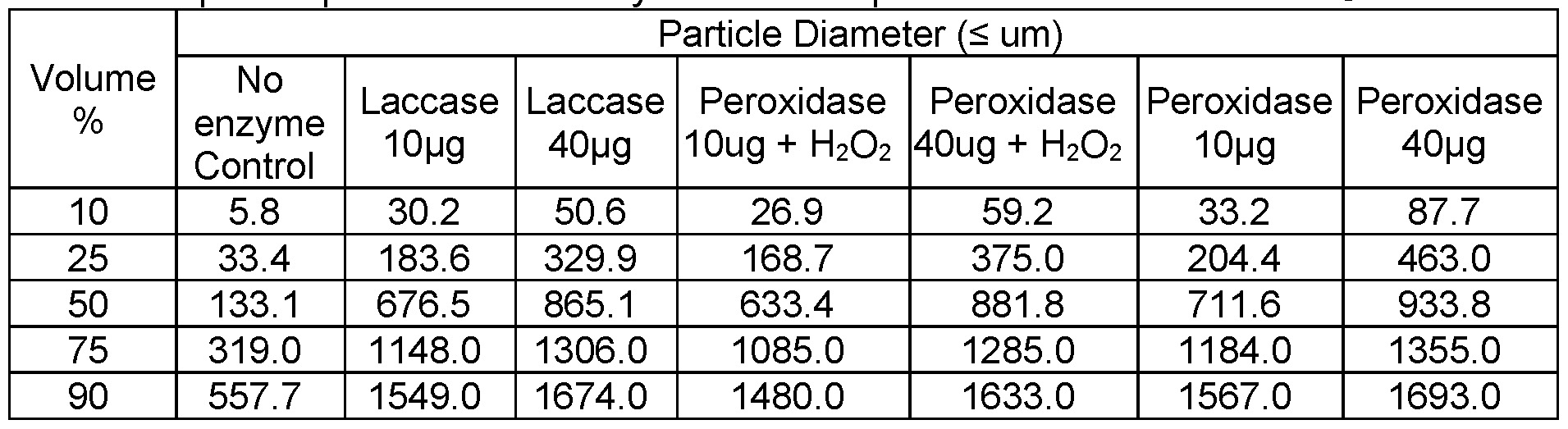
- the impact of particle diameter by oxidoreductase treatment is shown in Table 2 below.
- the particles sized at or less than a specific diameter (pm) are shown at various levels of particle volume percentage.
- no enzyme control and 10pg Oxidoreductase A treated whole stillages have particle size ⁇ 133.1 pm and ⁇ 676.5pm, respectively, indicating more small particles in the no enzyme control sample than the 10pg Oxidoreductase A treated sample.
- 10pg Oxidoreductase A treatment reduced the quantity of smaller sized particles and increased the quantity of larger sized particles.
- Oxidoreductase B treatment with or without peroxide also decreased the volume% of smaller sized particles and increased the volume% of larger sized particles in the whole stillage.
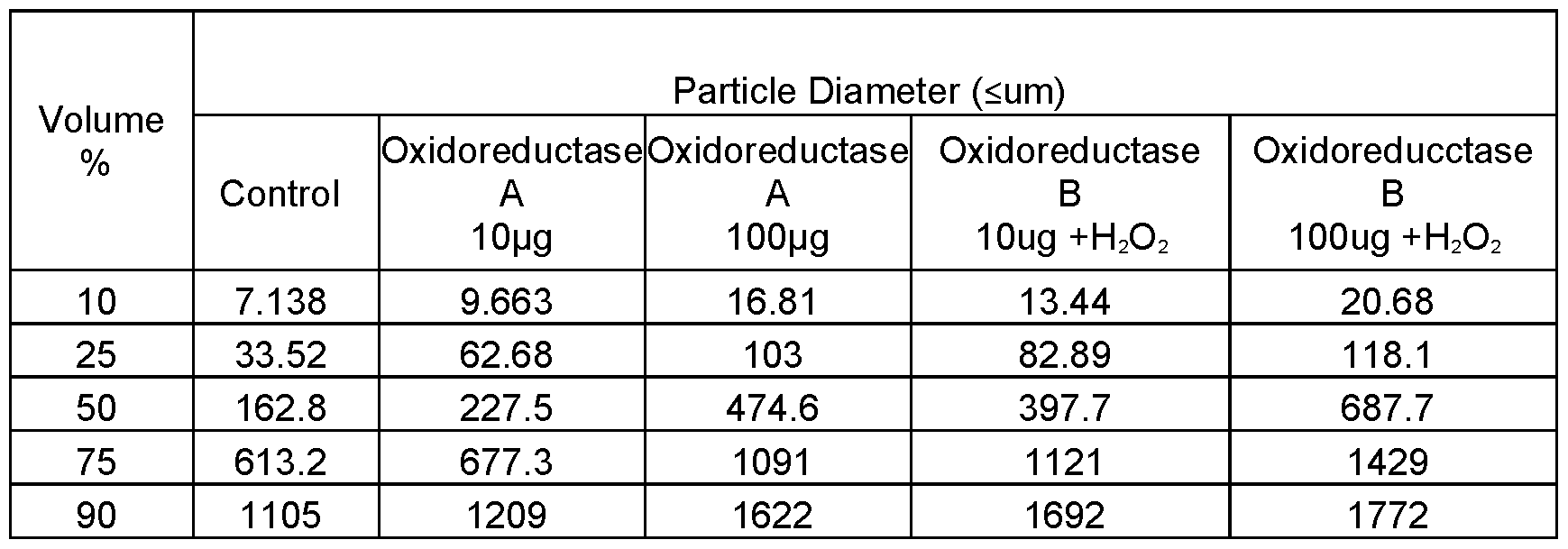
- Example 2 The whole stillage from Example 2 was used in this example at 1Og/tube. Oxidoreductase A and Oxidoreductase B from example 2 were used and dosed at 10 and 100
- FIG. 4 shows the impact on cumulative passing of whole stillage teated with Oxidoreductase A and Oxidoreductase B at 50°C. Both oxidoreductases have shifted the particle size distribution towards larger diameter particle sizes. The larger dose of 100
- Example 4 Increase particle size by treating whole stillage with oxidoreductases at 35°C
- Example 2 The whole stillage from Example 2 was used in this example at 10g/tube.
- Oxidoreductase A and Oxidoreductase B from Example 2 were used in this example and dosed at 10 pg/gDS.
- a 1 OOpI of 0.06% hydrogen peroxide was added with one peroxidase treatment.
- the treatment was carried out at 35°C for 16 hours in a temperature-controlled water bath. After the treatment, the sample preparation and particle size analysis were conducted the same way as in Example 2.
- FIG. 5 shows the impact on cumulative passing of whole stillage treated with Oxidoreductase A and B treatment at 35°C.
- Oxidoreductase treatments have shifted the particle size towards larger diameter.
- the increase of particle size is smaller compared to treatment at 65°C in Example 2, likely due to the relatively lower activity of the oxidoreductases at 35°C.
Landscapes
- Chemical & Material Sciences (AREA)
- Organic Chemistry (AREA)
- Life Sciences & Earth Sciences (AREA)
- Health & Medical Sciences (AREA)
- Engineering & Computer Science (AREA)
- Zoology (AREA)
- Wood Science & Technology (AREA)
- Genetics & Genomics (AREA)
- Bioinformatics & Cheminformatics (AREA)
- General Health & Medical Sciences (AREA)
- Biochemistry (AREA)
- General Engineering & Computer Science (AREA)
- Microbiology (AREA)
- Biotechnology (AREA)
- Biomedical Technology (AREA)
- Molecular Biology (AREA)
- Medicinal Chemistry (AREA)
- Chemical Kinetics & Catalysis (AREA)
- General Chemical & Material Sciences (AREA)
- Preparation Of Compounds By Using Micro-Organisms (AREA)
Abstract
Description




Claims
Priority Applications (3)
| Application Number | Priority Date | Filing Date | Title |
|---|---|---|---|
| EP23844287.5A EP4638767A1 (en) | 2022-12-19 | 2023-12-11 | Process for reducing syrup viscosity in the backend of a process for producing a fermentation product |
| CN202380086661.8A CN120380158A (en) | 2022-12-19 | 2023-12-11 | Method for reducing the viscosity of a slurry at the back end of a fermentation product production process |
| MX2025007018A MX2025007018A (en) | 2022-12-19 | 2025-06-16 | Process for reducing syrup viscosity in the backend of a process for producing a fermentation product |
Applications Claiming Priority (2)
| Application Number | Priority Date | Filing Date | Title |
|---|---|---|---|
| US202263476090P | 2022-12-19 | 2022-12-19 | |
| US63/476,090 | 2022-12-19 |
Publications (1)
| Publication Number | Publication Date |
|---|---|
| WO2024137252A1 true WO2024137252A1 (en) | 2024-06-27 |
Family
ID=89663174
Family Applications (1)
| Application Number | Title | Priority Date | Filing Date |
|---|---|---|---|
| PCT/US2023/083357 Ceased WO2024137252A1 (en) | 2022-12-19 | 2023-12-11 | Process for reducing syrup viscosity in the backend of a process for producing a fermentation product |
Country Status (4)
| Country | Link |
|---|---|
| EP (1) | EP4638767A1 (en) |
| CN (1) | CN120380158A (en) |
| MX (1) | MX2025007018A (en) |
| WO (1) | WO2024137252A1 (en) |
Citations (142)
| Publication number | Priority date | Publication date | Assignee | Title |
|---|---|---|---|---|
| WO1984002921A3 (en) | 1983-01-28 | 1984-09-27 | Cetus Corp | Glucoamylase cdna |
| US4598048A (en) | 1983-03-25 | 1986-07-01 | Novo Industri A/S | Preparation of a maltogenic amylase enzyme |
| WO1992000381A1 (en) | 1990-06-29 | 1992-01-09 | Novo Nordisk A/S | Enzymatic hydrolysis of starch to glucose, using a genetically engineered enzyme |
| WO1992002614A1 (en) | 1990-08-01 | 1992-02-20 | Novo Nordisk A/S | Novel thermostable pullulanases |
| WO1994002597A1 (en) | 1992-07-23 | 1994-02-03 | Novo Nordisk A/S | MUTANT α-AMYLASE, DETERGENT, DISH WASHING AGENT, AND LIQUEFACTION AGENT |
| WO1994018314A1 (en) | 1993-02-11 | 1994-08-18 | Genencor International, Inc. | Oxidatively stable alpha-amylase |
| WO1996023874A1 (en) | 1995-02-03 | 1996-08-08 | Novo Nordisk A/S | A method of designing alpha-amylase mutants with predetermined properties |
| WO1996023873A1 (en) | 1995-02-03 | 1996-08-08 | Novo Nordisk A/S | Amylase variants |
| WO1996028567A1 (en) | 1995-03-09 | 1996-09-19 | Genencor International, Inc. | Method for liquefying starch |
| WO1996039528A2 (en) | 1995-06-06 | 1996-12-12 | Genencor International, Inc. | MUTANT α-AMYLASE |
| WO1997033976A1 (en) | 1996-03-14 | 1997-09-18 | Korea Institute Of Science And Technology | Ds11 (kctc 0231bp), novel bacillus sp. strain and novel phytase produced by it |
| WO1997038096A1 (en) | 1996-04-05 | 1997-10-16 | Kyowa Hakko Kogyo Co., Ltd. | Novel phytase and gene encoding said phytase |
| WO1997041213A1 (en) | 1996-04-30 | 1997-11-06 | Novo Nordisk A/S | α-AMYLASE MUTANTS |
| WO1997043424A1 (en) | 1996-05-14 | 1997-11-20 | Genencor International, Inc. | MODIFIED α-AMYLASES HAVING ALTERED CALCIUM BINDING PROPERTIES |
| WO1998005785A1 (en) | 1996-08-01 | 1998-02-12 | Biocem | Plant phytases and biotechnological applications |
| WO1998006856A1 (en) | 1996-08-13 | 1998-02-19 | Finnfeeds International Ltd. | Phytase from bacillus subtilis, gene encoding said phytase, method for its production and use |
| WO1997048812A3 (en) | 1996-06-14 | 1998-03-26 | Canada Agriculture | Dna sequences encoding phytases of ruminal microorganisms |
| WO1998013480A1 (en) | 1996-09-25 | 1998-04-02 | Kyowa Hakko Kogyo Co., Ltd. | Novel phytase and process for the preparation thereof |
| WO1998028408A1 (en) | 1996-12-20 | 1998-07-02 | Novo Nordisk A/S | Peniophora phytase |
| WO1998020139A3 (en) | 1996-11-05 | 1998-07-23 | Finnfeeds Int Ltd | Phytase from germinated soybeans |
| WO1998056926A1 (en) | 1997-06-10 | 1998-12-17 | Takara Shuzo Co., Ltd. | System for expressing hyperthermostable protein |
| WO1999019467A1 (en) | 1997-10-13 | 1999-04-22 | Novo Nordisk A/S | α-AMYLASE MUTANTS |
| WO1999028448A1 (en) | 1997-11-26 | 1999-06-10 | Novo Nordisk A/S | Thermostable glucoamylase |
| WO1999048330A1 (en) | 1998-03-19 | 1999-09-23 | Koninklijke Philips Electronics N.V. | A hearing aid comprising a detector for wireless reception of signals and a system comprising said hearing aid |
| WO1999049022A1 (en) | 1998-03-23 | 1999-09-30 | Novo Nordisk A/S | Phytase variants |
| WO2000004136A1 (en) | 1998-07-15 | 2000-01-27 | Novozymes A/S | Glucoamylase variants |
| WO2000060059A2 (en) | 1999-03-30 | 2000-10-12 | NovozymesA/S | Alpha-amylase variants |
| US6162628A (en) | 1998-02-27 | 2000-12-19 | Novo Nordisk A/S | Maltogenic alpha-amylase variants |
| WO2001062947A1 (en) | 2000-02-23 | 2001-08-30 | Novozymes A/S | Fermentation with a phytase |
| WO2001004273A3 (en) | 1999-07-09 | 2001-09-07 | Novozymes As | Glucoamylase variant |
| WO2002010355A2 (en) | 2000-08-01 | 2002-02-07 | Novozymes A/S | Alpha-amylase mutants with altered stability |
| WO2002092797A2 (en) | 2001-05-15 | 2002-11-21 | Novozymes A/S | Alpha-amylase variant with altered properties |
| WO2003048353A1 (en) | 2001-12-07 | 2003-06-12 | Novozymes A/S | Polypeptides having protease activity and nucleic acids encoding same |
| WO2003066847A2 (en) | 2002-02-08 | 2003-08-14 | Novozymes A/S | Phytase variants |
| WO2004055178A1 (en) | 2002-12-17 | 2004-07-01 | Novozymes A/S | Thermostable alpha-amylases |
| WO2004085638A1 (en) | 2003-03-25 | 2004-10-07 | Republic Of National Fisheries Research And Development Institute | Phytase produced from citrobacter braakii |
| WO2004106533A1 (en) | 2003-05-30 | 2004-12-09 | Novozymes A/S | Alcohol product processes |
| WO2005003311A2 (en) | 2003-06-25 | 2005-01-13 | Novozymes A/S | Enzymes for starch processing |
| WO2005045018A1 (en) | 2003-10-28 | 2005-05-19 | Novozymes North America, Inc. | Hybrid enzymes |
| WO2005047499A1 (en) | 2003-10-28 | 2005-05-26 | Novozymes Inc. | Polypeptides having beta-glucosidase activity and polynucleotides encoding same |
| WO2005069840A2 (en) | 2004-01-16 | 2005-08-04 | Novozymes North America, Inc | Processes for producing a fermentation product |
| WO2006037328A1 (en) | 2004-10-04 | 2006-04-13 | Novozymes A/S | Polypeptides having phytase activity and polynucleotides encoding same |
| WO2006038062A1 (en) | 2004-10-04 | 2006-04-13 | Danisco A/S | Microbial phytase as supplement to food or fodder |
| WO2006037327A2 (en) | 2004-10-04 | 2006-04-13 | Novozymes A/S | Polypeptides having phytase activity and polynucleotides encoding same |
| WO2006063588A1 (en) | 2004-12-13 | 2006-06-22 | Novozymes A/S | Polypeptides having acid phosphatase activity and polynucleotides encoding same |
| WO2006069290A2 (en) | 2004-12-22 | 2006-06-29 | Novozymes A/S | Enzymes for starch processing |
| WO2006086792A2 (en) | 2005-02-07 | 2006-08-17 | Novozymes North America, Inc. | Fermentation product production processes |
| EP1724336A1 (en) | 2005-05-19 | 2006-11-22 | Paul Dr. Fricko | Method for improving the drying and product quality of microorganisms |
| WO2007112739A1 (en) | 2006-04-04 | 2007-10-11 | Novozymes A/S | Phytase variants |
| WO2008092901A2 (en) | 2007-01-30 | 2008-08-07 | Novozymes A/S | Polypeptides having phytase activty and polynucleotides encoding same |
| WO2008116878A1 (en) | 2007-03-26 | 2008-10-02 | Novozymes A/S | Hafnia phytase |
| WO2009052101A1 (en) | 2007-10-18 | 2009-04-23 | Danisco Us, Inc. | Enzyme blends for fermentation |
| WO2009061380A2 (en) | 2007-11-05 | 2009-05-14 | Danisco Us Inc., Genencor Division | VARIANTS OF BACILLUS sp. TS-23 ALPHA-AMYLASE WITH ALTERED PROPERTIES |
| WO2009061381A2 (en) | 2007-11-05 | 2009-05-14 | Danisco Us Inc., Genencor Division | Alpha-amylase variants with altered properties |
| WO2009061378A2 (en) | 2007-11-05 | 2009-05-14 | Danisco Us Inc., Genencor Division | Variants of bacillus licheniformis alpha-amylase with increased thermostability and/or decreased calcium dependence |
| WO2009100102A2 (en) | 2008-02-04 | 2009-08-13 | Danisco Us Inc., Genencor Division | Ts23 alpha-amylase variants with altered properties |
| WO2009129489A2 (en) | 2008-04-18 | 2009-10-22 | Danisco Us Inc., Genencor Division | Buttiauxella sp. phytase variants |
| WO2009149130A2 (en) | 2008-06-06 | 2009-12-10 | Danisco Us Inc. | Geobacillus stearothermophilus alpha-amylase (amys) variants with improved properties |
| WO2010008841A2 (en) | 2008-06-23 | 2010-01-21 | Novozymes A/S | Processes for producing fermentation products |
| WO2010034835A2 (en) | 2008-09-26 | 2010-04-01 | Novozymes A/S | Hafnia phytase variants |
| WO2010036515A1 (en) | 2008-09-25 | 2010-04-01 | Danisco Us Inc. | Alpha-amylase blends and methods for using said blends |
| WO2010115021A2 (en) | 2009-04-01 | 2010-10-07 | Danisco Us Inc. | Compositions and methods comprising alpha-amylase variants with altered properties |
| WO2011066576A1 (en) | 2009-11-30 | 2011-06-03 | Novozymes A/S | Polypeptides having glucoamylase activity and polynucleotides encoding same |
| WO2011066560A1 (en) | 2009-11-30 | 2011-06-03 | Novozymes A/S | Polypeptides having glucoamylase activity and polynucleotides encoding same |
| WO2011068803A1 (en) | 2009-12-01 | 2011-06-09 | Novozymes A/S | Polypeptides having glucoamylase activity and polynucleotides encoding same |
| WO2011076123A1 (en) | 2009-12-22 | 2011-06-30 | Novozymes A/S | Compositions comprising boosting polypeptide and starch degrading enzyme and uses thereof |
| WO2011082425A2 (en) | 2010-01-04 | 2011-07-07 | Novozymes A/S | Alpha-amylase variants and polynucleotides encoding same |
| WO2011127802A1 (en) | 2010-04-14 | 2011-10-20 | Novozymes A/S | Polypeptides having glucoamylase activity and polynucleotides encoding same |
| WO2012044915A2 (en) | 2010-10-01 | 2012-04-05 | Novozymes, Inc. | Beta-glucosidase variants and polynucleotides encoding same |
| WO2012064351A1 (en) | 2010-11-08 | 2012-05-18 | Novozymes A/S | Polypeptides having glucoamylase activity and polynucleotides encoding same |
| WO2012088303A2 (en) | 2010-12-22 | 2012-06-28 | Novozymes North America, Inc. | Processes for producing fermentation products |
| US8257959B2 (en) | 2004-06-08 | 2012-09-04 | Microbiogen Pty Ltd | Non-recombinant Saccharomyces strains that grow on xylose |
| WO2013006756A2 (en) | 2011-07-06 | 2013-01-10 | Novozymes A/S | Alpha amylase variants and polynucleotides encoding same |
| WO2013036526A1 (en) | 2011-09-06 | 2013-03-14 | Novozymes A/S | Glucoamylase variants and polynucleotides encoding same |
| WO2013034106A1 (en) | 2011-09-09 | 2013-03-14 | Novozymes A/S | Polypeptides having alpha-amylase activity and polynucleotides encoding same |
| WO2013044867A1 (en) | 2011-09-30 | 2013-04-04 | Novozymes A/S | Polypeptides having alpha-amylase activity and polynucleotides encoding same |
| WO2013053801A1 (en) | 2011-10-11 | 2013-04-18 | Novozymes A/S | Glucoamylase variants and polynucleotides encoding same |
| WO2013055676A1 (en) | 2011-10-11 | 2013-04-18 | Novozymes North America, Inc. | Processes for producing fermentation products |
| WO2013082486A1 (en) | 2011-12-02 | 2013-06-06 | Novozymes A/S | Processes for producing fermentation products |
| WO2013096305A1 (en) | 2011-12-22 | 2013-06-27 | Danisco Us Inc. | Variant alpha-amylases and methods of use, thereof |
| WO2013148993A1 (en) | 2012-03-30 | 2013-10-03 | Novozymes North America, Inc. | Processes of producing fermentation products |
| WO2013184577A1 (en) | 2012-06-08 | 2013-12-12 | Danisco Us Inc. | Alpha-amylase variants derived from the alpha amylase of cytophaga sp.amylase|(cspamy2). |
| WO2014039773A1 (en) | 2012-09-07 | 2014-03-13 | Novozymes A/S | Glucoamylase variants and polynucleotides encoding same and uses thereof |
| WO2014085439A1 (en) | 2012-11-30 | 2014-06-05 | Novozymes A/S | Processes for producing fermentation products |
| US20140206055A1 (en) * | 2013-01-24 | 2014-07-24 | Edeniq, Inc. | Method for viscosity reduction in co-fermentation ethanol processes |
| WO2014138672A1 (en) | 2013-03-08 | 2014-09-12 | Novozymes A/S | Cellobiohydrolase variants and polynucleotides encoding same |
| WO2014164777A1 (en) | 2013-03-11 | 2014-10-09 | Danisco Us Inc. | Alpha-amylase combinatorial variants |
| WO2014177546A2 (en) | 2013-04-30 | 2014-11-06 | Novozymes A/S | Glucoamylase variants and polynucleotides encoding same |
| WO2014177541A2 (en) | 2013-04-30 | 2014-11-06 | Novozymes A/S | Glucoamylase variants and polynucleotides encoding same |
| WO2014209800A1 (en) | 2013-06-24 | 2014-12-31 | Novozymes A/S | Processes for recovering oil from fermentation product processes and processes for producing fermentation products |
| WO2015007639A1 (en) | 2013-07-17 | 2015-01-22 | Novozymes A/S | Pullulanase chimeras and polynucleotides encoding same |
| WO2015031477A1 (en) | 2013-08-30 | 2015-03-05 | Novozymes A/S | Enzyme composition and uses thereof |
| WO2015035914A1 (en) | 2013-09-11 | 2015-03-19 | Novozymes A/S | Processes for producing fermentation products |
| WO2015110473A2 (en) | 2014-01-22 | 2015-07-30 | Novozymes A/S | Pullulanase variants and polynucleotides encoding same |
| WO2015143324A1 (en) | 2014-03-21 | 2015-09-24 | Novozymes A/S | Processes for producing ethanol and yeast |
| WO2016005521A1 (en) | 2014-07-10 | 2016-01-14 | Novozymes A/S | Process for producing ethanol from starch using a gh5 xylanase |
| WO2016040265A1 (en) | 2014-09-08 | 2016-03-17 | Novozymes A/S | Cellobiohydrolase variants and polynucleotides encoding same |
| WO2016062875A2 (en) | 2014-10-23 | 2016-04-28 | Novozymes A/S | Glucoamylase variants and polynucleotides encoding same |
| WO2016087327A1 (en) | 2014-12-01 | 2016-06-09 | Novozymes A/S | Polypeptides having pullulanase activity comprising the x25, x45 and cbm41 domains |
| WO2016138437A1 (en) | 2015-02-27 | 2016-09-01 | Novozymes A/S | Processes of producing ethanol using a fermenting organism |
| WO2016153924A1 (en) | 2015-03-20 | 2016-09-29 | Novozymes A/S | Processes for producing ethanol and ethanol producing yeast |
| WO2016205127A1 (en) | 2015-06-18 | 2016-12-22 | Novozymes A/S | Polypeptides having trehalase activity and the use thereof in process of producing fermentation products |
| WO2017014974A1 (en) | 2015-07-21 | 2017-01-26 | Novozymes A/S | Polypeptides having pullulanase activity suitable for use in liquefaction |
| WO2017050291A1 (en) | 2015-09-25 | 2017-03-30 | Novozymes A/S | Use of serine proteases for improving ethanol yield |
| WO2017066255A1 (en) | 2015-10-14 | 2017-04-20 | Novozymes A/S | Glucoamylase variants and polynucleotides encoding same |
| WO2017087330A1 (en) | 2015-11-17 | 2017-05-26 | Novozymes A/S | Yeast strains suitable for saccharification and fermentation expressing glucoamylase and/or alpha-amylase |
| WO2017112533A1 (en) | 2015-12-22 | 2017-06-29 | Novozymes A/S | Process of extracting oil from thin stillage |
| WO2017148389A1 (en) | 2016-03-01 | 2017-09-08 | Novozymes A/S | Combined use of at least one endo-protease and at least one exo-protease in an ssf process for improving ethanol yield |
| WO2018015303A1 (en) | 2016-07-21 | 2018-01-25 | Novozymes A/S | Serine protease variants and polynucleotides encoding same |
| WO2018015304A1 (en) | 2016-07-21 | 2018-01-25 | Novozymes A/S | Serine protease variants and polynucleotides encoding same |
| WO2018098381A1 (en) | 2016-11-23 | 2018-05-31 | Novozymes A/S | Improved yeast for ethanol production |
| WO2018098124A1 (en) | 2016-11-23 | 2018-05-31 | Novozymes A/S | Polypeptides having protease activity and polynucleotides encoding same |
| WO2018118815A1 (en) | 2016-12-21 | 2018-06-28 | Dupont Nutrition Biosciences Aps | Methods of using thermostable serine proteases |
| WO2018164737A1 (en) | 2017-03-07 | 2018-09-13 | Danisco Us Inc. | Thermostable glucoamylase and methods of use, thereof |
| WO2018169780A1 (en) | 2017-03-15 | 2018-09-20 | Dupont Nutrition Biosciences Aps | Methods of using an archaeal serine protease |
| WO2018191215A1 (en) | 2017-04-11 | 2018-10-18 | Novozymes A/S | Glucoamylase variants and polynucleotides encoding same |
| WO2019005755A1 (en) | 2017-06-28 | 2019-01-03 | Novozymes A/S | Polypeptides having trehalase activity and polynucleotides encoding same |
| WO2019030165A1 (en) | 2017-08-08 | 2019-02-14 | Novozymes A/S | Polypeptides having trehalase activity and the use thereof in process of producing fermentation products |
| WO2019055455A1 (en) | 2017-09-15 | 2019-03-21 | Novozymes A/S | Enzyme blends and processes for improving the nutritional quality of animal feed |
| WO2019083831A1 (en) | 2017-10-23 | 2019-05-02 | Novozymes A/S | Processes for reducing lactic acid in a biofuel fermentation system |
| WO2019113415A1 (en) | 2017-12-08 | 2019-06-13 | Novozymes A/S | Alpha-amylase variants and polynucleotides encoding same |
| WO2019113413A1 (en) | 2017-12-08 | 2019-06-13 | Novozymes A/S | Alpha-amylase variants and polynucleotides encoding same |
| WO2019161227A1 (en) | 2018-02-15 | 2019-08-22 | Novozymes A/S | Improved yeast for ethanol production |
| WO2019197318A1 (en) | 2018-04-09 | 2019-10-17 | Novozymes A/S | Polypeptides having alpha-amylase activity and polynucleotides encoding same |
| WO2019231944A2 (en) | 2018-05-31 | 2019-12-05 | Novozymes A/S | Processes for enhancing yeast growth and productivity |
| WO2020010101A2 (en) | 2018-07-04 | 2020-01-09 | Danisco Us Inc | Glucoamylases and methods of use, thereof |
| WO2020014407A1 (en) | 2018-07-11 | 2020-01-16 | Novozymes A/S | Processes for producing fermentation products |
| WO2020023411A1 (en) | 2018-07-25 | 2020-01-30 | Novozymes A/S | Enzyme-expressing yeast for ethanol production |
| WO2020076697A1 (en) | 2018-10-08 | 2020-04-16 | Novozymes A/S | Enzyme-expressing yeast for ethanol production |
| WO2020160126A1 (en) | 2019-01-31 | 2020-08-06 | Novozymes A/S | Polypeptides having xylanase activity and use thereof for improving the nutritional quality of animal feed |
| WO2020187883A1 (en) | 2019-03-18 | 2020-09-24 | Novozymes A/S | Polypeptides having pullulanase activity suitable for use in liquefaction |
| WO2021026201A1 (en) | 2019-08-05 | 2021-02-11 | Novozymes A/S | Enzyme blends and processes for producing a high protein feed ingredient from a whole stillage byproduct |
| WO2021055395A1 (en) | 2019-09-16 | 2021-03-25 | Novozymes A/S | Polypeptides having beta-glucanase activity and polynucleotides encoding same |
| WO2021126966A1 (en) | 2019-12-16 | 2021-06-24 | Novozymes A/S | Processes for producing fermentation products |
| WO2021142057A1 (en) * | 2020-01-07 | 2021-07-15 | Danisco Us Inc | Methods and compositions for enhanced ethanol production |
| WO2021163030A2 (en) | 2020-02-10 | 2021-08-19 | Novozymes A/S | Polypeptides having alpha-amylase activity and polynucleotides encoding same |
| WO2021163036A1 (en) | 2020-02-10 | 2021-08-19 | Novozymes A/S | Raw starch hydrolysis process for producing a fermentation product |
| WO2021163011A2 (en) | 2020-02-10 | 2021-08-19 | Novozymes A/S | Alpha-amylase variants and polynucleotides encoding same |
| WO2021163015A1 (en) | 2020-02-10 | 2021-08-19 | Novozymes A/S | Process for producing ethanol from raw starch using alpha-amylase variants |
| WO2021231623A1 (en) | 2020-05-13 | 2021-11-18 | Novozymes A/S | Engineered microorganism for improved pentose fermentation |
| WO2022090564A1 (en) | 2020-11-02 | 2022-05-05 | Novozymes A/S | Glucoamylase variants and polynucleotides encoding same |
| WO2022173694A1 (en) | 2021-02-10 | 2022-08-18 | Novozymes A/S | Polypeptides having pectinase activity, polynucleotides encoding same, and uses thereof |
-
2023
- 2023-12-11 WO PCT/US2023/083357 patent/WO2024137252A1/en not_active Ceased
- 2023-12-11 CN CN202380086661.8A patent/CN120380158A/en active Pending
- 2023-12-11 EP EP23844287.5A patent/EP4638767A1/en active Pending
-
2025
- 2025-06-16 MX MX2025007018A patent/MX2025007018A/en unknown
Patent Citations (156)
| Publication number | Priority date | Publication date | Assignee | Title |
|---|---|---|---|---|
| WO1984002921A3 (en) | 1983-01-28 | 1984-09-27 | Cetus Corp | Glucoamylase cdna |
| US4598048A (en) | 1983-03-25 | 1986-07-01 | Novo Industri A/S | Preparation of a maltogenic amylase enzyme |
| US4604355A (en) | 1983-03-25 | 1986-08-05 | Novo Industri A/S | Maltogenic amylase enzyme, preparation and use thereof |
| WO1992000381A1 (en) | 1990-06-29 | 1992-01-09 | Novo Nordisk A/S | Enzymatic hydrolysis of starch to glucose, using a genetically engineered enzyme |
| WO1992002614A1 (en) | 1990-08-01 | 1992-02-20 | Novo Nordisk A/S | Novel thermostable pullulanases |
| WO1994002597A1 (en) | 1992-07-23 | 1994-02-03 | Novo Nordisk A/S | MUTANT α-AMYLASE, DETERGENT, DISH WASHING AGENT, AND LIQUEFACTION AGENT |
| WO1994018314A1 (en) | 1993-02-11 | 1994-08-18 | Genencor International, Inc. | Oxidatively stable alpha-amylase |
| WO1996023874A1 (en) | 1995-02-03 | 1996-08-08 | Novo Nordisk A/S | A method of designing alpha-amylase mutants with predetermined properties |
| WO1996023873A1 (en) | 1995-02-03 | 1996-08-08 | Novo Nordisk A/S | Amylase variants |
| WO1996028567A1 (en) | 1995-03-09 | 1996-09-19 | Genencor International, Inc. | Method for liquefying starch |
| WO1996039528A2 (en) | 1995-06-06 | 1996-12-12 | Genencor International, Inc. | MUTANT α-AMYLASE |
| WO1997033976A1 (en) | 1996-03-14 | 1997-09-18 | Korea Institute Of Science And Technology | Ds11 (kctc 0231bp), novel bacillus sp. strain and novel phytase produced by it |
| WO1997038096A1 (en) | 1996-04-05 | 1997-10-16 | Kyowa Hakko Kogyo Co., Ltd. | Novel phytase and gene encoding said phytase |
| WO1997041213A1 (en) | 1996-04-30 | 1997-11-06 | Novo Nordisk A/S | α-AMYLASE MUTANTS |
| WO1997043424A1 (en) | 1996-05-14 | 1997-11-20 | Genencor International, Inc. | MODIFIED α-AMYLASES HAVING ALTERED CALCIUM BINDING PROPERTIES |
| WO1997048812A3 (en) | 1996-06-14 | 1998-03-26 | Canada Agriculture | Dna sequences encoding phytases of ruminal microorganisms |
| WO1998005785A1 (en) | 1996-08-01 | 1998-02-12 | Biocem | Plant phytases and biotechnological applications |
| WO1998006856A1 (en) | 1996-08-13 | 1998-02-19 | Finnfeeds International Ltd. | Phytase from bacillus subtilis, gene encoding said phytase, method for its production and use |
| WO1998013480A1 (en) | 1996-09-25 | 1998-04-02 | Kyowa Hakko Kogyo Co., Ltd. | Novel phytase and process for the preparation thereof |
| WO1998020139A3 (en) | 1996-11-05 | 1998-07-23 | Finnfeeds Int Ltd | Phytase from germinated soybeans |
| WO1998028408A1 (en) | 1996-12-20 | 1998-07-02 | Novo Nordisk A/S | Peniophora phytase |
| WO1998056926A1 (en) | 1997-06-10 | 1998-12-17 | Takara Shuzo Co., Ltd. | System for expressing hyperthermostable protein |
| WO1999019467A1 (en) | 1997-10-13 | 1999-04-22 | Novo Nordisk A/S | α-AMYLASE MUTANTS |
| WO1999028448A1 (en) | 1997-11-26 | 1999-06-10 | Novo Nordisk A/S | Thermostable glucoamylase |
| US6162628A (en) | 1998-02-27 | 2000-12-19 | Novo Nordisk A/S | Maltogenic alpha-amylase variants |
| WO1999048330A1 (en) | 1998-03-19 | 1999-09-23 | Koninklijke Philips Electronics N.V. | A hearing aid comprising a detector for wireless reception of signals and a system comprising said hearing aid |
| WO1999049022A1 (en) | 1998-03-23 | 1999-09-30 | Novo Nordisk A/S | Phytase variants |
| WO2000004136A1 (en) | 1998-07-15 | 2000-01-27 | Novozymes A/S | Glucoamylase variants |
| WO2000060059A2 (en) | 1999-03-30 | 2000-10-12 | NovozymesA/S | Alpha-amylase variants |
| WO2001004273A3 (en) | 1999-07-09 | 2001-09-07 | Novozymes As | Glucoamylase variant |
| WO2001062947A1 (en) | 2000-02-23 | 2001-08-30 | Novozymes A/S | Fermentation with a phytase |
| WO2002010355A2 (en) | 2000-08-01 | 2002-02-07 | Novozymes A/S | Alpha-amylase mutants with altered stability |
| WO2002092797A2 (en) | 2001-05-15 | 2002-11-21 | Novozymes A/S | Alpha-amylase variant with altered properties |
| WO2003048353A1 (en) | 2001-12-07 | 2003-06-12 | Novozymes A/S | Polypeptides having protease activity and nucleic acids encoding same |
| WO2003066847A2 (en) | 2002-02-08 | 2003-08-14 | Novozymes A/S | Phytase variants |
| WO2004055178A1 (en) | 2002-12-17 | 2004-07-01 | Novozymes A/S | Thermostable alpha-amylases |
| WO2004085638A1 (en) | 2003-03-25 | 2004-10-07 | Republic Of National Fisheries Research And Development Institute | Phytase produced from citrobacter braakii |
| WO2004106533A1 (en) | 2003-05-30 | 2004-12-09 | Novozymes A/S | Alcohol product processes |
| WO2005003311A2 (en) | 2003-06-25 | 2005-01-13 | Novozymes A/S | Enzymes for starch processing |
| WO2005045018A1 (en) | 2003-10-28 | 2005-05-19 | Novozymes North America, Inc. | Hybrid enzymes |
| WO2005047499A1 (en) | 2003-10-28 | 2005-05-26 | Novozymes Inc. | Polypeptides having beta-glucosidase activity and polynucleotides encoding same |
| WO2005069840A2 (en) | 2004-01-16 | 2005-08-04 | Novozymes North America, Inc | Processes for producing a fermentation product |
| US8257959B2 (en) | 2004-06-08 | 2012-09-04 | Microbiogen Pty Ltd | Non-recombinant Saccharomyces strains that grow on xylose |
| WO2006037328A1 (en) | 2004-10-04 | 2006-04-13 | Novozymes A/S | Polypeptides having phytase activity and polynucleotides encoding same |
| WO2006038062A1 (en) | 2004-10-04 | 2006-04-13 | Danisco A/S | Microbial phytase as supplement to food or fodder |
| WO2006037327A2 (en) | 2004-10-04 | 2006-04-13 | Novozymes A/S | Polypeptides having phytase activity and polynucleotides encoding same |
| WO2006063588A1 (en) | 2004-12-13 | 2006-06-22 | Novozymes A/S | Polypeptides having acid phosphatase activity and polynucleotides encoding same |
| WO2006069290A2 (en) | 2004-12-22 | 2006-06-29 | Novozymes A/S | Enzymes for starch processing |
| WO2006069289A2 (en) | 2004-12-22 | 2006-06-29 | Novozymes North America, Inc | Polypeptides having glucoamylase activity and polynucleotides encoding same |
| WO2006086792A2 (en) | 2005-02-07 | 2006-08-17 | Novozymes North America, Inc. | Fermentation product production processes |
| EP1724336A1 (en) | 2005-05-19 | 2006-11-22 | Paul Dr. Fricko | Method for improving the drying and product quality of microorganisms |
| WO2007112739A1 (en) | 2006-04-04 | 2007-10-11 | Novozymes A/S | Phytase variants |
| WO2008092901A2 (en) | 2007-01-30 | 2008-08-07 | Novozymes A/S | Polypeptides having phytase activty and polynucleotides encoding same |
| WO2008116878A1 (en) | 2007-03-26 | 2008-10-02 | Novozymes A/S | Hafnia phytase |
| WO2009052101A1 (en) | 2007-10-18 | 2009-04-23 | Danisco Us, Inc. | Enzyme blends for fermentation |
| WO2009061380A2 (en) | 2007-11-05 | 2009-05-14 | Danisco Us Inc., Genencor Division | VARIANTS OF BACILLUS sp. TS-23 ALPHA-AMYLASE WITH ALTERED PROPERTIES |
| WO2009061381A2 (en) | 2007-11-05 | 2009-05-14 | Danisco Us Inc., Genencor Division | Alpha-amylase variants with altered properties |
| WO2009061378A2 (en) | 2007-11-05 | 2009-05-14 | Danisco Us Inc., Genencor Division | Variants of bacillus licheniformis alpha-amylase with increased thermostability and/or decreased calcium dependence |
| WO2009061379A2 (en) | 2007-11-05 | 2009-05-14 | Danisco Us Inc., Genencor Division | Alpha-amylase variants with altered properties |
| WO2009100102A2 (en) | 2008-02-04 | 2009-08-13 | Danisco Us Inc., Genencor Division | Ts23 alpha-amylase variants with altered properties |
| WO2009098229A2 (en) | 2008-02-04 | 2009-08-13 | Danisco Us Inc., Genencor Division | A method of preparing food products using ts23 alpha-amylase |
| WO2009129489A2 (en) | 2008-04-18 | 2009-10-22 | Danisco Us Inc., Genencor Division | Buttiauxella sp. phytase variants |
| WO2009149130A2 (en) | 2008-06-06 | 2009-12-10 | Danisco Us Inc. | Geobacillus stearothermophilus alpha-amylase (amys) variants with improved properties |
| WO2010008841A2 (en) | 2008-06-23 | 2010-01-21 | Novozymes A/S | Processes for producing fermentation products |
| WO2010036515A1 (en) | 2008-09-25 | 2010-04-01 | Danisco Us Inc. | Alpha-amylase blends and methods for using said blends |
| WO2010034835A2 (en) | 2008-09-26 | 2010-04-01 | Novozymes A/S | Hafnia phytase variants |
| WO2010115021A2 (en) | 2009-04-01 | 2010-10-07 | Danisco Us Inc. | Compositions and methods comprising alpha-amylase variants with altered properties |
| WO2010115028A2 (en) | 2009-04-01 | 2010-10-07 | Danisco Us Inc. | Cleaning system comprising an alpha-amylase and a protease |
| WO2011066576A1 (en) | 2009-11-30 | 2011-06-03 | Novozymes A/S | Polypeptides having glucoamylase activity and polynucleotides encoding same |
| WO2011066560A1 (en) | 2009-11-30 | 2011-06-03 | Novozymes A/S | Polypeptides having glucoamylase activity and polynucleotides encoding same |
| WO2011068803A1 (en) | 2009-12-01 | 2011-06-09 | Novozymes A/S | Polypeptides having glucoamylase activity and polynucleotides encoding same |
| WO2011076123A1 (en) | 2009-12-22 | 2011-06-30 | Novozymes A/S | Compositions comprising boosting polypeptide and starch degrading enzyme and uses thereof |
| WO2011087836A2 (en) | 2009-12-22 | 2011-07-21 | Novozymes A/S | Pullulanase variants and uses thereof |
| WO2011082425A2 (en) | 2010-01-04 | 2011-07-07 | Novozymes A/S | Alpha-amylase variants and polynucleotides encoding same |
| WO2011127802A1 (en) | 2010-04-14 | 2011-10-20 | Novozymes A/S | Polypeptides having glucoamylase activity and polynucleotides encoding same |
| WO2012044915A2 (en) | 2010-10-01 | 2012-04-05 | Novozymes, Inc. | Beta-glucosidase variants and polynucleotides encoding same |
| WO2012064351A1 (en) | 2010-11-08 | 2012-05-18 | Novozymes A/S | Polypeptides having glucoamylase activity and polynucleotides encoding same |
| WO2012088303A2 (en) | 2010-12-22 | 2012-06-28 | Novozymes North America, Inc. | Processes for producing fermentation products |
| WO2013006756A2 (en) | 2011-07-06 | 2013-01-10 | Novozymes A/S | Alpha amylase variants and polynucleotides encoding same |
| WO2013036526A1 (en) | 2011-09-06 | 2013-03-14 | Novozymes A/S | Glucoamylase variants and polynucleotides encoding same |
| WO2013034106A1 (en) | 2011-09-09 | 2013-03-14 | Novozymes A/S | Polypeptides having alpha-amylase activity and polynucleotides encoding same |
| WO2013044867A1 (en) | 2011-09-30 | 2013-04-04 | Novozymes A/S | Polypeptides having alpha-amylase activity and polynucleotides encoding same |
| WO2013053801A1 (en) | 2011-10-11 | 2013-04-18 | Novozymes A/S | Glucoamylase variants and polynucleotides encoding same |
| WO2013055676A1 (en) | 2011-10-11 | 2013-04-18 | Novozymes North America, Inc. | Processes for producing fermentation products |
| WO2013082486A1 (en) | 2011-12-02 | 2013-06-06 | Novozymes A/S | Processes for producing fermentation products |
| WO2013096305A1 (en) | 2011-12-22 | 2013-06-27 | Danisco Us Inc. | Variant alpha-amylases and methods of use, thereof |
| WO2013148993A1 (en) | 2012-03-30 | 2013-10-03 | Novozymes North America, Inc. | Processes of producing fermentation products |
| WO2013184577A1 (en) | 2012-06-08 | 2013-12-12 | Danisco Us Inc. | Alpha-amylase variants derived from the alpha amylase of cytophaga sp.amylase|(cspamy2). |
| WO2014007921A1 (en) | 2012-06-08 | 2014-01-09 | Danisco Us Inc. | Variant alpha amylases with enhanced activity on starch polymers |
| WO2014039773A1 (en) | 2012-09-07 | 2014-03-13 | Novozymes A/S | Glucoamylase variants and polynucleotides encoding same and uses thereof |
| WO2014085439A1 (en) | 2012-11-30 | 2014-06-05 | Novozymes A/S | Processes for producing fermentation products |
| US20140206055A1 (en) * | 2013-01-24 | 2014-07-24 | Edeniq, Inc. | Method for viscosity reduction in co-fermentation ethanol processes |
| WO2014138672A1 (en) | 2013-03-08 | 2014-09-12 | Novozymes A/S | Cellobiohydrolase variants and polynucleotides encoding same |
| WO2014164777A1 (en) | 2013-03-11 | 2014-10-09 | Danisco Us Inc. | Alpha-amylase combinatorial variants |
| WO2014164834A1 (en) | 2013-03-11 | 2014-10-09 | Danisco Us Inc. | Alpha-amylase combinatorial variants |
| WO2014164800A1 (en) | 2013-03-11 | 2014-10-09 | Danisco Us Inc. | Alpha-amylase combinatorial variants |
| WO2014177546A2 (en) | 2013-04-30 | 2014-11-06 | Novozymes A/S | Glucoamylase variants and polynucleotides encoding same |
| WO2014177541A2 (en) | 2013-04-30 | 2014-11-06 | Novozymes A/S | Glucoamylase variants and polynucleotides encoding same |
| WO2014209800A1 (en) | 2013-06-24 | 2014-12-31 | Novozymes A/S | Processes for recovering oil from fermentation product processes and processes for producing fermentation products |
| WO2014209789A1 (en) | 2013-06-24 | 2014-12-31 | Novozymes A/S | Process of extracting oil from thin stillage |
| WO2015007639A1 (en) | 2013-07-17 | 2015-01-22 | Novozymes A/S | Pullulanase chimeras and polynucleotides encoding same |
| WO2015031477A1 (en) | 2013-08-30 | 2015-03-05 | Novozymes A/S | Enzyme composition and uses thereof |
| WO2015035914A1 (en) | 2013-09-11 | 2015-03-19 | Novozymes A/S | Processes for producing fermentation products |
| WO2015110473A2 (en) | 2014-01-22 | 2015-07-30 | Novozymes A/S | Pullulanase variants and polynucleotides encoding same |
| WO2015143324A1 (en) | 2014-03-21 | 2015-09-24 | Novozymes A/S | Processes for producing ethanol and yeast |
| WO2015143317A1 (en) | 2014-03-21 | 2015-09-24 | Novozymes A/S | Processes of producing ethanol using a fermenting organism |
| WO2016005521A1 (en) | 2014-07-10 | 2016-01-14 | Novozymes A/S | Process for producing ethanol from starch using a gh5 xylanase |
| WO2016040265A1 (en) | 2014-09-08 | 2016-03-17 | Novozymes A/S | Cellobiohydrolase variants and polynucleotides encoding same |
| WO2016062875A2 (en) | 2014-10-23 | 2016-04-28 | Novozymes A/S | Glucoamylase variants and polynucleotides encoding same |
| WO2016087327A1 (en) | 2014-12-01 | 2016-06-09 | Novozymes A/S | Polypeptides having pullulanase activity comprising the x25, x45 and cbm41 domains |
| WO2016138437A1 (en) | 2015-02-27 | 2016-09-01 | Novozymes A/S | Processes of producing ethanol using a fermenting organism |
| WO2016153924A1 (en) | 2015-03-20 | 2016-09-29 | Novozymes A/S | Processes for producing ethanol and ethanol producing yeast |
| WO2016205127A1 (en) | 2015-06-18 | 2016-12-22 | Novozymes A/S | Polypeptides having trehalase activity and the use thereof in process of producing fermentation products |
| WO2017014974A1 (en) | 2015-07-21 | 2017-01-26 | Novozymes A/S | Polypeptides having pullulanase activity suitable for use in liquefaction |
| WO2017050291A1 (en) | 2015-09-25 | 2017-03-30 | Novozymes A/S | Use of serine proteases for improving ethanol yield |
| WO2017066255A1 (en) | 2015-10-14 | 2017-04-20 | Novozymes A/S | Glucoamylase variants and polynucleotides encoding same |
| WO2017087330A1 (en) | 2015-11-17 | 2017-05-26 | Novozymes A/S | Yeast strains suitable for saccharification and fermentation expressing glucoamylase and/or alpha-amylase |
| WO2017112533A1 (en) | 2015-12-22 | 2017-06-29 | Novozymes A/S | Process of extracting oil from thin stillage |
| WO2017112540A1 (en) | 2015-12-22 | 2017-06-29 | Novozymes A/S | Processes for producing fermentation products |
| WO2017112539A1 (en) | 2015-12-22 | 2017-06-29 | Novozymes A/S | Process of extracting oil from thin stillage |
| WO2017112542A1 (en) | 2015-12-22 | 2017-06-29 | Novozymes A/S | Processes for improving fermentation product yield using phospholipase c |
| WO2017148389A1 (en) | 2016-03-01 | 2017-09-08 | Novozymes A/S | Combined use of at least one endo-protease and at least one exo-protease in an ssf process for improving ethanol yield |
| WO2018015303A1 (en) | 2016-07-21 | 2018-01-25 | Novozymes A/S | Serine protease variants and polynucleotides encoding same |
| WO2018015304A1 (en) | 2016-07-21 | 2018-01-25 | Novozymes A/S | Serine protease variants and polynucleotides encoding same |
| WO2018098381A1 (en) | 2016-11-23 | 2018-05-31 | Novozymes A/S | Improved yeast for ethanol production |
| WO2018098124A1 (en) | 2016-11-23 | 2018-05-31 | Novozymes A/S | Polypeptides having protease activity and polynucleotides encoding same |
| WO2018118815A1 (en) | 2016-12-21 | 2018-06-28 | Dupont Nutrition Biosciences Aps | Methods of using thermostable serine proteases |
| WO2018164737A1 (en) | 2017-03-07 | 2018-09-13 | Danisco Us Inc. | Thermostable glucoamylase and methods of use, thereof |
| WO2018169780A1 (en) | 2017-03-15 | 2018-09-20 | Dupont Nutrition Biosciences Aps | Methods of using an archaeal serine protease |
| WO2018191215A1 (en) | 2017-04-11 | 2018-10-18 | Novozymes A/S | Glucoamylase variants and polynucleotides encoding same |
| WO2019005755A1 (en) | 2017-06-28 | 2019-01-03 | Novozymes A/S | Polypeptides having trehalase activity and polynucleotides encoding same |
| WO2019030165A1 (en) | 2017-08-08 | 2019-02-14 | Novozymes A/S | Polypeptides having trehalase activity and the use thereof in process of producing fermentation products |
| WO2019055455A1 (en) | 2017-09-15 | 2019-03-21 | Novozymes A/S | Enzyme blends and processes for improving the nutritional quality of animal feed |
| WO2019083831A1 (en) | 2017-10-23 | 2019-05-02 | Novozymes A/S | Processes for reducing lactic acid in a biofuel fermentation system |
| WO2019113415A1 (en) | 2017-12-08 | 2019-06-13 | Novozymes A/S | Alpha-amylase variants and polynucleotides encoding same |
| WO2019113413A1 (en) | 2017-12-08 | 2019-06-13 | Novozymes A/S | Alpha-amylase variants and polynucleotides encoding same |
| WO2019161227A1 (en) | 2018-02-15 | 2019-08-22 | Novozymes A/S | Improved yeast for ethanol production |
| WO2019197318A1 (en) | 2018-04-09 | 2019-10-17 | Novozymes A/S | Polypeptides having alpha-amylase activity and polynucleotides encoding same |
| WO2019231944A2 (en) | 2018-05-31 | 2019-12-05 | Novozymes A/S | Processes for enhancing yeast growth and productivity |
| WO2020010101A2 (en) | 2018-07-04 | 2020-01-09 | Danisco Us Inc | Glucoamylases and methods of use, thereof |
| WO2020014407A1 (en) | 2018-07-11 | 2020-01-16 | Novozymes A/S | Processes for producing fermentation products |
| WO2020023411A1 (en) | 2018-07-25 | 2020-01-30 | Novozymes A/S | Enzyme-expressing yeast for ethanol production |
| WO2020076697A1 (en) | 2018-10-08 | 2020-04-16 | Novozymes A/S | Enzyme-expressing yeast for ethanol production |
| WO2020160126A1 (en) | 2019-01-31 | 2020-08-06 | Novozymes A/S | Polypeptides having xylanase activity and use thereof for improving the nutritional quality of animal feed |
| WO2020187883A1 (en) | 2019-03-18 | 2020-09-24 | Novozymes A/S | Polypeptides having pullulanase activity suitable for use in liquefaction |
| WO2021026201A1 (en) | 2019-08-05 | 2021-02-11 | Novozymes A/S | Enzyme blends and processes for producing a high protein feed ingredient from a whole stillage byproduct |
| WO2021055395A1 (en) | 2019-09-16 | 2021-03-25 | Novozymes A/S | Polypeptides having beta-glucanase activity and polynucleotides encoding same |
| WO2021126966A1 (en) | 2019-12-16 | 2021-06-24 | Novozymes A/S | Processes for producing fermentation products |
| WO2021142057A1 (en) * | 2020-01-07 | 2021-07-15 | Danisco Us Inc | Methods and compositions for enhanced ethanol production |
| WO2021163030A2 (en) | 2020-02-10 | 2021-08-19 | Novozymes A/S | Polypeptides having alpha-amylase activity and polynucleotides encoding same |
| WO2021163036A1 (en) | 2020-02-10 | 2021-08-19 | Novozymes A/S | Raw starch hydrolysis process for producing a fermentation product |
| WO2021163011A2 (en) | 2020-02-10 | 2021-08-19 | Novozymes A/S | Alpha-amylase variants and polynucleotides encoding same |
| WO2021163015A1 (en) | 2020-02-10 | 2021-08-19 | Novozymes A/S | Process for producing ethanol from raw starch using alpha-amylase variants |
| WO2021231623A1 (en) | 2020-05-13 | 2021-11-18 | Novozymes A/S | Engineered microorganism for improved pentose fermentation |
| WO2022090564A1 (en) | 2020-11-02 | 2022-05-05 | Novozymes A/S | Glucoamylase variants and polynucleotides encoding same |
| WO2022173694A1 (en) | 2021-02-10 | 2022-08-18 | Novozymes A/S | Polypeptides having pectinase activity, polynucleotides encoding same, and uses thereof |
Non-Patent Citations (5)
| Title |
|---|
| GORINSTEIN. S.LII. C, STARCH/STARKE, vol. 44, no. 12, 1992, pages 461 - 466 |
| LIN ET AL., BIOTECHNOL. BIOENG., vol. 90, 2005, pages 775 - 779 |
| NEEDLEMANWUNSCH, J. MOL. BIOL., vol. 48, 1970, pages 443 - 453 |
| RICE ET AL., EMBOSS: THE EUROPEAN MOLECULAR BIOLOGY OPEN SOFTWARE SUITE, 2000 |
| RICE ET AL.: "EMBOSS: The European Molecular Biology Open Software Suite", TRENDS GENET., vol. 16, 2000, pages 276 - 277, XP004200114, DOI: 10.1016/S0168-9525(00)02024-2 |
Also Published As
| Publication number | Publication date |
|---|---|
| EP4638767A1 (en) | 2025-10-29 |
| MX2025007018A (en) | 2025-07-01 |
| CN120380158A (en) | 2025-07-25 |
Similar Documents
| Publication | Publication Date | Title |
|---|---|---|
| EP3013967B1 (en) | Processes for recovering oil from fermentation product processes and processes for producing fermentation products | |
| US8658407B2 (en) | Compositions and methods for conversion of lignocellulosic material to fermentable sugars and products produced therefrom | |
| US20210198618A1 (en) | Processes for enhancing yeast growth and productivity | |
| CN105339494B (en) | Pullulanase chimeras and polynucleotides encoding same | |
| KR102784155B1 (en) | Method for producing fermentation products from feedstock | |
| EP3701037A1 (en) | Processes for reducing lactic acid in a biofuel fermentation system | |
| EP2281898B1 (en) | High Protein distiller's dried grain and production thereof | |
| EP3177728B2 (en) | Improved fermentation processes by using xylanase und pectinase | |
| EP1873253A2 (en) | Process for the production of ethanol from fractionated plant material with vitamin B as fermentation supplement | |
| Elena et al. | Current approaches to efficient biotechnological production of ethanol | |
| EP4087936A1 (en) | Methods and compositions for enhanced ethanol production | |
| WO2014033476A2 (en) | Hydrolysis and fermentation process | |
| WO2009108748A2 (en) | Methods for producing 1,3-propanediol | |
| CA3124393A1 (en) | Process for modulating the nutritional value of whole stillage and distillers products associated thereto | |
| EP4638767A1 (en) | Process for reducing syrup viscosity in the backend of a process for producing a fermentation product | |
| ZA200608032B (en) | Methods and systems for producing ethanol using raw starch and fractionation | |
| US20070082385A1 (en) | Fermentation process | |
| US20170233769A1 (en) | Dewatering methods in fermentation processes | |
| WO2024137248A1 (en) | Compositions comprising arabinofuranosidases and a xylanase, and use thereof for increasing hemicellulosic fiber solubilization | |
| EP4638768A2 (en) | Processes for producing fermentation products using fiber-degrading enzymes with engineered yeast | |
| WO2026008449A2 (en) | A process for producing a fermentation product and a concentrated protein co-product |
Legal Events
| Date | Code | Title | Description |
|---|---|---|---|
| 121 | Ep: the epo has been informed by wipo that ep was designated in this application |
Ref document number: 23844287 Country of ref document: EP Kind code of ref document: A1 |
|
| WWE | Wipo information: entry into national phase |
Ref document number: 202380086661.8 Country of ref document: CN |
|
| WWE | Wipo information: entry into national phase |
Ref document number: 202547063762 Country of ref document: IN |
|
| WWP | Wipo information: published in national office |
Ref document number: 202547063762 Country of ref document: IN |
|
| WWE | Wipo information: entry into national phase |
Ref document number: 2023844287 Country of ref document: EP |
|
| NENP | Non-entry into the national phase |
Ref country code: DE |
|
| REG | Reference to national code |
Ref country code: BR Ref legal event code: B01A Ref document number: 112025012293 Country of ref document: BR |
|
| WWP | Wipo information: published in national office |
Ref document number: 202380086661.8 Country of ref document: CN |
|
| WWP | Wipo information: published in national office |
Ref document number: 2023844287 Country of ref document: EP |