[go: up one dir, main page]

WO2024133696A1 - Process for dyeing keratin hair fibers comprising the application of a (poly)carbodiimide compound, a compound containing at least one carboxylic acid group, an amino silicone and a colouring agent. - Google Patents

Process for dyeing keratin hair fibers comprising the application of a (poly)carbodiimide compound, a compound containing at least one carboxylic acid group, an amino silicone and a colouring agent. Download PDF

Info

Publication number
WO2024133696A1
WO2024133696A1 PCT/EP2023/087285 EP2023087285W WO2024133696A1 WO 2024133696 A1 WO2024133696 A1 WO 2024133696A1 EP 2023087285 W EP2023087285 W EP 2023087285W WO 2024133696 A1 WO2024133696 A1 WO 2024133696A1
Authority
WO
WIPO (PCT)
Prior art keywords
group
radical
chosen
composition
formula
Prior art date
Legal status (The legal status is an assumption and is not a legal conclusion. Google has not performed a legal analysis and makes no representation as to the accuracy of the status listed.)
Ceased
Application number
PCT/EP2023/087285
Other languages
French (fr)
Inventor
Charlotte DELOSTAL
Victtoria DJAIDI
Alexis LIARD
Current Assignee (The listed assignees may be inaccurate. Google has not performed a legal analysis and makes no representation or warranty as to the accuracy of the list.)
LOreal SA
Original Assignee
LOreal SA
Priority date (The priority date is an assumption and is not a legal conclusion. Google has not performed a legal analysis and makes no representation as to the accuracy of the date listed.)
Filing date
Publication date
Application filed by LOreal SA filed Critical LOreal SA
Priority to JP2025536810A priority Critical patent/JP2025542380A/en
Priority to CN202380083024.5A priority patent/CN120417884A/en
Priority to EP23837310.4A priority patent/EP4637704A1/en
Publication of WO2024133696A1 publication Critical patent/WO2024133696A1/en
Anticipated expiration legal-status Critical
Ceased legal-status Critical Current

Links

Classifications

    • AHUMAN NECESSITIES
    • A61MEDICAL OR VETERINARY SCIENCE; HYGIENE
    • A61QSPECIFIC USE OF COSMETICS OR SIMILAR TOILETRY PREPARATIONS
    • A61Q5/00Preparations for care of the hair
    • A61Q5/06Preparations for styling the hair, e.g. by temporary shaping or colouring
    • A61Q5/065Preparations for temporary colouring the hair, e.g. direct dyes
    • AHUMAN NECESSITIES
    • A61MEDICAL OR VETERINARY SCIENCE; HYGIENE
    • A61KPREPARATIONS FOR MEDICAL, DENTAL OR TOILETRY PURPOSES
    • A61K8/00Cosmetics or similar toiletry preparations
    • A61K8/18Cosmetics or similar toiletry preparations characterised by the composition
    • A61K8/30Cosmetics or similar toiletry preparations characterised by the composition containing organic compounds
    • A61K8/40Cosmetics or similar toiletry preparations characterised by the composition containing organic compounds containing nitrogen
    • AHUMAN NECESSITIES
    • A61MEDICAL OR VETERINARY SCIENCE; HYGIENE
    • A61KPREPARATIONS FOR MEDICAL, DENTAL OR TOILETRY PURPOSES
    • A61K8/00Cosmetics or similar toiletry preparations
    • A61K8/18Cosmetics or similar toiletry preparations characterised by the composition
    • A61K8/72Cosmetics or similar toiletry preparations characterised by the composition containing organic macromolecular compounds
    • A61K8/84Cosmetics or similar toiletry preparations characterised by the composition containing organic macromolecular compounds obtained by reactions otherwise than those involving only carbon-carbon unsaturated bonds
    • AHUMAN NECESSITIES
    • A61MEDICAL OR VETERINARY SCIENCE; HYGIENE
    • A61KPREPARATIONS FOR MEDICAL, DENTAL OR TOILETRY PURPOSES
    • A61K8/00Cosmetics or similar toiletry preparations
    • A61K8/18Cosmetics or similar toiletry preparations characterised by the composition
    • A61K8/72Cosmetics or similar toiletry preparations characterised by the composition containing organic macromolecular compounds
    • A61K8/84Cosmetics or similar toiletry preparations characterised by the composition containing organic macromolecular compounds obtained by reactions otherwise than those involving only carbon-carbon unsaturated bonds
    • A61K8/89Polysiloxanes
    • A61K8/891Polysiloxanes saturated, e.g. dimethicone, phenyl trimethicone, C24-C28 methicone or stearyl dimethicone
    • AHUMAN NECESSITIES
    • A61MEDICAL OR VETERINARY SCIENCE; HYGIENE
    • A61KPREPARATIONS FOR MEDICAL, DENTAL OR TOILETRY PURPOSES
    • A61K8/00Cosmetics or similar toiletry preparations
    • A61K8/18Cosmetics or similar toiletry preparations characterised by the composition
    • A61K8/72Cosmetics or similar toiletry preparations characterised by the composition containing organic macromolecular compounds
    • A61K8/84Cosmetics or similar toiletry preparations characterised by the composition containing organic macromolecular compounds obtained by reactions otherwise than those involving only carbon-carbon unsaturated bonds
    • A61K8/89Polysiloxanes
    • A61K8/896Polysiloxanes containing atoms other than silicon, carbon, oxygen and hydrogen, e.g. dimethicone copolyol phosphate
    • A61K8/898Polysiloxanes containing atoms other than silicon, carbon, oxygen and hydrogen, e.g. dimethicone copolyol phosphate containing nitrogen, e.g. amodimethicone, trimethyl silyl amodimethicone or dimethicone propyl PG-betaine
    • AHUMAN NECESSITIES
    • A61MEDICAL OR VETERINARY SCIENCE; HYGIENE
    • A61KPREPARATIONS FOR MEDICAL, DENTAL OR TOILETRY PURPOSES
    • A61K2800/00Properties of cosmetic compositions or active ingredients thereof or formulation aids used therein and process related aspects
    • A61K2800/40Chemical, physico-chemical or functional or structural properties of particular ingredients
    • A61K2800/42Colour properties
    • A61K2800/43Pigments; Dyes
    • AHUMAN NECESSITIES
    • A61MEDICAL OR VETERINARY SCIENCE; HYGIENE
    • A61KPREPARATIONS FOR MEDICAL, DENTAL OR TOILETRY PURPOSES
    • A61K2800/00Properties of cosmetic compositions or active ingredients thereof or formulation aids used therein and process related aspects
    • A61K2800/40Chemical, physico-chemical or functional or structural properties of particular ingredients
    • A61K2800/42Colour properties
    • A61K2800/43Pigments; Dyes
    • A61K2800/432Direct dyes
    • AHUMAN NECESSITIES
    • A61MEDICAL OR VETERINARY SCIENCE; HYGIENE
    • A61KPREPARATIONS FOR MEDICAL, DENTAL OR TOILETRY PURPOSES
    • A61K2800/00Properties of cosmetic compositions or active ingredients thereof or formulation aids used therein and process related aspects
    • A61K2800/80Process related aspects concerning the preparation of the cosmetic composition or the storage or application thereof
    • A61K2800/88Two- or multipart kits
    • AHUMAN NECESSITIES
    • A61MEDICAL OR VETERINARY SCIENCE; HYGIENE
    • A61KPREPARATIONS FOR MEDICAL, DENTAL OR TOILETRY PURPOSES
    • A61K2800/00Properties of cosmetic compositions or active ingredients thereof or formulation aids used therein and process related aspects
    • A61K2800/80Process related aspects concerning the preparation of the cosmetic composition or the storage or application thereof
    • A61K2800/88Two- or multipart kits
    • A61K2800/882Mixing prior to application
    • AHUMAN NECESSITIES
    • A61MEDICAL OR VETERINARY SCIENCE; HYGIENE
    • A61KPREPARATIONS FOR MEDICAL, DENTAL OR TOILETRY PURPOSES
    • A61K2800/00Properties of cosmetic compositions or active ingredients thereof or formulation aids used therein and process related aspects
    • A61K2800/80Process related aspects concerning the preparation of the cosmetic composition or the storage or application thereof
    • A61K2800/88Two- or multipart kits
    • A61K2800/884Sequential application

Definitions

  • DESCRIPTION TITLE Process for dyeing keratin hair fibers comprising the application of a (poly)carbodiimide compound, a compound containing at least one carboxylic acid group, an amino silicone and a colouring agent.
  • the present invention relates to a process for dyeing keratin hair fibers, comprising the application to the keratin hair fibers of at least one composition C comprising at least one (poly)carbodiimide compound, at least one compound containing at least one carboxylic acid group, at least one amino silicone of formula (XIII), and at least one colouring agent chosen from pigments, direct dyes and mixtures thereof.
  • Another dyeing method consists in using pigments.
  • pigments Specifically, the use of pigment on the surface of keratin fibres generally makes it possible to obtain colourings that are visible on dark keratin hair fibers, since the surface pigment masks the natural colour of the fibre.
  • the colourings obtained via this dyeing method have the drawback of having poor resistance to shampoo washing and also to external agents such as sebum, perspiration, brushing and/or rubbing.
  • temporary keratin hair fibers dye compositions may lead to cosmetic properties that are not entirely satisfactory, more particularly keratin hair fibers conditioning properties, notably in terms of the suppleness and the smooth feel of the keratin hair fibers.
  • the need thus remains for a process for dyeing keratin hair fibers which has the advantage of producing a uniform coloured coating on the keratin hair fibers with improved keratin hair fibers conditioning properties, notably in terms of the suppleness and the smooth feel of the keratin hair fibers, while at the same time forming a coating that is resistant to shampoo washing and to the various stresses to which the keratin hair fibers may be subjected, such as brushing and/or rubbing.
  • the aim of the present invention is to develop a process for dyeing keratin hair fibers which has the advantage of producing a uniform coloured coating on the keratin hair fibers with improved keratin hair fibers conditioning properties, notably in terms of the suppleness and the smooth feel of the keratin hair fibers, while at the same time forming a coating that is resistant to shampoo washing and to the various stresses to which the keratin hair fibers may be subjected, such as brushing and/or rubbing.
  • One subject of the present invention is thus a process for dyeing keratin hair fibers comprising the application to the keratin hair fibers of at least one composition C comprising: a) at least one (poly)carbodiimide compound; b) at least one compound containing at least one carboxylic acid group; c) at least one amino silicone of formula (XIII) as described below; and d) at least one colouring agent chosen from pigments, direct dyes and mixtures thereof.
  • composition C comprising: a) at least one (poly)carbodiimide compound; b) at least one compound containing at least one carboxylic acid group; c) at least one amino silicone of formula (XIII) as described below; and d) at least one colouring agent chosen from pigments, direct dyes and mixtures thereof.
  • coloured coatings are obtained on the keratin hair fibers, which make it possible to obtain visible colouring on all keratin hair fibers types and to obtain excellent keratin hair fibers conditioning properties, notably in terms of the suppleness and the smooth feel of the keratin hair fibers.
  • the coloured coating obtained is resistant shampoo washing and also to the external stresses to which the keratin hair fibers may be subjected, such as blow-drying and perspiration.
  • the term “colouring that is resistant to shampoo washing” means that the colouring obtained persists after at least one shampoo wash, preferably after three shampoo washes, more preferentially after five shampoo washes.
  • keratin hair fibers particularly means the hair keratin fibers or the hair.
  • the expressions “keratin hair fibers”, “hair keratin fibers” and “hair” are equivalent in the continuation of the description.
  • the term “keratin hair fibers” means head keratin hair fibers. This term does not correspond to bodily hairs, the eyebrows or the eyelashes.
  • the term “at least one” means one or more. Unless otherwise indicated, the limits of a range of values are included in that range, notably in the expressions “between” and “ranging from ... to ...”.
  • the invention is not limited to the illustrated examples. The characteristics of the various examples may notably be combined within variants which are not illustrated.
  • an “alkyl” radical denotes a linear or branched saturated radical containing, for example, from 1 to 20 carbon atoms
  • - an “aminoalkyl” radical denotes an alkyl radical as defined previously, said alkyl radical comprising an NH 2 group
  • - a “hydroxyalkyl” radical denotes an alkyl radical as defined previously, said alkyl radical comprising an OH group
  • - an “alkylene” radical denotes a linear or branched divalent saturated C 2 -C 4 hydrocarbon- based group such as methylene, ethylene or propylene
  • - a “cycloalkyl” or “alicycloalkyl” radical denotes a cyclic saturated monocyclic or bicyclic, preferably monocyclic, hydrocarbon-based group comprising from 1 to 3 rings, preferably 2 rings, and comprising from 3 to 24 carbon atoms, in particular comprising from 3 to 20 carbon atoms,
  • Polycarbodiimide compound Composition C used in the context of the process according to the invention comprises at least one (poly)carbodiimide compound.
  • the composition may comprise at least two different (poly)carbodiimide compounds, present as a mixture in the composition.
  • (poly)carbodiimide compound means a compound comprising one or more carbodiimide groups, preferably at least two carbodiimide groups, more preferentially at least three carbodiimide groups; in particular, the number of carbodiimide groups does not exceed 200, preferably 150, more preferentially 100.
  • the (poly)carbodiimide compound(s) according to the invention may optionally comprise in their structure one or more reactive groups different from carbodiimide groups, chosen from alkoxysilyl, hydroxysilyl, acetoxysilyl, vinylsilyl, acrylalkylsilyl, methacrylalkylsilyl, crotonylalkylsilyl, carboxyanhydridoalkylsilyl, carboxyalkylsilyl, hydroxyalkylsilyl, aldehydoalkylsilyl, mercaptoalkylsilyl, norbornenylsilyl, acylpentadienylalkylsilyl, maleimidoalkylsilyl, sulfonylalkylsilyl, (meth)acrylalkyl, crotonylalkyl, alkylepoxide such as propylepoxide or butylepoxide and azacyclopropane
  • the reactive group(s) other than the carbodiimide groups may be side or end groups.
  • the (poly)carbodiimide compound(s) comprise one or more end groups different from carbodiimide groups, preferably one or more end groups chosen from alkoxysilyl, hydroxysilyl, acetoxysilyl, vinylsilyl, acrylalkylsilyl, methacrylalkylsilyl, crotonylalkylsilyl, carboxyanhydridoalkylsilyl, carboxyalkylsilyl, hydroxyalkylsilyl, aldehydoalkylsilyl, mercaptoalkylsilyl, norbornenylsilyl, acylpentadienylalkylsilyl, maleimidoalkylsilyl, sulfonylalkylsilyl, (meth)acrylalkyl, crotonylalkyl, alkylepoxide such
  • the (poly)carbodiimide compound is chosen from the compounds of formula (I) below: (I), in which: - X 1 and X 2 independently represent an oxygen atom O, a sulfur atom S or an NH group; - R 1 and R 2 independently represent a group chosen from a hydrocarbon-based radical, preferably alkyl, optionally interrupted with one or more heteroatoms, a group chosen from alkoxysilyl, hydroxysilyl, acetoxysilyl, vinylsilyl, acrylalkylsilyl, methacrylalkylsilyl, crotonylalkylsilyl, carboxyanhydridoalkylsilyl, carboxyalkylsilyl, hydroxyalkylsilyl, aldehydoalkylsilyl, mercaptoalkylsilyl, norbornenylsilyl, acylpentadienylalkylsilyl, maleimidoalky
  • Z 1 and Z 2 independently represent a reactive end group; more preferentially, Z 1 and Z 2 independently represent a group chosen from alkoxysilyl, hydroxysilyl, acetoxysilyl, vinylsilyl, acrylalkylsilyl, methacrylalkylsilyl, crotonylalkylsilyl, carboxyanhydridoalkylsilyl, carboxyalkylsilyl, hydroxyalkylsilyl, aldehydoalkylsilyl, mercaptoalkylsilyl, norbornenylsilyl, acylpentadienylalkylsilyl, maleimidoalkylsilyl, sulfonylalkylsilyl, (meth)acrylalkyl, crotonylalkyl, alkylepoxide such as propylepoxide or butylepoxide and azacyclopropane groups.
  • Z 1 and Z 2 independently represent
  • Such (poly)carbodiimide compounds are sold, for example, by the company Stahl B.V. under the name Permutex XR, or under the name RelcaLink10 or under the name Picassian XL and by the company Nisshinbo under the name Carbodilite with the series V-02, V-02-L2, SV-02, E-02, V-10, SW-12G, E-03A, E-04DG-T, E-05, V-04, V-02B, V- 04PF, V-05.
  • the (poly)carbodiimide compound(s) are chosen from the compounds of formula (II) below: (II), in which: - X 1 and X 2 independently represent an oxygen atom O, a sulfur atom S or an NH group; - R 1 and R 2 independently represent a hydrocarbon-based radical optionally interrupted with one or more heteroatoms; - n and z denote an integer ranging from 1 to 20, with n+z ⁇ 2 and w denotes an integer ranging from 1 to 3; - L 1 independently represents a C 1 -C 18 divalent aliphatic hydrocarbon-based radical, a C 3 -C 15 cycloalkylene radical, a C 3 -C 12 heterocycloalkylene group or a C 6 -C 14 arylene group, and mixtures thereof; - E independently represents a group chosen from: -O-R 3 -O-; -S-R 4 -S-; -R 5 -N(R 6 )
  • hydrocarbon-based radical means a saturated or unsaturated, linear or branched radical containing from 1 to 300 carbon atoms, preferably from 1 to 250 carbon atoms, more preferentially from 1 to 200 carbon atoms.
  • the hydrocarbon-based radical is a saturated linear radical.
  • the hydrocarbon-based radical may comprise one or more cyclic groups.
  • the hydrocarbon-based radical may be interrupted with one or more heteroatoms, in particular chosen from O, S or N and/or substituted with one or more cations, anions or zwitterions or cationic groups such as ammonium, anionic groups such as carboxylate, or zwitterionic groups, and/or comprising a metal ion which may be incorporated in the form of a salt.
  • heteroatom(s) means an oxygen O, sulfur S or nitrogen N atom, and also halogen atoms such as Cl, F, Br and I. If the heteroatom is included in the chain of the hydrocarbon-based radical, the heteroatom is preferably chosen from oxygen O, sulfur S or nitrogen N atoms.
  • X 1 and X 2 independently represent an oxygen atom.
  • R 1 and R 2 are independently chosen from dialkylamino alcohols, alkyl esters of hydroxycarboxylic acid and monoalkyl ethers of (poly)alkylene glycol, in which a hydroxyl group has been removed, and mixtures thereof.
  • R 1 and R 2 are independently chosen from groups (i) to (iv) below: (i) the compound of formula (III) below: R 7 -O-C(O)-C(R 8 )(H)- (III), in which R 7 represents a C 1 -C 3 alkyl group and R 8 represents a hydrogen atom or a C 1 - C 3 alkyl group; preferably, R 7 is a methyl and R 8 is a hydrogen atom or a methyl.
  • R 9 represents a C 1 -C 4 alkyl group
  • R 10 represents a hydrogen atom or a C 1 -C 4 alkyl group
  • p denotes an integer ranging from 1 to 3; preferably, R 9 is a methyl, ethyl or butyl, R 10 is a hydrogen atom or a methyl and p is equal to 1.
  • R 1 and R 2 independently represent a compound of formula (VI) in which R 13 represents a C 1 -C 4 alkyl group or a phenyl, preferably a C 1 -C 4 alkyl group, more preferentially a methyl, R 14 represents a hydrogen atom or a C 1 -C 4 alkyl group, preferably a hydrogen atom and q denotes an integer ranging from 4 to 30.
  • R 1 and R 2 are different and one of the radicals R 1 or R 2 represents a compound of formula (IV) as described above and the other radical R 1 or R 2 represents a compound of formula (VI) as described above.
  • R 9 is a methyl, ethyl or butyl and R 10 is a hydrogen atom or a methyl and p is equal to 1.
  • R 13 is a methyl, ethyl or butyl and R 14 is a hydrogen atom or a methyl and q denotes an integer ranging from 4 to 30.
  • R 1 and R 2 are identical and represent a compound of formula (VI) in which R 13 represents a C 1 -C 4 alkyl group or a phenyl, preferably a C 1 -C 4 alkyl group, more preferentially a methyl, R 14 represents a hydrogen atom or a C 1 -C 4 alkyl group, preferably a hydrogen atom and q denotes an integer ranging from 4 to 30.
  • n denotes an integer ranging from 1 to 20, more preferentially from 2 to 20.
  • z denotes an integer ranging from 1 to 20, more preferentially from 2 to 20.
  • w is equal to 1.
  • L 1 is chosen from a C 1 -C 18 divalent aliphatic hydrocarbon-based radical such as methylene, ethylene and propylene, a C 3 -C 15 cycloalkylene radical such as cyclopentylene, cycloheptylene and cyclohexylene, a C 3 -C 12 heterocycloalkylene group such as imidazolene, pyrrolene and furanylene, or a C 6 -C 14 arylene group such as phenylene, and mixtures thereof.
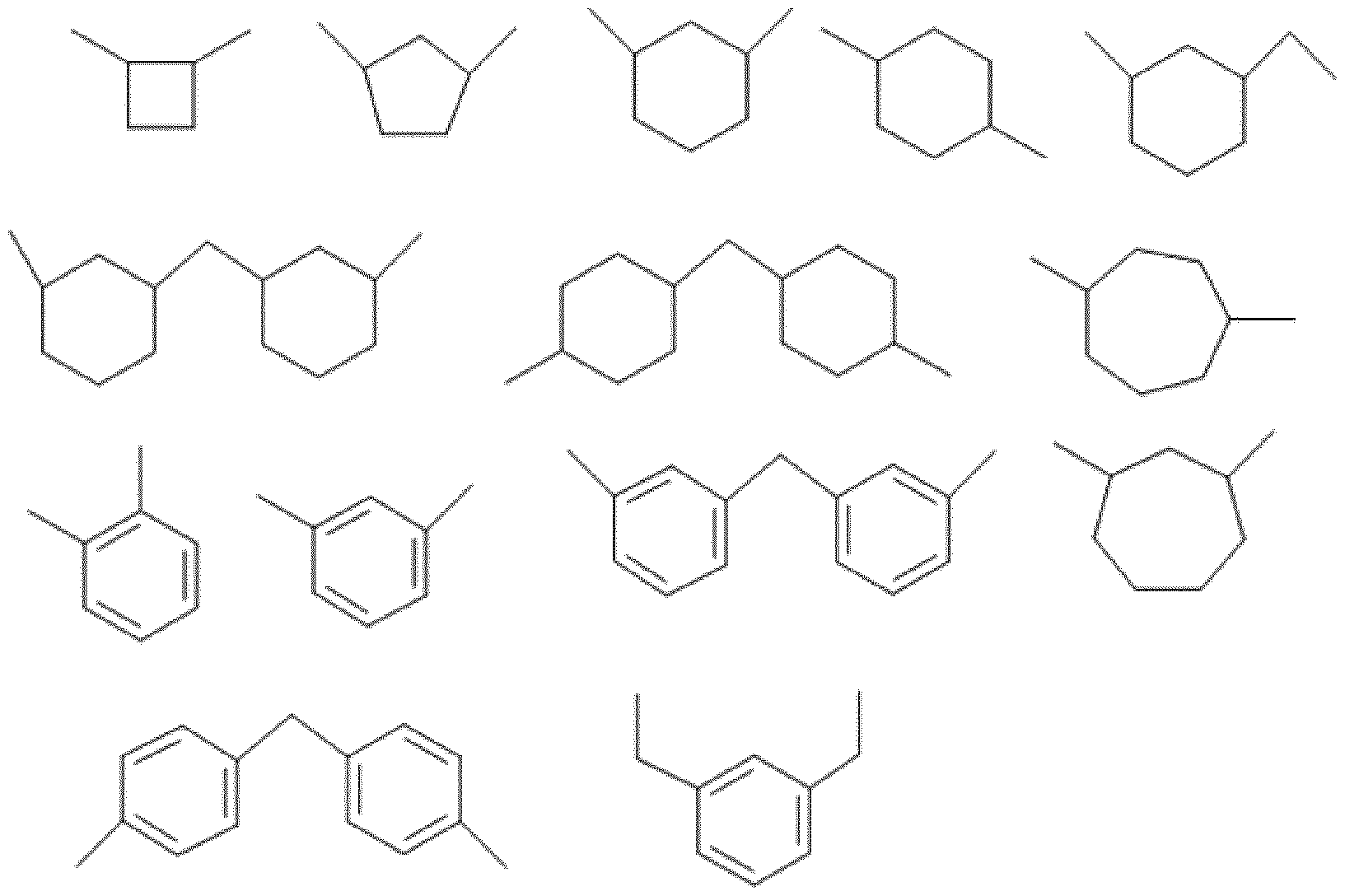
  • L 1 may be chosen from a radical derived from tolylene diisocyanate, hexamethylene diisocyanate, xylylene diisocyanate, 2,2,4-trimethylhexamethylene diisocyanate, 1,12-dodecane diisocyanate, norbornane diisocyanate, 2,4-bis(8- isocyanatooctyl)-1,3-dioctylcyclobutane, 4,4’-dicyclohexylmethane diisocyanate, tetramethylxylylene diisocyanate, isophorone diisocyanate, 1,5-napththylene diisocyanate, 4,4’-diphenylmethane diisocyanate, 4,4’-diphenyldimethylmethane diisocyanate and phenylene diisocyanate, and mixtures thereof.
  • L 1 is chosen from a C 3 -C 15 cycloalkylene radical or a C 6 -C 14 arylene group, and mixtures thereof, such as the compounds of formula (VII) below: .
  • L 1 is 4,4-dicyclohexylenemethane corresponding to formula (VIII) below: (VIII).
  • L 1 is not the m- tetramethylxylylene radical represented by formula (IX) below: (IX).
  • E independently represents a group chosen from: -O-R 3 -O-; -S-R 4 -S-; -R 5 -N(R 6 )-R 4 -N(R 6 )-R 5 -; in which R 3 and R 4 independently represent a divalent hydrocarbon-based radical optionally interrupted with one or more heteroatoms; - R 5 independently represents a covalent bond or a saturated divalent hydrocarbon-based radical, optionally interrupted with one or more heteroatoms; and - R 6 independently represents a hydrogen atom or a hydrocarbon-based radical, optionally interrupted with one or more heteroatoms.
  • R 3 and R 4 are independently chosen from a C 6 -C 14 arylene radical such as phenylene, a C 3 -C 12 cycloalkylene radical such as cyclopropylene and cyclobutylene, a linear or branched C 1 -C 18 alkylene radical such as methylene and ethylene, optionally interrupted with one or more heteroatoms, and mixtures thereof. More preferentially, R 3 and R 4 are independently chosen from a linear or branched C 1 - C 18 alkylene radical such as methylene, butylene, propylene or ethylene, optionally interrupted with one or more heteroatoms.
  • R 5 is chosen from a C 6 -C 14 arylene radical such as phenylene, a C 3 -C 12 cycloalkylene radical such as cyclopropylene and cyclobutylene, a linear or branched C 1 -C 18 alkylene radical such as methylene and ethylene, optionally interrupted with one or more heteroatoms, and mixtures thereof.
  • arylene radical such as phenylene
  • C 3 -C 12 cycloalkylene radical such as cyclopropylene and cyclobutylene
  • a linear or branched C 1 -C 18 alkylene radical such as methylene and ethylene, optionally interrupted with one or more heteroatoms, and mixtures thereof.
  • R 6 is chosen from a C 6 -C 14 arylene radical such as phenylene, a C 3 -C 12 cycloalkylene radical such as cyclopropylene and cyclobutylene, a linear or branched C 1 - C 18 alkylene radical such as methylene and ethylene, optionally interrupted with one or more heteroatoms, and mixtures thereof.
  • E represents a group -O-R 3 -O- in which R 3 is chosen from a C 6 -C 14 arylene radical, a C 3 -C 12 cycloalkylene radical, a linear or branched C 1 -C 18 alkylene radical, optionally interrupted with one or more heteroatoms, and mixtures thereof.
  • E represents a group -O-R 3 -O- in which R 3 represents a linear or branched C 1 -C 18 alkylene radical such as methylene, butylene, propylene or ethylene, optionally interrupted with one or more heteroatoms.
  • the (poly)carbodiimide compound is a copolymer derived from ⁇ -methylstyryl isocyanates of formula (X) below: , in which R independently represents an alkyl group containing from 1 to 24 carbon atoms, a cycloalkyl group containing from 3 to 24 carbon atoms or an aryl group containing from 6 to 24 carbon atoms, and n denotes an integer ranging from 2 to 100.
  • the term “alkyl group” is as defined previously.
  • the term “cycloalkyl group” is as defined previously.
  • n may denote an integer ranging from 2 to 50, preferably from 3 to 30 and even more preferentially from 5 to 10.
  • the (poly)carbodiimide compound is a compound of formula (XI) below: , in which R independently represents an alkyl group containing from 1 to 24 carbon atoms, a cycloalkyl group containing from 3 to 24 carbon atoms or an aryl group containing from 6 to 24 carbon atoms.
  • the “alkyl group”, the “cycloalkyl group” and the “aryl group” are as defined previously.
  • the (poly)carbodiimide compound is chosen from the compounds of formula (I) or of formula (II) in which: - X 1 and X 2 independently represent an oxygen atom; - R 1 and R 2 are independently chosen from dialkylamino alcohols, alkyl esters of hydroxycarboxylic acid and monoalkyl ethers of (poly)alkylene glycol, in which a hydroxyl group has been removed, and mixtures thereof, preferably monoalkyl ethers of (poly)alkylene glycol, in which a hydroxyl group has been removed, more preferentially the compound of formula (VI) as described previously in which R 13 represents a C 1 -C 4 alkyl group or a phenyl, preferably a C 1 -C 4 alkyl group, more preferentially a methyl, R 14 represents a hydrogen atom or a C 1 -C 4 alkyl group, preferably a hydrogen atom, and q denotes an integer
  • the (poly)carbodiimide compound is chosen from the compounds of formula (II) in which: - X 1 and X 2 independently represent an oxygen atom; - R 1 and R 2 are independently chosen from dialkylamino alcohols, alkyl esters of hydroxycarboxylic acid and monoalkyl ethers of (poly)alkylene glycol, in which a hydroxyl group has been removed, and mixtures thereof; - n and z denote an integer ranging from 1 to 20, with n+z ⁇ 2 and w is equal to 1; - L 1 is chosen from a C 1 -C 18 divalent aliphatic hydrocarbon-based radical, a C 3 -C 15 cycloalkylene radical, a C 3 -C 12 heterocycloalkylene group or a C 6 -C 14 arylene group, and mixtures thereof; - E independently represents a group chosen from: -O-R 3 -O-; -S-R 4 -S-S-S
  • the (poly)carbodiimide compound is chosen from the compounds of formula (II) in which: - X 1 and X 2 independently represent an oxygen atom; - R 1 and R 2 are, independently, monoalkyl ethers of (poly)alkylene glycol, in which a hydroxyl group has been removed; - n and z denote an integer ranging from 1 to 20, with n+z ⁇ 2 and w is equal to 1; - L 1 is a C 3 -C 15 cycloalkylene radical; - E independently represents a group chosen from: -O-R 3 -O-; -S-R 4 -S-; -R 5 -N(R 6 )-R 4 -N(R 6 )-R 5 -; in which R 3 and R 4 are independently chosen from a C 6 -C 14 arylene radical, a C 3 -C 12 cycloalkylene radical, a linear or branched C 1 -C
  • the (poly)carbodiimide compound is chosen from the compounds of formula (II) in which: - X 1 and X 2 independently represent an oxygen atom; - R 1 and R 2 independently represent the compound of formula (VI) below: R 13 -[O-CH 2 -C(H)(R 14 )] q - (VI), in which R 13 represents a C 1 -C 4 alkyl group or a phenyl, preferably a C 1 -C 4 alkyl group, more preferentially a methyl, R 14 represents a hydrogen atom or a C 1 -C 4 alkyl group, preferably a hydrogen atom and q denotes an integer ranging from 4 to 30; - n and z denote an integer ranging from 1 to 20, with n+z ranging from 4 to 10 and w is equal to 1; - L 1 is a C 3 -C 15 cycloalkylene radical such as cyclopentylene, cycloh
  • the (poly)carbodiimide compound is chosen from the compounds of formula (II) in which: - X 1 and X 2 independently represent an oxygen atom; - R 1 and R 2 independently represent the compound of formula (VI) below: R 13 -[O-CH 2 -C(H)(R 14 )] q - (VI) in which R 13 represents a C 1 -C 4 alkyl group or a phenyl, preferably a C 1 -C 4 alkyl group, more preferentially a methyl, R 14 represents a hydrogen atom or a C 1 -C 4 alkyl group, preferably a hydrogen atom and q denotes an integer ranging from 4 to 30; - n and z denote an integer ranging from 1 to 20, with n+z ranging from 4 to 10 and w is equal to 1; - L 1 is a C 3 -C 15 cycloalkylene radical such as cyclopentylene, cycloh
  • the (poly)carbodiimide compound is a compound of formula (XII) below: (XII), in which L1 is 4,4-dicyclohexylenemethane, n and z denote an integer ranging from 1 to 20, with n+z ranging from 4 to 10, E represents a group -O-R 3 -O- in which R 3 represents a linear or branched C 1 -C 18 alkylene radical such as methylene, propylene, butylene or ethylene, optionally interrupted with one or more heteroatoms, and r and s denote an integer ranging from 4 to 30.
  • (XII) in which L1 is 4,4-dicyclohexylenemethane, n and z denote an integer ranging from 1 to 20, with n+z ranging from 4 to 10, E represents a group -O-R 3 -O- in which R 3 represents a linear or branched C 1 -C 18 alkylene radical such as methylene, propylene
  • the total amount of the (poly)carbodiimide compound(s) ranges from 0.01% to 20% by weight, preferably from 0.1% to 15% by weight, more preferentially from 0.2% to 10% by weight, even more preferentially from 0.5% to 8% and better still from 1% to 6% by weight, relative to the total weight of composition C.
  • Compound containing at least one carboxylic acid group Composition C used in the context of the dyeing process according to the invention comprises (ii) at least one compound containing at least one carboxylic acid group.
  • the compound(s) containing at least one carboxylic acid group are chosen from silicone compounds comprising at least one carboxylic group, polyurethanes, acrylic polymers and mixtures thereof.
  • composition C comprises at least one compound containing at least one carboxylic acid group, chosen from polyurethanes, acrylic polymers and mixtures thereof.
  • the compound(s) containing at least one carboxylic acid group are in the form of aqueous dispersions of particles of polymer(s) chosen from polyurethanes, acrylic polymers and mixtures thereof.
  • composition C comprises at least one compound containing at least one carboxylic acid group in the form of aqueous dispersions of particles of polyurethanes, acrylic polymers and mixtures thereof.
  • the dispersion(s) may be simple dispersions in the aqueous medium of the cosmetic composition.
  • the aqueous dispersion(s) of polymer particles may be chosen from aqueous dispersions of polyurethane particles. More particularly, the polyurethane(s) present in the aqueous dispersions used in the present invention result from the reaction of: - a prepolymer of formula (A) below: (A), in which: - R 1 represents a divalent radical of a dihydroxylated compound; - R 2 represents a radical of an aliphatic or cycloaliphatic polyisocyanate; - R 3 represents a radical of a low molecular weight diol, optionally substituted with one or more ionic groups; - n represents an integer ranging from 1 to 5, and - m is greater than 1; - at least one chain extender according to formula (B) below: H 2 N-R 4 -NH 2 (B), in which R 4 represents an alkylene or alkylene oxide radical which is not
  • dihydroxylated compounds of high molecular weight mention may be made of polyol polyesters, polyol polyethers, polyhydroxylated polycarbonates, polyhydroxylated polyacetates, polyhydroxylated polyacrylates, polyhydroxylated amide polyesters, polyhydroxylated polyalkadienes, polyhydroxylated polythioethers, and mixtures thereof.
  • the hydroxylated compounds are chosen from polyol polyesters, polyol polyethers, polyhydroxylated polycarbonates, and mixtures thereof.
  • the polyisocyanates that may be used according to the present invention are notably chosen from organic diisocyanates with a molecular weight from about 112 to 1000, and preferably from about 140 to 400.
  • the polyisocyanates are chosen from diisocyanates and more particularly from those represented by the general formula R 2 (NCO) 2 , in which R 2 represents a divalent aliphatic hydrocarbon-based group containing from 4 to 18 carbon atoms, a divalent cycloaliphatic hydrocarbon-based group containing from 5 to 15 carbon atoms, a divalent araliphatic hydrocarbon-based group containing from 7 to 15 carbon atoms or a divalent aromatic hydrocarbon-based group containing from 6 to 15 carbon atoms.
  • R 2 represents an organic diisocyanate.
  • organic diisocyanates examples include tetramethylene diisocyanate, 1,6-hexamethylene diisocyanate, dodecamethylene diisocyanate, 1,3-diisocyanatocyclohexane, 1,4- diisocyanatocyclohexane, 3-isocyanatomethyl-3,5,5-trimethylcyclohexane isocyanate (isophorone diisocyanate or IPDI), bis(4-isocyanatocyclohexyl)methane, 1,3- bis(isocyanatomethyl)cyclohexane, 1,4-bis(isocyanatomethyl)cyclohexane, bis(4- isocyanato-3-methylcyclohexyl)methane, isomers of toluene diisocyanate (TDI) such as toluene 2,4-diisocyanate, toluene 2,6-diisocyanate
  • TDI toluen
  • the diisocyanates are aliphatic and cycloaliphatic diisocyanates, and are more preferentially chosen from 1,6-hexamethylene diisocyanate, 3-isocyanatomethyl-3,5,5- trimethylcyclohexane isocyanate, and mixtures thereof.
  • the term “low molecular weight diol” refers to a diol with a molecular weight from about 62 to 700, and preferably from 62 to 200. These diols may comprise aliphatic, alicyclic or aromatic groups. Preferably, they comprise only aliphatic groups.
  • R 3 represents a low molecular weight diol containing more than 20 carbon atoms, more preferentially chosen from ethylene glycol, diethylene glycol, 1,2- propanediol, 1,3-propanediol, 1,4-butanediol, 1,3-butylene glycol, neopentyl glycol, butylethylpropanediol, cyclohexanediol, 1,4-cyclohexanedimethanol, 1,6-hexanediol, bisphenol A (2,2-bis(4-hydroxyphenyl)propane), hydrogenated bisphenol A (2,2-bis(4- hydroxycyclohexyl)propane), and mixtures thereof.
  • ethylene glycol diethylene glycol
  • 1,2- propanediol 1,3-propanediol
  • 1,4-butanediol 1,3-butylene glycol
  • neopentyl glycol butylethyl
  • the low molecular weight diols may optionally comprise ionic or potentially ionic groups.
  • Examples of low molecular weight diols containing ionic or potentially ionic groups are notably described in patent US 3412054. Such compounds are preferably chosen from dimethylolbutanoic acid, dimethylolpropionic acid, polycaprolactone diols containing a carboxyl group, and mixtures thereof. If low molecular weight diols containing ionic or potentially ionic groups are used, they are preferably used in an amount such that less than 0.30 meq of COOH per gram of polyurethane is present in the polyurethane dispersion.
  • the prepolymer is extended by means of two families of chain extenders.
  • the first family of chain extenders corresponds to the compounds of general formula (B).
  • the chain extenders of formula (B) are preferably chosen from alkylenediamines, such as hydrazine, ethylenediamine, propylenediamine, 1,4-butylenediamine, piperazine; alkylenediamine oxides, such as 3- ⁇ 2-[2-(3-aminopropoxy)ethoxy]ethoxy ⁇ propylamine (also known as dipropylamine diethylene glycol or DPA-DEG available from Tomah Products, Milton, Wis.), 2-methyl-1,5-pentanediamine (Dytec A from DuPont), hexanediamine, isophorone diamine, 4,4-methylenedi(cyclohexylamine), ether amines of the DPA series, available from Tomah Products, Milton, Wis., such as dipropylamine propylene glycol, dipropylamine dipropylene glycol, dipropylamine tripropylene
  • the second family of chain extenders corresponds to the compounds of general formula (C).
  • Such compounds preferably have an ionic or potentially ionic group and two groups that can react with isocyanate groups.
  • Such compounds may optionally comprise two groups that react with isocyanate groups and one group which is ionic or capable of forming an ionic group.
  • the ionic or potentially ionic group may preferably be chosen from ternary or quaternary ammonium groups or groups that can be converted into such groups, a carboxyl group, a carboxylate group, a sulfonic acid group and a sulfonate group.
  • the at least partial conversion of groups that can be converted into a ternary or quaternary ammonium group salt may be performed before or during the mixing with water.
  • the chain extenders of formula (C) are preferably chosen from diaminosulfonates, for instance the sodium salt of N-(2-aminoethyl)-2-aminoethanesulfonic acid (ASA), the sodium salt of N-(2-aminoethyl)-2-aminopropionic acid, and mixtures thereof.
  • the polyurethane that may be used according to the present invention may optionally also comprise compounds which are located, respectively, at the chain ends and which terminate said chains (chain terminators). Such compounds are notably described in patents US 7445770 and/or US 7452770.
  • the aqueous dispersion of polyurethane particles has a viscosity of less than 2000 mPa.s at 23°C, more preferentially less than 1500, and better still less than 1000. Even more preferably, the aqueous polyurethane dispersion has a glass transition temperature of less than 0°C.
  • the aqueous polyurethane dispersion has a polyurethane (or active material, or solids) content, on the basis of the weight of the dispersion, of from 20% to 60% by weight, more preferentially from 25% to 55% by weight and better still from 30% to 50% by weight.
  • the polyurethane content (dry matter) of the aqueous dispersion is preferably from 20% to 60% by weight, more preferentially from 25% to 55% by weight and better still from 30% to 50% by weight, relative to the total weight of the dispersion.
  • the aqueous dispersion of polyurethane particles has a glass transition temperature (Tg) of less than or equal to -25°C, preferably less than -35°C and more preferentially less than -40°C.
  • Tg glass transition temperature
  • the polyurethane particles may have a mean diameter ranging up to about 1000 nm, for example from about 50 nm to about 800 nm, better still from about 100 nm to about 500 nm.
  • aqueous polyurethane dispersions examples include those sold under the name Baycusan® by Bayer, for instance Baycusan® C1000 (INCI name: polyurethane-34), Baycusan® C1001 (INCI name: polyurethane-34), Baycusan® C1003 (INCI name: polyurethane-32), Baycusan® C1004 (INCI name: polyurethane-35) and Baycusan® C1008 (INCI name: polyurethane-48).
  • Baycusan® C1000 INCI name: polyurethane-34
  • Baycusan® C1001 INCI name: polyurethane-34
  • Baycusan® C1003 INCI name: polyurethane-32
  • Baycusan® C1004 INCI name: polyurethane-35
  • Baycusan® C1008 INCI name: polyurethane-48.
  • aqueous polyurethane dispersions of isophthalic acid/adipic acid copolymer/hexylene glycol/neopentyl glycol/dimethylol acid/isophorone diisocyanate (INCI name: Polyurethane-1, such as Luviset® PUR, BASF), the polyurethane of polycarbonate, polyurethane and aliphatic polyurethane of aliphatic polyester (such as the Neorez® or DSM series, such as Neorez® R989 and Neorez® R- 2202).
  • the aqueous dispersion of polyurethane particles may be chosen from aqueous dispersions of particles of compounds having the INCI name polyurethane-35 or compounds having the INCI name polyurethane-34.
  • the compound(s) containing at least one carboxylic acid group are in the form of aqueous dispersions of particles of acrylic polymers, more preferentially in the form of aqueous dispersions of film-forming acrylic polymer particles.
  • the term “polymer” means a compound corresponding to the repetition of one or more units (these units being derived from compounds known as monomers). This or these unit(s) are repeated at least twice and preferably at least three times.
  • film-forming polymer refers to a polymer that is capable of forming, by itself or in the presence of an auxiliary film-forming agent, a macroscopically continuous film on a support, notably on keratin hair fibers keratin materials, and preferably a cohesive film.
  • auxiliary film-forming agent a macroscopically continuous film on a support, notably on keratin hair fibers keratin materials, and preferably a cohesive film.
  • acrylic polymer means a polymer synthesized from at least one monomer chosen from (meth)acrylic acid and/or (meth)acrylic acid ester and/or (meth)acrylic acid amide.
  • the unit(s) derived from the (meth)acrylic acid monomers of the polymer may optionally be in the form of salt(s), notably of alkali metal, alkaline-earth metal or ammonium salt(s), or organic base salt(s).
  • the (meth)acrylic acid esters are advantageously chosen from alkyl (meth)acrylates, in particular C 1 to C 30 , preferably C 1 to C 20 and better still C 1 to C 10 alkyl (meth)acrylates, aryl (meth)acrylates, in particular C 6 to C 10 aryl (meth)acrylates, and hydroxyalkyl (meth)acrylates, in particular C 2 to C 6 hydroxyalkyl (meth)acrylates.
  • alkyl (meth)acrylates that may be mentioned are methyl (meth)acrylate, ethyl (meth)acrylate, butyl (meth)acrylate, isobutyl (meth)acrylate, 2-ethylhexyl (meth)acrylate, lauryl (meth)acrylate and cyclohexyl (meth)acrylate.
  • hydroxyalkyl (meth)acrylates that may be mentioned are hydroxyethyl acrylate, 2-hydroxypropyl acrylate, hydroxyethyl methacrylate and 2-hydroxypropyl methacrylate.
  • aryl (meth)acrylates that may be mentioned are benzyl acrylate and phenyl acrylate.
  • the (meth)acrylic acid esters that are particularly preferred are alkyl, preferably C 1 to C 30 , more preferentially C 1 to C 20 , better still C 1 to C 10 , and even more particularly C 1 to C 4 , alkyl (meth)acrylates.
  • the alkyl group of the esters may be fluorinated, or even perfluorinated, i.e. some or all of the hydrogen atoms of the alkyl group are replaced with fluorine atoms.
  • (meth)acrylic acid amides examples that may be mentioned include (meth)acrylamides and also N-alkyl(meth)acrylamides, in particular N-(C 2 to C 12 alkyl)(meth)acrylamides.
  • N-alkyl(meth)acrylamides that may be mentioned are N-ethylacrylamide, N-t-butylacrylamide, N-t-octylacrylamide and N- undecylacrylamide.
  • the acrylic polymer according to the invention may be a homopolymer or a copolymer, advantageously a copolymer, better still a copolymer of (meth)acrylic acid and of (meth)acrylic acid esters.
  • the acrylic polymer(s) according to the invention comprise one or more units derived from the following monomers: a) (meth)acrylic acid; and b) C 1 to C 30 , more preferentially C 1 to C 20 , better still C 1 to C 10 , and even more particularly C 1 to C 4 , alkyl (meth)acrylate.
  • the aqueous dispersion of acrylic polymer particles does not comprise any surfactant.
  • surfactant refers to any agent that is capable of modifying the surface tension between two surfaces.
  • acrylic polymers according to the invention, mention may be made of copolymers of (meth)acrylic acid and of methyl or ethyl (meth)acrylate, in particular copolymers of methacrylic acid and of ethyl acrylate such as the compound sold under the trade name Luvimer MAE by the company BASF, or the compound Polyacrylate-2 Crosspolymer sold under the trade name Fixate Superhold Polymer by the company Lubrizol, or the compound Acrylate Copolymer sold under the trade name Daitosol 3000VP3 by the company Daito Kasei Kogyo, or the compound Acrylate Polymer sold under the trade name Daitosol 3000 SLPN-PE1 or Daitosol 3000SLPN-SD by the company Daito Kasei Kogyo.
  • copolymers of (meth)acrylic acid and of methyl or ethyl (meth)acrylate such as the compound sold under the trade name Luvimer MAE by the company BASF, or the compound Poly
  • the acrylic polymer may optionally comprise one or more additional monomers, other than the (meth)acrylic acid and/or (meth)acrylic acid ester and/or (meth)acrylic acid amide monomers.
  • additional monomer mention will be made, for example, of styrene monomers, in particular styrene and ⁇ -methylstyrene, and preferably styrene.
  • the acrylic polymer may be a styrene/(meth)acrylate copolymer and notably a polymer chosen from copolymers resulting from the polymerization of at least one styrene monomer and at least one C 1 to C 20 , preferably C 1 to C 10 , alkyl (meth)acrylate monomer.
  • the C 1 to C 10 alkyl (meth)acrylate monomer may be chosen from methyl acrylate, ethyl acrylate, propyl acrylate, butyl acrylate, hexyl acrylate, octyl acrylate and 2-ethylhexyl acrylate.
  • composition C comprises at least one aqueous dispersion of acrylic polymer particles.
  • composition C comprises at least one aqueous dispersion of acrylic polymer particles comprising one or more units derived from the following monomers: a) (meth)acrylic acid; and b) C 1 to C 30 , more preferentially C 1 to C 20 , better still C 1 to C 10 , and even more particularly C 1 to C 4 , alkyl (meth)acrylate.
  • the aqueous dispersion of acrylic polymer particles has an acrylic polymer (or active material, or solids) content, on the basis of the weight of the dispersion, of from 20% to 60% by weight, more preferentially from 22% to 55% by weight and better still from 25% to 50% by weight.
  • the silicone compound(s) comprising at least one carboxylic group are chosen from silicone acrylic copolymers.
  • the compound(s) containing at least one carboxylic function are chosen from silicone acrylic copolymers.
  • said silicone acrylic copolymer(s) comprise: - at least one acrylic or methacrylic or crotonic unit; and - at least one polydimethylsiloxane (PDMS) unit.
  • polydimethylsiloxanes“ (also abbreviated as PDMSs) denotes, in accordance with what is generally accepted, any organosilicon polymer or oligomer of linear structure, of variable molecular weight, obtained by polymerization and/or polycondensation of suitably functionalized silanes, and constituted essentially of a repetition of main units in which the silicon atoms are linked together via oxygen atoms (siloxane bond Si-O-Si), including methyl radicals directly linked via a carbon atom to said silicon atoms.
  • PDMSs any organosilicon polymer or oligomer of linear structure, of variable molecular weight, obtained by polymerization and/or polycondensation of suitably functionalized silanes, and constituted essentially of a repetition of main units in which the silicon atoms are linked together via oxygen atoms (siloxane bond Si-O-Si), including methyl radicals directly linked via a carbon atom to said silicon atoms.
  • the PDMS chains that may be used to obtain the copolymer used according to the invention include at least one polymerizable radical group, preferably located on at least one of the ends of the chain, i.e. the PDMS may contain, for example, a polymerizable radical group on each of the two ends of the chain or a polymerizable radical group on one end of the chain and a trimethylsilyl end group on the other end of the chain.
  • the term “polymerizable radical group” means a radical that is capable of polymerizing with other polymerizable radical groups or monomers.
  • the polydimethylsiloxane unit comprises at least one polymerizable radical group.
  • the polymerizable radical group comprises at least one vinyl group.
  • the polydimethylsiloxane (PDMS) unit comprises at least one polymerizable radical group comprising at least one vinyl group, preferably at least two polymerizable radical groups comprising at least one vinyl group, preferably located on at least one of the chain ends.
  • said silicone acrylic copolymer(s) comprise(s) at least one acrylic or methacrylic or crotonic unit, i.e. at least one unit comprising a carboxylic group.
  • carboxylic group means a COOH or COO- functional group, the counterion of the COO- group possibly being chosen from alkali metals, alkaline-earth metals and quaternary ammoniums.
  • said silicone acrylic copolymer(s) comprise: - at least one acrylic or methacrylic or crotonic unit, and at least one acrylic ester or methacrylic ester or vinyl ester unit; and - at least one polydimethylsiloxane (PDMS) unit.
  • PDMS polydimethylsiloxane
  • the composition comprises one or more silicone acrylic copolymers comprising: - at least one crotonic unit and at least one unit chosen from an alkyl crotonate unit, the alkyl radical being a linear or branched, saturated radical containing from 1 to 20 carbon atoms; a vinyl acetate unit; a vinyl alkyl ester unit, the alkyl radical being a linear or branched, saturated radical containing from 2 to 20 carbon atoms; and mixtures thereof; and - at least one polydimethylsiloxane (PDMS) unit.
  • crotonic unit means a unit derived from a crotonic acid monomer or a salt thereof.
  • alkyl crotonate unit means a unit derived from a crotonic acid ester monomer containing a saturated, linear or branched alkyl radical containing from 1 to 20 carbon atoms.
  • vinyl alkyl ester unit means a unit derived from a vinyl ester monomer containing a saturated, linear or branched alkyl radical containing from 2 to 20 carbon atoms.
  • vinyl acetate unit means a unit derived from a vinyl acetate monomer.
  • said silicone acrylic copolymer(s) comprise: - at least one crotonic unit, at least one vinyl acetate unit and at least one vinyl alkyl ester unit, the alkyl radical being a saturated, linear or branched radical containing from 2 to 20 carbon atoms, preferably from 2 to 18 carbon atoms, and - at least one polydimethylsiloxane (PDMS) unit.
  • PDMS polydimethylsiloxane
  • said silicone acrylic copolymer(s) comprise: - at least one crotonic unit, at least one vinyl acetate unit and at least one vinyl alkyl ester unit, the alkyl radical being a linear or branched, saturated radical containing from 6 to 16 carbon atoms, and - at least one polydimethylsiloxane (PDMS) unit comprising at least one polymerizable radical group comprising at least one vinyl group.
  • PDMS polydimethylsiloxane
  • the composition comprises one or more silicone acrylic copolymers comprising: - at least one crotonic unit, at least one vinyl acetate unit and at least one vinyl alkyl ester unit, the alkyl radical being a saturated, linear or branched radical containing from 2 to 20 carbon atoms, preferably from 2 to 18 carbon atoms; and - at least one polydimethylsiloxane (PDMS) unit including at least one polymerizable radical group comprising at least one vinyl group.
  • silicone acrylic copolymers comprising: - at least one crotonic unit, at least one vinyl acetate unit and at least one vinyl alkyl ester unit, the alkyl radical being a saturated, linear or branched radical containing from 2 to 20 carbon atoms, preferably from 2 to 18 carbon atoms; and - at least one polydimethylsiloxane (PDMS) unit including at least one polymerizable radical group comprising at least one vinyl group.
  • PDMS polydimethylsiloxane
  • the composition comprises one or more silicone acrylic copolymers comprising: - at least one crotonic unit, at least one vinyl acetate unit and at least one vinyl alkyl ester unit, the alkyl radical being a saturated, linear or branched radical containing from 6 to 16 carbon atoms; and - at least one polydimethylsiloxane (PDMS) unit including at least one polymerizable radical group comprising at least one vinyl group.
  • PDMS polydimethylsiloxane
  • silicone acrylic copolymers that may be used in the context according to the invention, mention may be made of the compound sold by the company Wacker Chemie AG under the trade name Belsil® P1101, having the INCI name Crotonic Acid/Vinyl C8- 12 Isoalkyl Esters/VA/Bis-Vinyldimethicone Crosspolymer.
  • the total amount of the compound(s) containing at least one carboxylic acid group preferably ranges from 0.1% to 30% by weight, more preferentially from 0.5% to 20% by weight, better still from 0.5% to 15% by weight, and even more preferentially from 1% to 10% by weight, relative to the total weight of composition C.
  • the total amount of the aqueous dispersion(s) of polymer particles chosen from polyurethanes, acrylic polymers, and mixtures thereof preferably ranges from 0.1% to 50% by weight, more preferentially from 0.5% to 40% by weight, better still from 0.5% to 30% by weight, and even more preferentially from 1% to 20% by weight, relative to the total weight of composition C.
  • the total amount of the aqueous dispersion(s) of acrylic polymer particle(s) preferably ranges from 0.1% to 50% by weight, more preferentially from 0.5% to 40% by weight, better still from 0.5% to 30% by weight, and even more preferentially from 1% to 20% by weight, relative to the total weight of composition C.
  • the total amount of silicone acrylic copolymer(s) ranges from 0.1% to 30% by weight, preferably from 0.5% to 20% by weight, more preferentially from 1% to 15% by weight and better still from 2% to 10% by weight relative to the total weight of composition C.
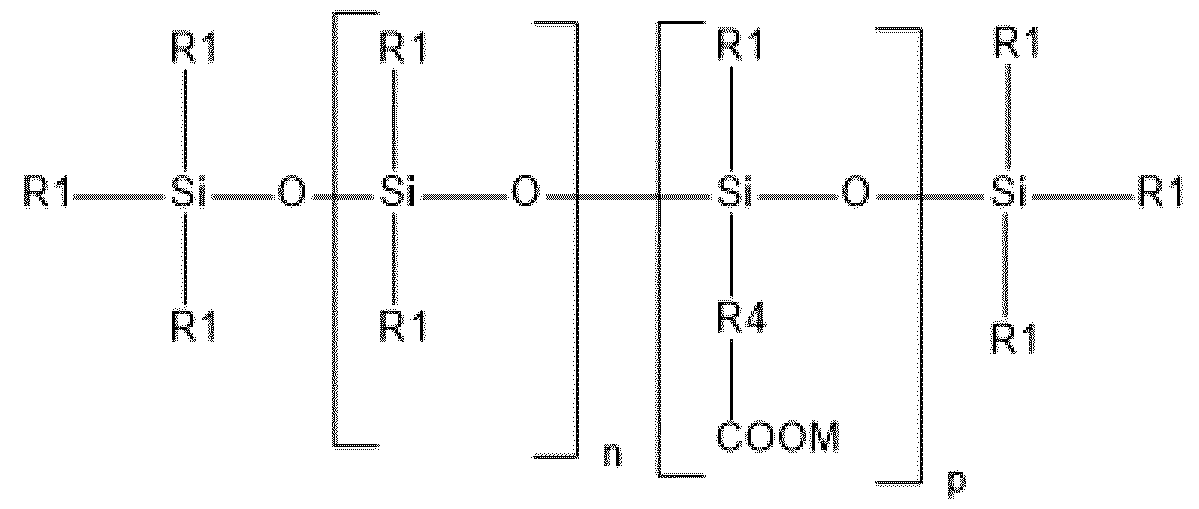
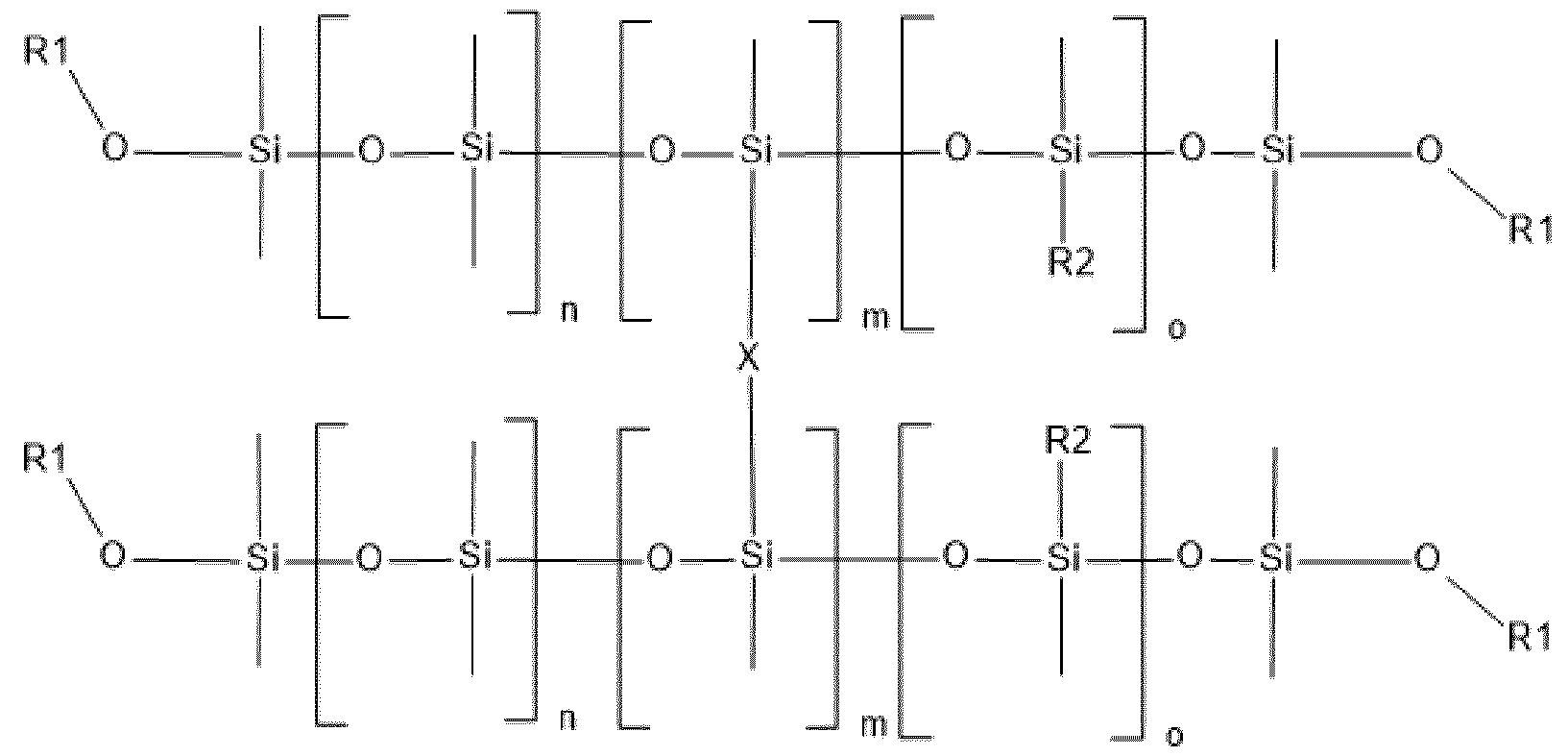
  • Amino silicone of formula (XIII) Composition C used in the context of the dyeing process according to the invention comprises at least one amino silicone of formula (XIII) below: (XIII) in which: - R1 independently represents a hydrogen atom or an alkyl group containing from 1 to 10 carbon atoms, preferably from 1 to 4 carbon atoms; - R2 independently represents a monovalent radical of formula -C q H 2q L in which q is a number ranging from 2 to 8 and L is an optionally quaternized amine group chosen from the following groups: -N(R3) 2 ; -N+(R3) 3 A-; -NR3-Y-N(R3) 2 and -NR-Y-N+(R3) 3 A-, in which R3, which may be identical or different, represents a hydrogen atom, a phenyl group, a benzyl group or a saturated monovalent hydrocarbon-based radical, for example a C 1 -C 20 alkyl group; Y denotes
  • amino silicone denotes any silicone including at least one primary, secondary or tertiary amine or a quaternary ammonium group.
  • the weight-average molecular masses of these amino silicones may be measured by gel permeation chromatography (GPC) at room temperature (25°C), as polystyrene equivalent.
  • the columns used are ⁇ styragel columns.
  • the eluent is THF and the flow rate is 1 ml/min.200 ⁇ l of a 0.5% by weight solution of silicone in THF are injected. Detection is performed by refractometry and UV-metry.
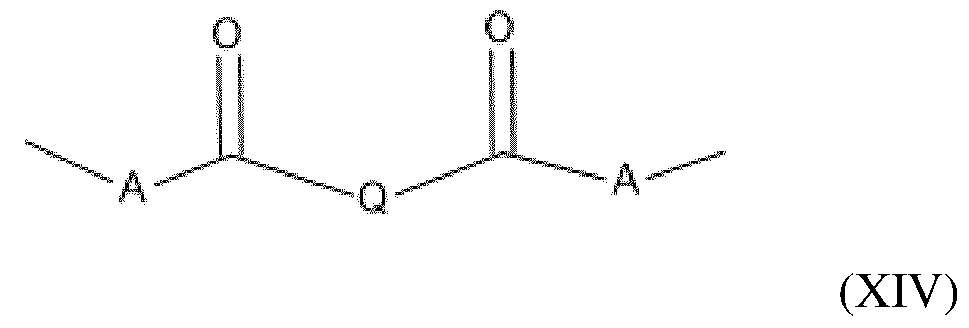
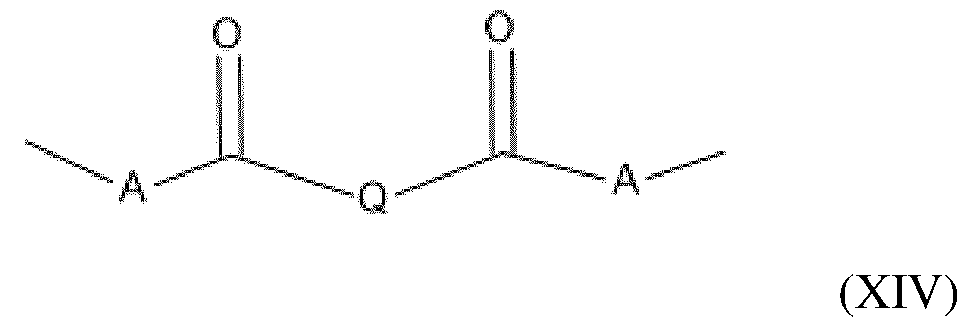
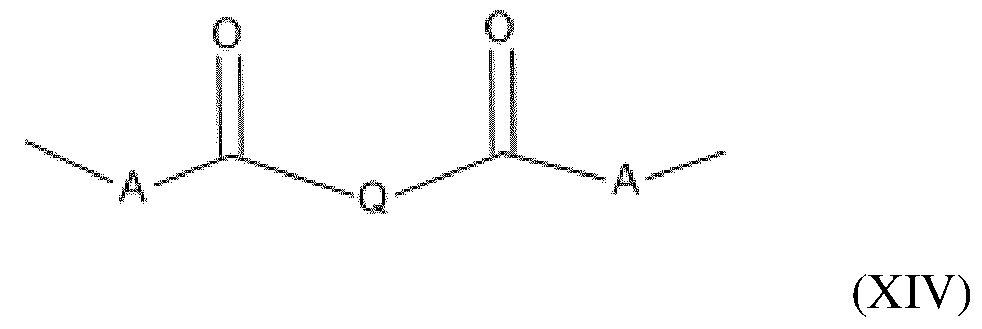
  • the amino silicone(s) of formula (XIII) are such that: - R1 independently represents a hydrogen atom or an alkyl group containing from 1 to 10 carbon atoms, preferably from 1 to 4 carbon atoms; - R2 independently represents a monovalent radical of formula -C q H 2q L in which q is a number ranging from 2 to 8 and L is an optionally quaternized amine group chosen from the following groups: -N(R3) 2 ; -N(R3)-CH 2 -CH 2 -N(R3) 2 ; in which R3, which may be identical or different, represents a hydrogen atom, a phenyl group, a benzyl group or a saturated monovalent hydrocarbon-based radical, for example a C 1 -C 20 alkyl group; - X represents a radical corresponding to formula (XIV) below: in which: - A independently represents a linear or branched alkylene group containing from 1 to 6 carbon atoms
  • the amino silicone(s) of formula (XIII) are such that: - R1 independently represents a hydrogen atom or an alkyl group containing from 1 to 10 carbon atoms, preferably from 1 to 4 carbon atoms; - R2 independently represents a monovalent radical of formula -C q H 2q L in which q is a number ranging from 2 to 8 and L is an amine group having the following formula: -N(R3)-CH 2 -CH 2 -N(R3) 2 ; in which R3 represents a hydrogen atom, - X represents a radical corresponding to formula (XV) below: in which: - Q represents an alkylene group containing from 1 to 10 carbon atoms, said alkylene group being optionally substituted with at least one alkoxy group containing from 1 to 10 carbon atoms, a hydroxyl group or an aminoalkyl group containing from 1 to 20 carbon atoms, and - n denotes an integer ranging from 0 to 500
  • the amino silicone is of formula (XVI) below: (XVI) in which: - R1 independently represents a hydrogen atom or an alkyl group containing from 1 to 10 carbon atoms, preferably from 1 to 4 carbon atoms; - Q represents an alkylene group containing from 1 to 10 carbon atoms, said alkylene group being optionally substituted with at least one alkoxy group containing from 1 to 10 carbon atoms, a hydroxyl group or an aminoalkyl group containing from 1 to 20 carbon atoms, and - n denotes an integer ranging from 0 to 500, m denotes an integer ranging from 1 to 500 and o denotes an integer ranging from 0 to 500 with n+m+o ranging from 250 to 500.
  • the amino silicone(s) of formula (XIII) are present in emulsion or microemulsion with surfactants, preferably with nonionic surfactants such as trideceth-10.
  • surfactants preferably with nonionic surfactants such as trideceth-10.
  • nonionic surfactants such as trideceth-10.
  • the amino silicones of formula (XIII) that may be used in composition C, mention may be made of the amino silicone having the INCI name Bis-Hydroxy/Methoxy/Methyl Amodimethicone Crosspolymer. Mention may also be made of the commercial product Belsil® DADM 3240 E sold by the company Wacker.
  • composition C used in the context of the dyeing process according to the invention may comprise one or more block silicone copolymers different from the silicone compounds described previously.
  • the block silicone copolymer used in the composition according to the invention is a linear block copolymer, i.e. a non-crosslinked copolymer obtained by chain extension and not by crosslinking.
  • block copolymer denotes a polymer comprising at least two different blocks.
  • each block of the polymer is derived from one type of monomer or from several different types of monomer. This means that each block may consist of a homopolymer or a copolymer; this copolymer constituting the block may in turn be random or alternating. It should also be noted that when the copolymer is “linear”, the polymer structure is not branched, star-branched or grafted.
  • the block silicone copolymer which is preferably linear, is advantageously in the form of particles dispersed in an aqueous medium. The block copolymers are obtained by chain extension.
  • the aqueous dispersions of block silicone copolymer particles used according to the invention may be chosen notably from those described in EP-A-874017.
  • the silicone copolymers constituting these particles may notably be obtained by chain extension reaction, in the presence of a catalyst, from at least: - (a) a polysiloxane (i) containing at least one reactive group and preferably one or two reactive groups per molecule; and - (b) an organosilicon compound (ii) which reacts with the polysiloxane (i) by chain extension reaction.
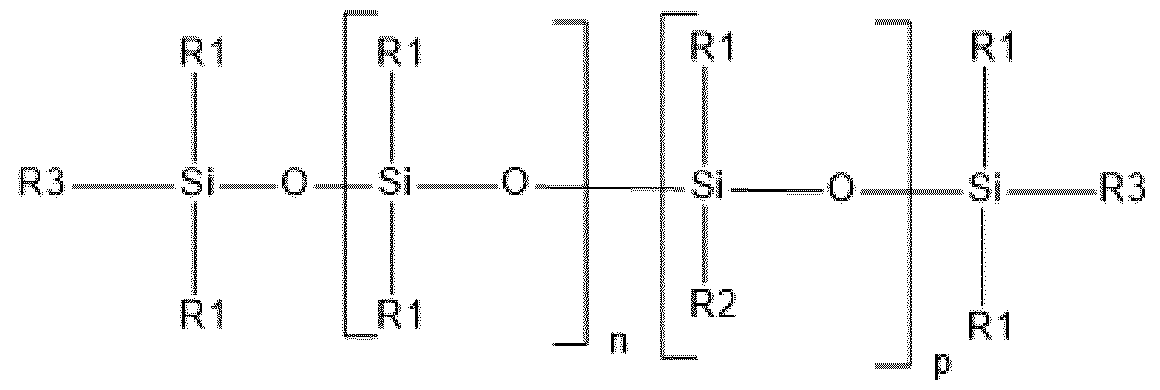
  • R1 and R2 independently of each other, represent a hydrocarbon-based group containing from 1 to 20 carbon atoms and preferably from 1 to 10 carbon atoms, such as methyl, ethyl, propyl or butyl, or an aryl group such as phenyl, or a reactive group
  • n is an integer greater than 1, on condition that there are on average between one and two reactive groups per polymer.
  • reactive group means any group that is capable of reacting with the organosilicon compound (ii) to form a block copolymer.
  • reactive groups mention may be made of hydrogen; aliphatically unsaturated groups and notably vinyl, allyl or hexanyl; the hydroxyl group; alkoxy groups such as methoxy, ethoxy or propoxy; alkoxy-alkoxy groups; the acetoxy group; amine groups, and mixtures thereof.
  • more than 90% and better still more than 98% of the reactive groups are at the end of the chain, i.e. the radicals R2 generally constitute more than 90% and even 98% of the reactive groups.
  • n may notably be an integer ranging from 2 to 100, preferably from 10 to 30, and better still from 15 to 25.
  • the polysiloxanes of formula (XVII) are preferably linear polymers, i.e. including few branches, and generally less than 2 mol% of siloxane units.
  • the groups R1 and R2 may optionally be substituted with amine groups, epoxy groups, or groups including sulfur, silicon or oxygen.
  • at least 80% of the groups R1 are alkyl groups and better still methyl groups.
  • the reactive group R2 is an aliphatically unsaturated group, notably vinyl.
  • polysiloxanes (i) mention may notably be made of dimethylvinylsiloxy- polydimethylsiloxane, a compound of formula (XVII) in which the radicals R1 are methyl radicals and, at the end of the chain, the radical R2 is a vinyl radical while the other two radicals R2 are methyl radicals.
  • the organosilicon compound (ii) may be chosen from the polysiloxanes of formula (XVII) or compounds acting as chain-extending agents. If it is a compound of formulation (XVII), the polysiloxane (i) will include a first reactive group and the organosilicon compound (ii) will include a second reactive group which will react with the first.
  • the organosilicon compound (ii) is a liquid organohydrogenopolysiloxane of formula (XVIII): where n is an integer greater than 1 and preferably greater than 10, for example ranging from 2 to 100, preferably from 10 to 30 and better still from 15 to 25. According to a particular embodiment of the invention, n is equal to 20.
  • the block silicone copolymers used according to the invention are advantageously free of oxyalkylene group(s), notably free of oxyethylene and/or oxypropylene group(s).
  • the catalyst for the reaction between the polysiloxane and the organosilicon compound may be chosen from metals and notably from platinum, rhodium, tin, titanium, copper and lead. It is preferably platinum or rhodium.
  • the block silicone copolymer(s) used according to the invention are generally in the form of an aqueous dispersion of particles, which may notably be obtained, for example, by mixing (a) water, (b) at least one emulsifier, (c) the polysiloxane (i), (d) the organosilicon compound (ii) and (e) a catalyst.
  • one of the constituents (c), (d) or (e) is added last to the mixture, so that the chain extension reaction only begins in the dispersion.
  • emulsifiers that may be used in the preparation process described above to obtain the aqueous dispersion of particles, mention may be made of nonionic or ionic (anionic, cationic or amphoteric) emulsifiers.
  • nonionic emulsifiers which may be chosen from polyalkylene glycol fatty alcohol ethers, including from 8 to 30 carbon atoms and preferably from 10 to 22 carbon atoms; polyoxyalkylenated and notably polyoxyethylenated sorbitan alkyl esters, where the alkyl radical includes from 8 to 30 carbon atoms and preferably from 10 to 22 carbon atoms; polyoxyalkylenated and notably polyoxyethylenated alkyl esters, in which the alkyl radical includes from 8 to 30 carbon atoms and preferably from 10 to 22 carbon atoms; polyethylene glycols; polypropylene glycols; diethylene glycols; and mixtures thereof.
  • polyalkylene glycol fatty alcohol ethers including from 8 to 30 carbon atoms and preferably from 10 to 22 carbon atoms
  • polyoxyalkylenated and notably polyoxyethylenated sorbitan alkyl esters where the alkyl radical includes from 8 to 30
  • the amount of emulsifier(s) is generally from 1% to 30% by weight relative to the total weight of the reaction mixture.
  • the emulsifier used to obtain the aqueous dispersion of particles is preferably chosen from polyethylene glycol fatty alcohol ethers and mixtures thereof, and notably polyethylene glycol alcohol ethers including 12 or 13 carbon atoms and from 2 to 100 oxyethylene units and preferably from 3 to 50 oxyethylene units, and mixtures thereof. Examples that may be mentioned include C 12 -C 13 Pareth-3, C 12 -C 13 Pareth-23 and mixtures thereof.
  • block silicone copolymer particles use may notably be made of the product sold under the name HMW 2220 Nonionic Emulsion by the company Dow Corning (CTFA name: divinyl dimethicone/dimethicone copolymer/C12-C13 Pareth-3/C12-C13 Pareth-23), which is an aqueous divinyl dimethicone/dimethicone copolymer dispersion containing C 12 -C 13 Pareth-3 and C 12 -C 13 Pareth-23.
  • CTFA name divinyl dimethicone/dimethicone copolymer/C12-C13 Pareth-3/C12-C13 Pareth-23
  • the block silicone copolymer(s) may be present in a total amount ranging from 0.01% to 15%, preferably from 0.05% to 10%, more preferentially from 0.1% to 8% and even more preferentially from 0.25% to 5% by weight relative to the total weight of composition C.
  • Colouring agent Composition C used in the context of the process according to the invention comprises one or more colouring agents chosen from pigments, direct dyes and mixtures thereof.
  • composition C used in the context of the process according to the invention comprises one or more pigments.
  • the term “pigment” refers to any pigment that gives colour to keratin materials. Their solubility in water at 25°C and at atmospheric pressure (760 mmHg) is less than 0.05% by weight, and preferably less than 0.01%.
  • the pigments that may be used are notably chosen from the organic and/or mineral pigments known in the art, notably those described in Kirk-Othmer’s Encyclopedia of Chemical Technology and in Ullmann’s Encyclopedia of Industrial Chemistry. They may be natural, of natural origin, or non-natural. These pigments may be in pigment powder or paste form. They may be coated or uncoated.
  • the pigments may be chosen, for example, from mineral pigments, organic pigments, lakes, pigments with special effects such as nacres or glitter flakes, and mixtures thereof.
  • the pigment may be a mineral pigment.
  • the term “mineral pigment” refers to any pigment that satisfies the definition in Ullmann’s encyclopedia in the chapter on inorganic pigments.
  • the pigment may be an organic pigment.
  • organic pigment refers to any pigment that satisfies the definition in Ullmann’s encyclopedia in the chapter on organic pigments.
  • the organic pigment may notably be chosen from nitroso, nitro, azo, xanthene, pyrene, quinoline, anthraquinone, triphenylmethane, fluorane, phthalocyanine, metal-complex, isoindolinone, isoindoline, quinacridone, perinone, perylene, diketopyrrolopyrrole, indigo, thioindigo, dioxazine, triphenylmethane and quinophthalone compounds.
  • the white or coloured organic pigments may be chosen from carmine, carbon black, aniline black, azo yellow, quinacridone, phthalocyanine blue, the blue pigments codified in the Color Index under the references CI 42090, 69800, 69825, 74100, 74160, the yellow pigments codified in the Color Index under the references CI 11680, 11710, 19140, 20040, 21100, 21108, 47000, 47005, the green pigments codified in the Color Index under the references CI 61565, 61570, 74260, the orange pigments codified in the Color Index under the references CI 11725, 45370, 71105, the red pigments codified in the Color Index under the references CI 12085, 12120, 12370, 12420, 12490, 14700, 15525, 15580, 15620, 15630, 15800, 15850, 15865, 15880, 26100, 45380, 45410, 58000, 73360, 73915, 75470
  • Examples that may also be mentioned include pigment pastes of organic pigments, such as the products sold by the company Hoechst under the names: - Cosmenyl Yellow 10G: Yellow 3 pigment (CI 11710); - Cosmenyl Yellow G: Yellow 1 pigment (CI 11680); - Cosmenyl Orange GR: Orange 43 pigment (CI 71105); - Cosmenyl Red R: Red 4 pigment (CI 12085); - Cosmenyl Carmine FB: Red 5 pigment (CI 12490); - Cosmenyl Violet RL: Violet 23 pigment (CI 51319); - Cosmenyl Blue A2R: Blue 15.1 pigment (CI 74160); - Cosmenyl Green GG: Green 7 pigment (CI 74260); - Cosmenyl Black R: Black 7 pigment (CI 77266).
  • the pigments in accordance with the invention may also be in the form of composite pigments, as described in patent EP 1184426.
  • These composite pigments may notably be composed of particles including an inorganic core, at least one binder for attaching the organic pigments to the core, and at least one organic pigment which at least partially covers the core.
  • the organic pigment may also be a lake.
  • the term “lake” refers to dyes adsorbed onto insoluble particles, the assembly thus obtained remaining insoluble during use.
  • the mineral substrates onto which the dyes are adsorbed are, for example, alumina, silica, calcium sodium borosilicate or calcium aluminium borosilicate and aluminium.
  • D&C Red 21 (CI 45380), D&C Orange 5 (CI 45370), D&C Red 27 (CI 45410), D&C Orange 10 (CI 45425), D&C Red 3 (CI 45 430), D&C Red 4 (CI 15510), D&C Red 33 (CI 17200), D&C Yellow 5 (CI 19140), D&C Yellow 6 (CI 15985), D&C Green (CI 61570), D&C Yellow 10 (CI 77002), D&C Green 3 (CI 42053), D&C Blue 1 (CI 42090).
  • An example of a lake that may be mentioned is the product known under the following name: D&C Red 7 (CI 15850:1).
  • the pigment may also be a pigment with special effects.
  • the term “pigments with special effects” means pigments that generally create a coloured appearance (characterized by a certain shade, a certain vivacity and a certain level of luminance) that is non-uniform and that changes as a function of the conditions of observation (light, temperature, angles of observation, etc.). They thereby differ from coloured pigments, which afford a standard uniform opaque, semi-transparent or transparent shade.
  • special-effect pigments exist: those with a low refractive index, such as fluorescent or photochromic pigments, and those with a higher refractive index, such as nacres, interference pigments or glitter flakes.
  • pigments with special effects include nacreous pigments such as mica covered with titanium or with bismuth oxychloride, coloured nacreous pigments such as mica covered with titanium and with iron oxides, mica covered with iron oxide, mica covered with titanium and notably with ferric blue or with chromium oxide, mica covered with titanium and with an organic pigment as defined previously, and also nacreous pigments based on bismuth oxychloride.
  • Nacreous pigments that may be mentioned include the nacres Cellini sold by BASF (mica-TiO 2 -lake), Prestige sold by Eckart (mica-TiO 2 ), Prestige Bronze sold by Eckart (mica-Fe 2 O 3 ) and Colorona sold by Merck (mica-TiO 2 -Fe 2 O 3 ).
  • nacres particles including a borosilicate substrate coated with titanium oxide.
  • Particles comprising a glass substrate coated with titanium oxide are notably sold under the name Metashine MC1080RY by the company Toyal.
  • examples of nacres that may also be mentioned include polyethylene terephthalate glitter flakes, notably those sold by the company Meadowbrook Inventions under the name Silver 1P 0.004X0.004 (silver glitter flakes).
  • multilayer pigments based on synthetic substrates such as alumina, silica, calcium sodium borosilicate, calcium aluminium borosilicate and aluminium.
  • the pigments with special effects may also be chosen from reflective particles, i.e.
  • the reflective particles may be selected so as not to significantly alter the colouring effect generated by the colouring agents with which they are combined, and more particularly so as to optimize this effect in terms of colour rendition. They may more particularly have a yellow, pink, red, bronze, orange, brown, gold and/or coppery colour or tint.
  • the reflective particles may have varied forms and may notably be in platelet or globular form, in particular in spherical form.
  • the reflective particles may or may not have a multilayer structure and, in the case of a multilayer structure, may have, for example, at least one layer of uniform thickness, notably of a reflective material.
  • the reflective particles do not have a multilayer structure, they may be composed, for example, of metal oxides, notably titanium or iron oxides obtained synthetically.
  • the reflective particles may include, for example, a natural or synthetic substrate, notably a synthetic substrate at least partially coated with at least one layer of a reflective material, notably of at least one metal or metallic material.
  • the substrate may be made of one or more organic and/or mineral materials.
  • the reflective material may include a layer of metal or of a metallic material. Reflective particles are notably described in JP-A-09188830, JP-A-10158450, JP-A- 10158541, JP-A-07258460 and JP-A-05017710. Again as an example of reflective particles including a mineral substrate coated with a layer of metal, mention may also be made of particles including a silver-coated borosilicate substrate.
  • Particles with a silver-coated glass substrate in the form of platelets, are sold under the name Microglass Metashine REFSX 2025 PS by the company Toyal.
  • Particles with a glass substrate coated with a nickel/chromium/molybdenum alloy are sold under the names Crystal Star GF 550 and GF 2525 by this same company.
  • Use may also be made of particles comprising a metal substrate, such as silver, aluminium, iron, chromium, nickel, molybdenum, gold, copper, zinc, tin, magnesium, steel, bronze or titanium, said substrate being coated with at least one layer of at least one metal oxide, such as titanium oxide, aluminium oxide, iron oxide, cerium oxide, chromium oxide, silicon oxides and mixtures thereof.
  • interference pigments which are not attached to a substrate, such as liquid crystals (Helicones HC from Wacker) or interference holographic glitter flakes (Geometric Pigments or Spectra f/x from Spectratek).
  • Special-effect pigments also comprise fluorescent pigments, whether these are substances that are fluorescent in daylight or that produce an ultraviolet fluorescence, phosphorescent pigments, photochromic pigments, thermochromic pigments and quantum dots, sold, for example, by the company Quantum Dots Corporation.
  • the variety of pigments that may be used in the present invention makes it possible to obtain a wide range of colours, and also particular optical effects such as metallic effects or interference effects.
  • the size of the pigment used in the composition according to the present invention is generally between 10 nm and 200 ⁇ m, preferably between 20 nm and 80 ⁇ m and more preferentially between 30 nm and 50 ⁇ m.
  • the pigments may be dispersed in the composition by means of a dispersant.
  • the dispersant serves to protect the dispersed particles against their agglomeration or flocculation.
  • This dispersant may be a surfactant, an oligomer, a polymer or a mixture of several thereof, bearing one or more functionalities with strong affinity for the surface of the particles to be dispersed.
  • esters of 12-hydroxystearic acid in particular and of C8 to C20 fatty acid and of polyols such as glycerol or diglycerol are used, such as poly(12-hydroxystearic acid) stearate with a molecular weight of approximately 750 g/mol, such as the product sold under the name Solsperse 21 000 by the company Avecia, polyglyceryl-2 dipolyhydroxystearate (CTFA name) sold under the reference Dehymyls PGPH by the company Henkel, or else polyhydroxystearic acid such as the product sold under the reference Arlacel P100 by the company Uniqema, and mixtures thereof.
  • CFA name polyglyceryl-2 dipolyhydroxystearate
  • pigments used in the composition may be surface-treated with an organic agent.
  • the pigments surface-treated beforehand that are useful in the context of the invention are pigments which have been totally or partially subjected to a surface treatment of chemical, electronic, electrochemical, mechanochemical or mechanical nature with an organic agent, such as those described notably in Cosmetics and Toiletries, February 1990, Vol.
  • organic agents may be chosen, for example, from waxes, for example carnauba wax and beeswax; fatty acids, fatty alcohols and derivatives thereof, such as stearic acid, hydroxystearic acid, stearyl alcohol, hydroxystearyl alcohol and lauric acid and derivatives thereof; anionic surfactants; lecithins; sodium, potassium, magnesium, iron, titanium, zinc or aluminium salts of fatty acids, for example aluminium stearate or laurate; metal alkoxides; polyethylene; (meth)acrylic polymers, for example polymethyl methacrylates; polymers and copolymers containing acrylate units; alkanolamines; silicone compounds, for example silicones, notably polydimethylsiloxanes; organofluorine compounds, for example perfluoroalkyl ethers; fluorosilicone compounds.
  • waxes for example carnauba wax and beeswax
  • the surface-treated pigments that are useful in the composition may also have been treated with a mixture of these compounds and/or may have undergone several surface treatments.
  • the surface-treated pigments that are useful in the context of the present invention may be prepared according to surface-treatment techniques that are well known to those skilled in the art, or may be commercially available as is.
  • the surface-treated pigments are coated with an organic layer.
  • the organic agent with which the pigments are treated may be deposited on the pigments by evaporation of solvent, chemical reaction between the molecules of the surface agent or creation of a covalent bond between the surface agent and the pigments.
  • the surface treatment may thus be performed, for example, by chemical reaction of a surface agent with the surface of the pigments and creation of a covalent bond between the surface agent and the pigments or the fillers. This method is notably described in patent US 4578266.
  • An organic agent covalently bonded to the pigments will preferably be used.
  • the agent for the surface treatment may represent from 0.1% to 50% by weight relative to the total weight of the surface-treated pigment, preferably from 0.5% to 30% by weight and even more preferentially from 1% to 20% by weight relative to the total weight of the surface-treated pigment.
  • the surface treatments of the pigments are chosen from the following treatments: - a PEG-silicone treatment, for instance the AQ surface treatment sold by LCW; - a methicone treatment, for instance the SI surface treatment sold by LCW; - a dimethicone treatment, for instance the Covasil 3.05 surface treatment sold by LCW; - a dimethicone/trimethyl siloxysilicate treatment, for instance the Covasil 4.05 surface treatment sold by LCW; - a magnesium myristate treatment, for instance the MM surface treatment sold by LCW; - an aluminium dimyristate treatment, for instance the MI surface treatment sold by Miyoshi; - a perfluoropolymethyl isopropyl ether treatment, for instance the FHC surface treatment sold by LCW; - an isostearyl sebacate treatment, for instance the HS surface treatment sold by Miyoshi; - a perfluoroalkyl phosphate treatment, for instance the PF surface treatment sold
  • the dispersant is present with organic or mineral pigments in submicron-sized particulate form.
  • the term “submicron-sized” or “submicronic” refers to pigments having a particle size that has been micronized by a micronization method and having a mean particle size of less than a micrometre ( ⁇ m), in particular between 0.1 and 0.9 ⁇ m, and preferably between 0.2 and 0.6 ⁇ m.
  • the dispersant and the pigment(s) are present in an amount (dispersant:pigment), according to a weight ratio, of between 1:4 and 4:1, particularly between 1.5:3.5 and 3.5:1 or better still between 1.75:3 and 3:1.
  • the dispersant(s) may thus have a silicone backbone, such as silicone polyether and dispersants of amino silicone type other than the amino silicones described previously.
  • suitable dispersants that may be mentioned are: - amino silicones, i.e. silicones comprising one or more amine groups such as those sold under the names and references: BYK LPX 21879 by BYK, GP-4, GP-6, GP-344, GP-851, GP-965, GP-967 and GP-988-1, sold by Genesee Polymers, - silicone acrylates such as Tego® RC 902, Tego® RC 922, Tego® RC 1041, and Tego® RC 1043, sold by Evonik, - polydimethylsiloxane (PDMS) silicones bearing carboxyl groups such as X-22162 and X-22370 by Shin-Etsu, epoxy silicones such as GP-29, GP-32, GP-502, GP-504, GP- 514,
  • the dispersant(s) are of amino silicone type other than the amino silicones described previously and are cationic.
  • the pigment(s) are chosen from mineral, mixed mineral-organic or organic pigments.
  • the pigment(s) are organic pigments, preferentially organic pigments surface-treated with an organic agent chosen from silicone compounds.
  • the pigment(s) are mineral pigments.
  • the pigment(s) are chosen from iron oxides, notably red, yellow, brown or black iron oxides, nacres, notably mica coated with titanium or with bismuth oxychloride, mica coated with titanium and with iron oxides, or mica coated with iron oxide, and mixtures thereof.
  • Direct dye Composition C used in the context of the process according to the invention may comprise one or more direct dyes.
  • the term “direct dye” means natural and/or synthetic dyes, other than oxidation dyes. These are dyes that will spread superficially on the fibre. They may be ionic or nonionic, preferably cationic or nonionic.
  • Suitable direct dyes include azo direct dyes; (poly)methine dyes such as cyanines, hemicyanines and styryls; carbonyl dyes; azine dyes; nitro(hetero)aryl dyes; tri(hetero)arylmethane dyes; porphyrin dyes; phthalocyanine dyes and natural direct dyes, alone or in the form of mixtures.
  • the direct dyes are preferably cationic direct dyes.
  • Het + represents a cationic heteroaryl radical, preferentially bearing an endocyclic cationic charge, such as imidazolium, indolium or pyridinium, which is optionally substituted, preferentially with at least one (C 1 -C 8 )alkyl group such as methyl
  • - Ar + represents an aryl radical, such as phenyl or naphthyl, bearing an exocyclic cationic charge, preferentially ammonium, particularly tri(C 1 -C 8 )alkylammonium, such as trimethylammonium
  • - Ar represents an aryl group, notably phenyl
  • the dyes of formulae (XXIII) and (XXIV) are chosen from Basic Red 51, Basic Yellow 87 and Basic Orange 31 or derivatives thereof with Q’ being an anionic counterion as defined previously, particularly a halide such as chloride, or an alkyl sulfate such as methyl sulfate or mesyl.
  • the direct dyes may be chosen from anionic direct dyes.
  • the anionic direct dyes of the invention are dyes commonly referred to as “acid” direct dyes owing to their affinity for alkaline substances.
  • anionic direct dye means any direct dye including in its structure at least one CO 2 R or SO 3 R substituent with R denoting a hydrogen atom or a cation originating from a metal or an amine, or an ammonium ion.
  • the anionic dyes may be chosen from direct nitro acid dyes, azo acid dyes, azine acid dyes, triarylmethane acid dyes, indoamine acid dyes, anthraquinone acid dyes, indigoid dyes and natural acid dyes.
  • dyes of formula (XXV) mention may be made of: Acid Red 1, Acid Red 4, Acid Red 13, Acid Red 14, Acid Red 18, Acid Red 27, Acid Red 28, Acid Red 32, Acid Red 33, Acid Red 35, Acid Red 37, Acid Red 40, Acid Red 41, Acid Red 42, Acid Red 44, Pigment Red 57, Acid Red 68, Acid Red 73, Acid Red 135, Acid Red 138, Acid Red 184, Food Red 1, Food Red 13, Acid Orange 6, Acid Orange 7, Acid Orange 10, Acid Orange 19, Acid Orange 20, Acid Orange 24, Yellow 6, Acid Yellow 9, Acid Yellow 36, Acid Yellow 199, Food Yellow 3, Acid Violet 7, Acid Violet 14, Acid Blue 113, Acid Blue 117, Acid Black 1, Acid Brown 4, Acid Brown 20, Acid Black 26, Acid Black 52, Food Black 1, Food Black 2, Food Yellow 3 or Sunset Yellow; and, as examples of dyes of formula (XXV’), mention may be made of: Acid Red 111, Acid Red 134, Acid Yellow 38; b) the pyrazolone anionic azo dyes of formulae (XXVI) and (XXVI'): in which
  • dyes of formula (XXVI) mention may be made of: Acid Red 195, Acid Yellow 23, Acid Yellow 27, Acid Yellow 76, and as examples of dyes of formula (XXVI’), mention may be made of: Acid Yellow 17; c) the anthraquinone dyes of formulae (XXVII) and (XXVII’): (XXVII),
  • (XXVII’) in which formulae (XXVII) and (XXVII’): - R 22 , R 23 , R 24 , R 25 , R 26 and R 27 , which may be identical or different, represent a hydrogen or halogen atom, or a group chosen from: - alkyl; - hydroxyl, mercapto; - alkoxy, alkylthio; - optionally substituted aryloxy or arylthio, preferentially substituted with one or more groups chosen from alkyl and (O) 2 S(O-)-, M + with M + as defined previously; - aryl(alkyl)amino optionally substituted with one or more groups chosen from alkyl and (O) 2 S(O-)-, M + with M + as defined previously; - (di)(alkyl)amino; - (di)(hydroxyalkyl)amino; - (O) 2 S(O-)-, M + with M
  • dyes of formula (XXII) mention may be made of: Acid Blue 25, Acid Blue 43, Acid Blue 62, Acid Blue 78, Acid Blue 129, Acid Blue 138, Acid Blue 140, Acid Blue 251, Acid Green 25, Acid Green 41, Acid Violet 42, Acid Violet 43, Mordant Red 3; EXT Violet No.2; and, as an example of a dye of formula (XXVII’), mention may be made of: Acid Black 48; d) the nitro dyes of formulae (XXVIII) and (XXVIII’): , in which formulae (XXVIII) and (XXVIII’): - R 30 , R 31 and R 32 , which may be identical or different, represent a hydrogen or halogen atom, or a group chosen from: - alkyl; - alkoxy optionally substituted with one or more hydroxyl groups, alkylthio optionally substituted with one or more hydroxyl groups; - hydroxyl, mercapto; - nitro,
  • dyes of formula (XXVIII) mention may be made of: Acid Brown 13 and Acid Orange 3; as examples of dyes of formula (XXVIII’), mention may be made of: Acid Yellow 1, the sodium salt of 2,4-dinitro-1-naphthol-7-sulfonic acid, 2-piperidino-5- nitrobenzenesulfonic acid, 2-(4’-N,N-(2”-hydroxyethyl)amino-2’- nitro)anilineethanesulfonic acid, 4- ⁇ -hydroxyethylamino-3-nitrobenzenesulfonic acid; EXT D&C Yellow 7; e) the triarylmethane dyes of formula (XXIX): (XXIX), in which formula (XXIX): - R 33 , R 34 , R 35 and R 36 , which may be identical or different, represent a hydrogen atom or a group chosen from alkyl, optionally substituted aryl and optionally substituted ary
  • dyes of formula (XXIX) mention may be made of: Acid Blue 1; Acid Blue 3; Acid Blue 7, Acid Blue 9; Acid Violet 49; Acid Green 3; Acid Green 5 and Acid Green 50.
  • dyes of formula (XXX) mention may be made of: Acid Yellow 73; Acid Red 51; Acid Red 52; Acid Red 87; Acid Red 92; Acid Red 95; Acid Violet 9; g) the indole-based dyes of formula (XXXI): (XXXI), in which formula (XXXI): - R 53 , R 54 , R 55 , R 56 , R 57 , R 58 , R 59 and R 60 , which may be identical or different, represent a hydrogen atom or a group chosen from: - alkyl; - alkoxy, alkylthio; - hydroxyl, mercapto; - nitro, nitroso; - R°-C(X)-X’-, R°-X’-C(X)-, R°-X’-C(X)-X’’- with R° representing a hydrogen atom or an alkyl or aryl group; X, X’ and X’’, which
  • dyes of formula (XXXI) mention may be made of: Acid Blue 74; h) the quinoline-based dyes of formula (XXXII): (XXXII), in which formula (XXXII): - R 61 represents a hydrogen or halogen atom or an alkyl group; - R 62 , R 63 and R 64 , which may be identical or different, represent a hydrogen atom or a group (O) 2 S(O-)-, M + with M + representing a hydrogen atom or a cationic counterion; or alternatively R 61 with R 62 , or R 61 with R 64 , together form a benzo group optionally substituted with one or more groups (O) 2 S(O-)-, M + with M + representing a hydrogen atom or a cationic counterion; it being understood that formula (XXXII) comprises at least one sulfonate radical (O) 2 S(O-)-, M +
  • dyes of formula (XXXII) mention may be made of: Acid Yellow 2, Acid Yellow 3 and Acid Yellow 5.
  • natural direct dyes that may be used according to the invention, mention may be made of lawsone, juglone, alizarin, purpurin, carminic acid, kermesic acid, purpurogallin, protocatechaldehyde, indigo, isatin, curcumin, spinulosin, apigenidin and orceins.
  • Use may also be made of extracts or decoctions containing these natural dyes and particularly henna-based poultices or extracts.
  • the direct dyes are chosen from anionic direct dyes.
  • the colouring agent(s) may be present in a total amount ranging from 0.001% to 20% by weight and preferably from 0.005% to 15% by weight relative to the total weight of composition C; preferably, the colouring agents are chosen from pigments.
  • the pigment(s) may be present in a total amount ranging from 0.05% to 20% by weight, preferably from 0.1% to 15% by weight and better still from 0.5% to 10% by weight, relative to the total weight of composition C.
  • the direct dye(s) may be present in a total amount ranging from 0.001% to 10% by weight relative to the total weight of the composition, preferably from 0.005% to 5% by weight relative to the total weight of composition C.
  • Organic solvent Composition C used in the context of the process according to the invention may comprise one or more organic solvents.
  • the composition comprises ethanol.
  • the organic solvents may be present in a total amount ranging from 1% to 30% by weight, preferably ranging from 3% to 20% by weight, preferably ranging from 5% to 15% by weight, relative to the total weight of composition C.
  • Composition C used in the context of the process according to the invention may be aqueous.
  • the water content may range from 1% to 90% by weight, preferably from 10% to 80% by weight and more preferentially from 20% to 75% by weight relative to the total weight of composition C.
  • Additives Composition C used in the context of the process according to the invention may contain any adjuvant or additive usually used.
  • Composition C used in the context of the process according to the invention may notably be in the form of a suspension, a dispersion, a gel, an emulsion, notably an oil-in-water (O/W) or water-in-oil (W/O) emulsion, or a multiple emulsion (W/O/W or polyol/O/W or O/W/O), in the form of a cream, a mousse, a stick, a dispersion of vesicles, notably of ionic or nonionic lipids, or a two-phase or multi-phase lotion.
  • O/W oil-in-water
  • W/O water-in-oil
  • W/O multiple emulsion
  • a cream, a mousse, a stick a dispersion of vesicles, notably of ionic or nonionic lipids, or a two-phase or multi-phase lotion.
  • composition D The process for dyeing keratin hair fibers according to the invention may also comprise the application to the keratin hair fibers of a composition D comprising at least one silicone compound comprising at least one carboxylic group.
  • the silicone compound comprising at least one carboxylic group is a compound other than b) the compound containing at least one carboxylic acid group, c) the amino silicone of formula (XIII) and the block silicone copolymers.
  • carboxylic group means a COOH or COO- functional group, the counterion of the COO- group possibly being chosen from alkali metals, alkaline-earth metals and quaternary ammoniums.
  • the silicones that may be used may be soluble or insoluble in composition D; they may be in the form of oil, wax, resin or gum; silicone oils and gums are preferred. Silicones are notably described in detail in Walter Noll’s Chemistry and Technology of Silicones (1968), Academic Press.
  • the silicone compound(s) comprising at least one carboxylic group are chosen from the organosiloxanes of formula (XXXIII) below: (XXXIII) in which: - R1 independently represent an alkyl group containing from 1 to 20 carbon atoms, preferably from 1 to 10 carbon atoms; a hydroxyl group; an alkoxy group containing from 1 to 20 carbon atoms or an aryl group containing from 6 to 12 carbon atoms; - R2 independently represents a group R4-COOM with R4 representing a linear or branched alkylene group containing from 1 to 20 carbon atoms, preferably from 4 to 16 carbon atoms, optionally interrupted with at least one heteroatom chosen from a sulfur atom, a nitrogen atom, an oxygen atom and mixtures thereof, and M representing a hydrogen atom; an alkali metal or alkaline-earth metal or a quaternary ammonium NR’3, with R’, which may be identical or different, representing H or alkali metal
  • the silicone compound(s) comprising at least one carboxylic group may be chosen from the organosiloxanes of formula (XXXIV) below: (XXXIV), in which: - R1 independently represents a linear or branched alkyl group containing from 1 to 20 carbon atoms, preferably from 1 to 10 carbon atoms and better still from 1 to 6 carbon atoms, preferentially methyl; - R4 independently represents a linear or branched alkylene group containing from 1 to 20 carbon atoms, preferably from 4 to 16 carbon atoms, optionally interrupted with at least one heteroatom chosen from a sulfur atom, a nitrogen atom, an oxygen atom and mixtures thereof; or a divalent group R a -(OR b ) x - with R a representing a linear or branched alkylene group containing from 1 to 4 carbon atoms, R b representing an alkylene group containing from 1 to 4 carbon atoms, and x being an integer ranging from 1 to
  • - R8 represents an alkyl group containing from 1 to 6 carbon atoms, preferably a methyl; - m denotes an integer ranging from 1 to 1000; - n denotes an integer ranging from 1 to 1000; - and mixtures thereof.
  • organosiloxanes of formula (XXXIV) mention may be made of polydimethylsiloxanes (PDMS) bearing a carboxyl end function, such as the compounds sold by the company Momentive under the trade name Silform INX (INCI name: Bis- Carboxydecyl Dimethicone).
  • organosiloxanes of formula (XXXV) mention may be made of polydimethylsiloxanes (PDMS) bearing a carboxyl side function, such as the compounds sold by the company Shin-Etsu under the trade name X-22-3701E.
  • organosiloxanes of formula (XXXVI) mention may be made of polydimethylsiloxanes (PDMS) bearing a carboxyl end function, such as the compounds sold by the company Shin-Etsu under the trade name X-22-3710.
  • organosiloxanes of formula (XXXVII) mention may be made of the compounds sold by the company Grant Industries under the trade name Grandsil SiW- PCA-10 (INCI name: Dimethicone (and) PCA Dimethicone (and) Butylene Glycol (and) Decyl Glucoside).
  • the silicone compounds comprising a carboxylic group may correspond, for example, to the compounds described in the patent application EP 186507 in the name of Chisso Corporation, introduced herein by reference.
  • the silicone compound(s) comprising at least one carboxylic group are chosen from the organopolysiloxanes of formula (XXXIV), the organopolysiloxanes of formula (XXXV) and mixtures thereof. More preferentially, the silicone compound(s) comprising at least one carboxylic group are chosen from the organopolysiloxanes of formula (XXXIV) below: (XXXIV) in which: - R1 independently represents a linear or branched alkyl group containing from 1 to 20 carbon atoms, preferably from 1 to 10 carbon atoms and better still from 1 to 6 carbon atoms, preferentially methyl; - R4 independently represents a linear or branched alkylene group containing from 1 to 20 carbon atoms, preferably from 4 to 16 carbon atoms, optionally interrupted with at least one heteroatom chosen from a sulfur atom, a nitrogen atom, an oxygen atom and mixtures thereof; or a divalent group R a -(OR
  • the total amount of silicone compound(s) comprising at least one carboxylic group ranges from 0.01% to 20% by weight, preferably from 0.1% to 15% by weight, more preferentially from 0.5% to 10% by weight and better still from 1% to 5% by weight relative to the total weight of composition D.
  • Oils Composition D may comprise one or more oils.
  • composition D comprises one or more oils. More preferentially, composition D comprises one or more oils chosen from alkanes.
  • oil means a fatty substance that is liquid at room temperature (25°C) and at atmospheric pressure (760 mmHg or 1.013 ⁇ 10 5 Pa). The oil may be volatile or non-volatile.
  • volatile oil refers to an oil that can evaporate on contact with the skin in less than one hour, at room temperature and atmospheric pressure.
  • the volatile oil is a cosmetic volatile oil, which is liquid at room temperature. More specifically, a volatile oil has an evaporation rate of between 0.01 and 200 mg/cm 2 /min, limits included (see protocol for measuring the evaporation rate indicated in the text below).
  • non-volatile oil refers to an oil that remains on the skin or the keratin fibre at room temperature and atmospheric pressure. More specifically, a non-volatile oil has an evaporation rate of strictly less than 0.01 mg/cm 2 /min (see protocol for measuring the evaporation rate indicated in the text below).
  • the composition comprises one or more oils chosen from C 6 -C 16 alkanes and/or mixtures thereof.
  • C 6 -C 16 alkanes they may be linear or branched, and possibly cyclic. Mention may notably be made of branched C 8 -C 16 alkanes, such as C 8 -C 16 isoalkanes (also known as isoparaffins), isododecane, isodecane or isohexadecane, and for example the oils sold under the Isopar or Permethyl trade names, and mixtures thereof.
  • linear alkanes preferably of plant origin, comprising from 7 to 15 carbon atoms, in particular from 9 to 14 carbon atoms and more particularly from 11 to 13 carbon atoms.
  • linear alkanes that are suitable for use in the invention, mention may be made of n-heptane (C7), n-octane (C8), n-nonane (C9), n-decane (C10), n-undecane (C11), n-dodecane (C12), n-tridecane (C13), n-tetradecane (C14) and n-pentadecane (C15), and mixtures thereof, and in particular the mixture of n-undecane (C11) and n- tridecane (C13) described in Example 1 of patent application WO 2008/155059 by the company Cognis.
  • alkanes that are suitable for use in the invention, mention may be made of the alkanes described in patent applications WO 2007/068371 and WO 2008/155059. These alkanes are obtained from fatty alcohols, which are themselves obtained from coconut kernel oil or palm oil.
  • the composition comprises isododecane.
  • Such a compound is, for example, the isododecane sold under the reference Isododecane by Ineos.
  • composition D comprises one or more oils chosen from C 8 -C 16 alkanes, more preferentially from isododecane, isohexadecane, tetradecane and/or mixtures thereof. More preferentially, composition D comprises isododecane.
  • Composition D may comprise one or more oils present in a total amount of between 30% and 99% by weight, preferably between 50% and 99% by weight and better still between 70% and 99% by weight, relative to the total weight of composition D.
  • Composition D may comprise at least one colouring agent chosen from pigments, direct dyes and mixtures thereof as described previously.
  • Protocol Composition C and the optional composition D described above may be used on wet or dry keratin hair fibers, and also on any type of fair or dark, natural or dyed, permanent- waved, bleached or relaxed keratin hair fibers.
  • composition C and composition D are applied simultaneously to the keratin fibres.
  • composition D is applied to the keratin hair fibers after applying composition C to the keratin hair fibers.
  • composition D is applied to the keratin hair fibers before applying composition C to the keratin hair fibers. More preferentially, composition D is applied to the keratin hair fibers after applying composition C to the keratin hair fibers.
  • the keratin hair fibers is washed before applying composition C and composition D.
  • a washing, rinsing, draining or drying step is performed after applying composition C to the keratin hair fibers and optionally before applying composition D to the keratin hair fibers.
  • a drying step is performed after applying composition C to the keratin hair fibers and optionally before applying composition D to the keratin hair fibers.
  • the application to the keratin hair fibers may be performed via any conventional means, in particular using a comb, a fine brush, a coarse brush, a sponge or with the fingers.
  • composition C and/or of composition C followed by composition D to the keratin hair fibers is generally performed at room temperature (between 15 and 25°C).
  • room temperature between 15 and 25°C.
  • composition C is applied to the keratin hair fibers, it is possible to wait for between 1 minute and 6 hours, in particular between 1 minute and 2 hours, more particularly between 1 minute and 1 hour, more preferentially between 1 minute and 30 minutes, before, for example, applying composition D to the keratin hair fibers or, for example, a washing, rinsing, draining or drying step.
  • the keratin hair fibers may be left to dry or may be dried, for example at a temperature of greater than or equal to 30°C.
  • the process according to the invention may thus comprise a step of applying heat to the keratin fibres using a heating tool.
  • the heat application step of the process of the invention may be performed using a hood, a hair dryer, a straightening iron, a curling iron, a Climazon hood, etc.
  • the heat application step of the process of the invention is performed using a hair dryer.
  • the step of applying heat to the keratin hair fibers takes place after applying composition C and the optional composition D to the keratin hair fibers.
  • a mechanical action may be exerted on the locks, such as combing, brushing or running the fingers through.
  • the step of applying heat to the keratin hair fibers is performed using a hood or a hair dryer, the temperature is preferably between 30°C and 110°C, preferentially between 50°C and 90°C.
  • the temperature is preferably between 110°C and 220°C, preferably between 140°C and 200°C.
  • the process of the invention involves a step (c1) of applying heat using a hood, a hair dryer or a Climazon hood, preferably a hair dryer, and a step (c2) of applying heat using a straightening or curling iron, preferably a straightening iron.
  • Step (c1) may be performed before step (c2).
  • step (c1) also referred to as the drying step, the keratin hair fibers may be dried, for example at a temperature above or equal to 30°C.
  • this temperature is above 40°C. According to a particular embodiment, this temperature is above 45°C and below 110°C.
  • the keratin hair fibers is dried, it is dried, in addition to a supply of heat, with a flow of air. This flow of air during drying makes it possible to improve the strand separation of the coating.
  • a mechanical action may be exerted on the locks, such as combing, brushing or running the fingers through.
  • the passage of the straightening or curling iron preferably the straightening iron, may be performed at a temperature ranging from 110°C to 220°C, preferably between 140°C and 200°C.
  • a shaping step may be performed, for example with a straightening iron; the temperature for the shaping step is between 110 and 220°C, preferably between 140 and 200°C.
  • the invention is a process for dyeing keratin hair fibers comprising the following steps: i) the application to the keratin hair fibers of at least one composition C comprising: a) at least one (poly)carbodiimide compound as described previously; b) at least one compound containing at least one carboxylic acid group, as described previously; c) at least one amino silicone of formula (XIII) as described previously; and d) at least one colouring agent chosen from pigments, direct dyes and mixtures thereof; and then ii) optionally a leave-on time of said composition C on the keratin hair fibers of from 1 minute to 30 minutes, preferably from 1 to 20 minutes; and then iii) optionally a step of washing, rinsing, draining or drying said keratin hair fibers
  • the step of applying composition C to the keratin hair fibers is repeated several times.
  • the dyeing process comprises a step iv) of applying to the keratin hair fibers a composition D comprising at least one silicone compound comprising at least one carboxylic group as described previously.
  • the dyeing process according to the invention is a process for dyeing keratin hair fibers which consists in extemporaneously mixing, at the time of use, at least two compositions A and B to obtain a composition C and in applying composition C to the keratin hair fibers, with: - composition A comprising at least one (poly)carbodiimide compound as described previously; - composition B comprising at least one compound containing at least one carboxylic acid group, as described previously; composition A and/or composition B comprising at least one colouring agent chosen from pigments, direct dyes and mixtures thereof; and composition A and/or composition B comprising at least one amino silicone of formula (XIII) as described previously.
  • the dyeing process also comprises the application to the keratin hair fibers of at least one composition D comprising at least one silicone compound comprising at least one carboxylic group as described previously, said composition D being applied to the keratin hair fibers before and/or after the application of composition C to the keratin hair fibers.
  • composition B comprises at least one colouring agent chosen from pigments, direct dyes and mixtures thereof.
  • composition A does not comprise at least one colouring agent chosen from pigments, direct dyes and mixtures thereof.
  • compositions A and B are mixed preferably less than 15 minutes before application to the keratin hair fibers, more preferentially less than 10 minutes before application to the keratin hair fibers, better still less than 5 minutes before application to the keratin hair fibers.
  • the weight ratio between composition A and composition B preferably ranges from 0.1 to 10, preferentially from 0.2 to 5 and better still from 0.5 to 2, or even from 0.6 to 1.5. In a particular embodiment, the weight ratio between composition A and composition B is equal to 1.
  • the dyeing process according to the invention is a process for dyeing keratin hair fibers which consists in extemporaneously mixing, at the time of use, at least two compositions A and B to obtain a composition C and in applying composition C to the keratin hair fibers, with: - composition A comprising at least one (poly)carbodiimide compound as described previously; and - composition B comprising at least one compound containing at least one carboxylic acid group as described previously, and at least one colouring agent chosen from pigments, direct dyes, and mixtures thereof; composition A and/or composition B comprising at least one amino silicone of formula (XIII) as described previously, and - optionally, the application to the keratin hair fibers of at least one composition D comprising at least one silicone compound comprising at least one carboxylic group as described previously, said composition D being applied to the keratin hair fibers before and/or after the application of composition C to the keratin hair fibers.
  • the dyeing process according to the invention is a process for dyeing keratin hair fibers which consists in extemporaneously mixing, at the time of use, at least two compositions A and B to obtain a composition C and in applying composition C to the keratin hair fibers, with: - composition A comprising at least one (poly)carbodiimide compound as described previously; and - composition B comprising at least one compound containing at least one carboxylic acid group as described previously, and at least one colouring agent chosen from pigments, direct dyes, and mixtures thereof; and at least one amino silicone of formula (XIII) as described previously; and - optionally, the application to the keratin hair fibers of at least one composition D comprising at least one silicone compound comprising at least one carboxylic group as described previously, said composition D being applied to the keratin hair fibers before and/or after the application of composition C to the keratin hair fibers.
  • the total amount of the (poly)carbodiimide compound(s) preferably ranges from 0.01% to 40% by weight, more preferentially from 0.1% to 30% by weight, better still from 0.5% to 20% by weight and even more preferentially from 1% to 12% by weight relative to the total weight of composition A.
  • the total amount of the compound(s) containing at least one carboxylic acid group preferably ranges from 2% to 40% by weight, more preferentially from 5% to 30% by weight and better still from 5% to 20% by weight relative to the total weight of composition B.
  • the amino silicone(s) of formula (XIII) as described previously may be present in a total amount ranging from 0.01% to 20%, preferably from 0.05% to 15%, more preferentially from 0.1% to 10% and even more preferentially from 0.5% to 5% by weight relative to the total weight of composition B.
  • the present invention also relates to a device for dyeing the keratin hair fibers, comprising one or more compartments containing: - in a first compartment, a composition C comprising: a) at least one (poly)carbodiimide compound as described previously; b) at least one compound containing at least one carboxylic acid group, as described previously; c) at least one amino silicone of formula (XIII) as described previously; and d) at least one colouring agent chosen from pigments, direct dyes and mixtures thereof, and - optionally, in a second compartment, a composition D comprising at least one silicone compound comprising at least one carboxylic group as described previously.
  • a composition C comprising: a) at least one (poly)carbodiimide compound as described previously; b) at least one compound containing at least one carboxylic acid group, as described previously; c) at least one amino silicone of formula (XIII) as described previously; and d) at least one colouring agent chosen from pigments, direct dyes and
  • the present invention also relates to a device for dyeing the keratin hair fibers, comprising several compartments containing: - in a first compartment, a composition A comprising: a) at least one (poly)carbodiimide compound as described previously; - in a second compartment, a composition B comprising: b) at least one compound containing at least one carboxylic acid group as described previously; and composition A and/or composition B comprising c) at least one amino silicone of formula (XIII) as described previously; composition A and/or composition B comprising d) at least one colouring agent chosen from pigments, direct dyes and mixtures thereof; and - optionally, in a third compartment, a composition D comprising at least one silicone compound comprising at least one carboxylic group as described previously.
  • the device according to the invention is a device for dyeing the keratin hair fibers, comprising several compartments containing: - in a first compartment, a composition A comprising: a) at least one (poly)carbodiimide compound as described previously; - in a second compartment, a composition B comprising: b) at least one compound containing at least one carboxylic acid group as described previously, and d) at least one colouring agent chosen from pigments, direct dyes, and mixtures thereof; and composition A and/or composition B comprising c) at least one amino silicone of formula (XIII) as described previously; and - optionally, in a third compartment, a composition D comprising at least one silicone compound comprising at least one carboxylic group as described previously.
  • a composition A comprising: a) at least one (poly)carbodiimide compound as described previously
  • a composition B comprising: b) at least one compound containing at least one carboxylic acid group as described previously, and d) at least one
  • the device according to the invention is a device for dyeing the keratin hair fibers, comprising several compartments containing: - in a first compartment, a composition A comprising: a) at least one (poly)carbodiimide compound as described previously; - in a second compartment, a composition B comprising: b) at least one compound containing at least one carboxylic acid group as described previously, c) at least one amino silicone of formula (XIII) as described previously, and d) at least one colouring agent chosen from pigments, direct dyes, and mixtures thereof; and - optionally, in a third compartment, a composition D comprising at least one silicone compound comprising at least one carboxylic group as described previously.
  • a composition A comprising: a) at least one (poly)carbodiimide compound as described previously
  • a composition B comprising: b) at least one compound containing at least one carboxylic acid group as described previously, c) at least one amino silicone of formula (XIII) as described previously
  • Benzoyl halogen such as benzoyl chloride may be added to deactivate the catalyst.
  • compound (3) reacts with 1 molar equivalent (1 eq.) of nucleophilic reagent R 1 - X 1 -H and then 0.5 eq.
  • compound (5) it is possible first to add 1 eq. of reagent R 1 -X 1 -H and then 0.5 eq. of reagent H-E-H.
  • compound (5) reacts with 1 eq. of compound (6)
  • the (poly)carbodiimide compounds may be purified via conventional methods known to those skilled in the art, such as extraction with water and water-immiscible organic solvent, precipitation, centrifugation, filtration and/or chromatography.
  • Example 1 Process for synthesizing the (poly)carbodiimide compound 50 g of 4,4’-dicyclohexylmethane diisocyanate and 0.5 g of 4,5-dihydro-3-methyl-1- phenyl-1H-phosphole 1-oxide were placed with stirring in a 500 mL three-necked round- bottomed flask equipped with a thermometer, a stirrer and a reflux tube.
  • the reaction medium was heated at 140°C under nitrogen for 4 hours, the reaction being monitored by infrared spectroscopy by means of the absorption of the isocyanate functions between 2200 and 2300 cm -1 , and then cooled to 120°C.
  • a mixture of 5.3 g of polyethylene glycol monomethyl ether and 1.2 g of 1,4-butanediol are introduced with stirring into the reaction medium.
  • the temperature of 120°C is maintained until the isocyanate functions have totally disappeared, monitored by infrared spectroscopy at 2200-2300 cm -1 , and is then cooled to room temperature.
  • Example 2 Process for synthesizing the amino silicone of formula (XIII) 1.1 stoichiometric equivalents of diethyl L-tartrate are added to an aqueous emulsion containing 35% of amodimethicone bearing 3-(2-aminoethylamino)propyl functional groups. The mixture obtained is homogenized at room temperature, giving a white, smooth, low- viscosity silicone emulsion.
  • Example 3 The compositions as described below were prepared: the amounts are expressed as g of starting material as obtained/100 g, unless otherwise mentioned. In Table 2 below, “a.m.” means “active material”.
  • Composition A Polycarbodiimide (1) 17.5 Hydroxyethyl acrylate/sodium ( 2) 3 acryloyldimethyl taurate copolymer Ethanol 20 Water qs 100 (1) synthesized according to the synthetic process described in Example 1 (containing 40% active material in water), (2) sold by the company SEPPIC under the name Sepinov EMT10 (containing 90% active material), [Table 2] Compositions B1 B2 B3 Acrylates copolymer (3) 29.2 29.2 29.2 Acrylates/Steareth-20 methacrylate 2.2 2.2 2.2 copolymer (4) Triethanolamine 0.4 0.4 0.4 Yellow iron oxide (CI 77492) 2.7 2.7 2.7 Mica and red iron oxide (CI 77491) 9.3 9.3 9.3 Amodimethicone (and) Tri
  • composition A is mixed with each of the compositions B1, B2 and B3 in a 50/50 mass ratio to obtain three compositions C1, C2 and C3.
  • the process using composition C1 is a comparative process.
  • the processes using compositions C2 and C3 are processes according to the invention.
  • composition D as described below was prepared: the amounts are expressed as g of starting material as obtained/100 g.
  • composition D Bis-carboxydecyl dimethicone (8) 2 Isododecane qs 100 (8) sold by the company Momentive Performance Materials under the trade name Silform INX
  • Example 4 Protocol for evaluating the resistance to shampoo washing: Each of the compositions C1 and C3 is applied using a small brush to locks of dry natural keratin hair fibers containing 90% white keratin hair fibers strands, in a proportion of 0.8 g of composition per gram of lock. The locks of keratin hair fibers are then disentangled and dried with a hair dryer at medium heat.
  • composition D is applied to said locks of keratin hair fibers pretreated with compositions C1 and C3, in a proportion of 0.5 g of composition per gram of lock.
  • the locks of keratin hair fibers are then disentangled and dried with a hair dryer at medium heat, and are then stored at a temperature of 22°C and a humidity of 35% for 24 hours.
  • the locks of keratin hair fibers thus dyed are then subjected to a test of several repeated shampoo washes so as to evaluate the fastness (persistence) of the colouring obtained with respect to shampoo washing, according to the shampoo washing protocol described below.
  • the locks of dyed keratin hair fibers are combed, moistened with water at 35°C and then passed between the fingers five times for 5 seconds.
  • the locks of keratin hair fibers are then squeezed dry between two fingers.
  • a standard shampoo (Garnier Ultra Doux) is applied uniformly to the dyed locks, in a proportion of 0.4g of standard shampoo per gram of locks, the locks of keratin hair fibers being massaged gently along the length (6 passes) for 15 seconds, from the root to the end.
  • the locks of keratin hair fibers are then placed on a watch glass and left to stand for 1 minute.
  • the locks of keratin hair fibers are rinsed with water while passing the lock between the fingers (15 passes).
  • the locks of keratin hair fibers are then squeezed dry between two fingers before the next shampoo wash.
  • the ⁇ E value is calculated according to the following equation: In this equation, L*a*b* represent the values measured after dyeing the keratin hair fibers and after performing the shampoo washes, and L 0 *a 0 *b 0 * represent the values measured after dyeing the keratin hair fibers but before shampoo washing.
  • Example 5 Protocol for evaluating the smooth feel and the suppleness: Each of the compositions C1, C2 and C3 as described in Example 3 is applied to locks of natural chestnut-brown keratin hair fibers (tone height 4), at a rate of 0.8 g of composition per gram of lock. The locks of keratin hair fibers are then dried with a hair dryer at medium heat, while at the same time combing them with a comb. The keratin hair fibers strands of the locks are then individualized using a blow-drying brush. The locks of keratin hair fibers are then stored at a temperature of 22°C and a humidity of 35% for 24 hours. The properties in terms of the smooth feel and the suppleness were then evaluated.
  • the performance was evaluated in a blind test in which each of the five experts assigned a score ranging from 0 (very poor suppleness) to 5 (very good suppleness) to each of the locks of keratin hair fibers.
  • the expert takes the lock of keratin hair fibers and bends it twice in the palm of his or her hand and squeezes it three times, at a rate of one second per squeeze. The more easily the keratin hair fibers can be folded or bent, the more supple it is.
  • Table 6 The results obtained are collated in Table 6 below.

Landscapes

  • Life Sciences & Earth Sciences (AREA)
  • Health & Medical Sciences (AREA)
  • Animal Behavior & Ethology (AREA)
  • General Health & Medical Sciences (AREA)
  • Public Health (AREA)
  • Veterinary Medicine (AREA)
  • Birds (AREA)
  • Epidemiology (AREA)
  • Compositions Of Macromolecular Compounds (AREA)
  • Cosmetics (AREA)

Abstract

The present invention relates to a process for dyeing keratin hair fibers comprising the application to the keratin hair fibers of at least one composition C comprising: a) at least one (poly)carbodiimide compound; b) at least one compound containing at least one carboxylic acid group; c) at least one amino silicone of formula (XIII); and d) at least one colouring agent chosen from pigments, direct dyes and mixtures thereof.

Description

DESCRIPTION TITLE: Process for dyeing keratin hair fibers comprising the application of a (poly)carbodiimide compound, a compound containing at least one carboxylic acid group, an amino silicone and a colouring agent. The present invention relates to a process for dyeing keratin hair fibers, comprising the application to the keratin hair fibers of at least one composition C comprising at least one (poly)carbodiimide compound, at least one compound containing at least one carboxylic acid group, at least one amino silicone of formula (XIII), and at least one colouring agent chosen from pigments, direct dyes and mixtures thereof. Technical field In the field of dyeing keratin hair fibers, in particular human keratin fibres, it is already known practice to dye keratin hair fibers via various techniques using direct dyes or pigments for non-permanent colouring, or dye precursors for permanent colouring. There are essentially three types of process for dyeing the keratin hair fibers: a) “permanent” dyeing, the function of which is to afford a substantial modification to the natural colour and which uses oxidation dyes which penetrate into the keratin hair fibers fibre and forms the dye via an oxidative condensation process; b) non-permanent, semi-permanent or direct dyeing, which does not use the oxidative condensation process and withstands four or five shampoo washes; it consists in dyeing keratin fibres with dye compositions containing direct dyes; c) temporary dyeing, which gives rise to a modification of the natural colour of the keratin hair fibers that remains from one shampoo wash to the next, and which serves to enhance or correct a shade that has already been obtained. It may also be likened to a “makeup” process. Another dyeing method consists in using pigments. Specifically, the use of pigment on the surface of keratin fibres generally makes it possible to obtain colourings that are visible on dark keratin hair fibers, since the surface pigment masks the natural colour of the fibre. However, the colourings obtained via this dyeing method have the drawback of having poor resistance to shampoo washing and also to external agents such as sebum, perspiration, brushing and/or rubbing. Furthermore, temporary keratin hair fibers dye compositions may lead to cosmetic properties that are not entirely satisfactory, more particularly keratin hair fibers conditioning properties, notably in terms of the suppleness and the smooth feel of the keratin hair fibers. The need thus remains for a process for dyeing keratin hair fibers which has the advantage of producing a uniform coloured coating on the keratin hair fibers with improved keratin hair fibers conditioning properties, notably in terms of the suppleness and the smooth feel of the keratin hair fibers, while at the same time forming a coating that is resistant to shampoo washing and to the various stresses to which the keratin hair fibers may be subjected, such as brushing and/or rubbing. Thus, the aim of the present invention is to develop a process for dyeing keratin hair fibers which has the advantage of producing a uniform coloured coating on the keratin hair fibers with improved keratin hair fibers conditioning properties, notably in terms of the suppleness and the smooth feel of the keratin hair fibers, while at the same time forming a coating that is resistant to shampoo washing and to the various stresses to which the keratin hair fibers may be subjected, such as brushing and/or rubbing. Disclosure of the invention One subject of the present invention is thus a process for dyeing keratin hair fibers comprising the application to the keratin hair fibers of at least one composition C comprising: a) at least one (poly)carbodiimide compound; b) at least one compound containing at least one carboxylic acid group; c) at least one amino silicone of formula (XIII) as described below; and d) at least one colouring agent chosen from pigments, direct dyes and mixtures thereof. By virtue of the process for dyeing keratin hair fibers according to the invention, coloured coatings are obtained on the keratin hair fibers, which make it possible to obtain visible colouring on all keratin hair fibers types and to obtain excellent keratin hair fibers conditioning properties, notably in terms of the suppleness and the smooth feel of the keratin hair fibers. The coloured coating obtained is resistant shampoo washing and also to the external stresses to which the keratin hair fibers may be subjected, such as blow-drying and perspiration. For the purposes of the present invention, the term “colouring that is resistant to shampoo washing” means that the colouring obtained persists after at least one shampoo wash, preferably after three shampoo washes, more preferentially after five shampoo washes. The term “keratin hair fibers” particularly means the hair keratin fibers or the hair. In other words, the expressions “keratin hair fibers”, “hair keratin fibers” and “hair” are equivalent in the continuation of the description. For the purposes of the present invention, the term “keratin hair fibers” means head keratin hair fibers. This term does not correspond to bodily hairs, the eyebrows or the eyelashes. The term “at least one” means one or more. Unless otherwise indicated, the limits of a range of values are included in that range, notably in the expressions “between” and “ranging from ... to ...”. The invention is not limited to the illustrated examples. The characteristics of the various examples may notably be combined within variants which are not illustrated. For the purposes of the present invention and unless otherwise indicated: - an “alkyl” radical denotes a linear or branched saturated radical containing, for example, from 1 to 20 carbon atoms; - an “aminoalkyl” radical denotes an alkyl radical as defined previously, said alkyl radical comprising an NH2 group; - a “hydroxyalkyl” radical denotes an alkyl radical as defined previously, said alkyl radical comprising an OH group; - an “alkylene” radical denotes a linear or branched divalent saturated C2-C4 hydrocarbon- based group such as methylene, ethylene or propylene; - a “cycloalkyl” or “alicycloalkyl” radical denotes a cyclic saturated monocyclic or bicyclic, preferably monocyclic, hydrocarbon-based group comprising from 1 to 3 rings, preferably 2 rings, and comprising from 3 to 24 carbon atoms, in particular comprising from 3 to 20 carbon atoms, more particularly from 3 to 13 carbon atoms, even more particularly from 3 to 12 carbon atoms, preferably between 5 and 10 carbon atoms, such as cyclopropyl, cyclopentyl, cyclohexyl, cycloheptyl or norbornyl, in particular cyclopropyl, cyclopentyl or cyclohexyl, it being understood that the cycloalkyl radical may be substituted with one or more (C1-C4)alkyl groups such as methyl; preferably, the cycloalkyl radical is then an isobornyl group; - a “cycloalkylene” radical denotes a divalent cycloalkyl group with “cycloalkyl” as defined previously, preferably of C3-C12; - an “aryl” radical is a monocyclic, bicyclic or tricyclic, fused or non-fused, unsaturated and aromatic hydrocarbon-based cyclic radical, comprising from 6 to 14 carbon atoms, preferably between 6 and 12 carbon atoms; preferably, the aryl group comprises 1 ring of 6 carbon atoms such as phenyl, naphthyl, anthryl, phenanthryl and biphenyl, it being understood that the aryl radical may be substituted with one or more (C1-C4)alkyl groups such as methyl, preferably tolyl, xylyl, or methylnaphthyl; preferably, the aryl group represents phenyl; - an “arylene” radical is a divalent aryl radical with “aryl” as defined previously; preferably, arylene represents phenylene; - a “heterocyclic” radical denotes a saturated or unsaturated, non-aromatic or aromatic, monocyclic or polycyclic hydrocarbon-based radical, comprising one or more heteroatoms, preferably from 1 to 5 atoms chosen from O, S or N, including from 3 to 20 ring members, preferably between 5 and 10 ring members, such as imidazolyl, pyrrolyl and furanyl; - a “heterocycloalkylene” radical is a divalent heterocyclic group with “heterocyclic” as defined previously; - an “aryloxy” radical denotes an aryl-oxy radical with “aryl” as defined previously; - an “alkoxy” radical denotes an alkyl-oxy radical with “alkyl” as defined previously; - an “acyloxy” radical denotes an ester radical R-C(O)-O- with R being an alkyl group as defined previously; - a “reactive” group is a group that is capable of forming a covalent bond with another identical or different group, by chemical reaction. Unless otherwise indicated, when compounds are mentioned in the present patent application, this also includes the optical isomers thereof, the geometrical isomers thereof, the tautomers thereof or the salts thereof, alone or as a mixture. Detailed description of the invention Polycarbodiimide compound Composition C used in the context of the process according to the invention comprises at least one (poly)carbodiimide compound. The composition may comprise at least two different (poly)carbodiimide compounds, present as a mixture in the composition. The term “(poly)carbodiimide compound” means a compound comprising one or more carbodiimide groups, preferably at least two carbodiimide groups, more preferentially at least three carbodiimide groups; in particular, the number of carbodiimide groups does not exceed 200, preferably 150, more preferentially 100. The term “carbodiimide group” means a divalent linear triatomic fraction of general formula -(N=C=N)-. The (poly)carbodiimide compound(s) according to the invention may optionally comprise in their structure one or more reactive groups different from carbodiimide groups, chosen from alkoxysilyl, hydroxysilyl, acetoxysilyl, vinylsilyl, acrylalkylsilyl, methacrylalkylsilyl, crotonylalkylsilyl, carboxyanhydridoalkylsilyl, carboxyalkylsilyl, hydroxyalkylsilyl, aldehydoalkylsilyl, mercaptoalkylsilyl, norbornenylsilyl, acylpentadienylalkylsilyl, maleimidoalkylsilyl, sulfonylalkylsilyl, (meth)acrylalkyl, crotonylalkyl, alkylepoxide such as propylepoxide or butylepoxide and azacyclopropane groups. The reactive group(s) other than the carbodiimide groups may be side or end groups. Preferably, the (poly)carbodiimide compound(s) comprise one or more end groups different from carbodiimide groups, preferably one or more end groups chosen from alkoxysilyl, hydroxysilyl, acetoxysilyl, vinylsilyl, acrylalkylsilyl, methacrylalkylsilyl, crotonylalkylsilyl, carboxyanhydridoalkylsilyl, carboxyalkylsilyl, hydroxyalkylsilyl, aldehydoalkylsilyl, mercaptoalkylsilyl, norbornenylsilyl, acylpentadienylalkylsilyl, maleimidoalkylsilyl, sulfonylalkylsilyl, (meth)acrylalkyl, crotonylalkyl, alkylepoxide such as propylepoxide or butylepoxide and azacyclopropane groups. According to a particular embodiment, the (poly)carbodiimide compound is chosen from the compounds of formula (I) below:
Figure imgf000006_0001
(I), in which: - X1 and X2 independently represent an oxygen atom O, a sulfur atom S or an NH group; - R1 and R2 independently represent a group chosen from a hydrocarbon-based radical, preferably alkyl, optionally interrupted with one or more heteroatoms, a group chosen from alkoxysilyl, hydroxysilyl, acetoxysilyl, vinylsilyl, acrylalkylsilyl, methacrylalkylsilyl, crotonylalkylsilyl, carboxyanhydridoalkylsilyl, carboxyalkylsilyl, hydroxyalkylsilyl, aldehydoalkylsilyl, mercaptoalkylsilyl, norbornenylsilyl, acylpentadienylalkylsilyl, maleimidoalkylsilyl, sulfonylalkylsilyl, (meth)acrylalkyl, crotonylalkyl, alkylepoxide such as propylepoxide or butylepoxide and azacyclopropane groups, and a hydrocarbon-based radical, preferably alkyl, optionally interrupted with one or more heteroatoms and with one or more groups chosen from alkoxysilyl, hydroxysilyl, acetoxysilyl, vinylsilyl, acrylalkylsilyl, methacrylalkylsilyl, crotonylalkylsilyl, carboxyanhydridoalkylsilyl, carboxyalkylsilyl, hydroxyalkylsilyl, aldehydoalkylsilyl, mercaptoalkylsilyl, norbornenylsilyl, acylpentadienylalkylsilyl, maleimidoalkylsilyl, sulfonylalkylsilyl, (meth)acrylalkyl, crotonylalkyl, alkylepoxide such as propylepoxide or butylepoxide and azacyclopropane groups; - n denotes an integer ranging from 1 to 1000; and - A is a monomer chosen from the compounds below: According to another embodiment, the (poly)carbodiimide compound is chosen from the compounds of formula (I’) below:
Figure imgf000007_0001
(I') in which: - X1 and X2 independently represent an oxygen atom O, a sulfur atom S or an NH group; - Y1 and Y2 independently represent a divalent organic radical chosen from a saturated C1 to C36 aliphatic group or a C6 to C24 aromatic or alkylaromatic group, the aliphatic or aromatic group optionally comprising one or more non-pendent heteroatoms, such as a nitrogen atom, an oxygen atom, a sulfur atom, or combinations thereof; - Z1 and Z2 independently represent a reactive end group or an inert end group; - as inert end group, Z1 and Z2 may represent, independently, a saturated, linear or branched or cyclic C1 to C50 aliphatic group, or a C6 to C18 aromatic group, said aliphatic and aromatic groups optionally comprising from 1 to 10 heteroatoms chosen from nitrogen, oxygen, sulfur and combinations thereof, and the aliphatic or aromatic group may be partially or totally fluorinated; in this variant, Z1 and Z2 comprise a bonding group CG connecting Z1 to Y1 and Z2 to Y2, the group CG possibly being a single covalent bond, a saturated C-C bond, an unsaturated covalent C-C bond, an amide group, an ester group, a carbonate group, a thioester group, an ether group, a urethane group, a thiourethane group or a urea group; - as reactive end group, Z1 and Z2 may be chosen from alkoxysilyl, hydroxysilyl, acetoxysilyl, vinylsilyl, acrylalkylsilyl, methacrylalkylsilyl, crotonylalkylsilyl, carboxyanhydridoalkylsilyl, carboxyalkylsilyl, hydroxyalkylsilyl, aldehydoalkylsilyl, mercaptoalkylsilyl, norbornenylsilyl, acylpentadienylalkylsilyl, maleimidoalkylsilyl, sulfonylalkylsilyl, (meth)acrylalkyl, crotonylalkyl, alkylepoxide such as propylepoxide or butylepoxide and azacyclopropane groups; - Q represents an organopolymer or an organooligomer comprising repeating units of saturated, linear or branched or cyclic aliphatic groups, or of aromatic groups or alkylaromatic groups, coupled via carbonate, ester, ether, amide, urethane or urea repeating bonds or combinations thereof; - A represents a divalent aliphatic, aromatic, alkylaromatic or linear, saturated, branched or cyclic radical containing from 2 to 30 carbon atoms, which may optionally comprise one or more non-pendent heteroatoms such as a nitrogen atom, an oxygen atom, a sulfur atom, or combinations thereof, in the aliphatic chain or the aromatic chain; - r denotes an integer equal to 0 or 1; - m denotes an integer ranging from 0 to 1000, preferably equal to 0 or 1; - m’ denotes an integer ranging from 0 to 1000, preferably equal to 0 or 1; - n denotes an integer ranging from 0 to 1000, preferably equal to 0 or 1, with m + (m’*n) ≥ 2. Preferably, Z1 and Z2 independently represent a reactive end group; more preferentially, Z1 and Z2 independently represent a group chosen from alkoxysilyl, hydroxysilyl, acetoxysilyl, vinylsilyl, acrylalkylsilyl, methacrylalkylsilyl, crotonylalkylsilyl, carboxyanhydridoalkylsilyl, carboxyalkylsilyl, hydroxyalkylsilyl, aldehydoalkylsilyl, mercaptoalkylsilyl, norbornenylsilyl, acylpentadienylalkylsilyl, maleimidoalkylsilyl, sulfonylalkylsilyl, (meth)acrylalkyl, crotonylalkyl, alkylepoxide such as propylepoxide or butylepoxide and azacyclopropane groups. Such (poly)carbodiimide compounds are sold, for example, by the company Stahl B.V. under the name Permutex XR, or under the name RelcaLink10 or under the name Picassian XL and by the company Nisshinbo under the name Carbodilite with the series V-02, V-02-L2, SV-02, E-02, V-10, SW-12G, E-03A, E-04DG-T, E-05, V-04, V-02B, V- 04PF, V-05. Preferably, the (poly)carbodiimide compound(s) are chosen from the compounds of formula (II) below:
Figure imgf000009_0001
(II), in which: - X1 and X2 independently represent an oxygen atom O, a sulfur atom S or an NH group; - R1 and R2 independently represent a hydrocarbon-based radical optionally interrupted with one or more heteroatoms; - n and z denote an integer ranging from 1 to 20, with n+z ≥ 2 and w denotes an integer ranging from 1 to 3; - L1 independently represents a C1-C18 divalent aliphatic hydrocarbon-based radical, a C3-C15 cycloalkylene radical, a C3-C12 heterocycloalkylene group or a C6-C14 arylene group, and mixtures thereof; - E independently represents a group chosen from: -O-R3-O-; -S-R4-S-; -R5-N(R6)-R4-N(R6)-R5-; in which R3 and R4 independently represent a divalent hydrocarbon-based radical optionally interrupted with one or more heteroatoms; - R5 independently represents a covalent bond or a saturated divalent hydrocarbon-based radical, optionally interrupted with one or more heteroatoms; - R6 independently represents a hydrogen atom or a hydrocarbon-based radical, optionally interrupted with one or more heteroatoms. The term “hydrocarbon-based radical” means a saturated or unsaturated, linear or branched radical containing from 1 to 300 carbon atoms, preferably from 1 to 250 carbon atoms, more preferentially from 1 to 200 carbon atoms. Preferably, the hydrocarbon-based radical is a saturated linear radical. The hydrocarbon-based radical may comprise one or more cyclic groups. The hydrocarbon-based radical may be interrupted with one or more heteroatoms, in particular chosen from O, S or N and/or substituted with one or more cations, anions or zwitterions or cationic groups such as ammonium, anionic groups such as carboxylate, or zwitterionic groups, and/or comprising a metal ion which may be incorporated in the form of a salt. The term “heteroatom(s)” means an oxygen O, sulfur S or nitrogen N atom, and also halogen atoms such as Cl, F, Br and I. If the heteroatom is included in the chain of the hydrocarbon-based radical, the heteroatom is preferably chosen from oxygen O, sulfur S or nitrogen N atoms. Preferably, X1 and X2 independently represent an oxygen atom. Preferably, R1 and R2 are independently chosen from dialkylamino alcohols, alkyl esters of hydroxycarboxylic acid and monoalkyl ethers of (poly)alkylene glycol, in which a hydroxyl group has been removed, and mixtures thereof. In a preferred embodiment, R1 and R2 are independently chosen from groups (i) to (iv) below: (i) the compound of formula (III) below: R7-O-C(O)-C(R8)(H)- (III), in which R7 represents a C1-C3 alkyl group and R8 represents a hydrogen atom or a C1- C3 alkyl group; preferably, R7 is a methyl and R8 is a hydrogen atom or a methyl. (ii) the compound of formula (IV) below: R9-[O-CH2-C(H)(R10)]p- (IV), in which R9 represents a C1-C4 alkyl group, R10 represents a hydrogen atom or a C1-C4 alkyl group and p denotes an integer ranging from 1 to 3; preferably, R9 is a methyl, ethyl or butyl, R10 is a hydrogen atom or a methyl and p is equal to 1. (iii) the compound of formula (V) below: (R11)2N-CH2-C(H)(R12)- (V), in which R11 represents a C1-C4 alkyl group and R12 represents a hydrogen atom or a C1- C4 alkyl group; preferably, R11 is a methyl, ethyl or butyl and R12 is a hydrogen atom or a methyl. (iv) the compound of formula (VI) below: R13-[O-CH2-C(H)(R14)]q- (VI), in which R13 represents a C1-C4 alkyl group or a phenyl, R14 represents a hydrogen atom or a C1-C4 alkyl group and q denotes an integer ranging from 4 to 30; preferably, R13 is a methyl, ethyl or butyl and R14 is a hydrogen atom or a methyl. Preferably, R1 and R2 independently represent a compound of formula (VI) in which R13 represents a C1-C4 alkyl group or a phenyl, preferably a C1-C4 alkyl group, more preferentially a methyl, R14 represents a hydrogen atom or a C1-C4 alkyl group, preferably a hydrogen atom and q denotes an integer ranging from 4 to 30. According to an alternative embodiment, R1 and R2 are different and one of the radicals R1 or R2 represents a compound of formula (IV) as described above and the other radical R1 or R2 represents a compound of formula (VI) as described above. Preferably, in formula (IV), R9 is a methyl, ethyl or butyl and R10 is a hydrogen atom or a methyl and p is equal to 1. Preferably, in formula (VI), R13 is a methyl, ethyl or butyl and R14 is a hydrogen atom or a methyl and q denotes an integer ranging from 4 to 30. According to another alternative embodiment, R1 and R2 are identical and represent a compound of formula (VI) in which R13 represents a C1-C4 alkyl group or a phenyl, preferably a C1-C4 alkyl group, more preferentially a methyl, R14 represents a hydrogen atom or a C1-C4 alkyl group, preferably a hydrogen atom and q denotes an integer ranging from 4 to 30. Preferably, n denotes an integer ranging from 1 to 20, more preferentially from 2 to 20. Preferably, z denotes an integer ranging from 1 to 20, more preferentially from 2 to 20. Preferably, w is equal to 1. Preferably, w is equal to 1, n+z denotes an integer ranging from 4 to 10. Preferably, L1 is chosen from a C1-C18 divalent aliphatic hydrocarbon-based radical such as methylene, ethylene and propylene, a C3-C15 cycloalkylene radical such as cyclopentylene, cycloheptylene and cyclohexylene, a C3-C12 heterocycloalkylene group such as imidazolene, pyrrolene and furanylene, or a C6-C14 arylene group such as phenylene, and mixtures thereof. For example, L1 may be chosen from a radical derived from tolylene diisocyanate, hexamethylene diisocyanate, xylylene diisocyanate, 2,2,4-trimethylhexamethylene diisocyanate, 1,12-dodecane diisocyanate, norbornane diisocyanate, 2,4-bis(8- isocyanatooctyl)-1,3-dioctylcyclobutane, 4,4’-dicyclohexylmethane diisocyanate, tetramethylxylylene diisocyanate, isophorone diisocyanate, 1,5-napththylene diisocyanate, 4,4’-diphenylmethane diisocyanate, 4,4’-diphenyldimethylmethane diisocyanate and phenylene diisocyanate, and mixtures thereof. Preferably, L1 is chosen from a C3-C15 cycloalkylene radical or a C6-C14 arylene group, and mixtures thereof, such as the compounds of formula (VII) below:
Figure imgf000012_0001
. Preferably, L1 is 4,4-dicyclohexylenemethane corresponding to formula (VIII) below:
Figure imgf000012_0002
(VIII). According to another embodiment, when L1 is a C6-C14 arylene group, L1 is not the m- tetramethylxylylene radical represented by formula (IX) below: (IX). As indicated previously, E independently represents a group chosen from: -O-R3-O-; -S-R4-S-; -R5-N(R6)-R4-N(R6)-R5-; in which R3 and R4 independently represent a divalent hydrocarbon-based radical optionally interrupted with one or more heteroatoms; - R5 independently represents a covalent bond or a saturated divalent hydrocarbon-based radical, optionally interrupted with one or more heteroatoms; and - R6 independently represents a hydrogen atom or a hydrocarbon-based radical, optionally interrupted with one or more heteroatoms. Preferably, R3 and R4 are independently chosen from a C6-C14 arylene radical such as phenylene, a C3-C12 cycloalkylene radical such as cyclopropylene and cyclobutylene, a linear or branched C1-C18 alkylene radical such as methylene and ethylene, optionally interrupted with one or more heteroatoms, and mixtures thereof. More preferentially, R3 and R4 are independently chosen from a linear or branched C1- C18 alkylene radical such as methylene, butylene, propylene or ethylene, optionally interrupted with one or more heteroatoms. Preferably, when R5 is not a covalent bond, R5 is chosen from a C6-C14 arylene radical such as phenylene, a C3-C12 cycloalkylene radical such as cyclopropylene and cyclobutylene, a linear or branched C1-C18 alkylene radical such as methylene and ethylene, optionally interrupted with one or more heteroatoms, and mixtures thereof. Preferably, R6 is chosen from a C6-C14 arylene radical such as phenylene, a C3-C12 cycloalkylene radical such as cyclopropylene and cyclobutylene, a linear or branched C1- C18 alkylene radical such as methylene and ethylene, optionally interrupted with one or more heteroatoms, and mixtures thereof. Preferably, E represents a group -O-R3-O- in which R3 is chosen from a C6-C14 arylene radical, a C3-C12 cycloalkylene radical, a linear or branched C1-C18 alkylene radical, optionally interrupted with one or more heteroatoms, and mixtures thereof. More preferentially, E represents a group -O-R3-O- in which R3 represents a linear or branched C1-C18 alkylene radical such as methylene, butylene, propylene or ethylene, optionally interrupted with one or more heteroatoms. According to a particular embodiment, the (poly)carbodiimide compound is a copolymer derived from α-methylstyryl isocyanates of formula (X) below:
Figure imgf000014_0001
, in which R independently represents an alkyl group containing from 1 to 24 carbon atoms, a cycloalkyl group containing from 3 to 24 carbon atoms or an aryl group containing from 6 to 24 carbon atoms, and n denotes an integer ranging from 2 to 100. In this embodiment, the term “alkyl group” is as defined previously. In this embodiment, the term “cycloalkyl group” is as defined previously. In this embodiment, n may denote an integer ranging from 2 to 50, preferably from 3 to 30 and even more preferentially from 5 to 10. According to another particular embodiment, the (poly)carbodiimide compound is a compound of formula (XI) below:
Figure imgf000014_0002
, in which R independently represents an alkyl group containing from 1 to 24 carbon atoms, a cycloalkyl group containing from 3 to 24 carbon atoms or an aryl group containing from 6 to 24 carbon atoms. The “alkyl group”, the “cycloalkyl group” and the “aryl group” are as defined previously. According to a preferred embodiment, the (poly)carbodiimide compound is chosen from the compounds of formula (I) or of formula (II) in which: - X1 and X2 independently represent an oxygen atom; - R1 and R2 are independently chosen from dialkylamino alcohols, alkyl esters of hydroxycarboxylic acid and monoalkyl ethers of (poly)alkylene glycol, in which a hydroxyl group has been removed, and mixtures thereof, preferably monoalkyl ethers of (poly)alkylene glycol, in which a hydroxyl group has been removed, more preferentially the compound of formula (VI) as described previously in which R13 represents a C1-C4 alkyl group or a phenyl, preferably a C1-C4 alkyl group, more preferentially a methyl, R14 represents a hydrogen atom or a C1-C4 alkyl group, preferably a hydrogen atom, and q denotes an integer ranging from 4 to 30; - n and z, when they are present, denote an integer ranging from 1 to 20, with n+z ≥ 2 and w is equal to 1; - L1, when it is present, is chosen from a C1-C18 divalent aliphatic hydrocarbon-based radical, a C3-C15 cycloalkylene radical, a C3-C12 heterocycloalkylene group or a C6-C14 arylene group, and mixtures thereof, preferably a C3-C15 cycloalkylene radical; - A, when it is present, is chosen from a C1-C18 divalent aliphatic hydrocarbon-based radical, a C3-C15 cycloalkylene radical, a C3-C12 heterocycloalkylene group or a C6-C14 arylene group, and mixtures thereof, preferably a C3-C15 cycloalkylene radical; - E, when it is present, independently represents a group chosen from: -O-R3-O-; -S-R4-S-; -R5-N(R6)-R4-N(R6)-R5-; in which R3 and R4 are independently chosen from a C6-C14 arylene radical, a C3-C12 cycloalkylene radical, a linear or branched C1-C18 alkylene radical, optionally interrupted with one or more heteroatoms, and mixtures thereof; - when R5 is not a covalent bond, R5, when it is present, is chosen from a C6-C14 arylene radical, a C3-C12 cycloalkylene radical, a linear or branched C1-C18 alkylene radical, optionally interrupted with one or more heteroatoms, and mixtures thereof; and - R6, when it is present, is chosen from a C6-C14 arylene radical, a C3-C12 cycloalkylene radical, a linear or branched C1-C18 alkylene radical, optionally interrupted with one or more heteroatoms, and mixtures thereof. Preferably, the (poly)carbodiimide compound is chosen from the compounds of formula (II) in which: - X1 and X2 independently represent an oxygen atom; - R1 and R2 are independently chosen from dialkylamino alcohols, alkyl esters of hydroxycarboxylic acid and monoalkyl ethers of (poly)alkylene glycol, in which a hydroxyl group has been removed, and mixtures thereof; - n and z denote an integer ranging from 1 to 20, with n+z ≥ 2 and w is equal to 1; - L1 is chosen from a C1-C18 divalent aliphatic hydrocarbon-based radical, a C3-C15 cycloalkylene radical, a C3-C12 heterocycloalkylene group or a C6-C14 arylene group, and mixtures thereof; - E independently represents a group chosen from: -O-R3-O-; -S-R4-S-; -R5-N(R6)-R4-N(R6)-R5-; in which R3 and R4 are independently chosen from a C6-C14 arylene radical, a C3-C12 cycloalkylene radical, a linear or branched C1-C18 alkylene radical, optionally interrupted with one or more heteroatoms, and mixtures thereof; - when R5 is not a covalent bond, R5 is chosen from a C6-C14 arylene radical, a C3-C12 cycloalkylene radical, a linear or branched C1-C18 alkylene radical, optionally interrupted with one or more heteroatoms, and mixtures thereof; and - R6 is chosen from a C6-C14 arylene radical, a C3-C12 cycloalkylene radical, a linear or branched C1-C18 alkylene radical, optionally interrupted with one or more heteroatoms, and mixtures thereof. More preferentially, the (poly)carbodiimide compound is chosen from the compounds of formula (II) in which: - X1 and X2 independently represent an oxygen atom; - R1 and R2 are, independently, monoalkyl ethers of (poly)alkylene glycol, in which a hydroxyl group has been removed; - n and z denote an integer ranging from 1 to 20, with n+z ≥ 2 and w is equal to 1; - L1 is a C3-C15 cycloalkylene radical; - E independently represents a group chosen from: -O-R3-O-; -S-R4-S-; -R5-N(R6)-R4-N(R6)-R5-; in which R3 and R4 are independently chosen from a C6-C14 arylene radical, a C3-C12 cycloalkylene radical, a linear or branched C1-C18 alkylene radical, optionally interrupted with one or more heteroatoms, and mixtures thereof; - when R5 is not a covalent bond, R5 is chosen from a C6-C14 arylene radical, a C3-C12 cycloalkylene radical, a linear or branched C1-C18 alkylene radical, optionally interrupted with one or more heteroatoms, and mixtures thereof; and - R6 is chosen from a C6-C14 arylene radical, a C3-C12 cycloalkylene radical, a linear or branched C1-C18 alkylene radical, optionally interrupted with one or more heteroatoms, and mixtures thereof. Even more preferentially, the (poly)carbodiimide compound is chosen from the compounds of formula (II) in which: - X1 and X2 independently represent an oxygen atom; - R1 and R2 independently represent the compound of formula (VI) below: R13-[O-CH2-C(H)(R14)]q- (VI), in which R13 represents a C1-C4 alkyl group or a phenyl, preferably a C1-C4 alkyl group, more preferentially a methyl, R14 represents a hydrogen atom or a C1-C4 alkyl group, preferably a hydrogen atom and q denotes an integer ranging from 4 to 30; - n and z denote an integer ranging from 1 to 20, with n+z ranging from 4 to 10 and w is equal to 1; - L1 is a C3-C15 cycloalkylene radical such as cyclopentylene, cycloheptylene, cyclohexylene and 4,4-dicyclohexylenemethane; and - E represents a group -O-R3-O- in which R3 is chosen from a C6-C14 arylene radical, a C3-C12 cycloalkylene radical, a linear or branched C1-C18 alkylene radical, optionally interrupted with one or more heteroatoms, and mixtures thereof. Even more preferentially, the (poly)carbodiimide compound is chosen from the compounds of formula (II) in which: - X1 and X2 independently represent an oxygen atom; - R1 and R2 independently represent the compound of formula (VI) below: R13-[O-CH2-C(H)(R14)]q- (VI) in which R13 represents a C1-C4 alkyl group or a phenyl, preferably a C1-C4 alkyl group, more preferentially a methyl, R14 represents a hydrogen atom or a C1-C4 alkyl group, preferably a hydrogen atom and q denotes an integer ranging from 4 to 30; - n and z denote an integer ranging from 1 to 20, with n+z ranging from 4 to 10 and w is equal to 1; - L1 is a C3-C15 cycloalkylene radical such as cyclopentylene, cycloheptylene, cyclohexylene and 4,4-dicyclohexylenemethane, preferably 4,4- dicyclohexylenemethane; and - E represents a group -O-R3-O- in which R3 represents a linear or branched C1-C18 alkylene radical such as methylene, propylene, butylene or ethylene, optionally interrupted with one or more heteroatoms. According to a preferred embodiment, the (poly)carbodiimide compound is a compound of formula (XII) below: (XII), in which L1 is 4,4-dicyclohexylenemethane, n and z denote an integer ranging from 1 to 20, with n+z ranging from 4 to 10, E represents a group -O-R3-O- in which R3 represents a linear or branched C1-C18 alkylene radical such as methylene, propylene, butylene or ethylene, optionally interrupted with one or more heteroatoms, and r and s denote an integer ranging from 4 to 30. Advantageously, the total amount of the (poly)carbodiimide compound(s) ranges from 0.01% to 20% by weight, preferably from 0.1% to 15% by weight, more preferentially from 0.2% to 10% by weight, even more preferentially from 0.5% to 8% and better still from 1% to 6% by weight, relative to the total weight of composition C. Compound containing at least one carboxylic acid group Composition C used in the context of the dyeing process according to the invention comprises (ii) at least one compound containing at least one carboxylic acid group. Preferably, the compound(s) containing at least one carboxylic acid group are chosen from silicone compounds comprising at least one carboxylic group, polyurethanes, acrylic polymers and mixtures thereof. Polyurethanes and acrylic
Figure imgf000018_0001
According to a preferred embodiment, composition C comprises at least one compound containing at least one carboxylic acid group, chosen from polyurethanes, acrylic polymers and mixtures thereof. Preferably, the compound(s) containing at least one carboxylic acid group are in the form of aqueous dispersions of particles of polymer(s) chosen from polyurethanes, acrylic polymers and mixtures thereof. Preferably, composition C comprises at least one compound containing at least one carboxylic acid group in the form of aqueous dispersions of particles of polyurethanes, acrylic polymers and mixtures thereof. The dispersion(s) may be simple dispersions in the aqueous medium of the cosmetic composition. As a particular case of dispersions, mention may be made of latices. The aqueous dispersion(s) of polymer particles may be chosen from aqueous dispersions of polyurethane particles. More particularly, the polyurethane(s) present in the aqueous dispersions used in the present invention result from the reaction of: - a prepolymer of formula (A) below:
Figure imgf000019_0001
(A), in which: - R1 represents a divalent radical of a dihydroxylated compound; - R2 represents a radical of an aliphatic or cycloaliphatic polyisocyanate; - R3 represents a radical of a low molecular weight diol, optionally substituted with one or more ionic groups; - n represents an integer ranging from 1 to 5, and - m is greater than 1; - at least one chain extender according to formula (B) below: H2N-R4-NH2 (B), in which R4 represents an alkylene or alkylene oxide radical which is not substituted with one or more ionic or potentially ionic groups; and - at least one chain extender according to formula (C) below: H2N-R5-NH2 (C), in which R5 represents an alkylene radical substituted with one or more ionic or potentially ionic groups. Among the dihydroxylated compounds that may be used according to the present invention, mention may be made notably of the compounds containing two hydroxyl groups and having a number-average molecular weight from about 700 to about 16000, and preferably from about 750 to about 5000. As examples of dihydroxylated compounds of high molecular weight, mention may be made of polyol polyesters, polyol polyethers, polyhydroxylated polycarbonates, polyhydroxylated polyacetates, polyhydroxylated polyacrylates, polyhydroxylated amide polyesters, polyhydroxylated polyalkadienes, polyhydroxylated polythioethers, and mixtures thereof. Preferably, the hydroxylated compounds are chosen from polyol polyesters, polyol polyethers, polyhydroxylated polycarbonates, and mixtures thereof. The polyisocyanates that may be used according to the present invention are notably chosen from organic diisocyanates with a molecular weight from about 112 to 1000, and preferably from about 140 to 400. Preferably, the polyisocyanates are chosen from diisocyanates and more particularly from those represented by the general formula R2(NCO)2, in which R2 represents a divalent aliphatic hydrocarbon-based group containing from 4 to 18 carbon atoms, a divalent cycloaliphatic hydrocarbon-based group containing from 5 to 15 carbon atoms, a divalent araliphatic hydrocarbon-based group containing from 7 to 15 carbon atoms or a divalent aromatic hydrocarbon-based group containing from 6 to 15 carbon atoms. Preferably, R2 represents an organic diisocyanate. As examples of organic diisocyanates, the following may notably be chosen: tetramethylene diisocyanate, 1,6-hexamethylene diisocyanate, dodecamethylene diisocyanate, 1,3-diisocyanatocyclohexane, 1,4- diisocyanatocyclohexane, 3-isocyanatomethyl-3,5,5-trimethylcyclohexane isocyanate (isophorone diisocyanate or IPDI), bis(4-isocyanatocyclohexyl)methane, 1,3- bis(isocyanatomethyl)cyclohexane, 1,4-bis(isocyanatomethyl)cyclohexane, bis(4- isocyanato-3-methylcyclohexyl)methane, isomers of toluene diisocyanate (TDI) such as toluene 2,4-diisocyanate, toluene 2,6-diisocyanate and mixtures thereof, hydrogenated toluene diisocyanate, diphenylmethane 4,4’-diisocyanate and mixtures with its isomers diphenylmethane 2,4-diisocyanate and optionally diphenylmethane 2,2’-diisocyanate, naphthalene 1,5-diisocyanate, and mixtures thereof. Preferably, the diisocyanates are aliphatic and cycloaliphatic diisocyanates, and are more preferentially chosen from 1,6-hexamethylene diisocyanate, 3-isocyanatomethyl-3,5,5- trimethylcyclohexane isocyanate, and mixtures thereof. According to the present invention, the term “low molecular weight diol” refers to a diol with a molecular weight from about 62 to 700, and preferably from 62 to 200. These diols may comprise aliphatic, alicyclic or aromatic groups. Preferably, they comprise only aliphatic groups. Preferably, R3 represents a low molecular weight diol containing more than 20 carbon atoms, more preferentially chosen from ethylene glycol, diethylene glycol, 1,2- propanediol, 1,3-propanediol, 1,4-butanediol, 1,3-butylene glycol, neopentyl glycol, butylethylpropanediol, cyclohexanediol, 1,4-cyclohexanedimethanol, 1,6-hexanediol, bisphenol A (2,2-bis(4-hydroxyphenyl)propane), hydrogenated bisphenol A (2,2-bis(4- hydroxycyclohexyl)propane), and mixtures thereof. The low molecular weight diols may optionally comprise ionic or potentially ionic groups. Examples of low molecular weight diols containing ionic or potentially ionic groups are notably described in patent US 3412054. Such compounds are preferably chosen from dimethylolbutanoic acid, dimethylolpropionic acid, polycaprolactone diols containing a carboxyl group, and mixtures thereof. If low molecular weight diols containing ionic or potentially ionic groups are used, they are preferably used in an amount such that less than 0.30 meq of COOH per gram of polyurethane is present in the polyurethane dispersion. The prepolymer is extended by means of two families of chain extenders. The first family of chain extenders corresponds to the compounds of general formula (B). The chain extenders of formula (B) are preferably chosen from alkylenediamines, such as hydrazine, ethylenediamine, propylenediamine, 1,4-butylenediamine, piperazine; alkylenediamine oxides, such as 3-{2-[2-(3-aminopropoxy)ethoxy]ethoxy}propylamine (also known as dipropylamine diethylene glycol or DPA-DEG available from Tomah Products, Milton, Wis.), 2-methyl-1,5-pentanediamine (Dytec A from DuPont), hexanediamine, isophorone diamine, 4,4-methylenedi(cyclohexylamine), ether amines of the DPA series, available from Tomah Products, Milton, Wis., such as dipropylamine propylene glycol, dipropylamine dipropylene glycol, dipropylamine tripropylene glycol, dipropylamine poly(propylene glycol), dipropylamine ethylene glycol, dipropylamine poly(ethylene glycol), dipropylamine 1,3-propanediol, dipropylamine 2-methyl-1,3- propanediol, dipropylamine 1,4-butanediol, dipropylamine 1,3-butanediol, dipropylamine 1,6-hexanediol and dipropylamine cyclohexane-1,4-dimethanol; and mixtures thereof. The second family of chain extenders corresponds to the compounds of general formula (C). Such compounds preferably have an ionic or potentially ionic group and two groups that can react with isocyanate groups. Such compounds may optionally comprise two groups that react with isocyanate groups and one group which is ionic or capable of forming an ionic group. The ionic or potentially ionic group may preferably be chosen from ternary or quaternary ammonium groups or groups that can be converted into such groups, a carboxyl group, a carboxylate group, a sulfonic acid group and a sulfonate group. The at least partial conversion of groups that can be converted into a ternary or quaternary ammonium group salt may be performed before or during the mixing with water. The chain extenders of formula (C) are preferably chosen from diaminosulfonates, for instance the sodium salt of N-(2-aminoethyl)-2-aminoethanesulfonic acid (ASA), the sodium salt of N-(2-aminoethyl)-2-aminopropionic acid, and mixtures thereof. The polyurethane that may be used according to the present invention may optionally also comprise compounds which are located, respectively, at the chain ends and which terminate said chains (chain terminators). Such compounds are notably described in patents US 7445770 and/or US 7452770. Preferably, the aqueous dispersion of polyurethane particles has a viscosity of less than 2000 mPa.s at 23°C, more preferentially less than 1500, and better still less than 1000. Even more preferably, the aqueous polyurethane dispersion has a glass transition temperature of less than 0°C. Preferably also, the aqueous polyurethane dispersion has a polyurethane (or active material, or solids) content, on the basis of the weight of the dispersion, of from 20% to 60% by weight, more preferentially from 25% to 55% by weight and better still from 30% to 50% by weight. This is intended to mean that the polyurethane content (dry matter) of the aqueous dispersion is preferably from 20% to 60% by weight, more preferentially from 25% to 55% by weight and better still from 30% to 50% by weight, relative to the total weight of the dispersion. Preferably also, the aqueous dispersion of polyurethane particles has a glass transition temperature (Tg) of less than or equal to -25°C, preferably less than -35°C and more preferentially less than -40°C. The polyurethane particles may have a mean diameter ranging up to about 1000 nm, for example from about 50 nm to about 800 nm, better still from about 100 nm to about 500 nm. These particle sizes may be measured with a laser particle size analyser (for example Brookhaven BI90). As non-limiting examples of aqueous polyurethane dispersions, mention may be made of those sold under the name Baycusan® by Bayer, for instance Baycusan® C1000 (INCI name: polyurethane-34), Baycusan® C1001 (INCI name: polyurethane-34), Baycusan® C1003 (INCI name: polyurethane-32), Baycusan® C1004 (INCI name: polyurethane-35) and Baycusan® C1008 (INCI name: polyurethane-48). Mention may also be made of the aqueous polyurethane dispersions of isophthalic acid/adipic acid copolymer/hexylene glycol/neopentyl glycol/dimethylol acid/isophorone diisocyanate (INCI name: Polyurethane-1, such as Luviset® PUR, BASF), the polyurethane of polycarbonate, polyurethane and aliphatic polyurethane of aliphatic polyester (such as the Neorez® or DSM series, such as Neorez® R989 and Neorez® R- 2202). According to a preferred embodiment, the aqueous dispersion of polyurethane particles may be chosen from aqueous dispersions of particles of compounds having the INCI name polyurethane-35 or compounds having the INCI name polyurethane-34. Preferably, the compound(s) containing at least one carboxylic acid group are in the form of aqueous dispersions of particles of acrylic polymers, more preferentially in the form of aqueous dispersions of film-forming acrylic polymer particles. For the purposes of the invention, the term “polymer” means a compound corresponding to the repetition of one or more units (these units being derived from compounds known as monomers). This or these unit(s) are repeated at least twice and preferably at least three times. The term “film-forming polymer” refers to a polymer that is capable of forming, by itself or in the presence of an auxiliary film-forming agent, a macroscopically continuous film on a support, notably on keratin hair fibers keratin materials, and preferably a cohesive film. For the purposes of the present invention, the term “acrylic polymer” means a polymer synthesized from at least one monomer chosen from (meth)acrylic acid and/or (meth)acrylic acid ester and/or (meth)acrylic acid amide. The unit(s) derived from the (meth)acrylic acid monomers of the polymer may optionally be in the form of salt(s), notably of alkali metal, alkaline-earth metal or ammonium salt(s), or organic base salt(s). The (meth)acrylic acid esters (also known as (meth)acrylates) are advantageously chosen from alkyl (meth)acrylates, in particular C1 to C30, preferably C1 to C20 and better still C1 to C10 alkyl (meth)acrylates, aryl (meth)acrylates, in particular C6 to C10 aryl (meth)acrylates, and hydroxyalkyl (meth)acrylates, in particular C2 to C6 hydroxyalkyl (meth)acrylates. Among the alkyl (meth)acrylates that may be mentioned are methyl (meth)acrylate, ethyl (meth)acrylate, butyl (meth)acrylate, isobutyl (meth)acrylate, 2-ethylhexyl (meth)acrylate, lauryl (meth)acrylate and cyclohexyl (meth)acrylate. Among the hydroxyalkyl (meth)acrylates that may be mentioned are hydroxyethyl acrylate, 2-hydroxypropyl acrylate, hydroxyethyl methacrylate and 2-hydroxypropyl methacrylate. Among the aryl (meth)acrylates that may be mentioned are benzyl acrylate and phenyl acrylate. The (meth)acrylic acid esters that are particularly preferred are alkyl, preferably C1 to C30, more preferentially C1 to C20, better still C1 to C10, and even more particularly C1 to C4, alkyl (meth)acrylates. According to the present invention, the alkyl group of the esters may be fluorinated, or even perfluorinated, i.e. some or all of the hydrogen atoms of the alkyl group are replaced with fluorine atoms. As (meth)acrylic acid amides, examples that may be mentioned include (meth)acrylamides and also N-alkyl(meth)acrylamides, in particular N-(C2 to C12 alkyl)(meth)acrylamides. Among the N-alkyl(meth)acrylamides that may be mentioned are N-ethylacrylamide, N-t-butylacrylamide, N-t-octylacrylamide and N- undecylacrylamide. The acrylic polymer according to the invention may be a homopolymer or a copolymer, advantageously a copolymer, better still a copolymer of (meth)acrylic acid and of (meth)acrylic acid esters. Preferably, the acrylic polymer(s) according to the invention comprise one or more units derived from the following monomers: a) (meth)acrylic acid; and b) C1 to C30, more preferentially C1 to C20, better still C1 to C10, and even more particularly C1 to C4, alkyl (meth)acrylate. Preferably, the aqueous dispersion of acrylic polymer particles does not comprise any surfactant. The term “surfactant” refers to any agent that is capable of modifying the surface tension between two surfaces. Among the acrylic polymers according to the invention, mention may be made of copolymers of (meth)acrylic acid and of methyl or ethyl (meth)acrylate, in particular copolymers of methacrylic acid and of ethyl acrylate such as the compound sold under the trade name Luvimer MAE by the company BASF, or the compound Polyacrylate-2 Crosspolymer sold under the trade name Fixate Superhold Polymer by the company Lubrizol, or the compound Acrylate Copolymer sold under the trade name Daitosol 3000VP3 by the company Daito Kasei Kogyo, or the compound Acrylate Polymer sold under the trade name Daitosol 3000 SLPN-PE1 or Daitosol 3000SLPN-SD by the company Daito Kasei Kogyo. The acrylic polymer may optionally comprise one or more additional monomers, other than the (meth)acrylic acid and/or (meth)acrylic acid ester and/or (meth)acrylic acid amide monomers. As additional monomer, mention will be made, for example, of styrene monomers, in particular styrene and α-methylstyrene, and preferably styrene. In particular, the acrylic polymer may be a styrene/(meth)acrylate copolymer and notably a polymer chosen from copolymers resulting from the polymerization of at least one styrene monomer and at least one C1 to C20, preferably C1 to C10, alkyl (meth)acrylate monomer. The C1 to C10 alkyl (meth)acrylate monomer may be chosen from methyl acrylate, ethyl acrylate, propyl acrylate, butyl acrylate, hexyl acrylate, octyl acrylate and 2-ethylhexyl acrylate. As acrylic polymer, mention may be made of the styrene/(meth)acrylate copolymers sold under the name Joncryl 77 by the company BASF, under the name Yodosol GH41F by the company Akzo Nobel and under the name Syntran 5760 CG by the company Interpolymer. Preferably, composition C comprises at least one aqueous dispersion of acrylic polymer particles. More preferentially, composition C comprises at least one aqueous dispersion of acrylic polymer particles comprising one or more units derived from the following monomers: a) (meth)acrylic acid; and b) C1 to C30, more preferentially C1 to C20, better still C1 to C10, and even more particularly C1 to C4, alkyl (meth)acrylate. Preferably, the aqueous dispersion of acrylic polymer particles has an acrylic polymer (or active material, or solids) content, on the basis of the weight of the dispersion, of from 20% to 60% by weight, more preferentially from 22% to 55% by weight and better still from 25% to 50% by weight. Silicone acrylic copolymer According to a particular embodiment, the silicone compound(s) comprising at least one carboxylic group are chosen from silicone acrylic copolymers. Thus, according to a particular embodiment, the compound(s) containing at least one carboxylic function are chosen from silicone acrylic copolymers. Preferably, said silicone acrylic copolymer(s) comprise: - at least one acrylic or methacrylic or crotonic unit; and - at least one polydimethylsiloxane (PDMS) unit. For the purposes of the present invention, the term “polydimethylsiloxanes“ (also abbreviated as PDMSs) denotes, in accordance with what is generally accepted, any organosilicon polymer or oligomer of linear structure, of variable molecular weight, obtained by polymerization and/or polycondensation of suitably functionalized silanes, and constituted essentially of a repetition of main units in which the silicon atoms are linked together via oxygen atoms (siloxane bond Si-O-Si), including methyl radicals directly linked via a carbon atom to said silicon atoms. The PDMS chains that may be used to obtain the copolymer used according to the invention include at least one polymerizable radical group, preferably located on at least one of the ends of the chain, i.e. the PDMS may contain, for example, a polymerizable radical group on each of the two ends of the chain or a polymerizable radical group on one end of the chain and a trimethylsilyl end group on the other end of the chain. The term “polymerizable radical group” means a radical that is capable of polymerizing with other polymerizable radical groups or monomers. Preferably, the polydimethylsiloxane unit comprises at least one polymerizable radical group. Preferably, the polymerizable radical group comprises at least one vinyl group. Preferably, the polydimethylsiloxane (PDMS) unit comprises at least one polymerizable radical group comprising at least one vinyl group, preferably at least two polymerizable radical groups comprising at least one vinyl group, preferably located on at least one of the chain ends. As indicated previously, said silicone acrylic copolymer(s) comprise(s) at least one acrylic or methacrylic or crotonic unit, i.e. at least one unit comprising a carboxylic group. The term “carboxylic group” means a COOH or COO- functional group, the counterion of the COO- group possibly being chosen from alkali metals, alkaline-earth metals and quaternary ammoniums. Preferably, said silicone acrylic copolymer(s) comprise: - at least one acrylic or methacrylic or crotonic unit, and at least one acrylic ester or methacrylic ester or vinyl ester unit; and - at least one polydimethylsiloxane (PDMS) unit. More preferentially, the composition comprises one or more silicone acrylic copolymers comprising: - at least one crotonic unit and at least one unit chosen from an alkyl crotonate unit, the alkyl radical being a linear or branched, saturated radical containing from 1 to 20 carbon atoms; a vinyl acetate unit; a vinyl alkyl ester unit, the alkyl radical being a linear or branched, saturated radical containing from 2 to 20 carbon atoms; and mixtures thereof; and - at least one polydimethylsiloxane (PDMS) unit. The term “crotonic unit” means a unit derived from a crotonic acid monomer or a salt thereof. The term “alkyl crotonate unit” means a unit derived from a crotonic acid ester monomer containing a saturated, linear or branched alkyl radical containing from 1 to 20 carbon atoms. The term “vinyl alkyl ester unit” means a unit derived from a vinyl ester monomer containing a saturated, linear or branched alkyl radical containing from 2 to 20 carbon atoms. The term “vinyl acetate unit” means a unit derived from a vinyl acetate monomer. According to a preferred embodiment, said silicone acrylic copolymer(s) comprise: - at least one crotonic unit, at least one vinyl acetate unit and at least one vinyl alkyl ester unit, the alkyl radical being a saturated, linear or branched radical containing from 2 to 20 carbon atoms, preferably from 2 to 18 carbon atoms, and - at least one polydimethylsiloxane (PDMS) unit. According to a particularly preferred embodiment, said silicone acrylic copolymer(s) comprise: - at least one crotonic unit, at least one vinyl acetate unit and at least one vinyl alkyl ester unit, the alkyl radical being a linear or branched, saturated radical containing from 6 to 16 carbon atoms, and - at least one polydimethylsiloxane (PDMS) unit comprising at least one polymerizable radical group comprising at least one vinyl group. More preferentially, the composition comprises one or more silicone acrylic copolymers comprising: - at least one crotonic unit, at least one vinyl acetate unit and at least one vinyl alkyl ester unit, the alkyl radical being a saturated, linear or branched radical containing from 2 to 20 carbon atoms, preferably from 2 to 18 carbon atoms; and - at least one polydimethylsiloxane (PDMS) unit including at least one polymerizable radical group comprising at least one vinyl group. Even more preferentially, the composition comprises one or more silicone acrylic copolymers comprising: - at least one crotonic unit, at least one vinyl acetate unit and at least one vinyl alkyl ester unit, the alkyl radical being a saturated, linear or branched radical containing from 6 to 16 carbon atoms; and - at least one polydimethylsiloxane (PDMS) unit including at least one polymerizable radical group comprising at least one vinyl group. Among the silicone acrylic copolymers that may be used in the context according to the invention, mention may be made of the compound sold by the company Wacker Chemie AG under the trade name Belsil® P1101, having the INCI name Crotonic Acid/Vinyl C8- 12 Isoalkyl Esters/VA/Bis-Vinyldimethicone Crosspolymer. The total amount of the compound(s) containing at least one carboxylic acid group preferably ranges from 0.1% to 30% by weight, more preferentially from 0.5% to 20% by weight, better still from 0.5% to 15% by weight, and even more preferentially from 1% to 10% by weight, relative to the total weight of composition C. The total amount of the aqueous dispersion(s) of polymer particles chosen from polyurethanes, acrylic polymers, and mixtures thereof preferably ranges from 0.1% to 50% by weight, more preferentially from 0.5% to 40% by weight, better still from 0.5% to 30% by weight, and even more preferentially from 1% to 20% by weight, relative to the total weight of composition C. According to a particular embodiment, the total amount of the aqueous dispersion(s) of acrylic polymer particle(s) preferably ranges from 0.1% to 50% by weight, more preferentially from 0.5% to 40% by weight, better still from 0.5% to 30% by weight, and even more preferentially from 1% to 20% by weight, relative to the total weight of composition C. Advantageously, the total amount of silicone acrylic copolymer(s) ranges from 0.1% to 30% by weight, preferably from 0.5% to 20% by weight, more preferentially from 1% to 15% by weight and better still from 2% to 10% by weight relative to the total weight of composition C. Amino silicone of formula (XIII) Composition C used in the context of the dyeing process according to the invention comprises at least one amino silicone of formula (XIII) below: (XIII) in which: - R1 independently represents a hydrogen atom or an alkyl group containing from 1 to 10 carbon atoms, preferably from 1 to 4 carbon atoms; - R2 independently represents a monovalent radical of formula -CqH2qL in which q is a number ranging from 2 to 8 and L is an optionally quaternized amine group chosen from the following groups: -N(R3)2; -N+(R3)3 A-; -NR3-Y-N(R3)2 and -NR-Y-N+(R3)3 A-, in which R3, which may be identical or different, represents a hydrogen atom, a phenyl group, a benzyl group or a saturated monovalent hydrocarbon-based radical, for example a C1-C20 alkyl group; Y denotes a linear or branched group of formula CrH2r, r being an integer ranging from 2 to 6, preferably from 2 to 4; and A- represents a cosmetically acceptable anion, notably a halide such as fluoride, chloride, bromide or iodide; - X represents a radical corresponding to formula (XIV) below:
Figure imgf000029_0001
in which: - A independently represents a linear or branched alkylene group containing from 1 to 10 carbon atoms, which may be interrupted with at least one heteroatom chosen from O, S, NH or a carbonyl group (CO), preferably NH; and - Q represents an alkylene group containing from 1 to 20 carbon atoms, said alkylene group being optionally substituted with at least one alkoxy group containing from 1 to 10 carbon atoms, a hydroxyl group or an aminoalkyl group containing from 1 to 20 carbon atoms, and - n denotes an integer ranging from 0 to 500, m denotes an integer ranging from 1 to 500 and o denotes an integer ranging from 0 to 500 with n+m+o ranging from 250 to 500. The term “amino silicone” denotes any silicone including at least one primary, secondary or tertiary amine or a quaternary ammonium group. The weight-average molecular masses of these amino silicones may be measured by gel permeation chromatography (GPC) at room temperature (25°C), as polystyrene equivalent. The columns used are µ styragel columns. The eluent is THF and the flow rate is 1 ml/min.200 µl of a 0.5% by weight solution of silicone in THF are injected. Detection is performed by refractometry and UV-metry. According to a preferred embodiment, the amino silicone(s) of formula (XIII) are such that: - R1 independently represents a hydrogen atom or an alkyl group containing from 1 to 10 carbon atoms, preferably from 1 to 4 carbon atoms; - R2 independently represents a monovalent radical of formula -CqH2qL in which q is a number ranging from 2 to 8 and L is an optionally quaternized amine group chosen from the following groups: -N(R3)2; -N(R3)-CH2-CH2-N(R3)2; in which R3, which may be identical or different, represents a hydrogen atom, a phenyl group, a benzyl group or a saturated monovalent hydrocarbon-based radical, for example a C1-C20 alkyl group; - X represents a radical corresponding to formula (XIV) below:
Figure imgf000030_0001
in which: - A independently represents a linear or branched alkylene group containing from 1 to 6 carbon atoms, which is interrupted with at least one heteroatom chosen from O, S, NH or a carbonyl group (CO), preferably NH; and - Q represents an alkylene group containing from 1 to 10 carbon atoms, said alkylene group being optionally substituted with at least one alkoxy group containing from 1 to 10 carbon atoms, a hydroxyl group or an aminoalkyl group containing from 1 to 20 carbon atoms, and - n denotes an integer ranging from 0 to 500, m denotes an integer ranging from 1 to 500 and o denotes an integer ranging from 0 to 500 with n+m+o ranging from 250 to 500. According to a more preferred embodiment, the amino silicone(s) of formula (XIII) are such that: - R1 independently represents a hydrogen atom or an alkyl group containing from 1 to 10 carbon atoms, preferably from 1 to 4 carbon atoms; - R2 independently represents a monovalent radical of formula -CqH2qL in which q is a number ranging from 2 to 8 and L is an amine group having the following formula: -N(R3)-CH2-CH2-N(R3)2; in which R3 represents a hydrogen atom, - X represents a radical corresponding to formula (XV) below:
Figure imgf000031_0001
in which: - Q represents an alkylene group containing from 1 to 10 carbon atoms, said alkylene group being optionally substituted with at least one alkoxy group containing from 1 to 10 carbon atoms, a hydroxyl group or an aminoalkyl group containing from 1 to 20 carbon atoms, and - n denotes an integer ranging from 0 to 500, m denotes an integer ranging from 1 to 500 and o denotes an integer ranging from 0 to 500 with n+m+o ranging from 250 to 500. According to a more preferred embodiment, the amino silicone is of formula (XVI) below: (XVI) in which: - R1 independently represents a hydrogen atom or an alkyl group containing from 1 to 10 carbon atoms, preferably from 1 to 4 carbon atoms; - Q represents an alkylene group containing from 1 to 10 carbon atoms, said alkylene group being optionally substituted with at least one alkoxy group containing from 1 to 10 carbon atoms, a hydroxyl group or an aminoalkyl group containing from 1 to 20 carbon atoms, and - n denotes an integer ranging from 0 to 500, m denotes an integer ranging from 1 to 500 and o denotes an integer ranging from 0 to 500 with n+m+o ranging from 250 to 500. According to a particular embodiment, the amino silicone(s) of formula (XIII) are present in emulsion or microemulsion with surfactants, preferably with nonionic surfactants such as trideceth-10. Among the amino silicones of formula (XIII) that may be used in composition C, mention may be made of the amino silicone having the INCI name Bis-Hydroxy/Methoxy/Methyl Amodimethicone Crosspolymer. Mention may also be made of the commercial product Belsil® DADM 3240 E sold by the company Wacker. The amino silicone(s) of formula (XIII) may be present in a total amount ranging from 0.01% to 20%, preferably from 0.05% to 15%, more preferentially from 0.1% to 10% and even more preferentially from 0.25% to 8% by weight relative to the total weight of composition C. Block silicone copolymer: Composition C used in the context of the dyeing process according to the invention may comprise one or more block silicone copolymers different from the silicone compounds described previously. Preferably, the block silicone copolymer used in the composition according to the invention is a linear block copolymer, i.e. a non-crosslinked copolymer obtained by chain extension and not by crosslinking. The term “block copolymer” denotes a polymer comprising at least two different blocks. Each block of the polymer is derived from one type of monomer or from several different types of monomer. This means that each block may consist of a homopolymer or a copolymer; this copolymer constituting the block may in turn be random or alternating. It should also be noted that when the copolymer is “linear”, the polymer structure is not branched, star-branched or grafted. The block silicone copolymer, which is preferably linear, is advantageously in the form of particles dispersed in an aqueous medium. The block copolymers are obtained by chain extension. The aqueous dispersions of block silicone copolymer particles used according to the invention may be chosen notably from those described in EP-A-874017. According to said document, the silicone copolymers constituting these particles may notably be obtained by chain extension reaction, in the presence of a catalyst, from at least: - (a) a polysiloxane (i) containing at least one reactive group and preferably one or two reactive groups per molecule; and - (b) an organosilicon compound (ii) which reacts with the polysiloxane (i) by chain extension reaction. In the (i) is chosen from the compounds of formula (XVII):
Figure imgf000034_0001
in which R1 and R2, independently of each other, represent a hydrocarbon-based group containing from 1 to 20 carbon atoms and preferably from 1 to 10 carbon atoms, such as methyl, ethyl, propyl or butyl, or an aryl group such as phenyl, or a reactive group, n is an integer greater than 1, on condition that there are on average between one and two reactive groups per polymer. The term “reactive group” means any group that is capable of reacting with the organosilicon compound (ii) to form a block copolymer. As reactive groups, mention may be made of hydrogen; aliphatically unsaturated groups and notably vinyl, allyl or hexanyl; the hydroxyl group; alkoxy groups such as methoxy, ethoxy or propoxy; alkoxy-alkoxy groups; the acetoxy group; amine groups, and mixtures thereof. Preferably, more than 90% and better still more than 98% of the reactive groups are at the end of the chain, i.e. the radicals R2 generally constitute more than 90% and even 98% of the reactive groups. Preferably, n may notably be an integer ranging from 2 to 100, preferably from 10 to 30, and better still from 15 to 25. The polysiloxanes of formula (XVII) are preferably linear polymers, i.e. including few branches, and generally less than 2 mol% of siloxane units. Moreover, the groups R1 and R2 may optionally be substituted with amine groups, epoxy groups, or groups including sulfur, silicon or oxygen. Preferably, at least 80% of the groups R1 are alkyl groups and better still methyl groups. Preferably, the reactive group R2 is an aliphatically unsaturated group, notably vinyl. As polysiloxanes (i), mention may notably be made of dimethylvinylsiloxy- polydimethylsiloxane, a compound of formula (XVII) in which the radicals R1 are methyl radicals and, at the end of the chain, the radical R2 is a vinyl radical while the other two radicals R2 are methyl radicals. The organosilicon compound (ii) may be chosen from the polysiloxanes of formula (XVII) or compounds acting as chain-extending agents. If it is a compound of formulation (XVII), the polysiloxane (i) will include a first reactive group and the organosilicon compound (ii) will include a second reactive group which will react with the first. If it is a chain-extending agent, it may be a silane, a siloxane (disiloxane or trisiloxane) or a silazane. Preferably, the organosilicon compound (ii) is a liquid organohydrogenopolysiloxane of formula (XVIII):
Figure imgf000035_0001
where n is an integer greater than 1 and preferably greater than 10, for example ranging from 2 to 100, preferably from 10 to 30 and better still from 15 to 25. According to a particular embodiment of the invention, n is equal to 20. The block silicone copolymers used according to the invention are advantageously free of oxyalkylene group(s), notably free of oxyethylene and/or oxypropylene group(s). The catalyst for the reaction between the polysiloxane and the organosilicon compound may be chosen from metals and notably from platinum, rhodium, tin, titanium, copper and lead. It is preferably platinum or rhodium. The block silicone copolymer(s) used according to the invention are generally in the form of an aqueous dispersion of particles, which may notably be obtained, for example, by mixing (a) water, (b) at least one emulsifier, (c) the polysiloxane (i), (d) the organosilicon compound (ii) and (e) a catalyst. Preferably, one of the constituents (c), (d) or (e) is added last to the mixture, so that the chain extension reaction only begins in the dispersion. As emulsifiers that may be used in the preparation process described above to obtain the aqueous dispersion of particles, mention may be made of nonionic or ionic (anionic, cationic or amphoteric) emulsifiers. They are preferably nonionic emulsifiers, which may be chosen from polyalkylene glycol fatty alcohol ethers, including from 8 to 30 carbon atoms and preferably from 10 to 22 carbon atoms; polyoxyalkylenated and notably polyoxyethylenated sorbitan alkyl esters, where the alkyl radical includes from 8 to 30 carbon atoms and preferably from 10 to 22 carbon atoms; polyoxyalkylenated and notably polyoxyethylenated alkyl esters, in which the alkyl radical includes from 8 to 30 carbon atoms and preferably from 10 to 22 carbon atoms; polyethylene glycols; polypropylene glycols; diethylene glycols; and mixtures thereof. The amount of emulsifier(s) is generally from 1% to 30% by weight relative to the total weight of the reaction mixture. The emulsifier used to obtain the aqueous dispersion of particles is preferably chosen from polyethylene glycol fatty alcohol ethers and mixtures thereof, and notably polyethylene glycol alcohol ethers including 12 or 13 carbon atoms and from 2 to 100 oxyethylene units and preferably from 3 to 50 oxyethylene units, and mixtures thereof. Examples that may be mentioned include C12-C13 Pareth-3, C12-C13 Pareth-23 and mixtures thereof. According to a particular embodiment of the invention, the block silicone copolymers are obtained from dimethylvinylsiloxy-polydimethylsiloxane (or divinyl dimethicone) as compound (i), and the compound of formula (XVIII) with preferably n = 20, as compound (ii), preferably in the presence of a platinum-type catalyst, and preferably in the form of a particle dispersion obtained in the presence of C12-C13 Pareth-3 and C12-C13 Pareth-23 as emulsifiers. As block silicone copolymer particles, use may notably be made of the product sold under the name HMW 2220 Nonionic Emulsion by the company Dow Corning (CTFA name: divinyl dimethicone/dimethicone copolymer/C12-C13 Pareth-3/C12-C13 Pareth-23), which is an aqueous divinyl dimethicone/dimethicone copolymer dispersion containing C12-C13 Pareth-3 and C12-C13 Pareth-23. The block silicone copolymer(s) may be present in a total amount ranging from 0.01% to 15%, preferably from 0.05% to 10%, more preferentially from 0.1% to 8% and even more preferentially from 0.25% to 5% by weight relative to the total weight of composition C. Colouring agent Composition C used in the context of the process according to the invention comprises one or more colouring agents chosen from pigments, direct dyes and mixtures thereof. Preferably, composition C used in the context of the process according to the invention comprises one or more pigments. The term “pigment” refers to any pigment that gives colour to keratin materials. Their solubility in water at 25°C and at atmospheric pressure (760 mmHg) is less than 0.05% by weight, and preferably less than 0.01%. The pigments that may be used are notably chosen from the organic and/or mineral pigments known in the art, notably those described in Kirk-Othmer’s Encyclopedia of Chemical Technology and in Ullmann’s Encyclopedia of Industrial Chemistry. They may be natural, of natural origin, or non-natural. These pigments may be in pigment powder or paste form. They may be coated or uncoated. The pigments may be chosen, for example, from mineral pigments, organic pigments, lakes, pigments with special effects such as nacres or glitter flakes, and mixtures thereof. The pigment may be a mineral pigment. The term “mineral pigment” refers to any pigment that satisfies the definition in Ullmann’s encyclopedia in the chapter on inorganic pigments. Among the mineral pigments that are useful in the present invention, mention may be made of iron oxides, chromium oxides, manganese violet, ultramarine blue, chromium hydrate, ferric blue and titanium oxide. The pigment may be an organic pigment. The term “organic pigment” refers to any pigment that satisfies the definition in Ullmann’s encyclopedia in the chapter on organic pigments. The organic pigment may notably be chosen from nitroso, nitro, azo, xanthene, pyrene, quinoline, anthraquinone, triphenylmethane, fluorane, phthalocyanine, metal-complex, isoindolinone, isoindoline, quinacridone, perinone, perylene, diketopyrrolopyrrole, indigo, thioindigo, dioxazine, triphenylmethane and quinophthalone compounds. In particular, the white or coloured organic pigments may be chosen from carmine, carbon black, aniline black, azo yellow, quinacridone, phthalocyanine blue, the blue pigments codified in the Color Index under the references CI 42090, 69800, 69825, 74100, 74160, the yellow pigments codified in the Color Index under the references CI 11680, 11710, 19140, 20040, 21100, 21108, 47000, 47005, the green pigments codified in the Color Index under the references CI 61565, 61570, 74260, the orange pigments codified in the Color Index under the references CI 11725, 45370, 71105, the red pigments codified in the Color Index under the references CI 12085, 12120, 12370, 12420, 12490, 14700, 15525, 15580, 15620, 15630, 15800, 15850, 15865, 15880, 26100, 45380, 45410, 58000, 73360, 73915, 75470, the pigments obtained by oxidative polymerization of indole or phenol derivatives as described in patent FR 2679771. Examples that may also be mentioned include pigment pastes of organic pigments, such as the products sold by the company Hoechst under the names: - Cosmenyl Yellow 10G: Yellow 3 pigment (CI 11710); - Cosmenyl Yellow G: Yellow 1 pigment (CI 11680); - Cosmenyl Orange GR: Orange 43 pigment (CI 71105); - Cosmenyl Red R: Red 4 pigment (CI 12085); - Cosmenyl Carmine FB: Red 5 pigment (CI 12490); - Cosmenyl Violet RL: Violet 23 pigment (CI 51319); - Cosmenyl Blue A2R: Blue 15.1 pigment (CI 74160); - Cosmenyl Green GG: Green 7 pigment (CI 74260); - Cosmenyl Black R: Black 7 pigment (CI 77266). The pigments in accordance with the invention may also be in the form of composite pigments, as described in patent EP 1184426. These composite pigments may notably be composed of particles including an inorganic core, at least one binder for attaching the organic pigments to the core, and at least one organic pigment which at least partially covers the core. The organic pigment may also be a lake. The term “lake” refers to dyes adsorbed onto insoluble particles, the assembly thus obtained remaining insoluble during use. The mineral substrates onto which the dyes are adsorbed are, for example, alumina, silica, calcium sodium borosilicate or calcium aluminium borosilicate and aluminium. Among the dyes, mention may be made of carminic acid. Mention may also be made of the dyes known under the following names: D&C Red 21 (CI 45380), D&C Orange 5 (CI 45370), D&C Red 27 (CI 45410), D&C Orange 10 (CI 45425), D&C Red 3 (CI 45 430), D&C Red 4 (CI 15510), D&C Red 33 (CI 17200), D&C Yellow 5 (CI 19140), D&C Yellow 6 (CI 15985), D&C Green (CI 61570), D&C Yellow 10 (CI 77002), D&C Green 3 (CI 42053), D&C Blue 1 (CI 42090). An example of a lake that may be mentioned is the product known under the following name: D&C Red 7 (CI 15850:1). The pigment may also be a pigment with special effects. The term “pigments with special effects” means pigments that generally create a coloured appearance (characterized by a certain shade, a certain vivacity and a certain level of luminance) that is non-uniform and that changes as a function of the conditions of observation (light, temperature, angles of observation, etc.). They thereby differ from coloured pigments, which afford a standard uniform opaque, semi-transparent or transparent shade. Several types of special-effect pigments exist: those with a low refractive index, such as fluorescent or photochromic pigments, and those with a higher refractive index, such as nacres, interference pigments or glitter flakes. Examples of pigments with special effects that may be mentioned include nacreous pigments such as mica covered with titanium or with bismuth oxychloride, coloured nacreous pigments such as mica covered with titanium and with iron oxides, mica covered with iron oxide, mica covered with titanium and notably with ferric blue or with chromium oxide, mica covered with titanium and with an organic pigment as defined previously, and also nacreous pigments based on bismuth oxychloride. Nacreous pigments that may be mentioned include the nacres Cellini sold by BASF (mica-TiO2-lake), Prestige sold by Eckart (mica-TiO2), Prestige Bronze sold by Eckart (mica-Fe2O3) and Colorona sold by Merck (mica-TiO2-Fe2O3). Mention may also be made of the gold-coloured nacres sold notably by the company BASF under the name Brilliant gold 212G (Timica), Gold 222C (Cloisonne), Sparkle gold (Timica), Gold 4504 (Chromalite) and Monarch gold 233X (Cloisonne); the bronze nacres sold notably by the company Merck under the name Bronze fine (17384) (Colorona) and Bronze (17353) (Colorona) and by the company BASF under the name Super bronze (Cloisonne); the orange nacres sold notably by the company BASF under the name Orange 363C (Cloisonne) and Orange MCR 101 (Cosmica) and by the company Merck under the name Passion orange (Colorona) and Matte orange (17449) (Microna); the brown nacres sold notably by the company BASF under the name Nu-antique copper 340XB (Cloisonne) and Brown CL4509 (Chromalite); the nacres with a copper tint sold notably by the company BASF under the name Copper 340A (Timica); the nacres with a red tint sold notably by the company Merck under the name Sienna fine (17386) (Colorona); the nacres with a yellow tint sold notably by the company BASF under the name Yellow (4502) (Chromalite); the red nacres with a gold tint sold notably by the company BASF under the name Sunstone G012 (Gemtone); the pink nacres sold notably by the company BASF under the name Tan opale G005 (Gemtone); the black nacres with a gold tint sold notably by the company BASF under the name Nu antique bronze 240 AB (Timica), the blue nacres sold notably by the company Merck under the name Matte blue (17433) (Microna), the white nacres with a silvery tint sold notably by the company Merck under the name Xirona Silver, and the golden-green pink-orange nacres sold notably by the company Merck under the name Indian summer (Xirona), and mixtures thereof. Still as examples of nacres, mention may also be made of particles including a borosilicate substrate coated with titanium oxide. Particles comprising a glass substrate coated with titanium oxide are notably sold under the name Metashine MC1080RY by the company Toyal. Finally, examples of nacres that may also be mentioned include polyethylene terephthalate glitter flakes, notably those sold by the company Meadowbrook Inventions under the name Silver 1P 0.004X0.004 (silver glitter flakes). It is also possible to envisage multilayer pigments based on synthetic substrates, such as alumina, silica, calcium sodium borosilicate, calcium aluminium borosilicate and aluminium. The pigments with special effects may also be chosen from reflective particles, i.e. notably from particles whose size, structure, notably the thickness of the layer(s) of which they are made and their physical and chemical nature, and surface state, allow them to reflect incident light. This reflection may, where appropriate, have an intensity sufficient to create at the surface of the composition or of the mixture, when it is applied to the support to be made up, highlight points that are visible to the naked eye, i.e. brighter points that contrast with their environment, making them appear to sparkle. The reflective particles may be selected so as not to significantly alter the colouring effect generated by the colouring agents with which they are combined, and more particularly so as to optimize this effect in terms of colour rendition. They may more particularly have a yellow, pink, red, bronze, orange, brown, gold and/or coppery colour or tint. These particles may have varied forms and may notably be in platelet or globular form, in particular in spherical form. The reflective particles, whatever their form, may or may not have a multilayer structure and, in the case of a multilayer structure, may have, for example, at least one layer of uniform thickness, notably of a reflective material. When the reflective particles do not have a multilayer structure, they may be composed, for example, of metal oxides, notably titanium or iron oxides obtained synthetically. When the reflective particles have a multilayer structure, they may include, for example, a natural or synthetic substrate, notably a synthetic substrate at least partially coated with at least one layer of a reflective material, notably of at least one metal or metallic material. The substrate may be made of one or more organic and/or mineral materials. More particularly, it may be chosen from glasses, ceramics, graphite, metal oxides, aluminas, silicas, silicates, notably aluminosilicates and borosilicates, and synthetic mica, and mixtures thereof, this list not being limiting. The reflective material may include a layer of metal or of a metallic material. Reflective particles are notably described in JP-A-09188830, JP-A-10158450, JP-A- 10158541, JP-A-07258460 and JP-A-05017710. Again as an example of reflective particles including a mineral substrate coated with a layer of metal, mention may also be made of particles including a silver-coated borosilicate substrate. Particles with a silver-coated glass substrate, in the form of platelets, are sold under the name Microglass Metashine REFSX 2025 PS by the company Toyal. Particles with a glass substrate coated with a nickel/chromium/molybdenum alloy are sold under the names Crystal Star GF 550 and GF 2525 by this same company. Use may also be made of particles comprising a metal substrate, such as silver, aluminium, iron, chromium, nickel, molybdenum, gold, copper, zinc, tin, magnesium, steel, bronze or titanium, said substrate being coated with at least one layer of at least one metal oxide, such as titanium oxide, aluminium oxide, iron oxide, cerium oxide, chromium oxide, silicon oxides and mixtures thereof. Examples that may be mentioned include aluminium powder, bronze powder or copper powder coated with SiO2 sold under the name Visionaire by the company Eckart. Mention may also be made of interference pigments which are not attached to a substrate, such as liquid crystals (Helicones HC from Wacker) or interference holographic glitter flakes (Geometric Pigments or Spectra f/x from Spectratek). Special-effect pigments also comprise fluorescent pigments, whether these are substances that are fluorescent in daylight or that produce an ultraviolet fluorescence, phosphorescent pigments, photochromic pigments, thermochromic pigments and quantum dots, sold, for example, by the company Quantum Dots Corporation. The variety of pigments that may be used in the present invention makes it possible to obtain a wide range of colours, and also particular optical effects such as metallic effects or interference effects. The size of the pigment used in the composition according to the present invention is generally between 10 nm and 200 µm, preferably between 20 nm and 80 µm and more preferentially between 30 nm and 50 µm. The pigments may be dispersed in the composition by means of a dispersant. The dispersant serves to protect the dispersed particles against their agglomeration or flocculation. This dispersant may be a surfactant, an oligomer, a polymer or a mixture of several thereof, bearing one or more functionalities with strong affinity for the surface of the particles to be dispersed. In particular, they may become physically or chemically attached to the surface of the pigments. These dispersants also contain at least one functional group that is compatible with or soluble in the continuous medium. In particular, esters of 12-hydroxystearic acid in particular and of C8 to C20 fatty acid and of polyols such as glycerol or diglycerol are used, such as poly(12-hydroxystearic acid) stearate with a molecular weight of approximately 750 g/mol, such as the product sold under the name Solsperse 21 000 by the company Avecia, polyglyceryl-2 dipolyhydroxystearate (CTFA name) sold under the reference Dehymyls PGPH by the company Henkel, or else polyhydroxystearic acid such as the product sold under the reference Arlacel P100 by the company Uniqema, and mixtures thereof. As other dispersants that may be used in the compositions of the invention, mention may be made of quaternary ammonium derivatives of polycondensed fatty acids, for instance Solsperse 17000 sold by the company Avecia, and polydimethylsiloxane/oxypropylene mixtures such as those sold by the company Dow Corning under the references DC2-5185 and DC2-5225 C. The pigments used in the composition may be surface-treated with an organic agent. Thus, the pigments surface-treated beforehand that are useful in the context of the invention are pigments which have been totally or partially subjected to a surface treatment of chemical, electronic, electrochemical, mechanochemical or mechanical nature with an organic agent, such as those described notably in Cosmetics and Toiletries, February 1990, Vol. 105, pages 53-64, before being dispersed in the composition in accordance with the invention. These organic agents may be chosen, for example, from waxes, for example carnauba wax and beeswax; fatty acids, fatty alcohols and derivatives thereof, such as stearic acid, hydroxystearic acid, stearyl alcohol, hydroxystearyl alcohol and lauric acid and derivatives thereof; anionic surfactants; lecithins; sodium, potassium, magnesium, iron, titanium, zinc or aluminium salts of fatty acids, for example aluminium stearate or laurate; metal alkoxides; polyethylene; (meth)acrylic polymers, for example polymethyl methacrylates; polymers and copolymers containing acrylate units; alkanolamines; silicone compounds, for example silicones, notably polydimethylsiloxanes; organofluorine compounds, for example perfluoroalkyl ethers; fluorosilicone compounds. The surface-treated pigments that are useful in the composition may also have been treated with a mixture of these compounds and/or may have undergone several surface treatments. The surface-treated pigments that are useful in the context of the present invention may be prepared according to surface-treatment techniques that are well known to those skilled in the art, or may be commercially available as is. Preferably, the surface-treated pigments are coated with an organic layer. The organic agent with which the pigments are treated may be deposited on the pigments by evaporation of solvent, chemical reaction between the molecules of the surface agent or creation of a covalent bond between the surface agent and the pigments. The surface treatment may thus be performed, for example, by chemical reaction of a surface agent with the surface of the pigments and creation of a covalent bond between the surface agent and the pigments or the fillers. This method is notably described in patent US 4578266. An organic agent covalently bonded to the pigments will preferably be used. The agent for the surface treatment may represent from 0.1% to 50% by weight relative to the total weight of the surface-treated pigment, preferably from 0.5% to 30% by weight and even more preferentially from 1% to 20% by weight relative to the total weight of the surface-treated pigment. Preferably, the surface treatments of the pigments are chosen from the following treatments: - a PEG-silicone treatment, for instance the AQ surface treatment sold by LCW; - a methicone treatment, for instance the SI surface treatment sold by LCW; - a dimethicone treatment, for instance the Covasil 3.05 surface treatment sold by LCW; - a dimethicone/trimethyl siloxysilicate treatment, for instance the Covasil 4.05 surface treatment sold by LCW; - a magnesium myristate treatment, for instance the MM surface treatment sold by LCW; - an aluminium dimyristate treatment, for instance the MI surface treatment sold by Miyoshi; - a perfluoropolymethyl isopropyl ether treatment, for instance the FHC surface treatment sold by LCW; - an isostearyl sebacate treatment, for instance the HS surface treatment sold by Miyoshi; - a perfluoroalkyl phosphate treatment, for instance the PF surface treatment sold by Daito; - an acrylate/dimethicone copolymer and perfluoroalkyl phosphate treatment, for instance the FSA surface treatment sold by Daito; - a polymethylhydrogenosiloxane/perfluoroalkyl phosphate treatment, for instance the FS01 surface treatment sold by Daito; - an acrylate copolymer/dimethicone treatment, for instance the ASC surface treatment sold by Daito; - an isopropyl titanium triisostearate treatment, for instance the ITT surface treatment sold by Daito; - an acrylate copolymer treatment, for instance the APD surface treatment sold by Daito; - a perfluoroalkyl phosphate/isopropyl titanium triisostearate treatment, for instance the PF + ITT surface treatment sold by Daito. According to a particular embodiment of the invention, the dispersant is present with organic or mineral pigments in submicron-sized particulate form. The term “submicron-sized” or “submicronic” refers to pigments having a particle size that has been micronized by a micronization method and having a mean particle size of less than a micrometre (µm), in particular between 0.1 and 0.9 µm, and preferably between 0.2 and 0.6 µm. According to one embodiment, the dispersant and the pigment(s) are present in an amount (dispersant:pigment), according to a weight ratio, of between 1:4 and 4:1, particularly between 1.5:3.5 and 3.5:1 or better still between 1.75:3 and 3:1. The dispersant(s) may thus have a silicone backbone, such as silicone polyether and dispersants of amino silicone type other than the amino silicones described previously. Among the suitable dispersants that may be mentioned are: - amino silicones, i.e. silicones comprising one or more amine groups such as those sold under the names and references: BYK LPX 21879 by BYK, GP-4, GP-6, GP-344, GP-851, GP-965, GP-967 and GP-988-1, sold by Genesee Polymers, - silicone acrylates such as Tego® RC 902, Tego® RC 922, Tego® RC 1041, and Tego® RC 1043, sold by Evonik, - polydimethylsiloxane (PDMS) silicones bearing carboxyl groups such as X-22162 and X-22370 by Shin-Etsu, epoxy silicones such as GP-29, GP-32, GP-502, GP-504, GP- 514, GP-607, GP-682, and GP-695 by Genesee Polymers, or Tego® RC 1401, Tego® RC 1403, Tego® RC 1412 by Evonik. According to a particular embodiment, the dispersant(s) are of amino silicone type other than the amino silicones described previously and are cationic. Preferably, the pigment(s) are chosen from mineral, mixed mineral-organic or organic pigments. In one variant of the invention, the pigment(s) are organic pigments, preferentially organic pigments surface-treated with an organic agent chosen from silicone compounds. In another variant of the invention, the pigment(s) are mineral pigments. Preferably, the pigment(s) are chosen from iron oxides, notably red, yellow, brown or black iron oxides, nacres, notably mica coated with titanium or with bismuth oxychloride, mica coated with titanium and with iron oxides, or mica coated with iron oxide, and mixtures thereof. As an example of an iron oxide, mention may be made of the iron oxide sold by the company Sun Chemical under the name SunPuro® Red Iron Oxide). As an example of a nacre, mention may be made of the iron oxide-coated mica sold by the company Sudarshan Chemical under the name Prestige Super Soft Bronze. Direct dye Composition C used in the context of the process according to the invention may comprise one or more direct dyes. The term “direct dye” means natural and/or synthetic dyes, other than oxidation dyes. These are dyes that will spread superficially on the fibre. They may be ionic or nonionic, preferably cationic or nonionic. Examples of suitable direct dyes that may be mentioned include azo direct dyes; (poly)methine dyes such as cyanines, hemicyanines and styryls; carbonyl dyes; azine dyes; nitro(hetero)aryl dyes; tri(hetero)arylmethane dyes; porphyrin dyes; phthalocyanine dyes and natural direct dyes, alone or in the form of mixtures. The direct dyes are preferably cationic direct dyes. Mention may be made of the hydrazono cationic dyes of formulae (XIX) and (XX) and the azo cationic dyes (XXI) and (XXII) below:
Figure imgf000045_0001
(XIX), (XX), (XXI), (XXII), in which formulae (XIX) to (XXII): - Het+ represents a cationic heteroaryl radical, preferentially bearing an endocyclic cationic charge, such as imidazolium, indolium or pyridinium, which is optionally substituted, preferentially with at least one (C1-C8)alkyl group such as methyl; - Ar+ represents an aryl radical, such as phenyl or naphthyl, bearing an exocyclic cationic charge, preferentially ammonium, particularly tri(C1-C8)alkylammonium, such as trimethylammonium; - Ar represents an aryl group, notably phenyl, which is optionally substituted, preferentially with one or more electron-donating groups such as i) optionally substituted (C1-C8)alkyl, ii) optionally substituted (C1-C8)alkoxy, iii) (di)(C1-C8)(alkyl)amino optionally substituted on the alkyl group(s) with a hydroxyl group, iv) aryl(C1- C8)alkylamino, v) optionally substituted N-(C1-C8)alkyl-N-aryl(C1-C8)alkylamino or alternatively Ar represents a julolidine group; - Ar’’ represents an optionally substituted (hetero)aryl group, such as phenyl or pyrazolyl, which are optionally substituted, preferentially with one or more (C1-C8)alkyl, hydroxyl, (di)(C1-C8)(alkyl)amino, (C1-C8)alkoxy or phenyl groups; - Ra and Rb, which may be identical or different, represent a hydrogen atom or a (C1-C8)alkyl group, which is optionally substituted, preferentially with a hydroxyl group; or else the substituent Ra with a substituent of Het+ and/or Rb with a substituent of Ar form, together with the atoms that bear them, a (hetero)cycloalkyl; in particular, Ra and Rb represent a hydrogen atom or a (C1-C4)alkyl group optionally substituted with a hydroxyl group; - Q- represents an organic or mineral anionic counterion, such as a halide or an alkyl sulfate. In particular, mention may be made of the azo and hydrazono direct dyes bearing an endocyclic cationic charge of formulae (XIX) to (XXII) as defined previously, more particularly, the cationic direct dyes bearing an endocyclic cationic charge described in patent applications WO 95/15144, WO 95/01772 and EP 714 954, preferentially the following direct dyes:
Figure imgf000046_0001
(XXIV), in which formulae (XXIII) and (XXIV): - R1 represents a (C1-C4)alkyl group such as methyl; - R2 and R3, which may be identical or different, represent a hydrogen atom or a (C1- C4)alkyl group, such as methyl; and - R4 represents a hydrogen atom or an electron-donating group such as optionally substituted (C1-C8)alkyl, optionally substituted (C1-C8)alkoxy, or (di)(C1- C8)(alkyl)amino optionally substituted on the alkyl group(s) with a hydroxyl group; in particular, R4 is a hydrogen atom; - Z represents a CH group or a nitrogen atom, preferentially CH, - Q- is an anionic counterion as defined previously, in particular a halide, such as chloride, or an alkyl sulfate, such as methyl sulfate or mesyl. In particular, the dyes of formulae (XXIII) and (XXIV) are chosen from Basic Red 51, Basic Yellow 87 and Basic Orange 31 or derivatives thereof with Q’ being an anionic counterion as defined previously, particularly a halide such as chloride, or an alkyl sulfate such as methyl sulfate or mesyl. The direct dyes may be chosen from anionic direct dyes. The anionic direct dyes of the invention are dyes commonly referred to as “acid” direct dyes owing to their affinity for alkaline substances. The term “anionic direct dye” means any direct dye including in its structure at least one CO2R or SO3R substituent with R denoting a hydrogen atom or a cation originating from a metal or an amine, or an ammonium ion. The anionic dyes may be chosen from direct nitro acid dyes, azo acid dyes, azine acid dyes, triarylmethane acid dyes, indoamine acid dyes, anthraquinone acid dyes, indigoid dyes and natural acid dyes. As acid dyes that are useful for the invention, mention may be made of the dyes of formulae (XXV), (XXV’), (XXVI), (XXVI’), (XXVII), (XXVII’), (XXVIII), (XXVIII’), (XXIX), (XXX), (XXXI) and (XXXII) below: a) the diaryl anionic azo dyes of formula (XXV) or (XXV’):
Figure imgf000047_0001
in which formulae (XXV) and (XXV’): - R7, R8, R9, R10, R’7, R’8, R’9 and R’10, which may be identical or different, represent a hydrogen atom or a group chosen from: - alkyl; - alkoxy, alkylthio; - hydroxyl, mercapto; - nitro, nitroso; - R°-C(X)-X’-, R°-X’-C(X)-, R°-X’-C(X)-X’’- with R° representing a hydrogen atom or an alkyl or aryl group; X, X’ and X’’, which may be identical or different, representing an oxygen or sulfur atom, or NR with R representing a hydrogen atom or an alkyl group; - (O)2S(O-)-, M+ with M+ representing a hydrogen atom or a cationic counterion; - (O)CO--, M+ with M+ as defined previously; - R’’-S(O)2-, with R’’ representing a hydrogen atom or an alkyl, aryl, (di)(alkyl)amino or aryl(alkyl)amino group; preferentially a phenylamino or phenyl group; - R’’’-S(O)2-X’- with R’’’ representing an optionally substituted alkyl or aryl group, X’ as defined previously; - (di)(alkyl)amino; - aryl(alkyl)amino optionally substituted with one or more groups chosen from i) nitro; ii) nitroso; iii) (O)2S(O-)-, M+ and iv) alkoxy with M+ as defined previously; - optionally substituted heteroaryl; preferentially a benzothiazolyl group; - cycloalkyl, notably cyclohexyl; - Ar-N=N- with Ar representing an optionally substituted aryl group; preferentially a phenyl optionally substituted with one or more alkyl, (O)2S(O-)-, M+ or phenylamino groups; - or alternatively two contiguous groups R7 with R8 or R8 with R9 or R9 with R10 together form a fused benzo group A’; and R’7 with R’8 or R’8 with R’9 or R’9 with R’10 together form a fused benzo group B’; with A’ and B’ optionally substituted with one or more groups chosen from i) nitro; ii) nitroso; iii) (O)2S(O-)-, M+; iv) hydroxyl; v) mercapto; vi) (di)(alkyl)amino; vii) R°-C(X)-X’-; viii) R°-X’-C(X)-; ix) R°-X’-C(X)-X’’-; x) Ar-N=N- and xi) optionally substituted aryl(alkyl)amino; with M+, R°, X, X’, X’’ and Ar as defined previously; - W represents a sigma bond σ, an oxygen or sulfur atom, or a divalent radical i) –NR- with R as defined previously, or ii) methylene -C(Ra)(Rb)- with Ra and Rb, which may be identical or different, representing a hydrogen atom or an aryl group, or alternatively Ra and Rb form, together with the carbon atom that bears them, a spiro cycloalkyl; preferentially, W represents a sulfur atom or Ra and Rb together form a cyclohexyl; it being understood that formulae (XXV) and (XXV’) comprise at least one sulfonate radical (O)2S(O-)-, M+ or one carboxylate radical (O)CO--, M+ on one of the rings A, A’, B, B’ or C; preferentially sodium sulfonate. As examples of dyes of formula (XXV), mention may be made of: Acid Red 1, Acid Red 4, Acid Red 13, Acid Red 14, Acid Red 18, Acid Red 27, Acid Red 28, Acid Red 32, Acid Red 33, Acid Red 35, Acid Red 37, Acid Red 40, Acid Red 41, Acid Red 42, Acid Red 44, Pigment Red 57, Acid Red 68, Acid Red 73, Acid Red 135, Acid Red 138, Acid Red 184, Food Red 1, Food Red 13, Acid Orange 6, Acid Orange 7, Acid Orange 10, Acid Orange 19, Acid Orange 20, Acid Orange 24, Yellow 6, Acid Yellow 9, Acid Yellow 36, Acid Yellow 199, Food Yellow 3, Acid Violet 7, Acid Violet 14, Acid Blue 113, Acid Blue 117, Acid Black 1, Acid Brown 4, Acid Brown 20, Acid Black 26, Acid Black 52, Food Black 1, Food Black 2, Food Yellow 3 or Sunset Yellow; and, as examples of dyes of formula (XXV’), mention may be made of: Acid Red 111, Acid Red 134, Acid Yellow 38; b) the pyrazolone anionic azo dyes of formulae (XXVI) and (XXVI'):
Figure imgf000049_0001
in which formulae (XXVI) and (XXVI’): - R11, R12 and R13, which may be identical or different, represent a hydrogen or halogen atom, an alkyl group or -(O)2S(O-), M+ with M+ as defined previously; - R14 represents a hydrogen atom, an alkyl group or a group -C(O)O-, M+ with M+ as defined previously; - R15 represents a hydrogen atom; - R16 represents an oxo group, in which case R’16 is absent, or alternatively R15 with R16 together form a double bond; - R17 and R18, which may be identical or different, represent a hydrogen atom, or a group chosen from: - (O)2S(O-)-, M+ with M+ as defined previously; - Ar-O-S(O)2- with Ar representing an optionally substituted aryl group; preferentially a phenyl optionally substituted with one or more alkyl groups; - R19 and R20 together form either a double bond, or a benzo group D’, which is optionally substituted; - R’16, R’19 and R’20, which may be identical or different, represent a hydrogen atom or an alkyl or hydroxyl group; - R21 represents a hydrogen atom or an alkyl or alkoxy group; - Ra and Rb, which may be identical or different, are as defined previously; preferentially, Ra represents a hydrogen atom and Rb represents an aryl group; - Y represents either a hydroxyl group or an oxo group; - represents a single bond when Y is an oxo group; and represents a double bond when Y represents a hydroxyl group; it being understood that formulae (XXVI) and (XXVI’) comprise at least one sulfonate radical (O)2S(O-)-, M+ or one carboxylate radical -C(O)O-, M+ on one of the rings D or E; preferentially sodium sulfonate. As examples of dyes of formula (XXVI), mention may be made of: Acid Red 195, Acid Yellow 23, Acid Yellow 27, Acid Yellow 76, and as examples of dyes of formula (XXVI’), mention may be made of: Acid Yellow 17; c) the anthraquinone dyes of formulae (XXVII) and (XXVII’):
Figure imgf000050_0001
(XXVII),
(XXVII’), in which formulae (XXVII) and (XXVII’): - R22, R23, R24, R25, R26 and R27, which may be identical or different, represent a hydrogen or halogen atom, or a group chosen from: - alkyl; - hydroxyl, mercapto; - alkoxy, alkylthio; - optionally substituted aryloxy or arylthio, preferentially substituted with one or more groups chosen from alkyl and (O)2S(O-)-, M+ with M+ as defined previously; - aryl(alkyl)amino optionally substituted with one or more groups chosen from alkyl and (O)2S(O-)-, M+ with M+ as defined previously; - (di)(alkyl)amino; - (di)(hydroxyalkyl)amino; - (O)2S(O-)-, M+ with M+ as defined previously; - Z’ represents a hydrogen atom or a group NR28R29 with R28 and R29, which may be identical or different, representing a hydrogen atom or a group chosen from: - alkyl; - polyhydroxyalkyl such as hydroxyethyl; - aryl optionally substituted with one or more groups, particularly i) alkyl such as methyl, n-dodecyl, n-butyl; ii) (O)2S(O-)-, M+ with M+ as defined previously; iii) R°-C(X)-X’-, R°-X’-C(X)-, R°-X’-C(X)-X’’- with R°, X, X’ and X’’ as defined previously, preferentially R° represents an alkyl group; - cycloalkyl, notably cyclohexyl; - Z represents a group chosen from hydroxyl and NR’28R’29 with R’28 and R’29, which may be identical or different, representing the same atoms or groups as R28 and R29 as defined previously; it being understood that formulae (XXVII) and (XXVII’) comprise at least one sulfonate radical (O)2S(O-)-, M+ or one carboxylate radical -C(O)O-, M+; preferentially sodium sulfonate. As examples of dyes of formula (XXII), mention may be made of: Acid Blue 25, Acid Blue 43, Acid Blue 62, Acid Blue 78, Acid Blue 129, Acid Blue 138, Acid Blue 140, Acid Blue 251, Acid Green 25, Acid Green 41, Acid Violet 42, Acid Violet 43, Mordant Red 3; EXT Violet No.2; and, as an example of a dye of formula (XXVII’), mention may be made of: Acid Black 48; d) the nitro dyes of formulae (XXVIII) and (XXVIII’):
Figure imgf000052_0001
, in which formulae (XXVIII) and (XXVIII’): - R30, R31 and R32, which may be identical or different, represent a hydrogen or halogen atom, or a group chosen from: - alkyl; - alkoxy optionally substituted with one or more hydroxyl groups, alkylthio optionally substituted with one or more hydroxyl groups; - hydroxyl, mercapto; - nitro, nitroso; - polyhaloalkyl; - R°-C(X)-X’-, R°-X’-C(X)-, R°-X’-C(X)-X’’- with R°, X, X’ and X’’ as defined previously; - (O)2S(O-)-, M+ with M+ as defined previously; - (O)CO--, M+ with M+ as defined previously; - (di)(alkyl)amino; - (di)(hydroxyalkyl)amino; - heterocycloalkyl such as piperidino, piperazino or morpholino; in particular, R30, R31 and R32 represent a hydrogen atom; - Rc and Rd, which may be identical or different, represent a hydrogen atom or an alkyl group; - W is as defined previously; W particularly represents an –NH– group; - ALK represents a linear or branched divalent C1-C6 alkylene group; in particular, ALK represents a -CH2-CH2- group; - n is 1 or 2; - p represents an integer inclusively between 1 and 5; - q represents an integer inclusively between 1 and 4; - u is 0 or 1; - when n is 1, J represents a nitro or nitroso group; particularly nitro; - when n is 2, J represents an oxygen or sulfur atom, or a divalent radical –S(O)m– with m representing an integer 1 or 2; preferentially, J represents an –SO2– radical; - M’ represents a hydrogen atom or a cationic counterion; -
Figure imgf000053_0001
which may be present or absent, represents a benzo group optionally substituted with one or more groups R30 as defined previously; it being understood that formulae (XXVIII) and (XXVIII’) comprise at least one sulfonate radical (O)2S(O-)-, M+ or one carboxylate radical -C(O)O-, M+; preferentially sodium sulfonate. As examples of dyes of formula (XXVIII), mention may be made of: Acid Brown 13 and Acid Orange 3; as examples of dyes of formula (XXVIII’), mention may be made of: Acid Yellow 1, the sodium salt of 2,4-dinitro-1-naphthol-7-sulfonic acid, 2-piperidino-5- nitrobenzenesulfonic acid, 2-(4’-N,N-(2”-hydroxyethyl)amino-2’- nitro)anilineethanesulfonic acid, 4-β-hydroxyethylamino-3-nitrobenzenesulfonic acid; EXT D&C Yellow 7; e) the triarylmethane dyes of formula (XXIX): (XXIX), in which formula (XXIX): - R33, R34, R35 and R36, which may be identical or different, represent a hydrogen atom or a group chosen from alkyl, optionally substituted aryl and optionally substituted arylalkyl; particularly an alkyl and benzyl group optionally substituted with a group (O)mS(O-)-, M+ with M+ and m as defined previously; - R37, R38, R39, R40, R41, R42, R43 and R44, which may be identical or different, represent a hydrogen atom or a group chosen from: - alkyl; - alkoxy, alkylthio; - (di)(alkyl)amino; - hydroxyl, mercapto; - nitro, nitroso; - R°-C(X)-X’-, R°-X’-C(X)-, R°-X’-C(X)-X’’- with R° representing a hydrogen atom or an alkyl or aryl group; X, X’ and X’’, which may be identical or different, representing an oxygen or sulfur atom, or NR with R representing a hydrogen atom or an alkyl group; - (O)2S(O-)-, M+ with M+ representing a hydrogen atom or a cationic counterion; - (O)CO--, M+ with M+ as defined previously; - or alternatively two contiguous groups R41 with R42 or R42 with R43 or R43 with R44 together form a fused benzo group: I’; with I’ optionally substituted with one or more groups chosen from i) nitro; ii) nitroso; iii) (O)2S(O-)-, M+; iv) hydroxyl; v) mercapto; vi) (di)(alkyl)amino; vii) R°-C(X)-X’-; viii) R°-X'-C(X)-; ix) R°-X’-C(X)-X’’-; with M+, R°, X, X’, X’’ as defined previously; in particular R37 to R40 represent a hydrogen atom, and R41 to R44, which may be identical or different, represent a hydroxyl or (O)2S(O-)-, M+ group; and when R43 with R44 together form a benzo group, it is preferentially substituted with a (O)2S(O-)- group; it being understood that at least one of the rings G, H, I or I’ comprises at least one sulfonate radical (O)2S(O-)- or one carboxylate radical -C(O)O-; preferentially sulfonate. As examples of dyes of formula (XXIX), mention may be made of: Acid Blue 1; Acid Blue 3; Acid Blue 7, Acid Blue 9; Acid Violet 49; Acid Green 3; Acid Green 5 and Acid Green 50. f) the xanthene-based dyes of formula (XXX):
Figure imgf000055_0001
in which formula (XXX): - R45, R46, R47 and R48, which may be identical or different, represent a hydrogen or halogen atom; - R49, R50, R51 and R52, which may be identical or different, represent a hydrogen or halogen atom, or a group chosen from: - alkyl; - alkoxy, alkylthio; - hydroxyl, mercapto; - nitro, nitroso; - (O)2S(O-)-, M+ with M+ representing a hydrogen atom or a cationic counterion; - (O)CO--, M+ with M+ as defined previously; particularly, R49, R50, R51 and R52 represent a hydrogen or halogen atom; - G represents an oxygen or sulfur atom or a group NRe with Re as defined previously; in particular, G represents an oxygen atom; - L represents an alkoxide O-, M+; a thioalkoxide S-, M+ or a group NRf, with Rf representing a hydrogen atom or an alkyl group, and M+ as defined previously; M+ is particularly sodium or potassium; - L’ represents an oxygen or sulfur atom or an ammonium group: N+RfRg, with Rf and Rg, which may be identical or different, representing a hydrogen atom or an optionally substituted alkyl or aryl group; L’ particularly represents an oxygen atom or a phenylamino group optionally substituted with one or more alkyl or (O)mS(O-)-, M+ groups with m and M+ as defined previously; - Q and Q’, which may be identical or different, represent an oxygen or sulfur atom; particularly, Q and Q’ represent an oxygen atom; - M+ is as defined previously. As examples of dyes of formula (XXX), mention may be made of: Acid Yellow 73; Acid Red 51; Acid Red 52; Acid Red 87; Acid Red 92; Acid Red 95; Acid Violet 9; g) the indole-based dyes of formula (XXXI):
Figure imgf000056_0001
(XXXI), in which formula (XXXI): - R53, R54, R55, R56, R57, R58, R59 and R60, which may be identical or different, represent a hydrogen atom or a group chosen from: - alkyl; - alkoxy, alkylthio; - hydroxyl, mercapto; - nitro, nitroso; - R°-C(X)-X’-, R°-X’-C(X)-, R°-X’-C(X)-X’’- with R° representing a hydrogen atom or an alkyl or aryl group; X, X’ and X’’, which may be identical or different, representing an oxygen or sulfur atom, or NR with R representing a hydrogen atom or an alkyl group; - (O)2S(O-)-, M+ with M+ representing a hydrogen atom or a cationic counterion; - (O)CO--, M+ with M+ as defined previously; - G represents an oxygen or sulfur atom or a group NRe with Re as defined previously; in particular, G represents an oxygen atom; - Ri and Rh, which may be identical or different, represent a hydrogen atom or an alkyl group; it being understood that formula (XXXI) comprises at least one sulfonate radical (O)2S(O-)-, M+ or one carboxylate radical -C(O)O-, M+; preferentially sodium sulfonate. As examples of dyes of formula (XXXI), mention may be made of: Acid Blue 74; h) the quinoline-based dyes of formula (XXXII): (XXXII), in which formula (XXXII): - R61 represents a hydrogen or halogen atom or an alkyl group; - R62, R63 and R64, which may be identical or different, represent a hydrogen atom or a group (O)2S(O-)-, M+ with M+ representing a hydrogen atom or a cationic counterion; or alternatively R61 with R62, or R61 with R64, together form a benzo group optionally substituted with one or more groups (O)2S(O-)-, M+ with M+ representing a hydrogen atom or a cationic counterion; it being understood that formula (XXXII) comprises at least one sulfonate radical (O)2S(O-)-, M+, preferentially sodium sulfonate. As examples of dyes of formula (XXXII), mention may be made of: Acid Yellow 2, Acid Yellow 3 and Acid Yellow 5. Among the natural direct dyes that may be used according to the invention, mention may be made of lawsone, juglone, alizarin, purpurin, carminic acid, kermesic acid, purpurogallin, protocatechaldehyde, indigo, isatin, curcumin, spinulosin, apigenidin and orceins. Use may also be made of extracts or decoctions containing these natural dyes and particularly henna-based poultices or extracts. Preferably, the direct dyes are chosen from anionic direct dyes. The colouring agent(s) may be present in a total amount ranging from 0.001% to 20% by weight and preferably from 0.005% to 15% by weight relative to the total weight of composition C; preferably, the colouring agents are chosen from pigments. The pigment(s) may be present in a total amount ranging from 0.05% to 20% by weight, preferably from 0.1% to 15% by weight and better still from 0.5% to 10% by weight, relative to the total weight of composition C. The direct dye(s) may be present in a total amount ranging from 0.001% to 10% by weight relative to the total weight of the composition, preferably from 0.005% to 5% by weight relative to the total weight of composition C. Organic solvent Composition C used in the context of the process according to the invention may comprise one or more organic solvents. Preferably, the composition comprises ethanol. The organic solvents may be present in a total amount ranging from 1% to 30% by weight, preferably ranging from 3% to 20% by weight, preferably ranging from 5% to 15% by weight, relative to the total weight of composition C. Composition C used in the context of the process according to the invention may be aqueous. The water content may range from 1% to 90% by weight, preferably from 10% to 80% by weight and more preferentially from 20% to 75% by weight relative to the total weight of composition C. Additives Composition C used in the context of the process according to the invention may contain any adjuvant or additive usually used. Among the additives that may be contained in the composition, mention may be made of reducing agents, softeners, antifoams, moisturizers, UV-screening agents, peptizers, solubilizers, thickeners, fragrances, proteins, vitamins, preserving agents, oils, waxes and mixtures thereof. Composition C used in the context of the process according to the invention may notably be in the form of a suspension, a dispersion, a gel, an emulsion, notably an oil-in-water (O/W) or water-in-oil (W/O) emulsion, or a multiple emulsion (W/O/W or polyol/O/W or O/W/O), in the form of a cream, a mousse, a stick, a dispersion of vesicles, notably of ionic or nonionic lipids, or a two-phase or multi-phase lotion. A person skilled in the art may select the appropriate presentation form, and also the method for preparing it, on the basis of his general knowledge, taking into account firstly the nature of the constituents used, notably their solubility in the support, and secondly the intended application of the composition. Application of composition D The process for dyeing keratin hair fibers according to the invention may also comprise the application to the keratin hair fibers of a composition D comprising at least one silicone compound comprising at least one carboxylic group. Preferably, the silicone compound comprising at least one carboxylic group is a compound other than b) the compound containing at least one carboxylic acid group, c) the amino silicone of formula (XIII) and the block silicone copolymers. The term “carboxylic group” means a COOH or COO- functional group, the counterion of the COO- group possibly being chosen from alkali metals, alkaline-earth metals and quaternary ammoniums. The silicones that may be used may be soluble or insoluble in composition D; they may be in the form of oil, wax, resin or gum; silicone oils and gums are preferred. Silicones are notably described in detail in Walter Noll’s Chemistry and Technology of Silicones (1968), Academic Press. Preferably, the silicone compound(s) comprising at least one carboxylic group are chosen from the organosiloxanes of formula (XXXIII) below:
Figure imgf000059_0001
(XXXIII) in which: - R1 independently represent an alkyl group containing from 1 to 20 carbon atoms, preferably from 1 to 10 carbon atoms; a hydroxyl group; an alkoxy group containing from 1 to 20 carbon atoms or an aryl group containing from 6 to 12 carbon atoms; - R2 independently represents a group R4-COOM with R4 representing a linear or branched alkylene group containing from 1 to 20 carbon atoms, preferably from 4 to 16 carbon atoms, optionally interrupted with at least one heteroatom chosen from a sulfur atom, a nitrogen atom, an oxygen atom and mixtures thereof, and M representing a hydrogen atom; an alkali metal or alkaline-earth metal or a quaternary ammonium NR’3, with R’, which may be identical or different, representing H or alkyl containing from 1 to 4 carbon atoms; a pyrrolidone radical comprising a carboxylic group COOH or a group Ra-(ORb)x-COOM with Ra representing a linear or branched alkylene group containing from 1 to 4 carbon atoms, Rb representing an alkyl group containing from 1 to 4 carbon atoms, x being an integer ranging from 1 to 200; and M representing a hydrogen atom, an alkali metal or alkaline-earth metal or a quaternary ammonium NR’3, with R’, which may be identical or different, representing H or an alkyl containing from 1 to 4 carbon atoms; - R3 independently represent an alkyl group containing from 1 to 20 carbon atoms; a hydroxyl group; a group R4-COOM with R4 representing a linear or branched alkylene group containing from 1 to 20 carbon atoms, preferably from 4 to 16 carbon atoms, optionally interrupted with at least one heteroatom chosen from a sulfur atom, a nitrogen atom, an oxygen atom and mixtures thereof, and M representing a hydrogen atom; an alkali metal or alkaline-earth metal or a quaternary ammonium NR’3, with R’, which may be identical or different, representing H or alkyl containing from 1 to 4 carbon atoms; an alkoxy group containing from 1 to 20 carbon atoms; an aryl group containing from 6 to 12 carbon atoms or a group Ra-(ORb)x-COOM with Ra representing a linear or branched alkylene group containing from 1 to 4 carbon atoms, Rb representing an alkyl group containing from 1 to 4 carbon atoms, x being an integer ranging from 1 to 200; and M representing a hydrogen atom, an alkali metal or alkaline-earth metal or a quaternary ammonium NR’3, with R’, which may be identical or different, representing H or an alkyl containing from 1 to 4 carbon atoms; - n denotes an integer ranging from 1 to 1000; - p denotes an integer ranging from 0 to 1000; it being understood that at least one of the radicals R2 and/or R3 comprises a carboxylic group COOH or COOM with M representing an alkali metal or alkaline-earth metal or a quaternary ammonium NR’3, with R’, which may be identical or different, representing H or an alkyl containing from 1 to 4 carbon atoms. Notably, the silicone compound(s) comprising at least one carboxylic group may be chosen from the organosiloxanes of formula (XXXIV) below:
Figure imgf000060_0001
(XXXIV), in which: - R1 independently represents a linear or branched alkyl group containing from 1 to 20 carbon atoms, preferably from 1 to 10 carbon atoms and better still from 1 to 6 carbon atoms, preferentially methyl; - R4 independently represents a linear or branched alkylene group containing from 1 to 20 carbon atoms, preferably from 4 to 16 carbon atoms, optionally interrupted with at least one heteroatom chosen from a sulfur atom, a nitrogen atom, an oxygen atom and mixtures thereof; or a divalent group Ra-(ORb)x- with Ra representing a linear or branched alkylene group containing from 1 to 4 carbon atoms, Rb representing an alkylene group containing from 1 to 4 carbon atoms, and x being an integer ranging from 1 to 200; - M independently represents a hydrogen atom, an alkali metal or alkaline-earth metal or a quaternary ammonium NR’3, with R’, which may be identical or different, representing H or an alkyl containing from 1 to 4 carbon atoms; - n denotes an integer ranging from 1 to 1000; - the organosiloxanes of formula (XXXV) below:
Figure imgf000061_0001
(XXXV), in which: - R1 independently represents an alkyl group containing from 1 to 10 carbon atoms, preferably from 1 to 6 carbon atoms, more preferentially a methyl; - R4 represents a linear or branched, saturated or unsaturated alkylene group containing from 1 to 20 carbon atoms, preferably from 4 to 16 carbon atoms, optionally interrupted with at least one heteroatom chosen from a sulfur atom, a nitrogen atom, an oxygen atom and mixtures thereof; or a divalent group Ra-(ORb)x- with Ra representing a linear or branched alkylene group containing from 1 to 4 carbon atoms, Rb representing an alkylene group containing from 1 to 4 carbon atoms, and x being an integer ranging from 1 to 200; - M represents a hydrogen atom, an alkali metal or alkaline-earth metal or a quaternary ammonium NR’3, with R’, which may be identical or different, representing H or an alkyl containing from 1 to 4 carbon atoms; - p denotes an integer ranging from 1 to 1000; - n denotes an integer ranging from 1 to 1000; - the organosiloxanes of formula (XXXVI) below: (XXXVI) in which: - R1 independently represents an alkyl group containing from 1 to 20 carbon atoms, preferably from 1 to 10 carbon atoms and better still from 1 to 6 carbon atoms, preferentially methyl; - R4 represents a linear or branched alkylene group containing from 1 to 20 carbon atoms, preferably from 4 to 16 carbon atoms, optionally interrupted with at least one heteroatom chosen from a sulfur atom, a nitrogen atom, an oxygen atom and mixtures thereof; or a divalent group Ra-(ORb)x- with Ra representing a linear or branched alkylene group containing from 1 to 4 carbon atoms, Rb representing an alkylene group containing from 1 to 4 carbon atoms, and x being an integer ranging from 1 to 200; - R3 represents an alkyl group containing from 1 to 20 carbon atoms, an alkoxy group containing from 1 to 20 carbon atoms or an aryl group containing from 6 to 12 carbon atoms; - M independently represents a hydrogen atom, an alkali metal or alkaline-earth metal or a quaternary ammonium NR’3, with R’, which may be identical or different, representing H or an alkyl containing from 1 to 4 carbon atoms; - n denotes an integer ranging from 1 to 1000; - the organosiloxanes of formula (XXXVII) below:
in which: - R8 represents an alkyl group containing from 1 to 6 carbon atoms, preferably a methyl; - m denotes an integer ranging from 1 to 1000; - n denotes an integer ranging from 1 to 1000; - and mixtures thereof. Among the organosiloxanes of formula (XXXIV), mention may be made of polydimethylsiloxanes (PDMS) bearing a carboxyl end function, such as the compounds sold by the company Momentive under the trade name Silform INX (INCI name: Bis- Carboxydecyl Dimethicone). Among the organosiloxanes of formula (XXXV), mention may be made of polydimethylsiloxanes (PDMS) bearing a carboxyl side function, such as the compounds sold by the company Shin-Etsu under the trade name X-22-3701E. Among the organosiloxanes of formula (XXXVI), mention may be made of polydimethylsiloxanes (PDMS) bearing a carboxyl end function, such as the compounds sold by the company Shin-Etsu under the trade name X-22-3710. Among the organosiloxanes of formula (XXXVII), mention may be made of the compounds sold by the company Grant Industries under the trade name Grandsil SiW- PCA-10 (INCI name: Dimethicone (and) PCA Dimethicone (and) Butylene Glycol (and) Decyl Glucoside). The silicone compounds comprising a carboxylic group may correspond, for example, to the compounds described in the patent application EP 186507 in the name of Chisso Corporation, introduced herein by reference. Preferably, the silicone compound(s) comprising at least one carboxylic group are chosen from the organopolysiloxanes of formula (XXXIV), the organopolysiloxanes of formula (XXXV) and mixtures thereof. More preferentially, the silicone compound(s) comprising at least one carboxylic group are chosen from the organopolysiloxanes of formula (XXXIV) below:
Figure imgf000064_0001
(XXXIV) in which: - R1 independently represents a linear or branched alkyl group containing from 1 to 20 carbon atoms, preferably from 1 to 10 carbon atoms and better still from 1 to 6 carbon atoms, preferentially methyl; - R4 independently represents a linear or branched alkylene group containing from 1 to 20 carbon atoms, preferably from 4 to 16 carbon atoms, optionally interrupted with at least one heteroatom chosen from a sulfur atom, a nitrogen atom, an oxygen atom and mixtures thereof; or a divalent group Ra-(ORb)x- with Ra representing a linear or branched alkylene group containing from 1 to 4 carbon atoms, Rb representing an alkylene group containing from 1 to 4 carbon atoms, and x being an integer ranging from 1 to 200; - M independently represents a hydrogen atom, an alkali metal or alkaline-earth metal or a quaternary ammonium NR’3, with R’, which may be identical or different, representing H or an alkyl containing from 1 to 4 carbon atoms; - n denotes an integer ranging from 1 to 1000. Advantageously, the total amount of silicone compound(s) comprising at least one carboxylic group ranges from 0.01% to 20% by weight, preferably from 0.1% to 15% by weight, more preferentially from 0.5% to 10% by weight and better still from 1% to 5% by weight relative to the total weight of composition D. Oils Composition D may comprise one or more oils. Preferably, composition D comprises one or more oils. More preferentially, composition D comprises one or more oils chosen from alkanes. The term “oil” means a fatty substance that is liquid at room temperature (25°C) and at atmospheric pressure (760 mmHg or 1.013×10⁵ Pa). The oil may be volatile or non-volatile. The term “volatile oil” refers to an oil that can evaporate on contact with the skin in less than one hour, at room temperature and atmospheric pressure. The volatile oil is a cosmetic volatile oil, which is liquid at room temperature. More specifically, a volatile oil has an evaporation rate of between 0.01 and 200 mg/cm2/min, limits included (see protocol for measuring the evaporation rate indicated in the text below). The term “non-volatile oil” refers to an oil that remains on the skin or the keratin fibre at room temperature and atmospheric pressure. More specifically, a non-volatile oil has an evaporation rate of strictly less than 0.01 mg/cm2/min (see protocol for measuring the evaporation rate indicated in the text below). Preferably, the composition comprises one or more oils chosen from C6-C16 alkanes and/or mixtures thereof. As regards the C6-C16 alkanes, they may be linear or branched, and possibly cyclic. Mention may notably be made of branched C8-C16 alkanes, such as C8-C16 isoalkanes (also known as isoparaffins), isododecane, isodecane or isohexadecane, and for example the oils sold under the Isopar or Permethyl trade names, and mixtures thereof. Mention may also be made of linear alkanes, preferably of plant origin, comprising from 7 to 15 carbon atoms, in particular from 9 to 14 carbon atoms and more particularly from 11 to 13 carbon atoms. As examples of linear alkanes that are suitable for use in the invention, mention may be made of n-heptane (C7), n-octane (C8), n-nonane (C9), n-decane (C10), n-undecane (C11), n-dodecane (C12), n-tridecane (C13), n-tetradecane (C14) and n-pentadecane (C15), and mixtures thereof, and in particular the mixture of n-undecane (C11) and n- tridecane (C13) described in Example 1 of patent application WO 2008/155059 by the company Cognis. Mention may also be made of n-dodecane (C12) and n-tetradecane (C14) sold by Sasol under the references, respectively, Parafol 12-97 and Parafol 14-97, and also mixtures thereof. As examples of alkanes that are suitable for use in the invention, mention may be made of the alkanes described in patent applications WO 2007/068371 and WO 2008/155059. These alkanes are obtained from fatty alcohols, which are themselves obtained from coconut kernel oil or palm oil. According to a particular embodiment, the composition comprises isododecane. Such a compound is, for example, the isododecane sold under the reference Isododecane by Ineos. Preferably, composition D comprises one or more oils chosen from C8-C16 alkanes, more preferentially from isododecane, isohexadecane, tetradecane and/or mixtures thereof. More preferentially, composition D comprises isododecane. Composition D may comprise one or more oils present in a total amount of between 30% and 99% by weight, preferably between 50% and 99% by weight and better still between 70% and 99% by weight, relative to the total weight of composition D. Composition D may comprise at least one colouring agent chosen from pigments, direct dyes and mixtures thereof as described previously. Protocol Composition C and the optional composition D described above may be used on wet or dry keratin hair fibers, and also on any type of fair or dark, natural or dyed, permanent- waved, bleached or relaxed keratin hair fibers. According to a preferred embodiment, composition C and composition D are applied simultaneously to the keratin fibres. According to another preferred embodiment, composition D is applied to the keratin hair fibers after applying composition C to the keratin hair fibers. According to another preferred embodiment, composition D is applied to the keratin hair fibers before applying composition C to the keratin hair fibers. More preferentially, composition D is applied to the keratin hair fibers after applying composition C to the keratin hair fibers. According to a particular embodiment of the invention, the keratin hair fibers is washed before applying composition C and composition D. Preferably, a washing, rinsing, draining or drying step is performed after applying composition C to the keratin hair fibers and optionally before applying composition D to the keratin hair fibers. More preferentially, a drying step is performed after applying composition C to the keratin hair fibers and optionally before applying composition D to the keratin hair fibers. The application to the keratin hair fibers may be performed via any conventional means, in particular using a comb, a fine brush, a coarse brush, a sponge or with the fingers. The application of composition C and/or of composition C followed by composition D to the keratin hair fibers is generally performed at room temperature (between 15 and 25°C). After applying composition C to the keratin hair fibers, it is possible to wait for between 1 minute and 6 hours, in particular between 1 minute and 2 hours, more particularly between 1 minute and 1 hour, more preferentially between 1 minute and 30 minutes, before, for example, applying composition D to the keratin hair fibers or, for example, a washing, rinsing, draining or drying step. Preferably, there is no leave-on time after applying composition C to the keratin hair fibers and before applying composition D to the keratin hair fibers. After applying composition C and/or of composition C followed by composition D, the keratin hair fibers may be left to dry or may be dried, for example at a temperature of greater than or equal to 30°C. The process according to the invention may thus comprise a step of applying heat to the keratin fibres using a heating tool. The heat application step of the process of the invention may be performed using a hood, a hair dryer, a straightening iron, a curling iron, a Climazon hood, etc. Preferably, the heat application step of the process of the invention is performed using a hair dryer. When the process of the invention involves a step of applying heat to the keratin hair fibers, the step of applying heat to the keratin hair fibers takes place after applying composition C and the optional composition D to the keratin hair fibers. During the step of applying heat to the keratin hair fibers, a mechanical action may be exerted on the locks, such as combing, brushing or running the fingers through. When the step of applying heat to the keratin hair fibers is performed using a hood or a hair dryer, the temperature is preferably between 30°C and 110°C, preferentially between 50°C and 90°C. When the step of applying heat to the keratin hair fibers is performed using a straightening iron, the temperature is preferably between 110°C and 220°C, preferably between 140°C and 200°C. In a particular variant, the process of the invention involves a step (c1) of applying heat using a hood, a hair dryer or a Climazon hood, preferably a hair dryer, and a step (c2) of applying heat using a straightening or curling iron, preferably a straightening iron. Step (c1) may be performed before step (c2). During step (c1), also referred to as the drying step, the keratin hair fibers may be dried, for example at a temperature above or equal to 30°C. According to a particular embodiment, this temperature is above 40°C. According to a particular embodiment, this temperature is above 45°C and below 110°C. Preferably, if the keratin hair fibers is dried, it is dried, in addition to a supply of heat, with a flow of air. This flow of air during drying makes it possible to improve the strand separation of the coating. During drying, a mechanical action may be exerted on the locks, such as combing, brushing or running the fingers through. During step (c2), the passage of the straightening or curling iron, preferably the straightening iron, may be performed at a temperature ranging from 110°C to 220°C, preferably between 140°C and 200°C. After the heating step, a shaping step may be performed, for example with a straightening iron; the temperature for the shaping step is between 110 and 220°C, preferably between 140 and 200°C. Preferably, the invention is a process for dyeing keratin hair fibers comprising the following steps: i) the application to the keratin hair fibers of at least one composition C comprising: a) at least one (poly)carbodiimide compound as described previously; b) at least one compound containing at least one carboxylic acid group, as described previously; c) at least one amino silicone of formula (XIII) as described previously; and d) at least one colouring agent chosen from pigments, direct dyes and mixtures thereof; and then ii) optionally a leave-on time of said composition C on the keratin hair fibers of from 1 minute to 30 minutes, preferably from 1 to 20 minutes; and then iii) optionally a step of washing, rinsing, draining or drying said keratin hair fibers; and then iv) optionally the application to the keratin hair fibers of at least one composition D comprising at least one silicone compound comprising at least one carboxylic group as described previously; and then v) optionally a leave-on time of said composition D on the keratin hair fibers of from 1 minute to 30 minutes, preferably from 1 to 20 minutes; and then vi) optionally a step of washing, rinsing, draining or drying said keratin hair fibers. Preferably, the step of applying composition C to the keratin hair fibers is repeated several times. Advantageously, the dyeing process comprises a step iv) of applying to the keratin hair fibers a composition D comprising at least one silicone compound comprising at least one carboxylic group as described previously. According to a preferred embodiment, the dyeing process according to the invention is a process for dyeing keratin hair fibers which consists in extemporaneously mixing, at the time of use, at least two compositions A and B to obtain a composition C and in applying composition C to the keratin hair fibers, with: - composition A comprising at least one (poly)carbodiimide compound as described previously; - composition B comprising at least one compound containing at least one carboxylic acid group, as described previously; composition A and/or composition B comprising at least one colouring agent chosen from pigments, direct dyes and mixtures thereof; and composition A and/or composition B comprising at least one amino silicone of formula (XIII) as described previously. Advantageously, the dyeing process also comprises the application to the keratin hair fibers of at least one composition D comprising at least one silicone compound comprising at least one carboxylic group as described previously, said composition D being applied to the keratin hair fibers before and/or after the application of composition C to the keratin hair fibers. Preferably, composition B comprises at least one colouring agent chosen from pigments, direct dyes and mixtures thereof. Preferably, composition A does not comprise at least one colouring agent chosen from pigments, direct dyes and mixtures thereof. According to this embodiment, compositions A and B are mixed preferably less than 15 minutes before application to the keratin hair fibers, more preferentially less than 10 minutes before application to the keratin hair fibers, better still less than 5 minutes before application to the keratin hair fibers. The weight ratio between composition A and composition B preferably ranges from 0.1 to 10, preferentially from 0.2 to 5 and better still from 0.5 to 2, or even from 0.6 to 1.5. In a particular embodiment, the weight ratio between composition A and composition B is equal to 1. According to a preferred embodiment, the dyeing process according to the invention is a process for dyeing keratin hair fibers which consists in extemporaneously mixing, at the time of use, at least two compositions A and B to obtain a composition C and in applying composition C to the keratin hair fibers, with: - composition A comprising at least one (poly)carbodiimide compound as described previously; and - composition B comprising at least one compound containing at least one carboxylic acid group as described previously, and at least one colouring agent chosen from pigments, direct dyes, and mixtures thereof; composition A and/or composition B comprising at least one amino silicone of formula (XIII) as described previously, and - optionally, the application to the keratin hair fibers of at least one composition D comprising at least one silicone compound comprising at least one carboxylic group as described previously, said composition D being applied to the keratin hair fibers before and/or after the application of composition C to the keratin hair fibers. According to a preferred embodiment, the dyeing process according to the invention is a process for dyeing keratin hair fibers which consists in extemporaneously mixing, at the time of use, at least two compositions A and B to obtain a composition C and in applying composition C to the keratin hair fibers, with: - composition A comprising at least one (poly)carbodiimide compound as described previously; and - composition B comprising at least one compound containing at least one carboxylic acid group as described previously, and at least one colouring agent chosen from pigments, direct dyes, and mixtures thereof; and at least one amino silicone of formula (XIII) as described previously; and - optionally, the application to the keratin hair fibers of at least one composition D comprising at least one silicone compound comprising at least one carboxylic group as described previously, said composition D being applied to the keratin hair fibers before and/or after the application of composition C to the keratin hair fibers. The total amount of the (poly)carbodiimide compound(s) preferably ranges from 0.01% to 40% by weight, more preferentially from 0.1% to 30% by weight, better still from 0.5% to 20% by weight and even more preferentially from 1% to 12% by weight relative to the total weight of composition A. The total amount of the compound(s) containing at least one carboxylic acid group preferably ranges from 2% to 40% by weight, more preferentially from 5% to 30% by weight and better still from 5% to 20% by weight relative to the total weight of composition B. The amino silicone(s) of formula (XIII) as described previously may be present in a total amount ranging from 0.01% to 20%, preferably from 0.05% to 15%, more preferentially from 0.1% to 10% and even more preferentially from 0.5% to 5% by weight relative to the total weight of composition B. Multi-compartment device (kit) The present invention also relates to a device for dyeing the keratin hair fibers, comprising one or more compartments containing: - in a first compartment, a composition C comprising: a) at least one (poly)carbodiimide compound as described previously; b) at least one compound containing at least one carboxylic acid group, as described previously; c) at least one amino silicone of formula (XIII) as described previously; and d) at least one colouring agent chosen from pigments, direct dyes and mixtures thereof, and - optionally, in a second compartment, a composition D comprising at least one silicone compound comprising at least one carboxylic group as described previously. The present invention also relates to a device for dyeing the keratin hair fibers, comprising several compartments containing: - in a first compartment, a composition A comprising: a) at least one (poly)carbodiimide compound as described previously; - in a second compartment, a composition B comprising: b) at least one compound containing at least one carboxylic acid group as described previously; and composition A and/or composition B comprising c) at least one amino silicone of formula (XIII) as described previously; composition A and/or composition B comprising d) at least one colouring agent chosen from pigments, direct dyes and mixtures thereof; and - optionally, in a third compartment, a composition D comprising at least one silicone compound comprising at least one carboxylic group as described previously. According to a preferred embodiment, the device according to the invention is a device for dyeing the keratin hair fibers, comprising several compartments containing: - in a first compartment, a composition A comprising: a) at least one (poly)carbodiimide compound as described previously; - in a second compartment, a composition B comprising: b) at least one compound containing at least one carboxylic acid group as described previously, and d) at least one colouring agent chosen from pigments, direct dyes, and mixtures thereof; and composition A and/or composition B comprising c) at least one amino silicone of formula (XIII) as described previously; and - optionally, in a third compartment, a composition D comprising at least one silicone compound comprising at least one carboxylic group as described previously. According to a preferred embodiment, the device according to the invention is a device for dyeing the keratin hair fibers, comprising several compartments containing: - in a first compartment, a composition A comprising: a) at least one (poly)carbodiimide compound as described previously; - in a second compartment, a composition B comprising: b) at least one compound containing at least one carboxylic acid group as described previously, c) at least one amino silicone of formula (XIII) as described previously, and d) at least one colouring agent chosen from pigments, direct dyes, and mixtures thereof; and - optionally, in a third compartment, a composition D comprising at least one silicone compound comprising at least one carboxylic group as described previously. The present invention will now be described more specifically by means of examples, which do not in any way limit the scope of the invention. However, the examples make it possible to support specific characteristics, variants and preferred embodiments of the invention. EXAMPLES The (poly)carbodiimide(s) of the invention are accessible via synthetic methods known to a person skilled in the art starting from commercial products or reagents that can be synthesized according to chemical reactions that are also known to a person skilled in the art. Mention may be made, for example, of the book Sciences of Synthesis – Houben – Weyl Methods of Molecular Transformations, 2005, Georg Thiem Verlag Kg, Rudigerstrasse 14, D-70469 Stuttgart, or the American patent US 4 284 730 or the Canadian patent application CA 2509861. More particularly, the process for preparing the (poly)carbodiimides of the invention involves, in a first step, a diisocyanate reagent (1): O=C=N-L1-N=C=O (1), in which formula (1) L1 is as defined previously, which reacts in the presence of a carboimidation catalyst (2) such as those described in US 4284730, notably phosphorus- based catalysts particularly chosen from phospholene oxides and phospholene sulfoxides, diaza- and oxaza-phospholanes, preferably under an inert atmosphere (nitrogen or argon), and in particular in a polar solvent which is preferably aprotic such as THF, glyme, diglyme, 1,4-dioxane or DMF, at a temperature between room temperature and the reflux temperature of the solvent, preferably at about 140°C; to give the carbodiimide diisocyanate compound (3): O=C=N-L1-(N=C=N-L1)n-N=C=O (3), in which formula (3) L1 and n are as defined previously. Benzoyl halogen such as benzoyl chloride may be added to deactivate the catalyst. To obtain “symmetrical” (poly)carbodiimides, during the second step of the preparation process, compound (3) reacts with 1 molar equivalent (1 eq.) of nucleophilic reagent R1- X1-H and then 0.5 eq. of reagent H-E-H with R1, X1 and E as defined previously, to give the “symmetrical” compound (4) according to the invention: [R1-X1-C(O)-NH-L1-(N=C=N-L1)n-NH-C(O)]2-E (4), in which formula (4) R1, X1, L1, n and E are as defined previously. According to one variant to obtain compound (4) from (3), it is possible first to add 0.5 eq. of reagent H-E- H and then 1 eq. of reagent R1-X1-H. To obtain “dissymmetrical” (poly)carbodiimides, during the second step of the preparation process, compound (3) reacts with 1 molar equivalent (1 eq.) of nucleophilic reagent R1-X1-H and then 1 eq. of reagent H-E-H with R1, X1 and E as defined previously, to give compound (5): R1-X1-C(O)-NH-L1-(N=C=N-L1)n-NH-C(O)-E-H (5), in which formula (5) R1, X1, L1, n and E are as defined previously. According to one variant to obtain compound (5) from (3), it is possible first to add 1 eq. of reagent R1-X1-H and then 0.5 eq. of reagent H-E-H. During a third step, compound (5) reacts with 1 eq. of compound (6) R2-X2-C(O)-NH-L1-(N=C=N-L1)z-N=C=O (6), said compound (6) is prepared beforehand from compound (3’) O=C=N-L1-(N=C=N-L1)z-N=C=O (3’), in which formula (3’) L1 and z are as defined previously, which reacts with 1 eq. of nucleophilic reagent R2-X2-H with L1, R2, X2 and z as defined previously, to give the dissymmetrical compound (7): R1-X1-C(O)-NH-L1-(N=C=N-L1)n-NH-C(O)-E-C(O)-NH-L1-(N=C=N-L1)z-NH-C(O)- X2-R2 (7), in which formula (7) R1, X1, L1, R2, X2, n, z and E are as defined previously. It is also possible to react 1 molar equivalent of compound O=C=N-L1-(N=C=N-L1)z- N=C=O (3’) with 1/w molar equivalent of H-E-H, followed by 1 eq. of nucleophilic reagent R2-X2-H to give compound (8): H-[E-C(O)-NH-L1-(N=C=N-L1)z]w-NH-C(O)-X2-R2 (8), in which formula (8) L1, R2, X2, z and E are as defined previously, and w is an integer between 1 and 3; more preferentially, w = 1. This last compound (8) can then react with 1 eq. of compound (4’): R1-X1-C(O)-NH-L1-(N=C=N-L1)n-N=C=O (4’), (said compound (4’) being able to be synthesized by reaction of 0.5 eq. of nucleophilic reagent R1-X1-H with 1 equivalent of compound (3)), to give the (poly)carbodiimide (9) of the invention: R1-X1-C(O)-NH-L1-(N=C=N-L1)n-NH-C(O)-[E-C(O)-NH-L1-(N=C=N-L1)z]w-NH C(O)-X2-R2 (9), in which formula (9) L1, R1, X1, R2, X2, n, z, w and E are as defined previously. The (poly)carbodiimide compounds, and similarly all the reaction intermediates and reagents, may be purified via conventional methods known to those skilled in the art, such as extraction with water and water-immiscible organic solvent, precipitation, centrifugation, filtration and/or chromatography. Example 1: Process for synthesizing the (poly)carbodiimide compound 50 g of 4,4’-dicyclohexylmethane diisocyanate and 0.5 g of 4,5-dihydro-3-methyl-1- phenyl-1H-phosphole 1-oxide were placed with stirring in a 500 mL three-necked round- bottomed flask equipped with a thermometer, a stirrer and a reflux tube. The reaction medium was heated at 140°C under nitrogen for 4 hours, the reaction being monitored by infrared spectroscopy by means of the absorption of the isocyanate functions between 2200 and 2300 cm-1, and then cooled to 120°C. A mixture of 5.3 g of polyethylene glycol monomethyl ether and 1.2 g of 1,4-butanediol are introduced with stirring into the reaction medium. The temperature of 120°C is maintained until the isocyanate functions have totally disappeared, monitored by infrared spectroscopy at 2200-2300 cm-1, and is then cooled to room temperature. After cooling to room temperature, the reaction medium is poured dropwise with vigorous stirring into a 500 mL glass beaker containing 85 g of distilled water, to give the desired product in the form of a translucent yellow liquid. Example 2: Process for synthesizing the amino silicone of formula (XIII) 1.1 stoichiometric equivalents of diethyl L-tartrate are added to an aqueous emulsion containing 35% of amodimethicone bearing 3-(2-aminoethylamino)propyl functional groups. The mixture obtained is homogenized at room temperature, giving a white, smooth, low- viscosity silicone emulsion. Example 3: The compositions as described below were prepared: the amounts are expressed as g of starting material as obtained/100 g, unless otherwise mentioned. In Table 2 below, “a.m.” means “active material”. [Table 1] Composition A Polycarbodiimide(1) 17.5 Hydroxyethyl acrylate/sodium (2) 3 acryloyldimethyl taurate copolymer Ethanol 20 Water qs 100 (1) synthesized according to the synthetic process described in Example 1 (containing 40% active material in water), (2) sold by the company SEPPIC under the name Sepinov EMT10 (containing 90% active material), [Table 2] Compositions B1 B2 B3 Acrylates copolymer (3) 29.2 29.2 29.2 Acrylates/Steareth-20 methacrylate 2.2 2.2 2.2 copolymer (4) Triethanolamine 0.4 0.4 0.4 Yellow iron oxide (CI 77492) 2.7 2.7 2.7 Mica and red iron oxide (CI 77491) 9.3 9.3 9.3 Amodimethicone (and) Trideceth-5 (and) ideceth-10 ( 4.6 a.m. - Tr 5) Amino silicone of formula (XIII)(6) - 4.6 a.m. 1.5 a.m. Divinyl dimethicone/dimethicone (and) C12-13 Pareth-3 (and) C12-13 Pareth-23 - 3.1 a.m. copolymer(7) Ethanol 3.8 3.8 3.8 Chlorphenesin 0.3 0.3 0.3 p-Hydroxyacetophenone 0.4 0.4 0.4 Phenoxyethanol 0.5 0.5 0.5 Pentylene glycol 1.9 1.9 1.9 1,2-Hexanediol 0.8 0.8 0.8 Water qs 100 qs 100 qs 100 (3) sold by the company Daito Kasei Kogyo under the trade name Daitosol 3000SLPN- SD (aqueous dispersion containing 30% active material) (4) sold by the company Röhm & Haas under the trade name Aculyn 22® (oxyalkylenated methacrylic acid/ethyl acrylate/stearyl methacrylate terpolymer containing 30% active material) (5) sold by the company Wacker under the name Belsil ADM LOG 1 (containing 15% active material). (6) synthesized according to the synthetic process described in Example 2 (7) sold by the company Dow Corning under the name Dow Corning HMW 2220 Nonionic Emulsion (divinyl dimethicone/dimethicone block copolymer as an aqueous emulsion) (60% active material) Three mixtures are then made. Composition A is mixed with each of the compositions B1, B2 and B3 in a 50/50 mass ratio to obtain three compositions C1, C2 and C3. Thus, the process using composition C1 is a comparative process. The processes using compositions C2 and C3 are processes according to the invention. Next, composition D as described below was prepared: the amounts are expressed as g of starting material as obtained/100 g. [Table 3] Composition D Bis-carboxydecyl dimethicone (8) 2 Isododecane qs 100 (8) sold by the company Momentive Performance Materials under the trade name Silform INX Example 4: Protocol for evaluating the resistance to shampoo washing: Each of the compositions C1 and C3 is applied using a small brush to locks of dry natural keratin hair fibers containing 90% white keratin hair fibers strands, in a proportion of 0.8 g of composition per gram of lock. The locks of keratin hair fibers are then disentangled and dried with a hair dryer at medium heat. Next, composition D is applied to said locks of keratin hair fibers pretreated with compositions C1 and C3, in a proportion of 0.5 g of composition per gram of lock. The locks of keratin hair fibers are then disentangled and dried with a hair dryer at medium heat, and are then stored at a temperature of 22°C and a humidity of 35% for 24 hours. The locks of keratin hair fibers thus dyed are then subjected to a test of several repeated shampoo washes so as to evaluate the fastness (persistence) of the colouring obtained with respect to shampoo washing, according to the shampoo washing protocol described below.
Figure imgf000078_0001
The locks of dyed keratin hair fibers are combed, moistened with water at 35°C and then passed between the fingers five times for 5 seconds. The locks of keratin hair fibers are then squeezed dry between two fingers. A standard shampoo (Garnier Ultra Doux) is applied uniformly to the dyed locks, in a proportion of 0.4g of standard shampoo per gram of locks, the locks of keratin hair fibers being massaged gently along the length (6 passes) for 15 seconds, from the root to the end. The locks of keratin hair fibers are then placed on a watch glass and left to stand for 1 minute. Next, the locks of keratin hair fibers are rinsed with water while passing the lock between the fingers (15 passes). The locks of keratin hair fibers are then squeezed dry between two fingers before the next shampoo wash. Once the tests of several shampoo washes have been performed, the locks of keratin hair fibers are combed and dried with a hair dryer. Results The persistence of the colour of the locks was evaluated in the CIE L*a*b* system, using a Minolta Spectrophotometer CM3600A colorimeter (illuminant D65, angle 10°, specular component included). In this L*a*b* system, L* represents the intensity of the colour, a* indicates the green/red colour axis and b* the blue/yellow colour axis. The persistence of the colouring is evaluated by the colour difference ΔE between the coloured locks before shampoo washing, then after having undergone five shampoo washes according to the protocol described above. The lower the ΔE value, the more persistent the colour with respect to shampoo washing. The ΔE value is calculated according to the following equation:
Figure imgf000078_0002
In this equation, L*a*b* represent the values measured after dyeing the keratin hair fibers and after performing the shampoo washes, and L0*a0*b0* represent the values measured after dyeing the keratin hair fibers but before shampoo washing. [Table 4] Number of Processes shampoo L* a* b* ΔE washes 0 48.9 19.4 27.8 - C1 + D (Comparative) 5 53.5 15.6 24.6 6.7 0 49.6 19.8 28.7 - C3 + D (Invention) 5 50.9 17.6 26.6 3.3 The locks of keratin hair fibers treated by means of the process according to the invention and washed with five shampoo washes have lower ΔE values than those of the locks of keratin hair fibers treated by means of the comparative process. Thus, the coloured coating that is obtained by means of the process according to the invention shows improved resistance to shampoo washing. Example 5: Protocol for evaluating the smooth feel and the suppleness: Each of the compositions C1, C2 and C3 as described in Example 3 is applied to locks of natural chestnut-brown keratin hair fibers (tone height 4), at a rate of 0.8 g of composition per gram of lock. The locks of keratin hair fibers are then dried with a hair dryer at medium heat, while at the same time combing them with a comb. The keratin hair fibers strands of the locks are then individualized using a blow-drying brush. The locks of keratin hair fibers are then stored at a temperature of 22°C and a humidity of 35% for 24 hours. The properties in terms of the smooth feel and the suppleness were then evaluated. Evaluation of the smooth feel The performance in terms of the smooth feel of the locks of dyed keratin hair fibers as prepared previously was evaluated by five experts. The performance was evaluated in a blind test in which each of the five experts assigned a score ranging from 0 (very poor smoothness) to 5 (very good smoothness) to each lock of keratin hair fibers. To evaluate the smooth feel, the expert takes the lock of keratin hair fibers between thumb and forefinger and slides his or her fingers along the lock from the upper part to the ends. He or she evaluates whether the keratin hair fibers hves any bumps or whether the fingers catch on the keratin hair fibers. The results obtained are collated in Table 5 below. [Table 5] C1 C2 C3 Process using the composition (comparative) (invention) (invention) Mean 3.4 4 3.9 It is clearly seen that locks of keratin hair fibers treated by means of the processes according to the invention have a significantly smoother feel than the locks of keratin hair fibers treated by means of a comparative process. Thus, the coloured coating that is obtained by means of the processes according to the invention has an improved smooth feel. Evaluation of the suppleness The performance in terms of the suppleness of the locks of dyed keratin hair fibers as prepared previously was evaluated by five experts. The performance was evaluated in a blind test in which each of the five experts assigned a score ranging from 0 (very poor suppleness) to 5 (very good suppleness) to each of the locks of keratin hair fibers. To evaluate the suppleness property, the expert takes the lock of keratin hair fibers and bends it twice in the palm of his or her hand and squeezes it three times, at a rate of one second per squeeze. The more easily the keratin hair fibers can be folded or bent, the more supple it is. The results obtained are collated in Table 6 below. [Table 6] C1 C2 C3 Process using the composition (comparative) (invention) (invention) Mean 3.1 3.8 3.7 It is clearly seen that locks of keratin hair fibers treated by means of the processes according to the invention have significantly greater suppleness than the locks of keratin hair fibers treated by means of a comparative process. Thus, the coloured coating that is obtained by means of the processes according to the invention shows improved suppleness.

Claims

CLAIMS 1. Process for dyeing keratin hair fibers comprising the application to the keratin hair fibers of at least one composition C comprising: a) at least one (poly)carbodiimide compound; b) at least one compound containing at least one carboxylic acid group; c) at least one amino silicone of formula (XIII) below:
Figure imgf000081_0001
(XIII) in which: - R1 independently represents a hydrogen atom or an alkyl group containing from 1 to 10 carbon atoms, preferably from 1 to 4 carbon atoms; - R2 independently represents a monovalent radical of formula -CqH2qL in which q is a number ranging from 2 to 8 and L is an optionally quaternized amine group chosen from the following groups: -N(R3)2; -N+(R3)3 A-; -NR3-Y-N(R3)2 and -NR-Y-N+(R3)3 A-, in which R3, which may be identical or different, represents a hydrogen atom, a phenyl group, a benzyl group or a saturated monovalent hydrocarbon-based radical, for example a C1-C20 alkyl group; Y denotes a linear or branched group of formula CrH2r, r being an integer ranging from 2 to 6, preferably from 2 to 4; and A- represents a cosmetically acceptable anion, notably a halide such as fluoride, chloride, bromide or iodide; - X represents a radical corresponding to formula (XIV) below:
Figure imgf000082_0001
in which: - A independently represents a linear or branched alkylene group containing from 1 to 10 carbon atoms, which may be interrupted with at least one heteroatom chosen from O, S, NH or a carbonyl group (CO), preferably NH; and - Q represents an alkylene group containing from 1 to 20 carbon atoms, said alkylene group being optionally substituted with at least one alkoxy group containing from 1 to 10 carbon atoms, a hydroxyl group or an aminoalkyl group containing from 1 to 20 carbon atoms, and - n denotes an integer ranging from 0 to 500, m denotes an integer ranging from 1 to 500 and o denotes an integer ranging from 0 to 500 with n+m+o ranging from 250 to 500, and d) at least one colouring agent chosen from pigments, direct dyes and mixtures thereof. 2. Process according to Claim 1, characterized in that the (poly)carbodiimide compound(s) are chosen from the compounds of formula (I) below:
Figure imgf000082_0002
in which: - X1 and X2 independently represent an oxygen atom O, a sulfur atom S or an NH group; - R1 and R2 independently represent a group chosen from a hydrocarbon-based radical, preferably alkyl, optionally interrupted with one or more heteroatoms, a group chosen from alkoxysilyl, hydroxysilyl, acetoxysilyl, vinylsilyl, acrylalkylsilyl, methacrylalkylsilyl, crotonylalkylsilyl, carboxyanhydridoalkylsilyl, carboxyalkylsilyl, hydroxyalkylsilyl, aldehydoalkylsilyl, mercaptoalkylsilyl, norbornenylsilyl, acylpentadienylalkylsilyl, maleimidoalkylsilyl, sulfonylalkylsilyl, (meth)acrylalkyl, crotonylalkyl, alkylepoxide such as propylepoxide or butylepoxide and azacyclopropane groups, and a hydrocarbon-based radical, preferably alkyl, optionally interrupted with one or more heteroatoms and with one or more groups chosen from alkoxysilyl, hydroxysilyl, acetoxysilyl, vinylsilyl, acrylalkylsilyl, methacrylalkylsilyl, crotonylalkylsilyl, carboxyanhydridoalkylsilyl, carboxyalkylsilyl, hydroxyalkylsilyl, aldehydoalkylsilyl, mercaptoalkylsilyl, norbornenylsilyl, acylpentadienylalkylsilyl, maleimidoalkylsilyl, sulfonylalkylsilyl, (meth)acrylalkyl, crotonylalkyl, alkylepoxide such as propylepoxide or butylepoxide and azacyclopropane groups; - n denotes an integer ranging from 1 to 1000; and - A is a monomer chosen from the compounds below:
Figure imgf000083_0001
3. Process according to Claim 1, characterized in that the (poly)carbodiimide compound(s) are chosen from the compounds of formula (II) below:
(II), in which: - X1 and X2 independently represent an oxygen atom O, a sulfur atom S or an NH group; - R1 and R2 independently represent a hydrocarbon-based radical optionally interrupted with one or more heteroatoms; - n and z denote an integer ranging from 1 to 20, with n+z ≥ 2 and w denotes an integer ranging from 1 to 3; - L1 independently represents a C1-C18 divalent aliphatic hydrocarbon-based radical, a C3-C15 cycloalkylene radical, a C3-C12 heterocycloalkylene group or a C6-C14 arylene group, and mixtures thereof; - E independently represents a group chosen from: -O-R3-O-; -S-R4-S-; -R5-N(R6)-R4-N(R6)-R5-; in which R3 and R4 independently represent a divalent hydrocarbon-based radical optionally interrupted with one or more heteroatoms; - R5 independently represents a covalent bond or a saturated divalent hydrocarbon-based radical, optionally interrupted with one or more heteroatoms; - R6 independently represents a hydrogen atom or a hydrocarbon-based radical, optionally interrupted with one or more heteroatoms. 4. Process according to Claim 3, characterized in that the (poly)carbodiimide compound(s) are chosen from the compounds of formula (II) in which: - X1 and X2 independently represent an oxygen atom; - R1 and R2 are independently chosen from dialkylamino alcohols, alkyl esters of hydroxycarboxylic acid and monoalkyl ethers of (poly)alkylene glycol, in which a hydroxyl group has been removed, and mixtures thereof; - n and z denote an integer ranging from 1 to 20, with n+z ≥ 2 and w is equal to 1; - L1 is chosen from a C1-C18 divalent aliphatic hydrocarbon-based radical, a C3-C15 cycloalkylene radical, a C3-C12 heterocycloalkylene group or a C6-C14 arylene group, and mixtures thereof; - E independently represents a group chosen from: -O-R3-O-; -S-R4-S-; -R5-N(R6)-R4-N(R6)-R5-; in which R3 and R4 are independently chosen from a C6-C14 arylene radical, a C3-C12 cycloalkylene radical, a linear or branched C1-C18 alkylene radical, optionally interrupted with one or more heteroatoms, and mixtures thereof; - when R5 is not a covalent bond, R5 is chosen from a C6-C14 arylene radical, a C3-C12 cycloalkylene radical, a linear or branched C1-C18 alkylene radical, optionally interrupted with one or more heteroatoms, and mixtures thereof; and - R6 is chosen from a C6-C14 arylene radical, a C3-C12 cycloalkylene radical, a linear or branched C1-C18 alkylene radical, optionally interrupted with one or more heteroatoms, and mixtures thereof. 5. Process according to Claim 3 or 4, characterized in that the (poly)carbodiimide compound(s) are chosen from the compounds of formula (II) in which: - X1 and X2 independently represent an oxygen atom; - R1 and R2 are, independently, monoalkyl ethers of (poly)alkylene glycol, in which a hydroxyl group has been removed; - n and z denote an integer ranging from 1 to 20, with n+z ≥ 2 and w is equal to 1; - L1 is a C3-C15 cycloalkylene radical; - E independently represents a group chosen from: -O-R3-O-; -S-R4-S-; -R5-N(R6)-R4-N(R6)-R5-; in which R3 and R4 are independently chosen from a C6-C14 arylene radical, a C3-C12 cycloalkylene radical, a linear or branched C1-C18 alkylene radical, optionally interrupted with one or more heteroatoms, and mixtures thereof; - when R5 is not a covalent bond, R5 is chosen from a C6-C14 arylene radical, a C3-C12 cycloalkylene radical, a linear or branched C1-C18 alkylene radical, optionally interrupted with one or more heteroatoms, and mixtures thereof; and - R6 is chosen from a C6-C14 arylene radical, a C3-C12 cycloalkylene radical, a linear or branched C1-C18 alkylene radical, optionally interrupted with one or more heteroatoms, and mixtures thereof.
6. Process according to any one of Claims 3 to 5, characterized in that the (poly)carbodiimide compound(s) are chosen from the compounds of formula (II) in which: - X1 and X2 independently represent an oxygen atom; - R1 and R2 independently represent the compound of formula (VI) below: R13-[O-CH2-C(H)(R14)]q- (VI), in which R13 represents a C1-C4 alkyl group or a phenyl, preferably a C1-C4 alkyl group, more preferentially a methyl, R14 represents a hydrogen atom or a C1-C4 alkyl group, preferably a hydrogen atom and q denotes an integer ranging from 4 to 30; - n and z denote an integer ranging from 1 to 20, with n+z ranging from 4 to 10 and w is equal to 1; - L1 is a C3-C15 cycloalkylene radical such as cyclopentylene, cycloheptylene, cyclohexylene and 4,4-dicyclohexylenemethane; and - E represents a group -O-R3-O- in which R3 is chosen from a C6-C14 arylene radical, a C3-C12 cycloalkylene radical, a linear or branched C1-C18 alkylene radical, optionally interrupted with one or more heteroatoms, and mixtures thereof. 7. Process according to any one of Claims 3 to 6, characterized in that the (poly)carbodiimide compound(s) are chosen from the compounds of formula (II) in which: - X1 and X2 independently represent an oxygen atom; - R1 and R2 independently represent the compound of formula (VI) below: R13-[O-CH2-C(H)(R14)]q- (VI), in which R13 represents a C1-C4 alkyl group or a phenyl, preferably a C1-C4 alkyl group, more preferentially a methyl, R14 represents a hydrogen atom or a C1-C4 alkyl group, preferably a hydrogen atom and q denotes an integer ranging from 4 to 30; - n and z denote an integer ranging from 1 to 20, with n+z ranging from 4 to 10 and w is equal to 1; - L1 is a C3-C15 cycloalkylene radical such as cyclopentylene, cycloheptylene, cyclohexylene and 4,4-dicyclohexylenemethane, preferably 4,4- dicyclohexylenemethane; and - E represents a group -O-R3-O- in which R3 represents a linear or branched C1-C18 alkylene radical such as methylene, propylene, butylene or ethylene, optionally interrupted with one or more heteroatoms.
8. Process according to any one of Claims 3 to 7, characterized in that the (poly)carbodiimide compound(s) are chosen from the compounds of formula (XII) below:
Figure imgf000087_0001
(XII), in which L1 is 4,4-dicyclohexylenemethane, n and z denote an integer ranging from 1 to 20, with n+z ranging from 4 to 10, E represents a group -O-R3-O- in which R3 represents a linear or branched C1-C18 alkylene radical such as methylene, propylene, butylene or ethylene, optionally interrupted with one or more heteroatoms, and r and s denote an integer ranging from 4 to 30. 9. Process according to any one of the preceding claims, characterized in that the total amount of the (poly)carbodiimide compound(s) ranges from 0.01% to 20% by weight, preferably from 0.1% to 15% by weight, more preferentially from 0.2% to 10% by weight, even more preferentially from 0.5% to 8% by weight, and better still from 1% to 6% by weight, relative to the total weight of composition C. 10. Process according to any one of the preceding claims, characterized in that the compound(s) containing at least one carboxylic acid group are chosen from silicone compounds comprising at least one carboxylic group, polyurethanes, acrylic polymers and mixtures thereof, preferably from polyurethanes, acrylic polymers and mixtures thereof.
11. Process according any one of the preceding claims, characterized in that the compound(s) containing at least one carboxylic acid group are in the form of aqueous dispersions of particles of polymer(s) chosen from polyurethanes, acrylic polymers and mixtures thereof, preferably in the form of aqueous dispersions of acrylic polymer particles, more preferentially in the form of aqueous dispersions of film-forming acrylic polymer particles. 12. Process according to any one of the preceding claims, characterized in that the total amount of the compound(s) containing at least one carboxylic acid group ranges from 0.1% to 30% by weight, more preferentially from 0.5% to 20% by weight, better still from 0.5% to 15% by weight and even more preferentially from 1% to 10% by weight, relative to the total weight of composition C. 13. Process according to any one of the preceding claims, characterized in that the amino silicone(s) of formula (XIII) are such that: - R1 independently represents a hydrogen atom or an alkyl group containing from 1 to 10 carbon atoms, preferably from 1 to 4 carbon atoms; - R2 independently represents a monovalent radical of formula -CqH2qL in which q is a number ranging from 2 to 8 and L is an optionally quaternized amine group chosen from the following groups: -N(R3)2; -N(R3)-CH2-CH2-N(R3)2; in which R3, which may be identical or different, represents a hydrogen atom, a phenyl group, a benzyl group or a saturated monovalent hydrocarbon-based radical, for example a C1-C20 alkyl group; - X represents a radical corresponding to formula (XIV) below:
Figure imgf000088_0001
in which: - A independently represents a linear or branched alkylene group containing from 1 to 6 carbon atoms, which is interrupted with at least one heteroatom chosen from O, S, NH or a carbonyl group (CO), preferably NH; and - Q represents an alkylene group containing from 1 to 10 carbon atoms, said alkylene group being optionally substituted with at least one alkoxy group containing from 1 to 10 carbon atoms, a hydroxyl group or an aminoalkyl group containing from 1 to 20 carbon atoms, and - n denotes an integer ranging from 0 to 500, m denotes an integer ranging from 1 to 500 and o denotes an integer ranging from 0 to 500 with n+m+o ranging from 250 to 500. 14. Process according to any one of the preceding claims, characterized in that the amino silicone(s) of formula (XIII) are such that: - R1 independently represents a hydrogen atom or an alkyl group containing from 1 to 10 carbon atoms, preferably from 1 to 4 carbon atoms; - R2 independently represents a monovalent radical of formula -CqH2qL in which q is a number ranging from 2 to 8 and L is an amine group having the following formula: -N(R3)-CH2-CH2-N(R3)2; in which R3 represents a hydrogen atom, - X represents a radical corresponding to formula (XV) below:
Figure imgf000089_0001
in which: - Q represents an alkylene group containing from 1 to 10 carbon atoms, said alkylene group being optionally substituted with at least one alkoxy group containing from 1 to 10 carbon atoms, a hydroxyl group or an aminoalkyl group containing from 1 to 20 carbon atoms, and - n denotes an integer ranging from 0 to 500, m denotes an integer ranging from 1 to 500 and o denotes an integer ranging from 0 to 500 with n+m+o ranging from 250 to 500. 15. Process according to any one of the preceding claims, characterized in that the amino silicone of formula (XIII) is of formula (XVI) below: (XVI) in which: - R1 independently represents a hydrogen atom or an alkyl group containing from 1 to 10 carbon atoms, preferably from 1 to 4 carbon atoms; - Q represents an alkylene group containing from 1 to 10 carbon atoms, said alkylene group being optionally substituted with at least one alkoxy group containing from 1 to 10 carbon atoms, a hydroxyl group or an aminoalkyl group containing from 1 to 20 carbon atoms, and - n denotes an integer ranging from 0 to 500, m denotes an integer ranging from 1 to 500 and o denotes an integer ranging from 0 to 500 with n+m+o ranging from 250 to 500. 16. Process according to any one of the preceding claims, characterized in that the amino silicone(s) of formula (XIII) are present in a total amount ranging from 0.01% to 20%, preferably from 0.05% to 15%, more preferentially from 0.1% to 10% and even more preferentially from 0.25% to 8% by weight relative to the total weight of composition C. 17. Process according to any one of the preceding claims, characterized in that the composition comprises one or more block silicone copolymers, preferably obtained from dimethylvinylsiloxy-polydimethylsiloxane (or divinyl dimethicone), and the compound of formula (XVIII):
Figure imgf000091_0001
where n is an integer greater than 1 and preferably greater than 10, for example ranging from 10 to 30, preferably with n = 20, preferably in the form of a particle dispersion obtained in the presence of C12-C13 Pareth-3 and C12-C13 Pareth-23 as emulsifiers. 18. Process according to Claim 17, characterized in that the block silicone copolymer(s) are present in a total amount ranging from 0.01% to 15%, preferably from 0.05% to 10%, more preferentially from 0.1% to 8% and even more preferentially from 0.25% to 5% by weight relative to the total weight of composition C. 19. Process according to any one of the preceding claims, characterized in that it also comprises a step of applying to the keratin hair fibers a composition D comprising at least one silicone compound comprising at least one carboxylic group. 20. Process according to Claim 19, characterized in that the total amount of silicone compound(s) comprising at least one carboxylic group ranges from 0.01% to 20% by weight, preferably from 0.1% to 15% by weight, more preferentially from 0.5% to 10% by weight and better still from 1% to 5% by weight relative to the total weight of composition D. 21. Process according to Claim 19 or 20, characterized in that composition D also comprises one or more oil(s), preferably chosen from C8-C16 alkanes, more preferentially from isododecane, isohexadecane, tetradecane and/or mixtures thereof.
22. Process according to any one of Claims 1 to 18, characterized in that it consists in extemporaneously mixing, at the time of use, at least two compositions A and B to obtain a composition C and in applying composition C to the keratin hair fibers, with: - composition A comprising at least one (poly)carbodiimide compound as defined according to any one of Claims 1 to 8; - composition B comprising at least one compound containing at least one carboxylic acid group as defined according to any one of Claims 1, 10 and 11, composition A and/or composition B comprising at least one amino silicone of formula (XIII) as defined according to any one of Claims 1 and 13 to 15; composition A and/or composition B comprising at least one colouring agent chosen from pigments, direct dyes and mixtures thereof. 23. Device for dyeing the keratin hair fibers, comprising several compartments containing: - in a first compartment, a composition A comprising: a) at least one (poly)carbodiimide compound as defined according to any one of Claims 1 to 8, - in a second compartment, a composition B comprising: b) at least one compound containing at least one carboxylic acid group as defined according to any one of Claims 1, 10 and 11, composition A and/or composition B comprising: c) at least one amino silicone of formula (XIII) as defined according to any one of Claims 1 and 13 to 15; and composition A and/or composition B comprising: d) at least one colouring agent chosen from pigments, direct dyes and mixtures thereof, and - optionally, in a third compartment, a composition D comprising at least one silicone compound comprising at least one carboxylic group as defined according to any one of Claims 19 to 21.
PCT/EP2023/087285 2022-12-21 2023-12-21 Process for dyeing keratin hair fibers comprising the application of a (poly)carbodiimide compound, a compound containing at least one carboxylic acid group, an amino silicone and a colouring agent. Ceased WO2024133696A1 (en)

Priority Applications (3)

Application Number Priority Date Filing Date Title
JP2025536810A JP2025542380A (en) 2022-12-21 2023-12-21 Method for dyeing keratinous hair fibers, comprising applying a (poly)carbodiimide compound, a compound containing at least one carboxylic acid group, an aminosilicone, and a colorant
CN202380083024.5A CN120417884A (en) 2022-12-21 2023-12-21 Method for dyeing keratin hair fibers, comprising applying a (poly)carbodiimide compound, a compound containing at least one carboxylic acid group, an aminosilicone and a colorant
EP23837310.4A EP4637704A1 (en) 2022-12-21 2023-12-21 Process for dyeing keratin hair fibers comprising the application of a (poly)carbodiimide compound, a compound containing at least one carboxylic acid group, an amino silicone and a colouring agent

Applications Claiming Priority (2)

Application Number Priority Date Filing Date Title
FR2214064A FR3143987B1 (en) 2022-12-21 2022-12-21 Hair coloring process comprising the application of a (poly)carbodiimide compound, a compound having at least one carboxylic acid group, an amino silicone and a coloring agent
FRFR2214064 2022-12-21

Publications (1)

Publication Number Publication Date
WO2024133696A1 true WO2024133696A1 (en) 2024-06-27

Family

ID=85685339

Family Applications (1)

Application Number Title Priority Date Filing Date
PCT/EP2023/087285 Ceased WO2024133696A1 (en) 2022-12-21 2023-12-21 Process for dyeing keratin hair fibers comprising the application of a (poly)carbodiimide compound, a compound containing at least one carboxylic acid group, an amino silicone and a colouring agent.

Country Status (5)

Country Link
EP (1) EP4637704A1 (en)
JP (1) JP2025542380A (en)
CN (1) CN120417884A (en)
FR (1) FR3143987B1 (en)
WO (1) WO2024133696A1 (en)

Cited By (1)

* Cited by examiner, † Cited by third party
Publication number Priority date Publication date Assignee Title
WO2026002852A1 (en) * 2024-06-27 2026-01-02 L'oreal Hair dyeing process using a specific aminosilicone

Citations (24)

* Cited by examiner, † Cited by third party
Publication number Priority date Publication date Assignee Title
US3412054A (en) 1966-10-31 1968-11-19 Union Carbide Corp Water-dilutable polyurethanes
US4284730A (en) 1980-02-07 1981-08-18 Basf Wyandotte Corporation Liquid carbodiimide- and uretonimine-isocyanurate-containing polyisocyanate compositions and microcellular foams made therefrom
US4578266A (en) 1983-07-29 1986-03-25 Revlon, Inc. Silicone-based cosmetic products containing pigment
EP0186507A2 (en) 1984-12-22 1986-07-02 Chisso Corporation Carboxyl group-containing siloxane compounds
JPH0517710A (en) 1991-07-08 1993-01-26 Kansai Paint Co Ltd Metallic paint and method for coating therewith
FR2679771A1 (en) 1991-08-01 1993-02-05 Oreal USE FOR TEMPORARY DYING OF KERATINIC FIBERS OF AN INSOLUBLE PIGMENT OBTAINED BY OXIDIZING POLYMERIZATION OF INDOLIC DERIVATIVES.
WO1995001772A1 (en) 1993-07-05 1995-01-19 Ciba-Geigy Ag Process for dyeing keratin-containing fibres
WO1995015144A1 (en) 1993-11-30 1995-06-08 Ciba-Geigy Ag Cationic dyes for keratin-containing fibres
JPH07258460A (en) 1994-03-22 1995-10-09 Teijin Chem Ltd Resin composition
EP0714954A2 (en) 1994-11-03 1996-06-05 Ciba-Geigy Ag Cationic iminazoleazodyestuffs
JPH09188830A (en) 1996-01-05 1997-07-22 Nisshin Steel Co Ltd Highly bright metallic pigment
JPH10158541A (en) 1996-11-27 1998-06-16 Nisshin Steel Co Ltd Dark silver color metallic pigment excellent in weather resistance and brilliance
JPH10158450A (en) 1996-11-28 1998-06-16 Shin Etsu Polymer Co Ltd Polyvinyl chloride resin composition for food packaging
EP0874017A2 (en) 1997-04-23 1998-10-28 Dow Corning S.A. A method of making silicone in water emulsions
EP1184426A2 (en) 2000-09-01 2002-03-06 Toda Kogyo Corporation Composite particles, process for producing the same, and pigment, paint and resin composition using the same
CA2509861A1 (en) 2004-06-17 2005-12-17 Bayer Materialscience Llc Improved process for the production of carbodiimide modified organic isocyanates
WO2007068371A1 (en) 2005-12-14 2007-06-21 Cognis Ip Management Gmbh Method for producing hydrocarbons
US7445770B2 (en) 2007-03-14 2008-11-04 Bayer Materialscience Llc Polyurethane dispersions for use in personal care products
US7452770B2 (en) 2003-11-14 2008-11-18 Micron Technology, Inc. Reduced cell-to-cell shorting for memory arrays
WO2008155059A2 (en) 2007-06-19 2008-12-24 Cognis Ip Management Gmbh Hydrocarbon mixtures and use thereof
US20190001163A1 (en) * 2017-06-29 2019-01-03 L'oreal Compositions containing polycarbodiimide compounds and acids
WO2021121882A1 (en) * 2019-12-16 2021-06-24 L'oreal Hair dyeing process using at least one silicone comprising at least one carboxylic acid anhydride group, at least one amino silicone and at least one pigment and/or direct dye
WO2022189570A1 (en) * 2021-03-10 2022-09-15 L'oreal Process for colouring hair keratin fibers, comprising the application of a composition comprising at least one (poly)carbodiimide compound and a composition comprising at least one associative polymer and a particular compound
WO2022258494A1 (en) * 2021-06-07 2022-12-15 L'oreal Hair dyeing process comprising the application of a (poly)carbodiimide compound, of a polymer bearing a carboxylic group and of a non-silicone fatty substance

Patent Citations (24)

* Cited by examiner, † Cited by third party
Publication number Priority date Publication date Assignee Title
US3412054A (en) 1966-10-31 1968-11-19 Union Carbide Corp Water-dilutable polyurethanes
US4284730A (en) 1980-02-07 1981-08-18 Basf Wyandotte Corporation Liquid carbodiimide- and uretonimine-isocyanurate-containing polyisocyanate compositions and microcellular foams made therefrom
US4578266A (en) 1983-07-29 1986-03-25 Revlon, Inc. Silicone-based cosmetic products containing pigment
EP0186507A2 (en) 1984-12-22 1986-07-02 Chisso Corporation Carboxyl group-containing siloxane compounds
JPH0517710A (en) 1991-07-08 1993-01-26 Kansai Paint Co Ltd Metallic paint and method for coating therewith
FR2679771A1 (en) 1991-08-01 1993-02-05 Oreal USE FOR TEMPORARY DYING OF KERATINIC FIBERS OF AN INSOLUBLE PIGMENT OBTAINED BY OXIDIZING POLYMERIZATION OF INDOLIC DERIVATIVES.
WO1995001772A1 (en) 1993-07-05 1995-01-19 Ciba-Geigy Ag Process for dyeing keratin-containing fibres
WO1995015144A1 (en) 1993-11-30 1995-06-08 Ciba-Geigy Ag Cationic dyes for keratin-containing fibres
JPH07258460A (en) 1994-03-22 1995-10-09 Teijin Chem Ltd Resin composition
EP0714954A2 (en) 1994-11-03 1996-06-05 Ciba-Geigy Ag Cationic iminazoleazodyestuffs
JPH09188830A (en) 1996-01-05 1997-07-22 Nisshin Steel Co Ltd Highly bright metallic pigment
JPH10158541A (en) 1996-11-27 1998-06-16 Nisshin Steel Co Ltd Dark silver color metallic pigment excellent in weather resistance and brilliance
JPH10158450A (en) 1996-11-28 1998-06-16 Shin Etsu Polymer Co Ltd Polyvinyl chloride resin composition for food packaging
EP0874017A2 (en) 1997-04-23 1998-10-28 Dow Corning S.A. A method of making silicone in water emulsions
EP1184426A2 (en) 2000-09-01 2002-03-06 Toda Kogyo Corporation Composite particles, process for producing the same, and pigment, paint and resin composition using the same
US7452770B2 (en) 2003-11-14 2008-11-18 Micron Technology, Inc. Reduced cell-to-cell shorting for memory arrays
CA2509861A1 (en) 2004-06-17 2005-12-17 Bayer Materialscience Llc Improved process for the production of carbodiimide modified organic isocyanates
WO2007068371A1 (en) 2005-12-14 2007-06-21 Cognis Ip Management Gmbh Method for producing hydrocarbons
US7445770B2 (en) 2007-03-14 2008-11-04 Bayer Materialscience Llc Polyurethane dispersions for use in personal care products
WO2008155059A2 (en) 2007-06-19 2008-12-24 Cognis Ip Management Gmbh Hydrocarbon mixtures and use thereof
US20190001163A1 (en) * 2017-06-29 2019-01-03 L'oreal Compositions containing polycarbodiimide compounds and acids
WO2021121882A1 (en) * 2019-12-16 2021-06-24 L'oreal Hair dyeing process using at least one silicone comprising at least one carboxylic acid anhydride group, at least one amino silicone and at least one pigment and/or direct dye
WO2022189570A1 (en) * 2021-03-10 2022-09-15 L'oreal Process for colouring hair keratin fibers, comprising the application of a composition comprising at least one (poly)carbodiimide compound and a composition comprising at least one associative polymer and a particular compound
WO2022258494A1 (en) * 2021-06-07 2022-12-15 L'oreal Hair dyeing process comprising the application of a (poly)carbodiimide compound, of a polymer bearing a carboxylic group and of a non-silicone fatty substance

Non-Patent Citations (2)

* Cited by examiner, † Cited by third party
Title
"Walter Noll's Chemistry and Technology of Silicones", 1968, ACADEMIC PRESS
COSMETICS AND TOILETRIES, vol. 105, February 1990 (1990-02-01), pages 53 - 64

Cited By (1)

* Cited by examiner, † Cited by third party
Publication number Priority date Publication date Assignee Title
WO2026002852A1 (en) * 2024-06-27 2026-01-02 L'oreal Hair dyeing process using a specific aminosilicone

Also Published As

Publication number Publication date
CN120417884A (en) 2025-08-01
EP4637704A1 (en) 2025-10-29
JP2025542380A (en) 2025-12-25
FR3143987A1 (en) 2024-06-28
FR3143987B1 (en) 2025-01-03

Similar Documents

Publication Publication Date Title
KR102876617B1 (en) Process for treating keratin fibers comprising an aqueous dispersion of particles of a (poly)carbodiimide compound, a polymer(s), and a colorant
KR102877887B1 (en) Composition comprising a (poly)carbodiimide compound and a colorant
EP4304736B1 (en) Process for colouring hair keratin fibers comprising the application of a composition comprising at least one (poly)carbodiimide compound and a composition comprising at least one associative polymer and a particular compound
WO2022189576A1 (en) Hair colouring composition comprising at least one (poly)carbodiimide compound and at least one non-carboxylic anionic thickener
EP4304734B1 (en) Process for colouring hair keratin fibers, comprising the application of a composition comprising at least one (poly)carbodiimide compound and a composition comprising at least one associative polymer and a particular compound
JP7697023B2 (en) Hair coloring composition comprising at least one (poly)carbodiimide compound and at least one compound containing at least one hydroxyl functional group
US20250073147A1 (en) Process for colouring the hair comprising the application of a composition comprising a (poly)carbodiimide compound, and the application of a composition comprising a silicone elastomer containing carboxylic acid functions
WO2024133696A1 (en) Process for dyeing keratin hair fibers comprising the application of a (poly)carbodiimide compound, a compound containing at least one carboxylic acid group, an amino silicone and a colouring agent.
WO2024133718A1 (en) Process for dyeing keratin hair fibers comprising the application of a composition t comprising an amino acid and the application of a (poly)carbodiimide compound and a colouring agent
WO2024133715A1 (en) Process for dyeing keratin hair fibers comprising the application of a treatment with a reducing agent and of a composition comprising a (poly)carbodiimide compound and a colouring agent process for dyeing keratin hair fibers comprising the application of a treatment with a reducing agent and of a composition comprising a (poly)carbodiimide compound and a colouring agent
EP4547198A1 (en) Use of a composition comprising an alkyl or alkylene carbonate for removing the colour from previously dyed keratinous hair fibres without damaging the keratinous hair fibres
EP4547208A1 (en) Process for removing the colour from previously dyed keratinous hair fibres
WO2024133693A1 (en) Process for dyeing keratin hair fibers comprising the application of a particular composition t and the application of a (poly)carbodiimide compound and a colouring agent
WO2024133698A1 (en) Process for dyeing keratin hair fibers comprising the application of a (poly)carbodiimide compound and a colouring agent, the application of steam and shaping at a particular temperature.
EP4637698A1 (en) Process for dyeing keratin hair fibers comprising the application of a composition comprising a (poly)carbodiimide compound, the application of heat and the application of a composition comprising a (poly)carbodiimide compound

Legal Events

Date Code Title Description
121 Ep: the epo has been informed by wipo that ep was designated in this application

Ref document number: 23837310

Country of ref document: EP

Kind code of ref document: A1

WWE Wipo information: entry into national phase

Ref document number: 202380083024.5

Country of ref document: CN

REG Reference to national code

Ref country code: BR

Ref legal event code: B01A

Ref document number: 112025010300

Country of ref document: BR

ENP Entry into the national phase

Ref document number: 2025536810

Country of ref document: JP

Kind code of ref document: A

WWE Wipo information: entry into national phase

Ref document number: 2025536810

Country of ref document: JP

WWE Wipo information: entry into national phase

Ref document number: 2023837310

Country of ref document: EP

NENP Non-entry into the national phase

Ref country code: DE

WWP Wipo information: published in national office

Ref document number: 202380083024.5

Country of ref document: CN

WWP Wipo information: published in national office

Ref document number: 2023837310

Country of ref document: EP

ENP Entry into the national phase

Ref document number: 112025010300

Country of ref document: BR

Kind code of ref document: A2

Effective date: 20250522