WO2024107014A1 - Anti-basal cell adhesion molecule antibody-drug conjugate - Google Patents
Anti-basal cell adhesion molecule antibody-drug conjugate Download PDFInfo
- Publication number
- WO2024107014A1 WO2024107014A1 PCT/KR2023/018574 KR2023018574W WO2024107014A1 WO 2024107014 A1 WO2024107014 A1 WO 2024107014A1 KR 2023018574 W KR2023018574 W KR 2023018574W WO 2024107014 A1 WO2024107014 A1 WO 2024107014A1
- Authority
- WO
- WIPO (PCT)
- Prior art keywords
- amino acid
- formula
- phe
- lys
- homo
- Prior art date
- Legal status (The legal status is an assumption and is not a legal conclusion. Google has not performed a legal analysis and makes no representation as to the accuracy of the status listed.)
- Ceased
Links
Images


Classifications
-
- A—HUMAN NECESSITIES
- A61—MEDICAL OR VETERINARY SCIENCE; HYGIENE
- A61K—PREPARATIONS FOR MEDICAL, DENTAL OR TOILETRY PURPOSES
- A61K47/00—Medicinal preparations characterised by the non-active ingredients used, e.g. carriers or inert additives; Targeting or modifying agents chemically bound to the active ingredient
- A61K47/50—Medicinal preparations characterised by the non-active ingredients used, e.g. carriers or inert additives; Targeting or modifying agents chemically bound to the active ingredient the non-active ingredient being chemically bound to the active ingredient, e.g. polymer-drug conjugates
- A61K47/51—Medicinal preparations characterised by the non-active ingredients used, e.g. carriers or inert additives; Targeting or modifying agents chemically bound to the active ingredient the non-active ingredient being chemically bound to the active ingredient, e.g. polymer-drug conjugates the non-active ingredient being a modifying agent
- A61K47/68—Medicinal preparations characterised by the non-active ingredients used, e.g. carriers or inert additives; Targeting or modifying agents chemically bound to the active ingredient the non-active ingredient being chemically bound to the active ingredient, e.g. polymer-drug conjugates the non-active ingredient being a modifying agent the modifying agent being an antibody, an immunoglobulin or a fragment thereof, e.g. an Fc-fragment
- A61K47/6835—Medicinal preparations characterised by the non-active ingredients used, e.g. carriers or inert additives; Targeting or modifying agents chemically bound to the active ingredient the non-active ingredient being chemically bound to the active ingredient, e.g. polymer-drug conjugates the non-active ingredient being a modifying agent the modifying agent being an antibody, an immunoglobulin or a fragment thereof, e.g. an Fc-fragment the modifying agent being an antibody or an immunoglobulin bearing at least one antigen-binding site
- A61K47/6849—Medicinal preparations characterised by the non-active ingredients used, e.g. carriers or inert additives; Targeting or modifying agents chemically bound to the active ingredient the non-active ingredient being chemically bound to the active ingredient, e.g. polymer-drug conjugates the non-active ingredient being a modifying agent the modifying agent being an antibody, an immunoglobulin or a fragment thereof, e.g. an Fc-fragment the modifying agent being an antibody or an immunoglobulin bearing at least one antigen-binding site the antibody targeting a receptor, a cell surface antigen or a cell surface determinant
-
- A—HUMAN NECESSITIES
- A61—MEDICAL OR VETERINARY SCIENCE; HYGIENE
- A61K—PREPARATIONS FOR MEDICAL, DENTAL OR TOILETRY PURPOSES
- A61K47/00—Medicinal preparations characterised by the non-active ingredients used, e.g. carriers or inert additives; Targeting or modifying agents chemically bound to the active ingredient
- A61K47/50—Medicinal preparations characterised by the non-active ingredients used, e.g. carriers or inert additives; Targeting or modifying agents chemically bound to the active ingredient the non-active ingredient being chemically bound to the active ingredient, e.g. polymer-drug conjugates
- A61K47/51—Medicinal preparations characterised by the non-active ingredients used, e.g. carriers or inert additives; Targeting or modifying agents chemically bound to the active ingredient the non-active ingredient being chemically bound to the active ingredient, e.g. polymer-drug conjugates the non-active ingredient being a modifying agent
- A61K47/62—Medicinal preparations characterised by the non-active ingredients used, e.g. carriers or inert additives; Targeting or modifying agents chemically bound to the active ingredient the non-active ingredient being chemically bound to the active ingredient, e.g. polymer-drug conjugates the non-active ingredient being a modifying agent the modifying agent being a protein, peptide or polyamino acid
- A61K47/65—Peptidic linkers, binders or spacers, e.g. peptidic enzyme-labile linkers
-
- A—HUMAN NECESSITIES
- A61—MEDICAL OR VETERINARY SCIENCE; HYGIENE
- A61K—PREPARATIONS FOR MEDICAL, DENTAL OR TOILETRY PURPOSES
- A61K47/00—Medicinal preparations characterised by the non-active ingredients used, e.g. carriers or inert additives; Targeting or modifying agents chemically bound to the active ingredient
- A61K47/50—Medicinal preparations characterised by the non-active ingredients used, e.g. carriers or inert additives; Targeting or modifying agents chemically bound to the active ingredient the non-active ingredient being chemically bound to the active ingredient, e.g. polymer-drug conjugates
- A61K47/51—Medicinal preparations characterised by the non-active ingredients used, e.g. carriers or inert additives; Targeting or modifying agents chemically bound to the active ingredient the non-active ingredient being chemically bound to the active ingredient, e.g. polymer-drug conjugates the non-active ingredient being a modifying agent
- A61K47/68—Medicinal preparations characterised by the non-active ingredients used, e.g. carriers or inert additives; Targeting or modifying agents chemically bound to the active ingredient the non-active ingredient being chemically bound to the active ingredient, e.g. polymer-drug conjugates the non-active ingredient being a modifying agent the modifying agent being an antibody, an immunoglobulin or a fragment thereof, e.g. an Fc-fragment
- A61K47/6801—Drug-antibody or immunoglobulin conjugates defined by the pharmacologically or therapeutically active agent
- A61K47/6803—Drugs conjugated to an antibody or immunoglobulin, e.g. cisplatin-antibody conjugates
- A61K47/68031—Drugs conjugated to an antibody or immunoglobulin, e.g. cisplatin-antibody conjugates the drug being an auristatin
-
- A—HUMAN NECESSITIES
- A61—MEDICAL OR VETERINARY SCIENCE; HYGIENE
- A61K—PREPARATIONS FOR MEDICAL, DENTAL OR TOILETRY PURPOSES
- A61K47/00—Medicinal preparations characterised by the non-active ingredients used, e.g. carriers or inert additives; Targeting or modifying agents chemically bound to the active ingredient
- A61K47/50—Medicinal preparations characterised by the non-active ingredients used, e.g. carriers or inert additives; Targeting or modifying agents chemically bound to the active ingredient the non-active ingredient being chemically bound to the active ingredient, e.g. polymer-drug conjugates
- A61K47/51—Medicinal preparations characterised by the non-active ingredients used, e.g. carriers or inert additives; Targeting or modifying agents chemically bound to the active ingredient the non-active ingredient being chemically bound to the active ingredient, e.g. polymer-drug conjugates the non-active ingredient being a modifying agent
- A61K47/68—Medicinal preparations characterised by the non-active ingredients used, e.g. carriers or inert additives; Targeting or modifying agents chemically bound to the active ingredient the non-active ingredient being chemically bound to the active ingredient, e.g. polymer-drug conjugates the non-active ingredient being a modifying agent the modifying agent being an antibody, an immunoglobulin or a fragment thereof, e.g. an Fc-fragment
- A61K47/6801—Drug-antibody or immunoglobulin conjugates defined by the pharmacologically or therapeutically active agent
- A61K47/6803—Drugs conjugated to an antibody or immunoglobulin, e.g. cisplatin-antibody conjugates
- A61K47/68033—Drugs conjugated to an antibody or immunoglobulin, e.g. cisplatin-antibody conjugates the drug being a maytansine
-
- A—HUMAN NECESSITIES
- A61—MEDICAL OR VETERINARY SCIENCE; HYGIENE
- A61K—PREPARATIONS FOR MEDICAL, DENTAL OR TOILETRY PURPOSES
- A61K47/00—Medicinal preparations characterised by the non-active ingredients used, e.g. carriers or inert additives; Targeting or modifying agents chemically bound to the active ingredient
- A61K47/50—Medicinal preparations characterised by the non-active ingredients used, e.g. carriers or inert additives; Targeting or modifying agents chemically bound to the active ingredient the non-active ingredient being chemically bound to the active ingredient, e.g. polymer-drug conjugates
- A61K47/51—Medicinal preparations characterised by the non-active ingredients used, e.g. carriers or inert additives; Targeting or modifying agents chemically bound to the active ingredient the non-active ingredient being chemically bound to the active ingredient, e.g. polymer-drug conjugates the non-active ingredient being a modifying agent
- A61K47/68—Medicinal preparations characterised by the non-active ingredients used, e.g. carriers or inert additives; Targeting or modifying agents chemically bound to the active ingredient the non-active ingredient being chemically bound to the active ingredient, e.g. polymer-drug conjugates the non-active ingredient being a modifying agent the modifying agent being an antibody, an immunoglobulin or a fragment thereof, e.g. an Fc-fragment
- A61K47/6889—Conjugates wherein the antibody being the modifying agent and wherein the linker, binder or spacer confers particular properties to the conjugates, e.g. peptidic enzyme-labile linkers or acid-labile linkers, providing for an acid-labile immuno conjugate wherein the drug may be released from its antibody conjugated part in an acidic, e.g. tumoural or environment
-
- A—HUMAN NECESSITIES
- A61—MEDICAL OR VETERINARY SCIENCE; HYGIENE
- A61P—SPECIFIC THERAPEUTIC ACTIVITY OF CHEMICAL COMPOUNDS OR MEDICINAL PREPARATIONS
- A61P35/00—Antineoplastic agents
-
- C—CHEMISTRY; METALLURGY
- C07—ORGANIC CHEMISTRY
- C07K—PEPTIDES
- C07K16/00—Immunoglobulins [IGs], e.g. monoclonal or polyclonal antibodies
- C07K16/18—Immunoglobulins [IGs], e.g. monoclonal or polyclonal antibodies against material from animals or humans
- C07K16/28—Immunoglobulins [IGs], e.g. monoclonal or polyclonal antibodies against material from animals or humans against receptors, cell surface antigens or cell surface determinants
-
- A—HUMAN NECESSITIES
- A61—MEDICAL OR VETERINARY SCIENCE; HYGIENE
- A61K—PREPARATIONS FOR MEDICAL, DENTAL OR TOILETRY PURPOSES
- A61K39/00—Medicinal preparations containing antigens or antibodies
- A61K2039/505—Medicinal preparations containing antigens or antibodies comprising antibodies
-
- C—CHEMISTRY; METALLURGY
- C07—ORGANIC CHEMISTRY
- C07K—PEPTIDES
- C07K2317/00—Immunoglobulins specific features
- C07K2317/70—Immunoglobulins specific features characterized by effect upon binding to a cell or to an antigen
- C07K2317/73—Inducing cell death, e.g. apoptosis, necrosis or inhibition of cell proliferation
-
- C—CHEMISTRY; METALLURGY
- C07—ORGANIC CHEMISTRY
- C07K—PEPTIDES
- C07K2317/00—Immunoglobulins specific features
- C07K2317/70—Immunoglobulins specific features characterized by effect upon binding to a cell or to an antigen
- C07K2317/77—Internalization into the cell
Definitions
- the present disclosure relates to an anti-basal cell adhesion molecule (BCAM) antibody-drug conjugate where the anti-BCAM antibody is conjugated to an antitumor compound via a linker, a pharmaceutical composition comprising the anti-BCAM antibody-drug conjugate, and a method for treating cancer by administering an effective amount of the anti-BCAM antibody-drug conjugate to a subject in need thereof.
- BCAM basic cell adhesion molecule
- Basal cell adhesion molecule (BCAM) is a member of the immunoglobulin superfamily and a receptor for laminin which facilitates cell adhesion, migration, and invasion. It has been reported that BCAM plays an essential role in tumor progression and is overexpressed in certain cancers. It is also known as Lutheran antigen (LU).
- ADC Antibody-drug conjugate
- ADC is composed of an antibody covalently attached to an antitumor drug via a linker, and combines the selectivity of antibody and the cytotoxic properties of the antitumor drug using the chemical linker.
- Ab is an anti-basal cell adhesion molecule (BCAM) antibody or an antigen binding fragment thereof, comprising (i) a heavy chain variable region comprising a VH CDR1 sequence of SEQ ID NO: 1, a VH CDR 2 sequence of SEQ ID NO: 2, and a VH CDR3 sequence of SEQ ID NO: 3, and (ii) a light chain variable region comprising a VL CDR1 sequence of SEQ ID NO: 4, a VL CDR2 sequence of SEQ ID NO: 5, and a VL CDR3 sequence of SEQ ID NO: 6.
- D is an antitumor compound which is conjugated to the anti-BCAM antibody or antibody fragment via the linker
- L is a linker represented by Formula (2):
- Y is a divalent group comprising one or more atoms selected from C, N, O, P and S,
- T is a (1+o)- or (2+o)-valent connecting group
- S is an atom or group that is optionally present to saturate a free valency of T
- L' is a linker capable of being cleaved by Cathepsin B
- o is an integer of 1 to 5
- ** indicates covalent attachment to one or more antitumor compounds (D).
- n is 1 to 10, and m is 1 to 5.
- the heavy chain variable region comprises a sequence of SEQ ID NO: 7 and the light chain variable region comprises a sequence of SEQ ID NO: 8.
- n is from 3 to 8 and m is 1.
- a drug (the antitumor compound) to antibody (the anti-BCAM antibody) ratio (DAR) is from about 3 to about 8. In another embodiment, the DAR is about 4.
- the antigen binding fragment thereof may be an antibody fragment selected from the group consisting of a Fab fragment, a Fab' fragment, a Fab'-SH, a Fv fragment, a scFv fragment, a F(ab') 2 fragment, a VL fragment, a VH fragment, a ScFv-Fc fragment, and a (ScFv) 2 -Fc fragment, a diabody, a linear antibody, a fragment produced by a Fab expression library, an anti-idiotypic (anti-Id) antibody, a complementary determining region (CDR), and an epitope-binding fragment.
- the anti-BCAM antibody is a chimeric antibody, a humanized antibody, or a human antibody.
- the antibody according to the present disclosure may be IgG1, IgG2, IgG3, IgG4 or a mutant thereof. In another embodiment, the antibody of the present disclosure may be IgG1, IgG4 or a mutant thereof.
- the present disclosure also provides a pharmaceutical composition comprising the antibody-drug conjugate of Formula (1) and a pharmaceutically acceptable carrier. In one embodiment, the pharmaceutical composition is for treating cancer.
- the cancer is one or more selected from the group consisting of breast cancer, liver cancer, skin cancer, ovarian cancer, cervical cancer, prostate cancer, testicular cancer, brain cancer, clear cell renal cell carcinoma, glioma, melanoma, lung cancer, non-small cell lung cancer (NSCLC), small cell lung cancer, pancreatic cancer, gastric cancer, acute myeloid leukemia (AML), Hodgkin's lymphoma, non-Hodgkin's lymphoma (NHL), colorectal cancer, colon cancer, renal cancer, esophageal cancer, leukaemia, hepatocellular carcinoma, bone cancer, bladder cancer, sarcomas, kidney cancer, head and neck cancer, hypopharyngeal squamous cell carcinoma, glioblastoma, neuroblastoma, endometrial cancer, and urothelial cell carcinoma.
- the present disclosure also provides a method for treating cancer, the method comprising administering an effective amount of the antibody-drug conjugate to a subject in need thereof.
- the cancer is one or more selected from the group consisting of breast cancer, liver cancer, skin cancer, ovarian cancer, cervical cancer, prostate cancer, testicular cancer, brain cancer, clear cell renal cell carcinoma, glioma, melanoma, lung cancer, non-small cell lung cancer (NSCLC), small cell lung cancer, pancreatic cancer, gastric cancer, acute myeloid leukemia (AML), Hodgkin's lymphoma, non-Hodgkin's lymphoma (NHL), colorectal cancer, colon cancer, renal cancer, esophageal cancer, leukaemia, hepatocellular carcinoma, kidney cancer, head and neck cancer, hypopharyngeal squamous cell carcinoma, glioblastoma, neuroblastoma, endometrial cancer, and urothelial cell carcinoma.
- the present disclosure includes the following embodiments ("Items"):
- Item 1 An antibody-drug conjugate of Formula (1):
- Ab is an anti-basal cell adhesion molecule (BCAM) antibody or an antigen binding fragment thereof, comprising (i) a heavy chain variable region comprising a VH CDR1 sequence of SEQ ID NO: 1, a VH CDR2 sequence of SEQ ID NO: 2, and a VH CDR3 sequence of SEQ ID NO: 3, and (ii) a light chain variable region comprising a VL CDR1 sequence of SEQ ID NO: 4, a VL CDR2 sequence of SEQ ID NO: 5, and a VL CDR3 sequence of SEQ ID NO: 6,
- BCAM anti-basal cell adhesion molecule
- D is an antitumor compound which is conjugated to the anti-BCAM antibody via the linker
- n 1 to 10
- L is a linker represented by Formula (2):
- Y is a divalent group comprising one or more atoms selected from C, N, O, P and S,
- T is a (1+o)- or (2+o)-valent connecting group
- S is an atom or group that is optionally present to saturate a free valency of T
- L' is a linker capable of being cleaved by Cathepsin B
- o is an integer of 1 to 5
- ** indicates covalent attachment to one or more antitumor compounds (D).
- Item 2 The antibody-drug conjugate of item 1, wherein the heavy chain variable region comprises a sequence of SEQ ID NO: 7, and the light chain variable region comprises a sequence of SEQ ID NO: 8.
- Item 3 The antibody-drug conjugate of item 1 or 2, wherein n is 3 to 8 and m is 1.
- Item 4 The antibody-drug conjugate of any of items 1 to 3, wherein a drug (the antitumor compound) to antibody (the anti-BCAM antibody) ratio (DAR) is from about 3 to about 8.
- Item 5 The antibody-drug conjugate of item 4, wherein the DAR is about 4.
- Item 6 The antibody-drug conjugate of any of items 1 to 5, wherein the antigen binding fragment thereof is an antibody fragment selected from the group consisting of a Fab fragment, a Fab' fragment, a Fab'-SH, a Fv fragment, a scFv fragment, a F(ab') 2 fragment, a VL fragment, a VH fragment, a ScFv-Fc fragment, and a (ScFv) 2 -Fc fragment, a diabody, a linear antibody, a fragment produced by a Fab expression library, an anti-idiotypic (anti-Id) antibody, a complementary determining region (CDR), and an epitope-binding fragment.
- the antigen binding fragment thereof is an antibody fragment selected from the group consisting of a Fab fragment, a Fab' fragment, a Fab'-SH, a Fv fragment, a scFv fragment, a F(ab') 2 fragment, a VL fragment, a VH
- Item 7 The antibody-drug conjugate of any of items 1 to 6, wherein the anti-BCAM antibody is a chimeric antibody, a humanized antibody, or a human antibody.
- Item 8 The antibody-drug conjugate of any of items 1 to 7, wherein the linker is covalently attached to the antibody via the side chain of a cysteine comprised in the antibody.
- Item 9 The antibody-drug conjugate of any of items 1 to 8, wherein the linker capable of being cleaved by Cathepsin B (L') is represented by Formula (3), or Formula (4):
- Axx is a trifunctional amino acid, with the proviso that Axx in Formula (3) is not an amino acid in the (D) configuration,
- Ayy in Formulae (3) and (4) is an amino acid selected from Phe, Ala, Trp, Tyr, Phenylglycine (Phg), Met, Val, His, Lys, Arg, Citrulline (Cit), 2-amino-butyric acid (Abu), Ornithine (Orn), Ser, Thr, Leu and Ile, or
- Ayy in Formula (3) is an amino acid selected from homo-tyrosine (homo-Tyr), homo-phenylalanine (homo-Phe), beta-phenylalanine (beta-Phe) and beta-homo-phenylalanine (beta-homo-Phe), Tyr(OR 1 ) and homo-Tyr(OR 1 ) wherein R 1 is -(CH 2 CH 2 O) n1 -R 2 , wherein R 2 is a hydrogen atom or a methyl group and n1 is an integer of 2 to 24, with the proviso that Ayy in Formula (4) is not an
- Z is a group covalently attached to the C-terminus of Ayy or Axx selected from -OH and -N(H)(R), wherein R represents a hydrogen atom, an alkyl group or a cycloalkyl group,
- W is a drug-carrying unit
- each linker is independently selected from the aforementioned linkers of Formula (3) and Formula (4).
- Item 10 The antibody-drug conjugate of item 9, wherein at least one, or both of Axx and Ayy is/are defined as follows:
- Axx in formula (3) or (4) is an amino acid selected from Glu, 2-amino-pimelic acid (Apa), 2-amino adipic acid (Aaa), 2,3-diamino-propionic acid (Dap), 2,4-diamino-butyric acid (Dab), Lys, Orn, Ser, amino-malonic acid (Ama), and homo-lysine (homo-Lys),
- Ayy in Formula (3) is an amino acid selected from Phe, homo-Phe, Ala, Trp, Phg, Leu, Val, Tyr, homo-Tyr, Tyr(OR 1 ) and homo-Tyr(OR 1 ), wherein R 1 is -(CH 2 CH 2 O) n1 -R 2 , wherein R 2 is a hydrogen atom or a methyl group and n1 is an integer of 2 to 24, or
- Ayy in Formula (4) is an amino acid selected from Phe, homo-Phe, Ala, Trp, Phg, Leu, Val, Tyr and Ser.
- Item 11 The antibody-drug conjugate of item 9 or 10, wherein at least one, or both of Axx and Ayy is/are defined as follows:
- Axx in formula (3) or (4) is an amino acid selected from Dap, Dab, Lys, Orn and homo-Lys,
- Ayy in Formula (3) is an amino acid selected from Phe and Tyr, or
- Ayy in Formula (4) is an amino acid selected from Phe and Ser.
- Item 12 The antibody-drug conjugate of any of items 9 to 11, wherein the drug-carrying unit (W) is a group represented by Formula (5):
- Dxx is absent or an amino acid having a hydrophobic side chain
- Dyy is absent, Phe or an amino acid having a basic side chain, with the proviso that if Dxx is an amino acid having a hydrophobic side chain, Dyy is Phe or an amino acid having a basic side chain, and if Dxx is a single covalent bond, Dyy is a single covalent bond, Phe or an amino acid having a basic side chain,
- **' indicates covalent attachment to the N-terminus of Axx or Ayy.
- Item 13 The antibody-drug conjugate of item 12, wherein at least one, e.g., one or two, of Dxx and Dyy is/are defined as follows:
- Dxx is an amino acid selected from Phe, Val, Tyr, homo-Phe and Ala,
- Dyy is absent, or an amino acid selected from Arg, Lys, Cit, Orn, Dap and Dab.
- Item 14 The antibody-drug conjugate of any of items 9 to 11, wherein the drug-carrying unit (W) is a group represented by Formula (6), or Formula (7):
- A''xx is a trifunctional amino acid, with the proviso that A''xx in Formula (6) is not an amino acid in the (D) configuration
- A'yy is an amino acid selected from Phe, Ala, Trp, Tyr, Phg, Met, Val, His, Lys, Arg, Cit, Abu and Orn, with the proviso that A'yy in Formula (7) is not an amino acid in the (D) configuration; if more than one A'yy are present, each A'yy is independently selected from the aforementioned amino acids,
- A''yy is an amino acid selected from Phe, Ala, Trp, Tyr, Phg, Met, Val, His, Lys, Arg, Cit, Abu and Orn, with the proviso that A''yy in Formula (7) is not an amino acid in the (D) configuration; if more than one A''yy are present, each A''yy is independently selected from the aforementioned amino acids,
- A'''yy is an amino acid selected from Phe, Ala, Trp, Tyr, Phg, Met, Val, His, Lys, Arg, Cit, Abu and Orn, with the proviso that A'''yy in Formula (7) is not an amino acid in the (D) configuration; if more than one A'''yy are present, each A'''yy is independently selected from the aforementioned amino acids,
- A'xx is an amino acid, with the proviso that A'xx in Formula (6) is not an amino acid in the (D) configuration
- A'''xx is an amino acid, with the proviso that A'''xx in Formula (6) is not an amino acid in the (D) configuration,
- p1 is an integer of 0 to 3
- p3 is an integer of 0 to 3, with the proviso that if p2 is 0, p3 is not 0,
- p4 is an integer of 1 to 4, with the proviso that p4 and o in Formula (2) are selected such that m in Formula (1) is an integer of 1 to 5,
- **' indicates covalent attachment to the N-terminus of Axx or Ayy
- ** indicates covalent attachment to an antitumor compound.
- Item 15 The antibody-drug conjugate of item 14, wherein at least one, e.g., one, two, three, four, five or six, of A'xx, A''xx, A'''xx, A'yy, A''yy and A'''yy is/are defined as follows:
- A'xx is an amino acid selected from Arg, Lys, homo-Lys, Cit, Orn, Dap and Dab,
- A''xx is an amino acid selected from Lys, homo-Lys, Cit, Orn, Dap and Dab,
- A'''xx is an amino acid selected from Arg, Lys, homo-Lys, Cit, Orn, Dap and Dab,
- A'yy is an amino acid selected from Phe, Ala, Trp, Phg and Tyr,
- A''yy is an amino acid selected from Phe, Ala, Trp, Phg and Tyr,
- A'''yy is an amino acid selected from Phe, Ala, Trp, Phg and Tyr.
- Item 16 The antibody-drug conjugate of any of items 9 to 11, wherein the drug-carrying unit is a group represented by Formula (8):
- A''xx is a trifunctional amino acid selected from Glu, ⁇ -amino adipic acid (Aaa), Dap, Ser, Thr, homo-serine (homo-Ser), homo-threonine (homo-Thr) and amino malonic acid (Ama), with the proviso that A''xx is not an amino acid in the (D) configuration,
- Cxx is a single covalent bond unless A''xx is Ama; if A''xx is Ama, Cxx is Pro or an N-methyl amino acid, the N-terminus of Cxx binds to a carboxyl end of Ama and the C-terminus of Cxx is covalently attached to one moiety D,
- A'yy, A''yy and A''yy are each independently an amino acid selected from Phe, Ala, Trp, Tyr, Phg, Met, Val, His, Lys, Arg, Cit, Abu, Orn,
- A'xx and A'''xx are each independently an amino acid, with the proviso that A'xx and A'''xx are not an amino acid in the (D) configuration,
- p3 is an integer of 0 to 3, with the proviso that if p2 is 0, p3 is not 0,
- p4 is an integer of 1 to 4, with the proviso that p4 and o in Formula (2) are selected such that m in Formula (1) is an integer of 1 to 5,
- **' indicates covalent attachment to the N-terminus of Axx or Ayy
- ** indicates covalent attachment to an antitumor compound.
- Item 17 The antibody-drug conjugate of item 16, wherein at least one, e.g., one, two, three, four, five or six, of A'xx, A''xx, A'''xx, A'yy, A''yy and A'''yy is/are defined as follows:
- A'xx is an amino acid selected from Arg, Lys, homo-Lys, Cit, Orn, Dap and Dab,
- A''xx is an amino acid selected from Dap, Dab, Lys, Orn and homo-Lys,
- A'''xx is an amino acid selected from Arg, Lys, homo-Lys, Cit, Orn, Dap and Dab,
- A'yy is an amino acid selected from Phe, Ala, Trp, Phg and Tyr,
- A''yy is an amino acid selected from Phe, Ala, Trp, Phg and Tyr,
- A'''yy is an amino acid selected from Phe, Ala, Trp, Phg and Tyr.
- Item 18 The antibody-drug conjugate of any of items 1 to 17, wherein the connecting group (T) is represented by Formula (9):
- each AA is independently a moiety comprising a trifunctional amino acid
- ⁇ indicates covalent attachment of the N-terminus of AA, or the N-terminus of the first AA in case of o' being 2 to 5, to Y,
- o' is an integer of 1 to 5, with the proviso that o' is 1 to 4 if another moiety L' is attached to ***',
- the side chain of the trifunctional amino acid is covalently attached to S or L', the C-terminus being covalently attached to the other moiety L' or S, respectively,
- each AA is independently a moiety comprising an amino acid selected from N- ⁇ -propargyloxycarbonyl-L-Lysine (Lys(Poc)), Asp, Glu, Orn, Lys, Dab and Dap.
- Item 20 The antibody-drug conjugate of any of items 1 to 17, wherein the connecting group (T) is represented by Formula (10), or Formula (11):
- each AA 1 and AA 2 is independently a moiety comprising a trifunctional amino acid
- Item 21 The antibody-drug conjugate of item 20, wherein each AA 1 and AA 2 is independently a moiety comprising an amino acid selected from Lys(Poc), Asp, Glu, Orn, Lys, Dab and Dap.
- Item 22 The antibody-drug conjugate of any of items 1 to 17, wherein the connecting group (T) is represented by Formula (12), or Formula (13):
- Azz is a moiety comprising one or more solubilizing groups
- Y1 is a single covalent bond, an alkyl group having 1 to 6 carbon atoms, a carbonyl-containing group, or an amino-containing group,
- Y2 is a single covalent bond, a carbonyl-containing group, or an amino-containing group
- n2 is an integer of 0 to 5
- n3 is an integer of 1 to 50
- n4 is an integer of 1 to 50
- Ab is an anti-basal cell adhesion molecule (BCAM) antibody or an antigen binding fragment thereof, comprising (i) a heavy chain variable region comprising a VH CDR1 sequence of SEQ ID NO: 1, a VH CDR2 sequence of SEQ ID NO: 2, and a VH CDR3 sequence of SEQ ID NO: 3, and (ii) a light chain variable region comprising a VL CDR1 sequence of SEQ ID NO: 4, a VL CDR2 sequence of SEQ ID NO: 5, and a VL CDR3 sequence of SEQ ID NO: 6,
- BCAM anti-basal cell adhesion molecule
- D is an antitumor compound which is conjugated to the anti-BCAM antibody via the linker
- n 1 to 10
- linker (L) is represented by Formula (14), or Formula (15):
- Bxx in Formulae (14) and (15) is a trifunctional amino acid, with the proviso that Bxx in Formula (14) is not in the (D) configuration,
- Bxx 1 in Formulae (14) and (15) is a single covalent bond or an amino acid having a hydrophobic or basic side chain
- Bxx 2 in Formulae (14) and (15) is an amino acid having a hydrophobic or basic side chain
- Bxx 3 in Formulae (14) and (15) is an amino acid, with the proviso that Bxx3 in Formula (14) is not in the (D) configuration,
- Bxx 4 in Formulae (14) and (15) is an amino acid selected from Phe, homo-Phe, Ala, Trp, Tyr, Phg, Val, His, Lys, Abu, Met, Cit, Orn, Ser, Thr, Leu, Ile, Arg and Tyr(OR 1 ), wherein R 1 is -(CH 2 CH 2 O) n1 - R 2 , wherein R 2 is a hydrogen atom or a methyl group and n1 is an integer of 2 to 24, or Bxx4 in Formula (14) is an amino acid selected from homo-Tyr, homo-Tyr(OR 1 ), homo-Phe, beta-Phe and beta-homo-Phe; with the proviso that if q2*q3 > 1, only the C-terminal Bxx4 in Formula (14) may be an amino acid selected from beta-Phe and beta-homo-Phe; with the proviso that Byy in Formula (15) is not in the (D) configuration,
- linker (L) is represented by Formula (16):
- Bxx in Formula (16) is a carboxylic amino acid, or a trifunctional amino acid selected from Dap, Dab, Ser, Thr, Lys, Orn, homo-Lys, homo-Ser and homo-Thr, with the proviso that Bxx is not in the (D) configuration,
- Cxx is a single covalent bond unless Bxx is Ama, if Bxx is Ama, Cxx is Pro or an N-methyl amino acid, the N-terminus of Cxx binds to a carboxyl group of Ama and the C-terminus of Cxx is covalently attached to one moiety D,
- Bxx 1 in Formula (16) is a single covalent bond or an amino acid having a hydrophobic or basic side chain
- Bxx 2 in Formula (16) is an amino acid having a hydrophobic or basic side chain
- Bxx 3 in Formula (16) is an amino acid, with the proviso that Bxx3 is not in the (D) configuration,
- Bxx 4 in Formula (16) is an amino acid selected from Phe, homo-Phe, Ala, Trp, Tyr, Phg, Val, His, Lys, Abu, Met, Cit, Orn, Ser, Thr, Leu, Ile, Arg, homo-Phe, beta-Phe, beta-homo-Phe, homo-Tyr, Tyr(OR 1 ) and homo-Tyr(OR 1 ), wherein R 1 is -(CH 2 CH 2 O) n1 - R 2 , wherein R 2 is a hydrogen atom or a methyl group and n1 is an integer of 2 to 24; with the proviso that if q2*q3>1, only the C-terminal Bxx4 may be an amino acid selected from beta-Phe and beta-homo-Phe,
- S' is a divalent group comprising one or more atoms selected from C, N, O, P and S,
- Z' is a group covalently attached to the C-terminus of Byy or Bxx4 in Formulae (14) and (16) or the C-terminus of Bxx or Bxx3 in Formula (15), which is selected from -OH and -N(H)(R), wherein R represents a hydrogen atom, an alkyl group or a cycloalkyl group,
- q1 is an integer of 0 to 5
- q2 is an integer of 0 to 3, with the proviso that if q1 is 0, q2 is not 0,
- q3 is an integer of 1 to 5
- q1, q2 and q3 are selected such that m in Formula (1) is an integer of 1 to 5,
- Item 24 The antibody-drug conjugate of item 23, wherein at least one, e.g., one, two, three, four, five or six, of Bxx, Byy, Bxx 1 , Bxx 2 , Bxx 3 and Bxx 4 is/are defined as follows:
- Bxx is an amino acid selected from Dap, Dab, Lys, Orn, Ser, Glu, Ama, Thr, Tyr, Aaa, homo-Ser and homo-Thr,
- Bxx 1 is a single covalent bond, or an amino acid selected from Phe, homo-Phe, Phg, Val, Ser, Tyr, Ala, Leu and Ile,
- Bxx 2 is an amino acid selected from Arg, Lys, Cit, Val, Leu, Ser, Ala, Gly, His, Gln, Phg and Phe,
- Bxx 3 is an amino acid selected from Phe, homo-Phe, Phg, Val, Ser, Tyr, Ala, Leu and Ile,
- Bxx 4 is an amino acid selected from Cit, Phe, homo-Phe, Ser, Trp, Tyr and Tyr(OR 1 ), wherein R 1 is -(CH 2 CH 2 O) n1 -R 2 , wherein R 2 is a hydrogen atom or a methyl group and n1 is an integer of 2 to 24.
- Item 25 The antibody-drug-conjugate of any of items 1 to 22, which is represented by Formula (17), or Formula (18):
- Axx is an amino acid selected from Glu, Apa, Aaa, Dap, Dab, Lys, Orn, Ser, Ama and homo-Lys, with the proviso that Axx in Formula (17) is not in the (D) configuration,
- Ayy in Formula (17) is an amino acid selected from Phe, homo-Phe, Ala, Trp, Phg, Leu, Val, Tyr, homo-Tyr, Tyr(OR 1 ) and homo-Tyr(OR 1 ) wherein R 1 is -(CH 2 CH 2 O) n1 -R 2 , wherein R 2 is a hydrogen atom or a methyl group and n1 is an integer of 2 to 24,
- Ayy in Formula (18) is an amino acid selected from Phe, homo-Phe, Ala, Trp, Phg, Leu, Val, Tyr and Ser, with the proviso that Ayy in Formula (18) is not in the (D) configuration,
- Dxx is a single covalent bond or an amino acid having a hydrophobic side chain
- Dyy represents a single covalent bond, Phe or an amino acid having a basic side chain, with the proviso that if Dxx is an amino acid having a hydrophobic side chain, Dyy is Phe or an amino acid having a basic side chain, and if Dxx is a single covalent bond, Dyy is a single covalent bond, Phe or an amino acid having a basic side chain,
- Y is a divalent group comprising one or more atoms selected from C, N, O, P and S,
- T is a (2+m)-valent connecting group; if S is absent, T is a (1+m)-valent connecting group,
- S is an atom or group that is optionally present to saturate a free valency of T
- Z represents a group covalently bonded to the C-terminus of Ayy or Axx selected from -OH and -N(H)(R), wherein R represents a hydrogen atom, an alkyl group or a cycloalkyl group, and
- Item 26 The antibody-drug-conjugate of item 25, wherein at least one, e.g., one, two, three, four, five, six, seven or eight, of Axx, Ayy, Dxx, Dyy, D, Z, m and T is/are defined as follows:
- Axx is an amino acid selected from Dap, Dab, Lys, Orn and homo-Lys,
- Ayy in Formula (17) is an amino acid selected from Phe, homo-Phe, Tyr, homo-Tyr, Tyr(OR 1 ) and homo-Tyr(OR 1 ),
- Ayy in Formula (18) is an amino acid selected from Phe, home-Phe or Ser,
- Dxx is a moiety derived from an amino acid selected from Phe, Val, Tyr, homo-Phe and Ala,
- Dyy is a covalent bond or a moiety derived from an amino acid selected from Arg, Lys, Cit, Orn, Dap and Dab,
- D is an antitumor compound selected from auristatin F (AF), MMAF, exatecan, maytansine, DM1 and DM4,
- each AA is independently a moiety comprising a trifunctional amino acid
- the side chain of the trifunctional amino acid is covalently attached to S or Axx, the C-terminus being covalently attached to the other moiety S or Axx, respectively,
- each AA 1 and AA 2 is independently a moiety comprising a trifunctional amino acid
- AA 1 is a moiety comprising a trifunctional amino acid
- Azz is a moiety comprising one or more solubilizing groups
- Y1 is a single covalent bond, an alkyl group having 1 to 6 carbon atoms, a carbonyl-containing group, or an amino-containing group,
- Y2 is a single covalent bond, a carbonyl-containing group, or an amino-containing group
- n2 is an integer of 0 to 5
- n3 is an integer of 1 to 50
- n4 is an integer of 1 to 50
- Item 27 The antibody-drug-conjugate of item 25 or 26, wherein at least one, e.g., one, two, three, four, five, six, seven, eight or nine, of Axx, Ayy, Dxx, Dyy, D, Z, m and T is/are defined as follows:
- Ayy in Formula (18) is Phe or Ser
- D is an antitumor compound selected from AF, MMAF, exatecan, maytansine, DM1 and DM4,
- AA 1 is a moiety comprising a trifunctional amino acid
- Azz is a moiety comprising one or more solubilizing groups
- Y1 is a single covalent bond, an alkyl group having 1 to 6 carbon atoms, a carbonyl-containing group, or an amino-containing group,
- Y2 is a single covalent bond, a carbonyl-containing group, or an amino-containing group
- n2 is an integer of 0 to 5
- n3 is an integer of 1 to 50
- n4 is an integer of 1 to 50
- each Dxx-Dyy-Axx-Ayy is independently selected from Arg-Lys-Phe wherein Dxx is a covalent bond, Arg-Lys-homoPhe wherein Dxx is a covalent bond, Arg-Lys-Tyr wherein Dxx is a covalent bond, Cit-Lys-Phe wherein Dxx is a covalent bond, Cit-Lys-Tyr wherein Dxx is a covalent bond, Arg-Lys-homoTyr wherein Dxx is a covalent bond, Cit-Lys-homoTyr wherein Dxx is a covalent bond, Phe-Cit-Lys-Phe, Phe-Cit-Lys-Tyr, Phe-Arg-Lys-Tyr, Phe-Cit-Lys-homoTyr, Phe-Lys-
- each Dxx-Dyy-Ayy-Axx is independently selected from Arg-Phe-Lys wherein Dxx is a covalent bond, Arg-Ser-Lys wherein Dxx is a covalent bond, Cit-Phe-Lys wherein Dxx is a covalent bond, Cit-Ser-Lys wherein Dxx is a covalent bond, Cit-homoPhe-Lys wherein Dxx is a covalent bond, Phe-Cit-Phe-Lys, homoPhe-Cit-Phe-Lys, and Phe-Arg-Phe-Lys.
- Item 29 The antibody-drug-conjugate of any of items 25 to 28, wherein at least one, e.g., one, two, three or four, of D, Z, m and T is/are defined as follows:
- D is an antitumor compound selected from AF, MMAF, exatecan, maytansine, DM1 and DM4,
- AA 1 is a moiety comprising a trifunctional amino acid
- each Azz is independently a moiety comprising one or more solubilizing groups
- Y1 is a single covalent bond, an alkyl group having 1 to 6 carbon atoms, a carbonyl-containing group, or an amino-containing group,
- Y2 is a single covalent bond, a carbonyl-containing group, or an amino-containing group
- n2 is an integer of 0 to 5
- n3 is an integer of 1 to 50
- n4 is an integer of 1 to 50
- Item 30 The antibody-drug-conjugate of any of items 1 to 22 and 25 to 29, which is represented by one of the following formulae:
- Y is a divalent group comprising one or more atoms selected from C, N, O, P and S,
- T is a (2+m)-valent connecting group; if S is absent, T is a (1+m)-valent connecting group,
- S is an atom or group that is optionally present to saturate a free valency of T
- Z represents a group covalently bonded to the C-terminus of an amino acid selected from -OH and -N(H)(R), wherein R represents a hydrogen atom, an alkyl group or a cycloalkyl group, and
- Item 31 The antibody-drug-conjugate of item 30, wherein at least one, e.g., one, two, three or four, of D, Z, m and T is/are defined as follows:
- D is an antitumor compound selected from AF, MMAF, exatecan, maytansine, DM1 and DM4,
- each AA 1 and AA 2 is independently a moiety comprising a trifunctional amino acid
- AA 1 is a moiety comprising a trifunctional amino acid
- Azz is a moiety comprising one or more solubilizing groups
- Y1 is a single covalent bond, an alkyl group having 1 to 6 carbon atoms, a carbonyl-containing group, or an amino-containing group,
- Y2 is a single covalent bond, a carbonyl-containing group, or an amino-containing group
- n2 is an integer of 0 to 5
- n3 is an integer of 1 to 50
- n4 is an integer of 1 to 50
- Item 32 The antibody-drug-conjugate of item 30 or 31, wherein D, Z, m and T are defined as follows:
- Azz is a moiety comprising one or more solubilizing groups
- Y1 is a single covalent bond, an alkyl group having 1 to 6 carbon atoms, a carbonyl-containing group, or an amino-containing group,
- Y2 is a single covalent bond, a carbonyl-containing group, or an amino-containing group
- n2 is an integer of 0 to 5
- n3 is an integer of 1 to 50
- Item 33 The antibody-drug-conjugate of any of items 30 to 32, wherein D, Z, m and T is/are defined as follows:
- Azz is a moiety comprising one or more solubilizing groups
- Y1 is a single covalent bond, an alkyl group having 1 to 6 carbon atoms, a carbonyl-containing group, or an amino-containing group,
- Y2 is a single covalent bond, a carbonyl-containing group, or an amino-containing group
- n2 is an integer of 0 to 5
- n3 is an integer of 1 to 50
- Item 34 The antibody-drug-conjugate of any of items 1 to 22, which is represented by Formula (19), Formula (20), Formula (21), or Formula (22):
- Axx is a trifunctional amino acid, with the proviso that Axx in Formula (19) and Formula (20) is not an amino acid in the (D) configuration,
- Ayy is an amino acid selected from Phe, Ala, Trp, Tyr, Phg, Met, Val, His, Lys, Arg, Cit, Abu, Orn, Ser, Thr, Leu and Ile, or Ayy in Formula (19) and Formula (20) is an amino acid selected from homo-Tyr, homo-Phe, beta-Phe and beta-homo-Phe, Tyr(OR 1 ) and homo-Tyr(OR 1 ) wherein R 1 is -(CH 2 CH 2 O) n1 -R 2 , wherein R 2 is a hydrogen atom or a methyl group and n1 is an integer of 2 to 24, with the proviso that Ayy in Formula (21) and Formula (22) is not an amino acid in the (D) configuration,
- each A''yy is independently an amino acid selected from Phe, Ala, Trp, Tyr, Phg, Met, Val, His, Lys, Arg, Cit, Abu, Orn, with the proviso that A''yy in Formula (20) and Formula (22) is not an amino acid in the (D) configuration,
- Y is a divalent group comprising one or more atoms selected from C, N, O, P and S,
- T is a tri-valent connecting group; if S is absent, T is a divalent connecting group,
- S is an atom or group that is optionally present to saturate a free valency of T
- Z represents a group covalently bonded to the C-terminus of Ayy in Formula (19) and Formula (20) or to the C-terminus of Axx in Formula (21) or Formula (22), which is selected from -OH and -N(H)(R), wherein R represents a hydrogen atom, an alkyl group or a cycloalkyl group,
- D1 is an antitumor compound
- A''xx is a trifunctional amino acid with the proviso that A''xx in Formula (19) and Formula (21) is not an amino acid in the (D) configuration, and D2 is an antitumor compound,
- each D2 is independently selected from a hydrogen atom and an antitumor compound, wherein multiple moieties D2 can be the same or different with the proviso that at least one D2 is not a hydrogen atom; if D2 is a hydrogen atom, A''xx is an amino acid with the proviso that A''xx in Formula (19) and Formula (21) is not an amino acid in the (D) configuration; if D2 is an antitumor compound, A''xx is a trifunctional amino acid with the proviso that A''xx in Formula (19) and Formula (21) is not an amino acid in the (D) configuration,
- Item 35 The antibody-drug-conjugate of item 34, wherein at least one, e.g., one, two, three, four, five, six, seven, eight or nine, of Axx, Ayy, A''xx, A''yy, D1, D2, Z, m' and T is/are defined as follows:
- Axx is an amino acid selected from Dap, Dab, Lys, Orn and homo-Lys,
- Ayy in Formula (19) and Formula (20) is an amino acid selected from Phe, homo-Phe, Tyr, homo-Tyr, Tyr(OR 1 ) and homo-Tyr(OR 1 ),
- A''xx is an amino acid selected from Lys, homo-Lys, Cit, Orn, Dap and Dab,
- A''yy is an amino acid selected from Phe, Ala, Trp, Phg and Tyr,
- each D1 and D2 is independently an antitumor compound selected from AF, MMAF, exatecan, maytansine, DM1 and DM4,
- AA 1 is a moiety comprising a trifunctional amino acid
- Azz is a moiety comprising one or more solubilizing groups
- Y1 is a single covalent bond, an alkyl group having 1 to 6 carbon atoms, a carbonyl-containing group, or an amino-containing group,
- Y2 is a single covalent bond, a carbonyl-containing group, or an amino-containing group
- n2 is an integer of 0 to 5
- n3 is an integer of 1 to 50
- n4 is an integer of 1 to 50
- Item 36 The antibody-drug-conjugate of item 34 or 35, wherein at least one, e.g., one, two, three, four, five, six, seven, eight or nine, of Axx, Ayy, A''xx, A''yy, D1, D2, Z, m' and T is/are defined as follows:
- Axx is an amino acid selected from Dap, Dab, Lys, Orn and homo-Lys,
- Ayy in Formula (17) is an amino acid selected from Phe, homo-Phe, Tyr, homo-Tyr, Tyr(OR 1 ) and homo-Tyr(OR 1 ),
- A''xx is an amino acid selected from Lys, homo-Lys, Cit, Orn, Dap and Dab,
- A''yy is an amino acid selected from Phe, Ala, Trp, Phg and Tyr,
- each D1 and D2 is AF
- Azz is a moiety comprising one or more solubilizing groups
- Y1 is a single covalent bond, an alkyl group having 1 to 6 carbon atoms, a carbonyl-containing group, or an amino-containing group,
- Y2 is a single covalent bond, a carbonyl-containing group, or an amino-containing group
- n2 is an integer of 0 to 5
- n3 is an integer of 1 to 50
- Item 37 The antibody-drug-conjugate of any of items to 36, wherein the antitumor compound (D) is selected from DNA-alkylating agents, topoisomerase inhibitors, RNA-polymerase II inhibitors, DNA-cleaving agents, antimitotic agents or microtubule disruptors, anti-metabolites, Kinesin spindle protein inhibitors, kinase inhibitors, nicotinamide phosphoribosyl transferase inhibitors, matrix metallopeptidase 9 inhibitors, phosphatase inhibitors, or radioisotopes and/or pharmaceutically acceptable salts thereof; if more than one D is present, each D is independently selected from the aforementioned compounds.
- the antitumor compound (D) is selected from DNA-alkylating agents, topoisomerase inhibitors, RNA-polymerase II inhibitors, DNA-cleaving agents, antimitotic agents or microtubule disruptors, anti-metabolites, Kinesin spindle protein
- Item 38 The antibody-drug-conjugate of any of items 1 to 37, wherein the antitumor compound D is selected from amanitin, duocarmycin, auristatin F (AF), monomethyl auristatin F (MMAF), maytansine, mertansine (DM1), ravtansine (DM4), tubulysin, calicheamicin, camptothecin, SN-38, exatecan, Maaa-1181a, taxol, daunomycin, vinblastine, doxorubicin, methotrexate, pyrrolobenzodiazepine (PBD) and dimers thereof, indilinobenzodiazepine (IBD) and dimers thereof, or radioisotopes and/or pharmaceutically acceptable salts thereof; if more than one D is present, each D is independently selected from the aforementioned compounds.
- AF auristatin F
- MMAF monomethyl auristatin F
- DM1 mertans
- Item 39 The antibody-drug-conjugate of any of items 1 to 22 and 25 to 38, which is selected from the following compounds:
- Item 40 A pharmaceutical composition comprising the antibody-drug conjugate of any of items 1 to 39 or a pharmaceutically acceptable salt thereof, and a pharmaceutically acceptable carrier.
- Item 41 The pharmaceutical composition of item 40, wherein the pharmaceutical composition is for use in treating or imaging cancer.
- Item 42 The pharmaceutical composition for use of item 41, wherein the cancer is one or more selected from the group consisting of breast cancer, liver cancer, skin cancer, ovarian cancer, cervical cancer, prostate cancer, testicular cancer, brain cancer, clear cell renal cell carcinoma, glioma, melanoma, lung cancer, non-small cell lung cancer (NSCLC), small cell lung cancer, pancreatic cancer, gastric cancer, acute myeloid leukemia (AML), Hodgkin's lymphoma, non-Hodgkin's lymphoma (NHL), colorectal cancer, colon cancer, renal cancer, esophageal cancer, leukaemia, hepatocellular carcinoma, bone cancer, bladder cancer, sarcomas, kidney cancer, head and neck cancer, hypopharyngeal squamous cell carcinoma, glioblastoma, neuroblastoma, endometrial cancer, and urothelial cell carcinoma.
- the cancer is one or more selected from the group consisting of breast cancer, liver
- Item 43 A method for treating cancer, the method comprising administering an effective amount of the antibody-drug conjugate of any of items 1 to 39 or a pharmaceutically acceptable salt thereof to a subject in need thereof.
- Item 44 The method of item 43, wherein the cancer is one or more selected from the group consisting of breast cancer, liver cancer, skin cancer, ovarian cancer, cervical cancer, prostate cancer, testicular cancer, brain cancer, clear cell renal cell carcinoma, glioma, melanoma, lung cancer, non-small cell lung cancer (NSCLC), small cell lung cancer, pancreatic cancer, gastric cancer, acute myeloid leukemia (AML), Hodgkin's lymphoma, non-Hodgkin's lymphoma (NHL), colorectal cancer, colon cancer, renal cancer, esophageal cancer, leukaemia, hepatocellular carcinoma, bone cancer, bladder cancer, sarcomas, kidney cancer, head and neck cancer, hypopharyngeal squamous cell carcinoma, glioblastoma, neuroblastoma, endometrial cancer, and urothelial cell carcinoma.
- AML acute myeloid leukemia
- NHL Hodgkin's lympho
- the term “comprise” and linguistic variations thereof such as “contain” denote the presence of recited feature(s), element(s), method step(s), etc., without the exclusion of the presence of additional feature(s), element(s), method step(s), etc.
- the term “consisting of” and linguistic variations thereof denotes the presence of recited feature(s), element(s), method step(s), etc., and excludes any unrecited feature(s), element(s), method step(s), etc., except for ordinarily-associated impurities.
- antibody-drug conjugate refers to the linkage of an antibody or an antigen binding fragment thereof with another antitumor compound, such as a chemotherapeutic agent, a toxin, an immunotherapeutic agent, an imaging probe, and the like.
- the linkage can be covalent bonds.
- antibody refers to an immunoglobulin molecule which specifically binds with an antigen.
- Antibodies can be intact immunoglobulins derived from natural sources or from recombinant sources and can be immunoreactive portions of intact immunoglobulins. Antibodies are typically tetramers of immunoglobulin molecules.
- the antibodies in the present disclosure may exist in a variety of forms including, for example, polyclonal antibodies, monoclonal antibodies as well as single chain antibodies and humanized antibodies.
- monoclonal antibody refers to an antibody obtained from a monoclonal cell line that produce substantially homogeneous antibodies, i.e., the individual antibodies produced are identical except for possible naturally occurring mutations that may be present in minor amounts. Monoclonal antibodies are highly specific, being directed against a single antigenic site. Furthermore, in contrast to polyclonal antibody preparations which include different antibodies directed against different determinants (epitopes), each monoclonal antibody is directed against a single determinant on the antigen. In addition to their specificity, the monoclonal antibodies are advantageous in that they may be synthesized uncontaminated by other antibodies.
- polyclonal antibody refers to a mixture of antibodies that are secreted by different B cell lineages. These antibodies are actually a collection of immunoglobulin molecules that react against a specific antigen.
- chimeric antibody refers to antibodies in which the variable region sequences are derived from one species and the constant region sequences are derived from another species, such as an antibody in which the variable region sequences are derived from a rat antibody and the constant region sequences are derived from a human antibody.
- humanized antibody refers to forms of non-human (e.g. rat) antibodies that are chimeric immunoglobulins, immunoglobulin chains, or fragments thereof that contain minimal sequence derived from non-human immunoglobulin.
- Humanized antibodies may be human immunoglobulins in which residues from a complementary determining region (CDR) of the recipient are replaced by residues from a CDR of a non-human species (donor antibody) such as mouse, rat, or rabbit having the desired specificity, affinity, and capacity.
- CDR complementary determining region
- human antibody refers to antibodies having variable regions in which both the framework and CDR regions are derived from sequences of human origin. If the antibody contains a constant region, the constant region also is derived from such human sequences, e.g., human germline sequences, or mutated versions of human germline sequences or antibody containing consensus framework sequences derived from human framework sequences analysis.
- CDRs complementarity-determining regions
- VL light chain variable region
- VH heavy chain variable region
- the CDRs are the target protein-binding site of the antibody chains that harbors specificity for such target protein.
- CDR1-3 three CDRs (CDR1-3, numbered sequentially from the N-terminus) in each human VL or VH, constituting about 15-20% of the variable domains.
- CDRH1, refers to the first CDR of the heavy chain variable region
- CDRL1, refers to the first CDR of the light chain variable region.
- the CDRs are structurally complementary to the epitope of the target protein and are thus directly responsible for the binding specificity.
- the remaining stretches of the VL or VH, the so-called framework regions exhibit less variation in amino acid sequence.
- variable domains of both the light (VL) and heavy (VH) chain portions determine antigen recognition and specificity.
- the constant domains of the light chain (CL) and the heavy chain (CH1, CH2 or CH3) confer important biological properties such as secretion, transplacental mobility, Fc receptor binding, complement binding, and the like.
- the more highly conserved portions of variable regions are called the framework regions (FRs).
- the variable regions of native heavy and light chains each comprise four FRs, largely adopting a ⁇ -sheet configuration, connected by three hypervariable regions, which form loops connecting, and in some cases forming part of, the ⁇ -sheet structure.
- the hypervariable regions in each chain are held together in close proximity by the FRs and, with the hypervariable regions from the other chain, contribute to the formation of the antigen-binding site of antibodies.
- the constant domains are not involved directly in binding an antibody to an antigen, but exhibit various effector functions, such as participation of the antibody in antibody dependent cellular cytotoxicity.
- antibody fragment refers to a portion of a full length antibody, generally the antigen binding or variable region thereof.
- the antibody fragment include a Fab fragment, a Fab' fragment, a Fab'-SH, a Fv fragment, a scFv fragment, a F(ab') 2 fragment, a VL fragment, a VH fragment, a ScFv-Fc fragment, a (ScFv) 2 -Fc fragment, diabodies, linear antibodies, fragments produced by a Fab expression library, anti-idiotypic (anti-Id) antibodies, CDR (complementary determining region), and epitope-binding fragments of any of the above which immunospecifically bind to cancer cell antigens, viral antigens or microbial antigens, single-chain antibody molecules, and multispecific antibodies formed from antibody fragments.
- anti-basal cell adhesion molecule (BCAM) antibody refers to an antibody specifically binds to basal cell adhesion molecule (BCAM).
- BCAM basal cell adhesion molecule
- specifically binds as used herein with respect to an antibody, is meant an antibody which recognizes a specific antigen, but does not substantially recognize or bind other molecules in a sample.
- an antibody that specifically binds to an antigen from one species may also bind to that antigen from one or more species. But, such cross-species reactivity does not itself alter the classification of an antibody as specific.
- an antibody that specifically binds to an antigen may also bind to different allelic forms of the antigen.
- the terms “specific binding” or “specifically binding,” can be used in reference to the interaction of an antibody, a protein, or a peptide with a second chemical species, to mean that the interaction is dependent upon the presence of a particular structure (e.g., an antigenic determinant or epitope) on the chemical species; for example, an antibody recognizes and binds to a specific protein structure rather than to proteins generally. If an antibody is specific for epitope "A”, the presence of a molecule containing epitope A (or free, unlabeled A), in a reaction containing labeled "A” and the antibody, will reduce the amount of labeled A bound to the antibody.
- a particular structure e.g., an antigenic determinant or epitope
- salts refers to pharmaceutically acceptable organic or inorganic salts of disclosed compounds such as an antibody-drug conjugate or an antitumor compound.
- Exemplary salts include, but are not limited, to sulfate, citrate, acetate, oxalate, chloride, bromide, iodide, nitrate, bisulfate, phosphate, acid phosphate, isonicotinate, lactate, salicylate, acid citrate, tartrate, oleate, tannate, pantothenate, bitartrate, ascorbate, succinate, maleate, gentisinate, fumarate, gluconate, glucuronate, saccharate, formate, benzoate, glutamate, methanesulfonate, ethanesulfonate, benzenesulfonate, p-toluenesulfonate, and pamoate salts.
- a pharmaceutically acceptable salt may involve the inclusion of another molecule such as an acetate ion, a succinate ion or other counterion.
- the counterion may be any organic or inorganic moiety that stabilizes the charge on the parent compound.
- a pharmaceutically acceptable salt may have more than one charged atom in its structure. Instances where multiple charged atoms are part of the pharmaceutically acceptable salt can have multiple counter ions. Hence, a pharmaceutically acceptable salt can have one or more charged atoms and/or one or more counterion. Lists of suitable salts can be found in Remington's Pharmaceutical Sciences, 17 th ed., Mack Publishing Company, Easton, PA, 1985, page 1418, S.M. Berge, L.M. Bighley, and D.C.
- linker refers to a moiety that connects two moieties of the antibody and the antitumor compound by covalent connections.
- linker as used herein may refer to a moiety comprising a cleavable element, as well as further elements such as a connecting group, a group comprising one or more solubilizing groups, etc.
- linker as used herein may refer to a specifically defined element, such as a linker “capable of being cleaved by Cathepsin B" (as described further below).
- cleavable refers to a linker that connects two moieties of the antibody and the antitumor compound by covalent connections, but breaks down to sever the covalent connection between the moieties under physiologically relevant conditions. Cleavage generally releases the antitumor compound from the antibody.
- cleavable refers to a linker that is not especially susceptible to breaking down under physiological conditions. Such a linker is sufficiently resistant to degradation to keep the antitumor compound connected to the antibody or antigen binding fragment until the antibody or antigen binding fragment is itself at least partially degraded.
- the expression "capable of being cleaved by Cathepsin B” characterizes any compound (or moiety that may be incorporated into a compound), which is cleaved when being contacted with Cathepsin B (Cat B) under suitable conditions e.g., as set out in Section 2.3.5 below or in WO2019096867 (cf. Section 11.3.1).
- said cleavage is (a) fast and/or (b) cleavage is via the exopeptidase activity of Cat B.
- Said embodiment (b), relating to a compound or moiety that is "capable of being cleaved by the exopeptidase activity of Cat B" is defined in more detail in the next paragraph.
- the above-mentioned "fast" cleavage of embodiment (a) typically means for a compound of interest that the corresponding unconjugated compound (i.e., compound not having an antibody and being quenched at the conjugation group, for example with cysteine being covalently attached to a maleimide conjugation group) has a cleavage rate T 1/2 of 25 min or less, preferably 20 min or less, more preferably 18 min or less, even more preferably 16 min or less and most preferably 14 min or less in the conditions of the Cat B-cleavage assay described in Section 2.3.5. below or in WO2019096867 (cf. Section 11.3.1). There is no particular lower limit.
- the expression "capable of being cleaved by the exopeptidase activity of Cat B” as used herein indicates that the respective moiety of the compound, in particular the linker, e.g., C-terminal peptide unit, can be specifically recognized and cleaved by the exopeptidase (i.e., carboxydipeptidase) of Cathepsin B. Said cleavage gives rise to the rapid release of the drug (or a modified drug having group or moiety that remains attached thereto after cleavage by Cathepsin B, "intra-drug”) into the target cell.
- the linker e.g., C-terminal peptide unit
- the cleavage of a linker, e.g., a C-terminal peptide unit, via the exopeptidase activity of Cat B can be assessed by the in vitro enzymatic cleavage assay using recombinant human Cat B and UHPLC-MS/MS analysis as described further below.
- exopeptidase activity of Cat B is typically associated with higher cleavage rates compared to endopeptidase activity of Cat B
- the expression "compound capable of being cleaved by the exopeptidase activity of Cat B" may be confirmed by confirming a high Cat B cleavage rate.
- a "compound capable of being cleaved by the exopeptidase activity of Cat B” refers to a compound for which the following criterion is fulfilled: the corresponding unconjugated compound (i.e. compound not having an antibody and being quenched at the conjugation group, for example with cysteine being covalently attached to a maleimide conjugation group) has a cleavage rate T1/2 of 25 min or less, preferably 20 min or less, more preferably 18 min or less, even more preferably 16 min or less and most preferably 14 min or less in the conditions of the Cat B-cleavage assay described in Section 2.3.5. below or in WO2019096867 (cf. Section 11.3.1). There is no particular lower limit.
- peptide refers to a compound comprising a continuous sequence of at least two amino acids linked to each other via peptide linkages.
- dipeptide tripeptide
- tetrapeptide respectively refer to a compound comprising a continuous sequence of two, three and four amino acids linked to each other via peptide linkages.
- peptide linkage in this connection is meant to encompass (backbone) amide bonds as well as modified linkages, which can be obtained if non-natural amino acids are introduced in the peptidic sequence. In this case, the modified linkage replaces the (backbone) amide bond which is formed in the continuous peptide sequence by reacting the amino group and the carboxyl group of two amino acid residues.
- the modified linkage may be an ester, a thioester, a carbamide, a thiocarbamide or a triazole linkage.
- the amino acids forming the continuous peptide sequence are linked to each other via backbone amide bonds.
- the peptide may be linear or branched.
- the peptide is a linear di-, tri-, tetra-peptide, more preferably a linear tri- or tetra-peptide.
- amino acid refers to a compound that contains or is derived from a compound containing at least one amino group and at least one acidic group, preferably a carboxyl group.
- the distance between amino group and acidic group is not particularly limited. ⁇ -, ⁇ -, and ⁇ -amino acids are suitable but ⁇ -amino acids and especially ⁇ -amino carboxylic acids are particularly preferred.
- amino acid encompasses both naturally occurring amino acids such as the naturally occurring proteinogenic amino acids, as well as synthetic amino acids that are not found in nature.
- amino acids may be made by means of the 3-letter amino acid code (Arg, Phe, Ala, Cys, Gly, Gln, etc.), or by means of the 1-letter amino acid code (R, F, A, C, G, Q, etc.). Unless specified otherwise, reference to an amino acid by means of the 3-letter amino acid code refers to the corresponding (L)- or (D)-amino acid.
- amino acid sequences are written from the N-terminus to the C-terminus (left to right). Unless specified otherwise or dictated otherwise by the context, all connections between adjacent amino acid groups are formed by peptide (amide) bonds.
- amino acid in the (D) configuration refers to the (D)-isomer of any naturally occurring or synthetic amino acid. This applies to ⁇ -amino acids as well as to ⁇ - and g-amino acids.
- amino acid in the (D) configuration is not meant to encompass non-chiral amino acids such as glycine or other non-chiral amino acids such as amino-isobutyric acid.
- side chain of an amino acid may refer to a moiety attached to the ⁇ -carbon of an amino acid.
- side chain of Ala is methyl
- side chain of Phe is phenylmethyl
- side chain of Cys is thiomethyl
- side chain of Tyr is 4-hydroxyphenylmethyl
- the term "functional group” refers to a group that is capable of bonding to another functional group by forming at least one covalent bond without need for breaking any C-C or C-H covalent bonds.
- trifunctional refers to a compound or moiety having three functional groups that can form or have formed three covalent bonds to adjacent moieties.
- trimer amino acid refers to a compound that contains or is derived from a compound containing at least an amino group, an acid group (e.g., a carboxyl group) and another functional group such as an amino group or a carboxyl group.
- trifunctional amino acids include Ser, Cys, Tyr, N- ⁇ -propargyloxycarbonyl-L-Lysine (Lys(Poc)), Asp, Glu, Orn, Lys, Dab and Dap.
- N-terminal refers to the N-terminal end of the amino acid (peptide) chain. Binding to the "N-terminus” means that a covalent bond is formed between the amino group in the main chain (backbone) of the N-terminal amino acid residue and the binding partner (which replaces one hydrogen atom). For instance, binding of group "X" to the N-terminus of amino acid residue "Axx” yields a structural element X-NH-*, wherein the amino group is derived from Axx and (*) indicates attachment to main chain.
- hydrophobic is used herein to characterize compounds, groups, or moieties, which lack affinity for water.
- amino acid with hydrophobic side chain is used to characterize amino acids with a hydrophobic or partially hydrophobic aliphatic side chain or amino acids with aromatic side chain such as Phe, Leu, Ile, Val, Tyr, Trp, Ala.
- any other amino acid exhibiting the same or a higher degree of hydrophobicity should also be treated as hydrophobic in the sense of the present disclosure.
- a comparison of the degree of hydrophobicity can be done by determining the n-octanol/water partition coefficient (at 25°C and pH 7): if the ratio of concentrations in n-octanol/water for another amino acid is equal or higher than that of one or more of the amino acids Phe, Leu, Ile, Val, Tyr, Trp, Ala, such other amino acid is to be treated as a hydrophobic amino acid.
- amino acid with a basic side chain is used herein to characterize natural or unnatural amino acids wherein the side chain contains one or more ionizable groups having a pKa value equal to or greater than 6.
- unnatural amino acids with a basic side chain include citrulline (Cit), ornithine (Orn), 2,3-diamino-propionic acid (Dap), 2,4-diamino-butyric acid (Dab).
- alkyl group refers to a linear (straight chain) or branched, saturated or unsaturated hydrocarbon group having from 1 to 20 carbon atoms, preferably from 1 to 5 carbon atoms.
- alkyl groups include, but are not limited to, -methyl, -ethyl, -n-propyl, -n-butyl, -n-pentyl, -n-hexyl, -n-heptyl, -n-octyl, -isopropyl, -sec-butyl, -isobutyl, -tert-butyl, -isopentyl, -vinyl, -allyl, -1-butenyl, -2-butenyl, -1-pentenyl, -2-pentenyl, -3-methyl-1-butenyl, -2-methyl-2-butenyl, -2,3-dimethyl-2-butenyl
- cycloalkyl group refers to a substituted or unsubstituted, cyclic hydrocarbon group having from 3 to 20 carbon atoms, preferably from 5 to 8 carbon atoms.
- the cycloalkyl group may consist of a single ring, but it may also be formed by two or more condensed rings.
- cycloalkyl groups include, but are not limited to, cyclopropyl, cyclobutyl, cyclopentyl, cyclopentadienyl, cyclohexyl, cyclohexenyl, 1,3-cyclohexadienyl, 1,4-cyclohexadienyl, cycloheptyl, 1,3-cycloheptadienyl, 1,3,5-cycloheptatrienyl, cyclooctyl, and cyclooctadienyl. More preferably, the cycloalkyl group is a cyclopentyl or cyclohexyl group.
- divalent maleimide derivative refers to a divalent moiety derived from maleimide, in which the double bond is hydrogenated, and two hydrogen atoms are replaced by two covalent bonds allowing attachment to adjacent moieties.
- the divalent maleimide derivative may have one of the following structures (wherein R and R' represent adjacent moieties to which said maleimide derivative is attached):
- Said moiety contains a chiral carbon atom (i.e., the atom carrying the sulfur atom).
- references to a divalent maleimide derivative are to be understood as references to the pure stereoisomers as well as any mixture thereof and especially the racemic mixture thereof.
- divalent maleimide derivative or “divalent group derived from a compound selected from maleimides” is further to be understood as encompassing any derivative of maleimide (as described above) additionally being substituted at other positions than positions 2 and 3, as well as opened hydrolyzed maleimide derivatives.
- a divalent maleimide-type disulfide bridge (e.g., a divalent group of formula -S-X 2 -S-/-S-X 3 -S- wherein X 2 /X 3 represents a divalent group derived from maleimide) can be obtained by side-chain-to-side-chain cyclization in the presence of e.g. 2,3-dibromomaleimide or another suitable reagent as described by Kuan et al. in Chem. Eur. J. 2016, 22, 17112-17129.
- an "opened hydrolyzed maleimide derivative” refers to a divalent moiety derived from maleimide wherein the maleimide ring has been opened by hydrolysis.
- the ring hydrolysis can be performed, for example, under basic conditions.
- the following conditions are especially suitable: at the end of a conjugation reaction (e.g., after the reaction of a maleimide moiety with the side chain of a cysteine residue contained in a BCAM antibody or an antigen binding fragment thereof), pH is adjusted to pH 8 by adding 10x pH 8 DPPS (0.2 to 0.5 reaction volume) and excess reactive drug linker and reducing agent (TCEP) are removed via gel filtration using suitable columns for gel filtration (e.g., PF column, elution with pH 8 buffer), the eluent is then stirred overnight for 16h to complete the opening before final buffer exchange with DPBS into an Amicon concentrating unit.
- TCEP reactive drug linker and reducing agent
- any reference to an "opened hydrolyzed maleimide derivative” is to be understood as a reference to one of these structures alone or any mixture of these structures. Moreover, the carbon carrying the sulfur atom is chiral. Unless specified otherwise, any reference to an "opened hydrolyzed maleimide derivative” is to be understood as a reference to the pure stereoisomers as well as any mixture thereof and especially the racemic mixture thereof.
- a “maleimide attachment” refers to a divalent moiety derived from maleimide as described above which contains two covalent bonds allowing attachment to adjacent groups or moieties.
- X represents the maleimide attachment (a divalent group derived from maleimide in which the double bond of maleimide is no longer present).
- maleimide attachment is synonymous with “maleimide derivative attachment”.
- an "opened hydrolyzed attachment” refers to a divalent moiety derived from maleimide as described above which contains two covalent bonds allowing attachment to adjacent groups or moieties.
- X represents the opened hydrolyzed maleimide attachment.
- opened hydrolyzed attachment is synonymous with “opened hydrolyzed derivative attachment”.
- references to "a divalent group derived from a compound selected from ... triazoles" are meant to characterize divalent groups resulting from a 3+2 cycloaddition of an alkyne and an azide. Such divalent groups are typically characterized by the following structures:
- the divalent group may be formed by reacting an alkyne-containing group attached to V with an azide-containing group attached to T or vice versa in the presence or absence of a metal catalyst (as described, e.g., by Becer et al. in "Click Chemistry beyond Metal-Catalysed Cycloaddition” Angewandte Chemie Int. Ed. 2009, 48(27), 4900-4908).
- a metal catalyst as described, e.g., by Becer et al. in "Click Chemistry beyond Metal-Catalysed Cycloaddition” Angewandte Chemie Int. Ed. 2009, 48(27), 4900-4908.
- groups which can react in the absence of a metal catalyst include electron-deficient and strained alkynes, such as dibenzocyclooctyne (DBCO) or bicyclo[6.1.0]nonyne (BCN).
- the divalent group may be formed by reacting a carbonyl group attached to Ab with a hydrazine group attached to T or vice versa.
- a nucleophilic group e.g. -NH 2
- the term "derivative" is used to characterize moieties bonded to adjacent moieties, which moieties differ from the molecules from which they are derived only by the structural elements responsible for bonding to adjacent moieties. This may include covalent bonds formed by existing functional groups or covalent bonds and adjacent functional groups newly introduced for this purpose.
- the expression “derived from” when used in connection with other groups or moieties, is meant to describe a group or moiety, which is identical to the referenced compound or the like except for the structural modifications necessary for bonding the group or moiety to the one or more adjacent groups or moieties, typically by replacing a hydrogen atom or atomic group by a covalent bond (e.g., replacement of OH in a carboxyl group by a covalent bond upon amide bond formation with an amino group; further examples are given in the below table at the end of the section "Divalent group (X)").
- the said carbonyl-containing group refers to a group represented by one of the following formulae:
- a, b are each independently selected from 0 to 5, preferably 0, 1 or 2, more preferably 0 or 1,
- c, d are each selected from 0 or 1, wherein, in one embodiment c is 0 and d is 1, in another specific embodiment c is 1 and d is 0, in yet another specific embodiment both c and d are 1 while in yet another specific embodiment both c and d are 0, and
- each A is independently selected from O and S, preferably O.
- amino-containing group refers to a divalent moiety containing an amino group, e.g., -N(R)-, wherein R represents a hydrogen atom, an alkyl group or a cycloalkyl group.
- the amino-containing group is a moiety of formula -(CH 2 ) a -N(R)-, wherein R is a hydrogen atom, an alkyl group or a cycloalkyl group, and a is 0 to 6, preferably 0 or 1, more preferably 0.
- solubilizing group refers to a hydrophilic group or moiety, which can enhance (improve) the water solubility of the moiety or compound to which it is attached.
- the solubilizing group can be, for example, a polyalkylene oxide group, such as a polyethylene oxide (PEO) or a polypropylene oxide (PPO) group preferably having from 6 to 200, more preferably 10 to 150 or 12 to 80 repeating units, such as 16 or 40 repeating units, a saccharide group or a moiety comprising one or more ionic or ionizable groups, i.e., functional groups which are charged (anionic or cationic) at physiological pH (7.4), such as moieties derived from amino acids, e.g., from Lys, Glu, Asp, His, Arg, diaminopropionic acid (Dap), diaminobutyric acid (Dab), 2-aminoadipic acid (Aad), carnitine,
- PEO poly
- Examples of ionic or ionizable groups include ammonium groups, guanidinium groups, sulfate groups, phosphate groups, phosphonate groups, and sulfonate groups.
- Examples of saccharide groups include monosaccharides, disaccharides and linear or branched oligosaccharides, in particular linear or branched oligosaccharides having 3 to 10 monosaccharide units being linked by glycosidic bond, wherein each of the monosaccharide units in the monosaccharide, disaccharide and oligosaccharide is independently selected from glucose, fructose, mannose, ribose, and galactose.
- the expression "moiety comprising one or more solubilizing groups” preferably refers to a moiety derived from an amino acid comprising one, two, three or four, preferably one or two, ionic or ionizable groups elected from, e.g., ammonium groups, guanidinium groups, sulfate groups, phosphate groups, phosphonate groups, and sulfonate groups.
- Such moiety is preferably selected from Lys, Glu, Asp, His, Arg, Dap, Dab, Aad and Orn, more preferably from Arg and His.
- the said moiety can consist of an amino acid.
- polyalkylene oxide refers to substances of the general structure HO-(X-O) n -H, wherein X represents an alkylene group having 2 or 3 carbons atoms, and n indicates the number of repeating units, e.g., 6 to 200, 10 to 150, or 12 to 80 repeating units, such as 16 or 40 repeating units, e.g., 17, 18, 20 or 24 PEO repeating units.
- polyalkylene oxide group is to be understood as a divalent group of formula *-O-(X-O) n -**, wherein X and n are as defined above, and * and ** indicate covalent attachment to adjacent moieties.
- polyalkylene oxide can refer to polyethylene oxide (or polyethylene glycol, C 2 -polyalkylene oxide), or polypropylene oxide (or polypropylene glycol, C 3 -polyalkylene oxide). It is also possible to provide a polyalkylene oxide group, in which two or more different alkylene groups, as defined above, are arranged in a random or block-wise manner.
- references to groups being "substituted” or “optionally substituted” are to be understood as references to the presence (or optional presence, as the case may be) of at least one substituent selected from F, Cl. Br, I, CN, NO 2 , NH 2 , NH-C 1-6 -alkyl, N(C 1-6 -alkyl) 2 , -X-C 1-6 -alkyl, -X-C 2-6 -alkenyl, -X-C 2-6 -alkynyl, -X-C 6-14 -aryl, -X-(5-14-membered heteroalkyl with 1-3 heteroatoms selected from N, O, S), wherein X represents a single bond, -(CH 2 )-, -O-, -S-, -S(O)-, -S(O) 2 -, -NH-, -CO-, or any combination thereof including, for instance, -C
- chiral compounds and moieties may be present in the form of a pure stereoisomer or in the form of a mixture of stereoisomers, including the 50:50 racemate.
- references to specific stereoisomers are to be understood as references to compounds or moieties, wherein the designated stereoisomer is present in at least 90% enantiomeric excess (ee), more preferably at least 95 %ee and most preferably 100 %ee, wherein %ee is defined as (
- antitumor compound refers to a compound having an antitumor effect and a substituent group or a partial structure allowing connection to a linker structure.
- the antitumor compound moiety is released to exhibit the antitumor effect of the antitumor compound.
- the linker is cleaved at a connecting position to the drug, the antitumor compound can be released in an unmodified structure to exhibit its intrinsic antitumor effect.
- the term "native drug” refers to a compound, for which therapeutic efficacy has been established by in vitro and/or in vivo tests.
- the native drug is a compound for which therapeutic efficacy has been established by clinical trials.
- the native drug is a drug that is already commercially available. The type of therapeutic efficacy to be established and suitable tests to be applied depend of course on the type of medical indication to be treated.
- the antitumor compound can be released in an unmodified (native) form, or in a modified form insofar as a group or moiety remains attached thereto after cleavage by Cathepsin B, e.g., released as a moiety D-Dxx-Dyy. It is advantageous if the remaining modified drug D-Dxx-Dyy is pharmacologically active.
- Pharmacological activity in this connection means that the released modified drug, e.g., the moiety D-Dxx-Dyy, retains at least 20%, preferably at least 50%, more preferably at least 80% of the pharmacological activity of the native drug when released intracellularly by the conjugate.
- a test for activity should not be made via cell cytotoxicity comparison of the released modified drug and the native drug because these conditions require entry of the modified drug into the cell, which may introduce a cell permeability bias. Differences in permeability between these two entities are not relevant here due to the intracellular release of the modified drug. It may be possible to compare activities of the modified drug and the native drug in a cell-free binding assay to determine Ki values (binding affinities) for the appropriate target receptor of the drug. If it is not possible to determine the Ki values, one may compare the IC50 of the cytotoxicity in HER2+ cell lines of two ADCs with the exact same linker system, one designed to release the modified drug and one to release the native drug.
- antineoplastic agent such as an antineoplastic agent, a topoisomerase inhibitor, an RNA-polymerase II inhibitor, a DNA cleaving agent, an antimitotic agent or microtubule disruptor, an anti-metabolite, a kinase inhibitor, an immunomodulatory agent, or an anti-infectious disease agent
- these terms are intended to have the meaning generally accepted in the field of medicine, as reflected, for instance, in the Mosby's Medical Dictionary, Mosby, Elsevier 10 th ed. (2016), or in Oxford Textbook of Oncology, David J. Kerr, OUP Oxford 3 rd ed. (2016).
- the drug to be used in the ligand-drug-conjugate of the present disclosure can be a native drug (e.g., a drug naturally containing one or more functional groups allowing covalent attachment to the conjugate), or can be a drug chemically modified to incorporate one functional group (e.g., a group selected from hydroxyl, carboxyl, amino and thiol groups) allowing covalent attachment(s) to an adjacent group or moiety) provided that the modified drug is pharmacologically active.
- Pharmacological activity in this connection means at least 20%, preferably at least 50%, more preferably at least 80% of the pharmacological activity of the native drug.
- auristatin refers to a class of compounds structurally related to the naturally occurring pentapeptide dolastin 10.
- the auristatin analogs (auristatins) as used herein satisfy the following formula:
- R 3 represents a hydrogen atom or an alkyl group having 1 to 10 carbon atoms, preferably a hydrogen atom or a methyl group; and R 4 represents the side chain of any natural or unnatural amino acid.
- the compound of the present disclosure makes use of certain auristatin analogs.
- auristatin analogs include monomethyl auristatin E (MMAE) and monomethyl auristatin F (MMAF).
- auristatin analog when characterizing analogs to be used in accordance with the present disclosure, refers, in particular, to auristatin X, wherein the C-terminal amino acid X (as shown above) is selected from Phe (in which case, the auristatin analog is auristatin Phe/F (AF)), Cit (in which case, the auristatin analog is auristatin Cit (ACit)), Arg (in which case, the auristatin analog is auristatin Arg (AArg)), Lys (in which case, the auristatin analog is auristatin Lys (ALys)), Orn (in which case, the auristatin analog is auristatin Orn
- the term "pharmaceutical composition” refers to a composition including the antibody-drug conjugate of the present disclosure and optionally together with a pharmaceutically acceptable carrier.
- the pharmaceutically acceptable carrier for use in the pharmaceutical composition of the present disclosure are well known to those of ordinary skill in the art and are selected based upon a number of factors such as the particular antitumor compound used, and its concentration, stability and intended bioavailability, the disease, disorder or condition being treated with the composition, the subject, its age, size and general condition, and the route of administration.
- the antibody-drug conjugate of the present disclosure may be mixed with a solvent such as a sterilized liquid (including water and oil (oil derived from petroleum, animals, vegetables, or synthetic oil (e.g., peanut oil, soybean oil, mineral oil, sesame oil, etc.)), a saline, a dextrose aqueous solution, or a glycerol aqueous solution, and additives such as a moisturizer, an emulsifier, or a pH buffer, and the like, so as to prepare the pharmaceutical composition of the present disclosure.
- a sterilized liquid including water and oil (oil derived from petroleum, animals, vegetables, or synthetic oil (e.g., peanut oil, soybean oil, mineral oil, sesame oil, etc.)
- a saline e.g., peanut oil, soybean oil, mineral oil, sesame oil, etc.
- a saline e.g., peanut oil, soybean oil, mineral oil, sesame oil, etc.
- treating refers to partially or completely alleviating, ameliorating, relieving, delaying onset of, inhibiting progression of, reducing severity of, and/or reducing incidence of one or more symptoms or features of a particular disease, disorder, and/or condition.
- treating cancer may refer to inhibiting growth and/or spread of the cancer cells, killing the cancer cells, or shrinking the tumor. Treatment may be administered to a subject who does not exhibit signs of a disease, disorder, and/or condition and/or to a subject who exhibits only early signs of a disease, disorder, and/or condition for the purpose of decreasing the risk of developing pathology associated with the disease, disorder, and/or condition.
- the terms “about,” “approximate,” “at or about,” and “substantially” mean that the amount or value in question can be the exact value or a value that provides equivalent results or effects as recited in the claims or taught herein. That is, it is understood that amounts, sizes, formulations, parameters, and other quantities and characteristics are not and need not be exact, but may be approximate and/or larger or smaller, as desired, reflecting tolerances, conversion factors, rounding off, measurement error and the like, and other factors known to those of skill in the art such that equivalent results or effects are obtained. In some circumstances, the value that provides equivalent results or effects cannot be reasonably determined.
- m is to be understood as an integer of the specified value (e.g., an integer of 1 to 5).
- indices p1, p2, p3, p4, o', etc. these indices may be understood as an integer of the specified value (as long as this is technically meaningful).
- indicia like "m” may be understood in a technically meaningful manner as an integer when looking at individual molecules and/or a composition containing only a single type of molecules, it is not excluded in the context of the present disclosure to provide such molecules in the form of a mixture comprising two or more types of molecules of the disclosure, which may differ from each other with respect to such indicia like "m".
- the resulting average value of the indica like "m” is not necessarily an integer. Nevertheless, such mixtures are intended to be encompassed by the present disclosure irrespective whether reference is made to an "integer” or not. If reference is made to an integer, this should be understood as characterizing an individual type of molecule, which may be provided in pure form or be mixed with other molecules of the disclosure.
- cancer as used herein is defined as disease characterized by the rapid and uncontrolled growth of aberrant cells. Cancer cells can spread locally or through the bloodstream and lymphatic system to other parts of the body. Examples of various cancers include but are not limited to, breast cancer, liver cancer, skin cancer, ovarian cancer, cervical cancer, prostate cancer, testicular cancer, brain cancer, clear cell renal cell carcinoma, glioma, melanoma, lung cancer, non-small cell lung cancer (NSCLC), small cell lung cancer, pancreatic cancer, gastric cancer, acute myeloid leukemia (AML), Hodgkin's lymphoma, non-Hodgkin's lymphoma (NHL), colorectal cancer, colon cancer, renal cancer, esophageal cancer, leukaemia, hepatocellular carcinoma, bone cancer, bladder cancer, sarcomas, kidney cancer, head and neck cancer, hypopharyngeal squamous cell carcinoma, glioblastoma, neuroblastoma, end
- an effective amount of "therapeutically effective amount” refers to an amount of a therapeutic agent (e.g., antibody-drug conjugates) that is sufficient, when administered to a subject suffering from or susceptible to a disease, disorder, and/or condition, to treat, alleviate, ameliorate, relieve, alleviate symptoms of, prevent, delay onset of, inhibit progression of, reduce severity of, and/or reduce incidence of the disease, disorder, and/or condition.
- a therapeutic agent e.g., antibody-drug conjugates
- subject refers to any animal, any mammalian subject, or cells thereof whether in vitro or in situ, amenable to the methods described herein.
- patient, subject or individual is a human.
- FIGS. 1a, 1b, 1c and 1d show dose-dependent cytotoxic activity of Ab1-Linker-DM1 (FIG. 1a), Ab1-Linker-AF (FIG. 1b), Ab2-Linker-AF (FIG. 1c) Ab1-Linker-MMAF, and Ab3-Linker-MMAF (FIG. 1d) against BCAM positive human cancer cell lines.
- FIG. 2 shows A431 tumor growth curve after treating Ab1-Linker-AF.
- FIG. 3 shows relative tumor growth rate on day 14 after treating Ab1-Linker-AF.
- FIG. 4a shows an exemplary structure of the antibody-drug conjugate of the present disclosure (Antibody-Drug Conjugate No. 1 (Ab-Linker-AF)).
- Ab is an anti-BCAM antibody or an antigen binding fragment thereof as described further below, and n is 1 to 10.
- FIG. 4b shows an exemplary structure of the antibody-drug conjugate of the present disclosure (Antibody-Drug Conjugate No. 2 (Ab-Linker-MMAF)).
- Ab is an anti-BCAM antibody or an antigen binding fragment thereof as described further below, and n is 1 to 10.
- FIG. 5 shows an exemplary structure of the antibody-drug conjugate of the present disclosure (Antibody-Drug Conjugate No. 3(Ab-Linker-DM1)).
- Ab is an anti-BCAM antibody or an antigen binding fragment thereof as described further below, and n is 1 to 10.
- FIGS. 6a, 6b and 6c show the results of SE-HPLC of Ab (FIG. 6a: the results of Ab1; FIG. 6b: the results of Ab2; and FIG. 6c: the results of Ab3).
- the sample was loaded on the size-exclusion column (TSKgel G3000SWXL, 7.8 X 300 mm (TOSOH)).
- FIGS. 7a, 7b, and 7c show the results of SDS-PAGE of Ab (FIG. 7a: the results of Ab1; FIG. 7b: the results of Ab2; and FIG. 7c: the results of Ab3).
- the samples and their loading amounts in the 3 lanes, from left to right, were: M, marker, 5 ⁇ L; 1, non-reducted, 3 ⁇ g; 2, reducted, 3 ⁇ g.
- FIG. 8 shows the SEC chromatogram (aggregation content attribution) of HG4K IgG4-Linker-DM1 conjugate.
- FIG. 9 shows the SEC chromatogram (aggregation content attribution) of HG4K IgG4-Linker-AF conjugate.
- FIG. 10 shows the SEC chromatogram (aggregation content attribution) of Ab1-Linker-DM1 conjugate.
- FIG. 11 shows the SEC chromatogram (aggregation content attribution) of Ab1-Linker-AF conjugate.
- FIG. 12a shows the SEC chromatogram (aggregation content attribution) of Ab2-Linker-AF conjugate.
- FIG. 12b shows the SEC chromatogram (aggregation content attribution) of Ab1-Linker-MMAF conjugate.
- FIG. 12c shows the SEC chromatogram (aggregation content attribution) of Ab3-Linker-MMAF conjugate.
- FIG. 12d shows the SEC chromatogram (aggregation content attribution) of HG4 IgG4-Linker-MMAF conjugate.
- FIG. 13 shows the MS native deglycosylated (DAR attribution) of HG4K IgG4-Linker-DM1 conjugate.
- FIG. 14 shows the MS native deglycosylated (DAR attribution) of HG4K IgG4-Linker-AF conjugate.
- FIG. 15 shows the MS native deglycosylated (DAR attribution) of Ab1-Linker-DM1 conjugate.
- FIG. 16 shows the MS native deglycosylated (DAR attribution) of Ab1-Linker-AF conjugate.
- FIG. 17a shows the MS native deglycosylated (DAR attribution) of Ab2-Linker-AF conjugate.
- FIG. 17b shows the MS native deglycosylated (DAR attribution) of Ab1-Linker-MMAF conjugate.
- FIG. 17c shows the MS native deglycosylated (DAR attribution) of Ab3-Linker-MMAF conjugate.
- FIG. 17d shows the MS native deglycosylated (DAR attribution) of HG4K IgG4-Linker-MMAF conjugate.
- FIG. 18 shows the indirect ELISA binding affinity of Ab1 and Ab2 against recombinant human BCAM protein
- FIG. 19 shows the sandwich ELISA binding affinity of Ab1 and Ab3 against recombinant human BCAM protein.
- FIG. 20a and 20b show the binding affinity of Ab against BCAM-overexpressing HEK293 cells (FIG. 20a: the results of Ab1 and Ab2; and FIG. 20b: the results of Ab3).
- FIG. 21 shows the internalization property of Ab1 into MKN-1 cancer cells.
- the present disclosure provides an antibody-drug conjugate of Formula (1) having the structure of Ab-(L-(D) m ) n or a pharmaceutically acceptable salt thereof.
- Ab is an anti-basal cell adhesion molecule (BCAM) antibody or an antigen binding fragment thereof, comprising (i) a heavy chain variable region comprising a VH CDR1 sequence of SEQ ID NO: 1, a VH CDR2 sequence of SEQ ID NO: 2, and a VH CDR3 sequence of SEQ ID NO: 3, and (ii) a light chain variable region comprising a VL CDR1 sequence of SEQ ID NO: 4, a VL CDR2 sequence of SEQ ID NO: 5, and a VL CDR3 sequence of SEQ ID NO: 6.
- BCAM anti-basal cell adhesion molecule
- the heavy chain variable region in the anti-BCAM antibody, includes a sequence of SEQ ID NO: 7, and the light chain variable region includes a sequence of SEQ ID NO: 8. In one embodiment, in the BCAM antibody, the heavy chain variable region consists of a sequence of SEQ ID NO:7, and the light chain variable region consists of a sequence of SEQ ID NO:8. In one embodiment, in the anti-BCAM antibody, the heavy chain includes or consists of a sequence of SEQ ID NO: 9, and the light chain includes or consists of a sequence of SEQ ID NO: 11. In one embodiment, in the anti-BCAM antibody, the heavy chain includes or consists of a sequence of SEQ ID NO: 10, and the light chain includes or consists of a sequence of SEQ ID NO: 11. In one embodiment, in the anti-BCAM antibody, the heavy chain includes or consists of a sequence of SEQ ID NO: 12, and the light chain includes or consists of a sequence of SEQ ID NO: 11.
- the antigen binding fragment thereof may be an antibody fragment selected from the group consisting of a Fab fragment, a Fab' fragment, a Fab'-SH, a Fv fragment, a scFv fragment, a F(ab') 2 fragment, a VL fragment, a VH fragment, a ScFv-Fc fragment, and a (ScFv) 2 -Fc fragment, a diabody, a linear antibody, a fragment produced by a Fab expression library, an anti-idiotypic (anti-Id) antibody, a complementary determining region (CDR), and an epitope-binding fragment.
- the anti-BCAM antibody is a chimeric antibody, a humanized antibody, or a human antibody.
- the antibody or fragment thereof according to the present disclosure is the mature version of any of the antibodies or fragments thereof disclosed therein.
- the antibody according to the present disclosure may be human IgG1, IgG2, IgG3, IgG4 type or a mutant thereof.
- the antibody of the present disclosure may be human IgG1, IgG4 type or a mutant thereof.
- sequence information referred to herein is as follows.
- the anti-BCAM antibody and antigen binding fragments thereof may bind to both BCAM protein and BCAM-positive cancer cells with high affinity and may be efficiently internalized into the BCAM expressing cancer cells after binding.
- the anti-BCAM antibody and antigen binding fragments thereof may be produced by any methods known in the art such as recombinant expression, chemical synthesis, and enzymatic digestion of antibody tetramers, whereas full-length monoclonal antibodies can be obtained by, e.g., hybridoma or recombinant production.
- Recombinant expression can be from any appropriate host cells known in the art, for example, mammalian host cells, bacterial host cells, yeast host cells, insect host cells, etc.
- the anti-BCAM antibody is Ab1, Ab2 or Ab3 which was prepared as described in Example 1 of the present disclosure.
- Ab1 , Ab2 or Ab3 has the heavy chain variable region including a sequence of SEQ ID NO: 7, and the light chain variable region including a sequence of SEQ ID NO: 8.
- Ab1 has the heavy chain including or consisting of a sequence of SEQ ID NO: 9, and the light chain including or consisting of a sequence of SEQ ID NO: 11.
- Ab2 has the heavy chain including or consisting of a sequence of SEQ ID NO: 10, and the light chain including or consisting of a sequence of SEQ ID NO: 11.
- Ab3 has the heavy chain including or consisting of a sequence of SEQ ID NO: 12, and the light chain including or consisting of a sequence of SEQ ID NO: 11.
- L is a linker
- the antitumor compound (D) is conjugated to the anti-BCAM antibody via the linker.
- the linker (L) is represented by Formula (2):
- Y is a divalent group comprising one or more atoms selected from C, N, O, P and S, preferably a divalent group derived from a compound selected from maleimides, triazoles, hydrazones, carbonyl-containing compounds, and derivatives thereof, more preferably a divalent group derived from maleimides and derivatives thereof such as opened hydrolyzed maleimide derivatives,
- T is a (1+o)- or (2+o)-valent connecting group
- S is an atom or group that is optionally present to saturate a free valency of T
- L' is a linker capable of being cleaved by Cathepsin B
- o is an integer of 1 to 5, preferably 1 or 2, more preferably 1,
- ** indicates covalent attachment to one or more antitumor compounds (D).
- the linker (L) is covalently attached to the anti-BCAM antibody or fragment thereof via the side chain of a cysteine comprised in the said antibody or antibody fragment.
- the linker of Formula (2) contains a cleavable element (L'), which serves as substrate for specific recognition and cleavage by Cathepsin B, and especially fast cleavage and/or cleavage by the exopeptidase activity of Cat B.
- the cleavable linker (L') is covalently attached to the connecting group (T), as well as to one or more antitumor compounds (D).
- the linker capable of being cleaved by Cathepsin B (L') is represented by Formula (3), or Formula (4):
- Axx is a trifunctional amino acid, with the proviso that Axx in Formula (3) is not an amino acid in the (D) configuration,
- Ayy in Formulae (3) and (4) is an amino acid selected from Phe, Ala, Trp, Tyr, Phenylglycine (Phg), Met, Val, His, Lys, Arg, Citrulline (Cit), 2-amino-butyric acid (Abu), Ornithine (Orn), Ser, Thr, Leu and Ile, or
- Ayy in Formula (3) is an amino acid selected from homo-tyrosine (homo-Tyr), homo-phenylalanine (homo-Phe), beta-phenylalanine (beta-Phe) and beta-homo-phenylalanine (beta-homo-Phe), Tyr(OR 1 ) and homo-Tyr(OR 1 ) wherein R 1 is -(CH 2 CH 2 O) n1 -R 2 , wherein R 2 is a hydrogen atom or a methyl group and n1 is an integer of 2 to 24, with the proviso that Ayy in Formula (4) is not an
- Z is a group covalently attached to the C-terminus of Ayy or Axx selected from -OH and -N(H)(R), wherein R represents a hydrogen atom, an alkyl group or a cycloalkyl group,
- W is a drug-carrying unit
- each linker is independently selected from the aforementioned linkers of Formula (3) and Formula (4).
- Ayy provides the compound of the present disclosure with the structural features for specific recognition and cleavage by the exopeptidase activity of Cat B.
- the compound can release the drug at a significantly higher rate as compared to a compound cleaved by the endopeptidase activity of Cat B, e.g., a compound comprising a Val-Cit-PABC linker system.
- a sterically demanding moiety (Ab-Y-T(S) construct) on the side chain of residue Axx in Formula (3)/(4) has no detrimental effect on the binding affinity of the compound of the present disclosure to Cat B, nor on the cleavage rate of the compound by the exopeptidase mechanism of Cat B.
- the sterically demanding moiety is directed towards the outside of the Cat B binding groove (hydrophobic pocket), thus leading to superior cleavage rate via the exopeptidase mechanism.
- Axx in Formula (3) or (4) is an amino acid selected from Glu, 2-amino-pimelic acid (Apa), 2-amino adipic acid (Aaa), 2,3-diamino-propionic acid (Dap), 2,4-diamino-butyric acid (Dab), Lys, Orn, Ser, amino-malonic acid (Ama), and homo-lysine (homo-Lys), preferably an amino acid selected from Dap, Dab, Lys, Orn and homo-Lys,
- Ayy in Formula (3) is an amino acid selected from Phe, homo-Phe, Ala, Trp, Phg, Leu, Val, Tyr, homo-Tyr, Tyr(OR 1 ) and homo-Tyr(OR 1 ), wherein R 1 is -(CH 2 CH 2 O) n1 -R 2 , wherein R 2 is a hydrogen atom or a methyl group and n1 is an integer of 2 to 24, preferably an amino acid selected from Phe, homo-Phe, Tyr, homo-Tyr, Tyr(OR 1 ) and homo-Tyr(OR 1 ), more preferably an amino acid selected from Phe and Tyr, or
- Ayy in Formula (4) is an amino acid selected from Phe, homo-Phe, Ala, Trp, Phg, Leu, Val, Tyr and Ser, preferably an amino acid selected from Phe, home-Phe and Ser, more preferably an amino acid selected from Phe and Ser.
- Axx in formula (3) or (4) is an amino acid selected from Dap, Dab, Lys, Orn and homo-Lys,
- Ayy in Formula (3) is an amino acid selected from Phe and Tyr, or
- Ayy in Formula (4) is an amino acid selected from Phe and Ser.
- the drug-carrying unit (W) is a moiety that connects a C-terminal dipeptide comprised in the cleavable linker (L'), e.g., moiety Axx-Ayy in Formula (3) or moiety Ayy-Axx in Formula (4), to one or more antitumor compounds (D).
- the drug-carrying unit (W) is a group represented by Formula (5):
- Dxx is absent or an amino acid having a hydrophobic side chain
- Dyy is absent, Phe or an amino acid having a basic side chain, with the proviso that if Dxx is an amino acid having a hydrophobic side chain, Dyy is Phe or an amino acid having a basic side chain, and if Dxx is a single covalent bond, Dyy is a single covalent bond, Phe or an amino acid having a basic side chain,
- **' indicates covalent attachment to the N-terminus of Axx or Ayy.
- Dxx is an amino acid selected from Phe, Val, Tyr, homo-Phe and Ala,
- Dyy is absent, or an amino acid selected from Arg, Lys, Cit, Orn, Dap and Dab.
- Dxx is an amino acid selected from Phe and Val
- Dyy is absent, or an amino acid selected from Arg and Cit.
- Dxx may contain a further element such that the single covalent bond or amino acid having a hydrophobic side chain is optionally attached to D via a divalent moiety selected from maleimides, triazoles, hydrazones, carbonyl-containing groups, and derivatives thereof, preferably via a divalent maleimide derivative such as an opened hydrolyzed maleimide derivative.
- a divalent moiety selected from maleimides, triazoles, hydrazones, carbonyl-containing groups, and derivatives thereof, preferably via a divalent maleimide derivative such as an opened hydrolyzed maleimide derivative.
- the drug-carrying unit (W) is a group represented by Formula (6), or Formula (7):
- A''xx is a trifunctional amino acid, with the proviso that A''xx in Formula (6) is not an amino acid in the (D) configuration
- A'yy is an amino acid selected from Phe, Ala, Trp, Tyr, Phg, Met, Val, His, Lys, Arg, Cit, Abu and Orn, with the proviso that A'yy in Formula (7) is not an amino acid in the (D) configuration; if more than one A'yy are present, each A'yy is independently selected from the aforementioned amino acids,
- A''yy is an amino acid selected from Phe, Ala, Trp, Tyr, Phg, Met, Val, His, Lys, Arg, Cit, Abu and Orn, with the proviso that A''yy in Formula (7) is not an amino acid in the (D) configuration; if more than one A''yy are present, each A''yy is independently selected from the aforementioned amino acids,
- A'''yy is an amino acid selected from Phe, Ala, Trp, Tyr, Phg, Met, Val, His, Lys, Arg, Cit, Abu and Orn, with the proviso that A'''yy in Formula (7) is not an amino acid in the (D) configuration; if more than one A'''yy are present, each A'''yy is independently selected from the aforementioned amino acids,
- A'xx is an amino acid, with the proviso that A'xx in Formula (6) is not an amino acid in the (D) configuration
- A'''xx is an amino acid, with the proviso that A'''xx in Formula (6) is not an amino acid in the (D) configuration,
- p1 is an integer of 0 to 3, preferably 0,
- p2 is 0 or 1, preferably 1,
- p3 is an integer of 0 to 3, with the proviso that if p2 is 0, p3 is not 0; p3 being preferably 0,
- p4 is an integer of 1 to 4, with the proviso that p4 and o in Formula (2) are selected such that m in Formula (1) is an integer of 1 to 5,
- **' indicates covalent attachment to the N-terminus of Axx or Ayy
- ** indicates covalent attachment to an antitumor compound.
- At least one, e.g., one, two, three, four, five or six, of A'xx, A''xx, A'''xx, A'yy, A''yy and A'''yy is/are defined as follows:
- A'xx is an amino acid selected from Arg, Lys, homo-Lys, Cit, Orn, Dap and Dab,
- A''xx is an amino acid selected from Lys, homo-Lys, Cit, Orn, Dap and Dab,
- A'''xx is an amino acid selected from Arg, Lys, homo-Lys, Cit, Orn, Dap and Dab,
- A'yy is an amino acid selected from Phe, Ala, Trp, Phg and Tyr, preferably an amino acid selected from Phe and Tyr,
- A''yy is an amino acid selected from Phe, Ala, Trp, Phg and Tyr, preferably an amino acid selected from Phe and Tyr,
- A'''yy is an amino acid selected from Phe, Ala, Trp, Phg and Tyr, preferably an amino acid selected from Phe and Tyr.
- the peptide of Formula (3)/(6), Formula (3)/(7), Formula (4)/(6) or Formula (4)/(7) acts as a specific substrate for the exopeptidase activity of Cat B. That is, the linker of Formula (3) or Formula (4) described herein can be cleaved at its N-terminus by Cat B, releasing the drug-carrying unit (W). When W is a moiety of Formula (6) or Formula (7), it can in turn be cleaved by Cat B, thus releasing the antitumor compound (D) attached to the N-terminus of A'xx or A'yy, and one or more moieties containing (A''xx(D)-A''yy)/(A''yy-A''xx(D)). In some aspects of the present disclosure, the moiety containing (A''xx(D)-A''yy)/(A''yy-A''xx(D)) exhibits pharmacological (antitumor) activity.
- each moiety containing (A''xx(D)-A''yy)/(A''yy-A''xx(D)) can be "self-immolative" insofar as it can undergo intramolecular aminolysis (i.e., five- or six-membered ring formation, or diketopiperazine (DKP) formation), releasing the moiety (D) as a product.
- intramolecular aminolysis i.e., five- or six-membered ring formation, or diketopiperazine (DKP) formation
- the peptide (A''xx(D)-A''yy) p2 /(A''yy-A''xx(D) p2 acts as a substrate for Cat B, which can cleave the (p2-1) amide bonds between amino acids A''yy-A''xx/A''yy-A''xx, thus releasing p2 dipeptides (A'xx(D)-A''yy)/(A''yy-A''xx(D)).
- each dipeptide can in turn undergo intramolecular aminolysis (A''xx(D)-A''yy) or DKP formation (A''yy-A''xx(D)), releasing p2 moieties (D) as product.
- the linker can release two or more drug molecules (of the same or different drugs) and thus permits accomplishing a high DAR such that the overall pharmacological activity can be enhanced.
- the drug release can occur according to a multi-step mechanism.
- (W) can be first released from the compound of Formula (I), and then act as a substrate for Cat B releasing moiety (D) and, eventually, p2 moieties containing peptide (A''xx(D)-A''yy)/(A''yy-A''xx(D)), which can be pharmacologically active as such (e.g., intra-antitumor compounds) and/or undergo intramolecular aminolysis, DKP formation or hydrolysis to release p2 moieties (D).
- D Cat B releasing moiety
- the compound of the present dislcosure is typically stable in an extracellular environment (e.g. in plasma) in the absence of Cat B (i.e., the enzyme capable of cleaving the linker).
- Cat B i.e., the enzyme capable of cleaving the linker.
- the linker (L') upon exposure to Cat B, the linker (L') is recognized and cleaved initiating, eventually, the spontaneous self-immolative aminolysis resulting in the cleavage of the bond covalently linking the self-immolative moiety, e.g., A''xx-A''yy, to the drug, to thereby achieve release of the compound (D) in its pharmacologically active form.
- Self-immolative aminolysis can occur if A''xx represents an amino acid such as Glu, Aaa, Dap, Dab, Ser, Thr, homoSer, homoThr.
- the drug-carrying unit (W) is a group represented by Formula (8):
- A''xx is a trifunctional amino acid selected from Glu, ⁇ -amino adipic acid (Aaa), Dap, Ser, Thr, homo-serine (homo-Ser), homo-threonine (homo-Thr) and amino malonic acid (Ama), with the proviso that A''xx is not an amino acid in the (D) configuration,
- Cxx is a single covalent bond unless A''xx is Ama; if A''xx is Ama, Cxx is Pro or an N-methyl amino acid, the N-terminus of Cxx binds to a carboxyl end of Ama and the C-terminus of Cxx is covalently attached to one moiety D,
- A'yy, A''yy and A''yy are each independently an amino acid selected from Phe, Ala, Trp, Tyr, Phg, Met, Val, His, Lys, Arg, Cit, Abu, Orn,
- A'xx and A'''xx are each independently an amino acid, with the proviso that A'xx and A'''xx are not an amino acid in the (D) configuration,
- p1 is 0 or 1, preferably 0,
- p2 is 0 or 1, preferably 1,
- p3 is an integer of 0 to 3, with the proviso that if p2 is 0, p3 is not 0; p3 being preferably 0,
- p4 is an integer of 1 to 4, with the proviso that p4 and o in Formula (2) are selected such that m in Formula (1) is an integer of 1 to 5,
- **' indicates covalent attachment to the N-terminus of Axx or Ayy
- ** indicates covalent attachment to an antitumor compound.
- At least one, e.g., one, two, three, four, five or six, of A'xx, A''xx, A'''xx, A'yy, A''yy and A'''yy is/are defined as follows:
- A'xx is an amino acid selected from Arg, Lys, homo-Lys, Cit, Orn, Dap and Dab,
- A''xx is an amino acid selected from Dap, Dab, Lys, Orn and homo-Lys,
- A'''xx is an amino acid selected from Arg, Lys, homo-Lys, Cit, Orn, Dap and Dab,
- A'yy is an amino acid selected from Phe, Ala, Trp, Phg and Tyr, preferably an amino acid selected from Phe and Tyr,
- A''yy is an amino acid selected from Phe, Ala, Trp, Phg and Tyr, preferably an amino acid selected from Phe and Tyr,
- A'''yy is an amino acid selected from Phe, Ala, Trp, Phg and Tyr, preferably an amino acid selected from Phe and Tyr.
- DKP-formation It is well established that peptides and proteins that possess a Pro residue at the penultimate N-terminal position undergo non-enzymatic aminolysis, resulting in DKP-formation.
- the mechanism of DKP formation involves nucleophilic attack of the N-terminal nitrogen on the carbonyl of the second amino acid. This intramolecular aminolysis proceeds readily and plays an important role in the biosynthetic pathway of biologically active cyclic dipeptides such as c(His-Pro), which are found throughout the central nervous system, peripheral tissues, and body fluids.
- the mechanism of DKP formation involves nucleophilic attack of the N-terminal nitrogen on the side chain of Cxx, thus releasing moiety D.
- the peptide of formula (3)/(8) or Formula (4)/(8) acts as a substrate for the exopeptidase activity of Cat B, releasing a peptide-containing moiety having Formula (8), which in turn can be cleaved by Cat B to release moiety (D) and a moiety containing (A''xx(Cxx-D)-A''yy).
- the peptide (A'xx(Cxx-D 2 )-A'yy) is a "self-immolative" moiety, which can undergo intramolecular aminolysis (i.e., five- or six-membered ring formation, or diketopiperazine (DKP) formation), releasing moiety (D) as a product.
- the peptide (A''xx(Cxx-D)-A''yy) p2 acts as a substrate for Cat B, which can cleave the (p2-1) amide bonds between amino acids A''yy and A''xx, thus releasing p2 peptides (A''xx(Cxx-D)-A''yy).
- Each peptide (A''xx(Cxx-D)-A''yy) can, in turn, undergo intramolecular aminolysis, releasing p2 moieties (D) as product.
- the drug-carrying unit (W) is a peptide of Formula (8)
- drug release occurs according to a multi-step mechanism, for instance (W) can be first released from the compound of Formula (I) and then act as a substrate for Cat B releasing moiety (D) and p2 peptides (A''xx(Cxx-D)-A''yy), which finally undergo intramolecular aminolysis to release p2 moieties (D).
- the mechanism of DKP formation involves nucleophilic attack of the N-terminal nitrogen of Ama on the ester carbonyl of Cxx, thus releasing (D).
- the connecting group (T) represents a (1+o)- or (2+o)-valent, e.g., 2-, 3-, 4-, 5-, 6-valent, connecting group.
- the connecting group connects the antibody or fragment thereof via the divalent group (Y) to the moiety (S) (if present) and one or more (o) cleavable moieties (L') thereby forming a linear or branched structure.
- the connecting group (T) is a 2-, 3- or 4-valent group. More preferably, the connecting group (T) is a 2- or 3-valent group.
- T can be linked to Y, S and L', e.g., via chemoselective ligation procedures for amide bond formation, via "click chemistry” (e.g., azide-alkyne cycloaddition), or the like.
- click chemistry e.g., azide-alkyne cycloaddition
- T acts as a moiety for multiple drug attachment. It can be a small organic group with two or more valencies having, for instance, a molecular weight of 200 Da or less or even only 100 Da or less, but it can also be a more complex and/or larger moiety derived from functional polymers, copolymers, dendrimers, or synthetic constructs including multiple reactive groups for attachment to L'.
- the connecting group (T) is selected such that it is stable to hydrolysis, meaning that typically less than 20% and preferably less than 10% of a test compound undergoes hydrolysis in phosphate-buffered saline (PBS) solution pH 7.4 at 37°C within 24 hours, as determined by HPLC, wherein said test compound is a compound based on multivalent group T, wherein all valencies of T are saturated by hydrogen atoms.
- PBS phosphate-buffered saline
- the compound of Formula (I), containing the connecting group (T), when taken as a whole, also shows such stability to hydrolysis, i.e., it is preferred that less than 20% and more preferably less than 10% of the compound of Formula (I) undergoes hydrolysis in phosphate-buffered saline (PBS) solution pH 7.4 at 37°C within 24 hours, as determined by HPLC.
- PBS phosphate-buffered saline
- the connecting group is a group comprising at least one moiety derived from a trifunctional amino acid, such as Lys.
- the connecting group can comprise further (optional) linkers and/or amino acids in addition to the trifunctional amino acid mentioned above, provided that the said further amino acids are not trifunctional amino acids or moieties comprising one or more ionic or ionizable groups.
- further linkers include polyoxyalkylene oxides, in particular a polyethylene oxide having from 0 to 20, preferably from 0 to 5 or 0 to 3, such as 1 to 3, ethylene oxide subunits.
- the further amino acids can, for example, be selected from homo-Phe and Phe.
- the said further linkers and/or amino acids are preferably attached to the backbone of the trifunctional amino acid, i.e., to the carboxyl group and/or amino group of a trifunctional amino acid such as Lys. If a moiety S is present, it is preferred that the said further linkers do not act as a solubilizing group (i.e., the effect of the said further linkers on solubility is negligible in comparison with the moiety S).
- the connecting group consists of a moiety derived from a trifunctional amino acid (i.e., does not include any further linkers and/or amino acids).
- the connecting group (T) is represented by Formula (9):
- each AA is independently a moiety comprising a trifunctional amino acid
- ⁇ indicates covalent attachment of the N-terminus of AA, or the N-terminus of the first AA in case of o' being 2 to 5, to Y,
- o' is an integer of 1 to 5, with the proviso that o' is 1 to 4 if another moiety L' is attached to ***',
- the side chain of the trifunctional amino acid is covalently attached to S or L', the C-terminus being covalently attached to the other moiety L' or S, respectively,
- each AA is independently a moiety comprising an amino acid selected from N- ⁇ -propargyloxycarbonyl-L-Lysine (Lys(Poc)), Asp, Glu, Orn, Lys, Dab and Dap. More preferably, each AA is independently a moiety comprising an amino acid selected from Lys(Poc), Glu, Orn and Lys. Most preferably, each AA is Lys.
- the connecting group (T) is represented by Formula (10), or Formula (11):
- each AA 1 and AA 2 is independently a moiety comprising a trifunctional amino acid
- each AA 1 and AA 2 is independently a moiety comprising an amino acid selected from Lys(Poc), Asp, Glu, Orn, Lys, Dab and Dap. More preferably, each AA 1 and AA 2 is independently a moiety comprising an amino acid selected from Lys(Poc), Glu, Orn and Lys. Most preferably, each AA 1 and AA 2 is Lys.
- the connecting group (T) is represented by Formula (12), or Formula (13):
- Azz is a moiety comprising one or more solubilizing groups, preferably an amino acid selected from Arg, Dap, Dab, Orn, Lys and carnitine,
- Y1 is a single covalent bond, an alkyl group having 1 to 6 carbon atoms, a carbonyl-containing group, or an amino-containing group,
- n2 is an integer of 0 to 5, preferably 0, 1, 2 or 3, more preferably 0 or 1, most preferably 0,
- n3 is an integer of 1 to 50, preferably 2 to 24, more preferably 4 to 12, such as 4 to 8,
- n4 is an integer of 1 to 50, preferably 2 to 20, more preferably 2 to 12,
- connecting group (T) is represented by Formula (12'), or Formula (13'):
- Y1 is a single covalent bond, an alkyl group having 1 to 6 carbon atoms, a carbonyl-containing group, or an amino-containing group, preferably an amino-containing group, more preferably -N(R)- wherein R is a hydrogen atom, an alkyl group or a cycloalkyl group,
- n3 is an integer of 1 to 50, preferably 2 to 24, more preferably 4 to 12, such as 4 to 8,
- n4 is an integer of 1 to 50, preferably 2 to 20, more preferably 2 to 12,
- the connecting group (T) is represented by Formula (10), Formula (11), Formula (13), or Formula (13'). More preferably, the connecting group (T) is represented by Formula (10), Formula (11), or Formula (13'). Most preferably, the connecting group (T) is represented by Formula (11), or Formula (13').
- S is an atom or group that is optionally present to saturate a free valency of the connecting group (T).
- S may be a hydrogen atom, an alkyl group or a cycloalkyl group.
- S is a moiety comprising one or more, e.g., 2, 3, 4 or 5, solubilizing groups.
- aggregation of the conjugate molecules can be completely suppressed, even at high DAR. Cleavage by the exopeptidase mechanism of Cat B is possible even in the presence of sterically demanding solubilizing groups.
- the moiety S is directed towards the outside of the Cat B binding groove, thus allowing for superior selectivity and cleavage rate, e.g., via the exopeptidase mechanism.
- the moiety S is capable to compensate for the potential hydrophobicity of the antitumor compound, such that excellent pharmacokinetic properties can be retained even if multiple antitumor compounds are attached to the linker (e.g., m>1).
- S represents a moiety comprising one or more, e.g., two, three or four, solubilizing groups; wherein each solubilizing group comprised in (S) is independently selected from the group consisting of:
- moieties comprising one or more ionic or ionizable groups, such as ammonium, guanidinium, sulfate or sulfonate groups, preferably of moieties derived from Arg, Dap, Dab, Orn, Lys, or carnitine;
- - saccharide moieties selected from monosaccharides, disaccharides and linear or branched oligosaccharides, in particular linear or branched oligosaccharides having 3 to 10 monosaccharide units being linked by glycosidic bonds, wherein each of the monosaccharide units in the monosaccharide, disaccharide and oligosaccharide is independently selected from glucose, fructose, mannose, ribose, and galactose; and
- polyalkylene oxide groups preferably C 2-3 polyalkylene oxide groups, more preferably C 2-3 polyalkylene oxide groups independently comprising from 6 to 200, preferably from 10 to 150, more preferably from 12 to 80 repeating units.
- the moiety (S) can have a linear structure, e.g., in which several solubilizing groups are arranged in a random or block-wise manner, a cyclic structure, or a branched structure, e.g., in which several solubilizing groups are attached to a core molecule, such as pentaerythritol or glycerol, in a graft or dendrimeric manner.
- the moiety (S) can also comprise several blocks, each block independently having a linear or branched structure.
- the moiety (S) comprises one or more solubilizing groups arranged in a linear, block-wise manner.
- the moiety (S) can comprise a structure represented by -(So) n' - as illustrated in more detail by the following formula: -(So 1 )-(So 2 )-[...]-(So n ), wherein each So 1 to So n represents a solubilizing group, such as a polyalkylene oxide group, e.g., a PEO group having from 6 to 200 repeating units, or a moiety comprising one or more ionic or ionizable groups, such as Arg, and n' is an integer of 1 to 20, e.g., 1 to 10, with the proviso that directly connected polyalkylene oxide groups of the same structure are to be regarded as multiple repeating units of the same solubilizing group (and not as adjacent So groups). That is, adjacent polyalkylene oxide groups must be of different structure and/or be connected via a functional group
- the moiety (S) comprises one or more solubilizing groups attached to a core molecule, such as pentaerythritol or glycerol, in an untethered, graft or dendrimeric manner.
- a core molecule such as pentaerythritol or glycerol
- the moiety (S) can have a graft structure represented by -((-Y'-X'(So m' )) n' -H as illustrated in more detail below:
- X' is a (m'+2)-valent, e.g., tri- or tetravalent, group
- Y' is a divalent group
- each So is independently selected to be a solubilizing group, such as a polyalkylene oxide group, e.g., a PEO group having from 4 to 600 repeating units, or a moiety comprising one or more ionic groups
- m' is 1, 2, 3, or more and preferably 1 or 2
- n' is an integer of 1 to 20, e.g., 1 to 10;
- each So 1 to So n is independently selected to be a solubilizing group as described above, such as a polyalkylene oxide group, e.g., a PEO group having from 4 to 600 repeating units, or a moiety comprising one or more ionic groups, and n' is an integer of 1 to 20, e.g., 1 to 10.
- the moiety (S) comprises one or more polyethylene oxide groups, wherein preferably each polyethylene oxide group independently comprises from 6 to 200, more preferably from 10 to 150, most preferably from 12 to 80 repeating units.
- n5 is an integer of 6 to 200, preferably 10 to 150, more preferably 12 to 80, such as 24,
- X 2 being preferably -CH 3, -CH 2 CH 2 OH, or a group represented by Formula (24):
- each A is independently selected from O and S, preferably O,
- each R is independently selected from a hydrogen atom, an alkyl group and a cycloalkyl group
- n7 and n8 are each independently an integer of 1 to 6, preferably 1 or 2, and
- X 2 being most preferably -CH 3 .
- each (S) is preferably a moiety of Formula (23) as described above.
- the linker (L) comprised in the compound of Formula (1) is represented by Formula (14), or Formula (15):
- Bxx in Formulae (14) and (15) is a trifunctional amino acid, with the proviso that Bxx in Formula (14) is not in the (D) configuration,
- Bxx 1 in Formulae (14) and (15) is a single covalent bond or an amino acid having a hydrophobic or basic side chain
- Bxx 2 in Formulae (14) and (15) is an amino acid having a hydrophobic or basic side chain
- Bxx 3 in Formulae (14) and (15) is an amino acid, with the proviso that Bxx3 in Formula (14) is not in the (D) configuration,
- Bxx 4 in Formulae (14) and (15) is an amino acid selected from Phe, homo-Phe, Ala, Trp, Tyr, Phg, Val, His, Lys, Abu, Met, Cit, Orn, Ser, Thr, Leu, Ile, Arg and Tyr(OR 1 ), wherein R 1 is -(CH 2 CH 2 O) n1 -R 2 , wherein R 2 is a hydrogen atom or a methyl group and n1 is an integer of 2 to 24, or Bxx4 in Formula (14) is an amino acid selected from homo-Tyr, homo-Tyr(OR 1 ), homo-Phe, beta-Phe and beta-homo-Phe; with the proviso that if q2*q3 > 1, only the C-terminal Bxx4 in Formula (14) may be an amino acid selected from beta-Phe and beta-homo-Phe; with the proviso that Byy in Formula (15) is not in the (D) configuration,
- S' is a divalent group comprising one or more atoms, preferably 1 to 40 atoms, more preferably 1 to 20 atoms, selected from C, N, O, P and S; preferably S' is a divalent group derived from a compound selected from maleimides, triazoles, hydrazones, carbonyl-containing compounds, and derivatives thereof, more preferably a divalent group derived from maleimides and derivatives thereof such as opened hydrolyzed maleimide derivatives,
- Z' is a group covalently attached to the C-terminus of Byy or Bxx4 in Formula (14) or the C-terminus of Bxx or Bxx3 in Formula (15), which is selected from -OH and -N(H)(R), wherein R represents a hydrogen atom, an alkyl group or a cycloalkyl group,
- q1 is an integer of 0 to 5
- q2 is an integer of 0 to 3, with the proviso that if q1 is 0, q2 is not 0,
- q3 is an integer of 1 to 5
- q1, q2 and q3 are selected such that m in Formula (1) is an integer of 1 to 5,
- the linker (L) comprised in the compound of Formula (1) is represented by Formula (16):
- Bxx in Formula (16) is a carboxylic amino acid, or a trifunctional amino acid selected from Dap, Dab, Ser, Thr, Lys, Orn, homo-Lys, homo-Ser and homo-Thr, with the proviso that Bxx is not in the (D) configuration,
- Cxx is a single covalent bond unless Bxx is Ama, if Bxx is Ama, Cxx is Pro or an N-methyl amino acid, the N-terminus of Cxx binds to a carboxyl group of Ama and the C-terminus of Cxx is covalently attached to one moiety D,
- Bxx 1 in Formula (16) is a single covalent bond or an amino acid having a hydrophobic or basic side chain
- Bxx 2 in Formula (16) is an amino acid having a hydrophobic or basic side chain
- Bxx 3 in Formula (16) is an amino acid, with the proviso that Bxx3 is not in the (D) configuration,
- Bxx 4 in Formula (16) is an amino acid selected from Phe, homo-Phe, Ala, Trp, Tyr, Phg, Val, His, Lys, Abu, Met, Cit, Orn, Ser, Thr, Leu, Ile, Arg, homo-Phe, beta-Phe, beta-homo-Phe, homo-Tyr, Tyr(OR 1 ) and homo-Tyr(OR 1 ), wherein R 1 is -(CH 2 CH 2 O) n1 -R 2 , wherein R 2 is a hydrogen atom or a methyl group and n1 is an integer of 2 to 24; with the proviso that if q2*q3>1, only the C-terminal Bxx4 may be an amino acid selected from beta-Phe and beta-homo-Phe,
- S' is a divalent group comprising one or more atoms, preferably 1 to 40 atoms, more preferably 1 to 20 atoms, selected from C, N, O, P and S; preferably S' is a divalent group derived from a compound selected from maleimides, triazoles, hydrazones, carbonyl-containing compounds, and derivatives thereof, more preferably a divalent group derived from maleimides and derivatives thereof such as opened hydrolyzed maleimide derivatives,
- Z' is a group covalently attached to the C-terminus of Byy or Bxx4 in Formulae (14) and (16) or the C-terminus of Bxx or Bxx3 in Formula (15), which is selected from -OH and -N(H)(R), wherein R represents a hydrogen atom, an alkyl group or a cycloalkyl group,
- q1 is an integer of 0 to 5
- q2 is an integer of 0 to 3, with the proviso that if q1 is 0, q2 is not 0,
- q3 is an integer of 1 to 5
- q1, q2 and q3 are selected such that m in Formula (1) is an integer of 1 to 5,
- Bxx is an amino acid selected from Dap, Dab, Lys, Orn, Ser, Glu, Ama, Thr, Tyr, Aaa, homo-Ser and homo-Thr, preferably an amino acid selected from Lys and Dab, more preferably Lys,
- Bxx 1 is a single covalent bond, or an amino acid selected from Phe, homo-Phe, Phg, Val, Ser, Tyr, Ala, Leu and Ile, preferably an amino acid selected from Phe, homo-Phe, Tyr and Val, more preferably an amino acid selected from Phe, homo-Phe and Tyr,
- Bxx 2 is an amino acid selected from Arg, Lys, Cit, Val, Leu, Ser, Ala, Gly, His, Gln, Phg and Phe, preferably an amino acid selected from Arg, Lys, Cit and Phe, more preferably an amino acid selected from Arg and Cit,
- Bxx 3 is an amino acid selected from Phe, homo-Phe, Phg, Val, Ser, Tyr, Ala, Leu and Ile, preferably an amino acid selected from Phe, homo-Phe, Tyr and Val, more preferably an amino acid selected from Phe, homo-Phe and Tyr,
- Bxx 4 is an amino acid selected from Cit, Phe, homo-Phe, Ser, Trp, Tyr and Tyr(OR 1 ), wherein R 1 is -(CH 2 CH 2 O) n1 -R 2 , wherein R 2 is a hydrogen atom or a methyl group and n1 is an integer of 2 to 24, preferably an amino acid selected from Phe, Tyr and Tyr(OR1), if q1*q3>1, Byy represents preferably Tyr or Tyr(OR 1 ).
- the conjugate of formula (1) contains a divalent group Y comprising one or more atoms selected from C, N, O, P and S.
- the divalent group connects the BCAM antibody or antigen binding fragment thereof (Ab) to the branching group T.
- the divalent group is typically attached to the side chain of an amino acid contained in Ab, such as Cys.
- Y is a divalent group derived from a compound selected from maleimides, triazoles, hydrazones, carbonyl-containing compounds, and derivatives thereof. More preferably, Y is a divalent group derived from maleimides and derivatives thereof, such as opened hydrolyzed maleimide derivatives. Most preferably, Y is a divalent group derived from an opened hydrolyzed maleimide.
- Hydrolysis of a maleimide attachment is typically performed under basic conditions as a final step of the conjugation of the maleimide derivative to Ab, e.g., under the conditions described above.
- said conjugate when n in the conjugate of formula (1) is more than 1, said conjugate may comprise a mixture of (closed) maleimide derivatives (Y) and opened hydrolyzed maleimide derivatives (Y) attached to Ab.
- hydrolysis may be carried out such that, when n is more than 1, a conjugate of the invention may comprise both closed maleimide attachments (A) and opened hydrolyzed maleimide attachments (B) (as shown below, left hand side) to Ab.
- n is more than 1
- at least 50% of the Y attachments to Ab are opened hydrolyzed maleimide attachments (B), the remaining attachments being closed maleimide attachments (A).
- at least 70%, at least 75%, at least 80%, at least 90%, at least 95%, preferably at least 98% of the Y attachments to Ab are opened hydrolyzed maleimide attachments (B).
- the presence of one or more opened hydrolyzed maleimide attachments can contribute to the stability and therapeutic efficacy of the conjugates of the invention.
- the opened hydrolyzed maleimide attachment e.g., may prevent a retro-Michael reaction that causes the liberation of reactive maleimide in the circulation and ultimately leads to transfer of linker-payload to other thiol-containing molecule in the body, such as albumin.
- the opened maleimide may also cooperate with the divalent group X and the solubilizing moiety S to achieve improved stability and therapeutic efficacy.
- Y is a divalent group derived from maleimides and derivatives thereof, such as opened hydrolyzed maleimides, preferably a divalent group represented by any of the following formulae (26a) to (26c):
- n9 is 1 to 6, preferably 1 or 2, more preferably 1,
- n10 is 1 to 6, preferably 1,
- n11 is 0 or 1, preferably 1, and
- A is O or S, preferably O;
- ⁇ ' indicates covalent attachment to T.
- D is an antitumor compound (the drug moiety in the antibody-drug conjugate), and is conjugated to the anti-BCAM antibody via the linker.
- the antitumor compound is a compound having an antitumor effect and a substituent group or a partial structure allowing connection to the linker.
- the antitumor compound is released to exhibit the antitumor effect.
- the linker is cleaved at a connecting position to the drug, the antitumor compound can be released in an unmodified structure to exhibit its intrinsic antitumor effect.
- n may be from 1 to 10. In another embodiment, n may be from 3 to 8. In one embodiment, n may be about 4. In another embodiment, n may be 8. In one embodiment, n may be from 3 to 5. In one embodiment, n may be from 7 to 9. In addition, in Formula (1), m may be from 1 to 5. In one embodiment, m may be 1.
- the drug (the antitumor compound) to antibody (the anti-BCAM antibody) ratio (DAR) in the antibody-drug conjugate may be calculated by multiplying n by m in Formula (1).
- the drug antibody ratio will often be an average value when used to describe a sample containing many molecules, due to some degree of inhomogeneity, typically associated with the conjugation step.
- the average drug antibody ratio may be in the range of about 1 to about 10, and may be about 1, 1.5, 2, 2.5, 3, 3.5, 4, 4.5, 5, 5.5, 6, 6.5, 7, 7.5, 8, 8.5, 9, 9.5 or 10.
- the DAR may be from about 3 and about 8, and may be typically about 3, 3.5, 4, 4.5, 5, 5.5, 6, 6.5, 7, 7.5, 8, 8.5 or 9. In some aspects, the DAR may be about 4. In some aspects, the DAR may be about 8. In some aspects, at least 50% of a sample by weight may be compound having the average DAR ⁇ 2, and preferably at least 50% of the sample may be a conjugate that contains the average DAR ⁇ 1. In some aspects, a DAR of 'about n' means that the measured value for DAR is within ⁇ 20% of n (e.g., between 80% of n and 120% of n).
- the antitumor compound may include toxins targeting tubulin filaments, toxins targeting DNA, toxins targeting RNA, nanocarriers, protein toxins, etc.
- the toxins targeting tubulin filaments may include auristatin, maytansinoid, taxoid, etc.
- Auristatin is a synthetic antineoplastic agent derived from the natural product dolastatin 10, and is 100 to 1000 times more toxic than Doxorubicin, a conventional cancer chemotherapy medication.
- the dolastatin 10 is a nonspecific toxic agent, and because of this reason, it does not use as an antitumor compound in antibody-drug conjugate design.
- the synthetic analogues of this class of drug such as monomethyl auristatin E (MMAE) and monomethyl auristatin F (MMAF or AF) may be used as the antitumor compound in the antibody-drug conjugate.
- monomethyl auristatin E MMAE
- MMAF monomethyl auristatin F
- the main function of monomethyl auristatin F (MMAF or AF) is the same as that of monomethyl auristatin E (MMAE) while MMAF is more hydrophilic and has a lower aggregation tendency to show lower systemic toxicity than MMAE.
- Maytansinoid is a microtubule-disrupting agent isolated from the maytansine, a benzoansamacrolide. They inhibit tubulin polymerization resulting in mitotic arrest and cell death. Maytansinoids, for instance, include ansamitocin, mertansine/emtansine (DM1), and ravtansine/soravtansine (DM4).
- Taxoid is an antineoplastic drug promoting microtubule assembly and inhibiting disassembly.
- Taxoid for example, includes paclitaxel (Taxol) and docetaxel (Taxotere).
- Toxins targeting DNA may include compounds modifying DNA bases, intercalating between bases, or forming crosslinks in DNA such as DNA alkylators cyclophosphamide, melphalan and chlorambucil. Toxins targeting DNA may also include antimetabolites, which mimics normal cellular molecules and interferes with DNA replication. These agents are usually DNA antagonists such as pyrimidine analogs 5-fluorouracil (5-FU), fluoxuridine, gemcitabine and purine analogs to block nucleotide metabolism pathways. Toxins targeting DNA, for instance, may include calicheamicins, CC-1065 analogs, and duocarmycins.
- Toxins targeting RNA may include amatoxins.
- Nanocarriers which may be in the size of 1-1000nm, deliver therapeutic agents at the disease site for the treatment of various diseases. They may protect the drug from premature degradation and interacting with the biological environment, enhance the absorption of drugs into a selected tissue, and/or improve intracellular penetration.
- the nanocarriers may include liposomal nanocarriers and non-liposomal nanoparticles. Liposomes are small, spherical vesicles of one (unilamellar) or more (multilamellar) phospholipid bilayers, which enclose an aqueous internal compartment.
- Nanoparticles can be also made from a broad range of biological and synthetic materials and form a diverse array of structures, and such may include polymeric nanoparticles which are solid particles, or particulate dispersions of particles that can take the form of nanocapsules or nanospheres.
- Nanospheres are spherical polymer matrices on which a therapeutic antitumor compound is equally distributed throughout, whereas in nanocapsules, the therapeutic cargo is encapsulated by a polymer membrane.
- Such nanocarriers including one or more of various types of antitumor compounds therein may be used as the antitumor compound in the antibody-drug conjugate.
- Protein toxin which is conjugated to the anti-BCAM antibody may be also used as the antitumor compound in the antibody-drug conjugate. It may be produced from bacteria and plants, and may consist of two moieties, one target on the cell surface and the other enters the cytosol, inhibiting protein synthesis.
- Bacterial toxins for instance, may include Shiga toxin, Shiga-like toxin, Pseudomonas exotoxin, diphtheria toxin and cholera toxin.
- Plant toxins for example, may include ricin, modeccin, abrin, volkensin and viscumin.
- the antitumor compound (D) may be selected from DNA-alkylating agents, topoisomerase inhibitors, RNA-polymerase II inhibitors, DNA-cleaving agents, antimitotic agents or microtubule disruptors, anti-metabolites, Kinesin spindle protein inhibitors, kinase inhibitors, nicotinamide phosphoribosyl transferase inhibitors, matrix metallopeptidase 9 inhibitors, phosphatase inhibitors, or radioisotopes and/or pharmaceutically acceptable salts thereof; if more than one D is present, each D is independently selected from the aforementioned compounds.
- the antitumor compound may be cytotoxic agents including (i) alkylating agents, such as aziridines (e.g., diaziquone, mytomycin and thiotepa), nitrogen mustards (e.g., mannomustine, mustine [mechlorethamine], aniline mustard, bendamustine, benzoic acid mustard, chlorambucil, C6-galactose mustard, melphalan, ossichlorin [nitromin], prednimustine, uramustine, nitrogen mustard carbamates [e.g., estramustine], and oxazaphosphorines [e.g., cyclophosphamide, ifosfamide, mafosfamide, and trofosfamide]), nitrosoureas (e.g., carmustine, fotemustine, lomustine, nimustine, N-nitroso-N-methylurea, ranimustine, semustine and strept
- DM1, DM2, DM3, DM4, maytansine and ansamitocins), cryptophycins (e.g. cryptophycin 1 and cryptophycin 8), eleutherobin, discodermolide, bryostatins, auristatins (e.g. monomethyl auristatin E, monomethyl auristatin F), tubulysins, cephalostatins, pancratistatin, sarcodictyin; spongistatin; demecolcine; epipodophyllins (e.g.
- irinotecan such as SN-38, mitoxantrone, novantrone, retinoic acids (retinols), teniposide, topotecan, 9-nitrocamptothecin (RFS 2000)
- mitomycins e.g. mitomycin C
- analogs, derivatives and salts thereof analogs, derivatives and salts thereof.
- the antitumor compound may be agents that stimulate the immune system, including without limitation including (i) agonists/activators of tumor necrosis factor receptor superfamily member 4 (TNFRSF4, OX40 or CD134); (ii) agonists/activators of TNFRSF member 5 (TNFRSF5 or CD40); (iii) agonists/activators of TNFRSF member 9 (TNFRSF9, 4-1BB or CD137); (iv) agonists/activators of TNFRSF member 18 (TNFRSF18, glucocorticoid-induced TNFR-related protein [GITR] or CD357); (v) agonists/activators of toll-like receptors (TLRs); and analogs, derivatives, fragments and salts thereof.
- TLRs tumor necrosis factor receptor superfamily member 4
- TLRs tumor necrosis factor receptor superfamily member 4
- TNFRSF4 tumor necrosis factor receptor superfamily member 4
- TNFRSF5 or CD40 agonists/activators
- the antitumor compound may be agents that block immune checkpoints including (i) inhibitors of cytotoxic T lymphocyte-associated protein 4 (CTLA-4) receptor or ligands thereof; (ii) inhibitors of killer cell immunoglobulin-like receptors (KIRs) or ligands thereof; (iii) inhibitors of lymphocyte activation gene 3 (LAG-3) receptor or ligands thereof; (iv) inhibitors of indoleamine 2,3-dioxygenase (IDO or IDO1), such as indoximod (1-methyl-D-tryptophan or NLG-8189), NLG-919, INCB024360, ⁇ -methyl-tryptophan, ⁇ -carboline (9H-pyrido[3,4-b]indole or norharmane), and cyclooxygenase 2 (COX-2) inhibitors (e.g., coxibs [such as apricoxib, celecoxib, etoricoxi
- the antitumor compound may be angiogenesis inhibitors, including inhibitors of vascular endothelial growth factors (VEGFs) (e.g., squalamine) or receptors therefor (VEGFRs) (e.g., axitinib, pazopanib, sorafenib and sunitinib), inhibitors of platelet-derived growth factors (PDGFs) (e.g., squalamine) or receptors therefor (PDGFRs) (e.g., axitinib, pazopanib, sorafenib and sunitinib), inhibitors of fibroblast growth factors (FGFs) (e.g., squalamine) or receptors therefor (FGFRs), inhibitors of angiopoietins or receptors therefor, inhibitors of integrins (e.g., ALG-1001 and JSM-6427), anecortave (anecortave acetate),
- the antitumor compound may be agents including (i) drug-efflux pump inhibitors, such as P-glycoprotein inhibitors (e.g., mifepristone and verapamil); (ii) cell adhesion inhibitors, such as cimetidine; (iii) Golgi apparatus disruptors, such as brefeldins (e.g., brefeldin A); (iv) ionizing radiation, such as X-ray; (v) radiation sensitizers of tumor cells, such as poly(ADP-ribose) polymerase (PARP) inhibitors (e.g., 4-amino-1,8-naphthalimide), berberine and indomethacin; (vi) enhancers of cell survival after treatment with cytotoxic drugs or radiation, such as pifithrin- ⁇ ; (vii) vaccines, such as those that stimulate the immune system to recognize proteins produced by tumor cells and thereby to attack tumor cells; and analogs, derivatives and salt
- the drugs used herein may also include radioisotopes as replacement of atoms contained therein.
- radioisotopes are for instance 3 H, U C, 14 C, 18 F, 32 P, 35 S, 64 Cu, 68 Ga, 86 Y, 99 Tc, 111 In, 123 I, 124 I, 125 I, 131 I, 177 Lu, 186 Re, 188 Re, 211 At, 212 Bi, 213 Bi or 225 Ac.
- Radioisotope labeled drugs can be used in targeted imaging experiments, or in targeted treatments (Wu et al Nat. Biotech. 2005, 23, 1137-1146).
- Imaging can be carried out by known computer tomography techniques such as Positron Emission Tomography (PET) or Single-Photon Emission Computed Tomography (SPECT); for a review of these techniques and applications see, e.g., Shankar Vallabhajosula (ed.), Molecular Imaging, Radiopharmaceuticals for PET and SPECT, Springer Verlag or Lucia Martiniova et al., Gallium-68 in Medical Imaging, Current Radiopharmaceuticals, 2016, 9, 187-207.
- the conjugate of the present disclosure can thus be used for diagnosing the progression and/or state of cancer.
- the antitumor compound (D) is selected from DNA-alkylating agents, topoisomerase inhibitors, RNA-polymerase II inhibitors, DNA-cleaving agents, antimitotic agents or microtubule disruptors, anti-metabolites, Kinesin spindle protein inhibitors, kinase inhibitors, nicotinamide phosphoribosyl transferase inhibitors, matrix metallopeptidase 9 inhibitors, phosphatase inhibitors, or radioisotopes and/or pharmaceutically acceptable salts thereof; if more than one D is present, each D is independently selected from the aforementioned compounds. Nonetheless, if more than one (D) is present in the compound of Formula (I) (n>1 and/or m>1), it is preferred that the multiple moieties (D) are identical to each other.
- the antitumor compound (D) is selected from amanitin, duocarmycin, auristatin, auristatin F (AF), monomethyl auristatin F (MMAF), maytansine, mertansine (DM1), ravtansine (DM4), tubulysin, calicheamicin, camptothecin, SN-38, exatecan, Maaa-1181a, taxol, daunomycin, vinblastine, doxorubicin, methotrexate, pyrrolobenzodiazepine (PBD) and dimers thereof, indilinobenzodiazepine (IBD) and dimers thereof, or radioisotopes and/or pharmaceutically acceptable salts thereof; if more than one (D) is present, each (D) is independently selected from the aforementioned compounds. Most preferably, the multiple moieties (D) are identical to each other.
- the antitumor compound (D) is selected from auristatin, MMAF, exatecan, maytansine, DM1 and DM4, and even more preferred that the antitumor compound is selected from auristatin and DM1. If more than one (D) is present, each (D) is independently selected from the aforementioned compounds. Most preferably, the multiple moieties (D) are identical to each other.
- the antibody-drug conjugate may have the structure as shown in FIG. 4a (Ab-Linker-AF).
- Ab was prepared as explained in Example 1, and was conjugated to AF.
- n may be from 1 to 10. In one embodiment, n may be about 4. In another embodiment, n may be about 8.
- the antibody-drug conjugate may have the structure as shown in FIG. 4b (Ab-Linker-MMAF).
- Ab was prepared as explained in Example 1, and was conjugated to MMAF.
- n may be from 1 to 10. In one embodiment, n may be about 4. In another embodiment, n may be about 8.
- the antibody-drug conjugate may have the structure as shown in FIG. 5 (Ab-Linker-DM1).
- Ab was prepared as explained in Example 1, and was conjugated to DM1.
- n may be from 1 to 10. In one embodiment, n may be about 4. In another embodiment, n may be about 8.
- the antibody-drug-conjugate of the disclosure is represented by Formula (17), or Formula (18):
- Axx is an amino acid selected from Glu, Apa, Aaa, Dap, Dab, Lys, Orn, Ser, Ama and homo-Lys, with the proviso that Axx in Formula (17) is not in the (D) configuration,
- Ayy in Formula (17) is an amino acid selected from Phe, homo-Phe, Ala, Trp, Phg, Leu, Val, Tyr, homo-Tyr, Tyr(OR 1 ) and homo-Tyr(OR 1 ) wherein R 1 is -(CH 2 CH 2 O) n1 -R 2 , wherein R 2 is a hydrogen atom or a methyl group and n1 is an integer of 2 to 24,
- Ayy in Formula (18) is an amino acid selected from Phe, homo-Phe, Ala, Trp, Phg, Leu, Val, Tyr and Ser, with the proviso that Ayy in Formula (18) is not in the (D) configuration,
- Dxx is a single covalent bond or an amino acid having a hydrophobic side chain
- Dyy represents a single covalent bond, Phe or an amino acid having a basic side chain, with the proviso that if Dxx is an amino acid having a hydrophobic side chain, Dyy is Phe or an amino acid having a basic side chain, and if Dxx is a single covalent bond, Dyy is a single covalent bond, Phe or an amino acid having a basic side chain,
- Y is a divalent group comprising one or more atoms selected from C, N, O, P and S, preferably a divalent group derived from a compound selected from maleimides, triazoles, hydrazones, carbonyl-containing compounds, and derivatives thereof, more preferably a divalent group derived from maleimides and derivatives thereof such as opened hydrolyzed maleimide derivatives,
- T is a (2+m)-valent connecting group; if S is absent, T is a (1+m)-valent connecting group,
- S is an atom or group that is optionally present to saturate a free valency of T
- Z represents a group covalently bonded to the C-terminus of Ayy or Axx selected from -OH and -N(H)(R), wherein R represents a hydrogen atom, an alkyl group or a cycloalkyl group, and
- At least one, e.g., one, two, three, four, five, six, seven or eight, of Axx, Ayy, Dxx, Dyy, D, Z, m and T is/are defined as follows:
- Axx is an amino acid selected from Dap, Dab, Lys, Orn and homo-Lys,
- Ayy in Formula (17) is an amino acid selected from Phe, homo-Phe, Tyr, homo-Tyr, Tyr(OR 1 ) and homo-Tyr(OR 1 ),
- Ayy in Formula (18) is an amino acid selected from Phe, home-Phe or Ser,
- Dxx is a moiety derived from an amino acid selected from Phe, Val, Tyr, homo-Phe and Ala,
- Dyy is a covalent bond or a moiety derived from an amino acid selected from Arg, Lys, Cit, Orn, Dap and Dab,
- D is an antitumor compound selected from AF, MMAF, exatecan, maytansine, DM1 and DM4, preferably an antitumor compound selected from auristatin and DM1,
- each AA is independently a moiety comprising a trifunctional amino acid
- the side chain of the trifunctional amino acid is covalently attached to S or Axx, the C-terminus being covalently attached to the other moiety S or Axx, respectively,
- each AA 1 and AA 2 is independently a moiety comprising a trifunctional amino acid
- AA 1 is a moiety comprising a trifunctional amino acid
- Azz is a moiety comprising one or more solubilizing groups
- Y1 is a single covalent bond, an alkyl group having 1 to 6 carbon atoms, a carbonyl-containing group, or an amino-containing group,
- Y2 is a single covalent bond, a carbonyl-containing group, or an amino-containing group
- n2 is an integer of 0 to 5, preferably 0, 1, 2 or 3, more preferably 0 or 1, most preferably 0,
- n3 is an integer of 1 to 50, preferably 2 to 24, more preferably 4 to 12, such as 4 to 8,
- n4 is an integer of 1 to 50, preferably 2 to 20, more preferably 2 to 12,
- At least one e.g., one, two, three, four, five, six, seven, eight or nine, of Axx, Ayy, Dxx, Dyy, D, Z, m and T is/are defined as follows:
- Ayy in Formula (18) is Phe or Ser
- D is an antitumor compound selected from AF, MMAF, exatecan, maytansine, DM1 and DM4, preferably an antitumor compound selected from auristatin and DM1,
- AA 1 is a moiety comprising a trifunctional amino acid
- Azz is a moiety comprising one or more solubilizing groups
- Y1 is a single covalent bond, an alkyl group having 1 to 6 carbon atoms, a carbonyl-containing group, or an amino-containing group,
- Y2 is a single covalent bond, a carbonyl-containing group, or an amino-containing group
- n2 is an integer of 0 to 5, preferably 0, 1, 2 or 3, more preferably 0 or 1, most preferably 0,
- n3 is an integer of 1 to 50, preferably 2 to 24, more preferably 4 to 12, such as 4 to 8,
- n4 is an integer of 1 to 50, preferably 2 to 20, more preferably 2 to 12,
- At least one e.g., one, two, three, four, five, six, seven, eight or nine, of Axx, Ayy, Dxx, Dyy, D, Z, m and T is/are defined as follows:
- Ayy in Formula (18) is Phe or Ser
- D is a antitumor compound selected from AF and DM1,
- Azz is a moiety comprising one or more solubilizing groups
- Y1 is a single covalent bond, an alkyl group having 1 to 6 carbon atoms, a carbonyl-containing group, or an amino-containing group,
- Y2 is a single covalent bond, a carbonyl-containing group, or an amino-containing group
- n2 is 0, 1, 2 or 3, preferably 0 or 1, most preferably 0,
- n3 is an integer of 2 to 24, more 4 to 12, such as 4 to 8,
- each Dxx-Dyy-Axx-Ayy in Formula (17) is independently selected from Arg-Lys-Phe wherein Dxx is a covalent bond, Arg-Lys-homoPhe wherein Dxx is a covalent bond, Arg-Lys-Tyr wherein Dxx is a covalent bond, Cit-Lys-Phe wherein Dxx is a covalent bond, Cit-Lys-Tyr wherein Dxx is a covalent bond, Arg-Lys-homoTyr wherein Dxx is a covalent bond, Cit-Lys-homoTyr wherein Dxx is a covalent bond, Phe-Cit-Lys-Phe, Phe-Cit-Lys-Tyr, Phe-Arg-Lys-Tyr, Phe-Cit-Lys-homoTyr, Phe-Lys-Lys-Phe, homoPhe-Arg-Lys-Phe, Arg
- each Dxx-Dyy-Ayy-Axx in Formula (18) is independently selected from Arg-Phe-Lys wherein Dxx is a covalent bond, Arg-Ser-Lys wherein Dxx is a covalent bond, Cit-Phe-Lys wherein Dxx is a covalent bond, Cit-Ser-Lys wherein Dxx is a covalent bond, Cit-homoPhe-Lys wherein Dxx is a covalent bond, Phe-Cit-Phe-Lys, homoPhe-Cit-Phe-Lys, and Phe-Arg-Phe-Lys.
- At least one, e.g., one, two, three or four, of D, Z, m and T is/are defined as follows:
- D is a compound selected from a drug selected from AF, MMAF, exatecan, maytansine, DM1 and DM4,
- AA 1 is a moiety comprising a trifunctional amino acid
- Azz is a moiety comprising one or more solubilizing groups
- Y1 is a single covalent bond, an alkyl group having 1 to 6 carbon atoms, a carbonyl-containing group, or an amino-containing group,
- Y2 is a single covalent bond, a carbonyl-containing group, or an amino-containing group
- n2 is an integer of 0 to 5, preferably 0, 1, 2 or 3, more preferably 0 or 1, most preferably 0,
- n3 is an integer of 1 to 50, preferably 2 to 24, more preferably 4 to 12, such as 4 to 8,
- n4 is an integer of 1 to 50, preferably 2 to 20, more preferably 2 to 12,
- the antibody-drug-conjugate of the present disclosure is represented by one of the following formulae:
- Y is a divalent group comprising one or more atoms selected from C, N, O, P and S, preferably a divalent group derived from a compound selected from maleimides, triazoles, hydrazones, carbonyl-containing compounds, and derivatives thereof, more preferably a divalent group derived from maleimides and derivatives thereof such as opened hydrolyzed maleimide derivatives,
- T is a (2+m)-valent connecting group; if S is absent, T is a (1+m)-valent connecting group,
- S is an atom or group that is optionally present to saturate a free valency of T
- Z represents a group covalently bonded to the C-terminus of an amino acid selected from -OH and -N(H)(R), wherein R represents a hydrogen atom, an alkyl group or a cycloalkyl group, and
- At least one, e.g., one, two, three or four, of D, Z, m and T is/are defined as follows:
- D is an antitumor compound selected from AF, MMAF, exatecan, maytansine, DM1 and DM4,
- each AA 1 and AA 2 is independently a moiety comprising a trifunctional amino acid
- AA 1 is a moiety comprising a trifunctional amino acid
- Azz is a moiety comprising one or more solubilizing groups
- Y1 is a single covalent bond, an alkyl group having 1 to 6 carbon atoms, a carbonyl-containing group, or an amino-containing group,
- Y2 is a single covalent bond, a carbonyl-containing group, or an amino-containing group
- n2 is an integer of 0 to 5, preferably 0, 1, 2 or 3, more preferably 0 or 1, most preferably 0,
- n3 is an integer of 1 to 50, preferably 2 to 24, more preferably 4 to 12, such as 4 to 8,
- n4 is an integer of 1 to 50, preferably 2 to 20, more preferably 2 to 12,
- D, Z, m and T are defined as follows:
- Azz is a moiety comprising one or more solubilizing groups
- Y1 is a single covalent bond, an alkyl group having 1 to 6 carbon atoms, a carbonyl-containing group, or an amino-containing group,
- Y2 is a single covalent bond, a carbonyl-containing group, or an amino-containing group
- n2 is an integer of 0 to 5, preferably 0, 1, 2 or 3, more preferably 0 or 1, most preferably 0,
- n3 is an integer of 1 to 50, preferably 2 to 24, more preferably 4 to 12, such as 4 to 8,
- D, Z, m and T is/are most preferably defined as follows:
- Azz is a moiety comprising one or more solubilizing groups
- Y1 is a single covalent bond, an alkyl group having 1 to 6 carbon atoms, a carbonyl-containing group, or an amino-containing group,
- Y2 is a single covalent bond, a carbonyl-containing group, or an amino-containing group
- n2 is 0, 1, 2 or 3, preferably 0 or 1, most preferably 0,
- n3 is an integer of 2 to 24, preferably 4 to 12, such as 4 to 8,
- the antibody-drug-conjugate of the disclosure is represented by Formula (19), Formula (20), Formula (21), or Formula (22):
- Axx is a trifunctional amino acid, with the proviso that Axx in Formula (19) and Formula (20) is not an amino acid in the (D) configuration,
- Ayy is an amino acid selected from Phe, Ala, Trp, Tyr, Phg, Met, Val, His, Lys, Arg, Cit, Abu, Orn, Ser, Thr, Leu and Ile, or Ayy in Formula (19) and Formula (20) is an amino acid selected from homo-Tyr, homo-Phe, beta-Phe and beta-homo-Phe, Tyr(OR 1 ) and homo-Tyr(OR 1 ) wherein R 1 is -(CH 2 CH 2 O) n1 -R 2 , wherein R 2 is a hydrogen atom or a methyl group and n1 is an integer of 2 to 24, with the proviso that Ayy in Formula (21) and Formula (22) is not an amino acid in the (D) configuration,
- each A''yy is independently an amino acid selected from Phe, Ala, Trp, Tyr, Phg, Met, Val, His, Lys, Arg, Cit, Abu, Orn, with the proviso that A''yy in Formula (20) and Formula (22) is not an amino acid in the (D) configuration,
- Y is a divalent group comprising one or more atoms selected from C, N, O, P and S, preferably a divalent group derived from a compound selected from maleimides, triazoles, hydrazones, carbonyl-containing compounds, and derivatives thereof, more preferably a divalent group derived from maleimides and derivatives thereof such as opened hydrolyzed maleimide derivatives,
- T is a tri-valent connecting group; if S is absent, T is a divalent connecting group,
- S is an atom or group that is optionally present to saturate a free valency of T
- Z represents a group covalently bonded to the C-terminus of Ayy in Formula (19) and Formula (20) or to the C-terminus of Axx in Formula (21) or Formula (22), which is selected from -OH and -N(H)(R), wherein R represents a hydrogen atom, an alkyl group or a cycloalkyl group,
- D1 is an antitumor compound
- A''xx is a trifunctional amino acid with the proviso that A''xx in Formula (19) and Formula (21) is not an amino acid in the (D) configuration, and D2 is an antitumor compound,
- each D2 is independently selected from a hydrogen atom and an antitumor compound, wherein multiple moieties D2 can be the same or different with the proviso that at least one D2 is not a hydrogen atom; if D2 is a hydrogen atom, A''xx is an amino acid with the proviso that A''xx in Formula (19) and Formula (21) is not an amino acid in the (D) configuration; if D2 is an antitumor compound, A''xx is a trifunctional amino acid with the proviso that A''xx in Formula (19) and Formula (21) is not an amino acid in the (D) configuration,
- Axx is an amino acid selected from Dap, Dab, Lys, Orn and homo-Lys,
- Ayy in Formula (19) and Formula (20) is an amino acid selected from Phe, homo-Phe, Tyr, homo-Tyr, Tyr(OR 1 ) and homo-Tyr(OR 1 ),
- A''xx is an amino acid selected from Lys, homo-Lys, Cit, Orn, Dap and Dab,
- A''yy is an amino acid selected from Phe, Ala, Trp, Phg and Tyr,
- each D1 and D2 is independently an antitumor compound selected from AF, MMAF, exatecan, maytansine, DM1 and DM4, preferably an antitumor compound selected from auristatin and DM1,
- AA 1 is a moiety comprising a trifunctional amino acid
- Azz is a moiety comprising one or more solubilizing groups
- Y1 is a single covalent bond, an alkyl group having 1 to 6 carbon atoms, a carbonyl-containing group, or an amino-containing group,
- Y2 is a single covalent bond, a carbonyl-containing group, or an amino-containing group
- n2 is an integer of 0 to 5, preferably 0, 1, 2 or 3, more preferably 0 or 1, most preferably 0,
- n3 is an integer of 1 to 50, preferably 2 to 24, more preferably 4 to 12, such as 4 to 8,
- n4 is an integer of 1 to 50, preferably 2 to 20, more preferably 2 to 12,
- Axx is an amino acid selected from Dap, Dab, Lys, Orn and homo-Lys,
- Ayy in Formula (17) is an amino acid selected from Phe, homo-Phe, Tyr, homo-Tyr, Tyr(OR 1 ) and homo-Tyr(OR 1 ),
- A''xx is an amino acid selected from Lys, homo-Lys, Cit, Orn, Dap and Dab,
- A''yy is an amino acid selected from Phe, Ala, Trp, Phg and Tyr,
- each D1 and D2 is auristatin
- Azz is a moiety comprising one or more solubilizing groups
- Y1 is a single covalent bond, an alkyl group having 1 to 6 carbon atoms, a carbonyl-containing group, or an amino-containing group,
- Y2 is a single covalent bond, a carbonyl-containing group, or an amino-containing group
- n2 is 0, 1, 2 or 3, preferably 0 or 1, most preferably 0,
- n3 is an integer of 2 to 24, preferably 4 to 12, such as 4 to 8,
- the antibody-drug-conjugate of the present disclosure is selected from the following compounds:
- Ab is an anti-BCAM antibody or an antigen binding fragment thereof, comprising (i) a heavy chain variable region comprising a VH CDR1 sequence of SEQ ID NO: 1, a VH CDR2 sequence of SEQ ID NO: 2, and a VH CDR3 sequence of SEQ ID NO: 3, and (ii) a light chain variable region comprising a VL CDR1 sequence of SEQ ID NO: 4, a VL CDR2 sequence of SEQ ID NO: 5, and a VL CDR3 sequence of SEQ ID NO: 6, and
- n 1 to 10, preferably 3 to 8.
- Ab is an anti-BCAM antibody or an antigen binding fragment thereof, wherein the heavy chain variable region comprises a sequence of SEQ ID NO: 7, and the light chain variable region comprises a sequence of SEQ ID NO: 8.
- the opened maleimide attachment to Ab may be replaced by a closed maleimide attachment.
- the compound may comprise a mix of (closed) maleimide derivatives and opened hydrolyzed maleimide derivatives attached to Ab, whereby preferably at least 50% of the attachments to Ab are opened hydrolyzed maleimide attachments, e.g., maleimide attachments represented by the Formula (26b) or (26c).
Landscapes
- Health & Medical Sciences (AREA)
- Bioinformatics & Cheminformatics (AREA)
- Engineering & Computer Science (AREA)
- Life Sciences & Earth Sciences (AREA)
- Chemical & Material Sciences (AREA)
- Medicinal Chemistry (AREA)
- General Health & Medical Sciences (AREA)
- Veterinary Medicine (AREA)
- Immunology (AREA)
- Public Health (AREA)
- Animal Behavior & Ethology (AREA)
- Pharmacology & Pharmacy (AREA)
- Epidemiology (AREA)
- Organic Chemistry (AREA)
- Proteomics, Peptides & Aminoacids (AREA)
- Genetics & Genomics (AREA)
- Chemical Kinetics & Catalysis (AREA)
- Molecular Biology (AREA)
- Biophysics (AREA)
- Biochemistry (AREA)
- Nuclear Medicine, Radiotherapy & Molecular Imaging (AREA)
- General Chemical & Material Sciences (AREA)
- Cell Biology (AREA)
- Peptides Or Proteins (AREA)
- Medicines That Contain Protein Lipid Enzymes And Other Medicines (AREA)
- Medicines Containing Antibodies Or Antigens For Use As Internal Diagnostic Agents (AREA)
- Medicinal Preparation (AREA)
Abstract
Description
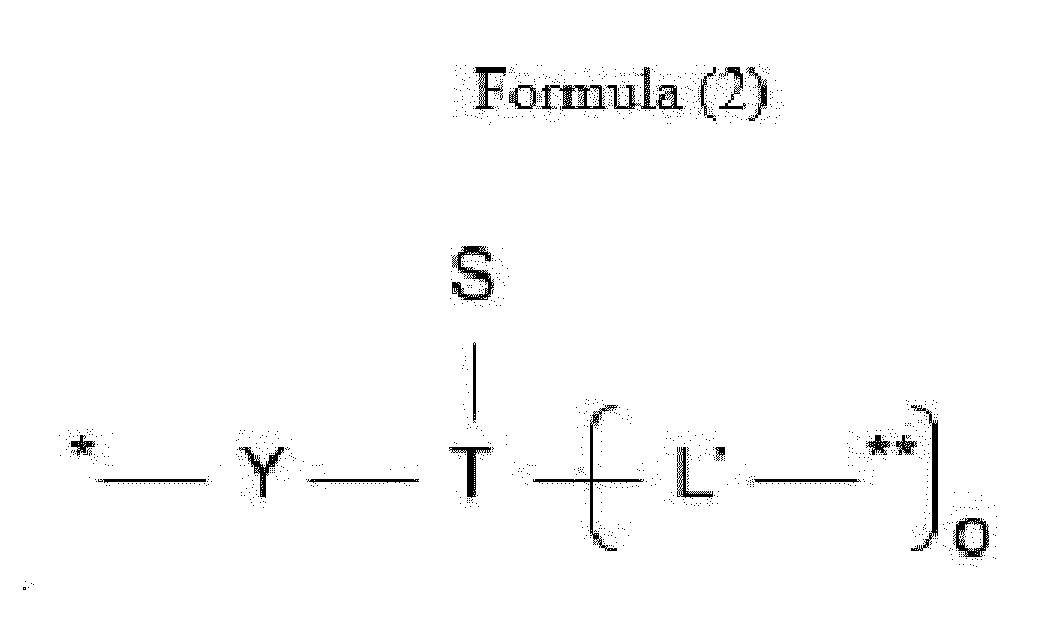
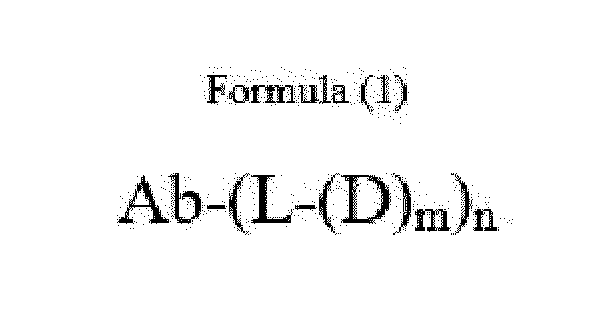
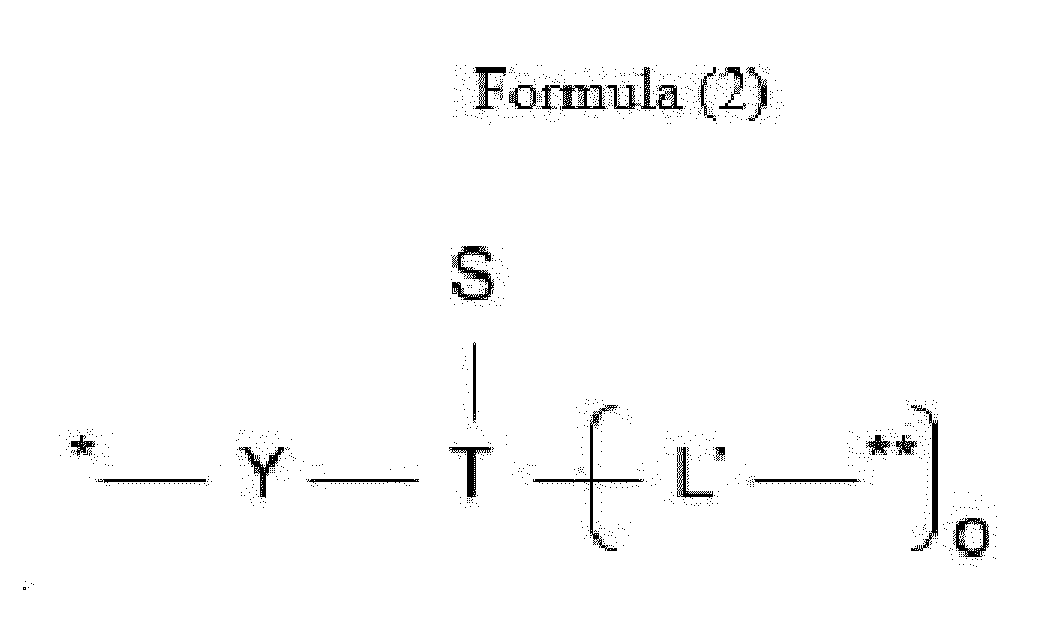
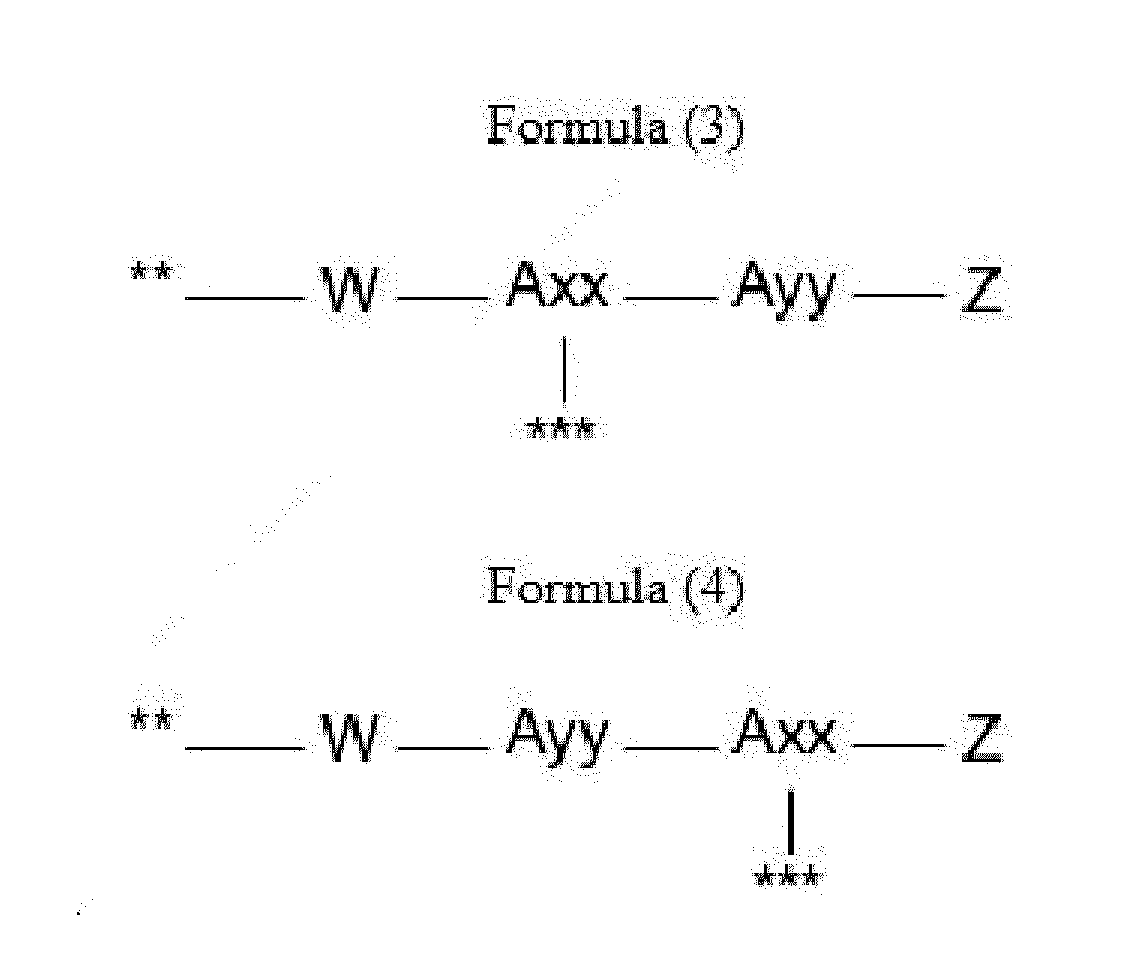
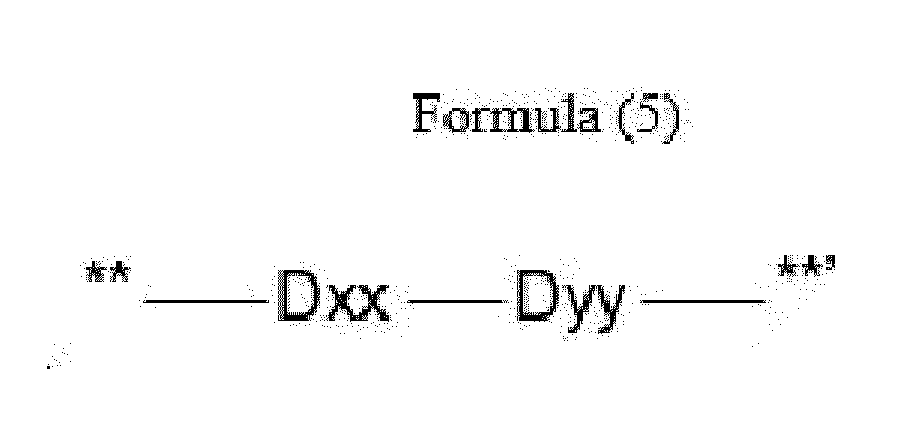

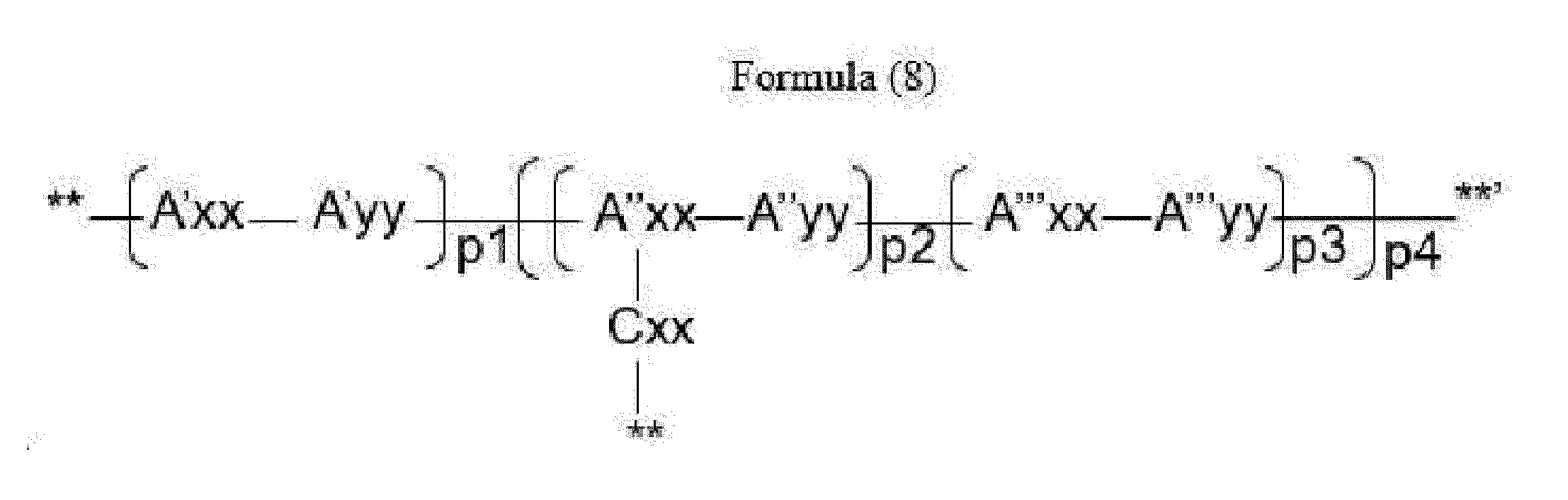


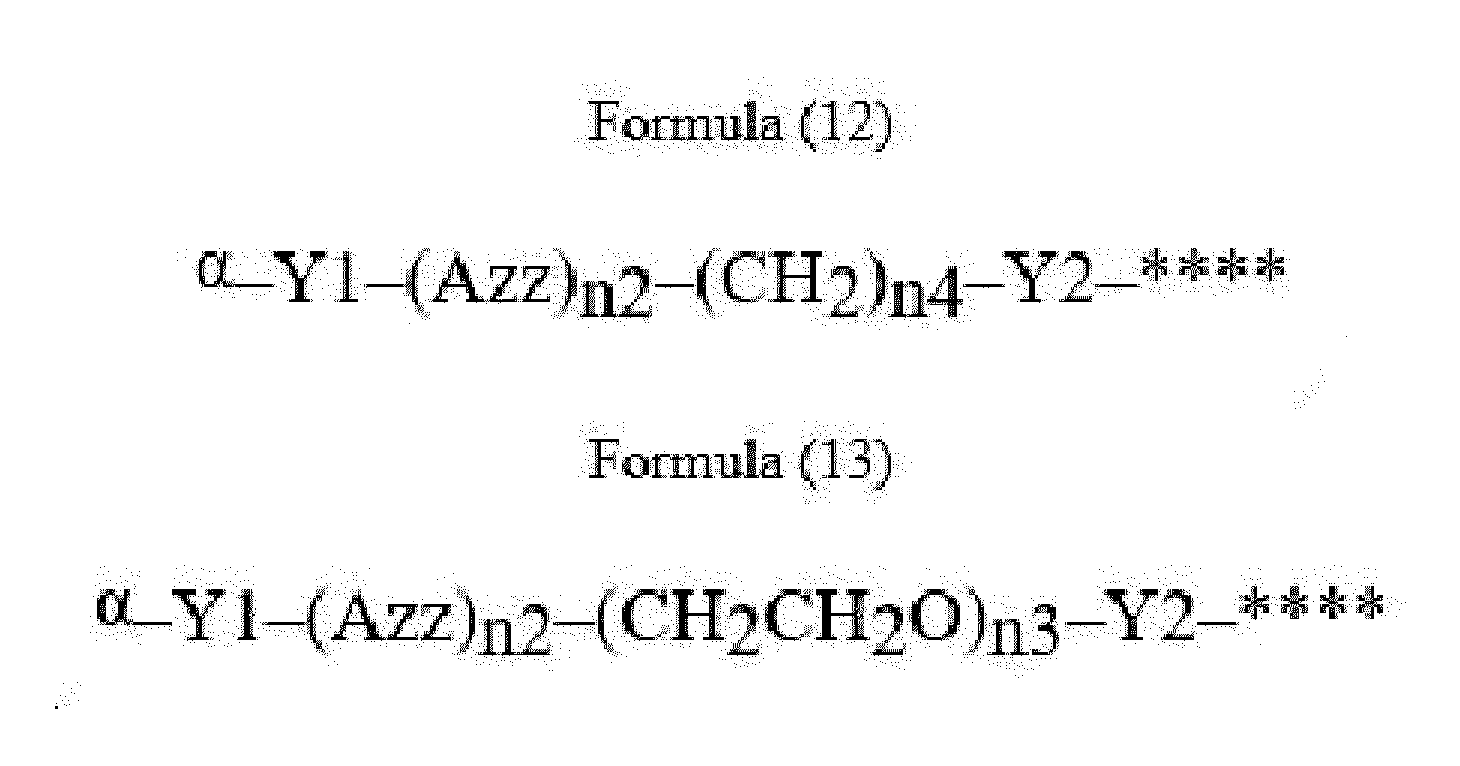

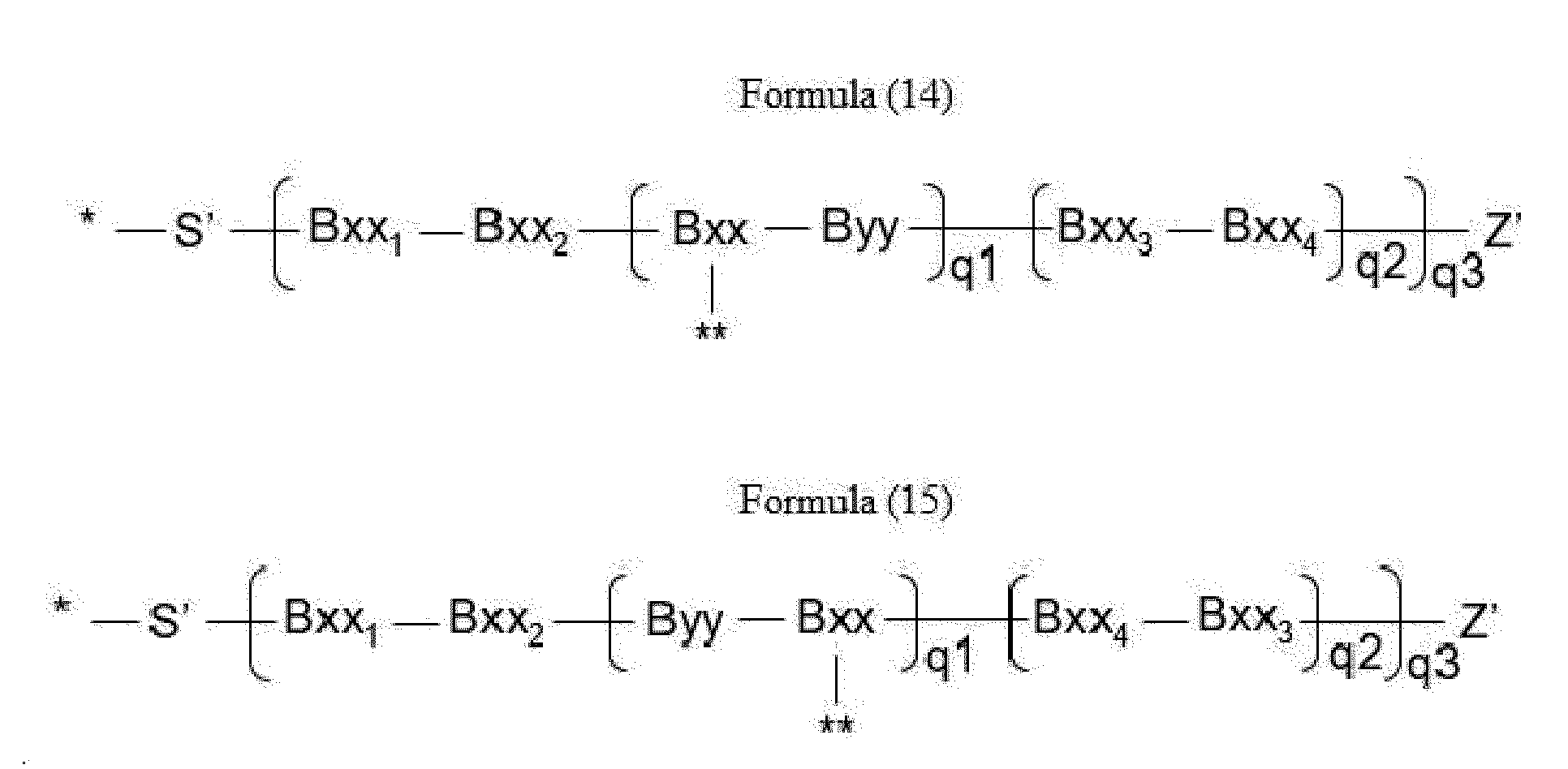
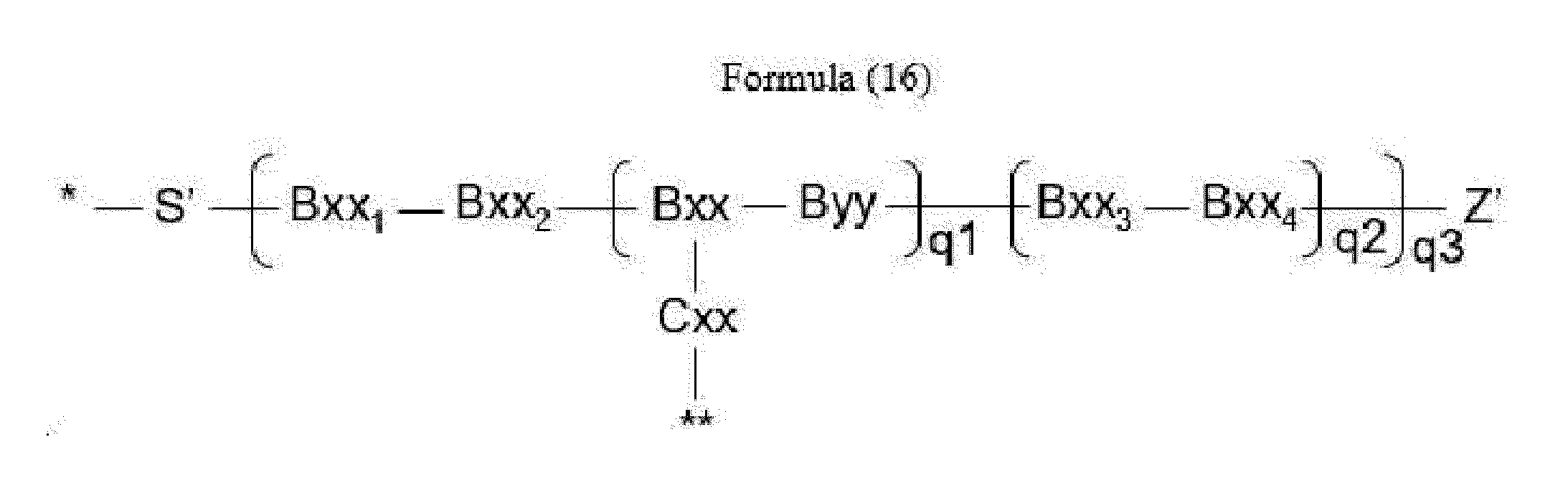
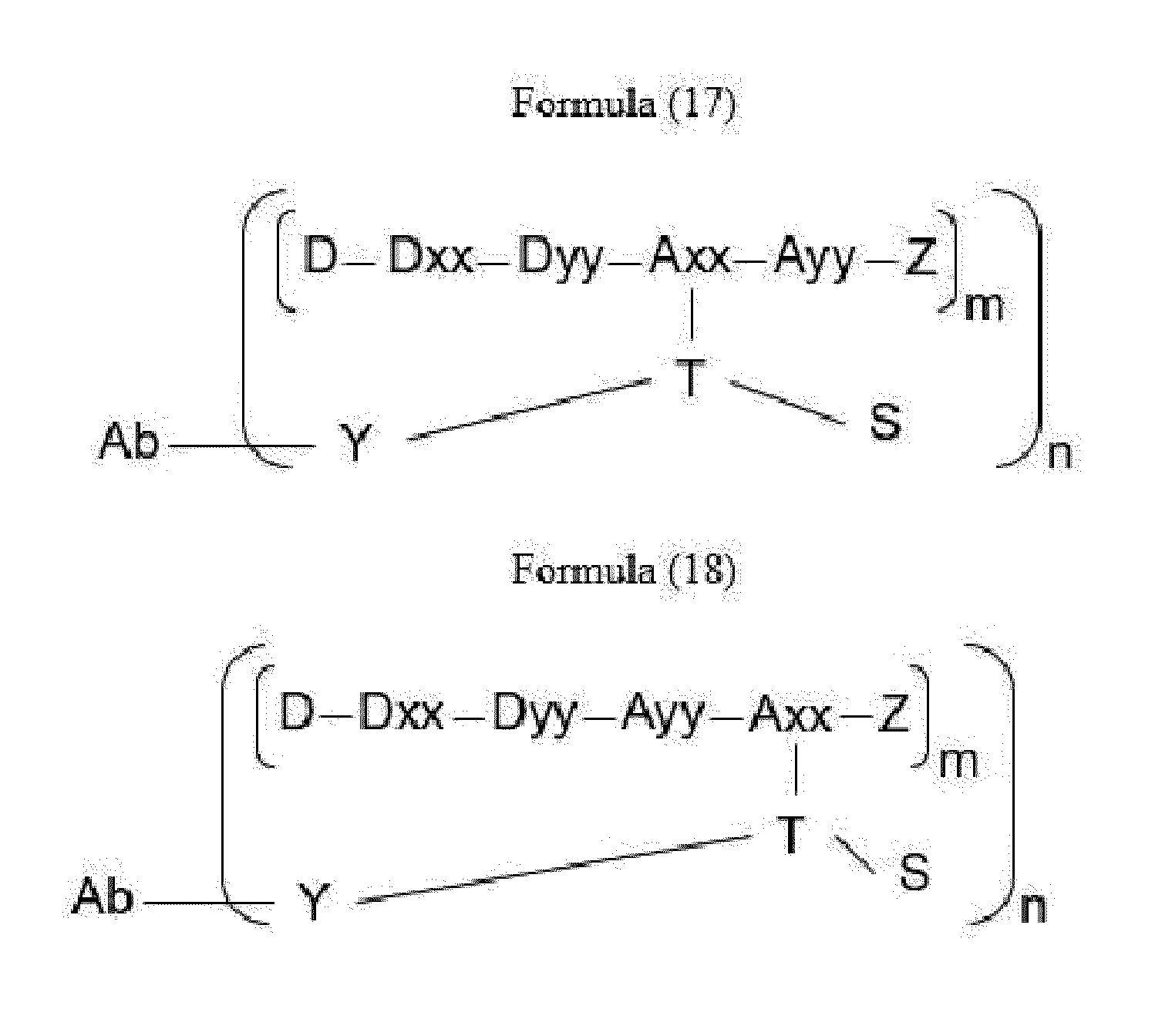

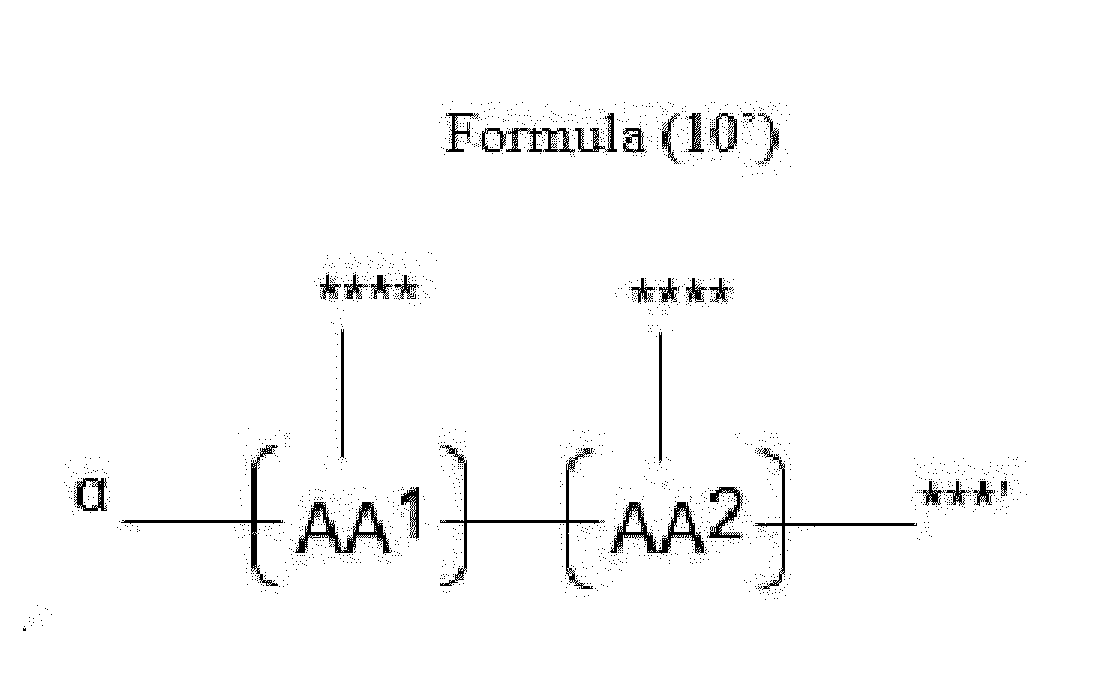

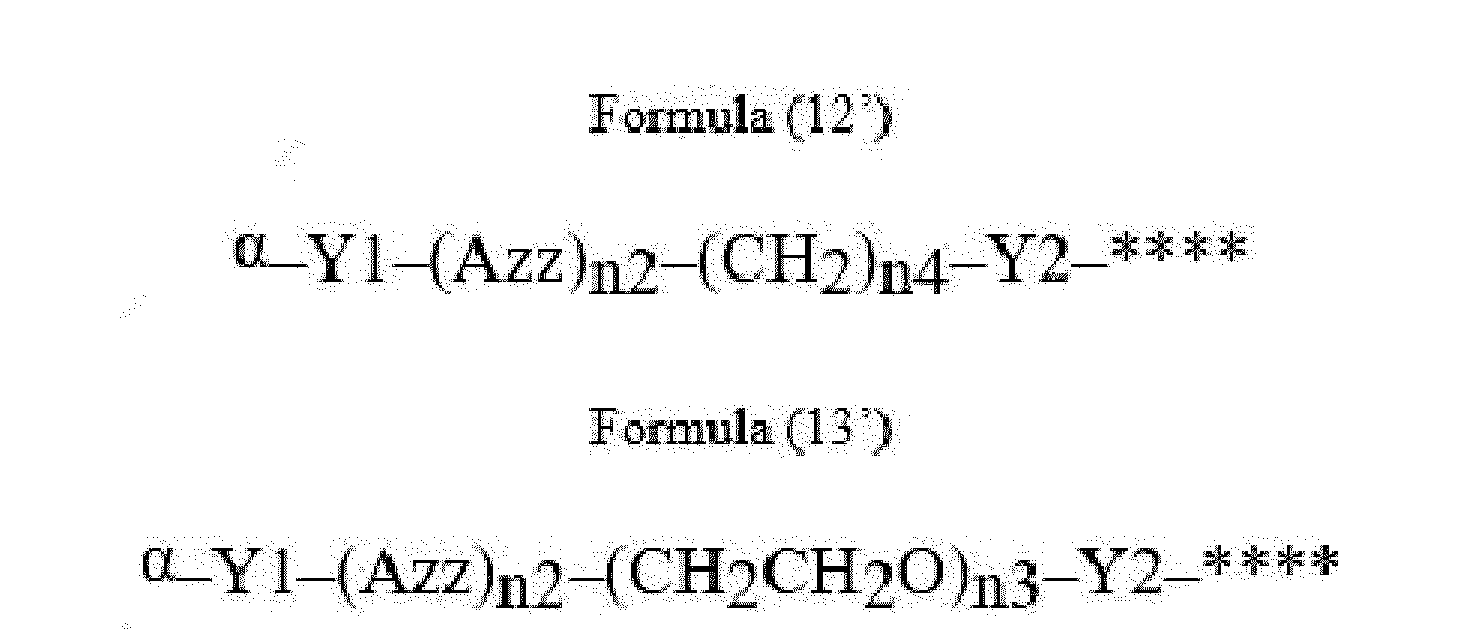
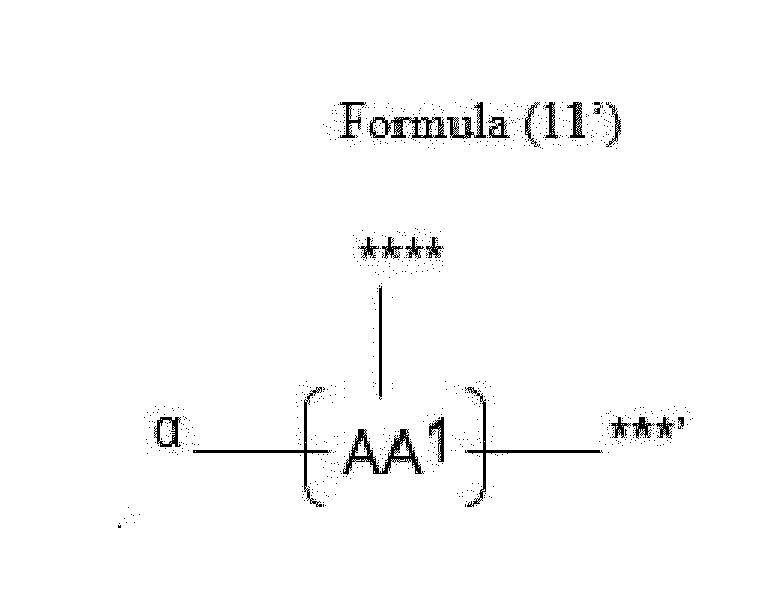
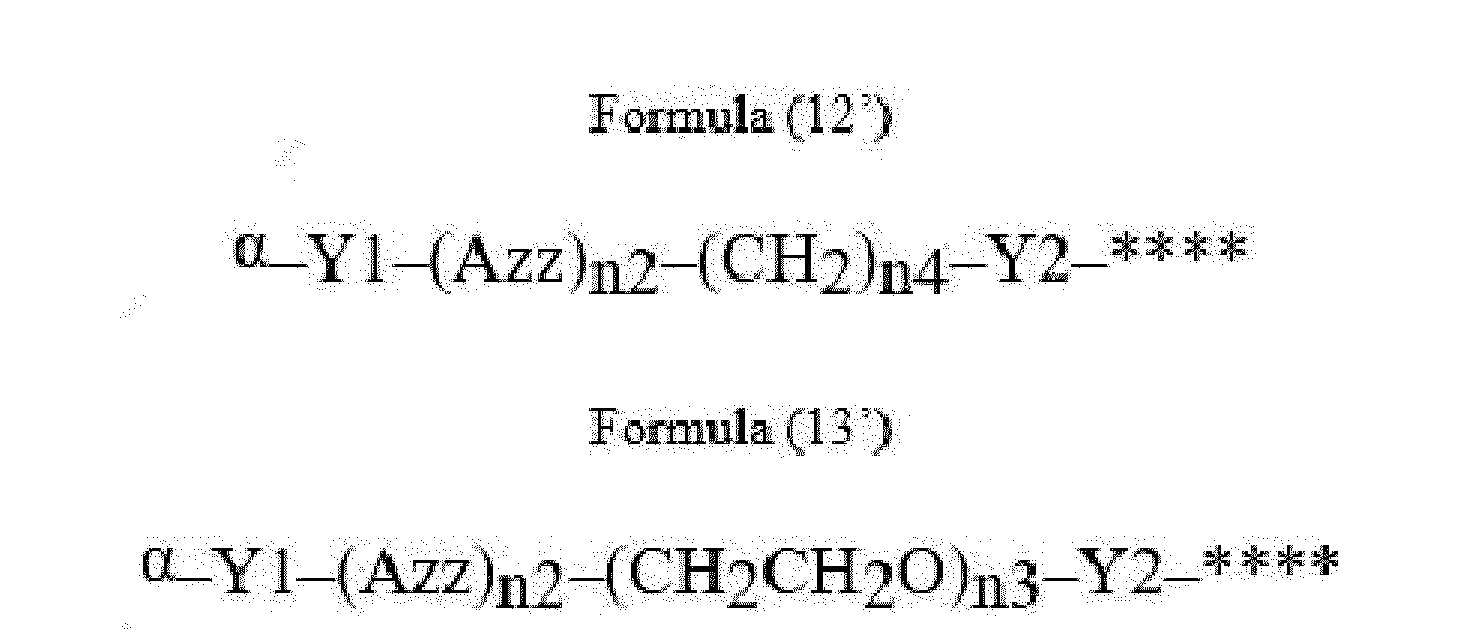
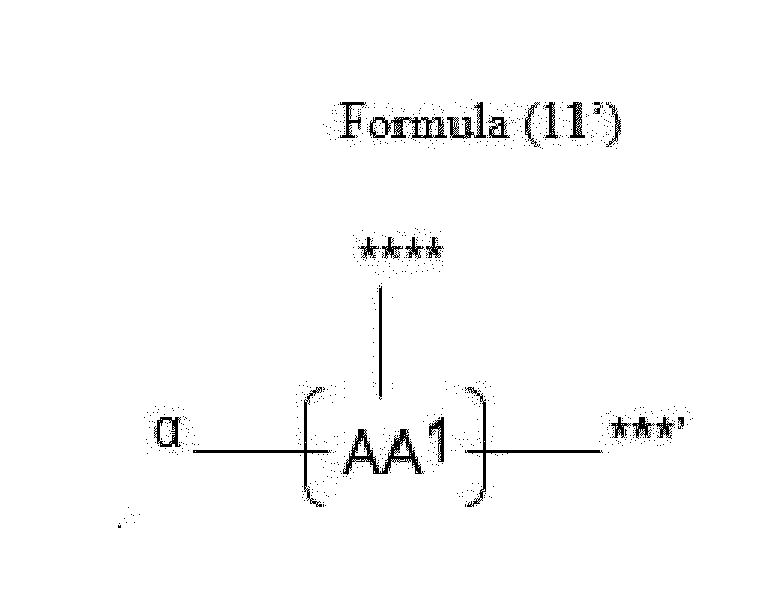
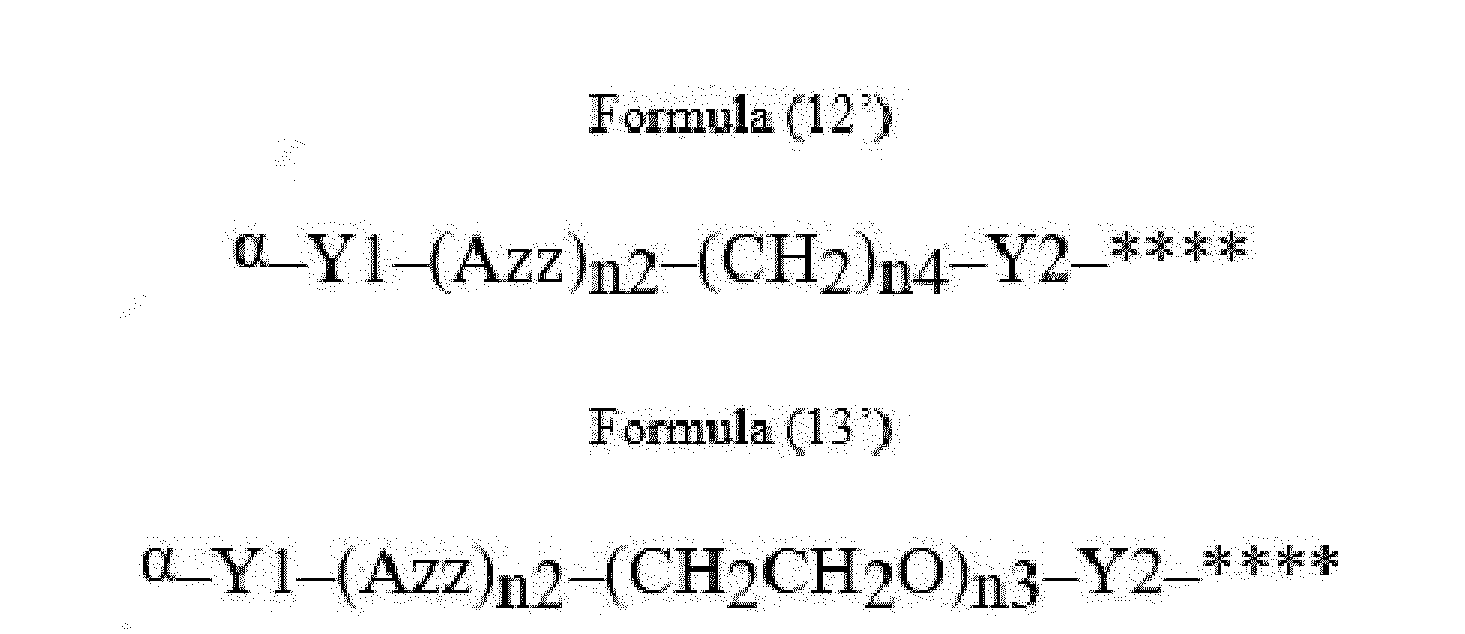


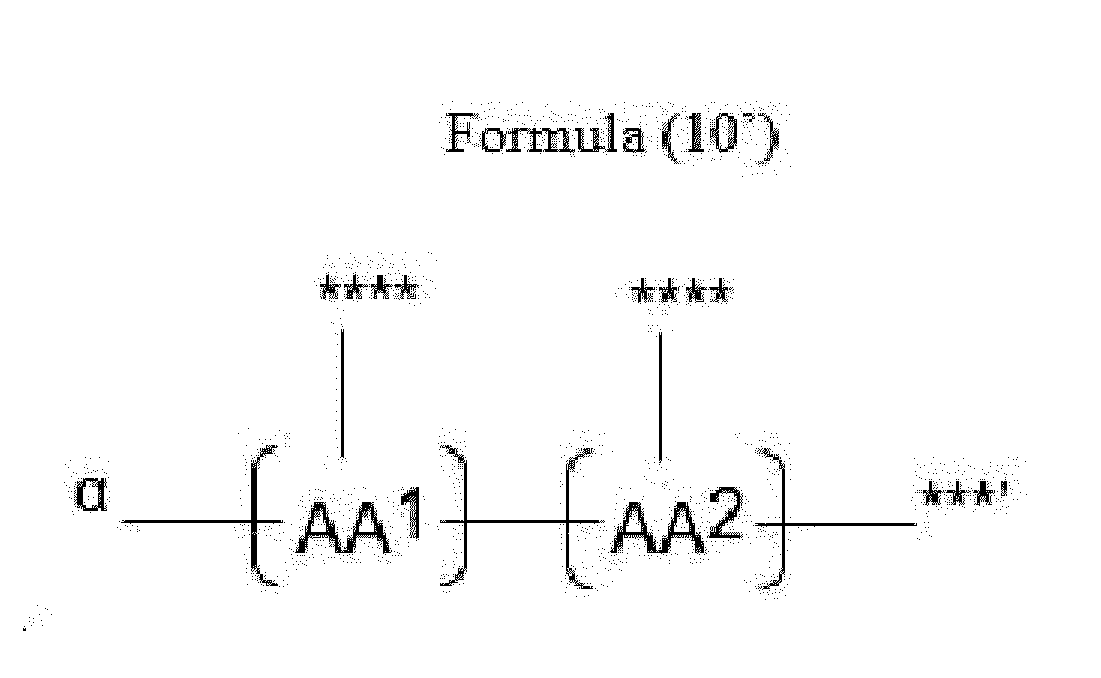

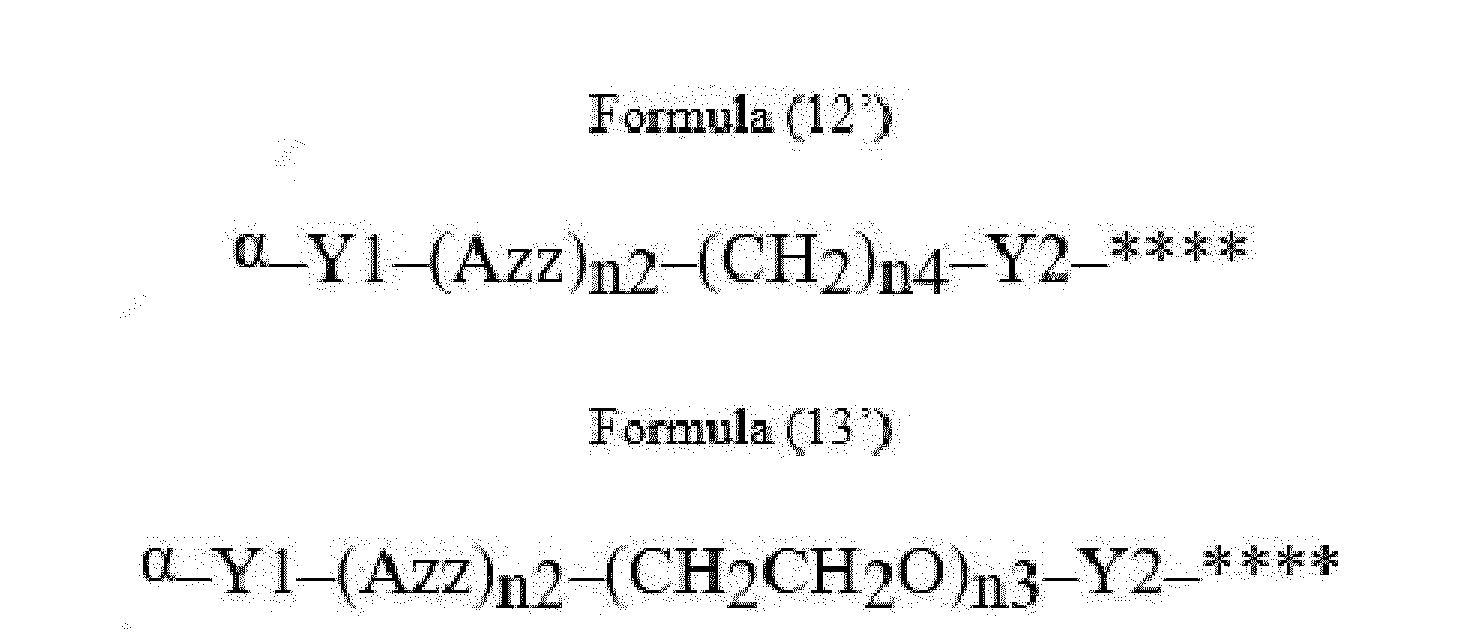
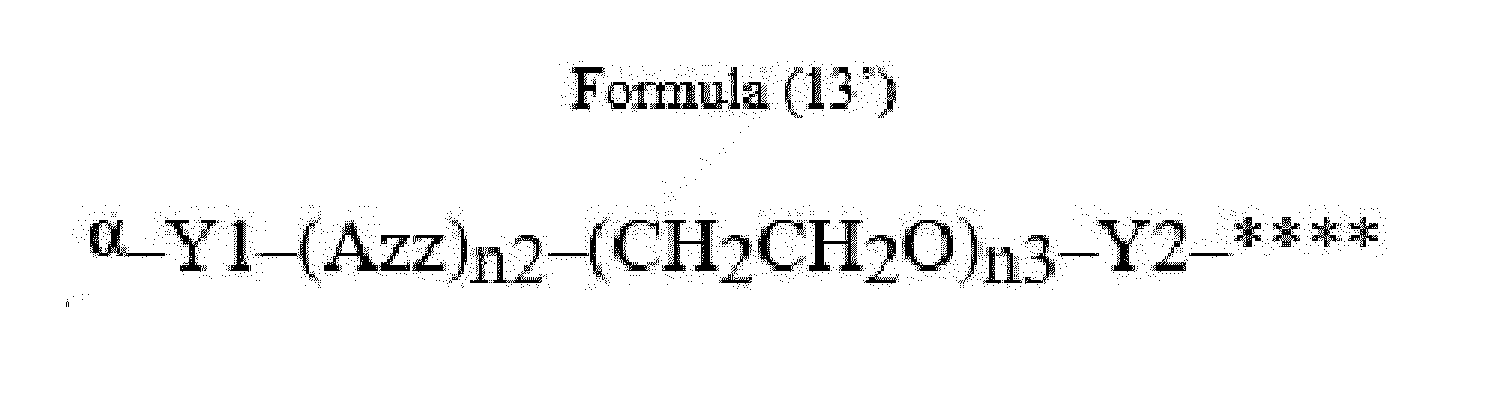
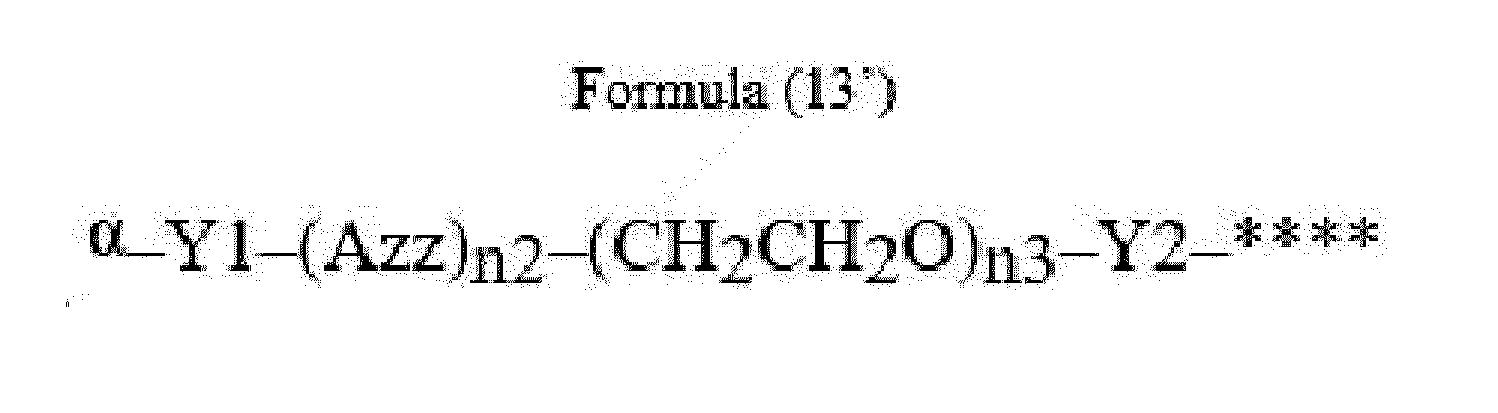
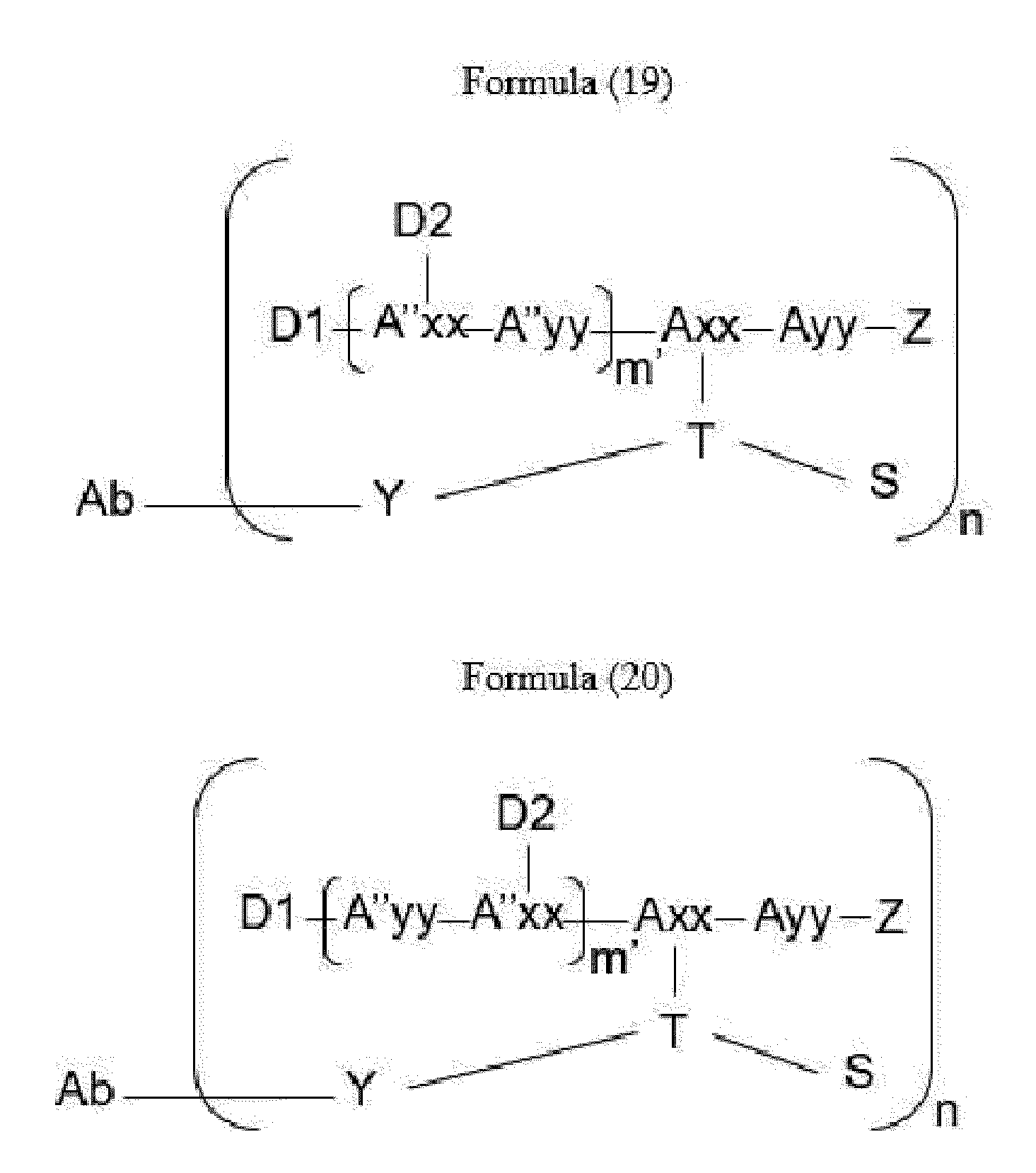
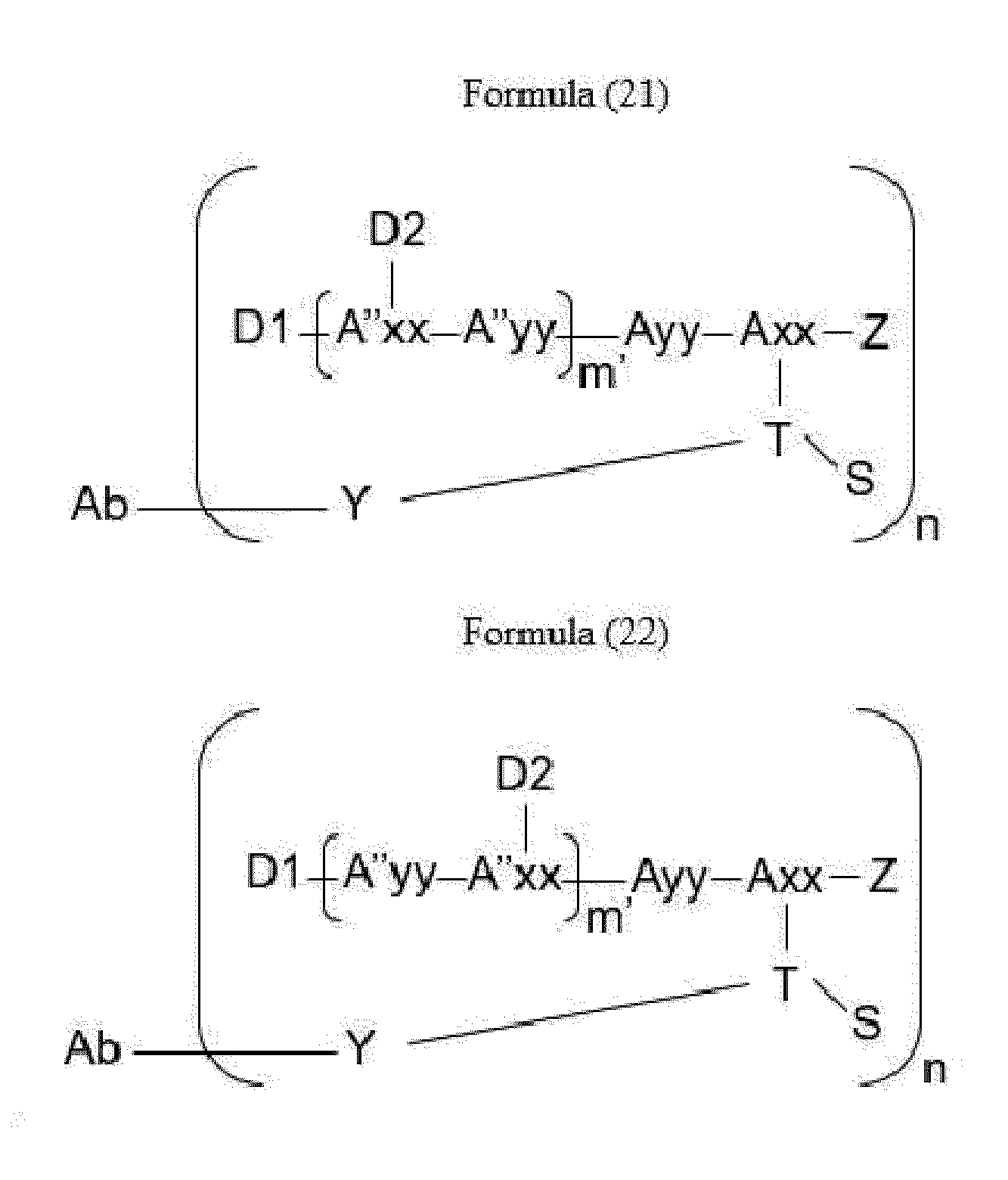
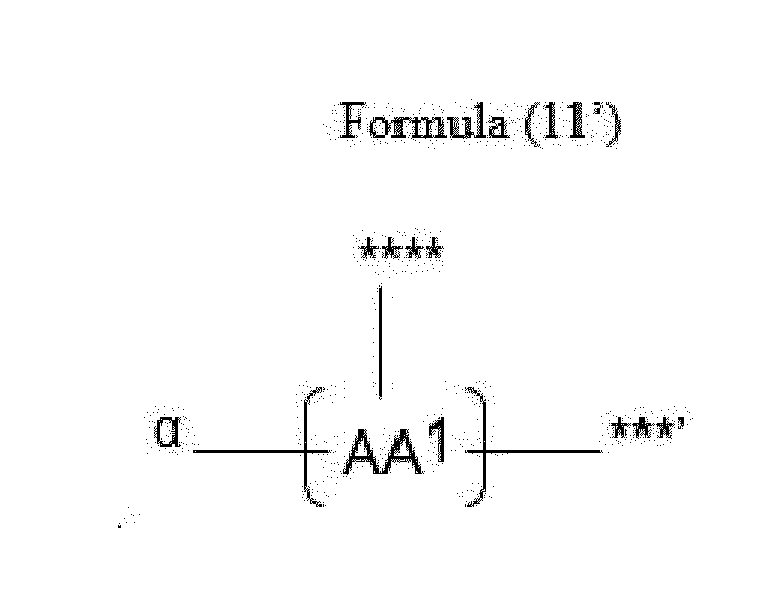
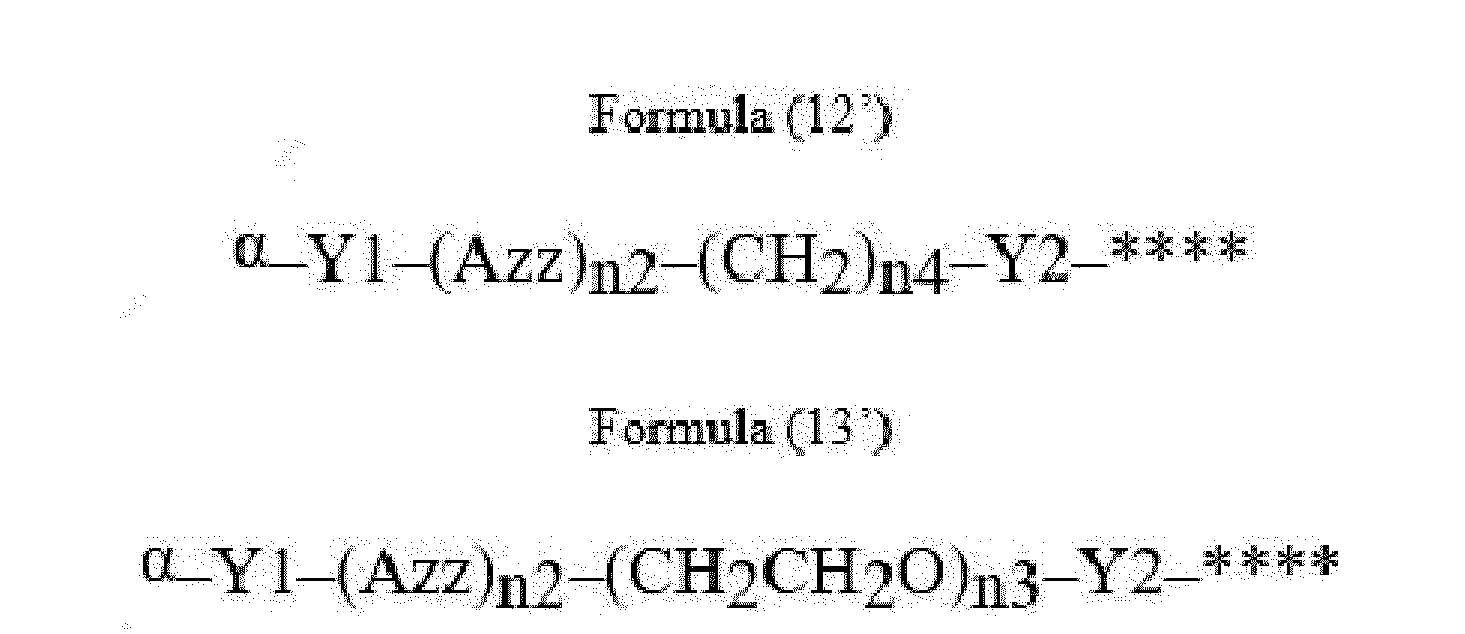
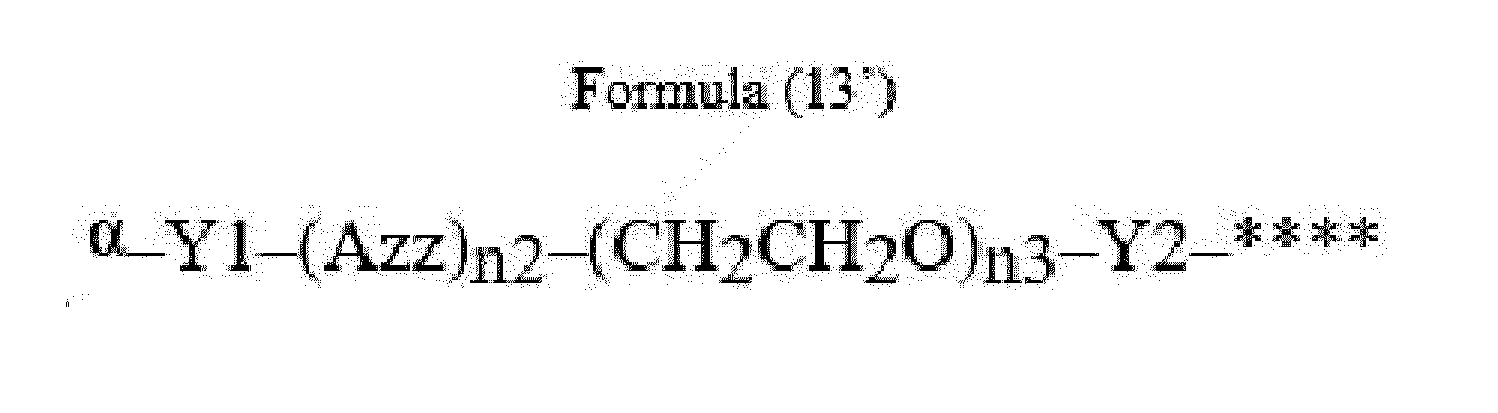
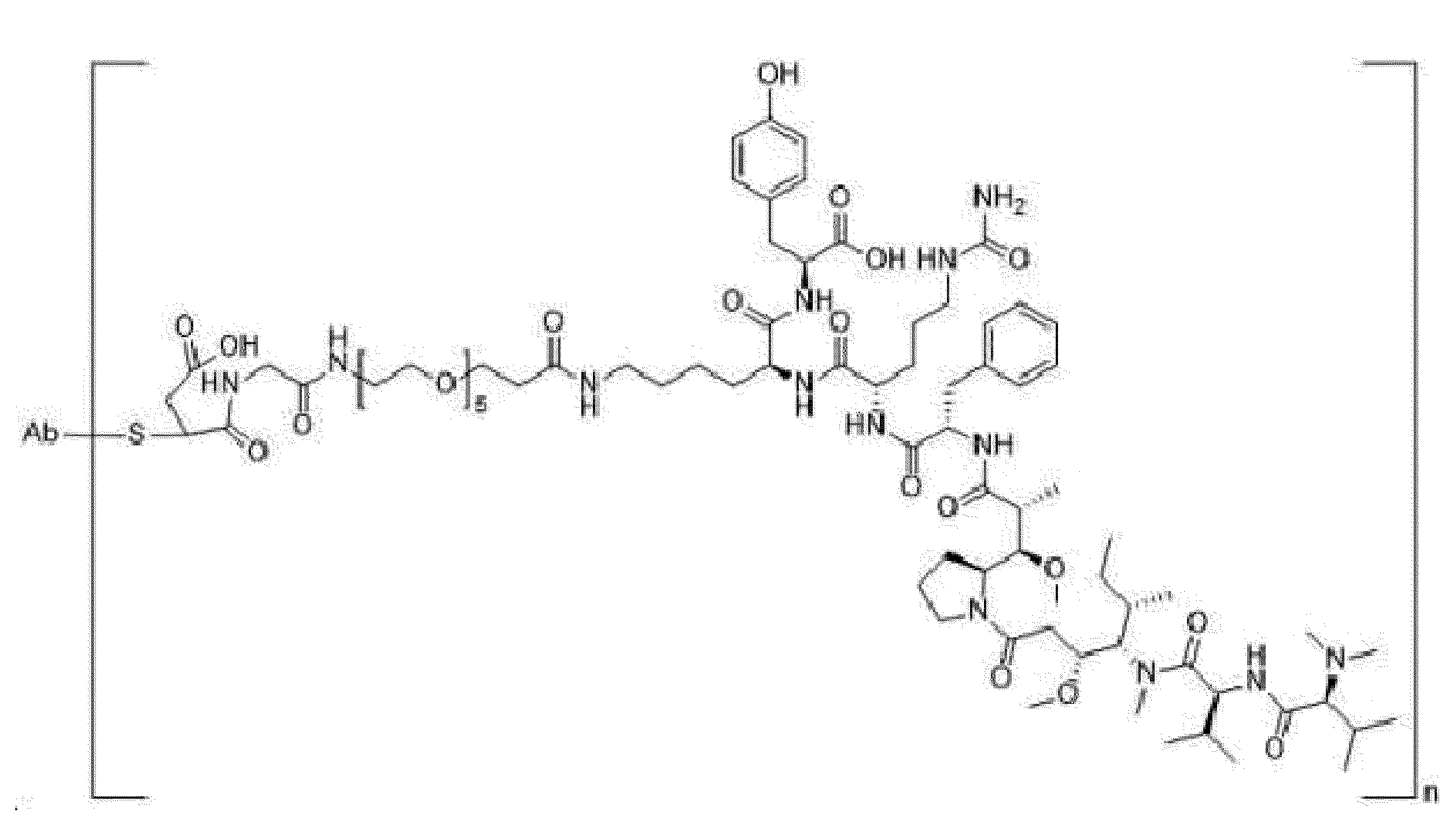


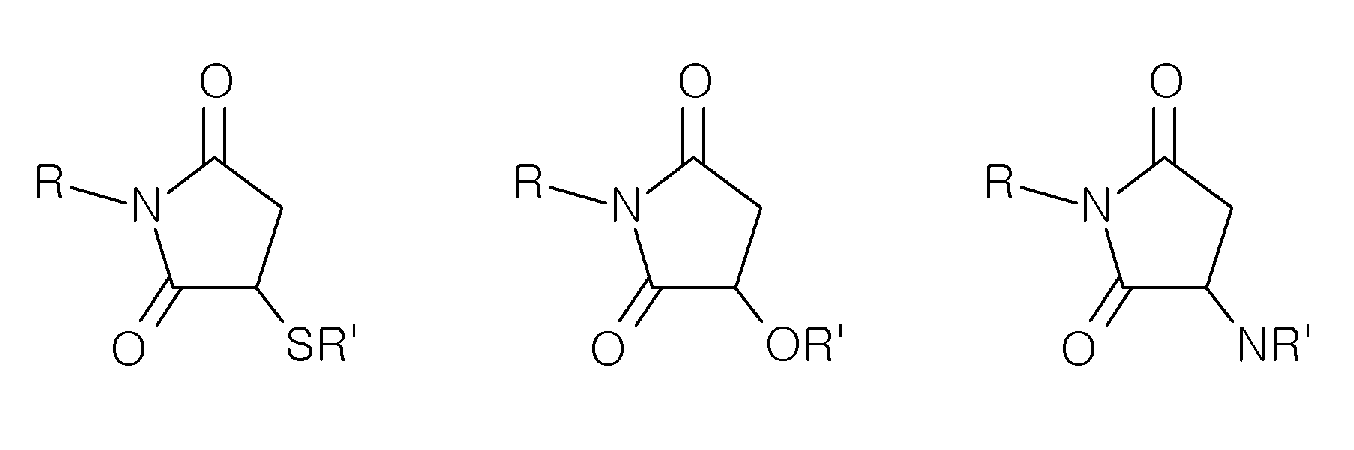

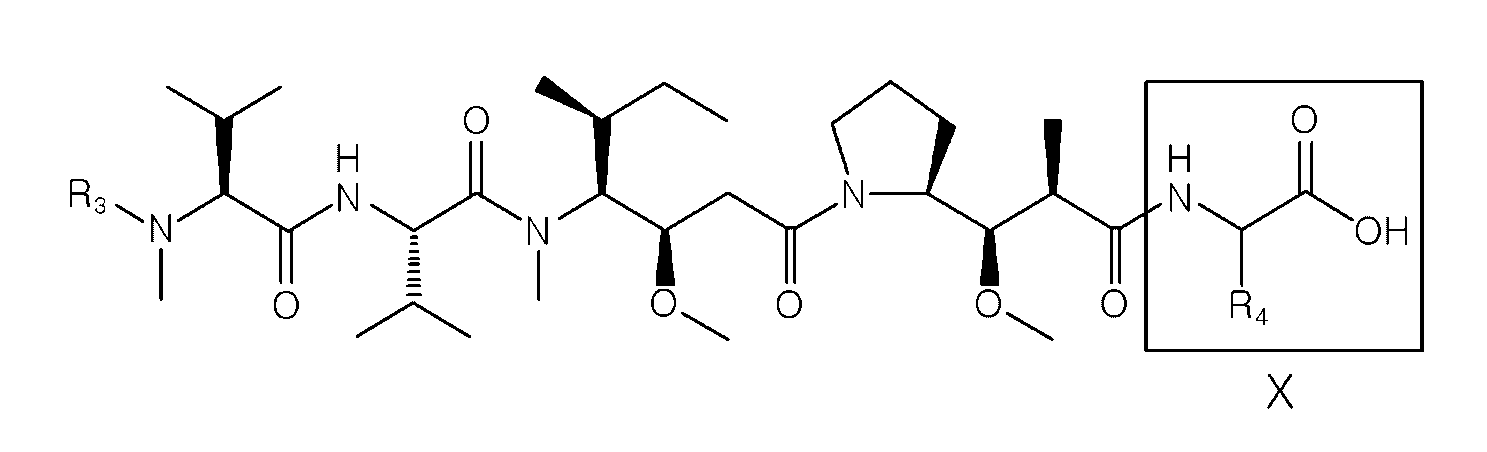
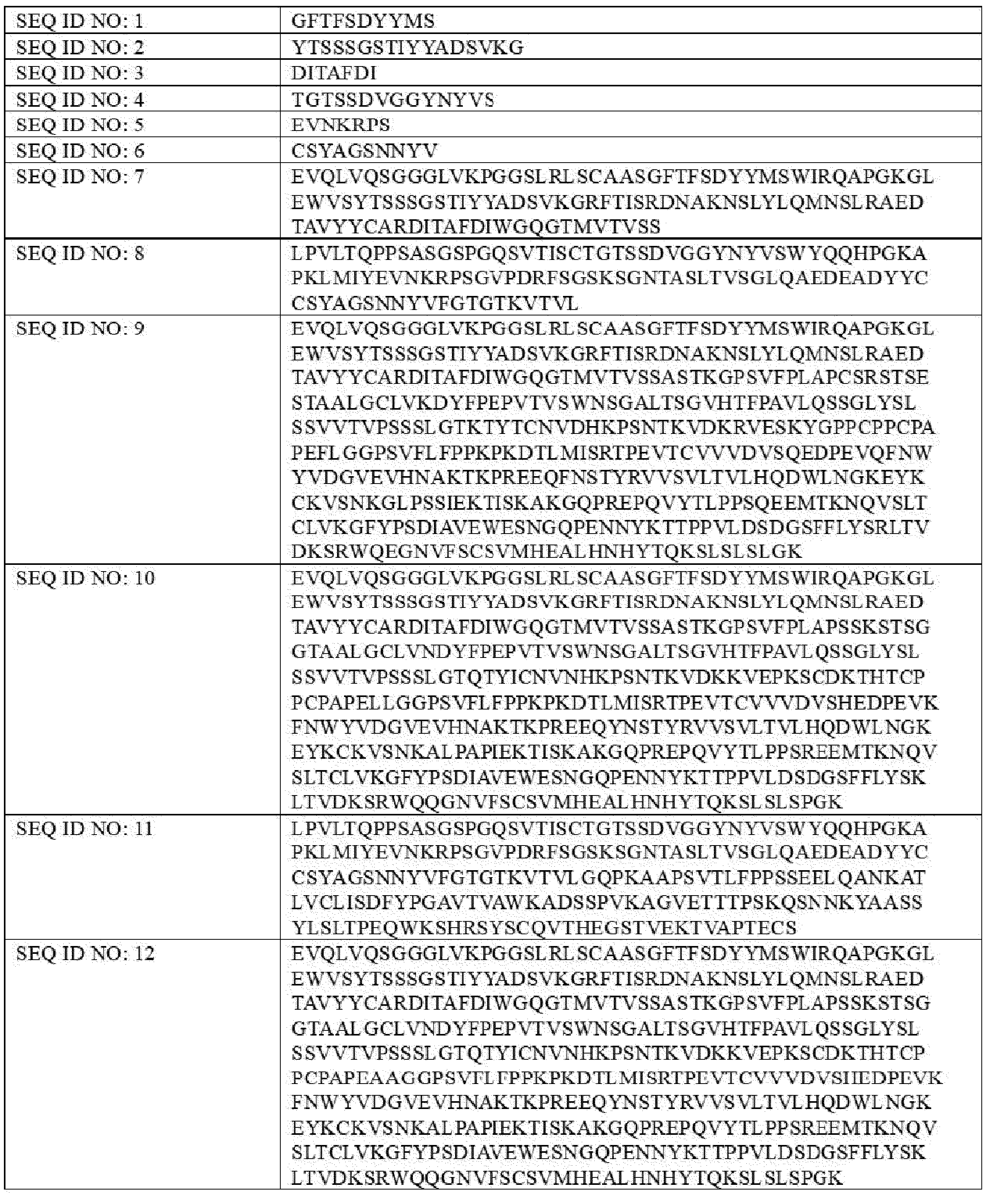
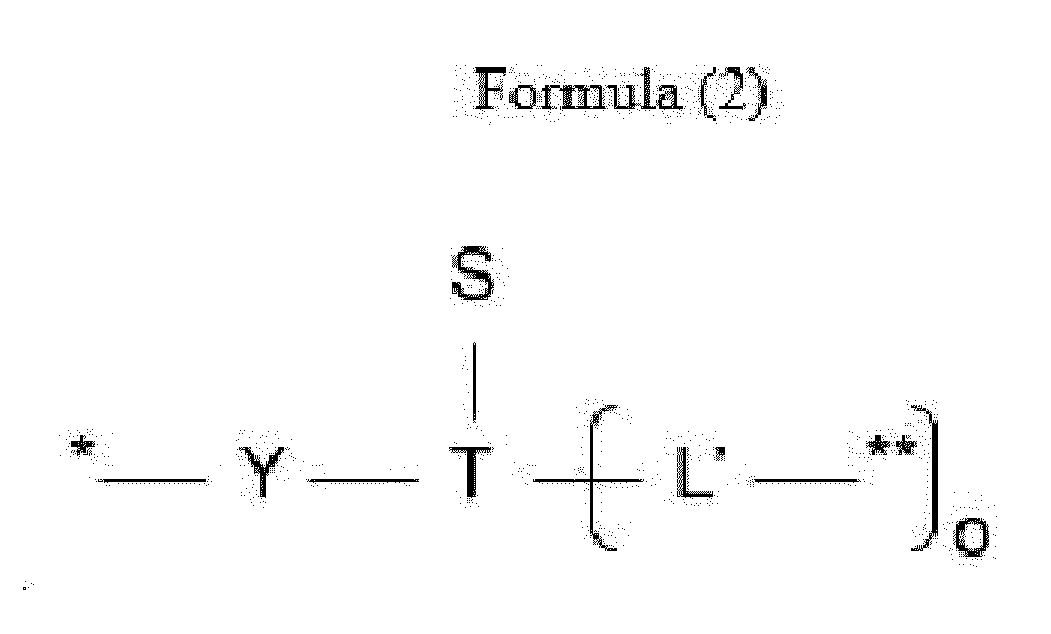
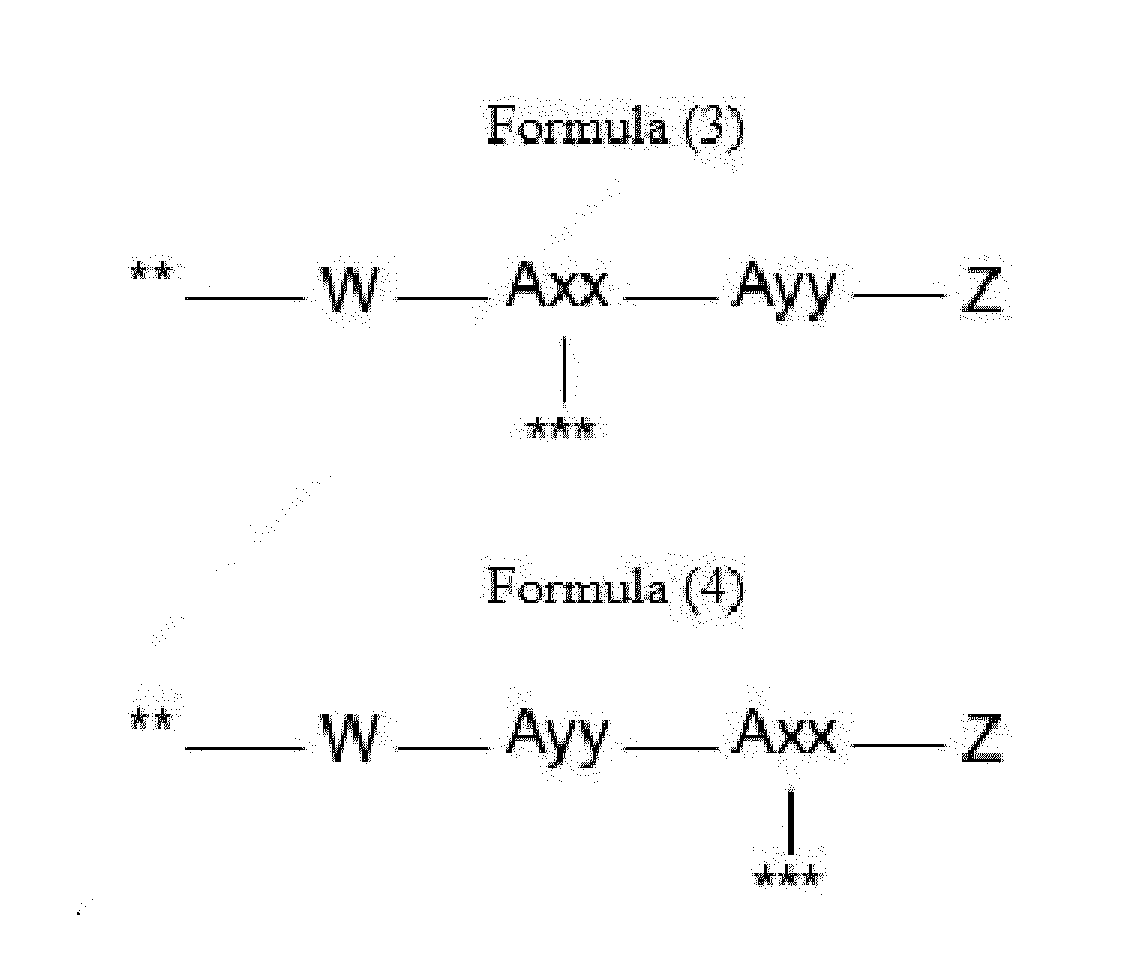
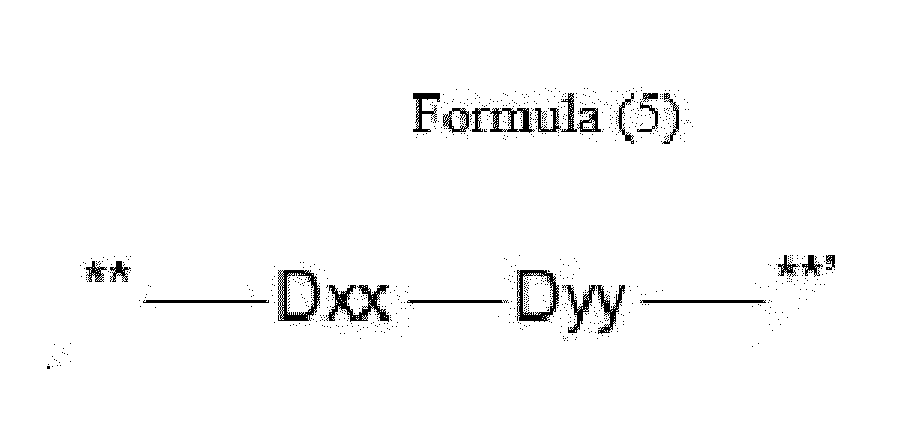
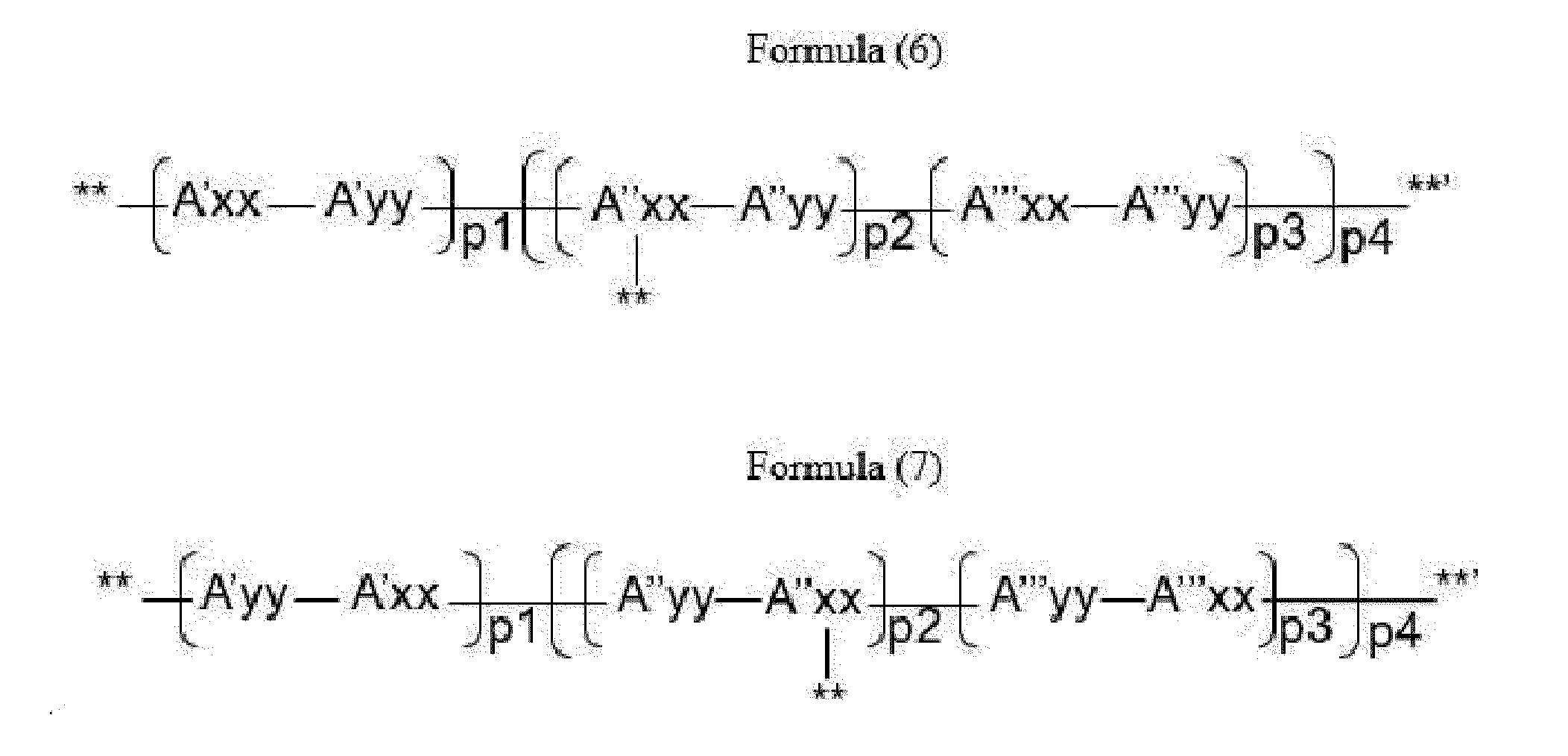
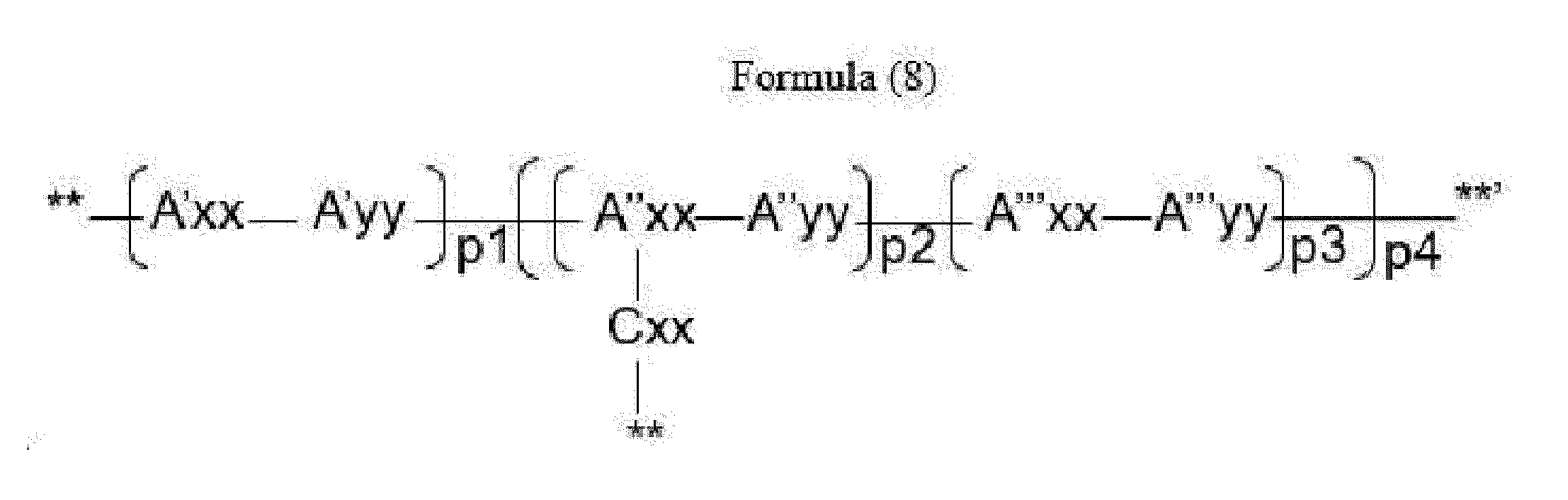
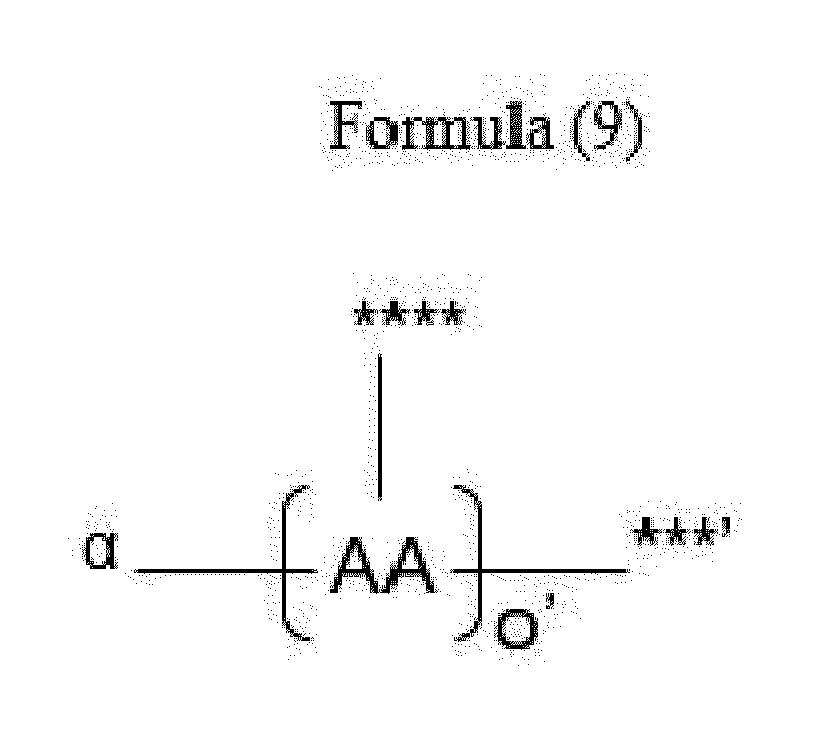
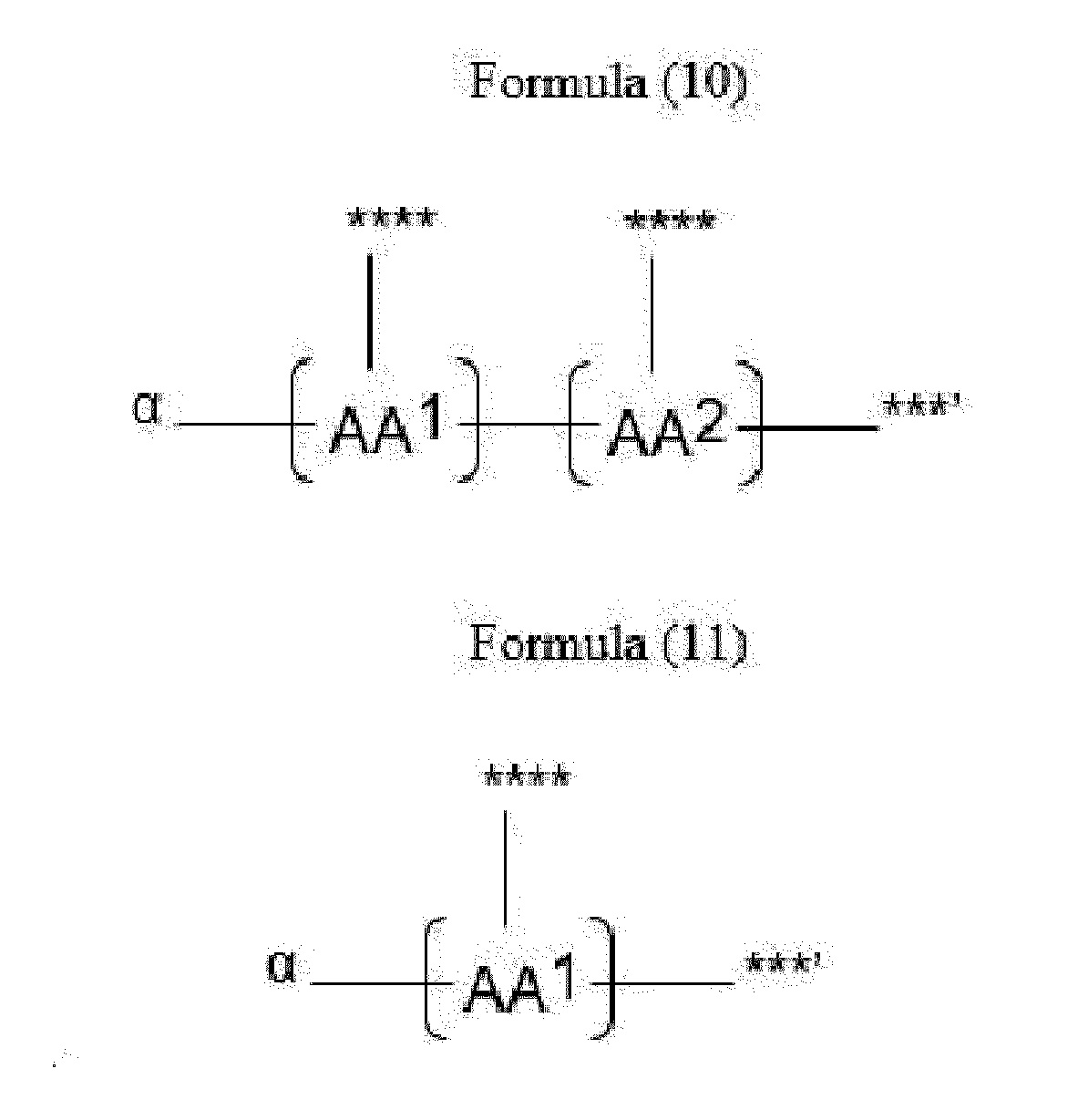
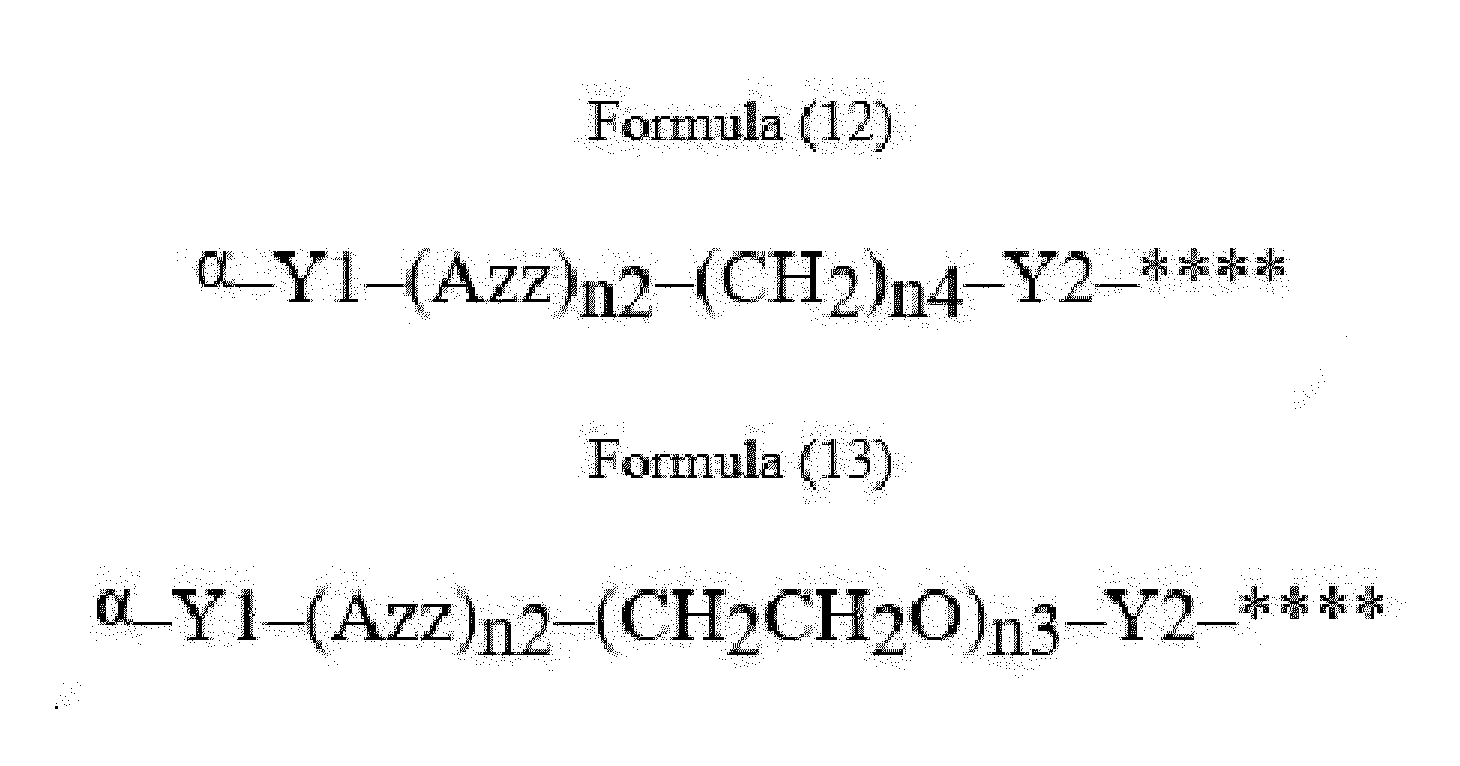
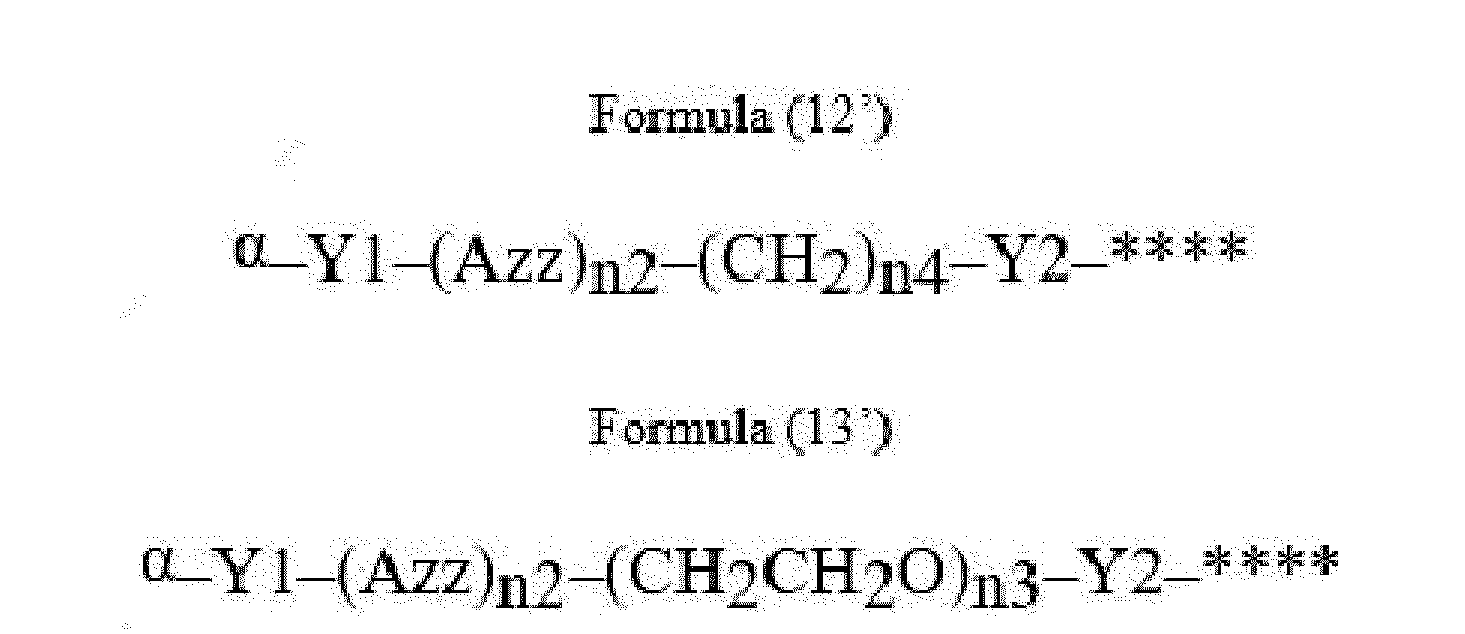
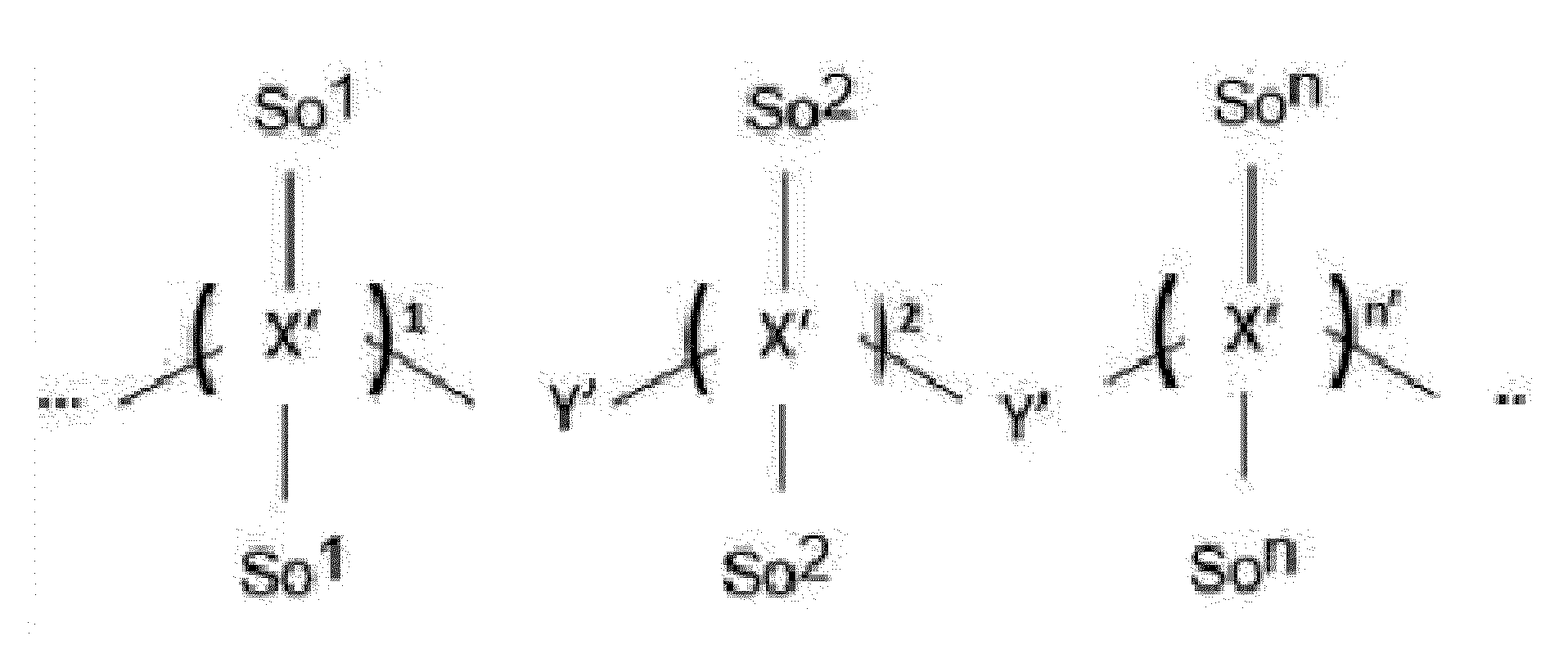

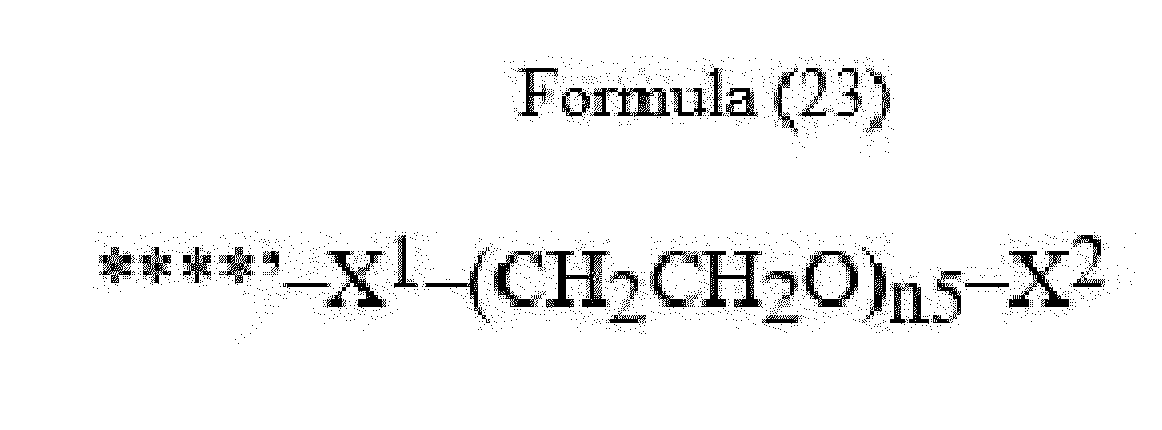

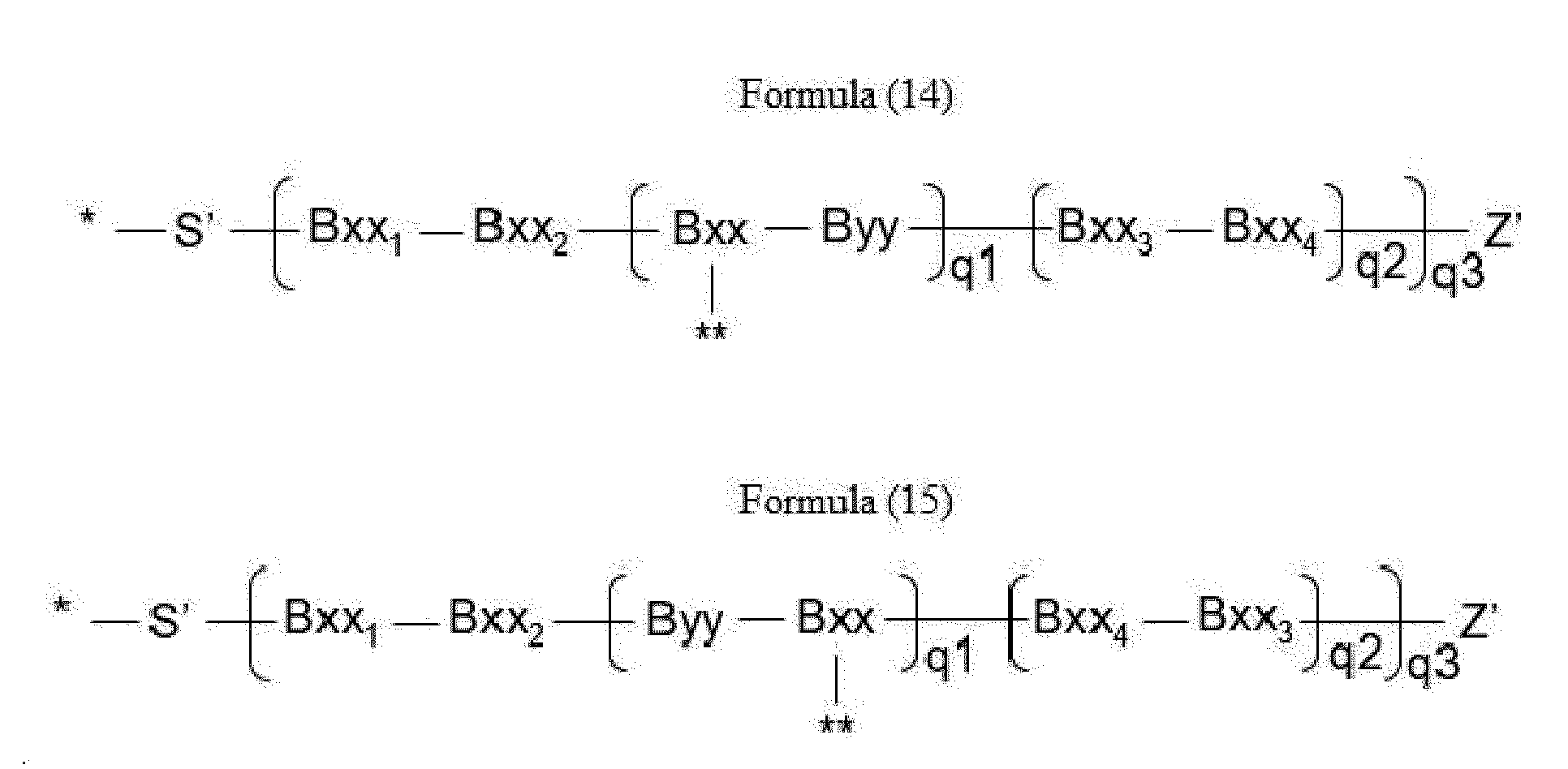
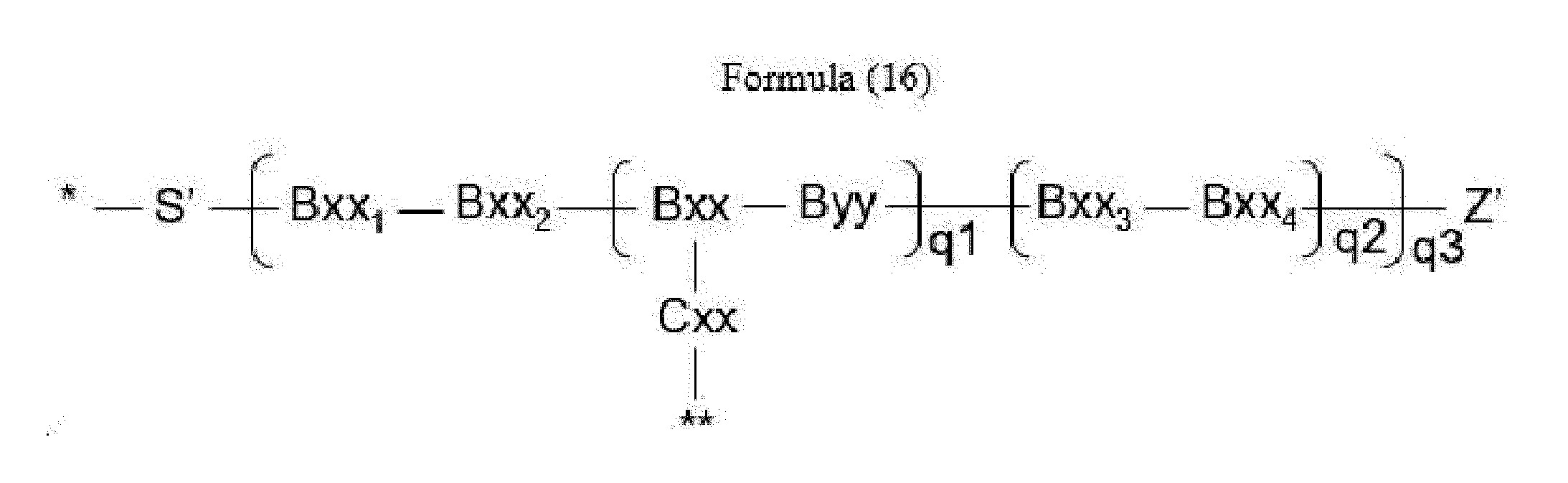
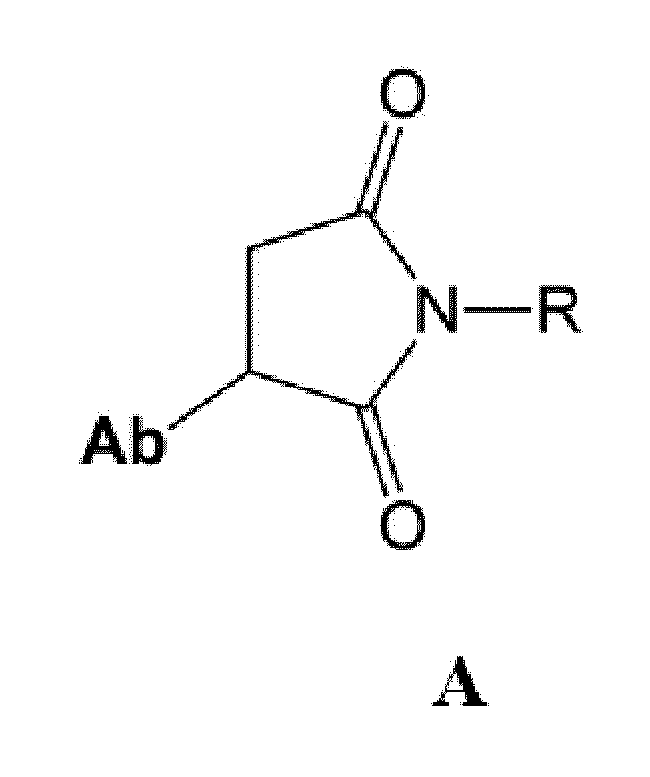
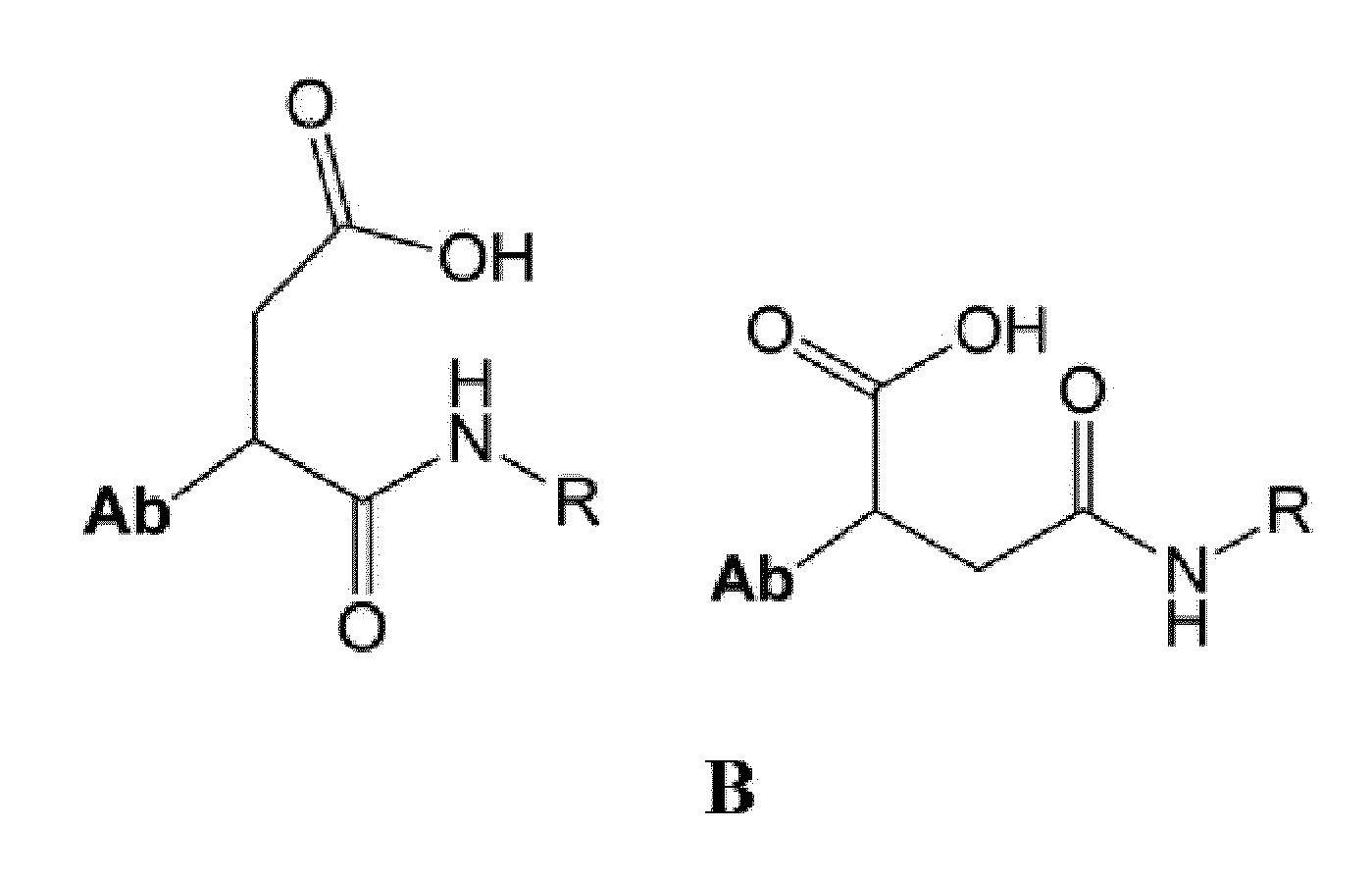
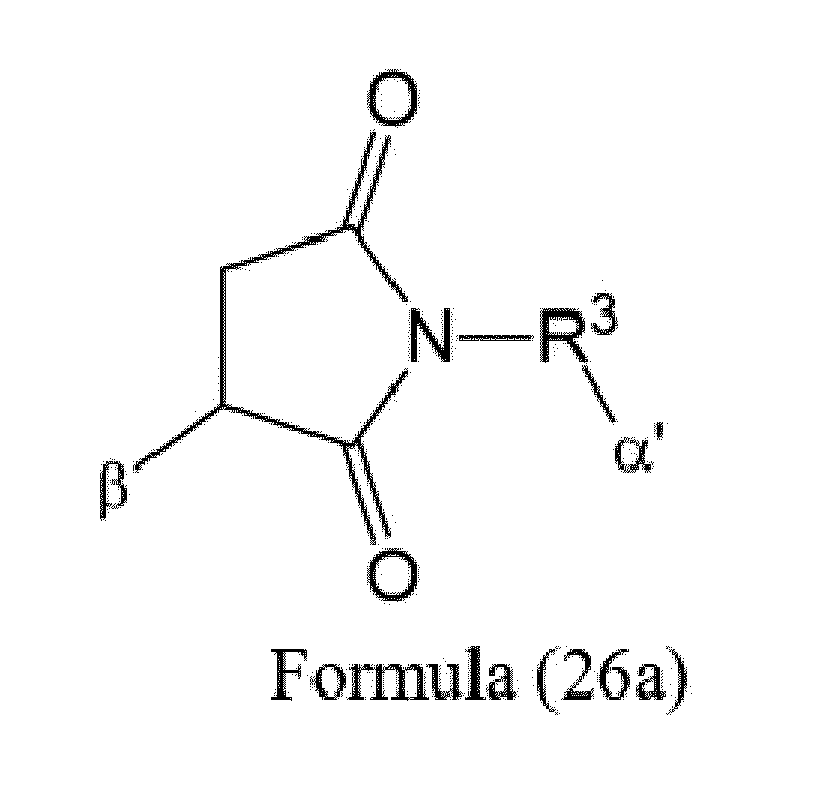
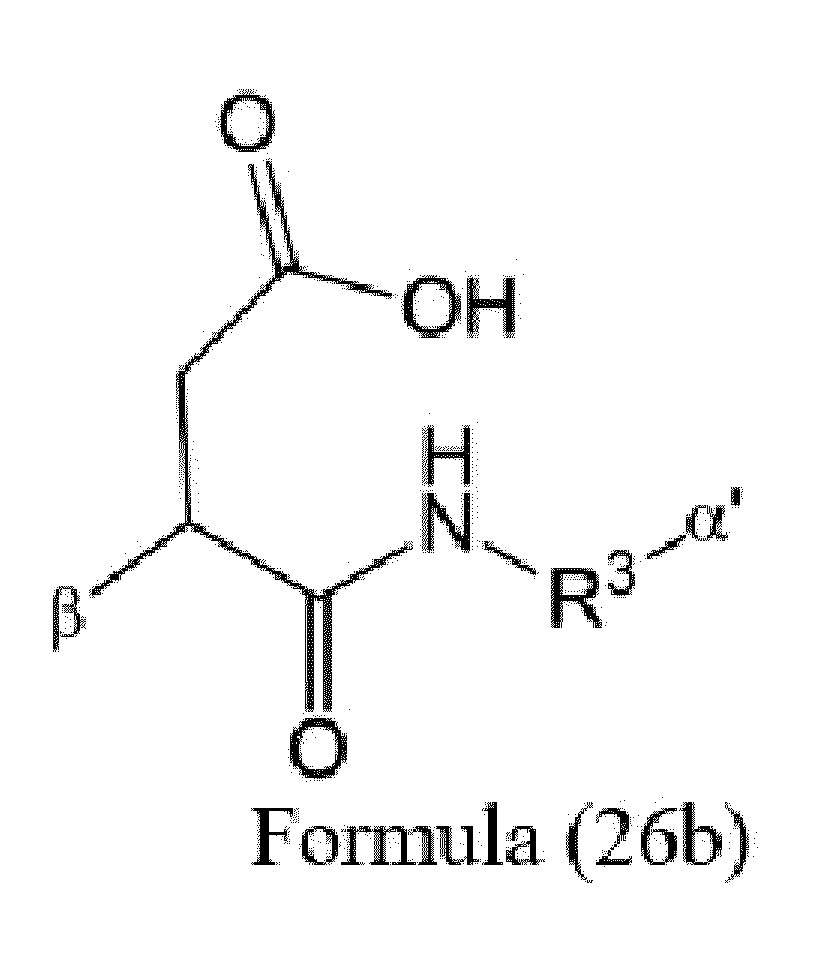
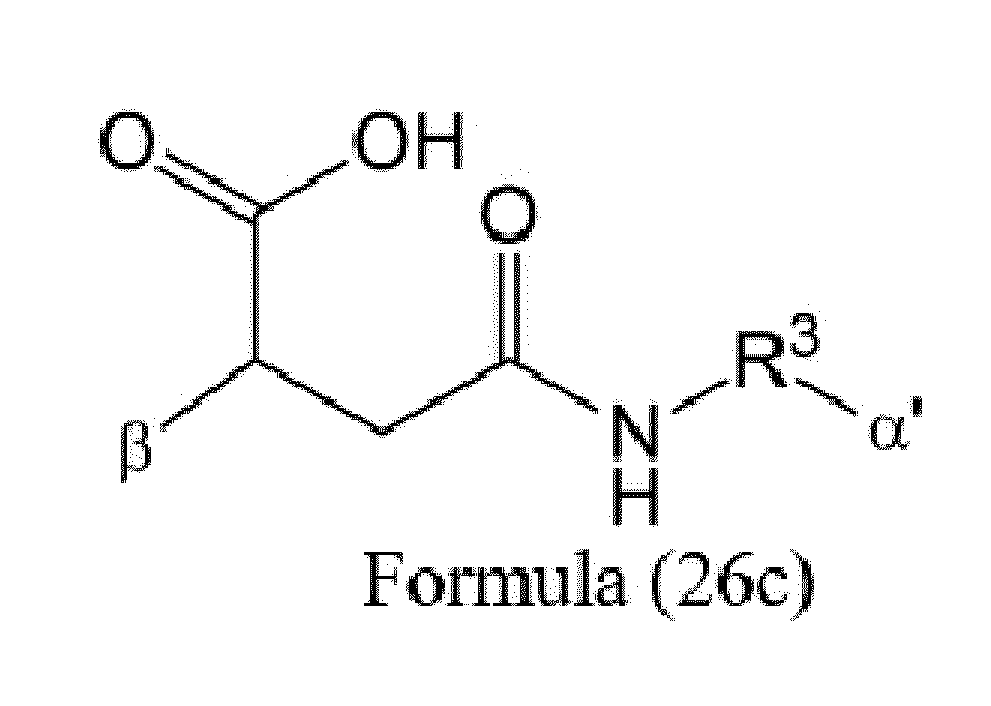


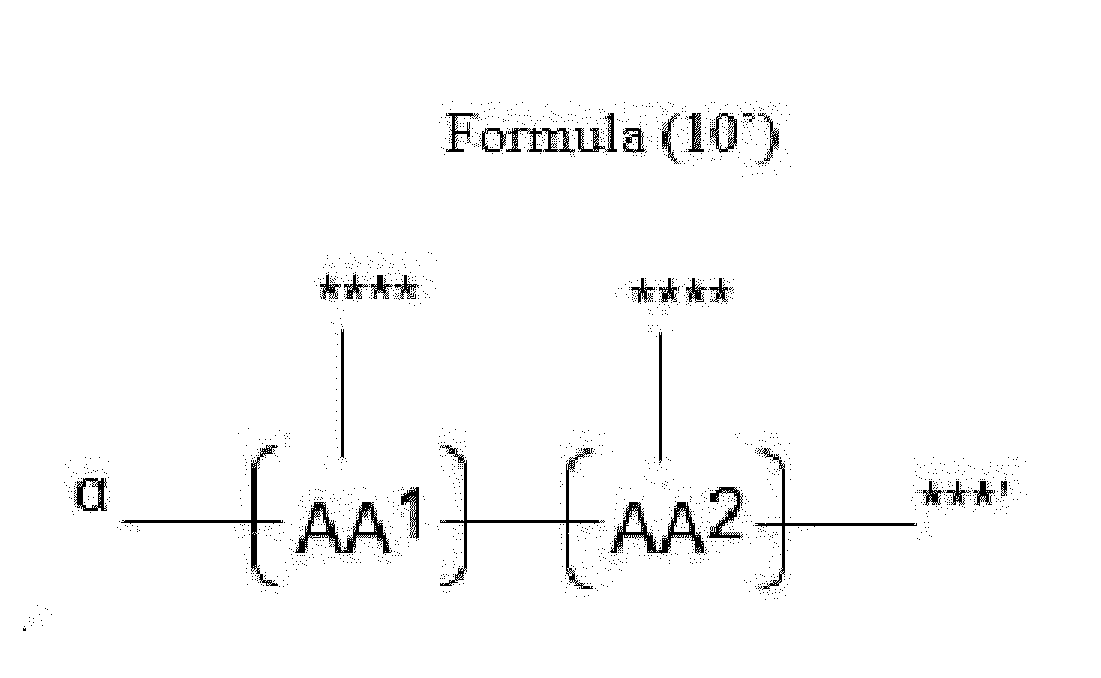
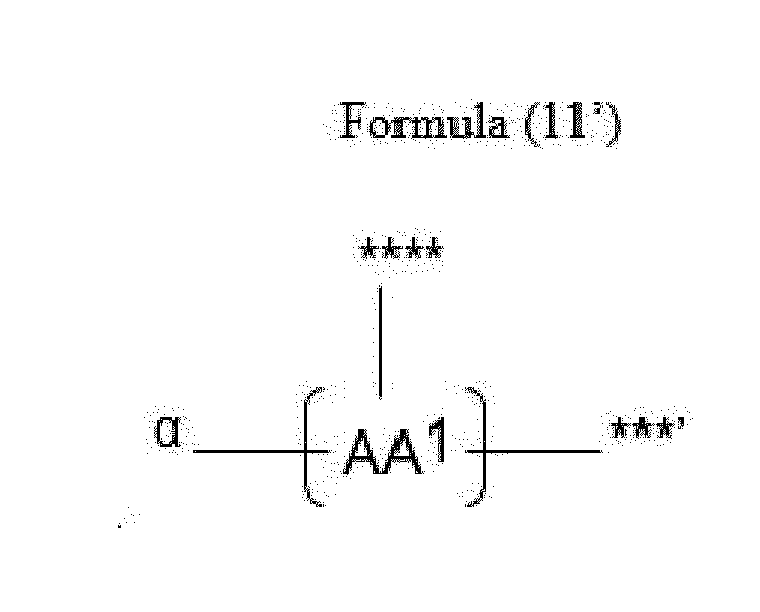


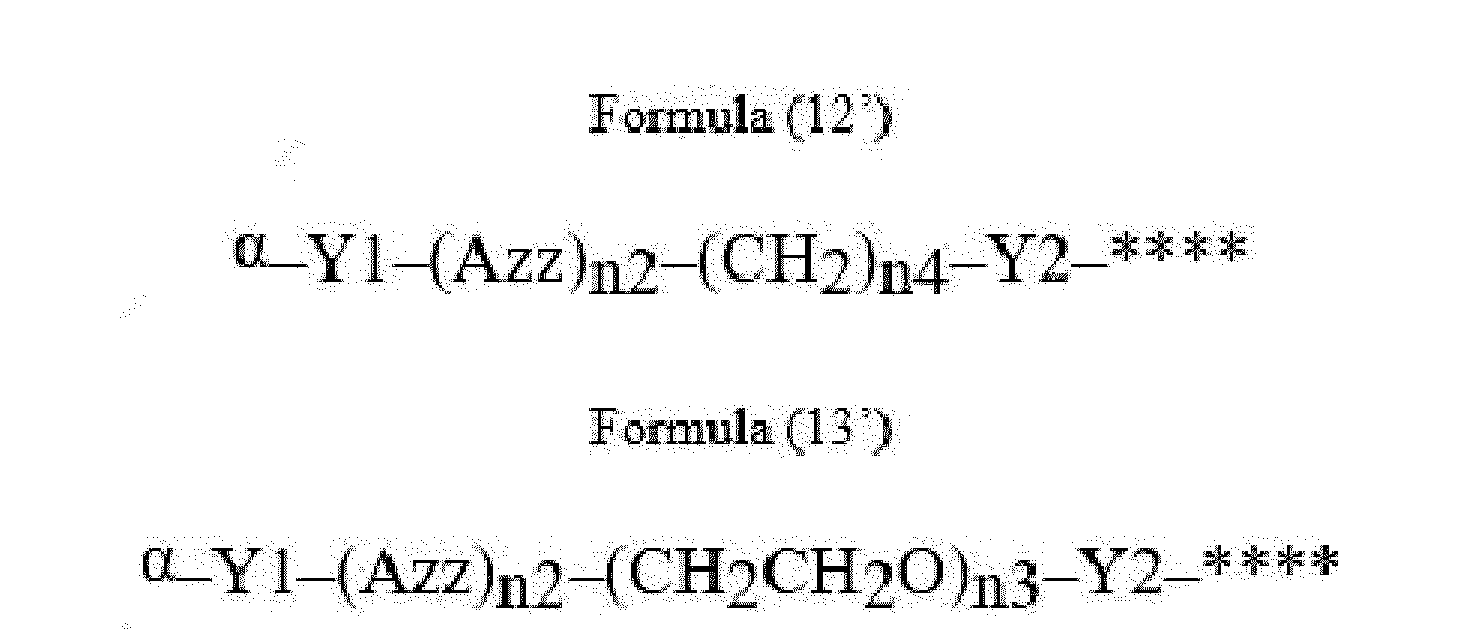

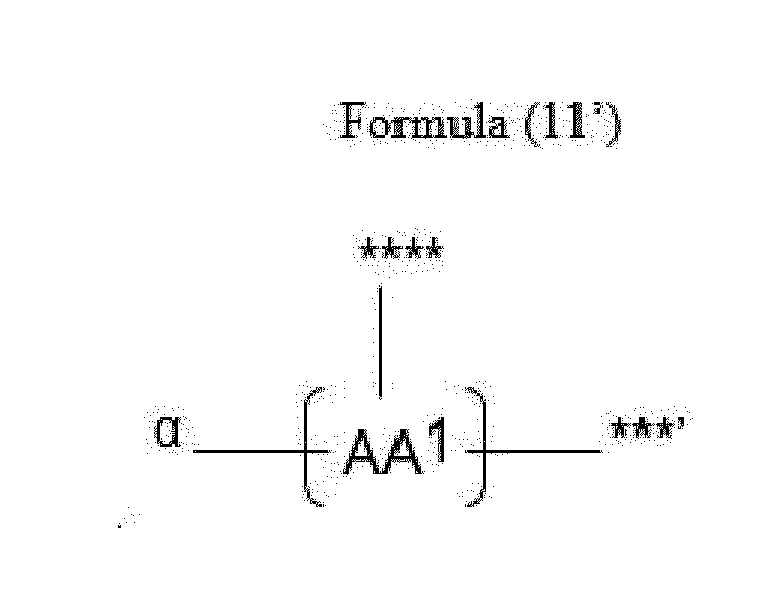


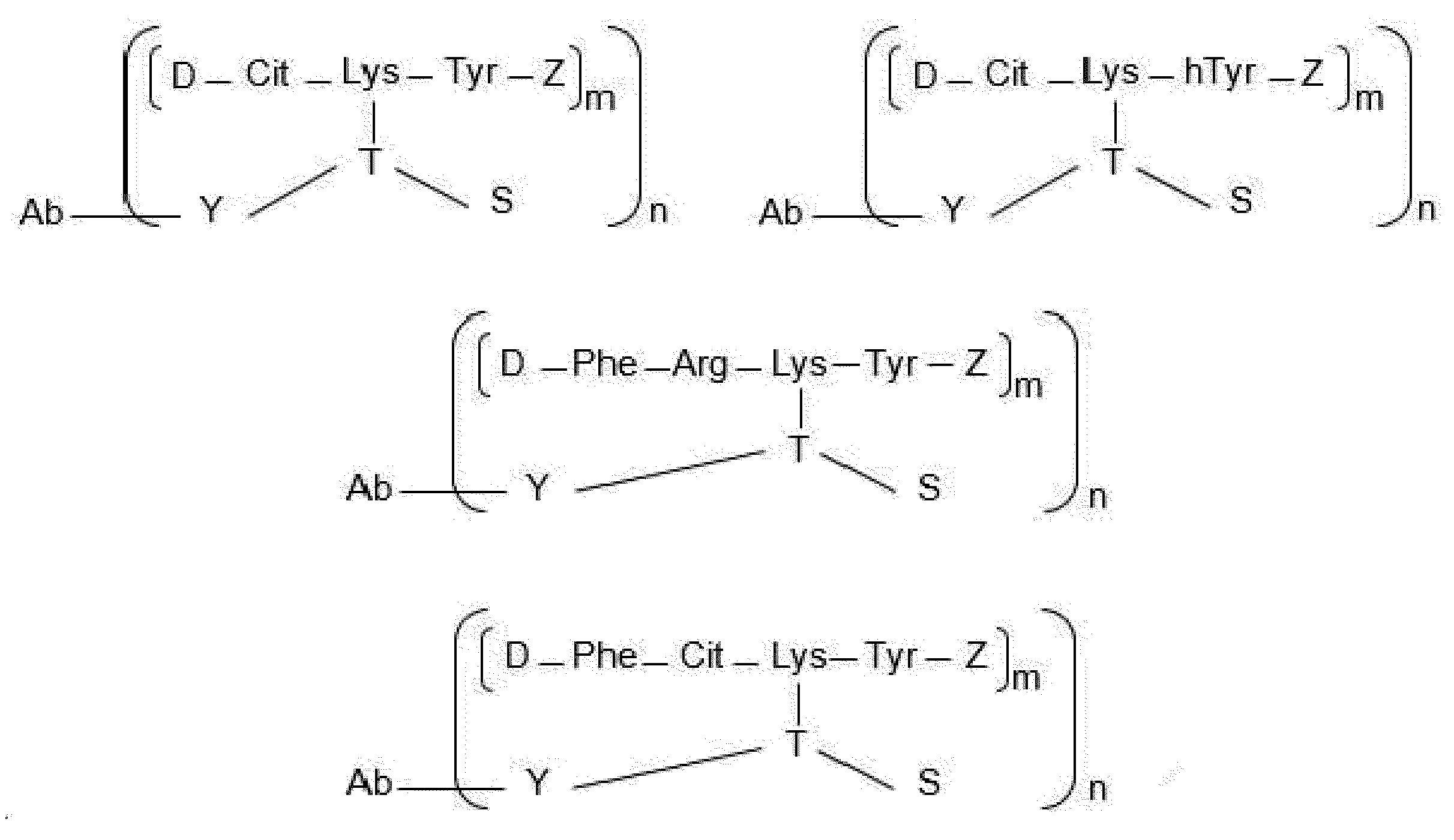
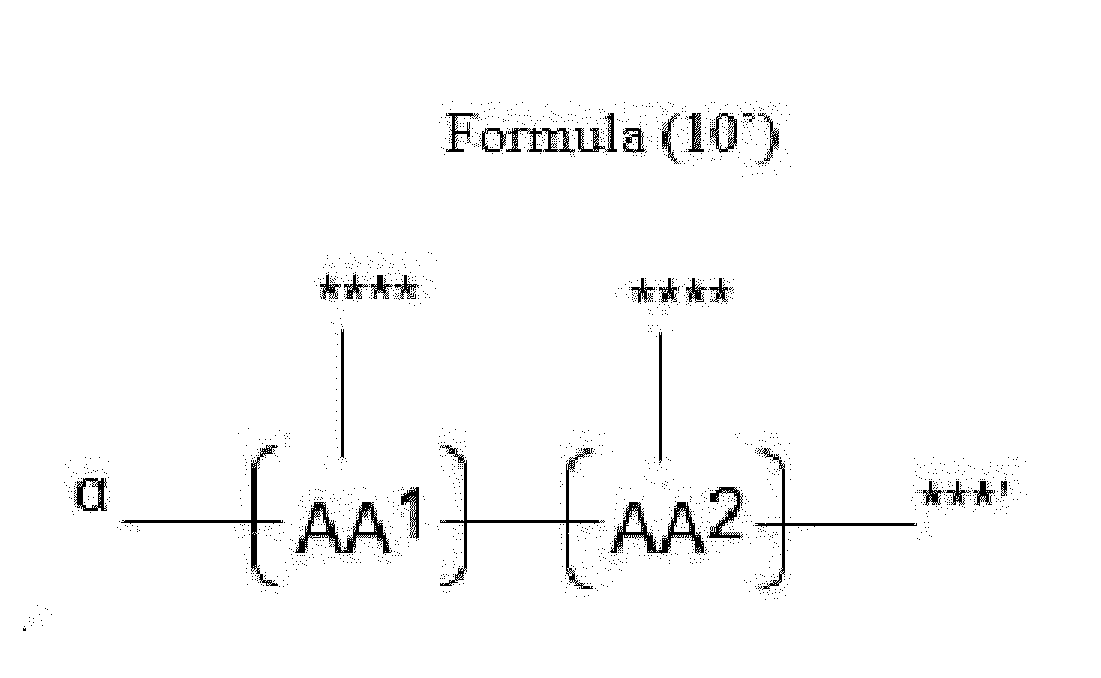

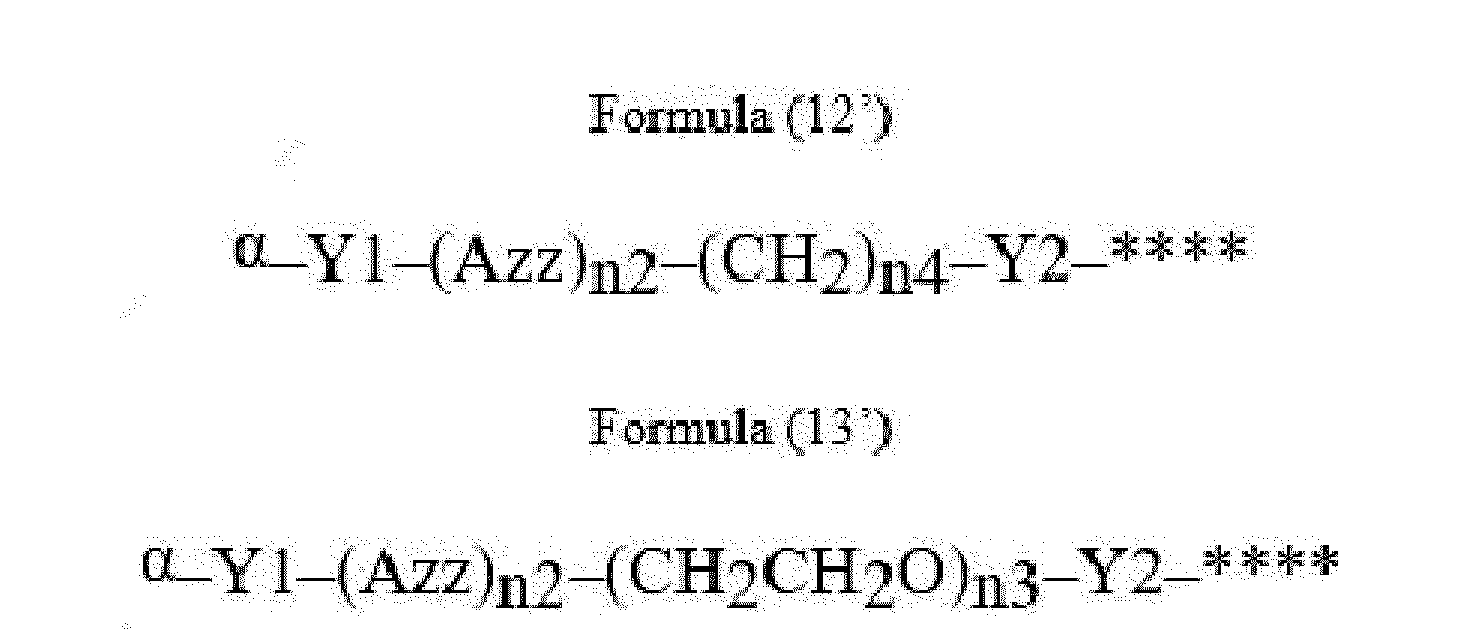
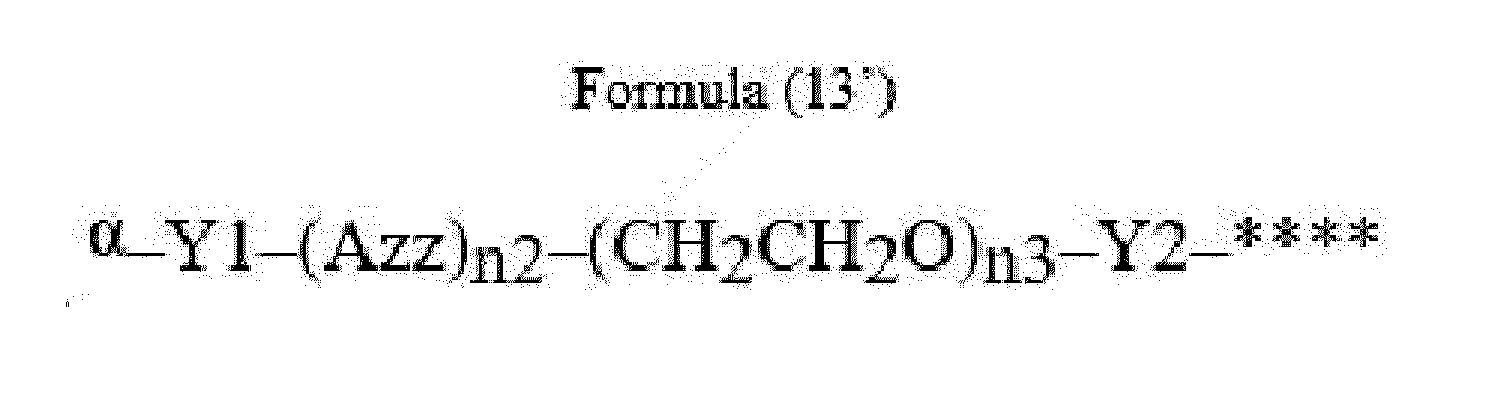
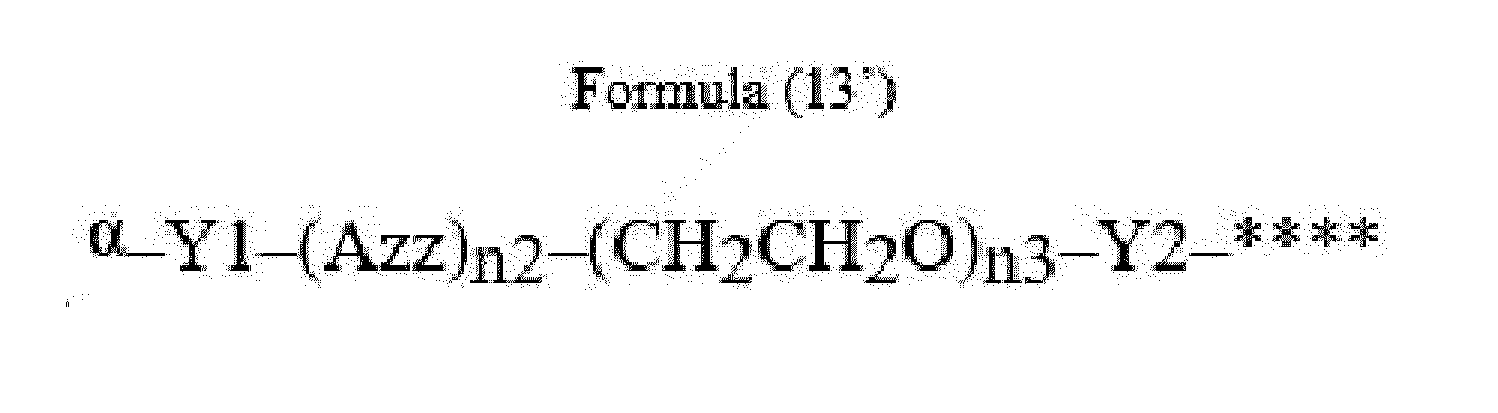
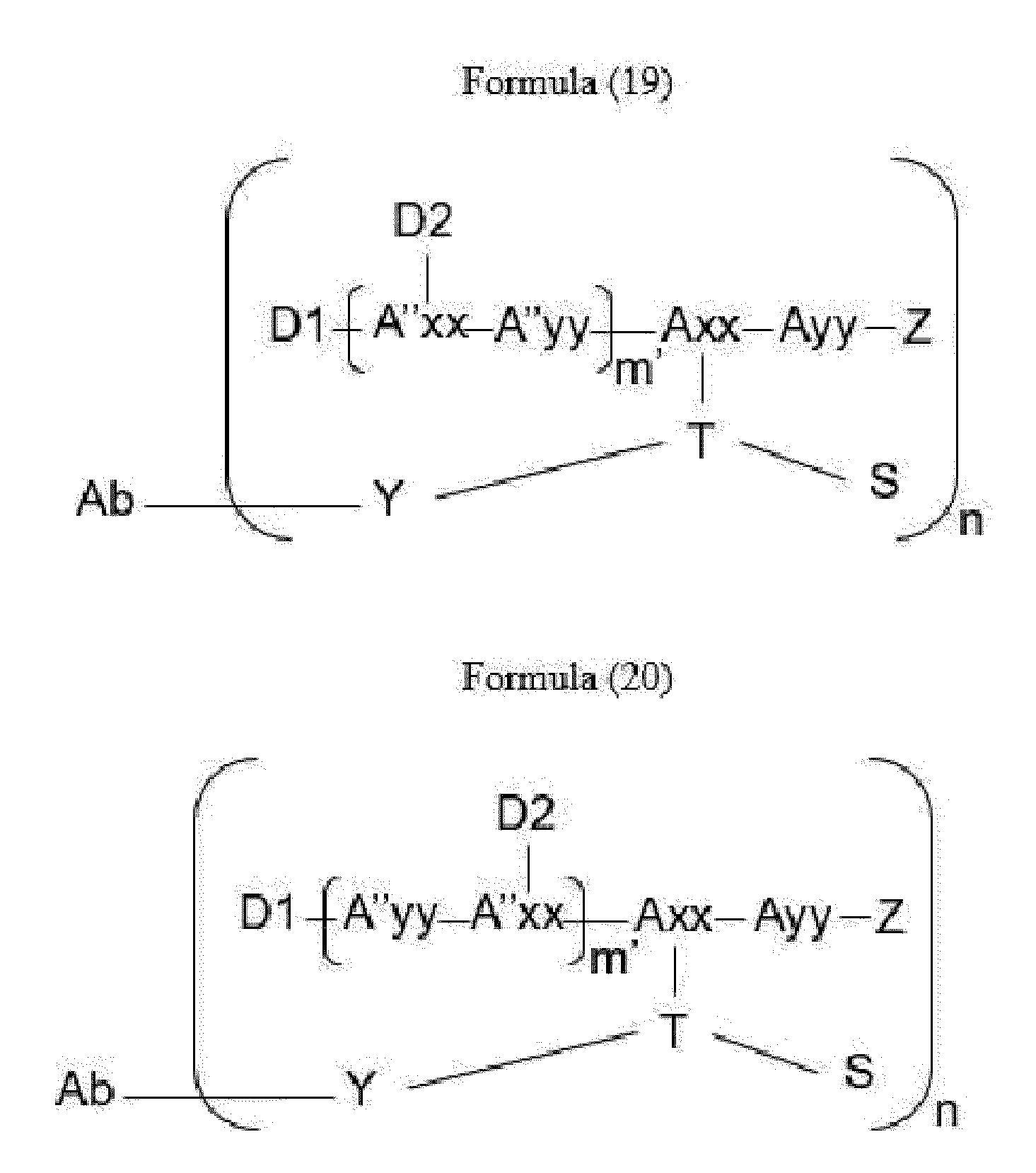
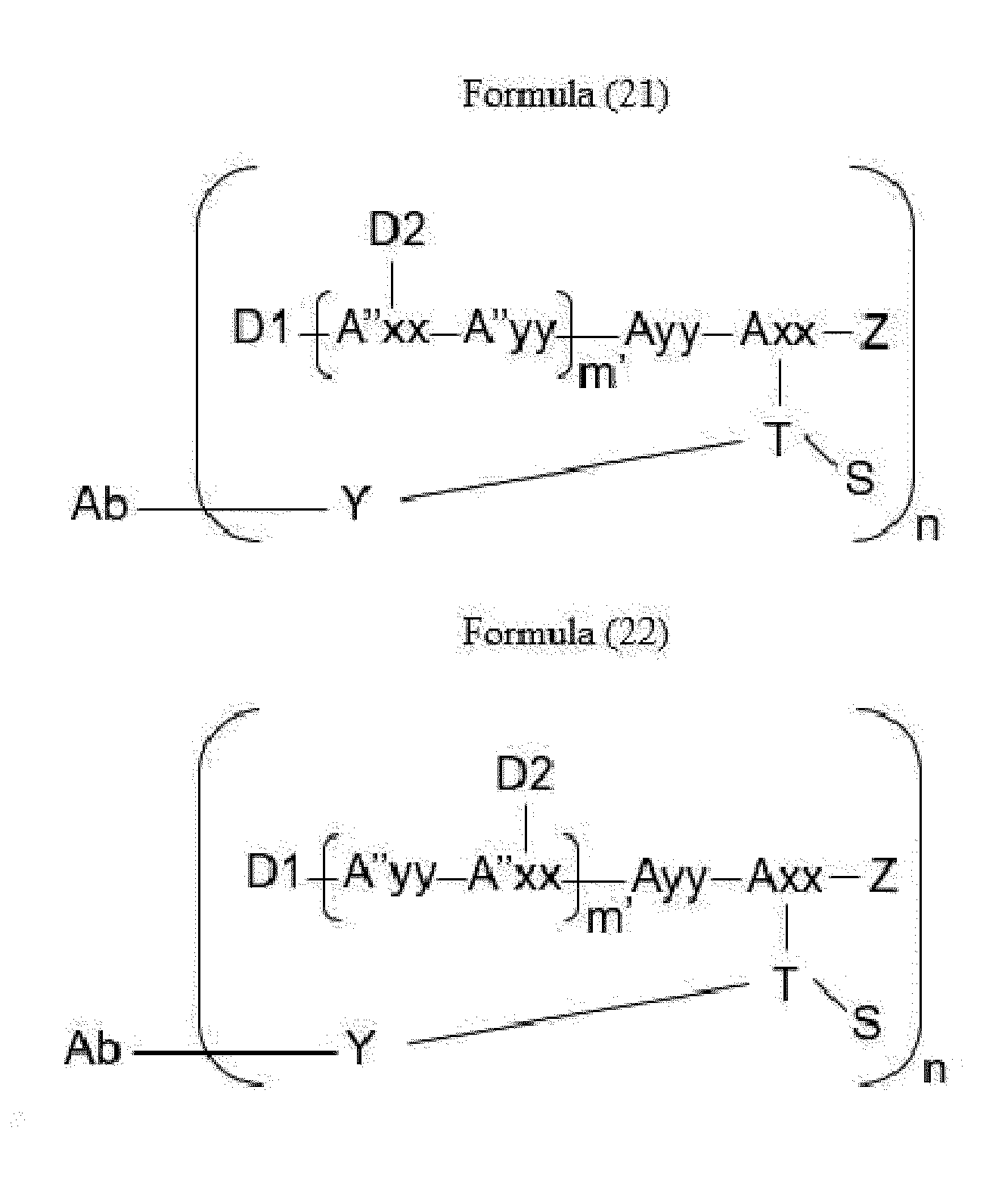

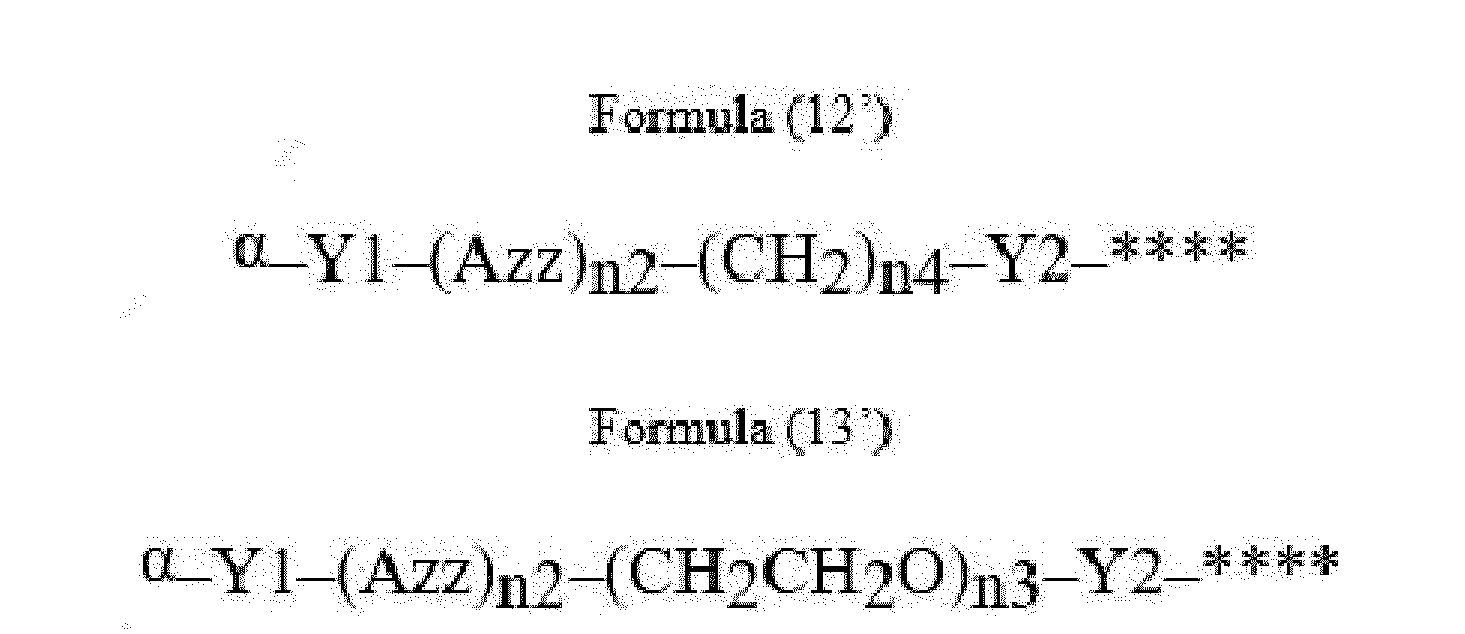
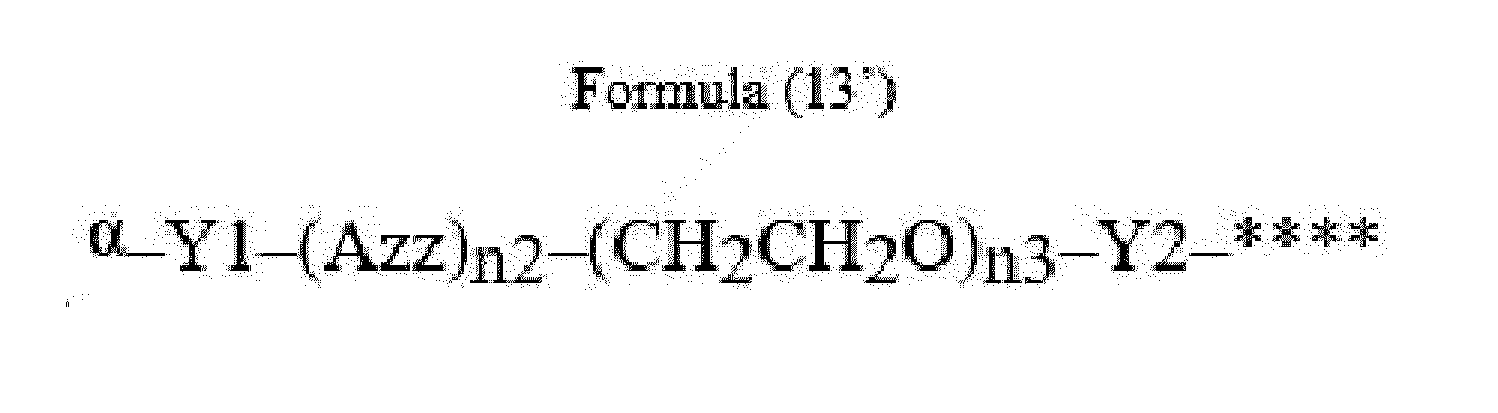
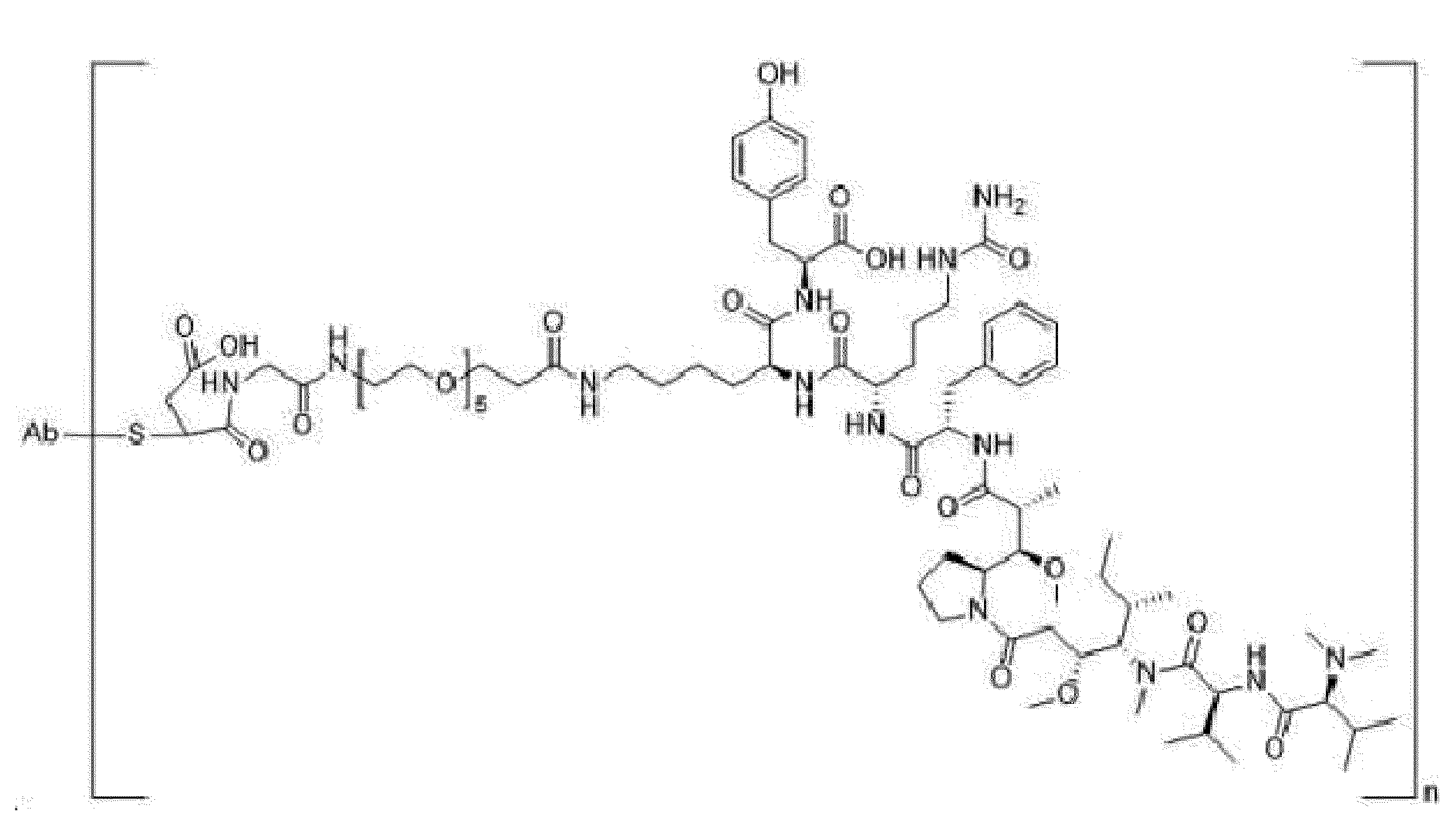
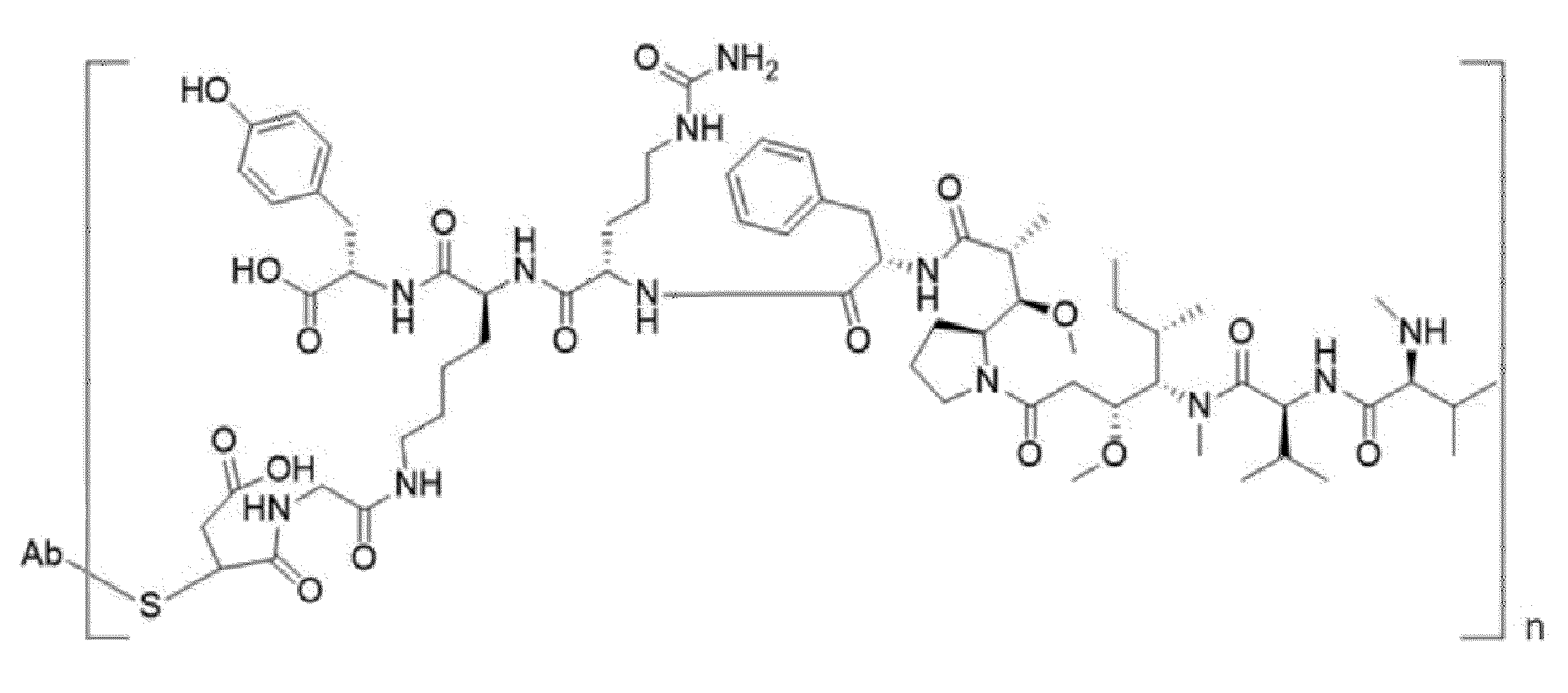
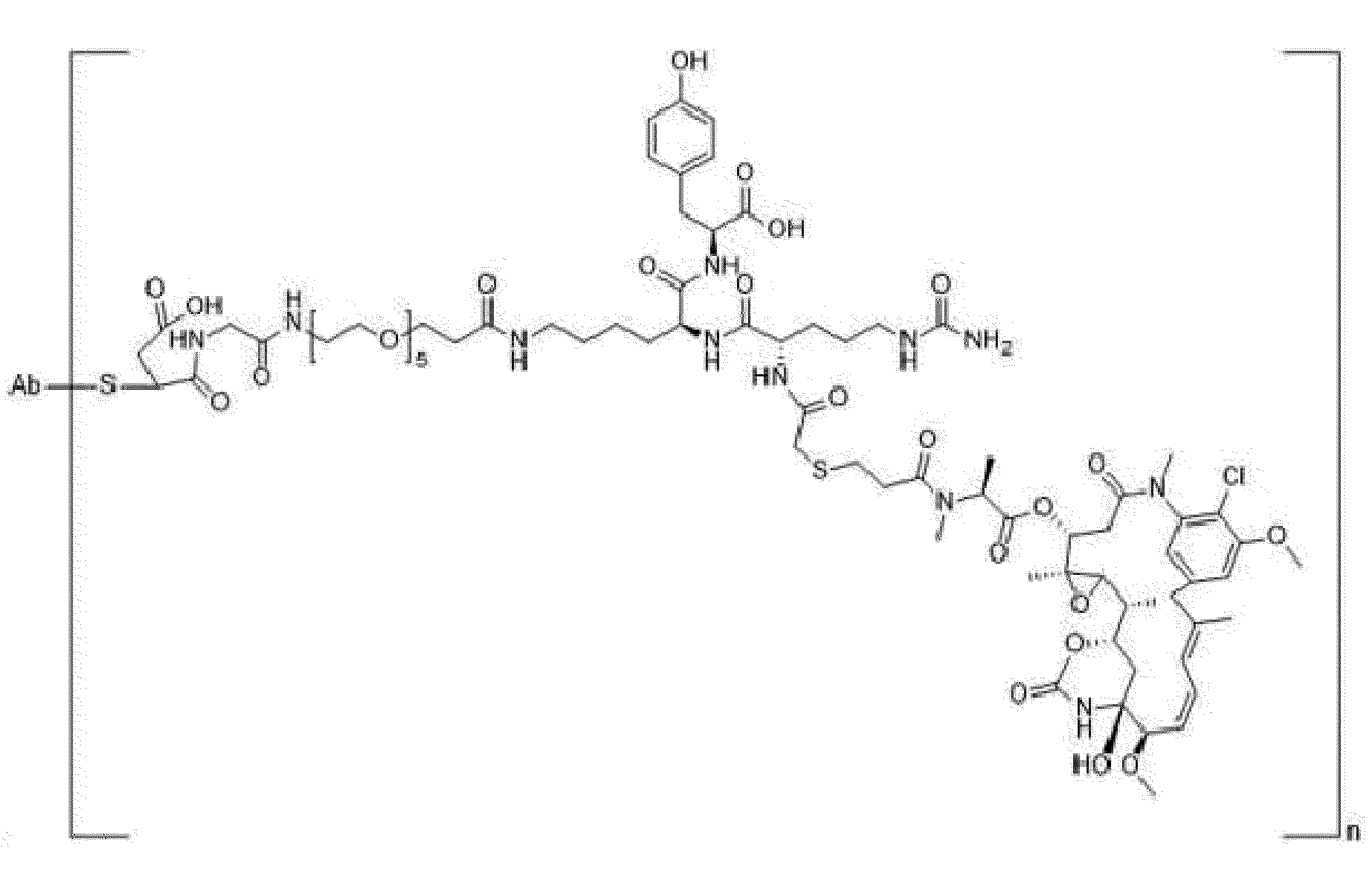

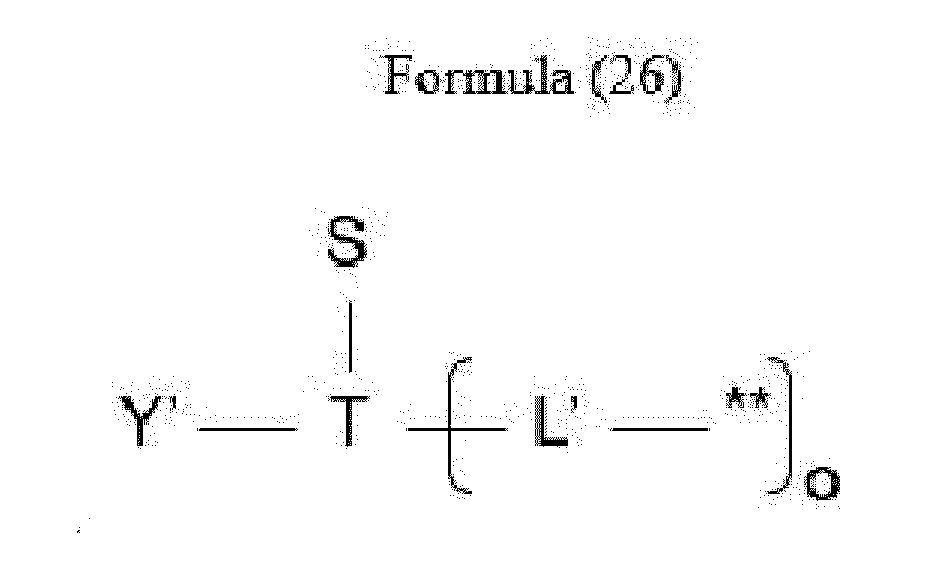
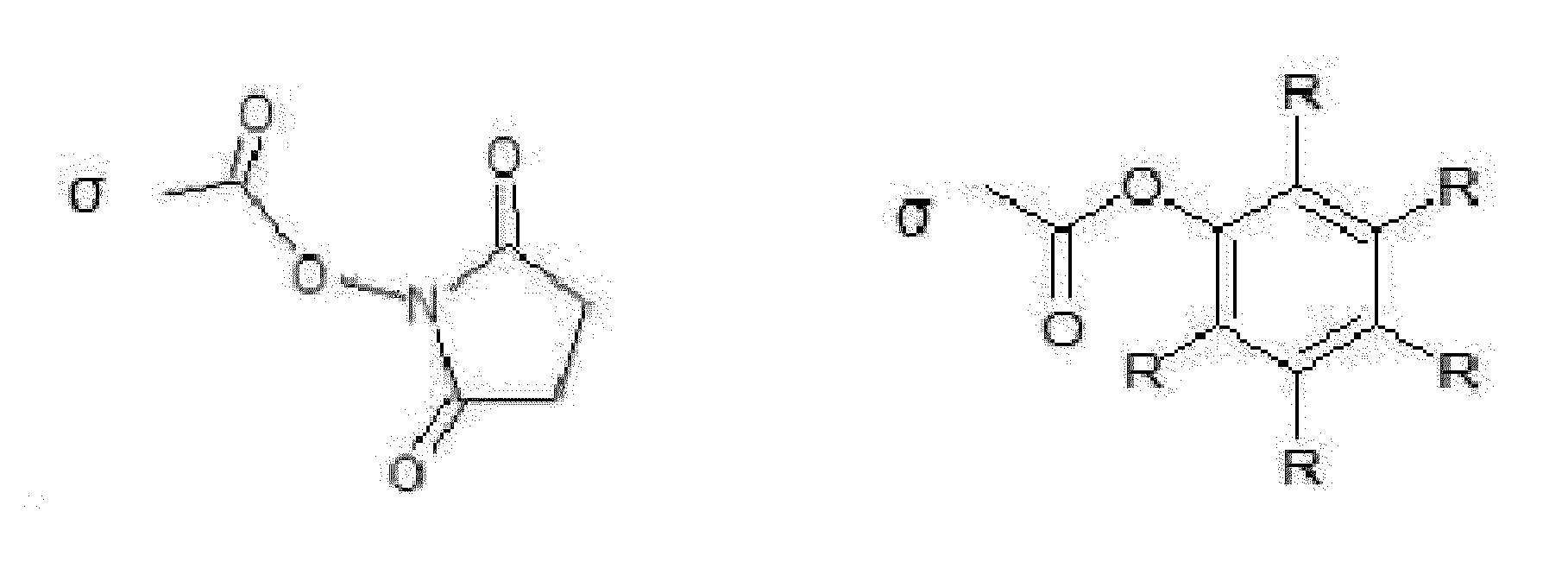
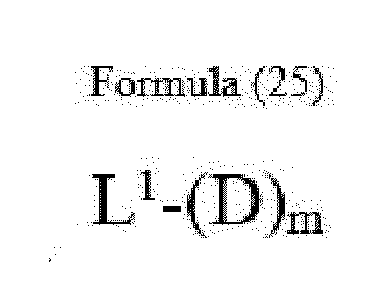
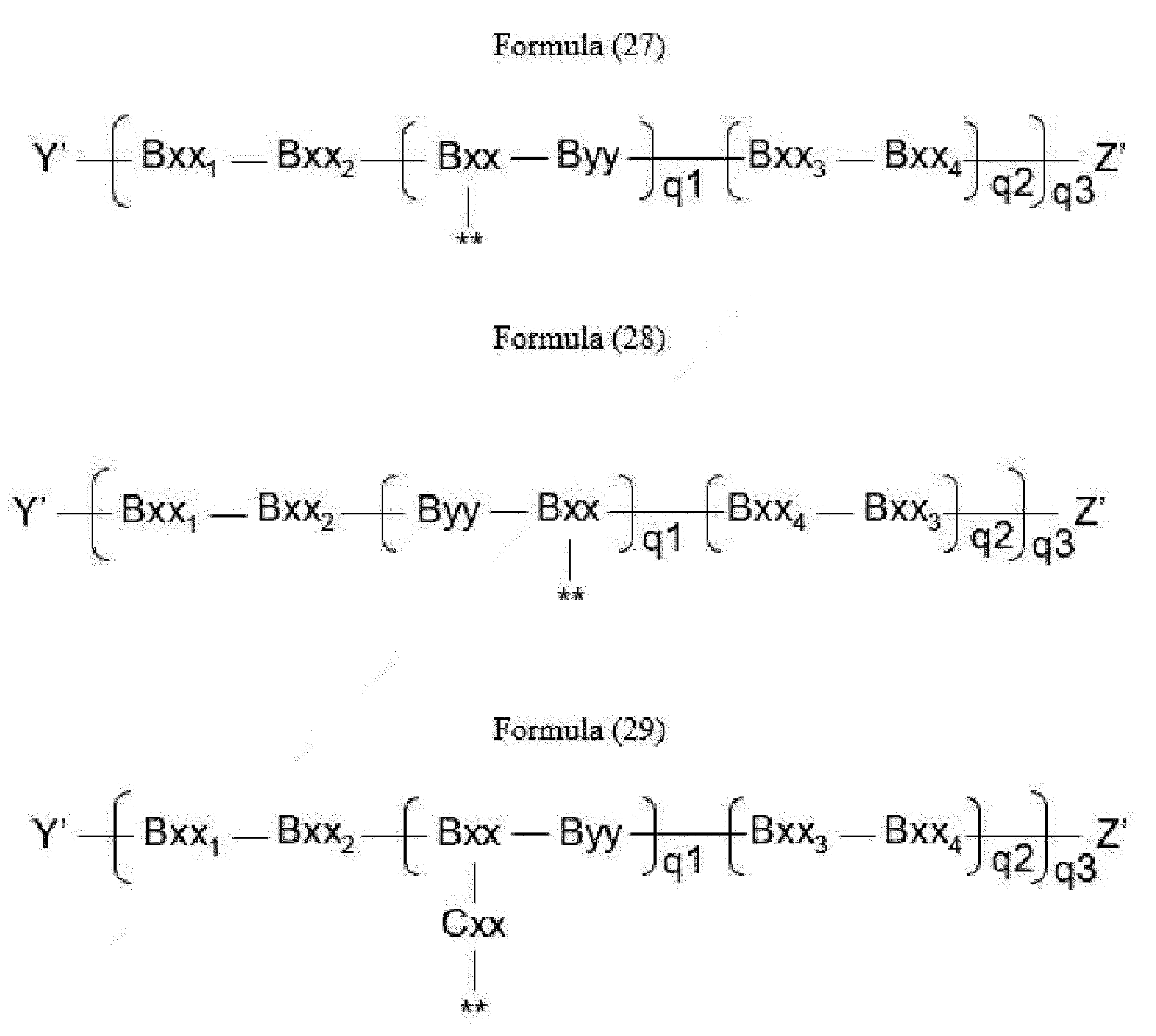

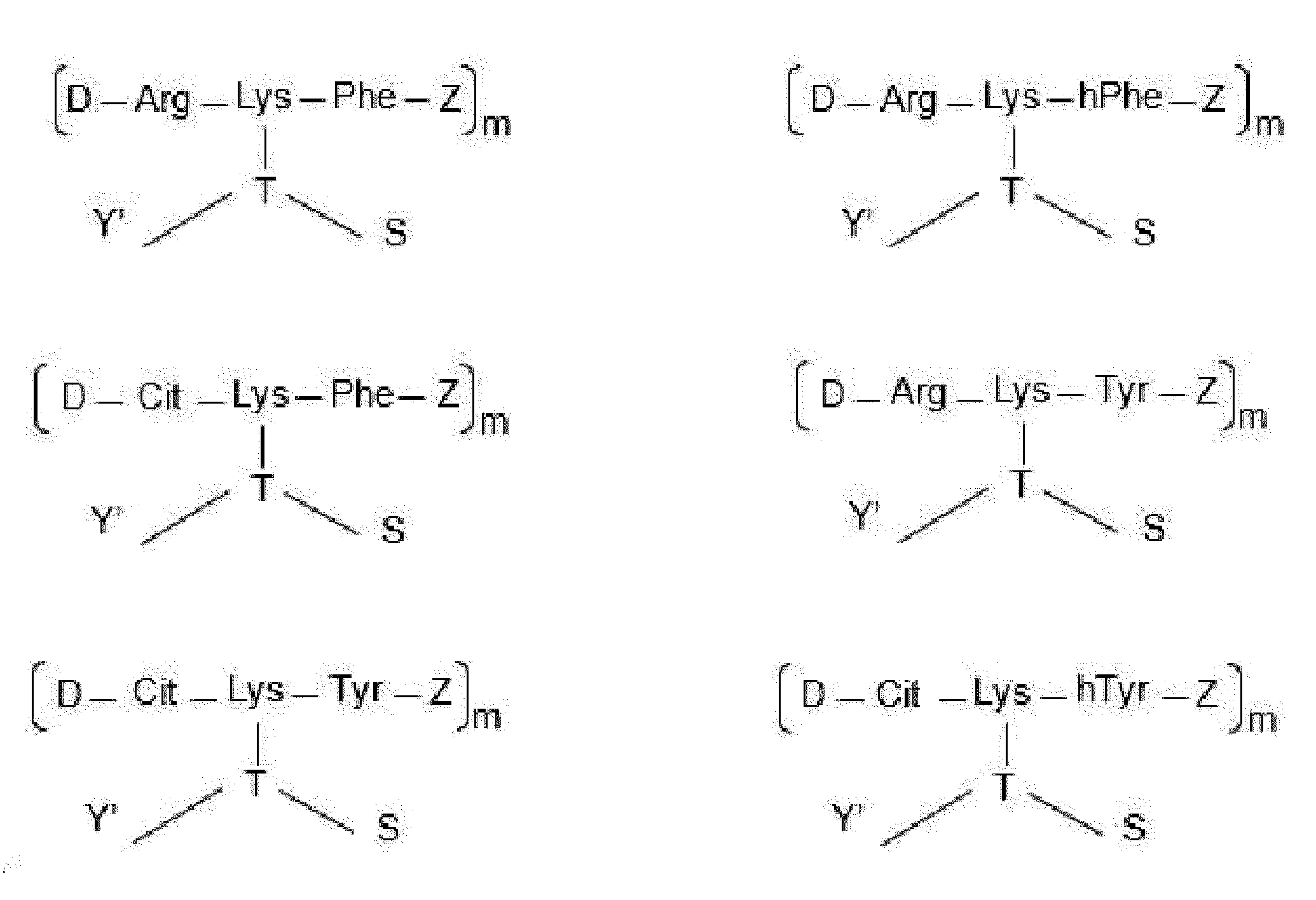
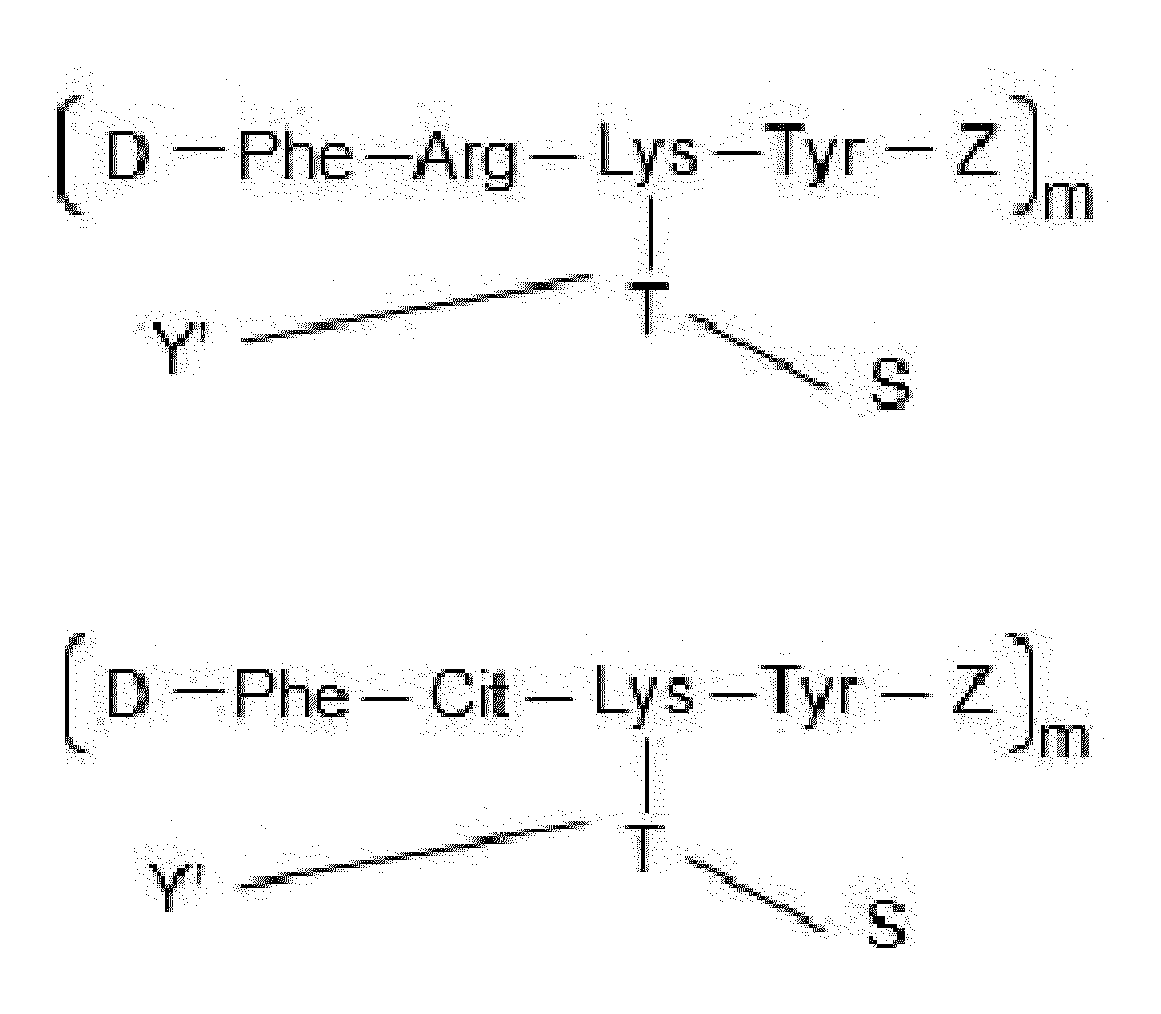
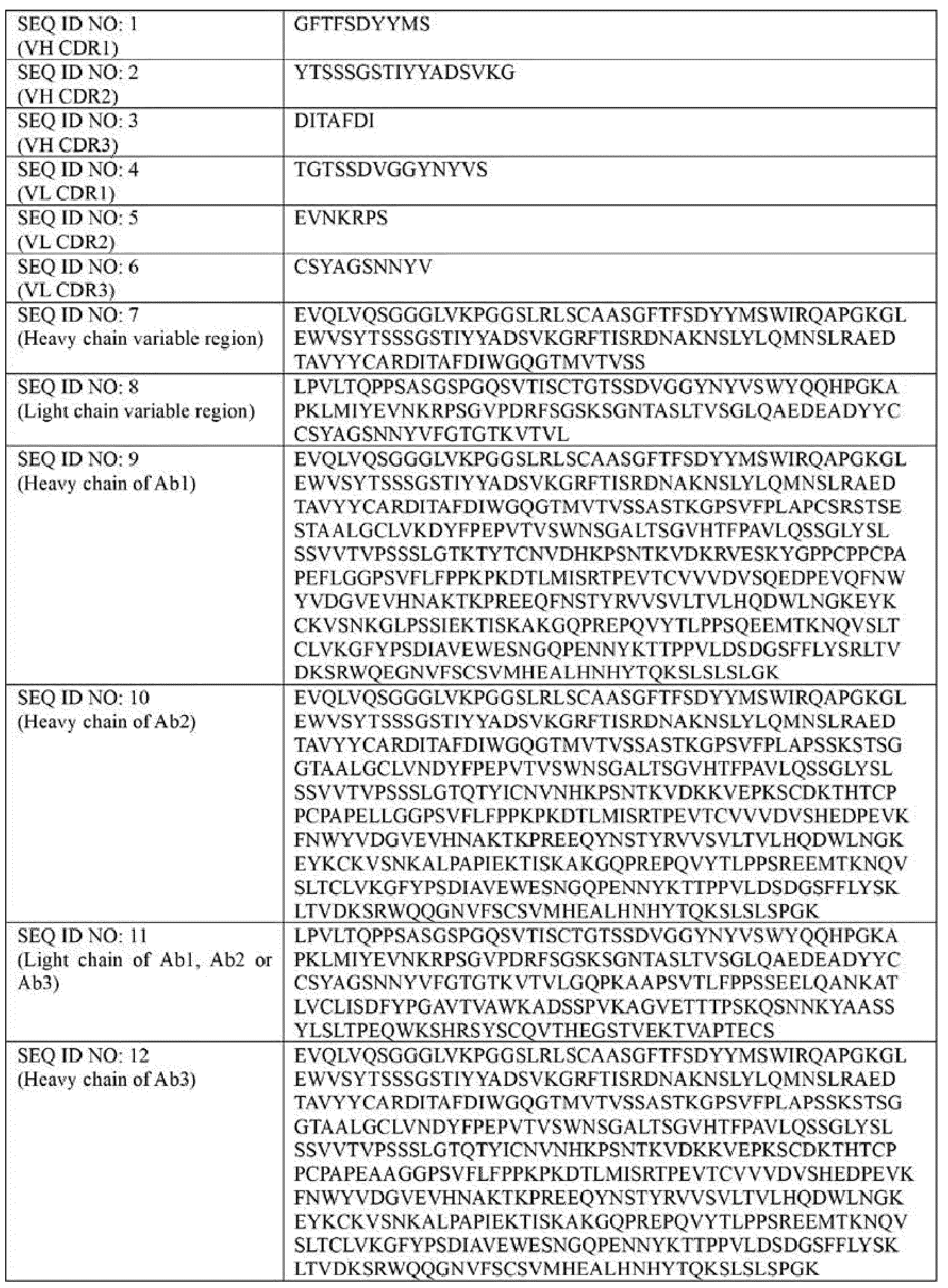
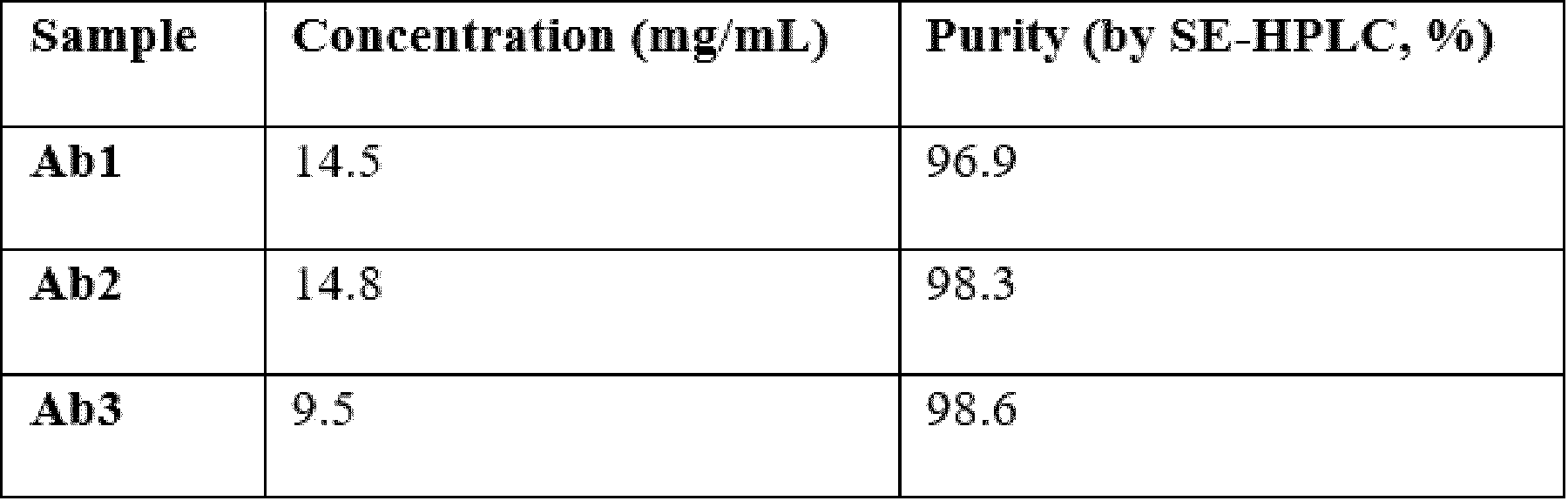

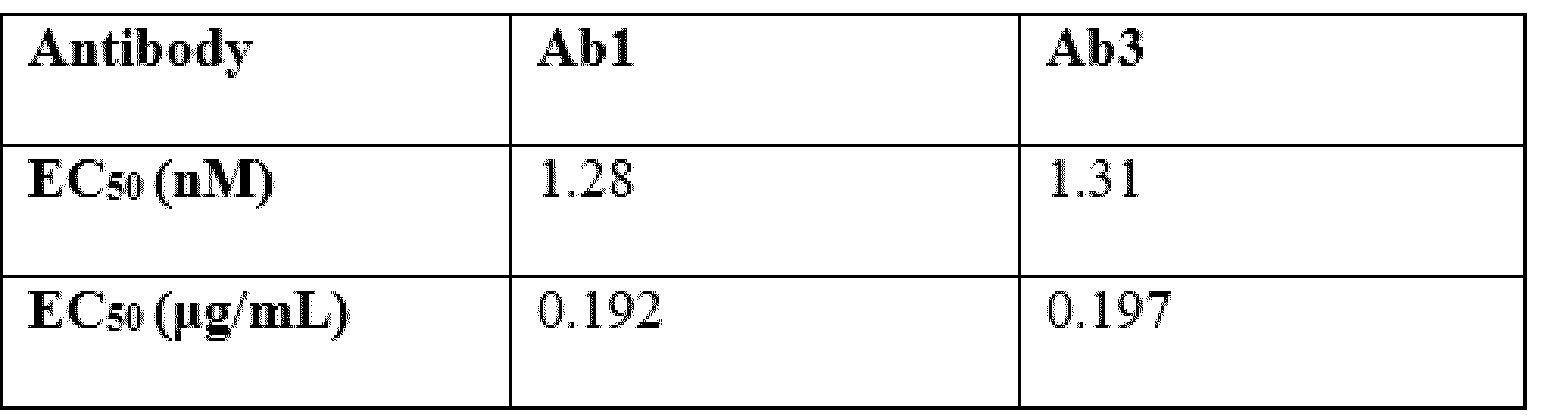

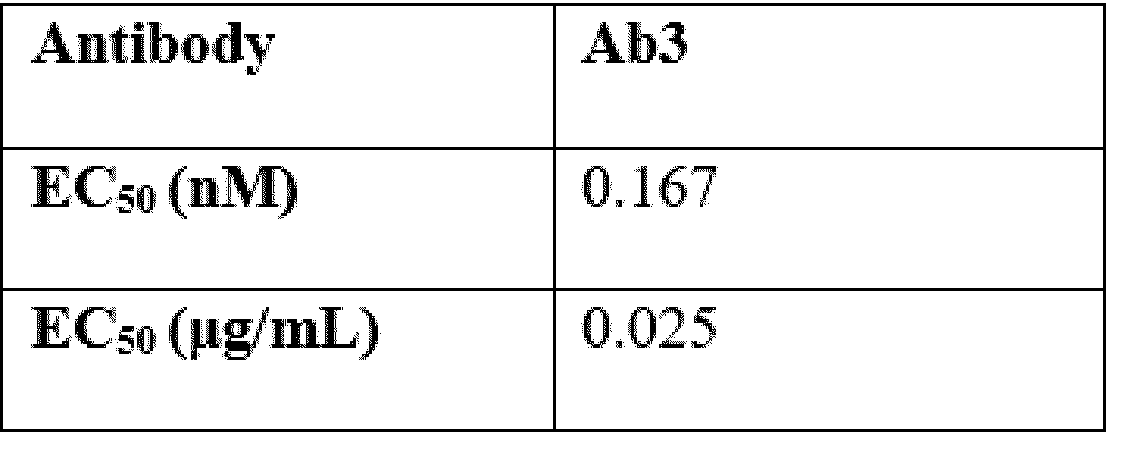
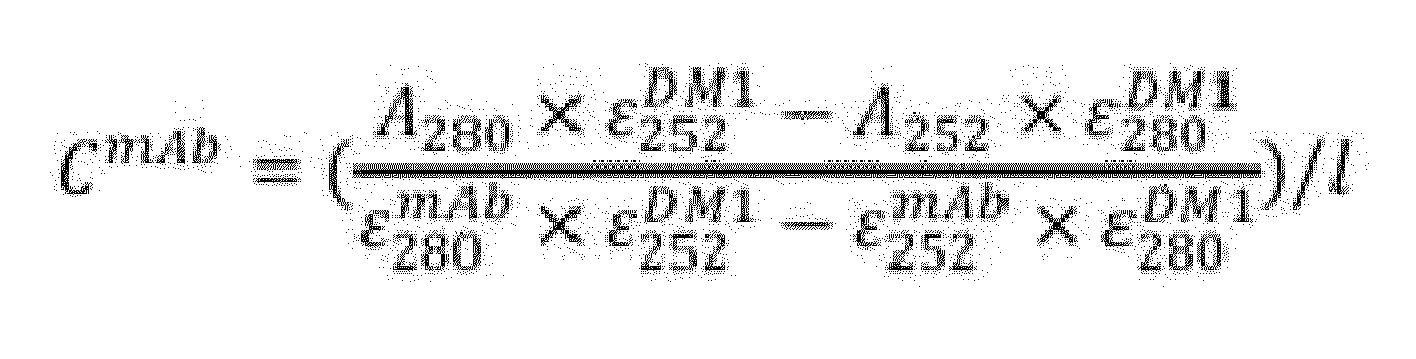

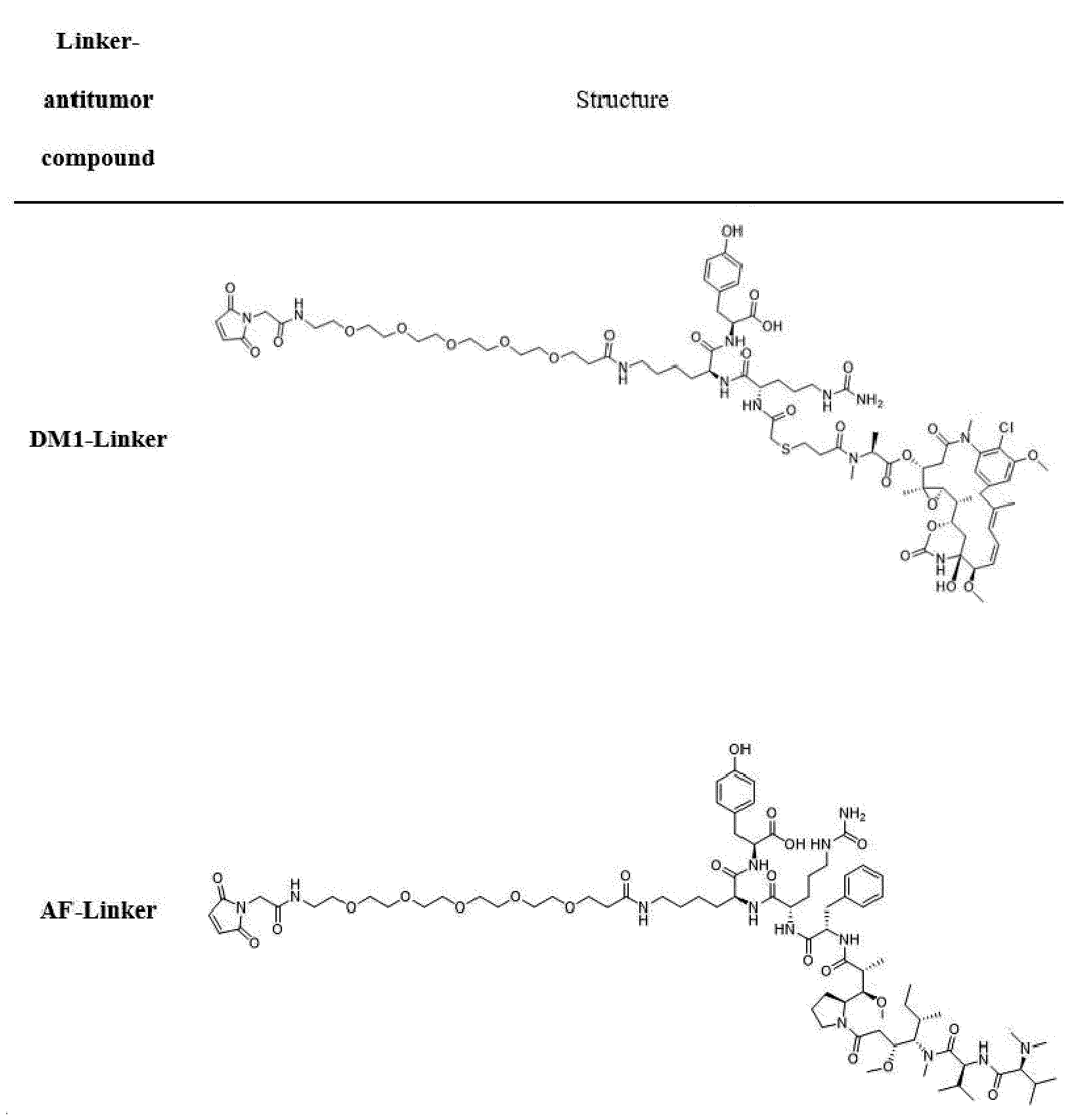

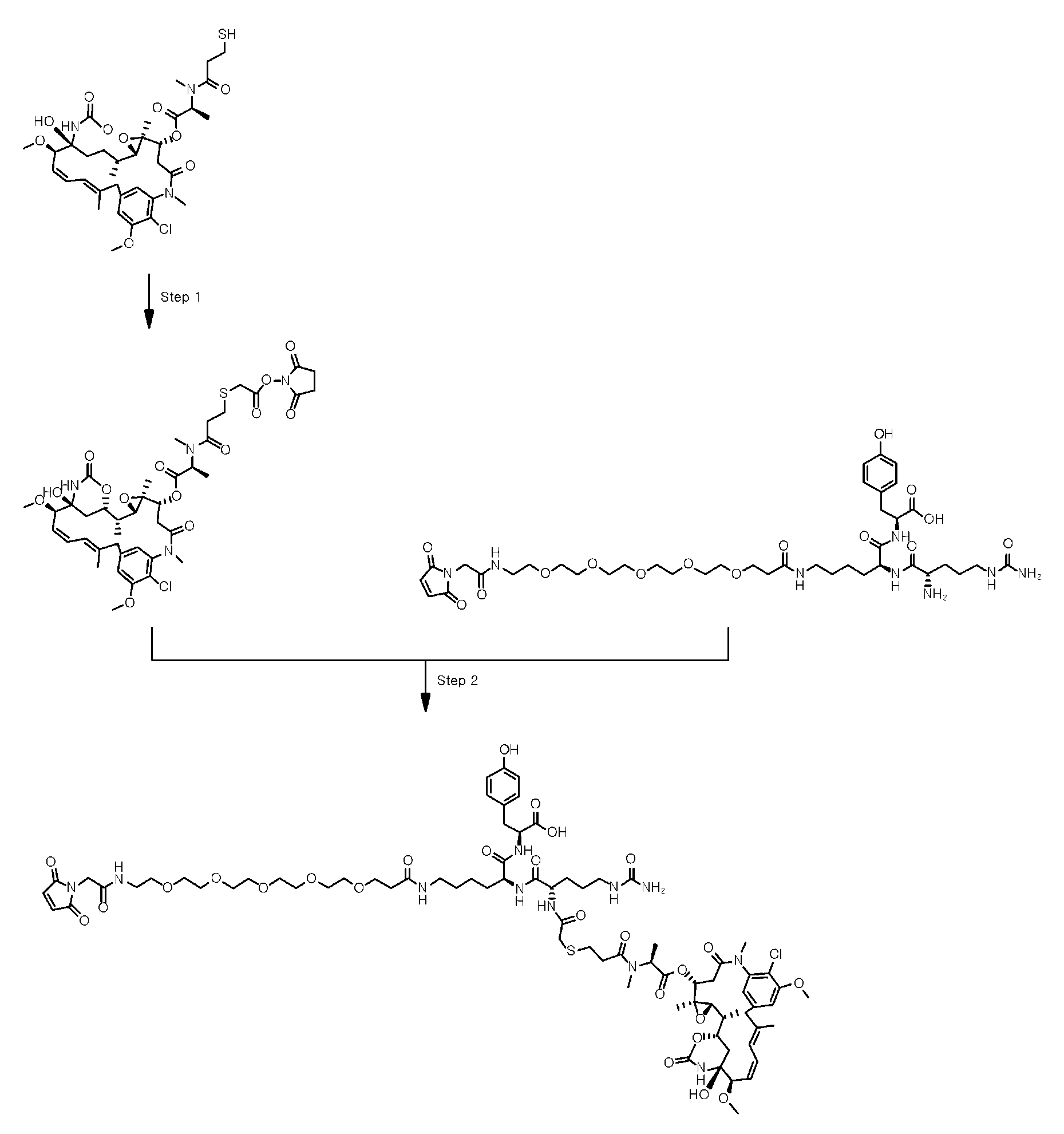
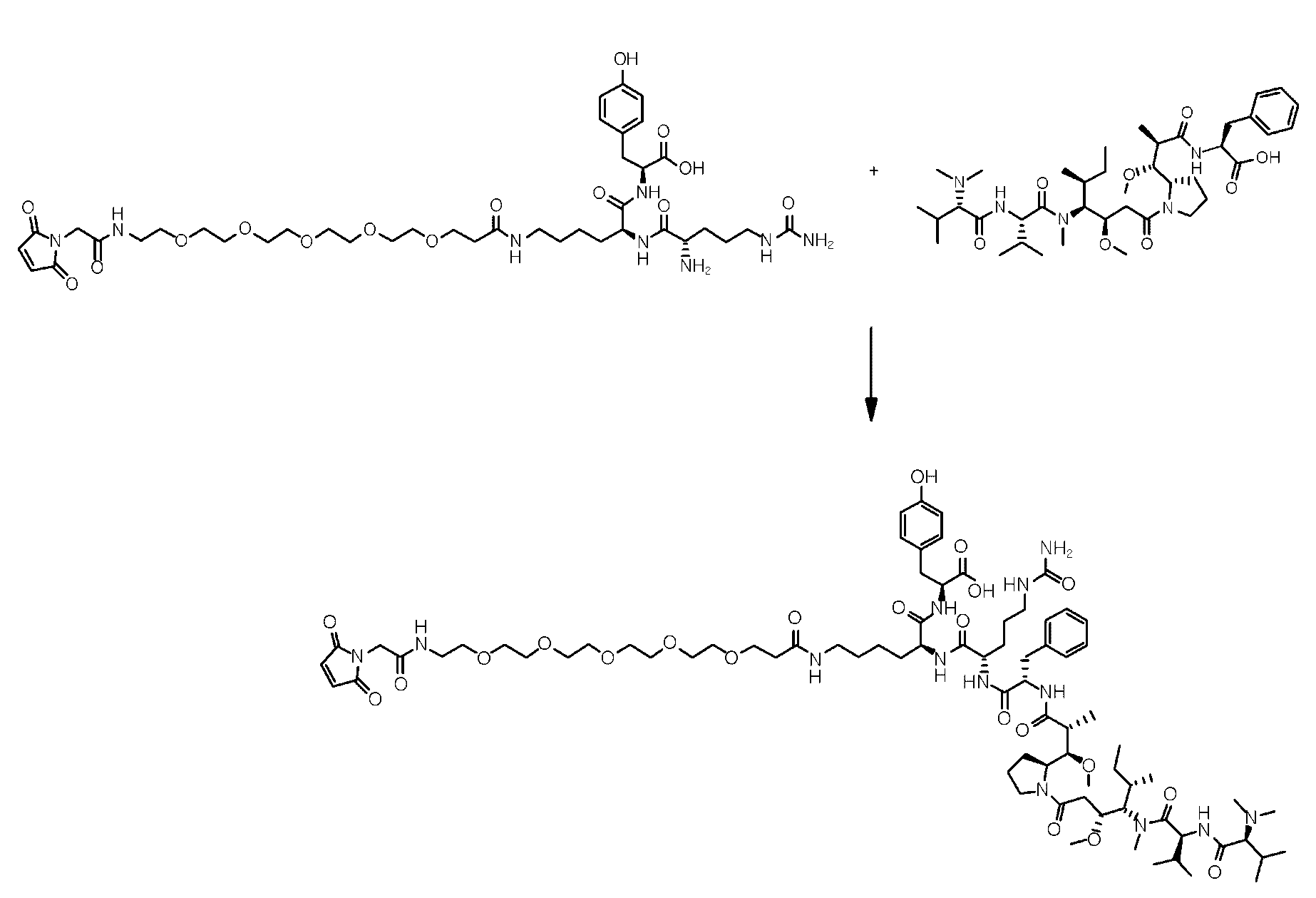
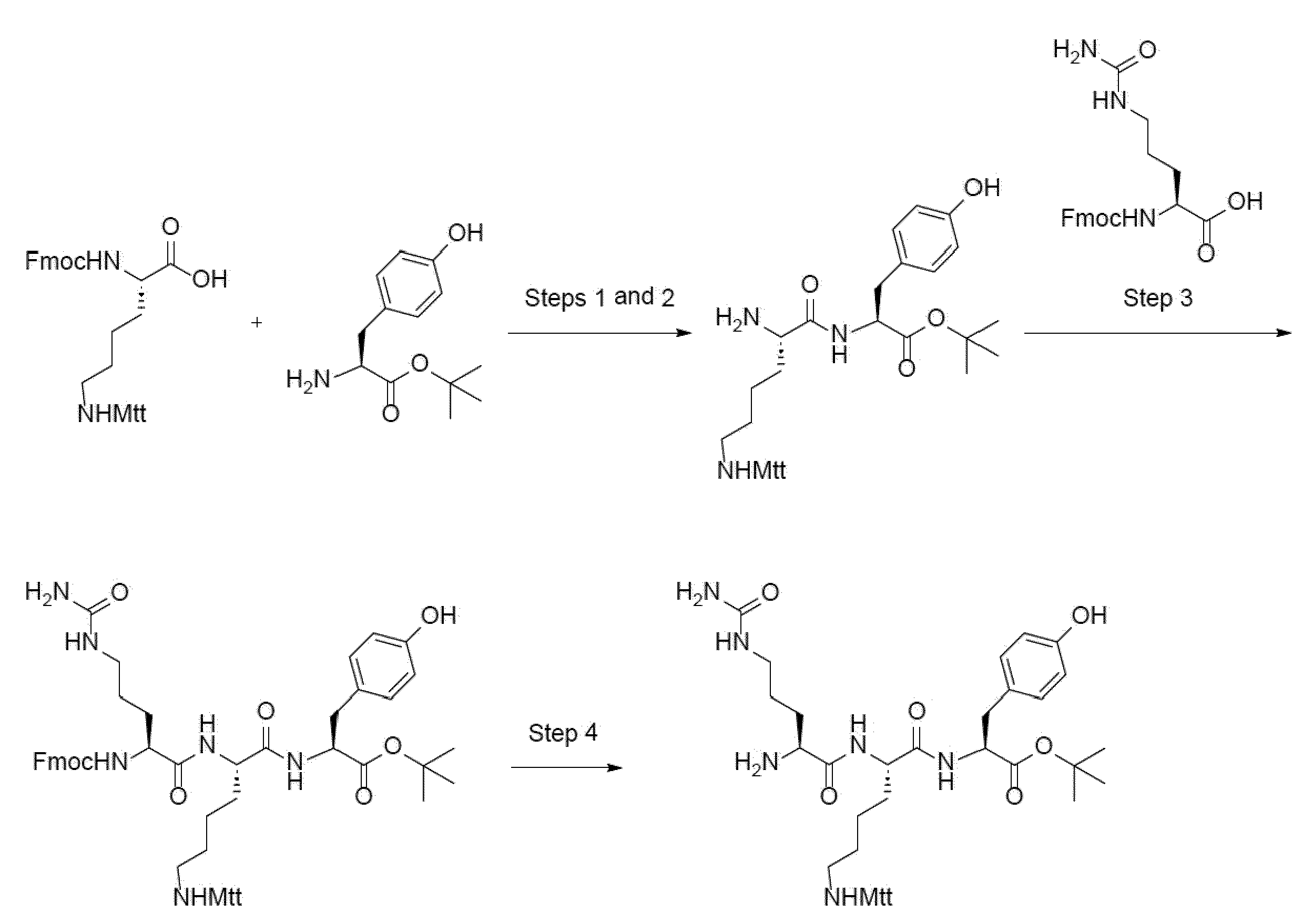
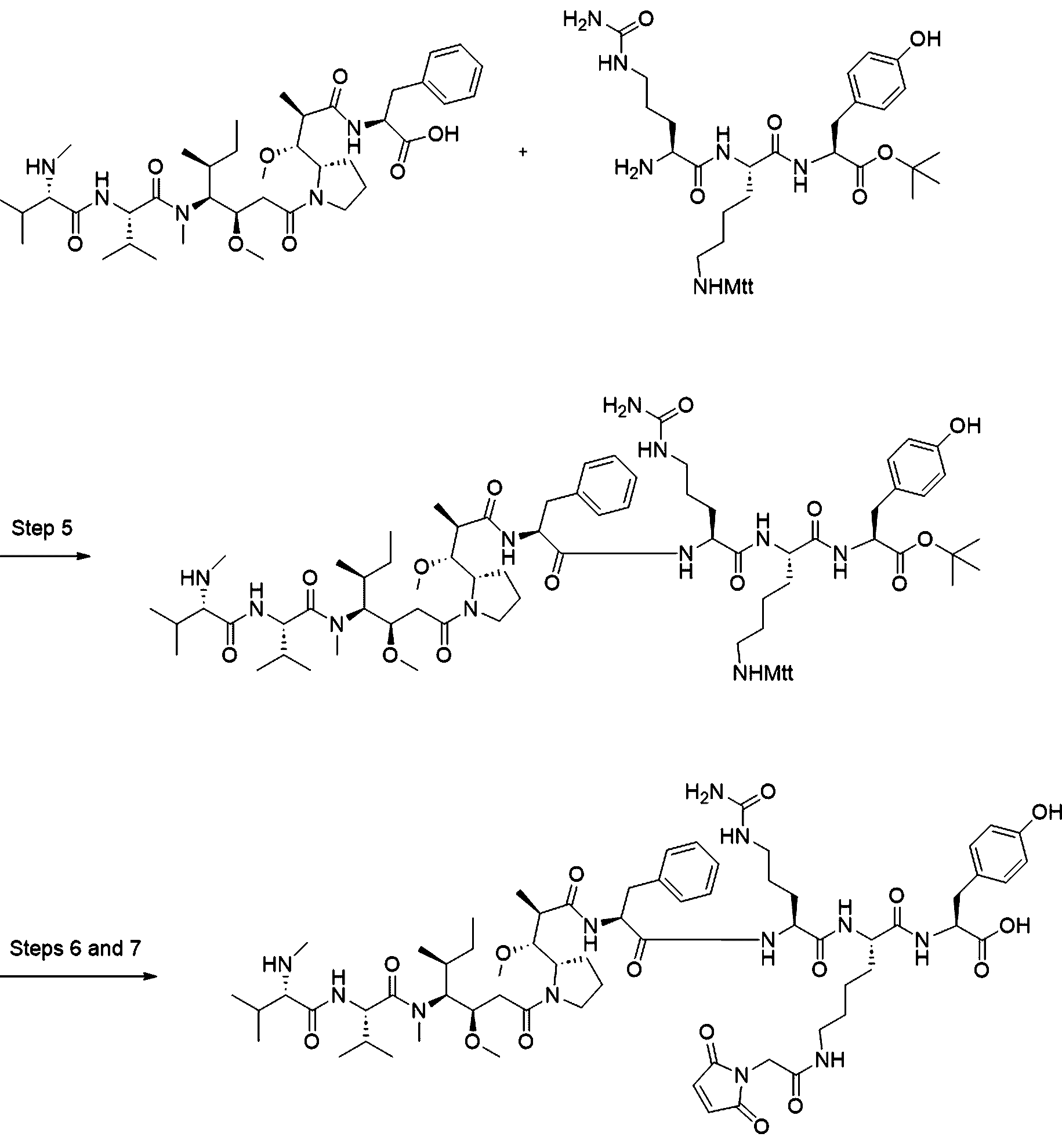

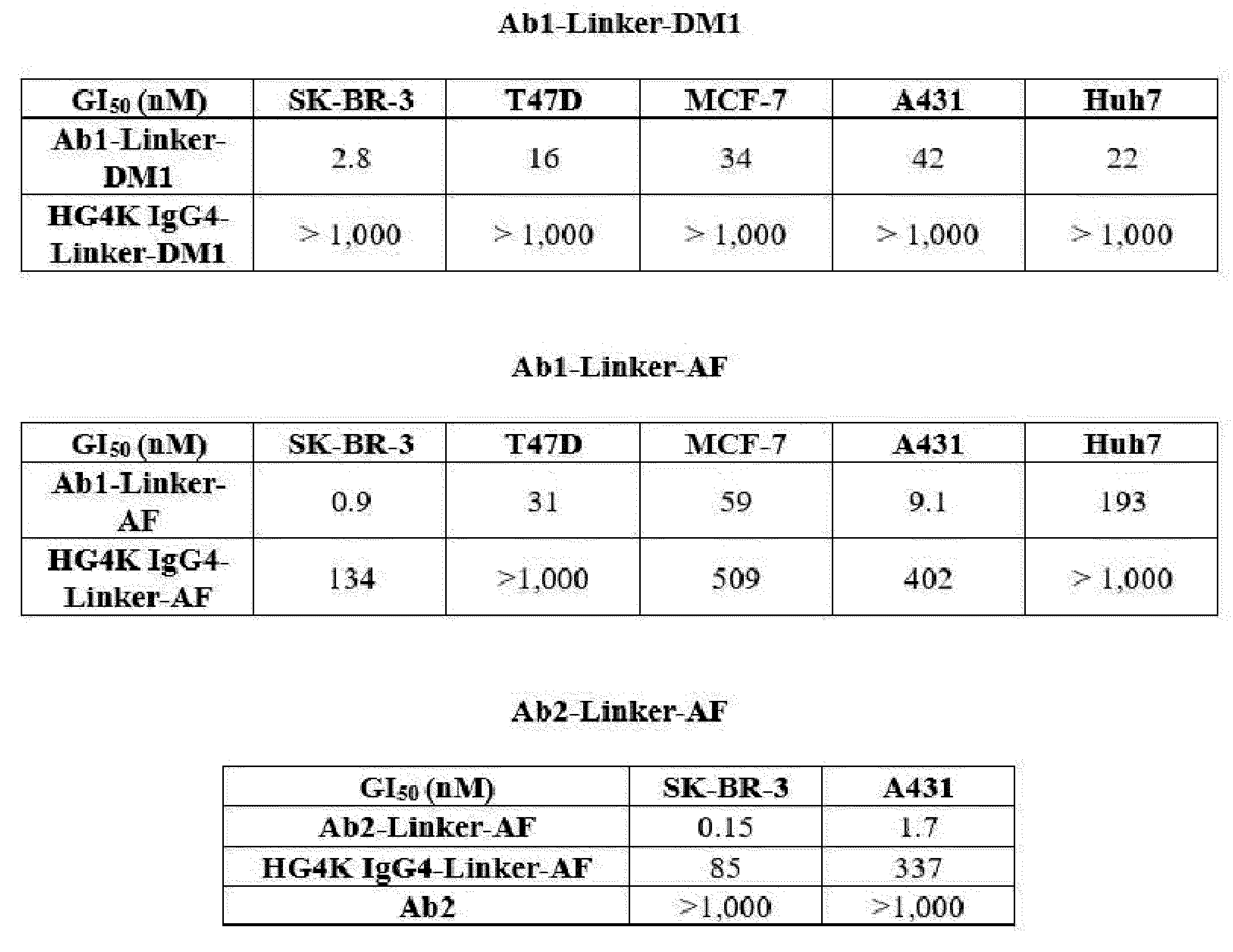
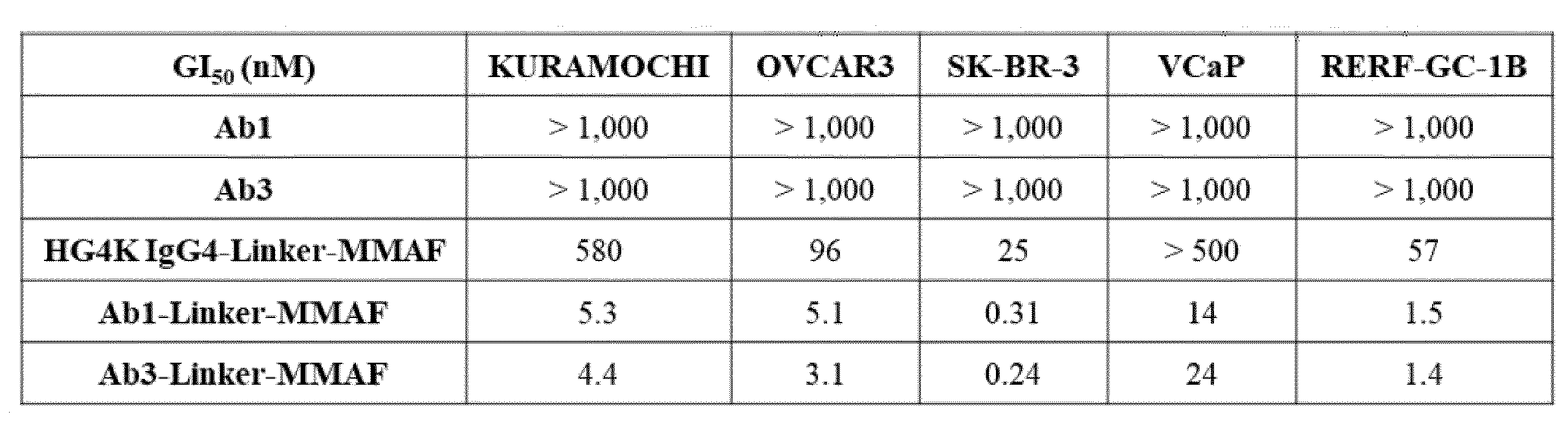
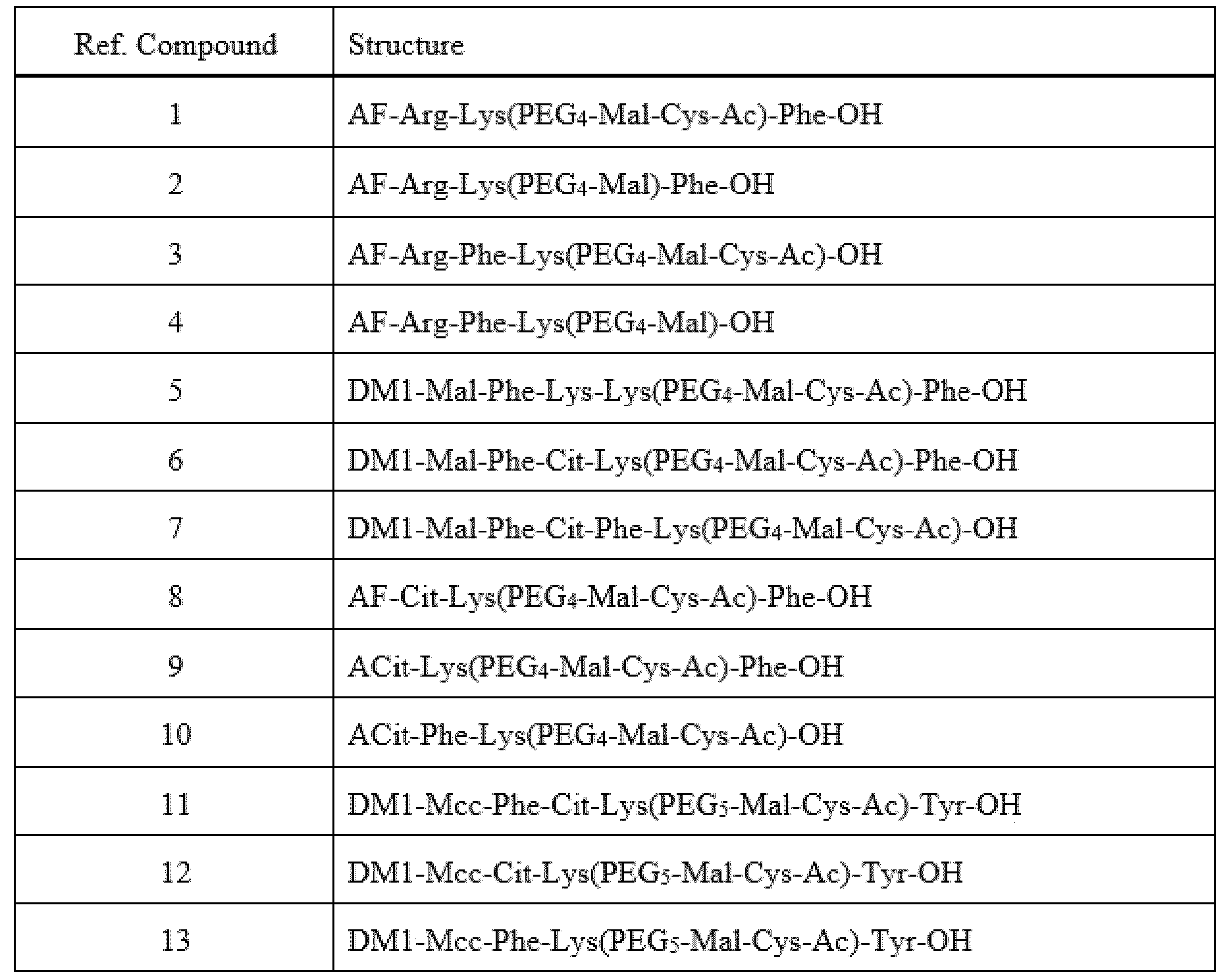
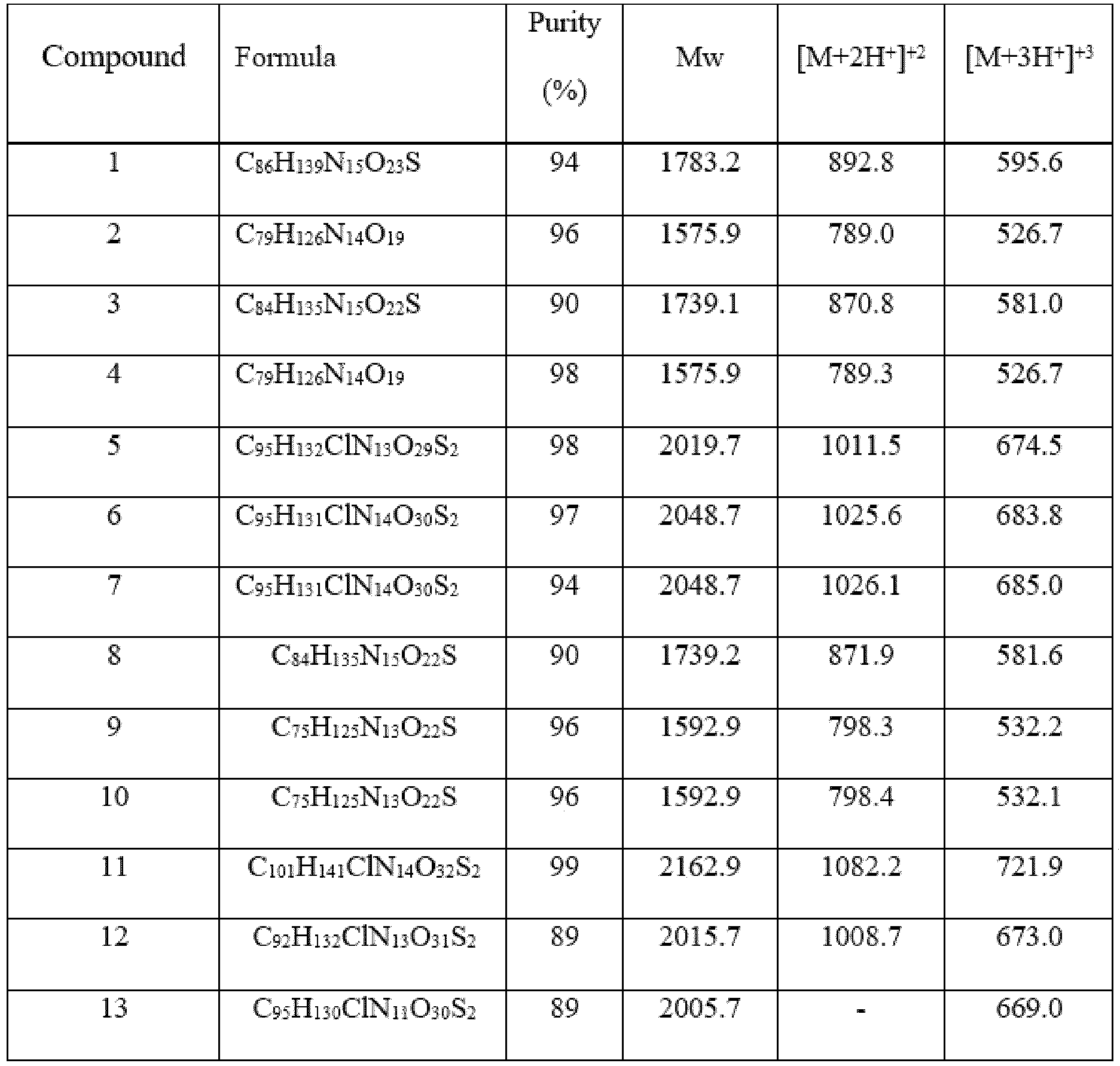

Claims (44)
- An antibody-drug conjugate of Formula (1):
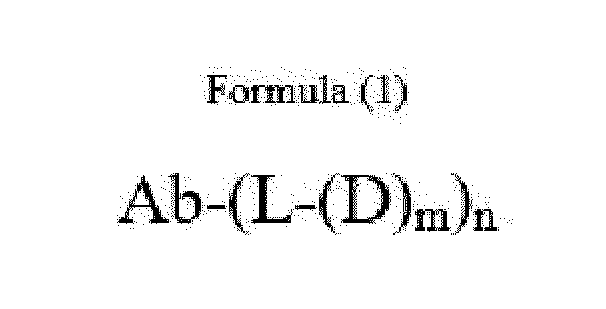 or a pharmaceutically acceptable salt thereof,wherein Ab is an anti-basal cell adhesion molecule (BCAM) antibody or an antigen binding fragment thereof, comprising (i) a heavy chain variable region comprising a VH CDR1 sequence of SEQ ID NO: 1, a VH CDR2 sequence of SEQ ID NO: 2, and a VH CDR3 sequence of SEQ ID NO: 3, and (ii) a light chain variable region comprising a VL CDR1 sequence of SEQ ID NO: 4, a VL CDR2 sequence of SEQ ID NO: 5, and a VL CDR3 sequence of SEQ ID NO: 6,wherein D is an antitumor compound which is conjugated to the anti-BCAM antibody via the linker,wherein n is 1 to 10,wherein m is 1 to 5, andwherein L is a linker represented by Formula (2):
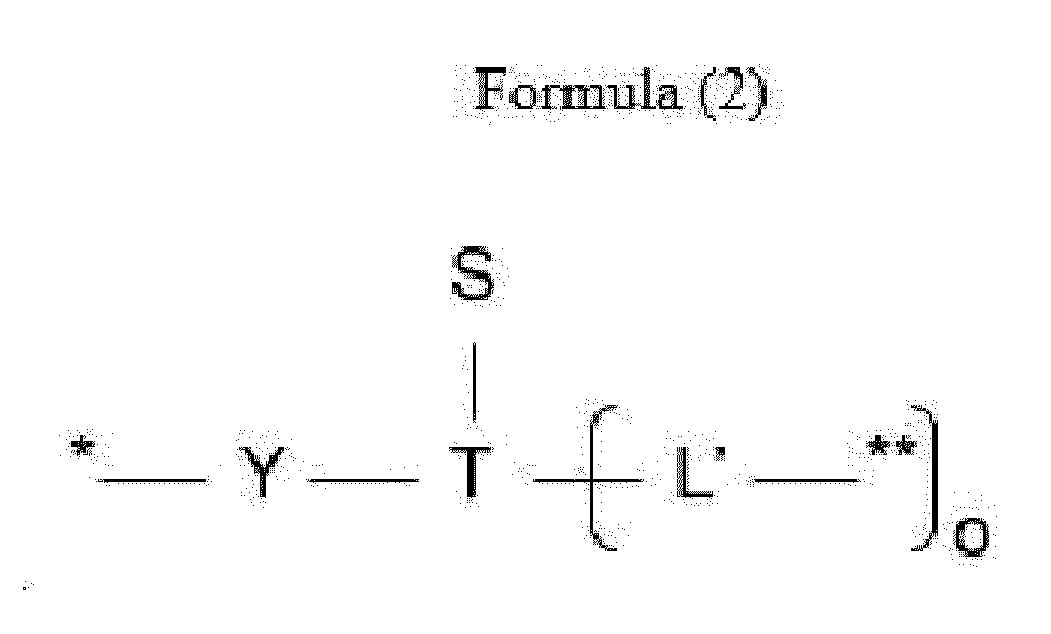 wherein Y is a divalent group comprising one or more atoms selected from C, N, O, P and S,wherein T is a (1+o)- or (2+o)-valent connecting group,wherein S is an atom or group that is optionally present to saturate a free valency of T,wherein L' is a linker capable of being cleaved by Cathepsin B,wherein o is an integer of 1 to 5,wherein * indicates covalent attachment to the anti-BCAM antibody (Ab), andwherein ** indicates covalent attachment to one or more antitumor compounds (D).
 - The antibody-drug conjugate of claim 1, wherein the heavy chain variable region comprises a sequence of SEQ ID NO: 7, and the light chain variable region comprises a sequence of SEQ ID NO: 8.
- The antibody-drug conjugate of claim 1, wherein n is 3 to 8 and m is 1.
- The antibody-drug conjugate of claim 1, wherein a drug (the antitumor compound) to antibody (the anti-BCAM antibody) ratio (DAR) is about 3 to about 8.
- The antibody-drug conjugate of claim 4, wherein the DAR is about 4.
- The antibody-drug conjugate of claim 1, wherein the antigen binding fragment thereof is an antibody fragment selected from the group consisting of a Fab fragment, a Fab' fragment, a Fab'-SH, a Fv fragment, a scFv fragment, a F(ab')2 fragment, a VL fragment, a VH fragment, a ScFv-Fc fragment, and a (ScFv)2-Fc fragment, a diabody, a linear antibody, a fragment produced by a Fab expression library, an anti-idiotypic (anti-Id) antibody, a complementary determining region (CDR), and an epitope-binding fragment.
- The antibody-drug conjugate of claim 1, wherein the anti-BCAM antibody is a chimeric antibody, a humanized antibody, or a human antibody.
- The antibody-drug conjugate of claim 1, wherein the linker is covalently attached to the antibody via the side chain of a cysteine comprised in the antibody.
- The antibody-drug conjugate of claim 1, wherein the linker capable of being cleaved by Cathepsin B (L') is represented by Formula (3), or Formula (4):
 wherein Axx is a trifunctional amino acid, with the proviso that Axx in Formula (3) is not an amino acid in the (D) configuration,wherein Ayy in Formulae (3) and (4) is an amino acid selected from Phe, Ala, Trp, Tyr, Phenylglycine (Phg), Met, Val, His, Lys, Arg, Citrulline (Cit), 2-amino-butyric acid (Abu), Ornithine (Orn), Ser, Thr, Leu and Ile, or Ayy in Formula (3) is an amino acid selected from homo-tyrosine (homo-Tyr), homo-phenylalanine (homo-Phe), beta-phenylalanine (beta-Phe) and beta-homo-phenylalanine (beta-homo-Phe), Tyr(OR1) and homo-Tyr(OR1) wherein R1 is -(CH2CH2O)n1-R2, wherein R2 is a hydrogen atom or a methyl group and n1 is an integer of 2 to 24, with the proviso that Ayy in Formula (4) is not an amino acid in the (D) configuration,wherein Z is a group covalently attached to the C-terminus of Ayy or Axx selected from -OH and -N(H)(R), wherein R represents a hydrogen atom, an alkyl group or a cycloalkyl group,wherein W is a drug-carrying unit,wherein ** indicates covalent attachment to one or more moieties D, andwherein *** indicates covalent attachment to T,if more than one linker L' is present, each linker is independently selected from the aforementioned linkers of Formula (3) and Formula (4).
 - The antibody-drug conjugate of claim 9, wherein at least one, or both of Axx and Ayy is/are defined as follows:(a) Axx in formula (3) or (4) is an amino acid selected from Glu, 2-amino-pimelic acid (Apa), 2-amino adipic acid (Aaa), 2,3-diamino-propionic acid (Dap), 2,4-diamino-butyric acid (Dab), Lys, Orn, Ser, amino-malonic acid (Ama), and homo-lysine (homo-Lys),(b) Ayy in Formula (3) is an amino acid selected from Phe, homo-Phe, Ala, Trp, Phg, Leu, Val, Tyr, homo-Tyr, Tyr(OR1) and homo-Tyr(OR1), wherein R1 is -(CH2CH2O)n1-R2, wherein R2 is a hydrogen atom or a methyl group and n1 is an integer of 2 to 24, or(c) Ayy in Formula (4) is an amino acid selected from Phe, homo-Phe, Ala, Trp, Phg, Leu, Val, Tyr and Ser.
- The antibody-drug conjugate of claim 9, wherein at least one, or both of Axx and Ayy is/are defined as follows:(a) Axx in formula (3) or (4) is an amino acid selected from Dap, Dab, Lys, Orn and homo-Lys,(b) Ayy in Formula (3) is an amino acid selected from Phe and Tyr, or(c) Ayy in Formula (4) is an amino acid selected from Phe and Ser.
- The antibody-drug conjugate of claim 9, wherein the drug-carrying unit (W) is a group represented by Formula (5):
 wherein Dxx is absent or an amino acid having a hydrophobic side chain,wherein Dyy is absent, Phe or an amino acid having a basic side chain, with the proviso that if Dxx is an amino acid having a hydrophobic side chain, Dyy is Phe or an amino acid having a basic side chain, and if Dxx is a single covalent bond, Dyy is a single covalent bond, Phe or an amino acid having a basic side chain,wherein ** indicates covalent attachment to D, andwherein **' indicates covalent attachment to the N-terminus of Axx or Ayy.
 - The antibody-drug conjugate of claim 12, wherein at least one, e.g., one or two, of Dxx and Dyy is/are defined as follows:(a) Dxx is an amino acid selected from Phe, Val, Tyr, homo-Phe and Ala,(b) Dyy is absent, or an amino acid selected from Arg, Lys, Cit, Orn, Dap and Dab.
- The antibody-drug conjugate of claim 9, wherein the drug-carrying unit (W) is a group represented by Formula (6), or Formula (7):
 wherein A''xx is a trifunctional amino acid, with the proviso that A''xx in Formula (6) is not an amino acid in the (D) configuration,wherein A'yy is an amino acid selected from Phe, Ala, Trp, Tyr, Phg, Met, Val, His, Lys, Arg, Cit, Abu and Orn, with the proviso that A'yy in Formula (7) is not an amino acid in the (D) configuration; if more than one A'yy are present, each A'yy is independently selected from the aforementioned amino acids,wherein A''yy is an amino acid selected from Phe, Ala, Trp, Tyr, Phg, Met, Val, His, Lys, Arg, Cit, Abu and Orn, with the proviso that A''yy in Formula (7) is not an amino acid in the (D) configuration; if more than one A''yy are present, each A''yy is independently selected from the aforementioned amino acids,wherein A'''yy is an amino acid selected from Phe, Ala, Trp, Tyr, Phg, Met, Val, His, Lys, Arg, Cit, Abu and Orn, with the proviso that A'''yy in Formula (7) is not an amino acid in the (D) configuration; if more than one A'''yy are present, each A'''yy is independently selected from the aforementioned amino acids,wherein A'xx is an amino acid, with the proviso that A'xx in Formula (6) is not an amino acid in the (D) configuration,wherein A'''xx is an amino acid, with the proviso that A'''xx in Formula (6) is not an amino acid in the (D) configuration,wherein p1 is an integer of 0 to 3,wherein p2 is 0 or 1,wherein p3 is an integer of 0 to 3, with the proviso that if p2 is 0, p3 is not 0,wherein p4 is an integer of 1 to 4, with the proviso that p4 and o in Formula (2) are selected such that m in Formula (1) is an integer of 1 to 5,wherein **' indicates covalent attachment to the N-terminus of Axx or Ayy, andwherein ** indicates covalent attachment to an antitumor compound.
 - The antibody-drug conjugate of claim 14, wherein at least one, e.g., one, two, three, four, five or six, of A'xx, A''xx, A'''xx, A'yy, A''yy and A'''yy is/are defined as follows:(a) A'xx is an amino acid selected from Arg, Lys, homo-Lys, Cit, Orn, Dap and Dab,(b) A''xx is an amino acid selected from Lys, homo-Lys, Cit, Orn, Dap and Dab,(c) A'''xx is an amino acid selected from Arg, Lys, homo-Lys, Cit, Orn, Dap and Dab,(d) A'yy is an amino acid selected from Phe, Ala, Trp, Phg and Tyr,(e) A''yy is an amino acid selected from Phe, Ala, Trp, Phg and Tyr,(f) A'''yy is an amino acid selected from Phe, Ala, Trp, Phg and Tyr.
- The antibody-drug conjugate of claim 9, wherein the drug-carrying unit is a group represented by Formula (8):
 wherein A''xx is a trifunctional amino acid selected from Glu, α-amino adipic acid (Aaa), Dap, Ser, Thr, homo-serine (homo-Ser), homo-threonine (homo-Thr) and amino malonic acid (Ama), with the proviso that A''xx is not an amino acid in the (D) configuration,wherein Cxx is a single covalent bond unless A''xx is Ama; if A''xx is Ama, Cxx is Pro or an N-methyl amino acid, the N-terminus of Cxx binds to a carboxyl end of Ama and the C-terminus of Cxx is covalently attached to one moiety D,wherein A'yy, A''yy and A'''yy are each independently an amino acid selected from Phe, Ala, Trp, Tyr, Phg, Met, Val, His, Lys, Arg, Cit, Abu, Orn,wherein A'xx and A'''xx are each independently an amino acid, with the proviso that A'xx and A'''xx are not an amino acid in the (D) configuration,wherein p1 is 0 or 1,wherein p2 is 0 or 1,wherein p3 is an integer of 0 to 3, with the proviso that if p2 is 0, p3 is not 0,wherein p4 is an integer of 1 to 4, with the proviso that p4 and o in Formula (2) are selected such that m in Formula (1) is an integer of 1 to 5,wherein **' indicates covalent attachment to the N-terminus of Axx or Ayy, andwherein ** indicates covalent attachment to an antitumor compound.
 - The antibody-drug conjugate of claim 16, wherein at least one, e.g., one, two, three, four, five or six, of A'xx, A''xx, A'''xx, A'yy, A''yy and A'''yy is/are defined as follows:(a) A'xx is an amino acid selected from Arg, Lys, homo-Lys, Cit, Orn, Dap and Dab,(b) A''xx is an amino acid selected from Dap, Dab, Lys, Orn and homo-Lys,(c) A'''xx is an amino acid selected from Arg, Lys, homo-Lys, Cit, Orn, Dap and Dab,(d) A'yy is an amino acid selected from Phe, Ala, Trp, Phg and Tyr,(e) A''yy is an amino acid selected from Phe, Ala, Trp, Phg and Tyr,(f) A'''yy is an amino acid selected from Phe, Ala, Trp, Phg and Tyr.
- The antibody-drug conjugate of claim 1, wherein the connecting group (T) is represented by Formula (9):
 wherein each AA is independently a moiety comprising a trifunctional amino acid,wherein α indicates covalent attachment of the N-terminus of AA, or the N-terminus of the first AA in case of o' being 2 to 5, to Y,wherein o' is an integer of 1 to 5, with the proviso that o' is 1 to 4 if another moiety L' is attached to ***',if o' is 1, the side chain of the trifunctional amino acid is covalently attached to S or L', the C-terminus being covalently attached to the other moiety L' or S, respectively,if o' is 2, 3, 4 or 5, **** indicates covalent attachment to L', and ***' indicates covalent attachment to S.
 - The antibody-drug conjugate of claim 18, wherein each AA is independently a moiety comprising an amino acid selected from N-ε-propargyloxycarbonyl-L-Lysine (Lys(Poc)), Asp, Glu, Orn, Lys, Dab and Dap.
- The antibody-drug conjugate of claim 1, wherein the connecting group (T) is represented by Formula (10), or Formula (11):
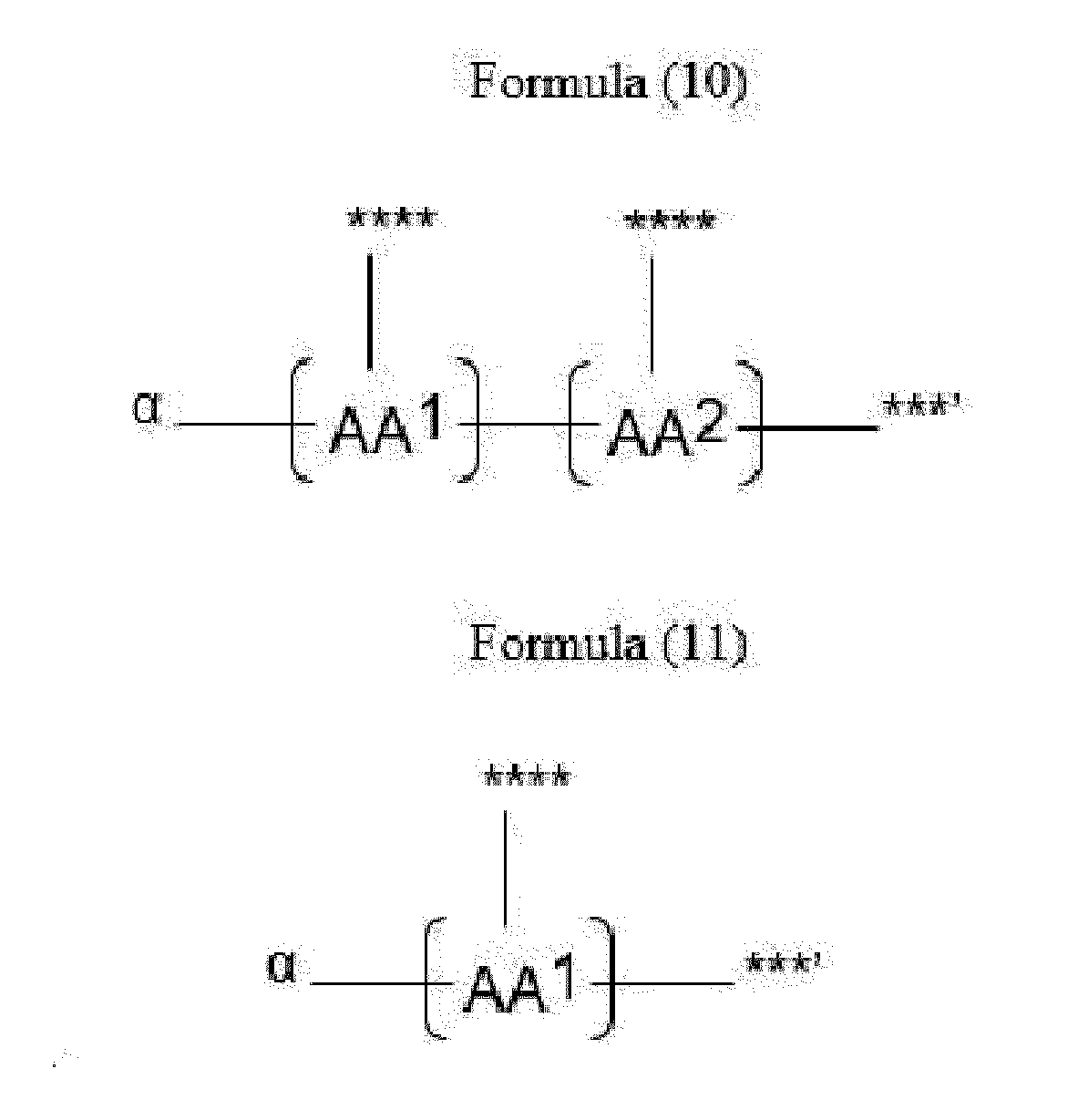 wherein each AA1 and AA2 is independently a moiety comprising a trifunctional amino acid,wherein α indicates covalent attachment to Y,wherein, in Formula (11), the side chain of the trifunctional amino acid is covalently attached to L' or S, the C-terminus is covalently attached to the other moiety S or L', respectively,wherein, in Formula (10), **** indicates covalent attachment to L', and ***' indicates covalent attachment to S or L'.
 - The antibody-drug conjugate of claim 20, wherein each AA1 and AA2 is independently a moiety comprising an amino acid selected from Lys(Poc), Asp, Glu, Orn, Lys, Dab and Dap.
- The antibody-drug conjugate of claim 1, wherein the connecting group (T) is represented by Formula (12), or Formula (13):
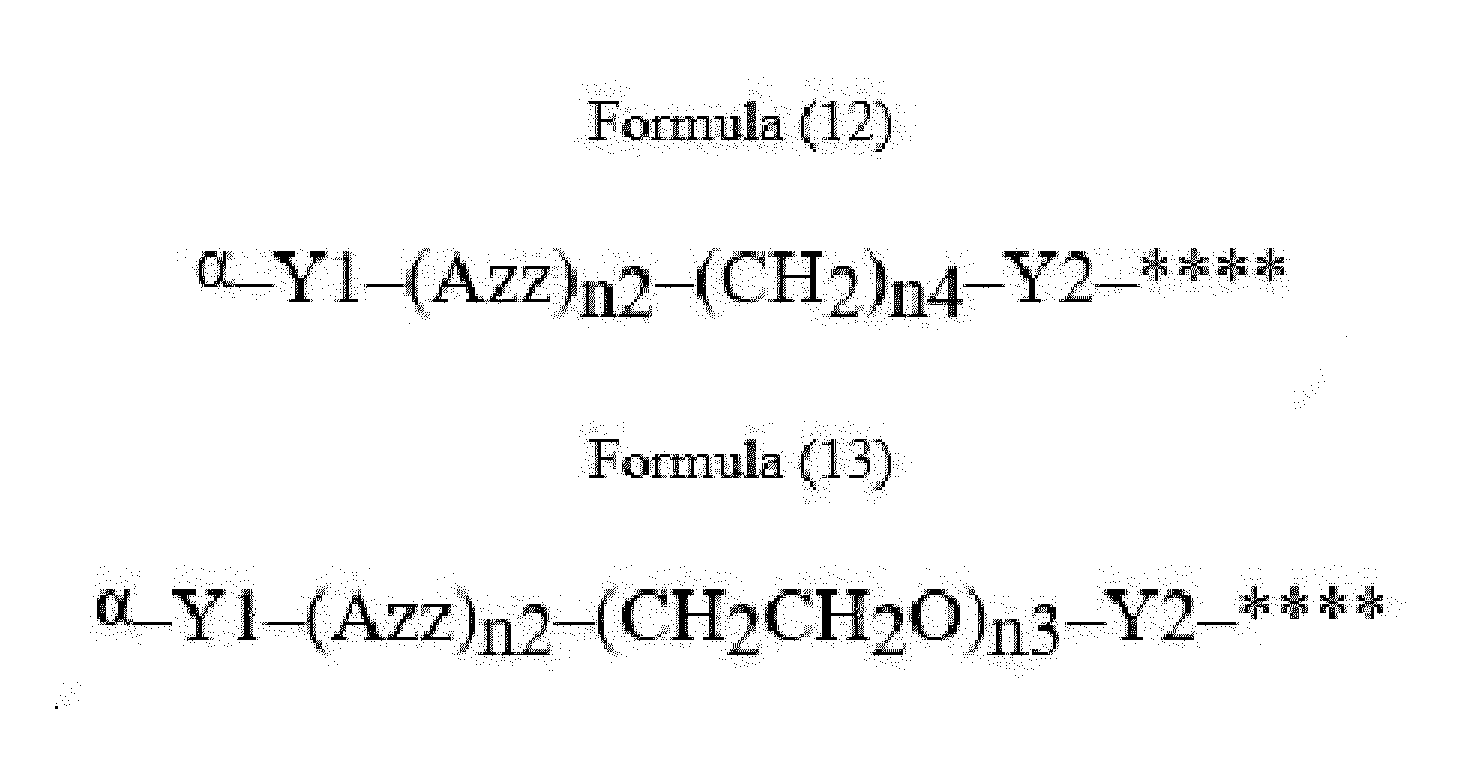 wherein Azz is a moiety comprising one or more solubilizing groups,wherein Y1 is a single covalent bond, an alkyl group having 1 to 6 carbon atoms, a carbonyl-containing group, or an amino-containing group,wherein Y2 is a single covalent bond, a carbonyl-containing group, or an amino-containing group,wherein n2 is an integer of 0 to 5,wherein n3 is an integer of 1 to 50,wherein n4 is an integer of 1 to 50,wherein α indicates covalent attachment to Y, andwherein **** indicates covalent attachment to L'.
 - An antibody-drug conjugate of Formula (1):
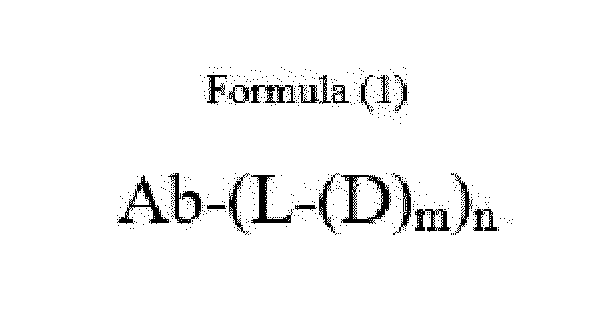 or a pharmaceutically acceptable salt thereof,wherein Ab is an anti-basal cell adhesion molecule (BCAM) antibody or an antigen binding fragment thereof, comprising (i) a heavy chain variable region comprising a VH CDR1 sequence of SEQ ID NO: 1, a VH CDR2 sequence of SEQ ID NO: 2, and a VH CDR3 sequence of SEQ ID NO: 3, and (ii) a light chain variable region comprising a VL CDR1 sequence of SEQ ID NO: 4, a VL CDR2 sequence of SEQ ID NO: 5, and a VL CDR3 sequence of SEQ ID NO: 6,wherein D is an antitumor compound which is conjugated to the anti-BCAM antibody via the linker,wherein n is 1 to 10,wherein m is 1 to 5, andwherein the linker (L) is represented by Formula (14), or Formula (15):
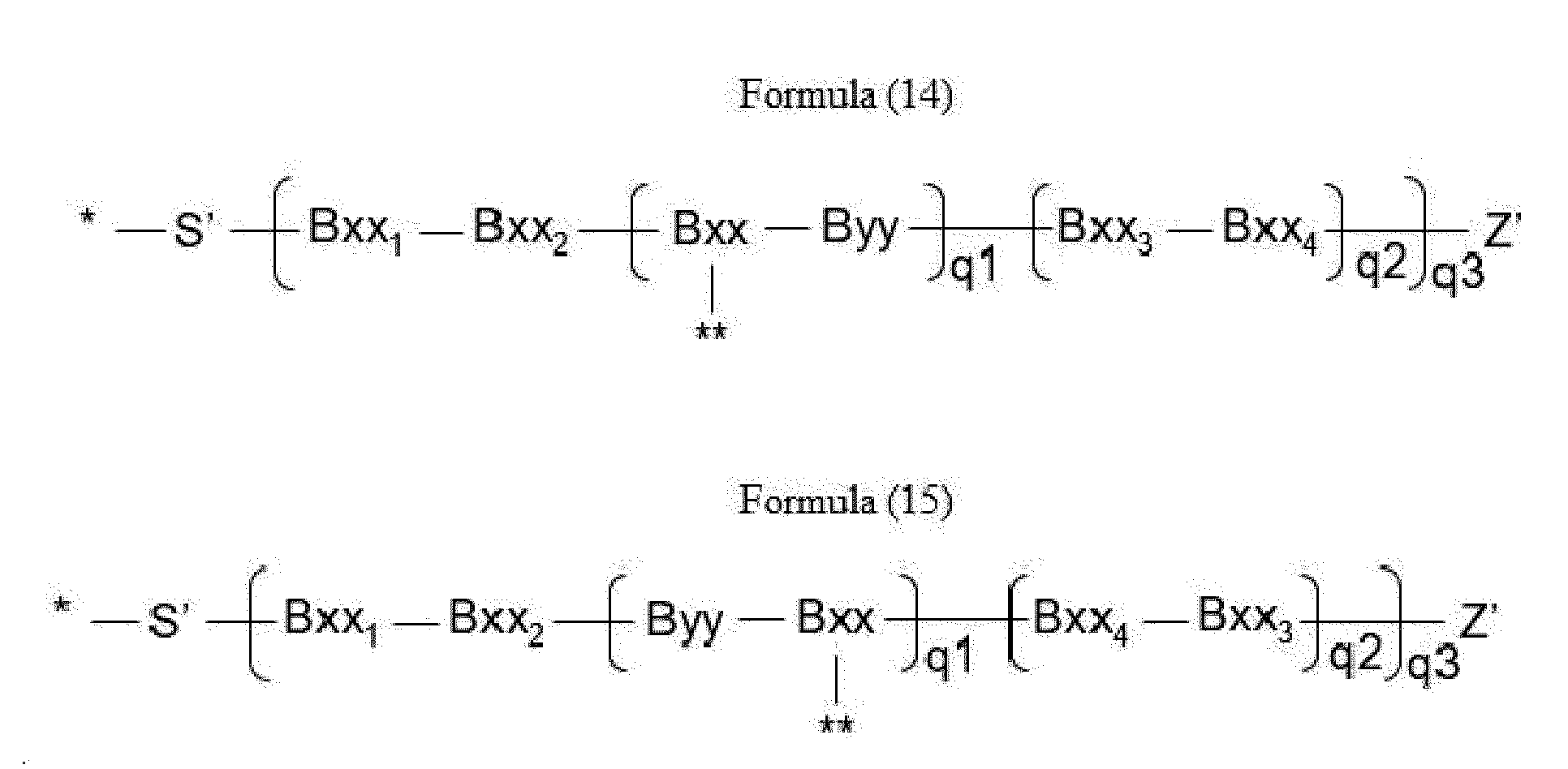 wherein Bxx in Formulae (14) and (15) is a trifunctional amino acid, with the proviso that Bxx in Formula (14) is not in the (D) configuration,wherein Byy in Formulae (14) and (15) is an amino acid selected from Phe, homo-Phe, Ala, Trp, Tyr, Phg, Val, His, Lys, Abu, Met, Cit, Orn, Ser, Thr, Leu, Ile, Arg and Tyr(OR1), wherein R1 is -(CH2CH2O)n1- R2, wherein R2 is a hydrogen atom or a methyl group and n1 is an integer of 2 to 24, or Byy in Formula (14) is an amino acid selected from homo-Tyr, homo-Tyr(OR1) wherein R1 is as defined above, homo-Phe, beta-Phe and beta-homo-Phe; with the proviso that if q1*q3 > 1 and q2 = 0, only the C-terminal Byy in Formula (14) may be an amino acid selected from beta-Phe and beta-homo-Phe; with the proviso that Byy in Formula (15) is not in the (D) configuration,wherein Bxx1 in Formulae (14) and (15) is a single covalent bond or an amino acid having a hydrophobic or basic side chain,wherein Bxx2 in Formulae (14) and (15) is an amino acid having a hydrophobic or basic side chain,wherein Bxx3 in Formulae (14) and (15) is an amino acid, with the proviso that Bxx3 in Formula (14) is not in the (D) configuration,wherein Bxx4 in Formulae (14) and (15) is an amino acid selected from Phe, homo-Phe, Ala, Trp, Tyr, Phg, Val, His, Lys, Abu, Met, Cit, Orn, Ser, Thr, Leu, Ile, Arg and Tyr(OR1), wherein R1 is -(CH2CH2O)n1- R2, wherein R2 is a hydrogen atom or a methyl group and n1 is an integer of 2 to 24, or Bxx4 in Formula (14) is an amino acid selected from homo-Tyr, homo-Tyr(OR1), homo-Phe, beta-Phe and beta-homo-Phe; with the proviso that if q2*q3 > 1, only the C-terminal Bxx4 in Formula (14) may be an amino acid selected from beta-Phe and beta-homo-Phe; with the proviso that Byy in Formula (15) is not in the (D) configuration,or wherein the linker (L) is represented by Formula (16):
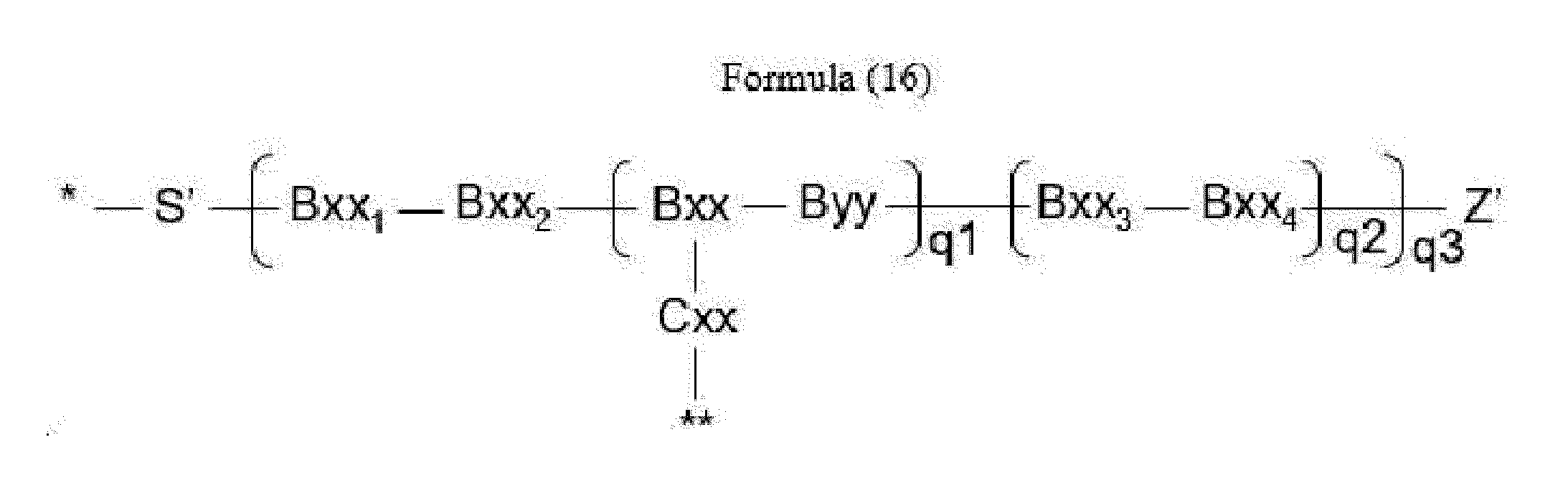 wherein Bxx in Formula (16) is a carboxylic amino acid, or a trifunctional amino acid selected from Dap, Dab, Ser, Thr, Lys, Orn, homo-Lys, homo-Ser and homo-Thr, with the proviso that Bxx is not in the (D) configuration,wherein Cxx is a single covalent bond unless Bxx is Ama, if Bxx is Ama, Cxx is Pro or an N-methyl amino acid, the N-terminus of Cxx binds to a carboxyl group of Ama and the C-terminus of Cxx is covalently attached to one moiety D,wherein Byy in Formula (16) is an amino acid selected from Phe, homo-Phe, Ala, Trp, Tyr, Phg, Val, His, Lys, Abu, Met, Cit, Orn, Ser, Thr, Leu, Ile, Arg, homo-Phe, beta-Phe, beta-homo-Phe, homo-Tyr, Tyr(OR1) and homo-Tyr(OR1), wherein R1 is -(CH2CH2O)n1- R2, wherein R2 is a hydrogen atom or a methyl group and n1 is an integer of 2 to 24; with the proviso that if q1*q3>1 and q2=0, only the C-terminal Byy may be an amino acid selected from beta-Phe and beta-homo-Phe,wherein Bxx1 in Formula (16) is a single covalent bond or an amino acid having a hydrophobic or basic side chain,wherein Bxx2 in Formula (16) is an amino acid having a hydrophobic or basic side chain,wherein Bxx3 in Formula (16) is an amino acid, with the proviso that Bxx3 is not in the (D) configuration,wherein Bxx4 in Formula (16) is an amino acid selected from Phe, homo-Phe, Ala, Trp, Tyr, Phg, Val, His, Lys, Abu, Met, Cit, Orn, Ser, Thr, Leu, Ile, Arg, homo-Phe, beta-Phe, beta-homo-Phe, homo-Tyr, Tyr(OR1) and homo-Tyr(OR1), wherein R1 is -(CH2CH2O)n1- R2, wherein R2 is a hydrogen atom or a methyl group and n1 is an integer of 2 to 24; with the proviso that if q2*q3>1, only the C-terminal Bxx4 may be an amino acid selected from beta-Phe and beta-homo-Phe,wherein S' is a divalent group comprising one or more atoms selected from C, N, O, P and S,wherein Z' is a group covalently attached to the C-terminus of Byy or Bxx4 in Formulae (14) and (16) or the C-terminus of Bxx or Bxx3 in Formula (15), which is selected from -OH and -N(H)(R), wherein R represents a hydrogen atom, an alkyl group or a cycloalkyl group,wherein q1 is an integer of 0 to 5,wherein q2 is an integer of 0 to 3, with the proviso that if q1 is 0, q2 is not 0,wherein q3 is an integer of 1 to 5,wherein q1, q2 and q3 are selected such that m in Formula (1) is an integer of 1 to 5,wherein * indicates covalent attachment to the anti-BCAM antibody (Ab), andwherein each ** indicates covalent attachment to one moiety D.
 - The antibody-drug conjugate of claim 23, wherein at least one, e.g., one, two, three, four, five or six, of Bxx, Byy, Bxx1, Bxx2, Bxx3 and Bxx4 is/are defined as follows:(a) Bxx is an amino acid selected from Dap, Dab, Lys, Orn, Ser, Glu, Ama, Thr, Tyr, Aaa, homo-Ser and homo-Thr,(b) Byy is an amino acid selected from Cit, Phe, homo-Phe, Ser, Trp, Tyr and Tyr(OR1), wherein R1 is -(CH2CH2O)n1-R2, wherein R2 is a hydrogen atom or a methyl group and n1 is an integer of 2 to 24,(c) Bxx1 is a single covalent bond, or an amino acid selected from Phe, homo-Phe, Phg, Val, Ser, Tyr, Ala, Leu and Ile,(d) Bxx2 is an amino acid selected from Arg, Lys, Cit, Val, Leu, Ser, Ala, Gly, His, Gln, Phg and Phe,(e) Bxx3 is an amino acid selected from Phe, homo-Phe, Phg, Val, Ser, Tyr, Ala, Leu and Ile,(f) Bxx4 is an amino acid selected from Cit, Phe, homo-Phe, Ser, Trp, Tyr and Tyr(OR1), wherein R1 is -(CH2CH2O)n1-R2, wherein R2 is a hydrogen atom or a methyl group and n1 is an integer of 2 to 24.
- The antibody-drug-conjugate of claim 1, which is represented by Formula (17), or Formula (18):
 wherein Axx is an amino acid selected from Glu, Apa, Aaa, Dap, Dab, Lys, Orn, Ser, Ama and homo-Lys, with the proviso that Axx in Formula (17) is not in the (D) configuration,wherein Ayy in Formula (17) is an amino acid selected from Phe, homo-Phe, Ala, Trp, Phg, Leu, Val, Tyr, homo-Tyr, Tyr(OR1) and homo-Tyr(OR1) wherein R1 is -(CH2CH2O)n1-R2, wherein R2 is a hydrogen atom or a methyl group and n1 is an integer of 2 to 24,wherein Ayy in Formula (18) is an amino acid selected from Phe, homo-Phe, Ala, Trp, Phg, Leu, Val, Tyr and Ser, with the proviso that Ayy in Formula (18) is not in the (D) configuration,wherein Dxx is a single covalent bond or an amino acid having a hydrophobic side chain,wherein Dyy represents a single covalent bond, Phe or an amino acid having a basic side chain, with the proviso that if Dxx is an amino acid having a hydrophobic side chain, Dyy is Phe or an amino acid having a basic side chain, and if Dxx is a single covalent bond, Dyy is a single covalent bond, Phe or an amino acid having a basic side chain,wherein Y is a divalent group comprising one or more atoms selected from C, N, O, P and S,wherein T is a (2+m)-valent connecting group; if S is absent, T is a (1+m)-valent connecting group,wherein S is an atom or group that is optionally present to saturate a free valency of T,wherein Z represents a group covalently bonded to the C-terminus of Ayy or Axx selected from -OH and -N(H)(R), wherein R represents a hydrogen atom, an alkyl group or a cycloalkyl group, andwherein Ab, D, m and n are as defined in claim 1.
 - The antibody-drug-conjugate of claim 25, wherein at least one, e.g., one, two, three, four, five, six, seven or eight, of Axx, Ayy, Dxx, Dyy, D, Z, m and T is/are defined as follows:(a) Axx is an amino acid selected from Dap, Dab, Lys, Orn and homo-Lys,(b) Ayy in Formula (17) is an amino acid selected from Phe, homo-Phe, Tyr, homo-Tyr, Tyr(OR1) and homo-Tyr(OR1),(c) Ayy in Formula (18) is an amino acid selected from Phe, home-Phe or Ser,(d) Dxx is a moiety derived from an amino acid selected from Phe, Val, Tyr, homo-Phe and Ala,(e) Dyy is a covalent bond or a moiety derived from an amino acid selected from Arg, Lys, Cit, Orn, Dap and Dab,(f) D is a compound selected from a drug selected from auristatin F (AF), MMAF, exatecan, maytansine, DM1 and DM4,(g) Z is -OH or -NH2,(h) T is represented by Formula (9'):
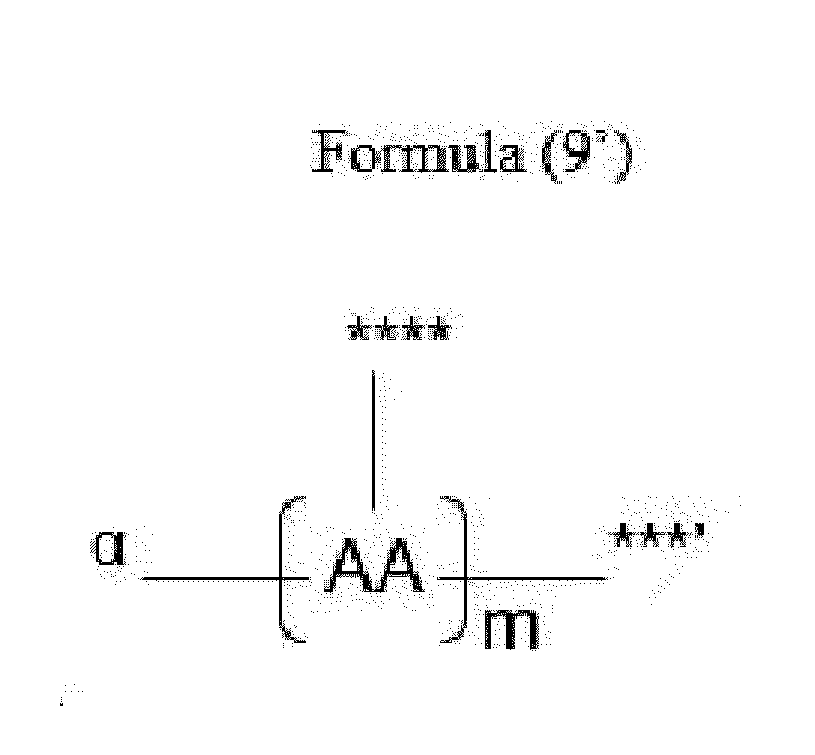 wherein each AA is independently a moiety comprising a trifunctional amino acid,wherein α indicates covalent attachment to Y,wherein m is as defined in claim 1,if m is 1, the side chain of the trifunctional amino acid is covalently attached to S or Axx, the C-terminus being covalently attached to the other moiety S or Axx, respectively,if m is 2, 3, 4 or 5, **** indicates covalent attachment to Axx, and ***' indicates covalent attachment to S via the C-terminus of the chain of AA groups,(i) m is 2 and T is represented by Formula (10'):
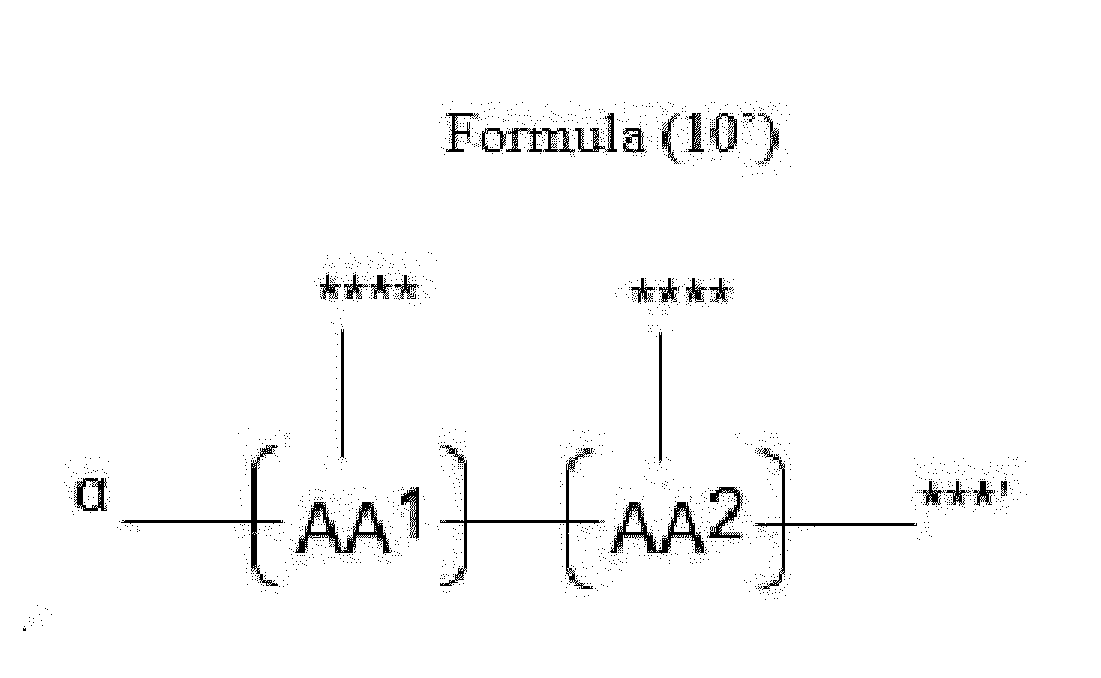 wherein each AA1 and AA2 is independently a moiety comprising a trifunctional amino acid,wherein α indicates covalent attachment to Y,wherein **** indicates covalent attachment to Axx, and ***' indicates covalent attachment to S,(j) m is 1 and T is represented by Formula (11'):
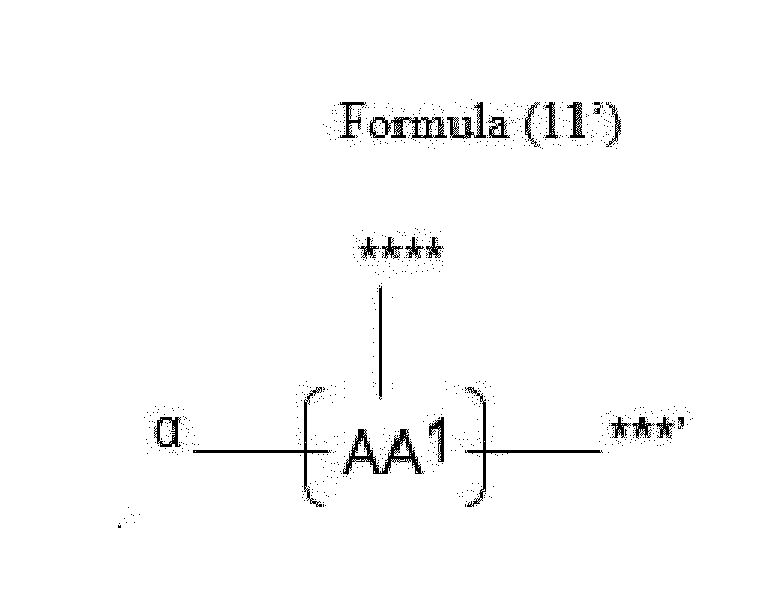 wherein AA1 is a moiety comprising a trifunctional amino acid,wherein α indicates covalent attachment to Y,wherein the side chain of the trifunctional amino acid is covalently attached to Axx or S, the C-terminus is covalently attached to the other moiety S or Axx, respectively,(k) m is 1 and T is represented by Formula (12'), or Formula (13'):
 wherein Azz is a moiety comprising one or more solubilizing groups,wherein Y1 is a single covalent bond, an alkyl group having 1 to 6 carbon atoms, a carbonyl-containing group, or an amino-containing group,wherein Y2 is a single covalent bond, a carbonyl-containing group, or an amino-containing group,wherein n2 is an integer of 0 to 5,wherein n3 is an integer of 1 to 50,wherein n4 is an integer of 1 to 50,wherein α indicates covalent attachment to Y, andwherein **** indicates covalent attachment to Axx.
 - The antibody-drug-conjugate of claim 25, wherein at least one, e.g., one, two, three, four, five, six, seven, eight or nine, of Axx, Ayy, Dxx, Dyy, D, Z, m and T is/are defined as follows:(a) Axx is Lys,(b) Ayy in Formula (17) is Tyr,(c) Ayy in Formula (18) is Phe or Ser,(d) Dxx is Phe or Val,(e) Dyy is Arg or Cit,(f) D is a compound selected from a drug selected from AF, MMAF, exatecan, maytansine, DM1 and DM4,(g) Z is -OH or -NH2,(h) m is 1 and T is represented by Formula (11'):
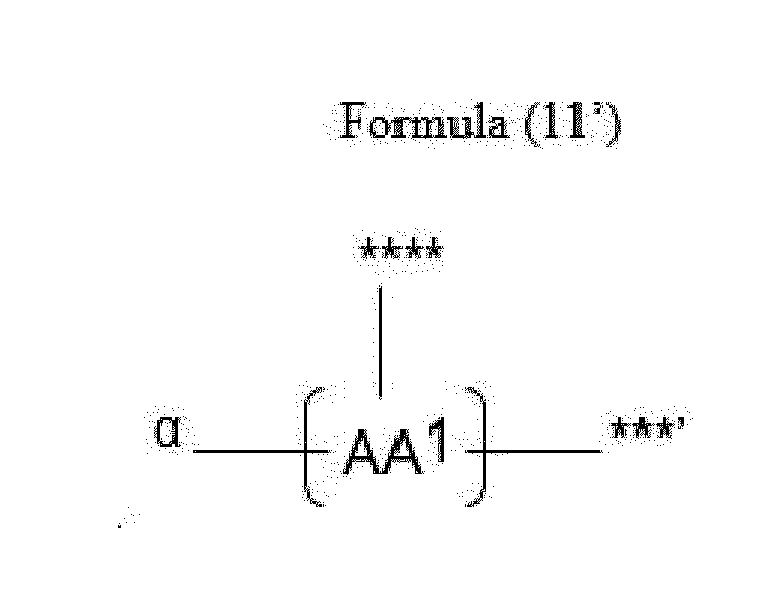 wherein AA1 is a moiety comprising a trifunctional amino acid,wherein α indicates covalent attachment to Y,wherein the side chain of the trifunctional amino acid is covalently attached to Axx or S, the C-terminus is covalently attached to the other moiety S or Axx, respectively,(i) m is 1 and T is represented by Formula (12'), or Formula (13'):
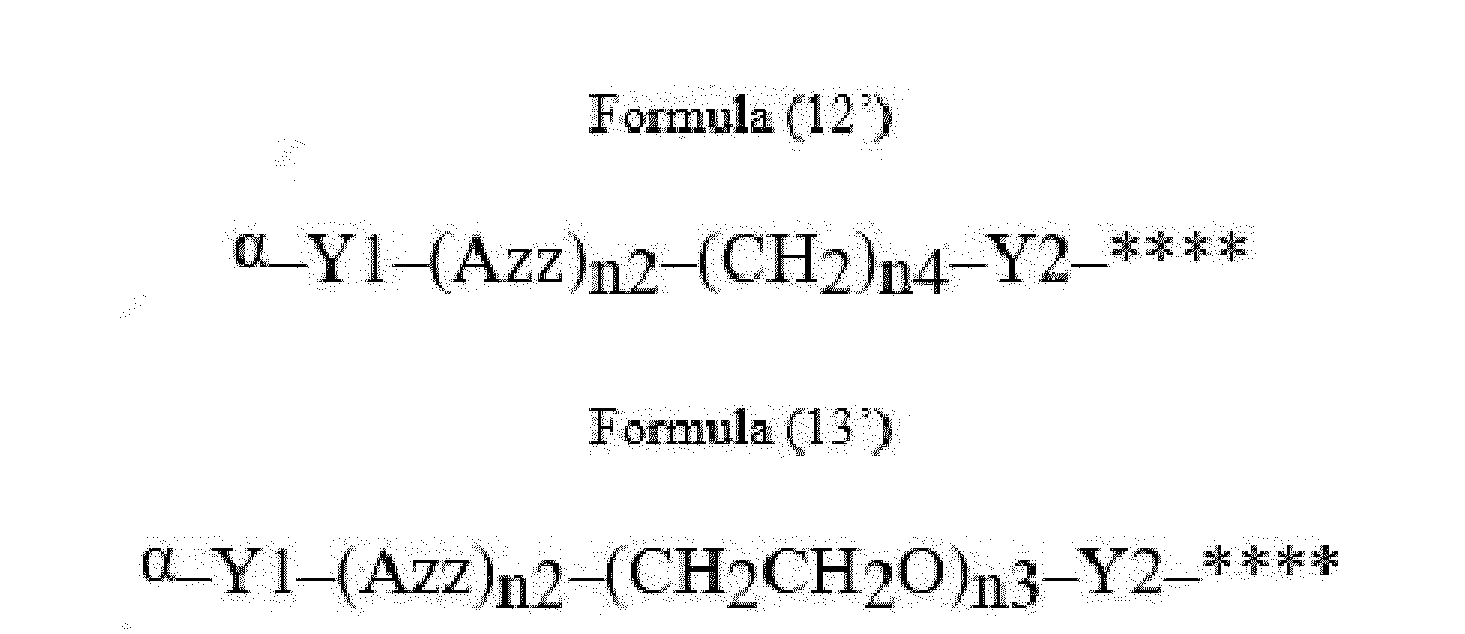 wherein Azz is a moiety comprising one or more solubilizing groups,wherein Y1 is a single covalent bond, an alkyl group having 1 to 6 carbon atoms, a carbonyl-containing group, or an amino-containing group,wherein Y2 is a single covalent bond, a carbonyl-containing group, or an amino-containing group,wherein n2 is an integer of 0 to 5,wherein n3 is an integer of 1 to 50,wherein n4 is an integer of 1 to 50,wherein α indicates covalent attachment to Y, andwherein **** indicates covalent attachment to Axx.
 - The antibody-drug-conjugate of claim 25, wherein, in Formula (17), each Dxx-Dyy-Axx-Ayy is independently selected from Arg-Lys-Phe wherein Dxx is a covalent bond, Arg-Lys-homoPhe wherein Dxx is a covalent bond, Arg-Lys-Tyr wherein Dxx is a covalent bond, Cit-Lys-Phe wherein Dxx is a covalent bond, Cit-Lys-Tyr wherein Dxx is a covalent bond, Arg-Lys-homoTyr wherein Dxx is a covalent bond, Cit-Lys-homoTyr wherein Dxx is a covalent bond, Phe-Cit-Lys-Phe, Phe-Cit-Lys-Tyr, Phe-Arg-Lys-Tyr, Phe-Cit-Lys-homoTyr, Phe-Lys-Lys-Phe, homoPhe-Arg-Lys-Phe, homo-Phe-Cit-Lys-Tyr, andwherein, in Formula (18), each Dxx-Dyy-Ayy-Axx is independently selected from Arg-Phe-Lys wherein Dxx is a covalent bond, Arg-Ser-Lys wherein Dxx is a covalent bond, Cit-Phe-Lys wherein Dxx is a covalent bond, Cit-Ser-Lys wherein Dxx is a covalent bond, Cit-homoPhe-Lys wherein Dxx is a covalent bond, Phe-Cit-Phe-Lys, homoPhe-Cit-Phe-Lys, and Phe-Arg-Phe-Lys.
- The antibody-drug-conjugate of claim 25, wherein at least one, e.g., one, two, three or four, of D, Z, m and T is/are defined as follows:(a) D is a compound selected from a drug selected from AF, MMAF, exatecan, maytansine, DM1 and DM4,(b) Z is -OH or -NH2,(c) m is 1 and T is represented by Formula (11'):
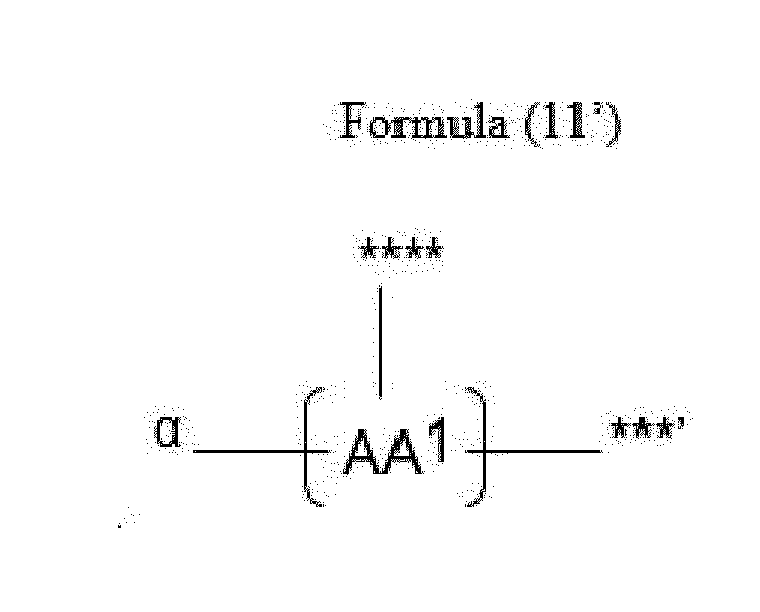 wherein AA1 is a moiety comprising a trifunctional amino acid,wherein α indicates covalent attachment to Y,wherein the side chain of the trifunctional amino acid is covalently attached to Axx or S, the C-terminus is covalently attached to the other moiety S or Axx, respectively,(d) m is 1 and T is represented by Formula (12'), or Formula (13'):
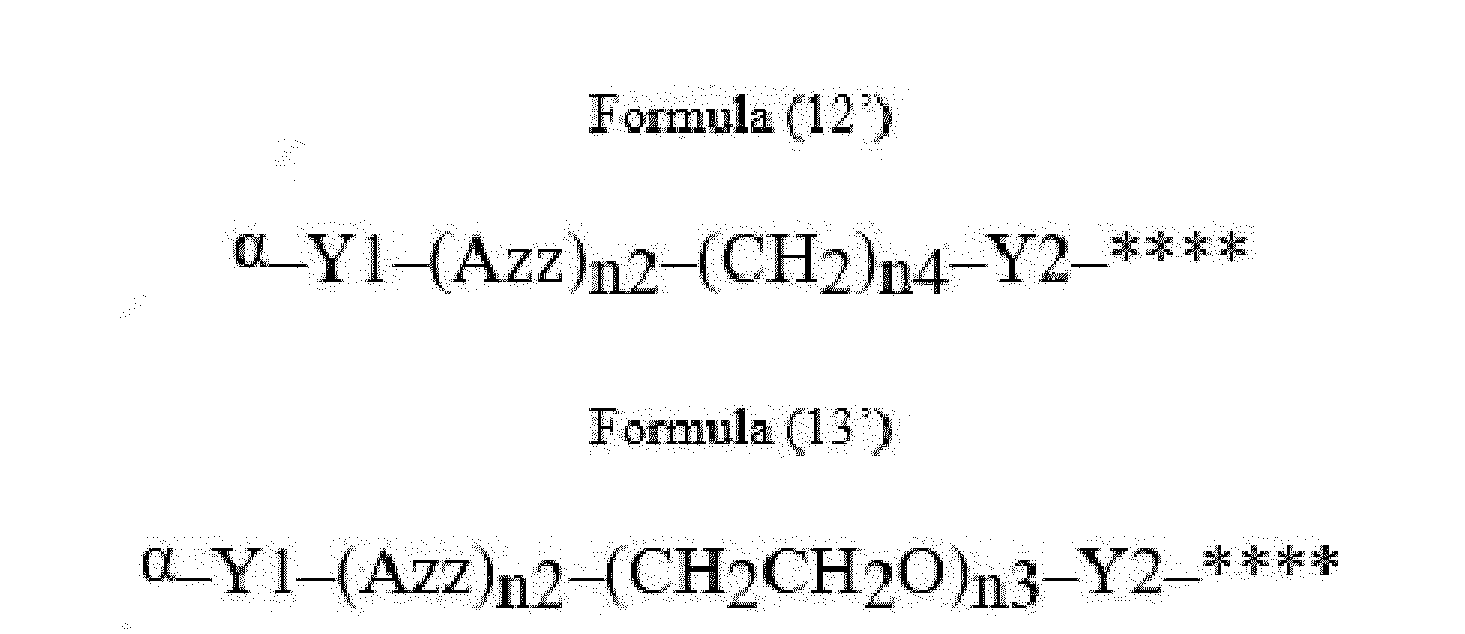 wherein Azz is a single covalent bond or a moiety comprising one or more solubilizing groups,wherein Y1 is a single covalent bond, an alkyl group having 1 to 6 carbon atoms, a carbonyl-containing group, or an amino-containing group,wherein Y2 is a single covalent bond, a carbonyl-containing group, or an amino-containing group,wherein n2 is an integer of 0 to 5,wherein n3 is an integer of 1 to 50,wherein n4 is an integer of 1 to 50,wherein α indicates covalent attachment to Y, andwherein **** indicates covalent attachment to Axx.
 - The antibody-drug-conjugate of claim 1, which is represented by one of the following formulae:
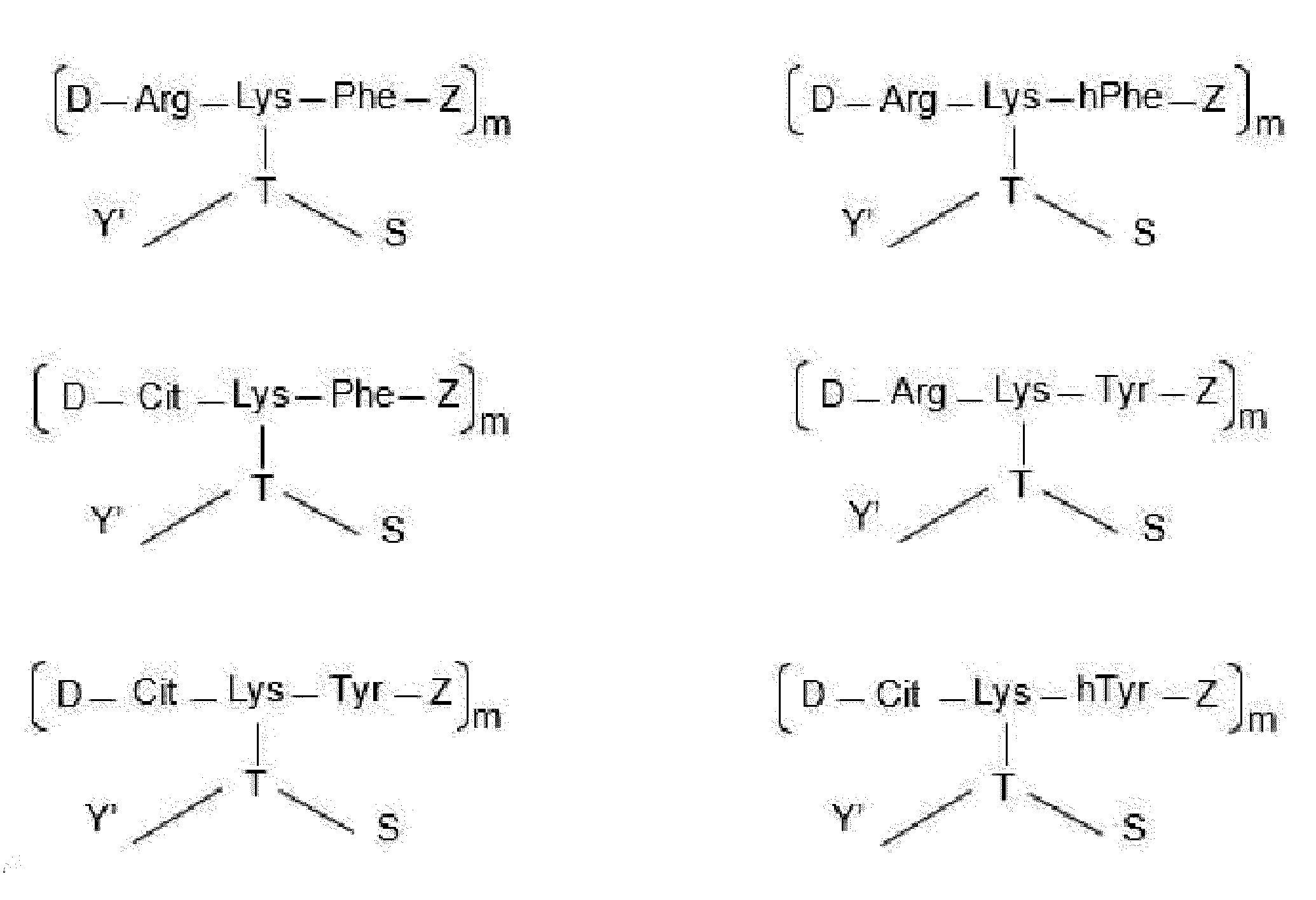
 with the proviso that in the above formulae, Lys is not in the (D) configuration,wherein Y is a divalent group comprising one or more atoms selected from C, N, O, P and S,wherein T is a (2+m)-valent connecting group; if S is absent, T is a (1+m)-valent connecting group,wherein S is an atom or group that is optionally present to saturate a free valency of T,wherein Z represents a group covalently bonded to the C-terminus of an amino acid selected from -OH and -N(H)(R), wherein R represents a hydrogen atom, an alkyl group or a cycloalkyl group, andwherein Ab, D, m and n are as defined in claim 1.
 - The antibody-drug-conjugate of claim 30, wherein at least one, e.g., one, two, three or four, of D, Z, m and T is/are defined as follows:(a) D is a compound selected from a drug selected from AF, MMAF, exatecan, maytansine, DM1 and DM4,(b) Z is -OH or -NH2,(c) m is 2 and T is represented by Formula (10'):
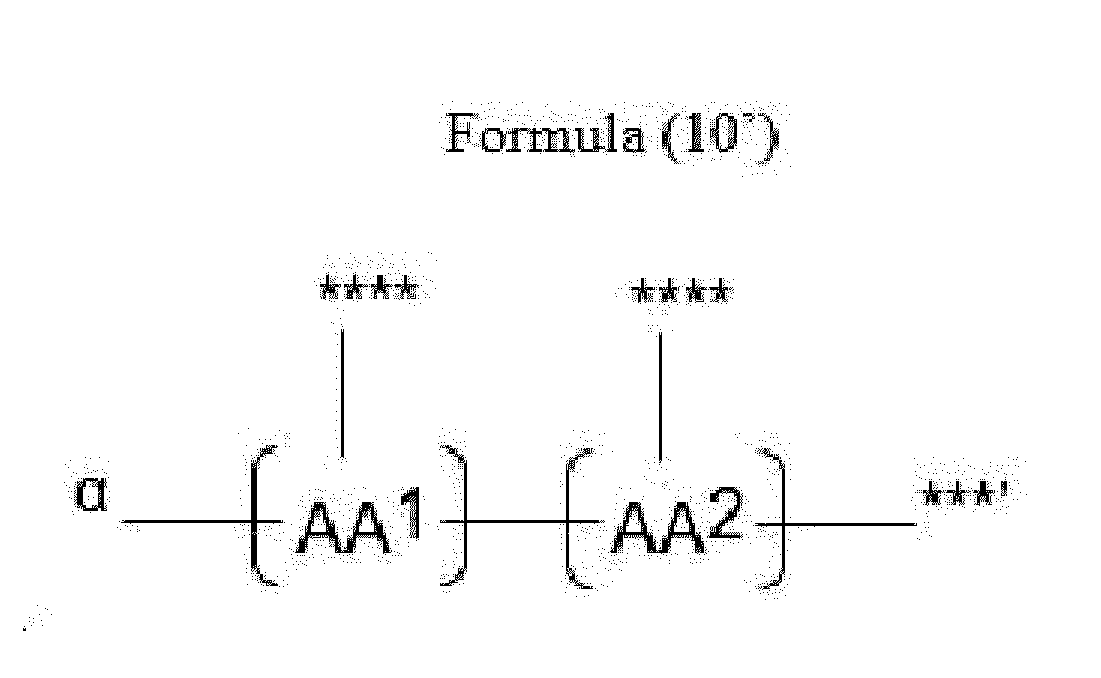 wherein each AA1 and AA2 is independently a moiety comprising a trifunctional amino acid,wherein α indicates covalent attachment to Y,wherein **** indicates covalent attachment to Lys, and ***' indicates covalent attachment to S,(d) m is 1 and T is represented by Formula (11'):
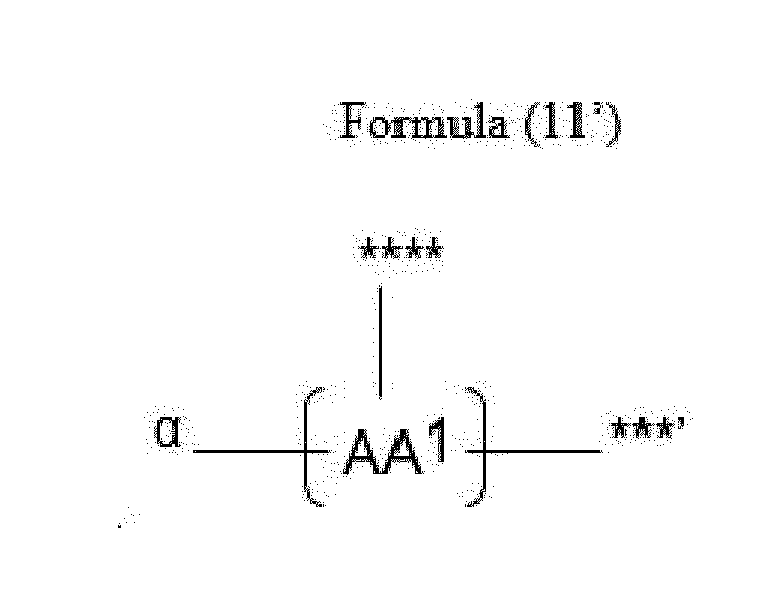 wherein AA1 is a moiety comprising a trifunctional amino acid,wherein α indicates covalent attachment to Y,wherein the side chain of the trifunctional amino acid is covalently attached to Lys or S, the C-terminus is covalently attached to the other moiety S or Lys, respectively,(e) m is 1 and T is represented by Formula (12'), or Formula (13'):
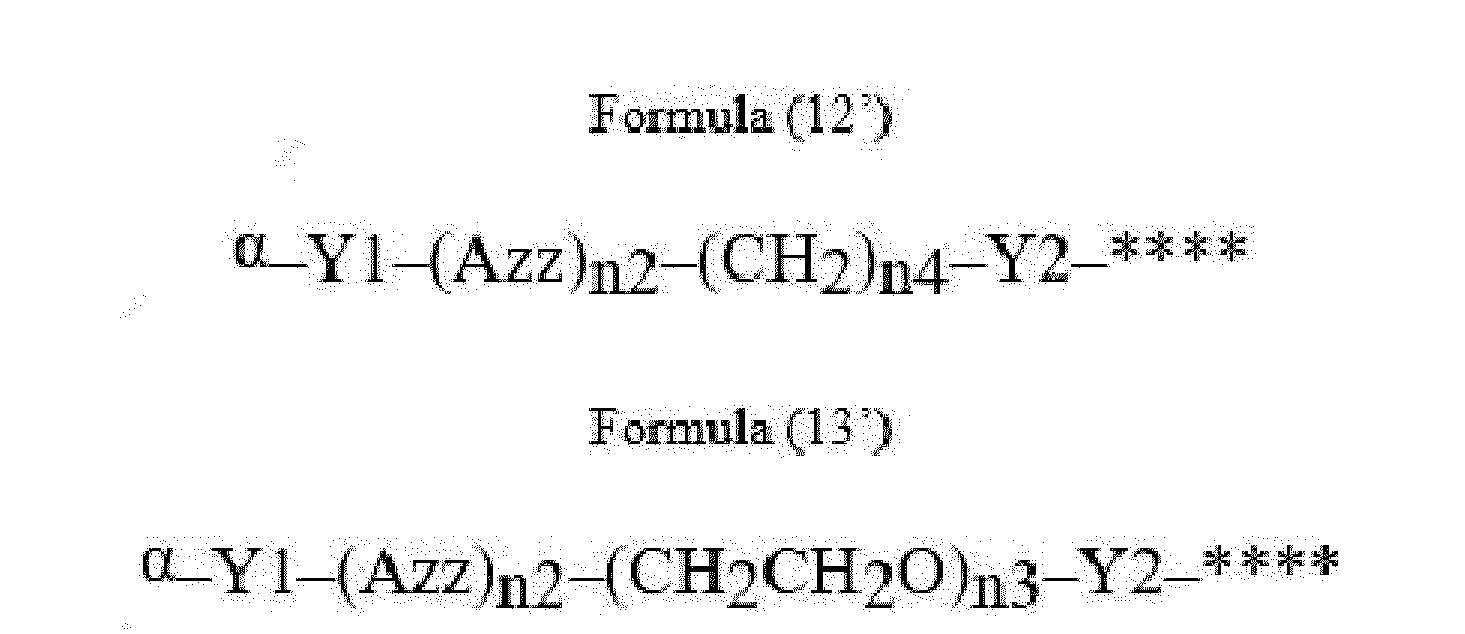 wherein Azz is a moiety comprising one or more solubilizing groups,wherein Y1 is a single covalent bond, an alkyl group having 1 to 6 carbon atoms, a carbonyl-containing group, or an amino-containing group,wherein Y2 is a single covalent bond, a carbonyl-containing group, or an amino-containing group,wherein n2 is an integer of 0 to 5,wherein n3 is an integer of 1 to 50,wherein n4 is an integer of 1 to 50,wherein α indicates covalent attachment to Y, andwherein **** indicates covalent attachment to Lys.
 - The antibody-drug-conjugate of claim 30, wherein D, Z, m and T are defined as follows:(a) D is DM1,(b) Z is -OH or -NH2,(c) m is 1 and T is represented by Formula (13'):
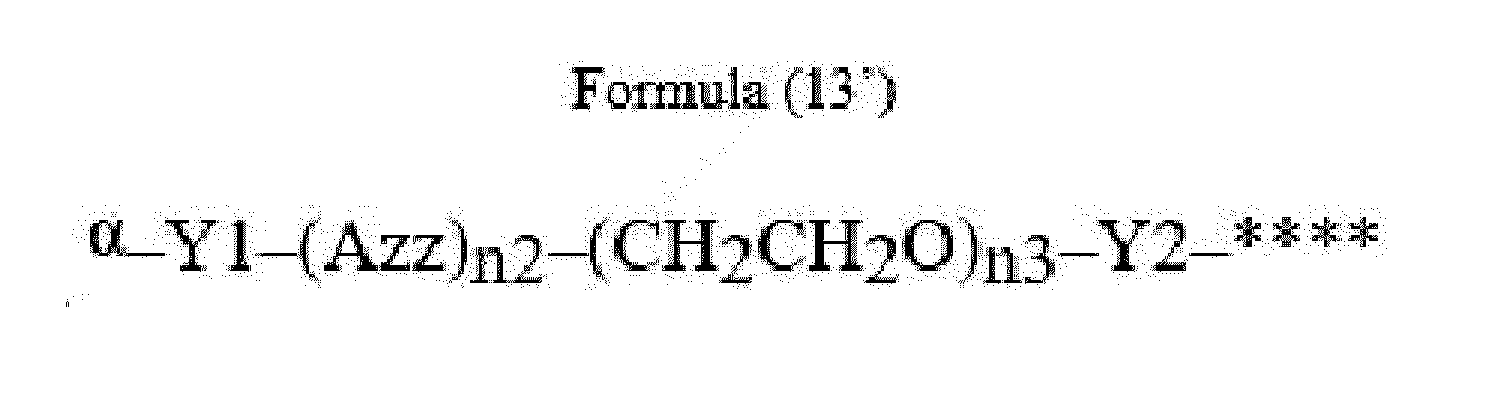 wherein Azz is a moiety comprising one or more solubilizing groups,wherein Y1 is a single covalent bond, an alkyl group having 1 to 6 carbon atoms, a carbonyl-containing group, or an amino-containing group,wherein Y2 is a single covalent bond, a carbonyl-containing group, or an amino-containing group,wherein n2 is an integer of 0 to 5,wherein n3 is an integer of 1 to 50,wherein α indicates covalent attachment to Y, andwherein **** indicates covalent attachment to Lys.
 - The antibody-drug-conjugate of claim 30, wherein D, Z, m and T is/are defined as follows:(a) D is AF,(b) Z is -OH or -NH2,(c) m is 1 and T is represented by Formula (13'):
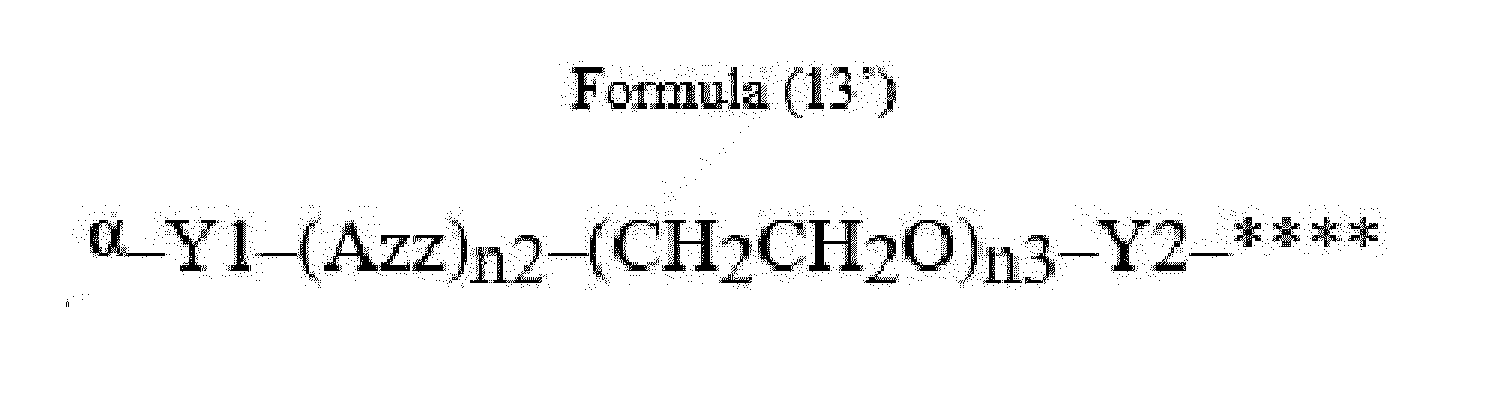 wherein Azz is a moiety comprising one or more solubilizing groups,wherein Y1 is a single covalent bond, an alkyl group having 1 to 6 carbon atoms, a carbonyl-containing group, or an amino-containing group,wherein Y2 is a single covalent bond, a carbonyl-containing group, or an amino-containing group,wherein n2 is an integer of 0 to 5,wherein n3 is an integer of 1 to 50,wherein α indicates covalent attachment to Y, andwherein **** indicates covalent attachment to Lys.
 - The antibody-drug-conjugate of claim 1, which is represented by Formula (19), Formula (20), Formula (21), or Formula (22):
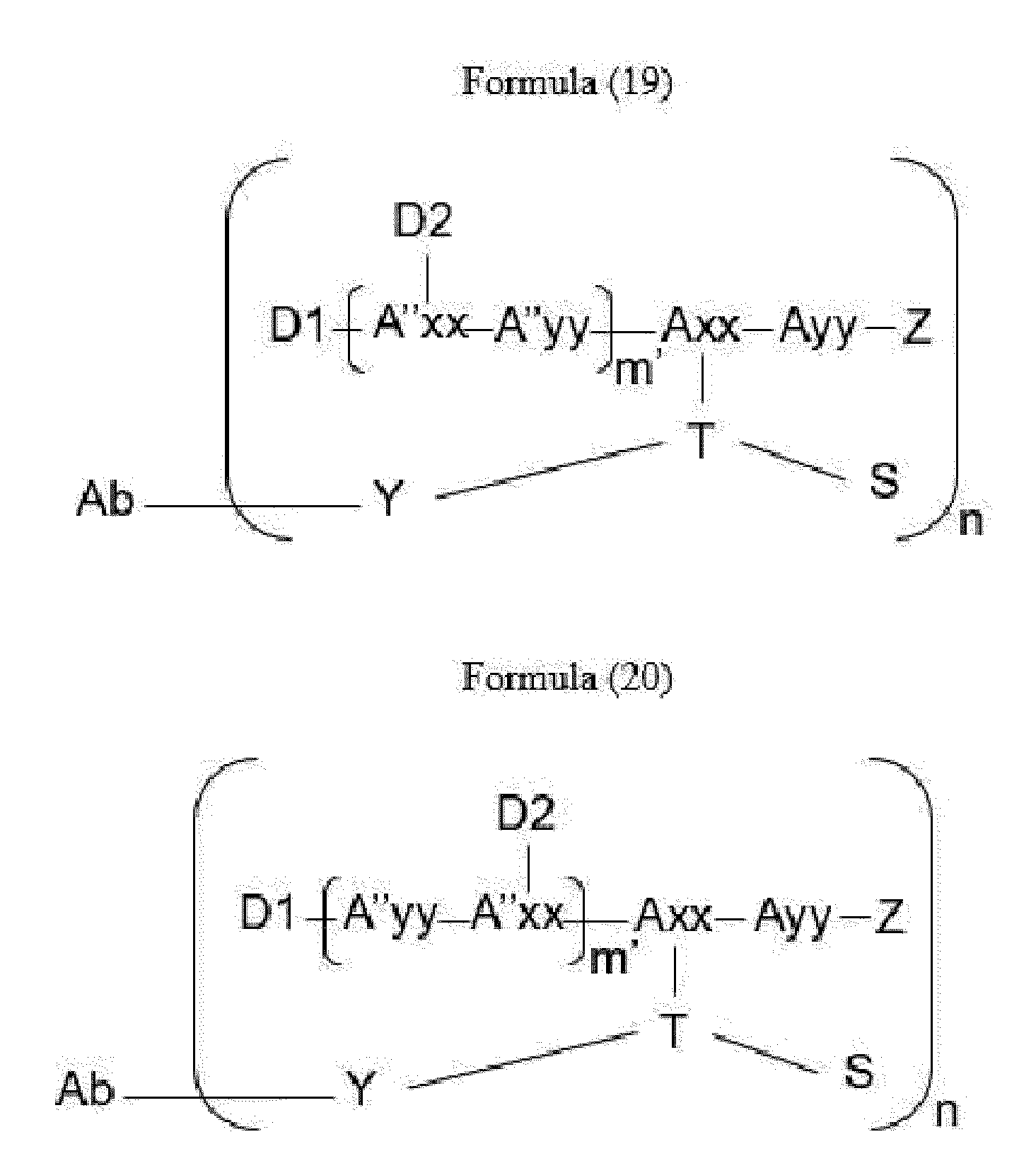
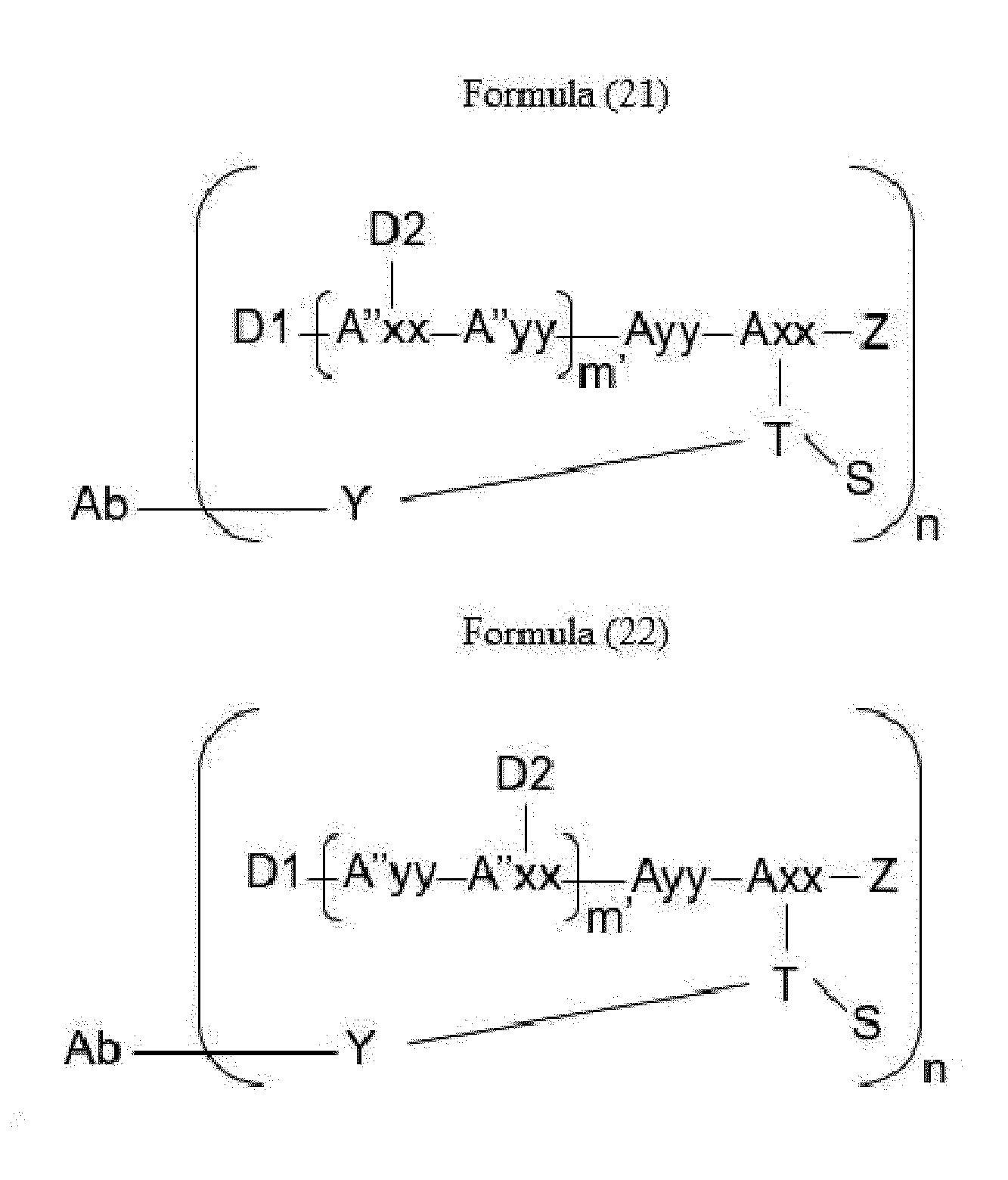 wherein Axx is a trifunctional amino acid, with the proviso that Axx in Formula (19) and Formula (20) is not an amino acid in the (D) configuration,wherein Ayy is an amino acid selected from Phe, Ala, Trp, Tyr, Phg, Met, Val, His, Lys, Arg, Cit, Abu, Orn, Ser, Thr, Leu and Ile, or Ayy in Formula (19) and Formula (20) is an amino acid selected from homo-Tyr, homo-Phe, beta-Phe and beta-homo-Phe, Tyr(OR1) and homo-Tyr(OR1) wherein R1 is -(CH2CH2O)n1-R2, wherein R2 is a hydrogen atom or a methyl group and n1 is an integer of 2 to 24, with the proviso that Ayy in Formula (21) and Formula (22) is not an amino acid in the (D) configuration,wherein each A''yy is independently an amino acid selected from Phe, Ala, Trp, Tyr, Phg, Met, Val, His, Lys, Arg, Cit, Abu, Orn, with the proviso that A''yy in Formula (20) and Formula (22) is not an amino acid in the (D) configuration,wherein Y is a divalent group comprising one or more atoms selected from C, N, O, P and S,wherein T is a tri-valent connecting group; if S is absent, T is a divalent connecting group,wherein S is an atom or group that is optionally present to saturate a free valency of T,wherein Z represents a group covalently bonded to the C-terminus of Ayy in Formula (19) and Formula (20) or to the C-terminus of Axx in Formula (21) or Formula (22), which is selected from -OH and -N(H)(R), wherein R represents a hydrogen atom, an alkyl group or a cycloalkyl group,wherein D1 is an antitumor compound,wherein m' is (m-1), m being as defined in claim 1, with the proviso that m' is not 0,if m' is 1, A''xx is a trifunctional amino acid with the proviso that A''xx in Formula (19) and Formula (21) is not an amino acid in the (D) configuration, and D2 is an antitumor compound,if m' is more than 1, each D2 is independently selected from a hydrogen atom and an antitumor compound, wherein multiple moieties D2 can be the same or different with the proviso that at least one D2 is not a hydrogen atom; if D2 is a hydrogen atom, A''xx is an amino acid with the proviso that A''xx in Formula (19) and Formula (21) is not an amino acid in the (D) configuration; if D2 is an antitumor compound, A''xx is a trifunctional amino acid with the proviso that A''xx in Formula (19) and Formula (21) is not an amino acid in the (D) configuration,wherein Ab and n are as defined in claim 1.
 - The antibody-drug-conjugate of claim 34, wherein at least one, e.g., one, two, three, four, five, six, seven, eight or nine, of Axx, Ayy, A''xx, A''yy, D1, D2, Z, m' and T is/are defined as follows:(a) Axx is an amino acid selected from Dap, Dab, Lys, Orn and homo-Lys,(b) Ayy in Formula (19) and Formula (20) is an amino acid selected from Phe, homo-Phe, Tyr, homo-Tyr, Tyr(OR1) and homo-Tyr(OR1),(c) A''xx is an amino acid selected from Lys, homo-Lys, Cit, Orn, Dap and Dab,(d) A''yy is an amino acid selected from Phe, Ala, Trp, Phg and Tyr,(e) each D1 and D2 is independently a compound selected from a drug selected from AF, MMAF, exatecan, maytansine, DM1 and DM4,(f) Z is -OH or -NH2,(g) m is 1 and T is represented by Formula (11'):
 wherein AA1 is a moiety comprising a trifunctional amino acid,wherein α indicates covalent attachment to Y,wherein the side chain of the trifunctional amino acid is covalently attached to Axx or S, the C-terminus is covalently attached to the other moiety S or Axx, respectively,(h) m is 1 and T is represented by Formula (12'), or Formula (13'):
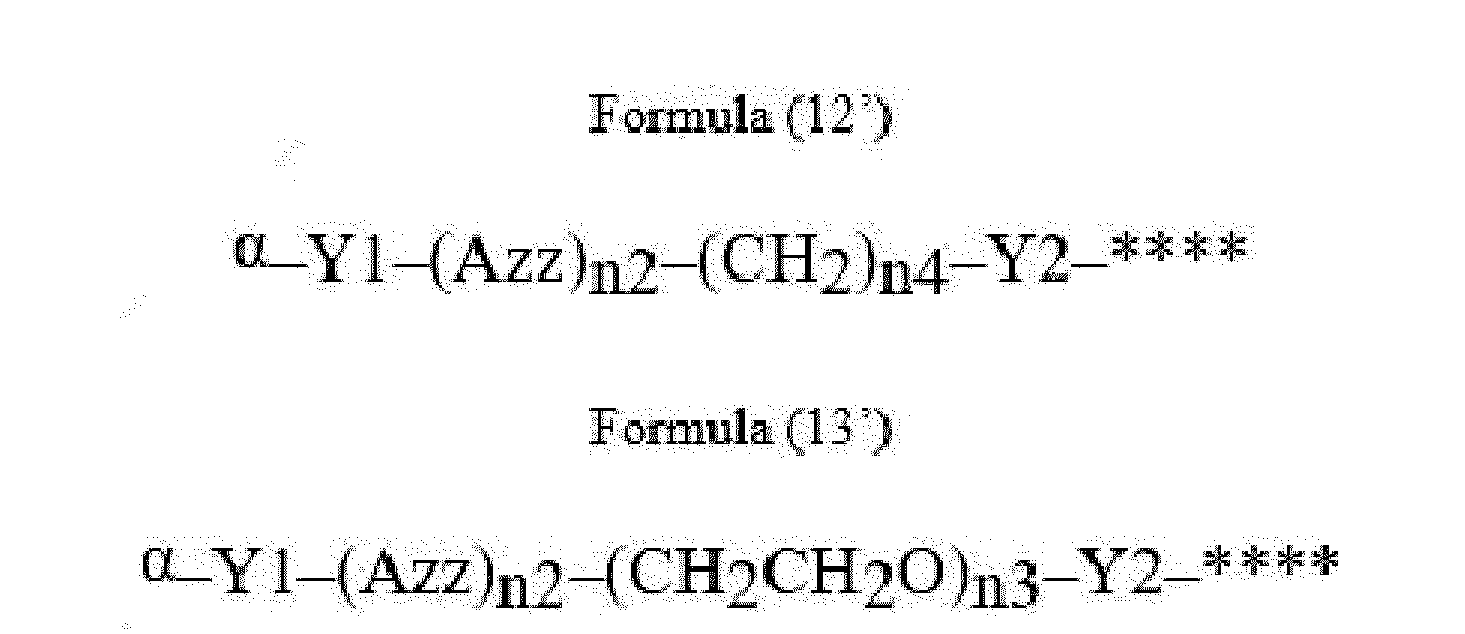 wherein Azz is a moiety comprising one or more solubilizing groups,wherein Y1 is a single covalent bond, an alkyl group having 1 to 6 carbon atoms, a carbonyl-containing group, or an amino-containing group,wherein Y2 is a single covalent bond, a carbonyl-containing group, or an amino-containing group,wherein n2 is an integer of 0 to 5,wherein n3 is an integer of 1 to 50,wherein n4 is an integer of 1 to 50,wherein α indicates covalent attachment to Y, andwherein **** indicates covalent attachment to Axx.
 - The antibody-drug-conjugate of claim 34, wherein at least one, e.g., one, two, three, four, five, six, seven, eight or nine, of Axx, Ayy, A''xx, A''yy, D1, D2, Z, m' and T is/are defined as follows:(a) Axx is an amino acid selected from Dap, Dab, Lys, Orn and homo-Lys,(b) Ayy in Formula (17) is an amino acid selected from Phe, homo-Phe, Tyr, homo-Tyr, Tyr(OR1) and homo-Tyr(OR1),(c) A''xx is an amino acid selected from Lys, homo-Lys, Cit, Orn, Dap and Dab,(d) A''yy is an amino acid selected from Phe, Ala, Trp, Phg and Tyr,(e) each D1 and D2 is AF,(f) Z is -OH or -NH2,(g) m' is 1 and T is represented by Formula (13'):
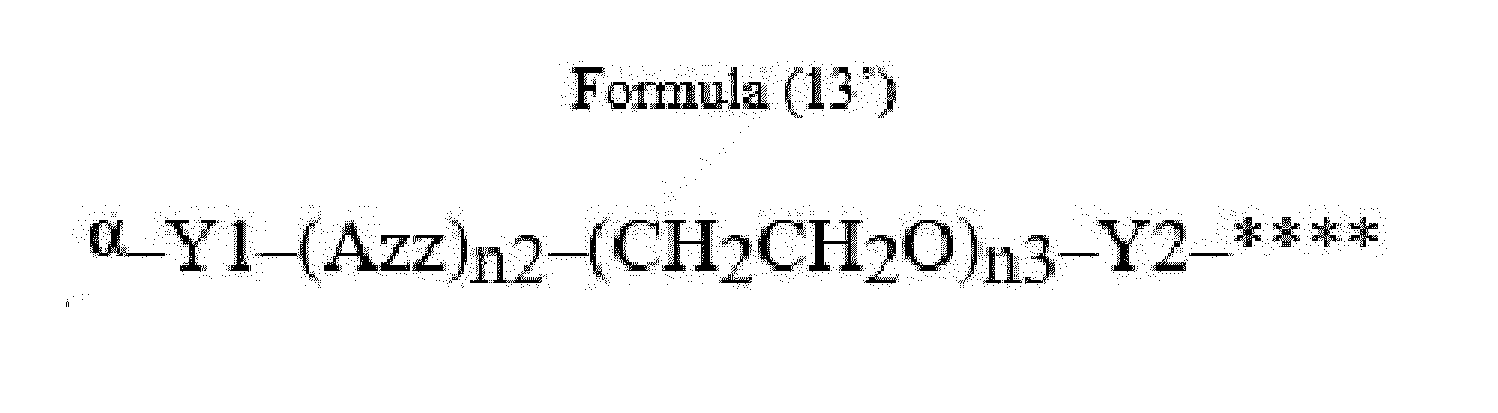 wherein Azz is a moiety comprising one or more solubilizing groups,wherein Y1 is a single covalent bond, an alkyl group having 1 to 6 carbon atoms, a carbonyl-containing group, or an amino-containing group,wherein Y2 is a single covalent bond, a carbonyl-containing group, or an amino-containing group,wherein n2 is an integer of 0 to 5,wherein n3 is an integer of 1 to 50,wherein α indicates covalent attachment to Y, andwherein **** indicates covalent attachment to Axx.
 - The antibody-drug-conjugate of claim 1 or 23, wherein the antitumor compound (D) is selected from DNA-alkylating agents, topoisomerase inhibitors, RNA-polymerase II inhibitors, DNA-cleaving agents, antimitotic agents or microtubule disruptors, anti-metabolites, Kinesin spindle protein inhibitors, kinase inhibitors, nicotinamide phosphoribosyl transferase inhibitors, matrix metallopeptidase 9 inhibitors, phosphatase inhibitors, or radioisotopes and/or pharmaceutically acceptable salts thereof; if more than one D is present, each D is independently selected from the aforementioned compounds.
- The antibody-drug-conjugate of claim 1 or 23, wherein the antitumor compound D is selected from amanitin, duocarmycin, auristatin F (AF), monomethyl auristatin F (MMAF), maytansine, mertansine (DM1), ravtansine (DM4), tubulysin, calicheamicin, camptothecin, SN-38, exatecan, Maaa-1181a, taxol, daunomycin, vinblastine, doxorubicin, methotrexate, pyrrolobenzodiazepine (PBD) and dimers thereof, indilinobenzodiazepine (IBD) and dimers thereof, or radioisotopes and/or pharmaceutically acceptable salts thereof; if more than one D is present, each D is independently selected from the aforementioned compounds.
- The antibody-drug-conjugate of claim 1, which is selected from the following compounds:
 and
and and
and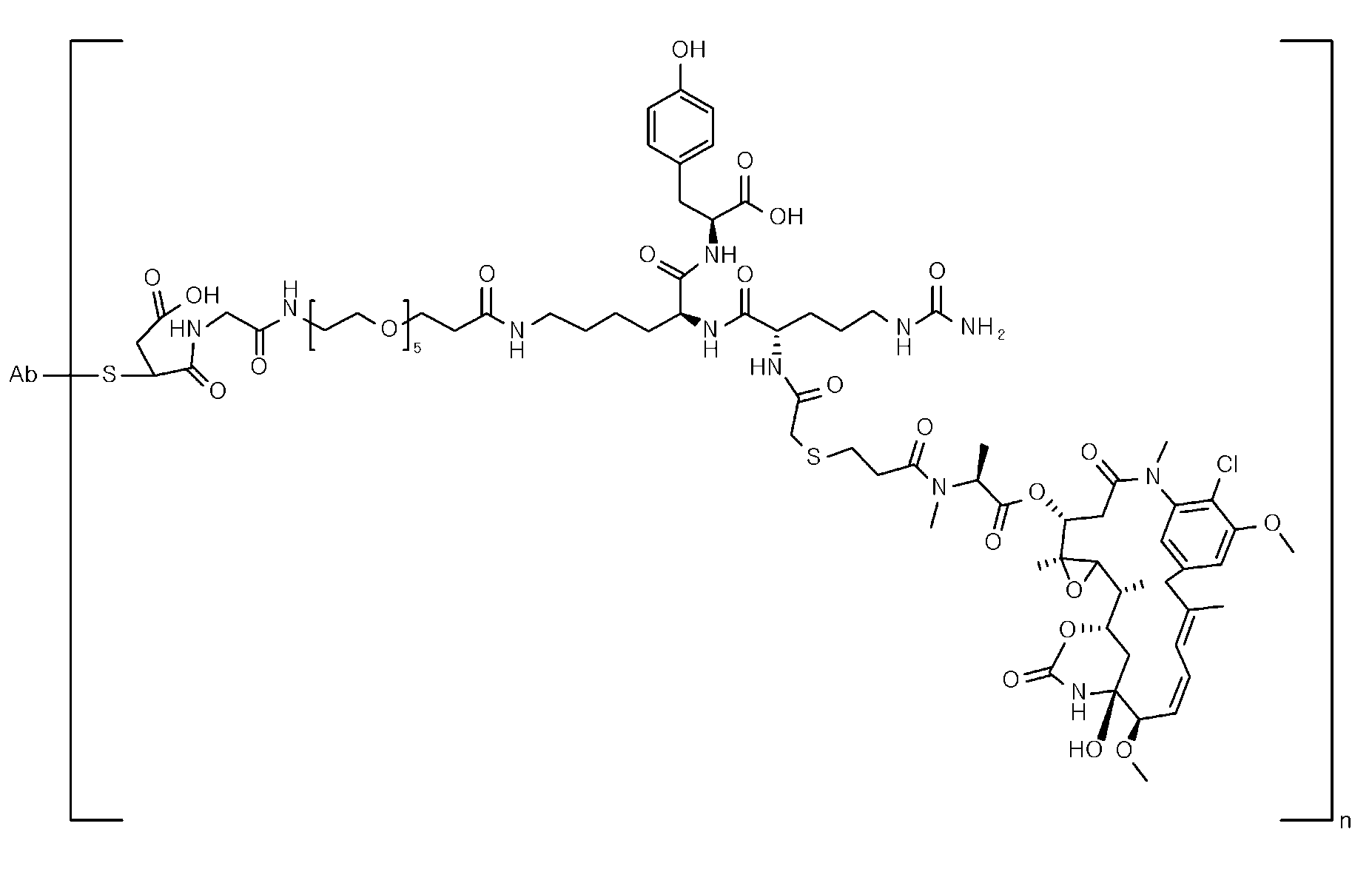 wherein Ab and n are as defined in claim 1.
 - A pharmaceutical composition comprising the antibody-drug conjugate of claim 1 or 23 or a pharmaceutically acceptable salt thereof, and a pharmaceutically acceptable carrier.
- The pharmaceutical composition of claim 40, wherein the pharmaceutical composition is for use in treating or imaging cancer.
- The pharmaceutical composition for use of claim 41, wherein the cancer is one or more selected from the group consisting of breast cancer, liver cancer, skin cancer, ovarian cancer, cervical cancer, prostate cancer, testicular cancer, brain cancer, clear cell renal cell carcinoma, glioma, melanoma, lung cancer, non-small cell lung cancer (NSCLC), small cell lung cancer, pancreatic cancer, gastric cancer, acute myeloid leukemia (AML), Hodgkin's lymphoma, non-Hodgkin's lymphoma (NHL), colorectal cancer, colon cancer, renal cancer, esophageal cancer, leukaemia, hepatocellular carcinoma, bone cancer, bladder cancer, sarcomas, kidney cancer, head and neck cancer, hypopharyngeal squamous cell carcinoma, glioblastoma, neuroblastoma, endometrial cancer, and urothelial cell carcinoma.
- A method for treating cancer, the method comprising administering an effective amount of the antibody-drug conjugate of claim 1 or 23 or a pharmaceutically acceptable salt thereof to a subject in need thereof.
- The method of claim 43, wherein the cancer is one or more selected from the group consisting of breast cancer, liver cancer, skin cancer, ovarian cancer, cervical cancer, prostate cancer, testicular cancer, brain cancer, clear cell renal cell carcinoma, glioma, melanoma, lung cancer, non-small cell lung cancer (NSCLC), small cell lung cancer, pancreatic cancer, gastric cancer, acute myeloid leukemia (AML), Hodgkin's lymphoma, non-Hodgkin's lymphoma (NHL), colorectal cancer, colon cancer, renal cancer, esophageal cancer, leukaemia, hepatocellular carcinoma, bone cancer, bladder cancer, sarcomas, kidney cancer, head and neck cancer, hypopharyngeal squamous cell carcinoma, glioblastoma, neuroblastoma, endometrial cancer, and urothelial cell carcinoma.
Priority Applications (7)
| Application Number | Priority Date | Filing Date | Title |
|---|---|---|---|
| IL320899A IL320899A (en) | 2022-11-18 | 2023-11-17 | Anti-basal cell adhesion molecule antibody-drug conjugate |
| AU2023381368A AU2023381368A1 (en) | 2022-11-18 | 2023-11-17 | Anti-basal cell adhesion molecule antibody-drug conjugate |
| EP23892076.3A EP4619046A1 (en) | 2022-11-18 | 2023-11-17 | Anti-basal cell adhesion molecule antibody-drug conjugate |
| CN202380089128.7A CN120417938A (en) | 2022-11-18 | 2023-11-17 | Anti-basal cell adhesion molecule antibody-drug conjugate |
| JP2025528843A JP2025539807A (en) | 2022-11-18 | 2023-11-17 | Anti-basal cell adhesion molecule antibody-drug conjugate |
| KR1020257020363A KR20250108120A (en) | 2022-11-18 | 2023-11-17 | Anti-BCAM antibodies and conjugates thereof |
| MX2025005787A MX2025005787A (en) | 2022-11-18 | 2025-05-16 | Anti-basal cell adhesion molecule antibody-drug conjugate |
Applications Claiming Priority (2)
| Application Number | Priority Date | Filing Date | Title |
|---|---|---|---|
| KR20220155122 | 2022-11-18 | ||
| KR10-2022-0155122 | 2022-11-18 |
Publications (1)
| Publication Number | Publication Date |
|---|---|
| WO2024107014A1 true WO2024107014A1 (en) | 2024-05-23 |
Family
ID=91085056
Family Applications (1)
| Application Number | Title | Priority Date | Filing Date |
|---|---|---|---|
| PCT/KR2023/018574 Ceased WO2024107014A1 (en) | 2022-11-18 | 2023-11-17 | Anti-basal cell adhesion molecule antibody-drug conjugate |
Country Status (10)
| Country | Link |
|---|---|
| EP (1) | EP4619046A1 (en) |
| JP (1) | JP2025539807A (en) |
| KR (1) | KR20250108120A (en) |
| CN (1) | CN120417938A (en) |
| AU (1) | AU2023381368A1 (en) |
| CL (1) | CL2025001431A1 (en) |
| IL (1) | IL320899A (en) |
| MX (1) | MX2025005787A (en) |
| TW (1) | TW202430222A (en) |
| WO (1) | WO2024107014A1 (en) |
Citations (3)
| Publication number | Priority date | Publication date | Assignee | Title |
|---|---|---|---|---|
| US10174095B2 (en) * | 2014-07-21 | 2019-01-08 | Novartis Ag | Nucleic acid encoding a humanized anti-BCMA chimeric antigen receptor |
| WO2019096867A1 (en) * | 2017-11-14 | 2019-05-23 | Debiopharm Research & Manufacturing S.A. | Ligand-drug-conjugates as substrates for selective cleavage by the exopeptidase activity of cathepsin b |
| WO2022166779A1 (en) * | 2021-02-04 | 2022-08-11 | 上海森辉医药有限公司 | Drug conjugate of glucocorticoid receptor agonist, and application thereof in medicine |
-
2023
- 2023-11-17 KR KR1020257020363A patent/KR20250108120A/en active Pending
- 2023-11-17 TW TW112144641A patent/TW202430222A/en unknown
- 2023-11-17 WO PCT/KR2023/018574 patent/WO2024107014A1/en not_active Ceased
- 2023-11-17 IL IL320899A patent/IL320899A/en unknown
- 2023-11-17 AU AU2023381368A patent/AU2023381368A1/en active Pending
- 2023-11-17 CN CN202380089128.7A patent/CN120417938A/en active Pending
- 2023-11-17 EP EP23892076.3A patent/EP4619046A1/en active Pending
- 2023-11-17 JP JP2025528843A patent/JP2025539807A/en active Pending
-
2025
- 2025-05-15 CL CL2025001431A patent/CL2025001431A1/en unknown
- 2025-05-16 MX MX2025005787A patent/MX2025005787A/en unknown
Patent Citations (3)
| Publication number | Priority date | Publication date | Assignee | Title |
|---|---|---|---|---|
| US10174095B2 (en) * | 2014-07-21 | 2019-01-08 | Novartis Ag | Nucleic acid encoding a humanized anti-BCMA chimeric antigen receptor |
| WO2019096867A1 (en) * | 2017-11-14 | 2019-05-23 | Debiopharm Research & Manufacturing S.A. | Ligand-drug-conjugates as substrates for selective cleavage by the exopeptidase activity of cathepsin b |
| WO2022166779A1 (en) * | 2021-02-04 | 2022-08-11 | 上海森辉医药有限公司 | Drug conjugate of glucocorticoid receptor agonist, and application thereof in medicine |
Non-Patent Citations (3)
| Title |
|---|
| ALLA PRYYMA: "Rapid, High-Yielding Solid-Phase Synthesis of Cathepsin-B Cleavable Linkers for Targeted Cancer Therapeutics", BIOCONJUGATE CHEMISTRY, AMERICAN CHEMICAL SOCIETY, US, vol. 31, no. 12, 16 December 2020 (2020-12-16), US , pages 2685 - 2690, XP093169487, ISSN: 1043-1802, DOI: 10.1021/acs.bioconjchem.0c00563 * |
| KIKKAWA YAMATO, ENOMOTO-OKAWA YURIE, FUJIYAMA AIKO, FUKUHARA TAKESHI, HARASHIMA NOZOMI, SUGAWARA YUMIKA, NEGISHI YOICHI, KATAGIRI : "Internalization of CD239 highly expressed in breast cancer cells: a potential antigen for antibody-drug conjugates", SCIENTIFIC REPORTS, vol. 8, no. 1, 1 December 2018 (2018-12-01), XP093007228, DOI: 10.1038/s41598-018-24961-4 * |
| NISTHAL ALEX, LEE SUNG-HYUNG, BONZON CHRISTINE, LOVE RUSCHELLE, AVERY KENDRA N., RASHID RUMANA, LERTKIATMONGKOL PANIDA, RODRIGUEZ : "Abstract 3515: Engineered IL18 heterodimeric Fc-fusions featuring improved stability, reduced potency, and insensitivity to IL18BP", CANCER RESEARCH, AMERICAN ASSOCIATION FOR CANCER RESEARCH, US, vol. 82, no. 12_Supplement, 15 June 2022 (2022-06-15), US , XP093132990, ISSN: 1538-7445, DOI: 10.1158/1538-7445.AM2022-3515 * |
Also Published As
| Publication number | Publication date |
|---|---|
| CL2025001431A1 (en) | 2025-09-22 |
| TW202430222A (en) | 2024-08-01 |
| EP4619046A1 (en) | 2025-09-24 |
| CN120417938A (en) | 2025-08-01 |
| AU2023381368A1 (en) | 2025-05-29 |
| KR20250108120A (en) | 2025-07-15 |
| MX2025005787A (en) | 2025-08-01 |
| IL320899A (en) | 2025-07-01 |
| JP2025539807A (en) | 2025-12-09 |
Similar Documents
| Publication | Publication Date | Title |
|---|---|---|
| AU2017380099B2 (en) | Amanitin antibody conjugates | |
| AU2022204701A1 (en) | PEGylated drug-linkers for improved Ligand-Drug Conjugate pharmacokinetics | |
| DK2956173T3 (en) | TUBULYSIS RELATIONSHIPS, METHODS OF PRODUCING AND USING THEREOF | |
| CN113929738B (en) | Antibody-drug conjugates | |
| CA3094313A1 (en) | Camptothecin peptide conjugates | |
| EP3218391B1 (en) | Tubulysin analogs and methods of making and use | |
| KR20190038579A (en) | A drug conjugate with a self-stabilizing linker having improved physicochemical properties | |
| WO2020184944A1 (en) | Site-specific antibody conjugation and antibody-drug conjugate as specific example thereof | |
| KR20160098303A (en) | Methylene carbamate linkers for use with targeted-drug conjugates | |
| TW202313123A (en) | Anthracycline antibody conjugates | |
| CA3155093A1 (en) | Selective drug release from internalized conjugates of biologically active compounds | |
| CA2990300A1 (en) | Site specific homogeneous conjugates with ksp inhibitors | |
| WO2022245186A1 (en) | Antibody-drug conjugate that binds to ror1 and b7-h3, and use thereof | |
| WO2018174544A2 (en) | Antibody binding specifically to muc1 and use thereof | |
| CA3113378A1 (en) | Sulfomaleimide-based linkers and corresponding conjugates | |
| WO2021101349A1 (en) | Antibody that binds to ror1 and b7-h3, antibody-drug conjugate containing same, and use thereof | |
| WO2024107014A1 (en) | Anti-basal cell adhesion molecule antibody-drug conjugate | |
| CN117750982A (en) | Coupling reagents and their conjugates | |
| WO2025211773A1 (en) | Anti-cntn4 conjugate comprising antibody and use thereof | |
| WO2025053366A1 (en) | Compound comprising fc-binding unit, and conjugate prepared using same | |
| WO2025264040A1 (en) | Anti-claudin 18.2 antibody, anti-claudin 18.2 antibody-drug conjugate, and use thereof | |
| WO2025230314A1 (en) | Compound comprising fc-binding unit, and conjugate prepared using same | |
| TW202434305A (en) | Antibody-drug conjugates cleavable in a tumor microenvironment | |
| WO2024096577A1 (en) | Compound comprising fc-binding unit, and conjugate prepared using same | |
| WO2025083060A1 (en) | Antibody-drug conjugates |
Legal Events
| Date | Code | Title | Description |
|---|---|---|---|
| 121 | Ep: the epo has been informed by wipo that ep was designated in this application |
Ref document number: 23892076 Country of ref document: EP Kind code of ref document: A1 |
|
| WWE | Wipo information: entry into national phase |
Ref document number: AU2023381368 Country of ref document: AU |
|
| WWE | Wipo information: entry into national phase |
Ref document number: 320899 Country of ref document: IL |
|
| ENP | Entry into the national phase |
Ref document number: 2025528843 Country of ref document: JP Kind code of ref document: A |
|
| WWE | Wipo information: entry into national phase |
Ref document number: 821628 Country of ref document: NZ Ref document number: MX/A/2025/005787 Country of ref document: MX Ref document number: 2025528843 Country of ref document: JP |
|
| ENP | Entry into the national phase |
Ref document number: 2023381368 Country of ref document: AU Date of ref document: 20231117 Kind code of ref document: A |
|
| WWP | Wipo information: published in national office |
Ref document number: 821628 Country of ref document: NZ |
|
| REG | Reference to national code |
Ref country code: BR Ref legal event code: B01A Ref document number: 112025009800 Country of ref document: BR |
|
| WWE | Wipo information: entry into national phase |
Ref document number: 202517056953 Country of ref document: IN |
|
| WWE | Wipo information: entry into national phase |
Ref document number: 202591550 Country of ref document: EA |
|
| WWE | Wipo information: entry into national phase |
Ref document number: 1020257020363 Country of ref document: KR Ref document number: 2023892076 Country of ref document: EP |
|
| NENP | Non-entry into the national phase |
Ref country code: DE |
|
| ENP | Entry into the national phase |
Ref document number: 2023892076 Country of ref document: EP Effective date: 20250618 |
|
| WWE | Wipo information: entry into national phase |
Ref document number: 202380089128.7 Country of ref document: CN |
|
| WWE | Wipo information: entry into national phase |
Ref document number: 11202503321P Country of ref document: SG |
|
| WWP | Wipo information: published in national office |
Ref document number: 11202503321P Country of ref document: SG |
|
| WWP | Wipo information: published in national office |
Ref document number: 1020257020363 Country of ref document: KR |
|
| WWP | Wipo information: published in national office |
Ref document number: MX/A/2025/005787 Country of ref document: MX Ref document number: 202380089128.7 Country of ref document: CN |
|
| WWP | Wipo information: published in national office |
Ref document number: 202517056953 Country of ref document: IN |
|
| WWP | Wipo information: published in national office |
Ref document number: 2023892076 Country of ref document: EP |
|
| ENP | Entry into the national phase |
Ref document number: 112025009800 Country of ref document: BR Kind code of ref document: A2 Effective date: 20250515 |