WO2024097560A1 - Coated paper and oxygen barrier dispersion - Google Patents
Coated paper and oxygen barrier dispersion Download PDFInfo
- Publication number
- WO2024097560A1 WO2024097560A1 PCT/US2023/077720 US2023077720W WO2024097560A1 WO 2024097560 A1 WO2024097560 A1 WO 2024097560A1 US 2023077720 W US2023077720 W US 2023077720W WO 2024097560 A1 WO2024097560 A1 WO 2024097560A1
- Authority
- WO
- WIPO (PCT)
- Prior art keywords
- coating composition
- weight
- pva
- coated paper
- weight percent
- Prior art date
- Legal status (The legal status is an assumption and is not a legal conclusion. Google has not performed a legal analysis and makes no representation as to the accuracy of the status listed.)
- Ceased
Links
Classifications
-
- D—TEXTILES; PAPER
- D21—PAPER-MAKING; PRODUCTION OF CELLULOSE
- D21H—PULP COMPOSITIONS; PREPARATION THEREOF NOT COVERED BY SUBCLASSES D21C OR D21D; IMPREGNATING OR COATING OF PAPER; TREATMENT OF FINISHED PAPER NOT COVERED BY CLASS B31 OR SUBCLASS D21G; PAPER NOT OTHERWISE PROVIDED FOR
- D21H17/00—Non-fibrous material added to the pulp, characterised by its constitution; Paper-impregnating material characterised by its constitution
- D21H17/71—Mixtures of material ; Pulp or paper comprising several different materials not incorporated by special processes
- D21H17/72—Mixtures of material ; Pulp or paper comprising several different materials not incorporated by special processes of organic material
-
- D—TEXTILES; PAPER
- D21—PAPER-MAKING; PRODUCTION OF CELLULOSE
- D21H—PULP COMPOSITIONS; PREPARATION THEREOF NOT COVERED BY SUBCLASSES D21C OR D21D; IMPREGNATING OR COATING OF PAPER; TREATMENT OF FINISHED PAPER NOT COVERED BY CLASS B31 OR SUBCLASS D21G; PAPER NOT OTHERWISE PROVIDED FOR
- D21H19/00—Coated paper; Coating material
- D21H19/10—Coatings without pigments
- D21H19/14—Coatings without pigments applied in a form other than the aqueous solution defined in group D21H19/12
- D21H19/20—Coatings without pigments applied in a form other than the aqueous solution defined in group D21H19/12 comprising macromolecular compounds obtained by reactions only involving carbon-to-carbon unsaturated bonds
- D21H19/22—Polyalkenes, e.g. polystyrene
-
- D—TEXTILES; PAPER
- D21—PAPER-MAKING; PRODUCTION OF CELLULOSE
- D21H—PULP COMPOSITIONS; PREPARATION THEREOF NOT COVERED BY SUBCLASSES D21C OR D21D; IMPREGNATING OR COATING OF PAPER; TREATMENT OF FINISHED PAPER NOT COVERED BY CLASS B31 OR SUBCLASS D21G; PAPER NOT OTHERWISE PROVIDED FOR
- D21H21/00—Non-fibrous material added to the pulp, characterised by its function, form or properties; Paper-impregnating or coating material, characterised by its function, form or properties
- D21H21/14—Non-fibrous material added to the pulp, characterised by its function, form or properties; Paper-impregnating or coating material, characterised by its function, form or properties characterised by function or properties in or on the paper
- D21H21/16—Sizing or water-repelling agents
-
- D—TEXTILES; PAPER
- D21—PAPER-MAKING; PRODUCTION OF CELLULOSE
- D21H—PULP COMPOSITIONS; PREPARATION THEREOF NOT COVERED BY SUBCLASSES D21C OR D21D; IMPREGNATING OR COATING OF PAPER; TREATMENT OF FINISHED PAPER NOT COVERED BY CLASS B31 OR SUBCLASS D21G; PAPER NOT OTHERWISE PROVIDED FOR
- D21H21/00—Non-fibrous material added to the pulp, characterised by its function, form or properties; Paper-impregnating or coating material, characterised by its function, form or properties
- D21H21/50—Non-fibrous material added to the pulp, characterised by its function, form or properties; Paper-impregnating or coating material, characterised by its function, form or properties characterised by form
- D21H21/52—Additives of definite length or shape
-
- D—TEXTILES; PAPER
- D21—PAPER-MAKING; PRODUCTION OF CELLULOSE
- D21H—PULP COMPOSITIONS; PREPARATION THEREOF NOT COVERED BY SUBCLASSES D21C OR D21D; IMPREGNATING OR COATING OF PAPER; TREATMENT OF FINISHED PAPER NOT COVERED BY CLASS B31 OR SUBCLASS D21G; PAPER NOT OTHERWISE PROVIDED FOR
- D21H27/00—Special paper not otherwise provided for, e.g. made by multi-step processes
- D21H27/10—Packing paper
Definitions
- the present invention relates to a paper coated with a composition comprising a melt- blended colloidal suspension of thermoplastic particles in an aqueous polyvinyl alcohol (PVA) solution, an article comprising the coated paper, and a process of making the coated paper.
- PVA polyvinyl alcohol
- the present invention also relates to a composition comprising a colloidal suspension of thermoplastic particles in an aqueous polyvinyl alcohol (PVA) solution. Coating of paper or paperboard for use in a range of applications is known to provide barriers to a wide range of substances including oxygen, water, oil, and acids.
- Polyvinyl alcohol is a water-soluble polymer often used in coating applications to provide beneficial properties such as adhesive and oxygen barrier properties.
- the melting temperature of PVA is high (180 o C or more depending upon hydrolysis level) and requires long mixing times (2 or more hours) at an elevated temperature (90 o C) to dissolve the PVA uniformly into water.
- aqueous solutions of PVA are high in viscosity at low percentage solids (about 10- 15% wt.), especially for higher molecular weight grades of the polymer. Such aqueous PVA solutions are difficult to pump because they do not have the normal shear thinning behavior of a polymer solution.
- high performance coatings such as those used for paper drink cups
- high performance coatings are prepared by extrusion coating or lamination of a film directly onto the paper substrate, often with multiple film layers.
- This layered approach can impart preferential properties to the paper substrate but can also increase processing time, add coating weight, and can negatively impact the recyclability of the paper substrate.
- International Patent Publication WO 2021/091091 A1 also published as KR 2021/056129 A1 discloses a barrier resin having a multilayer structure and its manufacturing method. With ethylene vinyl alcohol as one of the representative barrier resins, the barrier resin is provided as an extruded film in a multilayer structure of polyethylene/adhesive resin/ethylene vinyl alcohol layer/adhesive resin/polyethylene.
- the barrier resin having a multilayer structure is provided as a melt blend resin by adjusting a volume ratio, a viscosity ratio, and the like of a polyolefin, a barrier resin, and a compatibilizer.
- the barrier resin that is included with the polyolefin and compatibilizer to improve oxygen barrier properties is characterized in that it contains at least one or more selected from the group of polyamide, polyvinyl alcohol, and ethylene-vinyl alcohol copolymer. In this case, the ethylene-vinyl alcohol copolymer contains 10 to 50 mol% of ethylene.
- the polyolefin resin continuous phase (matrix) includes a DOW DOCKET NO.: 84909-WO-PCT continuous phase (matrix) or a dispersed phase (domain) of the barrier resin
- the volume ratio of the continuous polyolefin resin phase and the barrier resin (volume ratio) values in the range of 30:70 to 70:30 are provided.
- a volume ratio range of 50:50 may be provided.
- Japanese Patent 3810089 B2 (originating from International Patent Publication WO 1997/022536 A1) discloses a method for producing a laminated packaging material including a core layer and a polyvinyl alcohol layer which is added to one side of the core layer and functions as an oxygen gas barrier layer.
- Polyvinyl alcohol can be combined with one or more polymers known per se in a simple manner, such as hydrophobic polymers.
- the mixing ratio of polyvinyl alcohol and hydrophobic polymer is critical, and the amount of hydrophobic polymer is in the range of 5% to 50% of the total weight of the mixture (correspondingly, the amount of polyvinyl alcohol is 95% to 50%), calculated on the total dry weight of the mixture.
- the present invention provides a process for preparing a single layered oxygen barrier coated paper or paperboard comprising the steps of: a) applying onto paper or paperboard a coating composition comprising a melt-blended colloidal suspension of thermoplastic particles in an aqueous polyvinyl alcohol (PVA) solution; and b) drying the composition to produce a film having a coating weight in the range of 1 to 20 g/m 2 ; wherein the coating composition has a concentration of polymer solids of at least 25 weight percent, a viscosity of less than or equal to 5000 centipoise (cP), and a mean volume (Vmean) particle size in the range of 100 nanometers (nm) to 10 microns; wherein the polyvinyl alcohol of the coating composition is from 10 to less than 40 weight percent based on the total weight of all polymer solids, and is 88% to 98% saponified, with a viscosity (mPa*sec of a 4% aqueous solution at 20 o C)
- the present invention further provides an article made according to the process for preparing a single layered oxygen barrier coated paper or paperboard wherein after drying, the coated paper or paperboard has a KIT value of greater than 10 and an oxygen transport rate of less than 20 cc/m 2 -day.
- the coating composition which is a melt-blended colloidal suspension of thermoplastic particles in an aqueous polyvinyl alcohol (PVA) solution, may be prepared by a continuous or batch process.
- the process for making the coating composition comprises combining the PVA DOW DOCKET NO.: 84909-WO-PCT with water above the melt temperature of the PVA to form a concentrated PVA solution and combining this concentrated PVA solution with a thermoplastic polymer melt to generate a thermoplastic melt emulsion.
- the concentrated PVA solution and the thermoplastic polymer are mixed at a temperature greater than 15 o C above the glass transition (Tg) or melting temperate (Tm) of the thermoplastic base resin.
- Tg glass transition
- Tm melting temperate
- An example of a preferred continuous process is twin screw extrusion, as described in U.S.8,722,787, Comparative Example E.
- the PVA and thermoplastic polymer are advantageously melt compounded together in a continuous process then combined with an amount of water to form the concentrated PVA solution and melt emulsion concurrently in the continuous melt mixing device such as a twin- screw extruder.
- a batch process can be used whereby the combination of PVA with a small amount of water and the melt mixing of this concentrated PVA solution with a thermoplastic polymer can be accomplished successively in a high temperature melt mixing batch process such as a pressurized helical batch mixer.
- the batch process can be carried out, for example, using a pressurized helical batch mixer such as a 2CV Helicone mixer, which is a conical batch mixer that uses dual intermeshing conical blades to mix high viscosity materials.
- the concentrated PVA solution can either be made in a separate step (batch pressure mixer process), or more beneficially concurrently with the thermoplastic melt emulsion (continuous extruder process).
- the concentrated PVA solution is made by contacting the PVA with water above its melt temperature (greater than 180 o C) and the pressure is sufficient to exceed the steam pressure at the contacting temperature so that water is maintained as a liquid. Additional water is then added to the concentrated thermoplastic melt emulsion to lower the viscosity down to an appropriate level for use as a coating.
- the morphology of a colloidal suspension of thermoplastic particles in an aqueous PVA solution can be created by simple mixing of a thermoplastic polymer dispersion with a PVA solution
- the solids content of the inventive composition can be maximized by directly dispersing a thermoplastic polymer into a highly concentrated PVA solution in a melt mixing device, followed by diluting the concentrated thermoplastic melt emulsion to an appropriate percentage solids and viscosity level for use as a coating.
- the concentration of polymer solids in the coating composition is at least 20 weight percent, preferably at least 25 weight percent, more preferably at least 30 weight percent, and most preferably at least 40 weight percent, based on the weight of water and the polymers combined.
- the solids content of the coating composition is measured using an infrared solids DOW DOCKET NO.: 84909-WO-PCT analyzer such as an OHAUS® MB45 Moisture Analyzer or similar device.
- the coating composition has a viscosity of preferably less than or equal to 5000 centipoise (cP), more preferably less than or equal to 2500 cP, and most preferably less than or equal to 1000 cP.
- the viscosity of the coating composition is measured using an RV viscometer at 50 rpm using the appropriate spindle for the given viscosity, such as an RV3 at 50rpm.
- a centipoise is one millipascal-second (mPa*s) in SI units.
- the coating composition has a mean volume (Vmean) particle size preferably in the range of 100 nanometers (nm) to 10 microns, more preferably in the range of 100 nm to 5 microns, and most preferably in the range of 100 nm to 2 microns. All individual values and subranges from 100 nm to 10 microns are included herein and disclosed herein.
- the particle size of the solids particles of the coating composition is measured using a COULTER TM LS-230 particle size analyzer (Beckman Coulter Corporation, Fullerton, CA).
- the polyvinyl alcohol used is 88% to 98% saponified, with viscosity (mPa*sec of a 4% aqueous solution at 20 o C) less than 30, preferably viscosity less than 10.
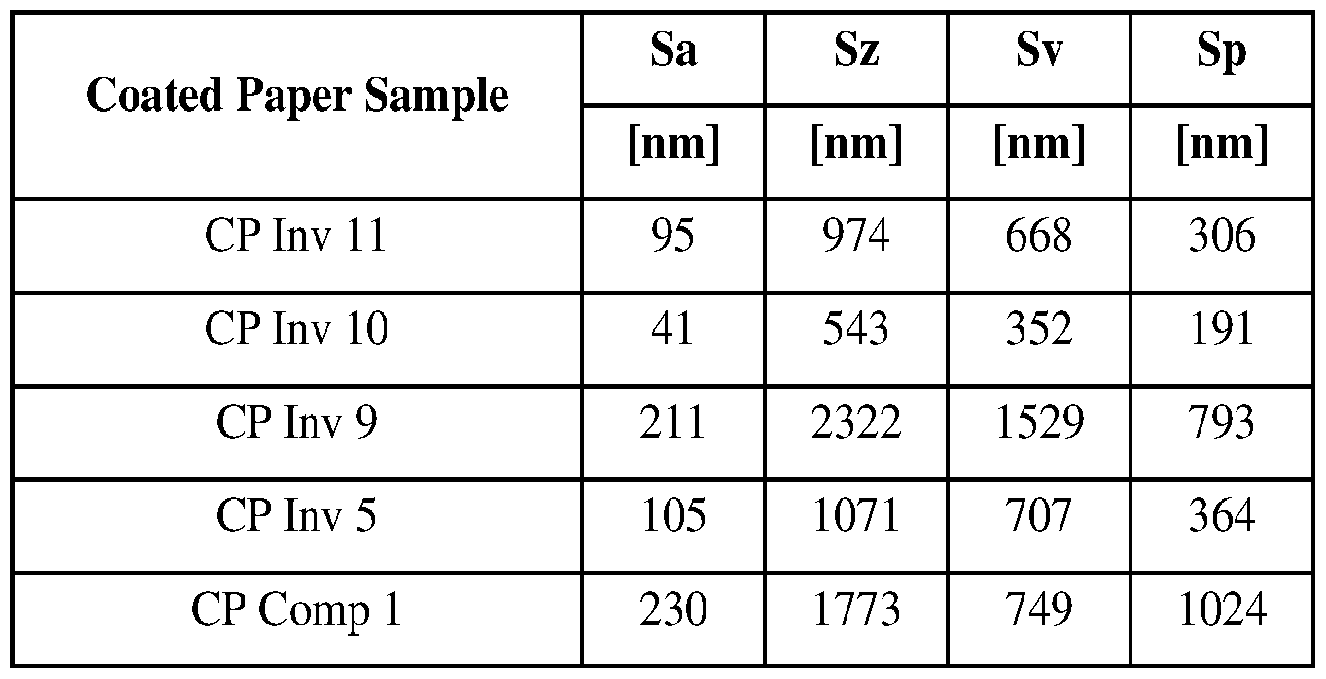
- the amount of polyvinyl alcohol in the coating composition by weight percent based on the total weight of all polymer solids, is 10 to less than 40 wt.%, preferably 15-35 wt.%, and most preferably 18-30 wt.%. All individual values and subranges from 10 to less than 40 wt.% are included herein and disclosed herein. Without being bound by any theory, it is theorized that higher levels of PVA provide a rougher surface topography of coated samples, which may result in more surface defects that can lower the OTR performance.
- Atomic Force Microscopy can help evaluate the roughness of a surface and compare against OTR values, as shown in the examples.
- Examples of commercially available PVA include PovalTM 4-88 available from Kuraray Co., Ltd.; PovalTM 6- 88, available from Kuraray Co., Ltd.; PovalTM 18-88, available from Kuraray Co., Ltd.; PovalTM 10-98, available from Kuraray Co., Ltd.; SelvolTM E310, available from Sekisui Specialty Chemicals America, and also terminal hydrophobically modified material such as Exceval® RS- 2117, available from Kuraray Co., Ltd.; and blends thereof. Blends of different PVA grades can be used, particularly blends of 88% and 98% hydrolysis polymers.
- EVA ethylene vinyl alcohol
- co-polmers of vinyl alcohols can be included in the PVA, such as ethylene vinyl alcohol (“EVA”).
- EVA polymers may be included with the PVA, it is preferred that no EVA is included, which can also be referred to as being free of added EVA.
- the ethylene content of the EVA is preferably less than 10 mole percent, more preferably less than 5 mole percent, and most preferably less than 1 mole percent.
- An example of a commercially available EVA having an ethylene content of 44 mole percent includes SoarnolTM A4412, and this material does not incorporate well with a thermoplastic polymer.
- thermoplastic particles comprise non-polar thermoplastic polymers, where non-polar is defined as absorbing less than 5 percent ( ⁇ 5%) by weight of water based on the weight of the thermoplastic polymer.
- the thermoplastic polymer must have a glass transition (Tg) temperature that is less than 30 o C to ensure a flexible, defect free barrier coating.
- Tg values of the polymers can be calculated herein by using the Fox equation (T.G. Fox, Bull. Am.
- 1/Tg(calc.) w(M1)/Tg(M1) + w(M2)/Tg(M2), wherein Tg(calc.) is the glass transition temperature calculated for the copolymer, w(M1) is the weight fraction of monomer M1 in the copolymer, w(M2) is the weight fraction of monomer M2 in the copolymer, Tg(M1) is the glass transition temperature of the homopolymer of M1, Tg(M2) is the glass transition temperature of the homopolymer of M2, and all temperatures being in K.
- the glass transition temperature of homopolymers may be found, for example, in "Polymer Handbook", edited by J. Brandrup and E.H. Immergut, Interscience Publishers.
- the calculated Tg of the emulsion polymer shall be calculated based on the overall composition of the polymeric components. However, if the thermoplastic polymer does not have a low enough Tg, a plasticizer can be added to lower the Tg.
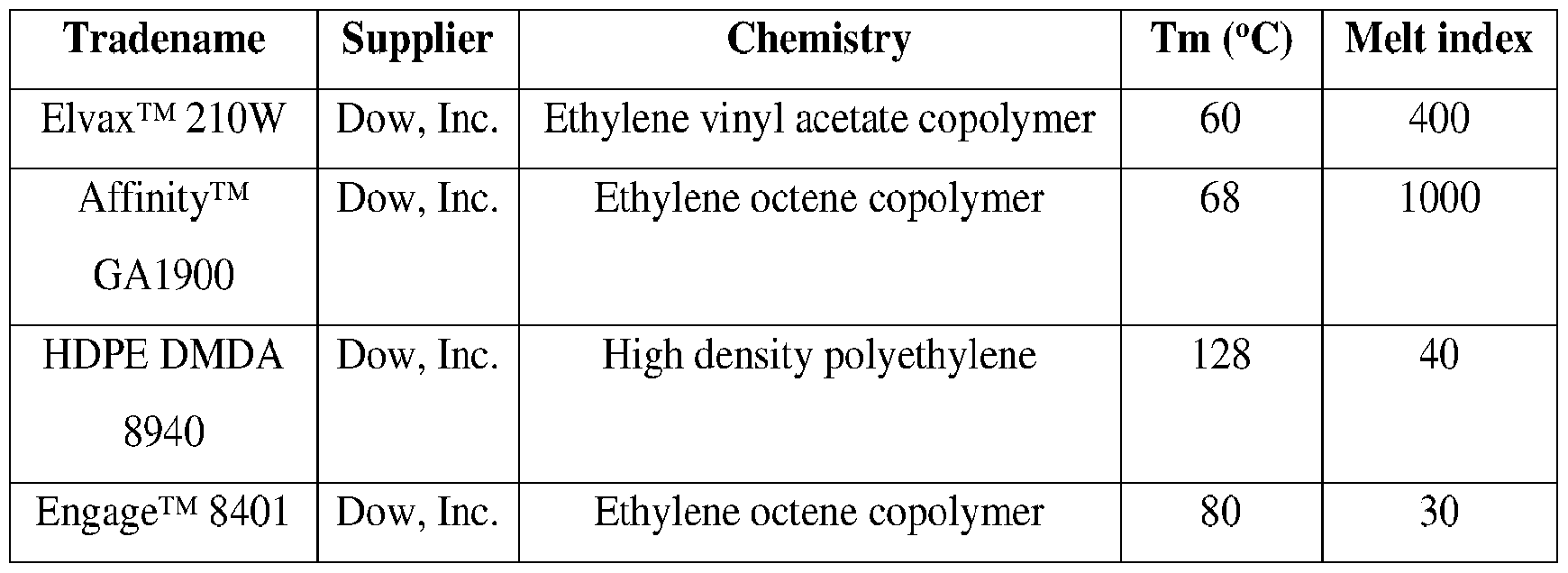
- the thermoplastic polymer includes olefin polymers and copolymers such as high- density polyethylene (HDPE), ethylene octene copolymer, and ethylene vinyl acetate copolymer; biopolymers such as polyhydroxybutanoate, polylactic acid, and polyacaprolactone; polyesters such as polylactic acid and polyhydroxyalkanoate; thermoplastic acrylics such as isobutylmethacrylate; and combinations thereof. Miscible blends of polymers can also be used as the thermoplastic polymer, such as for example HDPE and polyethylene wax.
- HDPE high- density polyethylene
- ethylene octene copolymer ethylene vinyl acetate copolymer
- biopolymers such as polyhydroxybutanoate, polylactic acid, and polyacaprolactone
- polyesters such as polylactic acid and polyhydroxyalkanoate
- thermoplastic acrylics such as isobutylmethacrylate
- Miscible blends of polymers can also be used as the thermoplastic polymer
- thermoplastic polymer is limited to olefin polymers and copolymers and miscible blends thereof; and most preferably the thermoplastic polymer is limited to olefin polymers and copolymers and blends thereof.
- the thermoplastic polymer has a melt flow index (MFI) (190 o C/2.16kg) as determined according to ASTM D1238 standard of greater than 5, preferably greater than 25 and most preferably greater than 100, with a maximum MFI of 1300. All individual values and subranges from 5-1300 MFI are included herein and disclosed herein.
- the amount of thermoplastic polymer in the coating composition by weight percent based on the total weight of DOW DOCKET NO.: 84909-WO-PCT all polymer solids, is from greater than 60 to 90 wt.%, preferably 65-85 wt.%, and most preferably 70-82 wt.%. All individual values and subranges from greater than 60 to 90 wt.% are included herein and disclosed herein.
- the coating composition may optionally comprise one or more compatibilizers, such as polymeric coupling agents to improve the compatibility between the PVA and thermoplastic particles or any other added components.
- the coating composition is made without the use of a compatibilizer, which is also referred to as being in the absence of a compatibilizer or being free of any compatibilizer.
- a suitable coupling agent includes ethylene-co-maleic anhydride, which, when used, is present at a concentration in the range of from 5 weight percent to 20, more preferably to 10 weight percent based on the weight of polymer solids in the coating composition.
- the coating composition may optionally comprise up to 5 weight percent, based the weight of polymer solids in the composition, of a wax such as ethylene bis(stearamide) and polyolefin waxes such as the commercially available POLYWAXTM 655 polyethylene available from Baker Hughes, Inc. or its affiliates, or ACRAWAXTM C (N,N’ ethylene bisstearamide) available from Lonza or its affiliates.
- the coating composition may optionally be mixed or formulated with one or more additional components as those skilled in the art can appreciate, such as for example, other water-based dispersions, pigments, wetting agents, defoamers, solvents, rheology modifiers, surfactants, anti-oxidants, and other processing aids to improve barrier and performance attributes of the coated paperboard.
- additional components such as for example, other water-based dispersions, pigments, wetting agents, defoamers, solvents, rheology modifiers, surfactants, anti-oxidants, and other processing aids to improve barrier and performance attributes of the coated paperboard.
- Such improvements include for example, compatibility with a substrate, dispersion wet out, coating flexibility, coating integrity upon exposure to extremes in temperature or radiation, flowablity, heat seal, block resistance, and other attributes, as well as to lower cost in use.
- the coating composition of the present invention allows for repulping of the paper substrate because it is continuous in PVA, and is also low in coat weight, while maintaining a high level
- the coating composition can be applied to paper or paperboard using traditional wet applications known to those skilled in the art, such as a wire wound drawdown bar.
- the wet film can then be allowed to dry or heated to remove water, and if heated, preferably to a temperature in the range of from 50 oC, more preferably from 70 oC to preferably 150 oC, more preferably 120 oC to provide a coat weight of from 1, preferably from 2, more preferably from 4, and most preferably from 6 g/m 2 , to 20, preferably to 15, more preferably to 10, and most preferably to 7 g/m 2 . All individual values and subranges from DOW DOCKET NO.: 84909-WO-PCT 1 to 20 g/m 2 are included herein and disclosed herein.
- the paper or paperboard may be uncoated or pre-coated.
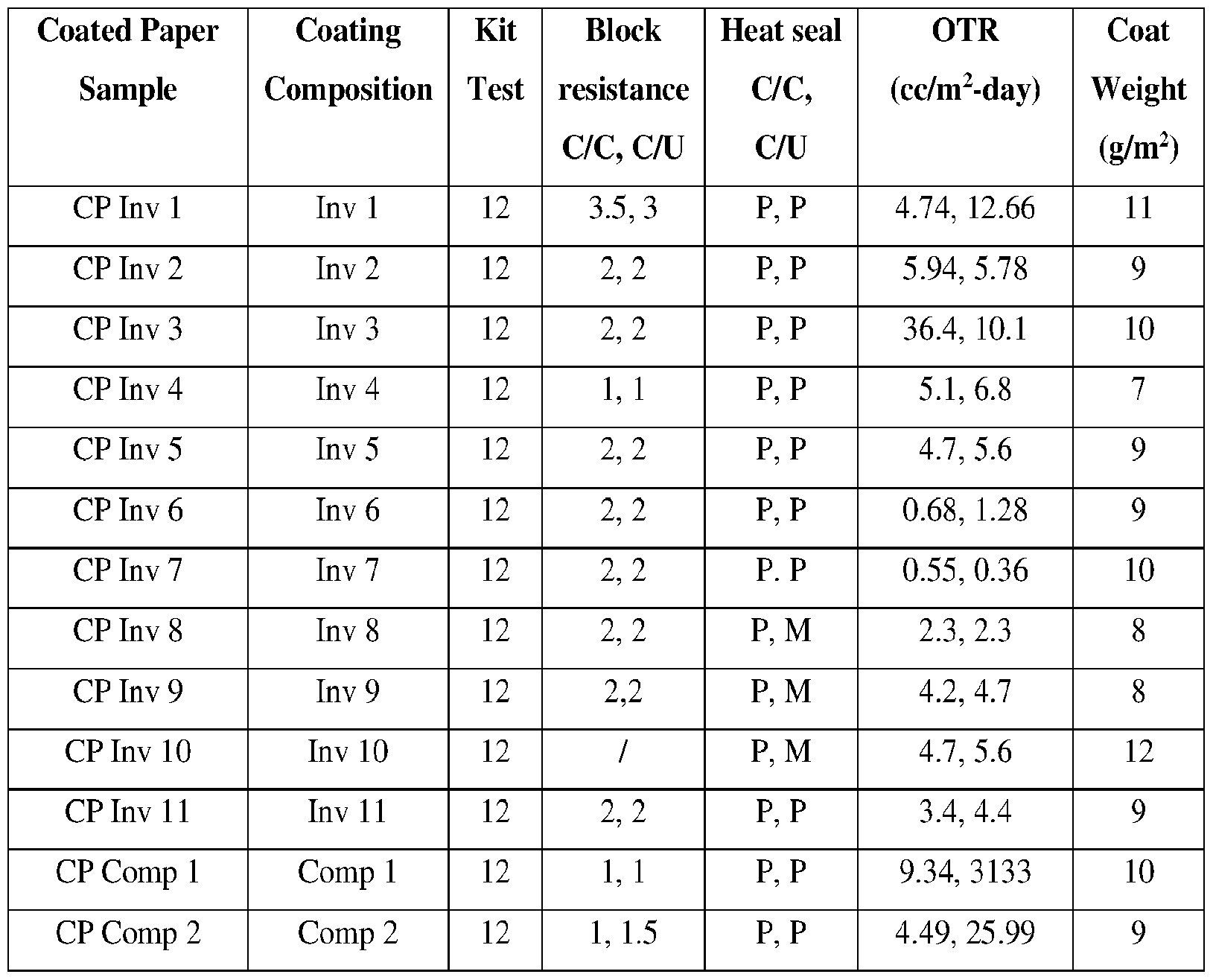
- a very thin layer of a film with high oxygen barrier properties, good oil resistance (KIT values of greater than 10), good heat seal performance, and good block resistance can be coated onto paper or paperboard; moreover, the application can be done in a single pass.
- the oxygen transport rate (OTR) of coated paper substrates of the present invention is less than 50 cc/m 2 -day, preferably less than 20 cc/m 2 -day, and more preferably less than 10 cc/m 2 -day.
- Sample Preparation Coated paper samples were prepared by applying coating compositions to an uncoated glossy side of a paper substrate from UPM Specialty Papers having 62 g/m 2 .
- Coated paper and paperboard samples were prepared by hand using a wire-wound drawdown bar to achieve a dry coat weight of about 10 g/m 2 .
- Samples were cured in a Fisher Scientific Isotemp 180L Oven FA oven at 100 °C for 2 min.
- Coat Weight Measurements The coat weight of samples was measured by cutting out 7.17 in 2 (46.26 cm 2 ) sections coated and uncoated paper, then placing the sections in an oven at 100 °C for 2 min. All the samples were then weighed, and the coat weight was determined by the difference between the coated and uncoated samples. Coat weight is represented as grams per square meter (gsm or g/m 2 ). Kit Testing Coated paper was tested for oil and grease resistance according to TAPPI method T559 cm-12.
- Kit solutions consisting of mixtures of castor oil, toluene, and heptane were applied dropwise to the coated specimens. After 15 seconds, any breakthrough of solvents into the coating was noted, and the solution was wiped from the substrate. Any discoloration or change in appearance to the substrate was considered a failure for that specific Kit solution. A score rating from 1-12 was assigned for the highest numbered Kit solution that passed the test. Number 12 means the best performance.
- OTR Testing Procedure The oxygen transmission rate (OTR) of the films is measured with an OX-TRAN® Model 2/21 ML module from Mocon Inc. according to ASTM D-3985 at 23 o C, 50% relative humidity, and 1 atmosphere of pressure.
- Coated paper specimens approximately 30 cm 2 are cut, then masked and loaded directly in the MOCON OXTRAN® 2/21 ML unit for measurement.
- the masking material is 3mil aluminum with an acrylic adhesive layer to make the seal.
- the effective testing DOW DOCKET NO.: 84909-WO-PCT area is 20.27 cm 2 .
- a test gas containing 100% oxygen is used in order for the permeation to not exceed the detection range of the MOCON OXTRAN® 2/21 ML module.
- the OTR value is expressed in cc/m 2 -day or g/m 2 -day. OTR results have two values, which are replicate test results for the same sample.
- Block Resistance Test Procedure Block resistance was tested on coated paper samples using a metal spring-loaded compression tool (I.C.
- AFM Atomic Force Microscopy
- AFM provides a 3-D surface profile and can provide surface measurements.
- images were obtained using a Bruker Dimension FastScanTM atomic force microscope in tapping mode. Typical surface imaging parameters were used as shown below and surface attributes were determined, including: average roughness (Sa); Z range – the height difference between the highest and lowest pixels in an image (Sz); max valley depth (Sv); and max peak height (Sp).
- Post processing of images was performed using SPIP or MountainSPIP image processing software tools. Both height and phase images (viscoelastic differences) were prepared, with the data provided in the examples. The equipment parameters were as shown below.
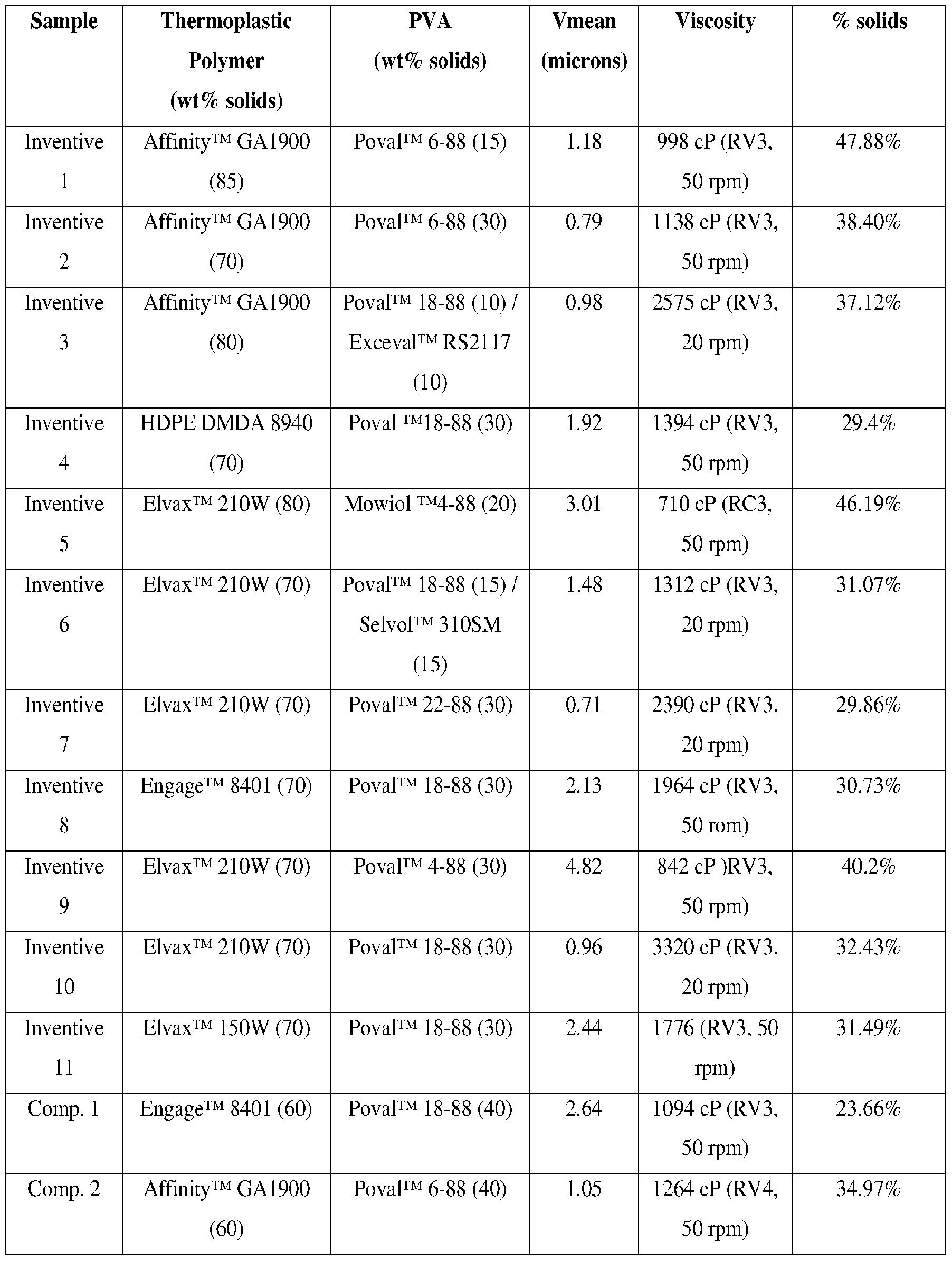
- Inventive coating compositions 1 to 11 and comparative coating compositions 1 to 2 have the polymer phase components and physical properties as shown in Table 3, are formed from the raw materials shown in Tables 1 and 2, and were prepared according to the general procedure, process, and conditions described herein.
- thermoplastic polymer resin and PVA listed for each example in Table 3 are fed into a 25 mm diameter twin screw extruder using a controlled rate feeder at the given ratios listed in Table 3 at a total feed rate of 75.6 g/min.
- Components 1 and 2 are forwarded through the extruder and melted to form a liquid melt material where the melt zone temperature in the extruder is set to be greater than the melting temperature of the PVA material.
- An initial amount of water is then added into the extruder at a rate roughly equal to the feed rate of the PVA material.
- additional dilution water is then added at a rate to give the composition percentage solids as indicated in Table 3.
- the extruder speed used was 600 rpm.
- a backpressure regulator is used to adjust the pressure inside the extruder barrel to a pressure adapted to reduce steam formation (generally the pressure was from 2 MPa to 4 MPa).
- Each coating composition exits from the extruder and is filtered first through a 200 micrometer ( ⁇ m) filter.
- the resultant filtered coating composition has a solids content measured in weight percent (wt %); and the solids particles of the coating composition has a volume mean particle size measured in microns.
- the solids content of the coating composition is measured using an infrared solids analyzer, the viscosity of the coating composition is measured using an RV viscometer at 50 rpm using the appropriate spindle for the given viscosity (RV3), and the particle size of the solids particles of the coating composition is measured using a COULTER TM LS-230 particle size analyzer (Beckman Coulter Corporation, Fullerton, CA).
- the solids content, viscosity, and the average particle size (PS) of the solids particles of the coating composition are indicated in Table 3.
Landscapes
- Chemical & Material Sciences (AREA)
- Chemical Kinetics & Catalysis (AREA)
- Paints Or Removers (AREA)
- Laminated Bodies (AREA)
- Paper (AREA)
Abstract
Description

Claims
Priority Applications (4)
| Application Number | Priority Date | Filing Date | Title |
|---|---|---|---|
| EP23809429.6A EP4584436A1 (en) | 2022-10-31 | 2023-10-25 | Coated paper and oxygen barrier dispersion |
| JP2025523037A JP2025535929A (en) | 2022-10-31 | 2023-10-25 | Coated Paper and Oxygen Barrier Dispersions |
| CN202380075179.4A CN120112691A (en) | 2022-10-31 | 2023-10-25 | Coated Paper and Oxygen Barrier Dispersions |
| KR1020257014260A KR20250097833A (en) | 2022-10-31 | 2023-10-25 | Coated paper and oxygen barrier dispersion |
Applications Claiming Priority (4)
| Application Number | Priority Date | Filing Date | Title |
|---|---|---|---|
| US202263420793P | 2022-10-31 | 2022-10-31 | |
| US202263420792P | 2022-10-31 | 2022-10-31 | |
| US63/420,793 | 2022-10-31 | ||
| US63/420,792 | 2022-10-31 |
Publications (1)
| Publication Number | Publication Date |
|---|---|
| WO2024097560A1 true WO2024097560A1 (en) | 2024-05-10 |
Family
ID=88863390
Family Applications (2)
| Application Number | Title | Priority Date | Filing Date |
|---|---|---|---|
| PCT/US2023/077723 Ceased WO2024097561A1 (en) | 2022-10-31 | 2023-10-25 | Oxygen barrier dispersion coating |
| PCT/US2023/077720 Ceased WO2024097560A1 (en) | 2022-10-31 | 2023-10-25 | Coated paper and oxygen barrier dispersion |
Family Applications Before (1)
| Application Number | Title | Priority Date | Filing Date |
|---|---|---|---|
| PCT/US2023/077723 Ceased WO2024097561A1 (en) | 2022-10-31 | 2023-10-25 | Oxygen barrier dispersion coating |
Country Status (5)
| Country | Link |
|---|---|
| EP (2) | EP4584436A1 (en) |
| JP (2) | JP2025535929A (en) |
| KR (2) | KR20250099339A (en) |
| CN (2) | CN120112691A (en) |
| WO (2) | WO2024097561A1 (en) |
Citations (5)
| Publication number | Priority date | Publication date | Assignee | Title |
|---|---|---|---|---|
| WO1997022536A1 (en) | 1995-12-20 | 1997-06-26 | Tetra Laval Holdings & Finance S.A. | A laminated packaging material, a method of producing the same, and packaging containers produced from the laminated packaging material |
| US8722787B2 (en) | 2003-08-25 | 2014-05-13 | Dow Global Technologies Llc | Coating composition and articles made therefrom |
| US10100215B2 (en) * | 2012-12-06 | 2018-10-16 | Mayr-Melnhof Karton Ag | Process for producing a coated packaging material and packaging material having at least one barrier layer for hydrophobic compounds |
| WO2019198040A1 (en) * | 2018-04-12 | 2019-10-17 | Stora Enso Oyj | A method for the production of a coated paper, paperboard or film and a coated paper, paperboard or film |
| WO2021091091A1 (en) | 2019-11-08 | 2021-05-14 | 한화솔루션 주식회사 | Blocking resin having multilayer structure and method for manufacturing same |
Family Cites Families (2)
| Publication number | Priority date | Publication date | Assignee | Title |
|---|---|---|---|---|
| US7858161B2 (en) * | 2007-09-28 | 2010-12-28 | Eastman Kodak Company | Fusible porous polymer particles for inkjet receivers |
| US10689803B2 (en) * | 2017-03-27 | 2020-06-23 | Textile Rubber And Chemical Company, Inc. | Aqueous polymer dispersion composition and method of adhering textile materials |
-
2023
- 2023-10-25 CN CN202380075179.4A patent/CN120112691A/en active Pending
- 2023-10-25 EP EP23809429.6A patent/EP4584436A1/en active Pending
- 2023-10-25 KR KR1020257014262A patent/KR20250099339A/en active Pending
- 2023-10-25 CN CN202380075713.1A patent/CN120129777A/en active Pending
- 2023-10-25 KR KR1020257014260A patent/KR20250097833A/en active Pending
- 2023-10-25 JP JP2025523037A patent/JP2025535929A/en active Pending
- 2023-10-25 JP JP2025523504A patent/JP2025535627A/en active Pending
- 2023-10-25 WO PCT/US2023/077723 patent/WO2024097561A1/en not_active Ceased
- 2023-10-25 WO PCT/US2023/077720 patent/WO2024097560A1/en not_active Ceased
- 2023-10-25 EP EP23809890.9A patent/EP4590897A1/en active Pending
Patent Citations (7)
| Publication number | Priority date | Publication date | Assignee | Title |
|---|---|---|---|---|
| WO1997022536A1 (en) | 1995-12-20 | 1997-06-26 | Tetra Laval Holdings & Finance S.A. | A laminated packaging material, a method of producing the same, and packaging containers produced from the laminated packaging material |
| JP3810089B2 (en) | 1995-12-20 | 2006-08-16 | テトラ ラバル ホールデイングス エ フイナンス ソシエテ アノニム | Method for producing laminated packaging material |
| US8722787B2 (en) | 2003-08-25 | 2014-05-13 | Dow Global Technologies Llc | Coating composition and articles made therefrom |
| US10100215B2 (en) * | 2012-12-06 | 2018-10-16 | Mayr-Melnhof Karton Ag | Process for producing a coated packaging material and packaging material having at least one barrier layer for hydrophobic compounds |
| WO2019198040A1 (en) * | 2018-04-12 | 2019-10-17 | Stora Enso Oyj | A method for the production of a coated paper, paperboard or film and a coated paper, paperboard or film |
| WO2021091091A1 (en) | 2019-11-08 | 2021-05-14 | 한화솔루션 주식회사 | Blocking resin having multilayer structure and method for manufacturing same |
| KR20210056129A (en) | 2019-11-08 | 2021-05-18 | 한화솔루션 주식회사 | Barrier resin having a multilayer structure and a method of manufacturing the same |
Non-Patent Citations (2)
| Title |
|---|
| "Polymer Handbook", INTERSCIENCE PUBLISHERS |
| T.G. FOX, BULL. AM. PHYSICS SOC., vol. 1, no. 3, 1956, pages 123 |
Also Published As
| Publication number | Publication date |
|---|---|
| JP2025535929A (en) | 2025-10-30 |
| WO2024097561A1 (en) | 2024-05-10 |
| JP2025535627A (en) | 2025-10-27 |
| CN120129777A (en) | 2025-06-10 |
| EP4590897A1 (en) | 2025-07-30 |
| KR20250099339A (en) | 2025-07-01 |
| CN120112691A (en) | 2025-06-06 |
| KR20250097833A (en) | 2025-06-30 |
| EP4584436A1 (en) | 2025-07-16 |
Similar Documents
| Publication | Publication Date | Title |
|---|---|---|
| Mabrouk et al. | Cellulose nanocrystal as ecofriendly stabilizer for emulsion polymerization and its application for waterborne adhesive | |
| CN109153880B (en) | Paper coating material with environmental protection, waterproof and oil-proof performance and preparation method thereof | |
| WO2009097166A1 (en) | Coating compositions, coated substrates and hermetic seals made therefrom having improved low temperature sealing and hot tack properties | |
| MXPA98000559A (en) | Aqueous mixtures of polymers dispersed coloidalme | |
| El-Sherif et al. | Tailoring of mechanical properties and printability of coated recycled papers | |
| WO2024097560A1 (en) | Coated paper and oxygen barrier dispersion | |
| KR20240118814A (en) | gas barrier laminate | |
| WO2008124906A2 (en) | Compositions for synthetic papers and ecological films for writing and printing. | |
| JP4711920B2 (en) | Biaxially oriented multilayer polypropylene film | |
| TW202039645A (en) | Waterborne dispersion composition | |
| JP7755661B2 (en) | Aqueous dispersions of polyisobutylene and polyolefin particles | |
| CN116529173A (en) | Aqueous dispersion for improving barrier properties | |
| CN116568738A (en) | Waterborne Polyolefin Dispersion | |
| JP3376545B2 (en) | Moistureproof coating composition and moistureproof paper | |
| JP5514533B2 (en) | Gas barrier laminate | |
| WO2026000275A1 (en) | Article with multilayer coatings | |
| CA3215038A1 (en) | Article coated with polyisobutylene-polyolefin film | |
| WO2026000277A1 (en) | Article with multilayer coatings | |
| CN120944032B (en) | Reactive compatible ACR-PHA core-shell latex and application thereof | |
| JP4559147B2 (en) | Adhesive for stencil printing base paper, stencil printing base paper, and method for producing the same | |
| CN121319702A (en) | Bio-based low-VOC (volatile organic compound) water-based ink composition based on PHA (polyhydroxyalkanoate) through microbial fermentation, and preparation method, application and printing method thereof | |
| JP2000248494A (en) | Moistureproof laminate | |
| JP4540380B2 (en) | Method for producing biaxially oriented multilayer polypropylene film | |
| EP4215362A1 (en) | Gas and water vapor barrier laminated body | |
| WO2025174732A1 (en) | Cast films and extrusion-coated substrates containing nanocomposite and compatibilizer |
Legal Events
| Date | Code | Title | Description |
|---|---|---|---|
| 121 | Ep: the epo has been informed by wipo that ep was designated in this application |
Ref document number: 23809429 Country of ref document: EP Kind code of ref document: A1 |
|
| WWE | Wipo information: entry into national phase |
Ref document number: 2023809429 Country of ref document: EP |
|
| ENP | Entry into the national phase |
Ref document number: 2023809429 Country of ref document: EP Effective date: 20250409 |
|
| ENP | Entry into the national phase |
Ref document number: 2025523037 Country of ref document: JP Kind code of ref document: A |
|
| WWE | Wipo information: entry into national phase |
Ref document number: 2025523037 Country of ref document: JP |
|
| WWE | Wipo information: entry into national phase |
Ref document number: 202380075179.4 Country of ref document: CN |
|
| NENP | Non-entry into the national phase |
Ref country code: DE |
|
| WWP | Wipo information: published in national office |
Ref document number: 202380075179.4 Country of ref document: CN |
|
| REG | Reference to national code |
Ref country code: BR Ref legal event code: B01A Ref document number: 112025008192 Country of ref document: BR |
|
| WWP | Wipo information: published in national office |
Ref document number: 1020257014260 Country of ref document: KR |
|
| WWP | Wipo information: published in national office |
Ref document number: 2023809429 Country of ref document: EP |
|
| ENP | Entry into the national phase |
Ref document number: 112025008192 Country of ref document: BR Kind code of ref document: A2 Effective date: 20250425 |