WO2024069320A1 - Self-priming optically clear adhesives - Google Patents
Self-priming optically clear adhesives Download PDFInfo
- Publication number
- WO2024069320A1 WO2024069320A1 PCT/IB2023/059309 IB2023059309W WO2024069320A1 WO 2024069320 A1 WO2024069320 A1 WO 2024069320A1 IB 2023059309 W IB2023059309 W IB 2023059309W WO 2024069320 A1 WO2024069320 A1 WO 2024069320A1
- Authority
- WO
- WIPO (PCT)
- Prior art keywords
- major surface
- layer
- optically clear
- adhesion promotion
- adhesion
- Prior art date
- Legal status (The legal status is an assumption and is not a legal conclusion. Google has not performed a legal analysis and makes no representation as to the accuracy of the status listed.)
- Ceased
Links
Classifications
-
- C—CHEMISTRY; METALLURGY
- C09—DYES; PAINTS; POLISHES; NATURAL RESINS; ADHESIVES; COMPOSITIONS NOT OTHERWISE PROVIDED FOR; APPLICATIONS OF MATERIALS NOT OTHERWISE PROVIDED FOR
- C09J—ADHESIVES; NON-MECHANICAL ASPECTS OF ADHESIVE PROCESSES IN GENERAL; ADHESIVE PROCESSES NOT PROVIDED FOR ELSEWHERE; USE OF MATERIALS AS ADHESIVES
- C09J7/00—Adhesives in the form of films or foils
- C09J7/30—Adhesives in the form of films or foils characterised by the adhesive composition
-
- C—CHEMISTRY; METALLURGY
- C09—DYES; PAINTS; POLISHES; NATURAL RESINS; ADHESIVES; COMPOSITIONS NOT OTHERWISE PROVIDED FOR; APPLICATIONS OF MATERIALS NOT OTHERWISE PROVIDED FOR
- C09J—ADHESIVES; NON-MECHANICAL ASPECTS OF ADHESIVE PROCESSES IN GENERAL; ADHESIVE PROCESSES NOT PROVIDED FOR ELSEWHERE; USE OF MATERIALS AS ADHESIVES
- C09J2301/00—Additional features of adhesives in the form of films or foils
- C09J2301/20—Additional features of adhesives in the form of films or foils characterized by the structural features of the adhesive itself
- C09J2301/208—Additional features of adhesives in the form of films or foils characterized by the structural features of the adhesive itself the adhesive layer being constituted by at least two or more adjacent or superposed adhesive layers, e.g. multilayer adhesive
-
- C—CHEMISTRY; METALLURGY
- C09—DYES; PAINTS; POLISHES; NATURAL RESINS; ADHESIVES; COMPOSITIONS NOT OTHERWISE PROVIDED FOR; APPLICATIONS OF MATERIALS NOT OTHERWISE PROVIDED FOR
- C09J—ADHESIVES; NON-MECHANICAL ASPECTS OF ADHESIVE PROCESSES IN GENERAL; ADHESIVE PROCESSES NOT PROVIDED FOR ELSEWHERE; USE OF MATERIALS AS ADHESIVES
- C09J2433/00—Presence of (meth)acrylic polymer
-
- C—CHEMISTRY; METALLURGY
- C09—DYES; PAINTS; POLISHES; NATURAL RESINS; ADHESIVES; COMPOSITIONS NOT OTHERWISE PROVIDED FOR; APPLICATIONS OF MATERIALS NOT OTHERWISE PROVIDED FOR
- C09J—ADHESIVES; NON-MECHANICAL ASPECTS OF ADHESIVE PROCESSES IN GENERAL; ADHESIVE PROCESSES NOT PROVIDED FOR ELSEWHERE; USE OF MATERIALS AS ADHESIVES
- C09J2433/00—Presence of (meth)acrylic polymer
- C09J2433/003—Presence of (meth)acrylic polymer in the primer coating
Definitions
- the adhesive articles comprise a release liner with a first major surface and a second major surface, where at least the second major surface comprises a release surface, an adhesion promotion layer with a first major surface and a second major surface, where the first major surface of the adhesion promotion layer is in contact with the second major surface of the release liner, and an optically clear adhesive layer with a first major surface and a second major surface, where the first major surface of the optically clear adhesive layer is in contact with the second major surface of the adhesion promotion layer.
- the adhesion between the optically clear adhesive layer and the adhesion promotion layer is higher than the adhesion between the adhesion promotion layer and the release liner, such that the adhesion promotion layer remains adhered to the surface of the optically clear adhesive layer upon removal of the optically clear adhesive layer from the release liner.
- the adhesion promotion layer like the adhesive layer is optically clear.
- the article further comprises an additional release liner or a substrate disposed on the optically clear adhesive layer.
- the method comprises providing a release liner, where the release liner has a first major surface and a second major surface, and at least the second major surface comprises a release surface, providing an adhesion promotion composition, disposing the adhesion promotion composition on the second major surface of the release liner to form an adhesion promotion layer on the second major surface of the release liner, where the adhesion promotion layer has a first major surface in contact with the release surface of the release liner, and a second major surface, providing an optically clear adhesive or a precursor mixture capable of forming an optically clear adhesive, disposing the optically clear adhesive or precursor mixture on the second major surface of the adhesion promotion layer, to form an optically clear adhesive layer, with a first major surface and a second major surface, where the first major surface of the optically clear adhesive layer is in contact with the second major surface of the adhesion promotion layer.
- the adhesion between the optically clear adhesive layer and the adhesion promotion layer is higher than the adhesion between the adhesion promotion layer and the release liner, such that adhesion promotion layer remains adhered to the surface of the optically clear adhesive layer upon removal of the optically clear adhesive layer from the release liner.
- the method of preparing an adhesive article comprises providing a release liner, where the release liner has a first major surface and a second major surface, and where at least the second major surface comprises a release surface, providing an adhesion promotion composition, providing an optically clear adhesive layer with a first major surface and a second major surface, disposing the adhesion promotion composition on the first major surface of the optically clear adhesive layer to form an adhesion promotion layer on the first major surface of the optically clear adhesive layer, where the adhesion promotion layer has a second major surface in contact with the first major surface of the optically clear adhesive layer, and an exposed first major surface, disposing the optically clear adhesive layer with the adhesion promotion layer on the release surface of the release liner such that the first major surface of the adhesion promotion layer is in contact with the release surface of the release liner, The adhesion between the optically clear adhesive layer and the adhesion promotion layer is higher than the adhesion between the adhesion promotion layer and the release liner, such that adhesion promotion layer remains adhered
- Figure 1 is a cross sectional view of an adhesive article of this disclosure. Detailed Description
- optical articles A wide range of optical articles are being developed for a wide range of uses.
- the optical articles are articles and devices that include multiple layers. Frequently these multiple layers are attached to each other with adhesive layers. Because the adhesive layers are in the optical pathway, the optical properties of the adhesive layers are an important consideration in the assembly of the optical articles.
- Optically clear adhesives are widely used in a wide variety of articles and have increasingly stringent property requirements. Not only do these adhesives have to have desirable optical properties and maintain these properties in a variety of environmental conditions, but they also have to fulfill the role of an adhesive namely, to adhere together two substituents.
- the OCA is a pressure sensitive adhesive, in other instances the OCA is a heat-activated adhesive.
- optical articles have increasingly complex shapes and also are meant to bend, and therefore adhesives that have flexibility and adhere to variously shaped surfaces are needed for these uses.
- Variously shaped surfaces include a wide range of non-planar surfaces.
- Dual-sided tapes also called “transfer tapes” are adhesive tapes that have adhesive on both exposed surfaces.
- the exposed surfaces are simply the two surfaces of a single adhesive layer.
- transfer tapes are supplied laminated to at least one release liner, or between two release liners.
- An advantage of transfer tapes is that they can be used to form a wide range of adhesive articles.
- the transfer tape can be laminated to a backing or film layer to form a tape and this tape can then be further laminated to another surface.
- a particularly useful use for transfer tapes is the lamination together of two substrates by laminating to one substrate, removing the release liner from the non-laminated adhesive surface and disposing a second substrate to the exposed adhesive surface.
- the substrates or films can have a range of shapes or configurations as well, and may be designed to be flexible, such as being bendable, and the adhesive needs to not only adhere to these surfaces but also retain the desired optical properties.
- One method for increasing the adhesion of an adhesive layer to a substrate surface is to pre-treat the substrate surface with a primer layer.
- Primers are well known in the coating arts as a relatively thin layer applied to a surface to change the surface chemistry to make the surface more susceptible to adhesion.
- a drawback to the use of primer layers is that the use of primers adds an additional step to the assembly of the device. Additionally, often primers are supplied in a solvent, either an organic solvent or water, and therefore a drying step is also required. This can be problematic in an article assembly facility, as coating and drying of primer layers requires special equipment and precautions. This is especially true if solvent- borne primers are used, and drying is required.
- a method of priming in which a primer layer is applied to the surface of an OCA.
- the primer is applied to a release liner surface
- the OCA is disposed on the release liner with the primer on its surface, such that upon removal of the OCA from the release liner at least some of the primer is transferred to the OCA surface.
- the primer layer is disposed on the surface of the OCA prior to the OCA being disposed on the release liner.
- a primer can be delivered to a surface without requiring an additional priming step. Additionally, as was mentioned above, the difficulties of applying a primer in an assembly facility are avoided, since the primer is applied when the article is formed and therefore is in a facility that has the equipment and expertise to safely carry out the application and/or drying of a primer layer.
- adhesive refers to polymeric compositions useful to adhere together two adherends.
- adhesives are pressure sensitive adhesives and heat- activated adhesives.
- Pressure sensitive adhesive compositions are well known to those of ordinary skill in the art to possess properties including the following: (1) aggressive and permanent tack, (2) adherence with no more than finger pressure, (3) sufficient ability to hold onto an adherend, and (4) sufficient cohesive strength to be cleanly removable from the adherend.
- Materials that have been found to function well as pressure sensitive adhesives are polymers designed and formulated to exhibit the requisite viscoelastic properties resulting in a desired balance of tack, peel adhesion, and shear holding power. Obtaining the proper balance of properties is not a simple process.
- Heat-activated adhesives are non-tacky at room temperature but become tacky and capable of bonding to a substrate at elevated temperatures. These adhesives usually have a T g (glass transition temperature) or melting point (T m ) above room temperature. When the temperature is elevated above the T g or T m , the storage modulus usually decreases, and the adhesive becomes tacky.
- self-priming refers to an adhesive layer that has a continuous or discontinuous layer of an adhesion promoting material on at least one adhesive surface.
- the adhesion promoting material promotes the adhesion of adhesive layer to a substrate surface such that the adhesion of the adhesive layer is increased relative to the adhesion of the adhesive layer itself without the adhesion promoting material, and where the substrate surface has not had a primer or adhesion promotion material applied to it.
- (meth)acry late-based refers to polymers that contain at least a majority of (meth)acrylate monomers.
- (meth)acrylate refers to monomeric acrylic or methacrylic esters of alcohols. Acrylate and methacrylate monomers or oligomers are referred to collectively herein as "(meth)acrylates”.
- silicone-based refers to polymers or units of polymers that contain siloxane units.
- silicone or siloxane are used interchangeably and refer to units with dialkyl or diaryl siloxane (-SiR2O-) repeating units.
- room temperature and “ambient temperature” are used interchangeably to mean temperatures in the range of 20°C to 25°C.
- polymer and “macromolecule” are used herein consistent with their common usage in chemistry. Polymers and macromolecules are composed of many repeated subunits. As used herein, the term “macromolecule” is used to describe a group attached to a monomer that has multiple repeating units. The term “polymer” is used to describe the resultant material formed from a polymerization reaction.
- alkyl refers to a monovalent group that is a radical of an alkane, which is a saturated hydrocarbon. The alkyl can be linear, branched, cyclic, or combinations thereof and typically has 1 to 20 carbon atoms.
- the alkyl group contains 1 to 18, 1 to 12, 1 to 10, 1 to 8, 1 to 6, or 1 to 4 carbon atoms.
- alkyl groups include, but are not limited to, methyl, ethyl, n-propyl, isopropyl, n-butyl, isobutyl, tert-butyl, n-pentyl, n- hexyl, cyclohexyl, n-heptyl, n-octyl, and ethylhexyl.
- optically transparent refers to an article, film or adhesive that has a high light transmittance over at least a portion of the visible light spectrum (about 400 to about 700 nm).
- optically transparent articles have a visible light transmittance of at least 90% and a haze of less than 10%.
- optically clear refers to an adhesive or article that has a high light transmittance over at least a portion of the visible light spectrum (about 400 to about 700 nm), and that exhibits low haze, typically less than about 5%, or even less than about 2%.
- optically clear articles exhibit a haze of less than 1% at a thickness of 50 micrometers or even 0.5% at a thickness of 50 micrometers.
- optically clear articles have a visible light transmittance of at least 95%, often higher such as 97%, 98% or even 99% or higher.
- the articles are disposed on a release liner.
- the adhesive articles may be transfer tapes, with an adhesive layer disposed on a release liner or between two release liners, or they may be tape articles with an adhesive layer and a substrate.
- the adhesive article comprise a release liner with a first major surface and a second major surface, where at least the second major surface comprises a release surface, an adhesion promotion layer with a first major surface and a second major surface, wherein the first major surface is in contact with the second major surface of the release liner, and an optically clear adhesive layer with a first major surface and a second major surface, where the first major surface of the optically clear adhesive layer is in contact with the second major surface of the adhesion promotion layer.
- the adhesion between the optically clear adhesive layer and the adhesion promotion layer is higher than the adhesion between the adhesion promotion layer and the release liner.
- the adhesion promotion layer remains adhered to the surface of the optically clear adhesive layer upon removal of the optically clear adhesive layer from the release liner.
- the adhesion promotion layer like the adhesive layer, is optically clear.
- the optically clear adhesive layer is a pressure sensitive adhesive, in some embodiments, the optically clear adhesive layer is a heat-activated adhesive.
- the adhesive articles comprise a release liner.
- Release liners are well understood in the adhesive arts as being film or sheet articles that have at least one surface that is abhesive, meaning a surface to which adhesives do not strongly adhere.
- Typical release liners include those prepared from paper (e.g., Kraft paper) or polymeric material (e.g., polyolefins such as polyethylene or polypropylene, ethylene vinyl acetate, polyurethanes, polyesters such as polyethylene terephthalate, and the like, and combinations thereof).
- At least some release liners are coated with a layer of a release agent such as a silicone, a fluorosilicone-containing material or a fluorocarbon-containing material.
- Exemplary release liners include, but are not limited to, liners commercially available from CP Film (Martinsville, Va.) under the trade designation "T-30" and “T-10" that have a silicone release coating on polyethylene terephthalate film. Particularly suitable are the silicone-coated PET release liners available from SKC Haas as RF32N and RF02N.
- the adhesive articles also comprise an optically clear adhesive (OCA).
- OCA optically clear adhesive
- the OCA may be a pressure sensitive adhesive or a heat-activated adhesive.
- suitable OCAs include (meth)acrylate pressure sensitive adhesives, (meth)acrylate-based pressure sensitive adhesives, polyolefin pressure sensitive adhesives, polyurethane pressure sensitive adhesives, siloxane-based pressure sensitive adhesives, polyvinyl butyral heat-activated adhesives, or a combination thereof.
- the pressure sensitive adhesive comprises at least one polymeric component and may additionally comprise additional components such a tackifying resins, plasticizing resins, and the like as long as the additives do not interfere with the optical properties of the adhesive composition.
- Polyolefin pressure sensitive adhesives also called a poly (1 -alkene) pressure sensitive adhesives, are polymers or co-polymers prepared from olefin monomers. The polymers may also include radiation activatable functional groups grafted thereon as described in US Patent No. 5,209,971 (Babu, et al).
- Polyurethane pressure sensitive adhesives useful in the disclosure include, for example, those disclosed in US Patent Nos. 3,718,712 (Tushaus); 3,437,622 (Dahl); and 5,591,820 (Kydomeus et al.).
- the pressure sensitive adhesive comprises a (meth)acrylate pressure sensitive adhesive or a (meth)acrylate-based pressure adhesive comprising: one or more alkyl (meth)acrylate monomers with 2-18 carbon atoms and may contain one or more hydroxyl groups; and at least one reinforcing monomer.
- Such pressure sensitive adhesives generally have a glass transition temperature of about -20°C. or less.
- suitable alkyl (meth)acrylate monomers include for example, isooctyl acrylate, 2-ethyl-hexyl acrylate, n-butyl acrylate, HEA (hydroxyl ethyl acrylate), and HEMA (hydroxyl ethyl methacrylate).
- Examples or reinforcing monomers include, for example, (meth)acrylic acid, (meth)acrylamide, ethylene vinyl acetate, N-vinyl pyrrolidone and styrene macromers.
- Silicone pressure sensitive adhesives typically comprise two major components, a polymer or gum, and a tackifying resin.
- the polymer is typically a high molecular weight polydimethylsiloxane or polydimethyldiphenylsiloxane, that contains residual silanol functionality (SiOH) on the ends of the polymer chain, or a block copolymer comprising polydiorganosiloxane soft segments and urea or oxamide terminated hard segments.
- the tackifying resin is generally a three-dimensional silicate structure that is endcapped with trimethylsiloxy groups (OSiMe3) and also contains some residual silanol functionality.
- tackifying resins examples include SR 545, from General Electric Co., Silicone Resins Division, Waterford, N.Y., and MQD-32-2 from Shin-Etsu Silicones of America, Inc., Torrance, Calif.
- Manufacture of typical silicone pressure sensitive adhesives is described in U.S. Pat. No. 2,736,721 (Dexter).
- Manufacture of silicone urea block copolymer pressure sensitive adhesive is described in U.S. Pat. No. 5,214,119 (Leir, et al).
- Other materials can be added for special purposes, including pigments, plasticizers, and fillers. Fillers are typically used in amounts from 0 parts to 10 parts per 100 parts of silicone pressure sensitive adhesive.
- fillers examples include zinc oxide, silica, carbon black, pigments, metal powders and calcium carbonate.
- One particularly suitable class or siloxane-containing pressure sensitive adhesives are those with oxamide terminated hard segments such as those described in US Patent No. 7,981,995 (Hays) and US Patent No. 7,371,464 (Sherman).
- the adhesive layer is at least partially formed of polyvinyl butyral.
- the polyvinyl butyral layer may be formed via known aqueous or solvent-based acetalization process in which polyvinyl alcohol is reacted with butyraldehyde in the presence of an acidic catalyst.
- the polyvinyl butyral layer may include or be formed from polyvinyl butyral that is commercially available from Solutia Incorporated, of St. Louis, MO, under the trade name “BUTVAR” resin.
- the polyvinyl butyral layer may be produced by mixing resin and (optionally) plasticizer and extruding the mixed formulation through a sheet die. If a plasticizer is included, the polyvinyl butyral resin may include about 20 to 80 or perhaps about 25 to 60 parts of plasticizer per hundred parts of resin. Examples of suitable plasticizers include esters of a polybasic acid or a polyhydric alcohol.
- Suitable plasticizers are triethylene glycol bis(2-ethylbutyrate), triethylene glycol di-(2-ethylhexanoate), triethylene glycol diheptanoate, tetraethylene glycol diheptanoate, dihexyl adipate, dioctyl adipate, hexyl cyclohexyl adipate, mixtures of heptyl and nonyl adipates, diisononyl adipate, heptylnonyl adipate, dibutyl sebacate, polymeric plasticizers such as the oil-modified sebacic alkyds, and mixtures of phosphates and adipates such as disclosed in U.S. Pat. No. 3,841,890 and adipates such as disclosed in U.S. Pat. No. 4,144,217.
- the adhesive article also comprises an adhesion promotion layer.
- adhesion promotion agents are suitable.
- the adhesion promotion agents comprise materials that are commonly referred to as “primers” or “adhesion promoters”. Primers and adhesion promoters are materials that are applied as thin coatings on a surface and strongly adhere to the surface and provide a modified surface chemistry to the surface.
- the adhesion promotion agent comprises polyamides, poly(meth)acrylates, chlorinated polyolefins, rubbers, chlorinated rubbers, polyurethanes, siloxanes, silanes, polyester, epoxies, polycarbodiimides, phenolics, and combinations thereof.
- Solvent-based primer compositions comprise the base polymer admixed with a solvent.
- the solvent may be a single solvent or a blend of solvents.
- the solvent-based primer composition generally contains about 5 to about 60 parts by weight of the base polymer, more typically about 10 to about 40 parts base polymer or even about 10 to about 30 parts base polymer, with the remainder of the primer composition being solvent and optional additives.
- acrylic resins are prepared from various (meth)acrylate monomers such as polymethylmethacrylate (PMMA), methyl methacrylate (MMA), ethyl acrylate (EA), butyl acrylate(BA), butyl methacrylate (BMA), n- butyl methacrylate (n-BMA) isobutylmethacrylate (IBMA), polyethylmethacrylate (PEMA), etc. alone or in combination with each other.
- exemplary acrylic resins include those commercially available from Rohm and Haas, Co., Philadelphia, Pa.
- Suitable water-based primers are generally emulsions or dispersions that are substantially free of water-soluble base polymers as a major component. Water-based emulsions and dispersions are advantageous to reduce solvent emissions by employing primer compositions that are substantially free of volatile organic solvents.
- An exemplary waterbased primer includes a crosslinked poly(meth)acrylate polymer such as a butyl acrylate/methyl methacrylate copolymer crosslinked with a sulfo-urethane-silanol polymer.
- the coating comprises a poly(meth)acrylate-based polymer, a urethane-based polymer, a siloxane-based polymer or a combination thereof.
- exemplary urethane-based polymers include the polyurethane NEO-REZ available from DSM.
- Exemplary siloxanes include those described in US Patent No. 5,866,222 (Seth et al.) and pending US Patent Application Serial No. 61/579115 filed on December 22, 2011, titled “Adhesive Article Including Primer Layer and Method of Making the Same”.
- US Patent No. 5,866,222 describes the modification of release coatings to give non-tacky coatings with higher release values to, for example, block copolymer-based pressure sensitive adhesives, through the use of 1 to 30 weight percent of MQ tackifying resin. Higher release values means that the pressure sensitive adhesive has a greater adhesion to the coating than to nonmodified release coating.
- Pending US Patent Application Serial No. 61/579115 describes adhesive articles that include a siloxane adhesive and a substrate, with a primer layer interposed between the siloxane adhesive and the substrate.
- the primer layer includes a siloxane polyoxamide.
- a number of (meth)acrylate-based primers are suitable. Besides the primers described above, a particularly suitable primer is the commercially available solventborne material “3M Adhesion Promoter 2262AT” available from 3M Company, St. Paul, MN.
- adhesion promotion agents include Universal Primer 94 from 3M Company and the (meth)acrylate-based primer prepared in the Examples section and described as APA-2.
- the adhesive article further comprises a substrate in contact with the second major surface of the optically clear adhesive layer.
- a substrate in contact with the second major surface of the optically clear adhesive layer.
- suitable substrates include release liners, tape backings, and optical films. Release liners are described above.
- the substrate may be the same release liner as the one on which the adhesive article is disposed, or it may be different.
- tape backings are suitable. Tape backings are well understood in the adhesive art and may comprise materials such as polymeric films, especially films of polyolefin, polyester, polyurethane, and the like. Other conventional tape backings include webs, such as woven and non-woven webs, fabrics, foams, and the like. Since the adhesive articles are generally optically clear, often the tape backing likewise is optically clear, and is selected to have this property.
- a wide range of optical films are suitable. In some embodiments, the optical film comprises a single-layer optical film. In other embodiments, the optical film comprises a multi-layer optical film.
- optical film refers to a film that can be used to produce an optical effect.
- the optical films are typically polymer-containing films that can be a single layer or multiple layers.
- the optical films are flexible and can be of any suitable thickness.
- the optical films often are at least partially transmissive, reflective, antireflective, polarizing, optically clear, or diffusive with respect to some wavelengths of the electromagnetic spectrum (e.g., wavelengths in the visible, ultraviolet, or infrared regions of the electromagnetic spectrum).
- Exemplary optical films include, but are not limited to, visible mirror films, color mirror films, solar reflective films, collimating films, ultraviolet reflective films, brightness enhancement films, reflective polarizer films such as dual brightness enhancement films, absorptive polarizer films, optically clear films, tinted films, and antireflective films.
- Some optical films have multiple layers such as multiple layers of polymer-containing materials (e.g., polymers with or without dyes) or multiple layers of metal-containing material and polymeric materials. Some optical films have alternating layers of polymeric material with different indexes of refraction. Other optical films have alternating polymeric layers and metal-containing layers. Exemplary optical films are described in the following patents: U.S. Pat. No. 6,049,419 (Wheatley et al.); U.S. Pat. No. 5,223,465 (Wheatley et al.); U.S. Pat. No. 5,882,774 (Jonza et al.); U.S. Pat. No. 6,049,419 (Wheatley et al.); U.S.
- the adhesive articles of this disclosure can have a wide range of thicknesses. Since the adhesion promoter layer is very thin relative to the thickness of the optically clear adhesive layer, the total thickness of the adhesive article is essentially the same as the thickness of the optically clear adhesive layer. In some embodiments, the optically clear adhesive layer has a thickness of from 1 micrometer to 1 millimeter. In some embodiments the optically clear adhesive layer has a thickness of at least 25 micrometers (1 mil), at least 51 micrometers (2 mils), or even at least 102 micrometers (4 mils). In some embodiments the optically clear adhesive layer has a thickness of less than 0.9 millimeters, 0.75 millimeters, or even less than 0.5 millimters.
- the adhesive articles of this disclosure have a wide range of desirable properties.
- typically the adhesive articles are optically clear.
- the presence of the adhesion promotion layer provides for increased adhesion by the adhesive layer.
- the adhesion promoter layer can be prepared in two different ways. In many embodiments, the adhesion promotion layer is prepared by disposing on the second major surface of the release liner an adhesion promotion material as a solution, emulsion or dispersion and drying to remove the solvent. In other embodiments, the adhesion promotion layer is prepared by disposing on the first major surface of the optically clear adhesive layer an adhesion promotion material as a solution, emulsion or dispersion and drying to remove the solvent.
- the adhesion promotion layer increases the adhesion of the optically clear adhesive layer to a substrate surface, such that when the adhesion promotion layer surface is contacted to a substrate surface, the adhesion is greater than the adhesion of an identical article without the adhesion promotion layer.
- article 100 comprises first release liner 110, primer layer 120 disposed between the first release liner 110 and adhesive layer 130.
- Optional second release liner 140 is disposed on the adhesive layer 130.
- the first method for preparing an adhesive article comprises providing a release liner with a first major surface and a second major surface, where at least the second major surface comprises a release surface, providing an adhesion promotion composition, disposing the adhesion promotion composition on the second major surface of the release liner to form an adhesion promotion layer on the second major surface of the release liner.
- the adhesion promotion layer has a first major surface in contact with the release surface of the release liner, and a second major surface.
- the method further comprises providing an optically clear adhesive or a precursor mixture capable of forming an optically clear adhesive, disposing the optically clear adhesive or precursor mixture on the second major surface of the adhesion promotion layer, to form an optically clear pressure sensitive adhesive layer.
- the optically clear adhesive layer may be a pressure sensitive adhesive layer or a heat-activated adhesive layer and has a first major surface and a second major surface, wherein the first major surface of the optically clear adhesive layer is in contact with the second major surface of the adhesion promotion layer.
- the adhesion between the optically clear adhesive layer and the adhesion promotion layer is higher than the adhesion between the adhesion promotion layer and the release liner, such that adhesion promotion layer remains adhered to the surface of the optically clear adhesive layer upon removal of the optically clear adhesive layer from the release liner.
- disposing the adhesion promotion composition on the second major surface of the release liner comprises coating a solution, emulsion or dispersion of an adhesion promoting material, and drying the coating.
- adhesion promoting materials include polyamides, poly(meth)acrylates, chlorinated polyolefins, rubbers, chlorinated rubbers, polyurethanes, siloxanes, silanes, polyester, epoxies, polycarbodiimides, phenolics, and combinations thereof.
- the optically clear adhesive layer is a pressure sensitive adhesive, or a heat activated adhesive.
- the adhesives are described above and are selected from a (meth)acrylate pressure sensitive adhesive, a (meth)acrylate-based pressure sensitive adhesive, a polyolefin pressure sensitive adhesive, a polyurethane pressure sensitive adhesive, a siloxane-based pressure sensitive adhesive, a polyvinyl butyral heat-activated adhesive, or a combination thereof.
- Examples of an adhesive precursor mixture that can be applied to the adhesion promoting layer to form an optically clear pressure sensitive adhesive layer includes a precursor mixture of a coatable (meth)acrylate-based syrup and a photoinitiator. After disposing the coatable (meth)acrylate syrup onto the adhesion promoting layer present on the second surface of the release liner, the precursor mixture is irradiated to cure the precursor mixture and form the adhesive layer.
- This process of preparing a monomer mixture, partially pre-polymerizing the monomer mixture to form a coatable syrup is described in, for example, US Patent No. 6,339,111 (Moon, et al.).
- the method may further comprise disposing a substrate on the second major surface of the optically clear pressure sensitive adhesive layer.
- Suitable substrates are described above, and may comprise a release liner, a tape backing, or an optical film.
- the formed adhesive articles have an optically clear adhesive layer with a thickness of 1 micrometer to 1 millimeter.
- the adhesive articles have the desirable adhesive properties described above. Among these properties are the increased adhesion of the articles with the adhesion promotion layer to a substrate surface is greater than an identical adhesive article without the adhesion promotion layer.
- the second method for preparing an adhesive article comprises providing a release liner, with a first major surface and a second major surface, where at least the second major surface comprises a release surface.
- the method further comprises providing an adhesion promotion composition, providing an optically clear adhesive layer with a first major surface and a second major surface, disposing the adhesion promotion composition on the first major surface of the optically clear adhesive layer to form an adhesion promotion layer on the first major surface of the optically clear adhesive layer, where the adhesion promotion layer has a second major surface in contact with the first major surface of the optically clear adhesive layer, and an exposed first major surface.
- the optically clear adhesive layer with the adhesion promotion layer on its surface is contacted to the release surface of the release liner such that the first major surface of the adhesion promotion layer is in contact with the release surface of the release liner.
- the adhesion between the optically clear adhesive layer and the adhesion promotion layer is higher than the adhesion between the adhesion promotion layer and the release liner, such that adhesion promotion layer remains adhered to the surface of the optically clear adhesive layer upon removal of the optically clear adhesive layer from the release liner.
- This peel adhesion test is similar to the test method described in ASTM D 3330-90, substituting a glass substrate for the stainless steel substrate described in the test.
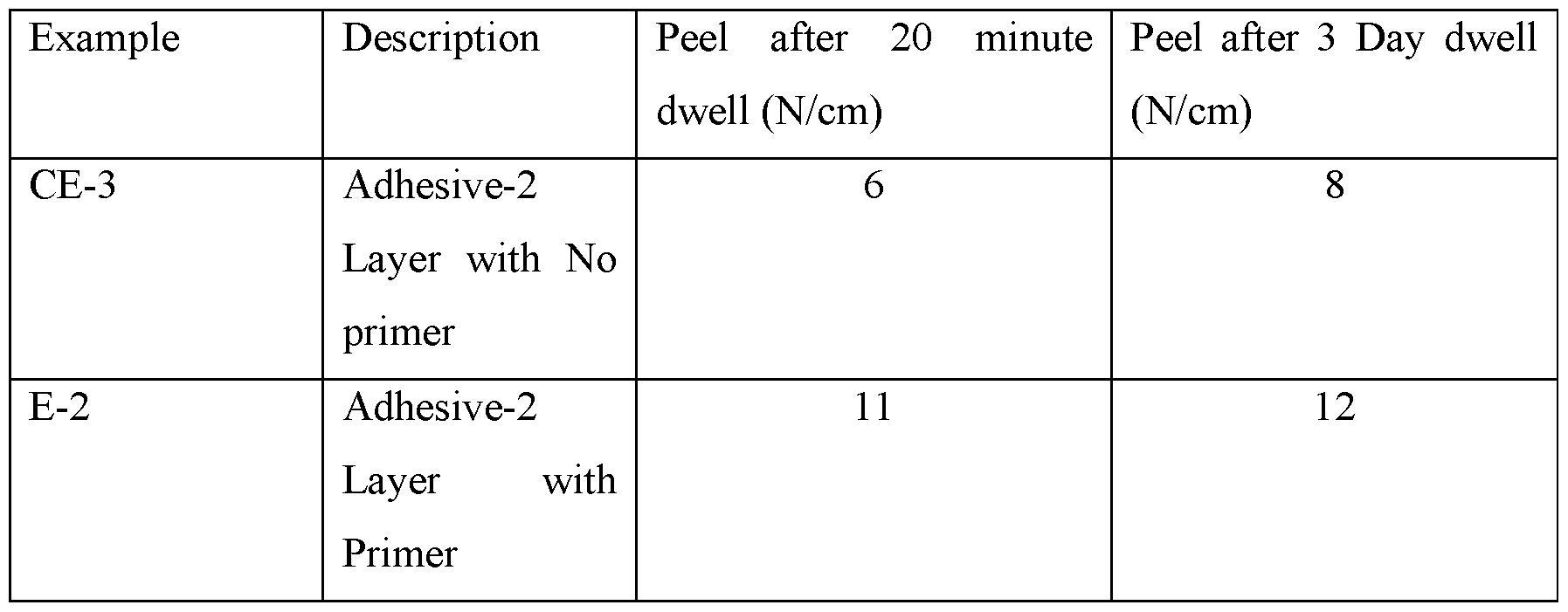
- Adhesive samples were laminated to 51 micrometer thick (2 mil) polyethylene terephthalate films and were cut into 1.0 centimeter by 15 centimeter strips. Each strip was then adhered to a 10 centimeter by 20 centimeter clean, solvent washed glass coupon using a 2-kilogram roller passed once over the strip. The bonded assembly dwelled at room temperature for about 20 minutes or for 3 days and was tested for 180° peel adhesion using an IMASS slip/peel tester (Model 3M90, commercially available from Instrumentors Inc., Strongsville, OH) at a rate of 15 centimeters/minute (6 inches/minute) over a five second data collection time. Two samples were tested; the reported peel adhesion value is an average of the peel adhesion value from each of the two samples.
- IMASS slip/peel tester Model 3M90, commercially available from Instrumentors Inc., Strongsville, OH
- the acrylate polymer for APA-2 was prepared by combining 53.2 grams of iso-octyl acrylate, 53.2 grams of methyl methacrylate (Dow Chemical), 20.3 g of acrylic acid (Dow Chemical) and 126.6 grams of ethyl acetate. 1.0 grams of thermal initiator (VAZO-67 from Chemours) was added and the solution was deoxygenated for 2 minutes with nitrogen. After heating at 65°C for 47 hours, a solution was obtained that was determined to have a 50.9% solids content and an IV of 0.74. This polymer concentrate was then diluted with additional ethyl acetate to a 5.0% solids primer coating solution.
- Adhesive- 1 Samples of Adhesive- 1 were prepared. CE1 and CE2 were prepared by coating the adhesive on Release Liner- 1. For Example El, APA-1 was coated on the Release Liner- 1 and then Adhesive- 1 was coated over the APA-1 coating. On all samples, Release Liner-2 was coated on the exposed surface of Adhesive- 1. The samples were tested for Peel Adhesion against glass substrate. For sample CE-1 Adhesive- 1 was used, for sample CE-2 Adhesive- 1 was used and the glass substrate was treated with APA. The data are presented in Table 1. Table 1
- Adhesive-2 Samples of Adhesive-2 were prepared. CE3 were prepared by coating the adhesive on Release Liner-1. For Example E2, APA-2 was coated on Release Liner-1 and then Adhesive- 1 was coated over the APA-2 coating. On all samples, Release Liner-2 was coated on the exposed surface of Adhesive-2.
Landscapes
- Chemical & Material Sciences (AREA)
- Organic Chemistry (AREA)
- Adhesive Tapes (AREA)
Abstract
Description


Claims
Priority Applications (2)
| Application Number | Priority Date | Filing Date | Title |
|---|---|---|---|
| CN202380069440.XA CN119998420A (en) | 2022-09-27 | 2023-09-20 | Self-priming optically clear adhesive |
| EP23783039.3A EP4594438A1 (en) | 2022-09-27 | 2023-09-20 | Self-priming optically clear adhesives |
Applications Claiming Priority (2)
| Application Number | Priority Date | Filing Date | Title |
|---|---|---|---|
| US202263410288P | 2022-09-27 | 2022-09-27 | |
| US63/410,288 | 2022-09-27 |
Publications (1)
| Publication Number | Publication Date |
|---|---|
| WO2024069320A1 true WO2024069320A1 (en) | 2024-04-04 |
Family
ID=88238029
Family Applications (1)
| Application Number | Title | Priority Date | Filing Date |
|---|---|---|---|
| PCT/IB2023/059309 Ceased WO2024069320A1 (en) | 2022-09-27 | 2023-09-20 | Self-priming optically clear adhesives |
Country Status (3)
| Country | Link |
|---|---|
| EP (1) | EP4594438A1 (en) |
| CN (1) | CN119998420A (en) |
| WO (1) | WO2024069320A1 (en) |
Citations (22)
| Publication number | Priority date | Publication date | Assignee | Title |
|---|---|---|---|---|
| US2736721A (en) | 1952-10-08 | 1956-02-28 | Optionally | |
| US3437622A (en) | 1965-12-06 | 1969-04-08 | Anchor Continental Inc | Polyurethane-based pressure-sensitive adhesives |
| US3718712A (en) | 1971-03-01 | 1973-02-27 | Minnesota Mining & Mfg | Pressure-sensitive adhesives based on cyclic terpene urethane resin |
| US3841890A (en) | 1972-12-07 | 1974-10-15 | Monsanto Co | Plasticizer systems for polyvinyl butyral interlayers |
| US4144217A (en) | 1978-01-30 | 1979-03-13 | Monsanto Company | Plasticizer blends for polyvinyl butyral interlayers |
| US5209971A (en) | 1989-09-06 | 1993-05-11 | Minnesota Mining And Manufacturing Company | Radiation curable polyolefin pressure sensitive adhesive |
| US5214119A (en) | 1986-06-20 | 1993-05-25 | Minnesota Mining And Manufacturing Company | Block copolymer, method of making the same, dimaine precursors of the same, method of making such diamines and end products comprising the block copolymer |
| US5223465A (en) | 1990-03-16 | 1993-06-29 | Tonen Corporation | Olefin polymerization catalyst |
| USRE34605E (en) | 1990-07-24 | 1994-05-10 | The Dow Chemical Company | Infrared reflective optical interference film |
| US5360659A (en) | 1993-05-24 | 1994-11-01 | The Dow Chemical Company | Two component infrared reflecting film |
| US5579162A (en) | 1994-10-31 | 1996-11-26 | Viratec Thin Films, Inc. | Antireflection coating for a temperature sensitive substrate |
| US5591820A (en) | 1992-11-09 | 1997-01-07 | E. R. Squibb & Sons, Inc. | Polyurethane pressure-sensitive adhesives |
| US5866222A (en) | 1997-07-18 | 1999-02-02 | Minnesota Mining And Manufacturing Co. | Silicone copolymer modified release tapes |
| US5882774A (en) | 1993-12-21 | 1999-03-16 | Minnesota Mining And Manufacturing Company | Optical film |
| US6049419A (en) | 1998-01-13 | 2000-04-11 | 3M Innovative Properties Co | Multilayer infrared reflecting optical body |
| US6339111B1 (en) | 1991-02-28 | 2002-01-15 | 3M Innovative Properties Company | Multi-stage irradiation process for production of acrylic based adhesives and adhesives made thereby |
| EP1245656A1 (en) * | 2001-03-30 | 2002-10-02 | 3M Innovative Properties Company | Transparent pressure-sensitive adhesive layer |
| US7371464B2 (en) | 2005-12-23 | 2008-05-13 | 3M Innovative Properties Company | Adhesive compositions |
| US7981995B2 (en) | 2009-09-21 | 2011-07-19 | 3M Innovative Properties Company | Silicone polyoxamide and silicone polyoxamide-hydrazide copolymers |
| EP2557132A1 (en) * | 2011-08-10 | 2013-02-13 | 3M Innovative Properties Company | Multilayer adhesive film, in particular for bonding optical sensors |
| US20150125675A1 (en) * | 2012-06-13 | 2015-05-07 | Lg Hausys, Ltd. | Optical adhesive film having excellent peeling effect at high temperatures |
| EP3663374A1 (en) * | 2017-08-02 | 2020-06-10 | Bando Chemical Industries, Ltd. | Transparent adhesive optical sheet, laminate and bonded structure |
-
2023
- 2023-09-20 WO PCT/IB2023/059309 patent/WO2024069320A1/en not_active Ceased
- 2023-09-20 CN CN202380069440.XA patent/CN119998420A/en active Pending
- 2023-09-20 EP EP23783039.3A patent/EP4594438A1/en active Pending
Patent Citations (22)
| Publication number | Priority date | Publication date | Assignee | Title |
|---|---|---|---|---|
| US2736721A (en) | 1952-10-08 | 1956-02-28 | Optionally | |
| US3437622A (en) | 1965-12-06 | 1969-04-08 | Anchor Continental Inc | Polyurethane-based pressure-sensitive adhesives |
| US3718712A (en) | 1971-03-01 | 1973-02-27 | Minnesota Mining & Mfg | Pressure-sensitive adhesives based on cyclic terpene urethane resin |
| US3841890A (en) | 1972-12-07 | 1974-10-15 | Monsanto Co | Plasticizer systems for polyvinyl butyral interlayers |
| US4144217A (en) | 1978-01-30 | 1979-03-13 | Monsanto Company | Plasticizer blends for polyvinyl butyral interlayers |
| US5214119A (en) | 1986-06-20 | 1993-05-25 | Minnesota Mining And Manufacturing Company | Block copolymer, method of making the same, dimaine precursors of the same, method of making such diamines and end products comprising the block copolymer |
| US5209971A (en) | 1989-09-06 | 1993-05-11 | Minnesota Mining And Manufacturing Company | Radiation curable polyolefin pressure sensitive adhesive |
| US5223465A (en) | 1990-03-16 | 1993-06-29 | Tonen Corporation | Olefin polymerization catalyst |
| USRE34605E (en) | 1990-07-24 | 1994-05-10 | The Dow Chemical Company | Infrared reflective optical interference film |
| US6339111B1 (en) | 1991-02-28 | 2002-01-15 | 3M Innovative Properties Company | Multi-stage irradiation process for production of acrylic based adhesives and adhesives made thereby |
| US5591820A (en) | 1992-11-09 | 1997-01-07 | E. R. Squibb & Sons, Inc. | Polyurethane pressure-sensitive adhesives |
| US5360659A (en) | 1993-05-24 | 1994-11-01 | The Dow Chemical Company | Two component infrared reflecting film |
| US5882774A (en) | 1993-12-21 | 1999-03-16 | Minnesota Mining And Manufacturing Company | Optical film |
| US5579162A (en) | 1994-10-31 | 1996-11-26 | Viratec Thin Films, Inc. | Antireflection coating for a temperature sensitive substrate |
| US5866222A (en) | 1997-07-18 | 1999-02-02 | Minnesota Mining And Manufacturing Co. | Silicone copolymer modified release tapes |
| US6049419A (en) | 1998-01-13 | 2000-04-11 | 3M Innovative Properties Co | Multilayer infrared reflecting optical body |
| EP1245656A1 (en) * | 2001-03-30 | 2002-10-02 | 3M Innovative Properties Company | Transparent pressure-sensitive adhesive layer |
| US7371464B2 (en) | 2005-12-23 | 2008-05-13 | 3M Innovative Properties Company | Adhesive compositions |
| US7981995B2 (en) | 2009-09-21 | 2011-07-19 | 3M Innovative Properties Company | Silicone polyoxamide and silicone polyoxamide-hydrazide copolymers |
| EP2557132A1 (en) * | 2011-08-10 | 2013-02-13 | 3M Innovative Properties Company | Multilayer adhesive film, in particular for bonding optical sensors |
| US20150125675A1 (en) * | 2012-06-13 | 2015-05-07 | Lg Hausys, Ltd. | Optical adhesive film having excellent peeling effect at high temperatures |
| EP3663374A1 (en) * | 2017-08-02 | 2020-06-10 | Bando Chemical Industries, Ltd. | Transparent adhesive optical sheet, laminate and bonded structure |
Also Published As
| Publication number | Publication date |
|---|---|
| CN119998420A (en) | 2025-05-13 |
| EP4594438A1 (en) | 2025-08-06 |
Similar Documents
| Publication | Publication Date | Title |
|---|---|---|
| CN104812859B (en) | Heat-debondable adhesive articles | |
| EP2877883B1 (en) | Heat de-bondable optical articles | |
| EP2212395B1 (en) | Optical adhesive with diffusive properties | |
| EP0587752B1 (en) | Pressure-sensitive adhesives | |
| JP6208690B2 (en) | Primer composition for optical film | |
| WO2004094549A1 (en) | Adhesive blends, articles, and methods | |
| EP2609165A2 (en) | Double-sided multi-layer adhesive | |
| TWI816640B (en) | Conformable, peelable adhesive articles | |
| CN102597143A (en) | Method for producing bonds | |
| JP2008513232A (en) | Re-applicable optical film | |
| EP3013582A1 (en) | Self-wetting adhesive composition | |
| WO2022038926A1 (en) | Bonded object separation method | |
| JPH10279900A (en) | Self-adhesive sheet | |
| TW201840786A (en) | Self-wetting adhesive composition | |
| WO2024069320A1 (en) | Self-priming optically clear adhesives | |
| WO2022074562A1 (en) | Acrylamide or (meth)acrylamide-containing high tg additive for pressure sensitive adhesives | |
| TW201835265A (en) | Self-wetting adhesive composition | |
| JP7127262B2 (en) | Adhesive sheet and surface protection film | |
| JP3742572B2 (en) | Double-sided adhesive tape for fixing abrasives | |
| JP2010150430A (en) | Pressure sensitive adhesive composition, pressure sensitive adhesive layer, and pressure sensitive adhesive laminate | |
| EP4073190A1 (en) | Flame-retardant pressure sensitive adhesives | |
| JP2010150429A (en) | Pressure sensitive adhesive composition, pressure sensitive adhesive layer, and pressure sensitive adhesive laminate |
Legal Events
| Date | Code | Title | Description |
|---|---|---|---|
| 121 | Ep: the epo has been informed by wipo that ep was designated in this application |
Ref document number: 23783039 Country of ref document: EP Kind code of ref document: A1 |
|
| WWE | Wipo information: entry into national phase |
Ref document number: 202380069440.X Country of ref document: CN |
|
| WWE | Wipo information: entry into national phase |
Ref document number: 2023783039 Country of ref document: EP |
|
| NENP | Non-entry into the national phase |
Ref country code: DE |
|
| ENP | Entry into the national phase |
Ref document number: 2023783039 Country of ref document: EP Effective date: 20250428 |
|
| WWP | Wipo information: published in national office |
Ref document number: 202380069440.X Country of ref document: CN |
|
| WWP | Wipo information: published in national office |
Ref document number: 2023783039 Country of ref document: EP |