WO2024030825A1 - Crystalline salts of crystalline salts of (3s,5r,8r,9s,10s,13r,14s,17r)-14-hydroxy-10,13-dimethyl-17-(2- oxo-2h-pyran-5-yl)hexadecahydro-1h-cyclopenta[a]phenanthren-3-yl piperazine-1-carboxylate - Google Patents
Crystalline salts of crystalline salts of (3s,5r,8r,9s,10s,13r,14s,17r)-14-hydroxy-10,13-dimethyl-17-(2- oxo-2h-pyran-5-yl)hexadecahydro-1h-cyclopenta[a]phenanthren-3-yl piperazine-1-carboxylate Download PDFInfo
- Publication number
- WO2024030825A1 WO2024030825A1 PCT/US2023/071180 US2023071180W WO2024030825A1 WO 2024030825 A1 WO2024030825 A1 WO 2024030825A1 US 2023071180 W US2023071180 W US 2023071180W WO 2024030825 A1 WO2024030825 A1 WO 2024030825A1
- Authority
- WO
- WIPO (PCT)
- Prior art keywords
- crystalline form
- powder diffraction
- ray powder
- diffraction pattern
- thermogram
- Prior art date
- Legal status (The legal status is an assumption and is not a legal conclusion. Google has not performed a legal analysis and makes no representation as to the accuracy of the status listed.)
- Ceased
Links
Classifications
-
- C—CHEMISTRY; METALLURGY
- C07—ORGANIC CHEMISTRY
- C07J—STEROIDS
- C07J43/00—Normal steroids having a nitrogen-containing hetero ring spiro-condensed or not condensed with the cyclopenta(a)hydrophenanthrene skeleton
- C07J43/003—Normal steroids having a nitrogen-containing hetero ring spiro-condensed or not condensed with the cyclopenta(a)hydrophenanthrene skeleton not condensed
-
- A—HUMAN NECESSITIES
- A61—MEDICAL OR VETERINARY SCIENCE; HYGIENE
- A61P—SPECIFIC THERAPEUTIC ACTIVITY OF CHEMICAL COMPOUNDS OR MEDICINAL PREPARATIONS
- A61P35/00—Antineoplastic agents
-
- C—CHEMISTRY; METALLURGY
- C07—ORGANIC CHEMISTRY
- C07B—GENERAL METHODS OF ORGANIC CHEMISTRY; APPARATUS THEREFOR
- C07B2200/00—Indexing scheme relating to specific properties of organic compounds
- C07B2200/13—Crystalline forms, e.g. polymorphs
Definitions
- BACKGROUND OF THE INVENTION Cancer can be viewed as a breakdown in the communication between tumor cells and their environment, including their normal neighboring cells. Signals, both growth-stimulatory and growth-inhibitory, are routinely exchanged between cells within a tissue.
- Cardiotonic steroids like digoxin and digitoxin are a class of naturally derived compounds that bind to and inhibit Na + /K + -ATPase (sodium pump). Members of this family have been used for the treatment of heart failure and arrhythmia for many years. Recent findings have revealed that these compounds may be involved in the regulation of several important cellular processes.
- the disclosure provides a crystalline form of (3S,5R,8R,9S,10S,13R,14S,17R)-14-hydroxy-10,13-dimethyl-17-(2-oxo-2H-pyran-5- yl)hexadecahydro-1H-cyclopenta[a]phenanthren-3-yl piperazine-1-carboxylate phosphate (Compound A phosphate), wherein the crystalline form is Crystalline Form I, further wherein Crystalline Form I is characterized by: (a) an X-ray powder diffraction pattern comprising peaks at 13.1 ⁇ 0.2° 2- ⁇ , 13.7 ⁇ 0.2° 2- ⁇ , and 15.6 ⁇ 0.2° 2- ⁇ , as measured by X-ray powder diffraction using an X-ray wavelength of 1.54056 ⁇ ; WSGR
- Crystalline Form I is characterized by an X-ray powder diffraction pattern comprising peaks at 13.1 ⁇ 0.2° 2- ⁇ , 13.7 ⁇ 0.2° 2- ⁇ , and 15.6 ⁇ 0.2° 2- ⁇ , as measured by X-ray powder diffraction using an X-ray wavelength of 1.54056 ⁇ .
- the X-ray powder diffraction pattern further comprises at least one peak selected from 16.2 ⁇ 0.2° 2- ⁇ , 20.7 ⁇ 0.2° 2- ⁇ , and 19.4 ⁇ 0.2° 2- ⁇ , as measured by X-ray powder diffraction using an X-ray wavelength of 1.54056 ⁇ .
- the X-ray powder diffraction pattern further comprises at least one peak selected from 14.8 ⁇ 0.2° 2- ⁇ , 21.8 ⁇ 0.2° 2- ⁇ , and 17.0 ⁇ 0.2° 2- ⁇ , as measured by X-ray powder diffraction using an X-ray wavelength of 1.54056 ⁇ .
- the X-ray powder diffraction pattern comprises at least five peaks selected from 13.1 ⁇ 0.2° 2- ⁇ , 13.7 ⁇ 0.2° 2- ⁇ , 15.6 ⁇ 0.2° 2- ⁇ , 16.2 ⁇ 0.2° 2- ⁇ , 20.7 ⁇ 0.2° 2- ⁇ , 19.4 ⁇ 0.2° 2- ⁇ , 14.8 ⁇ 0.2° 2- ⁇ , 21.8 ⁇ 0.2° 2- ⁇ , and 17.0 ⁇ 0.2° 2- ⁇ , as measured by X-ray powder diffraction using an X-ray wavelength of 1.54056 ⁇ .
- the X-ray powder diffraction pattern comprises peaks at 13.1 ⁇ 0.2° 2- ⁇ , 13.7 ⁇ 0.2° 2- ⁇ , 15.6 ⁇ 0.2° 2- ⁇ , 16.2 ⁇ 0.2° 2- ⁇ , 20.7 ⁇ 0.2° 2- ⁇ , 19.4 ⁇ 0.2° 2- ⁇ , 14.8 ⁇ 0.2° 2- ⁇ , 21.8 ⁇ 0.2° 2- ⁇ , and 17.0 ⁇ 0.2° 2- ⁇ , as measured by X-ray powder diffraction using an X-ray wavelength of 1.54056 ⁇ .
- Crystalline Form I is characterized by an X-ray powder diffraction pattern substantially the same as shown in Figure 1.
- Crystalline Form I is characterized by a differential scanning calorimetry (DSC) thermogram comprising an endotherm in the range of about 280–295 °C. In some embodiments, Crystalline Form I is characterized by a differential scanning calorimetry (DSC) thermogram comprising an endotherm with an onset of about 283 °C and a peak of about WSGR Docket No.43629-723.601 291 °C. In some embodiments, Crystalline Form I is characterized by a differential scanning calorimetry (DSC) thermogram substantially the same as shown in Figure 2.
- DSC differential scanning calorimetry
- Crystalline Form I is characterized by a Thermogravimetric Analysis (TGA) thermogram substantially the same as shown in Figure 3.
- TGA Thermogravimetric Analysis
- DFS dynamic vapor sorption
- the disclosure provides a crystalline form of (3S,5R,8R,9S,10S,13R,14S,17R)-14-hydroxy-10,13-dimethyl-17-(2-oxo-2H-pyran-5- yl)hexadecahydro-1H-cyclopenta[a]phenanthren-3-yl piperazine-1-carboxylate mesylate (Compound A mesylate), wherein the crystalline form is Crystalline Form II, further wherein Crystalline Form II is characterized by: (a) an X-ray powder diffraction pattern comprising peaks at 13.8 ⁇ 0.2° 2- ⁇ , 20.4 ⁇ 0.2° 2- ⁇ , and 17.9 ⁇ 0.2° 2- ⁇ , as measured by X-ray powder diffraction using an X-ray wavelength of 1.54056 ⁇ ; (b) an X-ray powder diffraction pattern substantially the same as shown in Figure 5; (c) a differential scanning calorimetry (DSC) thermogram comprising peaks at 13.8
- Crystalline Form II is characterized by an X-ray powder diffraction pattern comprising peaks at 13.8 ⁇ 0.2° 2- ⁇ , 20.4 ⁇ 0.2° 2- ⁇ , and 17.9 ⁇ 0.2° 2- ⁇ , as measured by X-ray powder diffraction using an X-ray wavelength of 1.54056 ⁇ .
- the X-ray powder diffraction pattern further comprises at least one peak selected from 19.4 ⁇ 0.2° 2- ⁇ , 15.1 ⁇ 0.2° 2- ⁇ , and 10.2 ⁇ 0.2° 2- ⁇ , as measured by X-ray powder diffraction using an X-ray wavelength of 1.54056 ⁇ .
- the X-ray powder diffraction pattern further comprises at least one peak selected from 27.3 ⁇ 0.2° 2- ⁇ , 12.6 ⁇ 0.2° 2- ⁇ , and 25.4 ⁇ 0.2° 2- ⁇ , as measured by X-ray powder diffraction using an X-ray wavelength of WSGR Docket No.43629-723.601 1.54056 ⁇ .
- the X-ray powder diffraction pattern comprises at least five peaks selected from 13.8 ⁇ 0.2° 2- ⁇ , 20.4 ⁇ 0.2° 2- ⁇ , 17.9 ⁇ 0.2° 2- ⁇ , 19.4 ⁇ 0.2° 2- ⁇ , 15.1 ⁇ 0.2° 2- ⁇ , 10.2 ⁇ 0.2° 2- ⁇ , 27.3 ⁇ 0.2° 2- ⁇ , 12.6 ⁇ 0.2° 2- ⁇ , and 25.4 ⁇ 0.2° 2- ⁇ , as measured by X-ray powder diffraction using an X-ray wavelength of 1.54056 ⁇ .
- the X-ray powder diffraction pattern comprises peaks at 13.8 ⁇ 0.2° 2- ⁇ , 20.4 ⁇ 0.2° 2- ⁇ , 17.9 ⁇ 0.2° 2- ⁇ , 19.4 ⁇ 0.2° 2- ⁇ , 15.1 ⁇ 0.2° 2- ⁇ , 10.2 ⁇ 0.2° 2- ⁇ , 27.3 ⁇ 0.2° 2- ⁇ , 12.6 ⁇ 0.2° 2- ⁇ , and 25.4 ⁇ 0.2° 2- ⁇ , as measured by X-ray powder diffraction using an X-ray wavelength of 1.54056 ⁇ .
- Crystalline Form II is characterized by an X-ray powder diffraction pattern substantially the same as shown in Figure 5.
- Crystalline Form II is characterized by a differential scanning calorimetry (DSC) thermogram comprising an endotherm in the range of about 250–265 °C. In some embodiments, Crystalline Form II is characterized by a differential scanning calorimetry (DSC) thermogram comprising an endotherm with an onset of about 255 °C and a peak of about 259 °C. In some embodiments, Crystalline Form II is characterized by a differential scanning calorimetry (DSC) thermogram substantially the same as shown in Figure 6. [13] In some embodiments, Crystalline Form II is characterized by a Thermogravimetric Analysis (TGA) thermogram substantially the same as shown in Figure 7.
- DSC differential scanning calorimetry
- Crystalline Form II is characterized by a dynamic vapor sorption (DVS) pattern substantially the same as shown in Figure 8.
- the disclosure provides a crystalline form of (3S,5R,8R,9S,10S,13R,14S,17R)-14-hydroxy-10,13-dimethyl-17-(2-oxo-2H-pyran-5- yl)hexadecahydro-1H-cyclopenta[a]phenanthren-3-yl piperazine-1-carboxylate tartrate (Compound A tartrate), wherein the crystalline form is Crystalline Form III, further wherein Crystalline Form III is characterized by: (a) an X-ray powder diffraction pattern comprising peaks at 10.1 ⁇ 0.2° 2- ⁇ , 13.5 ⁇ 0.2° 2- ⁇ , and 19.6 ⁇ 0.2° 2- ⁇ , as measured by X-ray powder diffraction using an X-ray wavelength of 1.54056 ⁇ ; (b) an X-ray
- Crystalline Form III is characterized by an X-ray powder diffraction pattern comprising peaks at 10.1 ⁇ 0.2° 2- ⁇ , 13.5 ⁇ 0.2° 2- ⁇ , and 19.6 ⁇ 0.2° 2- ⁇ , as measured by X-ray powder diffraction using an X-ray wavelength of 1.54056 ⁇ .
- the X-ray powder diffraction pattern further comprises at least one peak selected from 20.3 ⁇ 0.2° 2- ⁇ , 15.6 ⁇ 0.2° 2- ⁇ , and 17.9 ⁇ 0.2° 2- ⁇ , as measured by X-ray powder diffraction using an X-ray wavelength of 1.54056 ⁇ .
- the X-ray powder diffraction pattern further comprises at least one peak selected from 22.8 ⁇ 0.2° 2- ⁇ , 17.3 ⁇ 0.2° 2- ⁇ , and 16.9 ⁇ 0.2° 2- ⁇ , as measured by X-ray powder diffraction using an X-ray wavelength of 1.54056 ⁇ .
- the X-ray powder diffraction pattern comprises at least five peaks selected from 10.1 ⁇ 0.2° 2- ⁇ , 13.5 ⁇ 0.2° 2- ⁇ , 19.6 ⁇ 0.2° 2- ⁇ , 20.3 ⁇ 0.2° 2- ⁇ , 15.6 ⁇ 0.2° 2- ⁇ , 17.9 ⁇ 0.2° 2- ⁇ , 22.8 ⁇ 0.2° 2- ⁇ , 17.3 ⁇ 0.2° 2- ⁇ , and 16.9 ⁇ 0.2° 2- ⁇ , as measured by X-ray powder diffraction using an X-ray wavelength of 1.54056 ⁇ .
- the X-ray powder diffraction pattern comprises peaks at 10.1 ⁇ 0.2° 2- ⁇ , 13.5 ⁇ 0.2° 2- ⁇ , 19.6 ⁇ 0.2° 2- ⁇ , 20.3 ⁇ 0.2° 2- ⁇ , 15.6 ⁇ 0.2° 2- ⁇ , 17.9 ⁇ 0.2° 2- ⁇ , 22.8 ⁇ 0.2° 2- ⁇ , 17.3 ⁇ 0.2° 2- ⁇ , and 16.9 ⁇ 0.2° 2- ⁇ , as measured by X-ray powder diffraction using an X-ray wavelength of 1.54056 ⁇ .
- Crystalline Form III is characterized by an X-ray powder diffraction pattern substantially the same as shown in Figure 9.
- Crystalline Form III is characterized by a differential scanning calorimetry (DSC) thermogram comprising an endotherm in the range of about 245–265 °C. In some embodiments, Crystalline Form III is characterized by a differential scanning calorimetry (DSC) thermogram comprising an endotherm with an onset of about 250 °C and a peak of about 258 °C. In some embodiments, Crystalline Form III is characterized by a differential scanning calorimetry (DSC) thermogram substantially the same as shown in Figure 10. [18] In some embodiments, Crystalline Form III is characterized by a Thermogravimetric Analysis (TGA) thermogram substantially the same as shown in Figure 11.
- DSC differential scanning calorimetry
- Crystalline Form III is characterized by a dynamic vapor sorption (DVS) pattern substantially the same as shown in Figure 12.
- the disclosure provides a crystalline form of (3S,5R,8R,9S,10S,13R,14S,17R)-14-hydroxy-10,13-dimethyl-17-(2-oxo-2H-pyran-5- WSGR Docket No.43629-723.601 yl)hexadecahydro-1H-cyclopenta[a]phenanthren-3-yl piperazine-1-carboxylate citrate (Compound A citrate), wherein the crystalline form is Crystalline IV, further wherein Crystalline Form IV is characterized by: (a) an X-ray powder diffraction pattern comprising peaks at 14.3 ⁇ 0.2° 2- ⁇ , 16.5 ⁇ 0.2° 2- ⁇ , and 17.0 ⁇ 0.2° 2- ⁇ , as measured by X-ray powder diffraction using an X-ray wavelength of
- Crystalline Form IV is characterized by an X-ray powder diffraction pattern comprising peaks at 14.3 ⁇ 0.2° 2- ⁇ , 16.5 ⁇ 0.2° 2- ⁇ , and 17.0 ⁇ 0.2° 2- ⁇ , as measured by X-ray powder diffraction using an X-ray wavelength of 1.54056 ⁇ .
- the X-ray powder diffraction pattern further comprises at least one peak selected from 15.8 ⁇ 0.2° 2- ⁇ , 15.1 ⁇ 0.2° 2- ⁇ , and 10.7 ⁇ 0.2° 2- ⁇ , as measured by X-ray powder diffraction using an X-ray wavelength of 1.54056 ⁇ .
- the X-ray powder diffraction pattern further comprises at least one peak selected from 17.9 ⁇ 0.2° 2- ⁇ , 20.9 ⁇ 0.2° 2- ⁇ , and 22.0 ⁇ 0.2° 2- ⁇ , as measured by X-ray powder diffraction using an X-ray wavelength of 1.54056 ⁇ .
- the X-ray powder diffraction pattern comprises at least five peaks selected from 14.3 ⁇ 0.2° 2- ⁇ , 16.5 ⁇ 0.2° 2- ⁇ , 17.0 ⁇ 0.2° 2- ⁇ , 15.8 ⁇ 0.2° 2- ⁇ , 15.1 ⁇ 0.2° 2- ⁇ , 10.7 ⁇ 0.2° 2- ⁇ , 17.9 ⁇ 0.2° 2- ⁇ , 20.9 ⁇ 0.2° 2- ⁇ , and 22.0 ⁇ 0.2° 2- ⁇ , as measured by X-ray powder diffraction using an X-ray wavelength of 1.54056 ⁇ .
- the X-ray powder diffraction pattern comprises peaks at 14.3 ⁇ 0.2° 2- ⁇ , 16.5 ⁇ 0.2° 2- ⁇ , 17.0 ⁇ 0.2° 2- ⁇ , 15.8 ⁇ 0.2° 2- ⁇ , 15.1 ⁇ 0.2° 2- ⁇ , 10.7 ⁇ 0.2° 2- ⁇ , 17.9 ⁇ 0.2° 2- ⁇ , 20.9 ⁇ 0.2° 2- ⁇ , and 22.0 ⁇ 0.2° 2- ⁇ , as measured by X-ray powder diffraction using an X-ray wavelength of 1.54056 ⁇ .
- Crystalline Form IV is characterized by an X-ray powder diffraction pattern substantially the same as shown in Figure 13.
- Crystalline Form IV is characterized by a differential scanning calorimetry (DSC) thermogram comprising an endotherm in the range of about 230–250 °C. In some embodiments, Crystalline Form IV is characterized by a differential scanning calorimetry (DSC) thermogram comprising an endotherm with an onset of about 235 °C and a peak of about 242 °C. In some embodiments, Crystalline Form IV is characterized by a differential scanning calorimetry (DSC) thermogram substantially the same as shown in Figure 14. [23] In some embodiments, Crystalline Form IV is characterized by a Thermogravimetric Analysis (TGA) thermogram substantially the same as shown in Figure 15.
- DSC differential scanning calorimetry
- Crystalline Form IV is characterized by a dynamic vapor sorption (DVS) pattern substantially the same as shown in Figure 16.
- the disclosure provides a pharmaceutical composition comprising a crystalline form of (3S,5R,8R,9S,10S,13R,14S,17R)-14-hydroxy-10,13-dimethyl-17-(2-oxo-2H- pyran-5-yl)hexadecahydro-1H-cyclopenta[a]phenanthren-3-yl piperazine-1-carboxylate phosphate, (3S,5R,8R,9S,10S,13R,14S,17R)-14-hydroxy-10,13-dimethyl-17-(2-oxo-2H-pyran-5- yl)hexadecahydro-1H-cyclopenta[a]phenanthren-3-yl piperazine-1-carboxylate mesylate, (3S,5R,8R,9S,10S,13R,
- the pharmaceutical composition is formulated for administration to a mammal by oral administration.
- the pharmaceutical composition is in the form of a solid form pharmaceutical composition.
- the pharmaceutical composition is in the form of a tablet, a pill, a capsule, a powder, a liquid, a suspension, a suppository, or an aerosol.
- the disclosure provides a packaged pharmaceutical composition comprising a pharmaceutical composition provided herein and instructions for using the composition to treat a subject suffering from cancer.
- the disclosure provides a method of treating a neoplasm in a subject in need thereof, comprising administering to the subject a therapeutically effective amount of the crystalline form of (3S,5R,8R,9S,10S,13R,14S,17R)-14-hydroxy-10,13-dimethyl-17-(2-oxo-2H- pyran-5-yl)hexadecahydro-1H-cyclopenta[a]phenanthren-3-yl piperazine-1-carboxylate phosphate, (3S,5R,8R,9S,10S,13R,14S,17R)-14-hydroxy-10,13-dimethyl-17-(2-oxo-2H-pyran-5- WSGR Docket No.43629-723.601 yl)hexadecahydro-1H-cyclopenta[a]phenanthren-3-yl piperazine-1-carboxylate mesylate, (3S,5R,8R,9S,
- the neoplasm is a cancer.
- the cancer is colon carcinoma, pancreatic cancer, breast cancer, ovarian cancer, prostate cancer, fibrosarcoma, myxosarcoma, liposarcoma, chondrosarcoma, osteogenic sarcoma, chondroma, angiosarcoma, endotheliosarcoma, lymphangiosarcoma, lymphangioendotheliosarcoma, synovioma, mesothelioma, Ewing’s tumor, leiomyosarcoma, rhabdomyosarcoma, squamous cell carcinoma, basal cell carcinoma, adenocarcinoma, sweat gland carcinoma, sebaceous gland carcinoma, papillary carcinoma, papillary adenocarcinomas, cystadenocarcinoma, medullary carcinoma, bronchogenic carcinoma, renal cell carcinoma, hepatoma, bile duct carcinoma, chori
- the cancer is colorectal cancer. In some embodiments, the cancer is liver cancer. In some embodiments, the cancer is lung cancer. In some embodiments, the cancer is breast cancer. In some embodiments, the cancer is oral cancer. In some embodiments, the neoplasm is a benign tumor. In some embodiments, the tumor is craniopharyngioma.
- the disclosure provides a method of preparing Crystalline Form I of (3S,5R,8R,9S,10S,13R,14S,17R)-14-hydroxy-10,13-dimethyl-17-(2-oxo-2H-pyran-5- yl)hexadecahydro-1H-cyclopenta[a]phenanthren-3-yl piperazine-1-carboxylate phosphate, wherein the method comprises: (a) contacting (3S,5R,8R,9S,10S,13R,14S,17R)-14-hydroxy-10,13-dimethyl-17-(2-oxo-2H- pyran-5-yl)hexadecahydro-1H-cyclopenta[a]phenanthren-3-yl piperazine-1-carboxylate with phosphoric acid in a solvent to obtain a solution of the WSGR Docket No.43629-723.601 (3S,5R,8R,9S,10S,13R,
- the solvent in step (a) comprises ethyl acetate, DMF, ethanol, or isopropanol. In some embodiments, the solvent in step (a) comprises DMF. In some embodiments, step (a) is performed at a temperature of about 40–70 °C. In some embodiments, step (a) is performed at a temperature of about 50–60 °C. [30] In some embodiments, step (b) comprises cooling the solution obtained in step (a) to room temperature. In some embodiments, step (b) comprises cooling the solution obtained in step (a) to a temperature of about 20–25 °C. In some embodiments, the method further comprises filtering the crystallized solution obtained in step (b) to obtain Crystalline Form I.
- the method further comprises drying the obtained Crystalline Form I.
- the drying is performed under vacuum at a temperature of about 40–70 °C. In some embodiments, the drying is performed under vacuum at a temperature of about 50– 60 °C.
- the disclosure provides a method of preparing Crystalline Form II of (3S,5R,8R,9S,10S,13R,14S,17R)-14-hydroxy-10,13-dimethyl-17-(2-oxo-2H-pyran-5- yl)hexadecahydro-1H-cyclopenta[a]phenanthren-3-yl piperazine-1-carboxylate mesylate, wherein the method comprises: (a) contacting (3S,5R,8R,9S,10S,13R,14S,17R)-14-hydroxy-10,13-dimethyl-17-(2-oxo-2H- pyran-5-yl)hexadecahydro-1H-cyclopenta[a]phenanthren-3-yl piperazine-1-carboxylate with methanesulfonic acid in a solvent to obtain a solution of the (3S,5R,8R,9S,10S,13R,14S,17R)-14-hydroxy-10
- the solvent in step (a) comprises ethyl acetate, DMF, ethanol, or isopropanol. In some embodiments, the solvent in step (a) comprises DMF. In some WSGR Docket No.43629-723.601 embodiments, step (a) is performed at a temperature of about 40–70 °C. In some embodiments, step (a) is performed at a temperature of about 50–60 °C. [33] In some embodiments, step (b) comprises cooling the solution obtained in step (a) to room temperature. In some embodiments, step (b) comprises cooling the solution obtained in step (a) to a temperature of about 20–25 °C.
- the method further comprises filtering the crystallized solution obtained in step (b) to obtain Crystalline Form II. In some embodiments, the method further comprises drying the obtained Crystalline Form II. In some embodiments, the drying is performed under vacuum at a temperature of about 40–70 °C. In some embodiments, the drying is performed under vacuum at a temperature of about 50– 60 °C.
- the disclosure provides a method of preparing Crystalline Form III of (3S,5R,8R,9S,10S,13R,14S,17R)-14-hydroxy-10,13-dimethyl-17-(2-oxo-2H-pyran-5- yl)hexadecahydro-1H-cyclopenta[a]phenanthren-3-yl piperazine-1-carboxylate tartrate, wherein the method comprises: (a) contacting (3S,5R,8R,9S,10S,13R,14S,17R)-14-hydroxy-10,13-dimethyl-17-(2-oxo-2H- pyran-5-yl)hexadecahydro-1H-cyclopenta[a]phenanthren-3-yl piperazine-1-carboxylate with tartaric acid in a solvent to obtain a solution of the (3S,5R,8R,9S,10S,13R,14S,17R)- 14-hydroxy-10,13-di
- the solvent in step (a) comprises ethyl acetate, DMF, ethanol, or isopropanol. In some embodiments, the solvent in step (a) comprises DMF. In some embodiments, step (a) is performed at a temperature of about 40–70 °C. In some embodiments, step (a) is performed at a temperature of about 50–60 °C. [36] In some embodiments, step (b) comprises cooling the solution obtained in step (a) to room temperature. In some embodiments, step (b) comprises cooling the solution obtained in step (a) to a temperature of about 20–25 °C. In some embodiments, the method further comprises filtering the crystallized solution obtained in step (b) to obtain Crystalline Form III.
- the method further comprises drying the obtained Crystalline Form III. In some embodiments, the drying is performed under vacuum at a temperature of about 40–70 °C. In some embodiments, the drying is performed under vacuum at a temperature of about 50– 60 °C.
- the disclosure provides a method of preparing Crystalline Form IV of (3S,5R,8R,9S,10S,13R,14S,17R)-14-hydroxy-10,13-dimethyl-17-(2-oxo-2H-pyran-5- yl)hexadecahydro-1H-cyclopenta[a]phenanthren-3-yl piperazine-1-carboxylate citrate, wherein the method comprises: (a) contacting (3S,5R,8R,9S,10S,13R,14S,17R)-14-hydroxy-10,13-dimethyl-17-(2-oxo-2H- pyran-5-yl)hexadecahydro-1H-cyclopenta[a]phenanthren-3-yl piperazine-1-carboxylate with citric acid in a solvent to obtain a solution of the (3S,5R,8R,9S,10S,13R,14S
- the solvent in step (a) comprises ethyl acetate, DMF, ethanol, or isopropanol. In some embodiments, the solvent in step (a) comprises DMF. In some embodiments, step (a) is performed at a temperature of about 40–70 °C. In some embodiments, step (a) is performed at a temperature of about 50–60 °C. [39] In some embodiments, step (b) comprises cooling the solution obtained in step (a) to room temperature. In some embodiments, step (b) comprises cooling the solution obtained in step (a) to a temperature of about 20–25 °C. In some embodiments, the method further comprises filtering the crystallized solution obtained in step (b) to obtain Crystalline Form IV.
- the method further comprises drying the obtained Crystalline Form IV.
- the drying is performed under vacuum at a temperature of about 40–70 °C.
- the drying is performed under vacuum at a temperature of about 50– 60 °C.
- FIG. 1 shows the X-ray powder diffraction (XRPD) pattern for Crystalline Form I of Compound A phosphate.
- Figure 2 shows the differential scanning calorimetry (DSC) thermogram for Crystalline Form I of Compound A phosphate.
- Figure 3 shows the thermogravimetric analysis (TGA) pattern for Crystalline Form I of Compound A phosphate.
- Figure 4 shows the dynamic vapor sorption (DVS) pattern for Crystalline Form I of Compound A phosphate.
- Figure 5 shows the X-ray powder diffraction (XRPD) pattern for Crystalline Form II of Compound A mesylate.
- Figure 6 shows the differential scanning calorimetry (DSC) thermogram for Crystalline Form II of Compound A mesylate.
- Figure 7 shows the thermogravimetric analysis (TGA) pattern for Crystalline Form II of Compound A mesylate.
- Figure 8 shows the dynamic vapor sorption (DVS) pattern for Crystalline Form II of Compound A mesylate.
- Figure 9 shows the X-ray powder diffraction (XRPD) pattern for Crystalline Form III of Compound A tartrate.
- FIG. 10 shows the differential scanning calorimetry (DSC) thermogram for Crystalline Form III of Compound A tartrate.
- Figure 11 shows the thermogravimetric analysis (TGA) pattern for Crystalline Form III of Compound A tartrate.
- Figure 12 shows the dynamic vapor sorption (DVS) pattern for Crystalline Form III of Compound A tartrate.
- Figure 13 shows the X-ray powder diffraction (XRPD) pattern for Crystalline Form IV of Compound A citrate.
- Figure 14 shows the differential scanning calorimetry (DSC) thermogram for Crystalline Form IV of Compound A citrate.
- Figure 15 shows the thermogravimetric analysis (TGA) pattern for Crystalline Form IV of Compound A citrate.
- Figure 16 shows the dynamic vapor sorption (DVS) pattern for Crystalline Form IV of Compound A citrate.
- WSGR Docket No.43629-723.601 DETAILED DESCRIPTION OF THE INVENTION
- Polymorphic forms of a drug substance can have different physical properties, including melting point, apparent solubility, dissolution rate, optical and mechanical properties, vapor pressure, and density. These properties can have a direct effect on the ability to process or manufacture a drug substance and the drug product. Moreover, differences in these properties can and often lead to different pharmacokinetics profiles for different polymorphic forms of a drug.
- polymorphism is often an important factor under regulatory review of the ‘sameness’ of drug products from various manufacturers.
- polymorphism has been evaluated in many multi-million dollar and even multi-billion dollar drugs, such as warfarin sodium, famotidine, and ranitidine.
- Polymorphism can affect the quality, safety, and/or efficacy of a drug product.
- the present disclosure addresses this need and provides related advantages as well.
- Compound A refers to (3S,5R,8R,9S,10S,13R,14S,17R)-14-hydroxy- 10,13-dimethyl-17-(2-oxo-2H-pyran-5-yl)hexadecahydro-1H-cyclopenta[a]phenanthren-3-yl piperazine-1-carboxylate, which has the chemical structure shown below: Compound A.
- Compound A has been prepared previously (see, WO 2011/085641, U.S. Patent No. 8,334,376, U.S. Patent No.8,993,550, U.S. Patent No.9,399,659, U.S. Patent No.9,814,735, U.S.
- Compound A is crystalline.
- the salt of Compound A is a phosphate salt, mesylate salt, tartrate salt, or citrate salt.
- the salt of Compound A is a phosphate salt.
- the salt of Compound A is a mesylate salt.
- the salt of Compound A is a tartrate salt. In some embodiments disclosed herein, the salt of Compound A is a citrate salt. [63] In some embodiments disclosed herein, the salt of Compound A is crystalline. In some embodiments disclosed herein, the salt of Compound A is a crystalline phosphate salt, crystalline mesylate salt, crystalline tartrate salt, or crystalline citrate salt. In some embodiments disclosed herein, the salt of Compound A is a crystalline phosphate salt. In some embodiments disclosed herein, the salt of Compound A is a crystalline mesylate salt.
- the salt of Compound A is a crystalline tartrate salt. In some embodiments disclosed herein, the salt of Compound A is a crystalline citrate salt.
- “crystalline form,” “polymorph,” “Form,” and “form” may be used interchangeably herein, and are meant to include all crystalline and amorphous forms of the compound, including, for example, polymorphs, pseudopolymorphs, salts, solvates, hydrates, unsolvated polymorphs (including anhydrates), conformational polymorphs, and amorphous forms, as well as mixtures thereof, unless a particular crystalline or amorphous form is referred to.
- Compounds of the present disclosure include crystalline and amorphous forms of those compounds, including, for example, polymorphs, pseudopolymorphs, solvates, hydrates, unsolvated polymorphs (including anhydrates), conformational polymorphs, and amorphous forms of the compounds, as well as mixtures thereof.
- the crystalline form is a single solid-state form, e.g., crystalline Form I.
- Crystalline Forms of Compound A [65]
- the polymorphs made according to the methods of the invention may be characterized by any methodology according to the art.
- the polymorphs made according to the methods of the invention may be characterized by X-ray powder diffraction (XRPD), differential scanning calorimetry (DSC), thermogravimetric analysis (TGA), hot-stage microscopy, and/or spectroscopy (e.g., Raman, solid state nuclear magnetic resonance (ssNMR), and infrared (IR)).
- XRPD X-ray Powder Diffraction
- DSC differential scanning calorimetry
- TGA thermogravimetric analysis
- IR infrared
- crystallinity of a solid form is determined by X-Ray Powder Diffraction (XRPD).
- XRPD X-Ray Powder Diffraction
- Polymorphs according to the invention may be characterized by XRPD. The relative intensities of XRPD peaks can vary, depending upon the particle size, the sample preparation technique, the sample mounting procedure and the particular instrument employed.
- DSC Polymorphs according to the invention can also be identified by its characteristic DSC thermograms such as shown in Figures 2, 6, etc. For DSC, it is known that the WSGR Docket No.43629-723.601 temperatures observed will depend upon the rate of temperature change as well as sample preparation technique and the particular instrument employed. Thus, the values reported herein relating to DSC thermograms can vary, for example by plus or minus about 4 °C.
- TGA The polymorphic forms of the invention may also give rise to thermal behavior different from that of the amorphous material or another polymorphic form.
- Thermal behavior may be measured in the laboratory by thermogravimetric analysis (TGA) which may be used to distinguish some polymorphic forms from others.
- TGA thermogravimetric analysis
- the polymorph may be characterized by thermogravimetric analysis.
- the polymorph forms of Compound A are useful in the production of medicinal preparations and can be obtained by means of a crystallization process to produce crystalline and semi-crystalline forms or a solidification process to obtain the amorphous form.
- the crystallization is carried out by either generating the desired compound (for example Compound A) in a reaction mixture and isolating the desired polymorph from the reaction mixture, or by dissolving raw compound in a solvent, optionally with heat, followed by crystallizing/solidifying the product by cooling (including active cooling) and/or by the addition of an antisolvent for a period of time.
- the crystallization or solidification may be followed by drying carried out under controlled conditions until the desired water content is reached in the end polymorphic form.
- the various polymorph Forms disclosed herein e.g., Crystalline Form I, Crystalline Form II, Crystalline Form III, and Crystalline Form IV of Compound A
- the various polymorphs can be stored at room temperature for an extended period of time without significant chemical degradation or change in the crystalline form. In some examples, the various polymorphs can be stored at room temperature for a time period of at least about 1 month, 2 months, 3 months, 6 months, 9 months, 12 months, 18 months, 24 months, 30 months, or 36 months. In some examples, the various polymorphs can be stored at room temperature for a time period of more than about 36 months.
- the various polymorphs can be stored at room temperature for a time period of 1–2 months, 1–3 months, 1–6 months, 1–9 months, 1–12 months, 1–18 months, 1–24 months, 1–30 months, 1–36 months, 2–3 months, 2–6 months, 2–9 months, 2–12 months, 2–18 months, 2–24 months, 2–30 months, 2–36 months, 3–6 months, 3–9 months, 3–12 months, 3–18 months, 3–24 months, 3–30 months, 3–36 months, 6–9 months, 6–12 months, 6–18 months, 6– 24 months, 6–30 months, 6–36 months, 9–12 months, 9–18 months, 9–24 months, 9–30 months, 9–36 months, 12–18 months, 12–24 months, 12–30 months, 12–36 months, 18–24 months, 18– 30 months, 18–36 months, 24–30 months, 24–36 months, or 30–36 months.
- the various polymorphs can be stored at room temperature for a time period of at least 1 month, 2 months, 3 months, 6 months, 9 months, 12 months, 18 months, 24 months, 30 months, or 36 months.
- the various polymorph Forms disclosed herein e.g., Crystalline Form I, Crystalline Form II, Crystalline Form III, and Crystalline Form IV of Compound A
- RH relative humidity
- the various polymorph Forms disclosed herein can be stored at about 40 °C at about 75% RH for an extended period of time without significant chemical degradation or change in the crystalline form.
- the various polymorph Forms disclosed herein e.g., Crystalline Form I, Crystalline Form II, Crystalline Form III, and Crystalline Form IV of Compound A
- the various polymorph Forms disclosed herein can be stored at 40 °C and at about 75% RH for a time period of more than about 180 days.
- the various polymorph Forms disclosed herein can be stored at 40 °C and at about 75% RH for a time period of 10–14 days, 10–18 days, 10–22 days, 10–26 days, 10– 30 days, 10–40 days, 10–50 days, 10–60 days, 10–90 days, 10–120 days, 10–150 days, 10–180 days, 14–18 days, 14–22 days, 14–26 days, 14–30 days, 14–40 days, 14–50 days, 14–60 days, 14–90 days, 14–120 days, 14–150 days, 14–180 days, 18–22 days, 18–26 days, 18–30 days, 18– 40 days, 18–50 days, 18–60 days, 18–90 days, 18–120 days, 18–150 days, 18–180 days, 18–22 days, 18–26 days, 18–30 days, 18– 40 days, 18–50 days, 18–60 days, 18–90 days, 18–120 days, 18–150 days, 18–180 days, 22–26 days, 22–30 days
- the various polymorph Forms disclosed herein can be stored at 40 °C at about 75% RH for a time period of at least 10 days, 14 days, 18 days, 22 days, 26 days, 30 days, 40 days, 50 days, 60 days, 90 days, 120 days, 150 days, or 180 days.
- Crystalline Form I of Compound A Phosphate WSGR Docket No.43629-723.601 [72] Figure 1 shows the X-ray powder diffraction (XRPD) pattern for Crystalline Form I of Compound A phosphate.
- FIG. 1 shows the differential scanning calorimetry (DSC) thermogram for Crystalline Form I of Compound A phosphate.
- FIG 3 shows the thermogravimetric analysis (TGA) pattern for Crystalline Form I of Compound A phosphate.
- Figure 4 shows the dynamic vapor sorption (DVS) pattern for Crystalline Form I of Compound A phosphate.
- compositions comprising Crystalline Form I of (3S,5R,8R,9S,10S,13R,14S,17R)-14-hydroxy- 10,13-dimethyl-17-(2-oxo-2H-pyran-5-yl)hexadecahydro-1H-cyclopenta[a]phenanthren-3-yl piperazine-1-carboxylate phosphate.
- Crystalline Form I of (3S,5R,8R,9S,10S,13R,14S,17R)-14-hydroxy-10,13-dimethyl-17-(2-oxo-2H-pyran-5- yl)hexadecahydro-1H-cyclopenta[a]phenanthren-3-yl piperazine-1-carboxylate phosphate is characterized as having: (a) an X-ray powder diffraction pattern comprising peaks at 13.1 ⁇ 0.2° 2- ⁇ , 13.7 ⁇ 0.2° 2- ⁇ , and 15.6 ⁇ 0.2° 2- ⁇ , as measured by X-ray powder diffraction using an X-ray wavelength of 1.54056 ⁇ ; (b) an X-ray powder diffraction pattern substantially the same as shown in Figure 1; (c) a differential scanning calorimetry (DSC) thermogram comprising an endotherm in the range of about 280–295 °C; (d) a differential scanning calorimetry (DSC)
- Crystalline Form I is characterized by an X-ray powder diffraction pattern substantially the same as shown in Figure 1.
- WSGR Docket No.43629-723.601 [78]
- Crystalline Form I is characterized by an X-ray powder diffraction pattern comprising peaks at 13.1 ⁇ 0.2° 2- ⁇ , 13.7 ⁇ 0.2° 2- ⁇ , and 15.6 ⁇ 0.2° 2- ⁇ , as measured by X-ray powder diffraction using an X-ray wavelength of 1.54056 ⁇ .
- Crystalline Form I is characterized by an X-ray powder diffraction pattern comprising peaks at 13.1 ⁇ 0.1° 2- ⁇ , 13.7 ⁇ 0.1° 2- ⁇ , and 15.6 ⁇ 0.1° 2- ⁇ , as measured by X-ray powder diffraction using an X-ray wavelength of 1.54056 ⁇ . In some embodiments, Crystalline Form I is characterized by an X-ray powder diffraction pattern comprising peaks at about 13.1° 2- ⁇ , about 13.7° 2- ⁇ , and about 15.6° 2- ⁇ , as measured by X-ray powder diffraction using an X- ray wavelength of 1.54056 ⁇ .
- the X-ray powder diffraction pattern further comprises at least one peak selected from 16.2 ⁇ 0.2° 2- ⁇ , 20.7 ⁇ 0.2° 2- ⁇ , and 19.4 ⁇ 0.2° 2- ⁇ , as measured by X- ray powder diffraction using an X-ray wavelength of 1.54056 ⁇ .
- the X- ray powder diffraction pattern further comprises at least one peak selected from 16.2 ⁇ 0.1° 2- ⁇ , 20.7 ⁇ 0.1° 2- ⁇ , and 19.4 ⁇ 0.1° 2- ⁇ , as measured by X-ray powder diffraction using an X-ray wavelength of 1.54056 ⁇ .
- the X-ray powder diffraction pattern further comprises at least one peak selected from about 16.2° 2- ⁇ , about 20.7° 2- ⁇ , and about 19.4° 2- ⁇ , as measured by X-ray powder diffraction using an X-ray wavelength of 1.54056 ⁇ . [80] In some embodiments, the X-ray powder diffraction pattern further comprises at least one peak selected from 14.8 ⁇ 0.2° 2- ⁇ , 21.8 ⁇ 0.2° 2- ⁇ , and 17.0 ⁇ 0.2° 2- ⁇ , as measured by X- ray powder diffraction using an X-ray wavelength of 1.54056 ⁇ .
- the X- ray powder diffraction pattern further comprises at least one peak selected from 14.8 ⁇ 0.1° 2- ⁇ , 21.8 ⁇ 0.1° 2- ⁇ , and 17.0 ⁇ 0.1° 2- ⁇ , as measured by X-ray powder diffraction using an X-ray wavelength of 1.54056 ⁇ . In some embodiments, the X-ray powder diffraction pattern further comprises at least one peak selected from about 14.8° 2- ⁇ , about 21.8° 2- ⁇ , and about 17.0° 2- ⁇ , as measured by X-ray powder diffraction using an X-ray wavelength of 1.54056 ⁇ .
- the X-ray powder diffraction pattern comprises at least one peak selected from 13.1 ⁇ 0.2° 2- ⁇ , 13.7 ⁇ 0.2° 2- ⁇ , 15.6 ⁇ 0.2° 2- ⁇ , 16.2 ⁇ 0.2° 2- ⁇ , 20.7 ⁇ 0.2° 2- ⁇ , 19.4 ⁇ 0.2° 2- ⁇ , 14.8 ⁇ 0.2° 2- ⁇ , 21.8 ⁇ 0.2° 2- ⁇ , and 17.0 ⁇ 0.2° 2- ⁇ , as measured by X-ray powder diffraction using an X-ray wavelength of 1.54056 ⁇ .
- the X-ray powder diffraction pattern comprises at least two peaks selected from 13.1 ⁇ 0.2° 2- ⁇ , 13.7 ⁇ 0.2° 2- ⁇ , 15.6 ⁇ 0.2° 2- ⁇ , 16.2 ⁇ 0.2° 2- ⁇ , 20.7 ⁇ 0.2° 2- ⁇ , 19.4 ⁇ 0.2° 2- ⁇ , 14.8 ⁇ 0.2° 2- ⁇ , 21.8 ⁇ 0.2° 2- ⁇ , and 17.0 ⁇ 0.2° 2- ⁇ , as measured by X-ray powder diffraction using an X-ray wavelength of 1.54056 ⁇ .
- the X-ray powder diffraction pattern comprises at least three peaks selected from 13.1 ⁇ 0.2° 2- ⁇ , 13.7 ⁇ 0.2° 2- ⁇ , 15.6 ⁇ 0.2° 2- ⁇ , WSGR Docket No.43629-723.601 16.2 ⁇ 0.2° 2- ⁇ , 20.7 ⁇ 0.2° 2- ⁇ , 19.4 ⁇ 0.2° 2- ⁇ , 14.8 ⁇ 0.2° 2- ⁇ , 21.8 ⁇ 0.2° 2- ⁇ , and 17.0 ⁇ 0.2° 2- ⁇ , as measured by X-ray powder diffraction using an X-ray wavelength of 1.54056 ⁇ .
- the X-ray powder diffraction pattern comprises at least four peaks selected from 13.1 ⁇ 0.2° 2- ⁇ , 13.7 ⁇ 0.2° 2- ⁇ , 15.6 ⁇ 0.2° 2- ⁇ , 16.2 ⁇ 0.2° 2- ⁇ , 20.7 ⁇ 0.2° 2- ⁇ , 19.4 ⁇ 0.2° 2- ⁇ , 14.8 ⁇ 0.2° 2- ⁇ , 21.8 ⁇ 0.2° 2- ⁇ , and 17.0 ⁇ 0.2° 2- ⁇ , as measured by X-ray powder diffraction using an X-ray wavelength of 1.54056 ⁇ .
- the X-ray powder diffraction pattern comprises at least five peaks selected from 13.1 ⁇ 0.2° 2- ⁇ , 13.7 ⁇ 0.2° 2- ⁇ , 15.6 ⁇ 0.2° 2- ⁇ , 16.2 ⁇ 0.2° 2- ⁇ , 20.7 ⁇ 0.2° 2- ⁇ , 19.4 ⁇ 0.2° 2- ⁇ , 14.8 ⁇ 0.2° 2- ⁇ , 21.8 ⁇ 0.2° 2- ⁇ , and 17.0 ⁇ 0.2° 2- ⁇ , as measured by X-ray powder diffraction using an X-ray wavelength of 1.54056 ⁇ .
- the X-ray powder diffraction pattern comprises at least six peaks selected from 13.1 ⁇ 0.2° 2- ⁇ , 13.7 ⁇ 0.2° 2- ⁇ , 15.6 ⁇ 0.2° 2- ⁇ , 16.2 ⁇ 0.2° 2- ⁇ , 20.7 ⁇ 0.2° 2- ⁇ , 19.4 ⁇ 0.2° 2- ⁇ , 14.8 ⁇ 0.2° 2- ⁇ , 21.8 ⁇ 0.2° 2- ⁇ , and 17.0 ⁇ 0.2° 2- ⁇ , as measured by X-ray powder diffraction using an X-ray wavelength of 1.54056 ⁇ .
- the X-ray powder diffraction pattern comprises at least seven peaks selected from 13.1 ⁇ 0.2° 2- ⁇ , 13.7 ⁇ 0.2° 2- ⁇ , 15.6 ⁇ 0.2° 2- ⁇ , 16.2 ⁇ 0.2° 2- ⁇ , 20.7 ⁇ 0.2° 2- ⁇ , 19.4 ⁇ 0.2° 2- ⁇ , 14.8 ⁇ 0.2° 2- ⁇ , 21.8 ⁇ 0.2° 2- ⁇ , and 17.0 ⁇ 0.2° 2- ⁇ , as measured by X-ray powder diffraction using an X-ray wavelength of 1.54056 ⁇ .
- the X-ray powder diffraction pattern comprises at least eight peaks selected from 13.1 ⁇ 0.2° 2- ⁇ , 13.7 ⁇ 0.2° 2- ⁇ , 15.6 ⁇ 0.2° 2- ⁇ , 16.2 ⁇ 0.2° 2- ⁇ , 20.7 ⁇ 0.2° 2- ⁇ , 19.4 ⁇ 0.2° 2- ⁇ , 14.8 ⁇ 0.2° 2- ⁇ , 21.8 ⁇ 0.2° 2- ⁇ , and 17.0 ⁇ 0.2° 2- ⁇ , as measured by X-ray powder diffraction using an X-ray wavelength of 1.54056 ⁇ .
- the X-ray powder diffraction pattern comprises peaks at 13.1 ⁇ 0.2° 2- ⁇ , 13.7 ⁇ 0.2° 2- ⁇ , 15.6 ⁇ 0.2° 2- ⁇ , 16.2 ⁇ 0.2° 2- ⁇ , 20.7 ⁇ 0.2° 2- ⁇ , 19.4 ⁇ 0.2° 2- ⁇ , 14.8 ⁇ 0.2° 2- ⁇ , 21.8 ⁇ 0.2° 2- ⁇ , and 17.0 ⁇ 0.2° 2- ⁇ , as measured by X-ray powder diffraction using an X-ray wavelength of 1.54056 ⁇ .
- the X-ray powder diffraction pattern comprises peaks at 13.1 ⁇ 0.1° 2- ⁇ , 13.7 ⁇ 0.1° 2- ⁇ , 15.6 ⁇ 0.1° 2- ⁇ , 16.2 ⁇ 0.1° 2- ⁇ , 20.7 ⁇ 0.1° 2- ⁇ , 19.4 ⁇ 0.1° 2- ⁇ , 14.8 ⁇ 0.1° 2- ⁇ , 21.8 ⁇ 0.1° 2- ⁇ , and 17.0 ⁇ 0.1° 2- ⁇ , as measured by X-ray powder diffraction using an X-ray wavelength of 1.54056 ⁇ .
- the X-ray powder diffraction pattern comprises peaks at about 13.1° 2- ⁇ , about 13.7° 2- ⁇ , about 15.6° 2- ⁇ , about 16.2° 2- ⁇ , about 20.7° 2- ⁇ , about 19.4° 2- ⁇ , about 14.8° 2- ⁇ , about 21.8° 2- ⁇ , and about 17.0° 2- ⁇ , as measured by X-ray powder diffraction using an X-ray wavelength of 1.54056 ⁇ .
- Crystalline Form I is characterized by a differential scanning calorimetry (DSC) thermogram substantially the same as shown in Figure 2.
- Crystalline Form III is characterized by a differential scanning calorimetry (DSC) thermogram comprising an endotherm in the range of about 280–295 °C.
- WSGR Docket No.43629-723.601 Crystalline Form I is characterized by a differential scanning calorimetry (DSC) thermogram comprising an endotherm with an onset of about 283 °C and a peak of about 291 °C.
- Crystalline Form I is characterized by an endotherm in the range of about 280–295 °C, for example at about 280–295 °C, 280–290 °C, 280–285 °C, 285–295 °C, 285–290 °C, or 290–295 °C in the DSC thermogram. In some examples, Crystalline Form I is characterized by an endotherm at about 291 °C in the DSC thermogram. [84] In some embodiments, Crystalline Form I is characterized by a Thermogravimetric Analysis (TGA) thermogram substantially the same as shown in Figure 3.
- TGA Thermogravimetric Analysis
- Crystalline Form I decomposes above a temperature of about 150 °C, about 200 °C, about 250 °C, about 300 °C, about 350 °C, about 400 °C, about 450 °C, about 500 °C, about 550 °C or above 600 °C. In some examples, Crystalline Form I decomposes above a temperature of about 250 °C. [85] In some embodiments, Crystalline Form I is characterized by a dynamic vapor sorption (DVS) pattern substantially the same as shown in Figure 4. Crystalline Form II of Compound A Mesylate [86] Figure 5 shows the X-ray powder diffraction (XRPD) pattern for Crystalline Form II of Compound A mesylate.
- XRPD X-ray powder diffraction
- FIG. 6 shows the differential scanning calorimetry (DSC) thermogram for Crystalline Form II of Compound A mesylate.
- FIG 7 shows the thermogravimetric analysis (TGA) pattern for Crystalline Form II of Compound A mesylate.
- Figure 8 shows the dynamic vapor sorption (DVS) pattern for Crystalline Form II of Compound A mesylate.
- compositions comprising Crystalline Form II of (3S,5R,8R,9S,10S,13R,14S,17R)-14-hydroxy- 10,13-dimethyl-17-(2-oxo-2H-pyran-5-yl)hexadecahydro-1H-cyclopenta[a]phenanthren-3-yl piperazine-1-carboxylate mesylate.
- Crystalline Form II of (3S,5R,8R,9S,10S,13R,14S,17R)-14-hydroxy-10,13-dimethyl-17-(2-oxo-2H-pyran-5- yl)hexadecahydro-1H-cyclopenta[a]phenanthren-3-yl piperazine-1-carboxylate mesylate is characterized as having: WSGR Docket No.43629-723.601 (a) an X-ray powder diffraction pattern comprising peaks at 13.8 ⁇ 0.2° 2- ⁇ , 20.4 ⁇ 0.2° 2- ⁇ , and 17.9 ⁇ 0.2° 2- ⁇ , as measured by X-ray powder diffraction using an X-ray wavelength of 1.54056 ⁇ ; (b) an X-ray powder diffraction pattern substantially the same as shown in Figure 5; (c) a differential scanning calorimetry (DSC) thermogram comprising an endotherm in the range of about 250–265 °C;
- DSC
- Crystalline Form II is characterized by an X-ray powder diffraction pattern substantially the same as shown in Figure 5.
- Crystalline Form II is characterized by an X-ray powder diffraction pattern comprising peaks at 13.8 ⁇ 0.2° 2- ⁇ , 20.4 ⁇ 0.2° 2- ⁇ , and 17.9 ⁇ 0.2° 2- ⁇ , as measured by X-ray powder diffraction using an X-ray wavelength of 1.54056 ⁇ .
- Crystalline Form IV is characterized by an X-ray powder diffraction pattern comprising peaks at 13.8 ⁇ 0.1° 2- ⁇ , 20.4 ⁇ 0.1° 2- ⁇ , and 17.9 ⁇ 0.1° 2- ⁇ , as measured by X-ray powder diffraction using an X-ray wavelength of 1.54056 ⁇ . In some embodiments, Crystalline Form IV is characterized by an X-ray powder diffraction pattern comprising peaks at about 13.8° 2- ⁇ , about 20.4° 2- ⁇ , and about 17.9° 2- ⁇ , as measured by X-ray powder diffraction using an X-ray wavelength of 1.54056 ⁇ .
- the X-ray powder diffraction pattern further comprises at least one peak selected from 19.4 ⁇ 0.2° 2- ⁇ , 15.1 ⁇ 0.2° 2- ⁇ , and 10.2 ⁇ 0.2° 2- ⁇ , as measured by X- ray powder diffraction using an X-ray wavelength of 1.54056 ⁇ .
- the X- ray powder diffraction pattern further comprises at least one peak selected from 19.4 ⁇ 0.1° 2- ⁇ , 15.1 ⁇ 0.1° 2- ⁇ , and 10.2 ⁇ 0.1° 2- ⁇ , as measured by X-ray powder diffraction using an X-ray wavelength of 1.54056 ⁇ .
- the X-ray powder diffraction pattern further comprises at least one peak selected from about 19.4° 2- ⁇ , about 15.1° 2- ⁇ , and about 10.2° 2- ⁇ , as measured by X-ray powder diffraction using an X-ray wavelength of 1.54056 ⁇ .
- WSGR Docket No.43629-723.601 [94]
- the X-ray powder diffraction pattern further comprises at least one peak selected from 27.3 ⁇ 0.2° 2- ⁇ , 12.6 ⁇ 0.2° 2- ⁇ , and 25.4 ⁇ 0.2° 2- ⁇ , as measured by X- ray powder diffraction using an X-ray wavelength of 1.54056 ⁇ .
- the X- ray powder diffraction pattern further comprises at least one peak selected from 27.3 ⁇ 0.1° 2- ⁇ , 12.6 ⁇ 0.1° 2- ⁇ , and 25.4 ⁇ 0.1° 2- ⁇ , as measured by X-ray powder diffraction using an X-ray wavelength of 1.54056 ⁇ . In some embodiments, the X-ray powder diffraction pattern further comprises at least one peak selected from about 27.3° 2- ⁇ , about 12.6° 2- ⁇ , and about 25.4° 2- ⁇ , as measured by X-ray powder diffraction using an X-ray wavelength of 1.54056 ⁇ .
- the X-ray powder diffraction pattern comprises at least one peak selected from 13.8 ⁇ 0.2° 2- ⁇ , 20.4 ⁇ 0.2° 2- ⁇ , 17.9 ⁇ 0.2° 2- ⁇ , 19.4 ⁇ 0.2° 2- ⁇ , 15.1 ⁇ 0.2° 2- ⁇ , 10.2 ⁇ 0.2° 2- ⁇ , 27.3 ⁇ 0.2° 2- ⁇ , 12.6 ⁇ 0.2° 2- ⁇ , and 25.4 ⁇ 0.2° 2- ⁇ , as measured by X-ray powder diffraction using an X-ray wavelength of 1.54056 ⁇ .
- the X-ray powder diffraction pattern comprises at least two peaks selected from 13.8 ⁇ 0.2° 2- ⁇ , 20.4 ⁇ 0.2° 2- ⁇ , 17.9 ⁇ 0.2° 2- ⁇ , 19.4 ⁇ 0.2° 2- ⁇ , 15.1 ⁇ 0.2° 2- ⁇ , 10.2 ⁇ 0.2° 2- ⁇ , 27.3 ⁇ 0.2° 2- ⁇ , 12.6 ⁇ 0.2° 2- ⁇ , and 25.4 ⁇ 0.2° 2- ⁇ , as measured by X-ray powder diffraction using an X-ray wavelength of 1.54056 ⁇ .
- the X-ray powder diffraction pattern comprises at least three peaks selected from 13.8 ⁇ 0.2° 2- ⁇ , 20.4 ⁇ 0.2° 2- ⁇ , 17.9 ⁇ 0.2° 2- ⁇ , 19.4 ⁇ 0.2° 2- ⁇ , 15.1 ⁇ 0.2° 2- ⁇ , 10.2 ⁇ 0.2° 2- ⁇ , 27.3 ⁇ 0.2° 2- ⁇ , 12.6 ⁇ 0.2° 2- ⁇ , and 25.4 ⁇ 0.2° 2- ⁇ , as measured by X-ray powder diffraction using an X-ray wavelength of 1.54056 ⁇ .
- the X-ray powder diffraction pattern comprises at least four peaks selected from 13.8 ⁇ 0.2° 2- ⁇ , 20.4 ⁇ 0.2° 2- ⁇ , 17.9 ⁇ 0.2° 2- ⁇ , 19.4 ⁇ 0.2° 2- ⁇ , 15.1 ⁇ 0.2° 2- ⁇ , 10.2 ⁇ 0.2° 2- ⁇ , 27.3 ⁇ 0.2° 2- ⁇ , 12.6 ⁇ 0.2° 2- ⁇ , and 25.4 ⁇ 0.2° 2- ⁇ , as measured by X-ray powder diffraction using an X-ray wavelength of 1.54056 ⁇ .
- the X-ray powder diffraction pattern comprises at least five peaks selected from 13.8 ⁇ 0.2° 2- ⁇ , 20.4 ⁇ 0.2° 2- ⁇ , 17.9 ⁇ 0.2° 2- ⁇ , 19.4 ⁇ 0.2° 2- ⁇ , 15.1 ⁇ 0.2° 2- ⁇ , 10.2 ⁇ 0.2° 2- ⁇ , 27.3 ⁇ 0.2° 2- ⁇ , 12.6 ⁇ 0.2° 2- ⁇ , and 25.4 ⁇ 0.2° 2- ⁇ , as measured by X-ray powder diffraction using an X-ray wavelength of 1.54056 ⁇ .
- the X-ray powder diffraction pattern comprises at least six peaks selected from 13.8 ⁇ 0.2° 2- ⁇ , 20.4 ⁇ 0.2° 2- ⁇ , 17.9 ⁇ 0.2° 2- ⁇ , 19.4 ⁇ 0.2° 2- ⁇ , 15.1 ⁇ 0.2° 2- ⁇ , 10.2 ⁇ 0.2° 2- ⁇ , 27.3 ⁇ 0.2° 2- ⁇ , 12.6 ⁇ 0.2° 2- ⁇ , and 25.4 ⁇ 0.2° 2- ⁇ , as measured by X-ray powder diffraction using an X-ray wavelength of 1.54056 ⁇ .
- the X-ray powder diffraction pattern comprises at least seven peaks selected from 13.8 ⁇ 0.2° 2- ⁇ , 20.4 ⁇ 0.2° 2- ⁇ , 17.9 ⁇ 0.2° 2- ⁇ , 19.4 ⁇ 0.2° 2- ⁇ , 15.1 ⁇ 0.2° 2- ⁇ , 10.2 ⁇ 0.2° 2- ⁇ , 27.3 ⁇ 0.2° 2- ⁇ , 12.6 ⁇ 0.2° 2- ⁇ , and 25.4 ⁇ 0.2° 2- ⁇ , as measured by X-ray powder diffraction using an X-ray wavelength of 1.54056 ⁇ .
- the X-ray powder diffraction pattern comprises at least eight WSGR Docket No.43629-723.601 peaks selected from 13.8 ⁇ 0.2° 2- ⁇ , 20.4 ⁇ 0.2° 2- ⁇ , 17.9 ⁇ 0.2° 2- ⁇ , 19.4 ⁇ 0.2° 2- ⁇ , 15.1 ⁇ 0.2° 2- ⁇ , 10.2 ⁇ 0.2° 2- ⁇ , 27.3 ⁇ 0.2° 2- ⁇ , 12.6 ⁇ 0.2° 2- ⁇ , and 25.4 ⁇ 0.2° 2- ⁇ , as measured by X-ray powder diffraction using an X-ray wavelength of 1.54056 ⁇ .
- the X-ray powder diffraction pattern comprises peaks at 13.8 ⁇ 0.2° 2- ⁇ , 20.4 ⁇ 0.2° 2- ⁇ , 17.9 ⁇ 0.2° 2- ⁇ , 19.4 ⁇ 0.2° 2- ⁇ , 15.1 ⁇ 0.2° 2- ⁇ , 10.2 ⁇ 0.2° 2- ⁇ , 27.3 ⁇ 0.2° 2- ⁇ , 12.6 ⁇ 0.2° 2- ⁇ , and 25.4 ⁇ 0.2° 2- ⁇ , as measured by X-ray powder diffraction using an X-ray wavelength of 1.54056 ⁇ .
- the X-ray powder diffraction pattern comprises peaks at 13.8 ⁇ 0.1° 2- ⁇ , 20.4 ⁇ 0.1° 2- ⁇ , 17.9 ⁇ 0.1° 2- ⁇ , 19.4 ⁇ 0.1° 2- ⁇ , 15.1 ⁇ 0.1° 2- ⁇ , 10.2 ⁇ 0.1° 2- ⁇ , 27.3 ⁇ 0.1° 2- ⁇ , 12.6 ⁇ 0.1° 2- ⁇ , and 25.4 ⁇ 0.1° 2- ⁇ , as measured by X-ray powder diffraction using an X-ray wavelength of 1.54056 ⁇ .
- the X-ray powder diffraction pattern comprises peaks at about 13.8° 2- ⁇ , about 20.4° 2- ⁇ , about 17.9° 2- ⁇ , about 19.4° 2- ⁇ , about 15.1° 2- ⁇ , about 10.2° 2- ⁇ , about 27.3° 2- ⁇ , about 12.6° 2- ⁇ , and about 25.4° 2- ⁇ , as measured by X-ray powder diffraction using an X-ray wavelength of 1.54056 ⁇ .
- Crystalline Form II is characterized by a differential scanning calorimetry (DSC) thermogram substantially the same as shown in Figure 6.
- Crystalline Form II is characterized by a differential scanning calorimetry (DSC) thermogram comprising an endotherm in the range of about 250–265 °C. In some embodiments, Crystalline Form II is characterized by a differential scanning calorimetry (DSC) thermogram comprising an endotherm with an onset of about 255 °C and a peak of about 259 °C.
- DSC differential scanning calorimetry
- Crystalline Form II is characterized by an endotherm in the range of about 250–265 °C, for example at about 250–265 °C, 250–260 °C, 250–255 °C, 255–265 °C, 255–260 °C, or 260–265 °C in the DSC thermogram. In some examples, Crystalline Form II is characterized by an endotherm at about 259 °C in the DSC thermogram. [98] In some embodiments, Crystalline Form II is characterized by a Thermogravimetric Analysis (TGA) thermogram substantially the same as shown in Figure 7.
- TGA Thermogravimetric Analysis
- Crystalline Form II decomposes above a temperature of about 150 °C, about 200 °C, about 250 °C, about 300 °C, about 350 °C, about 400 °C, about 450 °C, about 500 °C, about 550 °C or above 600 °C. In some examples, Crystalline Form II decomposes above a temperature of about 250 °C. [99] In some embodiments, Crystalline Form II is characterized by a dynamic vapor sorption (DVS) pattern substantially the same as shown in Figure 8. Crystalline Form III of Compound A Tartrate [100] Figure 9 shows the X-ray powder diffraction (XRPD) pattern for Crystalline Form III of Compound A tartrate.
- XRPD X-ray powder diffraction
- Figure 10 shows the differential scanning calorimetry (DSC) thermogram for Crystalline Form III of Compound A tartrate.
- DSC differential scanning calorimetry
- Figure 11 shows the thermogravimetric analysis (TGA) pattern for Crystalline Form III of Compound A tartrate.
- Figure 12 shows the dynamic vapor sorption (DVS) pattern for Crystalline Form III of Compound A tartrate.
- compositions comprising Crystalline Form III of (3S,5R,8R,9S,10S,13R,14S,17R)-14-hydroxy-10,13-dimethyl-17-(2-oxo-2H-pyran-5- yl)hexadecahydro-1H-cyclopenta[a]phenanthren-3-yl piperazine-1-carboxylate tartrate.
- Crystalline Form III of (3S,5R,8R,9S,10S,13R,14S,17R)-14-hydroxy-10,13- dimethyl-17-(2-oxo-2H-pyran-5-yl)hexadecahydro-1H-cyclopenta[a]phenanthren-3-yl piperazine-1-carboxylate tartrate is characterized as having: (a) an X-ray powder diffraction pattern comprising peaks at 10.1 ⁇ 0.2° 2- ⁇ , 13.5 ⁇ 0.2° 2- ⁇ , and 19.6 ⁇ 0.2° 2- ⁇ , as measured by X-ray powder diffraction using an X-ray wavelength of 1.54056 ⁇ ; (b) an X-ray powder diffraction pattern substantially the same as shown in Figure 9; (c) a differential scanning calorimetry (DSC) thermogram comprising an endotherm in the range of about 245–265 °C; (d) a differential scanning calorimetry (DSC) thermogram comprising an endother
- Crystalline Form III is characterized by an X-ray powder diffraction pattern substantially the same as shown in Figure 19. [106] In some embodiments, Crystalline Form III is characterized by an X-ray powder diffraction pattern comprising peaks at 10.1 ⁇ 0.2° 2- ⁇ , 13.5 ⁇ 0.2° 2- ⁇ , and 19.6 ⁇ 0.2° 2- ⁇ , as WSGR Docket No.43629-723.601 measured by X-ray powder diffraction using an X-ray wavelength of 1.54056 ⁇ .
- Crystalline Form III is characterized by an X-ray powder diffraction pattern comprising peaks at 10.1 ⁇ 0.1° 2- ⁇ , 13.5 ⁇ 0.1° 2- ⁇ , and 19.6 ⁇ 0.1° 2- ⁇ , as measured by X-ray powder diffraction using an X-ray wavelength of 1.54056 ⁇ . In some embodiments, Crystalline Form III is characterized by an X-ray powder diffraction pattern comprising peaks at about 10.1° 2- ⁇ , about 13.5° 2- ⁇ , and about 19.6° 2- ⁇ , as measured by X-ray powder diffraction using an X- ray wavelength of 1.54056 ⁇ .
- the X-ray powder diffraction pattern further comprises at least one peak selected from 20.3 ⁇ 0.2° 2- ⁇ , 15.6 ⁇ 0.2° 2- ⁇ , and 17.9 ⁇ 0.2° 2- ⁇ , as measured by X- ray powder diffraction using an X-ray wavelength of 1.54056 ⁇ . In some embodiments, the X- ray powder diffraction pattern further comprises at least one peak selected from 20.3 ⁇ 0.1° 2- ⁇ , 15.6 ⁇ 0.1° 2- ⁇ , and 17.9 ⁇ 0.1° 2- ⁇ , as measured by X-ray powder diffraction using an X-ray wavelength of 1.54056 ⁇ .
- the X-ray powder diffraction pattern further comprises at least one peak selected from about 20.3° 2- ⁇ , about 15.6° 2- ⁇ , and about 17.9° 2- ⁇ , as measured by X-ray powder diffraction using an X-ray wavelength of 1.54056 ⁇ .
- the X-ray powder diffraction pattern further comprises at least one peak selected from 22.8 ⁇ 0.2° 2- ⁇ , 17.3 ⁇ 0.2° 2- ⁇ , and 16.9 ⁇ 0.2° 2- ⁇ , as measured by X- ray powder diffraction using an X-ray wavelength of 1.54056 ⁇ .
- the X- ray powder diffraction pattern further comprises at least one peak selected from 22.8 ⁇ 0.1° 2- ⁇ , 17.3 ⁇ 0.1° 2- ⁇ , and 16.9 ⁇ 0.1° 2- ⁇ , as measured by X-ray powder diffraction using an X-ray wavelength of 1.54056 ⁇ . In some embodiments, the X-ray powder diffraction pattern further comprises at least one peak selected from about 22.8° 2- ⁇ , about 17.3° 2- ⁇ , and about 16.9° 2- ⁇ , as measured by X-ray powder diffraction using an X-ray wavelength of 1.54056 ⁇ .
- the X-ray powder diffraction pattern comprises at least one peak selected from 10.1 ⁇ 0.2° 2- ⁇ , 13.5 ⁇ 0.2° 2- ⁇ , 19.6 ⁇ 0.2° 2- ⁇ , 20.3 ⁇ 0.2° 2- ⁇ , 15.6 ⁇ 0.2° 2- ⁇ , 17.9 ⁇ 0.2° 2- ⁇ , 22.8 ⁇ 0.2° 2- ⁇ , 17.3 ⁇ 0.2° 2- ⁇ , and 16.9 ⁇ 0.2° 2- ⁇ , as measured by X-ray powder diffraction using an X-ray wavelength of 1.54056 ⁇ .
- the X-ray powder diffraction pattern comprises at least two peaks selected from 10.1 ⁇ 0.2° 2- ⁇ , 13.5 ⁇ 0.2° 2- ⁇ , 19.6 ⁇ 0.2° 2- ⁇ , 20.3 ⁇ 0.2° 2- ⁇ , 15.6 ⁇ 0.2° 2- ⁇ , 17.9 ⁇ 0.2° 2- ⁇ , 22.8 ⁇ 0.2° 2- ⁇ , 17.3 ⁇ 0.2° 2- ⁇ , and 16.9 ⁇ 0.2° 2- ⁇ , as measured by X-ray powder diffraction using an X-ray wavelength of 1.54056 ⁇ .
- the X-ray powder diffraction pattern comprises at least three peaks selected from 10.1 ⁇ 0.2° 2- ⁇ , 13.5 ⁇ 0.2° 2- ⁇ , 19.6 ⁇ 0.2° 2- ⁇ , 20.3 ⁇ 0.2° 2- ⁇ , 15.6 ⁇ 0.2° 2- ⁇ , 17.9 ⁇ 0.2° 2- ⁇ , 22.8 ⁇ 0.2° 2- ⁇ , 17.3 ⁇ 0.2° 2- ⁇ , and 16.9 ⁇ 0.2° 2- ⁇ , as measured by X-ray powder diffraction using an X-ray wavelength of 1.54056 ⁇ .
- the X-ray powder diffraction pattern comprises at least four peaks selected from 10.1 ⁇ 0.2° 2- ⁇ , 13.5 ⁇ 0.2° 2- ⁇ , 19.6 ⁇ 0.2° 2- ⁇ , 20.3 ⁇ 0.2° 2- ⁇ , 15.6 ⁇ 0.2° 2- ⁇ , 17.9 ⁇ 0.2° 2- ⁇ , 22.8 ⁇ 0.2° 2- ⁇ , 17.3 ⁇ 0.2° 2- ⁇ , and 16.9 ⁇ 0.2° 2- ⁇ , as measured by X-ray powder diffraction using an X-ray wavelength of 1.54056 ⁇ .
- the X-ray powder diffraction pattern comprises at least five peaks selected from 10.1 ⁇ 0.2° 2- ⁇ , 13.5 ⁇ 0.2° 2- ⁇ , 19.6 ⁇ 0.2° 2- ⁇ , 20.3 ⁇ 0.2° 2- ⁇ , 15.6 ⁇ 0.2° 2- ⁇ , 17.9 ⁇ 0.2° 2- ⁇ , 22.8 ⁇ 0.2° 2- ⁇ , 17.3 ⁇ 0.2° 2- ⁇ , and 16.9 ⁇ 0.2° 2- ⁇ , as measured by X-ray powder diffraction using an X-ray wavelength of 1.54056 ⁇ .
- the X-ray powder diffraction pattern comprises at least six peaks selected from 10.1 ⁇ 0.2° 2- ⁇ , 13.5 ⁇ 0.2° 2- ⁇ , 19.6 ⁇ 0.2° 2- ⁇ , 20.3 ⁇ 0.2° 2- ⁇ , 15.6 ⁇ 0.2° 2- ⁇ , 17.9 ⁇ 0.2° 2- ⁇ , 22.8 ⁇ 0.2° 2- ⁇ , 17.3 ⁇ 0.2° 2- ⁇ , and 16.9 ⁇ 0.2° 2- ⁇ , as measured by X-ray powder diffraction using an X-ray wavelength of 1.54056 ⁇ .
- the X-ray powder diffraction pattern comprises at least seven peaks selected from 10.1 ⁇ 0.2° 2- ⁇ , 13.5 ⁇ 0.2° 2- ⁇ , 19.6 ⁇ 0.2° 2- ⁇ , 20.3 ⁇ 0.2° 2- ⁇ , 15.6 ⁇ 0.2° 2- ⁇ , 17.9 ⁇ 0.2° 2- ⁇ , 22.8 ⁇ 0.2° 2- ⁇ , 17.3 ⁇ 0.2° 2- ⁇ , and 16.9 ⁇ 0.2° 2- ⁇ , as measured by X-ray powder diffraction using an X-ray wavelength of 1.54056 ⁇ .
- the X-ray powder diffraction pattern comprises at least eight peaks selected from 10.1 ⁇ 0.2° 2- ⁇ , 13.5 ⁇ 0.2° 2- ⁇ , 19.6 ⁇ 0.2° 2- ⁇ , 20.3 ⁇ 0.2° 2- ⁇ , 15.6 ⁇ 0.2° 2- ⁇ , 17.9 ⁇ 0.2° 2- ⁇ , 22.8 ⁇ 0.2° 2- ⁇ , 17.3 ⁇ 0.2° 2- ⁇ , and 16.9 ⁇ 0.2° 2- ⁇ , as measured by X-ray powder diffraction using an X-ray wavelength of 1.54056 ⁇ .
- the X-ray powder diffraction pattern comprises peaks at 10.1 ⁇ 0.2° 2- ⁇ , 13.5 ⁇ 0.2° 2- ⁇ , 19.6 ⁇ 0.2° 2- ⁇ , 20.3 ⁇ 0.2° 2- ⁇ , 15.6 ⁇ 0.2° 2- ⁇ , 17.9 ⁇ 0.2° 2- ⁇ , 22.8 ⁇ 0.2° 2- ⁇ , 17.3 ⁇ 0.2° 2- ⁇ , and 16.9 ⁇ 0.2° 2- ⁇ , as measured by X-ray powder diffraction using an X-ray wavelength of 1.54056 ⁇ .
- the X-ray powder diffraction pattern comprises peaks at 10.1 ⁇ 0.1° 2- ⁇ , 13.5 ⁇ 0.1° 2- ⁇ , 19.6 ⁇ 0.1° 2- ⁇ , 20.3 ⁇ 0.1° 2- ⁇ , 15.6 ⁇ 0.1° 2- ⁇ , 17.9 ⁇ 0.1° 2- ⁇ , 22.8 ⁇ 0.1° 2- ⁇ , 17.3 ⁇ 0.1° 2- ⁇ , and 16.9 ⁇ 0.1° 2- ⁇ , as measured by X-ray powder diffraction using an X-ray wavelength of 1.54056 ⁇ .
- the X-ray powder diffraction pattern comprises peaks at about 10.1° 2- ⁇ , about 13.5° 2- ⁇ , about 19.6° 2- ⁇ , about 20.3° 2- ⁇ , about 15.6° 2- ⁇ , about 17.9° 2- ⁇ , about 22.8° 2- ⁇ , about 17.3° 2- ⁇ , and about 16.9° 2- ⁇ , as measured by X-ray powder diffraction using an X-ray wavelength of 1.54056 ⁇ .
- Crystalline Form III is characterized by a differential scanning calorimetry (DSC) thermogram substantially the same as shown in Figure 10.
- Crystalline Form III is characterized by a differential scanning calorimetry (DSC) thermogram comprising an endotherm in the range of about 245–265 °C. In some embodiments, Crystalline Form III is characterized by a differential scanning calorimetry (DSC) thermogram comprising an endotherm with an onset of about 250 °C and a peak of about 258 °C.
- DSC differential scanning calorimetry
- Crystalline Form III is characterized by an endotherm in the range of about 245–265 °C, for example at about 245–265 °C, 245–260 °C, 245–255 °C, 245– 250 °C, 250–265 °C, 250–260 °C, 250–255 °C, 255–265 °C, 255–260 °C, or 260–265 °C in the DSC thermogram.
- Crystalline Form III is characterized by an endotherm at about 258 °C in the DSC thermogram.
- Crystalline Form III is characterized by a Thermogravimetric Analysis (TGA) thermogram substantially the same as shown in Figure 11. In various embodiments, Crystalline Form III decomposes above a temperature of about 150 °C, about 200 °C, about 250 °C, about 300 °C, about 350 °C, about 400 °C, about 450 °C, about 500 °C, about 550 °C or above 600 °C. In some examples, Crystalline Form III decomposes above a temperature of about 300 °C. [113] In some embodiments, Crystalline Form III is characterized by a dynamic vapor sorption (DVS) pattern substantially the same as shown in Figure 12.
- DFS dynamic vapor sorption
- FIG. 13 shows the X-ray powder diffraction (XRPD) pattern for Crystalline Form IV of Compound A citrate.
- Figure 14 shows the differential scanning calorimetry (DSC) thermogram for Crystalline Form IV of Compound A citrate.
- Figure 15 shows the thermogravimetric analysis (TGA) pattern for Crystalline Form IV of Compound A citrate.
- Figure 16 shows the dynamic vapor sorption (DVS) pattern for Crystalline Form IV of Compound A citrate.
- compositions comprising Crystalline Form IV of (3S,5R,8R,9S,10S,13R,14S,17R)-14-hydroxy-10,13-dimethyl-17-(2-oxo-2H-pyran-5- yl)hexadecahydro-1H-cyclopenta[a]phenanthren-3-yl piperazine-1-carboxylate citrate.
- Crystalline Form IV of (3S,5R,8R,9S,10S,13R,14S,17R)-14-hydroxy-10,13- dimethyl-17-(2-oxo-2H-pyran-5-yl)hexadecahydro-1H-cyclopenta[a]phenanthren-3-yl piperazine-1-carboxylate citrate is characterized as having: (a) an X-ray powder diffraction pattern comprising peaks at 14.3 ⁇ 0.2° 2- ⁇ , 16.5 ⁇ 0.2° 2- ⁇ , and 17.0 ⁇ 0.2° 2- ⁇ , as measured by X-ray powder diffraction using an X-ray wavelength of 1.54056 ⁇ ; WSGR Docket No.43629-723.601 (b) an X-ray powder diffraction pattern substantially the same as shown in Figure 13; (c) a differential scanning calorimetry (DSC) thermogram comprising an endotherm in the range of about 230–250 °C; (d)
- DSC differential
- Crystalline Form IV is characterized by an X-ray powder diffraction pattern substantially the same as shown in Figure 13. [120] In some embodiments, Crystalline Form IV is characterized by an X-ray powder diffraction pattern comprising peaks at 14.3 ⁇ 0.2° 2- ⁇ , 16.5 ⁇ 0.2° 2- ⁇ , and 17.0 ⁇ 0.2° 2- ⁇ , as measured by X-ray powder diffraction using an X-ray wavelength of 1.54056 ⁇ .
- Crystalline Form IV is characterized by an X-ray powder diffraction pattern comprising peaks at 14.3 ⁇ 0.1° 2- ⁇ , 16.5 ⁇ 0.1° 2- ⁇ , and 17.0 ⁇ 0.1° 2- ⁇ , as measured by X-ray powder diffraction using an X-ray wavelength of 1.54056 ⁇ . In some embodiments, Crystalline Form IV is characterized by an X-ray powder diffraction pattern comprising peaks at about 14.3° 2- ⁇ , about 16.5° 2- ⁇ , and about 17.0° 2- ⁇ , as measured by X-ray powder diffraction using an X-ray wavelength of 1.54056 ⁇ .
- the X-ray powder diffraction pattern further comprises at least one peak selected from 15.8 ⁇ 0.2° 2- ⁇ , 15.1 ⁇ 0.2° 2- ⁇ , and 10.7 ⁇ 0.2° 2- ⁇ , as measured by X- ray powder diffraction using an X-ray wavelength of 1.54056 ⁇ .
- the X- ray powder diffraction pattern further comprises at least one peak selected from 15.8 ⁇ 0.1° 2- ⁇ , 15.1 ⁇ 0.1° 2- ⁇ , and 10.7 ⁇ 0.1° 2- ⁇ , as measured by X-ray powder diffraction using an X-ray wavelength of 1.54056 ⁇ .
- the X-ray powder diffraction pattern further comprises at least one peak selected from about 15.8° 2- ⁇ , about 15.1° 2- ⁇ , and about 10.7° 2- ⁇ , as measured by X-ray powder diffraction using an X-ray wavelength of 1.54056 ⁇ .
- the X-ray powder diffraction pattern further comprises at least one peak selected from 17.9 ⁇ 0.2° 2- ⁇ , 20.9 ⁇ 0.2° 2- ⁇ , and 22.0 ⁇ 0.2° 2- ⁇ , as measured by X- ray powder diffraction using an X-ray wavelength of 1.54056 ⁇ .
- the X- WSGR Docket No.43629-723.601 ray powder diffraction pattern further comprises at least one peak selected from 17.9 ⁇ 0.1° 2- ⁇ , 20.9 ⁇ 0.1° 2- ⁇ , and 22.0 ⁇ 0.1° 2- ⁇ , as measured by X-ray powder diffraction using an X-ray wavelength of 1.54056 ⁇ .
- the X-ray powder diffraction pattern further comprises at least one peak selected from about 17.9° 2- ⁇ , about 20.9° 2- ⁇ , and about 22.0° 2- ⁇ , as measured by X-ray powder diffraction using an X-ray wavelength of 1.54056 ⁇ .
- the X-ray powder diffraction pattern comprises at least one peak selected from 14.3 ⁇ 0.2° 2- ⁇ , 16.5 ⁇ 0.2° 2- ⁇ , 17.0 ⁇ 0.2° 2- ⁇ , 15.8 ⁇ 0.2° 2- ⁇ , 15.1 ⁇ 0.2° 2- ⁇ , 10.7 ⁇ 0.2° 2- ⁇ , 17.9 ⁇ 0.2° 2- ⁇ , 20.9 ⁇ 0.2° 2- ⁇ , and 22.0 ⁇ 0.2° 2- ⁇ , as measured by X-ray powder diffraction using an X-ray wavelength of 1.54056 ⁇ .
- the X-ray powder diffraction pattern comprises at least two peaks selected from 14.3 ⁇ 0.2° 2- ⁇ , 16.5 ⁇ 0.2° 2- ⁇ , 17.0 ⁇ 0.2° 2- ⁇ , 15.8 ⁇ 0.2° 2- ⁇ , 15.1 ⁇ 0.2° 2- ⁇ , 10.7 ⁇ 0.2° 2- ⁇ , 17.9 ⁇ 0.2° 2- ⁇ , 20.9 ⁇ 0.2° 2- ⁇ , and 22.0 ⁇ 0.2° 2- ⁇ , as measured by X-ray powder diffraction using an X-ray wavelength of 1.54056 ⁇ .
- the X-ray powder diffraction pattern comprises at least three peaks selected from 14.3 ⁇ 0.2° 2- ⁇ , 16.5 ⁇ 0.2° 2- ⁇ , 17.0 ⁇ 0.2° 2- ⁇ , 15.8 ⁇ 0.2° 2- ⁇ , 15.1 ⁇ 0.2° 2- ⁇ , 10.7 ⁇ 0.2° 2- ⁇ , 17.9 ⁇ 0.2° 2- ⁇ , 20.9 ⁇ 0.2° 2- ⁇ , and 22.0 ⁇ 0.2° 2- ⁇ , as measured by X-ray powder diffraction using an X-ray wavelength of 1.54056 ⁇ .
- the X-ray powder diffraction pattern comprises at least four peaks selected from 14.3 ⁇ 0.2° 2- ⁇ , 16.5 ⁇ 0.2° 2- ⁇ , 17.0 ⁇ 0.2° 2- ⁇ , 15.8 ⁇ 0.2° 2- ⁇ , 15.1 ⁇ 0.2° 2- ⁇ , 10.7 ⁇ 0.2° 2- ⁇ , 17.9 ⁇ 0.2° 2- ⁇ , 20.9 ⁇ 0.2° 2- ⁇ , and 22.0 ⁇ 0.2° 2- ⁇ , as measured by X-ray powder diffraction using an X-ray wavelength of 1.54056 ⁇ .
- the X-ray powder diffraction pattern comprises at least five peaks selected from 14.3 ⁇ 0.2° 2- ⁇ , 16.5 ⁇ 0.2° 2- ⁇ , 17.0 ⁇ 0.2° 2- ⁇ , 15.8 ⁇ 0.2° 2- ⁇ , 15.1 ⁇ 0.2° 2- ⁇ , 10.7 ⁇ 0.2° 2- ⁇ , 17.9 ⁇ 0.2° 2- ⁇ , 20.9 ⁇ 0.2° 2- ⁇ , and 22.0 ⁇ 0.2° 2- ⁇ , as measured by X-ray powder diffraction using an X-ray wavelength of 1.54056 ⁇ .
- the X-ray powder diffraction pattern comprises at least six peaks selected from 14.3 ⁇ 0.2° 2- ⁇ , 16.5 ⁇ 0.2° 2- ⁇ , 17.0 ⁇ 0.2° 2- ⁇ , 15.8 ⁇ 0.2° 2- ⁇ , 15.1 ⁇ 0.2° 2- ⁇ , 10.7 ⁇ 0.2° 2- ⁇ , 17.9 ⁇ 0.2° 2- ⁇ , 20.9 ⁇ 0.2° 2- ⁇ , and 22.0 ⁇ 0.2° 2- ⁇ , as measured by X-ray powder diffraction using an X-ray wavelength of 1.54056 ⁇ .
- the X-ray powder diffraction pattern comprises at least seven peaks selected from 14.3 ⁇ 0.2° 2- ⁇ , 16.5 ⁇ 0.2° 2- ⁇ , 17.0 ⁇ 0.2° 2- ⁇ , 15.8 ⁇ 0.2° 2- ⁇ , 15.1 ⁇ 0.2° 2- ⁇ , 10.7 ⁇ 0.2° 2- ⁇ , 17.9 ⁇ 0.2° 2- ⁇ , 20.9 ⁇ 0.2° 2- ⁇ , and 22.0 ⁇ 0.2° 2- ⁇ , as measured by X-ray powder diffraction using an X-ray wavelength of 1.54056 ⁇ .
- the X-ray powder diffraction pattern comprises at least eight peaks selected from 14.3 ⁇ 0.2° 2- ⁇ , 16.5 ⁇ 0.2° 2- ⁇ , 17.0 ⁇ 0.2° 2- ⁇ , 15.8 ⁇ 0.2° 2- ⁇ , 15.1 ⁇ 0.2° 2- ⁇ , 10.7 ⁇ 0.2° 2- ⁇ , 17.9 ⁇ 0.2° 2- ⁇ , 20.9 ⁇ 0.2° 2- ⁇ , and 22.0 ⁇ 0.2° 2- ⁇ , as measured by X-ray powder diffraction using an X-ray wavelength of 1.54056 ⁇ .
- the X-ray WSGR Docket No.43629-723.601 powder diffraction pattern comprises peaks at 14.3 ⁇ 0.2° 2- ⁇ , 16.5 ⁇ 0.2° 2- ⁇ , 17.0 ⁇ 0.2° 2- ⁇ , 15.8 ⁇ 0.2° 2- ⁇ , 15.1 ⁇ 0.2° 2- ⁇ , 10.7 ⁇ 0.2° 2- ⁇ , 17.9 ⁇ 0.2° 2- ⁇ , 20.9 ⁇ 0.2° 2- ⁇ , and 22.0 ⁇ 0.2° 2- ⁇ , as measured by X-ray powder diffraction using an X-ray wavelength of 1.54056 ⁇ .
- the X-ray powder diffraction pattern comprises peaks at 14.3 ⁇ 0.1° 2- ⁇ , 16.5 ⁇ 0.1° 2- ⁇ , 17.0 ⁇ 0.1° 2- ⁇ , 15.8 ⁇ 0.1° 2- ⁇ , 15.1 ⁇ 0.1° 2- ⁇ , 10.7 ⁇ 0.1° 2- ⁇ , 17.9 ⁇ 0.1° 2- ⁇ , 20.9 ⁇ 0.1° 2- ⁇ , and 22.0 ⁇ 0.1° 2- ⁇ , as measured by X-ray powder diffraction using an X-ray wavelength of 1.54056 ⁇ .
- the X-ray powder diffraction pattern comprises peaks at about 14.3° 2- ⁇ , about 16.5° 2- ⁇ , about 17.0° 2- ⁇ , about 15.8° 2- ⁇ , about 15.1° 2- ⁇ , about 10.7° 2- ⁇ , about 17.9° 2- ⁇ , about 20.9° 2- ⁇ , and about 22.0° 2- ⁇ , as measured by X-ray powder diffraction using an X-ray wavelength of 1.54056 ⁇ .
- Crystalline Form IV is characterized by a differential scanning calorimetry (DSC) thermogram substantially the same as shown in Figure 14.
- Crystalline Form IV is characterized by a differential scanning calorimetry (DSC) thermogram comprising an endotherm in the range of about 230–250 °C. In some embodiments, Crystalline Form IV is characterized by a differential scanning calorimetry (DSC) thermogram comprising an endotherm with an onset of about 235 °C and a peak of about 242 °C.
- DSC differential scanning calorimetry
- Crystalline Form IV is characterized by an endotherm in the range of about 230–250 °C, for example at about 230–250 °C, 230–245 °C, 230–240 °C, 230– 235 °C, 235–250 °C, 235–245 °C, 235–240 °C, 240–250 °C, 240–245 °C, or 245–250 °C in the DSC thermogram.
- Crystalline Form IV is characterized by an endotherm at about 242 °C in the DSC thermogram.
- Crystalline Form IV is characterized by a Thermogravimetric Analysis (TGA) thermogram substantially the same as shown in Figure 15. In various embodiments, Crystalline Form IV decomposes above a temperature of about 150 °C, about 200 °C, about 250 °C, about 300 °C, about 350 °C, about 400 °C, about 450 °C, about 500 °C, about 550 °C or above 600 °C. In some examples, Crystalline Form IV decomposes above a temperature of about 250 °C. [127] In some embodiments, Crystalline Form IV is characterized by a dynamic vapor sorption (DVS) pattern substantially the same as shown in Figure 16.
- DFS dynamic vapor sorption
- the invention provides methods of making one or more polymorphs of Compound A: Compound A.
- Compound A is prepared according to the examples herein.
- the polymorphs according to the invention are not limited by the starting materials used to produce Compound A.
- the invention is directed to methods of making polymorphs of Compound A, or a pharmaceutically acceptable salt and/or solvate thereof, either by isolation of the desired polymorph as the first solid form after synthesis of Compound A, or alternatively, by isolation of the desired polymorph as a transition from a prior solid form of Compound A.
- Polymorphs of Compound A can be selected from Crystalline Form I, Crystalline Form II, Crystalline Form III, Crystalline Form IV, and mixtures thereof.
- Isolation and purification of the chemical entities and intermediates described herein can be performed, if desired, by any suitable separation or purification procedure such as, for example, filtration, extraction, crystallization, column chromatography, thin-layer chromatography or thick-layer chromatography, or a combination of these procedures. Specific illustrations of suitable separation and isolation procedures can be had by reference to the examples below. However, other equivalent separation or isolation procedures can also be used.
- Compound A Prior to crystallization, Compound A may be isolated in about 50% chemical purity, 55% chemical purity, 60% chemical purity, 65% chemical purity, 70% chemical purity, 75% chemical purity, 80% chemical purity, 90% chemical purity, 91% chemical purity, 92% purity, 93% chemical purity, 94% chemical purity, 95% chemical purity, 96% chemical purity, 97% WSGR Docket No.43629-723.601 chemical purity, 98% chemical purity, 99% chemical purity, about 98% chemical purity, or about 100% chemical purity.
- the crystalline forms disclosed herein are obtained by crystallizing Compound A with a chemical purity of less than about 98%, less than about 97%, less than about 96%, less than about 95%, less than about 94%, less than about 93%, less than about 92%, less than about 91%, less than about 90%, less than about 89%, less than about 88%, less than about 87%, less than about 86%, less than about 85%, less than about 84%, less than about 83%, less than about 82%, less than about 81%, less than about 80%, less than about 78%, less than about 76%, less than about 74%, less than about 72%, or less than about 70%.
- the crystalline forms are obtained by crystallizing Compound A with a chemical purity in the range of about 70% to about 99%, 80% to about 96%, about 85% to about 96%, about 90% to about 96%, about 80% to 98%, about 85% to about 98%, about 90% to about 98%, about 92% to about 98%, about 94% to 98%, or about 96% to about 98%.
- isolating the desired polymorph of Compound A involves crystallization of crude reaction product from a mono-solvent system.
- isolating the desired polymorph of Compound A involves crystallization of crude product from a binary, tertiary, or greater solvent system, collectively understood as a multi-solvent system.
- the crystallization is carried out by generating the desired Compound A in a reaction mixture and isolating the desired polymorph from the reaction mixture.
- the reaction mixture is formed by adding phosphoric acid to a solution of (3S,5R,8R,9S,10S,13R,14S,17R)-14-hydroxy-10,13-dimethyl-17-(2-oxo-2H-pyran-5- yl)hexadecahydro-1H-cyclopenta[a]phenanthren-3-yl piperazine-1-carboxylate to form dissolved (3S,5R,8R,9S,10S,13R,14S,17R)-14-hydroxy-10,13-dimethyl-17-(2-oxo-2H-pyran-5- yl)hexadecahydro-1H-cyclopenta[a]phenanthren-3-yl piperazine-1-carboxylate phosphate (Compound A phosphate).
- the reaction mixture is formed by adding methanesulfonic acid to a solution of (3S,5R,8R,9S,10S,13R,14S,17R)-14-hydroxy-10,13- dimethyl-17-(2-oxo-2H-pyran-5-yl)hexadecahydro-1H-cyclopenta[a]phenanthren-3-yl piperazine-1-carboxylate to form dissolved (3S,5R,8R,9S,10S,13R,14S,17R)-14-hydroxy-10,13- dimethyl-17-(2-oxo-2H-pyran-5-yl)hexadecahydro-1H-cyclopenta[a]phenanthren-3-yl piperazine-1-carboxylate mesylate (Compound A mesylate).
- the reaction mixture is formed by adding tartaric acid to a solution of (3S,5R,8R,9S,10S,13R,14S,17R)-14- hydroxy-10,13-dimethyl-17-(2-oxo-2H-pyran-5-yl)hexadecahydro-1H- cyclopenta[a]phenanthren-3-yl piperazine-1-carboxylate to form dissolved (3S,5R,8R,9S,10S,13R,14S,17R)-14-hydroxy-10,13-dimethyl-17-(2-oxo-2H-pyran-5- WSGR Docket No.43629-723.601 yl)hexadecahydro-1H-cyclopenta[a]phenanthren-3-yl piperazine-1-carboxylate tartrate (Compound A tartrate).
- the reaction mixture is formed by adding citric acid to a solution of (3S,5R,8R,9S,10S,13R,14S,17R)-14-hydroxy-10,13-dimethyl-17-(2-oxo-2H- pyran-5-yl)hexadecahydro-1H-cyclopenta[a]phenanthren-3-yl piperazine-1-carboxylate to form dissolved (3S,5R,8R,9S,10S,13R,14S,17R)-14-hydroxy-10,13-dimethyl-17-(2-oxo-2H-pyran-5- yl)hexadecahydro-1H-cyclopenta[a]phenanthren-3-yl piperazine-1-carboxylate citrate (Compound A citrate).
- the reaction mixture is formed by dissolving Compound A phosphate, Compound A mesylate, Compound A tartrate, or Compound A citrate into a solvent.
- Preparation of Crystalline Form I [137]
- the desired polymorph is Crystalline Form I of Compound A phosphate, and the isolating step involves crystallization of crude reaction product from a mono- solvent system.
- the desired polymorph is Crystalline Form I of Compound A phosphate, and the isolating step involves crystallization of crude reaction product from a binary, tertiary, or greater solvent system, collectively understood as a multi-solvent system.
- the crude reaction product is formed by contacting (3S,5R,8R,9S,10S,13R,14S,17R)-14-hydroxy-10,13-dimethyl-17-(2-oxo-2H-pyran-5- yl)hexadecahydro-1H-cyclopenta[a]phenanthren-3-yl piperazine-1-carboxylate with phosphoric acid to form dissolved (3S,5R,8R,9S,10S,13R,14S,17R)-14-hydroxy-10,13-dimethyl-17-(2-oxo- 2H-pyran-5-yl)hexadecahydro-1H-cyclopenta[a]phenanthren-3-yl piperazine-1-carboxylate phosphate (Compound A phosphate).
- the desired polymorph is Crystalline Form I of Compound A phosphate
- isolating Compound A phosphate involves crystallization from a mono- or multi- solvent system, where the crystallization involves forming Compound A phosphate in situ by contacting (3S,5R,8R,9S,10S,13R,14S,17R)-14-hydroxy-10,13-dimethyl-17-(2-oxo-2H-pyran-5- yl)hexadecahydro-1H-cyclopenta[a]phenanthren-3-yl piperazine-1-carboxylate with phosphoric acid at a temperature above ambient temperature.
- the reaction in the mono- or multi-solvent system is performed at a temperature of about 10–60 °C, 10–55 °C, 10–50 °C, 10–45 °C, 10–40 °C, 10–35 °C, 10–30 °C, 10–25 °C, 10–20 °C, 10–15 °C, 15–60 °C, 15–55 °C, 15–50 °C, 15–45 °C, 15–40 °C, 15–35 °C, 15–30 °C, 15–25 °C, 15–20 °C, 20–60 °C, 20–55 °C, 20–50 °C, 20–45 °C, 20–40 °C, 20–35 °C, 20–30 °C, 20–25 °C, 25–60 °C, 25–55 °C, 25–50 °C, 25–45 °C, 25–40 °C, 25–35 °C,
- the solvent comprises ethyl acetate, DMF, ethanol, or isopropanol. In some examples, the solvent comprises DMF. In some embodiments, the solvent comprises DMF, and the reaction is performed at a temperature of about 50–60 °C. Any suitable amount of solvent can be used. In some embodiments, the amount of solvent (e.g., DMF) used is from about 10–50 mL per gram of Compound A phosphate. For example, in some embodiments, the amount of solvent used is 20 mL per gram of Compound A phosphate.
- the solvent comprises DMF
- the reaction is performed at a temperature of about 50–60 °C
- the amount of solvent is about 20 mL/g of Compound A phosphate.
- the crystallization further involves filtering the solution containing the obtained crystals of Compound A phosphate.
- the crystallization optionally involves washing the obtained crystals by a solvent, for example by the recrystallization solvent one or more times.
- the crystallization optionally involves drying the obtained crystals, for example under vacuum at a temperature of about 50– 60 °C.
- the chemical purity of the Crystalline Form I is greater than 60%, 70%, 80%, 90%, 95%, or 99%.
- the chemical purity of the Crystalline Form I is greater than about 90%. In some embodiments, the chemical purity of the Crystalline Form I is greater than about 95%. In some embodiments, the chemical purity of the Crystalline Form I greater than about 99%.
- the chemical purity of Crystalline Form I may be measured by any available analytical technique, for example by HPLC analysis.
- Preparation of Crystalline Form II [142] In some embodiments, the desired polymorph is Crystalline Form II of Compound A mesylate, and the isolating step involves crystallization of crude reaction product from a mono- solvent system.
- the desired polymorph is Crystalline Form II of Compound A mesylate
- the isolating step involves crystallization of crude reaction product from a binary, tertiary, or greater solvent system, collectively understood as a multi-solvent system.
- the crude reaction product is formed by contacting (3S,5R,8R,9S,10S,13R,14S,17R)-14-hydroxy-10,13-dimethyl-17-(2-oxo-2H-pyran-5- yl)hexadecahydro-1H-cyclopenta[a]phenanthren-3-yl piperazine-1-carboxylate with methanesulfonic acid to form dissolved (3S,5R,8R,9S,10S,13R,14S,17R)-14-hydroxy-10,13- dimethyl-17-(2-oxo-2H-pyran-5-yl)hexadecahydro-1H-cyclopenta[a]phenanthren-3-yl piperazine-1-carboxylate mesylate (Compound A mesylate).
- the desired polymorph is Crystalline Form II of Compound A mesylate, and isolating Compound A phosphate involves crystallization from a mono- or multi- WSGR Docket No.43629-723.601 solvent system, where the crystallization involves forming Compound A mesylate in situ by contacting (3S,5R,8R,9S,10S,13R,14S,17R)-14-hydroxy-10,13-dimethyl-17-(2-oxo-2H-pyran-5- yl)hexadecahydro-1H-cyclopenta[a]phenanthren-3-yl piperazine-1-carboxylate with methanesulfonic acid at a temperature above ambient temperature.
- the reaction in the mono- or multi-solvent system is performed at a temperature of about 10–60 °C, 10–55 °C, 10–50 °C, 10–45 °C, 10–40 °C, 10–35 °C, 10–30 °C, 10–25 °C, 10–20 °C, 10–15 °C, 15–60 °C, 15–55 °C, 15–50 °C, 15–45 °C, 15–40 °C, 15–35 °C, 15–30 °C, 15–25 °C, 15–20 °C, 20–60 °C, 20–55 °C, 20–50 °C, 20–45 °C, 20–40 °C, 20–35 °C, 20–30 °C, 20–25 °C, 25–60 °C, 25–55 °C, 25–50 °C, 25–45 °C, 25–40 °C, 25–35 °C,
- the solvent comprises ethyl acetate, DMF, ethanol, or isopropanol. In some examples, the solvent comprises DMF. In some embodiments, the solvent comprises DMF, and the reaction is performed at a temperature of about 50–60 °C. Any suitable amount of solvent can be used. In some embodiments, the amount of solvent (e.g., DMF) used is from about 10–50 mL per gram of Compound A mesylate. For example, in some embodiments, the amount of solvent used is 20 mL per gram of Compound A mesylate.
- the solvent comprises DMF
- the reaction is performed at a temperature of about 50–60 °C
- the amount of solvent is about 20 mL/g of Compound A mesylate.
- the crystallization further involves filtering the solution containing the obtained crystals of Compound A mesylate.
- the crystallization optionally involves washing the obtained crystals by a solvent, for example by the recrystallization solvent one or more times.
- the crystallization optionally involves drying the obtained crystals, for example under vacuum at a temperature of about 50– 60 °C.
- the chemical purity of the Crystalline Form II is greater than 60%, 70%, 80%, 90%, 95%, or 99%.
- the chemical purity of the Crystalline Form II is greater than about 90%. In some embodiments, the chemical purity of the Crystalline Form II is greater than about 95%. In some embodiments, the chemical purity of the Crystalline Form II greater than about 99%.
- the chemical purity of Crystalline Form II may be measured by any available analytical technique, for example by HPLC analysis.
- WSGR Docket No.43629-723.601 Preparation of Crystalline Form III [147]
- the desired polymorph is Crystalline Form III of Compound A tartrate, and the isolating step involves crystallization of crude reaction product from a mono- solvent system.
- the desired polymorph is Crystalline Form III of Compound A tartrate
- the isolating step involves crystallization of crude reaction product from a binary, tertiary, or greater solvent system, collectively understood as a multi-solvent system.
- the crude reaction product is formed by contacting (3S,5R,8R,9S,10S,13R,14S,17R)-14-hydroxy-10,13-dimethyl-17-(2-oxo-2H-pyran-5- yl)hexadecahydro-1H-cyclopenta[a]phenanthren-3-yl piperazine-1-carboxylate with tartaric acid to form dissolved (3S,5R,8R,9S,10S,13R,14S,17R)-14-hydroxy-10,13-dimethyl-17-(2-oxo-2H- pyran-5-yl)hexadecahydro-1H-cyclopenta[a]phenanthren-3-yl piperazine-1-carboxylate tartrate (Compound A tartrate).
- the desired polymorph is Crystalline Form III of Compound A tartrate
- isolating Compound A tartrate involves crystallization from a mono- or multi- solvent system, where the crystallization involves forming Compound A tartrate in situ by contacting (3S,5R,8R,9S,10S,13R,14S,17R)-14-hydroxy-10,13-dimethyl-17-(2-oxo-2H-pyran-5- yl)hexadecahydro-1H-cyclopenta[a]phenanthren-3-yl piperazine-1-carboxylate with tartaric acid at a temperature above ambient temperature.
- the reaction in the mono- or multi-solvent system is performed at a temperature of about 10–60 °C, 10–55 °C, 10–50 °C, 10– 45 °C, 10–40 °C, 10–35 °C, 10–30 °C, 10–25 °C, 10–20 °C, 10–15 °C, 15–60 °C, 15–55 °C, 15–50 °C, 15–45 °C, 15–40 °C, 15–35 °C, 15–30 °C, 15–25 °C, 15–20 °C, 20–60 °C, 20–55 °C, 20–50 °C, 20–45 °C, 20–40 °C, 20–35 °C, 20–30 °C, 20–25 °C, 25–60 °C, 25–55 °C, 25–50 °C, 25–45 °C, 25–40 °C, 25–35 °C,
- the solvent comprises ethyl acetate, DMF, ethanol, or isopropanol. In some examples, the solvent comprises DMF. In some embodiments, the solvent comprises DMF, and the reaction is performed at a temperature of about 50–60 °C. Any suitable amount of solvent can be used. In some embodiments, the amount of solvent (e.g., DMF) used is from about 10–50 mL per gram of Compound A tartrate. For example, in some embodiments, the amount of solvent used is 20 mL per gram of Compound A tartrate.
- the solvent comprises DMF
- the reaction is performed at a temperature of about 50–60 °C
- the amount of solvent is about 20 mL/g of Compound A tartrate.
- the crystallization further involves filtering the solution containing the obtained crystals of Compound A tartrate.
- the crystallization optionally involves washing the obtained crystals by a solvent, for example by the recrystallization solvent one or more times.
- the crystallization optionally involves drying the obtained crystals, for example under vacuum at a temperature of about 50– 60 °C.
- the chemical purity of the Crystalline Form III is greater than 60%, 70%, 80%, 90%, 95%, or 99%. In some embodiments, the chemical purity of the Crystalline Form III is greater than about 90%. In some embodiments, the chemical purity of the Crystalline Form III is greater than about 95%. In some embodiments, the chemical purity of the Crystalline Form III greater than about 99%.
- the chemical purity of Crystalline Form III may be measured by any available analytical technique, for example by HPLC analysis.
- Preparation of Crystalline Form IV [152] In some embodiments, the desired polymorph is Crystalline Form IV of Compound A citrate, and the isolating step involves crystallization of crude reaction product from a mono- solvent system.
- the desired polymorph is Crystalline Form IV of Compound A citrate
- the isolating step involves crystallization of crude reaction product from a binary, tertiary, or greater solvent system, collectively understood as a multi-solvent system.
- the crude reaction product is formed by contacting (3S,5R,8R,9S,10S,13R,14S,17R)-14-hydroxy-10,13-dimethyl-17-(2-oxo-2H-pyran-5- yl)hexadecahydro-1H-cyclopenta[a]phenanthren-3-yl piperazine-1-carboxylate with citric acid to form dissolved (3S,5R,8R,9S,10S,13R,14S,17R)-14-hydroxy-10,13-dimethyl-17-(2-oxo-2H- pyran-5-yl)hexadecahydro-1H-cyclopenta[a]phenanthren-3-yl piperazine-1-carboxylate citrate (Compound A citrate).
- the desired polymorph is Crystalline Form IV of Compound A citrate
- isolating Compound A citrate involves crystallization from a mono- or multi-solvent system, where the crystallization involves forming Compound A citrate in situ by contacting (3S,5R,8R,9S,10S,13R,14S,17R)-14-hydroxy-10,13-dimethyl-17-(2-oxo-2H-pyran-5- yl)hexadecahydro-1H-cyclopenta[a]phenanthren-3-yl piperazine-1-carboxylate with citric acid at a temperature above ambient temperature.
- the reaction in the mono- or multi-solvent system is performed at a temperature of about 10–60 °C, 10–55 °C, 10–50 °C, 10– 45 °C, 10–40 °C, 10–35 °C, 10–30 °C, 10–25 °C, 10–20 °C, 10–15 °C, 15–60 °C, 15–55 °C, 15–50 °C, 15–45 °C, 15–40 °C, 15–35 °C, 15–30 °C, 15–25 °C, 15–20 °C, 20–60 °C, 20–55 °C, 20–50 °C, 20–45 °C, 20–40 °C, 20–35 °C, 20–30 °C, 20–25 °C, 25–60 °C, 25–55 °C, 25–50 °C, WSGR Docket No.43629-723.601 25–45 °C
- the solvent comprises ethyl acetate, DMF, ethanol, or isopropanol. In some examples, the solvent comprises DMF. In some embodiments, the solvent comprises DMF, and the reaction is performed at a temperature of about 50–60 °C. Any suitable amount of solvent can be used. In some embodiments, the amount of solvent (e.g., DMF) used is from about 10–50 mL per gram of Compound A citrate. For example, in some embodiments, the amount of solvent used is 20 mL per gram of Compound A citrate.
- the solvent comprises DMF
- the reaction is performed at a temperature of about 50–60 °C
- the amount of solvent is about 20 mL/g of Compound A citrate.
- the crystallization further involves filtering the solution containing the obtained crystals of Compound A citrate.
- the crystallization optionally involves washing the obtained crystals by a solvent, for example by the recrystallization solvent one or more times.
- the crystallization optionally involves drying the obtained crystals, for example under vacuum at a temperature of about 50– 60 °C.
- the chemical purity of the Crystalline Form IV is greater than 60%, 70%, 80%, 90%, 95%, or 99%.
- the chemical purity of the Crystalline Form IV is greater than about 90%. In some embodiments, the chemical purity of the Crystalline Form IV is greater than about 95%. In some embodiments, the chemical purity of the Crystalline Form IV greater than about 99%.
- the chemical purity of Crystalline Form IV may be measured by any available analytical technique, for example by HPLC analysis. III. Additional Definitions [157]
- active agent is used to indicate a chemical entity which has biological activity. In certain embodiments, an “active agent” is a compound having pharmaceutical utility. For example, an active agent may be an anti-cancer therapeutic.
- modulation refers to a change in activity as a direct or indirect response to the presence of a chemical entity as described herein, relative to the activity of in the absence of the chemical entity.
- the change may be an increase in activity or a decrease in activity and may be due to the direct interaction of the compound with the target or due to the interaction of the compound with one or more other factors that in turn affect the target’s activity.
- the presence of the chemical entity may, for example, increase or decrease WSGR Docket No.43629-723.601 the target activity by directly binding to the target, by causing (directly or indirectly) another factor to increase or decrease the target activity, or by (directly or indirectly) increasing or decreasing the amount of target present in the cell or organism.
- “therapeutically effective amount” of a chemical entity described herein refers to an amount effective, when administered to a human or non-human subject, to provide a therapeutic benefit such as amelioration of symptoms, slowing of disease progression, or prevention of disease.
- “Treating” or “treatment” encompasses administration of Compound A, or a pharmaceutically acceptable salt thereof, to a mammalian subject, particularly a human subject, in need of such an administration and includes (i) arresting the development of clinical symptoms of the disease, such as cancer, (ii) bringing about a regression in the clinical symptoms of the disease, such as cancer, and/or (iii) prophylactic treatment for preventing the onset of the disease, such as cancer.
- a “pharmaceutically acceptable” component is one that is suitable for use with humans and/or animals without undue adverse side effects (such as toxicity, irritation, and allergic response) commensurate with a reasonable benefit/risk ratio.
- “Pharmaceutically acceptable salts” include, but are not limited to salts with inorganic acids, such as hydrochlorate, carbonate, phosphate, hydrogenphosphate, diphosphate, hydrobromate, sulfate, sulfinate, nitrate, and like salts; as well as salts with an organic acid, such as malate, malonate, maleate, fumarate, tartrate, succinate, citrate, acetate, lactate, gluconate, methanesulfonate, Tris (hydroxymethyl-aminomethane), p-toluenesulfonate, priopionate, 2- hydroxyethylsulfonate, benzoate, salicylate, stearate, oxalate, pamoate, and alkanoate such as acetate, HOOC-(CH 2 ) n -COOH where n is 0–4, and like salts.
- inorganic acids such as hydrochlorate, carbonate,
- salts include sulfate, methasulfonate, bromide, trifluoroacetate, picrate, sorbate, benzilate, salicilate, nitrate, phthalate or morpholine.
- Pharmaceutically acceptable cations include, but are not limited to sodium, potassium, calcium, aluminum, lithium, and ammonium.
- an addition salt particularly a pharmaceutically acceptable addition salt, may be produced by dissolving the free base in a suitable organic solvent and treating the solution with an acid, in accordance with conventional procedures for preparing acid addition salts from base compounds.
- WSGR Docket No.43629-723.601 refers to a mammal that has been or will be the object of treatment, observation, or experiment. The methods described herein can be useful in both human therapy and veterinary applications. In some embodiments, the subject is a human.
- the term “mammal” is intended to have its standard meaning, and encompasses humans, dogs, cats, sheep, and cows, for example.
- “Prodrugs” described herein include any compound that becomes Compound A when administered to a subject, e.g., upon metabolic processing of the prodrug.
- prodrugs include derivatives of functional groups, such as a carboxylic acid group, in Compound A.
- exemplary prodrugs of a carboxylic acid group include, but are not limited to, carboxylic acid esters such as alkyl esters, hydroxyalkyl esters, arylalkyl esters, and aryloxyalkyl esters.
- Other exemplary prodrugs include lower alkyl esters such as ethyl ester, acyloxyalkyl esters such as pivaloyloxymethyl (POM), glycosides, and ascorbic acid derivatives.
- Other exemplary prodrugs include amides of carboxylic acids.
- prodrugs are used in different enriched isotopic forms, e.g., enriched in the content of 2 H, 3 H, 11 C, 13 C and/or 14 C.
- the compound is deuterated at least one position. Such deuterated forms can be made by the procedure described in U.S.
- Patent Nos.5,846,514 and 6,334,997 As described in U.S. Patent Nos.5,846,514 and 6,334,997, deuteration can improve the efficacy and increase the duration of action of drugs.
- Deuterium substituted compounds can be synthesized using various methods such as described in: Dean, Dennis C.; Editor. Recent Advances in the Synthesis and Applications of Radiolabeled Compounds for Drug Discovery and Development. [In: Curr., Pharm. Des., 2000; 6(10)] 2000, 110 pp; George W.; Varma, Rajender S. The Synthesis of Radiolabeled Compounds via Organometallic Intermediates, Tetrahedron, 1989, 45(21), 6601–21; and Evans, E. Anthony.
- a “solvate” is formed by the interaction of a solvent and a compound.
- the term “compound” is intended to include solvates of compounds.
- “pharmaceutically acceptable salts” includes solvates of pharmaceutically acceptable salts. Suitable solvates are WSGR Docket No.43629-723.601 pharmaceutically acceptable solvates, such as hydrates, including monohydrates and hemi- hydrates. Also included are solvates formed with the one or more crystallization solvents.
- compositions recited herein include pharmaceutically acceptable salts, chelates, non-covalent complexes, prodrugs, and mixtures thereof.
- a “chelate” is formed by the coordination of a compound to a metal ion at two (or more) points.
- the term “compound” is intended to include chelates of compounds.
- pharmaceutically acceptable salts includes chelates of pharmaceutically acceptable salts.
- a “non-covalent complex” is formed by the interaction of a compound and another molecule wherein a covalent bond is not formed between the compound and the molecule. For example, complexation can occur through van der Waals interactions, hydrogen bonding, and electrostatic interactions (also called ionic bonding).
- non-covalent complexes are included in the term “compound”.
- pharmaceutically acceptable salts include “non-covalent complexes” of pharmaceutically acceptable salts.
- ranges are used herein for physical properties, such as molecular weight, or chemical properties, such as chemical formulae, all combinations and sub combinations of ranges and specific embodiments therein are intended to be included.
- the term “about” when referring to a number or a numerical range means that the number or numerical range referred to is an approximation within experimental variability (or within statistical experimental error), and thus the number or numerical range may vary from, for example, between 1% and 15% of the stated number or numerical range. In some instances of numerical ranges, “about” means ⁇ 10%.
- cancer refers to all types of cancer or neoplasm or malignant tumors found in mammals, including carcinomas and sarcomas. Examples of cancer are cancer of the brain, breast, cervix, colon, head & neck, kidney, lung, non-small cell lung, melanoma, mesothelioma, ovary, sarcoma, stomach, uterus and Medulloblastoma. IV.
- the polymorphs described herein may be used in treating a variety of neoplasms, including malignant and benign tumors, as well as cancers. Cancers that can be prevented and/or treated by the polymorphs, compositions, and methods described herein include, but are not WSGR Docket No.43629-723.601 limited to, human sarcomas and carcinomas, e.g., carcinomas, e.g., colon carcinoma, pancreatic cancer, breast cancer, ovarian cancer, prostate cancer, thyroid cancer, fibrosarcoma, myxosarcoma, liposarcoma, chondrosarcoma, osteogenic sarcoma, chondroma, angiosarcoma, endotheliosarcoma, lymphangiosarcoma, lymphangioendotheliosarcoma, synovioma, mesothelioma, Ewing’s tumor, leiomyosarcoma, rhabdom
- Benign tumors that can be prevented and/or treated by the polymorphs, compositions, and methods described herein include, but are not limited to, craniopharyngioma.
- the polymorphs described herein are used for the treatment of cancers of the i. digestive system including, without limitation, the esophagus, stomach, small intestine, colon (including colorectal), liver & intrahepatic bile duct, gallbladder & other biliary, pancreas, and other digestive organs; ii. respiratory system, including without limitation, larynx, lung & bronchus, and other respiratory organs; iii. skin; iv. thyroid; v. breast; vi.
- the polymorphs described herein are used for the treatment of colon cancer, liver cancer, lung cancer, melanoma, thyroid cancer, breast cancer, ovarian cancer, and oral cancer.
- the polymorphs described herein may also be used in conjunction with other well- known therapeutic agents that are selected for their particular usefulness against the condition that is being treated.
- polymorphs described herein may be useful in combination with at least one additional anti-cancer and/or cytotoxic agents. Further, the polymorphs described herein may also be useful in combination with other inhibitors of parts of the signaling pathway that links cell surface growth factor receptors to nuclear signals initiating cellular proliferation.
- Such known anti-cancer and/or cytotoxic agents that may be used in combination with the polymorphs described herein include: (i) other antiproliferative/antineoplastic drugs and combinations thereof, as used in medical oncology, such as alkylating agents (for example cis-platin, oxaliplatin, carboplatin, cyclophosphamide, nitrogen mustard, melphalan, chlorambucil, busulphan, temozolamide, and nitrosoureas); antimetabolites (for example gemcitabine and antifolates such as fluoropyrimidines like 5-fluorouracil and tegafur, raltitrexed, methotrexate, cytosine arabinoside, and hydroxyurea); antitumor antibiotics (for example anthracyclines like adriamycin, bleomycin, doxorubicin, daunomycin, epirubicin, idarubicin, mitomycin C,
- inhibitors of growth factor function include growth factor antibodies and growth factor receptor antibodies (for example the anti-erbB2 antibody trastuzumab [HerceptinTM], the anti-EGFR antibody panitumumab, the anti-erbB1 antibody cetuximab [Erbitux, C225] and any growth factor or growth factor receptor antibodies disclosed by Stem et al.
- growth factor antibodies and growth factor receptor antibodies for example the anti-erbB2 antibody trastuzumab [HerceptinTM], the anti-EGFR antibody panitumumab, the anti-erbB1 antibody cetuximab [Erbitux, C225] and any growth factor or growth factor receptor antibodies disclosed by Stem et al.
- inhibitors also include tyrosine kinase inhibitors, for example inhibitors of the epidermal growth factor family (for example EGFR family tyrosine kinase inhibitors such as N-(3-chloro-4- fluorophenyl)-7-methoxy-6-(3-morpholinopropoxy)quinazolin-4-amine (gefitinib, ZD1839), N- (3-ethynylphenyl)-6,7-bis(2-methoxyethoxy)quinazolin-4-amine (erlotinib, OSI-774) and 6- acrylamido-N-(3-chloro-4-fluorophenyl)-7-(3-morpholinopropoxy)-quinazolin-4-amine (CI 1033), erbB2 tyrosine kinase inhibitors such as lapatinib); inhibitors of the epidermal growth factor family (for example EGFR family tyrosine kinase inhibitor
- the at least one polymorph of Compound A is administered in combination with one or more agents chosen from pacliataxel, bortezomib, dacarbazine, gemcitabine, trastuzumab, bevacizumab, capecitabine, docetaxel, erlotinib, aromatase inhibitors, such as AROMASINTM (exemestane), and estrogen receptor inhibitors, such as FASLODEXTM (fulvestrant).
- the daily dosage will normally be determined by the prescribing physician with the dosage generally varying according to the age, weight, and response of the individual subject, as well as the severity of the subject’s symptoms.
- a suitable amount of at least one polymorph of Compound A is administered to a mammal undergoing treatment for cancer, for example, breast cancer.
- Administration typically occurs in an amount of between about 0.01 mg/kg of body weight to about 100 mg/kg of body weight per day (administered in single or divided doses), such as at least about 0.1 mg/kg of body weight per day.
- a particular therapeutic dosage can include, e.g., from about 0.01 mg to about 1000 mg of the polymorph of Compound A, such as including, e.g., from about 1 mg to about 1000 mg.
- the quantity of the at least one polymorph of Compound A WSGR Docket No.43629-723.601 in a unit dose of preparation may be varied or adjusted from about 0.1 mg to 1000 mg, such as from about 1 mg to 300 mg, for example 10 mg to 200 mg, according to the particular application.
- the amount administered will vary depending on the particular IC 50 value of the at least one polymorph of Compound A used and the judgment of the attending clinician taking into consideration factors such as health, weight, and age.
- the at least one polymorph of Compound A described herein is not the sole active ingredient, it may be possible to administer lesser amounts of the at least one polymorph of Compound A and still have therapeutic or prophylactic effect.
- the pharmaceutical preparation is in unit dosage form.
- the preparation is subdivided into unit doses containing appropriate quantities of the polymorph of Compound A, e.g., an effective amount to achieve the desired purpose.
- the actual dosage employed may be varied depending upon the requirements of the subject and the severity of the condition being treated. Determination of the proper dosage for a particular situation is within the skill of the art. Generally, treatment is initiated with smaller dosages which are less than the optimum dose of the at least one polymorph of Compound A. Thereafter, the dosage is increased by small amounts until the optimum effect under the circumstances is reached. For convenience, the total daily dosage may be divided and administered in portions during the day if desired.
- the amount and frequency of administration of the at least one polymorph of Compound A, and if applicable other chemotherapeutic agents and/or radiation therapy will be regulated according to the judgment of the attending clinician (physician) considering such factors as age, condition, and size of the subject as well as severity of the disease being treated.
- the chemotherapeutic agent and/or radiation therapy can be administered according to therapeutic protocols well known in the art. It will be apparent to those skilled in the art that the administration of the chemotherapeutic agent and/or radiation therapy can be varied depending on the disease being treated and the known effects of the chemotherapeutic agent and/or radiation therapy on that disease.
- the therapeutic protocols can be varied in view of the observed effects of the administered therapeutic agents (i.e., antineoplastic agent or radiation) on the subject, and in view of the observed responses of the disease to the administered therapeutic agents.
- the at least one polymorph of Compound A need not be administered in the same pharmaceutical composition as a chemotherapeutic agent, and may, because of different physical and chemical characteristics, be administered by a different route.
- the polymorphs/compositions may be administered orally to generate and maintain good blood levels thereof, while the chemotherapeutic agent may be administered intravenously.
- the determination of the mode of administration and the advisability of administration, where possible, in the same pharmaceutical composition, is well within the knowledge of the skilled clinician.
- the initial administration can be made according to established protocols known in the art, and then, based upon the observed effects, the dosage, modes of administration and times of administration can be modified by the skilled clinician.
- the particular choice of polymorph (and where appropriate, chemotherapeutic agent and/or radiation) will depend upon the diagnosis of the attending physicians and their judgment of the condition of the subject and the appropriate treatment protocol.
- the one or more polymorphs of Compound A may be administered concurrently (e.g., simultaneously, essentially simultaneously or within the same treatment protocol) or sequentially, depending upon the nature of the proliferative disease, the condition of the subject, and the actual choice of chemotherapeutic agent and/or radiation to be administered in conjunction (i.e., within a single treatment protocol) with the one or more polymorphs/composition.
- the one or more polymorphs/composition and the chemotherapeutic agent and/or radiation need not be administered simultaneously or essentially simultaneously, and the initial order of administration of the one or more polymorphs/composition, and the chemotherapeutic agent and/or radiation, may not be important.
- the at least one polymorph of Compound A may be administered first followed by the administration of the chemotherapeutic agent and/or radiation; or the chemotherapeutic agent and/or radiation may be administered first followed by the administration of the at least one polymorph of Compound A. This alternate administration may be repeated during a single treatment protocol.
- the determination of the order of administration, and the number of repetitions of administration of each therapeutic agent during a treatment protocol is well within the knowledge of the skilled physician after evaluation of the disease being treated and the condition of the subject.
- the chemotherapeutic agent and/or radiation may be administered first, and then the treatment continued with the administration of the at least one polymorph of Compound A followed, where determined advantageous, by the administration of the chemotherapeutic agent and/or radiation, and so on until the treatment protocol is complete.
- the practicing physician can modify each protocol for the administration of a polymorph of Compound A/composition for treatment according to the individual subject ‘s needs, as the treatment proceeds.
- WSGR Docket No.43629-723.601 [194] The attending clinician, in judging whether treatment is effective at the dosage administered, will consider the general well-being of the subject as well as more definite signs such as relief of disease-related symptoms, inhibition of tumor growth, actual shrinkage of the tumor, or inhibition of metastasis. Size of the tumor can be measured by standard methods such as radiological studies, e.g., CAT or MRI scan, and successive measurements can be used to judge whether or not growth of the tumor has been retarded or even reversed. Relief of disease- related symptoms such as pain, and improvement in overall condition can also be used to help judge effectiveness of treatment. V.
- compositions and Formulations [195] The disclosure provides compositions, including pharmaceutical compositions, comprising one or more crystalline forms of the present invention.
- the ratio of desired crystalline form such as Crystalline Form 1 to all other crystalline forms in a composition is greater than about 1:1, 2:1, 3:1, 4:1, 5:1, 6:1, 7:1, 8:1, 9:1, or more w/w.
- the ratio of Crystalline Form II to all other polymorphs is greater than about 1:1, 2:1, 3:1, 4:1, 5:1, 6:1, 7:1, 8:1, 9:1, or more w/w.
- the ratio of Crystalline Form III to all other polymorphs is greater than about 1:1, 2:1, 3:1, 4:1, 5:1, 6:1, 7:1, 8:1, 9:1, or more w/w.
- the ratio of Crystalline Form IV to all other polymorphs is greater than about 1:1, 2:1, 3:1, 4:1, 5:1, 6:1, 7:1, 8:1, 9:1, or more w/w.
- the one or more polymorphs of Compound A are formulated into pharmaceutical compositions.
- pharmaceutical compositions are formulated in a conventional manner using one or more physiologically acceptable carriers comprising excipients and auxiliaries which facilitate processing of the active compounds/polymorphs into preparations which can be used pharmaceutically.
- compositions comprising one or more polymorphs of Compound A and a pharmaceutically acceptable diluent(s), excipient(s), or carrier(s).
- the one or more polymorphs of Compound A are administered as pharmaceutical compositions in which the one or more polymorphs, are mixed with other active ingredients, as in combination therapy.
- the pharmaceutical compositions include one or more polymorphs of Compound A.
- a pharmaceutical composition refers to a mixture of one or more polymorphs of Compound A with other chemical components, such as carriers, stabilizers, diluents, dispersing agents, suspending agents, thickening agents, and/or excipients.
- the pharmaceutical composition facilitates administration of the polymorphs to an organism.
- therapeutically effective amounts of one or more polymorphs of Compound A are administered in a pharmaceutical composition to a mammal having a disease or condition to be treated.
- the mammal is a human.
- therapeutically effective amounts vary depending on the severity of the disease, the age and relative health of the subject and other factors.
- one or more polymorphs of Compound A described herein are used singly or in combination with one or more therapeutic agents as components of mixtures.
- one or more polymorphs of Compound A are formulated in an aqueous solution.
- the aqueous solution is selected from, by way of example only, a physiologically compatible buffer, such as Hank’s solution, Ringer’s solution, or physiological saline buffer.
- one or more polymorphs of Compound A are formulated for transmucosal administration.
- transmucosal formulations include penetrants that are appropriate to the barrier to be permeated.
- appropriate formulations include aqueous or nonaqueous solutions.
- such solutions include physiologically compatible buffers and/or excipients.
- the polymorphs described herein are formulated for oral administration.
- the polymorphs of Compound A are formulated by combining the polymorphs with, e.g., pharmaceutically acceptable carriers or excipients.
- the polymorphs described herein are formulated in oral dosage forms that include, by way of example only, tablets, powders, pills, dragees, capsules, liquids, gels, syrups, elixirs, slurries, suspensions, and the like.
- oral dosage forms that include, by way of example only, tablets, powders, pills, dragees, capsules, liquids, gels, syrups, elixirs, slurries, suspensions, and the like.
- WSGR Docket No.43629-723.601 [202]
- pharmaceutical preparations for oral use are obtained by mixing one or more solid excipient with one or more of the polymorphs described herein, optionally grinding the resulting mixture, and processing the mixture of granules, after adding suitable auxiliaries, if desired, to obtain tablets or dragee cores.
- Suitable excipients are, in particular, fillers such as sugars, including lactose, sucrose, mannitol, or sorbitol; cellulose preparations such as: for example, maize starch, wheat starch, rice starch, potato starch, gelatin, gum tragacanth, methylcellulose, microcrystalline cellulose, hydroxypropylmethylcellulose, sodium carboxymethylcellulose; or others such as: polyvinylpyrrolidone (PVP or povidone) or calcium phosphate.
- disintegrating agents are optionally added.
- Disintegrating agents include, by way of example only, cross-linked croscarmellose sodium, polyvinylpyrrolidone, agar, or alginic acid or a salt thereof such as sodium alginate.
- dosage forms such as dragee cores and tablets, are provided with one or more suitable coating.
- concentrated sugar solutions are used for coating the dosage form.
- the sugar solutions optionally contain additional components, such as by way of example only, gum arabic, talc, polyvinylpyrrolidone, carbopol gel, polyethylene glycol, and/or titanium dioxide, lacquer solutions, and suitable organic solvents or solvent mixtures.
- Dyestuffs and/or pigments are also optionally added to the coatings for identification purposes.
- therapeutically effective amounts of at least one of the polymorphs described herein is formulated into other oral dosage forms.
- Oral dosage forms include push-fit capsules made of gelatin, as well as soft, sealed capsules made of gelatin and a plasticizer, such as glycerol or sorbitol.
- push-fit capsules contain the active ingredients in admixture with one or more filler. Fillers include, by way of example only, lactose, binders such as starches, and/or lubricants such as talc or magnesium stearate and, optionally, stabilizers.
- soft capsules contain one or more active compound that is dissolved or suspended in a suitable liquid.
- suitable liquids include, by way of example only, one or more fatty oil, liquid paraffin, or liquid polyethylene glycol.
- stabilizers are optionally added.
- therapeutically effective amounts of at least one of the polymorphs described herein are formulated for buccal or sublingual administration.
- Formulations suitable for buccal or sublingual administration include, by way of example only, tablets, lozenges, or gels.
- the polymorphs described herein are formulated for parental injection, including formulations suitable for bolus injection or WSGR Docket No.43629-723.601 continuous infusion.
- formulations for injection are presented in unit dosage form (e.g., in ampoules) or in multi-dose containers. Preservatives are, optionally, added to the injection formulations.
- the pharmaceutical composition of a polymorph of Compound A is formulated in a form suitable for parenteral injection as sterile suspension, solution, or emulsion in oily or aqueous vehicles.
- Parenteral injection formulations optionally contain formulatory agents such as suspending, stabilizing, and/or dispersing agents.
- pharmaceutical formulations for parenteral administration include aqueous solutions of the active polymorphs in water-soluble form.
- suspensions of the active polymorphs are prepared as appropriate oily injection suspensions.
- Suitable lipophilic solvents or vehicles for use in the pharmaceutical compositions described herein include, by way of example only, fatty oils such as sesame oil, or synthetic fatty acid esters, such as ethyl oleate or triglycerides, or liposomes.
- aqueous injection suspensions contain substances which increase the viscosity of the suspension, such as sodium carboxymethyl cellulose, sorbitol, or dextran.
- the suspension contains suitable stabilizers or agents which increase the solubility of the polymorphs to allow for the preparation of highly concentrated solutions.
- the active ingredient is in powder form for constitution with a suitable vehicle, e.g., sterile pyrogen- free water, before use.
- the one or more polymorphs of Compound A are administered topically.
- the one or more polymorphs described herein are formulated into a variety of topically administrable compositions, such as solutions, suspensions, lotions, gels, pastes, medicated sticks, balms, creams, or ointments.
- Such pharmaceutical compositions optionally contain solubilizers, stabilizers, tonicity enhancing agents, buffers, and preservatives.
- the one or more polymorphs of Compound A are formulated for transdermal administration.
- transdermal formulations employ transdermal delivery devices and transdermal delivery patches and can be lipophilic emulsions or buffered, aqueous solutions, dissolved and/or dispersed in a polymer or an adhesive.
- patches are constructed for continuous, pulsatile, or on demand delivery of pharmaceutical agents.
- the transdermal delivery of the one or more polymorphs of Compound A is accomplished by means of iontophoretic patches and the like.
- transdermal patches provide controlled delivery of the one or more polymorphs of Compound A.
- the rate of absorption is slowed by using rate-controlling membranes or by trapping the compound within a polymer matrix or gel.
- absorption enhancers are used to increase absorption.
- Absorption enhancers or carriers include absorbable pharmaceutically acceptable solvents that assist passage through the skin.
- transdermal devices are in the form of a bandage comprising a backing member, a reservoir containing the compound optionally with carriers, optionally a rate controlling barrier to deliver the compound to the skin of the host at a controlled and predetermined rate over a prolonged period of time, and means to secure the device to the skin.
- the one or more polymorphs of Compound A are formulated for administration by inhalation.
- compositions of the polymorphs of Compound A are conveniently delivered in the form of an aerosol spray presentation from pressurized packs or a nebuliser, with the use of a suitable propellant (e.g., dichlorodifluoromethane, trichlorofluoromethane, dichlorotetrafluoroethane, carbon dioxide or other suitable gas).
- a suitable propellant e.g., dichlorodifluoromethane, trichlorofluoromethane, dichlorotetrafluoroethane, carbon dioxide or other suitable gas.
- the dosage unit of a pressurized aerosol is determined by providing a valve to deliver a metered amount.
- capsules and cartridges of, such as, by way of example only, gelatin for use in an inhaler or insufflator are formulated containing a powder mix of the compound and a suitable powder base such as lactose or starch.
- a powder mix of the compound such as lactose or starch.
- the one or more polymorphs of Compound A are formulated in rectal compositions such as enemas, rectal gels, rectal foams, rectal aerosols, suppositories, jelly suppositories, or retention enemas, containing conventional suppository bases such as cocoa butter or other glycerides, as well as synthetic polymers such as polyvinylpyrrolidone, PEG, and the like.
- a low-melting wax such as, but not limited to, a mixture of fatty acid glycerides, optionally in combination with cocoa butter is first melted.
- pharmaceutical compositions are formulated in any conventional manner using one or more physiologically acceptable carriers comprising excipients and auxiliaries which facilitate processing of the active polymorphs into preparations which can be used pharmaceutically. Proper formulation is dependent upon the route of administration chosen. Any pharmaceutically acceptable techniques, carriers, and excipients are optionally used as suitable.
- compositions comprising the one or more polymorphs of Compound A are manufactured in a conventional manner, such as, by way of example only, by means of conventional mixing, dissolving, granulating, dragee-making, levigating, emulsifying, encapsulating, entrapping or compression processes.
- WSGR Docket No.43629-723.601 Pharmaceutical compositions include at least one pharmaceutically acceptable carrier, diluent, or excipient and at least one polymorph of Compound A described herein as an active ingredient. The active ingredient is in free-acid or free-base form, or in a pharmaceutically acceptable salt form. All tautomers of the compounds described herein are included within the scope of the compounds presented herein.
- compositions optionally include other medicinal or pharmaceutical agents, carriers, adjuvants, such as preserving, stabilizing, wetting or emulsifying agents, solution promoters, salts for regulating the osmotic pressure, buffers, and/or other therapeutically valuable substances.
- Methods for the preparation of compositions, comprising the one or more polymorphs of Compound A described herein include formulating the polymorphs with one or more inert, pharmaceutically acceptable excipients or carriers to form a solid, semi-solid or liquid.
- Solid compositions include, but are not limited to, powders, tablets, dispersible granules, capsules, cachets, and suppositories.
- Liquid compositions include solutions in which a compound is dissolved, emulsions comprising a compound, or a solution containing liposomes, micelles, or nanoparticles comprising a compound as disclosed herein.
- Semi-solid compositions include, but are not limited to, gels, suspensions, and creams.
- the form of the pharmaceutical compositions described herein include liquid solutions or suspensions, solid forms suitable for solution or suspension in a liquid prior to use, or as emulsions.
- compositions also optionally contain minor amounts of nontoxic, auxiliary substances, such as wetting or emulsifying agents, pH buffering agents, and so forth.
- a pharmaceutical composition comprising at least one polymorph of Compound A illustratively takes the form of a liquid where the agents are present in solution, in suspension or both. Typically, when the composition is administered as a solution or suspension a first portion of the agent is present in solution and a second portion of the agent is present in particulate form, in suspension in a liquid matrix.
- a liquid composition includes a gel formulation. In other embodiments, the liquid composition is aqueous.
- useful aqueous suspensions contain one or more polymers as suspending agents.
- Useful polymers include water-soluble polymers such as cellulosic polymers, e.g., hydroxypropyl methylcellulose, and water-insoluble polymers such as cross-linked carboxyl-containing polymers.
- Certain pharmaceutical compositions described herein comprise WSGR Docket No.43629-723.601 a mucoadhesive polymer, selected for example from carboxymethylcellulose, carbomer (acrylic acid polymer), poly(methylmethacrylate), polyacrylamide, polycarbophil, acrylic acid/butyl acrylate copolymer, sodium alginate and dextran.
- Useful pharmaceutical compositions also, optionally, include solubilizing agents to aid in the solubility of a polymorph of Compound A.
- solubilizing agent generally includes agents that result in formation of a micellar solution or a true solution of the agent.
- Certain acceptable nonionic surfactants for example polysorbate 80, are useful as solubilizing agents, as can ophthalmically acceptable glycols, polyglycols, e.g., polyethylene glycol 400, and glycol ethers.
- useful pharmaceutical compositions optionally include one or more pH adjusting agents or buffering agents, including acids such as acetic, boric, citric, lactic, phosphoric, and hydrochloric acids; bases such as sodium hydroxide, sodium phosphate, sodium borate, sodium citrate, sodium acetate, sodium lactate and tris-hydroxymethylaminomethane; and buffers such as citrate/dextrose, sodium bicarbonate and ammonium chloride.
- acids, bases and buffers are included in an amount required to maintain pH of the composition in an acceptable range.
- useful compositions also, optionally, include one or more salts in an amount required to bring osmolality of the composition into an acceptable range.
- Such salts include those having sodium, potassium or ammonium cations and chloride, citrate, ascorbate, borate, phosphate, bicarbonate, sulfate, thiosulfate, or bisulfite anions; suitable salts include sodium chloride, potassium chloride, sodium thiosulfate, sodium bisulfite and ammonium sulfate.
- Other useful pharmaceutical compositions optionally include one or more preservatives to inhibit microbial activity.
- Suitable preservatives include mercury-containing substances such as merfen and thiomersal; stabilized chlorine dioxide; and quaternary ammonium compounds such as benzalkonium chloride, cetyltrimethylammonium bromide, and cetylpyridinium chloride.
- Still other useful compositions include one or more surfactants to enhance physical stability or for other purposes.
- Suitable nonionic surfactants include polyoxyethylene fatty acid glycerides, and vegetable oils, e.g., polyoxyethylene (60) hydrogenated castor oil; and polyoxyethylene alkylethers and alkylphenyl ethers, e.g., octoxynol 10, octoxynol 40.
- compositions include one or more antioxidants to enhance chemical stability where required. Suitable antioxidants include, by way of example only, ascorbic acid and sodium metabisulfite.
- Suitable antioxidants include, by way of example only, ascorbic acid and sodium metabisulfite.
- WSGR Docket No.43629-723.601 [221] In certain embodiments, aqueous suspension compositions are packaged in single-dose non-reclosable containers. Alternatively, multiple-dose reclosable containers are used, in which case it is typical to include a preservative in the composition. [222] In alternative embodiments, other delivery systems for hydrophobic pharmaceutical compounds are employed. Liposomes and emulsions are examples of delivery vehicles or carriers useful herein. In certain embodiments, organic solvents such as N-methylpyrrolidone are also employed.
- the polymorphs described herein are delivered using a sustained-release system, such as semipermeable matrices of solid hydrophobic polymers containing the therapeutic agent.
- sustained-release materials are useful herein.
- sustained-release capsules release the polymorphs for a few weeks up to over 100 days.
- additional strategies for protein stabilization are employed.
- the formulations described herein comprise one or more antioxidants, metal chelating agents, thiol containing compounds and/or other general stabilizing agents.
- stabilizing agents include, but are not limited to: (a) about 0.5% to about 2% w/v glycerol, (b) about 0.1% to about 1% w/v methionine, (c) about 0.1% to about 2% w/v monothioglycerol, (d) about 1 mM to about 10 mM EDTA, (e) about 0.01% to about 2% w/v ascorbic acid, (f) 0.003% to about 0.02% w/v polysorbate 80, (g) 0.001% to about 0.05% w/v.
- Suitable routes of administration include, but are not limited to, oral, intravenous, rectal, aerosol, parenteral, ophthalmic, pulmonary, transmucosal, transdermal, vaginal, otic, nasal, and topical administration.
- parenteral delivery includes intramuscular, subcutaneous, intravenous, intramedullary injections, as well as intrathecal, direct intraventricular, intraperitoneal, intralymphatic, and intranasal injections.
- a polymorph of Compound A is administered in a local rather than systemic manner, for example, via injection of the polymorph directly into an organ, often in a depot preparation or sustained release formulation.
- long-acting formulations are administered by implantation (for example subcutaneously or intramuscularly) or by intramuscular injection.
- the drug is delivered in a targeted drug delivery system, for example, in a liposome coated with organ-specific antibody.
- kits and articles of manufacture are also provided.
- kits comprise a carrier, package, or container that is compartmentalized to receive one or more containers such as vials, tubes, and the like, each of the container(s) comprising one of the separate elements to be used in a method described herein.
- Suitable containers include, for example, bottles, vials, syringes, and test tubes.
- the containers are formed from a variety of materials such as glass or plastic.
- the articles of manufacture provided herein contain packaging materials.
- Packaging materials for use in packaging pharmaceutical products include those found in, e.g., U.S. Pat. Nos.5,323,907, 5,052,558 and 5,033,252.
- Examples of pharmaceutical packaging materials include, but are not limited to, blister packs, bottles, tubes, inhalers, pumps, bags, vials, containers, syringes, bottles, and any packaging material suitable for a selected formulation and intended mode of administration and treatment.
- the container(s) includes one or more polymorphs described herein, optionally in a composition or in combination with another agent as disclosed herein.
- the container(s) optionally have a sterile access port (for example the container is an intravenous solution bag or a vial having a stopper pierceable by a hypodermic injection needle).
- kits optionally comprising a compound with an identifying description or label or instructions relating to its use in the methods described herein.
- a kit typically includes one or more additional containers, each with one or more of various materials (such as reagents, optionally in concentrated form, and/or devices) desirable from a commercial and user standpoint for use of a compound described herein.
- materials include, but not limited to, buffers, diluents, filters, needles, syringes; carrier, package, container, vial and/or tube labels listing contents and/or instructions for use, and package inserts with instructions for use.
- a set of instructions will also typically be included.
- a label is optionally on or associated with the container.
- a label is on a container when letters, numbers or other characters forming the label are attached, molded, or etched into the container itself, a label is associated with a container when it is present within a receptacle or carrier that also holds the container, e.g., as a package insert.
- a label is WSGR Docket No.43629-723.601 used to indicate that the contents are to be used for a specific therapeutic application.
- the label indicates directions for use of the contents, such as in the methods described herein.
- the pharmaceutical composition is presented in a pack or dispenser device which contains one or more unit dosage forms containing a compound provided herein.
- the pack for example contains metal or plastic foil, such as a blister pack.
- the pack or dispenser device is accompanied by instructions for administration.
- the pack or dispenser is accompanied with a notice associated with the container in form prescribed by a governmental agency regulating the manufacture, use, or sale of pharmaceuticals, which notice is reflective of approval by the agency of the form of the drug for human or veterinary administration.
- Such notice for example, is the labeling approved by the U.S. Food and Drug Administration for prescription drugs, or the approved product insert.
- compositions containing a polymorph of Compound A formulated in a compatible pharmaceutical carrier are prepared, placed in an appropriate container, and labeled for treatment of an indicated condition.
- references to particular buffers, media, reagents, cells, culture conditions and the like are not intended to be limiting, but are to be read so as to include all related materials that one of ordinary skill in the art would recognize as being of interest or value in the particular context in which that discussion is presented. For example, it is often possible to substitute one buffer system or culture medium for another and still achieve similar, if not identical, results.
- the polymorphs described herein can be synthesized utilizing techniques well known in the art from commercially available starting materials and reagents. For example, the polymorphs described herein can be prepared as illustrated below with reference to the examples and reaction schemes.
- Bufalin can be obtained from the skin glands of Bufo gargarizans or B. melanostictus toads and is commercially available, e.g., from Sigma-Aldrich Corp. (St. Louis, MO).
- WSGR Docket No.43629-723.601 reagents are commercially available, e.g., from Sigma-Aldrich Corp., or can be readily prepared by those skilled in the art using commonly employed synthetic methodology.
- the polymorphs described herein may be prepared in substantially pure form, typically by standard chromatographic methods, prior to formulation in a pharmaceutically acceptable form.
- Step 2 To a solution of (3S,5R,8R,9S,10S,13R,14S,17R)-14-hydroxy-10,13-dimethyl- 17-(2-oxo-2H-pyran-5-yl)hexadecahydro-1H-cyclopenta[a]phenanthren-3-yl 4-nitrophenyl carbonate (29 mg, 0.054 mmol) in CH 2 Cl 2 was added piperazine (46.4 mg, 0.54 mmol).
- Citric acid (0.5 M, 0.5 mL) was added dropwise to the solution with stirring at 50 ⁇ 60 °C. The solution was cooled to room temperature slowly. The precipitate was filtered, and dried under vacuum at 50 ⁇ 60 °C to afford Crystalline Form IV of (3S,5R,8R,9S,10S,13R,14S,17R)-14-hydroxy-10,13- dimethyl-17-(2-oxo-2H-pyran-5-yl)hexadecahydro-1H-cyclopenta[a]phenanthren-3-yl piperazine-1-carboxylate citrate.
- Example 6
- the TGA pattern obtained for Crystalline Form II of Compound A mesylate is shown in Figure 7.
- the TGA pattern obtained for Crystalline Form III of Compound A tartrate is shown in Figure 11.
- the TGA pattern obtained for Crystalline Form IV of Compound A citrate is shown in Figure 15.
- the TGA patterns obtained for Crystalline Forms of Compound A are summarized in Table 5: Table 5.
- Example 8. Differential Scanning Calorimetry (DSC) [248] Differential scanning calorimetry analysis was carried out on a PerkinElmer Diamond. Samples were heated in non-hermetic aluminum pans from ambient to 350 °C at 20 °C/min. The DSC thermogram obtained for Crystalline Form I of Compound A phosphate is summarized in Figure 2.
- the DSC thermogram obtained for Crystalline Form II of Compound A mesylate is summarized in Figure 6.
- the DSC thermogram obtained for Crystalline Form III of Compound A tartrate is summarized in Figure 10.
- the DSC thermogram obtained for Crystalline Form IV of Compound A citrate is summarized in Figure 14. [249]
- the DSC thermograms obtained for Crystalline Forms of Compound A are summarized in Table 6: Table 6. WSGR Docket No.43629-723.601 Example 9.
- Dynamic Vapor Sorption [250] The moisture sorption profile was generated at 25 °C using a DVS intrinsic SMS with the following conditions: sample size approximately 5 to 10 mg, drying 25 °C for 60 minutes, adsorption range 0% to 95% RH, desorption range 95% to 0% RH, and step interval 5%. The equilibrium criterion was ⁇ 0.01% weight change in 5 minutes for a maximum of 120 minutes.
- the DVS isoterm obtained for Crystalline Form I of Compound A phosphate is summarized in Figure 4.
- the DVS isoterm obtained for Crystalline Form II of Compound A mesylate is summarized in Figure 8.
- the DVS isoterm obtained for Crystalline Form III of Compound A tartrate is summarized in Figure 12.
Landscapes
- Health & Medical Sciences (AREA)
- Chemical & Material Sciences (AREA)
- Organic Chemistry (AREA)
- General Health & Medical Sciences (AREA)
- Medicinal Chemistry (AREA)
- General Chemical & Material Sciences (AREA)
- Chemical Kinetics & Catalysis (AREA)
- Nuclear Medicine, Radiotherapy & Molecular Imaging (AREA)
- Pharmacology & Pharmacy (AREA)
- Life Sciences & Earth Sciences (AREA)
- Animal Behavior & Ethology (AREA)
- Public Health (AREA)
- Veterinary Medicine (AREA)
- Pharmaceuticals Containing Other Organic And Inorganic Compounds (AREA)
Abstract
Description
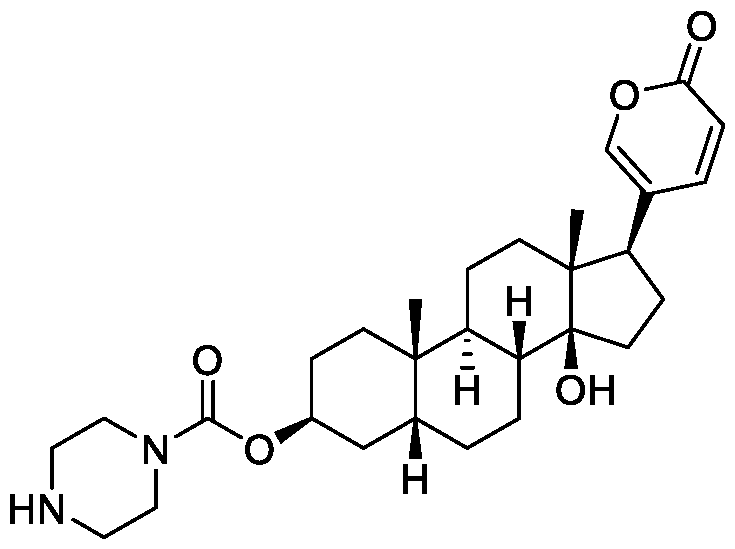





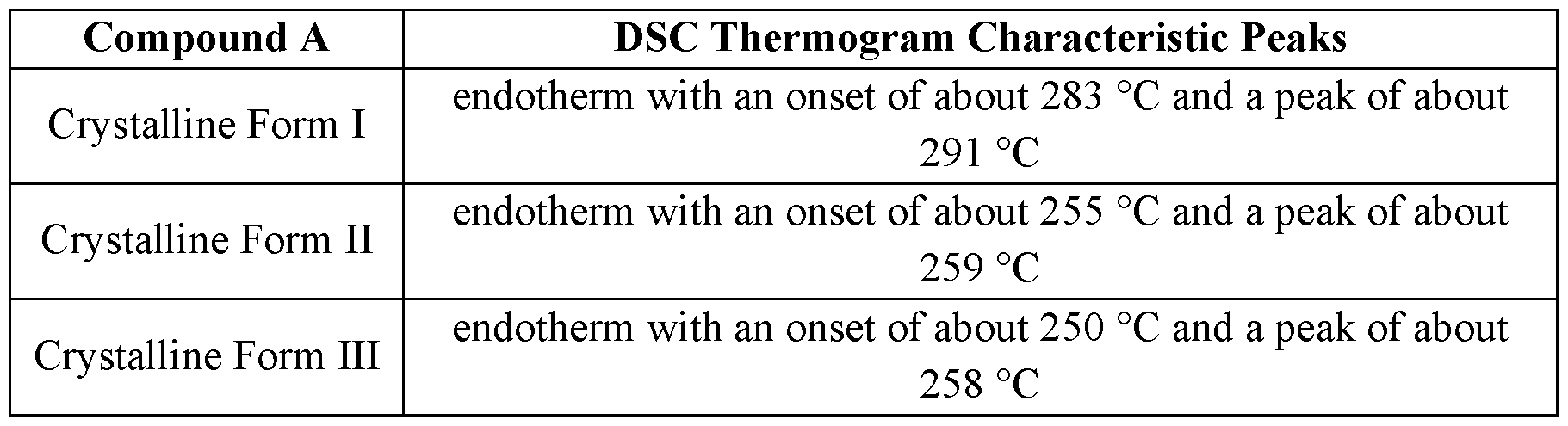

Claims
Priority Applications (1)
| Application Number | Priority Date | Filing Date | Title |
|---|---|---|---|
| EP23758793.6A EP4565592A1 (en) | 2022-08-01 | 2023-07-28 | Crystalline salts of crystalline salts of (3s,5r,8r,9s,10s,13r,14s,17r)-14-hydroxy-10,13-dimethyl-17-(2- oxo-2h-pyran-5-yl)hexadecahydro-1h-cyclopenta[a]phenanthren-3-yl piperazine-1-carboxylate |
Applications Claiming Priority (2)
| Application Number | Priority Date | Filing Date | Title |
|---|---|---|---|
| US202263370006P | 2022-08-01 | 2022-08-01 | |
| US63/370,006 | 2022-08-01 |
Publications (1)
| Publication Number | Publication Date |
|---|---|
| WO2024030825A1 true WO2024030825A1 (en) | 2024-02-08 |
Family
ID=87797739
Family Applications (1)
| Application Number | Title | Priority Date | Filing Date |
|---|---|---|---|
| PCT/US2023/071180 Ceased WO2024030825A1 (en) | 2022-08-01 | 2023-07-28 | Crystalline salts of crystalline salts of (3s,5r,8r,9s,10s,13r,14s,17r)-14-hydroxy-10,13-dimethyl-17-(2- oxo-2h-pyran-5-yl)hexadecahydro-1h-cyclopenta[a]phenanthren-3-yl piperazine-1-carboxylate |
Country Status (2)
| Country | Link |
|---|---|
| EP (1) | EP4565592A1 (en) |
| WO (1) | WO2024030825A1 (en) |
Citations (20)
| Publication number | Priority date | Publication date | Assignee | Title |
|---|---|---|---|---|
| US5033252A (en) | 1987-12-23 | 1991-07-23 | Entravision, Inc. | Method of packaging and sterilizing a pharmaceutical product |
| US5052558A (en) | 1987-12-23 | 1991-10-01 | Entravision, Inc. | Packaged pharmaceutical product |
| US5323907A (en) | 1992-06-23 | 1994-06-28 | Multi-Comp, Inc. | Child resistant package assembly for dispensing pharmaceutical medications |
| WO1997022596A1 (en) | 1995-12-18 | 1997-06-26 | Zeneca Limited | Quinazoline derivatives |
| WO1997030035A1 (en) | 1996-02-13 | 1997-08-21 | Zeneca Limited | Quinazoline derivatives as vegf inhibitors |
| WO1997032856A1 (en) | 1996-03-05 | 1997-09-12 | Zeneca Limited | 4-anilinoquinazoline derivatives |
| WO1998013354A1 (en) | 1996-09-25 | 1998-04-02 | Zeneca Limited | Quinazoline derivatives and pharmaceutical compositions containing them |
| US5846514A (en) | 1994-03-25 | 1998-12-08 | Isotechnika, Inc. | Enhancement of the efficacy of nifedipine by deuteration |
| WO1999002166A1 (en) | 1997-07-08 | 1999-01-21 | Angiogene Pharmaceuticals Ltd. | Use of colchinol derivatives as vascular damaging agents |
| WO2000040529A1 (en) | 1999-01-07 | 2000-07-13 | Angiogene Pharmaceuticals Ltd. | Colchinol derivatives as vascular damaging agents |
| WO2000041669A2 (en) | 1999-01-15 | 2000-07-20 | Angiogene Pharmaceuticals Ltd. | Benzimidazole vascular damaging agents |
| WO2000047212A1 (en) | 1999-02-10 | 2000-08-17 | Astrazeneca Ab | Quinazoline derivatives as angiogenesis inhibitors |
| WO2001092224A1 (en) | 2000-05-31 | 2001-12-06 | Astrazeneca Ab | Indole derivatives with vascular damaging activity |
| WO2001094341A1 (en) | 2000-06-06 | 2001-12-13 | Astrazeneca Ab | Quinazoline derivatives for the treatment of tumours |
| US6334997B1 (en) | 1994-03-25 | 2002-01-01 | Isotechnika, Inc. | Method of using deuterated calcium channel blockers |
| WO2002004434A1 (en) | 2000-07-07 | 2002-01-17 | Angiogene Pharmaceuticals Limited | Colchinol derivatives as vascular damaging agents |
| WO2002008213A1 (en) | 2000-07-07 | 2002-01-31 | Angiogene Pharmaceuticals Limited | Colchinol derivatives as angiogenesis inhibitors |
| WO2011085641A1 (en) | 2010-01-15 | 2011-07-21 | Suzhou Neupharma Co., Ltd. | Certain chemical entities, compositions, and methods |
| WO2019118907A1 (en) * | 2017-12-15 | 2019-06-20 | Neupharma, Inc. | Methods of treating cancer |
| WO2022169705A1 (en) * | 2021-02-02 | 2022-08-11 | Neupharma, Inc | Certain chemical entities, compositions, and methods |
-
2023
- 2023-07-28 WO PCT/US2023/071180 patent/WO2024030825A1/en not_active Ceased
- 2023-07-28 EP EP23758793.6A patent/EP4565592A1/en active Pending
Patent Citations (26)
| Publication number | Priority date | Publication date | Assignee | Title |
|---|---|---|---|---|
| US5033252A (en) | 1987-12-23 | 1991-07-23 | Entravision, Inc. | Method of packaging and sterilizing a pharmaceutical product |
| US5052558A (en) | 1987-12-23 | 1991-10-01 | Entravision, Inc. | Packaged pharmaceutical product |
| US5323907A (en) | 1992-06-23 | 1994-06-28 | Multi-Comp, Inc. | Child resistant package assembly for dispensing pharmaceutical medications |
| US6334997B1 (en) | 1994-03-25 | 2002-01-01 | Isotechnika, Inc. | Method of using deuterated calcium channel blockers |
| US5846514A (en) | 1994-03-25 | 1998-12-08 | Isotechnika, Inc. | Enhancement of the efficacy of nifedipine by deuteration |
| WO1997022596A1 (en) | 1995-12-18 | 1997-06-26 | Zeneca Limited | Quinazoline derivatives |
| WO1997030035A1 (en) | 1996-02-13 | 1997-08-21 | Zeneca Limited | Quinazoline derivatives as vegf inhibitors |
| WO1997032856A1 (en) | 1996-03-05 | 1997-09-12 | Zeneca Limited | 4-anilinoquinazoline derivatives |
| WO1998013354A1 (en) | 1996-09-25 | 1998-04-02 | Zeneca Limited | Quinazoline derivatives and pharmaceutical compositions containing them |
| WO1999002166A1 (en) | 1997-07-08 | 1999-01-21 | Angiogene Pharmaceuticals Ltd. | Use of colchinol derivatives as vascular damaging agents |
| WO2000040529A1 (en) | 1999-01-07 | 2000-07-13 | Angiogene Pharmaceuticals Ltd. | Colchinol derivatives as vascular damaging agents |
| WO2000041669A2 (en) | 1999-01-15 | 2000-07-20 | Angiogene Pharmaceuticals Ltd. | Benzimidazole vascular damaging agents |
| WO2000047212A1 (en) | 1999-02-10 | 2000-08-17 | Astrazeneca Ab | Quinazoline derivatives as angiogenesis inhibitors |
| WO2001092224A1 (en) | 2000-05-31 | 2001-12-06 | Astrazeneca Ab | Indole derivatives with vascular damaging activity |
| WO2001094341A1 (en) | 2000-06-06 | 2001-12-13 | Astrazeneca Ab | Quinazoline derivatives for the treatment of tumours |
| WO2002004434A1 (en) | 2000-07-07 | 2002-01-17 | Angiogene Pharmaceuticals Limited | Colchinol derivatives as vascular damaging agents |
| WO2002008213A1 (en) | 2000-07-07 | 2002-01-31 | Angiogene Pharmaceuticals Limited | Colchinol derivatives as angiogenesis inhibitors |
| WO2011085641A1 (en) | 2010-01-15 | 2011-07-21 | Suzhou Neupharma Co., Ltd. | Certain chemical entities, compositions, and methods |
| US8334376B2 (en) | 2010-01-15 | 2012-12-18 | Xiangping Qian | Certain chemical entities, compositions, and methods |
| US8993550B2 (en) | 2010-01-15 | 2015-03-31 | Suzhou Neupharma Co., Ltd. | Certain chemical entities, compositions, and methods |
| US9399659B2 (en) | 2010-01-15 | 2016-07-26 | Suzhou Neupharma Co., Ltd | Certain chemical entities, compositions, and methods |
| US9814735B2 (en) | 2010-01-15 | 2017-11-14 | Suzhou Neupharma Co., Ltd | Certain chemical entities, compositions, and methods |
| US10179141B2 (en) | 2010-01-15 | 2019-01-15 | Suzhou Neupharma Co., Ltd. | Certain chemical entities, compositions, and methods |
| US10471078B2 (en) | 2010-01-15 | 2019-11-12 | Suzhou Neupharma Co., Ltd. | Certain chemical entities, compositions, and methods |
| WO2019118907A1 (en) * | 2017-12-15 | 2019-06-20 | Neupharma, Inc. | Methods of treating cancer |
| WO2022169705A1 (en) * | 2021-02-02 | 2022-08-11 | Neupharma, Inc | Certain chemical entities, compositions, and methods |
Non-Patent Citations (11)
| Title |
|---|
| "Design of Prodrugs", 1985, ELSEVIER |
| "Pharmaceutical Dosage Forms and Drug Delivery Systems", 1999, LIPPINCOTT WILLIAMS & WILKINS |
| "Pharmaceutical Dosage Forms", 1980, MARCEL DECKER |
| "Recent Advances in the Synthesis and Applications of Radiolabeled Compounds for Drug Discovery and Development", CURR., PHARM. DES., vol. 6, no. 10, 2000, pages 110 |
| "Remington: The Science and Practice of Pharmacy", 1995, MACK PUBLISHING COMPANY |
| EVANSE. ANTHONY: "Synthesis of radiolabeled compounds", J. RADIOANAL. CHEM., vol. 64, 1981, pages 9 - 32 |
| GEORGE W.; VARMARAJENDER S: "The Synthesis of Radiolabeled Compounds via Organometallic Intermediates", TETRAHEDRON, vol. 45, no. 21, 1989, pages 6601 - 21 |
| HOOVER, JOHN E.: "Remington's Pharmaceutical Sciences", 1975, MACK PUBLISHING CO. |
| J. MED. CHEM., vol. 47, 2004 |
| STEM ET AL., CRITICAL REVIEWS IN ONCOLOGY/HAEMATOLOGY, vol. 54, 2005, pages 11 - 29 |
| T. HIGUCHIV. STELLA: "Bioreversible Carriers in Drug Design", vol. 14, 1987, PERGAMON PRESS, article "Pro-drugs as Novel Delivery Systems" |
Also Published As
| Publication number | Publication date |
|---|---|
| EP4565592A1 (en) | 2025-06-11 |
Similar Documents
| Publication | Publication Date | Title |
|---|---|---|
| US10912784B2 (en) | Certain chemical entities, compositions, and methods | |
| US10766920B2 (en) | Certain chemical entities, compositions, and methods | |
| US9340570B2 (en) | Certain chemical entities, compositions, and methods | |
| US9328081B2 (en) | Certain chemical entities, compositions, and methods | |
| US20240092825A1 (en) | Certain chemical entities, compositions, and methods | |
| WO2024030825A1 (en) | Crystalline salts of crystalline salts of (3s,5r,8r,9s,10s,13r,14s,17r)-14-hydroxy-10,13-dimethyl-17-(2- oxo-2h-pyran-5-yl)hexadecahydro-1h-cyclopenta[a]phenanthren-3-yl piperazine-1-carboxylate | |
| US20240116880A1 (en) | Certain chemical entities, compositions, and methods | |
| WO2015095821A1 (en) | Epidithiodiketopiperazine compounds, compositions, and methods |
Legal Events
| Date | Code | Title | Description |
|---|---|---|---|
| 121 | Ep: the epo has been informed by wipo that ep was designated in this application |
Ref document number: 23758793 Country of ref document: EP Kind code of ref document: A1 |
|
| WWE | Wipo information: entry into national phase |
Ref document number: 2023758793 Country of ref document: EP |
|
| NENP | Non-entry into the national phase |
Ref country code: DE |
|
| ENP | Entry into the national phase |
Ref document number: 2023758793 Country of ref document: EP Effective date: 20250303 |
|
| WWP | Wipo information: published in national office |
Ref document number: 2023758793 Country of ref document: EP |