WO2024002990A1 - Composite cathode material comprising ceramic oxide electrolyte, lithium electrode material and enhancing agent - Google Patents
Composite cathode material comprising ceramic oxide electrolyte, lithium electrode material and enhancing agent Download PDFInfo
- Publication number
- WO2024002990A1 WO2024002990A1 PCT/EP2023/067360 EP2023067360W WO2024002990A1 WO 2024002990 A1 WO2024002990 A1 WO 2024002990A1 EP 2023067360 W EP2023067360 W EP 2023067360W WO 2024002990 A1 WO2024002990 A1 WO 2024002990A1
- Authority
- WO
- WIPO (PCT)
- Prior art keywords
- mol
- composition
- ceramic oxide
- composition according
- electrode active
- Prior art date
- Legal status (The legal status is an assumption and is not a legal conclusion. Google has not performed a legal analysis and makes no representation as to the accuracy of the status listed.)
- Ceased
Links
Classifications
-
- H—ELECTRICITY
- H01—ELECTRIC ELEMENTS
- H01M—PROCESSES OR MEANS, e.g. BATTERIES, FOR THE DIRECT CONVERSION OF CHEMICAL ENERGY INTO ELECTRICAL ENERGY
- H01M10/00—Secondary cells; Manufacture thereof
- H01M10/05—Accumulators with non-aqueous electrolyte
- H01M10/052—Li-accumulators
- H01M10/0525—Rocking-chair batteries, i.e. batteries with lithium insertion or intercalation in both electrodes; Lithium-ion batteries
-
- H—ELECTRICITY
- H01—ELECTRIC ELEMENTS
- H01M—PROCESSES OR MEANS, e.g. BATTERIES, FOR THE DIRECT CONVERSION OF CHEMICAL ENERGY INTO ELECTRICAL ENERGY
- H01M4/00—Electrodes
- H01M4/02—Electrodes composed of, or comprising, active material
- H01M4/36—Selection of substances as active materials, active masses, active liquids
- H01M4/362—Composites
-
- H—ELECTRICITY
- H01—ELECTRIC ELEMENTS
- H01M—PROCESSES OR MEANS, e.g. BATTERIES, FOR THE DIRECT CONVERSION OF CHEMICAL ENERGY INTO ELECTRICAL ENERGY
- H01M10/00—Secondary cells; Manufacture thereof
- H01M10/05—Accumulators with non-aqueous electrolyte
- H01M10/056—Accumulators with non-aqueous electrolyte characterised by the materials used as electrolytes, e.g. mixed inorganic/organic electrolytes
- H01M10/0561—Accumulators with non-aqueous electrolyte characterised by the materials used as electrolytes, e.g. mixed inorganic/organic electrolytes the electrolyte being constituted of inorganic materials only
- H01M10/0562—Solid materials
-
- H—ELECTRICITY
- H01—ELECTRIC ELEMENTS
- H01M—PROCESSES OR MEANS, e.g. BATTERIES, FOR THE DIRECT CONVERSION OF CHEMICAL ENERGY INTO ELECTRICAL ENERGY
- H01M10/00—Secondary cells; Manufacture thereof
- H01M10/42—Methods or arrangements for servicing or maintenance of secondary cells or secondary half-cells
- H01M10/4235—Safety or regulating additives or arrangements in electrodes, separators or electrolyte
-
- H—ELECTRICITY
- H01—ELECTRIC ELEMENTS
- H01M—PROCESSES OR MEANS, e.g. BATTERIES, FOR THE DIRECT CONVERSION OF CHEMICAL ENERGY INTO ELECTRICAL ENERGY
- H01M10/00—Secondary cells; Manufacture thereof
- H01M10/42—Methods or arrangements for servicing or maintenance of secondary cells or secondary half-cells
- H01M10/44—Methods for charging or discharging
-
- H—ELECTRICITY
- H01—ELECTRIC ELEMENTS
- H01M—PROCESSES OR MEANS, e.g. BATTERIES, FOR THE DIRECT CONVERSION OF CHEMICAL ENERGY INTO ELECTRICAL ENERGY
- H01M10/00—Secondary cells; Manufacture thereof
- H01M10/42—Methods or arrangements for servicing or maintenance of secondary cells or secondary half-cells
- H01M10/44—Methods for charging or discharging
- H01M10/446—Initial charging measures
-
- H—ELECTRICITY
- H01—ELECTRIC ELEMENTS
- H01M—PROCESSES OR MEANS, e.g. BATTERIES, FOR THE DIRECT CONVERSION OF CHEMICAL ENERGY INTO ELECTRICAL ENERGY
- H01M4/00—Electrodes
- H01M4/02—Electrodes composed of, or comprising, active material
- H01M4/04—Processes of manufacture in general
- H01M4/0471—Processes of manufacture in general involving thermal treatment, e.g. firing, sintering, backing particulate active material, thermal decomposition, pyrolysis
-
- H—ELECTRICITY
- H01—ELECTRIC ELEMENTS
- H01M—PROCESSES OR MEANS, e.g. BATTERIES, FOR THE DIRECT CONVERSION OF CHEMICAL ENERGY INTO ELECTRICAL ENERGY
- H01M4/00—Electrodes
- H01M4/02—Electrodes composed of, or comprising, active material
- H01M4/36—Selection of substances as active materials, active masses, active liquids
- H01M4/48—Selection of substances as active materials, active masses, active liquids of inorganic oxides or hydroxides
- H01M4/50—Selection of substances as active materials, active masses, active liquids of inorganic oxides or hydroxides of manganese
- H01M4/505—Selection of substances as active materials, active masses, active liquids of inorganic oxides or hydroxides of manganese of mixed oxides or hydroxides containing manganese for inserting or intercalating light metals, e.g. LiMn2O4 or LiMn2OxFy
-
- H—ELECTRICITY
- H01—ELECTRIC ELEMENTS
- H01M—PROCESSES OR MEANS, e.g. BATTERIES, FOR THE DIRECT CONVERSION OF CHEMICAL ENERGY INTO ELECTRICAL ENERGY
- H01M4/00—Electrodes
- H01M4/02—Electrodes composed of, or comprising, active material
- H01M4/36—Selection of substances as active materials, active masses, active liquids
- H01M4/48—Selection of substances as active materials, active masses, active liquids of inorganic oxides or hydroxides
- H01M4/52—Selection of substances as active materials, active masses, active liquids of inorganic oxides or hydroxides of nickel, cobalt or iron
- H01M4/525—Selection of substances as active materials, active masses, active liquids of inorganic oxides or hydroxides of nickel, cobalt or iron of mixed oxides or hydroxides containing iron, cobalt or nickel for inserting or intercalating light metals, e.g. LiNiO2, LiCoO2 or LiCoOxFy
-
- H—ELECTRICITY
- H01—ELECTRIC ELEMENTS
- H01M—PROCESSES OR MEANS, e.g. BATTERIES, FOR THE DIRECT CONVERSION OF CHEMICAL ENERGY INTO ELECTRICAL ENERGY
- H01M4/00—Electrodes
- H01M4/02—Electrodes composed of, or comprising, active material
- H01M4/62—Selection of inactive substances as ingredients for active masses, e.g. binders, fillers
-
- H—ELECTRICITY
- H01—ELECTRIC ELEMENTS
- H01M—PROCESSES OR MEANS, e.g. BATTERIES, FOR THE DIRECT CONVERSION OF CHEMICAL ENERGY INTO ELECTRICAL ENERGY
- H01M4/00—Electrodes
- H01M4/02—Electrodes composed of, or comprising, active material
- H01M4/62—Selection of inactive substances as ingredients for active masses, e.g. binders, fillers
- H01M4/624—Electric conductive fillers
- H01M4/625—Carbon or graphite
-
- H—ELECTRICITY
- H01—ELECTRIC ELEMENTS
- H01M—PROCESSES OR MEANS, e.g. BATTERIES, FOR THE DIRECT CONVERSION OF CHEMICAL ENERGY INTO ELECTRICAL ENERGY
- H01M50/00—Constructional details or processes of manufacture of the non-active parts of electrochemical cells other than fuel cells, e.g. hybrid cells
- H01M50/10—Primary casings; Jackets or wrappings
- H01M50/102—Primary casings; Jackets or wrappings characterised by their shape or physical structure
- H01M50/109—Primary casings; Jackets or wrappings characterised by their shape or physical structure of button or coin shape
-
- H—ELECTRICITY
- H01—ELECTRIC ELEMENTS
- H01M—PROCESSES OR MEANS, e.g. BATTERIES, FOR THE DIRECT CONVERSION OF CHEMICAL ENERGY INTO ELECTRICAL ENERGY
- H01M4/00—Electrodes
- H01M4/02—Electrodes composed of, or comprising, active material
- H01M2004/021—Physical characteristics, e.g. porosity, surface area
-
- H—ELECTRICITY
- H01—ELECTRIC ELEMENTS
- H01M—PROCESSES OR MEANS, e.g. BATTERIES, FOR THE DIRECT CONVERSION OF CHEMICAL ENERGY INTO ELECTRICAL ENERGY
- H01M4/00—Electrodes
- H01M4/02—Electrodes composed of, or comprising, active material
- H01M2004/026—Electrodes composed of, or comprising, active material characterised by the polarity
- H01M2004/028—Positive electrodes
-
- H—ELECTRICITY
- H01—ELECTRIC ELEMENTS
- H01M—PROCESSES OR MEANS, e.g. BATTERIES, FOR THE DIRECT CONVERSION OF CHEMICAL ENERGY INTO ELECTRICAL ENERGY
- H01M2300/00—Electrolytes
- H01M2300/0017—Non-aqueous electrolytes
- H01M2300/0065—Solid electrolytes
- H01M2300/0068—Solid electrolytes inorganic
-
- Y—GENERAL TAGGING OF NEW TECHNOLOGICAL DEVELOPMENTS; GENERAL TAGGING OF CROSS-SECTIONAL TECHNOLOGIES SPANNING OVER SEVERAL SECTIONS OF THE IPC; TECHNICAL SUBJECTS COVERED BY FORMER USPC CROSS-REFERENCE ART COLLECTIONS [XRACs] AND DIGESTS
- Y02—TECHNOLOGIES OR APPLICATIONS FOR MITIGATION OR ADAPTATION AGAINST CLIMATE CHANGE
- Y02E—REDUCTION OF GREENHOUSE GAS [GHG] EMISSIONS, RELATED TO ENERGY GENERATION, TRANSMISSION OR DISTRIBUTION
- Y02E60/00—Enabling technologies; Technologies with a potential or indirect contribution to GHG emissions mitigation
- Y02E60/10—Energy storage using batteries
Definitions
- COMPOSITE CATHODE MATERIAL COMPRISING CERAMIC OXIDE ELECTROLYTE, LITHIUM ELECTRODE MATERIAL AND ENHANCING AGENT
- the present invention relates to a solid composite cathode material comprising a ceramic oxide electrolyte material and a lithium electrode material.
- the present invention further relates to methods to prepare said solid materials, to electrochemical cells such as solid-state batteries comprising said solid materials and to uses of the solid material in electrochemical cells such as solid-state batteries, in particular as a composite cathode material.
- the three primary functional components of a lithium-ion battery are the anode, the cathode, and the electrolyte.
- the anode of a conventional lithium-ion cell is typically made from carbon or metallic lithium
- the cathode is typically made from transition metal oxides (in particular oxides of cobalt, nickel and/or manganese)
- the electrolyte is typically a non-aqueous solvent containing a lithium salt.
- mixtures of organic carbonates with lithium hexafluorophosphate are well known liquid electrolytes for lithium-ion batteries.
- a significant disadvantage of liquid electrolytes is that the compositions, in particular the solvents are inflammable, which poses a large safety risk during normal operation and in particular in case of an incident.
- Another disadvantage is inherent to the liquid nature of the electrolyte, associated with risks of leakage and with increased risk of environmental pollution in case of a spill or leakage.
- solid-state batteries have significantly reduced EHS (environmental, health and safety) hazards.
- EHS environmental, health and safety
- the solid-state electrolyte can act as an electrolyte as well as a separator, physically separating the anode and cathode material in order to prevent short-circuiting.
- a composite cathode material comprising lithium aluminium titanium phosphate (LATP) and/or lithium aluminium germanium phosphate (LAGP) electrolyte material, lithium nickel-manganese/cobalt oxide (e.g. NMC) cathode material and a lithium halide.
- LATP lithium aluminium titanium phosphate
- LAGP lithium aluminium germanium phosphate
- NMC lithium nickel-manganese/cobalt oxide
- the addition of lithium halide to the selected electrolyte and cathode materials allows co-sintering of these materials at extremely low temperatures, surprisingly resulting in a sintered composite cathode material with limited degradation of LATP/LAGP or cathode material.
- the thermal stability of the composite cathode material is increased thereby reaching temperatures for sintering without decomposition of the composite cathode material.
- the enhanced electrochemical performance provided by the lithium halide addition is present even after sintering.
- the addition of lithium halide in the context of the present invention was found to enhance the thermal stability of the composite cathode.
- a solid composite cathode composition comprising:
- a ceramic oxide electrolyte material comprising lithium aluminium titanium phosphate (LATP) and/or lithium aluminium germanium phosphate (LAGP);
- an electrode active material comprising Li, M, and 0, wherein M comprises Ni and one or both of Mn and Co;
- a ceramic oxide electrolyte material comprising lithium aluminium titanium phosphate (LATP) and/or lithium aluminium germanium phosphate (LAGP);
- an electrode active material comprising Li, M, and 0, wherein M comprises Ni and one or both of Mn and Co;
- step (a) • an enhancing agent which is LiX wherein X is a halide; and • optionally a carbon-based conductivity aid; b) preparing a substantially homogenous mixture comprising the precursors provided in step (a); and c) optionally subjecting the mixture of step (b) to sintering.
- an electrode comprising the solid composite cathode material as described herein in combination with a binder, such as a polymer binder.
- an electrochemical cell comprising the solid composite cathode material as described herein.
- a battery more specifically a lithium-ion battery or a lithium metal battery comprising at least one electrochemical cell comprising the solid composite cathode material as described herein, for example two or more electrochemical cells according to the invention.
- the electrochemical cell comprising the solid composite cathode material of the invention in motor vehicles, bicycles operated by electric motor, robots, aircraft (for example unmanned aerial vehicles including drones), ships, satellites or stationary energy stores.
- lithium halide for improving the electrochemical properties, such as the cycling performance, of an electrochemical cell comprising a composite cathode material, said composite cathode material comprising lithium aluminium titanium phosphate (LATP) and/or lithium aluminium germanium phosphate (LAGP) electrolyte material and lithium nickel-manganese-cobalt oxide (NMC) cathode material.
- LATP lithium aluminium titanium phosphate
- LAGP lithium aluminium germanium phosphate
- NMC nickel-manganese-cobalt oxide
- Figure 1 shows the temperature-dependent degradation of NMC-LATP mixtures as evidenced by the XR.D spectrum of comparative examples 1, 2 and 4.
- Figure 2 shows the temperature-dependent deterioration of cycling performance of NMC-LATP mixtures of comparative examples 1-3.
- Figure 3 shows the enhancing effect of lithium fluoride addition on the electrochemical performance of the composite cathode materials of examples 5-7 as compared to comparative example 1.
- Figure 4 shows the enhancing effect of lithium fluoride addition on the electrochemical performance of the composite cathode materials of examples 8-10 as compared to comparative example 2.
- a solid composite cathode composition comprising:
- a ceramic oxide electrolyte material comprising lithium aluminium titanium phosphate (LATP) and/or lithium aluminium germanium phosphate (LAGP);
- an electrode active material comprising Li, M, and 0, wherein M comprises Ni and one or both of Mn and Co;
- the solid composition of the invention is preferably a substantially homogenous mixture.
- the solid composition is a substantially homogenous mixture comprising optionally sintered discrete particles of the ceramic oxide electrolyte material, the electrode active material and the lithium halide.
- Such a solid comprising optionally sintered discrete particles of the ceramic oxide electrolyte material, the electrode active material and the lithium halide is obtainable by simply dry blending solid particles of the ceramic oxide electrolyte material, the electrode active material and the lithium halide followed by optionally sintering the mixture.
- the resulting solid is still substantially different from a solid wherein one of the compounds is coated on one of the other compounds.
- at least the enhancing agent is distributed substantially homogenously throughout the composition.
- the lithium aluminium germanium phosphate (LAGP) referred to herein is preferably LAGP of formula Lii+nAlnGe n (PO4)n wherein 0 ⁇ n ⁇ l, preferably wherein 0.2 ⁇ n ⁇ 0.8, more preferably wherein 0.3 ⁇ n ⁇ 0.5.
- LAGP lithium aluminium germanium phosphate
- PO4n Lii+nAlnGe n (PO4)n wherein 0 ⁇ n ⁇ l, preferably wherein 0.2 ⁇ n ⁇ 0.8, more preferably wherein 0.3 ⁇ n ⁇ 0.5.
- n as referred to herein is measured by Scanning Electron Microscopy with Energy Dispersive X-Ray (SEM-EDX) analysis.
- the lithium aluminium titanium phosphate (LATP) referred to herein is preferably LATP of formula Lii+ m Al m Ti2-m(PO4)3 wherein 0 ⁇ m ⁇ l, preferably wherein 0.2 ⁇ m ⁇ 0.8, more preferably wherein 0.3 ⁇ m ⁇ 0.5.
- m as referred to herein is measured by Scanning Electron Microscopy with Energy Dispersive X-Ray (SEM-EDX) analysis.
- the ceramic oxide electrolyte material preferably comprises lithium aluminium titanium phosphate (LATP), more preferably LATP of formula Lii+mAlmTiz- m(PO4)3 wherein 0 ⁇ m ⁇ l, preferably wherein 0.2 ⁇ m ⁇ 0.8, more preferably wherein 0.3 ⁇ m ⁇ 0.5.
- LATP lithium aluminium titanium phosphate
- m as referred to herein is measured by Scanning Electron Microscopy with Energy Dispersive X-Ray (SEM-EDX) analysis.
- the ceramic oxide electrolyte material preferably consists of LATP and/or LAGP as described herein, which has optionally been doped, most preferably consists of LATP which has optionally been doped.
- the LATP and/or LAGP has optionally been doped with a dopant selected from the group consisting of tantalum, niobium, allium, indium, tin, antimony, bismuth, yttrium, germanium, calcium, strontium, barium, hafnium, or combinations thereof.
- the dopant is typically present in an amount of less than 2 wt.% (by total weight of LATP and/or LAGP), preferably less than 1 wt.% (by total weight of LATP and/or LAGP).
- the ceramic oxide electrolyte material consists of LATP and/or LAGP as described herein, which has optionally been doped, it is preferred that the solid composite cathode composition does not comprise further oxide materials aside from the electrode active material.
- the electrode active material comprising Li, M, and 0 discussed herein is cathode active material which is also referred to as positive electrode active material.
- the cathode polarity can be positive or negativity depending on the mode of operation of the electrochemical cell comprising the electrode active material.
- the electrode active material preferably comprises Li, M, and 0, wherein M comprises
- x is about 60 mol%
- y is about 20 mol%
- z is about 20 mol%
- a 0.0 mol%.
- x, y, z, and a as referred to herein are measured by Inductively coupled plasma - optical emission spectrometry (ICP-OES).
- ICP-OES Inductively coupled plasma - optical emission spectrometry
- the electrode active material described herein is the only electrode active material comprised in the composite cathode material of the present invention.
- the enhancing agent comprises lithium fluoride (LiF).
- LiF lithium fluoride
- exceptional electrochemical results have been obtained with the selected electrolyte material and electrode active material in combination with LiF before and after sintering.
- the enhancing agent is LiX wherein X is a halide and wherein more than at least 50 mol% of X represents F, preferably at least 80 mol% of X represents F, most preferably X represents F (such that the enhancing agent consists of lithium fluoride (LiF)).
- the enhancing agent is present in an amount of at least 0.5 wt.% (by total weight of the composition).
- the enhancing agent may be present in an amount of at least 0.8 wt.% (by total weight of the composition), at least 1.2 wt.% (by total weight of the composition), or at least 1.5 wt.% (by total weight of the composition).
- the enhancing agent already significantly enhances the electrochemical characteristics before and after sintering.
- the present inventors have found that the enhancing agent surprisingly shows a significant further increase in beneficial effects when used at high rates.
- the enhancing agent is present in an amount of at least 4 wt.% (by total weight of the composition), preferably at least 4.5 wt.% (by total weight of the composition).
- the enhancing agent is present in an amount of at least 7 wt.%, more preferably at least 8 wt.% (by total weight of the composition).
- the enhancing agent is preferably present in an amount of less than 25 wt.% (by total weight of the composition), preferably less than 20 wt.% (by total weight of the composition), most preferably less than 14 wt.% (by total weight of the composition).
- the ratio (w/w) of the electrode active material to the ceramic oxide electrolyte material is at least 1 : 1, preferably at least 1.5: 1, more preferably at least 1.8: 1, most preferably at least 2: 1.
- the ratio is preferably less than 8: 1, preferably less than 6: 1, more preferably less than 3: 1, most preferably less than 2.5: 1.
- An optional but highly preferred additional component of the composite cathode material of the invention is a conductivity aid, in particular a carbon-based conductivity aid.
- a conductivity aid in particular a carbon-based conductivity aid.
- the present inventors have found that carbon-based conductivity aids exhibit significant oxidation (and associated functionality loss) when a composite cathode composition containing such carbon-based conductivity aid is sintered.
- the formulations comprising an enhancing agent according to the present invention overcome such issues as they allow sintering at low temperature thereby limiting the reactivity between the components, including carbon oxidation.
- the carbon-based conductivity aid may be any carbon-rich material, such as any material comprising at least 95 wt.% carbon, preferably any material comprising at least 99 wt.% carbon.
- suitable materials are graphite, carbon black, carbon fibres, carbon nanotubes, graphene and combinations thereof.
- a highly preferred carbon-based conductivity aid which the inventors have found to exhibit improved electrochemical performance compared to other carbon-based conductivity aids when employed in the solid composite cathode compositions of the present invention is carbon black.
- Carbon black is known to the skilled person and includes variants such as acetylene black or super C65.
- the carbon-based conductivity aid as described herein is present in the solid composite cathode composition of the present invention in an amount of at least 0.5 wt.% (by combined weight of the ceramic oxide electrolyte material and the electrode active material), preferably at least 1 wt.% (by combined weight of the ceramic oxide electrolyte material and the electrode active material), more preferably at least 3 wt.% (by combined weight of the ceramic oxide electrolyte material and the electrode active material).
- the carbon-based conductivity aid is present in an amount of less than 12 wt.% (by combined weight of the ceramic oxide electrolyte material and the electrode active material), preferably less than 9 wt.% (by combined weight of the ceramic oxide electrolyte material and the electrode active material), more preferably less than 7 wt.% (by combined weight of the ceramic oxide electrolyte material and the electrode active material).
- the combined amount of the ceramic oxide electrolyte material, the electrode active material, the enhancing agent and optional carbon-based conductivity aid is at least 90 wt.% (by total weight of the composition), preferably at least 95 wt.% (by total weight of the composition), more preferably at least 98 wt.% (by total weight of the composition).
- the solid composite cathode composition consists essentially of the ceramic oxide electrolyte material, the electrode active material, the enhancing agent and optional carbon-based conductivity aid.
- the solid composite cathode composition has been sintered.
- the material has been sintered at a temperature of less than 600 °C, preferably less than 500 °C, more preferably less than 450 °C.
- the material has been sintered at a temperature of more than 200 °C, preferably more than 300 °C, more preferably more than 350 °C.
- the material has been sintered at a temperature in the range of 200 °C - 600 °C, preferably in the range of 300 °C - 500 °C, more preferably in the range of 350 °C - 450 °C.
- the total time the material was submitted to a temperature above 200 °C is preferably within the range of 5 minutes to 48 hours, preferably within the range of 10 minutes to 24 hours, more preferably within the range of 30 minutes to 10 hours.
- Sintering was optionally performed while submitting the material to elevated pressure, for example a pressure of at least 0.1 GPa or at least 0.5 GPa. In some embodiments sintering was performed while submitting the material to elevated pressure within the range of 1-5, GPa, preferably 1-3 GPa, in order to achieve high compaction while avoiding grain splitting.
- the solid composite cathode composition has been sintered under inert atmosphere or air, preferably air.
- the present inventors believe that the temperature and duration at which a composition was submitted to sintering could be derived from the end product by constructing temperature-time calibration curves at different temperatures and sampling different timepoints for each curve to determine the associated X-ray diffraction spectra of the material at different temperatures and durations and comparing the X-ray diffraction spectrum of a material to be analyzed with the X-ray diffraction spectra recorded for the calibration curves.
- the solid composite cathode compositions provided herein are preferably provided having a ratio A of less than 2.3 wherein
- A (DCc/20) / (DCic) wherein the ratio A is determined on a coin cell by performing five full discharge cycles at each C-rate of C/20, C/10, C/5, C/2, and 1C, performed consecutively in this order, and DCc/20 is the first discharge capacity expressed in mAh/g determined at a C-rate of C/20, and DCic is the first discharge capacity expressed in mAh/g determined at a C-rate of 1C.
- the ratio A is preferably within the range of 1.5-2.5, more preferably within the range of 1.5-2.2, most preferably within the range of 1.5-1.9.
- the ratio A is preferably determined on a coin cell immediately after assembly (without aging), preferably at 2.7 - 4.3 V, preferably at 2.9 - 3.1 V, for example using a TOYO battery cycler.
- the ratio A is preferably determined on coin cells prepared by mixing the solid cathode composition with polyvinylidene fluoride (PVDF) in a ratio of 90: 10 that gives a total weight of 400 mg in 1.4-1.6 mL N-Methyl-2-pyrrolidone solvent (NMP) solvent, tape casting the resulting slurries on aluminium foils with a wet thickness of 300 pm using a doctor blade and drying the laminates overnight at 80 °C under dynamic vacuum, followed by punching dried laminates in to disks having diameters chosen in such a way the areal capacity (mAh/cm 2 ) remains in the range of 0.3-0.45 mAh/cm 2 , with composite cathode material loading corresponding to 2-3 mg/cm 2 and densifying disks with
- a method for preparing a composite cathode composition comprising the steps of: a) providing at least the following precursors: • a ceramic oxide material comprising lithium aluminium titanium phosphate (LATP) and/or lithium aluminium germanium phosphate (LAGP);
- LATP lithium aluminium titanium phosphate
- LAGP lithium aluminium germanium phosphate
- an electrode active material comprising Li, M, and 0, wherein M comprises Ni and one or both of Mn and Co;
- step (a) • optionally a carbon-based conductivity aid; b) preparing a substantially homogenous mixture comprising the precursors provided in step (a); and c) optionally subjecting the mixture of step (b) to sintering.
- the preferred embodiments of the composite cathode composition are equally applicable to the method for preparing the composite cathode composition described herein.
- Step (b) is preferably a dry blending step and may take place using any suitable means known to the skilled person, such as simple pestle and mortar, ribbon mixers, rotary drums, ploughshare mixers, paddle mixers, conical screw mixers, etc.
- Step (b) may also comprise a size reduction or comminution of one or more of the precursors provided in step (a), for example using ball milling, hammer milling, pin milling, etc.
- Step (b) may comprise a first step of mixing a subset of the precursors provided in step (a), followed by addition of the remaining precursors provided in step (a).
- Step (c) preferably comprises sintering at a temperature of less than 600 °C, preferably less than 500 °C, more preferably less than 450 °C.
- the material has been sintered at a temperature of more than 200 °C, preferably more than 300 °C, more preferably more than 350 °C.
- the material has been sintered at a temperature in the range of 200 °C - 600 °C, preferably in the range of 300 °C - 500 °C, more preferably in the range of 350 °C - 450 °C.
- the total time the material is submitted to a temperature above 200 °C is preferably within the range of 5 minutes to 48 hours, preferably within the range of 10 minutes to 24 hours, more preferably within the range of 30 minutes to 10 hours.
- Sintering is optionally performed while submitting the material to elevated pressure, for example a pressure of at least 0.1 GPa or at least 0.5 GPa. In some embodiments sintering is performed while submitting the material to elevated pressure within the range of 1-3 GPa, preferably 1-5 GPa, in order to ensure sufficient compaction while avoiding grain splitting.
- an electrode comprising the solid composite cathode material of the present invention.
- the electrode comprises the solid composite cathode material of the present invention in combination with a binder, such as a polymer binder.
- a binder such as a polymer binder.
- the binder is not particularly limiting and can be any suitable polymer binder, such as polyimide (PI), polyvinylidene chloride (PVdC), polyethylene oxide (PEO), polyvinylidene fluoride (PVdF) and the like.
- an electrochemical cell comprising the solid composite cathode material as described herein.
- a battery more specifically a lithium-ion battery or a lithium metal battery comprising at least one electrochemical cell comprising the solid composite cathode material as described herein, for example two or more electrochemical cells according to the invention.
- the electrochemical cell comprising the solid composite cathode material of the invention in motor vehicles, bicycles operated by electric motor, robots, aircraft (for example unmanned aerial vehicles including drones), ships satellites, or stationary energy stores.
- lithium halide for improving the electrochemical properties, such as the cycling performance, of an electrochemical cell comprising a composite cathode material, said composite cathode material a ceramic oxide electrolyte material comprising lithium aluminium titanium phosphate (LATP) and/or lithium aluminium germanium phosphate (LAGP); an electrode active material comprising Li, M, and 0, wherein M comprises Ni and one or both of Mn and Co; and optionally a carbon-based conductivity aid.
- LATP lithium aluminium titanium phosphate
- LAGP lithium aluminium germanium phosphate
- the preferred embodiments of the composite cathode composition are equally applicable to the use of lithium halide described herein.
- Composite cathode materials according to the invention were prepared in batches of 2 g using the following starting products in the following order: NMC (LiNi0.6Mn0.2Co0.2O2 according to manufacturer spec), LiF (99.98% (metal basis)), carbon black (acetylene black - KetjenBlack®) and LATP (Lii +m AlmTi2-m(PO4)3 wherein 0.3 ⁇ m ⁇ 0.5 according to SEM-EDX).
- NMC LiNi0.6Mn0.2Co0.2O2 according to manufacturer spec
- LiF 99.98% (metal basis)
- carbon black acetylene black - KetjenBlack®
- LATP Lii +m AlmTi2-m(PO4)3 wherein 0.3 ⁇ m ⁇ 0.5 according to SEM-EDX.
- glovebox O2 ⁇ 1 ppm and H2O ⁇ 1 ppm
- Control materials were prepared in the same manner but without LiF.
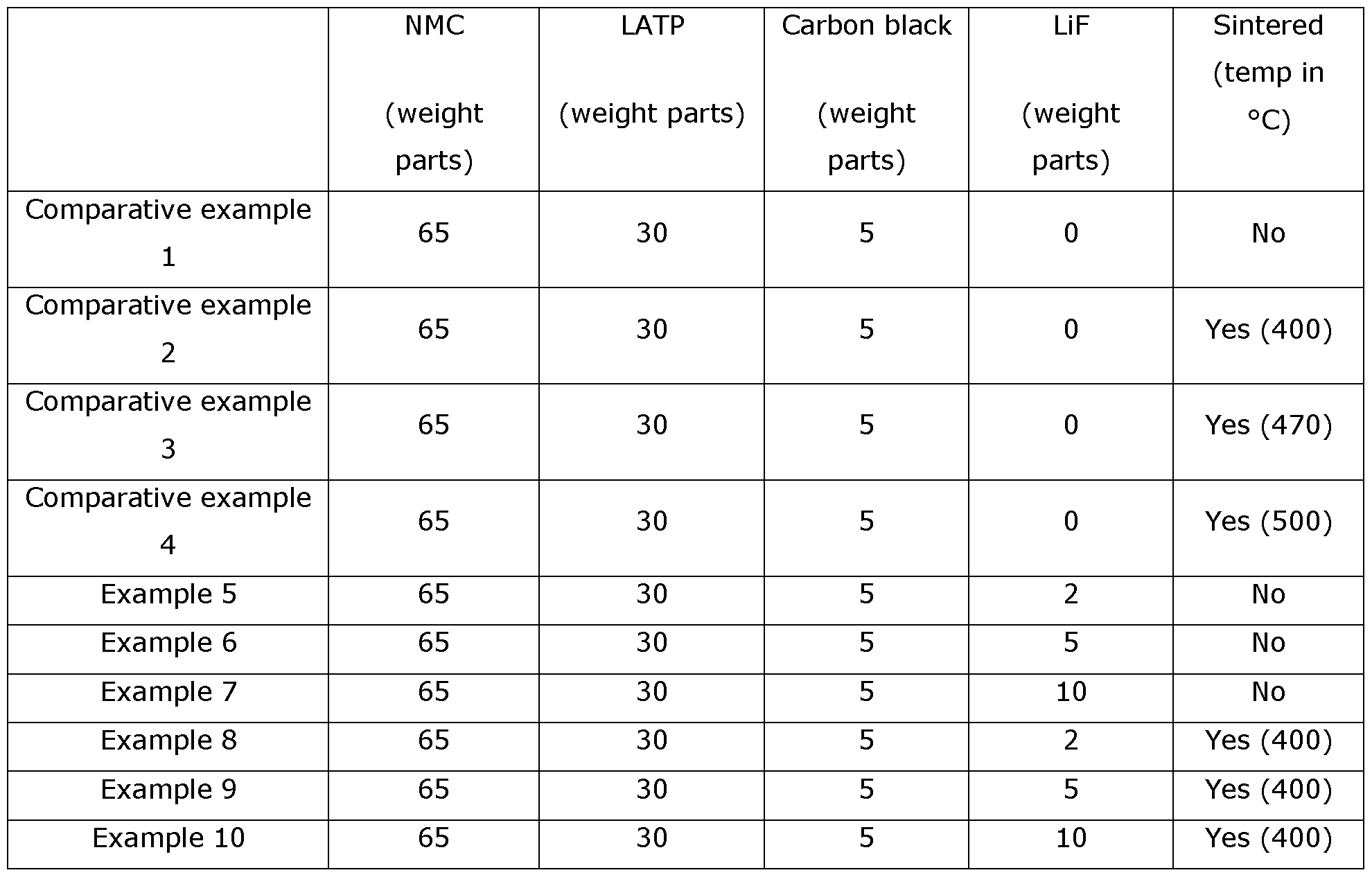
- the LiF was added in an amount of 0, 2, 5 and 10 wt.% (based on combined weight of NMC, LATP and carbon black). In other words, LiF was added at a ratio (w/w) (LiF):(NMC+LATP+carbon black) of 0: 100; 2: 100; 5: 100 and 10: 100 respectively as is shown in the below table. Virgin NMC (unsintered, pure) was also used as a reference for X-ray diffraction spectra.
- PVDF polyvinylidene fluoride
- NMP N-Methyl-2-pyrrolidone solvent
- Disks were densified with a uniaxial pressure of 0.1-0.3 MPa and dried at 120 °C overnight before cell assembly. All the processes were carried out in dry room (dew point approx. 37 °C).
- the cycling protocol consisted of 5 cycles each at C-rates C/20, C/10, C/5, C/2, 1C followed by 100 cycles at C/10. Capacity values are normalized with respect to the weight of active material (NMC) and results were verified with reproducibility. Glass fiber was used as the separator.
- Figure 1 shows the temperature-dependent degradation of NMC-LATP mixtures as evidenced by the XRD spectrum of comparative examples 2 and 4. It can be observed that the composite cathode material of comparative example 4 (treated at 500 °C) shows significant deterioration.
- Figure 2 shows the temperature-dependent deterioration of cycling performance of NMC-LATP mixtures of comparative examples 1-3. It can be observed that the composite cathode material of comparative example 2 (treated at 400 °C) already has significantly diminished performance, while the composite cathode material of comparative example 3 (treated at 470 °C) is no longer functional.
- Figure 3 shows the enhancing effect of lithium fluoride addition on the electrochemical performance of the composite cathode materials of examples 5-7 as compared to comparative example 1.
- the electrochemical performance is enhanced even before sintering and is particularly enhanced at high C-rates.
- Figure 4 shows the enhancing effect of lithium fluoride addition on the electrochemical performance of the composite cathode materials of examples 8-10 as compared to comparative example 2.
- the electrochemical performance is particularly enhanced at high C-rates and at high Li F loading.
Landscapes
- Chemical & Material Sciences (AREA)
- General Chemical & Material Sciences (AREA)
- Electrochemistry (AREA)
- Chemical Kinetics & Catalysis (AREA)
- Engineering & Computer Science (AREA)
- Manufacturing & Machinery (AREA)
- Inorganic Chemistry (AREA)
- Physics & Mathematics (AREA)
- General Physics & Mathematics (AREA)
- Condensed Matter Physics & Semiconductors (AREA)
- Composite Materials (AREA)
- Materials Engineering (AREA)
- Battery Electrode And Active Subsutance (AREA)
- Conductive Materials (AREA)
- Secondary Cells (AREA)
- Inorganic Compounds Of Heavy Metals (AREA)
Abstract
Description
Claims
Priority Applications (4)
| Application Number | Priority Date | Filing Date | Title |
|---|---|---|---|
| CN202380048219.6A CN119487634A (en) | 2022-06-27 | 2023-06-27 | Composite cathode material comprising a ceramic oxide electrolyte, a lithium electrode material and a reinforcing agent |
| EP23733013.9A EP4544610A1 (en) | 2022-06-27 | 2023-06-27 | Composite cathode material comprising ceramic oxide electrolyte, lithium electrode material and enhancing agent |
| KR1020257002103A KR20250040639A (en) | 2022-06-27 | 2023-06-27 | Composite cathode material comprising ceramic oxide electrolyte, lithium electrode material and reinforcing agent |
| JP2024576763A JP2025521718A (en) | 2022-06-27 | 2023-06-27 | Composite cathode material comprising a ceramic oxide electrolyte, a lithium electrode material and a promoter |
Applications Claiming Priority (2)
| Application Number | Priority Date | Filing Date | Title |
|---|---|---|---|
| EP22382602.5 | 2022-06-27 | ||
| EP22382602 | 2022-06-27 |
Publications (1)
| Publication Number | Publication Date |
|---|---|
| WO2024002990A1 true WO2024002990A1 (en) | 2024-01-04 |
Family
ID=82403943
Family Applications (1)
| Application Number | Title | Priority Date | Filing Date |
|---|---|---|---|
| PCT/EP2023/067360 Ceased WO2024002990A1 (en) | 2022-06-27 | 2023-06-27 | Composite cathode material comprising ceramic oxide electrolyte, lithium electrode material and enhancing agent |
Country Status (5)
| Country | Link |
|---|---|
| EP (1) | EP4544610A1 (en) |
| JP (1) | JP2025521718A (en) |
| KR (1) | KR20250040639A (en) |
| CN (1) | CN119487634A (en) |
| WO (1) | WO2024002990A1 (en) |
Families Citing this family (7)
| Publication number | Priority date | Publication date | Assignee | Title |
|---|---|---|---|---|
| EP3560509B1 (en) | 2011-12-22 | 2024-01-31 | Children's Medical Center Corporation | Saposin-a derived peptides and uses thereof |
| US20210032334A1 (en) | 2018-02-28 | 2021-02-04 | Dana-Farber Cancer Institute, Inc. | Methods for treating cancer using combinations of anti-btnl2 and immune checkpoint blockade agents |
| RU2020136055A (en) | 2018-04-06 | 2022-05-06 | Дана-Фарбер Кэнсер Инститьют, Инк. | KIR3DL3 AS HHLA2 RECEPTOR, ANTI-HHLA2 ANTIBODIES AND ITS USE |
| EP3883611A4 (en) | 2018-11-19 | 2023-02-22 | Dana-Farber Cancer Institute, Inc. | USE OF BIOMARKERS FROM THE IRE1ALPHA-XBP1 SIGNALING PATHWAY TO MODULATE IMMUNE RESPONSES |
| WO2020223121A1 (en) | 2019-04-30 | 2020-11-05 | Dana-Farber Cancer Institute, Inc. | Methods for treating cancer using combinations of anti-cx3cr1 and immune checkpoint blockade agents |
| WO2021150925A1 (en) | 2020-01-24 | 2021-07-29 | Dana-Farber Cancer Institute, Inc. | Uses of biomarkers for improving immunotherapy |
| WO2025034542A1 (en) | 2023-08-04 | 2025-02-13 | Cornell University | Gene signature panel predicting cancer response to immune checkpoint blockade and radiation therapy |
Citations (1)
| Publication number | Priority date | Publication date | Assignee | Title |
|---|---|---|---|---|
| US20210083249A1 (en) | 2019-09-18 | 2021-03-18 | GM Global Technology Operations LLC | Additive to ceramic ion conducting material to mitigate the resistive effect of surface carbonates and hydroxides |
Family Cites Families (8)
| Publication number | Priority date | Publication date | Assignee | Title |
|---|---|---|---|---|
| JP6977932B2 (en) * | 2015-08-17 | 2021-12-08 | 地方独立行政法人大阪産業技術研究所 | Additives for all-solid-state secondary batteries, all-solid-state secondary batteries and methods for manufacturing them |
| JP6735083B2 (en) * | 2015-11-10 | 2020-08-05 | 日本特殊陶業株式会社 | Ion conductor and lithium battery |
| US10566611B2 (en) * | 2015-12-21 | 2020-02-18 | Johnson Ip Holding, Llc | Solid-state batteries, separators, electrodes, and methods of fabrication |
| JP7000675B2 (en) * | 2016-11-29 | 2022-01-19 | セイコーエプソン株式会社 | Complex manufacturing methods, batteries and battery manufacturing methods, electronic devices |
| CN109818048A (en) * | 2019-03-04 | 2019-05-28 | 江西星盈科技有限公司 | All solid lithium metal battery and its preparation process |
| US20210020944A1 (en) * | 2019-07-16 | 2021-01-21 | Lionano Se Inc. | Electrodes for lithium-ion batteries and other applications |
| CN111430688A (en) * | 2020-03-18 | 2020-07-17 | 蜂巢能源科技有限公司 | Solid-state battery and preparation method and application thereof |
| CN113054244B (en) * | 2021-03-12 | 2022-05-17 | 南方科技大学 | Composite solid-state electrolyte material and preparation method thereof, preparation method of solid-state electrolyte sheet, and all-solid-state battery |
-
2023
- 2023-06-27 WO PCT/EP2023/067360 patent/WO2024002990A1/en not_active Ceased
- 2023-06-27 CN CN202380048219.6A patent/CN119487634A/en active Pending
- 2023-06-27 JP JP2024576763A patent/JP2025521718A/en active Pending
- 2023-06-27 KR KR1020257002103A patent/KR20250040639A/en active Pending
- 2023-06-27 EP EP23733013.9A patent/EP4544610A1/en active Pending
Patent Citations (1)
| Publication number | Priority date | Publication date | Assignee | Title |
|---|---|---|---|---|
| US20210083249A1 (en) | 2019-09-18 | 2021-03-18 | GM Global Technology Operations LLC | Additive to ceramic ion conducting material to mitigate the resistive effect of surface carbonates and hydroxides |
Non-Patent Citations (2)
| Title |
|---|
| KIM KUN JOONG ET AL: "All ceramic cathode composite design and manufacturing towards low interfacial resistance for garnet-based solid-state lithium batteries", vol. 13, no. 12, 16 December 2020 (2020-12-16), Cambridge, pages 4930 - 4945, XP093004032, ISSN: 1754-5692, Retrieved from the Internet <URL:http://pubs.rsc.org/en/content/articlepdf/2020/EE/D0EE02062A> DOI: 10.1039/D0EE02062A * |
| YUTAO LI ET AL: "Hybrid Polymer/Garnet Electrolyte with a Small Interfacial Resistance for Lithium-Ion Batteries", ANGEWANDTE CHEMIE INTERNATIONAL EDITION, vol. 56, no. 3, 9 December 2016 (2016-12-09), pages 753 - 756, XP055530355, ISSN: 1433-7851, DOI: 10.1002/anie.201608924 * |
Also Published As
| Publication number | Publication date |
|---|---|
| JP2025521718A (en) | 2025-07-10 |
| EP4544610A1 (en) | 2025-04-30 |
| CN119487634A (en) | 2025-02-18 |
| KR20250040639A (en) | 2025-03-24 |
Similar Documents
| Publication | Publication Date | Title |
|---|---|---|
| WO2024002990A1 (en) | Composite cathode material comprising ceramic oxide electrolyte, lithium electrode material and enhancing agent | |
| Liu et al. | Conductive surface modification with aluminum of high capacity layered Li [Li0. 2Mn0. 54Ni0. 13Co0. 13] O2 cathodes | |
| CN1947283B (en) | Negative electrode active material with improved electrochemical characteristics and electrochemical device comprising same | |
| EP3965199A1 (en) | Solid electrolyte material for lithium secondary battery, electrode, and battery | |
| Hwang et al. | Surface-modified carbon nanotube coating on high-voltage LiNi0. 5Mn1. 5O4 cathodes for lithium ion batteries | |
| US10608239B2 (en) | Method for producing electrode body | |
| US7547491B2 (en) | Cathode active material, method of preparing the same, and cathode and lithium battery applying the material | |
| EP2911223A1 (en) | Titanium-niobium composite oxide-based electrode active material and lithium secondary battery using the same | |
| CN102884666B (en) | Solid electrolyte material and all solid lithium secondary battery | |
| EP3203555A1 (en) | Lithium ion battery positive electrode active material | |
| Reale et al. | Sustainable high-voltage lithium ion polymer batteries | |
| JP7237148B2 (en) | Method for producing lithium nitride composition for sulfide-based inorganic solid electrolyte material and method for producing sulfide-based inorganic solid electrolyte material | |
| Zhang et al. | Elemental sulfur as a cathode additive for enhanced rate capability of layered lithium transition metal oxides | |
| Lv et al. | Li2O-B2O3-Li2SO4 modified LiNi1/3Co1/3Mn1/3O2 cathode material for enhanced electrochemical performance | |
| JP5169094B2 (en) | Positive electrode active material for lithium secondary battery and lithium secondary battery using the same | |
| Rezvani et al. | Binder-induced surface structure evolution effects on Li-ion battery performance | |
| KR102613606B1 (en) | Sulfide-based solid electrolyte, manufacturing method thereof, and all-solid lithium battery manufactured therefrom | |
| EP4007013A1 (en) | Negative electrode material for nonaqueous electrolyte secondary batteries, and nonaqueous electrolyte secondary battery | |
| Ma et al. | Effect of AlPO4 coating on the electrochemical properties of LiNi0. 8Co0. 2O2 cathode material | |
| JP2016072188A (en) | Method for producing coated composite oxide particles for positive electrode active material for non-aqueous electrolyte secondary battery, and non-aqueous electrolyte secondary battery using coated composite oxide particles produced by the production method | |
| Zhou et al. | An effective co-modification strategy to enhance the cycle stability of LiNi 0.8 Co 0.1 Mn 0.1 O 2 for lithium-ion batteries | |
| JP2025090803A (en) | Electrode particles suitable for batteries | |
| EP4438579A1 (en) | Solid-state electrolyte, preparation method of solid-state electrolyte, and lithium battery comprising solid-state electrolyte | |
| JP7807758B2 (en) | Ytterbium-containing solid lithium ion conductive material and method for preparing same | |
| JP2016009581A (en) | Method for manufacturing all-solid lithium ion battery |
Legal Events
| Date | Code | Title | Description |
|---|---|---|---|
| 121 | Ep: the epo has been informed by wipo that ep was designated in this application |
Ref document number: 23733013 Country of ref document: EP Kind code of ref document: A1 |
|
| WWE | Wipo information: entry into national phase |
Ref document number: 202380048219.6 Country of ref document: CN Ref document number: 18876930 Country of ref document: US |
|
| WWE | Wipo information: entry into national phase |
Ref document number: 2024576763 Country of ref document: JP |
|
| WWE | Wipo information: entry into national phase |
Ref document number: 1020257002103 Country of ref document: KR |
|
| WWE | Wipo information: entry into national phase |
Ref document number: 2023733013 Country of ref document: EP |
|
| NENP | Non-entry into the national phase |
Ref country code: DE |
|
| ENP | Entry into the national phase |
Ref document number: 2023733013 Country of ref document: EP Effective date: 20250127 |
|
| WWP | Wipo information: published in national office |
Ref document number: 202380048219.6 Country of ref document: CN |
|
| WWP | Wipo information: published in national office |
Ref document number: 1020257002103 Country of ref document: KR |
|
| WWP | Wipo information: published in national office |
Ref document number: 2023733013 Country of ref document: EP |