WO2023275283A1 - Composition of single-phase appearance comprising an anionic surfactant and an amphoteric surfactant - Google Patents
Composition of single-phase appearance comprising an anionic surfactant and an amphoteric surfactant Download PDFInfo
- Publication number
- WO2023275283A1 WO2023275283A1 PCT/EP2022/068126 EP2022068126W WO2023275283A1 WO 2023275283 A1 WO2023275283 A1 WO 2023275283A1 EP 2022068126 W EP2022068126 W EP 2022068126W WO 2023275283 A1 WO2023275283 A1 WO 2023275283A1
- Authority
- WO
- WIPO (PCT)
- Prior art keywords
- weight
- composition
- mixtures
- alkyl
- preferentially
- Prior art date
- Legal status (The legal status is an assumption and is not a legal conclusion. Google has not performed a legal analysis and makes no representation as to the accuracy of the status listed.)
- Ceased
Links
Classifications
-
- A—HUMAN NECESSITIES
- A61—MEDICAL OR VETERINARY SCIENCE; HYGIENE
- A61Q—SPECIFIC USE OF COSMETICS OR SIMILAR TOILETRY PREPARATIONS
- A61Q5/00—Preparations for care of the hair
- A61Q5/02—Preparations for cleaning the hair
-
- A—HUMAN NECESSITIES
- A61—MEDICAL OR VETERINARY SCIENCE; HYGIENE
- A61K—PREPARATIONS FOR MEDICAL, DENTAL OR TOILETRY PURPOSES
- A61K8/00—Cosmetics or similar toiletry preparations
- A61K8/02—Cosmetics or similar toiletry preparations characterised by special physical form
- A61K8/04—Dispersions; Emulsions
- A61K8/046—Aerosols; Foams
-
- A—HUMAN NECESSITIES
- A61—MEDICAL OR VETERINARY SCIENCE; HYGIENE
- A61K—PREPARATIONS FOR MEDICAL, DENTAL OR TOILETRY PURPOSES
- A61K8/00—Cosmetics or similar toiletry preparations
- A61K8/02—Cosmetics or similar toiletry preparations characterised by special physical form
- A61K8/04—Dispersions; Emulsions
- A61K8/06—Emulsions
- A61K8/068—Microemulsions
-
- A—HUMAN NECESSITIES
- A61—MEDICAL OR VETERINARY SCIENCE; HYGIENE
- A61K—PREPARATIONS FOR MEDICAL, DENTAL OR TOILETRY PURPOSES
- A61K8/00—Cosmetics or similar toiletry preparations
- A61K8/18—Cosmetics or similar toiletry preparations characterised by the composition
- A61K8/30—Cosmetics or similar toiletry preparations characterised by the composition containing organic compounds
- A61K8/31—Hydrocarbons
-
- A—HUMAN NECESSITIES
- A61—MEDICAL OR VETERINARY SCIENCE; HYGIENE
- A61K—PREPARATIONS FOR MEDICAL, DENTAL OR TOILETRY PURPOSES
- A61K8/00—Cosmetics or similar toiletry preparations
- A61K8/18—Cosmetics or similar toiletry preparations characterised by the composition
- A61K8/30—Cosmetics or similar toiletry preparations characterised by the composition containing organic compounds
- A61K8/40—Cosmetics or similar toiletry preparations characterised by the composition containing organic compounds containing nitrogen
- A61K8/44—Aminocarboxylic acids or derivatives thereof, e.g. aminocarboxylic acids containing sulfur; Salts; Esters or N-acylated derivatives thereof
-
- A—HUMAN NECESSITIES
- A61—MEDICAL OR VETERINARY SCIENCE; HYGIENE
- A61K—PREPARATIONS FOR MEDICAL, DENTAL OR TOILETRY PURPOSES
- A61K8/00—Cosmetics or similar toiletry preparations
- A61K8/18—Cosmetics or similar toiletry preparations characterised by the composition
- A61K8/30—Cosmetics or similar toiletry preparations characterised by the composition containing organic compounds
- A61K8/40—Cosmetics or similar toiletry preparations characterised by the composition containing organic compounds containing nitrogen
- A61K8/44—Aminocarboxylic acids or derivatives thereof, e.g. aminocarboxylic acids containing sulfur; Salts; Esters or N-acylated derivatives thereof
- A61K8/442—Aminocarboxylic acids or derivatives thereof, e.g. aminocarboxylic acids containing sulfur; Salts; Esters or N-acylated derivatives thereof substituted by amido group(s)
-
- A—HUMAN NECESSITIES
- A61—MEDICAL OR VETERINARY SCIENCE; HYGIENE
- A61K—PREPARATIONS FOR MEDICAL, DENTAL OR TOILETRY PURPOSES
- A61K8/00—Cosmetics or similar toiletry preparations
- A61K8/18—Cosmetics or similar toiletry preparations characterised by the composition
- A61K8/30—Cosmetics or similar toiletry preparations characterised by the composition containing organic compounds
- A61K8/46—Cosmetics or similar toiletry preparations characterised by the composition containing organic compounds containing sulfur
- A61K8/463—Cosmetics or similar toiletry preparations characterised by the composition containing organic compounds containing sulfur containing sulfuric acid derivatives, e.g. sodium lauryl sulfate
-
- A—HUMAN NECESSITIES
- A61—MEDICAL OR VETERINARY SCIENCE; HYGIENE
- A61Q—SPECIFIC USE OF COSMETICS OR SIMILAR TOILETRY PREPARATIONS
- A61Q19/00—Preparations for care of the skin
- A61Q19/10—Washing or bathing preparations
-
- A—HUMAN NECESSITIES
- A61—MEDICAL OR VETERINARY SCIENCE; HYGIENE
- A61Q—SPECIFIC USE OF COSMETICS OR SIMILAR TOILETRY PREPARATIONS
- A61Q5/00—Preparations for care of the hair
- A61Q5/12—Preparations containing hair conditioners
-
- A—HUMAN NECESSITIES
- A61—MEDICAL OR VETERINARY SCIENCE; HYGIENE
- A61K—PREPARATIONS FOR MEDICAL, DENTAL OR TOILETRY PURPOSES
- A61K2800/00—Properties of cosmetic compositions or active ingredients thereof or formulation aids used therein and process related aspects
- A61K2800/20—Chemical, physico-chemical or functional or structural properties of the composition as a whole
- A61K2800/26—Optical properties
- A61K2800/262—Transparent; Translucent
Definitions
- TITLE Composition of single-phase appearance comprising an anionic surfactant and an amphoteric surfactant
- the present invention relates to a composition of single-phase appearance comprising a combination of an anionic surfactant and of an amphoteric or zwitterionic surfactant, at least one fatty substance, in the presence of a propellant.
- the invention also concerns an aerosol device containing said composition, and also to a process for the cosmetic treatment of keratin materials, in particular of human keratin materials such as the skin and the hair, using said composition.
- detergent cosmetic compositions such as shampoos and shower gels, based essentially on surfactants, for washing keratin materials notably such as the hair and the skin.
- These compositions are applied to the keratin materials, which are preferably wet, and the foam generated by massaging or rubbing with the hands or a washing mitt makes it possible, after rinsing with water, to remove the diverse types of soiling initially present on the hair or the skin.
- Anionic surfactants are commonly used in these cleansing products, notably in combination with other surfactants such as amphoteric surfactants, for their detergent and foaming properties.
- Shampoos and body cleansing products are usually in the form of lotions, gels, foams, creams or sprays. When these products are packaged in the form of sprays or in aerosol devices, they are generally only available in opaque containers since the compositions usually used do not have a sufficiently attractive appearance, notably in the presence of a propellant, or even in the presence of a liquefied propellant. Now, an increasing number of users of bodycare and haircare products are notably in search of compositions that are more attractive, more fluid and clearer, or even transparent.
- compositions are generally not stable over time or with respect to temperature, which makes their application difficult and non-uniform and gives the consumer an unpleasant sensation.
- compositions which does not have the drawbacks mentioned above, i.e. which has an attractive aesthetic appearance that is stable over time, which is easy to spread over the entire head of hair or the skin, and which has improved foaming and cleansing (or washing) properties, notably giving keratin materials a soft, pleasant feel.
- foaming and cleansing (or washing) properties notably giving keratin materials a soft, pleasant feel.
- a composition of single-phase appearance comprising a combination of at least one anionic surfactant and of at least one amphoteric or zwitterionic surfactant in the presence of at least one propellant, makes it possible to achieve the objectives presented above, and notably to propose a composition which is stable over time, combining an attractive aesthetic appearance with improved foaming properties.
- composition of single-phase appearance comprising:
- composition according to the invention when it is dispensed by means of a conventional aerosol device, makes it possible in particular to dispense a uniform, firm and creamy mousse which holds well in the hand.
- the foam formed from the composition according to the invention has good working qualities. It spreads easily and evenly over the keratin materials and has good conditioning and cleaning properties for the hair or the skin, and also good styling properties on the hair, where appropriate. After rinsing or not, the composition affords cosmetic properties to the keratin materials, and notably a pleasant feel.
- the composition of the invention can be used in various cosmetic treatments of the skin and/or hair, such as cleansing compositions, conditioners or styling products.
- the composition according to the invention also affords good curl definition, and also good curl hold.
- the composition according to the invention gives the hair flexibility and volume, affording it a fluid movement, while at the same time maintaining a natural appearance. It also gives the hair a particularly soft, smooth and pleasant feel.
- the head of hair styled using the composition of the invention is held in shape without being set rigid and the styling effects afforded thereto persist throughout the day.
- the composition according to the invention has a single-phase appearance, which is preferably clear, or even transparent, which gives it a particularly attractive aesthetic appearance that is highly sought by users.
- a pressurized device such as an aerosol
- the propellant(s) are dispersed in the composition, giving the composition a particularly aesthetic homogeneous appearance.
- the aesthetic appearance of the composition according to the invention is also particularly enhanced when it is packaged in a container that is itself transparent.
- the permanent dispersion of the propellant(s) renders them non flammable, improving the safety of the final aerosol product and complying with certain regulations, notably American regulations.
- composition according to the invention is stable over time, and also with respect to temperature.
- appearance of the composition according to the invention remains significantly the same after two months of storage at room temperature (25°C).
- the present invention also relates to an aerosol device comprising:
- the present invention also relates to a process for the cosmetic treatment, preferably a washing and/or conditioning process, of keratin materials, in particular of human keratin fibres such as the hair and the skin, comprising the application to said keratin materials of a composition as previously defined, said application being optionally followed by rinsing after an optional leave-on time.
- the present invention also relates to a process for washing and/or conditioning keratin fibres, in particular human keratin fibres such as the hair, comprising the application to said keratin fibres of a composition as defined previously, said application being optionally followed by rinsing after an optional leave-on time.
- the present invention also relates to a process for styling keratin fibres, in particular human keratin fibres such as the hair, comprising the application to said keratin fibres of a composition as defined previously, said application being optionally followed by rinsing after an optional leave-on time.
- two-phase or multi-phase appearance refers to a composition comprising at least two phases that are distinct from each other and superposed one on the other.
- the cosmetic composition according to the present invention is of single phase appearance.
- the term “of single-phase appearance” means that the composition according to the invention is constituted, at room temperature (25°C) and atmospheric pressure:
- composition according to the invention is advantageously in the form of a clear to transparent fluid, preferably a transparent fluid.
- the transparency of the composition according to the invention may be characterized by measuring its turbidity, by turbidimetry (in NTU units).
- turbidity measurements were performed using a UV-Vis Cary 100 model UV spectrophotometer sold by the company Agilent. It is also possible to measure the turbidity of the composition using a turbidimeter such as the HI 88713- ISO model from the company Hanna Instruments.
- the turbidity of the composition according to the invention measured at room temperature (25°C) and atmospheric pressure, is less than or equal to 250 NTU units, preferably less than or equal to 200 NTU units, more preferentially less than or equal to 100 NTU units, better still less than or equal to 50 NTU units, and even more preferentially less than or equal to 20 NTU units.
- the transparency may also be assessed visually when the composition is packaged in a transparent container.
- the composition is transparent if the printed characters on a sheet of paper placed behind the container can be read clearly.
- the printed characters are preferably in Arial font, font size 12 or larger.
- the composition according to the invention is free of cationic surfactants.
- free of cationic surfactants means that the composition does not comprise any cationic surfactants, or that the total content of cationic surfactants is less than or equal to 0.1% by weight relative to the total weight of the composition.
- composition according to the present invention comprises one or more anionic surfactants.
- anionic surfactant means a surfactant including, as ionic or ionizable groups, only anionic groups.
- a species is termed as being “anionic” when it bears at least one permanent negative charge or when it can be ionized as a negatively charged species, under the conditions of use of the composition of the invention (for example the medium or the pH) and not comprising any cationic charge.
- the anionic surfactant(s) (i) may be chosen from sulfate, sulfonate and/or carboxylic (or carboxylate) surfactants. Needless to say, a mixture of these surfactants may be used.
- the carboxylate-type anionic surfactants comprise at least one carboxylic or carboxylate function (-COOH or -COO ) and may optionally also comprise one or more sulfate and/or sulfonate functions;
- the sulfonate-type anionic surfactants comprise at least one sulfonate function (-SO3H or -SCb-) and may optionally also comprise one or more sulfate functions, but do not comprise any carboxylate functions; and
- the sulfate-type anionic surfactants comprise at least one sulfate function but do not comprise any carboxylate or sulfonate functions.
- the carboxylate-type anionic surfactants that may be used in the composition of the invention thus include at least one carboxylic or carboxylate function (-COOH or -COO ).
- acylglycinates may be chosen from the following compounds: acylglycinates, acyllactylates, acylsarcosinates, acylglutamates; alkyl-D-galactosideuronic acids, alkyl ether carboxylic acids, alkyl(C6-C3o aryl) ether carboxylic acids, alkylamido ether carboxylic acids; and also the salts of these compounds; and mixtures thereof; the alkyl and/or acyl groups of these compounds including from 6 to 30 carbon atoms, preferably from 8 to 26, and more preferentially from 10 to 22 carbon atoms; the aryl group preferably denoting a phenyl or benzyl group; these compounds possibly being polyoxyalkylenated, notably polyoxyethylenated, and then preferably including from 1 to 50 ethylene oxide units and better still from 2 to 10 ethylene oxide units.
- C6-C30 alkyl monoesters of polyglycoside- polycarboxylic acids such as C6-C30 alkyl polyglycoside-citrates, C6-C30 alkyl polyglycoside-tartrates and C6-C30 alkyl polyglycoside-sulfosuccinates, and salts thereof.
- carboxylate anionic surfactants are chosen, alone or as a mixture, from:
- - acylglutamates notably of C6-C30 or even C8-C26, such as stearoylglutamates, and in particular disodium stearoylglutamate;
- acylsarcosinates notably of C6-C30 or even C8-C26, such as palmitoylsarcosinates, and in particular sodium palmitoylsarcosinate;
- acyllactylates notably of C 6 -C 30 or even C8-C2 6 , such as behenoyllactylates, and in particular sodium behenoyllactylate;
- C6-C3o)alkyl(amido) ether carboxylic acids in particular those including from 2 to 50 ethylene oxide groups; in particular in the form of alkali metal or alkaline-earth metal, ammonium or amino alcohol salts.
- - X denoting a hydrogen atom, an ammonium ion, an ion derived from an alkali metal or an alkaline-earth metal or an ion derived from an organic amine, preferably a hydrogen atom
- - R denoting a linear or branched, saturated or unsaturated alkyl group of 5 to 29 carbon atoms.
- R denotes a linear or branched, saturated or unsaturated alkyl group of 7 to 23 carbon atoms, preferably of 11 to 21 carbon atoms.
- - X denoting a hydrogen atom, an ammonium ion, an ion derived from an alkali metal or an alkaline-earth metal or an ion derived from an organic amine, preferably a hydrogen atom, and
- R denotes a linear or branched alkyl group of 8 to 24 carbon atoms, preferably of 12 to 20 carbon atoms.
- (C 6 -C3o)acyl sarcosinates of formula (I) that may be used in the present composition, mention may be made of palmitoyl sarcosinates, stearoyl sarcosinates, myristoyl sarcosinates, lauroyl sarcosinates and cocoyl sarcosinates, in acid form or in salified form.
- carboxylate-type surfactants mention may also be made of polyoxyalkylenated alkyl(amido) ether carboxylic acids and salts thereof, in particular those including from 2 to 50 alkylene oxide and in particular ethylene oxide groups, such as the compounds sold by the company Kao under the Akypo names.
- polyoxyalkylenated alkyl(amido) ether carboxylic acids that may be used are preferably chosen from those of formula (II):
- R1 represents a linear or branched Cr > -C 24 alkyl or alkenyl radical, a (Cx- C 9 )alkylphenyl radical, a radical R 2 CONH-CH 2 -CH 2 - with R2 denoting a linear or branched C9-C 2i alkyl or alkenyl radical; preferably, R1 is a Cs-C 2 o and preferably Cx-C ix alkyl radical, and aryl preferably denotes phenyl,
- - n is an integer or decimal number (mean value) ranging from 2 to 24 and preferably from 2 to 10, - A denotes H, ammonium, Na, K, Li, Mg or a monoethanolamine or triethanolamine residue.
- polyoxyalkylenated alkyl(amido) ether carboxylic acids that are particularly preferred are those of formula (II) in which:
- R1 denotes a C12-C14 alkyl, cocoyl, oleyl, nonylphenyl or octylphenyl radical
- - A denotes a hydrogen or sodium atom
- - n ranges from 2 to 20, preferably from 2 to 10.
- R1 denotes a C12 alkyl radical
- A denotes a hydrogen or sodium atom
- n ranges from 2 to 10.
- the sulfonate-type anionic surfactants that may be used in the composition of the invention include at least one sulfonate function (-SO3H or -SCh-).
- alkylsulfonates alkylsulfonates, alkylamidesulfonates, alkylarylsulfonates, a-olefm sulfonates, paraffin sulfonates, alkyl sulfosuccinates, alkyl ether sulfosuccinates, alkylamidesulfosuccinates, alkylsulfoacetates, N-acyltaurates, acylisethionates; alkylsulfolaurates; and also the salts of these compounds; the alkyl groups of these compounds including from 6 to 30 carbon atoms, notably from 12 to 28, even better still from 14 to 24 or even from 16 to 22 carbon atoms; the aryl group preferably denoting a phenyl or benzyl group; these compounds possibly being polyoxyalkylenated, notably polyoxyethylenated, and then preferably including from 1 to 50 ethylene oxide units and better
- the sulfonate anionic surfactants are chosen, alone or as a mixture, from:
- the anionic surfactant(s) (i) are chosen from sulfate-type anionic surfactants and mixtures thereof.
- sulfate-type anionic surfactant means an anionic surfactant including one or more sulfate functions (-OSO3H or -OSO3-).
- Such surfactants may advantageously be chosen from alkyl sulfates, alkyl ether sulfates, alkylamido sulfates, alkylamido ether sulfates, alkylaryl polyether sulfates, monoglyceride sulfates; and also salts thereof and mixtures thereof; the alkyl groups of these compounds notably including from 6 to 30 carbon atoms, preferably from 8 to 26, and more preferentially from 10 to 22 carbon atoms; the aryl group preferably denoting a phenyl or benzyl group; these compounds possibly being polyoxyalkylenated, notably polyoxyethylenated, and then preferably including from 1 to 50 ethylene oxide units, and more preferentially from 2 to 10 ethylene oxide units.
- the sulfate-type anionic surfactant(s) are chosen from:
- alkyl sulfates notably Cx to C26, and preferably C10 to C22, alkyl sulfates
- alkyl ether sulfates notably Cx to C26, and preferably C10 to C22, alkyl ether sulfates, preferably comprising from 1 to 10 ethylene oxide units; in particular in the form of alkali metal, alkaline-earth metal, ammonium or amino alcohol salts; and mixtures thereof.
- said salt may be chosen from alkali metal salts, such as the sodium or potassium salt, ammonium salts, amine salts and in particular amino alcohol salts, and alkaline-earth metal salts, such as the magnesium salt, and mixtures thereof.
- amino alcohol salts examples include monoethanolamine, diethanolamine and triethanolamine salts, monoisopropanolamine, diisopropanolamine or triisopropanolamine salts, 2-amino-2- methyl-1 -propanol salts, 2-amino-2-methyl-l, 3-propanediol salts and tris(hydroxymethyl)aminomethane salts.
- Alkali metal or alkaline-earth metal salts and in particular sodium or magnesium salts are preferably used.
- the sulfate-type anionic surfactant(s) are chosen from sodium, triethanolamine, magnesium or ammonium (Cio-C22)alkyl sulfates, sodium, ammonium or magnesium (Cio-C22)alkyl ether sulfates, which are oxyethylenated, for example with 1 or 2.2 mol of ethylene oxide, and mixtures thereof.
- the sulfate-type anionic surfactant(s) are chosen from sodium, triethanolamine, ammonium or magnesium (Cio-C22)alkyl sulfates, such as the compound sold under the name Texapon Z95P by the company BASF under the INCI name Sodium lauryl sulfate.
- the anionic surfactant(s) (i) is chosen from sulfate, sulfonate and/or carboxylate surfactants; the carboxylate surfactants being chosen among the group consisting of:
- - acylglutamates notably of C6-C30 or even C8-C26, such as stearoylglutamates, and in particular disodium stearoylglutamate;
- acylsarcosinates notably of C6-C30 or even C8-C26, such as palmitoylsarcosinates, and in particular sodium palmitoylsarcosinate;
- the anionic surfactant(s) (i) are chosen from sodium lauryl sulfate, sodium laureth sulfate and mixtures thereof.
- the total content of the anionic surfactant(s) (i) present in the composition of the invention is greater than or equal to 5% by weight relative to the total weight of the composition.
- the total content of the anionic surfactant(s) (i) present in the composition of the invention ranges from 5% to 35% by weight, more preferentially from 6% to 30% by weight, and better still from 7% to 20% by weight, relative to the total weight of the composition.
- the composition comprises one or more sulfate-type anionic surfactants, preferably chosen from sodium lauryl sulfate, sodium laureth sulfate and mixtures thereof.
- the total content of the sulfate-type anionic surfactant(s) is advantageously greater than or equal to 5% by weight; this total value preferably ranges from 5% to 35% by weight, more preferentially from 6% to 30% by weight and better still from 7% to 20% by weight, relative to the total weight of the composition.
- the composition according to the present invention also comprises one or more amphoteric or zwitterionic surfactants.
- the amphoteric or zwitterionic surfactant(s), which are preferably non-silicone, used in the composition according to the present invention may notably be derivatives of optionally quaternized aliphatic secondary or tertiary amines, in which derivatives the aliphatic group is a linear or branched chain including from 8 to 22 carbon atoms, said amine derivatives containing at least one anionic group, for instance a carboxylate, sulfonate, sulfate, phosphate or phosphonate group.
- Ra represents a Cio to C30 alkyl or alkenyl group derived from an acid RaCOOH preferably present in hydrolysed coconut kernel oil; preferably, Ra represents a heptyl, nonyl or undecyl group;
- - Rb represents a b-hydroxyethyl group
- - M + represents a cationic counterion derived from an alkali metal or alkaline- earth metal, such as sodium, an ammonium ion or an ion derived from an organic amine;
- - X represents an organic or mineral anionic counterion, such as that chosen from halides, acetates, phosphates, nitrates, (Ci-C4)alkyl sulfates, (Ci-C4)alkyl- or (Ci- C4)alkylaryl- sulfonates, in particular methyl sulfate and ethyl sulfate; or alternatively M + and X are absent;
- - X’ represents the group -CH2COOH, -CIB-COOZ’, -CH2CH2COOH or CH2CH2-COOZ’, or a hydrogen atom;
- - Y’ represents the group -COOH, -COOZ’ or -CH2CH(0H)S03H or the group CH 2 CH(0H)S03-Z’;
- - Z’ represents a cationic counterion derived from an alkali metal or alkaline- earth metal, such as sodium, an ammonium ion or an ion derived from an organic amine;
- Ra - Ra’ represents a Cio to C30 alkyl or alkenyl group of an acid Ra -COOH which is preferably present in coconut kernel oil or in hydrolysed linseed oil, preferably R a’ an alkyl group, notably a C17 group, and its iso form, or an unsaturated C17 group.
- cocoamphodiacetate sold by the company Rhodia under the trade name Miranol ® C2M Concentrate.
- - Y represents the group -COOH, -COOZ” or -CH2CH(0H)S03H or the group CH 2 CH(0H)S03-Z”;
- Rd and Re independently of each other, represent a Ci to C4 alkyl or hydroxyalkyl radical
- - Z’ ’ represents a cationic counterion derived from an alkali metal or alkaline- earth metal, such as sodium, an ammonium ion or an ion derived from an organic amine;
- Ra represents a Cio to C30 alkyl or alkenyl group of an acid Ra”-COOH which is preferably present in coconut kernel oil or in hydrolysed linseed oil;
- - n and n’ denote, independently of each other, an integer ranging from 1 to 3.
- (C8-C2o)alkylbetaines such as cocoyl betaine (Cx- C2o)alkylamido(C3-C8)alkylbetaines, such as cocamidopropylbetaine, (Cs- C2o)alkylamphoacetates, (C8-C2o)alkylamphodiacetates and mixtures thereof; and preferably (C8-C2o)alkylbetaines, (C8-C2o)alkylamido(C3-C8)alkylbetaines and mixtures thereof.
- amphoteric or zwitterionic surfactants are chosen from (Cx- C2o)alkylbetaines, (C8-C2o)alkylamido(C3-C8)alkylbetaines, and mixtures thereof,
- the total content of the amphoteric or zwitterionic surfactant(s) present in the composition according to the invention is advantageously greater than or equal to 0.5% by weight; preferably, this total content ranges from 0.5% to 15% by weight, more preferentially from 0.75% to 10% by weight, and better still from 1% to 5% by weight relative to the total weight of the composition.
- the weight ratio (R) between the total content of anionic surfactant(s) (i) and the total content of amphoteric or zwitterionic surfactant(s) (ii), present in the composition of the invention is preferably greater than or equal to 1 and more preferentially greater than or equal to 1.5.
- this weight ratio (R) ranges from 2 to 15.
- the total content of surfactants is preferably greater than or equal to 5.5% by weight, more preferentially greater than or equal to 7.5% by weight, relative to the total weight of the composition.
- this total content ranges from 5.5% to 40% by weight and more preferentially from 7.5% to 35% by weight, relative to the total weight of the composition.
- composition according to the present invention also comprises one or more propellants.
- the propellant(s) that may be used in the composition of the invention are preferably chosen from liquefied gases such as dimethyl ether, chlorinated and/or fluorinated hydrocarbons such as trichlorofluoromethane, dichlorodifluoromethane, chi orodifluorom ethane, 1,1,1,2-tetrafluoroethane, chloropentafluoroethane, 1-chloro- 1,1-difluoroethane or 1,1-difluoroethane, or volatile hydrocarbons notably such as C3 to C5 alkanes, for instance propane, isopropane, n-butane, isobutane or pentane; and mixtures thereof.
- liquefied gases such as dimethyl ether, chlorinated and/or fluorinated hydrocarbons such as trichlorofluoromethane, dichlorodifluoromethane, chi orodifluorom ethane
- the propellant(s) (iii) are chosen from volatile, optionally halogenated hydrocarbons, for example n-butane, propane, isobutane, pentane and halogenated derivatives thereof; dimethyl ether; and mixtures thereof; more preferentially from dimethyl ether, C3 to C5 alkanes, in particular propane, n-butane, isobutane, and mixtures thereof, and better still from C3 to Cs alkanes, in particular propane, n-butane, isobutane, and mixtures thereof.
- volatile, optionally halogenated hydrocarbons for example n-butane, propane, isobutane, pentane and halogenated derivatives thereof; dimethyl ether; and mixtures thereof; more preferentially from dimethyl ether, C3 to C5 alkanes, in particular propane, n-butane, isobutane, and mixtures thereof, and better still from C3 to Cs alkanes, in
- the propellant (s) used are fully dissolved or dispersed in the composition before the first use of the composition.
- the term “fully dispersed in the composition” means that the propellant(s) are fully present in the composition; or that the total content of the non-dispersed propellant(s) (i.e. the propellants not present in the composition according to the invention) is less than 0.5% by weight, relative to the total weight of the composition.
- the total content of the propellant(s) (iii) present in the composition according to the invention is less than or equal to 10% by weight, and preferably less than or equal to 6% by weight, relative to the total weight of the composition. More preferentially, the total content of the propellant(s) ranges from 0.5% to 10% by weight, better still from 1% to 8% by weight and even more preferentially from 3% to 6% by weight relative to the total weight of the composition.
- composition according to the present invention also comprises water.
- the total content of water present in the composition of the invention is preferably greater than 40% by weight, and more preferentially ranges from 50% to 93% by weight and better still from 70% to 90% by weight relative to the total weight of the composition.
- the composition may optionally comprise a mixture of water and of one or more organic solvents chosen from Ci to C4 alcohols, such as ethanol, isopropanol, tert-butanol or n-butanol; polyols such as glycerol, propylene glycol and polyethylene glycols, polyol ethers, aromatic alcohols such as benzyl alcohol; and mixtures thereof.
- Ci to C4 alcohols such as ethanol, isopropanol, tert-butanol or n-butanol
- polyols such as glycerol, propylene glycol and polyethylene glycols, polyol ethers, aromatic alcohols such as benzyl alcohol
- aromatic alcohols such as benzyl alcohol
- the total content of the organic solvent(s) advantageously ranges from 0.1% to 40% by weight, preferably from 0.5% to 30% by weight, more preferentially from 1% to 20% by weight, and better still from 2% to 10% by weight, relative to the total weight of the composition.
- the composition according to the present invention comprises one or more fatty substances with a melting point of less than or equal to 35°C at atmospheric pressure (1.013xl0 5 Pa).
- the fatty substance(s) used in the composition of the invention have a melting point strictly less than 35°C at atmospheric pressure (1.013> ⁇ 10 5 Pa), and more preferentially less than or equal to 28°C at atmospheric pressure (1.013x 10 5 Pa).
- the fatty substance(s) used in the composition of the present invention are liquid at 35°C and at atmospheric pressure, preferably liquid at 28°C and at atmospheric pressure.
- the fatty substance(s) used in the composition according to the invention are liquid at room temperature, i.e. they have a melting point of less than or equal to 25°C, at atmospheric pressure (1.013xl0 5 Pa).
- fatty substance means an organic compound that is insoluble in water at room temperature (25°C) and at atmospheric pressure (1.013xl0 5 Pa), i.e. it has a solubility of less than 5% by weight, preferably less than 1% by weight and more preferentially less than 0.1% by weight in water. They generally have in their structure at least one hydrocarbon-based chain including at least 6 carbon atoms.
- the fatty substances are generally soluble, under the same temperature and pressure conditions, in organic solvents such as chloroform, ethanol, benzene, liquid petroleum jelly or decamethylcyclopentasiloxane.
- the fatty substance(s) with a melting point of less than or equal to 35°C at atmospheric pressure included in the composition according to the invention are non-silicone fatty substances.
- non-silicone fatty substance means a fatty substance whose structure does not include any silicon atoms, thus notably not comprising any siloxane groups.
- sicone fatty substance means a fatty substance containing at least one silicon atom, and more particularly at least one Si-0 bond.
- the fatty substances that may be used generally have in their structure a hydrocarbon-based chain including at least 6 carbon atoms. They are neither (poly)oxyalkylenated nor (poly)glycerolated, and preferably do not contain any - COOH functions.
- the fatty substance(s) are preferably neither (poly)oxyalkylenated nor (poly)glycerolated, and preferably do not contain any -COOH functions.
- the fatty substance(s) are namely different from nonionic surfactant(s).
- the fatty substance(s) are non-silicone fatty substances and are neither poly)oxyalkylenated nor (poly)glycerolated, and more preferably do not contain any -COOH functions.
- the fatty substance(s) are non-silicone fatty substances and are different from nonionic surfactant(s).
- the fatty substance(s) that may be used in the composition according to the invention may notably be chosen from hydrocarbons, triglycerides, fatty esters, fatty acids, non-polyoxyalkylenated fatty alcohols, silicones and mixtures thereof; these compounds being liquid at 35°C at atmospheric pressure, and preferentially liquid at 28°C at atmospheric pressure.
- fatty ester saturated or unsaturated, linear or branched esters, alcohols and acids comprising at least one hydrocarbon-based chain containing at least 6 carbon atoms.
- hydrocarbon means a compound solely comprising carbon and hydrogen atoms.
- hydrocarbons that are liquid at 35°C at atmospheric pressure preferably liquid at 28°C at atmospheric pressure, are chosen from:
- Ci6 alkanes examples include hexane, undecane, dodecane, tridecane, and isoparaffins, for instance isohexadecane, isododecane and isodecane,
- the hydrocarbon(s) are chosen from liquid paraffins, isoparaffins, liquid petroleum jelly, undecane, tridecane and isododecane, and mixtures thereof.
- the hydrocarbon(s) are chosen from liquid petroleum jelly, isoparaffins, isododecane and a mixture of undecane and tridecane.
- the term “fatty ester” means an ester derived from a fatty acid and/or a fatty alcohol. More particularly, the esters that are liquid at 35°C at atmospheric pressure (1.013xl0 5 Pa), which are preferably liquid at 28°C at atmospheric pressure, are chosen from esters of saturated or unsaturated, linear or branched Ci to C26 aliphatic mono- or polyacids, which are optionally hydroxylated, and of saturated or unsaturated, linear or branched Ci to C26 aliphatic mono- or polyalcohols, the total number of carbon atoms of the esters being greater than or equal to 10.
- At least one from among the alcohol and the acid from which the esters of the invention are derived is branched.
- alkyl palmitates notably Ci to Cix alkyl palmitates, notably ethyl palmitate and isopropyl palmitate
- alkyl myristates notably Ci to Cis alkyl myristates, such as isopropyl myristate or ethyl myristate
- alkyl stearates notably Ci to Cis alkyl stearates, notably isocetyl stearate, 2-ethylhexyl isononanoate, isodecyl neopentanoate and isostearyl neopentanoate.
- esters of optionally hydroxylated C3 to C22 dicarboxylic or tricarboxylic acids and of Ci to C22 alcohols and esters of optionally hydroxylated monocarboxylic, dicarboxylic or tricarboxylic acids and of dihydroxy, trihydroxy, tetrahydroxy or pentahydroxy C4 to C26 non-sugar alcohols.
- esters mentioned above use is preferentially made of ethyl, isopropyl, myristyl, cetyl or stearyl palmitate, 2-ethylhexyl palmitate, 2-octyldecyl palmitate, alkyl myristates, such as isopropyl, butyl, cetyl or 2-octyldodecyl myristate, hexyl stearate, propylene glycol dicaprylate, butyl stearate, isobutyl stearate, dioctyl malate, hexyl laurate, 2- hexyldecyl laurate, isononyl isononanoate, cetyl octanoate and bis(Ci2-Ci3)alkyl malate.
- liquid fatty esters use may be made of esters and diesters of sugars and of C6-C30, preferably C12-C22
- sugar means oxygen-bearing hydrocarbon-based compounds containing several alcohol functions, with or without aldehyde or ketone functions, and which include at least 4 carbon atoms. These sugars may be monosaccharides, oligosaccharides or polysaccharides.
- these said sugars are chosen from sucrose, glucose, galactose, ribose, fucose, maltose, fructose, mannose, arabinose, xylose, lactose, and derivatives thereof, notably alkyl derivatives, such as methyl derivatives, for example methylglucose.
- the sugar esters of fatty acids may be chosen notably from the group comprising the esters or mixtures of esters of sugars described previously and of linear or branched, saturated or unsaturated G to C30 and preferably C12 to C22 fatty acids.
- these compounds may have one to three conjugated or non-conjugated carbon-carbon double bonds.
- esters according to this variant can also be chosen from mono-, di-, tri- and tetraesters, polyesters and mixtures thereof.
- esters may be, for example, oleates, laurates, palmitates, myristates, behenates, cocoates, stearates, linoleates, linolenates, caprates and arachidonates, and mixtures thereof, notably such as oleopalmitate, oleostearate or palmitostearate mixed esters.
- Glucate ® DO methylglucose dioleate
- Use may be made, among sugar esters, of pentaerythrityl esters, preferably pentaerythrityl tetraisostearate, pentaerythrityl tetraoctanoate or caprylic and capric acid hexaesters as a mixture with dipentaerythritol.
- pentaerythrityl esters preferably pentaerythrityl tetraisostearate, pentaerythrityl tetraoctanoate or caprylic and capric acid hexaesters as a mixture with dipentaerythritol.
- triglycerides of plant origin such as plant oils or synthetic triglycerides.
- said plant oil(s) or synthetic oil(s) are chosen from triglyceride oils of plant or synthetic origin, such as liquid fatty acid triglycerides including from 6 to 30 carbon atoms, for instance heptanoic or octanoic acid triglycerides, or alternatively, for example, sesame oil, soybean oil, coffee oil, safflower oil, borage oil, sunflower oil, olive oil, apricot kernel oil, camellia oil, bambara pea oil, avocado oil, mango oil, rice bran oil, cotton seed oil, rose oil, kiwi seed oil, sea buckthorn pulp oil, blueberry seed oil, poppy seed oil, orange pip oil, sweet almond oil, palm oil, coconut oil, coconut kernel oil, vemonia oil, marjoram oil, baobab oil, rapeseed oil, ximenia oil, pracaxi oil, caprylic/capric acid triglycerides such as those sold by the company Stearinerie Dub
- triglycerides of plant origin in particular caprylic/capric acid triglycerides, coconut oil and triacetin, are used as triglycerides that are liquid at 35°C at atmospheric pressure (1.013xl0 5 Pa), more preferentially liquid at 28°C at atmospheric pressure.
- fatty acid means a non-salified fatty acid, i.e. the fatty acid must not be in the form of a generally soluble soap, i.e. it must not be salified with a base.
- R is a Ci to C29 alkyl or Ci to C29 alkenyl group, better still a C12 to C24 alkyl or C12 to C24 alkenyl group.
- R may be substituted with one or more hydroxyl groups and/or one or more carboxyl groups.
- the fatty acid(s) that are liquid at 35°C at atmospheric pressure are chosen from oleic acid, linoleic acid, isostearic acid and mixtures thereof.
- non-polyoxyalkylenated fatty alcohols that may be used in the composition according to the invention include from 8 to 30 carbon atoms, notably from 10 to 24 carbon atoms, and may be saturated or unsaturated.
- the saturated non-polyoxyalkylenated fatty alcohols are preferably branched. They may optionally comprise in their structure at least one aromatic or non-aromatic ring, which is preferably acyclic.
- saturated non-polyoxyalkylenated fatty alcohols that may be used in the composition of the invention are chosen from octyldodecanol, 2- decyltetradecanol, isostearyl alcohol and 2-hexyldecanol, and mixtures thereof.
- Octyldodecanol and 2-decyltetradecanol are most particularly preferred.
- the unsaturated non-polyoxyalkylenated fatty alcohols have, in their structure, at least one double or triple bond, and preferably one or more double bonds. When several double bonds are present, there are preferably 2 or 3 of them, and they may be conjugated or unconjugated. These unsaturated non-polyoxyalkylenated fatty alcohols may be linear or branched.
- They may optionally comprise in their structure at least one aromatic or non aromatic ring. They are preferably acyclic.
- non-polyoxyalkylenated unsaturated fatty alcohols that may be used in the composition of the invention are chosen from oleyl alcohol, linoleyl alcohol, linolenyl alcohol and undecylenyl alcohol, and mixtures thereof.
- Oleyl alcohol is most particularly preferred.
- the silicones that are liquid at 35°C at atmospheric pressure may be volatile or non volatile, cyclic, linear or branched silicone oils, which are unmodified or modified with organic groups, and preferably have a viscosity of from 5x 10 6 to 2.5 m 2 /s at 25°C, and preferably from 1 / 10 5 to 1 m 2 /s.
- the silicones that are liquid at 35°C at atmospheric pressure are chosen from polydialkylsiloxanes, notably polydimethylsiloxanes (PDMS), and polyorganosiloxanes that are liquid at 35°C at atmospheric pressure including at least one aryl group.
- polydialkylsiloxanes notably polydimethylsiloxanes (PDMS)
- PDMS polydimethylsiloxanes
- polyorganosiloxanes that are liquid at 35°C at atmospheric pressure including at least one aryl group.
- silicones may also be organomodified.
- organomodified silicones that are liquid at 35°C at atmospheric pressure which may be used in accordance with the invention, are preferably liquid silicones as defined previously and including in their structure one or more organofunctional groups attached via a hydrocarbon-based group, chosen, for example, from amine groups and alkoxy groups.
- Organopolysiloxanes are defined in greater detail in Walter Noll’s Chemistry and Technology of Silicones (1968), Academic Press. They may be volatile or non volatile.
- the silicones are more particularly chosen from those with a boiling point of between 60°C and 260°C, and even more particularly from:
- cyclic polydialkylsiloxanes including from 3 to 7 and preferably from 4 to 5 silicon atoms.
- cyclic polydialkylsiloxanes including from 3 to 7 and preferably from 4 to 5 silicon atoms.
- octamethylcyclotetrasiloxane sold notably under the name Volatile Silicone ® 7207 by Union Carbide or Silbione ® 70045 V2 by Rhodia
- decamethylcyclopentasiloxane sold under the name Volatile Silicone ® 7158 by Union Carbide
- Silbione ® 70045 V5 by Rhodia
- linear volatile polydialkylsiloxanes containing 2 to 9 silicon atoms and having a viscosity of less than or equal to 5x 10 6 m 2 /s at 25°C.
- An example is decamethyltetrasiloxane notably sold under the name SH 200 by the company Toray Silicone. Silicones falling within this category are also described in the article published in Cosmetics and Toiletries, Vol. 91, Jan. 76, pages 27-32 - Todd & Byers Volatile Silicone Fluids for Cosmetics.
- Non-volatile polydialkylsiloxanes are preferably used.
- silicones that are liquid at 35°C at atmospheric pressure are more particularly chosen from polydialkylsiloxanes, among which mention may be made mainly of polydimethylsiloxanes bearing trimethyl silyl end groups.
- the viscosity of the silicones is measured at 25°C according to ASTM standard 445 Appendix C.
- oils of the 200 series from the company Dow Corning such as DC200 with a viscosity of 60 000 mm 2 /s;
- CTFA dimethiconol
- organomodified silicones that may be used in accordance with the invention are silicones as defined above and including in their structure one or more organofunctional groups attached via a hydrocarbon-based group.
- polyorganosiloxanes that are liquid at 35°C at atmospheric pressure including at least one aryl group, they may notably be polydiphenylsiloxanes, and polyalkylarylsiloxanes functionalized with the organofunctional groups mentioned previously.
- the polyalkylarylsiloxanes are particularly chosen from linear and/or branched polydimethyl/methylphenylsiloxanes and polydimethyl/diphenylsiloxanes with a viscosity ranging from 1 x 10 5 to 5x 10 2 m 2 /s at 25°C.
- oils of the SF series from General Electric such as SF 1023, SF 1154, SF 1250 and SF 1265.
- organomodified silicones mention may be made of polyorganosiloxanes including:
- substituted or unsubstituted amine groups such as the products sold under the names GP 4 Silicone Fluid and GP 7100 by the company Genesee or the products sold under the names Q2 8220 and Dow Corning 929 or 939 by the company Dow Corning.
- the substituted amine groups are in particular Cl to C4 aminoalkyl groups;
- the silicones that are liquid at 35°C at atmospheric pressure may also be chosen from amino silicones, and mixtures thereof.
- amino silicone denotes any silicone including at least one primary, secondary or tertiary amine or a quaternary ammonium group.
- the weight-average molecular masses of these amino silicones may be measured by gel permeation chromatography (GPC) at room temperature (25°C), as polystyrene equivalent.
- the columns used are m styragel columns.
- the eluent is THF and the flow rate is 1 ml/min. 200 m ⁇ of a 0.5% by weight solution of silicone in THF are injected. Detection is performed by refractometry and UV-metry.
- the amino silicone(s) are chosen from: a) the polysiloxanes corresponding to formula (VI): in which x’ and y’ are integers such that the weight-average molecular mass (Mw) is between 5000 and 500 000 g/mol; b) the amino silicones corresponding to formula (VII):
- - G which may be identical or different, denotes a hydrogen atom or a group from among phenyl, OH, Ci-Cs alkyl, for example methyl, or C i-Cx alkoxy, for example methoxy;
- - a and a’ which may be identical or different, denote 0 or an integer from 1 to 3, in particular 0, with the proviso that at least one from among a and a’ is equal to zero,
- - b denotes 0 or 1, in particular 1,
- n + m and n are numbers such that the sum (n + m) ranges from 1 to 2000 and in particular from 50 to 150, n possibly denoting a number from 0 to 1999 and notably from 49 to 149, and m possibly denoting a number from 1 to 2000 and notably from 1 to 10; and
- R which may be identical or different, denotes a monovalent radical of formula -C q H2qL in which q is a number ranging from 2 to 8 and L is an optionally quaternized amino group chosen from the following groups: • -NR”-Q-N + (R”)3 A-, in which R”, which may be identical or different, denotes hydrogen, phenyl, benzyl, or a saturated monovalent hydrocarbon-based radical, for example a C1-C20 alkyl radical; Q denotes a linear or branched group of formula Crhhr, r being an integer ranging from 2 to 6, preferably from 2 to 4; and A represents a cosmetically acceptable anion, notably a halide such as fluoride, chloride, bromide or iodide.
- R which may be identical or different, denotes hydrogen, phenyl, benzyl, or a saturated monovalent hydrocarbon-based radical, for example a C1-C20 alkyl radical
- the amino silicones corresponding to formula (VII) are chosen from the silicones known as “trimethyl silyl amodimethicone” corresponding to formula (VIII): in which m and n are numbers such that the sum (n + m) ranges from 1 to 2000 and in particular from 50 to 150, n possibly denoting a number from 0 to 1999 and notably from 49 to 149, and m possibly denoting a number from 1 to 2000 and notably from 1 to 10.
- the amino silicones corresponding to formula (VII) are chosen from the silicones of formula (IX) below: in which: - m and n are numbers such that the sum (n + m) ranges from 1 to 1000, notably from 50 to 250 and more particularly from 100 to 200; n denoting a number from 0 to 999 and notably from 49 to 249 and more particularly from 125 to 175, and m denoting a number from 1 to 1000, notably from 1 to 10 and more particularly from 1 to 5; and
- the alkoxy radical is a methoxy radical.
- the hydroxy/alkoxy mole ratio preferably ranges from 0.2:1 to 0.4:1 and preferably from 0.25:1 to 0.35:1 and more particularly is equal to 0.3:1.
- the weight-average molecular mass (Mw) of these silicones preferably ranges from 2000 to 1 000000 g/mol and more particularly from 3500 to 200000 g/mol.
- amino silicones corresponding to formula (VII) are chosen from the silicones of formula (X) below: in which:
- - p and q are numbers such that the sum (p + q) ranges from 1 to 1000, in particular from 50 to 350 and more particularly from 150 to 250; p denoting a number from 0 to 999, notably from 49 to 349 and more particularly from 159 to 239, and q denoting a number from 1 to 1000, notably from 1 to 10 and more particularly from 1 to 5; and
- Ri and R2 which are different, represent a hydroxyl or C1-C4 alkoxy radical, at least one of the radicals Ri or R2 denoting an alkoxy radical.
- the alkoxy radical is a methoxy radical.
- the hydroxy/alkoxy mole ratio generally ranges from 1:0.8 to 1:1.1 and preferably from 1:0.9 to 1:1 and more particularly is equal to 1:0.95.
- the weight-average molecular mass (Mw) of the silicone preferably ranges from 2000 to 200 000 g/mol, more preferentially from 5000 to 100 000 g/mol and in particular from 10 000 to 50 000 g/mol.
- the commercial products comprising silicones of structure (IX) or (X) may include in their composition one or more other amino silicones, the structure of which is different from formula (IX) or (X).
- a product containing amino silicones of structure (IX) is sold by the company Wacker under the name Belsil ® ADM 652.
- a product containing amino silicones of structure (X) is sold by Wacker under the name Fluid WR 1300 ® .
- Another product containing amino silicones of structure (IX) is sold by Wacker under the name Belsil ADM LOG 1 ® .
- the oil- in-water emulsion may comprise one or more surfactants.
- the surfactants may be of any nature but are preferably cationic and/or nonionic.
- the number-average size of the silicone particles in the emulsion generally ranges from 3 nm to 500 nm.
- use is made of microemulsions of which the mean particle size ranges from 5 nm to 60 nm (limits included) and more particularly from 10 nm to 50 nm (limits included).
- use may be made according to the invention of the amino silicone microemulsions of formula (X) sold under the names Finish CT 96 E ® or SLM 28020 ® by the company Wacker.
- the amino silicones corresponding to formula (VII) are chosen from the silicones of formula (XI) below: in which: - m and n are numbers such that the sum (n + m) ranges from 1 to 2000 and in particular from 50 to 150, n denoting a number from 0 to 1999 and notably from 49 to 149, and m denoting a number from 1 to 2000 and notably from 1 to 10; and
- A denotes a linear or branched alkylene radical containing from 4 to 8 carbon atoms and preferably 4 carbon atoms. This radical is preferably linear.
- the weight-average molecular mass (Mw) of these amino silicones preferably ranges from 2000 to 1 000 000 g/mol and more particularly from 3500 to 200000 g/mol.
- a silicone corresponding to this formula is, for example, Xiameter MEM 8299 Emulsion from Dow Corning.
- amino silicones corresponding to formula (VII) are chosen from the silicones of formula (XII) below: in which:
- n + m and n are numbers such that the sum (n + m) ranges from 1 to 2000 and in particular from 50 to 150, n possibly denoting a number from 0 to 1999 and notably from 49 to 149, and m possibly denoting a number from 1 to 2000 and notably from 1 to 10; and
- A denotes a linear or branched alkylene radical containing from 4 to 8 carbon atoms and preferably 4 carbon atoms. This radical is preferably branched.
- the weight-average molecular mass (Mw) of these amino silicones preferably ranges from 500 to 1 000 000 g/mol and more particularly from 1000 to 200000 g/mol.
- a silicone corresponding to this formula is, for example, DC2-8566 Amino Fluid from Dow Coming; c) the amino silicones corresponding to formula (XIII): in which:
- - R? represents a monovalent hydrocarbon-based radical containing from 1 to 18 carbon atoms, and in particular a Ci-Cis alkyl or C2-C18 alkenyl radical, for example methyl;
- - Re represents a divalent hydrocarbon-based radical, notably a Ci-Cis alkylene radical or a divalent C1-C18, for example Ci-Cx, alkyleneoxy radical linked to the Si via an SiC bond;
- - Q is an anion such as a halide ion, notably chloride, or an organic acid salt, notably acetate;
- - r represents a mean statistical value ranging from 2 to 20 and in particular from 2 to 8;
- - s represents a mean statistical value ranging from 20 to 200 and in particular from 20 to 50.
- R.7 which may be identical or different, represent a monovalent hydrocarbon-based radical containing from 1 to 18 carbon atoms, and in particular a C1-C18 alkyl radical, a C2-C18 alkenyl radical or a ring comprising 5 or 6 carbon atoms, for example methyl;
- - R. 6 represents a divalent hydrocarbon-based radical, notably a C1-C18 alkylene radical or a divalent C1-C18, for example Ci-Cs, alkyleneoxy radical linked to the Si via an SiC bond;
- - X is an anion such as a halide ion, notably chloride, or an organic acid salt, notably acetate;
- - r represents a mean statistical value ranging from 2 to 200 and in particular from 5 to 100.
- - n is an integer ranging from 1 to 5
- - m is an integer ranging from 1 to 5
- - x is chosen such that the amine number ranges from 0.01 to 1 meq/g; f) multiblock polyoxyalkylene amino silicones, of the type (AB) n , A being a polysiloxane block and B being a polyoxyalkylene block including at least one amine group.
- Said silicones are preferably formed from repeating units having the following general formulae:
- - a is an integer greater than or equal to 1, preferably ranging from 5 to 200 and more particularly ranging from 10 to 100;
- - b is an integer between 0 and 200, preferably ranging from 4 to 100 and more particularly between 5 and 30;
- - x is an integer ranging from 1 to 10 000 and more particularly from 10 to
- - R is a hydrogen atom or a methyl
- R which may be identical or different, represent a linear or branched divalent C2-C12 hydrocarbon-based radical, optionally including one or more heteroatoms such as oxygen; preferably, R, which may be identical or different, denote an ethylene radical, a linear or branched propylene radical, a linear or branched butylene radical or a CH2CH2CH20CH2CH(0H)CH2- radical; preferentially, R denote a CH2CH2CH20CH 2 CH(0H)CH2- radical; and
- R’ which may be identical or different, represent a linear or branched divalent C2-C12 hydrocarbon-based radical, optionally including one or more heteroatoms such as oxygen; preferably, R’, which may be identical or different, denote an ethylene radical, a linear or branched propylene radical, a linear or branched butylene radical or a CH2CH2CH20CH2CH(0H)CH2- radical; preferentially, R’ denote -CH(CH 3 )-CH2-.
- the siloxane blocks preferably represent between 50 mol% and 95 mol% of the total weight of the silicone, more particularly from 70 mol% to 85 mol%.
- the amine content is preferably between 0.02 and 0.5 meq/g of copolymer in a 30% solution in dipropylene glycol, more particularly between 0.05 and 0.2.
- the weight-average molecular mass (Mw) of the silicone is preferably between 5000 and 1 000000 g/mol and more particularly between 10000 and 200000 g/mol. Mention may notably be made of the silicones sold under the name Silsoft A-
- R R, R’ and R, which may be identical or different, denote a C1-C4 alkyl group or a hydroxyl group,
- - x and y are numbers ranging from 1 to 5000; preferably, x ranges from 10 to 2000 and more preferentially from 100 to 1000; preferably, y ranges from 1 to 100;
- - Ri and R2 which may be identical or different, preferably identical, denote a linear or branched, saturated or unsaturated alkyl group comprising from 6 to 30 carbon atoms, preferably from 8 to 24 carbon atoms and more preferentially from 12 to 20 carbon atoms; and - A denotes a linear or branched alkylene radical containing from 2 to 8 carbon atoms.
- A comprises from 3 to 6 carbon atoms, more preferentially 4 carbon atoms; preferably, A is branched.
- Ri and R2 are independent saturated linear alkyl groups comprising 6 to 30 carbon atoms, preferably 8 to 24 carbon atoms and in particular from 12 to 20 carbon atoms; mention may be made in particular of dodecyl, tetradecyl, pentadecyl, hexadecyl, heptadecyl, octadecyl, nonadecyl and eicosyl groups; and preferentially, Ri and R2, which may be identical or different, are chosen from hexadecyl (cetyl) and octadecyl (stearyl) groups.
- amino silicone(s) are preferably of formula (XVII) with:
- - x ranging from 10 to 2000 and in particular from 100 to 1000;
- - y ranging from 1 to 100; - A comprising from 3 to 6 carbon atoms and notably 4 carbon atoms; preferably, A is branched; more particularly, A is chosen from the following divalent groups: -CH2CH2CH2 and -CH 2 CH(CH3)CH2-; and
- Ri and R2 independently being saturated linear alkyl groups comprising from 6 to 30 carbon atoms, preferably from 8 to 24 carbon atoms and in particular from 12 to 20 carbon atoms; chosen notably from dodecyl, tetradecyl, pentadecyl, hexadecyl, heptadecyl, octadecyl, nonadecyl and eicosyl groups; preferentially, Ri and R2, which may be identical or different, are chosen from hexadecyl (cetyl) and octadecyl (stearyl) groups.
- a silicone of formula (XVII) that is preferred is bis-cetearyl amodimethicone. Mention may be made in particular of the amino silicone sold under the name Silsoft AX by Momentive. h) polysiloxanes and notably polydimethylsiloxanes, including primary amine groups at only one chain end or on side chains, such as those of formula (XVIII), (XIX) or (XX): In formula (XVIII), the values of n and m are such that the weight-average molecular mass of the amino silicone is between 1000 and 55 000.
- amino silicones of formula (XVIII) mention may be made of the products sold under the names AMS-132, AMS-152, AMS-162, AMS-163, AMS- 191 and AMS- 1203 by the company Gelest and KF-8015 by the company Shin-Etsu.
- n is such that the weight-average molecular mass of the amino silicone is between 500 and 3000.
- amino silicones of formula (XIX) mention may be made of the products sold under the names MCR-A11 and MCR-A12 by the company Gelest.
- n and m are such that the weight-average molecular mass of the amino silicone is between 500 and 50 000.
- amino silicones of formula (XX) mention may be made of the aminopropyl phenyl trimethicone sold under the name DC 2-2078 Fluid by the company Dow Coming. i) and mixtures thereof.
- the fatty substance(s) (v) with a melting point of less than or equal to 35°C at atmospheric pressure are preferably chosen from linear or branched G to Ci6 alkanes, linear or branched hydrocarbons of more than 16 carbon atoms of mineral or synthetic origin, non-polyoxyalkylenated fatty alcohols, fatty acids, triglycerides, fatty acid and/or fatty alcohol esters, silicones and mixtures thereof; these compounds being liquid at 35°C at atmospheric pressure, and more preferentially liquid at 28°C at atmospheric pressure.
- the fatty substance(s) (ii) with a melting point of less than or equal to 35°C at atmospheric pressure are chosen from triglycerides, esters of fatty acids and/or fatty alcohols, linear or branched hydrocarbons of more than 16 carbon atoms of mineral or synthetic origin, silicones and mixtures thereof, and preferably from isopropyl myristate, coconut oil, caprylic/capric acid triglycerides, triacetin, liquid petroleum jelly, liquid paraffin, amodimethicone and mixtures thereof.
- the total content of the fatty substance(s) (v) with a melting point of less than or equal to 35°C at atmospheric pressure is preferably greater than or equal to 0.1% by weight; more preferentially, this total content ranges from 0.2% to 10% by weight and better still from 0.25% to 5% by weight, relative to the total weight of the composition.
- the weight ratio (Ra) between the total content of surfactants (i.e. the sum of the total contents of anionic, amphoteric or zwitterionic and optionally additional surfactants) and the total content of fatty substances with a melting point of less than or equal to 35°C at atmospheric pressure is advantageously greater than or equal to 1, preferably greater than or equal to 2; preferentially, this weight ratio (Ra) ranges from 5 to 40 and better still from 10 to 35.
- the composition is preferably in the form of an oil-in-water emulsion, the oil particles of which advantageously have a number-average size of less than or equal to 200 nm, preferably between 1 and 150 nm, more preferentially between 2 and 100 nm, better still between 3 and 50 nm, even more preferentially between 4 and 30 nm, or even between 5 and 20 nm.
- the number-average size of the particles (or oil drops) may be determined in particular according to the known method of quasi-elastic light scattering.
- a machine that may be used for this determination mention may be made of the machine from Brookhaven equipped with an SX 200 optical bed (with a 532 nm laser) and a BI 9000 correlator. This machine gives a measurement of the mean diameter by photon correlation spectroscopy (PCS), which makes it possible to determine the numerical mean diameter from the polydispersity factor, which is also measured by the machine.
- PCS photon correlation spectroscopy
- This measurement may also be performed using a Zetasizer Nano ZS machine from Malvern Instruments which makes it possible to determine the mean diameter weighted by the scattered intensity (and not weighted by the mass, the number or the volume), and also the polydispersity index.
- composition according to the invention has very low polydispersity, i.e. the particles (or oil drops) have very homogeneous size.
- the particles present in the composition according to the invention are droplets of oily phase comprising the fatty substance(s) (v) and the propellant(s) (iii), in the continuous aqueous phase.
- the nonionic surfactants are nonionic surfactants.
- composition according to the present invention may also optionally comprise one or more nonionic surfactants.
- nonionic surfactants that may be used in the compositions of the present invention are described, for example, in the Handbook of Surfactants by M.R. Porter, published by Blackie & Son (Glasgow and London), 1991, pages 116-178. They are notably chosen from alcohols, a-diols, (Ci-C2o)alkylphenols or fatty acids, these compounds being polyethoxylated, polypropoxylated or polyglycerolated and bearing at least one fatty chain including, for example, from 8 to 18 carbon atoms, the number of ethylene oxide or propylene oxide groups possibly ranging notably from 1 to 100, and the number of glycerol groups possibly ranging notably from 1 to 30.
- polyethoxylated fatty amides preferably containing from 1 to 30 ethylene oxide units, polyglycerolated fatty amides including on average 1 to 5, and in particular
- the nonionic surfactant(s) that may be used according to the present invention may be chosen more particularly from polyoxyalkylenated fatty alcohols such as polyethoxylated and/or polypropoxylated and/or polyglycerolated fatty alcohols, the number of ethylene oxide and/or propylene oxide groups possibly ranging from 1 to 100, and the number of glycerol groups possibly ranging from 2 to 30.
- polyoxyalkylenated fatty alcohols such as polyethoxylated and/or polypropoxylated and/or polyglycerolated fatty alcohols
- the number of ethylene oxide and/or propylene oxide groups possibly ranging from 1 to 100
- the number of glycerol groups possibly ranging from 2 to 30.
- polyoxyethylenated fatty alcohols are chosen from the nonionic surfactants of formula (XXI):
- R is a linear or branched Cx to C40 alkenyl radical; and n is an integer ranging from 6 to 20.
- R represents a linear or branched C12 to C30, more preferentially Ci6 to C20, alkenyl radical.
- n represents an integer ranging from 8 to 12.
- R represents a linear or branched Ci6 to C20 alkenyl radical; and/or n represents an integer ranging from 8 to 12.
- the nonionic surfactant(s) of formula (XXI) are chosen from oleyl alcohol containing 8 mol of ethylene oxide, oleyl alcohol containing 10 mol of ethylene oxide and oleyl alcohol containing 12 mol of ethylene oxide, and mixtures thereof; and more preferentially, the nonionic surfactant of formula (XXI) is oleyl alcohol containing 10 mol of ethylene oxide (INCI name: Oleth-10).
- polyoxyethylenated fatty alcohols such as oleth-3, oleth-5, laureth-4, ceteareth-10, ceteareth-20, oleth-30 and mixtures thereof may also be used.
- the nonionic surfactant(s) may be chosen from ethoxylated fatty acid esters of sorbitan containing from 2 to 30 ethylene oxide units. Mention may be made in particular of the polyoxyethylenated C8-C30 (preferably C12-C18) fatty acid esters (notably monoesters, diesters and triesters) of sorbitan notably containing from 2 to 20 mol of ethylene oxide, which may be chosen from polyoxyethylenated esters of C12-C18 fatty acids, in particular lauric, myristic, cetylic or stearic acid, of sorbitan notably containing from 2 to 30 mol of ethylene oxide, such as:
- the nonionic surfactant(s) that may be used according to the present invention may be chosen more particularly from nonionic alkyl(poly)glycoside surfactants and mixtures thereof.
- alkyl(poly)glycoside denotes an alkylpolyglycoside or an alkylmonoglycoside, also referred to in the present patent application as an alkylglycoside, which may be alkoxylated with one or more alkylene oxide groups, preferentially of C2-C4.
- alkyl(poly)glycoside nonionic surfactant(s) used, alone or as mixtures, in accordance with the present invention may be represented by formula (XXII) below: RiO-(R 2 0)t(G) v (XXII) in which formula (VI):
- - Ri represents a linear or branched, saturated or unsaturated alkyl group including from 8 to 24 carbon atoms, or an alkylphenyl group in which the linear or branched alkyl group includes from 8 to 24 carbon atoms,
- R2 represents an alkylene group including from about 2 to 4 carbon atoms
- - G represents a saccharide unit including 5 or 6 carbon atoms
- - 1 denotes a value ranging from 0 to 10 and preferably 0 to 4, and
- - v denotes a value ranging from 1 to 15.
- alkyl(poly)glycoside nonionic surfactant(s) correspond to formula (XXII) in which: - Ri denotes a linear or branched, saturated or unsaturated alkyl group including from 8 to 18 carbon atoms,
- - G denotes glucose, fructose or galactose, preferably glucose
- - 1 denotes a value ranging from 0 to 3, and is preferably equal to 0, and
- the degree of polymerization of the alkyl(poly)glycoside nonionic surfactant(s) as represented, for example, by the index v in formula (XXII) ranges on average from 1 to 15 and preferably from 1 to 4. This degree of polymerization more particularly ranges from 1 to 2 and better still from 1.1 to 1.5, on average.
- glycoside bonds between the saccharide units are 1,6- or 1,4- bonds; preferably 1,4- bonds.
- alkyl(poly)glycoside nonionic surfactants that may be used in the present invention are preferably alkyl(poly)glycosides notably represented by the products sold by the company Cognis under the names Plantaren ® (600 CS/U, 1200 and 2000) or Plantacare ® (818, 1200 and 2000).
- Use may also be made of the products sold by the company SEPPIC under the names Triton CG 110 (or Oramix CG 110) and Triton CG 312 (or Oramix ® NS 10), the products sold by the company BASF under the name Lutensol GD 70 or the products sold by the company Chem Y under the name AGIO LK, or the products sold by the company Evonik Goldschmidt under the trade names Tego Care CG 90 or Tego Care CG 90 MB.
- the nonionic surfactant(s) may be chosen from silicone nonionic surfactants and mixtures thereof.
- silicon compound means a compound which comprises at least one (-Si-O-) group.
- the silicone surfactants that may be used may be water-soluble, spontaneously water-dispersible or water-insoluble. Preferably, they are water-soluble or spontaneously water-dispersible.
- the silicone surfactants are oxyalkylenated, preferably oxyethylenated.
- the silicone surfactants may be chosen from the compounds of formulae (XXIII), (XXIV), (XXV), (XXVI) and (XXVII) below: in which:
- Ci- C30 alkyl radical or a phenyl radical represents a linear or branched Ci- C30 alkyl radical or a phenyl radical
- R3 and R4 which may be identical or different, denote a linear or branched C1-C12 alkyl radical, preferably a methyl radical;
- - R2 which may be identical or different, represent a group -(CH2)c-0- (C2H40)a’-(C3H60)b’-R5 or -(CH2)c-0-(C4H80)a’-R5 in which a’ ranges from 0 to 50; b’ ranges from 0 to 50 and a’+b’ is greater than or equal to 1; c ranges from 0 to 4; and
- R5 which may be identical or different, is chosen from a hydrogen atom, a linear or branched alkyl group including from 1 to 12 carbon atoms; a linear or branched alkoxy group including from 1 to 6 carbon atoms; a linear or branched acyl group including from 2 to 12 carbon atoms; a hydroxyl group, a group -SO3M, a group -OCOR6, a Ci-Ce aminoalkoxy group optionally substituted on the amine with one or two C1-C4 alkyl radicals, optionally bearing at least one hydroxyl group; a C2-C6 aminoacyl group optionally substituted on the amine with one or two C1-C4 alkyl radicals, optionally bearing at least one hydroxyl group; a group -NHCH2CH2COOM, a group -N(CH2CH2COOM)2; a C1-C12 aminoalkyl group, optionally substituted on the amine and on the alkyl chain with one
- - m ranges from 0 to 20;
- - n ranges from 0 to 500;
- the silicone surfactants correspond to the general formulae (XXIII), (XXIV) or (XXVII) as defined above, and more particularly correspond to: in which formulae (XXIII) or (XXIV) at least one, preferably all, of the following conditions are satisfied:
- - Ri denotes a methyl group
- R2 represents a group -(CH2)c-0-(C2H40)a -(C3H60)b -R5, with Rs representing a hydrogen atom, a methyl group or an acetyl group; preferably a hydrogen atom;
- - R2 represents a group -(CH2)c-0-(C2H40)a -(C3H60)b -R5, with a’ ranging from 1 to 25 and more particularly from 2 to 25;
- - R2 represents a group -(CH2)c-0-(C2H40)a -(C3H60)b -R5, with b’ ranging from 0 to 25; preferably, b’ is equal to 0; - n ranges from 0 to 100; and/or
- - p ranges from 1 to 20; or to formula (XXVII) in which at least one, preferably all, of the following conditions are satisfied:
- - Ri denotes a methyl or cetyl group;
- R2 represents a group -(CH2)c-0-(C2H40)a -(C3H60)b -R5, with Rs representing a hydrogen atom, a methyl group or an acetyl group; preferably a hydrogen atom;
- - R2 represents a group -(CH2)c-0-(C2H40)a -(C3H60)b -R5, with a’ ranging from 1 to 25 and more particularly from 2 to 25;
- - R2 represents a group -(CH2)c-0-(C2H40)a -(C3H60)b -R5, with b’ ranging from 0 to 25, preferably, from 1 to 20;
- the silicone surfactants may be chosen from the compounds of formula (XXIV) in which, Ri denotes a methyl group, and R2 is a group -(CH2)c-0-(C2H40)a -(C3H60)b -R5 with c equal to 2 or 3; a’ ranges from 2 to 25, b’ ranges from 0 to 25, Rs denotes a hydrogen atom or a methyl group; such as compounds of formula (XXIV) in which, Ri denotes a methyl group, and R2 is a group -(CH2)c-0-(C2H40)a -(C3H60)b -R5 with c equal to 2 or 3; a’ ranges from 2 to 25, b’ ranges from 0 to 25, Rs denotes a hydrogen atom or a methyl group; such as compounds of formula (XXIV) in which, Ri denotes a methyl group, and R2 is a group -(CH2)c-0-(C2H
- the silicone nonionic surfactants may be chosen from PEG-dimethicone, for instance PEG- 10 dimethicone, PEG- 12 dimethicone, PEG- 14 dimethicone, PEG- 11 methyl ether dimethicone, and/or alkyl PEG/PPG dimethicone, for instance PEG/PPG- 10/1 cetyl dimethicone, PEG/PPG- 18/18 dimethicone, PEG/PPG- 14/4 dimethicone.
- PEG-dimethicone for instance PEG- 10 dimethicone, PEG- 12 dimethicone, PEG- 14 dimethicone, PEG- 11 methyl ether dimethicone
- alkyl PEG/PPG dimethicone for instance PEG/PPG- 10/1 cetyl dimethicone, PEG/PPG- 18/18 dimethicone, PEG/PPG- 14/4 dimethicone.
- silicone surfactants sold under the trade names Fluid DC 193 and DC 5225C by the Dow Corning company, Silwet ® L 77 by the company OSI, and Mazil ® 756 by the company Mazer PPG, KF-6017 by the company Shin-Etsu and Abil EM 90 from Evonik.
- the nonionic surfactant(s) are chosen from polyoxyethylenated fatty alcohols, alkyl (poly)glycosides, ethoxylated fatty acid esters of sorbitan containing from 2 to 30 ethylene oxide units, silicone surfactants and mixtures thereof, and more preferentially from oleth-10, polysorbate 80, decyl glucoside, cocoyl glucoside, lauryl glucoside, PEG-11 methyl ether dimethicone, and mixtures thereof.
- composition according to the present invention may optionally also comprise one or more fixing polymers.
- the term “fixing polymer” means any polymer that is capable, by application to the hair, of giving a shape to the head of hair or of holding an already acquired shape.
- the fixing polymer(s) according to the invention are chosen from nonionic fixing polymers and anionic fixing polymers, and mixtures thereof, and more preferentially from anionic fixing polymers and mixtures thereof.
- the anionic fixing polymers generally used are polymers including groups derived from carboxylic, sulfonic or phosphoric acid, and have a number-average molecular mass of between about 500 and 5 000 000.
- the carboxylic groups are provided by unsaturated mono- or dicarboxylic acid monomers, such as those corresponding to formula (XXVIII):
- - n is an integer from 0 to 10
- - Ai denotes a methylene group, optionally connected to the carbon atom of the unsaturated group or to the adjacent methylene group, when n is greater than 1, via a heteroatom, such as oxygen or sulfur,
- R? denotes a hydrogen atom or a phenyl or benzyl group
- R-8 denotes a hydrogen atom or a lower alkyl or carboxyl group
- - R? denotes a hydrogen atom, a lower alkyl group or a -CH2-COOH, phenyl or benzyl group.
- a lower alkyl group preferably denotes a group containing 1 to 4 carbon atoms and in particular methyl and ethyl groups.
- anionic fixing polymers containing carboxylic groups that are preferred according to the invention are:
- A) copolymers of acrylic or methacrylic acid also known as (meth)acrylic acid or salts thereof.
- copolymers of acrylic or methacrylic acid with a monoethylenic monomer such as ethylene, styrene, vinyl esters or acrylic or methacrylic acid esters, optionally grafted to a polyalkylene glycol, such as polyethylene glycol, and optionally crosslinked.
- a monoethylenic monomer such as ethylene, styrene, vinyl esters or acrylic or methacrylic acid esters
- a polyalkylene glycol such as polyethylene glycol, and optionally crosslinked.
- Such polymers are described in particular in French patent 1 222 944 and German patent application 2 330 956, the copolymers of this type including an optionally N-alkylated and/or hydroxyalkylated acrylamide unit in their chain as described notably in Luxembourg patent applications 75370 and 75371.
- copolymers of acrylic acid and of Ci to C4 alkyl methacrylate and terpolymers of vinylpyrrolidone of acrylic acid and of Ci to C20 alkyl methacrylate, for example lauryl methacrylate, such as that sold by ISP under the name Acrylidone ® LM (INCI name: VP/acrylates/lauryl methacrylate copolymer), acrylic acid/ethyl acrylate/N-(t-butyl)acrylamide terpolymers, such as the products Ultrahold ® Strong and Ultrahold ® 8 sold by the company BASF (INCI name: Acrylates/t-butylacrylamide copolymer), methacrylic acid/ethyl aery 1 at e// ⁇ ?
- branched block polymers containing (meth)acrylic acid monomers such as the product sold under the name Fixate ® G-100L by the company Lubrizol (INCI name: AMP- acrylates/allyl methacrylate copolymer);
- Crotonic acid copolymers such as those including vinyl acetate or propionate units in their chain and optionally other monomers such as allylic esters or methallylic esters, vinyl ether or vinyl ester of a linear or branched saturated carboxylic acid with a long hydrocarbon-based chain, such as those including at least 5 carbon atoms, these polymers possibly being grafted or crosslinked, or alternatively another vinyl, allylic or methallylic ester monomer of an a- or b-cyclic carboxylic acid.
- Such polymers are described, inter alia , in French patents 1 222 944, 1 580 545, 2265 782, 2265 781, 1 564 110 and 2439798.
- copolymers comprising (i) one or more maleic, fumaric or itaconic acids or anhydrides and (ii) at least one monomer chosen from vinyl esters, vinyl ethers, vinyl halides, phenylvinyl derivatives, acrylic acid and esters thereof, the anhydride functions of these copolymers optionally being monoesterified or monoamidated.
- monomers chosen from vinyl esters, vinyl ethers, vinyl halides, phenylvinyl derivatives, acrylic acid and esters thereof, the anhydride functions of these copolymers optionally being monoesterified or monoamidated.
- Gantrez ® AN or ES commercial products are notably those sold under the names Gantrez ® AN or ES by the company ISP, such as Gantrez ® ES 225 (INCI name: Ethyl ester of PVM / MA copolymer) or Gantrez ® ES 425L (INCI name: Butyl ester of PVM / MA copolymer);
- copolymers comprising (i) one or more maleic, citraconic or itaconic anhydride units and (ii) one or more monomers chosen from allylic or methallylic esters optionally including one or more acrylamide, methacrylamide, a-olefm, acrylic or methacrylic ester, acrylic or methacrylic acid or vinylpyrrolidone groups in their chain, the anhydride functions of these copolymers optionally being monoesterified or monoamidated.
- the fixing polymers bearing units derived from sulfonic acid may be chosen from:
- A’ homopolymers and copolymers including vinylsulfonic, styrenesulfonic, naphthalenesulfonic or acrylamidoalkylsulfonic units.
- These polymers may notably be chosen from:
- polyvinylsulfonic acid salts with a molecular mass of between 1000 and 100 000 approximately, and also the copolymers with an unsaturated comonomer such as acrylic or methacrylic acids and esters thereof, and also acrylamide or derivatives thereof, vinyl ethers and vinylpyrrolidone;
- polyacrylamidosulfonic acid salts such as those mentioned in patent US 4 128 631, and more particularly the polyacrylamidoethylpropanesulfonic acid sold under the name Rheocare ® HSP-1180 by Cognis (INCI name: polyacrylamidomethylpropane sulfonic acid);
- Sulfonic polyesters these polymers being advantageously obtained by polycondensation of at least one dicarboxylic acid, of at least one diol or of a mixture of diol and of diamine, and of at least one difunctional monomer including a sulfonic function.
- these polymers mention may be made of:
- polyesters such as those described in patent applications US 3 734 874, US 3 779 993, US 4 119 680, US 4 300 580, US 4 973 656, US 5 660 816, US 5 662 893 and US 5 674 479.
- Such polymers are, for example, the products Eastman ® AQ38S Polymer, Eastman ® AQ55S Polymer and Eastman ® AQ48 Ultra Polymer sold by the company Eastman Chemical (name Polyester-5) which are copolymers obtained from di ethylene glycol, from 1,4-cyclohexanedimethanol, from isophthalic acid and from sulfoisophthalic acid salt;
- polyesters such as those described in patent applications WO 95/18191, WO 97/08261 and WO 97/20899.
- Such compounds are, for example, the products Eastman ® AQ10D Polymer (name: Polyester-13) or Eastman ® AQ1350 Polymer sold by the company Eastman Chemical (name: Polyester- 13).
- the anionic fixing polymer(s) are preferably chosen from acrylic acid copolymers, such as the acrylic acid/ethyl acrylate/N-ieri- butyl acrylamide terpolymers notably sold under the name Ultrahold ® Strong by the company BASF, copolymers derived from crotonic acid, such as the vinyl acetate/vinyl ieri-butylbenzoate/crotonic acid terpolymers and the crotonic acid/vinyl acetate/vinyl neododecanoate terpolymers notably sold under the name Resyn 28-2930 by the company AkzoNobel, polymers derived from maleic, fumaric or itaconic acids or anhydrides with vinyl esters, vinyl ethers, vinyl halides, phenylvinyl derivatives and acrylic acid and esters thereof, such as the methyl vinyl ether/monoesterified maleic anhydride copolymers sold, for example, under the names G
- the total amount of the anionic fixing polymer(s), when they are present in the composition of the invention preferably ranges from 0.1% to 20% by weight, more preferentially from 0.2% to 15% by weight, and better still from 0.3% to 10% by weight, relative to the total weight of the composition.
- amphoteric fixing polymers that may be used in accordance with the invention may be chosen from polymers including units B and C randomly distributed in the polymer chain, where B denotes a unit derived from a monomer including at least one basic nitrogen atom and C denotes a unit derived from an acidic monomer including one or more carboxylic or sulfonic groups or else B and C can denote groups derived from zwitterionic carboxybetaine or sulfobetaine monomers;
- B and C may also denote a cationic polymer chain including primary, secondary, tertiary or quaternary amine groups, in which at least one of the amine groups bears a carboxylic or sulfonic group connected via a hydrocarbon-based group or alternatively B and C form part of a chain of a polymer bearing an ethylene-a,b- dicarboxylic unit in which one of the carboxylic groups has been made to react with a polyamine including one or more primary or secondary amine groups.
- amphoteric fixing polymers corresponding to the definition given above that are more particularly preferred are chosen from the following polymers:
- copolymers bearing acidic vinyl units and basic vinyl units such as those resulting from the copolymerization of a monomer derived from a vinyl compound bearing a carboxylic group such as, more particularly, acrylic acid, methacrylic acid, maleic acid, a-chloroacrylic acid, and of a basic monomer derived from a substituted vinyl compound containing at least one basic atom, such as, more particularly, dialkylaminoalkyl methacrylate and acrylate, dialkylaminoalkylmethacrylamide and acrylamide.
- a monomer derived from a vinyl compound bearing a carboxylic group such as, more particularly, acrylic acid, methacrylic acid, maleic acid, a-chloroacrylic acid
- a basic monomer derived from a substituted vinyl compound containing at least one basic atom such as, more particularly, dialkylaminoalkyl methacrylate and acrylate, dialkylaminoalkylmethacrylamide and acrylamide.
- the N-substituted acrylamides or methacrylamides that are more particularly preferred according to the invention are compounds in which the alkyl groups include from 2 to 12 carbon atoms and more particularly N-ethylacrylamide, N-tert- butyl acrylamide, N-tert-octylacrylamide, N-octyl acrylamide, N-decylacrylamide, N- dodecyl acrylamide and the corresponding methacrylamides.
- the acidic comonomers are more particularly chosen from acrylic acid, methacrylic acid, crotonic acid, itaconic acid, maleic acid and fumaric acid and alkyl monoesters, containing 1 to 4 carbon atoms, of maleic or fumaric acids or anhydrides.
- the preferred basic comonomers are aminoethyl, butylaminoethyl, N,N’- dimethylaminoethyl and N-tert-butylaminoethyl methacrylates.
- copolymers of which the INCI name is Octylacrylamide/acrylates/butylaminoethyl methacrylate copolymer such as the products sold under the names Amphomer ® , Amphomer ® LV71 or Balance ® 47 by the company Akzo Nobel, are particularly used;
- - Rio represents a divalent group derived from a saturated dicarboxylic acid, from an aliphatic mono- or dicarboxylic acid bearing an ethylenic double bond, from an ester of a lower alkanol containing from 1 to 6 carbon atoms of these acids, or from a group derived from the addition of any one of said acids to a bis-primary or bis- secondary amine, and
- the saturated carboxylic acids are preferably chosen from acids containing 6 to 10 carbon atoms, such as adipic acid, 2,2,4-trimethyladipic acid, 2,4,4- trimethyladipic acid and terephthalic acid, and acids bearing an ethylenic double bond, for instance acrylic, methacrylic and itaconic acids.
- the alkane sultones used in the acylation are preferably propane sultone or butane sultone; the salts of the acylating agents are preferably the sodium or potassium salts.
- Rn denotes a polymerizable unsaturated group such as an acrylate, methacrylate, acrylamide or methacrylamide group
- Ri2 and Ri3 represent a hydrogen atom or a methyl, ethyl or propyl group
- Ri4 and Ris represent a hydrogen atom or an alkyl group such that the sum of the carbon atoms in Ri4 and Ris does not exceed 10.
- the polymers comprising such units may also include units derived from non- zwitterionic monomers such as dimethyl- or di ethyl aminoethyl acrylate or methacrylate or alkyl acrylates or methacrylates, acrylamides or methacrylamides or vinyl acetate.
- methyl methacrylate/methyl dimethylcarboxymethylammonioethyl methacrylate copolymers such as the product sold under the name Diaformer Z-301N or Z-301W by the company Clariant (INCI name: Acrylates copolymer).
- polymers derived from the N-carboxyalkylation of chitosan such as N-carboxymethyl chitosan or N-carboxybutyl chitosan, for instance the product sold under the name Chitoglycan by the company Sinerga SPA (INCI name: Carboxymethyl chitosan);
- amphoteric polymers of the -D-X-D-X type chosen from: a) polymers obtained by the action of chloroacetic acid or sodium chloroacetate on compounds including at least one unit of formula (XXXIV):
- XXXIV in which D denotes a group and X denotes the symbol E or E’, where E and E’, which may be identical or different, denote a divalent group that is an alkylene group with a straight or branched chain including up to 7 carbon atoms in the main chain, which is unsubstituted or substituted with hydroxyl groups and which may include, in addition to oxygen, nitrogen and sulfur atoms, 1 to 3 aromatic and/or heterocyclic rings; the oxygen, nitrogen and sulfur atoms being present in the form of ether, thioether, sulfoxide, sulfone, sulfonium, alkylamine or alkenylamine groups, hydroxyl, benzylamine, amine oxide, quaternary ammonium, amide, imide, alcohol, ester and/or urethane groups; b) polymers of formula (XXXV): -D-X-D-X- (XXXV): -D-X-D
- (9) (Ci-Cs)alkyl vinyl ether/maleic anhydride copolymers partially modified by semiamidation with an N,N-dialkylaminoalkylamine, such as N,N- dimethylaminopropylamine, or by semiesterification with an N,N- dialkylaminoalkanol.
- These copolymers may also include other vinyl comonomers, such as vinylcaprolactam.
- amphoteric fixing polymers the ones that are most particularly preferred according to the invention are those of family (3), such as the copolymers whose INCI name is octylacrylamide/acrylates/butylaminoethyl methacrylate copolymer, such as the products sold under the names Amphomer ® , Amphomer ® LV 71 or Balance ® 47 by the company AkzoNobel and those of family (4) such as the copolymers of methyl methacrylate/methyl dimethylcarboxymethylammonioethyl methacrylate, sold, for example, under the name Diaformer Z-301N or Z-301W by the company Clariant.
- family (3) such as the copolymers whose INCI name is octylacrylamide/acrylates/butylaminoethyl methacrylate copolymer, such as the products sold under the names Amphomer ® , Amphomer ® LV 71 or Balance ® 47 by the company AkzoNo
- the total amount of amphoteric fixing polymer(s), when they are present in the composition according to the invention preferably ranges from 0.1% to 20% by weight, more preferentially from 0.2% to 15% by weight, and even better still from 0.3% to 10% by weight, relative to the total weight of the composition.
- the cationic fixing polymers that may be used according to the present invention are preferably chosen from polymers including primary, secondary, tertiary and/or quaternary amine groups forming part of the polymer chain or directly attached thereto, and having a molecular weight of between 500 and approximately 5 000 000 and preferably between 1000 and 3 000 000.
- these polymers mention may be made more particularly of the following cationic polymers:
- R-3 denotes a hydrogen atom or a CH3 group
- - A is a linear or branched alkyl group including from 1 to 6 carbon atoms or a hydroxyalkyl group including from 1 to 4 carbon atoms;
- R4, R-3 and R. 6 which may be identical or different, represent an alkyl group containing from 1 to 18 carbon atoms, or a benzyl group;
- Ri and R2 which may be identical or different, each represent a hydrogen atom or an alkyl group containing from 1 to 6 carbon atoms;
- - X denotes a methosulfate anion or a halide such as chloride or bromide.
- the copolymers of class (1) also contain one or more units derived from comonomers which may be chosen from the class of acrylamides, methacrylamides, diacetone acrylamides, acrylamides and methacrylamides substituted on the nitrogen with Ci- to C4 alkyl groups, groups derived from acrylic or methacrylic acids or esters thereof, vinyllactams such as vinylpyrrolidone or vinylcaprolactam, and vinyl esters.
- comonomers which may be chosen from the class of acrylamides, methacrylamides, diacetone acrylamides, acrylamides and methacrylamides substituted on the nitrogen with Ci- to C4 alkyl groups, groups derived from acrylic or methacrylic acids or esters thereof, vinyllactams such as vinylpyrrolidone or vinylcaprolactam, and vinyl esters.
- polymers bearing a fatty chain and bearing a vinylpyrrolidone unit such as the products sold under the names Styleze W20L and Styleze W10 by the company ISP, dimethylaminoethyl methacrylate/vinylcaprolactam/vinylpyrrolidone terpolymers, such as the product sold under the name Gaffix VC 713 by the company ISP, and quaternized vinylpyrrolidone/dimethylaminopropylmethacrylamide copolymers, such as the products sold under the name Gafquat ® HS 100 by the company ISP;
- cationic guar gums preferably containing quaternary ammonium, such as those described in US patents 3 589 578 and 4 031 307, such as guar gums containing trialkylammonium cationic groups.
- quaternary ammonium such as those described in US patents 3 589 578 and 4 031 307
- guar gums containing trialkylammonium cationic groups Such products are notably sold under the trade names Jaguar C13 S, Jaguar C 15 and Jaguar C 17 by the company Meyhall.
- chitosans or salts thereof are in particular chitosan acetate, lactate, glutamate, gluconate or pyrrolidonecarboxylate.
- chitosan having a degree of deacetylation of 90.5% by weight sold under the name Kytan Brut Standard by the company Aber Technologies, and chitosan pyrrolidonecarboxylate sold under the name Kytamer ® PC by the company Amerchol;
- cationic cellulose derivatives such as copolymers of cellulose or of cellulose derivatives grafted with a water-soluble monomer including a quaternary ammonium and notably described in patent US 4 131 576, such as hydroxyalkylcelluloses, for example hydroxymethyl-, hydroxyethyl- or hydroxypropylcelluloses, grafted notably with a methacryloyloxyethyl- trimethylammonium, methacrylamidopropyltrimethylammonium or dimethyldiallylammonium salt.
- the commercial products corresponding to this definition are more particularly the products sold under the names Celquat L 200 and Celquat H 100 by the company National Starch.
- the total amount of the cationic fixing polymer(s), when they are present in the composition of the invention preferably ranges from 0.1% to 20% by weight, more preferentially from 0.2% to 15% by weight, and better still from 0.3% to 10% by weight, relative to the total weight of the composition.
- the nonionic fixing polymers that may be used according to the present invention are chosen, for example, from:
- vinyl acetate copolymers for instance copolymers of vinyl acetate and of acrylic ester, copolymers of vinyl acetate and of ethylene, or copolymers of vinyl acetate and of maleic ester, for example of dibutyl maleate;
- styrene copolymers for instance copolymers of styrene, of alkyl acrylate and of alkyl methacrylate; copolymers of styrene and of butadiene; or copolymers of styrene, of butadiene and of vinylpyridine;
- vinyllactam homopolymers such as the vinylpyrrolidone homopolymers sold, for example, under the names Luviskol ® K30 Powder by the company BASF or PVP K30L or K60 Solution or K90 by the company ISP, or such as the polyvinylcaprolactam sold under the name Luviskol ® Plus by the company BASF (INCI name: PVP);
- vinyllactam copolymers such as a poly(vinylpyrrolidone/vinyllactam) copolymer sold under the trade name Luvitec ® VPC 55K65W by the company BASF, poly(vinylpyrrolidone/vinyl acetate) copolymers, such as those sold under the name PVP/VA ® S630L, E735, E635 and W735 by the company ISP, Luviskol ® VA 73, VA 64 and VA 37 by the company BASF (INCI name VP/VA copolymer); and vinylpyrrolidone/methacrylamide/vinylimidazole terpolymers, for instance the product sold under the name Luviset ® Clear by the company BASF (INCI name VP/methacrylamide/vinyl imidazole copolymer).
- a poly(vinylpyrrolidone/vinyllactam) copolymer sold under the trade name Luvitec ® VPC 55K65W
- the alkyl groups of the nonionic polymers mentioned above preferably contain from 1 to 6 carbon atoms.
- the content of the nonionic fixing polymer(s), present in the composition according to the invention preferably ranges from 0.1% to 20% by weight, more preferentially from 0.2% to 15% by weight, and better still from 0.3% to 10% by weight, relative to the total weight of the composition.
- These polymers may be amphoteric, cationic, anionic or nonionic and they are preferably anionic or nonionic.
- Such polymers are, for example, copolymers that may be obtained by free radical polymerization from the monomer mixture formed from: a) 50% to 90% by weight of c/ -butyl acrylate, b) 0 to 40% by weight of acrylic acid, c) 5% to 40% by weight of a silicone macromer of formula: in which v is a number ranging from 5 to 700, the weight percentages being calculated relative to the total weight of the monomers.
- grafted silicone polymers are notably polydimethylsiloxanes (PDMSs) to which are grafted mixed polymer units of the poly((meth)acrylic acid) type and of the poly(alkyl (meth)acrylate) type via a thiopropylene-type connecting chain and polydimethylsiloxanes (PDMSs) to which polymer units of the poly(isobutyl (meth)acrylate) type are grafted via a thiopropylene- type connecting chain.
- Grafted silicone polymers are sold, for example, under the names Silicone Plus Polymer ® VS80 and VA70 by 3M (INCI names: Polysilicone-8 and Polysilicone- 7, respectively).
- silicone fixing polymer Another type of silicone fixing polymer that may be mentioned is the product Luviflex ® Silk sold by the company BASF (INCI name: PEG/PPG-25/25 dimethicone/acrylates copolymer).
- the total amount of fixing polymer(s) of grafted silicone type, when they are present in the composition of the invention, preferably ranges from 0.1% to 20% by weight, more preferentially from 0.2% to 15% by weight, and better still from 0.3% to 10% by weight, relative to the total weight of the composition.
- polyurethanes particularly targeted by the present invention are those described in patent applications EP 0 751 162, EP 0 637 600, EP 0 648 485 and FR 2 743 297, of which the applicant is the proprietor, and also in patent applications EP 0 656 021 and WO 94/03510 from the company BASF and EP 0 619 111 from the company National Starch.
- the total amount of the polyurethane(s), when they are present in the composition of the invention preferably ranges from 0.1% to 20% by weight, more preferentially from 0.2% to 15% by weight, and even better still from 0.3% to 10% by weight, relative to the total weight of the composition.
- the composition according to the invention also comprises one or more fixing polymers chosen from nonionic fixing polymers, anionic fixing polymers, and mixtures thereof; preferentially chosen from anionic fixing polymers and mixtures thereof; and better still chosen from copolymers of (meth)acrylic acid, copolymers derived from crotonic acid, polymers derived from maleic, fumaric or itaconic acids or anhydrides with vinyl esters, vinyl ethers, vinyl halides, phenylvinyl derivatives, acrylic acid or esters thereof, and mixtures thereof.
- fixing polymers chosen from nonionic fixing polymers, anionic fixing polymers, and mixtures thereof; preferentially chosen from anionic fixing polymers and mixtures thereof; and better still chosen from copolymers of (meth)acrylic acid, copolymers derived from crotonic acid, polymers derived from maleic, fumaric or itaconic acids or anhydrides with vinyl esters, vinyl ethers, vinyl halides, phenylvinyl derivatives
- the total amount of the fixing polymer(s), when they are present in the composition of the invention preferably ranges from 0.1% to 20% by weight, more preferentially from 0.2% to 15% by weight, better still from 0.3% to 10% by weight, and even more preferentially from 0.5% to 5% by weight, relative to the total weight of the composition.
- composition according to the present invention may optionally also comprise sodium chloride, in a total content preferably ranging from 0.1% to 5% by weight and more preferentially from 0.1% to 2% by weight relative to the total weight of the composition.
- composition according to the present invention may also optionally comprise one or more additional compounds different from the compounds defined above, preferably chosen from cationic, anionic, nonionic and amphoteric polymers different from the fixing polymers defined previously, thickeners, silicones different from silicones defined previously, fatty substances different from the fatty substances (v) defined previously, antioxidants, penetrants, sequestrants, fragrances, buffers, dispersants, conditioning agents, UV-screening agents, film-forming agents, ceramides, preserving agents, opacifiers, lubricants (or anticaking agents) and mixtures thereof.
- additional compounds different from the compounds defined above preferably chosen from cationic, anionic, nonionic and amphoteric polymers different from the fixing polymers defined previously, thickeners, silicones different from silicones defined previously, fatty substances different from the fatty substances (v) defined previously, antioxidants, penetrants, sequestrants, fragrances, buffers, dispersants, conditioning agents, UV-screening agents, film-forming agents,
- the additional compound(s) are generally present in a content, for each of them, of between 0.01% and 20% by weight, relative to the weight of the composition.
- the pH of the composition according to the invention generally ranges from 3 to 9, preferably from 3 to 7.5 and better still from 3.5 to 7.
- the pH of the composition may be adjusted to the desired value by means of basifying agents or acidifying agents that are customarily used.
- basifying agents examples that may be mentioned include aqueous ammonia, alkanolamines, and mineral or organic hydroxides.
- acidifying agents examples which may be mentioned include mineral or organic acids, for instance hydrochloric acid, orthophosphoric acid, sulfuric acid, carboxylic acids, for instance acetic acid, tartaric acid, citric acid or lactic acid, and sulfonic acids.
- the viscosity of the composition may range from 0.1 Pa.s to 4 Pa.s, preferably from 0.5 Pa.s to 2 Pa.s measured at 25°C at a shear rate of 200 tr/min.
- the viscosity of the composition can be measured with a viscometer (Rheomat Mettler Toledo RM180 Rheomat).
- the composition has a turbidity less than or equal to 250 NTU units, preferably less than or equal to 200 NTU units, and is in the form of an oil- in-water emulsion, the oil particles of which advantageously have a number-average size of less than or equal to 200 nm, preferably between 1 and 150 nm.
- the composition has a turbidity less than or equal to 200 NTU units, preferably less than or equal to 150 NTU units, and is in the form of an oil- in-water emulsion, the oil particles of which advantageously have a number-average size between 2 and 100 nm, better still between 3 and 50 nm.
- the composition has a turbidity less than or equal to 100 NTU units and is in the form of an oil-in-water emulsion, the oil particles of which advantageously have a number-average size between 2 and 100 nm, better still between 3 and 50 nm.
- the composition has a turbidity less than or equal to 50 NTU units and is in the form of an oil-in-water emulsion, the oil particles of which advantageously have a number-average size between 3 and 50 nm, even more preferentially between 4 and 30 nm.
- the composition has a turbidity less than or equal to 50 NTU units and is in the form of an oil-in-water emulsion, the oil particles of which advantageously have a number-average size between 5 and 20 nm.
- composition according to the present invention is of single phase appearance and comprises:
- acylglutamates namely C6-C30 or even C8-C26, such as stearoylglutamates, and in particular disodium stearoylglutamate,
- acylsarcosinates notably of C6-C30 or even C8-C26, such as palmitoylsarcosinates, and in particular sodium palmitoylsarcosinate,
- a subject of the invention is also an aerosol device comprising:
- the aerosol device according to the invention makes it possible to dispense said composition in foam form.
- composition according to the invention is advantageously packaged under pressure, in an aerosol device, for example a monobloc device, which comprises a spraying means and a container.
- an aerosol device for example a monobloc device, which comprises a spraying means and a container.
- the spraying means is generally formed from a dispensing valve controlled by a dispensing head, which itself comprises a nozzle via which the composition of the invention is sprayed, preferably in foam form.
- a dispensing head which itself comprises a nozzle via which the composition of the invention is sprayed, preferably in foam form.
- plastic aerosols equipped with a 2x0.51 mm GI valve and a DMPR229 dispenser.
- the container containing the pressurized composition may be opaque or transparent. It may be made of glass, polymer or metal, and may optionally be coated with a protective varnish coat.
- the container of said aerosol device is transparent, such that the composition according to the invention is visible to the naked eye through said container.
- a subject of the present invention is also a process for the cosmetic treatment, in particular a process for the washing and/or conditioning, of keratin materials, in particular of human keratin materials such as the hair and the skin, comprising the application to said keratin materials of a composition as defined previously, this application optionally being followed by rinsing after an optional leave-on time.
- a subject of the present invention is also a process for washing and/or conditioning keratin fibres, in particular human keratin fibres such as the hair, comprising the application to said keratin fibres of a composition as defined previously, this application optionally being followed by rinsing after an optional leave-on time.
- the application of the composition according to the invention is followed by rinsing.
- the composition may be applied to wet or dry keratin materials. It is preferably applied to wet keratin materials.
- the keratin materials may optionally be dried or left to dry.
- the term “keratin materials” denotes the skin and the scalp, and keratin fibres in particular such as the hair. More preferably, the keratin material is hair.
- the cosmetic treatment process of the invention is preferably a process for the styling, i.e. the shaping and/or fixing, of keratin fibres, in particular of human keratin fibres such as the hair.
- the cosmetic treatment process is a styling process
- the application of the composition according to the invention is preferably not followed by rinsing.
- the composition is applied to wet hair.
- the composition is applied to dry hair.
- Formulations A1 and A2 according to the invention and comparative formulation B1 below were prepared from the ingredients whose contents are indicated in the table below (as weight percentage of active material).
- compositions Al, A2 and B1 are prepared beforehand from the ingredients indicated in Table 1 above before introducing the propellants (i.e. the isobutane/propane/butane mixture). In other words, the formulation juices do not comprise any propellants.
- the formulation juices Al and A2 thus obtained are transparent and of single phase appearance, whereas the formulation juice B1 has a two-phase appearance.
- the turbidity was measured using a UV-Vis Cary 100 model UV spectrophotometer sold by the company Agilent.
- the number-average size of the oil drops in the formulation juices Al and A2 was determined via the quasi-elastic light scattering method using a Zetasizer Nona ZS machine from Malvern Instruments.
- Results The results obtained for each of the formulation juices A1 and A2 are expressed in the table below. [Table 2j
- the propellants 56/24/20 isobutane/propane/butane mixture) were then added to the formulation juices Al, A2 and Bl, in a juice/gas ratio of 95/5.
- compositions Al, A2 and Bl thus obtained were then packaged in transparent PET aerosol devices equipped with a DMPR229 dispenser and a 2x0.51 mm GI valve, and pressurized.
- the pressurized compositions Al and A2 remain single-phase and transparent, whereas the pressurized composition Bl is not transparent.
- compositions Al and A2 are stable over time.
- the appearance of these formulations has not changed.
- two distinct phases form rapidly with an opaque upper phase for the comparative composition B 1. This phase distinction becomes more pronounced over time, notably after 24 hours of storage at room temperature.
- compositions Al and A2 according to the invention dispensed by means of the aerosol device make it possible to obtain a uniform, firm and creamy foam which holds well in the hand and is easily and uniformly applied to the entire head of hair.
- Compositions Al and A2 also afford good detergency properties in addition to a conditioning effect on the hair thus treated.
- Formulations A3 and A4 according to the invention and comparative formulations B2 and B3 below were prepared from the ingredients whose contents are indicated in the table below (as weight percentage of active material). [Table 3] b. Protocol
- compositions A3, A4, B2 and B3 are prepared beforehand from the ingredients indicated in Table 3 above before introducing the propellants (i.e. the isobutane/propane/butane mixture). In other words, the formulation juices do not comprise any propellants.
- the formulation juices A3 and A4 thus obtained are transparent and of single phase appearance, whereas the comparative formulation juices B2 and B3 have a two- phase appearance.
- the turbidity and particle size measurements of the single-phase formulation juices A3 and A4 were performed before introducing the propellants and pressurizing the compositions.
- the turbidity was measured using a UV-Vis Cary 100 model UV spectrophotometer sold by the company Agilent.
- the number-average size of the oil drops in the formulation juices A3 and A4 was determined via the quasi-elastic light scattering method using a Zetasizer Nona ZS machine from Malvern Instruments.
- Results The results obtained for each of the formulation juices A3 and A4 are expressed in the table below. [Table 4j
- the propellants 56/24/20 isobutane/propane/butane mixture) were then added to the formulation juices A3, A4, B2 and B3, in a juice/gas ratio of 95/5.
- Compositions A3, A4, B2 and B3 thus obtained were then packaged in transparent PET aerosol devices equipped with a DMPR229 dispenser and a 2x0.51 mm GI valve, and pressurized.
- pressurized compositions A3 and A4 remain single-phased and transparent, whereas the pressurized compositions B2 and B3 are two-phase and are not transparent.
- compositions A3 and A4 are stable over time. In particular, after two months of storage at room temperature (25°C), the appearance of these formulations has not changed. Conversely, two distinct phases form rapidly with an opaque upper phase for the comparative compositions B2 and B3. This phase distinction becomes more pronounced over time, notably after 24 hours of storage at room temperature.
- Compositions A3 and A4 according to the invention dispensed by means of the aerosol device make it possible to obtain a uniform, firm and creamy foam which holds well in the hand and is easily and uniformly applied to the entire head of hair. Compositions A3 and A4 also afford good detergency properties in addition to a conditioning effect on the hair thus treated.
- Formulation A5 below was prepared using the ingredients whose contents are indicated in the table below (as weight percentage of active material). [Table 5] b. Protocol The formulation juice A5 is prepared beforehand from the ingredients indicated in Table 5 above before introducing the propellants (i.e. the isobutane/propane/butane mixture). In other words, this formulation juice does not comprise any propellants.
- the propellants i.e. the isobutane/propane/butane mixture. In other words, this formulation juice does not comprise any propellants.
- the formulation juice A5 thus obtained is transparent and of single-phase appearance.
- the turbidity and particle size measurements of the single-phase formulation juice A5 were performed before introducing the propellants and pressurizing the composition.
- the turbidity was measured using a UV-Vis Cary 100 model UV spectrophotometer sold by the company Agilent.
- the number-average size of the oil drops in the formulation juice A5 was determined via the quasi-elastic light scattering method using a Zetasizer Nona ZS machine from Malvern Instruments. c. Results
- the results obtained for the formulation juice A5 are expressed in the table below. [Table 6]
- the propellants 56/24/20 isobutane/propane/butane mixture) were then added to the formulation juice A5, in a juice/gas ratio of 95/5.
- Composition A5 thus obtained was then packaged in a transparent PET aerosol device equipped with a DMPR229 dispenser and a 2x0.51 mm GI valve, and pressurized.
- the pressurized composition A5 remains single-phased and transparent. Moreover, this single-phase appearance and its transparency are stable over time. In particular, after two months of storage at room temperature (25°C), the appearance of the composition has not changed.
- composition A5 according to the invention dispensed by means of the aerosol device makes it possible to obtain a uniform, firm and creamy foam which holds well in the hand and is easily and uniformly applied to the entire head of hair.
- This composition A5 also affords good detergency properties in addition to a conditioning effect on the hair thus treated.
- Formulations H, I, J and K according to the invention below were prepared from the ingredients whose contents are indicated in the table below (as weight percentage of active material).
- compositions according to the present invention are prepared beforehand from the ingredients indicated in Table 7 above before introducing the propellants (i.e. the isobutane/propane/butane mixture).
- the turbidity and particle size measurements of the single-phase formulation juices H, I, J and K were performed before introducing the propellants and pressurizing the compositions.
- the turbidity was measured using a UV-Vis Cary 100 model UV spectrophotometer sold by the company Agilent.
- the number-average size of the oil drops in the formulation juices A1 and A2 was determined via the quasi-elastic light scattering method using a Zetasizer Nona ZS machine from Malvern Instruments. c. Results
- compositions H, I, J and K were then packaged in transparent PET aerosol devices equipped with a DMPR229 dispenser and a 2x0.51 mm GI valve, and pressurized.
- the pressurized compositions H, I, J and K are of single-phase appearance and transparent.
- compositions H, I, J and K are stable over time. In particular, after two months of storage at room temperature (25°C), the appearance of these formulations has not changed.
- Example 5 a Preparation of the formulations Formulations A6 and A7 according to the invention below were prepared from the ingredients whose contents are indicated in the table below (as weight percentage of active material).
- compositions according to the present invention are prepared beforehand from the ingredients indicated in Table 8 above before introducing the propellants (i.e. the isobutane/propane/butane mixture).
- the propellants i.e. the isobutane/propane/butane mixture.
- the turbidity and particle size measurements of the single-phase formulation juices A6 and A7 were performed before introducing the propellants and pressurizing the compositions.
- compositions A6 and A7 thus obtained were then packaged in transparent PET aerosol devices equipped with a DMPR229 dispenser and a 2x0.51 mm GI valve, and pressurized.
- the pressurized compositions A6 and A7 are of single-phase appearance and transparent. Moreover, the single-phase appearance and the transparency of compositions
- A6 and A7 are stable over time. In particular, after two months of storage at room temperature (25°C), the appearance of these formulations has not changed.
Landscapes
- Health & Medical Sciences (AREA)
- Life Sciences & Earth Sciences (AREA)
- Animal Behavior & Ethology (AREA)
- General Health & Medical Sciences (AREA)
- Public Health (AREA)
- Veterinary Medicine (AREA)
- Birds (AREA)
- Epidemiology (AREA)
- Dermatology (AREA)
- Chemical & Material Sciences (AREA)
- Dispersion Chemistry (AREA)
- Cosmetics (AREA)
Abstract
The present invention relates to a composition of single-phase appearance comprising a combination of an anionic surfactant and of an amphoteric or zwitterionic surfactant, in the presence of a fatty substance with a melting point of less than or equal to 35°C and a propellant. The invention also concerns an aerosol device containing said composition, and also to a process for the cosmetic treatment of keratin materials, in particular of human keratin materials such as the skin and the hair, using said composition.
Description
DESCRIPTION
TITLE: Composition of single-phase appearance comprising an anionic surfactant and an amphoteric surfactant
The present invention relates to a composition of single-phase appearance comprising a combination of an anionic surfactant and of an amphoteric or zwitterionic surfactant, at least one fatty substance, in the presence of a propellant.
The invention also concerns an aerosol device containing said composition, and also to a process for the cosmetic treatment of keratin materials, in particular of human keratin materials such as the skin and the hair, using said composition.
It is common practice to use detergent cosmetic compositions such as shampoos and shower gels, based essentially on surfactants, for washing keratin materials notably such as the hair and the skin. These compositions are applied to the keratin materials, which are preferably wet, and the foam generated by massaging or rubbing with the hands or a washing mitt makes it possible, after rinsing with water, to remove the diverse types of soiling initially present on the hair or the skin.
Anionic surfactants are commonly used in these cleansing products, notably in combination with other surfactants such as amphoteric surfactants, for their detergent and foaming properties.
Shampoos and body cleansing products are usually in the form of lotions, gels, foams, creams or sprays. When these products are packaged in the form of sprays or in aerosol devices, they are generally only available in opaque containers since the compositions usually used do not have a sufficiently attractive appearance, notably in the presence of a propellant, or even in the presence of a liquefied propellant. Now, an increasing number of users of bodycare and haircare products are notably in search of compositions that are more attractive, more fluid and clearer, or even transparent.
Moreover, these compositions are generally not stable over time or with respect to temperature, which makes their application difficult and non-uniform and gives the consumer an unpleasant sensation.
Thus, there is a real need for a composition which does not have the drawbacks mentioned above, i.e. which has an attractive aesthetic appearance that is stable over time, which is easy to spread over the entire head of hair or the skin, and which has improved foaming and cleansing (or washing) properties, notably giving keratin materials a soft, pleasant feel.
It has now been discovered that a composition of single-phase appearance comprising a combination of at least one anionic surfactant and of at least one amphoteric or zwitterionic surfactant in the presence of at least one propellant, makes it possible to achieve the objectives presented above, and notably to propose a composition which is stable over time, combining an attractive aesthetic appearance with improved foaming properties.
One subject of the present invention is thus a composition of single-phase appearance comprising:
(i) one or more anionic surfactants,
(ii) one or more amphoteric or zwitterionic surfactants,
(iii) one or more propellants,
(iv) water, and
(v) one or more fatty substances with a melting point of less than or equal to 35°C at atmospheric pressure; the total content of the anionic surfactant(s) (i) being greater than or equal to 5% by weight relative to the total weight of the composition.
The composition according to the invention, when it is dispensed by means of a conventional aerosol device, makes it possible in particular to dispense a uniform, firm and creamy mousse which holds well in the hand.
Furthermore, the foam formed from the composition according to the invention has good working qualities. It spreads easily and evenly over the keratin materials and has good conditioning and cleaning properties for the hair or the skin, and also good styling properties on the hair, where appropriate. After rinsing or not, the composition affords cosmetic properties to the keratin materials, and notably a pleasant feel.
By virtue of its formulation and its improved working qualities and foaming qualities, the composition of the invention can be used in various cosmetic treatments of the skin and/or hair, such as cleansing compositions, conditioners or styling products.
As a styling product, it notably affords good hold of the head of hair over time under both wet and dry conditions, while at the same time giving the head of hair volume, without making the hairstyle rigid.
In the case of curly hair, the composition according to the invention also affords good curl definition, and also good curl hold.
In particular, the composition according to the invention gives the hair flexibility and volume, affording it a fluid movement, while at the same time maintaining a natural appearance. It also gives the hair a particularly soft, smooth and pleasant feel. The head of hair styled using the composition of the invention is held in shape without being set rigid and the styling effects afforded thereto persist throughout the day.
The composition according to the invention has a single-phase appearance, which is preferably clear, or even transparent, which gives it a particularly attractive aesthetic appearance that is highly sought by users. Notably, when it is packaged in a pressurized device, such as an aerosol, the propellant(s) are dispersed in the composition, giving the composition a particularly aesthetic homogeneous appearance. The aesthetic appearance of the composition according to the invention is also particularly enhanced when it is packaged in a container that is itself transparent.
Furthermore, the permanent dispersion of the propellant(s) renders them non flammable, improving the safety of the final aerosol product and complying with certain regulations, notably American regulations.
It has also been found that the composition according to the invention is stable over time, and also with respect to temperature. In particular, the appearance of the composition according to the invention remains significantly the same after two months of storage at room temperature (25°C).
The present invention also relates to an aerosol device comprising:
- a container containing a composition as defined previously, and
- a means for spraying said composition.
The present invention also relates to a process for the cosmetic treatment, preferably a washing and/or conditioning process, of keratin materials, in particular of human keratin fibres such as the hair and the skin, comprising the application to said keratin materials of a composition as previously defined, said application being optionally followed by rinsing after an optional leave-on time.
The present invention also relates to a process for washing and/or conditioning keratin fibres, in particular human keratin fibres such as the hair, comprising the application to said keratin fibres of a composition as defined previously, said application being optionally followed by rinsing after an optional leave-on time.
The present invention also relates to a process for styling keratin fibres, in particular human keratin fibres such as the hair, comprising the application to said
keratin fibres of a composition as defined previously, said application being optionally followed by rinsing after an optional leave-on time.
Other subjects, characteristics, aspects and advantages of the invention will emerge even more clearly on reading the description and the example that follows.
In the text hereinbelow, unless otherwise indicated, the limits of a range of values are included in that range, notably in the expressions “between” and “ranging from ... to
Moreover, the expression “at least one” used in the present description is equivalent to the expression “one or more”.
In addition, the term “two-phase or multi-phase appearance” refers to a composition comprising at least two phases that are distinct from each other and superposed one on the other.
The cosmetic composition according to the present invention is of single phase appearance. For the purposes of the present invention, the term “of single-phase appearance” means that the composition according to the invention is constituted, at room temperature (25°C) and atmospheric pressure:
- of a single phase; or
- of two or more phases, in which one of the phases is dispersed in the other, such that the phases cannot be distinguished from each other with the naked eye.
The composition according to the invention is advantageously in the form of a clear to transparent fluid, preferably a transparent fluid.
The transparency of the composition according to the invention may be characterized by measuring its turbidity, by turbidimetry (in NTU units). In the context of the present invention, the turbidity measurements were performed using a UV-Vis Cary 100 model UV spectrophotometer sold by the company Agilent. It is also possible to measure the turbidity of the composition using a turbidimeter such as the HI 88713- ISO model from the company Hanna Instruments.
Advantageously, the turbidity of the composition according to the invention, measured at room temperature (25°C) and atmospheric pressure, is less than or equal to 250 NTU units, preferably less than or equal to 200 NTU units, more preferentially less than or equal to 100 NTU units, better still less than or equal to 50 NTU units, and even more preferentially less than or equal to 20 NTU units.
The transparency may also be assessed visually when the composition is packaged in a transparent container. According to this method, the composition is
transparent if the printed characters on a sheet of paper placed behind the container can be read clearly. The printed characters are preferably in Arial font, font size 12 or larger.
Preferably, the composition according to the invention is free of cationic surfactants. The term “free of cationic surfactants” means that the composition does not comprise any cationic surfactants, or that the total content of cationic surfactants is less than or equal to 0.1% by weight relative to the total weight of the composition.
(i) The anionic surfactants
The composition according to the present invention comprises one or more anionic surfactants.
The term “anionic surfactant” means a surfactant including, as ionic or ionizable groups, only anionic groups.
In the present description, a species is termed as being “anionic” when it bears at least one permanent negative charge or when it can be ionized as a negatively charged species, under the conditions of use of the composition of the invention (for example the medium or the pH) and not comprising any cationic charge.
The anionic surfactant(s) (i) may be chosen from sulfate, sulfonate and/or carboxylic (or carboxylate) surfactants. Needless to say, a mixture of these surfactants may be used.
It is understood in the present description that:
- the carboxylate-type anionic surfactants comprise at least one carboxylic or carboxylate function (-COOH or -COO ) and may optionally also comprise one or more sulfate and/or sulfonate functions;
- the sulfonate-type anionic surfactants comprise at least one sulfonate function (-SO3H or -SCb-) and may optionally also comprise one or more sulfate functions, but do not comprise any carboxylate functions; and
- the sulfate-type anionic surfactants comprise at least one sulfate function but do not comprise any carboxylate or sulfonate functions.
The carboxylate-type anionic surfactants that may be used in the composition of the invention thus include at least one carboxylic or carboxylate function (-COOH or -COO ).
They may be chosen from the following compounds: acylglycinates, acyllactylates, acylsarcosinates, acylglutamates; alkyl-D-galactosideuronic acids,
alkyl ether carboxylic acids, alkyl(C6-C3o aryl) ether carboxylic acids, alkylamido ether carboxylic acids; and also the salts of these compounds; and mixtures thereof; the alkyl and/or acyl groups of these compounds including from 6 to 30 carbon atoms, preferably from 8 to 26, and more preferentially from 10 to 22 carbon atoms; the aryl group preferably denoting a phenyl or benzyl group; these compounds possibly being polyoxyalkylenated, notably polyoxyethylenated, and then preferably including from 1 to 50 ethylene oxide units and better still from 2 to 10 ethylene oxide units.
Use may also be made of C6-C30 alkyl monoesters of polyglycoside- polycarboxylic acids such as C6-C30 alkyl polyglycoside-citrates, C6-C30 alkyl polyglycoside-tartrates and C6-C30 alkyl polyglycoside-sulfosuccinates, and salts thereof.
Preferentially, the carboxylate anionic surfactants are chosen, alone or as a mixture, from:
- acylglutamates, notably of C6-C30 or even C8-C26, such as stearoylglutamates, and in particular disodium stearoylglutamate;
- acylsarcosinates, notably of C6-C30 or even C8-C26, such as palmitoylsarcosinates, and in particular sodium palmitoylsarcosinate;
- acyllactylates, notably of C6-C30 or even C8-C26, such as behenoyllactylates, and in particular sodium behenoyllactylate;
- C6-C30 and notably C8-C26 acylglycinates;
- (C6-C3o)alkyl ether carboxylates, and notably (C8-C26)alkyl ether carboxylates;
- polyoxyalkylenated (C6-C3o)alkyl(amido) ether carboxylic acids, in particular those including from 2 to 50 ethylene oxide groups; in particular in the form of alkali metal or alkaline-earth metal, ammonium or amino alcohol salts.
Among the above carboxylate-type surfactants, mention may be made most particularly of surfactants of fatty acid type, notably of C6-C30. These surfactants are preferably chosen from the compounds of formula (a) below:
R-C(0)-OX (a) with
- X denoting a hydrogen atom, an ammonium ion, an ion derived from an alkali metal or an alkaline-earth metal or an ion derived from an organic amine, preferably a hydrogen atom, and
- R denoting a linear or branched, saturated or unsaturated alkyl group of 5 to 29 carbon atoms.
Preferably, R denotes a linear or branched, saturated or unsaturated alkyl group of 7 to 23 carbon atoms, preferably of 11 to 21 carbon atoms.
Among the above carboxylate-type surfactants, mention may be made most particularly of surfactants of sarcosinate type, notably chosen from the (C6-C3o)acyl sarcosinates of formula (I) below:
R-C(0)-N(CH3)-CH2-C(0)-0X (I) with
- X denoting a hydrogen atom, an ammonium ion, an ion derived from an alkali metal or an alkaline-earth metal or an ion derived from an organic amine, preferably a hydrogen atom, and
- R denoting a linear or branched alkyl group of 5 to 29 carbon atoms.
Preferably, R denotes a linear or branched alkyl group of 8 to 24 carbon atoms, preferably of 12 to 20 carbon atoms.
Among the (C6-C3o)acyl sarcosinates of formula (I) that may be used in the present composition, mention may be made of palmitoyl sarcosinates, stearoyl sarcosinates, myristoyl sarcosinates, lauroyl sarcosinates and cocoyl sarcosinates, in acid form or in salified form.
Among the above carboxylate-type surfactants, mention may also be made of polyoxyalkylenated alkyl(amido) ether carboxylic acids and salts thereof, in particular those including from 2 to 50 alkylene oxide and in particular ethylene oxide groups, such as the compounds sold by the company Kao under the Akypo names.
The polyoxyalkylenated alkyl(amido) ether carboxylic acids that may be used are preferably chosen from those of formula (II):
Rl-(OC2H )n-OCH2COOA (II) in which:
- R1 represents a linear or branched Cr>-C24 alkyl or alkenyl radical, a (Cx- C9)alkylphenyl radical, a radical R2CONH-CH2-CH2- with R2 denoting a linear or branched C9-C2i alkyl or alkenyl radical; preferably, R1 is a Cs-C2o and preferably Cx-C ix alkyl radical, and aryl preferably denotes phenyl,
- n is an integer or decimal number (mean value) ranging from 2 to 24 and preferably from 2 to 10,
- A denotes H, ammonium, Na, K, Li, Mg or a monoethanolamine or triethanolamine residue.
Use may also be made of mixtures of compounds of formula (II), in particular mixtures of compounds bearing different groups R1.
The polyoxyalkylenated alkyl(amido) ether carboxylic acids that are particularly preferred are those of formula (II) in which:
- R1 denotes a C12-C14 alkyl, cocoyl, oleyl, nonylphenyl or octylphenyl radical,
- A denotes a hydrogen or sodium atom, and
- n ranges from 2 to 20, preferably from 2 to 10.
Even more preferentially, use is made of the compounds of formula (II) in which R1 denotes a C12 alkyl radical, A denotes a hydrogen or sodium atom and n ranges from 2 to 10.
The sulfonate-type anionic surfactants that may be used in the composition of the invention include at least one sulfonate function (-SO3H or -SCh-).
They may be chosen from the following compounds: alkylsulfonates, alkylamidesulfonates, alkylarylsulfonates, a-olefm sulfonates, paraffin sulfonates, alkyl sulfosuccinates, alkyl ether sulfosuccinates, alkylamidesulfosuccinates, alkylsulfoacetates, N-acyltaurates, acylisethionates; alkylsulfolaurates; and also the salts of these compounds; the alkyl groups of these compounds including from 6 to 30 carbon atoms, notably from 12 to 28, even better still from 14 to 24 or even from 16 to 22 carbon atoms; the aryl group preferably denoting a phenyl or benzyl group; these compounds possibly being polyoxyalkylenated, notably polyoxyethylenated, and then preferably including from 1 to 50 ethylene oxide units and better still from 2 to 10 ethylene oxide units.
Preferentially, the sulfonate anionic surfactants are chosen, alone or as a mixture, from:
- C6-C24 and notably C12-C20 alkyl sulfosuccinates, notably lauryl sulfosuccinates;
- C6-C24 and notably C12-C20 alkyl ether sulfosuccinates;
- C6-C24 and notably C12-C20 N-acyltaurates;
- (C6-C24)acylisethionates, preferably (Ci2-Ci8)acylisethionates; in particular in the form of alkali metal or alkaline-earth metal, ammonium or amino alcohol salts.
Preferably, the anionic surfactant(s) (i) are chosen from sulfate-type anionic surfactants and mixtures thereof.
For the purposes of the present invention, the term “sulfate-type anionic surfactant” means an anionic surfactant including one or more sulfate functions (-OSO3H or -OSO3-).
Such surfactants may advantageously be chosen from alkyl sulfates, alkyl ether sulfates, alkylamido sulfates, alkylamido ether sulfates, alkylaryl polyether sulfates, monoglyceride sulfates; and also salts thereof and mixtures thereof; the alkyl groups of these compounds notably including from 6 to 30 carbon atoms, preferably from 8 to 26, and more preferentially from 10 to 22 carbon atoms; the aryl group preferably denoting a phenyl or benzyl group; these compounds possibly being polyoxyalkylenated, notably polyoxyethylenated, and then preferably including from 1 to 50 ethylene oxide units, and more preferentially from 2 to 10 ethylene oxide units.
Preferably, the sulfate-type anionic surfactant(s) are chosen from:
- alkyl sulfates, notably Cx to C26, and preferably C10 to C22, alkyl sulfates;
- alkyl ether sulfates, notably Cx to C26, and preferably C10 to C22, alkyl ether sulfates, preferably comprising from 1 to 10 ethylene oxide units; in particular in the form of alkali metal, alkaline-earth metal, ammonium or amino alcohol salts; and mixtures thereof.
When the sulfate-type anionic surfactant(s) are in salt form, said salt may be chosen from alkali metal salts, such as the sodium or potassium salt, ammonium salts, amine salts and in particular amino alcohol salts, and alkaline-earth metal salts, such as the magnesium salt, and mixtures thereof.
Examples of amino alcohol salts that may be mentioned include monoethanolamine, diethanolamine and triethanolamine salts, monoisopropanolamine, diisopropanolamine or triisopropanolamine salts, 2-amino-2- methyl-1 -propanol salts, 2-amino-2-methyl-l, 3-propanediol salts and tris(hydroxymethyl)aminomethane salts.
Alkali metal or alkaline-earth metal salts and in particular sodium or magnesium salts are preferably used.
Preferably, the sulfate-type anionic surfactant(s) are chosen from sodium, triethanolamine, magnesium or ammonium (Cio-C22)alkyl sulfates, sodium, ammonium or magnesium (Cio-C22)alkyl ether sulfates, which are oxyethylenated, for example with 1 or 2.2 mol of ethylene oxide, and mixtures thereof.
Better still, the sulfate-type anionic surfactant(s) are chosen from sodium, triethanolamine, ammonium or magnesium (Cio-C22)alkyl sulfates, such as the compound sold under the name Texapon Z95P by the company BASF under the INCI name Sodium lauryl sulfate.
Preferably, the anionic surfactant(s) (i) is chosen from sulfate, sulfonate and/or carboxylate surfactants; the carboxylate surfactants being chosen among the group consisting of:
- acylglutamates, notably of C6-C30 or even C8-C26, such as stearoylglutamates, and in particular disodium stearoylglutamate;
- acylsarcosinates, notably of C6-C30 or even C8-C26, such as palmitoylsarcosinates, and in particular sodium palmitoylsarcosinate;
- (C6-C3o)alkyl ether carboxylates, and notably (C8-C26)alkyl ether carboxylates;
- polyoxyalkylenated (C6-C3o)alkyl(amido) ether carboxylic acids, in particular those including from 2 to 50 ethylene oxide groups; and mixtures thereof.
Advantageously, the anionic surfactant(s) (i) are chosen from sodium lauryl sulfate, sodium laureth sulfate and mixtures thereof.
The total content of the anionic surfactant(s) (i) present in the composition of the invention is greater than or equal to 5% by weight relative to the total weight of the composition. Preferably, the total content of the anionic surfactant(s) (i) present in the composition of the invention ranges from 5% to 35% by weight, more preferentially from 6% to 30% by weight, and better still from 7% to 20% by weight, relative to the total weight of the composition.
In a particular embodiment of the invention, the composition comprises one or more sulfate-type anionic surfactants, preferably chosen from sodium lauryl sulfate, sodium laureth sulfate and mixtures thereof. According to this embodiment, the total content of the sulfate-type anionic surfactant(s) is advantageously greater than or equal to 5% by weight; this total value preferably ranges from 5% to 35% by weight, more preferentially from 6% to 30% by weight and better still from 7% to 20% by weight, relative to the total weight of the composition.
(ii) The amphoteric surfactants
The composition according to the present invention also comprises one or more amphoteric or zwitterionic surfactants.
In particular, the amphoteric or zwitterionic surfactant(s), which are preferably non-silicone, used in the composition according to the present invention may notably be derivatives of optionally quaternized aliphatic secondary or tertiary amines, in which derivatives the aliphatic group is a linear or branched chain including from 8 to 22 carbon atoms, said amine derivatives containing at least one anionic group, for instance a carboxylate, sulfonate, sulfate, phosphate or phosphonate group.
Mention may in particular be made of (C8-C2o)alkylbetaines, (Cs- C2o)alkylsulfobetaines, (C8-C2o)alkylamido(Ci-C6)alkylbetaines and (Cs- C2o)alkylamido(Ci-C6)alkylsulfobetaines, and mixtures thereof.
Among the optionally quaternized derivatives of secondary or tertiary aliphatic amines that may be used, as defined above, mention may also be made of the compounds having the respective structures (III) and (IV) below:
Ra-CONHCH2CH2-N+(Rb)(Rc)-CH2COO-, M+, X (III) in which formula (III):
- Ra represents a Cio to C30 alkyl or alkenyl group derived from an acid RaCOOH preferably present in hydrolysed coconut kernel oil; preferably, Ra represents a heptyl, nonyl or undecyl group;
- Rb represents a b-hydroxyethyl group;
- Rc represents a carboxymethyl group;
- M+ represents a cationic counterion derived from an alkali metal or alkaline- earth metal, such as sodium, an ammonium ion or an ion derived from an organic amine; and
- X represents an organic or mineral anionic counterion, such as that chosen from halides, acetates, phosphates, nitrates, (Ci-C4)alkyl sulfates, (Ci-C4)alkyl- or (Ci- C4)alkylaryl- sulfonates, in particular methyl sulfate and ethyl sulfate; or alternatively M+ and X are absent;
Ra,-CONHCH2CH2-N(B)(B’) (IV) in which formula (IV):
- B represents the group -OHzOHzOC’;
- B’ represents the group -(CHz^Y’, with z = 1 or 2;
- X’ represents the group -CH2COOH, -CIB-COOZ’, -CH2CH2COOH or CH2CH2-COOZ’, or a hydrogen atom;
- Y’ represents the group -COOH, -COOZ’ or -CH2CH(0H)S03H or the group CH2CH(0H)S03-Z’;
- Z’ represents a cationic counterion derived from an alkali metal or alkaline- earth metal, such as sodium, an ammonium ion or an ion derived from an organic amine;
- Ra’ represents a Cio to C30 alkyl or alkenyl group of an acid Ra -COOH which is preferably present in coconut kernel oil or in hydrolysed linseed oil, preferably Ra’ an alkyl group, notably a C17 group, and its iso form, or an unsaturated C17 group.
These compounds are classified in the CTFA dictionary, 5th edition, 1993, under the names disodium cocoamphodi acetate, disodium lauroamphodiacetate, disodium caprylamphodiacetate, disodium capryloamphodiacetate, disodium cocoamphodipropionate, disodium lauroamphodipropionate, disodium caprylamphodipropionate, disodium capryloamphodipropionate, lauroamphodipropionic acid and cocoamphodipropionic acid.
By way of example, mention may be made of the cocoamphodiacetate sold by the company Rhodia under the trade name Miranol® C2M Concentrate.
Use may also be made of compounds of formula (V):
Ra’ ’ -NHCH(Y’ ’ )-(CH2)nCONH(CH2)n -N(Rd)(Rc) (V) in which formula (V):
- Y” represents the group -COOH, -COOZ” or -CH2CH(0H)S03H or the group CH2CH(0H)S03-Z”;
- Rd and Re, independently of each other, represent a Ci to C4 alkyl or hydroxyalkyl radical;
- Z’ ’ represents a cationic counterion derived from an alkali metal or alkaline- earth metal, such as sodium, an ammonium ion or an ion derived from an organic amine;
- Ra” represents a Cio to C30 alkyl or alkenyl group of an acid Ra”-COOH which is preferably present in coconut kernel oil or in hydrolysed linseed oil; and
- n and n’ denote, independently of each other, an integer ranging from 1 to 3.
Among the compounds of formula (V), mention may be made of the compound classified in the CTFA dictionary under the name sodium diethylaminopropyl cocoaspartamide and sold by the company Chimex under the name Chimexane HB.
These compounds may be used alone or as mixtures.
Among the amphoteric or zwitterionic surfactants mentioned above, use is advantageously made of (C8-C2o)alkylbetaines, such as cocoyl betaine (Cx- C2o)alkylamido(C3-C8)alkylbetaines, such as cocamidopropylbetaine, (Cs-
C2o)alkylamphoacetates, (C8-C2o)alkylamphodiacetates and mixtures thereof; and preferably (C8-C2o)alkylbetaines, (C8-C2o)alkylamido(C3-C8)alkylbetaines and mixtures thereof.
Preferentially, the amphoteric or zwitterionic surfactants are chosen from (Cx- C2o)alkylbetaines, (C8-C2o)alkylamido(C3-C8)alkylbetaines, and mixtures thereof,
The total content of the amphoteric or zwitterionic surfactant(s) present in the composition according to the invention is advantageously greater than or equal to 0.5% by weight; preferably, this total content ranges from 0.5% to 15% by weight, more preferentially from 0.75% to 10% by weight, and better still from 1% to 5% by weight relative to the total weight of the composition.
The weight ratio (R) between the total content of anionic surfactant(s) (i) and the total content of amphoteric or zwitterionic surfactant(s) (ii), present in the composition of the invention, is preferably greater than or equal to 1 and more preferentially greater than or equal to 1.5. Advantageously, this weight ratio (R) ranges from 2 to 15.
The total content of surfactants (i.e. the sum of the total contents of anionic surfactants (i), of amphoteric or zwitterionic surfactants (ii) and of optional additional surfactants) is preferably greater than or equal to 5.5% by weight, more preferentially greater than or equal to 7.5% by weight, relative to the total weight of the composition. Preferably, this total content ranges from 5.5% to 40% by weight and more preferentially from 7.5% to 35% by weight, relative to the total weight of the composition.
(iii) The propellants
The composition according to the present invention also comprises one or more propellants.
The propellant(s) that may be used in the composition of the invention are preferably chosen from liquefied gases such as dimethyl ether, chlorinated and/or fluorinated hydrocarbons such as trichlorofluoromethane, dichlorodifluoromethane, chi orodifluorom ethane, 1,1,1,2-tetrafluoroethane, chloropentafluoroethane, 1-chloro- 1,1-difluoroethane or 1,1-difluoroethane, or volatile hydrocarbons notably such as C3 to C5 alkanes, for instance propane, isopropane, n-butane, isobutane or pentane; and mixtures thereof.
Preferably, the propellant(s) (iii) are chosen from volatile, optionally halogenated hydrocarbons, for example n-butane, propane, isobutane, pentane and
halogenated derivatives thereof; dimethyl ether; and mixtures thereof; more preferentially from dimethyl ether, C3 to C5 alkanes, in particular propane, n-butane, isobutane, and mixtures thereof, and better still from C3 to Cs alkanes, in particular propane, n-butane, isobutane, and mixtures thereof.
Advantageously, the propellant (s) used are fully dissolved or dispersed in the composition before the first use of the composition. The term “fully dispersed in the composition” means that the propellant(s) are fully present in the composition; or that the total content of the non-dispersed propellant(s) (i.e. the propellants not present in the composition according to the invention) is less than 0.5% by weight, relative to the total weight of the composition.
Advantageously, the total content of the propellant(s) (iii) present in the composition according to the invention is less than or equal to 10% by weight, and preferably less than or equal to 6% by weight, relative to the total weight of the composition. More preferentially, the total content of the propellant(s) ranges from 0.5% to 10% by weight, better still from 1% to 8% by weight and even more preferentially from 3% to 6% by weight relative to the total weight of the composition.
(iv) Water
The composition according to the present invention also comprises water.
The total content of water present in the composition of the invention is preferably greater than 40% by weight, and more preferentially ranges from 50% to 93% by weight and better still from 70% to 90% by weight relative to the total weight of the composition.
According to one variant of the invention, the composition may optionally comprise a mixture of water and of one or more organic solvents chosen from Ci to C4 alcohols, such as ethanol, isopropanol, tert-butanol or n-butanol; polyols such as glycerol, propylene glycol and polyethylene glycols, polyol ethers, aromatic alcohols such as benzyl alcohol; and mixtures thereof.
According to this variant, the total content of the organic solvent(s) advantageously ranges from 0.1% to 40% by weight, preferably from 0.5% to 30% by weight, more preferentially from 1% to 20% by weight, and better still from 2% to 10% by weight, relative to the total weight of the composition.
(v) The fatty substances
The composition according to the present invention comprises one or more fatty substances with a melting point of less than or equal to 35°C at atmospheric pressure (1.013xl05 Pa).
Preferably, the fatty substance(s) used in the composition of the invention have a melting point strictly less than 35°C at atmospheric pressure (1.013><105 Pa), and more preferentially less than or equal to 28°C at atmospheric pressure (1.013x 10⁵ Pa). In other words, the fatty substance(s) used in the composition of the present invention are liquid at 35°C and at atmospheric pressure, preferably liquid at 28°C and at atmospheric pressure.
Better still, the fatty substance(s) used in the composition according to the invention are liquid at room temperature, i.e. they have a melting point of less than or equal to 25°C, at atmospheric pressure (1.013xl05 Pa).
The term “fatty substance” means an organic compound that is insoluble in water at room temperature (25°C) and at atmospheric pressure (1.013xl05 Pa), i.e. it has a solubility of less than 5% by weight, preferably less than 1% by weight and more preferentially less than 0.1% by weight in water. They generally have in their structure at least one hydrocarbon-based chain including at least 6 carbon atoms. The fatty substances are generally soluble, under the same temperature and pressure conditions, in organic solvents such as chloroform, ethanol, benzene, liquid petroleum jelly or decamethylcyclopentasiloxane.
Preferably, the fatty substance(s) with a melting point of less than or equal to 35°C at atmospheric pressure included in the composition according to the invention are non-silicone fatty substances.
The term “non-silicone fatty substance” means a fatty substance whose structure does not include any silicon atoms, thus notably not comprising any siloxane groups. The term “silicone fatty substance” means a fatty substance containing at least one silicon atom, and more particularly at least one Si-0 bond.
The fatty substances that may be used generally have in their structure a hydrocarbon-based chain including at least 6 carbon atoms. They are neither (poly)oxyalkylenated nor (poly)glycerolated, and preferably do not contain any - COOH functions.
The fatty substance(s) are preferably neither (poly)oxyalkylenated nor (poly)glycerolated, and preferably do not contain any -COOH functions.
The fatty substance(s) are namely different from nonionic surfactant(s).
Preferably, the fatty substance(s) are non-silicone fatty substances and are neither poly)oxyalkylenated nor (poly)glycerolated, and more preferably do not contain any -COOH functions.
Preferably, the fatty substance(s) are non-silicone fatty substances and are different from nonionic surfactant(s).
The fatty substance(s) that may be used in the composition according to the invention may notably be chosen from hydrocarbons, triglycerides, fatty esters, fatty acids, non-polyoxyalkylenated fatty alcohols, silicones and mixtures thereof; these compounds being liquid at 35°C at atmospheric pressure, and preferentially liquid at 28°C at atmospheric pressure.
According to the present patent application, the terms “fatty ester”, “fatty alcohol” and “fatty acid” respectively denote saturated or unsaturated, linear or branched esters, alcohols and acids comprising at least one hydrocarbon-based chain containing at least 6 carbon atoms.
For the purposes of the present invention, the term “hydrocarbon” means a compound solely comprising carbon and hydrogen atoms.
More particularly, the hydrocarbons that are liquid at 35°C at atmospheric pressure (1.013xl05 Pa), preferably liquid at 28°C at atmospheric pressure, are chosen from:
- linear or branched, optionally cyclic, Ce to Ci6 alkanes. Examples that may be mentioned include hexane, undecane, dodecane, tridecane, and isoparaffins, for instance isohexadecane, isododecane and isodecane,
- linear or branched hydrocarbons of mineral, animal or synthetic origin containing more than 16 carbon atoms, such as liquid paraffins and derivatives thereof, petroleum jelly, liquid petroleum jelly, polydecenes, hydrogenated polyisobutene such as the product sold under the brand name Parleam® by the company NOF Corporation, and squalane.
Preferably, the hydrocarbon(s) are chosen from liquid paraffins, isoparaffins, liquid petroleum jelly, undecane, tridecane and isododecane, and mixtures thereof.
In a most particularly preferred variant, the hydrocarbon(s) are chosen from liquid petroleum jelly, isoparaffins, isododecane and a mixture of undecane and tridecane.
For the purposes of the present invention, the term “fatty ester” means an ester derived from a fatty acid and/or a fatty alcohol.
More particularly, the esters that are liquid at 35°C at atmospheric pressure (1.013xl05 Pa), which are preferably liquid at 28°C at atmospheric pressure, are chosen from esters of saturated or unsaturated, linear or branched Ci to C26 aliphatic mono- or polyacids, which are optionally hydroxylated, and of saturated or unsaturated, linear or branched Ci to C26 aliphatic mono- or polyalcohols, the total number of carbon atoms of the esters being greater than or equal to 10.
Preferably, for the esters of monoalcohols, at least one from among the alcohol and the acid from which the esters of the invention are derived is branched.
Among the monoesters of monoacids and of monoalcohols, mention may be made of alkyl palmitates, notably Ci to Cix alkyl palmitates, notably ethyl palmitate and isopropyl palmitate, alkyl myristates, notably Ci to Cis alkyl myristates, such as isopropyl myristate or ethyl myristate, alkyl stearates, notably Ci to Cis alkyl stearates, notably isocetyl stearate, 2-ethylhexyl isononanoate, isodecyl neopentanoate and isostearyl neopentanoate.
Use may also be made of esters of optionally hydroxylated C3 to C22 dicarboxylic or tricarboxylic acids and of Ci to C22 alcohols and esters of optionally hydroxylated monocarboxylic, dicarboxylic or tricarboxylic acids and of dihydroxy, trihydroxy, tetrahydroxy or pentahydroxy C4 to C26 non-sugar alcohols.
Mention may notably be made of diethyl sebacate, diisopropyl sebacate, diisopropyl adipate, di(n-propyl) adipate, dioctyl adipate, diisostearyl adipate, dioctyl maleate, glyceryl undecylenate, octyldodecyl stearoyl stearate, pentaerythrityl monoricinoleate, pentaerythrityl tetraisononanoate, pentaerythrityl tetrapelargonate, pentaerythrityl tetraisostearate, pentaerythrityl tetraoctanoate, propylene glycol dicaprylate, propylene glycol dicaprate, tridecyl erucate, triisopropyl citrate, triisostearyl citrate, glyceryl trilactate, glyceryl trioctanoate, tri octyldodecyl citrate, trioleyl citrate, propylene glycol dioctanoate, neopentyl glycol diheptanoate, diethylene glycol diisononanoate, polyethylene glycol distearates and alkyl malates, notably (C6-Ci8)alkyl malates, in particular bis(Ci2-Ci3)alkyl malate. Among the esters mentioned above, use is preferentially made of ethyl, isopropyl, myristyl, cetyl or stearyl palmitate, 2-ethylhexyl palmitate, 2-octyldecyl palmitate, alkyl myristates, such as isopropyl, butyl, cetyl or 2-octyldodecyl myristate, hexyl stearate, propylene glycol dicaprylate, butyl stearate, isobutyl stearate, dioctyl malate, hexyl laurate, 2- hexyldecyl laurate, isononyl isononanoate, cetyl octanoate and bis(Ci2-Ci3)alkyl malate. Among the liquid fatty esters, use may be made of esters and diesters of sugars and of C6-C30, preferably C12-C22, fatty acids.
Isopropyl myristate is particularly preferred.
The term “sugar” means oxygen-bearing hydrocarbon-based compounds containing several alcohol functions, with or without aldehyde or ketone functions, and which include at least 4 carbon atoms. These sugars may be monosaccharides, oligosaccharides or polysaccharides.
Preferably, these said sugars are chosen from sucrose, glucose, galactose, ribose, fucose, maltose, fructose, mannose, arabinose, xylose, lactose, and derivatives thereof, notably alkyl derivatives, such as methyl derivatives, for example methylglucose.
The sugar esters of fatty acids may be chosen notably from the group comprising the esters or mixtures of esters of sugars described previously and of linear or branched, saturated or unsaturated G to C30 and preferably C12 to C22 fatty acids.
If they are unsaturated, these compounds may have one to three conjugated or non-conjugated carbon-carbon double bonds.
The esters according to this variant can also be chosen from mono-, di-, tri- and tetraesters, polyesters and mixtures thereof.
These esters may be, for example, oleates, laurates, palmitates, myristates, behenates, cocoates, stearates, linoleates, linolenates, caprates and arachidonates, and mixtures thereof, notably such as oleopalmitate, oleostearate or palmitostearate mixed esters.
More particularly, use is made of monoesters and diesters and notably of sucrose, glucose or methylglucose mono- or dioleates, stearates, behenates, oleopalmitates, linoleates, linolenates or oleostearates, or alternatively of methylglucose dioleate (Glucate® DO).
Use may be made, among sugar esters, of pentaerythrityl esters, preferably pentaerythrityl tetraisostearate, pentaerythrityl tetraoctanoate or caprylic and capric acid hexaesters as a mixture with dipentaerythritol.
Among the triglycerides, mention may be made of triglycerides of plant origin such as plant oils or synthetic triglycerides.
More particularly, said plant oil(s) or synthetic oil(s) are chosen from triglyceride oils of plant or synthetic origin, such as liquid fatty acid triglycerides including from 6 to 30 carbon atoms, for instance heptanoic or octanoic acid triglycerides, or alternatively, for example, sesame oil, soybean oil, coffee oil, safflower oil, borage oil, sunflower oil, olive oil, apricot kernel oil, camellia oil, bambara pea oil, avocado oil, mango oil, rice bran oil, cotton seed oil, rose oil, kiwi
seed oil, sea buckthorn pulp oil, blueberry seed oil, poppy seed oil, orange pip oil, sweet almond oil, palm oil, coconut oil, coconut kernel oil, vemonia oil, marjoram oil, baobab oil, rapeseed oil, ximenia oil, pracaxi oil, caprylic/capric acid triglycerides such as those sold by the company Stearinerie Dubois or those sold under the names Miglyol® 810, 812 and 818 by the company Dynamit Nobel, jojoba oil and shea butter oil. Triacetin (glycerol triester of acetic acid) may also be used.
Preferably, triglycerides of plant origin, in particular caprylic/capric acid triglycerides, coconut oil and triacetin, are used as triglycerides that are liquid at 35°C at atmospheric pressure (1.013xl05 Pa), more preferentially liquid at 28°C at atmospheric pressure.
The term “fatty acid” means a non-salified fatty acid, i.e. the fatty acid must not be in the form of a generally soluble soap, i.e. it must not be salified with a base.
More particularly, the liquid fatty acids that may be used according to the invention are chosen from the acids of formula RCOOH, in which R is a saturated or unsaturated, linear or branched radical preferably including from 7 to 39 carbon atoms.
Preferably, R is a Ci to C29 alkyl or Ci to C29 alkenyl group, better still a C12 to C24 alkyl or C12 to C24 alkenyl group. R may be substituted with one or more hydroxyl groups and/or one or more carboxyl groups.
Preferentially, the fatty acid(s) that are liquid at 35°C at atmospheric pressure, more preferentially liquid at 28°C at atmospheric pressure, are chosen from oleic acid, linoleic acid, isostearic acid and mixtures thereof.
The non-polyoxyalkylenated fatty alcohols that may be used in the composition according to the invention include from 8 to 30 carbon atoms, notably from 10 to 24 carbon atoms, and may be saturated or unsaturated.
The saturated non-polyoxyalkylenated fatty alcohols are preferably branched. They may optionally comprise in their structure at least one aromatic or non-aromatic ring, which is preferably acyclic.
More particularly, the saturated non-polyoxyalkylenated fatty alcohols that may be used in the composition of the invention are chosen from octyldodecanol, 2- decyltetradecanol, isostearyl alcohol and 2-hexyldecanol, and mixtures thereof.
Octyldodecanol and 2-decyltetradecanol are most particularly preferred.
The unsaturated non-polyoxyalkylenated fatty alcohols have, in their structure, at least one double or triple bond, and preferably one or more double bonds. When several double bonds are present, there are preferably 2 or 3 of them, and they may be conjugated or unconjugated.
These unsaturated non-polyoxyalkylenated fatty alcohols may be linear or branched.
They may optionally comprise in their structure at least one aromatic or non aromatic ring. They are preferably acyclic.
More particularly, the non-polyoxyalkylenated unsaturated fatty alcohols that may be used in the composition of the invention are chosen from oleyl alcohol, linoleyl alcohol, linolenyl alcohol and undecylenyl alcohol, and mixtures thereof.
Oleyl alcohol is most particularly preferred.
The silicones that are liquid at 35°C at atmospheric pressure, which may be used in the composition according to the present invention, may be volatile or non volatile, cyclic, linear or branched silicone oils, which are unmodified or modified with organic groups, and preferably have a viscosity of from 5x 10⁶ to 2.5 m2/s at 25°C, and preferably from 1 / 105 to 1 m2/s.
Preferably, the silicones that are liquid at 35°C at atmospheric pressure are chosen from polydialkylsiloxanes, notably polydimethylsiloxanes (PDMS), and polyorganosiloxanes that are liquid at 35°C at atmospheric pressure including at least one aryl group.
These silicones may also be organomodified. The organomodified silicones that are liquid at 35°C at atmospheric pressure, which may be used in accordance with the invention, are preferably liquid silicones as defined previously and including in their structure one or more organofunctional groups attached via a hydrocarbon-based group, chosen, for example, from amine groups and alkoxy groups.
Organopolysiloxanes are defined in greater detail in Walter Noll’s Chemistry and Technology of Silicones (1968), Academic Press. They may be volatile or non volatile.
When they are volatile, the silicones are more particularly chosen from those with a boiling point of between 60°C and 260°C, and even more particularly from:
(i) cyclic polydialkylsiloxanes including from 3 to 7 and preferably from 4 to 5 silicon atoms. These are, for example, octamethylcyclotetrasiloxane sold notably under the name Volatile Silicone® 7207 by Union Carbide or Silbione® 70045 V2 by Rhodia, decamethylcyclopentasiloxane sold under the name Volatile Silicone® 7158 by Union Carbide, and Silbione® 70045 V5 by Rhodia, and mixtures thereof.
Mention may also be made of cyclocopolymers of the dimethylsiloxane/methylalkylsiloxane type, such as Volatile Silicone® FZ 3109 sold by the company Union Carbide.
Mention may also be made of mixtures of cyclic polydialkylsiloxanes with organosilicon compounds, such as the mixture of octamethylcyclotetrasiloxane and tetra(trimethylsilyl)pentaerythritol (50/50) and the mixture of octamethylcyclotetrasiloxane and oxy-l,r-bis(2,2,2’,2’,3,3’- hexatrimethylsilyloxy)neopentane;
(ii) linear volatile polydialkylsiloxanes containing 2 to 9 silicon atoms and having a viscosity of less than or equal to 5x 10⁶ m2/s at 25°C. An example is decamethyltetrasiloxane notably sold under the name SH 200 by the company Toray Silicone. Silicones falling within this category are also described in the article published in Cosmetics and Toiletries, Vol. 91, Jan. 76, pages 27-32 - Todd & Byers Volatile Silicone Fluids for Cosmetics.
Non-volatile polydialkylsiloxanes are preferably used.
These silicones that are liquid at 35°C at atmospheric pressure are more particularly chosen from polydialkylsiloxanes, among which mention may be made mainly of polydimethylsiloxanes bearing trimethyl silyl end groups. The viscosity of the silicones is measured at 25°C according to ASTM standard 445 Appendix C.
Among these polydialkylsiloxanes, mention may be made, in a non-limiting manner, of the following commercial products:
- the Silbione® oils of the 47 and 70 047 series or the Mirasil® oils sold by Rhodia, for instance the oil 70 047 V 500 000;
- the oils of the Mirasil® series sold by the company Rhodia;
- the oils of the 200 series from the company Dow Corning, such as DC200 with a viscosity of 60 000 mm2/s;
- the Viscasil® oils from General Electric and certain oils of the SF series (SF 96, SF 18) from General Electric.
Mention may also be made of polydimethylsiloxanes bearing dimethylsilanol end groups, known under the name dimethiconol (CTFA), such as the oils of the 48 series from Rhodia.
The organomodified silicones that may be used in accordance with the invention are silicones as defined above and including in their structure one or more organofunctional groups attached via a hydrocarbon-based group.
As regards the polyorganosiloxanes that are liquid at 35°C at atmospheric pressure including at least one aryl group, they may notably be polydiphenylsiloxanes, and polyalkylarylsiloxanes functionalized with the organofunctional groups mentioned previously.
The polyalkylarylsiloxanes are particularly chosen from linear and/or branched polydimethyl/methylphenylsiloxanes and polydimethyl/diphenylsiloxanes with a viscosity ranging from 1 x 10⁵ to 5x 10² m2/s at 25°C.
Among these polyalkylarylsiloxanes, examples that may be mentioned include the products sold under the following names:
- the Silbione® oils of the 70 641 series from Rhodia;
- the oils of the Rhodorsil® 70 633 and 763 series from Rhodia;
- the oil Dow Corning 556 Cosmetic Grade Fluid from Dow Coming;
- the silicones of the PK series from Bayer, such as the product PK20;
- the silicones of the PN and PH series from Bayer, such as the products PN1000 and PHI 000;
- certain oils of the SF series from General Electric, such as SF 1023, SF 1154, SF 1250 and SF 1265.
Among the organomodified silicones, mention may be made of polyorganosiloxanes including:
- substituted or unsubstituted amine groups, such as the products sold under the names GP 4 Silicone Fluid and GP 7100 by the company Genesee or the products sold under the names Q2 8220 and Dow Corning 929 or 939 by the company Dow Corning. The substituted amine groups are in particular Cl to C4 aminoalkyl groups;
- alkoxy groups,
- hydroxyl groups.
The silicones that are liquid at 35°C at atmospheric pressure, which may be used according to the present invention, may also be chosen from amino silicones, and mixtures thereof.
The term “amino silicone” denotes any silicone including at least one primary, secondary or tertiary amine or a quaternary ammonium group.
The weight-average molecular masses of these amino silicones may be measured by gel permeation chromatography (GPC) at room temperature (25°C), as polystyrene equivalent. The columns used are m styragel columns. The eluent is THF and the flow rate is 1 ml/min. 200 mΐ of a 0.5% by weight solution of silicone in THF are injected. Detection is performed by refractometry and UV-metry.
Preferably, the amino silicone(s) are chosen from: a) the polysiloxanes corresponding to formula (VI):
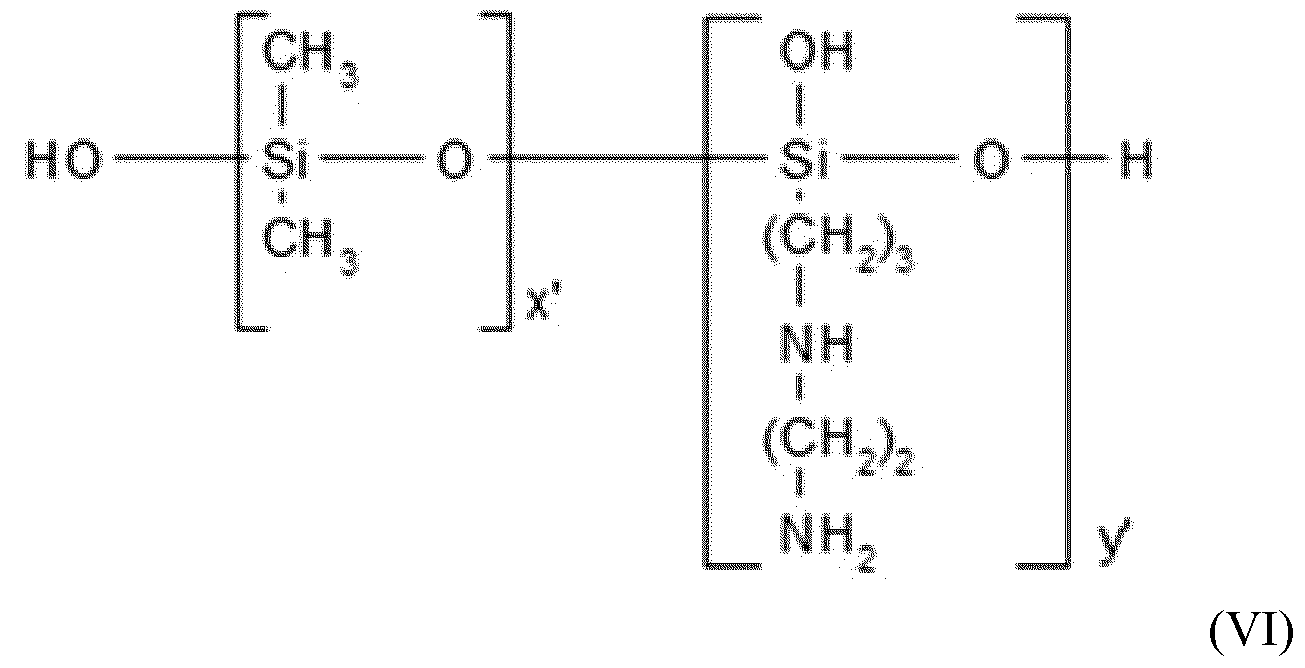 in which x’ and y’ are integers such that the weight-average molecular mass (Mw) is between 5000 and 500 000 g/mol; b) the amino silicones corresponding to formula (VII):
R,aG3-a-Si(0SiG2)n-(0SiGbR,2-b)m-0-SiG3-a’-R,a’ (VII) in which:
- G, which may be identical or different, denotes a hydrogen atom or a group from among phenyl, OH, Ci-Cs alkyl, for example methyl, or C i-Cx alkoxy, for example methoxy;
- a and a’, which may be identical or different, denote 0 or an integer from 1 to 3, in particular 0, with the proviso that at least one from among a and a’ is equal to zero,
- b denotes 0 or 1, in particular 1,
- m and n are numbers such that the sum (n + m) ranges from 1 to 2000 and in particular from 50 to 150, n possibly denoting a number from 0 to 1999 and notably from 49 to 149, and m possibly denoting a number from 1 to 2000 and notably from 1 to 10; and
- R’, which may be identical or different, denotes a monovalent radical of formula -CqH2qL in which q is a number ranging from 2 to 8 and L is an optionally quaternized amino group chosen from the following groups:
 • -NR”-Q-N+(R”)3 A-, in which R”, which may be identical or different, denotes hydrogen, phenyl, benzyl, or a saturated monovalent hydrocarbon-based radical, for example a C1-C20 alkyl radical; Q denotes a linear or branched group of formula Crhhr, r being an integer ranging from 2 to 6, preferably from 2 to 4; and A represents a cosmetically acceptable anion, notably a halide such as fluoride, chloride, bromide or iodide.
According to a first embodiment, the amino silicones corresponding to formula (VII) are chosen from the silicones known as “trimethyl silyl amodimethicone” corresponding to formula (VIII):
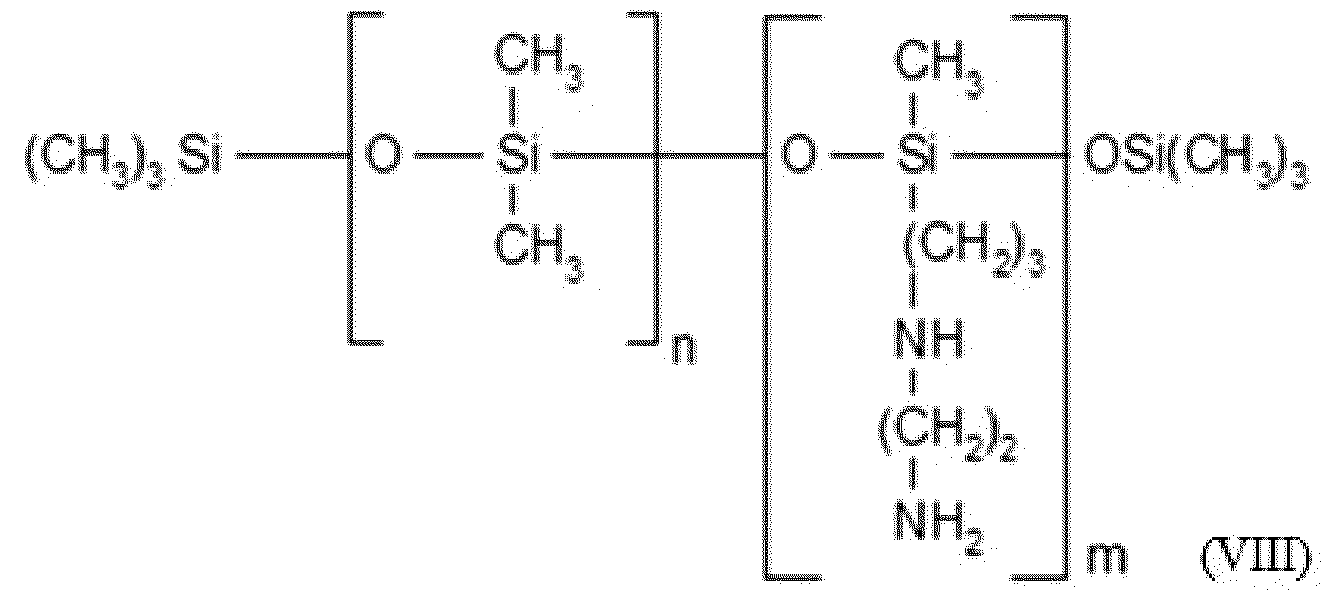 in which m and n are numbers such that the sum (n + m) ranges from 1 to 2000 and in particular from 50 to 150, n possibly denoting a number from 0 to 1999 and notably from 49 to 149, and m possibly denoting a number from 1 to 2000 and notably from 1 to 10.
According to a second embodiment, the amino silicones corresponding to formula (VII) are chosen from the silicones of formula (IX) below:
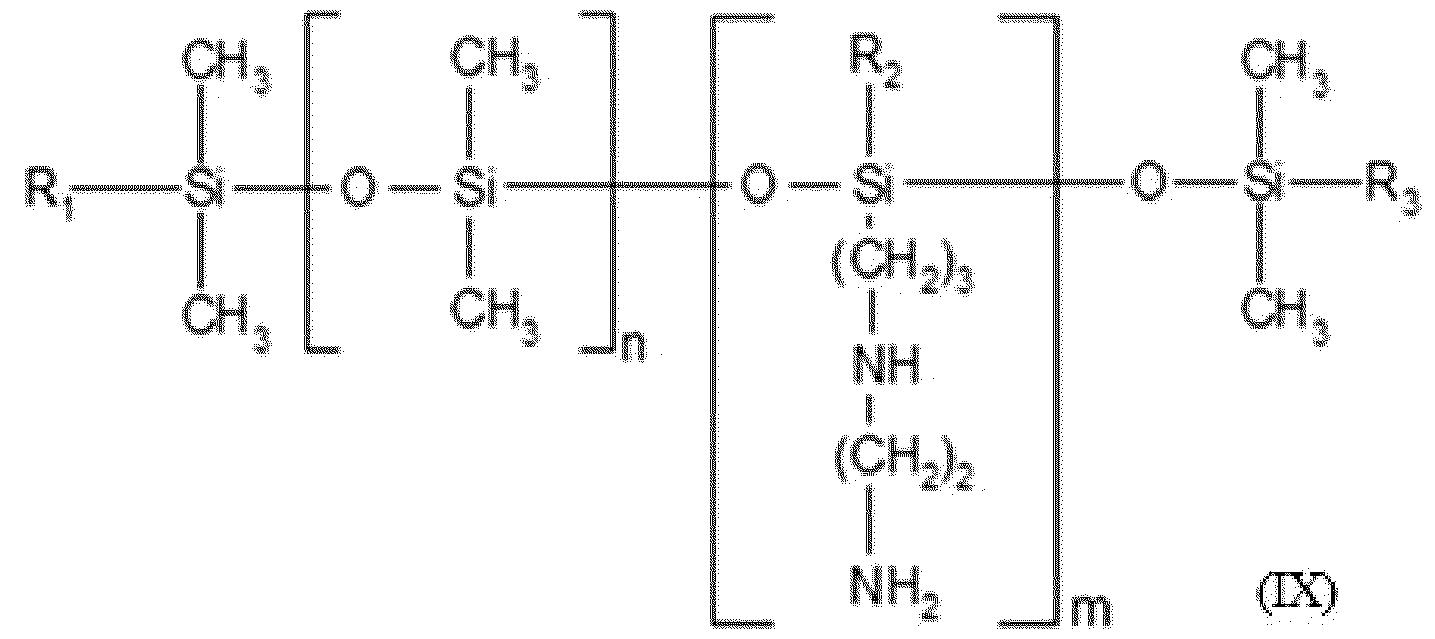 in which:
- m and n are numbers such that the sum (n + m) ranges from 1 to 1000, notably from 50 to 250 and more particularly from 100 to 200; n denoting a number from 0 to 999 and notably from 49 to 249 and more particularly from 125 to 175, and m denoting a number from 1 to 1000, notably from 1 to 10 and more particularly from 1 to 5; and
in which:
- m and n are numbers such that the sum (n + m) ranges from 1 to 1000, notably from 50 to 250 and more particularly from 100 to 200; n denoting a number from 0 to 999 and notably from 49 to 249 and more particularly from 125 to 175, and m denoting a number from 1 to 1000, notably from 1 to 10 and more particularly from 1 to 5; and
- Ri, R2 and R3, which may be identical or different, represent a hydroxyl or C1-C4 alkoxy radical, at least one of the radicals Ri to R3 denoting an alkoxy radical.
Preferably, the alkoxy radical is a methoxy radical.
The hydroxy/alkoxy mole ratio preferably ranges from 0.2:1 to 0.4:1 and preferably from 0.25:1 to 0.35:1 and more particularly is equal to 0.3:1.
The weight-average molecular mass (Mw) of these silicones preferably ranges from 2000 to 1 000000 g/mol and more particularly from 3500 to 200000 g/mol.
According to a third embodiment, the amino silicones corresponding to formula (VII) are chosen from the silicones of formula (X) below:
 in which:
- p and q are numbers such that the sum (p + q) ranges from 1 to 1000, in particular from 50 to 350 and more particularly from 150 to 250; p denoting a number from 0 to 999, notably from 49 to 349 and more particularly from 159 to 239, and q denoting a number from 1 to 1000, notably from 1 to 10 and more particularly from 1 to 5; and
- Ri and R2, which are different, represent a hydroxyl or C1-C4 alkoxy radical, at least one of the radicals Ri or R2 denoting an alkoxy radical.
Preferably, the alkoxy radical is a methoxy radical.
The hydroxy/alkoxy mole ratio generally ranges from 1:0.8 to 1:1.1 and preferably from 1:0.9 to 1:1 and more particularly is equal to 1:0.95.
The weight-average molecular mass (Mw) of the silicone preferably ranges from 2000 to 200 000 g/mol, more preferentially from 5000 to 100 000 g/mol and in particular from 10 000 to 50 000 g/mol.
The commercial products comprising silicones of structure (IX) or (X) may include in their composition one or more other amino silicones, the structure of which is different from formula (IX) or (X).
A product containing amino silicones of structure (IX) is sold by the company Wacker under the name Belsil® ADM 652.
A product containing amino silicones of structure (X) is sold by Wacker under the name Fluid WR 1300®. Another product containing amino silicones of structure (IX) is sold by Wacker under the name Belsil ADM LOG 1®.
When these amino silicones are used, one particularly advantageous embodiment consists in using them in the form of an oil-in-water emulsion. The oil- in-water emulsion may comprise one or more surfactants. The surfactants may be of any nature but are preferably cationic and/or nonionic. The number-average size of the silicone particles in the emulsion generally ranges from 3 nm to 500 nm. Preferably, notably as amino silicones of formula (X), use is made of microemulsions of which the mean particle size ranges from 5 nm to 60 nm (limits included) and more particularly from 10 nm to 50 nm (limits included). Thus, use may be made according to the invention of the amino silicone microemulsions of formula (X) sold under the names Finish CT 96 E® or SLM 28020® by the company Wacker.
According to a fourth embodiment, the amino silicones corresponding to formula (VII) are chosen from the silicones of formula (XI) below:
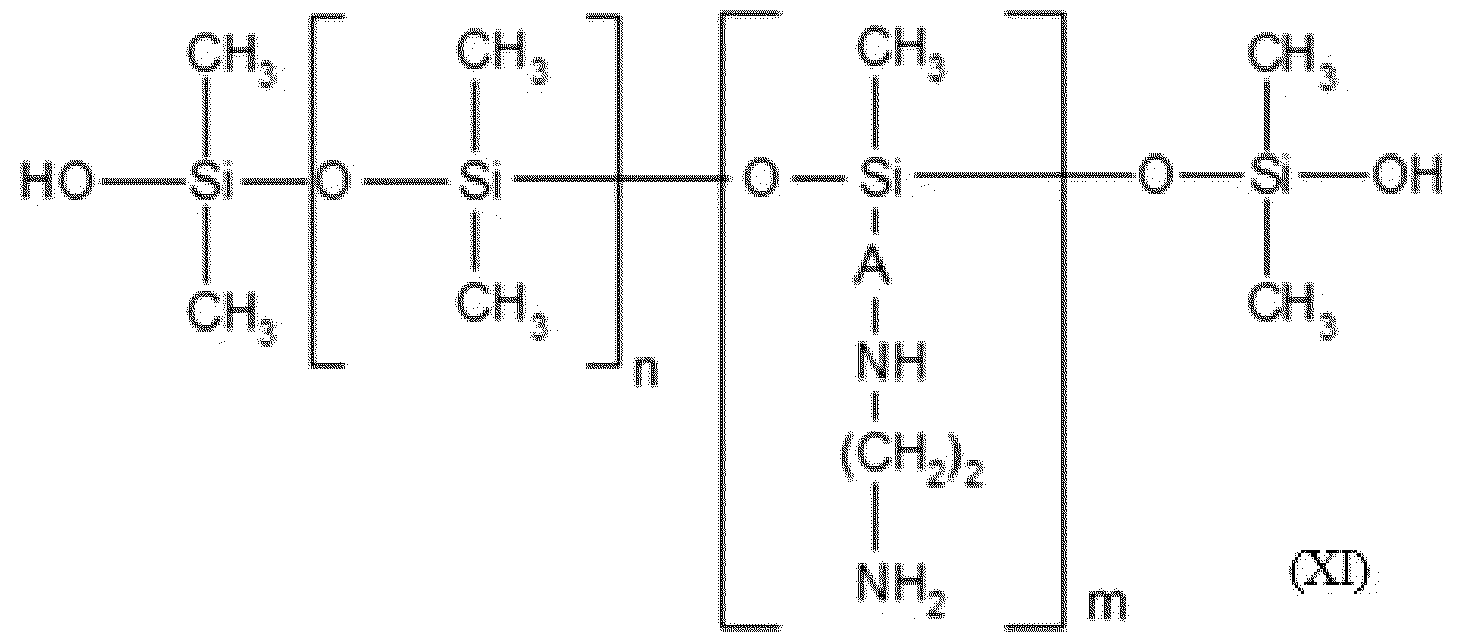 in which:
- m and n are numbers such that the sum (n + m) ranges from 1 to 2000 and in particular from 50 to 150, n denoting a number from 0 to 1999 and notably from 49 to 149, and m denoting a number from 1 to 2000 and notably from 1 to 10; and
in which:
- m and n are numbers such that the sum (n + m) ranges from 1 to 2000 and in particular from 50 to 150, n denoting a number from 0 to 1999 and notably from 49 to 149, and m denoting a number from 1 to 2000 and notably from 1 to 10; and
- A denotes a linear or branched alkylene radical containing from 4 to 8 carbon atoms and preferably 4 carbon atoms. This radical is preferably linear.
The weight-average molecular mass (Mw) of these amino silicones preferably ranges from 2000 to 1 000 000 g/mol and more particularly from 3500 to 200000 g/mol.
A silicone corresponding to this formula is, for example, Xiameter MEM 8299 Emulsion from Dow Corning.
According to a fifth embodiment, the amino silicones corresponding to formula (VII) are chosen from the silicones of formula (XII) below:
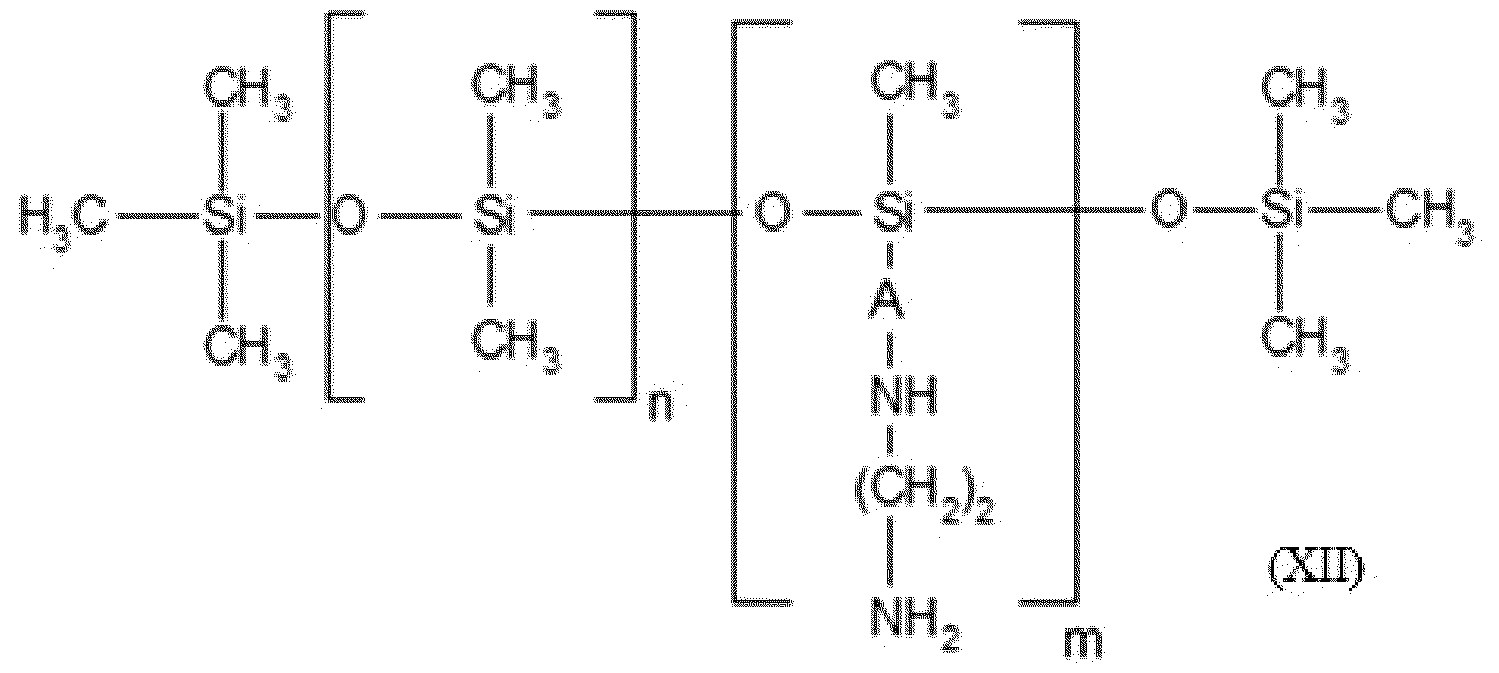 in which:
- m and n are numbers such that the sum (n + m) ranges from 1 to 2000 and in particular from 50 to 150, n possibly denoting a number from 0 to 1999 and notably from 49 to 149, and m possibly denoting a number from 1 to 2000 and notably from 1 to 10; and
- A denotes a linear or branched alkylene radical containing from 4 to 8 carbon atoms and preferably 4 carbon atoms. This radical is preferably branched.
The weight-average molecular mass (Mw) of these amino silicones preferably ranges from 500 to 1 000 000 g/mol and more particularly from 1000 to 200000 g/mol.
A silicone corresponding to this formula is, for example, DC2-8566 Amino Fluid from Dow Coming; c) the amino silicones corresponding to formula (XIII):
 in which:
- R? represents a monovalent hydrocarbon-based radical containing from 1 to 18 carbon atoms, and in particular a Ci-Cis alkyl or C2-C18 alkenyl radical, for example methyl;
- Re represents a divalent hydrocarbon-based radical, notably a Ci-Cis alkylene radical or a divalent C1-C18, for example Ci-Cx, alkyleneoxy radical linked to the Si via an SiC bond;
- Q is an anion such as a halide ion, notably chloride, or an organic acid salt, notably acetate;
- r represents a mean statistical value ranging from 2 to 20 and in particular from 2 to 8; and
- s represents a mean statistical value ranging from 20 to 200 and in particular from 20 to 50.
Such amino silicones are notably described in patent US 4 185 087. d) the quaternary ammonium silicones of formula (XIV):
 in which:
- R.7, which may be identical or different, represent a monovalent hydrocarbon-based radical containing from 1 to 18 carbon atoms, and in particular a C1-C18 alkyl radical, a C2-C18 alkenyl radical or a ring comprising 5 or 6 carbon atoms, for example methyl;
- R.6 represents a divalent hydrocarbon-based radical, notably a C1-C18 alkylene radical or a divalent C1-C18, for example Ci-Cs, alkyleneoxy radical linked to the Si via an SiC bond;
- R8, which may be identical or different, represent a hydrogen atom, a monovalent hydrocarbon-based radical containing from 1 to 18 carbon atoms, and in particular a Ci-Cis alkyl radical, a C2-C18 alkenyl radical or a radical -R6-NHCOR7;
- X is an anion such as a halide ion, notably chloride, or an organic acid salt, notably acetate; and
- r represents a mean statistical value ranging from 2 to 200 and in particular from 5 to 100.
Such amino silicones are notably described in patent application EP-A 0 530
974. e) the amino silicones of formula (XV):
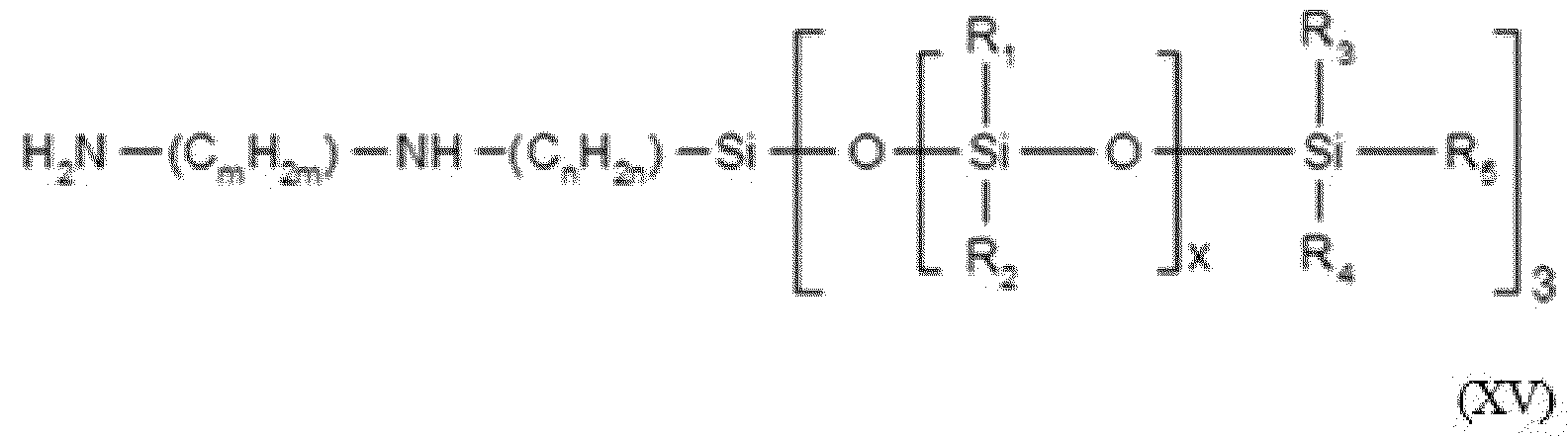 in which:
- Ri, R2, R3 and R4, which may be identical or different, denote a C1-C4 alkyl radical or a phenyl group, - R5 denotes a C1-C4 alkyl radical or a hydroxyl group,
- n is an integer ranging from 1 to 5,
- m is an integer ranging from 1 to 5, and
- x is chosen such that the amine number ranges from 0.01 to 1 meq/g; f) multiblock polyoxyalkylene amino silicones, of the type (AB)n, A being a polysiloxane block and B being a polyoxyalkylene block including at least one amine group.
Said silicones are preferably formed from repeating units having the following general formulae:
[-(SiMe20)xSiMe2-R-N(R, ,)-R,-0(C2H40)a(C3H60)b-R,-N(H)-R-] or alternatively
[-(SiMe20)xSiMe2-R-N(R, ,)-R,-0(C2H40)a(C3H60)b-] in which:
- a is an integer greater than or equal to 1, preferably ranging from 5 to 200 and more particularly ranging from 10 to 100;
- b is an integer between 0 and 200, preferably ranging from 4 to 100 and more particularly between 5 and 30;
- x is an integer ranging from 1 to 10 000 and more particularly from 10 to
5000; - R” is a hydrogen atom or a methyl;
- R, which may be identical or different, represent a linear or branched divalent C2-C12 hydrocarbon-based radical, optionally including one or more heteroatoms such as oxygen; preferably, R, which may be identical or different, denote an ethylene radical, a linear or branched propylene radical, a linear or branched butylene radical or a CH2CH2CH20CH2CH(0H)CH2- radical; preferentially, R denote a CH2CH2CH20CH2CH(0H)CH2- radical; and
- R’, which may be identical or different, represent a linear or branched divalent C2-C12 hydrocarbon-based radical, optionally including one or more heteroatoms such as oxygen; preferably, R’, which may be identical or different, denote an ethylene radical, a linear or branched propylene radical, a linear or branched butylene radical or a CH2CH2CH20CH2CH(0H)CH2- radical; preferentially, R’ denote -CH(CH3)-CH2-.
The siloxane blocks preferably represent between 50 mol% and 95 mol% of the total weight of the silicone, more particularly from 70 mol% to 85 mol%. The amine content is preferably between 0.02 and 0.5 meq/g of copolymer in a 30% solution in dipropylene glycol, more particularly between 0.05 and 0.2.
The weight-average molecular mass (Mw) of the silicone is preferably between 5000 and 1 000000 g/mol and more particularly between 10000 and 200000 g/mol. Mention may notably be made of the silicones sold under the name Silsoft A-
843 or Silsoft A+ by Momentive. g) the amino silicones of formulae (XVI) and (XVII):
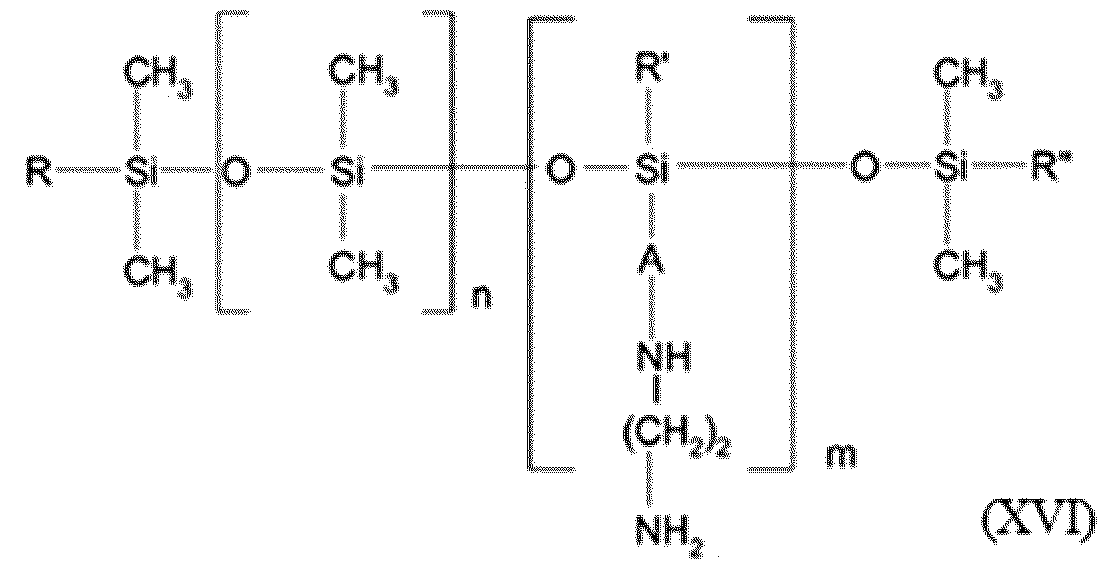 in which:
- R, R’ and R”, which may be identical or different, denote a C1-C4 alkyl group or a hydroxyl group,
- A denotes a C3 alkylene radical; and
- m and n are numbers such that the weight-average molecular mass of the compound is between 5000 and 500000;
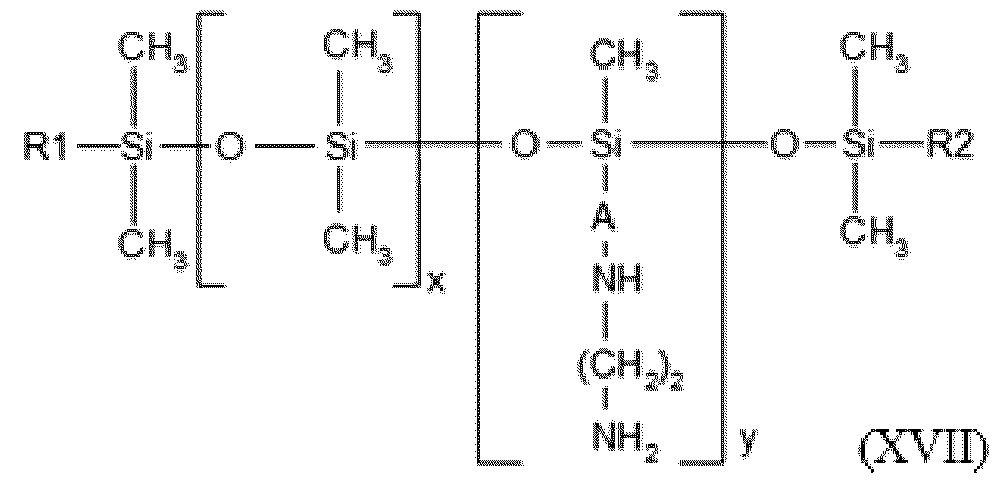 in which:
- x and y are numbers ranging from 1 to 5000; preferably, x ranges from 10 to 2000 and more preferentially from 100 to 1000; preferably, y ranges from 1 to 100;
- Ri and R2, which may be identical or different, preferably identical, denote a linear or branched, saturated or unsaturated alkyl group comprising from 6 to 30 carbon atoms, preferably from 8 to 24 carbon atoms and more preferentially from 12 to 20 carbon atoms; and - A denotes a linear or branched alkylene radical containing from 2 to 8 carbon atoms.
Preferably, A comprises from 3 to 6 carbon atoms, more preferentially 4 carbon atoms; preferably, A is branched.
Mention may be made in particular of the following divalent groups: -CH2CH2CH2- and -CH2CH(CH3)CH2-.
Preferably, Ri and R2 are independent saturated linear alkyl groups comprising 6 to 30 carbon atoms, preferably 8 to 24 carbon atoms and in particular from 12 to 20 carbon atoms; mention may be made in particular of dodecyl, tetradecyl, pentadecyl, hexadecyl, heptadecyl, octadecyl, nonadecyl and eicosyl groups; and preferentially, Ri and R2, which may be identical or different, are chosen from hexadecyl (cetyl) and octadecyl (stearyl) groups.
The amino silicone(s) are preferably of formula (XVII) with:
- x ranging from 10 to 2000 and in particular from 100 to 1000;
- y ranging from 1 to 100;
- A comprising from 3 to 6 carbon atoms and notably 4 carbon atoms; preferably, A is branched; more particularly, A is chosen from the following divalent groups: -CH2CH2CH2 and -CH2CH(CH3)CH2-; and
- Ri and R2 independently being saturated linear alkyl groups comprising from 6 to 30 carbon atoms, preferably from 8 to 24 carbon atoms and in particular from 12 to 20 carbon atoms; chosen notably from dodecyl, tetradecyl, pentadecyl, hexadecyl, heptadecyl, octadecyl, nonadecyl and eicosyl groups; preferentially, Ri and R2, which may be identical or different, are chosen from hexadecyl (cetyl) and octadecyl (stearyl) groups.
A silicone of formula (XVII) that is preferred is bis-cetearyl amodimethicone. Mention may be made in particular of the amino silicone sold under the name Silsoft AX by Momentive. h) polysiloxanes and notably polydimethylsiloxanes, including primary amine groups at only one chain end or on side chains, such as those of formula (XVIII), (XIX) or (XX):
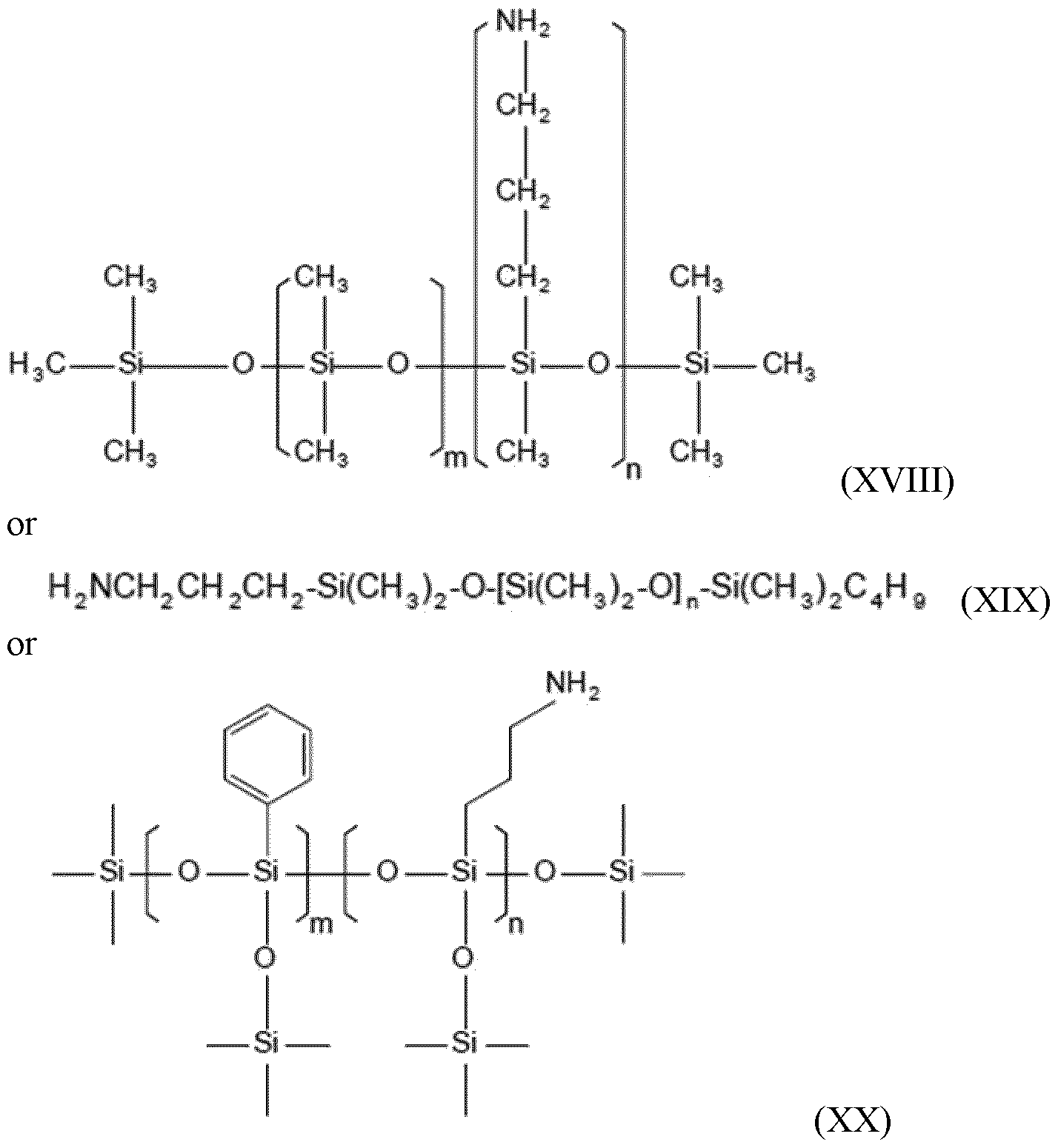 In formula (XVIII), the values of n and m are such that the weight-average molecular mass of the amino silicone is between 1000 and 55 000.
As examples of amino silicones of formula (XVIII), mention may be made of the products sold under the names AMS-132, AMS-152, AMS-162, AMS-163, AMS- 191 and AMS- 1203 by the company Gelest and KF-8015 by the company Shin-Etsu.
In formula (XIX), the value of n is such that the weight-average molecular mass of the amino silicone is between 500 and 3000.
As examples of amino silicones of formula (XIX), mention may be made of the products sold under the names MCR-A11 and MCR-A12 by the company Gelest.
In formula (XX), the values of n and m are such that the weight-average molecular mass of the amino silicone is between 500 and 50 000.
As examples of amino silicones of formula (XX), mention may be made of the aminopropyl phenyl trimethicone sold under the name DC 2-2078 Fluid by the company Dow Coming. i) and mixtures thereof.
The fatty substance(s) (v) with a melting point of less than or equal to 35°C at atmospheric pressure are preferably chosen from linear or branched G to Ci6 alkanes, linear or branched hydrocarbons of more than 16 carbon atoms of mineral or synthetic origin, non-polyoxyalkylenated fatty alcohols, fatty acids, triglycerides, fatty acid and/or fatty alcohol esters, silicones and mixtures thereof; these compounds being liquid at 35°C at atmospheric pressure, and more preferentially liquid at 28°C at atmospheric pressure.
Advantageously, the fatty substance(s) (ii) with a melting point of less than or equal to 35°C at atmospheric pressure are chosen from triglycerides, esters of fatty acids and/or fatty alcohols, linear or branched hydrocarbons of more than 16 carbon atoms of mineral or synthetic origin, silicones and mixtures thereof, and preferably from isopropyl myristate, coconut oil, caprylic/capric acid triglycerides, triacetin, liquid petroleum jelly, liquid paraffin, amodimethicone and mixtures thereof.
The total content of the fatty substance(s) (v) with a melting point of less than or equal to 35°C at atmospheric pressure is preferably greater than or equal to 0.1% by weight; more preferentially, this total content ranges from 0.2% to 10% by weight and better still from 0.25% to 5% by weight, relative to the total weight of the composition.
The weight ratio (Ra) between the total content of surfactants (i.e. the sum of the total contents of anionic, amphoteric or zwitterionic and optionally additional surfactants) and the total content of fatty substances with a melting point of less than
or equal to 35°C at atmospheric pressure is advantageously greater than or equal to 1, preferably greater than or equal to 2; preferentially, this weight ratio (Ra) ranges from 5 to 40 and better still from 10 to 35.
According to a particular embodiment, the composition is preferably in the form of an oil-in-water emulsion, the oil particles of which advantageously have a number-average size of less than or equal to 200 nm, preferably between 1 and 150 nm, more preferentially between 2 and 100 nm, better still between 3 and 50 nm, even more preferentially between 4 and 30 nm, or even between 5 and 20 nm.
The number-average size of the particles (or oil drops) may be determined in particular according to the known method of quasi-elastic light scattering. As a machine that may be used for this determination, mention may be made of the machine from Brookhaven equipped with an SX 200 optical bed (with a 532 nm laser) and a BI 9000 correlator. This machine gives a measurement of the mean diameter by photon correlation spectroscopy (PCS), which makes it possible to determine the numerical mean diameter from the polydispersity factor, which is also measured by the machine. This measurement may also be performed using a Zetasizer Nano ZS machine from Malvern Instruments which makes it possible to determine the mean diameter weighted by the scattered intensity (and not weighted by the mass, the number or the volume), and also the polydispersity index.
In addition, the composition according to the invention has very low polydispersity, i.e. the particles (or oil drops) have very homogeneous size. The particles present in the composition according to the invention are droplets of oily phase comprising the fatty substance(s) (v) and the propellant(s) (iii), in the continuous aqueous phase.
The nonionic surfactants
The composition according to the present invention may also optionally comprise one or more nonionic surfactants.
Examples of nonionic surfactants that may be used in the compositions of the present invention are described, for example, in the Handbook of Surfactants by M.R. Porter, published by Blackie & Son (Glasgow and London), 1991, pages 116-178. They are notably chosen from alcohols, a-diols, (Ci-C2o)alkylphenols or fatty acids, these compounds being polyethoxylated, polypropoxylated or polyglycerolated and bearing at least one fatty chain including, for example, from 8 to 18 carbon atoms, the
number of ethylene oxide or propylene oxide groups possibly ranging notably from 1 to 100, and the number of glycerol groups possibly ranging notably from 1 to 30.
Mention may also be made of condensates of ethylene oxide and of propylene oxide with fatty alcohols; polyethoxylated fatty amides preferably containing from 1 to 30 ethylene oxide units, polyglycerolated fatty amides including on average 1 to 5, and in particular 1.5 to 4 glycerol groups, ethoxylated fatty acid esters of sorbitan containing from 2 to 30 ethylene oxide units, fatty acid esters of sucrose, fatty acid esters of polyethylene glycol, (C6 to C24 alkyl)polyglycosides, N-(C6 to C24 alkyl)glucamine derivatives, amine oxides such as (C10 to C14 alkyl)amine oxides or N-(Cio to C14 acyl)aminopropylmorpholine oxides.
The nonionic surfactant(s) that may be used according to the present invention may be chosen more particularly from polyoxyalkylenated fatty alcohols such as polyethoxylated and/or polypropoxylated and/or polyglycerolated fatty alcohols, the number of ethylene oxide and/or propylene oxide groups possibly ranging from 1 to 100, and the number of glycerol groups possibly ranging from 2 to 30.
Preferably, the polyoxyethylenated fatty alcohols are chosen from the nonionic surfactants of formula (XXI):
R-0-(CH2-CH2-0)n-H (XXI) in which:
R is a linear or branched Cx to C40 alkenyl radical; and n is an integer ranging from 6 to 20.
Preferably, R represents a linear or branched C12 to C30, more preferentially Ci6 to C20, alkenyl radical.
Preferably, n represents an integer ranging from 8 to 12.
Advantageously, R represents a linear or branched Ci6 to C20 alkenyl radical; and/or n represents an integer ranging from 8 to 12.
Preferably, the nonionic surfactant(s) of formula (XXI) are chosen from oleyl alcohol containing 8 mol of ethylene oxide, oleyl alcohol containing 10 mol of ethylene oxide and oleyl alcohol containing 12 mol of ethylene oxide, and mixtures thereof; and more preferentially, the nonionic surfactant of formula (XXI) is oleyl alcohol containing 10 mol of ethylene oxide (INCI name: Oleth-10).
Other polyoxyethylenated fatty alcohols such as oleth-3, oleth-5, laureth-4, ceteareth-10, ceteareth-20, oleth-30 and mixtures thereof may also be used.
The nonionic surfactant(s) may be chosen from ethoxylated fatty acid esters of sorbitan containing from 2 to 30 ethylene oxide units.
Mention may be made in particular of the polyoxyethylenated C8-C30 (preferably C12-C18) fatty acid esters (notably monoesters, diesters and triesters) of sorbitan notably containing from 2 to 20 mol of ethylene oxide, which may be chosen from polyoxyethylenated esters of C12-C18 fatty acids, in particular lauric, myristic, cetylic or stearic acid, of sorbitan notably containing from 2 to 30 mol of ethylene oxide, such as:
- polyoxyethylenated sorbitan monolaurate (4 OE) (Polysorbate-21),
- polyoxyethylenated sorbitan monolaurate (20 OE) (Polysorbate-20),
- polyoxyethylenated sorbitan monopalmitate (20 OE) (Polysorbate-40),
- polyoxyethylenated sorbitan monostearate (20 OE) (Polysorbate-60),
- polyoxyethylenated sorbitan monostearate (4 OE) (Polysorbate-61),
- polyoxyethylenated sorbitan monooleate (20 OE) (Polysorbate-80),
- polyoxyethylenated sorbitan monooleate (5 OE) (Polysorbate-81),
- polyoxyethylenated sorbitan tristearate (20 OE) (Polysorbate-65),
- polyoxyethylenated sorbitan trioleate (20 OE) (Polysorbate-85).
The nonionic surfactant(s) that may be used according to the present invention may be chosen more particularly from nonionic alkyl(poly)glycoside surfactants and mixtures thereof.
The term “alkyl(poly)glycoside” denotes an alkylpolyglycoside or an alkylmonoglycoside, also referred to in the present patent application as an alkylglycoside, which may be alkoxylated with one or more alkylene oxide groups, preferentially of C2-C4.
The alkyl(poly)glycoside nonionic surfactant(s) used, alone or as mixtures, in accordance with the present invention may be represented by formula (XXII) below: RiO-(R20)t(G)v (XXII) in which formula (VI):
- Ri represents a linear or branched, saturated or unsaturated alkyl group including from 8 to 24 carbon atoms, or an alkylphenyl group in which the linear or branched alkyl group includes from 8 to 24 carbon atoms,
- R2 represents an alkylene group including from about 2 to 4 carbon atoms,
- G represents a saccharide unit including 5 or 6 carbon atoms,
- 1 denotes a value ranging from 0 to 10 and preferably 0 to 4, and
- v denotes a value ranging from 1 to 15.
Preferably, the alkyl(poly)glycoside nonionic surfactant(s) correspond to formula (XXII) in which:
- Ri denotes a linear or branched, saturated or unsaturated alkyl group including from 8 to 18 carbon atoms,
- G denotes glucose, fructose or galactose, preferably glucose,
- 1 denotes a value ranging from 0 to 3, and is preferably equal to 0, and
- R2 and v are as defined previously.
The degree of polymerization of the alkyl(poly)glycoside nonionic surfactant(s) as represented, for example, by the index v in formula (XXII) ranges on average from 1 to 15 and preferably from 1 to 4. This degree of polymerization more particularly ranges from 1 to 2 and better still from 1.1 to 1.5, on average.
The glycoside bonds between the saccharide units are 1,6- or 1,4- bonds; preferably 1,4- bonds.
The alkyl(poly)glycoside nonionic surfactants that may be used in the present invention are preferably alkyl(poly)glycosides notably represented by the products sold by the company Cognis under the names Plantaren® (600 CS/U, 1200 and 2000) or Plantacare® (818, 1200 and 2000). Use may also be made of the products sold by the company SEPPIC under the names Triton CG 110 (or Oramix CG 110) and Triton CG 312 (or Oramix® NS 10), the products sold by the company BASF under the name Lutensol GD 70 or the products sold by the company Chem Y under the name AGIO LK, or the products sold by the company Evonik Goldschmidt under the trade names Tego Care CG 90 or Tego Care CG 90 MB.
The nonionic surfactant(s) may be chosen from silicone nonionic surfactants and mixtures thereof.
The term “silicone compound” means a compound which comprises at least one (-Si-O-) group.
The silicone surfactants that may be used may be water-soluble, spontaneously water-dispersible or water-insoluble. Preferably, they are water-soluble or spontaneously water-dispersible.
Preferably, the silicone surfactants are oxyalkylenated, preferably oxyethylenated.
The silicone surfactants may be chosen from the compounds of formulae (XXIII), (XXIV), (XXV), (XXVI) and (XXVII) below:
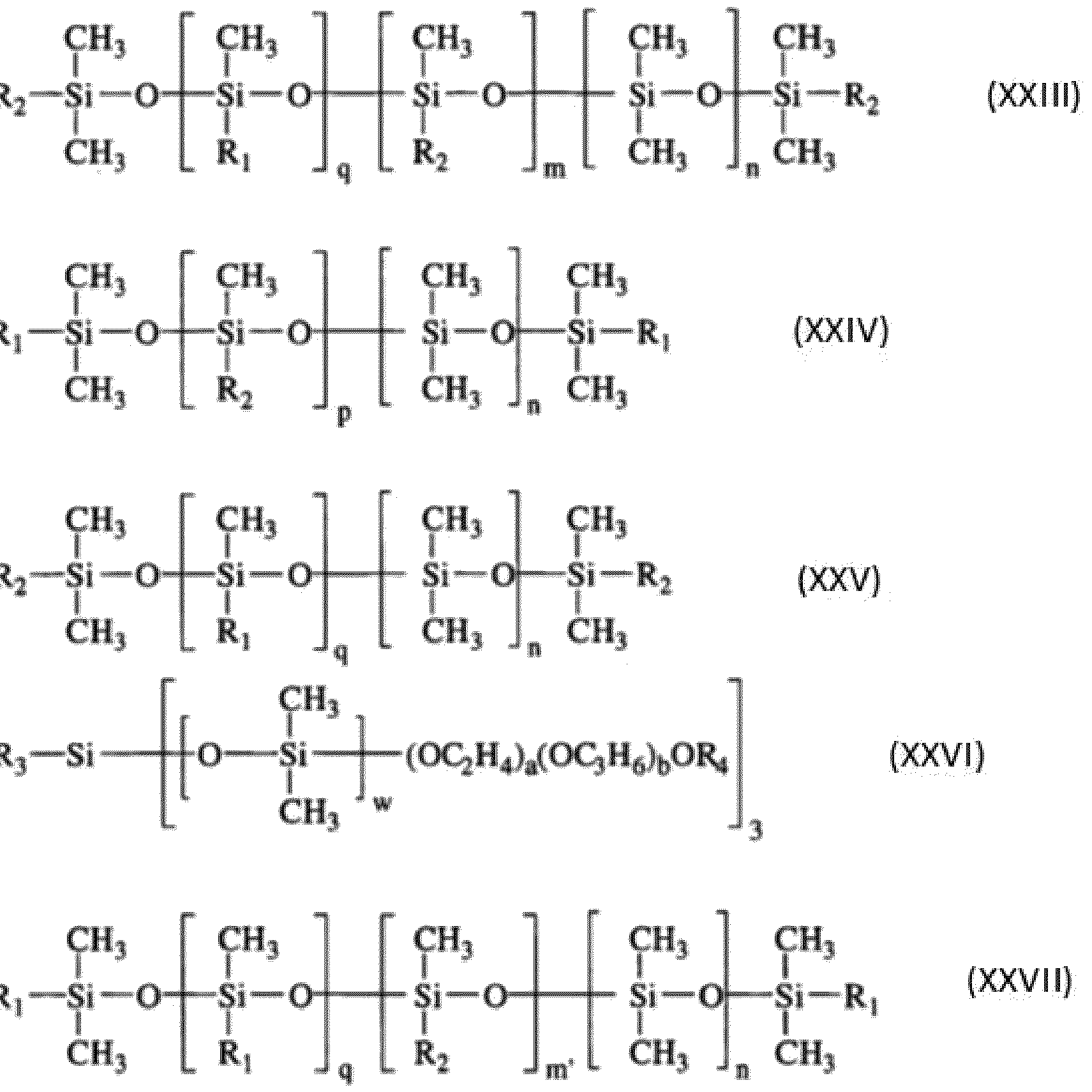 in which:
- Ri, which may be identical or different, represents a linear or branched Ci- C30 alkyl radical or a phenyl radical;
- R3 and R4, which may be identical or different, denote a linear or branched C1-C12 alkyl radical, preferably a methyl radical;
- R2, which may be identical or different, represent a group -(CH2)c-0- (C2H40)a’-(C3H60)b’-R5 or -(CH2)c-0-(C4H80)a’-R5 in which a’ ranges from 0 to 50; b’ ranges from 0 to 50 and a’+b’ is greater than or equal to 1; c ranges from 0 to 4; and
- R5, which may be identical or different, is chosen from a hydrogen atom, a linear or branched alkyl group including from 1 to 12 carbon atoms; a linear or branched alkoxy group including from 1 to 6 carbon atoms; a linear or branched acyl group including from 2 to 12 carbon atoms; a hydroxyl group, a group -SO3M, a group
-OCOR6, a Ci-Ce aminoalkoxy group optionally substituted on the amine with one or two C1-C4 alkyl radicals, optionally bearing at least one hydroxyl group; a C2-C6 aminoacyl group optionally substituted on the amine with one or two C1-C4 alkyl radicals, optionally bearing at least one hydroxyl group; a group -NHCH2CH2COOM, a group -N(CH2CH2COOM)2; a C1-C12 aminoalkyl group, optionally substituted on the amine and on the alkyl chain with one or two C1-C4 alkyl radicals, optionally bearing at least one hydroxyl group, a C1-C30 carboxyacyl group, a phosphono group optionally substituted with one or two substituted C1-C12 aminoalkyl groups, a group -CO(CH2)dCOOM, a group -OCOCHR7(CH2)dCOOM, a group -NHCO(CH2)dOH, a group -NH3Y; in which M, which may be identical or different, denotes a hydrogen atom, Na, K, Li, NLL or an organic amine; R.6 denotes a linear or branched C1-C30 alkyl group; R7 denotes a hydrogen atom or a group SO3M; d ranges from 1 to 10; and Y represents an anion such as a halide (chloride, bromide), a sulfate, or a carboxylate (acetate, lactate, citrate);
- m ranges from 0 to 20;
- m’ ranges from 1 to 20;
- n ranges from 0 to 500;
- p ranges from 1 to 50;
- q ranges from 0 to 20;
- w varies from 1 to 100;
- a ranges from 0 to 50; b ranges from 0 to 50; and a+b is greater than or equal to 1, in formula (XXVI).
Preferably, the silicone surfactants correspond to the general formulae (XXIII), (XXIV) or (XXVII) as defined above, and more particularly correspond to: in which formulae (XXIII) or (XXIV) at least one, preferably all, of the following conditions are satisfied:
- Ri denotes a methyl group;
- R2 represents a group -(CH2)c-0-(C2H40)a -(C 3H60)b -R5, with c = 2 or 3;
- R2 represents a group -(CH2)c-0-(C2H40)a -(C3H60)b -R5, with Rs representing a hydrogen atom, a methyl group or an acetyl group; preferably a hydrogen atom;
- R2 represents a group -(CH2)c-0-(C2H40)a -(C3H60)b -R5, with a’ ranging from 1 to 25 and more particularly from 2 to 25;
- R2 represents a group -(CH2)c-0-(C2H40)a -(C3H60)b -R5, with b’ ranging from 0 to 25; preferably, b’ is equal to 0;
- n ranges from 0 to 100; and/or
- p ranges from 1 to 20; or to formula (XXVII) in which at least one, preferably all, of the following conditions are satisfied:- Ri denotes a methyl or cetyl group; - R.2 represents a group -(CH2)c-0-(C2H40)a -(C 3H60)b -R5, with c = 2 or 3;
- R2 represents a group -(CH2)c-0-(C2H40)a -(C3H60)b -R5, with Rs representing a hydrogen atom, a methyl group or an acetyl group; preferably a hydrogen atom;
- R2 represents a group -(CH2)c-0-(C2H40)a -(C3H60)b -R5, with a’ ranging from 1 to 25 and more particularly from 2 to 25;
- R2 represents a group -(CH2)c-0-(C2H40)a -(C3H60)b -R5, with b’ ranging from 0 to 25, preferably, from 1 to 20;
- n and q range from 0 to 100; and/or
- m’ ranges from 1 to 20. More preferentially, the silicone surfactants may be chosen from the compounds of formula (XXIV) in which, Ri denotes a methyl group, and R2 is a group -(CH2)c-0-(C2H40)a -(C3H60)b -R5 with c equal to 2 or 3; a’ ranges from 2 to 25, b’ ranges from 0 to 25, Rs denotes a hydrogen atom or a methyl group; such as compounds of formula
CH CH CH 0H
 group or the compounds of formula (XXVII) such that:
 in which R is a cetyl group, X = 10, Y = 1, n = 1 to 200, o = 1 to 100, and m = 1 to 40 or in which o and y are 0 and X = 11, n = 1 to 200, and m = 1 to 40.
By way of example, the silicone nonionic surfactants may be chosen from PEG-dimethicone, for instance PEG- 10 dimethicone, PEG- 12 dimethicone, PEG- 14 dimethicone, PEG- 11 methyl ether dimethicone, and/or alkyl PEG/PPG dimethicone, for instance PEG/PPG- 10/1 cetyl dimethicone, PEG/PPG- 18/18 dimethicone, PEG/PPG- 14/4 dimethicone.
Mention may notably be made of the silicone surfactants sold under the trade names Fluid DC 193 and DC 5225C by the Dow Corning company, Silwet® L 77 by the company OSI, and Mazil® 756 by the company Mazer PPG, KF-6017 by the company Shin-Etsu and Abil EM 90 from Evonik.
Preferably, the nonionic surfactant(s) are chosen from polyoxyethylenated fatty alcohols, alkyl (poly)glycosides, ethoxylated fatty acid esters of sorbitan containing from 2 to 30 ethylene oxide units, silicone surfactants and mixtures thereof, and more preferentially from oleth-10, polysorbate 80, decyl glucoside, cocoyl glucoside, lauryl glucoside, PEG-11 methyl ether dimethicone, and mixtures thereof.
The total content of the nonionic surfactant(s), when they are present in the composition according to the invention, preferably ranges from 0.1% to 10% by weight and more preferentially from 0.2% to 5% by weight, relative to the total weight of the composition.
The fixing polymers
The composition according to the present invention may optionally also comprise one or more fixing polymers.
For the purposes of the present invention, the term “fixing polymer” means any polymer that is capable, by application to the hair, of giving a shape to the head of hair or of holding an already acquired shape.
All the anionic, amphoteric, cationic and nonionic fixing polymers and mixtures thereof used in the art may be used in the composition according to the present patent application.
Preferably, the fixing polymer(s) according to the invention are chosen from nonionic fixing polymers and anionic fixing polymers, and mixtures thereof, and more preferentially from anionic fixing polymers and mixtures thereof.
The anionic fixing polymers generally used are polymers including groups derived from carboxylic, sulfonic or phosphoric acid, and have a number-average molecular mass of between about 500 and 5 000 000.
The carboxylic groups are provided by unsaturated mono- or dicarboxylic acid monomers, such as those corresponding to formula (XXVIII):

/ \
¾ R,
(XXVIII) in which:
- n is an integer from 0 to 10,
- Ai denotes a methylene group, optionally connected to the carbon atom of the unsaturated group or to the adjacent methylene group, when n is greater than 1, via a heteroatom, such as oxygen or sulfur,
- R? denotes a hydrogen atom or a phenyl or benzyl group,
- R-8 denotes a hydrogen atom or a lower alkyl or carboxyl group,
- R? denotes a hydrogen atom, a lower alkyl group or a -CH2-COOH, phenyl or benzyl group.
In the abovementioned formula, a lower alkyl group preferably denotes a group containing 1 to 4 carbon atoms and in particular methyl and ethyl groups.
The anionic fixing polymers containing carboxylic groups that are preferred according to the invention are:
A) copolymers of acrylic or methacrylic acid (also known as (meth)acrylic acid) or salts thereof.
Among these polymers, mention may be made of copolymers of acrylic or methacrylic acid with a monoethylenic monomer, such as ethylene, styrene, vinyl esters or acrylic or methacrylic acid esters, optionally grafted to a polyalkylene glycol, such as polyethylene glycol, and optionally crosslinked. Such polymers are described in particular in French patent 1 222 944 and German patent application 2 330 956, the copolymers of this type including an optionally N-alkylated and/or hydroxyalkylated acrylamide unit in their chain as described notably in Luxembourg patent applications 75370 and 75371. Mention may also be made of copolymers of acrylic acid and of Ci to C4 alkyl methacrylate and terpolymers of vinylpyrrolidone, of acrylic acid and of Ci to C20 alkyl methacrylate, for example lauryl methacrylate, such as that sold by ISP
under the name Acrylidone® LM (INCI name: VP/acrylates/lauryl methacrylate copolymer), acrylic acid/ethyl acrylate/N-(t-butyl)acrylamide terpolymers, such as the products Ultrahold® Strong and Ultrahold® 8 sold by the company BASF (INCI name: Acrylates/t-butylacrylamide copolymer), methacrylic acid/ethyl aery 1 at e//<? /7-butyl acrylate terpolymers, such as the products sold under the name Luvimer® 100 P or Luvimer® PRO 55 by the company BASF (INCI name: Acrylates copolymer), copolymers of methacrylic acid and of ethyl acrylate, such as the products sold under the name Luvimer® MAE or Luviflex® Soft by the company BASF (INCI name: Acrylates copolymer), acrylic acid/butyl acrylate/methyl methacrylate terpolymers, such as the product sold under the name Balance® CR by the company Akzo Nobel (INCI name: Acrylates copolymer), or the copolymers of methacrylic acid and of methyl methacrylate sold under the name Eudragit® L 100 by the company Rohm Pharma (INCI name: Acrylates copolymer). Mention may also be made of branched block polymers containing (meth)acrylic acid monomers, such as the product sold under the name Fixate® G-100L by the company Lubrizol (INCI name: AMP- acrylates/allyl methacrylate copolymer);
B) Crotonic acid copolymers, such as those including vinyl acetate or propionate units in their chain and optionally other monomers such as allylic esters or methallylic esters, vinyl ether or vinyl ester of a linear or branched saturated carboxylic acid with a long hydrocarbon-based chain, such as those including at least 5 carbon atoms, these polymers possibly being grafted or crosslinked, or alternatively another vinyl, allylic or methallylic ester monomer of an a- or b-cyclic carboxylic acid. Such polymers are described, inter alia , in French patents 1 222 944, 1 580 545, 2265 782, 2265 781, 1 564 110 and 2439798. Commercial products which fall into this category are the products Resyn® 28-2930 and 28-1310 sold by the company Akzo Nobel (INCI names: VA / crotonates / vinyl decanoate copolymer and VA / crotonates copolymer, respectively). Mention may also be made of the products Luviset® CA 66 sold by the company BASF, Aristoflex® A60 sold by the company Clariant (INCI name: VA / crotonates copolymer) and Mexomere® PW or PAM sold by the company Chimex (INCI name: VA / vinyl butyl benzoate / crotonates copolymer);
C) copolymers of Cr-Cx monounsaturated carboxylic acids or anhydrides chosen from:
- copolymers comprising (i) one or more maleic, fumaric or itaconic acids or anhydrides and (ii) at least one monomer chosen from vinyl esters, vinyl ethers, vinyl halides, phenylvinyl derivatives, acrylic acid and esters thereof, the anhydride
functions of these copolymers optionally being monoesterified or monoamidated. Such polymers are described, in particular, in US patents 2 047 398, 2 723 248 and 2 102 113, and GB patent 839 805. Commercial products are notably those sold under the names Gantrez® AN or ES by the company ISP, such as Gantrez® ES 225 (INCI name: Ethyl ester of PVM / MA copolymer) or Gantrez® ES 425L (INCI name: Butyl ester of PVM / MA copolymer);
- copolymers comprising (i) one or more maleic, citraconic or itaconic anhydride units and (ii) one or more monomers chosen from allylic or methallylic esters optionally including one or more acrylamide, methacrylamide, a-olefm, acrylic or methacrylic ester, acrylic or methacrylic acid or vinylpyrrolidone groups in their chain, the anhydride functions of these copolymers optionally being monoesterified or monoamidated.
These polymers are described, for example, in patents FR 2 350 384 and FR 2 357 241;
D) polyacrylamides including carboxylate groups.
The fixing polymers bearing units derived from sulfonic acid may be chosen from:
A’) homopolymers and copolymers including vinylsulfonic, styrenesulfonic, naphthalenesulfonic or acrylamidoalkylsulfonic units.
These polymers may notably be chosen from:
- polyvinylsulfonic acid salts with a molecular mass of between 1000 and 100 000 approximately, and also the copolymers with an unsaturated comonomer such as acrylic or methacrylic acids and esters thereof, and also acrylamide or derivatives thereof, vinyl ethers and vinylpyrrolidone;
- polystyrenesulfonic acid salts such as the sodium salts that are sold for example under the name Flexan® II by AkzoNobel (INCI name: Sodium polystyrene sulfonate). These compounds are described in patent FR 2 198 719;
- polyacrylamidosulfonic acid salts, such as those mentioned in patent US 4 128 631, and more particularly the polyacrylamidoethylpropanesulfonic acid sold under the name Rheocare® HSP-1180 by Cognis (INCI name: polyacrylamidomethylpropane sulfonic acid);
B’) Sulfonic polyesters, these polymers being advantageously obtained by polycondensation of at least one dicarboxylic acid, of at least one diol or of a mixture
of diol and of diamine, and of at least one difunctional monomer including a sulfonic function. Among these polymers, mention may be made of:
- linear sulfonic polyesters such as those described in patent applications US 3 734 874, US 3 779 993, US 4 119 680, US 4 300 580, US 4 973 656, US 5 660 816, US 5 662 893 and US 5 674 479. Such polymers are, for example, the products Eastman® AQ38S Polymer, Eastman® AQ55S Polymer and Eastman® AQ48 Ultra Polymer sold by the company Eastman Chemical (name Polyester-5) which are copolymers obtained from di ethylene glycol, from 1,4-cyclohexanedimethanol, from isophthalic acid and from sulfoisophthalic acid salt;
- branched sulfonic polyesters such as those described in patent applications WO 95/18191, WO 97/08261 and WO 97/20899. Such compounds are, for example, the products Eastman® AQ10D Polymer (name: Polyester-13) or Eastman® AQ1350 Polymer sold by the company Eastman Chemical (name: Polyester- 13).
According to the invention, the anionic fixing polymer(s) are preferably chosen from acrylic acid copolymers, such as the acrylic acid/ethyl acrylate/N-ieri- butyl acrylamide terpolymers notably sold under the name Ultrahold® Strong by the company BASF, copolymers derived from crotonic acid, such as the vinyl acetate/vinyl ieri-butylbenzoate/crotonic acid terpolymers and the crotonic acid/vinyl acetate/vinyl neododecanoate terpolymers notably sold under the name Resyn 28-2930 by the company AkzoNobel, polymers derived from maleic, fumaric or itaconic acids or anhydrides with vinyl esters, vinyl ethers, vinyl halides, phenylvinyl derivatives and acrylic acid and esters thereof, such as the methyl vinyl ether/monoesterified maleic anhydride copolymers sold, for example, under the names Gantrez® ES 425L or ES 225 by the company ISP, the copolymers of methacrylic acid and of ethyl acrylate sold under the name Luvimer® MAE by the company BASF, and the vinyl acetate/crotonic acid copolymers sold under the name Luviset® CA 66 by the company BASF, and the vinyl acetate/crotonic acid copolymers grafted with polyethylene glycol sold under the name Aristoflex® A60 by the company Clariant, the vinylpyrrolidone/acrylic acid/lauryl methacrylate terpolymers sold under the name Acrylidone® LM by the company ISP, the polymer sold under the name Fixate® G-100L by the company Lubrizol, the vinyl acetate / crotonic acid / vinyl p-/<? /7-butyl benzoate copolymers sold under the names Mexomere® PW or PAM by the company Chimex.
The total amount of the anionic fixing polymer(s), when they are present in the composition of the invention, preferably ranges from 0.1% to 20% by weight, more
preferentially from 0.2% to 15% by weight, and better still from 0.3% to 10% by weight, relative to the total weight of the composition.
The amphoteric fixing polymers that may be used in accordance with the invention may be chosen from polymers including units B and C randomly distributed in the polymer chain, where B denotes a unit derived from a monomer including at least one basic nitrogen atom and C denotes a unit derived from an acidic monomer including one or more carboxylic or sulfonic groups or else B and C can denote groups derived from zwitterionic carboxybetaine or sulfobetaine monomers;
B and C may also denote a cationic polymer chain including primary, secondary, tertiary or quaternary amine groups, in which at least one of the amine groups bears a carboxylic or sulfonic group connected via a hydrocarbon-based group or alternatively B and C form part of a chain of a polymer bearing an ethylene-a,b- dicarboxylic unit in which one of the carboxylic groups has been made to react with a polyamine including one or more primary or secondary amine groups.
The amphoteric fixing polymers corresponding to the definition given above that are more particularly preferred are chosen from the following polymers:
(1) copolymers bearing acidic vinyl units and basic vinyl units, such as those resulting from the copolymerization of a monomer derived from a vinyl compound bearing a carboxylic group such as, more particularly, acrylic acid, methacrylic acid, maleic acid, a-chloroacrylic acid, and of a basic monomer derived from a substituted vinyl compound containing at least one basic atom, such as, more particularly, dialkylaminoalkyl methacrylate and acrylate, dialkylaminoalkylmethacrylamide and acrylamide. Such compounds are described in patent US 3 836 537;
(2) polymers including units derived: a) from at least one monomer chosen from acrylamides and methacrylamides substituted on the nitrogen atom with an alkyl group, b) from at least one acidic comonomer containing one or more reactive carboxylic groups, and c) from at least one basic comonomer such as esters bearing primary, secondary, tertiary and quaternary amine substituents of acrylic and methacrylic acids and the product of quaternization of dimethylaminoethyl methacrylate with dimethyl or diethyl sulfate.
The N-substituted acrylamides or methacrylamides that are more particularly preferred according to the invention are compounds in which the alkyl groups include
from 2 to 12 carbon atoms and more particularly N-ethylacrylamide, N-tert- butyl acrylamide, N-tert-octylacrylamide, N-octyl acrylamide, N-decylacrylamide, N- dodecyl acrylamide and the corresponding methacrylamides.
The acidic comonomers are more particularly chosen from acrylic acid, methacrylic acid, crotonic acid, itaconic acid, maleic acid and fumaric acid and alkyl monoesters, containing 1 to 4 carbon atoms, of maleic or fumaric acids or anhydrides.
The preferred basic comonomers are aminoethyl, butylaminoethyl, N,N’- dimethylaminoethyl and N-tert-butylaminoethyl methacrylates.
The copolymers of which the INCI name is Octylacrylamide/acrylates/butylaminoethyl methacrylate copolymer, such as the products sold under the names Amphomer®, Amphomer® LV71 or Balance® 47 by the company Akzo Nobel, are particularly used;
(3) partially or totally acylated and crosslinked polyaminoamides derived from polyaminoamides of general formula (XXIX):
 in which:
- Rio represents a divalent group derived from a saturated dicarboxylic acid, from an aliphatic mono- or dicarboxylic acid bearing an ethylenic double bond, from an ester of a lower alkanol containing from 1 to 6 carbon atoms of these acids, or from a group derived from the addition of any one of said acids to a bis-primary or bis- secondary amine, and
- Z denotes a group derived from a bis-primary, mono- or bis-secondary polyalkylene polyamine and preferably represents: a) in proportions of from 60 mol% to 100 mol%, the group (XXX)
 in which x = 2 and p = 2 or 3, or x = 3 and p = 2, this group being derived from diethylenetriamine, triethylenetetramine or dipropylenetriamine, b) in proportions of from 0 to 40 mol%, the group (XXX) above in which x = 2 and p = 1 and which is derived from ethylenediamine, or the group derived from piperazine:
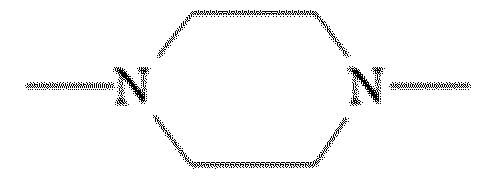 c) in proportions of from 0 to 20 mol%, the -NH-(CH2)6-NH- group derived from hexamethylenediamine, these polyaminoamides being crosslinked by addition reaction of a difunctional crosslinking agent chosen from epihalohydrins, diepoxides, dianhydrides and bis-unsaturated derivatives, using from 0.025 to 0.35 mol of crosslinking agent per amine group of the polyaminoamide and acylated by the action of acrylic acid, chloroacetic acid or an alkane sultone, or salts thereof.
The saturated carboxylic acids are preferably chosen from acids containing 6 to 10 carbon atoms, such as adipic acid, 2,2,4-trimethyladipic acid, 2,4,4- trimethyladipic acid and terephthalic acid, and acids bearing an ethylenic double bond, for instance acrylic, methacrylic and itaconic acids.
The alkane sultones used in the acylation are preferably propane sultone or butane sultone; the salts of the acylating agents are preferably the sodium or potassium salts.
(4) polymers including zwitterionic units of formula (XXXI):
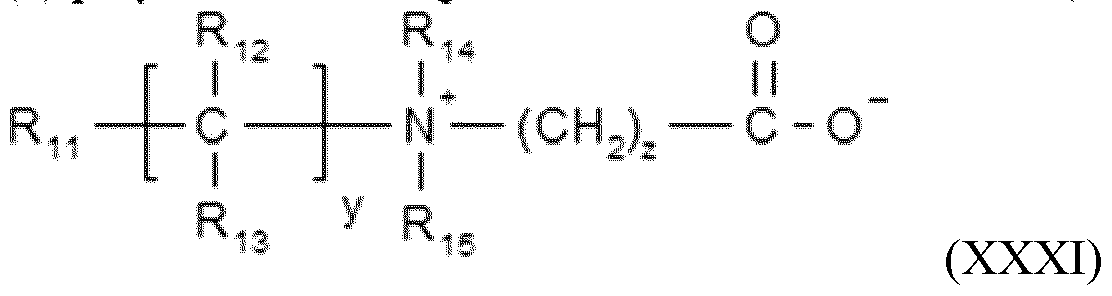 in which:
- Rn denotes a polymerizable unsaturated group such as an acrylate, methacrylate, acrylamide or methacrylamide group,
- y and z represent an integer from 1 to 3,
- Ri2 and Ri3 represent a hydrogen atom or a methyl, ethyl or propyl group, and
- Ri4 and Ris represent a hydrogen atom or an alkyl group such that the sum of the carbon atoms in Ri4 and Ris does not exceed 10.
The polymers comprising such units may also include units derived from non- zwitterionic monomers such as dimethyl- or di ethyl aminoethyl acrylate or methacrylate or alkyl acrylates or methacrylates, acrylamides or methacrylamides or vinyl acetate.
Mention may be made, by way of example, of methyl methacrylate/methyl dimethylcarboxymethylammonioethyl methacrylate copolymers, such as the product sold under the name Diaformer Z-301N or Z-301W by the company Clariant (INCI name: Acrylates copolymer).
(5) polymers derived from chitosan including monomer units corresponding to formulae (D), (E) and (F) below:
 unit (D) being present in proportions of between 0 and 30%, the unit (E) in proportions of between 5% and 50% and the unit (F) in proportions of between 30% and 90%, it being understood that, in this unit (F), Ri6 represents a group of formula (XXXII):
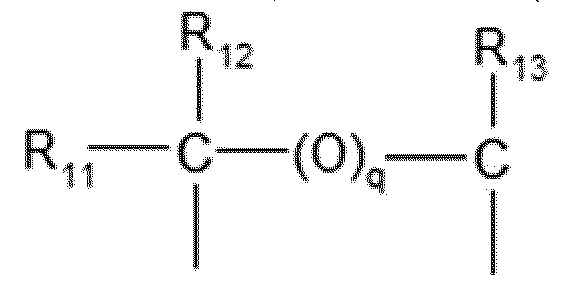 (XXXII) in which: if q = 0, Rn, Ri2 and Ri3, which may be identical or different, each represent a hydrogen atom, a methyl, hydroxyl, acetoxy or amino residue, a monoalkylamine residue or a dialkylamine residue that are optionally interrupted with one or more nitrogen atoms and/or optionally substituted with one or more amine, hydroxyl, carboxyl, alkylthio or sulfonic groups, an alkylthio residue in which the alkyl group bears an amino residue, at least one of the groups Rn, R12 and Rn being, in this case, a hydrogen atom; or, if q = 1, Rn, R12 and Rn each represent a hydrogen atom, and also the salts formed by these compounds with bases or acids.
(6) polymers containing units corresponding to the general formula (XXXIII) are described, for example, in French patent 1 400366:
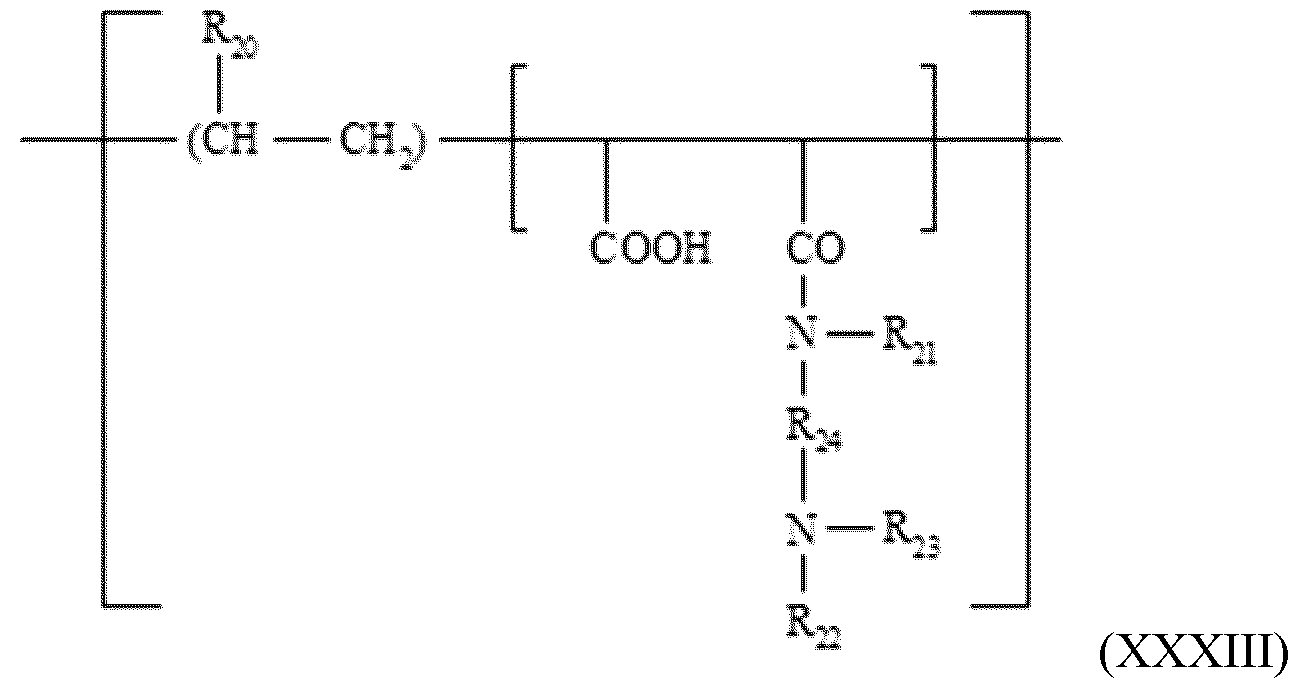 in which R20 represents a hydrogen atom, a CH3O-, CH3CH2O- or phenyl group, R21 denotes a hydrogen atom or a lower alkyl group such as methyl or ethyl, R22 denotes a hydrogen atom or a C1-C6 lower alkyl group such as methyl or ethyl, R23 denotes a C1-C6 lower alkyl group such as methyl or ethyl or a group corresponding to the formula: -R24-N(R22)2, with R24 representing a -CH2-CH2-, -CH2-CH2-CH2-, or -CH2-CH(CH3)- group and R22 having the meanings given above.
(7) polymers derived from the N-carboxyalkylation of chitosan, such as N-carboxymethyl chitosan or N-carboxybutyl chitosan, for instance the product sold under the name Chitoglycan by the company Sinerga SPA (INCI name: Carboxymethyl chitosan);
(8) amphoteric polymers of the -D-X-D-X type chosen from: a) polymers obtained by the action of chloroacetic acid or sodium chloroacetate on compounds including at least one unit of formula (XXXIV):
-D-X-D-X-D- (XXXIV) in which D denotes a group
 and X denotes the symbol E or E’, where E and E’, which may be identical or different, denote a divalent group that is an alkylene group with a straight or branched chain including up to 7 carbon atoms in the main chain, which is unsubstituted or substituted with hydroxyl groups and which may include, in addition to oxygen, nitrogen and sulfur atoms, 1 to 3 aromatic and/or heterocyclic rings; the oxygen, nitrogen and sulfur atoms being present in the form of ether, thioether, sulfoxide, sulfone, sulfonium, alkylamine or alkenylamine groups, hydroxyl, benzylamine, amine oxide, quaternary ammonium, amide, imide, alcohol, ester and/or urethane groups;
b) polymers of formula (XXXV): -D-X-D-X- (XXXV) in which D denotes a group
and X denotes the symbol E or E’, where E and E’, which may be identical or different, denote a divalent group that is an alkylene group with a straight or branched chain including up to 7 carbon atoms in the main chain, which is unsubstituted or substituted with hydroxyl groups and which may include, in addition to oxygen, nitrogen and sulfur atoms, 1 to 3 aromatic and/or heterocyclic rings; the oxygen, nitrogen and sulfur atoms being present in the form of ether, thioether, sulfoxide, sulfone, sulfonium, alkylamine or alkenylamine groups, hydroxyl, benzylamine, amine oxide, quaternary ammonium, amide, imide, alcohol, ester and/or urethane groups;
b) polymers of formula (XXXV): -D-X-D-X- (XXXV) in which D denotes a group
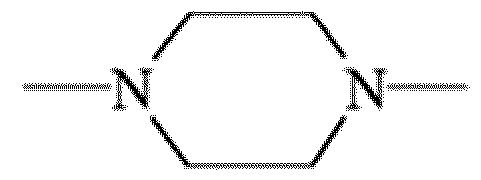 and X denotes the symbol E or E’ and at least once E’; E having the meaning given above and E’ being a divalent group that is an alkylene group with a straight or branched chain containing up to 7 carbon atoms in the main chain, which is unsubstituted or substituted with one or more hydroxyl groups and which includes one or more nitrogen atoms, the nitrogen atom being substituted with an alkyl chain that is optionally interrupted with an oxygen atom and which necessarily includes one or more carboxyl functions or one or more hydroxyl functions betainized by reaction with chloroacetic acid or sodium chloroacetate;
(9) (Ci-Cs)alkyl vinyl ether/maleic anhydride copolymers partially modified by semiamidation with an N,N-dialkylaminoalkylamine, such as N,N- dimethylaminopropylamine, or by semiesterification with an N,N- dialkylaminoalkanol. These copolymers may also include other vinyl comonomers, such as vinylcaprolactam.
Among the amphoteric fixing polymers mentioned above, the ones that are most particularly preferred according to the invention are those of family (3), such as the copolymers whose INCI name is octylacrylamide/acrylates/butylaminoethyl methacrylate copolymer, such as the products sold under the names Amphomer®, Amphomer® LV 71 or Balance® 47 by the company AkzoNobel and those of family (4) such as the copolymers of methyl methacrylate/methyl dimethylcarboxymethylammonioethyl methacrylate, sold, for example, under the name Diaformer Z-301N or Z-301W by the company Clariant.
The total amount of amphoteric fixing polymer(s), when they are present in the composition according to the invention, preferably ranges from 0.1% to 20% by weight, more preferentially from 0.2% to 15% by weight, and even better still from 0.3% to 10% by weight, relative to the total weight of the composition.
The cationic fixing polymers that may be used according to the present invention are preferably chosen from polymers including primary, secondary, tertiary and/or quaternary amine groups forming part of the polymer chain or directly attached thereto, and having a molecular weight of between 500 and approximately 5 000 000 and preferably between 1000 and 3 000 000.
Among these polymers, mention may be made more particularly of the following cationic polymers:
(1) homopolymers or copolymers derived from acrylic or methacrylic esters or amides and including at least one of the units of the following formulae:
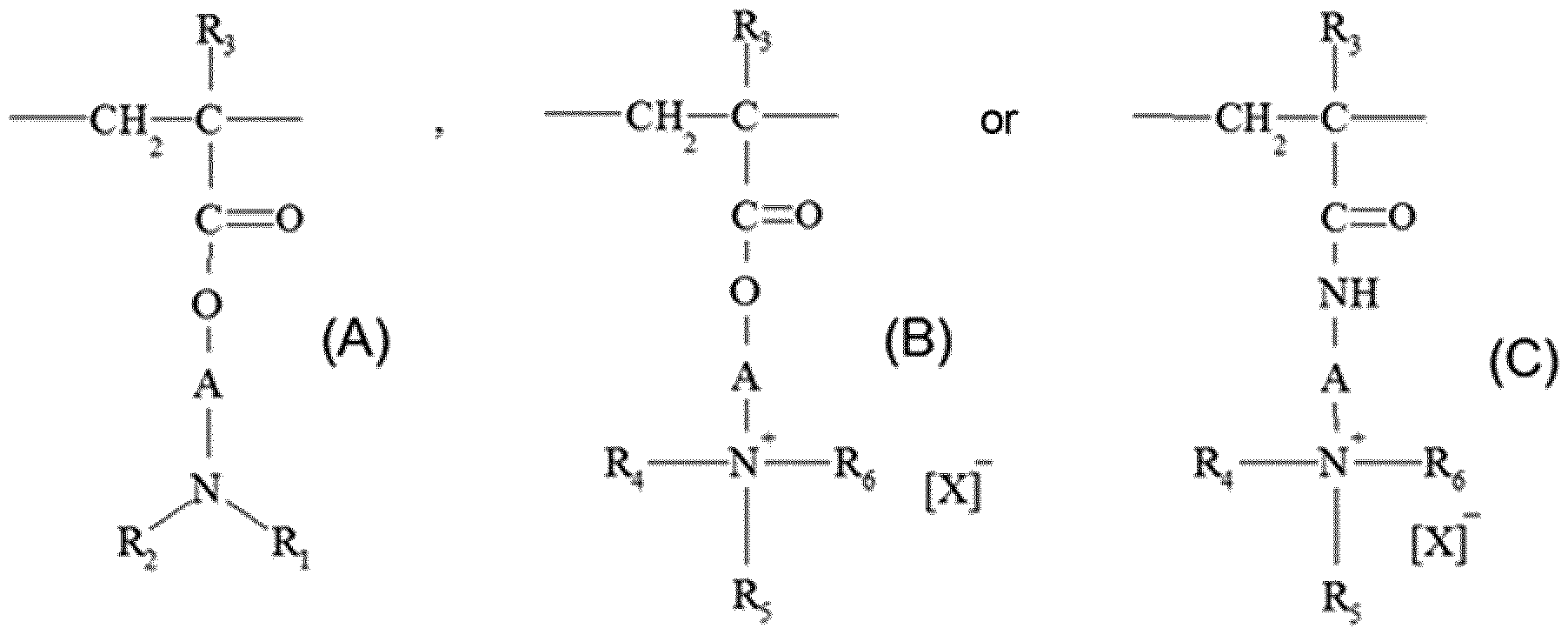 in which:
- R-3 denotes a hydrogen atom or a CH3 group;
- A is a linear or branched alkyl group including from 1 to 6 carbon atoms or a hydroxyalkyl group including from 1 to 4 carbon atoms;
- R4, R-3 and R.6, which may be identical or different, represent an alkyl group containing from 1 to 18 carbon atoms, or a benzyl group;
- Ri and R2, which may be identical or different, each represent a hydrogen atom or an alkyl group containing from 1 to 6 carbon atoms; and
- X denotes a methosulfate anion or a halide such as chloride or bromide.
The copolymers of class (1) also contain one or more units derived from comonomers which may be chosen from the class of acrylamides, methacrylamides, diacetone acrylamides, acrylamides and methacrylamides substituted on the nitrogen with Ci- to C4 alkyl groups, groups derived from acrylic or methacrylic acids or esters thereof, vinyllactams such as vinylpyrrolidone or vinylcaprolactam, and vinyl esters.
Thus, among these copolymers of class (1), mention may be made of:
- copolymers of acrylamide and of dimethylaminoethyl methacrylate quaternized with dimethyl sulfate or with a dimethyl halide, such as the product sold under the name Hercofloc® by the company Hercules,
- the copolymers of acrylamide and of methacryloyloxyethyl- trimethylammonium chloride described, for example, in patent application EP-A- 080976 and sold under the name Bina Quat P 100 by the company Ciba Geigy,
- the copolymer of acrylamide and methacryloyloxyethyltrimethylammonium methosulfate, such as the product sold under the name Reten by the company Hercules,
- quatemized or non-quaternized vinylpyrrolidone/dialkylaminoalkyl acrylate or methacrylate copolymers, such as the products sold under the name Gafquat® by the company ISP, for instance Gafquat® 734 or Gafquat® 755, or alternatively the products known as Copolymer® 845, 958 and 937. These polymers are described in detail in French patents 2 077 143 and 2 393 573,
- polymers bearing a fatty chain and bearing a vinylpyrrolidone unit, such as the products sold under the names Styleze W20L and Styleze W10 by the company ISP, dimethylaminoethyl methacrylate/vinylcaprolactam/vinylpyrrolidone terpolymers, such as the product sold under the name Gaffix VC 713 by the company ISP, and quaternized vinylpyrrolidone/dimethylaminopropylmethacrylamide copolymers, such as the products sold under the name Gafquat® HS 100 by the company ISP;
(2) cationic guar gums, preferably containing quaternary ammonium, such as those described in US patents 3 589 578 and 4 031 307, such as guar gums containing trialkylammonium cationic groups. Such products are notably sold under the trade names Jaguar C13 S, Jaguar C 15 and Jaguar C 17 by the company Meyhall.
(3) quaternary copolymers of vinylpyrrolidone and of vinylimidazole;
(4) chitosans or salts thereof; the salts that may be used are in particular chitosan acetate, lactate, glutamate, gluconate or pyrrolidonecarboxylate.
Among these compounds, mention may be made of chitosan having a degree of deacetylation of 90.5% by weight, sold under the name Kytan Brut Standard by the company Aber Technologies, and chitosan pyrrolidonecarboxylate sold under the name Kytamer® PC by the company Amerchol;
(5) cationic cellulose derivatives, such as copolymers of cellulose or of cellulose derivatives grafted with a water-soluble monomer including a quaternary ammonium and notably described in patent US 4 131 576, such as hydroxyalkylcelluloses, for example hydroxymethyl-, hydroxyethyl- or hydroxypropylcelluloses, grafted notably with a methacryloyloxyethyl- trimethylammonium, methacrylamidopropyltrimethylammonium or dimethyldiallylammonium salt.
The commercial products corresponding to this definition are more particularly the products sold under the names Celquat L 200 and Celquat H 100 by the company National Starch.
The total amount of the cationic fixing polymer(s), when they are present in the composition of the invention, preferably ranges from 0.1% to 20% by weight, more preferentially from 0.2% to 15% by weight, and better still from 0.3% to 10% by weight, relative to the total weight of the composition.
The nonionic fixing polymers that may be used according to the present invention are chosen, for example, from:
- polyalkyloxazolines;
- vinyl acetate homopolymers,
- vinyl acetate copolymers, for instance copolymers of vinyl acetate and of acrylic ester, copolymers of vinyl acetate and of ethylene, or copolymers of vinyl acetate and of maleic ester, for example of dibutyl maleate;
- homopolymers and copolymers of acrylic esters, for instance copolymers of alkyl acrylates and of alkyl methacrylates, such as the products sold by the company Rohm GmbH under the name Eudragit® NE 30 D (INCI name: Acrylates copolymer);
- copolymers of acrylonitrile and of a nonionic monomer chosen, for example, from butadiene and alkyl (meth)acrylates;
- styrene homopolymers;
- styrene copolymers, for instance copolymers of styrene, of alkyl acrylate and of alkyl methacrylate; copolymers of styrene and of butadiene; or copolymers of styrene, of butadiene and of vinylpyridine;
- polyamides;
- vinyllactam homopolymers, such as the vinylpyrrolidone homopolymers sold, for example, under the names Luviskol® K30 Powder by the company BASF or PVP K30L or K60 Solution or K90 by the company ISP, or such as the polyvinylcaprolactam sold under the name Luviskol® Plus by the company BASF (INCI name: PVP);
- vinyllactam copolymers, such as a poly(vinylpyrrolidone/vinyllactam) copolymer sold under the trade name Luvitec® VPC 55K65W by the company BASF, poly(vinylpyrrolidone/vinyl acetate) copolymers, such as those sold under the name PVP/VA® S630L, E735, E635 and W735 by the company ISP, Luviskol® VA 73, VA 64 and VA 37 by the company BASF (INCI name VP/VA copolymer); and vinylpyrrolidone/methacrylamide/vinylimidazole terpolymers, for instance the
product sold under the name Luviset® Clear by the company BASF (INCI name VP/methacrylamide/vinyl imidazole copolymer).
The alkyl groups of the nonionic polymers mentioned above preferably contain from 1 to 6 carbon atoms.
The content of the nonionic fixing polymer(s), present in the composition according to the invention, preferably ranges from 0.1% to 20% by weight, more preferentially from 0.2% to 15% by weight, and better still from 0.3% to 10% by weight, relative to the total weight of the composition.
Use may also be made, according to the invention, of fixing polymers of grafted silicone type comprising a polysiloxane portion and a portion composed of a non-silicone organic chain, one of the two portions constituting the main chain of the polymer and the other being grafted onto said main chain.
These polymers are described, for example, in patent applications EP-A-0412 704, EP-A-0 412 707, EP-A-0 640 105 and WO 95/00578, EP-A-0 582 152 and WO 93/23009, and patents US 4 693 935, US 4 728 571 and US 4 972 037.
These polymers may be amphoteric, cationic, anionic or nonionic and they are preferably anionic or nonionic.
Such polymers are, for example, copolymers that may be obtained by free radical polymerization from the monomer mixture formed from: a) 50% to 90% by weight of c/ -butyl acrylate, b) 0 to 40% by weight of acrylic acid, c) 5% to 40% by weight of a silicone macromer of formula:
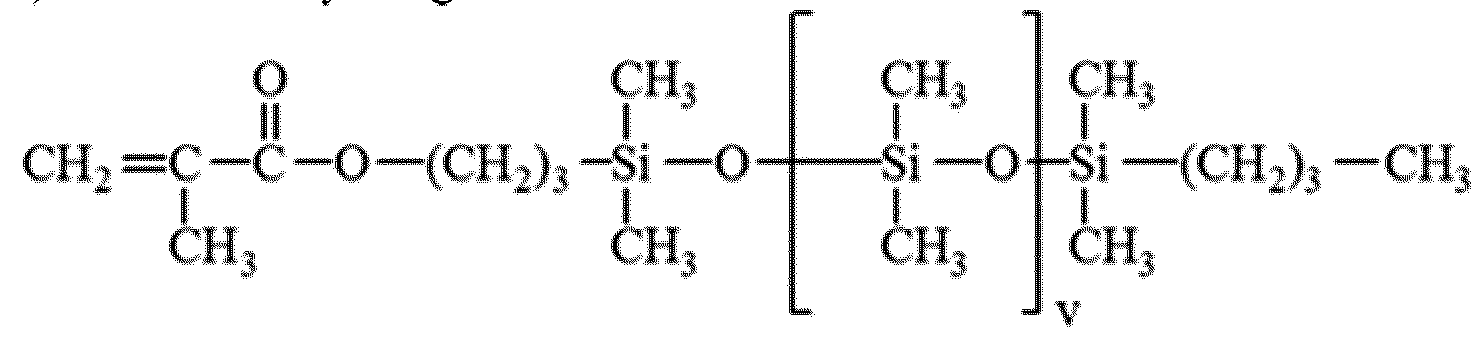 in which v is a number ranging from 5 to 700, the weight percentages being calculated relative to the total weight of the monomers.
Other examples of grafted silicone polymers are notably polydimethylsiloxanes (PDMSs) to which are grafted mixed polymer units of the poly((meth)acrylic acid) type and of the poly(alkyl (meth)acrylate) type via a thiopropylene-type connecting chain and polydimethylsiloxanes (PDMSs) to which polymer units of the poly(isobutyl (meth)acrylate) type are grafted via a thiopropylene- type connecting chain.
Grafted silicone polymers are sold, for example, under the names Silicone Plus Polymer® VS80 and VA70 by 3M (INCI names: Polysilicone-8 and Polysilicone- 7, respectively).
Another type of silicone fixing polymer that may be mentioned is the product Luviflex® Silk sold by the company BASF (INCI name: PEG/PPG-25/25 dimethicone/acrylates copolymer).
The total amount of fixing polymer(s) of grafted silicone type, when they are present in the composition of the invention, preferably ranges from 0.1% to 20% by weight, more preferentially from 0.2% to 15% by weight, and better still from 0.3% to 10% by weight, relative to the total weight of the composition.
Functionalized or non-functionalized, silicone or non-silicone, nonionic, anionic, cationic or amphoteric polyurethanes or mixtures thereof may also be used as fixing polymers.
The polyurethanes particularly targeted by the present invention are those described in patent applications EP 0 751 162, EP 0 637 600, EP 0 648 485 and FR 2 743 297, of which the applicant is the proprietor, and also in patent applications EP 0 656 021 and WO 94/03510 from the company BASF and EP 0 619 111 from the company National Starch.
As polyurethanes that are particularly suitable for use in the present invention, mention may be made of the products sold under the names Luviset PUR® and Luviset® Si PUR by the company BASF (INCI names: Polyurethane- 1 and Polyurethane-6, respectively).
The total amount of the polyurethane(s), when they are present in the composition of the invention, preferably ranges from 0.1% to 20% by weight, more preferentially from 0.2% to 15% by weight, and even better still from 0.3% to 10% by weight, relative to the total weight of the composition.
Preferably, the composition according to the invention also comprises one or more fixing polymers chosen from nonionic fixing polymers, anionic fixing polymers, and mixtures thereof; preferentially chosen from anionic fixing polymers and mixtures thereof; and better still chosen from copolymers of (meth)acrylic acid, copolymers derived from crotonic acid, polymers derived from maleic, fumaric or itaconic acids or anhydrides with vinyl esters, vinyl ethers, vinyl halides, phenylvinyl derivatives, acrylic acid or esters thereof, and mixtures thereof.
The total amount of the fixing polymer(s), when they are present in the composition of the invention, preferably ranges from 0.1% to 20% by weight, more
preferentially from 0.2% to 15% by weight, better still from 0.3% to 10% by weight, and even more preferentially from 0.5% to 5% by weight, relative to the total weight of the composition.
The composition according to the present invention may optionally also comprise sodium chloride, in a total content preferably ranging from 0.1% to 5% by weight and more preferentially from 0.1% to 2% by weight relative to the total weight of the composition.
The composition according to the present invention may also optionally comprise one or more additional compounds different from the compounds defined above, preferably chosen from cationic, anionic, nonionic and amphoteric polymers different from the fixing polymers defined previously, thickeners, silicones different from silicones defined previously, fatty substances different from the fatty substances (v) defined previously, antioxidants, penetrants, sequestrants, fragrances, buffers, dispersants, conditioning agents, UV-screening agents, film-forming agents, ceramides, preserving agents, opacifiers, lubricants (or anticaking agents) and mixtures thereof.
Preferably, when the above additional compound(s) are present in the composition according to the invention, the additional compound(s) are generally present in a content, for each of them, of between 0.01% and 20% by weight, relative to the weight of the composition.
Needless to say, a person skilled in the art will take care to select this or these optional additional compound(s) such that the advantageous properties intrinsically associated with the composition of the invention are not, or are not substantially, adversely affected by the envisaged addition(s).
The pH of the composition according to the invention generally ranges from 3 to 9, preferably from 3 to 7.5 and better still from 3.5 to 7.
The pH of the composition may be adjusted to the desired value by means of basifying agents or acidifying agents that are customarily used. Among the basifying agents, examples that may be mentioned include aqueous ammonia, alkanolamines, and mineral or organic hydroxides. Among the acidifying agents, examples which may be mentioned include mineral or organic acids, for instance hydrochloric acid, orthophosphoric acid, sulfuric acid, carboxylic acids, for instance acetic acid, tartaric acid, citric acid or lactic acid, and sulfonic acids.
Preferably, the viscosity of the composition may range from 0.1 Pa.s to 4 Pa.s, preferably from 0.5 Pa.s to 2 Pa.s measured at 25°C at a shear rate of 200 tr/min. The viscosity of the composition can be measured with a viscometer (Rheomat Mettler Toledo RM180 Rheomat).
Advantageously, the composition has a turbidity less than or equal to 250 NTU units, preferably less than or equal to 200 NTU units, and is in the form of an oil- in-water emulsion, the oil particles of which advantageously have a number-average size of less than or equal to 200 nm, preferably between 1 and 150 nm.
Advantageously, the composition has a turbidity less than or equal to 200 NTU units, preferably less than or equal to 150 NTU units, and is in the form of an oil- in-water emulsion, the oil particles of which advantageously have a number-average size between 2 and 100 nm, better still between 3 and 50 nm.
Advantageously, the composition has a turbidity less than or equal to 100 NTU units and is in the form of an oil-in-water emulsion, the oil particles of which advantageously have a number-average size between 2 and 100 nm, better still between 3 and 50 nm.
Advantageously, the composition has a turbidity less than or equal to 50 NTU units and is in the form of an oil-in-water emulsion, the oil particles of which advantageously have a number-average size between 3 and 50 nm, even more preferentially between 4 and 30 nm.
Advantageously, the composition has a turbidity less than or equal to 50 NTU units and is in the form of an oil-in-water emulsion, the oil particles of which advantageously have a number-average size between 5 and 20 nm.
Preferably, the composition according to the present invention is of single phase appearance and comprises:
(i) one or more anionic surfactants chosen from the group consisting of sulfate, sulfonate and/or carboxylate surfactants; the carboxylate surfactants being chosen among the group consisting of:
- acylglutamates, namely C6-C30 or even C8-C26, such as stearoylglutamates, and in particular disodium stearoylglutamate,
- acylsarcosinates, notably of C6-C30 or even C8-C26, such as palmitoylsarcosinates, and in particular sodium palmitoylsarcosinate,
- (C6-C3o)alkyl ether carboxylates, and notably (C8-C26)alkyl ether carboxylates;
- polyoxyalkylenated (C6-C3o)alkyl(amido) ether carboxylic acids, in particular those including from 2 to 50 ethylene oxide groups,
- and mixtures thereof;
(ii) one or more amphoteric or zwitterionic surfactants,
(iii) one or more propellants,
(iv) water
(v) one or more fatty substances with a melting point of less than or equal to 35°C at atmospheric pressure, preferably chosen among non-silicone fatty substances and the total content of the anionic surfactant(s) (i) being greater than or equal to 5% by weight relative to the total weight of the composition.
A subject of the invention is also an aerosol device comprising:
- a container containing a composition as defined previously, and
- a means for spraying said composition.
Preferably, the aerosol device according to the invention makes it possible to dispense said composition in foam form.
The composition according to the invention is advantageously packaged under pressure, in an aerosol device, for example a monobloc device, which comprises a spraying means and a container.
The spraying means is generally formed from a dispensing valve controlled by a dispensing head, which itself comprises a nozzle via which the composition of the invention is sprayed, preferably in foam form. As an example of an aerosol device that may be used according to the present invention, mention may notably be made of plastic aerosols equipped with a 2x0.51 mm GI valve and a DMPR229 dispenser.
The container containing the pressurized composition may be opaque or transparent. It may be made of glass, polymer or metal, and may optionally be coated with a protective varnish coat.
Preferably, the container of said aerosol device is transparent, such that the composition according to the invention is visible to the naked eye through said container.
A subject of the present invention is also a process for the cosmetic treatment, in particular a process for the washing and/or conditioning, of keratin materials, in particular of human keratin materials such as the hair and the skin, comprising the
application to said keratin materials of a composition as defined previously, this application optionally being followed by rinsing after an optional leave-on time.
Thus, a subject of the present invention is also a process for washing and/or conditioning keratin fibres, in particular human keratin fibres such as the hair, comprising the application to said keratin fibres of a composition as defined previously, this application optionally being followed by rinsing after an optional leave-on time.
Preferably, the application of the composition according to the invention is followed by rinsing. The composition may be applied to wet or dry keratin materials. It is preferably applied to wet keratin materials. On conclusion of the process, the keratin materials may optionally be dried or left to dry.
In the present invention, the term “keratin materials” denotes the skin and the scalp, and keratin fibres in particular such as the hair. More preferably, the keratin material is hair.
When the composition of the invention comprises one or more fixing polymers, the cosmetic treatment process of the invention is preferably a process for the styling, i.e. the shaping and/or fixing, of keratin fibres, in particular of human keratin fibres such as the hair. When the cosmetic treatment process is a styling process, the application of the composition according to the invention is preferably not followed by rinsing.
In a first embodiment of the styling process according to the invention, the composition is applied to wet hair.
In a second embodiment of the styling process according to the invention, the composition is applied to dry hair.
The examples that follow serve to illustrate the invention without, however, being limiting in nature.
Examples
Example 1 a. Preparation of the formulations
Formulations A1 and A2 according to the invention and comparative formulation B1 below were prepared from the ingredients whose contents are indicated in the table below (as weight percentage of active material).
[Table 1]
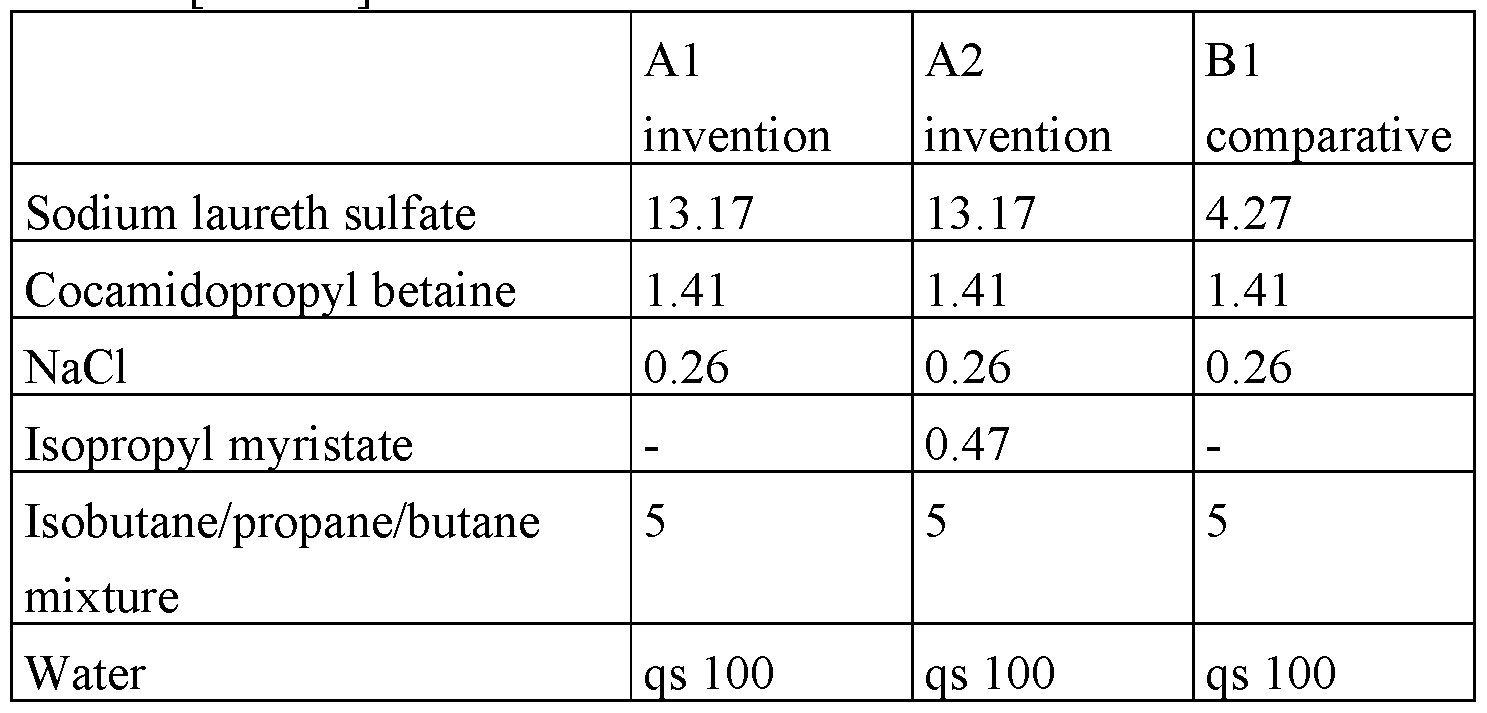 b. Protocol
The formulation juices of compositions Al, A2 and B1 are prepared beforehand from the ingredients indicated in Table 1 above before introducing the propellants (i.e. the isobutane/propane/butane mixture). In other words, the formulation juices do not comprise any propellants.
The formulation juices Al and A2 thus obtained are transparent and of single phase appearance, whereas the formulation juice B1 has a two-phase appearance.
The turbidity and particle size measurements of the single-phase formulation juices Al and A2 were performed before introducing the propellants and pressurizing the compositions.
The turbidity was measured using a UV-Vis Cary 100 model UV spectrophotometer sold by the company Agilent. The number-average size of the oil drops in the formulation juices Al and A2 was determined via the quasi-elastic light scattering method using a Zetasizer Nona ZS machine from Malvern Instruments. c. Results
The results obtained for each of the formulation juices A1 and A2 are expressed in the table below. [Table 2j
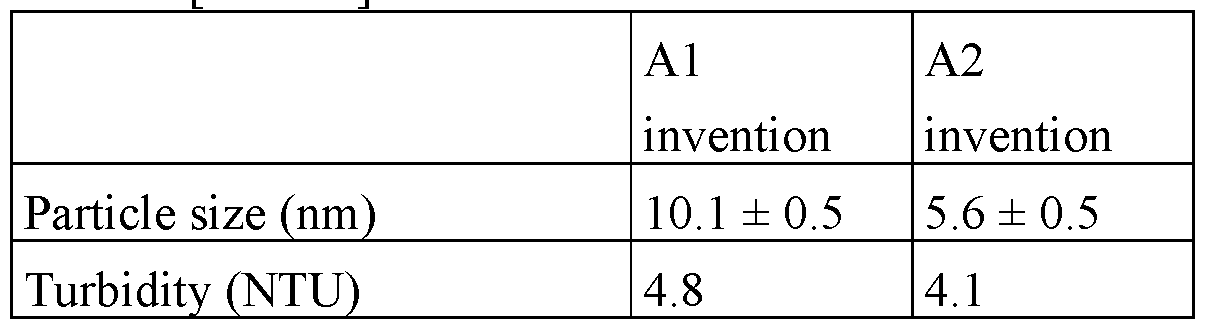 The propellants (56/24/20 isobutane/propane/butane mixture) were then added to the formulation juices Al, A2 and Bl, in a juice/gas ratio of 95/5. Compositions Al, A2 and Bl thus obtained were then packaged in transparent PET aerosol devices equipped with a DMPR229 dispenser and a 2x0.51 mm GI valve, and pressurized. The pressurized compositions Al and A2 remain single-phase and transparent, whereas the pressurized composition Bl is not transparent.
Moreover, the single-phase appearance and the transparency of compositions Al and A2 are stable over time. In particular, after two months of storage at room temperature (25°C), the appearance of these formulations has not changed. Conversely, two distinct phases form rapidly with an opaque upper phase for the comparative composition B 1. This phase distinction becomes more pronounced over time, notably after 24 hours of storage at room temperature.
Compositions Al and A2 according to the invention dispensed by means of the aerosol device make it possible to obtain a uniform, firm and creamy foam which holds well in the hand and is easily and uniformly applied to the entire head of hair. Compositions Al and A2 also afford good detergency properties in addition to a conditioning effect on the hair thus treated.
Example 2 a. Preparation of the formulations
Formulations A3 and A4 according to the invention and comparative formulations B2 and B3 below were prepared from the ingredients whose contents are indicated in the table below (as weight percentage of active material).
[Table 3]
 b. Protocol
The formulation juices of compositions A3, A4, B2 and B3 are prepared beforehand from the ingredients indicated in Table 3 above before introducing the propellants (i.e. the isobutane/propane/butane mixture). In other words, the formulation juices do not comprise any propellants.
The formulation juices A3 and A4 thus obtained are transparent and of single phase appearance, whereas the comparative formulation juices B2 and B3 have a two- phase appearance.
The turbidity and particle size measurements of the single-phase formulation juices A3 and A4 were performed before introducing the propellants and pressurizing the compositions.
The turbidity was measured using a UV-Vis Cary 100 model UV spectrophotometer sold by the company Agilent. The number-average size of the oil drops in the formulation juices A3 and A4 was determined via the quasi-elastic light scattering method using a Zetasizer Nona ZS machine from Malvern Instruments. c. Results The results obtained for each of the formulation juices A3 and A4 are expressed in the table below. [Table 4j
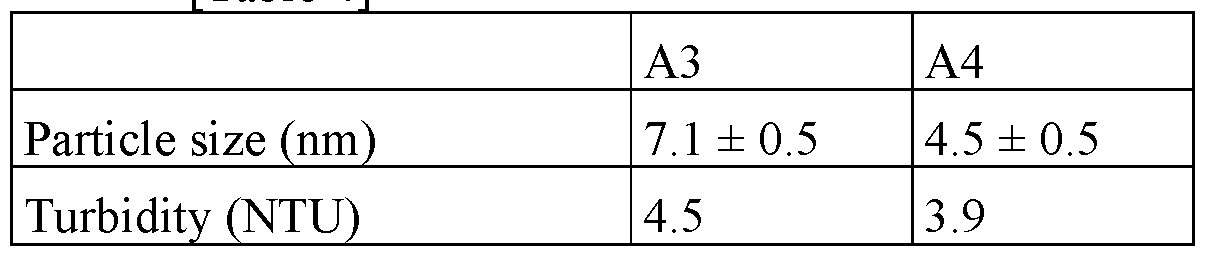 The propellants (56/24/20 isobutane/propane/butane mixture) were then added to the formulation juices A3, A4, B2 and B3, in a juice/gas ratio of 95/5. Compositions A3, A4, B2 and B3 thus obtained were then packaged in transparent PET aerosol devices equipped with a DMPR229 dispenser and a 2x0.51 mm GI valve, and pressurized.
The pressurized compositions A3 and A4 remain single-phased and transparent, whereas the pressurized compositions B2 and B3 are two-phase and are not transparent.
Moreover, the single-phase appearance and the transparency of compositions A3 and A4 are stable over time. In particular, after two months of storage at room temperature (25°C), the appearance of these formulations has not changed. Conversely, two distinct phases form rapidly with an opaque upper phase for the comparative compositions B2 and B3. This phase distinction becomes more pronounced over time, notably after 24 hours of storage at room temperature. Compositions A3 and A4 according to the invention dispensed by means of the aerosol device make it possible to obtain a uniform, firm and creamy foam which holds well in the hand and is easily and uniformly applied to the entire head of hair. Compositions A3 and A4 also afford good detergency properties in addition to a conditioning effect on the hair thus treated.
Example 3 a. Preparation of the formulation
Formulation A5 below according to the present invention was prepared using the ingredients whose contents are indicated in the table below (as weight percentage of active material). [Table 5]
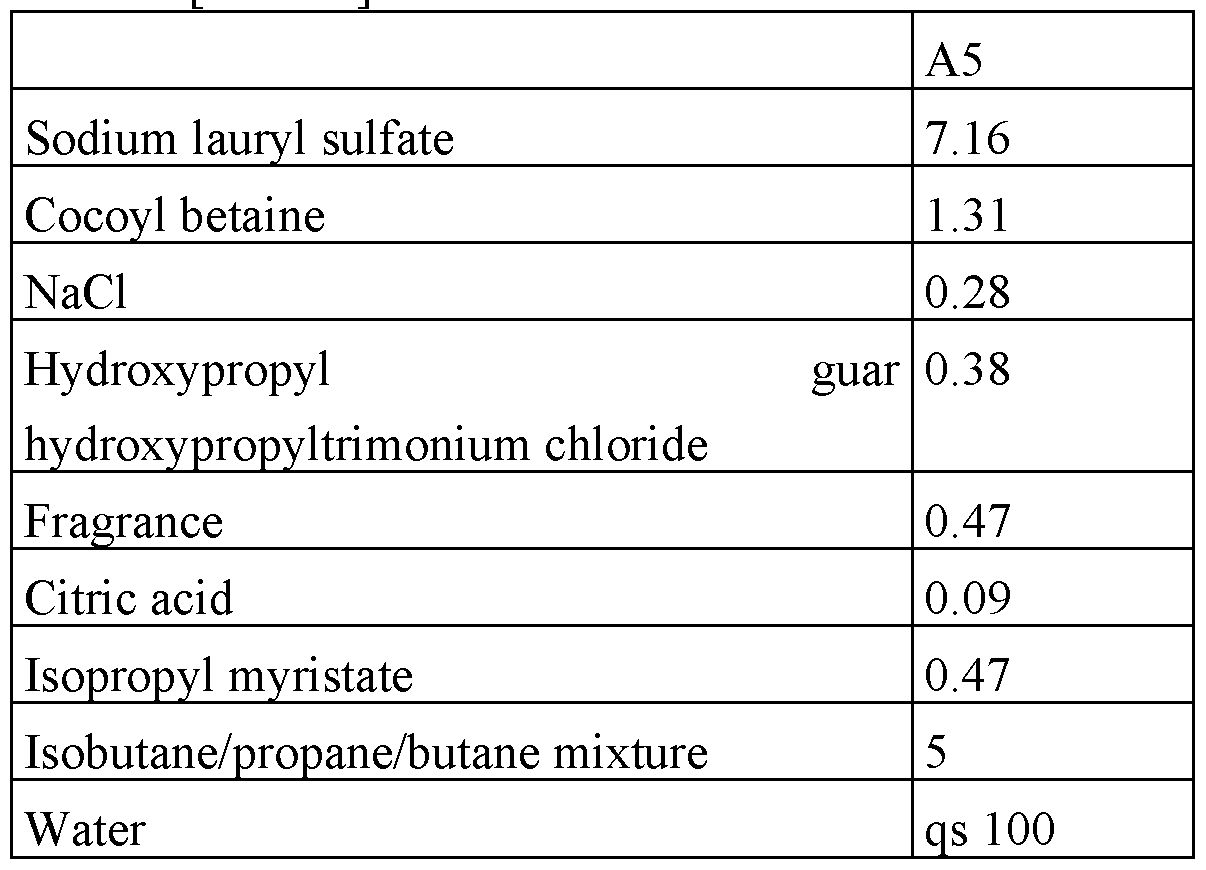 b. Protocol The formulation juice A5 is prepared beforehand from the ingredients indicated in Table 5 above before introducing the propellants (i.e. the isobutane/propane/butane mixture). In other words, this formulation juice does not comprise any propellants.
The formulation juice A5 thus obtained is transparent and of single-phase appearance.
The turbidity and particle size measurements of the single-phase formulation juice A5 were performed before introducing the propellants and pressurizing the composition.
The turbidity was measured using a UV-Vis Cary 100 model UV spectrophotometer sold by the company Agilent. The number-average size of the oil drops in the formulation juice A5 was determined via the quasi-elastic light scattering method using a Zetasizer Nona ZS machine from Malvern Instruments. c. Results
The results obtained for the formulation juice A5 are expressed in the table below. [Table 6]
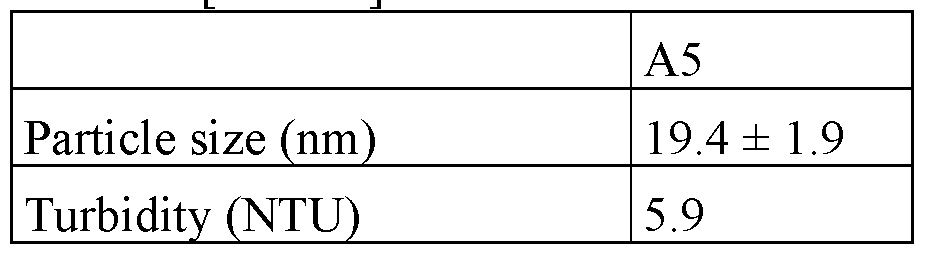 The propellants (56/24/20 isobutane/propane/butane mixture) were then added to the formulation juice A5, in a juice/gas ratio of 95/5. Composition A5 thus obtained was then packaged in a transparent PET aerosol device equipped with a DMPR229 dispenser and a 2x0.51 mm GI valve, and pressurized.
The pressurized composition A5 remains single-phased and transparent. Moreover, this single-phase appearance and its transparency are stable over time. In particular, after two months of storage at room temperature (25°C), the appearance of the composition has not changed.
In addition, composition A5 according to the invention dispensed by means of the aerosol device makes it possible to obtain a uniform, firm and creamy foam which holds well in the hand and is easily and uniformly applied to the entire head of hair. This composition A5 also affords good detergency properties in addition to a conditioning effect on the hair thus treated.
Example 4 a. Preparation of the formulations
Formulations H, I, J and K according to the invention below were prepared from the ingredients whose contents are indicated in the table below (as weight percentage of active material).
[Table 71
 b. Protocol
The formulation juices of compositions according to the present invention are prepared beforehand from the ingredients indicated in Table 7 above before introducing the propellants (i.e. the isobutane/propane/butane mixture).
The turbidity and particle size measurements of the single-phase formulation juices H, I, J and K were performed before introducing the propellants and pressurizing the compositions. The turbidity was measured using a UV-Vis Cary 100 model UV spectrophotometer sold by the company Agilent. The number-average size of the oil drops in the formulation juices A1 and A2 was determined via the quasi-elastic light scattering method using a Zetasizer Nona ZS machine from Malvern Instruments. c. Results
The results obtained for each of the formulation juices H, I, J and K are expressed in the table below.
[Table 8]

The propellants (56/24/20 isobutane/propane/butane mixture) were then added to the formulation juices H, I, J and K, in a juice/gas ratio of 95/5. Compositions H, I, J and K thus obtained were then packaged in transparent PET aerosol devices equipped with a DMPR229 dispenser and a 2x0.51 mm GI valve, and pressurized.
The pressurized compositions H, I, J and K are of single-phase appearance and transparent.
Moreover, the single-phase appearance and the transparency of compositions H, I, J and K are stable over time. In particular, after two months of storage at room temperature (25°C), the appearance of these formulations has not changed.
Example 5 a. Preparation of the formulations Formulations A6 and A7 according to the invention below were prepared from the ingredients whose contents are indicated in the table below (as weight percentage of active material).
[Table 8j
 b. Protocol
The formulation juices of compositions according to the present invention are prepared beforehand from the ingredients indicated in Table 8 above before introducing the propellants (i.e. the isobutane/propane/butane mixture).
The turbidity and particle size measurements of the single-phase formulation juices A6 and A7 were performed before introducing the propellants and pressurizing the compositions.
The turbidity was measured using a UV-Vis Cary 100 model UV spectrophotometer sold by the company Agilent. The number-average size of the oil drops in the formulation juices A1 and A2 was determined via the quasi-elastic light scattering method using a Zetasizer Nona ZS machine from Malvern Instruments. c. Results The results obtained for each of the formulation juices A6 and A7 are expressed in the table below. [Table 9]
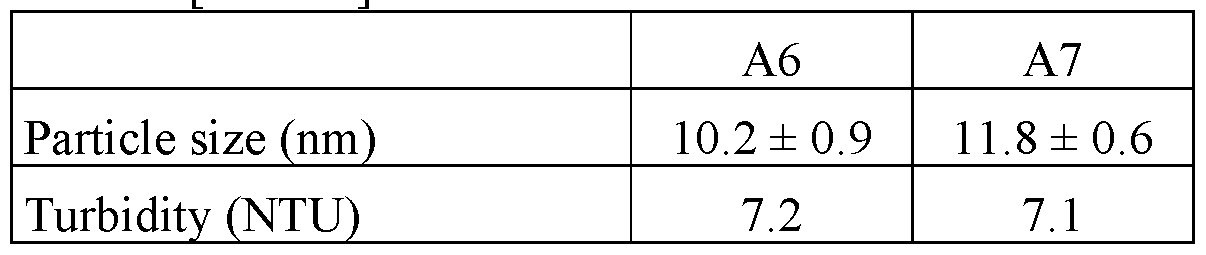
The propellants (56/24/20 isobutane/propane/butane mixture) were then added to the formulation juices in a juice/gas ratio of 95/5. Compositions A6 and A7 thus obtained were then packaged in transparent PET aerosol devices equipped with a DMPR229 dispenser and a 2x0.51 mm GI valve, and pressurized.
The pressurized compositions A6 and A7 are of single-phase appearance and transparent. Moreover, the single-phase appearance and the transparency of compositions
A6 and A7 are stable over time. In particular, after two months of storage at room temperature (25°C), the appearance of these formulations has not changed.
Claims
1. Composition of single-phase appearance comprising: (i) one or more anionic surfactants,
(ii) one or more amphoteric or zwitterionic surfactants,
(iii) one or more propellants,
(iv) water, and
(v) one or more fatty substances with a melting point of less than or equal to 35°C at atmospheric pressure; the total content of the anionic surfactant(s) (i) being greater than or equal to 5% by weight relative to the total weight of the composition.
2. Composition according to the preceding claim, characterized in that the anionic surfactant(s) (i) are chosen from sulfate-type anionic surfactants and mixtures thereof, preferably from alkyl sulfates, alkyl ether sulfates, alkylamido sulfates, alkylamido ether sulfates, alkylaryl polyether sulfates, monoglyceride sulfates; and also salts thereof and mixtures thereof; the alkyl groups of these compounds notably including from 8 to 30 carbon atoms; the aryl group preferably denoting a phenyl or benzyl group; these compounds possibly being polyoxyalkylenated, and then preferably including from 1 to 50 ethylene oxide units.
3. Composition according to either of the preceding claims, characterized in that the anionic surfactant(s) (i) are chosen from:
- alkyl sulfates, notably Cs to C26, and preferably C10 to C22, alkyl sulfates;
- alkyl ether sulfates, notably Cs to C26 and preferably C10 to C22 alkyl ether sulfates, preferably comprising from 2 to 10 ethylene oxide units; in particular in the form of alkali metal, alkaline-earth metal, ammonium or amino alcohol salts, and mixtures thereof.
4. Composition according to any one of the preceding claims, characterized in that the anionic surfactant(s) are chosen among the group consisting of sulfate, sulfonate and/or carboxylate surfactants; the carboxylate surfactants being chosen among the group consisting of acylglutamates, acylsarcosinates, (C6-C3o)alkyl ether carboxylates, polyoxyalkylenated (C6-C3o)alkyl(amido) ether carboxylic acids and mixtures thereof.
5. Composition according to any one of the preceding claims, characterized in that the total content of the anionic surfactant(s) (i) ranges from 5% to 35% by weight, preferably from 6% to 30% by weight and more preferentially from 7% to 20% by weight, relative to the total weight of the composition.
6. Composition according to any one of the preceding claims, characterized in that the amphoteric or zwitterionic surfactant(s) (ii) are chosen from (Cs- C2o)alkylbetaines, (C8-C2o)alkylamido(C3-C8)alkylbetaines, (Cs-
C2o)alkylamphoacetates, (C8-C2o)alkylamphodiacetates and mixtures thereof, and preferably from (C8-C2o)alkylbetaines, (C8-C2o)alkylamido(C3-C8)alkylbetaines and mixtures thereof.
7. Composition according to any one of the preceding claims, characterized in that the total content of the amphoteric or zwitterionic surfactant(s) (ii) is greater than or equal to 0.5% by weight, and preferably ranges from 0.5% to 15% by weight, more preferentially from 0.75% to 10% by weight and better still from 1% to 5% by weight relative to the total weight of the composition.
8. Composition according to any one of the preceding claims, characterized in that the weight ratio between the total content of anionic surfactants (i) and the total content of amphoteric or zwitterionic surfactant(s) (ii) is greater than or equal to 1, preferably greater than or equal to 1.5 and more preferentially this weight ratio ranges from 2 to 15.
9. Composition according to any one of the preceding claims, characterized in that the total content of surfactants is greater than or equal to 5.5% by weight, and preferably this total content ranges from 5.5% to 40% by weight and more preferentially from 7.5% to 35% by weight relative to the total weight of the composition.
10. Composition according to any one of the preceding claims, characterized in that the propellant(s) (iii) are chosen from volatile, optionally halogenated hydrocarbons, dimethyl ether, and mixtures thereof; preferably from dimethyl ether, C3 to C5 alkanes, and mixtures thereof; more preferentially from C3 to Cs alkanes and mixtures thereof; and better still from propane, n-butane, isobutane, and mixtures thereof.
11. Composition according to any one of the preceding claims, characterized in that the total content of the propellant(s) (iii) ranges from 0.5% to 10% by weight, preferably from 1% to 8% by weight and more preferentially from 3% to 6% by weight, relative to the total weight of the composition.
12. Composition according to any one of the preceding claims, characterized in that the water content is greater than 40% by weight, and preferably ranges from 50% to 93% by weight and more preferentially from 70% to 90% by weight relative to the total weight of the composition.
13. Composition according to any one of the preceding claims, characterized in that the fatty substances have a melting point of less than or equal to 28°C at atmospheric pressure, more preferentially are chosen from linear or branched G to Ci6 alkanes, linear or branched hydrocarbons of more than 16 carbon atoms of mineral or synthetic origin, non-polyoxyalkylenated fatty alcohols, fatty acids, triglycerides, fatty acid and/or fatty alcohol esters, silicones, and mixtures thereof.
14. Composition according to any one of Claims 1 to 12, characterized in that the fatty substances are non-silicone fatty substances.
15. Composition according to any one of the preceding claims, characterized in that the total content of the fatty substance(s) with a melting point of less than or equal to 35°C at atmospheric pressure is greater than or equal to 0.1% by weight, and preferably ranges from 0.2% to 10% by weight and more preferentially from 0.25% to 5% by weight relative to the total weight of the composition.
16. Composition according to any one of the preceding claims, characterized in that it also comprises one or more nonionic surfactants preferably chosen from polyoxyethylenated fatty alcohols, alkyl (poly)glycosides, ethoxylated fatty acid esters of sorbitan containing from 2 to 30 ethylene oxide units, silicone surfactants and mixtures thereof, and more preferentially from oleth-10, polysorbate 80, decyl glucoside, cocoyl glucoside, lauryl glucoside, PEG- 11 methyl ether dimethicone, and mixtures thereof.
17. Composition according to any one of the preceding claims, characterized in that it also comprises one or more fixing polymers, preferably chosen from nonionic fixing polymers, amphoteric or zwitterionic fixing polymers, anionic fixing polymers, cationic fixing polymers, and mixtures thereof, preferably from nonionic fixing polymers, anionic fixing polymers, and mixtures thereof, and more preferentially from anionic fixing polymers and mixtures thereof.
18. Composition according to any one of the preceding claims, characterized in that the turbidity of said composition, measured by turbidimetry at room temperature (25°C) and atmospheric pressure, is less than or equal to 250 NTU units, preferably less than or equal to 200 NTU units, more preferentially less than or equal to 100 NTU
units, better still less than or equal to 50 NTU units, and even more preferentially less than or equal to 20 NTU units.
19. Aerosol device comprising:
- a container containing a composition as defined according to any one of the preceding claims, and
- a means for spraying said composition.
20. Aerosol device according to the preceding claim, characterized in that the container is transparent.
21. Process for the cosmetic treatment of keratin materials, in particular of human keratin materials such as the hair and the skin, comprising the application to said keratin materials of a composition as defined in any one of Claims 1 to 18, said application optionally being followed by rinsing after an optional leave-on time.
22. Process for washing and/or conditioning keratin fibres, in particular human keratin fibres such as the hair, comprising the application to said keratin fibres of a composition as defined in any one of Claims 1 to 18 said application optionally being followed by rinsing after an optional leave-on time.
Applications Claiming Priority (2)
| Application Number | Priority Date | Filing Date | Title |
|---|---|---|---|
| FR2107093A FR3124717B1 (en) | 2021-06-30 | 2021-06-30 | Composition with monophasic appearance comprising an anionic surfactant and an amphoteric surfactant |
| FRFR2107093 | 2021-06-30 |
Publications (1)
| Publication Number | Publication Date |
|---|---|
| WO2023275283A1 true WO2023275283A1 (en) | 2023-01-05 |
Family
ID=77711023
Family Applications (1)
| Application Number | Title | Priority Date | Filing Date |
|---|---|---|---|
| PCT/EP2022/068126 Ceased WO2023275283A1 (en) | 2021-06-30 | 2022-06-30 | Composition of single-phase appearance comprising an anionic surfactant and an amphoteric surfactant |
Country Status (2)
| Country | Link |
|---|---|
| FR (1) | FR3124717B1 (en) |
| WO (1) | WO2023275283A1 (en) |
Citations (62)
| Publication number | Priority date | Publication date | Assignee | Title |
|---|---|---|---|---|
| US2047398A (en) | 1930-06-26 | 1936-07-14 | Ig Farbenindustrie Ag | Artificial resins and process of making them |
| US2102113A (en) | 1934-10-24 | 1937-12-14 | Djordjevitch Yesdimir | Carburetor |
| US2723248A (en) | 1954-10-01 | 1955-11-08 | Gen Aniline & Film Corp | Film-forming compositions |
| FR1222944A (en) | 1958-04-15 | 1960-06-14 | Hoechst Ag | Graft polymers and their preparation process |
| GB839805A (en) | 1957-06-10 | 1960-06-29 | Monsanto Chemicals | Sprayable compositions |
| FR1400366A (en) | 1963-05-15 | 1965-05-28 | Oreal | New compounds which can be used in particular for the treatment of hair |
| FR1564110A (en) | 1967-03-23 | 1969-04-18 | ||
| FR1580545A (en) | 1967-07-28 | 1969-09-05 | ||
| US3589578A (en) | 1968-01-20 | 1971-06-29 | Monforts Fa A | Tension-relieving device for stretchable sheet material |
| FR2077143A5 (en) | 1970-01-30 | 1971-10-15 | Gaf Corp | |
| US3734874A (en) | 1970-02-27 | 1973-05-22 | Eastman Kodak Co | Polyesters and polyesteramides containing ether groups and sulfonate groups in the form of a metallic salt |
| US3779993A (en) | 1970-02-27 | 1973-12-18 | Eastman Kodak Co | Polyesters and polyesteramides containing ether groups and sulfonate groups in the form of a metallic salt |
| DE2330956A1 (en) | 1972-06-20 | 1974-01-10 | Oreal | CATIONIC GRAFTED AND CROSS-LINKED MIXED POLYMERISATES, PROCESS FOR THEIR PRODUCTION AND THEIR USE IN COSMETIC PREPARATIONS |
| FR2198719A1 (en) | 1972-09-11 | 1974-04-05 | Hobbs R Ltd | |
| US3836537A (en) | 1970-10-07 | 1974-09-17 | Minnesota Mining & Mfg | Zwitterionic polymer hairsetting compositions and method of using same |
| FR2265781A1 (en) | 1974-04-01 | 1975-10-24 | Oreal | |
| FR2265782A1 (en) | 1974-04-01 | 1975-10-24 | Oreal | |
| US4031307A (en) | 1976-05-03 | 1977-06-21 | Celanese Corporation | Cationic polygalactomannan compositions |
| FR2350384A1 (en) | 1976-05-06 | 1977-12-02 | Berger Jenson & Nicholson Ltd | COATING PRODUCTS CONTAINING A WATER-BASED LATEX WITH A RESINOUS BINDER |
| FR2357241A2 (en) | 1976-07-08 | 1978-02-03 | Oreal | Partially esterified or amidated unsaturated anhydride copolymer - for hair lacquer made from copolymer of unsaturated anhydride, allyl or methallyl ester and acrylamide or methacrylamide cpd. |
| LU75371A1 (en) | 1976-07-12 | 1978-02-08 | ||
| LU75370A1 (en) | 1976-07-12 | 1978-02-08 | ||
| US4119680A (en) | 1976-08-23 | 1978-10-10 | Eastman Kodak Company | Copolyesters as improved binders and finishes for polyester-containing fabrics |
| US4128631A (en) | 1977-02-16 | 1978-12-05 | General Mills Chemicals, Inc. | Method of imparting lubricity to keratinous substrates and mucous membranes |
| US4131576A (en) | 1977-12-15 | 1978-12-26 | National Starch And Chemical Corporation | Process for the preparation of graft copolymers of a water soluble monomer and polysaccharide employing a two-phase reaction system |
| FR2393573A1 (en) | 1977-06-10 | 1979-01-05 | Gaf Corp | HAIR PREPARATIONS CONTAINING A VINYLPYRROLIDONE COPOLYMER |
| US4185087A (en) | 1977-12-28 | 1980-01-22 | Union Carbide Corporation | Hair conditioning compositions containing dialkylamino hydroxy organosilicon compounds and their derivatives |
| FR2439798A1 (en) | 1978-10-27 | 1980-05-23 | Oreal | NEW COPOLYMERS FOR USE IN COSMETICS, IN PARTICULAR IN HAIR LACQUERS AND LOTIONS |
| US4300580A (en) | 1977-01-07 | 1981-11-17 | Eastman Kodak Company | Hair grooming method using linear polyesters |
| EP0080976A1 (en) | 1981-11-30 | 1983-06-08 | Ciba-Geigy Ag | Mixtures of quaternary polymeric acrylic ammonium salts, quaternary mono- or oligomeric ammonium salts and surfactants, their preparation and their use in cosmetic compositions |
| US4693935A (en) | 1986-05-19 | 1987-09-15 | Minnesota Mining And Manufacturing Company | Polysiloxane-grafted copolymer pressure sensitive adhesive composition and sheet materials coated therewith |
| US4728571A (en) | 1985-07-19 | 1988-03-01 | Minnesota Mining And Manufacturing Company | Polysiloxane-grafted copolymer release coating sheets and adhesive tapes |
| US4972037A (en) | 1989-08-07 | 1990-11-20 | Minnesota Mining And Manufacturing Company | Polysiloxane-grafted copolymer topical binder composition with novel fluorochemical comonomer and method of coating therewith |
| US4973656A (en) | 1988-10-14 | 1990-11-27 | Eastman Kodak Company | Water-dissipatable polyester resins and coatings prepared therefrom |
| EP0412704A2 (en) | 1989-08-07 | 1991-02-13 | The Procter & Gamble Company | Hair conditioning and styling compositions |
| EP0412707A1 (en) | 1989-08-07 | 1991-02-13 | The Procter & Gamble Company | Hair conditioning and styling compositions |
| EP0530974A1 (en) | 1991-08-05 | 1993-03-10 | Unilever Plc | Hair care composition |
| WO1993023009A1 (en) | 1992-05-12 | 1993-11-25 | Minnesota Mining And Manufacturing Company | Polymers in cosmetics and personal care products |
| EP0582152A2 (en) | 1992-07-28 | 1994-02-09 | Mitsubishi Chemical Corporation | A hair cosmetic composition |
| WO1994003510A1 (en) | 1992-07-29 | 1994-02-17 | Basf Aktiengesellschaft | Use of water-soluble or water-dispersible polyurethanes as auxiliary agents in cosmetic and pharmaceutical preparations and polyurethanes containing polylactic acid polyols incorporated by polymerization |
| EP0619111A1 (en) | 1993-04-06 | 1994-10-12 | National Starch and Chemical Investment Holding Corporation | Use of polyurethanes with carboxylate functionality for hair fixative applications |
| WO1995000578A1 (en) | 1993-06-24 | 1995-01-05 | The Procter & Gamble Company | Siloxane modified polyolefin copolymers |
| EP0637600A1 (en) | 1993-08-04 | 1995-02-08 | L'oreal | New polyester polyurethanes, their preparation process, pseudo-latex prepared from these polyester polyurethanes and their use in cosmetic compositions |
| EP0640105A1 (en) | 1992-05-15 | 1995-03-01 | The Procter & Gamble Company | Adhesive agent containing polysiloxane-grafted polymer, and cosmetic compositions thereof |
| EP0648485A1 (en) | 1993-10-15 | 1995-04-19 | L'oreal | Aqueous nail varnish containing dispersed particles of anionic polyester-polyurethane |
| WO1995018191A1 (en) | 1993-12-29 | 1995-07-06 | Eastman Chemical Company | Water-dispersible adhesive composition and process |
| US5523081A (en) * | 1993-08-18 | 1996-06-04 | Chesebrough-Pond's Usa Co., Division Of Conopco, Inc. | Shaving composition |
| EP0751162A1 (en) | 1995-06-27 | 1997-01-02 | L'oreal | Use in and for the preparation of cosmetic or dermatological compositions from polyurethane and/or polyurea blockpolycondensates having silicone grafts |
| WO1997008261A1 (en) | 1995-08-28 | 1997-03-06 | Eastman Chemical Company | Water-dispersible adhesive compositions |
| WO1997020899A1 (en) | 1995-12-08 | 1997-06-12 | Eastman Chemical Company | Radiation cross-linkable branched polyester compositions which are water-dispersible and processes |
| FR2743297A1 (en) | 1996-01-05 | 1997-07-11 | Oreal | COSMETIC COMPOSITION BASED ON POLYSILOXANE / POLYURETHANE AND / OR POLYURED POLYURETHANE IONIZABLE POLYCONDENSATES IN SOLUTION AND USE THEREOF |
| US5660816A (en) | 1993-06-25 | 1997-08-26 | Eastman Chemical Company | Clear hair spray formulations containing a linear sulfopolyester |
| US5662893A (en) | 1993-06-25 | 1997-09-02 | Eastman Chemical Company | Clear pump hair spray formulations containing a linear sulfopolyester in a hydroalcoholic liquid vehicle |
| US5674479A (en) | 1993-06-25 | 1997-10-07 | Eastman Chemical Company | Clear aerosol hair spray formulations containing a linear sulfopolyester in a hydroalcoholic liquid vehicle |
| EP0820755A2 (en) * | 1996-07-24 | 1998-01-28 | Imaginative Research Associates, Inc. | Instant lathering clear solutions and gels |
| US6096702A (en) * | 1998-10-01 | 2000-08-01 | Imaginative Research Associates, Inc. | Post foaming clear gels and solutions |
| US20010006621A1 (en) * | 1997-12-19 | 2001-07-05 | Serge Aime Patrick Coupe | Mousse-forming shampoo compositions |
| US6333362B1 (en) * | 1996-03-07 | 2001-12-25 | L'oreal | Pressurized device comprising an ultrafine foaming oil-in-water emulsion and use of this emulsion in cleansing and care of skin |
| CA2914249A1 (en) * | 2013-07-10 | 2015-01-15 | Eveready Battery Company, Inc. | Consumer packaged product for viscous personal care compositions with dual propellant delivery system |
| US20170165164A1 (en) * | 2015-12-15 | 2017-06-15 | The Procter & Gamble Company | Deep cleansing hair care composition |
| US20190183777A1 (en) * | 2017-12-20 | 2019-06-20 | The Procter & Gamble Company | Low viscosity, compact shampoo composition containing silicone polymers |
| WO2020127759A1 (en) * | 2018-12-20 | 2020-06-25 | L'oreal | Aerosol foam device containing a composition rich in fatty substances |
-
2021
- 2021-06-30 FR FR2107093A patent/FR3124717B1/en active Active
-
2022
- 2022-06-30 WO PCT/EP2022/068126 patent/WO2023275283A1/en not_active Ceased
Patent Citations (64)
| Publication number | Priority date | Publication date | Assignee | Title |
|---|---|---|---|---|
| US2047398A (en) | 1930-06-26 | 1936-07-14 | Ig Farbenindustrie Ag | Artificial resins and process of making them |
| US2102113A (en) | 1934-10-24 | 1937-12-14 | Djordjevitch Yesdimir | Carburetor |
| US2723248A (en) | 1954-10-01 | 1955-11-08 | Gen Aniline & Film Corp | Film-forming compositions |
| GB839805A (en) | 1957-06-10 | 1960-06-29 | Monsanto Chemicals | Sprayable compositions |
| FR1222944A (en) | 1958-04-15 | 1960-06-14 | Hoechst Ag | Graft polymers and their preparation process |
| FR1400366A (en) | 1963-05-15 | 1965-05-28 | Oreal | New compounds which can be used in particular for the treatment of hair |
| FR1564110A (en) | 1967-03-23 | 1969-04-18 | ||
| FR1580545A (en) | 1967-07-28 | 1969-09-05 | ||
| US3589578A (en) | 1968-01-20 | 1971-06-29 | Monforts Fa A | Tension-relieving device for stretchable sheet material |
| FR2077143A5 (en) | 1970-01-30 | 1971-10-15 | Gaf Corp | |
| US3734874A (en) | 1970-02-27 | 1973-05-22 | Eastman Kodak Co | Polyesters and polyesteramides containing ether groups and sulfonate groups in the form of a metallic salt |
| US3779993A (en) | 1970-02-27 | 1973-12-18 | Eastman Kodak Co | Polyesters and polyesteramides containing ether groups and sulfonate groups in the form of a metallic salt |
| US3836537A (en) | 1970-10-07 | 1974-09-17 | Minnesota Mining & Mfg | Zwitterionic polymer hairsetting compositions and method of using same |
| DE2330956A1 (en) | 1972-06-20 | 1974-01-10 | Oreal | CATIONIC GRAFTED AND CROSS-LINKED MIXED POLYMERISATES, PROCESS FOR THEIR PRODUCTION AND THEIR USE IN COSMETIC PREPARATIONS |
| FR2198719A1 (en) | 1972-09-11 | 1974-04-05 | Hobbs R Ltd | |
| FR2265782A1 (en) | 1974-04-01 | 1975-10-24 | Oreal | |
| FR2265781A1 (en) | 1974-04-01 | 1975-10-24 | Oreal | |
| US4031307A (en) | 1976-05-03 | 1977-06-21 | Celanese Corporation | Cationic polygalactomannan compositions |
| FR2350384A1 (en) | 1976-05-06 | 1977-12-02 | Berger Jenson & Nicholson Ltd | COATING PRODUCTS CONTAINING A WATER-BASED LATEX WITH A RESINOUS BINDER |
| FR2357241A2 (en) | 1976-07-08 | 1978-02-03 | Oreal | Partially esterified or amidated unsaturated anhydride copolymer - for hair lacquer made from copolymer of unsaturated anhydride, allyl or methallyl ester and acrylamide or methacrylamide cpd. |
| LU75371A1 (en) | 1976-07-12 | 1978-02-08 | ||
| LU75370A1 (en) | 1976-07-12 | 1978-02-08 | ||
| US4119680A (en) | 1976-08-23 | 1978-10-10 | Eastman Kodak Company | Copolyesters as improved binders and finishes for polyester-containing fabrics |
| US4300580A (en) | 1977-01-07 | 1981-11-17 | Eastman Kodak Company | Hair grooming method using linear polyesters |
| US4128631A (en) | 1977-02-16 | 1978-12-05 | General Mills Chemicals, Inc. | Method of imparting lubricity to keratinous substrates and mucous membranes |
| FR2393573A1 (en) | 1977-06-10 | 1979-01-05 | Gaf Corp | HAIR PREPARATIONS CONTAINING A VINYLPYRROLIDONE COPOLYMER |
| US4131576A (en) | 1977-12-15 | 1978-12-26 | National Starch And Chemical Corporation | Process for the preparation of graft copolymers of a water soluble monomer and polysaccharide employing a two-phase reaction system |
| US4185087A (en) | 1977-12-28 | 1980-01-22 | Union Carbide Corporation | Hair conditioning compositions containing dialkylamino hydroxy organosilicon compounds and their derivatives |
| FR2439798A1 (en) | 1978-10-27 | 1980-05-23 | Oreal | NEW COPOLYMERS FOR USE IN COSMETICS, IN PARTICULAR IN HAIR LACQUERS AND LOTIONS |
| EP0080976A1 (en) | 1981-11-30 | 1983-06-08 | Ciba-Geigy Ag | Mixtures of quaternary polymeric acrylic ammonium salts, quaternary mono- or oligomeric ammonium salts and surfactants, their preparation and their use in cosmetic compositions |
| US4728571A (en) | 1985-07-19 | 1988-03-01 | Minnesota Mining And Manufacturing Company | Polysiloxane-grafted copolymer release coating sheets and adhesive tapes |
| US4693935A (en) | 1986-05-19 | 1987-09-15 | Minnesota Mining And Manufacturing Company | Polysiloxane-grafted copolymer pressure sensitive adhesive composition and sheet materials coated therewith |
| US4973656A (en) | 1988-10-14 | 1990-11-27 | Eastman Kodak Company | Water-dissipatable polyester resins and coatings prepared therefrom |
| EP0412704A2 (en) | 1989-08-07 | 1991-02-13 | The Procter & Gamble Company | Hair conditioning and styling compositions |
| EP0412707A1 (en) | 1989-08-07 | 1991-02-13 | The Procter & Gamble Company | Hair conditioning and styling compositions |
| US4972037A (en) | 1989-08-07 | 1990-11-20 | Minnesota Mining And Manufacturing Company | Polysiloxane-grafted copolymer topical binder composition with novel fluorochemical comonomer and method of coating therewith |
| EP0530974A1 (en) | 1991-08-05 | 1993-03-10 | Unilever Plc | Hair care composition |
| WO1993023009A1 (en) | 1992-05-12 | 1993-11-25 | Minnesota Mining And Manufacturing Company | Polymers in cosmetics and personal care products |
| EP0640105A1 (en) | 1992-05-15 | 1995-03-01 | The Procter & Gamble Company | Adhesive agent containing polysiloxane-grafted polymer, and cosmetic compositions thereof |
| EP0582152A2 (en) | 1992-07-28 | 1994-02-09 | Mitsubishi Chemical Corporation | A hair cosmetic composition |
| EP0656021A1 (en) | 1992-07-29 | 1995-06-07 | Basf Ag | Use of water-soluble or water-dispersible polyurethanes as auxiliary agents in cosmetic and pharmaceutical preparations and polyurethanes containing polylactic acid polyols incorporated by polymerization. |
| WO1994003510A1 (en) | 1992-07-29 | 1994-02-17 | Basf Aktiengesellschaft | Use of water-soluble or water-dispersible polyurethanes as auxiliary agents in cosmetic and pharmaceutical preparations and polyurethanes containing polylactic acid polyols incorporated by polymerization |
| EP0619111A1 (en) | 1993-04-06 | 1994-10-12 | National Starch and Chemical Investment Holding Corporation | Use of polyurethanes with carboxylate functionality for hair fixative applications |
| WO1995000578A1 (en) | 1993-06-24 | 1995-01-05 | The Procter & Gamble Company | Siloxane modified polyolefin copolymers |
| US5674479A (en) | 1993-06-25 | 1997-10-07 | Eastman Chemical Company | Clear aerosol hair spray formulations containing a linear sulfopolyester in a hydroalcoholic liquid vehicle |
| US5660816A (en) | 1993-06-25 | 1997-08-26 | Eastman Chemical Company | Clear hair spray formulations containing a linear sulfopolyester |
| US5662893A (en) | 1993-06-25 | 1997-09-02 | Eastman Chemical Company | Clear pump hair spray formulations containing a linear sulfopolyester in a hydroalcoholic liquid vehicle |
| EP0637600A1 (en) | 1993-08-04 | 1995-02-08 | L'oreal | New polyester polyurethanes, their preparation process, pseudo-latex prepared from these polyester polyurethanes and their use in cosmetic compositions |
| US5523081A (en) * | 1993-08-18 | 1996-06-04 | Chesebrough-Pond's Usa Co., Division Of Conopco, Inc. | Shaving composition |
| EP0648485A1 (en) | 1993-10-15 | 1995-04-19 | L'oreal | Aqueous nail varnish containing dispersed particles of anionic polyester-polyurethane |
| WO1995018191A1 (en) | 1993-12-29 | 1995-07-06 | Eastman Chemical Company | Water-dispersible adhesive composition and process |
| EP0751162A1 (en) | 1995-06-27 | 1997-01-02 | L'oreal | Use in and for the preparation of cosmetic or dermatological compositions from polyurethane and/or polyurea blockpolycondensates having silicone grafts |
| WO1997008261A1 (en) | 1995-08-28 | 1997-03-06 | Eastman Chemical Company | Water-dispersible adhesive compositions |
| WO1997020899A1 (en) | 1995-12-08 | 1997-06-12 | Eastman Chemical Company | Radiation cross-linkable branched polyester compositions which are water-dispersible and processes |
| FR2743297A1 (en) | 1996-01-05 | 1997-07-11 | Oreal | COSMETIC COMPOSITION BASED ON POLYSILOXANE / POLYURETHANE AND / OR POLYURED POLYURETHANE IONIZABLE POLYCONDENSATES IN SOLUTION AND USE THEREOF |
| US6333362B1 (en) * | 1996-03-07 | 2001-12-25 | L'oreal | Pressurized device comprising an ultrafine foaming oil-in-water emulsion and use of this emulsion in cleansing and care of skin |
| EP0820755A2 (en) * | 1996-07-24 | 1998-01-28 | Imaginative Research Associates, Inc. | Instant lathering clear solutions and gels |
| US6106817A (en) * | 1996-07-24 | 2000-08-22 | Imaginative Research Associates, Inc. | Instant lathering clear solutions and gels |
| US20010006621A1 (en) * | 1997-12-19 | 2001-07-05 | Serge Aime Patrick Coupe | Mousse-forming shampoo compositions |
| US6096702A (en) * | 1998-10-01 | 2000-08-01 | Imaginative Research Associates, Inc. | Post foaming clear gels and solutions |
| CA2914249A1 (en) * | 2013-07-10 | 2015-01-15 | Eveready Battery Company, Inc. | Consumer packaged product for viscous personal care compositions with dual propellant delivery system |
| US20170165164A1 (en) * | 2015-12-15 | 2017-06-15 | The Procter & Gamble Company | Deep cleansing hair care composition |
| US20190183777A1 (en) * | 2017-12-20 | 2019-06-20 | The Procter & Gamble Company | Low viscosity, compact shampoo composition containing silicone polymers |
| WO2020127759A1 (en) * | 2018-12-20 | 2020-06-25 | L'oreal | Aerosol foam device containing a composition rich in fatty substances |
Non-Patent Citations (4)
| Title |
|---|
| "Cosmetics and Toiletries", vol. 91, TODD & BYERS, article "Volatile Silicone Fluids for Cosmetics", pages: 27 - 32 |
| "CTFA dictionary", 1993 |
| "Walter Noll's Chemistry and Technology of Silicones", 1968, ACADEMIC PRESS |
| M.R. PORTER: "Handbook of Surfactants", 1991, BLACKIE & SON, pages: 116 - 178 |
Also Published As
| Publication number | Publication date |
|---|---|
| FR3124717A1 (en) | 2023-01-06 |
| FR3124717B1 (en) | 2024-03-01 |
Similar Documents
| Publication | Publication Date | Title |
|---|---|---|
| US10524999B2 (en) | Composition comprising a combination of particular alkoxysilanes and a fatty substance | |
| EP2713997B1 (en) | Process for treating straightened keratin fibres | |
| EP2651371B1 (en) | Fan-shaped aerosol device for styling the hair | |
| WO2012032057A2 (en) | Cosmetic composition comprising a fixing polymer and a specific thickener and uses in styling | |
| EP3897546B1 (en) | Aerosol device containing a cosmetic composition comprising an anionic surfactant, a fatty alcohol and a compressed gas | |
| FR2961103A1 (en) | Cosmetic composition, preferably anhydrous, useful for conditioning, formatting and/or fixing hair, comprises anionic polymer, amphoteric polymer, non-silicone fatty body, silicone different anionic and amphoteric polymer and 1-4C alcohol | |
| BRPI0906170A2 (en) | cosmetic make-up, use of cosmetic make-up and process for hairstyle | |
| EP2841052A2 (en) | Cosmetic composition comprising a fatty-chain silane and a particular fixing polymer | |
| WO2020127891A1 (en) | Cosmetic hair composition in the form of a nanoemulsion comprising a particular non-ionic surfactant and a propellant | |
| WO2013160440A2 (en) | Process for treating hair with a pressurized cosmetic composition comprising a fatty-chain silane | |
| WO2023275283A1 (en) | Composition of single-phase appearance comprising an anionic surfactant and an amphoteric surfactant | |
| WO2023275284A1 (en) | Composition in emulsion form comprising an amphoteric surfactant, a fatty substance and a propellant | |
| WO2023275282A1 (en) | Composition of single-phase appearance comprising a nonionic surfactant and an amphoteric surfactant | |
| WO2023275286A1 (en) | Composition in emulsion form comprising a particular nonionic surfactant | |
| EP3393438A1 (en) | Composition comprising a vinylformamide/vinylamine copolymer, a fixing polymer and a particular combination of surfactants | |
| FR3124729A1 (en) | Composition with monophasic appearance comprising the combination of two nonionic surfactants different from each other, one of which is silicone | |
| WO2011117403A2 (en) | Composition comprising a silicone copolymer, a silicone surfactant and a non-volatile pdms, cosmetic treatment method and use. | |
| ES2324543T3 (en) | COSMETIC COMPOSITION THAT INCLUDES A LINEAR SULPHONIC POLYESTER AND A MODIFIED GUAR RUBBER. | |
| FR3124718A1 (en) | Composition in the form of an emulsion comprising a sulphated anionic surfactant, a fatty substance and a propellant | |
| FR3124726A1 (en) | Composition in the form of an emulsion comprising an alkyl(poly)glycoside, a fatty substance and a propellant | |
| WO2011157796A1 (en) | Cosmetic composition comprising a branched sulphonic polyester and a particular thickener and uses in hair styling | |
| BR112021010001B1 (en) | AEROSOL DEVICE CONTAINING A COSMETIC COMPOSITION COMPRISING AN ANIONIC SURFACTANT, A FATTY ALCOHOL AND A COMPRESSED GAS, COSMETIC PROCESS AND USE OF A COSMETIC COMPOSITION | |
| WO2020002522A1 (en) | Process for shaping the hair comprising a step of applying a composition comprising a lactone, a shaping step and a long leave-on time | |
| EP3393439A1 (en) | Composition sprayable in mousse form comprising a vinylformamide/vinylamine copolymer, a particular surfactant and a propellant | |
| FR2989881A1 (en) | COSMETIC COMPOSITION COMPRISING A FATTY CHAIN SILANE AND A PARTICULAR FIXING POLYMER |
Legal Events
| Date | Code | Title | Description |
|---|---|---|---|
| 121 | Ep: the epo has been informed by wipo that ep was designated in this application |
Ref document number: 22743468 Country of ref document: EP Kind code of ref document: A1 |
|
| NENP | Non-entry into the national phase |
Ref country code: DE |
|
| 122 | Ep: pct application non-entry in european phase |
Ref document number: 22743468 Country of ref document: EP Kind code of ref document: A1 |