WO2023250504A1 - Improving split-read alignment by intelligently identifying and scoring candidate split groups - Google Patents
Improving split-read alignment by intelligently identifying and scoring candidate split groups Download PDFInfo
- Publication number
- WO2023250504A1 WO2023250504A1 PCT/US2023/069024 US2023069024W WO2023250504A1 WO 2023250504 A1 WO2023250504 A1 WO 2023250504A1 US 2023069024 W US2023069024 W US 2023069024W WO 2023250504 A1 WO2023250504 A1 WO 2023250504A1
- Authority
- WO
- WIPO (PCT)
- Prior art keywords
- split
- fragment
- alignment
- read
- candidate
- Prior art date
- Legal status (The legal status is an assumption and is not a legal conclusion. Google has not performed a legal analysis and makes no representation as to the accuracy of the status listed.)
- Ceased
Links
Classifications
-
- G—PHYSICS
- G16—INFORMATION AND COMMUNICATION TECHNOLOGY [ICT] SPECIALLY ADAPTED FOR SPECIFIC APPLICATION FIELDS
- G16B—BIOINFORMATICS, i.e. INFORMATION AND COMMUNICATION TECHNOLOGY [ICT] SPECIALLY ADAPTED FOR GENETIC OR PROTEIN-RELATED DATA PROCESSING IN COMPUTATIONAL MOLECULAR BIOLOGY
- G16B40/00—ICT specially adapted for biostatistics; ICT specially adapted for bioinformatics-related machine learning or data mining, e.g. knowledge discovery or pattern finding
-
- G—PHYSICS
- G16—INFORMATION AND COMMUNICATION TECHNOLOGY [ICT] SPECIALLY ADAPTED FOR SPECIFIC APPLICATION FIELDS
- G16B—BIOINFORMATICS, i.e. INFORMATION AND COMMUNICATION TECHNOLOGY [ICT] SPECIALLY ADAPTED FOR GENETIC OR PROTEIN-RELATED DATA PROCESSING IN COMPUTATIONAL MOLECULAR BIOLOGY
- G16B20/00—ICT specially adapted for functional genomics or proteomics, e.g. genotype-phenotype associations
- G16B20/20—Allele or variant detection, e.g. single nucleotide polymorphism [SNP] detection
-
- G—PHYSICS
- G16—INFORMATION AND COMMUNICATION TECHNOLOGY [ICT] SPECIALLY ADAPTED FOR SPECIFIC APPLICATION FIELDS
- G16B—BIOINFORMATICS, i.e. INFORMATION AND COMMUNICATION TECHNOLOGY [ICT] SPECIALLY ADAPTED FOR GENETIC OR PROTEIN-RELATED DATA PROCESSING IN COMPUTATIONAL MOLECULAR BIOLOGY
- G16B30/00—ICT specially adapted for sequence analysis involving nucleotides or amino acids
- G16B30/10—Sequence alignment; Homology search
Definitions
- existing sequencing systems predict individual nucleobases within sequences by using conventional Sanger sequencing or sequencing-by-synthesis (SBS) methods.
- SBS sequencing-by-synthesis
- existing sequencing systems can monitor many thousands of oligonucleotides being synthesized in parallel from templates to predict nucleobase calls for growing nucleotide reads.
- a camera in many existing sequencing systems captures images of irradiated fluorescent tags incorporated into oligonucleotides.
- some existing sequencing systems determine nucleobase calls for nucleotide reads corresponding to the oligonucleotides and send base-call data to a computing device with sequencing-data-analysis software, which aligns nucleotide reads with a reference genome. Based on differences between the aligned nucleotide reads and the reference genome, existing systems (e.g., a variant caller) determines nucleobase calls for genomic regions and identify variants of a genomic sample.
- a variant caller determines nucleobase calls for genomic regions and identify variants of a genomic sample.
- a split read represents a nucleotide read that has one read fragment that maps to (or aligns with) one region of a reference genome and one or more other read fragments that map to (or aligns with) different regions of the reference genome.
- a nucleotide read that covers a structural variant, different sides of a deletion, different sides of a gene fusion, or simply random mapping of read fragments can result in a split read.
- one read fragment from a nucleotide read may align best to a genomic region on one chromosome and another read fragment from the same nucleotide read may align best with a genomic region on another chromosome. Because such a split-read alignment on two different chromosomes (or different genomic regions on a same chromosome) may either accurately reflect a variant of a genomic sample or erroneously suggest a split read that should align to a single genomic region, existing sequencing systems have developed computational models to recognize and distinguish between correct and incorrect split-read alignments.
- the disclosed systems can determine scores for alignments of one or more fragments from a nucleotide read in candidate split groups and select a predicted split group from among the candidates based on such scores to use for base calling.
- the disclosed systems can identify fragment alignments comprising candidate local alignments of fragments of a read from a genomic sample with a reference genome. The disclosed systems then group such fragment alignments into candidate split groups and determine split group scores for each of these candidate split groups. Based on the split group scores, the disclosed systems identify a predicted split group from among the candidate split groups to use for base calling.
- FIG. 1 illustrates a diagram of an environment in which a split-read alignment system can operate in accordance with one or more implementations.
- FIG. 8 illustrates the split-read alignment system utilizing a threshold fragment alignment score to remove candidate split groups in accordance with one or more implementations.
- FIG. 9 illustrates the split-read alignment system utilizing a minimum alignment score to identify candidate split groups on which to not report alignments in accordance with one or more implementations.
- FIG. 10 illustrates the split-read alignment system generating a variant call for a genomic sample based on predicted split groups in accordance with one or more implementations.
- FIGS. 11A-11D illustrate read pile-ups within a graphical user interface showing that the split-read alignment system determines true-negative variant calls for candidate gene fusion events in an improvement over an existing sequencing system that incorrectly determines such variant calls as gene fusion events in accordance with one or more implementations.
- FIGS. 12A-12D illustrate coverage graphs exhibiting higher coverage of nucleotide reads mapped and aligned to genomic regions of chromosome M using the split-read alignment system relative to such coverage from nucleotide reads mapped and aligned using an existing sequencing system in accordance with one or more implementations.
- FIG. 13 illustrates a variant-call table exhibiting better accuracy for SNP calls and indel calls by the split-read alignment system at genomic regions of chromosome M relative to such SNP calls and indel calls by an existing sequencing system in accordance with one or more implementations.
- FIG. 16 illustrates a block diagram of an example computing device for implementing one or more implementations of the present disclosure.
- This disclosure describes one or more implementations of a split-read alignment system that can select a split group from among candidate split groups of read fragment alignments based on generating and scoring such candidate split groups.
- the split-read alignment system identifies a single-end read or paired-end reads corresponding to a genomic sample’s genomic region and analyzes candidate split groups comprising alignments of one or more read fragments together rather than finding a single fragment in isolation with a highest alignment score. More specifically, the split-read alignment system can identify candidate local alignments of fragments of a read and create chains of fragment alignments into candidate spit groups. The split-read alignment system scores the candidate split groups and selects a predicted split group for base calling based on the candidate split group scores.
- the split-read alignment system can further generate split group scores for fragment alignments of the candidate split groups.
- a split group score indicates a likelihood of fragment alignments in a candidate split group representing correct alignments with a reference genome.
- the split group scores account for the possibility of split-alignments and split-alignment geometry.
- the split-read alignment system improves the likelihood of choosing a correct fragment alignment or combination of fragment alignments to complete a template.
- the split-read alignment system generates a split group score for a candidate split group based on one or more of (i) fragment alignment scores, (ii) a break penalty, (iii) an overlap penalty, or other penalties for fragment alignments within the candidate split group.
- the split-read alignment system determines fragment alignment scores for individual fragments of the candidate split group.
- the split-read alignment system determines a break penalty for relative geometries of fragment alignments within the candidate split group (e.g., to penalize breaks between fragment alignments).
- the split-read alignment system may also identify and score candidate pairs of split groups. Generally, in certain implementations, the split-read alignment system further considers and determines pair scores for paired-end mates to identify a likely split group from among candidate split groups of paired-end mates. For instance, the splitread alignment system can sum split group scores for respective candidate pairs of split groups from a paired-end mate and estimate an insert size between innermost fragment alignments of the candidate pairs of split groups. The split-read alignment system can then generate a pair score for a candidate pair of split groups based on the summed split group scores and the estimated insert size. To illustrate, the split-read alignment system can include a pair score penalty for less likely estimated insert sizes.
- the split-read alignment system can further identify fragment alignments that align with alternate contiguous sequences within a reference genome by using split groups to report a corresponding split alignment.
- the split-read alignment system determines that a nucleotide read aligns best to an alternate contiguous sequence based on split-group scoring, in some embodiments, the splitread alignment system reports a split alignment in the primary assembly corresponding to the alternate contiguous sequence by a liftover relationship. For instance, in some cases, the split-read alignment system determines an alt-contig fragment alignment score for fragment alignments corresponding to a nucleotide read with an alternate contiguous sequence representing a structural variant.
- the splitread alignment system selects a predicted split group from the candidate split groups to use for nucleobase calling. For instance, in some embodiments, the split-read alignment system selects a predicted split group with a highest split group score for each mate of a nucleotide-read pair. In another example, the split-read alignment system selects a predicted split group for each mate of a nucleotide-read pair in accordance with the highest pair score among all pair scores generated from pairs of scored split groups. As a result of selecting a predicted split group, the split-read alignment system improves the accuracy of nucleobase calls and predicted variant calls in output files (e.g., variant call files).
- output files e.g., variant call files
- the split-read alignment system provides several technical advantages and benefits over existing sequencing systems and methods. For example, the split-read alignment system improves the alignment accuracy of split reads over existing sequencing systems by considering split-alignment possibilities within various candidate split groups corresponding to a nucleotide read. By determining split group scores for candidate split groups comprising fragment alignments from fragments of a nucleotide read and selecting a predicted split group from among the candidates based on such split group scores, the split-read alignment system identifies fragment alignments for a split read with better accuracy than existing sequencing systems. As illustrated by FIGS.
- the split-read alignment system determines better mappings and alignments for transcriptomic reads and determines more accurate true-negative variant calls for candidate gene fusion events than an existing sequencing system. As shown in FIGS. 12A-12D, the split-read alignment system also determines better mappings and alignments for nucleotide reads on genomic regions of chromosome M for mitochondrial DNA resulting in improved coverage relative to existing sequencing systems. Rather than merely finding a primary alignment for a single fragment with a highest alignment score, the split-read alignment system considers and scores candidate fragment alignments from a nucleotide read together as part of a split group.
- the split-read alignment system In addition to considering fragment alignments together rather than in isolation, in certain implementations, the split-read alignment system also improves the accuracy of split-read alignments with other computational model improvements. For a given split group, for instance, the split-read alignment system determines a break penalty for relative geometries of fragment alignments in a candidate split group. In some cases, the split-read alignment system efficiently identifies and scores such split groups — and quickly identifies a likely split-read alignment — by utilizing dynamic processing to exhaustively consider candidate split groups. For each candidate split group, in some embodiments, the split-read alignment system generates a split group score based on fragment alignment scores, a break penalty, and an overlap penalty, thereby wholistically evaluating the likelihood of a given candidate split group comprising fragment alignments.
- the split-read alignment system improves computational efficiency by reducing the number of sequencing assays and computational devices used to determine structural variant calls.
- some existing sequencing systems consume significant computer processing and time by running both (i) WGS on a specialized sequencing device to generate nucleotide reads for a genomic sample and (ii) multiple genotyping microarrays on a microarray device.
- the split-read alignment system facilitates a more computationally efficient approach by using a specialized sequencing device to determine nucleotide reads with candidate split groups — without or with fewer genotyping microarrays for targeted structural variants — to determine variant calls corresponding to structural variants or primary-assembly regions of a reference genome.
- nucleotide read refers to an inferred sequence of one or more nucleobases (or nucleobase pairs) from all or part of a sample nucleotide sequence (e.g., a sample genomic sequence, cDNA).
- a nucleotide read includes a determined or predicted sequence of nucleobase calls for a nucleotide sequence (or group of monoclonal nucleotide sequences) from a sample library fragment corresponding to a genome sample.
- a nucleotide read can include both genomic nucleotide reads based on aDNA sequence and transcriptomic nucleotide reads based on ribonucleic acid (RNA).
- genomic read refers to a nucleotide read representing an inferred sequence of nucleobases (or nucleobase pairs) derived from genomic DNA (gDNA) extracted from a sample.
- a genomic read includes a read comprising gDNA that is (i) extracted from or derived from gDNA extracted from a sample and (ii) part of a sample library fragment corresponding to the sample.
- genomic reads include reads comprising adapter sequences for Assay for Transposase-Accessible Chromatin (ATAC) reads, which are also called ATAC reads.
- genomic reads may include, but are not limited to, DNase 1 hypersensitive sites (DNase) sequencing reads, Formaldehyde-Assisted Isolation of Regulatory Elements (FAIRE) sequencing reads, or Tet-Assisted Bisulfite (TAB) sequencing reads.
- DNase DNase 1 hypersensitive sites
- FAIRE Formaldehyde-Assisted Isolation of Regulatory Elements
- TAB Tet-Assisted Bisulfite
- transcriptomic read refers to a nucleotide read representing an inferred sequence of nucleobases (or nucleobase pairs) that either complement or represent RNA extracted from a sample.
- a transcriptomic read includes a read comprising cDNA that is (i) synthesized from single-stranded messenger RNA (mRNA) or microRNA (miRNA) or derived from RNA extracted from a sample and (ii) part of a sample library fragment corresponding to the sample.
- a transcriptomic read includes a read comprising RNA (e.g., mRNA, miRNA, transfer RNA (tRNA)) that is (i) extracted from or derived from RNA extracted from a sample and (ii) part of a sample library fragment corresponding to the sample.
- RNA e.g., mRNA, miRNA, transfer RNA (tRNA)
- tRNA transfer RNA
- genomic coordinate refers to a particular location or position of a nucleotide base within a genome (e.g., an organism’s genome or areference genome).
- a genomic coordinate includes an identifier for a particular chromosome of a genome and an identifier for a position of a nucleotide base within the particular chromosome.
- a genomic coordinate or coordinates may include a number, name, or other identifier for a chromosome (e.g., chrl or chrX) and a particular position or positions, such as numbered positions following the identifier for a chromosome (e.g., chrl: 1234570 or chrl: 1234570- 1234870).
- a chromosome e.g., chrl or chrX
- a particular position or positions such as numbered positions following the identifier for a chromosome (e.g., chrl: 1234570 or chrl: 1234570- 1234870).
- a genomic coordinate refers to a source of a reference genome (e.g., mt for a mitochondrial DNA reference genome or SARS-CoV-2 for a reference genome for the SARS-CoV-2 virus) and a position of a nucleotide-base within the source for the reference genome (e.g., mt: 16568 or SARS-CoV-2:29001).
- a genomic coordinate refers to a position of a nucleotide-base within a reference genome without reference to a chromosome or source (e.g., 29727).
- a sample genome refers to a target genome or portion of a genome undergoing sequencing.
- a sample genome includes a sequence of nucleotides isolated or extracted from a sample organism (or a copy of such an isolated or extracted sequence).
- a sample genome includes a full genome that is isolated or extracted (in whole or in part) from a sample organism and composed of nitrogenous heterocyclic bases.
- a sample genome can include a segment of deoxyribonucleic acid (DNA), ribonucleic acid (RNA), or other polymeric forms of nucleic acids or chimeric or hybrid forms of nucleic acids noted below.
- the sample genome is found in a sample prepared or isolated by a kit and received by a sequencing device.
- a predicted split group refers to a selected split group to represent an alignment of a nucleotide read.
- a predicted split group includes a split group having a highest split group score from among candidate split groups corresponding to a nucleotide read.
- a predicted split group accordingly represents a prediction that the corresponding split alignment most likely represents a true alignment of the nucleotide read with a reference genome.
- the predicted split group may represent a split read alignment corresponding to a true structural variant in the sequenced genomic sample.
- split group score refers to a numeric score, metric, or other quantitative measurement indicating an accuracy of fragment alignments in a split group. For instance, a split group score indicates the likelihood that a given split alignment of one or more fragment alignments of a candidate split group is correct with respect to a reference genome. For example, as explained below, a split group score may reflect a combination of fragment alignment scores, a break penalty, an overlap penalty, and, in some cases, a gap penalty for fragment alignments within a split group.
- fragment alignment refers to a candidate local alignment of a given fragment of a nucleotide read with respect to a reference genome.
- a fragment alignment indicates a genomic region or genomic coordinates of a reference genome with which a fragment of a read aligns.
- an alignment score refers to a numeric score, metric, or other quantitative measurement evaluating an accuracy of an alignment between a nucleotide read or a fragment of the nucleotide read and another nucleotide sequence from a reference genome.
- an alignment score includes a metric indicating a degree to which the nucleobases of a nucleotide read (or fragment of the nucleotide read) match or are similar to a reference sequence or an alternate contiguous sequence from a reference genome.
- an alt-contig fragment alignment score refers to an alignment score for an alignment between one or more read fragments with an alternate contiguous sequence.
- an alt-contig fragment alignment score can include an alignment score for an alignment of one or more inner read fragments and one or more outer read fragments of a nucleotide read with an alternate contiguous sequence.
- an alt-contig fragment alignment score may replace or serve as a split group score under certain circumstances.
- breakpoint refers to a break or space between nucleotide reads and/or fragments of nucleotide reads where nucleotide reads align with different locations within a reference genome.
- a split alignment contains a breakpoint because the fragments of the nucleotide read exhibit highest scoring alignments (e.g., highest pair scores) with a reference genome when they align to different locations that have a break or breakpoint between the fragments of the nucleotide read.
- the first fragment alignment may align with the leftmost 100 base pairs to one chromosome within a reference genome (e.g., Chrl), and the second fragment alignment may align with the rightmost 100 base pairs to another chromosome (e.g., Chr2).
- a reference genome e.g., Chrl
- the first and second fragment alignments may nevertheless overlap by 50 base pairs within the nucleotide read.
- An overlap penalty can accordingly represent a metric penalizing such a 50- base-pair overlap within the nucleotide read from the foregoing example (or other example overlap of nucleotide bases).
- the term “gap penalty” refers to a numeric score, metric, or other quantitative measurement penalizing a pair of fragment alignments based on a gap between the pair of fragment alignments within a nucleotide read.
- the gap penalty can include a metric that penalizes fragment alignments of a split group to a degree (or in proportion to) the size of a gap existing between the fragment alignments within a nucleotide read.
- a 150-base- pair nucleotide read may have at least two fragment alignments.
- GRCh38 may include alternate contiguous sequences representing alternate haplotypes, such as SNPs and small indels (e.g., 10 or fewer base pairs, 50 or fewer base pairs)
- GRCh38 includes alternate haplotypes with limited representation of population structural variants. Indeed, the structural variants represented in GRCh38 include only those represented by the 11 individuals whose libraries GRCh38 is constructed upon.
- the term “reference region” refers to a portion or a fraction of a reference genome. For example, a reference region may be a selected number of nucleobases (e.g., 150 bases) from the reference genome.
- nucleobase call refers to a determination or prediction of a particular nucleobase (or nucleobase pair) for an oligonucleotide (e.g., nucleotide read) during a sequencing cycle or for a genomic coordinate of a sample genome.
- a nucleobase call can indicate (i) a determination or prediction of the type of nucleobase that has been incorporated within an oligonucleotide on a nucleotide-sample slide (e.g., read-based nucleobase calls) or (ii) a determination or prediction of the type of nucleobase that is present at a genomic coordinate or region within a genome, including a variant call or a non-variant call in a digital output fde.
- variant call file refers to a digital file that indicates or represents one or more nucleobase calls (e.g., variant calls) compared to a reference genome along with other information about the nucleobase calls (e.g., variant calls).
- a variant call format (VCF) file refers to a text file format that contains information about variants at specific genomic coordinates, including meta-information lines, a header line, and data lines where each data line contains information about a single nucleobase call (e.g., a single variant).
- the computing system 100 includes the server device(s) 102.
- the server device(s) 102 may generate, receive, analyze, store, and transmit digital data, such as data for nucleobase calls or sequenced nucleic-acid polymers.
- the server device(s) 102 receive various data from the sequencing device 114, such as data from a sample genome and/or nucleotide reads.
- the server device(s) 102 may also communicate with the user client device 108.
- the server device(s) 102 can send data for nucleotide reads, direct nucleobase calls, nucleobase calls, and/or sequencing metrics to the user client device 108.
- the sequencing system 104 includes the split-read alignment system 106.
- the split-read alignment system 106 can determine split-read alignments of nucleotide reads with a reference genome 116. For example, in some embodiments, the splitread alignment system 106 identifies one or more nucleotide reads corresponding to a genomic region of a genomic sample. The split-read alignment system 106 further (i) determines candidate split groups comprising fragment alignments corresponding to the one or more nucleotide reads and (ii) generates split group scores for split alignments of the candidate split groups with the reference genome 116.
- the sequencing application 110 can also include instructions that (when executed) cause the user client device 108 to receive data from the split-read alignment system 106 and present data from the sequencing device 114 and/or the server device(s) 102. Furthermore, the sequencing application 110 can instruct the user client device 108 to display data for nucleobase calls with respect to the reference genome 116, such as nucleobase calls or an indication of a split alignment from a variant call fde or an alignment file. Indeed, the user client device 108 can display nucleobase call results for a genome sample and/or an indication of a predicted split group.
- the computing system 100 optionally includes the sequencing device 114.
- the sequencing device 114 can sequence a genomic sample or other nucleic-acid polymer.
- the sequencing device 114 analyzes nucleic-acid segments or oligonucleotides extracted from genomic samples to generate data either directly or indirectly on the sequencing device 114. More particularly, the sequencing device 114 receives and analyzes, within nucleotide-sample slides (e.g., flow cells), nucleic-acid sequences extracted from genomic samples.
- the sequencing device 114 utilizes SBS to sequence a genomic sample or other nucleic-acid polymers.
- the sequencing device 114 bypasses the network 112 and communicates directly with the user client device 108.
- the user client device 108 includes non-mobile devices, such as desktop computers or servers, or other types of client devices.
- the user client device 108 includes mobile devices, such as laptops, tablets, mobile telephones, or smartphones. Additional details with regard to the user client device 108 are discussed below with respect to FIG. 16.
- FIG. 1 illustrates the components of the computing system 100 communicating via the network 112, in certain implementations, the components of computing system 100 can also communicate directly with each other, bypassing the network 112.
- the user client device 108 communicates directly with the sequencing device 114.
- the user client device 108 communicates directly with the split-read alignment system 106 and/or the server device(s) 102.
- the user client device 108 communicates directly with the local device 118.
- the split-read alignment system 106 can access one or more databases housed on or accessed by the server device(s) 102 or elsewhere in the computing system 100.
- FIG. 2 provides an overview of the split-read alignment system 106 determining scores for alignments of one or more fragments from a nucleotide read in a candidate split group and selecting a predicted split group from among the candidates based on such scores to use for base calling in accordance with one or more embodiments.
- the split-read alignment system 106 performs a series of acts 200 including an act 202 of identifying one or more nucleotide reads.
- the split-read alignment system 106 further performs an act 204 of determining candidate split groups comprising fragment alignments for fragments of the nucleotide reads.
- the split-read alignment system 106 also performs an act 206 of generating split group scores for the determined candidate split groups and an act 208 of selecting a predicted split group.
- the split-read alignment system 106 performs the act 202 of identifying one or more nucleotide reads.
- the split-read alignment system 106 identifies one or more nucleotide reads corresponding to a genomic region of a genomic sample.
- the split-read alignment system 106 may identify nucleotide reads corresponding to a template strand or sequence of a genomic sample.
- a template comprises an original contiguous DNA or RNA fragment sequenced by either single-end or paired-end methods.
- a single read is sequenced from one end of the template. Because the single-end read is sequenced from one end of the template, the single read represents the complimentary sequence of a template.
- a first read (e.g., Rl) is sequenced from one end of the template toward the middle and a second read (e.g., R2) is sequenced from the other end.
- FIG. 2 illustrates two paired-end reads Rl and R2 oriented toward each other. As illustrated, there is a gap between Rl and R2, however, overlap between Rl and R2 is also possible. Rl and R2 may be described as paired-end mates.
- the split-read alignment system 106 performs the act 204 of determining candidate split groups.
- the split-read alignment system 106 determines candidate split groups comprising fragment alignments corresponding to the one or more nucleotide reads.
- fragment alignments refer to candidate local alignments of fragments of a read.
- FIG. 2 illustrates the split-read alignment system 106 determining candidate split groups for Rl.
- Rl may be a single-end read or one of two paired-end reads.
- Rl may comprise different one or more fragments.
- FIG. 2 shows the split-read alignment system 106 identifying various fragments of a nucleotide read.
- the split-read alignment system 106 identifies a fragment 218, a fragment 220, a fragment 222, and a fragment 224 corresponding to Rl .
- the fragments illustrated in FIG. 2 are separated by breaks representing structural variant (or “SV”) breakpoints. While FIG. 2 illustrates Rl broken by a single SV breakpoint, a nucleotide read may have no SV breakpoints or several SV breakpoints. For example, the fragment 220 may be further broken into two or more fragments.
- the split-read alignment system 106 determines candidate split groups 214a - 214c for Rl. As part of performing the act 204, the split-read alignment system 106 identifies fragment alignments for the identified fragments of the read. Generally, fragments of a read may be aligned with different sequences in a reference genome. For instance, the fragments 218 and 220 may be aligned with nearby genomic regions of the reference genome on a same chromosome. Conversely, the fragment 218 may be aligned with the reference genome at one chromosome and the fragment 220 may be aligned with the reference genome at another chromosome.
- FIG. 2 illustrates candidate fragment alignments corresponding to Rl as part of split groups. More specifically, the candidate split groups 214a- 214c show candidate local alignments of different combinations of the fragments 218-222 of Rl on a reference genome. For instance, the candidate split group 214a comprises candidate fragment alignments of the fragment 218 and the fragment 220 relative to the reference genome.
- FIGS. 3A-4 illustrate and the corresponding paragraphs further detail the split-read alignment system 106 determining candidate split groups for single-end and paired-end nucleotide reads in accordance with one or more embodiments.
- the split-read alignment system 106 performs the act 206 of generating split group scores.
- the split-read alignment system 106 generates split group scores for split alignments of the candidate split groups with a reference genome.
- the splitread alignment system 106 can generate a split group score for a split group based on fragment alignment scores, a break penalty, and an overlap penalty.
- the split-read alignment system 106 generates a split group score of 0.98 for the candidate split group 214a and a split group score of 0.73 for the candidate split group 214b.
- FIG. 5 illustrates and the corresponding discussion provide additional details regarding determining a split group score in accordance with one or more embodiments.
- the split-read alignment system 106 After determining split group scores, as further shown in FIG. 2, the split-read alignment system 106 performs the act 208 of selecting a predicted split group.
- the split-read alignment system 106 selects a predicted split group from the candidate split groups based on the split group scores. To illustrate, in some embodiments, the split-read alignment system 106 selects the candidate split group 214a as a predicted split group based on the candidate split group 214a having the highest split group score.
- the split-read alignment system 106 may generate predicted split groups for single-end and paired-end reads. In some implementations, the split-read alignment system 106 predicts a split group based, in part, on pair scores for pairs of candidate split groups.
- FIGS. 6A- 6B illustrate the split-read alignment system 106 generating a pair score in accordance with one or more embodiments.
- the split-read alignment system 106 determines candidate split groups for single-end nucleotide reads and paired-end nucleotide reads.
- FIG. 3 A illustrates the split-read alignment system 106 determining candidate split groups for a single-end nucleotide read
- FIG. 3B illustrates the split-read alignment system 106 determining candidate split groups for paired-end nucleotide reads in accordance with one or more embodiments.
- FIG. 3A illustrates the split-read alignment system 106 identifying candidate split groups in single-end nucleotide reads.
- single-end read sequencing involves sequencing DNA or RNA from one direction.
- the split-read alignment system 106 identifies fragments of a nucleotide read.
- the split-read alignment system 106 identifies a fragment 320, a fragment 322, a fragment 324, and a fragment 326. The illustrated fragments are divided by potential breakpoints when aligned with a reference genome 334a.
- the split-read alignment system 106 identifies candidate split groups 332a-332c of the identified fragments. Generally, the candidate split groups 332a-332c comprise all realistic fragment alignments.
- the candidate split groups 332a-332c include potential fragment alignments for read fragments with a reference genome 334b.
- the candidate split group 332a includes fragment alignments for the fragment 320 and the fragment 322 with respect to the reference genome 334b.
- the candidate split group 332b includes overlapping fragment alignments of the fragment 320 and the fragment 322.
- the candidate split group 332c includes fragment alignments of the fragment 320 and the fragment 326 with respect to the reference genome 334b.
- a candidate split group can comprise a single fragment alignment of a single fragment of the nucleotide read.
- the fragment may be the entire nucleotide read.
- the candidate split groups can comprise more than two fragment alignments.
- a candidate split group can comprise fragment alignments for three or more fragments of a nucleotide read.
- FIG. 3B illustrates the split-read alignment system 106 determining candidate split groups for nucleotide reads in paired-end sequencing in accordance with one or more embodiments.
- paired-end sequencing sequences includes generating paired nucleotide reads that begin at different (and opposite) positions of a library template.
- paired-end sequencing generates two mate reads.
- R1 and R2 illustrated in FIG. 3B comprise paired mates.
- a gap may exist between R1 and R2 or the paired-end reads may overlap.
- one paired-end mate crosses a breakpoint (e.g., an SV breakpoint) while the other paired-end mate does not.
- R2 may cross a breakpoint while R1 does not.
- R2 may be segmented into a fragment 302 and a fragment 304, while R1 remains a whole fragment 316.
- the 3’ end of R2 e.g., inner end of the fragment 302 is in a properly paired position relative to the mate alignment of the whole fragment 316 while the fragment 304 may be potentially aligned at a different genomic region a reference genome.
- R1 and R2 may overlap and both cross a single breakpoint.
- break 336a and break 336b can represent the same breakpoint.
- a fragment 318 of R1 overlaps with a fragment 302 of R2, and a fragment 320 of R1 represents with a fragment 304 ofR2.
- R1 and R2 cross different breakpoints.
- the break 336a can represent a different breakpoint than a break 336b.
- R1 is split into a fragment 318 and a fragment 320
- R2 is split into a fragment 310 and a fragment 312.
- the split-read alignment system 106 contemplates the above scenarios by generating candidate split groups for both R1 and R2. As illustrated in FIG. 3B, the split-read alignment system 106 generates candidate split groups 324a-324c corresponding to R1 relative to a reference genome 327.
- the split-read alignment system 106 also generates candidate split groups 340a, 340b, and 340c corresponding to R2 relative to a reference genome 314.
- the reference genome 327 and the reference genome 314 represent the same reference genome.
- the candidate split groups 324a-324c and the candidate split groups 340a-340c comprise fragment alignments corresponding to a relevant nucleotide read, that is, either R1 or R2.
- a candidate split group comprises a chain of fragment alignments for one nucleotide read.
- the nucleotide read and fragment alignments can be of various nucleobase lengths.
- the split-read alignment system 106 can determine that a candidate split group comprises an alignment of whole nucleotide read.
- the candidate split group 324a comprises an alignment of the whole fragment 316 comprising the whole R1 with respect to the reference genome 327.
- candidate split groups can also comprise overlapping fragment alignments.
- the candidate split group 324c for R1 and the candidate split group 340c for R2 comprise overlapping fragment alignments.
- the split-read alignment system 106 can further determine candidate split groups that do not overlap.
- the candidate split group 324b for R1 and the candidate split group 340a for R2 comprise fragment alignments that do not overlap.
- the split-read alignment system 106 can generate candidate fragments comprising chains of more than two fragment alignments.
- the candidate fragments can also comprise fragment alignments having different geometric orientations with respect to a reference genome.
- FIGS. 3A-3B illustrate the split-read alignment system 106 generating candidate split groups for single-end and paired-end nucleotide reads.
- the split-read alignment system 106 utilizes dynamic programming to efficiently generate and evaluate all possible fragment alignment sequences.
- FIG. 4 illustrates and the corresponding discussion describe the split-read alignment system 106 utilizing dynamic programming to generate and evaluate candidate split groups in accordance with one or more embodiments.
- the split-read alignment system 106 considers a subset of every possible candidate split group. More specifically, the splitread alignment system 106 identifies a subset of likely candidate split groups by evaluating fragment alignments in a particular order. To illustrate, in some implementations, the split-read alignment system 106 determines candidate split groups by iteratively grouping individual fragment alignments following an order of outermost fragment alignments to innermost fragment alignments of a nucleotide read. The split-read alignment system 106 further iteratively scores groupings of individual fragment alignments following the order in which the individual fragment alignments were grouped.
- FIG. 4 illustrates the process of dynamic programming performed by the split-read alignment system 106.
- fragment alignments 402-410 are organized in a Smith- Waterman matrix.
- the Smith-Waterman matrix shows orientations of the fragment alignments 402-410.
- the fragment alignment 406 represents a forward alignment while the fragment alignment 408 represents a reverse- complemented alignment.
- FIG. 4 depicts the fragment alignments 402-410 as perfect gapless diagonal alignments, but individual fragment alignments of the fragment alignments 402-410 may contain indels (insertions and/or deletions).
- the fragment alignment 402 represents an innermost fragment alignment and the fragment alignment 410 represents an outermost fragment alignment.
- the split-read alignment system 106 begins by grouping an outermost fragment alignment with the next-outermost fragment alignments. For example, the split-read alignment system 106 groups the fragment alignment 410 with a fragment alignment 408. The grouping of the fragment alignment 410 and the fragment alignment 408 make up a candidate split group 412a. [0099] After grouping (and determining a split group score for) the outermost fragment alignment and the next-outermost fragment alignment, the split-read alignment system 106 groups the (and determines a split group score for) the outermost fragment alignment and the next-next- outermost fragment alignment. Accordingly, the split-read alignment system 106 groups the fragment alignment 410 with a fragment alignment 406. The grouping of the fragment alignment 410 and the fragment alignment 406 make up a candidate split group 412b.
- the split-read alignment system 106 groups (and determines a split group score for) an additional candidate split group comprising the fragment alignment 410, the fragment alignment 408, and the fragment alignment 406. If the split group score 414b for the candidate split group 412b exceeds an additional split group score for the additional candidate split group, the split-read alignment system 106 continues to group (and determines split group scores for) candidate split groups comprising the fragment alignment 410 and other combinations of fragment alignments.
- the split-read alignment system 106 retains the next outer- ward fragment alignment as part of a candidate split group. If adding the next outer-ward fragment alignment does not result in an improved split group score, the split-read alignment system 106 discards the next outer- ward fragment alignment from the candidate split group and moves forward to a yet next outer-ward fragment alignment. By performing dynamic programming, the split-read alignment system 106 accordingly continues to group (and determine split group scores for) candidate split groups following the order of outermost fragment alignments to innermost fragment alignments of a nucleotide read — until each candidate split group is either considered or eliminated as not capable of improving a highest split group score.
- a candidate split group comprises any chain of fragment alignments following certain rules.
- candidate split groups comprise chains of one or more fragment alignments for the same read from a head fragment to a tail fragment.
- the head fragment is closest to the inner end of the nucleotide read and the tail fragment closest to the outer end of the nucleotide read.
- a fragment’s inner gap is its distance from the nucleotide read’s inner end
- a fragment’s outer gap is its distance to the nucleotide read’s outer end.
- the rules can be represented as follows: (i) A,inner_gap ⁇ B.inner_gap and (ii) A.outer gap > B.outer gap.
- the same fragment alignment may participate in multiple split groups.
- the split-read alignment system 106 generates the fragment alignment scores 502 for fragment alignments A and B.
- a fragment alignment score can include a numeric score, metric, or other quantitative measurement of an alignment accuracy of a fragment alignment from a nucleotide read.
- a fragment alignment score may indicate the likelihood that a given alignment of a fragment is correct with respect to a reference genome.
- the split-read alignment system 106 determines the break penalty 506 based on whether the fragment alignments are located in the same reference sequence of the reference genome.
- the split-read alignment system 106 may associate a maximum break penalty (e.g., represented as “split-max-pen”) if fragment alignments A and B are aligned to different reference sequences of the reference genome.
- the maximum break penalty may comprise predetermined values for DNA and RNA. For example, based on determining that fragment alignments A and B are aligned to different reference sequences, the split-read alignment system 106 assigns a 36-point penalty for DNA and a 20-point penalty for RNA fragment alignments when determining a split-group score. If fragment alignments A and B are aligned to the same reference sequence, in some embodiments, the split-read alignment system 106 calculates an effective indel length (indelLen) as the absolute difference between the fragment alignments’ alignment diagonals at their facing ends.
- IndelLen effective indel length
- the split-read alignment system 106 determines the break penalty 506 based on effective indel length. In some implementations, the split-read alignment system 106 reduces the break penalty 506 based on the indel length. For instance, the split-read alignment system 106 can reduce the overlap penalty by MIN(overlap, FLOOR(Log4(indelLen)), split-olap-ignore). In some implementations, indelLen equals an indel length measured in nucleobase pairs.
- the split-read alignment system 106 may limit or disable overlap reduction by setting a split-olap-ignore value lower or to zero. When allowing overlap reduction, the split-read alignment system 106 may set split-log2-coeff of at least 0.5 so that overlapping breaks do not receive penalties reducing, rather than increasing, with distance. [0114] Instead of determining the effective indel length, in some embodiments, the split-read alignment system 106 determines a break distance in a chromosome. In one example, the split-read alignment system 106 determines the distance between fragment alignment start points within the reference genome and compares the distance between fragment alignment start points with an expected break distance. In another example, the split-read alignment system 106 determines a distance between the nearest endpoints of two fragment alignments and compares the distance with an expected break distance.
- the split-read alignment system 106 further determines other penalties as part of determining a split group score.
- the split-read alignment system 106 may determine a gap penalty.
- a gap penalty is complementary to the overlap penalty 508. More particularly, in some embodiments, a gap penalty represents a numeric score, metric, or other quantitative measurement that penalizes fragment alignments of a split group to a degree to which a gap exists between the fragment alignments. In some implementations, the gap penalty represents a negative overlap, and the overlap penalty represents a negative gap.
- FIG. 6A illustrates the split-read alignment system 106 generating a pair score based on split group scores 602 and a pairing penalty 608.
- the split-read alignment system 106 identifies, from the candidate split groups, candidate pairs of split groups comprising different fragment alignments for mates of a paired-end nucleotide read.
- the split-read alignment system 106 identifies a candidate pair of split groups comprising a split group 604 and a split group 606. More specifically, the split group 604 comprises fragment alignments A and B, and the split group 606 comprises fragment alignments C and D.
- the split group 604 and the split group 606 are aligned with the reference genome. More specifically, the split group 604 and the split group 606 comprise candidate paired-end mates aligned along a reference genome.
- the split group 604 may represent R1 and the split group 606 can represent R2 of a paired-end read.
- the split-read alignment system 106 determines an estimated insert size 610 between innermost fragment alignments B and C. As indicated by FIG. 6A, the estimated insert size 610 comprises a length of the library template from which the mate nucleotide reads were sequenced at each end. The split-read alignment system 106 compares the estimated insert size 610 with an expected insert size based on the empirical insert size distribution. The split-read alignment system 106 assigns a greater pairing penalty for candidate pairs of split group where the estimated insert size 610 is greater or even smaller than an expected insert size. In some embodiments, the split-read alignment system 106 determines a fixed pairing penalty for candidate pairs of split groups outside an expected insert size range. In other implementations, the split-read alignment system 106 utilizes a sliding scale where the split-read alignment system 106 modulates the pairing penalty based on a difference between the estimated insert size 610 and an expected insert size.
- the split-read alignment system 106 does not consider the reference positions of outer fragment alignments A and D because of the SV break between the fragment alignments A and B and the SV break between the fragment alignments C and D. Because of the SV breaks, accordingly, the locations of the fragment alignments A and D are not strongly informative about the true insert size.
- the split-read alignment system 106 further adjusts the pairing penalty 608 based on split group locations and split group orientations. For example, the split-read alignment system 106 can assign a greater pairing penalty for split groups in a candidate pair of split groups that are aligned to different chromosomes of a reference genome. As mentioned, the split-read alignment system 106 may also assign greater pairing penalties based on the orientations of the split groups. For instance, if fragment alignments are oriented in the same orientation (e.g., both oriented from 3’ to 5’ of a reference genome) rather than complimentary orientations (e.g., pointing toward each other), the split-read alignment system 106 assigns a greater pairing penalty to the candidate pair of split group.
- two paired-end mate reads overlap the same breakpoint (e.g., SV breakpoint).
- each mate may be split aligned similarly, as two fragment alignments each.
- the splitread alignment system 106 detects these “quads” as a special case and assigns pair scores involving only one copy of the break penalty (but both overlap penalties).
- the split-read alignment system 106 selects R1 and R2 fragment alignments on the same side of the break as primary alignments, that is, one 5’ fragment alignment and one 3’ fragment alignment, to support proper pairing.
- the split-read alignment system 106 selects the higher-scoring 5’ fragment alignment as a primary alignment along with the mate’s 3’ fragment alignment.
- detection of quads is somewhat restrictive. Corresponding fragments in both mates need to be clipped at the SV break at identical positions, which typically occurs unless sequencing errors intervene. Gaps or overlap between fragments in each nucleotide read is allowed but they must be the same in both mates of a paired-end read. If the split-read alignment system 106 cannot detect a perfect quad, the split-read alignment system 106 outputs only three fragment alignments, omitting the lowest-scoring 3 ’ fragment alignment.
- the split-read alignment system 106 selects predicted split groups based on pair scores.
- FIG. 6B illustrates and the corresponding paragraphs describe the split-read alignment system 106 selecting predicted split groups based on pair scores.
- FIG. 6B illustrates pair scores 622 for candidate pairs of split groups 626a- 626c.
- the candidate pair of split groups 626a comprises a split group 611 and a split group 612.
- the empty box within the fragmented arrow in the split group 612 represents a break (e.g., an SV break) between the fragment alignments that make up the split group 612.
- the split-read alignment system 106 may determine fragment alignments align with alternate contiguous (or “alt-contig”) sequences within the reference genome.
- FIG. 7 illustrates the split-read alignment system 106 scoring alt-contig fragment alignments that correspond to nucleotide reads with alternate contiguous sequences in accordance with one or more embodiments.
- FIG. 7 illustrates a series of acts 700 comprising an act 702 of determining an alt-contig fragment alignment score, an act 704 of determining a split-group score, and an act 708 of selecting the alt-contig fragment alignment score. If the alt-contig fragment alignment score exceeds the split group score for the fragment alignments, the split-read alignment system 106 reports a split alignment of fragment alignments with the primary assembly that correspond to the alternate contiguous sequence.
- the split-read alignment system 106 identifies an alternate contiguous sequence representing a structural variant.
- the split-read alignment system 106 determines that fragments of a nucleotide read exhibit highest fragment alignment scores with the alternate contiguous sequence and accordingly reports a split alignment in the corresponding primaryassembly region.
- the split-read alignment system 106 can recognize two primary fragment alignments for a same liftover group as one alternate fragment alignment. In some cases, multiple primary fragments for one liftover group are treated as duplicates of each other and only the best scoring fragment alignment is retained. However, in the case of a nucleotide read matching an alternate contiguous sequence spanning an SV break, the split-read alignment system 106 can retain both primary fragment alignments and join them into a split group that uses an alternate contiguous sequence’s alignment score.
- the split-read alignment system 106 can use the scoring approach depicted in FIG. 7. As illustrated in FIG. 7, the split-read alignment system 106 performs the act 702 of determining an alt-contig fragment alignment score. The splitread alignment system 106 determines an alt-contig fragment alignment score for an inner fragment alignment 712 (the 3’ fragment) and an outer fragment alignment 710 (the 5’ fragment) corresponding to a nucleotide read. As indicated by FIG. 7, both the inner fragment alignment 712 and the outer fragment alignment align with an alternate contiguous sequence 714 within a reference genome 718.
- the split-read alignment system 106 determines an alt- contig fragment alignment score for the inner fragment alignment 712 and an alt-contig fragment alignment score for the outer fragment alignment 710 in the same way the split-read alignment system 106 determines fragment alignment scores. For instance, the split-read alignment system 106 determines the alt-contig fragment alignment scores by determining a Smith- Waterman score or variations of a Smith-Waterman score.
- the split-read alignment system 106 reports the associated split alignment comprising the outer fragment alignment 710 and the inner fragment alignment 712. By reporting the associated split alignment, the split-read alignment system 106 effectively reports or indicates an alignment of the nucleotide read with the alternate contiguous sequence 714 itself.
- the split-read alignment system 106 facilitates the selection of the split group corresponding to the alternate contiguous sequence 714 over other candidate split groups. In other words, the split-read alignment system 106 grants a split group for a primary assembly a higher score inherited from an alt-contig sequence corresponding with the primary assembly.
- the split-read alignment system 106 further increases the fragment alignment mapping score (e.g., MAPQ) corresponding to fragment alignments within the split group.
- FIG. 9 illustrates the split-read alignment system 106 utilizing a minimum alignment score to identify candidate split groups on which to not report alignments in accordance with one or more embodiments.
- FIG. 9 illustrates a series of acts 900 including an act 902 of determining that an alignment score for a candidate split group fails to satisfy a minimum alignment score and an act 904 of refraining from reporting a split alignment.
- the split-read alignment system 106 performs the act 902 of determining that an alignment score for a candidate split group fails to satisfy a minimum alignment score.
- the alignment score for the candidate split group refers to an alignment score for an entire split group.
- the alignment score for the candidate split group comprises a split group score.
- the split-read alignment system 106 determines that the split group score for a candidate split group 906 falls below a minimum alignment score.
- the split-read alignment system 106 may determine the minimum alignment score based on user input or may predetermine the minimum alignment score.
- the threshold fragment alignment score filters fragment alignments up front by disqualifying sub-threshold fragment alignments from participating in split alignments.
- the threshold fragment alignment score utilized by the split-read alignment system 106 may be higher and more forgiving than alignment scores utilized by existing sequencing systems.
- the split-read alignment system 106 configures the minimum alignment score to filter candidate split groups only after low-scoring fragment alignments have had opportunities to participate in candidate split groups that may potentially achieve higher split group scores.
- the split-read alignment system 106 retains a final minimum score achieving a similar target level of noise filtering as existing sequencing systems but in a way that provides sensitivity to lower-scoring constituent fragment alignments being part of full-read alignments.
- the split-read alignment system 106 additionally performs the act 904 of refraining from reporting a split alignment.
- the split-read alignment system 106 refrains from reporting a split alignment of the candidate split group in an alignment file or a variant call file based on the alignment score failing to satisfy the minimum alignment score.
- the splitread alignment system 106 does not report the candidate split group 906 as a predicted split group.
- the split-read alignment system 106 still considers the candidate split group 906 as competition for other alignments. If the highest pair score involves a split-group score below the minimum alignment score, then the split-read alignment system 106 returns the read unmapped.
- the splitread alignment system 106 may reduce a fragment alignment mapping score (e.g., MAPQ) for the fragment alignment if the pair score of the failing split group was second best.
- the fragment alignment mapping score represents a confidence that a given fragment alignment is part of (or mapped to) a true alignment from the perspective of a mapping-quality metric (e.g., MAPQ).
- the split-read alignment system 106 generates and stores configuration registers as part of determining split-read alignments.
- the previous discussion described register entries, including split-log2-coeff, primary-5p, and others.
- the following table provides an overview of additional configuration register entries defined by the split-read alignment system 106 in accordance with one or more embodiments.
- the split-read alignment system 106 assigns alignment tags to fragment alignments denoting strand orientation. More specifically, an XS tag is defined as a raw competing fragment score. In some implementations, XS for a given fragment alignment is the highest score of any other fragment alignment mostly overlapping the given fragment alignment from the nucleotide read (and hence is not eligible for split alignment with the given fragment alignment). In other embodiments, the split-read alignment system 106 determines the XS for all non-secondary fragment alignments (both primary and supplementary) is the highest fragment score not involved in the winning or highest scoring split group. XS for all secondary alignments (both non-supplementary and supplementary) is the highest fragment score involved in the winning split group.
- the split-read alignment system 106 determines nucleobase calls for a genomic region based on an alignment of the predicted split group with a reference genome.
- FIG. 10 illustrates the split-read alignment system 106 generating nucleobase calls and a variant call file in accordance with one or more embodiments.
- FIG. 10 illustrates a series of acts 1000 including an act 1002 of identifying nucleotide reads, an act 1004 of aligning nucleotide reads with a reference genome, an act 1006 of generating nucleobase calls, and a resulting variant call file 1008.
- the split-read alignment system 106 performs the act 1002 of identifying nucleotide reads.
- the act 1002 comprises identifying nucleotide reads from a genomic sample.
- the sequencing device 114 determines nucleotide reads from the sample genome (e.g., by using SBS) and sends the data representing the nucleotide reads (e.g., in a base-call file) to the sequencing system 104.
- a third-party system determines the nucleotide reads from the sample genome and allows the sequencing system 104 access to the nucleotide reads.
- the series of acts 1000 illustrated in FIG. 10 further includes the act 1004 of aligning nucleotide reads with a reference genome.
- the split-read alignment system 106 aligns the nucleotide reads 1010 with a reference genome.
- the sequencing system 104 aligns the nucleotide reads 1010 with the reference genome.
- the split-read alignment system 106 determines fragment alignments and determines predicted split groups.
- the split-read alignment system 106 performs the act 1006 of generating nucleobase calls.
- the nucleobase calls include a prediction of a nucleobase at a genomic coordinate of the sample genome for the variant call fde 1008 (VCF) or other base-call-output fde based on aligning nucleotide reads to the reference genome.
- VCF variant call fde 1008
- the sequencing system 104 can generate the nucleobase calls with more accuracy and confidence for genomic coordinates than existing sequencing systems.
- the split-read alignment system 106 reports split alignments using BAM/SAM file formats.
- the BAM/SAM file specification provides for three different alignment types: primary, supplementary, and secondary.
- FLAG bits indicate supplementary and/or secondary designations. According to BAM/SAM specifications, exactly one primary alignment is recognized (having neither supplementary or secondary FLAG sets).
- the split-read alignment system 106 may not output the whole split group as a primary alignment unless by special means or encoding.
- the split-read alignment system 106 identifies which of the N fragment alignments should be selected for primary alignment status, the remaining N-l fragment alignment receiving supplementary alignment status.
- the split-read alignment system 106 determines to output secondary alignments, the split-read alignment system 106 selects secondary fragment alignments in decreasing order of pair score.
- secondary alignments comprise an additional alignment record that is not related to the primary alignment but rather represents an alternative alignment candidate.
- Some of the secondary fragment alignments may themselves be nontrivial split groups.
- the split-read alignment system 106 can determine to output full split groups for secondary alignments. Each of the full split groups would mimic the primary/supplementary structure of winning split groups but with secondary flags.
- the split-read alignment system 106 blocks the output of supplementary secondary fragment alignments. More specifically, supplementary alignments comprise additional alignment records that supplement the primary alignment or present additional parts of a split alignment.
- FIGS. 11A-11D illustrate read-pileups for candidate gene fusion events generated by the split-read alignment system 106 that exhibit more accurate mapping and alignment — and result in more accurate variant calling — than an existing sequencing system based on transcriptomic reads. As indicated by FIGS.
- the split-read alignment system 106 (i) identifies fragment alignments for candidate split reads with better accuracy than existing sequencing systems and (ii) determines true-negative variant calls (here, no gene fusion) at genomic coordinates and breakpoints at which existing sequencing systems determine false-positive variant calls for genefusion events.
- FIGS. 11A and 11B complement one another by depicting a breakpoint along a chromosome (FIG. 11 A) and different read fragment alignments and mappings determined by the split-read alignment system 106 and an existing sequencing system (FIG. 1 IB) with respect to the same breakpoint.
- a chromosome segment 1102a for chromosome 11 comprises a breakpoint 1104a.
- the breakpoint 1104a shown in FIG. 11A identifies one or more genomic coordinates at which nucleotide reads have been aligned by an existing sequencing system with a break between nucleotide-read fragments subsequently depicted in FIG. 1 IB.
- a split alignment of transcriptomic reads with respect to the breakpoint 1104a can indicate a gene-fusion event for the ARL2-SNX15 RNA gene with another gene.
- the graphical user interface 1100a comprises an updated alignment window 1106a depicting candidate transcriptomic-read alignments of the split-read alignment system 106, a previous alignment window 1108a depicting candidate transcriptomic- read alignments of an existing sequencing system, and a reference-genome window 1110a depicting reference nucleotide bases of a reference genome.
- the updated alignment window 1106a also comprises a read coverage marker 1120a that indicates read coverage (e.g., read depth) at genomic coordinates overlapping with the breakpoint 1104a.
- the existing sequencing system maps and aligns (i) mismatched transcriptomic read fragments 1112a with a genomic region corresponding to an ARL2 contiguous sequence located upstream from the breakpoint 1104a and (ii) mismatched transcriptomic read fragments 1112b with a genomic region corresponding to an SNX15 contiguous sequence located downstream from the breakpoint 1104a.
- the called nucleotide bases of the mismatched transcriptomic read fragments 1112a and 1112b do not match the reference nucleotide bases of the reference genome within the reference-genome window 1110a.
- the existing sequencing system clips e.g., soft clips or hard clips
- the existing sequencing system clips e.g., soft clips or hard clips
- the nucleotide bases within the mismatched transcriptomic read fragments 1112a and 1112b thereby ignoring the nucleotide bases of the mismatched transcriptomic read fragments 1112a and 1112b for purposes of alignment.
- the mismatched transcriptomic read fragments 1112a and 1112b exhibit split alignments of corresponding transcriptomic reads within respect to the reference genome.
- Both the candidate alignments of the mismatched transcriptomic read fragments 1112a and 1112b by the existing sequencing system represent supplemental alignments with positive mapping-quality metrics (e.g., positive MAPQ) and correspond to primary alignments with another gene (e.g., AKT3 gene). Based on scoring of the primary and supplemental alignments of such corresponding transcriptomic reads depicted in the previous alignment window 1108a, the existing sequencing system determines a false-positive variant call of a gene-fusion event for a genomic sample.
- positive mapping-quality metrics e.g., positive MAPQ
- AKT3 gene e.g., AKT3 gene
- the split-read alignment system 106 maps and aligns transcriptomic read fragments 1116a with the reference genome at genomic coordinates corresponding (or relatively closer) to the breakpoint 1104a. As indicated by the light grey shading of the transcriptomic read fragments 1116a, the called nucleotide bases of the transcriptomic read fragments 1116a match the reference nucleotide bases of the reference genome within the reference-genome window 1110a.
- the split-read alignment system 106 maps and aligns mismatched transcriptomic read fragments 1118a with a genomic region corresponding to an SNX15 contiguous sequence located downstream from the breakpoint 1104a, but does not map or align any mismatched transcriptomic read fragments upstream from the breakpoint 1104a.
- the called nucleotide bases of the mismatched transcriptomic read fragments 1118a do not match the reference nucleotide bases of the reference genome within the reference-genome window 1110a.
- the split-read alignment system 106 avoids the “noisy” split reads exhibited by the existing sequencing system’s candidate alignments in the previous alignment window 1108a. Because it avoids such noisy split read alignments, the split-read alignment system 106 also avoids calling an incorrect gene-fusion variant and correctly identifies a true-negative variant for gene fusion.
- FIGS. 11C and 11D complement one another by depicting a breakpoint along a chromosome (FIG. 11C) and different read fragment alignments and mappings determined by the split-read alignment system 106 and an existing sequencing system (FIG. 1 ID) with respect to the same breakpoint.
- a chromosome segment 1102b for chromosome 4 comprises a breakpoint 1104b.
- the breakpoint 1104b shown in FIG. 11C identifies one or more genomic coordinates at which transcriptomic reads have been aligned by an existing sequencing system with a break between read fragments subsequently depicted in FIG. 1 ID.
- the existing sequencing system maps and aligns transcriptomic read fragments 1114b with the reference genome at genomic coordinates corresponding (or relatively closer) to the breakpoint 1104b. Similar to the graphical user interface 1100a in FIG. 11B, the graphical user interface 1100b in FIG.
- the existing sequencing system maps and aligns (i) mismatched transcriptomic read fragments 1112c with a genomic region corresponding to a contiguous sequence located upstream from the breakpoint 1104b and (ii) mismatched transcriptomic read fragments 1112d with a genomic region corresponding to a contiguous sequence located downstream from the breakpoint 1104b.
- the existing sequencing system clips the nucleotide bases within the mismatched transcriptomic read fragments 1112c and 1112d, thereby ignoring the nucleotide bases of the mismatched transcriptomic read fragments 1112a and 1112b for purposes of alignment. As depicted in FIG. 1 ID, the mismatched transcriptomic read fragments 1112c and 1112d exhibit split alignments of corresponding transcriptomic reads within respect to the reference genome.
- Both the candidate alignments of the mismatched transcriptomic read fragments 1112c and 1112d by the existing sequencing system represent supplemental alignments with positive mapping-quality metrics (e.g., positive MAPQ) and correspond to primary alignments with another gene (not shown). Based on scoring of the primary and supplemental alignments of such corresponding transcriptomic reads depicted in the previous alignment window 1108b, the existing sequencing system determines a false-positive variant call of a gene-fusion event for a genomic sample.
- positive mapping-quality metrics e.g., positive MAPQ
- the split-read alignment system 106 maps and aligns mismatched transcriptomic read fragment 1118a with a genomic region corresponding to a contiguous sequence located upstream from the breakpoint 1104b, but does not map or align any mismatched transcriptomic read fragments downstream from the breakpoint 1104b.
- the candidate alignment of the mismatched transcriptomic read fragment 1118a by the split-read alignment system 106 exhibits a relatively low mapping-quality metric (e.g., MAPQ0), thereby causing the split-read alignment system 106 to fdter out the candidate alignment of the mismatched transcriptomic read fragment 1118a.
- mapping-quality metric e.g., MAPQ0
- the split-read alignment system 106 also improves nucleotide-read coverage and variant-calling accuracy for chromosome M for human mitochondrial DNA by selecting more accurate mapping and alignment based on improved split group scores.
- FIGS. 12A-12D illustrate coverage graphs 1200a-1200d exhibiting higher coverage by nucleotide reads mapped and aligned to genomic regions of chromosome M using the split-read alignment system 106 relative to such coverage from nucleotide reads mapped and aligned using an existing sequencing system. As shown in FIGS.
- FIG. 13 illustrates a variant-call table 1300 exhibiting better accuracy for SNP calls and indel calls by the split-read alignment system 106 at genomic regions of chromosome M relative to such SNP calls and indel calls by an existing sequencing system.
- the coverage graphs 1200a and 1200b show coverage of nucleotide reads — sequenced from sample mixture Ml using HERK — that have been mapped and aligned by the split-read alignment system 106 and by an existing sequencing system.
- FIGS. 12A and 12B show coverage of nucleotide reads — sequenced from sample mixture Ml using HERK — that have been mapped and aligned by the split-read alignment system 106 and by an existing sequencing system.
- graph keys 1202a and 1202b display coverage plot lines for the split-read alignment system 106 designated as MapperV2 (i.e., MapperV2_All, MapperV2_60, MapperV2_20, and MapperV2_gvcf) and coverage plot lines for the existing sequencing system designated as curMapper (i.e., curMapper_All, curMapper _60, curMapper _20, and curMapper_gvcf).
- MapperV2 i.e., MapperV2_All, MapperV2_60, MapperV2_20, and MapperV2_gvcf
- curMapper i.e., curMapper_All, curMapper _60, curMapper _20, and curMapper_gvcf
- the split-read alignment system 106 maps and aligns nucleotide reads with consistently higher coverage across the beginning genomic regions of chromosome M (chrM: 0-100) relative to the existing sequencing system, including all mapped nucleotide reads as shown by the comparison of plot lines for MapperV2_All and curMapper_All. Even more than the beginning genomic regions of chromosome M, as indicated by the coverage graph 1200b and the graph key 1202b in FIG.
- the coverage graphs 1200c and 1200d similary show coverage of nucleotide reads — sequenced from sample mixture Ml using a Clontech Taq polymerase — that have been mapped and aligned by the split-read alignment system 106 and by an existing sequencing system.
- FIGS. 12C and 12D the coverage graphs 1200c and 1200d similary show coverage of nucleotide reads — sequenced from sample mixture Ml using a Clontech Taq polymerase — that have been mapped and aligned by the split-read alignment system 106 and by an existing sequencing system.
- graph keys 1202c and 1202d display coverage plot lines for the split-read alignment system 106 designated as MapperV2 (i.e., MapperV2_All, MapperV2_60, MapperV2_20, and MapperV2_gvcf) and coverage plot lines for the existing sequencing system designated as curMapper (i.e., curMapper_All, curMapper _60, curMapper _20, and curMapper_gvcf).
- MapperV2 i.e., MapperV2_All, MapperV2_60, MapperV2_20, and MapperV2_gvcf
- curMapper i.e., curMapper_All, curMapper _60, curMapper _20, and curMapper_gvcf
- the split-read alignment system 106 maps and aligns nucleotide reads with consistently higher coverage across the beginning genomic regions of chromosome M (chrM: 0-100) relative to the existing sequencing system, including all mapped nucleotide reads as shown by the comparison of plot lines for MapperV2_All and curMapper_All. Even more than the beginning genomic regions of chromosome M, as indicated by the coverage graph 1200d and the graph key 1202d in FIG.
- the variant-call table 1300 shows false-positive and false-negative variant calls for SNPs and indels by the existing sequencing system, as indicated by the column for “DatasetJama_REV7169.”
- the variant-call table 1300 shows false-positive and false-negative variant calls for SNPs and indels by the split-read alignment system 106, as indicated by the column for “CGM_mapperV2.”
- the split-read alignment system 106 consistently determines fewer total false-positive and false-negative SNP and indel calls than the existing sequencing system.
- the split-read alignment system 106 also improves the accuracy of structural variant calls.
- FIG. 14A depicts a table 1400a showing the split-read alignment system 106 recovering insertion calls that an existing sequencing system missed for a gene that affects acute myeloid leukemia (AML).
- FIG. 14B depicts a table 1400b showing the split-read alignment system 106 determine more accurate duplication and translocation calls relative to the existing sequencing system.
- the table 1400a compares insertion calls by the split-read alignment system 106 and an existing sequencing system within the fms-like tyrosine kinase 3 (FLT3) gene for known genomic samples from both normal and tumor tissues. Mutations of the FLT3 gene are responsible for a significant percentage of AML cases, with the internal tandem duplication (ITD) representing the most common type of FLT3 mutation.
- FLT3 fms-like tyrosine kinase 3
- the split-read alignment system 106 (shown in the column for “newM/A+ Call Generation Model”) correctly determines insertion calls over at least 50 base-pairs long at genomic coordinates chr!3:28034103 and chr!3:28034120 for a couple of known genomic samples with FLT3-ITD mutations, but the existing sequencing system (shown in the column for “Call Generation Model” only) miscalls such insertions.
- the split-read alignment system 106 (shown in the column for “new M/A+ Call Generation Model”) also correctly determines the presence or absence of such insertions at other genomic coordinates that the existing sequencing system (shown in the column for “Call Generation Model” only) also correctly determined.
- Such recovered insertion calls (and retention of previously accurate insertion calls) by the split-read alignment system 106 demonstrates critical accuracy improvements and accuracy retention for structural variant calls within a gene important to cancer diagnoses.
- the table 1400b compares the accuracy of somatic structural variant calls by the split-read alignment system 106 and by an existing sequencing system from sequencing data HCC 1954.
- HCC1954 is a cell line exhibiting epithelial breast cancer.
- the split-read alignment system 106 shown in the rows for “new M/A+ Call Generation Model” exhibits better recall, precision, and F-score for duplication calls in HCC 1954 than the existing sequencing system (shown in the rows for “Call Generation Model” only).
- the split-read alignment system 106 exhibits better precision and F-score for translocation calls in HCC 1954 than the existing sequencing system (shown in the rows for “Call Generation Model”).
- the recall, precision, and F-scores reported in the table 1400b were determined without groundtruth calls, the recall, precision, and F-scores for the split-read alignment system 106 when determined with ground-truth calls.
- FIGS. 1-14B the corresponding text, and the examples provide a number of different methods, systems, devices, and non-transitory computer-readable media of the split-read alignment system 106.
- FIG. 15 may be performed with more or fewer acts. Further, the acts may be performed in differing orders. Additionally, the acts described herein may be repeated or performed in parallel with one another or parallel with different instances of the same or similar acts.
- FIG. 15 illustrates a flowchart of a series of acts 1500 for selecting a predicted split group from candidate split groups. While FIG. 15 illustrates acts according to one implementation, alternative implementations may omit, add to, reorder, and/or modify any of the acts shown in FIG. 15. The acts of FIG. 15 can be performed as part of a method.
- a non-transitory computer-readable medium can comprise instructions that, when executed by at least one processor, cause a computing device to perform the acts of FIG. 15.
- a system comprising at least one processor and a non-transitory computer readable medium comprising instructions that, when executed by one or more processors, cause the system to perform the acts of FIG. 15.
- the at least one processor comprises a configurable processor and executing the at least one processor comprises configuring the configurable processor.
- the series of acts 1500 includes an act 1502 of identifying one or more nucleotide reads.
- the act 1502 comprises identifying one or more nucleotide reads corresponding to a genomic region of a genomic sample.
- the series of acts 1500 illustrated in FIG. 15 further includes an act 1504 of determining candidate split groups.
- the act 1504 comprises determining candidate split groups comprising fragment alignments corresponding to the one or more nucleotide reads.
- determining a candidate split group of the candidate split groups further comprises grouping, into the candidate split group, one or more fragment alignments of a singleend nucleotide read; or grouping, into the candidate split group, one or more fragment alignments of a paired-end nucleotide read from a pair of paired-end nucleotide reads.
- the series of acts 1500 includes an act 1506 of generating split group scores.
- the act 1506 comprises generating split group scores for split alignments of the candidate split groups with a reference genome.
- the act 1506 further comprises additional acts of generating fragment alignment scores for individual fragment alignments of a candidate split group with the reference genome; and generating a split group score for the candidate split group based on the fragment alignment scores.
- the act 1506 further comprises generating, for a candidate split group of the candidate split groups, a break penalty for relative geometries of a first fragment alignment and a second fragment alignment with respect to the reference genome; and generating a split group score for the candidate split group based on the break penalty.
- the series of acts 1506 comprises generating, for a candidate split group of the candidate split groups, an overlap penalty for an overlap within a nucleotide read between a first fragment alignment and a second fragment alignment; and generating a split group score for the candidate split group based on the overlap penalty.
- the act 1506 further comprises generating a split group score for a candidate split group of the candidate split groups by: generating fragment alignment scores, a break penalty, and an overlap penalty for fragment alignments of the candidate split group; and combining the fragment alignment scores and subtracting the break penalty and the overlap penalty from the combined fragment alignment scores.
- the act 1006 further comprises determining the candidate split groups by iteratively grouping individual fragment alignments following an order of outermost fragment alignments to innermost fragment alignments of a nucleotide read; and generating the split group scores by iteratively scoring groupings of individual fragment alignments following the order in which the individual fragment alignments were grouped.
- the series of acts 1500 illustrated in FIG. 15 further includes an act 1508 of selecting a predicted split group.
- the act 1508 comprises selecting, for nucleobase calling of the genomic region, a predicted split group from the candidate split groups based on the split group scores.
- the act 1508 comprises identifying, from the candidate split groups, candidate pairs of split groups comprising different fragment alignments for mates of a paired-end nucleotide read; generating, for the candidate pairs of split groups, pair scores evaluating pair alignments of the candidate pairs of split groups with the reference genome; and selecting, for each mate of the paired-end nucleotide read, the predicted split group based further on the pair scores.
- the act 1508 further comprises determining sums of split group scores for respective candidate pairs of split groups; generating pairing penalties based on an estimated insert size between innermost fragment alignments of the candidate pairs of split groups; and generating the pair scores for the candidate pairs of split groups based on the sums of split group scores and the pairing penalties.
- the series of acts 1500 includes additional acts of determining an alt-contig fragment alignment score for an inner fragment alignment and an outer fragment alignment corresponding to a nucleotide read with an alternate contiguous sequence within the reference genome; determining a split group score for the inner fragment alignment and the outer fragment alignment with a primary-assembly region of the reference genome; and selecting the alt- contig fragment alignment score as a replacement split group score based on determining that the alt-contig fragment alignment score exceeds the split group score.
- the series of acts 1500 includes an additional act of determining nucleobase calls for the genomic region based on an alignment of the predicted split group with the reference genome.
- the series of acts 1500 may also include additional acts of determining that a fragment alignment score of a fragment alignment fails to satisfy a threshold fragment alignment score; and removing the fragment alignment from consideration in forming the candidate split group.
- the series of acts 1500 may include additional acts of determining that an alignment score for a candidate split group fails to satisfy a minimum alignment score; and refraining from reporting a split alignment of the candidate split group in an alignment fde or a variant call fde based on the alignment score failing to satisfy the minimum alignment score.
- nucleic acid sequencing techniques can be used in conjunction with a variety of nucleic acid sequencing techniques. Particularly applicable techniques are those wherein nucleic acids are attached at fixed locations in an array such that their relative positions do not change and wherein the array is repeatedly imaged. Implementations in which images are obtained in different color channels, for example, coinciding with different labels used to distinguish one nucleobase type from another are particularly applicable.
- the process to determine the nucleotide sequence of a target nucleic acid i.e., a nucleic-acid polymer
- Preferred implementations include sequencing-by-synthesis (SBS) techniques.
- SBS techniques generally involve the enzymatic extension of a nascent nucleic acid strand through the iterative addition of nucleotides against a template strand.
- a single nucleotide monomer may be provided to a target nucleotide in the presence of a polymerase in each delivery.
- more than one type of nucleotide monomer can be provided to a target nucleic acid in the presence of a polymerase in a delivery.
- SBS can utilize nucleotide monomers that have a terminator moiety or those that lack any terminator moieties.
- Methods utilizing nucleotide monomers lacking terminators include, for example, pyrosequencing and sequencing using y-phosphate-labeled nucleotides, as set forth in further detail below.
- the number of nucleotides added in each cycle is generally variable and dependent upon the template sequence and the mode of nucleotide delivery.
- the terminator can be effectively irreversible under the sequencing conditions used as is the case for traditional Sanger sequencing which utilizes dideoxynucleotides, or the terminator can be reversible as is the case for sequencing methods developed by Solexa (now Illumina, Inc.).
- SBS techniques can utilize nucleotide monomers that have a label moiety or those that lack a label moiety.
- Preferred implementations include pyrosequencing techniques. Pyrosequencing detects the release of inorganic pyrophosphate (PPi) as particular nucleotides are incorporated into the nascent strand (Ronaghi, M., Karamohamed, S., Pettersson, B., Uhlen, M. and Nyren, P. (1996) "Real-time DNA sequencing using detection of pyrophosphate release.” Analytical Biochemistry 242(1), 84-9; Ronaghi, M. (2001) "Pyrosequencing sheds light on DNA sequencing.” Genome Res. 11(1), 3-11; Ronaghi, M., Uhlen, M. and Nyren, P.
- PPi inorganic pyrophosphate
- the nucleic acids to be sequenced can be attached to features in an array and the array can be imaged to capture the chemiluminescent signals that are produced due to the incorporation of nucleotides at the features of the array.
- An image can be obtained after the array is treated with a particular nucleotide type (e.g., A, T, C, or G). Images obtained after the addition of each nucleotide type will differ with regard to which features in the array are detected. These differences in the image reflect the different sequence content of the features on the array. However, the relative locations of each feature will remain unchanged in the images.
- the images can be stored, processed, and analyzed using the methods set forth herein. For example, images obtained after treatment of the array with each different nucleotide type can be handled in the same way as exemplified herein for images obtained from different detection channels for reversible terminator-based sequencing methods.
- cycle sequencing is accomplished by stepwise addition of reversible terminator nucleotides containing, for example, a cleavable or photobleachable dye label as described, for example, in WO 04/018497 and U.S. Pat. No. 7,057,026, the disclosures of which are incorporated herein by reference.
- This approach is being commercialized by Solexa (now Illumina Inc.), and is also described in WO 91/06678 and WO 07/123,744, each of which is incorporated herein by reference.
- the availability of fluorescently- labeled terminators in which both the termination can be reversed, and the fluorescent label cleaved facilitates efficient cyclic reversible termination (CRT) sequencing.
- Polymerases can also be coengineered to efficiently incorporate and extend from these modified nucleotides.
- nucleotide monomers can include reversible terminators.
- reversible terminators/cleavable fluors can include fluor linked to the ribose moiety via a 3' ester linkage (Metzker, Genome Res. 15:1767-1776 (2005), which is incorporated herein by reference).
- Other approaches have separated the terminator chemistry from the cleavage of the fluorescence label (Ruparel et al., Proc Natl Acad Sci USA 102: 5932-7 (2005), which is incorporated herein by reference in its entirety).
- Ruparel et al described the development of reversible terminators that used a small 3' allyl group to block extension, but could easily be deblocked by a short treatment with a palladium catalyst.
- the fluorophore was attached to the base via a photocleavable linker that could easily be cleaved by a 30-second exposure to long- wavelength UV light.
- disulfide reduction or photocleavage can be used as a cleavable linker.
- Another approach to reversible termination is the use of natural termination that ensues after the placement of a bulky dye on a dNTP.
- the presence of a charged bulky dye on the dNTP can act as an effective terminator through steric and/or electrostatic hindrance.
- Some implementations can utilize the detection of four different nucleotides using fewer than four different labels.
- SBS can be performed utilizing methods and systems described in the incorporated materials of U.S. Patent Application Publication No. 2013/0079232.
- a pair of nucleotide types can be detected at the same wavelength, but distinguished based on a difference in intensity for one member of the pair compared to the other, or based on a change to one member of the pair (e.g. via chemical modification, photochemical modification or physical modification) that causes an apparent signal to appear or disappear compared to the signal detected for the other member of the pair.
- nucleotide types can be detected under particular conditions while a fourth nucleotide type lacks a label that is detectable under those conditions, or is minimally detected under those conditions (e.g., minimal detection due to background fluorescence, etc.). Incorporation of the first three nucleotide types into a nucleic acid can be determined based on the presence of their respective signals and incorporation of the fourth nucleotide type into the nucleic acid can be determined based on the absence or minimal detection of any signal.
- one nucleotide type can include label(s) that are detected in two different channels, whereas other nucleotide types are detected in no more than one of the channels.
- An exemplary implementation that combines all three examples is a fluorescentbased SBS method that uses a first nucleotide type that is detected in a first channel (e.g. dATP having a label that is detected in the first channel when excited by a first excitation wavelength), a second nucleotide type that is detected in a second channel (e.g. dCTP having a label that is detected in the second channel when excited by a second excitation wavelength), a third nucleotide type that is detected in both the first and the second channel (e.g.
- dTTP having at least one label that is detected in both channels when excited by the first and/or second excitation wavelength
- a fourth nucleotide type that lacks a label that is not, or minimally, detected in either channel (e.g. dGTP having no label).
- the methods set forth herein can use arrays having features at any of a variety of densities including, for example, at least about 10 features/cm 2 , 100 features/cm 2 , 500 features/cm 2 , 1,000 features/cm 2 , 5,000 features/cm 2 , 10,000 features/cm 2 , 50,000 features/cm 2 , 100,000 features/cm 2 , 1,000,000 features/cm 2 , 5,000,000 features/cm 2 , or higher.
- an advantage of the methods set forth herein is that they provide for rapid and efficient detection of a plurality of target nucleic acid in parallel. Accordingly, the present disclosure provides integrated systems capable of preparing and detecting nucleic acids using techniques known in the art such as those exemplified above.
- an integrated system of the present disclosure can include fluidic components capable of delivering amplification reagents and/or sequencing reagents to one or more immobilized DNA fragments, the system comprising components such as pumps, valves, reservoirs, fluidic lines, and the like.
- a flow cell can be configured and/or used in an integrated system for the detection of target nucleic acids. Exemplary flow cells are described, for example, in US 2010/0111768 Al and US Ser. No.
- Examples of integrated sequencing systems that are capable of creating amplified nucleic acids and also determining the sequence of the nucleic acids include, without limitation, the MiSeqTM platform (Illumina, Inc., San Diego, CA) and devices described in US Ser. No. 13/273,666, which is incorporated herein by reference.
- sample sequences nucleic-acid polymers present in samples received by a sequencing device.
- a sample (and its derivatives) is used in its broadest sense and includes any specimen, culture, and the like that is suspected of including a target.
- the sample comprises DNA, RNA, PNA, LNA, chimeric or hybrid forms of nucleic acids.
- the sample can include any biological, clinical, surgical, agricultural, atmospheric, or aquatic-based specimen containing one or more nucleic acids.
- the term also includes any isolated nucleic acid sample such a genomic DNA, fresh- frozen, or formalin-fixed paraffin-embedded nucleic acid specimen.
- the sample can be from a single individual, a collection of nucleic acid samples from genetically related members, nucleic acid samples from genetically unrelated members, nucleic acid samples (matched) from a single individual such as a tumor sample, and normal tissue sample, or sample from a single source that contains two distinct forms of genetic material such as maternal and fetal DNA obtained from a maternal subject, or the presence of contaminating bacterial DNA in a sample that contains plant or animal DNA.
- the source of nucleic acid material can include nucleic acids obtained from a newborn, for example as typically used for newborn screening.
- the nucleic acid sample can include high molecular weight material such as genomic DNA (gDNA).
- the sample can include low molecular weight material such as nucleic acid molecules obtained from FFPE or archived DNA samples.
- low molecular weight material includes enzymatically or mechanically fragmented DNA.
- the sample can include cell-free circulating DNA.
- the sample can include nucleic acid molecules obtained from biopsies, tumors, scrapings, swabs, blood, mucus, urine, plasma, semen, hair, laser capture microdissections, surgical resections, and other clinical or laboratory obtained samples.
- the sample can be an epidemiological, agricultural, forensic, or pathogenic sample.
- nucleic acids including one or more target sequences can be obtained from a deceased animal or human.
- target sequences can include nucleic acids obtained from non-human DNA such a microbial, plant, or entomological DNA.
- target sequences or amplified target sequences are directed to purposes of human identification.
- the disclosure relates generally to methods for identifying characteristics of a forensic sample.
- the disclosure relates generally to human identification methods using one or more target-specific primers disclosed herein or one or more target-specific primers designed using the primer design criteria outlined herein.
- a forensic or human identification sample containing at least one target sequence can be amplified using any one or more of the targetspecific primers disclosed herein or using the primer criteria outlined herein.
- the components of the split-read alignment system 106 can include software, hardware, or both.
- the components of the split-read alignment system 106 can include one or more instructions stored on a computer-readable storage medium and executable by processors of one or more computing devices (e.g., the user client device 108). When executed by the one or more processors, the computer-executable instructions of the split-read alignment system 106 can cause the computing devices to perform the bubble detection methods described herein.
- the components of the split-read alignment system 106 can comprise hardware, such as special-purpose processing devices to perform a certain function or group of functions. Additionally, or in the alternative, the components of the split-read alignment system 106 can include a combination of computer-executable instructions and hardware.
- components of the split-read alignment system 106 performing the functions described herein with respect to the split-read alignment system 106 may, for example, be implemented as part of a stand-alone application, as a module of an application, as a plug-in for applications, as a library function or functions that may be called by other applications, and/or as a cloud-computing model.
- components of the split-read alignment system 106 may be implemented as part of a stand-alone application on a personal computing device or a mobile device.
- the components of the split-read alignment system 106 may be implemented in any application that provides sequencing services including, but not limited to Illumina BaseSpace, Illumina DRAGEN, or Illumina TruSight software. “Illumina,” “BaseSpace,” “DRAGEN,” and “TruSight,” are either registered trademarks or trademarks of Illumina, Inc. in the United States and/or other countries.
- Implementations of the present disclosure may comprise or utilize a special purpose or general-purpose computer including computer hardware, such as, for example, one or more processors and system memory, as discussed in greater detail below. Implementations within the scope of the present disclosure also include physical and other computer-readable media for carrying or storing computer-executable instructions and/or data structures. In particular, one or more of the processes described herein may be implemented at least in part as instructions embodied in anon-transitory computer-readable medium and executable by one or more computing devices (e.g., any of the media content access devices described herein).
- a processor receives instructions, from a non-transitory computer-readable medium, (e.g., a memory, etc.), and executes those instructions, thereby performing one or more processes, including one or more of the processes described herein.
- a non-transitory computer-readable medium e.g., a memory, etc.
- Computer-readable media can be any available media that can be accessed by a general- purpose or special-purpose computer system.
- Computer-readable media that store computerexecutable instructions are non-transitory computer-readable storage media (devices).
- Computer- readable media that carry computer-executable instructions are transmission media.
- implementations of the disclosure can comprise at least two distinctly different kinds of computer-readable media: non-transitory computer-readable storage media (devices) and transmission media.
- Non-transitory computer-readable storage media includes RAM, ROM, EEPROM, CD-ROM, solid-state drives (SSDs) (e.g., based on RAM), Flash memory, phasechange memory (PCM), other types of memory, other optical disk storage, magnetic disk storage or other magnetic storage devices, or any other medium which can be used to store desired program code means in the form of computer-executable instructions or data structures and which can be accessed by a general-purpose or special-purpose computer.
- SSDs solid-state drives
- PCM phasechange memory
- a “network” is defined as one or more data links that enable the transport of electronic data between computer systems and/or modules and/or other electronic devices.
- a network or another communications connection can include a network and/or data links that can be used to carry desired program code means in the form of computer-executable instructions or data structures and which can be accessed by a general-purpose or special-purpose computer. Combinations of the above should also be included within the scope of computer- readable media.
- program code means in the form of computer-executable instructions or data structures can be transferred automatically from transmission media to non-transitory computer-readable storage media (devices) (or vice versa).
- computer-executable instructions or data structures received over a network or data link can be buffered in RAM within a network interface module (e.g., a NIC), and then eventually transferred to computer system RAM and/or to less volatile computer storage media (devices) at a computer system.
- a network interface module e.g., a NIC
- non-transitory computer- readable storage media (devices) can be included in computer system components that also (or even primarily) utilize transmission media.
- the disclosure may be practiced in network computing environments with many types of computer system configurations, including, personal computers, desktop computers, laptop computers, message processors, hand-held devices, multiprocessor systems, microprocessor-based or programmable consumer electronics, network PCs, minicomputers, mainframe computers, mobile telephones, PDAs, tablets, pagers, routers, switches, and the like.
- the disclosure may also be practiced in distributed system environments where local and remote computer systems, which are linked (either by hardwired data links, wireless data links, or by a combination of hardwired and wireless data links) through a network, both perform tasks.
- program modules may be located in both local and remote memory storage devices.
- Implementations of the present disclosure can also be implemented in cloud computing environments.
- “cloud computing” is defined as a model for enabling on-demand network access to a shared pool of configurable computing resources.
- cloud computing can be employed in the marketplace to offer ubiquitous and convenient on-demand access to the shared pool of configurable computing resources.
- the shared pool of configurable computing resources can be rapidly provisioned via virtualization and released with low management effort or service provider interaction, and then scaled accordingly.
- FIG. 16 illustrates a block diagram of a computing device 1600 that may be configured to perform one or more of the processes described above.
- the computing device 1600 may implement the split-read alignment system 106 and the sequencing system 104.
- the computing device 1600 can comprise a processor 1602, a memory 1604, a storage device 1606, an I/O interface 1608, and a communication interface 1610, which may be communicatively coupled by way of a communication infrastructure 1612.
- the computing device 1600 can include fewer or more components than those shown in FIG. 16. The following paragraphs describe components of the computing device 1600 shown in FIG. 16 in additional detail.
- the processor 1602 includes hardware for executing instructions, such as those making up a computer program.
- the processor 1602 may retrieve (or fetch) the instructions from an internal register, an internal cache, the memory 1604, or the storage device 1606 and decode and execute them.
- the memory 1604 may be a volatile or nonvolatile memory used for storing data, metadata, and programs for execution by the processor(s).
- the storage device 1606 includes storage, such as a hard disk, flash disk drive, or another digital storage device, for storing data or instructions for performing the methods described herein.
Landscapes
- Life Sciences & Earth Sciences (AREA)
- Physics & Mathematics (AREA)
- Health & Medical Sciences (AREA)
- Engineering & Computer Science (AREA)
- Medical Informatics (AREA)
- Bioinformatics & Cheminformatics (AREA)
- General Health & Medical Sciences (AREA)
- Theoretical Computer Science (AREA)
- Biophysics (AREA)
- Spectroscopy & Molecular Physics (AREA)
- Evolutionary Biology (AREA)
- Bioinformatics & Computational Biology (AREA)
- Biotechnology (AREA)
- Proteomics, Peptides & Aminoacids (AREA)
- Analytical Chemistry (AREA)
- Chemical & Material Sciences (AREA)
- Public Health (AREA)
- Artificial Intelligence (AREA)
- Bioethics (AREA)
- Computer Vision & Pattern Recognition (AREA)
- Data Mining & Analysis (AREA)
- Databases & Information Systems (AREA)
- Epidemiology (AREA)
- Evolutionary Computation (AREA)
- Software Systems (AREA)
- Genetics & Genomics (AREA)
- Molecular Biology (AREA)
- Measuring Or Testing Involving Enzymes Or Micro-Organisms (AREA)
- Information Retrieval, Db Structures And Fs Structures Therefor (AREA)
Abstract
Description
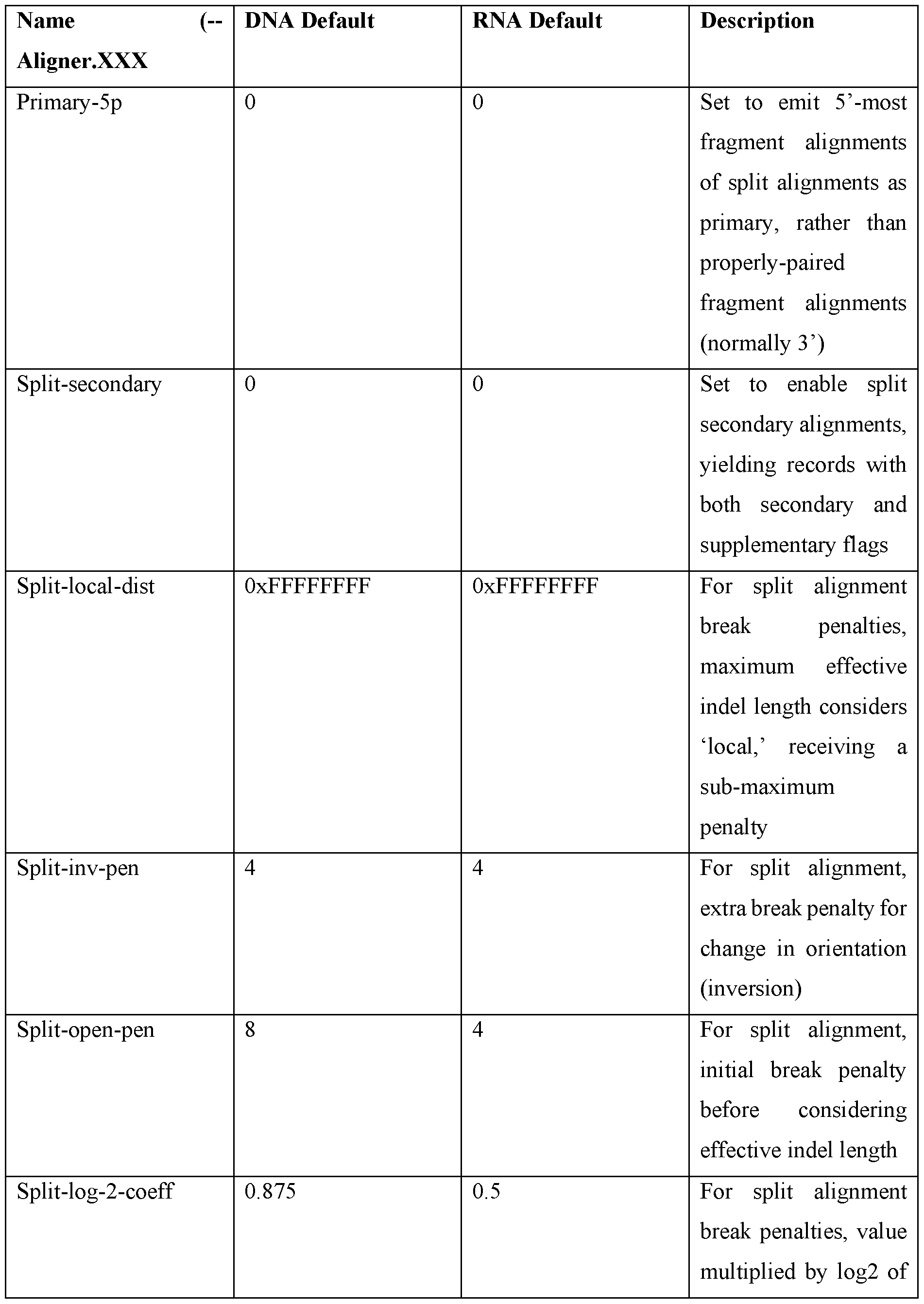

Claims
Priority Applications (6)
| Application Number | Priority Date | Filing Date | Title |
|---|---|---|---|
| EP23745347.7A EP4544558A1 (en) | 2022-06-24 | 2023-06-23 | Improving split-read alignment by intelligently identifying and scoring candidate split groups |
| CA3260493A CA3260493A1 (en) | 2022-06-24 | 2023-06-23 | Improving split-read alignment by intelligently identifying and scoring candidate split groups |
| IL317960A IL317960A (en) | 2022-06-24 | 2023-06-23 | Improving split-read alignment by intelligently identifying and scoring candidate split groups |
| JP2024575575A JP2025523520A (en) | 2022-06-24 | 2023-06-23 | Improving split-read alignment by intelligently identifying and scoring candidate split groups |
| KR1020247042682A KR20250034034A (en) | 2022-06-24 | 2023-06-23 | How to improve split-read alignment by intelligently identifying and scoring candidate split groups |
| CN202380049118.0A CN119422201A (en) | 2022-06-24 | 2023-06-23 | Improve segment-read alignment by intelligently identifying and scoring candidate segment groups |
Applications Claiming Priority (2)
| Application Number | Priority Date | Filing Date | Title |
|---|---|---|---|
| US202263367002P | 2022-06-24 | 2022-06-24 | |
| US63/367,002 | 2022-06-24 |
Publications (1)
| Publication Number | Publication Date |
|---|---|
| WO2023250504A1 true WO2023250504A1 (en) | 2023-12-28 |
Family
ID=87468473
Family Applications (1)
| Application Number | Title | Priority Date | Filing Date |
|---|---|---|---|
| PCT/US2023/069024 Ceased WO2023250504A1 (en) | 2022-06-24 | 2023-06-23 | Improving split-read alignment by intelligently identifying and scoring candidate split groups |
Country Status (8)
| Country | Link |
|---|---|
| US (1) | US20230420080A1 (en) |
| EP (1) | EP4544558A1 (en) |
| JP (1) | JP2025523520A (en) |
| KR (1) | KR20250034034A (en) |
| CN (1) | CN119422201A (en) |
| CA (1) | CA3260493A1 (en) |
| IL (1) | IL317960A (en) |
| WO (1) | WO2023250504A1 (en) |
Citations (31)
| Publication number | Priority date | Publication date | Assignee | Title |
|---|---|---|---|---|
| WO1991006678A1 (en) | 1989-10-26 | 1991-05-16 | Sri International | Dna sequencing |
| US6172218B1 (en) | 1994-10-13 | 2001-01-09 | Lynx Therapeutics, Inc. | Oligonucleotide tags for sorting and identification |
| US6210891B1 (en) | 1996-09-27 | 2001-04-03 | Pyrosequencing Ab | Method of sequencing DNA |
| US6258568B1 (en) | 1996-12-23 | 2001-07-10 | Pyrosequencing Ab | Method of sequencing DNA based on the detection of the release of pyrophosphate and enzymatic nucleotide degradation |
| US6274320B1 (en) | 1999-09-16 | 2001-08-14 | Curagen Corporation | Method of sequencing a nucleic acid |
| US6306597B1 (en) | 1995-04-17 | 2001-10-23 | Lynx Therapeutics, Inc. | DNA sequencing by parallel oligonucleotide extensions |
| WO2004018497A2 (en) | 2002-08-23 | 2004-03-04 | Solexa Limited | Modified nucleotides for polynucleotide sequencing |
| US20050100900A1 (en) | 1997-04-01 | 2005-05-12 | Manteia Sa | Method of nucleic acid amplification |
| WO2005065814A1 (en) | 2004-01-07 | 2005-07-21 | Solexa Limited | Modified molecular arrays |
| US6969488B2 (en) | 1998-05-22 | 2005-11-29 | Solexa, Inc. | System and apparatus for sequential processing of analytes |
| US7001792B2 (en) | 2000-04-24 | 2006-02-21 | Eagle Research & Development, Llc | Ultra-fast nucleic acid sequencing device and a method for making and using the same |
| US7057026B2 (en) | 2001-12-04 | 2006-06-06 | Solexa Limited | Labelled nucleotides |
| WO2006064199A1 (en) | 2004-12-13 | 2006-06-22 | Solexa Limited | Improved method of nucleotide detection |
| US20060240439A1 (en) | 2003-09-11 | 2006-10-26 | Smith Geoffrey P | Modified polymerases for improved incorporation of nucleotide analogues |
| US20060281109A1 (en) | 2005-05-10 | 2006-12-14 | Barr Ost Tobias W | Polymerases |
| WO2007010251A2 (en) | 2005-07-20 | 2007-01-25 | Solexa Limited | Preparation of templates for nucleic acid sequencing |
| US7211414B2 (en) | 2000-12-01 | 2007-05-01 | Visigen Biotechnologies, Inc. | Enzymatic nucleic acid synthesis: compositions and methods for altering monomer incorporation fidelity |
| WO2007123744A2 (en) | 2006-03-31 | 2007-11-01 | Solexa, Inc. | Systems and devices for sequence by synthesis analysis |
| US7315019B2 (en) | 2004-09-17 | 2008-01-01 | Pacific Biosciences Of California, Inc. | Arrays of optical confinements and uses thereof |
| US7329492B2 (en) | 2000-07-07 | 2008-02-12 | Visigen Biotechnologies, Inc. | Methods for real-time single molecule sequence determination |
| US20080108082A1 (en) | 2006-10-23 | 2008-05-08 | Pacific Biosciences Of California, Inc. | Polymerase enzymes and reagents for enhanced nucleic acid sequencing |
| US7405281B2 (en) | 2005-09-29 | 2008-07-29 | Pacific Biosciences Of California, Inc. | Fluorescent nucleotide analogs and uses therefor |
| US20090026082A1 (en) | 2006-12-14 | 2009-01-29 | Ion Torrent Systems Incorporated | Methods and apparatus for measuring analytes using large scale FET arrays |
| US20090127589A1 (en) | 2006-12-14 | 2009-05-21 | Ion Torrent Systems Incorporated | Methods and apparatus for measuring analytes using large scale FET arrays |
| US20100137143A1 (en) | 2008-10-22 | 2010-06-03 | Ion Torrent Systems Incorporated | Methods and apparatus for measuring analytes |
| US20100282617A1 (en) | 2006-12-14 | 2010-11-11 | Ion Torrent Systems Incorporated | Methods and apparatus for detecting molecular interactions using fet arrays |
| US20120270305A1 (en) | 2011-01-10 | 2012-10-25 | Illumina Inc. | Systems, methods, and apparatuses to image a sample for biological or chemical analysis |
| US20130079232A1 (en) | 2011-09-23 | 2013-03-28 | Illumina, Inc. | Methods and compositions for nucleic acid sequencing |
| US20130260372A1 (en) | 2012-04-03 | 2013-10-03 | Illumina, Inc. | Integrated optoelectronic read head and fluidic cartridge useful for nucleic acid sequencing |
| US20190080045A1 (en) * | 2017-09-13 | 2019-03-14 | The Jackson Laboratory | Detection of high-resolution structural variants using long-read genome sequence analysis |
| US20200075123A1 (en) * | 2018-08-31 | 2020-03-05 | Guardant Health, Inc. | Genetic variant detection based on merged and unmerged reads |
Family Cites Families (1)
| Publication number | Priority date | Publication date | Assignee | Title |
|---|---|---|---|---|
| WO2020123906A1 (en) * | 2018-12-13 | 2020-06-18 | The General Hospital Corporation | Biologically informed and accurate sequence alignment |
-
2023
- 2023-06-23 WO PCT/US2023/069024 patent/WO2023250504A1/en not_active Ceased
- 2023-06-23 EP EP23745347.7A patent/EP4544558A1/en active Pending
- 2023-06-23 CN CN202380049118.0A patent/CN119422201A/en active Pending
- 2023-06-23 KR KR1020247042682A patent/KR20250034034A/en active Pending
- 2023-06-23 CA CA3260493A patent/CA3260493A1/en active Pending
- 2023-06-23 IL IL317960A patent/IL317960A/en unknown
- 2023-06-23 US US18/340,795 patent/US20230420080A1/en active Pending
- 2023-06-23 JP JP2024575575A patent/JP2025523520A/en active Pending
Patent Citations (35)
| Publication number | Priority date | Publication date | Assignee | Title |
|---|---|---|---|---|
| WO1991006678A1 (en) | 1989-10-26 | 1991-05-16 | Sri International | Dna sequencing |
| US6172218B1 (en) | 1994-10-13 | 2001-01-09 | Lynx Therapeutics, Inc. | Oligonucleotide tags for sorting and identification |
| US6306597B1 (en) | 1995-04-17 | 2001-10-23 | Lynx Therapeutics, Inc. | DNA sequencing by parallel oligonucleotide extensions |
| US6210891B1 (en) | 1996-09-27 | 2001-04-03 | Pyrosequencing Ab | Method of sequencing DNA |
| US6258568B1 (en) | 1996-12-23 | 2001-07-10 | Pyrosequencing Ab | Method of sequencing DNA based on the detection of the release of pyrophosphate and enzymatic nucleotide degradation |
| US20050100900A1 (en) | 1997-04-01 | 2005-05-12 | Manteia Sa | Method of nucleic acid amplification |
| US6969488B2 (en) | 1998-05-22 | 2005-11-29 | Solexa, Inc. | System and apparatus for sequential processing of analytes |
| US6274320B1 (en) | 1999-09-16 | 2001-08-14 | Curagen Corporation | Method of sequencing a nucleic acid |
| US7001792B2 (en) | 2000-04-24 | 2006-02-21 | Eagle Research & Development, Llc | Ultra-fast nucleic acid sequencing device and a method for making and using the same |
| US7329492B2 (en) | 2000-07-07 | 2008-02-12 | Visigen Biotechnologies, Inc. | Methods for real-time single molecule sequence determination |
| US7211414B2 (en) | 2000-12-01 | 2007-05-01 | Visigen Biotechnologies, Inc. | Enzymatic nucleic acid synthesis: compositions and methods for altering monomer incorporation fidelity |
| US7057026B2 (en) | 2001-12-04 | 2006-06-06 | Solexa Limited | Labelled nucleotides |
| US7427673B2 (en) | 2001-12-04 | 2008-09-23 | Illumina Cambridge Limited | Labelled nucleotides |
| US20060188901A1 (en) | 2001-12-04 | 2006-08-24 | Solexa Limited | Labelled nucleotides |
| WO2004018497A2 (en) | 2002-08-23 | 2004-03-04 | Solexa Limited | Modified nucleotides for polynucleotide sequencing |
| US20070166705A1 (en) | 2002-08-23 | 2007-07-19 | John Milton | Modified nucleotides |
| US20060240439A1 (en) | 2003-09-11 | 2006-10-26 | Smith Geoffrey P | Modified polymerases for improved incorporation of nucleotide analogues |
| WO2005065814A1 (en) | 2004-01-07 | 2005-07-21 | Solexa Limited | Modified molecular arrays |
| US7315019B2 (en) | 2004-09-17 | 2008-01-01 | Pacific Biosciences Of California, Inc. | Arrays of optical confinements and uses thereof |
| WO2006064199A1 (en) | 2004-12-13 | 2006-06-22 | Solexa Limited | Improved method of nucleotide detection |
| US20060281109A1 (en) | 2005-05-10 | 2006-12-14 | Barr Ost Tobias W | Polymerases |
| WO2007010251A2 (en) | 2005-07-20 | 2007-01-25 | Solexa Limited | Preparation of templates for nucleic acid sequencing |
| US7405281B2 (en) | 2005-09-29 | 2008-07-29 | Pacific Biosciences Of California, Inc. | Fluorescent nucleotide analogs and uses therefor |
| WO2007123744A2 (en) | 2006-03-31 | 2007-11-01 | Solexa, Inc. | Systems and devices for sequence by synthesis analysis |
| US20100111768A1 (en) | 2006-03-31 | 2010-05-06 | Solexa, Inc. | Systems and devices for sequence by synthesis analysis |
| US20080108082A1 (en) | 2006-10-23 | 2008-05-08 | Pacific Biosciences Of California, Inc. | Polymerase enzymes and reagents for enhanced nucleic acid sequencing |
| US20090127589A1 (en) | 2006-12-14 | 2009-05-21 | Ion Torrent Systems Incorporated | Methods and apparatus for measuring analytes using large scale FET arrays |
| US20090026082A1 (en) | 2006-12-14 | 2009-01-29 | Ion Torrent Systems Incorporated | Methods and apparatus for measuring analytes using large scale FET arrays |
| US20100282617A1 (en) | 2006-12-14 | 2010-11-11 | Ion Torrent Systems Incorporated | Methods and apparatus for detecting molecular interactions using fet arrays |
| US20100137143A1 (en) | 2008-10-22 | 2010-06-03 | Ion Torrent Systems Incorporated | Methods and apparatus for measuring analytes |
| US20120270305A1 (en) | 2011-01-10 | 2012-10-25 | Illumina Inc. | Systems, methods, and apparatuses to image a sample for biological or chemical analysis |
| US20130079232A1 (en) | 2011-09-23 | 2013-03-28 | Illumina, Inc. | Methods and compositions for nucleic acid sequencing |
| US20130260372A1 (en) | 2012-04-03 | 2013-10-03 | Illumina, Inc. | Integrated optoelectronic read head and fluidic cartridge useful for nucleic acid sequencing |
| US20190080045A1 (en) * | 2017-09-13 | 2019-03-14 | The Jackson Laboratory | Detection of high-resolution structural variants using long-read genome sequence analysis |
| US20200075123A1 (en) * | 2018-08-31 | 2020-03-05 | Guardant Health, Inc. | Genetic variant detection based on merged and unmerged reads |
Non-Patent Citations (17)
| Title |
|---|
| COCKROFT, S. L.CHU, J.AMORIN, M.GHADIRI, M. R.: "A single-molecule nanopore device detects DNA polymerase activity with single-nucleotide resolution", J. AM. CHEM. SOC., vol. 130, 2008, pages 818 - 820, XP055097434, DOI: 10.1021/ja077082c |
| DEAMER, D. W.AKESON, M.: "Nanopores and nucleic acids: prospects for ultrarapid sequencing", TRENDS BIOTECHNOL., vol. 18, 2000, pages 147 - 151, XP004194002, DOI: 10.1016/S0167-7799(00)01426-8 |
| DEAMER, D.D. BRANTON: "Characterization of nucleic acids by nanopore analysis", ACC. CHEM. RES., vol. 35, 2002, pages 817 - 825, XP002226144, DOI: 10.1021/ar000138m |
| FEDERICA FAZZINI ET AL.: "Analyzing Low-Level mtDNA Heteroplasmy-Pitfalls and Challenges from Bench to Benchmarking", INT'L J. MOL. SCI., vol. 22, no. 2, 19 January 2021 (2021-01-19), pages 935 |
| HEALY, K.: "Nanopore-based single-molecule DNA analysis", NANOMED., vol. 2, 2007, pages 459 - 481, XP009111262, DOI: 10.2217/17435889.2.4.459 |
| KORLACH, J. ET AL.: "Selective aluminum passivation for targeted immobilization of single DNA polymerase molecules in zero-mode waveguide nano structures", PROC. NATL. ACAD. SCI. USA, vol. 105, 2008, pages 1176 - 1181 |
| LEVENE, M. ET AL.: "Zero-mode waveguides for single-molecule analysis at high concentrations", SCIENCE, vol. 299, 2003, pages 682 - 686, XP002341055, DOI: 10.1126/science.1079700 |
| LI, J.M. GERSHOWD. STEINE. BRANDINJ. A. GOLOVCHENKO: "DNA molecules and configurations in a solid-state nanopore microscope", NAT. MATER., vol. 2, 2003, pages 611 - 615, XP009039572, DOI: 10.1038/nmat965 |
| LUNDQUIST, P. M. ET AL.: "Parallel confocal detection of single molecules in real time", OPT. LETT., vol. 33, 2008, pages 1026 - 1028, XP001522593, DOI: 10.1364/OL.33.001026 |
| METZKER, GENOME RES., vol. 15, 2005, pages 1767 - 1776 |
| RONAGHI, M.: "Pyrosequencing sheds light on DNA sequencing", GENOME RES., vol. 11, no. 1, 2001, pages 3 - 11, XP000980886, DOI: 10.1101/gr.11.1.3 |
| RONAGHI, M.KARAMOHAMED, S.PETTERSSON, B.UHLEN, M.NYREN, P.: "Real-time DNA sequencing using detection of pyrophosphate release", ANALYTICAL BIOCHEMISTRY, vol. 242, no. 1, 1996, pages 84 - 9, XP002388725, DOI: 10.1006/abio.1996.0432 |
| RONAGHI, M.UHLEN, M.NYREN, P.: "A sequencing method based on real-time pyrophosphate", SCIENCE, vol. 281, no. 5375, 1998, pages 363, XP002135869, DOI: 10.1126/science.281.5375.363 |
| RUPAREL ET AL., PROC NATL ACAD SCI USA, vol. 102, 2005, pages 5932 - 7 |
| SHRESTHA ANISH M S ET AL: "Combining probabilistic alignments with read pair information improves accuracy of split-alignments", BIOINFORMATICS, vol. 34, no. 21, 18 May 2018 (2018-05-18), GB, pages 3631 - 3637, XP093085384, ISSN: 1367-4803, Retrieved from the Internet <URL:https://www.ncbi.nlm.nih.gov/pmc/articles/PMC6198854/pdf/bty398.pdf> [retrieved on 20230925], DOI: 10.1093/bioinformatics/bty398 * |
| SONI, G. V.MELLER: "A. Progress toward ultrafast DNA sequencing using solid-state nanopores", CLIN. CHEM., vol. 53, 2007, pages 1996 - 2001, XP055076185, DOI: 10.1373/clinchem.2007.091231 |
| YANG HAI ET AL: "Improved Indel Detection Algorithm Based on Split-Read and Read-Depth", 6 July 2018, SAT 2015 18TH INTERNATIONAL CONFERENCE, AUSTIN, TX, USA, SEPTEMBER 24-27, 2015; [LECTURE NOTES IN COMPUTER SCIENCE; LECT.NOTES COMPUTER], SPRINGER, BERLIN, HEIDELBERG, PAGE(S) 853 - 864, ISBN: 978-3-540-74549-5, XP047482046 * |
Also Published As
| Publication number | Publication date |
|---|---|
| EP4544558A1 (en) | 2025-04-30 |
| IL317960A (en) | 2025-02-01 |
| KR20250034034A (en) | 2025-03-10 |
| US20230420080A1 (en) | 2023-12-28 |
| CA3260493A1 (en) | 2023-12-28 |
| JP2025523520A (en) | 2025-07-23 |
| CN119422201A (en) | 2025-02-11 |
Similar Documents
| Publication | Publication Date | Title |
|---|---|---|
| US20220415443A1 (en) | Machine-learning model for generating confidence classifications for genomic coordinates | |
| US20240038327A1 (en) | Rapid single-cell multiomics processing using an executable file | |
| US20240404624A1 (en) | Structural variant alignment and variant calling by utilizing a structural-variant reference genome | |
| US20230420082A1 (en) | Generating and implementing a structural variation graph genome | |
| US20240112753A1 (en) | Target-variant-reference panel for imputing target variants | |
| WO2025006874A1 (en) | Machine-learning model for recalibrating genotype calls corresponding to germline variants and somatic mosaic variants | |
| US20230095961A1 (en) | Graph reference genome and base-calling approach using imputed haplotypes | |
| US20230420080A1 (en) | Split-read alignment by intelligently identifying and scoring candidate split groups | |
| US20240127906A1 (en) | Detecting and correcting methylation values from methylation sequencing assays | |
| US20240177802A1 (en) | Accurately predicting variants from methylation sequencing data | |
| US20250111899A1 (en) | Predicting insert lengths using primary analysis metrics | |
| US20250210141A1 (en) | Enhanced mapping and alignment of nucleotide reads utilizing an improved haplotype data structure with allele-variant differences | |
| US20250201342A1 (en) | Minimal residual disease (mrd) models for determining likelihoods or probabilities of a subject comprising cancer | |
| US20240371469A1 (en) | Machine learning model for recalibrating genotype calls from existing sequencing data files | |
| US20230313271A1 (en) | Machine-learning models for detecting and adjusting values for nucleotide methylation levels | |
| WO2025090883A1 (en) | Detecting variants in nucleotide sequences based on haplotype diversity | |
| WO2025184234A1 (en) | A personalized haplotype database for improved mapping and alignment of nucleotide reads and improved genotype calling | |
| WO2025160089A1 (en) | Custom multigenome reference construction for improved sequencing analysis of genomic samples |
Legal Events
| Date | Code | Title | Description |
|---|---|---|---|
| 121 | Ep: the epo has been informed by wipo that ep was designated in this application |
Ref document number: 23745347 Country of ref document: EP Kind code of ref document: A1 |
|
| DPE1 | Request for preliminary examination filed after expiration of 19th month from priority date (pct application filed from 20040101) | ||
| WWE | Wipo information: entry into national phase |
Ref document number: 317960 Country of ref document: IL Ref document number: 2024575575 Country of ref document: JP Ref document number: 202380049118.0 Country of ref document: CN |
|
| WWE | Wipo information: entry into national phase |
Ref document number: 11202408990R Country of ref document: SG Ref document number: 2023745347 Country of ref document: EP |
|
| NENP | Non-entry into the national phase |
Ref country code: DE |
|
| ENP | Entry into the national phase |
Ref document number: 2023745347 Country of ref document: EP Effective date: 20250124 |
|
| REG | Reference to national code |
Ref country code: BR Ref legal event code: B01A Ref document number: 112024026994 Country of ref document: BR |
|
| WWP | Wipo information: published in national office |
Ref document number: 202380049118.0 Country of ref document: CN |
|
| WWP | Wipo information: published in national office |
Ref document number: 1020247042682 Country of ref document: KR |
|
| REG | Reference to national code |
Ref country code: BR Ref legal event code: B01E Ref document number: 112024026994 Country of ref document: BR Free format text: 1) APRESENTE NOVO RELATORIO DESCRITIVO ADAPTADO AO ART. 26 INCISO I DA PORTARIA/INPI NO 14/2024, UMA VEZ QUE O CONTEUDO ENVIADO NA PETICAO NO 870240109308 DE 20/12/2024 ENCONTRA-SE FORA DA NORMA EM RELACAO AO TITULO, CONTENDO TEXTO DIFERENTE DO TITULO INCIANDO A PAGINA E NAO CENTRALIZADO. 2) APRESENTE NOVAS FOLHAS DO RELATORIO DESCRITIVO ADAPTADAS AO ART. 20 DA PORTARIA/INPI NO 14/2024, UMA VEZ QUE O CONTEUDO ENVIADO NA PETICAO NO 870240109308 DE 20/12/2024 ENCONTRA-SE FORA DA NORMA COM RELACAO A NUMERACAO DAS TABELAS, CONTENDO TABELAS SEM IDENTIFICACAO SEQUENCIAL DAS MESMAS. 3) APRESENTE NOVO RESUMO ADAPTADO AO ART. 18 DA PORTARIA/INPI/NO 14/2024, UMA VEZ QUE O CONTEUDO ENVIADO NA PETICAO N |
|
| WWP | Wipo information: published in national office |
Ref document number: 2023745347 Country of ref document: EP |
|
| REG | Reference to national code |
Ref country code: BR Ref legal event code: B01E Ref document number: 112024026994 Country of ref document: BR Free format text: EFETUAR, EM ATE 60 (SESSENTA) DIAS, O PAGAMENTO DE GRU CODIGO DE SERVICO 260 PARA A REGULARIZACAO DO PEDIDO, CONFORME ART. 2O 1O DA RESOLUCAO/INPI/NO 189/2017 E NOTA DE ESCLARECIMENTO PUBLICADA NA RPI 2421 DE 30/05/2017, UMA VEZ QUE A PETICAO NO 870250050241 DE 16/06/2025 APRESENTA DOCUMENTOS REFERENTES A 2 SERVICOS DIVERSOS (RESPOSTA DA EXIGENCIA E MODIFICACAO DO PEDIDO) TENDO SIDO PAGA SOMENTE 1 RETRIBUICAO. DEVERA SER PAGA MAIS 1 (UMA) GRU CODIGO DE SERVICO 260 E A GRU CODIGO DE SERVICO 207 REFERENTE A RESPOSTA DESTA EXIGENCIA. |
|
| ENP | Entry into the national phase |
Ref document number: 112024026994 Country of ref document: BR Kind code of ref document: A2 Effective date: 20241220 |