WO2023199318A1 - A system and a method of measuring, analyzing, and providing feedback regarding the nervous, mental and physiological states of a patient, using wearable or carried sensors - Google Patents
A system and a method of measuring, analyzing, and providing feedback regarding the nervous, mental and physiological states of a patient, using wearable or carried sensors Download PDFInfo
- Publication number
- WO2023199318A1 WO2023199318A1 PCT/IL2023/050384 IL2023050384W WO2023199318A1 WO 2023199318 A1 WO2023199318 A1 WO 2023199318A1 IL 2023050384 W IL2023050384 W IL 2023050384W WO 2023199318 A1 WO2023199318 A1 WO 2023199318A1
- Authority
- WO
- WIPO (PCT)
- Prior art keywords
- subject
- patient
- processing unit
- central processing
- smart
- Prior art date
- Legal status (The legal status is an assumption and is not a legal conclusion. Google has not performed a legal analysis and makes no representation as to the accuracy of the status listed.)
- Ceased
Links
Classifications
-
- A—HUMAN NECESSITIES
- A61—MEDICAL OR VETERINARY SCIENCE; HYGIENE
- A61B—DIAGNOSIS; SURGERY; IDENTIFICATION
- A61B5/00—Measuring for diagnostic purposes; Identification of persons
- A61B5/02—Detecting, measuring or recording for evaluating the cardiovascular system, e.g. pulse, heart rate, blood pressure or blood flow
- A61B5/0205—Simultaneously evaluating both cardiovascular conditions and different types of body conditions, e.g. heart and respiratory condition
- A61B5/02055—Simultaneously evaluating both cardiovascular condition and temperature
-
- A—HUMAN NECESSITIES
- A61—MEDICAL OR VETERINARY SCIENCE; HYGIENE
- A61B—DIAGNOSIS; SURGERY; IDENTIFICATION
- A61B5/00—Measuring for diagnostic purposes; Identification of persons
- A61B5/0002—Remote monitoring of patients using telemetry, e.g. transmission of vital signals via a communication network
- A61B5/0015—Remote monitoring of patients using telemetry, e.g. transmission of vital signals via a communication network characterised by features of the telemetry system
- A61B5/0024—Remote monitoring of patients using telemetry, e.g. transmission of vital signals via a communication network characterised by features of the telemetry system for multiple sensor units attached to the patient, e.g. using a body or personal area network
-
- A—HUMAN NECESSITIES
- A61—MEDICAL OR VETERINARY SCIENCE; HYGIENE
- A61B—DIAGNOSIS; SURGERY; IDENTIFICATION
- A61B5/00—Measuring for diagnostic purposes; Identification of persons
- A61B5/16—Devices for psychotechnics; Testing reaction times ; Devices for evaluating the psychological state
-
- A—HUMAN NECESSITIES
- A61—MEDICAL OR VETERINARY SCIENCE; HYGIENE
- A61B—DIAGNOSIS; SURGERY; IDENTIFICATION
- A61B5/00—Measuring for diagnostic purposes; Identification of persons
- A61B5/40—Detecting, measuring or recording for evaluating the nervous system
-
- A—HUMAN NECESSITIES
- A61—MEDICAL OR VETERINARY SCIENCE; HYGIENE
- A61B—DIAGNOSIS; SURGERY; IDENTIFICATION
- A61B5/00—Measuring for diagnostic purposes; Identification of persons
- A61B5/68—Arrangements of detecting, measuring or recording means, e.g. sensors, in relation to patient
- A61B5/6801—Arrangements of detecting, measuring or recording means, e.g. sensors, in relation to patient specially adapted to be attached to or worn on the body surface
- A61B5/6802—Sensor mounted on worn items
-
- A—HUMAN NECESSITIES
- A61—MEDICAL OR VETERINARY SCIENCE; HYGIENE
- A61B—DIAGNOSIS; SURGERY; IDENTIFICATION
- A61B5/00—Measuring for diagnostic purposes; Identification of persons
- A61B5/74—Details of notification to user or communication with user or patient; User input means
- A61B5/746—Alarms related to a physiological condition, e.g. details of setting alarm thresholds or avoiding false alarms
-
- A—HUMAN NECESSITIES
- A61—MEDICAL OR VETERINARY SCIENCE; HYGIENE
- A61B—DIAGNOSIS; SURGERY; IDENTIFICATION
- A61B5/00—Measuring for diagnostic purposes; Identification of persons
- A61B5/02—Detecting, measuring or recording for evaluating the cardiovascular system, e.g. pulse, heart rate, blood pressure or blood flow
- A61B5/021—Measuring pressure in heart or blood vessels
-
- A—HUMAN NECESSITIES
- A61—MEDICAL OR VETERINARY SCIENCE; HYGIENE
- A61B—DIAGNOSIS; SURGERY; IDENTIFICATION
- A61B5/00—Measuring for diagnostic purposes; Identification of persons
- A61B5/02—Detecting, measuring or recording for evaluating the cardiovascular system, e.g. pulse, heart rate, blood pressure or blood flow
- A61B5/024—Measuring pulse rate or heart rate
-
- A—HUMAN NECESSITIES
- A61—MEDICAL OR VETERINARY SCIENCE; HYGIENE
- A61B—DIAGNOSIS; SURGERY; IDENTIFICATION
- A61B5/00—Measuring for diagnostic purposes; Identification of persons
- A61B5/05—Detecting, measuring or recording for diagnosis by means of electric currents or magnetic fields; Measuring using microwaves or radio waves
- A61B5/053—Measuring electrical impedance or conductance of a portion of the body
- A61B5/0531—Measuring skin impedance
- A61B5/0533—Measuring galvanic skin response
-
- A—HUMAN NECESSITIES
- A61—MEDICAL OR VETERINARY SCIENCE; HYGIENE
- A61B—DIAGNOSIS; SURGERY; IDENTIFICATION
- A61B5/00—Measuring for diagnostic purposes; Identification of persons
- A61B5/08—Measuring devices for evaluating the respiratory organs
- A61B5/083—Measuring rate of metabolism by using breath test, e.g. measuring rate of oxygen consumption
- A61B5/0836—Measuring rate of CO2 production
-
- A—HUMAN NECESSITIES
- A61—MEDICAL OR VETERINARY SCIENCE; HYGIENE
- A61B—DIAGNOSIS; SURGERY; IDENTIFICATION
- A61B5/00—Measuring for diagnostic purposes; Identification of persons
- A61B5/145—Measuring characteristics of blood in vivo, e.g. gas concentration or pH-value ; Measuring characteristics of body fluids or tissues, e.g. interstitial fluid or cerebral tissue
- A61B5/14542—Measuring characteristics of blood in vivo, e.g. gas concentration or pH-value ; Measuring characteristics of body fluids or tissues, e.g. interstitial fluid or cerebral tissue for measuring blood gases
-
- A—HUMAN NECESSITIES
- A61—MEDICAL OR VETERINARY SCIENCE; HYGIENE
- A61B—DIAGNOSIS; SURGERY; IDENTIFICATION
- A61B5/00—Measuring for diagnostic purposes; Identification of persons
- A61B5/16—Devices for psychotechnics; Testing reaction times ; Devices for evaluating the psychological state
- A61B5/165—Evaluating the state of mind, e.g. depression, anxiety
-
- A—HUMAN NECESSITIES
- A61—MEDICAL OR VETERINARY SCIENCE; HYGIENE
- A61B—DIAGNOSIS; SURGERY; IDENTIFICATION
- A61B5/00—Measuring for diagnostic purposes; Identification of persons
- A61B5/16—Devices for psychotechnics; Testing reaction times ; Devices for evaluating the psychological state
- A61B5/18—Devices for psychotechnics; Testing reaction times ; Devices for evaluating the psychological state for vehicle drivers or machine operators
-
- A—HUMAN NECESSITIES
- A61—MEDICAL OR VETERINARY SCIENCE; HYGIENE
- A61B—DIAGNOSIS; SURGERY; IDENTIFICATION
- A61B5/00—Measuring for diagnostic purposes; Identification of persons
- A61B5/24—Detecting, measuring or recording bioelectric or biomagnetic signals of the body or parts thereof
- A61B5/316—Modalities, i.e. specific diagnostic methods
- A61B5/318—Heart-related electrical modalities, e.g. electrocardiography [ECG]
-
- A—HUMAN NECESSITIES
- A61—MEDICAL OR VETERINARY SCIENCE; HYGIENE
- A61B—DIAGNOSIS; SURGERY; IDENTIFICATION
- A61B5/00—Measuring for diagnostic purposes; Identification of persons
- A61B5/40—Detecting, measuring or recording for evaluating the nervous system
- A61B5/4029—Detecting, measuring or recording for evaluating the nervous system for evaluating the peripheral nervous systems
- A61B5/4035—Evaluating the autonomic nervous system
-
- A—HUMAN NECESSITIES
- A61—MEDICAL OR VETERINARY SCIENCE; HYGIENE
- A61B—DIAGNOSIS; SURGERY; IDENTIFICATION
- A61B5/00—Measuring for diagnostic purposes; Identification of persons
- A61B5/40—Detecting, measuring or recording for evaluating the nervous system
- A61B5/4076—Diagnosing or monitoring particular conditions of the nervous system
- A61B5/4094—Diagnosing or monitoring seizure diseases, e.g. epilepsy
-
- A—HUMAN NECESSITIES
- A61—MEDICAL OR VETERINARY SCIENCE; HYGIENE
- A61B—DIAGNOSIS; SURGERY; IDENTIFICATION
- A61B5/00—Measuring for diagnostic purposes; Identification of persons
- A61B5/48—Other medical applications
- A61B5/4806—Sleep evaluation
- A61B5/4815—Sleep quality
-
- A—HUMAN NECESSITIES
- A61—MEDICAL OR VETERINARY SCIENCE; HYGIENE
- A61B—DIAGNOSIS; SURGERY; IDENTIFICATION
- A61B5/00—Measuring for diagnostic purposes; Identification of persons
- A61B5/48—Other medical applications
- A61B5/4836—Diagnosis combined with treatment in closed-loop systems or methods
-
- A—HUMAN NECESSITIES
- A61—MEDICAL OR VETERINARY SCIENCE; HYGIENE
- A61B—DIAGNOSIS; SURGERY; IDENTIFICATION
- A61B5/00—Measuring for diagnostic purposes; Identification of persons
- A61B5/68—Arrangements of detecting, measuring or recording means, e.g. sensors, in relation to patient
- A61B5/6801—Arrangements of detecting, measuring or recording means, e.g. sensors, in relation to patient specially adapted to be attached to or worn on the body surface
- A61B5/6802—Sensor mounted on worn items
- A61B5/6804—Garments; Clothes
- A61B5/6807—Footwear
-
- A—HUMAN NECESSITIES
- A61—MEDICAL OR VETERINARY SCIENCE; HYGIENE
- A61B—DIAGNOSIS; SURGERY; IDENTIFICATION
- A61B5/00—Measuring for diagnostic purposes; Identification of persons
- A61B5/68—Arrangements of detecting, measuring or recording means, e.g. sensors, in relation to patient
- A61B5/6801—Arrangements of detecting, measuring or recording means, e.g. sensors, in relation to patient specially adapted to be attached to or worn on the body surface
- A61B5/6802—Sensor mounted on worn items
- A61B5/681—Wristwatch-type devices
-
- A—HUMAN NECESSITIES
- A61—MEDICAL OR VETERINARY SCIENCE; HYGIENE
- A61B—DIAGNOSIS; SURGERY; IDENTIFICATION
- A61B5/00—Measuring for diagnostic purposes; Identification of persons
- A61B5/68—Arrangements of detecting, measuring or recording means, e.g. sensors, in relation to patient
- A61B5/6887—Arrangements of detecting, measuring or recording means, e.g. sensors, in relation to patient mounted on external non-worn devices, e.g. non-medical devices
- A61B5/6898—Portable consumer electronic devices, e.g. music players, telephones, tablet computers
-
- A—HUMAN NECESSITIES
- A61—MEDICAL OR VETERINARY SCIENCE; HYGIENE
- A61B—DIAGNOSIS; SURGERY; IDENTIFICATION
- A61B5/00—Measuring for diagnostic purposes; Identification of persons
- A61B5/72—Signal processing specially adapted for physiological signals or for diagnostic purposes
- A61B5/7235—Details of waveform analysis
- A61B5/7264—Classification of physiological signals or data, e.g. using neural networks, statistical classifiers, expert systems or fuzzy systems
- A61B5/7267—Classification of physiological signals or data, e.g. using neural networks, statistical classifiers, expert systems or fuzzy systems involving training the classification device
-
- A—HUMAN NECESSITIES
- A61—MEDICAL OR VETERINARY SCIENCE; HYGIENE
- A61B—DIAGNOSIS; SURGERY; IDENTIFICATION
- A61B5/00—Measuring for diagnostic purposes; Identification of persons
- A61B5/72—Signal processing specially adapted for physiological signals or for diagnostic purposes
- A61B5/7271—Specific aspects of physiological measurement analysis
- A61B5/7275—Determining trends in physiological measurement data; Predicting development of a medical condition based on physiological measurements, e.g. determining a risk factor
Definitions
- the present invention relates to the field of physiological and mental state diagnosis. More particularly, the invention relates to a system and method of measuring, analyzing, and providing feedback regarding the nervous, mental and physiological states, of a patient/subject, using wearable or carried sensors.
- the human autonomic nervous system is responsible for regulating the body's unconscious actions and controls specific body processes, such as blood circulation, digestion, breathing, urination, heartbeat, etc.
- the autonomic nervous system functions autonomously, i.e., without any person's conscious effort.
- the primary function of the autonomic nervous system is homeostasis. Apart from maintaining the body's internal environment, the autonomic nervous system is also involved in controlling and maintaining several human body processes, such as digestion, metabolism, urination, defecation, blood pressure, response, body temperature, heartbeat rate, breathing rate and fluid balance.
- the sympathetic autonomic nervous system The sympathetic autonomic nervous system
- the sympathetic nervous system is responsible for stimulating activities associated with the fight-or-flight response (an automatic physiological reaction to an event that is perceived as stressful or frightening).
- the sympathetic nervous system is known for its role in responding to dangerous or stressful situations. In these situations, the sympathetic nervous system activates to speed up the heart rate, and deliver more blood to areas of the body that need more oxygen or other responses to help a subject get out of danger.
- PSNS parasympathetic autonomic nervous system
- the Parasympathetic Nervous System is a division of the autonomic nervous system.
- the parasympathetic system is responsible for the stimulation of "rest-and- digest” or "feed and breed” activities that occur when the body is at rest, especially after eating, including sexual arousal, salivation, lacrimation (tears), urination, digestion, and defecation.
- the action is described as being complementary to that of the sympathetic nervous system, which is responsible for stimulating activities associated with the fight-or-flight response.
- Measurements and data collection of conventional nervous monitoring systems require the physical presence of the patient in a clinic or a hospital. However, patients typically do not tend to visit a clinic or a hospital, unless experiencing a severe nervous mental or physiological disorder.
- a method for performing measurements and analysis on the human nervous, mental and physiological states comprising: a) providing one or more wearable or carried sensors, to be deployed on a subject's body; b) acquiring and gathering raw data from the sensors; c) transmitting the raw data to a central processing unit (such as a local or remote server, or a computational cloud); d)analyzing the raw data by a central processing unit, to recognize typical patterns that are indicative of the nervous, mental and physiological states of a patient; and e) providing, by the central processing unit, alerts to the patient, if relevant, and reports to associated carers regarding actual or impending states that require a response.
- a central processing unit such as a local or remote server, or a computational cloud
- a system for performing measurements and analysis on the human nervous, mental and physiological states comprising: a) one or more wearable or carried sensors, to be deployed on a subject's body, for acquiring and transmitting the raw data to a central processing unit; b)a central processing unit for: b.l) receiving and gathering the transmitting raw data; b.2) analyzing the raw data to recognize typical patterns that are indicative of the nervous, mental and physiological states of the subject; and b.3) providing alerts to the subject, if relevant, and reports to associated carers regarding actual or impending states that require a response.
- the raw data may be analyzed by the central processing unit, using:
- the central processing unit may be adapted to aggregate and store the information sent from one or more devices of one or more subjects and analyze the gathered information either online, or offline.
- the sensed parameters may be selected from: Galvanic Skin Response (GSR);
- EDA Electro-Dermal Activity
- Electrocardiogram ECG
- the temperature of the subject and environment The temperature of the subject and environment
- the sensors may be selected from the group of:
- Each wearable sensor may have a unique identifier.
- Measurements for evaluation may be based on one or more sensors, and/or on the history of the information and history from other devices and devices of other subjects.
- the states may be related to the patient with respect to:
- the evaluation process may tag the current activity of the subject, based on the information related to the state of the nervous system of the subject during the following activities:
- Typical patterns associated with the measurement of heartbeat rate and perspiring parameters may be used to provide indications regarding true/false reactions and answers of a subject.
- Analysis may be made in real-time or at pre-defined times.
- the sampled data may be sent to the central processing unit along with metadata information.
- Analysis and detection of typical patterns may be made during sleeping hours of a patient following experienced trauma.
- Analysis and detection of typical patterns may be associated with indications regarding: true/false reactions of a subject; indications regarding fatigue level of a subject; indications regarding drunkenness level of a subject.
- the central processing unit may be adapted to provide, in response to a detected state of the patient, feedback and/or predetermined treatment to the patient or to carers of the patient.
- the alerts may be audio alerts or visual alerts or a combination thereof.
- the patient may receive an early alert regarding an impending seizure along with a recommendation to take a predetermined medicine, to reduce the effect of the seizure.
- the system may send a vibration alert to the smartwatch of the patient, for allowing taking preventive drugs before reaching a severe state.
- Data related to the location and movement speed of a subject may be jointly processed, to detect whether the subject is currently driving, to provide alerts to other drivers in his vicinity and to law enforcement authorities.
- the feedback may comprise activating treatment devices, musical instruments for relaxation, and dosage or infusion pumps for administering drugs whenever required.
- the feedback may be provided using: sound; images; video; pressure; medicine administration; injection; electric activity; radio and electromagnetic activity; magnetic activity; thermal activity.
- the activation of the medical device may be predetermined or adaptive, according to instructions from a physician.
- Fig. 1 is a flowchart of the operations performed by the method of the present invention
- Fig. 2 illustrates a plurality of sensors that are wearable of carried by a patient
- Fig. 3 illustrates the block diagram of the system for measuring, analyzing, and providing feedback regarding the nervous, mental and physiological states, of a patient, according to an embodiment of the invention.
- the present invention provides a system and method of measuring, analyzing, and providing feedback regarding the nervous, mental and physiological states, of a patient or a subject, using wearable or carried sensors (the subject may be a patient). Also, the subject may be a human subject, or an animal.
- the system of the present invention performs continuous or discrete acquisition of one or more physiological and/or environmental and/or visual parameters of human subjects, animals, or the environment via one or more wearable or carried devices.
- the raw data is sampled in predetermined frequencies and transmitted to a central server or to a computational cloud, for gathering and processing.
- the sampled raw data may be sent in real-time or at pre-defined times to an on-premise cloud (onpremise software is installed and runs on a company's own hardware infrastructure, and is hosted locally), a private cloud (is a cloud environment that is available for use only by one client) or a public cloud.
- the sampled data is sent along with metadata information, such as ID, timestamp, sampling rate, etc.
- Fig. 1 is a flowchart of the operations performed by the method of the present invention.
- raw data is acquired from a plurality of wearable or carried sensors that are deployed on the subject's body.
- the acquired data is gathered from all relevant sensors and transmitted to a central processing unit, such as a local or remote server, or to a computational cloud, where the data is analyzed.
- Data analysis is performed to recognize typical patterns that are indicative of the nervous, mental and physiological states of a patient, using artificial intelligence (Al) or machine learning (ML) techniques.
- Al artificial intelligence
- ML machine learning
- Other techniques such as signal processing and pattern recognition may be used to obtain patterns that are indicative of nervous, mental and physiological states of the patient.
- the central processing unit provides alerts (such as audio or visual alerts) to the patient, if relevant and reports to the associated medical staff or to other people (carers) who can take care of him. For example, the patient may receive an early alert regarding an impending seizure with a recommendation to take a predetermined medicine and reduce the effect of the seizure.
- the central processing unit can provide feedback and predetermined treatment in response to the detected state of the patient, such as activating treatment devices (e.g., musical instruments for relaxation, dosage or infusion pumps for administering drugs, etc.).
- the central server aggregates and stores the information sent from one or more devices of one or more subjects and analyzes the gathered information either online, or offline.
- the data might be subject to modifications, such as noise reduction.
- the analysis can include an evaluation of the information collected from one or more sensors using machine learning and artificial intelligence on specific or several devices of one or more subjects/patients.
- the parameters that are sensed and acquired by the wearable or carried devices that comprise sensors include, but are not limited to:
- GSR Galvanic Skin Response
- Electro-dermal activity is the property of the human body that causes continuous variation in the electrical characteristics of the skin
- Electrocardiogram records the electrical signals in the heart and is used as a common and painless test used to quickly detect heart problems and monitor the heart's health);
- PETC02 End-Tidal Carbon Dioxide
- CO2 carbon dioxide
- Oxygen Saturation is a measure of how much hemoglobin is currently bound to oxygen compared to how much hemoglobin remains unbound
- Fig. 2 illustrates a plurality of sensors that are wearable of carried by a patient.
- These sensors or devices may include a smart bracelet, a smart watch, smart shoes (to monitor exercises, optimize your running style, improve your times or prevent sports injuries) fitness trackers (that register the heart rate, the running distance, the speed and the amount of steps), smart socks (which track heart rate, sweat levels and motion, and enable carers to intervene before things escalate.
- smart pants or smart sports clothing, such as a jogging suit or cycling shorts that carry a global positioning system (GPS) unit and a fitness monitor powered by your movements as the patient pedal or run, to monitor and analyze workout
- a smart belt smart belts are wearable devices that have various applications in healthcare and can be used to correct posture, help in reducing abdominal obesity, fetus health monitoring in pregnant women using flex sensor belts and analyzing body data
- a smart ring smart rings are equipped with sensors that can measure heart rate, blood oxygen levels, and even stress
- smart fingers smart fingers are devices with oximetry Bluetooth connection application that reads data from a finger clip, such as heart rate and oxygen level
- a smart bracelet with an application that can detect and evaluate the user's sports data, sleep quality, heart rate and blood pressure
- the smartphone may be used to sense the typing speed and the forces applied on the keypad while typing messages. These parameters may be indicative of various levels of actual or impending dementia.
- the smartphone may also be used as a proximity sensor which measures the distance from the patient's ear while talking, which may be indicative of hearing problems.
- hand vibrations while typing may be indicative of Alzheimer disorders at various levels.
- the remote server or a computational cloud analyzes the gathered information and evaluates the state of the nervous system, based on the above parameters. The evaluation can be made continuously, or momentarily. According to the assessment results, feedback is sent to a central processing unit for signal analysis and processing. Feedback will be sent to the end-user using graphical, audio, or physical channels.
- the central processing unit can be used to aggregate parameters from many wearable devices on different humans, and use algorithms such as machine learning or artificial intelligence to learn, compare, measure, deduce, and evaluate the state of a single subject or sub-group of subjects, momentary or in a continuous manner.
- data is acquired and gathered by one or more wearable sensors in the form of a computerized or wearable device, preferably that has a unique identifier, that continuously samples the carrying subject's physiological and/or environmental and/or visual parameters such as those specified above.
- the state of the nervous system of the subject is measured and estimated, where measurements may be based on one or more sensors, and/or on the history of the information (such as medical records), and/or on the information and history from other devices and subjects.
- These states may be related to the patient with respect to sympathetic and parasympathetic systems, autonomous and non-autonomous systems in the patient's body, his mental state, his level of alertness, his level of fatigue, his level of fear, Fight or flight states, traumatic or post-traumatic states, his level of pain emotional and feeling states, his level of arousal.
- sensing the sympathetic system of a patient during sleeping hours during the few days following the experienced trauma followed by analysis and detecting typical patterns may provide indications regarding an impending post-traumatic disorder.
- the evaluation process tags the current activity of the subject, based on the information related to the state of the nervous system of the subject during at least the following activities: walking, running, smoking, eating, sleeping, reading, working.
- the system is adapted to provide reports regarding the evaluated data, including the evaluation of a chart, line, or graph in a data form and/or visual forms on a subject level or on a group level.
- the system may also be adapted to provide alerts regarding the state of a subject to third parties in the form of messages or online alerts, along with information on the alert trigger and evaluation.
- the system is adapted to provide feedback to the subject based on audio, video, or physical feedback based on the above evaluation.
- the feedback can be in the form of one of the following (but not limited to): sound, images, video, pressure, medicine administration, injection, electric activity (e.g., electric shock), radio and electromagnetic activity, magnetic activity, and thermal activity.
- Fig. 3 illustrates the block diagram of the system for measuring, analyzing, and providing feedback regarding the nervous, mental and physiological states, of a patient, according to an embodiment of the invention.
- the system 300 comprises a plurality of sensors 301 that are wearable or carried by one or more subjects or patients 302.
- a central processing unit (such as a server of a computational cloud) 303 receives data samples from one or more of the sensors 301 and jointly processes and analyzes the gathered data, to identify typical patterns that are associated with nervous, mental and physiological states of the patient 302.
- the central processing unit 303 provides visual alerts 304 and or voice alerts 305 to the patient 302 or to carers regarding an actual or impending state.
- the central processing unit 303 is adapted to provide corresponding treatment to the patient 302 by activating medical devices, such as a drug infusion pump 306 that is carried by the patient 302.
- the system may be used to detect typical patterns that are associated with the measurement of heartbeat rate and perspiring parameters are used to provide indications regarding true/false reactions and answers of a subject, rather than using a polygraph which is much less convenient to the tested subject.
- veneration sensing and analysis may provide indications regarding patterns that are typical of an impending post-traumatic seizure, as well as other patterns that involve a rising GSR level, followed by a falling GSR level during sleeping.
- GSR level may be measured by smartwatches with two sensors located at the bottom, which are in contact with the patient skin. In this case, an alert that is provided may allow the patient or his carers to start a relaxation of medical treatment in advance, to reduce the effect of the seizure.
- the system may send a vibration alert to the smartwatch of the patient, for allowing him to take preventive drugs before reaching a severe state.
- problematic states may also be identified by analyzing the gathered data and detecting typical patterns that are indicative of fatigue or a level of drunkenness of a subject.
- the system can jointly process data related to his location and movement speed, to detect whether he is currently driving and to provide alerts to other drivers in his vicinity and to law enforcement authorities.
Landscapes
- Health & Medical Sciences (AREA)
- Life Sciences & Earth Sciences (AREA)
- Engineering & Computer Science (AREA)
- Animal Behavior & Ethology (AREA)
- Public Health (AREA)
- Veterinary Medicine (AREA)
- Biophysics (AREA)
- Pathology (AREA)
- Physics & Mathematics (AREA)
- Biomedical Technology (AREA)
- Heart & Thoracic Surgery (AREA)
- Medical Informatics (AREA)
- Molecular Biology (AREA)
- Surgery (AREA)
- General Health & Medical Sciences (AREA)
- Physiology (AREA)
- Cardiology (AREA)
- Hospice & Palliative Care (AREA)
- Child & Adolescent Psychology (AREA)
- Developmental Disabilities (AREA)
- Educational Technology (AREA)
- Pulmonology (AREA)
- Psychiatry (AREA)
- Psychology (AREA)
- Social Psychology (AREA)
- Neurology (AREA)
- Neurosurgery (AREA)
- Computer Networks & Wireless Communication (AREA)
- Measurement Of The Respiration, Hearing Ability, Form, And Blood Characteristics Of Living Organisms (AREA)
Abstract
A system for performing measurements and analysis on the nervous, mental and physiological states of a subject, comprising one or more wearable or carried sensors, to be deployed on a subject's body, for acquiring and transmitting the raw data to a central processing unit and a central processing unit which is adapted to receive and gather the transmitting raw data; analyze the raw data to recognize typical patterns that are indicative of the nervous, mental and physiological states of the subject; and providing alerts to the subject, if relevant, and reports to associated carers regarding actual or impending states that require a response.
Description
A SYSTEM AND A METHOD OF MEASURING, ANALYZING, AND PROVIDING FEEDBACK REGARDING THE NERVOUS, MENTAL AND PHYSIOLOGICAL STATES OF A PATIENT, USING WEARABLE OR CARRIED SENSORS
Field of the Invention
The present invention relates to the field of physiological and mental state diagnosis. More particularly, the invention relates to a system and method of measuring, analyzing, and providing feedback regarding the nervous, mental and physiological states, of a patient/subject, using wearable or carried sensors.
Background of the Invention
The human autonomic nervous system is responsible for regulating the body's unconscious actions and controls specific body processes, such as blood circulation, digestion, breathing, urination, heartbeat, etc. The autonomic nervous system functions autonomously, i.e., without any person's conscious effort.
The primary function of the autonomic nervous system is homeostasis. Apart from maintaining the body's internal environment, the autonomic nervous system is also involved in controlling and maintaining several human body processes, such as digestion, metabolism, urination, defecation, blood pressure, response, body temperature, heartbeat rate, breathing rate and fluid balance.
There are two types of the autonomic nervous system, each involving a different response:
The sympathetic autonomic nervous system
The sympathetic nervous system is responsible for stimulating activities associated with the fight-or-flight response (an automatic physiological reaction to an event that is perceived as stressful or frightening). The sympathetic nervous system is
known for its role in responding to dangerous or stressful situations. In these situations, the sympathetic nervous system activates to speed up the heart rate, and deliver more blood to areas of the body that need more oxygen or other responses to help a subject get out of danger.
The parasympathetic autonomic nervous system (PSNS)
The Parasympathetic Nervous System (PSNS) is a division of the autonomic nervous system. The parasympathetic system is responsible for the stimulation of "rest-and- digest" or "feed and breed" activities that occur when the body is at rest, especially after eating, including sexual arousal, salivation, lacrimation (tears), urination, digestion, and defecation. The action is described as being complementary to that of the sympathetic nervous system, which is responsible for stimulating activities associated with the fight-or-flight response.
Table 1 below comprises a comparison between the Sympathetic and
Parasympathetic nervous systems:
Table 1

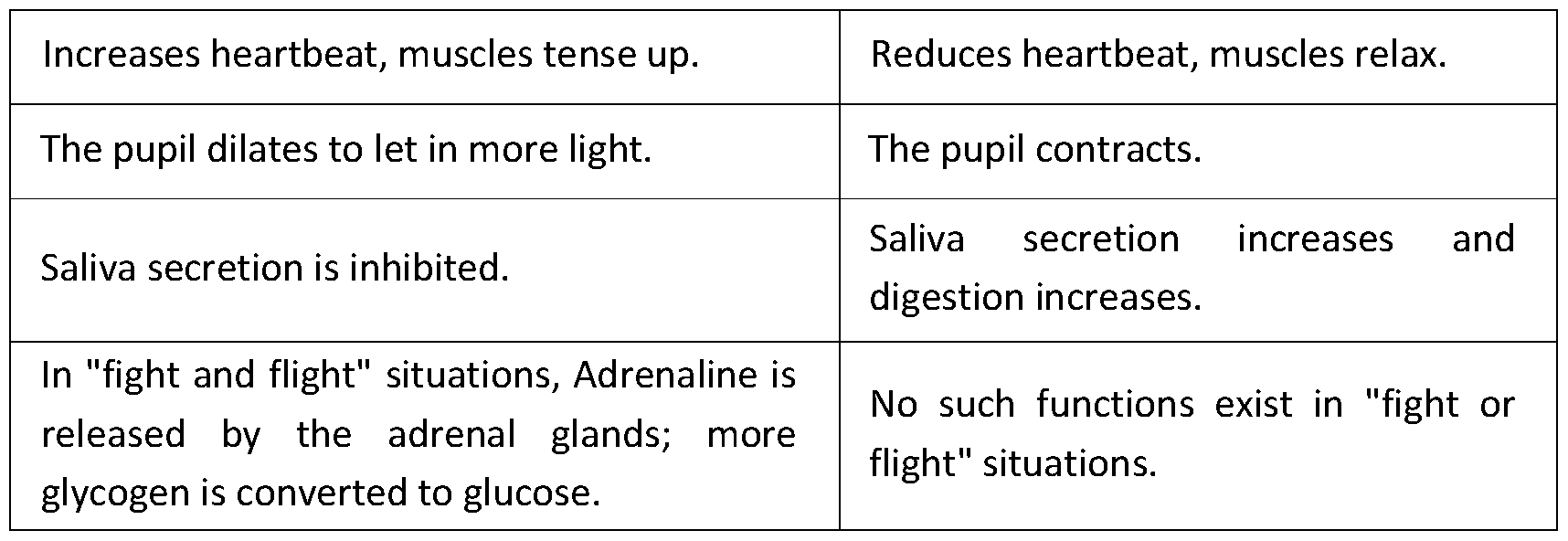
Measurements and data collection of conventional nervous monitoring systems require the physical presence of the patient in a clinic or a hospital. However, patients typically do not tend to visit a clinic or a hospital, unless experiencing a severe nervous mental or physiological disorder.
It is therefore an object of the present invention to provide a system and method of measuring, analyzing, and providing feedback regarding the nervous, mental and physiological states, of a patient, using wearable or carried sensors.
Other objects and advantages of the invention will become apparent as the description proceeds.
Summary of the Invention
A method for performing measurements and analysis on the human nervous, mental and physiological states, comprising: a) providing one or more wearable or carried sensors, to be deployed on a subject's body; b) acquiring and gathering raw data from the sensors; c) transmitting the raw data to a central processing unit (such as a local or remote server, or a computational cloud);
d)analyzing the raw data by a central processing unit, to recognize typical patterns that are indicative of the nervous, mental and physiological states of a patient; and e) providing, by the central processing unit, alerts to the patient, if relevant, and reports to associated carers regarding actual or impending states that require a response.
A system for performing measurements and analysis on the human nervous, mental and physiological states, comprising: a) one or more wearable or carried sensors, to be deployed on a subject's body, for acquiring and transmitting the raw data to a central processing unit; b)a central processing unit for: b.l) receiving and gathering the transmitting raw data; b.2) analyzing the raw data to recognize typical patterns that are indicative of the nervous, mental and physiological states of the subject; and b.3) providing alerts to the subject, if relevant, and reports to associated carers regarding actual or impending states that require a response.
The raw data may be analyzed by the central processing unit, using:
- artificial intelligence (Al) techniques;
- machine learning (ML) techniques;
- signal processing techniques;
- pattern recognition techniques.
The central processing unit may be adapted to aggregate and store the information sent from one or more devices of one or more subjects and analyze the gathered information either online, or offline.
The sensed parameters may be selected from:
Galvanic Skin Response (GSR);
Electro-Dermal Activity (EDA)
Heartbeats rate;
Electrocardiogram (ECG);
- PETC02;
Oxygen Saturation;
Acceleration;
Acoustic noise;
The temperature of the subject and environment;
Ambient light;
Images taken by cameras;
Proximity of objects.
The sensors may be selected from the group of:
- a smart bracelet;
- a smartwatch;
- smart shoes;
- fitness trackers;
- smart socks;
- smart pants
- a smart belt;
- a smart ring;
- smart fingers;
- a smart bracelet;
- a smartphone;
The analysis and evaluation of the gathered data may be made continuously, or momentarily.
Each wearable sensor may have a unique identifier.
Measurements for evaluation may be based on one or more sensors, and/or on the history of the information and history from other devices and devices of other subjects.
The states may be related to the patient with respect to:
- sympathetic and parasympathetic systems;
- autonomous and non-autonomous systems in the patient's body;
- the mental state;
- the level of alertness;
- the level of fatigue;
- the level of fear;
- Fight or flight states;
- traumatic or post-traumatic states;
- the level of pain emotional and feeling states;
- the level of arousal.
The evaluation process may tag the current activity of the subject, based on the information related to the state of the nervous system of the subject during the following activities:
Walking;
Running;
Smoking;
Eating;
Sleeping;
Reading; working.
Typical patterns associated with the measurement of heartbeat rate and perspiring parameters may be used to provide indications regarding true/false reactions and answers of a subject.
Analysis may be made in real-time or at pre-defined times.
The sampled data may be sent to the central processing unit along with metadata information.
Analysis and detection of typical patterns may be made during sleeping hours of a patient following experienced trauma.
Analysis and detection of typical patterns may be associated with indications regarding: true/false reactions of a subject; indications regarding fatigue level of a subject; indications regarding drunkenness level of a subject.
The central processing unit may be adapted to provide, in response to a detected state of the patient, feedback and/or predetermined treatment to the patient or to carers of the patient. The alerts may be audio alerts or visual alerts or a combination thereof.
The patient may receive an early alert regarding an impending seizure along with a recommendation to take a predetermined medicine, to reduce the effect of the seizure.
Upon detecting an impending post-traumatic seizure, the system may send a vibration alert to the smartwatch of the patient, for allowing taking preventive drugs before reaching a severe state.
Data related to the location and movement speed of a subject may be jointly processed, to detect whether the subject is currently driving, to provide alerts to other drivers in his vicinity and to law enforcement authorities.
The feedback may comprise activating treatment devices, musical instruments for relaxation, and dosage or infusion pumps for administering drugs whenever required. The feedback may be provided using: sound; images; video; pressure; medicine administration; injection; electric activity; radio and electromagnetic activity; magnetic activity; thermal activity.
The activation of the medical device may be predetermined or adaptive, according to instructions from a physician.
Trends and reactions to the provided treatment may be identified to modify the treatment according to the trends using open or closed loops.
Brief Description of the Drawings
The above and other characteristics and advantages of the invention will be better understood through the following illustrative and non-limitative detailed description of preferred embodiments thereof, with reference to the appended drawings, wherein:
Fig. 1 is a flowchart of the operations performed by the method of the present invention;
Fig. 2 illustrates a plurality of sensors that are wearable of carried by a patient; and
Fig. 3 illustrates the block diagram of the system for measuring, analyzing, and providing feedback regarding the nervous, mental and physiological states, of a patient, according to an embodiment of the invention.
Detailed Description of the Invention
The present invention provides a system and method of measuring, analyzing, and providing feedback regarding the nervous, mental and physiological states, of a patient or a subject, using wearable or carried sensors (the subject may be a patient). Also, the subject may be a human subject, or an animal.
The system of the present invention performs continuous or discrete acquisition of one or more physiological and/or environmental and/or visual parameters of human subjects, animals, or the environment via one or more wearable or carried devices. The raw data is sampled in predetermined frequencies and transmitted to a central server or to a computational cloud, for gathering and processing. The sampled raw data may be sent in real-time or at pre-defined times to an on-premise cloud (onpremise software is installed and runs on a company's own hardware infrastructure, and is hosted locally), a private cloud (is a cloud environment that is available for use
only by one client) or a public cloud. The sampled data is sent along with metadata information, such as ID, timestamp, sampling rate, etc.
Fig. 1 is a flowchart of the operations performed by the method of the present invention. At the first step 101, raw data is acquired from a plurality of wearable or carried sensors that are deployed on the subject's body. At the next step 102, the acquired data is gathered from all relevant sensors and transmitted to a central processing unit, such as a local or remote server, or to a computational cloud, where the data is analyzed. Data analysis is performed to recognize typical patterns that are indicative of the nervous, mental and physiological states of a patient, using artificial intelligence (Al) or machine learning (ML) techniques. Of course, other techniques such as signal processing and pattern recognition may be used to obtain patterns that are indicative of nervous, mental and physiological states of the patient. At the next step 103 the central processing unit provides alerts (such as audio or visual alerts) to the patient, if relevant and reports to the associated medical staff or to other people (carers) who can take care of him. For example, the patient may receive an early alert regarding an impending seizure with a recommendation to take a predetermined medicine and reduce the effect of the seizure. At the next step 104, the central processing unit can provide feedback and predetermined treatment in response to the detected state of the patient, such as activating treatment devices (e.g., musical instruments for relaxation, dosage or infusion pumps for administering drugs, etc.).
In one embodiment, the central server (or cloud) aggregates and stores the information sent from one or more devices of one or more subjects and analyzes the gathered information either online, or offline. The data might be subject to modifications, such as noise reduction. The analysis can include an evaluation of the information collected from one or more sensors using machine learning and artificial intelligence on specific or several devices of one or more subjects/patients.
The parameters that are sensed and acquired by the wearable or carried devices that comprise sensors include, but are not limited to:
Galvanic Skin Response (GSR - refers to changes in sweat gland activity that are reflective of the intensity of our emotional state, otherwise known as emotional arousal);
Electro-dermal activity (EDA - is the property of the human body that causes continuous variation in the electrical characteristics of the skin);
Heartbeats rate;
Electrocardiogram (ECG - records the electrical signals in the heart and is used as a common and painless test used to quickly detect heart problems and monitor the heart's health);
The pressure of End-Tidal Carbon Dioxide (PETC02 refers to the partial pressure or concentration of carbon dioxide (CO2) at the end of exhalation, which is normally 35-45 mm Hg. It has special clinical significance for judging body metabolism, pulmonary ventilation, and pulmonary blood flow changes. It is widely applied in clinical anesthesia, cardiopulmonary cerebral resuscitation, pre-hospital first aid, intensive care post-anesthesia);
Oxygen Saturation (is a measure of how much hemoglobin is currently bound to oxygen compared to how much hemoglobin remains unbound);
Internal vibrations (Internal vibrations are thought to stem from the same causes as tremors. Nervous system conditions such as Parkinson's disease, multiple sclerosis (MS), and essential tremors can all cause these tremors);
Acceleration (as the acceleration increases, the congestion increases and throbbing pains are felt throughout the head);
Acoustic noise (physiological effects of noise pollution adversely affect health such as heightened blood pressure and stress. Subjects that are regularly exposed to high noise levels have higher cases of nausea, headaches, argumentativeness, and changes in mood and anxiety);
Temperature (subject and environment)
Ambient light;
Images being taken by cameras;
The proximity of objects.
Fig. 2 illustrates a plurality of sensors that are wearable of carried by a patient. These sensors or devices may include a smart bracelet, a smart watch, smart shoes (to monitor exercises, optimize your running style, improve your times or prevent sports injuries) fitness trackers (that register the heart rate, the running distance, the speed and the amount of steps), smart socks (which track heart rate, sweat levels and motion, and enable carers to intervene before things escalate. They provide a steady stream of data to carers, who can easily access their patient's metrics on a dedicated application), smart pants (or smart sports clothing, such as a jogging suit or cycling shorts that carry a global positioning system (GPS) unit and a fitness monitor powered by your movements as the patient pedal or run, to monitor and analyze workout), a smart belt (smart belts are wearable devices that have various applications in healthcare and can be used to correct posture, help in reducing abdominal obesity, fetus health monitoring in pregnant women using flex sensor belts and analyzing body data), a smart ring (smart rings are equipped with sensors that can measure heart rate, blood oxygen levels, and even stress), smart fingers (smart fingers are devices with oximetry Bluetooth connection application that reads data from a finger clip, such as heart rate and oxygen level), a smart bracelet (with an application that can detect and evaluate the user's sports data, sleep quality, heart rate and blood pressure) and a smartphone. For example, the smartphone may be used to sense the typing speed and the forces applied on the keypad while typing messages. These parameters may be indicative of various levels of actual or impending dementia. The smartphone may also be used as a proximity sensor which measures the distance from the patient's ear while talking, which may be indicative of hearing problems. Also, hand vibrations while typing may be indicative of Alzheimer disorders at various levels.
The remote server or a computational cloud analyzes the gathered information and evaluates the state of the nervous system, based on the above parameters. The evaluation can be made continuously, or momentarily. According to the assessment results, feedback is sent to a central processing unit for signal analysis and processing. Feedback will be sent to the end-user using graphical, audio, or physical channels.
The central processing unit can be used to aggregate parameters from many wearable devices on different humans, and use algorithms such as machine learning or artificial intelligence to learn, compare, measure, deduce, and evaluate the state of a single subject or sub-group of subjects, momentary or in a continuous manner.
According to one embodiment, data is acquired and gathered by one or more wearable sensors in the form of a computerized or wearable device, preferably that has a unique identifier, that continuously samples the carrying subject's physiological and/or environmental and/or visual parameters such as those specified above.
During the evaluation, the state of the nervous system of the subject is measured and estimated, where measurements may be based on one or more sensors, and/or on the history of the information (such as medical records), and/or on the information and history from other devices and subjects. These states may be related to the patient with respect to sympathetic and parasympathetic systems, autonomous and non-autonomous systems in the patient's body, his mental state, his level of alertness, his level of fatigue, his level of fear, Fight or flight states, traumatic or post-traumatic states, his level of pain emotional and feeling states, his level of arousal. For example, sensing the sympathetic system of a patient during sleeping hours during the few days following the experienced trauma followed by
analysis and detecting typical patterns may provide indications regarding an impending post-traumatic disorder.
The evaluation process tags the current activity of the subject, based on the information related to the state of the nervous system of the subject during at least the following activities: walking, running, smoking, eating, sleeping, reading, working.
In one embodiment, the system is adapted to provide reports regarding the evaluated data, including the evaluation of a chart, line, or graph in a data form and/or visual forms on a subject level or on a group level. The system may also be adapted to provide alerts regarding the state of a subject to third parties in the form of messages or online alerts, along with information on the alert trigger and evaluation.
The system is adapted to provide feedback to the subject based on audio, video, or physical feedback based on the above evaluation. The feedback can be in the form of one of the following (but not limited to): sound, images, video, pressure, medicine administration, injection, electric activity (e.g., electric shock), radio and electromagnetic activity, magnetic activity, and thermal activity.
Fig. 3 illustrates the block diagram of the system for measuring, analyzing, and providing feedback regarding the nervous, mental and physiological states, of a patient, according to an embodiment of the invention. The system 300 comprises a plurality of sensors 301 that are wearable or carried by one or more subjects or patients 302. A central processing unit (such as a server of a computational cloud) 303 receives data samples from one or more of the sensors 301 and jointly processes and analyzes the gathered data, to identify typical patterns that are associated with nervous, mental and physiological states of the patient 302. As a
result, the central processing unit 303 provides visual alerts 304 and or voice alerts 305 to the patient 302 or to carers regarding an actual or impending state. In addition, the central processing unit 303 is adapted to provide corresponding treatment to the patient 302 by activating medical devices, such as a drug infusion pump 306 that is carried by the patient 302. The activation of the medical device may be predetermined or adaptive, according to instructions from a physician. Since data is continuously or periodically gathered from the sensors 301, further processing allows the central processing unit 303 to identify trends and reactions to the provided treatment and modify the treatment according t=to these trends (e.g., enhancing to terminating the treatment). This can be done in an open or closed loop, depending on the type of provided treatment.
According to another embodiment, the system may be used to detect typical patterns that are associated with the measurement of heartbeat rate and perspiring parameters are used to provide indications regarding true/false reactions and answers of a subject, rather than using a polygraph which is much less convenient to the tested subject. Also, veneration sensing and analysis may provide indications regarding patterns that are typical of an impending post-traumatic seizure, as well as other patterns that involve a rising GSR level, followed by a falling GSR level during sleeping. GSR level may be measured by smartwatches with two sensors located at the bottom, which are in contact with the patient skin. In this case, an alert that is provided may allow the patient or his carers to start a relaxation of medical treatment in advance, to reduce the effect of the seizure.
According to another embodiment, upon detecting an impending post traumatic seizure, the system may send a vibration alert to the smartwatch of the patient, for allowing him to take preventive drugs before reaching a severe state.
Other problematic states may also be identified by analyzing the gathered data and detecting typical patterns that are indicative of fatigue or a level of drunkenness of a
subject. In this case, the system can jointly process data related to his location and movement speed, to detect whether he is currently driving and to provide alerts to other drivers in his vicinity and to law enforcement authorities.
The above examples and description have of course been provided only for the purpose of illustrations, and are not intended to limit the invention in any way. As will be appreciated by the skilled person, the invention can be carried out in a great variety of ways, employing more than one technique from those described above, all without exceeding the scope of the invention.
Claims
CLAIMS . A method for performing measurements and analysis on the nervous, mental and physiological states of a subject/patient, comprising: a) providing one or more wearable or carried sensors, to be deployed on a subject's body; b) acquiring and gathering raw data from said sensors; c) transmitting said raw data to a central processing unit; d)analyzing said raw data by a central processing unit, to recognize typical patterns that are indicative of the nervous, mental and physiological states of a patient; and e) providing, by said central processing unit, alerts to said patient, if relevant, and reports to associated carers regarding actual or impending states that require a response. . A method according to claim 1, wherein the central processing unit is a local or remote server, or a computational cloud. . A method according to claim 1, wherein the raw data is analyzed by the central processing unit, using:
- artificial intelligence (Al) techniques;
- machine learning (ML) techniques;
- signal processing techniques;
- pattern recognition techniques. . A method according to claim 1, wherein the central processing unit aggregates and stores the information sent from one or more devices of one or more subjects and analyzes the gathered information either online, or offline.
. A method according to claim 1, wherein the sensed parameters are selected from:
Galvanic Skin Response (GSR);
Electro-Dermal Activity (EDA)
Heartbeats rate;
Electrocardiogram (ECG);
- PETC02;
Oxygen Saturation;
Acceleration;
Acoustic noise;
The temperature of the subject and environment;
Ambient light;
Images taken by cameras;
Proximity of objects. . A method according to claim 1, wherein the sensors are selected from the group of:
- a smart bracelet;
- a smartwatch;
- smart shoes;
- fitness trackers;
- smart socks;
- smart pants
- a smart belt;
- a smart ring;
- smart fingers;
- a smart bracelet;
- a smartphone;
. A method according to claim 1, wherein the analysis and evaluation of the gathered data is made continuously, or momentarily. . A method according to claim 1, wherein each wearable sensor has a unique identifier . A method according to claim 1, wherein measurements for evaluation are based on one or more sensors, and/or on the history of the information and history from other devices and devices of other subjects. 0. A method according to claim 1, wherein the states are related to the patient with respect to:
- sympathetic and parasympathetic systems;
- autonomous and non-autonomous systems in the patient's body;
- the mental state;
- the level of alertness;
- the level of fatigue;
- the level of fear;
- Fight or flight states;
- traumatic or post-traumatic states;
- the level of pain emotional and feeling states;
- the level of arousal. 1. A method according to claim 1, wherein the evaluation process tags the current activity of the subject, based on the information related to the state of the nervous system of the subject during the following activities:
Walking;
Running;
Smoking;
Eating;
Sleeping;
Reading; working. A method according to claim 1, wherein typical patterns associated with the measurement of heartbeat rate and perspiring parameters are used to provide indications regarding true/false reactions and answers of a subject. A method according to claim 1, wherein analysis is made in real-time or at predefined times. A method according to claim 1, further comprising sending the sampled data to the central processing unit along with metadata information. A method according to claim 1, wherein analysis and detection of typical patterns are made during sleeping hours of a patient following experienced trauma. A method according to claim 1, wherein analysis and detection of typical patterns are associated with indications regarding: true/false reactions of a subject; indications regarding fatigue level of a subject; indications regarding drunkenness level of a subject.
A method according to claim 1, further comprising, providing by said central processing unit and in response to a detected state of the patient, feedback and/or predetermined treatment to said patient or to carers of said patient. A method according to claim 1, wherein the alerts are audio alerts or visual alerts or a combination thereof. A method according to claim 1, wherein the patient receives an early alert regarding an impending seizure along with a recommendation to take a predetermined medicine, to reduce the effect of said seizure. A method according to claim 1, wherein upon detecting an impending post- traumatic seizure, sending a vibration alert to the smartwatch of the patient, for allowing taking preventive drugs before reaching a severe state. A method according to claim 24, further comprising jointly processing data related to the location and movement speed of a subject, to detect whether said subject is currently driving, to provide alerts to other drivers in his vicinity and to law enforcement authorities. A method according to claim 2, wherein the feedback comprising activating treatment devices, musical instruments for relaxation, and dosage or infusion pumps for administering drugs whenever required. A method according to claim 2, wherein the feedback is provided using: sound; images; video; pressure; medicine administration; injection;
electric activity; radio and electromagnetic activity; magnetic activity; thermal activity. A method according to claim 8, wherein the activation of the medical device may be predetermined or adaptive, according to instructions from a physician. A method according to claim 22, further comprising identifying trends and reactions to the provided treatment and modifying the treatment according to said trends using open or closed loops. A system for performing measurements and analysis on the nervous, mental and physiological states of a subject/patient, comprising: a) one or more wearable or carried sensors, to be deployed on a subject's body, for acquiring and transmitting said raw data to a central processing unit; b)a central processing unit for: b.l) receiving and gathering the transmitting raw data; b.2) analyzing said raw data to recognize typical patterns that are indicative of the nervous, mental and physiological states of said subject; and b.3) providing alerts to said subject, if relevant, and reports to associated carers regarding actual or impending states that require a response. A system according to claim 26, in which the central processing unit is a local or remote server, or a computational cloud. A system according to claim 26, in which the raw data is analyzed by the central processing unit, using:
- artificial intelligence (Al) techniques;
- machine learning (ML) techniques;
- signal processing techniques;
- pattern recognition techniques. 9. A system according to claim 26, in which the central processing unit aggregates and stores the information sent from one or more devices of one or more subjects and analyzes the gathered information either online, or offline. 0. A system according to claim 26, in which the sensed parameters are selected from:
Galvanic Skin Response (GSR);
Electro-Dermal Activity (EDA)
Heartbeats rate;
Electrocardiogram (ECG);
- PETC02;
Oxygen Saturation;
Acceleration;
Acoustic noise;
The temperature of the subject and environment;
Ambient light;
Images taken by cameras;
Proximity of objects. 1. A system according to claim 26, in which the sensors are selected from the group of:
- a smart bracelet;
- a smartwatch;
- smart shoes;
- fitness trackers;
- smart socks;
- smart pants
- a smart belt;
- a smart ring;
- smart fingers;
- a smart bracelet;
- a smartphone; 2. A system according to claim 26, in which typical patterns associated with the measurement of heartbeat rate and perspiring parameters are used to provide indications regarding true/false reactions and answers of a subject. 3. A system according to claim 26, in which in response to a detected state of the patient, the central processing unit is adapted to provide feedback and/or predetermined treatment to said patient or to carers of said patient. 4. A system according to claim 33, in which the alerts are audio alerts or visual alerts or a combination thereof. 5. A system according to claim 33, in which the central processing unit provides an early alert regarding an impending seizure along with a recommendation to take a predetermined medicine, to reduce the effect of said seizure. 6. A system according to claim 33, in which the central processing unit provides upon detecting an impending post-traumatic seizure, sending a vibration alert to the smartwatch of the patient, for allowing taking preventive drugs before reaching a severe state.
A system according to claim 33, in which data related to the location and movement speed of a subject is jointly processed, to detect whether said subject is currently driving, to provide alerts to other drivers in his vicinity and to law enforcement authorities. A system according to claim 33, in which the feedback comprising provided by the central processing unit activates treatment devices, musical instruments for relaxation, and dosage or infusion pumps for administering drugs whenever required. A system according to claim 38, in which the feedback is provided using: sound; images; video; pressure; medicine administration; injection; electric activity; radio and electromagnetic activity; magnetic activity; thermal activity. A system according to claim 38, in which the activation of the medical device may be predetermined or adaptive, according to instructions from a physician. A system according to claim 38, in which the central processing unit identifies trends and reactions to the provided treatment and modifies the treatment according to said trends using open or closed loops. A method according to claim 1, wherein the subject is a human or an animal.
Applications Claiming Priority (2)
| Application Number | Priority Date | Filing Date | Title |
|---|---|---|---|
| US202263329906P | 2022-04-12 | 2022-04-12 | |
| US63/329,906 | 2022-04-12 |
Publications (1)
| Publication Number | Publication Date |
|---|---|
| WO2023199318A1 true WO2023199318A1 (en) | 2023-10-19 |
Family
ID=88329143
Family Applications (1)
| Application Number | Title | Priority Date | Filing Date |
|---|---|---|---|
| PCT/IL2023/050384 Ceased WO2023199318A1 (en) | 2022-04-12 | 2023-04-10 | A system and a method of measuring, analyzing, and providing feedback regarding the nervous, mental and physiological states of a patient, using wearable or carried sensors |
Country Status (1)
| Country | Link |
|---|---|
| WO (1) | WO2023199318A1 (en) |
Citations (4)
| Publication number | Priority date | Publication date | Assignee | Title |
|---|---|---|---|---|
| US20170010664A1 (en) * | 2014-02-24 | 2017-01-12 | Sony Corporation | Smart wearable devices and methods for automatically configuring capabilities with biology and environment capture sensors |
| US20190076086A1 (en) * | 2016-03-15 | 2019-03-14 | Koninklijke Philips N.V. | Method and apparatus for determining a baseline for one or more physiological characteristics of a subject |
| US20220001893A1 (en) * | 2020-07-02 | 2022-01-06 | Qualcomm Incorporated | Motion sickness detection system for autonomous vehicles |
| US20220095974A1 (en) * | 2019-01-28 | 2022-03-31 | Limbic Limited | Mental state determination method and system |
-
2023
- 2023-04-10 WO PCT/IL2023/050384 patent/WO2023199318A1/en not_active Ceased
Patent Citations (4)
| Publication number | Priority date | Publication date | Assignee | Title |
|---|---|---|---|---|
| US20170010664A1 (en) * | 2014-02-24 | 2017-01-12 | Sony Corporation | Smart wearable devices and methods for automatically configuring capabilities with biology and environment capture sensors |
| US20190076086A1 (en) * | 2016-03-15 | 2019-03-14 | Koninklijke Philips N.V. | Method and apparatus for determining a baseline for one or more physiological characteristics of a subject |
| US20220095974A1 (en) * | 2019-01-28 | 2022-03-31 | Limbic Limited | Mental state determination method and system |
| US20220001893A1 (en) * | 2020-07-02 | 2022-01-06 | Qualcomm Incorporated | Motion sickness detection system for autonomous vehicles |
Similar Documents
| Publication | Publication Date | Title |
|---|---|---|
| US11963793B2 (en) | Real-time tracking of cerebral hemodynamic response (RTCHR) of a subject based on hemodynamic parameters | |
| Fernandez Rojas et al. | A systematic review of neurophysiological sensing for the assessment of acute pain | |
| US11129568B2 (en) | Non-invasive physiological quantification of stress levels | |
| US12390115B2 (en) | Photoplethysmography based detection of transitions between awake, drowsiness, and sleep phases of a subject | |
| Van de Vel et al. | Non-EEG seizure-detection systems and potential SUDEP prevention: state of the art | |
| DK2047392T3 (en) | Real-time monitoring and management of physical and arousal status of individual organisms. | |
| Amengual-Gual et al. | Status epilepticus prevention, ambulatory monitoring, early seizure detection and prediction in at-risk patients | |
| JP2008011865A (en) | Health management device and program for functioning the same | |
| JP2019523027A (en) | Apparatus and method for recording and analysis of memory and function decline | |
| EP3302257B1 (en) | System for supporting an elderly, frail and/or diseased person | |
| US20220122728A1 (en) | System and method for breathing monitoring and management | |
| Rugg-Gunn | The role of devices in managing risk | |
| EP3732691B1 (en) | Method and apparatus for providing personalized healthcare advice | |
| US20250229080A1 (en) | Wearable electronic for digital healthcare | |
| Hegarty-Craver et al. | Cardiac-based detection of seizures in children with epilepsy | |
| JP2007054299A (en) | Electrotherapy device and system for configuring the same | |
| WO2023199318A1 (en) | A system and a method of measuring, analyzing, and providing feedback regarding the nervous, mental and physiological states of a patient, using wearable or carried sensors | |
| EP2967357A1 (en) | Real-time tracking of cerebral hemodynamic response (rtchr) of a subject based on hemodynamic parameters | |
| Momynaliev et al. | Portable health monitoring devices | |
| Kumaravel | Smart healthcare with sensors and wireless body area networking | |
| Lakudzode et al. | Review on human stress monitoring system using wearable sensors | |
| Elsayed | Framework of interpretable biometrics to assess internal psychophysiological states of distress in autism and the general population | |
| Chowdhury et al. | Wearable Real-Time Epileptic Seizure Detection and Warning System | |
| Karlen | Adaptive wake and sleep detection for wearable systems | |
| Cogan | Multi extracerebral biosignal analysis for epileptic seizure monitoring |
Legal Events
| Date | Code | Title | Description |
|---|---|---|---|
| 121 | Ep: the epo has been informed by wipo that ep was designated in this application |
Ref document number: 23787946 Country of ref document: EP Kind code of ref document: A1 |
|
| NENP | Non-entry into the national phase |
Ref country code: DE |
|
| 122 | Ep: pct application non-entry in european phase |
Ref document number: 23787946 Country of ref document: EP Kind code of ref document: A1 |