[go: up one dir, main page]

WO2023056202A2 - Compositions and methods for enhanced protein production - Google Patents

Compositions and methods for enhanced protein production Download PDF

Info

Publication number
WO2023056202A2
WO2023056202A2 PCT/US2022/076820 US2022076820W WO2023056202A2 WO 2023056202 A2 WO2023056202 A2 WO 2023056202A2 US 2022076820 W US2022076820 W US 2022076820W WO 2023056202 A2 WO2023056202 A2 WO 2023056202A2
Authority
WO
WIPO (PCT)
Prior art keywords
composition
inhibitor
kinase
amino
antibody
Prior art date
Legal status (The legal status is an assumption and is not a legal conclusion. Google has not performed a legal analysis and makes no representation as to the accuracy of the status listed.)
Ceased
Application number
PCT/US2022/076820
Other languages
French (fr)
Other versions
WO2023056202A3 (en
Inventor
Amit Praful Khandhar
Bryan Berube
Kyle KRIEGER
Jesse Hong-Sae ERASMUS
Gaurav GULATI
Adrian SIMPSON
Current Assignee (The listed assignees may be inaccurate. Google has not performed a legal analysis and makes no representation or warranty as to the accuracy of the list.)
HDT Bio Corp
Original Assignee
HDT Bio Corp
Priority date (The priority date is an assumption and is not a legal conclusion. Google has not performed a legal analysis and makes no representation as to the accuracy of the date listed.)
Filing date
Publication date
Application filed by HDT Bio Corp filed Critical HDT Bio Corp
Priority to EP22877476.6A priority Critical patent/EP4412621A4/en
Priority to AU2022358446A priority patent/AU2022358446A1/en
Priority to CA3232648A priority patent/CA3232648A1/en
Publication of WO2023056202A2 publication Critical patent/WO2023056202A2/en
Priority to US18/612,003 priority patent/US20240252688A1/en
Anticipated expiration legal-status Critical
Publication of WO2023056202A3 publication Critical patent/WO2023056202A3/en
Ceased legal-status Critical Current

Links

Classifications

    • AHUMAN NECESSITIES
    • A61MEDICAL OR VETERINARY SCIENCE; HYGIENE
    • A61KPREPARATIONS FOR MEDICAL, DENTAL OR TOILETRY PURPOSES
    • A61K48/00Medicinal preparations containing genetic material which is inserted into cells of the living body to treat genetic diseases; Gene therapy
    • A61K48/005Medicinal preparations containing genetic material which is inserted into cells of the living body to treat genetic diseases; Gene therapy characterised by an aspect of the 'active' part of the composition delivered, i.e. the nucleic acid delivered
    • A61K48/0066Manipulation of the nucleic acid to modify its expression pattern, e.g. enhance its duration of expression, achieved by the presence of particular introns in the delivered nucleic acid
    • AHUMAN NECESSITIES
    • A61MEDICAL OR VETERINARY SCIENCE; HYGIENE
    • A61KPREPARATIONS FOR MEDICAL, DENTAL OR TOILETRY PURPOSES
    • A61K9/00Medicinal preparations characterised by special physical form
    • A61K9/48Preparations in capsules, e.g. of gelatin, of chocolate
    • A61K9/50Microcapsules having a gas, liquid or semi-solid filling; Solid microparticles or pellets surrounded by a distinct coating layer, e.g. coated microspheres, coated drug crystals
    • A61K9/51Nanocapsules; Nanoparticles
    • A61K9/5107Excipients; Inactive ingredients
    • A61K9/5123Organic compounds, e.g. fats, sugars
    • AHUMAN NECESSITIES
    • A61MEDICAL OR VETERINARY SCIENCE; HYGIENE
    • A61KPREPARATIONS FOR MEDICAL, DENTAL OR TOILETRY PURPOSES
    • A61K38/00Medicinal preparations containing peptides
    • A61K38/16Peptides having more than 20 amino acids; Gastrins; Somatostatins; Melanotropins; Derivatives thereof
    • A61K38/43Enzymes; Proenzymes; Derivatives thereof
    • A61K38/45Transferases (2)
    • AHUMAN NECESSITIES
    • A61MEDICAL OR VETERINARY SCIENCE; HYGIENE
    • A61KPREPARATIONS FOR MEDICAL, DENTAL OR TOILETRY PURPOSES
    • A61K39/00Medicinal preparations containing antigens or antibodies
    • A61K39/0005Vertebrate antigens
    • A61K39/0011Cancer antigens
    • AHUMAN NECESSITIES
    • A61MEDICAL OR VETERINARY SCIENCE; HYGIENE
    • A61KPREPARATIONS FOR MEDICAL, DENTAL OR TOILETRY PURPOSES
    • A61K39/00Medicinal preparations containing antigens or antibodies
    • A61K39/12Viral antigens
    • AHUMAN NECESSITIES
    • A61MEDICAL OR VETERINARY SCIENCE; HYGIENE
    • A61KPREPARATIONS FOR MEDICAL, DENTAL OR TOILETRY PURPOSES
    • A61K45/00Medicinal preparations containing active ingredients not provided for in groups A61K31/00 - A61K41/00
    • A61K45/06Mixtures of active ingredients without chemical characterisation, e.g. antiphlogistics and cardiaca
    • AHUMAN NECESSITIES
    • A61MEDICAL OR VETERINARY SCIENCE; HYGIENE
    • A61KPREPARATIONS FOR MEDICAL, DENTAL OR TOILETRY PURPOSES
    • A61K48/00Medicinal preparations containing genetic material which is inserted into cells of the living body to treat genetic diseases; Gene therapy
    • A61K48/0008Medicinal preparations containing genetic material which is inserted into cells of the living body to treat genetic diseases; Gene therapy characterised by an aspect of the 'non-active' part of the composition delivered, e.g. wherein such 'non-active' part is not delivered simultaneously with the 'active' part of the composition
    • A61K48/0025Medicinal preparations containing genetic material which is inserted into cells of the living body to treat genetic diseases; Gene therapy characterised by an aspect of the 'non-active' part of the composition delivered, e.g. wherein such 'non-active' part is not delivered simultaneously with the 'active' part of the composition wherein the non-active part clearly interacts with the delivered nucleic acid
    • A61K48/0033Medicinal preparations containing genetic material which is inserted into cells of the living body to treat genetic diseases; Gene therapy characterised by an aspect of the 'non-active' part of the composition delivered, e.g. wherein such 'non-active' part is not delivered simultaneously with the 'active' part of the composition wherein the non-active part clearly interacts with the delivered nucleic acid the non-active part being non-polymeric
    • AHUMAN NECESSITIES
    • A61MEDICAL OR VETERINARY SCIENCE; HYGIENE
    • A61KPREPARATIONS FOR MEDICAL, DENTAL OR TOILETRY PURPOSES
    • A61K48/00Medicinal preparations containing genetic material which is inserted into cells of the living body to treat genetic diseases; Gene therapy
    • A61K48/0008Medicinal preparations containing genetic material which is inserted into cells of the living body to treat genetic diseases; Gene therapy characterised by an aspect of the 'non-active' part of the composition delivered, e.g. wherein such 'non-active' part is not delivered simultaneously with the 'active' part of the composition
    • A61K48/0025Medicinal preparations containing genetic material which is inserted into cells of the living body to treat genetic diseases; Gene therapy characterised by an aspect of the 'non-active' part of the composition delivered, e.g. wherein such 'non-active' part is not delivered simultaneously with the 'active' part of the composition wherein the non-active part clearly interacts with the delivered nucleic acid
    • A61K48/0041Medicinal preparations containing genetic material which is inserted into cells of the living body to treat genetic diseases; Gene therapy characterised by an aspect of the 'non-active' part of the composition delivered, e.g. wherein such 'non-active' part is not delivered simultaneously with the 'active' part of the composition wherein the non-active part clearly interacts with the delivered nucleic acid the non-active part being polymeric
    • AHUMAN NECESSITIES
    • A61MEDICAL OR VETERINARY SCIENCE; HYGIENE
    • A61KPREPARATIONS FOR MEDICAL, DENTAL OR TOILETRY PURPOSES
    • A61K9/00Medicinal preparations characterised by special physical form
    • A61K9/48Preparations in capsules, e.g. of gelatin, of chocolate
    • A61K9/50Microcapsules having a gas, liquid or semi-solid filling; Solid microparticles or pellets surrounded by a distinct coating layer, e.g. coated microspheres, coated drug crystals
    • A61K9/51Nanocapsules; Nanoparticles
    • A61K9/5107Excipients; Inactive ingredients
    • A61K9/5115Inorganic compounds
    • AHUMAN NECESSITIES
    • A61MEDICAL OR VETERINARY SCIENCE; HYGIENE
    • A61KPREPARATIONS FOR MEDICAL, DENTAL OR TOILETRY PURPOSES
    • A61K9/00Medicinal preparations characterised by special physical form
    • A61K9/48Preparations in capsules, e.g. of gelatin, of chocolate
    • A61K9/50Microcapsules having a gas, liquid or semi-solid filling; Solid microparticles or pellets surrounded by a distinct coating layer, e.g. coated microspheres, coated drug crystals
    • A61K9/51Nanocapsules; Nanoparticles
    • A61K9/5107Excipients; Inactive ingredients
    • A61K9/5176Compounds of unknown constitution, e.g. material from plants or animals
    • CCHEMISTRY; METALLURGY
    • C12BIOCHEMISTRY; BEER; SPIRITS; WINE; VINEGAR; MICROBIOLOGY; ENZYMOLOGY; MUTATION OR GENETIC ENGINEERING
    • C12NMICROORGANISMS OR ENZYMES; COMPOSITIONS THEREOF; PROPAGATING, PRESERVING, OR MAINTAINING MICROORGANISMS; MUTATION OR GENETIC ENGINEERING; CULTURE MEDIA
    • C12N15/00Mutation or genetic engineering; DNA or RNA concerning genetic engineering, vectors, e.g. plasmids, or their isolation, preparation or purification; Use of hosts therefor
    • C12N15/09Recombinant DNA-technology
    • C12N15/87Introduction of foreign genetic material using processes not otherwise provided for, e.g. co-transformation
    • C12N15/88Introduction of foreign genetic material using processes not otherwise provided for, e.g. co-transformation using microencapsulation, e.g. using amphiphile liposome vesicle
    • AHUMAN NECESSITIES
    • A61MEDICAL OR VETERINARY SCIENCE; HYGIENE
    • A61KPREPARATIONS FOR MEDICAL, DENTAL OR TOILETRY PURPOSES
    • A61K38/00Medicinal preparations containing peptides

Definitions

  • compositions comprising: a nanoparticle; a nucleic acid coding for a protein or a functional fragment thereof; and a compound, wherein the compound enhances expression of the protein or the functional fragment thereof in mammalian cells.
  • the nanoparticle comprises a hydrophobic core.
  • the hydrophobic core comprises a liquid organic material and a solid inorganic material.
  • the hydrophobic core comprises the liquid organic material.
  • the hydrophobic core comprises the solid inorganic material.
  • the nanoparticle comprises a hydrophilic surface.
  • the nanoparticle is up to 200 nm in diameter.
  • the nanoparticle is 50 to 70 nm in diameter.
  • the nanoparticle is 40 to 80 nm in diameter.
  • the nanoparticle is dispersed in an aqueous solution.
  • the nanoparticle comprises a membrane.
  • the compound is dispersed in the hydrophobic core.
  • the compound is conjugated to the nanoparticle.
  • the nanoparticle comprises a cationic lipid.
  • the cationic lipid is l,2-dioleoyloxy-3 (trimethylammonium)propane (DOTAP), 3 ⁇ -[ ⁇ — (N',N'- dimethylaminoethane) carbamoyl]cholesterol (DC Cholesterol), dimethyldioctadecylammonium (DDA); l,2-dimyristoyl 3-trimethylammoniumpropane(DMTAP),dipalmitoyl(C16:0)trimethyl ammonium propane (DPTAP), distearoyltrimethylammonium propane (DSTAP), N-[l-(2,3- dioleyloxy)propyl]N,N,Ntrimethylammonium, chloride (DOTMA), N,N-dioleoyl-N,N- dimethylammonium chloride (DODAC), l,2-dioleoyl-sn-glycero-3-ethylphosphocholine (DOEPC),
  • the hydrophobic core comprises an oil.
  • the oil is in liquid phase.
  • the oil is ⁇ -tocopherol, coconut oil, grapeseed oil, lauroyl polyoxylglyceride, mineral oil, monoacylglycerol, palmkernal oil, olive oil, paraffin oil, peanut oil, propolis, squalene, squalane, solanesol, soy lecithin, soybean oil, sunflower oil, a triglyceride, or vitamin E.
  • the triglyceride is capric triglyceride, caprylic triglyceride, a caprylic and capric triglyceride, a triglyceride ester, or myristic acid triglycerin.
  • the hydrophobic core comprises a phosphate-terminated lipid.
  • the phosphate-terminated lipid is trioctylphosphine oxide (TOPO).
  • the nanoparticle comprises an inorganic particle.
  • the inorganic particle comprises a metal.
  • the metal comprises a metal salt, a metal oxide, a metal hydroxide, or a metal phosphate.
  • the metal oxide comprises aluminum oxide, aluminum oxyhydroxide, iron oxide, titanium dioxide, or silicon dioxide.
  • the nanoparticle comprises a surfactant.
  • the hydrophobic core comprises a surfactant.
  • the surfactant is a hydrophobic surfactant.
  • the hydrophobic surfactant is sorbitan monolaurate, sorbitan monopalmitate, sorbitan monostearate, sorbitan monooleate, or sorbitan trioleate.
  • the surfactant is a hydrophilic surfactant.
  • the hydrophilic surfactant is a polysorbate.
  • the surfactant is a phosphorous-terminated surfactant, a carboxylate-terminated surfactant, a sulfate-terminated surfactant, or an amine- terminated surfactant.
  • the surfactant is distearyl phosphatidic acid (DSPA), oleic acid, oleylamine or sodium dodecyl sulfate (SDS).
  • the nanoparticle comprises a cationic lipid, an oil, and an inorganic particle.
  • the nanoparticle comprises a cationic lipid, an oil, an inorganic particle, and a surfactant.
  • the hydrophobic core comprises one or more inorganic particles.
  • the hydrophobic core comprises a phosphate-terminated lipid and a surfactant.
  • each inorganic particle is coated with a capping ligand or the surfactant.
  • the compound comprises a plurality of compound. In some embodiments, the compound is a kinase inhibitor.
  • the kinase inhibitor is a casein kinase inhibitor, a cyclin-dependent kinase (CDK) inhibitor, an extracellular signal-regulated kinase (ERK) inhibitor, a growth factor inhibitor, a glycogen synthase kinase inhibitor, an immune checkpoint inhibitor, a Janus kinase (JAK) inhibitor, a I ⁇ B kinase (IKK) inhibitor, a glycogen synthase kinase-3 ⁇ (GSK-3 ⁇ ) inhibitor, a lipid kinase inhibitor, a mitogen-activated protein kinase (MAPK) family inhibitor, a phosphatidylinositol 4-kinase (PI4K) inhibitor, a polo-like kinase (PLK) inhibitor, a protein kinase D (PKD) inhibitor, a tyrosine kinase inhibitor, a T ⁇ lymphokine-activated killer
  • the kinase inhibitor is a CDK inhibitor.
  • the CDK inhibitor is (-)-5-fluoro-4-(4-fluoro-2- methoxyphenyl)-N-[4-[(methylsulfonimidoyl)methyl]pyridin-2-yl]pyridin-2-amine, (+)-5-fluoro- 4-(4-fluoro-2-methoxyphenyl)-N-[4-[(methylsulfonimidoyl)methyl]pyridin-2-yl]pyridin-2- amine, ( ⁇ )-5-fluoro-4-(4-fluoro-2-methoxyphenyl)-N-[4-[(methylsulfonimidoyl)methyl]pyridin- 2-yl]pyridin-2-amine, 2-[2-chloro-4-(trifluoromethyl)phenyl]-5,7-dihydroxy-8-[(2S,3R)-2- (hydroxymethyl)-1
  • the kinase inhibitor comprises ( ⁇ )-5-fluoro-4-(4- fluoro-2-methoxyphenyl)-N-[4-[(methylsulfonimidoyl)methyl]pyridin-2-yl]pyridin-2-amine, (1S,3R)-3-acetamido-N-[5-chloro-4-(5,5-dimethyl-4,6-dihydropyrrolo[1,2-b]pyrazol-3- yl)pyridin-2-yl]cyclohexane-1-carboxamide, (3R)-N-[5-chloro-4-(5-fluoro-2- methoxyphenyl)pyridin-2-yl]piperidine-3-carboxamide, 2-[(2S)-1-[6-[(4,5-difluoro-1H- benzimidazol-2-yl)methylamino]-9-propan-2-ylpurin-2-yl]piperidin-2-
  • the kinase inhibitor comprises 2-[2-chloro-4-(trifluoromethyl)phenyl]-5,7-dihydroxy-8-[(2S,3R)-2- (hydroxymethyl)-1-methylpyrrolidin-3-yl]chromen-4-one;hydrochloride, LSN3106729, 6- (difluoromethyl)-8-[(1R,2R)-2-hydroxy-2-methylcyclopentyl]-2-[(1-methylsulfonylpiperidin-4- yl)amino]pyrido[2,3-d]pyrimidin-7-one, 4-(1-isopropyl-2-methyl-1H-imidazol-5-yl)-N-(4- (methylsulfonyl)phenyl)pyrimidin-2-amine, (2R)-2-[[6-(benzylamino)-9-propan-2-ylpurin-2- yl]amino]butan-1-ol, 2-[(2chloro-4
  • the kinase inhibitor comprises 2-[(2S)-1-[3-ethyl-7-[(1-oxidopyridin-1-ium-3- yl)methylamino]pyrazolo[1,5-a]pyrimidin-5-yl]piperidin-2-yl]ethanol, free base thereof, salt thereof, or combinations thereof.
  • the kinase inhibitor comprises 3-[[5- fluoro-4-[4-methyl-2-(methylamino)-1,3-thiazol-5-yl]pyrimidin-2- yl]amino]benzenesulfonamide, free base thereof, salt thereof, or combinations thereof.
  • the kinase inhibitor comprises (1S,3R)-3-acetamido-N-[5-chloro-4-(5,5-dimethyl- 4,6-dihydropyrrolo[1,2-b]pyrazol-3-yl)pyridin-2-yl]cyclohexane-1-carboxamide, free base thereof, salt thereof, or combinations thereof.
  • the kinase inhibitor is a MAP kinase inhibitor.
  • the MAP kinase inhibitor is 5-[4-(2- methoxyethoxy)phenyl]-7-phenyl-3H-pyrrolo[2,3-d]pyrimidin-4-one, 5-(4-cyclopropylimidazol- 1-yl)-2-fluoro-4-methyl-N-[6-(4-propan-2-yl-1,2,4-triazol-3-yl)pyridin-2-yl]benzamide, 4-[2- (3H-benzimidazol-5-ylamino)quinazolin-8-yl]oxycyclohexan-1-ol, 1-(5-tert-butyl-2- methylpyrazol-3-yl)-3-(4-pyridin-4-yloxyphenyl)urea, free base thereof, salt thereof, or combinations thereof.
  • the kinase inhibitor is growth factor inhibitor.
  • the growth factor inhibitor is 2-[4-[(E)-2-[5-[(1R)-1-(3,5-dichloropyridin-4- yl)ethoxy]-1H-indazol-3-yl]ethenyl]pyrazol-1-yl]ethanol, 1-N'-[4-[2- (cyclopropanecarbonylamino)pyridin-4-yl]oxy-2,5-difluorophenyl]-1-N-(4- fluorophenyl)cyclopropane-1,1-dicarboxamide, 6-chloro-N-(5-methyl-1H-pyrazol-3-yl)-2-(4- nitrophenoxy)pyrimidin-4-amine, 1-[4-[(4-ethylpiperazin-1-yl)methyl]-3- (trifluoromethyl)phenyl]-3-[4-[6-(methylamino)
  • the kinase inhibitor is a Janus kinase (JAK) inhibitor.
  • the JAK inhibitor is 5-fluoro-2-[[(1S)-1-(4-fluorophenyl)ethyl]amino]-6-[(5-methyl-1H-pyrazol-3- yl)amino]pyridine-3-carbonitrile, 6-N-[(1S)-1-(4-fluorophenyl)ethyl]-4-(1-methylpyrazol-4-yl)- 2-N-pyrazin-2-ylpyridine-2,6-diamine, 6-N-[(1S)-1-(4-fluorophenyl)ethyl]-4-(1-methylpyrazol- 4-yl)-2-N-pyrazin-2-ylpyridine-2,6-diamine;hydrochloride, N-(cyanomethyl)-4-[2-(4-morpholin- 4-ylanilino)pyrimidin-4
  • the kinase inhibitor is an extracellular signal-regulated kinase (ERK) inhibitor.
  • the ERK inhibitor is 1-[(1S)-1-(4-chloro-3-fluorophenyl)-2-hydroxyethyl]-4-[2-[(2-methylpyrazol-3- yl)amino]pyrimidin-4-yl]pyridin-2-one, 4-[2-(2-chloro-4-fluoroanilino)-5-methylpyrimidin-4- yl]-N-[(1S)-1-(3-chlorophenyl)-2-hydroxyethyl]-1H-pyrrole-2-carboxamide, free base thereof, salt thereof, or combinations thereof.
  • the kinase inhibitor is a polo-like kinase (PLK) inhibitor.
  • the PLK inhibitor is N-[[4-[(6-chloropyridin-3- yl)methoxy]-3-methoxyphenyl]methyl]-2-(3,4-dimethoxyphenyl)ethanamine, N-(4- methoxyphenyl)sulfonyl-N-[2-[(E)-2-(1-oxidopyridin-1-ium-4-yl)ethenyl]phenyl]acetamide, free base thereof, salt thereof, or combinations thereof.
  • the kinase inhibitor is a phosphatidylinositol 4-kinase (PI4K) inhibitor.
  • the PI4K inhibitor is 2- fluoro-4-[2-methyl-8-[(3-methylsulfonylphenyl)methylamino]imidazo[1,2-a]pyrazin-3- yl]phenol, free base thereof, salt thereof, or combinations thereof.
  • the kinase inhibitor is a tyrosine kinase inhibitor.
  • the tyrosine kinase inhibitor is 3-[[5-fluoro-2-(3-hydroxyanilino)pyrimidin-4-yl]amino]phenol, free base thereof, salt thereof, or combinations thereof.
  • the kinase inhibitor is a T ⁇ lymphokine-activated killer cell-originated protein kinase (TOPK) inhibitor.
  • the TOPK inhibitor is 9-[4-[(2R)-1-aminopropan-2-yl]phenyl]-8-hydroxy-6-methyl-5H-thieno[2,3-c]quinolin-4-one, free base thereof, salt thereof, or combinations thereof.
  • the kinase inhibitor is a Wnt signaling pathway inhibitor.
  • the Wnt signaling inhibitor is 6-[2-[[4-(2,4-dichlorophenyl)-5-(5-methyl-1H-imidazol-2-yl)pyrimidin-2- yl]amino]ethylamino]pyridine-3-carbonitrile, 4-[2-(3H-benzimidazol-5-ylamino)quinazolin-8- yl]oxycyclohexan-1-ol, free base thereof, salt thereof, or combinations thereof.
  • the kinase inhibitor is a I ⁇ B kinase (IKK) inhibitor.
  • the IKK inhibitor is 2-amino-6-[2-(cyclopropylmethoxy)-6-hydroxyphenyl]-4-piperidin-4- ylpyridine-3-carbonitrile, 1-[4-[(1R)-1-[2-[[6-[6-(dimethylamino)pyrimidin-4-yl]-1H- benzimidazol-2-yl]amino]pyridin-4-yl]ethyl]piperazin-1-yl]-3,3,3-trifluoropropan-1-one, N'-(1,8- dimethylimidazo[1,2-a]quinoxalin-4-yl)ethane-1,2-diamine, free base thereof, salt thereof, or combinations thereof.
  • the kinase inhibitor is a protein kinase D (PKD) inhibitor.
  • the PKD inhibitor is 2-[4-[[(2R)-2- aminobutyl]amino]pyrimidin-2-yl]-4-(1-methylpyrazol-4-yl)phenol;dihydrochloride, 9-hydroxy- 3,4-dihydro-2H-[1]benzothiolo[2,3-f][1,4]thiazepin-5-one, free base thereof, salt thereof, or combinations thereof.
  • the kinase inhibitor is a salt inducible kinase (SIK) inhibitor.
  • the SIK inhibitor is 3-(2,4-dimethoxyphenyl)-4-thiophen-3-yl- 1H-pyrrolo[2,3-b]pyridine, free base thereof, salt thereof, or combinations thereof.
  • the kinase inhibitor is a casein kinase inhibitor.
  • the casein kinase inhibitor is 3-[3-[2-(3,4,5-trimethoxyanilino)pyrrolo[2,3-d]pyrimidin-7- yl]phenyl]propanenitrile, (3E)-3-[(2,4,6-trimethoxyphenyl)methylidene]-1H-indol-2-one, N- [(4,5-difluoro-1H-benzimidazol-2-yl)methyl]-9-(3-fluorophenyl)-2-morpholin-4-ylpurin-6- amine, free base thereof, salt thereof, or combinations thereof.
  • the kinase inhibitor is a glycogen synthase kinase-3 ⁇ (GSK-3 ⁇ ) inhibitor.
  • the glycogen synthase kinase-3 ⁇ (GSK-3 ⁇ ) inhibitor is 1-[(4-methoxyphenyl)methyl]-3-(5-nitro-1,3- thiazol-2-yl)urea, 6-[2-[[4-(2,4-dichlorophenyl)-5-(5-methyl-1H-imidazol-2-yl)pyrimidin-2- yl]amino]ethylamino]pyridine-3-carbonitrile, CP21R7, GSK-3 inhibitor 1, Indirubin-3'- monoxime, 5-amino-N-(2,6-difluorophenyl)-3-(4-sulfamoylanilino)-1,2,4-triazole-1- carbothioamide, 1-[3-[4-[[4-(2-methoxyethyl)-2-(2-
  • the compound is within the membrane. In some embodiments, the compound is conjugated to the membrane. In some embodiments, the membrane comprises a cationic lipid, an ionizable lipid, a polyethylene glycol (PEG) functionalized lipid, a cholesterol-functionalized lipid, a polylactic acid (PLA)- functionalized lipid, a polylactic-co-glycolic acid (PLGA)-functionalized lipid, or a liposome.
  • the nucleic acid is an RNA or a DNA. In some embodiments, the nucleic acid codes for an RNA polymerase. In some embodiments, the RNA polymerase is a Venezuelan equine encephalitis virus (VEEV) RNA polymerase.
  • the VEEV RNA polymerase comprises the amino acid sequence of SEQ ID NO: 39 OR SEQ ID NO: 40.
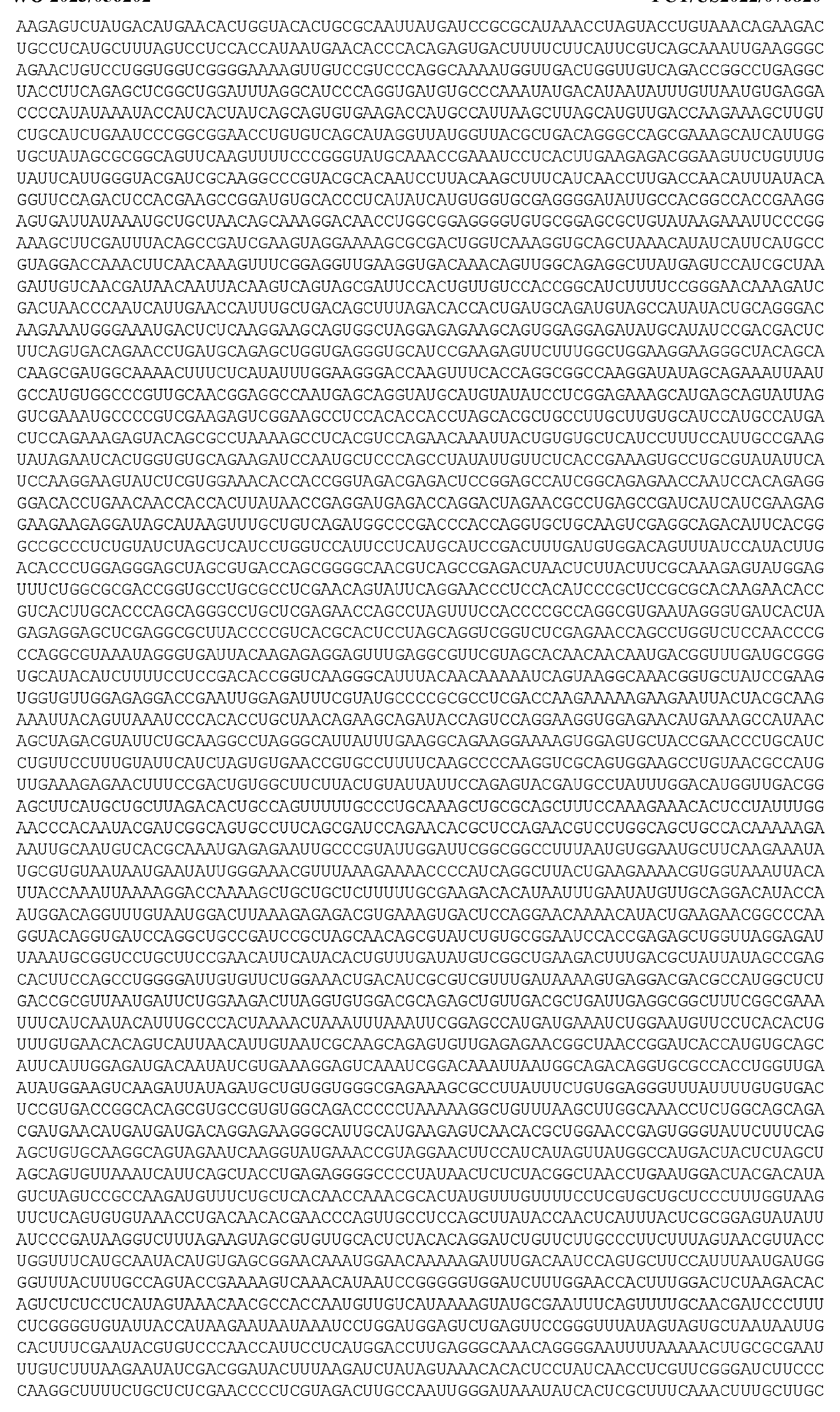
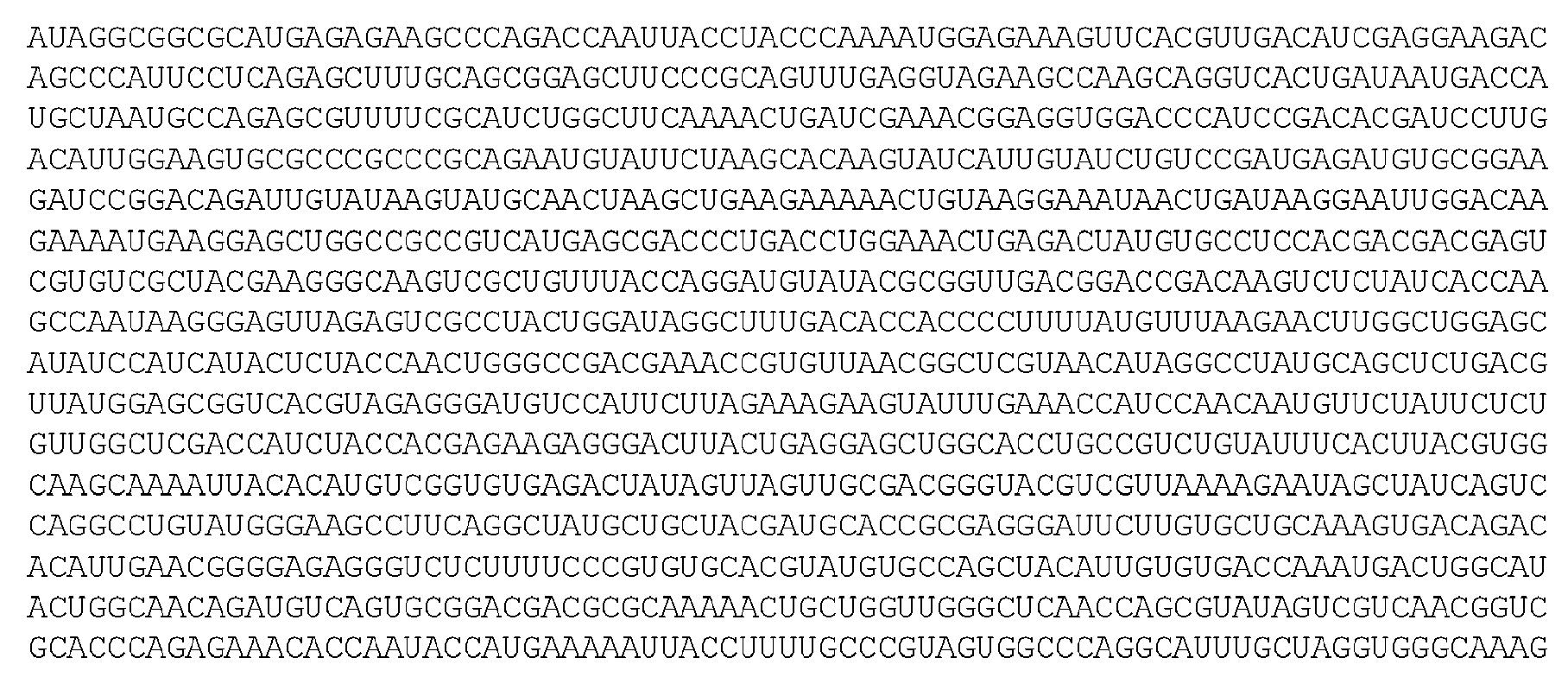
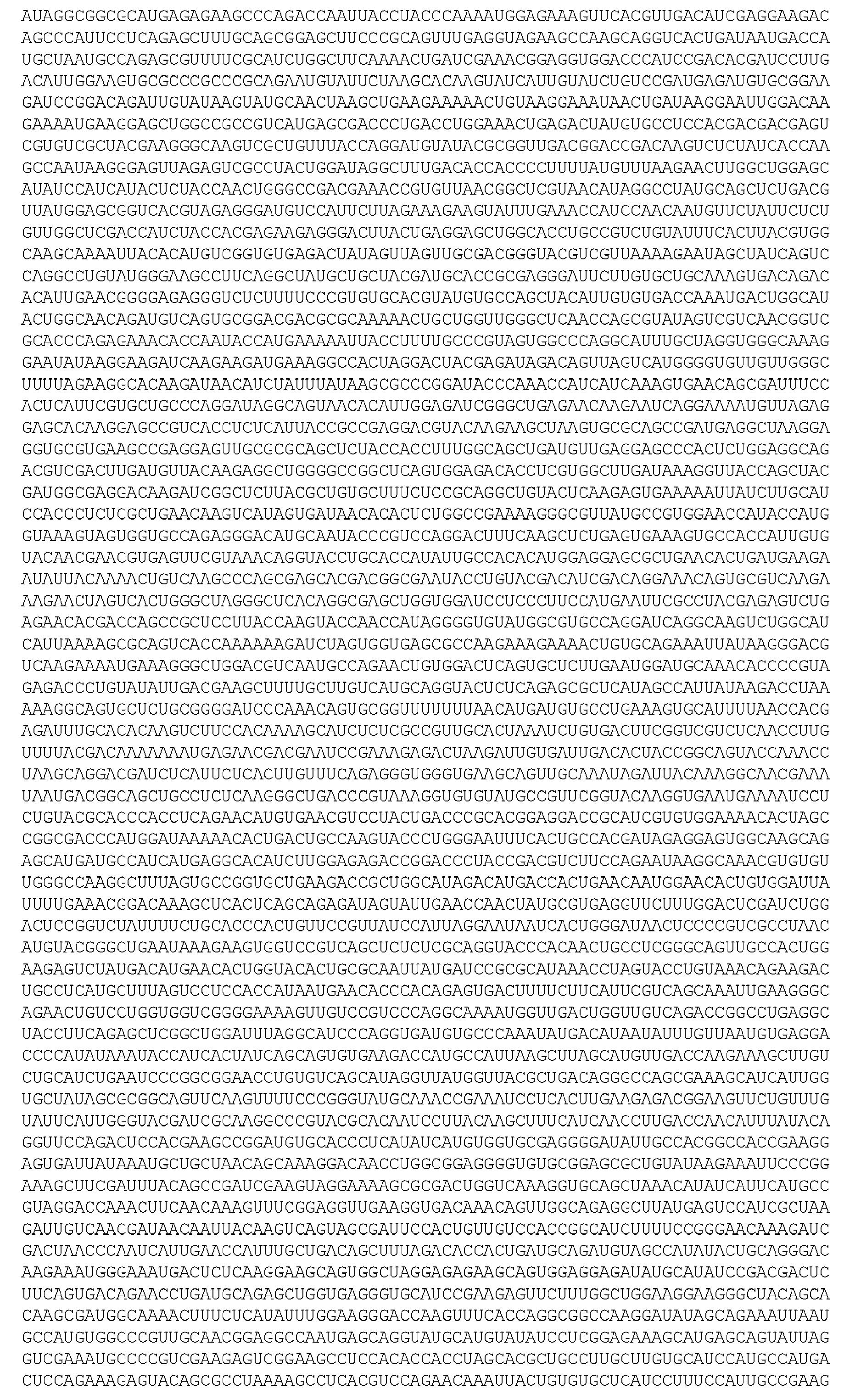
  • the nucleic acid coding the RNA polymerase comprises the nucleic acid sequence of SEQ ID NO: 38.
  • the nucleic acid is within the nanoparticle. In some embodiments, the nucleic acid is outside the nanoparticle. In some embodiments, the nucleic acid is in complex with the membrane.
  • the protein is an antigen or an antigen-binding protein. In some embodiments, the antigen is in a viral antigen. In some embodiments, the antigen is in a tumor antigen.
  • the nucleic acid coding for an antibody or a functional fragment thereof is in complex with the nanoparticle.
  • the protein is an antibody or a functional fragment thereof.
  • the antibody is a monoclonal antibody.
  • the antibody is a murine antibody, a humanized antibody, or a fully human antibody.
  • the antibody is an immunoglobulin (Ig) molecule.
  • the immunoglobulin molecule is an IgG, IgE, IgM, IgD, IgA, or an IgY isotype immunoglobulin molecule.
  • the immunoglobulin molecule is an IgG1, an IgG2, an IgG3, an IgG4, an IgGA1, or an IgGA2 subclass immunoglobulin molecule.
  • the antibody is a recombinant antibody, a chimeric antibody, or a multivalent antibody.
  • the multivalent antibody is a bispecific antibody, a trispecific antibody, or a multispecific antibody.
  • the antibody or functional fragment is an antigen-binding fragment (Fab), and Fab2 a F(ab'), a F(ab')2, an dAb, an Fc, a Fv, a disulfide linked Fv, a scFv, a tandem scFv, a free LC, a half antibody, a single domain antibody (dAb), a diabody, or a nanobody.
  • the composition comprising the nanoparticle comprises a membrane and a hydrophobic core; wherein the compound is one or more compounds listed in Table 7; and wherein the compound is within the hydrophobic core.
  • the antibody or functional fragment thereof specifically binds to a tumor antigen or a microbial antigen.
  • the antibody or functional fragment thereof is a SARS-CoV-2 virus antibody.
  • the SARS-CoV-2 virus antibody is bamlanivimab, casirivimab, imdevimab, or sotrovimab.
  • the antibody or functional fragment thereof specifically binds to a viral antigen.
  • the viral antigen is a Zika virus antigen.
  • the Zika virus antigen is the envelope (E) protein.
  • the antibody or functional fragment thereof is a Zika virus antibody.
  • the Zika virus antibody is ZIKV-117, Z3L1, Z20, Z23, ZV67, Z006, or 2A10G6.
  • the Zika virus antibody or functional fragment thereof is a ZIKV-117 antibody.
  • the ZIKV-117 antibody or functional fragment comprises a heavy chain CDR1 amino acid sequence of GFTFKNYG, a heavy chain CDR2 amino acid sequence of VRYDGNNK, and a heavy chain CDR3 amino acid sequence of ARDPETFGGFDY, and a light chain CDR1 amino acid sequence of ESVSSN, light chain CDR2 amino acid sequence of GAS, and light chain CDR3 amino acid sequence of QQYYYSPRT.
  • the antibody or functional fragment thereof is a cancer therapeutic antibody.
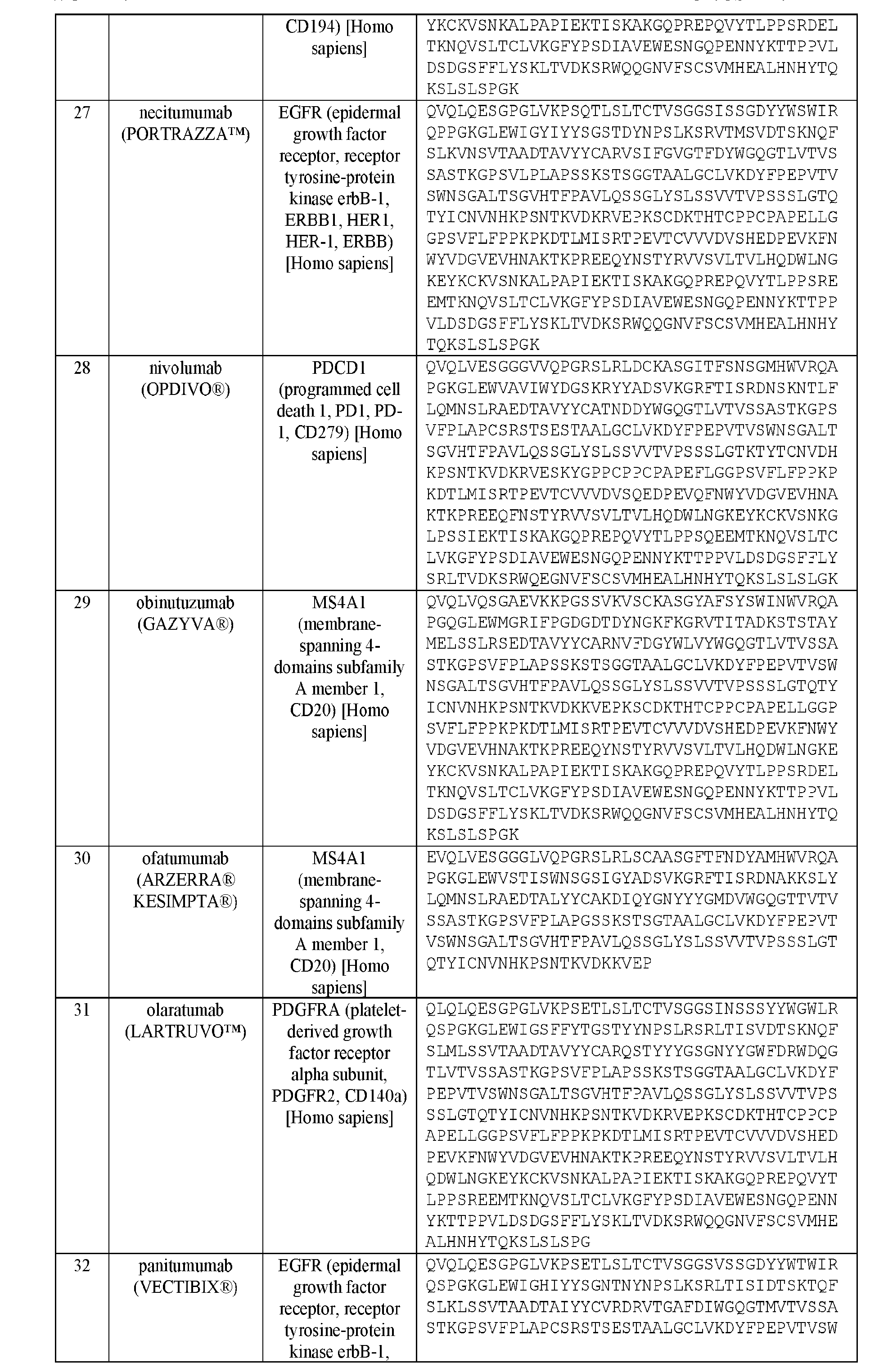
  • the cancer therapeutic antibody is atezolizumab, avelumab, bevacizumab, cemiplimab, cetuximab, daratumumab, dinutuximab, durvalumab, elotuzumab, ipilimumab, isatuximab, mogamulizumab, necitumumab, nivolumab, obinutuzumab, ofatumumab, olaratumab, panitumumab, pembrolizumab, pertuzumab, ramucirumab, rituximab, or trastuzumab.
  • the nanoparticle is a cationic lipid carrier, an ionizable lipid carrier, a gold carrier, a magnetic carrier, a polyethylene glycol (PEG)- functionalized carrier, a cholesterol- functionalized carrier, a polylactic acid (PLA)- functionalized carrier, a polylactic-co-glycolic acid (PLGA)-functionalized lipid carrier, or a liposome.
  • the composition is a modulator of a level or activity of NF MéB relative to levels or activity interferon- ⁇ in the cell.
  • the compound is the modulator.
  • the protein is the modulator.
  • the composition is lyophilized.
  • compositions described herein comprising compositions described herein and a pharmaceutical excipient.
  • compositions wherein the compositions comprise: a nanoparticle; a first nucleic acid coding for a protein or a functional fragment thereof; a second nucleic acid coding for an expression enhancer or a functional fragment thereof, wherein the expression enhancer or the functional fragment thereof increases expression of the protein or the functional fragment thereof in mammalian cells.
  • the nanoparticle comprises a hydrophobic core.
  • the hydrophobic core comprises a liquid organic material, a solid inorganic material, or a combination thereof.
  • the hydrophobic core comprises the liquid organic material. In some embodiments, the hydrophobic core comprises the solid inorganic material. In some embodiments, the nanoparticle comprises a hydrophilic surface. In some embodiments, the nanoparticle is up to 200 nm in diameter. In some embodiments, the nanoparticle is 50 to 70 nm in diameter. In some embodiments, the nanoparticle is 40 to 80 nm in diameter. In some embodiments, the nanoparticle is dispersed in an aqueous solution. In some embodiments, the nanoparticle comprises a membrane. In some embodiments, the nanoparticle comprises a cationic lipid.
  • the cationic lipid is l,2-dioleoyloxy-3 (trimethylammonium)propane (DOTAP), 3 ⁇ -[ ⁇ — (N',N'- dimethylaminoethane) carbamoyl]cholesterol (DC Cholesterol), dimethyldioctadecylammonium (DDA); l,2-dimyristoyl 3-trimethylammoniumpropane(DMTAP),dipalmitoyl(C16:0)trimethyl ammonium propane (DPTAP), distearoyltrimethylammonium propane (DSTAP), N-[l-(2,3- dioleyloxy)propyl]N,N,Ntrimethylammonium, chloride (DOTMA), N,N-dioleoyl-N,N- dimethylammonium chloride (DODAC), l,2-dioleoyl-sn-glycero-3-ethylphosphocholine (DOEPC),
  • the hydrophobic core comprises an oil.
  • the oil is in liquid phase.
  • the oil is ⁇ -tocopherol, coconut oil, grapeseed oil, lauroyl polyoxylglyceride, mineral oil, monoacylglycerol, palmkernal oil, olive oil, paraffin oil, peanut oil, propolis, squalene, squalane, solanesol, soy lecithin, soybean oil, sunflower oil, a triglyceride, or vitamin E.
  • the triglyceride is capric triglyceride, caprylic triglyceride, a caprylic and capric triglyceride, a triglyceride ester, or myristic acid triglycerin.
  • the hydrophobic core comprises a phosphate-terminated lipid.
  • the phosphate-terminated lipid is trioctylphosphine oxide (TOPO).
  • the nanoparticle comprises an inorganic particle.
  • the inorganic particle comprises a metal.
  • the metal comprises a metal salt, a metal oxide, a metal hydroxide, or a metal phosphate.
  • the metal oxide comprises aluminum oxide, aluminum oxyhydroxide, iron oxide, titanium dioxide, or silicon dioxide.
  • the nanoparticle comprises a surfactant.
  • the hydrophobic core comprises a surfactant.
  • the surfactant is a hydrophobic surfactant.
  • the hydrophobic surfactant is sorbitan monolaurate, sorbitan monopalmitate, sorbitan monostearate, sorbitan monooleate, or sorbitan trioleate.
  • the surfactant is a hydrophilic surfactant.
  • the hydrophilic surfactant is a polysorbate.
  • the surfactant is a phosphorous-terminated surfactant, a carboxylate-terminated surfactant, a sulfate-terminated surfactant, or an amine- terminated surfactant.
  • the surfactant is distearyl phosphatidic acid (DSPA), oleic acid, oleylamine or sodium dodecyl sulfate (SDS).
  • the nanoparticle comprises a cationic lipid, an oil, and an inorganic particle.
  • the nanoparticle comprises a cationic lipid, an oil, an inorganic particle, and a surfactant.
  • the hydrophobic core comprises one or more inorganic particles.
  • the hydrophobic core further comprises: a phosphate-terminated lipid; and a surfactant.
  • each inorganic particle is coated with a capping ligand or the surfactant.
  • the membrane comprises a lipid bilayer.
  • the membrane comprises a cationic lipid, an ionizable lipid, a polyethylene glycol (PEG) functionalized lipid, a cholesterol-functionalized lipid, a polylactic acid (PLA)- functionalized lipid, a polylactic-co-glycolic acid (PLGA)-functionalized lipid, or a liposome.
  • the first nucleic acid, the second nucleic acid, or both are RNA or DNA.
  • the first nucleic acid, the second nucleic acid, or both are dispersed within the hydrophobic core. In some embodiments, the first nucleic acid, the second nucleic acid, or both are bound to the hydrophilic surface of the nanoparticle. In some embodiments, the first nucleic acid, the second nucleic acid, or both are in complex with the membrane. In some embodiments, the nanoparticle comprises a single nucleic acid comprising at least one of the first nucleic acid and at least one of the second nucleic acid.
  • the nanoparticle comprises a plurality of nucleic acid, wherein each of the plurality of nucleic acid comprises at least one of the first nucleic acid, at least one of the second nucleic acid, or combinations thereof.
  • the expression enhancer is a kinase inhibitor.
  • the kinase inhibitor is a casein kinase inhibitor, a cyclin-dependent kinase (CDK) inhibitor, an extracellular signal-regulated kinase (ERK) inhibitor, a growth factor inhibitor, a glycogen synthase kinase inhibitor, an immune checkpoint inhibitor, a Janus kinase (JAK) inhibitor, a I ⁇ B kinase (IKK) inhibitor, a glycogen synthase kinase-3 ⁇ (GSK-3 ⁇ ) inhibitor, a lipid kinase inhibitor, a mitogen-activated protein kinase (MAPK) family inhibitor, a phosphatidylinositol 4- kinase (PI4K) inhibitor, a polo-like kinase (PLK) inhibitor, a protein kinase D (PKD) inhibitor, a tyrosine kinase inhibitor, a T ⁇ lymphokine-activated
  • CDK
  • the kinase inhibitor is the CDK inhibitor.
  • the CDK inhibitor comprises an amino acid sequence that has at least 80% sequence identity with any one of the sequences of SEQ ID NO: 41 to 47.
  • the first nucleic acid further codes for an RNA polymerase.
  • the RNA polymerase is a Venezuelan equine encephalitis virus (VEEV) RNA polymerase.
  • the VEEV RNA polymerase comprises the amino acid sequence of SEQ ID NO: 39 OR SEQ ID NO: 40.
  • the first nucleic acid coding the RNA polymerase comprises the nucleic acid sequence of SEQ ID NO: 38.
  • the protein is an antigen or an antigen- binding protein.
  • the antigen is in a viral antigen.
  • the antigen is in a tumor antigen.
  • the first nucleic acid coding for an antibody or a functional fragment thereof is in complex with the nanoparticle.
  • the protein is an antibody or a functional fragment thereof.
  • the antibody is a monoclonal antibody.
  • the antibody is a murine antibody, a humanized antibody, or a fully human antibody.
  • the antibody is an immunoglobulin (Ig) molecule.
  • the immunoglobulin molecule is an IgG, IgE, IgM, IgD, IgA, or an IgY isotype immunoglobulin molecule. In some embodiments, the immunoglobulin molecule is an IgG1, an IgG2, an IgG3, an IgG4, an IgGA1, or an IgGA2 subclass immunoglobulin molecule.
  • the antibody is a recombinant antibody, a chimeric antibody, or a multivalent antibody. In some embodiments, the multivalent antibody is a bispecific antibody, a trispecific antibody, or a multispecific antibody.
  • the antibody or functional fragment is an antigen-binding fragment (Fab), and Fab2 a F(ab'), a F(ab')2, an dAb, an Fc, a Fv, a disulfide linked Fv, a scFv, a tandem scFv, a free LC, a half antibody, a single domain antibody (dAb), a diabody, or a nanobody.
  • the antibody or functional fragment thereof specifically binds to a tumor antigen or a microbial antigen.
  • the antibody or functional fragment thereof is a SARS-CoV-2 virus antibody.
  • the SARS-CoV-2 virus antibody is bamlanivimab, casirivimab, imdevimab, or sotrovimab.
  • the antibody or functional fragment thereof specifically binds to a viral antigen.
  • the viral antigen is a Zika virus antigen.
  • the Zika virus antigen is the envelope (E) protein.
  • the antibody or functional fragment thereof is a Zika virus antibody.
  • the Zika virus antibody is ZIKV-117, Z3L1, Z20, Z23, ZV67, Z006, or 2A10G6.
  • the Zika virus antibody or functional fragment thereof is a ZIKV-117 antibody.
  • the ZIKV-117 antibody or functional fragment comprises a heavy chain CDR1 amino acid sequence of GFTFKNYG, a heavy chain CDR2 amino acid sequence of VRYDGNNK, and a heavy chain CDR3 amino acid sequence of ARDPETFGGFDY, and a light chain CDR1 amino acid sequence of ESVSSN, light chain CDR2 amino acid sequence of GAS, and light chain CDR3 amino acid sequence of QQYYYSPRT.
  • the antibody or functional fragment thereof is a cancer therapeutic antibody.
  • the cancer therapeutic antibody is atezolizumab, avelumab, bevacizumab, cemiplimab, cetuximab, daratumumab, dinutuximab, durvalumab, elotuzumab, ipilimumab, isatuximab, mogamulizumab, necitumumab, nivolumab, obinutuzumab, ofatumumab, olaratumab, panitumumab, pembrolizumab, pertuzumab, ramucirumab, rituximab, or trastuzumab.
  • the nanoparticle is a cationic lipid carrier, an ionizable lipid carrier, a gold carrier, a magnetic carrier, a polyethylene glycol (PEG)- functionalized carrier, a cholesterol-functionalized carrier, a polylactic acid (PLA)- functionalized carrier, a polylactic-co-glycolic acid (PLGA)-functionalized lipid carrier, or a liposome.
  • the enhancer is a modulator of a level or activity of NF MéB relative to levels or activity interferon- ⁇ in the cell.
  • the composition further comprises a compound.
  • the composition further comprises a plurality of compound. In some embodiments, at least two of the plurality of compounds are the same.
  • the at least two of the plurality of compounds are different.
  • the compound is conjugated to the nanoparticle.
  • the compound is dispersed in a hydrophobic core of the nanoparticle.
  • the compound is a kinase inhibitor.
  • the kinase inhibitor is a casein kinase inhibitor, a cyclin-dependent kinase (CDK) inhibitor, an extracellular signal-regulated kinase (ERK) inhibitor, a growth factor inhibitor, a glycogen synthase kinase inhibitor, an immune checkpoint inhibitor, a Janus kinase (JAK) inhibitor, a I ⁇ B kinase (IKK) inhibitor, a glycogen synthase kinase-3 ⁇ (GSK-3 ⁇ ) inhibitor, a lipid kinase inhibitor, a mitogen-activated protein kinase (MAPK) family inhibitor, a phosphatidylinositol 4-kinase (PI4K) inhibitor, a polo-like kinase (PLK) inhibitor, a protein kinase D (PKD) inhibitor, a tyrosine kinase inhibitor, a T ⁇ lymphokine-activated killer
  • the kinase inhibitor is the CDK inhibitor.
  • the CDK inhibitor is (-)-5-fluoro-4-(4-fluoro-2- methoxyphenyl)-N-[4-[(methylsulfonimidoyl)methyl]pyridin-2-yl]pyridin-2-amine, (+)-5-fluoro- 4-(4-fluoro-2-methoxyphenyl)-N-[4-[(methylsulfonimidoyl)methyl]pyridin-2-yl]pyridin-2- amine, ( ⁇ )-5-fluoro-4-(4-fluoro-2-methoxyphenyl)-N-[4-[(methylsulfonimidoyl)methyl]pyridin- 2-yl]pyridin-2-amine, 2-[2-chloro-4-(trifluoromethyl)phenyl]-5,7-dihydroxy-8-[(2S,3R)-2- (hydroxymethyl)-1-
  • the kinase inhibitor comprises ( ⁇ )-5-fluoro-4-(4- fluoro-2-methoxyphenyl)-N-[4-[(methylsulfonimidoyl)methyl]pyridin-2-yl]pyridin-2-amine, (1S,3R)-3-acetamido-N-[5-chloro-4-(5,5-dimethyl-4,6-dihydropyrrolo[1,2-b]pyrazol-3- yl)pyridin-2-yl]cyclohexane-1-carboxamide, (3R)-N-[5-chloro-4-(5-fluoro-2- methoxyphenyl)pyridin-2-yl]piperidine-3-carboxamide, 2-[(2S)-1-[6-[(4,5-difluoro-1H- benzimidazol-2-yl)methylamino]-9-propan-2-ylpurin-2-yl]piperidin-2-
  • the kinase inhibitor comprises 2-[2-chloro-4-(trifluoromethyl)phenyl]-5,7-dihydroxy-8-[(2S,3R)-2- (hydroxymethyl)-1-methylpyrrolidin-3-yl]chromen-4-one;hydrochloride, LSN3106729, 6- (difluoromethyl)-8-[(1R,2R)-2-hydroxy-2-methylcyclopentyl]-2-[(1-methylsulfonylpiperidin-4- yl)amino]pyrido[2,3-d]pyrimidin-7-one, 4-(1-isopropyl-2-methyl-1H-imidazol-5-yl)-N-(4- (methylsulfonyl)phenyl)pyrimidin-2-amine, (2R)-2-[[6-(benzylamino)-9-propan-2-ylpurin-2- yl]amino]butan-1-ol, 2-[(2chloro-4
  • the kinase inhibitor comprises 2-[(2S)-1-[3-ethyl-7-[(1-oxidopyridin-1-ium-3- yl)methylamino]pyrazolo[1,5-a]pyrimidin-5-yl]piperidin-2-yl]ethanol, free base thereof, salt thereof, or combinations thereof.
  • the kinase inhibitor comprises 3-[[5- fluoro-4-[4-methyl-2-(methylamino)-1,3-thiazol-5-yl]pyrimidin-2- yl]amino]benzenesulfonamide, free base thereof, salt thereof, or combinations thereof.
  • the kinase inhibitor comprises (1S,3R)-3-acetamido-N-[5-chloro-4-(5,5-dimethyl- 4,6-dihydropyrrolo[1,2-b]pyrazol-3-yl)pyridin-2-yl]cyclohexane-1-carboxamide, free base thereof, salt thereof, or combinations thereof.
  • the kinase inhibitor is a MAP kinase inhibitor.
  • the MAP kinase inhibitor is 5-[4-(2- methoxyethoxy)phenyl]-7-phenyl-3H-pyrrolo[2,3-d]pyrimidin-4-one, 5-(4-cyclopropylimidazol- 1-yl)-2-fluoro-4-methyl-N-[6-(4-propan-2-yl-1,2,4-triazol-3-yl)pyridin-2-yl]benzamide, 4-[2- (3H-benzimidazol-5-ylamino)quinazolin-8-yl]oxycyclohexan-1-ol, 1-(5-tert-butyl-2- methylpyrazol-3-yl)-3-(4-pyridin-4-yloxyphenyl)urea, free base thereof, salt thereof, or combinations thereof.
  • the kinase inhibitor is growth factor inhibitor.
  • the growth factor inhibitor is 2-[4-[(E)-2-[5-[(1R)-1-(3,5-dichloropyridin-4- yl)ethoxy]-1H-indazol-3-yl]ethenyl]pyrazol-1-yl]ethanol, 1-N'-[4-[2- (cyclopropanecarbonylamino)pyridin-4-yl]oxy-2,5-difluorophenyl]-1-N-(4- fluorophenyl)cyclopropane-1,1-dicarboxamide, 6-chloro-N-(5-methyl-1H-pyrazol-3-yl)-2-(4- nitrophenoxy)pyrimidin-4-amine, 1-[4-[(4-ethylpiperazin-1-yl)methyl]-3- (trifluoromethyl)phenyl]-3-[4-[6-(methylamino)
  • the kinase inhibitor is a Janus kinase (JAK) inhibitor.
  • the JAK inhibitor is 5-fluoro-2-[[(1S)-1-(4-fluorophenyl)ethyl]amino]-6-[(5-methyl-1H-pyrazol-3- yl)amino]pyridine-3-carbonitrile, 6-N-[(1S)-1-(4-fluorophenyl)ethyl]-4-(1-methylpyrazol-4-yl)- 2-N-pyrazin-2-ylpyridine-2,6-diamine, 6-N-[(1S)-1-(4-fluorophenyl)ethyl]-4-(1-methylpyrazol- 4-yl)-2-N-pyrazin-2-ylpyridine-2,6-diamine;hydrochloride, N-(cyanomethyl)-4-[2-(4-morpholin- 4-ylanilino)pyrimidin-4
  • the kinase inhibitor is an extracellular signal-regulated kinase (ERK) inhibitor.
  • the ERK inhibitor is 1-[(1S)-1-(4-chloro-3-fluorophenyl)-2-hydroxyethyl]-4-[2-[(2-methylpyrazol-3- yl)amino]pyrimidin-4-yl]pyridin-2-one, 4-[2-(2-chloro-4-fluoroanilino)-5-methylpyrimidin-4- yl]-N-[(1S)-1-(3-chlorophenyl)-2-hydroxyethyl]-1H-pyrrole-2-carboxamide, free base thereof, salt thereof, or combinations thereof.
  • the kinase inhibitor is a polo-like kinase (PLK) inhibitor.
  • the PLK inhibitor is N-[[4-[(6-chloropyridin-3- yl)methoxy]-3-methoxyphenyl]methyl]-2-(3,4-dimethoxyphenyl)ethanamine, N-(4- methoxyphenyl)sulfonyl-N-[2-[(E)-2-(1-oxidopyridin-1-ium-4-yl)ethenyl]phenyl]acetamide, free base thereof, salt thereof, or combinations thereof.
  • the kinase inhibitor is a phosphatidylinositol 4-kinase (PI4K) inhibitor.
  • the PI4K inhibitor is 2- fluoro-4-[2-methyl-8-[(3-methylsulfonylphenyl)methylamino]imidazo[1,2-a]pyrazin-3- yl]phenol, free base thereof, salt thereof, or combinations thereof.
  • the kinase inhibitor is a tyrosine kinase inhibitor.
  • the tyrosine kinase inhibitor is 3-[[5-fluoro-2-(3-hydroxyanilino)pyrimidin-4-yl]amino]phenol, free base thereof, salt thereof, or combinations thereof.
  • the kinase inhibitor is a T ⁇ lymphokine-activated killer cell-originated protein kinase (TOPK) inhibitor.
  • the TOPK inhibitor is 9-[4-[(2R)-1-aminopropan-2-yl]phenyl]-8-hydroxy-6-methyl-5H-thieno[2,3-c]quinolin-4-one, free base thereof, salt thereof, or combinations thereof.
  • the kinase inhibitor is a Wnt signaling pathway inhibitor.
  • the Wnt signaling inhibitor is 6-[2-[[4-(2,4-dichlorophenyl)-5-(5-methyl-1H-imidazol-2-yl)pyrimidin-2- yl]amino]ethylamino]pyridine-3-carbonitrile, 4-[2-(3H-benzimidazol-5-ylamino)quinazolin-8- yl]oxycyclohexan-1-ol, free base thereof, salt thereof, or combinations thereof.
  • the kinase inhibitor is a I ⁇ B kinase (IKK) inhibitor.
  • the IKK inhibitor is 2-amino-6-[2-(cyclopropylmethoxy)-6-hydroxyphenyl]-4-piperidin-4- ylpyridine-3-carbonitrile, 1-[4-[(1R)-1-[2-[[6-[6-(dimethylamino)pyrimidin-4-yl]-1H- benzimidazol-2-yl]amino]pyridin-4-yl]ethyl]piperazin-1-yl]-3,3,3-trifluoropropan-1-one, N'-(1,8- dimethylimidazo[1,2-a]quinoxalin-4-yl)ethane-1,2-diamine, free base thereof, salt thereof, or combinations thereof.
  • the kinase inhibitor is a protein kinase D (PKD) inhibitor.
  • the PKD inhibitor is 2-[4-[[(2R)-2- aminobutyl]amino]pyrimidin-2-yl]-4-(1-methylpyrazol-4-yl)phenol;dihydrochloride, 9-hydroxy- 3,4-dihydro-2H-[1]benzothiolo[2,3-f][1,4]thiazepin-5-one, free base thereof, salt thereof, or combinations thereof.
  • the kinase inhibitor is a salt inducible kinase (SIK) inhibitor.
  • the SIK inhibitor is 3-(2,4-dimethoxyphenyl)-4-thiophen-3-yl- 1H-pyrrolo[2,3-b]pyridine, free base thereof, salt thereof, or combinations thereof.
  • the kinase inhibitor is a casein kinase inhibitor.
  • the casein kinase inhibitor is 3-[3-[2-(3,4,5-trimethoxyanilino)pyrrolo[2,3-d]pyrimidin-7- yl]phenyl]propanenitrile, (3E)-3-[(2,4,6-trimethoxyphenyl)methylidene]-1H-indol-2-one, N- [(4,5-difluoro-1H-benzimidazol-2-yl)methyl]-9-(3-fluorophenyl)-2-morpholin-4-ylpurin-6- amine, free base thereof, salt thereof, or combinations thereof.
  • the kinase inhibitor is a glycogen synthase kinase-3 ⁇ (GSK-3 ⁇ ) inhibitor.
  • the glycogen synthase kinase-3 ⁇ (GSK-3 ⁇ ) inhibitor is 1-[(4-methoxyphenyl)methyl]-3-(5-nitro-1,3- thiazol-2-yl)urea, 6-[2-[[4-(2,4-dichlorophenyl)-5-(5-methyl-1H-imidazol-2-yl)pyrimidin-2- yl]amino]ethylamino]pyridine-3-carbonitrile, CP21R7, GSK-3 inhibitor 1, Indirubin-3'- monoxime, 5-amino-N-(2,6-difluorophenyl)-3-(4-sulfamoylanilino)-1,2,4-triazole-1- carbothioamide, 1-[3-[4-[[4-(2-methoxyethyl)-2-(2-
  • the composition is lyophilized.
  • suspensions comprising compositions described herein.
  • pharmaceutical compositions comprising compositions described herein and a pharmaceutical excipient.
  • methods comprising administering to a subject the composition, the suspension, or the pharmaceutical composition described herein in an amount sufficient to modify NF MéB expression or activity relative to interferon- ⁇ activity in the subject.
  • methods for treatment of infection the method comprising administering to a subject having an infection the composition, the suspension, or the pharmaceutical composition described herein.
  • methods for treatment of cancer the method comprising administering to a subject having an infection the composition, the suspension, or the pharmaceutical composition described herein.
  • the administering is local administration or systemic administration. In some embodiments, the administering is via intramuscular injection, intranasal administration, oral administration, subcutaneous administration, intratumoral administration, or intravenous injection.
  • the subject has a solid tumor or a blood cancer. In some embodiments, the solid tumor is a carcinoma, a melanoma, or a sarcoma.
  • the blood cancer is lymphoma or leukemia. In some embodiments, the subject has lung cancer. In some embodiments, the lung cancer is adenocarcinoma, squamous cell carcinoma, small cell cancer or non-small cell cancer.
  • a method comprising contacting a cell with the composition described herein, wherein the contacting modifies the level or activity of NFuiteB relative to interferon- ⁇ levels or activity in the cell.
  • the contacting is ex vivo, in vivo, or in vitro.
  • the cell is a cancer cell or a blood cell.
  • the cancer cell is a lung cancer cell.
  • the blood cell is a dendritic cell or a natural killer cell.
  • FIGURES 1A-1W show schematic representations of nanoparticle (NP) carriers.
  • FIG.1A shows an oil-in-water emulsion and a nucleic acid.
  • FIG. 1B shows a nanostructured lipid carrier (NLC) and a nucleic acid.
  • FIG.1C shows an inorganic nanoparticle and a nucleic acid.
  • FIG.1D shows an oil-in-water emulsion with small molecule enhancers for enhancing the protein expression from a nucleic acid.
  • FIG. 1A shows an oil-in-water emulsion and a nucleic acid.
  • NLC nanostructured lipid carrier
  • FIG.1C shows an inorganic nanoparticle and a nucleic acid.
  • FIG.1D shows an oil-in-water emulsion with small molecule enhancers for enhancing the protein expression from a nucleic acid.
  • FIG. 1E shows a nanoparticle containing an inorganic nanoparticles small molecule enhancers of protein expression within a membrane of the nanoparticle, and a nucleic acid.
  • FIG. 1F shows a nanoparticle comprising inorganic solid particles, small molecule enhancers of protein expression bound or conjugated to inside of the membrane of the nanoparticle, and a nucleic acid.
  • FIG. 1G shows a nanoparticle comprising inorganic solid particles, small molecule enhancers of protein expression bound or conjugated to the outside of the membrane, and a nucleic acid.
  • FIG.1H shows a nanoparticle comprising small molecule enhancers of protein expression bound or conjugated to inside of the membrane of the nanoparticle, and a nucleic acid.
  • FIG. 1I shows a nanoparticle comprising small molecule enhancers of protein expression bound or conjugated to the outside of the membrane and a nucleic acid.
  • FIG. 1J and 1Q show a nanoparticle having a cationic lipid membrane, a liquid oil core, inorganic nanoparticles, and a nucleic acid.
  • FIG.1K and 1R show an oil-in-water emulsion with a nanoparticle having a cationic lipid membrane, a liquid oil core, small molecule enhancers of protein expression within the membrane of the nanoparticle, and a nucleic acid.
  • FIG. 1I shows a nanoparticle comprising small molecule enhancers of protein expression bound or conjugated to the outside of the membrane and a nucleic acid.
  • FIG. 1J and 1Q show a nanoparticle having a cationic lipid membrane, a liquid oil core, inorganic nanoparticles, and a nucleic acid.
  • FIG.1K and 1R show an oil
  • FIG.1L and 1S show a nanoparticle comprising a cationic lipid membrane, a liquid oil core, inorganic nanoparticles and small molecule enhancers of protein expression within the membrane of the nanoparticle, and a nucleic acid.
  • FIG.1M and 1T show a nanoparticle comprising a cationic lipid membrane, a liquid oil core, inorganic nanoparticles within the membrane of the nanoparticle, small molecule enhancers of protein expression bound or conjugated to the inside of the membrane, and a nucleic acid.
  • FIG.1N and 1U show a nanoparticle comprising a cationic lipid membrane, a liquid oil core, inorganic nanoparticles within the membrane of the nanoparticle, small molecule enhancers of protein expression bound or conjugated to the outside of the membrane, and a nucleic acid.
  • FIG.1O and 1V show a nanoparticle comprising a cationic lipid membrane, a liquid oil core, small molecule enhancers of protein expression bound or conjugated to the inside of the membrane, and a nucleic acid.
  • FIG.1P and 1W show a nanoparticle comprising a cationic lipid membrane, a liquid oil core, small molecule enhancers of protein expression bound or conjugated to the outside of the membrane, and a nucleic acid.
  • FIGURE 2 shows the time measurements of nanoparticle size as measured by dynamic light scattering (DLS).
  • X axis is weeks and Y axis is nm diameter.
  • Three-time courses correspond to storage at 4, 25, and 42 degrees Celsius.
  • FIGURE 3 shows a graph showing that mRNA dose-dependent nLuc expression is achieved in A549-Dual cells transfected with NP-1+mRNA-nLuc at N:P ratio of 15.
  • the X axis is the nanograms of RNA/well and the Y axis is nLuc expression (log 10 RLUs).
  • FIGURE 4A shows a graph showing that nLuc expression in the supernatant of A549- Dual cells transfected with 20 ng of a nanoparticle (NP)-formulated mRNA-nLuc per well measured using the Nano-GLO® Luciferase kit (Promega cat# N1110).
  • Cells received dilution series of a neutralizing antibody cocktail targeting both human type I IFNs and IFN receptors (PBL Assay Science), referred to as “antibody” in the legend.
  • antibody neutralizing antibody cocktail targeting both human type I IFNs and IFN receptors
  • FIGURE 4B shows that in the same supernatants as described above in the description for FIG.4A, IFIT activity was measured by assaying for Lucia luciferase using the QUANTI-LucTM kit (Invivogen).
  • FIGURE 5 shows the compound down selection strategy for the identification of compounds that enhance mRNA-encoded protein expression.
  • FIGURES 7A-7C are graphs of relative light units (RLU) (Y axis) measured for various injection conditions of DNA or RNA mixed with various nanoparticle conditions, at days 4, 6 and 8 post inoculation.
  • FIGURES 8A-8C are graphs of relative light units (RLU) (Y axis) measured for various injection conditions of DNA or RNA mixed with various nanoparticle conditions, at days 4, 6 and 8 post inoculation.
  • FIGURES 9A-9B shows scatterplot matrix showing pairwise correlations.
  • FIG.9A shows scatterplot matrix of pairwise correlation between responses for the full library screen with 99 compounds identified as hits ( ⁇ 100-fold enhancement in nLuc expression over RNA+IFN) marked in dark gray.
  • FIG.9B shows scatterplot matrix of just the hits with the 32 CDK targeting inhibitors marked as open circles.
  • FIGURE 10 shows potency (EC50; ⁇ M) and magnitude of nLuc expression enhancement over RNA+IFN treated cells for candidate compounds.
  • FIGURES 11A-11B shows in vitro and in vivo activity of candidate inhibitor compounds after formulation in nanoparticle emulsion.
  • FIG. 11A shows protein (nLuc) expression in IFN- treated A549-Dual cells after delivery with inhibitors formulated in nanoparticles compared with empty nanoparticles (no inhibitor) in the presence and absence of IFN.
  • FIG. 11A shows protein (nLuc) expression in IFN- treated A549-Dual cells after delivery with inhibitors formulated in nanoparticles compared with empty nanoparticles (no inhibitor) in the presence and absence of IFN.
  • FIGURES 12A-12E shows IM administration of NP-1/repRNA-SEAP encapsulating CDK inhibitors.
  • FIG.12A shows total SEAP expression for each of the dose levels compared to no compound group.
  • FIG.12B-12E shows SEAP expression levels in serum shown as a function of days after IM injection.
  • FIG. 12A Statistical analysis in FIG. 12A was performed on log10 transformed data using 2way ANOVA and Dunnett’s multiple comparisons test.
  • FIGURES 13A-13B shows systemic administration of NP-1/repRNA-ZIKV-117 encapsulating CDK inhibitors.
  • FIG. 13A shows serum concentration of ZIKV-117 as a function of days after NP-1/repRNA injection by IM route, and
  • FIG. 13B shows total expression in compound of anti-IFNAR-1 treated groups compared to no compound group.
  • Statistical analysis in FIG. 13B was performed on untransformed data using ordinary one-way ANOVA and Dunnett’s multiple comparisons test. P-values: * ⁇ 0.05, ** ⁇ 0.005.
  • FIGURE 14 shows expression of nLuc in A549-Dual cells doped with CDK inhibitor were transfected with NP-35 nanoparticles and repRNA.
  • FIGs. 14A-14H show expression of nLuc in transfected cells doped with MC180295, CDKI-73, CDK-IN-2, LY2857785, Dinaciclib, CDK12- IN-3, AZD4573, and ( ⁇ )-BAY-1251152 respectively at different concentrations.
  • FIGURES 15A-15C show Measure of (A) cell viability, (B) IFIT2 induction, and (C) NF- kB induction in A549-Dual cells respectively.
  • FIGURE 16 shows Expression of nLuc in A549-Dual cells transfected with NP-35 nanoparticles formulated with repRNA as a function of RNA transfection amount [ng] per well.
  • the cells were transfected with NP-35 co-encapsulating repRNA and Dinaciclib (triangles), or NP-35 co-encapsulating only repRNA (squares).
  • DETAILED DESCRIPTION OF THE INVENTION Provided herein are compositions, kits, methods, and uses thereof for treatment of various conditions.
  • nanoparticle carriers systems (2) nucleic acids coding for proteins, antibodies, and RNA polymerases; (3) protein expression enhancer compounds; (4) combination compositions; (5) pharmaceutical compositions; (6) dosing; (7) administration; (8) therapeutic applications; and (9) kits.
  • nanoparticle carriers systems (2) first nucleic acids coding for proteins, antibodies, and RNA polymerases; (3) second nucleic acids coding for expression enhancers; (4) combination compositions; (5) pharmaceutical compositions; (6) dosing; (7) administration; (8) therapeutic applications; and (9) kits.
  • compositions provided herein provide several advantages over preceding therapeutic formulations such as a protective nanoparticle configuration for safe and efficient nucleic acid delivery, a self-replicating RNA polymerase for the translation of the nucleic acid, and compounds that enhance expression of a nucleic acid-encoded protein or antibody to therapeutic levels in a mammalian cell.
  • a range should be considered to have specifically disclosed all the possible subranges as well as individual numerical values within that range to the tenth of the unit of the lower limit unless the context clearly dictates otherwise.
  • description of a range such as from 1 to 6 should be considered to have specifically disclosed subranges such as from 1 to 3, from 1 to 4, from 1 to 5, from 2 to 4, from 2 to 6, from 3 to 6 etc., as well as individual values within that range, for example, 1.1, 2, 2.3, 5, and 5.9. This applies regardless of the breadth of the range.
  • the upper and lower limits of these intervening ranges may independently be included in the smaller ranges, and are also encompassed within the invention, subject to any specifically excluded limit in the stated range.
  • the term “and/or” includes any and all combinations of one or more of the associated listed items.
  • the term “about” is understood as within a range of normal tolerance in the art, for example within 2 standard deviations of the mean. “About” can be understood as within 15%, 14%, 13%, 12%, 11%, 10%, 9%, 8%, 7%, 6%, 5%, 4%, 3%, 2%, 1%, 0.5%, 0.1%, 0.05%, or 0.01% of the stated value. Unless otherwise clear from the context, all numerical values provided herein are modified by the term “about.
  • Nanoparticle Carrier Systems Provided herein are various compositions comprising a nanoparticle or a plurality of nanoparticles. Nanoparticles are also referred to herein as carriers or abbreviated as NPs. Nanoparticle provided herein may be an organic, inorganic, or a combination of inorganic and organic materials that are less than about 1 micrometer ( ⁇ m) in diameter.
  • nanoparticles provided herein are used as a delivery system for a bioactive agent (e.g., a nucleic acid encoding a protein, antigen, antibody, expression enhancer, RNA polymerase, or functional fragment thereof as provided herein and/or a compound provided herein).
  • a bioactive agent e.g., a nucleic acid encoding a protein, antigen, antibody, expression enhancer, RNA polymerase, or functional fragment thereof as provided herein and/or a compound provided herein.
  • a bioactive agent e.g., a nucleic acid encoding a protein, antigen, antibody, expression enhancer, RNA polymerase, or functional fragment thereof as provided herein and/or a compound provided herein.
  • Nanoparticles or carriers provided herein can include but are not limited to: oil in water emulsions, nanostructured lipid carriers (NLCs), cationic nanoemulsions (CNEs), vesicular phospholipid gels (VPG), polymeric nanoparticles, cationic lipid nanoparticles, liposomes, gold nanoparticles, solid lipid nanoparticles (LNPs or SLNs), mixed phase core NLCs, ionizable lipid carriers, magnetic carriers, polyethylene glycol (PEG)- functionalized carriers, cholesterol-functionalized carriers, polylactic acid (PLA)- functionalized carriers, and polylactic-co-glycolic acid (PLGA)-functionalized lipid carriers.
  • NLCs nanostructured lipid carriers
  • CNEs cationic nanoemulsions
  • VPG vesicular phospholipid gels
  • polymeric nanoparticles cationic lipid nanoparticles
  • liposomes gold nanoparticles
  • FIG.1A (not to scale)
  • FIG.1B illustrates a nanostructured lipid carrier (NLCs) which can comprise a blend of solid organic lipids (e.g., trimyristin) and liquid oil (e.g., squalene).
  • NLCs nanostructured lipid carrier
  • the solid lipid is dispersed in the liquid oil.
  • the entire nanodroplet is dispersed in the aqueous (water) phase.
  • the nanoparticle comprises inorganic nanoparticles, as illustrated in FIG.
  • aqueous solutions include water (e.g., sterilized, distilled, deionized, ultra-pure, RNAse-free, etc.), saline solutions (e.g., Kreb’s, Ascaris, Dent’s, Tet’s saline), or 1% (w/v) dimethyl sulfoxide (DMSO) in water.
  • DMSO dimethyl sulfoxide
  • the nanoparticles provided herein comprise a compound.
  • compounds that are dispersed/dissolved within a liquid core of the nanoparticle as illustrated in FIG.1D (not to scale).
  • nanoparticles comprising solid inorganic nanoparticles and compounds that are dispersed/dissolved within the liquid oil core, as illustrated in FIG. 1E (not to scale).
  • the compounds are within the membrane as illustrated in FIG. 1F and FIG.1H (not to scale), the compounds are bound to the surface as illustrated in FIG. 1G and FIG. 1I (not to scale), or dispersed/dissolved within the liquid core (FIG. 1D).
  • the lipid carrier comprises a membrane and a liquid oil core.
  • the membrane comprises a blend of lipid and surfactant.
  • the lipid comprises DOTAP.
  • the surfactant comprises a blend of sorbitan monostearate, and Polysorbate 80.
  • the liquid oil core comprises squalene.
  • the nanoparticle comprises iron oxide nanoparticles dispersed in a liquid oil (e.g., squalene). The entire nanodroplet can be then dispersed as a colloid in the aqueous (water) phase.
  • the nanoparticles provided herein are dispersed in an aqueous solution.
  • aqueous solutions include water (e.g., sterilized, distilled, deionized, ultra-pure, RNAse-free, etc.), saline solutions (e.g., Kreb’s, Ascaris, Dent’s, Tet’s saline), or 1% (w/v) dimethyl sulfoxide (DMSO) in water.
  • saline solutions e.g., Kreb’s, Ascaris, Dent’s, Tet’s saline
  • DMSO dimethyl sulfoxide
  • the nanoparticles provided herein comprise a small molecule.
  • a liquid oil e.g., squalene
  • nanoparticles comprising solid iron oxide nanoparticles and small molecules that are dispersed/dissolved in a liquid oil (e.g., squalene), as illustrated in FIG. 1L and 1S (not to scale).
  • a liquid oil e.g., squalene
  • the small molecules are within the membrane as illustrated in FIG.1M, 1O, 1T, and 1V (not to scale), the small molecules are bound to the surface as illustrated in FIG.1N, 1P, 1U, and 1W (not to scale), or dispersed/dissolved a liquid oil (e.g., squalene) (FIG.1D).
  • the nanoparticles provided herein comprise a hydrophilic surface.
  • the hydrophilic surface comprises a cationic lipid. In some embodiments, the hydrophilic surface comprises an ionizable lipid. In some embodiments, the nanoparticle comprises a membrane. In some embodiments, the membrane comprises a cationic lipid. In some embodiments, the nanoparticles provided herein comprise a cationic lipid.
  • Exemplary cationic lipids for inclusion in the hydrophilic surface include, without limitation: l,2-dioleoyloxy-3 (trimethylammonium)propane (DOTAP), 3 ⁇ -[ ⁇ — (N',N'-dimethylaminoethane) carbamoyl]cholesterol (DC Cholesterol), dimethyldioctadecylammonium (DDA); l,2-dimyristoyl 3-trimethylammoniumpropane(DMTAP),dipalmitoyl(C16:0)trimethyl ammonium propane (DPTAP), distearoyltrimethylammonium propane (DSTAP), N-[l-(2,3- dioleyloxy)propyl]N,N,Ntrimethylammonium, chloride (DOTMA), N,N-dioleoyl-N,N- dimethylammonium chloride (DODAC), l,2-dioleoyl-sn-glycero-3-e
  • lipids include, but are not limited to, the phosphatidylcholines (PCs), phosphatidylethanolamines (PEs), phosphatidylglycerol (PGs); and PEGylated lipids including PEGylated version of any of the above lipids (e.g., DSPE-PEGs).
  • the nanoparticle provided herein comprises DOTAP.
  • the nanoparticle provided herein comprises an oil.
  • the oil is in liquid phase.
  • oils that can be used include ⁇ - tocopherol, coconut oil, dihydroisosqualene (DHIS), farnasene, grapeseed oil, lauroyl polyoxylglyceride, mineral oil, monoacylglycerol, palmkernal oil, olive oil, paraffin oil, peanut oil, propolis, squalene, squalane, solanesol, soy lecithin, soybean oil, sunflower oil, a triglyceride, or vitamin E.
  • the nanoparticle provided herein comprises a triglyceride.
  • Exemplary triglycerides include but are not limited to: capric triglycerides, caprylic triglycerides, a caprylic and capric triglycerides, triglyceride esters, and myristic acid triglycerins.
  • the nanoparticles provided herein comprise a liquid organic material and a solid inorganic material.
  • the nanoparticle provided herein comprises an inorganic particle.
  • the inorganic particle is a solid inorganic particle.
  • the nanoparticle provided herein comprises the inorganic particle within the hydrophobic core.
  • the nanoparticle provided herein comprises a metal.
  • the nanoparticle provided herein comprises a metal within the hydrophobic core.
  • the metal can be without limitation, a metal salt, a metal oxide, a metal hydroxide, or a metal phosphate.
  • the nanoparticle provided herein comprises aluminum oxide (Al 2 O 3 ), aluminum oxyhydroxide, iron oxide (Fe 3 O 4 , Fe 2 O 3 , FeO, or combinations thereof), titanium dioxide, silicon dioxide (SiO2), aluminum hydroxyphosphate (Al(OH)x(PO4)y), calcium phosphate (Ca 3 (PO 4 ) 2 ), calcium hydroxyapatite (Ca 10 (PO 4 ) 6 (OH) 2 ), iron gluconate, or iron sulfate.
  • the inorganic particles may be formed from one or more same or different metals (any metals including transition metal).
  • the inorganic particle is a transition metal oxide.
  • the transition metal is magnetite (Fe3O4), maghemite (y-Fe2O3), wüstite (FeO), or hematite (alpha ( ⁇ )- Fe 2 O 3 ).
  • the metal is aluminum hydroxide or aluminum oxyhydroxide, and a phosphate-terminated lipid or a surfactant, such as oleic acid, oleylamine, SDS, TOPO or DSPA is used to coat the inorganic solid nanoparticle, before it is mixed with the liquid oil to form the hydrophobic core.
  • the metal can comprise a paramagnetic, a superparamagnetic, a ferrimagnetic or a ferromagnetic compound.
  • the metal is a superparamagnetic iron oxide (Fe3O4).
  • the nanoparticle provided herein comprises a cationic lipid, and an oil.
  • the nanoparticle provided herein comprises DOTAP; and squalene and/or glyceryl trimyristate-dynasan.
  • the nanoparticle provided herein comprises a cationic lipid, an oil, and an inorganic particle.
  • the nanoparticle provided herein comprises DOTAP; squalene and/or glyceryl trimyristate-dynasan; and iron oxide.
  • the nanoparticle provided herein further comprises a surfactant.
  • the nanoparticles provided herein comprise a cationic lipid, an oil, an inorganic particle, and a surfactant.
  • the nanoparticles provided herein comprise a cationic lipid, an oil, and a surfactant
  • Surfactants are compounds that lower the surface tension between two liquids or between a liquid and a solid component of the nanoparticles provided herein.
  • Surfactants can be hydrophobic, hydrophilic, or amphiphilic.
  • the nanoparticle provided herein comprises a hydrophobic surfactant.
  • hydrophobic surfactants that can be employed include but are not limited to: sorbitan monolaurate (SPAN® 20), sorbitan monopalmitate (SPAN® 40), sorbitan monostearate (SPAN® 60), sorbitan tristearate (SPAN® 65), sorbitan monooleate (SPAN® 80), and sorbitan trioleate (SPAN® 85).
  • Suitable hydrophobic surfactants include those having a hydrophilic-lipophilic balance (HLB) value of 10 or less, for instance, 5 or less, from 1 to 5, or from 4 to 5.
  • the hydrophobic surfactant can be a sorbitan ester having a HLB value from 1 to 5, or from 4 to 5.
  • the nanoparticle provided herein comprises a hydrophilic surfactant, also called an emulsifier.
  • the nanoparticle provided herein comprises polysorbate.
  • Polysorbates are oily liquids derived from ethoxylated sorbitan (a derivative of sorbitol) esterified with fatty acids.
  • hydrophilic surfactants that can be employed include but are not limited to: polysorbates such as Tween, Kolliphor, Scattics, Alkest, or Canarcel; polyoxyethylene sorbitan ester (polysorbate); polysorbate 80 (polyoxyethylene sorbitan monooleate, or Tween 80); polysorbate 60 (polyoxyethylene sorbitan monostearate, or Tween 60); polysorbate 40 (polyoxyethylene sorbitan monopalmitate, or Tween 40); and polysorbate 20 (polyoxyethylene sorbitan monolaurate, or Tween 20).
  • the hydrophilic surfactant is polysorbate 80.
  • Nanoparticles provided herein comprises a hydrophobic core surrounded by a lipid membrane (e.g., a cationic lipid such as DOTAP).
  • the hydrophobic core comprises: a phosphate-terminated lipid, a surfactant, or a combination thereof.
  • the hydrophobic core comprises: one or more inorganic particles; a phosphate- terminated lipid; and a surfactant.
  • Inorganic solid nanoparticles described herein may be surface modified before mixing with the liquid oil.
  • the inorganic solid nanoparticle may be coated with hydrophobic molecules (or surfactants) to facilitate the miscibility of the inorganic solid nanoparticle with the liquid oil in the “oil” phase of the nanoemulsion particle.
  • the inorganic particle is coated with a capping ligand, the phosphate-terminated lipid, and/or the surfactant.
  • the hydrophobic core comprises a phosphate-terminated lipid.
  • the hydrophobic core comprises a surfactant, wherein the surfactant is a phosphorous-terminated surfactant, a carboxylate-terminated surfactant, a sulfate-terminated surfactant, or an amine-terminated surfactant.
  • the surfactant is a phosphorous-terminated surfactant, a carboxylate-terminated surfactant, a sulfate-terminated surfactant, or an amine-terminated surfactant.
  • Typical carboxylate-terminated surfactants include oleic acid.
  • Typical amine terminated surfactants include oleylamine.
  • the surfactant is distearyl phosphatidic acid (DSPA), oleic acid, oleylamine or sodium dodecyl sulfate (SDS).
  • DSPA distearyl phosphatidic acid
  • SDS sodium dodecyl sulfate
  • the inorganic solid nanoparticle is a metal oxide such as an iron oxide, and a surfactant, such as oleic acid, oleylamine, SDS, DSPA, or TOPO, is used to coat the inorganic solid nanoparticle, before it is mixed with the liquid oil to form the hydrophobic core.
  • the hydrophobic core comprises: a cationic lipid comprising DOTAP; a hydrophobic surfactant comprising a sorbitan ester (e.g., sorbitan monostearate, sorbitan monooleate, sorbitan trioleate, or a combination thereof); and a hydrophilic surfactant comprising a polysorbate (e.g., polysorbate 80).
  • a hydrophobic surfactant comprising a sorbitan ester (e.g., sorbitan monostearate, sorbitan monooleate, sorbitan trioleate, or a combination thereof)
  • a hydrophilic surfactant comprising a polysorbate (e.g., polysorbate 80).
  • the hydrophobic core further comprises one or more of a phosphate- terminated lipid (e.g., TOPO), a surfactant (e.g., a phosphorous-terminated surfactant, a carboxylate- terminated surfactant, a sulfate-terminated surfactant, an amine-terminated surfactant, or a combination thereof), and a liquid oil containing naturally occurring or synthetic squalene.
  • a phosphate- terminated lipid e.g., TOPO
  • a surfactant e.g., a phosphorous-terminated surfactant, a carboxylate- terminated surfactant, a sulfate-terminated surfactant, an amine-terminated surfactant, or a combination thereof
  • the hydrophobic core comprises: one or more inorganic particles containing at least one metal hydroxide or oxyhydroxide particle optionally coated with a phosphate- terminated lipid, a phosphorous-terminated surfactant, a carboxylate- terminated surfactant, a sulfate-terminated surfactant, or an amine-terminated surfactant; and a liquid oil containing naturally occurring or synthetic squalene; a cationic lipid comprising DOTAP; a hydrophobic surfactant comprising a sorbitan ester selected from the group consisting of: sorbitan monostearate, sorbitan monooleate, and sorbitan trioleate; and a hydrophilic surfactant comprising a polysorbate.
  • the hydrophobic core comprises: one or more inorganic nanoparticles containing aluminum hydroxide or aluminum oxyhydroxide nanoparticles optionally coated with TOPO, and a liquid oil containing naturally occurring or synthetic squalene; the cationic lipid DOTAP; a hydrophobic surfactant comprising sorbitan monostearate; and a hydrophilic surfactant comprising polysorbate 80.
  • the hydrophobic core consists of: one or more inorganic particles containing at least one metal hydroxide or oxyhydroxide particle optionally coated with a phosphate- terminated lipid, a phosphorous-terminated surfactant, a carboxylate- terminated surfactant, a sulfate-terminated surfactant, or an amine-terminated surfactant; and a liquid oil containing naturally occurring or synthetic squalene; a cationic lipid comprising DOTAP; a hydrophobic surfactant comprising a sorbitan ester selected from the group consisting of: sorbitan monostearate, sorbitan monooleate, and sorbitan trioleate; and a hydrophilic surfactant comprising a polysorbate.
  • the hydrophobic core consists of: one or more inorganic nanoparticles containing aluminum hydroxide or aluminum oxyhydroxide nanoparticles optionally coated with TOPO, and a liquid oil containing naturally occurring or synthetic squalene; the cationic lipid DOTAP; a hydrophobic surfactant comprising sorbitan monostearate; and a hydrophilic surfactant comprising polysorbate 80.
  • the nanoparticle provided herein can comprise from about 0.2% to about 40% w/v squalene, from about 0.2% to about 10 % w/v DOTAP, from about 0.25% to about 5% w/v sorbitan monostearate, and from about 0.5% to about 10% w/v polysorbate 80.
  • the nanoparticle provided herein can comprise from about 0.2% to about 40% w/v squalene, from about 0.001% to about 10% w/v iron oxide nanoparticles, from about 0.2% to about 10 % w/v DOTAP, from about 0.25% to about 5% w/v sorbitan monostearate, and from about 0.5% to about 10% w/v polysorbate 80.
  • the nanoparticle provided herein can comprise from about 2% to about 6% w/v squalene, from about 0.2% to about 1 % w/v DOTAP, from about 0.25% to about 1% w/v sorbitan monostearate, and from about 0.5%) to about 5% w/v polysorbate 80.
  • the nanoparticle provided herein can comprise from about 2% to about 6% w/v squalene, from about 0.01% to about 1% w/v iron oxide nanoparticles, from about 0.2% to about 1 % w/v DOTAP, from about 0.25% to about 1% w/v sorbitan monostearate, and from about 0.5%) to about 5% w/v polysorbate 80.
  • the nanoparticle provided herein can comprise from about 0.2% to about 40% w/v squalene, from about 0.2% to about 10 % w/v DOTAP, from about 0.25% to about 5% w/v sorbitan monostearate, and from about 0.5% to about 10% w/v polysorbate 80.
  • the nanoparticle provided herein can comprise from about 0.2% to about 40% w/v squalene, from about 0.001% to about 10% w/v aluminum hydroxide or aluminum oxyhydroxide nanoparticles, from about 0.2% to about 10 % w/v DOTAP, from about 0.25% to about 5% w/v sorbitan monostearate, and from about 0.5% to about 10% w/v polysorbate 80.
  • the nanoparticle provided herein can comprise from about 2% to about 6% w/v squalene, from about 0.2% to about 1 % w/v DOTAP, from about 0.25% to about 1% w/v sorbitan monostearate, and from about 0.5%) to about 5% w/v polysorbate.
  • the nanoparticle provided herein can comprise from about 2% to about 6% w/v squalene, from about 0.01% to about 1% w/v aluminum hydroxide or aluminum oxyhydroxide nanoparticles, from about 0.2% to about 1 % w/v DOTAP, from about 0.25% to about 1% w/v sorbitan monostearate, and from about 0.5%) to about 5% w/v polysorbate 80.
  • Exemplary nanoparticle formulations include any of the formulations provided in Table 1.
  • a composition described herein comprises any one of NP-1 to NP-30.
  • a composition described herein comprises any one of NP-1 to NP-35.
  • the nanoparticles provided herein comprises LNP (e.g., NP-33, NP-34, and NP-35). In some embodiments, the nanoparticles provided herein are admixed with a nucleic acid provided herein. In some embodiments, nanoparticles provided herein are made by homogenization and ultrasonication techniques. Table 1. Nanoparticle Formulations
  • Nanoparticles provided herein can be of various average diameters in size.
  • nanoparticles provided herein have an average diameter (z- average hydrodynamic diameter, measured by dynamic light scattering) ranging from about 20 nm to about 200 nm.
  • the z-average diameter of the nanoparticle ranges from about 20 nm to about 150 nm, from about 20 nm to about 100 nm, from about 20 nm to about 80 nm, from about 20 nm to about 60 nm.
  • the z-average diameter of the nanoparticle ranges from about 40 nm to about 200 nm, from about 40 nm to about 150 nm, from about 40 nm to about 100 nm, from about 40 nm to about 90 nm, from about 40 nm to about 80 nm, or from about 40 nm to about 60 nm. In one embodiment, the z- average diameter of the nanoparticle is from about 40 nm to about 80 nm. In some embodiments, the z-average diameter of the nanoparticle is from about 40 nm to about 60 nm. In some embodiments, the nanoparticle is up to 200 nm in diameter.
  • the nanoparticle is 50 to 70 nm in diameter. In some embodiments, the nanoparticle is 40 to 80 nm in diameter. In some embodiments, the nanoparticle is 20 to 80 nm in diameter.
  • the inorganic particle within the hydrophobic core of the nanoparticle can be an average diameter (number weighted average diameter) ranging from about 3 nm to about 50 nm. In some embodiments, the inorganic particle comprises an average diameter of about 5 nm, about 10 nm, about 15 nm, about 20 nm, about 25 nm, about 30 nm, about 35 nm, about 40 nm, about 45 nm, or about 50 nm.
  • Nanoparticles provided herein may be characterized by the polydispersity index (PDI), which is an indication of their quality with respect to size distribution.
  • the average polydispersity index (PDI) of the nanoparticles provided herein ranges from about 0.1 to about 0.5.
  • the average PDI of the nanoparticles can range from about 0.2 to about 0.5, from about 0.1 to about 0.4, from about 0.2 to about 0.4, from about 0.2 to about 0.3, or from about 0.1 to about 0.3.
  • the nanoparticles provided herein comprise an oil-to-surfactant molar ratio ranging from about 0.1:1 to about 20:1, from about 0.5:1 to about 12:1, from about 0.5:1 to about 9:1, from about 0.5:1 to about 5:1, from about 0.5:1 to about 3:1, or from about 0.5:1 to about 1:1.
  • the nanoparticles provided herein comprise a hydrophilic surfactant-to-lipid ratio ranging from about 0.1:1 to about 2:1, from about 0.2:1 to about 1.5:1, from about 0.3:1 to about 1:1, from about 0.5:1 to about 1:1, or from about 0.6:1 to about 1:1.
  • the nanoparticles provided herein comprise a hydrophobic surfactant-to-lipid ratio ranging from about 0.1:1 to about 5:1, from about 0.2:1 to about 3:1, from about 0.3:1 to about 2:1, from about 0.5:1 to about 2:1, or from about 1:1 to about 2:1.
  • the nanoparticles provided herein comprise from about 0.2% to about 40% w/v liquid oil, from about 0.2% to about 10% w/v lipid, from about 0.25% to about 5% w/v hydrophobic surfactant, and from about 0.5% to about 10% w/v hydrophilic surfactant.
  • the lipid comprises a cationic lipid
  • the oil comprises squalene
  • the hydrophobic surfactant comprises sorbitan ester
  • the nanoparticles provided herein comprise from about 0.2% to about 40% w/v liquid oil, from about 0.001% to about 10% w/v inorganic solid nanoparticle, from about 0.2% to about 10% w/v lipid, from about 0.25% to about 5% w/v hydrophobic surfactant, and from about 0.5% to about 10% w/v hydrophilic surfactant.
  • the lipid comprises a cationic lipid
  • the oil comprises squalene
  • the hydrophobic surfactant comprises sorbitan ester.
  • nucleic Acids [0070] Provided herein is a composition comprising a nucleic acid.
  • a composition comprising a nucleic acid coding for a protein, an antibody, or a functional fragment thereof.
  • the nucleic acid is in complex with the nanoparticle.
  • the nucleic acid is in complex with the membrane of the nanoparticle.
  • the nucleic acid is in complex with the hydrophilic surface of the nanoparticle.
  • FIGs.1A-1P (not to scale) illustrates the nucleic acid is bound to the hydrophilic surface of the nanoparticle.
  • the nucleic acid is within the nanoparticle.
  • the nucleic acid is within the hydrophobic core.
  • FIGs.1Q-1W (not to scale) illustrates an exemplary nanoparticle, wherein the nucleic acid is dispersed in the hydrophobic core (e.g., squalene oil).
  • the nucleic acid is in complex with the hydrophobic surface of the membrane.
  • the nucleic acid is in complex with the hydrophilic surface of the membrane.
  • the nucleic acid is in complex with the hydrophilic surface of the membrane.
  • the nanoparticles provided herein comprise a plurality of the nucleic acid.
  • the nanoparticle comprises a single nucleic acid comprising at least one first nucleic acid encoding a protein or functional fragment thereof, and at least one second nucleic acid encoding an expression enhancer or functional fragment thereof. In some embodiments, the nanoparticle comprises a plurality of nucleic acid, wherein each of the plurality of nucleic acid comprises at least one first nucleic acid, at least one second nucleic acid, or combinations thereof.
  • the nucleic acid is deoxyribonucleic acid (DNA) or ribonucleic acid (RNA).
  • the nucleic acid may be linear or include a secondary structure (e.g., a hair pin).
  • the nucleic acid is a polynucleotide comprising modified nucleotides or bases, and/or their analogs.
  • a polynucleotide may comprise modified nucleotides, such as methylated nucleotides and their analogs. If present, modification to the nucleotide structure may be imparted before or after assembly of compositions provided herein.
  • compositions provided herein comprise one or more nucleic acids.
  • compositions provided herein comprise two or more nucleic acids. In some embodiments, compositions provided herein comprise at least one DNA. In some embodiments, compositions provided herein comprise at least one RNA. In some embodiments, compositions provided herein comprise at least one DNA and at least one RNA. In some embodiments, nucleic acids provided herein are present in an amount of above 5 ng to about 1 mg. In some embodiments, nucleic acids provided herein are present in an amount of up to about 25, 50, 75, 100, 150, 175 ng. In some embodiments, nucleic acids provided herein are present in an amount of up to about 1 mg.
  • nucleic acids provided herein are present in an amount of about 0.05 ⁇ g, 0.1 ⁇ g, 0.2 ⁇ g, 0.5, ⁇ g 1 ⁇ g, 5 ⁇ g, 10 ⁇ g, 12.5 ⁇ g, 15 ⁇ g, 25 ⁇ g, 40 ⁇ g, 50 ⁇ g, 100 ⁇ g, 200 ⁇ g, 300 ⁇ g, 400 ⁇ g, 500 ⁇ g, 600 ⁇ g, 700 ⁇ g, 800 ⁇ g, 900 ⁇ g, 1 mg.
  • nucleic acids provided herein are present in an amount of 0.05 ⁇ g, 0.1 ⁇ g, 0.2 ⁇ g, 0.5, ⁇ g 1 ⁇ g, 5 ⁇ g, 10 ⁇ g, 12.5 ⁇ g, 15 ⁇ g, 25 ⁇ g, 40 ⁇ g, 50 ⁇ g, 100 ⁇ g, 200 ⁇ g, 300 ⁇ g, 400 ⁇ g, 500 ⁇ g, 600 ⁇ g, 700 ⁇ g, 800 ⁇ g, 900 ⁇ g, 1 mg.
  • the nucleic acid is at least about 200, 250, 500, 750, 1000, 2000, 3000, 4000, 5000, 6000, 7000, 8000, 9000, 10,000, 11,000, 12,000, 13,000, 14,000, 15,000, 16,000, 17,000, 18,000, 19,000, or 20,000 nucleotides in length. In some embodiments, the nucleic acid is up to about 7000, 8000, 9000, 10,000, 11,000, 12,000, 13,000, 14,000, 15,000, 16,000, 17,000, 18,000, 19,000, or 20,000 nucleotides in length. In some embodiments, the nucleic acid is about 7500, 10,000, 15,000, or 20,000 nucleotides in length.
  • composition comprising a nucleic acid coding for a protein or a functional fragment thereof.
  • the protein is an antigen, an antigen-binding protein, or a functional fragment thereof.
  • the antigen is an antigen from an microbial organism.
  • the antigen is a microbial antigen.
  • the antigen is a viral antigen.
  • the viral antigen is a surface protein or a transmembrane protein.
  • the viral antigen is a spike protein, a glycoprotein, or an envelope protein.
  • the viral antigen is derived from: an alphavirus, a retrovirus, a coronavirus, a flavivirus, a picornavirus, a rhabdovirus, a rotavirus, a norovirus, a paramyxovirus, a orthomyxovirus, a bunyavirus, an arenavirus, a reovirus, a retrovirus, a rabies virus, a papillomavirus, a parvovirus, a herpesvirus, a poxvirus, a hepadnavirus, a spongiform virus, an iridovirus, an influenza virus, a morbillivirus, a togavirus, a variola virus, a varicella virus, a zika virus, a SARs-CoV-2 virus, a respiratory syncytial virus (RSV), a Middle East Respiratory Syndrome (MERS) coronavirus, human immunodeficiency virus (HI), HIB
  • a nucleic acid provided herein encodes for a protein or antibody sequence or a functional fragment thereof which specifically binds an antigen listed in Table 2.
  • compositions provided herein comprises two or more nucleic acids coding different sequences which specifically binds an antigen listed in Table 2.
  • the nucleic acid comprises at least 80%, 85%, 90%, 95%, 96%, 97%, 98%, or 99% sequence identity to a sequence which specifically binds an antigen listed in Table 2.
  • compositions provided herein comprises two or more nucleic acids coding different sequences which specifically binds an antigen listed in Table 2.
  • the nucleic acid provided herein comprises at least 80%, 85%, 90%, 95%, 96%, 97%, 98%, or 99% sequence similarity to a sequence which specifically binds an antigen listed in Table 2.
  • Percent (%) sequence identity for a given sequence relative to a reference sequence is defined as the percentage of identical residues identified after aligning the two sequences and introducing gaps if necessary, to achieve the maximum percent sequence identity. Percent identity can be calculated using alignment methods known in the art, for instance alignment of the sequences can be conducted using publicly available software such as BLAST, Align, ClustalW2. Those skilled in the art can determine the appropriate parameters for alignment, but the default parameters for BLAST are specifically contemplated.
  • nucleic acid sequences encoding for exemplary antigens are listed in Table 2. Table 2. Exemplary SARS CoV-2 nucleic acid sequences. [0075]
  • the nucleic acid provided herein codes for a tumor antigen.
  • the tumor antigen is a surface protein or a transmembrane protein.
  • tumor antigens include: epidermal growth factor receptor (EGFR); vascular endothelial growth factor (VEGF); VEGFA; acute myelogenous leukemia Wilms tumor 1 (WT1), preferentially expressed antigen of melanoma (PRAME), PR1, proteinase 3, elastase, cathepsin G, Chronic myelogenous WT1, Myelodysplastic syndrome WT1, Acute lymphoblastic leukemia PRAME, Chronic lymphocytic leukemia survivin, Non-Hodgkin's lymphoma survivin, Multiple myeloma New York esophagus 1 (NY-Esol), Malignant melanoma MAGE, MART- 1/Melan-A, Tyrosinase, GP100, Breast cancer WT1, herceptin, Lung cancer WT1, Prostate-specific antigen (PSA), prostatic acid phosphatase, (PAP) Carcinoembryonic antigen (EGFR); epi
  • the antibody is a monoclonal antibody.
  • Monoclonal antibodies or mAbs include intact molecules, as well as, antibody fragments (such as, Fab and F(ab′)2 fragments) that are capable of specifically binding to an epitope of a protein or antigen.
  • the antibody is a murine antibody, a humanized antibody, or a fully human antibody.
  • the antibody is an immunoglobulin (Ig) molecule.
  • Immunoglobulin (Ig) molecules and immunologically active portions of immunoglobulin molecules are comprised of four polypeptide chains, two heavy (H) chains and two light (L) chains, or any functional fragment, mutant, variant, or derivation thereof, which retains the essential epitope binding features of an Ig molecule.
  • immunoglobulin molecules i.e., molecules that contain an antigen binding site that specifically bind an antigen
  • immunoglobulin molecules are comprised of four polypeptide chains, two heavy (H) chains and two light (L) chains, or any functional fragment, mutant, variant, or derivation thereof, which retains the essential epitope binding features of an Ig molecule.
  • Such mutant, variant, or derivative antibody formats are known in the art.
  • an immunoglobulin molecule a monoclonal antibody, a chimeric antibody, a CDR-grafted antibody, a human antibody, a humanized antibody, a single chain
  • the immunoglobulin molecule is an IgG, IgE, IgM, IgD, IgA, or an IgY isotype immunoglobulin molecule.
  • the antibody or immunoglobulin molecules provided herein are a specific subclass of immunoglobulin molecule.
  • the immunoglobulin molecule is an IgG1, an IgG2, an IgG3, an IgG4, an IgGA1, or an IgGA2 subclass immunoglobulin molecule.
  • each heavy chain is comprised of a heavy chain variable domain (abbreviated herein as HCVR or VH) and a heavy chain constant region.
  • the heavy chain constant region is comprised of three domains: CHI, CH2, and CH3.
  • Each light chain is comprised of a light chain variable domain (abbreviated herein LCVR as VL) and a light chain constant region.
  • the light chain constant region is comprised of one domain, CL.
  • the VH and VL regions can be further subdivided into regions of hypervariability, termed complementarity determining regions (CDRs), interspersed with regions that are more conserved, termed framework regions (FR).
  • CDRs complementarity determining regions
  • FR framework regions
  • Each VH and VL is composed of three CDRs and four FRs, arranged from amino-terminus to carboxy-terminus in the following order: FR1, CDR1, FR2, CDR2, FR3, CDR3, FR4.
  • CDRs Complementarity Determining Regions
  • Each variable domain typically has three CDR regions identified as CDR1, CDR2 and CDR3.
  • Each complementarity determining region can comprise amino acid residues from a "complementarity determining region" as defined by Kabat (i.e., about residues 24-34 (LI), 50-56 (L2) and 89-97 (L3) in the light chain variable domain and 31-35 (HI), 50-65 (H2) and 95-102 (H3) in the heavy chain variable domain; Kabat et al, Sequences of Proteins of Immunological Interest, 5th Ed. Public Health Service, National Institutes of Health, Bethesda, Md.
  • Kabat i.e., about residues 24-34 (LI), 50-56 (L2) and 89-97 (L3) in the light chain variable domain and 31-35 (HI), 50-65 (H2) and 95-102 (H3) in the heavy chain variable domain
  • Kabat et al Sequences of Proteins of Immunological Interest, 5th Ed. Public Health Service, National Institutes of Health, Bethesda, Md.
  • a complementarity determining region can include amino acids from both a CDR region defined according to Kabat and a hypervariable loop. The exact boundaries of these CDRs have been defined differently according to different systems.
  • CDR boundary definitions may not strictly follow one of the above systems, but will nonetheless overlap with the Kabat CDRs, although they may be shortened or lengthened in light of prediction or assay result that particular residues or groups of residues or even entire CDRs do not significantly impact antigen binding.
  • the alignment of the CDR sequences can be conducted using publicly available software such as BLAST, Align, and the international ImMunoGeneTics information system (IMGT). Those skilled in the art can determine the appropriate parameters for alignment, but the default parameters for BLAST are specifically contemplated.
  • an antibody described herein is originally generated by a non-human animal (e.g., sheep, dog, rabbit, mouse, rat, primate, goat, llama, alpaca, and horse) against an antigen described herein and, optionally, humanized as described herein.
  • the nucleic acid provided herein codes for a recombinant antibody, a chimeric antibody, or a multivalent antibody.
  • the multivalent antibody is a bispecific antibody, a trispecific antibody, or a multispecific antibody.
  • the antibody or functional fragment is an antigen-binding fragment (Fab), and Fab2 a F(ab'), a F(ab')2, an dAb, an Fc, a Fv, a disulfide linked Fv, a scFv, a tandem scFv, a free LC, a half antibody, a single domain antibody (dAb), a diabody, or a nanobody.
  • the nanobody comprises a heavy chain variable (VH) region.
  • the heavy chain variable (VH) region comprises three CDR regions.
  • the gene transcription regulator comprises an expression enhancer or a functional fragment thereof.
  • the expression enhancer increases expression of a protein or a function fragment thereof, when a cell is co-transfected with a first nucleic acid coding for the protein or the functional fragment thereof, and a second nucleic acid coding for the expression enhancer or the functional fragment thereof.
  • Viral antigen binding molecules [0080]
  • the antibody or functional fragment thereof specifically binds to a microbial antigen.
  • the microbial antigen is a viral envelope protein.
  • the antibody or functional fragment thereof is a SARS-CoV-2 virus antibody.
  • the SARS-CoV-2 virus antibody is bamlanivimab, casirivimab, imdevimab, or sotrovimab.
  • Exemplary amino acid sequences for SARs-CoV-2 antibodies are provided below in Table 3.
  • a nucleic acid provided herein codes for a protein or antibody amino acid sequence or a functional fragment thereof listed in Table 3.
  • compositions provided herein comprise two or more nucleic acids coding different sequences listed in Table 3.
  • the nucleic acid provided herein codes for a protein or antibody amino acid sequence or a functional fragment thereof comprising at least 80%, 85%, 90%, 95%, 96%, 97%, 98%, or 99% sequence identity to a sequence listed in Table 3.
  • compositions provided herein comprise two or more nucleic acids coding different sequences listed in Table 3.
  • the nucleic acid provided herein codes for a protein, antibody, or fragment thereof comprising at least 80%, 85%, 90%, 95%, 96%, 97%, 98%, or 99% sequence similarity to a sequence listed Table 3. Table 3.
  • SARs-CoV-2 Antibody Amino Acid Sequences are examples of SARs-CoV-2 Antibody Amino Acid Sequences.
  • the antibody or functional fragment thereof is a Zika virus antibody.
  • the Zika virus antibody is ZIKV-117, Z3L1, Z20, Z23, ZV67, Z006, or 2A10G6.
  • the ZIKV-117 antibody or functional fragment comprises a heavy chain CDR1 amino acid sequence of GFTFKNYG, a heavy chain CDR2 amino acid sequence of VRYDGNNK, and a heavy chain CDR3 amino acid sequence of ARDPETFGGFDY, and a light chain CDR1 amino acid sequence of ESVSSN, light chain CDR2 amino acid sequence of GAS, and light chain CDR3 amino acid sequence of QQYYYSPRT.
  • a nucleic acid provided herein codes for a protein or antibody sequence or a functional fragment thereof listed in Table 4.
  • compositions provided herein comprises two or more nucleic acids coding different sequences listed in Table 4.
  • the nucleic acid comprises at least 80%, 85%, 90%, 95%, 96%, 97%, 98%, or 99% sequence identity to a sequence listed in Table 4.
  • compositions provided herein comprise two or more nucleic acids coding different sequences listed in Table 4.
  • the nucleic acid provided herein comprises at least 80%, 85%, 90%, 95%, 96%, 97%, 98%, or 99% sequence similarity to a sequence listed Table 4. Exemplary nucleic acid sequences are listed in Table 4 below. Table 4. Zika Virus Antibody Nucleic Acid Sequences. Cancer antigen binding molecules [0084]
  • the antibody or functional fragment thereof specifically binds to a tumor antigen.
  • the antibody or functional fragment thereof is a cancer therapeutic antibody.
  • the cancer therapeutic antibody is atezolizumab, avelumab, bevacizumab, cemiplimab, cetuximab, daratumumab, dinutuximab, durvalumab, elotuzumab, ipilimumab, isatuximab, mogamulizumab, necitumumab, nivolumab, obinutuzumab, ofatumumab, olaratumab, panitumumab, pembrolizumab, pertuzumab, ramucirumab, rituximab, or trastuzumab.
  • nucleic acid provided herein codes for a protein or antibody amino acid sequence or a functional fragment thereof listed in Table 5.
  • compositions provided herein comprises two or more nucleic acids coding for different sequences listed in Table 5.
  • the nucleic acid provided herein codes for a protein or antibody amino acid sequence or a functional fragment thereof comprising at least 80%, 85%, 90%, 95%, 96%, 97%, 98%, or 99% sequence identity to a sequence listed in Table 5.
  • compositions provided herein comprise two or more nucleic acids coding different sequences listed in Table 5.
  • the nucleic acid provided herein codes for a protein, antibody, or a functional fragment thereof comprising at least 80%, 85%, 90%, 95%, 96%, 97%, 98%, or 99% sequence similarity to a sequence listed Table 5.
  • RNA antigens combined with RNAs that stimulate innate immune responses, or RNAs that launch oncolytic viruses, or live-attenuated viruses.
  • the bioactive agent in of a composition provided herein comprises a combination of RNA-encoded antigens with another RNA that can stimulate innate immune responses or can launch oncolytic viruses or live-attenuated viruses.
  • compositions provided herein that contain RNA-encoded antigens can be combined with a formulation that contains another RNA that can stimulate innate immune responses or can launch oncolytic viruses or live-attenuated viruses.
  • RNA coding for a RNA polymerase Provided herein are compositions comprising a self-replicating nucleic acid.
  • compositions provided herein comprise one or more nucleic acids.
  • compositions provided herein comprise two or more nucleic acids.
  • nucleic acids provided herein code for an RNA polymerase.
  • nucleic acids provided herein code for a viral RNA polymerase.
  • nucleic acids provided herein code for: (1) a viral RNA polymerase; and (2) a protein, antibody, or functional fragment thereof.
  • compositions provided herein comprise a first nucleic acid coding for a viral RNA polymerase; and a second nucleic acid coding for a protein, antibody, or functional fragment thereof.
  • a self-replicating RNA also called a replicon
  • RNA polymerase can include but is not limited to: an alphavirus RNA polymerase, an Eastern equine encephalitis virus (EEEV) RNA polymerase, a Western equine encephalitis virus (WEEV), Venezuelan equine encephalitis virus (VEEV), Chikungunya virus (CHIKV), Semliki Forest virus (SFV), or Sindbis virus (SINV).
  • EEEV Eastern equine encephalitis virus
  • WEEV Western equine encephalitis virus
  • VEEV Venezuelan equine encephalitis virus
  • CHKV Venezuelan equine encephalitis virus
  • CHIKV Chikungunya virus
  • SFV Semliki Forest virus
  • Sindbis virus Sindbis virus
  • the RNA polymerase is a VEEV RNA polymerase.
  • the nucleic acid coding for the RNA polymerase comprises at least 85% identity to the nucleic acid sequence of SEQ ID NO: 38.
  • the nucleic acid coding for the RNA polymerase comprises at least 90% identity to the nucleic acid sequence of SEQ ID NO: 38.
  • the nucleic acid coding for the RNA polymerase comprises at least 95% identity to the nucleic acid sequence of SEQ ID NO: 38.
  • the nucleic acid coding for the RNA polymerase comprises at least 99% identity to the nucleic acid sequence of SEQ ID NO: 38.
  • the nucleic acid coding for the RNA polymerase is SEQ ID NO: 38.
  • the amino acid sequence for VEEV RNA polymerase comprises at least 85% identity to RELPVLDSAAFNVECFKKYACNNEYWETFKENPIRLTEEN VVNYITKLKGP (SEQ ID NO: 39) or TQMRELPVLDSAAFNVECFKKYACNNEYWE TFKENPIRLTE (SEQ ID NO: 40).
  • the amino acid sequence for VEEV RNA polymerase comprises at least 90% identity to SEQ ID NO: 39 or SEQ ID NO: 40.
  • the amino acid sequence for VEEV RNA polymerase comprises at least 95% identity to SEQ ID NO: 39 or SEQ ID NO: 40. In some embodiments, the amino acid sequence for VEEV RNA polymerase comprises at least 99% identity to SEQ ID NO: 39 or SEQ ID NO: 40. In some embodiments, the amino acid sequence for VEEV RNA polymerase is SEQ ID NO: 39 or SEQ ID NO: 40.
  • Protein Expression Enhancer RNA [0092] Provided herein are compositions comprising a nanoparticle; a first nucleic acid coding for at least one protein or fragment thereof; and a second nucleic acid coding for at least one expression enhancer or fragment thereof, wherein expression enhancer increases expression of the protein or the fragment thereof.
  • the plurality of protein comprises a plurality of protein expression enhancer.
  • the plurality of protein expression enhancer comprises two, three, four, five, six, seven, eight, nine, or ten protein expression enhancers.
  • at least two of the plurality of protein expression enhancer are the same.
  • at least two of the plurality of protein expression enhancer are different.
  • compositions comprising a nanoparticle; and a plurality of nucleic acid, wherein at least one of the plurality of nucleic acid encodes a protein expression enhancer.
  • the protein expression enhancer comprises a kinase inhibitor.
  • the kinase inhibitor comprises a casein kinase inhibitor, a cyclin-dependent kinase (CDK) inhibitor, an extracellular signal-regulated kinase (ERK) inhibitor, a growth factor inhibitor, a glycogen synthase kinase inhibitor, an immune checkpoint inhibitor, a Janus kinase (JAK) inhibitor, a I ⁇ B kinase (IKK) inhibitor, a glycogen synthase kinase-3 ⁇ (GSK-3 ⁇ ) inhibitor, a lipid kinase inhibitor, a mitogen-activated protein kinase (MAPK) family inhibitor, a phosphatidylinositol 4-kinase (PI4K) inhibitor, a polo-like kinase (PLK) inhibitor, a protein kinase D (PKD) inhibitor, a tyrosine kinase inhibitor, a T ⁇ lymphokine-activated killer
  • the kinase inhibitor is a cyclin-dependent kinase (CDK) inhibitor.
  • CDK inhibitor comprises an amino acid sequence that is encoded by a nucleic acid having at least 70%, 75%, 80%, 85%, 90%, 95%, 98%, or 100% identical to any one of the sequences of SEQ ID NO: 41-47.
  • Protein Expression Enhancer Compounds [0094] Provided herein are compositions and kits comprising a compound. Provided herein are compositions comprising a nanoparticle; a nucleic acid encoding a protein, antibody, or fragment thereof; and a compound. In some embodiments, the compound enhances expression of the protein, antibody, or the functional fragment thereof in mammalian cells.
  • the compound is dispersed in the hydrophobic core of the nanoparticle. In some embodiments, the compound is conjugated to the nanoparticle.
  • Compounds provided herein can have an anti-cancer or anti-viral effect on a mammalian cell or a subject. In some embodiments, compounds provided herein inhibit or stabilize tumor growth. In some embodiments, compounds provided herein decrease cancer cell proliferation or survival. In some embodiments, compounds provided herein inhibit viral fusion with a mammalian cell. In some embodiments, compounds provided herein inhibit viral replication within a mammalian cell. In some embodiments, compounds provided herein are immunostimulatory. In some embodiments, compounds provided herein are immunosuppressive.
  • compounds provided herein suppress interferon- ⁇ expression or activity. In some embodiments, compounds provided herein modify NF MéB expression or activity. In some embodiments, compounds provided herein modify NF TooB expression or activity over interferon- ⁇ expression or activity. In some embodiments, the modification is an increase. In some embodiments, the modification is a decrease. [0095] In some embodiments, the compound is a kinase inhibitor. Kinase inhibitors are compounds that inhibit the enzymatic activity of at least one kinase. In some embodiments, the kinase inhibitor is a flavone or flavonoid derivative. [0096] In some embodiments, the kinase inhibitor is a CDK inhibitor.
  • Cyclin-dependent kinase (CDK) complexes are protein kinases that are involved in the regulation of cell growth. These complexes comprise at least a catalytic (the CDK itself) and a regulatory (cyclin) subunit.
  • exemplary complexes for cell cycle regulation include cyclin A (CDKl -also known as cdc2, and CDK2), cyclin B1-B3 (CDKl) and cyclin D1-D3 (CDK2, CDK4, CDK5, CDK6), cyclin E (CDK2).
  • CDKs are involved in a particular phase of the cell cycle. CDKs are involved in cell cycle regulation, gene transcription, insulin secretion, glycogen synthesis and neuronal functions.
  • CDKs that directly promote cell cycle progression include CDK4, CDK6, CDK2 and CDK1.
  • Exemplary CDK inhibitors are provided in Table 5.
  • compositions provided herein comprise one or more of the compounds listed in Table 6, Table 7, or Table 13. Table 6. Exemplary Kinase Inhibitors
  • compounds or kinase inhibitors provided herein is a cyclin- dependent kinase (CDK) inhibitor, a mitogen activated protein kinase (MAPK) inhibitor, a growth factor inhibitor, a Janus kinase (JAK) inhibitor, an extracellular signal-regulated kinase (ERK) inhibitor, a polo-like kinase (PLK) inhibitor, a phosphatidylinositol 4-kinase (PI4K) inhibitor, a tyrosine kinase inhibitor, a T-lymphokine-activated killer cell-originated protein kinase (TOPK) inhibitor, a Wnt signaling pathway inhibitor, an I ⁇ B kinase (IKK) inhibitor, a protein kinase D (PKD) inhibitor, a salt inducible kinase (SIK) inhibitor, a glycogen syntha
  • CDK cyclin- dependent kinase
  • the kinase inhibitor is a MAP kinase (MAPK) inhibitor.
  • MAPK inhibitors include, without limitation, SP600125, PLX4032, GW5074, AZD6244, PD98059, simvastatin, alisertib, teriflunomide, NSC95397, PD325901, PD98059, lovastatin, DMX-5804, selonsertib (C24H24FN7O, 5-(4-cyclopropylimidazol-1-yl)-2-fluoro-4-methyl-N-[6- (4-propan-2-yl-1,2,4-triazol-3-yl)pyridin-2-yl]benzamide, CAS NO.
  • the kinase inhibitor is a growth factor inhibitor.
  • Exemplary growth factor inhibitors include, without limitation, LY2874455 (C 21 H 19 Cl 2 N 5 O 2 , 2-[4-[(E)-2-[5- [(1R)-1-(3,5-dichloropyridin-4-yl)ethoxy]-1H-indazol-3-yl]ethenyl]pyrazol-1-yl]ethanol, CAS NO.1254473-64-7), altiratinib (C26H21F3N4O4, 1-N'-[4-[2-(cyclopropanecarbonylamino)pyridin- 4-yl]oxy-2,5-difluorophenyl]-1-N-(4-fluorophenyl)cyclopropane-1,1-dicarboxamide, CAS NO.
  • the kinase inhibitor is a Janus kinase (JAK) inhibitor.
  • JAK inhibitors include, without limitation, ilginatinib (C 21 H 20 FN 7 , 6-N-[(1S)-1-(4-fluorophenyl)ethyl]- 4-(1-methylpyrazol-4-yl)-2-N-pyrazin-2-ylpyridine-2,6-diamine, CAS No. 1239358-86-1), and pharmaceutically acceptable salts and solvates thereof.
  • the kinase inhibitor is an extracellular signal-regulated kinase (ERK) inhibitor.
  • ERK inhibitors include, without limitation, ravoxertinib (C 21 H 18 ClFN 6 O 2 , 1- [(1S)-1-(4-chloro-3-fluorophenyl)-2-hydroxyethyl]-4-[2-[(2-methylpyrazol-3- yl)amino]pyrimidin-4-yl]pyridin-2-one, CAS NO.1453848-26-4), and pharmaceutically acceptable salts and solvates thereof.
  • the kinase inhibitor is a Polo-like kinase (PLK) inhibitor.
  • PLK inhibitors include, without limitation, SBE13 (C24H27ClN2O4, N-[[4-[(6-chloropyridin-3- yl)methoxy]-3-methoxyphenyl]methyl]-2-(3,4-dimethoxyphenyl)ethanamine, CAS NO.775294- 82-1), and pharmaceutically acceptable salts and solvates thereof.
  • the kinase inhibitor is a phosphatidylinositol 4-kinase (PI4K) inhibitor.
  • PI4K inhibitors include, without limitation, BF738735 (C21H19FN4O3S, 2-fluoro-4-[2- methyl-8-[(3-methylsulfonylphenyl)methylamino]imidazo[1,2-a]pyrazin-3-yl]phenol, CAS NO. 1436383-95-7), and pharmaceutically acceptable salts and solvates thereof.
  • the kinase inhibitor is a tyrosine kinase inhibitor.
  • Tyrosine kinase inhibitors include, without limitation, R112 (C16H13FN4O2, 3-[[5-fluoro-2-(3- hydroxyanilino)pyrimidin-4-yl]amino]phenol, CAS NO. 575474-82-7), and pharmaceutically acceptable salts and solvates thereof.
  • the kinase inhibitor is a T ⁇ lymphokine-activated killer cell- originated protein kinase (TOPK) inhibitor.
  • TOPK T ⁇ lymphokine-activated killer cell- originated protein kinase
  • TOPK inhibitors include, without limitation, OTS514 (C 21 H 20 N 2 O 2 S, 9-[4-[(2R)-1-aminopropan-2-yl]phenyl]-8-hydroxy-6-methyl-5H-thieno[2,3- c]quinolin-4-one, CAS NO. 1338540-63-8), and pharmaceutically acceptable salts and solvates thereof.
  • compounds provided herein are a Wnt signaling pathway inhibitor.
  • Wnt signaling pathway inhibitors include, without limitation, CHIR-99021 (C22H18Cl2N8, 6-[2- [[4-(2,4-dichlorophenyl)-5-(5-methyl-1H-imidazol-2-yl)pyrimidin-2- yl]amino]ethylamino]pyridine-3-carbonitrile, CAS NO. 252917-06-9), and pharmaceutically acceptable salts and solvates thereof.
  • the kinase inhibitor is a I ⁇ B kinase (IKK) inhibitor.
  • IKK inhibitors include, without limitation, BMS-345541 (C 14 H 18 ClN 5 , N'-(1,8-dimethylimidazo[1,2- a]quinoxalin-4-yl)ethane-1,2-diamine;hydrochloride, CAS NO. 445430-59-1) or BMS-345541 hydrochloride, and pharmaceutically acceptable salts and solvates thereof.
  • the kinase inhibitor is a glycogen synthase kinase 3 beta (GSK- 3 ⁇ ) inhibitor.
  • GSK-3 ⁇ inhibitors include, without limitation, indirubin-3’-monoxime (C16H10IN3O2, 5-iodo-3-(3-nitroso-1H-indol-2-yl)-1H-indol-2-ol, CAS NO.331467-03-9), GSK3 ⁇ Inhibitor I (C14H10N2O, CAS NO.
  • the kinase inhibitor is a protein kinase D (PKD) inhibitor.
  • PPD protein kinase D
  • PKD inhibitors include, without limitation, kb NB 142-70 (C11H9NO2S2, 9-hydroxy-3,4-dihydro-2H- [1]benzothiolo[2,3-f][1,4]thiazepin-5-one, CAS NO. 1233533-04-4), and pharmaceutically acceptable salts and solvates thereof.
  • the kinase inhibitor is a salt inducible kinase (SIK) inhibitor.
  • SIK inhibitors include, without limitation, ARN-3236 (C19H16N2O2S, 3-(2,4-dimethoxyphenyl)-4- thiophen-3-yl-1H-pyrrolo[2,3-b]pyridine, CAS NO.
  • the kinase inhibitor is a casein kinase inhibitor.
  • Casein kinase inhibitors include, without limitation, casein kinase II inhibitor IV (C24H23N5O3, 3-[3-[2-(3,4,5- trimethoxyanilino)pyrrolo[2,3-d]pyrimidin-7-yl]phenyl]propanenitrile, CAS NO. 863598-09-8), and pharmaceutically acceptable salts and solvates thereof.
  • compositions comprising a nanoparticle described herein a nucleic acid described herein encoding for a protein, and a compound described herein that enhances protein expression of the protein.
  • compositions comprising a nanoparticle described herein a first nucleic acid described herein encoding for a protein, and a second nucleic acid described herein encoding for an expression enhancer.
  • the expression enhancer increases expression of the protein or the functional fragment thereof.
  • the second nucleic acid comprises a nucleic acid sequence that has at least 80% sequence identity to any one of the SEQ ID NO: 41- 47.
  • the nanoparticle described herein comprises a single nucleic acid comprising the nucleic and the expression enhancer nucleic acid.
  • the nanoparticle described herein comprises a plurality of nucleic acid, wherein each of the plurality of nucleic comprises at least one nucleic acid, at least one expression enhancer nucleic acid, or combinations thereof.
  • the compositions comprising a nanoparticle described herein a first nucleic acid described herein encoding for a protein, a second nucleic acid described herein encoding for an expression enhancer, and a compound described herein that enhances expression of the protein.
  • Nanoparticles for inclusion include, without limitation, any one of NP-1 to NP-30.
  • nanoparticles for inclusion include, without limitation, any one of NP-31 to NP-35.
  • Nucleic acids for inclusion include, without limitation, comprise a region encoding for any one of SEQ ID NOS: 8-14, or 8-37. The nucleic acids may further compromise a region encoding for a RNA polymerase, e.g., a region comprising a sequence of SEQ ID NO: 38.
  • Compounds for inclusion are those described herein, including without limitation, those in Table 6. [0115] Compositions provided herein can be characterized by an nitrogen:phosphate (N:P) molar ratio.
  • the N:P ratio is determined by the amount of cationic lipid in the nanoparticle which contain nitrogen and the amount of nucleic acid used in the composition which contain negatively charged phosphates.
  • the compositions provided herein comprise a N:P ratio of up to about 100:1, 150:1, or 200:1.
  • the compositions provided herein comprise a N:P ratio of 0.2:1 to 25:1.
  • the compositions provided herein comprise a N:P ratio of about 200:1, 150:1, 100:1, 80:1, 50:1, 40:1, 25:1, 15:1, 10:1, 8:1, 5:1, 1:1 or 0.2:1.
  • the compositions provided herein comprise a N:P ratio of up to about 200:1, 150:1, 100:1, 80:1, 50:1, 40:1, 25:1, 15:1, 10:1, 8:1, 5:1. In some embodiments, the compositions provided herein comprise a N:P ratio of at least about 150:1, 100:1, 80:1, 50:1, 40:1, 25:1, 15:1, 10:1, 8:1, 5:1, 1:1.
  • the nanoparticle comprises a nucleic acid provided herein covalently attached to the membrane. In some embodiments, the compounds provided herein are dispersed within the hydrophobic core of the nanoparticle provided herein.
  • compositions [0116] Provided herein is a lyophilized composition comprising a composition provided herein. Further provided herein is a suspension comprising a composition provided herein. In some embodiments, suspensions provided herein comprise a plurality of nanoparticles or compositions provided herein. In some embodiments, compositions provided herein are in a suspension, optionally a homogeneous suspension. In some embodiments, compositions provided herein are in an emulsion form. [0117] Also provided herein is a pharmaceutical composition comprising a composition provided herein. In some embodiments, compositions provided herein are combined with pharmaceutically acceptable salts, excipients, and/or carriers to form a pharmaceutical composition.
  • compositions may be chosen based on the route of administration, the location of the target issue, and the time course of delivery of the drug.
  • a pharmaceutically acceptable carrier or excipient may include solvents, dispersion media, coatings, antibacterial and antifungal agents, isotonic and absorption delaying agents, etc., compatible with pharmaceutical administration.
  • the pharmaceutical composition is in the form of a solid, semi-solid, liquid or gas (aerosol).
  • injectable preparations for example, sterile injectable aqueous or oleaginous suspensions may be formulated according to the known art using suitable dispersing or wetting agents and suspending agents.
  • the sterile injectable preparation may also be a sterile injectable solution, suspension, or emulsion in a nontoxic parenterally acceptable diluent or solvent.
  • acceptable vehicles and solvents that may be employed are water, Ringer's solution, U.S.P., and isotonic sodium chloride solution.
  • sterile, fixed oils are conventionally employed as a solvent or suspending medium.
  • any bland fixed oil can be employed including synthetic mono- or diglycerides.
  • fatty acids such as oleic acid are used in the preparation of injectables.
  • the injectable formulations can be sterilized, for example, by filtration through a bacteria-retaining filter, or by incorporating sterilizing agents in the form of sterile solid compositions which can be dissolved or dispersed in sterile water or other sterile injectable medium prior to use.
  • Solid dosage forms for oral administration include capsules, tablets, pills, powders, and granules.
  • the encapsulated or unencapsulated conjugate is mixed with at least one inert, pharmaceutically acceptable excipient or carrier such as sodium citrate or dicalcium phosphate and/or (a) fillers or extenders such as starches, lactose, sucrose, glucose, mannitol, and silicic acid, (b) binders such as, for example, carboxymethylcellulose, alginates, gelatin, polyvinylpyrrolidinone, sucrose, and acacia, (c) humectants such as glycerol, (d) disintegrating agents such as agar-agar, calcium carbonate, potato or tapioca starch, alginic acid, certain silicates, and sodium carbonate, (e) solution retarding agents such as paraffin, (f) absorption accelerators such as quaternary ammonium compounds, (g) wetting agents such as, for example, cetyl alcohol and glycerol monostearate, (h) absorbents such as
  • compositions provided herein may be formulated in dosage unit form for ease of administration and uniformity of dosage.
  • a dosage unit form is a physically discrete unit of a composition provided herein appropriate for a subject to be treated. It will be understood, however, that the total usage of compositions provided herein will be decided by the attending physician within the scope of sound medical judgment.
  • the therapeutically effective dose can be estimated initially either in cell culture assays or in animal models, such as mice, rabbits, dogs, pigs, or non-human primates. The animal model is also used to achieve a desirable concentration range and route of administration.
  • compositions provided herein can be determined by standard pharmaceutical procedures in cell cultures or experimental animals, e.g., ED50 (the dose is therapeutically effective in 50% of the population) and LD 50 (the dose is lethal to 50% of the population).
  • the dose ratio of toxic to therapeutic effects is the therapeutic index, and it can be expressed as the ratio, LD50/ED50.
  • Pharmaceutical compositions which exhibit large therapeutic indices may be useful in some embodiments.
  • the data obtained from cell culture assays and animal studies may be used in formulating a range of dosage for human use.
  • Administration Provided herein are compositions and pharmaceutical compositions for administering to a subject in need thereof.
  • compositions provided here are in a form which allows for compositions provided herein to be administered to a subject.
  • the administering is local administration or systemic administration.
  • a composition described herein is formulated for administration / for use in administration via an intratumoral, subcutaneous, intradermal, intramuscular, intranasal, inhalation, intravenous, intraperitoneal, intracranial, or intrathecal route.
  • the administering is every 1, 2, 4, 6, 8, 12, 24, 36, or 48 hours.
  • the administering is daily, weekly, or monthly.
  • the administering is repeated at least about every 28 days or 56 days.
  • compositions or pharmaceutical composition provided herein are administered to the subject by two doses. In some embodiments, a second dose of a composition or pharmaceutical composition provided herein is administered about 28 days or 56 days after the first dose. In some embodiments, a third dose of a composition or pharmaceutical composition provided herein is administered to a subject.
  • Therapeutic applications [0123] Provided herein are methods of treating or preventing a disease in a subject. In some embodiments, compositions provided herein are used to modify NF MéB expression or activity relative to interferon- ⁇ activity in a subject. In some embodiments, compositions provided herein are used to modify NF CongressB expression or activity relative to interferon- ⁇ activity in a mammalian cell.
  • compositions described herein are used for the treatment of an infection.
  • the infection is a viral infection.
  • the viral infection is from a Coronavirus.
  • the Coronavirus is SARS-CoV-2.
  • the Coronavirus is MERS or SARS.
  • the viral infection is from an influenza virus.
  • the influenza virus is influenza A or influenza B.
  • the viral infection is from a Zika virus.
  • the viral infection is from a Respiratory syncytial virus (RSV).
  • the virus is EVD68.
  • compositions described herein are used for the reduction of severity of an infection in a subject. In some embodiments, compositions described herein provide for reduction of severity or duration of symptoms associated with an infection in a subject.
  • the infection is a viral infection.
  • the viral infection is from a Coronavirus.
  • the Coronavirus is SARS-CoV-2.
  • administration of a composition describes herein provides for reduction in the severity or duration of COVID-19 symptoms in a subject.
  • the Coronavirus is MERS or SARS.
  • the viral infection is from an influenza virus. In some embodiments, the influenza virus is influenza A or influenza B.
  • the viral infection is from a Zika virus. In some embodiments, the viral infection is from a Respiratory syncytial virus (RSV). In some embodiments, the virus is EVD68.
  • RSV Respiratory syncytial virus
  • the virus is EVD68.
  • compositions described herein are used for the treatment of a cancer.
  • the cancer is lung cancer. In some embodiments the cancer is a solid cancer or a hematopoietic cancer. In some embodiments, the solid cancer is a melanoma, lung, liver, head and neck, or pancreatic cancer. In some embodiments, the solid cancer is a melanoma cancer. In some embodiments, a composition described herein is used for reduction of a tumor size.
  • a composition described herein is used for reduction of a tumor volume. In some embodiments, a composition described herein is used for reduction of a cancer recurrence. In some embodiments, a composition described herein is used for reduction of tumor metastasis. Kits [0127] In some embodiments, a formulation of a composition described herein is prepared in a single container for administration. In some embodiments, a formulation of a composition described herein is prepared two containers for administration, separating the nucleic acid and/or the compound provided herein from the nanoparticle carrier.
  • container includes vessel, vial, ampule, tube, cup, box, bottle, flask, jar, dish, well of a single-well or multi-well apparatus, reservoir, tank, or the like, or other device in which the herein disclosed compositions may be placed, stored and/or transported, and accessed to remove the contents.
  • containers include glass and/or plastic sealed or re- sealable tubes and ampules, including those having a rubber septum or other sealing means that is compatible with withdrawal of the contents using a needle and syringe.
  • the containers are RNase free.
  • kit comprising: a first container comprising: a lipid carrier, wherein the lipid carrier comprises a hydrophobic core; and a kinase inhibitor; and a second container comprising: a nucleic acid coding for a protein or a functional fragment thereof.
  • the kinase inhibitor is within the hydrophobic core of the lipid carrier.
  • the lipid carrier comprises a cationic lipid, and an oil.
  • the lipid carrier comprises a cationic lipid, an oil, and an inorganic particle.
  • the inorganic particle comprises a metal.
  • the metal comprises metal salts, metal oxides, metal hydroxides, or metal phosphates.
  • the metal oxide comprises aluminum oxide, aluminum oxyhydroxide, iron oxide, titanium dioxide, or silicon dioxide.
  • the nucleic acid further codes for a RNA polymerase.
  • the RNA polymerase is a Venezuelan equine encephalitis virus (VEEV) RNA polymerase.
  • the nucleic acid sequence coding for the RNA polymerase comprises the sequence of SEQ ID NO: 38.
  • the kinase inhibitor is listed in Table 6 or Table 7.
  • the first container is lyophilized.
  • compositions wherein the compositions comprise: a nanoparticle, wherein the nanoparticle comprises a hydrophobic core; a nucleic acid coding for a protein or a functional fragment thereof; and a compound, wherein the compound enhances expression of the protein or the functional fragment thereof in mammalian cells.
  • the hydrophobic core comprises a liquid organic material.
  • the hydrophobic core comprises a liquid organic material and a solid inorganic material.
  • the nanoparticle comprises a hydrophilic surface.
  • compositions wherein the nanoparticle is up to 200 nm in diameter.
  • compositions wherein the nanoparticle is 50 to 70 nm in diameter. Further provided herein are compositions wherein the nanoparticle is 40 to 80 nm in diameter. Further provided herein are compositions wherein the nanoparticle is dispersed in an aqueous solution. Further provided herein are compositions wherein the nanoparticle comprises a membrane. Further provided herein are compositions wherein the compound is dispersed in the hydrophobic core. Further provided herein are compositions wherein the compound is conjugated to the nanoparticle. Further provided herein are compositions wherein the nanoparticle comprises a cationic lipid.
  • compositions wherein the cationic lipid is l,2-dioleoyloxy-3 (trimethylammonium)propane (DOTAP), 3 ⁇ -[ ⁇ — (N',N'-dimethylaminoethane) carbamoyl]cholesterol (DC Cholesterol), dimethyldioctadecylammonium (DDA); l,2-dimyristoyl 3- trimethylammoniumpropane(DMTAP),dipalmitoyl(C16:0)trimethyl ammonium propane (DPTAP), distearoyltrimethylammonium propane (DSTAP), N-[l-(2,3- dioleyloxy)propyl]N,N,Ntrimethylammonium, chloride (DOTMA), N,N-dioleoyl-N,N- dimethylammonium chloride (DODAC), l,2-dioleoyl-sn-glycero-3-ethylphosphocholine
  • compositions wherein the hydrophobic core comprises an oil.
  • the oil is in liquid phase.
  • compositions wherein the oil is ⁇ -tocopherol, coconut oil, grapeseed oil, lauroyl polyoxylglyceride, mineral oil, monoacylglycerol, palmkernal oil, olive oil, paraffin oil, peanut oil, propolis, squalene, squalane, solanesol, soy lecithin, soybean oil, sunflower oil, a triglyceride, or vitamin E.
  • compositions wherein the triglyceride is capric triglyceride, caprylic triglyceride, a caprylic and capric triglyceride, a triglyceride ester, or myristic acid triglycerin.
  • the nanoparticle comprises an inorganic particle.
  • compositions wherein the inorganic particle is within the hydrophobic core.
  • compositions wherein the inorganic particle comprises a metal.
  • compositions wherein the metal comprises a metal salt, a metal oxide, a metal hydroxide, or a metal phosphate.
  • compositions wherein the metal oxide comprises aluminum oxide, aluminum oxyhydroxide, iron oxide, titanium dioxide, or silicon dioxide.
  • the nanoparticle comprises a cationic lipid, and an oil.
  • compositions wherein the nanoparticle comprises a cationic lipid, an oil, and an inorganic particle.
  • the nanoparticle further comprises a surfactant.
  • compositions wherein the surfactant is a hydrophobic surfactant.
  • compositions wherein the hydrophobic surfactant is sorbitan monolaurate, sorbitan monopalmitate, sorbitan monostearate, sorbitan monooleate, or sorbitan trioleate.
  • the surfactant is a hydrophilic surfactant.
  • compositions wherein the hydrophilic surfactant is a polysorbate.
  • compositions wherein the nanoparticle comprises a cationic lipid, an oil, and a surfactant.
  • compositions wherein the nanoparticle comprises a cationic lipid, an oil, an inorganic particle, and a surfactant.
  • compositions wherein the hydrophobic core comprises: a phosphate- terminated lipid, a surfactant, or a combination thereof. Further provided herein are compositions wherein the hydrophobic core comprises: one or more inorganic particles; a phosphate- terminated lipid; and a surfactant. Further provided herein are compositions wherein each inorganic particle is coated with a capping ligand or the surfactant. Further provided herein are compositions wherein the phosphate-terminated lipid is trioctylphosphine oxide (TOPO).
  • TOPO trioctylphosphine oxide
  • compositions wherein the surfactant is a phosphorous-terminated surfactant, a carboxylate-terminated surfactant, a sulfate-terminated surfactant, or an amine-terminated surfactant.
  • the surfactant is distearyl phosphatidic acid (DSPA), oleic acid, oleylamine or sodium dodecyl sulfate (SDS).
  • DSPA distearyl phosphatidic acid
  • SDS sodium dodecyl sulfate
  • compositions wherein the protein is an antigen or an antigen-binding protein.
  • compositions wherein the antigen is in a viral antigen.
  • compositions wherein the antigen is in a tumor antigen.
  • compositions wherein the nucleic acid is an RNA or a DNA. Further provided herein are compositions wherein the nucleic acid further codes for an RNA polymerase. Further provided herein are compositions wherein the RNA polymerase is a Venezuelan equine encephalitis virus (VEEV) RNA polymerase. Further provided herein are compositions wherein the nucleic acid coding the RNA polymerase comprises the nucleic acid sequence of SEQ ID NO: 38. Further provided herein are compositions wherein the nucleic acids provided herein are present in an amount of up to about 25, 50, 75, 100, 150, 175 ng. Further provided herein are compositions wherein the nucleic acids provided herein are present in an amount of up to about 1 mg.
  • VEEV Venezuelan equine encephalitis virus
  • compositions wherein the nucleic acids provided herein are present in an amount of about 0.05 ⁇ g, 0.1 ⁇ g, 0.2 ⁇ g, 0.5, ⁇ g 1 ⁇ g, 5 ⁇ g, 10 ⁇ g, 12.5 ⁇ g, 15 ⁇ g, 25 ⁇ g, 40 ⁇ g, 50 ⁇ g, 100 ⁇ g, 200 ⁇ g, 300 ⁇ g, 400 ⁇ g, 500 ⁇ g, 600 ⁇ g, 700 ⁇ g, 800 ⁇ g, 900 ⁇ g, 1 mg.
  • compositions wherein the nucleic acids provided herein are present in an amount of 0.05 ⁇ g, 0.1 ⁇ g, 0.2 ⁇ g, 0.5, ⁇ g 1 ⁇ g, 5 ⁇ g, 10 ⁇ g, 12.5 ⁇ g, 15 ⁇ g, 25 ⁇ g, 40 ⁇ g, 50 ⁇ g, 100 ⁇ g, 200 ⁇ g, 300 ⁇ g, 400 ⁇ g, 500 ⁇ g, 600 ⁇ g, 700 ⁇ g, 800 ⁇ g, 900 ⁇ g, 1 mg.
  • compositions wherein the nucleic acid is at least about 1000, 2000, 3000, 4000, 5000, 6000, 7000, 8000, 9000, 10,000, 11,000, 12,000, 13,000, 14,000, 15,000, 16,000, 17,000, 18,000, 19,000, or 20,000 nucleotides in length. Further provided herein are compositions wherein the nucleic acid is up to about 7000, 8000, 9000, 10,000, 11,000, 12,000, 13,000, 14,000, 15,000, 16,000, 17,000, 18,000, 19,000, or 20,000 nucleotides in length. Further provided herein are compositions wherein the nucleic acid is about 7500, 10,000, 15,000, or 20,000 nucleotides in length.
  • compositions wherein the compound is a kinase inhibitor.
  • the kinase inhibitor is a casein kinase inhibitor, a cyclin-dependent kinase (CDK) inhibitor, an extracellular signal- regulated kinase (ERK) inhibitor, a growth factor inhibitor, a glycogen synthase kinase inhibitor, an immune checkpoint inhibitor, a Janus kinase (JAK) inhibitor, a I ⁇ B kinase (IKK) inhibitor, a glycogen synthase kinase-3 ⁇ (GSK-3 ⁇ ) inhibitor, a lipid kinase inhibitor, a mitogen-activated protein kinase (MAPK) family inhibitor, a phosphatidylinositol 4-kinase (PI4K) inhibitor, a polo-like kinase (PLK) inhibitor, a protein kinase D (PKD) inhibitor,
  • CDK cyclin-dependent kin
  • compositions wherein the composition is lyophilized. Further provided herein are compositions wherein the composition is in a liquid, semi-liquid, solution, propellant, or powder dosage form. Further provided herein are compositions wherein the composition is formulated as a suspension. Further provided herein are compositions wherein in the suspension is a homogeneous suspension. Further provided herein are compositions wherein the nanoparticle is in an aqueous solution. Further provided herein are pharmaceutical compositions comprising the composition provided herein and a pharmaceutical excipient.
  • compositions wherein the composition comprises: a nanoparticle, wherein the nanoparticle comprises a hydrophobic core and a hydrophilic surface; a nucleic acid coding for an antibody or a functional fragment thereof, wherein the nucleic acid is in complex with the hydrophilic surface; and a compound, wherein the compound enhances expression of the antibody or the functional fragment thereof in mammalian cells.
  • the antibody is a monoclonal antibody.
  • compositions, wherein the antibody is a murine antibody, a humanized antibody, or a fully human antibody.
  • compositions, wherein the antibody is an immunoglobulin (Ig) molecule.
  • compositions wherein the immunoglobulin molecule is an IgG, IgE, IgM, IgD, IgA, or an IgY isotype immunoglobulin molecule. Further provided herein are compositions, wherein the immunoglobulin molecule is an IgG1, an IgG2, an IgG3, an IgG4, an IgGA1, or an IgGA2 subclass immunoglobulin molecule. Further provided herein are compositions, wherein the antibody is a recombinant antibody, a chimeric antibody, or a multivalent antibody. Further provided herein are compositions, wherein the multivalent antibody is a bispecific antibody, a trispecific antibody, or a multispecific antibody.
  • compositions wherein the antibody or functional fragment is an antigen-binding fragment (Fab), and Fab2 a F(ab'), a F(ab')2, an dAb, an Fc, a Fv, a disulfide linked Fv, a scFv, a tandem scFv, a free LC, a half antibody, a single domain antibody (dAb), a diabody, or a nanobody.
  • the antibody or functional fragment thereof specifically binds to a tumor antigen or a microbial antigen.
  • compositions, wherein the microbial antigen is a viral envelope protein.
  • compositions wherein the tumor antigen is a surface protein or a transmembrane protein.
  • the antibody or functional fragment thereof is a SARS-CoV-2 virus antibody.
  • the SARS-CoV-2 virus antibody is bamlanivimab, casirivimab, imdevimab, or sotrovimab.
  • compositions, wherein the antibody or functional fragment thereof is a Zika virus antibody.
  • compositions wherein the Zika virus antibody is ZIKV-117, Z3L1, Z20, Z23, ZV67, Z006, or 2A10G6.
  • compositions wherein the antibody or functional fragment thereof is a cancer therapeutic antibody.
  • the cancer therapeutic antibody is atezolizumab, avelumab, bevacizumab, cemiplimab, cetuximab, daratumumab, dinutuximab, durvalumab, elotuzumab, ipilimumab, isatuximab, mogamulizumab, necitumumab, nivolumab, obinutuzumab, ofatumumab, olaratumab, panitumumab, pembrolizumab, pertuzumab, ramucirumab, rituximab, or trastuzumab.
  • compositions wherein the nanoparticle is a cationic lipid carrier, a ionizable lipid carrier, a gold carrier, a magnetic carrier, a polyethylene glycol (PEG)- functionalized carrier, a cholesterol-functionalized carrier, a polylactic acid (PLA)- functionalized carrier, a polylactic- co-glycolic acid (PLGA)-functionalized lipid carrier, or a liposome.
  • the nucleic acid further codes for a RNA polymerase.
  • compositions, wherein the RNA polymerase is a Venezuelan equine encephalitis virus (VEEV) RNA polymerase.
  • compositions wherein the nucleic acid coding the RNA polymerase is SEQ ID NO: 38. Further provided herein are compositions, wherein the compound is within the hydrophobic core. Further provided herein are compositions, wherein the compound is conjugated to the nanoparticle. Further provided herein are compositions, wherein the nucleic acid coding for an antibody or a functional fragment thereof is in complex with the nanoparticle. Further provided herein are compositions, wherein the nucleic acid coding for an antibody or a functional fragment thereof is within the nanoparticle. Further provided herein are compositions wherein the nucleic acid coding for an antibody or a functional fragment thereof is outside the nanoparticle. Further provided herein are compositions wherein the composition is lyophilized.
  • compositions wherein the composition is in a liquid, semi- liquid, solution, propellant, or powder dosage form. Further provided herein are compositions wherein the composition is formulated as a suspension. Further provided herein are compositions wherein in the suspension is a homogeneous suspension. Further provided herein are compositions wherein the nanoparticle is in an aqueous solution. Further provided herein are pharmaceutical compositions comprising a composition provided herein and pharmaceutical excipient. [0133] Provided herein are compositions, wherein the composition comprises: a nanoparticle comprising a membrane; a nucleic acid coding for a protein or a functional fragment thereof; and a kinase inhibitor.
  • compositions wherein the kinase inhibitor is within the membrane. Further provided herein are compositions wherein the kinase inhibitor is conjugated to the membrane. Further provided herein are compositions wherein the kinase inhibitor is a cyclin-dependent kinase (CDK) inhibitor.
  • CDK cyclin-dependent kinase
  • compositions wherein the CDK inhibitor is (-)-BAY-1251152, (+)-BAY-1251152, ( ⁇ )-BAY-1251152, (2S, 3R)- voruciclib, AT7519, AUZ-454, AZD-5438, AZD4573, CDK-IN-2, CDK12-IN-3, CDK9-IN-8, CDKI-73, dinaciclib, flavopiridol, K00546, KB-0742, LDC4297, LSN3106729, LY2857785, MC180295, NVP-LCQ195, PF-06873600, PHA-767491, PHA-793887, PROTAC CDK9 Degrader-1, RGB-286638, seliciclib, simurosertib, SNS-032, SU9516, THZ2, voruciclib, a free base thereof, a salt thereof, or combinations thereof.
  • the CDK inhibitor comprises a hydrochloride salt of the CDK inhibitor.
  • the CDK inhibitor is ( ⁇ )-BAY-1251152, AZD4573, CDK-IN-2, CDK12-IN-3, CDKI-73, dinaciclib, flavopiridol hydrochloride, LY2857785, MC180295, RGB-286638 free base, or combinations thereof.
  • the CDK inhibitor is LSN3106729 hydrochloride, PF-06873600, (2S, 3R)- voruciclib hydrochloride, AZD-5438, seliciclib, simurosertib, AT7519, or CDK-IN-2.
  • compositions wherein the kinase inhibitor is a MAP kinase inhibitor.
  • compositions wherein the MAP kinase inhibitor is DMX-5804, selonsertib, NCB-0846, MAPK13-IN-1, a free base thereof, a salt thereof, or combinations thereof.
  • compositions wherein the kinase inhibitor is growth factor inhibitor
  • the growth factor inhibitor is LY2874455, altiratinib, autophinib, AST 487, GW806742X, BMS-794833, K00546, SCR-1481B1, tyrosine kinase-IN-1, VEGFR-2-IN-5 hydrochloride, XL228, a free base thereof, a salt thereof, or combinations thereof.
  • the growth factor inhibitor comprises a hydrochloride salt of the growth inhibitor (e.g., VEGFR-2-IN-5 hydrochloride, GW806742X hydrochloride).
  • compositions wherein the kinase inhibitor is a Janus kinase (JAK) inhibitor.
  • JAK Janus kinase
  • compositions wherein the JAK inhibitor is AZ960, ilginatinib, momelotinib, RGB- 286638, a free base thereof, a salt thereof, or combinations thereof.
  • the JAK inhibitor comprises a hydrochloride or a sulfate of the JAK inhibitor (e.g., ilginatinib hydrochloride, momelotinib sulfate).
  • the kinase inhibitor is an extracellular signal-regulated kinase (ERK) inhibitor.
  • ERK extracellular signal-regulated kinase
  • compositions wherein the ERK inhibitor is ravoxertinib, VX-11e, a free base thereof, a salt thereof, or combinations thereof.
  • the ERK inhibitor comprises a hydrochloride salt of the ERK inhibitor (e.g., ravoxertinib hydrochloride).
  • the kinase inhibitor is a polo-like kinase (PLK) inhibitor.
  • compositions wherein the PLK inhibitor is SBE13, HMN-214, a free base thereof, a salt thereof, or combinations thereof.
  • the PLK inhibitor comprises a hydrochloride salt of the PLK inhibitor (e.g., SBE13 hydrochloride).
  • the kinase inhibitor is a phosphatidylinositol 4-kinase (PI4K) inhibitor.
  • the PI4K inhibitor is BF738735, a free base thereof, a salt thereof, or combinations thereof.
  • compositions wherein kinase inhibitor is a tyrosine kinase inhibitor.
  • compositions wherein the tyrosine kinase inhibitor is R112, a free base thereof, a salt thereof, or combinations thereof.
  • compositions wherein the kinase inhibitor is a T ⁇ lymphokine-activated killer cell- originated protein kinase (TOPK) inhibitor.
  • TOPK inhibitor is OTS514, a free base thereof, a salt thereof, or combinations thereof.
  • compositions wherein the kinase inhibitor is a Wnt signaling pathway inhibitor.
  • compositions wherein the Wnt signaling inhibitor is CHIR- 99021, NCB-0846, a free base thereof, a salt thereof, or combinations thereof.
  • the Wnt signaling inhibitor comprises a hydrochloride salt of the Wnt signaling inhibitor (e.g., CHIR-99021 monohydrochloride, CHIR-99021 trihydrochloride).
  • the kinase inhibitor is a I ⁇ B kinase (IKK) inhibitor.
  • the IKK inhibitor is ACHP, BAY-985, BMS-345541, a free base thereof, a salt thereof, or combinations thereof.
  • the IKK inhibitor comprises a hydrochloride salt of the IKK inhibitor (e.g., ACHP hydrochloride, BMS-345541 hydrochloride).
  • compositions wherein the kinase inhibitor is a protein kinase D (PKD) inhibitor.
  • PPKD protein kinase D
  • compositions wherein the PKD inhibitor is CRT0066101, kb NB 142-70, a free base thereof, a salt thereof, or combinations thereof.
  • the PKD inhibitor comprises a hydrochloride salt of the PKD inhibitor (e.g., CRT0066101 dihydrochloride).
  • compositions wherein the kinase inhibitor is a salt inducible kinase (SIK) inhibitor.
  • SIK inhibitor is ARN-3236, a free base thereof, a salt thereof, or combinations thereof.
  • compositions wherein the kinase inhibitor is a glycogen synthase kinase-3 ⁇ (GSK-3 ⁇ ) inhibitor.
  • the glycogen synthase kinase-3 ⁇ (GSK-3 ⁇ ) inhibitor is AR-A014418, CHIR-99021, CP21R7, GSK-3 inhibitor 1, Indirubin-3'-monoxime, K00546, RGB-286638, a free base thereof, a salt thereof, or combinations thereof.
  • the glycogen synthase kinase-3 ⁇ (GSK-3 ⁇ ) inhibitor comprises a hydrochloride salt of the glycogen synthase kinase-3 ⁇ (GSK-3 ⁇ ) inhibitor (e.g., CHIR-99021 monohydrochloride, CHIR-99021 trihydrochloride).
  • a hydrochloride salt of the glycogen synthase kinase-3 ⁇ (GSK-3 ⁇ ) inhibitor e.g., CHIR-99021 monohydrochloride, CHIR-99021 trihydrochloride.
  • compositions wherein the kinase inhibitor is a casein kinase inhibitor.
  • the casein kinase inhibitor is casein kinase II inhibitor IV, IC 261, SR-3029, a free base thereof, a salt thereof, or combinations thereof.
  • compositions wherein the membrane comprises a cationic lipid, a ionizable lipid, a polyethylene glycol (PEG) functionalized lipid, a cholesterol-functionalized lipid, a polylactic acid (PLA)- functionalized lipid, a polylactic- co-glycolic acid (PLGA)-functionalized lipid, or a liposome.
  • the nucleic acid is in complex with the membrane.
  • compositions wherein the nucleic acid further codes for a RNA polymerase.
  • compositions wherein the RNA polymerase is a Venezuelan equine encephalitis virus (VEEV) RNA polymerase.
  • compositions wherein the nucleic acid sequence coding for the RNA polymerase comprises the sequence of SEQ ID NO: 38.
  • compositions wherein the composition is lyophilized.
  • compositions wherein the composition is lyophilized.
  • compositions wherein the composition is in a liquid, semi-liquid, solution, propellant, or powder dosage form.
  • compositions wherein the composition is formulated as a suspension.
  • compositions wherein in the suspension is a homogeneous suspension.
  • compositions wherein the nanoparticle is in an aqueous solution.
  • compositions wherein the composition is lyophilized.
  • compositions wherein the composition is in a liquid, semi-liquid, solution, propellant, or powder dosage form. Further provided herein are compositions wherein the composition is formulated as a suspension. Further provided herein are compositions wherein in the suspension is a homogeneous suspension. Further provided herein are compositions wherein the nanoparticle is in an aqueous solution. Further provided herein are pharmaceutical compositions comprising a composition provided herein and pharmaceutical excipient.
  • compositions wherein the composition comprises: a nanoparticle, wherein the nanoparticle comprises a membrane and a hydrophobic core; a nucleic acid coding for an antibody or a functional fragment thereof, wherein the nucleic acid is in complex with the nanoparticle; and a compound listed in Table 7, wherein the compound is within the hydrophobic core.
  • compositions wherein the nanoparticle comprises a cationic lipid, and an oil Further provided herein are compositions wherein the nanoparticle comprises a cationic lipid, an oil, and an inorganic particle. Further provided herein are compositions wherein the inorganic particle comprises a metal.
  • compositions wherein the metal comprises metal salts, metal oxides, metal hydroxides, or metal phosphates.
  • the metal oxide comprises aluminum oxide, aluminum oxyhydroxide, iron oxide, titanium dioxide, or silicon dioxide.
  • the oil is ⁇ -tocopherol, coconut oil, grapeseed oil, lauroyl polyoxylglyceride, mineral oil, monoacylglycerol, palmkernal oil, olive oil, paraffin oil, peanut oil, propolis, squalene, squalane, solanesol, soy lecithin, soybean oil, sunflower oil, a triglyceride, or vitamin E.
  • compositions wherein the triglyceride is capric triglyceride, caprylic triglyceride, a caprylic and capric triglyceride, a triglyceride ester, or myristic acid triglycerin.
  • the hydrophobic core further comprises a phosphate-terminated lipid.
  • the hydrophobic core further comprises a surfactant.
  • the nucleic acid further codes for an RNA polymerase.
  • compositions wherein the RNA polymerase is a Venezuelan equine encephalitis virus (VEEV) RNA polymerase.
  • compositions wherein the nucleic acid coding the RNA polymerase comprises the nucleic acid sequence of SEQ ID NO: 38. Further provided herein are compositions wherein the VEEV RNA polymerase comprises the amino acid sequence of SEQ ID NO: 39 or SEQ ID NO: 40. Further provided herein are compositions wherein the antibody or functional fragment thereof is a monoclonal antibody. Further provided herein are compositions wherein the antibody or functional fragment thereof specifically binds to a viral antigen. Further provided herein are compositions wherein the viral antigen is a Zika virus antigen. Further provided herein are compositions wherein the Zika virus antigen is the envelope (E) protein.
  • E envelope
  • compositions wherein the antibody or functional fragment thereof is a Zika virus antibody. Further provided herein are compositions wherein the Zika virus antibody or functional fragment thereof is a ZIKV-117 antibody. Further provided herein are compositions wherein the ZIKV-117 antibody or functional fragment comprises a heavy chain CDR1 amino acid sequence of GFTFKNYG, a heavy chain CDR2 amino acid sequence of VRYDGNNK, and a heavy chain CDR3 amino acid sequence of ARDPETFGGFDY, and a light chain CDR1 amino acid sequence of ESVSSN, light chain CDR2 amino acid sequence of GAS, and light chain CDR3 amino acid sequence of QQYYYSPRT.
  • kit comprises: a first container comprising: a lipid carrier, wherein the lipid carrier comprises a hydrophobic core; and a kinase inhibitor; and a second container comprising: a nucleic acid coding for a protein or a functional fragment thereof.
  • the kinase inhibitor is within the hydrophobic core of the lipid carrier.
  • the lipid carrier comprises a cationic lipid and an oil.
  • the lipid carrier comprises a cationic lipid, an oil, and an inorganic particle.
  • the inorganic particle comprises a metal.
  • kits wherein the metal comprises metal salts, metal oxides, metal hydroxides, or metal phosphates. Further provided herein are kits, wherein the metal oxide comprises aluminum oxide, aluminum oxyhydroxide, iron oxide, titanium dioxide, or silicon dioxide. Further provided herein are kits, wherein the nucleic acid further codes for a RNA polymerase. Further provided herein are kits, wherein the RNA polymerase is a Venezuelan equine encephalitis virus (VEEV) RNA polymerase. Further provided herein are kits, wherein the nucleic acid sequence coding the RNA polymerase comprises the sequence of SEQ ID NO: 38. Further provided herein are kits, wherein the kinase inhibitor is listed in Table 6 or Table 7.
  • kits wherein the first container is lyophilized. Further provided herein are compositions wherein the composition is lyophilized. Further provided herein are compositions wherein the composition is in a liquid, semi-liquid, solution, propellant, or powder dosage form. Further provided herein are kits wherein the composition is formulated as a suspension. Further provided herein are kits wherein in the suspension is a homogeneous suspension. Further provided herein are kits wherein the nanoparticle is in an aqueous solution. Further provided herein are pharmaceutical compositions comprising a first or second container provided herein and pharmaceutical excipient.
  • the method comprises: administering to a subject, the composition, the suspension, or the pharmaceutical composition provided herein in an amount sufficient to modify NFuiteB expression or activity relative to interferon- ⁇ activity in the subject.
  • the method comprises: administering to a subject having an infection, the composition provided herein, the suspension provided herein, or the pharmaceutical composition provided herein.
  • the method comprises: administering to a subject having cancer, the composition provided herein, the suspension provided herein, or the pharmaceutical composition provided herein.
  • the administering is local administration or systemic administration.
  • the administering is via intramuscular injection, intranasal administration, inhalation, oral administration, subcutaneous administration, intratumoral administration, or intravenous injection.
  • the subject has a solid tumor or a blood cancer.
  • the solid tumor is a carcinoma, a melanoma, or a sarcoma.
  • the blood cancer is lymphoma or leukemia.
  • the subject has lung cancer.
  • the lung cancer is adenocarcinoma, squamous cell carcinoma, small cell cancer or non-small cell cancer.
  • the method comprises: contacting a cell with the composition provided herein, wherein the contacting modifies the level or activity of NFuiteB relative to interferon- ⁇ levels or activity in the cell. Further provided herein are methods, wherein the contacting is ex vivo, in vivo, or in vitro. Further provided herein are methods, wherein the cell is a cancer cell or a blood cell. Further provided herein are methods, wherein the cancer cell is a lung cancer cell. Further provided herein are methods, wherein the blood cell is a dendritic cell or a natural killer cell.
  • the compound may further enhance expression of the protein or the functional fragment thereof in mammalian cells compared to a similar composition lacking the compound.
  • compositions wherein the compositions comprise: a nanoparticle, optionally wherein the nanoparticle comprises a hydrophobic core; a nucleic acid coding for a protein or a functional fragment thereof; and a compound, wherein the compound enhances expression of the protein or the functional fragment thereof in mammalian cells.
  • compositions wherein the compositions comprise: a nanoparticle, optionally wherein the nanoparticle comprises a hydrophobic core and a hydrophilic surface; a nucleic acid coding for an antibody or a functional fragment thereof, wherein the nucleic acid is in complex with the hydrophilic surface; and a compound, wherein the compound enhances expression of the antibody or the functional fragment thereof in mammalian cells.
  • compositions wherein the compositions comprise: a nanoparticle comprising a membrane; a nucleic acid coding for a protein or a functional fragment thereof; and a kinase inhibitor.
  • compositions wherein the compositions comprise: a nanoparticle, wherein the nanoparticle comprises a membrane and a hydrophobic core; a nucleic acid coding for an antibody or a functional fragment thereof, wherein the nucleic acid is in complex with the nanoparticle; and a compound listed in Table 7, wherein the compound is within the hydrophobic core.
  • kits comprising: a first container comprising: a lipid carrier, wherein the lipid carrier comprises a hydrophobic core; and a kinase inhibitor; and a second container comprising: a nucleic acid coding for a protein or a functional fragment thereof.
  • methods of treating infection comprising administering to a subject having an infection, a composition provided herein, the suspension provided herein, or a pharmaceutical composition provided herein.
  • methods of treating cancer wherein the method comprises: administering to a subject having cancer, a composition provided herein, the suspension provided herein, or a pharmaceutical composition provided herein.
  • the method comprises: contacting a cell with the composition provided herein, wherein the contacting modifies the level or activity of NFeauB relative to interferon- ⁇ levels or activity in the cell.
  • the compound may further enhance expression of the protein or the functional fragment thereof in mammalian cells compared to a similar composition lacking the compound.
  • NP-1 particles comprise 37.5 mg/ml squalene (SEPPIC), 37 mg/ml Span® 60 (Millipore Sigma), 37 mg/ml Tween® 80 (Fisher Chemical), 30 mg/ml DOTAP chloride (LIPOID), 0.2 mg Fe/ml 12 nm oleic acid-coated iron oxide nanoparticles (ImagionBio) and 10 mM sodium citrate dihydrate (Fisher Chemical).1 ml of 20 mgFe/ml 12 nm diameter oleic acid-coated iron oxide nanoparticles in chloroform (ImagionBio, lot# 95-127) were washed three times by magnetically separating in a 4:1 acetone:chloroform (v/v) solvent mixture.
  • the volatile solvents acetone and chloroform
  • acetone and chloroform were allowed to completely evaporate in a fume hood leaving behind a coating of dried oleic acid iron oxide nanoparticles.
  • 3.75 grams squalene, 3.7 grams span 60, and 3 grams DOTAP were added to produce the oil phase.
  • the oil phase was sonicated for 45 minutes in a 65° C water bath.
  • the aqueous phase was prepared by dissolving 19.5 grams Tween 80 in 500 ml of 10 mM sodium citrate buffer prepared in nuclease free water. 92 ml of the aqueous phase was transferred to a separate glass bottle and heated to 65° C for 30 minutes.
  • the oil phase was mixed with the 92 ml of aqueous phase by adding the warm oil phase to the warm aqueous phase.
  • the mixture was emulsified using a VWR 200 homogenizer (VWR International) and the resulting crude emulsion was processed by passaging through a M110P microfluidizer (Microfluidics) at 30,000 psi equipped with a F12Y 75 ⁇ m diamond interaction chamber and an auxiliary H30Z-200 ⁇ m ceramic interaction chamber until the z-average hydrodynamic diameter – measured by dynamic light scattering (Malvern Zetasizer Nano S) – reached 40-80 nm with a 0.1-0.25 polydispersity index (PDI).
  • VWR 200 homogenizer VWR International
  • M110P microfluidizer Microfluidics
  • microfluidized nanoparticle was terminally filtered with a 200 nm pore-size polyethersulfone (PES) filter and stored at 2-8°C. Iron concentration was determined by ICP-OES. DOTAP and Squalene concentration were measured by RP-HPLC. [0151] Manufacture of NP-3.
  • NP-3 particles comprise 37.5 mg/ml Miglyol 812 N (IOI Oleo GmbH), 37 mg/ml Span® 60 (Millipore Sigma), 37 mg/ml Tween® 80 (Fisher Chemical), 30 mg/ml DOTAP chloride (LIPOID), 0.2 mgFe/ml 15 nm oleic acid-coated iron oxide nanoparticles (ImagionBio) and 10 mM sodium citrate dihydrate (Fisher Chemical).1 ml of 20 mgFe/ml 15 nm diameter oleic acid-coated iron oxide nanoparticles in chloroform (ImagionBio, Lot# 95-127) were washed three times by magnetically separating in a 4:1 acetone:chloroform (v/v) solvent mixture.
  • the volatile solvents acetone and chloroform
  • acetone and chloroform were allowed to completely evaporate in a fume hood leaving behind a coating of dried oleic acid iron oxide nanoparticles.
  • 3.75 grams squalene, 3.7 grams span 60, and 3 grams DOTAP were added to produce the oil phase.
  • the oil phase was sonicated for 45 minutes in a 65°C water bath.
  • the aqueous phase was prepared by dissolving 19.5 grams Tween 80 in 500 ml of 10 mM sodium citrate buffer prepared in nuclease free water. 92 ml of the aqueous phase was transferred to a separate glass bottle and heated to 65° C for 30 minutes.
  • the oil phase was mixed with the 92 ml of aqueous phase by adding the warm oil phase to the warm aqueous phase.
  • the mixture was emulsified using a VWR 200 homogenizer (VWR International) and the resulting crude emulsion was processed by passaging through a M110P microfluidizer (Microfluidics) at 30,000 psi equipped with a F12Y 75 ⁇ m diamond interaction chamber and an auxiliary H30Z-200 ⁇ m ceramic interaction chamber until the z-average hydrodynamic diameter – measured by dynamic light scattering (Malvern Zetasizer Nano S) – reached 40-80 nm with a 0.1-0.3 polydispersity index (PDI).
  • VWR 200 homogenizer VWR International
  • M110P microfluidizer Microfluidics
  • the microfluidized nanoparticle was terminally filtered with a 200 nm pore-size polyethersulfone (PES) filter and stored at 2-8° C. Iron concentration was determined by ICP-OES. DOTAP concentration was measured by RP-HPLC. [0152] Stability. A nanoparticle according to NP-1 was placed into a stability chamber at the indicated temperatures. The stability was determined by particle size measurement using dynamic light scattering. The results show that the NP-1 formulation formed a stable colloid when stored at 4, 25 and 42 degrees Celsius. Time measurements were taken over 4 weeks. As shown in Fig. 2, the range of nanoparticle size was about 50-100 nm in diameter, and closer to 40-60 nm in diameter for the 4 and 25 degrees Celsius conditions over time.
  • PES polyethersulfone
  • Example 2 Self-replicating mRNA Construct
  • a plasmid encoding a T7 promoter followed by the 5′ and 3′ UTRs and nonstructural genes of Venezuelan equine encephalitis virus (VEEV) strain TC-83 was generated using standard DNA synthesis and cloning methods.
  • the VEEV replicon mRNA backbone is set forth in SEQ ID NO: 38.
  • Example 3 SARS-CoV2 and ZIKV117 Antibodies
  • the TC-83 repRNA backbone was modified to express ZIKV-117 for intramuscular administration to C57BL/6 wild type or pre-treated intraperitoneal (IP) with anti-mouse IFN alpha/beta receptor (IFNAR) monoclonal antibody to systemically block type I IFN signaling.
  • IP intraperitoneal
  • IFNAR anti-mouse IFN alpha/beta receptor
  • the self-replicating mRNA encoding the Zika virus antibody, ZIKV-117 comprises the SEQ ID NO: 12.
  • Mice were inoculated and bled on days 3, 5 and 7 post-RNA inoculation.
  • Antibody concentration in serum was determined using an enzyme-linked immunosorbent assay (ELISA) with ZIKV Envelope (E) as the target protein to capture ZIKV-117.
  • Serum ZIKV-117 concentration was significantly greater in the anti-IFNAR treated group compared to wild type by an average of three-fold on all days (data not shown). This result demonstrated that protein expression from mRNA can be enhanced by blocking type I IFN signaling.
  • the self-replicating mRNA encoding the Zika virus antibody, ZIKV-117 was then formulated with NP-1 for delivery with small molecule inhibitors to facilitate local immune suppression.
  • Example 4 Co-delivery of Compounds to Enhance RNA-Encoded Protein Production
  • a library of small molecule kinase inhibitors was screened for the ability to enhance expression of mRNA-encoded genes. Lead candidates are co-formulated in a nanoparticle vehicle with mRNA- encoding a mAb for localized co-delivery by intramuscular injection.
  • the scope of this work includes: (a) screening a library of 1876 small molecule kinase inhibitors at a single dilution using an automated high throughput method, (b) an expanded dose-ranging assay to confirm hit-to-lead down selection, (c) formulation of candidate compounds in a nanoparticle formulation based on biophysical and in vitro characterization, and (e) the formulation of lead candidates in vivo to evaluate mRNA-encoded mAb production in mice.
  • A549-Dual cell line (Invivogen), which are adherent epithelial cells that have been derived from the human A549 lung carcinoma cell line by stable integration of two inducible reporter constructs under the control of the nuclear factor kappa- light-chain-enhancer of activated B cells (NF- ⁇ B) and interferon-induced protein with tetratricopeptide repeats 2 (IFIT2) signaling.
  • the cells produce secreted embryonic alkaline phosphatase (SEAP), under the control of the interferon beta (IFN- ⁇ ) minimal promoter fused to five NF- ⁇ B binding sites.
  • the cells also secrete lucia luciferase under the control of IFIT2 promoter.
  • FIG. 3 shows the mRNA dose-response curve. A549-Dual cells were transfected in sextuplet with increasing doses of a nanoparticle (NP-1) +mRNA-nLuc complexed at a nitrogen:phosphate (N:P) ratio of 15.
  • the dose-response curves identified a single mRNA dose for the high throughput screen that is in the linear range and secondly, determine the % coefficient of variation (%CV) for the selected dose level.
  • %CV % coefficient of variation
  • A549-Dual cells were stimulated with a 1:50 dilution of human IFN-alpha (BEI resources cat# NR-3077) and co-delivered 20 ng NP-formulated mRNA-nLuc with a dilution series of the IFN/IFNAR neutralizing antibody. In the absence of exogenous IFN stimulation (RNA only), a steady level of nLuc expression was observed regardless of antibody concentration (FIG.
  • FIG.5 A primary screen of 1876 compounds from a kinase inhibitor library (MedChemExpress cat# HY-L009) was conducted. All liquid handling steps were performed with the Integra Assist Plus automation system to allow for high throughput screening with minimal operator input. Approximately 600-700 compounds were tested in a single assay (8-996-well plates containing a maximum of 80 compounds per plate). For each assay, A549-dual cells were plated at a seeding density of about 5x10 4 cells per well.
  • RNA + anti-IFN + IFN RNA + anti-IFN + IFN
  • nLuc expression was plotted as log 10 fold change over cells treated with NP+mRNA- nLuc with IFN (RNA + IFN), to identify compounds that upregulated expression from mRNA even in the presence of IFN-mediated suppression.
  • RNA only mRNA-transfected cells without IFN
  • 576 compounds were found to upregulate expression of nLuc above RNA + IFN baseline. All of the compounds that upregulated expression over RNA only (i.e., without IFN suppression) were down-selected to 99 compounds. Histograms showing the distribution of responses for the 99 compounds, including their targets, are shown in FIG. 6. The top 32 compounds were then selected. Out of the top 32 compounds, 8 resulted in a ⁇ 75% viability, 12 resulted in a ⁇ 50% cell viability, and 12 resulted in ⁇ 50% viability at the 50 ⁇ M treatment dose. A subset of compounds that upregulate nLuc expression at least 100-fold over RNA + IFN are provided in Table 7 below. Table 7. Compound and associated data
  • Example 5 Nanoparticle delivery of DNA [0169] The assay assessed delivery of various nanoparticles having DNA or RNA admixed therewith. Briefly, DNA encoding secreted embryonic alkaline phosphatase (SEAP) or replicon RNA encoding an RNA polymerase and SEAP were prepared and mixed with a nanoparticle of NP-1 or NP-3. Conditions are provided in Table 8. BALB/c female mice were injected intramuscularly (IM).
  • SEAP secreted embryonic alkaline phosphatase
  • SEAP replicon RNA encoding an RNA polymerase and SEAP
  • Nucleic acid preparations for dilutions are provided in Table 9.
  • Nanoparticle preparations are provided in Table 10.
  • Nucleic acid-nanoparticle complexes were formed by adding 150 ⁇ l diluted NP-1 or NP-3 to 150 ⁇ l diluted DNA or RNA, then incubated for at least 30 minutes. Table 8. Table 9. Table 10. [0170] Mice were inoculated on day 0 according to the treatment groups. Blood was collected on days 4, 6 and 8, allowed to clot, and the serum was collected and stored at minus 80 degrees Celsius. Serum samples were thawed, and SEAP detection was assessed.
  • NP-1 and NP-3 formulations enhanced target protein production over delivery of DNA alone. Inclusion of Miglyol in NP-3 enhanced protein production of RNA over standard NP-1 having squalene.
  • Example 6 Screening of compounds for co-delivering with nanoparticle delivery of DNA [0171] A library of small molecule kinase inhibitors was screened for the ability to enhance expression of mRNA-encoded genes when co-delivered with mRNA.
  • FIG.9A summarizes pairwise correlations between nLuc expression, IFIT2 induction, NF- ⁇ induction and % viability. There was significant positive correlation between viability and both innate immune induction measures (FIG.9A). In the subset of compounds identified as hits (FIG. 9B), 84/99 compounds (85% of hits) reduced IFIT2 induction compared to cells treated with RNA+IFN.
  • RepRNA amount was fixed to 20 ng in all wells and based on preliminary dose-response experiments, an optimal dose range for compounds was determined to be of, from high to low, 50-0.02 ⁇ M for low potency, 10- 0.004 ⁇ M for medium potency and 200-0.09 nM (nanomolar) for high potency compounds.
  • Compounds were ranked based on two criteria: (a) their half-maximal effective concentration (EC50) that enhanced nLuc expression over RNA+IFN and (b) fold change in nLuc expression at the top concentration compared to RNA+IFN.10 candidate compounds, bold in TABLE 13, were picked based on the selection criteria described above.
  • three compounds are also known to induce apoptosis in cancer cells, one compound (Flavopiridol hydrochloride) is known to induce autophagy and block HIV-1 replication, and another (RGB-286638) is known to target additional kinases, namely glycogen kinase synthase 3 beta (GSK3B), TGF-beta activated kinase 1(TAK1), Janus kinase 2 (JAK2) and mitogen-activated kinase 1 (MEK1).
  • GSK3B glycogen kinase synthase 3 beta
  • TGF-beta activated kinase 1(TAK1) TGF-beta activated kinase 1(TAK1)
  • Janus kinase 2 Janus kinase 2
  • MEK1 mitogen-activated kinase 1
  • nLuc expression was significantly reduced when compounds were co-delivered with repRNA, but expression levels were still 7 to 20-fold higher than in cells treated with RNA+IFN only.
  • the ten candidate compounds were formulated in NP-1 nanoparticle emulsion to evaluate their effect on expression when co-delivered with repRNA. All compounds were readily soluble in non-polar solvents which enabled dissolution in the lipophilic squalene oil phase of NP-1.
  • a probe sonication process was adapted to formulate candidate compounds in 1 mL batches of nanoparticle emulsions.
  • the z-average nanoparticle diameter was measured by dynamic light scattering (DLS) and ranged from 110-130 nm.
  • Activity of compounds formulated in nanoparticle emulsions was tested both in vitro (FIG.11A). Cells were transfected with 20 ng repRNA per well in the presence of IFN and delivered with empty nanaparticles (no inhibitor) or nanoparticle encapsulating a compound inhibitor delivered at a calculated 0.5 ⁇ M per well. All compounds formulated in nanoparticle emulsions rescued transgene expression from IFN-mediated shutdown, demonstrating that co-delivery of the compounds with repRNA in the same nanoparticle formulation does not abrogate their function.
  • the CDK9 inhibitor AZD4573 produced a significant increase in total protein expression at the 500 ⁇ M dose level compared to the equivalent “no compound” group.
  • the data for the first time provided proof that co-delivery of a small molecule CDK inhibitor enhances repRNA-encoded transgene expression in vivo.
  • Example 7 Systemic co-delivery of compounds with nanoparticle delivery of RNA [0177] Three compounds, Dinaciclib, CDKI-73 and AZD4573, dissolved in co-solvents, were administered intravenously by tail-vein injection followed by intramuscular injection of NP-1 nanoparticle emulsion formulated with repRNA-ZIKV-117. The purpose of the experiment was to evaluate the effect of systemically administered compound inhibitors on protein expression.
  • mice were given 10 ⁇ g repRNA-encoding ZIKV-117 mAb complexed to nanoparticles by IM injection in the hind leg. Mice were bled on days 3, 5, 7, 10, 14, 21 and 28 after administration of NP-1/repRNA- ZIKV-117, and assayed for ZIKV-117 levels in serum.
  • the positive control group received an IFNAR-1 blocking monoclonal antibody (MAR1- 5A3) by intraperitoneal (IP) injection one day before administration of NP-1/repRNA- ZIKV-117.
  • FIGS.13A-13B summarize systemic administration of CDK inhibitors at a relatively high dose. An analysis of FIGS.
  • LNP was formulated according to NP-35 formulation.
  • nanoparticles were also formulated according to NP-30 formulation. About 5 x 10 4 A549-Dual cells were incubated at 37°C with 5 % CO 2 for 18-24 hours with the compound at a concentration ranging from 1 ⁇ g to 0.06 ng. The cells were then treated with repRNA-nLuc, IFN, and nanoparticles (NP-35 or NP- 30).
  • Example 9 Evaluation of NP-35 formulation for co-delivery of dinaciclib to enhance protein expression from repRNA-nLuc
  • LNP e.g., NP-35
  • NP-35 LNP encapsulated Dinaciclib in transfected cells for enhancing protein expression from repRNA.
  • A549-Dual cells were incubated at 37°C with 5 % CO2 for 18-24 hours.
  • Two formulations were prepared: (1) NP-35 nanoparticles encapsulating repRNA-nLuc and 0.5 mM Dinaciclib; and (2) NP-35 nanoparticles with only repRNA-nLuc (no compound).
  • About 5 x 10 4 cells were transfected with the formulation at different concentrations in the presence of IFN.
  • nLuc expression was measured by Nano-GLO assay and plotted against the concentration of repRNA-nLuc that was used for the transfection (FIG. 15).
  • FIG. 15 An analysis of FIG. 15 suggests that NP-35/repRNA-nLuc showed RNA dose- dependent expression of nLuc in A549-Dual cells in both the presence and absence of co- encapsulating Dinaciclib.
  • kinase inhibitors coded by mRNA (repRNA-KI) of each of SEQ ID NO: 41-47 are screened. Briefly, seven formulations, each containing NP-35 nanoparticles encapsulating repRNA-nLuc and repRNA-KI are prepared. About 5 x 10 4 A549-Dual cells are incubated at 37°C with 5 % CO2 for 18-24 hours. The cells are transfected with the formulation. During the transfection, IFN is added to the cells. The transfected cells are incubated at 37°C with 5 % CO 2 for 18-24 hours. nLuc expression is measured by Nano-GLO assay.
  • Example 11 Evaluation of NP-35 formulation for co-delivery of CDK inhibitor to cells co- transfected with nucleic acids coding expression enhancer and repRNA-nLuc [0185]
  • the objective of this experiment is to evaluate NP-35 co-encapsulating CDK inhibitor, a nucleic acids coding for kinase inhibitor (repRNA-KI) and repRNA-nLuc.
  • the CDK inhibitor includes any one or more of the compounds recited in TABLE 14.
  • the repRNA-KI includes any nucleotide sequence that has at least 80% sequence identity with any one of the sequences of SEQ ID NO: 41-47. Briefly, A549-Dual cells are incubated at 37°C with 5 % CO 2 for 18-24 hours.
  • NP-35 nanoparticles encapsulating repRNA-nLuc, repRNA-KI, and 0.5 mM CDK inhibitor
  • NP-35 nanoparticles with only repRNA-nLuc About 5 x 10 4 cells are treated with IFN and transfected with the formulation at different concentrations. The transfected cells are incubated at 37°C with 5 % CO 2 for 18-24 hours. nLuc expression is measured by Nano-GLO assay.
  • SEQUENCES SEQ ID NO: 1 SARS CoV-2 A.1 antigen
  • SEQ ID NO: 3- SARS CoV-2 B.1 antigen UGU CGGGCUG U G GUGGUCCGUC GCUCUCUCGC GGU CCC C CUGCCUCGGGC GUUGCC CUGG
  • SEQ ID NO: 6- SARS CoV-2 Delta-preF antigen U C CG CGUG GUUCGU C GGU CCUGC CC U UUGCC C C UGG GG GCGCUG C CUG UG G
  • SEQ ID NO: 7 SARS CoV-2 Delta-preF-kozak antigen
  • SEQ ID NO: 8 SEQ ID NO: 11- See table 3
  • SEQ ID NO: 12 VEEV-ZIKV-117 RNA Sequence LEGEND ZIKV-117 HEAVY CHAIN IRES ZIKV-117 LIGHT CHAIN Replicon backbone

Landscapes

  • Health & Medical Sciences (AREA)
  • Life Sciences & Earth Sciences (AREA)
  • Chemical & Material Sciences (AREA)
  • Engineering & Computer Science (AREA)
  • General Health & Medical Sciences (AREA)
  • Medicinal Chemistry (AREA)
  • Pharmacology & Pharmacy (AREA)
  • Epidemiology (AREA)
  • Animal Behavior & Ethology (AREA)
  • Public Health (AREA)
  • Veterinary Medicine (AREA)
  • Bioinformatics & Cheminformatics (AREA)
  • Genetics & Genomics (AREA)
  • Biomedical Technology (AREA)
  • Physics & Mathematics (AREA)
  • Biotechnology (AREA)
  • Nanotechnology (AREA)
  • Optics & Photonics (AREA)
  • Biochemistry (AREA)
  • Molecular Biology (AREA)
  • Immunology (AREA)
  • Microbiology (AREA)
  • Zoology (AREA)
  • Mycology (AREA)
  • General Engineering & Computer Science (AREA)
  • Wood Science & Technology (AREA)
  • Organic Chemistry (AREA)
  • Oncology (AREA)
  • Gastroenterology & Hepatology (AREA)
  • Inorganic Chemistry (AREA)
  • Virology (AREA)
  • Botany (AREA)
  • Proteomics, Peptides & Aminoacids (AREA)
  • Biophysics (AREA)
  • Plant Pathology (AREA)
  • Pharmaceuticals Containing Other Organic And Inorganic Compounds (AREA)
  • Medicines That Contain Protein Lipid Enzymes And Other Medicines (AREA)
  • Medicinal Preparation (AREA)

Abstract

The disclosure provides nanoparticle and compound compositions and methods of making and using the same to deliver a bioactive agent such as a nucleic acid encoding a protein, antibody, antigen, expression enhancer, or functional fragment thereof to a subject. Various nanoparticle carriers are described. Various compounds that increase protein expression are described. Various nucleic acids coding expression enhancers that increase protein expression are described. In some instances, the nanoparticle component may include a hydrophobic core, optionally having an inorganic particle, and a membrane having a cationic lipid.

Description

COMPOSITIONS AND METHODS FOR ENHANCED PROTEIN PRODUCTION CROSS REFERENCE [0001] This application claims the benefit of priority to U.S. Provisional Patent Application No. 63/247,113, filed September 22, 2021, the contents of each of which is incorporated herein by reference in their entirety. STATEMENT AS TO FEDERALLY SPONSORED RESEARCH [0002] This invention was made with government support under Contract number W81XWH2010588 awarded by the US Army Medical Research and Development Command. The government has certain rights in the invention. BACKGROUND [0003] A challenge with nucleic acid encoded protein therapeutics is the protein (including antibody) expression levels in vivo. Therefore, there is a great unmet need for enhanced nucleic acid (including RNA)-encoded protein therapeutics that yield a therapeutically effective level of protein expression. BRIEF SUMMARY [0004] Provided herein are compositions, wherein the compositions comprise: a nanoparticle; a nucleic acid coding for a protein or a functional fragment thereof; and a compound, wherein the compound enhances expression of the protein or the functional fragment thereof in mammalian cells. In some embodiments, the nanoparticle comprises a hydrophobic core. In some embodiments, the hydrophobic core comprises a liquid organic material and a solid inorganic material. In some embodiments, the hydrophobic core comprises the liquid organic material. In some embodiments, the hydrophobic core comprises the solid inorganic material. In some embodiments, the nanoparticle comprises a hydrophilic surface. In some embodiments, the nanoparticle is up to 200 nm in diameter. In some embodiments, the nanoparticle is 50 to 70 nm in diameter. In some embodiments, the nanoparticle is 40 to 80 nm in diameter. In some embodiments, the nanoparticle is dispersed in an aqueous solution. In some embodiments, the nanoparticle comprises a membrane. In some embodiments, the compound is dispersed in the hydrophobic core. In some embodiments, the compound is conjugated to the nanoparticle. In some embodiments, the nanoparticle comprises a cationic lipid. In some embodiments, the cationic lipid is l,2-dioleoyloxy-3 (trimethylammonium)propane (DOTAP), 3β-[Ν— (N',N'- dimethylaminoethane) carbamoyl]cholesterol (DC Cholesterol), dimethyldioctadecylammonium (DDA); l,2-dimyristoyl 3-trimethylammoniumpropane(DMTAP),dipalmitoyl(C16:0)trimethyl ammonium propane (DPTAP), distearoyltrimethylammonium propane (DSTAP), N-[l-(2,3- dioleyloxy)propyl]N,N,Ntrimethylammonium, chloride (DOTMA), N,N-dioleoyl-N,N- dimethylammonium chloride (DODAC), l,2-dioleoyl-sn-glycero-3-ethylphosphocholine (DOEPC), l,2-dioleoyl-3-dimethylammonium-propane (DODAP), and 1,2- dilinoleyloxy-3- dimethylaminopropane (DLinDMA),1,1’-((2-(4-(2-((2-(bis(2-hydroxydodecyl)amino)ethyl)(2- hydroxydodecyl)amino)ethyl)piperazin-1-yl)ethyl)azanediyl)bis(dodecan-2-ol) (C12-200), 306Oi10, tetrakis(8-methylnonyl) 3,3′,3″,3‴-(((methylazanediyl) bis(propane-3,1 diyl))bis (azanetriyl))tetrapropionate, 9A1P9, decyl (2-(dioctylammonio)ethyl) phosphate; A2-Iso5- 2DC18, ethyl 5,5-di((Z)-heptadec-8-en-1-yl)-1-(3-(pyrrolidin-1-yl)propyl)-2,5-dihydro-1H- imidazole-2-carboxylate; ALC-0315, ((4-hydroxybutyl)azanediyl)bis(hexane-6,1-diyl)bis(2- hexyldecanoate); ALC-0159, 2-[(polyethylene glycol)-2000]-N,N-ditetradecylacetamide; β- sitosterol, (3S,8S,9S,10R,13R,14S,17R)-17-((2R,5R)-5-ethyl-6-methylheptan-2-yl)-10,13- dimethyl-2,3,4,7,8,9,10,11,12,13,14,15,16,17-tetradecahydro-1H-cyclopenta[a]phenanthren-3-ol; BAME-O16B, bis(2-(dodecyldisulfanyl)ethyl) 3,3′-((3-methyl-9-oxo-10-oxa-13,14-dithia-3,6- diazahexacosyl)azanediyl)dipropionate; BHEM-Cholesterol, 2-(((((3S,8S,9S,10R,13R,14S,17R)- 10,13-dimethyl-17-((R)-6-methylheptan-2-yl)-2,3,4,7,8,9,10,11,12,13,14,15,16,17- tetradecahydro-1H-cyclopenta[a]phenanthren-3-yl)oxy)carbonyl)amino)-N,N-bis(2- hydroxyethyl)-N-methylethan-1-aminium bromide; cKK-E12, 3,6-bis(4-(bis(2- hydroxydodecyl)amino)butyl)piperazine-2,5-dione; DC-Cholesterol, 3β-[N-(N′,N′- dimethylaminoethane)-carbamoyl]cholesterol; DLin-MC3-DMA, (6Z,9Z,28Z,31Z)- heptatriaconta-6,9,28,31-tetraen-19-yl 4-(dimethylamino) butanoate; DOPE, 1,2-dioleoyl-sn- glycero-3-phosphoethanolamine; DOSPA, 2,3-dioleyloxy-N-[2-(sperminecarboxamido)ethyl]- N,N-dimethyl-1-propanaminium trifluoroacetate; DSPC, 1,2-distearoyl-sn-glycero-3- phosphocholine; ePC, ethylphosphatidylcholine; FTT5, hexa(octan-3-yl) 9,9′,9″,9‴,9″″,9‴″- ((((benzene-1,3,5-tricarbonyl)yris(azanediyl)) tris (propane-3,1-diyl)) tris(azanetriyl))hexanonanoate; Lipid H (SM-102), heptadecan-9-yl 8-((2-hydroxyethyl)(6-oxo- 6- (undecyloxy)hexyl)amino) octanoate; OF-Deg-Lin, (((3,6-dioxopiperazine-2,5- diyl)bis(butane-4, 1-diyl))bis(azanetriyl))tetrakis(ethane-2,1-diyl) (9Z,9′Z,9″Z,9‴Z,12Z,12′Z,12″Z,12‴Z)-tetrakis (octadeca-9,12-dienoate); PEG2000-DMG, (R)- 2,3-bis(myristoyloxy)propyl-1-(methoxy poly(ethylene glycol)2000) carbamate; TT3, or N1,N3,N5-tris(3-(didodecylamino)propyl)benzene-1,3,5-tricarboxamide. In some embodiments, the hydrophobic core comprises an oil. In some embodiments, the oil is in liquid phase. In some embodiments, the oil is α-tocopherol, coconut oil, grapeseed oil, lauroyl polyoxylglyceride, mineral oil, monoacylglycerol, palmkernal oil, olive oil, paraffin oil, peanut oil, propolis, squalene, squalane, solanesol, soy lecithin, soybean oil, sunflower oil, a triglyceride, or vitamin E. In some embodiments, the triglyceride is capric triglyceride, caprylic triglyceride, a caprylic and capric triglyceride, a triglyceride ester, or myristic acid triglycerin. In some embodiments, the hydrophobic core comprises a phosphate-terminated lipid. In some embodiments, the phosphate-terminated lipid is trioctylphosphine oxide (TOPO). In some embodiments, the nanoparticle comprises an inorganic particle. In some embodiments, the inorganic particle comprises a metal. In some embodiments, the metal comprises a metal salt, a metal oxide, a metal hydroxide, or a metal phosphate. In some embodiments, the metal oxide comprises aluminum oxide, aluminum oxyhydroxide, iron oxide, titanium dioxide, or silicon dioxide. In some embodiments, the nanoparticle comprises a surfactant. In some embodiments, the hydrophobic core comprises a surfactant. In some embodiments, the surfactant is a hydrophobic surfactant. In some embodiments, the hydrophobic surfactant is sorbitan monolaurate, sorbitan monopalmitate, sorbitan monostearate, sorbitan monooleate, or sorbitan trioleate. In some embodiments, the surfactant is a hydrophilic surfactant. In some embodiments, the hydrophilic surfactant is a polysorbate. In some embodiments, the surfactant is a phosphorous-terminated surfactant, a carboxylate-terminated surfactant, a sulfate-terminated surfactant, or an amine- terminated surfactant. In some embodiments, the surfactant is distearyl phosphatidic acid (DSPA), oleic acid, oleylamine or sodium dodecyl sulfate (SDS). In some embodiments, the nanoparticle comprises a cationic lipid, an oil, and an inorganic particle. In some embodiments, the nanoparticle comprises a cationic lipid, an oil, an inorganic particle, and a surfactant. In some embodiments, the hydrophobic core comprises one or more inorganic particles. In some embodiments, the hydrophobic core comprises a phosphate-terminated lipid and a surfactant. In some embodiments, each inorganic particle is coated with a capping ligand or the surfactant. In some embodiments, the compound comprises a plurality of compound. In some embodiments, the compound is a kinase inhibitor. In some embodiments, the kinase inhibitor is a casein kinase inhibitor, a cyclin-dependent kinase (CDK) inhibitor, an extracellular signal-regulated kinase (ERK) inhibitor, a growth factor inhibitor, a glycogen synthase kinase inhibitor, an immune checkpoint inhibitor, a Janus kinase (JAK) inhibitor, a IκB kinase (IKK) inhibitor, a glycogen synthase kinase-3β (GSK-3β) inhibitor, a lipid kinase inhibitor, a mitogen-activated protein kinase (MAPK) family inhibitor, a phosphatidylinositol 4-kinase (PI4K) inhibitor, a polo-like kinase (PLK) inhibitor, a protein kinase D (PKD) inhibitor, a tyrosine kinase inhibitor, a T‑lymphokine-activated killer cell-originated protein kinase (TOPK) inhibitor, a salt inducible kinase (SIK) inhibitor, or a Wnt signaling inhibitor. In some embodiments, the kinase inhibitor is a CDK inhibitor. In some embodiments, the CDK inhibitor is (-)-5-fluoro-4-(4-fluoro-2- methoxyphenyl)-N-[4-[(methylsulfonimidoyl)methyl]pyridin-2-yl]pyridin-2-amine, (+)-5-fluoro- 4-(4-fluoro-2-methoxyphenyl)-N-[4-[(methylsulfonimidoyl)methyl]pyridin-2-yl]pyridin-2- amine, (±)-5-fluoro-4-(4-fluoro-2-methoxyphenyl)-N-[4-[(methylsulfonimidoyl)methyl]pyridin- 2-yl]pyridin-2-amine, 2-[2-chloro-4-(trifluoromethyl)phenyl]-5,7-dihydroxy-8-[(2S,3R)-2- (hydroxymethyl)-1-methylpyrrolidin-3-yl]chromen-4-one;hydrochloride, 4-[(2,6- dichlorobenzoyl)amino]-N-piperidin-4-yl-1H-pyrazole-5-carboxamide;hydrochloride, 1-[4-(2- aminopyrimidin-4-yl)oxyphenyl]-3-[4-[(4-methylpiperazin-1-yl)methyl]-3- (trifluoromethyl)phenyl]urea, 4-(1-isopropyl-2-methyl-1H-imidazol-5-yl)-N-(4- (methylsulfonyl)phenyl)pyrimidin-2-amine, (1S,3R)-3-acetamido-N-[5-chloro-4-(5,5-dimethyl- 4,6-dihydropyrrolo[1,2-b]pyrazol-3-yl)pyridin-2-yl]cyclohexane-1-carboxamide, (3R)-N-[5- chloro-4-(5-fluoro-2-methoxyphenyl)pyridin-2-yl]piperidine-3-carboxamide, 2-[(2S)-1-[6-[(4,5- difluoro-1H-benzimidazol-2-yl)methylamino]-9-propan-2-ylpurin-2-yl]piperidin-2-yl]ethanol, 1- N-[4-[[7-cyclopentyl-6-(dimethylcarbamoyl)pyrrolo[2,3-d]pyrimidin-2-yl]amino]phenyl]-1-N'- (4-fluorophenyl)cyclopropane-1,1-dicarboxamide, 3-[[5-fluoro-4-[4-methyl-2-(methylamino)- 1,3-thiazol-5-yl]pyrimidin-2-yl]amino]benzenesulfonamide, 2-[(2S)-1-[3-ethyl-7-[(1- oxidopyridin-1-ium-3-yl)methylamino]pyrazolo[1,5-a]pyrimidin-5-yl]piperidin-2-yl]ethanol, 2- (2-chlorophenyl)-5,7-dihydroxy-8-[(3S,4R)-3-hydroxy-1-methylpiperidin-4-yl]chromen-4-one, 5-amino-N-(2,6-difluorophenyl)-3-(4-sulfamoylanilino)-1,2,4-triazole-1-carbothioamide, (1S,3S)-3-N-(5-pentan-3-ylpyrazolo[1,5-a]pyrimidin-7-yl)cyclopentane-1,3- diamine;dihydrochloride, 2-piperidin-3-yloxy-8-propan-2-yl-N-[(2-pyrazol-1- ylphenyl)methyl]pyrazolo[1,5-a][1,3,5]triazin-4-amine, LSN3106729, 4-N-[4-(2-methyl-3- propan-2-ylindazol-5-yl)pyrimidin-2-yl]-1-N-(oxan-4-yl)cyclohexane-1,4-diamine, [4-amino-2- [[(1S,2S,4R)-2-bicyclo[2.2.1]heptanyl]amino]-1,3-thiazol-5-yl]-(2-nitrophenyl)methanone, 4- [(2,6-dichlorobenzoyl)amino]-N-(1-methylsulfonylpiperidin-4-yl)-1H-pyrazole-5-carboxamide, 6-(difluoromethyl)-8-[(1R,2R)-2-hydroxy-2-methylcyclopentyl]-2-[(1-methylsulfonylpiperidin- 4-yl)amino]pyrido[2,3-d]pyrimidin-7-one, 2-pyridin-4-yl-1,5,6,7-tetrahydropyrrolo[3,2- c]pyridin-4-one, N-[6,6-dimethyl-5-(1-methylpiperidine-4-carbonyl)-1,4-dihydropyrrolo[3,4- c]pyrazol-3-yl]-3-methylbutanamide, N-(5-cyclobutyl-1H-pyrazol-3-yl)-2-[4-[5-[2-(2,6- dioxopiperidin-3-yl)-1,3-dioxoisoindol-4-yl]oxypentoxy]phenyl]acetamide, 1-[3-[4-[[4-(2- methoxyethyl)piperazin-1-yl]methyl]phenyl]-4-oxo-1H-indeno[1,2-c]pyrazol-5-yl]-3-morpholin- 4-ylurea;dihydrochloride, (2R)-2-[[6-(benzylamino)-9-propan-2-ylpurin-2-yl]amino]butan-1-ol, 2-[(2S)-1-azabicyclo[2.2.2]octan-2-yl]-6-(5-methyl-1H-pyrazol-4-yl)-3H-thieno[3,2- d]pyrimidin-4-one, N-[5-[(5-tert-butyl-1,3-oxazol-2-yl)methylsulfanyl]-1,3-thiazol-2- yl]piperidine-4-carboxamide, (3Z)-3-(1H-imidazol-5-ylmethylidene)-5-methoxy-1H-indol-2-one, N-[3-[[5-chloro-4-(1H-indol-3-yl)pyrimidin-2-yl]amino]phenyl]-3-[[(E)-4-(dimethylamino)but- 2-enoyl]amino]benzamide, 2-[2-chloro-4-(trifluoromethyl)phenyl]-5,7-dihydroxy-8-[(2R,3S)-2- (hydroxymethyl)-1-methylpyrrolidin-3-yl]chromen-4-one, free base thereof, salt thereof, or combinations thereof. In some embodiments, the kinase inhibitor comprises (±)-5-fluoro-4-(4- fluoro-2-methoxyphenyl)-N-[4-[(methylsulfonimidoyl)methyl]pyridin-2-yl]pyridin-2-amine, (1S,3R)-3-acetamido-N-[5-chloro-4-(5,5-dimethyl-4,6-dihydropyrrolo[1,2-b]pyrazol-3- yl)pyridin-2-yl]cyclohexane-1-carboxamide, (3R)-N-[5-chloro-4-(5-fluoro-2- methoxyphenyl)pyridin-2-yl]piperidine-3-carboxamide, 2-[(2S)-1-[6-[(4,5-difluoro-1H- benzimidazol-2-yl)methylamino]-9-propan-2-ylpurin-2-yl]piperidin-2-yl]ethanol, 3-[[5-fluoro-4- [4-methyl-2-(methylamino)-1,3-thiazol-5-yl]pyrimidin-2-yl]amino]benzenesulfonamide, 2-[(2S)- 1-[3-ethyl-7-[(1-oxidopyridin-1-ium-3-yl)methylamino]pyrazolo[1,5-a]pyrimidin-5-yl]piperidin- 2-yl]ethanol, 2-(2-chlorophenyl)-5,7-dihydroxy-8-[(3S,4R)-3-hydroxy-1-methylpiperidin-4- yl]chromen-4-one, 4-N-[4-(2-methyl-3-propan-2-ylindazol-5-yl)pyrimidin-2-yl]-1-N-(oxan-4- yl)cyclohexane-1,4-diamine, [4-amino-2-[[(1S,2S,4R)-2-bicyclo[2.2.1]heptanyl]amino]-1,3- thiazol-5-yl]-(2-nitrophenyl)methanone, 1-[3-[4-[[4-(2-methoxyethyl)piperazin-1- yl]methyl]phenyl]-4-oxo-1H-indeno[1,2-c]pyrazol-5-yl]-3-morpholin-4-ylurea;dihydrochloride, free base thereof, salt thereof, or combinations thereof. In some embodiments, the kinase inhibitor comprises 2-[2-chloro-4-(trifluoromethyl)phenyl]-5,7-dihydroxy-8-[(2S,3R)-2- (hydroxymethyl)-1-methylpyrrolidin-3-yl]chromen-4-one;hydrochloride, LSN3106729, 6- (difluoromethyl)-8-[(1R,2R)-2-hydroxy-2-methylcyclopentyl]-2-[(1-methylsulfonylpiperidin-4- yl)amino]pyrido[2,3-d]pyrimidin-7-one, 4-(1-isopropyl-2-methyl-1H-imidazol-5-yl)-N-(4- (methylsulfonyl)phenyl)pyrimidin-2-amine, (2R)-2-[[6-(benzylamino)-9-propan-2-ylpurin-2- yl]amino]butan-1-ol, 2-[(2S)-1-azabicyclo[2.2.2]octan-2-yl]-6-(5-methyl-1H-pyrazol-4-yl)-3H- thieno[3,2-d]pyrimidin-4-one, 4-[(2,6-dichlorobenzoyl)amino]-N-piperidin-4-yl-1H-pyrazole-5- carboxamide;hydrochloride, (3R)-N-[5-chloro-4-(5-fluoro-2-methoxyphenyl)pyridin-2- yl]piperidine-3-carboxamide, free base thereof, salt thereof, or combinations thereof. In some embodiments, the kinase inhibitor comprises 2-[(2S)-1-[3-ethyl-7-[(1-oxidopyridin-1-ium-3- yl)methylamino]pyrazolo[1,5-a]pyrimidin-5-yl]piperidin-2-yl]ethanol, free base thereof, salt thereof, or combinations thereof. In some embodiments, the kinase inhibitor comprises 3-[[5- fluoro-4-[4-methyl-2-(methylamino)-1,3-thiazol-5-yl]pyrimidin-2- yl]amino]benzenesulfonamide, free base thereof, salt thereof, or combinations thereof. In some embodiments, the kinase inhibitor comprises (1S,3R)-3-acetamido-N-[5-chloro-4-(5,5-dimethyl- 4,6-dihydropyrrolo[1,2-b]pyrazol-3-yl)pyridin-2-yl]cyclohexane-1-carboxamide, free base thereof, salt thereof, or combinations thereof. In some embodiments, the kinase inhibitor is a MAP kinase inhibitor. In some embodiments, the MAP kinase inhibitor is 5-[4-(2- methoxyethoxy)phenyl]-7-phenyl-3H-pyrrolo[2,3-d]pyrimidin-4-one, 5-(4-cyclopropylimidazol- 1-yl)-2-fluoro-4-methyl-N-[6-(4-propan-2-yl-1,2,4-triazol-3-yl)pyridin-2-yl]benzamide, 4-[2- (3H-benzimidazol-5-ylamino)quinazolin-8-yl]oxycyclohexan-1-ol, 1-(5-tert-butyl-2- methylpyrazol-3-yl)-3-(4-pyridin-4-yloxyphenyl)urea, free base thereof, salt thereof, or combinations thereof. In some embodiments, the kinase inhibitor is growth factor inhibitor. In some embodiments, the growth factor inhibitor is 2-[4-[(E)-2-[5-[(1R)-1-(3,5-dichloropyridin-4- yl)ethoxy]-1H-indazol-3-yl]ethenyl]pyrazol-1-yl]ethanol, 1-N'-[4-[2- (cyclopropanecarbonylamino)pyridin-4-yl]oxy-2,5-difluorophenyl]-1-N-(4- fluorophenyl)cyclopropane-1,1-dicarboxamide, 6-chloro-N-(5-methyl-1H-pyrazol-3-yl)-2-(4- nitrophenoxy)pyrimidin-4-amine, 1-[4-[(4-ethylpiperazin-1-yl)methyl]-3- (trifluoromethyl)phenyl]-3-[4-[6-(methylamino)pyrimidin-4-yl]oxyphenyl]urea, N-[4-(2-amino- 3-chloropyridin-4-yl)oxy-3-fluorophenyl]-5-(4-fluorophenyl)-4-oxo-1H-pyridine-3- carboxamide, 5-amino-N-(2,6-difluorophenyl)-3-(4-sulfamoylanilino)-1,2,4-triazole-1- carbothioamide, [3-[[4-(2-amino-3-chloropyridin-4-yl)oxy-3-fluorophenyl]carbamoyl]-5-(4- fluorophenyl)-4-oxopyridin-1-yl]methyl dihydrogen phosphate;2-amino-2- (hydroxymethyl)propane-1,3-diol, (3Z)-5-[(1-ethylpiperidin-4-yl)amino]-3-[(3-fluorophenyl)-(5- methyl-1H-imidazol-2-yl)methylidene]-1H-indol-2-one, 2-N-[4-(3-aminopropylamino)phenyl]- 4-N-(5-cyclopropyl-1H-pyrazol-3-yl)pyrimidine-2,4-diamine, 4-N-(5-cyclopropyl-1H-pyrazol-3- yl)-6-(4-methylpiperazin-1-yl)-2-N-[(3-propan-2-yl-1,2-oxazol-5-yl)methyl]pyrimidine-2,4- diamine, 1-[4-[methyl-[2-(3-sulfamoylanilino)pyrimidin-4-yl]amino]phenyl]-3-[4- (trifluoromethoxy)phenyl]urea, free base thereof, salt thereof, or combinations thereof. In some embodiments, the kinase inhibitor is a Janus kinase (JAK) inhibitor. In some embodiments, the JAK inhibitor is 5-fluoro-2-[[(1S)-1-(4-fluorophenyl)ethyl]amino]-6-[(5-methyl-1H-pyrazol-3- yl)amino]pyridine-3-carbonitrile, 6-N-[(1S)-1-(4-fluorophenyl)ethyl]-4-(1-methylpyrazol-4-yl)- 2-N-pyrazin-2-ylpyridine-2,6-diamine, 6-N-[(1S)-1-(4-fluorophenyl)ethyl]-4-(1-methylpyrazol- 4-yl)-2-N-pyrazin-2-ylpyridine-2,6-diamine;hydrochloride, N-(cyanomethyl)-4-[2-(4-morpholin- 4-ylanilino)pyrimidin-4-yl]benzamide, N-(cyanomethyl)-4-[2-(4-morpholin-4- ylanilino)pyrimidin-4-yl]benzamide;sulfuric acid, 1-[3-[4-[[4-(2-methoxyethyl)piperazin-1- yl]methyl]phenyl]-4-oxo-1H-indeno[1,2-c]pyrazol-5-yl]-3-morpholin-4-ylurea;dihydrochloride, free base thereof, salt thereof, or combinations thereof. In some embodiments, the kinase inhibitor is an extracellular signal-regulated kinase (ERK) inhibitor. In some embodiments, the ERK inhibitor is 1-[(1S)-1-(4-chloro-3-fluorophenyl)-2-hydroxyethyl]-4-[2-[(2-methylpyrazol-3- yl)amino]pyrimidin-4-yl]pyridin-2-one, 4-[2-(2-chloro-4-fluoroanilino)-5-methylpyrimidin-4- yl]-N-[(1S)-1-(3-chlorophenyl)-2-hydroxyethyl]-1H-pyrrole-2-carboxamide, free base thereof, salt thereof, or combinations thereof. In some embodiments, the kinase inhibitor is a polo-like kinase (PLK) inhibitor. In some embodiments, the PLK inhibitor is N-[[4-[(6-chloropyridin-3- yl)methoxy]-3-methoxyphenyl]methyl]-2-(3,4-dimethoxyphenyl)ethanamine, N-(4- methoxyphenyl)sulfonyl-N-[2-[(E)-2-(1-oxidopyridin-1-ium-4-yl)ethenyl]phenyl]acetamide, free base thereof, salt thereof, or combinations thereof. In some embodiments, the kinase inhibitor is a phosphatidylinositol 4-kinase (PI4K) inhibitor. In some embodiments, the PI4K inhibitor is 2- fluoro-4-[2-methyl-8-[(3-methylsulfonylphenyl)methylamino]imidazo[1,2-a]pyrazin-3- yl]phenol, free base thereof, salt thereof, or combinations thereof. In some embodiments, the kinase inhibitor is a tyrosine kinase inhibitor. In some embodiments, the tyrosine kinase inhibitor is 3-[[5-fluoro-2-(3-hydroxyanilino)pyrimidin-4-yl]amino]phenol, free base thereof, salt thereof, or combinations thereof. In some embodiments, the kinase inhibitor is a T‑lymphokine-activated killer cell-originated protein kinase (TOPK) inhibitor. In some embodiments, the TOPK inhibitor is 9-[4-[(2R)-1-aminopropan-2-yl]phenyl]-8-hydroxy-6-methyl-5H-thieno[2,3-c]quinolin-4-one, free base thereof, salt thereof, or combinations thereof. In some embodiments, the kinase inhibitor is a Wnt signaling pathway inhibitor. In some embodiments, the Wnt signaling inhibitor is 6-[2-[[4-(2,4-dichlorophenyl)-5-(5-methyl-1H-imidazol-2-yl)pyrimidin-2- yl]amino]ethylamino]pyridine-3-carbonitrile, 4-[2-(3H-benzimidazol-5-ylamino)quinazolin-8- yl]oxycyclohexan-1-ol, free base thereof, salt thereof, or combinations thereof. In some embodiments, the kinase inhibitor is a IκB kinase (IKK) inhibitor. In some embodiments, the IKK inhibitor is 2-amino-6-[2-(cyclopropylmethoxy)-6-hydroxyphenyl]-4-piperidin-4- ylpyridine-3-carbonitrile, 1-[4-[(1R)-1-[2-[[6-[6-(dimethylamino)pyrimidin-4-yl]-1H- benzimidazol-2-yl]amino]pyridin-4-yl]ethyl]piperazin-1-yl]-3,3,3-trifluoropropan-1-one, N'-(1,8- dimethylimidazo[1,2-a]quinoxalin-4-yl)ethane-1,2-diamine, free base thereof, salt thereof, or combinations thereof. In some embodiments, the kinase inhibitor is a protein kinase D (PKD) inhibitor. In some embodiments, the PKD inhibitor is 2-[4-[[(2R)-2- aminobutyl]amino]pyrimidin-2-yl]-4-(1-methylpyrazol-4-yl)phenol;dihydrochloride, 9-hydroxy- 3,4-dihydro-2H-[1]benzothiolo[2,3-f][1,4]thiazepin-5-one, free base thereof, salt thereof, or combinations thereof. In some embodiments, the kinase inhibitor is a salt inducible kinase (SIK) inhibitor. In some embodiments, the SIK inhibitor is 3-(2,4-dimethoxyphenyl)-4-thiophen-3-yl- 1H-pyrrolo[2,3-b]pyridine, free base thereof, salt thereof, or combinations thereof. In some embodiments, the kinase inhibitor is a casein kinase inhibitor. In some embodiments, the casein kinase inhibitor is 3-[3-[2-(3,4,5-trimethoxyanilino)pyrrolo[2,3-d]pyrimidin-7- yl]phenyl]propanenitrile, (3E)-3-[(2,4,6-trimethoxyphenyl)methylidene]-1H-indol-2-one, N- [(4,5-difluoro-1H-benzimidazol-2-yl)methyl]-9-(3-fluorophenyl)-2-morpholin-4-ylpurin-6- amine, free base thereof, salt thereof, or combinations thereof. In some embodiments, the kinase inhibitor is a glycogen synthase kinase-3β (GSK-3β) inhibitor. In some embodiments, the glycogen synthase kinase-3β (GSK-3β) inhibitor is 1-[(4-methoxyphenyl)methyl]-3-(5-nitro-1,3- thiazol-2-yl)urea, 6-[2-[[4-(2,4-dichlorophenyl)-5-(5-methyl-1H-imidazol-2-yl)pyrimidin-2- yl]amino]ethylamino]pyridine-3-carbonitrile, CP21R7, GSK-3 inhibitor 1, Indirubin-3'- monoxime, 5-amino-N-(2,6-difluorophenyl)-3-(4-sulfamoylanilino)-1,2,4-triazole-1- carbothioamide, 1-[3-[4-[[4-(2-methoxyethyl)piperazin-1-yl]methyl]phenyl]-4-oxo-1H- indeno[1,2-c]pyrazol-5-yl]-3-morpholin-4-ylurea;dihydrochloride, free base thereof, salt thereof, or combinations thereof. In some embodiments, the compound is within the membrane. In some embodiments, the compound is conjugated to the membrane. In some embodiments, the membrane comprises a cationic lipid, an ionizable lipid, a polyethylene glycol (PEG) functionalized lipid, a cholesterol-functionalized lipid, a polylactic acid (PLA)- functionalized lipid, a polylactic-co-glycolic acid (PLGA)-functionalized lipid, or a liposome. In some embodiments, the nucleic acid is an RNA or a DNA. In some embodiments, the nucleic acid codes for an RNA polymerase. In some embodiments, the RNA polymerase is a Venezuelan equine encephalitis virus (VEEV) RNA polymerase. In some embodiments, the VEEV RNA polymerase comprises the amino acid sequence of SEQ ID NO: 39 OR SEQ ID NO: 40. In some embodiments, the nucleic acid coding the RNA polymerase comprises the nucleic acid sequence of SEQ ID NO: 38. In some embodiments, the nucleic acid is within the nanoparticle. In some embodiments, the nucleic acid is outside the nanoparticle. In some embodiments, the nucleic acid is in complex with the membrane. In some embodiments, the protein is an antigen or an antigen-binding protein. In some embodiments, the antigen is in a viral antigen. In some embodiments, the antigen is in a tumor antigen. In some embodiments, the nucleic acid coding for an antibody or a functional fragment thereof is in complex with the nanoparticle. In some embodiments, the protein is an antibody or a functional fragment thereof. In some embodiments, the antibody is a monoclonal antibody. In some embodiments, the antibody is a murine antibody, a humanized antibody, or a fully human antibody. In some embodiments, the antibody is an immunoglobulin (Ig) molecule. In some embodiments, the immunoglobulin molecule is an IgG, IgE, IgM, IgD, IgA, or an IgY isotype immunoglobulin molecule. In some embodiments, the immunoglobulin molecule is an IgG1, an IgG2, an IgG3, an IgG4, an IgGA1, or an IgGA2 subclass immunoglobulin molecule. In some embodiments, the antibody is a recombinant antibody, a chimeric antibody, or a multivalent antibody. In some embodiments, the multivalent antibody is a bispecific antibody, a trispecific antibody, or a multispecific antibody. In some embodiments, the antibody or functional fragment is an antigen-binding fragment (Fab), and Fab2 a F(ab'), a F(ab')2, an dAb, an Fc, a Fv, a disulfide linked Fv, a scFv, a tandem scFv, a free LC, a half antibody, a single domain antibody (dAb), a diabody, or a nanobody. In some embodiments, the composition comprising the nanoparticle comprises a membrane and a hydrophobic core; wherein the compound is one or more compounds listed in Table 7; and wherein the compound is within the hydrophobic core. In some embodiments, the antibody or functional fragment thereof specifically binds to a tumor antigen or a microbial antigen. In some embodiments, the antibody or functional fragment thereof is a SARS-CoV-2 virus antibody. In some embodiments, the SARS-CoV-2 virus antibody is bamlanivimab, casirivimab, imdevimab, or sotrovimab. In some embodiments, the antibody or functional fragment thereof specifically binds to a viral antigen. In some embodiments, the viral antigen is a Zika virus antigen. In some embodiments, the Zika virus antigen is the envelope (E) protein. In some embodiments, the antibody or functional fragment thereof is a Zika virus antibody. In some embodiments, the Zika virus antibody is ZIKV-117, Z3L1, Z20, Z23, ZV67, Z006, or 2A10G6. In some embodiments, the Zika virus antibody or functional fragment thereof is a ZIKV-117 antibody. In some embodiments, the ZIKV-117 antibody or functional fragment comprises a heavy chain CDR1 amino acid sequence of GFTFKNYG, a heavy chain CDR2 amino acid sequence of VRYDGNNK, and a heavy chain CDR3 amino acid sequence of ARDPETFGGFDY, and a light chain CDR1 amino acid sequence of ESVSSN, light chain CDR2 amino acid sequence of GAS, and light chain CDR3 amino acid sequence of QQYYYSPRT. In some embodiments, the antibody or functional fragment thereof is a cancer therapeutic antibody. In some embodiments, the cancer therapeutic antibody is atezolizumab, avelumab, bevacizumab, cemiplimab, cetuximab, daratumumab, dinutuximab, durvalumab, elotuzumab, ipilimumab, isatuximab, mogamulizumab, necitumumab, nivolumab, obinutuzumab, ofatumumab, olaratumab, panitumumab, pembrolizumab, pertuzumab, ramucirumab, rituximab, or trastuzumab. In some embodiments, the nanoparticle is a cationic lipid carrier, an ionizable lipid carrier, a gold carrier, a magnetic carrier, a polyethylene glycol (PEG)- functionalized carrier, a cholesterol- functionalized carrier, a polylactic acid (PLA)- functionalized carrier, a polylactic-co-glycolic acid (PLGA)-functionalized lipid carrier, or a liposome. In some embodiments, the composition is a modulator of a level or activity of NFкB relative to levels or activity interferon-α in the cell. In some embodiments, the compound is the modulator. In some embodiments, the protein is the modulator. In some embodiments, the composition is lyophilized. Provided herein are suspensions comprising compositions described herein. Provided herein are pharmaceutical compositions comprising compositions described herein and a pharmaceutical excipient. [0005] Provided herein are compositions, wherein the compositions comprise: a nanoparticle; a first nucleic acid coding for a protein or a functional fragment thereof; a second nucleic acid coding for an expression enhancer or a functional fragment thereof, wherein the expression enhancer or the functional fragment thereof increases expression of the protein or the functional fragment thereof in mammalian cells. In some embodiments, the nanoparticle comprises a hydrophobic core. In some embodiments, the hydrophobic core comprises a liquid organic material, a solid inorganic material, or a combination thereof. In some embodiments, the hydrophobic core comprises the liquid organic material. In some embodiments, the hydrophobic core comprises the solid inorganic material. In some embodiments, the nanoparticle comprises a hydrophilic surface. In some embodiments, the nanoparticle is up to 200 nm in diameter. In some embodiments, the nanoparticle is 50 to 70 nm in diameter. In some embodiments, the nanoparticle is 40 to 80 nm in diameter. In some embodiments, the nanoparticle is dispersed in an aqueous solution. In some embodiments, the nanoparticle comprises a membrane. In some embodiments, the nanoparticle comprises a cationic lipid. In some embodiments, the cationic lipid is l,2-dioleoyloxy-3 (trimethylammonium)propane (DOTAP), 3β-[Ν— (N',N'- dimethylaminoethane) carbamoyl]cholesterol (DC Cholesterol), dimethyldioctadecylammonium (DDA); l,2-dimyristoyl 3-trimethylammoniumpropane(DMTAP),dipalmitoyl(C16:0)trimethyl ammonium propane (DPTAP), distearoyltrimethylammonium propane (DSTAP), N-[l-(2,3- dioleyloxy)propyl]N,N,Ntrimethylammonium, chloride (DOTMA), N,N-dioleoyl-N,N- dimethylammonium chloride (DODAC), l,2-dioleoyl-sn-glycero-3-ethylphosphocholine (DOEPC), l,2-dioleoyl-3-dimethylammonium-propane (DODAP), and 1,2- dilinoleyloxy-3- dimethylaminopropane (DLinDMA),1,1’-((2-(4-(2-((2-(bis(2-hydroxydodecyl)amino)ethyl)(2- hydroxydodecyl)amino)ethyl)piperazin-1-yl)ethyl)azanediyl)bis(dodecan-2-ol) (C12-200), 306Oi10, tetrakis(8-methylnonyl) 3,3′,3″,3‴-(((methylazanediyl) bis(propane-3,1 diyl))bis (azanetriyl))tetrapropionate, 9A1P9, decyl (2-(dioctylammonio)ethyl) phosphate; A2-Iso5- 2DC18, ethyl 5,5-di((Z)-heptadec-8-en-1-yl)-1-(3-(pyrrolidin-1-yl)propyl)-2,5-dihydro-1H- imidazole-2-carboxylate; ALC-0315, ((4-hydroxybutyl)azanediyl)bis(hexane-6,1-diyl)bis(2- hexyldecanoate); ALC-0159, 2-[(polyethylene glycol)-2000]-N,N-ditetradecylacetamide; β- sitosterol, (3S,8S,9S,10R,13R,14S,17R)-17-((2R,5R)-5-ethyl-6-methylheptan-2-yl)-10,13- dimethyl-2,3,4,7,8,9,10,11,12,13,14,15,16,17-tetradecahydro-1H-cyclopenta[a]phenanthren-3-ol; BAME-O16B, bis(2-(dodecyldisulfanyl)ethyl) 3,3′-((3-methyl-9-oxo-10-oxa-13,14-dithia-3,6- diazahexacosyl)azanediyl)dipropionate; BHEM-Cholesterol, 2-(((((3S,8S,9S,10R,13R,14S,17R)- 10,13-dimethyl-17-((R)-6-methylheptan-2-yl)-2,3,4,7,8,9,10,11,12,13,14,15,16,17- tetradecahydro-1H-cyclopenta[a]phenanthren-3-yl)oxy)carbonyl)amino)-N,N-bis(2- hydroxyethyl)-N-methylethan-1-aminium bromide; cKK-E12, 3,6-bis(4-(bis(2- hydroxydodecyl)amino)butyl)piperazine-2,5-dione; DC-Cholesterol, 3β-[N-(N′,N′- dimethylaminoethane)-carbamoyl]cholesterol; DLin-MC3-DMA, (6Z,9Z,28Z,31Z)- heptatriaconta-6,9,28,31-tetraen-19-yl 4-(dimethylamino) butanoate; DOPE, 1,2-dioleoyl-sn- glycero-3-phosphoethanolamine; DOSPA, 2,3-dioleyloxy-N-[2-(sperminecarboxamido)ethyl]- N,N-dimethyl-1-propanaminium trifluoroacetate; DSPC, 1,2-distearoyl-sn-glycero-3- phosphocholine; ePC, ethylphosphatidylcholine; FTT5, hexa(octan-3-yl) 9,9′,9″,9‴,9″″,9‴″- ((((benzene-1,3,5-tricarbonyl)yris(azanediyl)) tris (propane-3,1-diyl)) tris(azanetriyl))hexanonanoate; Lipid H (SM-102), heptadecan-9-yl 8-((2-hydroxyethyl)(6-oxo- 6- (undecyloxy)hexyl)amino) octanoate; OF-Deg-Lin, (((3,6-dioxopiperazine-2,5- diyl)bis(butane-4, 1-diyl))bis(azanetriyl))tetrakis(ethane-2,1-diyl) (9Z,9′Z,9″Z,9‴Z,12Z,12′Z,12″Z,12‴Z)-tetrakis (octadeca-9,12-dienoate); PEG2000-DMG, (R)- 2,3-bis(myristoyloxy)propyl-1-(methoxy poly(ethylene glycol)2000) carbamate; TT3, or N1,N3,N5-tris(3-(didodecylamino)propyl)benzene-1,3,5-tricarboxamide. In some embodiments, the hydrophobic core comprises an oil. In some embodiments, the oil is in liquid phase. In some embodiments, the oil is α-tocopherol, coconut oil, grapeseed oil, lauroyl polyoxylglyceride, mineral oil, monoacylglycerol, palmkernal oil, olive oil, paraffin oil, peanut oil, propolis, squalene, squalane, solanesol, soy lecithin, soybean oil, sunflower oil, a triglyceride, or vitamin E. In some embodiments, the triglyceride is capric triglyceride, caprylic triglyceride, a caprylic and capric triglyceride, a triglyceride ester, or myristic acid triglycerin. In some embodiments, the hydrophobic core comprises a phosphate-terminated lipid. In some embodiments, the phosphate-terminated lipid is trioctylphosphine oxide (TOPO). In some embodiments, the nanoparticle comprises an inorganic particle. In some embodiments, the inorganic particle comprises a metal. In some embodiments, the metal comprises a metal salt, a metal oxide, a metal hydroxide, or a metal phosphate. In some embodiments, the metal oxide comprises aluminum oxide, aluminum oxyhydroxide, iron oxide, titanium dioxide, or silicon dioxide. In some embodiments, the nanoparticle comprises a surfactant. In some embodiments, the hydrophobic core comprises a surfactant. In some embodiments, the surfactant is a hydrophobic surfactant. In some embodiments, the hydrophobic surfactant is sorbitan monolaurate, sorbitan monopalmitate, sorbitan monostearate, sorbitan monooleate, or sorbitan trioleate. In some embodiments, the surfactant is a hydrophilic surfactant. In some embodiments, the hydrophilic surfactant is a polysorbate. In some embodiments, the surfactant is a phosphorous-terminated surfactant, a carboxylate-terminated surfactant, a sulfate-terminated surfactant, or an amine- terminated surfactant. In some embodiments, the surfactant is distearyl phosphatidic acid (DSPA), oleic acid, oleylamine or sodium dodecyl sulfate (SDS). In some embodiments, the nanoparticle comprises a cationic lipid, an oil, and an inorganic particle. In some embodiments, the nanoparticle comprises a cationic lipid, an oil, an inorganic particle, and a surfactant. In some embodiments, the hydrophobic core comprises one or more inorganic particles. In some embodiments, the hydrophobic core further comprises: a phosphate-terminated lipid; and a surfactant. In some embodiments, each inorganic particle is coated with a capping ligand or the surfactant. In some embodiments, the membrane comprises a lipid bilayer. In some embodiments, the membrane comprises a cationic lipid, an ionizable lipid, a polyethylene glycol (PEG) functionalized lipid, a cholesterol-functionalized lipid, a polylactic acid (PLA)- functionalized lipid, a polylactic-co-glycolic acid (PLGA)-functionalized lipid, or a liposome. In some embodiments, the first nucleic acid, the second nucleic acid, or both are RNA or DNA. In some embodiments, the first nucleic acid, the second nucleic acid, or both are dispersed within the hydrophobic core. In some embodiments, the first nucleic acid, the second nucleic acid, or both are bound to the hydrophilic surface of the nanoparticle. In some embodiments, the first nucleic acid, the second nucleic acid, or both are in complex with the membrane. In some embodiments, the nanoparticle comprises a single nucleic acid comprising at least one of the first nucleic acid and at least one of the second nucleic acid. In some embodiments, the nanoparticle comprises a plurality of nucleic acid, wherein each of the plurality of nucleic acid comprises at least one of the first nucleic acid, at least one of the second nucleic acid, or combinations thereof. In some embodiments, the expression enhancer is a kinase inhibitor. In some embodiments, the kinase inhibitor is a casein kinase inhibitor, a cyclin-dependent kinase (CDK) inhibitor, an extracellular signal-regulated kinase (ERK) inhibitor, a growth factor inhibitor, a glycogen synthase kinase inhibitor, an immune checkpoint inhibitor, a Janus kinase (JAK) inhibitor, a IκB kinase (IKK) inhibitor, a glycogen synthase kinase-3β (GSK-3β) inhibitor, a lipid kinase inhibitor, a mitogen-activated protein kinase (MAPK) family inhibitor, a phosphatidylinositol 4- kinase (PI4K) inhibitor, a polo-like kinase (PLK) inhibitor, a protein kinase D (PKD) inhibitor, a tyrosine kinase inhibitor, a T‑lymphokine-activated killer cell-originated protein kinase (TOPK) inhibitor, a salt inducible kinase (SIK) inhibitor, or a Wnt signaling inhibitor. In some embodiments, the kinase inhibitor is the CDK inhibitor. In some embodiments, the CDK inhibitor comprises an amino acid sequence that has at least 80% sequence identity with any one of the sequences of SEQ ID NO: 41 to 47. In some embodiments, the first nucleic acid further codes for an RNA polymerase. In some embodiments, the RNA polymerase is a Venezuelan equine encephalitis virus (VEEV) RNA polymerase. In some embodiments, the VEEV RNA polymerase comprises the amino acid sequence of SEQ ID NO: 39 OR SEQ ID NO: 40. In some embodiments, the first nucleic acid coding the RNA polymerase comprises the nucleic acid sequence of SEQ ID NO: 38. In some embodiments, the protein is an antigen or an antigen- binding protein. In some embodiments, the antigen is in a viral antigen. In some embodiments, the antigen is in a tumor antigen. In some embodiments, the first nucleic acid coding for an antibody or a functional fragment thereof is in complex with the nanoparticle. In some embodiments, the protein is an antibody or a functional fragment thereof. In some embodiments, the antibody is a monoclonal antibody. In some embodiments, the antibody is a murine antibody, a humanized antibody, or a fully human antibody. In some embodiments, the antibody is an immunoglobulin (Ig) molecule. In some embodiments, the immunoglobulin molecule is an IgG, IgE, IgM, IgD, IgA, or an IgY isotype immunoglobulin molecule. In some embodiments, the immunoglobulin molecule is an IgG1, an IgG2, an IgG3, an IgG4, an IgGA1, or an IgGA2 subclass immunoglobulin molecule. In some embodiments, the antibody is a recombinant antibody, a chimeric antibody, or a multivalent antibody. In some embodiments, the multivalent antibody is a bispecific antibody, a trispecific antibody, or a multispecific antibody. In some embodiments, the antibody or functional fragment is an antigen-binding fragment (Fab), and Fab2 a F(ab'), a F(ab')2, an dAb, an Fc, a Fv, a disulfide linked Fv, a scFv, a tandem scFv, a free LC, a half antibody, a single domain antibody (dAb), a diabody, or a nanobody. In some embodiments, the antibody or functional fragment thereof specifically binds to a tumor antigen or a microbial antigen. In some embodiments, the antibody or functional fragment thereof is a SARS-CoV-2 virus antibody. In some embodiments, the SARS-CoV-2 virus antibody is bamlanivimab, casirivimab, imdevimab, or sotrovimab. In some embodiments, the antibody or functional fragment thereof specifically binds to a viral antigen. In some embodiments, the viral antigen is a Zika virus antigen. In some embodiments, the Zika virus antigen is the envelope (E) protein. In some embodiments, the antibody or functional fragment thereof is a Zika virus antibody. In some embodiments, the Zika virus antibody is ZIKV-117, Z3L1, Z20, Z23, ZV67, Z006, or 2A10G6. In some embodiments, the Zika virus antibody or functional fragment thereof is a ZIKV-117 antibody. In some embodiments, the ZIKV-117 antibody or functional fragment comprises a heavy chain CDR1 amino acid sequence of GFTFKNYG, a heavy chain CDR2 amino acid sequence of VRYDGNNK, and a heavy chain CDR3 amino acid sequence of ARDPETFGGFDY, and a light chain CDR1 amino acid sequence of ESVSSN, light chain CDR2 amino acid sequence of GAS, and light chain CDR3 amino acid sequence of QQYYYSPRT. In some embodiments, the antibody or functional fragment thereof is a cancer therapeutic antibody. In some embodiments, the cancer therapeutic antibody is atezolizumab, avelumab, bevacizumab, cemiplimab, cetuximab, daratumumab, dinutuximab, durvalumab, elotuzumab, ipilimumab, isatuximab, mogamulizumab, necitumumab, nivolumab, obinutuzumab, ofatumumab, olaratumab, panitumumab, pembrolizumab, pertuzumab, ramucirumab, rituximab, or trastuzumab. In some embodiments, the nanoparticle is a cationic lipid carrier, an ionizable lipid carrier, a gold carrier, a magnetic carrier, a polyethylene glycol (PEG)- functionalized carrier, a cholesterol-functionalized carrier, a polylactic acid (PLA)- functionalized carrier, a polylactic-co-glycolic acid (PLGA)-functionalized lipid carrier, or a liposome. In some embodiments, the enhancer is a modulator of a level or activity of NFкB relative to levels or activity interferon-α in the cell. In some embodiments, the composition further comprises a compound. In some embodiments, the composition further comprises a plurality of compound. In some embodiments, at least two of the plurality of compounds are the same. In some embodiments, the at least two of the plurality of compounds are different. In some embodiments, the compound is conjugated to the nanoparticle. In some embodiments, the compound is dispersed in a hydrophobic core of the nanoparticle. In some embodiments, the compound is a kinase inhibitor. In some embodiments, the kinase inhibitor is a casein kinase inhibitor, a cyclin-dependent kinase (CDK) inhibitor, an extracellular signal-regulated kinase (ERK) inhibitor, a growth factor inhibitor, a glycogen synthase kinase inhibitor, an immune checkpoint inhibitor, a Janus kinase (JAK) inhibitor, a IκB kinase (IKK) inhibitor, a glycogen synthase kinase-3β (GSK-3β) inhibitor, a lipid kinase inhibitor, a mitogen-activated protein kinase (MAPK) family inhibitor, a phosphatidylinositol 4-kinase (PI4K) inhibitor, a polo-like kinase (PLK) inhibitor, a protein kinase D (PKD) inhibitor, a tyrosine kinase inhibitor, a T‑lymphokine-activated killer cell-originated protein kinase (TOPK) inhibitor, a salt inducible kinase (SIK) inhibitor, or a Wnt signaling inhibitor. In some embodiments, the kinase inhibitor is the CDK inhibitor. In some embodiments, the CDK inhibitor is (-)-5-fluoro-4-(4-fluoro-2- methoxyphenyl)-N-[4-[(methylsulfonimidoyl)methyl]pyridin-2-yl]pyridin-2-amine, (+)-5-fluoro- 4-(4-fluoro-2-methoxyphenyl)-N-[4-[(methylsulfonimidoyl)methyl]pyridin-2-yl]pyridin-2- amine, (±)-5-fluoro-4-(4-fluoro-2-methoxyphenyl)-N-[4-[(methylsulfonimidoyl)methyl]pyridin- 2-yl]pyridin-2-amine, 2-[2-chloro-4-(trifluoromethyl)phenyl]-5,7-dihydroxy-8-[(2S,3R)-2- (hydroxymethyl)-1-methylpyrrolidin-3-yl]chromen-4-one;hydrochloride, 4-[(2,6- dichlorobenzoyl)amino]-N-piperidin-4-yl-1H-pyrazole-5-carboxamide;hydrochloride, 1-[4-(2- aminopyrimidin-4-yl)oxyphenyl]-3-[4-[(4-methylpiperazin-1-yl)methyl]-3- (trifluoromethyl)phenyl]urea, 4-(1-isopropyl-2-methyl-1H-imidazol-5-yl)-N-(4- (methylsulfonyl)phenyl)pyrimidin-2-amine, (1S,3R)-3-acetamido-N-[5-chloro-4-(5,5-dimethyl- 4,6-dihydropyrrolo[1,2-b]pyrazol-3-yl)pyridin-2-yl]cyclohexane-1-carboxamide, (3R)-N-[5- chloro-4-(5-fluoro-2-methoxyphenyl)pyridin-2-yl]piperidine-3-carboxamide, 2-[(2S)-1-[6-[(4,5- difluoro-1H-benzimidazol-2-yl)methylamino]-9-propan-2-ylpurin-2-yl]piperidin-2-yl]ethanol, 1- N-[4-[[7-cyclopentyl-6-(dimethylcarbamoyl)pyrrolo[2,3-d]pyrimidin-2-yl]amino]phenyl]-1-N'- (4-fluorophenyl)cyclopropane-1,1-dicarboxamide, 3-[[5-fluoro-4-[4-methyl-2-(methylamino)- 1,3-thiazol-5-yl]pyrimidin-2-yl]amino]benzenesulfonamide, 2-[(2S)-1-[3-ethyl-7-[(1- oxidopyridin-1-ium-3-yl)methylamino]pyrazolo[1,5-a]pyrimidin-5-yl]piperidin-2-yl]ethanol, 2- (2-chlorophenyl)-5,7-dihydroxy-8-[(3S,4R)-3-hydroxy-1-methylpiperidin-4-yl]chromen-4-one, 5-amino-N-(2,6-difluorophenyl)-3-(4-sulfamoylanilino)-1,2,4-triazole-1-carbothioamide, (1S,3S)-3-N-(5-pentan-3-ylpyrazolo[1,5-a]pyrimidin-7-yl)cyclopentane-1,3- diamine;dihydrochloride, 2-piperidin-3-yloxy-8-propan-2-yl-N-[(2-pyrazol-1- ylphenyl)methyl]pyrazolo[1,5-a][1,3,5]triazin-4-amine, LSN3106729, 4-N-[4-(2-methyl-3- propan-2-ylindazol-5-yl)pyrimidin-2-yl]-1-N-(oxan-4-yl)cyclohexane-1,4-diamine, [4-amino-2- [[(1S,2S,4R)-2-bicyclo[2.2.1]heptanyl]amino]-1,3-thiazol-5-yl]-(2-nitrophenyl)methanone, 4- [(2,6-dichlorobenzoyl)amino]-N-(1-methylsulfonylpiperidin-4-yl)-1H-pyrazole-5-carboxamide, 6-(difluoromethyl)-8-[(1R,2R)-2-hydroxy-2-methylcyclopentyl]-2-[(1-methylsulfonylpiperidin- 4-yl)amino]pyrido[2,3-d]pyrimidin-7-one, 2-pyridin-4-yl-1,5,6,7-tetrahydropyrrolo[3,2- c]pyridin-4-one, N-[6,6-dimethyl-5-(1-methylpiperidine-4-carbonyl)-1,4-dihydropyrrolo[3,4- c]pyrazol-3-yl]-3-methylbutanamide, N-(5-cyclobutyl-1H-pyrazol-3-yl)-2-[4-[5-[2-(2,6- dioxopiperidin-3-yl)-1,3-dioxoisoindol-4-yl]oxypentoxy]phenyl]acetamide, 1-[3-[4-[[4-(2- methoxyethyl)piperazin-1-yl]methyl]phenyl]-4-oxo-1H-indeno[1,2-c]pyrazol-5-yl]-3-morpholin- 4-ylurea;dihydrochloride, (2R)-2-[[6-(benzylamino)-9-propan-2-ylpurin-2-yl]amino]butan-1-ol, 2-[(2S)-1-azabicyclo[2.2.2]octan-2-yl]-6-(5-methyl-1H-pyrazol-4-yl)-3H-thieno[3,2- d]pyrimidin-4-one, N-[5-[(5-tert-butyl-1,3-oxazol-2-yl)methylsulfanyl]-1,3-thiazol-2- yl]piperidine-4-carboxamide, (3Z)-3-(1H-imidazol-5-ylmethylidene)-5-methoxy-1H-indol-2-one, N-[3-[[5-chloro-4-(1H-indol-3-yl)pyrimidin-2-yl]amino]phenyl]-3-[[(E)-4-(dimethylamino)but- 2-enoyl]amino]benzamide, 2-[2-chloro-4-(trifluoromethyl)phenyl]-5,7-dihydroxy-8-[(2R,3S)-2- (hydroxymethyl)-1-methylpyrrolidin-3-yl]chromen-4-one , free base thereof, salt thereof, or combinations thereof. In some embodiments, the kinase inhibitor comprises (±)-5-fluoro-4-(4- fluoro-2-methoxyphenyl)-N-[4-[(methylsulfonimidoyl)methyl]pyridin-2-yl]pyridin-2-amine, (1S,3R)-3-acetamido-N-[5-chloro-4-(5,5-dimethyl-4,6-dihydropyrrolo[1,2-b]pyrazol-3- yl)pyridin-2-yl]cyclohexane-1-carboxamide, (3R)-N-[5-chloro-4-(5-fluoro-2- methoxyphenyl)pyridin-2-yl]piperidine-3-carboxamide, 2-[(2S)-1-[6-[(4,5-difluoro-1H- benzimidazol-2-yl)methylamino]-9-propan-2-ylpurin-2-yl]piperidin-2-yl]ethanol, 3-[[5-fluoro-4- [4-methyl-2-(methylamino)-1,3-thiazol-5-yl]pyrimidin-2-yl]amino]benzenesulfonamide, 2-[(2S)- 1-[3-ethyl-7-[(1-oxidopyridin-1-ium-3-yl)methylamino]pyrazolo[1,5-a]pyrimidin-5-yl]piperidin- 2-yl]ethanol, 2-(2-chlorophenyl)-5,7-dihydroxy-8-[(3S,4R)-3-hydroxy-1-methylpiperidin-4- yl]chromen-4-one, 4-N-[4-(2-methyl-3-propan-2-ylindazol-5-yl)pyrimidin-2-yl]-1-N-(oxan-4- yl)cyclohexane-1,4-diamine, [4-amino-2-[[(1S,2S,4R)-2-bicyclo[2.2.1]heptanyl]amino]-1,3- thiazol-5-yl]-(2-nitrophenyl)methanone, 1-[3-[4-[[4-(2-methoxyethyl)piperazin-1- yl]methyl]phenyl]-4-oxo-1H-indeno[1,2-c]pyrazol-5-yl]-3-morpholin-4-ylurea;dihydrochloride, free base thereof, salt thereof, or combinations thereof. In some embodiments, the kinase inhibitor comprises 2-[2-chloro-4-(trifluoromethyl)phenyl]-5,7-dihydroxy-8-[(2S,3R)-2- (hydroxymethyl)-1-methylpyrrolidin-3-yl]chromen-4-one;hydrochloride, LSN3106729, 6- (difluoromethyl)-8-[(1R,2R)-2-hydroxy-2-methylcyclopentyl]-2-[(1-methylsulfonylpiperidin-4- yl)amino]pyrido[2,3-d]pyrimidin-7-one, 4-(1-isopropyl-2-methyl-1H-imidazol-5-yl)-N-(4- (methylsulfonyl)phenyl)pyrimidin-2-amine, (2R)-2-[[6-(benzylamino)-9-propan-2-ylpurin-2- yl]amino]butan-1-ol, 2-[(2S)-1-azabicyclo[2.2.2]octan-2-yl]-6-(5-methyl-1H-pyrazol-4-yl)-3H- thieno[3,2-d]pyrimidin-4-one, 4-[(2,6-dichlorobenzoyl)amino]-N-piperidin-4-yl-1H-pyrazole-5- carboxamide;hydrochloride, (3R)-N-[5-chloro-4-(5-fluoro-2-methoxyphenyl)pyridin-2- yl]piperidine-3-carboxamide, free base thereof, salt thereof, or combinations thereof. In some embodiments, the kinase inhibitor comprises 2-[(2S)-1-[3-ethyl-7-[(1-oxidopyridin-1-ium-3- yl)methylamino]pyrazolo[1,5-a]pyrimidin-5-yl]piperidin-2-yl]ethanol, free base thereof, salt thereof, or combinations thereof. In some embodiments, the kinase inhibitor comprises 3-[[5- fluoro-4-[4-methyl-2-(methylamino)-1,3-thiazol-5-yl]pyrimidin-2- yl]amino]benzenesulfonamide, free base thereof, salt thereof, or combinations thereof. In some embodiments, the kinase inhibitor comprises (1S,3R)-3-acetamido-N-[5-chloro-4-(5,5-dimethyl- 4,6-dihydropyrrolo[1,2-b]pyrazol-3-yl)pyridin-2-yl]cyclohexane-1-carboxamide, free base thereof, salt thereof, or combinations thereof. In some embodiments, the kinase inhibitor is a MAP kinase inhibitor. In some embodiments, the MAP kinase inhibitor is 5-[4-(2- methoxyethoxy)phenyl]-7-phenyl-3H-pyrrolo[2,3-d]pyrimidin-4-one, 5-(4-cyclopropylimidazol- 1-yl)-2-fluoro-4-methyl-N-[6-(4-propan-2-yl-1,2,4-triazol-3-yl)pyridin-2-yl]benzamide, 4-[2- (3H-benzimidazol-5-ylamino)quinazolin-8-yl]oxycyclohexan-1-ol, 1-(5-tert-butyl-2- methylpyrazol-3-yl)-3-(4-pyridin-4-yloxyphenyl)urea, free base thereof, salt thereof, or combinations thereof. In some embodiments, the kinase inhibitor is growth factor inhibitor. In some embodiments, the growth factor inhibitor is 2-[4-[(E)-2-[5-[(1R)-1-(3,5-dichloropyridin-4- yl)ethoxy]-1H-indazol-3-yl]ethenyl]pyrazol-1-yl]ethanol, 1-N'-[4-[2- (cyclopropanecarbonylamino)pyridin-4-yl]oxy-2,5-difluorophenyl]-1-N-(4- fluorophenyl)cyclopropane-1,1-dicarboxamide, 6-chloro-N-(5-methyl-1H-pyrazol-3-yl)-2-(4- nitrophenoxy)pyrimidin-4-amine, 1-[4-[(4-ethylpiperazin-1-yl)methyl]-3- (trifluoromethyl)phenyl]-3-[4-[6-(methylamino)pyrimidin-4-yl]oxyphenyl]urea, N-[4-(2-amino- 3-chloropyridin-4-yl)oxy-3-fluorophenyl]-5-(4-fluorophenyl)-4-oxo-1H-pyridine-3- carboxamide, 5-amino-N-(2,6-difluorophenyl)-3-(4-sulfamoylanilino)-1,2,4-triazole-1- carbothioamide, [3-[[4-(2-amino-3-chloropyridin-4-yl)oxy-3-fluorophenyl]carbamoyl]-5-(4- fluorophenyl)-4-oxopyridin-1-yl]methyl dihydrogen phosphate;2-amino-2- (hydroxymethyl)propane-1,3-diol, (3Z)-5-[(1-ethylpiperidin-4-yl)amino]-3-[(3-fluorophenyl)-(5- methyl-1H-imidazol-2-yl)methylidene]-1H-indol-2-one, 2-N-[4-(3-aminopropylamino)phenyl]- 4-N-(5-cyclopropyl-1H-pyrazol-3-yl)pyrimidine-2,4-diamine, 4-N-(5-cyclopropyl-1H-pyrazol-3- yl)-6-(4-methylpiperazin-1-yl)-2-N-[(3-propan-2-yl-1,2-oxazol-5-yl)methyl]pyrimidine-2,4- diamine, 1-[4-[methyl-[2-(3-sulfamoylanilino)pyrimidin-4-yl]amino]phenyl]-3-[4- (trifluoromethoxy)phenyl]urea, free base thereof, salt thereof, or combinations thereof. In some embodiments, the kinase inhibitor is a Janus kinase (JAK) inhibitor. In some embodiments, the JAK inhibitor is 5-fluoro-2-[[(1S)-1-(4-fluorophenyl)ethyl]amino]-6-[(5-methyl-1H-pyrazol-3- yl)amino]pyridine-3-carbonitrile, 6-N-[(1S)-1-(4-fluorophenyl)ethyl]-4-(1-methylpyrazol-4-yl)- 2-N-pyrazin-2-ylpyridine-2,6-diamine, 6-N-[(1S)-1-(4-fluorophenyl)ethyl]-4-(1-methylpyrazol- 4-yl)-2-N-pyrazin-2-ylpyridine-2,6-diamine;hydrochloride, N-(cyanomethyl)-4-[2-(4-morpholin- 4-ylanilino)pyrimidin-4-yl]benzamide, N-(cyanomethyl)-4-[2-(4-morpholin-4- ylanilino)pyrimidin-4-yl]benzamide;sulfuric acid, 1-[3-[4-[[4-(2-methoxyethyl)piperazin-1- yl]methyl]phenyl]-4-oxo-1H-indeno[1,2-c]pyrazol-5-yl]-3-morpholin-4-ylurea;dihydrochloride, free base thereof, salt thereof, or combinations thereof. In some embodiments, the kinase inhibitor is an extracellular signal-regulated kinase (ERK) inhibitor. In some embodiments, the ERK inhibitor is 1-[(1S)-1-(4-chloro-3-fluorophenyl)-2-hydroxyethyl]-4-[2-[(2-methylpyrazol-3- yl)amino]pyrimidin-4-yl]pyridin-2-one, 4-[2-(2-chloro-4-fluoroanilino)-5-methylpyrimidin-4- yl]-N-[(1S)-1-(3-chlorophenyl)-2-hydroxyethyl]-1H-pyrrole-2-carboxamide, free base thereof, salt thereof, or combinations thereof. In some embodiments, the kinase inhibitor is a polo-like kinase (PLK) inhibitor. In some embodiments, the PLK inhibitor is N-[[4-[(6-chloropyridin-3- yl)methoxy]-3-methoxyphenyl]methyl]-2-(3,4-dimethoxyphenyl)ethanamine, N-(4- methoxyphenyl)sulfonyl-N-[2-[(E)-2-(1-oxidopyridin-1-ium-4-yl)ethenyl]phenyl]acetamide, free base thereof, salt thereof, or combinations thereof. In some embodiments, the kinase inhibitor is a phosphatidylinositol 4-kinase (PI4K) inhibitor. In some embodiments, the PI4K inhibitor is 2- fluoro-4-[2-methyl-8-[(3-methylsulfonylphenyl)methylamino]imidazo[1,2-a]pyrazin-3- yl]phenol, free base thereof, salt thereof, or combinations thereof. In some embodiments, the kinase inhibitor is a tyrosine kinase inhibitor. In some embodiments, the tyrosine kinase inhibitor is 3-[[5-fluoro-2-(3-hydroxyanilino)pyrimidin-4-yl]amino]phenol, free base thereof, salt thereof, or combinations thereof. In some embodiments, the kinase inhibitor is a T‑lymphokine-activated killer cell-originated protein kinase (TOPK) inhibitor. In some embodiments, the TOPK inhibitor is 9-[4-[(2R)-1-aminopropan-2-yl]phenyl]-8-hydroxy-6-methyl-5H-thieno[2,3-c]quinolin-4-one, free base thereof, salt thereof, or combinations thereof. In some embodiments, the kinase inhibitor is a Wnt signaling pathway inhibitor. In some embodiments, the Wnt signaling inhibitor is 6-[2-[[4-(2,4-dichlorophenyl)-5-(5-methyl-1H-imidazol-2-yl)pyrimidin-2- yl]amino]ethylamino]pyridine-3-carbonitrile, 4-[2-(3H-benzimidazol-5-ylamino)quinazolin-8- yl]oxycyclohexan-1-ol, free base thereof, salt thereof, or combinations thereof. In some embodiments, the kinase inhibitor is a IκB kinase (IKK) inhibitor. In some embodiments, the IKK inhibitor is 2-amino-6-[2-(cyclopropylmethoxy)-6-hydroxyphenyl]-4-piperidin-4- ylpyridine-3-carbonitrile, 1-[4-[(1R)-1-[2-[[6-[6-(dimethylamino)pyrimidin-4-yl]-1H- benzimidazol-2-yl]amino]pyridin-4-yl]ethyl]piperazin-1-yl]-3,3,3-trifluoropropan-1-one, N'-(1,8- dimethylimidazo[1,2-a]quinoxalin-4-yl)ethane-1,2-diamine, free base thereof, salt thereof, or combinations thereof. In some embodiments, the kinase inhibitor is a protein kinase D (PKD) inhibitor. In some embodiments, the PKD inhibitor is 2-[4-[[(2R)-2- aminobutyl]amino]pyrimidin-2-yl]-4-(1-methylpyrazol-4-yl)phenol;dihydrochloride, 9-hydroxy- 3,4-dihydro-2H-[1]benzothiolo[2,3-f][1,4]thiazepin-5-one, free base thereof, salt thereof, or combinations thereof. In some embodiments, the kinase inhibitor is a salt inducible kinase (SIK) inhibitor. In some embodiments, the SIK inhibitor is 3-(2,4-dimethoxyphenyl)-4-thiophen-3-yl- 1H-pyrrolo[2,3-b]pyridine, free base thereof, salt thereof, or combinations thereof. In some embodiments, the kinase inhibitor is a casein kinase inhibitor. In some embodiments, the casein kinase inhibitor is 3-[3-[2-(3,4,5-trimethoxyanilino)pyrrolo[2,3-d]pyrimidin-7- yl]phenyl]propanenitrile, (3E)-3-[(2,4,6-trimethoxyphenyl)methylidene]-1H-indol-2-one, N- [(4,5-difluoro-1H-benzimidazol-2-yl)methyl]-9-(3-fluorophenyl)-2-morpholin-4-ylpurin-6- amine, free base thereof, salt thereof, or combinations thereof. In some embodiments, the kinase inhibitor is a glycogen synthase kinase-3β (GSK-3β) inhibitor. In some embodiments, the glycogen synthase kinase-3β (GSK-3β) inhibitor is 1-[(4-methoxyphenyl)methyl]-3-(5-nitro-1,3- thiazol-2-yl)urea, 6-[2-[[4-(2,4-dichlorophenyl)-5-(5-methyl-1H-imidazol-2-yl)pyrimidin-2- yl]amino]ethylamino]pyridine-3-carbonitrile, CP21R7, GSK-3 inhibitor 1, Indirubin-3'- monoxime, 5-amino-N-(2,6-difluorophenyl)-3-(4-sulfamoylanilino)-1,2,4-triazole-1- carbothioamide, 1-[3-[4-[[4-(2-methoxyethyl)piperazin-1-yl]methyl]phenyl]-4-oxo-1H- indeno[1,2-c]pyrazol-5-yl]-3-morpholin-4-ylurea;dihydrochloride, free base thereof, salt thereof, or combinations thereof. In some embodiments, the composition is lyophilized. Provided herein are suspensions comprising compositions described herein. Provided herein are pharmaceutical compositions comprising compositions described herein and a pharmaceutical excipient. [0006] Provided herein are methods comprising administering to a subject the composition, the suspension, or the pharmaceutical composition described herein in an amount sufficient to modify NFкB expression or activity relative to interferon-α activity in the subject. Provided herein are methods for treatment of infection, the method comprising administering to a subject having an infection the composition, the suspension, or the pharmaceutical composition described herein. Provided herein are methods for treatment of cancer, the method comprising administering to a subject having an infection the composition, the suspension, or the pharmaceutical composition described herein. In some embodiments, the administering is local administration or systemic administration. In some embodiments, the administering is via intramuscular injection, intranasal administration, oral administration, subcutaneous administration, intratumoral administration, or intravenous injection. In some embodiments, the subject has a solid tumor or a blood cancer. In some embodiments, the solid tumor is a carcinoma, a melanoma, or a sarcoma. In some embodiments, the blood cancer is lymphoma or leukemia. In some embodiments, the subject has lung cancer. In some embodiments, the lung cancer is adenocarcinoma, squamous cell carcinoma, small cell cancer or non-small cell cancer. [0007] Provided herein is a method comprising contacting a cell with the composition described herein, wherein the contacting modifies the level or activity of NFкB relative to interferon-α levels or activity in the cell. In some embodiments, the contacting is ex vivo, in vivo, or in vitro. In some embodiments, the cell is a cancer cell or a blood cell. In some embodiments, the cancer cell is a lung cancer cell. In some embodiments, the blood cell is a dendritic cell or a natural killer cell. BRIEF DESCRIPTION OF THE DRAWINGS [0008] The novel features of the invention are set forth with particularity in the appended claims. A better understanding of the features and advantages of the present invention will be obtained by reference to the following detailed description that sets forth illustrative embodiments, in which the principles of the invention are utilized, and the accompanying drawings of which: [0009] FIGURES 1A-1W show schematic representations of nanoparticle (NP) carriers. FIG.1A shows an oil-in-water emulsion and a nucleic acid. FIG. 1B shows a nanostructured lipid carrier (NLC) and a nucleic acid. FIG.1C shows an inorganic nanoparticle and a nucleic acid. FIG.1D shows an oil-in-water emulsion with small molecule enhancers for enhancing the protein expression from a nucleic acid. FIG. 1E shows a nanoparticle containing an inorganic nanoparticles small molecule enhancers of protein expression within a membrane of the nanoparticle, and a nucleic acid. FIG. 1F shows a nanoparticle comprising inorganic solid particles, small molecule enhancers of protein expression bound or conjugated to inside of the membrane of the nanoparticle, and a nucleic acid. FIG. 1G shows a nanoparticle comprising inorganic solid particles, small molecule enhancers of protein expression bound or conjugated to the outside of the membrane, and a nucleic acid. FIG.1H shows a nanoparticle comprising small molecule enhancers of protein expression bound or conjugated to inside of the membrane of the nanoparticle, and a nucleic acid. FIG. 1I shows a nanoparticle comprising small molecule enhancers of protein expression bound or conjugated to the outside of the membrane and a nucleic acid. FIG. 1J and 1Q show a nanoparticle having a cationic lipid membrane, a liquid oil core, inorganic nanoparticles, and a nucleic acid. FIG.1K and 1R show an oil-in-water emulsion with a nanoparticle having a cationic lipid membrane, a liquid oil core, small molecule enhancers of protein expression within the membrane of the nanoparticle, and a nucleic acid. FIG. 1L and 1S show a nanoparticle comprising a cationic lipid membrane, a liquid oil core, inorganic nanoparticles and small molecule enhancers of protein expression within the membrane of the nanoparticle, and a nucleic acid. FIG.1M and 1T show a nanoparticle comprising a cationic lipid membrane, a liquid oil core, inorganic nanoparticles within the membrane of the nanoparticle, small molecule enhancers of protein expression bound or conjugated to the inside of the membrane, and a nucleic acid. FIG.1N and 1U show a nanoparticle comprising a cationic lipid membrane, a liquid oil core, inorganic nanoparticles within the membrane of the nanoparticle, small molecule enhancers of protein expression bound or conjugated to the outside of the membrane, and a nucleic acid. FIG.1O and 1V show a nanoparticle comprising a cationic lipid membrane, a liquid oil core, small molecule enhancers of protein expression bound or conjugated to the inside of the membrane, and a nucleic acid. FIG.1P and 1W show a nanoparticle comprising a cationic lipid membrane, a liquid oil core, small molecule enhancers of protein expression bound or conjugated to the outside of the membrane, and a nucleic acid. Schematics are not to scale. [0010] FIGURE 2 shows the time measurements of nanoparticle size as measured by dynamic light scattering (DLS). X axis is weeks and Y axis is nm diameter. Three-time courses correspond to storage at 4, 25, and 42 degrees Celsius. [0011] FIGURE 3 shows a graph showing that mRNA dose-dependent nLuc expression is achieved in A549-Dual cells transfected with NP-1+mRNA-nLuc at N:P ratio of 15. The X axis is the nanograms of RNA/well and the Y axis is nLuc expression (log10 RLUs). [0012] FIGURE 4A shows a graph showing that nLuc expression in the supernatant of A549- Dual cells transfected with 20 ng of a nanoparticle (NP)-formulated mRNA-nLuc per well measured using the Nano-GLO® Luciferase kit (Promega cat# N1110). Cells received dilution series of a neutralizing antibody cocktail targeting both human type I IFNs and IFN receptors (PBL Assay Science), referred to as “antibody” in the legend. To confirm antibody activity, nLuc and IFIT responses were measured both with (antibody + IFN) and without (antibody only) human IFN- alpha (IFN). Horizontal lines label reference levels in untreated cells (Media), cells stimulated with human IFN- alpha alone (IFN only), cells transfected with NP-1+mRNA-nLuc with IFN but without the neutralizing antibody (RNA + IFN), and finally cells transfected with NP-1+RNA-nLuc alone (RNA only). [0013] FIGURE 4B shows that in the same supernatants as described above in the description for FIG.4A, IFIT activity was measured by assaying for Lucia luciferase using the QUANTI-LucTM kit (Invivogen). Horizontal lines label reference levels in untreated cells (Media), cells stimulated with human IFN-alpha alone (IFN only), cells transfected with NP+mRNA-nLuc with IFN but without the neutralizing antibody (RNA + IFN), and finally cells transfected with NP-1+mRNA- nLuc alone (RNA only). [0014] FIGURE 5 shows the compound down selection strategy for the identification of compounds that enhance mRNA-encoded protein expression. [0015] FIGURE 6 shows a graph summarizing the number of compounds that upregulated nLuc expression above the mean expression level in cells transfected with NP-1+repRNA-nLuc alone based on their target pathways (N = 92). [0016] FIGURES 7A-7C are graphs of relative light units (RLU) (Y axis) measured for various injection conditions of DNA or RNA mixed with various nanoparticle conditions, at days 4, 6 and 8 post inoculation. [0017] FIGURES 8A-8C are graphs of relative light units (RLU) (Y axis) measured for various injection conditions of DNA or RNA mixed with various nanoparticle conditions, at days 4, 6 and 8 post inoculation. [0018] FIGURES 9A-9B shows scatterplot matrix showing pairwise correlations. FIG.9A shows scatterplot matrix of pairwise correlation between responses for the full library screen with 99 compounds identified as hits (<100-fold enhancement in nLuc expression over RNA+IFN) marked in dark gray. FIG.9B shows scatterplot matrix of just the hits with the 32 CDK targeting inhibitors marked as open circles. [0019] FIGURE 10 shows potency (EC50; µM) and magnitude of nLuc expression enhancement over RNA+IFN treated cells for candidate compounds. [0020] FIGURES 11A-11B shows in vitro and in vivo activity of candidate inhibitor compounds after formulation in nanoparticle emulsion. FIG. 11A shows protein (nLuc) expression in IFN- treated A549-Dual cells after delivery with inhibitors formulated in nanoparticles compared with empty nanoparticles (no inhibitor) in the presence and absence of IFN. FIG. 11B shows SEAP expression in C57BL/6 mice after IM injection with repRNA-SEAP formulated with inhibitors formulated in nanoparticles or empty nanoparticles. Positive control for enhancement included a group with systemic anti-IFNAR-1 blockade one day prior to IM injection with repRNA. Statistical significance determined by ordinary one-way ANOVA and comparing all groups with the “Empty nanoparticles–anti-IFN. [0021] FIGURES 12A-12E shows IM administration of NP-1/repRNA-SEAP encapsulating CDK inhibitors. FIG.12A shows total SEAP expression for each of the dose levels compared to no compound group. FIG.12B-12E shows SEAP expression levels in serum shown as a function of days after IM injection. Statistical analysis in FIG. 12A was performed on log10 transformed data using 2way ANOVA and Dunnett’s multiple comparisons test. [0022] FIGURES 13A-13B shows systemic administration of NP-1/repRNA-ZIKV-117 encapsulating CDK inhibitors. FIG. 13A shows serum concentration of ZIKV-117 as a function of days after NP-1/repRNA injection by IM route, and FIG. 13B shows total expression in compound of anti-IFNAR-1 treated groups compared to no compound group. Statistical analysis in FIG. 13B was performed on untransformed data using ordinary one-way ANOVA and Dunnett’s multiple comparisons test. P-values: * < 0.05, ** < 0.005. [0023] FIGURE 14 shows expression of nLuc in A549-Dual cells doped with CDK inhibitor were transfected with NP-35 nanoparticles and repRNA. FIGs. 14A-14H show expression of nLuc in transfected cells doped with MC180295, CDKI-73, CDK-IN-2, LY2857785, Dinaciclib, CDK12- IN-3, AZD4573, and (±)-BAY-1251152 respectively at different concentrations. [0024] FIGURES 15A-15C show Measure of (A) cell viability, (B) IFIT2 induction, and (C) NF- kB induction in A549-Dual cells respectively. [0025] FIGURE 16 shows Expression of nLuc in A549-Dual cells transfected with NP-35 nanoparticles formulated with repRNA as a function of RNA transfection amount [ng] per well. The cells were transfected with NP-35 co-encapsulating repRNA and Dinaciclib (triangles), or NP-35 co-encapsulating only repRNA (squares). DETAILED DESCRIPTION OF THE INVENTION [0026] Provided herein are compositions, kits, methods, and uses thereof for treatment of various conditions. Briefly, further described herein are (1) nanoparticle carriers systems; (2) nucleic acids coding for proteins, antibodies, and RNA polymerases; (3) protein expression enhancer compounds; (4) combination compositions; (5) pharmaceutical compositions; (6) dosing; (7) administration; (8) therapeutic applications; and (9) kits. Further described herein are (1) nanoparticle carriers systems; (2) first nucleic acids coding for proteins, antibodies, and RNA polymerases; (3) second nucleic acids coding for expression enhancers; (4) combination compositions; (5) pharmaceutical compositions; (6) dosing; (7) administration; (8) therapeutic applications; and (9) kits. [0027] Compositions provided herein provide several advantages over preceding therapeutic formulations such as a protective nanoparticle configuration for safe and efficient nucleic acid delivery, a self-replicating RNA polymerase for the translation of the nucleic acid, and compounds that enhance expression of a nucleic acid-encoded protein or antibody to therapeutic levels in a mammalian cell. Definitions [0028] Throughout this disclosure, various embodiments can be presented in a range format. It should be understood that the description in range format is merely for convenience and brevity and should not be construed as an inflexible limitation on the scope of any embodiments. Accordingly, the description of a range should be considered to have specifically disclosed all the possible subranges as well as individual numerical values within that range to the tenth of the unit of the lower limit unless the context clearly dictates otherwise. For example, description of a range such as from 1 to 6 should be considered to have specifically disclosed subranges such as from 1 to 3, from 1 to 4, from 1 to 5, from 2 to 4, from 2 to 6, from 3 to 6 etc., as well as individual values within that range, for example, 1.1, 2, 2.3, 5, and 5.9. This applies regardless of the breadth of the range. The upper and lower limits of these intervening ranges may independently be included in the smaller ranges, and are also encompassed within the invention, subject to any specifically excluded limit in the stated range. Where the stated range includes one or both of the limits, ranges excluding either or both of those included limits are also included in the invention, unless the context clearly dictates otherwise. [0029] The terminology used herein is for the purpose of describing particular embodiments only and is not intended to be limiting of any embodiment. As used herein, the singular forms “a,” “an” and “the” are intended to include the plural forms as well, unless the context clearly indicates otherwise. It will be further understood that the terms “comprises” and/or “comprising,” when used in this specification, specify the presence of stated features, integers, steps, operations, elements, and/or components, but do not preclude the presence or addition of one or more other features, integers, steps, operations, elements, components, and/or groups thereof. As used herein, the term “and/or” includes any and all combinations of one or more of the associated listed items. [0030] Unless specifically stated or obvious from context, as used herein, the term “about” is understood as within a range of normal tolerance in the art, for example within 2 standard deviations of the mean. “About” can be understood as within 15%, 14%, 13%, 12%, 11%, 10%, 9%, 8%, 7%, 6%, 5%, 4%, 3%, 2%, 1%, 0.5%, 0.1%, 0.05%, or 0.01% of the stated value. Unless otherwise clear from the context, all numerical values provided herein are modified by the term “about. [0031] The term “effective amount” or “therapeutically effective amount” refers to an amount that is sufficient to achieve or at least partially achieve the desired effect. Nanoparticle Carrier Systems [0032] Provided herein are various compositions comprising a nanoparticle or a plurality of nanoparticles. Nanoparticles are also referred to herein as carriers or abbreviated as NPs. Nanoparticle provided herein may be an organic, inorganic, or a combination of inorganic and organic materials that are less than about 1 micrometer (µm) in diameter. In some embodiments, nanoparticles provided herein are used as a delivery system for a bioactive agent (e.g., a nucleic acid encoding a protein, antigen, antibody, expression enhancer, RNA polymerase, or functional fragment thereof as provided herein and/or a compound provided herein). [0033] Various nanoparticles and formulations of nanoparticles (i.e., nanoemulsions) are employed. Exemplary nanoparticles are illustrated in FIGS. 1A-1W herein. Nanoparticles or carriers provided herein can include but are not limited to: oil in water emulsions, nanostructured lipid carriers (NLCs), cationic nanoemulsions (CNEs), vesicular phospholipid gels (VPG), polymeric nanoparticles, cationic lipid nanoparticles, liposomes, gold nanoparticles, solid lipid nanoparticles (LNPs or SLNs), mixed phase core NLCs, ionizable lipid carriers, magnetic carriers, polyethylene glycol (PEG)- functionalized carriers, cholesterol-functionalized carriers, polylactic acid (PLA)- functionalized carriers, and polylactic-co-glycolic acid (PLGA)-functionalized lipid carriers. [0034] Oil in water emulsions, as illustrated in FIG.1A (not to scale), are stable, immiscible fluids containing an oil droplet dispersed in water or aqueous phase. FIG.1B (not to scale) illustrates a nanostructured lipid carrier (NLCs) which can comprise a blend of solid organic lipids (e.g., trimyristin) and liquid oil (e.g., squalene). In NLCs, the solid lipid is dispersed in the liquid oil. The entire nanodroplet is dispersed in the aqueous (water) phase. In some embodiments, the nanoparticle comprises inorganic nanoparticles, as illustrated in FIG. 1C (not to scale), as solid inorganic nanoparticles (e.g., iron oxide nanoparticles) dispersed in liquid oil. The entire nanodroplet is then dispersed as a colloid in the aqueous (water) phase. In some embodiments, the nanoparticles provided herein are dispersed in an aqueous solution. Non-limiting examples of aqueous solutions include water (e.g., sterilized, distilled, deionized, ultra-pure, RNAse-free, etc.), saline solutions (e.g., Kreb’s, Ascaris, Dent’s, Tet’s saline), or 1% (w/v) dimethyl sulfoxide (DMSO) in water. [0035] In some embodiments, the nanoparticles provided herein comprise a compound. Provided herein are compounds that are dispersed/dissolved within a liquid core of the nanoparticle, as illustrated in FIG.1D (not to scale). Provided herein are nanoparticles comprising solid inorganic nanoparticles and compounds that are dispersed/dissolved within the liquid oil core, as illustrated in FIG. 1E (not to scale). In alternative embodiments, the compounds are within the membrane as illustrated in FIG. 1F and FIG.1H (not to scale), the compounds are bound to the surface as illustrated in FIG. 1G and FIG. 1I (not to scale), or dispersed/dissolved within the liquid core (FIG. 1D). FIG. 1J-1W (not to scale), illustrates an exemplary embodiment, wherein the lipid carrier comprises a membrane and a liquid oil core. In some embodiments, the membrane comprises a blend of lipid and surfactant. In some embodiments, the lipid comprises DOTAP. In some embodiments, the surfactant comprises a blend of sorbitan monostearate, and Polysorbate 80. In some embodiments, the liquid oil core comprises squalene. In some embodiments, as illustrated in FIG. 1J and 1Q (not to scale), the nanoparticle comprises iron oxide nanoparticles dispersed in a liquid oil (e.g., squalene). The entire nanodroplet can be then dispersed as a colloid in the aqueous (water) phase. In some embodiments, the nanoparticles provided herein are dispersed in an aqueous solution. Non-limiting examples of aqueous solutions include water (e.g., sterilized, distilled, deionized, ultra-pure, RNAse-free, etc.), saline solutions (e.g., Kreb’s, Ascaris, Dent’s, Tet’s saline), or 1% (w/v) dimethyl sulfoxide (DMSO) in water. [0036] In some embodiments, the nanoparticles provided herein comprise a small molecule. Provided herein are small molecules that are dispersed/dissolved in a liquid oil (e.g., squalene), as illustrated in FIG. 1K and 1R (not to scale). Provided herein are nanoparticles comprising solid iron oxide nanoparticles and small molecules that are dispersed/dissolved in a liquid oil (e.g., squalene), as illustrated in FIG. 1L and 1S (not to scale). In alternative embodiments, the small molecules are within the membrane as illustrated in FIG.1M, 1O, 1T, and 1V (not to scale), the small molecules are bound to the surface as illustrated in FIG.1N, 1P, 1U, and 1W (not to scale), or dispersed/dissolved a liquid oil (e.g., squalene) (FIG.1D). [0037] In some embodiments, the nanoparticles provided herein comprise a hydrophilic surface. In some embodiments, the hydrophilic surface comprises a cationic lipid. In some embodiments, the hydrophilic surface comprises an ionizable lipid. In some embodiments, the nanoparticle comprises a membrane. In some embodiments, the membrane comprises a cationic lipid. In some embodiments, the nanoparticles provided herein comprise a cationic lipid. Exemplary cationic lipids for inclusion in the hydrophilic surface include, without limitation: l,2-dioleoyloxy-3 (trimethylammonium)propane (DOTAP), 3β-[Ν— (N',N'-dimethylaminoethane) carbamoyl]cholesterol (DC Cholesterol), dimethyldioctadecylammonium (DDA); l,2-dimyristoyl 3-trimethylammoniumpropane(DMTAP),dipalmitoyl(C16:0)trimethyl ammonium propane (DPTAP), distearoyltrimethylammonium propane (DSTAP), N-[l-(2,3- dioleyloxy)propyl]N,N,Ntrimethylammonium, chloride (DOTMA), N,N-dioleoyl-N,N- dimethylammonium chloride (DODAC), l,2-dioleoyl-sn-glycero-3-ethylphosphocholine (DOEPC), l,2-dioleoyl-3-dimethylammonium-propane (DODAP), and 1,2- dilinoleyloxy-3- dimethylaminopropane (DLinDMA),1,1’-((2-(4-(2-((2-(bis(2-hydroxydodecyl)amino)ethyl)(2- hydroxydodecyl)amino)ethyl)piperazin-1-yl)ethyl)azanediyl)bis(dodecan-2-ol) (C12-200), 306Oi10, tetrakis(8-methylnonyl) 3,3′,3″,3‴-(((methylazanediyl) bis(propane-3,1 diyl))bis (azanetriyl))tetrapropionate, 9A1P9, decyl (2-(dioctylammonio)ethyl) phosphate; A2-Iso5- 2DC18, ethyl 5,5-di((Z)-heptadec-8-en-1-yl)-1-(3-(pyrrolidin-1-yl)propyl)-2,5-dihydro-1H- imidazole-2-carboxylate; ALC-0315, ((4-hydroxybutyl)azanediyl)bis(hexane-6,1-diyl)bis(2- hexyldecanoate); ALC-0159, 2-[(polyethylene glycol)-2000]-N,N-ditetradecylacetamide; β- sitosterol, (3S,8S,9S,10R,13R,14S,17R)-17-((2R,5R)-5-ethyl-6-methylheptan-2-yl)-10,13- dimethyl-2,3,4,7,8,9,10,11,12,13,14,15,16,17-tetradecahydro-1H-cyclopenta[a]phenanthren-3-ol; BAME-O16B, bis(2-(dodecyldisulfanyl)ethyl) 3,3′-((3-methyl-9-oxo-10-oxa-13,14-dithia-3,6- diazahexacosyl)azanediyl)dipropionate; BHEM-Cholesterol, 2-(((((3S,8S,9S,10R,13R,14S,17R)- 10,13-dimethyl-17-((R)-6-methylheptan-2-yl)-2,3,4,7,8,9,10,11,12,13,14,15,16,17- tetradecahydro-1H-cyclopenta[a]phenanthren-3-yl)oxy)carbonyl)amino)-N,N-bis(2- hydroxyethyl)-N-methylethan-1-aminium bromide; cKK-E12, 3,6-bis(4-(bis(2- hydroxydodecyl)amino)butyl)piperazine-2,5-dione; DC-Cholesterol, 3β-[N-(N′,N′- dimethylaminoethane)-carbamoyl]cholesterol; DLin-MC3-DMA, (6Z,9Z,28Z,31Z)- heptatriaconta-6,9,28,31-tetraen-19-yl 4-(dimethylamino) butanoate; DOPE, 1,2-dioleoyl-sn- glycero-3-phosphoethanolamine; DOSPA, 2,3-dioleyloxy-N-[2-(sperminecarboxamido)ethyl]- N,N-dimethyl-1-propanaminium trifluoroacetate; DSPC, 1,2-distearoyl-sn-glycero-3- phosphocholine; ePC, ethylphosphatidylcholine; FTT5, hexa(octan-3-yl) 9,9′,9″,9‴,9″″,9‴″- ((((benzene-1,3,5-tricarbonyl)yris(azanediyl)) tris (propane-3,1-diyl)) tris(azanetriyl))hexanonanoate; Lipid H (SM-102), heptadecan-9-yl 8-((2-hydroxyethyl)(6-oxo-6- (undecyloxy)hexyl)amino) octanoate; OF-Deg-Lin, (((3,6-dioxopiperazine-2,5-diyl)bis(butane-4, 1-diyl))bis(azanetriyl))tetrakis(ethane-2,1-diyl) (9Z,9′Z,9″Z,9‴Z,12Z,12′Z,12″Z,12‴Z)-tetrakis (octadeca-9,12-dienoate); PEG2000-DMG, (R)-2,3-bis(myristoyloxy)propyl-1-(methoxy poly(ethylene glycol)2000) carbamate; TT3, or N1,N3,N5-tris(3- (didodecylamino)propyl)benzene-1,3,5-tricarboxamide. Other examples for suitable classes of lipids include, but are not limited to, the phosphatidylcholines (PCs), phosphatidylethanolamines (PEs), phosphatidylglycerol (PGs); and PEGylated lipids including PEGylated version of any of the above lipids (e.g., DSPE-PEGs). In some embodiments, the nanoparticle provided herein comprises DOTAP. [0038] In some embodiments, the nanoparticle provided herein comprises an oil. In some embodiments, the oil is in liquid phase. Non-limiting examples of oils that can be used include α- tocopherol, coconut oil, dihydroisosqualene (DHIS), farnasene, grapeseed oil, lauroyl polyoxylglyceride, mineral oil, monoacylglycerol, palmkernal oil, olive oil, paraffin oil, peanut oil, propolis, squalene, squalane, solanesol, soy lecithin, soybean oil, sunflower oil, a triglyceride, or vitamin E. In some embodiments, the nanoparticle provided herein comprises a triglyceride. Exemplary triglycerides include but are not limited to: capric triglycerides, caprylic triglycerides, a caprylic and capric triglycerides, triglyceride esters, and myristic acid triglycerins. [0039] In some embodiments, the nanoparticles provided herein comprise a liquid organic material and a solid inorganic material. In some embodiments, the nanoparticle provided herein comprises an inorganic particle. In some embodiments, the inorganic particle is a solid inorganic particle. In some embodiments, the nanoparticle provided herein comprises the inorganic particle within the hydrophobic core. In some embodiments, the nanoparticle provided herein comprises a metal. In some embodiments, the nanoparticle provided herein comprises a metal within the hydrophobic core. The metal can be without limitation, a metal salt, a metal oxide, a metal hydroxide, or a metal phosphate. In some embodiments, the nanoparticle provided herein comprises aluminum oxide (Al2O3), aluminum oxyhydroxide, iron oxide (Fe3O4, Fe2O3, FeO, or combinations thereof), titanium dioxide, silicon dioxide (SiO2), aluminum hydroxyphosphate (Al(OH)x(PO4)y), calcium phosphate (Ca3(PO4)2), calcium hydroxyapatite (Ca10(PO4)6(OH)2), iron gluconate, or iron sulfate. The inorganic particles may be formed from one or more same or different metals (any metals including transition metal). [0040] In some embodiments, the inorganic particle is a transition metal oxide. In some embodiments, the transition metal is magnetite (Fe3O4), maghemite (y-Fe2O3), wüstite (FeO), or hematite (alpha (α)- Fe2O3). [0041] In some embodiments, the metal is aluminum hydroxide or aluminum oxyhydroxide, and a phosphate-terminated lipid or a surfactant, such as oleic acid, oleylamine, SDS, TOPO or DSPA is used to coat the inorganic solid nanoparticle, before it is mixed with the liquid oil to form the hydrophobic core. [0042] In some embodiments, the metal can comprise a paramagnetic, a superparamagnetic, a ferrimagnetic or a ferromagnetic compound. In some embodiments, the metal is a superparamagnetic iron oxide (Fe3O4). [0043] In some embodiments, the nanoparticle provided herein comprises a cationic lipid, and an oil. In some embodiments, the nanoparticle provided herein comprises DOTAP; and squalene and/or glyceryl trimyristate-dynasan. [0044] In some embodiments, the nanoparticle provided herein comprises a cationic lipid, an oil, and an inorganic particle. In some embodiments, the nanoparticle provided herein comprises DOTAP; squalene and/or glyceryl trimyristate-dynasan; and iron oxide. [0045] In some embodiments, the nanoparticle provided herein further comprises a surfactant. Thus, in some embodiments, the nanoparticles provided herein comprise a cationic lipid, an oil, an inorganic particle, and a surfactant. In some embodiments, the nanoparticles provided herein comprise a cationic lipid, an oil, and a surfactant [0046] Surfactants are compounds that lower the surface tension between two liquids or between a liquid and a solid component of the nanoparticles provided herein. Surfactants can be hydrophobic, hydrophilic, or amphiphilic. In some embodiments, the nanoparticle provided herein comprises a hydrophobic surfactant. Exemplary hydrophobic surfactants that can be employed include but are not limited to: sorbitan monolaurate (SPAN® 20), sorbitan monopalmitate (SPAN® 40), sorbitan monostearate (SPAN® 60), sorbitan tristearate (SPAN® 65), sorbitan monooleate (SPAN® 80), and sorbitan trioleate (SPAN® 85). Suitable hydrophobic surfactants include those having a hydrophilic-lipophilic balance (HLB) value of 10 or less, for instance, 5 or less, from 1 to 5, or from 4 to 5. For instance, the hydrophobic surfactant can be a sorbitan ester having a HLB value from 1 to 5, or from 4 to 5. [0047] In some embodiments, the nanoparticle provided herein comprises a hydrophilic surfactant, also called an emulsifier. In some embodiments, the nanoparticle provided herein comprises polysorbate. Polysorbates are oily liquids derived from ethoxylated sorbitan (a derivative of sorbitol) esterified with fatty acids. Exemplary hydrophilic surfactants that can be employed include but are not limited to: polysorbates such as Tween, Kolliphor, Scattics, Alkest, or Canarcel; polyoxyethylene sorbitan ester (polysorbate); polysorbate 80 (polyoxyethylene sorbitan monooleate, or Tween 80); polysorbate 60 (polyoxyethylene sorbitan monostearate, or Tween 60); polysorbate 40 (polyoxyethylene sorbitan monopalmitate, or Tween 40); and polysorbate 20 (polyoxyethylene sorbitan monolaurate, or Tween 20). In one embodiment, the hydrophilic surfactant is polysorbate 80. [0048] Nanoparticles provided herein comprises a hydrophobic core surrounded by a lipid membrane (e.g., a cationic lipid such as DOTAP). In some embodiments, the hydrophobic core comprises: a phosphate-terminated lipid, a surfactant, or a combination thereof. In some embodiments, the hydrophobic core comprises: one or more inorganic particles; a phosphate- terminated lipid; and a surfactant. [0049] Inorganic solid nanoparticles described herein may be surface modified before mixing with the liquid oil. For instance, if the surface of the inorganic solid nanoparticle is hydrophilic, the inorganic solid nanoparticle may be coated with hydrophobic molecules (or surfactants) to facilitate the miscibility of the inorganic solid nanoparticle with the liquid oil in the “oil” phase of the nanoemulsion particle. [0050] In some embodiments, the inorganic particle is coated with a capping ligand, the phosphate-terminated lipid, and/or the surfactant. [0051] In some embodiments the hydrophobic core comprises a phosphate-terminated lipid. Exemplary phosphate-terminated lipids that can be employed include but are not limited to: trioctylphosphine oxide (TOPO) or distearyl phosphatidic acid (DSPA). [0052] In some embodiments, the hydrophobic core comprises a surfactant, wherein the surfactant is a phosphorous-terminated surfactant, a carboxylate-terminated surfactant, a sulfate-terminated surfactant, or an amine-terminated surfactant. Typical carboxylate-terminated surfactants include oleic acid. Typical amine terminated surfactants include oleylamine. In some embodiments, the surfactant is distearyl phosphatidic acid (DSPA), oleic acid, oleylamine or sodium dodecyl sulfate (SDS). [0053] In some embodiments, the inorganic solid nanoparticle is a metal oxide such as an iron oxide, and a surfactant, such as oleic acid, oleylamine, SDS, DSPA, or TOPO, is used to coat the inorganic solid nanoparticle, before it is mixed with the liquid oil to form the hydrophobic core. [0054] In some embodiments, the hydrophobic core comprises: a cationic lipid comprising DOTAP; a hydrophobic surfactant comprising a sorbitan ester (e.g., sorbitan monostearate, sorbitan monooleate, sorbitan trioleate, or a combination thereof); and a hydrophilic surfactant comprising a polysorbate (e.g., polysorbate 80). In some embodiments, the hydrophobic core further comprises one or more of a phosphate- terminated lipid (e.g., TOPO), a surfactant (e.g., a phosphorous-terminated surfactant, a carboxylate- terminated surfactant, a sulfate-terminated surfactant, an amine-terminated surfactant, or a combination thereof), and a liquid oil containing naturally occurring or synthetic squalene. [0055] In some embodiments, the hydrophobic core comprises: one or more inorganic particles containing at least one metal hydroxide or oxyhydroxide particle optionally coated with a phosphate- terminated lipid, a phosphorous-terminated surfactant, a carboxylate- terminated surfactant, a sulfate-terminated surfactant, or an amine-terminated surfactant; and a liquid oil containing naturally occurring or synthetic squalene; a cationic lipid comprising DOTAP; a hydrophobic surfactant comprising a sorbitan ester selected from the group consisting of: sorbitan monostearate, sorbitan monooleate, and sorbitan trioleate; and a hydrophilic surfactant comprising a polysorbate. [0056] In some embodiments, the hydrophobic core comprises: one or more inorganic nanoparticles containing aluminum hydroxide or aluminum oxyhydroxide nanoparticles optionally coated with TOPO, and a liquid oil containing naturally occurring or synthetic squalene; the cationic lipid DOTAP; a hydrophobic surfactant comprising sorbitan monostearate; and a hydrophilic surfactant comprising polysorbate 80. [0057] In some embodiments, the hydrophobic core consists of: one or more inorganic particles containing at least one metal hydroxide or oxyhydroxide particle optionally coated with a phosphate- terminated lipid, a phosphorous-terminated surfactant, a carboxylate- terminated surfactant, a sulfate-terminated surfactant, or an amine-terminated surfactant; and a liquid oil containing naturally occurring or synthetic squalene; a cationic lipid comprising DOTAP; a hydrophobic surfactant comprising a sorbitan ester selected from the group consisting of: sorbitan monostearate, sorbitan monooleate, and sorbitan trioleate; and a hydrophilic surfactant comprising a polysorbate. [0058] In some embodiments, the hydrophobic core consists of: one or more inorganic nanoparticles containing aluminum hydroxide or aluminum oxyhydroxide nanoparticles optionally coated with TOPO, and a liquid oil containing naturally occurring or synthetic squalene; the cationic lipid DOTAP; a hydrophobic surfactant comprising sorbitan monostearate; and a hydrophilic surfactant comprising polysorbate 80. [0059] In some embodiments, the nanoparticle provided herein can comprise from about 0.2% to about 40% w/v squalene, from about 0.2% to about 10 % w/v DOTAP, from about 0.25% to about 5% w/v sorbitan monostearate, and from about 0.5% to about 10% w/v polysorbate 80. In some embodiments, the nanoparticle provided herein can comprise from about 0.2% to about 40% w/v squalene, from about 0.001% to about 10% w/v iron oxide nanoparticles, from about 0.2% to about 10 % w/v DOTAP, from about 0.25% to about 5% w/v sorbitan monostearate, and from about 0.5% to about 10% w/v polysorbate 80. [0060] In some embodiments the nanoparticle provided herein can comprise from about 2% to about 6% w/v squalene, from about 0.2% to about 1 % w/v DOTAP, from about 0.25% to about 1% w/v sorbitan monostearate, and from about 0.5%) to about 5% w/v polysorbate 80. In some embodiments the nanoparticle provided herein can comprise from about 2% to about 6% w/v squalene, from about 0.01% to about 1% w/v iron oxide nanoparticles, from about 0.2% to about 1 % w/v DOTAP, from about 0.25% to about 1% w/v sorbitan monostearate, and from about 0.5%) to about 5% w/v polysorbate 80. [0061] In some embodiments, the nanoparticle provided herein can comprise from about 0.2% to about 40% w/v squalene, from about 0.2% to about 10 % w/v DOTAP, from about 0.25% to about 5% w/v sorbitan monostearate, and from about 0.5% to about 10% w/v polysorbate 80. In some embodiments, the nanoparticle provided herein can comprise from about 0.2% to about 40% w/v squalene, from about 0.001% to about 10% w/v aluminum hydroxide or aluminum oxyhydroxide nanoparticles, from about 0.2% to about 10 % w/v DOTAP, from about 0.25% to about 5% w/v sorbitan monostearate, and from about 0.5% to about 10% w/v polysorbate 80. [0062] In some embodiments, the nanoparticle provided herein can comprise from about 2% to about 6% w/v squalene, from about 0.2% to about 1 % w/v DOTAP, from about 0.25% to about 1% w/v sorbitan monostearate, and from about 0.5%) to about 5% w/v polysorbate. In some embodiments, the nanoparticle provided herein can comprise from about 2% to about 6% w/v squalene, from about 0.01% to about 1% w/v aluminum hydroxide or aluminum oxyhydroxide nanoparticles, from about 0.2% to about 1 % w/v DOTAP, from about 0.25% to about 1% w/v sorbitan monostearate, and from about 0.5%) to about 5% w/v polysorbate 80. [0063] Exemplary nanoparticle formulations include any of the formulations provided in Table 1. In some embodiments, a composition described herein comprises any one of NP-1 to NP-30. In some embodiments, a composition described herein comprises any one of NP-1 to NP-35. In some embodiments, the nanoparticles provided herein comprises LNP (e.g., NP-33, NP-34, and NP-35). In some embodiments, the nanoparticles provided herein are admixed with a nucleic acid provided herein. In some embodiments, nanoparticles provided herein are made by homogenization and ultrasonication techniques. Table 1. Nanoparticle Formulations
Figure imgf000032_0001
Figure imgf000033_0001
Figure imgf000034_0001
Figure imgf000035_0001
y
Figure imgf000036_0001
y
Figure imgf000037_0001
[0064] Nanoparticles provided herein can be of various average diameters in size. In some embodiments, nanoparticles provided herein have an average diameter (z- average hydrodynamic diameter, measured by dynamic light scattering) ranging from about 20 nm to about 200 nm. In some embodiments, the z-average diameter of the nanoparticle ranges from about 20 nm to about 150 nm, from about 20 nm to about 100 nm, from about 20 nm to about 80 nm, from about 20 nm to about 60 nm. In some embodiments, the z-average diameter of the nanoparticle ranges from about 40 nm to about 200 nm, from about 40 nm to about 150 nm, from about 40 nm to about 100 nm, from about 40 nm to about 90 nm, from about 40 nm to about 80 nm, or from about 40 nm to about 60 nm. In one embodiment, the z- average diameter of the nanoparticle is from about 40 nm to about 80 nm. In some embodiments, the z-average diameter of the nanoparticle is from about 40 nm to about 60 nm. In some embodiments, the nanoparticle is up to 200 nm in diameter. In some embodiments, the nanoparticle is 50 to 70 nm in diameter. In some embodiments, the nanoparticle is 40 to 80 nm in diameter. In some embodiments, the nanoparticle is 20 to 80 nm in diameter. [0065] In some embodiments, the inorganic particle within the hydrophobic core of the nanoparticle can be an average diameter (number weighted average diameter) ranging from about 3 nm to about 50 nm. In some embodiments, the inorganic particle comprises an average diameter of about 5 nm, about 10 nm, about 15 nm, about 20 nm, about 25 nm, about 30 nm, about 35 nm, about 40 nm, about 45 nm, or about 50 nm. [0066] Nanoparticles provided herein may be characterized by the polydispersity index (PDI), which is an indication of their quality with respect to size distribution. In some embodiments, the average polydispersity index (PDI) of the nanoparticles provided herein ranges from about 0.1 to about 0.5. In some embodiments, the average PDI of the nanoparticles can range from about 0.2 to about 0.5, from about 0.1 to about 0.4, from about 0.2 to about 0.4, from about 0.2 to about 0.3, or from about 0.1 to about 0.3. [0067] In some embodiments, the nanoparticles provided herein comprise an oil-to-surfactant molar ratio ranging from about 0.1:1 to about 20:1, from about 0.5:1 to about 12:1, from about 0.5:1 to about 9:1, from about 0.5:1 to about 5:1, from about 0.5:1 to about 3:1, or from about 0.5:1 to about 1:1. [0068] In some embodiments, the nanoparticles provided herein comprise a hydrophilic surfactant-to-lipid ratio ranging from about 0.1:1 to about 2:1, from about 0.2:1 to about 1.5:1, from about 0.3:1 to about 1:1, from about 0.5:1 to about 1:1, or from about 0.6:1 to about 1:1. In some embodiments, the nanoparticles provided herein comprise a hydrophobic surfactant-to-lipid ratio ranging from about 0.1:1 to about 5:1, from about 0.2:1 to about 3:1, from about 0.3:1 to about 2:1, from about 0.5:1 to about 2:1, or from about 1:1 to about 2:1. [0069] In some embodiments, the nanoparticles provided herein comprise from about 0.2% to about 40% w/v liquid oil, from about 0.2% to about 10% w/v lipid, from about 0.25% to about 5% w/v hydrophobic surfactant, and from about 0.5% to about 10% w/v hydrophilic surfactant. In some embodiments, the lipid comprises a cationic lipid, and the oil comprises squalene, and/or the hydrophobic surfactant comprises sorbitan ester. In some embodiments, the nanoparticles provided herein comprise from about 0.2% to about 40% w/v liquid oil, from about 0.001% to about 10% w/v inorganic solid nanoparticle, from about 0.2% to about 10% w/v lipid, from about 0.25% to about 5% w/v hydrophobic surfactant, and from about 0.5% to about 10% w/v hydrophilic surfactant. In some embodiments, the lipid comprises a cationic lipid, and the oil comprises squalene, and/or the hydrophobic surfactant comprises sorbitan ester. Nucleic Acids [0070] Provided herein is a composition comprising a nucleic acid. Provided herein is a composition comprising a nucleic acid coding for a protein, an antibody, or a functional fragment thereof. In some embodiments, the nucleic acid is in complex with the nanoparticle. In some embodiments, the nucleic acid is in complex with the membrane of the nanoparticle. In some embodiments, the nucleic acid is in complex with the hydrophilic surface of the nanoparticle. For example, FIGs.1A-1P (not to scale) illustrates the nucleic acid is bound to the hydrophilic surface of the nanoparticle. In some embodiments, the nucleic acid is within the nanoparticle. In some embodiments, the nucleic acid is within the hydrophobic core. For example, FIGs.1Q-1W (not to scale) illustrates an exemplary nanoparticle, wherein the nucleic acid is dispersed in the hydrophobic core (e.g., squalene oil). In some embodiments, the nucleic acid is in complex with the hydrophobic surface of the membrane. In some embodiments, the nucleic acid is in complex with the hydrophilic surface of the membrane. In some embodiments, the nucleic acid is in complex with the hydrophilic surface of the membrane. [0071] In some embodiments, the nanoparticles provided herein comprise a plurality of the nucleic acid. In some embodiments, at least two of the plurality of nucleic acid comprise different nucleotide sequences relative to each other. In some embodiments, at least two of the plurality of nucleic acids are the same nucleotide sequence. In some embodiments, the nanoparticle comprises a single nucleic acid comprising at least one first nucleic acid encoding a protein or functional fragment thereof, and at least one second nucleic acid encoding an expression enhancer or functional fragment thereof. In some embodiments, the nanoparticle comprises a plurality of nucleic acid, wherein each of the plurality of nucleic acid comprises at least one first nucleic acid, at least one second nucleic acid, or combinations thereof. [0072] In some embodiments, the nucleic acid is deoxyribonucleic acid (DNA) or ribonucleic acid (RNA). The nucleic acid may be linear or include a secondary structure (e.g., a hair pin). In some embodiments, the nucleic acid is a polynucleotide comprising modified nucleotides or bases, and/or their analogs. A polynucleotide may comprise modified nucleotides, such as methylated nucleotides and their analogs. If present, modification to the nucleotide structure may be imparted before or after assembly of compositions provided herein. In some embodiments, compositions provided herein comprise one or more nucleic acids. In some embodiments, compositions provided herein comprise two or more nucleic acids. In some embodiments, compositions provided herein comprise at least one DNA. In some embodiments, compositions provided herein comprise at least one RNA. In some embodiments, compositions provided herein comprise at least one DNA and at least one RNA. In some embodiments, nucleic acids provided herein are present in an amount of above 5 ng to about 1 mg. In some embodiments, nucleic acids provided herein are present in an amount of up to about 25, 50, 75, 100, 150, 175 ng. In some embodiments, nucleic acids provided herein are present in an amount of up to about 1 mg. In some embodiments, nucleic acids provided herein are present in an amount of about 0.05 µg, 0.1 µg, 0.2 µg, 0.5, µg 1 µg, 5 µg, 10 µg, 12.5 µg, 15 µg, 25 µg, 40 µg, 50 µg, 100 µg, 200 µg, 300 µg, 400 µg, 500 µg, 600 µg, 700 µg, 800 µg, 900 µg, 1 mg. In some embodiments, nucleic acids provided herein are present in an amount of 0.05 µg, 0.1 µg, 0.2 µg, 0.5, µg 1 µg, 5 µg, 10 µg, 12.5 µg, 15 µg, 25 µg, 40 µg, 50 µg, 100 µg, 200 µg, 300 µg, 400 µg, 500 µg, 600 µg, 700 µg, 800 µg, 900 µg, 1 mg. In some embodiments, the nucleic acid is at least about 200, 250, 500, 750, 1000, 2000, 3000, 4000, 5000, 6000, 7000, 8000, 9000, 10,000, 11,000, 12,000, 13,000, 14,000, 15,000, 16,000, 17,000, 18,000, 19,000, or 20,000 nucleotides in length. In some embodiments, the nucleic acid is up to about 7000, 8000, 9000, 10,000, 11,000, 12,000, 13,000, 14,000, 15,000, 16,000, 17,000, 18,000, 19,000, or 20,000 nucleotides in length. In some embodiments, the nucleic acid is about 7500, 10,000, 15,000, or 20,000 nucleotides in length. [0073] Provided here is a composition comprising a nucleic acid coding for a protein or a functional fragment thereof. In some embodiments, the protein is an antigen, an antigen-binding protein, or a functional fragment thereof. In some embodiments, the antigen is an antigen from an microbial organism. In some embodiments, the antigen is a microbial antigen. In some embodiments, the antigen is a viral antigen. In some embodiments, the viral antigen is a surface protein or a transmembrane protein. In some embodiments, the viral antigen is a spike protein, a glycoprotein, or an envelope protein. In some embodiments, the viral antigen is derived from: an alphavirus, a retrovirus, a coronavirus, a flavivirus, a picornavirus, a rhabdovirus, a rotavirus, a norovirus, a paramyxovirus, a orthomyxovirus, a bunyavirus, an arenavirus, a reovirus, a retrovirus, a rabies virus, a papillomavirus, a parvovirus, a herpesvirus, a poxvirus, a hepadnavirus, a spongiform virus, an iridovirus, an influenza virus, a morbillivirus, a togavirus, a variola virus, a varicella virus, a zika virus, a SARs-CoV-2 virus, a respiratory syncytial virus (RSV), a Middle East Respiratory Syndrome (MERS) coronavirus, human immunodeficiency virus (HIV), a human T-Cell leukemia virus, an Epstein-Barr virus, a cytomegalovirus, a papovavirus, an adenovirus, Non-limiting examples of viral antigens include: Zika virus envelope protein (ZIKV E), Zika virus precursor membrane and envelope proteins (prM-ENV), SARS-CoV2 spike (S) protein and envelope (E) proteins, HIV p24 antigen and Nef protein, influenza virus hemagglutinin (HA) antigen (H2, H3, H5, H6, H7, H8 and H9), influenza virus neuraminidase, rubella El and E2 antigens, rotavirus VP7sc antigen, RSV M2 protein, cytomegalovirus envelope glycoprotein B, the S, M, and L proteins of hepatitis B virus, rabies glycoprotein, and rabies nucleoprotein. [0074] In some embodiments, a nucleic acid provided herein encodes for a protein or antibody sequence or a functional fragment thereof which specifically binds an antigen listed in Table 2. In some embodiments, compositions provided herein comprises two or more nucleic acids coding different sequences which specifically binds an antigen listed in Table 2. In some embodiments, the nucleic acid comprises at least 80%, 85%, 90%, 95%, 96%, 97%, 98%, or 99% sequence identity to a sequence which specifically binds an antigen listed in Table 2. In some embodiments, compositions provided herein comprises two or more nucleic acids coding different sequences which specifically binds an antigen listed in Table 2. In some embodiments, the nucleic acid provided herein comprises at least 80%, 85%, 90%, 95%, 96%, 97%, 98%, or 99% sequence similarity to a sequence which specifically binds an antigen listed in Table 2. Percent (%) sequence identity for a given sequence relative to a reference sequence is defined as the percentage of identical residues identified after aligning the two sequences and introducing gaps if necessary, to achieve the maximum percent sequence identity. Percent identity can be calculated using alignment methods known in the art, for instance alignment of the sequences can be conducted using publicly available software such as BLAST, Align, ClustalW2. Those skilled in the art can determine the appropriate parameters for alignment, but the default parameters for BLAST are specifically contemplated. Exemplary nucleic acid sequences encoding for exemplary antigens are listed in Table 2. Table 2. Exemplary SARS CoV-2 nucleic acid sequences.
Figure imgf000041_0001
[0075] In some embodiments, the nucleic acid provided herein codes for a tumor antigen. In some embodiments, the tumor antigen is a surface protein or a transmembrane protein. Non-limiting examples of tumor antigens include: epidermal growth factor receptor (EGFR); vascular endothelial growth factor (VEGF); VEGFA; acute myelogenous leukemia Wilms tumor 1 (WT1), preferentially expressed antigen of melanoma (PRAME), PR1, proteinase 3, elastase, cathepsin G, Chronic myelogenous WT1, Myelodysplastic syndrome WT1, Acute lymphoblastic leukemia PRAME, Chronic lymphocytic leukemia survivin, Non-Hodgkin's lymphoma survivin, Multiple myeloma New York esophagus 1 (NY-Esol), Malignant melanoma MAGE, MART- 1/Melan-A, Tyrosinase, GP100, Breast cancer WT1, herceptin, Lung cancer WT1, Prostate-specific antigen (PSA), prostatic acid phosphatase, (PAP) Carcinoembryonic antigen (CEA), mucins (e.g., MUC- 1), Renal cell carcinoma (RCC) Fibroblast growth factor (FGF), and programmed cell death protein (PD-1). [0076] Provided here is a composition comprising a nucleic acid coding for an antibody. In some embodiments, the antibody is a monoclonal antibody. Monoclonal antibodies or mAbs include intact molecules, as well as, antibody fragments (such as, Fab and F(ab′)2 fragments) that are capable of specifically binding to an epitope of a protein or antigen. In some embodiments, the antibody is a murine antibody, a humanized antibody, or a fully human antibody. [0077] In some embodiments, the antibody is an immunoglobulin (Ig) molecule. Immunoglobulin (Ig) molecules and immunologically active portions of immunoglobulin molecules (i.e., molecules that contain an antigen binding site that specifically bind an antigen) are comprised of four polypeptide chains, two heavy (H) chains and two light (L) chains, or any functional fragment, mutant, variant, or derivation thereof, which retains the essential epitope binding features of an Ig molecule. Such mutant, variant, or derivative antibody formats are known in the art. Non-limiting embodiments of which are discussed below, and include but are not limited to a variety of forms, including full length antibodies and antigen-binding portions thereof; including, for example, an immunoglobulin molecule, a monoclonal antibody, a chimeric antibody, a CDR-grafted antibody, a human antibody, a humanized antibody, a single chain antibody, a Fab, a F(ab'), a F(ab')2, a Fv antibody, fragments produced by a Fab expression library, a disulfide linked Fv, a scFv, a single domain antibody (dAb), a diabody, a multispecific antibody, a dual specific antibody, an anti- idiotypic antibody, a bispecific antibody, a functionally active epitope- binding fragment thereof, bifunctional hybrid antibodies. In some embodiments, the immunoglobulin molecule is an IgG, IgE, IgM, IgD, IgA, or an IgY isotype immunoglobulin molecule. In some embodiments, the antibody or immunoglobulin molecules provided herein are a specific subclass of immunoglobulin molecule. In some embodiments, the immunoglobulin molecule is an IgG1, an IgG2, an IgG3, an IgG4, an IgGA1, or an IgGA2 subclass immunoglobulin molecule. In a full-length antibody, each heavy chain is comprised of a heavy chain variable domain (abbreviated herein as HCVR or VH) and a heavy chain constant region. The heavy chain constant region is comprised of three domains: CHI, CH2, and CH3. Each light chain is comprised of a light chain variable domain (abbreviated herein LCVR as VL) and a light chain constant region. The light chain constant region is comprised of one domain, CL. The VH and VL regions can be further subdivided into regions of hypervariability, termed complementarity determining regions (CDRs), interspersed with regions that are more conserved, termed framework regions (FR). Each VH and VL is composed of three CDRs and four FRs, arranged from amino-terminus to carboxy-terminus in the following order: FR1, CDR1, FR2, CDR2, FR3, CDR3, FR4. This structure is well-known to those skilled in the art. The chains are usually linked to one another via disulfide bonds. Furthermore, in humans, the light chain may comprise a kappa chain or a lambda chain. Complementarity Determining Regions ("CDRs"), i.e., CDR1, CDR2, and CDR3) are the amino acid residues of a heavy or light chain variable domain specific for antigen binding. Each variable domain typically has three CDR regions identified as CDR1, CDR2 and CDR3. Each complementarity determining region can comprise amino acid residues from a "complementarity determining region" as defined by Kabat (i.e., about residues 24-34 (LI), 50-56 (L2) and 89-97 (L3) in the light chain variable domain and 31-35 (HI), 50-65 (H2) and 95-102 (H3) in the heavy chain variable domain; Kabat et al, Sequences of Proteins of Immunological Interest, 5th Ed. Public Health Service, National Institutes of Health, Bethesda, Md. (1991)) and/or those residues from a "hypervariable loop" (i.e., about residues 26-32 (LI), 50-52 (L2) and 91-96 (L3) in the light chain variable domain and 26- 32 (HI), 53-55 (H2) and 96-101 (H3) in the heavy chain variable domain; Chothia and Lesk J. Mol. Biol. 196:901-917 (1987)). In some instances, a complementarity determining region can include amino acids from both a CDR region defined according to Kabat and a hypervariable loop. The exact boundaries of these CDRs have been defined differently according to different systems. The system described by Kabat (Kabat et al, Sequences of Proteins of Immunological Interest (National Institutes of Health, Bethesda, Md. (1987) and (1991)) not only provides an unambiguous residue numbering system applicable to any variable region of an antibody, but also provides the residue boundaries defining the three CDRs. These CDRs may be referred to as Kabat CDRs. Chothia and coworkers (Chothia & Lesk, J. Mol. Biol, 196:901-917 (1987) and Chothia et al., Nature 342:877-883 (1989)) found that certain sub-portions within Kabat CDRs adopt nearly identical peptide backbone conformations, in spite of great diversity at the level of amino acid sequence. These sub- portions were designated as LI, L2 and L3 or HI, H2 and H3 where the "L" and the "H" designates the light chain and the heavy chains regions, respectively. These regions may be referred to as Chothia CDRs, which have boundaries that overlap with Kabat CDRs. Other boundaries defining CDRs overlapping with the Kabat CDRs have been described by Padlan (FASEB).9: 133-139 (1995)) and MacCallum (J Mol Biol 262(5):732-45 (1996)). Still other CDR boundary definitions may not strictly follow one of the above systems, but will nonetheless overlap with the Kabat CDRs, although they may be shortened or lengthened in light of prediction or assay result that particular residues or groups of residues or even entire CDRs do not significantly impact antigen binding. The alignment of the CDR sequences can be conducted using publicly available software such as BLAST, Align, and the international ImMunoGeneTics information system (IMGT). Those skilled in the art can determine the appropriate parameters for alignment, but the default parameters for BLAST are specifically contemplated. In some embodiments, an antibody described herein is originally generated by a non-human animal (e.g., sheep, dog, rabbit, mouse, rat, primate, goat, llama, alpaca, and horse) against an antigen described herein and, optionally, humanized as described herein. [0078] In some embodiments, the nucleic acid provided herein codes for a recombinant antibody, a chimeric antibody, or a multivalent antibody. In some embodiments, the multivalent antibody is a bispecific antibody, a trispecific antibody, or a multispecific antibody. In some embodiments, the antibody or functional fragment is an antigen-binding fragment (Fab), and Fab2 a F(ab'), a F(ab')2, an dAb, an Fc, a Fv, a disulfide linked Fv, a scFv, a tandem scFv, a free LC, a half antibody, a single domain antibody (dAb), a diabody, or a nanobody. In some embodiments, the nanobody comprises a heavy chain variable (VH) region. In further embodiments, the heavy chain variable (VH) region comprises three CDR regions. [0079] In some embodiments, the nucleic acid provided herein codes for a gene transcription regulator. In some embodiments, the gene transcription regulator comprises an expression enhancer or a functional fragment thereof. In some embodiments, the expression enhancer increases expression of a protein or a function fragment thereof, when a cell is co-transfected with a first nucleic acid coding for the protein or the functional fragment thereof, and a second nucleic acid coding for the expression enhancer or the functional fragment thereof. Viral antigen binding molecules [0080] In some embodiments, the antibody or functional fragment thereof specifically binds to a microbial antigen. In some embodiments, the microbial antigen is a viral envelope protein. In some embodiments, the antibody or functional fragment thereof is a SARS-CoV-2 virus antibody. In some embodiments, the SARS-CoV-2 virus antibody is bamlanivimab, casirivimab, imdevimab, or sotrovimab. Exemplary amino acid sequences for SARs-CoV-2 antibodies are provided below in Table 3. [0081] In some embodiments, a nucleic acid provided herein codes for a protein or antibody amino acid sequence or a functional fragment thereof listed in Table 3. In some embodiments, compositions provided herein comprise two or more nucleic acids coding different sequences listed in Table 3. In some embodiments, the nucleic acid provided herein codes for a protein or antibody amino acid sequence or a functional fragment thereof comprising at least 80%, 85%, 90%, 95%, 96%, 97%, 98%, or 99% sequence identity to a sequence listed in Table 3. In some embodiments, compositions provided herein comprise two or more nucleic acids coding different sequences listed in Table 3. In some embodiments, the nucleic acid provided herein codes for a protein, antibody, or fragment thereof comprising at least 80%, 85%, 90%, 95%, 96%, 97%, 98%, or 99% sequence similarity to a sequence listed Table 3. Table 3. SARs-CoV-2 Antibody Amino Acid Sequences.
Figure imgf000045_0001
Figure imgf000046_0001
*Sequences in Table 3 were determined by IMGT-monoclonal antibody database [0082] In some embodiments, the antibody or functional fragment thereof is a Zika virus antibody. In some embodiments, the Zika virus antibody is ZIKV-117, Z3L1, Z20, Z23, ZV67, Z006, or 2A10G6. In some embodiments, the ZIKV-117 antibody or functional fragment comprises a heavy chain CDR1 amino acid sequence of GFTFKNYG, a heavy chain CDR2 amino acid sequence of VRYDGNNK, and a heavy chain CDR3 amino acid sequence of ARDPETFGGFDY, and a light chain CDR1 amino acid sequence of ESVSSN, light chain CDR2 amino acid sequence of GAS, and light chain CDR3 amino acid sequence of QQYYYSPRT. [0083] In some embodiments, a nucleic acid provided herein codes for a protein or antibody sequence or a functional fragment thereof listed in Table 4. In some embodiments, compositions provided herein comprises two or more nucleic acids coding different sequences listed in Table 4. In some embodiments, the nucleic acid comprises at least 80%, 85%, 90%, 95%, 96%, 97%, 98%, or 99% sequence identity to a sequence listed in Table 4. In some embodiments, compositions provided herein comprise two or more nucleic acids coding different sequences listed in Table 4. In some embodiments, the nucleic acid provided herein comprises at least 80%, 85%, 90%, 95%, 96%, 97%, 98%, or 99% sequence similarity to a sequence listed Table 4. Exemplary nucleic acid sequences are listed in Table 4 below. Table 4. Zika Virus Antibody Nucleic Acid Sequences.
Figure imgf000047_0001
Cancer antigen binding molecules [0084] In some embodiments, the antibody or functional fragment thereof specifically binds to a tumor antigen. In some embodiments, the antibody or functional fragment thereof is a cancer therapeutic antibody. In some embodiments, the cancer therapeutic antibody is atezolizumab, avelumab, bevacizumab, cemiplimab, cetuximab, daratumumab, dinutuximab, durvalumab, elotuzumab, ipilimumab, isatuximab, mogamulizumab, necitumumab, nivolumab, obinutuzumab, ofatumumab, olaratumab, panitumumab, pembrolizumab, pertuzumab, ramucirumab, rituximab, or trastuzumab. Exemplary amino acid sequences for cancer therapeutic antibodies are provided below in Table 5. [0085] In some embodiments, a nucleic acid provided herein codes for a protein or antibody amino acid sequence or a functional fragment thereof listed in Table 5. In some embodiments, compositions provided herein comprises two or more nucleic acids coding for different sequences listed in Table 5. In some embodiments, the nucleic acid provided herein codes for a protein or antibody amino acid sequence or a functional fragment thereof comprising at least 80%, 85%, 90%, 95%, 96%, 97%, 98%, or 99% sequence identity to a sequence listed in Table 5. In some embodiments, compositions provided herein comprise two or more nucleic acids coding different sequences listed in Table 5. In some embodiments, the nucleic acid provided herein codes for a protein, antibody, or a functional fragment thereof comprising at least 80%, 85%, 90%, 95%, 96%, 97%, 98%, or 99% sequence similarity to a sequence listed Table 5. Table 5. Cancer therapeutic antibodies.
Figure imgf000047_0002
Figure imgf000048_0001
Figure imgf000049_0001
Figure imgf000050_0001
Figure imgf000051_0001
*Sequences in Table 5 were determined by IMGT-monoclonal antibody database [0086] As an alternative to, or in addition to the delivery of RNAs as antigens, combinations can be used, e.g., RNA antigens combined with RNAs that stimulate innate immune responses, or RNAs that launch oncolytic viruses, or live-attenuated viruses. [0087] In certain embodiments, the bioactive agent in of a composition provided herein comprises a combination of RNA-encoded antigens with another RNA that can stimulate innate immune responses or can launch oncolytic viruses or live-attenuated viruses. Alternatively, compositions provided herein that contain RNA-encoded antigens can be combined with a formulation that contains another RNA that can stimulate innate immune responses or can launch oncolytic viruses or live-attenuated viruses. RNA coding for a RNA polymerase [0088] Provided herein are compositions comprising a self-replicating nucleic acid. In some embodiments, compositions provided herein comprise one or more nucleic acids. In some embodiments, compositions provided herein comprise two or more nucleic acids. In some embodiments, nucleic acids provided herein code for an RNA polymerase. In some embodiments, nucleic acids provided herein code for a viral RNA polymerase. In some embodiments, nucleic acids provided herein code for: (1) a viral RNA polymerase; and (2) a protein, antibody, or functional fragment thereof. In some embodiments, compositions provided herein comprise a first nucleic acid coding for a viral RNA polymerase; and a second nucleic acid coding for a protein, antibody, or functional fragment thereof. [0089] Provided herein are compositions comprising a self-replicating RNA. A self-replicating RNA (also called a replicon) includes any genetic element, for example, a plasmid, cosmid, bacmid, phage or virus that is capable of replication largely under its own control. Self-replication provides a system for self-amplification of the nucleic acids provided herein in mammalian cells. In some embodiments, the self-replicating RNA is single stranded. In some embodiments, the self- replicating RNA is double stranded. [0090] An RNA polymerase provided herein can include but is not limited to: an alphavirus RNA polymerase, an Eastern equine encephalitis virus (EEEV) RNA polymerase, a Western equine encephalitis virus (WEEV), Venezuelan equine encephalitis virus (VEEV), Chikungunya virus (CHIKV), Semliki Forest virus (SFV), or Sindbis virus (SINV). In some embodiments, the RNA polymerase is a VEEV RNA polymerase. In some embodiments, the nucleic acid coding for the RNA polymerase comprises at least 85% identity to the nucleic acid sequence of SEQ ID NO: 38. In some embodiments, the nucleic acid coding for the RNA polymerase comprises at least 90% identity to the nucleic acid sequence of SEQ ID NO: 38. In some embodiments, the nucleic acid coding for the RNA polymerase comprises at least 95% identity to the nucleic acid sequence of SEQ ID NO: 38. In some embodiments, the nucleic acid coding for the RNA polymerase comprises at least 99% identity to the nucleic acid sequence of SEQ ID NO: 38. In some embodiments, the nucleic acid coding for the RNA polymerase is SEQ ID NO: 38. [0091] In some embodiments, the amino acid sequence for VEEV RNA polymerase comprises at least 85% identity to RELPVLDSAAFNVECFKKYACNNEYWETFKENPIRLTEEN VVNYITKLKGP (SEQ ID NO: 39) or TQMRELPVLDSAAFNVECFKKYACNNEYWE TFKENPIRLTE (SEQ ID NO: 40). In some embodiments, the amino acid sequence for VEEV RNA polymerase comprises at least 90% identity to SEQ ID NO: 39 or SEQ ID NO: 40. In some embodiments, the amino acid sequence for VEEV RNA polymerase comprises at least 95% identity to SEQ ID NO: 39 or SEQ ID NO: 40. In some embodiments, the amino acid sequence for VEEV RNA polymerase comprises at least 99% identity to SEQ ID NO: 39 or SEQ ID NO: 40. In some embodiments, the amino acid sequence for VEEV RNA polymerase is SEQ ID NO: 39 or SEQ ID NO: 40. Protein Expression Enhancer RNA [0092] Provided herein are compositions comprising a nanoparticle; a first nucleic acid coding for at least one protein or fragment thereof; and a second nucleic acid coding for at least one expression enhancer or fragment thereof, wherein expression enhancer increases expression of the protein or the fragment thereof. In some embodiments, the plurality of protein comprises a plurality of protein expression enhancer. In some embodiments, the plurality of protein expression enhancer comprises two, three, four, five, six, seven, eight, nine, or ten protein expression enhancers. In some embodiments, at least two of the plurality of protein expression enhancer are the same. In some embodiments, at least two of the plurality of protein expression enhancer are different. In some embodiments, Also, provided herein are compositions comprising a nanoparticle; and a plurality of nucleic acid, wherein at least one of the plurality of nucleic acid encodes a protein expression enhancer. [0093] In some embodiments, the protein expression enhancer comprises a kinase inhibitor. In some embodiments, the kinase inhibitor comprises a casein kinase inhibitor, a cyclin-dependent kinase (CDK) inhibitor, an extracellular signal-regulated kinase (ERK) inhibitor, a growth factor inhibitor, a glycogen synthase kinase inhibitor, an immune checkpoint inhibitor, a Janus kinase (JAK) inhibitor, a IκB kinase (IKK) inhibitor, a glycogen synthase kinase-3β (GSK-3β) inhibitor, a lipid kinase inhibitor, a mitogen-activated protein kinase (MAPK) family inhibitor, a phosphatidylinositol 4-kinase (PI4K) inhibitor, a polo-like kinase (PLK) inhibitor, a protein kinase D (PKD) inhibitor, a tyrosine kinase inhibitor, a T‑lymphokine-activated killer cell-originated protein kinase (TOPK) inhibitor, a salt inducible kinase (SIK) inhibitor, or a Wnt signaling inhibitor. In some embodiments, the kinase inhibitor is a cyclin-dependent kinase (CDK) inhibitor. In some embodiments, the CDK inhibitor comprises an amino acid sequence that is encoded by a nucleic acid having at least 70%, 75%, 80%, 85%, 90%, 95%, 98%, or 100% identical to any one of the sequences of SEQ ID NO: 41-47. Protein Expression Enhancer Compounds [0094] Provided herein are compositions and kits comprising a compound. Provided herein are compositions comprising a nanoparticle; a nucleic acid encoding a protein, antibody, or fragment thereof; and a compound. In some embodiments, the compound enhances expression of the protein, antibody, or the functional fragment thereof in mammalian cells. In some embodiments, the compound is dispersed in the hydrophobic core of the nanoparticle. In some embodiments, the compound is conjugated to the nanoparticle. Compounds provided herein can have an anti-cancer or anti-viral effect on a mammalian cell or a subject. In some embodiments, compounds provided herein inhibit or stabilize tumor growth. In some embodiments, compounds provided herein decrease cancer cell proliferation or survival. In some embodiments, compounds provided herein inhibit viral fusion with a mammalian cell. In some embodiments, compounds provided herein inhibit viral replication within a mammalian cell. In some embodiments, compounds provided herein are immunostimulatory. In some embodiments, compounds provided herein are immunosuppressive. In some embodiments, compounds provided herein suppress interferon-α expression or activity. In some embodiments, compounds provided herein modify NFкB expression or activity. In some embodiments, compounds provided herein modify NFкB expression or activity over interferon-α expression or activity. In some embodiments, the modification is an increase. In some embodiments, the modification is a decrease. [0095] In some embodiments, the compound is a kinase inhibitor. Kinase inhibitors are compounds that inhibit the enzymatic activity of at least one kinase. In some embodiments, the kinase inhibitor is a flavone or flavonoid derivative. [0096] In some embodiments, the kinase inhibitor is a CDK inhibitor. Cyclin-dependent kinase (CDK) complexes, are protein kinases that are involved in the regulation of cell growth. These complexes comprise at least a catalytic (the CDK itself) and a regulatory (cyclin) subunit. Exemplary complexes for cell cycle regulation include cyclin A (CDKl -also known as cdc2, and CDK2), cyclin B1-B3 (CDKl) and cyclin D1-D3 (CDK2, CDK4, CDK5, CDK6), cyclin E (CDK2). Each of these complexes are involved in a particular phase of the cell cycle. CDKs are involved in cell cycle regulation, gene transcription, insulin secretion, glycogen synthesis and neuronal functions. CDKs that directly promote cell cycle progression include CDK4, CDK6, CDK2 and CDK1. Exemplary CDK inhibitors are provided in Table 5. [0097] In some embodiments, compositions provided herein comprise one or more of the compounds listed in Table 6, Table 7, or Table 13. Table 6. Exemplary Kinase Inhibitors
Figure imgf000055_0001
Figure imgf000056_0001
ypp y) y] ( y)p y]
Figure imgf000057_0001
y y) y ]
Figure imgf000058_0001
[0098] In some embodiments, compounds or kinase inhibitors provided herein is a cyclin- dependent kinase (CDK) inhibitor, a mitogen activated protein kinase (MAPK) inhibitor, a growth factor inhibitor, a Janus kinase (JAK) inhibitor, an extracellular signal-regulated kinase (ERK) inhibitor, a polo-like kinase (PLK) inhibitor, a phosphatidylinositol 4-kinase (PI4K) inhibitor, a tyrosine kinase inhibitor, a T-lymphokine-activated killer cell-originated protein kinase (TOPK) inhibitor, a Wnt signaling pathway inhibitor, an IκB kinase (IKK) inhibitor, a protein kinase D (PKD) inhibitor, a salt inducible kinase (SIK) inhibitor, a glycogen synthase kinase-3β (GSK-3β) inhibitor, or a casein kinase II inhibitor IV, pharmaceutically acceptable salts, and solvates thereof. [0099] In some embodiments, the kinase inhibitor is a MAP kinase (MAPK) inhibitor. Exemplary MAPK inhibitors include, without limitation, SP600125, PLX4032, GW5074, AZD6244, PD98059, simvastatin, alisertib, teriflunomide, NSC95397, PD325901, PD98059, lovastatin, DMX-5804, selonsertib (C24H24FN7O, 5-(4-cyclopropylimidazol-1-yl)-2-fluoro-4-methyl-N-[6- (4-propan-2-yl-1,2,4-triazol-3-yl)pyridin-2-yl]benzamide, CAS NO. 1448428-04-3), MAPK13- IN-1 (C20H23N5O2, 1-(5-tert-butyl-2-methylpyrazol-3-yl)-3-(4-pyridin-4-yloxyphenyl)urea, CAS NO.229002-10-2). [0100] In some embodiments, the kinase inhibitor is a growth factor inhibitor. Exemplary growth factor inhibitors include, without limitation, LY2874455 (C21H19Cl2N5O2, 2-[4-[(E)-2-[5- [(1R)-1-(3,5-dichloropyridin-4-yl)ethoxy]-1H-indazol-3-yl]ethenyl]pyrazol-1-yl]ethanol, CAS NO.1254473-64-7), altiratinib (C26H21F3N4O4, 1-N'-[4-[2-(cyclopropanecarbonylamino)pyridin- 4-yl]oxy-2,5-difluorophenyl]-1-N-(4-fluorophenyl)cyclopropane-1,1-dicarboxamide, CAS NO. 1345847-93-9), autophinib (C14H11ClN6O3, 6-chloro-N-(5-methyl-1H-pyrazol-3-yl)-2-(4- nitrophenoxy)pyrimidin-4-amine, CAS NO.1644443-47-9), AST 487 (C26H30F3N7O2, 1-[4-[(4- ethylpiperazin-1-yl)methyl]-3-(trifluoromethyl)phenyl]-3-[4-[6-(methylamino)pyrimidin-4- yl]oxyphenyl]urea, CAS NO.630124-46-8) or GW806742X (C25H22F3N7O4S, 1-[4-[methyl-[2- (3-sulfamoylanilino)pyrimidin-4-yl]amino]phenyl]-3-[4-(trifluoromethoxy)phenyl]urea, CAS NO.579515-63-2), pharmaceutically acceptable salts and solvates thereof. [0101] In some embodiments, the kinase inhibitor is a Janus kinase (JAK) inhibitor. JAK inhibitors include, without limitation, ilginatinib (C21H20FN7, 6-N-[(1S)-1-(4-fluorophenyl)ethyl]- 4-(1-methylpyrazol-4-yl)-2-N-pyrazin-2-ylpyridine-2,6-diamine, CAS No. 1239358-86-1), and pharmaceutically acceptable salts and solvates thereof. [0102] In some embodiments, the kinase inhibitor is an extracellular signal-regulated kinase (ERK) inhibitor. ERK inhibitors include, without limitation, ravoxertinib (C21H18ClFN6O2, 1- [(1S)-1-(4-chloro-3-fluorophenyl)-2-hydroxyethyl]-4-[2-[(2-methylpyrazol-3- yl)amino]pyrimidin-4-yl]pyridin-2-one, CAS NO.1453848-26-4), and pharmaceutically acceptable salts and solvates thereof. [0103] In some embodiments, the kinase inhibitor is a Polo-like kinase (PLK) inhibitor. PLK inhibitors include, without limitation, SBE13 (C24H27ClN2O4, N-[[4-[(6-chloropyridin-3- yl)methoxy]-3-methoxyphenyl]methyl]-2-(3,4-dimethoxyphenyl)ethanamine, CAS NO.775294- 82-1), and pharmaceutically acceptable salts and solvates thereof. [0104] In some embodiments, the kinase inhibitor is a phosphatidylinositol 4-kinase (PI4K) inhibitor. PI4K inhibitors include, without limitation, BF738735 (C21H19FN4O3S, 2-fluoro-4-[2- methyl-8-[(3-methylsulfonylphenyl)methylamino]imidazo[1,2-a]pyrazin-3-yl]phenol, CAS NO. 1436383-95-7), and pharmaceutically acceptable salts and solvates thereof. [0105] In some embodiments, the kinase inhibitor is a tyrosine kinase inhibitor. Tyrosine kinase inhibitors include, without limitation, R112 (C16H13FN4O2, 3-[[5-fluoro-2-(3- hydroxyanilino)pyrimidin-4-yl]amino]phenol, CAS NO. 575474-82-7), and pharmaceutically acceptable salts and solvates thereof. [0106] In some embodiments, the kinase inhibitor is a T‑lymphokine-activated killer cell- originated protein kinase (TOPK) inhibitor. TOPK inhibitors include, without limitation, OTS514 (C21H20N2O2S, 9-[4-[(2R)-1-aminopropan-2-yl]phenyl]-8-hydroxy-6-methyl-5H-thieno[2,3- c]quinolin-4-one, CAS NO. 1338540-63-8), and pharmaceutically acceptable salts and solvates thereof. [0107] In some embodiments, compounds provided herein are a Wnt signaling pathway inhibitor. Wnt signaling pathway inhibitors include, without limitation, CHIR-99021 (C22H18Cl2N8, 6-[2- [[4-(2,4-dichlorophenyl)-5-(5-methyl-1H-imidazol-2-yl)pyrimidin-2- yl]amino]ethylamino]pyridine-3-carbonitrile, CAS NO. 252917-06-9), and pharmaceutically acceptable salts and solvates thereof. [0108] In some embodiments, the kinase inhibitor is a IκB kinase (IKK) inhibitor. IKK inhibitors include, without limitation, BMS-345541 (C14H18ClN5, N'-(1,8-dimethylimidazo[1,2- a]quinoxalin-4-yl)ethane-1,2-diamine;hydrochloride, CAS NO. 445430-59-1) or BMS-345541 hydrochloride, and pharmaceutically acceptable salts and solvates thereof. [0109] In some embodiments, the kinase inhibitor is a glycogen synthase kinase 3 beta (GSK- 3β) inhibitor. GSK-3β inhibitors include, without limitation, indirubin-3’-monoxime (C16H10IN3O2, 5-iodo-3-(3-nitroso-1H-indol-2-yl)-1H-indol-2-ol, CAS NO.331467-03-9), GSK3β Inhibitor I (C₁₄H₁₀N₂O, CAS NO. : 187325-53-7), GSK3β Inhibitor II (C14H10IN3OS, 4- [5-[[(3-iodophenyl)methyl]thio]-1,3,4-oxadiazol-2-yl]-pyridine, CAS NO.478482-75-6), GSK3β Inhibitor VIII (C12H12N4O4S, N-[(4-methoxyphenyl)methyl]-N'-(5-nitro-2-thiazolyl)-urea, CAS NO.487021-52-3). [0110] In some embodiments, the kinase inhibitor is a protein kinase D (PKD) inhibitor. PKD inhibitors include, without limitation, kb NB 142-70 (C11H9NO2S2, 9-hydroxy-3,4-dihydro-2H- [1]benzothiolo[2,3-f][1,4]thiazepin-5-one, CAS NO. 1233533-04-4), and pharmaceutically acceptable salts and solvates thereof. [0111] In some embodiments, the kinase inhibitor is a salt inducible kinase (SIK) inhibitor. SIK inhibitors include, without limitation, ARN-3236 (C19H16N2O2S, 3-(2,4-dimethoxyphenyl)-4- thiophen-3-yl-1H-pyrrolo[2,3-b]pyridine, CAS NO. 1613710-01-2), and pharmaceutically acceptable salts and solvates thereof. [0112] In some embodiments, the kinase inhibitor is a casein kinase inhibitor. Casein kinase inhibitors include, without limitation, casein kinase II inhibitor IV (C24H23N5O3, 3-[3-[2-(3,4,5- trimethoxyanilino)pyrrolo[2,3-d]pyrimidin-7-yl]phenyl]propanenitrile, CAS NO. 863598-09-8), and pharmaceutically acceptable salts and solvates thereof. Combination Compositions [0113] Provided herein are compositions comprising a nanoparticle described herein a nucleic acid described herein encoding for a protein, and a compound described herein that enhances protein expression of the protein. Provided herein are compositions comprising a nanoparticle described herein a first nucleic acid described herein encoding for a protein, and a second nucleic acid described herein encoding for an expression enhancer. The expression enhancer increases expression of the protein or the functional fragment thereof. The second nucleic acid comprises a nucleic acid sequence that has at least 80% sequence identity to any one of the SEQ ID NO: 41- 47. The nanoparticle described herein comprises a single nucleic acid comprising the nucleic and the expression enhancer nucleic acid. Alternatively, the nanoparticle described herein comprises a plurality of nucleic acid, wherein each of the plurality of nucleic comprises at least one nucleic acid, at least one expression enhancer nucleic acid, or combinations thereof. Also, provided herein the compositions comprising a nanoparticle described herein a first nucleic acid described herein encoding for a protein, a second nucleic acid described herein encoding for an expression enhancer, and a compound described herein that enhances expression of the protein. [0114] Nanoparticles for inclusion include, without limitation, any one of NP-1 to NP-30. Also, nanoparticles for inclusion include, without limitation, any one of NP-31 to NP-35. Nucleic acids for inclusion include, without limitation, comprise a region encoding for any one of SEQ ID NOS: 8-14, or 8-37. The nucleic acids may further compromise a region encoding for a RNA polymerase, e.g., a region comprising a sequence of SEQ ID NO: 38. Compounds for inclusion are those described herein, including without limitation, those in Table 6. [0115] Compositions provided herein can be characterized by an nitrogen:phosphate (N:P) molar ratio. The N:P ratio is determined by the amount of cationic lipid in the nanoparticle which contain nitrogen and the amount of nucleic acid used in the composition which contain negatively charged phosphates. In some embodiments, the compositions provided herein comprise a N:P ratio of up to about 100:1, 150:1, or 200:1. In some embodiments, the compositions provided herein comprise a N:P ratio of 0.2:1 to 25:1. In some embodiments, the compositions provided herein comprise a N:P ratio of about 200:1, 150:1, 100:1, 80:1, 50:1, 40:1, 25:1, 15:1, 10:1, 8:1, 5:1, 1:1 or 0.2:1. In some embodiments, the compositions provided herein comprise a N:P ratio of up to about 200:1, 150:1, 100:1, 80:1, 50:1, 40:1, 25:1, 15:1, 10:1, 8:1, 5:1. In some embodiments, the compositions provided herein comprise a N:P ratio of at least about 150:1, 100:1, 80:1, 50:1, 40:1, 25:1, 15:1, 10:1, 8:1, 5:1, 1:1. In some embodiments, the nanoparticle comprises a nucleic acid provided herein covalently attached to the membrane. In some embodiments, the compounds provided herein are dispersed within the hydrophobic core of the nanoparticle provided herein. Pharmaceutical Compositions [0116] Provided herein is a lyophilized composition comprising a composition provided herein. Further provided herein is a suspension comprising a composition provided herein. In some embodiments, suspensions provided herein comprise a plurality of nanoparticles or compositions provided herein. In some embodiments, compositions provided herein are in a suspension, optionally a homogeneous suspension. In some embodiments, compositions provided herein are in an emulsion form. [0117] Also provided herein is a pharmaceutical composition comprising a composition provided herein. In some embodiments, compositions provided herein are combined with pharmaceutically acceptable salts, excipients, and/or carriers to form a pharmaceutical composition. Pharmaceutical salts, excipients, and carriers may be chosen based on the route of administration, the location of the target issue, and the time course of delivery of the drug. A pharmaceutically acceptable carrier or excipient may include solvents, dispersion media, coatings, antibacterial and antifungal agents, isotonic and absorption delaying agents, etc., compatible with pharmaceutical administration. [0118] In some embodiments, the pharmaceutical composition is in the form of a solid, semi-solid, liquid or gas (aerosol). Injectable preparations, for example, sterile injectable aqueous or oleaginous suspensions may be formulated according to the known art using suitable dispersing or wetting agents and suspending agents. The sterile injectable preparation may also be a sterile injectable solution, suspension, or emulsion in a nontoxic parenterally acceptable diluent or solvent. Among the acceptable vehicles and solvents that may be employed are water, Ringer's solution, U.S.P., and isotonic sodium chloride solution. In addition, sterile, fixed oils are conventionally employed as a solvent or suspending medium. For this purpose, any bland fixed oil can be employed including synthetic mono- or diglycerides. In addition, fatty acids such as oleic acid are used in the preparation of injectables. The injectable formulations can be sterilized, for example, by filtration through a bacteria-retaining filter, or by incorporating sterilizing agents in the form of sterile solid compositions which can be dissolved or dispersed in sterile water or other sterile injectable medium prior to use. [0119] Solid dosage forms for oral administration include capsules, tablets, pills, powders, and granules. In such solid dosage forms, the encapsulated or unencapsulated conjugate is mixed with at least one inert, pharmaceutically acceptable excipient or carrier such as sodium citrate or dicalcium phosphate and/or (a) fillers or extenders such as starches, lactose, sucrose, glucose, mannitol, and silicic acid, (b) binders such as, for example, carboxymethylcellulose, alginates, gelatin, polyvinylpyrrolidinone, sucrose, and acacia, (c) humectants such as glycerol, (d) disintegrating agents such as agar-agar, calcium carbonate, potato or tapioca starch, alginic acid, certain silicates, and sodium carbonate, (e) solution retarding agents such as paraffin, (f) absorption accelerators such as quaternary ammonium compounds, (g) wetting agents such as, for example, cetyl alcohol and glycerol monostearate, (h) absorbents such as kaolin and bentonite clay, and (i) lubricants such as talc, calcium stearate, magnesium stearate, solid polyethylene glycols, sodium lauryl sulfate, and mixtures thereof. In the case of capsules, tablets, and pills, the dosage form may also comprise buffering agents. Dosing [0120] Compositions provided herein may be formulated in dosage unit form for ease of administration and uniformity of dosage. A dosage unit form is a physically discrete unit of a composition provided herein appropriate for a subject to be treated. It will be understood, however, that the total usage of compositions provided herein will be decided by the attending physician within the scope of sound medical judgment. For any composition provided herein the therapeutically effective dose can be estimated initially either in cell culture assays or in animal models, such as mice, rabbits, dogs, pigs, or non-human primates. The animal model is also used to achieve a desirable concentration range and route of administration. Such information can then be used to determine useful doses and routes for administration in humans. Therapeutic efficacy and toxicity of compositions provided herein can be determined by standard pharmaceutical procedures in cell cultures or experimental animals, e.g., ED50 (the dose is therapeutically effective in 50% of the population) and LD50 (the dose is lethal to 50% of the population). The dose ratio of toxic to therapeutic effects is the therapeutic index, and it can be expressed as the ratio, LD50/ED50. Pharmaceutical compositions which exhibit large therapeutic indices may be useful in some embodiments. The data obtained from cell culture assays and animal studies may be used in formulating a range of dosage for human use. Administration [0121] Provided herein are compositions and pharmaceutical compositions for administering to a subject in need thereof. In some embodiments, pharmaceutical compositions provided here are in a form which allows for compositions provided herein to be administered to a subject. [0122] In some embodiments, the administering is local administration or systemic administration. In some embodiments, a composition described herein is formulated for administration / for use in administration via an intratumoral, subcutaneous, intradermal, intramuscular, intranasal, inhalation, intravenous, intraperitoneal, intracranial, or intrathecal route. In some embodiments, the administering is every 1, 2, 4, 6, 8, 12, 24, 36, or 48 hours. In some embodiments, the administering is daily, weekly, or monthly. In some embodiments, the administering is repeated at least about every 28 days or 56 days. In some embodiments, a composition or pharmaceutical composition provided herein is administered to the subject by two doses. In some embodiments, a second dose of a composition or pharmaceutical composition provided herein is administered about 28 days or 56 days after the first dose. In some embodiments, a third dose of a composition or pharmaceutical composition provided herein is administered to a subject. Therapeutic applications [0123] Provided herein are methods of treating or preventing a disease in a subject. In some embodiments, compositions provided herein are used to modify NFкB expression or activity relative to interferon-α activity in a subject. In some embodiments, compositions provided herein are used to modify NFкB expression or activity relative to interferon-α activity in a mammalian cell. [0124] In some embodiments, compositions described herein are used for the treatment of an infection. In some embodiments, the infection is a viral infection. In some embodiments, the viral infection is from a Coronavirus. In some embodiments, the Coronavirus is SARS-CoV-2. In some embodiments, the Coronavirus is MERS or SARS. In some embodiments, the viral infection is from an influenza virus. In some embodiments, the influenza virus is influenza A or influenza B. In some embodiments, the viral infection is from a Zika virus. In some embodiments, the viral infection is from a Respiratory syncytial virus (RSV). In some embodiments, the virus is EVD68. [0125] In some embodiments, compositions described herein are used for the reduction of severity of an infection in a subject. In some embodiments, compositions described herein provide for reduction of severity or duration of symptoms associated with an infection in a subject. In some embodiments, the infection is a viral infection. In some embodiments, the viral infection is from a Coronavirus. In some embodiments, the Coronavirus is SARS-CoV-2. In some embodiments, administration of a composition describes herein provides for reduction in the severity or duration of COVID-19 symptoms in a subject. In some embodiments, the Coronavirus is MERS or SARS. In some embodiments, the viral infection is from an influenza virus. In some embodiments, the influenza virus is influenza A or influenza B. In some embodiments, the viral infection is from a Zika virus. In some embodiments, the viral infection is from a Respiratory syncytial virus (RSV). In some embodiments, the virus is EVD68. [0126] In some embodiments, compositions described herein are used for the treatment of a cancer. In some embodiments, the cancer is lung cancer. In some embodiments the cancer is a solid cancer or a hematopoietic cancer. In some embodiments, the solid cancer is a melanoma, lung, liver, head and neck, or pancreatic cancer. In some embodiments, the solid cancer is a melanoma cancer. In some embodiments, a composition described herein is used for reduction of a tumor size. In some embodiments, a composition described herein is used for reduction of a tumor volume. In some embodiments, a composition described herein is used for reduction of a cancer recurrence. In some embodiments, a composition described herein is used for reduction of tumor metastasis. Kits [0127] In some embodiments, a formulation of a composition described herein is prepared in a single container for administration. In some embodiments, a formulation of a composition described herein is prepared two containers for administration, separating the nucleic acid and/or the compound provided herein from the nanoparticle carrier. [0128] As used herein, “container” includes vessel, vial, ampule, tube, cup, box, bottle, flask, jar, dish, well of a single-well or multi-well apparatus, reservoir, tank, or the like, or other device in which the herein disclosed compositions may be placed, stored and/or transported, and accessed to remove the contents. Examples of such containers include glass and/or plastic sealed or re- sealable tubes and ampules, including those having a rubber septum or other sealing means that is compatible with withdrawal of the contents using a needle and syringe. In some implementations, the containers are RNase free. [0129] Provided herein is kit, wherein the kit comprises: a first container comprising: a lipid carrier, wherein the lipid carrier comprises a hydrophobic core; and a kinase inhibitor; and a second container comprising: a nucleic acid coding for a protein or a functional fragment thereof. [0130] In some embodiments, the kinase inhibitor is within the hydrophobic core of the lipid carrier. In some embodiments, the lipid carrier comprises a cationic lipid, and an oil. In some embodiments, the lipid carrier comprises a cationic lipid, an oil, and an inorganic particle. In some embodiments, the inorganic particle comprises a metal. In some embodiments, the metal comprises metal salts, metal oxides, metal hydroxides, or metal phosphates. In some embodiments, the metal oxide comprises aluminum oxide, aluminum oxyhydroxide, iron oxide, titanium dioxide, or silicon dioxide. In some embodiments, the nucleic acid further codes for a RNA polymerase. In some embodiments, the RNA polymerase is a Venezuelan equine encephalitis virus (VEEV) RNA polymerase. In some embodiments, the nucleic acid sequence coding for the RNA polymerase comprises the sequence of SEQ ID NO: 38. In some embodiments, the kinase inhibitor is listed in Table 6 or Table 7. In some embodiments, the first container is lyophilized. Exemplary Embodiments [0131] Provided herein are compositions, wherein the compositions comprise: a nanoparticle, wherein the nanoparticle comprises a hydrophobic core; a nucleic acid coding for a protein or a functional fragment thereof; and a compound, wherein the compound enhances expression of the protein or the functional fragment thereof in mammalian cells. Further provided herein are compositions wherein the hydrophobic core comprises a liquid organic material. Further provided herein are compositions wherein the hydrophobic core comprises a liquid organic material and a solid inorganic material. Further provided herein are compositions wherein the nanoparticle comprises a hydrophilic surface. Further provided herein are compositions wherein the nanoparticle is up to 200 nm in diameter. Further provided herein are compositions wherein the nanoparticle is 50 to 70 nm in diameter. Further provided herein are compositions wherein the nanoparticle is 40 to 80 nm in diameter. Further provided herein are compositions wherein the nanoparticle is dispersed in an aqueous solution. Further provided herein are compositions wherein the nanoparticle comprises a membrane. Further provided herein are compositions wherein the compound is dispersed in the hydrophobic core. Further provided herein are compositions wherein the compound is conjugated to the nanoparticle. Further provided herein are compositions wherein the nanoparticle comprises a cationic lipid. Further provided herein are compositions wherein the cationic lipid is l,2-dioleoyloxy-3 (trimethylammonium)propane (DOTAP), 3β-[Ν— (N',N'-dimethylaminoethane) carbamoyl]cholesterol (DC Cholesterol), dimethyldioctadecylammonium (DDA); l,2-dimyristoyl 3- trimethylammoniumpropane(DMTAP),dipalmitoyl(C16:0)trimethyl ammonium propane (DPTAP), distearoyltrimethylammonium propane (DSTAP), N-[l-(2,3- dioleyloxy)propyl]N,N,Ntrimethylammonium, chloride (DOTMA), N,N-dioleoyl-N,N- dimethylammonium chloride (DODAC), l,2-dioleoyl-sn-glycero-3-ethylphosphocholine (DOEPC), l,2-dioleoyl-3-dimethylammonium-propane (DODAP), and 1,2- dilinoleyloxy-3- dimethylaminopropane (DLinDMA),1,1’-((2-(4-(2-((2-(bis(2-hydroxydodecyl)amino)ethyl)(2- hydroxydodecyl)amino)ethyl)piperazin-1-yl)ethyl)azanediyl)bis(dodecan-2-ol) (C12-200), 306Oi10, tetrakis(8-methylnonyl) 3,3′,3″,3‴-(((methylazanediyl) bis(propane-3,1 diyl))bis (azanetriyl))tetrapropionate, 9A1P9, decyl (2-(dioctylammonio)ethyl) phosphate; A2-Iso5- 2DC18, ethyl 5,5-di((Z)-heptadec-8-en-1-yl)-1-(3-(pyrrolidin-1-yl)propyl)-2,5-dihydro-1H- imidazole-2-carboxylate; ALC-0315, ((4-hydroxybutyl)azanediyl)bis(hexane-6,1-diyl)bis(2- hexyldecanoate); ALC-0159, 2-[(polyethylene glycol)-2000]-N,N-ditetradecylacetamide; β- sitosterol, (3S,8S,9S,10R,13R,14S,17R)-17-((2R,5R)-5-ethyl-6-methylheptan-2-yl)-10,13- dimethyl-2,3,4,7,8,9,10,11,12,13,14,15,16,17-tetradecahydro-1H-cyclopenta[a]phenanthren-3-ol; BAME-O16B, bis(2-(dodecyldisulfanyl)ethyl) 3,3′-((3-methyl-9-oxo-10-oxa-13,14-dithia-3,6- diazahexacosyl)azanediyl)dipropionate; BHEM-Cholesterol, 2-(((((3S,8S,9S,10R,13R,14S,17R)- 10,13-dimethyl-17-((R)-6-methylheptan-2-yl)-2,3,4,7,8,9,10,11,12,13,14,15,16,17- tetradecahydro-1H-cyclopenta[a]phenanthren-3-yl)oxy)carbonyl)amino)-N,N-bis(2- hydroxyethyl)-N-methylethan-1-aminium bromide; cKK-E12, 3,6-bis(4-(bis(2- hydroxydodecyl)amino)butyl)piperazine-2,5-dione; DC-Cholesterol, 3β-[N-(N′,N′- dimethylaminoethane)-carbamoyl]cholesterol; DLin-MC3-DMA, (6Z,9Z,28Z,31Z)- heptatriaconta-6,9,28,31-tetraen-19-yl 4-(dimethylamino) butanoate; DOPE, 1,2-dioleoyl-sn- glycero-3-phosphoethanolamine; DOSPA, 2,3-dioleyloxy-N-[2-(sperminecarboxamido)ethyl]- N,N-dimethyl-1-propanaminium trifluoroacetate; DSPC, 1,2-distearoyl-sn-glycero-3- phosphocholine; ePC, ethylphosphatidylcholine; FTT5, hexa(octan-3-yl) 9,9′,9″,9‴,9″″,9‴″- ((((benzene-1,3,5-tricarbonyl)yris(azanediyl)) tris (propane-3,1-diyl)) tris(azanetriyl))hexanonanoate; Lipid H (SM-102), heptadecan-9-yl 8-((2-hydroxyethyl)(6-oxo- 6- (undecyloxy)hexyl)amino) octanoate; OF-Deg-Lin, (((3,6-dioxopiperazine-2,5- diyl)bis(butane-4, 1-diyl))bis(azanetriyl))tetrakis(ethane-2,1-diyl) (9Z,9′Z,9″Z,9‴Z,12Z,12′Z,12″Z,12‴Z)-tetrakis (octadeca-9,12-dienoate); PEG2000-DMG, (R)- 2,3-bis(myristoyloxy)propyl-1-(methoxy poly(ethylene glycol)2000) carbamate; TT3, or N1,N3,N5-tris(3-(didodecylamino)propyl)benzene-1,3,5-tricarboxamide. Further provided herein are compositions wherein the hydrophobic core comprises an oil. Further provided herein are compositions wherein the oil is in liquid phase. Further provided herein are compositions wherein the oil is α-tocopherol, coconut oil, grapeseed oil, lauroyl polyoxylglyceride, mineral oil, monoacylglycerol, palmkernal oil, olive oil, paraffin oil, peanut oil, propolis, squalene, squalane, solanesol, soy lecithin, soybean oil, sunflower oil, a triglyceride, or vitamin E. Further provided herein are compositions wherein the triglyceride is capric triglyceride, caprylic triglyceride, a caprylic and capric triglyceride, a triglyceride ester, or myristic acid triglycerin. Further provided herein are compositions wherein the nanoparticle comprises an inorganic particle. Further provided herein are compositions wherein the inorganic particle is within the hydrophobic core. Further provided herein are compositions wherein the inorganic particle comprises a metal. Further provided herein are compositions wherein the metal comprises a metal salt, a metal oxide, a metal hydroxide, or a metal phosphate. Further provided herein are compositions wherein the metal oxide comprises aluminum oxide, aluminum oxyhydroxide, iron oxide, titanium dioxide, or silicon dioxide. Further provided herein are compositions wherein the nanoparticle comprises a cationic lipid, and an oil. Further provided herein are compositions wherein the nanoparticle comprises a cationic lipid, an oil, and an inorganic particle. Further provided herein are compositions wherein the nanoparticle further comprises a surfactant. Further provided herein are compositions wherein the surfactant is a hydrophobic surfactant. Further provided herein are compositions wherein the hydrophobic surfactant is sorbitan monolaurate, sorbitan monopalmitate, sorbitan monostearate, sorbitan monooleate, or sorbitan trioleate. Further provided herein are compositions wherein the surfactant is a hydrophilic surfactant. Further provided herein are compositions wherein the hydrophilic surfactant is a polysorbate. Further provided herein are compositions wherein the nanoparticle comprises a cationic lipid, an oil, and a surfactant. Further provided herein are compositions wherein the nanoparticle comprises a cationic lipid, an oil, an inorganic particle, and a surfactant. Further provided herein are compositions wherein the hydrophobic core comprises: a phosphate- terminated lipid, a surfactant, or a combination thereof. Further provided herein are compositions wherein the hydrophobic core comprises: one or more inorganic particles; a phosphate- terminated lipid; and a surfactant. Further provided herein are compositions wherein each inorganic particle is coated with a capping ligand or the surfactant. Further provided herein are compositions wherein the phosphate-terminated lipid is trioctylphosphine oxide (TOPO). Further provided herein are compositions wherein the surfactant is a phosphorous-terminated surfactant, a carboxylate-terminated surfactant, a sulfate-terminated surfactant, or an amine-terminated surfactant. Further provided herein are compositions wherein the surfactant is distearyl phosphatidic acid (DSPA), oleic acid, oleylamine or sodium dodecyl sulfate (SDS). Further provided herein are compositions wherein the protein is an antigen or an antigen-binding protein. Further provided herein are compositions wherein the antigen is in a viral antigen. Further provided herein are compositions wherein the antigen is in a tumor antigen. Further provided herein are compositions wherein the nucleic acid is an RNA or a DNA. Further provided herein are compositions wherein the nucleic acid further codes for an RNA polymerase. Further provided herein are compositions wherein the RNA polymerase is a Venezuelan equine encephalitis virus (VEEV) RNA polymerase. Further provided herein are compositions wherein the nucleic acid coding the RNA polymerase comprises the nucleic acid sequence of SEQ ID NO: 38. Further provided herein are compositions wherein the nucleic acids provided herein are present in an amount of up to about 25, 50, 75, 100, 150, 175 ng. Further provided herein are compositions wherein the nucleic acids provided herein are present in an amount of up to about 1 mg. Further provided herein are compositions wherein the nucleic acids provided herein are present in an amount of about 0.05 µg, 0.1 µg, 0.2 µg, 0.5, µg 1 µg, 5 µg, 10 µg, 12.5 µg, 15 µg, 25 µg, 40 µg, 50 µg, 100 µg, 200 µg, 300 µg, 400 µg, 500 µg, 600 µg, 700 µg, 800 µg, 900 µg, 1 mg. Further provided herein are compositions wherein the nucleic acids provided herein are present in an amount of 0.05 µg, 0.1 µg, 0.2 µg, 0.5, µg 1 µg, 5 µg, 10 µg, 12.5 µg, 15 µg, 25 µg, 40 µg, 50 µg, 100 µg, 200 µg, 300 µg, 400 µg, 500 µg, 600 µg, 700 µg, 800 µg, 900 µg, 1 mg. Further provided herein are compositions wherein the nucleic acid is at least about 1000, 2000, 3000, 4000, 5000, 6000, 7000, 8000, 9000, 10,000, 11,000, 12,000, 13,000, 14,000, 15,000, 16,000, 17,000, 18,000, 19,000, or 20,000 nucleotides in length. Further provided herein are compositions wherein the nucleic acid is up to about 7000, 8000, 9000, 10,000, 11,000, 12,000, 13,000, 14,000, 15,000, 16,000, 17,000, 18,000, 19,000, or 20,000 nucleotides in length. Further provided herein are compositions wherein the nucleic acid is about 7500, 10,000, 15,000, or 20,000 nucleotides in length. Further provided herein are compositions wherein the compound is a kinase inhibitor. Further provided herein are compositions wherein the kinase inhibitor is a casein kinase inhibitor, a cyclin-dependent kinase (CDK) inhibitor, an extracellular signal- regulated kinase (ERK) inhibitor, a growth factor inhibitor, a glycogen synthase kinase inhibitor, an immune checkpoint inhibitor, a Janus kinase (JAK) inhibitor, a IκB kinase (IKK) inhibitor, a glycogen synthase kinase-3β (GSK-3β) inhibitor, a lipid kinase inhibitor, a mitogen-activated protein kinase (MAPK) family inhibitor, a phosphatidylinositol 4-kinase (PI4K) inhibitor, a polo-like kinase (PLK) inhibitor, a protein kinase D (PKD) inhibitor, a tyrosine kinase inhibitor, a T‑lymphokine-activated killer cell-originated protein kinase (TOPK) inhibitor, a salt inducible kinase (SIK) inhibitor, or a Wnt signaling inhibitor. Further provided herein are compositions wherein the composition is lyophilized. Further provided herein are compositions wherein the composition is in a liquid, semi-liquid, solution, propellant, or powder dosage form. Further provided herein are compositions wherein the composition is formulated as a suspension. Further provided herein are compositions wherein in the suspension is a homogeneous suspension. Further provided herein are compositions wherein the nanoparticle is in an aqueous solution. Further provided herein are pharmaceutical compositions comprising the composition provided herein and a pharmaceutical excipient. [0132] Provided herein are compositions, wherein the composition comprises: a nanoparticle, wherein the nanoparticle comprises a hydrophobic core and a hydrophilic surface; a nucleic acid coding for an antibody or a functional fragment thereof, wherein the nucleic acid is in complex with the hydrophilic surface; and a compound, wherein the compound enhances expression of the antibody or the functional fragment thereof in mammalian cells. Further provided herein are compositions, wherein the antibody is a monoclonal antibody. Further provided herein are compositions, wherein the antibody is a murine antibody, a humanized antibody, or a fully human antibody. Further provided herein are compositions, wherein the antibody is an immunoglobulin (Ig) molecule. Further provided herein are compositions, wherein the immunoglobulin molecule is an IgG, IgE, IgM, IgD, IgA, or an IgY isotype immunoglobulin molecule. Further provided herein are compositions, wherein the immunoglobulin molecule is an IgG1, an IgG2, an IgG3, an IgG4, an IgGA1, or an IgGA2 subclass immunoglobulin molecule. Further provided herein are compositions, wherein the antibody is a recombinant antibody, a chimeric antibody, or a multivalent antibody. Further provided herein are compositions, wherein the multivalent antibody is a bispecific antibody, a trispecific antibody, or a multispecific antibody. Further provided herein are compositions, wherein the antibody or functional fragment is an antigen-binding fragment (Fab), and Fab2 a F(ab'), a F(ab')2, an dAb, an Fc, a Fv, a disulfide linked Fv, a scFv, a tandem scFv, a free LC, a half antibody, a single domain antibody (dAb), a diabody, or a nanobody. Further provided herein are compositions, wherein the antibody or functional fragment thereof specifically binds to a tumor antigen or a microbial antigen. Further provided herein are compositions, wherein the microbial antigen is a viral envelope protein. Further provided herein are compositions, wherein the tumor antigen is a surface protein or a transmembrane protein. Further provided herein are compositions, wherein the antibody or functional fragment thereof is a SARS-CoV-2 virus antibody. Further provided herein are compositions, wherein the SARS-CoV-2 virus antibody is bamlanivimab, casirivimab, imdevimab, or sotrovimab. Further provided herein are compositions, wherein the antibody or functional fragment thereof is a Zika virus antibody. Further provided herein are compositions wherein the Zika virus antibody is ZIKV-117, Z3L1, Z20, Z23, ZV67, Z006, or 2A10G6. Further provided herein are compositions, wherein the antibody or functional fragment thereof is a cancer therapeutic antibody. Further provided herein are compositions, wherein the cancer therapeutic antibody is atezolizumab, avelumab, bevacizumab, cemiplimab, cetuximab, daratumumab, dinutuximab, durvalumab, elotuzumab, ipilimumab, isatuximab, mogamulizumab, necitumumab, nivolumab, obinutuzumab, ofatumumab, olaratumab, panitumumab, pembrolizumab, pertuzumab, ramucirumab, rituximab, or trastuzumab. Further provided herein are compositions, wherein the nanoparticle is a cationic lipid carrier, a ionizable lipid carrier, a gold carrier, a magnetic carrier, a polyethylene glycol (PEG)- functionalized carrier, a cholesterol-functionalized carrier, a polylactic acid (PLA)- functionalized carrier, a polylactic- co-glycolic acid (PLGA)-functionalized lipid carrier, or a liposome. Further provided herein are compositions, wherein the nucleic acid further codes for a RNA polymerase. Further provided herein are compositions, wherein the RNA polymerase is a Venezuelan equine encephalitis virus (VEEV) RNA polymerase. Further provided herein are compositions, wherein the nucleic acid coding the RNA polymerase is SEQ ID NO: 38. Further provided herein are compositions, wherein the compound is within the hydrophobic core. Further provided herein are compositions, wherein the compound is conjugated to the nanoparticle. Further provided herein are compositions, wherein the nucleic acid coding for an antibody or a functional fragment thereof is in complex with the nanoparticle. Further provided herein are compositions, wherein the nucleic acid coding for an antibody or a functional fragment thereof is within the nanoparticle. Further provided herein are compositions wherein the nucleic acid coding for an antibody or a functional fragment thereof is outside the nanoparticle. Further provided herein are compositions wherein the composition is lyophilized. Further provided herein are compositions wherein the composition is in a liquid, semi- liquid, solution, propellant, or powder dosage form. Further provided herein are compositions wherein the composition is formulated as a suspension. Further provided herein are compositions wherein in the suspension is a homogeneous suspension. Further provided herein are compositions wherein the nanoparticle is in an aqueous solution. Further provided herein are pharmaceutical compositions comprising a composition provided herein and pharmaceutical excipient. [0133] Provided herein are compositions, wherein the composition comprises: a nanoparticle comprising a membrane; a nucleic acid coding for a protein or a functional fragment thereof; and a kinase inhibitor. Further provided herein are compositions wherein the kinase inhibitor is within the membrane. Further provided herein are compositions wherein the kinase inhibitor is conjugated to the membrane. Further provided herein are compositions wherein the kinase inhibitor is a cyclin-dependent kinase (CDK) inhibitor. Further provided herein are compositions wherein the CDK inhibitor is (-)-BAY-1251152, (+)-BAY-1251152, (±)-BAY-1251152, (2S, 3R)- voruciclib, AT7519, AUZ-454, AZD-5438, AZD4573, CDK-IN-2, CDK12-IN-3, CDK9-IN-8, CDKI-73, dinaciclib, flavopiridol, K00546, KB-0742, LDC4297, LSN3106729, LY2857785, MC180295, NVP-LCQ195, PF-06873600, PHA-767491, PHA-793887, PROTAC CDK9 Degrader-1, RGB-286638, seliciclib, simurosertib, SNS-032, SU9516, THZ2, voruciclib, a free base thereof, a salt thereof, or combinations thereof. In some embodiments, the CDK inhibitor comprises a hydrochloride salt of the CDK inhibitor. In some embodiments, the CDK inhibitor is (±)-BAY-1251152, AZD4573, CDK-IN-2, CDK12-IN-3, CDKI-73, dinaciclib, flavopiridol hydrochloride, LY2857785, MC180295, RGB-286638 free base, or combinations thereof. In some embodiments, the CDK inhibitor is LSN3106729 hydrochloride, PF-06873600, (2S, 3R)- voruciclib hydrochloride, AZD-5438, seliciclib, simurosertib, AT7519, or CDK-IN-2. Further provided herein are compositions wherein the kinase inhibitor is a MAP kinase inhibitor. Further provided herein are compositions wherein the MAP kinase inhibitor is DMX-5804, selonsertib, NCB-0846, MAPK13-IN-1, a free base thereof, a salt thereof, or combinations thereof. Further provided herein are compositions wherein the kinase inhibitor is growth factor inhibitor Further provided herein are compositions wherein the growth factor inhibitor is LY2874455, altiratinib, autophinib, AST 487, GW806742X, BMS-794833, K00546, SCR-1481B1, tyrosine kinase-IN-1, VEGFR-2-IN-5 hydrochloride, XL228, a free base thereof, a salt thereof, or combinations thereof. In some embodiments, the growth factor inhibitor comprises a hydrochloride salt of the growth inhibitor (e.g., VEGFR-2-IN-5 hydrochloride, GW806742X hydrochloride). Further provided herein are compositions wherein the kinase inhibitor is a Janus kinase (JAK) inhibitor. Further provided herein are compositions wherein the JAK inhibitor is AZ960, ilginatinib, momelotinib, RGB- 286638, a free base thereof, a salt thereof, or combinations thereof. In some embodiments, the JAK inhibitor comprises a hydrochloride or a sulfate of the JAK inhibitor (e.g., ilginatinib hydrochloride, momelotinib sulfate). Further provided herein are compositions wherein the kinase inhibitor is an extracellular signal-regulated kinase (ERK) inhibitor. Further provided herein are compositions wherein the ERK inhibitor is ravoxertinib, VX-11e, a free base thereof, a salt thereof, or combinations thereof. In some embodiments, the ERK inhibitor comprises a hydrochloride salt of the ERK inhibitor (e.g., ravoxertinib hydrochloride). Further provided herein are compositions wherein the kinase inhibitor is a polo-like kinase (PLK) inhibitor. Further provided herein are compositions wherein the PLK inhibitor is SBE13, HMN-214, a free base thereof, a salt thereof, or combinations thereof. In some embodiments, the PLK inhibitor comprises a hydrochloride salt of the PLK inhibitor (e.g., SBE13 hydrochloride). Further provided herein are compositions wherein the kinase inhibitor is a phosphatidylinositol 4-kinase (PI4K) inhibitor. Further provided herein are compositions wherein the PI4K inhibitor is BF738735, a free base thereof, a salt thereof, or combinations thereof. Further provided herein are compositions wherein kinase inhibitor is a tyrosine kinase inhibitor. Further provided herein are compositions wherein the tyrosine kinase inhibitor is R112, a free base thereof, a salt thereof, or combinations thereof. Further provided herein are compositions wherein the kinase inhibitor is a T‑lymphokine-activated killer cell- originated protein kinase (TOPK) inhibitor. Further provided herein are compositions wherein the TOPK inhibitor is OTS514, a free base thereof, a salt thereof, or combinations thereof. Further provided herein are compositions wherein the kinase inhibitor is a Wnt signaling pathway inhibitor. Further provided herein are compositions wherein the Wnt signaling inhibitor is CHIR- 99021, NCB-0846, a free base thereof, a salt thereof, or combinations thereof. In some embodiments, the Wnt signaling inhibitor comprises a hydrochloride salt of the Wnt signaling inhibitor (e.g., CHIR-99021 monohydrochloride, CHIR-99021 trihydrochloride). Further provided herein are compositions wherein the kinase inhibitor is a IκB kinase (IKK) inhibitor. Further provided herein are compositions wherein the IKK inhibitor is ACHP, BAY-985, BMS-345541, a free base thereof, a salt thereof, or combinations thereof. In some embodiments, the IKK inhibitor comprises a hydrochloride salt of the IKK inhibitor (e.g., ACHP hydrochloride, BMS-345541 hydrochloride). Further provided herein are compositions wherein the kinase inhibitor is a protein kinase D (PKD) inhibitor. Further provided herein are compositions wherein the PKD inhibitor is CRT0066101, kb NB 142-70, a free base thereof, a salt thereof, or combinations thereof. In some embodiments, the PKD inhibitor comprises a hydrochloride salt of the PKD inhibitor (e.g., CRT0066101 dihydrochloride). Further provided herein are compositions wherein the kinase inhibitor is a salt inducible kinase (SIK) inhibitor. Further provided herein are compositions wherein the SIK inhibitor is ARN-3236, a free base thereof, a salt thereof, or combinations thereof. Further provided herein are compositions wherein the kinase inhibitor is a glycogen synthase kinase-3β (GSK-3β) inhibitor. Further provided herein are compositions wherein the glycogen synthase kinase-3β (GSK-3β) inhibitor is AR-A014418, CHIR-99021, CP21R7, GSK-3 inhibitor 1, Indirubin-3'-monoxime, K00546, RGB-286638, a free base thereof, a salt thereof, or combinations thereof. In some embodiments, the glycogen synthase kinase-3β (GSK-3β) inhibitor comprises a hydrochloride salt of the glycogen synthase kinase-3β (GSK-3β) inhibitor (e.g., CHIR-99021 monohydrochloride, CHIR-99021 trihydrochloride). Further provided herein are compositions wherein the kinase inhibitor is a casein kinase inhibitor. Further provided herein are compositions wherein the casein kinase inhibitor is casein kinase II inhibitor IV, IC 261, SR-3029, a free base thereof, a salt thereof, or combinations thereof. Further provided herein are compositions wherein the membrane comprises a cationic lipid, a ionizable lipid, a polyethylene glycol (PEG) functionalized lipid, a cholesterol-functionalized lipid, a polylactic acid (PLA)- functionalized lipid, a polylactic- co-glycolic acid (PLGA)-functionalized lipid, or a liposome. Further provided herein are compositions wherein the nucleic acid is in complex with the membrane. Further provided herein are compositions wherein the nucleic acid further codes for a RNA polymerase. Further provided herein are compositions wherein the RNA polymerase is a Venezuelan equine encephalitis virus (VEEV) RNA polymerase. Further provided herein are compositions wherein the nucleic acid sequence coding for the RNA polymerase comprises the sequence of SEQ ID NO: 38. Further provided herein are compositions wherein the composition is lyophilized. Further provided herein are compositions wherein the composition is lyophilized. Further provided herein are compositions wherein the composition is in a liquid, semi-liquid, solution, propellant, or powder dosage form. Further provided herein are compositions wherein the composition is formulated as a suspension. Further provided herein are compositions wherein in the suspension is a homogeneous suspension. Further provided herein are compositions wherein the nanoparticle is in an aqueous solution. Further provided herein are compositions wherein the composition is lyophilized. Further provided herein are compositions wherein the composition is in a liquid, semi-liquid, solution, propellant, or powder dosage form. Further provided herein are compositions wherein the composition is formulated as a suspension. Further provided herein are compositions wherein in the suspension is a homogeneous suspension. Further provided herein are compositions wherein the nanoparticle is in an aqueous solution. Further provided herein are pharmaceutical compositions comprising a composition provided herein and pharmaceutical excipient. [0134] Provided herein are compositions, wherein the composition comprises: a nanoparticle, wherein the nanoparticle comprises a membrane and a hydrophobic core; a nucleic acid coding for an antibody or a functional fragment thereof, wherein the nucleic acid is in complex with the nanoparticle; and a compound listed in Table 7, wherein the compound is within the hydrophobic core. Further provided herein are compositions wherein the nanoparticle comprises a cationic lipid, and an oil. Further provided herein are compositions wherein the nanoparticle comprises a cationic lipid, an oil, and an inorganic particle. Further provided herein are compositions wherein the inorganic particle comprises a metal. Further provided herein are compositions wherein the metal comprises metal salts, metal oxides, metal hydroxides, or metal phosphates. Further provided herein are compositions wherein the metal oxide comprises aluminum oxide, aluminum oxyhydroxide, iron oxide, titanium dioxide, or silicon dioxide. Further provided herein are compositions wherein the oil is α-tocopherol, coconut oil, grapeseed oil, lauroyl polyoxylglyceride, mineral oil, monoacylglycerol, palmkernal oil, olive oil, paraffin oil, peanut oil, propolis, squalene, squalane, solanesol, soy lecithin, soybean oil, sunflower oil, a triglyceride, or vitamin E. Further provided herein are compositions wherein the triglyceride is capric triglyceride, caprylic triglyceride, a caprylic and capric triglyceride, a triglyceride ester, or myristic acid triglycerin. Further provided herein are compositions wherein the hydrophobic core further comprises a phosphate-terminated lipid. Further provided herein are compositions wherein the hydrophobic core further comprises a surfactant. Further provided herein are compositions wherein the nucleic acid further codes for an RNA polymerase. Further provided herein are compositions wherein the RNA polymerase is a Venezuelan equine encephalitis virus (VEEV) RNA polymerase. Further provided herein are compositions wherein the nucleic acid coding the RNA polymerase comprises the nucleic acid sequence of SEQ ID NO: 38. Further provided herein are compositions wherein the VEEV RNA polymerase comprises the amino acid sequence of SEQ ID NO: 39 or SEQ ID NO: 40. Further provided herein are compositions wherein the antibody or functional fragment thereof is a monoclonal antibody. Further provided herein are compositions wherein the antibody or functional fragment thereof specifically binds to a viral antigen. Further provided herein are compositions wherein the viral antigen is a Zika virus antigen. Further provided herein are compositions wherein the Zika virus antigen is the envelope (E) protein. Further provided herein are compositions wherein the antibody or functional fragment thereof is a Zika virus antibody. Further provided herein are compositions wherein the Zika virus antibody or functional fragment thereof is a ZIKV-117 antibody. Further provided herein are compositions wherein the ZIKV-117 antibody or functional fragment comprises a heavy chain CDR1 amino acid sequence of GFTFKNYG, a heavy chain CDR2 amino acid sequence of VRYDGNNK, and a heavy chain CDR3 amino acid sequence of ARDPETFGGFDY, and a light chain CDR1 amino acid sequence of ESVSSN, light chain CDR2 amino acid sequence of GAS, and light chain CDR3 amino acid sequence of QQYYYSPRT. [0135] Provided herein are kits, wherein kit comprises: a first container comprising: a lipid carrier, wherein the lipid carrier comprises a hydrophobic core; and a kinase inhibitor; and a second container comprising: a nucleic acid coding for a protein or a functional fragment thereof. Further provided herein are kits, wherein the kinase inhibitor is within the hydrophobic core of the lipid carrier. Further provided herein are kits, wherein the lipid carrier comprises a cationic lipid and an oil. Further provided herein are kits, wherein the lipid carrier comprises a cationic lipid, an oil, and an inorganic particle. Further provided herein are kits, wherein the inorganic particle comprises a metal. Further provided herein are kits, wherein the metal comprises metal salts, metal oxides, metal hydroxides, or metal phosphates. Further provided herein are kits, wherein the metal oxide comprises aluminum oxide, aluminum oxyhydroxide, iron oxide, titanium dioxide, or silicon dioxide. Further provided herein are kits, wherein the nucleic acid further codes for a RNA polymerase. Further provided herein are kits, wherein the RNA polymerase is a Venezuelan equine encephalitis virus (VEEV) RNA polymerase. Further provided herein are kits, wherein the nucleic acid sequence coding the RNA polymerase comprises the sequence of SEQ ID NO: 38. Further provided herein are kits, wherein the kinase inhibitor is listed in Table 6 or Table 7. Further provided herein are kits, wherein the first container is lyophilized. Further provided herein are compositions wherein the composition is lyophilized. Further provided herein are compositions wherein the composition is in a liquid, semi-liquid, solution, propellant, or powder dosage form. Further provided herein are kits wherein the composition is formulated as a suspension. Further provided herein are kits wherein in the suspension is a homogeneous suspension. Further provided herein are kits wherein the nanoparticle is in an aqueous solution. Further provided herein are pharmaceutical compositions comprising a first or second container provided herein and pharmaceutical excipient. [0136] Provided herein are methods, wherein the method comprises: administering to a subject, the composition, the suspension, or the pharmaceutical composition provided herein in an amount sufficient to modify NFкB expression or activity relative to interferon-α activity in the subject. Provided herein are methods, wherein the method comprises: administering to a subject having an infection, the composition provided herein, the suspension provided herein, or the pharmaceutical composition provided herein. Also provided herein are methods, wherein the method comprises: administering to a subject having cancer, the composition provided herein, the suspension provided herein, or the pharmaceutical composition provided herein. Further provided herein are methods, wherein the administering is local administration or systemic administration. Further provided herein are methods, wherein the administering is via intramuscular injection, intranasal administration, inhalation, oral administration, subcutaneous administration, intratumoral administration, or intravenous injection. Further provided herein are methods, wherein the subject has a solid tumor or a blood cancer. Further provided herein are methods, wherein the solid tumor is a carcinoma, a melanoma, or a sarcoma. Further provided herein are methods, wherein the blood cancer is lymphoma or leukemia. Further provided herein are methods, wherein the subject has lung cancer. Further provided herein are methods, wherein the lung cancer is adenocarcinoma, squamous cell carcinoma, small cell cancer or non-small cell cancer. [0137] Provided herein are methods, wherein the method comprises: contacting a cell with the composition provided herein, wherein the contacting modifies the level or activity of NFкB relative to interferon-α levels or activity in the cell. Further provided herein are methods, wherein the contacting is ex vivo, in vivo, or in vitro. Further provided herein are methods, wherein the cell is a cancer cell or a blood cell. Further provided herein are methods, wherein the cancer cell is a lung cancer cell. Further provided herein are methods, wherein the blood cell is a dendritic cell or a natural killer cell. [0138] For any of the above embodiments, the compound may further enhance expression of the protein or the functional fragment thereof in mammalian cells compared to a similar composition lacking the compound. [0139] Provided herein are compositions, wherein the compositions comprise: a nanoparticle, optionally wherein the nanoparticle comprises a hydrophobic core; a nucleic acid coding for a protein or a functional fragment thereof; and a compound, wherein the compound enhances expression of the protein or the functional fragment thereof in mammalian cells. [0140] Provided herein are compositions, wherein the compositions comprise: a nanoparticle, optionally wherein the nanoparticle comprises a hydrophobic core and a hydrophilic surface; a nucleic acid coding for an antibody or a functional fragment thereof, wherein the nucleic acid is in complex with the hydrophilic surface; and a compound, wherein the compound enhances expression of the antibody or the functional fragment thereof in mammalian cells. [0141] Provided herein are compositions, wherein the compositions comprise: a nanoparticle comprising a membrane; a nucleic acid coding for a protein or a functional fragment thereof; and a kinase inhibitor. [0142] Provided herein are compositions, wherein the compositions comprise: a nanoparticle, wherein the nanoparticle comprises a membrane and a hydrophobic core; a nucleic acid coding for an antibody or a functional fragment thereof, wherein the nucleic acid is in complex with the nanoparticle; and a compound listed in Table 7, wherein the compound is within the hydrophobic core. [0143] Further provided herein are kits comprising: a first container comprising: a lipid carrier, wherein the lipid carrier comprises a hydrophobic core; and a kinase inhibitor; and a second container comprising: a nucleic acid coding for a protein or a functional fragment thereof. [0144] Also provided herein are methods, wherein the methods comprise: administering to a subject, a composition provided herein, a suspension provided herein, or a pharmaceutical composition provided herein in an amount sufficient to modify NFкB expression or activity relative to interferon-α activity in the subject. [0145] Provided herein are methods of treating infection comprising administering to a subject having an infection, a composition provided herein, the suspension provided herein, or a pharmaceutical composition provided herein. [0146] Provided herein are methods of treating cancer, wherein the method comprises: administering to a subject having cancer, a composition provided herein, the suspension provided herein, or a pharmaceutical composition provided herein. [0147] Provided herein is a method, wherein the method comprises: contacting a cell with the composition provided herein, wherein the contacting modifies the level or activity of NFкB relative to interferon-α levels or activity in the cell. [0148] For any of the above compositions and methods, the compound may further enhance expression of the protein or the functional fragment thereof in mammalian cells compared to a similar composition lacking the compound. [0149] The following examples are set forth to illustrate more clearly the principle and practice of embodiments disclosed herein to those skilled in the art and are not to be construed as limiting the scope of any claimed embodiments. Unless otherwise stated, all parts and percentages are on a weight basis. EXAMPLES Example 1: Manufacture and Stability of Nanoparticle NP-1 [0150] Manufacture of NP-1. NP-1 particles comprise 37.5 mg/ml squalene (SEPPIC), 37 mg/ml Span® 60 (Millipore Sigma), 37 mg/ml Tween® 80 (Fisher Chemical), 30 mg/ml DOTAP chloride (LIPOID), 0.2 mg Fe/ml 12 nm oleic acid-coated iron oxide nanoparticles (ImagionBio) and 10 mM sodium citrate dihydrate (Fisher Chemical).1 ml of 20 mgFe/ml 12 nm diameter oleic acid-coated iron oxide nanoparticles in chloroform (ImagionBio, lot# 95-127) were washed three times by magnetically separating in a 4:1 acetone:chloroform (v/v) solvent mixture. After the third wash, the volatile solvents (acetone and chloroform) were allowed to completely evaporate in a fume hood leaving behind a coating of dried oleic acid iron oxide nanoparticles. To this iron oxide coating, 3.75 grams squalene, 3.7 grams span 60, and 3 grams DOTAP were added to produce the oil phase. The oil phase was sonicated for 45 minutes in a 65° C water bath. Separately, the aqueous phase was prepared by dissolving 19.5 grams Tween 80 in 500 ml of 10 mM sodium citrate buffer prepared in nuclease free water. 92 ml of the aqueous phase was transferred to a separate glass bottle and heated to 65° C for 30 minutes. The oil phase was mixed with the 92 ml of aqueous phase by adding the warm oil phase to the warm aqueous phase. The mixture was emulsified using a VWR 200 homogenizer (VWR International) and the resulting crude emulsion was processed by passaging through a M110P microfluidizer (Microfluidics) at 30,000 psi equipped with a F12Y 75 µm diamond interaction chamber and an auxiliary H30Z-200 μm ceramic interaction chamber until the z-average hydrodynamic diameter – measured by dynamic light scattering (Malvern Zetasizer Nano S) – reached 40-80 nm with a 0.1-0.25 polydispersity index (PDI). The microfluidized nanoparticle was terminally filtered with a 200 nm pore-size polyethersulfone (PES) filter and stored at 2-8°C. Iron concentration was determined by ICP-OES. DOTAP and Squalene concentration were measured by RP-HPLC. [0151] Manufacture of NP-3. NP-3 particles comprise 37.5 mg/ml Miglyol 812 N (IOI Oleo GmbH), 37 mg/ml Span® 60 (Millipore Sigma), 37 mg/ml Tween® 80 (Fisher Chemical), 30 mg/ml DOTAP chloride (LIPOID), 0.2 mgFe/ml 15 nm oleic acid-coated iron oxide nanoparticles (ImagionBio) and 10 mM sodium citrate dihydrate (Fisher Chemical).1 ml of 20 mgFe/ml 15 nm diameter oleic acid-coated iron oxide nanoparticles in chloroform (ImagionBio, Lot# 95-127) were washed three times by magnetically separating in a 4:1 acetone:chloroform (v/v) solvent mixture. After the third wash, the volatile solvents (acetone and chloroform) were allowed to completely evaporate in a fume hood leaving behind a coating of dried oleic acid iron oxide nanoparticles. To this iron oxide coating, 3.75 grams squalene, 3.7 grams span 60, and 3 grams DOTAP were added to produce the oil phase. The oil phase was sonicated for 45 minutes in a 65°C water bath. Separately, the aqueous phase was prepared by dissolving 19.5 grams Tween 80 in 500 ml of 10 mM sodium citrate buffer prepared in nuclease free water. 92 ml of the aqueous phase was transferred to a separate glass bottle and heated to 65° C for 30 minutes. The oil phase was mixed with the 92 ml of aqueous phase by adding the warm oil phase to the warm aqueous phase. The mixture was emulsified using a VWR 200 homogenizer (VWR International) and the resulting crude emulsion was processed by passaging through a M110P microfluidizer (Microfluidics) at 30,000 psi equipped with a F12Y 75 µm diamond interaction chamber and an auxiliary H30Z-200 μm ceramic interaction chamber until the z-average hydrodynamic diameter – measured by dynamic light scattering (Malvern Zetasizer Nano S) – reached 40-80 nm with a 0.1-0.3 polydispersity index (PDI). The microfluidized nanoparticle was terminally filtered with a 200 nm pore-size polyethersulfone (PES) filter and stored at 2-8° C. Iron concentration was determined by ICP-OES. DOTAP concentration was measured by RP-HPLC. [0152] Stability. A nanoparticle according to NP-1 was placed into a stability chamber at the indicated temperatures. The stability was determined by particle size measurement using dynamic light scattering. The results show that the NP-1 formulation formed a stable colloid when stored at 4, 25 and 42 degrees Celsius. Time measurements were taken over 4 weeks. As shown in Fig. 2, the range of nanoparticle size was about 50-100 nm in diameter, and closer to 40-60 nm in diameter for the 4 and 25 degrees Celsius conditions over time. Example 2: Self-replicating mRNA Construct [0153] A plasmid encoding a T7 promoter followed by the 5′ and 3′ UTRs and nonstructural genes of Venezuelan equine encephalitis virus (VEEV) strain TC-83 was generated using standard DNA synthesis and cloning methods. The VEEV replicon mRNA backbone is set forth in SEQ ID NO: 38. Example 3: SARS-CoV2 and ZIKV117 Antibodies [0154] The TC-83 repRNA backbone was modified to express ZIKV-117 for intramuscular administration to C57BL/6 wild type or pre-treated intraperitoneal (IP) with anti-mouse IFN alpha/beta receptor (IFNAR) monoclonal antibody to systemically block type I IFN signaling. [0155] The self-replicating mRNA encoding the Zika virus antibody, ZIKV-117, comprises the SEQ ID NO: 12. [0156] Mice were inoculated and bled on days 3, 5 and 7 post-RNA inoculation. Antibody concentration in serum was determined using an enzyme-linked immunosorbent assay (ELISA) with ZIKV Envelope (E) as the target protein to capture ZIKV-117. Serum ZIKV-117 concentration was significantly greater in the anti-IFNAR treated group compared to wild type by an average of three-fold on all days (data not shown). This result demonstrated that protein expression from mRNA can be enhanced by blocking type I IFN signaling. [0157] The self-replicating mRNA encoding the Zika virus antibody, ZIKV-117, was then formulated with NP-1 for delivery with small molecule inhibitors to facilitate local immune suppression. Example 4: Co-delivery of Compounds to Enhance RNA-Encoded Protein Production [0158] A library of small molecule kinase inhibitors was screened for the ability to enhance expression of mRNA-encoded genes. Lead candidates are co-formulated in a nanoparticle vehicle with mRNA- encoding a mAb for localized co-delivery by intramuscular injection. The scope of this work includes: (a) screening a library of 1876 small molecule kinase inhibitors at a single dilution using an automated high throughput method, (b) an expanded dose-ranging assay to confirm hit-to-lead down selection, (c) formulation of candidate compounds in a nanoparticle formulation based on biophysical and in vitro characterization, and (e) the formulation of lead candidates in vivo to evaluate mRNA-encoded mAb production in mice. [0159] Compound screening was performed on the A549-Dual cell line (Invivogen), which are adherent epithelial cells that have been derived from the human A549 lung carcinoma cell line by stable integration of two inducible reporter constructs under the control of the nuclear factor kappa- light-chain-enhancer of activated B cells (NF-κB) and interferon-induced protein with tetratricopeptide repeats 2 (IFIT2) signaling. The cells produce secreted embryonic alkaline phosphatase (SEAP), under the control of the interferon beta (IFN-β) minimal promoter fused to five NF-κB binding sites. The cells also secrete lucia luciferase under the control of IFIT2 promoter. [0160] To measure protein expression from mRNA, which is the primary readout for compound down selection, mRNA encoding a secreted version of nanoluciferase (mRNA-nLuc) was used. Protein expression was measured via a luminometer using standard techniques. [0161] FIG. 3 shows the mRNA dose-response curve. A549-Dual cells were transfected in sextuplet with increasing doses of a nanoparticle (NP-1) +mRNA-nLuc complexed at a nitrogen:phosphate (N:P) ratio of 15. The dose-response curves identified a single mRNA dose for the high throughput screen that is in the linear range and secondly, determine the % coefficient of variation (%CV) for the selected dose level. After testing several dose levels (10, 15, 30 and 50 ng per well) in multiple single point transfection, with 4-696-well plates per assay, a relatively high degree of plate-to-plate variability was observed in the %CV value, ranging from 25% in one assay to as high as 50% in another. In general, higher doses (>20 ng/well) resulted in lower %CVs (<30%) but because expression levels are near the nonlinear potion of the upper asymptote, there is little dynamic range to identify compounds that upregulate expression. At the lower end of the dose curve (<10 ng/well) the %CVs were too variable and thus increase the probability of false negatives and/or false positives. [0162] Based on the previous findings it was revealed that the variability in the previous approach was too high to perform a reliable high throughput screen. At the same time, a cocktail of monoclonal and polyclonal neutralizing antibodies was evaluated for targeting both human type I IFN and IFN-alpha receptor (IFNAR) from PBL Assay Science (cat# 39000-1). Without being bound by a particular theory, it was hypothesized that since systemic IFNAR blocking in mice leads to enhanced mAb production from mRNA in mice, the same approach could be used to enhance protein expression in vitro and thus would serve as a positive control to compare compounds enhancing expression from the replicon. [0163] A549-Dual cells were stimulated with a 1:50 dilution of human IFN-alpha (BEI resources cat# NR-3077) and co-delivered 20 ng NP-formulated mRNA-nLuc with a dilution series of the IFN/IFNAR neutralizing antibody. In the absence of exogenous IFN stimulation (RNA only), a steady level of nLuc expression was observed regardless of antibody concentration (FIG. 4A), suggesting that the level of IFN stimulation at the delivered mRNA dose is insignificant, or the lack of a complex innate immune environment in vitro did not recapitulate the response observed in vivo. However, stimulation of A549-Dual cells with IFN significantly reduced nLuc expression (RNA + IFN). With lower dilutions of the antibody (increasing concentration), nLuc expression was completely recovered, suggesting that the antibody neutralized the effects of exogenous IFN stimulation. [0164] The IFIT activity was also measured in the same cells (FIG. 4B) by assaying for lucia luciferase with the QUANTI-LucTM luciferase detection kit (Invivogen cat# rep-qlc2). Relative to nLuc expression, an inverted dose response was observed. Remarkably, these results confirmed that IFN stimulation potently activated IFIT in A549-Dual cells and significantly downregulated mRNA. Moreover, the anti-IFN antibody cocktail effectively neutralized the effect of IFN in a dose-dependent manner by recovering nLuc expression which inversely correlated with IFIT activation. As such, it was confirmed that using IFN to suppress expression of an antibody or peptide provides a beneficial model system to screen for compounds capable of rescuing the replicon. As a result, this approach was used to screen a large compound library. Since the two secreted luciferase reporter systems can be used in combination, secondary readouts such as IFIT activity and NF-κB activation were used to capture additional compound hits. Finally, cell lysates were assayed with the CellTiter-GLO® assay (Promega) to obtain a luminescent-based measure of cell viability. In summary, the readouts from the high throughput screen included the primary measure of nLuc protein expression and three secondary readouts: IFIT, NF-κB and cell viability. [0165] Hits selected for formulation with NP-1 were based on the combination of potency and cytotoxicity. NP-1- formulated compounds can be tested in vitro to verify activity is preserved after formulation in the hydrophobic phase. Hits that preserve activity can be put on stability watch and formulations stable for at least a month will be advanced to mouse studies for evaluation of mRNA-encoded antibody expression in mice. Graphical illustration outlining the screening strategy is shown in FIG.5. [0166] A primary screen of 1876 compounds from a kinase inhibitor library (MedChemExpress cat# HY-L009) was conducted. All liquid handling steps were performed with the Integra Assist Plus automation system to allow for high throughput screening with minimal operator input. Approximately 600-700 compounds were tested in a single assay (8-996-well plates containing a maximum of 80 compounds per plate). For each assay, A549-dual cells were plated at a seeding density of about 5x10⁴ cells per well. Cells were incubated overnight with compounds at 50 microMolar (µM) in 1% v/v dimethyl sulfoxide (DMSO). For control wells, 1% DMSO was added to each well. After about 24 hours, the culture medium was removed, and cells were transfected with NP-1+mRNA at 20ng/ mRNA/well in Opti-MEM® media (Thermofisher). Interferon (IFN) was diluted to 1:50 in all test wells except for the RNA only wells and media only wells. Anti-IFN was diluted 1:1000 in “RNA + anti-IFN + IFN” wells. Cells were incubated for 4 hours, and culture medium was added to the Opti-MEM® medium. After 24 hours, assay supernatants were collected and analyzed for nLuc expression, IFIT2 (qLuc), and NFкB (qBLUE-SEAP™, InvivoGen) activation. Cells were then lysed, and cell viability was determined by CellTiter-Glo® (Promega) assay. [0167] The nLuc expression was plotted as log 10 fold change over cells treated with NP+mRNA- nLuc with IFN (RNA + IFN), to identify compounds that upregulated expression from mRNA even in the presence of IFN-mediated suppression. As additional criterion, expression in compound treated cells was compared relative to mRNA-transfected cells without IFN (“RNA only”) (data not shown).576 compounds were found to upregulate expression of nLuc above RNA + IFN baseline. All of the compounds that upregulated expression over RNA only (i.e., without IFN suppression) were down-selected to 99 compounds. Histograms showing the distribution of responses for the 99 compounds, including their targets, are shown in FIG. 6. The top 32 compounds were then selected. Out of the top 32 compounds, 8 resulted in a ≥75% viability, 12 resulted in a ≥50% cell viability, and 12 resulted in <50% viability at the 50 µM treatment dose. A subset of compounds that upregulate nLuc expression at least 100-fold over RNA + IFN are provided in Table 7 below. Table 7. Compound and associated data
Figure imgf000082_0001
Figure imgf000083_0001
*This list of compounds is sorted by decreasing % viability [0168] Remarkably, eight of the compounds assayed that positively impacted nLuc expression were compounds that target cyclin-dependent kinase (CDK) proteins, including six compounds that exclusively target the kinase. Example 5: Nanoparticle delivery of DNA [0169] The assay assessed delivery of various nanoparticles having DNA or RNA admixed therewith. Briefly, DNA encoding secreted embryonic alkaline phosphatase (SEAP) or replicon RNA encoding an RNA polymerase and SEAP were prepared and mixed with a nanoparticle of NP-1 or NP-3. Conditions are provided in Table 8. BALB/c female mice were injected intramuscularly (IM). Nucleic acid preparations for dilutions are provided in Table 9. Nanoparticle preparations are provided in Table 10. Nucleic acid-nanoparticle complexes were formed by adding 150 µl diluted NP-1 or NP-3 to 150 µl diluted DNA or RNA, then incubated for at least 30 minutes. Table 8.
Figure imgf000084_0001
  Table 9.
Figure imgf000084_0002
Table 10.
Figure imgf000084_0003
Figure imgf000085_0001
  [0170] Mice were inoculated on day 0 according to the treatment groups. Blood was collected on days 4, 6 and 8, allowed to clot, and the serum was collected and stored at minus 80 degrees Celsius. Serum samples were thawed, and SEAP detection was assessed. A chemiluminescent substrate of SEAP was provided, and activity was measured based on the light generated, and quantitated as Relative Luminescence Units (RLUs). Results are shown in FIGS. 7A-7C and FIGS.8A-8C, with a mean, n = 5 per group. NP-1 and NP-3 formulations enhanced target protein production over delivery of DNA alone. Inclusion of Miglyol in NP-3 enhanced protein production of RNA over standard NP-1 having squalene. Example 6: Screening of compounds for co-delivering with nanoparticle delivery of DNA [0171] A library of small molecule kinase inhibitors was screened for the ability to enhance expression of mRNA-encoded genes when co-delivered with mRNA. About 1876 small molecule kinase inhibitors were screened at a single dilution using an automated high throughput method as described in Example 4. TABLE 11 summarizes control treatments from the single-point compound screening. TABLE 11. Summary of control treatments from the single-point compound screening.
Figure imgf000085_0002
Means and standard deviations reflect aggregate of all responses measured within and between plates. N = the number of individual responses measured to calculate the corresponding mean and standard deviation. Positive treatment controls for each response are in bold letters. [0172] Compounds that enhanced nLuc expression greater than 100-fold (2log10) over RNA+IFN treated cells were identified as hits. This reduced the number of compounds of interest to 99 (5.3% of library). We then dissected the hits by their intracellular targets (TABLE 12) and found that 32 compounds, approximately one-third of the hits, targeted cyclin-dependent kinases (CDKs). TABLE 12. Compounds with enhanced nLuc expression greater than 100-fold (2log10) over RNA+IFN treated cells and their intracellular targets
Figure imgf000086_0001
[0173] FIG.9A summarizes pairwise correlations between nLuc expression, IFIT2 induction, NF- κβ induction and % viability. There was significant positive correlation between viability and both innate immune induction measures (FIG.9A). In the subset of compounds identified as hits (FIG. 9B), 84/99 compounds (85% of hits) reduced IFIT2 induction compared to cells treated with RNA+IFN. Interestingly, a positive correlation was observed between fold-change in nLuc expression and fold-change in IFIT2 induction (Pearson r = 0.39; p-value < 0.0001) suggesting expression was higher when the reduction in IFIT2 induction was minimal. In summary, high throughput single-point screening of 1,876 compounds yielded 99 hits that were selected primarily based on their ability to overcome IFN-mediated suppression of repRNA-encoded protein (nLuc) expression in A549-Dual cells by at least 100-fold over baseline expression. The compounds and their targets are summarized is TABLE 13. TABLE 13. Compounds identified as hits from the single-point screening and their targets
Figure imgf000087_0001
Figure imgf000088_0001
[0174] The subset of 99 compounds identified as hits from the single-point screening were evaluated for potency by measuring inhibitor dose-dependent modulation in nLuc expression. Unlike in the single-point screening where cells were pretreated overnight and thus primed with compounds before repRNA delivery, compounds were added with the NP-1/repRNA transfection step to mimic co-delivery conditions as intended in the target application. RepRNA amount was fixed to 20 ng in all wells and based on preliminary dose-response experiments, an optimal dose range for compounds was determined to be of, from high to low, 50-0.02 µM for low potency, 10- 0.004 µM for medium potency and 200-0.09 nM (nanomolar) for high potency compounds. Compounds were ranked based on two criteria: (a) their half-maximal effective concentration (EC50) that enhanced nLuc expression over RNA+IFN and (b) fold change in nLuc expression at the top concentration compared to RNA+IFN.10 candidate compounds, bold in TABLE 13, were picked based on the selection criteria described above. Their EC50 values and fold change in expression over RNA+IFN at the top concentration are plotted in FIG. 10. All 10 compounds targeted the CDK family of kinases, with five ((±)-BAY-1251152, AZD4573, CDK12-IN-3, CDK-IN-2 and MC180295) exclusively targeting a CDK protein. In addition to targeting CDKs, three compounds (Dinaciclib, CDKI-73 and LY2857785) are also known to induce apoptosis in cancer cells, one compound (Flavopiridol hydrochloride) is known to induce autophagy and block HIV-1 replication, and another (RGB-286638) is known to target additional kinases, namely glycogen kinase synthase 3 beta (GSK3B), TGF-beta activated kinase 1(TAK1), Janus kinase 2 (JAK2) and mitogen-activated kinase 1 (MEK1). The more than 100-fold increase in nLuc expression observed from the pretreatment single-point screening experiment was significantly reduced when compounds were co-delivered with repRNA, but expression levels were still 7 to 20-fold higher than in cells treated with RNA+IFN only. [0175] The ten candidate compounds were formulated in NP-1 nanoparticle emulsion to evaluate their effect on expression when co-delivered with repRNA. All compounds were readily soluble in non-polar solvents which enabled dissolution in the lipophilic squalene oil phase of NP-1. A probe sonication process was adapted to formulate candidate compounds in 1 mL batches of nanoparticle emulsions. The z-average nanoparticle diameter was measured by dynamic light scattering (DLS) and ranged from 110-130 nm. Activity of compounds formulated in nanoparticle emulsions was tested both in vitro (FIG.11A). Cells were transfected with 20 ng repRNA per well in the presence of IFN and delivered with empty nanaparticles (no inhibitor) or nanoparticle encapsulating a compound inhibitor delivered at a calculated 0.5 µM per well. All compounds formulated in nanoparticle emulsions rescued transgene expression from IFN-mediated shutdown, demonstrating that co-delivery of the compounds with repRNA in the same nanoparticle formulation does not abrogate their function. The ten compounds formulated in nanoparticle emulsions were then tested at a single dose and timepoint in mice. Based on previous kinetics studies, a seven day duration was chosen to compare differences in protein expression between groups. C57BL/6 female mice (6-8 weeks old; n = 3/group) were injected by IM route with 10 µg repRNA-SEAP complexed with empty nanoparticles (no compound) or nanoparticles encapsulating a small molecule inhibitor at 500 µM. The positive control group received an IFNAR-1 blocking monoclonal antibody (MAR1-5A3) by intraperitoneal (IP) injection one day before IM injection of NP-1/repRNA-SEAP. As shown in FIG. 11B, systemic blockade of IFN- alpha/beta signaling resulted in 10-fold greater SEAP expression on day seven after injection compared to no IFNAR-1 blocking. Moreover, more than half the compound groups (6/10) showed a modest increase in mean SEAP expression compared to NP-1/repRNA alone. [0176] Based on mean levels of SEAP in serum (FIG.11B), three compounds, Dinaciclib, CDKI- 73 and AZD4573, were advanced to evaluate inhibitor dose-dependent response in mice (C57BL/6 females, 6-8 weeks old, n = 3 per group). Since compounds are encapsulated in the oil phase of the nanoparticles, dose was adjusted by varying the nanoparticle to repRNA ratio, commonly referred to as the molar ratio of nitrogen to phosphate (N:P). The empty nanoparticles (no compound control) were tested at the corresponding N:P ratios to account for the effect of varying nanoparticles. Mice were bled on days 3, 5, 7, 10, 14, 21 and 28 after IM injection and assayed for SEAP levels in serum. Total protein expression (FIG. 12A) was calculated by measuring area under the expression kinetics curve (AUC) for each group shown in FIG. 12B-E. The CDK9 inhibitor AZD4573 produced a significant increase in total protein expression at the 500 µM dose level compared to the equivalent “no compound” group. The data for the first time provided proof that co-delivery of a small molecule CDK inhibitor enhances repRNA-encoded transgene expression in vivo. Example 7: Systemic co-delivery of compounds with nanoparticle delivery of RNA [0177] Three compounds, Dinaciclib, CDKI-73 and AZD4573, dissolved in co-solvents, were administered intravenously by tail-vein injection followed by intramuscular injection of NP-1 nanoparticle emulsion formulated with repRNA-ZIKV-117. The purpose of the experiment was to evaluate the effect of systemically administered compound inhibitors on protein expression. [0178] Briefly, three compounds, Dinaciclib, CDKI-73 and AZD4573, were formulated in nanoparticle emulsion according to the process described in Example 6. A molar ratio of nitrogen to phosphate (N:P) for each of the formulation was adjusted. Female BALB/c mice (6-8 weeks old, n = 3 per group) were given Dinaciclib (5 mg/kg), CDKI-73 (5 mg/kg) or AZD4573 (1 mg/kg) by IV injection in the tail vein. Each compound was formulated as an aqueous solution or suspension following instructions from the vendor (MedChemExpress). At the same time as systemic compound treatment, mice were given 10 µg repRNA-encoding ZIKV-117 mAb complexed to nanoparticles by IM injection in the hind leg. Mice were bled on days 3, 5, 7, 10, 14, 21 and 28 after administration of NP-1/repRNA- ZIKV-117, and assayed for ZIKV-117 levels in serum. The positive control group received an IFNAR-1 blocking monoclonal antibody (MAR1- 5A3) by intraperitoneal (IP) injection one day before administration of NP-1/repRNA- ZIKV-117. [0179] FIGS.13A-13B summarize systemic administration of CDK inhibitors at a relatively high dose. An analysis of FIGS. 13A-13B indicate that Dinaciclib, significantly enhanced ZIKV-117 expression compared to mice treated with no compounds. Surprisingly, systemic treatment with Dinaciclib resulted in more rapid and higher magnitude expression compared to the positive control mice treated with anti-IFNAR-1. CDKI-73 and AZD4573 also resulted in higher total expression than no compound group but not statistically significant for the sample size tested. Example 8: Co-Transfection of NP-35 formulations with small molecule compounds [0180] The objective of this experiment was to evaluate co-transfection of LNP (e.g., NP-35) with lead small molecule inhibitor compounds for enhancing protein expression from repRNA in transfected cells. Briefly, eight compounds, MC180295, CDKI-73, CDK-IN-2, LY2857785, Dinaciclib, CDK12-IN-3, AZD4573, and (±)-BAY-1251152 were selected for this experiment. LNP was formulated according to NP-35 formulation. Additionally, nanoparticles were also formulated according to NP-30 formulation. About 5 x 10⁴ A549-Dual cells were incubated at 37°C with 5 % CO2 for 18-24 hours with the compound at a concentration ranging from 1 µg to 0.06 ng. The cells were then treated with repRNA-nLuc, IFN, and nanoparticles (NP-35 or NP- 30). The treated cells were incubated at 37°C with 5 % CO2 for 18-24 hours. nLuc expression was measured by Nano-GLO assay and plotted against the concentration of repRNA-nLuc that was used for the transfection (FIG. 14A-14H). EC50 for each of the CDK inhibitors was calculated based on analysis of FIGs.14A-14H and summarized in TABLE 14. Table 14. EC50 of CDK compound
Figure imgf000091_0001
[0181] An analysis of FIGs. 14A-14H and TABLE 14 suggests that each CDK inhibitor co- delivered with NP-35/repRNA-nLuc in the presence of exogenous interferon (IFN) enhanced secreted nanoluciferase (nLuc) expression in a dose-dependent manner relative to cells transfected with NP-35/repRNA-nLuc + IFN (dotted line labeled “NP-35+IFN”) in the absence of CDK inhibitors (FIG. 14A-14H). The analysis further suggests that Co-encapsulation of Dinaciclib in NP-35/repRNA-nLuc significantly enhanced nLuc expression as demonstrated by a decrease in the EC50 (increased potency) and increase in expression at all RNA concentrations relative to NP- 35/repRNA-nLuc without Dinaciclib. Overall NP-35 expression was significantly lower than NP- 30. Different lots of repRNA were used for NP-35 manufacture and NP-30 complexing so it likely the RNA used in the NP-35 was not as functional. An analysis of TABLE 14 suggests that LY2857785 and Dinaciclib had significantly lower EC50 values compared to other CDK inhibitors, followed by AZD4573. [0182] None of the compounds caused significant cell death compared to untreated cells (FIG. 15A). There was significant dose-dependent reduction in IFIT2 induction in cells treated with NP- 35-formulated AZD4573, CDK12-IN-3, Dinaciclib or CDK-IN-2 (FIG.15B). There was a slight increase in IFN-beta mediated NF-κB induction in cells treated with the highest concentrations of NP-35-formulated MC180295, CDKI-73, CDK-IN-2 or LY2857785 relative to cells transfected with NP-35 (FIG.15C). Example 9: Evaluation of NP-35 formulation for co-delivery of dinaciclib to enhance protein expression from repRNA-nLuc [0183] The objective of this experiment was to evaluate LNP (e.g., NP-35) encapsulated Dinaciclib in transfected cells for enhancing protein expression from repRNA. Briefly, A549-Dual cells were incubated at 37°C with 5 % CO2 for 18-24 hours. Two formulations were prepared: (1) NP-35 nanoparticles encapsulating repRNA-nLuc and 0.5 mM Dinaciclib; and (2) NP-35 nanoparticles with only repRNA-nLuc (no compound). About 5 x 10⁴ cells were transfected with the formulation at different concentrations in the presence of IFN. The transfected cells were incubated at 37°C with 5 % CO2 for 18-24 hours. nLuc expression was measured by Nano-GLO assay and plotted against the concentration of repRNA-nLuc that was used for the transfection (FIG. 15). An analysis of FIG. 15 suggests that NP-35/repRNA-nLuc showed RNA dose- dependent expression of nLuc in A549-Dual cells in both the presence and absence of co- encapsulating Dinaciclib. The analysis further suggests that Co-encapsulation of Dinaciclib in NP- 35/repRNA-nLuc significantly enhanced nLuc expression as demonstrated by a decrease in the EC50 (increased potency) and increase in expression at all RNA concentrations relative to NP- 35/repRNA-nLuc without Dinaciclib. Example 10: Co-Transfection of nucleic acids coding expression enhancer and protein with NP-35 formulation [0184] Nucleic acids coding expression enhancers, such as kinase inhibitors, are screened for evaluating the ability to increase expression of mRNA-encoded genes when co-delivered with mRNA. Kinase inhibitors coded by mRNA (repRNA-KI) of each of SEQ ID NO: 41-47 are screened. Briefly, seven formulations, each containing NP-35 nanoparticles encapsulating repRNA-nLuc and repRNA-KI are prepared. About 5 x 10⁴ A549-Dual cells are incubated at 37°C with 5 % CO2 for 18-24 hours. The cells are transfected with the formulation. During the transfection, IFN is added to the cells. The transfected cells are incubated at 37°C with 5 % CO2 for 18-24 hours. nLuc expression is measured by Nano-GLO assay. Example 11: Evaluation of NP-35 formulation for co-delivery of CDK inhibitor to cells co- transfected with nucleic acids coding expression enhancer and repRNA-nLuc [0185] The objective of this experiment is to evaluate NP-35 co-encapsulating CDK inhibitor, a nucleic acids coding for kinase inhibitor (repRNA-KI) and repRNA-nLuc. The CDK inhibitor includes any one or more of the compounds recited in TABLE 14. The repRNA-KI includes any nucleotide sequence that has at least 80% sequence identity with any one of the sequences of SEQ ID NO: 41-47. Briefly, A549-Dual cells are incubated at 37°C with 5 % CO2 for 18-24 hours. Four formulations are prepared: (1) NP-35 nanoparticles encapsulating repRNA-nLuc, repRNA-KI, and 0.5 mM CDK inhibitor; (2) NP-35 nanoparticles with only repRNA-nLuc and repRNA-KI; (2) NP-35 nanoparticles with only repRNA-nLuc; and 0.5 mM CDK inhibitor; and (4) NP-35 nanoparticles with only repRNA-nLuc. About 5 x 10⁴ cells are treated with IFN and transfected with the formulation at different concentrations. The transfected cells are incubated at 37°C with 5 % CO2 for 18-24 hours. nLuc expression is measured by Nano-GLO assay. SEQUENCES SEQ ID NO: 1 SARS CoV-2 A.1 antigen
Figure imgf000093_0001
Figure imgf000094_0001
UUCUC GUGUGU CCUG C C CG CCC GUUGCCUCC GCUU U CC CUC UUU CUCGCGG GU U UU
Figure imgf000095_0001
SEQ ID NO: 2- SARS CoV-2 A.1-preF antigen
Figure imgf000095_0002
Figure imgf000096_0001
Figure imgf000097_0001
Figure imgf000098_0001
SEQ ID NO: 3- SARS CoV-2 B.1 antigen
Figure imgf000098_0002
UGU CGGGCUG U G GUGGUCCGUC GCUCUCUCGC GGU CCC C CUGCCUCGGGC GUUGCC CUGG
Figure imgf000099_0001
Figure imgf000100_0001
SEQ ID NO: 4- SARS CoV-2 Beta-preF antigen
Figure imgf000100_0002
Figure imgf000101_0001
Figure imgf000102_0001
Figure imgf000103_0001
SEQ ID NO: 5- SARS CoV-2 Alpha-preF antigen
Figure imgf000103_0002
Figure imgf000104_0001
Figure imgf000105_0001
SEQ ID NO: 6- SARS CoV-2 Delta-preF antigen
Figure imgf000105_0002
U C CG CGUG GUUCGU C GGU CCUGC CC U UUGCC C C UGG GG GCGCUG C CUG UG G
Figure imgf000106_0001
Figure imgf000107_0001
SEQ ID NO: 7- SARS CoV-2 Delta-preF-kozak antigen
Figure imgf000108_0001
Figure imgf000109_0001
Figure imgf000110_0001
SEQ ID NO: 8-SEQ ID NO: 11- See table 3 SEQ ID NO: 12 - VEEV-ZIKV-117 RNA Sequence LEGEND ZIKV-117 HEAVY CHAIN IRES ZIKV-117 LIGHT CHAIN Replicon backbone
Figure imgf000110_0002
Figure imgf000111_0001
Figure imgf000112_0001
SEQ ID NO: 13 - ZIKV-117 Heavy Chain
Figure imgf000112_0002
Figure imgf000113_0001
SEQ ID NO: 14 - ZIKV-117 Light Chain
Figure imgf000113_0002
SEQ ID NO: 15-37- See Table 4 SEQ ID NO: 38- VEEV RNA Sequence
Figure imgf000113_0003
Figure imgf000114_0001
SEQ ID NO: 39- VEEV RNA polymerase Amino Acid Sequence (NCBI Accession: AXP98866.1)
Figure imgf000115_0002
SEQ ID NO: 40- VEEV RNA polymerase Amino Acid Sequence (NCBI Accession: AXP98867.1) TQMRELPVLDSAAFNVECFKKYACNNEYWETFKENPIRLTE SEQ ID NO: 41- 845-VEErep-CDKN2a-8522
Figure imgf000115_0001
Figure imgf000116_0001
Figure imgf000117_0001
Figure imgf000118_0001
Figure imgf000119_0001
Figure imgf000120_0001
Figure imgf000121_0001
Figure imgf000122_0001
Figure imgf000123_0001
Figure imgf000124_0001
Figure imgf000125_0001
Figure imgf000126_0001
Figure imgf000127_0001
Figure imgf000128_0001
Figure imgf000129_0001
Figure imgf000130_0001
Figure imgf000131_0001
Figure imgf000132_0001
Figure imgf000133_0001
Figure imgf000134_0001
Figure imgf000135_0001
Figure imgf000136_0001
Figure imgf000137_0001
Figure imgf000138_0001
Figure imgf000139_0001
Figure imgf000140_0001
Figure imgf000141_0001
Figure imgf000142_0001
Figure imgf000143_0001
Figure imgf000144_0001
Figure imgf000145_0001
Figure imgf000146_0001
[0190] While preferred embodiments of the present invention have been shown and described herein, it will be obvious to those skilled in the art that such embodiments are provided by way of example only. Numerous variations, changes, and substitutions will now occur to those skilled in the art without departing from the invention. It should be understood that various alternatives to the embodiments of the invention described herein may be employed in practicing the invention. It is intended that the following claims define the scope of the invention and that methods and structures within the scope of these claims and their equivalents be covered thereby.

Claims

CLAIMS WHAT IS CLAIMED IS: 1. A composition, wherein the composition comprises: a nanoparticle; a nucleic acid coding for a protein or a functional fragment thereof; and a compound, wherein the compound enhances expression of the protein or the functional fragment thereof in mammalian cells.
2. The composition of claim 1, wherein the nanoparticle comprises a hydrophobic core.
3. The composition of claim 2, wherein the hydrophobic core comprises a liquid organic material, a solid inorganic material, or a combination thereof.
4. The composition of claim 2, wherein the hydrophobic core comprises the liquid organic material. 5. The composition of claim 2, wherein the hydrophobic core comprises the solid inorganic material. 6. The composition of claim 1, wherein the nanoparticle comprises a hydrophilic surface. 7. The composition of claim 1, wherein the nanoparticle is up to 200 nm in diameter. 8. The composition of any one of claims 1-7, wherein the nanoparticle is 50 to 70 nm in diameter. 9. The composition of any one of claims 1-7, wherein the nanoparticle is 40 to 80 nm in diameter. 10. The composition of claim 1, wherein the nanoparticle is dispersed in an aqueous solution. 11. The composition of claim 1, wherein the nanoparticle comprises a membrane. 12. The composition of claim 2, wherein the compound is dispersed in the hydrophobic core. 13. The composition of claim 1, wherein the compound is conjugated to the nanoparticle. 14. The composition of claim 1, wherein the nanoparticle comprises a cationic lipid. 15. The composition of claim 14, wherein the cationic lipid is l,2-dioleoyloxy-3 (trimethylammonium)propane (DOTAP), 3β-[Ν— (N',N'-dimethylaminoethane) carbamoyl]cholesterol (DC Cholesterol), dimethyldioctadecylammonium (DDA); l,2- dimyristoyl 3-trimethylammoniumpropane(DMTAP),dipalmitoyl(C16:0)trimethyl ammonium propane (DPTAP), distearoyltrimethylammonium propane (DSTAP), N-[l- (2,3- dioleyloxy)propyl]N,N,Ntrimethylammonium, chloride (DOTMA), N,N-dioleoyl- N,N- dimethylammonium chloride (DODAC), l,2-dioleoyl-sn-glycero-3- ethylphosphocholine (DOEPC), l,2-dioleoyl-3-dimethylammonium-propane (DODAP), and 1,2- dilinoleyloxy-3-dimethylaminopropane (DLinDMA),1,1’-((2-(4-(2-((2-(bis(2- hydroxydodecyl)amino)ethyl)(2-hydroxydodecyl)amino)ethyl)piperazin-1- yl)ethyl)azanediyl)bis(dodecan-2-ol) (C12-200), 306Oi10, tetrakis(8-methylnonyl) 3,3′,3″,3‴-(((methylazanediyl) bis(propane-3,1 diyl))bis (azanetriyl))tetrapropionate, 9A1P9, decyl (2-(dioctylammonio)ethyl) phosphate; A2-Iso5-2DC18, ethyl 5,5-di((Z)- heptadec-8-en-1-yl)-1-(3-(pyrrolidin-1-yl)propyl)-2,
5-dihydro-1H-imidazole-2- carboxylate; ALC-0315, ((4-hydroxybutyl)azanediyl)bis(hexane-6,1-diyl)bis(2- hexyldecanoate); ALC-0159, 2-[(polyethylene glycol)-2000]-N,N-ditetradecylacetamide; β-sitosterol, (3S,8S,9S,10R,13R,14S,17R)-17-((2R,5R)-5-ethyl-6-methylheptan-2-yl)- 10,13-dimethyl-2,3,4,7,8,9,10,11,12,13,14,15,16,17-tetradecahydro-1H- cyclopenta[a]phenanthren-3-ol; BAME-O16B, bis(2-(dodecyldisulfanyl)ethyl) 3,3′-((3- methyl-9-oxo-10-oxa-13,14-dithia-3,
6-diazahexacosyl)azanediyl)dipropionate; BHEM- Cholesterol, 2-(((((3S,8S,9S,10R,13R,14S,17R)-10,13-dimethyl-17-((R)-6-methylheptan- 2-yl)-2,3,4,
7,
8,
9,
10,
11,
12,
13,
14,
15,16,17-tetradecahydro-1H-cyclopenta[a]phenanthren- 3-yl)oxy)carbonyl)amino)-N,N-bis(2-hydroxyethyl)-N-methylethan-1-aminium bromide; cKK-E12, 3,6-bis(4-(bis(2-hydroxydodecyl)amino)butyl)piperazine-2,5-dione; DC- Cholesterol, 3β-[N-(N′,N′-dimethylaminoethane)-carbamoyl]cholesterol; DLin-MC3- DMA, (6Z,9Z,28Z,31Z)-heptatriaconta-6,9,28,31-tetraen-19-yl 4-(dimethylamino) butanoate; DOPE, 1,2-dioleoyl-sn-glycero-3-phosphoethanolamine; DOSPA, 2,3- dioleyloxy-N-[2-(sperminecarboxamido)ethyl]-N,N-dimethyl-1-propanaminium trifluoroacetate; DSPC, 1,2-distearoyl-sn-glycero-3-phosphocholine; ePC, ethylphosphatidylcholine; FTT5, hexa(octan-3-yl) 9,9′,9″,9‴,9″″,9‴″- ((((benzene-1,3,5- tricarbonyl)yris(azanediyl)) tris (propane-3,1-diyl)) tris(azanetriyl))hexanonanoate; Lipid H (SM-102), heptadecan-9-yl 8-((2-hydroxyethyl)(6-oxo-6- (undecyloxy)hexyl)amino) octanoate; OF-Deg-Lin, (((3,6-dioxopiperazine-2,5-diyl)bis(butane-4, 1- diyl))bis(azanetriyl))tetrakis(ethane-2,1-diyl) (9Z,9′Z,9″Z,9‴Z,12Z,12′Z,12″Z,12‴Z)- tetrakis (octadeca-9,12-dienoate); PEG2000-DMG, (R)-2,3-bis(myristoyloxy)propyl-1- (methoxy poly(ethylene glycol)2000) carbamate; TT3, or N1,N3,N5-tris(3- (didodecylamino)propyl)benzene-1,3,5-tricarboxamide.
16. The composition of claim 2, wherein the hydrophobic core comprises an oil.
17. The composition of claim 16, wherein the oil is in liquid phase.
18. The composition of claim 16, wherein the oil is α-tocopherol, coconut oil, grapeseed oil, lauroyl polyoxylglyceride, mineral oil, monoacylglycerol, palmkernal oil, olive oil, paraffin oil, peanut oil, propolis, squalene, squalane, solanesol, soy lecithin, soybean oil, sunflower oil, a triglyceride, or vitamin E.
19. The composition of claim 18, wherein the triglyceride is capric triglyceride, caprylic triglyceride, a caprylic and capric triglyceride, a triglyceride ester, or myristic acid triglycerin.
20. The composition of claim 2, wherein the hydrophobic core comprises a phosphate- terminated lipid.
21. The composition of claim 20, wherein the phosphate-terminated lipid is trioctylphosphine oxide (TOPO).
22. The composition of claim 1, wherein the nanoparticle comprises an inorganic particle.
23. The composition of claim 22, wherein the inorganic particle comprises a metal.
24. The composition of claim 23, wherein the metal comprises a metal salt, a metal oxide, a metal hydroxide, or a metal phosphate.
25. The composition of claim 24, wherein the metal oxide comprises aluminum oxide, aluminum oxyhydroxide, iron oxide, titanium dioxide, or silicon dioxide.
26. The composition of claim 1, wherein the nanoparticle comprises a surfactant.
27. The composition of claim 2, wherein the hydrophobic core comprises a surfactant.
28. The composition of claim 26, wherein the surfactant is a hydrophobic surfactant.
29. The composition of claim 28, wherein the hydrophobic surfactant is sorbitan monolaurate, sorbitan monopalmitate, sorbitan monostearate, sorbitan monooleate, or sorbitan trioleate.
30. The composition of claim 26, wherein the surfactant is a hydrophilic surfactant.
31. The composition of claim 30, wherein the hydrophilic surfactant is a polysorbate.
32. The composition of claim 26, wherein the surfactant is a phosphorous-terminated surfactant, a carboxylate-terminated surfactant, a sulfate-terminated surfactant, or an amine-terminated surfactant.
33. The composition of claim 26, wherein the surfactant is distearyl phosphatidic acid (DSPA), oleic acid, oleylamine or sodium dodecyl sulfate (SDS).
34. The composition of claim 1, wherein the nanoparticle comprises a cationic lipid, an oil, and an inorganic particle.
35. The composition of claim 1, wherein the nanoparticle comprises a cationic lipid, an oil, an inorganic particle, and a surfactant.
36. The composition of claim 2, wherein the hydrophobic core comprises one or more inorganic particles.
37. The composition of claim 36, wherein the hydrophobic core further comprises: a phosphate-terminated lipid; and a surfactant.
38. The composition of claim 37, wherein each inorganic particle is coated with a capping ligand or the surfactant.
39. The composition of claim 1, wherein the compound comprises a plurality of compound.
40. The composition of claim 1, wherein the compound is a kinase inhibitor.
41. The composition of claim 40, wherein the kinase inhibitor is a casein kinase inhibitor, a cyclin-dependent kinase (CDK) inhibitor, an extracellular signal-regulated kinase (ERK) inhibitor, a growth factor inhibitor, a glycogen synthase kinase inhibitor, an immune checkpoint inhibitor, a Janus kinase (JAK) inhibitor, a IκB kinase (IKK) inhibitor, a glycogen synthase kinase-3β (GSK-3β) inhibitor, a lipid kinase inhibitor, a mitogen- activated protein kinase (MAPK) family inhibitor, a phosphatidylinositol 4-kinase (PI4K) inhibitor, a polo-like kinase (PLK) inhibitor, a protein kinase D (PKD) inhibitor, a tyrosine kinase inhibitor, a T‑lymphokine-activated killer cell-originated protein kinase (TOPK) inhibitor, a salt inducible kinase (SIK) inhibitor, or a Wnt signaling inhibitor.
42. The composition of claim 40, wherein the kinase inhibitor is the CDK inhibitor.
43. The composition of claim 42, wherein the CDK inhibitor is (-)-5-fluoro-4-(4-fluoro-2- methoxyphenyl)-N-[4-[(methylsulfonimidoyl)methyl]pyridin-2-yl]pyridin-2-amine, (+)- 5-fluoro-4-(4-fluoro-2-methoxyphenyl)-N-[4-[(methylsulfonimidoyl)methyl]pyridin-2- yl]pyridin-2-amine, (±)-5-fluoro-4-(4-fluoro-2-methoxyphenyl)-N-[4- [(methylsulfonimidoyl)methyl]pyridin-2-yl]pyridin-2-amine, 2-[2-chloro-4- (trifluoromethyl)phenyl]-5,7-dihydroxy-8-[(2S,3R)-2-(hydroxymethyl)-1- methylpyrrolidin-3-yl]chromen-4-one;hydrochloride, 4-[(2,6-dichlorobenzoyl)amino]-N- piperidin-4-yl-1H-pyrazole-5-carboxamide;hydrochloride, 1-[4-(2-aminopyrimidin-4- yl)oxyphenyl]-3-[4-[(4-methylpiperazin-1-yl)methyl]-3-(trifluoromethyl)phenyl]urea, 4- (1-isopropyl-2-methyl-1H-imidazol-5-yl)-N-(4-(methylsulfonyl)phenyl)pyrimidin-2- amine, (1S,3R)-3-acetamido-N-[5-chloro-4-(5,5-dimethyl-4,6-dihydropyrrolo[1,2- b]pyrazol-3-yl)pyridin-2-yl]cyclohexane-1-carboxamide, (3R)-N-[5-chloro-4-(5-fluoro-2- methoxyphenyl)pyridin-2-yl]piperidine-3-carboxamide, 2-[(2S)-1-[6-[(4,5-difluoro-1H- benzimidazol-2-yl)methylamino]-9-propan-2-ylpurin-2-yl]piperidin-2-yl]ethanol, 1-N-[4- [[7-cyclopentyl-6-(dimethylcarbamoyl)pyrrolo[2,3-d]pyrimidin-2-yl]amino]phenyl]-1-N'- (4-fluorophenyl)cyclopropane-1,1-dicarboxamide, 3-[[5-fluoro-4-[4-methyl-2- (methylamino)-1,3-thiazol-5-yl]pyrimidin-2-yl]amino]benzenesulfonamide, 2-[(2S)-1-[3- ethyl-7-[(1-oxidopyridin-1-ium-3-yl)methylamino]pyrazolo[1,5-a]pyrimidin-5- yl]piperidin-2-yl]ethanol, 2-(2-chlorophenyl)-5,7-dihydroxy-8-[(3S,4R)-3-hydroxy-1- methylpiperidin-4-yl]chromen-4-one, 5-amino-N-(2,6-difluorophenyl)-3-(4- sulfamoylanilino)-1,2,4-triazole-1-carbothioamide, (1S,3S)-3-N-(5-pentan-3- ylpyrazolo[1,5-a]pyrimidin-7-yl)cyclopentane-1,3-diamine;dihydrochloride, 2-piperidin- 3-yloxy-8-propan-2-yl-N-[(2-pyrazol-1-ylphenyl)methyl]pyrazolo[1,5-a][1,3,5]triazin-4- amine, LSN3106729, 4-N-[4-(2-methyl-3-propan-2-ylindazol-5-yl)pyrimidin-2-yl]-1-N- (oxan-4-yl)cyclohexane-1,4-diamine, [4-amino-2-[[(1S,2S,4R)-2- bicyclo[2.2.1]heptanyl]amino]-1,3-thiazol-5-yl]-(2-nitrophenyl)methanone, 4-[(2,6- dichlorobenzoyl)amino]-N-(1-methylsulfonylpiperidin-4-yl)-1H-pyrazole-5- carboxamide, 6-(difluoromethyl)-8-[(1R,2R)-2-hydroxy-2-methylcyclopentyl]-2-[(1- methylsulfonylpiperidin-4-yl)amino]pyrido[2,3-d]pyrimidin-7-one, 2-pyridin-4-yl- 1,5,6,7-tetrahydropyrrolo[3,2-c]pyridin-4-one, N-[6,6-dimethyl-5-(1-methylpiperidine-4- carbonyl)-1,4-dihydropyrrolo[3,4-c]pyrazol-3-yl]-3-methylbutanamide, N-(5-cyclobutyl- 1H-pyrazol-3-yl)-2-[4-[5-[2-(2,6-dioxopiperidin-3-yl)-1,3-dioxoisoindol-4- yl]oxypentoxy]phenyl]acetamide, 1-[3-[4-[[4-(2-methoxyethyl)piperazin-1- yl]methyl]phenyl]-4-oxo-1H-indeno[1,2-c]pyrazol-5-yl]-3-morpholin-4- ylurea;dihydrochloride, (2R)-2-[[6-(benzylamino)-9-propan-2-ylpurin-2-yl]amino]butan- 1-ol, 2-[(2S)-1-azabicyclo[2.2.2]octan-2-yl]-6-(5-methyl-1H-pyrazol-4-yl)-3H- thieno[3,2-d]pyrimidin-4-one, N-[5-[(5-tert-butyl-1,3-oxazol-2-yl)methylsulfanyl]-1,3- thiazol-2-yl]piperidine-4-carboxamide, (3Z)-3-(1H-imidazol-5-ylmethylidene)-5- methoxy-1H-indol-2-one, N-[3-[[5-chloro-4-(1H-indol-3-yl)pyrimidin-2- yl]amino]phenyl]-3-[[(E)-4-(dimethylamino)but-2-enoyl]amino]benzamide, 2-[2-chloro- 4-(trifluoromethyl)phenyl]-5,7-dihydroxy-8-[(2R,3S)-2-(hydroxymethyl)-1- methylpyrrolidin-3-yl]chromen-4-one , free base thereof, salt thereof, or combinations thereof.
44. The composition of claim 40, wherein the kinase inhibitor comprises (±)-5-fluoro-4-(4- fluoro-2-methoxyphenyl)-N-[4-[(methylsulfonimidoyl)methyl]pyridin-2-yl]pyridin-2- amine, (1S,3R)-3-acetamido-N-[5-chloro-4-(5,5-dimethyl-4,6-dihydropyrrolo[1,2- b]pyrazol-3-yl)pyridin-2-yl]cyclohexane-1-carboxamide, (3R)-N-[5-chloro-4-(5-fluoro-2- methoxyphenyl)pyridin-2-yl]piperidine-3-carboxamide, 2-[(2S)-1-[6-[(4,5-difluoro-1H- benzimidazol-2-yl)methylamino]-9-propan-2-ylpurin-2-yl]piperidin-2-yl]ethanol, 3-[[5- fluoro-4-[4-methyl-2-(methylamino)-1,3-thiazol-5-yl]pyrimidin-2- yl]amino]benzenesulfonamide, 2-[(2S)-1-[3-ethyl-7-[(1-oxidopyridin-1-ium-3- yl)methylamino]pyrazolo[1,5-a]pyrimidin-5-yl]piperidin-2-yl]ethanol, 2-(2- chlorophenyl)-5,7-dihydroxy-8-[(3S,4R)-3-hydroxy-1-methylpiperidin-4-yl]chromen-4- one, 4-N-[4-(2-methyl-3-propan-2-ylindazol-5-yl)pyrimidin-2-yl]-1-N-(oxan-4- yl)cyclohexane-1,4-diamine, [4-amino-2-[[(1S,2S,4R)-2-bicyclo[2.2.1]heptanyl]amino]- 1,3-thiazol-5-yl]-(2-nitrophenyl)methanone, 1-[3-[4-[[4-(2-methoxyethyl)piperazin-1- yl]methyl]phenyl]-4-oxo-1H-indeno[1,2-c]pyrazol-5-yl]-3-morpholin-4- ylurea;dihydrochloride, free base thereof, salt thereof, or combinations thereof.
45. The composition of claim 40, wherein the kinase inhibitor comprises 2-[2-chloro-4- (trifluoromethyl)phenyl]-5,7-dihydroxy-8-[(2S,3R)-2-(hydroxymethyl)-1- methylpyrrolidin-3-yl]chromen-4-one;hydrochloride, LSN3106729, 6-(difluoromethyl)- 8-[(1R,2R)-2-hydroxy-2-methylcyclopentyl]-2-[(1-methylsulfonylpiperidin-4- yl)amino]pyrido[2,3-d]pyrimidin-7-one, 4-(1-isopropyl-2-methyl-1H-imidazol-5-yl)-N- (4-(methylsulfonyl)phenyl)pyrimidin-2-amine, (2R)-2-[[6-(benzylamino)-9-propan-2- ylpurin-2-yl]amino]butan-1-ol, 2-[(2S)-1-azabicyclo[2.2.2]octan-2-yl]-6-(5-methyl-1H- pyrazol-4-yl)-3H-thieno[3,2-d]pyrimidin-4-one, 4-[(2,6-dichlorobenzoyl)amino]-N- piperidin-4-yl-1H-pyrazole-5-carboxamide;hydrochloride, (3R)-N-[5-chloro-4-(5-fluoro- 2-methoxyphenyl)pyridin-2-yl]piperidine-3-carboxamide, free base thereof, salt thereof, or combinations thereof.
46. The composition of claim 40, wherein the kinase inhibitor comprises 2-[(2S)-1-[3-ethyl- 7-[(1-oxidopyridin-1-ium-3-yl)methylamino]pyrazolo[1,5-a]pyrimidin-5-yl]piperidin-2- yl]ethanol, free base thereof, salt thereof, or combinations thereof.
47. The composition of claim 40, wherein the kinase inhibitor comprises 3-[[5-fluoro-4-[4- methyl-2-(methylamino)-1,3-thiazol-5-yl]pyrimidin-2-yl]amino]benzenesulfonamide, free base thereof, salt thereof, or combinations thereof.
48. The composition of claim 40, wherein the kinase inhibitor comprises (1S,3R)-3- acetamido-N-[5-chloro-4-(5,5-dimethyl-4,6-dihydropyrrolo[1,2-b]pyrazol-3-yl)pyridin-2- yl]cyclohexane-1-carboxamide, free base thereof, salt thereof, or combinations thereof.
49. The composition of claim 40, wherein the kinase inhibitor is a MAP kinase inhibitor.
50. The composition of claim 49, wherein the MAP kinase inhibitor is 5-[4-(2- methoxyethoxy)phenyl]-7-phenyl-3H-pyrrolo[2,3-d]pyrimidin-4-one, 5-(4- cyclopropylimidazol-1-yl)-2-fluoro-4-methyl-N-[6-(4-propan-2-yl-1,2,4-triazol-3- yl)pyridin-2-yl]benzamide, 4-[2-(3H-benzimidazol-5-ylamino)quinazolin-8- yl]oxycyclohexan-1-ol, 1-(5-tert-butyl-2-methylpyrazol-3-yl)-3-(4-pyridin-4- yloxyphenyl)urea, free base thereof, salt thereof, or combinations thereof.
51. The composition of claim 40, wherein the kinase inhibitor is growth factor inhibitor.
52. The composition of claim 51, wherein the growth factor inhibitor is 2-[4-[(E)-2-[5-[(1R)- 1-(3,5-dichloropyridin-4-yl)ethoxy]-1H-indazol-3-yl]ethenyl]pyrazol-1-yl]ethanol, 1-N'- [4-[2-(cyclopropanecarbonylamino)pyridin-4-yl]oxy-2,5-difluorophenyl]-1-N-(4- fluorophenyl)cyclopropane-1,1-dicarboxamide, 6-chloro-N-(5-methyl-1H-pyrazol-3-yl)- 2-(4-nitrophenoxy)pyrimidin-4-amine, 1-[4-[(4-ethylpiperazin-1-yl)methyl]-3- (trifluoromethyl)phenyl]-3-[4-[6-(methylamino)pyrimidin-4-yl]oxyphenyl]urea, N-[4-(2- amino-3-chloropyridin-4-yl)oxy-3-fluorophenyl]-5-(4-fluorophenyl)-4-oxo-1H-pyridine- 3-carboxamide, 5-amino-N-(2,6-difluorophenyl)-3-(4-sulfamoylanilino)-1,2,4-triazole-1- carbothioamide, [3-[[4-(2-amino-3-chloropyridin-4-yl)oxy-3-fluorophenyl]carbamoyl]-5- (4-fluorophenyl)-4-oxopyridin-1-yl]methyl dihydrogen phosphate;2-amino-2- (hydroxymethyl)propane-1,3-diol, (3Z)-5-[(1-ethylpiperidin-4-yl)amino]-3-[(3- fluorophenyl)-(5-methyl-1H-imidazol-2-yl)methylidene]-1H-indol-2-one, 2-N-[4-(3- aminopropylamino)phenyl]-4-N-(5-cyclopropyl-1H-pyrazol-3-yl)pyrimidine-2,4- diamine, 4-N-(5-cyclopropyl-1H-pyrazol-3-yl)-6-(4-methylpiperazin-1-yl)-2-N-[(3- propan-2-yl-1,2-oxazol-5-yl)methyl]pyrimidine-2,4-diamine, 1-[4-[methyl-[2-(3- sulfamoylanilino)pyrimidin-4-yl]amino]phenyl]-3-[4-(trifluoromethoxy)phenyl]urea, free base thereof, salt thereof, or combinations thereof.
53. The composition of claim 40, wherein the kinase inhibitor is a Janus kinase (JAK) inhibitor.
54. The composition of claim 53, wherein the JAK inhibitor is 5-fluoro-2-[[(1S)-1-(4- fluorophenyl)ethyl]amino]-6-[(5-methyl-1H-pyrazol-3-yl)amino]pyridine-3-carbonitrile, 6-N-[(1S)-1-(4-fluorophenyl)ethyl]-4-(1-methylpyrazol-4-yl)-2-N-pyrazin-2-ylpyridine- 2,6-diamine, 6-N-[(1S)-1-(4-fluorophenyl)ethyl]-4-(1-methylpyrazol-4-yl)-2-N-pyrazin- 2-ylpyridine-2,6-diamine;hydrochloride, N-(cyanomethyl)-4-[2-(4-morpholin-4- ylanilino)pyrimidin-4-yl]benzamide, N-(cyanomethyl)-4-[2-(4-morpholin-4- ylanilino)pyrimidin-4-yl]benzamide;sulfuric acid, 1-[3-[4-[[4-(2-methoxyethyl)piperazin- 1-yl]methyl]phenyl]-4-oxo-1H-indeno[1,2-c]pyrazol-5-yl]-3-morpholin-4- ylurea;dihydrochloride, free base thereof, salt thereof, or combinations thereof.
55. The composition of claim 40, wherein the kinase inhibitor is an extracellular signal- regulated kinase (ERK) inhibitor.
56. The composition of claim 55, wherein the ERK inhibitor is 1-[(1S)-1-(4-chloro-3- fluorophenyl)-2-hydroxyethyl]-4-[2-[(2-methylpyrazol-3-yl)amino]pyrimidin-4- yl]pyridin-2-one, 4-[2-(2-chloro-4-fluoroanilino)-5-methylpyrimidin-4-yl]-N-[(1S)-1-(3- chlorophenyl)-2-hydroxyethyl]-1H-pyrrole-2-carboxamide, free base thereof, salt thereof, or combinations thereof.
57. The composition of claim 40, wherein the kinase inhibitor is a polo-like kinase (PLK) inhibitor.
58. The composition of claim 57, wherein the PLK inhibitor is N-[[4-[(6-chloropyridin-3- yl)methoxy]-3-methoxyphenyl]methyl]-2-(3,4-dimethoxyphenyl)ethanamine, N-(4- methoxyphenyl)sulfonyl-N-[2-[(E)-2-(1-oxidopyridin-1-ium-4- yl)ethenyl]phenyl]acetamide, free base thereof, salt thereof, or combinations thereof.
59. The composition of claim 40, wherein the kinase inhibitor is a phosphatidylinositol 4- kinase (PI4K) inhibitor.
60. The composition of claim 59, wherein the PI4K inhibitor is 2-fluoro-4-[2-methyl-8-[(3- methylsulfonylphenyl)methylamino]imidazo[1,2-a]pyrazin-3-yl]phenol, free base thereof, salt thereof, or combinations thereof.
61. The composition of claim 40, wherein the kinase inhibitor is a tyrosine kinase inhibitor.
62. The composition of claim 61, wherein the tyrosine kinase inhibitor is 3-[[5-fluoro-2-(3- hydroxyanilino)pyrimidin-4-yl]amino]phenol, free base thereof, salt thereof, or combinations thereof.
63. The composition of claim 40, wherein the kinase inhibitor is a T‑lymphokine-activated killer cell-originated protein kinase (TOPK) inhibitor.
64. The composition of claim 63, wherein the TOPK inhibitor is 9-[4-[(2R)-1-aminopropan- 2-yl]phenyl]-8-hydroxy-6-methyl-5H-thieno[2,3-c]quinolin-4-one, free base thereof, salt thereof, or combinations thereof.
65. The composition of claim 40, wherein the kinase inhibitor is a Wnt signaling pathway inhibitor.
66. The composition of claim 65, wherein the Wnt signaling inhibitor is 6-[2-[[4-(2,4- dichlorophenyl)-5-(5-methyl-1H-imidazol-2-yl)pyrimidin-2- yl]amino]ethylamino]pyridine-3-carbonitrile, 4-[2-(3H-benzimidazol-5- ylamino)quinazolin-8-yl]oxycyclohexan-1-ol, free base thereof, salt thereof, or combinations thereof.
67. The composition of claim 40, wherein the kinase inhibitor is a IκB kinase (IKK) inhibitor.
68. The composition of claim 67, wherein the IKK inhibitor is 2-amino-6-[2- (cyclopropylmethoxy)-6-hydroxyphenyl]-4-piperidin-4-ylpyridine-3-carbonitrile, 1-[4- [(1R)-1-[2-[[6-[6-(dimethylamino)pyrimidin-4-yl]-1H-benzimidazol-2-yl]amino]pyridin- 4-yl]ethyl]piperazin-1-yl]-3,3,3-trifluoropropan-1-one, N'-(1,8-dimethylimidazo[1,2- a]quinoxalin-4-yl)ethane-1,2-diamine, free base thereof, salt thereof, or combinations thereof.
69. The composition of claim 40, wherein the kinase inhibitor is a protein kinase D (PKD) inhibitor.
70. The composition of claim 69, wherein the PKD inhibitor is 2-[4-[[(2R)-2- aminobutyl]amino]pyrimidin-2-yl]-4-(1-methylpyrazol-4-yl)phenol;dihydrochloride, 9- hydroxy-3,4-dihydro-2H-[1]benzothiolo[2,3-f][1,4]thiazepin-5-one, free base thereof, salt thereof, or combinations thereof.
71. The composition of claim 40, wherein the kinase inhibitor is a salt inducible kinase (SIK) inhibitor.
72. The composition of claim 71, wherein the SIK inhibitor is 3-(2,4-dimethoxyphenyl)-4- thiophen-3-yl-1H-pyrrolo[2,3-b]pyridine, free base thereof, salt thereof, or combinations thereof.
73. The composition of claim 40, wherein the kinase inhibitor is a casein kinase inhibitor.
74. The composition of claim 73, wherein the casein kinase inhibitor is 3-[3-[2-(3,4,5- trimethoxyanilino)pyrrolo[2,3-d]pyrimidin-7-yl]phenyl]propanenitrile, (3E)-3-[(2,4,6- trimethoxyphenyl)methylidene]-1H-indol-2-one, N-[(4,5-difluoro-1H-benzimidazol-2- yl)methyl]-9-(3-fluorophenyl)-2-morpholin-4-ylpurin-6-amine, free base thereof, salt thereof, or combinations thereof.
75. The composition of claim 40, wherein the kinase inhibitor is a glycogen synthase kinase- 3β (GSK-3β) inhibitor.
76. The composition of claim 75, wherein the glycogen synthase kinase-3β (GSK-3β) inhibitor is 1-[(4-methoxyphenyl)methyl]-3-(5-nitro-1,3-thiazol-2-yl)urea, 6-[2-[[4-(2,4- dichlorophenyl)-5-(5-methyl-1H-imidazol-2-yl)pyrimidin-2- yl]amino]ethylamino]pyridine-3-carbonitrile, CP21R7, GSK-3 inhibitor 1, Indirubin-3'- monoxime, 5-amino-N-(2,6-difluorophenyl)-3-(4-sulfamoylanilino)-1,2,4-triazole-1- carbothioamide, 1-[3-[4-[[4-(2-methoxyethyl)piperazin-1-yl]methyl]phenyl]-4-oxo-1H- indeno[1,2-c]pyrazol-5-yl]-3-morpholin-4-ylurea;dihydrochloride, free base thereof, salt thereof, or combinations thereof.
77. The composition of claim 11, wherein the membrane comprises a lipid bilayer.
78. The composition of claim 77, wherein the compound is incorporated into the lipid bilayer.
79. The composition of claim 11, wherein the compound is within the membrane.
80. The composition of claim 11, wherein the compound is conjugated to the membrane.
81. The composition of claim 11, wherein the membrane comprises a cationic lipid, an ionizable lipid, a polyethylene glycol (PEG) functionalized lipid, a cholesterol- functionalized lipid, a polylactic acid (PLA)- functionalized lipid, a polylactic-co-glycolic acid (PLGA)-functionalized lipid, or a liposome.
82. The composition of claim 1, wherein the nucleic acid is an RNA or a DNA.
83. The composition of claim 1, wherein the nucleic acid further codes for an RNA polymerase.
84. The composition of claim 83, wherein the RNA polymerase is a Venezuelan equine encephalitis virus (VEEV) RNA polymerase.
85. The composition of claim 84, wherein the VEEV RNA polymerase comprises the amino acid sequence of SEQ ID NO: 39 OR SEQ ID NO: 40.
86. The composition of claim 83, wherein the nucleic acid coding the RNA polymerase comprises the nucleic acid sequence of SEQ ID NO: 38.
87. The composition of claim 1, wherein the nucleic acid is within the nanoparticle.
88. The composition of claim 1, wherein the nucleic acid is outside the nanoparticle.
89. The composition of claim 11, wherein the nucleic acid is in complex with the membrane.
90. The composition of claim 1, wherein the protein is an antigen or an antigen-binding protein.
91. The composition of claim 90, wherein the antigen is in a viral antigen.
92. The composition of claim 90, wherein the antigen is in a tumor antigen.
93. The composition of claim 1, wherein the nucleic acid coding for an antibody or a functional fragment thereof is in complex with the nanoparticle.
94. The composition of claim 1, wherein the protein is an antibody or a functional fragment thereof.
95. The composition of claim 94, wherein the antibody is a monoclonal antibody.
96. The composition of claim 94, wherein the antibody is a murine antibody, a humanized antibody, or a fully human antibody.
97. The composition of claim 94, wherein the antibody is an immunoglobulin (Ig) molecule.
98. The composition of claim 97, wherein the immunoglobulin molecule is an IgG, IgE, IgM, IgD, IgA, or an IgY isotype immunoglobulin molecule.
99. The composition of claim 97, wherein the immunoglobulin molecule is an IgG1, an IgG2, an IgG3, an IgG4, an IgGA1, or an IgGA2 subclass immunoglobulin molecule.
100. The composition of claim 94, wherein the antibody is a recombinant antibody, a chimeric antibody, or a multivalent antibody.
101. The composition of claim 100, wherein the multivalent antibody is a bispecific antibody, a trispecific antibody, or a multispecific antibody.
102. The composition of claim 94, wherein the antibody or functional fragment is an antigen- binding fragment (Fab), and Fab2 a F(ab'), a F(ab')2, an dAb, an Fc, a Fv, a disulfide linked Fv, a scFv, a tandem scFv, a free LC, a half antibody, a single domain antibody (dAb), a diabody, or a nanobody.
103. The composition of claim 93, wherein the composition comprising the nanoparticle comprises a membrane and a hydrophobic core; wherein the compound is one or more compounds listed in Table 7; and wherein the compound is within the hydrophobic core.
104. The composition of claim 94, wherein the antibody or functional fragment thereof specifically binds to a tumor antigen or a microbial antigen.
105. The composition of claim 94, wherein the antibody or functional fragment thereof is a SARS-CoV-2 virus antibody.
106. The composition of claim 105, wherein the SARS-CoV-2 virus antibody is bamlanivimab, casirivimab, imdevimab, or sotrovimab.
107. The composition of claim 94, wherein the antibody or functional fragment thereof specifically binds to a viral antigen.
108. The composition of claim 107, wherein the viral antigen is a Zika virus antigen.
109. The composition of claim 108, wherein the Zika virus antigen is the envelope (E) protein.
110. The composition of claim 94, wherein the antibody or functional fragment thereof is a Zika virus antibody.
111. The composition of claim 110, wherein the Zika virus antibody is ZIKV-117, Z3L1, Z20, Z23, ZV67, Z006, or 2A10G6.
112. The composition of claim 110, wherein the Zika virus antibody or functional fragment thereof is a ZIKV-117 antibody.
113. The composition of claim 112, wherein the ZIKV-117 antibody or functional fragment comprises a heavy chain CDR1 amino acid sequence of GFTFKNYG, a heavy chain CDR2 amino acid sequence of VRYDGNNK, and a heavy chain CDR3 amino acid sequence of ARDPETFGGFDY, and a light chain CDR1 amino acid sequence of ESVSSN, light chain CDR2 amino acid sequence of GAS, and light chain CDR3 amino acid sequence of QQYYYSPRT.
114. The composition of claim 94, wherein the antibody or functional fragment thereof is a cancer therapeutic antibody.
115. The composition of claim 114, wherein the cancer therapeutic antibody is atezolizumab, avelumab, bevacizumab, cemiplimab, cetuximab, daratumumab, dinutuximab, durvalumab, elotuzumab, ipilimumab, isatuximab, mogamulizumab, necitumumab, nivolumab, obinutuzumab, ofatumumab, olaratumab, panitumumab, pembrolizumab, pertuzumab, ramucirumab, rituximab, or trastuzumab.
116. The composition of claim 1, wherein the nanoparticle is a cationic lipid carrier, an ionizable lipid carrier, a gold carrier, a magnetic carrier, a polyethylene glycol (PEG)- functionalized carrier, a cholesterol-functionalized carrier, a polylactic acid (PLA)- functionalized carrier, a polylactic-co-glycolic acid (PLGA)-functionalized lipid carrier, or a liposome.
117. The composition of claim 1, wherein the composition is a modulator of a level or activity of NFкB relative to levels or activity interferon-α in the cell.
118. The composition of claim 117, wherein the compound is the modulator.
119. The composition of claim 117, wherein the protein is the modulator.
120. The composition of claim 1, wherein the composition is lyophilized.
121. A suspension comprising the composition of claim 1.
122. A pharmaceutical composition comprising the composition of claim 1, and a pharmaceutical excipient.
123. A composition, wherein the composition comprises: a nanoparticle; a first nucleic acid coding for a protein or a functional fragment thereof; and a second nucleic acid coding for an expression enhancer or a functional fragment thereof, wherein the expression enhancer or the functional fragment thereof increases expression of the protein or the functional fragment thereof in mammalian cells.
124. The composition of claim 123, wherein the nanoparticle comprises a hydrophobic core.
125. The composition of claim 124, wherein the hydrophobic core comprises a liquid organic material, a solid inorganic material, or a combination thereof.
126. The composition of claim 125, wherein the hydrophobic core comprises the liquid organic material.
127. The composition of claim 125, wherein the hydrophobic core comprises the solid inorganic material.
128. The composition of claim 123, wherein the nanoparticle comprises a hydrophilic surface.
129. The composition of claim 123, wherein the nanoparticle is up to 200 nm in diameter.
130. The composition of any one of claims 123-129, wherein the nanoparticle is 50 to 70 nm in diameter.
131. The composition of any one of claims 123-129, wherein the nanoparticle is 40 to 80 nm in diameter.
132. The composition of claim 123, wherein the nanoparticle is dispersed in an aqueous solution.
133. The composition of claim 123, wherein the nanoparticle comprises a membrane.
134. The composition of claim 123, wherein the nanoparticle comprises a cationic lipid.
135. The composition of claim 134, wherein the cationic lipid is l,2-dioleoyloxy-3 (trimethylammonium)propane (DOTAP), 3β-[Ν— (N',N'-dimethylaminoethane) carbamoyl]cholesterol (DC Cholesterol), dimethyldioctadecylammonium (DDA); l,2- dimyristoyl 3-trimethylammoniumpropane(DMTAP),dipalmitoyl(C16:0)trimethyl ammonium propane (DPTAP), distearoyltrimethylammonium propane (DSTAP), N-[l- (2,3- dioleyloxy)propyl]N,N,Ntrimethylammonium, chloride (DOTMA), N,N-dioleoyl- N,N- dimethylammonium chloride (DODAC), l,2-dioleoyl-sn-glycero-3- ethylphosphocholine (DOEPC), l,2-dioleoyl-3-dimethylammonium-propane (DODAP), and 1,2- dilinoleyloxy-3-dimethylaminopropane (DLinDMA),1,1’-((2-(4-(2-((2-(bis(2- hydroxydodecyl)amino)ethyl)(2-hydroxydodecyl)amino)ethyl)piperazin-1- yl)ethyl)azanediyl)bis(dodecan-2-ol) (C12-200), 306Oi10, tetrakis(8-methylnonyl) 3,3′,3″,3‴-(((methylazanediyl) bis(propane-3,1 diyl))bis (azanetriyl))tetrapropionate, 9A1P9, decyl (2-(dioctylammonio)ethyl) phosphate; A2-Iso5-2DC18, ethyl 5,5-di((Z)- heptadec-8-en-1-yl)-1-(3-(pyrrolidin-1-yl)propyl)-2,5-dihydro-1H-imidazole-2- carboxylate; ALC-0315, ((4-hydroxybutyl)azanediyl)bis(hexane-6,1-diyl)bis(2- hexyldecanoate); ALC-0159, 2-[(polyethylene glycol)-2000]-N,N-ditetradecylacetamide; β-sitosterol, (3S,8S,9S,10R,13R,14S,17R)-17-((2R,5R)-5-ethyl-6-methylheptan-2-yl)- 10,13-dimethyl-2,3,4,7,8,9,10,11,12,13,14,15,16,17-tetradecahydro-1H- cyclopenta[a]phenanthren-3-ol; BAME-O16B, bis(2-(dodecyldisulfanyl)ethyl) 3,3′-((3- methyl-9-oxo-10-oxa-13,14-dithia-3,6-diazahexacosyl)azanediyl)dipropionate; BHEM- Cholesterol, 2-(((((3S,8S,9S,10R,13R,14S,17R)-10,13-dimethyl-17-((R)-6-methylheptan- 2-yl)-2,3,4,7,8,9,10,11,12,13,14,15,16,17-tetradecahydro-1H-cyclopenta[a]phenanthren- 3-yl)oxy)carbonyl)amino)-N,N-bis(2-hydroxyethyl)-N-methylethan-1-aminium bromide; cKK-E12, 3,6-bis(4-(bis(2-hydroxydodecyl)amino)butyl)piperazine-2,5-dione; DC- Cholesterol, 3β-[N-(N′,N′-dimethylaminoethane)-carbamoyl]cholesterol; DLin-MC3- DMA, (6Z,9Z,28Z,31Z)-heptatriaconta-6,9,28,31-tetraen-19-yl 4-(dimethylamino) butanoate; DOPE, 1,2-dioleoyl-sn-glycero-3-phosphoethanolamine; DOSPA, 2,3- dioleyloxy-N-[2-(sperminecarboxamido)ethyl]-N,N-dimethyl-1-propanaminium trifluoroacetate; DSPC, 1,2-distearoyl-sn-glycero-3-phosphocholine; ePC, ethylphosphatidylcholine; FTT5, hexa(octan-3-yl) 9,9′,9″,9‴,9″″,9‴″- ((((benzene-1,3,5- tricarbonyl)yris(azanediyl)) tris (propane-3,1-diyl)) tris(azanetriyl))hexanonanoate; Lipid H (SM-102), heptadecan-9-yl 8-((2-hydroxyethyl)(6-oxo-6- (undecyloxy)hexyl)amino) octanoate; OF-Deg-Lin, (((3,6-dioxopiperazine-2,5-diyl)bis(butane-4, 1- diyl))bis(azanetriyl))tetrakis(ethane-2,1-diyl) (9Z,9′Z,9″Z,9‴Z,12Z,12′Z,12″Z,12‴Z)- tetrakis (octadeca-9,12-dienoate); PEG2000-DMG, (R)-2,3-bis(myristoyloxy)propyl-1- (methoxy poly(ethylene glycol)2000) carbamate; TT3, or N1,N3,N5-tris(3- (didodecylamino)propyl)benzene-1,3,5-tricarboxamide.
136. The composition of claim 124, wherein the hydrophobic core comprises an oil.
137. The composition of claim 136, wherein the oil is in liquid phase.
138. The composition of claim 136, wherein the oil is α-tocopherol, coconut oil, grapeseed oil, lauroyl polyoxylglyceride, mineral oil, monoacylglycerol, palmkernal oil, olive oil, paraffin oil, peanut oil, propolis, squalene, squalane, solanesol, soy lecithin, soybean oil, sunflower oil, a triglyceride, or vitamin E.
139. The composition of claim 140, wherein the triglyceride is capric triglyceride, caprylic triglyceride, a caprylic and capric triglyceride, a triglyceride ester, or myristic acid triglycerin.
140. The composition of claim 124, wherein the hydrophobic core comprises a phosphate- terminated lipid.
141. The composition of claim 140, wherein the phosphate-terminated lipid is trioctylphosphine oxide (TOPO).
142. The composition of claim 123, wherein the nanoparticle comprises an inorganic particle.
143. The composition of claim 142, wherein the inorganic particle comprises a metal.
144. The composition of claim 143, wherein the metal comprises a metal salt, a metal oxide, a metal hydroxide, or a metal phosphate.
145. The composition of claim 144, wherein the metal oxide comprises aluminum oxide, aluminum oxyhydroxide, iron oxide, titanium dioxide, or silicon dioxide.
146. The composition of claim 123, wherein the nanoparticle comprises a surfactant.
147. The composition of claim 124, wherein the hydrophobic core comprises a surfactant.
148. The composition of claim 146, wherein the surfactant is a hydrophobic surfactant.
149. The composition of claim 148, wherein the hydrophobic surfactant is sorbitan monolaurate, sorbitan monopalmitate, sorbitan monostearate, sorbitan monooleate, or sorbitan trioleate.
150. The composition of claim 146, wherein the surfactant is a hydrophilic surfactant.
151. The composition of claim 150, wherein the hydrophilic surfactant is a polysorbate.
152. The composition of claim 146, wherein the surfactant is a phosphorous-terminated surfactant, a carboxylate-terminated surfactant, a sulfate-terminated surfactant, or an amine-terminated surfactant.
153. The composition of claim 146, wherein the surfactant is distearyl phosphatidic acid (DSPA), oleic acid, oleylamine or sodium dodecyl sulfate (SDS).
154. The composition of claim 123, wherein the nanoparticle comprises a cationic lipid, an oil, and an inorganic particle.
155. The composition of claim 123, wherein the nanoparticle comprises a cationic lipid, an oil, an inorganic particle, and a surfactant.
156. The composition of claim 124, wherein the hydrophobic core comprises one or more inorganic particles.
157. The composition of claim 124, wherein the hydrophobic core further comprises: a phosphate-terminated lipid; and a surfactant.
158. The composition of claim 157, wherein each inorganic particle is coated with a capping ligand or the surfactant.
159. The composition of claim 133, wherein the membrane comprises a lipid bilayer.
160. The composition of claim 133, wherein the membrane comprises a cationic lipid, an ionizable lipid, a polyethylene glycol (PEG) functionalized lipid, a cholesterol- functionalized lipid, a polylactic acid (PLA)- functionalized lipid, a polylactic-co-glycolic acid (PLGA)-functionalized lipid, or a liposome.
161. The composition of claim 123, wherein the first nucleic acid, the second nucleic acid, or both are RNA or DNA.
162. The composition of claim 124, wherein the first nucleic acid, the second nucleic acid, or both are dispersed within the hydrophobic core.
163. The composition of claim 128, wherein the first nucleic acid, the second nucleic acid, or both are bound to the hydrophilic surface of the nanoparticle.
164. The composition of claim 133, wherein the first nucleic acid, the second nucleic acid, or both are in complex with the membrane.
165. The composition of claim 123, wherein the nanoparticle comprises a single nucleic acid comprising at least one of the first nucleic acid and at least one of the second nucleic acid.
166. The composition of claim 123, wherein the nanoparticle comprises a plurality of nucleic acid, wherein each of the plurality of nucleic acid comprises at least one of the first nucleic acid, at least one of the second nucleic acid, or combinations thereof.
167. The composition of claim 123, wherein the expression enhancer is a kinase inhibitor.
168. The composition of claim 167, wherein the kinase inhibitor is a casein kinase inhibitor, a cyclin-dependent kinase (CDK) inhibitor, an extracellular signal-regulated kinase (ERK) inhibitor, a growth factor inhibitor, a glycogen synthase kinase inhibitor, an immune checkpoint inhibitor, a Janus kinase (JAK) inhibitor, a IκB kinase (IKK) inhibitor, a glycogen synthase kinase-3β (GSK-3β) inhibitor, a lipid kinase inhibitor, a mitogen- activated protein kinase (MAPK) family inhibitor, a phosphatidylinositol 4-kinase (PI4K) inhibitor, a polo-like kinase (PLK) inhibitor, a protein kinase D (PKD) inhibitor, a tyrosine kinase inhibitor, a T‑lymphokine-activated killer cell-originated protein kinase (TOPK) inhibitor, a salt inducible kinase (SIK) inhibitor, or a Wnt signaling inhibitor.
169. The composition of claim 167, wherein the kinase inhibitor is the CDK inhibitor.
170. The composition of claim 169, wherein the CDK inhibitor comprises an amino acid sequence that has at least 80% sequence identity with any one of the sequences of SEQ ID NO: 41 to 47.
171. The composition of claim 123, wherein the first nucleic acid further codes for an RNA polymerase.
172. The composition of claim 171, wherein the RNA polymerase is a Venezuelan equine encephalitis virus (VEEV) RNA polymerase.
173. The composition of claim 172, wherein the VEEV RNA polymerase comprises the amino acid sequence of SEQ ID NO: 39 OR SEQ ID NO: 40.
174. The composition of claim 171, wherein the first nucleic acid coding the RNA polymerase comprises the nucleic acid sequence of SEQ ID NO: 38.
175. The composition of claim 123, wherein the protein is an antigen or an antigen-binding protein.
176. The composition of claim 175, wherein the antigen is in a viral antigen.
177. The composition of claim 175, wherein the antigen is in a tumor antigen.
178. The composition of claim 123, wherein the first nucleic acid coding for an antibody or a functional fragment thereof is in complex with the nanoparticle.
179. The composition of claim 123, wherein the protein is an antibody or a functional fragment thereof.
180. The composition of claim 179, wherein the antibody is a monoclonal antibody.
181. The composition of claim 179, wherein the antibody is a murine antibody, a humanized antibody, or a fully human antibody.
182. The composition of claim 179, wherein the antibody is an immunoglobulin (Ig) molecule.
183. The composition of claim 182, wherein the immunoglobulin molecule is an IgG, IgE, IgM, IgD, IgA, or an IgY isotype immunoglobulin molecule.
184. The composition of claim 182, wherein the immunoglobulin molecule is an IgG1, an IgG2, an IgG3, an IgG4, an IgGA1, or an IgGA2 subclass immunoglobulin molecule.
185. The composition of claim 179, wherein the antibody is a recombinant antibody, a chimeric antibody, or a multivalent antibody.
186. The composition of claim 185, wherein the multivalent antibody is a bispecific antibody, a trispecific antibody, or a multispecific antibody.
187. The composition of claim 179, wherein the antibody or functional fragment is an antigen- binding fragment (Fab), and Fab2 a F(ab'), a F(ab')2, an dAb, an Fc, a Fv, a disulfide linked Fv, a scFv, a tandem scFv, a free LC, a half antibody, a single domain antibody (dAb), a diabody, or a nanobody.
188. The composition of claim 179, wherein the antibody or functional fragment thereof specifically binds to a tumor antigen or a microbial antigen.
189. The composition of claim 179, wherein the antibody or functional fragment thereof is a SARS-CoV-2 virus antibody.
190. The composition of claim 189, wherein the SARS-CoV-2 virus antibody is bamlanivimab, casirivimab, imdevimab, or sotrovimab.
191. The composition of claim 179, wherein the antibody or functional fragment thereof specifically binds to a viral antigen.
192. The composition of claim 191, wherein the viral antigen is a Zika virus antigen.
193. The composition of claim 192, wherein the Zika virus antigen is the envelope (E) protein.
194. The composition of claim 179, wherein the antibody or functional fragment thereof is a Zika virus antibody.
195. The composition of claim 194, wherein the Zika virus antibody is ZIKV-117, Z3L1, Z20, Z23, ZV67, Z006, or 2A10G6.
196. The composition of claim 194, wherein the Zika virus antibody or functional fragment thereof is a ZIKV-117 antibody.
197. The composition of claim 196, wherein the ZIKV-117 antibody or functional fragment comprises a heavy chain CDR1 amino acid sequence of GFTFKNYG, a heavy chain CDR2 amino acid sequence of VRYDGNNK, and a heavy chain CDR3 amino acid sequence of ARDPETFGGFDY, and a light chain CDR1 amino acid sequence of ESVSSN, light chain CDR2 amino acid sequence of GAS, and light chain CDR3 amino acid sequence of QQYYYSPRT.
198. The composition of claim 179, wherein the antibody or functional fragment thereof is a cancer therapeutic antibody.
199. The composition of claim 198, wherein the cancer therapeutic antibody is atezolizumab, avelumab, bevacizumab, cemiplimab, cetuximab, daratumumab, dinutuximab, durvalumab, elotuzumab, ipilimumab, isatuximab, mogamulizumab, necitumumab, nivolumab, obinutuzumab, ofatumumab, olaratumab, panitumumab, pembrolizumab, pertuzumab, ramucirumab, rituximab, or trastuzumab.
200. The composition of claim 123, wherein the nanoparticle is a cationic lipid carrier, an ionizable lipid carrier, a gold carrier, a magnetic carrier, a polyethylene glycol (PEG)- functionalized carrier, a cholesterol-functionalized carrier, a polylactic acid (PLA)- functionalized carrier, a polylactic-co-glycolic acid (PLGA)-functionalized lipid carrier, or a liposome.
201. The composition of claim 123, wherein the enhancer is a modulator of a level or activity of NFкB relative to levels or activity interferon-α in the cell.
202. The composition of claim 123, wherein the composition further comprises a compound.
203. The composition of claim 202, wherein the composition further comprises a plurality of compound.
204. The composition of claim 203, wherein at least two of the plurality of compounds are the same.
205. The composition of claim 203, wherein the at least two of the plurality of compounds are different.
206. The composition of claim 202, wherein the compound is conjugated to the nanoparticle.
207. The composition of claim 206, wherein the compound is dispersed in a hydrophobic core of the nanoparticle.
208. The composition of claim 202, wherein the compound is a kinase inhibitor.
209. The composition of claim 208, wherein the kinase inhibitor is a casein kinase inhibitor, a cyclin-dependent kinase (CDK) inhibitor, an extracellular signal-regulated kinase (ERK) inhibitor, a growth factor inhibitor, a glycogen synthase kinase inhibitor, an immune checkpoint inhibitor, a Janus kinase (JAK) inhibitor, a IκB kinase (IKK) inhibitor, a glycogen synthase kinase-3β (GSK-3β) inhibitor, a lipid kinase inhibitor, a mitogen- activated protein kinase (MAPK) family inhibitor, a phosphatidylinositol 4-kinase (PI4K) inhibitor, a polo-like kinase (PLK) inhibitor, a protein kinase D (PKD) inhibitor, a tyrosine kinase inhibitor, a T‑lymphokine-activated killer cell-originated protein kinase (TOPK) inhibitor, a salt inducible kinase (SIK) inhibitor, or a Wnt signaling inhibitor.
210. The composition of claim 208, wherein the kinase inhibitor is the CDK inhibitor.
211. The composition of claim 210, wherein the CDK inhibitor is (-)-5-fluoro-4-(4-fluoro-2- methoxyphenyl)-N-[4-[(methylsulfonimidoyl)methyl]pyridin-2-yl]pyridin-2-amine, (+)- 5-fluoro-4-(4-fluoro-2-methoxyphenyl)-N-[4-[(methylsulfonimidoyl)methyl]pyridin-2- yl]pyridin-2-amine, (±)-5-fluoro-4-(4-fluoro-2-methoxyphenyl)-N-[4- [(methylsulfonimidoyl)methyl]pyridin-2-yl]pyridin-2-amine, 2-[2-chloro-4- (trifluoromethyl)phenyl]-5,7-dihydroxy-8-[(2S,3R)-2-(hydroxymethyl)-1- methylpyrrolidin-3-yl]chromen-4-one;hydrochloride, 4-[(2,6-dichlorobenzoyl)amino]-N- piperidin-4-yl-1H-pyrazole-5-carboxamide;hydrochloride, 1-[4-(2-aminopyrimidin-4- yl)oxyphenyl]-3-[4-[(4-methylpiperazin-1-yl)methyl]-3-(trifluoromethyl)phenyl]urea, 4- (1-isopropyl-2-methyl-1H-imidazol-5-yl)-N-(4-(methylsulfonyl)phenyl)pyrimidin-2- amine, (1S,3R)-3-acetamido-N-[5-chloro-4-(5,5-dimethyl-4,6-dihydropyrrolo[1,2- b]pyrazol-3-yl)pyridin-2-yl]cyclohexane-1-carboxamide, (3R)-N-[5-chloro-4-(5-fluoro-2- methoxyphenyl)pyridin-2-yl]piperidine-3-carboxamide, 2-[(2S)-1-[6-[(4,5-difluoro-1H- benzimidazol-2-yl)methylamino]-9-propan-2-ylpurin-2-yl]piperidin-2-yl]ethanol, 1-N-[4- [[7-cyclopentyl-6-(dimethylcarbamoyl)pyrrolo[2,3-d]pyrimidin-2-yl]amino]phenyl]-1-N'- (4-fluorophenyl)cyclopropane-1,1-dicarboxamide, 3-[[5-fluoro-4-[4-methyl-2- (methylamino)-1,3-thiazol-5-yl]pyrimidin-2-yl]amino]benzenesulfonamide, 2-[(2S)-1-[3- ethyl-7-[(1-oxidopyridin-1-ium-3-yl)methylamino]pyrazolo[1,5-a]pyrimidin-5- yl]piperidin-2-yl]ethanol, 2-(2-chlorophenyl)-5,7-dihydroxy-8-[(3S,4R)-3-hydroxy-1- methylpiperidin-4-yl]chromen-4-one, 5-amino-N-(2,6-difluorophenyl)-3-(4- sulfamoylanilino)-1,2,4-triazole-1-carbothioamide, (1S,3S)-3-N-(5-pentan-3- ylpyrazolo[1,5-a]pyrimidin-7-yl)cyclopentane-1,3-diamine;dihydrochloride, 2-piperidin- 3-yloxy-8-propan-2-yl-N-[(2-pyrazol-1-ylphenyl)methyl]pyrazolo[1,5-a][1,3,5]triazin-4- amine, LSN3106729, 4-N-[4-(2-methyl-3-propan-2-ylindazol-5-yl)pyrimidin-2-yl]-1-N- (oxan-4-yl)cyclohexane-1,4-diamine, [4-amino-2-[[(1S,2S,4R)-2- bicyclo[2.2.1]heptanyl]amino]-1,3-thiazol-5-yl]-(2-nitrophenyl)methanone, 4-[(2,6- dichlorobenzoyl)amino]-N-(1-methylsulfonylpiperidin-4-yl)-1H-pyrazole-5- carboxamide, 6-(difluoromethyl)-8-[(1R,2R)-2-hydroxy-2-methylcyclopentyl]-2-[(1- methylsulfonylpiperidin-4-yl)amino]pyrido[2,3-d]pyrimidin-7-one, 2-pyridin-4-yl- 1,5,6,7-tetrahydropyrrolo[3,2-c]pyridin-4-one, N-[6,6-dimethyl-5-(1-methylpiperidine-4- carbonyl)-1,4-dihydropyrrolo[3,4-c]pyrazol-3-yl]-3-methylbutanamide, N-(5-cyclobutyl- 1H-pyrazol-3-yl)-2-[4-[5-[2-(2,6-dioxopiperidin-3-yl)-1,3-dioxoisoindol-4- yl]oxypentoxy]phenyl]acetamide, 1-[3-[4-[[4-(2-methoxyethyl)piperazin-1- yl]methyl]phenyl]-4-oxo-1H-indeno[1,2-c]pyrazol-5-yl]-3-morpholin-4- ylurea;dihydrochloride, (2R)-2-[[6-(benzylamino)-9-propan-2-ylpurin-2-yl]amino]butan- 1-ol, 2-[(2S)-1-azabicyclo[2.2.2]octan-2-yl]-6-(5-methyl-1H-pyrazol-4-yl)-3H- thieno[3,2-d]pyrimidin-4-one, N-[5-[(5-tert-butyl-1,3-oxazol-2-yl)methylsulfanyl]-1,3- thiazol-2-yl]piperidine-4-carboxamide, (3Z)-3-(1H-imidazol-5-ylmethylidene)-5- methoxy-1H-indol-2-one, N-[3-[[5-chloro-4-(1H-indol-3-yl)pyrimidin-2- yl]amino]phenyl]-3-[[(E)-4-(dimethylamino)but-2-enoyl]amino]benzamide, 2-[2-chloro- 4-(trifluoromethyl)phenyl]-5,7-dihydroxy-8-[(2R,3S)-2-(hydroxymethyl)-1- methylpyrrolidin-3-yl]chromen-4-one , free base thereof, salt thereof, or combinations thereof.
212. The composition of claim 208, wherein the kinase inhibitor comprises (±)-5-fluoro-4-(4- fluoro-2-methoxyphenyl)-N-[4-[(methylsulfonimidoyl)methyl]pyridin-2-yl]pyridin-2- amine, (1S,3R)-3-acetamido-N-[5-chloro-4-(5,5-dimethyl-4,6-dihydropyrrolo[1,2- b]pyrazol-3-yl)pyridin-2-yl]cyclohexane-1-carboxamide, (3R)-N-[5-chloro-4-(5-fluoro-2- methoxyphenyl)pyridin-2-yl]piperidine-3-carboxamide, 2-[(2S)-1-[6-[(4,5-difluoro-1H- benzimidazol-2-yl)methylamino]-9-propan-2-ylpurin-2-yl]piperidin-2-yl]ethanol, 3-[[5- fluoro-4-[4-methyl-2-(methylamino)-1,3-thiazol-5-yl]pyrimidin-2- yl]amino]benzenesulfonamide, 2-[(2S)-1-[3-ethyl-7-[(1-oxidopyridin-1-ium-3- yl)methylamino]pyrazolo[1,5-a]pyrimidin-5-yl]piperidin-2-yl]ethanol, 2-(2- chlorophenyl)-5,7-dihydroxy-8-[(3S,4R)-3-hydroxy-1-methylpiperidin-4-yl]chromen-4- one, 4-N-[4-(2-methyl-3-propan-2-ylindazol-5-yl)pyrimidin-2-yl]-1-N-(oxan-4- yl)cyclohexane-1,4-diamine, [4-amino-2-[[(1S,2S,4R)-2-bicyclo[2.2.1]heptanyl]amino]- 1,3-thiazol-5-yl]-(2-nitrophenyl)methanone, 1-[3-[4-[[4-(2-methoxyethyl)piperazin-1- yl]methyl]phenyl]-4-oxo-1H-indeno[1,2-c]pyrazol-5-yl]-3-morpholin-4- ylurea;dihydrochloride, free base thereof, salt thereof, or combinations thereof.
213. The composition of claim 208, wherein the kinase inhibitor comprises 2-[2-chloro-4- (trifluoromethyl)phenyl]-5,7-dihydroxy-8-[(2S,3R)-2-(hydroxymethyl)-1- methylpyrrolidin-3-yl]chromen-4-one;hydrochloride, LSN3106729, 6-(difluoromethyl)- 8-[(1R,2R)-2-hydroxy-2-methylcyclopentyl]-2-[(1-methylsulfonylpiperidin-4- yl)amino]pyrido[2,3-d]pyrimidin-7-one, 4-(1-isopropyl-2-methyl-1H-imidazol-5-yl)-N- (4-(methylsulfonyl)phenyl)pyrimidin-2-amine, (2R)-2-[[6-(benzylamino)-9-propan-2- ylpurin-2-yl]amino]butan-1-ol, 2-[(2S)-1-azabicyclo[2.2.2]octan-2-yl]-6-(5-methyl-1H- pyrazol-4-yl)-3H-thieno[3,2-d]pyrimidin-4-one, 4-[(2,6-dichlorobenzoyl)amino]-N- piperidin-4-yl-1H-pyrazole-5-carboxamide;hydrochloride, (3R)-N-[5-chloro-4-(5-fluoro- 2-methoxyphenyl)pyridin-2-yl]piperidine-3-carboxamide, free base thereof, salt thereof, or combinations thereof.
214. The composition of claim 208, wherein the kinase inhibitor comprises 2-[(2S)-1-[3-ethyl- 7-[(1-oxidopyridin-1-ium-3-yl)methylamino]pyrazolo[1,5-a]pyrimidin-5-yl]piperidin-2- yl]ethanol, free base thereof, salt thereof, or combinations thereof.
215. The composition of claim 208, wherein the kinase inhibitor comprises 3-[[5-fluoro-4-[4- methyl-2-(methylamino)-1,3-thiazol-5-yl]pyrimidin-2-yl]amino]benzenesulfonamide, free base thereof, salt thereof, or combinations thereof.
216. The composition of claim 208, wherein the kinase inhibitor comprises (1S,3R)-3- acetamido-N-[5-chloro-4-(5,5-dimethyl-4,6-dihydropyrrolo[1,2-b]pyrazol-3-yl)pyridin-2- yl]cyclohexane-1-carboxamide, free base thereof, salt thereof, or combinations thereof.
217. The composition of claim 208, wherein the kinase inhibitor is a MAP kinase inhibitor.
218. The composition of claim 217, wherein the MAP kinase inhibitor is 5-[4-(2- methoxyethoxy)phenyl]-7-phenyl-3H-pyrrolo[2,3-d]pyrimidin-4-one, 5-(4- cyclopropylimidazol-1-yl)-2-fluoro-4-methyl-N-[6-(4-propan-2-yl-1,2,4-triazol-3- yl)pyridin-2-yl]benzamide, 4-[2-(3H-benzimidazol-5-ylamino)quinazolin-8- yl]oxycyclohexan-1-ol, 1-(5-tert-butyl-2-methylpyrazol-3-yl)-3-(4-pyridin-4- yloxyphenyl)urea, free base thereof, salt thereof, or combinations thereof.
219. The composition of claim 208, wherein the kinase inhibitor is growth factor inhibitor.
220. The composition of claim 219, wherein the growth factor inhibitor is 2-[4-[(E)-2-[5- [(1R)-1-(3,5-dichloropyridin-4-yl)ethoxy]-1H-indazol-3-yl]ethenyl]pyrazol-1-yl]ethanol, 1-N'-[4-[2-(cyclopropanecarbonylamino)pyridin-4-yl]oxy-2,5-difluorophenyl]-1-N-(4- fluorophenyl)cyclopropane-1,1-dicarboxamide, 6-chloro-N-(5-methyl-1H-pyrazol-3-yl)- 2-(4-nitrophenoxy)pyrimidin-4-amine, 1-[4-[(4-ethylpiperazin-1-yl)methyl]-3- (trifluoromethyl)phenyl]-3-[4-[6-(methylamino)pyrimidin-4-yl]oxyphenyl]urea, N-[4-(2- amino-3-chloropyridin-4-yl)oxy-3-fluorophenyl]-5-(4-fluorophenyl)-4-oxo-1H-pyridine- 3-carboxamide, 5-amino-N-(2,6-difluorophenyl)-3-(4-sulfamoylanilino)-1,2,4-triazole-1- carbothioamide, [3-[[4-(2-amino-3-chloropyridin-4-yl)oxy-3-fluorophenyl]carbamoyl]-5- (4-fluorophenyl)-4-oxopyridin-1-yl]methyl dihydrogen phosphate;2-amino-2- (hydroxymethyl)propane-1,3-diol, (3Z)-5-[(1-ethylpiperidin-4-yl)amino]-3-[(3- fluorophenyl)-(5-methyl-1H-imidazol-2-yl)methylidene]-1H-indol-2-one, 2-N-[4-(3- aminopropylamino)phenyl]-4-N-(5-cyclopropyl-1H-pyrazol-3-yl)pyrimidine-2,4- diamine, 4-N-(5-cyclopropyl-1H-pyrazol-3-yl)-6-(4-methylpiperazin-1-yl)-2-N-[(3- propan-2-yl-1,2-oxazol-5-yl)methyl]pyrimidine-2,4-diamine, 1-[4-[methyl-[2-(3- sulfamoylanilino)pyrimidin-4-yl]amino]phenyl]-3-[4-(trifluoromethoxy)phenyl]urea, free base thereof, salt thereof, or combinations thereof.
221. The composition of claim 208, wherein the kinase inhibitor is a Janus kinase (JAK) inhibitor.
222. The composition of claim 221, wherein the JAK inhibitor is 5-fluoro-2-[[(1S)-1-(4- fluorophenyl)ethyl]amino]-6-[(5-methyl-1H-pyrazol-3-yl)amino]pyridine-3-carbonitrile, 6-N-[(1S)-1-(4-fluorophenyl)ethyl]-4-(1-methylpyrazol-4-yl)-2-N-pyrazin-2-ylpyridine- 2,6-diamine, 6-N-[(1S)-1-(4-fluorophenyl)ethyl]-4-(1-methylpyrazol-4-yl)-2-N-pyrazin- 2-ylpyridine-2,6-diamine;hydrochloride, N-(cyanomethyl)-4-[2-(4-morpholin-4- ylanilino)pyrimidin-4-yl]benzamide, N-(cyanomethyl)-4-[2-(4-morpholin-4- ylanilino)pyrimidin-4-yl]benzamide;sulfuric acid, 1-[3-[4-[[4-(2-methoxyethyl)piperazin- 1-yl]methyl]phenyl]-4-oxo-1H-indeno[1,2-c]pyrazol-5-yl]-3-morpholin-4- ylurea;dihydrochloride, free base thereof, salt thereof, or combinations thereof.
223. The composition of claim 208, wherein the kinase inhibitor is an extracellular signal- regulated kinase (ERK) inhibitor.
224. The composition of claim 223, wherein the ERK inhibitor is 1-[(1S)-1-(4-chloro-3- fluorophenyl)-2-hydroxyethyl]-4-[2-[(2-methylpyrazol-3-yl)amino]pyrimidin-4- yl]pyridin-2-one, 4-[2-(2-chloro-4-fluoroanilino)-5-methylpyrimidin-4-yl]-N-[(1S)-1-(3- chlorophenyl)-2-hydroxyethyl]-1H-pyrrole-2-carboxamide, free base thereof, salt thereof, or combinations thereof.
225. The composition of claim 208, wherein the kinase inhibitor is a polo-like kinase (PLK) inhibitor.
226. The composition of claim 225, wherein the PLK inhibitor is N-[[4-[(6-chloropyridin-3- yl)methoxy]-3-methoxyphenyl]methyl]-2-(3,4-dimethoxyphenyl)ethanamine, N-(4- methoxyphenyl)sulfonyl-N-[2-[(E)-2-(1-oxidopyridin-1-ium-4- yl)ethenyl]phenyl]acetamide, free base thereof, salt thereof, or combinations thereof.
227. The composition of claim 208, wherein the kinase inhibitor is a phosphatidylinositol 4- kinase (PI4K) inhibitor.
228. The composition of claim 227, wherein the PI4K inhibitor is 2-fluoro-4-[2-methyl-8-[(3- methylsulfonylphenyl)methylamino]imidazo[1,2-a]pyrazin-3-yl]phenol, free base thereof, salt thereof, or combinations thereof.
229. The composition of claim 208, wherein the kinase inhibitor is a tyrosine kinase inhibitor.
230. The composition of claim 229, wherein the tyrosine kinase inhibitor is 3-[[5-fluoro-2-(3- hydroxyanilino)pyrimidin-4-yl]amino]phenol, free base thereof, salt thereof, or combinations thereof.
231. The composition of claim 208, wherein the kinase inhibitor is a T‑lymphokine-activated killer cell-originated protein kinase (TOPK) inhibitor.
232. The composition of claim 231, wherein the TOPK inhibitor is 9-[4-[(2R)-1-aminopropan- 2-yl]phenyl]-8-hydroxy-6-methyl-5H-thieno[2,3-c]quinolin-4-one, free base thereof, salt thereof, or combinations thereof.
233. The composition of claim 208, wherein the kinase inhibitor is a Wnt signaling pathway inhibitor.
234. The composition of claim 233, wherein the Wnt signaling inhibitor is 6-[2-[[4-(2,4- dichlorophenyl)-5-(5-methyl-1H-imidazol-2-yl)pyrimidin-2- yl]amino]ethylamino]pyridine-3-carbonitrile, 4-[2-(3H-benzimidazol-5- ylamino)quinazolin-8-yl]oxycyclohexan-1-ol, free base thereof, salt thereof, or combinations thereof.
235. The composition of claim 208, wherein the kinase inhibitor is a IκB kinase (IKK) inhibitor.
236. The composition of claim 235, wherein the IKK inhibitor is 2-amino-6-[2- (cyclopropylmethoxy)-6-hydroxyphenyl]-4-piperidin-4-ylpyridine-3-carbonitrile, 1-[4- [(1R)-1-[2-[[6-[6-(dimethylamino)pyrimidin-4-yl]-1H-benzimidazol-2-yl]amino]pyridin- 4-yl]ethyl]piperazin-1-yl]-3,3,3-trifluoropropan-1-one, N'-(1,8-dimethylimidazo[1,2- a]quinoxalin-4-yl)ethane-1,2-diamine, free base thereof, salt thereof, or combinations thereof.
237. The composition of claim 208, wherein the kinase inhibitor is a protein kinase D (PKD) inhibitor.
238. The composition of claim 237, wherein the PKD inhibitor is 2-[4-[[(2R)-2- aminobutyl]amino]pyrimidin-2-yl]-4-(1-methylpyrazol-4-yl)phenol;dihydrochloride, 9- hydroxy-3,4-dihydro-2H-[1]benzothiolo[2,3-f][1,4]thiazepin-5-one, free base thereof, salt thereof, or combinations thereof.
239. The composition of claim 208, wherein the kinase inhibitor is a salt inducible kinase (SIK) inhibitor.
240. The composition of claim 239, wherein the SIK inhibitor is 3-(2,4-dimethoxyphenyl)-4- thiophen-3-yl-1H-pyrrolo[2,3-b]pyridine, free base thereof, salt thereof, or combinations thereof.
241. The composition of claim 208, wherein the kinase inhibitor is a casein kinase inhibitor.
242. The composition of claim 241, wherein the casein kinase inhibitor is 3-[3-[2-(3,4,5- trimethoxyanilino)pyrrolo[2,3-d]pyrimidin-7-yl]phenyl]propanenitrile, (3E)-3-[(2,4,6- trimethoxyphenyl)methylidene]-1H-indol-2-one, N-[(4,5-difluoro-1H-benzimidazol-2- yl)methyl]-9-(3-fluorophenyl)-2-morpholin-4-ylpurin-6-amine, free base thereof, salt thereof, or combinations thereof.
243. The composition of claim 208, wherein the kinase inhibitor is a glycogen synthase kinase- 3β (GSK-3β) inhibitor.
244. The composition of claim 243, wherein the glycogen synthase kinase-3β (GSK-3β) inhibitor is 1-[(4-methoxyphenyl)methyl]-3-(5-nitro-1,3-thiazol-2-yl)urea, 6-[2-[[4-(2,4- dichlorophenyl)-5-(5-methyl-1H-imidazol-2-yl)pyrimidin-2- yl]amino]ethylamino]pyridine-3-carbonitrile, CP21R7, GSK-3 inhibitor 1, Indirubin-3'- monoxime, 5-amino-N-(2,6-difluorophenyl)-3-(4-sulfamoylanilino)-1,2,4-triazole-1- carbothioamide, 1-[3-[4-[[4-(2-methoxyethyl)piperazin-1-yl]methyl]phenyl]-4-oxo-1H- indeno[1,2-c]pyrazol-5-yl]-3-morpholin-4-ylurea;dihydrochloride, free base thereof, salt thereof, or combinations thereof.
245. The composition of claim 123, wherein the composition is lyophilized.
246. A suspension comprising the composition of claim 123.
247. A pharmaceutical composition comprising the composition of claim 123, and a pharmaceutical excipient.
248. A method comprising: administering to a subject the composition of any one of claims- 1-120 and 123- 245, the suspension of claim 121 or 246, or the pharmaceutical composition of claim 122 or 247, in an amount sufficient to modify NFкB expression or activity relative to interferon- α activity in the subject.
249. A method for treatment of infection, the method comprising: administering to a subject having an infection the composition of any one of claims 1-113, 116-120, 123-197 and 200-245, the suspension of claim 121 or 246, or the pharmaceutical composition of claim 122 or 247.
250. A method for treatment of cancer, the method comprising: administering to a subject having cancer the composition of any one of claims 1- 104, 114-120, 123-188, and 198-245, the suspension of claim 121 or 246, or the pharmaceutical composition of claim 122 or 247.
251. The method of any one of claims 248-250, wherein the administering is local administration or systemic administration.
252. The method of any one of claims 248-251, wherein the administering is via intramuscular injection, intranasal administration, inhalation, oral administration, subcutaneous administration, intratumoral administration, or intravenous injection.
253. The method of any one of claims 248-252, wherein the subject has a solid tumor or a blood cancer.
254. The method of claim 253, wherein the solid tumor is a carcinoma, a melanoma, or a sarcoma.
255. The method of claim 253, wherein the blood cancer is lymphoma or leukemia.
256. The method of any one of claims 248-255, wherein the subject has lung cancer.
257. The method of claim 256, wherein the lung cancer is adenocarcinoma, squamous cell carcinoma, small cell cancer or non-small cell cancer.
258. A method comprising: contacting a cell with the composition of any one of claims 1-120 and 123-245, wherein the contacting modifies the level or activity of NFкB relative to interferon- α levels or activity in the cell.
259. The method of claim 258, wherein the contacting is ex vivo, in vivo, or in vitro.
260. The method of claim 258 or 259, wherein the cell is a cancer cell or a blood cell.
261. The method of claim 260, wherein the cancer cell is a lung cancer cell.
262. The method of claim 261, wherein the blood cell is a dendritic cell or a natural killer cell.
PCT/US2022/076820 2021-09-22 2022-09-21 Compositions and methods for enhanced protein production Ceased WO2023056202A2 (en)

Priority Applications (4)

Application Number Priority Date Filing Date Title
EP22877476.6A EP4412621A4 (en) 2021-09-22 2022-09-21 COMPOSITIONS AND METHODS FOR IMPROVED PROTEIN PRODUCTION
AU2022358446A AU2022358446A1 (en) 2021-09-22 2022-09-21 Compositions and methods for enhanced protein production
CA3232648A CA3232648A1 (en) 2021-09-22 2022-09-21 Compositions and methods for enhanced protein production
US18/612,003 US20240252688A1 (en) 2021-09-22 2024-03-21 Compositions and methods for enhanced protein production

Applications Claiming Priority (2)

Application Number Priority Date Filing Date Title
US202163247113P 2021-09-22 2021-09-22
US63/247,113 2021-09-22

Related Child Applications (1)

Application Number Title Priority Date Filing Date
US18/612,003 Continuation US20240252688A1 (en) 2021-09-22 2024-03-21 Compositions and methods for enhanced protein production

Publications (2)

Publication Number Publication Date
WO2023056202A2 true WO2023056202A2 (en) 2023-04-06
WO2023056202A3 WO2023056202A3 (en) 2024-07-04

Family

ID=85783729

Family Applications (1)

Application Number Title Priority Date Filing Date
PCT/US2022/076820 Ceased WO2023056202A2 (en) 2021-09-22 2022-09-21 Compositions and methods for enhanced protein production

Country Status (5)

Country Link
US (1) US20240252688A1 (en)
EP (1) EP4412621A4 (en)
AU (1) AU2022358446A1 (en)
CA (1) CA3232648A1 (en)
WO (1) WO2023056202A2 (en)

Cited By (7)

* Cited by examiner, † Cited by third party
Publication number Priority date Publication date Assignee Title
WO2023056202A3 (en) * 2021-09-22 2024-07-04 Hdt Bio Corp. Compositions and methods for enhanced protein production
US12133894B2 (en) 2020-03-23 2024-11-05 Hdt Bio Corp. Compositions and methods for delivery of RNA
US12233160B2 (en) 2021-09-22 2025-02-25 Hdt Bio Corp. Dried nanoparticle compositions
US12257299B2 (en) 2021-09-22 2025-03-25 Hdt Bio Corp. SARS-CoV-2 RNA vaccine compositions and methods of use
CN119977888A (en) * 2025-02-11 2025-05-13 烟台皓元生物医药科技有限公司 Preparation method of CDK9 inhibitor intermediate
US12350329B2 (en) 2021-09-22 2025-07-08 Hdt Bio Corp. RNA vaccines against infectious diseases
US12485163B2 (en) 2021-09-22 2025-12-02 Hdt Bio Corp. Cancer therapy compositions and uses thereof

Family Cites Families (6)

* Cited by examiner, † Cited by third party
Publication number Priority date Publication date Assignee Title
WO2005107760A1 (en) * 2004-04-30 2005-11-17 Irm Llc Compounds and compositions as inducers of keratinocyte differentiation
US9101669B2 (en) * 2012-01-31 2015-08-11 Postech Academy-Industry Foundation Self-assembed conjugate and use thereof
RU2546249C2 (en) * 2013-08-07 2015-04-10 Силезиа Груп Пте. Лтд. Composition for amplification of transgene expression in eucariotic cells, and method for increasing generation of target protein coded with transgene
EP3638207B1 (en) * 2017-06-15 2024-12-18 Access to Advanced Health Institute Nanostructured lipid carriers and stable emulsions and uses thereof
CA3157508A1 (en) * 2019-10-14 2022-04-22 The Regents Of The University Of California Nano-enabled immunotherapy in cancer
WO2023056202A2 (en) * 2021-09-22 2023-04-06 Hdt Bio Corp. Compositions and methods for enhanced protein production

Cited By (8)

* Cited by examiner, † Cited by third party
Publication number Priority date Publication date Assignee Title
US12133894B2 (en) 2020-03-23 2024-11-05 Hdt Bio Corp. Compositions and methods for delivery of RNA
US12433957B2 (en) 2020-03-23 2025-10-07 Hdt Bio Corp. Compositions and methods for delivery of RNA
WO2023056202A3 (en) * 2021-09-22 2024-07-04 Hdt Bio Corp. Compositions and methods for enhanced protein production
US12233160B2 (en) 2021-09-22 2025-02-25 Hdt Bio Corp. Dried nanoparticle compositions
US12257299B2 (en) 2021-09-22 2025-03-25 Hdt Bio Corp. SARS-CoV-2 RNA vaccine compositions and methods of use
US12350329B2 (en) 2021-09-22 2025-07-08 Hdt Bio Corp. RNA vaccines against infectious diseases
US12485163B2 (en) 2021-09-22 2025-12-02 Hdt Bio Corp. Cancer therapy compositions and uses thereof
CN119977888A (en) * 2025-02-11 2025-05-13 烟台皓元生物医药科技有限公司 Preparation method of CDK9 inhibitor intermediate

Also Published As

Publication number Publication date
AU2022358446A1 (en) 2024-04-18
CA3232648A1 (en) 2023-04-06
EP4412621A2 (en) 2024-08-14
WO2023056202A3 (en) 2024-07-04
EP4412621A4 (en) 2026-01-21
US20240252688A1 (en) 2024-08-01

Similar Documents

Publication Publication Date Title
US20240252688A1 (en) Compositions and methods for enhanced protein production
US11679082B2 (en) Therapeutic constructs for co-delivery of mitotic kinase inhibitor and immune checkpoint inhibitor
TWI843127B (en) Diacylglyercol kinase modulating compounds
TWI843126B (en) Diacylglyercol kinase modulating compounds
US11999733B2 (en) Diacylglycerol kinase modulating compounds
TWI899047B (en) Methods and compositions for dosing of allogeneic chimeric antigen receptor t cells
US20210369705A1 (en) Combination therapy utilizing dna alkylating agents and atr inhibitors
CN103874710A (en) Cell-penetrating anti-DNA antibodies and uses thereof inhibit DNA repair
US11976072B2 (en) Diacylglycerol kinase modulating compounds
US20250339438A1 (en) Organic compounds
JP2018537536A (en) Compositions and methods for the treatment of HER2 positive metastatic breast cancer
CN114245753A (en) Combination of an anti-HER 2 antibody and a CDK inhibitor for tumor therapy
HK40109813A (en) Methods and compositions for dosing of allogeneic chimeric antigen receptor t cells
HK40070611A (en) Combination of anti-her2 antibody and cdk inhibitor for tumor treatment

Legal Events

Date Code Title Description
WWE Wipo information: entry into national phase

Ref document number: 3232648

Country of ref document: CA

WWE Wipo information: entry into national phase

Ref document number: AU2022358446

Country of ref document: AU

ENP Entry into the national phase

Ref document number: 2022358446

Country of ref document: AU

Date of ref document: 20220921

Kind code of ref document: A

WWE Wipo information: entry into national phase

Ref document number: 2022877476

Country of ref document: EP

NENP Non-entry into the national phase

Ref country code: DE

ENP Entry into the national phase

Ref document number: 2022877476

Country of ref document: EP

Effective date: 20240422