WO2023007275A1 - Film-forming compositions comprising salicylic acid and methods of use - Google Patents
Film-forming compositions comprising salicylic acid and methods of use Download PDFInfo
- Publication number
- WO2023007275A1 WO2023007275A1 PCT/IB2022/056063 IB2022056063W WO2023007275A1 WO 2023007275 A1 WO2023007275 A1 WO 2023007275A1 IB 2022056063 W IB2022056063 W IB 2022056063W WO 2023007275 A1 WO2023007275 A1 WO 2023007275A1
- Authority
- WO
- WIPO (PCT)
- Prior art keywords
- composition
- silicone
- additive
- salicylic acid
- previous
- Prior art date
- Legal status (The legal status is an assumption and is not a legal conclusion. Google has not performed a legal analysis and makes no representation as to the accuracy of the status listed.)
- Ceased
Links
Classifications
-
- A—HUMAN NECESSITIES
- A61—MEDICAL OR VETERINARY SCIENCE; HYGIENE
- A61K—PREPARATIONS FOR MEDICAL, DENTAL OR TOILETRY PURPOSES
- A61K31/00—Medicinal preparations containing organic active ingredients
- A61K31/185—Acids; Anhydrides, halides or salts thereof, e.g. sulfur acids, imidic, hydrazonic or hydroximic acids
- A61K31/19—Carboxylic acids, e.g. valproic acid
- A61K31/192—Carboxylic acids, e.g. valproic acid having aromatic groups, e.g. sulindac, 2-aryl-propionic acids, ethacrynic acid
-
- A—HUMAN NECESSITIES
- A61—MEDICAL OR VETERINARY SCIENCE; HYGIENE
- A61K—PREPARATIONS FOR MEDICAL, DENTAL OR TOILETRY PURPOSES
- A61K31/00—Medicinal preparations containing organic active ingredients
- A61K31/60—Salicylic acid; Derivatives thereof
-
- A—HUMAN NECESSITIES
- A61—MEDICAL OR VETERINARY SCIENCE; HYGIENE
- A61K—PREPARATIONS FOR MEDICAL, DENTAL OR TOILETRY PURPOSES
- A61K47/00—Medicinal preparations characterised by the non-active ingredients used, e.g. carriers or inert additives; Targeting or modifying agents chemically bound to the active ingredient
- A61K47/06—Organic compounds, e.g. natural or synthetic hydrocarbons, polyolefins, mineral oil, petrolatum or ozokerite
- A61K47/08—Organic compounds, e.g. natural or synthetic hydrocarbons, polyolefins, mineral oil, petrolatum or ozokerite containing oxygen, e.g. ethers, acetals, ketones, quinones, aldehydes, peroxides
- A61K47/14—Esters of carboxylic acids, e.g. fatty acid monoglycerides, medium-chain triglycerides, parabens or PEG fatty acid esters
-
- A—HUMAN NECESSITIES
- A61—MEDICAL OR VETERINARY SCIENCE; HYGIENE
- A61K—PREPARATIONS FOR MEDICAL, DENTAL OR TOILETRY PURPOSES
- A61K47/00—Medicinal preparations characterised by the non-active ingredients used, e.g. carriers or inert additives; Targeting or modifying agents chemically bound to the active ingredient
- A61K47/30—Macromolecular organic or inorganic compounds, e.g. inorganic polyphosphates
- A61K47/34—Macromolecular compounds obtained otherwise than by reactions only involving carbon-to-carbon unsaturated bonds, e.g. polyesters, polyamino acids, polysiloxanes, polyphosphazines, copolymers of polyalkylene glycol or poloxamers
-
- A—HUMAN NECESSITIES
- A61—MEDICAL OR VETERINARY SCIENCE; HYGIENE
- A61K—PREPARATIONS FOR MEDICAL, DENTAL OR TOILETRY PURPOSES
- A61K9/00—Medicinal preparations characterised by special physical form
- A61K9/0012—Galenical forms characterised by the site of application
- A61K9/0014—Skin, i.e. galenical aspects of topical compositions
-
- A—HUMAN NECESSITIES
- A61—MEDICAL OR VETERINARY SCIENCE; HYGIENE
- A61K—PREPARATIONS FOR MEDICAL, DENTAL OR TOILETRY PURPOSES
- A61K9/00—Medicinal preparations characterised by special physical form
- A61K9/06—Ointments; Bases therefor; Other semi-solid forms, e.g. creams, sticks, gels
-
- A—HUMAN NECESSITIES
- A61—MEDICAL OR VETERINARY SCIENCE; HYGIENE
- A61P—SPECIFIC THERAPEUTIC ACTIVITY OF CHEMICAL COMPOUNDS OR MEDICINAL PREPARATIONS
- A61P17/00—Drugs for dermatological disorders
-
- A—HUMAN NECESSITIES
- A61—MEDICAL OR VETERINARY SCIENCE; HYGIENE
- A61P—SPECIFIC THERAPEUTIC ACTIVITY OF CHEMICAL COMPOUNDS OR MEDICINAL PREPARATIONS
- A61P17/00—Drugs for dermatological disorders
- A61P17/10—Anti-acne agents
-
- A—HUMAN NECESSITIES
- A61—MEDICAL OR VETERINARY SCIENCE; HYGIENE
- A61K—PREPARATIONS FOR MEDICAL, DENTAL OR TOILETRY PURPOSES
- A61K9/00—Medicinal preparations characterised by special physical form
- A61K9/70—Web, sheet or filament bases ; Films; Fibres of the matrix type containing drug
- A61K9/7015—Drug-containing film-forming compositions, e.g. spray-on
-
- A—HUMAN NECESSITIES
- A61—MEDICAL OR VETERINARY SCIENCE; HYGIENE
- A61L—METHODS OR APPARATUS FOR STERILISING MATERIALS OR OBJECTS IN GENERAL; DISINFECTION, STERILISATION OR DEODORISATION OF AIR; CHEMICAL ASPECTS OF BANDAGES, DRESSINGS, ABSORBENT PADS OR SURGICAL ARTICLES; MATERIALS FOR BANDAGES, DRESSINGS, ABSORBENT PADS OR SURGICAL ARTICLES
- A61L26/00—Chemical aspects of, or use of materials for, wound dressings or bandages in liquid, gel or powder form
- A61L26/0009—Chemical aspects of, or use of materials for, wound dressings or bandages in liquid, gel or powder form containing macromolecular materials
Definitions
- compositions comprising salicylic acid are discussed along with methods of making the compositions and their use as a conformable skin treatment.
- compositions for use as a treatment article comprising: salicylic acid; a silicone containing film-forming polymer; a silicate tackifying resin; and an additive, wherein the additive is (i) a nonionic surfactant having an HLB of 5-9, (ii) an aminosilicone having an amine ratio greater than 0.05, (iii) a polyquatemium, or (iv) combinations thereof.
- the additive is (i) a nonionic surfactant having an HLB of 5-9, (ii) an aminosilicone having an amine ratio greater than 0.05, (iii) a polyquatemium, or (iv) combinations thereof.
- the composition is used to treat acne. In another embodiment, the composition is used to treat warts.
- method of making a gel composition comprising: combining a first part and a second part to make the gel composition, wherein the gel composition comprises salicylic acid; a silicone containing film-forming polymer; a silicate tackifying resin; a volatile solvent; and an additive, wherein the additive comprises (i) a nonionic surfactant having an HLB of 5- 9, (ii) an aminosilicone having an amine ratio greater than 0.05, (iii) a silicone-containing polyquatemium, or (iv) combinations thereof; wherein the first part comprises the salicylic acid in a first portion of the silicone containing, film forming polymer; and the second part comprising a second portion of the silicone containing, film forming polymer.
- a and/or B includes, (A and B) and (A or B);
- backbone refers to the main continuous chain of the polymer
- crosslinked refers to connecting two pre-formed polymer chains using chemical bonds or chemical groups
- interpolymerized refers to monomers that are polymerized together to form a polymer backbone
- “monomer” is a molecule which can undergo polymerization which then form part of the essential structure of a polymer
- polymer refers to a macrostructure having a number average molecular weight (Mn) of at least 50,000 Dalton, at least 100,000 Dalton, at least 300,000 Dalton, at least 500,000 Dalton, at least, 750,000 Dalton, at least 1,000,000 Dalton, or even at least 1,500,000 Dalton as measured using techniques known in the art such as gel permeation chromatography; and not such a high molecular weight as to cause premature gelling of the polymer.
- Mn number average molecular weight
- polydiorganosiloxane refers to a divalent segment of formula
- film-forming refers to a composition when allowed to dry under ambient conditions (e.g., 23°C and 50% relative humidity (RH)) on skin or mucosal tissue forms a continuous layer that does not flake off after simple flexing of the tissue.
- ambient conditions e.g., 23°C and 50% relative humidity (RH)
- ranges by endpoints includes all numbers subsumed within that range (e.g., 1 to 10 includes 1.4, 1.9, 2.33, 5.75, 9.98, etc.).
- at least one includes all numbers of one and greater (e.g., at least 2, at least 4, at least 6, at least 8, at least 10, at least 25, at least 50, at least 100, etc.).
- A, B, and C refers to element A by itself, element B by itself, element C by itself, A and B, A and C, B and C, and a combination of all three.
- Silicone containing fdm -forming polymers are known to be used for making conformable bandages.
- the present disclosure is directed toward using a similar composition to make more aesthetically pleasing treatment options for skin treatments such as acne, warts, calluses, psoriasis, ringworm, and ichthyosis.
- skin treatments such as acne, warts, calluses, psoriasis, ringworm, and ichthyosis.
- the functional component i.e., salicylic acid
- the order of mixing the components and the nature of the components was critical to achieving a uniform gel solution wherein the composition was manufactured under a reasonable processing time.
- the resulting composition i.e., the gel and/or the dried film
- the resulting composition is a single phase composition with no visible solids present, especially no solid salicylic acid particulates.
- the composition of the present disclosure comprises: (a) salicylic acid; (b) a silicone containing film-forming polymer; (c) a silicate tackifying resin; and (d) an additive, wherein the additive is (i) a nonionic surfactant having an HLB of 5-9, (ii) a aminosilicone having an amine value greater than 60, (iii) a silicone polyquatemium, or (iv) combinations thereof.
- a volatile solvent is used to make a conformable gel composition, which upon evaporation, yields a treatment film.
- compositions of the present disclosure comprise salicylic acid.
- the composition comprises at least 0.1, 0.5, or even 1 % by weight of the salicylic acid and at most 3, 5, 7, or even 10 % by weight.
- the composition comprises at least 5, 8, 10, 15, or even 18 % by weight of the salicylic acid and at most 20, 25, 30 or even 35 % by weight.
- the amount of salicylic acid in the composition can vary based on whether the composition is in its gel or dried form and what skin condition the composition is directed toward.
- the bulk of the composition comprises a film -forming polymer.
- the film- forming polymer is capable of forming a substantially continuous layer upon drying.
- Suitable film- forming polymers are at least partially soluble in a volatile solvent, and include silicone -containing polymers.
- Particularly suitable silicone containing polymers include polysiloxane polyamides, silicone polyureas, and silicone polyamines.
- the film-forming polymer is typically soluble in the solvent system used in the gel composition.
- a polymer is “soluble” or “solubilized” if the amount of polymer present in the solvent system is completely dissolved in the solvent system without the polymer forming a precipitate or visible, swollen gel particles in solution.
- the term "solubility limit" is the maximum amount, measured as a percentage of the total weight of the solution, of a given polymer that can be dissolved in a given solvent system.
- the film-forming polymer can have a solubility limit of at least 5, 10, 15, or even 20 wt% in the hexamethyldisiloxane, isooctane or any other solvent system described herein, based on the total weight of the gel composition.
- Silicone-containing polymers useful for practicing the present disclosure may have an intrinsic viscosity (“IV”) of at least 0.9, 1.45, 1.68, or at least 1.8 as measured by the Inherent Viscosity Test Method of U.S. Pat. No. 8,765,881 (Hayes et al.).
- the silicone containing polymer typically has an intrinsic viscosity less than 3, as polymers having an intrinsic viscosity above 3 can be difficult to solubilize in certain circumstances.
- Lower IV polymers have notably higher solubility in the solvents and solvent systems and hence, while they can be film formers, they can be slower to dry and remain tacky after application.
- the IV of the polymers may be controlled during the polymerization of the polymer by varying initiator, initiator concentration, reaction temperature, reaction solvent, reaction method, and other parameters known to those skilled in the art.
- suitable silicone containing polymers include siloxanes and polysiloxane polyamides.
- Siloxane polymers have unique properties derived mainly from the physical and chemical characteristics of the siloxane bond. These properties include low glass transition temperature, thermal and oxidative stability, resistance to ultraviolet radiation, low surface energy and hydrophobicity.
- the siloxane polymers however, often lack tensile strength. The low tensile strength of the siloxane polymers can be improved by forming block copolymers.
- Some block copolymers contain a “soft” siloxane polymeric block or segment and any of a variety of “hard” blocks or segments.
- the silicone -containing polymer is a linear polydiorganosiloxane, a linear polydiorganosiloxane polyamide block copolymer, or a polydiorganosiloxane urethane- containing copolymer, but other silicone -containing polymers may be useful.
- a polydiorganosiloxane can have a variety of organic substituents on the silicon carbon atoms of the polysiloxane.
- each organic substituent can be independently an alkyl, haloalkyl, arylalkylenyl, alkylarylenyl, alkenyl, aryl, or aryl substituted with an alkyl, alkoxy, or halo.
- the polydiorganosiloxane may have repeating units of the general formula (Si(R 7 ) 2 0-) wherein R 7 is as defined below for any of the embodiments of R 7 in Formula I. Examples include dimethylsilicones, diethylsilicones, and diphenylsilicones.
- At least 40, 50, 60, 70, 80, 90, 95, 98, or even 99 % of the R 7 groups can be phenyl, methyl, or combinations thereof. In some embodiments, at least 40, 50, 60, 70, 80, 90, 95, 98, or even 99 % of the R 7 groups are methyl.
- High molecular weight polydimethylsiloxane (PDMS) for example having a molecular weight of at least 30,000 grams/mole is commercially available, for example, from Gelest Inc. Morrisville, PA.
- a linear, polydiorganosiloxane polyamide block copolymer useful for practicing the present disclosure contains at least two repeat units of Formula I:
- each R 7 is independently an alkyl, haloalkyl, arylalkylenyl, alkylarylenyl, alkenyl, aryl, or aryl substituted with an alkyl, alkoxy, or halo.
- Each Y is independently an alkylene, arylalkylene, alkylarylene, or a combination thereof.
- Subscript n is independently in a range from 0 to 1500 and subscript p is in a range from 1 to 10.
- Each group B is independently a covalent bond, an alkylene, an arylalkylene, an alkylarylene, an arylene, or a combination thereof. When each group B is a covalent bond, the polydiorganosiloxane polyamide block copolymer of Formula I is referred to as a polydiorganosiloxane polyoxamide block copolymer.
- Group G is a divalent group that is the residue unit that is equal to a diamine of formula R 8 HN-G-NHR 8 minus the two -NHR 8 groups.
- Group R 8 is hydrogen or alkyl (e.g., an alkyl having 1 to 10, 1 to 6, or 1 to 4 carbon atoms) or R 8 taken together with G and with the nitrogen to which they are both attached forms a heterocyclic group.
- Each asterisk (*) indicates a site of attachment of the repeat unit to another group in the copolymer such as, for example, another repeat unit of Formula I.
- Suitable alkyl groups for R 7 in Formula I typically have 1 to 10, 1 to 6, or 1 to 4 carbon atoms.
- Examples of useful alkyl groups include methyl, ethyl, isopropyl, n-propyl, n-butyl, and iso-butyl.
- Suitable haloalkyl groups for R 7 often have only a portion of the hydrogen atoms of the corresponding alkyl group replaced with a halogen.
- Examples of haloalkyl groups include chloroalkyl and fluoroalkyl groups with 1 to 3 halo atoms and 3 to 10 carbon atoms.
- Suitable alkenyl groups for R 7 often have 2 to 10 carbon atoms.
- alkenyl groups often have 2 to 8, 2 to 6, or 2 to 4 carbon atoms such as ethenyl, n-propenyl, and n-butenyl.
- Suitable aryl groups for R 7 often have 6 to 12 carbon atoms.
- Phenyl is an example of an aryl group.
- the aryl group can be unsubstituted or substituted with an alkyl (/. e.
- the alkyl group may be, e.g., an alkyl having 1 to 10 carbon atoms, 1 to 6 carbon atoms, or 1 to 4 carbon atoms), an alkoxy (e.g., an alkoxy having 1 to 10 carbon atoms, 1 to 6 carbon atoms, or 1 to 4 carbon atoms), or halo (e.g., chloro, bromo, or fluoro).
- Suitable arylalkylenyl and alkylarylenyl groups for R 7 usually have an alkylene group with 1 to 10 carbon atoms and an aryl group with 6 to 12 carbon atoms.
- the aryl group is phenyl and the alkylene group has 1 to 10 carbon atoms, 1 to 6 carbon atoms, or 1 to 4 carbon atoms.
- R 7 may be an arylalkylenyl group where any of these alkylene groups is bonded to a phenyl group.
- At least 40 %, and in some embodiments at least 50 %, of the R 7 groups are phenyl, methyl, or combinations thereof.
- at least 60, 70, 80, 90, 95, 98, or even 99% of the R 7 groups can be phenyl, methyl, or combinations thereof.
- at least 40 or even 50 % of the R 7 groups are methyl.
- at least 60, 70, 80, 90, 95, 98, or even 99% of the R 7 groups can be methyl.
- the remaining R 7 groups can be selected from an alkyl having at least two carbon atoms, haloalkyl, arylalkylenyl, alkylarylenyl, alkenyl, aryl, or aryl substituted with an alkyl, alkoxy, or halo.
- Each Y in Formula I is independently an alkylene, arylalkylene, alkylarylene, or a combination thereof.
- Suitable alkylene groups typically have up to 10, 8, 6, or even 4 carbon atoms. Examples of alkylene groups include methylene, ethylene, propylene, butylene, and the like.
- Suitable arylalkylene and alkylarylene groups usually have an arylene group with 6 to 12 carbon atoms bonded to an alkylene group with 1 to 10 carbon atoms. In some arylalkylene and alkylarylene groups, the arylene portion is phenylene.
- the divalent arylalkylene or alkylarylene group has phenylene bonded to an alkylene having 1 to 10, 1 to 8, 1 to 6, or 1 to 4 carbon atoms.
- a combination thereof refers to a combination of two or more groups selected from an alkylene and arylalkylene or alkylarylene group.
- a combination can be, for example, a single alkylarylene bonded to a single alkylene (e.g., alkylene-arylene-alkylene).
- the arylene is phenylene and each alkylene has 1 to 10, 1 to 6, or even 1 to 4 carbon atoms.
- Each subscript n in Formula I is independently in a range from 0 to 1500.
- subscript n can be up to 1000, 500, 400, 300, 200, 100, 80, 60, 40, 20, or even 10.
- the value of n is often at least 1, 2, 3, 5, 10, 20, or even 40.
- subscript n can be in the range of 40 to 1500, 0 to 1000, 40 to 1000, 0 to 500, 1 to 500, 40 to 500, 1 to 400, 1 to 300, 1 to 200, 1 to 100, 1 to 80, 1 to 40, or even 1 to 20.
- the subscript p is in a range from 1 to 10.
- the value of p is often an integer up to 9, 8, 7, 6, 5, 4, 3, or even 2.
- the value of p can be in the range of 1 to 8, 1 to 6, or even 1 to 4.
- Group G in Formula I is a residual unit that is equal to a diamine compound of formula R 8 HN-G-NHR 8 minus the two amino groups (i.e.. -NHR 8 groups).
- the diamine can have primary or secondary amino groups.
- Group R 8 is hydrogen or alkyl (e.g., an alkyl having 1 to 10, 1 to 6, or even 1 to 4 carbon atoms) or R 8 taken together with G and with the nitrogen to which they are both attached forms a heterocyclic group (e.g., a 5- to 7- membered ring).
- R 8 HN-G-NHR 8 is piperazine.
- R 8 is hydrogen or an alkyl.
- both of the amino groups of the diamine are primary amino groups (i.e., both R 8 groups are hydrogen) and the diamine is represented by formula FbN-G-NFb.
- G is an alkylene, heteroalkylene, polydiorganosiloxane, arylene, arylalkylene, alkylarylene, or a combination thereof.
- Suitable alkylenes often have 2 to 10, 2 to 6, or even 2 to 4 carbon atoms.
- alkylene groups include ethylene, propylene, and butylene.
- Suitable heteroalkylenes are often polyoxyalkylenes such as polyoxyethylene having at least 2 ethylene units, polyoxypropylene having at least 2 propylene units, or copolymers thereof.
- polydiorganosiloxanes include polydimethylsiloxanes with alkylene terminal groups.
- Suitable arylalkylene groups usually contain an arylene group having 6 to 12 carbon atoms bonded to an alkylene group having 1 to 10 carbon atoms.
- arylalkylene groups are phenylene-alkylene where the phenylene is bonded to an alkylene having 1 to 10 carbon atoms, 1 to 8 carbon atoms, 1 to 6 carbon atoms, or even 1 to 4 carbon atoms.
- alkylarylene groups are alkylene-phenylene, where the alkylene having 1 to 10 carbon atoms, 1 to 8 carbon atoms, 1 to 6 carbon atoms, or even 1 to 4 carbon atoms, is bonded to a phenylene.
- a combination thereof refers to a combination of two or more groups selected from an alkylene, heteroalkylene, polydiorganosiloxane, arylene, arylalkylene, and alkylarylene.
- a combination can be, for example, an arylalkylene bonded to an alkylene (e.g., alkylene-arylene-alkylene).
- the arylene is phenylene and each alkylene has 1 to 10, 1 to 6, or even 1 to 4 carbon atoms.
- the polydiorganosiloxane polyamide is a polydiorganosiloxane polyoxamide.
- the polydiorganosiloxane polyoxamide tends to be free of groups having a formula -B-(CO)-NH- where B is an alkylene.
- All of the carbonylamino groups along the backbone of the copolymeric material typically are part of an oxalylamino group (i.e.. the -(CO)-(CO)-NH- group), and B is a bond. That is, any carbonyl group along the backbone of the copolymeric material is bonded to another carbonyl group and is part of an oxalyl group. More specifically, the polydiorganosiloxane polyoxamide has a plurality of aminoxalylamino groups.
- the polydiorganosiloxane polyamide is a block copolymer and can be an elastomeric material. Unlike many of the known polydiorganosiloxane polyamides that are generally formulated as brittle solids or hard plastics, the polydiorganosiloxane polyamides can be formulated to include greater than 50 weight percent polydiorganosiloxane segments based on the weight of the copolymer.
- the weight percent of the diorganosiloxane in the polydiorganosiloxane polyamides can be increased by using higher molecular weight polydiorganosiloxanes segments to provide greater than 60, 70, 80, 90, 95, or even 98% by weight of the polydiorganosiloxane segments in the polydiorganosiloxane polyamides. Higher amounts of the polydiorganosiloxane can be used to prepare elastomeric materials with lower modulus while maintaining reasonable strength.
- Some of the polydiorganosiloxane polyamides can be heated to a temperature up to 200, 225, 250, 275, or even 300 °C without noticeable degradation of the material.
- the copolymers when heated in a thermogravimetric analyzer in the presence of air, the copolymers often have less than a 10 percent weight loss when scanned at a rate 50 °C per minute in the range of 20 °C to 350 °C.
- the copolymers can often be heated at a temperature such as 250 °C for 1 hour in air without apparent degradation as determined by no detectable loss of mechanical strength upon cooling.
- linear block copolymers having repeat units of Formula I can be prepared, for example by reaction of at least one polydiorganosiloxane-containing precursor with at least one diamine as described in U.S. Patent No. 7,371,464; incorporated herein by reference.
- the diamines are sometimes classified as organic diamines or polydiorganosiloxane diamines with the organic diamines including, for example, those selected from alkylene diamines, heteroalkylene diamines (such as polyoxyalkylene diamines), arylene diamines, aralkylene diamines, or alkylene-aralkylene diamines.
- the diamine has only two amino groups so that the resulting polydiorganosiloxane polyoxamides are linear block copolymers that are often elastomeric, hot melt processable (e.g., the copolymers can be processed at elevated temperatures such as up to 250°C or higher without apparent degradation of the composition), and soluble in some common organic solvents.
- the diamine is free of a polyamine having more than two primary or secondary amino groups. Tertiary amines that do not react with the polydiorganosiloxane-containing precursor of can also be present. Additionally, the diamines utilized in the reaction are free of any carbonylamino group. That is, the diamine is not an amide. [0039] Preferred alkylene diamines (i.e...
- G is a alkylene
- alkylene include, but are not limited to, ethylene diamine, propylene diamine, butylene diamine, hexamethylene diamine, 2-methylpentamethylene 1,5-diamine (i.e., commercially available from DuPont, Wilmington, DE under the trade designation DYTEK A), 1,3 -pentane diamine (commercially available from DuPont under the trade designation DYTEK EP), 1,4-cyclohexane diamine, 1,2-cyclohexane diamine (commercially available from DuPont under the trade designation DHC-99), 4,4’-bis(aminocyclohexyl)methane, and 3 -aminomethyl-3 , 5 ,5 -trimethylcyclohexylamine .
- the polydiorganosiloxane polyoxamide copolymer can be produced using a plurality of polydiorganosiloxane precursors, a plurality of diamines, or a combination thereof.
- a plurality of precursors having different average molecular weights can be combined under reaction conditions with a single diamine or with multiple diamines.
- the precursor of may include a mixture of materials with different values of n, different values of p, or different values of both n and p.
- the multiple diamines can include, for example, a first diamine that is an organic diamine and a second diamine that is a polydiorganosiloxane diamine.
- a single precursor can be combined under reaction conditions with multiple diamines.
- the polydiorganosiloxane-containing precursor can be prepared by any known method. In some embodiments, this precursor is prepared according to the following reaction scheme, as described in previously cited U.S. Patent No. 7,371,464 (Sherman et ah).
- the polydiorganosiloxane diamine can be prepared by any known method and can have any suitable molecular weight.
- polydiorganosiloxane polyamides including polydiorganosiloxane diamines and particularly polydiorganosiloxane polyoxamide
- suitable polydiorganosiloxane polyamides including polydiorganosiloxane diamines and particularly polydiorganosiloxane polyoxamide
- Some polydiorganosiloxane diamines are commercially available, for example, from Shin Etsu Silicones of America, Inc., Torrance, CA and from Gelest Inc., Morrisville, PA.
- silicone elastomers include polydiorganosiloxane polyurea copolymers and blends thereof, such as those described in U.S. Patent Nos. 5,461,134 and 6,007,914 (Joseph et al.).
- Silicone-polyurethane copolymers (SPU) useful as film-forming polymers in the compositions and methods according to the present disclosure include block copolymers comprising silicone blocks and second blocks derived from a multifunctional isocyanate. At points herein the term silicone-polyurea may be used interchangeable with silicone- polyurethane.
- Useful silicone polyurea block copolymers are disclosed in, e.g., U.S. Pat. Nos.
- Silicone blocks include those having the general formula (Si(R 7 ) 2 0-) wherein R 7 is as defined above for any of the embodiments of R 7 in Formula I.
- Non-limiting examples include dimethylsilicones, diethylsilicones, and diphenylsilicones.
- Polydiorganosiloxane urethane -containing copolymers (a subset of the class of SPU materials) useful in compositions of the present disclosure contain soft polydiorganosiloxane units, hard polyisocyanate residue units, terminal groups and optionally soft and/or hard organic polyamine residue units.
- Some polydiorganosiloxane urea-containing copolymers are commercially available under the trade designation “GENIOMER 140” available from Wacker Chemie AG, Germany.
- the polyisocyanate residue is the polyisocyanate minus the -NCO groups
- the organic polyamine residue is the organic polyamine minus the -NH groups
- the polyisocyanate residue is connected to the polydiorganosiloxane units or organic polyamine residues by urea linkages.
- the terminal groups may be non-functional groups or functional groups depending on the purpose of the polydiorganosiloxane urea segmented copolymer.
- the polydiorganosiloxane urethane containing copolymers useful as polymer processing additives contain at least two repeat units of Formula II In this Formula II each R 9 is a moiety that independently is an alkyl, cycloalkyl, aryl, perfluoroalkyl, or a perfluoroether group.
- cycloalkyl has about 6 to 12 carbon atoms and may be substituted with one or more alkyl, fluoroalkyl, or vinyl groups.
- aryl has about 6 to 20 carbon atoms and may be substituted with, for example, alkyl, cycloalkyl, fluoroalkyl and vinyl groups.
- the perfluoroalkyl group is as described in U.S. Pat. No. 5,028,679, wherein such description is incorporated herein by reference, and the perfluoroether-containing group is as described in U.S. Pat. Nos. 4,900,474 and 5,118,775, wherein such descriptions are incorporated herein by reference.
- R 9 is a fluorine-containing group is as described in U.S. Pat. No. 5,236,997, wherein such description is incorporated herein by reference.
- each Z’ is arylene, arylalkylene, alkylene, or cycloalkylene.
- the arylene or arylalkylene has from about 6 to 20 carbon atoms.
- alkylene or cycloalkylene radical has from about 6 to 20 carbon atoms.
- Z’ is 2,6-tolylene, 4,4'- methylenediphenylene, 3,3'-dimethoxy-4,4'-biphenylene, tetramethyl-m-xylylene, 4,4'- methylenedicyclohexylene, 3,5,5-trimethyl-3-methylenecyclohexylene, 1,6-hexamethylene, 1,4- cyclohexylene, 2,2,4-trimethylhexylene, or mixtures thereof.
- each Y’ is independently alkylene, arylalkylene, alkylarylene, or arylene. In some embodiments of Y’, alkylene has from 1 to 10 carbon atoms.
- the arylalkylene, alkylarylene, or arylene has from 6 to 20 carbon atoms.
- each D is independently hydrogen, an alkyl radical having 1 to 10 carbon atoms, phenyl, or a radical that completes a ring structure including B’ or Y’ to form a heterocycle.
- B is a polyvalent radical selected from the group consisting of alkylene, arylalkylene, alkylarylene, cycloalkylene, phenylene, polyalkylene oxide (e.g., polyethylene oxide, polypropylene oxide, polytetramethylene oxide, and copolymers and mixtures thereof).
- Z is a radical having a functionality greater than 2
- polyamines B’ is a radical having a functionality greater than 2
- the structure of Formula II will be modified to reflect branching at the polymer backbone.
- the structure of Formula II will be modified to reflect termination of the polydiorganosiloxane urea chain.
- linear block copolymers having repeat units of Formula I and polymdiorganolsiloxane urea containing polymers of Formula II can be prepared, for example, as discussed in U.S. Patent 8,552,136 (Papp et al.).
- silicone containing polymers include those formed from silanols, silicone hydrides, siloxanes, epoxides, and (meth)acrylates.
- the film-forming polymer is prepared from (meth)acrylate-functional siloxanes, the polymer is sometimes referred to as a siloxane (meth)acrylate.
- other amphiphilic siloxy-containing polymers have been reported as useful in gel compositions (U.S. Pat. No. 7,795,326 (Salamone et al.)), wherein the hydrophobic siloxysilane monomer is copolymerized with a hydrophilic nitrogen-containing monomer.
- siloxy-containing polymers include block copolymers of polydimethylsiloxane and polyurethane, and block copolymers of polydimethylsiloxane and polyethylene glycol).
- other potentially viable film-forming polymers include block copolymers of polystyrene and ethylene/butylene, block copolymers of polystyrene and polyisobutylene, block copolymers of polystyrene and polyisoprene, block copolymers of polystyrene and polybutadiene, block copolymers of polydimethylsiloxane and polyurethanes, polymers of C4-C18 acrylates and methacrylates, butyl rubber, polyisobutylene, and combinations thereof.
- TRIS 3-methacryloyloxypropyltris(trimethylsiloxy)silane
- NIP AM N-isopropylacrylamide
- hydrophobic comonomers such as methyl methacrylate
- the fdm -forming polymer is typically present in quantities of at least 5 wt.% and no greater than 30 wt.%, based on the total weight of the gel composition, or any amount within that range. In certain implementations, it may be preferred that the film-forming polymer is present at a concentration of at least 5, 8, 10, or even 12 wt%; and at most 15, 20, 25, or even 30 wt % based on the total weight of the gel composition.
- a dried film cast form the gel composition may include an amount of film-forming polymer of at least 30, 35, 40, 45, or even 50 wt %; and at most 55, 60, 65, 70, 75,
- Silicate tackifying resins can be added to the film-forming polymer to provide or enhance the adhesive properties of the composition.
- the silicate tackifying resin can influence the physical properties of the resulting gel composition. For example, as silicate tackifying resin content is increased, the glassy to rubbery transition of the gel composition occurs at increasingly higher temperatures.
- a plurality of silicate tackifying resins can be used to achieve desired performance.
- Suitable silicate tackifying resins include those resins composed of the following structural units M (i.e.. monovalent R ⁇ SiOm units), D (i.e..
- Typical exemplary silicate resins include MQ silicate tackifying resins, MQD silicate tackifying resins, and MQT silicate tackifying resins. These silicate tackifying resins usually have a number average molecular weight in the range of 100 to 50,000 or in the range of 500 to 15,000 and generally have methyl R' groups.
- Such resins are described in, for example, Encyclopedia of Polymer Science and Engineering, vol. 15, John Wiley & Sons, New York, (1989), pp. 265-270, and U.S. Patent Nos. 2,676,182 (Daudt et ah), 3,627,851 (Brady), 3,772,247 (Flannigan), and 5,248,739 (Schmidt et ak). Other examples are disclosed in U.S. Patent No. 5,082,706 (Tangney).
- the above-described resins are generally prepared in solvent. Dried or solventless, M silicone tackifying resins can be prepared, as described in U.S. Patent Nos. 5,319,040 (Wengrovius et ak), 5,302,685 (Tsumura et ak), and 4,935,484 (Wolfgruber et ak).
- MQ silicate tackifying resins are particularly suitable for several gel compositions of the present disclosure.
- MQ silicate tackifying resins are copolymeric resins having R' 3 SiOi /2 units ("M" units) and SiO t/2 units ("Q" units), where the M units are bonded to the Q units, each of which is bonded to at least one other Q unit.
- Some of the SiC> 4/2 units (“Q" units) are bonded to hydroxyl radicals resulting in H0Si0 3/2 units ("T 0H " units), thereby accounting for the silicon- bonded hydroxyl content of the silicate tackifying resin, and some are bonded only to other SiC> 4/2 units.
- MQ silicate tackifying resins can be prepared by the silica hydrosol capping process described in U.S. Patent No. 2,676,182 (Daudt et ak) as modified according to U.S. Patent No. 3,627,851 (Brady), and U.S. Patent No. 3,772,247 (Flannigan).
- the silicate tackifying resin is added to the composition to at least 1, 2, 3, 4, 5, 8, 10, or even 15 wt %; and at most 35, 30, 25, 20, or even 15 wt % based on the total weight of the gel composition. In one embodiment, the silicate tackifying resin is added to the composition to at least 5, 8, 10, 15, or even 20 wt %; and at most 40, 35, 30, 25, or even 20 wt % based on a total weight of the dried film.
- the present disclosure comprises an additive, which is used, along with the silicone containing film-forming polymer, to incorporate salicylic acid uniformly into the gel composition, and resulting dried film. Most useful additives also either improve adhesion or do not result in reduced adhesion.
- the additive comprises a nonionic surfactant, an aminosilicone, a silicone polyquatemium, or combinations thereof.
- the additive is a nonionic surfactant having a hydrophilic-lipophilic balance (HLB) of at least 5, 6, or even 7; and at most 7.5, 8, 8.5, or even 9.
- HLB hydrophilic-lipophilic balance
- Nonionic surfactant meeting the defined HLB range may be used so long as it is suitable for topical (e.g., skin) applications.
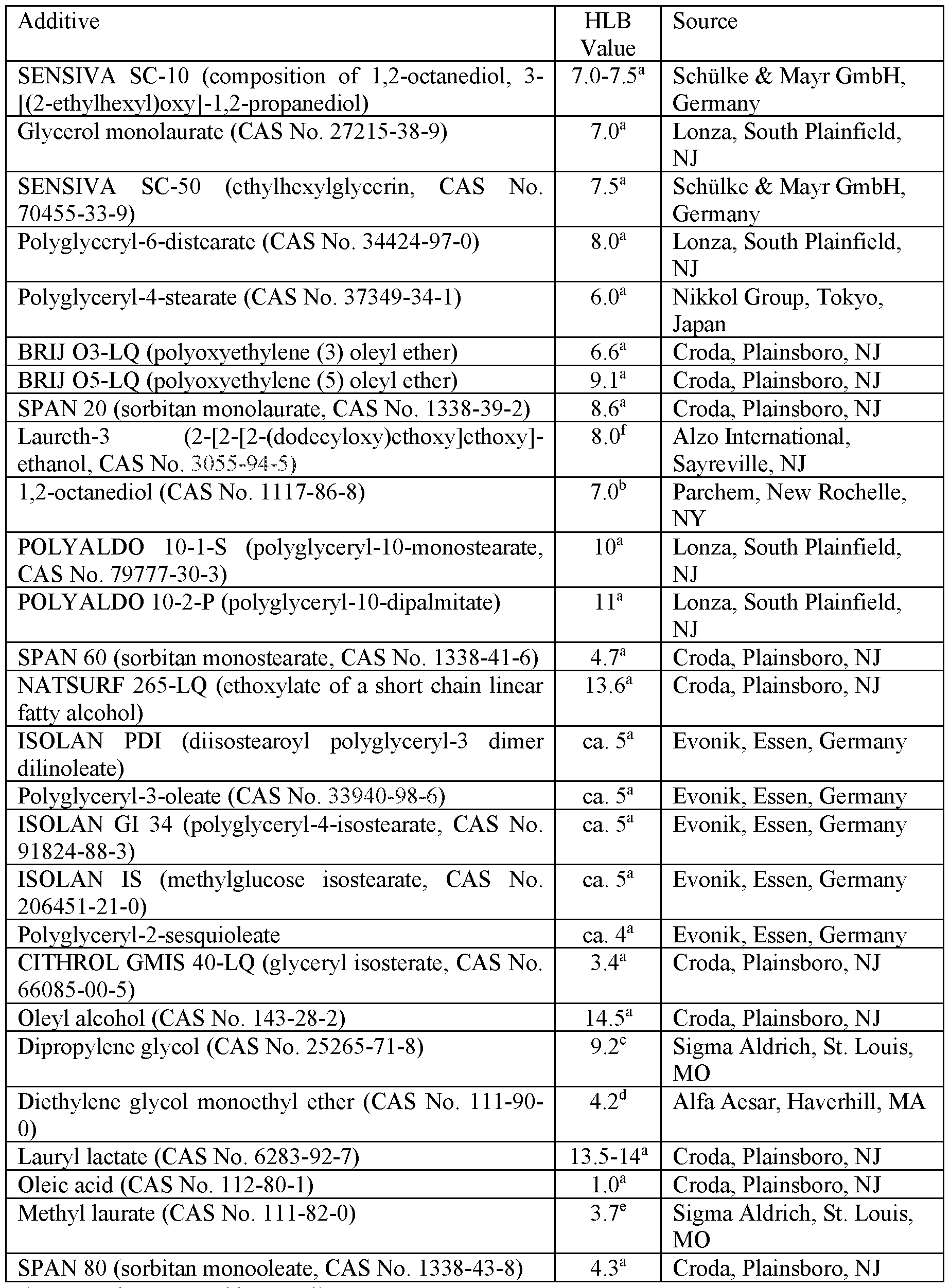
- Nonionic surfactants that may be particularly useful include: polyglyceryl esters having the defined HLB such as polyglyceryl -4-isostearate (available under the trade designation “ISOLAN GI 34” from Evonik, Essen, Germany), methylglucose isostearate (available under the trade designation “ISOLAN IS” from Evonik), polyglyceryl-6- disterate, and polyglyceryl -4-stearate; polyoxyethylene oleyl ethers having the defined HLB such as those available under the trade designation “BRIJ 03-LQ” and “BRIJ 05-LQ” from Crodo, Plainsboro, NJ; fatty acid monoesters of glycerin and propylene glycol such as glycerol monolaurate, glycerol monocaprylate, glycerol monocaprate,
- 1,2-alkanediols having a chain length in the range of 5 to 10 carbon atoms having the defined HLB, such as 1,2-octanediol.
- 1,2- octanediol composition includes 3-[(2-ethylhexyl)oxy]-l, 2-propanediol, and is sold as SENSIVA SC- 10 by Schiilke& Mayr GmbH, Germany.
- the additive is an aminosilicone.
- aminosilicone means any amine functionalized silicone; i.e., a silicone containing at least one primary amine, secondary amine, or tertiary amine, group. Typically, these are silicones which have been chemically modified so that some of the pendant groups along the backbone have been replaced with various alkylamine groups (-R-NH2). These amine groups can become positively charged in aqueous solutions because of their electron-donating tendencies, yielding an inorganic, cationic polymer.
- Useful aminosilicones are typically water soluble or water-dispersible.
- the aminosilicone having an amine value greater than 60, 80, 100, or even 150 appears to aid the solubilization of the salicylic acid.
- the aminosilicone having an amine value no more than 60.
- "amine value” represents the number of milliliters of 0. IN HC1 needed to neutralize 10 g of the amine-rich adhesion promoter. Amine value is preferably calculated according to the following equation:
- aminosilicones suitable for use in the gel compositions of the present disclosure advantageously include a greater number of available amine groups and an accompanying larger amine value.
- the aminosilicone has a higher amine value for a given polymer chain length.
- the aminosilicone has a ratio of amine number to viscosity of less than 4, 2, 1, 0.5, 0.2, or even 0.1.
- Exemplary aminosilicones for use in embodiments of the present disclosure can be linear polymers, branched polymers, copolymers, and mixtures thereof.
- the copolymer is a block copolymer.
- the aminosilicone has one or more amine groups pendant from the polymer backbone. Examples of such embodiments are illustrated by compounds of formula IV with pendant mono-amines and compounds of Formula VI with pendant di-amines, as shown herein below.
- the polymer has amine groups at one or more termini of the polymer. Examples of such embodiments are illustrated by compounds of Formula V, as shown herein below.
- Aminosilicones may further be selected from the group comprising, aminodimethicones, trimethylsilylamodimethicones, aaminoethylaminopropylsiloxane- dimethylsloxane copolymers, and mixtures thereof.
- an aminosilicone has the structure of Formula IV : wherein R is Cl- 12 (preferably Cl-6) alkyl, the blocks bearing the subscripts x and y may be randomly mixed, the total value of x is from 10 to 5,000, for example 58 or 100 or 118, and the total value of y is from 2 to 20, preferably 2 to 11, for example 4 or 11. In some embodiments x is 58 and y is 4; x is 100 and y is 4; or x is 118 and y is 11. In some embodiments, R is a linear C33 ⁇ 4 group.
- one or more aminosilicones have the structure of formula V, which features terminal amine groups: wherein x is from 5 to 5,000, and R and R, which may be the same or different, are each saturated, linear or branched alkyl groups of 1 to 12 carbon atoms (in presently preferred circumstances, 1 to 6 carbon atoms), e.g., a linear C 3 H 6 group.
- the aminosilicone includes a branched diamino functional polydimethylsiloxane of formula VI. wherein the blocks bearing the subscripts x and y may be randomly mixed, the total value of is from 5 to 5,000, the total value of y is from 1 to 20, e.g., 8, and R and R', which may be the same or different, are each saturated, linear or branched alkyl groups of 1 to 12 carbon atoms (preferably 1 to 6), e.g. , R is a linear C 3 H 6 group and R is a linear C 2 H 4 group.
- the additive is a cationic silicone polyquatemium.
- a “silicone polyquatemium” includes any silicone comprising one or more quaternary ammonium groups.
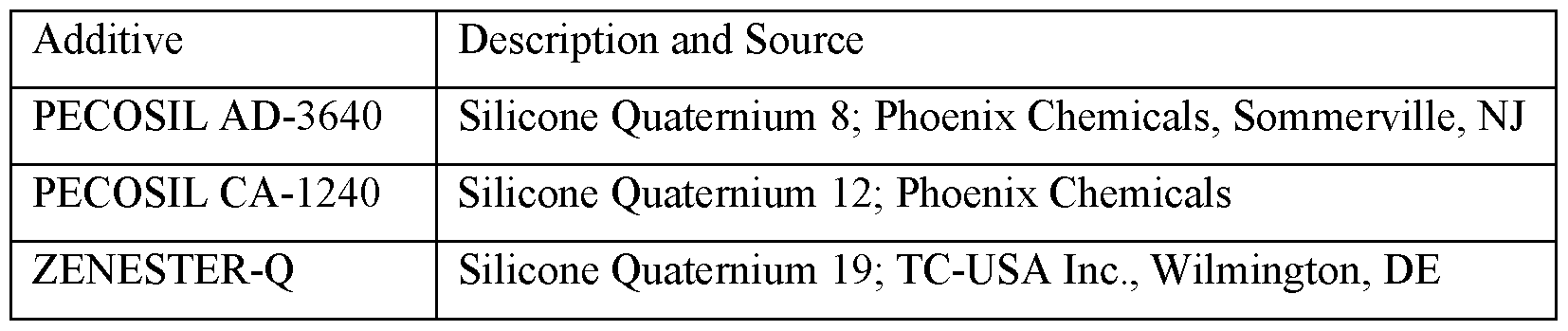
- Exemplary cationic silicone polyquatemiums include: silicone quatemium-12 (available, for example, under the trade designation “PECOSIL CA-1240”, a reaction product of cocamidopropyldimethylamine and Dimethicone PEG-7 acetyl chloride, from Phoenix Chemical, Somerville, NJ); silicone quatemium-8 (available, for example, under the trade designation “PECOSIL AD-3640” from Phoenix Chemical, Somerville, NJ): silicone quatemium-19 (available, for example, under the trade designation “ZENESTER Q”, a functionalized cationic polymeric silicone polyester made from the reaction of a cationic dimethicone copolyol and a dimer acid, from Zenitech, Toronto, Ontario); silicone quatemium-22 (available under the trade designation “ABIL T QUAT 60” from Evonik Industries AG, Essen, Germany); silicone quatemium-80 (available under the trade designation “ABIL T QUAT 3272” from Evonik Industries AG); and mixtures thereof.
- the additive is typically present in quantities of at least 0.05, 0.1, 0.5, 1, 1.25, 1.5, 1.75, 2, or even 2.25 wt % based on the total weight of the gel composition. In one embodiment, the additive is present in quantities of at most 2, 2.5, 3, 3.5, 4, 4.5, 5, 7, or even 10 wt % based on the total weight of the gel composition.
- the amount of additive present may be dictated by the amount of salicylic acid present, wherein the more salicylic acid present, the more additive is present.
- a dried fdm cast from the gel composition may include, for example an amount of additive of at least 0.1, 0.5, 1, 1.5, 2, 2.25, 2.5, 3, 4, 5, 6, or even 8 wt% and at most 10, 15, 20, 25, or even 30 wt % relative to a total weight of the dried fdm.
- the gel form of the composition comprises a volatile solvent.
- the volatile solvent is selected from the group consisting of volatile linear and cyclic siloxanes, volatile polydimethylsiloxanes, isooctane, octane, and combinations thereof.
- the solvent is typically at least 40, 50, 55, or even 60 wt % and at most 65, 70, 75, or 80 wt % of the total gel composition.
- the solvent is desirably volatile and non stinging.
- volatile has its standard meaning, that is, it can evaporate rapidly at normal temperatures and pressure.
- a solvent can be volatile if one metric drop (1/20 mL, 50 mu L) of the solvent will evaporate completely between 20-25°C. within 5 minutes, or within 4 minutes, or within 3 minutes, or within 2 minutes, or within 1 minute, or within 30 sec, or within 15 sec.
- Exemplary volatile solvent systems include a linear siloxane or a cyclic siloxane, such as hexamethyldisiloxane (HMDSO), octamethylcyclotetrasiloxane, decamethylcyclopentasiloxane, and octamethyltrisiloxane, or a linear, branched or cyclic alkane, such as propane, isobutane, liquid butane (e.g., under pressure), pentane, hexane, heptane, octane, petroleum distillates, cyclohexane, fluorocarbons, such as trichloromonofluoromethane, dichlorodifluoromethane, dichlorotetrafluoroethane, tetrafluoroethane, heptafluoropropane, 1,1- difluoroethane, pentafluoropropane, perfluorohept
- the use of a non-polar, volatile solvent, alone or in combination, as the primary liquid phase of the gel composition can provide a desirable balance between fast drying and reduced skin irritation during application.
- the solvent is one of HMDSO and isooctane.
- Other, more polar solvents such as ethanol, isopropanol, glycerin, N- methylpyrrolidone, and N,N-dimethylacetamide can be used in other implementations, where a non-stinging gel composition is either unnecessary or undesirable.
- aprotic solvents have utility including acetates such as methyl and ethyl acetate, propylene glycol diacetate, volatile ketones such as acetone and methyl ethyl ketone, volatile ethers such as diethyl ether, ethyl propyl ether, dipropyl ether and dipropylene glycol dimethyl ether, volatile fluorocarbons, such as pentafluoropropane, perfluoroheptane, perfluoromethylcyclohexane and the like; or a volatile gas, such as carbon dioxide, can also be employed, each with varying degrees of user discomfort.
- water may be included in a solvent system.
- a relatively small amount of water is present in the gel composition, such as at least 0.1 or even 1 wt.%, but no more than 5 or 10 wt % based on the total weight of the composition. Higher water content can be used in the gel compositions, though such compositions may require longer dry times.
- optional components can be added to the composition to improve the performance of the composition.
- Optional components include: a coagulant, a fdler, clay, silica, colorants and/or fibrous reinforcement as disclosed in U.S. Pat. No. 10,603,405, herein incorporated by reference.
- an antiseptic and/or antibiotic agent may be added to the composition.
- Such agents can be used for shelf-life preservation of the composition and/or to supplement the effectiveness of the salicylic acid for various treatments.
- Such agents are described in U.S. Pat. No.
- Exemplary agents include, benzethonium chloride, cetylpyridinium chloride, benzalkonium chloride, chlorhexidine, polyhexamethylene biguanide, chloroxylenol, methylparaben, and propylparaben [0082]
- Other solid biologically active materials such as anti-itch agents, such as chamomile, eucalyptus, camphor, menthol, zinc oxide, talc, and calamine, anti-inflammatory agents, such as corticosteroids, antifungal agents, such as terbinafme hydrochloride and miconazole nitrate, and non-steriodal anti-inflammatory agents, such as ibuprofen, and antibiotic agents, such as bacitracin, neomycin, polymyxin can be added in like fashion.
- anti-itch agents such as chamomile, eucalyptus, camphor, menthol, zinc oxide, talc, and calamine
- Essential oils can also be added as flavoring agents, aromatic agents, or antimicrobial agents, including thymol, menthol, sandalwood, cinnamon, jasmine, lavender, pine, lemon, rose, eucalyptus, clove, orange, mint, spearmint, peppermint, lemongrass, bergamot, citronella, cypress, nutmeg, spruce, tea tree, wintergreen, vanilla, and the like.
- a colorant such as a dye, pigment, or pigment dye maybe added to the composition to improve its aesthetical appearance. For example, making the composition skin-tone in color.
- conformable gel compositions comprising a film-forming polymer are made by adding all of the components except for the silicone containing film-forming polymer together to homogeneously mix then and then add the silicone containing film-forming polymer at the end of the manufacturing process, making a viscous solution.
- salicylic acid does not appear to be readily soluble in the silicate tackifying resin, and/or the volatile solvent. Therefore, it has been discovered that certain additives and the addition of at least a portion of the silicone containing film-forming polymer to the salicylic acid can be used to solubilize the salicylic acid, while not creating too viscous of a solution.
- the resulting gel composition and/or the fdm comprises few (i.e., less than 20, 10, 5, 2, or even 1 wt % of the amount initially added) salicylic acid particulates and more preferably no salicylic acid particulates. If the gel composition comprises a few salicylic particulates, the composition can be optimized (for example, increasing the amount of the additive, increasing the silicone containing film-forming polymer, and/or decreasing the amount of salicylic acid), and/or gently heating the composition to aid dissolution of the salicylic acid.
- the other components of the composition can be added to this first mixture comprising the salicylic acid and at least a portion of the silicone containing film-forming polymer, or they can be added separately. Generally, the remainder of the silicone containing film forming polymer is added at the end of the mixing of the components due to its viscous nature.
- the salicylic acid and at least a portion of the silicone containing film-forming polymer, and optionally the additive are mixed at ambient conditions using techniques known in the art, such as overhead mixer.
- the mixture may be slightly heated (for example, at least 40, 60, or even 80°C and below the boiling/flash point of the solvent or 200°C, whichever is lower) to more quickly solubilize the salicylic acid.
- composition of the present disclosure can be useful in topical applications for treatment of acne, warts, psoriasis, ringworm, ichthyosis, and/or calluses.
- a treatment protocol may involve skin preparation prior to applying the gel compositions of the present disclosure.
- the target site is preferably dried, e.g., blotted dry, and then a lightly adherent polymeric fdm is formed over this site by applying the gel composition.
- the composition Sufficient amounts of the composition are employed to cover (i.e. , coat) the entire target site with a layer of the gel composition. It is typically preferred that the resultant dried film have a thickness from about 4 mils (101.2 micrometers) to about 15 mils (351 micrometers). The resultant film typically covers just the portion to be treated (for example, just the acne, wart, etc.). If necessary, excess gel can be removed with a wipe or tissue paper before drying.
- the gel composition may be applied as a single dose or multiple doses (applications).
- film-forming refers to a composition when allowed to dry under ambient conditions (e.g., 23°C and 50% relative humidity (RH)) on skin or mucosal tissue forms a continuous layer that does not flake off after simple flexing of the tissue.
- ambient conditions e.g., 23°C and 50% relative humidity (RH)
- Typical gel compositions can comprise (a) 0.1 to 10 wt % salicylic acid; (b) 5 to 30 wt.% silicone containing film-forming polymer; (c) 1 to 35 wt.% silicate tackifying resin; (d) 0.1 to 5 wt % additive; and (e) 50 to 80 wt.% volatile solvent, based on the total weight of the gel composition.
- the gel compositions can be applied to tissue and the volatile solvent evaporates forming a continuous dried film.
- Dried films of the present disclosure may comprise (a) 0.1 to 20 wt % salicylic acid; (b) 30 to 90 wt.% silicone containing film-forming polymer; (c) 5 to 40 wt.% silicate tackifying resin; and (d) 0.1 to 25 wt % additive, based on the total weight of the dried film.
- ready to use refers to the composition intended to be applied (e.g., to skin) without dilution. It should be understood that (unless otherwise specified) the listed amounts of all identified components are for “ready to use” gel compositions.
- the gel compositions of the present disclosure typically have a viscosity of at least 20,000 Centipoise (cps) and no greater than 1,100,000 cps and can encompass all values therebetween when measured at 23 °C using a Brookfield LVT viscometer as described in U.S. Pat. No. 10,603,405.
- a film of dried gel composition can have a thickness of at least 25, 50, 75, or even 100 micrometers and typically no greater than 0.2, 0.25, 0.5, 1, and 1.3 mm. While the gel compositions of the present disclosure can be coated in such a manner as to form a film having a uniform or substantially uniform thickness, variations in, for example, the pressure applied or the applicator used can result in variable thickness throughout the film layer.
- the dried films of the present disclosure are lightly adherent to skin. In one embodiment, similar in adhesion as described in U.S. Pat. No. 10,603,405.
- the dried films of the present disclosure are self-supporting after a single application of gel composition, meaning that a therapeutic level of salicylic acid can be applied in a single strata and without the application of additional layers of gel composition on an outer surface of a dried film.
- a “self-supporting” film does not require an additional, flexible backing for continued wear (i.e.. at least 8 hours of continuous existence on the skin or other target tissues).
- compositions of the present disclosure are useful in the treatment of acne.
- Propionibacterium acnes now known as cutibacterium acnes, is a bacteria often associated with acne skin conditions.
- the dried films of the present disclosure are able to achieve at least a 1, 3, 5, or even 6 log reduction using the Antimicrobial Efficacy Test described herein.
- the dried films of the present disclosure should be capable of releasing the active agent such as salicylic acid during use.
- the films should not significantly irritate the skin when deposited during application and in use after drying.
- the dried films are substantially painless and can be removed, if needed, substantially without pain.
- the treatment films can form when applied over surfaces wet with water, blood or body fluids, in short times at standard room temperature and reasonable variants thereof.
- the vial was cooled to room temperature and then placed on a bench without any agitation of the gel composition for a minimum of 24 hours. Next, the gel composition was inspected by visual examination to determine if the components of the composition were dissolved or uniformly dispersed throughout the gel and noted accordingly.
- the gel compositions were individually coated onto the surface of LEXAN polycarbonate test sheets (5.1 cm by 12.7 cm) (a single composition coated per test sheet). About 2-3 mL of a gel was applied to a test sheet using a syringe. A pull-down hand coater was used with a gap set at 50 mil (1.27 millimeter) using a feeler gauge. Coated sheets were air dried overnight and then observed for the presence of particulates. The nonionic surfactant additive used in each sample and the observations made of the gel and the dried fdm are reported in Table 5. Table 5.
- HMDSO 11 g
- MQ Resin 1 g
- SPOx 1 g
- salicylic acid 0.075 g
- an aminosilicone 0.4 g
- Sample 37 Gel Composition with a Nonionic Surfactant Additive and a Cationic
- Sample 39 Gel Composition with a Nonionic Surfactant Additive and a Cationic
- Sample 40 Gel Composition with Two Nonionic Surfactant Additives
- SENSIVA-SC10 0.2 g
- BRIJ 05-LQ 0.1 g
- PECOSIL AD-3640 0.2 g
- polyglyceryl-4-stearate 0.3 g
- Propionibacterium acnes ( P . acnes) ATCC 6919 was obtained from ATCC (Manassas, VA). A single colony of P. acnes from a stock agar culture was inoculated into DIFCO anaerobic broth (Becton, Dickinson, Franklin Fakes, NJ) and incubated at 37 °C for 18 hours to provide a 1 c 10 9 cfti/mF (colony forming units per milliliter) culture of P. acnes.
- DIFCO anaerobic broth Becton, Dickinson, Franklin Fakes, NJ
- the resulting PBS solution was serially diluted (10-fold dilutions with PBS) and 3 microliters of each dilution sample was added by pipette to a DIFCO anaerobic agar plate (Becton Dickinson).
- the individually inoculated agar plates were incubated at 37 °C for 16 hours. The colonies from each incubated plate were counted by visual examination.
- the logarithmic reduction value was calculated according to Equation 1. The results are reported in Table 8. An FRV reported as >6 in Table 8 indicates that no colonies were observed in any of the dilution samples for the example disc.
Landscapes
- Health & Medical Sciences (AREA)
- Chemical & Material Sciences (AREA)
- Life Sciences & Earth Sciences (AREA)
- Veterinary Medicine (AREA)
- Medicinal Chemistry (AREA)
- Pharmacology & Pharmacy (AREA)
- Animal Behavior & Ethology (AREA)
- General Health & Medical Sciences (AREA)
- Public Health (AREA)
- Epidemiology (AREA)
- Engineering & Computer Science (AREA)
- Chemical Kinetics & Catalysis (AREA)
- General Chemical & Material Sciences (AREA)
- Dermatology (AREA)
- Organic Chemistry (AREA)
- Nuclear Medicine, Radiotherapy & Molecular Imaging (AREA)
- Bioinformatics & Cheminformatics (AREA)
- Proteomics, Peptides & Aminoacids (AREA)
- Oil, Petroleum & Natural Gas (AREA)
- Inorganic Chemistry (AREA)
- Compositions Of Macromolecular Compounds (AREA)
- Medicinal Preparation (AREA)
Abstract
Description







Claims


Priority Applications (2)
| Application Number | Priority Date | Filing Date | Title |
|---|---|---|---|
| CN202280051615.XA CN117750951A (en) | 2021-07-29 | 2022-06-29 | Film-forming compositions comprising salicylic acid and methods of use |
| US18/576,822 US20240307416A1 (en) | 2021-07-29 | 2022-06-29 | Film-forming compositions comprising salicylic acid and methods of use |
Applications Claiming Priority (2)
| Application Number | Priority Date | Filing Date | Title |
|---|---|---|---|
| US202163226978P | 2021-07-29 | 2021-07-29 | |
| US63/226,978 | 2021-07-29 |
Publications (1)
| Publication Number | Publication Date |
|---|---|
| WO2023007275A1 true WO2023007275A1 (en) | 2023-02-02 |
Family
ID=82595243
Family Applications (1)
| Application Number | Title | Priority Date | Filing Date |
|---|---|---|---|
| PCT/IB2022/056063 Ceased WO2023007275A1 (en) | 2021-07-29 | 2022-06-29 | Film-forming compositions comprising salicylic acid and methods of use |
Country Status (3)
| Country | Link |
|---|---|
| US (1) | US20240307416A1 (en) |
| CN (1) | CN117750951A (en) |
| WO (1) | WO2023007275A1 (en) |
Citations (37)
| Publication number | Priority date | Publication date | Assignee | Title |
|---|---|---|---|---|
| US2676182A (en) | 1950-09-13 | 1954-04-20 | Dow Corning | Copolymeric siloxanes and methods of preparing them |
| US3627851A (en) | 1970-10-23 | 1971-12-14 | Dow Corning | Flexible coating composition |
| US3772247A (en) | 1971-07-30 | 1973-11-13 | Ici Ltd | Siloxanes |
| US4900474A (en) | 1987-07-17 | 1990-02-13 | Shin-Etsu Chemical Co., Ltd. | Silicone antifoamers |
| US4935484A (en) | 1987-05-21 | 1990-06-19 | Wacker-Chemie Gmbh | Silicone resin powder and a process for preparing the same |
| US5028679A (en) | 1988-10-05 | 1991-07-02 | Shin-Etsu Chemical Co., Ltd. | Method for preparing perfluoroalkyl group-containing organopolysiloxanes |
| US5082706A (en) | 1988-11-23 | 1992-01-21 | Dow Corning Corporation | Pressure sensitive adhesive/release liner laminate |
| US5118775A (en) | 1989-02-21 | 1992-06-02 | Shin-Etsu Chemical Co., Ltd. | Fluoroorganopolysiloxane and a process for preparing the same |
| US5214119A (en) | 1986-06-20 | 1993-05-25 | Minnesota Mining And Manufacturing Company | Block copolymer, method of making the same, dimaine precursors of the same, method of making such diamines and end products comprising the block copolymer |
| US5236997A (en) | 1991-02-18 | 1993-08-17 | Shin-Etsu Chemical Co., Ltd. | Curable fluorosilicone rubber composition |
| US5248739A (en) | 1991-10-18 | 1993-09-28 | Dow Corning Corporation | Silicone pressure sensitive adhesives having enhanced adhesion to low energy substrates |
| US5302685A (en) | 1992-06-18 | 1994-04-12 | Shin-Etsu Chemical Co., Ltd. | Method for preparing organopolysiloxane powder |
| US5319040A (en) | 1993-03-12 | 1994-06-07 | General Electric Company | Method for making substantially silanol-free silicone resin powder, product and use |
| US5512650A (en) | 1986-06-20 | 1996-04-30 | Minnesota Mining And Manufacturing Company | Block copolymer, method of making the same, diamine precursors of the same, method of making such diamines and end products comprising the block copolymer |
| FR2732595A1 (en) * | 1995-04-07 | 1996-10-11 | Oreal | USE OF POLYMERS TO REDUCE THE IRRITATING EFFECT OF ACTIVE INGREDIENTS IN A COSMETIC AND / OR DERMATOLOGICAL COMPOSITION |
| WO1996034028A1 (en) | 1995-04-25 | 1996-10-31 | Minnesota Mining And Manufacturing Company | Tackified polydiorganosiloxane oligourea segmented copolymers and a process for making same |
| WO1996034030A1 (en) | 1995-04-25 | 1996-10-31 | Minnesota Mining And Manufacturing Company | Polydiorganosiloxane oligourea segmented copolymers and a process for making same |
| WO1996035458A2 (en) | 1995-04-25 | 1996-11-14 | Minnesota Mining And Manufacturing Company | Tackified polydiorganosiloxane polyurea segmented copolymers and a process for making same |
| WO1997040103A1 (en) | 1996-04-25 | 1997-10-30 | Minnesota Mining And Manufacturing Company | Silicone compositions containing a silicone-urea segmented copolymer |
| WO1998017726A1 (en) | 1996-10-23 | 1998-04-30 | Minnesota Mining And Manufacturing Company | Polymer mixtures containing polydiorganosiloxane urea-containing components |
| US6007914A (en) | 1997-12-01 | 1999-12-28 | 3M Innovative Properties Company | Fibers of polydiorganosiloxane polyurea copolymers |
| WO2000010540A1 (en) * | 1998-08-20 | 2000-03-02 | 3M Innovative Properties Company | Spray on bandage and drug delivery system |
| EP1013734A1 (en) * | 1997-09-16 | 2000-06-28 | Teijin Limited | Gel-form pressure-sensitive adhesive, and adhesive material and adhesive medicinal preparation both containing the same |
| US6569521B1 (en) | 2000-07-06 | 2003-05-27 | 3M Innovative Properties Company | Stretch releasing pressure sensitive adhesive tape and articles |
| US6664359B1 (en) | 1996-04-25 | 2003-12-16 | 3M Innovative Properties Company | Tackified polydiorganosiloxane polyurea segmented copolymers and a process for making same |
| EP1854450A2 (en) * | 2006-05-03 | 2007-11-14 | L'Oréal | Cosmetic compositions containing block copolymers and corresponding long-wearing cosmetic product system |
| US7371464B2 (en) | 2005-12-23 | 2008-05-13 | 3M Innovative Properties Company | Adhesive compositions |
| US7705101B2 (en) | 2007-06-22 | 2010-04-27 | 3M Innovative Properties Company | Branched polydiorganosiloxane polyamide copolymers |
| US7795326B2 (en) | 2005-12-07 | 2010-09-14 | Rochal Industries, Llp | Conformable bandage and coating material |
| US20110046242A1 (en) * | 2008-01-17 | 2011-02-24 | Jean-Luc Garaud | Film Forming, Silicone Containing Compositions |
| WO2011022199A2 (en) * | 2009-08-18 | 2011-02-24 | Dow Corning Corporation | Multi-layer transdermal patch |
| US8431671B2 (en) | 2008-03-26 | 2013-04-30 | 3M Innovative Properties Company | Structured polydiorganosiloxane polyamide containing devices and methods |
| US8552136B2 (en) | 2008-12-17 | 2013-10-08 | 3M Innovative Properties Company | Thermoplastic silicone-based polymer process additives for injection molding applications |
| WO2013162723A1 (en) * | 2012-04-27 | 2013-10-31 | Dow Corning Corporation | Topical formulation compositions containing silicone based excipients to deliver actives to a substrate |
| US8586668B2 (en) | 2005-12-23 | 2013-11-19 | 3M Innovative Properties Company | Polydiorganosiloxane polyoxamide copolymers |
| US8765881B2 (en) | 2009-12-30 | 2014-07-01 | 3M Innovative Properties Company | Methods of making polydiorganosiloxane polyoxamide copolymers |
| US10603405B2 (en) | 2015-04-06 | 2020-03-31 | 3M Innovative Properties Company | Removable film forming gel compositions and methods for their application |
-
2022
- 2022-06-29 US US18/576,822 patent/US20240307416A1/en active Pending
- 2022-06-29 CN CN202280051615.XA patent/CN117750951A/en active Pending
- 2022-06-29 WO PCT/IB2022/056063 patent/WO2023007275A1/en not_active Ceased
Patent Citations (38)
| Publication number | Priority date | Publication date | Assignee | Title |
|---|---|---|---|---|
| US2676182A (en) | 1950-09-13 | 1954-04-20 | Dow Corning | Copolymeric siloxanes and methods of preparing them |
| US3627851A (en) | 1970-10-23 | 1971-12-14 | Dow Corning | Flexible coating composition |
| US3772247A (en) | 1971-07-30 | 1973-11-13 | Ici Ltd | Siloxanes |
| US5214119A (en) | 1986-06-20 | 1993-05-25 | Minnesota Mining And Manufacturing Company | Block copolymer, method of making the same, dimaine precursors of the same, method of making such diamines and end products comprising the block copolymer |
| US5512650A (en) | 1986-06-20 | 1996-04-30 | Minnesota Mining And Manufacturing Company | Block copolymer, method of making the same, diamine precursors of the same, method of making such diamines and end products comprising the block copolymer |
| US5461134A (en) | 1986-06-20 | 1995-10-24 | Minnesota Mining And Manufacturing Company | Block copolymer, method of making the same, diamine precursors of the same, method of making such diamines and end products comprising the block copolymer |
| US4935484A (en) | 1987-05-21 | 1990-06-19 | Wacker-Chemie Gmbh | Silicone resin powder and a process for preparing the same |
| US4900474A (en) | 1987-07-17 | 1990-02-13 | Shin-Etsu Chemical Co., Ltd. | Silicone antifoamers |
| US5028679A (en) | 1988-10-05 | 1991-07-02 | Shin-Etsu Chemical Co., Ltd. | Method for preparing perfluoroalkyl group-containing organopolysiloxanes |
| US5082706A (en) | 1988-11-23 | 1992-01-21 | Dow Corning Corporation | Pressure sensitive adhesive/release liner laminate |
| US5118775A (en) | 1989-02-21 | 1992-06-02 | Shin-Etsu Chemical Co., Ltd. | Fluoroorganopolysiloxane and a process for preparing the same |
| US5236997A (en) | 1991-02-18 | 1993-08-17 | Shin-Etsu Chemical Co., Ltd. | Curable fluorosilicone rubber composition |
| US5248739A (en) | 1991-10-18 | 1993-09-28 | Dow Corning Corporation | Silicone pressure sensitive adhesives having enhanced adhesion to low energy substrates |
| US5302685A (en) | 1992-06-18 | 1994-04-12 | Shin-Etsu Chemical Co., Ltd. | Method for preparing organopolysiloxane powder |
| US5319040A (en) | 1993-03-12 | 1994-06-07 | General Electric Company | Method for making substantially silanol-free silicone resin powder, product and use |
| FR2732595A1 (en) * | 1995-04-07 | 1996-10-11 | Oreal | USE OF POLYMERS TO REDUCE THE IRRITATING EFFECT OF ACTIVE INGREDIENTS IN A COSMETIC AND / OR DERMATOLOGICAL COMPOSITION |
| WO1996035458A2 (en) | 1995-04-25 | 1996-11-14 | Minnesota Mining And Manufacturing Company | Tackified polydiorganosiloxane polyurea segmented copolymers and a process for making same |
| WO1996034030A1 (en) | 1995-04-25 | 1996-10-31 | Minnesota Mining And Manufacturing Company | Polydiorganosiloxane oligourea segmented copolymers and a process for making same |
| WO1996034028A1 (en) | 1995-04-25 | 1996-10-31 | Minnesota Mining And Manufacturing Company | Tackified polydiorganosiloxane oligourea segmented copolymers and a process for making same |
| WO1997040103A1 (en) | 1996-04-25 | 1997-10-30 | Minnesota Mining And Manufacturing Company | Silicone compositions containing a silicone-urea segmented copolymer |
| US6664359B1 (en) | 1996-04-25 | 2003-12-16 | 3M Innovative Properties Company | Tackified polydiorganosiloxane polyurea segmented copolymers and a process for making same |
| WO1998017726A1 (en) | 1996-10-23 | 1998-04-30 | Minnesota Mining And Manufacturing Company | Polymer mixtures containing polydiorganosiloxane urea-containing components |
| EP1013734A1 (en) * | 1997-09-16 | 2000-06-28 | Teijin Limited | Gel-form pressure-sensitive adhesive, and adhesive material and adhesive medicinal preparation both containing the same |
| US6007914A (en) | 1997-12-01 | 1999-12-28 | 3M Innovative Properties Company | Fibers of polydiorganosiloxane polyurea copolymers |
| WO2000010540A1 (en) * | 1998-08-20 | 2000-03-02 | 3M Innovative Properties Company | Spray on bandage and drug delivery system |
| US6569521B1 (en) | 2000-07-06 | 2003-05-27 | 3M Innovative Properties Company | Stretch releasing pressure sensitive adhesive tape and articles |
| US7795326B2 (en) | 2005-12-07 | 2010-09-14 | Rochal Industries, Llp | Conformable bandage and coating material |
| US7371464B2 (en) | 2005-12-23 | 2008-05-13 | 3M Innovative Properties Company | Adhesive compositions |
| US8586668B2 (en) | 2005-12-23 | 2013-11-19 | 3M Innovative Properties Company | Polydiorganosiloxane polyoxamide copolymers |
| EP1854450A2 (en) * | 2006-05-03 | 2007-11-14 | L'Oréal | Cosmetic compositions containing block copolymers and corresponding long-wearing cosmetic product system |
| US7705101B2 (en) | 2007-06-22 | 2010-04-27 | 3M Innovative Properties Company | Branched polydiorganosiloxane polyamide copolymers |
| US20110046242A1 (en) * | 2008-01-17 | 2011-02-24 | Jean-Luc Garaud | Film Forming, Silicone Containing Compositions |
| US8431671B2 (en) | 2008-03-26 | 2013-04-30 | 3M Innovative Properties Company | Structured polydiorganosiloxane polyamide containing devices and methods |
| US8552136B2 (en) | 2008-12-17 | 2013-10-08 | 3M Innovative Properties Company | Thermoplastic silicone-based polymer process additives for injection molding applications |
| WO2011022199A2 (en) * | 2009-08-18 | 2011-02-24 | Dow Corning Corporation | Multi-layer transdermal patch |
| US8765881B2 (en) | 2009-12-30 | 2014-07-01 | 3M Innovative Properties Company | Methods of making polydiorganosiloxane polyoxamide copolymers |
| WO2013162723A1 (en) * | 2012-04-27 | 2013-10-31 | Dow Corning Corporation | Topical formulation compositions containing silicone based excipients to deliver actives to a substrate |
| US10603405B2 (en) | 2015-04-06 | 2020-03-31 | 3M Innovative Properties Company | Removable film forming gel compositions and methods for their application |
Non-Patent Citations (1)
| Title |
|---|
| "Encyclopedia of Polymer Science and Engineering,", vol. 15, 1989, JOHN WILEY & SONS, pages: 265 - 270 |
Also Published As
| Publication number | Publication date |
|---|---|
| US20240307416A1 (en) | 2024-09-19 |
| CN117750951A (en) | 2024-03-22 |
Similar Documents
| Publication | Publication Date | Title |
|---|---|---|
| EP3280769B1 (en) | Removable film forming gel compositions and methods for their application | |
| US12465577B2 (en) | Antimicrobial topical skin closure compositions and systems | |
| US11479669B2 (en) | Topical skin closure compositions and systems | |
| FI109914B (en) | Silicone systems such as modified adhesion and its use for the manufacture of hardening tack-free compositions | |
| CN105531301B (en) | Crosslinked compositions and methods of forming the same | |
| JP6141868B2 (en) | Adhesive article and manufacturing method thereof | |
| JP6585066B2 (en) | Cross-linked composition and method for producing the same | |
| US11497828B2 (en) | Removable film forming gel compositions featuring adhesion promoters | |
| JPH07503748A (en) | Moisture-curable polysiloxane release coating composition | |
| US20210371662A1 (en) | Novel Topical Skin Closure Compositions and Systems | |
| JP2015507667A (en) | Adhesive article including primer layer and method for producing the same | |
| US5977279A (en) | Organopolysiloxane mixture for the preparation of adhesive-repellent organopolysiloxane films | |
| WO2023007275A1 (en) | Film-forming compositions comprising salicylic acid and methods of use | |
| JP2025100561A (en) | Removable film-forming gel compositions featuring adhesion promoters - Patents.com | |
| JP7249442B2 (en) | Aminosilicone polymer, silicone emulsion containing the same, and method for producing the same | |
| JP2026504605A (en) | Film-forming compositions containing salicylic acid and methods of use | |
| WO2021012048A1 (en) | Catalyst free, rapid cure silicone elastomers | |
| JPH0434575B2 (en) | ||
| JP4032016B2 (en) | Silicone oil-containing paste and method for producing the same |
Legal Events
| Date | Code | Title | Description |
|---|---|---|---|
| 121 | Ep: the epo has been informed by wipo that ep was designated in this application |
Ref document number: 22743579 Country of ref document: EP Kind code of ref document: A1 |
|
| WWE | Wipo information: entry into national phase |
Ref document number: 202280051615.X Country of ref document: CN |
|
| ENP | Entry into the national phase |
Ref document number: 2024504921 Country of ref document: JP Kind code of ref document: A |
|
| NENP | Non-entry into the national phase |
Ref country code: DE |
|
| 122 | Ep: pct application non-entry in european phase |
Ref document number: 22743579 Country of ref document: EP Kind code of ref document: A1 |