WO2022256485A1 - Unconventional well gas to oil ratio characterization - Google Patents
Unconventional well gas to oil ratio characterization Download PDFInfo
- Publication number
- WO2022256485A1 WO2022256485A1 PCT/US2022/031895 US2022031895W WO2022256485A1 WO 2022256485 A1 WO2022256485 A1 WO 2022256485A1 US 2022031895 W US2022031895 W US 2022031895W WO 2022256485 A1 WO2022256485 A1 WO 2022256485A1
- Authority
- WO
- WIPO (PCT)
- Prior art keywords
- gor
- well
- reservoir
- production
- data
- Prior art date
- Legal status (The legal status is an assumption and is not a legal conclusion. Google has not performed a legal analysis and makes no representation as to the accuracy of the status listed.)
- Ceased
Links
Classifications
-
- E—FIXED CONSTRUCTIONS
- E21—EARTH OR ROCK DRILLING; MINING
- E21B—EARTH OR ROCK DRILLING; OBTAINING OIL, GAS, WATER, SOLUBLE OR MELTABLE MATERIALS OR A SLURRY OF MINERALS FROM WELLS
- E21B43/00—Methods or apparatus for obtaining oil, gas, water, soluble or meltable materials or a slurry of minerals from wells
- E21B43/25—Methods for stimulating production
- E21B43/26—Methods for stimulating production by forming crevices or fractures
-
- E—FIXED CONSTRUCTIONS
- E21—EARTH OR ROCK DRILLING; MINING
- E21B—EARTH OR ROCK DRILLING; OBTAINING OIL, GAS, WATER, SOLUBLE OR MELTABLE MATERIALS OR A SLURRY OF MINERALS FROM WELLS
- E21B44/00—Automatic control systems specially adapted for drilling operations, i.e. self-operating systems which function to carry out or modify a drilling operation without intervention of a human operator, e.g. computer-controlled drilling systems; Systems specially adapted for monitoring a plurality of drilling variables or conditions
-
- E—FIXED CONSTRUCTIONS
- E21—EARTH OR ROCK DRILLING; MINING
- E21B—EARTH OR ROCK DRILLING; OBTAINING OIL, GAS, WATER, SOLUBLE OR MELTABLE MATERIALS OR A SLURRY OF MINERALS FROM WELLS
- E21B2200/00—Special features related to earth drilling for obtaining oil, gas or water
- E21B2200/20—Computer models or simulations, e.g. for reservoirs under production, drill bits
-
- E—FIXED CONSTRUCTIONS
- E21—EARTH OR ROCK DRILLING; MINING
- E21B—EARTH OR ROCK DRILLING; OBTAINING OIL, GAS, WATER, SOLUBLE OR MELTABLE MATERIALS OR A SLURRY OF MINERALS FROM WELLS
- E21B2200/00—Special features related to earth drilling for obtaining oil, gas or water
- E21B2200/22—Fuzzy logic, artificial intelligence, neural networks or the like
Definitions
- the disclosed methods relate generally to the optimization of a reservoir production, in particular gas to oil levels.
- the Bakken Formation within the Williston Basin has three main reservoir targets and two potential source rocks (FIG. 1A-B): the Upper Bakken Shale and the Lower Bakken Shale source rocks were deposited in a sub-oxic to anoxic offshore marine depositional environment with a stratified water column, whereas the Middle Bakken (MB) member was deposited in a marine to marginal setting under oxic conditions.
- the units of the Three Fork members like the Upper Three Forks (UTF) and the Middle Three Forks (MTF) are mainly cyclical deposits of wind blown silts deposited in shallow wet lacustrine environment that are interbedded with green silty dolomitic claystones.
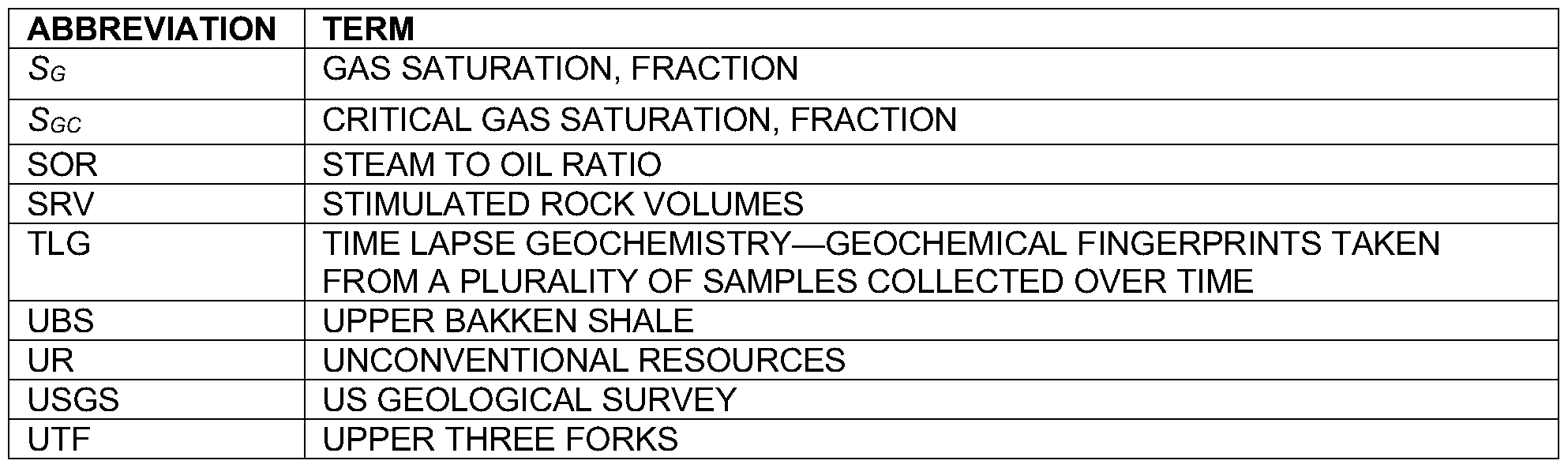
- GOG greenhouse gas
- UR Unconventional Resources
- Bakken unconventional GOR shows conventional black oil reservoir GOR behaviors, but it also has many unconventional characteristics due to the low matrix permeability and different types of hydraulic fracture systems created.
- GOR trends are sensitive to pressure drawdown. Strong correlations between GOR and BHP are observed.
- Old sliding sleeve completion well GOR shows cyclical rise-and-fall patterns with a gradually increasing long-term trend, whereas modem completion wells show rising GOR trend after their BHPs drop below bubble point pressure (Pt) and then reach an intermediate-term plateau.
- Pt bubble point pressure
- Offset parent well depletion drives child well GOR to rise faster and to a higher level.
- Less aggressive drawdown recharging due to frac hits and long shut-in can delay/mitigate GOR rising.
- Bakken well GOR behaviors can be accurately modeled using the proposed approach.
- GOR is specifically exemplified herein, the method is not so limited and can be used to optimize other well parameters, as desired by the operator.
- the present methods include any of the following embodiments in any combination(s) of one or more thereof:
- a regular grid is a network of crossing right angle lines, such as is seen on graph paper.
- grids may be two dimensional and need not be at right angles or regular.
- a common requirement in reservoir simulation is an increased level of detail around an item of interest such as a well.
- a “tartan” grid has variable height and/or width of the lines and is a gridding style available in some reservoir modelling programs.
- a “reservoir” is a formation or a portion of a formation that includes sufficient permeability and porosity to hold and transmit fluids, such as hydrocarbons or water or natural gas, and the like.
- a reservoir can have a plurality of chemically distinct “zones” therein, particularly in very tight rock, where mixing is almost non-existent.
- the data herein can be catalogued by zone, allowing that portion of the data to be used for other zones, even in other wells, as long as the zone has similar fingerprints.
- a “production plan” can include placement of wells, length of well, depth of well, completion details, enhanced oil production methods, stimulation methods, fracking methods, order of completion, production rate, and the like. Production plans can also include well stacking, well spacing, completion designs (frac job types, job size, number of stages, number of clusters per stage, etc.) and strategies (e.g., at what sequence to frac different target zones, how to synchronize/coordinate with nearby wells, alternating or zipper fracking, etc.), production well pressure management, enhanced oil recovery strategies, and the like.
- An “optimized” production plan is generated using well predictions and modeling to improve the simulated production from a well. Once a well plan is optimized, it may then be implemented at the well, at a well pad with multiple wells, or in an area penetrating one or more reservoirs and used to produce hydrocarbons or other reservoir fluids.
- an optimized plan means to actually drill and/or complete a well or wells according to the plan and then produce hydrocarbons from that well.
- water cut is the ratio of water produced compared to the volume of total liquids produced.
- production rate is the rate of fluid production from the well. Production rates can be adjusted by changing the amount of fluid produced and are dependent upon the reservoirs rate of inflow and bottom hole pressure. Inflow performance relationship is controlled by the ratio of bottom hole pressure to production rate.
- GOR Gas Oil Ratio
- scf/stb standard cubic feet per stock tank barrel
- the “associated gas” is natural gas that is dissolved in the oil and is produced along with the crude oil. Heavy crude oil has low API gravity and low capacities of dissolved gas as compared to lighter crude oil.
- “Steam to Oil Ratio” or “SOR” is a measure used to quantify the efficiency of production of oil from a reservoir based on steam injection into the reservoir. It can be defined as the amount of steam injected to produce one unit volume of crude oil. The steam is quantified by barrels of water used to make the steam, however. For example, a steam-oil ratio is 4.5 means that 4.5 barrels of water — converted into steam and injected into the well — were required to extract a single barrel of oil.
- API gravity measures the relative density of petroleum liquid and water and has no dimensions.
- the specific gravity (SG) is first measured using either the hydrometer, detailed in ASTM D1298 or with the oscillating U-tube method detailed in ASTM D4052.
- the official formula used to derive the gravity of petroleum liquids from the specific gravity (SG), as follows: API gravity 141.5/SG - 131.5.
- a “core” or “rock core” is a sample of rock, typically in the shape of a cylinder. Taken from the side of a drilled oil or gas well, a core is then dissected into multiple core plugs, or small cylindrical samples measuring about 1 inch in diameter and 3 inches long.
- Drilling cuttings or “cutting samples” are the small irregular rock samples generated during drilling and returned with the drilling mud.
- fracture hit was initially coined to refer to the phenomenon of an infill-well fracture interacting with an adjacent well during the hydraulic-fracturing process. However, over time, its use has been extended to any type of well interference or interaction in unconventional reservoirs.
- a reservoir “map” we mean that the reservoir is characterized in the three directional axes as well as the fourth time axis, but we do not necessarily imply a graphical representation thereof, as data can be maintained and accessed in many forms, including in tables.
- the map may be segmented into zones, where the fingerprinting data is very similar.
- FIG. 1A Map showing the study area around Nesson anticline.
- FIG. IB Main reservoir formations in the Bakken.
- FIG. 2 Historical Bakken oil, gas and flaring rates from NDIC.
- FIG. 3 Old completion well GOR trends as a function of oil rate and downhole measured BHP (1st year data).
- FIG. 4 Old completion well longer term GOR trends as a function of oil rate and downhole measured BHP ( ⁇ 5-year data).
- FIG. 5 Modern completion well GOR trends as a function of oil rate and downhole measured BHP.
- FIG. 6A GOR trends by fluid property areas.
- FIG. 6B GOR rising magnitude by fluid property areas.
- FIG. 7 Comparison of GOR for 2 wells on gas lift versus rod pump.
- FIG. 8A GOR rising magnitude vs. production months comparison between parent and child wells.
- FIG. 8B GOR rising magnitude vs. cumulative oil production comparison between parent and child wells..
- FIG. 9A schematic of parent vs. child well placement.
- FIG. 9B Impact of child well fracture hits on parent well GOR and oil rate uplift, tubing pressure and GOR pre- and post-fracture vs. time.
- FIG. 10A GOR rising magnitude vs. oil production rate.
- FIG. 10B GOR rising magnitude vs. gas production rate.
- FIG. 11 A Bi-wing hydraulic fractures used in reservoir model for GOR study.
- FIG. 11B Grid refinement near fractures and wells used in reservoir model for GOR study.
- FIG. 12A Production history matching BHP for old completion wells.
- FIG. 12B Production history matching cumulative oil for old completion wells.
- FIG. 12C Production history matching GOR for old completion wells.
- FIG. 13 Reservoir pressure and gas saturation evaluation at different GOR stages of old completion wells; where BHP > P / ,, where BHP drops below P / ,, Early Pressure build-up, Later Pressure build-up, and later flowing.
- FIG. 14A Production history matching of BHP for modem completion wells.
- FIG. 14B Production history matching of cumulative oil for modern completion wells.
- FIG. 14C Production history matching of GOR for modern completion wells.
- FIG. 15 Reservoir pressure and gas saturation evaluation at different GOR stages of modern completion wells; where P w f > P b , where / / just dropped below Pt, and where GOR enters a plateau stage.
- FIG. 16A Old completion well forecasts of BHP.
- FIG. 16B Old completion well forecasts of GOR.
- FIG. 17A Modem completion well forecasts of BHP.
- FIG. 17B Modern completion well forecasts of GOR (short term).
- FIG. 17C Modem completion well forecasts of GOR (long term).
- FIG. 17D Modem completion well forecasts with less aggressive drawdown BHP.
- FIG. 17E Modem completion well forecasts with less aggressive drawdown GOR (short term).
- FIG. 17F Modern completion well forecasts of less aggressive drawdown GOR (long term).
- FIG. 18A Impacts of cluster spacing on BHP vs. time.
- FIG. 18B Impacts of cluster spacing on GOR vs. time.
- FIG. 18C Impacts of cluster spacing on cumulative (CUM) oil vs. time.
- FIG. 18D showing tight cluster spacing (solid lines in FIG. 18A-C).
- FIG. 18E showing wider cluster spacing (starred lines in FIG. 18A-C).
- Bakken is a hybrid play of shale and carbonate.
- the reservoir matrix permeability is at the low single-digit micro-Darcy range. It is about one order of magnitude higher than other shale plays, however it is still much lower than conventional reservoir permeability. This has important implications on the Bakken reservoir depletion process and GOR evolution that will be discussed later.
- Bakken reservoir fluids generally fall in black oil to volatile oil fluid regimes with a wide range of initial solution GOR R s , from 500 to 2500 scf/stb in the study area.
- the initial reservoir pressure P varies from 6500 to 7500 psi.
- Many PVT samples were collected and tested across the field to characterize fluid properties.
- a field wide Equations of State (EOS) model was developed for various applications, including GOR modeling and facility design.
- Completion design is a key driver of Bakken well GOR behaviors.
- Modem completion designs normally are associated with cemented plug-and-perf completions, more stages (30+) and larger frack job sizes (8+ million lbs proppant).
- the flat GOR period was short, only 2 months in this example.
- the duration of the flat GOR is dictated by the pressure difference between P 1 and P b , and the pressure drawdown, which is a function of well operating practices and stimulated hydraulic fracture system supporting the well deliverability.
- Modem completion wells show different GOR trends from old completion wells.
- An example is given in FIG. 5, where oil rates, GOR and downhole gauge BHP pressure data are overlayed. The main observations are given below:
- Bakken GOR data do not show strong critical gas saturation ( S gc ) behavior, i.e., GOR does not show a clear dip right before it starts rising.
- S gc critical gas saturation
- Our interpretation is because the drainage areas are very limited prior to gas breakout, it does not take a large amount of free gas to make the drained areas reach S gc. This may create a short GOR dipping period (if there is one), which can be easily masked by the producing GOR fluctuations.
- the fluid property spatial variations can have significant impacts on GOR.
- the south part has lower R s , and P b , and the oil is less volatile than that in the north side.
- PVT property areas are defined — Areas 1, 2, 3 and 4 from south to north.
- the first 25- month average well GOR of each area is shown in FIG. 6A.
- the GOR rising magnitude, defined as normalized GOR by initial solution GOR (GOR//G) is shown in FIG. 6B.
- the initial solution GOR R s moves higher and the producing GOR rises to a higher plateau at a faster pace.
- FIG. 8A compares the GOR trends between parent wells and child wells. The flat GOR period of child well is much shorter than that of parent wells. In addition, child well GOR rises to a higher plateau.
- FIG. 8B plots the GOR rising magnitude against cumulative oil volume instead of production months. We can draw the similar conclusion — the child well cumulative oil production is lower before the start of rising GOR.
- Fracture hits cross-well communication created by hydraulic fracturing
- parent wells are created by offset well fracturing.
- a parent-child well schematic is given in FIG. 9A. Since the stress and pressure near parent well areas are lower due to depletion, child hydraulic fractures tend to asymmetrically grow towards parent wells and generate strong fracture hits, as indicated by the tubing pressure jump post fracture hits in FIG. 9B. In the Bakken, the parent well production normally benefits from fracture hits. See the oil rate uplift post fracture hits in FIG. 9B. Also, it is worth noting that the rising GOR prior to fracture hits is suppressed to a much lower level for a long per iod time. Possible reasons include re-pressurization of the parent well prevents more areas dropping below P b , or fracture hits create new fractures near parent wells that contact new higher-pressure rock volumes.
- Bakken well oil production rates normally begin with a plateau in the early time, given the higher reservoir pressure and facility constraints. It is also common that a well’ s oil rate plateau end coincides with the beginning of the GOR rise. The oil rate can show faster decline with rising GOR because the high gas mobility enables gas to move preferentially to oil from the reservoir to the wellbore. See FIG. 5 and FIG. 10A-B. Statistically, Bakken data show the GOR rising happens when oil rates drop from 700 stb/day to 300 stb/day (FIG. 10A). However, the gas production rates are relatively stable in the short- and intermediate-terms, i.e., the declining oil rate and rising GOR make the gas rate relatively flat. See FIG. 10B.
- a GOR modeling workflow was developed to capture key GOR drivers, match available data and predict short- and long-term GOR trends. [00107] The model includes the following key components:
- the model was controlled by BHP to match oil production rates and GOR.
- the production history matching process was conducted in a probabilistic manner to obtain multiple equal-probable models for uncertainty quantification.
- FIG. 12A-C The old completion well matched results are given in FIG. 12A-C, where the early flat GOR period and intermediate term rise-and-fall patterns were successfully matched using the proposed modeling approach.
- the reservoir gas saturation (S g ) maps at various production periods are shown in FIG. 13 to illustrate the gas saturation evolution.
- the second stage shows the S g map when GOR reaches the peak of the first GOR rising cycle. Small amounts of gas came out of solution and was concentrated near fracture areas due to low reservoir matrix permeability and small drained rock volumes by that time.
- the third stage is the S g map at the end of the first build-up.
- the fourth stage is the S g map at a later GOR peak.
- the high S g regions were expanded further from fractures, as compared with those in the second stage, due to the increased cumulative production volumes, and the partially recovered BHP pressure in this period was not able to make free gas solute back into reservoir. See the final stage (gas saturation element on the far right).
- FIG. 16A-B shows the GOR prediction of old completion wells. The GOR increases at a slow pace in the long term.
- the present disclosure also relates to a computing apparatus for performing the operations described herein.
- This apparatus may be specially constructed for the required purposes of modeling, or it may comprise a general-purpose computer selectively activated or reconfigured by a spreadsheet program and reservoir simulation computer program stored in the computer.
- Such computer programs may be stored in a computer readable storage medium, preferably non- transitory, such as, but is not limited to, any type of disk including floppy disks, optical disks, CD- ROMs, and magnetic-optical disks, read-only memories (ROMs), random access memories (RAMs), EPROMs, EEPROMs, magnetic or optical cards, or any type of media suitable for storing electronic instructions, each coupled to a computer system bus.
- the computer system or apparatus may include graphical user interface (GUI) components such as a graphics display and a keyboard, which can include a pointing device (e.g., a mouse, trackball, or the like, not shown) to enable interactive operation.
- GUI graphical user interface
- the GUI components may be used both to display data and processed data and to allow the user to select among options for implementing aspects of the method or for adding information about reservoir inputs or parameters to the computer programs.
- the computer system may store the results of the system and methods described above on disk storage, for later use and further interpretation and analysis. Additionally, the computer system may include on or more processors for running said spreadsheet and simulation programs.
- Hardware for implementing the inventive methods may preferably include massively parallel and distributed Linux clusters, which utilize both CPU and GPU architectures.
- the hardware may use a LINUX OS, XML universal interface run with supercomputing facilities provided by Linux Networx, including the next-generation Clusterworx Advanced cluster management system.
- Another system is the Microsoft Windows 7 Enterprise or Ultimate Edition (64-bit, SP1) with Dual quad-core or hex-core processor, 64 GB RAM with Fast rotational speed hard disk (10,000-15,000 rpm) or solid state drive (300 GB) with NVIDIA Quadro K5000 graphics card and multiple high resolution monitors.
- SP1 Microsoft Windows 7 Enterprise or Ultimate Edition
- SP1 Dual quad-core or hex-core processor
- 64 GB RAM with Fast rotational speed hard disk (10,000-15,000 rpm) or solid state drive (300 GB) with NVIDIA Quadro K5000 graphics card and multiple high resolution monitors.
- Reservoir simulation programs can be any known in the art, possibly modified for use herein, or any novel purpose-built system.
- Existing commercial packages include MEERA, ECLIPSE, RESERVOIR GRAIL, 6X, VOXLER, SURFER, the CMG suite, LANDMARK NEXUS, and the like.
- Open source packages include BOAST - Black Oil Applied Simulation Tool, MRST — the MATLAB Reservoir Simulation Toolbox and OPM - The Open Porous Media (OPM).
- ASTM D1298 Standard test method for density, relative density or API gravity of crude petroleum and liquid petroleum products by hydrometer method.
- ASTM D4052 Standard test method for density, relative density and API gravity of liquids by digital density meter.”
Landscapes
- Geology (AREA)
- Life Sciences & Earth Sciences (AREA)
- Engineering & Computer Science (AREA)
- Mining & Mineral Resources (AREA)
- Environmental & Geological Engineering (AREA)
- Fluid Mechanics (AREA)
- Physics & Mathematics (AREA)
- General Life Sciences & Earth Sciences (AREA)
- Geochemistry & Mineralogy (AREA)
- Management, Administration, Business Operations System, And Electronic Commerce (AREA)
- Excavating Of Shafts Or Tunnels (AREA)
- Earth Drilling (AREA)
- Fats And Perfumes (AREA)
Abstract
Description


Claims
Priority Applications (3)
| Application Number | Priority Date | Filing Date | Title |
|---|---|---|---|
| CA3220370A CA3220370A1 (en) | 2021-06-03 | 2022-06-02 | Unconventional well gas to oil ratio characterization |
| AU2022286404A AU2022286404A1 (en) | 2021-06-03 | 2022-06-02 | Unconventional well gas to oil ratio characterization |
| EP22816823.3A EP4347996A4 (en) | 2021-06-03 | 2022-06-02 | UNCONVENTIONAL WELL GAS-OIL RATIO CHARACTERIZATION |
Applications Claiming Priority (2)
| Application Number | Priority Date | Filing Date | Title |
|---|---|---|---|
| US202163196648P | 2021-06-03 | 2021-06-03 | |
| US63/196,648 | 2021-06-03 |
Publications (1)
| Publication Number | Publication Date |
|---|---|
| WO2022256485A1 true WO2022256485A1 (en) | 2022-12-08 |
Family
ID=84284966
Family Applications (1)
| Application Number | Title | Priority Date | Filing Date |
|---|---|---|---|
| PCT/US2022/031895 Ceased WO2022256485A1 (en) | 2021-06-03 | 2022-06-02 | Unconventional well gas to oil ratio characterization |
Country Status (5)
| Country | Link |
|---|---|
| US (1) | US20220389798A1 (en) |
| EP (1) | EP4347996A4 (en) |
| AU (1) | AU2022286404A1 (en) |
| CA (1) | CA3220370A1 (en) |
| WO (1) | WO2022256485A1 (en) |
Families Citing this family (4)
| Publication number | Priority date | Publication date | Assignee | Title |
|---|---|---|---|---|
| US12065929B2 (en) * | 2022-01-12 | 2024-08-20 | Saudi Arabian Oil Company | Petro-steering methodologies during under balanced coiled tubing (UBTC) drilling operations |
| US12378868B2 (en) * | 2023-05-22 | 2025-08-05 | Chevron U.S.A. Inc. | Closed-loop automation of well operations |
| US11891880B1 (en) | 2023-06-30 | 2024-02-06 | Eog Resources, Inc. | Intelligent automated prevention of high pressure flare events |
| CN118095100A (en) * | 2024-03-22 | 2024-05-28 | 西南石油大学 | Method and system for predicting single well yield of compact oil gas horizontal well |
Citations (6)
| Publication number | Priority date | Publication date | Assignee | Title |
|---|---|---|---|---|
| US20030110017A1 (en) * | 2001-12-07 | 2003-06-12 | Guthrie Charles F. | Optimized cycle length system and method for improving performance of oil wells |
| US20080154564A1 (en) * | 2006-12-07 | 2008-06-26 | Kashif Rashid | Method for optimal lift gas allocation |
| US20140156238A1 (en) * | 2010-10-13 | 2014-06-05 | Schlumberger Technology Corporation | Optimization with a control mechanism using a mixed-integer nonlinear formulation |
| US20160273315A1 (en) * | 2014-04-01 | 2016-09-22 | Landmark Graphics Corporation | Optimizing oil recovery and reducing water production in smart wells |
| US10344591B2 (en) | 2014-01-02 | 2019-07-09 | Landmark Graphics Corporation | History matching multi-porosity solutions |
| US20200257932A1 (en) | 2017-09-13 | 2020-08-13 | Schlumberger Technology Corporation | Probabilistic oil production forecasting |
Family Cites Families (1)
| Publication number | Priority date | Publication date | Assignee | Title |
|---|---|---|---|---|
| US11714210B2 (en) * | 2020-06-22 | 2023-08-01 | Landmark Graphics Corporation | Determining gas-oil and oil-water shut-in interfaces for an undulating well |
-
2022
- 2022-06-02 CA CA3220370A patent/CA3220370A1/en active Pending
- 2022-06-02 US US17/830,531 patent/US20220389798A1/en active Pending
- 2022-06-02 WO PCT/US2022/031895 patent/WO2022256485A1/en not_active Ceased
- 2022-06-02 EP EP22816823.3A patent/EP4347996A4/en active Pending
- 2022-06-02 AU AU2022286404A patent/AU2022286404A1/en active Pending
Patent Citations (6)
| Publication number | Priority date | Publication date | Assignee | Title |
|---|---|---|---|---|
| US20030110017A1 (en) * | 2001-12-07 | 2003-06-12 | Guthrie Charles F. | Optimized cycle length system and method for improving performance of oil wells |
| US20080154564A1 (en) * | 2006-12-07 | 2008-06-26 | Kashif Rashid | Method for optimal lift gas allocation |
| US20140156238A1 (en) * | 2010-10-13 | 2014-06-05 | Schlumberger Technology Corporation | Optimization with a control mechanism using a mixed-integer nonlinear formulation |
| US10344591B2 (en) | 2014-01-02 | 2019-07-09 | Landmark Graphics Corporation | History matching multi-porosity solutions |
| US20160273315A1 (en) * | 2014-04-01 | 2016-09-22 | Landmark Graphics Corporation | Optimizing oil recovery and reducing water production in smart wells |
| US20200257932A1 (en) | 2017-09-13 | 2020-08-13 | Schlumberger Technology Corporation | Probabilistic oil production forecasting |
Non-Patent Citations (1)
| Title |
|---|
| See also references of EP4347996A4 |
Also Published As
| Publication number | Publication date |
|---|---|
| EP4347996A1 (en) | 2024-04-10 |
| EP4347996A4 (en) | 2025-07-30 |
| CA3220370A1 (en) | 2022-12-08 |
| US20220389798A1 (en) | 2022-12-08 |
| AU2022286404A1 (en) | 2023-12-14 |
Similar Documents
| Publication | Publication Date | Title |
|---|---|---|
| US20220389798A1 (en) | Unconventional well gas to oil ratio characterization | |
| US9715026B2 (en) | System and method for performing microseismic fracture operations | |
| CN103370494B (en) | System and method for performing downhole stimulation operations | |
| US9910938B2 (en) | Shale gas production forecasting | |
| AU2014256418B2 (en) | System and method for performing downhole stimulation operations | |
| US10787887B2 (en) | Method of performing integrated fracture and reservoir operations for multiple wellbores at a wellsite | |
| Gherabati et al. | The impact of pressure and fluid property variation on well performance of liquid-rich Eagle Ford shale | |
| WO2015103582A1 (en) | Multistage oilfield design optimization under uncertainty | |
| US20170002630A1 (en) | Method of performing additional oilfield operations on existing wells | |
| Hui et al. | Comprehensive characterization and mitigation of hydraulic fracturing-induced seismicity in Fox Creek, Alberta | |
| Taghavinejad et al. | Unconventional reservoirs: rate and pressure transient analysis techniques: a reservoir engineering approach | |
| Liu et al. | Bakken unconventional well gas-oil ratio (GOR) behavior characterization | |
| CA2818464C (en) | Shale gas production forecasting | |
| Srinivasan et al. | Concerns and clarifications for drilled uncompleted (DUC) wells in the Williston Basin | |
| AU2017202319A1 (en) | System and method for performing downhole stimulation operations | |
| Liu et al. | Impact of crossflow among fractures in multiply fractured horizontal wells in unconventional reservoirs | |
| Salah et al. | Unconventional reservoir development in Egypt's Western Desert: lessons learned from the first appraisal wells | |
| Levon | Workflow Development and Sensitivity Investigation of Offset Well-to-Well Interference through 3D Fracture Modeling and Reservoir Simulation in the Denver-Julesburg Basin | |
| US20250179909A1 (en) | System and method for numerical simulation for fracture driven interaction | |
| Roth et al. | An analytic approach to sweetspot mapping in the Eagle Ford Unconventional Play | |
| Pitcher et al. | Shale assets: Applying the right technology for improving results | |
| Cunha | Liquids-Rich Shale Evaluation: Modelling and Optimization of Hydraulically Fractured Liquids-Rich Shale Wells | |
| Bhattacharya et al. | Cost-effective Techniques for the Independent Producer to Identify Candidate Reservoirs for Horizontal Drilling in Mature Oil and Gas Fields | |
| Mohammed | A REVIEW AND EVALUATION OF DEVELOPMENT IN EXPLORATION, PRODUCTION, RESERVES ESTIMATION, AND RESEARCH EFFORTS FOR SHALE GAS AND OIL |
Legal Events
| Date | Code | Title | Description |
|---|---|---|---|
| 121 | Ep: the epo has been informed by wipo that ep was designated in this application |
Ref document number: 22816823 Country of ref document: EP Kind code of ref document: A1 |
|
| WWE | Wipo information: entry into national phase |
Ref document number: 3220370 Country of ref document: CA |
|
| WWE | Wipo information: entry into national phase |
Ref document number: 2022286404 Country of ref document: AU Ref document number: AU2022286404 Country of ref document: AU |
|
| ENP | Entry into the national phase |
Ref document number: 2022286404 Country of ref document: AU Date of ref document: 20220602 Kind code of ref document: A |
|
| WWE | Wipo information: entry into national phase |
Ref document number: 2022816823 Country of ref document: EP |
|
| NENP | Non-entry into the national phase |
Ref country code: DE |
|
| ENP | Entry into the national phase |
Ref document number: 2022816823 Country of ref document: EP Effective date: 20240103 |