WO2022237882A1 - Antigen-binding molecule - Google Patents
Antigen-binding molecule Download PDFInfo
- Publication number
- WO2022237882A1 WO2022237882A1 PCT/CN2022/092529 CN2022092529W WO2022237882A1 WO 2022237882 A1 WO2022237882 A1 WO 2022237882A1 CN 2022092529 W CN2022092529 W CN 2022092529W WO 2022237882 A1 WO2022237882 A1 WO 2022237882A1
- Authority
- WO
- WIPO (PCT)
- Prior art keywords
- seq
- chain
- linker
- sequence
- amino acid
- Prior art date
- Legal status (The legal status is an assumption and is not a legal conclusion. Google has not performed a legal analysis and makes no representation as to the accuracy of the status listed.)
- Ceased
Links
Images


Classifications
-
- C—CHEMISTRY; METALLURGY
- C07—ORGANIC CHEMISTRY
- C07K—PEPTIDES
- C07K16/00—Immunoglobulins [IGs], e.g. monoclonal or polyclonal antibodies
- C07K16/18—Immunoglobulins [IGs], e.g. monoclonal or polyclonal antibodies against material from animals or humans
- C07K16/28—Immunoglobulins [IGs], e.g. monoclonal or polyclonal antibodies against material from animals or humans against receptors, cell surface antigens or cell surface determinants
- C07K16/2875—Immunoglobulins [IGs], e.g. monoclonal or polyclonal antibodies against material from animals or humans against receptors, cell surface antigens or cell surface determinants against the NGF/TNF superfamily, e.g. CD70, CD95L, CD153, CD154
-
- C—CHEMISTRY; METALLURGY
- C07—ORGANIC CHEMISTRY
- C07K—PEPTIDES
- C07K14/00—Peptides having more than 20 amino acids; Gastrins; Somatostatins; Melanotropins; Derivatives thereof
- C07K14/435—Peptides having more than 20 amino acids; Gastrins; Somatostatins; Melanotropins; Derivatives thereof from animals; from humans
-
- A—HUMAN NECESSITIES
- A61—MEDICAL OR VETERINARY SCIENCE; HYGIENE
- A61P—SPECIFIC THERAPEUTIC ACTIVITY OF CHEMICAL COMPOUNDS OR MEDICINAL PREPARATIONS
- A61P35/00—Antineoplastic agents
-
- C—CHEMISTRY; METALLURGY
- C07—ORGANIC CHEMISTRY
- C07K—PEPTIDES
- C07K14/00—Peptides having more than 20 amino acids; Gastrins; Somatostatins; Melanotropins; Derivatives thereof
- C07K14/435—Peptides having more than 20 amino acids; Gastrins; Somatostatins; Melanotropins; Derivatives thereof from animals; from humans
- C07K14/46—Peptides having more than 20 amino acids; Gastrins; Somatostatins; Melanotropins; Derivatives thereof from animals; from humans from vertebrates
- C07K14/47—Peptides having more than 20 amino acids; Gastrins; Somatostatins; Melanotropins; Derivatives thereof from animals; from humans from vertebrates from mammals
- C07K14/4701—Peptides having more than 20 amino acids; Gastrins; Somatostatins; Melanotropins; Derivatives thereof from animals; from humans from vertebrates from mammals not used
- C07K14/4716—Muscle proteins, e.g. myosin, actin
-
- C—CHEMISTRY; METALLURGY
- C07—ORGANIC CHEMISTRY
- C07K—PEPTIDES
- C07K16/00—Immunoglobulins [IGs], e.g. monoclonal or polyclonal antibodies
- C07K16/18—Immunoglobulins [IGs], e.g. monoclonal or polyclonal antibodies against material from animals or humans
- C07K16/22—Immunoglobulins [IGs], e.g. monoclonal or polyclonal antibodies against material from animals or humans against growth factors ; against growth regulators
-
- C—CHEMISTRY; METALLURGY
- C07—ORGANIC CHEMISTRY
- C07K—PEPTIDES
- C07K16/00—Immunoglobulins [IGs], e.g. monoclonal or polyclonal antibodies
- C07K16/18—Immunoglobulins [IGs], e.g. monoclonal or polyclonal antibodies against material from animals or humans
- C07K16/24—Immunoglobulins [IGs], e.g. monoclonal or polyclonal antibodies against material from animals or humans against cytokines, lymphokines or interferons
- C07K16/244—Interleukins [IL]
-
- C—CHEMISTRY; METALLURGY
- C07—ORGANIC CHEMISTRY
- C07K—PEPTIDES
- C07K16/00—Immunoglobulins [IGs], e.g. monoclonal or polyclonal antibodies
- C07K16/18—Immunoglobulins [IGs], e.g. monoclonal or polyclonal antibodies against material from animals or humans
- C07K16/28—Immunoglobulins [IGs], e.g. monoclonal or polyclonal antibodies against material from animals or humans against receptors, cell surface antigens or cell surface determinants
-
- C—CHEMISTRY; METALLURGY
- C07—ORGANIC CHEMISTRY
- C07K—PEPTIDES
- C07K16/00—Immunoglobulins [IGs], e.g. monoclonal or polyclonal antibodies
- C07K16/18—Immunoglobulins [IGs], e.g. monoclonal or polyclonal antibodies against material from animals or humans
- C07K16/28—Immunoglobulins [IGs], e.g. monoclonal or polyclonal antibodies against material from animals or humans against receptors, cell surface antigens or cell surface determinants
- C07K16/2803—Immunoglobulins [IGs], e.g. monoclonal or polyclonal antibodies against material from animals or humans against receptors, cell surface antigens or cell surface determinants against the immunoglobulin superfamily
- C07K16/2809—Immunoglobulins [IGs], e.g. monoclonal or polyclonal antibodies against material from animals or humans against receptors, cell surface antigens or cell surface determinants against the immunoglobulin superfamily against the T-cell receptor (TcR)-CD3 complex
-
- C—CHEMISTRY; METALLURGY
- C07—ORGANIC CHEMISTRY
- C07K—PEPTIDES
- C07K16/00—Immunoglobulins [IGs], e.g. monoclonal or polyclonal antibodies
- C07K16/18—Immunoglobulins [IGs], e.g. monoclonal or polyclonal antibodies against material from animals or humans
- C07K16/28—Immunoglobulins [IGs], e.g. monoclonal or polyclonal antibodies against material from animals or humans against receptors, cell surface antigens or cell surface determinants
- C07K16/2803—Immunoglobulins [IGs], e.g. monoclonal or polyclonal antibodies against material from animals or humans against receptors, cell surface antigens or cell surface determinants against the immunoglobulin superfamily
- C07K16/2818—Immunoglobulins [IGs], e.g. monoclonal or polyclonal antibodies against material from animals or humans against receptors, cell surface antigens or cell surface determinants against the immunoglobulin superfamily against CD28 or CD152
-
- C—CHEMISTRY; METALLURGY
- C07—ORGANIC CHEMISTRY
- C07K—PEPTIDES
- C07K16/00—Immunoglobulins [IGs], e.g. monoclonal or polyclonal antibodies
- C07K16/18—Immunoglobulins [IGs], e.g. monoclonal or polyclonal antibodies against material from animals or humans
- C07K16/28—Immunoglobulins [IGs], e.g. monoclonal or polyclonal antibodies against material from animals or humans against receptors, cell surface antigens or cell surface determinants
- C07K16/2803—Immunoglobulins [IGs], e.g. monoclonal or polyclonal antibodies against material from animals or humans against receptors, cell surface antigens or cell surface determinants against the immunoglobulin superfamily
- C07K16/2827—Immunoglobulins [IGs], e.g. monoclonal or polyclonal antibodies against material from animals or humans against receptors, cell surface antigens or cell surface determinants against the immunoglobulin superfamily against B7 molecules, e.g. CD80, CD86
-
- C—CHEMISTRY; METALLURGY
- C07—ORGANIC CHEMISTRY
- C07K—PEPTIDES
- C07K16/00—Immunoglobulins [IGs], e.g. monoclonal or polyclonal antibodies
- C07K16/46—Hybrid immunoglobulins
-
- C—CHEMISTRY; METALLURGY
- C12—BIOCHEMISTRY; BEER; SPIRITS; WINE; VINEGAR; MICROBIOLOGY; ENZYMOLOGY; MUTATION OR GENETIC ENGINEERING
- C12N—MICROORGANISMS OR ENZYMES; COMPOSITIONS THEREOF; PROPAGATING, PRESERVING, OR MAINTAINING MICROORGANISMS; MUTATION OR GENETIC ENGINEERING; CULTURE MEDIA
- C12N15/00—Mutation or genetic engineering; DNA or RNA concerning genetic engineering, vectors, e.g. plasmids, or their isolation, preparation or purification; Use of hosts therefor
- C12N15/09—Recombinant DNA-technology
- C12N15/11—DNA or RNA fragments; Modified forms thereof; Non-coding nucleic acids having a biological activity
- C12N15/62—DNA sequences coding for fusion proteins
-
- A—HUMAN NECESSITIES
- A61—MEDICAL OR VETERINARY SCIENCE; HYGIENE
- A61K—PREPARATIONS FOR MEDICAL, DENTAL OR TOILETRY PURPOSES
- A61K39/00—Medicinal preparations containing antigens or antibodies
- A61K2039/505—Medicinal preparations containing antigens or antibodies comprising antibodies
-
- A—HUMAN NECESSITIES
- A61—MEDICAL OR VETERINARY SCIENCE; HYGIENE
- A61K—PREPARATIONS FOR MEDICAL, DENTAL OR TOILETRY PURPOSES
- A61K38/00—Medicinal preparations containing peptides
-
- C—CHEMISTRY; METALLURGY
- C07—ORGANIC CHEMISTRY
- C07K—PEPTIDES
- C07K2317/00—Immunoglobulins specific features
- C07K2317/30—Immunoglobulins specific features characterized by aspects of specificity or valency
- C07K2317/31—Immunoglobulins specific features characterized by aspects of specificity or valency multispecific
-
- C—CHEMISTRY; METALLURGY
- C07—ORGANIC CHEMISTRY
- C07K—PEPTIDES
- C07K2317/00—Immunoglobulins specific features
- C07K2317/50—Immunoglobulins specific features characterized by immunoglobulin fragments
- C07K2317/515—Complete light chain, i.e. VL + CL
-
- C—CHEMISTRY; METALLURGY
- C07—ORGANIC CHEMISTRY
- C07K—PEPTIDES
- C07K2317/00—Immunoglobulins specific features
- C07K2317/50—Immunoglobulins specific features characterized by immunoglobulin fragments
- C07K2317/52—Constant or Fc region; Isotype
- C07K2317/522—CH1 domain
-
- C—CHEMISTRY; METALLURGY
- C07—ORGANIC CHEMISTRY
- C07K—PEPTIDES
- C07K2317/00—Immunoglobulins specific features
- C07K2317/50—Immunoglobulins specific features characterized by immunoglobulin fragments
- C07K2317/52—Constant or Fc region; Isotype
- C07K2317/524—CH2 domain
-
- C—CHEMISTRY; METALLURGY
- C07—ORGANIC CHEMISTRY
- C07K—PEPTIDES
- C07K2317/00—Immunoglobulins specific features
- C07K2317/50—Immunoglobulins specific features characterized by immunoglobulin fragments
- C07K2317/52—Constant or Fc region; Isotype
- C07K2317/526—CH3 domain
-
- C—CHEMISTRY; METALLURGY
- C07—ORGANIC CHEMISTRY
- C07K—PEPTIDES
- C07K2317/00—Immunoglobulins specific features
- C07K2317/50—Immunoglobulins specific features characterized by immunoglobulin fragments
- C07K2317/55—Fab or Fab'
-
- C—CHEMISTRY; METALLURGY
- C07—ORGANIC CHEMISTRY
- C07K—PEPTIDES
- C07K2317/00—Immunoglobulins specific features
- C07K2317/50—Immunoglobulins specific features characterized by immunoglobulin fragments
- C07K2317/56—Immunoglobulins specific features characterized by immunoglobulin fragments variable (Fv) region, i.e. VH and/or VL
- C07K2317/565—Complementarity determining region [CDR]
-
- C—CHEMISTRY; METALLURGY
- C07—ORGANIC CHEMISTRY
- C07K—PEPTIDES
- C07K2317/00—Immunoglobulins specific features
- C07K2317/60—Immunoglobulins specific features characterized by non-natural combinations of immunoglobulin fragments
- C07K2317/66—Immunoglobulins specific features characterized by non-natural combinations of immunoglobulin fragments comprising a swap of domains, e.g. CH3-CH2, VH-CL or VL-CH1
-
- C—CHEMISTRY; METALLURGY
- C07—ORGANIC CHEMISTRY
- C07K—PEPTIDES
- C07K2317/00—Immunoglobulins specific features
- C07K2317/70—Immunoglobulins specific features characterized by effect upon binding to a cell or to an antigen
- C07K2317/71—Decreased effector function due to an Fc-modification
-
- C—CHEMISTRY; METALLURGY
- C07—ORGANIC CHEMISTRY
- C07K—PEPTIDES
- C07K2317/00—Immunoglobulins specific features
- C07K2317/70—Immunoglobulins specific features characterized by effect upon binding to a cell or to an antigen
- C07K2317/73—Inducing cell death, e.g. apoptosis, necrosis or inhibition of cell proliferation
-
- C—CHEMISTRY; METALLURGY
- C07—ORGANIC CHEMISTRY
- C07K—PEPTIDES
- C07K2317/00—Immunoglobulins specific features
- C07K2317/70—Immunoglobulins specific features characterized by effect upon binding to a cell or to an antigen
- C07K2317/76—Antagonist effect on antigen, e.g. neutralization or inhibition of binding
-
- C—CHEMISTRY; METALLURGY
- C07—ORGANIC CHEMISTRY
- C07K—PEPTIDES
- C07K2317/00—Immunoglobulins specific features
- C07K2317/90—Immunoglobulins specific features characterized by (pharmaco)kinetic aspects or by stability of the immunoglobulin
- C07K2317/92—Affinity (KD), association rate (Ka), dissociation rate (Kd) or EC50 value
-
- C—CHEMISTRY; METALLURGY
- C07—ORGANIC CHEMISTRY
- C07K—PEPTIDES
- C07K2317/00—Immunoglobulins specific features
- C07K2317/90—Immunoglobulins specific features characterized by (pharmaco)kinetic aspects or by stability of the immunoglobulin
- C07K2317/94—Stability, e.g. half-life, pH, temperature or enzyme-resistance
Definitions
- the present disclosure relates to the field of antibody medicines.
- antigen-binding molecules with CH1 and CL structures replaced and applications thereof are included.
- monoclonal antibodies have developed rapidly in recent years.
- a variety of monoclonal antibodies have been used to treat major diseases such as malignant tumors and autoimmune diseases.
- the immune escape of tumors is often accompanied by a variety of different mechanisms, and a single monoclonal antibody can only bind to a specific target, which greatly reduces the therapeutic effect of monoclonal antibodies.
- Bispecific antibody (Bispecific antibody, BsAb) is an artificial antibody formed by combining antibodies targeting two different antigens or two different epitopes through genetic engineering. Unlike monoclonal antibodies, bispecific antibodies have the ability to simultaneously target 2 different antigens or epitopes, and can perform specific biological functions, such as immune cell recruitment, receptor co-stimulation or co-inhibition, multivalent Virus neutralization, etc., is expected to achieve better clinical therapeutic effects than a single monoclonal antibody or even a combination of antibodies.
- bispecific antibody formats A wide variety of recombinant bispecific antibody formats have been developed, e.g. by fusing tetravalent bispecific antibody e.g. IgG antibody formats and single chain domains (see Coloma, M.J., et al., Nature Biotech. ; Morrison, S.L., Nature Biotech. 25(2007) 1233-1234).
- Other bispecific formats such as DVD-Ig, CrossMab, BiTE, etc. (Spiess et al., Molecular Immunology, 67(2), pp.95-106(2015)).
- the present disclosure provides a dimerized polypeptide, and an antigen-binding molecule comprising the dimerized polypeptide.
- the present disclosure provides a dimerization polypeptide comprising a Titin-T chain and an Obscurin-O chain, or a Titin-T chain and an Obscurin-like-O chain, wherein,
- the Titin-T chain is a variant of SEQ ID NO: 32, which has amino acid residue substitutions at one or more positions selected from positions 60 and 64, and/or
- the Obscurin-O chain is a variant of SEQ ID NO: 33, and the variant has amino acid residues at one or more positions selected from positions 13, 32, 48, 66, 82 and 93 base substitution;
- the dimerization polypeptide according to any one of the above, wherein,
- the Titin-T chain is a variant of SEQ ID NO: 32, which has an amino acid residue substitution at one or more positions selected from positions 60 and 64, and/or
- the Obscurin-O chain is a variant of SEQ ID NO: 33, the variant has one or more amino acid residue substitutions, the amino acid residue substitution is selected from 13S, 32F, amino acid at position 48 Residue substitution, amino acid residue substitution at position 66, amino acid residue substitution at position 82, and amino acid residue substitution at position 93.
- the dimerization polypeptide according to any one of the above, the variant of SEQ ID NO: 32 has amino acid residue substitutions of 60S and 64T, and/or the variant of SEQ ID NO: 33
- the body has an amino acid residue substitution selected from any one of a) to c):
- the disclosure provides a dimerization polypeptide consisting of a Titin-T chain and an Obscurin-O chain, or consisting of a Titin-T chain and an Obscurin-like-O chain, wherein,
- said Titin-T chain is a variant of SEQ ID NO: 32, said variant comprising at least an amino acid residue substitution in positions 60 and/or 64 compared to SEQ ID NO: 32, and/ or
- the Obscurin-O chain is a variant of SEQ ID NO: 33, the variant is compared with SEQ ID NO: 33, at least included in the selected from 13, 32, 48, 66, 82 and 93 positions One or more amino acid residue substitutions;
- the dimerization polypeptide according to any one of the above, wherein,
- the Titin-T chain is a variant of SEQ ID NO: 32, which comprises at least one or more amino acid residues at positions 60 and/or 64 compared with SEQ ID NO: 32 replace, and/or
- the Obscurin-O chain is a variant of SEQ ID NO: 33, which has one or more amino acid residue substitutions compared to SEQ ID NO: 33, and the amino acid residue substitution is selected from 13S , 32F, amino acid residue substitution at position 48, amino acid residue substitution at position 66, amino acid residue substitution at position 82, and amino acid residue substitution at position 93.
- amino acid residue substitutions at the position for example, 1, 2, 3, 4, 5, 6, 7, 8, 9, 10, 11, 12, 13, 14, 15, 16, 17, 18, 19, 20, 21, 22, 23, 24 or 25 amino acid residue substitutions.
- the dimerization polypeptide as described in any one of the above, said SEQ ID NO: 32 variant compared with SEQ ID NO: 32 is also included in the group selected from the group consisting of the 8th, 11th, 20th, 25th, Amino acid residue substitutions at one or more of positions 26, 39, 66, 79, and 81; in some embodiments, the SEQ ID NO: 32 variant is compared to SEQ ID NO: 32, Also have one or more amino acid residue substitutions selected from 8C, 11I, 20C, 25S, 26C, 39T, 66K, 79T and 81R.
- the SEQ ID NO: 32 variant further comprises amino acid residue substitutions at positions 8, 11, 25, 39, 66, 79, and 81 compared to SEQ ID NO: 32;
- the variant of SEQ ID NO: 32 further comprises 8C, 11I, 25S, 39T, 66K, 79T, and 81R amino acid residue substitutions compared to SEQ ID NO: 32;
- Said SEQ ID NO: 32 variant, compared with SEQ ID NO: 32 also comprises 8C, 11I, 25S, 39T, 60S, 64T, 66K, 79T and 81R amino acid residue substitutions, and 20C and/or 26C amino acid residues base substitution.
- the dimerization polypeptide as described in any one of the above, the variant of said SEQ ID NO: 32 compared with SEQ ID NO: 32, has any one of A) to C) Amino acid residue substitution:
- the dimerization polypeptide as described in any one of the above, the SEQ ID NO: 33 variant compared with SEQ ID NO: 33, also has any one of A)-R) Amino acid residue substitution:
- the dimerization polypeptide according to any one of the above, wherein the variant of SEQ ID NO: 33 has 13S, 32F, 48V and 82H amino acid residues compared to SEQ ID NO: 33 Substitution and one or more amino acid residue substitutions selected from 3C, 9C, 25S, 41K, 45T, 62K, 67Q, 69S, 76S, 88C and 89L.
- the variant of SEQ ID NO: 33, compared with SEQ ID NO: 33 also has one or more amino acid residues selected from 41K, 45T, 62K, 67Q, 69S and 89L Substitutions, for example with 41K, 45T, 62K, 67Q, 69S, and 89L amino acid residue substitutions; in some embodiments, the variant of SEQ ID NO: 33, compared to SEQ ID NO: 33, also has a selected from: One or more positions in 3C, 9C, 25S, 66C, 76S, 88C, V93C have amino acid residue substitutions, for example, amino acid residue substitutions selected from any one of a) to j): a) 25S, 76S and 88C, b) 3C, 25S, 76S and 88C, c) 9C, 25S, 76S and 88C, d) 88C, e) 3C and 88C, f) 9C and 88C
- the dimerized polypeptide as described in any one of the above, said SEQ ID NO: 33 variant compared with SEQ ID NO: 33, has an amino acid selected from any one of a) to j) Residue substitution:
- the variant of SEQ ID NO: 34 has one or more amino acid residue substitutions selected from 6E, 26S, 74C, 77S, 84C, and 86C compared to SEQ ID NO: 33 In some embodiments, the variant of SEQ ID NO: 34 has an amino acid residue substitution selected from any one of A) to F) compared to SEQ ID NO: 33:
- the dimerization polypeptide as described in any one of the above is a variant of SEQ ID NO: 32, 68 or 127, and the variant has a One or more amino acid residue substitutions
- the Obscurin-O chain is a variant of SEQ ID NO: 33, 80, or 128, the variant having a protein selected from 13S, 32F, 48V, 66C, 82H, and 93C One or more amino acid residue substitutions.
- the Titin-T chain residue site is the natural sequence numbering site relative to the sequence SEQ ID NO: 32; the Obscurin-O chain residue site is the natural sequence numbering site relative to the sequence SEQ ID NO: 33.
- the dimerization polypeptide as described in any one of the above is a variant of SEQ ID NO: 32, 68 or 127, and the variant is identical to SEQ ID NO: 32, 68 or 127, having an amino acid residue substitution selected from 60S and/or 64T
- the Obscurin-O chain is a variant of SEQ ID NO: 33, 80 or 128, and the variant is identical to SEQ ID NO: 33 , 80 or 128, with one or more amino acid residue substitutions selected from 13S, 32F, 48V, 66C, 82H and 93C.
- the amino acid residue position of the Titin-T chain is the natural sequence numbering position relative to the sequence SEQ ID NO: 32; the Obscurin-O chain amino acid residue position is the natural sequence numbering position relative to the sequence SEQ ID NO: 33 point.
- the dimerization polypeptide according to any one of the above, the Titin-T chain has at least 85% of any amino acid sequence in SEQ ID NO: 129 to SEQ ID NO: 131 (for example, has at least 86%, 87%, 88%, 89%, 90%, 91%, 92%, 93%, 94%, 95%, 96%, 97%, 98%, or 99%) sequence identity, said The Obscurin-O chain has at least 85% (e.g., at least 86%, 87%, 88%, 89%, 90%, 91%, 92%) of any one of the amino acid sequences of SEQ ID NO: 132 to SEQ ID NO: 141 , 93%, 94%, 95%, 96%, 97%, 98%, or 99%) sequence identity.
- the dimerization polypeptide according to any one of the above, wherein the amino acid sequence of the Titin-T chain is as shown in SEQ ID NO: 129, and the amino acid sequence of the Obscurin-O chain is as SEQ ID NO: shown in 133; or the amino acid sequence of the Titin-T chain is shown in SEQ ID NO: 129, and the amino acid sequence of the Obscurin-O chain is shown in SEQ ID NO: 135; or the Titin-T
- the amino acid sequence of the chain is shown in SEQ ID NO: 129, and the amino acid sequence of the Obscurin-O chain is shown in SEQ ID NO: 136.
- the dimerized polypeptide as described in any one of the above can be associated with the Obscurin-O chain to form a dimerized polypeptide; in some embodiments, as described in any one of the above In the dimerization polypeptide described above, the Titin-T chain and the Obscurin-like-O chain can associate with each other to form a dimerization polypeptide.
- the Titin-T chain comprises the 7-60th amino acid of SEQ ID NO: 32, and/or further comprises amino acid residue substitutions at the corresponding positions described in any one of the preceding items; Obscurin-O chain Comprising the 3-90th amino acid of SEQ ID NO: 33, and/or further comprising the substitution of amino acid residues at any of the aforementioned sites.
- the Titin-T chain comprises amino acids 1-96 of SEQ ID NO: 32, and/or further comprises amino acid residue substitutions at the corresponding positions described in any one of the preceding items, Obscurin-like-O The chain comprises SEQ ID NO: 34 amino acids 4-91, and/or further comprises amino acid residue substitutions at any of the preceding positions.
- the Titin-T chain residue site is the natural sequence numbering site relative to the sequence SEQ ID NO: 32; the Obscurin-O chain residue site is the natural sequence numbering site relative to the sequence SEQ ID NO: 33.
- the variant of SEQ ID NO: 32 comprises an amino acid sequence having at least 70%, 75%, 80%, 85%, 90%, 95% sequence identity to SEQ ID NO: 32. In some embodiments, the variant of SEQ ID NO: 32 has only any of the amino acid residue substitutions described above compared to SEQ ID NO: 32. In some embodiments, the variant of SEQ ID NO: 33 comprises an amino acid sequence having at least 70%, 75%, 80%, 85%, 90%, 95% sequence identity to SEQ ID NO: 33. In some embodiments, the variant of SEQ ID NO: 33 has only any of the amino acid residue substitutions described above compared to SEQ ID NO: 33.
- the variant of SEQ ID NO: 34 comprises an amino acid sequence having at least 70%, 75%, 80%, 85%, 90%, 95% sequence identity to SEQ ID NO: 34. In some embodiments, the variant of SEQ ID NO: 34 has only any of the amino acid residue substitutions described above compared to SEQ ID NO: 34.
- the present disclosure provides an antigen binding molecule comprising a dimerizing polypeptide as described above.
- the antigen binding molecule of any one of the above comprising a first antigen binding portion comprising a domain engineered Fab comprising a heavy chain
- the variable region VH1, the light chain variable region VL1, and the dimerization polypeptide, but not including the light chain constant region CL and the heavy chain constant region CH1 are respectively connected to the dimerization polypeptide through a linker any one of the peptide chains.
- the C-terminal of the VH1 is fused to the N-terminal of the Titin-T chain through a linker
- the C-terminal of the VL1 is fused to the Obscurin-O chain or Obscurin-like-O chain through a linker.
- the C-terminus of the VL1 is fused to the N-terminus of the Titin-T chain through a linker, and the C-terminus of the VH1 is fused to the Obscurin-O chain or N-terminus of Obscurin-like-O chain.
- the present disclosure provides an antigen binding molecule comprising a dimerized polypeptide as described above in place of the light chain constant region CL and the heavy chain constant region CH1.
- the antigen binding molecule of any one of the above comprising a first antigen binding portion comprising a domain engineered Fab comprising a heavy chain
- the variable region VH1, the light chain variable region VL1, and the above-mentioned dimerization polypeptide wherein the VH1 and VL1 are respectively connected to any peptide chain in the dimerization polypeptide through a linker.
- the C-terminal of the VH1 is fused to the N-terminal of the Titin-T chain through a linker
- the C-terminal of the VL1 is fused to the Obscurin-O chain or Obscurin-like-O chain through a linker.
- the C-terminus of the VL1 is fused to the N-terminus of the Titin-T chain through a linker, and the C-terminus of the VH1 is fused to the Obscurin-O chain or N-terminus of Obscurin-like-O chain.
- the antigen-binding molecule of any one of the above, comprising a first antigen-binding portion comprising:
- the peptide chain is [VH1]-[Linker 1]-[Titin-T chain] and from the N-terminus to the C-terminus is [VL1]-[Linker 2]-[Obscurin -O chain or Obscurin-like-O chain] peptide chain; or
- the peptide chain is [VH1]-[Linker 1]-[Obscurin-O chain or Obscurin-like-O chain]; and from the N-terminal to the C-terminal, it is [VL1]- [Linker 2] - the peptide chain of [Titin-T chain];
- linker 1 and linker 2 are the same or different.
- the peptide linker is a flexible peptide linker.
- the peptide linker is 3-15 amino acid residues in length.
- A) both Linker 1 and Linker 2 are (G x S) y linkers, wherein x is an integer selected from 1-5 (eg, 1, 2, 3, 4, or 5), and y An integer selected from 0-6 (for example, 0, 1, 2, 3, 4, 5 or 6), wherein, when the y value is 0, the linker is a bond, or B) linker 1 is CH1 C-terminal truncated sequence, linker 2 is the C-terminal truncated sequence of CL.
- Linker 1 whose sequence is shown in SEQ ID NO: 173; Linker 2, whose sequence is shown in SEQ ID NO: 174; or B) Linker 1 and the linker Linker 2, the sequences of which are both shown in SEQ ID NO: 175; or C) Linker 1 and Linker 2, the sequences of which are both shown in SEQ ID NO: 176.
- the present disclosure provides an antigen binding molecule comprising a first antigen binding portion and a second antigen binding portion, wherein the first antigen binding portion is as defined above and the second antigen binding portion comprises a heavy chain The variable region VH2 and the light chain variable region VL2, and the first antigen-binding portion and the second antigen-binding portion bind to different antigens or bind to different epitopes on the same antigen;
- the second antigen binding moiety comprises a Fab.
- the antigen-binding molecule further comprises an Fc region; the Fc region comprises a first subunit Fc1 and a second subunit Fc2 capable of associating with each other; in some embodiments, the Fc region is an Fc region of IgG; in some embodiments, the Fc region is an Fc region of IgG 1 ; in some embodiments, the Fc region has one or more amino acid substitutions that reduce homodimerization; and/or Or the Fc region has one or more amino acid substitutions capable of reducing the binding of the Fc region to Fc receptors.
- the Fc region has YTE mutations (M252Y, S254T, and T256E), L234A, L235A mutations, and/or S228P mutations, and the numbering of the mutations is according to the EU index.
- the Fc region comprises a first subunit and a second subunit capable of associating with each other, the first subunit and/or the second subunit having one or more amino acids that reduce homodimerization replace.
- the first subunit has a raised structure according to the pestle and socket technique
- the second subunit has a pore structure according to the pestle and socket technique
- the first subunit has a pore structure according to the pestle and socket technique
- the second subunit has a raised structure according to the pestle and socket technique.
- the first subunit has one or more amino acid substitutions at positions selected from 354, 356, 358, and 366
- the second subunit has positions selected from 349, 356, 358, 366, One or more amino acid substitutions at positions 368 and 407; in some embodiments, the second subunit has one or more amino acid substitutions at positions selected from 354, 356, 358, and 366, and the second subunit
- the first subunit has one or more amino acid substitutions at positions selected from 349, 356, 358, 366, 368, and 407.
- the first subunit has one or more amino acid substitutions selected from 354C, 356E, 358M, and 366W
- the second subunit has one or more amino acid substitutions selected from 349C, 356E, 358M, 366S, 368A, and 407V One or more amino acid substitutions.
- the second subunit has one or more amino acid substitutions selected from 354C, 356E, 358M, and 366W
- the first subunit has one or more amino acid substitutions selected from 349C, 356E, 358M, 366S, 368A, and 407V One or more amino acid substitutions.
- the first subunit includes amino acid substitutions of 354C, 356E, 358M, and 366W and the second subunit includes amino acid substitutions of 349C, 356E, 358M, 366S, 368A, and 407V.
- the second subunit includes amino acid substitutions of 354C, 356E, 358M, and 366W and the first subunit includes amino acid substitutions of 349C, 356E, 358M, 366S, 368A, and 407V.
- the sequence of the Fc1 is shown in SEQ ID NO: 177, and the sequence of the Fc2 is shown in SEQ ID NO: 178; or the sequence of the Fc2 is shown in SEQ ID NO: 177, And the sequence of the Fc1 is shown in SEQ ID NO:178.
- the antigen binding molecule of any one of the above comprising a first heavy chain, a first light chain, a second heavy chain, and a second light chain, wherein,
- the order of the first light chain from N-terminal to C-terminal is: [VL1]-[Linker 2]-[Obscurin-O chain or Obscurin-like-O chain],
- the order of the second light chain from N-terminal to C-terminal is: [VL2]-[CL]; or
- the order of the first light chain from N-terminal to C-terminal is: [VL1]-[Linker 2]-[Titin-T chain],
- the order of the second light chain from N-terminal to C-terminal is: [VL2]-[CL];
- linker 1, linker 2 and linker 3 are the same or different.
- the peptide linker is a flexible peptide linker.
- the peptide linker is 3-15 amino acid residues in length.
- Fcl and Fc2 each independently have one or more amino acid substitutions that reduce homodimerization.
- linker 1, linker 2, and linker 3 wherein: A) linker 1, linker 2, and linker 3 are all (G x S) y linkers, wherein x is selected from Integers from 1-5 (for example 1, 2, 3, 4 or 5), y is selected from integers in 0-6 (for example, 0, 1, 2, 3, 4, 5 or 6), (wherein: when y When the value is 0, the linker is a bond); or B) linker 1 is the C-terminal truncated sequence of CH1, linker 2 is the C-terminal truncated sequence of CL, and linker 3 is (G x S ) y linker, wherein, x is selected from the integer of 1-5 (for example 1,2,3,4 or 5), y is selected from the integer of 0-6 (for example, 0,1,2,3,4,5 or 6).
- the linker 3 is a bond
- the linker 1 and linker 2 are: A) linker 1, whose sequence is shown in SEQ ID NO: 173; linker 2, whose sequence is shown in SEQ ID NO: 173 ID NO: 174; or B) Linker 1 and Linker 2, whose sequences are both shown in SEQ ID NO: 175; or C) Linker 1 and Linker 2, whose sequences are both shown in SEQ ID NO: 176 shown.
- the Fc1 has a convex structure according to the pestle and socket technique and the Fc2 has a pore structure according to the pestle and socket technique, or the Fc1 has a pore structure according to the pestle and socket technique and the Fc2 has a convex structure according to the pestle and socket technique. structure.
- the Fc1 has one or more amino acid substitutions at positions selected from 354, 356, 358, and 366, and the Fc2 has positions selected from 349, 356, 358, 366, 368, and 407 One or more amino acid substitutions.
- the Fc2 has one or more amino acid substitutions at positions selected from 354, 356, 358, and 366, and the Fc1 has positions selected from 349, 356, 358, 366, 368, and 407 Point one or more amino acid substitutions.
- the Fc1 has one or more amino acid substitutions selected from 354C, 356E, 358M, and 366W, and the Fc2 has one or more amino acid substitutions selected from 349C, 356E, 358M, 366S, 368A, and 407V replace.
- the Fc2 has one or more amino acid substitutions selected from 354C, 356E, 358M, and 366W
- the Fc1 has one or more amino acid substitutions selected from 349C, 356E, 358M, 366S, 368A, and 407V replace.
- the Fc1 includes amino acid substitutions 354C, 356E, 358M, and 366W
- the Fc2 includes amino acid substitutions 349C, 356E, 358M, 366S, 368A, and 407V.
- the Fc2 includes amino acid substitutions of 354C, 356E, 358M, and 366W and the Fc1 includes amino acid substitutions of 349C, 356E, 358M, 366S, 368A, and 407V.
- the Fc1 is shown in SEQ ID NO: 177, and the Fc2 is shown in SEQ ID NO: 178; or the Fc2 is shown in SEQ ID NO: 177, and the Fc1 is shown in SEQ ID NO: 178 ID NO: 178.
- the antigen binding molecule of any of the above is a multispecific antibody.
- the antigen binding molecule of any of the above is a bispecific antibody, trispecific antibody or tetraspecific antibody.
- the antigen binding molecule of any of the above is a bispecific antibody.
- the antigen binding molecule of any of the above wherein:
- the antigen binding molecule is capable of binding NGF and RANKL; in some embodiments, the antigen binding molecule comprises a first heavy chain, a first light chain, a second heavy chain and a second light chain, wherein:
- the first heavy chain, from the N-terminal to the C-terminal is: [VH1]-[Linker 1]-[Obscurin-O chain]-[Linker 3]-[Fc1],
- the first light chain, from the N-terminal to the C-terminal is: [VL1]-[Linker 2]-[Titin-T chain],
- the second heavy chain which is in order from N-terminal to C-terminal: [VH2]-[CH1]-[Fc2], and
- the second light chain from N-terminal to C-terminal, is: [VL2]-[CL]; wherein, VH1 and VL1 form the first antigen-binding portion that binds NGF, and VH2 and VL2 form the second antigen-binding portion that binds RANKL part; or
- VH1 and VL1 form a first antigen-binding portion that binds RANKL
- VH2 and VL2 form a second antigen-binding portion that binds NGF.
- the sequence of the VH1 is shown in SEQ ID NO: 26
- the sequence of the VL1 is shown in SEQ ID NO: 27
- the sequence of the VH2 is shown in SEQ ID NO: 24
- the The sequence of VL2 is shown in SEQ ID NO: 25, or
- the sequence of the VH1 is shown in SEQ ID NO: 24, the sequence of the VL1 is shown in SEQ ID NO: 25, the sequence of the VH2 is shown in SEQ ID NO: 26, and the sequence of the VL2 is shown in SEQ ID NO: as shown in 27;
- the sequence of the Obscurin-O chain is as shown in any one of SEQ ID NO: 132 to 141, and the sequence of the Titin-T chain is as shown in any one of SEQ ID NO: 129 to 131;
- the sequence of the Fc1 is shown in SEQ ID NO: 177; the sequence of the Fc2 is shown in SEQ ID NO: 178; the sequence of the CH1 is shown in SEQ ID NO: 179; the The sequence of CL is shown in SEQ ID NO: 4; the linker 3 is a bond; the linker 1 and linker 2 are selected from: a) linker 1 and linker 2, the sequences of which are all as SEQ ID NO: 175; or b) linker 1, whose sequence is shown in SEQ ID NO: 173, and linker 2, whose sequence is shown in SEQ ID NO: 174;
- the antigen binding molecule is capable of binding PDL1 and CTLA4; in some embodiments, the antigen binding molecule comprises a first heavy chain, a first light chain, a second heavy chain, and a second light chain, wherein:
- the order of the first heavy chain from N-terminal to C-terminal is: [VH1]-[Linker 1]-[Obscurin-O chain]-[Linker 3]-[Fc1],
- the order of the first light chain from N-terminal to C-terminal is: [VL1]-[Linker 2]-[Titin-T chain],
- the order of the second heavy chain from N-terminus to C-terminus is: [VH2]-[CH1]-[Fc2], and
- the order of the second light chain from N-terminal to C-terminal is: [VL2]-[CL]; wherein: VH1 and VL1 form the first antigen-binding part that binds to PDL1, and VH2 and VL2 form the second antigen-binding part that binds to CTLA4; or
- VH1 and VL1 form a first antigen-binding portion that binds CTLA4, and VH2 and VL2 form a second antigen-binding portion that binds PDL1.
- the sequence of the VH1 is shown in SEQ ID NO: 156
- the sequence of the VL1 is shown in SEQ ID NO: 155
- the sequence of the VH2 is shown in SEQ ID NO: 169
- the The sequence of VL2 is shown in SEQ ID NO: 170; or
- the sequence of the VH1 is shown in SEQ ID NO: 169
- the sequence of the VL1 is shown in SEQ ID NO: 170
- the sequence of the VH2 is shown in SEQ ID NO: 156
- the sequence of the VL2 is shown in SEQ ID NO: as shown in 155;
- Obscurin-O chain is as shown in any one of SEQ ID NO: 132 to 141
- sequence of the Titin-T chain is as shown in any one of SEQ ID NO: 129 to 131;
- the sequence of the Fc1 is shown in SEQ ID NO: 178; the sequence of the Fc2 is shown in SEQ ID NO: 177; the sequence of the CH1 is shown in SEQ ID NO: 179; the The sequence of CL is shown in SEQ ID NO: 4; the linker 3 is a bond, and the linker 1 and linker 2 are selected from: a) linker 1 and linker 2, whose sequences are all as SEQ ID NO: 175; or b) linker 1, whose sequence is shown in SEQ ID NO: 173, and linker 2, whose sequence is shown in SEQ ID NO: 174; or (III) said antigen-binding molecule can bind IL5 and TSLP; in some embodiments, the antigen binding molecule comprises a first heavy chain, a first light chain, a second heavy chain, and a second light chain, wherein:
- the order of the first heavy chain from N-terminal to C-terminal is: [VH1]-[Linker 1]-[Titin-T chain]-[Linker 3]-[Fc1];
- the order of the first light chain from N-terminal to C-terminal is: [VL1]-[Linker 2]-[Obscurin-O chain];
- the order of the second heavy chain from N-terminus to C-terminus is: [VH2]-[CH1]-[Fc2];
- VH1 and VL1 form a first antigen-binding portion that binds IL5, and VH2 and VL2 form a second antigen-binding portion that binds TSLP; or
- VH1 and VL1 form a first antigen-binding portion that binds TSLP, and VH2 and VL2 form a second antigen-binding portion that binds IL5.
- the sequence of the VH1 is shown in SEQ ID NO: 16
- the sequence of the VL1 is shown in SEQ ID NO: 17
- the sequence of the VH2 is shown in SEQ ID NO: 171
- the The sequence of VL2 is shown in SEQ ID NO: 172, or
- the sequence of the VH1 is shown in SEQ ID NO: 171
- the sequence of the VL1 is shown in SEQ ID NO: 172
- the sequence of the VH2 is shown in SEQ ID NO: 16
- the sequence of the VL2 is shown in SEQ ID NO: as shown in 17;
- Obscurin-O chain is as shown in any one of SEQ ID NO: 132 to 141
- sequence of the Titin-T chain is as shown in any one of SEQ ID NO: 129 to 131;
- the sequence of the Fc1 is shown in SEQ ID NO: 178; the sequence of the Fc2 is shown in SEQ ID NO: 177; the sequence of the CH1 is shown in SEQ ID NO: 179; the The sequence of CL is shown in SEQ ID NO: 4; the linker 3 is a bond; the linker 1 and linker 2 are selected from: a) linker 1 and linker 2, whose sequence is as SEQ ID NO: 175 or b) linker 1, whose sequence is shown in SEQ ID NO: 173, and linker 2, whose sequence is shown in SEQ ID NO: 174.
- the antigen-binding molecule of any one of the above comprising:
- the second heavy chain, from the N-terminal to the C-terminal is: [VH1]-[Linker 1]-[Titin-T chain]-[Linker 3]-[VH2]-[CH1]-[Fc2];
- the first light chain which is sequentially from N-terminus to C-terminus: [VL1]-[Linker 2]-[Obscurin-O chain or Obscurin-like-O chain]; and
- the second light chain from N-terminus to C-terminus: [VL2]-[CL]; or
- the second heavy chain from N-terminus to C-terminus, is: [VH1]-[Linker 1]-[Obscurin-O chain or Obscurin-like-O chain]-[Linker 3]-[VH2]-[ CH1]-[Fc2],
- the first light chain which is sequentially from N-terminus to C-terminus: [VL1]-[Linker 2]-[Titin-T chain]; and
- the second light chain from the N-terminal to the C-terminal, is: [VL2]-[CL];
- linker 1, the linker 2 and the linker 3 are the same or different; in some embodiments, the linker 1, the linker 2 and the linker 3 are A) or B):
- Linker 1, Linker 2 and Linker 3 are all (G x S) y linkers, wherein x is selected from integers from 1 to 5, and y is selected from integers from 0 to 6, and
- Linker 1 is a C-terminal truncated sequence of CH1
- Linker 2 is a C-terminal truncated sequence of CL
- Linker 3 is a (G x S) y linker, wherein x is selected from 1-5 Integer, y is an integer selected from 0-6;
- linker 1, linker 2 and linker 3 are selected from any one of A) to C):
- Linker 1 whose sequence is shown in SEQ ID NO: 173; Linker 2, whose sequence is shown in SEQ ID NO: 174; Linker 3, whose sequence is shown in SEQ ID NO: 175 or SEQ ID NO: 176 as shown,
- the Fcl and Fc2 each independently have one or more amino acid substitutions that reduce homodimerization. In some embodiments, the Fc1 and Fc2 are the same. In some embodiments, the antigen-binding molecule comprises 1 first heavy chain and 1 second heavy chain, 2 first light chains and 2 second light chains, the first heavy chain and the second The amino acid sequences of the double chains are identical.
- the antigen binding molecule specifically binds PDL1 and TIGIT.
- the first antigen is PDL1 and the second antigen is TIGIT.
- the first antigen is TIGIT and the second antigen is PDL1.
- the antigen-binding molecule comprises a first antigen-binding portion that can specifically bind to PDL1 and a second antigen-binding portion that can specifically bind to TIGIT, wherein the first antigen-binding portion comprises a heavy chain variable Region VH1 and light chain variable region VL1, the second antigen binding portion comprises heavy chain variable region VH2 and light chain variable region VL2; wherein:
- the VH1 comprises HCDR1, HCDR2 and HCDR3 shown in SEQ ID NO: 163, SEQ ID NO: 164 and SEQ ID NO: 165 respectively, and the VL1 comprises SEQ ID NO: 166, SEQ ID NO: 167, LCDR1, LCDR2 and LCDR3 shown in SEQ ID NO: 168; and/or
- the VH2 comprises HCDR1, HCDR2 and HCDR3 shown in SEQ ID NO: 157, SEQ ID NO: 158 and SEQ ID NO: 159 respectively, and the VL2 comprises SEQ ID NO: 160, SEQ ID NO: 161, LCDR1, LCDR2 and LCDR3 shown in SEQ ID NO:162.
- the sequence of the VH1 is as set forth in SEQ ID NO: 156 or at least 90% identical to SEQ ID NO: 156 (e.g., at least 90%, 91%, 92%, 93%, 94%, 95%, 96%, 97%, 98%, or 99%) sequence identity
- the sequence of VL1 is as shown in SEQ ID NO: 155 or has at least 90% (for example, has at least 90%) with SEQ ID NO: 155 %, 91%, 92%, 93%, 94%, 95%, 96%, 97%, 98%, or 99%) sequence identity; and/or
- the sequence of the VH2 is as shown in SEQ ID NO: 154 or has at least 90% (for example, at least 90%, 91%, 92%, 93%, 94%, 95%, 96%, 97%, 98%, or 99%) sequence identity
- the sequence of the VL2 is as shown in SEQ ID NO: 153 or has at least 90% (for example, at least 90%, 91%, 92%) with SEQ ID NO: 153 %, 93%, 94%, 95%, 96%, 97%, 98%, or 99%) sequence identity.
- the antigen binding molecule comprises:
- the present disclosure provides an antigen-binding molecule comprising a first antigen-binding portion that can specifically bind to PDL1 and a second antigen-binding portion that can specifically bind to TIGIT, wherein the first antigen-binding portion Comprising a heavy chain variable region VH1 and a light chain variable region VL1, the second antigen binding portion comprises a heavy chain variable region VH2 and a light chain variable region VL2; wherein:
- the VH1 comprises HCDR1, HCDR2 and HCDR3 shown in SEQ ID NO: 163, SEQ ID NO: 164 and SEQ ID NO: 165 respectively, and the VL1 comprises SEQ ID NO: 166, SEQ ID NO: 167, LCDR1, LCDR2 and LCDR3 shown in SEQ ID NO: 168; and/or
- the VH2 comprises HCDR1, HCDR2 and HCDR3 shown in SEQ ID NO: 157, SEQ ID NO: 158 and SEQ ID NO: 159 respectively, and the VL2 comprises SEQ ID NO: 160, SEQ ID NO: 161, LCDR1, LCDR2 and LCDR3 shown in SEQ ID NO:162.
- the sequence of the VH1 is as set forth in SEQ ID NO: 156 or at least 90% identical to SEQ ID NO: 156 (e.g., at least 90%, 91%, 92%, 93%, 94%, 95%, 96%, 97%, 98%, or 99%) sequence identity
- the sequence of VL1 is as shown in SEQ ID NO: 155 or has at least 90% (for example, has at least 90%) with SEQ ID NO: 155 %, 91%, 92%, 93%, 94%, 95%, 96%, 97%, 98%, or 99%) sequence identity; and/or
- the sequence of the VH2 is as shown in SEQ ID NO: 154 or has at least 90% (for example, at least 90%, 91%, 92%, 93%, 94%, 95%, 96%, 97%, 98%, or 99%) sequence identity
- the sequence of the VL2 is as shown in SEQ ID NO: 153 or has at least 90% (for example, at least 90%, 91%, 92%) with SEQ ID NO: 153 %, 93%, 94%, 95%, 96%, 97%, 98%, or 99%) sequence identity.
- the antigen binding molecule has:
- the antigen binding molecule has 2 heavy chains, 2 first light chains, and 2 second light chains.
- the present disclosure provides a structurally engineered antibody, which is an antibody in which the heavy chain constant region CH1 and the light chain constant region CL are replaced by the dimerization polypeptide as described above.
- the heavy chain constant region CH1 is replaced by a Titin-T chain
- the light chain constant region CL is replaced by an Obscurin-O chain.
- the light chain constant region CL is replaced by a Titin-T chain
- the heavy chain constant region CH1 is replaced by an Obscurin-O chain.
- the structurally engineered antibody wherein the heavy chain constant region CH1 is replaced by a Titin-T chain, and the light chain constant region CL is replaced by an Obscurin-like-O chain.
- the light chain constant region CL is replaced by a Titin-T chain
- the heavy chain constant region CH1 is replaced by an Obscurin-like-O chain.
- the present disclosure provides a pharmaceutical composition
- a pharmaceutical composition comprising the antigen-binding molecule or structurally engineered antibody of any one of the above, and one or more pharmaceutically acceptable carriers, diluents or excipients. Forming agent.
- the present disclosure provides use of a dimerizing polypeptide as described in any one of the above for reducing antibody light chain/heavy chain mismatches.
- the present disclosure provides the use of the dimerized polypeptide as described in any one of the above in reducing antibody light chain/heavy chain mismatches during the production of bispecific antibodies.
- the present disclosure provides the use of the dimerizing polypeptide according to any one of the above for reducing light chain/heavy chain mismatches in the production of multispecific antibodies.
- the present disclosure provides the use of the dimerizing polypeptide as described in any one of the above in reducing light chain/heavy chain mismatches in the production of tetraspecific antibodies, trispecific antibodies and bispecific antibodies.
- the present disclosure provides a nucleic acid molecule encoding a dimerizing polypeptide, antigen-binding molecule, or structurally engineered antibody of any of the above.
- the present disclosure provides an expression vector comprising the nucleic acid molecule of any one of the above.
- the present disclosure also provides a host cell comprising the nucleic acid molecule according to any one of the above.
- the host cell as described in any one of the above is obtained by transformation (or transduction, transfection) of the aforementioned vector; the host cell is selected from prokaryotic cells and eukaryotic cells, preferably eukaryotic cells, More preferred are mammalian cells.
- the host cells do not include any animal or plant cells capable of developing into complete individuals, such as human embryonic stem cells, fertilized eggs, and germ cells.
- the host cell is a eukaryotic cell, more preferably a mammalian cell, wherein the mammalian cell includes but is not limited to CHO, 293, NSO, and gene editing in a mammalian cell can change the antibody The glycosylation modification of the antibody or its antigen-binding fragment, thereby changing the ADCC function of the antibody or its antigen-binding fragment, for example, knocking out genes such as FUT8 or GnT-III.
- the present disclosure provides a method for preparing a dimerized polypeptide, an antigen-binding molecule or a structurally engineered antibody as described in any one of the above, which comprises the steps of: cultivating the aforementioned host cell, and then purifying and recovering the dimerized polypeptide Antigen-binding molecules or structurally engineered antibodies.
- the present disclosure also provides the use of the antigen-binding molecule, structurally engineered antibody or pharmaceutical composition according to any one of the above in the preparation of a medicament for treating or preventing a disease or disorder.
- the present disclosure provides a method of treating or preventing a disease or disorder, the method comprising administering to a subject in need thereof an effective amount of any of the antigen-binding molecules, structurally engineered antibodies or medicaments described above combination.
- the present disclosure provides an antigen-binding molecule, structurally engineered antibody, or pharmaceutical composition of any of the above for use as a medicament; in some embodiments, the medicament is used for treating or preventing a disease or illness.
- the disease or condition described in any one of the above is a bone-related disease, osteoporosis, osteopenia, or osteoarthritis, rheumatoid arthritis, periodontal disease, or multiple myeloma. disease or disorder.
- the tumor is selected from carcinoma, lymphoma, blastoma, sarcoma, and leukemia or lymphoid malignancies.
- the tumor is selected from the group consisting of squamous cell carcinoma, myeloma, small cell lung cancer, non-small cell lung cancer (NSCLC), head and neck squamous cell carcinoma (HNSCC), glioma, He Jie Gold Lymphoma, Non-Hodgkin Lymphoma, Diffuse Large B-Cell Lymphoma (DLBCL), Follicular Lymphoma, Acute Lymphoblastic Leukemia (ALL), Acute Myeloid Leukemia (AML), Chronic Lymphoid Cellular leukemia (CLL), chronic myeloid leukemia (CML), primary mediastinal large B-cell lymphoma, mantle cell lymphoma (MCL), small lymphocytic lymphoma (SLL), T-cell rich /Histiocytic large B-cell lymphoma, multiple myeloma, myeloid leukemia-1 protein (Mcl-1), myelodysplastic syndrome (M
- the inflammatory disease is selected from the group consisting of: rheumatoid arthritis, psoriasis, Crohn's disease, ankylosing spondylitis, multiple sclerosis, type I diabetes, hepatitis (e.g., hepatitis B, hepatitis A, hepatitis C), Myocarditis, Sjogren's syndrome, autoimmune hemolytic anemia after transplant rejection, vesicular pemphigoid, Graves' disease, Hashimoto's thyroiditis, systemic lupus erythematosus (SLE), myasthenia gravis, pemphigus, pernicious anemia.
- hepatitis e.g., hepatitis B, hepatitis A, hepatitis C
- Myocarditis e.g., hepatitis B, hepatitis A, hepatitis C
- Myocarditis e.g.,
- the immune disease may be selected from the group consisting of: rheumatoid arthritis, psoriasis, joint psoriasis, dermatitis, systemic scleroderma and sclerosis, inflammatory bowel disease (IBD), Crohn's disease, Ulcerative colitis, respiratory distress syndrome, meningitis, encephalitis, uveitis, glomerulonephritis, eczema, asthma, arteriosclerosis, leukocyte adhesion deficiency disease, multiple sclerosis, Raynaud syndrome, Sjogren syndrome, adolescents Diabetes mellitus, Reiter disease, Behcet disease, immune complex nephritis, IgA nephropathy, IgM polyneuropathy, symptoms of immune-mediated thrombocytopenia (eg, acute idiopathic thrombocytopenic purpura, chronic idiopathic thrombocytopenic purpura), hemolysis Anemia, myasth
- Figure 1A and Figure 1B are the interface structure diagrams of the interaction between Titin-T chain and Obscurin-O chain or Obscurin-like-O chain to form a dimerized polypeptide complex, wherein, Figure 1A is the Titin-T chain and Obscurin-O chain Structural diagram of the interaction interface; Figure 1B is a structural diagram of the interaction interface between Titin-T chain and Obscurin-like-O chain;
- Figure 2 Schematic diagram of Fab with CH1 and CL replaced
- FIG. 3 Schematic diagram of the structure of an IgG monospecific antibody with bilateral CH1 and CL replaced;
- FIG. 4 Schematic diagram of the structure of an IgG bispecific antibody with unilateral CH1 and CL replaced;
- FIG. 5 Schematic diagram of the structure of DI-1 bispecific antibody
- Figure 6A to Figure 6C are DI-1 mass spectrograms; wherein, Figure 6A is LC1/LC2 mass spectrogram, Figure 6B is HC1/HC2 mass spectrogram; Figure 6C: LC1+LC2+HC1+HC2 mass spectrogram;
- Figure 7 Schematic diagram of antibody light chain/heavy chain cross mismatch molecular structure
- Figure 8 Schematic diagram of the structure of the BU5 bispecific antibody
- FIG. 9A to 9C are mass spectrograms, wherein, FIG. 9A is a B0 mass spectrogram, FIG. 9B is a U0 mass spectrogram, and FIG. 9C is a BU5 mass spectrogram;
- FIG. 12 Schematic diagram of the structures of bispecific antibodies HJ-1, HJ-2, HJ-3 and HJ-4;
- Figure 13A to Figure 13D are the mass spectrometry analysis diagrams of the co-expression of the four chains of the HJ bispecific antibody, wherein Figure 13A is the mass spectrometry analysis diagram of the co-expression of the four chains of HJ-1, and Figure 13B is the co-expression of the four chains of HJ-2 Mass spectrometry diagram, Figure 13C is the mass spectrometry analysis diagram of the co-expression of the four chains of HJ-3, and Figure 13D is the mass spectrometry analysis diagram of the co-expression of the four chains of HJ-4;
- Figure 14A to Figure 14B Mass spectrometry analysis diagrams of the co-expression of the three chains of HJ-1-H1, HJ-1-H2, and HJ-1-L2 of the bispecific antibody HJ-1, wherein Figure 14A is 120000-130000 ( amu) deconvoluted part of the mass spectrogram, Figure 14B is the mass spectrogram of the 140000-160000 (amu) deconvoluted part;
- Figure 15A to Figure 15B Mass spectrometry analysis diagrams of the co-expression of the three chains of HJ-3-H1, HJ-3-H2, and HJ-3-L2 of the bispecific antibody HJ-3; among them, Figure 15A is 122600-125200( The mass spectrogram of the deconvoluted part of amu) and Figure 15B is the mass spectrogram of the deconvoluted part of 120000-148000 (amu);
- Fig. 16A to Fig. 16B wherein, Fig. 16A is the interaction site diagram between Titin-T chain/Obscurin-O chain residues, and Fig. 16B is the interaction site between Titin-T chain/Obscurin-like-O chain residues Interaction site map;
- FIG. 1 Schematic diagram of the bispecific antibody structure in the (FabV)2-IgG mode constructed by domain-modified Fab;
- PDL1-TIGIT bispecific antibody blocks the binding of PD-L1 and PD-1 and the results of the binding experiment between TIGIT and CD155;
- Figure 20 The result of the inhibition experiment of PDL1-TIGIT bispecific antibody on xenografted tumor in MC38-HL1 mice.
- amino acid refers to naturally occurring and synthetic amino acids, as well as amino acid analogs and amino acid mimetics that function in a manner similar to naturally occurring amino acids.
- Naturally occurring amino acids are those encoded by the genetic code, as well as those amino acids that are later modified, eg, hydroxyproline, gamma-carboxyglutamic acid, and O-phosphoserine.
- Amino acid analogs are compounds that have the same basic chemical structure (i.e., the alpha carbon bonded to a hydrogen, carboxyl, amino group, and R group) as a naturally occurring amino acid, such as homoserine, norleucine, methionine sulfoxide , Methylsulfonium methionine.
- Such analogs have modified R groups (eg, norleucine) or modified peptide backbones, but retain the same basic chemical structure as a naturally occurring amino acid.
- An amino acid mimetic refers to a chemical compound that has a structure that differs from the general chemical structure of an amino acid, but functions in a manner similar to a naturally occurring amino acid.
- amino acid mutation includes amino acid substitutions (also called amino acid substitutions), deletions, insertions and modifications. Any combination of substitutions, deletions, insertions and modifications can be made to achieve the final construct so long as the final construct possesses the desired properties, such as reduced or binding to Fc receptors.
- Amino acid sequence deletions and insertions include deletions and insertions at the amino and/or carboxyl termini of the polypeptide chain.
- Specific amino acid mutations may be amino acid substitutions.
- the amino acid mutation is a non-conservative amino acid substitution, that is, replacing one amino acid with another amino acid having different structural and/or chemical properties.
- Amino acid substitutions include substitutions with non-naturally occurring amino acids or with derivatives of the 20 natural amino acids (e.g., 4-hydroxyproline, 3-methylhistidine, ornithine, homoserine, 5-hydroxylysine) .
- Amino acid mutations can be generated using genetic or chemical methods well known in the art. Genetic methods can include site-directed mutagenesis, PCR, gene synthesis, and the like. It is anticipated that methods other than genetic engineering to alter amino acid side chain groups, such as chemical modification, may also be available. Various names may be used herein to refer to the same amino acid mutation.
- amino acid residue at a specific position can be expressed in the form of position + amino acid residue, for example, 366W means that the amino acid residue at position 366 is W. T366W means that the amino acid residue at the 366th position is mutated from the original T to W.
- antibody is used in the broadest sense and encompasses various antibody structures including, but not limited to, monoclonal antibodies, polyclonal antibodies; monospecific antibodies, multispecific antibodies (e.g., bispecific antibodies); full-length antibodies and antibody Fragments (or antigen-binding fragments, or antigen-binding portions) as long as they exhibit the desired antigen-binding activity.
- Native antibody refers to a naturally occurring immunoglobulin molecule. For example, native IgG antibodies are heterotetrameric glycoproteins of approximately 150,000 Daltons composed of two identical light chains and two identical heavy chains joined by disulfide bonds.
- each heavy chain has a variable region (VH), also called variable heavy domain, heavy chain variable region, followed by a heavy chain constant region, which usually contains three constant domains (CH1, CH2 and CH3).
- VH variable region
- VL variable light domain
- CL constant light domain
- Natural complete antibody light chain includes light chain variable region VL and constant region CL, VL is at the amino terminal of light chain, light chain constant region includes ⁇ chain and ⁇ chain; heavy chain includes variable region VH and constant region (CH1, CH2 and CH3), the VH is at the amino-terminus of the heavy chain, the constant region is at the carboxy-terminus, wherein CH3 is closest to the carboxy-terminus of the polypeptide, and the heavy chain can belong to any isotype, including IgG (including IgG1, IgG2, IgG3 and IgG4 subtypes) , IgA (including IgA1 and IgA2 subtypes), IgM and IgE.
- IgG including IgG1, IgG2, IgG3 and IgG4 subtypes
- IgA including IgA1 and IgA2 subtypes
- IgM and IgE IgE.
- variable region or “variable domain” of an antibody refers to the domain of an antibody's heavy or light chain that is involved in binding the antibody to antigen.
- the antibody heavy chain variable region (VH) and light chain variable region (VL) each comprise four conserved framework regions (FR) and three complementarity determining regions (CDR).
- FR conserved framework regions
- CDR complementarity determining region
- VH contains 3 CDR regions: HCDR1, HCDR2 and HCDR3
- VL contains 3 CDR regions: LCDR1, LCDR2 and LCDR3.
- Each VH and VL consists of three CDRs and four FRs arranged in the following order from the amino terminus (also known as the N terminus) to the carboxyl terminus (also known as the C terminus): FR1, CDR1, FR2, CDR2, FR3, CDR3 , FR4.
- amino acid sequence boundaries of CDRs can be determined by various known schemes, for example: “Kabat” numbering convention (see Kabat et al. (1991), “Sequences of Proteins of Immunological Interest", 5th Edition, Public Health Service, National Institutes of Health , Bethesda, MD), “Chothia” numbering sequence, “ABM” numbering sequence, "contact” numbering sequence (see Martin, ACR. Protein Sequence and Structure Analysis of Antibody Variable Domains [J].
- antibody fragment refers to a molecule other than an intact antibody that comprises the portion of an intact antibody that binds to the antigen to which the intact antibody binds.
- antibody fragments include, but are not limited to, Fv, Fab, Fab', Fab'-SH, F(ab')2, single domain antibody, single chain Fab (scFab), diabody, linear antibody, single chain antibody molecule (e.g. scFv); and multispecific antibodies formed from antibody fragments.
- the antigen-binding fragment of the antibody is a monovalent Fab (ie, Fab), a bivalent Fab (F(ab) 2 ), a trivalent Fab fragment (F(ab) 3 ), a multivalent Fab ( Two or more Fabs), or a monospecific or multispecific antigen-binding fragment comprising at least one Fab fragment.
- antigen-binding molecule refers to a protein capable of specifically binding to an antigen.
- Fc region or “fragment crystallizable region” is used to define the C-terminal region of an antibody heavy chain, including native and engineered Fc regions.
- the Fc region comprises the same or different two subunits.
- the Fc region of a human IgG heavy chain is defined as extending from the amino acid residue at position Cys226 or from Pro230 to its carboxyl terminus.
- Suitable Fc regions for use in the antibodies described herein include the Fc regions of human IgGl, IgG2 (IgG2A, IgG2B), IgG3 and IgG4.
- the boundaries of the Fc region can also be varied, such as deletion of the C-terminal lysine of the Fc region (residue 447 according to the EU numbering system) or deletion of the C-terminal glycine and lysine of the Fc region (residue 447 according to the EU numbering system). system residues 446 and 447).
- the numbering convention for the Fc region is the EU numbering system, also known as the EU index.
- domain engineered antibody in this disclosure refers to an antibody formed by replacing CH1 and/or CL of the antibody with other domains or peptide fragments, for example, CH1/CL is replaced by Titin-T chain/Obscurin-O chain or by Titin- T strand/Obscurin-like-O strand replacement.
- the structurally engineered antibody is a monospecific antibody or a multispecific antibody; in some embodiments, the structurally engineered antibody is a monovalent antibody, a bivalent antibody, or a multivalent antibody; in some embodiments, the structurally engineered antibody is an intact antibody or an antigen-binding fragment thereof; in some embodiments, the CH1/CL of the Fab is replaced by a Titin-T chain/Obscurin-O chain or by a Titin-T chain/Obscurin-like-O chain
- the structurally modified Fab of the replacement structure is shown in Figure 2; the CH1/CL of the monoclonal antibody is modified by the domain replaced by Titin-T chain/Obscurin-O chain or Titin-T chain/Obscurin-like-O chain
- the schematic diagram of the antibody structure is shown in Figure 3; one side of the bispecific antibody CH1/CL is replaced by Titin-T chain/Obscurin-O chain, or Titin-T chain/
- CH1/CL domain engineered antibodies replaced by Titin-T chain/Obscurin-O chain, or by Titin-T chain/Obscurin-like-O chain include but not limited to: one side CH1/CL of bivalent antibody is replaced by Titin-T chain/Obscurin-O chain or Titin-T chain/Obscurin-like-O chain replacement; CH1/CL on both sides of the bispecific antibody is replaced by Titin-T chain/Obscurin-O chain, or Titin-T chain/ Obscurin-like-O chain replacement; 2 CH1/CL of F(ab) 2 are replaced by Titin-T chain/Obscurin-O chain, or Titin-T chain/Obscurin-like-O chain; F(ab) 3 One or two or three CH1/CLs were replaced by Titin-T chain/Obscurin-O chain, or Titin-T chain/Obscurin-like-O chain.
- Titin is a giant sarcomere protein with a complex molecular folded structure. It is known to have functions such as connecting thick myofilaments with Z-lines and maintaining the integrity and stability of myofibrils. Titin is the third type of abundant protein in skeletal muscle fibers. Its molecular weight is 2700kDa (more than 25000 amino acids), its length is 1 ⁇ m, and it accounts for about half of the sarcomere.
- Titin Ig-like 152 domain is an Ig-like domain named Titin Ig-like 152 on the Titin protein, which can combine with Obscurin Ig-like 1 or Obscurin-like Ig-like 1 domain to form Complex (acquired from RCSB PDB database).
- Titin-T chain or “T chain” refers to a peptide segment or a functional variant thereof comprising a Titin Ig-like 152 domain with a length of 78-118 amino acids in the Titin protein, and the Titin-T chain can be combined with Obscurin Ig-like 1 or Obscurin-like Ig-like 1 domains associate with each other to form dimerization complexes.
- the T chain functional variant is to mutate some amino acids of the wild-type T chain, but still has a polypeptide that combines with Obscurin Ig-like 1 or Obscurin-like Ig-like 1 to form a dimerization complex.
- the Titin-T chain can be used to replace the CH1 or CL domain of the antibody without affecting the binding of the antibody to the antigen.
- Partial amino acids of the Titin Ig-like 152 domain can be mutated, while still retaining its function of associating with the Obscurin Ig-like 1 domain or the Obscurin-like Ig-like 1 domain to form a complex.
- amino acids of appropriate length are added or truncated at the C-terminal and/or N-terminal of the Titin Ig-like 152 domain; 1, 2, 3, 4, 5, 6, 7, 8, 9 or 10 can be added or truncated amino acid residues; for example, at the N-terminus of the Titin Ig-like 152 domain, the 5 amino acids of "KAGIR" next to the N-terminus of the Titin Ig-like 152 domain in the wild-type Titin protein are added, which still have the same structure as Obscurin Ig-like 1 domains or Obscurin-like Ig-like 1 domains associate with each other to form complexes.
- the Titin-T chain is a polypeptide comprising amino acid residues 7-60 of SEQ ID NO: 32 or a mutant sequence thereof. In some embodiments, the Titin-T chain is a polypeptide comprising amino acid residues 1-96 of SEQ ID NO: 32 or a mutant sequence thereof.
- the Titin-T chain is a variant of SEQ ID NO: 32, and the variant has amino acid residue substitutions at one or more positions selected from positions 60 and 64, For example with one or more amino acid residue substitutions selected from 60S and 64T. In some embodiments, the Titin-T chain is a variant of SEQ ID NO: 32, and the variant has amino acid residue substitutions at one or more positions selected from positions 60 and 64, Also selected from No.
- one or more positions have amino acid residue substitution; for example, also include 3W, 8C, 11I, 13L, 20C, 22M/22C, 25S, 26C, 39T, 40S, 42K, One or more amino acid residue substitutions in 45S, 47E, 49G, 56S, 58E, 66S/66K, 70R, 75V, 77S, 79T, 81R, 82M, 83D and 84L.
- the Titin-T chain is a polypeptide comprising amino acid residues 7-60 of SEQ ID NO: 32 or a mutant sequence thereof. In some embodiments, the Titin-T chain is a polypeptide comprising amino acid residues 1-96 of SEQ ID NO: 32 or a mutant sequence thereof.
- Obscurin is a protein encoded by the OBSCN gene and belongs to the family of giant sarcosine signaling proteins. Obscurin is expressed in cardiac and skeletal muscle and plays an important role in the organization of myofibrils during sarcomere assembly. Obscurin is the main cytoplasmic ligand of sANK1, which can prevent the degradation of sANK1 (Lange S et al. Molecular Biology of the Cell.
- Obscurin is in the sarcoplasmic reticulum domain and The sarcoplasmic reticulum domains act as a signaling link (Bagnato P et al., The Journal of Cell Biology.160(2):245–53.); Obscurin participates in the formation of new sarcomeres during myofibril assembly (Borisov AB, et al., Biochemical and Biophysical Research Communications. 310(3):910–918).
- Obscurin Ig-like 1 domain is an Ig-like domain named Obscurin Ig-like 1 in the Obscurin protein, which can combine with Titin Ig-like 152 domain to form a dimerization complex (available from RCSB PDB database).
- Obscurin-O chain refers to a peptide segment of Obscurin protein with a length of 87-117 amino acids comprising an Obscurin Ig-like 1 domain or a functional variant thereof, and the Obscurin-O chain can be combined with Titin Ig-like 152 domains associate with each other to form a dimerization complex.
- the functional variant of the Obscurin-O chain is to mutate part of the amino acids of the wild-type O chain, but still has a polypeptide that combines with the Titin Ig-like 152 domain to form a dimerization complex.
- the Obscurin-O chain can replace the CH1 or CL domain of the antibody without affecting the binding of the antibody to the antigen.
- Partial amino acids of the Obscurin Ig-like 1 domain can be mutated, while still having the function of associating with the Titin Ig-like 152 domain to form a complex.
- amino acids of appropriate length are added or truncated at the C-terminus and/or N-terminus of the Obscurin-O domain, for example, 1, 2, 3, 4, 5, 6, 7, 8, 9 or 10 amino acids are added or truncated
- the 5 amino acids of "DQPQF" adjacent to the N-terminal of the Obscurin Ig-like 1 domain in the N-terminus of the Obscurin-O domain are increased in 5 wild-type Obscurin proteins, which still have the ability to combine with the Titin Ig-like 152 domain to form Function of the dimerization complex.
- the Obscurin-O chain is a variant of SEQ ID NO: 33 having one or more positions selected from positions 13, 32, 48, 66, 82, and 93.
- the Obscurin-O chain is a variant of SEQ ID NO: 33 Body, also selected from the 2nd, 3, 7, 9, 11, 12, 13, 14, 17, 20, 22, 25, 30, 32, 34, 36, 41, 42, 44, 45, 53, 58 , 62, 67, 69, 76, 88, 89, 92, 94 and 97 have amino acid residue substitutions at one or more positions, for example, also have amino acid residues selected from 2E, 3C, 7K/7R, 9C, 11L, 12S, 13Y, 14T, 17E, 20L, 22M/22S, 25S, 30D, 32P, 34E, 36T, 41K, 42L, 44I, 45T, 53L, 58V, 62E/62K/62H, 67Q/67T, 69S, One or more amino acid residues
- Obscurin-like 1 and “Obscurin-like protein 1” are a protein encoded by the OBSL1 gene located in the SPEG of human chromosome 2q35, which is closely related to Obscurin. Its alternative splicing produces multiple isoforms with predicted molecular weights ranging from 130 kD to 230 kD (Geisler SB et al. (2007). Genomics. 89(4):521-31).
- Obscurin-like Ig-like 1 domain is an Ig-like domain named Obscurin-like Ig-like 1 in the Obscurin-like 1 protein, which can bind to the Titin Ig-like 152 domain through intermolecular natural Interact to form complexes (available from the RCSB PDB database).
- Obscurin-like-O chain refers to a 78-118 amino acid peptide segment containing Obscurin-like Ig-like 1 domain or its functional variant on Obscurin-like 1 protein.
- the Obscurin-like-O chain can combine with the Titin Ig-like 152 domain to form a dimerization complex.
- the Obscurin-like-O chain functional variant is to mutate some amino acids of the wild-type OL chain, but it still has a polypeptide that combines with the Titin Ig-like 152 domain to form a dimerization complex.
- the Obscurin-like-O chain can replace the CH1 or CL domain of the antibody without affecting the formation of the antigen-binding site by the VH and VL of the antibody and the binding of the antibody to the antigen.
- Partial amino acids of the Obscurin-like Ig-like 1 domain can be mutated, while still having the ability to associate with the Titin Ig-like 152 domain to form a dimerization complex.
- amino acids of appropriate length are added or truncated at the C-terminus and/or N-terminus of the Obscurin-O domain, for example, 1, 2, 3, 4, 5, 6, 7, 8, 9 or 10 amino acids are added or truncated .
- the Obscurin-like-O chain is a variant of SEQ ID NO: 34 at one or more positions selected from positions 6, 26, 74, 77, 84, and 86 There is an amino acid residue substitution at the point; for example, there is one or more amino acid residue substitutions selected from 6E, 26S, 74C, 77S, 84C and 86C.
- the Obscurin-like-O chain comprises a polypeptide of amino acid residues 4-91 of SEQ ID NO: 34 or a mutant sequence thereof.
- partial amino acids on the Titin Ig-like 152 domain, Obscurin Ig-like 1 domain and/or Obscurin-like Ig-like 1 domain are mutated, which still have the ability to make Titin Ig-like 152 The ability of the domain and the Obscurin Ig-like 1 domain to associate with each other to form a complex, or the ability of the Titin Ig-like 152 domain and the Obscurin-like Ig-like 1 domain to associate with each other to form a complex.
- a Titin-T chain/Obscurin-O chain dimerization polypeptide and a Titin-T chain/Obscurin-like-O chain dimerization polypeptide are disclosed, wherein the 7-15th chain on the Titin-T chain , one or more residues in positions 19-24, 26, 55, 59 and 60 and one or more residues in positions 3-6, 9, 41, 73, 75 and 80-90 on the Obscurin-O chain residues are combined with each other, and one or more residues in the 1st, 7-10, 13-16, 19-26, 59-60 and 96 positions on the Titin-T chain are combined with the Obscurin-like-O chain
- One or more residues in the 4-5, 10, 12-13, 74, 76, 78 and 82-91 positions on the chain are combined with each other; the Titin-T chain residue position is relative to the sequence SEQ ID NO:32 natural sequence numbering site; Obscurin-O chain residue site is relative to
- Fab means Fab refers to a protein consisting of the VH and CH1 (Fab heavy chain) and VL and CL (Fab light chain) of an immunoglobulin.
- Domain-engineered Fab or “FabV” refers to the polypeptide fragment formed after CL and/or CH1 in Fab are replaced by other domains or peptide fragments. In the domain-engineered Fab, its VH and VL can still interact to form antigens The binding site retains the ability to bind to the antigen.
- a domain engineered Fab can be used as part of a multivalent antibody (eg, a bivalent antibody, a trivalent antibody). In other embodiments, the domain engineered Fab fragment acts as a single antigen binding molecule.
- the CH1/CL of Fab is replaced by Titin-T chain/Obscurin-O chain or by Titin-T chain/Obscurin-like-O chain, and the structural diagram of the structurally modified Fab is shown in Figure 2.
- telomere binding antibody refers to an antibody capable of specifically binding to a target antigen or antigenic epitope. According to the number of different target antigens or different epitopes that antibodies bind, they are divided into monospecific antibodies, bispecific antibodies, trispecific antibodies, tetraspecific antibodies..., multispecific antibodies (combining two or two Different target antigens above or different epitopes of the same antigen). For example, “bispecific antibody” refers to an antibody that is capable of specifically binding to two different antigens or two different epitopes of the same antigen.
- Bispecific antibodies with various structures have been disclosed in the prior art; they can be divided into IgG-like bispecific antibodies and antibody fragment bispecific antibodies according to the integrity of the IgG molecule; they can be divided into bivalent antibodies according to the number of antigen-binding regions. , trivalent, tetravalent...multivalent (bivalent and above) bispecific antibodies; according to the symmetry of the structure, it can be divided into symmetrical structure bispecific antibodies and asymmetric structure bispecific antibodies.
- bispecific antibodies based on antibody fragments such as Fab fragments lacking Fc fragments, which form bispecific antibodies by combining two or more Fab fragments in one molecule, which have lower immunogenicity, and Small molecular weight and high tumor tissue permeability
- typical antibody structures of this type include F(ab) 2 , scFv-Fab, (scFv) 2 -Fab and other bispecific antibodies; IgG-like bispecific antibodies (such as Antibodies with Fc fragments), such antibodies have a relatively large molecular weight, and the Fc fragments are helpful for the purification of antibodies in the later stage, and improve their solubility and stability.
- the Fc part may also bind to the receptor FcRn to increase the serum half-life of antibodies.
- bispecific antibodies such as KiH, CrossMAb, Triomab quadroma, Fc ⁇ Adp, ART-Ig, BiMAb, Biclonics, BEAT, DuoBody, Azymetric, XmAb, 2:1 TCBs, 1Fab-IgG TDB, FynomAb, two-in- one/DAF, scFv-Fab-IgG, DART-Fc, LP-DART, CODV-Fab-TL, HLE-BiTE, F(ab)2-CrossMAb, IgG-(scFv)2, Bs4Ab, DVD-Ig, Tetravalent - Bispecific antibodies such as DART-Fc, (scFv)4-Fc, CODV-Ig, mAb2, F(ab)4-CrossMAb (see Aran F. Labrijn et al., Nature Reviews Drug Discovery volume 18, pages 585–608 (2019 ); Chen S1 et al., J
- bivalent means that there is one antigen-binding site in the antibody
- bivalent antibody means that there are two antigen-binding sites in the antibody
- trivalent antibody means that there are three antigen-binding sites in the antibody
- multivalent antibody means that there are three antigen-binding sites in the antibody.
- a “valent antibody” means that there are multiple (eg, 2 or more) antigen-binding sites in the antibody.
- polypeptide and "protein” are used interchangeably herein to refer to a polymer of amino acid residues.
- the term applies to amino acid polymers in which one or more amino acid residues are an artificial chemical mimetic of the corresponding naturally occurring amino acid, and to both naturally occurring amino acid polymers and non-naturally occurring amino acid polymers. Unless otherwise stated, a particular polypeptide sequence also implicitly encompasses conservatively modified variants thereof.
- antigen-binding domain refers to a region that specifically binds to an antigen in an antigen-binding molecule (such as an antibody).
- the antigen-binding domain can be a part of a ligand-binding domain that can directly bind to an antigen, or can be The antigen-binding domain comprising the variable region of an antibody.
- antigen-binding portion refers to the portion of an antigen-binding molecule (eg, an antibody) that comprises the antigen-binding domain.
- fused or “linked” refer to the joining of components (eg, two polypeptides) by a covalent bond, either directly or via one or more linkers.
- linker is a peptide linker
- the covalent bond is a peptide bond.
- interaction domain refers to a domain of a polypeptide capable of facilitating the interaction or association of two or more homologous or heterologous polypeptides.
- an interaction domain is a dimerization domain that facilitates association with each other to form dimers.
- a protein-protein interaction domain is a domain of a polypeptide that interacts or associates between two or more proteins, for example, the Obscurin-like Ig-like 1 domain in an Obscurin-like protein can interact with a Titin protein The Titin Ig-like 152 domain interacts to form a complex.
- the domain that interacts with the Titin-T chain is an Obscurin-O chain or an Obscurin-like-O chain.
- dimeric polypeptide refers to a dimeric polypeptide formed by association of two polypeptides with each other through covalent or non-covalent interactions (also referred to as a dimerization complex).
- a homodimer is a dimer formed by two identical polypeptides
- a heterodimer or heterodimer is a dimer formed by two different polypeptides.
- Polypeptides can be combined or linked or bonded to form dimers by any suitable means; for example, by linkers, disulfide bonds, hydrogen bonds, electrostatic interactions, salt bridges, or hydrophobic-hydrophilic interactions, or combinations thereof .
- two polypeptide molecules can form a dimer through a natural interchain bond, or form a dimer through a non-natural interchain bond.
- the dimerizing polypeptide Titin-T chain and Obscurin-O chain or Titin-T chain and Obscurin-like-O chain can form a dimer through natural interchain bonds.
- two structural domains that associate with each other to form a dimer wherein the contact interface residues within 6 angstroms (especially within 4.5 angstroms) between the first structural domain and the second structural domain residues) play a key role in maintaining the association of the two domains with each other (Yan, Changhui et al.
- the Titin-T chain and the Obscurin-O chain or the Titin-T chain and the Obscurin-like-O chain form a dimer through a non-natural interchain bond, wherein the dimer Comprising 1, 2, 3, 4, 5, 6, 7, 8, 9, 10 or more non-natural interchain linkages.
- Some amino acids on the Titin-T chain, Obscurin-O chain or Obscurin-like-O chain can be mutated, thereby making the Titin-T chain and the Obscurin-O chain or the Titin-T chain and the Obscurin-like-O chain two Sulfur bonds are more stable, promoting the formation of stabilizing dimers between them.
- the Titin-T chain is selected from the 8th, 20, 22, 25, 26 and 39 positions, and/or the Obscurin-O chain is selected from the 3rd, 9, 25, 66 , one or more amino acid residues in positions 76, 88 and 93 are mutated to make the two interchain bonds more stable; or by selecting from positions 8, 20, 22, 25, 26 and 39 for the Titin-T chain, And/or mutation of one or more amino acid residues selected from positions 6, 26, 74, 77, 84 and 86 on the Obscurin-like-O chain to make the bond between the two chains more stable.
- mismatch refers to the interaction or association of two or more homologous or heterologous polypeptides to form an undesired dimer or multimer pairing.
- the bispecific antibody comprising the dimerization polypeptide Titin-T chain and Obscurin-O chain or Titin-T chain and Obscurin-like-O chain of the present disclosure, between VH1 and VL2 Mismatching is not easy to occur, and/or mismatching between VL1 and VH2 is not easy to occur, preferential pairing between VH1 and VL1, preferential pairing between VH2 and VL2.
- Disulfide bond means a covalent bond formed between sulfur atoms in the structure R-S-S-R'.
- the amino acid cysteine contains a thiol group that can form a disulfide bond with a second thiol group, eg, with the thiol group of another cysteine residue.
- Disulfide bonds can be formed between the thiol groups of two cysteine residues located on two polypeptide chains respectively, forming an interchain bridge or bond.
- Electrostatic interactions which are non-covalent interactions and play an important role in protein folding, stability, flexibility, and function, include ionic interactions, hydrogen bonding, and halogen bonding. Electrostatic interactions can be formed in polypeptides, for example, between Lys and Asp, between Lys and Glu, between Glu and Arg, or Glu on the first strand, Trp and Arg on the second strand , between Val or Thr.
- Salt bridges which are close-range electrostatic interactions mainly from anionic carboxylate groups of Asp or Glu and cationic ammonium groups from Lys or guanidine groups of Arg, are spatially close pairs of oppositely charged residues in native protein structures. Charged and polar residues in the hydrophobic interface can serve as hotspots for binding. Among them, residues with ionizable side chains such as His, Tyr and Ser can also participate in the formation of salt bridges.
- Hydrophilic interaction molecules with polar groups have a large affinity for water, and molecules can form short-term bonds with water through hydrogen bonds.
- Hydrophobic interaction is a non-covalent interaction between non-polar molecules. These non-polar molecules (such as some neutral amino acid residues, also called hydrophobic residues) have a tendency to avoid water and aggregate with each other in the aqueous environment.
- hydrophobic interactions can be formed between one or more Val, Tyr and Ala on the first strand and one or more Val, Leu and Trp on the second strand, or His and Ala on the first strand, Thr and Phe are formed on the second strand. (See Brinkmann et al., 2017).
- hydrogen bond when a hydrogen atom is covalently bonded to a highly electronegative atom such as nitrogen, oxygen, or fluorine, forms a hydrogen bond through electrostatic attraction between two polar groups. Hydrogen bonds can form between the backbone oxygen (such as a chalcogen group) and the amide hydrogen (nitrogen group) of two residues in a polypeptide, such as a nitrogen group in Asn and an oxygen group in His, or an Asn A hydrogen bond is formed between the oxygen group in and the nitrogen group in Lys. Hydrogen bonds are stronger than van der Waals interactions, but weaker than covalent or ionic bonds, and are critical for maintaining secondary and tertiary structure.
- alpha helices are formed when spacing of amino acid residues occurs regularly between positions i and i+4, 3-10 amino acids long when two peptides are linked by at least two or three backbone hydrogen bonds Peptides form twisted, folded sheets called ⁇ -sheets.
- Non-natural interchain linkages refers to interchain linkages not found in wild-type polypeptide polymers.
- a non-natural interchain bond can be formed between a mutated amino acid residue of one polypeptide and a wild-type or mutated amino acid residue of another polypeptide.
- at least one non-natural interchain bond is a "disulfide bond" formed after amino acid mutation.
- contact interface refers to a specific region on a polypeptide where the polypeptides contact or interact with each other.
- the contact interface contains one or more amino acid residues.
- the amino acid residues on the contact interface of a certain polypeptide can interact with the corresponding amino acid residues in contact with it.
- the amino acid residues in the contact interface may be a contiguous or discontinuous sequence. For example, when the interface is three-dimensional, the amino acid residues within the interface can be separated at different positions on the linear sequence.
- linker refers to a linking unit that joins two polypeptide fragments.
- the linker usually has a certain degree of flexibility, and the use of the linker will not lose the original function of the protein domain.
- linkers appearing in the same structure may be the same or different.
- the linker may be a peptide linker comprising one or more amino acids, typically about 1-30, 2-24 or 3-15 amino acids.
- the linkers used herein may be the same or different.
- the linker is selected from (G x S) y linker, wherein, x is selected from an integer of 1-5, y is selected from an integer of 0-6, and when y is 0, it means a linker is a bond, two polypeptide chains are directly connected by a bond; in some embodiments, the (G x S) y linker, wherein, x is an integer of 1-5 (for example, x is 4), and y is selected from 1 - an integer of 6 (eg 1, 2, 3, 4, 5 or 6); eg the linker is a "GGGGS" (SEQ ID NO: 175) or "GGGGSGGGGS” (SEQ ID NO: 176) polypeptide.
- the linker is a C-terminal truncated sequence of CH1 in the heavy chain constant region (that is, a peptide sequence formed by truncating the C-terminal part of CH1 and retaining the N-terminal part of CH1, such as a C-terminal truncated part of CH1
- the short sequence is: 1st to 2nd, 3, 4, 5, 6, 7, 8, 9, 10, 11, 12, 13, 14, 15, 16, 17, 18, 19 or 20 of the N-terminal of CH1
- the C-terminal part of CL retain the peptide sequence formed by the N-terminal part of CL, for example, the C-terminal truncated sequence of CL is: 1st to 2nd, 3rd, 4th, 5th, 6th, 7th, 8th, 9, 10, 11, 12, 13, 14, 15, 16, 17, 18, 19 or 20 amino acid residue polypeptides
- the linker 1 is an "ASTKG” polypeptide
- the linker 2 is an “RTVAS” polypeptide
- both linker 1 and linker 2 are "GGGGS” polypeptides or "GGGGSGGGGS” polypeptides.
- Tm is the melting denaturation temperature (intrinsic fluorescence). When the protein is denatured (heating or denaturant action), the tertiary structure opens, and the microenvironment of the aromatic amino acid changes, resulting in a change in the emission fluorescence spectrum.
- Tm1 refers to the temperature at which the fluorescence changes to half of the maximum value.
- Tonset is the denaturation initiation temperature. It means the temperature at which the protein begins to denature, that is, the temperature at which the fluorescence value begins to change.
- Tagg is the aggregation onset temperature. The aggregation was detected by static light scattering at two wavelengths of 266nm and 473nm, and the temperature at which the sample started to aggregate was monitored. Tagg 266 refers to the aggregation initiation temperature monitored at 266nm.
- SEC% of an antibody can be determined by SEC size exclusion chromatography (an analytical method for separating solutes based on the relative relationship between the pore size of gel pores and the coil size of polymer sample molecules.). Instruments for SEC determination, such as: Agilent 1260; columns: waters, XBrige SEC (300 ⁇ 7.8 mm 3.5 ⁇ m).
- NR-CE-SDS % or “NR-CE-SDS Purity (%)” refers to non-reducing capillary electrophoresis purity percentage.
- NR-CE-SDS% A main peak/A total*100% (A main peak is the peak area of the light chain main peak+heavy chain main peak in the sample, and A is the sum of all peak areas.
- NR-CE Capillary gel electrophoresis a method of electrophoresis by moving the gel into a capillary as a support medium, and separating according to the molecular weight of the sample under a certain voltage
- NR- Instrument for CE-SDS determination for example: Beckman model plus800.
- the antibodies of the present disclosure can be antibodies derived from animals (such as antibodies derived from mice, birds, rabbits, camels, monkeys, etc.), chimeric antibodies, humanized antibodies and fully human antibodies.
- chimeric antibody refers to an antibody in which a portion of the heavy and/or light chains is derived from a particular source or species, while the remaining portion of the heavy and/or light chains is derived from another, different source or species.
- humanized antibody is an antibody that retains the reactivity of a non-human antibody while being less immunogenic in humans. This can be achieved, for example, by retaining the non-human CDR regions and replacing the remainder of the antibody with their human counterparts (ie, the constant regions and the framework portion of the variable regions).
- human antibody “human antibody”, “fully human antibody”, and “fully human antibody” are used interchangeably to refer to antibodies whose variable and constant regions are human sequences.
- the term encompasses antibodies that are derived from human genes but have, for example, altered sequences that reduce potential immunogenicity, increase affinity, eliminate cysteines or glycosylation sites that might cause undesired folding.
- the term encompasses such antibodies produced recombinantly in non-human cells which may confer glycosylation not characteristic of human cells.
- the term also encompasses antibodies that have been raised in transgenic mice containing some or all of the immunoglobulin heavy and light chain loci.
- the meaning of human antibody expressly excludes humanized antibodies comprising non-human antigen-binding residues.
- affinity refers to the overall strength of the non-covalent interaction between a single binding site of a molecule (eg, an antibody) and its binding partner (eg, an antigen). As used herein, unless otherwise indicated, binding “affinity” refers to internal binding affinity, which reflects a 1:1 interaction between members of a binding pair (eg, antibody and antigen).
- the affinity of a molecule X for its ligand Y can generally be expressed by a dissociation constant (KD). Affinity can be measured by routine methods known in the art, including those described herein.
- the term "kassoc” or “ka” refers to the on-rate of a particular antibody-antigen interaction and the term “kdis” or “kd” refers to the dissociation rate of a particular antibody-antigen interaction.
- KD refers to the dissociation constant, which is obtained from the ratio of kd to ka (ie, kd/ka) and is expressed as molarity (M).
- M molarity
- the KD value of an antibody can be determined using methods well known in the art. For example, the use of biosensing systems such as the system to measure surface plasmon resonance, or the measurement of affinity in solution by solution equilibrium titration (SET).
- effector function refers to those biological activities attributable to an antibody Fc region (either native sequence Fc region or amino acid sequence mutated Fc region) and which vary with the antibody isotype.
- antibody effector functions include, but are not limited to: C1q binding and complement-dependent cytotoxicity, Fc receptor binding, antibody-dependent cell-mediated cytotoxicity (ADCC), phagocytosis, cell surface receptors (e.g., B cell receptors, body) downregulation; and B cell activation.
- the term “monoclonal antibody” refers to a population of substantially homogeneous antibodies, ie, the antibody molecules comprised in the population are identical in amino acid sequence, except for natural mutations that may be present in minor amounts.
- polyclonal antibody preparations typically comprise multiple different antibodies with different amino acid sequences in their variable domains, often specific for different epitopes.
- “Monoclonal” denotes the characteristics of an antibody obtained from a substantially homogeneous population of antibodies and should not be construed as requiring that the antibody be produced by any particular method.
- the antibodies provided by the present disclosure are monoclonal antibodies.
- antigen refers to a molecule or portion of a molecule capable of being bound by a selective binding agent such as an antigen binding protein (including, for example, an antibody), and which can additionally be used in an animal to generate antibodies capable of binding the antigen.
- a selective binding agent such as an antigen binding protein (including, for example, an antibody)
- An antigen may have one or more epitopes capable of interacting with different antigen binding proteins (eg antibodies).
- epitope refers to an area (area or region) on an antigen capable of specifically binding to an antibody or antigen-binding fragment thereof.
- Epitopes may be formed from contiguous strings of amino acids (linear epitopes) or comprise non-contiguous amino acids (conformational epitopes), for example brought into spatial proximity by folding of the antigen, ie by tertiary folding of the proteinaceous antigen.
- the difference between a conformational epitope and a linear epitope is that antibody binding to a conformational epitope is lost in the presence of denaturing solvents.
- An epitope comprises at least 3, at least 4, at least 5, at least 6, at least 7, or 8-10 amino acids in a unique spatial conformation.
- Screening for antibodies that bind a particular epitope can be performed using methods routine in the art, such as, but not limited to, alanine scanning, peptide blotting, peptide cleavage analysis, epitope excision, epitope extraction, Chemical modification of antigens (see Prot. Sci. 9 (2000) 487-496), and cross-blocking.
- an antibody is capable of binding to a certain antigen or an epitope within the antigen with a higher affinity than to other antigens or epitopes.
- an antibody binds an antigen or an epitope within an antigen with an equilibrium dissociation constant (KD) of about 1 x 10⁻⁷ M or less, eg, about 1 x 10⁻⁸ M or less.
- KD equilibrium dissociation constant
- the antibody binds an antigen with a KD that is 10% or less (eg, 1%) of the antibody's KD for binding to a non-specific antigen (eg, BSA, casein).
- KD can be measured using known methods, for example by measured by surface plasmon resonance.
- antibodies that specifically bind to an antigen or an epitope within an antigen may have cross-reactivity to other related antigens, e.g. (cynomolgus, cyno), chimpanzee (Pan troglodytes) (chimpanzee, chimp)) or marmoset (Callithrix jacchus) (commonmarmoset, marmoset) are cross-reactive.
- antibody-dependent cellular cytotoxicity refers to a mechanism of inducing cell death that relies on antibody coating of target cells with lytically active effector cells ( Cells such as natural killer (NK), monocytes, macrophages and neutrophils) interact via Fc ⁇ receptors (Fc ⁇ Rs) expressed on effector cells.
- NK cells express FcyRIIIa
- monocytes express FcyRI, FcyRII, and FcyRIIIa.
- the ADCC activity of the antibodies provided herein can be assessed using an in vitro assay using antigen-expressing cells as target cells and NK cells as effector cells. Cell lysis is detected based on labels released from lysed cells, such as radioactive substrates, fluorescent dyes, or native intracellular proteins.
- ADCP antibody-dependent cellular phagocytosis
- complement-dependent cytotoxicity refers to a cell death-inducing mechanism in which the Fc effector domain of a target-binding antibody binds and activates the complement component C1q, which in turn activates the complement cascade, resulting in target cell death.
- Activation of complement can also result in the deposition of complement components on the surface of target cells that promote CDC by binding to complement receptors (eg, CR3) on leukocytes.
- complement receptors eg, CR3
- nucleic acid is used herein interchangeably with the term “polynucleotide” and refers to deoxyribonucleotides or ribonucleotides and polymers thereof in single- or double-stranded form.
- the term encompasses nucleic acids containing known nucleotide analogs or modified backbone residues or linkages, synthetic, naturally occurring and non-naturally occurring, having similar binding properties to the reference nucleic acid, and defined in Metabolized in a manner similar to the reference nucleotide.
- nucleic acid refers to a nucleic acid molecule that has been separated from components of its natural environment.
- An isolated nucleic acid includes a nucleic acid molecule contained in a cell that normally contains the nucleic acid molecule, but which is present extrachromosomally or at a chromosomal location other than its natural chromosomal location.
- An isolated nucleic acid encoding a polypeptide or fusion protein refers to one or more nucleic acid molecules encoding a polypeptide or fusion protein, including such one or more nucleic acid molecules in a single vector or in separate vectors, and present in a host cell Such one or more nucleic acid molecules at one or more positions.
- a particular nucleic acid sequence also implicitly encompasses conservatively modified variants thereof (eg, degenerate codon substitutions) and complementary sequences as well as the explicitly indicated sequence.
- degenerate codon substitutions can be obtained by generating sequences in which the third position of one or more selected (or all) codons is mixed with bases and/or deoxygenated Inosine residue substitution.
- sequence identity means that when two sequences are optimally aligned, gaps are introduced as necessary to obtain the maximum percent sequence identity and any conservative substitutions are not considered part of the sequence identity, two The degree (percentage) to which amino acids/nucleic acids of a sequence are identical at equivalent positions.
- alignment can be achieved by techniques known in the art, for example, using publicly available computer software such as BLAST, BLAST-2, ALIGN, ALIGN-2 or Megalign (DNASTAR) software. Those skilled in the art can determine suitable parameters for measuring alignment, including any algorithms needed to achieve maximal alignment over the full length of the sequences being compared.
- the position relative to the XX sequence means that the sequence to be tested is optimally aligned with the XX sequence to obtain the highest percentage identity.
- the position of the corresponding position between the sequence to be tested and the XX sequence is is the relative position of the two sequences.
- the site 1 encoded by the natural sequence on the sequence SEQ ID NO: 32 is site 6 relative to the site numbered in the natural sequence of SEQ ID NO: 127;
- the site 3 encoded by the natural sequence on the sequence SEQ ID NO: 33, and the site numbered relative to the natural sequence of SEQ ID NO: 128 is site 8.
- vector means a polynucleotide molecule capable of transporting another polynucleotide to which it has been linked.
- plasmid refers to a circular double-stranded DNA loop into which additional DNA segments can be ligated.
- viral vector such as an adeno-associated viral vector (AAV or AAV2), in which additional DNA segments can be ligated into the viral genome.
- AAV adeno-associated viral vector
- Certain vectors are capable of autonomous replication in the host cells into which they are introduced (eg, bacterial vectors and episomal mammalian vectors with a bacterial origin of replication).
- vectors can integrate into the genome of the host cell after introduction into the host cell, thereby replicating along with the host genome.
- expression vector or "expression construct” refers to a vector that can transform a host cell and contains a vector that directs and/or controls (along with the host cell) the expression of one or more heterologous coding regions operably linked thereto.
- Expression constructs may include, but are not limited to, sequences that affect or control transcription, translation, and, when an intron is present, RNA splicing of the coding region to which it is operably linked.
- host cell refers to a cell into which exogenous nucleic acid has been introduced, including the progeny of such cells.
- Host cells include “transformants” and “transformed cells,” which include the primary transformed cell and progeny derived therefrom, regardless of the number of passages. Progeny may not be identical to the parental cell in nucleic acid content, but may contain mutations. Mutant progeny having the same function or biological activity as screened or selected for in the originally transformed cell are included herein.
- Host cells include prokaryotic and eukaryotic host cells, where eukaryotic host cells include, but are not limited to, mammalian cells, insect cell lines, plant cells, and fungal cells.
- Mammalian host cells include human, mouse, rat, dog, monkey, pig, goat, cow, horse, and hamster cells, including but not limited to Chinese hamster ovary (CHO) cells, NSO, SP2 cells, HeLa cells, baby hamster cells Kidney (BHK) cells, monkey kidney cells (COS), human hepatocellular carcinoma cells (eg, Hep G2), A549 cells, 3T3 cells, and HEK-293 cells.
- Fungal cells include yeast and filamentous fungal cells including, for example, Pichia pastoris, Pichia finlandica, Pichia trehalophila, Pichia koclamae, Pichia membranaefaciens, Pichia minuta (Ogataea minuta, Pichia lindneri), Pichia puntiae, Pichia thermotolerans, Pichia willow salictaria), Pichia guercuum, Pichia pijperi, Pichia stiptis, Pichia methanolica, Pichia, Saccharomycescerevisiae, Saccharomyces cerevisiae , Hansenula polymorpha, Kluyveromyces, Kluyveromyces lactis, Candida albicans, Aspergillus nidulans, Aspergillus niger, Aspergillus oryzae, Trichoderma reesei, Chrysosporium lucknowense, Fus
- Pichia any Saccharomyces, Hansenula polymorpha, any Kluyveromyces, Candida albicans, any Aspergillus, Trichoderma reesei, Luke Mold (Chrysosporium lucknowense), any Fusarium species, Yarrowia lipolytica, and Neurospora crassa.
- the expressions "cell”, “cell line” and “cell culture” are used interchangeably and all such designations include progeny.
- the words “transformants” and “transformed cells” include primary subject cells and cultures derived therefrom, regardless of the number of passages. It should also be understood that not all progeny will have the exact same DNA content due to deliberate or unintentional mutations. Mutant progeny having the same function or biological activity as the original transformed cell from which they were screened are included.
- composition means a mixture comprising one or more antigen binding molecules described herein together with other chemical components such as physiologically/pharmaceutically acceptable carriers and excipients.
- pharmaceutically acceptable carrier refers to an ingredient in a pharmaceutical formulation that is different from the active ingredient and that is nontoxic to the subject.
- Pharmaceutically acceptable carriers include, but are not limited to, buffers, excipients, stabilizers or preservatives.
- subject or “individual” includes humans and non-human animals.
- Non-human animals include all vertebrates (eg, mammals and non-mammals) such as non-human primates (eg, cynomolgus monkeys), sheep, dogs, cows, chickens, amphibians, and reptiles.
- patient or “subject” are used interchangeably herein unless otherwise indicated.
- cyno or “cynomolgus” refers to Macaca fascicularis.
- the individual or subject is a human.
- administering when applied to an animal, human, experimental subject, cell, tissue, organ or biological fluid, refers to the interaction of an exogenous drug, therapeutic agent, diagnostic agent or composition with an animal, human , subjects, cells, tissues, organs or biological fluids.
- sample refers to a collection of similar fluids, cells, or tissues isolated from a subject, as well as fluids, cells, or tissues present in a subject.
- exemplary samples are biological fluids such as blood, serum and serosal fluids, plasma, lymph, urine, saliva, cystic fluid, tears, faeces, sputum, mucous membrane secretions of secretory tissues and organs, vaginal secretions, ascites , pleura, pericardium, peritoneum, peritoneal and other body cavity fluids, fluid collected from bronchial lavage, synovial fluid, liquid solutions in contact with subjects or biological sources, such as cell and organ culture media (including cell or organ condition culture medium), lavage fluid, etc., tissue biopsy samples, fine needle aspirations, surgically resected tissues, organ cultures, or cell cultures.
- biological fluids such as blood, serum and serosal fluids, plasma, lymph, urine, saliva, cystic fluid, tears, faeces, sputum, mucous membrane
- Treatment refers to clinical intervention that attempts to alter the natural course of the individual being treated, and may be performed for prophylaxis or during the course of clinical pathology. Desired effects of treatment include, but are not limited to, prevention of occurrence or recurrence of disease, alleviation of symptoms, alleviation/reduction of any indirect pathological consequences of disease, prevention of metastasis, reduction of rate of disease progression, amelioration or palliation of disease state, and regression or improved prognosis.
- the antibodies of the disclosure are used to delay the development of a disease or slow the progression of a disease.
- an “effective amount” is generally sufficient to reduce the severity and/or frequency of symptoms, eliminate these symptoms and/or underlying causes, prevent the occurrence of symptoms and/or their underlying causes, and/or ameliorate or ameliorate the impairment caused by or associated with the disease state (e.g. lung disease).
- the effective amount is a therapeutically or prophylactically effective amount.
- a “therapeutically effective amount” is sufficient to treat a disease state or symptom, especially a state or symptom associated with the disease state, or otherwise prevent, hinder, delay or reverse the disease state or any other adverse effect in any way related to the disease state. The amount of progression of the desired symptoms.
- a “prophylactically effective amount” is an amount that, when administered to a subject, will have a predetermined prophylactic effect, such as preventing or delaying the onset (or recurrence) of the disease state, or reducing the likelihood of the onset (or recurrence) of the disease state or associated symptoms .
- Complete therapeutic or prophylactic effect does not necessarily occur after administration of one dose, but may occur after administration of a series of doses.
- a therapeutically or prophylactically effective amount may be administered in one or more administrations.
- “Therapeutically effective amount” and “prophylactically effective amount” can vary depending on factors such as the disease state, age, sex and weight of the individual, and the ability of the therapeutic agent or combination of therapeutic agents to elicit a desired response in the individual.
- Exemplary indicators of an effective therapeutic agent or combination of therapeutic agents include, for example, improved health status of a patient.
- Dimerized polypeptides of the present disclosure and antigen-binding molecules comprising said dimerized polypeptides
- the present disclosure contemplates different dimerization polypeptides comprising Titin-T chains, and Obscurin-O chains or Obscurin-like-O chains, which can be used to replace Antibody CH1/CL to improve the mismatch between heavy chain/light chain of multispecific antibody (such as bispecific antibody) without affecting the binding of antibody to antigen.
- the present disclosure provides a dimerizing polypeptide comprising a Titin-T chain and an Obscurin-O chain or Obscurin-like-O chain.
- the present disclosure provides a dimerization polypeptide, the aforementioned Titin-T chain has one or more amino acid residue substitutions selected from positions 8, 20, 22, 25, 26 and 39, and/ Or the Obscurin-O chain has one or more amino acid residue mutations selected from positions 3, 9, 25, 76 and 88; or the Titin-T chain has mutations selected from positions 8, 20, 22, 25, 26 and one or more amino acid residue mutations in positions 39, and/or the Obscurin-like-O chain has one or more amino acid residue mutations selected from positions 6, 26, 74, 77, 84 and 86 ;
- the Titin-T chain mutation site is the natural sequence numbering site relative to the sequence SEQ ID NO: 32;
- the Obscurin-O chain mutation site is the natural sequence numbering site relative to the sequence SEQ ID NO: 33;
- Obscurin The -like-O chain mutation site is the natural sequence numbering site relative to the sequence SEQ ID NO:34.
- the aforementioned Titin-T chain has one or more amino acid residue substitutions selected from 8C, 20C, 22C, 25S, 26C and 39T, and/or the Obscurin-O chain has a substitution selected from One or more amino acid residue substitutions in 3C, 9C, 25S, 76S and 88C; or the Titin-T chain has one or more amino acid residues selected from 8C, 20C, 22C, 25S, 26C and 39T Substitution, and/or the Obscurin-like-O chain has one or more amino acid residue mutations selected from 6E, 26S, 74C, 77S, 84C and 86C.
- the Titin-T chain and the Obscurin-O chain or the Titin-T chain and the Obscurin-like-O chain have the following amino acid disability substitutions: the Titin-T chain has 25S, 39T and 8C substitutions , and the Obscurin-O chain has 88C substitutions; the Titin-T chain has 25S, 39T and 20C substitutions, and the Obscurin-O chain has 3C substitutions; the Titin-T chain has 25S, 39T and 26C substitutions, and the Obscurin-O chain has 9C Substitutions; Titin-T chain has 25S, 39T, and 8C substitutions, and Obscurin-O chain has 25S, 76S, and 88C substitutions; Titin-T chain has 25S, 39T, and 20C substitutions, and Obscurin-O chain has 25S, 76S, and 3C Substitutions; Titin-T chain has 25S, 39T, and 26C substitutions; Tit
- the Titin-T has the aforementioned site substitution on the basis of SEQ ID NO: 32 or 127;
- the Obscurin-O chain has the aforementioned site substitution on the basis of SEQ ID NO: 33 or 128 ;
- the Obscurin-like-O chain has the aforementioned site substitutions on the basis of SEQ ID NO: 34.
- the aforementioned dimerization polypeptide, wherein the aforementioned Obscurin-O chain has one or more amino acid residue mutations selected from positions 7, 11, and 62.
- the Obscurin-O chain has one or more amino acid residue substitutions selected from 7R or 7K, 62K or 62H, and 11L; in some embodiments, the Titin-T chain has 25S, 39T and 8C substitutions, and the Obscurin-O chain has 25S, 76S, 88C, 7K, and 62K substitutions; the Titin-T chain has 25S, 39T, and 8C substitutions, and the Obscurin-O chain has 25S, 76S, 88C, 7K, and 62H substitutions ; Titin-T chain has 25S, 39T and 8C substitutions and Obscurin-O chain has 25S, 76S, 88C, 7K, and 62H substitutions ; Titin-T chain has 25S, 39T and 8C substitutions and
- the Obscurin-O chain is based on SEQ ID NO: 33 or 45 with the aforementioned site substitutions.
- the Titin-T chain substitution site is the natural sequence numbering site relative to the sequence SEQ ID NO: 32; the Obscurin-O chain substitution site is the natural sequence numbering site relative to the sequence SEQ ID NO: 33.
- the aforementioned dimerization polypeptides wherein the aforementioned Titin-T chain has One or more amino acid mutations in positions 75, 77, 79, 81, 82, 83 and 84, and/or the Obscurin-O chain has One or more amino acid mutations at positions 30, 32, 34, 36, 41, 42, 44, 45, 53, 58, 62, 67, 69, 89, 92, 94, and 97.
- the Titin-T chain mutation site is the natural sequence numbering site relative to the sequence SEQ ID NO:35; the Obscurin-O chain mutation site is the natural sequence numbering site relative to the sequence SEQ ID NO:50.
- the Titin-T chain has an , one or more amino acid substitutions in 82M, 83D and 84L, and/or the Obscurin-O chain has a , 41K, 42L, 44I, 45T, 53L, 58V, 62E, 67Q or one or more amino acid substitutions in 67T, 69S, 89L, 92E, 94G and 97G.
- the Titin-T chain has 66S and 77S amino acid substitutions, and/or the Obscurin-O chain has 11K, 12S, 13Y, 14T and 22S amino acid substitutions; the Titin-T chain has 66K, 70R, 79T and 81R amino acid substitutions, and/or the Obscurin-O chain has 2E, 17E, 30D, 32P, 34E, 36T, 44I, 45T, 58V, 62E, 67Q, 69S and 97G amino acid substitutions; the Titin- The T chain has 3W, 11I, 13L, 22M and 82M amino acid substitutions, and/or the Obscurin-O chain has 20L, 22M and 53L amino acid substitutions; the Titin-T chain has 11I, 66K, 79T and 81R amino acid substitutions, And/or the Obscurin-O chain has 41K, 45T, 67Q, 69S and 89L amino acid
- the aforementioned dimerization polypeptide wherein, the Titin-T chain also has one or more site amino acid residue mutations selected from positions 60 and 64, and/or the Obscurin
- the -O chain has one or more site amino acid residue mutations selected from positions 13, 32, 48, 66, 82 and 93; the Titin-T chain amino acid residue site is relative to the sequence SEQ ID The natural sequence numbering position of NO: 32; the Obscurin-O chain amino acid residue position is the natural sequence numbering position relative to the sequence SEQ ID NO: 33.
- the aforementioned dimerization polypeptide wherein, the Titin-T chain has one or more substitutions of amino acid residues selected from positions 60S and 64T, such as 1 or 2, and/or the The Obscurin-O chain has one or more amino acid residue substitutions selected from positions 13S, 32F, 48V, 66C, 82H and 93C, such as 1, 2, 3, 4, 5, 6 or more; said Titin-T chain amino acid residue position is relative to the natural sequence numbering position of sequence SEQ ID NO: 32; said Obscurin-O chain amino acid residue position is relative to sequence SEQ ID NO :33 natural order numbered loci.
- the Titin-T chain has 60S and 64T amino acid residue substitutions
- the Obscurin-O chain has any one selected from a)-c) Amino acid residue substitutions: a) substitutions of amino acid residues at positions 13S and 48V, b) substitutions of amino acid residues at positions 13S, 32F, 48V and 82H, and c) substitutions of amino acid residues at positions 13S, 32F, 48V, 66C, 82H and 93C
- the amino acid residue position of the Titin-T chain is the natural sequence numbering position relative to the sequence SEQ ID NO: 32; the amino acid residue position of the Obscurin-O chain is the natural sequence numbering position relative to the sequence SEQ ID NO: 33 Sequentially numbered loci.
- the aforementioned dimerization polypeptide wherein the aforementioned Titin-T chain is substituted with one or more amino acid residues selected from positions 60S and 64T on SEQ ID NO: 32, 68 or 127
- the Obscurin-O chain has one or more amino acid residue substitutions selected from positions 13S, 32F, 48V, 66C, 82H and 93C on SEQ ID NO: 33, 80 or 128.
- the amino acid residue position of the Titin-T chain is the natural order numbering position relative to the sequence SEQ ID NO: 32; the amino acid residue position of the Obscurin-O chain is the natural order numbering position relative to the sequence SEQ ID NO: 33 numbered loci.
- the aforementioned dimerization polypeptide wherein, one or more residues selected from positions 7-15, 19-24, 26, 55, 59, and 60 on the aforementioned Titin-T chain and Obscurin One or more residues selected from positions 3-6, 9, 41, 73, 75, and 80-90 on the O chain combine with each other to form a dimerization complex, or on the Titin-T chain One or more residues selected from the 1st, 7-10, 13-16, 19-26, 59-60 and 96 residues and the Obscurin-like-O chain selected from the 4th-5, 10, One or more residues in the 12-13, 74, 76, 78 and 82-91 positions combine with each other to form a dimerization complex; the midpoint of the Titin-T chain residue position is relative to the sequence SEQ ID NO : 32 natural sequence numbering site; Obscurin-O chain residue position midpoint is the natural sequence numbering site relative to sequence SEQ ID NO: 33; Obscurin
- the Titin-T chain comprises the 7th-60th amino acid of SEQ ID NO: 32 or a mutant thereof
- the Obscurin-O chain comprises the 3rd-90th amino acid of SEQ ID NO: 33 or a mutation thereof or the Titin-T chain comprises the 1-96 amino acids of SEQ ID NO: 32 or a mutant thereof
- the Obscurin-like-O chain comprises the 4-91 amino acids of SEQ ID NO: 34 or a mutant thereof.
- the dimerization polypeptide comprises a Titin-T chain and an Obscurin-O chain, or a Titin-T chain and an Obscurin-like-O chain, wherein: i) the Titin-T chain is A variant of SEQ ID NO: 32 having an amino acid residue substitution at one or more positions selected from positions 60 and 64 compared to SEQ ID NO: 32, and/or ii)
- the Obscurin-O chain is a variant of SEQ ID NO: 33, and the variant has one or more selected from positions 13, 32, 48, 66, 82 and 93 compared to SEQ ID NO: 33 and: a) when the variant does not have an amino acid residue substitution at position 13, 48, 66, 82 or 93, and has an amino acid residue substitution at position 32 , the amino acid substitution at position 32 is not 32P; b) when the variant has no amino acid residue substitution at position 32, 48, 66, 82 or 93, and an amino acid residue substitution at position 13 when the amino acid
- the dimerization polypeptide wherein, the variant of SEQ ID NO: 32 has one or more amino acids selected from the group consisting of 60S and 64T compared to SEQ ID NO: 32 Residue substitution, and/or said variant of SEQ ID NO: 33 has one or more amino acids selected from the group consisting of 13S, 32F, 48V, 66C, 82H and 93C compared to SEQ ID NO: 33 residue substitution.
- the variant of SEQ ID NO: 32 has amino acid residue substitutions at 60S and 64T compared to SEQ ID NO: 32
- the variant of SEQ ID NO: 33 has amino acid residue substitutions compared to SEQ ID NO: 33 NO: 32 has an amino acid residue substitution selected from any one of a) to c): a) 32F and 48V, b) 13S, 32F, 48V and 82H, c) 13S, 32F, 48V, 66C, 82H and 93C .
- the dimerization polypeptide wherein, the variant of SEQ ID NO: 32 is further selected from the group consisting of 3rd, 8th, 11th, 13th, 20th, 22nd, compared to SEQ ID NO: 32 Amino acids at one or more of positions 25, 26, 39, 40, 42, 45, 47, 49, 56, 58, 66, 70, 75, 77, 79, 81, 82, 83, and 84 Residue substitution;
- the SEQ ID NO: 32 variant is further selected from 3W, 8C, 11I, 13L, 20C, 22M/22C, 25S, 26C, 39T compared to SEQ ID NO: 32 , 40S, 42K, 45S, 47E, 49G, 56S, 58E, 66S/66K, 70R, 75V, 77S, 79T, 81R, 82M, 83D and 84L with one or more amino acid residue substitutions; in In some embodiments, the SEQ ID NO: 32 is further selected
- the dimerization polypeptide wherein, the variant of SEQ ID NO: 33 is further selected from the group consisting of 2, 3, 7, 9, 11, 12 compared to SEQ ID NO: 33 , 13, 14, 17, 20, 22, 25, 30, 32, 34, 36, 41, 42, 44, 45, 53, 58, 62, 67, 69, 76, 88, 89, 92, 94, and 97 There are amino acid residue substitutions at one or more of the positions.
- the variant of SEQ ID NO: 33 compared to SEQ ID NO: 33, also has a protein selected from the group consisting of 2E, 3C, 7K/7R, 9C, 11L, 12S, 13Y, 14T, 17E, 20L, 22M/22S, 25S, 30D, 32P, 34E, 36T, 41K, 42L, 44I, 45T, 53L, 58V, 62E/62K/62H, 67Q/67T, 69S, 76S, 88C, 89L, 92E, 94G and 97G One or more amino acid residue substitutions in the group.
- the variant of SEQ ID NO: 33 also has an amino acid residue substitution selected from any of A)-R) compared to SEQ ID NO: 33: A) 88C, B) 3C, C) 9C, D) 25S, 76S and 88C, E) 25S, 76S and 3C, F) 25S, 76S and 9C, G) 7K, 25S, 62K, 76S and 88C, H) 7K, 25S, 62H, 76S and 88C, I) 7R, 25S, 62K, 76S and 88C, J) 7R, 25S, 62H, 76S and 88C, K) 11L, 25S, 62K, 76S and 88C, L) 11L, 25S, 62H, 76S and 88C, M) 12S, 13Y, 14T, 22S, 25S, 62K, 76S and 88C, N) 2E, 11L, 17E, 25S
- the variant of SEQ ID NO: 33 has an amino acid residue substitution selected from any one of a) to j) compared to SEQ ID NO: 33: a) 25S, 32F, 41K, 45T , 48V, 62K, 67Q, 69S, 76S, 88C and 89L, b) 13S, 25S, 32F, 41K, 45T, 48V, 62K, 67Q, 69S, 76S, 82H, 88C and 89L, c) 3C, 13S, 25S , 32F, 41K, 45T, 48V, 62K, 67Q, 69S, 76S, 82H, 88C and 89L, d) 9C, 13S, 25S, 32F, 41K, 45T, 48V, 62K, 67Q, 69S, 76S, 82H, 88C and 89L, e) 13S, 32F, 41K, 45T, 48V, 62
- the dimerization polypeptide, wherein, the Obscurin-like-O chain is SEQ ID NO: 34 or a variant thereof, and the variant of SEQ ID NO: 34 is compared to SEQ ID NO :34 has an amino acid residue substitution at one or more positions selected from positions 6, 26, 74, 77, 84 and 86.
- the variant of SEQ ID NO: 34 has one or more amino acid residues selected from the group consisting of 6E, 26S, 74C, 77S, 84C and 86C compared to SEQ ID NO: 34 replace.
- the variant of SEQ ID NO: 34 has an amino acid residue substitution selected from any one of A) to F) compared to SEQ ID NO: 34: A) 6E and 74C, B) 6E and 84C, C) 6E and 86C, D) 6E, 26S, 77S and 74C, E) 6E, 26S, 77S and 84C, F) 6E, 26S, 77S and 86C.
- the dimerization polypeptide, the Titin-T chain is a variant of SEQ ID NO: 32, 68 or 127, and the SEQ ID NO: 32 variant is compared to SEQ ID NO: 32 Having one or more amino acid residue substitutions selected from 60S and 64T; said SEQ ID NO: 68 variant has one or more amino acid residues selected from 60S and 64T compared to SEQ ID NO: 68 Substitution; the SEQ ID NO: 127 variant has one or more amino acid residue substitutions selected from 60S and 64T compared to SEQ ID NO: 127; the Obscurin-O chain is SEQ ID NO: 33, 80 Or a variant of 128, said SEQ ID NO: 33 variant has one or more amino acid residue substitutions selected from 13S, 32F, 48V, 66C, 82H and 93C compared to SEQ ID NO: 33; said The SEQ ID NO: 80 variant has one or more amino acid residue substitutions selected from 13S, 32F, 48V, 66C, 82H and
- the antigen binding molecule of any of the above comprising a first heavy chain, a first light chain, a second heavy chain, and a second light chain, wherein,
- the first light chain, from the N-terminal to the C-terminal is: [VL1]-[Linker 2]-[Obscurin-O chain],
- the second heavy chain, from the N-terminal to the C-terminal is: [VH2]-[CH1]-[Fc2],
- the second light chain from N-terminus to C-terminus: [VL2]-[CL]; or
- the first light chain, from the N-terminal to the C-terminal is: [VL1]-[Linker 2]-[Titin-T chain],
- the second heavy chain, from the N-terminal to the C-terminal is: [VH2]-[CH1]-[Fc2],
- the second light chain from the N-terminal to the C-terminal, is: [VL2]-[CL];
- the Linker 1 and Linker 2 are the same or different; in some embodiments, the Fc1 and Fc2 each independently have one or more amino acid substitutions that reduce homodimerization; in some embodiments, The linker 1 and the linker 2, wherein: A) both the linker 1 and the linker 2 are (G x S) y linkers, wherein, x is selected from an integer of 1-5 (such as 1, 2, 3, 4 or 5), y is selected from an integer of 0-6 (for example, 0, 1, 2, 3, 4, 5 or 6), (wherein: when the value of y is 0, the linker is a bond); or B) Linker 1 is a C-terminal truncated sequence of CH1, and Linker 2 is a C-terminal truncated sequence of CL; in some embodiments, the Linker 1 and Linker 2 are selected from Any one from A) to C): A) linker 1, whose sequence is shown in SEQ ID NO: 173; linker 2, whose sequence is shown in SEQ ID NO:
- the Fc1 has a convex structure according to the pestle and socket technique and the Fc2 has a pore structure according to the pestle and socket technique, or the Fc1 has a pore structure according to the pestle and socket technique and the Fc2 has a convex structure according to the pestle and socket technique. structure.
- the Fc1 has one or more amino acid substitutions at positions selected from 354, 356, 358, and 366, and the Fc2 has positions selected from 349, 356, 358, 366, 368, and 407 One or more amino acid substitutions.
- the Fc2 has one or more amino acid substitutions at positions selected from 354, 356, 358, and 366, and the Fc1 has positions selected from 349, 356, 358, 366, 368, and 407 Point one or more amino acid substitutions.
- the Fc1 has one or more amino acid substitutions selected from 354C, 356E, 358M, and 366W, and the Fc2 has one or more amino acid substitutions selected from 349C, 356E, 358M, 366S, 368A, and 407V replace.
- the Fc2 has one or more amino acid substitutions selected from 354C, 356E, 358M, and 366W
- the Fc1 has one or more amino acid substitutions selected from 349C, 356E, 358M, 366S, 368A, and 407V replace.
- the Fc1 includes amino acid substitutions 354C, 356E, 358M, and 366W
- the Fc2 includes amino acid substitutions 349C, 356E, 358M, 366S, 368A, and 407V.
- the Fc2 includes amino acid substitutions of 354C, 356E, 358M, and 366W and the Fc1 includes amino acid substitutions of 349C, 356E, 358M, 366S, 368A, and 407V.
- the Fc1 is shown in SEQ ID NO: 177, and the Fc2 is shown in SEQ ID NO: 178; or the Fc2 is shown in SEQ ID NO: 177, and the Fc1 is shown in SEQ ID NO: 178 ID NO: 178.
- the antigen binding molecule of any of the above comprising a first heavy chain, a first light chain, a second heavy chain, and a second light chain, wherein,
- the first light chain from N-terminus to C-terminus, is: [VL1]-[Linker 2]-[Obscurin-like-O chain],
- the second heavy chain, from the N-terminal to the C-terminal is: [VH2]-[CH1]-[Fc2],
- the second light chain from N-terminus to C-terminus: [VL2]-[CL]; or
- the first light chain, from the N-terminal to the C-terminal is: [VL1]-[Linker 2]-[Titin-T chain],
- the second heavy chain, from the N-terminal to the C-terminal is: [VH2]-[CH1]-[Fc2],
- the second light chain from the N-terminal to the C-terminal, is: [VL2]-[CL];
- the Linker 1 and Linker 2 are the same or different; in some embodiments, the Fc1 and Fc2 each independently have one or more amino acid substitutions that reduce homodimerization; in some embodiments, The linker 1 and the linker 2, wherein: A) both the linker 1 and the linker 2 are (G x S) y linkers, wherein, x is selected from an integer of 1-5 (such as 1, 2, 3, 4 or 5), y is selected from an integer of 0-6 (for example, 0, 1, 2, 3, 4, 5 or 6), (wherein: when the value of y is 0, the linker is a bond); or B) Linker 1 is a C-terminal truncated sequence of CH1, and Linker 2 is a C-terminal truncated sequence of CL; in some embodiments, the Linker 1 and Linker 2 are selected from Any one from A) to C): A) linker 1, whose sequence is shown in SEQ ID NO: 173; linker 2, whose sequence is shown in SEQ ID NO:
- the Fc1 has a convex structure according to the pestle and socket technique and the Fc2 has a pore structure according to the pestle and socket technique, or the Fc1 has a pore structure according to the pestle and socket technique and the Fc2 has a convex structure according to the pestle and socket technique. structure.
- the Fc1 has one or more amino acid substitutions at positions selected from 354, 356, 358, and 366, and the Fc2 has positions selected from 349, 356, 358, 366, 368, and 407 One or more amino acid substitutions.
- the Fc2 has one or more amino acid substitutions at positions selected from 354, 356, 358, and 366, and the Fc1 has positions selected from 349, 356, 358, 366, 368, and 407 Point one or more amino acid substitutions.
- the Fc1 has one or more amino acid substitutions selected from 354C, 356E, 358M, and 366W, and the Fc2 has one or more amino acid substitutions selected from 349C, 356E, 358M, 366S, 368A, and 407V replace.
- the Fc2 has one or more amino acid substitutions selected from 354C, 356E, 358M, and 366W
- the Fc1 has one or more amino acid substitutions selected from 349C, 356E, 358M, 366S, 368A, and 407V replace.
- the Fc1 includes amino acid substitutions 354C, 356E, 358M, and 366W
- the Fc2 includes amino acid substitutions 349C, 356E, 358M, 366S, 368A, and 407V.
- the Fc2 includes amino acid substitutions of 354C, 356E, 358M, and 366W and the Fc1 includes amino acid substitutions of 349C, 356E, 358M, 366S, 368A, and 407V.
- the Fc1 is shown in SEQ ID NO: 177, and the Fc2 is shown in SEQ ID NO: 178; or the Fc2 is shown in SEQ ID NO: 177, and the Fc1 is shown in SEQ ID NO: 178 ID NO: 178.
- the Fc region of the present disclosure comprises one or more amino acid substitutions that reduce its binding to an Fc receptor, such as its binding to an Fc ⁇ receptor, and reduce or eliminate effector Function.
- a native IgG Fc region specifically an IgG1 Fc region or an IgG4 Fc region, may cause the fusion proteins of the present disclosure to target cells expressing Fc receptors, rather than cells expressing antigens.
- an engineered Fc region of the present disclosure exhibits reduced binding affinity for an Fc receptor and/or reduced effector function.
- the engineered Fc region has a binding affinity for Fc receptors that is reduced by more than 50%, 80%, 90%, or 95% compared to a native Fc region.
- the Fc receptor is an Fc gamma receptor.
- the Fc receptor is a human Fc ⁇ receptor, eg, Fc ⁇ RI, Fc ⁇ RIIa, Fc ⁇ RIIB, Fc ⁇ RIIIa.
- the engineered Fc region also has reduced binding affinity for complement, such as C1q, compared to a native Fc region.
- the engineered Fc region has no reduced binding affinity for neonatal Fc receptor (FcRn) compared to a native Fc region.
- the engineered Fc region has reduced effector function, which may include, but is not limited to, one or more of the following: reduced complement-dependent cytotoxicity (CDC), reduced Antibody-dependent cell-mediated cytotoxicity (ADCC), decreased antibody-dependent cellular phagocytosis (ADCP), decreased cytokine secretion, decreased immune complex-mediated antigen uptake by antigen-presenting cells, decreased interaction with NK cells decreased binding to macrophages, decreased binding to monocytes, decreased binding to polymorphonuclear cells, decreased direct signaling-induced apoptosis, decreased dendritic cell maturation, or decreased T cells primed.
- CDC complement-dependent cytotoxicity
- ADCC Antibody-dependent cell-mediated cytotoxicity
- ADCP antibody-dependent cellular phagocytosis
- cytokine secretion decreased immune complex-mediated antigen uptake by antigen-presenting cells
- decreased interaction with NK cells decreased binding to macrophages
- monocytes decreased binding to monocytes
- polymorphonuclear cells
- amino acid residue substitutions at positions 238, 265, 269, 270, 297, 327, and 329 may reduce effector function.
- the Fc region is a human IgG1 Fc region, and the amino acid residues at positions 234 and 235 are A, and the numbering is based on the EU index.
- amino acid residue substitutions at positions such as 228 may reduce effector function.
- Antigen binding molecules may comprise different antigen binding domains fused to the two subunits of the Fc region, thus potentially leading to undesired homodimerization.
- the Fc region of the present disclosure comprises modifications according to the knob-into-hole (KIH) technique, which involves the introduction of a knob at the interface of the first subunit and the introduction of a knob at the interface of the second subunit.
- KIH knob-into-hole
- a hole structure (hole) is introduced at the interface of the base; or a convex structure (hole) is introduced at the interface of the first subunit and a hole structure (knob) is introduced at the interface of the second subunit.
- This enables the protrusion structure to be positioned in the hole structure, promotes the formation of heterodimers and inhibits the generation of homodimers.
- the bulge structure is constructed by replacing small amino acid side chains from the interface of the first subunit with larger side chains such as tyrosine or tryptophan. Instead, the pore structure is created in the interface of the second subunit by replacing large amino acid side chains with smaller ones, such as alanine or threonine.
- the protruding structure and the hole structure are prepared by changing the nucleic acid encoding the polypeptide. Exemplarily, the optional amino acid substitutions are shown in Table 2 below:
- knob-and-hole technique In addition to the knob-and-hole technique, other techniques for modifying the CH3 domain of the heavy chain of a multispecific antibody to achieve heterodimerization are known in the art, for example WO96/27011, WO98/050431, EP1870459, WO2007/ 110205, WO 007/147901, WO2009/089004, WO2010/129304, WO2011/90754, WO2011/143545, WO2012/058768, WO2013/157954 and WO013/096291.
- the C-terminus of the Fc region may be a complete C-terminus ending with the amino acid residue PGK; it may also be a shortened C-terminus in which, for example, one or two C-terminal amino acid residues have been removed.
- the C-terminus of the heavy chain is a shortened C-terminus ending in PG.
- a composition of intact antibodies can include a population of antibodies from which all K447 residues and/or G446+K447 residues have been removed.
- a composition of intact antibodies can include a population of antibodies in which the K447 residue and/or the G446+K447 residues have not been removed.
- the composition of whole antibodies has a population of antibodies with and without a K447 residue and/or a mixture of antibodies with G446+K447 residues.
- Antigen binding molecules or polypeptides can be produced using recombinant methods. For these methods, one or more isolated nucleic acids encoding a polypeptide or antigen-binding molecule are provided.
- the present disclosure provides an isolated nucleic acid encoding a polypeptide or antigen binding molecule as previously described. Such nucleic acid may be derived from an independent polypeptide chain encoding any of the foregoing.
- the present disclosure provides one or more vectors (eg, expression vectors) comprising such nucleic acids.
- the disclosure provides host cells comprising such nucleic acids.
- a method of producing a polypeptide or antigen-binding molecule comprisin said method comprises, under conditions suitable for expression, culturing a host cell comprising a nucleic acid encoding said polypeptide or fusion protein, as provided above, and optionally recovering the protein from the host cell (or host cell culture medium).
- nucleic acid encoding the protein is isolated and inserted into one or more vectors for further cloning and/or expression in host cells.
- nucleic acids can be readily isolated and sequenced using conventional procedures, or produced by recombinant methods or obtained by chemical synthesis.
- Suitable host cells for cloning or expression of vectors encoding polypeptides or antigen-binding proteins include prokaryotic or eukaryotic cells as described herein. For example, it can be produced in bacteria, especially when glycosylation and Fc effector functions are not required. After expression, it can be isolated from the bacterial cell paste in a soluble fraction and can be further purified.
- eukaryotic microbes such as filamentous fungi or yeast are suitable cloning or expression hosts for vectors encoding antigen-binding molecules, including fungal and yeast strains.
- Suitable host cells suitable for expression of antigen binding molecules may also be derived from multicellular organisms (invertebrates and vertebrates); examples of invertebrate cells include plant and insect cells.
- a number of baculovirus strains have been identified for use in combination with insect cells, particularly for the transfection of Spodoptera frugiperda cells; plant cell cultures can also be used as hosts, e.g.
- vertebrate cells can also be used as hosts, such as mammalian cell lines adapted for growth in suspension.
- suitable mammalian host cell lines are the SV40-transformed monkey kidney CV1 line (COS-7); the human embryonic kidney line (293 or 293T cells); baby hamster kidney cells (BHK); Sertoli) cells (TM4 cells); monkey kidney cells (CV1); African green monkey kidney cells (VERO-76); human cervical cancer cells (HELA); canine kidney cells (MDCK); buffalo rat liver cells ( BRL3A); human lung cells (W138); human hepatocytes (Hep G2); mouse mammary tumor (MMT 060562); TRI cells; MRC 5 cells; and FS4 cells.
- Suitable mammalian host cell lines include Chinese Hamster Ovary (CHO) cells, including DHFR-CHO cells; and myeloma cell lines, such as YO, NSO and Sp2/0.
- CHO Chinese Hamster Ovary
- myeloma cell lines such as YO, NSO and Sp2/0.
- polypeptides or antigen binding molecules provided herein can be identified, screened or characterized for their physical/chemical characteristics and/or biological activities by a variety of assays known in the art.
- the activity of a polypeptide or antigen binding molecule of the present disclosure is tested, eg, by known methods such as ELISA, Western blot, and the like.
- the present disclosure provides the use of an antigen binding molecule in the manufacture or preparation of a medicament.
- the use further comprises administering to the subject an effective amount of at least one additional therapeutic agent (e.g., one, two, three, four, five or six additional therapeutic agents).
- a "subject" according to any of the above embodiments may be a human.
- a pharmaceutical composition comprising said antigen binding molecule, eg, for any of the above pharmaceutical uses or methods of treatment.
- a pharmaceutical composition comprises any of the antigen binding molecules provided herein and a pharmaceutically acceptable carrier.
- the pharmaceutical composition further comprises at least one additional therapeutic agent.
- the antigen binding molecules of the present disclosure can be used alone or in combination with other agents for therapy.
- an antibody of the present disclosure can be co-administered with at least one additional therapeutic agent.
- Antigen binding molecules of the present disclosure can be administered by any suitable means, including parenteral, intrapulmonary, intranasal, and, if local treatment is desired, intralesional.
- Parenteral infusions include intramuscular, intravenous, intraarterial, intraperitoneal or subcutaneous administration. Administration may be by any suitable route, eg, by injection, such as intravenous or subcutaneous injection, depending in part on whether the administration is short-term or chronic.
- a variety of dosing schedules are contemplated herein, including, but not limited to, single or multiple administrations at multiple time points, bolus administration, and pulse infusion.
- the antigen binding molecules of the present disclosure will be formulated, dosed and administered in a manner consistent with good medical practice.
- Factors considered in this context include the particular condition being treated, the particular mammal being treated, the clinical condition of the individual patient, the cause of the condition, the site of delivery of the agent, the method of administration, the timing of administration, and others known to the medical practitioner.
- a polypeptide or fusion protein may or may not be formulated with one or more agents currently used to prevent or treat the disorder. The effective amount of such other agents depends on the amount present in the pharmaceutical composition, the type of disorder or treatment, and other factors. These are generally used at the same dosages and routes of administration as described herein, or at about 1 to 99% of the dosages described herein, or at other dosages, and any route empirically/clinically determined to be appropriate.
- appropriate dosages of the antigen-binding molecules of the present disclosure will depend on the type of disease to be treated, the amount of the therapeutic molecule Type, severity and course of disease, whether administered for prophylactic or therapeutic purposes, previous therapy, patient's clinical history and response to the therapeutic molecule, and the judgment of the attending physician.
- the therapeutic molecule is suitably administered to the patient at one time or over a series of treatments.
- an article of manufacture comprising materials useful for the treatment, prevention and/or diagnosis of the disorders described above.
- the article comprises a container and a label or package insert on or associated with the container.
- Suitable containers include, for example, bottles, vials, syringes, IV solution bags, and the like.
- Containers can be formed from various materials such as glass or plastic.
- the container contains a composition effective, alone or in combination with another composition, for the treatment, prophylaxis and/or diagnosis of a condition, and may have a sterile access opening (e.g., the container may have a stopper pierceable by a hypodermic needle). IV solution bag or vial).
- At least one active agent in the composition is an antigen binding molecule of the present disclosure.
- the label or package insert indicates that the composition is used to treat the condition of choice.
- the article of manufacture may comprise: (a) a first container having a composition therein, wherein the composition comprises an antigen binding molecule of the present disclosure; and (b) a second container having a composition therein, wherein the combination
- the drug contains an additional cytotoxic or other therapeutic agent.
- the article of manufacture of this embodiment of the present disclosure may further comprise a package insert indicating that the composition may be used to treat a particular condition.
- the article of manufacture may further comprise a second (or third) container comprising a pharmaceutically acceptable buffer. It may further comprise other materials as desired from a commercial and user standpoint, including other buffers, diluents, filters, needles and syringes.
- Embodiment 1 the preparation method of antibody or polypeptide protein
- Design primers for PCR to build gene fragments for example, antibody VH/VK gene fragments
- gene fragments for example, antibody VH/VK gene fragments
- homologous recombination with expression vectors such as pHr (with signal peptide and constant region gene (such as CH1-Fc/CL) fragments)
- expression Vector such as VH-CH1-Fc-pHr/VK-CL-pHr
- the antibody constant region can be selected from the light chain constant region of human kappa, lambda chain, and the heavy chain constant region selected from IgG1, IgG2, IgG3 or IgG4.
- Non-limiting examples also include optimizing the design of the constant region of the human antibody, such as L234A/L235A or L234F/L235E mutations in the constant region of the heavy chain constant region.
- the antibody light/heavy chain constant region sequences are as follows:
- hIgG1 >IgG1 heavy chain constant region
- the single underline part is CH1
- the dot-dash line part is CH2
- the italic part is CH3.
- the single underline part is CH1
- the dot-dash line part is CH2
- the italic part is CH3.
- hole-IgG1 >hole-IgG1 heavy chain constant region (referred to as hole-IgG1):
- the single underline part is CH1
- the dot-dash line part is CH2
- the italic part is CH3.
- amino acid sequences of the light chain and heavy chain variable regions of the antibodies against antigens such as B7H3 and CD3 mentioned in the examples or test examples of this disclosure are as follows:
- the heavy chain constant region sequence of the above-mentioned antibodies F0, N0, S0, V0, J0, H0, R0, B0, U0, D0, I0, C0, A0 antibody is an IgG1 heavy chain constant region (SEQ ID NO: 1), N0, S0, H0, R0, U0, I0, C0 antibody light chain constant region sequence is kappa light chain constant region (SEQ ID NO: 4); F0, V0, J0, B0, D0, A0 antibody light chain constant region sequence is lambda Light chain constant region (SEQ ID NO: 5).
- sequence of the hB7H3 antigenic protein is as follows:
- the hCD3 antigen protein is a heterodimer composed of the ⁇ subunit and the ⁇ subunit of the hCD3 antigen, wherein the ⁇ subunit sequence of the hCD3 antigen:
- the Ig-like domain used to replace the IL6Ra protein of the antibody CH1 or CL is IL6Ra.0 chain
- the Ig-like domain used to replace the IL6Rb protein of the antibody CL or CH1 is IL6Rb.0 chain
- Titin/Obscurin complex used to replace the Ig-like domain (Titin Ig-like 152 domain) in the Titin protein of antibody CH1 or CL is T.0 chain, used to replace antibody CL or
- the Ig-like domain in the Obscurin protein of CH1 (Obscurin Ig-like-1 domain) is the O.0 chain
- in the Titin/Obscurin-like O complex used to replace the Obscurin-like protein of the antibody CH1 or CL
- the Ig-like domain (Obscurin-like-Ig-like-1 domain) of the OL.0 chain is used to replace the Ig-like domain (Titin Ig
- F1 means that the heavy chain CH1 of the F0 antibody is replaced by IL6Rb.0 chain (SEQ ID NO: 31), the light chain CL is replaced by IL6Ra.0 chain (SEQ ID NO: 30), and the other parts remain the same as F0, antibodies obtained. Others and so on. "-" in the table means not detected, and SEC means the purity result of the antibody detected by size exclusion chromatography (NA means not detected due to low expression).
- first, interchain disulfide bonds are increased by mutating amino acid residues on the T.0 chain, O.0 chain, and OL.0 chain; secondly, other individual amino acids in the domain are also mutated , such as amino acid mutations at positions 7, 62, and 11 of the Obscurin Ig-like 1 domain; at the N-terminus of the Titin Ig-like 152 domain, add 5 wild-type Titin proteins that are adjacent to the N-terminal of the Titin Ig-like 152 domain 5 amino acids "KAGIR (SEQ ID NO: 180)"; 5 amino acids "DQPQF (SEQ ID NO: 181)". See Table 4-1 to Table 4-3 for specific structural domain optimization design.
- the T.1 mutation method "C25S, C39T, A8C” means that the 25th amino acid residue of the T.0 (SEQ ID NO: 32) sequence is mutated from C to S, and the 39th amino acid residue The base is mutated from C to T, and the 8th amino acid residue is mutated from C to A;
- the mutation method of T.6 is "N-terminal + Titin_KAGIR", which means that the N-terminal of T.0 (SEQ ID NO: 32) sequence is increased " KAGIR” 5 amino acids; others and so on.
- the O.1 mutation method "A88C” means that the 88th amino acid residue of the O.0 (SEQ ID NO: 33) sequence is mutated from A to C;
- the O.11 mutation method "C25S, C76S , A88C, N-terminal+Obscurin_DQPQF” means that the C25S, C76S, A88C amino acid mutations are performed on the O.0 (SEQ ID NO: 33) sequence, and 5 amino acids of "DQPQF" are added to the N-terminal of O.0; others follow this analogy.
- the OL.1 mutation method "C6E, V74C” means that the 6th amino acid residue of OL.0 (SEQ ID NO: 34) is mutated from C to E, and the 74th amino acid residue is mutated from V is mutated to C; others are deduced by analogy.
- T.0 has C25S, C39T, A8C mutations
- T.2 has mutations of C25S, C39T, V20C
- T.4 has mutations of C25S, C39T, T22C
- T.5 has C25S, C39T, A8C mutations; N-terminal addition of KAGIR
- T.0 has mutations of C25S, C39T, A8C; N-terminal addition of (G 4 S) 1 linker
- T.0 has mutations of C25S, C39T, A8C; N-terminal addition of (G 4 S) 2 linker
- the antibodies in the table such as "F5" indicate that the heavy chain CH1 of the F0 antibody is replaced by the T.1 chain (SEQ ID NO: 35), and the light chain CL is replaced by the O.1 chain (SEQ ID NO: 42), and other parts
- the antibody obtained is the same as F0, and so on.
- the antibody "F16" in the table indicates that the heavy chain CH1 of the F0 antibody is replaced by the T.5 chain (SEQ ID NO: 39), the light chain CL is replaced by the O.4 chain (SEQ ID NO: 45), and other parts Keep the same as F0, and obtain the antibody, and so on.
- T.7 represents the Titin-T chain obtained by performing M66S and T77S amino acid mutations on the sequence of T.1 (SEQ ID NO: 35);
- O.23 represents the sequence of O.9 (SEQ ID NO: 50 ) first carry out A12S, F13Y, T22S, Q42L, A45T, A67Q, G69S, Q92E and D94G amino acid mutations, and then add a "DQPQF" sequence at the N-terminal to obtain the Obscurin-O chain, and so on.
- the mutant sequences of the T.1 chain and the O.9 chain are as follows:
- T.1 has M66S, T77S mutations
- T.1 has M66K, K70R, S79T, G81R mutations
- T.1 has P3W, S11I, I13L, T22M, N82M mutations
- T.1 has S11I, M66K, S79T, G81R mutations
- T.1 has G40S, R42K, H45S, Q47E, Q49G, N56S, D58E, L75V, E83D, F84L mutations
- T.1 has Q47E, Q49G, N56S, D58E, L75V mutations
- T.13 has N56S, D58E, L75V mutations
- T.1 has N56S, D58E, M66S, T77S mutations
- T.1 has N56S, D58E, M66S, T77S mutations, N-terminal +KAGIR
- T.10-L1 has S11I, M66K, S79T, G81R mutations, +(G 4 S) 1 linker sequence
- T.1 has N56S, D58E, M66S, T77S mutations, N-terminal +KAGIR, +(G 4 S) 1 junction sequence
- T.1 has N56S, D58E, M66S, T77S mutations, +(G 4 S) 1 linker sequence
- the antibody "B1" in the table means that the heavy chain CH1 of the B0 antibody is replaced by the T.1 chain (SEQ ID NO: 35), the light chain CL is replaced by the O.9 chain (SEQ ID NO: 50), and other parts are the same as B0 is the same, and the antibodies obtained, and so on.
- the protein expression level of the structurally modified antibody was detected by the method of Test Example 1 of the present disclosure, and the experimental results are shown in Table 9. The results showed that through some amino acid mutations of the Titin-T chain/Obscurin-O chain, the expression level of the antibody was greatly improved.
- the antibody "B1" in the table means that the heavy chain CH1 of the B0 antibody is replaced by the T.1 chain (SEQ ID NO: 35), the light chain CL is replaced by the O.9 chain (SEQ ID NO: 50), and other parts are the same as B0 is the same, and the antibodies obtained, and so on.
- T.16 represents the Titin-T chain formed by substituting L60S and I64T amino acid residues of T.10 (SEQ ID NO: 68), and so on.
- T.10 has V20C, L60S and I64T mutations
- T.10 has A26C, L60S and I64T mutations
- DI bispecific antibody constructed by Titin-T chain/Obscurin-O chain and its detection
- DI-2 to DI-20 comprising a first heavy chain, a second heavy chain, a first light chain and a second light chain as follows:
- the first heavy chain, from the N-terminal to the C-terminal is: [VH1]-[Linker 1]-[Obscurin-O chain]-[Linker 3]-[Fc1],
- the first light chain, from the N-terminal to the C-terminal is: [VL1]-[Linker 2]-[Titin-T chain],
- the second heavy chain which is in order from N-terminal to C-terminal: [VH2]-[CH1]-[Fc2], and
- the second light chain from the N-terminal to the C-terminal, is: [VL2]-[CL];
- VH1 and VL1 are the heavy chain variable region and the light chain variable region of I0
- VH2 and VL2 are the heavy chain variable region and the light chain variable region of D0
- the amino acid sequence of VH1 is shown in SEQ ID NO: 26
- the amino acid sequence of VL1 is shown in SEQ ID NO: 27
- the amino acid sequence of VH2 is shown in SEQ ID NO: 24, and the amino acid sequence of VL2 is shown in SEQ ID NO: 25
- Fc1 is Fc of IgG1 containing a hole mutation
- the first subunit (amino acid sequence is shown in SEQ ID NO: 177)
- Fc2 is the second subunit of the Fc of IgG1 comprising knob mutation
- the amino acid sequence of CH1 is as shown in SEQ ID NO: 178.
- the amino acid sequence of CL is shown in SEQ ID NO: 4; the N-terminal of the Obscurin-O chain is connected to VH1 through a linker 1, and the C-terminal of the Obscurin-O chain is connected to Fc1 through a bond (that is, Linker 3 is a bond), and the N-terminal of Titin-T chain is connected to VL1 through linker 2.
- the Obscurin-O chain/Titin-T chain and linker 1 and linker 2 in different DI bispecific antibodies The structure is shown in Table 11.
- Test Example 4 of the present disclosure was used to detect the binding activity of the DI-2 to DI-20 bispecific antibodies and their antigens. And conduct thermal stability research on DI-2, DI-4 to DI-8, DI-10 to DI-16, and DI-20. Research method: Dilute the concentration of the antibody to 5 mg/mL with PBS solution, and measure it with Unit Its thermal stability (sample volume 9 ⁇ L; parameter settings: Start Temp 20°C; Incubation 0s; Rate 0.3°C/min; Plate Hold 5s; End Temp 95°C). The experimental results are shown in Table 12 and Table 13.
- the experimental results show that the antigen-binding activity of the modified bispecific antibody has no significant change; and, compared with DI-2, DI-4 to DI-8, DI-10 to The Tm1 (°C) and Tonset (°C) of DI-16 and DI-20 have been significantly improved, and the thermal stability of the bispecific antibody is better.
- the DI bispecific antibody solution (see Table 14 for details) was prepared with a buffer solution containing 10 mM acetic acid pH 5.5 and 9% sucrose, and the solution was incubated in a 40°C incubator for four weeks. After the fourth week of incubation, the bispecific antibody solution was Concentrate the specific antibody concentration to the concentration at the beginning of incubation, and observe the solution precipitation.
- Table 14 The experimental results show that the solution of the DI-2 bispecific antibody group precipitates, and DI-3 to DI-7 have better stability than DI-2.
- PL bispecific antibody constructed by Titin-T chain/Obscurin-O chain and its detection
- PL-1 to PL-19 comprising a first heavy chain, a second heavy chain, a first light chain and a second light chain as follows:
- the first heavy chain, from the N-terminal to the C-terminal is: [VH1]-[Linker 1]-[Obscurin-O chain]-[Linker 3]-[Fc1],
- the first light chain, from the N-terminal to the C-terminal is: [VL1]-[Linker 2]-[Titin-T chain],
- the second heavy chain which is in order from N-terminal to C-terminal: [VH2]-[CH1]-[Fc2], and
- the second light chain from the N-terminal to the C-terminal, is: [VL2]-[CL];
- VH1 and VL1 are the heavy chain variable region and the light chain variable region of the P0 antibody (that is, the h1831K antibody in WO2020177733A1)
- VH2 and VL2 are the heavy chain variable region and the light chain variable region of the L0 antibody
- VH1 The amino acid sequence of VL1 is shown in SEQ ID NO: 156
- the amino acid sequence of VL1 is shown in SEQ ID NO: 155
- the amino acid sequence of VH2 is shown in SEQ ID NO: 169
- the amino acid sequence of VL2 is shown in SEQ ID NO: 170
- Fc1 is the first subunit of Fc (amino acid sequence as shown in SEQ ID NO: 178) of IgG1 comprising knob mutation
- Fc2 is the second subunit of Fc of IgG1 comprising hole mutation (amino acid sequence is as shown in SEQ ID NO: 177)
- the amino acid sequence of CH1 is shown in SEQ ID NO: 179
- the heavy chain variable region and light chain variable region of the anti-CTLA-4 antibody Ipilimumab (abbreviated as L0, trade name Yervoy) are as follows:
- the bold part is the variable region
- the dotted line part is the Fc part
- the wavy line part is CH1
- the dotted underline part is CL
- the double underline part is the linker
- the single underline part is Obscurin-O Chain/Titin-T chain.
- the ELISA detection method in Test Example 4 of the present disclosure was used to detect the binding activity of the PL bispecific antibody (the hPDL1 and hCTLA4 antigens were purchased from: Sino biology).
- a high-throughput differential scanning fluorometer (UNCHAINED, specification model: Unit) was used to study the thermal stability of PL bispecific antibodies.
- the method the sample diluted with PBS (phosphate buffer saline) solution (PL bispecific Antibody concentration 1.4-3mg/ml) add 9 ⁇ L to the sample tank, parameter settings: Start Temp 25°C, Incubation 180s, Rate0.3°C/min, Plate Hold 3s, End Temp 95°C, run the instrument, use Uncle Analysis software Analyze the experimental results.
- the experimental results are shown in Table 16 and Table 17.
- the experimental results show that the PL bispecific antibody constructed by the new Titin-T chain/Obscurin-O chain still has good binding activity to the antigen; and, compared with PL-1, Tm1 from PL-2 to PL-19 ( °C), Tagg 266(°C), and Tonset(°C) have been significantly improved, and the thermal stability of bispecific antibodies is better.
- HJ bispecific antibody constructed by Titin-T chain/Obscurin-O chain and its detection
- HJ-3 to HJ11 comprising a first heavy chain, a second heavy chain, a first light chain and a second light chain as follows:
- the first heavy chain, from the N-terminal to the C-terminal is: [VH1]-[Linker 1]-[Titin-T chain]-[Linker 3]-[Fc1];
- the first light chain, from the N-terminal to the C-terminal is: [VL1]-[Linker 2]-[Obscurin-O chain];
- the second heavy chain which is in order from N-terminus to C-terminus: [VH2]-[CH1]-[Fc2]; and
- the second light chain from the N-terminal to the C-terminal, is: [VL2]-[CL]; wherein
- VH1 and VL1 are the heavy chain variable region and the light chain variable region of the H0 antibody
- VH2 and VL2 are the heavy chain variable region and the light chain variable region of the J1 antibody
- the amino acid sequence of VH1 is shown in SEQ ID NO: 16
- the amino acid sequence of VL1 is shown in SEQ ID NO: 17
- the amino acid sequence of VH2 is shown in SEQ ID NO: 171
- the amino acid sequence of VL2 is shown in SEQ ID NO: 172
- Fc1 is IgG1 containing knob mutation
- the first subunit of Fc (amino acid sequence is shown in SEQ ID NO: 178)
- Fc2 is the second subunit of Fc (amino acid sequence is shown in SEQ ID NO: 177) containing hole mutation IgG1, the amino acid sequence of CH1 As shown in SEQ ID NO: 179; the amino acid sequence of CL is shown in SEQ ID NO: 4; the N-terminal of the Titin-T chain is connected
- Test Example 4 of the present disclosure was used to detect the binding activity of HJ-3, HJ-5 to HJ-11 bispecific antibodies to hIL5 and hTSLP antigens. And the thermal stability of the bispecific antibody was studied.
- the method prepare the HJ bispecific antibody dilution solution with 10mM acetic acid pH5.5 and 9% sucrose buffer, and then concentrate the bispecific antibody by ultrafiltration , to obtain different concentrations of HJ bispecific antibody solutions (see Table 19-2 for the concentration of HJ bispecific antibody), and then place the concentrated solution in a 40°C incubator for incubation.
- day 0 that is, before the incubation at 40°C starts , D0
- day 7 day 7 of incubation at 40°C, D7
- day 14 day 14 of incubation at 40°C, D14
- day 21 day 21 of incubation at 40°C, D21
- day 28 On the 28th day of incubation at 40°C, D28 the SEC purity of the sample was tested.
- a sample was taken immediately to test the purity of the sample by non-reducing CE-SDS.
- the experimental results are shown in Tables 19-1 and 19-2 below.
- the experimental results show that the HJ bispecific antibody constructed in the present disclosure has no significant change in the binding activity to the antigen; and, compared with HJ-3, HJ-5 to HJ- 11 The thermal stability of bispecific antibodies is better.
- the 3mpk antibody was administered to rats by intravenous injection, and 0.3mL of whole blood was collected at 5min, 8h, 1d, 2d, 4d, 7d, 10d, 14d, 21d, and 28d after administration, without anticoagulation, After blood collection, place it at 4°C for 30 minutes, centrifuge at 1000 g for 15 minutes, take the supernatant (serum) and place it in an EP tube, and store it at -80°C.
- the detection method of antibody drug concentration at each time point adopts sandwich ELISA, that is, the corresponding antigen is coated on the ELISA plate, and after incubation at 4 degrees overnight, it is washed with washing solution, and then blocking buffer is added to incubate at room temperature for 1-3 hours, and then washed with washing solution. Then add 100 ⁇ L standard or serum samples to be tested and incubate at 37°C for 3 hours, wash with washing solution, add secondary antibody Anti-Human IgG FC (HRP) mouse preadsorbed (Abcam, Cat. No. ab98624, diluted 1:10000) and incubate at 37°C 1-1.5h, after washing with buffer solution, add TMB and incubate at room temperature in the dark for 10 minutes, then add stop solution, and read OD450 value.
- sandwich ELISA that is, the corresponding antigen is coated on the ELISA plate, and after incubation at 4 degrees overnight, it is washed with washing solution, and then blocking buffer is added to incubate
- the antibody that binds to the first antigen and the antibody that binds to the second antigen are used to construct a bispecific antibody by bridging PCR. Exemplarily, we constructed various bispecific antibodies.
- the DI-1 bispecific antibody includes: a heavy chain of the D0 antibody (with knob modification in the Fc region), a light chain of the D0 antibody, and a structurally modified I0 antibody (CH1 /CL is replaced by Titin-T chain/Obscurin-O chain, the Fc region contains a heavy chain and a light chain of hole modification), and the DI-1 bispecific antibody is an IgG-like bispecific antibody, and its structure diagram is shown in the attached figure 5.
- the sequence of the 4 strands of DI-1 is as follows:
- DI-1 chain 1 (DI-1-H1):
- DI-1 chain 2 (DI-1-L1):
- DI-1-H2 DI-1 chain 3
- the bold part is VH of I0
- the single underline part is T.10
- the double underline part is the linker sequence
- the dotted line part is CH2
- the italic part is CH3
- the double underline part is the linker sequence .
- DI-1-L2 DI-1 chain 4
- an IgG-like BU bispecific antibody constructed from a structurally modified antibody of B0 or B0 and a structurally modified antibody of U0 or U0 was constructed (for example, see Figure 8 for a structural schematic diagram of BU5), and the obtained bispecific antibody
- the sequence of the four strands is shown in Table 21:
- the part in bold is the variable region sequence
- the part with single underline is CH1 or Titin-T chain
- the part with dashed line is CH2
- the part in italic is CH3
- the part with double underline is CL or Obscurin-O chain
- the dashed underlined part is the linker L1.
- the FA-1 bispecific antibody was also constructed.
- the FA-1 bispecific antibody was composed of a heavy chain (with knob modification in the Fc region) and a light chain of the A0 antibody, and a heavy chain of the F0 structurally modified antibody ( An IgG-like FA-1 bispecific antibody consisting of hole modification in the Fc region, CH1 replaced by T.10-L1) and a light chain (CL replaced by O.20-L1).
- the four chain sequences of FA-1 are shown in Table 22 below.
- Chain 1 of FA-1 (heavy chain CH1 of F0 is replaced by T.10-L1, and the Fc region contains knob modification):
- Chain 2 of FA-1 (light chain CL of F0 is replaced by O.20-L1):
- the bold part is the variable region sequence
- the single underline part is CH1 or Titin-T chain
- the dotted line part is CH2
- the italic part is CH3
- the double underline part is CL or Obscurin-O chain
- the dotted underlined part is the linker L1.
- DI-1 was detected by the method of Test Example 3 of this disclosure, and the four chains of DI-1 were co-transfected into cells for expression, and then mass spectrometry was performed. The experimental results are shown in Table 22 and Figure 6A-6C, and the results of mass spectrometry were not detected. A homodimer and mismatched molecule, DI-1 assembles correctly.
- the expression of BU5 was detected by the methods of Test Example 3 and Test Example 2 of the present disclosure.
- the four chains of BU5 were co-transfected into cells to express bispecific antibodies, and B0 and U0 were used as controls.
- the expression product was analyzed for purity and mass spectrometry.
- the experimental results are shown in Table 23 and Figures 9A to 9C.
- the experimental results showed that the bispecific antibody BU5 was successfully expressed, and the four chains of BU5 were successfully assembled into the target molecule without any mismatch. .
- the purity of the bispecific antibody BU5 is high, and the SEC% reaches 88%.
- Test example 1 antibody expression level test method
- HEK293E cells were transfected with expression plasmids of monoclonal antibodies or bispecific antibodies, and the expression supernatant was collected 6 days later, and impurities were removed by high-speed centrifugation.
- the supernatant was purified with Protein A column (GE Healthcare). Wash the column with PBS until the A280 reading drops to the baseline, then wash the column with 100mM acetic acid buffer (pH3.5), and neutralize with 1M Tris-HCl, pH8.0.
- the expression level of the antibody was quantified by the final purified antibody amount/expression volume.
- Antibody purity monitoring was performed using SEC-HPLC. The detection was carried out according to the instrument operation manual, using Waters e2695 chromatographic instrument, the chromatographic column was Waters Xbridge BEH 200A SEC, the mobile phase was PBS (adjust the pH to 6.8 with dilute hydrochloric acid), and 100 ⁇ g protein was injected, isocratic elution, and the flow rate was 0.5 mL /min. Antibody purity is the percentage of the peak area of the main peak to the total peak area (SEC (%)).
- Test example 3 antibody mass spectrometry detection method
- Determination of the complete molecular weight of the desugared antibody take 30 ⁇ g of the expressed antibody, add 10 ⁇ L of 8M Gua-HCl after lyophilization, and denature in a 70°C water bath for 10 minutes. Add 90 ⁇ L of distilled water, take 30 ⁇ L and add 0.8 ⁇ L PNGase F (peptide N-glycosidase F), put it in a 37°C water bath and incubate for 2 hours, take 0.5 ⁇ g to measure the complete molecular weight of desugared.
- PNGase F peptide N-glycosidase F
- Degreasing and reducing molecular weight determination Take 30 ⁇ g of the expressed antibody, add 10 ⁇ L of 8M Gua-HCl after lyophilization, and denature in a water bath at 70°C for 10 minutes. Add 90 ⁇ L of distilled water, take 30 ⁇ L and add 0.8 ⁇ L PNGase F (peptide N-glycosidase F), and incubate in a 37°C water bath for 2 hours. Then add 2 ⁇ L of 0.025M DTT, reduce in a water bath at 70°C for 10 min, and take 0.5 ⁇ g to determine the molecular weight of desugar reduction.
- PNGase F peptide N-glycosidase F
- Sheath gas temperature 350°C
- the antibody to be tested was analyzed by mass spectrometry, and the experimental results showed that after CH1/CL was replaced by Titin-T/Obscurin-O, the antibody maintained correct assembly.
- Test example 4 antibody binding activity detection method
- Antibodies against membrane protein targets can be detected by FACS for their antigen-binding activity.
- C0, N0, F0, V0, S0, and their CH1/CL structurally modified antibodies can be detected by FACS.
- FACS buffer 98% PBS, 2% FBS
- resuspended cells (2 ⁇ 106 cells/ml, 90 ⁇ l) in 96-well U-bottom plate (corning, 3795)
- 10 ⁇ l of serially diluted antibody 4°C Incubate for 1 hour, wash with FACS buffer twice, then add Alexa Fluor 488 goat anti-human IgG (H+L) (invitrogen, Cat#2015982, 1:1000 dilution) to each well, incubate at 4°C for one hour, wash twice
- the cells were resuspended with FACS buffer, and finally the fluorescence signal value was read with FACS CantoII (BD).
- FlowJo 7.6 and Graphpad Prism 5 were used to process and analyze the data.
- ELISA For antibodies targeting soluble proteins, use ELISA to detect the binding activity of antibodies to soluble proteins, for example, D0, I0, B0, U0, H0, R0, J0, and their CH1/CL structurally modified antibodies can be tested by ELISA method detection.
- the method is as follows: the protein was diluted to 1 ⁇ g/mL with pH 7.4 PBS (B320) buffer, added to a 96-well ELISA plate (Corning, 9018) at a volume of 100 ⁇ L/well, and incubated overnight at 4°C. After the liquid was discarded, 300 ⁇ L of 5% skimmed milk (BD, 232100) diluted with PBS was added to each well for blocking, and incubated at 37° C. for 2 hours.
- B320 pH 7.4 PBS
- BD 232100
- PBST buffer pH 7.4 PBS containing 0.1% tween-20
- 100 ⁇ L of gradiently diluted antibody solution was added to each well, and incubated at 37°C for 1 hour.
- the plate was washed 3 times with PBST, 100 ⁇ L of mouse anti-human IgG (H+L) (Jackson ImmunoResearch, 209-035-088, diluted 1:8000) was added to each well, and incubated at 37°C for 1 hour.
- TMB chromogenic substrate KPL, 5120-00757
- 50 ⁇ L 1M H 2 SO 4 50 ⁇ L 1M H 2 SO 4 to each well to stop the reaction, and read it with a microplate reader.
- the absorption value at 450nm was used to fit the binding curve of antibody and antigen with software, and the EC50 value was calculated.
- the corresponding antigens of the antibodies in this test example are as follows: the antigen bound by D0 and its CH1/CL structurally modified antibody is hRANKL (purchased from Sino biological, 11682-HNCH); the antigen bound by I0 and its CH1/CL structurally modified antibody is hNGF (purchased from Sino biological, 11050-HNAC); B0 and its CH1/CL structural modification antibody binding antigen is hBAFF (purchased from Sino biological, 10056-HNCH); U0 and its CH1/CL structural modification antibody binding antigen is hP40 (purchased From Sino biological, 10052-H08H); H0, R0, and its CH1/CL structure modification antibody binding antigen is hIL-5 (purchased from R&D systems, 205-IL-025/CF); J0 and its CH1/CL structure
- the antigen bound by the engineered antibody is hTSLP (purchased from Sino biological, 16135-H08H); the antigen bound by C0, N0, and CH1/CL structure engineered antibody is CE
- the heavy/light chains of D0 and I0 are exchanged respectively (ie, I/D-1 (D0 heavy chain+I0 light chain); I/D-2 (I0 heavy chain+D0 Light chain) to detect whether wild-type CH1 and CL will form cross-mismatched molecules; meanwhile, the structurally engineered antibody D3 (heavy Chain CH1 is replaced by T.10, light chain CL is replaced by O.20), heavy and light chains of I3 (heavy chain CH1 of I0 is replaced by T.10, light chain CL is replaced by O.20) are exchanged respectively to construct a mismatch Molecules: I/D-3 (D0 heavy chain + I3 light chain), I/D-4 (D3 heavy chain + I0 light chain), I/D-5 (I0 heavy chain + I3 light chain), I/D -6 (I3 heavy chain + D0 light chain), the structural diagram of the constructed antibody is shown in Figure 7.
- the antibody expression level was detected by the method of Test Example 1, and the expression product was analyzed by mass spectrometry by the method of Test Example 3 to detect whether mismatched molecules would be formed.
- the experimental results are shown in Table 26.
- the experimental results show that D0 heavy chain + I0 light chain, or I0 heavy chain + D0 light chain, when co-expressed, can form a complete IgG molecule (150kDa), and the expression level is very high, reaching 74.4mg respectively /L and 73.8mg/L, and the result of LC-MS proves that the obtained protein is a mismatched IgG molecule, which shows that if CH1-CL is not modified or replaced, four different heavy and light chains of the bispecific antibody are co-expressed, and the A large number of light/heavy chain mismatch molecules will be formed.
- I/D-3 (D0 heavy chain + I3 light chain), I/D-4 (D3 heavy chain + I0 light chain), I/D -5 (I0 heavy chain + I3 light chain), I/D-6 (I3 heavy chain + D0 light chain) four forms of cross-mismatch expression have no target molecule (150kDa), except D3 heavy chain + I0 light chain Except for a small amount of wrong molecules with two heavy chains (molecular weight is 100kDa), the other three forms have no mismatch molecules, which shows that the modified non-homologous pairing will not form mismatch molecules in the IgG structure. Therefore, replacing CH1-CL with Titin-T chain/Obscurin-O chain will effectively avoid or reduce the formation of non-homologous cross-pair molecules between light and heavy chains of IgG-like bispecific antibodies.
- the affinity between the antibody to be tested and the antigenic protein was determined with a Biacore T200 (GE) instrument.
- the protein A biosensor chip (Cat. #29127556, GE) was used to capture the antibody to be tested, and then flow through A series of soluble antigens with concentration gradients were used to detect the reaction signals in real time with a Biacore T200 instrument to obtain association and dissociation curves.
- the biosensor chip was washed and regenerated with glycine-hydrochloric acid regeneration solution (pH 1.5 Cat.#BR-1003-54, GE).
- the data obtained from the experiment was fitted with BIAevaluation version 4.1, and the GE software used the (1:1) Langmuir model to fit the data to obtain the affinity value.
- the experimental results are shown in Table 28.
- the biosensor chip is cleaned and regenerated with glycine-hydrochloric acid regeneration solution (pH 1.5Cat.#BR-1003-54, GE), and the data fitting model uses BIAevaluation version 4.1, GE software Fitted with a (1:1) Langmuir model. Then, use the Protein A biosensor chip (Cat. #29127556, GE) to capture the antibody BU5 with affinity, and then flow the first antigen molecule hP40 of the bispecific antibody (purchased from Sino biological, 10052-H08H) on the surface of the chip.
- glycine-hydrochloric acid regeneration solution pH 1.5Cat.#BR-1003-54, GE
- the experimental results are shown in Table 29.
- the experimental results show that the bispecific antibody BU5 can continue to bind the antigen hBAFF after binding to the antigen hP40 reaches saturation, and the ability to bind hBaFF again is comparable to that of the monoclonal antibody B0.
- the bispecific antibody BU5 can continue to bind to the antigen hP40 after its binding to the antigen hBAFF reaches saturation, and its ability to re-bind to hP40 is comparable to that of U0.
- Raw264.7 cells (Cell Bank, Chinese Academy of Sciences, SCSP-5036) were digested, resuspended and counted, spread in 24-well cell culture plates (Corning, 3524), and cultured overnight in a 37°C cell culture incubator. The next day, the antibody solution was diluted according to different concentrations and mixed evenly with RANKL (Sino biological, 11682-HNCH) and added to the cell culture plate. The final concentration of RANKL was 50ng/ml, and the culture was continued at 37°C.
- RANKL Sesino biological, 11682-HNCH
- the activity of the antibody at the cellular level was evaluated by NGF-induced proliferation of TF-1 cells (ATCC, CRL-2003).
- the experimental method is as follows: TF1 cells were collected by digestion, counted after resuspension, spread in a 96-well plate (Corning, 3903), and cultured overnight in a 37° C. incubator. The next day, the antibody solution was diluted according to different concentrations and mixed evenly with NGF (Sino biological, 11050-HNAC) and added to the cell culture plate. The final concentration of NGF was 10ng/mL, and the cells were placed in the incubator to continue culturing.
- Test Example 10 Mismatch detection of light and heavy chains after bispecific antibody CH1/CL is replaced
- the following experiment analyzes the light and heavy chain mismatch of bispecific antibodies when CH1/CL is replaced by Titin-T chain/Obscurin-O chain or by TCR ⁇ /TCR ⁇ .
- the specific experiments are as follows:
- bispecific antibodies HJ-1 and HJ-2 consisting of four chains; replace CH1/CL of H0 or J1 with Titin-T chain/Obscurin-O chain, Bispecific antibodies HJ-3 and HJ-4 composed of four chains were constructed.
- the structural diagram of the bispecific antibody is shown in Figure 12, and the full-length sequence of the bispecific antibody is shown in Table 30:
- the part in bold is the TCR sequence
- the dotted line part is the Fc or CL constant region part
- the single underline part is the variable region part
- the dotted part is linker L1.
- J1 heavy chain variable region J1 heavy chain variable region
- the four chains of HJ-1, HJ-2, HJ-3, and HJ-4 were co-transfected and expressed in cells, and then the expression products were analyzed by mass spectrometry (see test example 3 of this disclosure) to detect whether there is a mismatch between light and heavy chains molecular.
- the experimental results are shown in Figures 13A to 13D and Table 31.
- mismatch molecule 1 (1+2+3+3) means the mismatch molecule formed by the four chains numbered 1, 2, 3 and 3 corresponding to the left side 1;
- mismatched molecule 2 (1+2+4+4) means the mismatched molecule 2 formed by the corresponding four chains numbered 1, 2, 4 and 4 on its left side.
- This test uses three chains (1 heavy chain with CH1 replaced by TCR ⁇ or Titin-T chain, 1 heavy chain with CH1 not replaced, and 1 wild-type light chain (VL-CL) with CL not replaced, the specific sequence See Table 30) for expression in co-transfected cells, and then perform mass spectrometry analysis on the expression product (see test example 3 of this disclosure for the method), detect antibody purity SEC (see test 2 of this disclosure for the method), and verify the wild-type light chain (VL-CL) Whether it will form a mismatch molecule in combination with the heavy chain in which CH1 is replaced by TCR ⁇ or Titin-T chain.
- the experimental results are shown in Figure 14A, Figure 14B, Figure 15A, Figure 15B and Table 32.
- VL-CL could easily combine with the CH1 heavy chain replaced by TCR ⁇ to express a mismatched molecule with two identical light chains.
- the VL-CL light chain did not combine with the heavy chain whose CH1 was replaced by Titin-T chain to form two mismatched molecules of the same light chain, which also indirectly shows that compared with the bispecific antibody whose heavy chain CH1 is replaced by TCR ⁇ , this disclosure
- the bispecific antibody whose Titin-T chain replaces the heavy chain CH1 has a better ability to reduce the mismatch of light and heavy chains.
- P-O-T contains two identical light chains 1, 2 2 identical light chains, 2 identical heavy chains, the amino acid sequence of the polypeptide chain of P-O-T is as follows:
- the single underlined part is the VL1 part of the light chain variable region (same as the VL of h1831K), the dotted lined part is the linker part, and the dotted line part is the T.10 part)
- the single underlined part is the VL2 part of the light chain variable region (same as the VL of h1708-04), and the wavy part is the light chain constant region (same as the CL of h1708-04))
- the single underlined part is the VH1 part of the heavy chain variable region (same as the VH of h1831K), the double underlined part is the VH2 part of the heavy chain variable region (same as the VH of h1708-04), and the dotted line part is O. 24 parts, the dotted line part is the linker part, the wavy line part is the heavy chain constant region (same as the heavy chain constant region of h1708-04))
- h1831K referred to as P-IgG1
- h1708-04 referred to as T-IgG1
- variable regions and CDRs are as follows:
Landscapes
- Health & Medical Sciences (AREA)
- Chemical & Material Sciences (AREA)
- Organic Chemistry (AREA)
- Immunology (AREA)
- Life Sciences & Earth Sciences (AREA)
- Genetics & Genomics (AREA)
- General Health & Medical Sciences (AREA)
- Medicinal Chemistry (AREA)
- Molecular Biology (AREA)
- Biophysics (AREA)
- Biochemistry (AREA)
- Proteomics, Peptides & Aminoacids (AREA)
- Zoology (AREA)
- Engineering & Computer Science (AREA)
- General Chemical & Material Sciences (AREA)
- Chemical Kinetics & Catalysis (AREA)
- Nuclear Medicine, Radiotherapy & Molecular Imaging (AREA)
- Pharmacology & Pharmacy (AREA)
- Animal Behavior & Ethology (AREA)
- Public Health (AREA)
- Veterinary Medicine (AREA)
- Biomedical Technology (AREA)
- Gastroenterology & Hepatology (AREA)
- Toxicology (AREA)
- Biotechnology (AREA)
- General Engineering & Computer Science (AREA)
- Bioinformatics & Cheminformatics (AREA)
- Wood Science & Technology (AREA)
- Physics & Mathematics (AREA)
- Plant Pathology (AREA)
- Microbiology (AREA)
- Peptides Or Proteins (AREA)
- Medicines Containing Antibodies Or Antigens For Use As Internal Diagnostic Agents (AREA)
- Preparation Of Compounds By Using Micro-Organisms (AREA)
- Micro-Organisms Or Cultivation Processes Thereof (AREA)
Abstract
Description
本披露涉及抗体药物领域。具体地包括CH1和CL结构被替代的抗原结合分子以及其应用。The present disclosure relates to the field of antibody medicines. In particular, antigen-binding molecules with CH1 and CL structures replaced and applications thereof are included.
这里的陈述仅提供与本披露有关的背景信息,而不必然地构成现有技术。The statements herein merely provide background information related to the present disclosure and do not necessarily constitute prior art.
随着抗体人源化技术的不断完善,近年来单克隆抗体发展迅速。多种单克隆抗体已被用于治疗恶性肿瘤、自身免疫病等重大疾病。但是肿瘤的免疫逃逸往往伴随着多种不同的机制,而单一的单克隆抗体只能结合一个特定靶点,这使得单克隆抗体的治疗效果被大打折扣。With the continuous improvement of antibody humanization technology, monoclonal antibodies have developed rapidly in recent years. A variety of monoclonal antibodies have been used to treat major diseases such as malignant tumors and autoimmune diseases. However, the immune escape of tumors is often accompanied by a variety of different mechanisms, and a single monoclonal antibody can only bind to a specific target, which greatly reduces the therapeutic effect of monoclonal antibodies.
双特异性抗体(Bispecific antibody,BsAb)是通过基因工程手段将靶向两个不同抗原或两个不同抗原表位的抗体组合在一起而形成的人工抗体。与单克隆抗体不同,双特异性抗体具有同时靶向2个不同抗原或抗原表位的能力,并能起到特殊的生物学功能,例如免疫细胞召集、受体共刺激或共抑制、多价病毒中和等,有望获得比单一的单克隆抗体甚至抗体联用更好的临床治疗效果。Bispecific antibody (Bispecific antibody, BsAb) is an artificial antibody formed by combining antibodies targeting two different antigens or two different epitopes through genetic engineering. Unlike monoclonal antibodies, bispecific antibodies have the ability to simultaneously target 2 different antigens or epitopes, and can perform specific biological functions, such as immune cell recruitment, receptor co-stimulation or co-inhibition, multivalent Virus neutralization, etc., is expected to achieve better clinical therapeutic effects than a single monoclonal antibody or even a combination of antibodies.
已经开发了广泛多样的重组双特异性抗体形式,例如通过融合例如IgG抗体形式和单链结构域的四价双特异性抗体(参见Coloma,M.J.,等,Nature Biotech.15(1997)159-163;Morrison,S.L.,Nature Biotech.25(2007)1233-1234)。其它双特异性形式,如DVD-Ig、CrossMab、BiTE等(Spiess等,Molecular Immunology,67(2),pp.95–106(2015))。A wide variety of recombinant bispecific antibody formats have been developed, e.g. by fusing tetravalent bispecific antibody e.g. IgG antibody formats and single chain domains (see Coloma, M.J., et al., Nature Biotech. ; Morrison, S.L., Nature Biotech. 25(2007) 1233-1234). Other bispecific formats, such as DVD-Ig, CrossMab, BiTE, etc. (Spiess et al., Molecular Immunology, 67(2), pp.95-106(2015)).
有关双特异性抗体的各种结构模型也已见公开:例如,向Fc区引入突变“knobs-into-holes”(Ridgway等,Protein Engineering,9(7),pp.617–21(1996));引入静电设计(Gunasekaran等,Journal of Biological Chemistry,285(25),pp.19637–19646(2010)),或负状态设计(Kreudenstein等,mAbs,5(5),pp.646–654(2013);Leaver-Fay等,Structure,24(4),pp.641–651(2016))、交换CH1和CL结构域(CrossMab平台)(Schaefer等,Proceedings of the National Academy of Sciences of the UnitedStates of America,108(27),pp.11187–11192(2011))、与TCR恒定区融合(WO2019057122A1)等等。Various structural models for bispecific antibodies have also been published: for example, the introduction of mutations "knobs-into-holes" into the Fc region (Ridgway et al., Protein Engineering, 9(7), pp.617–21 (1996)) ; introducing electrostatic designs (Gunasekaran et al., Journal of Biological Chemistry, 285(25), pp.19637–19646(2010)), or negative state designs (Kreudenstein et al., mAbs, 5(5), pp.646–654(2013 ); Leaver-Fay et al., Structure, 24(4), pp.641–651(2016)), swapping CH1 and CL domains (CrossMab platform) (Schaefer et al., Proceedings of the National Academy of Sciences of the United States of America , 108(27), pp.11187–11192(2011)), fusion with TCR constant region (WO2019057122A1) and so on.
发明内容Contents of the invention
在制备多特异性抗体过程中,不同抗原的轻链和重链随机组合会产生多种不同的产物,而仅有一种产物是所需的,这些副产物包括缺失一条轻链的抗体、半抗体、重链聚合物、轻链和重链错配等等,这给下游工艺开发提出了很大的挑战。为此,本披露提供了一种二聚化多肽、以及包含所述二聚化多肽的抗原结合分子。In the process of preparing multispecific antibodies, random combinations of light and heavy chains of different antigens will produce many different products, and only one product is desired. These byproducts include antibodies lacking a light chain, half antibodies , heavy chain polymers, light chain and heavy chain mismatches, etc., which pose great challenges to downstream process development. To this end, the present disclosure provides a dimerized polypeptide, and an antigen-binding molecule comprising the dimerized polypeptide.
在一些实施方案中,本披露提供一种二聚化多肽,其包含Titin-T链和Obscurin-O链,或Titin-T链和Obscurin-样-O链,其中,In some embodiments, the present disclosure provides a dimerization polypeptide comprising a Titin-T chain and an Obscurin-O chain, or a Titin-T chain and an Obscurin-like-O chain, wherein,
i)所述Titin-T链为SEQ ID NO:32的变体,所述变体在选自第60和64位中的一个或更多个位点上具有氨基酸残基取代,和/或i) the Titin-T chain is a variant of SEQ ID NO: 32, which has amino acid residue substitutions at one or more positions selected from positions 60 and 64, and/or
ii)所述Obscurin-O链为SEQ ID NO:33的变体,所述变体在选自13、32、48、66、82和93位中的一个或更多个位点上具有氨基酸残基取代;ii) the Obscurin-O chain is a variant of SEQ ID NO: 33, and the variant has amino acid residues at one or more positions selected from
并且其条件是:And its condition is:
a)当所述变体在第13、48、66、82或93位上不具有氨基酸残基取代,且在第32位上具有氨基酸残基取代时,所述第32位的氨基酸取代不是32P;a) when the variant has no amino acid residue substitution at
b)当所述变体在第32、48、66、82或93位上不具有氨基酸残基取代,且在第13位上具有氨基酸残基取代时,所述第13位的氨基酸取代不是13Y;和b) when the variant has no amino acid residue substitution at
c)当所述变体在48、66、82或93位上不具有氨基酸残基取代,且在第13和32位上具有氨基酸残基取代时,所述第13位的氨基酸残基取代不是13Y,且所述第32位的氨基酸残基取代不是32P。c) when the variant has no amino acid residue substitutions at
在一些实施方案中,如上任一项所述的二聚化多肽,其中,In some embodiments, the dimerization polypeptide according to any one of the above, wherein,
i)所述Titin-T链为SEQ ID NO:32变体,所述变体在选自第60和64位中的一个或更多个位点上具有氨基酸残基取代,和/或i) the Titin-T chain is a variant of SEQ ID NO: 32, which has an amino acid residue substitution at one or more positions selected from positions 60 and 64, and/or
ii)所述Obscurin-O链为SEQ ID NO:33变体,所述变体具有一个或更多个氨基酸残基取代,所述氨基酸残基取代选自13S、32F、第48位上的氨基酸残基取代、第66位上的氨基酸残基取代、第82位上的氨基酸残基取代和第93位上的氨基酸残基取代。ii) the Obscurin-O chain is a variant of SEQ ID NO: 33, the variant has one or more amino acid residue substitutions, the amino acid residue substitution is selected from 13S, 32F, amino acid at
在一些实施方案中,如上任一项所述的二聚化多肽,其中,所述SEQ ID NO:32变体具有选自60S和64T中的一个或更多个氨基酸残基取代,和/或所述SEQ ID NO:33变体具有选自13S、32F、48V、66C、82H和93C中的一个或更多个氨基酸残基取代。In some embodiments, the dimerization polypeptide according to any one of the above, wherein, the SEQ ID NO: 32 variant has one or more amino acid residue substitutions selected from 60S and 64T, and/or The variant of SEQ ID NO: 33 has one or more amino acid residue substitutions selected from 13S, 32F, 48V, 66C, 82H and 93C.
在一些实施方案中,如上任一项所述的二聚化多肽,所述SEQ ID NO:32的变体具有60S和64T的氨基酸残基取代,和/或所述SEQ ID NO:33的变体具有选自a)至c)中任一项的氨基酸残基取代:In some embodiments, the dimerization polypeptide according to any one of the above, the variant of SEQ ID NO: 32 has amino acid residue substitutions of 60S and 64T, and/or the variant of SEQ ID NO: 33 The body has an amino acid residue substitution selected from any one of a) to c):
a)32F和48V,a) 32F and 48V,
b)13S、32F、48V和82H,和b) 13S, 32F, 48V and 82H, and
c)13S、32F、48V、66C、82H和93C。c) 13S, 32F, 48V, 66C, 82H and 93C.
在一些实施方案中,本披露提供一种二聚化多肽,其由Titin-T链和Obscurin-O链组成,或由Titin-T链和Obscurin-样-O链组成,其中,In some embodiments, the disclosure provides a dimerization polypeptide consisting of a Titin-T chain and an Obscurin-O chain, or consisting of a Titin-T chain and an Obscurin-like-O chain, wherein,
i)所述Titin-T链为SEQ ID NO:32的变体,所述变体与SEQ ID NO:32相比,至少包含在第60和/或64位中的氨基酸残基取代,和/或i) said Titin-T chain is a variant of SEQ ID NO: 32, said variant comprising at least an amino acid residue substitution in positions 60 and/or 64 compared to SEQ ID NO: 32, and/ or
ii)所述Obscurin-O链为SEQ ID NO:33的变体,所述变体与SEQ ID NO: 33相比,至少包含在选自13、32、48、66、82和93位中的一个或更多个氨基酸残基取代;ii) the Obscurin-O chain is a variant of SEQ ID NO: 33, the variant is compared with SEQ ID NO: 33, at least included in the selected from 13, 32, 48, 66, 82 and 93 positions One or more amino acid residue substitutions;
并且其条件是:And its condition is:
a)当所述变体在第13、48、66、82或93位上不具有氨基酸残基取代,且在第32位上具有氨基酸残基取代时,所述第32位的氨基酸取代不是32P;a) when the variant has no amino acid residue substitution at
b)当所述变体在第32、48、66、82或93位上不具有氨基酸残基取代,且在第13位上具有氨基酸残基取代时,所述第13位的氨基酸取代不是13Y;和b) when the variant has no amino acid residue substitution at
c)当所述变体在48、66、82或93位上不具有氨基酸残基取代,且在第13和32位上具有氨基酸残基取代时,所述第13位的氨基酸残基取代不是13Y,且所述第32位的氨基酸残基取代不是32P。c) when the variant has no amino acid residue substitutions at
在一些实施方案中,如上任一项所述的二聚化多肽,其中,In some embodiments, the dimerization polypeptide according to any one of the above, wherein,
i)所述Titin-T链为SEQ ID NO:32变体,所述变体与SEQ ID NO:32相比,至少包含在第60和/或64位中的一个或更多个氨基酸残基取代,和/或i) the Titin-T chain is a variant of SEQ ID NO: 32, which comprises at least one or more amino acid residues at positions 60 and/or 64 compared with SEQ ID NO: 32 replace, and/or
ii)所述Obscurin-O链为SEQ ID NO:33变体,所述变体与SEQ ID NO:33相比,具有一个或更多个氨基酸残基取代,所述氨基酸残基取代选自13S、32F、第48位上的氨基酸残基取代、第66位上的氨基酸残基取代、第82位上的氨基酸残基取代和第93位上的氨基酸残基取代。ii) the Obscurin-O chain is a variant of SEQ ID NO: 33, which has one or more amino acid residue substitutions compared to SEQ ID NO: 33, and the amino acid residue substitution is selected from 13S , 32F, amino acid residue substitution at
在一些实施方案中,如上任一项所述的二聚化多肽,其中,所述SEQ ID NO:32变体与SEQ ID NO:32相比,至少包含60S和/或64T中的氨基酸残基取代,和/或所述SEQ ID NO:33变体与SEQ ID NO:33相比,至少包含选自13S、32F、48V、66C、82H和93C中的一个或更多个氨基酸残基取代。In some embodiments, the dimerization polypeptide according to any one of the above, wherein, compared with SEQ ID NO: 32, said SEQ ID NO: 32 variant at least comprises amino acid residues in 60S and/or 64T Substitution, and/or the SEQ ID NO: 33 variant, compared with SEQ ID NO: 33, at least comprises one or more amino acid residue substitutions selected from 13S, 32F, 48V, 66C, 82H and 93C.
在一些实施方案中,如上任一项所述的二聚化多肽,所述SEQ ID NO:32的变体与SEQ ID NO:32相比,至少包含60S和64T的氨基酸残基取代,和/或所述SEQ ID NO:33的变体与SEQ ID NO:33相比,至少包含选自a)至c)中任一项的氨基酸残基取代:In some embodiments, the dimerization polypeptide according to any one of the above, the variant of SEQ ID NO: 32 compared with SEQ ID NO: 32, at least comprises amino acid residue substitutions of 60S and 64T, and/ Or the variant of said SEQ ID NO: 33, compared with SEQ ID NO: 33, at least comprises an amino acid residue substitution selected from any one of a) to c):
a)32F和48V,a) 32F and 48V,
b)13S、32F、48V和82H,和b) 13S, 32F, 48V and 82H, and
c)13S、32F、48V、66C、82H和93C。c) 13S, 32F, 48V, 66C, 82H and 93C.
在一些实施方案中,如上任一项所述的二聚化多肽,其中,所述SEQ ID NO:32变体与SEQ ID NO:32相比,还在选自第3、8、11、13、20、22、25、26、39、40、42、45、47、49、56、58、66、70、75、77、79、81、82、83和84位中的一个或更多个位点上具有氨基酸残基取代,例如还具有1、2、3、4、5、6、7、8、9、10、11、12、13、14、15、16、17、18、19、20、21、22、23、24或25个氨基酸残基取代。在一些实施方案中,如上任一项所述的二聚化多肽,所述SEQ ID NO:32变体与SEQ ID NO:32相比,还包含选自3W、8C、11I、13L、20C、22M/22C、25S、26C、39T、40S、42K、45S、47E、49G、56S、58E、66S/66K、70R、75V、 77S、79T、81R、82M、83D和84L中的一个或更多个氨基酸残基取代。In some embodiments, the dimerization polypeptide according to any one of the above, wherein, compared with SEQ ID NO: 32, said SEQ ID NO: 32 variant is also selected from the group consisting of the 3rd, 8th, 11th, and 13th variants , 20, 22, 25, 26, 39, 40, 42, 45, 47, 49, 56, 58, 66, 70, 75, 77, 79, 81, 82, 83, and 84 bits There are amino acid residue substitutions at the position, for example, 1, 2, 3, 4, 5, 6, 7, 8, 9, 10, 11, 12, 13, 14, 15, 16, 17, 18, 19, 20, 21, 22, 23, 24 or 25 amino acid residue substitutions. In some embodiments, the dimerization polypeptide as described in any one of the above, said SEQ ID NO: 32 variant compared with SEQ ID NO: 32, further comprising a group selected from 3W, 8C, 11I, 13L, 20C, One or more of 22M/22C, 25S, 26C, 39T, 40S, 42K, 45S, 47E, 49G, 56S, 58E, 66S/66K, 70R, 75V, 77S, 79T, 81R, 82M, 83D, and 84L Amino acid residue substitution.
在一些实施方案中,如上任一项所述的二聚化多肽,所述SEQ ID NO:32变体与SEQ ID NO:32相比,还包含在选自第8、11、20、25、26、39、66、79和81位中的一个或更多个位点上具有氨基酸残基取代;在一些实施方案中,所述SEQ ID NO:32变体与SEQ ID NO:32相比,还具有选自8C、11I、20C、25S、26C、39T、66K、79T和81R中的一个或更多个氨基酸残基取代。在一些实施方案中,所述SEQ ID NO:32变体与SEQ ID NO:32相比,还包含在第8、11、25、39、66、79和81位点上具有氨基酸残基取代;在一些实施方案中,所述SEQ ID NO:32变体与SEQ ID NO:32相比,还包含8C、11I、25S、39T、66K、79T和81R氨基酸残基取代;在一些实施方案中,所述SEQ ID NO:32变体与SEQ ID NO:32相比,还包含8C、11I、25S、39T、60S、64T、66K、79T和81R氨基酸残基取代,以及20C和/或26C氨基酸残基取代。In some embodiments, the dimerization polypeptide as described in any one of the above, said SEQ ID NO: 32 variant compared with SEQ ID NO: 32, is also included in the group selected from the group consisting of the 8th, 11th, 20th, 25th, Amino acid residue substitutions at one or more of
在一些实施方案中,如上任一项所述的二聚化多肽,所述SEQ ID NO:32变体与SEQ ID NO:32相比,还包含选自a)至l)中任一项的氨基酸残基取代:In some embodiments, the dimerization polypeptide as described in any one of the above, said SEQ ID NO: 32 variant compared with SEQ ID NO: 32, further comprising any one of a) to l) Amino acid residue substitution:
a)8C、25S和39T,a) 8C, 25S and 39T,
b)20C、25S和39T,b) 20C, 25S and 39T,
c)25S、26C和39T,c) 25S, 26C and 39T,
d)22C、25S和39T,d) 22C, 25S and 39T,
e)8C、25S、39T、66S和77S,e) 8C, 25S, 39T, 66S and 77S,
f)8C、25S、39T、66K、70R、79T和81R,f) 8C, 25S, 39T, 66K, 70R, 79T and 81R,
g)3W、8C、11I、13L、22M、25S、39T和82M,g) 3W, 8C, 11I, 13L, 22M, 25S, 39T and 82M,
h)8C、11I、25S、39T、66K、79T和81R,h) 8C, 11I, 25S, 39T, 66K, 79T and 81R,
i)8C、25S、39T、40S、42K、45S、47E、49G、56S、58E、75V、83D和84L,i) 8C, 25S, 39T, 40S, 42K, 45S, 47E, 49G, 56S, 58E, 75V, 83D and 84L,
j)8C、25S、39T、47E、49G、56S、58E和75V,j) 8C, 25S, 39T, 47E, 49G, 56S, 58E and 75V,
k)8C、25S、39T、56S、58E和75V,和k) 8C, 25S, 39T, 56S, 58E and 75V, and
l)8C、25S、39T、56S、58E、66S和77S;l) 8C, 25S, 39T, 56S, 58E, 66S and 77S;
在一些实施方案中,如上任一项所述的二聚化多肽,所述SEQ ID NO:32的变体与SEQ ID NO:32相比,具有选自A)至C)中任一项的氨基酸残基取代:In some embodiments, the dimerization polypeptide as described in any one of the above, the variant of said SEQ ID NO: 32 compared with SEQ ID NO: 32, has any one of A) to C) Amino acid residue substitution:
A)8C、11I、25S、39T、60S、64T、66K、79T和81R,A) 8C, 11I, 25S, 39T, 60S, 64T, 66K, 79T and 81R,
B)8C、11I、20C、25S、39T、60S、64T、66K、79T和81R,和B) 8C, 11I, 20C, 25S, 39T, 60S, 64T, 66K, 79T and 81R, and
C)8C、11I、25S、26C、39T、60S、64T、66K、79T和81R。C) 8C, 11I, 25S, 26C, 39T, 60S, 64T, 66K, 79T and 81R.
在一些实施方案中,如上任一项所述的二聚化多肽,其中,所述SEQ ID NO:33变体与SEQ ID NO:33相比,还在选自第2、3、7、9、11、12、13、14、17、20、22、25、30、32、34、36、41、42、44、45、53、58、62、67、69、76、88、89、92、94和97位中的一个或更多个位点上具有氨基酸残基取代;在一些实施方案中,所述SEQ ID NO:33的变体与SEQ ID NO:33相比,还具有选自2E、3C、 7K/7R、9C、11L、12S、13Y、14T、17E、20L、22M/22S、25S、30D、32P、34E、36T、41K、42L、44I、45T、53L、58V、62E/62K/62H、67Q/67T、69S、76S、88C、89L、92E、94G和97G中的一个或更多个氨基酸残基取代;In some embodiments, the dimerization polypeptide as described in any one of the above, wherein, compared with SEQ ID NO: 33, said SEQ ID NO: 33 variant is also selected from the
在一些实施方案中,如上任一项所述的二聚化多肽,所述SEQ ID NO:33变体与SEQ ID NO:33相比,还具有选自A)-R)中任一项的氨基酸残基取代:In some embodiments, the dimerization polypeptide as described in any one of the above, the SEQ ID NO: 33 variant compared with SEQ ID NO: 33, also has any one of A)-R) Amino acid residue substitution:
A)88C,A) 88C,
B)3C,B) 3C,
C)9C,C) 9C,
D)25S、76S和88C,D) 25S, 76S and 88C,
E)25S、76S和3C,E) 25S, 76S and 3C,
F)25S、76S和9C,F) 25S, 76S and 9C,
G)7K、25S、62K、76S和88C,G) 7K, 25S, 62K, 76S and 88C,
H)7K、25S、62H、76S和88C,H) 7K, 25S, 62H, 76S and 88C,
I)7R、25S、62K、76S和88C,1) 7R, 25S, 62K, 76S and 88C,
J)7R、25S、62H、76S和88C,J) 7R, 25S, 62H, 76S and 88C,
K)11L、25S、62K、76S和88C,K) 11L, 25S, 62K, 76S and 88C,
L)11L、25S、62H、76S和88C,L) 11L, 25S, 62H, 76S and 88C,
M)12S、13Y、14T、22S、25S、62K、76S和88C,M) 12S, 13Y, 14T, 22S, 25S, 62K, 76S and 88C,
N)2E、11L、17E、25S、30D、32P、34E、36T、44I、45T、58V、62E、67Q、69S、76S、88C和97G,N) 2E, 11L, 17E, 25S, 30D, 32P, 34E, 36T, 44I, 45T, 58V, 62E, 67Q, 69S, 76S, 88C and 97G,
O)11L、20L、22M、25S、53L、62K、76S和88C,O) 11L, 20L, 22M, 25S, 53L, 62K, 76S and 88C,
P)11L、25S、41K、45T、62K、67Q、69S、76S、88C和89L;P) 11L, 25S, 41K, 45T, 62K, 67Q, 69S, 76S, 88C and 89L;
Q)11L、25S、42L、45T、62K、67T、69S、76S、88C、92E和94G,和Q) 11L, 25S, 42L, 45T, 62K, 67T, 69S, 76S, 88C, 92E, and 94G, and
R)11L、12S、13Y、22S、25S、42L、45T、62K、67Q、69S、76S、88C、92E和94G。R) 11L, 12S, 13Y, 22S, 25S, 42L, 45T, 62K, 67Q, 69S, 76S, 88C, 92E and 94G.
在一些实施方案中,如上任一项所述的二聚化多肽,其中,所述SEQ ID NO:33变体与SEQ ID NO:33相比,还在选自第3、9、25、41、45、62、67、69、76、88和89位中的一个或更多个位点上具有氨基酸残基取代;在一些实施方案中,所述SEQ ID NO:33的变体与SEQ ID NO:33相比,还具有选自3C、9C、25S、41K、45T、62K、67Q、69S、76S、88C和89L中的一个或更多个氨基酸残基取代。In some embodiments, the dimerization polypeptide according to any one of the above, wherein, compared with SEQ ID NO: 33, said SEQ ID NO: 33 variant is still selected from the group consisting of the 3rd, 9th, 25th, 41st , 45, 62, 67, 69, 76, 88, and 89 positions have amino acid residue substitutions at one or more positions; in some embodiments, the variant of SEQ ID NO: 33 is the same as SEQ ID NO: Compared with NO: 33, it also has one or more amino acid residue substitutions selected from 3C, 9C, 25S, 41K, 45T, 62K, 67Q, 69S, 76S, 88C and 89L.
在一些实施方案中,如上任一项所述的二聚化多肽,其中,所述SEQ ID NO:33的变体与SEQ ID NO:33相比,还在选自第41、45、62、67、69、88和89位中的一个或更多个位点上具有氨基酸残基取代;在一些实施方案中,所述SEQ ID NO:33的变体与SEQ ID NO:33相比,具有选自41K、45T、62K、67Q、69S、88C和89L中的一个或更多个氨基酸残基取代;在一些实施方案中,所述SEQ ID NO:33的变体具有41K、45T、62K、67Q、69S、88C和89L氨基酸残基取代。In some embodiments, the dimerization polypeptide as described in any one of the above, wherein, compared with SEQ ID NO: 33, the variant of said SEQ ID NO: 33 is further selected from the group consisting of the 41st, 45th, 62nd, Amino acid residue substitutions at one or more of
在一些实施方案中,如上任一项所述的二聚化多肽,其中,所述SEQ ID NO:33的变体与SEQ ID NO:33相比,具有13S、32F、48V和82H氨基酸残基取代以及选自3C、9C、25S、41K、45T、62K、67Q、69S、76S、88C和89L中的一个或更多个氨基酸残基取代。在一些实施方案中,所述SEQ ID NO:33的变体与SEQ ID NO:33相比,还具有选自41K、45T、62K、67Q、69S和89L中的一个或更多个氨基酸残基取代,例如具有41K、45T、62K、67Q、69S和89L氨基酸残基取代;在一些实施方案中,所述SEQ ID NO:33的变体与SEQ ID NO:33相比,还具有选自:3C、9C、25S、66C、76S、88C、V93C中的一个或更多个位点上具有氨基酸残基取代,例如具有选自a)至j)中任一项的氨基酸残基取代:a)25S、76S和88C,b)3C、25S、76S和88C,c)9C、25S、76S和88C,d)88C,e)3C和88C,f)9C和88C,g)25S、66C、76S、88C和93C,h)9C、25S、66C、76S、88C和93C,i)3C、25S、66C、76S、88C和93C,和j)3C、9C、25S、66C、76S和93C。In some embodiments, the dimerization polypeptide according to any one of the above, wherein the variant of SEQ ID NO: 33 has 13S, 32F, 48V and 82H amino acid residues compared to SEQ ID NO: 33 Substitution and one or more amino acid residue substitutions selected from 3C, 9C, 25S, 41K, 45T, 62K, 67Q, 69S, 76S, 88C and 89L. In some embodiments, the variant of SEQ ID NO: 33, compared with SEQ ID NO: 33, also has one or more amino acid residues selected from 41K, 45T, 62K, 67Q, 69S and 89L Substitutions, for example with 41K, 45T, 62K, 67Q, 69S, and 89L amino acid residue substitutions; in some embodiments, the variant of SEQ ID NO: 33, compared to SEQ ID NO: 33, also has a selected from: One or more positions in 3C, 9C, 25S, 66C, 76S, 88C, V93C have amino acid residue substitutions, for example, amino acid residue substitutions selected from any one of a) to j): a) 25S, 76S and 88C, b) 3C, 25S, 76S and 88C, c) 9C, 25S, 76S and 88C, d) 88C, e) 3C and 88C, f) 9C and 88C, g) 25S, 66C, 76S, 88C and 93C, h) 9C, 25S, 66C, 76S, 88C and 93C, i) 3C, 25S, 66C, 76S, 88C and 93C, and j) 3C, 9C, 25S, 66C, 76S and 93C.
在一些实施方案中,如上任一项所述的二聚化多肽,其中,所述SEQ ID NO:33变体与SEQ ID NO:33相比,还在选自第25、41、45、62、67、69、76、88和89位中的一个或更多个位点上具有氨基酸残基取代;在一些实施方案中,所述SEQ ID NO:33的变体与SEQ ID NO:33相比,还具有选自25S、41K、45T、62K、67Q、69S、76S、88C和89L中的一个或更多个氨基酸残基取代。In some embodiments, the dimerization polypeptide according to any one of the above, wherein, compared with SEQ ID NO: 33, said SEQ ID NO: 33 variant is further selected from the group consisting of the 25th, 41st, 45th, 62nd , 67, 69, 76, 88, and 89 positions have amino acid residue substitutions at one or more positions; in some embodiments, the variant of SEQ ID NO: 33 is similar to SEQ ID NO: 33 than, also have one or more amino acid residue substitutions selected from 25S, 41K, 45T, 62K, 67Q, 69S, 76S, 88C and 89L.
在一些实施方案中,如上任一项所述的二聚化多肽,所述SEQ ID NO:33变体与SEQ ID NO:33相比,具有选自a)至j)中任一项的氨基酸残基取代:In some embodiments, the dimerized polypeptide as described in any one of the above, said SEQ ID NO: 33 variant compared with SEQ ID NO: 33, has an amino acid selected from any one of a) to j) Residue substitution:
a)25S、32F、41K、45T、48V、62K、67Q、69S、76S、88C和89L,a) 25S, 32F, 41K, 45T, 48V, 62K, 67Q, 69S, 76S, 88C and 89L,
b)13S、25S、32F、41K、45T、48V、62K、67Q、69S、76S、82H、88C和89L,b) 13S, 25S, 32F, 41K, 45T, 48V, 62K, 67Q, 69S, 76S, 82H, 88C and 89L,
c)3C、13S、25S、32F、41K、45T、48V、62K、67Q、69S、76S、82H、88C和89L,c) 3C, 13S, 25S, 32F, 41K, 45T, 48V, 62K, 67Q, 69S, 76S, 82H, 88C and 89L,
d)9C、13S、25S、32F、41K、45T、48V、62K、67Q、69S、76S、82H、88C和89L,d) 9C, 13S, 25S, 32F, 41K, 45T, 48V, 62K, 67Q, 69S, 76S, 82H, 88C and 89L,
e)13S、32F、41K、45T、48V、62K、67Q、69S、82H、88C和89L,e) 13S, 32F, 41K, 45T, 48V, 62K, 67Q, 69S, 82H, 88C and 89L,
f)3C、13S、32F、41K、45T、48V、62K、67Q、69S、82H、88C和89L;f) 3C, 13S, 32F, 41K, 45T, 48V, 62K, 67Q, 69S, 82H, 88C and 89L;
g)9C、13S、32F、41K、45T、48V、62K、67Q、69S、82H、88C和89L,g) 9C, 13S, 32F, 41K, 45T, 48V, 62K, 67Q, 69S, 82H, 88C and 89L,
h)13S、25S、32F、41K、45T、48V、62K、66C、67Q、69S、76S、82H、88C、89L和93C,h) 13S, 25S, 32F, 41K, 45T, 48V, 62K, 66C, 67Q, 69S, 76S, 82H, 88C, 89L and 93C,
i)3C、13S、25S、32F、41K、45T、48V、62K、66C、67Q、69S、76S、82H、88C、89L和93C,和i) 3C, 13S, 25S, 32F, 41K, 45T, 48V, 62K, 66C, 67Q, 69S, 76S, 82H, 88C, 89L and 93C, and
j)9C、13S、25S、32F、41K、45T、48V、62K、66C、67Q、69S、76S、82H、88C、89L和93C。j) 9C, 13S, 25S, 32F, 41K, 45T, 48V, 62K, 66C, 67Q, 69S, 76S, 82H, 88C, 89L and 93C.
在一些实施方案中,如上任一项所述的二聚化多肽,其中,所述Obscurin-样-O链为SEQ ID NO:34或其变体,所述SEQ ID NO:34的变体与SEQ ID NO:34相比,在选自第6、26、74、77、84和86位中的一个或更多个位点上具有氨基酸残基取代;所述SEQ ID NO:34变体的氨基酸残基取代位点为相对于序列SEQ ID NO:34的自然顺序编号位点。在一些实施方案中,所述SEQ ID NO:34的变体与SEQ ID NO:33相比,具有选自6E、26S、74C、77S、84C和86C中的一个或更多个氨基酸残基取代;在一些实施方案中,所述SEQ ID NO:34的变体与SEQ ID NO:33相比,具有选自A)至F)中任一项的氨基酸残基取代:In some embodiments, the dimerization polypeptide according to any one of the above, wherein, the Obscurin-like-O chain is SEQ ID NO: 34 or a variant thereof, and the variant of SEQ ID NO: 34 is the same as Compared with SEQ ID NO: 34, there is an amino acid residue substitution at one or more positions selected from
A)6E和74C,A) 6E and 74C,
B)6E和84C,B) 6E and 84C,
C)6E和86C,C) 6E and 86C,
D)6E、26S、77S和74C,D) 6E, 26S, 77S and 74C,
E)6E、26S、77S和84C,和E) 6E, 26S, 77S and 84C, and
F)6E、26S、77S和86C。F) 6E, 26S, 77S and 86C.
在一些实施方案中,如上任一项所述的二聚化多肽,所述Titin-T链是SEQ ID NO:32、68或127的变体,所述变体具有选自60S和64T中的一个或更多个氨基酸残基取代,所述Obscurin-O链是SEQ ID NO:33、80或128的变体,所述变体具有选自13S、32F、48V、66C、82H和93C中的一个或更多个氨基酸残基取代。所述Titin-T链残基位点为相对于序列SEQ ID NO:32的自然顺序编号位点;Obscurin-O链残基位点为相对于序列SEQ ID NO:33的自然顺序编号位点。In some embodiments, the dimerization polypeptide as described in any one of the above, the Titin-T chain is a variant of SEQ ID NO: 32, 68 or 127, and the variant has a One or more amino acid residue substitutions, the Obscurin-O chain is a variant of SEQ ID NO: 33, 80, or 128, the variant having a protein selected from 13S, 32F, 48V, 66C, 82H, and 93C One or more amino acid residue substitutions. The Titin-T chain residue site is the natural sequence numbering site relative to the sequence SEQ ID NO: 32; the Obscurin-O chain residue site is the natural sequence numbering site relative to the sequence SEQ ID NO: 33.
在一些实施方案中,如上任一项所述的二聚化多肽,所述Titin-T链是SEQ ID NO:32、68或127的变体,所述变体与SEQ ID NO:32、68或127相比,具有选自60S和/或64T中的氨基酸残基取代,所述Obscurin-O链是SEQ ID NO:33、80或128的变体,所述变体与SEQ ID NO:33、80或128相比,具有选自13S、32F、48V、66C、82H和93C中的一个或更多个氨基酸残基取代。所述Titin-T链氨基酸残基位点为相对于序列SEQ ID NO:32的自然顺序编号位点;Obscurin-O链氨基酸残基位点为相对于序列SEQ ID NO:33的自然顺序编号位点。In some embodiments, the dimerization polypeptide as described in any one of the above, the Titin-T chain is a variant of SEQ ID NO: 32, 68 or 127, and the variant is identical to SEQ ID NO: 32, 68 or 127, having an amino acid residue substitution selected from 60S and/or 64T, the Obscurin-O chain is a variant of SEQ ID NO: 33, 80 or 128, and the variant is identical to SEQ ID NO: 33 , 80 or 128, with one or more amino acid residue substitutions selected from 13S, 32F, 48V, 66C, 82H and 93C. The amino acid residue position of the Titin-T chain is the natural sequence numbering position relative to the sequence SEQ ID NO: 32; the Obscurin-O chain amino acid residue position is the natural sequence numbering position relative to the sequence SEQ ID NO: 33 point.
在一些实施方案中,如上任一项所述的二聚化多肽,所述Titin-T链与SEQ ID NO:129至SEQ ID NO:131中任一氨基酸序列具有至少85%(例如,具有至少86%、87%、88%、89%、90%、91%、92%、93%、94%、95%、96%、97%、98%、或99%)的序列同一性,所述Obscurin-O链与SEQ ID NO:132至SEQ ID NO:141中任一氨基酸序列具有至少85%(例如,具有至少86%、87%、88%、89%、90%、91%、92%、93%、94%、95%、96%、97%、98%、或99%)的序列同一性。在一些实施方案中,如上任一项所述的二聚化多肽,所述Titin-T链的氨基酸序列如SEQ ID NO:129至SEQ ID NO:131中任一所示,所述Obscurin-O链的氨基酸序列如SEQ ID NO:132至SEQ ID NO:141中任一所示。在一些实施 方案中,如上任一项所述的二聚化多肽,其中所述Titin-T链的氨基酸序列如SEQ ID NO:129所示,和所述Obscurin-O链的氨基酸序列如SEQ ID NO:133所示;或者所述Titin-T链的氨基酸序列如SEQ ID NO:129所示,和所述Obscurin-O链的氨基酸序列如SEQ ID NO:135所示;或者所述Titin-T链的氨基酸序列如SEQ ID NO:129所示,和所述Obscurin-O链的氨基酸序列如SEQ ID NO:136所示。In some embodiments, the dimerization polypeptide according to any one of the above, the Titin-T chain has at least 85% of any amino acid sequence in SEQ ID NO: 129 to SEQ ID NO: 131 (for example, has at least 86%, 87%, 88%, 89%, 90%, 91%, 92%, 93%, 94%, 95%, 96%, 97%, 98%, or 99%) sequence identity, said The Obscurin-O chain has at least 85% (e.g., at least 86%, 87%, 88%, 89%, 90%, 91%, 92%) of any one of the amino acid sequences of SEQ ID NO: 132 to SEQ ID NO: 141 , 93%, 94%, 95%, 96%, 97%, 98%, or 99%) sequence identity. In some embodiments, the dimerization polypeptide as described in any one of the above, the amino acid sequence of the Titin-T chain is as shown in any one of SEQ ID NO: 129 to SEQ ID NO: 131, and the Obscurin-O The amino acid sequence of the chain is shown in any one of SEQ ID NO: 132 to SEQ ID NO: 141. In some embodiments, the dimerization polypeptide according to any one of the above, wherein the amino acid sequence of the Titin-T chain is as shown in SEQ ID NO: 129, and the amino acid sequence of the Obscurin-O chain is as SEQ ID NO: shown in 133; or the amino acid sequence of the Titin-T chain is shown in SEQ ID NO: 129, and the amino acid sequence of the Obscurin-O chain is shown in SEQ ID NO: 135; or the Titin-T The amino acid sequence of the chain is shown in SEQ ID NO: 129, and the amino acid sequence of the Obscurin-O chain is shown in SEQ ID NO: 136.
在一些实施方案中,如上任一项所述的二聚化多肽,所述Titin-T链能够与Obscurin-O链彼此缔合形成二聚化多肽;在一些实施方案中,如上任一项所述的二聚化多肽,所述Titin-T链能够与Obscurin-样-O链彼此缔合形成二聚化多肽。In some embodiments, the dimerized polypeptide as described in any one of the above, the Titin-T chain can be associated with the Obscurin-O chain to form a dimerized polypeptide; in some embodiments, as described in any one of the above In the dimerization polypeptide described above, the Titin-T chain and the Obscurin-like-O chain can associate with each other to form a dimerization polypeptide.
在一些实施方案中,如上任一项所述的二聚化多肽,其中,Titin-T链上第7-15、19-24、26、55、59和60位中的一个或多个残基与Obscurin-O链上的第3-6、9、41、73、75和80-90位中的一个或多个残基彼此相结合,所述Titin-T链上第1、7-10、13-16、19-26、59-60和96位中的一个或多个残基与Obscurin-样-O链上的第4-5、10、12-13、74、76、78和82-91位中的一个或多个残基彼此相结合。在一些实施方案中,所述Titin-T链包含SEQ ID NO:32的第7-60位氨基酸,和/或进一步包含前面任一项所述相应位点的氨基酸残基取代;Obscurin-O链包含SEQ ID NO:33的第3-90位氨基酸,和/或进一步包含前面任一项所述位点氨基酸残基取代。在一些实施方案中,所述Titin-T链包含SEQ ID NO:32的第1-96位氨基酸,和/或进一步包含前面任一项所述相应位点氨基酸残基取代,Obscurin-样-O链包含SEQ ID NO:34第4-91位氨基酸,和/或进一步包含前面任一项所述位点氨基酸残基取代。In some embodiments, the dimerization polypeptide as described in any one of the above, wherein, one or more residues in positions 7-15, 19-24, 26, 55, 59 and 60 on the Titin-T chain One or more residues in the 3-6, 9, 41, 73, 75 and 80-90 positions on the Obscurin-O chain are combined with each other, and the 1st, 7-10, One or more residues in positions 13-16, 19-26, 59-60 and 96 are related to the 4-5, 10, 12-13, 74, 76, 78 and 82- on the Obscurin-like-O chain One or more residues in position 91 are bound to each other. In some embodiments, the Titin-T chain comprises the 7-60th amino acid of SEQ ID NO: 32, and/or further comprises amino acid residue substitutions at the corresponding positions described in any one of the preceding items; Obscurin-O chain Comprising the 3-90th amino acid of SEQ ID NO: 33, and/or further comprising the substitution of amino acid residues at any of the aforementioned sites. In some embodiments, the Titin-T chain comprises amino acids 1-96 of SEQ ID NO: 32, and/or further comprises amino acid residue substitutions at the corresponding positions described in any one of the preceding items, Obscurin-like-O The chain comprises SEQ ID NO: 34 amino acids 4-91, and/or further comprises amino acid residue substitutions at any of the preceding positions.
如上任一项所述的二聚化多肽,所述Titin-T链残基位点为相对于序列SEQ ID NO:32的自然顺序编号位点;所述Obscurin-O链残基位点为相对于序列SEQ ID NO:33的自然顺序编号位点;所述Obscurin-样-O链残基位点为相对于序列SEQ ID NO:34的自然顺序编号位点。Dimerization polypeptide as described in any one above, described Titin-T chain residue position is relative to the natural sequence numbering position of sequence SEQ ID NO:32; Described Obscurin-O chain residue position is relative The natural sequence numbering position of the sequence SEQ ID NO:33; the Obscurin-like-O chain residue position is the natural sequence numbering position relative to the sequence SEQ ID NO:34.
在一些实施方案中,如上任一项所述的二聚化多肽,其中,前述Titin-T链为在SEQ ID NO:32、68或127上具有选自60S和64T位中的一个或更多个氨基酸残基取代,所述Obscurin-O链为在SEQ ID NO:33、80或128上具有选自13S、32F、48V、66C、82H和93C位中的一个或更多个氨基酸残基取代。所述Titin-T链残基位点为相对于序列SEQ ID NO:32的自然顺序编号位点;Obscurin-O链残基位点为相对于序列SEQ ID NO:33的自然顺序编号位点。In some embodiments, the dimerization polypeptide according to any one of the above, wherein the aforementioned Titin-T chain has one or more selected from 60S and 64T positions on SEQ ID NO: 32, 68 or 127 Amino acid residue substitution, the Obscurin-O chain has one or more amino acid residue substitutions selected from positions 13S, 32F, 48V, 66C, 82H and 93C on SEQ ID NO: 33, 80 or 128 . The Titin-T chain residue site is the natural sequence numbering site relative to the sequence SEQ ID NO: 32; the Obscurin-O chain residue site is the natural sequence numbering site relative to the sequence SEQ ID NO: 33.
在一些实施方案中,所述SEQ ID NO:32的变体包含与SEQ ID NO:32具有至少70%、75%、80%、85%、90%、95%的序列同一性的氨基酸序列。在一些实施方案中,所述SEQ ID NO:32的变体相比SEQ ID NO:32,仅具有上述任一项所述的氨基酸残基取代。在一些实施方案中,所述SEQ ID NO:33的变体包含与SEQ ID NO:33具有至少70%、75%、80%、85%、90%、95%的序列同一性的氨基酸序列。在一些实施方案中,所述SEQ ID NO:33的变体相比SEQ ID NO:33, 仅具有上述任一项所述的氨基酸残基取代。在一些实施方案中,所述SEQ ID NO:34的变体包含与SEQ ID NO:34具有至少70%、75%、80%、85%、90%、95%的序列同一性的氨基酸序列。在一些实施方案中,所述SEQ ID NO:34的变体相比SEQ ID NO:34,仅具有上述任一项所述的氨基酸残基取代。In some embodiments, the variant of SEQ ID NO: 32 comprises an amino acid sequence having at least 70%, 75%, 80%, 85%, 90%, 95% sequence identity to SEQ ID NO: 32. In some embodiments, the variant of SEQ ID NO: 32 has only any of the amino acid residue substitutions described above compared to SEQ ID NO: 32. In some embodiments, the variant of SEQ ID NO: 33 comprises an amino acid sequence having at least 70%, 75%, 80%, 85%, 90%, 95% sequence identity to SEQ ID NO: 33. In some embodiments, the variant of SEQ ID NO: 33 has only any of the amino acid residue substitutions described above compared to SEQ ID NO: 33. In some embodiments, the variant of SEQ ID NO: 34 comprises an amino acid sequence having at least 70%, 75%, 80%, 85%, 90%, 95% sequence identity to SEQ ID NO: 34. In some embodiments, the variant of SEQ ID NO: 34 has only any of the amino acid residue substitutions described above compared to SEQ ID NO: 34.
在一些实施方案中,本披露提供一种抗原结合分子,其包含如上任一所述的二聚化多肽。In some embodiments, the present disclosure provides an antigen binding molecule comprising a dimerizing polypeptide as described above.
在一些实施方案中,如上任一项所述的抗原结合分子,其包含第一抗原结合部分,所述第一抗原结合部分包含结构域改造的Fab,所述结构域改造的Fab包含重链可变区VH1,轻链可变区VL1,和所述的二聚化多肽,但不包含轻链恒定区CL与重链恒定区CH1,所述VH1与VL1分别通过连接子与二聚化多肽中的任一条肽链连接。在一些实施方案中,所述VH1的C端通过连接子融合至所述Titin-T链的N端,所述VL1的C端通过连接子融合至所述Obscurin-O链或Obscurin-样-O链的N端;在一些实施方案中,所述VL1的C端通过连接子融合至所述Titin-T链的N端,所述VH1的C端通过连接子融合至所述Obscurin-O链或Obscurin-样-O链的N端。In some embodiments, the antigen binding molecule of any one of the above, comprising a first antigen binding portion comprising a domain engineered Fab comprising a heavy chain The variable region VH1, the light chain variable region VL1, and the dimerization polypeptide, but not including the light chain constant region CL and the heavy chain constant region CH1, the VH1 and VL1 are respectively connected to the dimerization polypeptide through a linker any one of the peptide chains. In some embodiments, the C-terminal of the VH1 is fused to the N-terminal of the Titin-T chain through a linker, and the C-terminal of the VL1 is fused to the Obscurin-O chain or Obscurin-like-O chain through a linker. In some embodiments, the C-terminus of the VL1 is fused to the N-terminus of the Titin-T chain through a linker, and the C-terminus of the VH1 is fused to the Obscurin-O chain or N-terminus of Obscurin-like-O chain.
在一些实施方案中,本披露提供一种抗原结合分子,其包含替代轻链恒定区CL与重链恒定区CH1的如上任一所述的二聚化多肽。In some embodiments, the present disclosure provides an antigen binding molecule comprising a dimerized polypeptide as described above in place of the light chain constant region CL and the heavy chain constant region CH1.
在一些实施方案中,如上任一项所述的抗原结合分子,其包含第一抗原结合部分,所述第一抗原结合部分包含结构域改造的Fab,所述结构域改造的Fab包含重链可变区VH1、轻链可变区VL1、和如上所述的二聚化多肽,所述VH1与VL1分别通过连接子与二聚化多肽中的任一肽链连接。在一些实施方案中,所述VH1的C端通过连接子融合至所述Titin-T链的N端,所述VL1的C端通过连接子融合至所述Obscurin-O链或Obscurin-样-O链的N端;在一些实施方案中,所述VL1的C端通过连接子融合至所述Titin-T链的N端,所述VH1的C端通过连接子融合至所述Obscurin-O链或Obscurin-样-O链的N端。In some embodiments, the antigen binding molecule of any one of the above, comprising a first antigen binding portion comprising a domain engineered Fab comprising a heavy chain The variable region VH1, the light chain variable region VL1, and the above-mentioned dimerization polypeptide, wherein the VH1 and VL1 are respectively connected to any peptide chain in the dimerization polypeptide through a linker. In some embodiments, the C-terminal of the VH1 is fused to the N-terminal of the Titin-T chain through a linker, and the C-terminal of the VL1 is fused to the Obscurin-O chain or Obscurin-like-O chain through a linker. In some embodiments, the C-terminus of the VL1 is fused to the N-terminus of the Titin-T chain through a linker, and the C-terminus of the VH1 is fused to the Obscurin-O chain or N-terminus of Obscurin-like-O chain.
在一些实施方案中,如上任一项所述的抗原结合分子,其包含第一抗原结合部分,所述第一抗原结合部分包含:In some embodiments, the antigen-binding molecule of any one of the above, comprising a first antigen-binding portion comprising:
a.从N端到C端依次为[VH1]-[连接子1]-[Titin-T链]的肽链和从N端到C端依次为[VL1]-[连接子2]-[Obscurin-O链或Obscurin-样-O链]的肽链;或a. From the N-terminus to the C-terminus, the peptide chain is [VH1]-[Linker 1]-[Titin-T chain] and from the N-terminus to the C-terminus is [VL1]-[Linker 2]-[Obscurin -O chain or Obscurin-like-O chain] peptide chain; or
b.从N端到C端依次为[VH1]-[连接子1]-[Obscurin-O链或Obscurin-样-O链]的肽链;和从N端到C端依次为[VL1]-[连接子2]-[Titin-T链]的肽链;b. From the N-terminal to the C-terminal, the peptide chain is [VH1]-[Linker 1]-[Obscurin-O chain or Obscurin-like-O chain]; and from the N-terminal to the C-terminal, it is [VL1]- [Linker 2] - the peptide chain of [Titin-T chain];
所述连接子1与连接子2相同或不相同。在一些实施方案中,所述肽连接子是柔性肽连接子。在一些实施方案中,所述肽连接子的长度为3-15个氨基酸残基。在一些实施方案中:A)连接子1和连接子2均为(G
xS)
y连接子,其中,x选自1-5的整数(例如1、2、3、4或5),y选自0-6的整数(例如,0、1、2、3、4、5或6),其中,当y值为0时,所述连接子为键,或B)连接子1为CH1的C端 截短的序列,连接子2为CL的C端截短的序列。在另外在一些实施方案中,其中:A)连接子1,其序列如SEQ ID NO:173所示;连接子2,其序列如SEQ ID NO:174所示;或B)连接子1和连接子2,其序列均如SEQ ID NO:175所示;或C)连接子1和连接子2,其序列均如SEQ ID NO:176所示。
The
在一些实施方案中,本披露提供了抗原结合分子,其包含第一抗原结合部分和第二抗原结合部分,其中所述第一抗原结合部分如上所定义,所述第二抗原结合部分包含重链可变区VH2和轻链可变区VL2,并且所述第一抗原结合部分和第二抗原结合部分结合不同的抗原或者结合同一种抗原上的不同的表位;In some embodiments, the present disclosure provides an antigen binding molecule comprising a first antigen binding portion and a second antigen binding portion, wherein the first antigen binding portion is as defined above and the second antigen binding portion comprises a heavy chain The variable region VH2 and the light chain variable region VL2, and the first antigen-binding portion and the second antigen-binding portion bind to different antigens or bind to different epitopes on the same antigen;
在一些实施方案中,所述第二抗原结合部分包含Fab。In some embodiments, the second antigen binding moiety comprises a Fab.
在一些实施方案中,其中所述抗原结合分子还包含Fc区;所述Fc区包含能够彼此缔合的第一亚基Fc1与第二亚基Fc2;在一些实施方案中,所述Fc区为IgG的Fc区;在一些实施方案中,所述Fc区为IgG 1的Fc区;在一些实施方案中,所述Fc区具有一个或更多个减少同源二聚化的氨基酸取代;和/或所述Fc区具有一个或更多个能够减少Fc区与Fc受体结合的氨基酸取代。在一些实施方案中,所述Fc区具有YTE突变(M252Y、S254T和T256E),L234A、L235A突变,和/或S228P突变,所述突变编号依据为EU索引。在一些实施方案中,Fc区包含能够彼此缔合的第一亚基与第二亚基,所述第一亚基和/或第二亚基具有一个或多个减少同源二聚化的氨基酸取代。在一些实施方案中,所述第一亚基具有根据杵臼技术的凸起结构,所述第二亚基具有根据杵臼技术的孔结构,或者所述第一亚基具有根据杵臼技术的孔结构,所述第二亚基具有根据杵臼技术的凸起结构。在一些实施方案中,所述第一亚基具有选自354、356、358和366的位点的一个或多个氨基酸取代,所述第二亚基具有选自349、356、358、366、368和407的位点的一个或多个氨基酸取代;在一些实施方案中,所述第二亚基具有选自354、356、358和366的位点的一个或多个氨基酸取代,所述第第一亚基具有选自349、356、358、366、368和407的位点的一个或多个氨基酸取代。在一些实施方案中,所述第一亚基具有选自354C、356E、358M和366W的一个或多个氨基酸取代,所述第二亚基具有选自349C、356E、358M、366S、368A和407V的一个或多个氨基酸取代。在一些实施方案中,所述第二亚基具有选自354C、356E、358M和366W的一个或多个氨基酸取代,所述第一亚基具有选自349C、356E、358M、366S、368A和407V的一个或多个氨基酸取代。在一些实施方案中,所述第一亚基包括354C、356E、358M和366W的氨基酸取代,所述第二亚基包括349C、356E、358M、366S、368A和407V的氨基酸取代。在一些实施方案中,所述第二亚基包括354C、356E、358M和366W的氨基酸取代,所述第一亚基包括349C、356E、358M、366S、368A和407V的氨基酸取代。在一些实施方案中,所述Fc1的序列如SEQ ID NO:177所示,且所述Fc2的序列如SEQ ID NO:178所示;或者所述Fc2的序列如SEQ ID NO:177所示,且所述Fc1的序列如SEQ ID NO:178所示。 In some embodiments, wherein the antigen-binding molecule further comprises an Fc region; the Fc region comprises a first subunit Fc1 and a second subunit Fc2 capable of associating with each other; in some embodiments, the Fc region is an Fc region of IgG; in some embodiments, the Fc region is an Fc region of IgG 1 ; in some embodiments, the Fc region has one or more amino acid substitutions that reduce homodimerization; and/or Or the Fc region has one or more amino acid substitutions capable of reducing the binding of the Fc region to Fc receptors. In some embodiments, the Fc region has YTE mutations (M252Y, S254T, and T256E), L234A, L235A mutations, and/or S228P mutations, and the numbering of the mutations is according to the EU index. In some embodiments, the Fc region comprises a first subunit and a second subunit capable of associating with each other, the first subunit and/or the second subunit having one or more amino acids that reduce homodimerization replace. In some embodiments, the first subunit has a raised structure according to the pestle and socket technique, the second subunit has a pore structure according to the pestle and socket technique, or the first subunit has a pore structure according to the pestle and socket technique, The second subunit has a raised structure according to the pestle and socket technique. In some embodiments, the first subunit has one or more amino acid substitutions at positions selected from 354, 356, 358, and 366, and the second subunit has positions selected from 349, 356, 358, 366, One or more amino acid substitutions at positions 368 and 407; in some embodiments, the second subunit has one or more amino acid substitutions at positions selected from 354, 356, 358, and 366, and the second subunit The first subunit has one or more amino acid substitutions at positions selected from 349, 356, 358, 366, 368, and 407. In some embodiments, the first subunit has one or more amino acid substitutions selected from 354C, 356E, 358M, and 366W, and the second subunit has one or more amino acid substitutions selected from 349C, 356E, 358M, 366S, 368A, and 407V One or more amino acid substitutions. In some embodiments, the second subunit has one or more amino acid substitutions selected from 354C, 356E, 358M, and 366W, and the first subunit has one or more amino acid substitutions selected from 349C, 356E, 358M, 366S, 368A, and 407V One or more amino acid substitutions. In some embodiments, the first subunit includes amino acid substitutions of 354C, 356E, 358M, and 366W and the second subunit includes amino acid substitutions of 349C, 356E, 358M, 366S, 368A, and 407V. In some embodiments, the second subunit includes amino acid substitutions of 354C, 356E, 358M, and 366W and the first subunit includes amino acid substitutions of 349C, 356E, 358M, 366S, 368A, and 407V. In some embodiments, the sequence of the Fc1 is shown in SEQ ID NO: 177, and the sequence of the Fc2 is shown in SEQ ID NO: 178; or the sequence of the Fc2 is shown in SEQ ID NO: 177, And the sequence of the Fc1 is shown in SEQ ID NO:178.
在一些实施方案中,如上任一项所述的抗原结合分子,其包含第一重链、第一轻链、第二重链和第二轻链,其中,In some embodiments, the antigen binding molecule of any one of the above, comprising a first heavy chain, a first light chain, a second heavy chain, and a second light chain, wherein,
a.所述第一重链从N端到C端依次为:[VH1]-[连接子1]-[Titin-T链]-[连接子3]-[Fc1],a. The order of the first heavy chain from N-terminal to C-terminal is: [VH1]-[Linker 1]-[Titin-T chain]-[Linker 3]-[Fc1],
所述第一轻链从N端到C端依次为:[VL1]-[连接子2]-[Obscurin-O链或Obscurin-样-O链],The order of the first light chain from N-terminal to C-terminal is: [VL1]-[Linker 2]-[Obscurin-O chain or Obscurin-like-O chain],
所述第二重链从N端到C端依次为:[VH2]-[CH1]-[Fc2],The order of the second heavy chain from N-terminal to C-terminal is: [VH2]-[CH1]-[Fc2],
所述第二轻链从N端到C端依次为:[VL2]-[CL];或The order of the second light chain from N-terminal to C-terminal is: [VL2]-[CL]; or
b.所述第一重链从N端到C端依次为:[VH1]-[连接子1]-[Obscurin-O链或Obscurin-样-O链]-[连接子3]-[Fc1],b. The order of the first heavy chain from N-terminal to C-terminal is: [VH1]-[Linker 1]-[Obscurin-O chain or Obscurin-like-O chain]-[Linker 3]-[Fc1] ,
所述第一轻链从N端到C端依次为:[VL1]-[连接子2]-[Titin-T链],The order of the first light chain from N-terminal to C-terminal is: [VL1]-[Linker 2]-[Titin-T chain],
所述第二重链从N端到C端依次为:[VH2]-[CH1]-[Fc2],The order of the second heavy chain from N-terminal to C-terminal is: [VH2]-[CH1]-[Fc2],
所述第二轻链从N端到C端依次为:[VL2]-[CL];The order of the second light chain from N-terminal to C-terminal is: [VL2]-[CL];
所述连接子1、连接子2和连接子3相同或不相同。在一些实施方案中,所述肽连接子是柔性肽连接子。在一些实施方案中,所述肽连接子的长度为3-15个氨基酸残基。在一些实施方式中,Fc1和Fc2各自独立地具有一个或更多个减少同源二聚化的氨基酸取代。在一些实施方案中,所述连接子1、连接子2和连接子3,其中:A)连接子1、连接子2和连接子3均为(G
xS)
y连接子,其中,x选自1-5的整数(例如1、2、3、4或5),y选自0-6的整数(例如,0、1、2、3、4、5或6),(其中:当y值为0时,所述连接子为键);或者B)连接子1为CH1的C端截短的序列,连接子2为CL的C端截短的序列,连接子3为(G
xS)
y连接子,其中,x选自1-5的整数(例如1、2、3、4或5),y选自0-6的整数(例如,0、1、2、3、4、5或6)。在一些实施方案中,所述连接子3为键,所述连接子1和连接子2为:A)连接子1,其序列如SEQ ID NO:173所示;连接子2,其序列如SEQ ID NO:174所示;或B)连接子1和连接子2,其序列均如SEQ ID NO:175所示;或C)连接子1和连接子2,其序列均如SEQ ID NO:176所示。在一些实施方案中,所述Fc1具有根据杵臼技术的凸起结构,所述Fc2具有根据杵臼技术的孔结构,或者所述Fc1具有根据杵臼技术的孔结构,所述Fc2具有根据杵臼技术的凸起结构。在一些实施方案中,所述Fc1具有选自354、356、358和366的位点的一个或多个氨基酸取代,所述Fc2具有选自349、356、358、366、368和407的位点的一个或多个氨基酸取代。在一些实施方案中,所述Fc2具有选自354、356、358和366的位点的一个或多个氨基酸取代,所述第Fc1具有选自349、356、358、366、368和407的位点的一个或多个氨基酸取代。在一些实施方案中,所述Fc1具有选自354C、356E、358M和366W的一个或多个氨基酸取代,所述Fc2具有选自349C、356E、358M、366S、368A和407V的一个或多个氨基酸取代。在一些实施方案中,所述Fc2具有选自354C、356E、358M和366W的一个或多个氨 基酸取代,所述Fc1具有选自349C、356E、358M、366S、368A和407V的一个或多个氨基酸取代。在一些实施方案中,所述Fc1包括354C、356E、358M和366W的氨基酸取代,所述Fc2包括349C、356E、358M、366S、368A和407V的氨基酸取代。在一些实施方案中,所述Fc2包括354C、356E、358M和366W的氨基酸取代,所述Fc1包括349C、356E、358M、366S、368A和407V的氨基酸取代。在一些实施方案中,所述Fc1如SEQ ID NO:177所示,且所述Fc2如SEQ ID NO:178所示;或者所述Fc2如SEQ ID NO:177所示,且所述Fc1如SEQ ID NO:178所示。
The
在一些实施方案中,如上任一项所述的抗原结合分子为多特异性抗体。In some embodiments, the antigen binding molecule of any of the above is a multispecific antibody.
在一些实施方案中,如上任一项所述的抗原结合分子为双特异性抗体、三特异性抗体或四特异性抗体。In some embodiments, the antigen binding molecule of any of the above is a bispecific antibody, trispecific antibody or tetraspecific antibody.
在一些实施方案中,如上任一项所述的抗原结合分子为双特异性抗体。In some embodiments, the antigen binding molecule of any of the above is a bispecific antibody.
在一些实施方案中,如上任一项所述的抗原结合分子,其中:In some embodiments, the antigen binding molecule of any of the above, wherein:
(I)所述抗原结合分子能够结合NGF和RANKL;在一些实施方案中,所述抗原结合分子包含第一重链、第一轻链、第二重链和第二轻链,其中:(I) the antigen binding molecule is capable of binding NGF and RANKL; in some embodiments, the antigen binding molecule comprises a first heavy chain, a first light chain, a second heavy chain and a second light chain, wherein:
第一重链,其从N端到C端依次为:[VH1]-[连接子1]-[Obscurin-O链]-[连接子3]-[Fc1],The first heavy chain, from the N-terminal to the C-terminal is: [VH1]-[Linker 1]-[Obscurin-O chain]-[Linker 3]-[Fc1],
第一轻链,其从N端到C端依次为:[VL1]-[连接子2]-[Titin-T链],The first light chain, from the N-terminal to the C-terminal is: [VL1]-[Linker 2]-[Titin-T chain],
第二重链,其从N端到C端依次为:[VH2]-[CH1]-[Fc2],和The second heavy chain, which is in order from N-terminal to C-terminal: [VH2]-[CH1]-[Fc2], and
第二轻链,其从N端到C端依次为:[VL2]-[CL];其中,VH1与VL1形成结合NGF的第一抗原结合部分,和VH2与VL2形成结合RANKL的第二抗原结合部分;或The second light chain, from N-terminal to C-terminal, is: [VL2]-[CL]; wherein, VH1 and VL1 form the first antigen-binding portion that binds NGF, and VH2 and VL2 form the second antigen-binding portion that binds RANKL part; or
VH1与VL1形成结合RANKL的第一抗原结合部分,和VH2与VL2形成结合NGF的第二抗原结合部分。VH1 and VL1 form a first antigen-binding portion that binds RANKL, and VH2 and VL2 form a second antigen-binding portion that binds NGF.
在一些实施方案中,所述VH1的序列如SEQ ID NO:26所示,所述VL1的序列如SEQ ID NO:27所示,所述VH2的序列如SEQ ID NO:24所示,所述VL2的序列如SEQ ID NO:25所示,或者In some embodiments, the sequence of the VH1 is shown in SEQ ID NO: 26, the sequence of the VL1 is shown in SEQ ID NO: 27, the sequence of the VH2 is shown in SEQ ID NO: 24, the The sequence of VL2 is shown in SEQ ID NO: 25, or
所述VH1的序列如SEQ ID NO:24所示,所述VL1的序列如SEQ ID NO:25所示,所述VH2的序列如SEQ ID NO:26所示,所述VL2的序列如SEQ ID NO:27所示;The sequence of the VH1 is shown in SEQ ID NO: 24, the sequence of the VL1 is shown in SEQ ID NO: 25, the sequence of the VH2 is shown in SEQ ID NO: 26, and the sequence of the VL2 is shown in SEQ ID NO: as shown in 27;
并且,所述Obscurin-O链的序列如SEQ ID NO:132至141中任一所示,所述Titin-T链的序列如SEQ ID NO:129至131中任一所示;And, the sequence of the Obscurin-O chain is as shown in any one of SEQ ID NO: 132 to 141, and the sequence of the Titin-T chain is as shown in any one of SEQ ID NO: 129 to 131;
在一些实施方案中,所述Fc1的序列如SEQ ID NO:177所示;所述Fc2的序列如SEQ ID NO:178所示;所述CH1的序列如SEQ ID NO:179所示;所述CL的序列如SEQ ID NO:4所示;所述连接子3是键;所述连接子1和连接子2选自:a)连接子1和连接子2,其序列均如SEQ ID NO:175所示;或b)连接子1,其 序列如SEQ ID NO:173所示,和连接子2,其序列如SEQ ID NO:174所示;In some embodiments, the sequence of the Fc1 is shown in SEQ ID NO: 177; the sequence of the Fc2 is shown in SEQ ID NO: 178; the sequence of the CH1 is shown in SEQ ID NO: 179; the The sequence of CL is shown in SEQ ID NO: 4; the
(II)所述抗原结合分子能够结合PDL1和CTLA4;在一些实施方案中,所述抗原结合分子包含第一重链、第一轻链、第二重链、和第二轻链,其中:(II) the antigen binding molecule is capable of binding PDL1 and CTLA4; in some embodiments, the antigen binding molecule comprises a first heavy chain, a first light chain, a second heavy chain, and a second light chain, wherein:
第一重链从N端到C端依次为:[VH1]-[连接子1]-[Obscurin-O链]-[连接子3]-[Fc1],The order of the first heavy chain from N-terminal to C-terminal is: [VH1]-[Linker 1]-[Obscurin-O chain]-[Linker 3]-[Fc1],
第一轻链从N端到C端依次为:[VL1]-[连接子2]-[Titin-T链],The order of the first light chain from N-terminal to C-terminal is: [VL1]-[Linker 2]-[Titin-T chain],
第二重链从N端到C端依次为:[VH2]-[CH1]-[Fc2],和The order of the second heavy chain from N-terminus to C-terminus is: [VH2]-[CH1]-[Fc2], and
第二轻链从N端到C端依次为:[VL2]-[CL];其中:VH1与VL1形成结合PDL1的第一抗原结合部分,和VH2与VL2形成结合CTLA4的第二抗原结合部分;或The order of the second light chain from N-terminal to C-terminal is: [VL2]-[CL]; wherein: VH1 and VL1 form the first antigen-binding part that binds to PDL1, and VH2 and VL2 form the second antigen-binding part that binds to CTLA4; or
VH1与VL1形成结合CTLA4的第一抗原结合部分,和VH2与VL2形成结合PDL1的第二抗原结合部分。VH1 and VL1 form a first antigen-binding portion that binds CTLA4, and VH2 and VL2 form a second antigen-binding portion that binds PDL1.
在一些实施方案中,所述VH1的序列如SEQ ID NO:156所示,所述VL1的序列如SEQ ID NO:155所示,所述VH2的序列如SEQ ID NO:169所示,所述VL2的序列如SEQ ID NO:170所示;或者In some embodiments, the sequence of the VH1 is shown in SEQ ID NO: 156, the sequence of the VL1 is shown in SEQ ID NO: 155, the sequence of the VH2 is shown in SEQ ID NO: 169, the The sequence of VL2 is shown in SEQ ID NO: 170; or
所述VH1的序列如SEQ ID NO:169所示,所述VL1的序列如SEQ ID NO:170所示,所述VH2的序列如SEQ ID NO:156所示,所述VL2的序列如SEQ ID NO:155所示;The sequence of the VH1 is shown in SEQ ID NO: 169, the sequence of the VL1 is shown in SEQ ID NO: 170, the sequence of the VH2 is shown in SEQ ID NO: 156, and the sequence of the VL2 is shown in SEQ ID NO: as shown in 155;
并且所述Obscurin-O链的序列如SEQ ID NO:132至141中任一所示,所述Titin-T链的序列如SEQ ID NO:129至131中任一所示;And the sequence of the Obscurin-O chain is as shown in any one of SEQ ID NO: 132 to 141, and the sequence of the Titin-T chain is as shown in any one of SEQ ID NO: 129 to 131;
在一些实施方案中,所述Fc1的序列如SEQ ID NO:178所示;所述Fc2的序列如SEQ ID NO:177所示;所述CH1的序列如SEQ ID NO:179所示;所述CL的序列如SEQ ID NO:4所示;所述连接子3是键,所述连接子1和连接子2选自:a)连接子1和连接子2,其序列均如SEQ ID NO:175所示;或b)连接子1,其序列如SEQ ID NO:173所示,和连接子2,其序列如SEQ ID NO:174所示;或(III)所述抗原结合分子能够结合IL5和TSLP;在一些实施方案中,所述抗原结合分子包含第一重链、第一轻链、第二重链、和第二轻链,其中:In some embodiments, the sequence of the Fc1 is shown in SEQ ID NO: 178; the sequence of the Fc2 is shown in SEQ ID NO: 177; the sequence of the CH1 is shown in SEQ ID NO: 179; the The sequence of CL is shown in SEQ ID NO: 4; the
第一重链从N端到C端依次为:[VH1]-[连接子1]-[Titin-T链]-[连接子3]-[Fc1];The order of the first heavy chain from N-terminal to C-terminal is: [VH1]-[Linker 1]-[Titin-T chain]-[Linker 3]-[Fc1];
第一轻链从N端到C端依次为:[VL1]-[连接子2]-[Obscurin-O链];The order of the first light chain from N-terminal to C-terminal is: [VL1]-[Linker 2]-[Obscurin-O chain];
第二重链从N端到C端依次为:[VH2]-[CH1]-[Fc2];和The order of the second heavy chain from N-terminus to C-terminus is: [VH2]-[CH1]-[Fc2]; and
第二轻链从N端到C端依次为:[VL2]-[CL];其中:The order of the second light chain from N-terminal to C-terminal is: [VL2]-[CL]; where:
VH1与VL1形成结合IL5的第一抗原结合部分,和VH2与VL2形成结合TSLP的第二抗原结合部分;或VH1 and VL1 form a first antigen-binding portion that binds IL5, and VH2 and VL2 form a second antigen-binding portion that binds TSLP; or
VH1与VL1形成结合TSLP的第一抗原结合部分,和VH2与VL2形成结合IL5的第二抗原结合部分。VH1 and VL1 form a first antigen-binding portion that binds TSLP, and VH2 and VL2 form a second antigen-binding portion that binds IL5.
在一些实施方案中,所述VH1的序列如SEQ ID NO:16所示,所述VL1的 序列如SEQ ID NO:17所示,所述VH2的序列如SEQ ID NO:171所示,所述VL2的序列如SEQ ID NO:172所示,或者In some embodiments, the sequence of the VH1 is shown in SEQ ID NO: 16, the sequence of the VL1 is shown in SEQ ID NO: 17, the sequence of the VH2 is shown in SEQ ID NO: 171, the The sequence of VL2 is shown in SEQ ID NO: 172, or
所述VH1的序列如SEQ ID NO:171所示,所述VL1的序列如SEQ ID NO:172所示,所述VH2的序列如SEQ ID NO:16所示,所述VL2的序列如SEQ ID NO:17所示;The sequence of the VH1 is shown in SEQ ID NO: 171, the sequence of the VL1 is shown in SEQ ID NO: 172, the sequence of the VH2 is shown in SEQ ID NO: 16, and the sequence of the VL2 is shown in SEQ ID NO: as shown in 17;
并且所述Obscurin-O链的序列如SEQ ID NO:132至141中任一所示,所述Titin-T链的序列如SEQ ID NO:129至131中任一所示;And the sequence of the Obscurin-O chain is as shown in any one of SEQ ID NO: 132 to 141, and the sequence of the Titin-T chain is as shown in any one of SEQ ID NO: 129 to 131;
在一些实施方案中,所述Fc1的序列如SEQ ID NO:178所示;所述Fc2的序列如SEQ ID NO:177所示;所述CH1的序列如SEQ ID NO:179所示;所述CL的序列如SEQ ID NO:4所示;所述连接子3是键;所述连接子1和连接子2选自:a)连接子1和连接子2,其序列如SEQ ID NO:175所示;或b)连接子1,其序列如SEQ ID NO:173所示,和连接子2,其序列如SEQ ID NO:174所示。In some embodiments, the sequence of the Fc1 is shown in SEQ ID NO: 178; the sequence of the Fc2 is shown in SEQ ID NO: 177; the sequence of the CH1 is shown in SEQ ID NO: 179; the The sequence of CL is shown in SEQ ID NO: 4; the
在一些实施方案中,如上任一项所述的抗原结合分子,其包含:In some embodiments, the antigen-binding molecule of any one of the above, comprising:
a.第一重链,其从N端到C端依次为:[VH1]-[连接子1]-[Titin-T链]-[连接子3]-[VH2]-[CH1]-[Fc1];a. The first heavy chain, from N-terminus to C-terminus: [VH1]-[Linker 1]-[Titin-T chain]-[Linker 3]-[VH2]-[CH1]-[Fc1 ];
第二重链,其从N端到C端依次为:[VH1]-[连接子1]-[Titin-T链]-[连接子3]-[VH2]-[CH1]-[Fc2];The second heavy chain, from the N-terminal to the C-terminal is: [VH1]-[Linker 1]-[Titin-T chain]-[Linker 3]-[VH2]-[CH1]-[Fc2];
第一轻链,其从N端到C端依次为:[VL1]-[连接子2]-[Obscurin-O链或Obscurin-样-O链];和The first light chain, which is sequentially from N-terminus to C-terminus: [VL1]-[Linker 2]-[Obscurin-O chain or Obscurin-like-O chain]; and
第二轻链,其从N端到C端依次为:[VL2]-[CL];或者The second light chain, from N-terminus to C-terminus: [VL2]-[CL]; or
b.第一重链,其从N端到C端依次为:[VH1]-[连接子1]-[Obscurin-O链或Obscurin-样-O链]-[连接子3]-[VH2]-[CH1]-[Fc1];b. The first heavy chain, from N-terminus to C-terminus: [VH1]-[Linker 1]-[Obscurin-O chain or Obscurin-like-O chain]-[Linker 3]-[VH2] -[CH1]-[Fc1];
第二重链,其从N端到C端依次为:[VH1]-[连接子1]-[Obscurin-O链或Obscurin-样-O链]-[连接子3]-[VH2]-[CH1]-[Fc2],The second heavy chain, from N-terminus to C-terminus, is: [VH1]-[Linker 1]-[Obscurin-O chain or Obscurin-like-O chain]-[Linker 3]-[VH2]-[ CH1]-[Fc2],
第一轻链,其从N端到C端依次为:[VL1]-[连接子2]-[Titin-T链];和The first light chain, which is sequentially from N-terminus to C-terminus: [VL1]-[Linker 2]-[Titin-T chain]; and
第二轻链,其从N端到C端依次为:[VL2]-[CL];The second light chain, from the N-terminal to the C-terminal, is: [VL2]-[CL];
其中,所述连接子1、连接子2和连接子3相同或不相同;在一些实施方案中,所述连接子1、连接子2和连接子3为A)或B):Wherein, the
A)连接子1、连接子2和连接子3均为(G
xS)
y连接子,其中,x选自1-5的整数,y选自0-6的整数,和
A)
B)连接子1为CH1的C端截短的序列,连接子2为CL的C端截短的序列,连接子3为(G
xS)
y连接子,其中,x选自1-5的整数,y选自0-6的整数;
B)
在一些实施方案中,所述连接子1、连接子2和连接子3选自A)至C)中任一项:In some embodiments, the
A)连接子1,其序列如SEQ ID NO:173所示;连接子2,其序列如SEQ ID NO:174所示;连接子3,其序列如SEQ ID NO:175或SEQ ID NO:176所示,A)
B)连接子1、连接子2和连接子3,其序列均如SEQ ID NO:175所示,B)
C)连接子1、连接子2和连接子3,其序列均如SEQ ID NO:176所示;C)
在一些实施方案中,所述Fc1和Fc2各自独立地具有一个或更多个减少同源二聚化的氨基酸取代。在一些实施方案中,所述Fc1和Fc2相同。在一些实施方案中,所述抗原结合分子,其包含1条第一重链和1条第二重链,2条第一轻链和2条第二轻链,所述第一重链和第二重链的氨基酸序列相同。In some embodiments, the Fcl and Fc2 each independently have one or more amino acid substitutions that reduce homodimerization. In some embodiments, the Fc1 and Fc2 are the same. In some embodiments, the antigen-binding molecule comprises 1 first heavy chain and 1 second heavy chain, 2 first light chains and 2 second light chains, the first heavy chain and the second The amino acid sequences of the double chains are identical.
在一些实施方案中,所述抗原结合分子特异性结合PDL1和TIGIT。在一些实施方案中,所述第一抗原为PDL1,所述第二抗原为TIGIT。在一些实施方案中,所述第一抗原为TIGIT,所述第二抗原为PDL1。在一些实施方案中,所述抗原结合分子包含能与PDL1特异性结合的第一抗原结合部分和能与TIGIT特异性结合第二抗原结合部分,其中所述第一抗原结合部分包含重链可变区VH1和轻链可变区VL1,第二抗原结合部分包含重链可变区VH2和轻链可变区VL2;其中:In some embodiments, the antigen binding molecule specifically binds PDL1 and TIGIT. In some embodiments, the first antigen is PDL1 and the second antigen is TIGIT. In some embodiments, the first antigen is TIGIT and the second antigen is PDL1. In some embodiments, the antigen-binding molecule comprises a first antigen-binding portion that can specifically bind to PDL1 and a second antigen-binding portion that can specifically bind to TIGIT, wherein the first antigen-binding portion comprises a heavy chain variable Region VH1 and light chain variable region VL1, the second antigen binding portion comprises heavy chain variable region VH2 and light chain variable region VL2; wherein:
所述VH1包含分别如SEQ ID NO:163、SEQ ID NO:164和SEQ ID NO:165所示的HCDR1、HCDR2和HCDR3,所述VL1包含分别如SEQ ID NO:166、SEQ ID NO:167、SEQ ID NO:168所示的LCDR1、LCDR2和LCDR3;和/或The VH1 comprises HCDR1, HCDR2 and HCDR3 shown in SEQ ID NO: 163, SEQ ID NO: 164 and SEQ ID NO: 165 respectively, and the VL1 comprises SEQ ID NO: 166, SEQ ID NO: 167, LCDR1, LCDR2 and LCDR3 shown in SEQ ID NO: 168; and/or
所述VH2包含分别如SEQ ID NO:157、SEQ ID NO:158和SEQ ID NO:159所示的HCDR1、HCDR2和HCDR3,所述VL2包含分别如SEQ ID NO:160、SEQ ID NO:161、SEQ ID NO:162所示的LCDR1、LCDR2和LCDR3。The VH2 comprises HCDR1, HCDR2 and HCDR3 shown in SEQ ID NO: 157, SEQ ID NO: 158 and SEQ ID NO: 159 respectively, and the VL2 comprises SEQ ID NO: 160, SEQ ID NO: 161, LCDR1, LCDR2 and LCDR3 shown in SEQ ID NO:162.
在一些实施方案中,所述VH1的序列如SEQ ID NO:156所示或与SEQ ID NO:156具有至少90%(例如,具有至少90%、91%、92%、93%、94%、95%、96%、97%、98%、或99%)的序列同一性,所VL1的序列如SEQ ID NO:155所示或与SEQ ID NO:155具有至少90%(例如,具有至少90%、91%、92%、93%、94%、95%、96%、97%、98%、或99%)序列同一性;和/或In some embodiments, the sequence of the VH1 is as set forth in SEQ ID NO: 156 or at least 90% identical to SEQ ID NO: 156 (e.g., at least 90%, 91%, 92%, 93%, 94%, 95%, 96%, 97%, 98%, or 99%) sequence identity, the sequence of VL1 is as shown in SEQ ID NO: 155 or has at least 90% (for example, has at least 90%) with SEQ ID NO: 155 %, 91%, 92%, 93%, 94%, 95%, 96%, 97%, 98%, or 99%) sequence identity; and/or
所述VH2的序列如SEQ ID NO:154所示或与SEQ ID NO:154具有至少90%(例如,具有至少90%、91%、92%、93%、94%、95%、96%、97%、98%、或99%)序列同一性,所述VL2的序列如SEQ ID NO:153所示或与SEQ ID NO:153具有至少90%(例如,具有至少90%、91%、92%、93%、94%、95%、96%、97%、98%、或99%)序列同一性。The sequence of the VH2 is as shown in SEQ ID NO: 154 or has at least 90% (for example, at least 90%, 91%, 92%, 93%, 94%, 95%, 96%, 97%, 98%, or 99%) sequence identity, the sequence of the VL2 is as shown in SEQ ID NO: 153 or has at least 90% (for example, at least 90%, 91%, 92%) with SEQ ID NO: 153 %, 93%, 94%, 95%, 96%, 97%, 98%, or 99%) sequence identity.
在一些实施方案中,所述抗原结合分子包含:In some embodiments, the antigen binding molecule comprises:
重链,其序列如SEQ ID NO:148所示或与SEQ ID NO:148具有至少90%序列同一性;第一轻链,其序列如SEQ ID NO:146所示或与SEQ ID NO:146具有至少90%序列同一性;和第二轻链,其序列如SEQ ID NO:147所示或与SEQ ID NO:147具有至少90%序列同一性;在一些实施方案中,所述抗原结合分子具有2条所述重链,2条所述第一轻链,2条所述第二轻链。A heavy chain whose sequence is as set forth in SEQ ID NO: 148 or has at least 90% sequence identity to SEQ ID NO: 148; a first light chain whose sequence is set forth in SEQ ID NO: 146 or to SEQ ID NO: 146 having at least 90% sequence identity; and a second light chain having a sequence as set forth in or having at least 90% sequence identity to SEQ ID NO: 147; in some embodiments, the antigen binding molecule There are 2 of said heavy chains, 2 of said first light chains, and 2 of said second light chains.
在一些实施方案中,本披露提供一种抗原结合分子,其包含能与PDL1特异性结合的第一抗原结合部分和能与TIGIT特异性结合第二抗原结合部分,其中所述 第一抗原结合部分包含重链可变区VH1和轻链可变区VL1,第二抗原结合部分包含重链可变区VH2和轻链可变区VL2;其中:In some embodiments, the present disclosure provides an antigen-binding molecule comprising a first antigen-binding portion that can specifically bind to PDL1 and a second antigen-binding portion that can specifically bind to TIGIT, wherein the first antigen-binding portion Comprising a heavy chain variable region VH1 and a light chain variable region VL1, the second antigen binding portion comprises a heavy chain variable region VH2 and a light chain variable region VL2; wherein:
所述VH1包含分别如SEQ ID NO:163、SEQ ID NO:164和SEQ ID NO:165所示的HCDR1、HCDR2和HCDR3,所述VL1包含分别如SEQ ID NO:166、SEQ ID NO:167、SEQ ID NO:168所示的LCDR1、LCDR2和LCDR3;和/或The VH1 comprises HCDR1, HCDR2 and HCDR3 shown in SEQ ID NO: 163, SEQ ID NO: 164 and SEQ ID NO: 165 respectively, and the VL1 comprises SEQ ID NO: 166, SEQ ID NO: 167, LCDR1, LCDR2 and LCDR3 shown in SEQ ID NO: 168; and/or
所述VH2包含分别如SEQ ID NO:157、SEQ ID NO:158和SEQ ID NO:159所示的HCDR1、HCDR2和HCDR3,所述VL2包含分别如SEQ ID NO:160、SEQ ID NO:161、SEQ ID NO:162所示的LCDR1、LCDR2和LCDR3。The VH2 comprises HCDR1, HCDR2 and HCDR3 shown in SEQ ID NO: 157, SEQ ID NO: 158 and SEQ ID NO: 159 respectively, and the VL2 comprises SEQ ID NO: 160, SEQ ID NO: 161, LCDR1, LCDR2 and LCDR3 shown in SEQ ID NO:162.
在一些实施方案中,所述VH1的序列如SEQ ID NO:156所示或与SEQ ID NO:156具有至少90%(例如,具有至少90%、91%、92%、93%、94%、95%、96%、97%、98%、或99%)的序列同一性,所VL1的序列如SEQ ID NO:155所示或与SEQ ID NO:155具有至少90%(例如,具有至少90%、91%、92%、93%、94%、95%、96%、97%、98%、或99%)序列同一性;和/或In some embodiments, the sequence of the VH1 is as set forth in SEQ ID NO: 156 or at least 90% identical to SEQ ID NO: 156 (e.g., at least 90%, 91%, 92%, 93%, 94%, 95%, 96%, 97%, 98%, or 99%) sequence identity, the sequence of VL1 is as shown in SEQ ID NO: 155 or has at least 90% (for example, has at least 90%) with SEQ ID NO: 155 %, 91%, 92%, 93%, 94%, 95%, 96%, 97%, 98%, or 99%) sequence identity; and/or
所述VH2的序列如SEQ ID NO:154所示或与SEQ ID NO:154具有至少90%(例如,具有至少90%、91%、92%、93%、94%、95%、96%、97%、98%、或99%)序列同一性,所述VL2的序列如SEQ ID NO:153所示或与SEQ ID NO:153具有至少90%(例如,具有至少90%、91%、92%、93%、94%、95%、96%、97%、98%、或99%)序列同一性。The sequence of the VH2 is as shown in SEQ ID NO: 154 or has at least 90% (for example, at least 90%, 91%, 92%, 93%, 94%, 95%, 96%, 97%, 98%, or 99%) sequence identity, the sequence of the VL2 is as shown in SEQ ID NO: 153 or has at least 90% (for example, at least 90%, 91%, 92%) with SEQ ID NO: 153 %, 93%, 94%, 95%, 96%, 97%, 98%, or 99%) sequence identity.
在一些实施方案中,所述抗原结合分子具有:In some embodiments, the antigen binding molecule has:
重链,其序列如SEQ ID NO:148所示或与SEQ ID NO:148具有至少90%序列同一性;第一轻链,其序列如SEQ ID NO:146所示或与SEQ ID NO:146具有至少90%序列同一性;和第二轻链,其序列如SEQ ID NO:147所示或与SEQ ID NO:147具有至少90%序列同一性。在一些实施方案中,所述抗原结合分子具有2条重链,2条第一轻链,2条第二轻链。A heavy chain whose sequence is as set forth in SEQ ID NO: 148 or has at least 90% sequence identity to SEQ ID NO: 148; a first light chain whose sequence is set forth in SEQ ID NO: 146 or to SEQ ID NO: 146 having at least 90% sequence identity; and a second light chain whose sequence is set forth in or has at least 90% sequence identity to SEQ ID NO:147. In some embodiments, the antigen binding molecule has 2 heavy chains, 2 first light chains, and 2 second light chains.
在一些实施方案中,本披露提供一种结构改造的抗体,其为重链恒定区CH1和轻链恒定区CL被如上任一项所述的二聚化多肽替代的抗体。在一些实施方案中,所述结构改造的抗体,其中,所述重链恒定区CH1被Titin-T链替代,所述轻链恒定区CL被Obscurin-O链替代。在一些实施方案中,所述结构改造的抗体,其中,所述轻链恒定区CL被Titin-T链替代,所述重链恒定区CH1被Obscurin-O链替代。在一些实施方案中,所述结构改造的抗体,其中,所述重链恒定区CH1被Titin-T链替代,所述轻链恒定区CL被Obscurin-样-O链替代。在一些实施方案中,所述结构改造的抗体,其中,所述轻链恒定区CL被Titin-T链替代,所述重链恒定区CH1被Obscurin-样-O链替代。In some embodiments, the present disclosure provides a structurally engineered antibody, which is an antibody in which the heavy chain constant region CH1 and the light chain constant region CL are replaced by the dimerization polypeptide as described above. In some embodiments, in the structurally engineered antibody, the heavy chain constant region CH1 is replaced by a Titin-T chain, and the light chain constant region CL is replaced by an Obscurin-O chain. In some embodiments, in the structurally engineered antibody, the light chain constant region CL is replaced by a Titin-T chain, and the heavy chain constant region CH1 is replaced by an Obscurin-O chain. In some embodiments, the structurally engineered antibody, wherein the heavy chain constant region CH1 is replaced by a Titin-T chain, and the light chain constant region CL is replaced by an Obscurin-like-O chain. In some embodiments, in the structurally engineered antibody, the light chain constant region CL is replaced by a Titin-T chain, and the heavy chain constant region CH1 is replaced by an Obscurin-like-O chain.
在一些实施方案中,本披露提供一种药物组合物,其包含如上任一项所述的抗原结合分子或结构改造的抗体,以及一种或多种药学上可接受的载体、稀释剂或赋形剂。In some embodiments, the present disclosure provides a pharmaceutical composition comprising the antigen-binding molecule or structurally engineered antibody of any one of the above, and one or more pharmaceutically acceptable carriers, diluents or excipients. Forming agent.
在一些实施方案中,本披露提供如上任一项所述的二聚化多肽在减少抗体轻链/重链错配中的用途。In some embodiments, the present disclosure provides use of a dimerizing polypeptide as described in any one of the above for reducing antibody light chain/heavy chain mismatches.
在一些实施方案中,本披露提供如上任一项所述的二聚化多肽在减少双特异性抗体制备过程中抗体轻链/重链错配中的用途。In some embodiments, the present disclosure provides the use of the dimerized polypeptide as described in any one of the above in reducing antibody light chain/heavy chain mismatches during the production of bispecific antibodies.
在一些实施方案中,本披露提供如上任一项所述的二聚化多肽在减少多特异性抗体制备过程中轻链/重链错配中的用途。In some embodiments, the present disclosure provides the use of the dimerizing polypeptide according to any one of the above for reducing light chain/heavy chain mismatches in the production of multispecific antibodies.
在一些实施方案中,本披露提供如上任一项所述的二聚化多肽在减少四特异性抗体、三特异性抗体和双特异性抗体制备过程中轻链/重链错配中的用途。In some embodiments, the present disclosure provides the use of the dimerizing polypeptide as described in any one of the above in reducing light chain/heavy chain mismatches in the production of tetraspecific antibodies, trispecific antibodies and bispecific antibodies.
在一些实施方案中,本披露提供一种核酸分子,其编码如上任一项所述的二聚化多肽、抗原结合分子或结构改造的抗体。In some embodiments, the present disclosure provides a nucleic acid molecule encoding a dimerizing polypeptide, antigen-binding molecule, or structurally engineered antibody of any of the above.
在一些实施方案中,本披露提供一种表达载体,其包含如上任一项所述的核酸分子。In some embodiments, the present disclosure provides an expression vector comprising the nucleic acid molecule of any one of the above.
在一些实施方案中,本披露还提供一种宿主细胞,其包含如上任一项所述的核酸分子。In some embodiments, the present disclosure also provides a host cell comprising the nucleic acid molecule according to any one of the above.
在一些实施方案中,如上任一项所述宿主细胞,其由前述的载体转化(或转导、转染)获得;所述宿主细胞选自原核细胞和真核细胞,优选为真核细胞,更优选哺乳动物细胞。所述宿主细胞不包括任何能够发育成完整个体的动物或植物细胞,如人胚胎干细胞、受精卵、生殖细胞。在一些实施方案中,所述宿主细胞为真核细胞,更优选哺乳动物细胞,其中所述的哺乳动物细胞包括但不限于CHO、293、NSO,以及在哺乳动物细胞中进行基因编辑可改变抗体或其抗原结合片段的糖基化修饰,进而改变抗体或其抗原结合片段的ADCC功能的细胞,例如,敲除FUT8或GnT-III等基因。In some embodiments, the host cell as described in any one of the above is obtained by transformation (or transduction, transfection) of the aforementioned vector; the host cell is selected from prokaryotic cells and eukaryotic cells, preferably eukaryotic cells, More preferred are mammalian cells. The host cells do not include any animal or plant cells capable of developing into complete individuals, such as human embryonic stem cells, fertilized eggs, and germ cells. In some embodiments, the host cell is a eukaryotic cell, more preferably a mammalian cell, wherein the mammalian cell includes but is not limited to CHO, 293, NSO, and gene editing in a mammalian cell can change the antibody The glycosylation modification of the antibody or its antigen-binding fragment, thereby changing the ADCC function of the antibody or its antigen-binding fragment, for example, knocking out genes such as FUT8 or GnT-III.
在一些实施方案中,本披露提供一种制备如上任一项所述二聚化多肽、抗原结合分子或结构改造的抗体的方法,其包含步骤:培养前述的宿主细胞,然后纯化并回收二聚化多肽、抗原结合分子或结构改造的抗体。In some embodiments, the present disclosure provides a method for preparing a dimerized polypeptide, an antigen-binding molecule or a structurally engineered antibody as described in any one of the above, which comprises the steps of: cultivating the aforementioned host cell, and then purifying and recovering the dimerized polypeptide Antigen-binding molecules or structurally engineered antibodies.
在一些实施方案中,本披露还提供如上任一项所述的抗原结合分子、结构改造的抗体或药物组合物在制备用于治疗或预防疾病或病症的药物中的用途。In some embodiments, the present disclosure also provides the use of the antigen-binding molecule, structurally engineered antibody or pharmaceutical composition according to any one of the above in the preparation of a medicament for treating or preventing a disease or disorder.
在一些实施方案中,本披露提供一种治疗或预防疾病或病症方法,所述方法包括给予有需要的受试者有效量的如上任一项所述的抗原结合分子、结构改造的抗体或药物组合物。In some embodiments, the present disclosure provides a method of treating or preventing a disease or disorder, the method comprising administering to a subject in need thereof an effective amount of any of the antigen-binding molecules, structurally engineered antibodies or medicaments described above combination.
在一些实施方案中,本披露提供一种用作药物的如上任一项所述的抗原结合分子、结构改造的抗体或药物组合物;在一些实施方案中,所述药物用于治疗或预防疾病或病症。In some embodiments, the present disclosure provides an antigen-binding molecule, structurally engineered antibody, or pharmaceutical composition of any of the above for use as a medicament; in some embodiments, the medicament is used for treating or preventing a disease or illness.
在一些实施方案中,如上任一项所述的疾病或病症为骨相关性疾病,骨质疏松症、骨质减少或骨关节炎、类风湿性关节炎、牙周病或多发性骨髓瘤的疾病或障碍。在一些实施方案中,所述肿瘤选自癌瘤、淋巴瘤、胚细胞瘤、肉瘤和白血 病或淋巴样恶性瘤。在一些实施方案中,所述肿瘤选自:鳞状细胞癌、骨髓瘤、小细胞肺癌、非小细胞肺癌(NSCLC)、头和颈鳞状细胞癌(HNSCC)、神经胶质瘤、何杰金淋巴瘤、非何杰金淋巴瘤、弥漫性大B-细胞淋巴瘤(DLBCL)、滤泡性淋巴瘤、急性成淋巴细胞性白血病(ALL)、急性髓细胞样白血病(AML)、慢性淋巴细胞性白血病(CLL)、慢性髓细胞样白血病(CML)、原发性纵隔大B-细胞淋巴瘤、套细胞淋巴瘤(MCL)、小淋巴细胞性淋巴瘤(SLL)、富含T-细胞/组织细胞的大B-细胞淋巴瘤、多发性骨髓瘤、髓样细胞白血病-1蛋白(Mcl-1)、骨髓异常增生综合征(MDS)、胃肠(道)癌、肾癌、卵巢癌、肝癌、成淋巴细胞性白血病、淋巴细胞白血病、结肠直肠癌、子宫内膜癌、肾癌、前列腺癌、甲状腺癌、黑素瘤、软骨肉瘤、神经母细胞瘤、胰腺癌、多形性成胶质细胞瘤、胃癌、骨癌、尤因氏肉瘤、子宫颈癌、脑癌、胃癌、膀胱癌、肝细胞瘤、乳腺癌、结肠癌、肝细胞癌(HCC)、透明细胞肾细胞癌(RCC)、头和颈癌、咽喉癌、肝胆癌(hepatobiliary cancer)、中枢神经系统癌、食管癌、恶性胸膜间皮瘤、全身性轻链淀粉样变性、淋巴浆细胞性淋巴瘤(lymphoplasmacytic lymphoma)、骨髓异常增生综合征、骨髓增生性肿瘤、神经内分泌肿瘤、梅克尔细胞癌、睾丸癌和皮肤癌。在一些实施方案中,所述炎性疾病选自:类风湿关节炎、牛皮癣、克罗恩病、强硬性脊柱炎、多发性硬化症、I型糖尿病、肝炎(例如乙肝、甲肝、丙肝)、心肌炎、Sjogren综合征、移植排斥后的自体免疫性溶血性贫血、水疱性类天疱疮、格雷夫氏病、桥本甲状腺炎、系统性红斑狼疮(SLE)、重症肌无力、天疱疮、恶性贫血。在一些实施方案中,所述免疫性疾病可选自:类风湿性关节炎、牛皮癣、关节银屑病、皮炎、系统性硬皮病及硬化症、炎症性肠病(IBD)、Crohn病、溃疡性结肠炎、呼吸窘迫综合征、脑膜炎、脑炎、葡萄膜炎、肾小球肾炎、湿疹、哮喘、动脉硬化、白细胞粘附缺陷病、多发性硬化症、Raynaud症候群、Sjogren症候群、青少年糖尿病、Reiter病、Behcet病、免疫复合物性肾炎、IgA肾病、IgM多发性神经病、免疫介导的血小板减少症状(如急性特发性血小板减少性紫癜、慢性特发性血小板减少性紫癜)、溶血性贫血、重症肌无力、狼疮性肾炎、系统性红斑狼疮、风湿关节炎(RA)、异位性皮炎、天疱疮、Graves病、桥本甲状腺炎、Wegener肉芽肿、Omenn症候群、慢性肾功能衰竭、急性传染性单核细胞增多征、HIV和疱疹病毒相关的疾病、严重急性呼吸综合征、脉络视网膜炎(choreoretinitis)、以及病毒感染引起的免疫性疾病(如伊波病毒(EBV)感染B细胞引起或介导的疾病)。In some embodiments, the disease or condition described in any one of the above is a bone-related disease, osteoporosis, osteopenia, or osteoarthritis, rheumatoid arthritis, periodontal disease, or multiple myeloma. disease or disorder. In some embodiments, the tumor is selected from carcinoma, lymphoma, blastoma, sarcoma, and leukemia or lymphoid malignancies. In some embodiments, the tumor is selected from the group consisting of squamous cell carcinoma, myeloma, small cell lung cancer, non-small cell lung cancer (NSCLC), head and neck squamous cell carcinoma (HNSCC), glioma, He Jie Gold Lymphoma, Non-Hodgkin Lymphoma, Diffuse Large B-Cell Lymphoma (DLBCL), Follicular Lymphoma, Acute Lymphoblastic Leukemia (ALL), Acute Myeloid Leukemia (AML), Chronic Lymphoid Cellular leukemia (CLL), chronic myeloid leukemia (CML), primary mediastinal large B-cell lymphoma, mantle cell lymphoma (MCL), small lymphocytic lymphoma (SLL), T-cell rich /Histiocytic large B-cell lymphoma, multiple myeloma, myeloid leukemia-1 protein (Mcl-1), myelodysplastic syndrome (MDS), gastrointestinal (tract) cancer, kidney cancer, ovarian cancer , liver cancer, lymphoblastic leukemia, lymphocytic leukemia, colorectal cancer, endometrial cancer, kidney cancer, prostate cancer, thyroid cancer, melanoma, chondrosarcoma, neuroblastoma, pancreatic cancer, pleomorphic Glioblastoma, Gastric Cancer, Bone Cancer, Ewing's Sarcoma, Cervical Cancer, Brain Cancer, Gastric Cancer, Bladder Cancer, Hepatoma, Breast Cancer, Colon Cancer, Hepatocellular Carcinoma (HCC), Clear Cell Renal Cell Carcinoma ( RCC), head and neck cancer, throat cancer, hepatobiliary cancer, central nervous system cancer, esophageal cancer, malignant pleural mesothelioma, systemic light chain amyloidosis, lymphoplasmacytic lymphoma , myelodysplastic syndrome, myeloproliferative neoplasms, neuroendocrine tumors, Merkel cell carcinoma, testicular cancer, and skin cancer. In some embodiments, the inflammatory disease is selected from the group consisting of: rheumatoid arthritis, psoriasis, Crohn's disease, ankylosing spondylitis, multiple sclerosis, type I diabetes, hepatitis (e.g., hepatitis B, hepatitis A, hepatitis C), Myocarditis, Sjogren's syndrome, autoimmune hemolytic anemia after transplant rejection, vesicular pemphigoid, Graves' disease, Hashimoto's thyroiditis, systemic lupus erythematosus (SLE), myasthenia gravis, pemphigus, pernicious anemia. In some embodiments, the immune disease may be selected from the group consisting of: rheumatoid arthritis, psoriasis, joint psoriasis, dermatitis, systemic scleroderma and sclerosis, inflammatory bowel disease (IBD), Crohn's disease, Ulcerative colitis, respiratory distress syndrome, meningitis, encephalitis, uveitis, glomerulonephritis, eczema, asthma, arteriosclerosis, leukocyte adhesion deficiency disease, multiple sclerosis, Raynaud syndrome, Sjogren syndrome, adolescents Diabetes mellitus, Reiter disease, Behcet disease, immune complex nephritis, IgA nephropathy, IgM polyneuropathy, symptoms of immune-mediated thrombocytopenia (eg, acute idiopathic thrombocytopenic purpura, chronic idiopathic thrombocytopenic purpura), hemolysis Anemia, myasthenia gravis, lupus nephritis, systemic lupus erythematosus, rheumatoid arthritis (RA), atopic dermatitis, pemphigus, Graves disease, Hashimoto's thyroiditis, Wegener's granulomatosis, Omenn syndrome, chronic renal function Exhaustion, acute infectious mononucleosis, HIV and herpes virus-related diseases, severe acute respiratory syndrome, choreoretinitis, and immune diseases caused by viral infections (such as Epstein-Barr virus (EBV) infection of B cells cause or mediate disease).
图1A和图1B为Titin-T链与Obscurin-O链或Obscurin-样-O链相互作用形成二聚化多肽复合物的界面结构图,其中,图1A为Titin-T链和Obscurin-O链相互作用界面结构图;图1B为Titin-T链和Obscurin-样-O链相互作用界面结构图;Figure 1A and Figure 1B are the interface structure diagrams of the interaction between Titin-T chain and Obscurin-O chain or Obscurin-like-O chain to form a dimerized polypeptide complex, wherein, Figure 1A is the Titin-T chain and Obscurin-O chain Structural diagram of the interaction interface; Figure 1B is a structural diagram of the interaction interface between Titin-T chain and Obscurin-like-O chain;
图2:CH1和CL被替换的Fab示意图;Figure 2: Schematic diagram of Fab with CH1 and CL replaced;
图3:双侧CH1和CL被替换的IgG单特异性抗体结构示意图;Figure 3: Schematic diagram of the structure of an IgG monospecific antibody with bilateral CH1 and CL replaced;
图4:单侧CH1和CL被替换IgG双特异性抗体结构示意图;Figure 4: Schematic diagram of the structure of an IgG bispecific antibody with unilateral CH1 and CL replaced;
图5:DI-1双特异性抗体结构示意图;Figure 5: Schematic diagram of the structure of DI-1 bispecific antibody;
图6A至图6C为DI-1质谱分析图;其中,图6A为LC1/LC2质谱分析图,图6B为HC1/HC2质谱分析图;图6C:为LC1+LC2+HC1+HC2质谱分析图;Figure 6A to Figure 6C are DI-1 mass spectrograms; wherein, Figure 6A is LC1/LC2 mass spectrogram, Figure 6B is HC1/HC2 mass spectrogram; Figure 6C: LC1+LC2+HC1+HC2 mass spectrogram;
图7:抗体轻链/重链交叉错配分子结构示意图;Figure 7: Schematic diagram of antibody light chain/heavy chain cross mismatch molecular structure;
图8:BU5双特异性抗体结构示意图;Figure 8: Schematic diagram of the structure of the BU5 bispecific antibody;
图9A至图9C为质谱分析图,其中,图9A为B0质谱分析图,图9B为U0质谱分析图,图9C为BU5质谱分析图;9A to 9C are mass spectrograms, wherein, FIG. 9A is a B0 mass spectrogram, FIG. 9B is a U0 mass spectrogram, and FIG. 9C is a BU5 mass spectrogram;
图10:DI-1双特异性抗体破骨细胞分化实验结果图;Figure 10: DI-1 bispecific antibody osteoclast differentiation experiment results;
图11:DI-1双特异性抗体TF1细胞增殖实验结果图;Figure 11: DI-1 bispecific antibody TF1 cell proliferation experiment results diagram;
图12:双特异性抗体HJ-1、HJ-2、HJ-3和HJ-4的结构示意图;Figure 12: Schematic diagram of the structures of bispecific antibodies HJ-1, HJ-2, HJ-3 and HJ-4;
图13A至图13D为HJ双特异性抗体四条链共表达的质谱分析图,其中,图13A为HJ-1的四条链共表达的质谱分析图,图13B为HJ-2的四条链共表达的质谱分析图,图13C为HJ-3的四条链共表达的质谱分析图,图13D为HJ-4的四条链共表达的质谱分析图;Figure 13A to Figure 13D are the mass spectrometry analysis diagrams of the co-expression of the four chains of the HJ bispecific antibody, wherein Figure 13A is the mass spectrometry analysis diagram of the co-expression of the four chains of HJ-1, and Figure 13B is the co-expression of the four chains of HJ-2 Mass spectrometry diagram, Figure 13C is the mass spectrometry analysis diagram of the co-expression of the four chains of HJ-3, and Figure 13D is the mass spectrometry analysis diagram of the co-expression of the four chains of HJ-4;
图14A至图14B:双特异性抗体HJ-1的HJ-1-H1、HJ-1-H2、HJ-1-L2的三条链共表达的质谱分析图,其中,图14A为120000-130000(amu)解卷积部分的质谱分析图,图14B为140000-160000(amu)解卷积部分的质谱分析图;Figure 14A to Figure 14B: Mass spectrometry analysis diagrams of the co-expression of the three chains of HJ-1-H1, HJ-1-H2, and HJ-1-L2 of the bispecific antibody HJ-1, wherein Figure 14A is 120000-130000 ( amu) deconvoluted part of the mass spectrogram, Figure 14B is the mass spectrogram of the 140000-160000 (amu) deconvoluted part;
图15A至图15B:双特异性抗体HJ-3的HJ-3-H1、HJ-3-H2、HJ-3-L2的三条链共表达的质谱分析图;其中,图15A为122600-125200(amu)解卷积部分的质谱分析图,图15B为120000-148000(amu)解卷积部分的质谱分析图;Figure 15A to Figure 15B: Mass spectrometry analysis diagrams of the co-expression of the three chains of HJ-3-H1, HJ-3-H2, and HJ-3-L2 of the bispecific antibody HJ-3; among them, Figure 15A is 122600-125200( The mass spectrogram of the deconvoluted part of amu) and Figure 15B is the mass spectrogram of the deconvoluted part of 120000-148000 (amu);
图16A至图16B:其中,图16A为Titin-T链/Obscurin-O链残基之间的相互作用位点图,图16B为Titin-T链/Obscurin-样-O链残基之间的相互作用位点图;Fig. 16A to Fig. 16B: wherein, Fig. 16A is the interaction site diagram between Titin-T chain/Obscurin-O chain residues, and Fig. 16B is the interaction site between Titin-T chain/Obscurin-like-O chain residues Interaction site map;
图17.结构域改造的Fab构建的(FabV)2-IgG模式的双特异性抗体结构示意图;Figure 17. Schematic diagram of the bispecific antibody structure in the (FabV)2-IgG mode constructed by domain-modified Fab;
图18.PDL1-TIGIT双特异性抗体阻断PD-L1与PD-1结合以及TIGIT与CD155结合实验结果图;Figure 18. PDL1-TIGIT bispecific antibody blocks the binding of PD-L1 and PD-1 and the results of the binding experiment between TIGIT and CD155;
图19.PDL1-TIGIT双特异性抗体促进IFN-γ分泌的实验结果图;Figure 19. The experimental results of PDL1-TIGIT bispecific antibody promoting IFN-γ secretion;
图20.PDL1-TIGIT双特异性抗体对MC38-HL1小鼠移植瘤抑制实验结果图。Figure 20. The result of the inhibition experiment of PDL1-TIGIT bispecific antibody on xenografted tumor in MC38-HL1 mice.
为了更容易理解本披露,以下对某些技术和科学术语进行了描述。除非在本文中另有明确定义,本文使用的全部技术和科学术语具有与本领域的普通技术人员通常所理解的相同含义。To make this disclosure easier to understand, certain technical and scientific terms are described below. Unless defined otherwise herein, all technical and scientific terms used herein have the same meaning as commonly understood by one of ordinary skill in the art.
说明书和权利要求书中所用的单数形式“一个”、“一种”和“所述”包括复数指代, 除非上下文清楚表明并非如此。As used in the specification and claims, the singular forms "a", "an" and "the" include plural referents unless the context clearly dictates otherwise.
除非上下文另外清楚要求,否则在专利说明书和权利要求书中,应将词语“包含”、“具有”、“包括”等理解为“包括但不仅限于”的意义,而不是排他性或穷举性意义。Unless the context clearly requires otherwise, in the patent specification and claims, the words "comprising", "having", "comprising", etc. should be understood in the sense of "including but not limited to", rather than in an exclusive or exhaustive sense .
术语“和/或”,意指包含“和”与“或”两种含义。例如短语“A、B和/或C”旨在涵盖以下方面中的每一个:A、B和C;A、B或C;A或C;A或B;B或C;A和C;A和B;B和C;A(单独);B(单独);和C(单独)。The term "and/or" means to include both "and" and "or". For example the phrase "A, B and/or C" is intended to cover each of the following: A, B and C; A, B or C; A or C; A or B; B or C; A and C; A and B; B and C; A (alone); B (alone); and C (alone).
本披露所用氨基酸三字母代码和单字母代码如J.biol.chem,243,p3558(1968)中所述。The three-letter and one-letter codes for amino acids used in this disclosure are as described in J.biol.chem, 243, p3558 (1968).
术语“氨基酸”是指天然存在的和合成的氨基酸,以及以与天然存在的氨基酸类似的方式起作用的氨基酸类似物和氨基酸模拟物。天然存在的氨基酸是由遗传密码编码的那些氨基酸,以及后来修饰的那些氨基酸,例如羟脯氨酸、γ-羧基谷氨酸和O-磷酸丝氨酸。氨基酸类似物是指与天然存在的氨基酸具有相同基本化学结构(即与氢、羧基、氨基和R基团结合的α碳)的化合物,例如高丝氨酸、正亮氨酸、甲硫氨酸亚砜、甲硫氨酸甲基锍。此类类似物具有修饰的R基团(例如,正亮氨酸)或修饰的肽骨架,但保留与天然存在的氨基酸相同的基本化学结构。氨基酸模拟物是指具有与氨基酸的一般化学结构不同的结构,但是以与天然存在的氨基酸类似的方式起作用的化学化合物。The term "amino acid" refers to naturally occurring and synthetic amino acids, as well as amino acid analogs and amino acid mimetics that function in a manner similar to naturally occurring amino acids. Naturally occurring amino acids are those encoded by the genetic code, as well as those amino acids that are later modified, eg, hydroxyproline, gamma-carboxyglutamic acid, and O-phosphoserine. Amino acid analogs are compounds that have the same basic chemical structure (i.e., the alpha carbon bonded to a hydrogen, carboxyl, amino group, and R group) as a naturally occurring amino acid, such as homoserine, norleucine, methionine sulfoxide , Methylsulfonium methionine. Such analogs have modified R groups (eg, norleucine) or modified peptide backbones, but retain the same basic chemical structure as a naturally occurring amino acid. An amino acid mimetic refers to a chemical compound that has a structure that differs from the general chemical structure of an amino acid, but functions in a manner similar to a naturally occurring amino acid.
术语“氨基酸突变”包括氨基酸取代(也称氨基酸替换)、缺失、插入和修饰。可以进行取代、缺失、插入和修饰的任意组合来实现最终构建体,只要最终构建体拥有期望的特性,例如降低或对Fc受体的结合。氨基酸序列缺失和插入包括在多肽链的氨基端和/或羧基端的缺失和插入。具体的氨基酸突变可以是氨基酸取代。在一个实施方式中,氨基酸突变是非保守性的氨基酸取代,即将一个氨基酸用具有不同结构和/或化学特性的另一种氨基酸替换。氨基酸取代包括由非天然存在的氨基酸或由20种天然氨基酸的衍生物(例如4-羟脯氨酸、3-甲基组氨酸、鸟氨酸、高丝氨酸、5-羟赖氨酸)替换。可以使用本领域中公知的遗传或化学方法生成氨基酸突变。遗传方法可以包括定点诱变、PCR,基因合成等。预计基因工程以外的改变氨基酸侧链基团的方法,如化学修饰也可能是可用的。本文中可使用各种名称来指示同一氨基酸突变。本文中,可采用位置+氨基酸残基的方式表示特定位点的氨基酸残基,例如366W,表示在366位点上的氨基酸残基为W。T366W则表示第366位点上的氨基酸残基由原来的T突变为了W。The term "amino acid mutation" includes amino acid substitutions (also called amino acid substitutions), deletions, insertions and modifications. Any combination of substitutions, deletions, insertions and modifications can be made to achieve the final construct so long as the final construct possesses the desired properties, such as reduced or binding to Fc receptors. Amino acid sequence deletions and insertions include deletions and insertions at the amino and/or carboxyl termini of the polypeptide chain. Specific amino acid mutations may be amino acid substitutions. In one embodiment, the amino acid mutation is a non-conservative amino acid substitution, that is, replacing one amino acid with another amino acid having different structural and/or chemical properties. Amino acid substitutions include substitutions with non-naturally occurring amino acids or with derivatives of the 20 natural amino acids (e.g., 4-hydroxyproline, 3-methylhistidine, ornithine, homoserine, 5-hydroxylysine) . Amino acid mutations can be generated using genetic or chemical methods well known in the art. Genetic methods can include site-directed mutagenesis, PCR, gene synthesis, and the like. It is anticipated that methods other than genetic engineering to alter amino acid side chain groups, such as chemical modification, may also be available. Various names may be used herein to refer to the same amino acid mutation. Herein, the amino acid residue at a specific position can be expressed in the form of position + amino acid residue, for example, 366W means that the amino acid residue at position 366 is W. T366W means that the amino acid residue at the 366th position is mutated from the original T to W.
术语“抗体”以最广义使用,并且涵盖各种抗体结构,包括但不限于单克隆抗体,多克隆抗体;单特异性抗体,多特异性抗体(例如双特异性抗体);全长抗体和抗体片段(或抗原结合片段,或抗原结合部分),只要它们展现出期望的抗原结合活性。“天然抗体”指天然存在的免疫球蛋白分子。例如,天然IgG抗体是约150,000道尔顿的异四聚糖蛋白,由二硫键结合的两条相同轻链和两条相同重链构成。从N 至C端,每条重链具有一个可变区(VH),又称作可变重域、重链可变区,接着是重链恒定区,重链恒定区(CH)通常含三个恒定域(CH1、CH2和CH3)。类似地,从N至C端,每条轻链具有一个可变区(VL),又称作可变轻域,或轻链可变域,接着是一个恒定轻域(轻链恒定区、CL)。术语“全长抗体”、“完整抗体”和“全抗体”在本文可互换使用,指具有与天然抗体结构基本类似的结构或具有如本文所限定的Fc区的重链的抗体。天然完整抗体轻链包括轻链可变区VL及恒定区CL,VL处于轻链的氨基末端,轻链恒定区包括κ链及λ链;重链包括可变区VH及恒定区(CH1、CH2及CH3),VH处于重链的氨基末端,恒定区处于羧基末端,其中CH3最接近多肽的羧基末端,重链可属于任何同种型,包括IgG(包括IgG1、IgG2、IgG3及IgG4亚型)、IgA(包括IgA1及IgA2亚型)、IgM及IgE。The term "antibody" is used in the broadest sense and encompasses various antibody structures including, but not limited to, monoclonal antibodies, polyclonal antibodies; monospecific antibodies, multispecific antibodies (e.g., bispecific antibodies); full-length antibodies and antibody Fragments (or antigen-binding fragments, or antigen-binding portions) as long as they exhibit the desired antigen-binding activity. "Native antibody" refers to a naturally occurring immunoglobulin molecule. For example, native IgG antibodies are heterotetrameric glycoproteins of approximately 150,000 Daltons composed of two identical light chains and two identical heavy chains joined by disulfide bonds. From N to C-terminus, each heavy chain has a variable region (VH), also called variable heavy domain, heavy chain variable region, followed by a heavy chain constant region, which usually contains three constant domains (CH1, CH2 and CH3). Similarly, from N to C-terminus, each light chain has a variable region (VL), also called variable light domain, or light chain variable domain, followed by a constant light domain (light chain constant region, CL ). The terms "full-length antibody", "intact antibody" and "whole antibody" are used interchangeably herein to refer to an antibody having a structure substantially similar to that of a native antibody or having a heavy chain with an Fc region as defined herein. Natural complete antibody light chain includes light chain variable region VL and constant region CL, VL is at the amino terminal of light chain, light chain constant region includes κ chain and λ chain; heavy chain includes variable region VH and constant region (CH1, CH2 and CH3), the VH is at the amino-terminus of the heavy chain, the constant region is at the carboxy-terminus, wherein CH3 is closest to the carboxy-terminus of the polypeptide, and the heavy chain can belong to any isotype, including IgG (including IgG1, IgG2, IgG3 and IgG4 subtypes) , IgA (including IgA1 and IgA2 subtypes), IgM and IgE.
术语抗体“可变区”或“可变域”指抗体重链或轻链中涉及抗体结合抗原的域。本文中,抗体重链可变区(VH)和轻链可变区(VL)各包含四个保守的框架区(FR)和三个互补决定区(CDR)。其中,术语“互补决定区”或“CDR”指可变结构域内主要促成与抗原结合的区域;“框架”或“FR”是指除CDR残基之外的可变结构域残基。VH包含3个CDR区:HCDR1、HCDR2和HCDR3;VL包含3个CDR区:LCDR1、LCDR2和LCDR3。每个VH和VL由从氨基末端(也称N末端)排到羧基末端(也称C末端)按以下顺序排列的三个CDR和四个FR构成:FR1、CDR1、FR2、CDR2、FR3、CDR3、FR4。The term "variable region" or "variable domain" of an antibody refers to the domain of an antibody's heavy or light chain that is involved in binding the antibody to antigen. Herein, the antibody heavy chain variable region (VH) and light chain variable region (VL) each comprise four conserved framework regions (FR) and three complementarity determining regions (CDR). Among them, the term "complementarity determining region" or "CDR" refers to the region in the variable domain that mainly contributes to binding to the antigen; "framework" or "FR" refers to the variable domain residues other than the CDR residues. VH contains 3 CDR regions: HCDR1, HCDR2 and HCDR3; VL contains 3 CDR regions: LCDR1, LCDR2 and LCDR3. Each VH and VL consists of three CDRs and four FRs arranged in the following order from the amino terminus (also known as the N terminus) to the carboxyl terminus (also known as the C terminus): FR1, CDR1, FR2, CDR2, FR3, CDR3 , FR4.
可以通过各种公知方案来确定CDR的氨基酸序列边界,例如:“Kabat”编号规则(参见Kabat等(1991),“Sequences of Proteins of Immunological Interest”,第5版,Public Health Service,National Institutes of Health,Bethesda,MD)、“Chothia”编号规则、“ABM”编号规则、“contact”编号规则(参见Martin,ACR.Protein Sequence and Structure Analysis of Antibody Variable Domains[J].2001)和ImMunoGenTics(IMGT)编号规则(Lefranc,M.P.等,Dev.Comp.Immunol.,27,55-77(2003);Front Immunol.2018 Oct 16;9:2278)等;各种编号系统之间的对应关系是本领域技术人员熟知的,示例性的,如下表1中所示。The amino acid sequence boundaries of CDRs can be determined by various known schemes, for example: "Kabat" numbering convention (see Kabat et al. (1991), "Sequences of Proteins of Immunological Interest", 5th Edition, Public Health Service, National Institutes of Health , Bethesda, MD), "Chothia" numbering sequence, "ABM" numbering sequence, "contact" numbering sequence (see Martin, ACR. Protein Sequence and Structure Analysis of Antibody Variable Domains [J]. 2001) and ImMunoGenTics (IMGT) numbering Rules (Lefranc, M.P., etc., Dev.Comp.Immunol., 27, 55-77 (2003); Front Immunol.2018 Oct 16; 9:2278) etc.; the corresponding relationship between various numbering systems is for those skilled in the art Well-known, exemplary, as shown in Table 1 below.
表1.CDR编号系统之间的关系Table 1. Relationship between CDR numbering systems
除非另有说明,本披露中的可变区和CDR序列均适用“Kabat”编号规则。Unless otherwise stated, the "Kabat" numbering convention is used for variable region and CDR sequences in this disclosure.
术语“抗体片段”指不同于完整抗体的分子,其包含完整抗体的部分,所述部分与完整抗体所结合的抗原相结合。抗体片段的实例包括但不限于Fv、Fab、Fab’、 Fab’-SH、F(ab′)2、单域抗体、单链Fab(scFab)、双抗体、线性抗体、单链抗体分子(例如scFv);以及由抗体片段形成的多特异性抗体。在一些实施方案中,所述抗体的抗原结合片段为一价Fab(也即Fab)、二价Fab(F(ab) 2)、三价Fab片段(F(ab) 3)、多价Fab(两个或以上Fab),也可以是包含至少一个Fab片段的单特异性或多特异性抗原结合片段。 The term "antibody fragment" refers to a molecule other than an intact antibody that comprises the portion of an intact antibody that binds to the antigen to which the intact antibody binds. Examples of antibody fragments include, but are not limited to, Fv, Fab, Fab', Fab'-SH, F(ab')2, single domain antibody, single chain Fab (scFab), diabody, linear antibody, single chain antibody molecule (e.g. scFv); and multispecific antibodies formed from antibody fragments. In some embodiments, the antigen-binding fragment of the antibody is a monovalent Fab (ie, Fab), a bivalent Fab (F(ab) 2 ), a trivalent Fab fragment (F(ab) 3 ), a multivalent Fab ( Two or more Fabs), or a monospecific or multispecific antigen-binding fragment comprising at least one Fab fragment.
术语“抗原结合分子”指能够与抗原特异性结合的蛋白质。The term "antigen-binding molecule" refers to a protein capable of specifically binding to an antigen.
术语“Fc区”或“片段可结晶区”用于定义抗体重链的C末端区域,包括天然Fc区和改造的Fc区。在一些实施方式中,Fc区包含了相同或不同的两个亚基。在一些实施方式中,人IgG重链的Fc区定义为从Cys226位置处的氨基酸残基或从Pro230延伸至其羧基末端。用于本文所述抗体的合适Fc区包括人IgG1、IgG2(IgG2A、IgG2B)、IgG3和IgG4的Fc区。在一些实施方式中,Fc区的边界还可以变化,例如缺失Fc区的C末端赖氨酸(根据EU编号系统的残基447)或缺失Fc区的C末端甘氨酸和赖氨酸(根据EU编号系统的残基446和447)。除非另有说明,Fc区的编号规则为EU编号系统,又称作EU索引。The term "Fc region" or "fragment crystallizable region" is used to define the C-terminal region of an antibody heavy chain, including native and engineered Fc regions. In some embodiments, the Fc region comprises the same or different two subunits. In some embodiments, the Fc region of a human IgG heavy chain is defined as extending from the amino acid residue at position Cys226 or from Pro230 to its carboxyl terminus. Suitable Fc regions for use in the antibodies described herein include the Fc regions of human IgGl, IgG2 (IgG2A, IgG2B), IgG3 and IgG4. In some embodiments, the boundaries of the Fc region can also be varied, such as deletion of the C-terminal lysine of the Fc region (residue 447 according to the EU numbering system) or deletion of the C-terminal glycine and lysine of the Fc region (residue 447 according to the EU numbering system). system residues 446 and 447). Unless otherwise stated, the numbering convention for the Fc region is the EU numbering system, also known as the EU index.
本披露所述“结构域改造的抗体”是指抗体的CH1和/或CL被其它结构域或肽片段替换形成的抗体,例如CH1/CL被Titin-T链/Obscurin-O链或被Titin-T链/Obscurin-样-O链替换。在一些实施方案中,所述结构改造抗体为单特异性抗体或多特异性抗体;在一些实施方案中,所述结构改造抗体为一价抗体、二价抗体或多价抗体;在一些实施方案中,所述结构改造抗体为完整抗体或其抗原结合片段;在一些实施方案中,Fab的CH1/CL被Titin-T链/Obscurin-O链或被Titin-T链/Obscurin-样-O链替换的结构改造的Fab,其结构示意图见附图2;单克隆抗体的CH1/CL被Titin-T链/Obscurin-O链、或Titin-T链/Obscurin-样-O链替换的结构域改造的抗体的结构示意图见附图3;双特异性抗体的一侧CH1/CL被Titin-T链/Obscurin-O链、或Titin-T链/Obscurin-样-O链替换的结构域改造的抗体的结构示意图见附图4。其它CH1/CL被Titin-T链/Obscurin-O链、或被Titin-T链/Obscurin-样-O链替换的结构域改造的抗体包括但不限于:二价抗体的一侧CH1/CL被Titin-T链/Obscurin-O链或Titin-T链/Obscurin-样-O链替换;双特异性抗体的两侧CH1/CL被Titin-T链/Obscurin-O链、或Titin-T链/Obscurin-样-O链替换;F(ab) 2的2个CH1/CL被Titin-T链/Obscurin-O链、或Titin-T链/Obscurin-样-O链替换;F(ab) 3的1个或2个或3个CH1/CL被Titin-T链/Obscurin-O链、或Titin-T链/Obscurin-样-O链替换。 The "domain engineered antibody" in this disclosure refers to an antibody formed by replacing CH1 and/or CL of the antibody with other domains or peptide fragments, for example, CH1/CL is replaced by Titin-T chain/Obscurin-O chain or by Titin- T strand/Obscurin-like-O strand replacement. In some embodiments, the structurally engineered antibody is a monospecific antibody or a multispecific antibody; in some embodiments, the structurally engineered antibody is a monovalent antibody, a bivalent antibody, or a multivalent antibody; in some embodiments In some embodiments, the structurally engineered antibody is an intact antibody or an antigen-binding fragment thereof; in some embodiments, the CH1/CL of the Fab is replaced by a Titin-T chain/Obscurin-O chain or by a Titin-T chain/Obscurin-like-O chain The structurally modified Fab of the replacement structure is shown in Figure 2; the CH1/CL of the monoclonal antibody is modified by the domain replaced by Titin-T chain/Obscurin-O chain or Titin-T chain/Obscurin-like-O chain The schematic diagram of the antibody structure is shown in Figure 3; one side of the bispecific antibody CH1/CL is replaced by Titin-T chain/Obscurin-O chain, or Titin-T chain/Obscurin-like-O chain Domain engineered antibody The schematic diagram of the structure is shown in Figure 4. Other CH1/CL domain engineered antibodies replaced by Titin-T chain/Obscurin-O chain, or by Titin-T chain/Obscurin-like-O chain include but not limited to: one side CH1/CL of bivalent antibody is replaced by Titin-T chain/Obscurin-O chain or Titin-T chain/Obscurin-like-O chain replacement; CH1/CL on both sides of the bispecific antibody is replaced by Titin-T chain/Obscurin-O chain, or Titin-T chain/ Obscurin-like-O chain replacement; 2 CH1/CL of F(ab) 2 are replaced by Titin-T chain/Obscurin-O chain, or Titin-T chain/Obscurin-like-O chain; F(ab) 3 One or two or three CH1/CLs were replaced by Titin-T chain/Obscurin-O chain, or Titin-T chain/Obscurin-like-O chain.
“Titin”(肌联蛋白)是一个巨大的肌小节蛋白,具有复杂的分子折叠结构。已知它具有将粗肌丝与Z-线连接,维持肌原纤维的完整性和稳定性等功能。肌联蛋白是骨骼肌纤维中第三类丰富蛋白质,它的分子量为2700kDa(25000多个氨基酸),长度为1μm,约占肌节的一半。"Titin" (Titin) is a giant sarcomere protein with a complex molecular folded structure. It is known to have functions such as connecting thick myofilaments with Z-lines and maintaining the integrity and stability of myofibrils. Titin is the third type of abundant protein in skeletal muscle fibers. Its molecular weight is 2700kDa (more than 25000 amino acids), its length is 1μm, and it accounts for about half of the sarcomere.
“Titin Ig-样152结构域”是Titin蛋白上一段命名为Titin Ig-样152的Ig样结构 域,该结构域能够与Obscurin Ig-样1或Obscurin-样Ig-样1结构域相互结合形成复合物(RCSB PDB数据库获得)。"Titin Ig-like 152 domain" is an Ig-like domain named Titin Ig-like 152 on the Titin protein, which can combine with Obscurin Ig-like 1 or Obscurin-like Ig-like 1 domain to form Complex (acquired from RCSB PDB database).
“Titin-T链”或“T链”是指Titin蛋白中一段长度为78-118个氨基酸的包含Titin Ig-样152结构域的肽段或其功能变体,所述Titin-T链能够与Obscurin Ig-样1或Obscurin-样Ig-样1结构域彼此结合形成二聚化复合物。所述T链功能变体是对野生型T链的部分氨基酸进行突变,但依然具有与Obscurin Ig-样1或Obscurin-样Ig-样1彼此结合形成二聚化复合物的多肽。本披露中Titin-T链可用于替换抗体的CH1或CL结构域,而不影响抗体与抗原的结合。可以对Titin Ig-样152结构域部分氨基酸进行突变,而仍保留其与Obscurin Ig-样1结构域或Obscurin-样Ig-样1结构域彼此缔合形成复合物的功能。例如,在Titin Ig-样152结构域C端和/或N端增加或截短合适长度的氨基酸;可增加或截短1、2、3、4、5、6、7、8、9或10个氨基酸残基;例如在Titin Ig-样152结构域N端增加5个野生型Titin蛋白中紧邻Titin Ig-样152结构域N端的“KAGIR”这5个氨基酸,其仍具有与Obscurin Ig-样1结构域或Obscurin-样Ig-样1结构域彼此缔合形成复合物的功能。还可对Titin Ig-样152结构域氨基酸进行其它突变,例如,对某些氨基酸突变以便改善链间二硫键,提高复合物稳定性等。在一些实施方案中,所述Titin-T链为包含SEQ ID NO:32的第7-60位氨基酸残基的多肽或其突变序列。在一些实施方案中,所述Titin-T链为包含SEQ ID NO:32的第1-96位氨基酸残基的多肽或其突变序列。在一些实施方案中,所述Titin-T链为SEQ ID NO:32的变体,所述变体在选自第60和64位中的一个或更多个位点上具有氨基酸残基取代,例如具有选自60S和64T中的一个或更多个氨基酸残基取代。在一些实施方案中,所述Titin-T链为SEQ ID NO:32的变体,所述变体在选自第60和64位中的一个或更多个位点上具有氨基酸残基取代,还在选自第3、8、11、13、20、22、25、26、39、40、42、45、47、49、56、58、66、70、75、77、79、81、82、83和84位中的一个或更多个位点上具有氨基酸残基取代;例如还包含选自3W、8C、11I、13L、20C、22M/22C、25S、26C、39T、40S、42K、45S、47E、49G、56S、58E、66S/66K、70R、75V、77S、79T、81R、82M、83D和84L中的一个或更多个氨基酸残基取代。在一些实施方案中,所述Titin-T链为包含SEQ ID NO:32的第7-60位氨基酸残基的多肽或其突变序列。在一些实施方案中,所述Titin-T链为包含SEQ ID NO:32的第1-96位氨基酸残基的多肽或其突变序列。"Titin-T chain" or "T chain" refers to a peptide segment or a functional variant thereof comprising a Titin Ig-like 152 domain with a length of 78-118 amino acids in the Titin protein, and the Titin-T chain can be combined with Obscurin Ig-like 1 or Obscurin-like Ig-like 1 domains associate with each other to form dimerization complexes. The T chain functional variant is to mutate some amino acids of the wild-type T chain, but still has a polypeptide that combines with Obscurin Ig-like 1 or Obscurin-like Ig-like 1 to form a dimerization complex. In this disclosure, the Titin-T chain can be used to replace the CH1 or CL domain of the antibody without affecting the binding of the antibody to the antigen. Partial amino acids of the Titin Ig-like 152 domain can be mutated, while still retaining its function of associating with the Obscurin Ig-like 1 domain or the Obscurin-like Ig-like 1 domain to form a complex. For example, amino acids of appropriate length are added or truncated at the C-terminal and/or N-terminal of the Titin Ig-like 152 domain; 1, 2, 3, 4, 5, 6, 7, 8, 9 or 10 can be added or truncated amino acid residues; for example, at the N-terminus of the Titin Ig-like 152 domain, the 5 amino acids of "KAGIR" next to the N-terminus of the Titin Ig-like 152 domain in the wild-type Titin protein are added, which still have the same structure as Obscurin Ig-like 1 domains or Obscurin-like Ig-like 1 domains associate with each other to form complexes. Other mutations can also be made to the amino acids of the Titin Ig-like 152 domain, for example, mutations to certain amino acids in order to improve interchain disulfide bonds, improve complex stability, and the like. In some embodiments, the Titin-T chain is a polypeptide comprising amino acid residues 7-60 of SEQ ID NO: 32 or a mutant sequence thereof. In some embodiments, the Titin-T chain is a polypeptide comprising amino acid residues 1-96 of SEQ ID NO: 32 or a mutant sequence thereof. In some embodiments, the Titin-T chain is a variant of SEQ ID NO: 32, and the variant has amino acid residue substitutions at one or more positions selected from positions 60 and 64, For example with one or more amino acid residue substitutions selected from 60S and 64T. In some embodiments, the Titin-T chain is a variant of SEQ ID NO: 32, and the variant has amino acid residue substitutions at one or more positions selected from positions 60 and 64, Also selected from No. 3, 8, 11, 13, 20, 22, 25, 26, 39, 40, 42, 45, 47, 49, 56, 58, 66, 70, 75, 77, 79, 81, 82 , 83 and 84, one or more positions have amino acid residue substitution; for example, also include 3W, 8C, 11I, 13L, 20C, 22M/22C, 25S, 26C, 39T, 40S, 42K, One or more amino acid residue substitutions in 45S, 47E, 49G, 56S, 58E, 66S/66K, 70R, 75V, 77S, 79T, 81R, 82M, 83D and 84L. In some embodiments, the Titin-T chain is a polypeptide comprising amino acid residues 7-60 of SEQ ID NO: 32 or a mutant sequence thereof. In some embodiments, the Titin-T chain is a polypeptide comprising amino acid residues 1-96 of SEQ ID NO: 32 or a mutant sequence thereof.
“Obscurin”(遮蔽蛋白),是一种由OBSCN基因编码的蛋白质,属于巨型肌氨酸信号蛋白家族。Obscurin在心肌和骨骼肌中表达,并在肌节组装过程中在肌原纤维的组织中发挥重要作用。Obscurin是肌浆网状蛋白sANK1的主要细胞质配体,其可以阻止sANK1的降解(Lange S等.Molecular Biology of the Cell.23(13):2490–504);Obscurin在肌浆网状结构域和肌浆网状结构域之间起着信号联系的作用(Bagnato P等,The Journal of Cell Biology.160(2):245–53.);Obscurin在肌原 纤维组装过程中参与新肌节的形成(Borisov AB,等,Biochemical and Biophysical Research Communications.310(3):910–918)。"Obscurin" is a protein encoded by the OBSCN gene and belongs to the family of giant sarcosine signaling proteins. Obscurin is expressed in cardiac and skeletal muscle and plays an important role in the organization of myofibrils during sarcomere assembly. Obscurin is the main cytoplasmic ligand of sANK1, which can prevent the degradation of sANK1 (Lange S et al. Molecular Biology of the Cell. 23(13):2490–504); Obscurin is in the sarcoplasmic reticulum domain and The sarcoplasmic reticulum domains act as a signaling link (Bagnato P et al., The Journal of Cell Biology.160(2):245–53.); Obscurin participates in the formation of new sarcomeres during myofibril assembly (Borisov AB, et al., Biochemical and Biophysical Research Communications. 310(3):910–918).
“Obscurin Ig-样1结构域”是Obscurin蛋白中一段命名为Obscurin Ig-样1的Ig样结构域,该结构域能够与Titin Ig-样152结构域相互结合形成二聚化复合物(可从RCSB PDB数据库获得)。"Obscurin Ig-like 1 domain" is an Ig-like domain named Obscurin Ig-like 1 in the Obscurin protein, which can combine with Titin Ig-like 152 domain to form a dimerization complex (available from RCSB PDB database).
“Obscurin-O链”或“O链”是指Obscurin蛋白上一段长度为87-117个氨基酸的包含Obscurin Ig-样1结构域的肽段或其功能变体,所述Obscurin-O链能够与Titin Ig-样152结构域相互结合形成二聚化复合物。所述的Obscurin-O链功能变体是对野生型O链的部分氨基酸进行突变,但依然具有与Titin Ig-样152结构域相互结合形成二聚化复合物的多肽。本披露中,Obscurin-O链可替换抗体的CH1或CL结构域,而不影响抗体与抗原的结合。可以对Obscurin Ig-样1结构域部分氨基酸进行突变,而仍具有其与Titin Ig-样152结构域彼此缔合形成复合物的功能。例如,在Obscurin-O结构域C端和/或N端增加或截短合适长度的氨基酸,例如增加或截短1、2、3、4、5、6、7、8、9或10个氨基酸;例如在Obscurin-O结构域N端增加5个野生型Obscurin蛋白中紧邻Obscurin Ig-样1结构域N端的“DQPQF”这5个氨基酸,其仍具有与Titin Ig-样152结构域相互结合形成二聚化复合物的功能。还可对Obscurin Ig-样1结构域部分氨基酸进行其它突变,例如,对某些氨基酸突变以便改善链间二硫键,或提高抗体稳定性等。在一些实施方案中,Obscurin-O链为SEQ ID NO:33的变体,所述变体在选自13、32、48、66、82和93位中的一个或更多个位点上具有氨基酸残基取代,例如具有选自13S、32F、48V、66C、82H和93C中的一个或更多个氨基酸残基取代;在一些实施方案中,Obscurin-O链为SEQ ID NO:33的变体,还在选自第2、3、7、9、11、12、13、14、17、20、22、25、30、32、34、36、41、42、44、45、53、58、62、67、69、76、88、89、92、94和97位中的一个或更多个位点上具有氨基酸残基取代,例如还具有选自2E、3C、7K/7R、9C、11L、12S、13Y、14T、17E、20L、22M/22S、25S、30D、32P、34E、36T、41K、42L、44I、45T、53L、58V、62E/62K/62H、67Q/67T、69S、76S、88C、89L、92E、94G和97G中的一个或更多个氨基酸残基取代。在一些实施方案中,Obscurin-O链为包含SEQ ID NO:33的第3-90位氨基酸的多肽或其突变序列。"Obscurin-O chain" or "O chain" refers to a peptide segment of Obscurin protein with a length of 87-117 amino acids comprising an Obscurin Ig-like 1 domain or a functional variant thereof, and the Obscurin-O chain can be combined with Titin Ig-like 152 domains associate with each other to form a dimerization complex. The functional variant of the Obscurin-O chain is to mutate part of the amino acids of the wild-type O chain, but still has a polypeptide that combines with the Titin Ig-like 152 domain to form a dimerization complex. In the present disclosure, the Obscurin-O chain can replace the CH1 or CL domain of the antibody without affecting the binding of the antibody to the antigen. Partial amino acids of the Obscurin Ig-like 1 domain can be mutated, while still having the function of associating with the Titin Ig-like 152 domain to form a complex. For example, amino acids of appropriate length are added or truncated at the C-terminus and/or N-terminus of the Obscurin-O domain, for example, 1, 2, 3, 4, 5, 6, 7, 8, 9 or 10 amino acids are added or truncated For example, the 5 amino acids of "DQPQF" adjacent to the N-terminal of the Obscurin Ig-like 1 domain in the N-terminus of the Obscurin-O domain are increased in 5 wild-type Obscurin proteins, which still have the ability to combine with the Titin Ig-like 152 domain to form Function of the dimerization complex. Other mutations can also be made to some amino acids of the Obscurin Ig-like 1 domain, for example, some amino acid mutations to improve interchain disulfide bonds, or to improve antibody stability, etc. In some embodiments, the Obscurin-O chain is a variant of SEQ ID NO: 33 having one or more positions selected from
“Obscurin-样1”、“类遮蔽蛋白1”,是由位于人染色体2q35的SPEG内的OBSL1基因编码的一种蛋白质,该蛋白与Obscurin密切相关。其可变剪接产生多种同工型,预测分子量范围为130kD至230kD(Geisler SB等.(2007).Genomics.89(4):521–31)。"Obscurin-like 1" and "Obscurin-
“Obscurin-样Ig-样1结构域”是Obscurin-样1蛋白中一段命名为Obscurin-样Ig-样1的Ig样结构域,该结构域能够与Titin Ig-样152结构域通过分子间天然相互作用形成复合物(可从RCSB PDB数据库获得)。"Obscurin-like Ig-like 1 domain" is an Ig-like domain named Obscurin-like Ig-like 1 in the Obscurin-like 1 protein, which can bind to the Titin Ig-like 152 domain through intermolecular natural Interact to form complexes (available from the RCSB PDB database).
“Obscurin-样-O链”或“OL链”是指Obscurin-样1蛋白上一段长度为78-118个氨基酸的包含Obscurin-样Ig-样1结构域的肽段或其功能变体。所述Obscurin-样-O链能够与Titin Ig-样152结构域相互结合形成二聚化复合物。所述的Obscurin-样-O链功能变体为对野生型OL链的部分氨基酸进行突变,但其依然具有与Titin Ig-样152结构域相互结合形成二聚化复合物的多肽。本披露中,Obscurin-样-O链可替换抗体的CH1或CL结构域,而不影响抗体VH和VL形成抗原结合位点,不影响抗体与抗原的结合。可以对Obscurin-样Ig-样1结构域部分氨基酸进行突变,而仍具有与Titin Ig-样152结构域彼此缔合形成二聚化复合物。例如,在Obscurin-O结构域C端和/或N端增加或截短合适长度的氨基酸,例如增加或截短1、2、3、4、5、6、7、8、9或10个氨基酸。还可对Obscurin-样Ig-样1结构域部分氨基酸进行其它突变,例如,对某些氨基酸突变以便改善链间二硫键、或提高抗体稳定性等。在一些实施方案中,Obscurin-样-O链为SEQ ID NO:34的变体,所述变体在选自第6、26、74、77、84和86位中的一个或更多个位点上具有氨基酸残基取代;例如具有选自6E、26S、74C、77S、84C和86C中的一个或更多个氨基酸残基取代。在一些实施方案中,Obscurin-样-O链包含SEQ ID NO:34第4-91位氨基酸残基多肽或其突变序列。"Obscurin-like-O chain" or "OL chain" refers to a 78-118 amino acid peptide segment containing Obscurin-like Ig-like 1 domain or its functional variant on Obscurin-like 1 protein. The Obscurin-like-O chain can combine with the Titin Ig-like 152 domain to form a dimerization complex. The Obscurin-like-O chain functional variant is to mutate some amino acids of the wild-type OL chain, but it still has a polypeptide that combines with the Titin Ig-like 152 domain to form a dimerization complex. In this disclosure, the Obscurin-like-O chain can replace the CH1 or CL domain of the antibody without affecting the formation of the antigen-binding site by the VH and VL of the antibody and the binding of the antibody to the antigen. Partial amino acids of the Obscurin-like Ig-like 1 domain can be mutated, while still having the ability to associate with the Titin Ig-like 152 domain to form a dimerization complex. For example, amino acids of appropriate length are added or truncated at the C-terminus and/or N-terminus of the Obscurin-O domain, for example, 1, 2, 3, 4, 5, 6, 7, 8, 9 or 10 amino acids are added or truncated . Other mutations can also be made to some amino acids of the Obscurin-like Ig-like 1 domain, for example, some amino acid mutations to improve interchain disulfide bonds, or to increase antibody stability, etc. In some embodiments, the Obscurin-like-O chain is a variant of SEQ ID NO: 34 at one or more positions selected from
在一些实施方案中,对Titin Ig-样152结构域、Obscurin Ig-样1结构域和/或Obscurin-样Ig-样1结构域上的部分氨基酸进行突变,其仍具有使Titin Ig-样152结构域与Obscurin Ig-样1结构域彼此缔合形成复合物的能力,或者具有使Titin Ig-样152结构域与Obscurin-样Ig-样1结构域彼此缔合形成复合物的能力。在一些实施方案中,公开一种Titin-T链/Obscurin-O链二聚化多肽,以及Titin-T链/Obscurin-样-O链二聚化多肽,其中Titin-T链上第7-15、19-24、26、55、59和60位中的一个或多个残基与Obscurin-O链上的第3-6、9、41、73、75和80-90位中的一个或多个残基彼此相结合,所述Titin-T链上第1、7-10、13-16、19-26、59-60和96位中的一个或多个残基与Obscurin-样-O链上的第4-5、10、12-13、74、76、78和82-91位中的一个或多个残基彼此相结合;所述Titin-T链残基位点为相对于序列SEQ ID NO:32的自然顺序编号位点;Obscurin-O链残基位点为相对于序列SEQ ID NO:33的自然顺序编号位点;Obscurin-样-O链残基位点为相对于序列SEQ ID NO:34的自然顺序编号位点。In some embodiments, partial amino acids on the Titin Ig-like 152 domain, Obscurin Ig-like 1 domain and/or Obscurin-like Ig-like 1 domain are mutated, which still have the ability to make Titin Ig-like 152 The ability of the domain and the Obscurin Ig-like 1 domain to associate with each other to form a complex, or the ability of the Titin Ig-like 152 domain and the Obscurin-like Ig-like 1 domain to associate with each other to form a complex. In some embodiments, a Titin-T chain/Obscurin-O chain dimerization polypeptide and a Titin-T chain/Obscurin-like-O chain dimerization polypeptide are disclosed, wherein the 7-15th chain on the Titin-T chain , one or more residues in positions 19-24, 26, 55, 59 and 60 and one or more residues in positions 3-6, 9, 41, 73, 75 and 80-90 on the Obscurin-O chain residues are combined with each other, and one or more residues in the 1st, 7-10, 13-16, 19-26, 59-60 and 96 positions on the Titin-T chain are combined with the Obscurin-like-O chain One or more residues in the 4-5, 10, 12-13, 74, 76, 78 and 82-91 positions on the chain are combined with each other; the Titin-T chain residue position is relative to the sequence SEQ ID NO:32 natural sequence numbering site; Obscurin-O chain residue site is relative to sequence SEQ ID NO:33 natural sequence numbering site; Obscurin-like-O chain residue site is relative to sequence SEQ ID NO: The natural sequence numbering site of 34.
“Fab”是Fab指由免疫球蛋白的VH和CH1(Fab重链)与VL和CL(Fab轻链)组成的蛋白质。"Fab" means Fab refers to a protein consisting of the VH and CH1 (Fab heavy chain) and VL and CL (Fab light chain) of an immunoglobulin.
“结构域改造的Fab”或“FabV”是指Fab中CL和/或CH1被其它结构域或肽片段替换后形成的多肽片段,结构域改造的Fab,其VH和VL仍能相互作用形成抗原结合位点,保留与抗原的结合能力。在一些实施方案中,结构域改造的Fab可以作为多价抗体(例如2价抗体,3价抗体)的一部分。在另一些实施方案中,结构域改造的Fab片段作为一个单一的抗原结合分子。在一些实施方案中,Fab的 CH1/CL被Titin-T链/Obscurin-O链或被Titin-T链/Obscurin-样-O链替换,结构改造的Fab的结构示意图见附图2。"Domain-engineered Fab" or "FabV" refers to the polypeptide fragment formed after CL and/or CH1 in Fab are replaced by other domains or peptide fragments. In the domain-engineered Fab, its VH and VL can still interact to form antigens The binding site retains the ability to bind to the antigen. In some embodiments, a domain engineered Fab can be used as part of a multivalent antibody (eg, a bivalent antibody, a trivalent antibody). In other embodiments, the domain engineered Fab fragment acts as a single antigen binding molecule. In some embodiments, the CH1/CL of Fab is replaced by Titin-T chain/Obscurin-O chain or by Titin-T chain/Obscurin-like-O chain, and the structural diagram of the structurally modified Fab is shown in Figure 2.
术语“特异性抗体”、“特异性结合的抗体”指能够对目标抗原或抗原表位特异性结合的抗体。根据抗体结合的不同目标抗原或不同抗原表位的数目,分为单特异性抗体、双特异性抗体、三特异性抗体、四特异性抗体……,多特异性抗体(结合两个或两个以上不同目标抗原或相同抗原不同表位)。例如,“双特异性抗体”指能够对两个不同抗原或同一抗原的两个不同抗原表位特异性结合的抗体。现有技术已公开了各种结构的双特异性抗体;根据IgG分子的完整性分可为IgG样双特异性抗体和抗体片段型双特异性抗体;根据抗原结合区域的数量可分为二价、三价、四价……多价(二价及以上)双特异性抗体;根据结构左右是否对称性可分为对称结构双特异性抗体和不对称结构双特异性抗体。其中,基于抗体片段的双特异性抗体,例如缺乏Fc片段的Fab片段,其通过将2个或多个Fab片段结合在一个分子中形成双特异性抗体,其具有较低的免疫原性,且分子量小,具有较高的肿瘤组织渗透性,该类型的典型的抗体结构如F(ab)
2、scFv-Fab、(scFv)
2-Fab等双特异性抗体;IgG样双特异性抗体(例如具有Fc片段的抗体),这类抗体相对分子量较大,Fc片段有助于抗体后期的纯化,并提高其溶解性、稳定性,Fc部分还可能会与受体FcRn结合,增加抗体血清半衰期,典型的双特异性抗体结构模型如KiH、CrossMAb、Triomab quadroma、FcΔAdp、ART-Ig、BiMAb、Biclonics、BEAT、DuoBody、Azymetric、XmAb、2:1 TCBs、1Fab-IgG TDB、FynomAb、two-in-one/DAF、scFv-Fab-IgG、DART-Fc、LP-DART、CODV-Fab-TL、HLE-BiTE、F(ab)2-CrossMAb、IgG-(scFv)2、Bs4Ab、DVD-Ig、Tetravalent-DART-Fc、(scFv)4-Fc、CODV-Ig、mAb2、F(ab)4-CrossMAb等双特异性抗体(参见Aran F.Labrijn等,Nature Reviews Drug Discovery volume 18,pages585–608(2019);Chen S1等,J Immunol Res.2019 Feb 11;2019:4516041)。
The terms "specific antibody" and "specifically binding antibody" refer to an antibody capable of specifically binding to a target antigen or antigenic epitope. According to the number of different target antigens or different epitopes that antibodies bind, they are divided into monospecific antibodies, bispecific antibodies, trispecific antibodies, tetraspecific antibodies..., multispecific antibodies (combining two or two Different target antigens above or different epitopes of the same antigen). For example, "bispecific antibody" refers to an antibody that is capable of specifically binding to two different antigens or two different epitopes of the same antigen. Bispecific antibodies with various structures have been disclosed in the prior art; they can be divided into IgG-like bispecific antibodies and antibody fragment bispecific antibodies according to the integrity of the IgG molecule; they can be divided into bivalent antibodies according to the number of antigen-binding regions. , trivalent, tetravalent...multivalent (bivalent and above) bispecific antibodies; according to the symmetry of the structure, it can be divided into symmetrical structure bispecific antibodies and asymmetric structure bispecific antibodies. Among them, bispecific antibodies based on antibody fragments, such as Fab fragments lacking Fc fragments, which form bispecific antibodies by combining two or more Fab fragments in one molecule, which have lower immunogenicity, and Small molecular weight and high tumor tissue permeability, typical antibody structures of this type include F(ab) 2 , scFv-Fab, (scFv) 2 -Fab and other bispecific antibodies; IgG-like bispecific antibodies (such as Antibodies with Fc fragments), such antibodies have a relatively large molecular weight, and the Fc fragments are helpful for the purification of antibodies in the later stage, and improve their solubility and stability. The Fc part may also bind to the receptor FcRn to increase the serum half-life of antibodies. Typical structural models of bispecific antibodies such as KiH, CrossMAb, Triomab quadroma, FcΔAdp, ART-Ig, BiMAb, Biclonics, BEAT, DuoBody, Azymetric, XmAb, 2:1 TCBs, 1Fab-IgG TDB, FynomAb, two-in- one/DAF, scFv-Fab-IgG, DART-Fc, LP-DART, CODV-Fab-TL, HLE-BiTE, F(ab)2-CrossMAb, IgG-(scFv)2, Bs4Ab, DVD-Ig, Tetravalent - Bispecific antibodies such as DART-Fc, (scFv)4-Fc, CODV-Ig, mAb2, F(ab)4-CrossMAb (see Aran F. Labrijn et al., Nature Reviews
术语“一价”、“二价”、“三价”或“多价”抗体是指抗体中存在指定数量的抗原结合位点的抗体。例如“一价抗体”表示抗体中存在一个抗原结合位点,“二价抗体”表示抗体中存在两个抗原结合位点,“三价抗体”表示抗体中存在三个抗原结合位点,“多价抗体”表示抗体中存在多个(例如2个或2个以上)抗原结合位点。The term "monovalent", "bivalent", "trivalent" or "multivalent" antibody refers to an antibody in which a specified number of antigen binding sites are present. For example, "monovalent antibody" means that there is one antigen-binding site in the antibody, "bivalent antibody" means that there are two antigen-binding sites in the antibody, "trivalent antibody" means that there are three antigen-binding sites in the antibody, and "multivalent antibody" means that there are three antigen-binding sites in the antibody. A "valent antibody" means that there are multiple (eg, 2 or more) antigen-binding sites in the antibody.
术语“多肽”和“蛋白质”在本文中可互换使用,指氨基酸残基的聚合物。该术语适用于氨基酸聚合物,其中一个或多个氨基酸残基是相应天然存在的氨基酸的人工化学模拟物,以及适用于天然存在的氨基酸聚合物和非天然存在的氨基酸聚合物。除非另外说明,否则特定的多肽序列还隐含地涵盖其保守修饰的变体。The terms "polypeptide" and "protein" are used interchangeably herein to refer to a polymer of amino acid residues. The term applies to amino acid polymers in which one or more amino acid residues are an artificial chemical mimetic of the corresponding naturally occurring amino acid, and to both naturally occurring amino acid polymers and non-naturally occurring amino acid polymers. Unless otherwise stated, a particular polypeptide sequence also implicitly encompasses conservatively modified variants thereof.
术语“抗原结合域”是指在抗原结合分子(例如抗体)中与抗原特异性结合的区域,抗原结合域可以是能直接与抗原结合的配体结合结构域的部分,也可以是能直接与抗原结合的包含抗体可变区的结构域。术语“抗原结合部分”是指抗原结合分子(例如抗体)中包含抗原结合域的部分。The term "antigen-binding domain" refers to a region that specifically binds to an antigen in an antigen-binding molecule (such as an antibody). The antigen-binding domain can be a part of a ligand-binding domain that can directly bind to an antigen, or can be The antigen-binding domain comprising the variable region of an antibody. The term "antigen-binding portion" refers to the portion of an antigen-binding molecule (eg, an antibody) that comprises the antigen-binding domain.
术语“融合”或“连接”是指部件(例如两条多肽)直接地或经由一个或多个连接子通过共价键连接。当连接子是肽连接子时,所述共价键是肽键。The terms "fused" or "linked" refer to the joining of components (eg, two polypeptides) by a covalent bond, either directly or via one or more linkers. When the linker is a peptide linker, the covalent bond is a peptide bond.
术语“相互作用结构域”是指能够促进两个或更多个同源或异源多肽的相互作用或缔合的多肽的结构域。例如相互作用结构域为促进彼此缔合以形成二聚体的二聚化结构域。蛋白间相互作用的结构域是两个或更多个蛋白之间相互作用或缔合的多肽的结构域,例如,Obscurin-like蛋白中的Obscurin-like Ig-like 1结构域,能够与Titin蛋白的Titin Ig-样152结构域通相互作用形成复合物。在一些实施方案中,与Titin-T链相互作用的结构域是Obscurin-O链或Obscurin-样-O链。The term "interaction domain" refers to a domain of a polypeptide capable of facilitating the interaction or association of two or more homologous or heterologous polypeptides. For example an interaction domain is a dimerization domain that facilitates association with each other to form dimers. A protein-protein interaction domain is a domain of a polypeptide that interacts or associates between two or more proteins, for example, the Obscurin-like Ig-like 1 domain in an Obscurin-like protein can interact with a Titin protein The Titin Ig-like 152 domain interacts to form a complex. In some embodiments, the domain that interacts with the Titin-T chain is an Obscurin-O chain or an Obscurin-like-O chain.
术语“二聚化多肽”是指两个多肽通过共价或非共价相互作用而彼此缔合形成的二聚体多肽(也称二聚化复合物)。同型二聚体是由两个相同的多肽形成的二聚体,异型二聚体(或称异二聚体)是由两个不同的多肽形成的二聚体。多肽可以通过任何合适的方式进行结合或连接或键合形成二聚体;例如,通过连接子,二硫键,氢键,静电相互作用,盐桥,或疏水-亲水相互作用,或者其组合。示例性的,两个多肽分子可以通过天然链间键形成二聚体,也可以通过非天然链间键形成二聚体。本披露的一些实施方案中,二聚化多肽Titin-T链与Obscurin-O链或Titin-T链与Obscurin-样-O链可通过天然链间键形成二聚体。另外,本领域技术人员公知,两个彼此缔合形成二聚体的结构域,其中第一结构域与第二结构域之间间距在6埃以内的接触界面残基(尤其是4.5埃以内的残基)对维持两个结构域的彼此缔合起到关键作用(Yan,Changhui et al.“Characterization of protein-protein interfaces.”The protein journal vol.27,1(2008):59-70)。本披露中,通过MOE(Molecular Operating Environment)系统分析Titin-T链与Obscurin-O链,以及Titin-T链与Obscurin-样-O链缔合形成的二聚化复合物(见附图1A和图1B),发现Titin-T链上的第7-15、19-24、26、55、59和60位中的一个或多个残基与Obscurin-O链上的第3-6、9、41、73、75和80-90位中的一个或多个残基彼此相互作用,Titin-T链上的第1、7-10、13-16、19-26、59-60和96位中的一个或多个残基与Obscurin-样-O链上的第4-5、10、12-13、74、76、78和82-91位中的一个或多个残基彼此相互作用(结合位点参见附图16A和图16B),上述二聚化复合物中上述位点的接触界面残基间距在4.5埃以内,其对维持两个结构域的缔合起到重要作用。本披露中,在一些实施方案中,所述Titin-T链与Obscurin-O链或Titin-T链与Obscurin-样-O链通过非天然链间键形成二聚体,其中所述二聚体包含1、2、3、4、5、6、7、8、9、10个或更多个非天然链间键。可以通过对Titin-T链、Obscurin-O链或Obscurin-样-O链上的一些氨基酸进行突变,从而使Titin-T链与Obscurin-O链或Titin-T链与Obscurin-样-O链二硫键更稳定,促进它们之间形成稳定化二聚体。在本披露的一些实施方案中,通过对Titin-T链上选自第8、20、22、25、26和39位,和/或Obscurin-O链上选自第3、9、25、66、76、88和93位中的一个或多个氨基酸残基突变而使两条链间键更稳定;或者通过对Titin-T链选自第8、20、22、 25、26和39位,和/或Obscurin-样-O链上选自6、26、74、77、84和86位中的一个或多个氨基酸残基突变而使两条链间键更稳定。The term "dimeric polypeptide" refers to a dimeric polypeptide formed by association of two polypeptides with each other through covalent or non-covalent interactions (also referred to as a dimerization complex). A homodimer is a dimer formed by two identical polypeptides, and a heterodimer (or heterodimer) is a dimer formed by two different polypeptides. Polypeptides can be combined or linked or bonded to form dimers by any suitable means; for example, by linkers, disulfide bonds, hydrogen bonds, electrostatic interactions, salt bridges, or hydrophobic-hydrophilic interactions, or combinations thereof . Exemplarily, two polypeptide molecules can form a dimer through a natural interchain bond, or form a dimer through a non-natural interchain bond. In some embodiments of the present disclosure, the dimerizing polypeptide Titin-T chain and Obscurin-O chain or Titin-T chain and Obscurin-like-O chain can form a dimer through natural interchain bonds. In addition, those skilled in the art know that two structural domains that associate with each other to form a dimer, wherein the contact interface residues within 6 angstroms (especially within 4.5 angstroms) between the first structural domain and the second structural domain residues) play a key role in maintaining the association of the two domains with each other (Yan, Changhui et al. "Characterization of protein-protein interfaces." The protein journal vol.27, 1(2008):59-70). In this disclosure, the Titin-T chain and Obscurin-O chain, and the dimerization complex formed by the association of Titin-T chain and Obscurin-like-O chain are analyzed by the MOE (Molecular Operating Environment) system (see accompanying drawing 1A and Fig. 1B), found that one or more residues in the 7-15, 19-24, 26, 55, 59 and 60 on the Titin-T chain are related to the 3-6, 9, 9, One or more residues in
本披露中,”错配”是指两个或更多个同源或异源多肽相互作用或缔合形成不期望的二聚体或多聚体配对。“不容易发生错配”意指,例如,当多肽A1、B1和B2共表达时,期望的是产生A1-B1二聚体,不期望产生A1-B2二聚体,如果最终生成的A1-B1二聚体的表达量大于A1-B2二聚体的量,那么认为A1与B1优先配对,即A1与B2之间不容易发生错配。本披露中,在一些实施例中,包含本披露的二聚化多肽Titin-T链与Obscurin-O链或Titin-T链与Obscurin-样-O链的双特异性抗体,VH1与VL2之间不容易发生错配,和/或VL1与VH2之间不容易发生错配,VH1与VL1之间优先配对,VH2与VL2之间优先配对。In this disclosure, "mismatch" refers to the interaction or association of two or more homologous or heterologous polypeptides to form an undesired dimer or multimer pairing. "Mismatch is not easy to occur" means, for example, when polypeptides A1, B1 and B2 are co-expressed, it is expected to produce A1-B1 dimers, and it is not expected to produce A1-B2 dimers, if the resulting A1- The expression amount of B1 dimer is greater than that of A1-B2 dimer, so it is considered that A1 and B1 are preferentially paired, that is, mismatching between A1 and B2 is not easy to occur. In the present disclosure, in some embodiments, the bispecific antibody comprising the dimerization polypeptide Titin-T chain and Obscurin-O chain or Titin-T chain and Obscurin-like-O chain of the present disclosure, between VH1 and VL2 Mismatching is not easy to occur, and/or mismatching between VL1 and VH2 is not easy to occur, preferential pairing between VH1 and VL1, preferential pairing between VH2 and VL2.
“二硫键”是指结构R-S-S-R'中硫原子间形成的共价键。氨基酸半胱氨酸包含硫醇基团,其可以与第二个硫醇基团形成二硫键,例如与另一个半胱氨酸残基的硫醇基团形成二硫键。二硫键可以在分别位于两条多肽链上的两个半胱氨酸残基的硫醇基团之间形成,从而形成链间桥或链间键。"Disulfide bond" means a covalent bond formed between sulfur atoms in the structure R-S-S-R'. The amino acid cysteine contains a thiol group that can form a disulfide bond with a second thiol group, eg, with the thiol group of another cysteine residue. Disulfide bonds can be formed between the thiol groups of two cysteine residues located on two polypeptide chains respectively, forming an interchain bridge or bond.
静电相互作用,是非共价相互作用,并且在蛋白质折叠,稳定性,柔韧性和功能中起到重要作用,包括离子相互作用,氢键和卤素键合。静电相互作用可以在多肽中形成,例如,在Lys和Asp之间,在Lys和Glu之间,在Glu和Arg之间,或在第一链上的Glu,Trp和在第二链上的Arg,Val或Thr之间。Electrostatic interactions, which are non-covalent interactions and play an important role in protein folding, stability, flexibility, and function, include ionic interactions, hydrogen bonding, and halogen bonding. Electrostatic interactions can be formed in polypeptides, for example, between Lys and Asp, between Lys and Glu, between Glu and Arg, or Glu on the first strand, Trp and Arg on the second strand , between Val or Thr.
盐桥,是近距离静电相互作用,其主要来自Asp或Glu的阴离子羧酸根和来自Lys的阳离子铵或Arg的胍基,其是天然蛋白质结构中的空间上靠近的带相反电荷残基对。疏水的界面中的带电和极性残基可以作为用于结合的热点。其中,具有可电离侧链的残基如His,Tyr和Ser也可参与盐桥的形成。Salt bridges, which are close-range electrostatic interactions mainly from anionic carboxylate groups of Asp or Glu and cationic ammonium groups from Lys or guanidine groups of Arg, are spatially close pairs of oppositely charged residues in native protein structures. Charged and polar residues in the hydrophobic interface can serve as hotspots for binding. Among them, residues with ionizable side chains such as His, Tyr and Ser can also participate in the formation of salt bridges.
亲水相互作用,带有极性基团的分子,对水有大的亲和能力,分子能透过氢键和水形成短暂键结。疏水相互作用是非极性分子之间的一种非共价的相互作用。这些非极性分子(如一些中性氨基酸残基,也称疏水残基)在水相环境中具有避开水而相互聚集的倾向。例如可以在第一链上的一个或多个Val,Tyr和Ala与第二链上的一个或多个Val,Leu和Trp之间形成疏水相互作用,或者在第一链上形成His和Ala,在第二链上形成Thr和Phe。(参见Brinkmann等,2017)。Hydrophilic interaction, molecules with polar groups have a large affinity for water, and molecules can form short-term bonds with water through hydrogen bonds. Hydrophobic interaction is a non-covalent interaction between non-polar molecules. These non-polar molecules (such as some neutral amino acid residues, also called hydrophobic residues) have a tendency to avoid water and aggregate with each other in the aqueous environment. For example, hydrophobic interactions can be formed between one or more Val, Tyr and Ala on the first strand and one or more Val, Leu and Trp on the second strand, or His and Ala on the first strand, Thr and Phe are formed on the second strand. (See Brinkmann et al., 2017).
术语“氢键”,当氢原子与高电负性原子如氮,氧或氟共价结合时,通过两个极性基团之间的静电引力形成氢键。在多肽的两个残基的骨架氧(例如硫族元素基团)和酰胺氢(氮基团)之间可以形成氢键,例如Asn中的氮基团和His中的氧基团,或者Asn中的氧基团和Lys中的氮基团之间形成氢键。氢键比范德华相互作用强,但弱于共价键或离子键,并且对于维持二级结构和三级结构是关键的。例如,当氨基酸残基的间隔在位置i和i+4之间有规律地发生时形成α螺旋,当两条肽通过至少两个或三个骨架氢键连接时形成的3-10个氨基酸长的肽段形成扭曲的褶皱的片层为β折叠。The term "hydrogen bond", when a hydrogen atom is covalently bonded to a highly electronegative atom such as nitrogen, oxygen, or fluorine, forms a hydrogen bond through electrostatic attraction between two polar groups. Hydrogen bonds can form between the backbone oxygen (such as a chalcogen group) and the amide hydrogen (nitrogen group) of two residues in a polypeptide, such as a nitrogen group in Asn and an oxygen group in His, or an Asn A hydrogen bond is formed between the oxygen group in and the nitrogen group in Lys. Hydrogen bonds are stronger than van der Waals interactions, but weaker than covalent or ionic bonds, and are critical for maintaining secondary and tertiary structure. For example, alpha helices are formed when spacing of amino acid residues occurs regularly between positions i and i+4, 3-10 amino acids long when two peptides are linked by at least two or three backbone hydrogen bonds Peptides form twisted, folded sheets called β-sheets.
“非天然的链间键”是指在野生型多肽聚合物中未发现的链间键。例如,非天然链间键可以在一条多肽的突变的氨基酸残基和另一条多肽的野生型氨基酸残基或突变氨基酸残基之间形成。在某些实施方案中,至少一个非天然链间键为氨基酸突变后形成的“二硫键”。"Non-natural interchain linkages" refers to interchain linkages not found in wild-type polypeptide polymers. For example, a non-natural interchain bond can be formed between a mutated amino acid residue of one polypeptide and a wild-type or mutated amino acid residue of another polypeptide. In certain embodiments, at least one non-natural interchain bond is a "disulfide bond" formed after amino acid mutation.
术语“接触界面”是指多肽上的特定区域,其中多肽彼此接触或相互作用。接触界面包含一个或多个氨基酸残基,相互作用发生时,某多肽上的接触界面氨基酸残基能够和与其接触的相应氨基酸残基相互作用。接触界面中的氨基酸残基可以是连续或不连续序列。例如,当界面是三维时,界面内的氨基酸残基可以在线性序列上的不同位置分开。The term "contact interface" refers to a specific region on a polypeptide where the polypeptides contact or interact with each other. The contact interface contains one or more amino acid residues. When the interaction occurs, the amino acid residues on the contact interface of a certain polypeptide can interact with the corresponding amino acid residues in contact with it. The amino acid residues in the contact interface may be a contiguous or discontinuous sequence. For example, when the interface is three-dimensional, the amino acid residues within the interface can be separated at different positions on the linear sequence.
术语“连接子”、“Linker”或“接头”指连接两个多肽片段的连接单元。连接子通常具有一定的柔性,接头的使用不会使蛋白质结构域原有的功能丧失。在本文中,同一结构中出现的连接子可以是相同或不同的。连接子可以是肽连接子,其包含一个或多个氨基酸,典型的包含约1-30个、2-24个或3-15个氨基酸。应用于本文的连接子可以是相同或不同的。在一些实施方案中,所述连接子选自(G
xS)
y连接子,其中,x选自1-5的整数,y选自0-6的整数,当y为0时,表示连接子为键,两条多肽链通过键直接连接;在一些实施方案中,所述(G
xS)
y连接子,其中,x为1-5的整数(例如x为4),y为选自1-6的整数(例如1、2、3、4、5或6);例如连接子为“GGGGS”(SEQ ID NO:175)或“GGGGSGGGGS”(SEQ ID NO:176)多肽。在另一些实施方案中,连接子为重链恒定区CH1的C端截短的序列(也即截去CH1的C端部分,保留CH1的N端部分形成的肽序列,例如CH1的C端截短的序列为:CH1的N端的第1至第2、3、4、5、6、7、8、9、10、11、12、13、14、15、16、17、18、19或20位氨基酸残基形成的多肽,例如第1至第5位残基多肽“ASTKG”(SEQ ID NO:173);或者连接子为轻链恒定区CL的C端截短的序列(也即截去CL的C端部分,保留CL的N端部分形成的肽序列,例如CL的C端截短的序列为:CL的N端的第1至第2、3、4、5、6、7、8、9、10、11、12、13、14、15、16、17、18、19或20位氨基酸残基多肽,例如第1至第5位残基“RTVAS”(SEQ ID NO:174)。在一些实施方案中,所述连接子1为“ASTKG”多肽,连接子2为“RTVAS”多肽,或者连接子1和连接子2均为“GGGGS”多肽或“GGGGSGGGGS”多肽。
The term "linker", "Linker" or "linker" refers to a linking unit that joins two polypeptide fragments. The linker usually has a certain degree of flexibility, and the use of the linker will not lose the original function of the protein domain. Herein, linkers appearing in the same structure may be the same or different. The linker may be a peptide linker comprising one or more amino acids, typically about 1-30, 2-24 or 3-15 amino acids. The linkers used herein may be the same or different. In some embodiments, the linker is selected from (G x S) y linker, wherein, x is selected from an integer of 1-5, y is selected from an integer of 0-6, and when y is 0, it means a linker is a bond, two polypeptide chains are directly connected by a bond; in some embodiments, the (G x S) y linker, wherein, x is an integer of 1-5 (for example, x is 4), and y is selected from 1 - an integer of 6 (
“Tm”是溶解变性温度(内源荧光)。当蛋白质变性(加热或变性剂作用)时,三级结构打开,芳香族氨基酸微环境发生变化,导致发射荧光光谱改变。本披露中,Tm1是指荧光变化到最大值的一半时的温度。"Tm" is the melting denaturation temperature (intrinsic fluorescence). When the protein is denatured (heating or denaturant action), the tertiary structure opens, and the microenvironment of the aromatic amino acid changes, resulting in a change in the emission fluorescence spectrum. In this disclosure, Tm1 refers to the temperature at which the fluorescence changes to half of the maximum value.
“Tonset”是变性起始温度。意指蛋白质开始变性时的温度,即荧光值开始变化时的温度。"Tonset" is the denaturation initiation temperature. It means the temperature at which the protein begins to denature, that is, the temperature at which the fluorescence value begins to change.
“Tagg”是聚集起始温度。通过静态光散射,在266nm和473nm两个波长下检测聚集体,监测到样品开始聚集时的温度。Tagg 266指的是266nm下监测到聚 集起始温度。"Tagg" is the aggregation onset temperature. The aggregation was detected by static light scattering at two wavelengths of 266nm and 473nm, and the temperature at which the sample started to aggregate was monitored. Tagg 266 refers to the aggregation initiation temperature monitored at 266nm.
“SEC纯度(%)”或“SEC%”是指SEC单体含量百分比。SEC%=A单体/A总*100%(A单体为样品中主峰单体的峰面积,A总为所有峰面积之和)。本披露中,可通过SEC分子排阻色谱法(根据凝胶孔隙的孔径大小与高分子样品分子的线团尺寸间的相对关系而对溶质进行分离的分析的方法。)测定抗体的SEC%。SEC测定用仪器,例如:安捷伦1260;柱子:waters,XBrige

“NR-CE-SDS%”或“NR-CE-SDS纯度(%)”是指非还原毛细管电泳纯度百分比。NR-CE-SDS%=A主峰/A总*100%(A主峰为样品中轻链主峰+重链主峰的峰面积,A总为所有峰面积之和。本披露中,可通过NR-CE毛细管凝胶电泳法(将凝胶移到毛细管中作为支持介质进行的一种电泳,并在一定的电压下根据样品分子量的大小进行分离的方法)测定抗体的NR-CE-SDS%,NR-CE-SDS测定用仪器,例如:Beckman型号plus800。"NR-CE-SDS %" or "NR-CE-SDS Purity (%)" refers to non-reducing capillary electrophoresis purity percentage. NR-CE-SDS%=A main peak/A total*100% (A main peak is the peak area of the light chain main peak+heavy chain main peak in the sample, and A is the sum of all peak areas. In this disclosure, it can be obtained by NR-CE Capillary gel electrophoresis (a method of electrophoresis by moving the gel into a capillary as a support medium, and separating according to the molecular weight of the sample under a certain voltage) to determine the NR-CE-SDS% of the antibody, NR- Instrument for CE-SDS determination, for example: Beckman model plus800.
本披露的抗体,可以是源自动物的抗体(如鼠、禽、兔、骆驼、猴等来源抗体)、嵌合抗体、人源化抗体和全人源抗体。The antibodies of the present disclosure can be antibodies derived from animals (such as antibodies derived from mice, birds, rabbits, camels, monkeys, etc.), chimeric antibodies, humanized antibodies and fully human antibodies.
术语“嵌合”抗体指抗体中的重和/或轻链的一部分自特定的来源或物种衍生,而重和/或轻链的剩余部分自另外的不同来源或物种衍生的抗体。The term "chimeric" antibody refers to an antibody in which a portion of the heavy and/or light chains is derived from a particular source or species, while the remaining portion of the heavy and/or light chains is derived from another, different source or species.
术语“人源化”抗体是保留非人抗体的反应性同时在人中具有较低免疫原性的抗体。例如,可以通过保留非人CDR区并用其人对应物(即,恒定区以及可变区的框架区部分)替换抗体的其余部分来实现。The term "humanized" antibody is an antibody that retains the reactivity of a non-human antibody while being less immunogenic in humans. This can be achieved, for example, by retaining the non-human CDR regions and replacing the remainder of the antibody with their human counterparts (ie, the constant regions and the framework portion of the variable regions).
术语“人抗体”、“人源抗体”、“全人抗体”、“完全人抗体”可以互换使用,意指可变区及恒定区是人序列的抗体。该术语涵盖源自人基因但具有,例如,降低可能的免疫原性、增加亲和力、消除可能会引起不期望的折叠的半胱氨酸或糖基化位点等序列已发生改变的抗体。该术语涵盖这些在非人细胞(其可能会赋予不具人细胞特征的糖基化)中重组产生的抗体。该术语亦涵盖已在含有一些或所有人免疫球蛋白重链及轻链基因座的转基因小鼠中饲养的抗体。人抗体的含义明确排除包含非人抗原结合残基的人源化抗体。The terms "human antibody", "human antibody", "fully human antibody", and "fully human antibody" are used interchangeably to refer to antibodies whose variable and constant regions are human sequences. The term encompasses antibodies that are derived from human genes but have, for example, altered sequences that reduce potential immunogenicity, increase affinity, eliminate cysteines or glycosylation sites that might cause undesired folding. The term encompasses such antibodies produced recombinantly in non-human cells which may confer glycosylation not characteristic of human cells. The term also encompasses antibodies that have been raised in transgenic mice containing some or all of the immunoglobulin heavy and light chain loci. The meaning of human antibody expressly excludes humanized antibodies comprising non-human antigen-binding residues.
术语“亲和力”是指分子(例如,抗体)的单个结合部位与其结合配体(例如,抗原)之间非共价相互作用的总体的强度。除非另外指明,如本文所用,结合“亲和力”是指内部结合亲和力,其反映出结合对(例如,抗体与抗原)的成员之间1:1相互作用。分子X对其配体Y的亲和力通常可以由解离常数(KD)表示。亲和力可以通过本领域已知的常规方法(包括本文所述的那些方法)测量。The term "affinity" refers to the overall strength of the non-covalent interaction between a single binding site of a molecule (eg, an antibody) and its binding partner (eg, an antigen). As used herein, unless otherwise indicated, binding "affinity" refers to internal binding affinity, which reflects a 1:1 interaction between members of a binding pair (eg, antibody and antigen). The affinity of a molecule X for its ligand Y can generally be expressed by a dissociation constant (KD). Affinity can be measured by routine methods known in the art, including those described herein.
如本文所使用的,术语“kassoc”或“ka”指特定抗体-抗原相互作用的缔合速率,术语“kdis”或“kd”指特定抗体-抗原相互作用的解离速率。术语“KD”指解离常数,其获得自kd与ka的比率(即kd/ka)并且表示为摩尔浓度(M)。可以使用本领域公知的方法测定抗体的KD值。例如,使用生物传感系统例如系统测量表面等离 子体共振,或通过溶液平衡滴定法(SET)测量溶液中的亲和力。As used herein, the term "kassoc" or "ka" refers to the on-rate of a particular antibody-antigen interaction and the term "kdis" or "kd" refers to the dissociation rate of a particular antibody-antigen interaction. The term "KD" refers to the dissociation constant, which is obtained from the ratio of kd to ka (ie, kd/ka) and is expressed as molarity (M). The KD value of an antibody can be determined using methods well known in the art. For example, the use of biosensing systems such as the system to measure surface plasmon resonance, or the measurement of affinity in solution by solution equilibrium titration (SET).
术语“效应子功能”指那些可归于抗体Fc区(天然序列Fc区或氨基酸序列突变的Fc区)且随抗体同种型而变化的生物学活性。抗体效应子功能的例子包括但不限于:C1q结合和补体依赖性细胞毒性、Fc受体结合、抗体依赖性细胞介导的细胞毒性(ADCC)、吞噬作用、细胞表面受体(例如B细胞受体)下调;和B细胞活化。The term "effector function" refers to those biological activities attributable to an antibody Fc region (either native sequence Fc region or amino acid sequence mutated Fc region) and which vary with the antibody isotype. Examples of antibody effector functions include, but are not limited to: C1q binding and complement-dependent cytotoxicity, Fc receptor binding, antibody-dependent cell-mediated cytotoxicity (ADCC), phagocytosis, cell surface receptors (e.g., B cell receptors, body) downregulation; and B cell activation.
术语“单克隆抗体”指基本上均质的抗体的群,即在该群中包含的抗体分子的氨基酸序列是相同的,除了可能少量存在的天然突变以外。相比之下,多克隆抗体制剂通常包含在其可变结构域具有不同氨基酸序列的多种不同抗体,其通常特异性针对不同表位。“单克隆”表示从基本上均质的抗体群体获得的抗体的特征,并且不应解释为要求通过任何特定方法来生产抗体。在一些实施方式中,本披露提供的抗体是单克隆抗体。The term "monoclonal antibody" refers to a population of substantially homogeneous antibodies, ie, the antibody molecules comprised in the population are identical in amino acid sequence, except for natural mutations that may be present in minor amounts. In contrast, polyclonal antibody preparations typically comprise multiple different antibodies with different amino acid sequences in their variable domains, often specific for different epitopes. "Monoclonal" denotes the characteristics of an antibody obtained from a substantially homogeneous population of antibodies and should not be construed as requiring that the antibody be produced by any particular method. In some embodiments, the antibodies provided by the present disclosure are monoclonal antibodies.
术语“抗原”是指能够由诸如抗原结合蛋白(包括例如抗体)的选择性结合剂结合,且另外能够用于动物中以产生能够结合该抗原的抗体的分子或分子部分。抗原可具有一个或多个能够与不同的抗原结合蛋白(例如抗体)相互作用的表位。The term "antigen" refers to a molecule or portion of a molecule capable of being bound by a selective binding agent such as an antigen binding protein (including, for example, an antibody), and which can additionally be used in an animal to generate antibodies capable of binding the antigen. An antigen may have one or more epitopes capable of interacting with different antigen binding proteins (eg antibodies).
术语“表位”指能够与抗体或其抗原结合片段特异性结合的抗原上的区域(area或region)。表位可以由连续氨基酸串(线性表位)形成或包含非连续氨基酸(构象表位),例如因抗原的折叠(即通过蛋白质性质的抗原的三级折叠)而变成空间接近。构象表位和线性表位的差别在于:在变性溶剂的存在下,抗体对构象表位的结合丧失。表位包含处于独特空间构象的至少3,至少4,至少5,至少6,至少7,或8-10个氨基酸。筛选结合特定表位的抗体(即那些结合相同表位的)可以使用本领域例行方法来进行,例如但不限于丙氨酸扫描,肽印迹,肽切割分析,表位切除,表位提取,抗原的化学修饰(见Prot.Sci.9(2000)487-496),和交叉阻断。The term "epitope" refers to an area (area or region) on an antigen capable of specifically binding to an antibody or antigen-binding fragment thereof. Epitopes may be formed from contiguous strings of amino acids (linear epitopes) or comprise non-contiguous amino acids (conformational epitopes), for example brought into spatial proximity by folding of the antigen, ie by tertiary folding of the proteinaceous antigen. The difference between a conformational epitope and a linear epitope is that antibody binding to a conformational epitope is lost in the presence of denaturing solvents. An epitope comprises at least 3, at least 4, at least 5, at least 6, at least 7, or 8-10 amino acids in a unique spatial conformation. Screening for antibodies that bind a particular epitope (i.e., those that bind the same epitope) can be performed using methods routine in the art, such as, but not limited to, alanine scanning, peptide blotting, peptide cleavage analysis, epitope excision, epitope extraction, Chemical modification of antigens (see Prot. Sci. 9 (2000) 487-496), and cross-blocking.
术语“能够特异性结合”、“特异性结合”或“结合”是指相比其他抗原或表位,抗体能够以更高的亲和力结合至某个抗原或该抗原内的表位。通常地,抗体以约1×10⁻⁷M或更小(例如约1×10⁻⁸M或更小)的平衡解离常数(KD)结合抗原或抗原内的表位。在一些实施方式中,抗体与抗原结合的KD为该抗体结合至非特异性抗原(例如BSA、酪蛋白)的KD的10%或更低(例如1%)。可使用已知的方法来测量KD,例如通过

术语“抗体依赖性细胞的细胞毒性”、“抗体依赖性细胞介导的细胞毒性”或“ADCC”是诱导细胞死亡的机制,该机制依赖于抗体包被靶细胞与具有裂解活性的 效应细胞(诸如自然杀伤细胞(NK)、单核细胞、巨噬细胞和中性粒细胞)经由效应细胞上表达的Fcγ受体(FcγR)发生的相互作用。例如,NK细胞表达FcγRIIIa,而单核细胞表达FcγRI、FcγRII和FcγRIIIa。本文提供的抗体的ADCC活性可使用体外测定,使用表达抗原的细胞作为靶细胞和NK细胞作为效应细胞进行评定。根据从裂解的细胞中释放的标记物(例如放射性底物、荧光染料或天然胞内蛋白)来检测细胞裂解。The terms "antibody-dependent cellular cytotoxicity", "antibody-dependent cell-mediated cytotoxicity" or "ADCC" refer to a mechanism of inducing cell death that relies on antibody coating of target cells with lytically active effector cells ( Cells such as natural killer (NK), monocytes, macrophages and neutrophils) interact via Fcγ receptors (FcγRs) expressed on effector cells. For example, NK cells express FcyRIIIa, while monocytes express FcyRI, FcyRII, and FcyRIIIa. The ADCC activity of the antibodies provided herein can be assessed using an in vitro assay using antigen-expressing cells as target cells and NK cells as effector cells. Cell lysis is detected based on labels released from lysed cells, such as radioactive substrates, fluorescent dyes, or native intracellular proteins.
术语“抗体依赖性细胞吞噬作用”(“ADCP”)是指通过吞噬细胞(诸如巨噬细胞或树突状细胞)的内化作用消除抗体包被的靶细胞的机制。The term "antibody-dependent cellular phagocytosis" ("ADCP") refers to the mechanism by which antibody-coated target cells are eliminated by internalization by phagocytes, such as macrophages or dendritic cells.
术语“补体依赖性细胞毒性”或“CDC”是指诱导细胞死亡的机制,其中靶结合抗体的Fc效应域结合并激活补体成分C1q,C1q继而激活补体级联,从而导致靶细胞死亡。补体的激活也可导致补体成分沉积在靶细胞表面上,这些补体成分通过结合白细胞上的补体受体(例如,CR3)来促进CDC。The term "complement-dependent cytotoxicity" or "CDC" refers to a cell death-inducing mechanism in which the Fc effector domain of a target-binding antibody binds and activates the complement component C1q, which in turn activates the complement cascade, resulting in target cell death. Activation of complement can also result in the deposition of complement components on the surface of target cells that promote CDC by binding to complement receptors (eg, CR3) on leukocytes.
术语“核酸”在本文中可与术语“多核苷酸”互换使用,并且是指呈单链或双链形式的脱氧核糖核苷酸或核糖核苷酸及其聚合物。所述术语涵盖含有已知核苷酸类似物或修饰的骨架残基或连接的核酸,所述核酸是合成的、天然存在的和非天然存在的,具有与参考核酸相似的结合特性,并且以类似于参考核苷酸的方式代谢。此类类似物的实例包括但不限于硫代磷酸酯、氨基磷酸酯、甲基膦酸酯、手性-甲基膦酸酯、2-O-甲基核糖核苷酸、肽-核酸(PNA)。“分离的”核酸指已经与其天然环境的组分分开的核酸分子。分离的核酸包括在下述细胞中含有的核酸分子,所述细胞通常含有该核酸分子,但该核酸分子存在于染色体外或存在于不同于其天然染色体位置的染色体位置处。编码多肽或融合蛋白的分离的核酸指编码多肽或融合蛋白的一个或更多个核酸分子,包括在单一载体或分开的载体中的这样的一个或更多个核酸分子,和存在于宿主细胞中一个或更多个位置的这样的一个或更多个核酸分子。除非另有说明,否则特定的核酸序列还隐含地涵盖其保守修饰的变体(例如,简并密码子取代)和互补序列以及明确指明的序列。具体地,如下详述,简并密码子取代可以通过产生如下序列而获得,在这些序列中,一个或多个所选的(或全部)密码子的第三位被混合碱基和/或脱氧肌苷残基取代。The term "nucleic acid" is used herein interchangeably with the term "polynucleotide" and refers to deoxyribonucleotides or ribonucleotides and polymers thereof in single- or double-stranded form. The term encompasses nucleic acids containing known nucleotide analogs or modified backbone residues or linkages, synthetic, naturally occurring and non-naturally occurring, having similar binding properties to the reference nucleic acid, and defined in Metabolized in a manner similar to the reference nucleotide. Examples of such analogs include, but are not limited to, phosphorothioate, phosphoramidate, methylphosphonate, chiral-methylphosphonate, 2-O-methyl ribonucleotides, peptide-nucleic acid (PNA ). An "isolated" nucleic acid refers to a nucleic acid molecule that has been separated from components of its natural environment. An isolated nucleic acid includes a nucleic acid molecule contained in a cell that normally contains the nucleic acid molecule, but which is present extrachromosomally or at a chromosomal location other than its natural chromosomal location. An isolated nucleic acid encoding a polypeptide or fusion protein refers to one or more nucleic acid molecules encoding a polypeptide or fusion protein, including such one or more nucleic acid molecules in a single vector or in separate vectors, and present in a host cell Such one or more nucleic acid molecules at one or more positions. Unless otherwise indicated, a particular nucleic acid sequence also implicitly encompasses conservatively modified variants thereof (eg, degenerate codon substitutions) and complementary sequences as well as the explicitly indicated sequence. Specifically, as detailed below, degenerate codon substitutions can be obtained by generating sequences in which the third position of one or more selected (or all) codons is mixed with bases and/or deoxygenated Inosine residue substitution.
术语序列“同一性”指,当对两条序列进行最佳比对时,必要时引入间隙,以获取最大序列同一性百分比,且不将任何保守性取代视为序列同一性的一部分,两条序列的氨基酸/核酸在等价位置相同的程度(百分比)。为测定序列同一性百分比,比对可以通过本领域技术已知的技术来实现,例如使用公开可得到的计算机软件,诸如BLAST、BLAST-2、ALIGN、ALIGN-2或Megalign(DNASTAR)软件。本领域技术人员可确定适用于测量比对的参数,包括在所比较的序列全长上达成最大比对所需的任何算法。The term "sequence identity" means that when two sequences are optimally aligned, gaps are introduced as necessary to obtain the maximum percent sequence identity and any conservative substitutions are not considered part of the sequence identity, two The degree (percentage) to which amino acids/nucleic acids of a sequence are identical at equivalent positions. To determine percent sequence identity, alignment can be achieved by techniques known in the art, for example, using publicly available computer software such as BLAST, BLAST-2, ALIGN, ALIGN-2 or Megalign (DNASTAR) software. Those skilled in the art can determine suitable parameters for measuring alignment, including any algorithms needed to achieve maximal alignment over the full length of the sequences being compared.
本披露中,例如“相对于XX序列的位点”,意指待测序列与XX序列进行最佳比对,获得最高百分比同一性,此时待测序列与XX序列对应位置的位点,即为 两条序列的相对位点。例如Titin-T链中,序列SEQ ID NO:32上的自然顺序编码的位点1,其相对于SEQ ID NO:127的自然顺序编号的位点为位点6;再例如Obscurin-O链中,序列SEQ ID NO:33上的自然顺序编码的位点3,其相对于SEQ ID NO:128的自然顺序编号的位点为位点8。In this disclosure, for example, "the position relative to the XX sequence" means that the sequence to be tested is optimally aligned with the XX sequence to obtain the highest percentage identity. At this time, the position of the corresponding position between the sequence to be tested and the XX sequence is is the relative position of the two sequences. For example, in the Titin-T chain, the
术语“载体”意指能够转运与其连接的另一多核苷酸的多核苷酸分子。一种类型的载体是“质粒”,其是指环状双链DNA环,其中可以连接附加的DNA区段。另一种类型的载体是病毒载体,例如腺相关病毒载体(AAV或AAV2),其中另外的DNA区段可以连接到病毒基因组中。某些载体能够在引入它们的宿主细胞中自主复制(例如,具有细菌复制起点的细菌载体和附加型哺乳动物载体)。其他载体(例如,非附加型哺乳动物载体)可以在引入宿主细胞中后整合到宿主细胞的基因组中,从而与宿主基因组一起复制。术语“表达载体”或“表达构建体”是指可对宿主细胞进行转化,且含有指导和/或控制(连同宿主细胞一起)与其可操作地连接的一个或多个异源编码区的表达的核酸序列的载体。表达构建体可以包括但不限于影响或控制转录、翻译且在存在内含子时影响与其可操作地连接的编码区的RNA剪接的序列。The term "vector" means a polynucleotide molecule capable of transporting another polynucleotide to which it has been linked. One type of vector is a "plasmid," which refers to a circular double-stranded DNA loop into which additional DNA segments can be ligated. Another type of vector is a viral vector, such as an adeno-associated viral vector (AAV or AAV2), in which additional DNA segments can be ligated into the viral genome. Certain vectors are capable of autonomous replication in the host cells into which they are introduced (eg, bacterial vectors and episomal mammalian vectors with a bacterial origin of replication). Other vectors (eg, non-episomal mammalian vectors) can integrate into the genome of the host cell after introduction into the host cell, thereby replicating along with the host genome. The term "expression vector" or "expression construct" refers to a vector that can transform a host cell and contains a vector that directs and/or controls (along with the host cell) the expression of one or more heterologous coding regions operably linked thereto. A vector of nucleic acid sequences. Expression constructs may include, but are not limited to, sequences that affect or control transcription, translation, and, when an intron is present, RNA splicing of the coding region to which it is operably linked.
术语“宿主细胞”、“宿主细胞系”和“宿主细胞培养物”可互换使用,并且指已经导入外源核酸的细胞,包括此类细胞的后代。宿主细胞包括“转化体”和“经转化的细胞”,其包括原代的经转化的细胞及自其衍生的后代,而不考虑传代的次数。后代在核酸内容物上可以与亲本细胞不完全相同,而是可以含有突变。本文中包括具有与在初始转化细胞中筛选或选择的相同功能或生物学活性的突变体后代。宿主细胞包括原核和真核宿主细胞,其中真核宿主细胞包括但不限于哺乳动物细胞、昆虫细胞系植物细胞和真菌细胞。哺乳动物宿主细胞包括人、小鼠、大鼠、犬、猴、猪、山羊、牛、马和仓鼠细胞,包括但不限于中国仓鼠卵巢(CHO)细胞、NSO、SP2细胞、HeLa细胞、幼仓鼠肾(BHK)细胞、猴肾细胞(COS)、人肝细胞癌细胞(例如,Hep G2)、A549细胞、3T3细胞和HEK-293细胞。真菌细胞包括酵母和丝状真菌细胞,包括例如巴氏毕赤酵母(Pichiapastoris)、芬兰毕赤酵母(Pichia finlandica)、海藻毕赤酵母(Pichia trehalophila)、科克拉马毕赤酵母(Pichia koclamae)、膜状毕赤酵母(Pichia membranaefaciens)、小毕赤酵母(Pichia minuta)(Ogataea minuta、Pichia lindneri)、仙人掌毕赤酵母(Pichiaopuntiae)、耐热毕赤酵母(Pichia thermotolerans)、柳毕赤酵母(Pichia salictaria)、Pichia guercuum、皮杰普毕赤酵母(Pichia pijperi)、具柄毕赤酵母(Pichia stiptis)、甲醇毕赤酵母(Pichia methanolica)、毕赤酵母属、酿酒酵母(Saccharomycescerevisiae)、酿酒酵母属、多形汉逊酵母(Hansenula polymorpha)、克鲁维酵母属、乳酸克鲁维酵母(Kluyveromyces lactis)、白色念珠菌(Candida albicans)、构巢曲霉(Aspergillus nidulans)、黑曲霉(Aspergillus niger)、米曲霉(Aspergillus oryzae)、里氏木霉(Trichoderma reesei)、勒克氏菌(Chrysosporium lucknowense)、镰刀菌属(Fusarium sp.)、禾谷镰刀菌(Fusarium gramineum)、菜镰刀菌(Fusarium venenatum)、小立碗藓(Physcomitrella patens)和粗糙脉孢菌(Neurospora crassa)。毕赤酵母属、任何酿酒酵母属、多形汉逊酵母(Hansenula polymorpha)、任何克鲁维酵母属、白色念珠菌(Candida albicans)、任何曲霉属、里氏木霉(Trichoderma reesei)、勒克霉菌(Chrysosporium lucknowense)、任何镰刀菌属、解脂耶氏酵母(Yarrowia lipolytica)和粗糙脉孢菌(Neurospora crassa)。The terms "host cell", "host cell line" and "host cell culture" are used interchangeably and refer to a cell into which exogenous nucleic acid has been introduced, including the progeny of such cells. Host cells include "transformants" and "transformed cells," which include the primary transformed cell and progeny derived therefrom, regardless of the number of passages. Progeny may not be identical to the parental cell in nucleic acid content, but may contain mutations. Mutant progeny having the same function or biological activity as screened or selected for in the originally transformed cell are included herein. Host cells include prokaryotic and eukaryotic host cells, where eukaryotic host cells include, but are not limited to, mammalian cells, insect cell lines, plant cells, and fungal cells. Mammalian host cells include human, mouse, rat, dog, monkey, pig, goat, cow, horse, and hamster cells, including but not limited to Chinese hamster ovary (CHO) cells, NSO, SP2 cells, HeLa cells, baby hamster cells Kidney (BHK) cells, monkey kidney cells (COS), human hepatocellular carcinoma cells (eg, Hep G2), A549 cells, 3T3 cells, and HEK-293 cells. Fungal cells include yeast and filamentous fungal cells including, for example, Pichia pastoris, Pichia finlandica, Pichia trehalophila, Pichia koclamae, Pichia membranaefaciens, Pichia minuta (Ogataea minuta, Pichia lindneri), Pichia puntiae, Pichia thermotolerans, Pichia willow salictaria), Pichia guercuum, Pichia pijperi, Pichia stiptis, Pichia methanolica, Pichia, Saccharomycescerevisiae, Saccharomyces cerevisiae , Hansenula polymorpha, Kluyveromyces, Kluyveromyces lactis, Candida albicans, Aspergillus nidulans, Aspergillus niger, Aspergillus oryzae, Trichoderma reesei, Chrysosporium lucknowense, Fusarium sp., Fusarium gramineum, Fusarium venenatum , Physcomitrella patens and Neurospora crassa. Pichia, any Saccharomyces, Hansenula polymorpha, any Kluyveromyces, Candida albicans, any Aspergillus, Trichoderma reesei, Luke Mold (Chrysosporium lucknowense), any Fusarium species, Yarrowia lipolytica, and Neurospora crassa.
如在本申请中所使用的,表述“细胞”、“细胞系”和“细胞培养物”可以互换使用,并且所有这样的名称均包括子代。因而,词语“转化体”和“转化的细胞”包括原代受试者细胞和来源于其的培养物,而与传代的次数无关。还应理解的是,由于有意或无意的突变,使得并非所有子代均具有完全相同的DNA内容物。包括与筛选出其的原始转化细胞具有相同功能或生物活性的突变子代。As used in this application, the expressions "cell", "cell line" and "cell culture" are used interchangeably and all such designations include progeny. Thus, the words "transformants" and "transformed cells" include primary subject cells and cultures derived therefrom, regardless of the number of passages. It should also be understood that not all progeny will have the exact same DNA content due to deliberate or unintentional mutations. Mutant progeny having the same function or biological activity as the original transformed cell from which they were screened are included.
“任选”或“任选地”意味着随后所描述地事件或环境可以但不必发生,该说明包括该事件或环境发生或不发生的场合。"Optional" or "optionally" means that the subsequently described event or circumstance can but need not occur, and that the description includes instances where the event or circumstance occurs or does not occur.
术语“药物组合物”表示含有一种或多种本文所述的抗原结合分子与其他化学组分的混合物,所述其他组分例如生理学/可药用的载体和赋形剂。The term "pharmaceutical composition" means a mixture comprising one or more antigen binding molecules described herein together with other chemical components such as physiologically/pharmaceutically acceptable carriers and excipients.
术语“药学上可接受的载体”指药学配制剂中与活性成分不同的,且对受试者无毒的成分。药学可接受载剂包括但不限于缓冲剂、赋形剂、稳定剂或防腐剂。The term "pharmaceutically acceptable carrier" refers to an ingredient in a pharmaceutical formulation that is different from the active ingredient and that is nontoxic to the subject. Pharmaceutically acceptable carriers include, but are not limited to, buffers, excipients, stabilizers or preservatives.
术语“受试者”或“个体”包括人类和非人类动物。非人动物包括所有脊椎动物(例如哺乳动物和非哺乳动物)例如非人灵长类(例如,食蟹猴)、绵羊、狗、牛、鸡、两栖动物和爬行动物。除非指出时,否则所述术语“患者”或“受试者”在本文中可互换地使用。如本文所使用的,术语“食蟹猴(cyno)”或“食蟹猴(cynomolgus)”是指食蟹猴(Macaca fascicularis)。在某些实施方案中,个体或受试者是人。The term "subject" or "individual" includes humans and non-human animals. Non-human animals include all vertebrates (eg, mammals and non-mammals) such as non-human primates (eg, cynomolgus monkeys), sheep, dogs, cows, chickens, amphibians, and reptiles. The terms "patient" or "subject" are used interchangeably herein unless otherwise indicated. As used herein, the term "cyno" or "cynomolgus" refers to Macaca fascicularis. In certain embodiments, the individual or subject is a human.
“施用”或“给予”,当其应用于动物、人、实验受试者、细胞、组织、器官或生物流体时,是指外源性药物、治疗剂、诊断剂或组合物与动物、人、受试者、细胞、组织、器官或生物流体的接触。"Administration" or "administration", when applied to an animal, human, experimental subject, cell, tissue, organ or biological fluid, refers to the interaction of an exogenous drug, therapeutic agent, diagnostic agent or composition with an animal, human , subjects, cells, tissues, organs or biological fluids.
术语“样本”是指从受试者分离的类似流体、细胞、或组织的采集物,以及存在于受试者体内的流体、细胞或组织。示例性样本为生物流体,诸如血液、血清和浆膜液、血浆、淋巴液、尿液、唾液、囊液、泪液、排泄物、痰、分泌组织和器官的粘膜分泌物、阴道分泌物、腹水、胸膜、心包、腹膜、腹腔和其它体腔的流体、由支气管灌洗液收集的流体、滑液、与受试者或生物来源接触的液体溶液,例如细胞和器官培养基(包括细胞或器官条件培养基)、灌洗液等,组织活检样本、细针穿刺、手术切除的组织、器官培养物或细胞培养物。The term "sample" refers to a collection of similar fluids, cells, or tissues isolated from a subject, as well as fluids, cells, or tissues present in a subject. Exemplary samples are biological fluids such as blood, serum and serosal fluids, plasma, lymph, urine, saliva, cystic fluid, tears, faeces, sputum, mucous membrane secretions of secretory tissues and organs, vaginal secretions, ascites , pleura, pericardium, peritoneum, peritoneal and other body cavity fluids, fluid collected from bronchial lavage, synovial fluid, liquid solutions in contact with subjects or biological sources, such as cell and organ culture media (including cell or organ condition culture medium), lavage fluid, etc., tissue biopsy samples, fine needle aspirations, surgically resected tissues, organ cultures, or cell cultures.
“治疗(treatment或treat)”和“处理”(及其语法变型)指试图改变所治疗个体的天然过程的临床干预,并且可以为了预防或者在临床病理学的过程期间实施。治疗的期望效果包括但不限于预防疾病的发生或再发生,减轻症状,减轻/减少疾病的任何间接病理后果,预防转移,降低疾病进展速率,改善或减轻疾病状态, 和消退或改善的预后。在一些实施方案中,使用本披露的抗体来延迟疾病的形成或减缓疾病的进展。"Treatment" and "treatment" (and grammatical variants thereof) refer to clinical intervention that attempts to alter the natural course of the individual being treated, and may be performed for prophylaxis or during the course of clinical pathology. Desired effects of treatment include, but are not limited to, prevention of occurrence or recurrence of disease, alleviation of symptoms, alleviation/reduction of any indirect pathological consequences of disease, prevention of metastasis, reduction of rate of disease progression, amelioration or palliation of disease state, and regression or improved prognosis. In some embodiments, the antibodies of the disclosure are used to delay the development of a disease or slow the progression of a disease.
“有效量”一般是足以降低症状的严重程度及/或频率、消除这些症状及/或潜在病因、预防症状及/或其潜在病因出现及/或改良或改善由疾病状态引起或与其相关的损伤(例如肺病)的量。在一些实施例中,有效量是治疗有效量或预防有效量。“治疗有效量”是足以治疗疾病状态或症状、尤其与该疾病状态相关的状态或症状,或者以其他方式预防、阻碍、延迟或逆转该疾病状态或以任何方式与该疾病相关的任何其他不理想症状的进展的量。“预防有效量”是当给予受试者时将具有预定预防效应,例如预防或延迟该疾病状态的发作(或复发),或者降低该疾病状态或相关症状的发作(或复发)可能性的量。完全治疗或预防效未必在给予一个剂量之后便发生,可能在给予一系列剂量之后发生。因而,治疗或预防有效量可以一次或多次给予的方式给予。“治疗有效量”和“预防有效量”可取决于多种因素变化:诸如个体的疾病状态、年龄、性别和体重,以及治疗剂或治疗剂组合在个体中引发期望的应答的能力。有效治疗剂或治疗剂组合的示例性指标包括例如患者改善的健康状况。An "effective amount" is generally sufficient to reduce the severity and/or frequency of symptoms, eliminate these symptoms and/or underlying causes, prevent the occurrence of symptoms and/or their underlying causes, and/or ameliorate or ameliorate the impairment caused by or associated with the disease state (e.g. lung disease). In some embodiments, the effective amount is a therapeutically or prophylactically effective amount. A "therapeutically effective amount" is sufficient to treat a disease state or symptom, especially a state or symptom associated with the disease state, or otherwise prevent, hinder, delay or reverse the disease state or any other adverse effect in any way related to the disease state. The amount of progression of the desired symptoms. A "prophylactically effective amount" is an amount that, when administered to a subject, will have a predetermined prophylactic effect, such as preventing or delaying the onset (or recurrence) of the disease state, or reducing the likelihood of the onset (or recurrence) of the disease state or associated symptoms . Complete therapeutic or prophylactic effect does not necessarily occur after administration of one dose, but may occur after administration of a series of doses. Thus, a therapeutically or prophylactically effective amount may be administered in one or more administrations. "Therapeutically effective amount" and "prophylactically effective amount" can vary depending on factors such as the disease state, age, sex and weight of the individual, and the ability of the therapeutic agent or combination of therapeutic agents to elicit a desired response in the individual. Exemplary indicators of an effective therapeutic agent or combination of therapeutic agents include, for example, improved health status of a patient.
本披露的二聚化多肽,以及包含所述二聚化多肽的抗原结合分子Dimerized polypeptides of the present disclosure, and antigen-binding molecules comprising said dimerized polypeptides
在一个方面中,本披露设计了不同的二聚化多肽,所述二聚化多肽包括Titin-T链,以及Obscurin-O链或Obscurin-样-O链,所述二聚化多肽可用于替换抗体CH1/CL以改善多特异性抗体(例如双特异性抗体)的重链/轻链之间的错配,同时不影响抗体与抗原的结合。In one aspect, the present disclosure contemplates different dimerization polypeptides comprising Titin-T chains, and Obscurin-O chains or Obscurin-like-O chains, which can be used to replace Antibody CH1/CL to improve the mismatch between heavy chain/light chain of multispecific antibody (such as bispecific antibody) without affecting the binding of antibody to antigen.
在一些实施方案中,本披露提供一种二聚化多肽,其包括Titin-T链以及Obscurin-O链或Obscurin-样-O链。In some embodiments, the present disclosure provides a dimerizing polypeptide comprising a Titin-T chain and an Obscurin-O chain or Obscurin-like-O chain.
在一些实施方案中,本披露提供一种二聚化多肽,前述Titin-T链具有选自第8、20、22、25、26和39位中的一个或多个氨基酸残基替代,和/或所述Obscurin-O链具有选自第3、9、25、76和88位中的一个或多个氨基酸残基突变;或者Titin-T链具有选自第8、20、22、25、26和39位中的一个或多个氨基酸残基突变,和/或所述Obscurin-样-O链具有选自6、26、74、77、84和86位中的一个或多个氨基酸残基突变;所述Titin-T链突变位点为相对于序列SEQ ID NO:32的自然顺序编号位点;Obscurin-O链突变位点为相对于序列SEQ ID NO:33的自然顺序编号位点;Obscurin-样-O链突变位点为相对于序列SEQ ID NO:34的自然顺序编号位点。In some embodiments, the present disclosure provides a dimerization polypeptide, the aforementioned Titin-T chain has one or more amino acid residue substitutions selected from
在一些具体的实施方案中,前述Titin-T链具有选自8C、20C、22C、25S、26C和39T中的一个或多个氨基酸残基取代,和/或所述Obscurin-O链具有选自3C、9C、25S、76S和88C中的一个或多个氨基酸残基取代;或者所述Titin-T链具有选自8C、20C、22C、25S、26C和39T中的一个或多个氨基酸残基取代,和/或所述Obscurin-样-O链具有选自6E、26S、74C、77S、84C和86C中的一个或多个氨 基酸残基突变。在一些实施方式中,所述Titin-T链和Obscurin-O链或者所述Titin-T链和所述Obscurin-样-O链具有如下氨基酸残疾取代:Titin-T链具有25S、39T和8C取代,且Obscurin-O链具有88C取代;Titin-T链具有25S、39T和20C取代,且Obscurin-O链具有3C取代;Titin-T链具有25S、39T和26C取代,且Obscurin-O链具有9C取代;Titin-T链具有25S、39T和8C取代,且Obscurin-O链具有25S、76S和88C取代;Titin-T链具有25S、39T和20C取代,且Obscurin-O链具有25S、76S和3C取代;Titin-T链具有25S、39T和26C取代,且Obscurin-O链具有25S、76S和9C取代Titin-T链具有25S、39T和8C取代,且Obscurin-样-O链具有6E和74C取代;Titin-T链具有25S、39T和20C取代,且Obscurin-样-O链具有6E和84C取代;Titin-T链具有25S、39T和22C取代,且Obscurin-样-O链具有6E和86C取代;Titin-T链具有25S、39T和8C取代,且Obscurin-样-O链具有6E、26S、77S和74C取代;Titin-T链具有25S、39T和20C取代,且Obscurin-样-O链具有6E、26S、77S和84C取代;或者Titin-T链具有25S、39T和22C取代,且Obscurin-样-O链具有6E、26S、77S和86C取代。在一些实施方案中,所述Titin-T为在SEQ ID NO:32或127基础上具有前述位点取代;所述Obscurin-O链为在SEQ ID NO:33或128基础上具有前述位点取代;Obscurin-样-O链为在SEQ ID NO:34基础上具有前述位点取代。In some specific embodiments, the aforementioned Titin-T chain has one or more amino acid residue substitutions selected from 8C, 20C, 22C, 25S, 26C and 39T, and/or the Obscurin-O chain has a substitution selected from One or more amino acid residue substitutions in 3C, 9C, 25S, 76S and 88C; or the Titin-T chain has one or more amino acid residues selected from 8C, 20C, 22C, 25S, 26C and 39T Substitution, and/or the Obscurin-like-O chain has one or more amino acid residue mutations selected from 6E, 26S, 74C, 77S, 84C and 86C. In some embodiments, the Titin-T chain and the Obscurin-O chain or the Titin-T chain and the Obscurin-like-O chain have the following amino acid disability substitutions: the Titin-T chain has 25S, 39T and 8C substitutions , and the Obscurin-O chain has 88C substitutions; the Titin-T chain has 25S, 39T and 20C substitutions, and the Obscurin-O chain has 3C substitutions; the Titin-T chain has 25S, 39T and 26C substitutions, and the Obscurin-O chain has 9C Substitutions; Titin-T chain has 25S, 39T, and 8C substitutions, and Obscurin-O chain has 25S, 76S, and 88C substitutions; Titin-T chain has 25S, 39T, and 20C substitutions, and Obscurin-O chain has 25S, 76S, and 3C Substitutions; Titin-T chain has 25S, 39T, and 26C substitutions, and Obscurin-O chain has 25S, 76S, and 9C substitutions Titin-T chain has 25S, 39T, and 8C substitutions, and Obscurin-like-O chain has 6E and 74C substitutions ; Titin-T chain has 25S, 39T and 20C substitutions, and Obscurin-like-O chain has 6E and 84C substitutions; Titin-T chain has 25S, 39T and 22C substitutions, and Obscurin-like-O chain has 6E and 86C substitutions ; Titin-T chain has 25S, 39T and 8C substitutions, and Obscurin-like-O chain has 6E, 26S, 77S and 74C substitutions; Titin-T chain has 25S, 39T and 20C substitutions, and Obscurin-like-O chain has 6E, 26S, 77S, and 84C substitutions; or the Titin-T chain has 25S, 39T, and 22C substitutions, and the Obscurin-like-O chain has 6E, 26S, 77S, and 86C substitutions. In some embodiments, the Titin-T has the aforementioned site substitution on the basis of SEQ ID NO: 32 or 127; the Obscurin-O chain has the aforementioned site substitution on the basis of SEQ ID NO: 33 or 128 ; The Obscurin-like-O chain has the aforementioned site substitutions on the basis of SEQ ID NO: 34.
在一些实施方案中,前述的二聚化多肽,其中,前述Obscurin-O链具有选自第7、11、62位中的一个或多个氨基酸残基突变。在一些实施方案中,所述Obscurin-O链具有选自7R或7K、62K或62H、和11L的一个或多个氨基酸残基取代;在一些实施方案中,所述Titin-T链具有25S、39T和8C取代,且Obscurin-O链具有25S、76S、88C、7K和62K取代;Titin-T链具有25S、39T和8C取代,且Obscurin-O链具有25S、76S、88C、7K和62H取代;Titin-T链具有25S、39T和8C取代,且Obscurin-O链具有25S、76S、88C、11L和62K取代;或者Titin-T链具有25S、39T和8C取代,且Obscurin-O链具有25S、76S、88C、11L和62H。在一些实施方案中,所述Obscurin-O链为在SEQ ID NO:33或45基础上具有前述位点取代。Titin-T链取代位点为相对于序列SEQ ID NO:32的自然顺序编号位点;Obscurin-O链取代位点为相对于序列SEQ ID NO:33的自然顺序编号位点。In some embodiments, the aforementioned dimerization polypeptide, wherein the aforementioned Obscurin-O chain has one or more amino acid residue mutations selected from
在一些实施方案中,前述的二聚化多肽,其中,前述Titin-T链具有选自第3、11、13、22、40、42、45、47、49、56、58、66、70、75、77、79、81、82、83和84位中的一个或多个氨基酸突变,和/或Obscurin-O链具有选自第2、11、12、13、14、17、20、22、30、32、34、36、41、42、44、45、53、58、62、67、69、89、92、94和97位中的一个或多个氨基酸突变。所述Titin-T链突变位点为相对于序列SEQ ID NO:35的自然顺序编号位点;Obscurin-O链突变位点为相对于序列SEQ ID NO:50的自然顺序编号位点。在一些实施方案中,所述Titin-T链具有选自3W、11I、13L、22M、40S、42K、45S、47E、49G、56S、58E、66S或66K、 70R、75V、77S、79T、81R、82M、83D和84L中的一个或多个氨基酸取代,和/或Obscurin-O链具有选自2E、11K、12S、13Y、14T、17E、20L、22M或22S、30D、32P、34E、36T、41K、42L、44I、45T、53L、58V、62E、67Q或67T、69S、89L、92E、94G和97G中的一个或多个氨基酸取代。在一些实施方案中,所述Titin-T链具有66S和77S氨基酸取代,和/或所述Obscurin-O链具有11K、12S、13Y、14T和22S氨基酸取代;所述Titin-T链具有66K、70R、79T和81R氨基酸取代,和/或所述Obscurin-O链具有2E、17E、30D、32P、34E、36T、44I、45T、58V、62E、67Q、69S和97G氨基酸取代;所述Titin-T链具有3W、11I、13L、22M和82M氨基酸取代,和/或所述Obscurin-O链具有20L、22M和53L氨基酸取代;所述Titin-T链具有11I、66K、79T和81R氨基酸取代,和/或所述Obscurin-O链具有41K、45T、67Q、69S和89L氨基酸取代;所述Titin-T链具有40S、42K、45S、47E、49G、56S、58E、75V、83D和84L氨基酸取代,和/或所述Obscurin-O链具有42L、45T、67T、69S、92E和94G氨基酸取代;所述Titin-T链具有47E、49G、56S、58E和75V氨基酸取代,和/或所述Obscurin-O链具有42L、45T、67T、69S、92E和94G氨基酸取代;所述Titin-T链具有56S、58E和75V氨基酸取代,和/或所述Obscurin-O链具有42L、45T、67T、69S、92E和94G氨基酸取代;或者所述Titin-T链具有56S、58E、66S和77S氨基酸取代,和/或所述Obscurin-O链具有12S、13Y、22S、42L、45T、67Q、69S、92E和94G氨基酸取代;上述Titin-T链取代位点为相对于序列SEQ ID NO:35的自然顺序编号位点;Obscurin-O链取代位点为相对于序列SEQ ID NO:50的自然顺序编号位点。在一些实施方案中,所述Titin-T链为在SEQ ID NO:35基础上具有所述氨基酸取代,Obscurin-O链为在SEQ ID NO:50基础上具有所述氨基酸取代。In some embodiments, the aforementioned dimerization polypeptides, wherein the aforementioned Titin-T chain has One or more amino acid mutations in positions 75, 77, 79, 81, 82, 83 and 84, and/or the Obscurin-O chain has One or more amino acid mutations at
在一些实施方案中,前述的二聚化多肽,其中,所述Titin-T链还具有选自第60和64位中的一个或更多个位点氨基酸残基突变,和/或所述Obscurin-O链具有选自第13、32、48、66、82和93位中的一个或更多个位点氨基酸残基突变;所述Titin-T链氨基酸残基位点为相对于序列SEQ ID NO:32的自然顺序编号位点;所述Obscurin-O链氨基酸残基位点为相对于序列SEQ ID NO:33的自然顺序编号位点。在一些实施方案中,前述二聚化多肽,其中,所述Titin-T链具有选自60S和64T位中的一个或更多个氨基酸残基取代,例如1个或2个,和/或所述Obscurin-O链具有选自13S、32F、48V、66C、82H和93C位中的一个或更多个氨基酸残基取代,例如1个、2个、3个、4个、5个、6个或更多个;所述Titin-T链氨基酸残基位点为相对于序列SEQ ID NO:32的自然顺序编号位点;所述Obscurin-O链氨基酸残基位点为相对于序列SEQ ID NO:33的自然顺序编号位点。在一些实施方案中,前述二聚化多肽,所述Titin-T链具有60S和64T位氨基酸残基取代,和/或所述Obscurin-O链具有选自a)-c)中任一项的氨基酸残基取代:a)13S和48V位氨基酸残基取代,b)13S、32F、48V和82H位氨基酸残基取代, 和c)13S、32F、48V、66C、82H和93C位氨基酸残基取代;所述Titin-T链氨基酸残基位点为相对于序列SEQ ID NO:32的自然顺序编号位点;所述Obscurin-O链氨基酸残基位点为相对于序列SEQ ID NO:33的自然顺序编号位点。在一些实施方案中,前述的二聚化多肽,其中,前述Titin-T链为在SEQ ID NO:32、68或127上具有选自60S和64T位中的一个或更多个氨基酸残基取代,所述Obscurin-O链为在SEQ ID NO:33、80或128上具有选自13S、32F、48V、66C、82H和93C位中的一个或更多个氨基酸残基取代。所述Titin-T链氨基酸残基位点为相对于序列SEQ ID NO:32的自然顺序编号位点;所述Obscurin-O链氨基酸残基位点为相对于序列SEQ ID NO:33的自然顺序编号位点。In some embodiments, the aforementioned dimerization polypeptide, wherein, the Titin-T chain also has one or more site amino acid residue mutations selected from positions 60 and 64, and/or the Obscurin The -O chain has one or more site amino acid residue mutations selected from
在一些实施方案中,前述的二聚化多肽,其中,前述Titin-T链上选自第7-15、19-24、26、55、59和60位中的一个或多个残基与Obscurin-O链上的选自第3-6、9、41、73、75和80-90位中的一个或多个残基彼此相结合形成二聚化复合物,或者所述Titin-T链上的选自第1、7-10、13-16、19-26、59-60和96位中的一个或多个残基与Obscurin-样-O链上的选自第4-5、10、12-13、74、76、78和82-91位中的一个或多个残基彼此相结合形成二聚化复合物;所述Titin-T链残基位中点为相对于序列SEQ ID NO:32的自然顺序编号位点;Obscurin-O链残基位中点为相对于序列SEQ ID NO:33的自然顺序编号位点;Obscurin-样-O链残基位点为相对于序列SEQ ID NO:34的自然顺序编号位点。在一些实施方案中,所述Titin-T链包含SEQ ID NO:32的第7-60位氨基酸或其突变体,Obscurin-O链包含SEQ ID NO:33的第3-90位氨基酸或其突变体;或所述Titin-T链包含SEQ ID NO:32的第1-96位氨基酸或其突变体,Obscurin-样-O链包含SEQ ID NO:34第4-91位氨基酸或其突变体。In some embodiments, the aforementioned dimerization polypeptide, wherein, one or more residues selected from positions 7-15, 19-24, 26, 55, 59, and 60 on the aforementioned Titin-T chain and Obscurin One or more residues selected from positions 3-6, 9, 41, 73, 75, and 80-90 on the O chain combine with each other to form a dimerization complex, or on the Titin-T chain One or more residues selected from the 1st, 7-10, 13-16, 19-26, 59-60 and 96 residues and the Obscurin-like-O chain selected from the 4th-5, 10, One or more residues in the 12-13, 74, 76, 78 and 82-91 positions combine with each other to form a dimerization complex; the midpoint of the Titin-T chain residue position is relative to the sequence SEQ ID NO : 32 natural sequence numbering site; Obscurin-O chain residue position midpoint is the natural sequence numbering site relative to sequence SEQ ID NO: 33; Obscurin-like-O chain residue position is relative to sequence SEQ ID NO: 34 natural sequence numbered sites. In some embodiments, the Titin-T chain comprises the 7th-60th amino acid of SEQ ID NO: 32 or a mutant thereof, and the Obscurin-O chain comprises the 3rd-90th amino acid of SEQ ID NO: 33 or a mutation thereof or the Titin-T chain comprises the 1-96 amino acids of SEQ ID NO: 32 or a mutant thereof, and the Obscurin-like-O chain comprises the 4-91 amino acids of SEQ ID NO: 34 or a mutant thereof.
在一些实施方案中,所述的二聚化多肽,其包含Titin-T链和Obscurin-O链,或Titin-T链和Obscurin-样-O链,其中:i)所述Titin-T链为SEQ ID NO:32的变体,所述变体相比SEQ ID NO:32具有在选自第60和64位中的一个或更多个位点上具有氨基酸残基取代,和/或ii)所述Obscurin-O链为SEQ ID NO:33的变体,所述变体相比SEQ ID NO:33具有在选自13、32、48、66、82和93位中的一个或更多个位点上具有氨基酸残基取代;并且:a)当所述变体在第13、48、66、82或93位上不具有氨基酸残基取代,且在第32位上具有氨基酸残基取代时,所述第32位的氨基酸取代不是32P;b)当所述变体在第32、48、66、82或93位上不具有氨基酸残基取代,且在第13位上具有氨基酸残基取代时,所述第13位的氨基酸取代不是13Y;和c)当所述变体在48、66、82或93位上不具有氨基酸残基取代,且在第13和32位上具有氨基酸残基取代时,所述第13位的氨基酸残基取代不是13Y,且所述第32位的氨基酸残基取代不是32P。In some embodiments, the dimerization polypeptide comprises a Titin-T chain and an Obscurin-O chain, or a Titin-T chain and an Obscurin-like-O chain, wherein: i) the Titin-T chain is A variant of SEQ ID NO: 32 having an amino acid residue substitution at one or more positions selected from positions 60 and 64 compared to SEQ ID NO: 32, and/or ii) The Obscurin-O chain is a variant of SEQ ID NO: 33, and the variant has one or more selected from positions 13, 32, 48, 66, 82 and 93 compared to SEQ ID NO: 33 and: a) when the variant does not have an amino acid residue substitution at position 13, 48, 66, 82 or 93, and has an amino acid residue substitution at position 32 , the amino acid substitution at position 32 is not 32P; b) when the variant has no amino acid residue substitution at position 32, 48, 66, 82 or 93, and an amino acid residue substitution at position 13 when the amino acid substitution at position 13 is not 13Y; and c) when the variant has no amino acid residue substitution at position 48, 66, 82 or 93 and amino acid residues at positions 13 and 32 When substituting, the amino acid residue substitution at position 13 is not 13Y, and the amino acid residue substitution at position 32 is not 32P.
在一些实施方案中,所述的二聚化多肽,其中,所述SEQ ID NO:32的变体相比SEQ ID NO:32具有选自60S和64T组成的组中的一个或更多个氨基酸残基 取代,和/或所述SEQ ID NO:33的变体相比SEQ ID NO:33具有选自13S、32F、48V、66C、82H和93C中组成的组中的一个或更多个氨基酸残基取代。In some embodiments, the dimerization polypeptide, wherein, the variant of SEQ ID NO: 32 has one or more amino acids selected from the group consisting of 60S and 64T compared to SEQ ID NO: 32 Residue substitution, and/or said variant of SEQ ID NO: 33 has one or more amino acids selected from the group consisting of 13S, 32F, 48V, 66C, 82H and 93C compared to SEQ ID NO: 33 residue substitution.
在一些实施方案中,所述SEQ ID NO:32的变体相比SEQ ID NO:32具有60S和64T的氨基酸残基取代,和/或所述SEQ ID NO:33的变体相比SEQ ID NO:32具有选自a)至c)中任一项的氨基酸残基取代:a)32F和48V,b)13S、32F、48V和82H,c)13S、32F、48V、66C、82H和93C。In some embodiments, the variant of SEQ ID NO: 32 has amino acid residue substitutions at 60S and 64T compared to SEQ ID NO: 32, and/or the variant of SEQ ID NO: 33 has amino acid residue substitutions compared to SEQ ID NO: 33 NO: 32 has an amino acid residue substitution selected from any one of a) to c): a) 32F and 48V, b) 13S, 32F, 48V and 82H, c) 13S, 32F, 48V, 66C, 82H and 93C .
在一些实施方案中,所述的二聚化多肽,其中,所述SEQ ID NO:32的变体相比SEQ ID NO:32还在选自第3、8、11、13、20、22、25、26、39、40、42、45、47、49、56、58、66、70、75、77、79、81、82、83和84位中的一个或更多个位点上具有氨基酸残基取代;在一些实施方案中,所述SEQ ID NO:32变体相比SEQ ID NO:32,还在选自3W、8C、11I、13L、20C、22M/22C、25S、26C、39T、40S、42K、45S、47E、49G、56S、58E、66S/66K、70R、75V、77S、79T、81R、82M、83D和84L组成的组中具有一个或更多个氨基酸残基取代;在一些实施方案中,所述SEQ ID NO:32变体相比SEQ ID NO:32还包含选自a)至l)中任一项的氨基酸残基取代a)8C、25S和39T,b)20C、25S和39T,c)25S、26C和39T,d)22C、25S和39T,e)8C、25S、39T、66S和77S,f)8C、25S、39T、66K、70R、79T和81R,g)3W、8C、11I、13L、22M、25S、39T和82M,h)8C、11I、25S、39T、66K、79T和81R,i)8C、25S、39T、40S、42K、45S、47E、49G、56S、58E、75V、83D和84L,j)8C、25S、39T、47E、49G、56S、58E和75V,k)8C、25S、39T、56S、58E和75V,l)8C、25S、39T、56S、58E、66S和77S;在一些实施方案中,所述SEQ ID NO:32的变体相比SEQ ID NO:32具有选自A)至C)中任一项的氨基酸残基取代:A)8C、11I、25S、39T、60S、64T、66K、79T和81R,B)8C、11I、20C、25S、39T、60S、64T、66K、79T和81R,C)8C、11I、25S、26C、39T、60S、64T、66K、79T和81R。In some embodiments, the dimerization polypeptide, wherein, the variant of SEQ ID NO: 32 is further selected from the group consisting of 3rd, 8th, 11th, 13th, 20th, 22nd, compared to SEQ ID NO: 32 Amino acids at one or more of positions 25, 26, 39, 40, 42, 45, 47, 49, 56, 58, 66, 70, 75, 77, 79, 81, 82, 83, and 84 Residue substitution; In some embodiments, the SEQ ID NO: 32 variant is further selected from 3W, 8C, 11I, 13L, 20C, 22M/22C, 25S, 26C, 39T compared to SEQ ID NO: 32 , 40S, 42K, 45S, 47E, 49G, 56S, 58E, 66S/66K, 70R, 75V, 77S, 79T, 81R, 82M, 83D and 84L with one or more amino acid residue substitutions; in In some embodiments, the SEQ ID NO: 32 variant further comprises an amino acid residue substitution a) 8C, 25S and 39T, b) 20C compared to SEQ ID NO: 32 , 25S and 39T, c) 25S, 26C and 39T, d) 22C, 25S and 39T, e) 8C, 25S, 39T, 66S and 77S, f) 8C, 25S, 39T, 66K, 70R, 79T and 81R, g ) 3W, 8C, 11I, 13L, 22M, 25S, 39T and 82M, h) 8C, 11I, 25S, 39T, 66K, 79T and 81R, i) 8C, 25S, 39T, 40S, 42K, 45S, 47E, 49G , 56S, 58E, 75V, 83D and 84L, j) 8C, 25S, 39T, 47E, 49G, 56S, 58E and 75V, k) 8C, 25S, 39T, 56S, 58E and 75V, l) 8C, 25S, 39T , 56S, 58E, 66S, and 77S; in some embodiments, the variant of SEQ ID NO: 32 has an amino acid residue substitution selected from any one of A) to C) compared to SEQ ID NO: 32: A) 8C, 11I, 25S, 39T, 60S, 64T, 66K, 79T and 81R, B) 8C, 11I, 20C, 25S, 39T, 60S, 64T, 66K, 79T and 81R, C) 8C, 11I, 25S, 26C, 39T, 60S, 64T, 66K, 79T and 81R.
在一些实施方案中,所述的二聚化多肽,其中,所述SEQ ID NO:33的变体相比SEQ ID NO:33,还在选自第2、3、7、9、11、12、13、14、17、20、22、25、30、32、34、36、41、42、44、45、53、58、62、67、69、76、88、89、92、94和97位中的一个或更多个位点上具有氨基酸残基取代。在一些实施方案中,所述SEQ ID NO:33的变体相比SEQ ID NO:33,还具有选自2E、3C、7K/7R、9C、11L、12S、13Y、14T、17E、20L、22M/22S、25S、30D、32P、34E、36T、41K、42L、44I、45T、53L、58V、62E/62K/62H、67Q/67T、69S、76S、88C、89L、92E、94G和97G组成的组中的一个或更多个氨基酸残基取代。在一些实施方案中,所述SEQ ID NO:33的变体相比SEQ ID NO:33还具有选自A)-R)中任一项的氨基酸残基取代:A)88C,B)3C,C)9C,D)25S、76S和88C,E)25S、76S和3C,F)25S、76S和9C,G)7K、25S、62K、76S和88C,H)7K、25S、62H、76S和88C,I)7R、25S、62K、76S和88C,J)7R、25S、62H、76S和88C, K)11L、25S、62K、76S和88C,L)11L、25S、62H、76S和88C,M)12S、13Y、14T、22S、25S、62K、76S和88C,N)2E、11L、17E、25S、30D、32P、34E、36T、44I、45T、58V、62E、67Q、69S、76S、88C和97G,O)11L、20L、22M、25S、53L、62K、76S和88C,P)11L、25S、41K、45T、62K、67Q、69S、76S、88C和89L,Q)11L、25S、42L、45T、62K、67T、69S、76S、88C、92E和94G,R)11L、12S、13Y、22S、25S、42L、45T、62K、67Q、69S、76S、88C、92E和94G。在一些实施方案中,所述SEQ ID NO:33的变体相比SEQ ID NO:33具有选自a)至j)中任一项的氨基酸残基取代:a)25S、32F、41K、45T、48V、62K、67Q、69S、76S、88C和89L,b)13S、25S、32F、41K、45T、48V、62K、67Q、69S、76S、82H、88C和89L,c)3C、13S、25S、32F、41K、45T、48V、62K、67Q、69S、76S、82H、88C和89L,d)9C、13S、25S、32F、41K、45T、48V、62K、67Q、69S、76S、82H、88C和89L,e)13S、32F、41K、45T、48V、62K、67Q、69S、82H、88C和89L,f)3C、13S、32F、41K、45T、48V、62K、67Q、69S、82H、88C和89L,g)9C、13S、32F、41K、45T、48V、62K、67Q、69S、82H、88C和89L,h)13S、25S、32F、41K、45T、48V、62K、66C、67Q、69S、76S、82H、88C、89L和93C,i)3C、13S、25S、32F、41K、45T、48V、62K、66C、67Q、69S、76S、82H、88C、89L和93C,j)9C、13S、25S、32F、41K、45T、48V、62K、66C、67Q、69S、76S、82H、88C、89L和93C。In some embodiments, the dimerization polypeptide, wherein, the variant of SEQ ID NO: 33 is further selected from the group consisting of 2, 3, 7, 9, 11, 12 compared to SEQ ID NO: 33 , 13, 14, 17, 20, 22, 25, 30, 32, 34, 36, 41, 42, 44, 45, 53, 58, 62, 67, 69, 76, 88, 89, 92, 94, and 97 There are amino acid residue substitutions at one or more of the positions. In some embodiments, the variant of SEQ ID NO: 33, compared to SEQ ID NO: 33, also has a protein selected from the group consisting of 2E, 3C, 7K/7R, 9C, 11L, 12S, 13Y, 14T, 17E, 20L, 22M/22S, 25S, 30D, 32P, 34E, 36T, 41K, 42L, 44I, 45T, 53L, 58V, 62E/62K/62H, 67Q/67T, 69S, 76S, 88C, 89L, 92E, 94G and 97G One or more amino acid residue substitutions in the group. In some embodiments, the variant of SEQ ID NO: 33 also has an amino acid residue substitution selected from any of A)-R) compared to SEQ ID NO: 33: A) 88C, B) 3C, C) 9C, D) 25S, 76S and 88C, E) 25S, 76S and 3C, F) 25S, 76S and 9C, G) 7K, 25S, 62K, 76S and 88C, H) 7K, 25S, 62H, 76S and 88C, I) 7R, 25S, 62K, 76S and 88C, J) 7R, 25S, 62H, 76S and 88C, K) 11L, 25S, 62K, 76S and 88C, L) 11L, 25S, 62H, 76S and 88C, M) 12S, 13Y, 14T, 22S, 25S, 62K, 76S and 88C, N) 2E, 11L, 17E, 25S, 30D, 32P, 34E, 36T, 44I, 45T, 58V, 62E, 67Q, 69S, 76S, 88C and 97G, O)11L, 20L, 22M, 25S, 53L, 62K, 76S and 88C, P)11L, 25S, 41K, 45T, 62K, 67Q, 69S, 76S, 88C and 89L, Q)11L, 25S, 42L, 45T, 62K, 67T, 69S, 76S, 88C, 92E and 94G, R) 11L, 12S, 13Y, 22S, 25S, 42L, 45T, 62K, 67Q, 69S, 76S, 88C, 92E and 94G. In some embodiments, the variant of SEQ ID NO: 33 has an amino acid residue substitution selected from any one of a) to j) compared to SEQ ID NO: 33: a) 25S, 32F, 41K, 45T , 48V, 62K, 67Q, 69S, 76S, 88C and 89L, b) 13S, 25S, 32F, 41K, 45T, 48V, 62K, 67Q, 69S, 76S, 82H, 88C and 89L, c) 3C, 13S, 25S , 32F, 41K, 45T, 48V, 62K, 67Q, 69S, 76S, 82H, 88C and 89L, d) 9C, 13S, 25S, 32F, 41K, 45T, 48V, 62K, 67Q, 69S, 76S, 82H, 88C and 89L, e) 13S, 32F, 41K, 45T, 48V, 62K, 67Q, 69S, 82H, 88C and 89L, f) 3C, 13S, 32F, 41K, 45T, 48V, 62K, 67Q, 69S, 82H, 88C and 89L, g) 9C, 13S, 32F, 41K, 45T, 48V, 62K, 67Q, 69S, 82H, 88C and 89L, h) 13S, 25S, 32F, 41K, 45T, 48V, 62K, 66C, 67Q, 69S , 76S, 82H, 88C, 89L and 93C, i) 3C, 13S, 25S, 32F, 41K, 45T, 48V, 62K, 66C, 67Q, 69S, 76S, 82H, 88C, 89L and 93C, j) 9C, 13S , 25S, 32F, 41K, 45T, 48V, 62K, 66C, 67Q, 69S, 76S, 82H, 88C, 89L and 93C.
在一些实施方案中,所述的二聚化多肽,其中,所述Obscurin-样-O链为SEQ ID NO:34或其变体,所述SEQ ID NO:34的变体相比SEQ ID NO:34在选自第6、26、74、77、84和86位中的一个或更多个位点上具有氨基酸残基取代。在一些实施方案中,所述SEQ ID NO:34的变体相比SEQ ID NO:34具有选自6E、26S、74C、77S、84C和86C组成的组中的一个或更多个氨基酸残基取代。在一些实施方案中,所述SEQ ID NO:34的变体相比SEQ ID NO:34具有选自A)至F)中任一项的氨基酸残基取代:A)6E和74C,B)6E和84C,C)6E和86C,D)6E、26S、77S和74C,E)6E、26S、77S和84C,F)6E、26S、77S和86C。In some embodiments, the dimerization polypeptide, wherein, the Obscurin-like-O chain is SEQ ID NO: 34 or a variant thereof, and the variant of SEQ ID NO: 34 is compared to SEQ ID NO :34 has an amino acid residue substitution at one or more positions selected from
在一些实施方案中,所述的二聚化多肽,所述Titin-T链是SEQ ID NO:32、68或127的变体,所述SEQ ID NO:32变体相比SEQ ID NO:32具有选自60S和64T中的一个或更多个氨基酸残基取代;所述SEQ ID NO:68变体相比SEQ ID NO:68具有选自60S和64T中的一个或更多个氨基酸残基取代;所述SEQ ID NO:127变体相比SEQ ID NO:127具有选自60S和64T中的一个或更多个氨基酸残基取代;所述Obscurin-O链是SEQ ID NO:33、80或128的变体,所述SEQ ID NO:33变体相比SEQ ID NO:33具有选自13S、32F、48V、66C、82H和93C中的一个或更多个氨基酸残基取代;所述SEQ ID NO:80变体相比SEQ ID NO:80具有选自13S、32F、48V、66C、82H和93C中的一个或更多个氨基酸残基取代;所述SEQ ID NO:128变体相比SEQ ID NO:128具有选自13S、32F、48V、66C、82H 和93C中的一个或更多个氨基酸残基取代。In some embodiments, the dimerization polypeptide, the Titin-T chain is a variant of SEQ ID NO: 32, 68 or 127, and the SEQ ID NO: 32 variant is compared to SEQ ID NO: 32 Having one or more amino acid residue substitutions selected from 60S and 64T; said SEQ ID NO: 68 variant has one or more amino acid residues selected from 60S and 64T compared to SEQ ID NO: 68 Substitution; the SEQ ID NO: 127 variant has one or more amino acid residue substitutions selected from 60S and 64T compared to SEQ ID NO: 127; the Obscurin-O chain is SEQ ID NO: 33, 80 Or a variant of 128, said SEQ ID NO: 33 variant has one or more amino acid residue substitutions selected from 13S, 32F, 48V, 66C, 82H and 93C compared to SEQ ID NO: 33; said The SEQ ID NO: 80 variant has one or more amino acid residue substitutions selected from 13S, 32F, 48V, 66C, 82H and 93C compared to SEQ ID NO: 80; the SEQ ID NO: 128 variant has the same One or more amino acid residue substitutions selected from 13S, 32F, 48V, 66C, 82H and 93C than SEQ ID NO: 128.
在一些实施方案中,如上任一项所述的抗原结合分子,其包含其包含第一重链、第一轻链、第二重链和第二轻链,其中,In some embodiments, the antigen binding molecule of any of the above, comprising a first heavy chain, a first light chain, a second heavy chain, and a second light chain, wherein,
a.第一重链,其从N端到C端依次为:[VH1]-[连接子1]-[Titin-T链]-[Fc1],a. The first heavy chain, from N-terminus to C-terminus: [VH1]-[Linker 1]-[Titin-T chain]-[Fc1],
第一轻链,其从N端到C端依次为:[VL1]-[连接子2]-[Obscurin-O链],The first light chain, from the N-terminal to the C-terminal is: [VL1]-[Linker 2]-[Obscurin-O chain],
第二重链,其从N端到C端依次为:[VH2]-[CH1]-[Fc2],The second heavy chain, from the N-terminal to the C-terminal is: [VH2]-[CH1]-[Fc2],
第二轻链,其从N端到C端依次为:[VL2]-[CL];或The second light chain, from N-terminus to C-terminus: [VL2]-[CL]; or
b.第一重链,其从N端到C端依次为:[VH1]-[连接子1]-[Obscurin-O链]-[Fc1],b. The first heavy chain, from N-terminus to C-terminus: [VH1]-[Linker 1]-[Obscurin-O chain]-[Fc1],
第一轻链,其从N端到C端依次为:[VL1]-[连接子2]-[Titin-T链],The first light chain, from the N-terminal to the C-terminal is: [VL1]-[Linker 2]-[Titin-T chain],
第二重链,其从N端到C端依次为:[VH2]-[CH1]-[Fc2],The second heavy chain, from the N-terminal to the C-terminal is: [VH2]-[CH1]-[Fc2],
第二轻链,其从N端到C端依次为:[VL2]-[CL];The second light chain, from the N-terminal to the C-terminal, is: [VL2]-[CL];
所述连接子1和连接子2相同或不相同;在一些实施方案中,所述Fc1和Fc2各自独立地具有一个或更多个减少同源二聚化的氨基酸取代;在一些实施方案中,所述连接子1和连接子2,其中:A)连接子1和连接子2均为(G
xS)
y连接子,其中,x选自1-5的整数(例如1、2、3、4或5),y选自0-6的整数(例如,0、1、2、3、4、5或6),(其中:当y值为0时,所述连接子为键);或者B)连接子1为CH1的C端截短的序列,连接子2为CL的C端截短的序列;在一些实施方案中,在一些实施方案中,所述连接子1和连接子2选自A)至C)中任一项:A)连接子1,其序列如SEQ ID NO:173所示;连接子2,其序列如SEQ ID NO:174所示;B)连接子1和连接子2,其序列均如SEQ ID NO:175所示;和C)连接子1和连接子2,其序列均如SEQ ID NO:176所示。在一些实施方案中,所述Fc1具有根据杵臼技术的凸起结构,所述Fc2具有根据杵臼技术的孔结构,或者所述Fc1具有根据杵臼技术的孔结构,所述Fc2具有根据杵臼技术的凸起结构。在一些实施方案中,所述Fc1具有选自354、356、358和366的位点的一个或多个氨基酸取代,所述Fc2具有选自349、356、358、366、368和407的位点的一个或多个氨基酸取代。在一些实施方案中,所述Fc2具有选自354、356、358和366的位点的一个或多个氨基酸取代,所述第Fc1具有选自349、356、358、366、368和407的位点的一个或多个氨基酸取代。在一些实施方案中,所述Fc1具有选自354C、356E、358M和366W的一个或多个氨基酸取代,所述Fc2具有选自349C、356E、358M、366S、368A和407V的一个或多个氨基酸取代。在一些实施方案中,所述Fc2具有选自354C、356E、358M和366W的一个或多个氨基酸取代,所述Fc1具有选自349C、356E、358M、366S、368A和407V的一个或多个氨基酸取代。在一些实施方案中,所述Fc1包括354C、356E、358M和366W的氨基酸取代,所述Fc2包括349C、356E、358M、366S、368A和407V的氨基酸取代。在一些实施方案中,所述Fc2包括354C、356E、358M和366W的氨基酸取代,所述Fc1包括349C、356E、358M、366S、368A和407V的氨基酸取代。在一些实施方案 中,所述Fc1如SEQ ID NO:177所示,且所述Fc2如SEQ ID NO:178所示;或者所述Fc2如SEQ ID NO:177所示,且所述Fc1如SEQ ID NO:178所示。
The
在一些实施方案中,如上任一项所述的抗原结合分子,其包含其包含第一重链、第一轻链、第二重链和第二轻链,其中,In some embodiments, the antigen binding molecule of any of the above, comprising a first heavy chain, a first light chain, a second heavy chain, and a second light chain, wherein,
a.第一重链,其从N端到C端依次为:[VH1]-[连接子1]-[Titin-T链]-[Fc1],a. The first heavy chain, from N-terminus to C-terminus: [VH1]-[Linker 1]-[Titin-T chain]-[Fc1],
第一轻链,其从N端到C端依次为:[VL1]-[连接子2]-[Obscurin-样-O链],The first light chain, from N-terminus to C-terminus, is: [VL1]-[Linker 2]-[Obscurin-like-O chain],
第二重链,其从N端到C端依次为:[VH2]-[CH1]-[Fc2],The second heavy chain, from the N-terminal to the C-terminal is: [VH2]-[CH1]-[Fc2],
第二轻链,其从N端到C端依次为:[VL2]-[CL];或The second light chain, from N-terminus to C-terminus: [VL2]-[CL]; or
b.第一重链,其从N端到C端依次为:[VH1]-[连接子1]-[Obscurin-样-O链]-[Fc1],b. The first heavy chain, from N-terminus to C-terminus: [VH1]-[Linker 1]-[Obscurin-like-O chain]-[Fc1],
第一轻链,其从N端到C端依次为:[VL1]-[连接子2]-[Titin-T链],The first light chain, from the N-terminal to the C-terminal is: [VL1]-[Linker 2]-[Titin-T chain],
第二重链,其从N端到C端依次为:[VH2]-[CH1]-[Fc2],The second heavy chain, from the N-terminal to the C-terminal is: [VH2]-[CH1]-[Fc2],
第二轻链,其从N端到C端依次为:[VL2]-[CL];The second light chain, from the N-terminal to the C-terminal, is: [VL2]-[CL];
所述连接子1和连接子2相同或不相同;在一些实施方案中,所述Fc1和Fc2各自独立地具有一个或更多个减少同源二聚化的氨基酸取代;在一些实施方案中,所述连接子1和连接子2,其中:A)连接子1和连接子2均为(G
xS)
y连接子,其中,x选自1-5的整数(例如1、2、3、4或5),y选自0-6的整数(例如,0、1、2、3、4、5或6),(其中:当y值为0时,所述连接子为键);或者B)连接子1为CH1的C端截短的序列,连接子2为CL的C端截短的序列;在一些实施方案中,在一些实施方案中,所述连接子1和连接子2选自A)至C)中任一项:A)连接子1,其序列如SEQ ID NO:173所示;连接子2,其序列如SEQ ID NO:174所示;B)连接子1和连接子2,其序列均如SEQ ID NO:175所示;和C)连接子1和连接子2,其序列均如SEQ ID NO:176所示。在一些实施方案中,所述Fc1具有根据杵臼技术的凸起结构,所述Fc2具有根据杵臼技术的孔结构,或者所述Fc1具有根据杵臼技术的孔结构,所述Fc2具有根据杵臼技术的凸起结构。在一些实施方案中,所述Fc1具有选自354、356、358和366的位点的一个或多个氨基酸取代,所述Fc2具有选自349、356、358、366、368和407的位点的一个或多个氨基酸取代。在一些实施方案中,所述Fc2具有选自354、356、358和366的位点的一个或多个氨基酸取代,所述第Fc1具有选自349、356、358、366、368和407的位点的一个或多个氨基酸取代。在一些实施方案中,所述Fc1具有选自354C、356E、358M和366W的一个或多个氨基酸取代,所述Fc2具有选自349C、356E、358M、366S、368A和407V的一个或多个氨基酸取代。在一些实施方案中,所述Fc2具有选自354C、356E、358M和366W的一个或多个氨基酸取代,所述Fc1具有选自349C、356E、358M、366S、368A和407V的一个或多个氨基酸取代。在一些实施方案中,所述Fc1包括354C、356E、358M和366W的氨基酸取代,所述Fc2包括349C、356E、358M、366S、368A和407V的氨基酸取代。在一些 实施方案中,所述Fc2包括354C、356E、358M和366W的氨基酸取代,所述Fc1包括349C、356E、358M、366S、368A和407V的氨基酸取代。在一些实施方案中,所述Fc1如SEQ ID NO:177所示,且所述Fc2如SEQ ID NO:178所示;或者所述Fc2如SEQ ID NO:177所示,且所述Fc1如SEQ ID NO:178所示。
The
Fc区的修饰Modification of the Fc region
在一个方面,本披露的的Fc区包含一个或多个氨基酸取代,所述一个或多个氨基酸取代减少其与Fc受体的结合,例如其与Fcγ受体的结合,并且降低或消除效应子功能。天然IgG Fc区,具体地是IgG1Fc区或IgG4Fc区,可能导致本披露的融合蛋白靶向表达Fc受体的细胞,而不是表达抗原的细胞。在一些实施方案中,本披露改造的Fc区表现出降低的对Fc受体的结合亲和力和/或降低的效应子功能。在一些实施方案中,改造的Fc区与天然Fc区相比,对Fc受体的结合亲和力下降50%、80%、90%或95%以上。在一些实施方案中,所述的Fc受体是Fcγ受体。在一些实施方案中,所述Fc受体是人Fcγ受体,例如FcγRI、FcγRIIa、FcγRIIB、FcγRIIIa。在一些实施方案中,改造的Fc区与天然Fc区相比,对补体,如C1q的结合亲和力也降低。在一些实施方案中,改造的Fc区与天然Fc区相比,对新生儿Fc受体(FcRn)的结合亲和力不降低。在一些实施例中,改造的Fc区具有降低的效应子功能,所述降低的效应子功能可以包括但不限于以下中的一个或多个:降低的补体依赖性细胞毒性(CDC)、降低的抗体依赖性细胞介导的细胞毒性(ADCC)、降低的抗体依赖性细胞吞噬(ADCP)、减少的细胞因子分泌、减少的免疫复合物介导的抗原呈递细胞的抗原摄取、减少的与NK细胞的结合、减少的与巨噬细胞的结合、减少的与单核细胞的结合、减少的与多形核细胞的结合、减少的直接信号传导诱导性细胞凋亡、降低的树突细胞成熟或减少的T细胞引发。对于IgG1Fc区,在238、265、269、270、297、327和329等位置的氨基酸残基取代可降低的效应子功能。在一些实施方案中,所述Fc区是人IgG1Fc区,并且在234和235位置的氨基酸残基为A,编号依据为EU索引。对于IgG4Fc区,在228等位置的氨基酸残基取代可降低的效应子功能。In one aspect, the Fc region of the present disclosure comprises one or more amino acid substitutions that reduce its binding to an Fc receptor, such as its binding to an Fcγ receptor, and reduce or eliminate effector Function. A native IgG Fc region, specifically an IgG1 Fc region or an IgG4 Fc region, may cause the fusion proteins of the present disclosure to target cells expressing Fc receptors, rather than cells expressing antigens. In some embodiments, an engineered Fc region of the present disclosure exhibits reduced binding affinity for an Fc receptor and/or reduced effector function. In some embodiments, the engineered Fc region has a binding affinity for Fc receptors that is reduced by more than 50%, 80%, 90%, or 95% compared to a native Fc region. In some embodiments, the Fc receptor is an Fc gamma receptor. In some embodiments, the Fc receptor is a human Fcγ receptor, eg, FcγRI, FcγRIIa, FcγRIIB, FcγRIIIa. In some embodiments, the engineered Fc region also has reduced binding affinity for complement, such as C1q, compared to a native Fc region. In some embodiments, the engineered Fc region has no reduced binding affinity for neonatal Fc receptor (FcRn) compared to a native Fc region. In some embodiments, the engineered Fc region has reduced effector function, which may include, but is not limited to, one or more of the following: reduced complement-dependent cytotoxicity (CDC), reduced Antibody-dependent cell-mediated cytotoxicity (ADCC), decreased antibody-dependent cellular phagocytosis (ADCP), decreased cytokine secretion, decreased immune complex-mediated antigen uptake by antigen-presenting cells, decreased interaction with NK cells decreased binding to macrophages, decreased binding to monocytes, decreased binding to polymorphonuclear cells, decreased direct signaling-induced apoptosis, decreased dendritic cell maturation, or decreased T cells primed. For the IgGl Fc region, amino acid residue substitutions at positions 238, 265, 269, 270, 297, 327, and 329 may reduce effector function. In some embodiments, the Fc region is a human IgG1 Fc region, and the amino acid residues at positions 234 and 235 are A, and the numbering is based on the EU index. For the IgG4 Fc region, amino acid residue substitutions at positions such as 228 may reduce effector function.
抗原结合分子可包含与Fc区的两个亚基融合的不同抗原结合域,因此可能导致不期望的同源二聚化。为了提高产率和纯度,可以在本披露的抗原结合分子的Fc区中引入促进异源二聚化的修饰将是有利的。在一些实施方式中,本披露的Fc区包含根据杵臼(knob-into-hole,KIH)技术的改造,该方法涉及在第一亚基的界面处引入凸起结构(knob)以及在第二亚基的界面处引入孔结构(hole);或者在第一亚基的界面处引入凸起结构(hole)以及在第二亚基的界面处引入孔结构(knob)。使得所述凸起结构可以定位在孔结构中,促进异源二聚体的形成并抑制同源二聚体的产生。凸起结构是通过用较大侧链(例如酪氨酸或色氨酸)取代来自第一亚基的界面的小氨基酸侧链而构建的。而孔结构是通过用较小的氨基酸侧链(例如丙氨酸或苏氨酸)取代大氨基酸侧链而在第二亚基的界面中创建的。凸 起结构和孔结构通过改变编码多肽的核酸来制备,示例性地,可选的氨基酸取代如下表2所示:Antigen binding molecules may comprise different antigen binding domains fused to the two subunits of the Fc region, thus potentially leading to undesired homodimerization. In order to increase yield and purity, it would be advantageous to introduce modifications that promote heterodimerization into the Fc region of the antigen binding molecules of the present disclosure. In some embodiments, the Fc region of the present disclosure comprises modifications according to the knob-into-hole (KIH) technique, which involves the introduction of a knob at the interface of the first subunit and the introduction of a knob at the interface of the second subunit. A hole structure (hole) is introduced at the interface of the base; or a convex structure (hole) is introduced at the interface of the first subunit and a hole structure (knob) is introduced at the interface of the second subunit. This enables the protrusion structure to be positioned in the hole structure, promotes the formation of heterodimers and inhibits the generation of homodimers. The bulge structure is constructed by replacing small amino acid side chains from the interface of the first subunit with larger side chains such as tyrosine or tryptophan. Instead, the pore structure is created in the interface of the second subunit by replacing large amino acid side chains with smaller ones, such as alanine or threonine. The protruding structure and the hole structure are prepared by changing the nucleic acid encoding the polypeptide. Exemplarily, the optional amino acid substitutions are shown in Table 2 below:
表2.KIH突变组合Table 2. KIH mutation combinations

除了杵臼技术外,用于修饰多特异性抗体的重链的CH3结构域以实现异源二聚化的其他技术也是本领域中已知的,例如WO96/27011、WO98/050431、EP1870459、WO2007/110205、WO 007/147901、WO2009/089004、WO2010/129304、WO2011/90754、WO2011/143545、WO2012/058768、WO2013/157954和WO013/096291。In addition to the knob-and-hole technique, other techniques for modifying the CH3 domain of the heavy chain of a multispecific antibody to achieve heterodimerization are known in the art, for example WO96/27011, WO98/050431, EP1870459, WO2007/ 110205, WO 007/147901, WO2009/089004, WO2010/129304, WO2011/90754, WO2011/143545, WO2012/058768, WO2013/157954 and WO013/096291.
Fc区的C末端可以是以氨基酸残基PGK结束的完整C末端;也可以是缩短的C末端,例如在所述缩短的C末端中已经去除了一个或两个C末端氨基酸残基。在一个优选的方面中,重链的C末端是以PG结束的缩短的C末端。因此,在一些实施方式中,完整抗体的组合物可以包括去除了所有K447残基和/或G446+K447残基的抗体群体。在一些实施方式中,完整抗体的组合物可以包括没有去除K447残基和/或G446+K447残基的抗体群体。在一些实施方式中,完整抗体的组合物具有带有和不带有K447残基和/或G446+K447残基的抗体混合物的抗体群体。The C-terminus of the Fc region may be a complete C-terminus ending with the amino acid residue PGK; it may also be a shortened C-terminus in which, for example, one or two C-terminal amino acid residues have been removed. In a preferred aspect, the C-terminus of the heavy chain is a shortened C-terminus ending in PG. Thus, in some embodiments, a composition of intact antibodies can include a population of antibodies from which all K447 residues and/or G446+K447 residues have been removed. In some embodiments, a composition of intact antibodies can include a population of antibodies in which the K447 residue and/or the G446+K447 residues have not been removed. In some embodiments, the composition of whole antibodies has a population of antibodies with and without a K447 residue and/or a mixture of antibodies with G446+K447 residues.
重组方法Recombination method
抗原结合分子或多肽可以使用重组方法来产生。对于这些方法,提供编码多肽或抗原结合分子的一个或更多个分离的核酸。Antigen binding molecules or polypeptides can be produced using recombinant methods. For these methods, one or more isolated nucleic acids encoding a polypeptide or antigen-binding molecule are provided.
在一个实施方案中,本披露提供了编码如前所述的多肽或抗原结合分子的分离的核酸。此类核酸可以给自独立的编码前述的任一多肽链。在另一方面中,本披露提供了包含此类核酸的一种或多种载体(例如表达载体)。在另一方面中,本披露提供了包含此类核酸的宿主细胞。在一个实施方案中,提供制备多肽或抗原结合分子的方法,其中所述方法包括,在适合表达的条件下,培养包含编码所述多肽或融合蛋白的核酸的宿主细胞,如上文所提供的,和任选地从宿主细胞(或宿主细胞培养基)回收所述蛋白。In one embodiment, the present disclosure provides an isolated nucleic acid encoding a polypeptide or antigen binding molecule as previously described. Such nucleic acid may be derived from an independent polypeptide chain encoding any of the foregoing. In another aspect, the present disclosure provides one or more vectors (eg, expression vectors) comprising such nucleic acids. In another aspect, the disclosure provides host cells comprising such nucleic acids. In one embodiment, there is provided a method of producing a polypeptide or antigen-binding molecule, wherein said method comprises, under conditions suitable for expression, culturing a host cell comprising a nucleic acid encoding said polypeptide or fusion protein, as provided above, and optionally recovering the protein from the host cell (or host cell culture medium).
为了重组产生多肽或抗原结合分子,将编码蛋白的核酸分离并插入一个或更多个载体中,用于在宿主细胞中进一步克隆和/或表达。此类核酸可以使用常规程序容易地分离和测序,或者通过重组方法产生或通过化学合成获得。For recombinant production of polypeptides or antigen-binding molecules, nucleic acid encoding the protein is isolated and inserted into one or more vectors for further cloning and/or expression in host cells. Such nucleic acids can be readily isolated and sequenced using conventional procedures, or produced by recombinant methods or obtained by chemical synthesis.
用于克隆或表达编码多肽或抗原结合蛋白的载体的适当宿主细胞包括本文描述的原核或真核细胞。例如,可在细菌中产生,特别是当不需要糖基化和Fc效应子功能时。在表达后,可以在可溶级分中从细菌细胞糊状物分离,并且可进一步 纯化。Suitable host cells for cloning or expression of vectors encoding polypeptides or antigen-binding proteins include prokaryotic or eukaryotic cells as described herein. For example, it can be produced in bacteria, especially when glycosylation and Fc effector functions are not required. After expression, it can be isolated from the bacterial cell paste in a soluble fraction and can be further purified.
除了原核生物以外,真核微生物诸如丝状真菌或酵母也是用于编码抗原结合分子的载体的合适的克隆或表达宿主,包括真菌和酵母菌株。适于表达抗原结合分子的合适的宿主细胞也可源自多细胞生物体(无脊椎动物和脊椎动物);无脊椎动物细胞的例子包括植物和昆虫细胞。已经鉴定了许多杆状病毒株,其可与昆虫细胞联合使用,特别是用于草地贪夜蛾(Spodoptera frugiperda)细胞的转染;还可利用植物细胞培养物作为宿主,例如US5959177、US 6040498、US6420548、US 7125978和US6417429;也可将脊椎动物细胞用作宿主,例如适应于在悬浮液中生长的哺乳动物细胞系。适宜的哺乳动物宿主细胞系的其它例子是经SV40转化的猴肾CVl系(COS-7);人胚肾系(293或293T细胞);幼仓鼠肾细胞(BHK);小鼠塞托利(sertoli)细胞(TM4细胞);猴肾细胞(CV1);非洲绿猴肾细胞(VERO-76);人宫颈癌细胞(HELA);犬肾细胞(MDCK);水牛鼠(buffalo rat)肝细胞(BRL3A);人肺细胞(W138);人肝细胞(Hep G2);小鼠乳房肿瘤(MMT 060562);TRI细胞;MRC 5细胞;和FS4细胞。其它适宜的哺乳动物宿主细胞系包括中国仓鼠卵巢(CHO)细胞,包括DHFR-CHO细胞;以及骨髓瘤细胞系,如Y0、NS0和Sp2/0。关于适合产生抗体的某些哺乳动物宿主细胞系的综述参见例如Yazaki,P.和Wu,A.M.,Methods in Molecular Biology,Vol.248,Lo,B.K.C.(编),Humana Press,Totowa,NJ(2004),第255-268页。In addition to prokaryotes, eukaryotic microbes such as filamentous fungi or yeast are suitable cloning or expression hosts for vectors encoding antigen-binding molecules, including fungal and yeast strains. Suitable host cells suitable for expression of antigen binding molecules may also be derived from multicellular organisms (invertebrates and vertebrates); examples of invertebrate cells include plant and insect cells. A number of baculovirus strains have been identified for use in combination with insect cells, particularly for the transfection of Spodoptera frugiperda cells; plant cell cultures can also be used as hosts, e.g. US5959177, US 6040498, US6420548, US7125978 and US6417429; vertebrate cells can also be used as hosts, such as mammalian cell lines adapted for growth in suspension. Other examples of suitable mammalian host cell lines are the SV40-transformed monkey kidney CV1 line (COS-7); the human embryonic kidney line (293 or 293T cells); baby hamster kidney cells (BHK); Sertoli) cells (TM4 cells); monkey kidney cells (CV1); African green monkey kidney cells (VERO-76); human cervical cancer cells (HELA); canine kidney cells (MDCK); buffalo rat liver cells ( BRL3A); human lung cells (W138); human hepatocytes (Hep G2); mouse mammary tumor (MMT 060562); TRI cells;
测定determination
本文提供的多肽或抗原结合分子可以通过本领域已知的多种测定法对其物理/化学特征和/或生物学活性进行鉴定、筛选或表征。在一个方面中,例如通过已知方法如ELISA、蛋白印迹法等,测试本披露的多肽或抗原结合分子的活性。The polypeptides or antigen binding molecules provided herein can be identified, screened or characterized for their physical/chemical characteristics and/or biological activities by a variety of assays known in the art. In one aspect, the activity of a polypeptide or antigen binding molecule of the present disclosure is tested, eg, by known methods such as ELISA, Western blot, and the like.
治疗方法与施用途径Methods of treatment and routes of administration
本文提供的任何抗原结合分子可用于治疗方法。在又一个方面,本披露提供抗原结合分子在药物的制造或制备中的用途。在一些实施方案中,在一个此类实施方案中,所述用途进一步包括向受试者施用有效量的至少一种另外的治疗剂(例如一种、两种、三种、四种、五种或六种另外的治疗剂)。根据任意以上实施方案的“受试者”可以是人。Any of the antigen binding molecules provided herein can be used in methods of treatment. In yet another aspect, the present disclosure provides the use of an antigen binding molecule in the manufacture or preparation of a medicament. In some embodiments, in one such embodiment, the use further comprises administering to the subject an effective amount of at least one additional therapeutic agent (e.g., one, two, three, four, five or six additional therapeutic agents). A "subject" according to any of the above embodiments may be a human.
在又一个的方面,提供包含所述抗原结合分子的药物组合物,例如,其用于以上任何制药用途或治疗方法。在一个实施方案中,药物组合物包含本文提供的任何抗原结合分子和药学上可接受的载体。在另一个实施方案中,药物组合物还包含至少一种另外的治疗剂。In yet another aspect, there is provided a pharmaceutical composition comprising said antigen binding molecule, eg, for any of the above pharmaceutical uses or methods of treatment. In one embodiment, a pharmaceutical composition comprises any of the antigen binding molecules provided herein and a pharmaceutically acceptable carrier. In another embodiment, the pharmaceutical composition further comprises at least one additional therapeutic agent.
本披露的抗原结合分子可单独使用或与其他试剂联合用于治疗。例如,本披露的抗体可与至少一种另外的治疗剂共同施用。The antigen binding molecules of the present disclosure can be used alone or in combination with other agents for therapy. For example, an antibody of the present disclosure can be co-administered with at least one additional therapeutic agent.
本披露的抗原结合分子(和任何另外的治疗剂)可通过任何合适的手段施用, 包括肠胃外、肺内和鼻内,并且如果需要局部治疗,则病灶内施用。肠胃外输注包括肌肉内、静脉内、动脉内、腹膜内或皮下施用。给药可以通过任何适当的途径,例如,通过注射,诸如静脉内或皮下注射,这部分取决于施用是短期的还是长期的。本文考虑多种给药时间方案,包括但不限于,单次或在多个时间点多次施用,推注施用和脉冲输注。Antigen binding molecules of the present disclosure (and any additional therapeutic agents) can be administered by any suitable means, including parenteral, intrapulmonary, intranasal, and, if local treatment is desired, intralesional. Parenteral infusions include intramuscular, intravenous, intraarterial, intraperitoneal or subcutaneous administration. Administration may be by any suitable route, eg, by injection, such as intravenous or subcutaneous injection, depending in part on whether the administration is short-term or chronic. A variety of dosing schedules are contemplated herein, including, but not limited to, single or multiple administrations at multiple time points, bolus administration, and pulse infusion.
本披露的抗原结合分子将以符合良好医疗实践的方式配制、给药和施用。在此背景下考虑的因素包括所治疗的具体病症、所治疗的具体哺乳动物、个体患者的临床状况、病症的起因、试剂的递送部位、施用方法、施用时间安排以及医学从业者已知的其他因素。多肽或融合蛋白可以与或不与目前用于预防或治疗所述病症的一种或更多种试剂一起配制。此类其它试剂的有效量取决于药物组合物中存在的量、病症或治疗的类型以及其它因素。这些通常以与本文所述相同的剂量和施用路径使用,或以本文所述剂量的约1至99%使用,或以其它剂量使用,并通过经验/临床确定为合适的任何途径使用。The antigen binding molecules of the present disclosure will be formulated, dosed and administered in a manner consistent with good medical practice. Factors considered in this context include the particular condition being treated, the particular mammal being treated, the clinical condition of the individual patient, the cause of the condition, the site of delivery of the agent, the method of administration, the timing of administration, and others known to the medical practitioner. factor. A polypeptide or fusion protein may or may not be formulated with one or more agents currently used to prevent or treat the disorder. The effective amount of such other agents depends on the amount present in the pharmaceutical composition, the type of disorder or treatment, and other factors. These are generally used at the same dosages and routes of administration as described herein, or at about 1 to 99% of the dosages described herein, or at other dosages, and any route empirically/clinically determined to be appropriate.
为了预防或治疗疾病,本披露的抗原结合分子(当单独使用或与一种或更多种其他另外的治疗剂组合使用时)的适当的剂量将取决于待治疗的疾病的类型,治疗分子的类型,疾病的严重性和病程,是为预防还是治疗目的施用,之前的治疗,患者的临床病史和对治疗分子的响应,和主治医师的判断。治疗分子恰当地以一次或经过一系列治疗施用于患者。For the prophylaxis or treatment of disease, appropriate dosages of the antigen-binding molecules of the present disclosure (when used alone or in combination with one or more other additional therapeutic agents) will depend on the type of disease to be treated, the amount of the therapeutic molecule Type, severity and course of disease, whether administered for prophylactic or therapeutic purposes, previous therapy, patient's clinical history and response to the therapeutic molecule, and the judgment of the attending physician. The therapeutic molecule is suitably administered to the patient at one time or over a series of treatments.
制品products
在本披露的另一方面中,提供一种制品,所述制品包含可用于治疗、预防和/或诊断上述病症的材料。该制品包含容器和在容器上或与容器联合的标签或包装插页(package insert)。合适的容器包括,例如,瓶子、管形瓶、注射器、IV溶液袋等。容器可以自各种材料诸如玻璃或塑料形成。容器装有单独或与另一种组合物组合有效治疗,预防和/或诊断疾患的组合物,并且可具有无菌的存取口(例如,容器可以是具有由皮下注射针可刺穿的塞子的静脉内溶液袋或管形瓶)。组合物中的至少一种活性试剂是本披露的抗原结合分子。标签或包装插页指示使用该组合物是来治疗选择的病况。此外,制品可以包含:(a)其中装有组合物的第一容器,其中所述组合物包含本披露的抗原结合分子;和(b)其中装有组合物的第二容器,其中所述组合物包含另外的细胞毒性剂或其他方面的治疗剂。本披露的该实施方案中的制品可进一步包含包装插页,所述包装插页指示所述组合物可以用于治疗特定病况。备选地,或另外地,制品可进一步包含第二(或第三)容器,所述第二(或第三)容器包含药学上可接受的缓冲液。从商业和用户立场,它可进一步包括所需的其他材料,包括其他缓冲剂、稀释剂、滤器、针头和注射器。In another aspect of the present disclosure, an article of manufacture comprising materials useful for the treatment, prevention and/or diagnosis of the disorders described above is provided. The article comprises a container and a label or package insert on or associated with the container. Suitable containers include, for example, bottles, vials, syringes, IV solution bags, and the like. Containers can be formed from various materials such as glass or plastic. The container contains a composition effective, alone or in combination with another composition, for the treatment, prophylaxis and/or diagnosis of a condition, and may have a sterile access opening (e.g., the container may have a stopper pierceable by a hypodermic needle). IV solution bag or vial). At least one active agent in the composition is an antigen binding molecule of the present disclosure. The label or package insert indicates that the composition is used to treat the condition of choice. Additionally, the article of manufacture may comprise: (a) a first container having a composition therein, wherein the composition comprises an antigen binding molecule of the present disclosure; and (b) a second container having a composition therein, wherein the combination The drug contains an additional cytotoxic or other therapeutic agent. The article of manufacture of this embodiment of the present disclosure may further comprise a package insert indicating that the composition may be used to treat a particular condition. Alternatively, or in addition, the article of manufacture may further comprise a second (or third) container comprising a pharmaceutically acceptable buffer. It may further comprise other materials as desired from a commercial and user standpoint, including other buffers, diluents, filters, needles and syringes.
尽管实施例中所用抗体靶向特定的抗原,但是技术人员在本披露的教导下,能够理解技术效果的实现不依赖于特定的CDR序列,也不依赖于特定的抗原序列,而是受益于Titin T链/Obscurin-O链、或Titin T链/Obscurin-样-O链对CH1/CL的 替代,以改善重链/轻链之间的错配。Although the antibodies used in the examples target specific antigens, under the teachings of this disclosure, the skilled person can understand that the realization of technical effects does not depend on specific CDR sequences or specific antigen sequences, but benefits from Titin T chain/Obscurin-O chain, or Titin T chain/Obscurin-like-O chain to replace CH1/CL to improve the mismatch between heavy chain/light chain.
实施例与测试例Example and test case
以下结合实施例和测试例进一步描述本披露,但这些实施例和测试例并非限制着本披露的范围。本披露实施例和测试例中未注明具体条件的实验方法,通常按照常规条件,如冷泉港的抗体技术实验手册,分子克隆手册;或按照原料或商品制造厂商所建议的条件。未注明具体来源的试剂,为市场购买的常规试剂。The present disclosure is further described below in conjunction with examples and test examples, but these examples and test examples do not limit the scope of the present disclosure. For experimental methods not specified in the examples and test examples of this disclosure, conventional conditions are usually followed, such as Cold Spring Harbor’s Antibody Technology Experiment Manual, Molecular Cloning Manual; or the conditions suggested by raw material or commodity manufacturers. Reagents without specific sources indicated are conventional reagents purchased in the market.
实施例1、抗体或多肽蛋白的制备方法
设计引物PCR搭建基因片段(例如,抗体VH/VK基因片段),再与表达载体(例如pHr(带信号肽及恒定区基因(例如CH1-Fc/CL)片段))进行同源重组,构建表达载体(例如VH-CH1-Fc-pHr/VK-CL-pHr),然后将构建的表达载体导入到原核生物或真核生物中表达,最后对产物进行纯化,从而获得所需的抗体或多肽蛋白。非限制性地,抗体恒定区可选自人κ、λ链轻链恒定区,以及选自IgG1、IgG2、IgG3或IgG4的重链恒定区。非限制性实施例,还包括对人抗体恒定区进行优化设计,例如对重链恒定区恒定区的L234A/L235A或L234F/L235E等位点突变等。示例性的,抗体轻/重链恒定区序列如下:Design primers for PCR to build gene fragments (for example, antibody VH/VK gene fragments), and then perform homologous recombination with expression vectors (such as pHr (with signal peptide and constant region gene (such as CH1-Fc/CL) fragments)) to construct expression Vector (such as VH-CH1-Fc-pHr/VK-CL-pHr), then introduce the constructed expression vector into prokaryotes or eukaryotes for expression, and finally purify the product to obtain the desired antibody or polypeptide protein . Without limitation, the antibody constant region can be selected from the light chain constant region of human kappa, lambda chain, and the heavy chain constant region selected from IgG1, IgG2, IgG3 or IgG4. Non-limiting examples also include optimizing the design of the constant region of the human antibody, such as L234A/L235A or L234F/L235E mutations in the constant region of the heavy chain constant region. Exemplary, the antibody light/heavy chain constant region sequences are as follows:
>IgG1重链恒定区(简称hIgG1)>IgG1 heavy chain constant region (referred to as hIgG1)

备注:序列中,单下划线部分为CH1,点划线部分为CH2,斜体字部分为CH3。Remarks: In the sequence, the single underline part is CH1, the dot-dash line part is CH2, and the italic part is CH3.
>knob-IgG1重链恒定区(简称knob-IgG1):>knob-IgG1 heavy chain constant region (knob-IgG1 for short):

备注:序列中,单下划线部分为CH1,点划线部分为CH2,斜体字部分为CH3。Remarks: In the sequence, the single underline part is CH1, the dot-dash line part is CH2, and the italic part is CH3.
>hole-IgG1重链恒定区(简称hole-IgG1):>hole-IgG1 heavy chain constant region (referred to as hole-IgG1):


备注:序列中,单下划线部分为CH1,点划线部分为CH2,斜体字部分为CH3。Remarks: In the sequence, the single underline part is CH1, the dot-dash line part is CH2, and the italic part is CH3.
>kappa轻链恒定区(简称kappa或hκ)>kappa light chain constant region (referred to as kappa or hκ)

>lambda轻链恒定区(简称lambda或hλ)>lambda light chain constant region (referred to as lambda or hλ)

>hole-IgG1重链恒定区的Fc部分氨基酸序列:>The Fc partial amino acid sequence of the constant region of the heavy chain of the hole-IgG1:

>knob-IgG1重链恒定区的Fc部分氨基酸序列:>The Fc partial amino acid sequence of the heavy chain constant region of knob-IgG1:

>IgG1重链恒定区的CH1部分氨基酸序列:> CH1 partial amino acid sequence of IgG1 heavy chain constant region:

本披露实施例或测试例中提及的针对B7H3、CD3等抗原的抗体的轻链和重链可变区的氨基酸序列如下:The amino acid sequences of the light chain and heavy chain variable regions of the antibodies against antigens such as B7H3 and CD3 mentioned in the examples or test examples of this disclosure are as follows:
>F0抗体VH氨基酸序列:>F0 antibody VH amino acid sequence:

>F0抗体VL氨基酸序列>F0 antibody VL amino acid sequence


>N0抗体VH氨基酸序列>N0 Antibody VH Amino Acid Sequence

>N0抗体VL氨基酸序列>N0 antibody VL amino acid sequence

>S0抗体VH氨基酸序列>S0 antibody VH amino acid sequence

>S0抗体VL氨基酸序列>S0 antibody VL amino acid sequence

>V0抗体VH氨基酸序列>V0 antibody VH amino acid sequence

>V0抗体VL氨基酸序列>V0 antibody VL amino acid sequence

>J0抗体VH氨基酸序列>J0 antibody VH amino acid sequence

>J0抗体VL氨基酸序列>J0 antibody VL amino acid sequence

>H0抗体VH氨基酸序列>H0 antibody VH amino acid sequence

>H0抗体VL氨基酸序列>H0 antibody VL amino acid sequence

>R0抗体VH氨基酸序列>R0 antibody VH amino acid sequence

>R0抗体VL氨基酸序列>R0 antibody VL amino acid sequence

>Bmab(简称B0)抗体VH氨基酸序列>Bmab (abbreviated as B0) antibody VH amino acid sequence

>Bmab(简称B0)抗体VL氨基酸序列>Bmab (referred to as B0) antibody VL amino acid sequence

>Umab(简称U0)抗体VH氨基酸序列>Umab (abbreviated as U0) antibody VH amino acid sequence

>Umab(简称U0)抗体VL氨基酸序列>Umab (U0 for short) antibody VL amino acid sequence

>Dmab(简称D0)抗体VH氨基酸序列>Dmab (abbreviated as D0) antibody VH amino acid sequence

>Dmab(简称D0)抗体VL氨基酸序列>Dmab (abbreviated as D0) antibody VL amino acid sequence

>Tmab(简称I0)抗体VH氨基酸序列>Tmab (referred to as I0) antibody VH amino acid sequence


>Tmab(简称I0)抗体VL氨基酸序列>Tmab (referred to as I0) antibody VL amino acid sequence

>C0抗体VH氨基酸序列>C0 antibody VH amino acid sequence

>C0抗体VL氨基酸序列>C0 antibody VL amino acid sequence

>A0抗体VH氨基酸序列>A0 antibody VH amino acid sequence

>A0抗体VL氨基酸序列>A0 antibody VL amino acid sequence

上述抗体F0、N0、S0、V0、J0、H0、R0、B0、U0、D0、I0、C0、A0抗体的重链恒定区序列为IgG1重链恒定区(SEQ ID NO:1),N0、S0、H0、R0、U0、I0、C0抗体轻链恒定区序列为kappa轻链恒定区(SEQ ID NO:4);F0、V0、J0、B0、D0、A0抗体轻链恒定区序列为lambda轻链恒定区(SEQ ID NO:5)。The heavy chain constant region sequence of the above-mentioned antibodies F0, N0, S0, V0, J0, H0, R0, B0, U0, D0, I0, C0, A0 antibody is an IgG1 heavy chain constant region (SEQ ID NO: 1), N0, S0, H0, R0, U0, I0, C0 antibody light chain constant region sequence is kappa light chain constant region (SEQ ID NO: 4); F0, V0, J0, B0, D0, A0 antibody light chain constant region sequence is lambda Light chain constant region (SEQ ID NO: 5).
另外,hB7H3抗原蛋白的序列如下:In addition, the sequence of the hB7H3 antigenic protein is as follows:

hCD3抗原蛋白为hCD3抗原的δ亚基和ε亚基组成的异源二聚体,其中,hCD3抗原的δ亚基序列:The hCD3 antigen protein is a heterodimer composed of the δ subunit and the ε subunit of the hCD3 antigen, wherein the δ subunit sequence of the hCD3 antigen:

hCD3抗原的ε亚基序列:The epsilon subunit sequence of hCD3 antigen:

实施例2、抗体CH1/CL结构域的替换Example 2, Replacement of Antibody CH1/CL Domain
分别用天然Titin/Obscurin复合物、Titin/Obscurin-样O复合物和IL6Ra/IL6Rb复合物中具备天然的分子间相互作用的Ig-样结构域,来替换抗体的CH1/CL结构域,获得CH1/CL结构域被改造的抗体。Replace the CH1/CL domain of the antibody with the natural Titin/Obscurin complex, Titin/Obscurin-like O complex, and IL6Ra/IL6Rb complex with natural intermolecular interaction Ig-like domains to obtain CH1 /CL domain engineered antibody.
其中,IL6Ra/IL6Rb复合物中,用于替换抗体CH1或CL的IL6Ra蛋白中的Ig-样结构域为IL6Ra.0链,用于替换抗体CL或CH1的IL6Rb蛋白中的Ig-样结构域为IL6Rb.0链;Titin/Obscurin复合物中,用于替换抗体CH1或CL的Titin蛋白中的Ig-样结构域(Titin Ig-样152结构域)为T.0链,用于替换抗体CL或CH1的Obscurin蛋白中的Ig-样结构域(Obscurin Ig-样-1结构域)为O.0链;Titin/Obscurin-样O复合物中,用于替换抗体CH1或CL的Obscurin-样蛋白中的Ig-样结构域(Obscurin-样-Ig-样-1结构域)为OL.0链,用于替换抗体CL或CH1的Titin蛋白中的Ig-样结构域(Titin Ig-样152结构域)为T.0链。其中:Wherein, in the IL6Ra/IL6Rb complex, the Ig-like domain used to replace the IL6Ra protein of the antibody CH1 or CL is IL6Ra.0 chain, and the Ig-like domain used to replace the IL6Rb protein of the antibody CL or CH1 is IL6Rb.0 chain; Titin/Obscurin complex, used to replace the Ig-like domain (Titin Ig-like 152 domain) in the Titin protein of antibody CH1 or CL is T.0 chain, used to replace antibody CL or The Ig-like domain in the Obscurin protein of CH1 (Obscurin Ig-like-1 domain) is the O.0 chain; in the Titin/Obscurin-like O complex, used to replace the Obscurin-like protein of the antibody CH1 or CL The Ig-like domain (Obscurin-like-Ig-like-1 domain) of the OL.0 chain is used to replace the Ig-like domain (Titin Ig-like 152 domain) in the Titin protein of antibody CL or CH1 ) is the T.0 chain. in:
>IL6Ra.0链序列为:>IL6Ra.0 chain sequence is:

>IL6Rb.0链序列为:>IL6Rb.0 chain sequence is:

>T.0链序列为:>T.0 chain sequence is:

>O.0链序列为:>O.0 chain sequence is:

>OL.0链序列为:>OL.0 chain sequence is:

构建多种CH1/CL被替换的抗体,检测抗体的纯度和与其相应抗原的结合活性(检测方法参见本披露测试例2和4)。实验结果见下表3,实验结果表明,F0、V0、S0、N0、J0、H0、R0、和C0等结合不同抗原的抗体,其CH1/CL同时被T.0链/O.0链或T.0链/OL.0链替换后,抗体仍保持良好的结合活性,且抗体纯度高。A variety of antibodies with CH1/CL replaced were constructed, and the purity of the antibodies and their binding activity to corresponding antigens were tested (see test examples 2 and 4 of this disclosure for the detection methods). The experimental results are shown in Table 3 below. The experimental results show that for antibodies that bind to different antigens, such as F0, V0, S0, N0, J0, H0, R0, and C0, their CH1/CL is simultaneously blocked by the T.0 chain/O.0 chain or After T.0 chain/OL.0 chain replacement, the antibody still maintains good binding activity, and the antibody is of high purity.
表3.抗体的纯度和与抗原结合实验结果Table 3. The purity of the antibody and the results of the antigen binding experiment


备注:例如,F1表示F0抗体的重链CH1被IL6Rb.0链(SEQ ID NO:31)替换,轻链CL被IL6Ra.0链(SEQ ID NO:30)替换,其它部分保持与F0相同,而获得的抗体。其它依此类推。表中“-”表示未检测,SEC为尺寸排阻色谱法检测抗体的纯度结果(NA表示因表达过低而未检测)。Note: For example, F1 means that the heavy chain CH1 of the F0 antibody is replaced by IL6Rb.0 chain (SEQ ID NO: 31), the light chain CL is replaced by IL6Ra.0 chain (SEQ ID NO: 30), and the other parts remain the same as F0, antibodies obtained. Others and so on. "-" in the table means not detected, and SEC means the purity result of the antibody detected by size exclusion chromatography (NA means not detected due to low expression).
实施例3、CH1/CL结构域改造抗体的优化设计Example 3, Optimal Design of CH1/CL Domain Modified Antibody
一、对Titin Ig-样152结构域(T.0链)、Obscurin Ig-样1结构域(O.0链)、Obscurin-样Ig-样1结构域(OL.0链)的个别氨基酸残基进行突变。1. Individual amino acid residues of Titin Ig-like 152 domain (T.0 chain), Obscurin Ig-like 1 domain (O.0 chain), Obscurin-like Ig-like 1 domain (OL.0 chain) base mutation.
示例性地,首先,通过对T.0链、O.0链以及OL.0链上的氨基酸残基进行突变,增加链间二硫键;其次,还对结构域中的其它个别氨基酸进行突变,例如对Obscurin Ig-样1结构域的第7、62、11位进行氨基酸突变;在Titin Ig-样152结构域N端增加5个野生型Titin蛋白中紧邻Titin Ig-样152结构域N端的5个氨基酸“KAGIR(SEQ ID NO:180)”;在Obscurin Ig-样1结构域N端增加5个野生型Obscurin蛋白中紧邻Obscurin Ig-样1结构域N端的5个氨基酸“DQPQF(SEQ ID NO:181)”。具体结构域优化设计见表4-1至表4-3。Exemplarily, first, interchain disulfide bonds are increased by mutating amino acid residues on the T.0 chain, O.0 chain, and OL.0 chain; secondly, other individual amino acids in the domain are also mutated , such as amino acid mutations at
表4-1.T.0链氨基酸突变Table 4-1. T.0 Chain Amino Acid Mutations


备注:表中,例如T.1突变方式“C25S,C39T,A8C”,表示将T.0(SEQ ID NO:32)序列的第25位氨基酸残基由C突变为S,第39位氨基酸残基由C突变为T,且第8位氨基酸残基由C突变为A;T.6的突变方式“N端+Titin_KAGIR”,表示T.0(SEQ ID NO:32)序列的N末端增加“KAGIR”5个氨基酸;其它依此类推。Remarks: In the table, for example, the T.1 mutation method "C25S, C39T, A8C" means that the 25th amino acid residue of the T.0 (SEQ ID NO: 32) sequence is mutated from C to S, and the 39th amino acid residue The base is mutated from C to T, and the 8th amino acid residue is mutated from C to A; the mutation method of T.6 is "N-terminal + Titin_KAGIR", which means that the N-terminal of T.0 (SEQ ID NO: 32) sequence is increased " KAGIR" 5 amino acids; others and so on.
表4-2.O.0链的氨基酸突变Amino Acid Mutations of Table 4-2.0.0 Chain
备注:表中,例如O.1突变方式“A88C”,表示将O.0(SEQ ID NO:33)序列的第88位氨基酸残基由A突变为C;O.11突变方式“C25S,C76S,A88C,N端+Obscurin_DQPQF”,表示对O.0(SEQ ID NO:33)序列进行C25S、C76S、A88C氨基酸突变,并在O.0的N末端增加“DQPQF”5个氨基酸;其它依此类推。Remarks: In the table, for example, the O.1 mutation method "A88C" means that the 88th amino acid residue of the O.0 (SEQ ID NO: 33) sequence is mutated from A to C; the O.11 mutation method "C25S, C76S , A88C, N-terminal+Obscurin_DQPQF", means that the C25S, C76S, A88C amino acid mutations are performed on the O.0 (SEQ ID NO: 33) sequence, and 5 amino acids of "DQPQF" are added to the N-terminal of O.0; others follow this analogy.
表4-3.OL.0链的氨基酸突变Table 4-3. Amino acid mutations of OL.0 chain

备注:表中,例如OL.1突变方式“C6E,V74C”,表示将OL.0(SEQ ID NO: 34)序列的第6位氨基酸残基由C突变为E,第74位氨基酸残基由V突变为C;其它依此类推。Remarks: In the table, for example, the OL.1 mutation method "C6E, V74C" means that the 6th amino acid residue of OL.0 (SEQ ID NO: 34) is mutated from C to E, and the 74th amino acid residue is mutated from V is mutated to C; others are deduced by analogy.
氨基酸突变后的Titin-T链、Obscurin-O链、Obscurin-样-O链序列如下:The sequences of Titin-T chain, Obscurin-O chain and Obscurin-like-O chain after amino acid mutation are as follows:
>T.1(T.0具有C25S,C39T,A8C的突变)>T.1 (T.0 has C25S, C39T, A8C mutations)

>T.2(T.0具有C25S,C39T,V20C的突变)>T.2 (T.0 has mutations of C25S, C39T, V20C)

>T.3(T.0具有C25S,C39T,A26C的突变)>T.3 (T.0 has C25S, C39T, A26C mutations)

>T.4(T.0具有C25S,C39T,T22C的突变)>T.4 (T.0 has mutations of C25S, C39T, T22C)

>T.5(T.0具有C25S,C39T,A8C的突变;N端添加KAGIR)>T.5 (T.0 has C25S, C39T, A8C mutations; N-terminal addition of KAGIR)

>T.6(T.0N端添加KAGIR)>T.6(Add KAGIR at T.0N end)

>T.1-L1(T.0具有C25S,C39T,A8C的突变;N端添加(G 4S) 1连接子) >T.1-L1 (T.0 has mutations of C25S, C39T, A8C; N-terminal addition of (G 4 S) 1 linker)

>T.1-L2(T.0具有C25S,C39T,A8C的突变;N端添加(G 4S) 2连接子) >T.1-L2 (T.0 has mutations of C25S, C39T, A8C; N-terminal addition of (G 4 S) 2 linker)

>O.1(O.0具有A88C突变)>O.1 (O.0 with A88C mutation)


>O.2(O.0具有A3C突变)>O.2 (O.0 with A3C mutation)

>O.3(O.0具有R9C突变)>O.3 (O.0 with R9C mutation)

>O.4(O.0具有C25S,C76S,A88C突变)>O.4 (O.0 with C25S, C76S, A88C mutations)

>O.5(O.0具有C25S,C76S,A3C突变)>O.5 (O.0 with C25S, C76S, A3C mutations)

>O.6(O.0具有C25S,C76S,R9C突变)>O.6 (O.0 with C25S, C76S, R9C mutations)

>O.7(O.0具有C25S,C76S,A88C,L7K,T62K突变)>O.7 (O.0 with C25S, C76S, A88C, L7K, T62K mutations)

>O.8(O.0具有C25S,C76S,A88C,L7K,T62H突变)>O.8 (O.0 with C25S, C76S, A88C, L7K, T62H mutations)

>O.9(O.0具有C25S,C76S,A88C,K11L,T62K突变)>O.9 (O.0 with C25S, C76S, A88C, K11L, T62K mutations)

>O.10(O.0具有C25S,C76S,A88C,K11L,T62H突变)>O.10 (O.0 with C25S, C76S, A88C, K11L, T62H mutations)


>O.11(O.0具有C25S,C76S,A88C突变;N端添加DQPQF)>O.11 (O.0 has C25S, C76S, A88C mutations; N-terminal addition of DQPQF)

>O.12(O.0具有C25S,C76S,A88C,L7K,T62K突变;N端添加DQPQF)>O.12 (O.0 has C25S, C76S, A88C, L7K, T62K mutations; N-terminal addition of DQPQF)

>O.13(O.0具有C25S,C76S,A88C,L7K,T62H突变;N端添加DQPQF)>O.13 (O.0 has C25S, C76S, A88C, L7K, T62H mutations; N-terminal addition of DQPQF)

>O.14(O.0具有C25S,C76S,A88C,L7R,T62K突变;N端添加DQPQF)>O.14 (O.0 has C25S, C76S, A88C, L7R, T62K mutations; N-terminal addition of DQPQF)

>O.15(O.0具有C25S,C76S,A88C,L7R,T62H突变;N端添加DQPQF)>O.15 (O.0 has C25S, C76S, A88C, L7R, T62H mutations; N-terminal addition of DQPQF)

>O.16(O.0N端添加DQPQF)>O.16 (add DQPQF at O.0N end)

>O.4-L1(O.0具有C25S,C76S,A88C突变;N端添加(G 4S) 1连接子) >O.4-L1 (O.0 has C25S, C76S, A88C mutations; N-terminal addition of (G 4 S) 1 linker)

>O.4-L2(O.0具有C25S,C76S,A88C突变;N端添加(G 4S) 2连接子) >O.4-L2 (O.0 has C25S, C76S, A88C mutations; N-terminal addition of (G 4 S) 2 linker)

>OL.1(OL.0具有C6E,V74C突变)>OL.1 (OL.0 has C6E, V74C mutations)

>OL.2(OL.0具有C6E,G84C突变)>OL.2 (OL.0 has C6E, G84C mutations)

>OL.3(OL.0具有C6E,A86C突变)>OL.3 (OL.0 has C6E, A86C mutations)

>OL.4(OL.0具有C6E,C26S,C77S,V74C突变)>OL.4 (OL.0 has C6E, C26S, C77S, V74C mutations)

>OL.5(OL.0具有C6E,C26S,C77S,G84C突变)>OL.5 (OL.0 has C6E, C26S, C77S, G84C mutations)

>OL.6(OL.0具有C6E,C26S,C77S,A86C突变)>OL.6 (OL.0 has C6E, C26S, C77S, A86C mutations)

备注:上述序列中,双下滑线部分为连接子序列Remarks: In the above sequence, the double underlined part is the connection subsequence
利用上述Titin-T链、Obscurin-O链、Obscurin-样-O链构建CH1/CL被替换的抗体(具体替换见表5),通过本披露的测试例4的方法,检测优化后各突变抗体与相应抗原结合的结合活性,实验结果见表5。结果表明,改造后抗体保持良好抗原结合活性。Use the above-mentioned Titin-T chain, Obscurin-O chain, Obscurin-like-O chain to construct CH1/CL substituted antibodies (see Table 5 for specific replacements), and use the method of Test Example 4 of the present disclosure to detect and optimize each mutant antibody The binding activity with the corresponding antigen, the experimental results are shown in Table 5. The results showed that the modified antibody maintained good antigen-binding activity.
表5.抗体与抗原结合实验结果Table 5. Results of antibody-antigen binding experiments


备注:表中抗体例如“F5”表示F0抗体的重链CH1被T.1链(SEQ ID NO:35)替换,且轻链CL被O.1链(SEQ ID NO:42)替换,其它部分与F0相同,而获得的抗体,其它依此类推。Remarks: The antibodies in the table such as "F5" indicate that the heavy chain CH1 of the F0 antibody is replaced by the T.1 chain (SEQ ID NO: 35), and the light chain CL is replaced by the O.1 chain (SEQ ID NO: 42), and other parts The antibody obtained is the same as F0, and so on.
另外,利用上述突变或结构改造的Titin-T链、Obscurin-O链,构建CH1/CL被替换的抗体,通过本披露的测试例2和测试例4的方法,检测其它CH1/CL被替换的抗体功能活性。实验结果见表6,实验结果表明,CH1/CL被替换后,抗体仍具有良好的抗原结合活性,抗体纯度SEC(%)较高。In addition, using the aforementioned mutated or structurally modified Titin-T chains and Obscurin-O chains, construct CH1/CL-substituted antibodies, and detect other CH1/CL-substituted antibodies through the methods of Test Example 2 and Test Example 4 disclosed herein. Antibody functional activity. The experimental results are shown in Table 6. The experimental results show that after CH1/CL is replaced, the antibody still has good antigen-binding activity, and the antibody purity SEC (%) is high.
表6.结构域改造抗体的纯度及结合活性的检测结果Table 6. Detection results of the purity and binding activity of domain-modified antibodies


备注:例如,表中抗体“F16”表示F0抗体的重链CH1被T.5链(SEQ ID NO:39)替换,轻链CL被O.4链(SEQ ID NO:45)替换,其它部分保持与F0相同,而获得的抗体,其它依此类推。Note: For example, the antibody "F16" in the table indicates that the heavy chain CH1 of the F0 antibody is replaced by the T.5 chain (SEQ ID NO: 39), the light chain CL is replaced by the O.4 chain (SEQ ID NO: 45), and other parts Keep the same as F0, and obtain the antibody, and so on.
二、对Titin Ig-样152结构域、Obscurin Ig-样1结构域的其它氨基酸进行突变。2. Mutate other amino acids in the Titin Ig-like 152 domain and Obscurin Ig-like 1 domain.
Titin Ig-样152结构域、Obscurin Ig-样1结构域具体氨基酸突变设计如表7。The specific amino acid mutation design of Titin Ig-like 152 domain and Obscurin Ig-like 1 domain is shown in Table 7.
表7.T.1链/O.9链的氨基酸突变设计Amino acid mutation design of table 7.T.1 chain/O.9 chain


备注:表中,例如T.7表示对T.1(SEQ ID NO:35)序列进行M66S、T77S氨基酸突变后获得的Titin-T链;O.23表示对O.9(SEQ ID NO:50)先进行A12S、F13Y、T22S、Q42L、A45T、A67Q、G69S、Q92E和D94G氨基酸突变,然后在N末端添加“DQPQF”序列,而获得的Obscurin-O链,其它依此类推。Remarks: In the table, for example, T.7 represents the Titin-T chain obtained by performing M66S and T77S amino acid mutations on the sequence of T.1 (SEQ ID NO: 35); O.23 represents the sequence of O.9 (SEQ ID NO: 50 ) first carry out A12S, F13Y, T22S, Q42L, A45T, A67Q, G69S, Q92E and D94G amino acid mutations, and then add a "DQPQF" sequence at the N-terminal to obtain the Obscurin-O chain, and so on.
T.1链和O.9链的突变体序列如下:The mutant sequences of the T.1 chain and the O.9 chain are as follows:
>T.7(T.1具有M66S,T77S突变)>T.7 (T.1 has M66S, T77S mutations)

>T.8(T.1具有M66K,K70R,S79T,G81R突变)>T.8 (T.1 has M66K, K70R, S79T, G81R mutations)

>T.9(T.1具有P3W,S11I,I13L,T22M,N82M突变)>T.9 (T.1 has P3W, S11I, I13L, T22M, N82M mutations)

>T.10(T.1具有S11I,M66K,S79T,G81R突变)>T.10 (T.1 has S11I, M66K, S79T, G81R mutations)

>T.11(T.1具有G40S,R42K,H45S,Q47E,Q49G,N56S,D58E,L75V, E83D,F84L突变)>T.11 (T.1 has G40S, R42K, H45S, Q47E, Q49G, N56S, D58E, L75V, E83D, F84L mutations)

>T.12(T.1具有Q47E,Q49G,N56S,D58E,L75V突变)>T.12 (T.1 has Q47E, Q49G, N56S, D58E, L75V mutations)

>T.13(T.1具有N56S,D58E,L75V突变)>T.13 (T.1 has N56S, D58E, L75V mutations)

>T.14(T.1具有N56S,D58E,M66S,T77S突变)>T.14 (T.1 has N56S, D58E, M66S, T77S mutations)

>T.15(T.1具有N56S,D58E,M66S,T77S突变,N端+KAGIR)>T.15 (T.1 has N56S, D58E, M66S, T77S mutations, N-terminal +KAGIR)

>T.10-L1(T.1具有S11I,M66K,S79T,G81R突变,+(G 4S) 1连接序列) >T.10-L1 (T.1 has S11I, M66K, S79T, G81R mutations, +(G 4 S) 1 linker sequence)

>T.15-L1(T.1具有N56S,D58E,M66S,T77S突变,N端+KAGIR,+(G 4S) 1连接序列) >T.15-L1 (T.1 has N56S, D58E, M66S, T77S mutations, N-terminal +KAGIR, +(G 4 S) 1 junction sequence)

>T.14-L1(T.1具有N56S,D58E,M66S,T77S突变,+(G 4S) 1连接序列) >T.14-L1 (T.1 has N56S, D58E, M66S, T77S mutations, +(G 4 S) 1 linker sequence)

>O.17(O.9具有L11K,A12S,F13Y,V14T,T22S突变)>O.17 (O.9 with L11K, A12S, F13Y, V14T, T22S mutations)

>O.18(O.9具有G2E,V17E,N30D,T32P,Q34E,S36T,V44I,A45T,L58V,K62E,A67Q,G69S,A97G突变)>O.18 (O.9 with G2E, V17E, N30D, T32P, Q34E, S36T, V44I, A45T, L58V, K62E, A67Q, G69S, A97G mutations)


>O.19(O.9具有D20L,T22M,A53L突变)>O.19 (O.9 with D20L, T22M, A53L mutations)

>O.20(O.9具有Q41K,A45T,A67Q,G69S,V89L突变)>O.20 (O.9 with Q41K, A45T, A67Q, G69S, V89L mutations)

>O.21(O.9具有Q42L,A45T,A67T,G69S,Q92E,D94G突变)>O.21 (O.9 with Q42L, A45T, A67T, G69S, Q92E, D94G mutations)

>O.22(O.9具有A12S,F13Y,T22S,Q42L,A45T,A67Q,G69S,Q92E,D94G突变)>O.22 (O.9 with A12S, F13Y, T22S, Q42L, A45T, A67Q, G69S, Q92E, D94G mutations)

>O.23(O.9具有A12S,F13Y,T22S,Q42L,A45T,A67Q,G69S,Q92E,D94G突变,N端+DQPQF)>O.23 (O.9 has A12S, F13Y, T22S, Q42L, A45T, A67Q, G69S, Q92E, D94G mutations, N-terminal + DQPQF)

>O.20-L1(O.9具有Q41K,A45T,A67Q,G69S,V89L突变;+(G4S)1连接序列)>O.20-L1 (O.9 has Q41K, A45T, A67Q, G69S, V89L mutations; +(G4S)1 junction sequence)

>O.22-L1(O.9具有A12S,F13Y,T22S,Q42L,A45T,A67Q,G69S,Q92E,D94G突变,+(G4S)1连接序列)>O.22-L1 (O.9 has A12S, F13Y, T22S, Q42L, A45T, A67Q, G69S, Q92E, D94G mutations, +(G4S)1 junction sequence)

>O.23-L1(O.9具有A12S,F13Y,T22S,Q42L,A45T,A67Q,G69S,Q92E,D94G突变,N端+DQPQF;+(G4S)1连接序列)>O.23-L1 (O.9 has A12S, F13Y, T22S, Q42L, A45T, A67Q, G69S, Q92E, D94G mutations, N-terminal +DQPQF; +(G4S)1 junction sequence)


备注:上述序列中,双下滑线部分为连接子序列。Remarks: In the above sequence, the double underlined part is a connecting subsequence.
利用上述突变或结构改造的Titin-T链、Obscurin-O链,构建CH1/CL被替换的抗体,并通过本披露的测试例4的方法对CH1/CL被替换的抗体进行抗原结合活性检测,实验结果见表8所示。结果显示,CH1/CL被Titin-T链/Obscurin-O链替换后,抗体仍保持良好抗原结合活性。Using the aforementioned mutated or structurally modified Titin-T chains and Obscurin-O chains to construct CH1/CL-substituted antibodies, and detect the antigen-binding activity of the CH1/CL-substituted antibodies by the method of Test Example 4 of the present disclosure, The experimental results are shown in Table 8. The results showed that after CH1/CL was replaced by Titin-T chain/Obscurin-O chain, the antibody still maintained good antigen-binding activity.
表8.抗体与抗原结合实验结果Table 8. Results of antibody-antigen binding experiments

备注:表中例如抗体“B1”表示B0抗体的重链CH1被T.1链(SEQ ID NO:35)替换,轻链CL被O.9链(SEQ ID NO:50)替换,其它部分与B0相同,而获得的抗体,其它依此类推。Remarks: For example, the antibody "B1" in the table means that the heavy chain CH1 of the B0 antibody is replaced by the T.1 chain (SEQ ID NO: 35), the light chain CL is replaced by the O.9 chain (SEQ ID NO: 50), and other parts are the same as B0 is the same, and the antibodies obtained, and so on.
另外,通过本披露测试例1的方法对结构改造抗体的蛋白表达量进行检测,实验结果见表9。结果显示,通过对Titin-T链/Obscurin-O链的一些氨基酸突变,抗体的表达量获得了很大的提高。In addition, the protein expression level of the structurally modified antibody was detected by the method of Test Example 1 of the present disclosure, and the experimental results are shown in Table 9. The results showed that through some amino acid mutations of the Titin-T chain/Obscurin-O chain, the expression level of the antibody was greatly improved.
表9.CH1/CL结构域改造后抗体表达量Table 9. Antibody expression after CH1/CL domain modification

备注:表中例如抗体“B1”表示B0抗体的重链CH1被T.1链(SEQ ID NO:35)替换,轻链CL被O.9链(SEQ ID NO:50)替换,其它部分与B0相同,而获得的抗体,其它依此类推。Remarks: For example, the antibody "B1" in the table means that the heavy chain CH1 of the B0 antibody is replaced by the T.1 chain (SEQ ID NO: 35), the light chain CL is replaced by the O.9 chain (SEQ ID NO: 50), and other parts are the same as B0 is the same, and the antibodies obtained, and so on.
三、新Titin-T链/Obscurin-O链。3. New Titin-T chain/Obscurin-O chain.
1、Titin-T链/Obscurin-O链的氨基酸突变设计1. Amino acid mutation design of Titin-T chain/Obscurin-O chain
在T.10/O.20的基础上对Titin-T链/Obscurin-O链进行如下突变,具体氨基酸突变见表10:On the basis of T.10/O.20, the Titin-T chain/Obscurin-O chain was mutated as follows, and the specific amino acid mutations are shown in Table 10:
表10.Titin-T链/Obscurin-O链的氨基酸突变设计Table 10. Amino acid mutation design of Titin-T chain/Obscurin-O chain


备注:表中,例如T.16表示对T.10(SEQ ID NO:68)进行L60S、I64T氨基酸残基取代而形成的Titin-T链,其它依此类推。Remarks: In the table, for example, T.16 represents the Titin-T chain formed by substituting L60S and I64T amino acid residues of T.10 (SEQ ID NO: 68), and so on.
氨基酸残基取代后的Titin-T链/Obscurin-O链序列如下:The sequence of Titin-T chain/Obscurin-O chain after amino acid residue substitution is as follows:
>T.16(T.10具有L60S和I64T突变)>T.16 (T.10 has L60S and I64T mutations)

>T.17(T.10具有V20C、L60S和I64T突变)>T.17 (T.10 has V20C, L60S and I64T mutations)

>T.18(T.10具有A26C、L60S和I64T突变)>T.18 (T.10 has A26C, L60S and I64T mutations)

>O.24(O.20具有L11K、T32F和A48V突变)>0.24 (0.20 with L11K, T32F and A48V mutations)

>O.25(O.20具有L11K、F13S、T32F、A48V、I82H突变)>0.25 (0.20 with L11K, F13S, T32F, A48V, I82H mutations)

>O.26(O.20具有A3C、L11K、F13S、T32F、A48V、I82H突变)>0.26 (0.20 with A3C, L11K, F13S, T32F, A48V, I82H mutations)

>O.27(O.20具有R9C、L11K、F13S、T32F、A48V、I82H突变)>0.27 (0.20 with R9C, L11K, F13S, T32F, A48V, I82H mutations)

>O.28(O.20具有S25C、S76C、L11K、F13S、T32F、A48V、I82H突变)>0.28 (0.20 with S25C, S76C, L11K, F13S, T32F, A48V, I82H mutations)

>O.29(O.20具有A3C、S25C、S76C、L11K、F13S、T32F、A48V、I82H突变)>0.29 (0.20 with A3C, S25C, S76C, L11K, F13S, T32F, A48V, I82H mutations)

>O.30(O.20具有R9C、S25C、S76C、L11K、F13S、T32F、A48V、I82H突变)>0.30 (0.20 with R9C, S25C, S76C, L11K, F13S, T32F, A48V, I82H mutations)

>O.31(O.20具有L66C、V93C、L11K、F13S、T32F、A48V、I82H突变)>0.31 (0.20 with L66C, V93C, L11K, F13S, T32F, A48V, I82H mutations)

>O.32(O.20具有A3C、L66C、V93C、L11K、F13S、T32F、A48V、I82H突变)>0.32 (0.20 with A3C, L66C, V93C, L11K, F13S, T32F, A48V, I82H mutations)

>O.33(O.20具有R9C、L66C、V93C、L11K、F13S、T32F、A48V、I82H突变)>0.33 (0.20 with R9C, L66C, V93C, L11K, F13S, T32F, A48V, I82H mutations)

2、Titin-T链/Obscurin-O链构建的DI双特异性抗体及检测2. DI bispecific antibody constructed by Titin-T chain/Obscurin-O chain and its detection
构建抗hNGF和hRANKL的DI双特异性抗体:DI-2至DI-20,其包含如下所述的第一重链、第二重链、第一轻链和第二轻链:Construction of DI bispecific antibodies against hNGF and hRANKL: DI-2 to DI-20 comprising a first heavy chain, a second heavy chain, a first light chain and a second light chain as follows:
第一重链,其从N端到C端依次为:[VH1]-[连接子1]-[Obscurin-O链]-[连接子3]-[Fc1],The first heavy chain, from the N-terminal to the C-terminal is: [VH1]-[Linker 1]-[Obscurin-O chain]-[Linker 3]-[Fc1],
第一轻链,其从N端到C端依次为:[VL1]-[连接子2]-[Titin-T链],The first light chain, from the N-terminal to the C-terminal is: [VL1]-[Linker 2]-[Titin-T chain],
第二重链,其从N端到C端依次为:[VH2]-[CH1]-[Fc2],和The second heavy chain, which is in order from N-terminal to C-terminal: [VH2]-[CH1]-[Fc2], and
第二轻链,其从N端到C端依次为:[VL2]-[CL];The second light chain, from the N-terminal to the C-terminal, is: [VL2]-[CL];
其中,VH1和VL1为I0的重链可变区和轻链可变区,VH2和VL2为D0的重链可变区和轻链可变区,VH1的氨基酸序列如SEQ ID NO:26所示,VL1的氨基酸序列如SEQ ID NO:27所示,VH2的氨基酸序列如SEQ ID NO:24所示,VL2的氨基酸序列如SEQ ID NO:25所示;Fc1为包含hole突变的IgG1的Fc的第一亚基(氨基酸序列如SEQ ID NO:177所示),Fc2为包含knob突变的IgG1的Fc的第二亚基(氨基酸序列如SEQ ID NO:178所示),CH1的氨基酸序列如SEQ ID NO:179所示;CL的氨基酸序列如SEQ ID NO:4所示;Obscurin-O链的N端通过连接子1与VH1连接,Obscurin-O链的C端通过键与Fc1连接(也即连接子3为键),Titin-T链N端通过连接子2与VL1连接,本实施例中不同DI双特异性抗体中的Obscurin-O链/Titin-T链和连接子1、连接子2结构见表11。Wherein, VH1 and VL1 are the heavy chain variable region and the light chain variable region of I0, VH2 and VL2 are the heavy chain variable region and the light chain variable region of D0, and the amino acid sequence of VH1 is shown in SEQ ID NO: 26 , the amino acid sequence of VL1 is shown in SEQ ID NO: 27, the amino acid sequence of VH2 is shown in SEQ ID NO: 24, and the amino acid sequence of VL2 is shown in SEQ ID NO: 25; Fc1 is Fc of IgG1 containing a hole mutation The first subunit (amino acid sequence is shown in SEQ ID NO: 177), Fc2 is the second subunit of the Fc of IgG1 comprising knob mutation (amino acid sequence is shown in SEQ ID NO: 178), and the amino acid sequence of CH1 is as shown in SEQ ID NO: 178. ID NO: 179; the amino acid sequence of CL is shown in SEQ ID NO: 4; the N-terminal of the Obscurin-O chain is connected to VH1 through a
表11.DI双特异性抗体中Obscurin-O链/Titin-T链和连接子对应表Table 11. Obscurin-O chain/Titin-T chain and linker correspondence table in DI bispecific antibody

采用本披露的测试例4中的方法检测DI-2至DI-20双特异性抗体与其抗原的结合活性。并且对DI-2、DI-4至DI-8、DI-10至DI-16、DI-20进行热稳定性研究,研究方法:用PBS溶液将抗体的浓度稀释至5mg/mL,用Unit测定其热稳定性(上样量9μL;参数设置:Start Temp 20℃;Incubation 0s;Rate 0.3℃/min;Plate Hold 5s;End Temp 95℃)。实验结果见表12和表13,实验结果表明,改造后的双特异性抗体对抗原的结合活性没有显著变化;并且,与DI-2相比,DI-4至DI-8、DI-10 至DI-16、DI-20的Tm1(℃)、Tonset(℃)有明显的提升,双特异性抗体的热稳定性更优。The method in Test Example 4 of the present disclosure was used to detect the binding activity of the DI-2 to DI-20 bispecific antibodies and their antigens. And conduct thermal stability research on DI-2, DI-4 to DI-8, DI-10 to DI-16, and DI-20. Research method: Dilute the concentration of the antibody to 5 mg/mL with PBS solution, and measure it with Unit Its thermal stability (
表12.DI双特异性抗体的结合活性检测Table 12. Binding Activity Detection of DI Bispecific Antibodies
表13.DI双特异性抗体的热稳定性实验结果Table 13. Thermal stability test results of DI bispecific antibodies
另外,采用含10mM乙酸pH5.5、9%蔗糖的缓冲液配制DI双特异性抗体溶液(具体见表14),将溶液置于40℃恒温箱中孵育四周,第四周孵育结束后将双特异性抗体浓度浓缩至其孵育开始时浓度,观察溶液沉定情况。实验结果见下表14,实验结果表明,DI-2双特异性抗体组溶液出现沉淀,DI-3至DI-7相比DI-2具有更好的稳定性。In addition, the DI bispecific antibody solution (see Table 14 for details) was prepared with a buffer solution containing 10 mM acetic acid pH 5.5 and 9% sucrose, and the solution was incubated in a 40°C incubator for four weeks. After the fourth week of incubation, the bispecific antibody solution was Concentrate the specific antibody concentration to the concentration at the beginning of incubation, and observe the solution precipitation. The experimental results are shown in Table 14 below. The experimental results show that the solution of the DI-2 bispecific antibody group precipitates, and DI-3 to DI-7 have better stability than DI-2.
表14.DI双特异性抗体溶液沉淀情况Table 14. Precipitation of DI bispecific antibody solution
3、Titin-T链/Obscurin-O链构建的PL双特异性抗体及检测3. PL bispecific antibody constructed by Titin-T chain/Obscurin-O chain and its detection
构建抗hPDL1和hCTLA4的PL双特异性抗体:PL-1至PL-19,其包含如下所述的第一重链、第二重链、第一轻链和第二轻链:Construction of PL bispecific antibodies against hPDL1 and hCTLA4: PL-1 to PL-19 comprising a first heavy chain, a second heavy chain, a first light chain and a second light chain as follows:
第一重链,其从N端到C端依次为:[VH1]-[连接子1]-[Obscurin-O链]-[连接子3]-[Fc1],The first heavy chain, from the N-terminal to the C-terminal is: [VH1]-[Linker 1]-[Obscurin-O chain]-[Linker 3]-[Fc1],
第一轻链,其从N端到C端依次为:[VL1]-[连接子2]-[Titin-T链],The first light chain, from the N-terminal to the C-terminal is: [VL1]-[Linker 2]-[Titin-T chain],
第二重链,其从N端到C端依次为:[VH2]-[CH1]-[Fc2],和The second heavy chain, which is in order from N-terminal to C-terminal: [VH2]-[CH1]-[Fc2], and
第二轻链,其从N端到C端依次为:[VL2]-[CL];The second light chain, from the N-terminal to the C-terminal, is: [VL2]-[CL];
其中,VH1和VL1为P0抗体(也即WO2020177733A1中的h1831K抗体)的重链可变区和轻链可变区,VH2和VL2为L0抗体的重链可变区和轻链可变区,VH1的氨基酸序列如SEQ ID NO:156所示,VL1的氨基酸序列如SEQ ID NO:155所示,VH2的氨基酸序列如SEQ ID NO:169所示,VL2的氨基酸序列如SEQ ID NO:170所示;Fc1为包含knob突变的IgG1的Fc的第一亚基(氨基酸序列如SEQ ID NO:178所示),Fc2为包含hole突变的IgG1的Fc的第二亚基(氨基酸序列如SEQ ID NO:177所示),CH1的氨基酸序列如SEQ ID NO:179所示;CL的氨基酸序列如SEQ ID NO:4所示;Obscurin-O链的N端通过连接子1与VH1连接,Obscurin-O链的C端通过键直接与Fc1连接(也即连接子3为键),Titin-T链N端通过连接子2与VL1连接,不同PL双特异性抗体中的Obscurin-O链/Titin-T链和连接子1、连接子2结构见表15。Among them, VH1 and VL1 are the heavy chain variable region and the light chain variable region of the P0 antibody (that is, the h1831K antibody in WO2020177733A1), VH2 and VL2 are the heavy chain variable region and the light chain variable region of the L0 antibody, and VH1 The amino acid sequence of VL1 is shown in SEQ ID NO: 156, the amino acid sequence of VL1 is shown in SEQ ID NO: 155, the amino acid sequence of VH2 is shown in SEQ ID NO: 169, and the amino acid sequence of VL2 is shown in SEQ ID NO: 170 Fc1 is the first subunit of Fc (amino acid sequence as shown in SEQ ID NO: 178) of IgG1 comprising knob mutation, and Fc2 is the second subunit of Fc of IgG1 comprising hole mutation (amino acid sequence is as shown in SEQ ID NO: 177), the amino acid sequence of CH1 is shown in SEQ ID NO: 179; the amino acid sequence of CL is shown in SEQ ID NO: 4; the N-terminal of the Obscurin-O chain is connected to VH1 through a linker 1, and the Obscurin-O chain Obscurin-O chain/Titin-T chain in different PL bispecific antibodies And the structure of linker 1 and linker 2 is shown in Table 15.
表15.PL双特异性抗体中Obscurin-O链/Titin-T链和连接子对应表Table 15. Obscurin-O chain/Titin-T chain and linker correspondence table in PL bispecific antibody


抗CTLA-4抗体Ipilimumab(简称L0,商品名Yervoy)的重链可变区和轻链可变区如下:The heavy chain variable region and light chain variable region of the anti-CTLA-4 antibody Ipilimumab (abbreviated as L0, trade name Yervoy) are as follows:
L0的重链可变区:Heavy chain variable region of L0:

L0的轻链可变区:Light chain variable region of L0:

示例性地,PL-1的四条链序列如下所示:Exemplarily, the four chain sequences of PL-1 are as follows:
PL-1第一重链氨基酸序列:PL-1 first heavy chain amino acid sequence:

PL-1第一轻链氨基酸序列:PL-1 first light chain amino acid sequence:
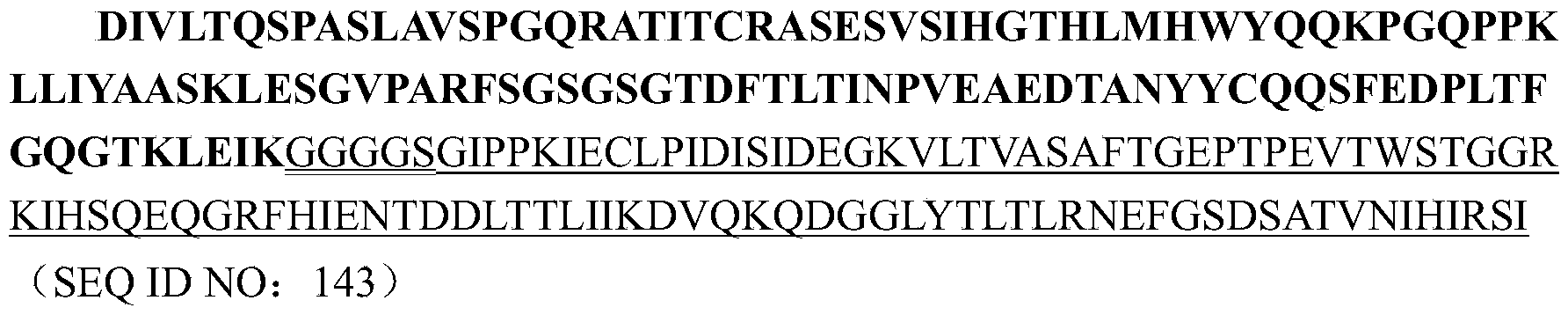
PL-1第二重链氨基酸序列:PL-1 second heavy chain amino acid sequence:

PL-1第二轻链氨基酸序列:PL-1 second light chain amino acid sequence:

备注:上述序列中,其中粗体字部分为可变区,点划线部分为Fc部分,波浪线部分为CH1,虚下划线部分为CL,双下划线部分为连接子,单下划线部分为Obscurin-O链/Titin-T链。Remarks: In the above sequence, the bold part is the variable region, the dotted line part is the Fc part, the wavy line part is CH1, the dotted underline part is CL, the double underline part is the linker, and the single underline part is Obscurin-O Chain/Titin-T chain.
采用本披露的测试例4中的ELISA检测方法检测PL双特异性抗体的结合活性(其中hPDL1、hCTLA4抗原购自:Sino biology)。另外,使用高通量微分扫描荧光仪(UNCHAINED,规格型号:Unit)对PL双特异性抗体热稳定性进行研究,方法:将PBS(磷酸盐缓冲液)溶液稀释好的样品(PL双特异性抗体浓度1.4-3mg/ml)加样9μL至样品槽中,参数设置:Start Temp 25℃、Incubation 180s、Rate0.3℃/min、Plate Hold 3s、End Temp 95℃,运行仪器,利用Uncle Analysis软件分析实验结果。The ELISA detection method in Test Example 4 of the present disclosure was used to detect the binding activity of the PL bispecific antibody (the hPDL1 and hCTLA4 antigens were purchased from: Sino biology). In addition, a high-throughput differential scanning fluorometer (UNCHAINED, specification model: Unit) was used to study the thermal stability of PL bispecific antibodies. The method: the sample diluted with PBS (phosphate buffer saline) solution (PL bispecific Antibody concentration 1.4-3mg/ml) add 9 μL to the sample tank, parameter settings: Start Temp 25°C, Incubation 180s, Rate0.3°C/min, Plate Hold 3s, End Temp 95°C, run the instrument, use Uncle Analysis software Analyze the experimental results.
实验结果见表16和表17。实验结果表明,新Titin-T链/Obscurin-O链构建的的PL双特异性抗体对抗原仍具有良好的结合活性;并且,与PL-1相比,PL-2至PL-19的Tm1(℃)、Tagg 266(℃)、Tonset(℃)有明显的提升,双特异性抗体的热稳定性更优。The experimental results are shown in Table 16 and Table 17. The experimental results show that the PL bispecific antibody constructed by the new Titin-T chain/Obscurin-O chain still has good binding activity to the antigen; and, compared with PL-1, Tm1 from PL-2 to PL-19 ( ℃), Tagg 266(℃), and Tonset(℃) have been significantly improved, and the thermal stability of bispecific antibodies is better.
表16.PL双特异性抗体与抗原结合实验结果Table 16. PL bispecific antibody and antigen binding experiment results


表17.PL双特异性抗体热稳定性实验结果Table 17. PL bispecific antibody thermal stability test results
4、Titin-T链/Obscurin-O链构建的HJ双特异性抗体及检测4. HJ bispecific antibody constructed by Titin-T chain/Obscurin-O chain and its detection
构建抗hIL5和hTSLP的HJ双特异性抗体:HJ-3至HJ11,其包含如下所述的第一重链、第二重链、第一轻链和第二轻链:Construction of HJ bispecific antibodies against hIL5 and hTSLP: HJ-3 to HJ11 comprising a first heavy chain, a second heavy chain, a first light chain and a second light chain as follows:
第一重链,其从N端到C端依次为:[VH1]-[连接子1]-[Titin-T链]-[连接子3]-[Fc1];The first heavy chain, from the N-terminal to the C-terminal is: [VH1]-[Linker 1]-[Titin-T chain]-[Linker 3]-[Fc1];
第一轻链,其从N端到C端依次为:[VL1]-[连接子2]-[Obscurin-O链];The first light chain, from the N-terminal to the C-terminal is: [VL1]-[Linker 2]-[Obscurin-O chain];
第二重链,其从N端到C端依次为:[VH2]-[CH1]-[Fc2];和The second heavy chain, which is in order from N-terminus to C-terminus: [VH2]-[CH1]-[Fc2]; and
第二轻链,其从N端到C端依次为:[VL2]-[CL];其中The second light chain, from the N-terminal to the C-terminal, is: [VL2]-[CL]; wherein
其中,VH1和VL1为H0抗体的重链可变区和轻链可变区,VH2和VL2为J1抗体的重链可变区和轻链可变区,VH1的氨基酸序列如SEQ ID NO:16所示,VL1的氨基酸序列如SEQ ID NO:17所示,VH2的氨基酸序列如SEQ ID NO:171所示,VL2的氨基酸序列如SEQ ID NO:172所示;Fc1为包含knob突变的IgG1的Fc的第一亚基(氨基酸序列如SEQ ID NO:178所示),Fc2为包含hole突变的IgG1的Fc的第二亚基(氨基酸序列如SEQ ID NO:177所示),CH1的氨基酸序列如SEQ ID NO:179所示;CL的氨基酸序列如SEQ ID NO:4所示;Titin-T链的N端通过连接子1与VH1连接,Titin-T链的C端通过键直接与Fc1连接(也即连接子3为键),Obscurin-O链N端通过连接子2与VL1连接,构建的不同HJ双特异性抗体中的Titin-T链/Obscurin-O链和连接子1、连接子2的结构见表18.Wherein, VH1 and VL1 are the heavy chain variable region and the light chain variable region of the H0 antibody, VH2 and VL2 are the heavy chain variable region and the light chain variable region of the J1 antibody, and the amino acid sequence of VH1 is shown in SEQ ID NO: 16 As shown, the amino acid sequence of VL1 is shown in SEQ ID NO: 17, the amino acid sequence of VH2 is shown in SEQ ID NO: 171, and the amino acid sequence of VL2 is shown in SEQ ID NO: 172; Fc1 is IgG1 containing knob mutation The first subunit of Fc (amino acid sequence is shown in SEQ ID NO: 178), Fc2 is the second subunit of Fc (amino acid sequence is shown in SEQ ID NO: 177) containing hole mutation IgG1, the amino acid sequence of CH1 As shown in SEQ ID NO: 179; the amino acid sequence of CL is shown in SEQ ID NO: 4; the N-terminal of the Titin-T chain is connected to VH1 through a linker 1, and the C-terminal of the Titin-T chain is directly connected to Fc1 through a bond (that is, the linker 3 is a bond), the N-terminal of the Obscurin-O chain is connected to VL1 through the linker 2, and the Titin-T chain/Obscurin-O chain and linker 1, linker in different HJ bispecific antibodies constructed The structure of 2 is shown in Table 18.
表18.HJ双特异性抗体中Obscurin-O链/Titin-T链和连接子对应表Table 18. Obscurin-O chain/Titin-T chain and linker correspondence table in HJ bispecific antibody

采用本披露的测试例4中的方法检测HJ-3、HJ-5至HJ-11双特异性抗体与hIL5和hTSLP抗原结合活性。并且对双特异性抗体的热稳定性进行研究,方法:用10mM乙酸pH5.5、9%蔗糖的缓冲液配制HJ双特异性抗体稀释溶液,然后通过超滤浓缩的方法将双特异性抗体浓缩,获得不同浓度的HJ双特异性抗体溶液(HJ双特异性抗体的浓度见表19-2),然后将浓缩溶液置于40℃恒温箱中孵育,第0天(也即40℃孵育开始前,D0),第7天(40℃孵育第7天,D7),第14天(40℃孵育第14天,D14),第21天(40℃孵育第21天,D21)和第28天(40℃孵育第28天,D28)检测样品的SEC纯度,40℃孵育28天后,马上取样检测样品非还原CE-SDS纯度。The method in Test Example 4 of the present disclosure was used to detect the binding activity of HJ-3, HJ-5 to HJ-11 bispecific antibodies to hIL5 and hTSLP antigens. And the thermal stability of the bispecific antibody was studied. The method: prepare the HJ bispecific antibody dilution solution with 10mM acetic acid pH5.5 and 9% sucrose buffer, and then concentrate the bispecific antibody by ultrafiltration , to obtain different concentrations of HJ bispecific antibody solutions (see Table 19-2 for the concentration of HJ bispecific antibody), and then place the concentrated solution in a 40°C incubator for incubation. On day 0 (that is, before the incubation at 40°C starts , D0), day 7 (day 7 of incubation at 40°C, D7), day 14 (day 14 of incubation at 40°C, D14), day 21 (
实验结果见下表19-1和19-2,实验结果表明,本披露构建的HJ双特异性抗体对抗原的结合活性没有显著变化;并且,与HJ-3相比,HJ-5至HJ-11双特异性抗体的热稳定性更优。The experimental results are shown in Tables 19-1 and 19-2 below. The experimental results show that the HJ bispecific antibody constructed in the present disclosure has no significant change in the binding activity to the antigen; and, compared with HJ-3, HJ-5 to HJ- 11 The thermal stability of bispecific antibodies is better.
表19-1.HJ双特异性抗体的结合活性检测Table 19-1. Detection of binding activity of HJ bispecific antibody

表19-2.HJ双特异性抗体加速稳定性实验结果Table 19-2. Accelerated stability test results of HJ bispecific antibody

备注:D28△SEC纯度(%)=D0SEC纯度(%)-D28SEC纯度(%)Remarks: D28△SEC purity (%)=D0SEC purity (%)-D28SEC purity (%)
实施例4、CH1/CL结构域改造后抗体的半衰期Example 4, Half-life of antibody after modification of CH1/CL domain
为了评价抗体的CH1/CL被Titin-T链/Obscurin-O链或Titin-T链/Obscurin-样-O链替换后,抗体在动物体内的稳定性是否受影响,我们检测了CH1/CL被替换前后抗体在大鼠体内的半衰期。示例性地,我们分别检测了F0抗体的CH1/CL被 T.1/O.9替换后的抗体F20,以及C0抗体的CH1/CL被T.1/O.9替换后的抗体C3在大鼠体内的半衰期。具体方法如下:In order to evaluate whether the stability of the antibody in animals is affected after CH1/CL of the antibody is replaced by Titin-T chain/Obscurin-O chain or Titin-T chain/Obscurin-like-O chain, we detected whether CH1/CL was replaced by Antibody half-life in rats before and after replacement. Exemplarily, we detected the antibody F20 after the CH1/CL of the F0 antibody was replaced by T.1/O.9, and the antibody C3 after the CH1/CL of the C0 antibody was replaced by T.1/O.9. half-life in mice. The specific method is as follows:
将3mpk抗体以静脉注射的方式对大鼠给药,并分别于给药后5min,8h,1d,2d,4d,7d,10d,14d,21d,28d采集全血0.3mL,不加抗凝,取血后在4℃放置30min,1000g离心15min,取上清(血清)置于EP管中,于-80℃保存。各个时间点抗体药物浓度的检测方法采取夹心ELISA,即将相应抗原包被在ELISA板,4度孵育过夜后,用洗涤液清洗,随后加入封闭缓冲液室温孵育1-3小时,用洗涤液清洗,然后加入100μL标准品或待测血清样品于37℃孵育3小时,用洗涤液清洗,加入二抗Anti-Human IgG FC(HRP)mouse preadsorbed(Abcam,货号ab98624,1:10000稀释)于37℃孵育1-1.5h,用缓冲液清洗后,加入TMB室温避光孵育10分钟,随后加入终止液,读取OD450值。The 3mpk antibody was administered to rats by intravenous injection, and 0.3mL of whole blood was collected at 5min, 8h, 1d, 2d, 4d, 7d, 10d, 14d, 21d, and 28d after administration, without anticoagulation, After blood collection, place it at 4°C for 30 minutes, centrifuge at 1000 g for 15 minutes, take the supernatant (serum) and place it in an EP tube, and store it at -80°C. The detection method of antibody drug concentration at each time point adopts sandwich ELISA, that is, the corresponding antigen is coated on the ELISA plate, and after incubation at 4 degrees overnight, it is washed with washing solution, and then blocking buffer is added to incubate at room temperature for 1-3 hours, and then washed with washing solution. Then add 100 μL standard or serum samples to be tested and incubate at 37°C for 3 hours, wash with washing solution, add secondary antibody Anti-Human IgG FC (HRP) mouse preadsorbed (Abcam, Cat. No. ab98624, diluted 1:10000) and incubate at 37°C 1-1.5h, after washing with buffer solution, add TMB and incubate at room temperature in the dark for 10 minutes, then add stop solution, and read OD450 value.
实验结果见表20,结果显示,抗体的CH1/CL被替换成Titin-T链/Obscurin-O链后,抗体在大鼠体内仍然保有原始抗体的半衰期,提示CH1/CL被替换后的抗体和原始抗体一样,在体内具有良好的稳定性。The experimental results are shown in Table 20. The results show that after the CH1/CL of the antibody is replaced by Titin-T chain/Obscurin-O chain, the antibody still retains the half-life of the original antibody in rats, suggesting that the antibody after CH1/CL is replaced and Like the original antibody, it has good stability in vivo.
表20.CH1/CL结构域被替换的抗体半衰期Table 20. CH1/CL Domain Replaced Antibody Half-Life
实施例5、双特异抗体的构建与检测Example 5, construction and detection of bispecific antibodies
将结合第一抗原的抗体与结合第二抗原的抗体,通过搭桥PCR,构建双特异性抗体。示例性地,我们构建了多种双特异性抗体。The antibody that binds to the first antigen and the antibody that binds to the second antigen are used to construct a bispecific antibody by bridging PCR. Exemplarily, we constructed various bispecific antibodies.
一、双特异抗体的构建1. Construction of bispecific antibodies
首先,我们构建了DI-1双特异性抗体,DI-1双特异性抗体包括:D0抗体的一条重链(Fc区含knob修饰),D0抗体的一条轻链,结构改造的I0抗体(CH1/CL被Titin-T链/Obscurin-O链替换,Fc区含hole修饰)的一条重链和一条轻链,DI-1双特异性抗体为IgG样双特异性抗体,其结构示意图见附图5,DI-1的4条链序列如下所示:First, we constructed the DI-1 bispecific antibody. The DI-1 bispecific antibody includes: a heavy chain of the D0 antibody (with knob modification in the Fc region), a light chain of the D0 antibody, and a structurally modified I0 antibody (CH1 /CL is replaced by Titin-T chain/Obscurin-O chain, the Fc region contains a heavy chain and a light chain of hole modification), and the DI-1 bispecific antibody is an IgG-like bispecific antibody, and its structure diagram is shown in the attached figure 5. The sequence of the 4 strands of DI-1 is as follows:
DI-1链1(DI-1-H1)的氨基酸序列:Amino acid sequence of DI-1 chain 1 (DI-1-H1):


备注:序列中,粗体字部分为D0的VH,单下划线部分为CH1,点划线部分为CH2,斜体字部分为CH3。Remarks: In the sequence, the part in bold is VH of D0, the part with single underline is CH1, the part with dot-dash line is CH2, and the part in italic is CH3.
DI-1链2(DI-1-L1)的氨基酸序列:Amino acid sequence of DI-1 chain 2 (DI-1-L1):

备注:序列中,粗体字部分为D0的VL,单下划线部分为D0轻链恒定区CL。Remarks: In the sequence, the part in bold is the VL of D0, and the part underlined is the CL of the light chain constant region of D0.
DI-1链3(DI-1-H2)的氨基酸序列:Amino acid sequence of DI-1 chain 3 (DI-1-H2):

备注:序列中,粗体字部分为I0的VH,单下划线部分为T.10,双下划线部分为连接子序列,点划线部分为CH2,斜体字部分为CH3;双下划线部分为连接子序列。Remarks: In the sequence, the bold part is VH of I0, the single underline part is T.10, the double underline part is the linker sequence, the dotted line part is CH2, the italic part is CH3; the double underline part is the linker sequence .
DI-1链4(DI-1-L2)的氨基酸序列:Amino acid sequence of DI-1 chain 4 (DI-1-L2):

备注:序列中,粗体字部分为I0的VL,单下划线部分为O.20,双下划线部分为连接子序列。Remarks: In the sequence, the part in bold is VL of I0, the part with single underline is O.20, and the part with double underline is the connecting subsequence.
另外,构建了由B0或B0的结构改造抗体与U0或U0的结构改造抗体构建的IgG样BU双特异性抗体(其中,示例性的,BU5结构示意图见附图8),所得双特异性抗体的四条链序列如下表21:In addition, an IgG-like BU bispecific antibody constructed from a structurally modified antibody of B0 or B0 and a structurally modified antibody of U0 or U0 was constructed (for example, see Figure 8 for a structural schematic diagram of BU5), and the obtained bispecific antibody The sequence of the four strands is shown in Table 21:
表21.IgG样BU双特异性抗体序列表Table 21. List of IgG-like BU bispecific antibody sequences


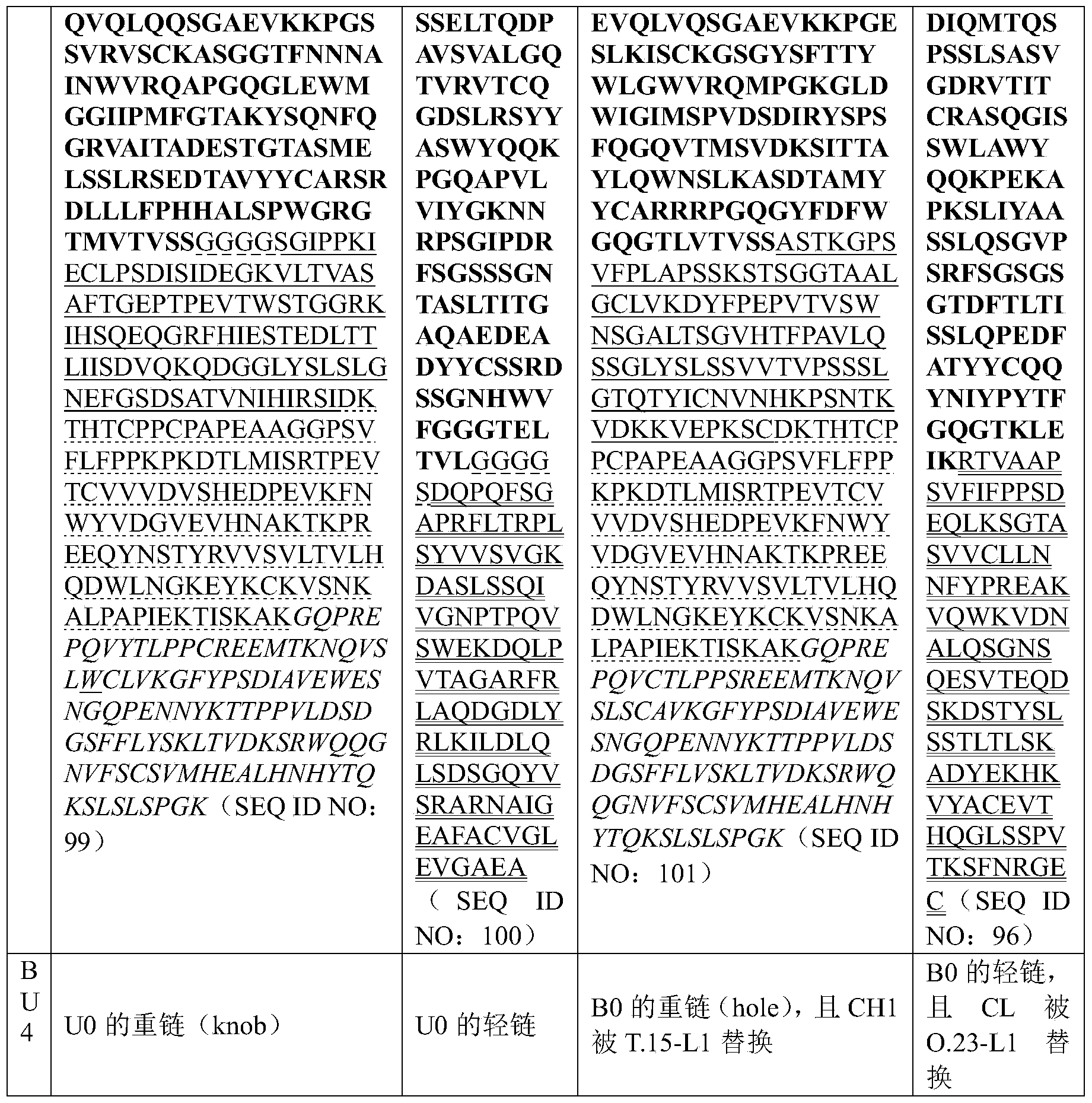


备注:序列中,粗体字部分为可变区序列,单下划线部分为CH1或Titin-T链,点划线部分为CH2,斜体字部分为CH3,双下划线部分为CL或Obscurin-O链,虚下划线部分为连接子L1。Note: In the sequence, the part in bold is the variable region sequence, the part with single underline is CH1 or Titin-T chain, the part with dashed line is CH2, the part in italic is CH3, the part with double underline is CL or Obscurin-O chain, The dashed underlined part is the linker L1.
此外,还构建了FA-1双特异性抗体,FA-1双特异性抗体是由A0抗体的一条重链(Fc区进行knob修饰)和一条轻链,与F0结构改造抗体的一条重链(Fc区进行hole修饰,CH1被T.10-L1替换)和一条轻链(CL被O.20-L1替换)构成的IgG样FA-1双特异性抗体。FA-1的四条链序列如下表22。In addition, the FA-1 bispecific antibody was also constructed. The FA-1 bispecific antibody was composed of a heavy chain (with knob modification in the Fc region) and a light chain of the A0 antibody, and a heavy chain of the F0 structurally modified antibody ( An IgG-like FA-1 bispecific antibody consisting of hole modification in the Fc region, CH1 replaced by T.10-L1) and a light chain (CL replaced by O.20-L1). The four chain sequences of FA-1 are shown in Table 22 below.
FA-1的链1(F0的重链CH1被T.10-L1替换,且Fc区含knob修饰):Chain 1 of FA-1 (heavy chain CH1 of F0 is replaced by T.10-L1, and the Fc region contains knob modification):

FA-1的链2(F0的轻链CL被O.20-L1替换):Chain 2 of FA-1 (light chain CL of F0 is replaced by O.20-L1):

FA-1的链3(A0重链含knob修饰):Chain 3 of FA-1 (A0 heavy chain with knob modification):

FA-1的链4(A0的轻链):Chain 4 of FA-1 (light chain of A0):

备注:上述序列中,粗体字部分为可变区序列,单下划线部分为CH1或Titin-T链,点划线部分为CH2,斜体字部分为CH3,双下划线部分为CL或Obscurin-O链,虚下划线部分为连接子L1。Remarks: In the above sequence, the bold part is the variable region sequence, the single underline part is CH1 or Titin-T chain, the dotted line part is CH2, the italic part is CH3, and the double underline part is CL or Obscurin-O chain , the dotted underlined part is the linker L1.
二、双特异抗体的检测2. Detection of bispecific antibodies
通过本披露测试例3方法检测DI-1,将DI-1的四条链共同转染细胞进行表达,然后进行质谱分析,实验结果见表22和附图6A-图6C,质谱分析结果未检测到同型二聚体和错配分子,DI-1正确组装。DI-1 was detected by the method of Test Example 3 of this disclosure, and the four chains of DI-1 were co-transfected into cells for expression, and then mass spectrometry was performed. The experimental results are shown in Table 22 and Figure 6A-6C, and the results of mass spectrometry were not detected. A homodimer and mismatched molecule, DI-1 assembles correctly.
表22.DI-1质谱数据Table 22. DI-1 Mass Spectral Data

另外,通过本披露测试例3和测试例2方法检测BU5表达。首先将BU5的四条链共同转染细胞表达双特异性抗体,另外使用B0、U0做为对照。然后对表达产物进行纯度及质谱分析,实验结果见表23及附图9A至图9C,实验结果表明,双 特异性抗体BU5被成功表达,BU5四条链成功组装成目标分子,且无错配出现。且双特异性抗体BU5纯度高,SEC%达88%。In addition, the expression of BU5 was detected by the methods of Test Example 3 and Test Example 2 of the present disclosure. First, the four chains of BU5 were co-transfected into cells to express bispecific antibodies, and B0 and U0 were used as controls. Then the expression product was analyzed for purity and mass spectrometry. The experimental results are shown in Table 23 and Figures 9A to 9C. The experimental results showed that the bispecific antibody BU5 was successfully expressed, and the four chains of BU5 were successfully assembled into the target molecule without any mismatch. . And the purity of the bispecific antibody BU5 is high, and the SEC% reaches 88%.
表23.BU5质谱分析结果Table 23. BU5 mass spectrometry results
备注:表中,“√”表示正确配对Remarks: In the table, "√" means correct pairing
此外,通过本披露的测试例2和测试例4的方法检测构建的BU1-BU4双特异性抗体的纯度以及抗原结合活性,实验结果见表24,实验结果表明,CH1/CL被替换的双特异性抗体,仍保持良好的抗原结合活性,且抗体纯度高。In addition, the purity and antigen-binding activity of the constructed BU1-BU4 bispecific antibody were detected by the methods of Test Example 2 and Test Example 4 of the present disclosure. The experimental results are shown in Table 24. The experimental results show that the CH1/CL replaced Antibodies still maintain good antigen-binding activity, and the antibodies are of high purity.
表24.抗体与抗原结合活性及纯度检测实验结果Table 24. Antibody-antigen binding activity and purity test results

测试例test case
测试例1、抗体的表达量测试方法Test example 1, antibody expression level test method
使用单克隆抗体或双特异性抗体的表达质粒转染HEK293E细胞,6天后收集表达上清,高速离心去除杂质。上清用Protein A柱(GE Healthcare)进行纯化。用PBS冲洗柱子,至A280读数降至基线,再用100mM乙酸缓冲液(pH3.5)冲洗层析柱,用1M Tris-HCl,pH8.0中和。抗体的表达量由最终纯化得到的抗体量/表达体积来定量。HEK293E cells were transfected with expression plasmids of monoclonal antibodies or bispecific antibodies, and the expression supernatant was collected 6 days later, and impurities were removed by high-speed centrifugation. The supernatant was purified with Protein A column (GE Healthcare). Wash the column with PBS until the A280 reading drops to the baseline, then wash the column with 100mM acetic acid buffer (pH3.5), and neutralize with 1M Tris-HCl, pH8.0. The expression level of the antibody was quantified by the final purified antibody amount/expression volume.
测试例2、抗体的纯度检测方法Test example 2, the purity detection method of antibody
使用SEC-HPLC进行抗体纯度监控。检测根据仪器操作说明书进行,使用Waters e2695色谱仪,色谱柱为Waters Xbridge BEH 200A SEC,流动相为PBS(用稀盐酸调节pH至6.8),进样100μg蛋白,等度洗脱,流速为0.5mL/min。抗体纯度为主峰的峰面积占总出峰面积的百分比(SEC(%))。Antibody purity monitoring was performed using SEC-HPLC. The detection was carried out according to the instrument operation manual, using Waters e2695 chromatographic instrument, the chromatographic column was Waters Xbridge BEH 200A SEC, the mobile phase was PBS (adjust the pH to 6.8 with dilute hydrochloric acid), and 100 μg protein was injected, isocratic elution, and the flow rate was 0.5 mL /min. Antibody purity is the percentage of the peak area of the main peak to the total peak area (SEC (%)).
测试例3、抗体质谱检测方法Test example 3, antibody mass spectrometry detection method
(一)样品准备:(1) Sample preparation:
1.脱糖完整分子量测定:取所表达抗体30μg,冻干后加入10μL8M Gua-HCl,70℃水浴变性10min。加入90μL蒸馏水,取30μL加入0.8μL PNG酶F(肽N-糖苷酶F),放入37℃水浴中孵育2h,取0.5μg进行脱糖完整分子量测定。1. Determination of the complete molecular weight of the desugared antibody: take 30 μg of the expressed antibody, add 10 μL of 8M Gua-HCl after lyophilization, and denature in a 70°C water bath for 10 minutes. Add 90 μL of distilled water, take 30 μL and add 0.8 μL PNGase F (peptide N-glycosidase F), put it in a 37°C water bath and incubate for 2 hours, take 0.5 μg to measure the complete molecular weight of desugared.
2.脱糖还原分子量测定:取所表达抗体30μg,冻干后加入10μL 8M Gua-HCl,70℃水浴变性10min。加入90μL蒸馏水,取30μL加入0.8μL PNG酶F(肽N-糖苷酶F),放入37℃水浴中孵育2h。再加入2μL0.025M DTT,70℃水浴中还原10min,取0.5μg进行脱糖还原分子量测定。2. Degreasing and reducing molecular weight determination: Take 30 μg of the expressed antibody, add 10 μL of 8M Gua-HCl after lyophilization, and denature in a water bath at 70°C for 10 minutes. Add 90 μL of distilled water, take 30 μL and add 0.8 μL PNGase F (peptide N-glycosidase F), and incubate in a 37°C water bath for 2 hours. Then add 2 μL of 0.025M DTT, reduce in a water bath at 70°C for 10 min, and take 0.5 μg to determine the molecular weight of desugar reduction.
(二)色谱-质谱条件:(2) Chromatography-mass spectrometry conditions:
色谱条件:Chromatographic conditions:
色谱柱:Poroshell 300SB-C8 5μm 2.1*75mmChromatographic column: Poroshell 300SB-C8 5μm 2.1*75mm
流动相:A:0.1%HCOOH/H2O B:0.1%HCOOH/CANMobile phase: A: 0.1% HCOOH/H2O B: 0.1% HCOOH/CAN
柱温:75℃Column temperature: 75°C
梯度:见表25。Gradient: See Table 25.
表25.色谱梯度表Table 25. Chromatographic gradient table
质谱条件:Mass Spectrometry Conditions:
质谱:Agilent 6530 Q-TOF LC-MSMass spectrometry: Agilent 6530 Q-TOF LC-MS
电离模式ESIionization mode ESI
采集模式:1GHz(质量范围500–5000m/z)Acquisition mode: 1GHz (
干燥气温度:325℃Drying gas temperature: 325°C
干燥气流量:10L/minDrying gas flow: 10L/min
雾化器:40psiAtomizer: 40psi
鞘气温度:350℃Sheath gas temperature: 350°C
鞘气流速:12L/minSheath gas flow rate: 12L/min
喷雾电压:500VSpray voltage: 500V
毛细管电压:3,500VCapillary voltage: 3,500V
裂解电压:200VCracking voltage: 200V
Skimmer电压:65VSkimmer voltage: 65V
Rf电压:7500VRf voltage: 7500V
将待测抗体进行质谱分析,实验结果表明CH1/CL被Titin-T/Obscurin-O替换后,抗体保持正确组装。The antibody to be tested was analyzed by mass spectrometry, and the experimental results showed that after CH1/CL was replaced by Titin-T/Obscurin-O, the antibody maintained correct assembly.
测试例4、抗体结合活性检测方法Test example 4, antibody binding activity detection method
对膜蛋白靶点的抗体,其与抗原结合活性检测可采用FACS的方法。例如, C0、N0、F0、V0、S0,及其CH1/CL结构改造抗体,可通过FACS的方法进行检测。在96孔U型底板(corning,3795)中加入FACS缓冲液(98%PBS,2%FBS)重悬的细胞(2×106细胞/ml,90μl),并加入10μl梯度稀释的抗体,4℃孵育1h,FACS缓冲液清洗2次,随后每孔加入Alexa Fluor 488羊抗-人IgG(H+L)(invitrogen,Cat#2015982,1:1000稀释),4℃孵育一小时,清洗2次后用FACS缓冲液重悬细胞,最后用FACS CantoII(BD)读取荧光信号值。最后用FlowJo 7.6和Graphpad Prism 5对数据进行处理分析。Antibodies against membrane protein targets can be detected by FACS for their antigen-binding activity. For example, C0, N0, F0, V0, S0, and their CH1/CL structurally modified antibodies can be detected by FACS. Add FACS buffer (98% PBS, 2% FBS) resuspended cells (2×10⁶ cells/ml, 90 μl) in 96-well U-bottom plate (corning, 3795), and add 10 μl of serially diluted antibody, 4°C Incubate for 1 hour, wash with FACS buffer twice, then add Alexa Fluor 488 goat anti-human IgG (H+L) (invitrogen, Cat#2015982, 1:1000 dilution) to each well, incubate at 4°C for one hour, wash twice The cells were resuspended with FACS buffer, and finally the fluorescence signal value was read with FACS CantoII (BD). Finally, FlowJo 7.6 and
对于靶点为可溶性蛋白的抗体,用ELISA的方法检测抗体与可溶性蛋白的结合活性,例如,D0、I0、B0、U0、H0、R0、J0,及其CH1/CL结构改造抗体,可通过ELISA的方法检测。方法如下:用pH7.4的PBS(源培生物,B320)缓冲液将蛋白稀释至1μg/mL,以100μL/孔的体积加入96孔酶标板(Corning,9018)中,4℃过夜孵育。弃去液体后,每孔加入300μL用PBS稀释的5%脱脂牛奶(BD,232100)进行封闭,37℃孵育2小时。封闭结束后,弃去封闭液,并用PBST缓冲液(pH7.4PBS含0.1%tween-20)洗板3次后,每孔加入100μL梯度稀释的抗体溶液,于37℃孵育1小时。孵育结束后用PBST洗板3次,每孔加入100μL鼠抗-人IgG(H+L)(Jackson ImmunoResearch,209-035-088,1:8000稀释),37℃孵育1小时。用PBST洗板3次后,每孔加入100μL TMB显色底物(KPL,5120-0077),室温孵育10-15min,每孔加入50μL 1M H
2SO
4终止反应,用酶标仪读取在450nm处的吸收值,用软件拟合出抗体与抗原的结合曲线,计算出EC50值。
For antibodies targeting soluble proteins, use ELISA to detect the binding activity of antibodies to soluble proteins, for example, D0, I0, B0, U0, H0, R0, J0, and their CH1/CL structurally modified antibodies can be tested by ELISA method detection. The method is as follows: the protein was diluted to 1 μg/mL with pH 7.4 PBS (B320) buffer, added to a 96-well ELISA plate (Corning, 9018) at a volume of 100 μL/well, and incubated overnight at 4°C. After the liquid was discarded, 300 μL of 5% skimmed milk (BD, 232100) diluted with PBS was added to each well for blocking, and incubated at 37° C. for 2 hours. After blocking, the blocking solution was discarded, and the plate was washed 3 times with PBST buffer (pH 7.4 PBS containing 0.1% tween-20), and 100 μL of gradiently diluted antibody solution was added to each well, and incubated at 37°C for 1 hour. After the incubation, the plate was washed 3 times with PBST, 100 μL of mouse anti-human IgG (H+L) (Jackson ImmunoResearch, 209-035-088, diluted 1:8000) was added to each well, and incubated at 37°C for 1 hour. After washing the
本测试例中抗体相应抗原如下:D0及其CH1/CL结构改造抗体结合的抗原为hRANKL(购自Sino biological,11682-HNCH);I0及其CH1/CL结构改造抗体结合的抗原为hNGF(购自Sino biological,11050-HNAC);B0及其CH1/CL结构改造抗体结合的抗原为hBAFF(购自Sino biological,10056-HNCH);U0及其CH1/CL结构改造抗体结合的抗原为hP40(购自Sino biological,10052-H08H);H0、R0,及其CH1/CL结构改造抗体结合的抗原为hIL-5(购自R&D systems,205-IL-025/CF);J0及其CH1/CL结构改造抗体结合的抗原为hTSLP(购自Sino biological,16135-H08H);C0、N0,及其CH1/CL结构改造抗体结合的抗原为CEA(过表达CEA细胞MKN45(购自南京科佰,CBP60488));F0、V0、S0,及其CH1/CL结构改造抗体结合的抗原为B7H3(过表达B7H3重组细胞系CT26-B7H3(CT26来源于中科院细胞库,B7H3序列参见ID:XP_005254757.1)。The corresponding antigens of the antibodies in this test example are as follows: the antigen bound by D0 and its CH1/CL structurally modified antibody is hRANKL (purchased from Sino biological, 11682-HNCH); the antigen bound by I0 and its CH1/CL structurally modified antibody is hNGF (purchased from Sino biological, 11050-HNAC); B0 and its CH1/CL structural modification antibody binding antigen is hBAFF (purchased from Sino biological, 10056-HNCH); U0 and its CH1/CL structural modification antibody binding antigen is hP40 (purchased From Sino biological, 10052-H08H); H0, R0, and its CH1/CL structure modification antibody binding antigen is hIL-5 (purchased from R&D systems, 205-IL-025/CF); J0 and its CH1/CL structure The antigen bound by the engineered antibody is hTSLP (purchased from Sino biological, 16135-H08H); the antigen bound by C0, N0, and CH1/CL structure engineered antibody is CEA (overexpressed CEA cell MKN45 (purchased from Nanjing Kebai, CBP60488) ); F0, V0, S0, and their CH1/CL structurally modified antibodies bind to the antigen B7H3 (overexpressing B7H3 recombinant cell line CT26-B7H3 (CT26 comes from the Cell Bank of the Chinese Academy of Sciences, and the sequence of B7H3 can be found in ID: XP_005254757.1).
测试例5、CH1/CL结构改造抗体错配实验检测Test example 5, CH1/CL structural modification antibody mismatch test detection
一、不同抗体轻/重链交叉错配分子的表达检测方法1. Expression detection method of light/heavy chain cross-mismatch molecules of different antibodies
本实验通过分析不同轻/重链抗体配对表达来验证CH1/CL被Titin-T链/Obscurin-O链或Titin-T链/Obscurin-样-O链替换后能有效减少重/轻链错配的发生。具体地,在转染细胞表达抗体时,将D0和I0的重/轻链分别交换(即I/D-1(D0 重链+I0轻链);I/D-2(I0重链+D0轻链)来检测野生型CH1和CL是否会形成交叉错配分子;同时,将D0和I0的CH1/CL被Titin-T链/Obscurin-O链替换后的结构改造的抗体D3(D0的重链CH1被T.10替换,轻链CL被O.20替换)、I3(I0的重链CH1被T.10替换,轻链CL被O.20替换)的重轻链分别交换,构建错配分子:I/D-3(D0重链+I3轻链)、I/D-4(D3重链+I0轻链)、I/D-5(I0重链+I3轻链)、I/D-6(I3重链+D0轻链),构建的抗体结构示意图见附图7。In this experiment, by analyzing the paired expression of different light/heavy chain antibodies, it was verified that the replacement of CH1/CL by Titin-T chain/Obscurin-O chain or Titin-T chain/Obscurin-like-O chain can effectively reduce the heavy/light chain mismatch happened. Specifically, when transfected cells express antibodies, the heavy/light chains of D0 and I0 are exchanged respectively (ie, I/D-1 (D0 heavy chain+I0 light chain); I/D-2 (I0 heavy chain+D0 Light chain) to detect whether wild-type CH1 and CL will form cross-mismatched molecules; meanwhile, the structurally engineered antibody D3 (heavy Chain CH1 is replaced by T.10, light chain CL is replaced by O.20), heavy and light chains of I3 (heavy chain CH1 of I0 is replaced by T.10, light chain CL is replaced by O.20) are exchanged respectively to construct a mismatch Molecules: I/D-3 (D0 heavy chain + I3 light chain), I/D-4 (D3 heavy chain + I0 light chain), I/D-5 (I0 heavy chain + I3 light chain), I/D -6 (I3 heavy chain + D0 light chain), the structural diagram of the constructed antibody is shown in Figure 7.
通过测试例1方法检测抗体表达量,通过测试例3方法对表达产物进行质谱分析,检测是否会形成错配分子。实验结果见表26,实验结果表明,D0重链+I0轻链,或I0重链+D0轻链,共同表达时,均可形成完整IgG分子(150kDa),表达量很高,分别达到74.4mg/L和73.8mg/L,且LC-MS结果证明所得蛋白为错配后的IgG分子,这说明如果不对CH1-CL进行改造或替换,双特异性抗体的四条不同重轻链共同表达,将会形成大量轻/重链错配分子。而经Titin-T链/Obscurin-O链替换CH1/CL后,I/D-3(D0重链+I3轻链)、I/D-4(D3重链+I0轻链)、I/D-5(I0重链+I3轻链)、I/D-6(I3重链+D0轻链)四种形式交叉错配表达均无目的分子产生(150kDa),除D3重链+I0轻链组合形成有少量两条重链的错误分子外(分子量为100kDa,),其他三种形式无错配分子产生,这说明改造后的非同源配对不会形成IgG结构形式的错配分子。因此,用Titin-T链/Obscurin-O链替换CH1-CL后将有效避免或减少IgG样的双特异性抗体的轻/重链间的非同源交叉配对分子的形成。The antibody expression level was detected by the method of Test Example 1, and the expression product was analyzed by mass spectrometry by the method of Test Example 3 to detect whether mismatched molecules would be formed. The experimental results are shown in Table 26. The experimental results show that D0 heavy chain + I0 light chain, or I0 heavy chain + D0 light chain, when co-expressed, can form a complete IgG molecule (150kDa), and the expression level is very high, reaching 74.4mg respectively /L and 73.8mg/L, and the result of LC-MS proves that the obtained protein is a mismatched IgG molecule, which shows that if CH1-CL is not modified or replaced, four different heavy and light chains of the bispecific antibody are co-expressed, and the A large number of light/heavy chain mismatch molecules will be formed. After replacing CH1/CL with Titin-T chain/Obscurin-O chain, I/D-3 (D0 heavy chain + I3 light chain), I/D-4 (D3 heavy chain + I0 light chain), I/D -5 (I0 heavy chain + I3 light chain), I/D-6 (I3 heavy chain + D0 light chain) four forms of cross-mismatch expression have no target molecule (150kDa), except D3 heavy chain + I0 light chain Except for a small amount of wrong molecules with two heavy chains (molecular weight is 100kDa), the other three forms have no mismatch molecules, which shows that the modified non-homologous pairing will not form mismatch molecules in the IgG structure. Therefore, replacing CH1-CL with Titin-T chain/Obscurin-O chain will effectively avoid or reduce the formation of non-homologous cross-pair molecules between light and heavy chains of IgG-like bispecific antibodies.
表26.不同轻/重链交叉配对的抗体表达量和质谱分析Table 26. Antibody expression and mass spectrometry analysis of different light/heavy chain cross-pairs

备注:表中,“√”表示检测到该错配分子,“×”表示未检测到该错配分子。Remarks: In the table, "√" means that the mismatch molecule was detected, and "×" means that the mismatch molecule was not detected.
二、双特异性抗体轻/重链错配表达检测方法2. Method for detection of bispecific antibody light/heavy chain mismatch expression
为验证CH1/CL被Titin-T链/Obscurin-O链替换后将不会发生错配或减少错配,本测试例设计了三种形式的轻/重链交叉配对表达,即将两条不同的重链和一条相同的VL-CL轻链共同转染细胞表达抗体,或将两条不同的重链和一条相同的Obscurin-O链替换CL的轻链共同转染细胞表达抗体,或将两条不同的重链和两条不同的轻链共同转染细胞表达抗体(具体配对见表27)。In order to verify that CH1/CL is replaced by Titin-T chain/Obscurin-O chain, there will be no mismatching or reduce mismatching. In this test case, three forms of light/heavy chain cross-pair expression were designed, that is, two different Heavy chain and one same VL-CL light chain co-transfected cells to express antibody, or two different heavy chains and one same Obscurin-O chain to replace CL light chain co-transfected cells to express antibody, or two Different heavy chains and two different light chains were co-transfected into cells to express antibodies (see Table 27 for specific pairings).
然后对表达产物进行质谱分析(方法见本披露测试例3),并检测所得抗体纯度SEC(方法见本披露测试2)。实验结果见表27,结果表明,Obscurin-O链替换 的轻链和未进行CL替换的轻链共同加入时才会形成正确的分子,而只加一条未进行CL替换的轻链或只加一条Obscurin-O链替换CL的轻链的交叉配对中没有找到正确的目标分子。这说明被Obscurin-O链替换CL的轻链会更容易与CH1被Titin-T链替换的重链配对结合形成分子,而不会与CH1未被Titin-T链替换的重链发生交叉错配;CL未被Obscurin-O链替换的轻链更容易与CH1未进行Titin-T链替换的重链配对结合,而不会与CH1被Titin-T链替换的重链结合。Then mass spectrometry analysis was performed on the expression product (see test example 3 of this disclosure for the method), and the purity of the obtained antibody was detected by SEC (see
表27.双特异性抗体轻/重链错配的检测结果Table 27. Detection results of bispecific antibody light/heavy chain mismatches

备注(表中,“√”表示检测到该四条链配对分子,“--”表示未检测到该四条链 配对分子)。Remarks (in the table, "√" indicates that the four-chain pairing molecule is detected, and "--" indicates that the four-chain pairing molecule is not detected).
测试例6、双特异性抗体与抗原的亲和力检测Test Example 6. Affinity Detection of Bispecific Antibody and Antigen
用Biacore T200(GE)仪器测定待测抗体与抗原蛋白的亲和力。按照人抗捕获试剂盒(GE,Cat#BR-1008-39)说明书中的方法,用Protein A生物传感芯片(Cat.#29127556,GE)亲和捕获待测抗体,然后于芯片表面流经一系列浓度梯度的可溶性抗原,用Biacore T200仪器实时检测反应信号从而获得结合和解离曲线。在每个实验循环解离完成后,用甘氨酸-盐酸再生溶液(pH 1.5Cat.#BR-1003-54,GE)将生物传感芯片洗净再生。实验得到的数据用BIAevaluation version 4.1,GE软件以(1:1)Langmuir模型拟合数据,得出亲和力数值,实验结果见表28。The affinity between the antibody to be tested and the antigenic protein was determined with a Biacore T200 (GE) instrument. According to the method in the manual of the human anti-capture kit (GE, Cat#BR-1008-39), the protein A biosensor chip (Cat. #29127556, GE) was used to capture the antibody to be tested, and then flow through A series of soluble antigens with concentration gradients were used to detect the reaction signals in real time with a Biacore T200 instrument to obtain association and dissociation curves. After the dissociation of each experimental cycle was completed, the biosensor chip was washed and regenerated with glycine-hydrochloric acid regeneration solution (pH 1.5 Cat.#BR-1003-54, GE). The data obtained from the experiment was fitted with BIAevaluation version 4.1, and the GE software used the (1:1) Langmuir model to fit the data to obtain the affinity value. The experimental results are shown in Table 28.
实验结果表明,本披露的结构改造的双特异性抗体完全保留了两个母源单克隆抗体对其抗原的亲和力。本实验中,抗原hRANKL(购自Sino biological,11682-HNCH),hNGF(购自Sino biological,11050-HNAC),hBAFF(购自Sino biological,10056-HNCH),hP40(购自Sino biological,10052-H08H),hB7H3(实验室制备,序列参见SEQ ID NO:111),hCD3抗原(实验室制备,为hCD3的δ亚基(序列参见SEQ ID NO:112)和ε亚基(序列参见SEQ ID NO:113)组成的异源二聚体)。Experimental results show that the structurally modified bispecific antibody of the present disclosure completely retains the affinity of the two maternal monoclonal antibodies to its antigen. In this experiment, antigens hRANKL (purchased from Sino biological, 11682-HNCH), hNGF (purchased from Sino biological, 11050-HNAC), hBAFF (purchased from Sino biological, 10056-HNCH), hP40 (purchased from Sino biological, 10052- H08H), hB7H3 (prepared in laboratory, refer to SEQ ID NO: 111 for sequence), hCD3 antigen (prepared in laboratory, refer to SEQ ID NO: 112 for sequence) and ε subunit (refer to SEQ ID NO for sequence) of hCD3 :113) composed of heterodimers).
表28.双特异性抗体亲和力检测结果Table 28. Bispecific antibody affinity detection results

测试例7、CH1/CL结构改造双抗结合抗原实验Test example 7, CH1/CL structural modification double antibody binding antigen experiment
通过用Biacore T200(GE)仪器测定待测抗体与抗原蛋白的亲和力,验证本披露的CH1-CL结构改造的双特异性抗体可以同时结合两个靶抗原。具体实验步骤为:用Protein A生物传感芯片(Cat.#29127556,GE)亲和捕获抗体BU5,然后于芯片表面流经双特异性抗体的第一抗原分子hP40(购自Sino biological,10052-H08H)至饱和,再进样一定浓度的第二抗原分子hBAFF(购自Sino biological,10056-HNCH),用Biacore T200仪器实时检测反应信号获得结合和解离曲线。在 每个实验循环解离完成后,用甘氨酸-盐酸再生溶液(pH 1.5Cat.#BR-1003-54,GE)将生物传感芯片洗净再生,数据拟合模型采用BIAevaluation version 4.1,GE软件以(1:1)Langmuir模型拟合。然后,再用Protein A生物传感芯片(Cat.#29127556,GE)亲和捕获抗体BU5,然后于芯片表面流经双特异性抗体的第一抗原分子hP40(购自Sino biological,10052-H08H)至饱和,再进样一定浓度的第二抗原分子hBAFF(购自Sino biological,10056-HNCH),用Biacore T200仪器实时检测反应信号获得结合和解离曲线在每个实验循环解离完成后,用甘氨酸-盐酸再生溶液(pH 1.5Cat.#BR-1003-54,GE)将生物传感芯片洗净再生,数据拟合模型采用BIAevaluation version 4.1,GE软件以(1:1)Langmuir模型拟合。By using a Biacore T200 (GE) instrument to measure the affinity between the antibody to be tested and the antigen protein, it was verified that the CH1-CL structurally modified bispecific antibody of the present disclosure can simultaneously bind two target antigens. The specific experimental steps are as follows: use Protein A biosensor chip (Cat. #29127556, GE) to capture antibody BU5 with affinity, and then flow the first antigen molecule hP40 of the bispecific antibody (purchased from Sino biological, 10052- H08H) to saturation, and then inject a certain concentration of the second antigen molecule hBAFF (purchased from Sino biological, 10056-HNCH), and use the Biacore T200 instrument to detect the reaction signal in real time to obtain the binding and dissociation curves. After the dissociation of each experimental cycle is completed, the biosensor chip is cleaned and regenerated with glycine-hydrochloric acid regeneration solution (pH 1.5Cat.#BR-1003-54, GE), and the data fitting model uses BIAevaluation version 4.1, GE software Fitted with a (1:1) Langmuir model. Then, use the Protein A biosensor chip (Cat. #29127556, GE) to capture the antibody BU5 with affinity, and then flow the first antigen molecule hP40 of the bispecific antibody (purchased from Sino biological, 10052-H08H) on the surface of the chip. To saturation, inject a certain concentration of the second antigen molecule hBAFF (purchased from Sino biological, 10056-HNCH), and use Biacore T200 instrument to detect the reaction signal in real time to obtain the association and dissociation curve. - Hydrochloric acid regeneration solution (pH 1.5Cat.#BR-1003-54, GE) was used to wash and regenerate the biosensor chip. The data fitting model used BIAevaluation version 4.1, and the GE software was fitted with a (1:1) Langmuir model.
实验结果见表29,实验结果表明,双特异性抗体BU5在结合抗原hP40达到饱和后,可继续结合抗原hBAFF,且再结合hBaFF的能力和单抗B0相当。同样地,双特异性抗体BU5在结合抗原hBAFF达到饱和后,可继续结合抗原hP40,且再结合hP40的能力和U0相当。这说明本披露的CH1/CL被Titin-T链/Obscurin-O链替换的双特异性抗体,可同时结合两个靶抗原。The experimental results are shown in Table 29. The experimental results show that the bispecific antibody BU5 can continue to bind the antigen hBAFF after binding to the antigen hP40 reaches saturation, and the ability to bind hBaFF again is comparable to that of the monoclonal antibody B0. Similarly, the bispecific antibody BU5 can continue to bind to the antigen hP40 after its binding to the antigen hBAFF reaches saturation, and its ability to re-bind to hP40 is comparable to that of U0. This shows that the bispecific antibody in which CH1/CL is replaced by Titin-T chain/Obscurin-O chain of the present disclosure can simultaneously bind two target antigens.
表29.抗体亲和力检测结果Table 29. Antibody affinity test results

测试例8、DI-1双特异性抗体破骨细胞分化实验Test Example 8, DI-1 Bispecific Antibody Osteoclast Differentiation Experiment
消化Raw264.7细胞(中科院细胞库,SCSP-5036)并重悬计数,铺在24孔细胞培养板(Corning,3524)中,37℃细胞培养箱中过夜培养。次日将抗体溶液按不同浓度进行稀释并与RANKL(Sino biological,11682-HNCH)混合均匀加入细胞培养板中,RANKL终浓度为50ng/ml,37℃继续培养。96h后除去24孔板中的溶液,每孔加入100μL细胞裂解液(碧云天,P0013J),吹打混匀,将裂解液转移到EP管中,12000g离心5min,取上清液用抗酒石酸酸性磷酸酶检测试剂盒(碧云天,P0332)按说明书的方法进行检测,用酶标仪读取405nm处的吸收值。将检测值用软件拟合成曲线,计算IC50值。实验结果见附图10,实验结果表明CH1/CL被替换后的双特异性抗体DI-1保持良好的活性,有效抑制破骨细胞分化。Raw264.7 cells (Cell Bank, Chinese Academy of Sciences, SCSP-5036) were digested, resuspended and counted, spread in 24-well cell culture plates (Corning, 3524), and cultured overnight in a 37°C cell culture incubator. The next day, the antibody solution was diluted according to different concentrations and mixed evenly with RANKL (Sino biological, 11682-HNCH) and added to the cell culture plate. The final concentration of RANKL was 50ng/ml, and the culture was continued at 37°C. After 96 hours, remove the solution in the 24-well plate, add 100 μL of cell lysate (Beiyuntian, P0013J) to each well, pipette and mix well, transfer the lysate to an EP tube, centrifuge at 12,000 g for 5 min, and take the supernatant with tartrate-resistant acid phosphoric acid The enzyme detection kit (Biyuntian, P0332) was detected according to the method in the manual, and the absorbance at 405 nm was read with a microplate reader. The detection value was fitted into a curve by software, and the IC50 value was calculated. The experimental results are shown in Figure 10. The experimental results show that the bispecific antibody DI-1 after CH1/CL is replaced maintains good activity and effectively inhibits osteoclast differentiation.
测试例9、DI-1双特异性抗体TF1细胞增殖实验Test Example 9, DI-1 Bispecific Antibody TF1 Cell Proliferation Experiment
通过NGF诱导的TF-1细胞(ATCC,CRL-2003)增殖实验来评价抗体在细胞水平的活性。实验方法如下:消化收集TF1细胞,重悬后计数,铺在96孔板(Corning,3903)中,37℃培养箱中过夜培养。次日将抗体溶液按不同浓度进行稀释并与NGF(Sino biological,11050-HNAC)混合均匀加入细胞培养板中,NGF的终浓度为10ng/mL,细胞放入培养箱中继续培养。72h后取出细胞培养板,每孔加入50μLCell-titer Glo(Promega,G755B)检测液,放在摇床上孵育10min,室温静置10min。用酶标仪(PerkinElmer,Victor3)检测发光信号。将检测的信号值用软件拟合出曲线图,计算IC50值。实验结果见附图11,实验结果表明CH1/CL被替换后的双特异性抗体DI-1具有良好的活性。The activity of the antibody at the cellular level was evaluated by NGF-induced proliferation of TF-1 cells (ATCC, CRL-2003). The experimental method is as follows: TF1 cells were collected by digestion, counted after resuspension, spread in a 96-well plate (Corning, 3903), and cultured overnight in a 37° C. incubator. The next day, the antibody solution was diluted according to different concentrations and mixed evenly with NGF (Sino biological, 11050-HNAC) and added to the cell culture plate. The final concentration of NGF was 10ng/mL, and the cells were placed in the incubator to continue culturing. After 72 hours, the cell culture plate was taken out, 50 μL Cell-titer Glo (Promega, G755B) detection solution was added to each well, incubated on a shaker for 10 minutes, and left at room temperature for 10 minutes. The luminescent signal was detected with a microplate reader (PerkinElmer, Victor3). Use software to fit the detected signal values into a curve, and calculate the IC50 value. The experimental results are shown in Figure 11, and the experimental results show that the bispecific antibody DI-1 with CH1/CL replaced has good activity.
测试例10、双特异性抗体CH1/CL被替换后轻重链错配检测Test Example 10: Mismatch detection of light and heavy chains after bispecific antibody CH1/CL is replaced
以下通过实验分析CH1/CL被Titin-T链/Obscurin-O链替换或被TCRα/TCRβ替换对双特异性抗体的轻重链错配情况,具体实验如下:The following experiment analyzes the light and heavy chain mismatch of bispecific antibodies when CH1/CL is replaced by Titin-T chain/Obscurin-O chain or by TCRα/TCRβ. The specific experiments are as follows:
一、双特异性抗体四条链共表达时轻重链错配实验1. Light and heavy chain mismatch experiment when four chains of bispecific antibody were co-expressed
用TCRα/TCRβ替换H0或J1的CH1/CL,构建由四条链组成的双特异性抗体HJ-1和HJ-2;用Titin-T链/Obscurin-O链替换H0或J1的CH1/CL,构建由四条链组成的双特异性抗体HJ-3和HJ-4,双特异性抗体的结构示意图参见附图12,双特异性抗体的全长序列参见表30:Replace CH1/CL of H0 or J1 with TCRα/TCRβ to construct bispecific antibodies HJ-1 and HJ-2 consisting of four chains; replace CH1/CL of H0 or J1 with Titin-T chain/Obscurin-O chain, Bispecific antibodies HJ-3 and HJ-4 composed of four chains were constructed. The structural diagram of the bispecific antibody is shown in Figure 12, and the full-length sequence of the bispecific antibody is shown in Table 30:
表30.双特异性抗体序列表Table 30. List of bispecific antibody sequences


备注:序列中,粗体字部分为TCR序列中,粗体或Titin-T链/Obscurin-O链部分,点划线部分为Fc或CL恒定区部分,单下划线部分为可变区部分,虚下划线部分为连接子L1。Remarks: In the sequence, the part in bold is the TCR sequence, the bold or Titin-T chain/Obscurin-O chain part, the dotted line part is the Fc or CL constant region part, the single underline part is the variable region part, and the dotted part The underlined part is linker L1.
J1重链:J1 heavy chain:

J1轻链:J1 light chain:

J1重链可变区:J1 heavy chain variable region:

J1轻链可变区:J1 light chain variable region:

分别将HJ-1、HJ-2、HJ-3、HJ-4的四条链共转染细胞表达,然后对表达产物进行质谱分析(方法见本披露测试例3),检测是否有轻重链错配分子。实验结果见附图13A至图13D及表31。The four chains of HJ-1, HJ-2, HJ-3, and HJ-4 were co-transfected and expressed in cells, and then the expression products were analyzed by mass spectrometry (see test example 3 of this disclosure) to detect whether there is a mismatch between light and heavy chains molecular. The experimental results are shown in Figures 13A to 13D and Table 31.
表31.双特异性抗体表达产物的质谱分析实验结果Table 31. Experimental results of mass spectrometry analysis of bispecific antibody expression products

备注:表中“√”表示检测到该分子,“×”表示未检测到该分子,“HJ(1+2+3+4)”表示由其左侧对应的编号为1、2、3和4这四条链形成的双特异性抗体,“错配分子1(1+2+3+3)”表示由其左侧对应的编号为1、2、3和3这四条链形成的错配分子1;“错配分子2(1+2+4+4)”表示由其左侧对应的编号为1、2、4和4这四条链形成的错配分子2。Remarks: "√" in the table indicates that the molecule was detected, "×" indicates that the molecule was not detected, and "HJ(1+2+3+4)" indicates that the corresponding numbers on the left are 1, 2, 3 and 4 The bispecific antibody formed by these four chains, "mismatch molecule 1 (1+2+3+3)" means the mismatch molecule formed by the four chains numbered 1, 2, 3 and 3 corresponding to the
实验结果表明,以TCRβ/TCRα替换CH1/CL的双特异性抗体,当其四条链共转染表达时,其轻重链会发生错配。而Titin-T链/Obscurin-O链替换CH1/CL的双特异性抗体,均没有出现轻重链的错配。这说明本披露的Titin-T链/Obscurin-O链替换CH1/CL的双特异性性抗体具有出色的减少轻重链错配的能力。The experimental results showed that the light and heavy chains of the bispecific antibody that replaced CH1/CL with TCRβ/TCRα would be mismatched when its four chains were co-transfected and expressed. However, the bispecific antibody with Titin-T chain/Obscurin-O chain replacing CH1/CL has no mismatch of light and heavy chains. This shows that the Titin-T chain/Obscurin-O chain-substituted CH1/CL bispecific antibody of the present disclosure has an excellent ability to reduce light and heavy chain mismatches.
二、3条链共表达双特异性抗体实验2. 3-chain co-expression bispecific antibody experiment
本测试用三条链(1条CH1被TCRβ或Titin-T链替换的重链,1条CH1未被替换的重链,1条CL未被替换的野生型轻链(VL-CL),具体序列参见表30)共转染细胞表达,然后对表达产物进行质谱分析(方法见本披露测试例3),检测抗体纯度SEC(方法见本披露测试2),验证野生型轻链(VL-CL)是否会与CH1被TCRβ或Titin-T链替换的重链组合形成错配分子。实验结果见附图14A、图14B、图15A、图15B和表32。This test uses three chains (1 heavy chain with CH1 replaced by TCRβ or Titin-T chain, 1 heavy chain with CH1 not replaced, and 1 wild-type light chain (VL-CL) with CL not replaced, the specific sequence See Table 30) for expression in co-transfected cells, and then perform mass spectrometry analysis on the expression product (see test example 3 of this disclosure for the method), detect antibody purity SEC (see
表32.三条链共表达双特异性抗体实验结果Table 32. Experimental results of bispecific antibody co-expression by three chains


备注:表中“√”表示检测到该分子,“×”表示未检测到该分子,“分子(1+2+3)”表示由其左侧对应的编号为1、2、3这三条链形成的分子,“错配分子(1+2+3+3)”表示由其左侧对应的编号为1、2、3、3这四条链形成的错配分子。Remarks: "√" in the table means that the molecule was detected, "×" means that the molecule was not detected, and "Molecule (1+2+3)" means the three chains numbered 1, 2, and 3 corresponding to the left side The formed molecule, "mismatched molecule (1+2+3+3)" means the mismatched molecule formed by the four chains numbered 1, 2, 3, and 3 corresponding to its left side.
实验结果表明:VL-CL很容易与CH1被TCRβ替换的重链结合从而表达出有两条相同轻链的错配分子。但是VL-CL轻链并未与CH1被Titin-T链替换的重链结合形成两条相同轻链的错配分子,这也间接说明相比重链CH1被TCRβ替换的双特异性抗体,本披露的Titin-T链替换重链CH1的双特异性性抗体具有更出色的减少轻重链错配的能力。The experimental results showed that VL-CL could easily combine with the CH1 heavy chain replaced by TCRβ to express a mismatched molecule with two identical light chains. However, the VL-CL light chain did not combine with the heavy chain whose CH1 was replaced by Titin-T chain to form two mismatched molecules of the same light chain, which also indirectly shows that compared with the bispecific antibody whose heavy chain CH1 is replaced by TCRβ, this disclosure The bispecific antibody whose Titin-T chain replaces the heavy chain CH1 has a better ability to reduce the mismatch of light and heavy chains.
测试例11、CH1/CL被替换的(FabV)2-IgG双特异性抗体Test Example 11, CH1/CL replaced (FabV)2-IgG bispecific antibody
一、CH1/CL被替换的PDL1-TIGIT双特异性抗体的构建1. Construction of PDL1-TIGIT bispecific antibody with CH1/CL replaced
使用国际专利申请WO2019062832A1公开的抗TIGIT抗体(抗体名称:h1708-04),国际专利申请WO2020177733A1公开的抗PDL1抗体(抗体名称:h1831K),构建一对CH1/CL被Titin-T链/Obscurin-O链(T.10/O.24)替换的(FabV)2-IgG模式的抗PDL1-TIGIT双特异性抗体P-O-T(其结构示意图见附图17),P-O-T包含2条相同的轻链1,2条相同的轻链2,2条相同的重链,P-O-T的多肽链的氨基酸序列如下所示:Use the anti-TIGIT antibody (antibody name: h1708-04) disclosed in the international patent application WO2019062832A1, and the anti-PDL1 antibody (antibody name: h1831K) disclosed in the international patent application WO2020177733A1 to construct a pair of CH1/CL surrounded by Titin-T chain/Obscurin-O Chain (T.10/O.24) substituted (FabV) 2-IgG mode anti-PDL1-TIGIT bispecific antibody P-O-T (see Figure 17 for a schematic diagram of its structure), P-O-T contains two identical light chains 1, 2 2 identical light chains, 2 identical heavy chains, the amino acid sequence of the polypeptide chain of P-O-T is as follows:
P-O-T的轻链1:Light chain 1 of P-O-T:

(备注:单下划线标注部分为轻链可变区VL1部分(同h1831K的VL),虚划线标注部分为连接子部分,点划线部分为T.10部分)(Remarks: The single underlined part is the VL1 part of the light chain variable region (same as the VL of h1831K), the dotted lined part is the linker part, and the dotted line part is the T.10 part)
P-O-T的轻链2:Light chain 2 of P-O-T:
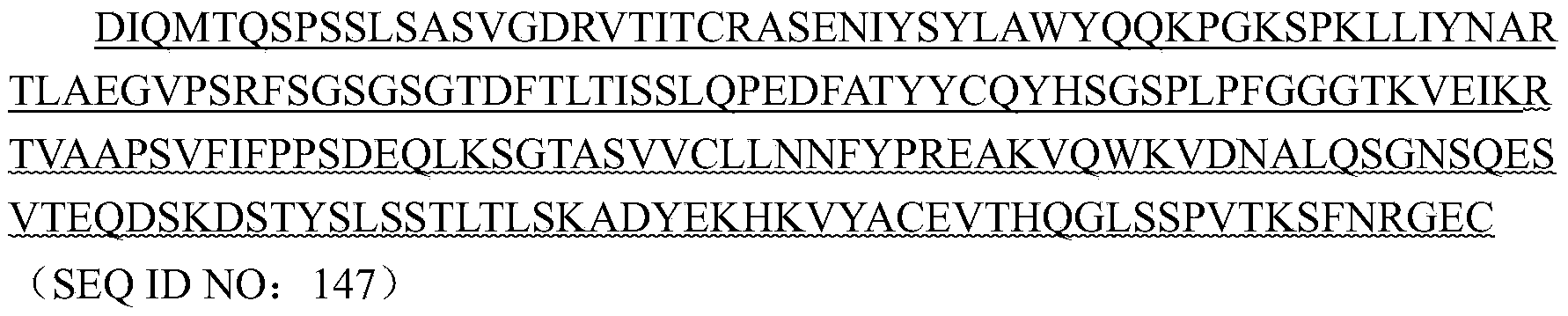
(备注:单下划线标注部分为轻链可变区VL2部分(同h1708-04的VL),波浪线部分为轻链恒定区(同h1708-04的CL))(Remarks: The single underlined part is the VL2 part of the light chain variable region (same as the VL of h1708-04), and the wavy part is the light chain constant region (same as the CL of h1708-04))
P-O-T重链:P-O-T heavy chain:

(备注:单下划线标注部分为重链可变区VH1部分(同h1831K的VH),双下划线标注部分为重链可变区VH2部分(同h1708-04的VH),点划线部分为O.24部分,虚划线部分为连接子部分,波浪线部分为重链恒定区部分(同h1708-04的重链恒定区))(Remarks: The single underlined part is the VH1 part of the heavy chain variable region (same as the VH of h1831K), the double underlined part is the VH2 part of the heavy chain variable region (same as the VH of h1708-04), and the dotted line part is O. 24 parts, the dotted line part is the linker part, the wavy line part is the heavy chain constant region (same as the heavy chain constant region of h1708-04))
h1831K(简称P-IgG1)、h1708-04(简称T-IgG1)的序列如下:The sequences of h1831K (referred to as P-IgG1) and h1708-04 (referred to as T-IgG1) are as follows:
h1708-04的轻链:Light chain of h1708-04:

h1708-04的重链:Heavy chain of h1708-04:

h1831K的轻链:Light chain of h1831K:


h1831K的重链:Heavy chain of h1831K:

备注:上述序列中,单下划线标注部分为可变区,波浪线标注部分为恒定区。Remarks: In the above sequence, the part marked with single underline is the variable region, and the part marked with wavy line is the constant region.
另外,h1708-04、h1831K的可变区及CDR(见表33)序列如下:In addition, the sequences of variable regions and CDRs (see Table 33) of h1708-04 and h1831K are as follows:
h1708-04的轻链可变区:Light chain variable region of h1708-04:

h1708-04的重链可变区:Heavy chain variable region of h1708-04:

h1831K的轻链可变区:Light chain variable region of h1831K:

h1831K的重链可变区:Heavy chain variable region of h1831K:

表33.抗体重链及轻链CDR区序列Table 33. Antibody heavy chain and light chain CDR region sequences


备注:根据Kabat编号规则确定的CDR区序列Remarks: The sequence of the CDR region determined according to the Kabat numbering rule
二、CH1/CL被替换的PDL1-TIGIT双特异性抗体对PDL1和TIGIT的结合能力检测2. Detection of binding ability of PDL1-TIGIT bispecific antibody with CH1/CL replaced to PDL1 and TIGIT
用Biacore T200测定本披露双抗分子P-O-T和人PDL1-his(hPDL1,Cat.No.10084-H08H,S.B)及人TIGIT-his(hTIGIT,Cat.No.10917-H08H,S.B)的亲和力,用Protein A生物传感芯片(Cat.No.29127556,GE)亲和捕获IgG,然后于芯片表面流经高浓度的抗原1(hPDL1 100nM或hTIGIT 100nM)180s将抗体上针对抗原1的位点饱和,再进抗原2(hTIGIT或者hPDL1)用Biacore T200仪器实时检测反应信号获得结合和解离曲线。在每个实验循环解离完成后,用10mM Gly-HCl pH 1.5将生物传感芯片洗净再生。数据拟合模型采用1:1Model。结果如下表34:Biacore T200 was used to measure the affinity of the disclosed double antibody molecule P-O-T to human PDL1-his (hPDL1, Cat.No.10084-H08H, S.B) and human TIGIT-his (hTIGIT, Cat.No.10917-H08H, S.B). Protein A biosensor chip (Cat.No.29127556, GE) captures IgG with affinity, and then flows high concentration of antigen 1 (hPDL1 100nM or hTIGIT 100nM) on the surface of the chip for 180s to saturate the site on the antibody against
表34.待测抗体同hPDL1及hTIGIT亲和力检测结果Table 34. Affinity detection results of tested antibodies with hPDL1 and hTIGIT

检测结果显示CH1/CL被Titin-T链/Obscurin-O链替换替换的(FabV)2-IgG双抗P-O-T对hPDL1和hTIGIT具有很好的结合能力,同时P-O-T结合一个抗原不影响其与另外一个抗原的结合。The test results show that the (FabV)2-IgG double antibody P-O-T that CH1/CL is replaced by Titin-T chain/Obscurin-O chain has a good binding ability to hPDL1 and hTIGIT, and the binding of P-O-T to one antigen does not affect its binding to the other. Antigen binding.
三、CH1/CL被替换的PDL1-TIGIT双特异性抗体对PD-L1与PD-1结合以及TIGIT与CD155结合的阻断作用检测3. Detection of the blocking effect of PDL1-TIGIT bispecific antibody with CH1/CL replaced on the binding of PD-L1 to PD-1 and the binding of TIGIT to CD155
以下所述的体外细胞实验可测定受试抗体对PD-L1与PD-1结合以及TIGIT与CD155结合的阻断作用,其活性可用EC 50值来表示。实验第一天,使用含10%FBS(Gibco,10099-141)和抗生素的F-12Nutrient Mixture(Gibco,11765-054)完全培养基将稳定表达了人CD155的CHOK1/PD-L1细胞(Promega,CS187108)以每孔4000个细胞的密度种于96孔板,每孔100μL细胞悬液,放置37℃,5%CO 2细胞培养箱中培养过夜。第二天,将培养板中的培养基吸掉,每孔加入40μL用含2%FBS(Gibco,10099-141)的RPMI(Gibco,11875119)配制的梯度稀释待测抗体,以及40μL用相同培养基重悬的稳定表达人TIGIT和人CD226的 Jurkat/PD-1/NFAT-luc2细胞(Promega,CS187102),每孔50000个细胞。抗体的终浓度是从100nM开始进行3倍梯度稀释的9个浓度点,设置不含抗体对照细胞孔和无细胞对照孔,放置37℃,5%CO 2的细胞培养箱中培养6小时。6小时后,取出96孔细胞培养板,每孔加入40μL Bio-Glo TM Luciferase Assay(Promega,G7573)中的底物,室温放置10分钟后,使用酶标仪(PerkinElmer,VICTOR 3)读取发光信号值。通过对照孔计算抗体各浓度的相对激活水平,使用GraphPad Prism根据抗体的对数浓度和相对激活水平进行曲线拟合并计算EC 50值。 The in vitro cell experiment described below can determine the blocking effect of the tested antibody on the binding of PD-L1 to PD-1 and the binding of TIGIT to CD155, and its activity can be expressed by the EC 50 value. On the first day of the experiment, CHOK1/PD-L1 cells stably expressing human CD155 (Promega, CS187108) were planted in a 96-well plate at a density of 4000 cells per well, and 100 μL of cell suspension per well was placed in a 37° C., 5% CO 2 cell incubator for overnight culture. The next day, aspirate the medium in the culture plate, add 40 μL of the antibody to be tested prepared in RPMI (Gibco, 11875119) containing 2% FBS (Gibco, 10099-141) to each well, and 40 μL of the same culture medium Jurkat/PD-1/NFAT-luc2 cells (Promega, CS187102) stably expressing human TIGIT and human CD226 were resuspended, with 50,000 cells per well. The final concentration of the antibody is 9 concentration points of 3-fold serial dilution starting from 100nM. Set up no antibody control cell wells and no cell control wells, and place them in a cell incubator at 37°C and 5% CO 2 for 6 hours. After 6 hours, the 96-well cell culture plate was taken out, and 40 μL of the substrate in Bio-Glo TM Luciferase Assay (Promega, G7573) was added to each well. After standing at room temperature for 10 minutes, the luminescence was read using a microplate reader (PerkinElmer, VICTOR 3) signal value. The relative activation level of each concentration of the antibody was calculated from the control wells, and GraphPad Prism was used to perform curve fitting based on the logarithmic concentration and relative activation level of the antibody and calculate the EC 50 value.
结果见附图18,实验结果显示CH1/CL被替换的PDL1-TIGIT双特异性抗体相比其PDL1单抗及TIGIT单抗具有叠加的阻断活性。The results are shown in Figure 18. The experimental results show that the PDL1-TIGIT bispecific antibody with CH1/CL replaced has additive blocking activity compared with its PDL1 monoclonal antibody and TIGIT monoclonal antibody.
四、抗体对结核菌素刺激的外周血单个核细胞的激活作用4. Activation of antibodies on tuberculin-stimulated peripheral blood mononuclear cells
以下所述的体外细胞实验可测定受试抗体对结核菌素刺激的外周血单个核细胞(peripheral blood mononuclear cell,PBMC)分泌IFN-γ的激活作用,其活性可用EC
50值来表示。实验第一天,使用SepMateTM-50分离管(STEMCELL,86450)按照使用说明书从新鲜的健康人血液中分离出PBMC,使用含10%FBS(Gibco,10099-141)和800倍稀释的结核菌素(Synbiotics,97-8800)的RPMI培养基(Gibco,11875119)将细胞以每孔4×10
6个细胞的密度种于6孔板,每孔2mL细胞悬液,放置37℃,5%CO
2细胞培养箱中培养5天。第四天,将Human CD155/PVR蛋白(Acro,CD5-H5223)用PBS稀释至2.5μg/mL后以每孔100μL加到96孔细胞培养板中,将孔板置于4℃冰箱包被过夜。第五天,将蛋白包被的96孔细胞培养板用PBS洗两遍,收集结合菌素刺激的PBMC并用含10%FBS的RPMI培养基将细胞以每孔1×10
5个细胞的密度种于96孔板中,每孔90μL细胞悬液。之后每孔加入10μL用PBS梯度稀释的待测抗体,抗体的终浓度是从200nM开始进行3倍梯度稀释的9个浓度点,设置不含抗体的对照细胞孔,孔板放置37℃,5%CO
2的细胞培养箱中培养3天。第八天,将96孔细胞培养板在250g离心5分钟,转移上清到新的96孔板中,使用Human IFN-γELISA kit(欣博盛,EHC102g.96.10)将上清稀释20倍后检测上清中IFN-γ的含量。通过对照孔计算抗体处理组的相对激活水平,使用Graphpad Prism 5软件根据抗体浓度和相应的相对激活水平进行曲线拟合并计算EC
50值。
The in vitro cell experiment described below can measure the activation effect of the tested antibody on the secretion of IFN-γ by tuberculin-stimulated peripheral blood mononuclear cells (PBMC), and its activity can be expressed by the EC 50 value. On the first day of the experiment, use SepMateTM-50 separation tube (STEMCELL, 86450) to isolate PBMC from fresh healthy human blood according to the instruction manual, and use 10% FBS (Gibco, 10099-141) and 800 times diluted tuberculin (Synbiotics, 97-8800) RPMI medium (Gibco, 11875119) The cells were planted in a 6-well plate at a density of 4×10 6 cells per well, 2 mL of cell suspension per well, and placed at 37 ° C, 5% CO 2 Cultured in a cell culture incubator for 5 days. On the fourth day, Human CD155/PVR protein (Acro, CD5-H5223) was diluted to 2.5 μg/mL with PBS and then added to 96-well cell culture plate at 100 μL per well, and the well plate was placed in a 4°C refrigerator to coat overnight . On the fifth day, the protein-coated 96-well cell culture plate was washed twice with PBS, and the combined PBMCs were collected and seeded with RPMI medium containing 10% FBS at a density of 1 ×10⁵ cells per well. In a 96-well plate, 90 μL of cell suspension per well. Then add 10 μL of the antibody to be tested in a gradient dilution with PBS to each well. The final concentration of the antibody is 9 concentration points of 3-fold gradient dilution starting from 200nM. Incubate in a CO 2 cell culture incubator for 3 days. On the eighth day, centrifuge the 96-well cell culture plate at 250g for 5 minutes, transfer the supernatant to a new 96-well plate, and use the Human IFN-γELISA kit (Xinbosheng, EHC102g.96.10) to dilute the supernatant 20 times before detection The content of IFN-γ in the supernatant. The relative activation levels of the antibody-treated groups were calculated from the control wells, and the
实验结果见附图19,实验结果表明CH1/CL被替换的PDL1-TIGIT双特异性抗体相比单抗可更好的阻断免疫抑制,促进IFN-γ的分泌。The experimental results are shown in Figure 19. The experimental results show that the PDL1-TIGIT bispecific antibody with CH1/CL replaced can better block immunosuppression and promote the secretion of IFN-γ than the monoclonal antibody.
五、CH1/CL被替换的PDL1-TIGIT双特异性抗体内药效检测5. In vivo efficacy test of PDL1-TIGIT bispecific antibody with CH1/CL replaced
本实验采用人PD-1-TIGIT双转基因小鼠接种稳转人PD-L1的MC38-HL1细胞,待成瘤后分组,比较PD-L1和TIGIT联合给药与PDL1-TIGIT双特异性抗体的药效。In this experiment, human PD-1-TIGIT double transgenic mice were used to inoculate MC38-HL1 cells stably transfected with human PD-L1. After tumor formation, they were divided into groups, and the effects of combined administration of PD-L1 and TIGIT and PDL1-TIGIT bispecific antibody were compared. efficacy.
PD-1-TIGIT双转基因小鼠购自百奥赛图,6-8周龄,82只,雌性,体重16-18g左右,5只/笼饲养于SPF级环境,温度20-25℃;湿度40-60%,许可证号SCXK(京)2015-0008。适应环境约10天。将MC38-HL1细胞(2.0×10 5个)100μL接种于82只hPD-1/TIGIT双转基因小鼠右肋部皮下,待成瘤后(~110mm 3)后去除肿瘤过大和过小的小鼠,按肿瘤体积将小鼠随机分为5组:阴性对照C25-IgG1(无关靶点IgG1蛋白)组、P-IgG1+T-IgG1组、P-O-T组、P-IgG1组、T-IgG1组,每组8只,具体见表35所示。实验开始当天通过腹腔注射抗体,每周给药1次,给药3周。每周测2次瘤体积,称体重,记录数据。 PD-1-TIGIT double transgenic mice were purchased from Biocytogen, 6-8 weeks old, 82 females, weighing about 16-18g, 5 mice/cage were raised in SPF environment, temperature 20-25℃; humidity 40 -60%, license number SCXK (Beijing) 2015-0008. Adapt to the environment for about 10 days. Inoculate 100 μL of MC38-HL1 cells (2.0×10 5 cells) in the subcutaneous right flank of 82 hPD-1/TIGIT double transgenic mice, and remove the mice with tumors that are too large or too small after tumor formation (~110mm 3 ) According to tumor volume, the mice were randomly divided into 5 groups: negative control C25-IgG1 (irrelevant target IgG1 protein) group, P-IgG1+T-IgG1 group, POT group, P-IgG1 group, T-IgG1 group, each Group 8, as shown in Table 35 for details. The antibody was injected intraperitoneally on the first day of the experiment, administered once a week for 3 weeks. The tumor volume was measured twice a week, the body weight was weighed, and the data was recorded.
表35.MC38-HL1小鼠移植瘤的抑瘤实验分组Table 35. MC38-HL1 mice xenograft tumor inhibition experiment groups

备注:表中,i.p表示腹腔注射,qw表示每周给药1次Remarks: In the table, i.p means intraperitoneal injection, qw means weekly administration
使用Excel统计软件记录数据:平均值以avg计算;SD值以STDEV计算;SEM值以STDEV/SQRT(每组动物数)计算;采用GraphPad Prism软件作图,采用Two-way ANOVA、One-way ANOVA、t-test对数据进行统计学分析。Use Excel statistical software to record data: average value is calculated by avg; SD value is calculated by STDEV; SEM value is calculated by STDEV/SQRT (number of animals in each group); GraphPad Prism software is used for graphing, and Two-way ANOVA and One-way ANOVA are used , t-test for statistical analysis of the data.
肿瘤体积(V)计算公式为:V=1/2×L 长×L 短 2 The formula for calculating tumor volume (V) is: V=1/ 2 ×L long ×L short2
相对肿瘤增殖率T/C(%)=(T-T 0)/(C-C 0)×100%,其中T、C为实验结束时治疗组和对照组的肿瘤体积;T 0、C 0为实验开始时的肿瘤体积。 Relative tumor proliferation rate T/C (%)=(TT 0 )/(CC 0 )×100%, where T, C are the tumor volumes of the treatment group and the control group at the end of the experiment; T 0 , C 0 are the tumor volumes at the beginning of the experiment tumor volume.
实验结果见表36及附图20。The experimental results are shown in Table 36 and accompanying drawing 20.
表36.抗体对MC38-HL1小鼠移植瘤的抑瘤率(%)Table 36. The tumor inhibition rate (%) of the antibody on transplanted tumor in MC38-HL1 mice
实验结果显示,第22天时,与阴性对照C25-IgG1组相比,9mg/kg的P-IgG1 9mg/kg和9mg/kg的T-IgG1的联合给药组抑瘤率为43%,5mg/kg的P-O-T的给药组抑瘤率达到55%,能够明显抑制MC38-HL1肿瘤的生长,抑瘤效果明显优于P-IgG1、T-IgG1单独给药组。The experimental results showed that on the 22nd day, compared with the negative control C25-IgG1 group, the combined administration group of 9mg/kg P-IgG1 9mg/kg and 9mg/kg T-IgG1 had a tumor inhibition rate of 43%, 5mg/kg The tumor inhibition rate of the kg P-O-T administration group reached 55%, which could significantly inhibit the growth of MC38-HL1 tumors, and the tumor inhibition effect was significantly better than that of the P-IgG1 and T-IgG1 administration groups alone.
Claims (22)
Priority Applications (8)
| Application Number | Priority Date | Filing Date | Title |
|---|---|---|---|
| EP22806844.1A EP4339213A4 (en) | 2021-05-14 | 2022-05-12 | ANTIGEN-BINDING MOLECULES |
| KR1020237041943A KR20240007196A (en) | 2021-05-14 | 2022-05-12 | antigen-binding molecule |
| JP2023568704A JP2024517907A (en) | 2021-05-14 | 2022-05-12 | Antigen-binding molecules |
| MX2023013307A MX2023013307A (en) | 2021-05-14 | 2022-05-12 | ANTIGEN BINDING MOLECULE. |
| AU2022273737A AU2022273737A1 (en) | 2021-05-14 | 2022-05-12 | Antigen-binding molecule |
| CN202280027168.4A CN117120478A (en) | 2021-05-14 | 2022-05-12 | an antigen-binding molecule |
| CA3219388A CA3219388A1 (en) | 2021-05-14 | 2022-05-12 | Antigen-binding molecule |
| US18/560,894 US20240392020A1 (en) | 2021-05-14 | 2022-05-12 | Antigen-binding molecule |
Applications Claiming Priority (2)
| Application Number | Priority Date | Filing Date | Title |
|---|---|---|---|
| CN202110527339.7 | 2021-05-14 | ||
| CN202110527339 | 2021-05-14 |
Publications (1)
| Publication Number | Publication Date |
|---|---|
| WO2022237882A1 true WO2022237882A1 (en) | 2022-11-17 |
Family
ID=84028157
Family Applications (1)
| Application Number | Title | Priority Date | Filing Date |
|---|---|---|---|
| PCT/CN2022/092529 Ceased WO2022237882A1 (en) | 2021-05-14 | 2022-05-12 | Antigen-binding molecule |
Country Status (10)
| Country | Link |
|---|---|
| US (1) | US20240392020A1 (en) |
| EP (1) | EP4339213A4 (en) |
| JP (1) | JP2024517907A (en) |
| KR (1) | KR20240007196A (en) |
| CN (1) | CN117120478A (en) |
| AU (1) | AU2022273737A1 (en) |
| CA (1) | CA3219388A1 (en) |
| MX (1) | MX2023013307A (en) |
| TW (1) | TW202311295A (en) |
| WO (1) | WO2022237882A1 (en) |
Cited By (3)
| Publication number | Priority date | Publication date | Assignee | Title |
|---|---|---|---|---|
| WO2024213106A1 (en) | 2023-04-13 | 2024-10-17 | 江苏恒瑞医药股份有限公司 | Antigen binding molecule specifically binding to egfr and muc1, drug conjugate thereof, and medical use thereof |
| WO2025056029A1 (en) * | 2023-09-15 | 2025-03-20 | 江苏恒瑞医药股份有限公司 | Her3/met binding molecule and pharmaceutical use thereof |
| WO2025082377A1 (en) * | 2023-10-17 | 2025-04-24 | 江苏恒瑞医药股份有限公司 | Pharmaceutical composition comprising anti-tslp antibody and use thereof |
Citations (23)
| Publication number | Priority date | Publication date | Assignee | Title |
|---|---|---|---|---|
| WO1996027011A1 (en) | 1995-03-01 | 1996-09-06 | Genentech, Inc. | A method for making heteromultimeric polypeptides |
| WO1998050431A2 (en) | 1997-05-02 | 1998-11-12 | Genentech, Inc. | A method for making multispecific antibodies having heteromultimeric and common components |
| US5959177A (en) | 1989-10-27 | 1999-09-28 | The Scripps Research Institute | Transgenic plants expressing assembled secretory antibodies |
| US6040498A (en) | 1998-08-11 | 2000-03-21 | North Caroline State University | Genetically engineered duckweed |
| US6420548B1 (en) | 1999-10-04 | 2002-07-16 | Medicago Inc. | Method for regulating transcription of foreign genes |
| US7125978B1 (en) | 1999-10-04 | 2006-10-24 | Medicago Inc. | Promoter for regulating expression of foreign genes |
| WO2007110205A2 (en) | 2006-03-24 | 2007-10-04 | Merck Patent Gmbh | Engineered heterodimeric protein domains |
| EP1870459A1 (en) | 2005-03-31 | 2007-12-26 | Chugai Seiyaku Kabushiki Kaisha | Methods for producing polypeptides by regulating polypeptide association |
| WO2007147901A1 (en) | 2006-06-22 | 2007-12-27 | Novo Nordisk A/S | Production of bispecific antibodies |
| WO2009089004A1 (en) | 2008-01-07 | 2009-07-16 | Amgen Inc. | Method for making antibody fc-heterodimeric molecules using electrostatic steering effects |
| WO2010129304A2 (en) | 2009-04-27 | 2010-11-11 | Oncomed Pharmaceuticals, Inc. | Method for making heteromultimeric molecules |
| WO2011090754A1 (en) | 2009-12-29 | 2011-07-28 | Emergent Product Development Seattle, Llc | Polypeptide heterodimers and uses thereof |
| WO2011143545A1 (en) | 2010-05-14 | 2011-11-17 | Rinat Neuroscience Corporation | Heterodimeric proteins and methods for producing and purifying them |
| WO2012058768A1 (en) | 2010-11-05 | 2012-05-10 | Zymeworks Inc. | Stable heterodimeric antibody design with mutations in the fc domain |
| WO2013096291A2 (en) | 2011-12-20 | 2013-06-27 | Medimmune, Llc | Modified polypeptides for bispecific antibody scaffolds |
| WO2013157954A1 (en) | 2012-04-20 | 2013-10-24 | Merus B.V. | Methods and means for the production of ig-like molecules |
| CN104080909A (en) * | 2011-11-30 | 2014-10-01 | 中外制药株式会社 | A drug that contains a transporter (carrier) that enters cells to form immune complexes |
| US20150232541A1 (en) * | 2012-06-27 | 2015-08-20 | Hoffmann-La Roche Inc. | Method for making antibody fc-region conjugates comprising at least one binding entity that specifically binds to a target and uses thereof |
| US20180177873A1 (en) * | 2015-04-24 | 2018-06-28 | Genentech, Inc. | Multispecific antigen-binding proteins |
| CN108601830A (en) * | 2015-12-18 | 2018-09-28 | 比奥根Ma公司 | Bispecific Antibody Platform |
| WO2019057122A1 (en) | 2017-09-22 | 2019-03-28 | Wuxi Biologics (Shanghai) Co., Ltd. | Novel bispecific polypeptide complexes |
| WO2019062832A1 (en) | 2017-09-29 | 2019-04-04 | 江苏恒瑞医药股份有限公司 | Tigit antibody, antigen-binding fragment thereof, and medical use thereof |
| WO2020177733A1 (en) | 2019-03-06 | 2020-09-10 | 江苏恒瑞医药股份有限公司 | Bifunctional fusion protein and pharmaceutical use thereof |
Family Cites Families (1)
| Publication number | Priority date | Publication date | Assignee | Title |
|---|---|---|---|---|
| MX2024000501A (en) * | 2021-07-14 | 2024-01-31 | Jiangsu Hengrui Pharmaceuticals Co Ltd | Antigen-binding molecule specifically binding to hgfr and eger, and pharmaceutical use thereof. |
-
2022
- 2022-05-12 WO PCT/CN2022/092529 patent/WO2022237882A1/en not_active Ceased
- 2022-05-12 AU AU2022273737A patent/AU2022273737A1/en active Pending
- 2022-05-12 JP JP2023568704A patent/JP2024517907A/en active Pending
- 2022-05-12 US US18/560,894 patent/US20240392020A1/en active Pending
- 2022-05-12 EP EP22806844.1A patent/EP4339213A4/en active Pending
- 2022-05-12 KR KR1020237041943A patent/KR20240007196A/en active Pending
- 2022-05-12 CN CN202280027168.4A patent/CN117120478A/en active Pending
- 2022-05-12 MX MX2023013307A patent/MX2023013307A/en unknown
- 2022-05-12 CA CA3219388A patent/CA3219388A1/en active Pending
- 2022-05-13 TW TW111118105A patent/TW202311295A/en unknown
Patent Citations (24)
| Publication number | Priority date | Publication date | Assignee | Title |
|---|---|---|---|---|
| US5959177A (en) | 1989-10-27 | 1999-09-28 | The Scripps Research Institute | Transgenic plants expressing assembled secretory antibodies |
| US6417429B1 (en) | 1989-10-27 | 2002-07-09 | The Scripps Research Institute | Transgenic plants expressing assembled secretory antibodies |
| WO1996027011A1 (en) | 1995-03-01 | 1996-09-06 | Genentech, Inc. | A method for making heteromultimeric polypeptides |
| WO1998050431A2 (en) | 1997-05-02 | 1998-11-12 | Genentech, Inc. | A method for making multispecific antibodies having heteromultimeric and common components |
| US6040498A (en) | 1998-08-11 | 2000-03-21 | North Caroline State University | Genetically engineered duckweed |
| US6420548B1 (en) | 1999-10-04 | 2002-07-16 | Medicago Inc. | Method for regulating transcription of foreign genes |
| US7125978B1 (en) | 1999-10-04 | 2006-10-24 | Medicago Inc. | Promoter for regulating expression of foreign genes |
| EP1870459A1 (en) | 2005-03-31 | 2007-12-26 | Chugai Seiyaku Kabushiki Kaisha | Methods for producing polypeptides by regulating polypeptide association |
| WO2007110205A2 (en) | 2006-03-24 | 2007-10-04 | Merck Patent Gmbh | Engineered heterodimeric protein domains |
| WO2007147901A1 (en) | 2006-06-22 | 2007-12-27 | Novo Nordisk A/S | Production of bispecific antibodies |
| WO2009089004A1 (en) | 2008-01-07 | 2009-07-16 | Amgen Inc. | Method for making antibody fc-heterodimeric molecules using electrostatic steering effects |
| WO2010129304A2 (en) | 2009-04-27 | 2010-11-11 | Oncomed Pharmaceuticals, Inc. | Method for making heteromultimeric molecules |
| WO2011090754A1 (en) | 2009-12-29 | 2011-07-28 | Emergent Product Development Seattle, Llc | Polypeptide heterodimers and uses thereof |
| WO2011143545A1 (en) | 2010-05-14 | 2011-11-17 | Rinat Neuroscience Corporation | Heterodimeric proteins and methods for producing and purifying them |
| WO2012058768A1 (en) | 2010-11-05 | 2012-05-10 | Zymeworks Inc. | Stable heterodimeric antibody design with mutations in the fc domain |
| CN104080909A (en) * | 2011-11-30 | 2014-10-01 | 中外制药株式会社 | A drug that contains a transporter (carrier) that enters cells to form immune complexes |
| WO2013096291A2 (en) | 2011-12-20 | 2013-06-27 | Medimmune, Llc | Modified polypeptides for bispecific antibody scaffolds |
| WO2013157954A1 (en) | 2012-04-20 | 2013-10-24 | Merus B.V. | Methods and means for the production of ig-like molecules |
| US20150232541A1 (en) * | 2012-06-27 | 2015-08-20 | Hoffmann-La Roche Inc. | Method for making antibody fc-region conjugates comprising at least one binding entity that specifically binds to a target and uses thereof |
| US20180177873A1 (en) * | 2015-04-24 | 2018-06-28 | Genentech, Inc. | Multispecific antigen-binding proteins |
| CN108601830A (en) * | 2015-12-18 | 2018-09-28 | 比奥根Ma公司 | Bispecific Antibody Platform |
| WO2019057122A1 (en) | 2017-09-22 | 2019-03-28 | Wuxi Biologics (Shanghai) Co., Ltd. | Novel bispecific polypeptide complexes |
| WO2019062832A1 (en) | 2017-09-29 | 2019-04-04 | 江苏恒瑞医药股份有限公司 | Tigit antibody, antigen-binding fragment thereof, and medical use thereof |
| WO2020177733A1 (en) | 2019-03-06 | 2020-09-10 | 江苏恒瑞医药股份有限公司 | Bifunctional fusion protein and pharmaceutical use thereof |
Non-Patent Citations (26)
| Title |
|---|
| "Antibodies: A Laboratory Manual and Molecular Cloning: A Laboratory Manual", COLD SPRING HARBOR LABORATORY |
| ARAN F. LABRIJN ET AL., NATURE REVIEWS DRUG DISCOVERY, vol. 18, 2019, pages 585 - 608 |
| BAGNATO P ET AL., THE JOURNAL OF CELL BIOLOGY, vol. 160, no. 2, pages 245 - 53 |
| BORISOV AB ET AL., BIOCHEMICAL AND BIOPHYSICAL RESEARCH COMMUNICATIONS, vol. 310, no. 3, pages 910 - 918 |
| CHEN S1 ET AL., J IMMUNOLRES., 11 February 2019 (2019-02-11), pages 4516041 |
| COLOMA, M.J. ET AL., NATURE BIOTECH., vol. 15, 1997, pages 159 - 163 |
| FRONT IMMUNOL., vol. 9, 16 October 2018 (2018-10-16), pages 2278 |
| GEISLER SB ET AL., GENOMICS, vol. 89, no. 4, 2007, pages 521 - 531 |
| GUNASEKARAN ET AL., JOURNAL OF BIOLOGICAL CHEMISTRY, vol. 285, no. 25, 2010, pages 19637 - 19646 |
| J. BIOL. CHEM, vol. 243, 1968, pages 3558 |
| KABAT: "Sequences of Proteins of Immunological Interest", 1991, PUBLIC HEALTH SERVICE, NATIONAL INSTITUTES OF HEALTH |
| KREUDENSTEIN ET AL., MABS, vol. 5, no. 5, 2013, pages 646 - 654 |
| LANGE S ET AL., MOLECULAR BIOLOGY OF THE CELL, vol. 23, no. 13, pages 2490 - 504 |
| LEAVER-FAY ET AL., STRUCTURE, vol. 24, no. 4, 2016, pages 641 - 651 |
| LEFRANC, M.P. ET AL., DEV. COMP. IMMUNOL., vol. 27, 2003, pages 55 - 77 |
| MARTIN, ACR. PROTEIN SEQUENCE AND STRUCTURE ANALYSIS OF ANTIBODY VARIABLE DOMAINS[J, 2001 |
| MORRISON, S.L., NATURE BIOTECH., vol. 25, 2007, pages 1233 - 1234 |
| PERNIGO STEFANO; FUKUZAWA ATSUSHI; PANDINI ALESSANDRO; HOLT MARK; KLEINJUNG JENS; GAUTEL MATHIAS; STEINER ROBERTO A.: "The Crystal Structure of the Human Titin:Obscurin Complex Reveals a Conserved yet Specific Muscle M-Band Zipper Module", JOURNAL OF MOLECULAR BIOLOGY, ACADEMIC PRESS, UNITED KINGDOM, vol. 427, no. 4, 27 February 2015 (2015-02-27), United Kingdom , pages 718 - 736, XP029136773, ISSN: 0022-2836, DOI: 10.1016/j.jmb.2014.11.019 * |
| PROT. SCI., vol. 9, 2000, pages 487 - 496 |
| RIDGWAY ET AL., PROTEIN ENGINEERING, vol. 9, no. 7, 1996, pages 617 - 621 |
| SCHAEFER ET AL., PROCEEDINGS OF THE NATIONAL ACADEMY OF SCIENCES OF THE UNITED STATES OF AMERICA, vol. 108, no. 27, 2011, pages 11187 - 11192 |
| See also references of EP4339213A4 |
| SPIESS ET AL., MOLECULAR IMMUNOLOGY, vol. 67, no. 2, 2015, pages 95 - 106 |
| WRIGHT NATHAN T.; RUDLOFF MICHAEL W.: "Biophysical Characterization of Naturally Occurring Titin-M10 Mutations", BIOPHYSICAL JOURNAL, ELSEVIER, AMSTERDAM, NL, vol. 108, no. 2, 1 January 1900 (1900-01-01), AMSTERDAM, NL, XP029193662, ISSN: 0006-3495, DOI: 10.1016/j.bpj.2014.11.2066 * |
| YAN, CHANGHUI ET AL.: "Characterization of protein-protein interfaces", THE PROTEIN JOURNAL, vol. 27, no. 1, 2008, pages 59 - 70, XP019576993 |
| YAZAKI, P.WU, A.M.: "Methods in Molecular Biology", vol. 248, 2004, HUMANA PRESS, pages: 255 - 268 |
Cited By (3)
| Publication number | Priority date | Publication date | Assignee | Title |
|---|---|---|---|---|
| WO2024213106A1 (en) | 2023-04-13 | 2024-10-17 | 江苏恒瑞医药股份有限公司 | Antigen binding molecule specifically binding to egfr and muc1, drug conjugate thereof, and medical use thereof |
| WO2025056029A1 (en) * | 2023-09-15 | 2025-03-20 | 江苏恒瑞医药股份有限公司 | Her3/met binding molecule and pharmaceutical use thereof |
| WO2025082377A1 (en) * | 2023-10-17 | 2025-04-24 | 江苏恒瑞医药股份有限公司 | Pharmaceutical composition comprising anti-tslp antibody and use thereof |
Also Published As
| Publication number | Publication date |
|---|---|
| KR20240007196A (en) | 2024-01-16 |
| JP2024517907A (en) | 2024-04-23 |
| EP4339213A4 (en) | 2025-01-15 |
| TW202311295A (en) | 2023-03-16 |
| CN117120478A (en) | 2023-11-24 |
| US20240392020A1 (en) | 2024-11-28 |
| CA3219388A1 (en) | 2022-11-17 |
| MX2023013307A (en) | 2023-12-04 |
| AU2022273737A1 (en) | 2023-11-16 |
| EP4339213A1 (en) | 2024-03-20 |
Similar Documents
| Publication | Publication Date | Title |
|---|---|---|
| US20230120270A1 (en) | New polypeptide complex | |
| WO2022237882A1 (en) | Antigen-binding molecule | |
| JP2025524429A (en) | Antigen-binding molecule that specifically binds to DLL3 and CD3 and its pharmaceutical use | |
| US20240301031A1 (en) | Truncated taci polypeptide and fusion protein and use thereof | |
| TW202405015A (en) | Antigen-binding molecules specifically binding to psma and cd28 and their pharmaceutical uses | |
| WO2023284829A1 (en) | Antigen-binding molecule specifically binding to hgfr and eger, and pharmaceutical use thereof | |
| WO2022156739A1 (en) | Antigen binding molecule specifically binding to bcma and cd3, and medical use thereof | |
| EP4495139A1 (en) | Antigen-binding molecule specifically binding to gprc5d and cd3 and medical use thereof | |
| WO2024027815A1 (en) | Antigen-binding molecule specifically binding to gucy2c and cd3 and pharmaceutical use thereof | |
| WO2023083298A1 (en) | Anti-icosl antibody fusion protein and use thereof | |
| WO2023147784A1 (en) | Antigen-binding molecule specifically binding to psma and cd3, and pharmaceutical use thereof | |
| WO2023051798A1 (en) | Anti-il23 antibody fusion protein and uses thereof | |
| WO2023284806A1 (en) | Antigen-binding molecule that specifically binds to cd38, bcma and cd3 and medical uses thereof | |
| WO2023051786A1 (en) | Antigen-binding molecules that specifically bind cgrp and pacap and pharmaceutical use thereof | |
| WO2023274342A1 (en) | Antigen-binding molecule specifically binding to baff and il-12/23 and use thereof | |
| TW202528360A (en) | Method for producing heteromultimers via recombination reaction | |
| WO2023165514A1 (en) | Antigen-binding molecule specifically binding to flt3 and cd3 and pharmaceutical use thereof | |
| WO2026008055A1 (en) | Anti-kit antibody and pharmaceutical use thereof | |
| HK40076302B (en) | New polypeptide complex | |
| HK40076302A (en) | New polypeptide complex |
Legal Events
| Date | Code | Title | Description |
|---|---|---|---|
| 121 | Ep: the epo has been informed by wipo that ep was designated in this application |
Ref document number: 22806844 Country of ref document: EP Kind code of ref document: A1 |
|
| WWE | Wipo information: entry into national phase |
Ref document number: 202392706 Country of ref document: EA |
|
| WWE | Wipo information: entry into national phase |
Ref document number: 2022273737 Country of ref document: AU Ref document number: AU2022273737 Country of ref document: AU |
|
| WWE | Wipo information: entry into national phase |
Ref document number: 3219388 Country of ref document: CA |
|
| WWE | Wipo information: entry into national phase |
Ref document number: 2023568704 Country of ref document: JP Ref document number: 2301007307 Country of ref document: TH |
|
| WWE | Wipo information: entry into national phase |
Ref document number: MX/A/2023/013307 Country of ref document: MX |
|
| ENP | Entry into the national phase |
Ref document number: 2022273737 Country of ref document: AU Date of ref document: 20220512 Kind code of ref document: A |
|
| REG | Reference to national code |
Ref country code: BR Ref legal event code: B01A Ref document number: 112023023370 Country of ref document: BR |
|
| WWE | Wipo information: entry into national phase |
Ref document number: 202327079361 Country of ref document: IN |
|
| ENP | Entry into the national phase |
Ref document number: 20237041943 Country of ref document: KR Kind code of ref document: A |
|
| WWE | Wipo information: entry into national phase |
Ref document number: 1020237041943 Country of ref document: KR |
|
| WWE | Wipo information: entry into national phase |
Ref document number: 2022806844 Country of ref document: EP |
|
| NENP | Non-entry into the national phase |
Ref country code: DE |
|
| ENP | Entry into the national phase |
Ref document number: 2022806844 Country of ref document: EP Effective date: 20231214 |
|
| WWE | Wipo information: entry into national phase |
Ref document number: 11202308410T Country of ref document: SG |
|
| ENP | Entry into the national phase |
Ref document number: 112023023370 Country of ref document: BR Kind code of ref document: A2 Effective date: 20231108 |