WO2022224198A1 - Oral lozenge products - Google Patents
Oral lozenge products Download PDFInfo
- Publication number
- WO2022224198A1 WO2022224198A1 PCT/IB2022/053751 IB2022053751W WO2022224198A1 WO 2022224198 A1 WO2022224198 A1 WO 2022224198A1 IB 2022053751 W IB2022053751 W IB 2022053751W WO 2022224198 A1 WO2022224198 A1 WO 2022224198A1
- Authority
- WO
- WIPO (PCT)
- Prior art keywords
- oral product
- acid
- organic acid
- multicomponent
- composition
- Prior art date
- Legal status (The legal status is an assumption and is not a legal conclusion. Google has not performed a legal analysis and makes no representation as to the accuracy of the status listed.)
- Ceased
Links
Classifications
-
- A—HUMAN NECESSITIES
- A24—TOBACCO; CIGARS; CIGARETTES; SIMULATED SMOKING DEVICES; SMOKERS' REQUISITES
- A24B—MANUFACTURE OR PREPARATION OF TOBACCO FOR SMOKING OR CHEWING; TOBACCO; SNUFF
- A24B13/00—Tobacco for pipes, for cigars, e.g. cigar inserts, or for cigarettes; Chewing tobacco; Snuff
-
- A—HUMAN NECESSITIES
- A61—MEDICAL OR VETERINARY SCIENCE; HYGIENE
- A61K—PREPARATIONS FOR MEDICAL, DENTAL OR TOILETRY PURPOSES
- A61K9/00—Medicinal preparations characterised by special physical form
- A61K9/0012—Galenical forms characterised by the site of application
- A61K9/0053—Mouth and digestive tract, i.e. intraoral and peroral administration
- A61K9/0056—Mouth soluble or dispersible forms; Suckable, eatable, chewable coherent forms; Forms rapidly disintegrating in the mouth; Lozenges; Lollipops; Bite capsules; Baked products; Baits or other oral forms for animals
-
- A—HUMAN NECESSITIES
- A24—TOBACCO; CIGARS; CIGARETTES; SIMULATED SMOKING DEVICES; SMOKERS' REQUISITES
- A24B—MANUFACTURE OR PREPARATION OF TOBACCO FOR SMOKING OR CHEWING; TOBACCO; SNUFF
- A24B15/00—Chemical features or treatment of tobacco; Tobacco substitutes, e.g. in liquid form
- A24B15/10—Chemical features of tobacco products or tobacco substitutes
- A24B15/16—Chemical features of tobacco products or tobacco substitutes of tobacco substitutes
-
- A—HUMAN NECESSITIES
- A61—MEDICAL OR VETERINARY SCIENCE; HYGIENE
- A61K—PREPARATIONS FOR MEDICAL, DENTAL OR TOILETRY PURPOSES
- A61K31/00—Medicinal preparations containing organic active ingredients
- A61K31/33—Heterocyclic compounds
- A61K31/395—Heterocyclic compounds having nitrogen as a ring hetero atom, e.g. guanethidine or rifamycins
- A61K31/435—Heterocyclic compounds having nitrogen as a ring hetero atom, e.g. guanethidine or rifamycins having six-membered rings with one nitrogen as the only ring hetero atom
- A61K31/465—Nicotine; Derivatives thereof
-
- A—HUMAN NECESSITIES
- A61—MEDICAL OR VETERINARY SCIENCE; HYGIENE
- A61K—PREPARATIONS FOR MEDICAL, DENTAL OR TOILETRY PURPOSES
- A61K47/00—Medicinal preparations characterised by the non-active ingredients used, e.g. carriers or inert additives; Targeting or modifying agents chemically bound to the active ingredient
- A61K47/06—Organic compounds, e.g. natural or synthetic hydrocarbons, polyolefins, mineral oil, petrolatum or ozokerite
- A61K47/08—Organic compounds, e.g. natural or synthetic hydrocarbons, polyolefins, mineral oil, petrolatum or ozokerite containing oxygen, e.g. ethers, acetals, ketones, quinones, aldehydes, peroxides
- A61K47/10—Alcohols; Phenols; Salts thereof, e.g. glycerol; Polyethylene glycols [PEG]; Poloxamers; PEG/POE alkyl ethers
-
- A—HUMAN NECESSITIES
- A61—MEDICAL OR VETERINARY SCIENCE; HYGIENE
- A61K—PREPARATIONS FOR MEDICAL, DENTAL OR TOILETRY PURPOSES
- A61K47/00—Medicinal preparations characterised by the non-active ingredients used, e.g. carriers or inert additives; Targeting or modifying agents chemically bound to the active ingredient
- A61K47/06—Organic compounds, e.g. natural or synthetic hydrocarbons, polyolefins, mineral oil, petrolatum or ozokerite
- A61K47/08—Organic compounds, e.g. natural or synthetic hydrocarbons, polyolefins, mineral oil, petrolatum or ozokerite containing oxygen, e.g. ethers, acetals, ketones, quinones, aldehydes, peroxides
- A61K47/12—Carboxylic acids; Salts or anhydrides thereof
Definitions
- the present disclosure relates to flavored products intended for human use.
- the products are configured for oral use and deliver substances such as flavors and/or active ingredients during use.
- Such products may include tobacco or a product derived from tobacco, or may be tobacco-free alternatives.
- Tobacco may be enjoyed in a so-called "smokeless” form.
- smokeless tobacco products are employed by inserting some form of processed tobacco or tobacco-containing formulation into the mouth of the user.
- Conventional formats for such smokeless tobacco products include moist snuff, snus, and chewing tobacco, which are typically formed almost entirely of particulate, granular, or shredded tobacco, and which are either portioned by the user or presented to the user in individual portions, such as in single-use pouches or sachets.
- Other traditional forms of smokeless products include compressed or agglomerated forms, such as plugs, tablets, or pellets.
- Alternative product formats such as tobacco-containing gums and mixtures of tobacco with other plant materials, are also known.
- Smokeless tobacco product configurations that combine tobacco material, nicotine components, and/or other active ingredients with various binders and fillers have been proposed more recently, with example product formats including lozenges, pastilles, gels, chews, melts, extruded forms, and the like. See, for example, the types of products described in US Patent App. Pub. Nos.
- the present disclosure generally provides oral products and processes for preparing such oral products.
- the products are intended to impart a taste when used orally, and typically also deliver active ingredients to the consumer, such as nicotine. Such products may also impart desirable organoleptic properties when inserted into the oral cavity of a user of these products.
- the products disclosed herein may be in the form of a lozenge.
- the disclosure provides oral products including a first sugar substitute in an amount of at least about 80 weight percent, a basic amine, and an organic acid, an alkali metal salt of an organic acid, or a combination thereof, wherein the oral product is in the form of a lozenge.
- a portion of the basic amine can be associated with at least a portion of the organic acid or the alkali metal salt thereof, the association being in the form of a basic amine-organic acid salt, an ion pair between the basic amine and a conjugate base of the organic acid, or both.
- the organic acid may be characterized as having a certain logP value.
- the organic acid has a logP value of from about 1.0 to about 12.0 or from about 1.4 to 4.5, from about 2.5, to about 3.5, or from about 4.5 to about 8.0.
- the organic acid has a logP value of from about 4.5 to about 8.0 and the composition further comprises a solubility enhancer (e.g., such as glycerol or propylene glycol).
- the amount of the organic acid within the oral lozenge products according to the disclosure may vary.
- the oral product may include from about 0.05, about 0.1, about 1, about 1.5, about 2, or about 5, to about 10, about 15, or about 20 molar equivalents of the organic acid, the alkali metal salt thereof, or the combination thereof, relative to the basic amine, calculated as the amine free base.
- the oral product may include from about 2 to about 10 molar equivalents of the organic acid, the alkali metal salt thereof, or the combination thereof, relative to the basic amine, calculated as the amine free base.
- the organic acid is an alkyl carboxylic acid, an aryl carboxylic acid, an alkyl sulfonic acid, an aryl sulfonic acid, or a combination of any thereof.
- the organic acid is octanoic acid, decanoic acid, benzoic acid, heptanesulfonic acid, or a combination thereof.
- the organic acid is benzoic acid.
- the disclosure provides oral product comprising an alkali metal salt.
- the alkali metal is sodium or potassium.
- oral lozenge products comprising and organic acid and a sodium salt of the organic acid.
- the organic acid is benzoic acid and the sodium salt of the organic acid is sodium benzoate.
- a ratio of the organic acid to the sodium salt of the organic acid is from about 0.1 to about 10.
- Oral lozenge products as described herein may also be provided with varying pH levels.
- the pH of the oral product is from about 4.0 to about 9.0.
- the disclosed oral products and composition comprise a basic amine.
- the basic amine is nicotine.
- the nicotine is present in an amount of from about 0.001 to about 10% by weight of the oral product, calculated as the free base and based on the total weight of the oral product.
- Oral products according to the disclosure further comprise a sugar substitute in one or more embodiments.
- the sugar substitute is a non-hygroscopic sugar alcohol capable of forming a glassy matrix.
- the first sugar substitute is isomalt.
- the sugar substitute is provided as a significant percentage of the overall composition of the oral product.
- the first sugar substitute may be present in an amount of at least about 80 weight percent, at least about 85 weight percent, at least about 90 weight percent, or at least about 95 weight percent.
- oral products according to the disclosure may also include a second sugar substitute in addition to the first sugar substitute.
- the second sugar substitute may include maltitol or a maltitol syrup.
- the second sugar substitute is present in an amount from about 0.1 to about 2.0 weight percent.
- oral products as described herein may include at least one active ingredient selected from the group consisting of a nicotine component, botanicals, nutraceuticals, stimulants, amino acids, vitamins, cannabinoids, cannabimimetics, terpenes, and combinations thereof.
- oral products of the disclosure may comprise a tobacco material, e.g., such as a particulate tobacco material or a tobacco extract.
- oral products of the disclosure may provide tobacco-free alternatives that do not intentional incorporate tobacco to any degree. To this end, some oral products according to the present disclosure may be referred to as being free of a tobacco material.
- oral lozenge products as described herein may include an additive selected from the group consisting of flavorants, sweeteners, additional filler components, emulsifiers, disintegration aids, humectants, salts, and mixtures thereof.
- oral products of the disclosure may comprise a salt (e.g., such as sodium chloride, “NaCl”) present in an amount of at least about 0.5 weight percent.
- oral products provided herein may comprise a sweetener (e.g., such as sucralose) present in an amount of at least about 0.01 weight percent.
- the overall water content of oral lozenge products may vary and typically the water content of the oral product is in the range of about 0.1 weight percent to about 10 weight percent based on the total weight of the oral product.
- the water content of the oral products may be about 10 weight percent or less, about 7 weight percent or less, about 5 weight percent or less, about 4 weight percent or less, about 3 weight percent or less, or about 2 weight percent or less.
- Embodiment 1 An oral product, the oral product comprising: a sugar substitute in an amount of at least about 80 weight percent; a basic amine; and an organic acid, an alkali metal salt of an organic acid, or a combination thereof, wherein: the organic acid has a logP value of from about 1.0 to about 12.0, and at least a portion of the basic amine is associated with at least a portion of the organic acid or the alkali metal salt thereof, the association in the form of a basic amine-organic acid salt, an ion pair between the basic amine and a conjugate base of the organic acid, or both; wherein the oral product is in the form of a lozenge.
- Embodiment 2 The oral product of embodiment 1, wherein the organic acid has a logP value of from about 1.4 to about 4.5.
- Embodiment 3 The oral product according to any of embodiments 1-2, wherein the organic acid has a logP value of from about 2.5 to about 3.5.
- Embodiment 4 The oral product of embodiment 1, wherein the organic acid has a logP value of from about 4.5 to about 8.0 and wherein the composition further comprises a solubility enhancer.
- Embodiment 5 The oral product of embodiment 4, wherein the solubility enhancer is glycerol or propylene glycol.
- Embodiment 6 The oral product according to any of embodiments 1-5, comprising from about 0.05, about 0.1, about 1, about 1.5, about 2, or about 5, to about 10, about 15, or about 20 molar equivalents of the organic acid, the alkali metal salt thereof, or the combination thereof, relative to the basic amine, calculated as the amine free base.
- Embodiment 7 The oral product according to any of embodiments 1-6, comprising from about 2 to about 10 molar equivalents of the organic acid, the alkali metal salt thereof, or the combination thereof, relative to the basic amine, calculated as the amine free base.
- Embodiment 8 The oral product according to any of embodiments 1-7, wherein the organic acid is an alkyl carboxylic acid, an aryl carboxylic acid, an alkyl sulfonic acid, an aryl sulfonic acid, a menthyl or tocopherol monoester of a dicarboxylic acid (with example dicarboxylic acids including malonic acid, succinic acid, glutaric acid, adipic acid, fumaric acid, maleic acid, or a combination thereof), or a combination of any thereof.
- dicarboxylic acids including malonic acid, succinic acid, glutaric acid, adipic acid, fumaric acid, maleic acid, or a combination thereof
- Embodiment 9 The oral product according to any of embodiments 1-8, wherein the organic acid is octanoic acid, decanoic acid, benzoic acid, heptanesulfonic acid, tocopherol succinate, monomenthyl succinate, monomenthyl fumarate, monomenthyl glutarate, or a combination thereof.
- the organic acid is octanoic acid, decanoic acid, benzoic acid, heptanesulfonic acid, tocopherol succinate, monomenthyl succinate, monomenthyl fumarate, monomenthyl glutarate, or a combination thereof.
- Embodiment 10 The oral product according to any of embodiments 1-9, wherein the organic acid is benzoic acid.
- Embodiment 11 The oral product according to any of embodiments 1-10, wherein the alkali metal is sodium or potassium.
- Embodiment 12 The oral product according to any of embodiments 1-11, comprising the organic acid and a sodium salt of the organic acid.
- Embodiment 13 The oral product of embodiment 12, wherein the organic acid is benzoic acid and the sodium salt of the organic acid is sodium benzoate.
- Embodiment 14 The oral product according to either of embodiments 12 and 13, wherein a ratio of the organic acid to the sodium salt of the organic acid is from about 0.1 to about 10.
- Embodiment 15 The oral product according to any of embodiments 1-14, wherein the pH of the oral product is from about 4.0 to about 9.0.
- Embodiment 16 The oral product according to any of embodiments 1-15, wherein the basic amine is nicotine.
- Embodiment 17 The oral product of embodiment 16, wherein the nicotine is present in an amount of from about 0.001 to about 10% by weight of the oral product, calculated as the free base and based on the total weight of the oral product.
- Embodiment 18 The oral product according to any of embodiments 1-17, wherein the sugar substitute is a non-hygroscopic sugar alcohol capable of forming a glassy matrix.
- Embodiment 19 The oral product according to any of embodiments 1-18, wherein the sugar substitute is isomalt.
- Embodiment 20 The oral product according to any of embodiments 1-19, wherein the sugar substitute is present in an amount of at least about 85 weight percent.
- Embodiment 21 The oral product according to any of embodiments 1-20, wherein the sugar substitute is present in an amount of at least about 90 weight percent.
- Embodiment 22 The oral product according to any of embodiments 1-21, wherein the sugar substitute is present in an amount of at least about 95 weight percent.
- Embodiment 23 The oral product according to any of embodiments 1-22, further comprising a second sugar substitute.
- Embodiment 24 The oral product according to embodiment 23, wherein the second sugar substitute is maltitol.
- Embodiment 25 The oral product according either of embodiments 23 or 24, wherein the second sugar substitute is present in an amount from about 0. lto about 2.0 weight percent.
- Embodiment 26 The oral product according to any of embodiments 1-25, further comprising at least one active ingredient selected from the group consisting of a nicotine component, botanicals, nutraceuticals, stimulants, amino acids, vitamins, cannabinoids, cannabimimetics, terpenes, and combinations thereof.
- a nicotine component botanicals, nutraceuticals, stimulants, amino acids, vitamins, cannabinoids, cannabimimetics, terpenes, and combinations thereof.
- Embodiment 27 The oral product according to any of embodiments 1-26, wherein the oral product is free of a tobacco material.
- Embodiment 28 The oral product according to any of embodiments 1-27, further comprising an additive selected from the group consisting of flavorants, sweeteners, additional filler components, emulsifiers, disintegration aids, humectants, salts, and mixtures thereof.
- Embodiment 29 The oral product according to any of embodiments 1-28, further comprising a salt present in an amount of at least about 0.5 weight percent.
- Embodiment 30 The oral product of embodiment 29, wherein the salt is sodium chloride.
- Embodiment 31 The oral product according to any of embodiments 1-30, further comprising a sweetener present in an amount of at least about 0.01 weight percent.
- Embodiment 32 The oral product of embodiment 31, wherein the sweetener is sucralose.
- Embodiment 33 The oral product according to any of embodiments 1-32, wherein the water content of the oral product is in the range of about 0.1 weight percent to about 10 weight percent based on the total weight of the oral product.
- Embodiment 34 A multicomponent oral product, the oral product comprising: a first discrete portion and a second discrete portion; wherein the first discrete portion comprises a first composition, and wherein the second discrete portion comprises a second composition; wherein the first composition is different from the second composition; and wherein the oral product is in the form of a lozenge.
- Embodiment 35 The multicomponent oral product of embodiment 34, wherein the first composition comprises: a sugar substitute in an amount of at least about 80 weight percent; a basic amine; and an organic acid, an alkali metal salt of an organic acid, or a combination thereof, wherein the organic acid has a logP value of from about 1.0 to about 12, and wherein at least a portion of the basic amine is associated with at least a portion of the organic acid or the alkali metal salt thereof, the association in the form of a basic amine-organic acid salt, an ion pair between the basic amine and a conjugate base of the organic acid, or both.
- the first composition comprises: a sugar substitute in an amount of at least about 80 weight percent; a basic amine; and an organic acid, an alkali metal salt of an organic acid, or a combination thereof, wherein the organic acid has a logP value of from about 1.0 to about 12, and wherein at least a portion of the basic amine is associated with at least a portion of the organic acid or
- Embodiment 36 The multicomponent oral product of any one of embodiments 34-35, wherein the multicomponent oral product has an exterior outer surface, and wherein at least at least a portion of the exterior outer surface comprises the first discrete portion.
- Embodiment 37 The multicomponent oral product of any one of embodiments 34-36, comprising from about 0.05, about 0.1, about 1, about 1.5, about 2, or about 5, to about 10, about 15, or about 20 molar equivalents of the organic acid, the alkali metal salt thereof, or the combination thereof, relative to the basic amine, calculated as the amine free base.
- Embodiment 38 The multicomponent oral product of any one of embodiments 34-37, wherein the organic acid is an alkyl carboxylic acid, an aryl carboxylic acid, an alkyl sulfonic acid, an aryl sulfonic acid, or a combination of any thereof.
- Embodiment 39 The multicomponent oral product of any one of embodiments 34-38, wherein the organic acid is octanoic acid, decanoic acid, benzoic acid, heptanesulfonic acid, or a combination thereof.
- Embodiment 40 The multicomponent oral product of any one of embodiments 34-39, wherein the alkali metal is sodium or potassium.
- Embodiment 41 The multicomponent oral product of any one of embodiments 34-40, comprising the organic acid and a sodium salt of the organic acid.
- Embodiment 42 The multicomponent oral product of any one of embodiments 34-41, wherein a ratio of the organic acid to the sodium salt of the organic acid is from about 0.1 to about 10.
- Embodiment 43 The multicomponent oral product of any one of embodiments 34-42, wherein the basic amine is nicotine.
- Embodiment 44 The multicomponent oral product of any one of embodiments 34-43, wherein the nicotine is present in an amount of from about 0.001 to about 10% by weight of the oral product, calculated as the free base and based on the total weight of the oral product.
- Embodiment 45 The multicomponent oral product of any one of embodiments 34-44, wherein the at least one sugar substitute is selected from the group consisting of erythritol, arabitol, ribitol, isomalt, maltitol, dulcitol, iditol, mannitol, xylitol, lactitol, sorbitol, and combinations thereof.
- Embodiment 46 The multicomponent oral product of any one of embodiments 34-45, wherein the second composition comprises: a sugar substitute in an amount of at least about 80 weight percent; a salt in an amount of at least 0.1 weight percent; and a flavoring agent.
- Embodiment 47 The multicomponent oral product of any one of embodiments 34-46, wherein the second composition is substantially free of nicotine.
- Embodiment 48 The multicomponent oral product of any one of embodiments 34-47, wherein the multicomponent oral product has an exterior outer surface, and wherein at least at least a portion of the exterior outer surface comprises the first discrete portion.
- Embodiment 49 The multicomponent oral product of any one of embodiments 34-48, wherein the weight ratio of the first discrete portion to the second discrete portion is in the range of about 1 : 1 to about 1:10, based on the total weight of the multicomponent oral product.
- Embodiment 50 The multicomponent oral product of any one of embodiments 34-49, wherein the multicomponent oral product has an outer coating coated thereon.
- Embodiment 51 The multicomponent oral product of any one of embodiments 34-50, wherein the first discrete portion and the second discrete portion are configured in a core/sheath arrangement, respectively, or arranged in a layered arrangement.
- Embodiment 52 The multicomponent oral product of any one of embodiments 34-51, wherein at least one of the first composition and the second composition comprises one or more active ingredients selected from the group consisting of nutraceuticals, botanicals, stimulants, amino acids, vitamins, cannabinoids, cannabimimetics, terpenes, and combinations thereof.
- Embodiment 53 The multicomponent oral product of any one of embodiments 34-52, wherein the multicomponent oral product is substantially free of tobacco material.
- Embodiment 54 The multicomponent oral product of any one of embodiments 34-53, wherein the organic acid is a menthyl or tocopherol monoester of a dicarboxylic acid.
- Embodiment 55 The multicomponent oral product of any one of embodiments 34-54, wherein the dicarboxylic acid is malonic acid, succinic acid, glutaric acid, adipic acid, fumaric acid, maleic acid, or a combination thereof.
- the dicarboxylic acid is malonic acid, succinic acid, glutaric acid, adipic acid, fumaric acid, maleic acid, or a combination thereof.
- Embodiment 56 The multicomponent oral product of any one of embodiments 34-55, wherein the organic acid is tocopherol succinate, monomenthyl succinate, monomenthyl fumarate, monomenthyl glutarate, or a combination thereof.
- Embodiment 57 An oral product, the oral product comprising: a sugar substitute in an amount of at least about 80 weight percent; a basic amine (e.g., nicotine); and an organic acid, wherein the organic acid comprises benzoic acid, a menthyl or tocopherol monoester of a dicarboxylic acid, or a combination thereof, such as a dicarboxylic acid selected from malonic acid, succinic acid, glutaric acid, adipic acid, fumaric acid, maleic acid, or a combination thereof, and in particular, wherein the organic acid comprises tocopherol succinate, monomenthyl succinate, monomenthyl fumarate, monomenthyl glutarate, or a combination thereof.
- a sugar substitute in an amount of at least about 80 weight percent
- a basic amine e.g., nicotine
- an organic acid comprises benzoic acid, a menthyl or tocopherol monoester of a dicarboxylic acid, or a
- FIG. 1 is a front perspective view illustrating a product according to an embodiment of the present disclosure
- FIG. 2 is a cross-sectional view illustrating a multi-layered product according to an embodiment of the present disclosure.
- FIG. 3 is a cross-sectional view illustrating a multi-layered product according to an embodiment of the present disclosure.
- Oral products as described herein may generally include a mixture of ingredients in the form of a composition.
- the compositions provided herein may include one or more active ingredients (e.g., a tobacco material and/or nicotine) and one or more additives (e.g., a filler, a binder component, a flavorant, etc..) that combine to form a product configured for oral use.
- active ingredients e.g., a tobacco material and/or nicotine
- additives e.g., a filler, a binder component, a flavorant, etc..
- Oral products as described herein may be provided in various different forms and with various combinations of ingredients.
- products of the present disclosure may be provided in the form of a lozenge-type product.
- the lozenge-type products according to embodiments of the present disclosure may be configured for oral use and advantageously can provide different characteristics and properties upon insertion into the oral cavity of a user of that product.
- Certain products can exhibit, for example, one or more of the following characteristics: crispy, granular, chewy, syrupy, pasty, fluffy, smooth, and/or creamy.
- the desired textural properly can be selected from the group consisting of adhesiveness, cohesiveness, density, dryness, fracturability, graininess, gumminess, hardness, heaviness, moisture absorption, moisture release, mouthcoating, roughness, slipperiness, smoothness, viscosity, wetness, and combinations thereof.
- the term "configured for oral use” as used herein means that the product is provided in a form such that during use, saliva in the mouth of the user causes one or more of the components of the product (e.g., flavoring agents and/or nicotine) to pass into the mouth of the user.
- the product is adapted to deliver components to a user through mucous membranes in the user's mouth and, in addition, said component is an active ingredient (including, but not limited to, nicotine) that can be absorbed through the mucous membranes in the mouth when the product is used.
- the product may be adapted to deliver flavor components to a user in addition to the active ingredient.
- the products comprising the compositions of the present disclosure may be dissolvable.
- dissolve refers to compositions having aqueous-soluble components that interact with moisture in the oral cavity and enter into solution, thereby causing gradual consumption of the product.
- the dissolvable product is capable of lasting in the user’s mouth for a given period of time until it completely dissolves. Dissolution rates can vary over a wide range, from about 1 minute or less to about 60 minutes.
- fast release mixtures typically dissolve and/or release the active substance in about 2 minutes or less, often about 1 minute or less (e.g., about 50 seconds or less, about 40 seconds or less, about 30 seconds or less, or about 20 seconds or less). Dissolution can occur by any means, such as melting, mechanical disruption (e.g., chewing), enzymatic or other chemical degradation, or by disruption of the interaction between the components of the mixture.
- the products disclosed herein may be in the form of a dissolvable lozenge product configured for oral use.
- Example lozenge-type products of the invention have the form of a lozenge, tablet, microtab, or other tablet-type product. See, for example, the types of nicotine-containing lozenges, lozenge formulations, lozenge formats and configurations, lozenge characteristics and techniques for formulating or manufacturing lozenges set forth in US Pat. Nos. 4,967,773 to Shaw; 5,110,605 to Acharya; 5,733,574 to Dam; 6,280,761 to Santus; 6,676,959 to Andersson et al.; 6,248,760 to Wilhelmsen; and 7,374,779; US Pat. Pub. Nos.
- Lozenge products are generally described as "hard”, and are distinguished in this manner from soft lozenges (i.e., pastilles).
- Hard lozenges are mixtures of sugars and/or carbohydrates in an amorphous state. Although they are made from aqueous syrups, the water, which is initially present, evaporates as the syrup is boiled during processing so that the moisture content in the finished product is very low, such as 0.5% to 1.5% by weight.
- the temperature of the melt generally must reach the hard crack stage, with an example temperature range of 149° to 154°C.
- Lozenge-type products may exhibit translucence or transparency.
- the desired transparency or translucency of the product can be quantified by any known method.
- optical methods such as turbidimetry (or nephelometry) and colorimetry may be used to quantify the cloudiness (light scattering) and the color (light absorption), respectively, of the products.
- Translucency can also be confirmed by visual inspection by simply holding the product up to a light source and determining if light travels through the material or product in a diffuse manner.
- Such lozenge-type products may exhibit translucence or transparency.
- the desired transparency or translucency of the product can be quantified by any known method. For example, optical methods such as turbidimetry (or nephelometry) and colorimetry may be used to quantify the cloudiness (light scattering) and the color (light absorption), respectively, of the products. Translucency can also be confirmed by visual inspection by simply holding the product up to a light source and determining if light travels through the material or product in a diffuse manner.
- Oral products of the present disclosure may be provided in the form of lozenge-type products, for example, by altering the water content within the oral product.
- the water content of the products may be provided within a specified range so as to dictate the final form of the product.
- the water content of the products described herein, prior to use by a consumer of the product may vary within such ranges according to the desired properties and characteristics, in addition to dictating the final form of the product.
- lozenge-type products typically possess a water content in the range of about 0.1 to about 10 weight percent, based on the total weight of the composition.
- the moisture content of a lozenge product is less than about 10 weight percent, less than about 7 weight percent, less than about 5 weight percent, less than about 3 weight percent, less than about 2 weight percent, or less than about 1 weight percent, based on the total weight of the product unit.
- the moisture content of a lozenge product as described herein may be within the range of about 0.1 to about 10 weight percent, about 0.5 to about 7 weight percent, or about 1 to about 5 weight percent, based on the total weight of the product.
- Oral products of the present disclosure typically include a composition comprising a sugar substitute in an amount of at least about 80 weight percent; a second sugar substitute (optionally in the form of a sugar alcohol syrup); a basic amine, such as nicotine or a nicotine component; water; and an organic acid, an alkali metal salt of an organic acid, or a combination thereof.
- a basic amine such as nicotine or a nicotine component
- water water
- an organic acid, an alkali metal salt of an organic acid, or a combination thereof typically, at least a portion of the basic amine is associated with at least a portion of the organic acid or the alkali metal salt thereof.
- the association is in the form of a basic amine-organic acid salt, an ion pair between the basic amine and a conjugate base of the organic acid, or both.
- a basic amine-containing composition configured for oral use which retains the initial basic amine content during storage, and which delivers substantially the full amount of basic amine initially present in the composition.
- the relative amounts of the various components within the composition may vary, and typically are selected so as to provide the desired sensory and performance characteristics to the composition.
- the example individual components of the composition are described further herein below.
- the present disclosure provides compositions which combine a basic amine and a non-polar or lipophilic organic acid salt in an acidic matrix which exhibit enhanced retention of the initial basic amine content during storage, and are predicted to deliver more of the basic amine to the user upon use of the composition, relative to a composition which contains a polar organic acid salt in an acidic matrix (e.g., citric acid or sodium citrate).
- a polar organic acid salt in an acidic matrix
- the presence of a non-polar or lipophilic organic acid salt enhanced composition stability and enhanced membrane permeability of the nicotine in a model system of oral absorption at an acidic pH, relative to a composition configured for oral use which included a polar organic acid salt.
- the enhanced nicotine permeation is particularly surprising in view of the predicted decrease in permeability associated with nicotine protonation under acidic conditions.
- the basic amine is associated with at least a portion of the organic acid or the alkali metal salt thereof.
- the basic amine present in the composition can exist in multiple forms, including ion paired, in solution (i.e., fully solvated), as the free base, as a cation, as a salt, or any combination thereof.
- the association between the basic amine and at least a portion of the organic acid or the alkali metal salt thereof is in the form of an ion pair between the basic amine and a conjugate base of the organic acid.
- Ion pairing describes the partial association of oppositely charged ions in relatively concentrated solutions to form distinct chemical species called ion pairs.
- the strength of the association depends on the electrostatic force of attraction between the positive and negative ions (i.e., a protonated basic amine such as nicotine, and the conjugate base of the organic acid).
- conjugate base is meant the base resulting from deprotonation of the corresponding acid (e.g., benzoate is the conjugate base of benzoic acid).
- benzoate is the conjugate base of benzoic acid
- the basic amine for example nicotine
- the conjugate base of the organic acid exist at least partially in the form of an ion pair.
- ion pairing may minimize chemical degradation of the basic amine and or enhance the oral availability of the basic amine (e.g., nicotine).
- alkaline pH values e.g., such as from about 7.5 to about 9
- certain basic amines, for example nicotine are largely present in the free base form, which has relatively low water solubility, and low stability with respect to evaporation and oxidative decomposition, but high mucosal availability.
- Lipophilicity is conveniently measured in terms of logP, the partition coefficient of a molecule between a lipophilic phase and an aqueous phase, usually octanol and water, respectively.
- An octanol-water partitioning favoring distribution of a basic amine-organic acid ion pair into octanol is predictive of good absorption of the basic amine present in the composition through the oral mucosa.
- the extent of ion pairing in the disclosed oral products may vary based on, for example, pH, the nature of the organic acid, the concentration of basic amine, the concentration of the organic acid or conjugate base of the organic acid present in the composition, the moisture content of the composition, the ionic strength of the composition, and the like.
- ion pairing is an equilibrium process influenced by the foregoing variables. Accordingly, quantification of the extent of ion pairing is difficult or impossible by calculation or direct observation.
- the presence of ion pairing may be demonstrated through surrogate measures such as partitioning of the basic amine between octanol and water or membrane permeation of aqueous solutions of the basic amine plus organic acids and/or their conjugate bases.
- organic acid refers to an organic (i.e., carbon-based) compound that is characterized by acidic properties.
- organic acids are relatively weak acids (i.e., they do not dissociate completely in the presence of water), such as carboxylic acids (-CO2H) or sulfonic acids (-SO2OH).
- -CO2H carboxylic acids
- -SO2OH sulfonic acids
- an organic acid may be intentionally added as a specific composition ingredient as opposed to merely being inherently present as a component of another composition ingredient (e.g., the small amount of organic acid which may inherently be present in a composition ingredient, such as a tobacco material).
- Suitable organic acids will typically have a range of lipophilicities (i.e., a polarity giving an appropriate balance of water and organic solubility).
- lipophilicities of suitable organic acids will vary between about 1 and about 12 (more soluble in octanol than in water).
- the organic acid has a logP value of from about 1 to about 12, e.g., from about 3.0, about 3.5, about 4.0, about 4.5, about 5.0, about 5.5, about 6.0, about 6.5, about 7.0, about 7.5, or about 8.0, to about 8.5, about 9.0, about 9.5, about 10.0, about 10.5, about 11.0, about 11.5, or about 12.0.
- lipophilicities of suitable organic acids will vary between about 1.4 and about 4.5 (more soluble in octanol than in water).
- the organic acid has a logP value of from about 1.5 to about 4.0, e.g., from about 1.5, about 2.0, about 2.5, or about 3.0, to about 3.5, about 4.0, about 4.5, or about 5.0.
- Particularly suitable organic acids have a logP value of from about 1.7 to about 4, such as from about 2.0, about 2.5, or about 3.0, to about 3.5, or about 4.0.
- the organic acid has a logP value of about 2.5 to about 3.5.
- organic acids outside this range may also be utilized for various purposes and in various amounts, as described further herein below.
- the organic acid may have a logP value of greater than about 4.5, such as from about 4.5 to about 12.0.
- certain solvents or solubilizing agents e.g., inclusion in the composition of glycerin or propylene glycol
- may extend the range of lipophilicity i.e., values of logP higher than 4.5, such as from about 4.5 to about 12.0).
- moderately lipophilic organic acids e.g., logP of from about 1.4 to about 4.5
- produce ion pairs with nicotine which are of a polarity providing good octanol-water partitioning of the ion pair, and hence partitioning of nicotine, into octanol versus water.
- partitioning into octanol is predictive of favorable oral availability.
- the organic acid is a carboxylic acid or a sulfonic acid.
- the carboxylic acid or sulfonic acid functional group may be attached to any alkyl, cycloalkyl, heterocycloalkyl, aryl, or heteroaryl group having, for example, from one to twenty carbon atoms (C1-C20).
- the organic acid is an alkyl, cycloalkyl, heterocycloalkyl, aryl, or heteroaryl carboxylic or sulfonic acid.
- alkyl refers to any straight chain or branched chain hydrocarbon.
- the alkyl group may be saturated (i.e., having all sp 3 carbon atoms), or may be unsaturated (i.e., having at least one site of unsaturation).
- unsaturated refers to the presence of a carbon-carbon, sp 2 double bond in one or more positions within the alkyl group.
- Unsaturated alkyl groups may be mono- or polyunsaturated.
- Representative straight chain alkyl groups include, but are not limited to, methyl, ethyl, n- propyl, n-butyl, n-pentyl, and n-hexyl.
- Branched chain alkyl groups include, but are not limited to, isopropyl, sec -butyl, isobutyl, tert-butyl, isopentyl, and 2-methylbutyl.
- Representative unsaturated alkyl groups include, but are not limited to, ethylene or vinyl, allyl, 1-butenyl, 2-butenyl, isobutylenyl, 1-pentenyl, 2-pentenyl, 3 -methyl- 1-butenyl, 2-methyl-2-butenyl, 2,3-dimethyl-2-butenyl, and the like.
- An alkyl group can be unsubstituted or substituted.
- Cycloalkyl refers to a carbocyclic group, which may be mono- or bicyclic. Cycloalkyl groups include rings having 3 to 7 carbon atoms as a monocycle or 7 to 12 carbon atoms as a bicycle. Examples of monocyclic cycloalkyl groups include cyclopropyl, cyclobutyl, cyclopentyl, cyclohexyl, cycloheptyl, and cyclooctyl. A cycloalkyl group can be unsubstituted or substituted, and may include one or more sites of unsaturation (e.g., cyclopentenyl or cyclohexenyl).
- aryl refers to a carbocyclic aromatic group. Examples of aryl groups include, but are not limited to, phenyl and naphthyl. An aryl group can be unsubstituted or substituted.
- "Heteroaryl” and “heterocycloalkyl” as used herein refer to an aromatic or non-aromatic ring system, respectively, in which one or more ring atoms is a heteroatom, e.g. nitrogen, oxygen, and sulfur.
- the heteroaryl or heterocycloalkyl group comprises up to 20 carbon atoms and from 1 to 3 heteroatoms selected from N, O, and S.
- a heteroaryl or heterocycloalkyl may be a monocycle having 3 to 7 ring members (for example, 2 to 6 carbon atoms and 1 to 3 heteroatoms selected from N, O, and S) or a bicycle having 7 to 10 ring members (for example, 4 to 9 carbon atoms and 1 to 3 heteroatoms selected from N, O, and S), for example: abicyclo[4,5], [5,5], [5,6], or [6,6] system.
- heteroaryl groups include by way of example and not limitation, pyridyl, thiazolyl, tetrahydrothiophenyl, pyrimidinyl, furanyl, thienyl, pyrrolyl, pyrazolyl, imidazolyl, tetrazolyl, benzofuranyl, thianaphthalenyl, indolyl, indolenyl, quinolinyl, isoquinolinyl, benzimidazolyl, isoxazolyl, pyrazinyl, pyridazinyl, indolizinyl, isoindolyl, 3H-indolyl, 1H- indazolyl, purinyl, 4H-quinolizinyl, phthalazinyl, naphthyridinyl, quinoxalinyl, quinazolinyl, cinnolinyl, pteridinyl, 4aH-car
- heterocycloalkyls include by way of example and not limitation, dihydroypyridyl, tetrahydropyridyl (piperidyl), tetrahydrothiophenyl, piperidinyl, 4-piperidonyl, pyrrolidinyl, 2-pyrrolidonyl, tetrahydrofuranyl, tetrahydropyranyl, bis-tetrahydropyranyl, tetrahydroquinolinyl, tetrahydroisoquinolinyl, decahydroquinolinyl, octahydroisoquinolinyl, piperazinyl, quinuclidinyl, and morpholinyl. Heteroaryl and heterocycloalkyl groups can be unsubstituted or substituted.
- Substituted as used herein and as applied to any of the above alkyl, aryl, cycloalkyl, heteroaryl, heterocyclyl, means that one or more hydrogen atoms are each independently replaced with a substituent.
- a group is described as “optionally substituted,” that group can be substituted with one or more of the above substituents, independently selected for each occasion.
- the substituent may be one or more methyl groups or one or more hydroxyl groups.
- the organic acid is an alkyl carboxylic acid.
- alkyl carboxylic acids include formic acid, acetic acid, propionic acid, butyric acid, valeric acid, caproic acid, heptanoic acid, octanoic acid, nonanoic acid, decanoic acid, undecanoic acid, dodecanoic acid, stearic acid, oleic acid, linoleic acid, linolenic acid, and the like.
- the organic acid is an alkyl sulfonic acid.
- alkyl sulfonic acids include propanesulfonic acid, heptanesulfonic acid, and octanesulfonic acid.
- the alkyl carboxylic or sulfonic acid is substituted with one or more hydroxyl groups.
- Non-limiting examples include glycolic acid, 4-hydroxybutyric acid, and lactic acid.
- an organic acid may include more than one carboxylic acid group or more than one sulfonic acid group (e.g., two, three, or more carboxylic acid groups).
- Non-limiting examples include oxalic acid, fumaric acid, maleic acid, and glutaric acid.
- organic acids containing multiple carboxylic acids e.g., from two to four carboxylic acid groups
- one or more of the carboxylic acid groups may be esterified.
- Non-limiting examples include succinic acid monoethyl ester, monomethyl fumarate, monomethyl or dimethyl citrate, and the like.
- the organic acid may include more than one carboxylic acid group and one or more hydroxyl groups.
- Non-limiting examples of such acids include tartaric acid, citric acid, and the like.
- the organic acid is an aryl carboxylic acid or an aryl sulfonic acid.
- aryl carboxylic and sulfonic acids include benzoic acid, toluic acids, salicylic acid, benzenesulfonic acid, and /Holucncsulfonic acid.
- organic acids which may be useful in certain embodiments include 2-(4-isobutylphenyl)propanoic acid, 2,2-dichloroacetic acid, 2-hydroxyethanesulfonic acid, 2-oxoglutaric acid, 4-acetamidobenzoic acid, 4-aminosalicylic acid, adipic acid, ascorbic acid (L), aspartic acid (L), alpha- methylbutyric acid, camphoric acid (+), camphor-10-sulfonic acid (+), cinnamic acid, cyclamic acid, dodecylsulfuric acid, ethane-1, 2-disulfonic acid, ethanesulfonic acid, furoic acid, galactaric acid, gentisic acid, glucoheptonic acid, gluconic acid, glucuronic acid, glutamic acid, glycerophosphoric acid, glycolic acid, hippuric acid, isobutyric acid, isovaleric acid, lac
- suitable acids include, but are not limited to, the list of organic acids in Table 1.
- the organic acid is benzoic acid, a toluic acid, benzenesulfonic acid, toluenesulfonic acid, hexanoic acid, heptanoic acid, decanoic acid, or octanoic acid.
- the organic acid is benzoic acid, octanoic acid, or decanoic acid.
- the organic acid is octanoic acid.
- the organic acid is a mono ester of a di- or poly -acid, such as mono-octyl succinate, mono-octyl fumarate, or the like. In some embodiments, the organic acid is a mono ester of a dicarboxylic acid or a poly -carboxylic acid. In some embodiments, the dicarboxylic acid is malonic acid, succinic acid, glutaric acid, adipic acid, fumaric acid, maleic acid, or a combination thereof. In some embodiments, the dicarboxylic acid is succinic acid, glutaric acid, fumaric acid, maleic acid, or a combination thereof.
- the dicarboxylic acid is succinic acid, glutaric acid, or a combination thereof.
- the alcohol forming the mono ester of the dicarboxylic acid is a lipophilic alcohol.
- suitable lipophilic alcohols include, but are not limited to, octanol, menthol, and tocopherol.
- the organic acid is an octyl mono ester of a dicarboxylic acid, such as monooctyl succinate, monooctyl fumarate, or the like.
- the organic acid is a monomenthyl ester of a dicarboxylic acid.
- the organic acid is monomenthyl succinate, monomenthyl fumarate, monomenthyl glutarate, or a combination thereof.
- the organic acid is a monotocopheryl ester of a dicarboxylic acid.
- Certain tocopheryl esters may be desirable in oral compositions as described herein by virtue of the antioxidant effects they may provide.
- the organic acid is tocopheryl succinate, tocopheryl fumarate, tocopheryl glutarate, or a combination thereof.
- the organic acid is a carotenoid derivative having one or more carboxylic acids.
- Carotenoids are tetraterpenes, meaning that they are produced from 8 isoprene molecules and contain 40 carbon atoms. Accordingly, they are usually lipophilic due to the presence of long unsaturated aliphatic chains, and are generally yellow, orange, or red in color.
- Certain carotenoid derivatives can be advantageous in oral compositions by virtue of providing both ion pairing and serving as a colorant in the composition.
- the organic acid is 2/ ⁇ ..4/ ⁇ ..6/ ⁇ ..8/ ⁇ . ’ . 10/ ⁇ . ’ . 12/ ⁇ . ’ . 14/ ⁇ . ’ . 16Z.
- Bixin is an apocarotenoid found in annatto seeds from the achiote tree ( Bixa orellana), and is the naturally occurring pigment providing the reddish orange color to annatto.
- Bixin is soluble in fats and alcohols but insoluble in water, and is chemically unstable when isolated, converting via isomerization into the double bond isomer, trans- bixin (b-bixin), having the structure:
- the organic acid is (2E£E,6E E, 1 E, 12E, 14J?, 161?, 18£)-4,8, 13, 17- tetramethylicosa-2,4,6,8, 10, 12, 14, 16, 18-nonaenedioic acid (norbixin), a water soluble hydrolysis product of bixin having the structure:
- organic acid may further depend on additional properties in addition to or without consideration to the logP value.
- an organic acid should be one recognized as safe for human consumption, and which has acceptable flavor, odor, volatility, stability, and the like. Determination of appropriate organic acids is within the purview of one of skill in the art.
- more than one organic acid may be present.
- the composition may comprise two, or three, or four, or more organic acids. Accordingly, reference herein to "an organic acid" contemplates mixtures of two or more organic acids.
- the relative amounts of the multiple organic acids may vary. For example, a composition may comprise equal amounts of two, or three, or more organic acids, or may comprise different relative amounts.
- organic acids e.g., citric acid or myristic acid
- certain lipophilic organic acids have undesirable flavor and or aroma characteristics which would preclude their presence as the sole organic acid (e.g., in equimolar or greater quantities relative to nicotine).
- a combination of different organic acids may provide the desired ion pairing while the concentration of any single organic acid in the composition remains below the threshold which would be found objectionable from a sensory perspective.
- the organic acid may comprise from about 1 to about 5 or more molar equivalents of benzoic acid relative to nicotine, combined with e.g., about 0.2 molar equivalents of octanoic acid or a salt thereof, and 0.2 molar equivalents of decanoic acid or a salt thereof.
- the organic acid is a combination of any two organic acids selected from the group consisting of benzoic acid, a toluic acid, benzenesulfonic acid, toluenesulfonic acid, hexanoic acid, heptanoic acid, decanoic acid, and octanoic acid.
- the organic acid is a combination of benzoic acid, octanoic acid, and decanoic acid, or benzoic and octanoic acid.
- the composition comprises citric acid in addition to one or more of benzoic acid, a toluic acid, benzenesulfonic acid, toluenesulfonic acid, hexanoic acid, heptanoic acid, decanoic acid, and octanoic acid.
- the composition comprises an alkali metal salt of an organic acid.
- the organic acid may be present in the composition in the form of an alkali metal salt.
- Suitable alkali metal salts include lithium, sodium, and potassium.
- the alkali metal is sodium or potassium.
- the alkali metal is sodium.
- the composition comprises an organic acid and a sodium salt of the organic acid.
- the composition comprises benzoic acid and sodium benzoate, octanoic acid and sodium octanoate, decanoic acid and sodium decanoate, or a combination thereof.
- the ratio of the organic acid to the sodium salt (or other alkali metal) of the organic acid is from about 0.1 to about 10, such as from about 0.1, about 0.25, about 0.3, about 0.5, about 0.75, or about 1, to about 2, about 5, or about 10.
- both an organic acid and the sodium salt thereof are added to the other components of the composition, wherein the organic acid is added in excess of the sodium salt, in equimolar quantities with the sodium salt, or as a fraction of the sodium salt.
- the relative amounts will be determined by the desired pH of the composition, as well as the desired ionic strength.
- the organic acid may be added in a quantity to provide a desired pH level of the composition, while the alkali metal (e.g., sodium) salt is added in a quantity to provide the desired extent of ion pairing.
- the quantity of organic acid (i.e., the protonated form) present in the composition, relative to the alkali metal salt or conjugate base form present in the composition will vary according to the pH of the composition and the pKa of the organic acid, as well as according to the actual relative quantities initially added to the composition.
- the amount of organic acid and/or an alkali metal salt thereof present in the composition, relative to nicotine, may vary. Generally, as the concentration of the organic acid (or the conjugate base thereof) increases, the percent of nicotine that is ion paired with the organic acid increases. This typically increases the partitioning of the nicotine, in the form of an ion pair, into octanol versus water as measured by the logP (the logio of the partitioning coefficient). In some embodiments, the composition comprises from about 0.05, about 0.1, about 1, about 1.5, about 2, or about 5, to about 10, about 15, or about 20 molar equivalents of the organic acid, the alkali metal salt thereof, or the combination thereof, relative to the nicotine component, calculated as free base nicotine.
- the composition comprises from about 2 to about 10, or from about 2 to about 5 molar equivalents of the organic acid, the alkali metal salt thereof, or the combination thereof, to nicotine, on a free-base nicotine basis.
- the organic acid, the alkali metal salt thereof, or the combination thereof is present in a molar ratio with the nicotine from about 2, about 3, about 4, or about 5, to about 6, about 7, about 8, about 9, or about 10.
- more than one organic acid, alkali metal salt thereof, or both, are present, it is to be understood that such molar ratios reflect the totality of the organic acids present.
- the organic acid inclusion is sufficient to provide a composition pH of from about 4.0 to about 9.0, such as from about 4.5 to about 7.0, or from about 5.5 to about 7.0, from about 4.0 to about 5.5, or from about 7.0 to about 9.0. In some embodiments, the organic acid inclusion is sufficient to provide a composition pH of from about 4.5 to about 6.5, for example, from about 4.5, about 5.0, or about 5.5, to about 6.0, or about 6.5.
- the organic acid is provided in a quantity sufficient to provide a pH of the composition of from about 5.5 to about 6.5, for example, from about 5.5, about 5.6, about 5.7, about 5.8, about 5.9, or about 6.0, to about 6.1, about 6.2, about 6.3, about 6.4, or about 6.5.
- a mineral acid e.g., hydrochloric acid, sulfuric acid, phosphoric acid, or the like
- the organic acid is added as the free acid, either neat (i.e., native solid or liquid form) or as a solution in, e.g., water, to the other composition components.
- the alkali metal salt of the organic acid is added, either neat or as a solution in, e.g., water, to the other composition components.
- the organic acid and the basic amine e.g., nicotine
- the organic acid and the basic amine are combined to form a salt, either before addition to the composition, or the salt is formed within and is present in the composition as such.
- the organic acid and basic amine e.g., nicotine
- the organic acid and basic amine are present as individual components in the composition, and form an ion pair upon contact with moisture (e.g., saliva in the mouth of the consumer).
- the composition comprises nicotine benzoate and sodium benzoate (or other alkali metal benzoate).
- the composition comprises nicotine and an organic acid, wherein the organic acid is a monoester of a dicarboxylic acid or is a carotenoid derivative having one or more carboxylic acids.
- oral products as disclosed herein comprise a basic amine.
- basic amine is meant a molecule including at least one basic amine functional group. Examples of basic amines include, but are not limited to, alkaloids.
- basic amine functional group is meant a group containing a nitrogen atom having a lone pair of electrons. The basic amine functional group is attached to or incorporated within the molecule through one or more covalent bonds to the said nitrogen atom.
- the basic amine may be a primary, secondary, or tertiary amine, meaning the nitrogen bears one, two, or three covalent bonds to carbon atoms.
- basic meaning the lone electron pair is available for hydrogen bonding.
- the basicity (i.e., the electron density on the nitrogen atom and consequently the availability and strength of hydrogen bonding to the nitrogen atom) of the basic amine may be influenced by the nature of neighboring atoms, the steric bulk of the molecule, and the like.
- the basic amine is released from the composition and absorbed through the oral mucosa, thereby entering the blood stream, where it is circulated systemically.
- the basic amine is present in or as an active ingredient in the composition, as described herein below.
- the basic amine is nicotine or a nicotine component.
- nicotine component is meant any suitable form of nicotine as discussed herein (e.g., free base, salt, or ion pair) for providing oral absorption of at least a portion of the nicotine present.
- suitable forms of nicotine may include naturally -occurring and/or synthetic nicotine. Nicotine is released from the composition and absorbed through the oral mucosa, thereby entering the blood stream, where it is circulated systemically.
- the nicotine component is selected from the group consisting of nicotine free base, nicotine as an ion pair, and a nicotine salt.
- nicotine is in its free base form.
- at least a portion of the nicotine is present as a nicotine salt, or at least a portion of the nicotine is present as an ion pair with at least a portion of the organic acid or the conjugate base thereof, as disclosed herein above.
- the nicotine component (calculated as the free base) is present in a concentration of at least about 0.001% by weight of the composition, such as in a range from about 0.001% to about 10%.
- the nicotine component is present in a concentration from about 0.1% w/w to about 10% by weight, such as, e.g., from about 0.1% w/w, about 0.2%, about 0.3%, about 0.4%, about 0.5% about 0.6%, about 0.7%, about 0.8%, or about 0.9%, to about 1%, about 2%, about 3%, about 4%, about 5%, about 6%, about 7%, about 8%, about 9%, or about 10% by weight, calculated as the free base and based on the total weight of the composition.
- the nicotine component is present in a concentration from about 0.1% w/w to about 3% by weight, such as, e.g., from about 0.1% w/w to about 2.5%, from about 0.1% to about 2.0%, from about 0.1% to about 1.5%, or from about 0.1% to about 1% by weight, calculated as the free base and based on the total weight of the composition.
- oral lozenge products and compositions provided according to the present disclosure comprise at least one sugar substitute.
- lozenge products and compositions as described herein may include a single sugar substitute.
- lozenge products and compositions as described herein may include multiple sugar substitutes and combinations thereof, for example, some embodiments of lozenges may include a first sugar substitute and a second sugar substitute.
- the sugar substitute is typically provided in pure, solid form (e.g., granular or powdered form).
- one or more sugar substitutes may be provided in the form of a syrup, e.g., such as a sugar alcohol syrup.
- the sugar substitute is dry, comprising a very low water content.
- the sugar substitute can comprise less than about 5% water by weight, less than about 3% water by weight, less than about 2% water by weight, or less than about 1% water by weight.
- the sugar substitute can be any sugarless material (i.e., sucrose-free material) and can be natural or synthetically produced.
- the sugar substitute used in the products described herein can be nutritive or nonnutritive.
- the sugar substitute is commonly a sugar alcohol.
- Sugar alcohols that may be useful according to the present invention include, but are not limited to, erythritol, threitol, arabitol, xylitol, ribotol, mannitol, sorbitol, dulcitol, iditol, isomalt, maltitol, lactitol, polyglycitol, and mixtures thereof.
- the sugar alcohol is selected from the group consisting of erythritol, sorbitol, and isomalt.
- the amount of sugar substitute in the lozenge compositions can vary, but is typically at least about 75%, at least about 80%, at least about 85%, or at least about 90%, or at least about 95% by weight of the composition.
- the sugar substitute is capable of forming a glassy matrix.
- the formation of a glassy matrix is commonly characterized by a translucent/transparent appearance.
- the sugar substitute is substantially non-hygroscopic. Non-hygroscopic materials typically do not absorb, adsorb, and/or retain a significant quantity of moisture from the air.
- the sugar substitute exhibits a weight gain of water of less than about 50% upon exposure to conditions of 25 °C, 80% relative humidity for two weeks.
- the sugar substitute exhibits a weight gain of less than about 30%, less than about 20%, less than about 10%, less than about 5%, less than about 2%, or less than about 1% upon exposure to conditions of 25 °C, 80% relative humidity for two weeks.
- Non-hygroscopic materials can provide the benefit of reducing the tendency of the lozenge product to tackify upon exposure to humidity.
- the sugar substitute comprises one or more sugar alcohols.
- the sugar substitute is isomalt.
- Isomalt is a disaccharide that is typically made by enzymatic rearrangement of sucrose into isomaltulose, followed by hydrogenation to give an equimolar composition of 6-O-a-D-glucopyranosido-D-sorbitol (1,6-GPS) and 1-O-a-D-glucopyranosido-D-mannitol- dihy drate (1,1 -GPM-dihy drate) .
- oral lozenge products comprise a first sugar substitute (e.g., such as isomalt) and a second sugar substitute (e.g., such as maltitol).
- the second sugar substitute may optionally be provided in the form of a syrup, e.g., a sugar syrup or a sugar alcohol syrup, in addition to the sugar substitute.
- “Sugar alcohol syrup” as used herein is intended to refer to a thick solution of sugar alcohol in water, e.g., having greater than about 40% solids, preferably having greater than about 50% solids, greater than about 60% solids, greater than about 70% solids, or greater than about 80% solids.
- the solid content of the sugar alcohol syrup primarily comprises the named sugar alcohol (i.e., maltitol syrup typically comprises greater than about 80%, greater than about 85%, or greater than about 90% by weight maltitol on a dry basis).
- Sugar alcohol syrups are generally prepared by heating a solution of the sugar alcohol in water and cooling the mixture to give a viscous composition.
- the resulting syrup is typically characterized by a relatively high concentration of sugar alcohol and relatively high stability (i.e., the sugar alcohol typically does not crystallize from solution, e.g., at room temperature).
- the second sugar substitute when provided in the form of a syrup, e.g., sugar alcohol syrup, desirably is capable of affecting the re-crystallization of a melted sugar substitute.
- a sugar alcohol syrup that is particularly useful according to the present disclosure is maltitol syrup.
- Other sugar alcohol syrups can be used, including, but not limited to, com syrup, golden syrup, molasses, xylitol, mannitol, glycerol, erythritol, threitol, arabitol, ribitol, mannitol, sorbitol, dulcitol, iditol, isomalt, lactitol, and polyglycitol syrups.
- sugar alcohol syrups can be prepared or can be obtained from commercial sources.
- maltitol syrups are commercially available from such suppliers as Com Products Specialty Ingredients.
- sugar alcohol symps may be preferred, sugar symps can, in certain embodiments, be used in place of or in combination with the sugar alcohol symp.
- com symp, golden symp, and/or molasses can be used.
- the amount of sugar alcohol symp added to the lozenge composition mixture is typically that amount required to slow recrystallization of the sugar substitute in melted form. It should be noted that it may be possible to vary the amount of sugar alcohol symp depending on the composition of the remaining ingredients to ensure that the recrystallization is sufficiently slow to provide a material with the desired characteristics (e.g., a desired level of translucency /transparency). Accordingly, the amount of the second sugar substitute (e.g., optionally provided as a sugar alcohol symp) can vary, but typically ranges from about 0.1% to about 2%, often from about 0.5% to about 1.5%, and more often about 1% by weight of the smokeless tobacco product mixture. In certain embodiments, the amount of sugar alcohol syrup is higher, for example, up to about 2% by weight of the mixture, up to about 5% by weight of the mixture, up to about 10% by weight of the mixture, or up to about 20% by weight of the mixture
- compositions and products as disclosed herein may include one or more active ingredients alternatively, or in addition to, the basic amine component.
- the basic amine component may be present in or as the active ingredient in the composition, such that the basic amine (e.g., nicotine) functions as the only active ingredient within the composition.
- the compositions described herein may include one or more active ingredients (e.g., nicotine, botanicals, stimulants, cannabinoids, vitamins, etc.) in addition to the basic amine, which functions as an active ingredient as well.
- an "active ingredient” refers to one or more substances belonging to any of the following categories: API (active pharmaceutical ingredient), food additives, natural medicaments, and naturally occurring substances that can have an effect on humans.
- Example active ingredients include any ingredient known to impact one or more biological functions within the body, such as ingredients that furnish pharmacological activity or other direct effect in the diagnosis, cure, mitigation, treatment, or prevention of disease, or which affect the structure or any function of the body of humans (e.g., provide a stimulating action on the central nervous system, have an energizing effect, an antipyretic or analgesic action, or an otherwise useful effect on the body).
- the active ingredient may be of the type generally referred to as dietary supplements, nutraceuticals, "phytochemicals” or “functional foods.”
- dietary supplements e.g., nutraceuticals, "phytochemicals” or “functional foods.”
- Non-limiting examples of active ingredients include those falling in the categories of botanical ingredients, stimulants, amino acids, nicotine components, and/or pharmaceutical, nutraceutical, and medicinal ingredients (e.g., vitamins, such as A, B3, B6, B12, and C, and/or cannabinoids, such as tetrahydrocannabinol (THC) and cannabidiol (CBD)). Each of these categories is further described herein below.
- the particular choice of active ingredients will vary depending upon the desired flavor, texture, and desired characteristics of the particular product.
- the active ingredient is selected from the group consisting of caffeine, taurine, GABA, theanine, tryptophan, vitamin B6, vitamin B 12, vitamin C, lemon balm extract, ginseng, citicoline, sunflower lecithin, and combinations thereof.
- the active ingredient can include a combination of caffeine, theanine, and optionally ginseng.
- the active ingredient includes a combination of theanine, gamma-amino butyric acid (GABA), and optionally lemon balm extract.
- the active ingredient includes theanine, theanine and tryptophan, theanine and one or more of B vitamin B6 and vitamin B 12, or tryptophan, theanine and one or more of B vitamin B6 and vitamin B 12.
- the active ingredient includes a combination of caffeine, taurine, and vitamin C, optionally further including one or more B vitamins (e.g., vitamin B6 or B12).
- B vitamins e.g., vitamin B6 or B12.
- a magnesium salt e.g., magnesium gluconate
- the active ingredient as described herein may be sensitive to degradation (e.g., oxidative, photolytic, thermal, evaporative) during processing or upon storage of the oral product.
- the active ingredient such as caffeine, vitamin A, and iron (Fe)
- the active ingredient may be encapsulated, or the matrix otherwise modified with fillers, binders, and the like, to provide enhanced stability to the active ingredient.
- binders such as functional celluloses (e.g., cellulose ethers including, but not limited to, hydroxypropyl cellulose) may be employed to enhance stability of such actives toward degradation.
- encapsulated actives may need to be paired with an excipient in the composition to increase their solubility and/or bioavailability.
- suitable excipients include beta- carotene, lycopene, Vitamin D, Vitamin E, Co-enzyme Q10, Vitamin K, and curcumin.
- an active ingredient or combination thereof is present in a total concentration of at least about 0.001% by weight of the composition, such as in a range from about 0.001% to about 20%.
- the active ingredient or combination of active ingredients is present in a concentration from about 0.1% w/w to about 10% by weight, such as, e.g., from about 0.5% w/w to about 10%, from about 1% to about 10%, from about 1% to about 5% by weight, based on the total weight of the composition.
- the active ingredient or combination of active ingredients is present in a concentration of from about 0.001%, about 0.01%, about 0.1% , or about 1%, up to about 20% by weight, such as, e.g., from about 0.001%, about 0.002%, about 0.003%, about 0.004%, about 0.005%, about 0.006%, about 0.007%, about 0.008%, about 0.009%, about 0.01%, about 0.02%, about 0.03%, about 0.04%, about 0.05%, about 0.06%, about 0.07%, about 0.08%, about 0.09%, about 0.1%, about 0.2%, about 0.3%, about 0.4%, about 0.5% about 0.6%, about 0.7%, about 0.8%, or about 0.9%, to about 1%, about 2%, about 3%, about 4%, about 5%, about 6%, about 7%, about 8%, about 9%, about 10%, about 11%, about 12%, about 13%, about 14%, about 15%, about 16%, about 17%, about 18%,
- the active ingredient comprises a botanical ingredient.
- botanical ingredient refers to any plant material or fungal-derived material, including plant material in its natural form and plant material derived from natural plant materials, such as extracts or isolates from plant materials or treated plant materials (e.g., plant materials subjected to heat treatment, fermentation, bleaching, or other treatment processes capable of altering the physical and/or chemical nature of the material).
- a “botanical” includes, but is not limited to, "herbal materials,” which refer to seed-producing plants that do not develop persistent woody tissue and are often valued for their medicinal or sensory characteristics (e.g., teas or tisanes).
- compositions as disclosed herein can be characterized as free of any tobacco material (e.g., any embodiment as disclosed herein may be completely or substantially free of any tobacco material).
- substantially free is meant that no tobacco material has been intentionally added.
- certain embodiments can be characterized as having less than 0.001% by weight of tobacco, or less than 0.0001%, or even 0% by weight of tobacco.
- a botanical When present, a botanical is typically at a concentration of from about 0.01% w/w to about 10% by weight, such as, e.g., from about 0.01% w/w, about 0.05%, about 0.1%, or about 0.5%, to about 1%, about 2%, about 3%, about 4%, about 5%, about 6%, about 7%, about 8%, about 9%, or about 10%, about 11%, about 12%, about 13%, about 14%, or about 15% by weight, based on the total weight of the composition.
- the botanical materials useful in the present disclosure may comprise, without limitation, any of the compounds and sources set forth herein, including mixtures thereof. Certain botanical materials of this type are sometimes referred to as dietary supplements, nutraceuticals, "phytochemicals” or “functional foods.” Certain botanicals, as the plant material or an extract thereof, have found use in traditional herbal medicine, and are described further herein.
- Non-limiting examples of botanicals or botanical-derived materials include ashwagandha, Bacopa monniera, baobab, basil, Centella asiatica, Chai-hu, chamomile, cherry blossom, chlorophyll, cinnamon, citrus, cloves, cocoa, cordyceps, curcumin, damiana, Dorstenia arifolia, Dorstenia odorata, essential oils, eucalyptus, fennel, Galphimia glauca, ginger, Ginkgo biloba, ginseng (e.g., Panax ginseng), green tea, Griffonia simplicifolia, guarana, cannabis, hemp, hops, jasmine, Kaempferia parviflora (Thai ginseng), kava, lavender, lemon balm, lemongrass, licorice, lutein, maca, matcha, Nardostachys chinensis, oil-based extract of Viola odorata, peppermint, quercetin,
- the active ingredient comprises lemon balm.
- Lemon balm ( Melissa officinalis) is a mildly lemon-scented herb from the same family as mint ( Lamiaceae ). The herb is native to Europe, North Africa, and West Asia. The tea of lemon balm, as well as the essential oil and the extract, are used in traditional and alternative medicine.
- the active ingredient comprises lemon balm extract.
- the lemon balm extract is present in an amount of from about 1 to about 4% by weight, based on the total weight of the composition.
- the active ingredient comprises ginseng.
- Ginseng is the root of plants of the genus Panax, which are characterized by the presence of unique steroid saponin phytochemicals (ginsenosides) and gintonin. Ginseng finds use as a dietary supplement in energy drinks or herbal teas, and in traditional medicine. Cultivated species include Korean ginseng (P. ginseng), South China ginseng (P. notoginseng), and American ginseng ( P . quinquefolius). American ginseng and Korean ginseng vary in the type and quantity of various ginsenosides present. In some embodiments, the ginseng is American ginseng or Korean ginseng. In specific embodiments, the active ingredient comprises Korean ginseng. In some embodiments, ginseng is present in an amount of from about 0.4 to about 0.6% by weight, based on the total weight of the composition.
- the active ingredient comprises one or more stimulants.
- stimulants refers to a material that increases activity of the central nervous system and/or the body, for example, enhancing focus, cognition, vigor, mood, alertness, and the like.
- Non-limiting examples of stimulants include caffeine, theacrine, theobromine, and theophylline.
- Theacrine (1,3,7,9-tetramethyhiric acid) is a purine alkaloid which is structurally related to caffeine, and possesses stimulant, analgesic, and anti-inflammatory effects.
- Present stimulants may be natural, naturally derived, or wholly synthetic.
- certain botanical materials may possess a stimulant effect by virtue of the presence of e.g., caffeine or related alkaloids, and accordingly are “natural” stimulants.
- the stimulant e.g., caffeine, theacrine
- caffeine can be obtained by extraction and purification from botanical sources (e.g., tea).
- whole synthetic it is meant that the stimulant has been obtained by chemical synthesis.
- the active ingredient comprises caffeine.
- the caffeine is present in an encapsulated form.
- Vitashure ® available from Balchem Corp., 52 Sunrise Park Road, New Hampton, NY, 10958.
- a stimulant or combination of stimulants is typically at a concentration of from about 0.1% w/w to about 15% by weight, such as, e.g., from about 0.1% w/w, about 0.2%, about 0.3%, about 0.4%, about 0.5% about 0.6%, about 0.7%, about 0.8%, or about 0.9%, to about 1%, about 2%, about 3%, about 4%, about 5%, about 6%, about 7%, about 8%, about 9%, about 10%, about 11%, about 12%, about 13%, about 14%, or about 15% by weight, based on the total weight of the composition.
- the composition comprises caffeine in an amount of from about 1.5 to about 6% by weight, based on the total weight of the composition;
- the active ingredient comprises an amino acid.
- amino acid refers to an organic compound that contains amine (-NH 2 ) and carboxyl (-COOH) or sulfonic acid (SO 3 H) functional groups, along with a side chain (R group), which is specific to each amino acid.
- Amino acids may be proteinogenic or non-proteinogenic. By “proteinogenic” is meant that the amino acid is one of the twenty naturally occurring amino acids found in proteins.
- the proteinogenic amino acids include alanine, arginine, asparagine, aspartic acid, cysteine, glutamine, glutamic acid, glycine, histidine, isoleucine, leucine, lysine, methionine, phenylalanine, proline, serine, threonine, tryptophan, tyrosine, and valine.
- non- proteinogenic is meant that either the amino acid is not found naturally in protein, or is not directly produced by cellular machinery (e.g., is the product of post-tranlational modification).
- Non-limiting examples of non- proteinogenic amino acids include gamma-aminobutyric acid (GABA), taurine (2-aminoethanesulfonic acid), theanine (L-y-glutamykthylamide), hydroxyproline, and beta-alanine.
- the active ingredient comprises theanine.
- the active ingredient comprises GABA.
- the active ingredient comprises a combination of theanine and GABA.
- the active ingredient is a combination of theanine, GABA, and lemon balm.
- the active ingredient is a combination of caffeine, theanine, and ginseng.
- the active ingredient comprises taurine.
- the active ingredient is a combination of caffeine and taurine.
- amino acids such as theanine, tryptophan, GABA, or taurine
- GABA GABA
- taurine can have beneficial impact on mood, anxiety level, focus, or cognitive performance, particularly when combined with other active ingredients, such as caffeine or certain botanicals.
- an amino acid or combination of amino acids is typically at a concentration of from about 0.01% w/w to about 15% by weight, such as, e.g., from about 0.1% w/w, about 0.2%, about 0.3%, about 0.4%, about 0.5% about 0.6%, about 0.7%, about 0.8%, or about 0.9%, to about 1%, about 2%, about 3%, about 4%, about 5%, about 6%, about 7%, about 8%, about 9%, about 10%, about 11%, about 12%, about 13%, about 14%, or about 15% by weight, based on the total weight of the composition.
- the at least one active ingredient comprises tryptophan in an amount by weight from about 0.03% to about 1%, or from about 0.05% to about 0.5%.
- the active ingredient comprises a vitamin or combination of vitamins.
- vitamin refers to an organic molecule (or related set of molecules) that is an essential micronutrient needed for the proper functioning of metabolism in a mammal.
- vitamins required by human metabolism which are: vitamin A (as all-trans-retinol, all-trans-retinyl-esters, as well as all-trans-beta-carotene and other provitamin A carotenoids), vitamin B 1 (thiamine), vitamin B2 (riboflavin), vitamin B3 (niacin), vitamin B5 (pantothenic acid), vitamin B6 (pyridoxine), vitamin B7 (biotin), vitamin B9 (folic acid or folate), vitamin B 12 (cobalamins), vitamin C (ascorbic acid), vitamin D (calciferols), vitamin E (tocopherols and tocotrienols), and vitamin K (quinones).
- the active ingredient comprises vitamin C.
- the active ingredient comprises vitamin C.
- a vitamin or combination of vitamins is typically at a concentration of from about 0.0001% to about 6% by weight, such as, e.g., from about 0.0001, about 0.001, about 0.01%, about 0.02%, about 0.03%, about 0.04%, about 0.05%, about 0.06%, about 0.07%, about 0.08%, about 0.09%, or about 0.1% w/w, to about 0.2%, about 0.3%, about 0.4%, about 0.5%, about 0.6%, about 0.7%, about 0.8%, about 0.9%, about 1%, about 2%, about 3%, about 4%, about 5% , or about 6% by weight, based on the total weight of the composition.
- a vitamin may be present in an encapsulated form.
- the active ingredient comprises vitamin B6 in an amount from about 0.008% to about 0.06% by weight, or from about 0.01% to about 0.04% by weight.
- the active ingredient comprises vitamin B 12 in an amount from about 0.0001% to about 0.007% by weight, or from about 0.0005% to about 0.001% by weight.
- the active ingredient comprises a combination of vitamin B6 and vitamin B 12 in a total amount by weight from about 0.008% to about 0.07%.
- the active ingredient comprises one or more antioxidants.
- antioxidant refers to a substance which prevents or suppresses oxidation by terminating free radical reactions, and may delay or prevent some types of cellular damage. Antioxidants may be naturally occurring or synthetic. Naturally occurring antioxidants include those found in foods and botanical materials. Nonlimiting examples of antioxidants include certain botanical materials, vitamins, polyphenols, and phenol derivatives.
- Examples of botanical materials which are associated with antioxidant characteristics include without limitation acai berry, alfalfa, allspice, annatto seed, apricot oil, basil, bee balm, wild bergamot, black pepper, blueberries, borage seed oil, bugleweed, cacao, calamus root, catnip, catuaba, cayenne pepper, chaga mushroom, chervil, cinnamon, dark chocolate, potato peel, grape seed, ginseng, gingko biloba, Saint John's Wort, saw palmetto, green tea, black tea, black cohosh, cayenne, chamomile, cloves, cocoa powder, cranberry, dandelion, grapefruit, honeybush, echinacea, garlic, evening primrose, feverfew, ginger, goldenseal, hawthorn, hibiscus flower, jiaogulan, kava, lavender, licorice, maqoram, milk thistle, mints (menthe), o
- Such botanical materials may be provided in fresh or dry form, essential oils, or may be in the form of an extracts.
- the botanical materials (as well as their extracts) often include compounds from various classes known to provide antioxidant effects, such as minerals, vitamins, isoflavones, phytoesterols, allyl sulfides, dithiolthiones, isothiocyanates, indoles, lignans, flavonoids, polyphenols, and carotenoids.
- Examples of compounds found in botanical extracts or oils include ascorbic acid, peanut endocarb, resveratrol, sulforaphane, beta-carotene, lycopene, lutein, co-enzyme Q, carnitine, quercetin, kaempferol, and the like. See, e.g., Santhosh et ak, Phytomedicine, 12(2005) 216-220, which is incorporated herein by reference.
- Non-limiting examples of other suitable antioxidants include citric acid, Vitamin E or a derivative thereof, a tocopherol, epicatechol, epigallocatechol, epigallocatechol gallate, erythorbic acid, sodium erythorbate, 4-hexylresorcinol, theaflavin, theaflavin monogallate A or B, theaflavin digallate, phenolic acids, glycosides, quercitrin, isoquercitrin, hyperoside, polyphenols, catechols, resveratrols, oleuropein, butylated hydroxyanisole (BHA), butylated hydroxytoluene (BHT), tertiary butylhydroquinone (TBHQ), and combinations thereof.
- a tocopherol epicatechol, epigallocatechol, epigallocatechol gallate
- erythorbic acid sodium erythorbate
- 4-hexylresorcinol theaf
- an antioxidant is typically at a concentration of from about 0.001% w/w to about 10% by weight, such as, e.g., from about 0.001%, about 0.005%, about 0.01% w/w, about 0.05%, about 0.1%, or about 0.5%, to about 1%, about 2%, about 3%, about 4%, about 5%, about 6%, about 7%, about 8%, about 9%, or about 10%, based on the total weight of the composition.
- the active ingredient comprises a nicotine component.
- nicotine component is meant any suitable form of nicotine (e.g., free base or salt) for providing oral absorption of at least a portion of the nicotine present.
- the nicotine component is selected from the group consisting of nicotine free base and a nicotine salt.
- the nicotine component can be employed in the form of a salt.
- Salts of nicotine can be provided using the types of ingredients and techniques set forth in US Pat. No. 2,033,909 to Cox et al. and Perfetti, Beitrage Tabak Kauutz Int., 12: 43-54 (1983), which are incorporated herein by reference. Additionally, salts of nicotine are available from sources such as Pfaltz and Bauer, Inc. and K&K Laboratories, Division of ICN Biochemicals, Inc.
- the nicotine component is selected from the group consisting of nicotine free base, a nicotine salt such as hydrochloride, dihydrochloride, monotartrate, bitartrate, sulfate, salicylate, and nicotine zinc chloride.
- the nicotine can be in the form of a resin complex of nicotine, where nicotine is bound in an ion-exchange resin, such as nicotine polacrilex, which is nicotine bound to, for example, a polymethacrilic acid, such as Amberlite IRP64, Purolite C115HMR, orDoshionP551. See, for example, US Pat. No. 3,901,248 to Lichtneckert et al., which is incorporated herein by reference.
- a nicotine-polyacrylic carbomer complex such as with Carbopol 974P.
- nicotine may be present in the form of a nicotine polyacrylic complex.
- the nicotine component when present, is in a concentration of at least about 0.001% by weight of the composition, such as in a range from about 0.001% to about 10%.
- the nicotine component is present in a concentration from about 0.1% w/w to about 10% by weight, such as, e.g., from about 0.1% w/w, about 0.2%, about 0.3%, about 0.4%, about 0.5% about 0.6%, about 0.7%, about 0.8%, or about 0.9%, to about 1%, about 2%, about 3%, about 4%, about 5%, about 6%, about 7%, about 8%, about 9%, or about 10% by weight, calculated as the free base and based on the total weight of the composition.
- the nicotine component is present in a concentration from about 0.1% w/w to about 3% by weight, such as, e.g., from about 0.1% w/w to about 2.5%, from about 0.1% to about 2.0%, from about 0.1% to about 1.5%, or from about 0.1% to about 1% by weight, calculated as the free base and based on the total weight of the composition.
- the products or compositions of the disclosure can be characterized as free of any nicotine component (e.g., any embodiment as disclosed herein may be completely or substantially free of any nicotine component).
- substantially free is meant that no nicotine has been intentionally added, beyond trace amounts that may be naturally present in e.g., a botanical material.
- certain embodiments can be characterized as having less than 0.001% by weight of nicotine, or less than 0.0001%, or even 0% by weight of nicotine, calculated as the free base.
- the active ingredient comprises a nicotine component (e.g., any product or composition of the disclosure, in addition to comprising any active ingredient or combination of active ingredients as disclosed herein, may further comprise a nicotine component).
- a nicotine component e.g., any product or composition of the disclosure, in addition to comprising any active ingredient or combination of active ingredients as disclosed herein, may further comprise a nicotine component.
- the lipophilic active ingredient comprises one or more cannabinoids.
- cannabinoid refers to a class of diverse natural or synthetic chemical compounds that acts on cannabinoid receptors (i.e., CB1 and CB2) in cells that alter neurotransmitter release in the brain.
- Cannabinoids are cyclic molecules exhibiting particular properties such as the ability to easily cross the blood- brain barrier.
- Cannabinoids may be naturally occurring (Phytocannabinoids) from plants such as cannabis, (endocannabinoids) from animals, or artificially manufactured (synthetic cannabinoids).
- Cannabis species express at least 85 different phytocannabinoids, and these may be divided into subclasses, including cannabigerols, cannabichromenes, cannabidiols, tetrahydrocannabinols, cannabinols and cannabinodiols, and other cannabinoids, such as cannabigerol (CBG), cannabichromene (CBC), cannabidiol (CBD), tetrahydrocannabinol (THC), cannabinol (CBN) and cannabinodiol (CBDL), cannabicyclol (CBL), cannabivarin (CBV), tetrahydrocannabivarin (THCV), cannabidivarin (CBDV), cannabichromevarin (CBCV), cannabigerovarin (CBGV), cannabigerol monomethyl ether (CBGM), cannabinerolic acid, can
- the cannabinoid is selected from the group consisting of cannabigerol (CBG), cannabichromene (CBC), cannabidiol (CBD), tetrahydrocannabinol (THC), cannabinol (CBN) and cannabinodiol (CBDL), cannabicyclol (CBL), cannabivarin (CBV), tetrahydrocannabivarin (THCV), cannabidivarin (CBDV), cannabichromevarin (CBCV), cannabigerovarin (CBGV), cannabigerol monomethyl ether (CBGM), cannabinerolic acid, cannabidiolic acid (CBDA), Cannabinol propyl variant (CBNV), cannabitriol (CBO), tetrahydrocannabmolic acid (THCA), tetrahydrocannabivarinic acid (THCV A), and mixtures thereof.
- CBG
- the cannabinoid comprises at least tetrahydrocannabinol (THC). In some embodiments, the cannabinoid is tetrahydrocannabinol (THC). In some embodiments, the cannabinoid comprises at least cannabidiol (CBD). In some embodiments, the cannabinoid is cannabidiol (CBD). In some embodiments, the CBD is synthetic CBD. Notably, CBD has a logP value of about 6.5, making it insoluble in an aqueous environment (e.g., saliva). In some embodiments, the cannabinoid (e.g., CBD) is added to the oral product in the form of an isolate.
- CBD cannabinoid
- An isolate is an extract from a plant, such as cannabis, where the active material of interest (in this case the cannabinoid, such as CBD) is present in a high degree of purity, for example greater than 95%, greater than 96%, greater than 97%, greater than 98%, or around 99% purity.
- the active material of interest in this case the cannabinoid, such as CBD
- the cannabinoid is an isolate of CBD in a high degree of purity, and the amount of any other cannabinoid in the oral product is no greater than about 1% by weight of the oral product, such as no greater than about 0.5% by weight of the oral product, such as no greater than about 0.1% by weight of the oral product, such as no greater than about 0.01% by weight of the oral product.
- cannabinoid and the particular percentages thereof which may be present within the disclosed oral product will vary depending upon the desired flavor, texture, and other characteristics of the oral product.
- the lipophilic active agent may include a cannabimimetic, which is a class of compounds derived from plants other than cannabis that have biological effects on the endocannabinoid system similar to cannabinoids. Examples include yangonin, alpha-amyrin or beta-amyrin (also classified as terpenes), cyanidin, curcumin (tumeric), catechin, quercetin, salvinorin A, N- acylethanolamines, and N-alkylamide lipids. Such compounds can be used in the same amounts and ratios noted herein for cannabinoids.
- a cannabimimetic is a class of compounds derived from plants other than cannabis that have biological effects on the endocannabinoid system similar to cannabinoids. Examples include yangonin, alpha-amyrin or beta-amyrin (also classified as terpenes), cyanidin, curcumin (tumeric), catechin, quercetin,
- a cannabinoid e.g., CBD
- cannabimimetic is typically in a concentration of at least about 0.1% by weight of the composition, such as in a range from about 0.1% to about 30%, such as, e.g., from about 0.1%, about 0.2%, about 0.3%, about 0.4%, about 0.5% about 0.6%, about 0.7%, about 0.8%, or about 0.9%, to about 1%, about 2%, about 3%, about 4%, about 5%, about 6%, about 7%, about 8%, about 9%, about 10%, about 15%, about 20%, orabout 30% by weight, based on the total weight of the composition.
- CBD cannabinoid
- cannabimimetic is typically in a concentration of at least about 0.1% by weight of the composition, such as in a range from about 0.1% to about 30%, such as, e.g., from about 0.1%, about 0.2%, about 0.3%, about 0.4%, about 0.5% about 0.6%, about 0.7%, about 0.8%, or about 0.
- the cannabinoid (such as CBD) is present in the oral product in a concentration of at least about 0.001% by weight of the oral product, such as in a range from about 0.001% to about 2% by weight of the oral product. In some embodiments, the cannabinoid (such as CBD) is present in the oral product in a concentration of from about 0.1% to about 1.5% by weight, based on the total weight of the oral product. In some embodiments, the cannabinoid (such as CBD) is present in a concentration from about 0.4% to about 1.5% by weight, based on the total weight of the oral product.
- Lipophilic active ingredients suitable for use in the present disclosure can also be classified as terpenes, many of which are associated with biological effects, such as calming effects.
- Terpenes are understood to have the general formula of (C5H 8 ) n and include monoterpenes, sesquiterpenes, and diterpenes.
- Terpenes can be acyclic, monocyclic orbicyclic in structure. Some terpenes provide an entourage effect when used in combination with cannabinoids or cannabimimetics.
- Examples include beta- caryophyllene, linalool, limonene, beta-citronellol, linalyl acetate, pinene (alpha or beta), geraniol, carvone, eucalyptol, menthone, iso-menthone, piperitone, myrcene, beta-bourbonene, and germacrene, which may be used singly or in combination.
- the terpene is a terpene derivable from a phytocannabinoid producing plant, such as a plant from the stain of the cannabis sativa species, such as hemp.
- Suitable terpenes in this regard include so-called “CIO” terpenes, which are those terpenes comprising 10 carbon atoms, and so-called “05” terpenes, which are those terpenes comprising 15 carbon atoms.
- the active ingredient comprises more than one terpene.
- the active ingredient may comprise one, two, three, four, five, six, seven, eight, nine, ten or more terpenes as defined herein.
- the terpene is selected from pinene (alpha and beta), geraniol, linalool, limonene, carvone, eucalyptol, menthone, iso-menthone, piperitone, myrcene, beta-bourbonene, germacrene and mixtures thereof.
- the active ingredient comprises an active pharmaceutical ingredient (API).
- API can be any known agent adapted for therapeutic, prophylactic, or diagnostic use. These can include, for example, synthetic organic compounds, proteins and peptides, polysaccharides and other sugars, lipids, phospholipids, inorganic compounds (e.g., magnesium, selenium, zinc, nitrate), neurotransmitters or precursors thereof (e.g., serotonin, 5 -hydroxy tryptophan, oxitriptan, acetylcholine, dopamine, melatonin), and nucleic acid sequences, having therapeutic, prophylactic, or diagnostic activity.
- synthetic organic compounds proteins and peptides, polysaccharides and other sugars, lipids, phospholipids, inorganic compounds (e.g., magnesium, selenium, zinc, nitrate), neurotransmitters or precursors thereof (e.g., serotonin, 5 -hydroxy tryptophan, oxitriptan, ace
- Non-limiting examples of APIs include analgesics and antipyretics (e.g., acetylsalicylic acid, acetaminophen, 3-(4- isobutylphenyl)propanoic acid), phosphatidylserine, myoinositol, docosahexaenoic acid (DHA, Omega-3), arachidonic acid (AA, Omega-6), S-adenosylmethionine (SAM), beta-hydroxy-beta-methylbutyrate (HMB), citicoline (cytidine-5'-diphosphate-choline), and cotinine.
- the active ingredient comprises citicoline.
- the active ingredient is a combination of citicoline, caffeine, theanine, and ginseng. In some embodiments, the active ingredient comprises sunflower lecithin. In some embodiments, the active ingredient is a combination of sunflower lecithin, caffeine, theanine, and ginseng.
- an API when present, is typically at a concentration of from about 0.001% w/w to about 10% by weight, such as, e.g., from about 0.01%, about 0.02%, about 0.03%, about 0.04%, about 0.05%, about 0.06%, about 0.07%, about 0.08%, about 0.09%, about 0.1% w/w, about 0.2%, about 0.3%, about 0.4%, about 0.5% about 0.6%, about 0.7%, about 0.8%, about 0.9%, or about 1%, to about 2%, about 3%, about 4%, about 5%, about 6%, about 7%, about 8%, about 9%, or about 10% by weight, based on the total weight of the composition.
- the composition is substantially free of any API.
- substantially free of any API means that the composition does not contain, and specifically excludes, the presence of any API as defined herein, such as any Food and Drug Administration (FDA) approved therapeutic agent intended to treat any medical condition.
- FDA Food and Drug Administration
- the compositions and products of the present disclosure may provide the active ingredient/ s) contained therein (e.g., such as nicotine) in relatively low amounts when compared to traditional smokeless tobacco products commonly known in the art. It should be noted that embodiments particularly including nicotine in relatively low amounts advantageously provides compositions and products having a more desirable delivery profile of active nicotine and improved organoleptic properties when those products are inserted into the oral cavity of a user of those products.
- oral products of the present disclosure may exhibit improved flavor characteristics, improved appearance (e.g., translucency or transparency), and improved mouthfeel when compared to traditional smokeless tobacco products having higher amounts of nicotine or tobacco materials incorporated therein.
- improved flavor characteristics e.g., translucency or transparency
- improved mouthfeel when compared to traditional smokeless tobacco products having higher amounts of nicotine or tobacco materials incorporated therein.
- Such improvements are achieved by providing oral products with lower amounts of active ingredients therein.
- the compositions and products as described herein may comprise an active ingredient in the form of a nicotine component in an amount of less than about 2 weight percent, based on the total weight of the composition.
- the oral product may comprise a nicotine component in an amount of less than about 2 weight percent, less than about 1.75 weight percent, less than about 1.5 weight percent, less than about 1.25 weight percent, less than about 1.0 weight percent, less than about 0.75 weight percent, less than about 0.50 weight percent, or less than about 0.25 weight percent, based on the total weight of the composition.
- oral products according to the present disclosure may further comprise a tobacco material.
- the tobacco material can vary in species, type, and form. Generally, the tobacco material is obtained from for a harvested plant of the Nicotiana species.
- Example Nicotiana species include N. tabacum, N. rustica, N. alata, N. arentsii, N. excelsior, N. forgetiana, N. glauca, N. glutinosa, N. gossei, N. kawakamii, N. knightiana, N. langsdorffi, N. otophora, N. setchelli, N. sylvestris, N. tomentosa, N. tomentosiformis, N. undulata, N. x sanderae, N. africana, N. amplexicaulis, N. benavidesii, N. bonariensis,
- Nicotiana species from which suitable tobacco materials can be obtained can be derived using genetic -modification or crossbreeding techniques (e.g., tobacco plants can be genetically engineered or crossbred to increase or decrease production of components, characteristics or attributes). See, for example, the types of genetic modifications of plants set forth in US Pat. Nos.
- the Nicotiana species can, in some embodiments, be selected for the content of various compounds that are present therein. For example, plants can be selected on the basis that those plants produce relatively high quantities of one or more of the compounds desired to be isolated therefrom.
- plants of the Nicotiana species e.g., Galpao commun tobacco
- the plant of the Nicotiana species can be included within the compositions as disclosed herein.
- virtually all of the plant e.g., the whole plant
- various parts or pieces of the plant can be harvested or separated for further use after harvest.
- the flower, leaves, stem, stalk, roots, seeds, and various combinations thereof, can be isolated for further use or treatment.
- the tobacco material comprises tobacco leaf (lamina).
- compositions disclosed herein can include processed tobacco parts or pieces, cured and aged tobacco in essentially natural lamina and/or stem form, a tobacco extract, extracted tobacco pulp (e.g., using water as a solvent), or a mixture of the foregoing (e.g., a mixture that combines extracted tobacco pulp with granulated cured and aged natural tobacco lamina).
- the tobacco material comprises solid tobacco material selected from the group consisting of lamina and stems.
- the tobacco that is used for the mixture most preferably includes tobacco lamina, or a tobacco lamina and stem mixture (of which at least a portion is smoke-treated).
- Portions of the tobaccos within the mixture may have processed forms, such as processed tobacco stems (e.g., cut-rolled stems, cut-rolled-expanded stems or cut-puffed stems), or volume expanded tobacco (e.g., puffed tobacco, such as dry ice expanded tobacco (DIET)).
- processed tobacco stems e.g., cut-rolled stems, cut-rolled-expanded stems or cut-puffed stems
- volume expanded tobacco e.g., puffed tobacco, such as dry ice expanded tobacco (DIET)
- DIET dry ice expanded tobacco
- the tobacco material is typically used in a form that can be described as particulate (i.e., shredded, ground, granulated, or powder form).
- the manner by which the tobacco material is provided in a finely divided or powder type of form may vary.
- plant parts or pieces are comminuted, ground or pulverized into a particulate form using equipment and techniques for grinding, milling, or the like.
- the plant material is relatively dry in form during grinding or milling, using equipment such as hammer mills, cutter heads, air control mills, or the like.
- tobacco parts or pieces may be ground or milled when the moisture content thereof is less than about 15 weight percent or less than about 5 weight percent.
- the tobacco material is employed in the form of parts or pieces that have an average particle size between 1.4 millimeters and 250 microns.
- the tobacco particles may be sized to pass through a screen mesh to obtain the particle size range required.
- air classification equipment may be used to ensure that small sized tobacco particles of the desired sizes, or range of sizes, may be collected.
- differently sized pieces of granulated tobacco may be mixed together.
- tobacco parts or pieces are comminuted, ground or pulverized into a powder type of form using equipment and techniques for grinding, milling, or the like.
- the tobacco is relatively dry in form during grinding or milling, using equipment such as hammer mills, cutter heads, air control mills, or the like.
- tobacco parts or pieces may be ground or milled when the moisture content thereof is less than about 15 weight percent to less than about 5 weight percent.
- the tobacco plant or portion thereof can be separated into individual parts or pieces (e.g., the leaves can be removed from the stems, and/or the stems and leaves can be removed from the stalk).
- the harvested plant or individual parts or pieces can be further subdivided into parts or pieces (e.g., the leaves can be shredded, cut, comminuted, pulverized, milled or ground into pieces or parts that can be characterized as filler-type pieces, granules, particulates or fine powders).
- the plant, or parts thereof can be subjected to external forces or pressure (e.g., by being pressed or subjected to roll treatment).
- the plant or portion thereof can have a moisture content that approximates its natural moisture content (e.g., its moisture content immediately upon harvest), a moisture content achieved by adding moisture to the plant or portion thereof, or a moisture content that results from the drying of the plant or portion thereof.
- powdered, pulverized, ground or milled pieces of plants or portions thereof can have moisture contents of less than about 25 weight percent, often less than about 20 weight percent, and frequently less than about 15 weight percent.
- tobacco materials that can be employed include flue-cured or Virginia (e.g., K326), burley, sun-cured (e.g., Indian Kumool and Oriental tobaccos, including Katerini, Prelip, Komotini, Xanthi and Yambol tobaccos), Maryland, dark, dark-fired, dark air cured (e.g., Madole, Passanda, Cubano, Jatin and Bezuki tobaccos), light air cured (e.g., North Wisconsin and Galpao tobaccos), Indian air cured, Red Russian and Rustica tobaccos, as well as various other rare or specialty tobaccos and various blends of any of the foregoing tobaccos.
- flue-cured or Virginia e.g., K326)
- burley sun-cured
- Indian Kumool and Oriental tobaccos including Katerini, Prelip, Komotini, Xanthi and Yambol tobaccos
- Maryland dark, dark-fired, dark air cured (e.g., Madole, Passand
- the tobacco material may also have a so-called "blended" form.
- the tobacco material may include a mixture of parts or pieces of flue-cured, burley (e.g., Malawi burley tobacco) and Oriental tobaccos (e.g., as tobacco composed of, or derived from, tobacco lamina, or a mixture of tobacco lamina and tobacco stem).
- a representative blend may incorporate about 30 to about 70 parts burley tobacco (e.g., lamina, or lamina and stem), and about 30 to about 70 parts flue cured tobacco (e.g., stem, lamina, or lamina and stem) on a weight basis.
- Other example tobacco blends incorporate about 75 parts flue-cured tobacco, about 15 parts burley tobacco, and about 10 parts Oriental tobacco; or about 65 parts flue-cured tobacco, about 25 parts burley tobacco, and about 10 parts Oriental tobacco; or about 65 parts flue-cured tobacco, about 10 parts burley tobacco, and about 25 parts Oriental tobacco; on a weight basis.
- Tobacco materials used in the present disclosure can be subjected to, for example, fermentation, bleaching, and the like.
- the tobacco materials can be, for example, irradiated, pasteurized, or otherwise subjected to controlled heat treatment.
- controlled heat treatment processes are detailed, for example, in US Pat. No. 8,061,362 to Mua et al., which is incorporated herein by reference.
- tobacco materials can be treated with water and an additive capable of inhibiting reaction of asparagine to form acrylamide upon heating of the tobacco material (e.g., an additive selected from the group consisting of lysine, glycine, histidine, alanine, methionine, cysteine, glutamic acid, aspartic acid, proline, phenylalanine, valine, arginine, compositions incorporating di- and trivalent cations, asparaginase, certain non-reducing saccharides, certain reducing agents, phenolic compounds, certain compounds having at least one free thiol group or functionality, oxidizing agents, oxidation catalysts, natural plant extracts (e.g., rosemary extract), and combinations thereof.
- an additive selected from the group consisting of lysine, glycine, histidine, alanine, methionine, cysteine, glutamic acid, aspartic acid, proline, phenylalanine, valine, arginine, compositions incorporating di
- the types of treatment processes described in US Pat. Pub. Nos. 8,434,496, 8,944,072, and 8,991,403 to Chen et al. which are all incorporated herein by reference.
- this type of treatment is useful where the original tobacco material is subjected to heat in the processes previously described.
- At least a portion of the tobacco material employed in the tobacco composition or product can have the form of an extract.
- all of the tobacco material employed in the tobacco composition or product may be in the form of an extract, e.g., such as a tobacco-derived nicotine extract.
- tobacco extracts can be obtained by extracting tobacco using a solvent having an aqueous character such as distilled water or tap water.
- aqueous tobacco extracts can be provided by extracting tobacco with water, such that water insoluble pulp material is separated from the aqueous solvent and the water soluble and dispersible tobacco components dissolved and dispersed therein.
- the tobacco extract can be employed in a variety of forms.
- the aqueous tobacco extract can be isolated in an essentially solvent free form, such as can be obtained as a result of the use of a spray drying or freeze drying process, or other similar types of processing steps.
- the aqueous tobacco extract can be employed in a liquid form, and as such, the content of tobacco solubles within the liquid solvent can be controlled by selection of the amount of solvent employed for extraction, concentration of the liquid tobacco extract by removal of solvent, addition of solvent to dilute the liquid tobacco extract, or the like.
- Example techniques for extracting components of tobacco are described in US Pat. Nos. 4,144,895 to Fiore; 4,150,677 to Osborne,
- the Nicotiana plant or portion thereof is typically subjected to processing intended to provide improved clarity of the tobacco material.
- the tobacco material used in the products of the invention is in the form of an extract, such as an aqueous extract of a tobacco material.
- Improved clarity of a tobacco extract can be obtained, for example, by removing high molecular weight components from the tobacco extract.
- high molecular weight components that are beneficially removed according to the present invention include, but are not limited to, high molecular weight Maillard browning polymers, proteins, polysaccharides, certain pigments, and bacteria.
- the tobacco extract may undergo an ultrafiltration process in order to provide an ultrafiltered tobacco extract.
- Example filters, methods and processes for ultrafiltration of tobacco materials are set forth in US Patent Nos. 9,084,439 to Holton Jr. and 9,901 , 113 to Holton Jr. ; the entirety of which are incorporated herein by reference.
- the ultrafiltration process is designed to achieve a tobacco extract having a decreased level of suspended solids, and thus an increased level of clarity.
- the ultrafiltered extract may comprise only compounds with molecular weights below about 50,000, below about 25,000, below about 10,000 Da, below about 7,500 Da, below about 5,000 Da, below about 2,500 Da, or below about 1,000 Da.
- the ultrafiltered extract typically comprises primarily sugars, nicotine, and amino acids.
- the ultrafiltered extract exhibits a level of improvement in clarity over the non-ultrafiltered extract. Clarity of the extract, and oral products incorporating such extracts according to the present disclosure, is typically defined in terms of translucency .
- translucent or “translucency” refers to materials allowing some level of light to travel therethrough diffusely.
- certain materials of the invention e.g., certain tobacco extracts or final smokeless tobacco products made therefrom
- the clarity of the ultrafiltered extract is such that there is some level of translucency as opposed to opacity (which refers to materials that are impenetrable by light).
- the improvement in clarity of the ultrafiltered extract over the non-ultrafiltered extract can be quantified by any known method.
- optical methods such as turbidimetry (or nephelometry) and colorimetry may be used to quantify the cloudiness (light scattering) and the color (light absorption), respectively, of the ultrafiltered extract or products made therefrom.
- Translucency can also be confirmed by visual inspection by simply holding the material (e.g., extract) or product up to a light source and determining if light travels through the material or product in a diffuse manner.
- the ultrafiltered extract is analyzed by contacting the extract with light and measuring the percent of light that has not been absorbed and/or dispersed by the extract.
- the measurement can be done, for example, using a standard spectrophotometer at a given wavelength.
- the spectrophotometer is typically calibrated with deionized water, which is assigned a transparency value of 100%. Acceptable levels of translucency /transparency at a given wavelength in the ultrafiltered extract can vary.
- the ultrafiltered extract has a translucency of greater than about 5%, greater than about 10%, greater than about 15%, greater than about 20%, greater than about 25%, greater than about 30%, greater than about 40%, greater than about 50%, greater than about 60%, greater than about 60%, greater than about 70%, greater than about 80%, or greater than about 90%.
- the ultrafiltered extract will not be colorless, and will have some discernible brown/black coloring.
- the extract can be stored in the refrigerator or freezer or the extract can be freeze dried or spray dried prior to use in the products of the invention. In certain embodiments, it is provided in syrup form.
- the tobacco extract is used directly, it may be desirable to heat treat the extract.
- a tobacco material can be thermally processed by mixing the tobacco material, water, and an additive selected from the group consisting of lysine, glycine, histidine, alanine, methionine, glutamic acid, aspartic acid, proline, phenylalanine, valine, arginine, di- and trivalent cations, asparaginase, saccharides, phenolic compounds, reducing agents, compounds having a free thiol group, oxidizing agents (e.g., hydrogen peroxide), oxidation catalysts, plant extracts, and combinations thereof, to form a moist tobacco mixture; and heating the moist tobacco mixture at a temperature of at least about 60° C to form a heat-treated tobacco mixture.
- an additive selected from the group consisting of lysine, glycine, histidine, alanine, methionine, glutamic acid, aspartic acid, proline, phenylalanine, valine, arginine, di- and trivalent c
- the treated tobacco extract is heat treated in the presence of water, NaOH, and an additive (e.g., lysine) at about 88 °C for about 60 minutes.
- an additive e.g., lysine
- Such heat treatment can help prevent acrylamide production resulting from reaction of asparagine with reducing sugars in tobacco materials and can provide some degree of pasteurization. See, for example, US Pat. Pub. No. 2010/0300463 to Chen et al., which is incorporated herein by reference.
- the product can be characterized by very low acrylamide content.
- the smokeless tobacco product is characterized by an acrylamide content of less than about 500 ppb (ng/g), less than about 400 ppb, less than about 300 ppb, less than about 200 ppb, or less than about 100 ppb.
- treated tobacco extract refers to a tobacco extract that has been treated in some way to remove high molecular weight components and thereby improve clarity (e.g., an ultrafiltered extract).
- the “treated tobacco extract” may or may not be heat-treated as described herein.
- oral products as described herein can generally be characterized as being tobacco free-altematives.
- oral products of the present disclosure may be said to be completely free or substantially free of tobacco material (other than purified nicotine as an active ingredient).
- Oral products that are referred to as “completely free of’ or “substantially free of’ a tobacco material herein are meant to refer to oral products that can be characterized as having less than about 1.0% by weight, less than about 0.5% by weight, less than about 0.1% by weight of tobacco material, or 0% by weight of tobacco material.
- the products of the present disclosure may further comprise one or more buffering agents and or pH adjusters (i.e., acids or bases).
- the one or more buffering agents and/or pH adjusters are added to the mixture to ensure that the final oral product has a pH within a desirable range.
- Example pH ranges for oral products as described herein are generally from about 5 to about 7.
- the amount of buffering agent and/or pH adjuster added to the product mixture is simply that amount required to bring the formulation to or keep the formulation at the desired pH.
- the amount of buffering agent and/or pH adjuster added to any given formulation can be readily calculated by one skilled in the art based on the desired pH and may comprise, for example, about 0.5% to about 1% by weight of the mixture.
- the quantity of pH adjuster present may vary based on the acidity and basicity of other components which may be present in the composition (e.g., nicotine, salts, buffers, and the like). Accordingly, the buffering agent and/or pH adjuster is provided in a quantity sufficient to provide a pH of the composition of from about 5.0 to about 7.0, for example, from about 5.0, about 5.5, or about 6.0, to about 6.5, or about 7.0.
- the organic acid is provided in a quantity sufficient to provide a pH of the composition of from about 5.5 to about 6.5, for example, from about 5.5, about 5.6, about 5.7, about 5.8, about 5.9, or about 6.0, to about 6.1, about 6.2, about 6.3, about 6.4, or about 6.5.
- the pH level of the oral products may be varied to alter certain characteristics of the product, for example, the release profile of the active ingredient contained within the product.
- an amount of buffering agent e.g., such as a citric acid
- the pH may be adjusted to a pH of approximately 5.5.
- citric acid to adjust the pH of the products described herein to a pH of around 5.5 generally reduced the nicotine loss in those products when compared to products having higher pH values, such as those commonly employed in traditional smokeless tobacco products (e.g., in the range of about 7 to about 11, or preferably about 8 to about 10).
- the citric acid may be used as a processing aid which is added to the composition or product to reduce nicotine loss during the production thereof.
- any buffering agent and/or pH adjuster may be suitable for altering the pH of the overall product. Such buffering agents and/or pH adjusters may be added singularly, or in the form of a combination of one or more compounds.
- Suitable buffering agents may include those selected from the group consisting of acetates, glycinates, phosphates, glycerophosphates, citrates such as citrates of alkaline metals, carbonates, hydrogen carbonates, and borates, and mixtures thereof.
- the buffering agent is an amino acid, as taught for example, in US Pat. Pub. No. 2008/0286341 to Andersson et al. and PCT Appl. No. W02008/040371 to Andersson et al., which are both incorporated herein by reference.
- amino acids and salts thereof are useful for this purpose, including, but not limited to, arginine, asparagine, glutamic acid, glutamine, glycine, histidine, isoleucine, leucine, lysine, methionine, phenylalanine, serine, threonine, valine, cysteic acid, N-glycylglycine, and ornithine.
- N-glycylglycine or L-lysine is added as a buffering agent.
- an amino acid buffering agent is used in combination with another amino acid buffering agent and/or in combination with one or more non-amino acid buffering agents.
- the optional pH adjusting agent is a base (e.g., NaOH).
- L-lysine and NaOH are added to the compositions of the present invention.
- an emulsifier may be added.
- lecithin can be added to the composition to provide smoother textural properties of the composition and to improve flowability and mixing of the lipid with the remaining components of the composition. Lecithin can be used in an amount of about 0.01 to about 5% by dry weight of the composition, such as about 0.1 to about 2.5% or about 0.1 to about 1.0%.
- lozenge compositions may further comprise one or more additives.
- lozenge compositions according to the present disclosure may further comprise one or more of a flavoring agent, one or more sweeteners, one or more additional binders, disintegration aids, humectants, salts, and mixtures thereof.
- a “flavoranf ’ or “flavoring agent” is any flavorful or aromatic substance capable of altering the sensory characteristics associated with the oral products of the present disclosure.
- Example sensory characteristics that can be modified by the flavorant include, taste, mouthfeel, moistness, coolness/heat, and/or fragrance/aroma.
- Non-limiting examples of flavoring agents that may be included within the present compositions and/or products can include vanilla, coffee, chocolate/cocoa, cream, mint, spearmint, menthol, peppermint, wintergreen, eucalyptus, lavender, cardamom, nutmeg, cinnamon, clove, cascarilla, sandalwood, honey, jasmine, ginger, anise, sage, licorice, lemon, orange, apple, peach, lime, cherry, strawberry, trigeminal sensates, terpenes, and any combinations thereof. See also, Leffingwell et al., Tobacco Flavoring for Smoking Products, R. J. Reynolds Tobacco Company (1972), which is incorporated herein by reference.
- Flavoring agents may comprise components such as terpenes, terpenoids, aldehydes, ketones, esters, and the like.
- the flavoring agent is a trigeminal sensate.
- trigeminal sensate refers to a flavoring agent which has an effect on the trigeminal nerve, producing sensations including heating, cooling, tingling, and the like.
- Non-limiting examples of trigeminal sensate flavoring agents include capsaicin, citric acid, menthol, Sichuan buttons, erythritol, and cubebol.
- Flavorings also may include components that are considered moistening, cooling or smoothening agents, such as eucalyptus.
- flavors may be provided neat (i.e., alone) or in a composite, and may be employed as concentrates or flavor packages (e.g., spearmint and menthol, orange and cinnamon; lime, pineapple, and the like).
- Representative types of components also are set forth in US Pat. No. 5,387,416 to White et al.; US Pat. App. Pub. No. 2005/0244521 to Strickland et al.; and PCT Application Pub. No. WO 05/041699 to Quinter et al., each of which is incorporated herein by reference.
- the flavoring agent may be provided in a spray -dried form or a liquid form.
- a flavorant can be utilized in an encapsulated form such as capsules having a rupturable outer wall (e.g., a wall comprising alginate or gelatin) with an internal payload that comprises the flavorant, or flavorants encapsulated within a matrix material, such as a sugar alcohol matrix.
- a rupturable outer wall e.g., a wall comprising alginate or gelatin
- a matrix material such as a sugar alcohol matrix
- the flavoring agent generally comprises at least one volatile flavor component.
- volatile refers to a chemical substance that forms a vapor readily at ambient temperatures (i.e., a chemical substance that has a high vapor pressure at a given temperature relative to a nonvolatile substance).
- a volatile flavor component has a molecular weight below about 400 Da, and often include at least one carbon-carbon double bond, carbon-oxygen double bond, or both.
- the at least one volatile flavor component comprises one or more alcohols, aldehydes, aromatic hydrocarbons, ketones, esters, terpenes, terpenoids, or a combination thereof.
- Non-limiting examples of aldehydes include vanillin, ethyl vanillin, p-anisaldehyde, hexanal, furfural, isovaleraldehyde, cuminaldehyde, benzaldehyde, and citronellal.
- Non-limiting examples of ketones include 1-hydroxy -2 -propanone and 2-hydroxy-3-methyl-2- cyclopentenone-l-one.
- Non-limiting examples of esters include allyl hexanoate, ethyl heptanoate, ethyl hexanoate, isoamyl acetate, and 3-methylbutyl acetate.
- Non-limiting examples of terpenes include sabinene, limonene, gamma-terpinene, beta-famesene, nerolidol, thujone, myrcene, geraniol, nerol, citronellol, linalool, and eucalyptol.
- the at least one volatile flavor component comprises one or more of ethyl vanillin, cinnamaldehyde, sabinene, limonene, gamma-terpinene, beta-famesene, or citral.
- the at least one volatile flavor component comprises ethyl vanillin.
- Flavorants are typically present in an amount of about 0.01 to about 10 weight percent, about 0.1 to about 5 weight percent, or about 0.5 to about 2 weight percent, based on the total weight of the composition.
- Sweeteners can be used in natural or artificial form or as a combination of artificial and natural sweeteners.
- natural sweeteners include fructose, sucrose, glucose, maltose, mannose, galactose, lactose, isomaltulose, stevia, honey, and the like.
- artificial sweeteners include sucralose, maltodextrin, saccharin, aspartame, acesulfame K, neotame and the like.
- sucrose and sucralose are primary sweetener ingredients.
- a representative amount of sweetener whether an artificial sweetener and/or natural sugar, may make up at least about 0.01 percent or at least about 0.03 percent, of the total weight of the composition. Typically, the amount of sweetener within the composition will not exceed about 20 percent, often will not exceed about 15 percent, and frequently will not exceed about 10 percent, of the total weight of the composition (e.g., about 0.1 to about 1 percent by weight).
- Sucrose can be particularly advantageous in certain embodiments as an ingredient as it is believed to contribute to the chewing resistance or “bounce” of the final product.
- the presence of sucrose can be advantageous as an additional filler component.
- the sucralose is typically present in an amount of at least about 0.25 weight percent, often at least about 0.5 weight percent, and most often at least about 1.0 weight percent (e.g., about 0.25 to about 2.0 weight percent), and the sucrose is typically present in an amount of at least about 2.0 weight percent, often at least about 3.0 weight percent, and most often at least about 4.0 weight percent (e.g., about 1.0 to about 6.0 weight percent).
- sucralose is present in an amount of about 0.01 to about 0.5 weight percent (e.g., about 0.02 to about 0.1 weight percent).
- a salt e.g., sodium chloride, flour salt
- suitable salts include sodium chloride, potassium chloride, ammonium chloride, flour salt, and the like.
- a representative amount of salt is at least about 0.5 weight percent or at least about 1.0 weight percent or at least about 1.5 weight percent, but will typically may make up less than about 5 percent of the total weight of the composition (e.g., about 0.5 to about 4 weight percent).
- a humectant e.g., glycerin
- the humectant may be employed in amounts sufficient to provide desired moisture attributes to the oral products described herein. Further, in some instances, the humectant may impart desirable flow characteristics to the smokeless tobacco composition for depositing in a starch mold. When present, a representative amount of humectant is at least about 0.5 weight percent or at least about 1.0 weight percent or at least about 1.5 weight percent, but will typically make up less than about 5 percent of the total weight of the composition (e.g., about 0.5 to about 4 weight percent).
- An additional binder may be employed in certain embodiments, in amounts sufficient to provide the desired physical attributes and physical integrity to the mixture, and binders also often function as thickening or gelling agents.
- Typical binders can be organic or inorganic, or a combination thereof.
- Representative binders include povidone, sodium alginate, starch-based binders, pectin, carrageenan, pullulan, zein, and the like, and combinations thereof.
- the binder comprises pectin or carrageenan or combinations thereof.
- the amount of binder utilized in the composition can vary, but is typically up to about 30 weight percent, and certain embodiments are characterized by a binder content of at least about 0.1% by weight, such as about 1 to about 30% by weight, or about 5 to about 10% by weight, based on the total weight of the composition.
- the lozenge-type products described herein may include one or more colorants.
- a colorant may be employed in amounts sufficient to provide the desired physical attributes to the composition or product.
- colorants include various dyes and pigments, such as caramel coloring and titanium dioxide.
- the amount of colorant utilized in the compositions or products can vary, but when present is typically up to about 3 weight percent, such as from about 0.1%, about 0.5%, or about 1%, to about 3% by weight, based on the total weight of the composition. Fillers
- excipients such as fillers or carriers for active ingredients (e.g., calcium polycarbophil, microcrystalline cellulose, hydroxypropylcellulose, sodium carboxymethylcellulose, cornstarch, silicon dioxide, calcium carbonate, lactose, and starches including potato starch, maize starch, etc.), thickeners, film formers and binders (e.g., hydroxypropyl cellulose, hydroxypropyl methylcellulose, acacia, sodium alginate, xanthan gum and gelatin), antiadherents (e.g., talc), glidants (e.g., colloidal silica), humectants (e.g., glycerin), preservatives and antioxidants (e.g., sodium benzoate and ascorbyl palmitate), surfactants (e.g., polysorbate 80), dyes or pigments (e.g., titanium dioxide or D&C Yellow No
- lubricants or processing aids e.g., calcium stearate or magnesium stearate
- lubricants or processing aids e.g., calcium stearate or magnesium stearate
- examples of even further types of additives that may be used in the present compositions and products include thickening or gelling agents (e.g., fish gelatin), emulsifiers, oral care additives (e.g., thyme oil, eucalyptus oil, and zinc), preservatives (e.g., potassium sorbate and the like), disintegration aids, zinc or magnesium salts selected to be relatively water soluble for compositions with greater water solubility (e.g., magnesium or zinc gluconate) or selected to be relatively water insoluble for compositions with reduced water solubility (e.g., magnesium or zinc oxide), or combinations thereof.
- thickening or gelling agents e.g., fish gelatin
- emulsifiers e.g., thyme oil
- the composition comprises a magnesium salt.
- a non-limiting example of a suitable magnesium salt is magnesium gluconate.
- the composition comprises magnesium in an amount by weight from about 0.1% to about 2%, or from about 0.2 to about 1%, based on elemental magnesium.
- the aforementioned types of additives can be employed together (e.g., as additive formulations) or separately (e.g., individual additive components can be added at different stages involved in the preparation of the final oral product).
- the relative amounts of the various components within the oral products may vary, and typically are selected so as to provide the desired sensory and performance characteristics to the oral product.
- the aforementioned types of additives may be encapsulated as provided in the final product or composition.
- Example encapsulated additives are described, for example, in WO 2010/132444 A2 to Atchley, which has been previously incorporated by reference herein.
- the manner by which the various components of the lozenge compositions referenced above are combined may vary.
- compositions may be contacted, combined, or mixed together in conical-type blenders, mixing drums, ribbon blenders, or the like, such as a Hobart mixer.
- conical-type blenders such as a Hobart mixer.
- mixing drums such as a Hobart mixer.
- ribbon blenders such as a Hobart mixer.
- the overall mixture of various components with the active ingredient may be relatively uniform in nature. See also, for example, the types of methodologies set forth in U.S. Pat. Nos. 4,148,325 to Solomon et al.; 6,510,855 to Korte et ah; and 6,834,654 to Williams, each of which is incorporated herein by reference.
- the composition may include one or more taste modifying agents ("taste modifiers") which may serve to mask, alter, block, or improve e.g., the flavor of a composition as described herein.
- taste modifiers include analgesic or anesthetic herbs, spices, and flavors which produce a perceived cooling (e.g., menthol, eucalyptus, mint), warming (e.g., cinnamon), or painful (e.g., capsaicin) sensation.
- Certain taste modifiers fall into more than one overlapping category.
- the taste modifier modifies one or more of bitter, sweet, salty, or sour tastes.
- the taste modifier targets pain receptors.
- the composition comprises an active ingredient having a bitter taste, and a taste modifier which masks or blocks the perception of the bitter taste.
- the taste modifier is a substance which targets pain receptors (e.g., vanilloid receptors) in the user's mouth to mask e.g., a bitter taste of another component (e.g., an active ingredient).
- Suitable taste modifiers include, but are not limited to, capsaicin, gamma-amino butyric acid (GABA), adenosine monophosphate (AMP), lactisole, or a combination thereof.
- a representative amount of taste modifier is about 0.01% by weight or more, about 0.1% by weight or more, or about 1.0% by weight or more, but will typically make up less than about 10% by weight of the total weight of the composition, (e.g., from about 0.01%, about 0.05%, about 0.1%, or about 0.5%, to about 1%, about 5%, or about 10% by weight of the total weight of the composition).
- compositions and products may incorporate a basic amine (e.g., such as nicotine), an organic acid and/or and an alkali metal salt of an organic acid, about 0.01 to about 2 percent sweetener, at least about 80 percent of a first sugar substitute, about 0.1 to about 10 percent of a second sugar substitute, one or more flavorants in an amount of up to about 5 percent, and salt in an amount up to about 5 percent, based on the total weight of the product.
- a basic amine e.g., such as nicotine
- an organic acid and/or and an alkali metal salt of an organic acid about 0.01 to about 2 percent sweetener, at least about 80 percent of a first sugar substitute, about 0.1 to about 10 percent of a second sugar substitute, one or more flavorants in an amount of up to about 5 percent, and salt in an amount up to about 5 percent, based on the total weight of the product.
- compositions can be prepared via any method commonly used for the preparation of hard boiled confections.
- Example methods for the preparation of hard confections can be found, for example, in LFRA Ingredients Handbook, Sweeteners, Janet M. Dalzell, Ed., Leatherhead Food RA (Dec. 1996), pp. 21-44, which is incorporated herein by reference.
- a first mixture of ingredients is prepared.
- the composition of the first mixture of ingredients can vary; however, it typically comprises a sugar substitute and may contain various additional substances (e.g., the sugar alcohol syrup, NaCl, preservatives, further sweeteners, water, organic acids, and/or alkali metal salts of organic acids). In certain embodiments, it comprises the sugar substitute, sugar alcohol syrup, NaCl, water, and sodium benzoate.
- the first mixture of ingredients does not contain the active ingredient; although, it some embodiments, the active ingredient may be incorporated into the first mixture of ingredients.
- the first mixture of ingredients is heated until it melts; subsequently, the mixture is heated to or past the hard crack stage.
- the hard crack stage is defined as the temperature at which threads of the heated mixture (obtained by pulling a sample of cooled syrup between the thumb and forefinger) are brittle or as the temperature at which trying to mold the syrup results in cracking.
- the temperature at which the hard crack stage is achieved can vary, depending on the specific makeup of the product mixture but generally is between about 145 °C and about 170 °C.
- the mixture is not heated above about 171 °C, which is the temperature at which caramelization begins to occur.
- the mixture is typically heated to the hard crack stage temperature or above and then allowed to cool.
- the heating can be conducted at atmospheric pressure or under vacuum.
- the method of the present invention is conducted at atmospheric pressure.
- the first mixture of ingredients comprises a high percentage of isomalt and the mixture is heated to about 143 °C. Once all components are dissolved, the temperature is raised past the hard crack stage (e.g., to about 166 °C). The mixture is heated to this temperature and then removed from the heat to allow the mixture to cool.
- the active ingredients e.g., such as nicotine in various forms
- additional components e.g., additional sweeteners, fillers, flavorants, organic acids, basic amine- organic acid salts or ion pairs, and/or water
- the second mixture is added to the first mixture of ingredients, typically after the first mixture of ingredients has been removed from the heat.
- the addition of the second mixture may, in some embodiments, occur only after the heated first mixture of ingredients has cooled to a predetermined temperature (e.g., in certain embodiments, to about 132 °C).
- one or more flavorants are added to the second mixture immediately prior to adding the mixture to the first, heated mixture of ingredients. Certain flavorants are volatile and are thus preferably added after the mixture has cooled somewhat.
- the combined mixture is then formed into the desired shape.
- the mixture is poured directly into molds, formed (e.g., rolled or pressed) into the desired shape, or extruded. If desired, the mixture can be extruded or injection molded.
- the mixture is formed or extruded into a mold of desired shape in an enclosed system, which may require decreased temperature and which may limit evaporation of certain mixture components. For example, such a system may limit the evaporation of volatile components including, but not limited to, flavorants.
- the mixture can be extmded, starch molded, or injection molded. While certain processes further described herein reference use of a starch mold, it is noted that other types of molds may be used in the process, such as, for example, starchless molds, pectin molds, plastic tray molds, silicone tray molds, metallic tray molds, neoprene tray molds, and the like.
- oral products provided herein may be in the form of center-filled lozenges, for example, such that the interior of the lozenge has one or more different organoleptic properties (e.g., texture, mouthfeel, taste, etc.) from the outer surface thereof.
- Such center-filled lozenge formulations may include a liquid and/or a gel and/or a meltable and/or a chewable and/or a gummy and/or an effervescent center-filling that is surrounded by a hard outer shell typically associated with lozenge-type products as described herein.
- the center-filling may be described as having less rigidity and/or increased softness compared to the outer shell.
- the center-filling may or may not include an active ingredient therein.
- both the outer shell and the centerfilling formulations may include an active ingredient so as to provide an extended release of the active ingredient therefrom.
- at least the outer shell formulation includes a lozenge formulation as described herein above.
- both the outer shell formulation and the center-filling formulation may comprise a lozenge formulation as described herein having similar or different organoleptic properties.
- Center-filled lozenges as described herein may be prepared using various equipment and/or methods.
- a two-vat system may be used which includes two separate vats, a first vat containing the center-filling formulation and a second vat including the outer shell formulation.
- the center-filling formulation and the outer shell formulation may be heated such that they are in the form of a liquid, each of which may have the same or different viscosities.
- a depositing tube may be connected to each vat and positioned to transfer the center-filling formulation and the outer shell formulation from their respective vats to a depositing nozzle for preparation of the center-filled lozenge.
- the depositing nozzle may comprise two concentric cylinders configured to transfer each liquid formulation (e.g., the center-filling formulation and the outer shell formulation) separately into a mold where they are allowed to cool.
- the desired center-filled formulation may be deposited via the center cylinder and the outer shell formulation may be deposited via the outer, concentric cylinder into the same mold and allowed to cool, forming a center-filled lozenge.
- the rate, timing, and/or quantity of each formulation transferred to the mold will determine the location and/or the quantity of the center-filling formulation and outer shell formulation in the final product.
- the outer shell formulation may be pumped/ejected from the depositing nozzle first, followed by a quantity of the center-filling formulation, and lastly followed by a final amount of the outer shell formulation, for example, such that the outer shell formulation substantially surrounds the center-filling formulation in the mold prior to cooling.
- a quantity of the center-filling formulation for example, such that the outer shell formulation substantially surrounds the center-filling formulation in the mold prior to cooling.
- oral products provided herein may include two or more discrete portions.
- an oral product 100 e.g., a lozenge
- the first portion 1 can comprise a first composition and the second portion 2 can comprise a second composition, wherein the first composition includes different ingredients and/or different amounts of particular ingredients than the second composition.
- the first portion 1 can form a core component in the oral product 100.
- the core formed of the first portion 1 comprising a first composition
- the core can be eccentric, as shown in FIG. 1.
- the eccentric core formed of the first composition is eccentrically located within the outer sheath (formed of second composition).
- a concentric configuration is characterized by the sheath component having a substantially uniform thickness so that the core component lies approximately in the center of the oral product or extends through the center of the oral product. This is in contrast to an eccentric configuration, such as illustrated in Figure 1, in which the thickness of the sheath portion varies, and the core portion therefore does not lie in the center of the oral product.
- Concentric sheath/core oral products can be defined as oral products in which the center of the core component is biased by no more than about 0 to about 20 percent, preferably no more than about 0 to about 10 percent, based on the diameter of the sheath/core multicomponent oral product, from the center of the sheath component. Other configurations known in the art can also be used.
- embodiments of the oral products described herein can have a “matrix” or “islands in the sea” configuration in which the multicomponent oral product has a plurality of inner, or “island”, first composition components surrounded by an outer matrix, or “sea” second composition component.
- the island components can be substantially uniformly arranged within the matrix of the sea component. Alternatively, the island components can be randomly distributed within the sea matrix.
- the two or more discrete portions can also be provided in a multi-layered oral product 200.
- Any number of layers can be included in the multi-layered product.
- a first portion 1 and a second portion 2 can be provided in a bi-lay ered product.
- a first portion layer 1 can be sandwiched or ribboned between two second portion 2 layers.
- a second portion layer 2 can be ribboned or sandwiched between two first portion 1 layers.
- the oral product can include two or more alternating layers of each of a first composition 1 and a second composition 2. As illustrated in FIG.
- the two or more discrete portions can be configured in a side-by- side orientation such that one of the two compositions forms a horizontal strip through the center of the oral product 300 which is surrounded by two portions of the other of the two compositions.
- the discrete composition portions can be configured as a pie-wedge arrangement, wherein the first composition component 1 and the second composition component 2 are arranged as alternating wedges.
- the two or more discrete portions can be ribboned spiraled around one another.
- one of the two or more discrete portions may not extend entirely through the oral product. Any number of configurations can be used and the configuration of the two or more discrete portions is not limited to the example embodiments provided herein.
- Various embodiments of the multicomponent oral product have a weight ratio of the first composition component to the second composition component of about a 1 : 10 to about a 10: 1 ratio; or about a 1:5 to about a 5:1 ratio. In some embodiments, the weight ratio in about 1:3 to about 3:1 ratio.
- the two or more discrete portions can be configured such that an exterior surface of the oral product includes each of the two or more discrete portions.
- the first composition component can form at least a portion of the exposed outer surface of the multicomponent oral product. In some embodiments, about 5% or greater, about 15% or greater, about 25% or greater, about 50% or greater, or about 75% or greater of the exposed multicomponent oral product surface can be defined by the first composition component.
- the second composition component can form at least a portion of the exposed outer surface of the multicomponent oral product.
- about 5% or greater, about 15% or greater, about 25% or greater, about 50% or greater, or about 75% or greater of the exposed multicomponent oral product surface can be defined by the second composition component. In certain embodiments, the entire exposed surface of the multicomponent oral product can be defined by the second composition component.
- only one of the two or more discrete portions can include an active ingredient.
- only the first composition component, which in certain embodiments can form the core component as described above includes an active ingredient.
- only the second composition component, which in certain embodiments can form the sheath component as described above includes an active ingredient.
- each of the two or more discrete portions can include an active ingredient.
- a first section of the oral product is a first composition comprising nicotine in the form of an ion pair.
- the nicotine- containing section is dissolved early giving an initial release of nicotine.
- the nicotine may also be deposited within the second section of the oral product comprising a second composition to influence the time release of the nicotine.
- the position and relative amounts of the core within the outer sheath portion may be adjusted to tailor the active ingredient (e.g. , nicotine) release characteristics of the oral product.
- the two or more discrete portions can be provided with different colors and/or flavors.
- the multicomponent oral product can be formed by separately depositing each discrete portion into a mold (e.g. , a metal mold or a starch mold).
- a mold e.g. , a metal mold or a starch mold.
- the inner core component can be deposited in the mold first, followed by the outer sheath component.
- the outer sheath component can be deposited into the mold first, followed by depositing the inner core component into the middle of the sheath component with a depositor, as is known in the art.
- each layer of discrete portions can be deposited separately.
- oral lozenge products as described herein may also include a one or more coating layers thereon.
- a second and subsequent layer may be applied by means of a coating (e.g. , by dip coating, spray coating, or preparing a separate sheet of the formulation that can be used to enwrap the core formulation or to adhere to one or more surface of the core formulation, as in a side- by-side type configuration).
- the method of application may require modification of traditional spray coating techniques.
- Typical conditions associated with manufacture of food grade lozenge products such as described herein include control of heat and temperature (i.e., the degree of heat to which the various ingredients are exposed during manufacture and the temperature of the manufacturing environment), moisture content (e.g., the degree of moisture present within individual ingredients and within the final composition), humidity within the manufacturing environment, atmospheric control (e.g., nitrogen atmosphere), airflow experienced by the various ingredients during the manufacturing process, and other similar types of factors.
- control of heat and temperature i.e., the degree of heat to which the various ingredients are exposed during manufacture and the temperature of the manufacturing environment
- moisture content e.g., the degree of moisture present within individual ingredients and within the final composition
- humidity within the manufacturing environment e.g., the degree of moisture present within individual ingredients and within the final composition
- atmospheric control e.g., nitrogen atmosphere
- various process steps involved in product manufacture can involve selection of certain solvents and processing aids, use of heat and radiation, refrigeration and cryogenic conditions, ingredient mixing rates, and the like.
- the manufacturing conditions also can be controlled due to selection of the form of various ingredients (e.g., solid, liquid, or gas), particle size or crystalline nature of ingredients of solid form, concentration of ingredients in liquid form, or the like.
- Ingredients can be processed into the desired composition by techniques such as extrusion, compression, spraying, and the like.
- the lozenge product may be transparent or translucent.
- “translucent” or “translucency” refers to materials allowing some level of light to travel therethrough diffusely.
- lozenge products of the present disclosure can have such a high degree of clarity that the material can be classified as “transparent” or exhibiting “transparency,” which is defined as a material allowing light to pass freely through without significant diffusion. The clarity of the lozenge product is such that there is some level of translucency as opposed to opacity (which refers to materials that are impenetrable by light).
- Transparency /translucency can be determined by any means commonly used in the art; however, it is commonly measured by spectrophotometric light transmission over a range of wavelengths (e.g., from about 400-700 nm).
- optical methods such as turbidimetry (or nephelometry) and colorimetry may be used to quantify the cloudiness (light scattering) and the color (light absorption), respectively, of the lozenge products provided herein.
- Translucency can also be confirmed by visual inspection by simply holding the material (e.g., extract) or product up to a light source and determining if light travels through the product in a diffuse manner.
- An oral product in the form of a lozenge and configured for oral use is provided in the following manner.
- An aqueous mixture is prepared.
- the aqueous mixture is formed by admixing water, a salt, a sugar substitute (e.g., isomalt), a sugar alcohol syrup (e.g., maltitol syrup), a sodium salt of an organic acid (e.g., sodium benzoate).
- a sugar substitute e.g., isomalt
- a sugar alcohol syrup e.g., maltitol syrup
- a sodium salt of an organic acid e.g., sodium benzoate.
- the aqueous mixture is heated to about until it melts (e.g., approximately 143°C). Once all ingredients are dissolved in the aqueous mixture, it is further heated to the hard crack stage (e.g., approximately 166°C) and then removed from the heat and allowed to cool to about 132°C.
- the hard crack stage e.g., approximately 166°C
- a second mixture is prepared including a sweetener, a flavoring agent, and a solution containing a basic amine (e.g., nicotine) that is at least partially associated with an organic acid (e.g., benzoic acid).
- a basic amine e.g., nicotine
- an organic acid e.g., benzoic acid
- the solution contains nicotine, benzoic acid, nicotine benzoate, and water.
- the amount of nicotine in the solution is about 12% by weight based on the total weight of the solution.
- the lozenge composition is then deposited into a starch mold for about 24 hours at about 60°C.
- the lozenge composition is then allowed to cool and then removed from the starch mold.
- Table 2 below illustrates the relative percentages of each individual component in the final oral product prepared as described herein.
- Example 2 A multicomponent oral product in the form of a lozenge and configured for oral use is provided in the following manner.
- An aqueous mixture is prepared.
- the aqueous mixture is formed by admixing water, a salt, sucralose, a sugar substitute (e.g., isomalt), and a sugar alcohol symp (e.g., maltitol syrup).
- a sugar substitute e.g., isomalt
- a sugar alcohol symp e.g., maltitol syrup
- the aqueous mixture is heated to about until it melts (e.g., approximately 143°C).
- the hard crack stage e.g., approximately 160°C
- the aqueous mixture is divided into two separate portions (Portion A and Portion B), or alternatively, two separate aqueous mixtures are prepared (Portion A and Portion B). It is noted that the water is substantially boiled off during the heating.
- a second mixture is prepared including a flavoring agent, and a solution containing a basic amine
- the solution contains nicotine, benzoic acid, nicotine benzoate, and water.
- the amount of nicotine in the solution is about 12% by weight based on the total weight of the solution.
- a coloring agent can be added to the second mixture.
- the second mixture is then added to Portion A of the aqueous mixture and mixed by hand with a spatula to form Composition A for use in the multicomponent lozenge product.
- Composition A is then allowed to cool to about 140°C (as noted above).
- Table 3 illustrates the relative percentages of each individual component in Composition A for use in the multicomponent lozenge product.
- a flavoring agent and optionally, a coloring agent is then added to Portion B of the aqueous mixture and mixed by hand with a spatula to form a Composition B for use in the multicomponent lozenge product.
- Composition B is then allowed to cool to about 140°C (as noted above). Table 4 below illustrates the relative percentages of each individual component in Composition B for use in the multicomponent lozenge product.
- composition A is then deposited into a metal mold using a Field Research Experimental Depositor (FRED). About 1.7 g of the lozenge Composition B is deposited into the same metal mold Composition A was deposited into.
- the weight ratio of Composition A to Composition B in the multicomponent lozenge product is in the range of about 1 : 1 to about 1 : 10. It is further noted that depending on the desired configuration of the final product, Composition A or B can be deposited first. For example, in certain embodiments, Composition B is deposited into the metal mold first, and then Composition A is deposited in the center of deposited Composition B.
- the multicomponent lozenge After depositing both compositions, the multicomponent lozenge is allowed to cool to the point of solidification and then removed from the mold. It is further noted that starch molds can be used in place of starchless or metal molds. Once removed, the multicomponent lozenge can optionally be coated with an anti-stick coating such as CAPOL® coating material.
- a multicomponent oral product in the form of a lozenge and configured for oral use is provided in the following manner.
- An aqueous mixture is prepared.
- the aqueous mixture is formed by admixing water, a salt, sucralose, a sugar substitute (e.g., isomalt), and a sugar alcohol syrup (e.g., maltitol syrup).
- the aqueous mixture is heated to about until it melts (e.g., approximately 143°C).
- the hard crack stage e.g., approximately 160°C
- the aqueous mixture is divided into two separate portions (Portion A and Portion B), or alternatively, two separate aqueous mixtures are prepared (Portion A and Portion B). It is noted that the water is substantially boiled off during the heating.
- a second mixture is prepared including a flavoring agent, and a solution containing a basic amine (e.g., nicotine) that is at least partially associated with an organic acid (e.g., benzoic acid).
- a basic amine e.g., nicotine
- an organic acid e.g., benzoic acid
- the solution contains nicotine, benzoic acid, nicotine benzoate, and water.
- the amount of nicotine in the solution is about 12% by weight based on the total weight of the solution.
- a coloring agent can be added to the second mixture.
- Composition A for use in the multicomponent lozenge product.
- Composition A is then allowed to cool to about 140°C (as noted above). Table 3 below illustrates the relative percentages of each individual component in Composition A for use in the multicomponent lozenge product.
- a flavoring agent and optionally, a coloring agent is then added to Portion B of the aqueous mixture and mixed by hand with a spatula to form a Composition B for use in the multicomponent lozenge product.
- Composition B is then allowed to cool to about 140°C (as noted above). Table 4 below illustrates the relative percentages of each individual component in Composition B for use in the multicomponent lozenge product.
- composition A is then deposited into a metal mold using a Field Research Experimental Depositor (FRED). About 1.7 g of the lozenge Composition B is deposited into the same metal mold Composition A was deposited into.
- the weight ratio of Composition A to Composition B in the multicomponent lozenge product is in the range of about 1 : 1 to about 1 : 10. It is further noted that depending on the desired configuration of the final product, Composition A or B can be deposited first. For example, in certain embodiments, Composition B is deposited into the metal mold first, and then Composition A is deposited in the center of deposited Composition B.
- the multicomponent lozenge After depositing both compositions, the multicomponent lozenge is allowed to cool to the point of solidification and then removed from the mold. It is further noted that starch molds can be used in place of starchless or metal molds. Once removed, the multicomponent lozenge can optionally be coated with an anti-stick coating such as CAPOL® coating material.
Landscapes
- Health & Medical Sciences (AREA)
- Chemical & Material Sciences (AREA)
- Life Sciences & Earth Sciences (AREA)
- Veterinary Medicine (AREA)
- Public Health (AREA)
- Medicinal Chemistry (AREA)
- Pharmacology & Pharmacy (AREA)
- Epidemiology (AREA)
- Animal Behavior & Ethology (AREA)
- General Health & Medical Sciences (AREA)
- General Chemical & Material Sciences (AREA)
- Chemical Kinetics & Catalysis (AREA)
- Engineering & Computer Science (AREA)
- Oil, Petroleum & Natural Gas (AREA)
- Physiology (AREA)
- Nutrition Science (AREA)
- Zoology (AREA)
- Pharmaceuticals Containing Other Organic And Inorganic Compounds (AREA)
- Medicinal Preparation (AREA)
- Acyclic And Carbocyclic Compounds In Medicinal Compositions (AREA)
- Manufacture Of Tobacco Products (AREA)
Abstract
Description





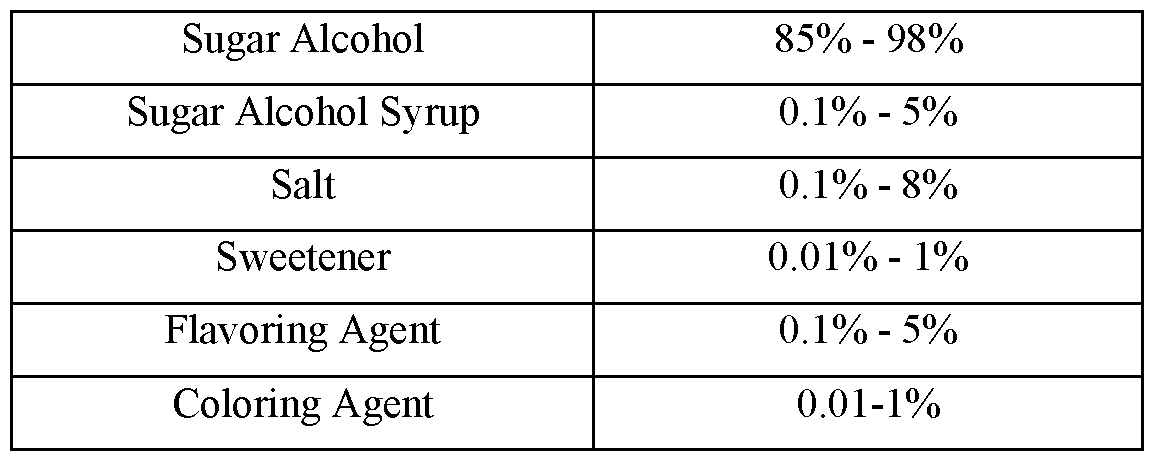
Claims
Priority Applications (4)
| Application Number | Priority Date | Filing Date | Title |
|---|---|---|---|
| JP2023564609A JP2024515357A (en) | 2021-04-22 | 2022-04-21 | Oral lozenge products |
| MX2023012534A MX2023012534A (en) | 2021-04-22 | 2022-04-21 | Oral lozenge products. |
| CA3216323A CA3216323A1 (en) | 2021-04-22 | 2022-04-21 | Oral lozenge products |
| EP22720786.7A EP4326096A1 (en) | 2021-04-22 | 2022-04-21 | Oral lozenge products |
Applications Claiming Priority (4)
| Application Number | Priority Date | Filing Date | Title |
|---|---|---|---|
| US202163178276P | 2021-04-22 | 2021-04-22 | |
| US63/178,276 | 2021-04-22 | ||
| US202163250858P | 2021-09-30 | 2021-09-30 | |
| US63/250,858 | 2021-09-30 |
Publications (1)
| Publication Number | Publication Date |
|---|---|
| WO2022224198A1 true WO2022224198A1 (en) | 2022-10-27 |
Family
ID=81579897
Family Applications (1)
| Application Number | Title | Priority Date | Filing Date |
|---|---|---|---|
| PCT/IB2022/053751 Ceased WO2022224198A1 (en) | 2021-04-22 | 2022-04-21 | Oral lozenge products |
Country Status (6)
| Country | Link |
|---|---|
| US (1) | US20220354785A1 (en) |
| EP (1) | EP4326096A1 (en) |
| JP (1) | JP2024515357A (en) |
| CA (1) | CA3216323A1 (en) |
| MX (1) | MX2023012534A (en) |
| WO (1) | WO2022224198A1 (en) |
Cited By (3)
| Publication number | Priority date | Publication date | Assignee | Title |
|---|---|---|---|---|
| WO2024095162A1 (en) * | 2022-11-01 | 2024-05-10 | Nicoventures Trading Limited | Method of preparing a pouched product comprising a nicotine salt |
| WO2024201301A1 (en) * | 2023-03-31 | 2024-10-03 | Nicoventures Trading Limited | Starchless molding process for oral products |
| WO2024201343A1 (en) * | 2023-03-30 | 2024-10-03 | Nicoventures Trading Limited | Oral compositions and methods of manufacture |
Families Citing this family (3)
| Publication number | Priority date | Publication date | Assignee | Title |
|---|---|---|---|---|
| US20220071984A1 (en) * | 2019-09-11 | 2022-03-10 | Nicoventures Trading Limited | Oral product with nicotine and ion pairing agent |
| EP4410123A1 (en) * | 2023-02-03 | 2024-08-07 | Contraf-Nicotex-Tobacco GmbH | Oral product for delivery of an active ingredient |
| CN116035250A (en) * | 2023-02-15 | 2023-05-02 | 东莞市吉纯生物技术有限公司 | A kind of nicotine buccal product containing compound antioxidant and preparation method thereof |
Citations (130)
| Publication number | Priority date | Publication date | Assignee | Title |
|---|---|---|---|---|
| US1376586A (en) | 1918-04-06 | 1921-05-03 | Schwartz Francis | Tobacco-tablet |
| US2033909A (en) | 1934-12-19 | 1936-03-17 | Niacet Chemicals Corp | Manufacture of calcium levulinate |
| US3901248A (en) | 1970-07-22 | 1975-08-26 | Leo Ab | Chewable smoking substitute composition |
| US4144895A (en) | 1974-03-08 | 1979-03-20 | Amf Incorporated | Solvent extraction process |
| US4148325A (en) | 1975-08-18 | 1979-04-10 | British-American Tobacco Company Limited | Treatment of tobacco |
| US4150677A (en) | 1977-01-24 | 1979-04-24 | Philip Morris Incorporated | Treatment of tobacco |
| US4267847A (en) | 1978-05-12 | 1981-05-19 | British-American Tobacco Company Limited | Tobacco additives |
| US4289147A (en) | 1979-11-15 | 1981-09-15 | Leaf Proteins, Inc. | Process for obtaining deproteinized tobacco freed of nicotine and green pigment, for use as a smoking product |
| US4340073A (en) | 1974-02-12 | 1982-07-20 | Philip Morris, Incorporated | Expanding tobacco |
| US4351346A (en) | 1980-03-08 | 1982-09-28 | B.A.T. Cigaretten-Fabriken Gmbh | Process for the preparation of aromatic substances |
| US4359059A (en) | 1980-03-08 | 1982-11-16 | B.A.T. Cigaretten-Fabriken Gmbh | Process for the preparation of aromatic substances |
| US4506682A (en) | 1981-12-07 | 1985-03-26 | Mueller Adam | Clear tobacco aroma oil, a process for obtaining it from a tobacco extract, and its use |
| US4513756A (en) | 1983-04-28 | 1985-04-30 | The Pinkerton Tobacco Company | Process of making tobacco pellets |
| US4528993A (en) | 1982-08-20 | 1985-07-16 | R. J. Reynolds Tobacco Company | Process for producing moist snuff |
| US4589428A (en) | 1980-02-21 | 1986-05-20 | Philip Morris Incorporated | Tobacco treatment |
| US4605016A (en) | 1983-07-21 | 1986-08-12 | Japan Tobacco, Inc. | Process for preparing tobacco flavoring formulations |
| US4624269A (en) | 1984-09-17 | 1986-11-25 | The Pinkerton Tobacco Company | Chewable tobacco based product |
| US4660577A (en) | 1982-08-20 | 1987-04-28 | R.J. Reynolds Tobacco Company | Dry pre-mix for moist snuff |
| US4716911A (en) | 1986-04-08 | 1988-01-05 | Genencor, Inc. | Method for protein removal from tobacco |
| US4727889A (en) | 1986-12-22 | 1988-03-01 | R. J. Reynolds Tobacco Company | Tobacco processing |
| US4887618A (en) | 1988-05-19 | 1989-12-19 | R. J. Reynolds Tobacco Company | Tobacco processing |
| US4941484A (en) | 1989-05-30 | 1990-07-17 | R. J. Reynolds Tobacco Company | Tobacco processing |
| US4967771A (en) | 1988-12-07 | 1990-11-06 | R. J. Reynolds Tobacco Company | Process for extracting tobacco |
| US4967773A (en) | 1986-06-26 | 1990-11-06 | Shaw Alec S W | Nicotine containing lozenge |
| US4986286A (en) | 1989-05-02 | 1991-01-22 | R. J. Reynolds Tobacco Company | Tobacco treatment process |
| US4987907A (en) | 1988-06-29 | 1991-01-29 | Helme Tobacco Company | Chewing tobacco composition and process for producing same |
| US4991599A (en) | 1989-12-20 | 1991-02-12 | Tibbetts Hubert M | Fiberless tobacco product for smoking and chewing |
| US5005593A (en) | 1988-01-27 | 1991-04-09 | R. J. Reynolds Tobacco Company | Process for providing tobacco extracts |
| US5018540A (en) | 1986-12-29 | 1991-05-28 | Philip Morris Incorporated | Process for removal of basic materials |
| US5060669A (en) | 1989-12-18 | 1991-10-29 | R. J. Reynolds Tobacco Company | Tobacco treatment process |
| US5065775A (en) | 1990-02-23 | 1991-11-19 | R. J. Reynolds Tobacco Company | Tobacco processing |
| US5074319A (en) | 1990-04-19 | 1991-12-24 | R. J. Reynolds Tobacco Company | Tobacco extraction process |
| US5092352A (en) | 1983-12-14 | 1992-03-03 | American Brands, Inc. | Chewing tobacco product |
| US5099862A (en) | 1990-04-05 | 1992-03-31 | R. J. Reynolds Tobacco Company | Tobacco extraction process |
| US5110605A (en) | 1990-08-21 | 1992-05-05 | Oramed, Inc. | Calcium polycarbophil-alginate controlled release composition and method |
| US5121757A (en) | 1989-12-18 | 1992-06-16 | R. J. Reynolds Tobacco Company | Tobacco treatment process |
| US5131414A (en) | 1990-02-23 | 1992-07-21 | R. J. Reynolds Tobacco Company | Tobacco processing |
| US5131415A (en) | 1991-04-04 | 1992-07-21 | R. J. Reynolds Tobacco Company | Tobacco extraction process |
| US5148819A (en) | 1991-08-15 | 1992-09-22 | R. J. Reynolds Tobacco Company | Process for extracting tobacco |
| US5197494A (en) | 1991-06-04 | 1993-03-30 | R.J. Reynolds Tobacco Company | Tobacco extraction process |
| US5230354A (en) | 1991-09-03 | 1993-07-27 | R. J. Reynolds Tobacco Company | Tobacco processing |
| US5234008A (en) | 1990-02-23 | 1993-08-10 | R. J. Reynolds Tobacco Company | Tobacco processing |
| US5243999A (en) | 1991-09-03 | 1993-09-14 | R. J. Reynolds Tobacco Company | Tobacco processing |
| US5259403A (en) | 1992-03-18 | 1993-11-09 | R. J. Reynolds Tobacco Company | Process and apparatus for expanding tobacco cut filler |
| US5301694A (en) | 1991-11-12 | 1994-04-12 | Philip Morris Incorporated | Process for isolating plant extract fractions |
| US5318050A (en) | 1991-06-04 | 1994-06-07 | R. J. Reynolds Tobacco Company | Tobacco treatment process |
| US5343879A (en) | 1991-06-21 | 1994-09-06 | R. J. Reynolds Tobacco Company | Tobacco treatment process |
| US5360022A (en) | 1991-07-22 | 1994-11-01 | R. J. Reynolds Tobacco Company | Tobacco processing |
| US5387416A (en) | 1993-07-23 | 1995-02-07 | R. J. Reynolds Tobacco Company | Tobacco composition |
| US5435325A (en) | 1988-04-21 | 1995-07-25 | R. J. Reynolds Tobacco Company | Process for providing tobacco extracts using a solvent in a supercritical state |
| US5445169A (en) | 1992-08-17 | 1995-08-29 | R. J. Reynolds Tobacco Company | Process for providing a tobacco extract |
| US5539093A (en) | 1994-06-16 | 1996-07-23 | Fitzmaurice; Wayne P. | DNA sequences encoding enzymes useful in carotenoid biosynthesis |
| US5668295A (en) | 1990-11-14 | 1997-09-16 | Philip Morris Incorporated | Protein involved in nicotine synthesis, DNA encoding, and use of sense and antisense DNAs corresponding thereto to affect nicotine content in transgenic tobacco cells and plants |
| US5705624A (en) | 1995-12-27 | 1998-01-06 | Fitzmaurice; Wayne Paul | DNA sequences encoding enzymes useful in phytoene biosynthesis |
| US5733574A (en) | 1989-11-07 | 1998-03-31 | Dam; Anders | Nicotine containing stimulant unit |
| US5844119A (en) | 1994-12-21 | 1998-12-01 | The Salk Institute For Biological Studies | Genetically modified plants having modulated flower development |
| US5908032A (en) | 1996-08-09 | 1999-06-01 | R.J. Reynolds Tobacco Company | Method of and apparatus for expanding tobacco |
| US6131584A (en) | 1999-04-15 | 2000-10-17 | Brown & Williamson Tobacco Corporation | Tobacco treatment process |
| US6248760B1 (en) | 1999-04-14 | 2001-06-19 | Paul C Wilhelmsen | Tablet giving rapid release of nicotine for transmucosal administration |
| US20010016593A1 (en) | 1999-04-14 | 2001-08-23 | Wilhelmsen Paul C. | Element giving rapid release of nicotine for transmucosal administration |
| US6280761B1 (en) | 1993-07-26 | 2001-08-28 | Pharmacia Ab | Nicotine lozenge |
| US6284875B1 (en) | 1998-08-11 | 2001-09-04 | Large Scale Biology Corporation | Method for recovering proteins from the interstitial fluid of plant tissues |
| US6298859B1 (en) | 1998-07-08 | 2001-10-09 | Novozymes A/S | Use of a phenol oxidizing enzyme in the treatment of tobacco |
| US6510855B1 (en) | 2000-03-03 | 2003-01-28 | Brown & Williamson Tobacco Corporation | Tobacco recovery system |
| US6668839B2 (en) | 2001-05-01 | 2003-12-30 | Jonnie R. Williams | Smokeless tobacco product |
| US6676959B1 (en) | 1998-11-23 | 2004-01-13 | Pharmacia Ab | Nicotine-containing pharmaceutical compositions giving a rapid transmucosal absorption |
| US20040020503A1 (en) | 2001-05-01 | 2004-02-05 | Williams Jonnie R. | Smokeless tobacco product |
| US6730832B1 (en) | 2001-09-10 | 2004-05-04 | Luis Mayan Dominguez | High threonine producing lines of Nicotiana tobacum and methods for producing |
| US20040101543A1 (en) | 2002-03-22 | 2004-05-27 | John Liu | Nicotine-containing oral dosage form |
| US6772767B2 (en) | 2002-09-09 | 2004-08-10 | Brown & Williamson Tobacco Corporation | Process for reducing nitrogen containing compounds and lignin in tobacco |
| WO2004095959A1 (en) | 2003-04-29 | 2004-11-11 | Swedish Match North Europe Ab | Oral snuff product and method for producing the same |
| US6817970B2 (en) | 2002-06-17 | 2004-11-16 | Large Scale Biology Corporation | Centrifuge for extracting interstitial fluid |
| US6834654B2 (en) | 2001-05-01 | 2004-12-28 | Regent Court Technologies, Llc | Smokeless tobacco product |
| WO2005041699A2 (en) | 2003-11-03 | 2005-05-12 | U.S. Smokeless Tobacco Company | Flavored smokeless tabacco and methods of making |
| US6895974B2 (en) | 1999-04-26 | 2005-05-24 | R. J. Reynolds Tobacco Company | Tobacco processing |
| US6906172B2 (en) | 1998-03-10 | 2005-06-14 | Large Scale Biology Corporation | Flexible processing apparatus for isolating and purifying viruses, soluble proteins and peptides from plant sources |
| WO2005063060A1 (en) | 2003-12-22 | 2005-07-14 | U.S. Smokeless Tobacco Company | Conditioning process for tobacco and/or snuff compositions |
| US6953040B2 (en) | 2001-09-28 | 2005-10-11 | U.S. Smokeless Tobacco Company | Tobacco mint plant material product |
| US20050244521A1 (en) | 2003-11-07 | 2005-11-03 | Strickland James A | Tobacco compositions |
| US7025066B2 (en) | 2002-10-31 | 2006-04-11 | Jerry Wayne Lawson | Method of reducing the sucrose ester concentration of a tobacco mixture |
| US7032601B2 (en) | 2001-09-28 | 2006-04-25 | U.S. Smokeless Tobacco Company | Encapsulated materials |
| US20060120974A1 (en) | 1999-05-13 | 2006-06-08 | Fluid Technologies Limited Of Great Britain | Nicotine delivery systems |
| US20060191548A1 (en) | 2003-11-07 | 2006-08-31 | Strickland James A | Tobacco compositions |
| US20060236434A1 (en) | 2000-08-30 | 2006-10-19 | North Carolina State University | Methods and compositions for tobacco plants with reduced nicotine |
| US20070062549A1 (en) | 2005-09-22 | 2007-03-22 | Holton Darrell E Jr | Smokeless tobacco composition |
| US7208659B2 (en) | 2001-05-02 | 2007-04-24 | Conopco Inc. | Process for increasing the flavonoid content of a plant and plants obtainable thereby |
| US7230160B2 (en) | 2001-03-08 | 2007-06-12 | Michigan State University | Lipid metabolism regulators in plants |
| US20070186942A1 (en) | 2006-01-31 | 2007-08-16 | U. S. Smokeless Tobacco Company | Tobacco Articles and Methods |
| US20070186941A1 (en) | 2006-02-10 | 2007-08-16 | Holton Darrell E Jr | Smokeless tobacco composition |
| US20080020050A1 (en) | 2006-07-21 | 2008-01-24 | Chau Tommy L | Medicinal delivery system, and related methods |
| US20080029116A1 (en) | 2006-08-01 | 2008-02-07 | John Howard Robinson | Smokeless tobacco |
| US20080029110A1 (en) | 2006-02-10 | 2008-02-07 | R. J. Reynolds Tobacco Company | Smokeless Tobacco Composition |
| US7337782B2 (en) | 2004-08-18 | 2008-03-04 | R.J. Reynolds Tobacco Company | Process to remove protein and other biomolecules from tobacco extract or slurry |
| WO2008040371A1 (en) | 2006-09-29 | 2008-04-10 | Nokia Siemens Networks Gmbh & Co. Kg | Interactive service in a telecommunication network |
| US7374779B2 (en) | 1999-02-26 | 2008-05-20 | Lipocine, Inc. | Pharmaceutical formulations and systems for improved absorption and multistage release of active agents |
| US20080173317A1 (en) | 2006-08-01 | 2008-07-24 | John Howard Robinson | Smokeless tobacco |
| US20080196730A1 (en) | 2004-07-02 | 2008-08-21 | Radi Medical Systems Ab | Smokeless Tobacco Product |
| WO2008103935A2 (en) | 2007-02-23 | 2008-08-28 | U.S. Smokeless Tobacco Company | Novel tobacco compositions and methods of making |
| US20080286341A1 (en) | 2007-05-16 | 2008-11-20 | Sven-Borje Andersson | Buffered coated nicotine containing products |
| US20080305216A1 (en) | 2007-06-08 | 2008-12-11 | Philip Morris Usa Inc. | Capsule clusters for oral consumption |
| US20090065013A1 (en) | 2006-04-28 | 2009-03-12 | Swedish Match North Europe Ab | moist snuff non-tobacco composition and a method for producing thereof |
| US20090081291A1 (en) | 2007-09-26 | 2009-03-26 | Gin Jerry B | Sustained Release Dosage Forms For Delivery of Agents to an Oral Cavity of a User |
| US7556047B2 (en) | 2003-03-20 | 2009-07-07 | R.J. Reynolds Tobacco Company | Method of expanding tobacco using steam |
| US20090293889A1 (en) | 2007-11-28 | 2009-12-03 | Philip Morris Usa Inc. | Smokeless compressed tobacco product for oral consumption |
| US20100004294A1 (en) | 2006-03-16 | 2010-01-07 | Niconovum Ab | Stable Lozenge Compositions Providing Rapid Release of Nicotine |
| US7650892B1 (en) | 2004-09-03 | 2010-01-26 | Rosswil Llc Ltd. | Methods for hindering formation of tobacco-specific nitrosamines |
| US7798153B2 (en) | 2004-08-23 | 2010-09-21 | Us Smokeless Tobacco Co. | Nicotiana Kawakamii smokeless tobacco |
| US20100282267A1 (en) | 2009-05-11 | 2010-11-11 | Frank Atchley | Method and device for flavoring smokeless tobacco |
| US20100291245A1 (en) | 2008-12-08 | 2010-11-18 | Philip Morris Usa Inc. | Soft, chewable and orally dissolvable and/or disintegrable products |
| US20100300463A1 (en) | 2009-06-02 | 2010-12-02 | R.J. Reynolds Tobacco Company | Thermal treatment process for tobacco materials |
| US20110139164A1 (en) | 2009-12-15 | 2011-06-16 | R. J. Reynolds Tobacco Company | Tobacco Product And Method For Manufacture |
| US8061362B2 (en) | 2007-07-23 | 2011-11-22 | R. J. Reynolds Tobacco Company | Smokeless tobacco composition |
| US20120037175A1 (en) | 2010-08-11 | 2012-02-16 | R.J. Reynolds Tobacco Company | Meltable smokeless tobacco composition |
| US20120055494A1 (en) | 2010-09-07 | 2012-03-08 | Rj Reynolds Tobacco Company | Smokeless Tobacco Product Comprising Effervescent Composition |
| US8186360B2 (en) | 2007-04-04 | 2012-05-29 | R.J. Reynolds Tobacco Company | Cigarette comprising dark air-cured tobacco |
| US20120138073A1 (en) | 2010-12-01 | 2012-06-07 | Rj Reynolds Tobacco Company | Smokeless tobacco pastille and injection molding process for forming smokeless tobacco products |
| US20120138074A1 (en) | 2010-12-01 | 2012-06-07 | Rj Reynolds Tobacco Company | Smokeless tobacco pastille and moulding process for forming smokeless tobacco products |
| US20130074856A1 (en) | 2011-09-22 | 2013-03-28 | R.J. Reynolds Tobacco Company | Translucent smokeless tobacco product |
| US20130074855A1 (en) | 2011-09-22 | 2013-03-28 | R.J. Reynolds Tobacco Company | Translucent smokeless tobacco product |
| US20130152953A1 (en) | 2011-12-14 | 2013-06-20 | R. J. Reynolds Tobacco Company | Smokeless tobacco product comprising effervescent composition |
| US20130274296A1 (en) | 2012-04-17 | 2013-10-17 | R.J. Reynolds Tobacco Company | Remelted ingestible products |
| EP2152313B1 (en) * | 2007-05-16 | 2014-09-03 | McNeil AB | Oral nicotine formulation buffered with amino acid |
| US8944072B2 (en) | 2009-06-02 | 2015-02-03 | R.J. Reynolds Tobacco Company | Thermal treatment process for tobacco materials |
| US20150068545A1 (en) | 2013-09-09 | 2015-03-12 | R.J. Reynolds Tobacco Company | Smokeless tobacco composition incorporating a botanical material |
| US8991403B2 (en) | 2009-06-02 | 2015-03-31 | R.J. Reynolds Tobacco Company | Thermal treatment process for tobacco materials |
| US20150101627A1 (en) | 2013-10-16 | 2015-04-16 | R.J. Reynolds Tobacco Company | Smokeless tobacco pastille |
| US20150230515A1 (en) | 2014-02-14 | 2015-08-20 | R.J. Reynolds Tobacco Company | Tobacco-containing gel composition |
| WO2017089931A1 (en) * | 2015-11-25 | 2017-06-01 | R. J. Reynolds Tobacco Company | Nicotine salts, co-crystals, and salt co-crystal complexes |
| US9738622B2 (en) * | 2014-05-27 | 2017-08-22 | R.J. Reynolds Tobacco Company | Nicotine salts, co-crystals, and salt co-crystal complexes |
| CA3150372A1 (en) * | 2019-09-11 | 2021-03-18 | Thomas H. POOLE | Oral product with a basic amine and an ion pairing agent |
Family Cites Families (10)
| Publication number | Priority date | Publication date | Assignee | Title |
|---|---|---|---|---|
| US20070221236A1 (en) * | 2005-10-05 | 2007-09-27 | Cadbury Adams Usa Llc. | Cooling compositions including menthyl esters |
| ES2401912T3 (en) * | 2008-09-17 | 2013-04-25 | Siegfried Ltd. | Granulate containing nicotine |
| US20100247586A1 (en) * | 2009-03-27 | 2010-09-30 | Andreas Hugerth | Multi-Portion Intra-Oral Dosage Form With Organoleptic Properties |
| US8871263B2 (en) * | 2009-09-24 | 2014-10-28 | Mcneil-Ppc, Inc. | Manufacture of tablet in a die utilizing radiofrequency energy and meltable binder |
| US9763928B2 (en) * | 2012-02-10 | 2017-09-19 | Niconovum Usa, Inc. | Multi-layer nicotine-containing pharmaceutical composition |
| US20140134115A1 (en) * | 2012-11-13 | 2014-05-15 | Mcneil-Ppc, Inc. | Oral care compositions |
| CN111212576A (en) * | 2017-06-26 | 2020-05-29 | 纳德尼古丁公司 | Nicotine salts and methods of making and using the same |
| US12342847B2 (en) * | 2019-09-11 | 2025-07-01 | Nicoventures Trading Limited | Oral product with cellulosic flavor stabilizer |
| US11759419B2 (en) * | 2019-10-11 | 2023-09-19 | Fertin Pharma A/S | Compressed nicotine lozenge |
| US12310959B2 (en) * | 2019-12-09 | 2025-05-27 | Nicoventures Trading Limited | Oral compositions with reduced water content |
-
2022
- 2022-04-19 US US17/724,056 patent/US20220354785A1/en active Pending
- 2022-04-21 WO PCT/IB2022/053751 patent/WO2022224198A1/en not_active Ceased
- 2022-04-21 MX MX2023012534A patent/MX2023012534A/en unknown
- 2022-04-21 JP JP2023564609A patent/JP2024515357A/en active Pending
- 2022-04-21 EP EP22720786.7A patent/EP4326096A1/en active Pending
- 2022-04-21 CA CA3216323A patent/CA3216323A1/en active Pending
Patent Citations (142)
| Publication number | Priority date | Publication date | Assignee | Title |
|---|---|---|---|---|
| US1376586A (en) | 1918-04-06 | 1921-05-03 | Schwartz Francis | Tobacco-tablet |
| US2033909A (en) | 1934-12-19 | 1936-03-17 | Niacet Chemicals Corp | Manufacture of calcium levulinate |
| US3901248A (en) | 1970-07-22 | 1975-08-26 | Leo Ab | Chewable smoking substitute composition |
| US4340073A (en) | 1974-02-12 | 1982-07-20 | Philip Morris, Incorporated | Expanding tobacco |
| US4144895A (en) | 1974-03-08 | 1979-03-20 | Amf Incorporated | Solvent extraction process |
| US4148325A (en) | 1975-08-18 | 1979-04-10 | British-American Tobacco Company Limited | Treatment of tobacco |
| US4150677A (en) | 1977-01-24 | 1979-04-24 | Philip Morris Incorporated | Treatment of tobacco |
| US4267847A (en) | 1978-05-12 | 1981-05-19 | British-American Tobacco Company Limited | Tobacco additives |
| US4289147A (en) | 1979-11-15 | 1981-09-15 | Leaf Proteins, Inc. | Process for obtaining deproteinized tobacco freed of nicotine and green pigment, for use as a smoking product |
| US4589428A (en) | 1980-02-21 | 1986-05-20 | Philip Morris Incorporated | Tobacco treatment |
| US4351346A (en) | 1980-03-08 | 1982-09-28 | B.A.T. Cigaretten-Fabriken Gmbh | Process for the preparation of aromatic substances |
| US4359059A (en) | 1980-03-08 | 1982-11-16 | B.A.T. Cigaretten-Fabriken Gmbh | Process for the preparation of aromatic substances |
| US4506682A (en) | 1981-12-07 | 1985-03-26 | Mueller Adam | Clear tobacco aroma oil, a process for obtaining it from a tobacco extract, and its use |
| US4660577A (en) | 1982-08-20 | 1987-04-28 | R.J. Reynolds Tobacco Company | Dry pre-mix for moist snuff |
| US4528993A (en) | 1982-08-20 | 1985-07-16 | R. J. Reynolds Tobacco Company | Process for producing moist snuff |
| US4513756A (en) | 1983-04-28 | 1985-04-30 | The Pinkerton Tobacco Company | Process of making tobacco pellets |
| US4605016A (en) | 1983-07-21 | 1986-08-12 | Japan Tobacco, Inc. | Process for preparing tobacco flavoring formulations |
| US5092352A (en) | 1983-12-14 | 1992-03-03 | American Brands, Inc. | Chewing tobacco product |
| US4624269A (en) | 1984-09-17 | 1986-11-25 | The Pinkerton Tobacco Company | Chewable tobacco based product |
| US4716911A (en) | 1986-04-08 | 1988-01-05 | Genencor, Inc. | Method for protein removal from tobacco |
| US4967773A (en) | 1986-06-26 | 1990-11-06 | Shaw Alec S W | Nicotine containing lozenge |
| US4727889A (en) | 1986-12-22 | 1988-03-01 | R. J. Reynolds Tobacco Company | Tobacco processing |
| US5018540A (en) | 1986-12-29 | 1991-05-28 | Philip Morris Incorporated | Process for removal of basic materials |
| US5005593A (en) | 1988-01-27 | 1991-04-09 | R. J. Reynolds Tobacco Company | Process for providing tobacco extracts |
| US5435325A (en) | 1988-04-21 | 1995-07-25 | R. J. Reynolds Tobacco Company | Process for providing tobacco extracts using a solvent in a supercritical state |
| US4887618A (en) | 1988-05-19 | 1989-12-19 | R. J. Reynolds Tobacco Company | Tobacco processing |
| US4987907A (en) | 1988-06-29 | 1991-01-29 | Helme Tobacco Company | Chewing tobacco composition and process for producing same |
| US4967771A (en) | 1988-12-07 | 1990-11-06 | R. J. Reynolds Tobacco Company | Process for extracting tobacco |
| US4986286A (en) | 1989-05-02 | 1991-01-22 | R. J. Reynolds Tobacco Company | Tobacco treatment process |
| US4941484A (en) | 1989-05-30 | 1990-07-17 | R. J. Reynolds Tobacco Company | Tobacco processing |
| US5733574A (en) | 1989-11-07 | 1998-03-31 | Dam; Anders | Nicotine containing stimulant unit |
| US5121757A (en) | 1989-12-18 | 1992-06-16 | R. J. Reynolds Tobacco Company | Tobacco treatment process |
| US5060669A (en) | 1989-12-18 | 1991-10-29 | R. J. Reynolds Tobacco Company | Tobacco treatment process |
| US4991599A (en) | 1989-12-20 | 1991-02-12 | Tibbetts Hubert M | Fiberless tobacco product for smoking and chewing |
| US5065775A (en) | 1990-02-23 | 1991-11-19 | R. J. Reynolds Tobacco Company | Tobacco processing |
| US5131414A (en) | 1990-02-23 | 1992-07-21 | R. J. Reynolds Tobacco Company | Tobacco processing |
| US5234008A (en) | 1990-02-23 | 1993-08-10 | R. J. Reynolds Tobacco Company | Tobacco processing |
| US5099862A (en) | 1990-04-05 | 1992-03-31 | R. J. Reynolds Tobacco Company | Tobacco extraction process |
| US5074319A (en) | 1990-04-19 | 1991-12-24 | R. J. Reynolds Tobacco Company | Tobacco extraction process |
| US5110605A (en) | 1990-08-21 | 1992-05-05 | Oramed, Inc. | Calcium polycarbophil-alginate controlled release composition and method |
| US5668295A (en) | 1990-11-14 | 1997-09-16 | Philip Morris Incorporated | Protein involved in nicotine synthesis, DNA encoding, and use of sense and antisense DNAs corresponding thereto to affect nicotine content in transgenic tobacco cells and plants |
| US5131415A (en) | 1991-04-04 | 1992-07-21 | R. J. Reynolds Tobacco Company | Tobacco extraction process |
| US5197494A (en) | 1991-06-04 | 1993-03-30 | R.J. Reynolds Tobacco Company | Tobacco extraction process |
| US5318050A (en) | 1991-06-04 | 1994-06-07 | R. J. Reynolds Tobacco Company | Tobacco treatment process |
| US5343879A (en) | 1991-06-21 | 1994-09-06 | R. J. Reynolds Tobacco Company | Tobacco treatment process |
| US5360022A (en) | 1991-07-22 | 1994-11-01 | R. J. Reynolds Tobacco Company | Tobacco processing |
| US5148819A (en) | 1991-08-15 | 1992-09-22 | R. J. Reynolds Tobacco Company | Process for extracting tobacco |
| US5243999A (en) | 1991-09-03 | 1993-09-14 | R. J. Reynolds Tobacco Company | Tobacco processing |
| US5230354A (en) | 1991-09-03 | 1993-07-27 | R. J. Reynolds Tobacco Company | Tobacco processing |
| US5301694A (en) | 1991-11-12 | 1994-04-12 | Philip Morris Incorporated | Process for isolating plant extract fractions |
| US5259403A (en) | 1992-03-18 | 1993-11-09 | R. J. Reynolds Tobacco Company | Process and apparatus for expanding tobacco cut filler |
| US5445169A (en) | 1992-08-17 | 1995-08-29 | R. J. Reynolds Tobacco Company | Process for providing a tobacco extract |
| US5387416A (en) | 1993-07-23 | 1995-02-07 | R. J. Reynolds Tobacco Company | Tobacco composition |
| US6280761B1 (en) | 1993-07-26 | 2001-08-28 | Pharmacia Ab | Nicotine lozenge |
| US5539093A (en) | 1994-06-16 | 1996-07-23 | Fitzmaurice; Wayne P. | DNA sequences encoding enzymes useful in carotenoid biosynthesis |
| US5844119A (en) | 1994-12-21 | 1998-12-01 | The Salk Institute For Biological Studies | Genetically modified plants having modulated flower development |
| US5705624A (en) | 1995-12-27 | 1998-01-06 | Fitzmaurice; Wayne Paul | DNA sequences encoding enzymes useful in phytoene biosynthesis |
| US5908032A (en) | 1996-08-09 | 1999-06-01 | R.J. Reynolds Tobacco Company | Method of and apparatus for expanding tobacco |
| US7048211B2 (en) | 1998-03-10 | 2006-05-23 | Large Scale Biology Corporation | Flexible processing apparatus for isolating and purifying viruses, soluble proteins and peptides from plant sources |
| US6906172B2 (en) | 1998-03-10 | 2005-06-14 | Large Scale Biology Corporation | Flexible processing apparatus for isolating and purifying viruses, soluble proteins and peptides from plant sources |
| US6298859B1 (en) | 1998-07-08 | 2001-10-09 | Novozymes A/S | Use of a phenol oxidizing enzyme in the treatment of tobacco |
| US7034128B2 (en) | 1998-08-11 | 2006-04-25 | Large Scale Biology Corporation | Method for recovering proteins from the interstitial fluid of plant tissues |
| US6284875B1 (en) | 1998-08-11 | 2001-09-04 | Large Scale Biology Corporation | Method for recovering proteins from the interstitial fluid of plant tissues |
| US6676959B1 (en) | 1998-11-23 | 2004-01-13 | Pharmacia Ab | Nicotine-containing pharmaceutical compositions giving a rapid transmucosal absorption |
| US7374779B2 (en) | 1999-02-26 | 2008-05-20 | Lipocine, Inc. | Pharmaceutical formulations and systems for improved absorption and multistage release of active agents |
| US20010016593A1 (en) | 1999-04-14 | 2001-08-23 | Wilhelmsen Paul C. | Element giving rapid release of nicotine for transmucosal administration |
| US6248760B1 (en) | 1999-04-14 | 2001-06-19 | Paul C Wilhelmsen | Tablet giving rapid release of nicotine for transmucosal administration |
| US6131584A (en) | 1999-04-15 | 2000-10-17 | Brown & Williamson Tobacco Corporation | Tobacco treatment process |
| US6895974B2 (en) | 1999-04-26 | 2005-05-24 | R. J. Reynolds Tobacco Company | Tobacco processing |
| US20060120974A1 (en) | 1999-05-13 | 2006-06-08 | Fluid Technologies Limited Of Great Britain | Nicotine delivery systems |
| US6510855B1 (en) | 2000-03-03 | 2003-01-28 | Brown & Williamson Tobacco Corporation | Tobacco recovery system |
| US20060236434A1 (en) | 2000-08-30 | 2006-10-19 | North Carolina State University | Methods and compositions for tobacco plants with reduced nicotine |
| US7230160B2 (en) | 2001-03-08 | 2007-06-12 | Michigan State University | Lipid metabolism regulators in plants |
| US6834654B2 (en) | 2001-05-01 | 2004-12-28 | Regent Court Technologies, Llc | Smokeless tobacco product |
| US20040020503A1 (en) | 2001-05-01 | 2004-02-05 | Williams Jonnie R. | Smokeless tobacco product |
| US6668839B2 (en) | 2001-05-01 | 2003-12-30 | Jonnie R. Williams | Smokeless tobacco product |
| US7208659B2 (en) | 2001-05-02 | 2007-04-24 | Conopco Inc. | Process for increasing the flavonoid content of a plant and plants obtainable thereby |
| US6730832B1 (en) | 2001-09-10 | 2004-05-04 | Luis Mayan Dominguez | High threonine producing lines of Nicotiana tobacum and methods for producing |
| US7173170B2 (en) | 2001-09-10 | 2007-02-06 | Reynolds Technologies, Inc. | High threonine producing lines of Nicotiana tobacum and methods of producing |
| US6953040B2 (en) | 2001-09-28 | 2005-10-11 | U.S. Smokeless Tobacco Company | Tobacco mint plant material product |
| US7032601B2 (en) | 2001-09-28 | 2006-04-25 | U.S. Smokeless Tobacco Company | Encapsulated materials |
| US20040101543A1 (en) | 2002-03-22 | 2004-05-27 | John Liu | Nicotine-containing oral dosage form |
| US6817970B2 (en) | 2002-06-17 | 2004-11-16 | Large Scale Biology Corporation | Centrifuge for extracting interstitial fluid |
| US6772767B2 (en) | 2002-09-09 | 2004-08-10 | Brown & Williamson Tobacco Corporation | Process for reducing nitrogen containing compounds and lignin in tobacco |
| US7025066B2 (en) | 2002-10-31 | 2006-04-11 | Jerry Wayne Lawson | Method of reducing the sucrose ester concentration of a tobacco mixture |
| US7556047B2 (en) | 2003-03-20 | 2009-07-07 | R.J. Reynolds Tobacco Company | Method of expanding tobacco using steam |
| WO2004095959A1 (en) | 2003-04-29 | 2004-11-11 | Swedish Match North Europe Ab | Oral snuff product and method for producing the same |
| US20050115580A1 (en) | 2003-11-03 | 2005-06-02 | Quinter Phillip F. | Flavored smokeless tobacco and methods of making |
| WO2005041699A2 (en) | 2003-11-03 | 2005-05-12 | U.S. Smokeless Tobacco Company | Flavored smokeless tabacco and methods of making |
| US20060191548A1 (en) | 2003-11-07 | 2006-08-31 | Strickland James A | Tobacco compositions |
| US20050244521A1 (en) | 2003-11-07 | 2005-11-03 | Strickland James A | Tobacco compositions |
| WO2005063060A1 (en) | 2003-12-22 | 2005-07-14 | U.S. Smokeless Tobacco Company | Conditioning process for tobacco and/or snuff compositions |
| US7694686B2 (en) | 2003-12-22 | 2010-04-13 | U.S. Smokeless Tobacco Company | Conditioning process for tobacco and/or snuff compositions |
| US20080196730A1 (en) | 2004-07-02 | 2008-08-21 | Radi Medical Systems Ab | Smokeless Tobacco Product |
| US7337782B2 (en) | 2004-08-18 | 2008-03-04 | R.J. Reynolds Tobacco Company | Process to remove protein and other biomolecules from tobacco extract or slurry |
| US7798153B2 (en) | 2004-08-23 | 2010-09-21 | Us Smokeless Tobacco Co. | Nicotiana Kawakamii smokeless tobacco |
| US7650892B1 (en) | 2004-09-03 | 2010-01-26 | Rosswil Llc Ltd. | Methods for hindering formation of tobacco-specific nitrosamines |
| US20070062549A1 (en) | 2005-09-22 | 2007-03-22 | Holton Darrell E Jr | Smokeless tobacco composition |
| US20070186942A1 (en) | 2006-01-31 | 2007-08-16 | U. S. Smokeless Tobacco Company | Tobacco Articles and Methods |
| US20080029110A1 (en) | 2006-02-10 | 2008-02-07 | R. J. Reynolds Tobacco Company | Smokeless Tobacco Composition |
| US7861728B2 (en) | 2006-02-10 | 2011-01-04 | R.J. Reynolds Tobacco Company | Smokeless tobacco composition having an outer and inner pouch |
| US20070186941A1 (en) | 2006-02-10 | 2007-08-16 | Holton Darrell E Jr | Smokeless tobacco composition |
| US20100004294A1 (en) | 2006-03-16 | 2010-01-07 | Niconovum Ab | Stable Lozenge Compositions Providing Rapid Release of Nicotine |
| US20090065013A1 (en) | 2006-04-28 | 2009-03-12 | Swedish Match North Europe Ab | moist snuff non-tobacco composition and a method for producing thereof |
| US20080020050A1 (en) | 2006-07-21 | 2008-01-24 | Chau Tommy L | Medicinal delivery system, and related methods |
| US20080173317A1 (en) | 2006-08-01 | 2008-07-24 | John Howard Robinson | Smokeless tobacco |
| US20080029116A1 (en) | 2006-08-01 | 2008-02-07 | John Howard Robinson | Smokeless tobacco |
| WO2008040371A1 (en) | 2006-09-29 | 2008-04-10 | Nokia Siemens Networks Gmbh & Co. Kg | Interactive service in a telecommunication network |
| WO2008103935A2 (en) | 2007-02-23 | 2008-08-28 | U.S. Smokeless Tobacco Company | Novel tobacco compositions and methods of making |
| US20080209586A1 (en) | 2007-02-23 | 2008-08-28 | U.S. Smokeless Tobacco Company | Novel tobacco compositions and methods of making |
| US8186360B2 (en) | 2007-04-04 | 2012-05-29 | R.J. Reynolds Tobacco Company | Cigarette comprising dark air-cured tobacco |
| US20080286341A1 (en) | 2007-05-16 | 2008-11-20 | Sven-Borje Andersson | Buffered coated nicotine containing products |
| EP2152313B1 (en) * | 2007-05-16 | 2014-09-03 | McNeil AB | Oral nicotine formulation buffered with amino acid |
| US20080305216A1 (en) | 2007-06-08 | 2008-12-11 | Philip Morris Usa Inc. | Capsule clusters for oral consumption |
| US9237769B2 (en) | 2007-07-23 | 2016-01-19 | R. J. Reynolds Tobacco Company | Smokeless tobacco composition |
| US8061362B2 (en) | 2007-07-23 | 2011-11-22 | R. J. Reynolds Tobacco Company | Smokeless tobacco composition |
| US20090081291A1 (en) | 2007-09-26 | 2009-03-26 | Gin Jerry B | Sustained Release Dosage Forms For Delivery of Agents to an Oral Cavity of a User |
| US20090293889A1 (en) | 2007-11-28 | 2009-12-03 | Philip Morris Usa Inc. | Smokeless compressed tobacco product for oral consumption |
| US20100291245A1 (en) | 2008-12-08 | 2010-11-18 | Philip Morris Usa Inc. | Soft, chewable and orally dissolvable and/or disintegrable products |
| US20100282267A1 (en) | 2009-05-11 | 2010-11-11 | Frank Atchley | Method and device for flavoring smokeless tobacco |
| WO2010132444A2 (en) | 2009-05-11 | 2010-11-18 | U.S. Smokeless Tobacco Company Llc | Method and device for flavoring smokeless tobacco |
| US8991403B2 (en) | 2009-06-02 | 2015-03-31 | R.J. Reynolds Tobacco Company | Thermal treatment process for tobacco materials |
| US8434496B2 (en) | 2009-06-02 | 2013-05-07 | R. J. Reynolds Tobacco Company | Thermal treatment process for tobacco materials |
| US20100300463A1 (en) | 2009-06-02 | 2010-12-02 | R.J. Reynolds Tobacco Company | Thermal treatment process for tobacco materials |
| US8944072B2 (en) | 2009-06-02 | 2015-02-03 | R.J. Reynolds Tobacco Company | Thermal treatment process for tobacco materials |
| US20110139164A1 (en) | 2009-12-15 | 2011-06-16 | R. J. Reynolds Tobacco Company | Tobacco Product And Method For Manufacture |
| US20120037175A1 (en) | 2010-08-11 | 2012-02-16 | R.J. Reynolds Tobacco Company | Meltable smokeless tobacco composition |
| US20120055494A1 (en) | 2010-09-07 | 2012-03-08 | Rj Reynolds Tobacco Company | Smokeless Tobacco Product Comprising Effervescent Composition |
| US20120138073A1 (en) | 2010-12-01 | 2012-06-07 | Rj Reynolds Tobacco Company | Smokeless tobacco pastille and injection molding process for forming smokeless tobacco products |
| US20120138074A1 (en) | 2010-12-01 | 2012-06-07 | Rj Reynolds Tobacco Company | Smokeless tobacco pastille and moulding process for forming smokeless tobacco products |
| US9084439B2 (en) | 2011-09-22 | 2015-07-21 | R.J. Reynolds Tobacco Company | Translucent smokeless tobacco product |
| US20130074856A1 (en) | 2011-09-22 | 2013-03-28 | R.J. Reynolds Tobacco Company | Translucent smokeless tobacco product |
| US20130074855A1 (en) | 2011-09-22 | 2013-03-28 | R.J. Reynolds Tobacco Company | Translucent smokeless tobacco product |
| US20130152953A1 (en) | 2011-12-14 | 2013-06-20 | R. J. Reynolds Tobacco Company | Smokeless tobacco product comprising effervescent composition |
| US20150245996A1 (en) * | 2012-04-17 | 2015-09-03 | R.J. Reynolds Tobacco Company | Remelted ingestible products |
| US20130274296A1 (en) | 2012-04-17 | 2013-10-17 | R.J. Reynolds Tobacco Company | Remelted ingestible products |
| US20150068545A1 (en) | 2013-09-09 | 2015-03-12 | R.J. Reynolds Tobacco Company | Smokeless tobacco composition incorporating a botanical material |
| US20150101627A1 (en) | 2013-10-16 | 2015-04-16 | R.J. Reynolds Tobacco Company | Smokeless tobacco pastille |
| US20150230515A1 (en) | 2014-02-14 | 2015-08-20 | R.J. Reynolds Tobacco Company | Tobacco-containing gel composition |
| US9738622B2 (en) * | 2014-05-27 | 2017-08-22 | R.J. Reynolds Tobacco Company | Nicotine salts, co-crystals, and salt co-crystal complexes |
| WO2017089931A1 (en) * | 2015-11-25 | 2017-06-01 | R. J. Reynolds Tobacco Company | Nicotine salts, co-crystals, and salt co-crystal complexes |
| CA3150372A1 (en) * | 2019-09-11 | 2021-03-18 | Thomas H. POOLE | Oral product with a basic amine and an ion pairing agent |
Non-Patent Citations (8)
| Title |
|---|
| "LFRA Ingredients Handbook, Sweeteners", December 1996, LEATHERHEAD FOOD RA, pages: 21 - 44 |
| "Tobacco Production, Chemistry and Technology", 1999 |
| GOODSPEED: "The Genus Nicotiana", CHONICA BOTANICA, 1954 |
| LEFFINGWELL ET AL.: "Tobacco Flavoring for Smoking Products", 1972, R. J. REYNOLDS TOBACCO COMPANY |
| NESTOR ET AL., BEITRAGE TABAKFORSCH. INT., vol. 20, 2003, pages 467 - 475 |
| PERFETTI, BEITRAGE TABAKFORSCHUNG INT., vol. 12, 1983, pages 43 - 54 |
| SANTHOSH ET AL., PHYTOMEDICINE, vol. 12, 2005, pages 216 - 220 |
| STAAF ET AL., BEITRAGE TABAKFORSCH. INT., vol. 21, 2005, pages 321 - 330 |
Cited By (3)
| Publication number | Priority date | Publication date | Assignee | Title |
|---|---|---|---|---|
| WO2024095162A1 (en) * | 2022-11-01 | 2024-05-10 | Nicoventures Trading Limited | Method of preparing a pouched product comprising a nicotine salt |
| WO2024201343A1 (en) * | 2023-03-30 | 2024-10-03 | Nicoventures Trading Limited | Oral compositions and methods of manufacture |
| WO2024201301A1 (en) * | 2023-03-31 | 2024-10-03 | Nicoventures Trading Limited | Starchless molding process for oral products |
Also Published As
| Publication number | Publication date |
|---|---|
| US20220354785A1 (en) | 2022-11-10 |
| MX2023012534A (en) | 2024-01-23 |
| JP2024515357A (en) | 2024-04-09 |
| EP4326096A1 (en) | 2024-02-28 |
| CA3216323A1 (en) | 2022-10-27 |
Similar Documents
| Publication | Publication Date | Title |
|---|---|---|
| US12171872B2 (en) | Oral compositions and methods of manufacture | |
| US20220354785A1 (en) | Oral lozenge products | |
| US20220346434A1 (en) | Oral compositions and methods of manufacture | |
| US11969502B2 (en) | Oral products | |
| US20230138306A1 (en) | Oral product with a basic amine and an ion pairing agent | |
| US20220409549A1 (en) | Oral product tablet and method of manufacture | |
| WO2023053060A1 (en) | Oral gum composition | |
| WO2021116856A2 (en) | Oral products | |
| JP7663577B2 (en) | Oral Products | |
| US20220369688A1 (en) | Oral compositions and related methods for reducing throat irritation | |
| US20220354156A1 (en) | Oral pouched product with high density load | |
| JP7663578B2 (en) | Buffered oral compositions | |
| WO2021116855A1 (en) | Oral compositions and methods of manufacture | |
| JP7706451B2 (en) | Oral compositions and methods of manufacture | |
| WO2024201343A1 (en) | Oral compositions and methods of manufacture | |
| JP2023504754A (en) | Oral lipid-containing composition |
Legal Events
| Date | Code | Title | Description |
|---|---|---|---|
| 121 | Ep: the epo has been informed by wipo that ep was designated in this application |
Ref document number: 22720786 Country of ref document: EP Kind code of ref document: A1 |
|
| WWE | Wipo information: entry into national phase |
Ref document number: 2023564609 Country of ref document: JP Ref document number: MX/A/2023/012534 Country of ref document: MX Ref document number: 3216323 Country of ref document: CA |
|
| WWE | Wipo information: entry into national phase |
Ref document number: 2022720786 Country of ref document: EP |
|
| NENP | Non-entry into the national phase |
Ref country code: DE |
|
| ENP | Entry into the national phase |
Ref document number: 2022720786 Country of ref document: EP Effective date: 20231122 |