WO2022221462A1 - Vector constructs for delivery of nucleic acids encoding therapeutic vlcad or mcad and methods of using the same - Google Patents
Vector constructs for delivery of nucleic acids encoding therapeutic vlcad or mcad and methods of using the same Download PDFInfo
- Publication number
- WO2022221462A1 WO2022221462A1 PCT/US2022/024698 US2022024698W WO2022221462A1 WO 2022221462 A1 WO2022221462 A1 WO 2022221462A1 US 2022024698 W US2022024698 W US 2022024698W WO 2022221462 A1 WO2022221462 A1 WO 2022221462A1
- Authority
- WO
- WIPO (PCT)
- Prior art keywords
- vector
- nucleic acid
- polynucleotide
- expression cassette
- aspects
- Prior art date
- Legal status (The legal status is an assumption and is not a legal conclusion. Google has not performed a legal analysis and makes no representation as to the accuracy of the status listed.)
- Ceased
Links
Classifications
-
- C—CHEMISTRY; METALLURGY
- C12—BIOCHEMISTRY; BEER; SPIRITS; WINE; VINEGAR; MICROBIOLOGY; ENZYMOLOGY; MUTATION OR GENETIC ENGINEERING
- C12N—MICROORGANISMS OR ENZYMES; COMPOSITIONS THEREOF; PROPAGATING, PRESERVING, OR MAINTAINING MICROORGANISMS; MUTATION OR GENETIC ENGINEERING; CULTURE MEDIA
- C12N15/00—Mutation or genetic engineering; DNA or RNA concerning genetic engineering, vectors, e.g. plasmids, or their isolation, preparation or purification; Use of hosts therefor
- C12N15/09—Recombinant DNA-technology
- C12N15/63—Introduction of foreign genetic material using vectors; Vectors; Use of hosts therefor; Regulation of expression
- C12N15/79—Vectors or expression systems specially adapted for eukaryotic hosts
- C12N15/85—Vectors or expression systems specially adapted for eukaryotic hosts for animal cells
- C12N15/86—Viral vectors
-
- A—HUMAN NECESSITIES
- A61—MEDICAL OR VETERINARY SCIENCE; HYGIENE
- A61K—PREPARATIONS FOR MEDICAL, DENTAL OR TOILETRY PURPOSES
- A61K35/00—Medicinal preparations containing materials or reaction products thereof with undetermined constitution
- A61K35/66—Microorganisms or materials therefrom
- A61K35/76—Viruses; Subviral particles; Bacteriophages
- A61K35/761—Adenovirus
-
- A—HUMAN NECESSITIES
- A61—MEDICAL OR VETERINARY SCIENCE; HYGIENE
- A61K—PREPARATIONS FOR MEDICAL, DENTAL OR TOILETRY PURPOSES
- A61K38/00—Medicinal preparations containing peptides
- A61K38/16—Peptides having more than 20 amino acids; Gastrins; Somatostatins; Melanotropins; Derivatives thereof
- A61K38/43—Enzymes; Proenzymes; Derivatives thereof
- A61K38/44—Oxidoreductases (1)
-
- A—HUMAN NECESSITIES
- A61—MEDICAL OR VETERINARY SCIENCE; HYGIENE
- A61K—PREPARATIONS FOR MEDICAL, DENTAL OR TOILETRY PURPOSES
- A61K48/00—Medicinal preparations containing genetic material which is inserted into cells of the living body to treat genetic diseases; Gene therapy
- A61K48/005—Medicinal preparations containing genetic material which is inserted into cells of the living body to treat genetic diseases; Gene therapy characterised by an aspect of the 'active' part of the composition delivered, i.e. the nucleic acid delivered
-
- C—CHEMISTRY; METALLURGY
- C12—BIOCHEMISTRY; BEER; SPIRITS; WINE; VINEGAR; MICROBIOLOGY; ENZYMOLOGY; MUTATION OR GENETIC ENGINEERING
- C12N—MICROORGANISMS OR ENZYMES; COMPOSITIONS THEREOF; PROPAGATING, PRESERVING, OR MAINTAINING MICROORGANISMS; MUTATION OR GENETIC ENGINEERING; CULTURE MEDIA
- C12N9/00—Enzymes; Proenzymes; Compositions thereof; Processes for preparing, activating, inhibiting, separating or purifying enzymes
- C12N9/0004—Oxidoreductases (1.)
- C12N9/001—Oxidoreductases (1.) acting on the CH-CH group of donors (1.3)
-
- C—CHEMISTRY; METALLURGY
- C12—BIOCHEMISTRY; BEER; SPIRITS; WINE; VINEGAR; MICROBIOLOGY; ENZYMOLOGY; MUTATION OR GENETIC ENGINEERING
- C12Y—ENZYMES
- C12Y103/00—Oxidoreductases acting on the CH-CH group of donors (1.3)
- C12Y103/08—Oxidoreductases acting on the CH-CH group of donors (1.3) with flavin as acceptor (1.3.8)
- C12Y103/08008—Long-chain acyl-CoA dehydrogenase (1.3.8.8)
-
- C—CHEMISTRY; METALLURGY
- C12—BIOCHEMISTRY; BEER; SPIRITS; WINE; VINEGAR; MICROBIOLOGY; ENZYMOLOGY; MUTATION OR GENETIC ENGINEERING
- C12Y—ENZYMES
- C12Y103/00—Oxidoreductases acting on the CH-CH group of donors (1.3)
- C12Y103/08—Oxidoreductases acting on the CH-CH group of donors (1.3) with flavin as acceptor (1.3.8)
- C12Y103/08009—Very-long-chain acyl-CoA dehydrogenase (1.3.8.9)
-
- A—HUMAN NECESSITIES
- A01—AGRICULTURE; FORESTRY; ANIMAL HUSBANDRY; HUNTING; TRAPPING; FISHING
- A01K—ANIMAL HUSBANDRY; AVICULTURE; APICULTURE; PISCICULTURE; FISHING; REARING OR BREEDING ANIMALS, NOT OTHERWISE PROVIDED FOR; NEW BREEDS OF ANIMALS
- A01K2217/00—Genetically modified animals
- A01K2217/07—Animals genetically altered by homologous recombination
- A01K2217/075—Animals genetically altered by homologous recombination inducing loss of function, i.e. knock out
-
- A—HUMAN NECESSITIES
- A01—AGRICULTURE; FORESTRY; ANIMAL HUSBANDRY; HUNTING; TRAPPING; FISHING
- A01K—ANIMAL HUSBANDRY; AVICULTURE; APICULTURE; PISCICULTURE; FISHING; REARING OR BREEDING ANIMALS, NOT OTHERWISE PROVIDED FOR; NEW BREEDS OF ANIMALS
- A01K2227/00—Animals characterised by species
- A01K2227/10—Mammal
- A01K2227/105—Murine
-
- A—HUMAN NECESSITIES
- A01—AGRICULTURE; FORESTRY; ANIMAL HUSBANDRY; HUNTING; TRAPPING; FISHING
- A01K—ANIMAL HUSBANDRY; AVICULTURE; APICULTURE; PISCICULTURE; FISHING; REARING OR BREEDING ANIMALS, NOT OTHERWISE PROVIDED FOR; NEW BREEDS OF ANIMALS
- A01K2267/00—Animals characterised by purpose
- A01K2267/03—Animal model, e.g. for test or diseases
- A01K2267/035—Animal model for multifactorial diseases
- A01K2267/0362—Animal model for lipid/glucose metabolism, e.g. obesity, type-2 diabetes
-
- C—CHEMISTRY; METALLURGY
- C12—BIOCHEMISTRY; BEER; SPIRITS; WINE; VINEGAR; MICROBIOLOGY; ENZYMOLOGY; MUTATION OR GENETIC ENGINEERING
- C12N—MICROORGANISMS OR ENZYMES; COMPOSITIONS THEREOF; PROPAGATING, PRESERVING, OR MAINTAINING MICROORGANISMS; MUTATION OR GENETIC ENGINEERING; CULTURE MEDIA
- C12N2750/00—MICROORGANISMS OR ENZYMES; COMPOSITIONS THEREOF; PROPAGATING, PRESERVING, OR MAINTAINING MICROORGANISMS; MUTATION OR GENETIC ENGINEERING; CULTURE MEDIA ssDNA viruses
- C12N2750/00011—Details
- C12N2750/14011—Parvoviridae
- C12N2750/14111—Dependovirus, e.g. adenoassociated viruses
- C12N2750/14141—Use of virus, viral particle or viral elements as a vector
- C12N2750/14143—Use of virus, viral particle or viral elements as a vector viral genome or elements thereof as genetic vector
Definitions
- the present disclosure pertains to the medical field, including gene therapy.
- Some aspects of the disclosure relate to modified nucleic acids encoding very long-chain acyl- CoA dehydrogenase (VLCAD) and/or encoding medium-chain acyl-CoA dehydrogenase (MCAD) for use in treatment of very long-chain acyl-CoA dehydrogenase deficiency (VLCADD) and/or medium-chain acyl-CoA dehydrogenase deficiency (MCADD), respectively.
- VLCAD very long-chain acyl- CoA dehydrogenase
- MCAD medium-chain acyl-CoA dehydrogenase
- VLCAD Very-long chain acyl-CoA dehydrogenase
- acyl-CoA dehydrogenase very long chain gene that encodes VLCAD.
- the VLCAD enzyme catalyzes the first oxidation step of the long chain fatty acid oxidation cycle, making it vital for the generation of energy from fatty acids in organs and tissue with high metabolic demands.
- VLCAD When VLCAD is present, fatty acids in the acyl-CoA form are oxidized and acetyl-
- CoA is converted into ketones that supply energy when glucose levels are low.
- VLCAD deficiency prevents ketone formation, results in the accumulation of fatty acid metabolites, metabolic acidosis and toxic effects in the liver, heart, and skeletal muscle.
- VLCAD deficiency can have a heterogeneous clinical picture and is typically classified into three groups: 1) early onset severe form that occurs in infancy and results in cardiomyopathy, multi-organ failure, and sudden death; 2) childhood onset intermediate form that presents following periods of illness, fasting, and/or poor feeding; and 3) later onset form that presents in adolescence or adulthood and results in rhabdomyolysis, myoglobinuria, and exercise induced muscle intolerance.
- MCAD Medium-chain acyl-CoA dehydrogenase
- ACADM acyl-CoA dehydrogenase, medium chain gene that encodes MCAD.
- the MCAD enzyme catalyzes the dehydrogenation step of fatty acids with chain lengths between 6 and 12 carbons as they undergo b-oxidation in the mitochondria.
- MCAD deficiency is the most common disorder of fatty acid b-oxidation and one of the most common inborn errors of metabolism. Clinical symptoms in a previously apparently healthy child with MCAD deficiency typically present between 24 months and age 3 - although presentation even as late as adulthood is possible - and can include hepatomegaly, hypoketotic hypoglycemia and vomiting that may progress to lethargy, seizures, and coma.
- Certain aspects of the disclosure are directed to a polynucleotide comprising a nucleic acid encoding a very long-chain acyl-CoA dehydrogenase (VLCAD) protein wherein the nucleic acid comprises a sequence at least 95%, 95.5%, 96%, 96.5%, 97%, 97.5%, 98%, 98.5%, 99%, 99.5% or 100% identical to SEQ ID NO: 9, 10, 11, 12, or 13.
- VLCAD very long-chain acyl-CoA dehydrogenase
- Certain aspects of the disclosure are directed to a polynucleotide comprising a nucleic acid encoding a medium-chain acyl-CoA dehydrogenase (MCAD) protein, wherein the nucleic acid comprises a nucleotide sequence at least 98%, 98.5%, 99%, 99.5%, or 100% identical to SEQ ID NO: 2, 3, 4, 5, or 6.
- MCAD medium-chain acyl-CoA dehydrogenase
- the VLCAD protein comprises an amino acid sequence at least 98%
- the MCAD protein comprises an amino acid sequence at least 98%
- the polynucleotide further comprises a heterologous expression control sequence.
- nucleic acid sequence at least 95%, 95.5%, 96%, 96.5%, 97%, 97.5%, 98%, 98.5%, 99%, 99.5% or 100% identical to SEQ ID NO: 9, 10, 11, 12, or 13; and (ii) a heterologous expression control sequence operably linked to the nucleic acid sequence, wherein the nucleic acid encodes a very long-chain acyl-CoA dehydrogenase (VLCAD) protein.
- VLCAD very long-chain acyl-CoA dehydrogenase
- nucleic acid sequence at least 98%, 98.5%, 99%, 99.5% or 100% identical to SEQ ID NO: 2, 3, 4, 5, or 6, and (ii) a heterologous expression control sequence operably linked to the nucleic acid sequence, wherein the nucleic acid encodes a medium-chain acyl-CoA dehydrogenase (MCAD) protein.
- MCAD medium-chain acyl-CoA dehydrogenase
- the expression cassette or polynucleotide further comprises inverted terminal repeat (ITR) sequences.
- ITR inverted terminal repeat
- the expression cassette is flanked at the 5' end and the 3' end with the ITR sequences (e.g., ITRs from serotype AAV2).
- the heterologous expression control sequence is a promoter.
- the promoter is a eukaryotic promoter.
- the promoter is a cytomegalovirus (CMV) promoter, a CMV-chicken b-actin promoter (CBA), or a small CMV-chicken b-actin (smCBA) promoter.
- CMV cytomegalovirus
- CBA CMV-chicken b-actin promoter
- smCBA small CMV-chicken b-actin
- the promoter is a CBA promoter.
- the promoter is a smCBA promoter.
- the nucleic acid is operably linked to a polyadenylation (poly A) element.
- the polyA element comprises a bovine growth hormone (BGH) poly A, a SV40 early polyadenylation signal sequence, or a human growth hormone (hGH) polyadenylation signal.
- BGH bovine growth hormone
- hGH human growth hormone
- Certain aspects of the disclosure are directed to a vector comprising a polynucleotide or expression cassette comprising a nucleic acid sequence at least 95%, 95.5%, 96%, 96.5%, 97%, 97.5%, 98%, 98.5%, 99%, 99.5% or 100% identical to SEQ ID NO: 8, 9, 10, 11, 12, or 13.
- Certain aspects of the disclosure are directed to a vector comprising a polynucleotide or expression cassette comprising a nucleic acid sequence at least 98%, 98.5%, 99%, 99.5% or 100% identical to SEQ ID NO: 1, 2, 3, 4, 5, or 6.
- the vector is a viral vector, a non-viral vector, a plasmid, a lipid, or a liposome.
- the vector is an adeno-associated virus (AAV) vector or a lentivirus vector.
- AAV adeno-associated virus
- Certain aspects of the disclosure are directed to a recombinant AAV (rAAV) particle comprising (i) an AAV capsid and (ii) a polynucleotide or expression cassette comprising a nucleic acid sequence at least 95%, 95.5%, 96%, 96.5%, 97%, 97.5%, 98%, 98.5%, 99%, 99.5% or 100% identical to SEQ ID NO: 8, 9, 10, 11, 12, or 13.
- Certain aspects of the disclosure are directed to a recombinant AAV (rAAV) particle comprising (i) an AAV capsid and (ii) a polynucleotide or expression cassette comprising a nucleic acid sequence at least 98%, 98.5%, 99%, 99.5% or 100% identical to SEQ ID NO: 1, 2, 3, 4, 5, or 6.
- the AAV capsid and/or AAV vector is an AAV1, AAV2, AAV3,
- the AAV capsid and/or AAV vector is an AAV9 serotype.
- the rAAV particle comprises (i) an AAV9 capsid and (ii) a polynucleotide or expression cassette comprising a nucleic acid sequence at least 95%, 95.5%, 96%, 96.5%, 97%, 97.5%, 98%, 98.5%, 99%, 99.5% or 100% identical to SEQ ID NO: 8, 9, 10, 11, 12, or 13, optionally, the polynucleotide or expression cassette comprises a CBA or smCBA promoter operably linked the nucleic acid sequence.
- Certain aspects of the disclosure are directed to a therapeutic or pharmaceutical composition
- a therapeutic or pharmaceutical composition comprising a polynucleotide, an expression cassette, a vector, a rAAV particle or host cell comprising a nucleic acid sequence at least 95%, 95.5%, 96%, 96.5%, 97%, 97.5%, 98%, 98.5%, 99%, 99.5% or 100% identical to SEQ ID NO: 8, 9, 10, 11, 12, or 13, and a pharmaceutically acceptable carrier.
- Certain aspects of the disclosure are directed to a therapeutic or pharmaceutical composition
- a therapeutic or pharmaceutical composition comprising a polynucleotide, an expression cassette, a vector, a rAAV particle or host cell comprising a nucleic acid sequence at least 98%, 98.5%, 99%, 99.5% or 100% identical to SEQ ID NO: 1, 2, 3, 4, 5 or 6, and a pharmaceutically acceptable carrier.
- Certain aspects of the disclosure are directed to a method of producing a very long- chain acyl-CoA dehydrogenase (VLCAD) protein in a cell, the method comprising contacting and/or transforming the cell with a polynucleotide, an expression cassette, a vector, or a rAAV particle comprising a nucleic acid sequence at least 95%, 95.5%, 96%, 96.5%, 97%, 97.5%, 98%, 98.5%, 99%, 99.5% or 100% identical to SEQ ID NO: 8, 9, 10, 11, 12, or 13, thereby producing the very long-chain acyl-CoA dehydrogenase in the cell.
- VLCAD very long-chain acyl-CoA dehydrogenase
- Certain aspects of the disclosure are directed to a method of producing a medium- chain acyl-CoA dehydrogenase (MCAD) protein in a cell, the method comprising contacting and/or transforming the cell with a polynucleotide, an expression cassette, a vector, or a rAAV particle comprising a nucleic acid sequence at least 98%, 98.5%, 99%, 99.5% or 100% identical to SEQ ID NO: 1, 2, 3, 4, 5, or 6, thereby producing the medium- chain acyl-CoA dehydrogenase in the cell.
- MCAD medium- chain acyl-CoA dehydrogenase
- Certain aspects of the disclosure are directed to a method of producing a very long- chain acyl-CoA dehydrogenase (VLCAD) protein in a subject, comprising administering to the subject a polynucleotide, an expression cassette, a vector, a rAAV particle, or a pharmaceutical composition comprising a nucleic acid sequence at least 95%, 95.5%, 96%, 96.5%, 97%, 97.5%, 98%, 98.5%, 99%, 99.5% or 100% identical to SEQ ID NO: 8, 9, 10, 11, 12, or 13, thereby producing the very long-chain acyl-CoA dehydrogenase in the subject.
- VLCAD very long-chain acyl-CoA dehydrogenase
- Certain aspects of the disclosure are directed to a method of producing a medium- chain acyl-CoA dehydrogenase (MCAD) protein in a subject, comprising administering to the subject a polynucleotide, an expression cassette, a vector, a rAAV particle, or a pharmaceutical composition comprising a nucleic acid sequence at least 98%, 98.5%, 99%, 99.5% or 100% identical to SEQ ID NO: 1, 2, 3, 4, 5, or 6; thereby the medium-chain acyl- CoA dehydrogenase in the subject.
- MCAD medium-chain acyl-CoA dehydrogenase
- Certain aspects of the disclosure are directed to a method of treating or ameliorating the symptoms associated with very long-chain acyl-CoA dehydrogenase deficiency (VLCADD) in a subject in need thereof, comprising delivering to the subject a therapeutically effective amount of a polynucleotide, an expression cassette, a vector, a rAAV particle, or a pharmaceutical composition comprising a nucleic acid sequence at least 95%, 95.5%, 96%, 96.5%, 97%, 97.5%, 98%, 98.5%, 99%, 99.5% or 100% identical to SEQ ID NO: 8, 9, 10, 11, 12, or 13, thereby treating or ameliorating the symptoms of VLCADD in the subject.
- VLCADD very long-chain acyl-CoA dehydrogenase deficiency
- the delivery comprises administering a therapeutically effective amount of a VLCAD encoding polynucleotide, expression cassette, vector, rAAV particle or vector, or a pharmaceutical composition disclosed herein comprises administering a dose within the range of 6E12 vector genomes per kilogram (vg/kg) to 1E14 vg/kg, 6E12 vg/kg to 2.5E13 vg/kg, 6E12 vg/kg to 3E13 vg/kg, 6E12 vg/kg to 6E13 vg/kg, 6E12 vg/kg to 1.25E13 vg/kg, 1E13 vg/kg to 3E13 vg/kg, 1E13 vg/kg to 1E14 vg/kg, 2.5E13 vg/kg to 1E14 vg/kg, or 1.25E13 vg/kg to 2.5E13 vg/kg.
- the administering a therapeutically effective amount of a VLCAD encoding polynucleotide, expression cassette, vector, rAAV particle or vector, or a pharmaceutical composition disclosed herein comprises administering a dose within the range of 6E12 vector genomes per kilogram (vg/kg) to 1E14 vg/kg. In some aspects, the administering a therapeutically effective amount of a VLCAD encoding polynucleotide, expression cassette, vector, rAAV particle or vector, or a pharmaceutical composition disclosed herein comprises administering a dose within the range of 1E13 vg/kg to 3E13 vg/kg.
- Certain aspects of the disclosure are directed to a method of treating or ameliorating the symptoms associated with medium-chain acyl-CoA dehydrogenase deficiency (MCADD) in a subject in need thereof, comprising delivering to the subject a therapeutically effective amount of a polynucleotide, an expression cassette, a vector, a rAAV particle, or a pharmaceutical composition comprising a nucleic acid sequence at least 98%, 98.5%, 99%, 99.5% or 100% identical to SEQ ID NO: 1, 2, 3, 4, 5, or 6, thereby threating or ameliorating the symptoms of MCADD in the subject.
- MCADD medium-chain acyl-CoA dehydrogenase deficiency
- the polynucleotide, expression cassette, vector, rAAV particle, or pharmaceutical composition disclosed herein further comprises inverted terminal repeat (ITR) sequences.
- ITR inverted terminal repeat
- the polynucleotide or expression cassette is flanked at the 5' end and the 3' end with the ITR sequences (e.g., ITRs from serotype AAV2).
- the heterologous expression control sequence of the polynucleotide, expression cassette, vector, rAAV particle, or pharmaceutical composition disclosed herein is a promoter.
- the promoter is a eukaryotic promoter.
- the promoter is a cytomegalovirus (CMV) promoter, a CMV- chicken b-actin promoter (CBA), or a small CMV-chicken b-actin (smCBA) promoter.
- CMV cytomegalovirus
- CBA CMV- chicken b-actin promoter
- smCBA small CMV-chicken b-actin
- the promoter is a CBA promoter.
- the promoter is a smCBA promoter.
- the nucleic acid of the polynucleotide, expression cassette, vector, rAAV particle, or pharmaceutical composition disclosed herein is operably linked to a polyadenylation (poly A) element.
- the polyA element comprises a bovine growth hormone (BGH) polyA, a SV40 early polyadenylation signal sequence, or a human growth hormone (hGH) polyadenylation signal.
- the AAV capsid and/or AAV vector of the vector, rAAV particle, or pharmaceutical composition is an AAV1, AAV2, AAV3, AAV4, AAV5, AAV6, AAV7, AAV8, AAVrh8, AAV9, AAVrh9, AAV10, AAVrhlO, AAV11, or AAV12 serotype.
- the AAV capsid and/or AAV vector is an AAV9 serotype.
- the therapeutically effective amount of the polynucleotide, expression cassette, vector, rAAV particle or vector, or a pharmaceutical composition disclosed herein is delivered or administered intravenously to the cell or subject in need thereof.
- the delivery or administration is a single dose.
- FIG. 1 shows schematics of exemplary VLCAD-expressing and MCAD- expressing vector constructs.
- FIG. 2 shows an exemplary design for an in vivo analysis of VLCAD-expressing constructs.
- FIGs. 3A-3C show in vitro quantification of VLC AD vector genomic DNA
- gDNA (FIG. 3A), mRNA expression (quantified as cDNA) (FIG. 3B), and protein (FIG. 3C).
- Constructs tested include CAG-VLCAD-1 (lane 1), CAG-VLCAD-2 (lane 2), CAG- VLCAD-3 (lane 3), CBA-VLCAD-1 (lane 4), CBA-VLCAD-2 (lane 5), CBA-VLCAD-3 (lane 6), CBh-VLCAD (lane 7), AAV9-GFP (lane 8), and a cell control (lane 9).
- FIG. 4 shows body temperature (°C) of VLCAD knockout mice 4 weeks after administration of 1 x 10 12 viral genomes (vg) of CBA-VLCAD-2, CBA-VLCAD-3, or CBh-VLCAD.
- CBA-VLCAD-2 was also administered at 1 c 10 11 vg. Wild type mice and untreated VLCAD knockout mice were used as control.
- FIG. 5 shows mRNA expression of VLCAD in heart, liver, and skeletal muscle 4 weeks after administration of 1 x 10 12 vg of CBA-VLCAD-2, CBA-VLCAD-3, CBh- VLCAD, or PBS. Wild type mice were used as control.
- FIG. 6A shows a Western blot assessing protein expression of human VLCAD in heart and liver after administration of CBA-VLCAD-2 (5E11 vg/mouse).
- FIG. 6B shows a Western blot assessing protein expression of human VLCAD in heart and liver after administration of CAG-VLCAD-2 (5E11 vg/mouse).
- FIGs. 7A-7B show body temperature (°C) (FIG. 7A) and glucose (mg/dL) (FIG.
- VLCAD KO mice 8 weeks after administration of 5 x 10 11 of CAG-VLCAD-2, CBA-VLCAD-1, CBA-VLCAD-2, CBA-VLCAD-3, or CBh-VLCAD. Untreated VLCAD KO mice and VLCAD WT mice were used as controls.
- FIGs. 8A-8B show body temperature (°C) (FIG. 8A) and glucose (mg/dL) (FIG.
- VLCAD KO mice 8B in VLCAD KO mice 8 weeks after administration of 5 x 10 11 of CAG-VLCAD-2 or CBA-VLCAD-1. Untreated VLCAD KO mice and VLCAD WT mice were used as controls.
- FIGs. 9A-9D show acylcamitine serum levels (ng/mL) 6 weeks after treatment with CAG-VLCAD-2 (5 x 10 11 vg), CBA-VLCAD-2 (5 x 10 11 vg), or CBh-VLCAD (5 x 10 11 vg). Concentrations of acylcamitine species with C16 (FIG. 9A), C18 (FIG. 9B),
- FIGs. 10A-10D show acylcamitine serum levels (ng/mL) 6 weeks after treatment with CAG-VLCAD-2 (5 x 10 11 vg), CBA-VLCAD-1 (5 x 10 11 vg). Concentrations of acylcamitine species with C16 (FIG. 10 A), Cl 8 (FIG. 10B), Cl 8:1 (FIG. IOC), and Cl 8:2 (FIG. 10D) were analyzed.
- FIGs. 11A-11B show body temperature (°C) (FIG. 11 A) and glucose (mg/dL) at 8 weeks post injection (FIG. 1 IB) in male VLCAD KO mice after administration of 1 x 10 12 of CAG-VLCAD-2, CBA-VLCAD-2 or CBh- VLCAD.
- FIGs. 12A-12B show body temperature (°C) (FIG. 12A) and glucose (mg/dL) at 8 weeks post injection (FIG. 12B) in female VLCAD KO mice after administration of 1 x 10 12 of CAG-VLCAD-2, CBA-VLCAD-2 or CBh- VLCAD.
- FIGs. 13A-13D show acylcarnitine serum levels (ng/mL) 8 weeks after treatment with CAG-VLCAD-2 (5 x 10 11 vg), CBA-VLCAD-2 (5 x 10 11 vg), or CBh- VLCAD (5 x 10 11 vg).
- VLCAD WT mice or untreated VLCAD KO mice were used as controls.
- Concentrations of acylcarnitine species with C16 (FIGs. 13A), C18 (FIG. 13B), 08:1 (FIG. 13C), and 08:2 (FIG. 13D) were analyzed.
- FIGs. 14A-14D show acylcarnitine serum levels (ng/mL) 8 weeks after treatment with CAG-VLCAD-2 (5 x 10 11 vg) or CBA-VLCAD-1 (5 x 10 11 vg). VLCAD WT mice or untreated VLCAD KO mice were used as controls. Concentrations of acylcarnitine species with 06 (FIGs. 14A), 08 (FIG. 14B), 08:1 (FIG. 14C), and 08:2 (FIG. 14D) were analyzed.
- FIG. 15 shows an exemplary design for an AAV-VLCAD IV administration dose selection study.
- FIGs. 16A-16F show exemplary vector constructs containing wild-type (WT) nucleic acid sequence encoding a human MCAD linked to a smCBA promoter (FIG.
- modified nucleic acid sequence encoding a human MCAD linked to a smCBA promoter (FIG. 16B), WT nucleic acid sequence encoding a human VLCAD linked to a smCBA promoter (FIG. 16C), modified nucleic acid sequence encoding a human VLCAD linked to a smCBA promoter (FIG. 16D), WT nucleic acid sequence encoding a human VLCAD linked to a CAG promoter (FIG. 16E), and modified nucleic acid sequence encoding a human VLCAD linked to a CAG promoter (FIG. 16F).
- a or “an” entity refers to one or more of that entity; for example, “a polynucleotide,” is understood to represent one or more polynucleotides.
- the terms “a” (or “an”), “one or more,” and “at least one” can be used interchangeably herein.
- the term "at least" prior to a number or series of numbers is understood to include the number adjacent to the term “at least,” and all subsequent numbers or integers that could logically be included, as clear from context.
- the number of nucleotides in a nucleic acid molecule must be an integer.
- "at least 18 nucleotides of a 21- nucleotide nucleic acid molecule” means that 18, 19, 20, or 21 nucleotides have the indicated property.
- At least is present before a series of numbers or a range, it is understood that “at least” can modify each of the numbers in the series or range.
- “At least” is also not limited to integers (e.g., "at least 5%” includes 5.0%, 5.1%, 5.18% without consideration of the number of significant figures).
- between when in the context of a range includes the starting and ending points in a range as well as all points in between.
- Numerical values presented herein may be presented in scientific notation in the form m x 10" (e.g. 3 x 10 11 ) or in E notation in the form mEn (e.g. 3E11). Both presentations may be used interchangeably and express the same numerical value.
- Nucleotide sequences are presented herein by single strand only, in the 5' to 3' direction, from left to right, unless specifically indicated otherwise. Nucleotides and amino acids are represented herein in the manner recommended by the IUPAC-IUB Biochemical Nomenclature Commission, or (for amino acids) by either the one-letter code, or the three letter code, both in accordance with, 37 CFR ⁇ 1.822 and established usage.
- Polynucleotide or "nucleic acid” as used herein means a sequence of nucleotides connected by phosphodiester linkages. Polynucleotides are presented herein in the direction from the 5' to the 3' direction.
- a polynucleotide of the present disclosure can be a deoxyribonucleic acid (DNA) molecule or ribonucleic acid (RNA) molecule. Nucleotide bases are indicated herein by a single letter code: adenine (A), guanine (G), thymine (T), cytosine (C), iNOine (I) and uracil (U).
- polypeptide encompasses both peptides and proteins, unless indicated otherwise.
- coding sequence or “sequence encoding” is used herein to mean a DNA or RNA region (the transcribed region) which "encodes" a particular protein, e.g., such as a very long-chain acyl-CoA dehydrogenase or medium-chain acyl-CoA dehydrogenase.
- a coding sequence is transcribed (DNA) and translated (RNA) into a polypeptide, in vitro or in vivo , when placed under the control of an appropriate regulatory region, such as a promoter.
- the boundaries of the coding sequence are determined by a start codon at the 5' (amino) terminus and a translation stop codon at the 3' (carboxy) terminus.
- a coding sequence can include, but is not limited to, cDNA from prokaryotes or eukaryotes, genomic DNA from prokaryotes or eukaryotes, and synthetic DNA sequences.
- a transcription termination sequence can be located 3' to the coding sequence.
- An expression cassette can comprise several operably linked fragments, such as a promoter, a 5' leader sequence, an intron, a coding sequence and/or a 3'-nontranslated sequence, e.g., comprising a polyadenylation site or a signal sequence.
- a promoter such as a promoter, a 5' leader sequence, an intron, a coding sequence and/or a 3'-nontranslated sequence, e.g., comprising a polyadenylation site or a signal sequence.
- expression of a gene refers to the process wherein a gene is transcribed into an RNA and/or translated into an active protein.
- An open reading frame as used herein is the part of a reading frame that has the ability to be translated.
- An ORF is a continuous stretch of codons that begins with a start codon and ends at a stop codon.
- a Kozak consensus sequence is known as a sequence which occurs on eukaryotic mRNA and has the consensus (gcc)gccRccAUGG, where R is a purine (adenine or guanine) three bases upstream of the start codon (AUG), which is followed by another "G.”
- the polynucleotide comprises a nucleic acid sequence having at least 95%, at least 99% sequence identity, or more to the Kozak consensus sequence. In some aspects, the polynucleotide comprises a Kozak consensus sequence.
- sequence identity is used herein to mean a relationship between two or more amino acid (polypeptide or protein) sequences or two or more nucleic acid (polynucleotide) sequences, as determined by comparing the sequences. In certain aspects, sequence identity is calculated based on the full length of two given SEQ ID NO or on part thereof. Part thereof can mean at least 10%, 20%, 30%, 40%, 50%, 60%, 70%, 80%, 90%, or 100% of both SEQ ID NO, or any other specified percentage. The term “identity” can also mean the degree of sequence relatedness between amino acid or nucleic acid sequences, as the case may be, as determined by the match between strings of such sequences.
- methods to determine identity are designed to give the largest match between the sequences tested. Methods to determine identity and similarity are codified in publicly available computer programs.
- Substantial homology or “substantial similarity,” means, when referring to a nucleic acid or fragment thereof, indicates that, when optimally aligned with appropriate nucleotide insertions or deletions with another nucleic acid (or its complementary strand), there is nucleotide sequence identity in at least about 95 to 99% of the sequence.
- the term "complementary,” when used to describe a first nucleic acid sequence in relation to a second nucleic acid sequence, refers to the ability of an oligonucleotide or polynucleotide comprising the first nucleic acid sequence to hybridize and form a duplex structure under certain conditions with an oligonucleotide or polynucleotide comprising the second nucleic acid sequence, as will be understood by the skilled person.
- Such conditions can, for example, be stringent conditions, where stringent conditions can include: 400 mM NaCl, 40 mM PIPES pH 6.4, 1 mM EDTA, 50 °C, or 70 °C, for 12-16 hours followed by washing (see, e.g., "Molecular Cloning: A Laboratory Manual, Sambrook, et al. (1989) Cold Spring Harbor Laboratory Press). Other conditions, such as physiologically relevant conditions as can be encountered inside an organism, can be used. The skilled person will be able to determine the set of conditions most appropriate for a test of complementarity of two sequences in accordance with the ultimate application of the hybridized nucleotides.
- promoter is used herein to mean a nucleic acid sequence or fragment that functions to control the transcription of one or more genes (or coding sequence), located upstream with respect to the direction of transcription of the transcription initiation site of the gene, and is structurally identified by the presence of a binding site for DNA- dependent RNA polymerase, transcription initiation sites and any other DNA sequences, including, but not limited to transcription factor binding sites, repressor and activator protein binding sites, and any other sequences of nucleotides known to one of skill in the art to act directly or indirectly to regulate the amount of transcription from the promoter.
- a “constitutive” promoter is a promoter that is active under most physiological and developmental conditions; an “inducible” promoter is a promoter that is regulated depending on physiological or developmental conditions.
- a “tissue specific” promoter is preferentially active in specific types of differentiated cells/tissues.
- Enhancers are a cis-acting element that stimulates or inhibits transcription of adjacent genes.
- An enhancer that inhibits transcription is also referred to as a “silencer.”
- Enhancers can function (e.g., can be associated with a coding sequence) in either orientation, over distances of up to several kilobase pairs (kb) from the coding sequence and from a position downstream of a transcribed region.
- under control or "under transcriptional control” means that the promoter is in the correct location and orientation in relation to the nucleic acid to control RNA polymerase initiation and expression of the gene.
- operably linked means that a DNA sequence and a regulatory sequence(s) are connected in such a way as to permit gene expression when the appropriate molecules (e.g., transcriptional activator proteins) are bound to the regulatory sequence(s).
- operably inserted means that the DNA of interest introduced into the cell is positioned adjacent a DNA sequence which directs transcription and translation of the introduced DNA (i.e., facilitates the production of, e.g., a polypeptide encoded by a DNA of interest).
- transgene is used herein to mean a gene or a nucleic acid molecule that is introduced into a cell.
- An example of a transgene is a nucleic acid encoding a therapeutic polypeptide (e.g., a gene encoding a very long-chain acyl-CoA dehydrogenase and/or a gene encoding a medium-chain acyl-CoA dehydrogenase).
- the gene can be present in a cell but in some cases the gene is not expressed or expressed at an insufficient level in the cell.
- insufficient means that although said gene, e.g., very long-chain acyl-CoA dehydrogenase and/or medium-chain acyl-CoA dehydrogenase, is normally expressed in a cell, a condition and/or disease as disclosed herein (e.g., very long-chain acyl-CoA dehydrogenase deficiency) could still be developed.
- the transgene allows for the increased expression or over-expression of the gene, e.g., a very long-chain acyl-CoA dehydrogenase and/or a medium-chain acyl- CoA dehydrogenase.
- the transgene can comprise sequences that are native to the cell, comprise sequences that do not naturally occur in the cell, or it can comprise combinations of both.
- the transgene can comprise modified sequences coding for a very long-chain acyl-CoA dehydrogenase or a functional fragment thereof, a medium-chain acyl-CoA dehydrogenase or a functional fragment thereof, and/or additional protein(s) that can be operably linked to appropriate regulatory sequences for expression of the sequences coding for a very long-chain acyl-CoA dehydrogenase, a medium-chain acyl-CoA dehydrogenase, or fragments thereof in the cell.
- the transgene is not integrated into the host cell's genome.
- modified genes modified nucleic acids
- modified nucleic acids are used interchangeably herein to mean the introduction of one or more modifications or changes relative to the in the natural sequence of the genes or nucleic acid sequence. Such modifications may or may not result in mutations to the encoded protein sequence.
- the modified nucleic acid encodes a wild-type or mutant protein sequence or fragment thereof.
- nucleic acid sequence e.g., a modified human ACADVL gene
- second nucleic acid sequence e.g., a wild-type human ACADVL gene
- nucleotide sequence or portion thereof that is identical or substantially similar to the nucleotide sequence of the second nucleic acid sequence.
- the derived species can be obtained by, for example, naturally occurring mutagenesis, artificial directed mutagenesis or artificial random mutagenesis.
- the mutagenesis used to derive polynucleotides can be intentionally directed or intentionally random, or a mixture of each.
- the term "delivery vector” or “vector” includes any genetic element, such as a plasmid, phage, transposon, cosmid, chromosome, artificial chromosome, virus, virion, etc., which is capable of replication when associated with the proper control elements and which can transfer gene or nucleic acid sequences between cells.
- the term includes cloning and expression vehicles, as well as viral vectors.
- useful vectors are contemplated to be those vectors in which the nucleic acid segment to be transcribed is positioned under the transcriptional control of a promoter.
- the delivery vector is selected from the group consisting of a viral vector, a plasmid, lipid, and a lysosome.
- the biological vectors include viruses, particularly attenuated and/or replication-deficient viruses.
- chemical vectors include lipid complexes and naked DNA constructs.
- naked DNA or “naked nucleic acid” and the like refers to a nucleic acid molecule that is not contained within a viral particle, bacterial cell, or other encapsulating means that facilitates delivery of nucleic acid into the cytoplasm of the target cell.
- Naked nucleic acid can be associated with means for facilitating delivery of the nucleic acid to the site of the target cell (e.g., to facilitate travel into the target cell of the nucleic acid through the alimentary canal, protect the nucleic acid from stomach acid, and/or serve to penetrate intestinal mucus) and/or to the surface of the target epithelial cell.
- a "viral vector” refers to a sequence that comprises one or more polynucleotide regions encoding or comprising a molecule of interest, e.g., a protein, a peptide, and a polynucleotide or a plurality thereof.
- Viral vectors are used to deliver genetic materials into cells. Viral vectors can be modified for specific applications.
- the delivery vectors comprises a viral vector genome selected from the group consisting of an adeno- associated viral (AAV) vector, an adenoviral vector, a lentiviral vector, or a retroviral vector.
- AAV adeno- associated viral
- AAV vector refers to any vector that comprises or derives from components of an adeno-associated virus vector and is suitable to infect mammalian cells, preferably human cells.
- AAV vector typically designates an AAV-type viral particle or virion or an AAV genome comprising a payload.
- the AAV vector can be derived from various serotypes, including combinations of serotypes (i.e., "pseudotyped” AAV) or from various genomes (e.g., single stranded or self-complementary).
- the AAV vector can be replication defective and/or targeted.
- AAV adeno-associated virus
- capsid serotypes AAV type 1 (GenBank Accession Number NP_049542.1), AAV type 2 (GenBank Accession Number YP_680426 (VPl), YP_680427 (VP2), and YP_680428 (VP3)), AAV type 3 (including types 3A and 3B) (GenBank Accession Numbers NP_043941.1 (3 A) and NP_045760.1 (3B)), AAV type 4 (GenBank Accession Number NP_044927.1 ), AAV type 5 (GenBank Accession Number YP_068409), AAV type 6 (GenBank Accession Number NP_045758.1), AAV type 7 (GenBank Accession Number YP_077178), AAV type 8 (GenBank Accession Numbers YP_077180), AAV type 9 (GenBank Accession Number AY530579), AAV type 10, AAV type 11, AAV
- an "AAV vector” includes a derivative of a known AAV vector.
- an "AAV vector” includes a modified or an artificial AAV vector.
- the terms "AAV genome” and "AAV vector” can be used interchangeably.
- a "recombinant AAV particle” or “rAAV particle” is an AAV virus that comprises a capsid protein and an AAV vector or AAV vector genome having at least one payload region (e.g., an expression cassette including a polynucleotide encoding a therapeutic protein (e.g., an antibody or antigen binding fragment thereof) or peptide) and at least one inverted terminal repeat (ITR) region.
- payload region e.g., an expression cassette including a polynucleotide encoding a therapeutic protein (e.g., an antibody or antigen binding fragment thereof) or peptide
- ITR inverted terminal repeat
- AAV vectors of the present disclosure or “AAV vectors” refer to AAV vectors comprising a polynucleotide encoding very long-chain acyl-CoA dehydrogenase and/or medium-chain acyl-CoA dehydrogenase, e.g., encapsulated in an AAV capsid.
- an "AAV particle” is an AAV virus that comprises an AAV vector having at least one payload region (e.g., a polynucleotide encoding very long-chain acyl- CoA dehydrogenase and/or medium-chain acyl-CoA dehydrogenase) and at least one inverted terminal repeat (ITR) region.
- payload region e.g., a polynucleotide encoding very long-chain acyl- CoA dehydrogenase and/or medium-chain acyl-CoA dehydrogenase
- ITR inverted terminal repeat
- AAV vectors of the present disclosure or “AAV vectors disclosed herein” refer to AAV vectors comprising a polynucleotide or nucleic acid disclosed herein encoding a very long-chain acyl-CoA dehydrogenase, a fragment thereof, a medium-chain acyl-CoA dehydrogenase, a fragment thereof, or a combination thereof, e.g., encapsulated in an AAV particle.
- Transduction of a cell by a virus means that there is transfer of a nucleic acid from the virus particle to the cell.
- transduction refers to the delivery of a nucleic acid or nucleic acids encoding a very long-chain acyl-CoA dehydrogenase and/or medium- chain acyl-CoA dehydrogenase into a recipient host cell by a viral vector.
- transduction of a target cell by a rAAV vector of the disclosure leads to transfer of the rAAV genome (e.g., comprising a polynucleotide of the disclosure) contained in that vector into the transduced cell.
- Transfection of a cell means that genetic material is introduced into a cell for the purpose of genetically modifying the cell. Transfection can be accomplished by a variety of means known in the art, e.g., transduction or electroporation.
- Vector as used herein means a recombinant plasmid or virus that comprises a polynucleotide to be delivered into a host cell, either in vitro or in vivo.
- host cell or "target cell” is used herein to mean the cell into which the polynucleotide delivery takes place, either in vitro or in vivo.
- AAV vectors are able to transduce both dividing and non-dividing cells.
- “Serotype” with respect to vector or virus capsid is defined by a distinct immunological profile based on the capsid protein sequences and capsid structure.
- AAV Cap means AAV Cap proteins, VP1, VP2 and VP3 and analogs thereof.
- AAV Rep means AAV Rep proteins and analogs thereof.
- flanking indicates the presence of one or more the flanking elements upstream and/or downstream, i.e., 5' and/or 3', relative to the sequence.
- the term “flanked” is not intended to indicate that the sequences are necessarily contiguous. For example, there may be intervening sequences between the nucleic acid encoding the transgene and a flanking element.
- a sequence e.g., a transgene
- two other elements e.g., ITRs
- the terms "effective amount,” “therapeutically effective amount,” and a “sufficient amount” of, e.g., a gene therapy composition comprising a polynucleotide disclosed herein refer to a quantity that, when administered to the subject including a human, is sufficient to effect beneficial or desired results, including clinical results and, as such, an "effective amount” or synonym thereto depends on the context in which it is being applied.
- the amount of a given therapeutic agent or composition will correspond to such an amount will vary depending upon various factors, such as the given agent, the pharmaceutical formulation, the route of administration, the type of disease or disorder, the identity of the subject (e.g., age, sex, and/or weight) or host being treated, and the like.
- gene therapy is the insertion of nucleic acid sequences
- Gene therapy also includes insertion of transgenes that are inhibitory in nature, i.e., that inhibit, decrease or reduce expression, activity or function of an endogenous gene or protein, such as an undesirable or aberrant (e.g., pathogenic) gene or protein.
- transgenes can be exogenous.
- An exogenous molecule or sequence is understood to be a molecule or sequence not normally occurring in the cell, tissue and/or individual to be treated. Both acquired and congenital diseases can be amenable to gene therapy.
- the disclosure provides modified nucleic acids encoding wild-type or mutant very long-chain acyl-CoA dehydrogenase and/or wild-type medium-chain acyl- CoA dehydrogenase or a functional fragment thereof.
- the disclosure also provides nucleic acid constructs that include as part of their sequence the modified nucleic acid(s) encoding wild-type or mutant very long-chain acyl-CoA dehydrogenase, or functional fragments thereof, and/or wild-type or mutant medium-chain acyl-CoA dehydrogenase or functional fragments thereof.
- the disclosure includes expression cassettes, plasmids and/or other vectors that include the nucleic acid (e.g., modified nucleic acid) sequence(s) along with other elements, such as regulatory elements.
- the disclosure provides a packaged gene delivery vehicle, such as a viral capsid, including the nucleic acid (e.g., modified nucleic acid) sequence(s) encoding wild-type or mutant very long-chain acyl-CoA dehydrogenase or functional fragments thereof and/or wild-type or mutant medium-chain acyl-CoA dehydrogenase or functional fragments thereof.
- the disclosure also includes methods of expressing wild-type or mutant very long-chain acyl-CoA dehydrogenase or functional fragments thereof and/or wild-type or mutant medium-chain acyl-CoA dehydrogenase or functional fragments thereof by delivering the nucleic acid (e.g., modified nucleic acid) sequence(s) into a cell along with elements required to promote expression in the cell.
- nucleic acid e.g., modified nucleic acid
- the disclosure also provides gene therapy methods in which the nucleic acid (e.g., modified nucleic acid) sequence(s) encoding wild-type or mutant very long-chain acyl-CoA dehydrogenase or functional fragments thereof and/or wild-type or mutant medium-chain acyl-CoA dehydrogenase or functional fragments thereof is/are administered to a subject, e.g., as a component of one or more vectors and/or packaged as a component of one or more viral gene delivery vehicles.
- nucleic acid e.g., modified nucleic acid sequence(s) encoding wild-type or mutant very long-chain acyl-CoA dehydrogenase or functional fragments thereof and/or wild-type or mutant medium-chain acyl-CoA dehydrogenase or functional fragments thereof is/are administered to a subject, e.g., as a component of one or more vectors and/or packaged as a component of one or more viral gene delivery vehicles.
- Treatment can, for example, be effected to treat or reduce the symptoms of very long-chain acyl-CoA dehydrogenase deficiency and/or medium-chain acyl-CoA dehydrogenase deficiency in a subject in need thereof.
- the present disclosure provides polynucleotides that comprise modified nucleic acids (e.g., relative to a corresponding wild-type or reference nucleic acid sequence) encoding (i) a very long-chain acyl-CoA dehydrogenase or a functional fragment thereof or (ii) a medium long-chain acyl-CoA dehydrogenase or a functional fragment thereof.
- the modified nucleic acid encodes human very long-chain acyl- CoA dehydrogenase (VLCAD) or a functional fragment thereof.
- the modified nucleic acid encodes human medium-chain acyl-CoA dehydrogenase (MCAD) or a functional fragment thereof.
- the modifications to the coding sequence preserve the wild-type or mutant amino acid sequence of a very long-chain acyl-CoA dehydrogenase or a functional fragment thereof and/or a medium-chain acyl-CoA dehydrogenase or a functional fragment thereof.
- the modified nucleic acid sequence encodes a precursor of a human very long-chain acyl-CoA dehydrogenase or a fragment of a precursor of a human very long-chain acyl-CoA dehydrogenase and/or a precursor of a human medium-chain acyl-CoA dehydrogenase or a fragment of a precursor of a human medium-chain acyl-CoA dehydrogenase.
- the modified nucleic acid encodes a VLCAD protein comprising an amino acid sequence at least 98%, 99%, or 100% identical to SEQ ID NO: 14.
- the modified nucleic acid encodes a MCAD protein comprising an amino acid sequence at least 98%, 99%, or 100% identical to SEQ ID NO: 7.
- the modified nucleic acids comprise a reduced CpG content relative to the corresponding wild-type sequence and/or unmodified sequence. In some aspects, the modified nucleic acid sequence is free of CpGs compared to the corresponding wild-type sequence and/or unmodified sequence.
- the modified nucleic acid sequence maintain the codon usage frequency of the corresponding wild-type sequence and/or unmodified sequence.
- the modified nucleic acid sequence has reduced innate immunogenicity relative to the corresponding wild-type sequence and/or unmodified sequence. In some aspects, the modified nucleic acid sequence has increased expression relative to the corresponding wild-type sequence and/or unmodified sequence. In some aspects, the modified nucleic acid sequence has decreased expression relative to the corresponding wild-type sequence and/or unmodified sequence.
- the modified nucleic acid sequence is developed through in silico methods followed by manual sequence examination.
- Nucleic acids of the disclosure can be produced using molecular biology techniques, e.g., modified cDNAs encoding a very long- chain acyl-CoA dehydrogenase or a fragment thereof or a medium-chain acyl-CoA dehydrogenase or a fragment thereof can be obtained by PCR amplification or cDNA cloning techniques.
- the nucleic acid sequence is modified to minimize the inflammatory response through TLR9 dimerization and related pathways.
- certain CpG motifs are inhibitory or neutralizing for inflammatory effects.
- one or more of these motifs are preserved.
- such CpG motifs that are inhibitory or neutralizing for an inflammatory effect are introduced into a nucleic acid sequence for inhibition of the downstream effects of TLR9 dimerization.
- the codon modifications reduce the immunogenicity of the polynucleotide encoding a very long-chain acyl-CoA dehydrogenase or a functional fragment thereof or a medium-chain acyl-CoA dehydrogenase or a functional fragment thereof relative to a corresponding wild-type polynucleotide and/or unmodified polynucleotide.
- the codon modifications improve the expression of the polynucleotide encoding the very long-chain acyl-CoA dehydrogenase or a functional fragment thereof or the medium-chain acyl-CoA dehydrogenase or a functional fragment thereof relative to a corresponding wild-type and/or unmodified polynucleotide.
- the nucleic acid sequence is modified to remove splice donor/acceptor sites and/or to remove alternate open reading frames.
- the modified nucleic acids of the disclosure can be present in whole cells, in a cell lysate, or in a partially purified or substantially pure form.
- the modified nucleic acids can be isolated.
- a nucleic acid is "isolated” or "rendered substantially pure” when purified away from other cellular components or other contaminants, e.g., other cellular nucleic acids or proteins, by standard techniques, including alkaline/SDS treatment, CsCl banding, column chromatography, agarose gel electrophoresis and others well known in the art, see e.g. F. Ausubel, et al ., ed. (1987) Current Protocols in Molecular Biology, Greene Publishing and Wiley Interscience, New York.
- a modified nucleic acid of the disclosure can be, for example, DNA or RNA and may or may not contain intron sequences.
- the nucleic acid can be a cDNA molecule.
- the nucleic acid sequence encoding the very long-chain acyl-CoA dehydrogenase (VLCAD) or a functional fragment thereof is modified to (i) reduce the number of CpGs within the sequence encoding the very long-chain acyl-CoA dehydrogenase or a fragment thereof; (ii) retain any inhibitory CpGs within the sequence encoding the very long-chain acyl-CoA dehydrogenase or a functional fragment thereof; and/or (iii) maintain the codon usage frequency of the wild-type or unmodified sequence encoding very long-chain acyl-CoA dehydrogenase or a functional fragment thereof.
- nucleic acid sequences encoding the very long-chain acyl-CoA dehydrogenase or a functional fragment thereof are modified to be free of CpGs within the sequence encoding the very long-chain acyl-CoA dehydrogenase or a functional fragment thereof.
- nucleic acid sequences encoding the very long-chain acyl-CoA dehydrogenase or a functional fragment thereof are modified to be free of CpGs within the sequence encoding the very long-chain acyl-CoA dehydrogenase or a functional fragment thereof and maintain the codon usage frequency of the wild-type or unmodified sequence encoding very long-chain acyl-CoA dehydrogenase or a functional fragment thereof.
- the nucleic acid sequence encoding the very long-chain acyl-CoA dehydrogenase includes 1-100 CpGs (e.g., 1-75, 1-50, 1-40, 1-30, 1-25, 1-20, 1-10, 10-75, 10-50, 10-30, 10-25, 20-75, 20-50, or 20-40) in its coding sequence.
- 1-100 CpGs e.g., 1-75, 1-50, 1-40, 1-30, 1-25, 1-20, 1-10, 10-75, 10-50, 10-30, 10-25, 20-75, 20-50, or 20-40
- the nucleic acid sequence encoding the very long-chain acyl-CoA dehydrogenase comprises about 74 CpGs; about 33 CpGs; or 0 CpGs.
- the disclosure is directed to a vector, a polynucleotide or an expression cassette comprising (i) a modified nucleic acid sequence encoding the very long-chain acyl-CoA dehydrogenase disclosed herein and (ii) a regulatory sequence (e.g., heterologous expression control sequence, an enhancer, a polyA sequence, or any combination thereof), wherein the regulatory sequence is not CpG modified relative to wild-type regulatory sequences.
- a regulatory sequence e.g., heterologous expression control sequence, an enhancer, a polyA sequence, or any combination thereof
- the nucleic acid sequence encoding the very long-chain acyl-CoA dehydrogenase (VLCAD) or a functional fragment thereof is modified to remove splice donor and/or splice acceptor sites.
- the nucleic acid sequence encoding the very long-chain acyl-CoA dehydrogenase (VLCAD) or a functional fragment thereof is modified to remove alternate open reading frames.
- the modified nucleic acid encodes a VLCAD protein comprising an amino acid sequence at least 98%, 99%, or 100% identical to SEQ ID NO: 14.
- the nucleic acid sequence encoding the medium-chain acyl-CoA dehydrogenase (MCAD) or a functional fragment thereof is modified to (i) reduce the number of CpGs within the sequence encoding the medium-chain acyl-CoA dehydrogenase or a fragment thereof; (ii) retain any inhibitory CpGs within the sequence encoding the medium-chain acyl-CoA dehydrogenase or a functional fragment thereof; and/or (iii) maintain the codon usage frequency of the wild-type or unmodified sequence encoding medium-chain acyl-CoA dehydrogenase or a functional fragment thereof.
- nucleic acid sequences encoding the medium-chain acyl-CoA dehydrogenase or a functional fragment thereof are modified to be free of CpGs within the sequence encoding the medium-chain acyl-CoA dehydrogenase or a functional fragment thereof.
- the nucleic acid sequences encoding the medium-chain acyl-CoA dehydrogenase or a functional fragment thereof are modified to be free of CpGs within the sequence encoding the medium-chain acyl-CoA dehydrogenase or a functional fragment thereof and maintain the codon usage frequency of the wild-type or unmodified sequence encoding medium-chain acyl-CoA dehydrogenase or a functional fragment thereof.
- the nucleic acid sequence encoding the medium-chain acyl-CoA dehydrogenase includes 1-20 CpGs (e.g., 1-18, 1-15, 1-10, 5-20, 5-18, 5-15, 5-10, 10-20, 10-18, or 15-18) in its coding sequence.
- the nucleic acid sequence encoding the medium-chain acyl-CoA dehydrogenase comprises about 17 CpGs; about 8 CpGs; or 0 CpGs.
- the disclosure is directed to a polynucleotide or expression cassette comprising (i) a modified nucleic acid sequence encoding the medium-chain acyl-CoA dehydrogenase disclosed herein and (ii) a regulatory sequence (e.g., heterologous expression control sequence, an enhancer, a polyA sequence, or any combination thereof), wherein the regulatory sequence is not CpG modified relative to wild-type regulatory sequences.
- a regulatory sequence e.g., heterologous expression control sequence, an enhancer, a polyA sequence, or any combination thereof
- the nucleic acid sequence encoding the medium-chain acyl-CoA dehydrogenase (MCAD) or a functional fragment thereof is modified to remove at least one splice donor and/or splice acceptor site.
- MCAD medium-chain acyl-CoA dehydrogenase
- the nucleic acid sequence encoding medium-chain acyl-CoA dehydrogenase (MCAD) or a functional fragment thereof is modified to remove alternate open reading frames.
- MCAD medium-chain acyl-CoA dehydrogenase
- the modified nucleic acid encodes a MCAD protein comprising an amino acid sequence at least 98%, 99%, or 100% identical to SEQ ID NO: 7.
- the present disclosure also provides a polynucleotide or an expression cassette comprising a nucleic acid sequence, e.g. a modified nucleic acid sequence, encoding a very long-chain acyl-CoA dehydrogenase or a functional fragment thereof or a medium-chain acyl-CoA dehydrogenase or a functional fragment thereof disclosed herein and a heterologous control sequence operably linked to the nucleic acid sequence.
- the heterologous control sequence is a promoter.
- a nucleic acid construct having a eukaryotic promoter operably linked to a DNA of interest can be used in the disclosure.
- the constructs containing the DNA sequence (or the corresponding RNA sequence), which can be used in accordance with the disclosure, can be any eukaryotic expression construct containing the DNA or the RNA sequence of interest.
- a plasmid or viral construct e.g., an AAV vector
- the construct is capable of replication in both eukaryotic and prokaryotic hosts.
- the exogenous DNA used in the disclosure is obtained from suitable cells, and the constructs prepared using techniques known in the art.
- techniques for obtaining expression of exogenous DNA or RNA sequences in a genetically altered host cell are known in the art (see e.g., Kormal et ah, Proc. Natl. Acad. Sci. USA, 84:2150-2154 (1987); Sambrook et al. Molecular Cloning: a Laboratory Manual, 2nd Ed., 1989, Cold Spring Harbor Laboratory Press, Cold Spring Harbor, N.Y.; each of which are hereby incorporated by reference with respect to methods and compositions for eukaryotic expression of a DNA of interest).
- the DNA construct, vector, or expression cassette disclosed herein contains a promoter to facilitate expression of the DNA of interest (e.g., a modified nucleic acid encoding a very long-chain acyl-CoA dehydrogenase or a fragment thereof or a medium-chain acyl-CoA dehydrogenase or a fragment thereof) within a cell.
- the DNA of interest comprises a nucleic acid encoding a very long-chain acyl- CoA dehydrogenase or a fragment thereof.
- Suitable promoters include cytomegalovirus (CMV) intermediate early promoter, viral long terminal repeat promoters (LTRs), such as those from murine moloney leukemia virus (MMLV), Rous sarcoma virus (RSV), or HTLV-1, a mouse mammary tumor virus (MMTV), a simian virus 40 (SV 40) early promoter, an adenovirus promoter and a herpes simplex virus thymidine kinase promoter.
- CMV cytomegalovirus
- LTRs viral long terminal repeat promoters
- MMLV murine moloney leukemia virus
- RSV Rous sarcoma virus
- HTLV-1 HTLV-1
- MMTV murine moloney leukemia virus
- MMTV murine moloney leukemia virus
- RSV 40 Rous sarcoma virus
- SV 40 simian virus 40
- the promoter is a CMV promoter. In some aspects, the CMV promoter is a mini CMV promoter. In some aspects, the promoter is a CMV enhancer-chi cken-P-actin (CBA) promoter. In some aspects, the promoter is a small CMV enhancer-chi cken-P-actin (smCBA) promoter.
- CBA CMV enhancer-chi cken-P-actin
- smCBA small CMV enhancer-chi cken-P-actin
- the DNA construct, vector, or expression cassette disclosed herein comprises a promoter that comprises a CMV-P-actin cassette upstream of the DNA of interest (e.g., a modified nucleic acid sequence encoding a very long-chain acyl-CoA dehydrogenase or a functional fragment thereof or a medium-chain acyl-CoA dehydrogenase or a functional fragment thereof disclosed herein).
- the CMV-P-actin cassette comprises a CMV enhancer and a chicken b-actin promoter.
- the CMV-P-actin cassette comprises a CMV enhancer corresponding to the CMV enhancer of the GenBank accession number GI59800.
- the CMV- b-actin cassette comprises a chicken b-actin promoter corresponding to the promoter of the GenBank accession number GI 2171233, which comprises the chicken b-actin promoter, the chicken b-actin exon 1, a hybrid the chicken b-actin/rabbit b-globin intron, and exon 3 from rabbit b-globin.
- the CMV ⁇ -actin cassette is derived from a CMV enhancer corresponding to the CMV enhancer of the GenBank accession number GI59800.
- the CMV ⁇ -actin cassette is derived from a chicken b-actin promoter corresponding to the promoter of the GenBank accession number GI 2171233, which comprises the chicken b-actin promoter, the chicken b-actin exon 1, a hybrid the chicken b-actin/rabbit b-globin intron, and exon 3 from rabbit b-globin.
- the DNA constructs comprises a small CMV-chicken b-actin promoter (smCBA) comprising a shortened chicken b-actin/rabbit b-globin intron.
- smCBA small CMV-chicken b-actin promoter
- smCBA is derived from a shortened chicken b-actin/rabbit b-globin intron.
- the DNA construct, vector, or expression cassette disclosed herein comprises a smCBA promoter upstream of the DNA of interest (e.g., a modified nucleic acid sequence encoding a very long-chain acyl-CoA dehydrogenase or a functional fragment thereof or a medium-chain acyl-CoA dehydrogenase or a functional fragment thereof disclosed herein).
- a smCBA promoter upstream of the DNA of interest e.g., a modified nucleic acid sequence encoding a very long-chain acyl-CoA dehydrogenase or a functional fragment thereof or a medium-chain acyl-CoA dehydrogenase or a functional fragment thereof disclosed herein.
- the DNA construct, vector, or expression cassette disclosed herein comprises a smCBA promoter upstream of the DNA of interest, wherein the DNA of interest comprises a nucleic acid sequence at least 95%, 95.5%, 96%, 96.5%, 97%, 97.5%, 98%, 98.5%, 99%, 99.5% or 100% identical to SEQ ID NO: 8, 9, 10, 11, 12, or 13.
- the DNA construct, vector, or expression cassette disclosed herein comprises a smCBA promoter upstream of the DNA of interest, wherein the DNA of interest is selected from the group consisting of SEQ ID NO: 8, 9, 10, 11, 12, and 13.
- the DNA construct, vector, or expression cassette disclosed herein comprises a CBA promoter upstream of the DNA of interest (e.g., a modified nucleic acid sequence encoding a very long-chain acyl-CoA dehydrogenase or a functional fragment thereof or a medium-chain acyl-CoA dehydrogenase or a functional fragment thereof disclosed herein).
- a CBA promoter upstream of the DNA of interest e.g., a modified nucleic acid sequence encoding a very long-chain acyl-CoA dehydrogenase or a functional fragment thereof or a medium-chain acyl-CoA dehydrogenase or a functional fragment thereof disclosed herein.
- the DNA construct, vector, or expression cassette disclosed herein comprises a CBA promoter upstream of the DNA of interest, wherein the DNA of interest comprises a nucleic acid sequence at least 95%, 95.5%, 96%, 96.5%, 97%, 97.5%, 98%, 98.5%, 99%, 99.5% or 100% identical to SEQ ID NO: 8, 9, 10, 11, 12, or 13.
- the DNA construct, vector, or expression cassette disclosed herein comprises a CBA promoter upstream of the DNA of interest, wherein the DNA of interest is selected from the group consisting of SEQ ID NO: 8, 9, 10, 11, 12, and 13.
- the DNA construct, vector, or expression cassette comprises a
- the DNA construct, vector, or expression cassette comprises a CMV enhancer, a chicken b-actin promoter with a hybrid splice site, a VLCAD and/or MCAD cDNA, and a polyadenylation site.
- the DNA construct, vector, or expression cassette comprises a CMV enhancer, a chicken b-actin promoter with a hybrid splice site, a VLCAD cDNA, and a polyadenylation site.
- the DNA construct, vector, or expression cassette comprises a CBA promoter, a VLCAD encoding cDNA, and a polyadenylation site.
- the DNA constructs, vectors, or expression cassettes of the disclosure can also include other components such as a marker (e.g., an antibiotic resistance gene (such as an ampicillin resistance gene) or b-galactosidase) to aid in selection of cells containing and/or expressing the construct, an origin of replication for stable replication of the construct in a bacterial cell (preferably, a high copy number origin of replication), a nuclear localization signal, or other elements which facilitate production of the DNA construct, the protein encoded thereby, or both.
- a marker e.g., an antibiotic resistance gene (such as an ampicillin resistance gene) or b-galactosidase
- an origin of replication for stable replication of the construct in a bacterial cell preferably, a high copy number origin of replication
- a nuclear localization signal e.g., a nuclear localization signal, or other elements which facilitate production of the DNA construct, the protein encoded thereby, or both.
- the DNA construct, vector, or expression cassette disclosed herein can contain at a minimum a eukaryotic promoter operably linked to a DNA of interest (e.g., a modified nucleic acid encoding a very long-chain acyl-CoA dehydrogenase or a functional fragment thereof, or a medium-chain acyl-CoA dehydrogenase or a functional fragment thereof), which is in turn operably linked to a polyadenylation sequence.
- the polyadenylation signal sequence can be selected from any of a variety of polyadenylation signal sequences known in the art.
- the polyadenylation signal sequence is a SV40 early polyadenylation signal sequence, human growth hormone (hGH) polyadenylation signal, or a bovine growth hormone (bGH) polyadenylation signal.
- the construct can also include one or more introns, which can increase levels of expression of the DNA of interest, particularly where the DNA of interest is a cDNA (e.g., contains no introns of the naturally-occurring sequence). Any of a variety of introns known in the art can be used (e.g., the human b-globin intron, which is inserted in the construct at a position 5' to the DNA of interest).
- the DNA of interest e.g., a modified nucleic acid encoding a very long-chain acyl- CoA dehydrogenase or a functional fragment thereof, or a medium-chain acyl-CoA dehydrogenase or a functional fragment thereof
- a construct, vector, or expression cassette disclosed herein so that the therapeutic molecule (e.g., a protein) is expressed as a fusion protein (e.g., a fusion protein having b-galactosidase or a portion thereof at the N-terminus and the therapeutic protein at the C-terminal portion).
- the vectors for delivery of the DNA of interest can be either viral or non-viral, or can be composed of naked DNA admixed with an adjuvant such as viral particles (e.g., AAV particle) or cationic lipids or liposomes.
- an adjuvant is a substance that does not by itself produce the desired effect, but acts to enhance or otherwise improve the action of the active compound. The precise vector and vector formulation used will depend upon several factors such as the cell and/or organ targeted for gene transfer.
- the expression cassette comprises a nucleic acid (e.g., a modified nucleic acid) having at least 98%, 98.5%, 99%, 99.5% or 100% identity to SEQ ID NO: 1, 2, 3, 4, 5, or 6, wherein the nucleic acid (e.g., modified nucleic acid) sequence encodes a human medium-chain acyl-CoA dehydrogenase protein or a functional fragment thereof.
- the polynucleotide comprises a nucleic acid (e.g., modified nucleic) sequence present in Table 1.
- the expression cassette comprises a nucleic acid (e.g., a modified nucleic acid) having at least 95%, 95.5%, 96%, 96.5%, 97%, 97.5%, 98%, 98.5%, 99%, 99.5% or 100% identity to SEQ ID NO: 8, 9, 10, 11, 12, or 13, wherein the nucleic acid (e.g., modified nucleic acid) sequence encodes a human very long-chain acyl-CoA dehydrogenase protein or a functional fragment thereof.
- the polynucleotide comprises a nucleic acid (e.g., modified nucleic) sequence present in Table 2
- the expression cassette comprises a nucleic acid (e.g., a modified nucleic acid) further comprising a 5' ITR comprising a nucleic acid sequence having at least 85%, at least 86%, at least 87%, at least 88%, at least 89%, at least 90%, at least 91%, at least 92%, at least 93%, at least 94%, at least 95%, at least 96%, at least 97%, at least 98%, at least 99%, or 100% sequence identity to a wild-type ITR of AAV1, AAV2, AAV3, AAV4, AAV5, AAV6, AAV7, AAV8, AAVrh8, AAV9, AAVrh9, AAV10, AAVrhlO, AAV11, or AAV12.
- a nucleic acid e.g., a modified nucleic acid
- 5' ITR comprising a nucleic acid sequence having at least 85%, at least 86%, at least 87%, at least 88%, at least 89%, at least 90%
- the expression cassette comprises a nucleic acid (e.g., a modified nucleic acid) further comprising a 3' ITR comprising a nucleic acid sequence having at least 85%, at least 86%, at least 87%, at least 88%, at least 89%, at least 90%, at least 91%, at least 92%, at least 93%, at least 94%, at least 95%, at least 96%, at least 97%, at least 98%, at least 99%, or 100% sequence identity to a wild-type ITR of AAV1, AAV2, AAV3, AAV4, AAV5, AAV6, AAV7, AAV8, AAVrh8, AAV9, AAVrh9, AAV10, AAVrhlO, AAV11, or AAV12.
- a nucleic acid e.g., a modified nucleic acid
- a 3' ITR comprising a nucleic acid sequence having at least 85%, at least 86%, at least 87%, at least 88%, at least 89%, at
- the expression cassette comprises a nucleic acid (e.g., a modified nucleic acid) comprising a sequence of SEQ ID NO: 1, 2, 3, 4, 5, or 6, wherein the nucleic acid sequence encodes a human medium-chain acyl-CoA dehydrogenase protein or a functional fragment thereof.
- the nucleic acid encodes a MCAD protein comprising an amino acid sequence at least 98%, 99%, or 100% identical to SEQ ID NO: 7.
- the expression cassette comprises a nucleic acid (e.g., a modified nucleic acid) comprising a sequence of SEQ ID NO: 8, 9, 10, 11, 12, or 13, wherein the nucleic acid sequence encodes a human very long-chain acyl-CoA dehydrogenase protein or a functional fragment thereof.
- the nucleic acid encodes a VLCAD protein comprising an amino acid sequence at least 98%, 99%, or 100% identical to SEQ ID NO: 14.
- the expression cassette comprises a nucleic acid (e.g., a modified nucleic acid) comprising a 5' ITR, a promoter, an ORF present in Table 1 or Table 2, and a 3' ITR.
- the expression cassette comprises a promoter operably linked to a nucleic acid sequence (e.g., a modified nucleic acid) comprising an ORF having at least 98%, at least 98.5%, at least 99%, at least 99.5% or 100% sequence identity to a sequence selected from SEQ ID NO: 1, 2, 3, 4, 5, and 6.
- a nucleic acid sequence e.g., a modified nucleic acid
- the polynucleotide comprises an ORF sequence present in Table 1.
- the expression cassette comprises a promoter operably linked to a nucleic acid (e.g., a modified nucleic acid) sequence comprising an ORF having at least 95%, at least 96%, at least 97%, at least 98%, at least 99%, or 100% sequence identity to a sequence selected from SEQ ID NO: 8, 9, 10, 11, 12, and 13.
- the polynucleotide comprises an ORF sequence present in Table 2.
- the expression cassette comprises a nucleic acid (e.g., a modified nucleic acid) having at least 98%, 98.5%, 99%, 99.5% or 100% sequence identity to a sequence selected from SEQ ID NO: 1, 2, 3, 4, 5, and 6, wherein the nucleic acid sequence encodes a human medium-chain acyl-CoA dehydrogenase protein or a functional fragment thereof.
- the human medium-chain acyl-CoA dehydrogenase protein comprises the amino acids of SEQ ID NO: 7.
- the expression cassette comprises a nucleic acid (e.g., a modified nucleic acid) having at least 95%, at least 96%, at least 97%, at least 98%, at least 99%, or 100% sequence identity to a sequence selected from SEQ ID NO: 8, 9, 10, 11, 12, and 13, wherein the nucleic acid sequence encodes a human very long-chain acyl-CoA dehydrogenase protein or a functional fragment thereof.
- the human very long-chain acyl-CoA dehydrogenase protein comprises the amino acids of SEQ ID NO: 14.
- the expression cassette comprises a nucleic acid having at least
- the expression cassette comprises the elements shown in the expression cassette of FIG. 16A or 16B.
- the expression cassette comprises a nucleic acid having at least
- the expression cassette comprises a nucleic acid having at least 80%, at least 85%, at least 90%, at least 91%, at least 92%, at least 93%, at least 94%, at least 95%, at least 96%, at least 97%, at least 98%, at least 99%, or 100% sequence identity to a sequence selected from SEQ ID NO: 27, 28, 29, 30, 31, and 32.
- the expression cassette comprises a nucleic acid having at least 80%, at least 85%, at least 90%, at least 91%, at least 92%, at least 93%, at least 94%, at least 95%, at least 96%, at least 97%, at least 98%, at least 99%, or 100% sequence identity to SEQ ID NO: 27.
- the expression cassette comprises a nucleic acid having at least 80%, at least 85%, at least 90%, at least 91%, at least 92%, at least 93%, at least 94%, at least 95%, at least 96%, at least 97%, at least 98%, at least 99%, or 100% sequence identity to SEQ ID NO: 28.
- the expression cassette comprises a nucleic acid having at least 80%, at least 85%, at least 90%, at least 91%, at least 92%, at least 93%, at least 94%, at least 95%, at least 96%, at least 97%, at least 98%, at least 99%, or 100% sequence identity to SEQ ID NO: 29
- the expression cassette comprises a nucleic acid having at least 80%, at least 85%, at least 90%, at least 91%, at least 92%, at least 93%, at least 94%, at least 95%, at least 96%, at least 97%, at least 98%, at least 99%, or 100% sequence identity to SEQ ID NO: 30.
- the expression cassette comprises a nucleic acid having at least 80%, at least 85%, at least 90%, at least 91%, at least 92%, at least 93%, at least 94%, at least 95%, at least 96%, at least 97%, at least 98%, at least 99%, or 100% sequence identity to SEQ ID NO: 31.
- the expression cassette comprises a nucleic acid having at least 80%, at least 85%, at least 90%, at least 91%, at least 92%, at least 93%, at least 94%, at least 95%, at least 96%, at least 97%, at least 98%, at least 99%, or 100% sequence identity to SEQ ID NO: 32.
- the expression cassette comprises the elements shown in the expression cassette of FIG. 16C, 16D, 16E, or 16F.
- an expression construct e.g., a vector.
- the expression construct comprises an expression cassette.
- the expression construct further comprises a genome that is able to stabilize and remain episomal in a cell.
- a cell or host cell can encompass a cell used to make the construct or a cell to which the construct is administered.
- a construct is capable of integrating into a cell's genome, e.g. through homologous recombination or otherwise.
- the expression construct is one wherein a nucleotide sequence encoding a very long-chain acyl-CoA dehydrogenase and/or a medium-chain acyl-CoA dehydrogenase as disclosed herein, is operably linked to a promoter as provided herein wherein the promoter is capable of directing expression of the nucleotide sequence(s) (i.e. coding sequence(s)) in a cell.
- an expression cassette as used herein comprises or consists of a nucleotide sequence encoding a very long-chain acyl-CoA dehydrogenase and/or a nucleotide sequence encoding a medium-chain acyl-CoA dehydrogenase, in each case the nucleotide sequence is operably linked to a promoter wherein the promoter is capable of directing expression of said nucleotide sequences.
- a viral expression construct is an expression construct that is intended to be used in gene therapy. It can be designed to comprise part of a viral genome as disclosed herein.
- the expression construct further comprises one or more of: an ITR sequence (e.g., AAV2 ITRs), a poly A sequence (e.g., a SV40 polyadenylation signal, a bGH polyadenylation signal), and an enhancer sequence (e.g., a SV40 enhancer sequence).
- an ITR sequence e.g., AAV2 ITRs
- a poly A sequence e.g., a SV40 polyadenylation signal, a bGH polyadenylation signal
- an enhancer sequence e.g., a SV40 enhancer sequence
- a viral vector comprises an expression cassette comprising a nucleic acid (e.g., a modified nucleic acid) sequence disclosed herein and further comprises a 5' ITR comprising a nucleic acid sequence having at least 85%, at least 86%, at least 87%, at least 88%, at least 89%, at least 90%, at least 91%, at least 92%, at least 93%, at least 94%, at least 95%, at least 96%, at least 97%, at least 98%, at least 99%, or 100% sequence identity to a wild-type ITR of AAV1, AAV2, AAV3, AAV4, AAV5, AAV6, AAV7, AAV8, AAVrh8, AAV9, AAVrh9, AAV10, AAVrhlO, AAV11, or AAV12.
- a nucleic acid e.g., a modified nucleic acid sequence disclosed herein
- a 5' ITR comprising a nucleic acid sequence having at least 85%, at least 86%, at least
- a viral vector comprises an expression cassette comprising a nucleic acid (e.g., a modified nucleic acid) sequence disclosed herein and further comprises a 3' ITR comprising a nucleic acid sequence having at least 85%, at least 86%, at least 87%, at least 88%, at least 89%, at least 90%, at least 91%, at least 92%, at least 93%, at least 94%, at least 95%, at least 96%, at least 97%, at least 98%, at least 99%, or 100% sequence identity to a wild-type ITR of AAV1, AAV2, AAV3, AAV4, AAV5, AAV6, AAV7, AAV8, AAVrh8, AAV9, AAVrh9, AAV10, AAVrhlO, AAV11, or AAV12.
- a nucleic acid e.g., a modified nucleic acid sequence disclosed herein
- a 3' ITR comprising a nucleic acid sequence having at least 85%, at least 86%, at least
- the viral vector comprises a nucleic acid having at least 80%, at least 85%, at least 90%, at least 91%, at least 92%, at least 93%, at least 94%, at least 95%, at least 96%, at least 97%, at least 98%, at least 99%, or 100% sequence identity to a sequence selected from SEQ ID NO: 15, 16, and 17.
- the viral vector comprises the ITR and expression cassette elements shown in the expression cassette of FIG. 16A or 16B.
- the viral vector comprises a nucleic acid having at least 80%, at least 85%, at least 90%, at least 91%, at least 92%, at least 93%, at least 94%, at least 95%, at least 96%, at least 97%, at least 98%, at least 99%, or 100% sequence identity to a sequence selected from SEQ ID NO: 18, 19, 20, 21, 22, and 23.
- the viral vector comprises a nucleic acid having at least 80%, at least 85%, at least 90%, at least 91%, at least 92%, at least 93%, at least 94%, at least 95%, at least 96%, at least 97%, at least 98%, at least 99%, or 100% sequence identity to SEQ ID NO: 18.
- the viral vector comprises a nucleic acid having at least 80%, at least 85%, at least 90%, at least 91%, at least 92%, at least 93%, at least 94%, at least 95%, at least 96%, at least 97%, at least 98%, at least 99%, or 100% sequence identity to SEQ ID NO: 19.
- the viral vector comprises a nucleic acid having at least 80%, at least 85%, at least 90%, at least 91%, at least 92%, at least 93%, at least 94%, at least 95%, at least 96%, at least 97%, at least 98%, at least 99%, or 100% sequence identity to SEQ ID NO:20.
- the viral vector comprises a nucleic acid having at least 80%, at least 85%, at least 90%, at least 91%, at least 92%, at least 93%, at least 94%, at least 95%, at least 96%, at least 97%, at least 98%, at least 99%, or 100% sequence identity to SEQ ID NO:21
- the viral vector comprises a nucleic acid having at least 80%, at least 85%, at least 90%, at least 91%, at least 92%, at least 93%, at least 94%, at least 95%, at least 96%, at least 97%, at least 98%, at least 99%, or 100% sequence identity to SEQ ID NO:22.
- the viral vector comprises a nucleic acid having at least 80%, at least 85%, at least 90%, at least 91%, at least 92%, at least 93%, at least 94%, at least 95%, at least 96%, at least 97%, at least 98%, at least 99%, or 100% sequence identity to SEQ ID NO: 23.
- the viral vector comprises the ITR and expression cassette elements shown in the expression cassette of FIG. 16C, 16D, 16E, or 16F.
- vector and expression constructs disclosed herein are prepared using recombinant techniques in which modified nucleic acid sequences encoding a very long-chain acyl-CoA dehydrogenase and/or a medium-chain acyl-CoA dehydrogenase are expressed in a suitable cell, e.g. cultured cells or cells of a multicellular organism, such as described in Ausubel et al., "Current Protocols in Molecular Biology", Greene Publishing and Wiley-Interscience, New York (1987) and in Sambrook and Russell (2001, supra); both of which are incorporated herein by reference in their entirety. Also see, Kunkel (1985) Proc. Natl. Acad. Sci. 82:488 (describing site directed mutagenesis) and Roberts et al. (1987) Nature 328:731-734 or Wells, J. A., et al. (1985) Gene 34: 315 (describing cassette mutagenesis).
- the present disclosure also provides vectors comprising any of the nucleic acids (e.g., a modified nucleic acid), polynucleotides, or expression cassettes described herein.
- the delivery vector is a viral vector, a non-viral vectors, a plasmid, a lipid, or a lysosome.
- the delivery vector is a viral vector.
- the viral vector is an adeno-associated virus (AAV) expression vector.
- AAV adeno-associated virus
- a nucleic acid e.g., a modified nucleic acid
- nucleotide sequence encoding a very long-chain acyl-CoA dehydrogenase, a fragment thereof, and/or a medium-chain acyl-CoA dehydrogenase or a fragment thereof are used in an expression construct or expression vector.
- expression vector generally refers to a nucleotide sequence that is capable of effecting expression of a gene in a host compatible with such sequences.
- These expression vectors can include at least suitable promoter sequences and optionally, transcription termination signals. An additional factor necessary or helpful in effecting expression can also be used as disclosed herein.
- a nucleic acid e.g., a modified nucleic acid
- DNA or codon-optimized nucleotide sequence encoding a very long-chain acyl-CoA dehydrogenase, a fragment thereof, and/or a medium-chain acyl-CoA dehydrogenase or a fragment thereof can be incorporated into an expression vector capable of introduction into and expression in an in vitro cell culture.
- the expression vector is suitable for replication in a prokaryotic host, such as bacteria, e.g., E. coli, or can be introduced into a cultured mammalian, plant, insect, (e.g., Sf9), yeast, fungi or other eukaryotic cell lines.
- the expression construct is suitable for expression in vivo.
- the delivery vector comprises an expression cassette comprising a promoter operably linked to a nucleic acid (e.g., a modified nucleic acid) sequence comprising an ORF comprising a sequence at least 98%, 98.5%, 99%, 99.5% or 100% sequence identity to a sequence selected from any of SEQ ID NOs: 1, 2, 3, 4, 5, and 6, wherein the modified nucleic acid sequence encodes a human medium-chain acyl-CoA dehydrogenase protein or a functional fragment thereof.
- a nucleic acid e.g., a modified nucleic acid
- an ORF comprising a sequence at least 98%, 98.5%, 99%, 99.5% or 100% sequence identity to a sequence selected from any of SEQ ID NOs: 1, 2, 3, 4, 5, and 6, wherein the modified nucleic acid sequence encodes a human medium-chain acyl-CoA dehydrogenase protein or a functional fragment thereof.
- the delivery vector comprises an expression cassette comprising a promoter operably linked to a nucleic acid (e.g., a modified nucleic acid) sequence comprising an ORF comprising a sequence at least 95%, 95.5%, 96%, 96.5%, 97%, 97.5%, 98%, 98.5%, 99%, 99.5% or 100% sequence identical to a sequence selected from any of SEQ ID NOs: 8, 9, 10, 11, 12, and 13, wherein the modified nucleic acid sequence encodes a human very long-chain acyl-CoA dehydrogenase protein or a functional fragment thereof.
- a nucleic acid e.g., a modified nucleic acid sequence comprising an ORF comprising a sequence at least 95%, 95.5%, 96%, 96.5%, 97%, 97.5%, 98%, 98.5%, 99%, 99.5% or 100% sequence identical to a sequence selected from any of SEQ ID NOs: 8, 9, 10, 11, 12, and 13, wherein the modified nucleic acid
- the nucleic acid (e.g., a modified nucleic acid) comprises an ORF having the sequence of any one of SEQ ID NO: 1-6.
- the polynucleotide comprises an ORF sequence present in Table 1.
- the nucleic acid (e.g., a modified nucleic acid) comprises an ORF having the sequence of any one of SEQ ID NO: 8-13.
- the polynucleotide comprises an ORF sequence present in Table 2.
- the delivery vector comprises a 5' ITR comprising a wild-type ITR of AAV1, AAV2, AAV3, AAV4, AAV5, AAV6, AAV7, AAV8, AAVrh8, AAV9, AAVrh9, AAV10, AAVrhlO, AAV11, or AAV12.
- the delivery vector comprises a 3' ITR comprising a wild-type ITR of AAV1, AAV2, AAV3, AAV4, AAV5, AAV6, AAV7, AAV8, AAVrh8, AAV9, AAVrh9, AAVIO, AAVrhlO, AAV11, or AAV12.
- the delivery vector comprises an expression cassette comprising a promoter operably linked to a nucleic acid (e.g., a modified nucleic acid) having at least 98%, 98.5%, 99%, 99.5% or 100% sequence identity to a sequence selected from SEQ ID NO: 1, 2, 3, 4, 5, and 6, wherein the modified nucleic acid sequence encodes a human medium-chain acyl-CoA dehydrogenase protein or a functional fragment thereof.
- the delivery vector comprises an expression cassette comprising a promoter operably linked to a nucleic acid (e.g., a modified nucleic acid) having the sequence of any one of SEQ ID NO: 1-6, or a nucleic acid sequence show in Table 1.
- the delivery vector comprises an expression cassette comprising a promoter operably linked to a nucleic acid (e.g., a modified nucleic acid) having at least 95%, 95.5%, 96%, 96.5%, 97%, 97.5%, 98%, 98.5%, 99%, 99.5% or 100% sequence identity to a sequence selected from SEQ ID NO: 8, 9, 10, 11, 12, and 13, wherein the modified nucleic acid sequence encodes a human very long-chain acyl-CoA dehydrogenase protein or a functional fragment thereof.
- a nucleic acid e.g., a modified nucleic acid having at least 95%, 95.5%, 96%, 96.5%, 97%, 97.5%, 98%, 98.5%, 99%, 99.5% or 100% sequence identity to a sequence selected from SEQ ID NO: 8, 9, 10, 11, 12, and 13, wherein the modified nucleic acid sequence encodes a human very long-chain acyl-CoA dehydrogenase protein or a
- the delivery vector comprises an expression cassette comprising a promoter operably linked to a nucleic acid (e.g., a modified nucleic acid) having the sequence of any one of SEQ ID NO: 8-13, or a nucleic acid sequence show in Table 2.
- a nucleic acid e.g., a modified nucleic acid
- the delivery vector comprises an expression cassette comprising a nucleic acid having at least 80%, at least 85%, at least 90%, at least 91%, at least 92%, at least 93%, at least 94%, at least 95%, at least 96%, at least 97%, at least 98%, at least 99%, or 100% sequence identity to a sequence selected from SEQ ID NO: 24, 25, and 26.
- the delivery vector comprises a nucleic acid having at least 80%, at least 85%, at least 90%, at least 91%, at least 92%, at least 93%, at least 94%, at least 95%, at least 96%, at least 97%, at least 98%, at least 99%, or 100% sequence identity to a sequence selected from SEQ ID NO: 15, 16, and 17.
- the delivery vector comprises the ITR and expression cassette elements shown in the expression cassette of FIG. 16A or 16B.
- the delivery vector comprises an expression cassette comprising a nucleic acid having at least 80%, at least 85%, at least 90%, at least 91%, at least 92%, at least 93%, at least 94%, at least 95%, at least 96%, at least 97%, at least 98%, at least 99%, or 100% sequence identity to a sequence selected from SEQ ID NO: 27, 28, 28, 30, 31, and 32.
- the delivery vector comprises an expression cassette comprising a nucleic acid having at least 80%, at least 85%, at least 90%, at least 91%, at least 92%, at least 93%, at least 94%, at least 95%, at least 96%, at least 97%, at least 98%, at least 99%, or 100% sequence identity to SEQ ID NO: 27.
- the delivery vector comprises an expression cassette comprising a nucleic acid having at least 80%, at least 85%, at least 90%, at least 91%, at least 92%, at least 93%, at least 94%, at least 95%, at least 96%, at least 97%, at least 98%, at least 99%, or 100% sequence identity to SEQ ID NO: 28.
- the delivery vector comprises an expression cassette comprising a nucleic acid having at least 80%, at least 85%, at least 90%, at least 91%, at least 92%, at least 93%, at least 94%, at least 95%, at least 96%, at least 97%, at least 98%, at least 99%, or 100% sequence identity to SEQ ID NO: 29.
- the delivery vector comprises an expression cassette comprising a nucleic acid having at least 80%, at least 85%, at least 90%, at least 91%, at least 92%, at least 93%, at least 94%, at least 95%, at least 96%, at least 97%, at least 98%, at least 99%, or 100% sequence identity to SEQ ID NO: 30.
- the delivery vector comprises an expression cassette comprising a nucleic acid having at least 80%, at least 85%, at least 90%, at least 91%, at least 92%, at least 93%, at least 94%, at least 95%, at least 96%, at least 97%, at least 98%, at least 99%, or 100% sequence identity to SEQ ID NO: 31.
- the delivery vector comprises an expression cassette comprising a nucleic acid having at least 80%, at least 85%, at least 90%, at least 91%, at least 92%, at least 93%, at least 94%, at least 95%, at least 96%, at least 97%, at least 98%, at least 99%, or 100% sequence identity to SEQ ID NO: 32.
- the delivery vector comprises a nucleic acid having at least 80%, at least 85%, at least 90%, at least 91%, at least 92%, at least 93%, at least 94%, at least 95%, at least 96%, at least 97%, at least 98%, at least 99%, or 100% sequence identity to a sequence selected from SEQ ID NO: 18, 19, 20, 21, 22, and 23.
- the delivery vector comprises a nucleic acid having at least 80%, at least 85%, at least 90%, at least 91%, at least 92%, at least 93%, at least 94%, at least 95%, at least 96%, at least 97%, at least 98%, at least 99%, or 100% sequence identity to SEQ ID NO: 18.
- the delivery vector comprises a nucleic acid having at least 80%, at least 85%, at least 90%, at least 91%, at least 92%, at least 93%, at least 94%, at least 95%, at least 96%, at least 97%, at least 98%, at least 99%, or 100% sequence identity to SEQ ID NO: 19.
- the delivery vector comprises a nucleic acid having at least 80%, at least 85%, at least 90%, at least 91%, at least 92%, at least 93%, at least 94%, at least 95%, at least 96%, at least 97%, at least 98%, at least 99%, or 100% sequence identity to SEQ ID NO: 20.
- the delivery vector comprises a nucleic acid having at least 80%, at least 85%, at least 90%, at least 91%, at least 92%, at least 93%, at least 94%, at least 95%, at least 96%, at least 97%, at least 98%, at least 99%, or 100% sequence identity to SEQ ID NO: 21.
- the delivery vector comprises a nucleic acid having at least 80%, at least 85%, at least 90%, at least 91%, at least 92%, at least 93%, at least 94%, at least 95%, at least 96%, at least 97%, at least 98%, at least 99%, or 100% sequence identity to SEQ ID NO: 22.
- the delivery vector comprises a nucleic acid having at least 80%, at least 85%, at least 90%, at least 91%, at least 92%, at least 93%, at least 94%, at least 95%, at least 96%, at least 97%, at least 98%, at least 99%, or 100% sequence identity to SEQ ID NO: 23.
- the delivery vector comprises the ITR and expression cassette elements shown in the expression cassette of FIG. 16C, 16D, 16E, or 16F.
- a delivery vector can comprise sequences encoding a protein (e.g., very long-chain acyl-CoA dehydrogenase and/or a medium-chain acyl-CoA dehydrogenase) operably linked with control or regulatory sequences, selectable markers, any fusion partners, and/or additional elements.
- a protein e.g., very long-chain acyl-CoA dehydrogenase and/or a medium-chain acyl-CoA dehydrogenase
- control or regulatory sequences e.g., very long-chain acyl-CoA dehydrogenase and/or a medium-chain acyl-CoA dehydrogenase
- control or regulatory sequences e.g., very long-chain acyl-CoA dehydrogenase and/or a medium-chain acyl-CoA dehydrogenase
- the modified nucleic acid is placed into a functional relationship with another nucleic acid sequence.
- regulatory sequence
- the expression vectors include transcriptional and translational regulatory nucleic acid operably linked to the nucleic acid encoding the protein, and are typically appropriate to the host cell used to express the protein.
- the transcriptional and translational regulatory sequences may include promoter sequences, ribosomal binding sites, transcriptional start and stop sequences, translational start and stop sequences, and enhancer or activator sequences.
- expression vectors can contain a selection gene or marker to allow the selection of transformed host cells containing the expression vector.
- the gene therapy vector includes a further nucleotide sequence coding for a further polypeptide.
- a further polypeptide can be a (selectable) marker polypeptide that allows for the identification, selection and/or screening for cells containing the expression construct.
- suitable marker proteins for this purpose are e.g.
- the fluorescent protein GFP and the selectable marker genes HSV thymidine kinase (for selection on HAT medium), bacterial hygromycin B phosphotransferase (for selection on hygromycin B), Tn5 aminoglycoside phosphotransferase (for selection on G418), and dihydrofolate reductase (DHFR) (for selection on methotrexate), CD20, the low affinity nerve growth factor gene.
- HSV thymidine kinase for selection on HAT medium
- bacterial hygromycin B phosphotransferase for selection on hygromycin B
- Tn5 aminoglycoside phosphotransferase for selection on G418)
- DHFR dihydrofolate reductase
- the delivery vector is a viral vector or a gene therapy vector comprising a viral expression construct.
- the viral vector or a gene therapy vector is a vector that is suitable for gene therapy.
- the gene therapy vector includes an Adenoviral and Adeno- associated virus (AAV) vector. These vectors infect a wide number of dividing and non dividing cell types including synovial cells and liver cells. The episomal nature of the adenoviral and AAV vectors after cell entry makes these vectors suited for therapeutic applications. (Russell, 2000, J. Gen. Virol. 81: 2573-2604; Goncalves, 2005, Virol J. 2(1):43) as indicated above. AAV vectors can result in very stable long term expression of transgene expression (up to 9 years in dog (Niemeyer et al, Blood. 2009 Jan.
- adenoviral vectors are modified to reduce the host response as reviewed by Russell (2000, supra). Method for gene therapy using AAV vectors are described by Wang et al., 2005, J Gene Med. March 9 (Epub ahead of print), Mandel et al., 2004, Curr Opin Mol Ther.
- the gene therapy vector includes a retroviral vector.
- the retroviral vector is a lentiviral based expression construct. Lentiviral vectors have the ability to infect and to stably integrate into the genome of dividing and non dividing cells (Amado and Chen, 1999 Science 285: 674-6). Methods for the construction and use of lentiviral based expression constructs are described in U.S. Pat. NO. 6,165,782, 6,207,455, 6,218,181, 6,277,633 and 6,323,031 and in Federico (1999, Curr Opin Biotechnol 10: 448-53) and Vigna et al. (2000, J Gene Med 2000; 2: 308-16).
- the gene therapy vector is a herpes virus vector, a polyoma virus vector or a vaccinia virus vector.
- a nucleic acid e.g., a modified nucleic acid
- polynucleotide, or expression construct of the disclosure can be administered using a non-viral vector.
- Non- viral vector " as used herein is meant to include naked DNA, chemical formulations containing naked DNA (e.g., a formulation of DNA and cationic compounds (e.g., dextran sulfate)), and naked DNA mixed with an adjuvant such as a viral particle (i.e., the DNA of interest is not contained within the viral particle, but the transforming formulation is composed of both naked DNA and viral particles (e.g., AAV particles) (see e.g., Curiel et al., Am. J. Respir. Cell Mol. Biol. 6:247-52 (1992)).
- the "non-viral vector” can include vectors composed of DNA plus viral particles where the viral particles do not contain the DNA of interest within the viral genome.
- a nucleic acid e.g., a modified nucleic acid
- polynucleotide, or expression construct of the disclosure can be complexed with polycationic substances such as poly-L-lysine or DEAC-dextran, targeting ligands, and/or DNA binding proteins (e.g., histones).
- DNA- or RNA-liposome complex formulations comprise a mixture of lipids that bind to genetic material (DNA or RNA) and facilitate delivery of the nucleic acid into the cell.
- Liposomes which can be used in accordance with the disclosure include DOPE (dioleyl phosphatidyl ethanol amine), CUDMEDA (N-(5-cholestrum-3-P-ol 3-urethanyl)- N',N'-dimethylethylene diamine).
- DOPE dioleyl phosphatidyl ethanol amine
- CUDMEDA N-(5-cholestrum-3-P-ol 3-urethanyl)- N',N'-dimethylethylene diamine.
- a nucleic acid e.g., a modified nucleic acid
- polynucleotide, or expression construct of the disclosure can also be administered as a chemical formulation of DNA or RNA coupled to a carrier molecule (e.g., an antibody or a receptor ligand) which facilitates delivery to host cells for the purpose of altering the biological properties of the host cells.
- a carrier molecule e.g., an antibody or a receptor ligand
- the term "chemical formulations” refers to modifications of nucleic acids to allow coupling of the nucleic acid compounds to a carrier molecule such as a protein or lipid, or derivative thereof.
- Exemplary protein carrier molecules include antibodies specific to the target cells, i.e., molecules capable of interacting with receptors associated with a cell targeted for delivery.
- AAV vector Adeno Associated Virus Vector
- the nucleic acids e.g., a modified nucleic acid
- polynucleotides, or expression constructs disclosed herein can be administered as a component of a packaged viral vector.
- packaged viral vectors include a viral vector packaged in a capsid.
- the viral vector is an AAV vector.
- an AAV vector as used herein can comprise a recombinant AAV vector (rAAV).
- rAAV vector refers to a recombinant vector comprising part of an AAV genome encapsidated in a protein shell of capsid (Cap) protein derived from an AAV serotype as disclosed herein.
- Part of an AAV genome can contain the inverted terminal repeats (ITR) derived from an adeno-associated virus serotype, such as AAV1, AAV2, AAV3, AAV4, AAV5, AAV6, AAV7, AAV8, AAVrh8, AAV9, AAV10, AAVRrhlO, AAV11, AAV 12, and others (see, e.g., Earley etal. , Hum. Gene Ther. 31; 151-162, 2020, incorporated herein by reference in its entirety).
- the ITR is derived from AAV2.
- a vector genome requires the use of flanking 5' and a 3' ITR sequences to allow for efficient packaging of the vector genome into the rAAV capsid.
- the rAAV genome present in a rAAV vector comprises at least the nucleotide sequences of the inverted terminal repeat regions (ITR) of one of the AAV serotypes (e.g., of serotype AAV2 as disclosed earlier herein), or nucleotide sequences substantially identical thereto, and a modified nucleic acid sequence encoding a very long-chain acyl- CoA dehydrogenase, a fragment thereof, and/or a medium-chain acyl-CoA dehydrogenase or a fragment thereof under control of a suitable regulatory element (e.g., a promoter), wherein the regulatory element and modified nucleic acid sequence(s) are inserted between the two ITRs.
- ITR inverted terminal repeat regions
- the complete genome of several AAV serotypes and corresponding ITR has been sequenced (Chiorini et al. 1999, J. of Virology Vol. 73, No. 2, p 1309-1319). They can be either cloned or made by chemical synthesis as known in the art, using for example an oligonucleotide synthesizer as supplied e.g. by Applied Biosystems Inc. (Fosters, Calif., USA) or by standard molecular biology techniques.
- the ITRs can be cloned from the AAV viral genome or excised from a vector comprising the AAV ITRs.
- the ITR nucleotide sequences can be either ligated at either end to the nucleotide sequence encoding one or more therapeutic proteins using standard molecular biology techniques, or the wild type AAV sequence between the ITRs can be replaced with the desired nucleotide sequence.
- the vector genome comprises a nucleic acid having at least 80%, at least 85%, at least 90%, at least 91%, at least 92%, at least 93%, at least 94%, at least 95%, at least 96%, at least 97%, at least 98%, at least 99%, or 100% sequence identity to a sequence selected from SEQ ID NO: 15, 16, and 17.
- the vector genome comprises the ITR and expression cassette elements shown in the expression cassette of FIG. 16A or 16B.
- the vector genome comprises a nucleic acid having at least 80%, at least 85%, at least 90%, at least 91%, at least 92%, at least 93%, at least 94%, at least 95%, at least 96%, at least 97%, at least 98%, at least 99%, or 100% sequence identity to a sequence selected from SEQ ID NO: 18, 19, 20, 21, 22, and 23.
- the vector genome comprises a nucleic acid having at least 80%, at least 85%, at least 90%, at least 91%, at least 92%, at least 93%, at least 94%, at least 95%, at least 96%, at least 97%, at least 98%, at least 99%, or 100% sequence identity to SEQ ID NO: 18.
- the vector genome comprises a nucleic acid having at least 80%, at least 85%, at least 90%, at least 91%, at least 92%, at least 93%, at least 94%, at least 95%, at least 96%, at least 97%, at least 98%, at least 99%, or 100% sequence identity to SEQ ID NO: 19.
- the vector genome comprises a nucleic acid having at least 80%, at least 85%, at least 90%, at least 91%, at least 92%, at least 93%, at least 94%, at least 95%, at least 96%, at least 97%, at least 98%, at least 99%, or 100% sequence identity to SEQ ID NO: 20.
- the vector genome comprises a nucleic acid having at least 80%, at least 85%, at least 90%, at least 91%, at least 92%, at least 93%, at least 94%, at least 95%, at least 96%, at least 97%, at least 98%, at least 99%, or 100% sequence identity to SEQ ID NO: 21.
- the vector genome comprises a nucleic acid having at least 80%, at least 85%, at least 90%, at least 91%, at least 92%, at least 93%, at least 94%, at least 95%, at least 96%, at least 97%, at least 98%, at least 99%, or 100% sequence identity to SEQ ID NO: 22.
- the vector genome comprises a nucleic acid having at least 80%, at least 85%, at least 90%, at least 91%, at least 92%, at least 93%, at least 94%, at least 95%, at least 96%, at least 97%, at least 98%, at least 99%, or 100% sequence identity to SEQ ID NO: 23.
- the vector genome comprises the ITR and expression cassette elements shown in the expression cassette of FIG. 16C, 16D, 16E, or 16F.
- the viral capsid component of the packaged viral vectors can be a parvovirus capsid, e.g., AAV capsid and/or a chimeric capsid.
- suitable parvovirus viral capsid components are capsid components from the family Parvoviridae, such as an autonomous parvovirus or a Dependovirus.
- the viral capsid may be an AAV capsid (e.g., AAV1, AAV2, AAV3, AAV4, AAV5, AAV6, AAV7, AAV8, AAVrh8 AAV 9, AAV10, AAVrhlO, AAV11 or AAV12 capsid; one skilled in the art would know there are likely other variants not yet identified that perform the same or similar function), or may include components from two or more AAV capsids.
- a full complement of AAV Cap proteins includes VP1, VP2, and VP3.
- the ORF comprising nucleotide sequences encoding AAV VP capsid proteins can comprise less than a full complement AAV Cap proteins or the full complement of AAV Cap proteins can be provided.
- One or more of the AAV Cap proteins can be a chimeric protein, including amino acid sequences of AAV Caps from two or more viruses, preferably two or more AAVs.
- the chimeric virus capsid can include an AAV1 Cap protein or subunit and at least one AAV2 Cap or subunit.
- the rAAV genome as present in a rAAV vector does not comprise any nucleotide sequences encoding viral proteins, such as the rep (replication) or cap (capsid) genes of AAV.
- This rAAV genome may further comprise a marker or reporter gene, such as a gene for example encoding an antibiotic resistance gene, a fluorescent protein (e.g. gfp) or a gene encoding a chemically, enzymatically or otherwise detectable and/or selectable product (e.g. lacZ, aph, etc.) known in the art.
- the rAAV genome as present in said rAAV vector further comprises a promoter sequence operably linked to the nucleotide sequence encoding a very long-chain acyl-CoA dehydrogenase or a functional fragment thereof, and/or a medium- chain acyl-CoA dehydrogenase or a functional fragment thereof.
- the promoter sequences are promoters which confer expression in muscle cells and/or muscle tissues. Examples of such promoters include a CMV, a CAG, and a smCBA promoter as disclosed herein.
- the rAAV comprises an AAV9 capsid.
- the rAAV vector or particle comprises (i) an AAV9 capsid and (ii) a polynucleotide or expression cassette comprising a nucleic acid sequence at least 95%, 95.5%, 96%, 96.5%, 97%, 97.5%, 98%, 98.5%, 99%, 99.5% or 100% identical to SEQ ID NO: 8, 9, 10, 11, 12, or 13, optionally, the polynucleotide or expression cassette comprises a CBA or smCBA promoter operably linked the nucleic acid sequence.
- the rAAV vector or particle comprises (i) an AAV9 capsid and (ii) a polynucleotide or expression cassette comprising a nucleic acid sequence having at least 80%, at least 85%, at least 90%, at least 91%, at least 92%, at least 93%, at least 94%, at least 95%, at least 96%, at least 97%, at least 98%, at least 99%, or 100% sequence identity to a sequence selected from SEQ ID NO: 27, 28, 29, 30, 31, and 32.
- the rAAV vector or particle comprises (i) an AAV9 capsid and (ii) a polynucleotide or expression cassette comprising a nucleic acid sequence having at least 80%, at least 85%, at least 90%, at least 91%, at least 92%, at least 93%, at least 94%, at least 95%, at least 96%, at least 97%, at least 98%, at least 99%, or 100% sequence identity to SEQ ID NO: 27.
- the rAAV vector or particle comprises (i) an AAV9 capsid and (ii) a polynucleotide or expression cassette comprising a nucleic acid sequence having at least 80%, at least 85%, at least 90%, at least 91%, at least 92%, at least 93%, at least 94%, at least 95%, at least 96%, at least 97%, at least 98%, at least 99%, or 100% sequence identity to SEQ ID NO: 28.
- the rAAV vector or particle comprises (i) an AAV9 capsid and (ii) a polynucleotide or expression cassette comprising a nucleic acid sequence having at least 80%, at least 85%, at least 90%, at least 91%, at least 92%, at least 93%, at least 94%, at least 95%, at least 96%, at least 97%, at least 98%, at least 99%, or 100% sequence identity to SEQ ID NO: 29.
- the rAAV vector or particle comprises (i) an AAV9 capsid and (ii) a polynucleotide or expression cassette comprising a nucleic acid sequence having at least 80%, at least 85%, at least 90%, at least 91%, at least 92%, at least 93%, at least 94%, at least 95%, at least 96%, at least 97%, at least 98%, at least 99%, or 100% sequence identity to SEQ ID NO: 30.
- the rAAV vector or particle comprises (i) an AAV9 capsid and (ii) a polynucleotide or expression cassette comprising a nucleic acid sequence having at least 80%, at least 85%, at least 90%, at least 91%, at least 92%, at least 93%, at least 94%, at least 95%, at least 96%, at least 97%, at least 98%, at least 99%, or 100% sequence identity to SEQ ID NO: 31.
- the rAAV vector or particle comprises (i) an AAV9 capsid and (ii) a polynucleotide or expression cassette comprising a nucleic acid sequence having at least 80%, at least 85%, at least 90%, at least 91%, at least 92%, at least 93%, at least 94%, at least 95%, at least 96%, at least 97%, at least 98%, at least 99%, or 100% sequence identity to SEQ ID NO: 32.
- the rAAV vector or particle comprises (i) an AAV9 capsid and (ii) a polynucleotide comprising a nucleic acid sequence having at least 80%, at least 85%, at least 90%, at least 91%, at least 92%, at least 93%, at least 94%, at least 95%, at least 96%, at least 97%, at least 98%, at least 99%, or 100% sequence identity to a sequence selected from SEQ ID NO: 18, 19, 20, 21, 22, and 23.
- the rAAV vector or particle comprises (i) an AAV9 capsid and (ii) a polynucleotide comprising a nucleic acid sequence having at least 80%, at least 85%, at least 90%, at least 91%, at least 92%, at least 93%, at least 94%, at least 95%, at least 96%, at least 97%, at least 98%, at least 99%, or 100% sequence identity to SEQ ID NO: 18.
- the rAAV vector or particle comprises (i) an AAV9 capsid and (ii) a polynucleotide comprising a nucleic acid sequence having at least 80%, at least 85%, at least 90%, at least 91%, at least 92%, at least 93%, at least 94%, at least 95%, at least 96%, at least 97%, at least 98%, at least 99%, or 100% sequence identity to SEQ ID NO: 19.
- the rAAV vector or particle comprises (i) an AAV9 capsid and (ii) a polynucleotide comprising a nucleic acid sequence having at least 80%, at least 85%, at least 90%, at least 91%, at least 92%, at least 93%, at least 94%, at least 95%, at least 96%, at least 97%, at least 98%, at least 99%, or 100% sequence identity to SEQ ID NO: 20.
- the rAAV vector or particle comprises (i) an AAV9 capsid and (ii) a polynucleotide comprising a nucleic acid sequence having at least 80%, at least 85%, at least 90%, at least 91%, at least 92%, at least 93%, at least 94%, at least 95%, at least 96%, at least 97%, at least 98%, at least 99%, or 100% sequence identity to SEQ ID NO: 21.
- the rAAV particle comprises (i) an AAV9 capsid and (ii) a polynucleotide comprising a nucleic acid sequence having at least 80%, at least 85%, at least 90%, at least 91%, at least 92%, at least 93%, at least 94%, at least 95%, at least 96%, at least 97%, at least 98%, at least 99%, or 100% sequence identity to SEQ ID NO: 22.
- the rAAV vector or particle comprises (i) an AAV9 capsid and (ii) a polynucleotide comprising a nucleic acid sequence having at least 80%, at least 85%, at least 90%, at least 91%, at least 92%, at least 93%, at least 94%, at least 95%, at least 96%, at least 97%, at least 98%, at least 99%, or 100% sequence identity to SEQ ID NO: 23.
- suitable 3' untranslated sequence can also be operably linked to the modified nucleic acid sequences encoding a very long-chain acyl-CoA dehydrogenase, a fragment thereof, and/or a medium-chain acyl-CoA dehydrogenase or a fragment thereof.
- Suitable 3' untranslated regions can be those naturally associated with the nucleotide sequence or can be derived from different genes, such as for example the bovine growth hormone 3' untranslated region (e.g., bGH polyadenylation signal, SV40 polyadenylation signal, SV40 polyadenylation signal and enhancer sequence).
- additional nucleotide sequences can be operably linked to the modified nucleic acid sequence(s) encoding a very long-chain acyl-CoA dehydrogenase, a fragment thereof, and/or a medium-chain acyl-CoA dehydrogenase or a fragment thereof, such as nucleotide sequences encoding signal sequences, nuclear localization signals, expression enhancers, and the like.
- rAAV parvovirus and AAV
- packaging vectors expressing the parvovirus Rep and/or Cap sequences transiently and stably transacted packaging cells.
- Such techniques are known to those skilled in the art. See, e g., SAMBROOK et ah, MOLECULAR CLONING: A LABORATORY MANUAL 2nd Ed. (Cold Spring Harbor, N.Y., 1989); AUSUBEL el ah, CURRENT PROTOCOLS IN MOLECULAR BIOLOGY (Green Publishing Associates, Inc. and John Wiley Sons, Inc., New York).
- Lentiviruses are complex retroviruses that in addition to the common retroviral genes gag, pol and env, contain other genes with regulatory or structural function. The higher complexity enables the lentivirus to modulate the life cycle thereof, as in the course of latent infection.
- a typical lentivirus is the human immunodeficiency virus (HIV), the etiologic agent of AIDS.
- HIV can infect terminally differentiated cells that rarely divide, such as lymphocytes and macrophages.
- HIV can infect primary cultures of monocyte- derived macrophages (MDM) as well as HeLa-Cd4 or T lymphoid cells arrested in the cell cycle by treatment with aphidicolin or g irradiation.
- MDM monocyte- derived macrophages
- HeLa-Cd4 HeLa-Cd4 or T lymphoid cells arrested in the cell cycle by treatment with aphidicolin or g irradiation.
- Infection of cells is dependent on the active nuclear import of HIV preintegration complexes through the nuclear pores of the target cells. That occurs by the interaction of multiple, partly redundant, molecular determinants in the complex with the nuclear import machinery of the target cell.
- Identified determinants include a functional nuclear localization signal (NLS) in the gag matrix (MA) protein, the karyophilic virion-associated protein, vpr, and a C-terminal phosphotyrosine residue in the gag MA protein.
- NLS nuclear localization signal
- MA gag matrix
- vpr karyophilic virion-associated protein
- C-terminal phosphotyrosine residue in the gag MA protein.
- the lentiviral genome and the proviral DNA have the three genes found in retroviruses: gag, pol and env, which are flanked by two long terminal repeat (LTR) sequences.
- the gag gene encodes the internal structural (matrix, capsid and nucleocapsid) proteins; the pol gene encodes the RNA-directed DNA polymerase (reverse transcriptase), a protease and an integrase; and the env gene encodes viral envelope glycoproteins.
- the 5' and 3' LTR's serve to promote transcription and polyadenylation of the virion RNA's.
- the LTR contains all other cis-acting sequences necessary for viral replication.
- Lentiviruses have additional genes including vif, vpr, tat, rev, vpu, nef and vpx (in HIV-1, HIV-2 and/or SIV).
- Adjacent to the 5' LTR are sequences necessary for reverse transcription of the genome (the tRNA primer binding site) and for efficient encapsidation of viral RNA into particles (the Psi site). If the sequences necessary for encapsidation (or packaging of retroviral RNA into infectious virions) are missing from the viral genome, the cis defect prevents encapsidation of genomic RNA. However, the resulting mutant remains capable of directing the synthesis of all virion proteins.
- the recombinant lentivirus is capable of infecting a non-dividing cell by transfecting a suitable host cell with two or more vectors carrying the packaging functions, namely gag, pol and env, as well as rev and tat.
- vectors lacking a functional tat gene are desirable.
- a first vector can provide a nucleic acid encoding a viral gag and a viral pol and another vector can provide a nucleic acid encoding a viral env to produce a packaging cell.
- Introducing a vector providing a heterologous gene, identified as a transfer vector, into that packaging cell yields a producer cell, which releases infectious viral particles carrying the foreign gene of interest.
- the second vector can provide a nucleic acid encoding a viral envelope (env) gene.
- env viral envelope
- the env gene can be derived from any virus, including retroviruses.
- the env preferably is an amphotropic envelope protein which allows transduction of cells of human and other species.
- Retroviral vectors can be made target- specific by inserting, for example, a glycolipid or a protein. Targeting often is accomplished by using an antigen-binding portion of an antibody or a recombinant antibody-type molecule, such as a single chain antibody, to target the retroviral vector.
- retroviral-derived env genes include, but are not limited to: Moloney murine leukemia virus (MoMuLV or MMLV), Harvey murine sarcoma virus (HaMuSV or HSV), murine mammary tumor virus (MuMTV or MMTV), gibbon ape leukemia virus (GaLV or GALV), human immunodeficiency virus (HIV) and Rous sarcoma virus (RSV).
- Other env genes such as Vesicular stomatitis virus (VSV) protein G (VSV G), or that of hepatitis viruses and of influenza also can be used.
- the vector providing the viral env nucleic acid sequence is associated operably with regulatory sequences, e.g., a promoter or enhancer.
- the regulatory sequence can be any eukaryotic promoter or enhancer, including for example, the Moloney murine leukemia virus promoter-enhancer element, the human cytomegalovirus enhancer or the vaccinia P7.5 promoter. In some cases, such as the Moloney murine leukemia virus promoter- enhancer element, the promoter-enhancer elements are located within or adjacent to the LTR sequences.
- the lentiviral genome as present in said lentiviral vector further comprises a promoter sequence operably linked to the nucleotide sequence encoding a very long-chain acyl-CoA dehydrogenase, a fragment thereof, and/or a medium-chain acyl-CoA dehydrogenase or a fragment thereof.
- the promoter sequences are promoters which confer expression in muscle cells and/or muscle tissues. Examples of such promoters include a CMV and a RSV promoters as disclosed herein.
- suitable 3' untranslated sequence can also be operably linked to the nucleic acid sequences (e.g., a modified nucleic acid sequence) encoding a very long- chain acyl-CoA dehydrogenase, a fragment thereof, and/or a medium-chain acyl-CoA dehydrogenase or a fragment thereof.
- Suitable 3 ' untranslated regions can be those naturally associated with the nucleotide sequence or can be derived from different genes, such as for example the bovine growth hormone 3' untranslated region (e.g., bGH polyadenylation signal, SV40 polyadenylation signal, SV40 polyadenylation signal and enhancer sequence).
- additional nucleotide sequences can be operably linked to the nucleic acid sequence(s) (e.g., a modified nucleic acid sequences) encoding a very long- chain acyl-CoA dehydrogenase, a fragment thereof, and/or a medium-chain acyl-CoA dehydrogenase or a fragment thereof, such as nucleotide sequences encoding signal sequences, nuclear localization signals, expression enhancers, and the like.
- nucleic acid sequence(s) e.g., a modified nucleic acid sequences
- the present disclosure also provides host cells comprising the nucleic acid sequences (e.g., a modified nucleic acid sequence), polynucleotides, expression cassettes, vectors, or expression constructs disclosed herein.
- the host cell is a mammalian cell.
- a construct prepared for introduction into a particular host can include a replication system recognized by the host, an intended DNA segment encoding a desired polypeptide, and transcriptional and translational initiation and termination regulatory sequences operably linked to the polypeptide-encoding segment.
- the term "operably linked" has already been defined herein.
- a promoter or enhancer is operably linked to a coding sequence if it stimulates the transcription of the sequence.
- DNA for a signal sequence is operably linked to DNA encoding a polypeptide if it is expressed as a preprotein that participates in the secretion of a polypeptide.
- a DNA sequence that is operably linked are contiguous, and, in the case of a signal sequence, both contiguous and in reading frame.
- enhancers need not be contiguous with a coding sequence whose transcription they control. Linking is accomplished by ligation at convenient restriction sites or at adapters or linkers inserted in lieu thereof, or by gene synthesis.
- the selection of an appropriate promoter sequence generally depends upon the host cell selected for the expression of a DNA segment.
- suitable promoter sequences include prokaryotic, and eukaryotic promoters well known in the art (see, e.g. Sambrook and Russell, 2001, supra).
- a transcriptional regulatory sequence typically includes a heterologous enhancer or promoter that is recognized by the host.
- the selection of an appropriate promoter depends upon the host, but promoters such as the trp, lac and phage promoters, tRNA promoters and glycolytic enzyme promoters are known and available (see, e.g. Sambrook and Russell, 2001, supra).
- An expression vector includes the replication system and transcriptional and translational regulatory sequences together with the insertion site for the polypeptide encoding segment can be employed. In most cases, the replication system is only functional in the cell that is used to make the vector (bacterial cell as E. Coli). Most plasmids and vectors do not replicate in the cells infected with the vector. Examples of workable combinations of cell lines and expression vectors are described in Sambrook and Russell (2001, supra) and in Metzger et al. (1988) Nature 334: 31-36. For example, suitable expression vectors can be expressed in, yeast, e.g. S.
- a cell may thus be a prokaryotic or eukaryotic host cell.
- a cell may be a cell that is suitable for culture in liquid or on solid media.
- the methods of introducing exogenous nucleic acid into host cells are well known in the art, and will vary with the host cell used. Techniques include but are not limited to dextran- mediated transfection, calcium phosphate precipitation, calcium chloride treatment, polyethylenimine mediated transfection, polybrene mediated transfection, protoplast fusion, electroporation, viral or phage infection, encapsulation of the polynucleotide(s) in liposomes, and direct microinjection of the DNA into nuclei. In the case of mammalian cells, transfection may be either transient or stable.
- Host cells may be yeast, e.g. S.
- a cell may thus be a prokaryotic or eukaryotic host cell.
- a cell may be a cell that is suitable for culture in liquid or on solid media.
- a host cell is a cell that is part of a multicellular organism such as a transgenic plant or animal. In some aspects, the host cell is a mammalian cell.
- methods of introducing the viral vectors comprising the modified nucleic acids disclosed herein into a cellular host for replication and packaging can be employed, including but not limited to, electroporation, calcium phosphate precipitation, microinjection, cationic or anionic liposomes, and liposomes in combination with a nuclear localization signal.
- the viral vector functions are provided by transfection using a virus vector; standard methods for producing viral infection may be used.
- packaging functions can include genes for viral vector replication and packaging.
- the packaging functions may include, as needed, functions necessary for viral gene expression, viral vector replication, rescue of the viral vector from the integrated state, viral gene expression, and packaging of the viral vector into a viral particle.
- the packaging functions can be supplied together or separately to the packaging cell using a genetic construct such as a plasmid or an amplicon.
- the packaging functions can exist extrachromosomally within the packaging cell, or can be integrated into the cell's chromosomal DNA. Examples include genes encoding AAV Rep and Cap proteins.
- helper functions can include helper virus elements needed for establishing active infection of the packaging cell, which is required to initiate packaging of the viral vector.
- helper virus elements needed for establishing active infection of the packaging cell, which is required to initiate packaging of the viral vector.
- examples include functions derived from adenovirus, baculovirus and/or herpes virus sufficient to result in packaging of the viral vector.
- adenovirus helper functions will typically include adenovirus components Ela, Elb, E2a, E4, and VA RNA.
- the packaging functions can be supplied by infection of the packaging cell with the required virus.
- the packaging functions can be supplied together or separately to the packaging cell using a genetic construct such as a plasmid or an amplicon.
- the packaging functions can exist extrachromosomally within the packaging cell, or can be integrated into the cell's chromosomal DNA.
- Any suitable helper virus functions may be employed.
- the packaging cells are insect cells
- baculovirus can serve as a helper virus.
- any method of introducing the nucleotide sequence carrying the helper functions into a cellular host for replication and packaging can be employed, including but not limited to, electroporation, calcium phosphate precipitation, microinjection, cationic or anionic liposomes, and liposomes in combination with a nuclear localization signal.
- the helper functions are provided by transfection using a virus vector or infection using a helper virus; standard methods for producing viral infection may be used.
- any suitable permissive or packaging cell known in the art can be employed in the production of the packaged viral vector.
- Mammalian cells or insect cells are preferred.
- Examples of cells useful for the production of packaging cells in the practice of the invention include, for example, human cell lines, such as VERO, WI38, MRC5, A549, 293 cells, B-50 or any other HeLa cells, HepG2, Saos-2, HuH7, and HT1080 cell lines.
- the cell lines for use as packaging cells are insect cell lines. Any insect cell which allows for replication of AAV and which can be maintained in culture can be used in accordance with the present invention. Examples include Spodoptera frugiperda, such as the Sf9 or Sf21 cell lines, Drosophila spp. cell lines, or mosquito cell lines, e.g., Aedes albopictus derived cell lines. A preferred cell line is the Spodoptera frugiperda Sf9 cell line.
- Spodoptera frugiperda such as the Sf9 or Sf21 cell lines
- Drosophila spp. cell lines or mosquito cell lines
- a preferred cell line is the Spodoptera frugiperda Sf9 cell line.
- the packaging cells can include one or more viral vector functions along with helper functions and packaging functions sufficient to result in replication and packaging of the viral vector. These various functions can be supplied together or separately to the packaging cell using a genetic construct such as a plasmid or an amplicon, and they can exist extrachromosomally within the cell line or integrated into the cell's chromosomes.
- the cells can be supplied with any one or more of the functions already incorporated, e.g., a cell line with one or more vector functions incorporated extrachromosomally or integrated into the cell's chromosomal DNA, a cell line with one or more packaging functions incorporated extrachromosomally or integrated into the cell's chromosomal DNA, or a cell line with helper functions incorporated extrachromosomally or integrated into the cell's chromosomal DNA.
- a cell line with one or more vector functions incorporated extrachromosomally or integrated into the cell's chromosomal DNA e.g., a cell line with one or more vector functions incorporated extrachromosomally or integrated into the cell's chromosomal DNA, a cell line with one or more packaging functions incorporated extrachromosomally or integrated into the cell's chromosomal DNA, or a cell line with helper functions incorporated extrachromosomally or integrated into the cell's chromosomal DNA.
- the present disclosure also provides pharmaceutical compositions comprising the nucleic acid sequences (e.g., a modified nucleic acid sequence), polynucleotides, expression cassettes, vectors, or expression constructs disclosed herein.
- a composition comprising an expression construct or a delivery vector (e.g., a viral vector packaged in an AAV capsid) comprising a nucleic acid sequence (e.g., a modified nucleic acid sequence) encoding a very long-chain acyl-CoA dehydrogenase and/or medium-chain acyl-CoA dehydrogenase as disclosed herein.
- a composition is a gene therapy composition.
- the composition is a pharmaceutical composition said pharmaceutical composition comprising a pharmaceutically acceptable carrier, adjuvant, diluents, solubilizer, filler, preservative and/or excipient.
- Such pharmaceutically acceptable carrier, filler, preservative, solubilizer, diluent and/or excipient may for instance be found in Remington: The Science and Practice of Pharmacy, 20th Edition. Baltimore, Md.: Lippincott Williams & Wilkins, 2000.
- the composition is for use as a medicament.
- the medicament is used for preventing, reducing or ameliorating the symptoms of, delaying, curing, reverting and/or treating a very long-chain acyl-CoA dehydrogenase deficiency or a medium-chain acyl-CoA dehydrogenase deficiency.
- the subject treated is a mammal, e.g. cats, rodent, (mice, rats, gerbils, guinea pigs, mice or rats), dogs, or human beings.
- the nucleic acid e.g., a modified nucleic acid
- expression construct, delivery vector and/or composition is used for preventing, reducing or ameliorating the symptoms of, delaying, reverting, curing and/or treating a very long-chain acyl-CoA dehydrogenase deficiency or a medium-chain acyl-CoA dehydrogenase deficiency, when said modified nucleic acid, expression construct, delivery vector and/or composition is able to exhibit an anti-very long-chain acyl-CoA dehydrogenase deficiency or an anti-medium-chain acyl-CoA dehydrogenase deficiency effect.
- an anti-very long- chain acyl-CoA dehydrogenase deficiency or anti-medium-chain acyl-CoA dehydrogenase deficiency effect can be reached when very long-chain fatty acids and/or medium chain fatty acids are broken down and very long-chain fatty acid accumulation and/or medium chain fatty acid accumulation is reduced.
- increase means at least a detectable increase (respectively a detectable improvement) using an assay known to the skilled person or using assays as carried out in the experimental part.
- An therapeutic effect can also be observed when the progression of a typical symptom (i.e. hypoglycemia, acidosis, hepatic dysfunction and cardiomypopathy) has been slowed down as assessed by a physician.
- a decrease of a typical symptom associated with a very long-chain acyl-CoA dehydrogenase deficiency or a medium-chain acyl-CoA dehydrogenase deficiency can mean a slowdown in progression of symptom development or a complete disappearance of symptoms.
- Symptoms, and also a decrease in symptoms can be assessed using a variety of methods, to a large extent the same methods as used in diagnosis of diabetes, including clinical examination and routine laboratory tests. Such methods include both macroscopic and microscopic methods, as well as molecular methods, biochemical, immunohistochemical and others.
- a medicament as defined herein is preferably able to alleviate one symptom or one characteristic of a patient or of a cell, tissue or organ of said patient if after at least one week, one month, six month, one year or more of treatment using the modified nucleic acid, viral expression construct, viral vector, or composition disclosed herein, said symptom or characteristic is decreased or no longer detectable.
- a nucleic acid e.g., a modified nucleic acid
- can be suitable for administration to a cell, tissue and/or an organ in vivo of individuals affected by or at risk of developing a very long-chain acyl-CoA dehydrogenase deficiency or a medium-chain acyl-CoA dehydrogenase deficiency and may be administered in vivo, ex vivo or in vitro.
- Said combination and/or composition can be directly or indirectly administrated to a cell, tissue and/or an organ in vivo of an individual affected by or at risk of developing a very long-chain acyl-CoA dehydrogenase deficiency or medium-chain acyl-CoA dehydrogenase deficiency and may be administered directly or indirectly in vivo, ex vivo or in vitro.
- the administration mode is intramuscular.
- the administration mode is intravenous (IV).
- the pharmaceutical composition is formulated for administration as a single dose of an rAAV particle or vector disclosed herein.
- the single dose of the pharmaceutical composition comprises between 6E12 vector genomes per kilogram (vg/kg) to 1E14 vg/kg, 6E12 vg/kg to 3E13 vg/kg, 6E12 vg/kg to 6E13 vg/kg, 6E12 vg/kg to 7.5E13 vg/kg, 6E12 vg/kg to 5E13 vg/kg, 6E12 vg/kg to 2.5E13 vg/kg, 6E12 vg/kg to 1.25E13 vg/kg, 6E12 vg/kg to 1E13 vg/kg, 6E12 vg/kg to 7.5E12 vg/kg, 7.5E12 vg/kg to 1E14 vg/kg, 1E13 vg/kg to 1E14 vg/kg,
- the administering a therapeutically effective amount of a
- VLCAD encoding polynucleotide, expression cassette, vector, rAAV particle or vector, or a pharmaceutical composition disclosed herein comprises administering a dose within the range of 6E12 vg/kg to 1E14 vg/kg.
- the administering a therapeutically effective amount of a VLCAD encoding polynucleotide, expression cassette, vector, rAAV particle or vector, or a pharmaceutical composition disclosed herein comprises administering a dose within the range of 1E13 vg/kg to 3E13 vg/kg.
- compositions comprising a recombinant AAV (rAAV) vector or particle comprising (i) an AAV capsid and (ii) a polynucleotide or expression cassette comprising a nucleic acid sequence at least 95%, 95.5%, 96%, 96.5%, 97%, 97.5%, 98%, 98.5%, 99%, 99.5% or 100% identical to SEQ ID NO: 8, 9, 10, 11, 12, or 13; and a pharmaceutically acceptable carrier, diluent, solubilizer, filler, preservative and/or excipient.
- rAAV recombinant AAV vector or particle comprising (i) an AAV capsid and (ii) a polynucleotide or expression cassette comprising a nucleic acid sequence at least 95%, 95.5%, 96%, 96.5%, 97%, 97.5%, 98%, 98.5%, 99%, 99.5% or 100% identical to SEQ ID NO: 8, 9, 10, 11, 12, or 13
- compositions comprising a recombinant AAV (rAAV) vector or particle comprising (i) an AAV capsid and (ii) a polynucleotide or expression cassette comprising a nucleic acid sequence at least 98%, 98.5%, 99%, 99.5% or 100% identical to SEQ ID NO: 1, 2, 3, 4, 5, or 6; and a pharmaceutically acceptable carrier, diluent, solubilizer, filler, preservative and/or excipient.
- rAAV recombinant AAV
- compositions comprising a recombinant AAV (rAAV) vector or particle comprising (i) an AAV9 capsid and (ii) a polynucleotide or expression cassette comprising a nucleic acid sequence having at least 80%, at least 85%, at least 90%, at least 91%, at least 92%, at least 93%, at least 94%, at least 95%, at least 96%, at least 97%, at least 98%, at least 99%, or 100% sequence identity to a sequence selected from SEQ ID NO: 27, 28, 29, 30, 31, and 32; and a pharmaceutically acceptable carrier, diluent, solubilizer, filler, preservative and/or excipient.
- rAAV recombinant AAV
- a polynucleotide or expression cassette comprising a nucleic acid sequence having at least 80%, at least 85%, at least 90%, at least 91%, at least 92%, at least 93%, at least 94%, at least 95%, at least 96%
- compositions comprising a recombinant AAV (rAAV) vector or particle comprising (i) an AAV9 capsid and (ii) a polynucleotide comprising a nucleic acid sequence having at least 80%, at least 85%, at least 90%, at least 91%, at least 92%, at least 93%, at least 94%, at least 95%, at least 96%, at least 97%, at least 98%, at least 99%, or 100% sequence identity to a sequence selected from SEQ ID NO: 18, 19, 20, 21, 22, and 23; and a pharmaceutically acceptable carrier, diluent, solubilizer, filler, preservative and/or excipient.
- rAAV recombinant AAV
- a polynucleotide comprising a nucleic acid sequence having at least 80%, at least 85%, at least 90%, at least 91%, at least 92%, at least 93%, at least 94%, at least 95%, at least 96%, at least 97%,
- the AAV capsid and/or AAV vector is of an AAV1, AAV2, AAV3, AAV4, AAV5, AAV6, AAV7, AAV8, AAVrh8, AAV9, AAVrh9, AAV10, AAVrhlO, AAV11, or AAV12 serotype.
- the AAV capsid and/or AAV vector is an AAV9 serotype.
- the rAAV particle comprises (i) an AAV9 capsid and (ii) a polynucleotide or expression cassette comprising a nucleic acid sequence at least 95%, 95.5%, 96%, 96.5%, 97%, 97.5%, 98%, 98.5%, 99%, 99.5% or 100% identical to SEQ ID NO: 8, 9, 10, 11, 12 or 13, optionally, the polynucleotide or expression cassette comprises a CBA or smCBA promoter operably linked the nucleic acid sequence.
- the modified nucleic acid, expression construct, delivery vector, or composition as disclosed herein can be directly or indirectly administered using suitable means known in the art.
- the modified nucleic acid, expression construct, delivery vector, or composition as disclosed herein can be delivered as is to an individual, a cell, tissue or organ of said individual. Depending on the disease or condition, a cell, tissue or organ of said individual may be as earlier defined herein.
- the modified nucleic acid, expression construct, delivery vector, or composition as disclosed herein is dissolved in a solution that is compatible with the delivery method.
- the solution may be a physiological salt solution.
- administration is intramuscular administration.
- intramuscular administration is carried out using a multineedle.
- a therapeutically effective dose of the modified nucleic acid, expression construct, the vector, or the composition as described herein is administered in a single and unique dose hence avoiding repeated periodical administration.
- the single dose is administered to muscle tissue.
- the single dose is administered to skeletal muscle tissue.
- the single dose comprise multiple injections (e.g., two, three, four, or five) to one or more muscles (e.g., multiple muscle groups).
- a compound can be present in a composition of the invention. Said compound can help in delivery of the modified nucleic acid or composition comprising the same.
- the compound is a compound capable of forming complexes, nanoparticles, micelles, liposomes that deliver each constituent as defined herein, complexed or trapped in a vesicle or liposome through a cell membrane, or combinations thereof. Many of these compounds are known in the art.
- the further compound is polyethylenimine (PEI), or similar cationic polymers, including polypropyleneimine or polyethylenimine copolymers (PECs) and derivatives, synthetic amphiphiles (SAINT-18), LipofectinTM, DOTAP, or combinations thereof.
- PEI polyethylenimine
- PECs polypropyleneimine or polyethylenimine copolymers
- SAINT-18 synthetic amphiphiles
- LipofectinTM DOTAP, or combinations thereof.
- the present disclosure also provides a method for preventing, reducing or ameliorating the symptoms of, delaying, reverting, curing and/or treating very long-chain acyl-CoA dehydrogenase deficiency or medium-chain acyl-CoA dehydrogenase deficiency comprising administering to a subject in need thereof any of a modified nucleic acid, a polynucleotide, an expression cassette, a delivery vectors, expression construct, or pharmaceutical composition disclosed herein.
- the method is a gene therapy.
- Certain advantages for the gene therapy methods disclosed herein include the potential for administration of a modified nucleic acid, a polynucleotide, an expression cassette, a delivery vectors, or expression construct disclosed herein that provides the therapeutic gene expression through the lifetime of a subject.
- the present disclosure provides improved nucleic acid sequences, expression constructs, and/or delivery vectors for treatment or prevention of very long-chain acyl-CoA dehydrogenase deficiency and/or medium-chain acyl-CoA dehydrogenase deficiency, decreased adverse immune reaction, and/or allowing for administration of a lower dose of viral vector.
- the methods of the disclosure alleviates or reduces one or more symptom(s) of very long-chain acyl-CoA dehydrogenase deficiency or medium-chain acyl- CoA dehydrogenase deficiency in an individual, in a cell, tissue or organ of said individual or alleviates or reduces one or more characteristic(s) or symptom(s) of a cell, tissue or organ of said individual, the method comprising administering to said individual one or more of the modified nucleic acids, polynucleotides, expression cassettes, vectors, or expression constructs disclosed herein.
- Certain aspects of the disclosure are directed to methods of treatment comprising administering a recombinant AAV (rAAV) particle comprising (i) an AAV capsid and (ii) a polynucleotide or expression cassette comprising a nucleic acid sequence at least 95%, 95.5%, 96%, 96.5%, 97%, 97.5%, 98%, 98.5%, 99%, 99.5% or 100% identical to SEQ ID NO: 8, 9, 10, 11, 12 or 13.
- rAAV recombinant AAV
- Certain aspects of the disclosure are directed to methods of treatment comprising administering a recombinant AAV (rAAV) particle comprising (i) an AAV capsid and (ii) a polynucleotide or expression cassette comprising a nucleic acid sequence at least 98%, 98.5%, 99%, 99.5% or 100% identical to SEQ ID NO: 1, 2, 3, 4, 5, or 6.
- rAAV recombinant AAV
- Certain aspects of the disclosure are directed to methods of treatment comprising administering a recombinant AAV (rAAV) particle comprising (i) an AAV capsid and (ii) a polynucleotide comprising a nucleic acid sequence having at least 80%, at least 85%, at least 90%, at least 91%, at least 92%, at least 93%, at least 94%, at least 95%, at least 96%, at least 97%, at least 98%, at least 99%, or 100% sequence identity to a sequence selected from SEQ ID NO: 15, 16, and 17.
- rAAV recombinant AAV
- Certain aspects of the disclosure are directed to methods of treatment comprising administering a recombinant AAV (rAAV) particle comprising (i) an AAV capsid and (ii) a polynucleotide comprising a nucleic acid sequence having at least 80%, at least 85%, at least 90%, at least 91%, at least 92%, at least 93%, at least 94%, at least 95%, at least 96%, at least 97%, at least 98%, at least 99%, or 100% sequence identity to a sequence selected from SEQ ID NO: 18, 19, 20, 21, 22, and 23.
- rAAV recombinant AAV
- Certain aspects of the disclosure are directed to methods of treatment comprising administering a recombinant AAV (rAAV) particle comprising (i) an AAV capsid and (ii) a polynucleotide or expression cassette comprising a nucleic acid sequence having at least 80%, at least 85%, at least 90%, at least 91%, at least 92%, at least 93%, at least 94%, at least 95%, at least 96%, at least 97%, at least 98%, at least 99%, or 100% sequence identity to a sequence selected from SEQ ID NO: 24, 25, and 26.
- rAAV recombinant AAV
- Certain aspects of the disclosure are directed to methods of treatment comprising administering a recombinant AAV (rAAV) particle comprising (i) an AAV capsid and (ii) a polynucleotide or expression cassette comprising a nucleic acid sequence having at least 80%, at least 85%, at least 90%, at least 91%, at least 92%, at least 93%, at least 94%, at least 95%, at least 96%, at least 97%, at least 98%, at least 99%, or 100% sequence identity to a sequence selected from SEQ ID NO: 27, 28, 29, 30, 31, and 32.
- the AAV capsid and/or AAV vector is of an AAV1, AAV2, AAV3,
- the AAV capsid and/or AAV vector is an AAV9 serotype.
- the rAAV particle comprises (i) an AAV9 capsid and (ii) a polynucleotide or expression cassette comprising a nucleic acid sequence at least 95%, 95.5%, 96%, 96.5%, 97%, 97.5%, 98%, 98.5%, 99%, 99.5% or 100% identical to SEQ ID NO: 8, 9, 10, 11, 12 or 13, optionally, the polynucleotide or expression cassette comprises a CBA or smCBA promoter operably linked the nucleic acid sequence.
- the method or use is performed in vitro , for instance using a cell culture. In some aspects, the method or use is performed in vivo. In some aspects, a modified nucleic acid, a polynucleotide, an expression cassette, a delivery vectors, or expression construct disclosed herein is combined with an additional compound known to be used for treating very long-chain acyl-CoA dehydrogenase deficiency or medium-chain acyl-CoA dehydrogenase deficiency in an individual.
- the method disclosed herein is not repeated. In some aspects, the method disclosed herein is repeated each year or each 2, 3, 4, 5, 6, 7, 8, 9, or 10 years.
- the method comprises administering a therapeutically effective dose of the modified nucleic acid, expression construct, the vector, or the composition as described herein, wherein the administration is a single, e.g., avoiding repeated periodical administration.
- the single dose is administered intravenously.
- the single dose is administered to muscle tissue.
- the single dose is administered to skeletal muscle tissue.
- the single dose comprise multiple administrations (e.g., two, three, four, or five).
- the single dose comprise multiple injections (e.g., two, three, four, or five), optionally, to one or more muscles (e.g., multiple muscle groups).
- the single dose comprises between 6E12 vector genomes per kilogram (vg/kg) to 1E14 vg/kg, 6E12 vg/kg to 3E13 vg/kg, 6E12 vg/kg to 6E13 vg/kg, 6E12 vg/kg to 7.5E13 vg/kg, 6E12 vg/kg to 5E13 vg/kg, 6E12 vg/kg to 2.5E13 vg/kg, 6E12 vg/kg to 1.25E13 vg/kg, 6E12 vg/kg to 1E13 vg/kg, 6E12 vg/kg to 7.5E12 vg/kg, 7.5E12 vg/kg to 1E14 vg/kg, 1E13 vg/kg to 1E14 vg/kg, 2.5E13 vg/kg to 1E14 vg/kg, 5E13 vg/kg to 1E14 vg/kg, 5E13 v
- the administering a therapeutically effective amount of a VLCAD encoding polynucleotide, expression cassette, vector, rAAV particle or vector, or a pharmaceutical composition disclosed herein comprises administering a dose within the range of 6E12 vg/kg to 1E14 vg/kg. In some aspects, the administering a therapeutically effective amount of a VLCAD encoding polynucleotide, expression cassette, vector, rAAV particle or vector, or a pharmaceutical composition disclosed herein comprises administering a dose within the range of 1E13 vg/kg to 3E13 vg/kg.
- the administration comprises a single dose within the range of 6E12 vg/kg to 1E14 vg/kg, wherein single dose comprises a rAAV vector, an expression cassette, a polynucleotide a vector, or a pharmaceutical composition (e.g., comprising a nucleic acid sequence at least 95%, 95.5%, 96%, 96.5%, 97%, 97.5%, 98%, 98.5%, 99%, 99.5% or 100% identical to any one of SEQ ID NOs: 8-13) which encodes a VLCAD protein.
- a pharmaceutical composition e.g., comprising a nucleic acid sequence at least 95%, 95.5%, 96%, 96.5%, 97%, 97.5%, 98%, 98.5%, 99%, 99.5% or 100% identical to any one of SEQ ID NOs: 8-13
- the administration comprises a single dose within the range of 6E12 vg/kg to 7.5E13 vg/kg, wherein single dose comprises a rAAV vector, an expression cassette, a polynucleotide a vector, or a pharmaceutical composition (e.g., comprising a nucleic acid sequence at least 95%, 95.5%, 96%, 96.5%, 97%, 97.5%, 98%, 98.5%, 99%, 99.5% or 100% identical to any one of SEQ ID NOs: 8-13) which encodes a VLCAD protein.
- a pharmaceutical composition e.g., comprising a nucleic acid sequence at least 95%, 95.5%, 96%, 96.5%, 97%, 97.5%, 98%, 98.5%, 99%, 99.5% or 100% identical to any one of SEQ ID NOs: 8-13
- the administration comprises a single dose within the range of 6E12 vg/kg to 6E13 vg/kg, wherein single dose comprises a rAAV vector, an expression cassette, a polynucleotide a vector, or a pharmaceutical composition (e.g., comprising a nucleic acid sequence at least 95%, 95.5%, 96%, 96.5%, 97%, 97.5%, 98%, 98.5%, 99%, 99.5% or 100% identical to any one of SEQ ID NOs: 8-13) which encodes a VLCAD protein.
- a pharmaceutical composition e.g., comprising a nucleic acid sequence at least 95%, 95.5%, 96%, 96.5%, 97%, 97.5%, 98%, 98.5%, 99%, 99.5% or 100% identical to any one of SEQ ID NOs: 8-13
- the administration comprises a single dose within the range of 6E12 vg/kg to 5E13 vg/kg, wherein single dose comprises a rAAV vector, an expression cassette, a polynucleotide a vector, or a pharmaceutical composition (e.g., comprising a nucleic acid sequence at least 95%, 95.5%, 96%, 96.5%, 97%, 97.5%, 98%, 98.5%, 99%, 99.5% or 100% identical to any one of SEQ ID NOs: 8-13) which encodes a VLCAD protein.
- a pharmaceutical composition e.g., comprising a nucleic acid sequence at least 95%, 95.5%, 96%, 96.5%, 97%, 97.5%, 98%, 98.5%, 99%, 99.5% or 100% identical to any one of SEQ ID NOs: 8-13
- the administration comprises a single dose within the range of 6E12 vg/kg to 3E13 vg/kg, wherein single dose comprises a rAAV vector, an expression cassette, a polynucleotide a vector, or a pharmaceutical composition (e.g., comprising a nucleic acid sequence at least 95%, 95.5%, 96%, 96.5%, 97%, 97.5%, 98%, 98.5%, 99%, 99.5% or 100% identical to any one of SEQ ID NOs: 8-13) which encodes a VLCAD protein.
- a pharmaceutical composition e.g., comprising a nucleic acid sequence at least 95%, 95.5%, 96%, 96.5%, 97%, 97.5%, 98%, 98.5%, 99%, 99.5% or 100% identical to any one of SEQ ID NOs: 8-13
- the administration comprises a single dose within the range of 6E12 vg/kg to 2.5E13 vg/kg, wherein single dose comprises a rAAV vector, an expression cassette, a polynucleotide a vector, or a pharmaceutical composition (e.g., comprising a nucleic acid sequence at least 95%, 95.5%, 96%, 96.5%, 97%, 97.5%, 98%, 98.5%, 99%, 99.5% or 100% identical to any one of SEQ ID NOs: 8-13) which encodes a VLCAD protein.
- a pharmaceutical composition e.g., comprising a nucleic acid sequence at least 95%, 95.5%, 96%, 96.5%, 97%, 97.5%, 98%, 98.5%, 99%, 99.5% or 100% identical to any one of SEQ ID NOs: 8-13
- the administration comprises a single dose within the range of 6E12 vg/kg to 1.25E13 vg/kg, wherein single dose comprises a rAAV vector, an expression cassette, a polynucleotide a vector, or a pharmaceutical composition (e.g., comprising a nucleic acid sequence at least 95%, 95.5%, 96%, 96.5%, 97%, 97.5%, 98%, 98.5%, 99%, 99.5% or 100% identical to any one of SEQ ID NOs: 8-13) which encodes a VLCAD protein.
- a pharmaceutical composition e.g., comprising a nucleic acid sequence at least 95%, 95.5%, 96%, 96.5%, 97%, 97.5%, 98%, 98.5%, 99%, 99.5% or 100% identical to any one of SEQ ID NOs: 8-13
- the administration comprises a single dose within the range of 6E12 vg/kg to 1E13 vg/kg, wherein single dose comprises a rAAV vector, an expression cassette, a polynucleotide a vector, or a pharmaceutical composition (e.g., comprising a nucleic acid sequence at least 95%, 95.5%, 96%, 96.5%, 97%, 97.5%, 98%, 98.5%, 99%, 99.5% or 100% identical to any one of SEQ ID NOs: 8-13) which encodes a VLCAD protein.
- a pharmaceutical composition e.g., comprising a nucleic acid sequence at least 95%, 95.5%, 96%, 96.5%, 97%, 97.5%, 98%, 98.5%, 99%, 99.5% or 100% identical to any one of SEQ ID NOs: 8-13
- the administration comprises a single dose within the range of 6E12 vg/kg to 7.5E12 vg/kg, wherein single dose comprises a rAAV vector, an expression cassette, a polynucleotide a vector, or a pharmaceutical composition (e.g., comprising a nucleic acid sequence at least 95%, 95.5%, 96%, 96.5%, 97%, 97.5%, 98%, 98.5%, 99%, 99.5% or 100% identical to any one of SEQ ID NOs: 8-13) which encodes a VLCAD protein.
- a pharmaceutical composition e.g., comprising a nucleic acid sequence at least 95%, 95.5%, 96%, 96.5%, 97%, 97.5%, 98%, 98.5%, 99%, 99.5% or 100% identical to any one of SEQ ID NOs: 8-13
- the administration comprises a single dose within the range of 7.5E12 vg/kg to 1E14 vg/kg, wherein single dose comprises a rAAV vector, an expression cassette, a polynucleotide a vector, or a pharmaceutical composition (e.g., comprising a nucleic acid sequence at least 95%, 95.5%, 96%, 96.5%, 97%, 97.5%, 98%, 98.5%, 99%, 99.5% or 100% identical to any one of SEQ ID NOs: 8-13) which encodes a VLCAD protein.
- a pharmaceutical composition e.g., comprising a nucleic acid sequence at least 95%, 95.5%, 96%, 96.5%, 97%, 97.5%, 98%, 98.5%, 99%, 99.5% or 100% identical to any one of SEQ ID NOs: 8-13
- the administration comprises a single dose within the range of 1E13 vg/kg to 1E14 vg/kg, wherein single dose comprises a rAAV vector, an expression cassette, a polynucleotide a vector, or a pharmaceutical composition (e.g., comprising a nucleic acid sequence at least 95%, 95.5%, 96%, 96.5%, 97%, 97.5%, 98%, 98.5%, 99%, 99.5% or 100% identical to any one of SEQ ID NOs: 8-13) which encodes a VLCAD protein.
- a pharmaceutical composition e.g., comprising a nucleic acid sequence at least 95%, 95.5%, 96%, 96.5%, 97%, 97.5%, 98%, 98.5%, 99%, 99.5% or 100% identical to any one of SEQ ID NOs: 8-13
- the administration comprises a single dose within the range of 2.5E13 vg/kg to 1E14 vg/kg, wherein single dose comprises a rAAV vector, an expression cassette, a polynucleotide a vector, or a pharmaceutical composition (e.g., comprising a nucleic acid sequence at least 95%, 95.5%, 96%, 96.5%, 97%, 97.5%, 98%, 98.5%, 99%, 99.5% or 100% identical to any one of SEQ ID NOs: 8-13) which encodes a VLCAD protein.
- a pharmaceutical composition e.g., comprising a nucleic acid sequence at least 95%, 95.5%, 96%, 96.5%, 97%, 97.5%, 98%, 98.5%, 99%, 99.5% or 100% identical to any one of SEQ ID NOs: 8-13
- the administration comprises a single dose within the range of 5E13 vg/kg to 1E14 vg/kg, wherein single dose comprises a rAAV vector, an expression cassette, a polynucleotide a vector, or a pharmaceutical composition (e.g., comprising a nucleic acid sequence at least 95%, 95.5%, 96%, 96.5%, 97%, 97.5%, 98%, 98.5%, 99%, 99.5% or 100% identical to any one of SEQ ID NOs: 8-13) which encodes a VLCAD protein.
- a pharmaceutical composition e.g., comprising a nucleic acid sequence at least 95%, 95.5%, 96%, 96.5%, 97%, 97.5%, 98%, 98.5%, 99%, 99.5% or 100% identical to any one of SEQ ID NOs: 8-13
- the administration comprises a single dose within the range of 7.5E13 vg/kg to 1E14 vg/kg, wherein single dose comprises a rAAV vector, an expression cassette, a polynucleotide a vector, or a pharmaceutical composition (e.g., comprising a nucleic acid sequence at least 95%, 95.5%, 96%, 96.5%, 97%, 97.5%, 98%, 98.5%, 99%, 99.5% or 100% identical to any one of SEQ ID NOs: 8-13) which encodes a VLCAD protein.
- a pharmaceutical composition e.g., comprising a nucleic acid sequence at least 95%, 95.5%, 96%, 96.5%, 97%, 97.5%, 98%, 98.5%, 99%, 99.5% or 100% identical to any one of SEQ ID NOs: 8-13
- the administration comprises a single dose within the range of 7.5E12 vg/kg to 7.5E13 vg/kg, wherein single dose comprises a rAAV vector, an expression cassette, a polynucleotide a vector, or a pharmaceutical composition (e.g., comprising a nucleic acid sequence at least 95%, 95.5%, 96%, 96.5%, 97%, 97.5%, 98%, 98.5%, 99%, 99.5% or 100% identical to any one of SEQ ID NOs: 8-13) which encodes a VLCAD protein .
- a pharmaceutical composition e.g., comprising a nucleic acid sequence at least 95%, 95.5%, 96%, 96.5%, 97%, 97.5%, 98%, 98.5%, 99%, 99.5% or 100% identical to any one of SEQ ID NOs: 8-13
- the administration comprises a single dose within the range of 1E13 vg/kg to 5E13 vg/kg, wherein single dose comprises a rAAV vector, an expression cassette, a polynucleotide a vector, or a pharmaceutical composition (e.g., comprising a nucleic acid sequence at least 95%, 95.5%, 96%, 96.5%, 97%, 97.5%, 98%, 98.5%, 99%, 99.5% or 100% identical to any one of SEQ ID NOs: 8-13) which encodes a VLCAD protein.
- a pharmaceutical composition e.g., comprising a nucleic acid sequence at least 95%, 95.5%, 96%, 96.5%, 97%, 97.5%, 98%, 98.5%, 99%, 99.5% or 100% identical to any one of SEQ ID NOs: 8-13
- Example 1 Modified Nucleic Acids Encoding Medium-Chain Acyl-CoA Dehydrogenase
- Modified nucleic acid sequences encoding human very long-chain acyl-CoA dehydrogenase corresponding to SEQ ID NOs: 9-13 were designed in silico. Expression cassettes were prepared with the following elements: 5' ITR-(CAG or smCBA promoter)- VLCAD-BGH polyA-3' ITR. Expression cassette sequences corresponding to SEQ ID NOs: 8-13 (shown in Table 2), and 27-32 were prepared. The prepared ITR to ITR sequences corresponds to SEQ ID NO: 18-23. Examples of constructs are shown in FIG. 16C (WT nucleic acids encoding human VLCAD with smCBA promoter), FIG.
- FIG. 16D modified nucleic acids encoding human VLCAD with smCBA promoter
- FIG. 16E WT nucleic acids encoding human VLCAD with CAG promoter
- FIG. 16F modified nucleic acids encoding human VLCAD with CAG promoter
- Th Q ACADVL gene sequence source was GenBank accession number NM 000018 to which modifications were made to generate ACADVL-modl (SEQ ID NO: 9), ACADVL-mod2 (SEQ ID NO: 10), ACADVL-mod3 (SEQ ID NO: 11), ACADVL-mod4 (SEQ ID NO: 12), and ACADVL-mod5 (SEQ ID NO: 13).
- VLCAD very long-chain acyl-CoA dehydrogenase
- Example 2 The constructs disclosed in Example 2 were tested to assess vector transduction, transcription, and protein expression efficiencies.
- VLCAD protein expression was measured by Western Blot among different constructs. Constructs tested included C AG- VLCAD- 1 (lane 1), CAG-VLCAD-2 (lane 2), CAG-VLCAD-3 (lane 3), CBA-VLCAD-1 (lane 4), CBA-VLCAD-2 (lane 5), CBA- VLCAD-3 (lane 6), CBh- VLCAD (lane 7), AAV9-GFP (lane 8), and a cell control (lane 9). (FIG. 3C).
- FIG. 3A gDNA
- FIG. 3B cDNA
- FIG. 3C protein
- VLCAD mRNA levels was done using digital droplet PCR (ddPCR) after transduction of HEK293 cells with CAG-VLCAD-1, CAG-VLCAD-2, CAG- VLCAD-3, CBA-VLCAD-1, CBA-VLCAD-2, CBA-VLCAD-3, CBh- VLCAD, and AAV9-GFP.
- ddPCR digital droplet PCR
- VLCAD-deficient mice are unable to maintain body temperatures during a cold challenge, and it has been shown to be fatal especially when combined with fasting.
- a cold fast challenge using in vivo mouse model was utilized to test the VLCAD AAV constructs.
- lx 10 12 vector genomes were administered intravenously. Briefly, blood was drawn 1 week prior to injection, 2 weeks post injection, and 4 weeks post injection. Body temperature was assessed through cold fast challenges. Clinical chemistry analyzing blood glucose and acylcarnitine accumulation was performed. After sacrifice, nucleic acid assessment via qPCR and RT-qPCR of skeletal tissue, cardiac muscle tissue, and liver tissue was performed. Additionally, Western blots and Immunohistochemistry were used to analyze protein expression in skeletal tissue, cardiac muscle tissue, and liver tissue after sacrifice. Groups were organized as shown in Table 3.
- FIG. 4 shows body temperature (°C) of VLCAD knockout mice 4 weeks after administration of 1 x 10 12 viral genomes (vg) of CBA-VLCAD-2, CBA-VLCAD-3, or CBh- VLCAD.
- CBA-VLCAD-2 was also administered at 1 c 10 11 vg. Wild type mice and untreated VLCAD knockout mice were used as control. A dose response was observed for the CBA-VLCAD-2 vector.
- FIG. 5 shows mRNA expression of VLCAD in heart, liver, and skeletal muscle 4 weeks after administration of 1 x 10 12 vg of CBA-VLCAD-2, CBA-VLCAD-3, CBh- VLCAD, or PBS. Wild type mice were used as control. mRNA expression was detected in heart, liver, and skeletal muscle at a similar level across groups.
- FIG. 6A shows a western blot assessing protein expression of human VLCAD in heart and liver after administration of CBA-VLCAD-2 (5E11 vg/mouse).
- Human VLCAD expression is observed in cardiac muscle and liver from CBA-VLCAD-2 dosing at 5E11 vg/mouse (representative images from 5-9 animals).
- WT control is negative because antibody is specific for human Very Long-Chain Acyl-Coenzyme A Dehydrogenase (VLCAD).
- VLCAD Very Long-Chain Acyl-Coenzyme A Dehydrogenase
- FIG. 6B shows a western blot assessing protein expression of human VLCAD in heart and liver after administration of CAG-VLCAD-2 (5E11 vg/mouse).
- Human VLCAD expression is observed in cardiac muscle and liver from CAG-VLCAD-2 dosing at 5E11 vg/mouse (representative images from 5-9 animals).
- WT control is negative because antibody is specific for human Very Long-Chain Acyl-Coenzyme A Dehydrogenase (VLCAD)
- FIGs. 7A-7B show body temperature (°C) (FIG. 7A) and glucose (mg/dL) (FIG.
- VLCAD KO mice 8 weeks after administration of 5 x 10 11 of CAG-VLCAD-2, CBA-VLCAD-1, CBA-VLCAD-2, CBA-VLCAD-3, or CBh- VLCAD.
- Untreated VLCAD KO mice and VLCAD WT mice were used as controls.
- the CAG-VLCAD-2 vector was comparable to CBh-VLCAD and CBA-VLCAD-1 at 5 x 10 11 in maintaining body temperature and appeared to performed better than the CBA-VLCAD-2 vector.
- FIGs. 8A-8B show body temperature (°C) (FIG. 8A) and glucose (mg/dL) (FIG.
- VLCAD KO mice 8B in VLCAD KO mice 8 weeks after administration of 5 x 10 11 of CAG-VLCAD-2 or CBA-VLCAD-1. Untreated VLCAD KO mice and VLCAD WT mice were used as controls.
- the CBA-VLCAD-1 and CAG-VLCAD-2 vectors perform very similar in the cold-fast challenge (CFC).
- the CBA-VLCAD-1 has a higher mean glucose value at the 8- week time point.
- FIGs. 9A-9D show acylcarnitine serum levels (ng/mL) 6 weeks after treatment with
- CAG-VLCAD-2 (5 x 10 11 vg), CBA-VLCAD-2 (5 x 10 11 vg), or CBh-VLCAD (5 x 10 11 vg).
- Concentrations of acylcarnitine species with C16 (FIG. 9A), Cl 8 (FIG. 9B), Cl 8:1 (FIG. 9C), and Cl 8:2 (FIG. 9D) were analyzed.
- Acylcarnitine levels in serum on average were lowest after 6 weeks post dosing of CAG-VLCAD-2 vector at 5xl0 u vg/mouse. All vectors lowered acylcarnitine levels.
- FIGs. 10A-10D show acylcarnitine serum levels (ng/mL) 6 weeks after treatment with CAG-VLCAD-2 (5 x 10 11 vg), CBA-VLCAD-1 (5 x 10 11 vg). Concentrations of acylcarnitine species with C16 (FIG. 10A), C18 (FIG. 10B), Cl 8:1 (FIG. IOC), and Cl 8:2 (FIG. 10D) were analyzed. Across the different carbon chains there was no real difference in performance of the CBA-VLCAD-1 vs CAG-VLCAD-2.
- FIGs. 11 A-l IB show body temperature (°C) (FIG. 11 A) and glucose (mg/dL) at 8 weeks post injection (FIG. 1 IB) in male VLCAD KO mice after administration of 1 x 10 12 of CAG-VLCAD-2, CBA-VLCAD-2 or CBh-VLCAD.
- the CAG-VLCAD-2 model showed the best performance overall. Glucose readings were not as differentiated; however, these are low Ns and one animal in the untreated group had higher readings than historically observed.
- FIGs. 12A-12B show body temperature (°C) (FIG. 12A and glucose (mg/dL) at 8 weeks post injection (FIG.
- FIGs. 13A-13D show acylcamitine serum levels (ng/mL) 8 weeks after treatment with CAG-VLCAD-2 (5 x 10 11 vg), CBA-VLCAD-2 (5 x 10 11 vg), CBh- VLCAD (5 x 10 11 vg), CBA-VLCAD-3 (5 x 10 11 vg), or CBA-VLCAD-1 (5 x 10 11 vg).
- Untreated VLCAD KO mice and WT VLCAD mice were used as controls.
- Concentrations of acylcamitine species with C16 (FIGs. 13A), C18 (FIG. 13B), C18:l (FIG. 13C), and C18:2 (FIG. 13D) were analyzed.
- FIGs. 14A-14D show acylcamitine serum levels (ng/mL) 8 weeks after treatment with CAG-VLCAD-2 (5 x 10 11 vg) or CBA-VLCAD-1 (5 x 10 11 vg). VLCAD WT mice or untreated VLCAD KO mice were used as controls. Concentrations of acylcamitine species with C16 (FIGs. 14A), C18 (FIG. 14B), C18:l (FIG. 14C), and C18:2 (FIG. 14D) were analyzed.
- VLCAD WT mice and untreated VLCAD KO mice will be used as controls.
- VLCAD KO mice will be intravenously injected with vehicle, CBA-VLCAD-1, or CAG-VLCAD-2 at doses of2.5xlO u , 5xl0 u , or DIO 12 vg/mouse (see Table 4).
- Blood will be drawn one week preinjection, and 2, 4, 8, 10, 12, 24, 36, and 48 weeks post injection.
- the blood will be analyzed for glucose and acylcamitines.
- Cold Fast Challenges will be performed at 12, 36, and 52 weeks post injection.
- Magnetic Resonance Spectroscopy will be performed at 10, 24 and 48 weeks post injection.
- nucleic acid assessment via qPCR and RT-qPCR of skeletal tissue, cardiac muscle tissue, and liver tissue will be performed. Additionally, Western blots and Immunohistochemistry will be used to analyze protein expression in skeletal tissue, cardiac muscle tissue, and liver tissue after sacrifice. (FIG. 15).
Landscapes
- Health & Medical Sciences (AREA)
- Life Sciences & Earth Sciences (AREA)
- Chemical & Material Sciences (AREA)
- Genetics & Genomics (AREA)
- Engineering & Computer Science (AREA)
- Organic Chemistry (AREA)
- General Health & Medical Sciences (AREA)
- Bioinformatics & Cheminformatics (AREA)
- Wood Science & Technology (AREA)
- Zoology (AREA)
- General Engineering & Computer Science (AREA)
- Medicinal Chemistry (AREA)
- Biotechnology (AREA)
- Biochemistry (AREA)
- Pharmacology & Pharmacy (AREA)
- Virology (AREA)
- Microbiology (AREA)
- Epidemiology (AREA)
- Animal Behavior & Ethology (AREA)
- Public Health (AREA)
- Veterinary Medicine (AREA)
- Molecular Biology (AREA)
- Biomedical Technology (AREA)
- Mycology (AREA)
- Physics & Mathematics (AREA)
- Biophysics (AREA)
- Plant Pathology (AREA)
- Gastroenterology & Hepatology (AREA)
- Immunology (AREA)
- Proteomics, Peptides & Aminoacids (AREA)
- Medicines That Contain Protein Lipid Enzymes And Other Medicines (AREA)
- Micro-Organisms Or Cultivation Processes Thereof (AREA)
Abstract
The present disclosure relates to nucleic acid (e.g., modified nucleic acid) sequences encoding very long-chain acyl-CoA dehydrogenase or the medium-chain acyl-CoA dehydrogenase, expression cassettes and delivery vectors comprising the same, and methods for delivery of the same for treating very long-chain acyl-CoA dehydrogenase deficiency or the medium-chain acyl-CoA dehydrogenase.
Description
VECTOR CONSTRUCTS FOR DELIVERY OF NUCLEIC ACIDS ENCODING THERAPEUTIC VLCAD OR MCAD AND METHODS OF USING THE SAME
CROSS REFERENCE TO RELATED APPLICATIONS
[0001] The present application claims the priority benefit of U.S. Provisional Application
No. 63/174,478 filed April 13, 2021, which is hereby incorporated by reference in its entirety.
REFERENCE TO SEQUENCE LISTING SUBMITTED ELECTRONICALLY
[0002] The content of the electronically submitted sequence listing in ASCII text file
(Name 4525_047PC01_Seqlisting_ST25; Size: 113,813 bytes; and Date of Creation: April 12, 2022) filed with the application is incorporated herein by reference in its entirety.
FIELD OF DISCLOSURE
[0003] The present disclosure pertains to the medical field, including gene therapy. Some aspects of the disclosure relate to modified nucleic acids encoding very long-chain acyl- CoA dehydrogenase (VLCAD) and/or encoding medium-chain acyl-CoA dehydrogenase (MCAD) for use in treatment of very long-chain acyl-CoA dehydrogenase deficiency (VLCADD) and/or medium-chain acyl-CoA dehydrogenase deficiency (MCADD), respectively.
BACKGROUND OF THE INVENTION
[0004] Very-long chain acyl-CoA dehydrogenase (VLCAD) deficiency is an autosomal recessive disorder caused by mutation in th eACADVL (acyl-coA dehydrogenase, very long chain) gene that encodes VLCAD. The VLCAD enzyme catalyzes the first oxidation step of the long chain fatty acid oxidation cycle, making it vital for the generation of energy from fatty acids in organs and tissue with high metabolic demands.
[0005] When VLCAD is present, fatty acids in the acyl-CoA form are oxidized and acetyl-
CoA is converted into ketones that supply energy when glucose levels are low. However, VLCAD deficiency prevents ketone formation, results in the accumulation of fatty acid metabolites, metabolic acidosis and toxic effects in the liver, heart, and skeletal muscle.
[0006] VLCAD deficiency can have a heterogeneous clinical picture and is typically classified into three groups: 1) early onset severe form that occurs in infancy and results in cardiomyopathy, multi-organ failure, and sudden death; 2) childhood onset intermediate form that presents following periods of illness, fasting, and/or poor feeding; and 3) later onset form that presents in adolescence or adulthood and results in rhabdomyolysis, myoglobinuria, and exercise induced muscle intolerance.
[0007] Medium-chain acyl-CoA dehydrogenase (MCAD) deficiency is an autosomal recessive disorder caused by a mutation in the ACADM (acyl-CoA dehydrogenase, medium chain) gene that encodes MCAD. The MCAD enzyme catalyzes the dehydrogenation step of fatty acids with chain lengths between 6 and 12 carbons as they undergo b-oxidation in the mitochondria.
[0008] MCAD deficiency is the most common disorder of fatty acid b-oxidation and one of the most common inborn errors of metabolism. Clinical symptoms in a previously apparently healthy child with MCAD deficiency typically present between 24 months and age 3 - although presentation even as late as adulthood is possible - and can include hepatomegaly, hypoketotic hypoglycemia and vomiting that may progress to lethargy, seizures, and coma.
BRIEF SUMMARY
[0009] Certain aspects of the disclosure are directed to a polynucleotide comprising a nucleic acid encoding a very long-chain acyl-CoA dehydrogenase (VLCAD) protein wherein the nucleic acid comprises a sequence at least 95%, 95.5%, 96%, 96.5%, 97%, 97.5%, 98%, 98.5%, 99%, 99.5% or 100% identical to SEQ ID NO: 9, 10, 11, 12, or 13.
[0010] Certain aspects of the disclosure are directed to a polynucleotide comprising a nucleic acid encoding a medium-chain acyl-CoA dehydrogenase (MCAD) protein, wherein the nucleic acid comprises a nucleotide sequence at least 98%, 98.5%, 99%, 99.5%, or 100% identical to SEQ ID NO: 2, 3, 4, 5, or 6.
[0011] In some aspect, the VLCAD protein comprises an amino acid sequence at least 98%,
99%, or 100% identical to SEQ ID NO: 14.
[0012] In some aspects, the MCAD protein comprises an amino acid sequence at least 98%,
99%, or 100% identical to SEQ ID NO: 7.
[0013] In some aspects, the polynucleotide further comprises a heterologous expression control sequence.
[0014] Certain aspects of the disclosure are directed to an expression cassette comprising
(i) a nucleic acid sequence at least 95%, 95.5%, 96%, 96.5%, 97%, 97.5%, 98%, 98.5%, 99%, 99.5% or 100% identical to SEQ ID NO: 9, 10, 11, 12, or 13; and (ii) a heterologous expression control sequence operably linked to the nucleic acid sequence, wherein the nucleic acid encodes a very long-chain acyl-CoA dehydrogenase (VLCAD) protein.
[0015] Certain aspects of the disclosure are directed to an expression cassette comprising
(i) a nucleic acid sequence at least 98%, 98.5%, 99%, 99.5% or 100% identical to SEQ ID NO: 2, 3, 4, 5, or 6, and (ii) a heterologous expression control sequence operably linked to the nucleic acid sequence, wherein the nucleic acid encodes a medium-chain acyl-CoA dehydrogenase (MCAD) protein.
[0016] In some aspects, the expression cassette or polynucleotide further comprises inverted terminal repeat (ITR) sequences. In some aspects, the expression cassette is flanked at the 5' end and the 3' end with the ITR sequences (e.g., ITRs from serotype AAV2).
[0017] In some aspects, the heterologous expression control sequence is a promoter. In some aspects, the promoter is a eukaryotic promoter. In some aspects, the promoter is a cytomegalovirus (CMV) promoter, a CMV-chicken b-actin promoter (CBA), or a small CMV-chicken b-actin (smCBA) promoter. In some aspects, the promoter is a CBA promoter. In some aspects, the promoter is a smCBA promoter.
[0018] In some aspects, the nucleic acid is operably linked to a polyadenylation (poly A) element. In some aspects, the polyA element comprises a bovine growth hormone (BGH) poly A, a SV40 early polyadenylation signal sequence, or a human growth hormone (hGH) polyadenylation signal.
[0019] Certain aspects of the disclosure are directed to a vector comprising a polynucleotide or expression cassette comprising a nucleic acid sequence at least 95%,
95.5%, 96%, 96.5%, 97%, 97.5%, 98%, 98.5%, 99%, 99.5% or 100% identical to SEQ ID NO: 8, 9, 10, 11, 12, or 13.
[0020] Certain aspects of the disclosure are directed to a vector comprising a polynucleotide or expression cassette comprising a nucleic acid sequence at least 98%, 98.5%, 99%, 99.5% or 100% identical to SEQ ID NO: 1, 2, 3, 4, 5, or 6.
[0021] In some aspects, the vector is a viral vector, a non-viral vector, a plasmid, a lipid, or a liposome. In certain aspects, the vector is an adeno-associated virus (AAV) vector or a lentivirus vector.
[0022] Certain aspects of the disclosure are directed to a recombinant AAV (rAAV) particle comprising (i) an AAV capsid and (ii) a polynucleotide or expression cassette comprising a nucleic acid sequence at least 95%, 95.5%, 96%, 96.5%, 97%, 97.5%, 98%, 98.5%, 99%, 99.5% or 100% identical to SEQ ID NO: 8, 9, 10, 11, 12, or 13.
[0023] Certain aspects of the disclosure are directed to a recombinant AAV (rAAV) particle comprising (i) an AAV capsid and (ii) a polynucleotide or expression cassette comprising a nucleic acid sequence at least 98%, 98.5%, 99%, 99.5% or 100% identical to SEQ ID NO: 1, 2, 3, 4, 5, or 6.
[0024] In some aspects, the AAV capsid and/or AAV vector is an AAV1, AAV2, AAV3,
AAV4, AAV5, AAV6, AAV7, AAV8, AAVrh8, AAV9, AAVrh9, AAV10, AAVrhlO, AAV1 1, or AAV12 serotype. In some aspects, the AAV capsid and/or AAV vector is an AAV9 serotype.
[0025] In some aspects, the rAAV particle comprises (i) an AAV9 capsid and (ii) a polynucleotide or expression cassette comprising a nucleic acid sequence at least 95%, 95.5%, 96%, 96.5%, 97%, 97.5%, 98%, 98.5%, 99%, 99.5% or 100% identical to SEQ ID NO: 8, 9, 10, 11, 12, or 13, optionally, the polynucleotide or expression cassette comprises a CBA or smCBA promoter operably linked the nucleic acid sequence.
[0026] Certain aspects of the disclosure are directed to a host cell comprising a polynucleotide, expression cassette, vector or rAAV particle comprising a nucleic acid sequence at least 95%, 95.5%, 96%, 96.5%, 97%, 97.5%, 98%, 98.5%, 99%, 99.5% or 100% identical to SEQ ID NO: 8, 9, 10, 11, 12, or 13. Certain aspects of the disclosure are directed to a host cell comprising a polynucleotide, expression cassette, vector or rAAV particle comprising a nucleic acid sequence at least 98%, 98.5%, 99%, 99.5% or 100% identical to SEQ ID NO: 1, 2, 3, 4, 5 or 6.
[0027] In some aspects, the host cell is a mammalian cell.
[0028] Certain aspects of the disclosure are directed to a therapeutic or pharmaceutical composition comprising a polynucleotide, an expression cassette, a vector, a rAAV particle or host cell comprising a nucleic acid sequence at least 95%, 95.5%, 96%, 96.5%, 97%, 97.5%, 98%, 98.5%, 99%, 99.5% or 100% identical to SEQ ID NO: 8, 9, 10, 11, 12, or 13, and a pharmaceutically acceptable carrier.
[0029] Certain aspects of the disclosure are directed to a therapeutic or pharmaceutical composition comprising a polynucleotide, an expression cassette, a vector, a rAAV particle or host cell comprising a nucleic acid sequence at least 98%, 98.5%, 99%, 99.5% or 100% identical to SEQ ID NO: 1, 2, 3, 4, 5 or 6, and a pharmaceutically acceptable carrier.
[0030] Certain aspects of the disclosure are directed to a method of producing a very long- chain acyl-CoA dehydrogenase (VLCAD) protein in a cell, the method comprising contacting and/or transforming the cell with a polynucleotide, an expression cassette, a vector, or a rAAV particle comprising a nucleic acid sequence at least 95%, 95.5%, 96%, 96.5%, 97%, 97.5%, 98%, 98.5%, 99%, 99.5% or 100% identical to SEQ ID NO: 8, 9, 10, 11, 12, or 13, thereby producing the very long-chain acyl-CoA dehydrogenase in the cell.
[0031] Certain aspects of the disclosure are directed to a method of producing a medium- chain acyl-CoA dehydrogenase (MCAD) protein in a cell, the method comprising contacting and/or transforming the cell with a polynucleotide, an expression cassette, a vector, or a rAAV particle comprising a nucleic acid sequence at least 98%, 98.5%, 99%, 99.5% or 100% identical to SEQ ID NO: 1, 2, 3, 4, 5, or 6, thereby producing the medium- chain acyl-CoA dehydrogenase in the cell.
[0032] Certain aspects of the disclosure are directed to a method of producing a very long- chain acyl-CoA dehydrogenase (VLCAD) protein in a subject, comprising administering to the subject a polynucleotide, an expression cassette, a vector, a rAAV particle, or a pharmaceutical composition comprising a nucleic acid sequence at least 95%, 95.5%, 96%, 96.5%, 97%, 97.5%, 98%, 98.5%, 99%, 99.5% or 100% identical to SEQ ID NO: 8, 9, 10, 11, 12, or 13, thereby producing the very long-chain acyl-CoA dehydrogenase in the subject.
[0033] Certain aspects of the disclosure are directed to a method of producing a medium- chain acyl-CoA dehydrogenase (MCAD) protein in a subject, comprising administering to the subject a polynucleotide, an expression cassette, a vector, a rAAV particle, or a
pharmaceutical composition comprising a nucleic acid sequence at least 98%, 98.5%, 99%, 99.5% or 100% identical to SEQ ID NO: 1, 2, 3, 4, 5, or 6; thereby the medium-chain acyl- CoA dehydrogenase in the subject.
[0034] Certain aspects of the disclosure are directed to a method of treating or ameliorating the symptoms associated with very long-chain acyl-CoA dehydrogenase deficiency (VLCADD) in a subject in need thereof, comprising delivering to the subject a therapeutically effective amount of a polynucleotide, an expression cassette, a vector, a rAAV particle, or a pharmaceutical composition comprising a nucleic acid sequence at least 95%, 95.5%, 96%, 96.5%, 97%, 97.5%, 98%, 98.5%, 99%, 99.5% or 100% identical to SEQ ID NO: 8, 9, 10, 11, 12, or 13, thereby treating or ameliorating the symptoms of VLCADD in the subject.
[0035] In some aspects, the delivery comprises administering a therapeutically effective amount of a VLCAD encoding polynucleotide, expression cassette, vector, rAAV particle or vector, or a pharmaceutical composition disclosed herein comprises administering a dose within the range of 6E12 vector genomes per kilogram (vg/kg) to 1E14 vg/kg, 6E12 vg/kg to 2.5E13 vg/kg, 6E12 vg/kg to 3E13 vg/kg, 6E12 vg/kg to 6E13 vg/kg, 6E12 vg/kg to 1.25E13 vg/kg, 1E13 vg/kg to 3E13 vg/kg, 1E13 vg/kg to 1E14 vg/kg, 2.5E13 vg/kg to 1E14 vg/kg, or 1.25E13 vg/kg to 2.5E13 vg/kg. In some aspects, the administering a therapeutically effective amount of a VLCAD encoding polynucleotide, expression cassette, vector, rAAV particle or vector, or a pharmaceutical composition disclosed herein comprises administering a dose within the range of 6E12 vector genomes per kilogram (vg/kg) to 1E14 vg/kg. In some aspects, the administering a therapeutically effective amount of a VLCAD encoding polynucleotide, expression cassette, vector, rAAV particle or vector, or a pharmaceutical composition disclosed herein comprises administering a dose within the range of 1E13 vg/kg to 3E13 vg/kg.
[0036] Certain aspects of the disclosure are directed to a method of treating or ameliorating the symptoms associated with medium-chain acyl-CoA dehydrogenase deficiency (MCADD) in a subject in need thereof, comprising delivering to the subject a therapeutically effective amount of a polynucleotide, an expression cassette, a vector, a rAAV particle, or a pharmaceutical composition comprising a nucleic acid sequence at least 98%, 98.5%, 99%, 99.5% or 100% identical to SEQ ID NO: 1, 2, 3, 4, 5, or 6, thereby threating or ameliorating the symptoms of MCADD in the subject.
[0037] In some aspects, the polynucleotide, expression cassette, vector, rAAV particle, or pharmaceutical composition disclosed herein further comprises inverted terminal repeat (ITR) sequences. In some aspects, the polynucleotide or expression cassette is flanked at the 5' end and the 3' end with the ITR sequences (e.g., ITRs from serotype AAV2).
[0038] In some aspects, the heterologous expression control sequence of the polynucleotide, expression cassette, vector, rAAV particle, or pharmaceutical composition disclosed herein is a promoter. In some aspects, the promoter is a eukaryotic promoter. In some aspects, the promoter is a cytomegalovirus (CMV) promoter, a CMV- chicken b-actin promoter (CBA), or a small CMV-chicken b-actin (smCBA) promoter. In some aspects, the promoter is a CBA promoter. In some aspects, the promoter is a smCBA promoter.
[0039] In some aspects, the nucleic acid of the polynucleotide, expression cassette, vector, rAAV particle, or pharmaceutical composition disclosed herein is operably linked to a polyadenylation (poly A) element. In some aspects, the polyA element comprises a bovine growth hormone (BGH) polyA, a SV40 early polyadenylation signal sequence, or a human growth hormone (hGH) polyadenylation signal.
[0040] In some aspects, the AAV capsid and/or AAV vector of the vector, rAAV particle, or pharmaceutical composition is an AAV1, AAV2, AAV3, AAV4, AAV5, AAV6, AAV7, AAV8, AAVrh8, AAV9, AAVrh9, AAV10, AAVrhlO, AAV11, or AAV12 serotype. In some aspects, the AAV capsid and/or AAV vector is an AAV9 serotype.
[0041] In some aspects, the therapeutically effective amount of the polynucleotide, expression cassette, vector, rAAV particle or vector, or a pharmaceutical composition disclosed herein is delivered or administered intravenously to the cell or subject in need thereof. In some aspects, the delivery or administration is a single dose.
BRIEF DESCRIPTION OF THE DRAWINGS
[0042] FIG. 1 shows schematics of exemplary VLCAD-expressing and MCAD- expressing vector constructs.
[0043] FIG. 2 shows an exemplary design for an in vivo analysis of VLCAD-expressing constructs.
[0044] FIGs. 3A-3C show in vitro quantification of VLC AD vector genomic DNA
(gDNA) (FIG. 3A), mRNA expression (quantified as cDNA) (FIG. 3B), and protein (FIG.
3C). Constructs tested include CAG-VLCAD-1 (lane 1), CAG-VLCAD-2 (lane 2), CAG- VLCAD-3 (lane 3), CBA-VLCAD-1 (lane 4), CBA-VLCAD-2 (lane 5), CBA-VLCAD-3 (lane 6), CBh-VLCAD (lane 7), AAV9-GFP (lane 8), and a cell control (lane 9).
[0045] FIG. 4 shows body temperature (°C) of VLCAD knockout mice 4 weeks after administration of 1 x 10¹² viral genomes (vg) of CBA-VLCAD-2, CBA-VLCAD-3, or CBh-VLCAD. CBA-VLCAD-2 was also administered at 1 c 1011 vg. Wild type mice and untreated VLCAD knockout mice were used as control.
[0046] FIG. 5 shows mRNA expression of VLCAD in heart, liver, and skeletal muscle 4 weeks after administration of 1 x 10¹² vg of CBA-VLCAD-2, CBA-VLCAD-3, CBh- VLCAD, or PBS. Wild type mice were used as control.
[0047] FIG. 6A shows a Western blot assessing protein expression of human VLCAD in heart and liver after administration of CBA-VLCAD-2 (5E11 vg/mouse).
[0048] FIG. 6B shows a Western blot assessing protein expression of human VLCAD in heart and liver after administration of CAG-VLCAD-2 (5E11 vg/mouse).
[0049] FIGs. 7A-7B show body temperature (°C) (FIG. 7A) and glucose (mg/dL) (FIG.
7B) in VLCAD KO mice 8 weeks after administration of 5 x 10¹¹ of CAG-VLCAD-2, CBA-VLCAD-1, CBA-VLCAD-2, CBA-VLCAD-3, or CBh-VLCAD. Untreated VLCAD KO mice and VLCAD WT mice were used as controls.
[0050] FIGs. 8A-8B show body temperature (°C) (FIG. 8A) and glucose (mg/dL) (FIG.
8B) in VLCAD KO mice 8 weeks after administration of 5 x 10¹¹ of CAG-VLCAD-2 or CBA-VLCAD-1. Untreated VLCAD KO mice and VLCAD WT mice were used as controls.
[0051] FIGs. 9A-9D show acylcamitine serum levels (ng/mL) 6 weeks after treatment with CAG-VLCAD-2 (5 x 10¹¹ vg), CBA-VLCAD-2 (5 x 10¹¹ vg), or CBh-VLCAD (5 x 10¹¹ vg). Concentrations of acylcamitine species with C16 (FIG. 9A), C18 (FIG. 9B),
Cl 8:1 (FIG. 9C), and Cl 8:2 (FIG. 9D) were analyzed.
[0052] FIGs. 10A-10D show acylcamitine serum levels (ng/mL) 6 weeks after treatment with CAG-VLCAD-2 (5 x 10¹¹ vg), CBA-VLCAD-1 (5 x 10¹¹ vg). Concentrations of acylcamitine species with C16 (FIG. 10 A), Cl 8 (FIG. 10B), Cl 8:1 (FIG. IOC), and Cl 8:2 (FIG. 10D) were analyzed.
[0053] FIGs. 11A-11B show body temperature (°C) (FIG. 11 A) and glucose (mg/dL) at 8 weeks post injection (FIG. 1 IB) in male VLCAD KO mice after administration of 1 x 10¹² of CAG-VLCAD-2, CBA-VLCAD-2 or CBh- VLCAD.
[0054] FIGs. 12A-12B show body temperature (°C) (FIG. 12A) and glucose (mg/dL) at 8 weeks post injection (FIG. 12B) in female VLCAD KO mice after administration of 1 x 10¹² of CAG-VLCAD-2, CBA-VLCAD-2 or CBh- VLCAD.
[0055] FIGs. 13A-13D show acylcarnitine serum levels (ng/mL) 8 weeks after treatment with CAG-VLCAD-2 (5 x 10¹¹ vg), CBA-VLCAD-2 (5 x 10¹¹ vg), or CBh- VLCAD (5 x 10¹¹ vg). VLCAD WT mice or untreated VLCAD KO mice were used as controls. Concentrations of acylcarnitine species with C16 (FIGs. 13A), C18 (FIG. 13B), 08:1 (FIG. 13C), and 08:2 (FIG. 13D) were analyzed.
[0056] FIGs. 14A-14D show acylcarnitine serum levels (ng/mL) 8 weeks after treatment with CAG-VLCAD-2 (5 x 10¹¹ vg) or CBA-VLCAD-1 (5 x 10¹¹ vg). VLCAD WT mice or untreated VLCAD KO mice were used as controls. Concentrations of acylcarnitine species with 06 (FIGs. 14A), 08 (FIG. 14B), 08:1 (FIG. 14C), and 08:2 (FIG. 14D) were analyzed.
[0057] FIG. 15 shows an exemplary design for an AAV-VLCAD IV administration dose selection study.
[0058] FIGs. 16A-16F show exemplary vector constructs containing wild-type (WT) nucleic acid sequence encoding a human MCAD linked to a smCBA promoter (FIG.
16 A), modified nucleic acid sequence encoding a human MCAD linked to a smCBA promoter (FIG. 16B), WT nucleic acid sequence encoding a human VLCAD linked to a smCBA promoter (FIG. 16C), modified nucleic acid sequence encoding a human VLCAD linked to a smCBA promoter (FIG. 16D), WT nucleic acid sequence encoding a human VLCAD linked to a CAG promoter (FIG. 16E), and modified nucleic acid sequence encoding a human VLCAD linked to a CAG promoter (FIG. 16F).
DETAILED DESCRIPTION OF THE INVENTION
Definitions
[0059] Unless defined otherwise, all technical and scientific terms used herein have the same meaning as commonly understood by one of ordinary skill in the art to which this disclosure belongs. In case of conflict, the present application, including the definitions,
will control. Unless otherwise required by context, singular terms shall include pluralities and plural terms shall include the singular.
[0060] Throughout this disclosure, the term "a" or "an" entity refers to one or more of that entity; for example, "a polynucleotide," is understood to represent one or more polynucleotides. As such, the terms "a" (or "an"), "one or more," and "at least one" can be used interchangeably herein.
[0061] Furthermore, "and/or" where used herein is to be taken as specific disclosure of each of the two specified features or components with or without the other. Thus, the term "and/or" as used in a phrase such as "A and/or B" herein is intended to include "A and B," "A or B," "A" (alone), and "B" (alone). Likewise, the term "and/or" as used in a phrase such as "A, B, and/or C" is intended to encompass each of the following aspects: A, B, and C; A, B, or C; A or C; A or B; B or C; A and C; A and B; B and C; A (alone); B (alone); and C (alone).
[0062] The term "about" is used herein to modify a numerical value above and below the stated value by a variance of 10 percent, up or down (higher or lower), unless indicated otherwise.
[0063] The term "at least" prior to a number or series of numbers is understood to include the number adjacent to the term "at least," and all subsequent numbers or integers that could logically be included, as clear from context. For example, the number of nucleotides in a nucleic acid molecule must be an integer. For example, "at least 18 nucleotides of a 21- nucleotide nucleic acid molecule" means that 18, 19, 20, or 21 nucleotides have the indicated property. When at least is present before a series of numbers or a range, it is understood that "at least" can modify each of the numbers in the series or range. "At least" is also not limited to integers (e.g., "at least 5%" includes 5.0%, 5.1%, 5.18% without consideration of the number of significant figures).
[0064] As used herein, "between" when in the context of a range includes the starting and ending points in a range as well as all points in between.
[0065] Numerical values presented herein may be presented in scientific notation in the form m x 10" (e.g. 3 x 10¹¹) or in E notation in the form mEn (e.g. 3E11). Both presentations may be used interchangeably and express the same numerical value.
[0066] Nucleotide sequences are presented herein by single strand only, in the 5' to 3' direction, from left to right, unless specifically indicated otherwise. Nucleotides and amino
acids are represented herein in the manner recommended by the IUPAC-IUB Biochemical Nomenclature Commission, or (for amino acids) by either the one-letter code, or the three letter code, both in accordance with, 37 CFR §1.822 and established usage.
[0067] "Polynucleotide" or "nucleic acid" as used herein means a sequence of nucleotides connected by phosphodiester linkages. Polynucleotides are presented herein in the direction from the 5' to the 3' direction. A polynucleotide of the present disclosure can be a deoxyribonucleic acid (DNA) molecule or ribonucleic acid (RNA) molecule. Nucleotide bases are indicated herein by a single letter code: adenine (A), guanine (G), thymine (T), cytosine (C), iNOine (I) and uracil (U).
[0068] As used herein, the term "polypeptide" encompasses both peptides and proteins, unless indicated otherwise.
[0069] The term "coding sequence" or "sequence encoding" is used herein to mean a DNA or RNA region (the transcribed region) which "encodes" a particular protein, e.g., such as a very long-chain acyl-CoA dehydrogenase or medium-chain acyl-CoA dehydrogenase. A coding sequence is transcribed (DNA) and translated (RNA) into a polypeptide, in vitro or in vivo , when placed under the control of an appropriate regulatory region, such as a promoter. The boundaries of the coding sequence are determined by a start codon at the 5' (amino) terminus and a translation stop codon at the 3' (carboxy) terminus. A coding sequence can include, but is not limited to, cDNA from prokaryotes or eukaryotes, genomic DNA from prokaryotes or eukaryotes, and synthetic DNA sequences. A transcription termination sequence can be located 3' to the coding sequence.
[0070] An expression cassette can comprise several operably linked fragments, such as a promoter, a 5' leader sequence, an intron, a coding sequence and/or a 3'-nontranslated sequence, e.g., comprising a polyadenylation site or a signal sequence. As used herein, "expression of a gene" refers to the process wherein a gene is transcribed into an RNA and/or translated into an active protein.
[0071] An open reading frame (ORF) as used herein is the part of a reading frame that has the ability to be translated. An ORF is a continuous stretch of codons that begins with a start codon and ends at a stop codon.
[0072] A Kozak consensus sequence, Kozak consensus or Kozak sequence, is known as a sequence which occurs on eukaryotic mRNA and has the consensus (gcc)gccRccAUGG, where R is a purine (adenine or guanine) three bases upstream of the start codon (AUG),
which is followed by another "G." In some aspects, the polynucleotide comprises a nucleic acid sequence having at least 95%, at least 99% sequence identity, or more to the Kozak consensus sequence. In some aspects, the polynucleotide comprises a Kozak consensus sequence.
[0073] The term "sequence identity" is used herein to mean a relationship between two or more amino acid (polypeptide or protein) sequences or two or more nucleic acid (polynucleotide) sequences, as determined by comparing the sequences. In certain aspects, sequence identity is calculated based on the full length of two given SEQ ID NO or on part thereof. Part thereof can mean at least 10%, 20%, 30%, 40%, 50%, 60%, 70%, 80%, 90%, or 100% of both SEQ ID NO, or any other specified percentage. The term "identity" can also mean the degree of sequence relatedness between amino acid or nucleic acid sequences, as the case may be, as determined by the match between strings of such sequences.
[0074] In certain aspects, methods to determine identity are designed to give the largest match between the sequences tested. Methods to determine identity and similarity are codified in publicly available computer programs.
[0075] "Substantial homology" or "substantial similarity," means, when referring to a nucleic acid or fragment thereof, indicates that, when optimally aligned with appropriate nucleotide insertions or deletions with another nucleic acid (or its complementary strand), there is nucleotide sequence identity in at least about 95 to 99% of the sequence.
[0076] As used herein, and unless otherwise indicated, the term "complementary," when used to describe a first nucleic acid sequence in relation to a second nucleic acid sequence, refers to the ability of an oligonucleotide or polynucleotide comprising the first nucleic acid sequence to hybridize and form a duplex structure under certain conditions with an oligonucleotide or polynucleotide comprising the second nucleic acid sequence, as will be understood by the skilled person. Such conditions can, for example, be stringent conditions, where stringent conditions can include: 400 mM NaCl, 40 mM PIPES pH 6.4, 1 mM EDTA, 50 °C, or 70 °C, for 12-16 hours followed by washing (see, e.g., "Molecular Cloning: A Laboratory Manual, Sambrook, et al. (1989) Cold Spring Harbor Laboratory Press). Other conditions, such as physiologically relevant conditions as can be encountered inside an organism, can be used. The skilled person will be able to determine the set of
conditions most appropriate for a test of complementarity of two sequences in accordance with the ultimate application of the hybridized nucleotides.
[0077] The term "promoter" is used herein to mean a nucleic acid sequence or fragment that functions to control the transcription of one or more genes (or coding sequence), located upstream with respect to the direction of transcription of the transcription initiation site of the gene, and is structurally identified by the presence of a binding site for DNA- dependent RNA polymerase, transcription initiation sites and any other DNA sequences, including, but not limited to transcription factor binding sites, repressor and activator protein binding sites, and any other sequences of nucleotides known to one of skill in the art to act directly or indirectly to regulate the amount of transcription from the promoter. A "constitutive" promoter is a promoter that is active under most physiological and developmental conditions; an "inducible" promoter is a promoter that is regulated depending on physiological or developmental conditions. A "tissue specific" promoter is preferentially active in specific types of differentiated cells/tissues.
[0078] As used herein, the term "enhancer" is a cis-acting element that stimulates or inhibits transcription of adjacent genes. An enhancer that inhibits transcription is also referred to as a "silencer." Enhancers can function (e.g., can be associated with a coding sequence) in either orientation, over distances of up to several kilobase pairs (kb) from the coding sequence and from a position downstream of a transcribed region.
[0079] The terms "operatively linked," "operatively inserted," "operatively positioned,"
"under control" or "under transcriptional control" means that the promoter is in the correct location and orientation in relation to the nucleic acid to control RNA polymerase initiation and expression of the gene. The term "operably linked" means that a DNA sequence and a regulatory sequence(s) are connected in such a way as to permit gene expression when the appropriate molecules (e.g., transcriptional activator proteins) are bound to the regulatory sequence(s). The term "operably inserted" means that the DNA of interest introduced into the cell is positioned adjacent a DNA sequence which directs transcription and translation of the introduced DNA (i.e., facilitates the production of, e.g., a polypeptide encoded by a DNA of interest).
[0080] The term "transgene" is used herein to mean a gene or a nucleic acid molecule that is introduced into a cell. An example of a transgene is a nucleic acid encoding a therapeutic polypeptide (e.g., a gene encoding a very long-chain acyl-CoA dehydrogenase and/or a
gene encoding a medium-chain acyl-CoA dehydrogenase). In some embodiments, the gene can be present in a cell but in some cases the gene is not expressed or expressed at an insufficient level in the cell. In this context, "insufficient" means that although said gene, e.g., very long-chain acyl-CoA dehydrogenase and/or medium-chain acyl-CoA dehydrogenase, is normally expressed in a cell, a condition and/or disease as disclosed herein (e.g., very long-chain acyl-CoA dehydrogenase deficiency) could still be developed. In certain aspects, the transgene allows for the increased expression or over-expression of the gene, e.g., a very long-chain acyl-CoA dehydrogenase and/or a medium-chain acyl- CoA dehydrogenase. The transgene can comprise sequences that are native to the cell, comprise sequences that do not naturally occur in the cell, or it can comprise combinations of both. In certain aspects, the transgene can comprise modified sequences coding for a very long-chain acyl-CoA dehydrogenase or a functional fragment thereof, a medium-chain acyl-CoA dehydrogenase or a functional fragment thereof, and/or additional protein(s) that can be operably linked to appropriate regulatory sequences for expression of the sequences coding for a very long-chain acyl-CoA dehydrogenase, a medium-chain acyl-CoA dehydrogenase, or fragments thereof in the cell. In some aspects, the transgene is not integrated into the host cell's genome.
[0081] The terms "modified genes", "modified nucleic acids", and the like are used interchangeably herein to mean the introduction of one or more modifications or changes relative to the in the natural sequence of the genes or nucleic acid sequence. Such modifications may or may not result in mutations to the encoded protein sequence. In some embodiments, the modified nucleic acid encodes a wild-type or mutant protein sequence or fragment thereof.
[0082] The term "derived from," as used herein, refers to a component that is isolated from or made using a specified molecule or organism, or information (e.g., amino acid or nucleic acid sequence) from the specified molecule or organism. For example, a nucleic acid sequence (e.g., a modified human ACADVL gene) that is derived from a second nucleic acid sequence (e.g., a wild-type human ACADVL gene) can include a nucleotide sequence or portion thereof that is identical or substantially similar to the nucleotide sequence of the second nucleic acid sequence.
[0083] In the case of a polynucleotide, the derived species can be obtained by, for example, naturally occurring mutagenesis, artificial directed mutagenesis or artificial random
mutagenesis. The mutagenesis used to derive polynucleotides can be intentionally directed or intentionally random, or a mixture of each.
[0084] As used herein, the term "delivery vector" or "vector" includes any genetic element, such as a plasmid, phage, transposon, cosmid, chromosome, artificial chromosome, virus, virion, etc., which is capable of replication when associated with the proper control elements and which can transfer gene or nucleic acid sequences between cells. Thus, the term includes cloning and expression vehicles, as well as viral vectors. In some aspects, useful vectors are contemplated to be those vectors in which the nucleic acid segment to be transcribed is positioned under the transcriptional control of a promoter. In some aspects, the delivery vector is selected from the group consisting of a viral vector, a plasmid, lipid, and a lysosome.
[0085] In some aspects, the biological vectors include viruses, particularly attenuated and/or replication-deficient viruses. In some embodiments, chemical vectors include lipid complexes and naked DNA constructs.
[0086] As used herein, the term "naked DNA" or "naked nucleic acid" and the like refers to a nucleic acid molecule that is not contained within a viral particle, bacterial cell, or other encapsulating means that facilitates delivery of nucleic acid into the cytoplasm of the target cell. Naked nucleic acid can be associated with means for facilitating delivery of the nucleic acid to the site of the target cell (e.g., to facilitate travel into the target cell of the nucleic acid through the alimentary canal, protect the nucleic acid from stomach acid, and/or serve to penetrate intestinal mucus) and/or to the surface of the target epithelial cell.
[0087] A "viral vector" refers to a sequence that comprises one or more polynucleotide regions encoding or comprising a molecule of interest, e.g., a protein, a peptide, and a polynucleotide or a plurality thereof. Viral vectors are used to deliver genetic materials into cells. Viral vectors can be modified for specific applications. In some aspects, the delivery vectors comprises a viral vector genome selected from the group consisting of an adeno- associated viral (AAV) vector, an adenoviral vector, a lentiviral vector, or a retroviral vector.
[0088] The term "adeno-associated virus vector" or "AAV vector" as used herein refers to any vector that comprises or derives from components of an adeno-associated virus vector and is suitable to infect mammalian cells, preferably human cells. The term AAV vector typically designates an AAV-type viral particle or virion or an AAV genome comprising a
payload. The AAV vector can be derived from various serotypes, including combinations of serotypes (i.e., "pseudotyped" AAV) or from various genomes (e.g., single stranded or self-complementary). In addition, the AAV vector can be replication defective and/or targeted. As used herein, the term "adeno-associated virus" (AAV), includes but is not limited to, capsid serotypes AAV type 1 (GenBank Accession Number NP_049542.1), AAV type 2 (GenBank Accession Number YP_680426 (VPl), YP_680427 (VP2), and YP_680428 (VP3)), AAV type 3 (including types 3A and 3B) (GenBank Accession Numbers NP_043941.1 (3 A) and NP_045760.1 (3B)), AAV type 4 (GenBank Accession Number NP_044927.1 ), AAV type 5 (GenBank Accession Number YP_068409), AAV type 6 (GenBank Accession Number NP_045758.1), AAV type 7 (GenBank Accession Number YP_077178), AAV type 8 (GenBank Accession Numbers YP_077180), AAV type 9 (GenBank Accession Number AY530579), AAV type 10, AAV type 11, AAV type 12, AAV type 13, AAVrh8 (GenBank Accession Number AY242997), AAVrhlO (GenBank Accession Number AY243015), AAVrh.74, snake AAV (GenBank Accession Number YP_068094), avian AAV (GenBank Accession Numbers NP_852781 (VR-865) and YP_077183 (DA-1)), bovine AAV (GenBank Accession Number YP_024971 (capsid)), canine AAV, equine AAV, ovine AAV, goat AAV, shrimp AAV, those AAV serotypes and clades disclosed by Gao et al. (J. Virol. 78:6381 (2004)) and Moris et al. (Virol. 33:375 (2004)), and any other AAV. See, e.g., FIELDS et al. VIROLOGY, volume 2, chapter 69 (4th ed., Lippincott-Raven Publishers). In some aspects, an "AAV vector" includes a derivative of a known AAV vector. In some aspects, an "AAV vector" includes a modified or an artificial AAV vector. The terms "AAV genome" and "AAV vector" can be used interchangeably.
[0089] As used herein, a "recombinant AAV particle" or "rAAV particle" is an AAV virus that comprises a capsid protein and an AAV vector or AAV vector genome having at least one payload region (e.g., an expression cassette including a polynucleotide encoding a therapeutic protein (e.g., an antibody or antigen binding fragment thereof) or peptide) and at least one inverted terminal repeat (ITR) region. In some aspects, the terms "AAV vectors of the present disclosure" or "AAV vectors" refer to AAV vectors comprising a polynucleotide encoding very long-chain acyl-CoA dehydrogenase and/or medium-chain acyl-CoA dehydrogenase, e.g., encapsulated in an AAV capsid.
[0090] As used herein, an "AAV particle" is an AAV virus that comprises an AAV vector having at least one payload region (e.g., a polynucleotide encoding very long-chain acyl- CoA dehydrogenase and/or medium-chain acyl-CoA dehydrogenase) and at least one inverted terminal repeat (ITR) region. In some aspects, the terms "AAV vectors of the present disclosure" or "AAV vectors disclosed herein" refer to AAV vectors comprising a polynucleotide or nucleic acid disclosed herein encoding a very long-chain acyl-CoA dehydrogenase, a fragment thereof, a medium-chain acyl-CoA dehydrogenase, a fragment thereof, or a combination thereof, e.g., encapsulated in an AAV particle.
[0091] "Transduction" of a cell by a virus means that there is transfer of a nucleic acid from the virus particle to the cell. In some aspects, transduction refers to the delivery of a nucleic acid or nucleic acids encoding a very long-chain acyl-CoA dehydrogenase and/or medium- chain acyl-CoA dehydrogenase into a recipient host cell by a viral vector. For example, transduction of a target cell by a rAAV vector of the disclosure leads to transfer of the rAAV genome (e.g., comprising a polynucleotide of the disclosure) contained in that vector into the transduced cell.
[0092] "Transfection" of a cell means that genetic material is introduced into a cell for the purpose of genetically modifying the cell. Transfection can be accomplished by a variety of means known in the art, e.g., transduction or electroporation.
[0093] "Vector" as used herein means a recombinant plasmid or virus that comprises a polynucleotide to be delivered into a host cell, either in vitro or in vivo.
[0094] The term "host cell" or "target cell" is used herein to mean the cell into which the polynucleotide delivery takes place, either in vitro or in vivo. AAV vectors are able to transduce both dividing and non-dividing cells.
[0095] "Recombinant" means distinct from that generally found in nature.
[0096] "Serotype" with respect to vector or virus capsid is defined by a distinct immunological profile based on the capsid protein sequences and capsid structure.
[0097] "AAV Cap" means AAV Cap proteins, VP1, VP2 and VP3 and analogs thereof.
[0098] "AAV Rep" means AAV Rep proteins and analogs thereof.
[0099] "Flanked," with respect to a sequence that is flanked by other elements, indicates the presence of one or more the flanking elements upstream and/or downstream, i.e., 5' and/or 3', relative to the sequence. The term "flanked" is not intended to indicate that the sequences are necessarily contiguous. For example, there may be intervening sequences
between the nucleic acid encoding the transgene and a flanking element. A sequence (e.g., a transgene) that is "flanked" by two other elements (e.g., ITRs), indicates that one element is located 5' to the sequence and the other is located 3' to the sequence; however, there may be intervening sequences between.
[0100] As used herein, the terms "effective amount," "therapeutically effective amount," and a "sufficient amount" of, e.g., a gene therapy composition comprising a polynucleotide disclosed herein refer to a quantity that, when administered to the subject including a human, is sufficient to effect beneficial or desired results, including clinical results and, as such, an "effective amount" or synonym thereto depends on the context in which it is being applied.
[0101] The amount of a given therapeutic agent or composition will correspond to such an amount will vary depending upon various factors, such as the given agent, the pharmaceutical formulation, the route of administration, the type of disease or disorder, the identity of the subject (e.g., age, sex, and/or weight) or host being treated, and the like.
[0102] As used herein, the term "gene therapy" is the insertion of nucleic acid sequences
(e.g., a nucleic acid comprising a promoter operably linked to a polynucleotide encoding a therapeutic molecule as defined herein) into an individual's cells and/or tissues to treat a disease or condition. Gene therapy also includes insertion of transgenes that are inhibitory in nature, i.e., that inhibit, decrease or reduce expression, activity or function of an endogenous gene or protein, such as an undesirable or aberrant (e.g., pathogenic) gene or protein. Such transgenes can be exogenous. An exogenous molecule or sequence is understood to be a molecule or sequence not normally occurring in the cell, tissue and/or individual to be treated. Both acquired and congenital diseases can be amenable to gene therapy.
[0103] In some aspects, the disclosure provides modified nucleic acids encoding wild-type or mutant very long-chain acyl-CoA dehydrogenase and/or wild-type medium-chain acyl- CoA dehydrogenase or a functional fragment thereof. The disclosure also provides nucleic acid constructs that include as part of their sequence the modified nucleic acid(s) encoding wild-type or mutant very long-chain acyl-CoA dehydrogenase, or functional fragments thereof, and/or wild-type or mutant medium-chain acyl-CoA dehydrogenase or functional fragments thereof. For example, the disclosure includes expression cassettes, plasmids and/or other vectors that include the nucleic acid (e.g., modified nucleic acid) sequence(s)
along with other elements, such as regulatory elements. In some aspects, the disclosure provides a packaged gene delivery vehicle, such as a viral capsid, including the nucleic acid (e.g., modified nucleic acid) sequence(s) encoding wild-type or mutant very long-chain acyl-CoA dehydrogenase or functional fragments thereof and/or wild-type or mutant medium-chain acyl-CoA dehydrogenase or functional fragments thereof. The disclosure also includes methods of expressing wild-type or mutant very long-chain acyl-CoA dehydrogenase or functional fragments thereof and/or wild-type or mutant medium-chain acyl-CoA dehydrogenase or functional fragments thereof by delivering the nucleic acid (e.g., modified nucleic acid) sequence(s) into a cell along with elements required to promote expression in the cell. The disclosure also provides gene therapy methods in which the nucleic acid (e.g., modified nucleic acid) sequence(s) encoding wild-type or mutant very long-chain acyl-CoA dehydrogenase or functional fragments thereof and/or wild-type or mutant medium-chain acyl-CoA dehydrogenase or functional fragments thereof is/are administered to a subject, e.g., as a component of one or more vectors and/or packaged as a component of one or more viral gene delivery vehicles. Treatment can, for example, be effected to treat or reduce the symptoms of very long-chain acyl-CoA dehydrogenase deficiency and/or medium-chain acyl-CoA dehydrogenase deficiency in a subject in need thereof. Each of these aspects of the disclosure is discussed in further detail herein.
Modified Nucleic Acids
[0104] In some aspects, the present disclosure provides polynucleotides that comprise modified nucleic acids (e.g., relative to a corresponding wild-type or reference nucleic acid sequence) encoding (i) a very long-chain acyl-CoA dehydrogenase or a functional fragment thereof or (ii) a medium long-chain acyl-CoA dehydrogenase or a functional fragment thereof. In some aspects, the modified nucleic acid encodes human very long-chain acyl- CoA dehydrogenase (VLCAD) or a functional fragment thereof. In some aspects, the modified nucleic acid encodes human medium-chain acyl-CoA dehydrogenase (MCAD) or a functional fragment thereof. In some aspects, the modifications to the coding sequence preserve the wild-type or mutant amino acid sequence of a very long-chain acyl-CoA dehydrogenase or a functional fragment thereof and/or a medium-chain acyl-CoA dehydrogenase or a functional fragment thereof. In some aspects, the modified nucleic acid sequence encodes a precursor of a human very long-chain acyl-CoA dehydrogenase or a
fragment of a precursor of a human very long-chain acyl-CoA dehydrogenase and/or a precursor of a human medium-chain acyl-CoA dehydrogenase or a fragment of a precursor of a human medium-chain acyl-CoA dehydrogenase.
[0105] In some aspect, the modified nucleic acid encodes a VLCAD protein comprising an amino acid sequence at least 98%, 99%, or 100% identical to SEQ ID NO: 14.
[0106] In some aspects, the modified nucleic acid encodes a MCAD protein comprising an amino acid sequence at least 98%, 99%, or 100% identical to SEQ ID NO: 7.
[0107] In some aspects, the modified nucleic acids comprise a reduced CpG content relative to the corresponding wild-type sequence and/or unmodified sequence. In some aspects, the modified nucleic acid sequence is free of CpGs compared to the corresponding wild-type sequence and/or unmodified sequence.
[0108] In some aspects, the modified nucleic acid sequence maintain the codon usage frequency of the corresponding wild-type sequence and/or unmodified sequence.
[0109] In some aspects, the modified nucleic acid sequence has reduced innate immunogenicity relative to the corresponding wild-type sequence and/or unmodified sequence. In some aspects, the modified nucleic acid sequence has increased expression relative to the corresponding wild-type sequence and/or unmodified sequence. In some aspects, the modified nucleic acid sequence has decreased expression relative to the corresponding wild-type sequence and/or unmodified sequence.
[0110] In some aspects, the modified nucleic acid sequence is developed through in silico methods followed by manual sequence examination. Nucleic acids of the disclosure can be produced using molecular biology techniques, e.g., modified cDNAs encoding a very long- chain acyl-CoA dehydrogenase or a fragment thereof or a medium-chain acyl-CoA dehydrogenase or a fragment thereof can be obtained by PCR amplification or cDNA cloning techniques.
[0111] In some aspects, the nucleic acid sequence is modified to minimize the inflammatory response through TLR9 dimerization and related pathways. In some aspects, certain CpG motifs are inhibitory or neutralizing for inflammatory effects. In some aspects, one or more of these motifs are preserved. In some aspects, such CpG motifs that are inhibitory or neutralizing for an inflammatory effect are introduced into a nucleic acid sequence for inhibition of the downstream effects of TLR9 dimerization.
[0112] In some aspects, the codon modifications reduce the immunogenicity of the polynucleotide encoding a very long-chain acyl-CoA dehydrogenase or a functional fragment thereof or a medium-chain acyl-CoA dehydrogenase or a functional fragment thereof relative to a corresponding wild-type polynucleotide and/or unmodified polynucleotide. In some aspects, the codon modifications improve the expression of the polynucleotide encoding the very long-chain acyl-CoA dehydrogenase or a functional fragment thereof or the medium-chain acyl-CoA dehydrogenase or a functional fragment thereof relative to a corresponding wild-type and/or unmodified polynucleotide.
[0113] In some aspects, the nucleic acid sequence is modified to remove splice donor/acceptor sites and/or to remove alternate open reading frames.
[0114] The modified nucleic acids of the disclosure can be present in whole cells, in a cell lysate, or in a partially purified or substantially pure form. The modified nucleic acids can be isolated. In some aspects, a nucleic acid is "isolated" or "rendered substantially pure" when purified away from other cellular components or other contaminants, e.g., other cellular nucleic acids or proteins, by standard techniques, including alkaline/SDS treatment, CsCl banding, column chromatography, agarose gel electrophoresis and others well known in the art, see e.g. F. Ausubel, et al ., ed. (1987) Current Protocols in Molecular Biology, Greene Publishing and Wiley Interscience, New York. In some aspects, a modified nucleic acid of the disclosure can be, for example, DNA or RNA and may or may not contain intron sequences. The nucleic acid can be a cDNA molecule.
Modified Very Long-Chain Acyl-CoA Dehydrogenase Nucleic Acids
[0115] In some aspects, the nucleic acid sequence encoding the very long-chain acyl-CoA dehydrogenase (VLCAD) or a functional fragment thereof is modified to (i) reduce the number of CpGs within the sequence encoding the very long-chain acyl-CoA dehydrogenase or a fragment thereof; (ii) retain any inhibitory CpGs within the sequence encoding the very long-chain acyl-CoA dehydrogenase or a functional fragment thereof; and/or (iii) maintain the codon usage frequency of the wild-type or unmodified sequence encoding very long-chain acyl-CoA dehydrogenase or a functional fragment thereof.
[0116] In some aspects, the nucleic acid sequences encoding the very long-chain acyl-CoA dehydrogenase or a functional fragment thereof are modified to be free of CpGs within the
sequence encoding the very long-chain acyl-CoA dehydrogenase or a functional fragment thereof.
[0117] In some aspects, the nucleic acid sequences encoding the very long-chain acyl-CoA dehydrogenase or a functional fragment thereof are modified to be free of CpGs within the sequence encoding the very long-chain acyl-CoA dehydrogenase or a functional fragment thereof and maintain the codon usage frequency of the wild-type or unmodified sequence encoding very long-chain acyl-CoA dehydrogenase or a functional fragment thereof.
[0118] In some aspects, the nucleic acid sequence encoding the very long-chain acyl-CoA dehydrogenase includes 1-100 CpGs (e.g., 1-75, 1-50, 1-40, 1-30, 1-25, 1-20, 1-10, 10-75, 10-50, 10-30, 10-25, 20-75, 20-50, or 20-40) in its coding sequence.
[0119] In some aspects, the nucleic acid sequence encoding the very long-chain acyl-CoA dehydrogenase comprises about 74 CpGs; about 33 CpGs; or 0 CpGs.
[0120] In some aspects, the disclosure is directed to a vector, a polynucleotide or an expression cassette comprising (i) a modified nucleic acid sequence encoding the very long-chain acyl-CoA dehydrogenase disclosed herein and (ii) a regulatory sequence (e.g., heterologous expression control sequence, an enhancer, a polyA sequence, or any combination thereof), wherein the regulatory sequence is not CpG modified relative to wild-type regulatory sequences.
[0121] In some aspects, the nucleic acid sequence encoding the very long-chain acyl-CoA dehydrogenase (VLCAD) or a functional fragment thereof is modified to remove splice donor and/or splice acceptor sites.
[0122] In some aspects, the nucleic acid sequence encoding the very long-chain acyl-CoA dehydrogenase (VLCAD) or a functional fragment thereof is modified to remove alternate open reading frames.
[0123] In some aspect, the modified nucleic acid encodes a VLCAD protein comprising an amino acid sequence at least 98%, 99%, or 100% identical to SEQ ID NO: 14.
Modified Medium-Chain Acyl-CoA dehydrogenase
[0124] In some aspects, the nucleic acid sequence encoding the medium-chain acyl-CoA dehydrogenase (MCAD) or a functional fragment thereof is modified to (i) reduce the number of CpGs within the sequence encoding the medium-chain acyl-CoA dehydrogenase or a fragment thereof; (ii) retain any inhibitory CpGs within the sequence encoding the
medium-chain acyl-CoA dehydrogenase or a functional fragment thereof; and/or (iii) maintain the codon usage frequency of the wild-type or unmodified sequence encoding medium-chain acyl-CoA dehydrogenase or a functional fragment thereof.
[0125] In some aspects, the nucleic acid sequences encoding the medium-chain acyl-CoA dehydrogenase or a functional fragment thereof are modified to be free of CpGs within the sequence encoding the medium-chain acyl-CoA dehydrogenase or a functional fragment thereof.
[0126] In some aspects, the nucleic acid sequences encoding the medium-chain acyl-CoA dehydrogenase or a functional fragment thereof are modified to be free of CpGs within the sequence encoding the medium-chain acyl-CoA dehydrogenase or a functional fragment thereof and maintain the codon usage frequency of the wild-type or unmodified sequence encoding medium-chain acyl-CoA dehydrogenase or a functional fragment thereof.
[0127] In some aspects, the nucleic acid sequence encoding the medium-chain acyl-CoA dehydrogenase includes 1-20 CpGs (e.g., 1-18, 1-15, 1-10, 5-20, 5-18, 5-15, 5-10, 10-20, 10-18, or 15-18) in its coding sequence.
[0128] In some aspects, the nucleic acid sequence encoding the medium-chain acyl-CoA dehydrogenase comprises about 17 CpGs; about 8 CpGs; or 0 CpGs.
[0129] In some aspects, the disclosure is directed to a polynucleotide or expression cassette comprising (i) a modified nucleic acid sequence encoding the medium-chain acyl-CoA dehydrogenase disclosed herein and (ii) a regulatory sequence (e.g., heterologous expression control sequence, an enhancer, a polyA sequence, or any combination thereof), wherein the regulatory sequence is not CpG modified relative to wild-type regulatory sequences.
[0130] In some aspects, the nucleic acid sequence encoding the medium-chain acyl-CoA dehydrogenase (MCAD) or a functional fragment thereof is modified to remove at least one splice donor and/or splice acceptor site.
[0131] In some aspects, the nucleic acid sequence encoding medium-chain acyl-CoA dehydrogenase (MCAD) or a functional fragment thereof is modified to remove alternate open reading frames.
[0132] In some aspects, the modified nucleic acid encodes a MCAD protein comprising an amino acid sequence at least 98%, 99%, or 100% identical to SEQ ID NO: 7.
Expression constructs
[0133] In some aspects, the present disclosure also provides a polynucleotide or an expression cassette comprising a nucleic acid sequence, e.g. a modified nucleic acid sequence, encoding a very long-chain acyl-CoA dehydrogenase or a functional fragment thereof or a medium-chain acyl-CoA dehydrogenase or a functional fragment thereof disclosed herein and a heterologous control sequence operably linked to the nucleic acid sequence. In some aspects, the heterologous control sequence is a promoter.
[0134] A nucleic acid construct having a eukaryotic promoter operably linked to a DNA of interest can be used in the disclosure. The constructs containing the DNA sequence (or the corresponding RNA sequence), which can be used in accordance with the disclosure, can be any eukaryotic expression construct containing the DNA or the RNA sequence of interest. For example, a plasmid or viral construct (e.g., an AAV vector) can be cleaved to provide linear DNA having ligatable termini. These termini are bound to exogenous DNA having complementary, like ligatable termini to provide a biologically functional recombinant DNA molecule having an intact replicon and a desired phenotypic property. In some aspects, the construct is capable of replication in both eukaryotic and prokaryotic hosts.
[0135] In some aspects, the exogenous DNA used in the disclosure is obtained from suitable cells, and the constructs prepared using techniques known in the art. Likewise, techniques for obtaining expression of exogenous DNA or RNA sequences in a genetically altered host cell are known in the art (see e.g., Kormal et ah, Proc. Natl. Acad. Sci. USA, 84:2150-2154 (1987); Sambrook et al. Molecular Cloning: a Laboratory Manual, 2nd Ed., 1989, Cold Spring Harbor Laboratory Press, Cold Spring Harbor, N.Y.; each of which are hereby incorporated by reference with respect to methods and compositions for eukaryotic expression of a DNA of interest).
[0136] In some aspects, the DNA construct, vector, or expression cassette disclosed herein contains a promoter to facilitate expression of the DNA of interest (e.g., a modified nucleic acid encoding a very long-chain acyl-CoA dehydrogenase or a fragment thereof or a medium-chain acyl-CoA dehydrogenase or a fragment thereof) within a cell. In some aspects, the DNA of interest comprises a nucleic acid encoding a very long-chain acyl- CoA dehydrogenase or a fragment thereof. Examples of suitable promoters include cytomegalovirus (CMV) intermediate early promoter, viral long terminal repeat
promoters (LTRs), such as those from murine moloney leukemia virus (MMLV), Rous sarcoma virus (RSV), or HTLV-1, a mouse mammary tumor virus (MMTV), a simian virus 40 (SV 40) early promoter, an adenovirus promoter and a herpes simplex virus thymidine kinase promoter. In some aspects, the promoter is a cell-specific and/or a tissue-specific promoter. In some aspects, the promoter is used together with an intronic sequence. In some aspects, the promoter is tissue specific. In some aspects, the promoter is a CMV promoter. In some aspects, the CMV promoter is a mini CMV promoter. In some aspects, the promoter is a CMV enhancer-chi cken-P-actin (CBA) promoter. In some aspects, the promoter is a small CMV enhancer-chi cken-P-actin (smCBA) promoter. Further examples of suitable promoters can be found in Gray et ah, Human Gene Therapy 22:1143-1153 (2011), de Leeuw et ah, Molecular Brain 9: 52 (2016), Domenger et ah, Human Molecular Genetics, 28: R3-R14 (2019), WO 1996013597, W02002082904, and WO2007127428, which are incorporated in their entirety herein by reference.
[0137] In some aspects, the DNA construct, vector, or expression cassette disclosed herein comprises a promoter that comprises a CMV-P-actin cassette upstream of the DNA of interest (e.g., a modified nucleic acid sequence encoding a very long-chain acyl-CoA dehydrogenase or a functional fragment thereof or a medium-chain acyl-CoA dehydrogenase or a functional fragment thereof disclosed herein). In some aspects, the CMV-P-actin cassette comprises a CMV enhancer and a chicken b-actin promoter. In some aspects, the CMV-P-actin cassette comprises a CMV enhancer corresponding to the CMV enhancer of the GenBank accession number GI59800. In some aspects, the CMV- b-actin cassette comprises a chicken b-actin promoter corresponding to the promoter of the GenBank accession number GI 2171233, which comprises the chicken b-actin promoter, the chicken b-actin exon 1, a hybrid the chicken b-actin/rabbit b-globin intron, and exon 3 from rabbit b-globin.
[0138] In some aspects, the CMV^-actin cassette is derived from a CMV enhancer corresponding to the CMV enhancer of the GenBank accession number GI59800. In some aspects, the CMV^-actin cassette is derived from a chicken b-actin promoter corresponding to the promoter of the GenBank accession number GI 2171233, which comprises the chicken b-actin promoter, the chicken b-actin exon 1, a hybrid the chicken b-actin/rabbit b-globin intron, and exon 3 from rabbit b-globin.
[0139] In some aspects, the DNA constructs comprises a small CMV-chicken b-actin promoter (smCBA) comprising a shortened chicken b-actin/rabbit b-globin intron. In some aspects, the small CMV-chicken b-actin promoter (smCBA) is derived from a shortened chicken b-actin/rabbit b-globin intron. In some aspects, the DNA construct, vector, or expression cassette disclosed herein comprises a smCBA promoter upstream of the DNA of interest (e.g., a modified nucleic acid sequence encoding a very long-chain acyl-CoA dehydrogenase or a functional fragment thereof or a medium-chain acyl-CoA dehydrogenase or a functional fragment thereof disclosed herein). In some aspects, the DNA construct, vector, or expression cassette disclosed herein comprises a smCBA promoter upstream of the DNA of interest, wherein the DNA of interest comprises a nucleic acid sequence at least 95%, 95.5%, 96%, 96.5%, 97%, 97.5%, 98%, 98.5%, 99%, 99.5% or 100% identical to SEQ ID NO: 8, 9, 10, 11, 12, or 13. In some aspects, the DNA construct, vector, or expression cassette disclosed herein comprises a smCBA promoter upstream of the DNA of interest, wherein the DNA of interest is selected from the group consisting of SEQ ID NO: 8, 9, 10, 11, 12, and 13.
[0140] In some aspects, the DNA construct, vector, or expression cassette disclosed herein comprises a CBA promoter upstream of the DNA of interest (e.g., a modified nucleic acid sequence encoding a very long-chain acyl-CoA dehydrogenase or a functional fragment thereof or a medium-chain acyl-CoA dehydrogenase or a functional fragment thereof disclosed herein). In some aspects, the DNA construct, vector, or expression cassette disclosed herein comprises a CBA promoter upstream of the DNA of interest, wherein the DNA of interest comprises a nucleic acid sequence at least 95%, 95.5%, 96%, 96.5%, 97%, 97.5%, 98%, 98.5%, 99%, 99.5% or 100% identical to SEQ ID NO: 8, 9, 10, 11, 12, or 13. In some aspects, the DNA construct, vector, or expression cassette disclosed herein comprises a CBA promoter upstream of the DNA of interest, wherein the DNA of interest is selected from the group consisting of SEQ ID NO: 8, 9, 10, 11, 12, and 13.
[0141] In some aspects, the DNA construct, vector, or expression cassette comprises a
CMV enhancer, a chicken b-actin promoter with a hybrid splice site, a VLCAD and/or MCAD cDNA, and a polyadenylation site. In some aspects, the DNA construct, vector, or expression cassette comprises a CMV enhancer, a chicken b-actin promoter with a hybrid splice site, a VLCAD cDNA, and a polyadenylation site. In some aspects, the DNA
construct, vector, or expression cassette comprises a CBA promoter, a VLCAD encoding cDNA, and a polyadenylation site.
[0142] The DNA constructs, vectors, or expression cassettes of the disclosure can also include other components such as a marker (e.g., an antibiotic resistance gene (such as an ampicillin resistance gene) or b-galactosidase) to aid in selection of cells containing and/or expressing the construct, an origin of replication for stable replication of the construct in a bacterial cell (preferably, a high copy number origin of replication), a nuclear localization signal, or other elements which facilitate production of the DNA construct, the protein encoded thereby, or both.
[0143] For eukaryotic expression, the DNA construct, vector, or expression cassette disclosed herein can contain at a minimum a eukaryotic promoter operably linked to a DNA of interest (e.g., a modified nucleic acid encoding a very long-chain acyl-CoA dehydrogenase or a functional fragment thereof, or a medium-chain acyl-CoA dehydrogenase or a functional fragment thereof), which is in turn operably linked to a polyadenylation sequence. The polyadenylation signal sequence can be selected from any of a variety of polyadenylation signal sequences known in the art. In some aspects, the polyadenylation signal sequence is a SV40 early polyadenylation signal sequence, human growth hormone (hGH) polyadenylation signal, or a bovine growth hormone (bGH) polyadenylation signal. The construct can also include one or more introns, which can increase levels of expression of the DNA of interest, particularly where the DNA of interest is a cDNA (e.g., contains no introns of the naturally-occurring sequence). Any of a variety of introns known in the art can be used (e.g., the human b-globin intron, which is inserted in the construct at a position 5' to the DNA of interest).
[0144] The DNA of interest (e.g., a modified nucleic acid encoding a very long-chain acyl- CoA dehydrogenase or a functional fragment thereof, or a medium-chain acyl-CoA dehydrogenase or a functional fragment thereof) can be inserted into a construct, vector, or expression cassette disclosed herein so that the therapeutic molecule (e.g., a protein) is expressed as a fusion protein (e.g., a fusion protein having b-galactosidase or a portion thereof at the N-terminus and the therapeutic protein at the C-terminal portion). Production of a fusion protein can facilitate identification of transformed cells expressing the protein (e.g., by enzyme-linked immuNOorbent assay (ELISA) using an antibody which binds to the fusion protein).
[0145] The vectors for delivery of the DNA of interest (e.g., a modified nucleic acid encoding a very long-chain acyl-CoA dehydrogenase, a fragment thereof, a medium-chain acyl-CoA dehydrogenase, or a fragment thereof) can be either viral or non-viral, or can be composed of naked DNA admixed with an adjuvant such as viral particles (e.g., AAV particle) or cationic lipids or liposomes. An "adjuvant" is a substance that does not by itself produce the desired effect, but acts to enhance or otherwise improve the action of the active compound. The precise vector and vector formulation used will depend upon several factors such as the cell and/or organ targeted for gene transfer.
[0146] In some aspects, the expression cassette comprises a nucleic acid (e.g., a modified nucleic acid) having at least 98%, 98.5%, 99%, 99.5% or 100% identity to SEQ ID NO: 1, 2, 3, 4, 5, or 6, wherein the nucleic acid (e.g., modified nucleic acid) sequence encodes a human medium-chain acyl-CoA dehydrogenase protein or a functional fragment thereof. In some aspects, the polynucleotide comprises a nucleic acid (e.g., modified nucleic) sequence present in Table 1.
[0147] In some aspects, the expression cassette comprises a nucleic acid (e.g., a modified nucleic acid) having at least 95%, 95.5%, 96%, 96.5%, 97%, 97.5%, 98%, 98.5%, 99%, 99.5% or 100% identity to SEQ ID NO: 8, 9, 10, 11, 12, or 13, wherein the nucleic acid (e.g., modified nucleic acid) sequence encodes a human very long-chain acyl-CoA dehydrogenase protein or a functional fragment thereof. In some aspects, the polynucleotide comprises a nucleic acid (e.g., modified nucleic) sequence present in Table 2
[0148] In some aspects, the expression cassette comprises a nucleic acid (e.g., a modified nucleic acid) further comprising a 5' ITR comprising a nucleic acid sequence having at least 85%, at least 86%, at least 87%, at least 88%, at least 89%, at least 90%, at least 91%, at least 92%, at least 93%, at least 94%, at least 95%, at least 96%, at least 97%, at least 98%, at least 99%, or 100% sequence identity to a wild-type ITR of AAV1, AAV2, AAV3, AAV4, AAV5, AAV6, AAV7, AAV8, AAVrh8, AAV9, AAVrh9, AAV10, AAVrhlO, AAV11, or AAV12.
[0149] In some aspects, the expression cassette comprises a nucleic acid (e.g., a modified nucleic acid) further comprising a 3' ITR comprising a nucleic acid sequence having at least 85%, at least 86%, at least 87%, at least 88%, at least 89%, at least 90%, at least 91%, at least 92%, at least 93%, at least 94%, at least 95%, at least 96%, at least 97%, at least 98%,
at least 99%, or 100% sequence identity to a wild-type ITR of AAV1, AAV2, AAV3, AAV4, AAV5, AAV6, AAV7, AAV8, AAVrh8, AAV9, AAVrh9, AAV10, AAVrhlO, AAV11, or AAV12.
[0150] In some aspects, the expression cassette comprises a nucleic acid (e.g., a modified nucleic acid) comprising a sequence of SEQ ID NO: 1, 2, 3, 4, 5, or 6, wherein the nucleic acid sequence encodes a human medium-chain acyl-CoA dehydrogenase protein or a functional fragment thereof. In some aspects, the nucleic acid encodes a MCAD protein comprising an amino acid sequence at least 98%, 99%, or 100% identical to SEQ ID NO: 7.
[0151] In some aspects, the expression cassette comprises a nucleic acid (e.g., a modified nucleic acid) comprising a sequence of SEQ ID NO: 8, 9, 10, 11, 12, or 13, wherein the nucleic acid sequence encodes a human very long-chain acyl-CoA dehydrogenase protein or a functional fragment thereof. In some aspect, the nucleic acid encodes a VLCAD protein comprising an amino acid sequence at least 98%, 99%, or 100% identical to SEQ ID NO: 14. In some aspects, the expression cassette comprises a nucleic acid (e.g., a modified nucleic acid) comprising a 5' ITR, a promoter, an ORF present in Table 1 or Table 2, and a 3' ITR.
[0152] In some aspects, the expression cassette comprises a promoter operably linked to a nucleic acid sequence (e.g., a modified nucleic acid) comprising an ORF having at least 98%, at least 98.5%, at least 99%, at least 99.5% or 100% sequence identity to a sequence selected from SEQ ID NO: 1, 2, 3, 4, 5, and 6. In some aspects, the polynucleotide comprises an ORF sequence present in Table 1.
[0153] In some aspects, the expression cassette comprises a promoter operably linked to a nucleic acid (e.g., a modified nucleic acid) sequence comprising an ORF having at least 95%, at least 96%, at least 97%, at least 98%, at least 99%, or 100% sequence identity to a sequence selected from SEQ ID NO: 8, 9, 10, 11, 12, and 13. In some aspects, the polynucleotide comprises an ORF sequence present in Table 2.
[0154] In some aspects, the expression cassette comprises a nucleic acid (e.g., a modified nucleic acid) having at least 98%, 98.5%, 99%, 99.5% or 100% sequence identity to a sequence selected from SEQ ID NO: 1, 2, 3, 4, 5, and 6, wherein the nucleic acid sequence encodes a human medium-chain acyl-CoA dehydrogenase protein or a functional fragment
thereof. In some aspects, the human medium-chain acyl-CoA dehydrogenase protein comprises the amino acids of SEQ ID NO: 7.
[0155] In some aspects, the expression cassette comprises a nucleic acid (e.g., a modified nucleic acid) having at least 95%, at least 96%, at least 97%, at least 98%, at least 99%, or 100% sequence identity to a sequence selected from SEQ ID NO: 8, 9, 10, 11, 12, and 13, wherein the nucleic acid sequence encodes a human very long-chain acyl-CoA dehydrogenase protein or a functional fragment thereof. In some aspects, the human very long-chain acyl-CoA dehydrogenase protein comprises the amino acids of SEQ ID NO: 14.
[0156] In some aspects, the expression cassette comprises a nucleic acid having at least
80%, at least 85%, at least 90%, at least 91%, at least 92%, at least 93%, at least 94%, at least 95%, at least 96%, at least 97%, at least 98%, at least 99%, or 100% sequence identity to a sequence selected from SEQ ID NO: 24, 25, and 26. In some aspects, the expression cassette comprises the elements shown in the expression cassette of FIG. 16A or 16B.
[0157] In some aspects, the expression cassette comprises a nucleic acid having at least
80%, at least 85%, at least 90%, at least 91%, at least 92%, at least 93%, at least 94%, at least 95%, at least 96%, at least 97%, at least 98%, at least 99%, or 100% sequence identity to a sequence selected from SEQ ID NO: 27, 28, 29, 30, 31, and 32. In some aspects, the expression cassette comprises a nucleic acid having at least 80%, at least 85%, at least 90%, at least 91%, at least 92%, at least 93%, at least 94%, at least 95%, at least 96%, at least 97%, at least 98%, at least 99%, or 100% sequence identity to SEQ ID NO: 27. In some aspects, the expression cassette comprises a nucleic acid having at least 80%, at least 85%, at least 90%, at least 91%, at least 92%, at least 93%, at least 94%, at least 95%, at least 96%, at least 97%, at least 98%, at least 99%, or 100% sequence identity to SEQ ID NO: 28. In some aspects, the expression cassette comprises a nucleic acid having at least 80%, at least 85%, at least 90%, at least 91%, at least 92%, at least 93%, at least 94%, at least 95%, at least 96%, at least 97%, at least 98%, at least 99%, or 100% sequence identity to SEQ ID NO: 29 In some aspects, the expression cassette comprises a nucleic acid having at least 80%, at least 85%, at least 90%, at least 91%, at least 92%, at least 93%, at least 94%, at least 95%, at least 96%, at least 97%, at least 98%, at least 99%, or 100% sequence identity to SEQ ID NO: 30. In some aspects, the expression cassette comprises a nucleic acid having at least 80%, at least 85%, at least 90%, at least 91%, at least 92%, at least 93%, at least 94%, at least 95%, at least 96%, at least 97%, at least 98%, at least 99%, or
100% sequence identity to SEQ ID NO: 31. In some aspects, the expression cassette comprises a nucleic acid having at least 80%, at least 85%, at least 90%, at least 91%, at least 92%, at least 93%, at least 94%, at least 95%, at least 96%, at least 97%, at least 98%, at least 99%, or 100% sequence identity to SEQ ID NO: 32. In some aspects, the expression cassette comprises the elements shown in the expression cassette of FIG. 16C, 16D, 16E, or 16F.
[0158] Certain aspects of the disclosure are directed to an expression construct, e.g., a vector. In some aspects, the expression construct comprises an expression cassette. In some aspects, the expression construct further comprises a genome that is able to stabilize and remain episomal in a cell. Within the context of the disclosure, in some aspects, a cell or host cell can encompass a cell used to make the construct or a cell to which the construct is administered. In some aspects, a construct is capable of integrating into a cell's genome, e.g. through homologous recombination or otherwise. In some aspects, the expression construct is one wherein a nucleotide sequence encoding a very long-chain acyl-CoA dehydrogenase and/or a medium-chain acyl-CoA dehydrogenase as disclosed herein, is operably linked to a promoter as provided herein wherein the promoter is capable of directing expression of the nucleotide sequence(s) (i.e. coding sequence(s)) in a cell. In some aspects, an expression cassette as used herein comprises or consists of a nucleotide sequence encoding a very long-chain acyl-CoA dehydrogenase and/or a nucleotide sequence encoding a medium-chain acyl-CoA dehydrogenase, in each case the nucleotide sequence is operably linked to a promoter wherein the promoter is capable of directing expression of said nucleotide sequences. In some aspects, a viral expression construct is an expression construct that is intended to be used in gene therapy. It can be designed to comprise part of a viral genome as disclosed herein.
[0159] In some aspects, the expression construct further comprises one or more of: an ITR sequence (e.g., AAV2 ITRs), a poly A sequence (e.g., a SV40 polyadenylation signal, a bGH polyadenylation signal), and an enhancer sequence (e.g., a SV40 enhancer sequence).
[0160] In some aspects, a viral vector comprises an expression cassette comprising a nucleic acid (e.g., a modified nucleic acid) sequence disclosed herein and further comprises a 5' ITR comprising a nucleic acid sequence having at least 85%, at least 86%, at least 87%, at least 88%, at least 89%, at least 90%, at least 91%, at least 92%, at least 93%, at least 94%, at least 95%, at least 96%, at least 97%, at least 98%, at least 99%, or 100% sequence
identity to a wild-type ITR of AAV1, AAV2, AAV3, AAV4, AAV5, AAV6, AAV7, AAV8, AAVrh8, AAV9, AAVrh9, AAV10, AAVrhlO, AAV11, or AAV12.
[0161] In some aspects, a viral vector comprises an expression cassette comprising a nucleic acid (e.g., a modified nucleic acid) sequence disclosed herein and further comprises a 3' ITR comprising a nucleic acid sequence having at least 85%, at least 86%, at least 87%, at least 88%, at least 89%, at least 90%, at least 91%, at least 92%, at least 93%, at least 94%, at least 95%, at least 96%, at least 97%, at least 98%, at least 99%, or 100% sequence identity to a wild-type ITR of AAV1, AAV2, AAV3, AAV4, AAV5, AAV6, AAV7, AAV8, AAVrh8, AAV9, AAVrh9, AAV10, AAVrhlO, AAV11, or AAV12.
[0162] In some aspects, the viral vector comprises a nucleic acid having at least 80%, at least 85%, at least 90%, at least 91%, at least 92%, at least 93%, at least 94%, at least 95%, at least 96%, at least 97%, at least 98%, at least 99%, or 100% sequence identity to a sequence selected from SEQ ID NO: 15, 16, and 17. In some aspects, the viral vector comprises the ITR and expression cassette elements shown in the expression cassette of FIG. 16A or 16B.
[0163] In some aspects, the viral vector comprises a nucleic acid having at least 80%, at least 85%, at least 90%, at least 91%, at least 92%, at least 93%, at least 94%, at least 95%, at least 96%, at least 97%, at least 98%, at least 99%, or 100% sequence identity to a sequence selected from SEQ ID NO: 18, 19, 20, 21, 22, and 23. In some aspects, the viral vector comprises a nucleic acid having at least 80%, at least 85%, at least 90%, at least 91%, at least 92%, at least 93%, at least 94%, at least 95%, at least 96%, at least 97%, at least 98%, at least 99%, or 100% sequence identity to SEQ ID NO: 18. In some aspects, the viral vector comprises a nucleic acid having at least 80%, at least 85%, at least 90%, at least 91%, at least 92%, at least 93%, at least 94%, at least 95%, at least 96%, at least 97%, at least 98%, at least 99%, or 100% sequence identity to SEQ ID NO: 19. In some aspects, the viral vector comprises a nucleic acid having at least 80%, at least 85%, at least 90%, at least 91%, at least 92%, at least 93%, at least 94%, at least 95%, at least 96%, at least 97%, at least 98%, at least 99%, or 100% sequence identity to SEQ ID NO:20. In some aspects, the viral vector comprises a nucleic acid having at least 80%, at least 85%, at least 90%, at least 91%, at least 92%, at least 93%, at least 94%, at least 95%, at least 96%, at least 97%, at least 98%, at least 99%, or 100% sequence identity to SEQ ID NO:21 In some aspects, the viral vector comprises a nucleic acid having at least 80%, at least 85%, at least 90%, at
least 91%, at least 92%, at least 93%, at least 94%, at least 95%, at least 96%, at least 97%, at least 98%, at least 99%, or 100% sequence identity to SEQ ID NO:22. In some aspects, the viral vector comprises a nucleic acid having at least 80%, at least 85%, at least 90%, at least 91%, at least 92%, at least 93%, at least 94%, at least 95%, at least 96%, at least 97%, at least 98%, at least 99%, or 100% sequence identity to SEQ ID NO: 23. In some aspects, the viral vector comprises the ITR and expression cassette elements shown in the expression cassette of FIG. 16C, 16D, 16E, or 16F.
[0164] In some aspects, vector and expression constructs disclosed herein are prepared using recombinant techniques in which modified nucleic acid sequences encoding a very long-chain acyl-CoA dehydrogenase and/or a medium-chain acyl-CoA dehydrogenase are expressed in a suitable cell, e.g. cultured cells or cells of a multicellular organism, such as described in Ausubel et al., "Current Protocols in Molecular Biology", Greene Publishing and Wiley-Interscience, New York (1987) and in Sambrook and Russell (2001, supra); both of which are incorporated herein by reference in their entirety. Also see, Kunkel (1985) Proc. Natl. Acad. Sci. 82:488 (describing site directed mutagenesis) and Roberts et al. (1987) Nature 328:731-734 or Wells, J. A., et al. (1985) Gene 34: 315 (describing cassette mutagenesis).
Delivery Vectors
[0165] The present disclosure also provides vectors comprising any of the nucleic acids (e.g., a modified nucleic acid), polynucleotides, or expression cassettes described herein. In some aspects, the delivery vector is a viral vector, a non-viral vectors, a plasmid, a lipid, or a lysosome. In some aspects, the delivery vector is a viral vector. In some aspects, the viral vector is an adeno-associated virus (AAV) expression vector.
[0166] In some aspects, a nucleic acid (e.g., a modified nucleic acid) or nucleotide sequence encoding a very long-chain acyl-CoA dehydrogenase, a fragment thereof, and/or a medium-chain acyl-CoA dehydrogenase or a fragment thereof are used in an expression construct or expression vector. The phrase "expression vector" generally refers to a nucleotide sequence that is capable of effecting expression of a gene in a host compatible with such sequences. These expression vectors can include at least suitable promoter sequences and optionally, transcription termination signals. An additional factor necessary or helpful in effecting expression can also be used as disclosed herein. A nucleic acid (e.g.,
a modified nucleic acid) or DNA or codon-optimized nucleotide sequence encoding a very long-chain acyl-CoA dehydrogenase, a fragment thereof, and/or a medium-chain acyl-CoA dehydrogenase or a fragment thereof can be incorporated into an expression vector capable of introduction into and expression in an in vitro cell culture. In some aspects, the expression vector is suitable for replication in a prokaryotic host, such as bacteria, e.g., E. coli, or can be introduced into a cultured mammalian, plant, insect, (e.g., Sf9), yeast, fungi or other eukaryotic cell lines. In some aspects, the expression construct is suitable for expression in vivo.
[0167] In some aspects, the delivery vector comprises an expression cassette comprising a promoter operably linked to a nucleic acid (e.g., a modified nucleic acid) sequence comprising an ORF comprising a sequence at least 98%, 98.5%, 99%, 99.5% or 100% sequence identity to a sequence selected from any of SEQ ID NOs: 1, 2, 3, 4, 5, and 6, wherein the modified nucleic acid sequence encodes a human medium-chain acyl-CoA dehydrogenase protein or a functional fragment thereof.
[0168] In some aspects, the delivery vector comprises an expression cassette comprising a promoter operably linked to a nucleic acid (e.g., a modified nucleic acid) sequence comprising an ORF comprising a sequence at least 95%, 95.5%, 96%, 96.5%, 97%, 97.5%, 98%, 98.5%, 99%, 99.5% or 100% sequence identical to a sequence selected from any of SEQ ID NOs: 8, 9, 10, 11, 12, and 13, wherein the modified nucleic acid sequence encodes a human very long-chain acyl-CoA dehydrogenase protein or a functional fragment thereof.
[0169] In some aspects, the nucleic acid (e.g., a modified nucleic acid) comprises an ORF having the sequence of any one of SEQ ID NO: 1-6. In some aspects, the polynucleotide comprises an ORF sequence present in Table 1.
[0170] In some aspects, the nucleic acid (e.g., a modified nucleic acid) comprises an ORF having the sequence of any one of SEQ ID NO: 8-13. In some aspects, the polynucleotide comprises an ORF sequence present in Table 2.
[0171] In some aspects, the delivery vector comprises a 5' ITR comprising a wild-type ITR of AAV1, AAV2, AAV3, AAV4, AAV5, AAV6, AAV7, AAV8, AAVrh8, AAV9, AAVrh9, AAV10, AAVrhlO, AAV11, or AAV12.
[0172] In some aspects, the delivery vector comprises a 3' ITR comprising a wild-type ITR of AAV1, AAV2, AAV3, AAV4, AAV5, AAV6, AAV7, AAV8, AAVrh8, AAV9, AAVrh9, AAVIO, AAVrhlO, AAV11, or AAV12.
[0173] In some aspects, the delivery vector comprises an expression cassette comprising a promoter operably linked to a nucleic acid (e.g., a modified nucleic acid) having at least 98%, 98.5%, 99%, 99.5% or 100% sequence identity to a sequence selected from SEQ ID NO: 1, 2, 3, 4, 5, and 6, wherein the modified nucleic acid sequence encodes a human medium-chain acyl-CoA dehydrogenase protein or a functional fragment thereof. In some aspects, the delivery vector comprises an expression cassette comprising a promoter operably linked to a nucleic acid (e.g., a modified nucleic acid) having the sequence of any one of SEQ ID NO: 1-6, or a nucleic acid sequence show in Table 1.
[0174] In some aspects, the delivery vector comprises an expression cassette comprising a promoter operably linked to a nucleic acid (e.g., a modified nucleic acid) having at least 95%, 95.5%, 96%, 96.5%, 97%, 97.5%, 98%, 98.5%, 99%, 99.5% or 100% sequence identity to a sequence selected from SEQ ID NO: 8, 9, 10, 11, 12, and 13, wherein the modified nucleic acid sequence encodes a human very long-chain acyl-CoA dehydrogenase protein or a functional fragment thereof. In some aspects, the delivery vector comprises an expression cassette comprising a promoter operably linked to a nucleic acid (e.g., a modified nucleic acid) having the sequence of any one of SEQ ID NO: 8-13, or a nucleic acid sequence show in Table 2.
[0175] In some aspects, the delivery vector comprises an expression cassette comprising a nucleic acid having at least 80%, at least 85%, at least 90%, at least 91%, at least 92%, at least 93%, at least 94%, at least 95%, at least 96%, at least 97%, at least 98%, at least 99%, or 100% sequence identity to a sequence selected from SEQ ID NO: 24, 25, and 26. In some aspects, the delivery vector comprises a nucleic acid having at least 80%, at least 85%, at least 90%, at least 91%, at least 92%, at least 93%, at least 94%, at least 95%, at least 96%, at least 97%, at least 98%, at least 99%, or 100% sequence identity to a sequence selected from SEQ ID NO: 15, 16, and 17. In some aspects, the delivery vector comprises the ITR and expression cassette elements shown in the expression cassette of FIG. 16A or 16B.
[0176] In some aspects, the delivery vector comprises an expression cassette comprising a nucleic acid having at least 80%, at least 85%, at least 90%, at least 91%, at least 92%, at least 93%, at least 94%, at least 95%, at least 96%, at least 97%, at least 98%, at least 99%, or 100% sequence identity to a sequence selected from SEQ ID NO: 27, 28, 28, 30, 31, and 32. In some aspects, the delivery vector comprises an expression cassette comprising a
nucleic acid having at least 80%, at least 85%, at least 90%, at least 91%, at least 92%, at least 93%, at least 94%, at least 95%, at least 96%, at least 97%, at least 98%, at least 99%, or 100% sequence identity to SEQ ID NO: 27. In some aspects, the delivery vector comprises an expression cassette comprising a nucleic acid having at least 80%, at least 85%, at least 90%, at least 91%, at least 92%, at least 93%, at least 94%, at least 95%, at least 96%, at least 97%, at least 98%, at least 99%, or 100% sequence identity to SEQ ID NO: 28. In some aspects, the delivery vector comprises an expression cassette comprising a nucleic acid having at least 80%, at least 85%, at least 90%, at least 91%, at least 92%, at least 93%, at least 94%, at least 95%, at least 96%, at least 97%, at least 98%, at least 99%, or 100% sequence identity to SEQ ID NO: 29. In some aspects, the delivery vector comprises an expression cassette comprising a nucleic acid having at least 80%, at least 85%, at least 90%, at least 91%, at least 92%, at least 93%, at least 94%, at least 95%, at least 96%, at least 97%, at least 98%, at least 99%, or 100% sequence identity to SEQ ID NO: 30. In some aspects, the delivery vector comprises an expression cassette comprising a nucleic acid having at least 80%, at least 85%, at least 90%, at least 91%, at least 92%, at least 93%, at least 94%, at least 95%, at least 96%, at least 97%, at least 98%, at least 99%, or 100% sequence identity to SEQ ID NO: 31. In some aspects, the delivery vector comprises an expression cassette comprising a nucleic acid having at least 80%, at least 85%, at least 90%, at least 91%, at least 92%, at least 93%, at least 94%, at least 95%, at least 96%, at least 97%, at least 98%, at least 99%, or 100% sequence identity to SEQ ID NO: 32.
[0177] In some aspects, the delivery vector comprises a nucleic acid having at least 80%, at least 85%, at least 90%, at least 91%, at least 92%, at least 93%, at least 94%, at least 95%, at least 96%, at least 97%, at least 98%, at least 99%, or 100% sequence identity to a sequence selected from SEQ ID NO: 18, 19, 20, 21, 22, and 23. In some aspects, the delivery vector comprises a nucleic acid having at least 80%, at least 85%, at least 90%, at least 91%, at least 92%, at least 93%, at least 94%, at least 95%, at least 96%, at least 97%, at least 98%, at least 99%, or 100% sequence identity to SEQ ID NO: 18. In some aspects, the delivery vector comprises a nucleic acid having at least 80%, at least 85%, at least 90%, at least 91%, at least 92%, at least 93%, at least 94%, at least 95%, at least 96%, at least 97%, at least 98%, at least 99%, or 100% sequence identity to SEQ ID NO: 19. In some aspects, the delivery vector comprises a nucleic acid having at least 80%, at least 85%, at
least 90%, at least 91%, at least 92%, at least 93%, at least 94%, at least 95%, at least 96%, at least 97%, at least 98%, at least 99%, or 100% sequence identity to SEQ ID NO: 20. In some aspects, the delivery vector comprises a nucleic acid having at least 80%, at least 85%, at least 90%, at least 91%, at least 92%, at least 93%, at least 94%, at least 95%, at least 96%, at least 97%, at least 98%, at least 99%, or 100% sequence identity to SEQ ID NO: 21. In some aspects, the delivery vector comprises a nucleic acid having at least 80%, at least 85%, at least 90%, at least 91%, at least 92%, at least 93%, at least 94%, at least 95%, at least 96%, at least 97%, at least 98%, at least 99%, or 100% sequence identity to SEQ ID NO: 22. In some aspects, the delivery vector comprises a nucleic acid having at least 80%, at least 85%, at least 90%, at least 91%, at least 92%, at least 93%, at least 94%, at least 95%, at least 96%, at least 97%, at least 98%, at least 99%, or 100% sequence identity to SEQ ID NO: 23. In some aspects, the delivery vector comprises the ITR and expression cassette elements shown in the expression cassette of FIG. 16C, 16D, 16E, or 16F.
[0178] In some aspects, a delivery vector can comprise sequences encoding a protein (e.g., very long-chain acyl-CoA dehydrogenase and/or a medium-chain acyl-CoA dehydrogenase) operably linked with control or regulatory sequences, selectable markers, any fusion partners, and/or additional elements. In certain aspects, the modified nucleic acid is placed into a functional relationship with another nucleic acid sequence. The term "regulatory sequence" includes promoters, enhancers and other expression control elements (e.g., polyadenylation signals) that control the transcription or translation of the protein. Such regulatory sequences are described, for example, in Goeddel (Gene Expression Technology, Methods in Enzymology 185, Academic Press, San Diego, CA (1990)). In some aspects, the expression vectors include transcriptional and translational regulatory nucleic acid operably linked to the nucleic acid encoding the protein, and are typically appropriate to the host cell used to express the protein. In general, the transcriptional and translational regulatory sequences may include promoter sequences, ribosomal binding sites, transcriptional start and stop sequences, translational start and stop sequences, and enhancer or activator sequences. As is also known in the art, expression vectors can contain a selection gene or marker to allow the selection of transformed host cells containing the expression vector.
[0179] In some aspects, the gene therapy vector includes a further nucleotide sequence coding for a further polypeptide. A further polypeptide can be a (selectable) marker polypeptide that allows for the identification, selection and/or screening for cells containing the expression construct. In some aspects, suitable marker proteins for this purpose are e.g. the fluorescent protein GFP, and the selectable marker genes HSV thymidine kinase (for selection on HAT medium), bacterial hygromycin B phosphotransferase (for selection on hygromycin B), Tn5 aminoglycoside phosphotransferase (for selection on G418), and dihydrofolate reductase (DHFR) (for selection on methotrexate), CD20, the low affinity nerve growth factor gene. Sources for obtaining these marker genes and methods for their use are provided in Sambrook and Russel (2001) "Molecular Cloning: A Laboratory Manual (3rd edition), Cold Spring Harbor Laboratory, Cold Spring Harbor Laboratory Press, New York.
[0180] In some aspects, the delivery vector is a viral vector or a gene therapy vector comprising a viral expression construct. In certain aspects, the viral vector or a gene therapy vector is a vector that is suitable for gene therapy.
[0181] In some aspects, the gene therapy vector includes an Adenoviral and Adeno- associated virus (AAV) vector. These vectors infect a wide number of dividing and non dividing cell types including synovial cells and liver cells. The episomal nature of the adenoviral and AAV vectors after cell entry makes these vectors suited for therapeutic applications. (Russell, 2000, J. Gen. Virol. 81: 2573-2604; Goncalves, 2005, Virol J. 2(1):43) as indicated above. AAV vectors can result in very stable long term expression of transgene expression (up to 9 years in dog (Niemeyer et al, Blood. 2009 Jan. 22; 113(4):797-806) and up to 2 years in human (Nathwani et al, N Engl J Med. 2011 Dec. 22; 365(25):2357-65, Simonelli et al, Mol Ther. 2010 March; 18(3):643-50. Epub 2009 Dec. 1.)). In some aspects, adenoviral vectors are modified to reduce the host response as reviewed by Russell (2000, supra). Method for gene therapy using AAV vectors are described by Wang et al., 2005, J Gene Med. March 9 (Epub ahead of print), Mandel et al., 2004, Curr Opin Mol Ther. 6(5):482-90, and Martin et al., 2004, Eye 18(11): 1049-55, Nathwani et al, N Engl J Med. 2011 Dec. 22; 365(25):2357-65, Apparailly et al, Hum Gene Ther. 2005 April; 16(4):426-34.
[0182] In some aspects, the gene therapy vector includes a retroviral vector. In some aspects, the retroviral vector is a lentiviral based expression construct. Lentiviral vectors
have the ability to infect and to stably integrate into the genome of dividing and non dividing cells (Amado and Chen, 1999 Science 285: 674-6). Methods for the construction and use of lentiviral based expression constructs are described in U.S. Pat. NO. 6,165,782, 6,207,455, 6,218,181, 6,277,633 and 6,323,031 and in Federico (1999, Curr Opin Biotechnol 10: 448-53) and Vigna et al. (2000, J Gene Med 2000; 2: 308-16).
[0183] In some aspects, the gene therapy vector is a herpes virus vector, a polyoma virus vector or a vaccinia virus vector.
Non-Viral Vectors
[0184] In some aspects, a nucleic acid (e.g., a modified nucleic acid), polynucleotide, or expression construct of the disclosure can be administered using a non-viral vector. "Non- viral vector, " as used herein is meant to include naked DNA, chemical formulations containing naked DNA (e.g., a formulation of DNA and cationic compounds (e.g., dextran sulfate)), and naked DNA mixed with an adjuvant such as a viral particle (i.e., the DNA of interest is not contained within the viral particle, but the transforming formulation is composed of both naked DNA and viral particles (e.g., AAV particles) (see e.g., Curiel et al., Am. J. Respir. Cell Mol. Biol. 6:247-52 (1992)). Thus the "non-viral vector" can include vectors composed of DNA plus viral particles where the viral particles do not contain the DNA of interest within the viral genome.
[0185] In some aspects, a nucleic acid (e.g., a modified nucleic acid), polynucleotide, or expression construct of the disclosure can be complexed with polycationic substances such as poly-L-lysine or DEAC-dextran, targeting ligands, and/or DNA binding proteins (e.g., histones). DNA- or RNA-liposome complex formulations comprise a mixture of lipids that bind to genetic material (DNA or RNA) and facilitate delivery of the nucleic acid into the cell. Liposomes which can be used in accordance with the disclosure include DOPE (dioleyl phosphatidyl ethanol amine), CUDMEDA (N-(5-cholestrum-3-P-ol 3-urethanyl)- N',N'-dimethylethylene diamine).
[0186] In some aspects, a nucleic acid (e.g., a modified nucleic acid), polynucleotide, or expression construct of the disclosure can also be administered as a chemical formulation of DNA or RNA coupled to a carrier molecule (e.g., an antibody or a receptor ligand) which facilitates delivery to host cells for the purpose of altering the biological properties of the host cells. The term "chemical formulations" refers to modifications of nucleic acids to
allow coupling of the nucleic acid compounds to a carrier molecule such as a protein or lipid, or derivative thereof. Exemplary protein carrier molecules include antibodies specific to the target cells, i.e., molecules capable of interacting with receptors associated with a cell targeted for delivery.
Adeno Associated Virus Vector (AAV vector)
[0187] In some aspects, the nucleic acids (e.g., a modified nucleic acid), polynucleotides, or expression constructs disclosed herein can be administered as a component of a packaged viral vector. In general, packaged viral vectors include a viral vector packaged in a capsid.
[0188] In some aspects, the viral vector is an AAV vector. In some aspects, an AAV vector as used herein can comprise a recombinant AAV vector (rAAV). A "rAAV vector" as used herein refers to a recombinant vector comprising part of an AAV genome encapsidated in a protein shell of capsid (Cap) protein derived from an AAV serotype as disclosed herein. Part of an AAV genome can contain the inverted terminal repeats (ITR) derived from an adeno-associated virus serotype, such as AAV1, AAV2, AAV3, AAV4, AAV5, AAV6, AAV7, AAV8, AAVrh8, AAV9, AAV10, AAVRrhlO, AAV11, AAV 12, and others (see, e.g., Earley etal. , Hum. Gene Ther. 31; 151-162, 2020, incorporated herein by reference in its entirety). In some aspects, the ITR is derived from AAV2.
[0189] Typically, a vector genome requires the use of flanking 5' and a 3' ITR sequences to allow for efficient packaging of the vector genome into the rAAV capsid. In some aspects, the rAAV genome present in a rAAV vector comprises at least the nucleotide sequences of the inverted terminal repeat regions (ITR) of one of the AAV serotypes (e.g., of serotype AAV2 as disclosed earlier herein), or nucleotide sequences substantially identical thereto, and a modified nucleic acid sequence encoding a very long-chain acyl- CoA dehydrogenase, a fragment thereof, and/or a medium-chain acyl-CoA dehydrogenase or a fragment thereof under control of a suitable regulatory element (e.g., a promoter), wherein the regulatory element and modified nucleic acid sequence(s) are inserted between the two ITRs.
[0190] The complete genome of several AAV serotypes and corresponding ITR has been sequenced (Chiorini et al. 1999, J. of Virology Vol. 73, No. 2, p 1309-1319). They can be either cloned or made by chemical synthesis as known in the art, using for example an oligonucleotide synthesizer as supplied e.g. by Applied Biosystems Inc. (Fosters, Calif.,
USA) or by standard molecular biology techniques. The ITRs can be cloned from the AAV viral genome or excised from a vector comprising the AAV ITRs. The ITR nucleotide sequences can be either ligated at either end to the nucleotide sequence encoding one or more therapeutic proteins using standard molecular biology techniques, or the wild type AAV sequence between the ITRs can be replaced with the desired nucleotide sequence.
[0191] In some aspects, the vector genome comprises a nucleic acid having at least 80%, at least 85%, at least 90%, at least 91%, at least 92%, at least 93%, at least 94%, at least 95%, at least 96%, at least 97%, at least 98%, at least 99%, or 100% sequence identity to a sequence selected from SEQ ID NO: 15, 16, and 17. In some aspects, the vector genome comprises the ITR and expression cassette elements shown in the expression cassette of FIG. 16A or 16B.
[0192] In some aspects, the vector genome comprises a nucleic acid having at least 80%, at least 85%, at least 90%, at least 91%, at least 92%, at least 93%, at least 94%, at least 95%, at least 96%, at least 97%, at least 98%, at least 99%, or 100% sequence identity to a sequence selected from SEQ ID NO: 18, 19, 20, 21, 22, and 23. In some aspects, the vector genome comprises a nucleic acid having at least 80%, at least 85%, at least 90%, at least 91%, at least 92%, at least 93%, at least 94%, at least 95%, at least 96%, at least 97%, at least 98%, at least 99%, or 100% sequence identity to SEQ ID NO: 18. In some aspects, the vector genome comprises a nucleic acid having at least 80%, at least 85%, at least 90%, at least 91%, at least 92%, at least 93%, at least 94%, at least 95%, at least 96%, at least 97%, at least 98%, at least 99%, or 100% sequence identity to SEQ ID NO: 19. In some aspects, the vector genome comprises a nucleic acid having at least 80%, at least 85%, at least 90%, at least 91%, at least 92%, at least 93%, at least 94%, at least 95%, at least 96%, at least 97%, at least 98%, at least 99%, or 100% sequence identity to SEQ ID NO: 20. In some aspects, the vector genome comprises a nucleic acid having at least 80%, at least 85%, at least 90%, at least 91%, at least 92%, at least 93%, at least 94%, at least 95%, at least 96%, at least 97%, at least 98%, at least 99%, or 100% sequence identity to SEQ ID NO: 21. In some aspects, the vector genome comprises a nucleic acid having at least 80%, at least 85%, at least 90%, at least 91%, at least 92%, at least 93%, at least 94%, at least 95%, at least 96%, at least 97%, at least 98%, at least 99%, or 100% sequence identity to SEQ ID NO: 22. In some aspects, the vector genome comprises a nucleic acid having at least 80%, at least 85%, at least 90%, at least 91%, at least 92%, at least 93%, at least 94%, at
least 95%, at least 96%, at least 97%, at least 98%, at least 99%, or 100% sequence identity to SEQ ID NO: 23. In some aspects, the vector genome comprises the ITR and expression cassette elements shown in the expression cassette of FIG. 16C, 16D, 16E, or 16F.
[0193] The viral capsid component of the packaged viral vectors can be a parvovirus capsid, e.g., AAV capsid and/or a chimeric capsid. Examples of suitable parvovirus viral capsid components are capsid components from the family Parvoviridae, such as an autonomous parvovirus or a Dependovirus. For example, the viral capsid may be an AAV capsid (e.g., AAV1, AAV2, AAV3, AAV4, AAV5, AAV6, AAV7, AAV8, AAVrh8 AAV 9, AAV10, AAVrhlO, AAV11 or AAV12 capsid; one skilled in the art would know there are likely other variants not yet identified that perform the same or similar function), or may include components from two or more AAV capsids. A full complement of AAV Cap proteins includes VP1, VP2, and VP3. The ORF comprising nucleotide sequences encoding AAV VP capsid proteins can comprise less than a full complement AAV Cap proteins or the full complement of AAV Cap proteins can be provided.
[0194] One or more of the AAV Cap proteins can be a chimeric protein, including amino acid sequences of AAV Caps from two or more viruses, preferably two or more AAVs. For example, the chimeric virus capsid can include an AAV1 Cap protein or subunit and at least one AAV2 Cap or subunit. In some aspects, the rAAV genome as present in a rAAV vector does not comprise any nucleotide sequences encoding viral proteins, such as the rep (replication) or cap (capsid) genes of AAV. This rAAV genome may further comprise a marker or reporter gene, such as a gene for example encoding an antibiotic resistance gene, a fluorescent protein (e.g. gfp) or a gene encoding a chemically, enzymatically or otherwise detectable and/or selectable product (e.g. lacZ, aph, etc.) known in the art.
[0195] In some aspects, the rAAV genome as present in said rAAV vector further comprises a promoter sequence operably linked to the nucleotide sequence encoding a very long-chain acyl-CoA dehydrogenase or a functional fragment thereof, and/or a medium- chain acyl-CoA dehydrogenase or a functional fragment thereof. In some aspects, the promoter sequences are promoters which confer expression in muscle cells and/or muscle tissues. Examples of such promoters include a CMV, a CAG, and a smCBA promoter as disclosed herein. In some aspects, the rAAV comprises an AAV9 capsid.
[0196] In some aspects, the rAAV vector or particle comprises (i) an AAV9 capsid and (ii) a polynucleotide or expression cassette comprising a nucleic acid sequence at least 95%,
95.5%, 96%, 96.5%, 97%, 97.5%, 98%, 98.5%, 99%, 99.5% or 100% identical to SEQ ID NO: 8, 9, 10, 11, 12, or 13, optionally, the polynucleotide or expression cassette comprises a CBA or smCBA promoter operably linked the nucleic acid sequence.
[0197] In some aspects, the rAAV vector or particle comprises (i) an AAV9 capsid and (ii) a polynucleotide or expression cassette comprising a nucleic acid sequence having at least 80%, at least 85%, at least 90%, at least 91%, at least 92%, at least 93%, at least 94%, at least 95%, at least 96%, at least 97%, at least 98%, at least 99%, or 100% sequence identity to a sequence selected from SEQ ID NO: 27, 28, 29, 30, 31, and 32. In some aspects, the rAAV vector or particle comprises (i) an AAV9 capsid and (ii) a polynucleotide or expression cassette comprising a nucleic acid sequence having at least 80%, at least 85%, at least 90%, at least 91%, at least 92%, at least 93%, at least 94%, at least 95%, at least 96%, at least 97%, at least 98%, at least 99%, or 100% sequence identity to SEQ ID NO: 27. In some aspects, the rAAV vector or particle comprises (i) an AAV9 capsid and (ii) a polynucleotide or expression cassette comprising a nucleic acid sequence having at least 80%, at least 85%, at least 90%, at least 91%, at least 92%, at least 93%, at least 94%, at least 95%, at least 96%, at least 97%, at least 98%, at least 99%, or 100% sequence identity to SEQ ID NO: 28. In some aspects, the rAAV vector or particle comprises (i) an AAV9 capsid and (ii) a polynucleotide or expression cassette comprising a nucleic acid sequence having at least 80%, at least 85%, at least 90%, at least 91%, at least 92%, at least 93%, at least 94%, at least 95%, at least 96%, at least 97%, at least 98%, at least 99%, or 100% sequence identity to SEQ ID NO: 29. In some aspects, the rAAV vector or particle comprises (i) an AAV9 capsid and (ii) a polynucleotide or expression cassette comprising a nucleic acid sequence having at least 80%, at least 85%, at least 90%, at least 91%, at least 92%, at least 93%, at least 94%, at least 95%, at least 96%, at least 97%, at least 98%, at least 99%, or 100% sequence identity to SEQ ID NO: 30. In some aspects, the rAAV vector or particle comprises (i) an AAV9 capsid and (ii) a polynucleotide or expression cassette comprising a nucleic acid sequence having at least 80%, at least 85%, at least 90%, at least 91%, at least 92%, at least 93%, at least 94%, at least 95%, at least 96%, at least 97%, at least 98%, at least 99%, or 100% sequence identity to SEQ ID NO: 31. In some aspects, the rAAV vector or particle comprises (i) an AAV9 capsid and (ii) a polynucleotide or expression cassette comprising a nucleic acid sequence having at least 80%, at least 85%, at least 90%, at least 91%, at least 92%, at least 93%, at least 94%, at least 95%, at least
96%, at least 97%, at least 98%, at least 99%, or 100% sequence identity to SEQ ID NO: 32.
[0198] In some aspects, the rAAV vector or particle comprises (i) an AAV9 capsid and (ii) a polynucleotide comprising a nucleic acid sequence having at least 80%, at least 85%, at least 90%, at least 91%, at least 92%, at least 93%, at least 94%, at least 95%, at least 96%, at least 97%, at least 98%, at least 99%, or 100% sequence identity to a sequence selected from SEQ ID NO: 18, 19, 20, 21, 22, and 23. In some aspects, the rAAV vector or particle comprises (i) an AAV9 capsid and (ii) a polynucleotide comprising a nucleic acid sequence having at least 80%, at least 85%, at least 90%, at least 91%, at least 92%, at least 93%, at least 94%, at least 95%, at least 96%, at least 97%, at least 98%, at least 99%, or 100% sequence identity to SEQ ID NO: 18. In some aspects, the rAAV vector or particle comprises (i) an AAV9 capsid and (ii) a polynucleotide comprising a nucleic acid sequence having at least 80%, at least 85%, at least 90%, at least 91%, at least 92%, at least 93%, at least 94%, at least 95%, at least 96%, at least 97%, at least 98%, at least 99%, or 100% sequence identity to SEQ ID NO: 19. In some aspects, the rAAV vector or particle comprises (i) an AAV9 capsid and (ii) a polynucleotide comprising a nucleic acid sequence having at least 80%, at least 85%, at least 90%, at least 91%, at least 92%, at least 93%, at least 94%, at least 95%, at least 96%, at least 97%, at least 98%, at least 99%, or 100% sequence identity to SEQ ID NO: 20. In some aspects, the rAAV vector or particle comprises (i) an AAV9 capsid and (ii) a polynucleotide comprising a nucleic acid sequence having at least 80%, at least 85%, at least 90%, at least 91%, at least 92%, at least 93%, at least 94%, at least 95%, at least 96%, at least 97%, at least 98%, at least 99%, or 100% sequence identity to SEQ ID NO: 21. In some aspects, the rAAV particle comprises (i) an AAV9 capsid and (ii) a polynucleotide comprising a nucleic acid sequence having at least 80%, at least 85%, at least 90%, at least 91%, at least 92%, at least 93%, at least 94%, at least 95%, at least 96%, at least 97%, at least 98%, at least 99%, or 100% sequence identity to SEQ ID NO: 22. In some aspects, the rAAV vector or particle comprises (i) an AAV9 capsid and (ii) a polynucleotide comprising a nucleic acid sequence having at least 80%, at least 85%, at least 90%, at least 91%, at least 92%, at least 93%, at least 94%, at least 95%, at least 96%, at least 97%, at least 98%, at least 99%, or 100% sequence identity to SEQ ID NO: 23.
[0199] In some aspects, suitable 3' untranslated sequence can also be operably linked to the modified nucleic acid sequences encoding a very long-chain acyl-CoA dehydrogenase, a fragment thereof, and/or a medium-chain acyl-CoA dehydrogenase or a fragment thereof. Suitable 3' untranslated regions can be those naturally associated with the nucleotide sequence or can be derived from different genes, such as for example the bovine growth hormone 3' untranslated region (e.g., bGH polyadenylation signal, SV40 polyadenylation signal, SV40 polyadenylation signal and enhancer sequence).
[0200] In some aspects, additional nucleotide sequences can be operably linked to the modified nucleic acid sequence(s) encoding a very long-chain acyl-CoA dehydrogenase, a fragment thereof, and/or a medium-chain acyl-CoA dehydrogenase or a fragment thereof, such as nucleotide sequences encoding signal sequences, nuclear localization signals, expression enhancers, and the like.
[0201] Except as otherwise indicated, methods known to those skilled in the art may be used for the construction of recombinant parvovirus and AAV (rAAV) constructs, packaging vectors expressing the parvovirus Rep and/or Cap sequences, and transiently and stably transacted packaging cells. Such techniques are known to those skilled in the art. See, e g., SAMBROOK et ah, MOLECULAR CLONING: A LABORATORY MANUAL 2nd Ed. (Cold Spring Harbor, N.Y., 1989); AUSUBEL el ah, CURRENT PROTOCOLS IN MOLECULAR BIOLOGY (Green Publishing Associates, Inc. and John Wiley Sons, Inc., New York).
Lentiviral expression constructs
[0202] Lentiviruses are complex retroviruses that in addition to the common retroviral genes gag, pol and env, contain other genes with regulatory or structural function. The higher complexity enables the lentivirus to modulate the life cycle thereof, as in the course of latent infection.
[0203] A typical lentivirus is the human immunodeficiency virus (HIV), the etiologic agent of AIDS. In vivo, HIV can infect terminally differentiated cells that rarely divide, such as lymphocytes and macrophages. In vitro, HIV can infect primary cultures of monocyte- derived macrophages (MDM) as well as HeLa-Cd4 or T lymphoid cells arrested in the cell cycle by treatment with aphidicolin or g irradiation.
[0204] Infection of cells is dependent on the active nuclear import of HIV preintegration complexes through the nuclear pores of the target cells. That occurs by the interaction of multiple, partly redundant, molecular determinants in the complex with the nuclear import machinery of the target cell. Identified determinants include a functional nuclear localization signal (NLS) in the gag matrix (MA) protein, the karyophilic virion-associated protein, vpr, and a C-terminal phosphotyrosine residue in the gag MA protein.
[0205] The lentiviral genome and the proviral DNA have the three genes found in retroviruses: gag, pol and env, which are flanked by two long terminal repeat (LTR) sequences. The gag gene encodes the internal structural (matrix, capsid and nucleocapsid) proteins; the pol gene encodes the RNA-directed DNA polymerase (reverse transcriptase), a protease and an integrase; and the env gene encodes viral envelope glycoproteins. The 5' and 3' LTR's serve to promote transcription and polyadenylation of the virion RNA's. The LTR contains all other cis-acting sequences necessary for viral replication. Lentiviruses have additional genes including vif, vpr, tat, rev, vpu, nef and vpx (in HIV-1, HIV-2 and/or SIV).
[0206] Adjacent to the 5' LTR are sequences necessary for reverse transcription of the genome (the tRNA primer binding site) and for efficient encapsidation of viral RNA into particles (the Psi site). If the sequences necessary for encapsidation (or packaging of retroviral RNA into infectious virions) are missing from the viral genome, the cis defect prevents encapsidation of genomic RNA. However, the resulting mutant remains capable of directing the synthesis of all virion proteins.
[0207] In some aspects, the recombinant lentivirus is capable of infecting a non-dividing cell by transfecting a suitable host cell with two or more vectors carrying the packaging functions, namely gag, pol and env, as well as rev and tat. In some examples, vectors lacking a functional tat gene are desirable. Thus, for example, a first vector can provide a nucleic acid encoding a viral gag and a viral pol and another vector can provide a nucleic acid encoding a viral env to produce a packaging cell. Introducing a vector providing a heterologous gene, identified as a transfer vector, into that packaging cell yields a producer cell, which releases infectious viral particles carrying the foreign gene of interest.
[0208] The gag, pol and env genes of the vectors of interest also are known in the art. Thus, the relevant genes are cloned into the selected vector and then used to transform the target cell of interest.
[0209] According to the above-indicated configuration of vectors and foreign genes, the second vector can provide a nucleic acid encoding a viral envelope (env) gene. The env gene can be derived from any virus, including retroviruses. The env preferably is an amphotropic envelope protein which allows transduction of cells of human and other species.
[0210] It may be desirable to target the recombinant virus by linkage of the envelope protein with an antibody or a particular ligand for targeting to a receptor of a particular cell- type. By inserting a sequence (including a regulatory region) of interest into the viral vector, along with another gene which encodes the ligand for a receptor on a specific target cell, for example, the vector is now target-specific. Retroviral vectors can be made target- specific by inserting, for example, a glycolipid or a protein. Targeting often is accomplished by using an antigen-binding portion of an antibody or a recombinant antibody-type molecule, such as a single chain antibody, to target the retroviral vector. Those of skill in the art will know of, or can readily ascertain without undue experimentation, specific methods to achieve delivery of a retroviral vector to a specific target.
[0211] Examples of retroviral-derived env genes include, but are not limited to: Moloney murine leukemia virus (MoMuLV or MMLV), Harvey murine sarcoma virus (HaMuSV or HSV), murine mammary tumor virus (MuMTV or MMTV), gibbon ape leukemia virus (GaLV or GALV), human immunodeficiency virus (HIV) and Rous sarcoma virus (RSV). Other env genes such as Vesicular stomatitis virus (VSV) protein G (VSV G), or that of hepatitis viruses and of influenza also can be used.
[0212] The vector providing the viral env nucleic acid sequence is associated operably with regulatory sequences, e.g., a promoter or enhancer. The regulatory sequence can be any eukaryotic promoter or enhancer, including for example, the Moloney murine leukemia virus promoter-enhancer element, the human cytomegalovirus enhancer or the vaccinia P7.5 promoter. In some cases, such as the Moloney murine leukemia virus promoter- enhancer element, the promoter-enhancer elements are located within or adjacent to the LTR sequences.
[0213] In some aspects, the lentiviral genome as present in said lentiviral vector further comprises a promoter sequence operably linked to the nucleotide sequence encoding a very long-chain acyl-CoA dehydrogenase, a fragment thereof, and/or a medium-chain acyl-CoA dehydrogenase or a fragment thereof. In some aspects, the promoter sequences are
promoters which confer expression in muscle cells and/or muscle tissues. Examples of such promoters include a CMV and a RSV promoters as disclosed herein.
[0214] In some aspects, suitable 3' untranslated sequence can also be operably linked to the nucleic acid sequences (e.g., a modified nucleic acid sequence) encoding a very long- chain acyl-CoA dehydrogenase, a fragment thereof, and/or a medium-chain acyl-CoA dehydrogenase or a fragment thereof. Suitable 3 ' untranslated regions can be those naturally associated with the nucleotide sequence or can be derived from different genes, such as for example the bovine growth hormone 3' untranslated region (e.g., bGH polyadenylation signal, SV40 polyadenylation signal, SV40 polyadenylation signal and enhancer sequence).
[0215] In some aspects, additional nucleotide sequences can be operably linked to the nucleic acid sequence(s) (e.g., a modified nucleic acid sequences) encoding a very long- chain acyl-CoA dehydrogenase, a fragment thereof, and/or a medium-chain acyl-CoA dehydrogenase or a fragment thereof, such as nucleotide sequences encoding signal sequences, nuclear localization signals, expression enhancers, and the like.
[0216] Except as otherwise indicated, methods known to those skilled in the art may be used for the construction of lentiviral constructs, vectors, and transiently and stably transacted packaging cells. Such techniques are known to those skilled in the art. See, e.g., SAMBROOK et ah, MOLECULAR CLONING: A LABORATORY MANUAL 2nd Ed. (Cold Spring Harbor, N.Y., 1989); AUSUBEL el ah, CURRENT PROTOCOLS IN MOLECULAR BIOLOGY (Green Publishing Associates, Inc. and John Wiley Sons, Inc., New York).
Host cells
[0217] In some aspects, the present disclosure also provides host cells comprising the nucleic acid sequences (e.g., a modified nucleic acid sequence), polynucleotides, expression cassettes, vectors, or expression constructs disclosed herein. In some aspects, the host cell is a mammalian cell.
[0218] A construct prepared for introduction into a particular host can include a replication system recognized by the host, an intended DNA segment encoding a desired polypeptide, and transcriptional and translational initiation and termination regulatory sequences operably linked to the polypeptide-encoding segment. The term "operably linked" has already been defined herein. For example, a promoter or enhancer is operably linked to a
coding sequence if it stimulates the transcription of the sequence. DNA for a signal sequence is operably linked to DNA encoding a polypeptide if it is expressed as a preprotein that participates in the secretion of a polypeptide. Generally, a DNA sequence that is operably linked are contiguous, and, in the case of a signal sequence, both contiguous and in reading frame. However, enhancers need not be contiguous with a coding sequence whose transcription they control. Linking is accomplished by ligation at convenient restriction sites or at adapters or linkers inserted in lieu thereof, or by gene synthesis.
[0219] The selection of an appropriate promoter sequence generally depends upon the host cell selected for the expression of a DNA segment. Examples of suitable promoter sequences include prokaryotic, and eukaryotic promoters well known in the art (see, e.g. Sambrook and Russell, 2001, supra). A transcriptional regulatory sequence typically includes a heterologous enhancer or promoter that is recognized by the host. The selection of an appropriate promoter depends upon the host, but promoters such as the trp, lac and phage promoters, tRNA promoters and glycolytic enzyme promoters are known and available (see, e.g. Sambrook and Russell, 2001, supra). An expression vector includes the replication system and transcriptional and translational regulatory sequences together with the insertion site for the polypeptide encoding segment can be employed. In most cases, the replication system is only functional in the cell that is used to make the vector (bacterial cell as E. Coli). Most plasmids and vectors do not replicate in the cells infected with the vector. Examples of workable combinations of cell lines and expression vectors are described in Sambrook and Russell (2001, supra) and in Metzger et al. (1988) Nature 334: 31-36. For example, suitable expression vectors can be expressed in, yeast, e.g. S. cerevisiae, e.g., insect cells, e.g., Sf9 cells, mammalian cells, e.g., CHO cells and bacterial cells, e.g., E. coli. A cell may thus be a prokaryotic or eukaryotic host cell. A cell may be a cell that is suitable for culture in liquid or on solid media.
[0220] The methods of introducing exogenous nucleic acid into host cells are well known in the art, and will vary with the host cell used. Techniques include but are not limited to dextran- mediated transfection, calcium phosphate precipitation, calcium chloride treatment, polyethylenimine mediated transfection, polybrene mediated transfection, protoplast fusion, electroporation, viral or phage infection, encapsulation of the polynucleotide(s) in liposomes, and direct microinjection of the DNA into nuclei. In the case of mammalian cells, transfection may be either transient or stable.
[0221] Host cells may be yeast, e.g. S. cerevisiae , e.g., insect cells, e.g., Sf9 cells, mammalian cells, e.g., CHO cells, and bacterial cells, e.g., E. coli. A cell may thus be a prokaryotic or eukaryotic host cell. A cell may be a cell that is suitable for culture in liquid or on solid media. Alternatively, a host cell is a cell that is part of a multicellular organism such as a transgenic plant or animal. In some aspects, the host cell is a mammalian cell.
[0222] In some aspects, methods of introducing the viral vectors comprising the modified nucleic acids disclosed herein into a cellular host for replication and packaging can be employed, including but not limited to, electroporation, calcium phosphate precipitation, microinjection, cationic or anionic liposomes, and liposomes in combination with a nuclear localization signal. In embodiments wherein the viral vector functions are provided by transfection using a virus vector; standard methods for producing viral infection may be used.
[0223] In some aspects, packaging functions can include genes for viral vector replication and packaging. Thus, for example, the packaging functions may include, as needed, functions necessary for viral gene expression, viral vector replication, rescue of the viral vector from the integrated state, viral gene expression, and packaging of the viral vector into a viral particle. The packaging functions can be supplied together or separately to the packaging cell using a genetic construct such as a plasmid or an amplicon. The packaging functions can exist extrachromosomally within the packaging cell, or can be integrated into the cell's chromosomal DNA. Examples include genes encoding AAV Rep and Cap proteins.
[0224] In some aspects, helper functions can include helper virus elements needed for establishing active infection of the packaging cell, which is required to initiate packaging of the viral vector. Examples include functions derived from adenovirus, baculovirus and/or herpes virus sufficient to result in packaging of the viral vector. For example, adenovirus helper functions will typically include adenovirus components Ela, Elb, E2a, E4, and VA RNA. The packaging functions can be supplied by infection of the packaging cell with the required virus. The packaging functions can be supplied together or separately to the packaging cell using a genetic construct such as a plasmid or an amplicon. The packaging functions can exist extrachromosomally within the packaging cell, or can be integrated into the cell's chromosomal DNA.
[0225] Any suitable helper virus functions may be employed. For example, where the packaging cells are insect cells, baculovirus can serve as a helper virus. Herpes virus can also be used as a helper virus in AAV packaging methods.
[0226] Any method of introducing the nucleotide sequence carrying the helper functions into a cellular host for replication and packaging can be employed, including but not limited to, electroporation, calcium phosphate precipitation, microinjection, cationic or anionic liposomes, and liposomes in combination with a nuclear localization signal. In embodiments wherein the helper functions are provided by transfection using a virus vector or infection using a helper virus; standard methods for producing viral infection may be used.
[0227] Any suitable permissive or packaging cell known in the art can be employed in the production of the packaged viral vector. Mammalian cells or insect cells are preferred. Examples of cells useful for the production of packaging cells in the practice of the invention include, for example, human cell lines, such as VERO, WI38, MRC5, A549, 293 cells, B-50 or any other HeLa cells, HepG2, Saos-2, HuH7, and HT1080 cell lines.
[0228] In some aspects, the cell lines for use as packaging cells are insect cell lines. Any insect cell which allows for replication of AAV and which can be maintained in culture can be used in accordance with the present invention. Examples include Spodoptera frugiperda, such as the Sf9 or Sf21 cell lines, Drosophila spp. cell lines, or mosquito cell lines, e.g., Aedes albopictus derived cell lines. A preferred cell line is the Spodoptera frugiperda Sf9 cell line. The following references are incorporated herein for their teachings concerning use of insect cells for expression of heterologous polypeptides, methods of introducing nucleic acids into such cells, and methods of maintaining such cells in culture: Methods in Molecular Biology, ed. Richard, Humana Press, NJ (1995); O'Reilly et ah, Baculovirus Expression Vectors: A Laboratory Manual, Oxford Univ. Press (1994); Samulski et ah, J. Vir. 63:3822-8 (1989); Kajigaya et ah, Proc. Nafl. Acad. Sci. USA 88: 4646-50 (1991); Ruffing et ah, J. Vir. 66:6922-30 (1992); Kimbauer et ah, Vir. 219:37-44 (1996); Zhao et ah, Vir. 272:382-93 (2000); and Samulski et ah, U.S. Pat. No. 6,204,059.
[0229] During production, the packaging cells can include one or more viral vector functions along with helper functions and packaging functions sufficient to result in replication and packaging of the viral vector. These various functions can be supplied together or separately to the packaging cell using a genetic construct such as a plasmid or
an amplicon, and they can exist extrachromosomally within the cell line or integrated into the cell's chromosomes.
[0230] The cells can be supplied with any one or more of the functions already incorporated, e.g., a cell line with one or more vector functions incorporated extrachromosomally or integrated into the cell's chromosomal DNA, a cell line with one or more packaging functions incorporated extrachromosomally or integrated into the cell's chromosomal DNA, or a cell line with helper functions incorporated extrachromosomally or integrated into the cell's chromosomal DNA.
Pharmaceutical compositions
[0231] In some aspects, the present disclosure also provides pharmaceutical compositions comprising the nucleic acid sequences (e.g., a modified nucleic acid sequence), polynucleotides, expression cassettes, vectors, or expression constructs disclosed herein. In some aspects there is provided a composition comprising an expression construct or a delivery vector (e.g., a viral vector packaged in an AAV capsid) comprising a nucleic acid sequence (e.g., a modified nucleic acid sequence) encoding a very long-chain acyl-CoA dehydrogenase and/or medium-chain acyl-CoA dehydrogenase as disclosed herein. In some aspects, a composition is a gene therapy composition. In some aspects, the composition is a pharmaceutical composition said pharmaceutical composition comprising a pharmaceutically acceptable carrier, adjuvant, diluents, solubilizer, filler, preservative and/or excipient.
[0232] Such pharmaceutically acceptable carrier, filler, preservative, solubilizer, diluent and/or excipient may for instance be found in Remington: The Science and Practice of Pharmacy, 20th Edition. Baltimore, Md.: Lippincott Williams & Wilkins, 2000.
[0233] In some aspects, the composition is for use as a medicament. In some aspects, the medicament is used for preventing, reducing or ameliorating the symptoms of, delaying, curing, reverting and/or treating a very long-chain acyl-CoA dehydrogenase deficiency or a medium-chain acyl-CoA dehydrogenase deficiency. In some aspects, the subject treated is a mammal, e.g. cats, rodent, (mice, rats, gerbils, guinea pigs, mice or rats), dogs, or human beings.
[0234] In some aspects, the nucleic acid (e.g., a modified nucleic acid), expression construct, delivery vector and/or composition is used for preventing, reducing or
ameliorating the symptoms of, delaying, reverting, curing and/or treating a very long-chain acyl-CoA dehydrogenase deficiency or a medium-chain acyl-CoA dehydrogenase deficiency, when said modified nucleic acid, expression construct, delivery vector and/or composition is able to exhibit an anti-very long-chain acyl-CoA dehydrogenase deficiency or an anti-medium-chain acyl-CoA dehydrogenase deficiency effect. An anti-very long- chain acyl-CoA dehydrogenase deficiency or anti-medium-chain acyl-CoA dehydrogenase deficiency effect can be reached when very long-chain fatty acids and/or medium chain fatty acids are broken down and very long-chain fatty acid accumulation and/or medium chain fatty acid accumulation is reduced. This can be assessed using techniques known to the skilled person. In this context, "increase" (respectively "improvement") means at least a detectable increase (respectively a detectable improvement) using an assay known to the skilled person or using assays as carried out in the experimental part.
[0235] An therapeutic effect can also be observed when the progression of a typical symptom (i.e. hypoglycemia, acidosis, hepatic dysfunction and cardiomypopathy) has been slowed down as assessed by a physician. A decrease of a typical symptom associated with a very long-chain acyl-CoA dehydrogenase deficiency or a medium-chain acyl-CoA dehydrogenase deficiency can mean a slowdown in progression of symptom development or a complete disappearance of symptoms. Symptoms, and also a decrease in symptoms, can be assessed using a variety of methods, to a large extent the same methods as used in diagnosis of diabetes, including clinical examination and routine laboratory tests. Such methods include both macroscopic and microscopic methods, as well as molecular methods, biochemical, immunohistochemical and others.
[0236] A medicament as defined herein (modified nucleic acid, expression construct, delivery vector, composition, etc.) is preferably able to alleviate one symptom or one characteristic of a patient or of a cell, tissue or organ of said patient if after at least one week, one month, six month, one year or more of treatment using the modified nucleic acid, viral expression construct, viral vector, or composition disclosed herein, said symptom or characteristic is decreased or no longer detectable.
[0237] A nucleic acid (e.g., a modified nucleic acid), expression construct, delivery vector, or composition as disclosed herein for use in preventing, reducing or ameliorating the symptoms of, delaying, reverting, curing and/or treating very long-chain acyl-CoA dehydrogenase deficiency or medium-chain acyl-CoA dehydrogenase deficiency can be
suitable for administration to a cell, tissue and/or an organ in vivo of individuals affected by or at risk of developing a very long-chain acyl-CoA dehydrogenase deficiency or a medium-chain acyl-CoA dehydrogenase deficiency, and may be administered in vivo, ex vivo or in vitro. Said combination and/or composition can be directly or indirectly administrated to a cell, tissue and/or an organ in vivo of an individual affected by or at risk of developing a very long-chain acyl-CoA dehydrogenase deficiency or medium-chain acyl-CoA dehydrogenase deficiency and may be administered directly or indirectly in vivo, ex vivo or in vitro. In some aspects, the administration mode is intramuscular. In some aspects, the administration mode is intravenous (IV).
[0238] In some aspects, the pharmaceutical composition is formulated for administration as a single dose of an rAAV particle or vector disclosed herein. In some aspects, the single dose of the pharmaceutical composition comprises between 6E12 vector genomes per kilogram (vg/kg) to 1E14 vg/kg, 6E12 vg/kg to 3E13 vg/kg, 6E12 vg/kg to 6E13 vg/kg, 6E12 vg/kg to 7.5E13 vg/kg, 6E12 vg/kg to 5E13 vg/kg, 6E12 vg/kg to 2.5E13 vg/kg, 6E12 vg/kg to 1.25E13 vg/kg, 6E12 vg/kg to 1E13 vg/kg, 6E12 vg/kg to 7.5E12 vg/kg, 7.5E12 vg/kg to 1E14 vg/kg, 1E13 vg/kg to 1E14 vg/kg, 2.5E13 vg/kg to 1E14 vg/kg, 5E13 vg/kg to 1E14 vg/kg, 7.5E13 vg/kg to 1E14 vg/kg, 7.5E12 vg/kg to 7.5E13 vg/kg, 1E13 vg/kg to 5E13 vg/kg, or 1E13 vg/kg to 3E13 vg/kg, wherein the pharmaceutical composition comprises a rAAV vector, an expression cassette, a polynucleotide or a vector (e.g., comprising a nucleic acid sequence at least 95%, 95.5%, 96%, 96.5%, 97%, 97.5%, 98%, 98.5%, 99%, 99.5% or 100% identical to any one of SEQ ID NOs: 8-13) encoding a VLCAD protein.
[0239] In some aspects, the administering a therapeutically effective amount of a
VLCAD encoding polynucleotide, expression cassette, vector, rAAV particle or vector, or a pharmaceutical composition disclosed herein comprises administering a dose within the range of 6E12 vg/kg to 1E14 vg/kg. In some aspects, the administering a therapeutically effective amount of a VLCAD encoding polynucleotide, expression cassette, vector, rAAV particle or vector, or a pharmaceutical composition disclosed herein comprises administering a dose within the range of 1E13 vg/kg to 3E13 vg/kg.
[0240] Certain aspects of the disclosure are directed to a pharmaceutical composition comprising a recombinant AAV (rAAV) vector or particle comprising (i) an AAV capsid and (ii) a polynucleotide or expression cassette comprising a nucleic acid sequence at least
95%, 95.5%, 96%, 96.5%, 97%, 97.5%, 98%, 98.5%, 99%, 99.5% or 100% identical to SEQ ID NO: 8, 9, 10, 11, 12, or 13; and a pharmaceutically acceptable carrier, diluent, solubilizer, filler, preservative and/or excipient.
[0241] Certain aspects of the disclosure are directed to a pharmaceutical composition comprising a recombinant AAV (rAAV) vector or particle comprising (i) an AAV capsid and (ii) a polynucleotide or expression cassette comprising a nucleic acid sequence at least 98%, 98.5%, 99%, 99.5% or 100% identical to SEQ ID NO: 1, 2, 3, 4, 5, or 6; and a pharmaceutically acceptable carrier, diluent, solubilizer, filler, preservative and/or excipient.
[0242] Certain aspects of the disclosure are directed to a pharmaceutical composition comprising a recombinant AAV (rAAV) vector or particle comprising (i) an AAV9 capsid and (ii) a polynucleotide or expression cassette comprising a nucleic acid sequence having at least 80%, at least 85%, at least 90%, at least 91%, at least 92%, at least 93%, at least 94%, at least 95%, at least 96%, at least 97%, at least 98%, at least 99%, or 100% sequence identity to a sequence selected from SEQ ID NO: 27, 28, 29, 30, 31, and 32; and a pharmaceutically acceptable carrier, diluent, solubilizer, filler, preservative and/or excipient. Certain aspects of the disclosure are directed to a pharmaceutical composition comprising a recombinant AAV (rAAV) vector or particle comprising (i) an AAV9 capsid and (ii) a polynucleotide comprising a nucleic acid sequence having at least 80%, at least 85%, at least 90%, at least 91%, at least 92%, at least 93%, at least 94%, at least 95%, at least 96%, at least 97%, at least 98%, at least 99%, or 100% sequence identity to a sequence selected from SEQ ID NO: 18, 19, 20, 21, 22, and 23; and a pharmaceutically acceptable carrier, diluent, solubilizer, filler, preservative and/or excipient.
[0243] In some aspects, the AAV capsid and/or AAV vector is of an AAV1, AAV2, AAV3, AAV4, AAV5, AAV6, AAV7, AAV8, AAVrh8, AAV9, AAVrh9, AAV10, AAVrhlO, AAV11, or AAV12 serotype. In some aspects, the AAV capsid and/or AAV vector is an AAV9 serotype.
[0244] In some aspects, the rAAV particle comprises (i) an AAV9 capsid and (ii) a polynucleotide or expression cassette comprising a nucleic acid sequence at least 95%, 95.5%, 96%, 96.5%, 97%, 97.5%, 98%, 98.5%, 99%, 99.5% or 100% identical to SEQ ID NO: 8, 9, 10, 11, 12 or 13, optionally, the polynucleotide or expression cassette comprises a CBA or smCBA promoter operably linked the nucleic acid sequence.
[0245] In some aspects, the modified nucleic acid, expression construct, delivery vector, or composition as disclosed herein can be directly or indirectly administered using suitable means known in the art. In some aspects, the modified nucleic acid, expression construct, delivery vector, or composition as disclosed herein can be delivered as is to an individual, a cell, tissue or organ of said individual. Depending on the disease or condition, a cell, tissue or organ of said individual may be as earlier defined herein. In some aspects, the modified nucleic acid, expression construct, delivery vector, or composition as disclosed herein is dissolved in a solution that is compatible with the delivery method. For intravenous, subcutaneous, intramuscular, intrathecal, intraarticular and/or intraventricular administration the solution may be a physiological salt solution. In some aspects, administration is intramuscular administration. In some aspects, intramuscular administration is carried out using a multineedle. In some aspects, a therapeutically effective dose of the modified nucleic acid, expression construct, the vector, or the composition as described herein is administered in a single and unique dose hence avoiding repeated periodical administration. In some aspects, the single dose is administered to muscle tissue. In some aspects, the single dose is administered to skeletal muscle tissue. In some aspects, the single dose comprise multiple injections (e.g., two, three, four, or five) to one or more muscles (e.g., multiple muscle groups).
[0246] In some aspects, a compound can be present in a composition of the invention. Said compound can help in delivery of the modified nucleic acid or composition comprising the same. In some aspects, the compound is a compound capable of forming complexes, nanoparticles, micelles, liposomes that deliver each constituent as defined herein, complexed or trapped in a vesicle or liposome through a cell membrane, or combinations thereof. Many of these compounds are known in the art. In some aspects, the further compound is polyethylenimine (PEI), or similar cationic polymers, including polypropyleneimine or polyethylenimine copolymers (PECs) and derivatives, synthetic amphiphiles (SAINT-18), Lipofectin™, DOTAP, or combinations thereof.
Methods of use
[0247] The present disclosure also provides a method for preventing, reducing or ameliorating the symptoms of, delaying, reverting, curing and/or treating very long-chain acyl-CoA dehydrogenase deficiency or medium-chain acyl-CoA dehydrogenase deficiency
comprising administering to a subject in need thereof any of a modified nucleic acid, a polynucleotide, an expression cassette, a delivery vectors, expression construct, or pharmaceutical composition disclosed herein. In some aspects, the method is a gene therapy.
[0248] Certain advantages for the gene therapy methods disclosed herein include the potential for administration of a modified nucleic acid, a polynucleotide, an expression cassette, a delivery vectors, or expression construct disclosed herein that provides the therapeutic gene expression through the lifetime of a subject. In certain aspects, the present disclosure provides improved nucleic acid sequences, expression constructs, and/or delivery vectors for treatment or prevention of very long-chain acyl-CoA dehydrogenase deficiency and/or medium-chain acyl-CoA dehydrogenase deficiency, decreased adverse immune reaction, and/or allowing for administration of a lower dose of viral vector.
[0249] In some aspects, the methods of the disclosure alleviates or reduces one or more symptom(s) of very long-chain acyl-CoA dehydrogenase deficiency or medium-chain acyl- CoA dehydrogenase deficiency in an individual, in a cell, tissue or organ of said individual or alleviates or reduces one or more characteristic(s) or symptom(s) of a cell, tissue or organ of said individual, the method comprising administering to said individual one or more of the modified nucleic acids, polynucleotides, expression cassettes, vectors, or expression constructs disclosed herein.
[0250] Certain aspects of the disclosure are directed to methods of treatment comprising administering a recombinant AAV (rAAV) particle comprising (i) an AAV capsid and (ii) a polynucleotide or expression cassette comprising a nucleic acid sequence at least 95%, 95.5%, 96%, 96.5%, 97%, 97.5%, 98%, 98.5%, 99%, 99.5% or 100% identical to SEQ ID NO: 8, 9, 10, 11, 12 or 13.
[0251] Certain aspects of the disclosure are directed to methods of treatment comprising administering a recombinant AAV (rAAV) particle comprising (i) an AAV capsid and (ii) a polynucleotide or expression cassette comprising a nucleic acid sequence at least 98%, 98.5%, 99%, 99.5% or 100% identical to SEQ ID NO: 1, 2, 3, 4, 5, or 6.
[0252] Certain aspects of the disclosure are directed to methods of treatment comprising administering a recombinant AAV (rAAV) particle comprising (i) an AAV capsid and (ii) a polynucleotide comprising a nucleic acid sequence having at least 80%, at least 85%, at least 90%, at least 91%, at least 92%, at least 93%, at least 94%, at least 95%, at least 96%,
at least 97%, at least 98%, at least 99%, or 100% sequence identity to a sequence selected from SEQ ID NO: 15, 16, and 17.
[0253] Certain aspects of the disclosure are directed to methods of treatment comprising administering a recombinant AAV (rAAV) particle comprising (i) an AAV capsid and (ii) a polynucleotide comprising a nucleic acid sequence having at least 80%, at least 85%, at least 90%, at least 91%, at least 92%, at least 93%, at least 94%, at least 95%, at least 96%, at least 97%, at least 98%, at least 99%, or 100% sequence identity to a sequence selected from SEQ ID NO: 18, 19, 20, 21, 22, and 23.
[0254] Certain aspects of the disclosure are directed to methods of treatment comprising administering a recombinant AAV (rAAV) particle comprising (i) an AAV capsid and (ii) a polynucleotide or expression cassette comprising a nucleic acid sequence having at least 80%, at least 85%, at least 90%, at least 91%, at least 92%, at least 93%, at least 94%, at least 95%, at least 96%, at least 97%, at least 98%, at least 99%, or 100% sequence identity to a sequence selected from SEQ ID NO: 24, 25, and 26.
[0255] Certain aspects of the disclosure are directed to methods of treatment comprising administering a recombinant AAV (rAAV) particle comprising (i) an AAV capsid and (ii) a polynucleotide or expression cassette comprising a nucleic acid sequence having at least 80%, at least 85%, at least 90%, at least 91%, at least 92%, at least 93%, at least 94%, at least 95%, at least 96%, at least 97%, at least 98%, at least 99%, or 100% sequence identity to a sequence selected from SEQ ID NO: 27, 28, 29, 30, 31, and 32.
[0256] In some aspects, the AAV capsid and/or AAV vector is of an AAV1, AAV2, AAV3,
AAV4, AAV5, AAV6, AAV7, AAV8, AAVrh8, AAV9, AAVrh9, AAV10, AAVrhlO, AAV1 1, or AAV12 serotype. In some aspects, the AAV capsid and/or AAV vector is an AAV9 serotype.
[0257] In some aspects, the rAAV particle comprises (i) an AAV9 capsid and (ii) a polynucleotide or expression cassette comprising a nucleic acid sequence at least 95%, 95.5%, 96%, 96.5%, 97%, 97.5%, 98%, 98.5%, 99%, 99.5% or 100% identical to SEQ ID NO: 8, 9, 10, 11, 12 or 13, optionally, the polynucleotide or expression cassette comprises a CBA or smCBA promoter operably linked the nucleic acid sequence.
[0258] In some aspects, the method or use is performed in vitro , for instance using a cell culture. In some aspects, the method or use is performed in vivo. In some aspects, a modified nucleic acid, a polynucleotide, an expression cassette, a delivery vectors, or
expression construct disclosed herein is combined with an additional compound known to be used for treating very long-chain acyl-CoA dehydrogenase deficiency or medium-chain acyl-CoA dehydrogenase deficiency in an individual.
[0259] In some aspects, the method disclosed herein is not repeated. In some aspects, the method disclosed herein is repeated each year or each 2, 3, 4, 5, 6, 7, 8, 9, or 10 years.
[0260] In some aspects, the method comprises administering a therapeutically effective dose of the modified nucleic acid, expression construct, the vector, or the composition as described herein, wherein the administration is a single, e.g., avoiding repeated periodical administration. In some aspects, the single dose is administered intravenously. In some aspects, the single dose is administered to muscle tissue. In some aspects, the single dose is administered to skeletal muscle tissue. In some aspects, the single dose comprise multiple administrations (e.g., two, three, four, or five). In some aspects, the single dose comprise multiple injections (e.g., two, three, four, or five), optionally, to one or more muscles (e.g., multiple muscle groups).
[0261] In some aspects, the single dose comprises between 6E12 vector genomes per kilogram (vg/kg) to 1E14 vg/kg, 6E12 vg/kg to 3E13 vg/kg, 6E12 vg/kg to 6E13 vg/kg, 6E12 vg/kg to 7.5E13 vg/kg, 6E12 vg/kg to 5E13 vg/kg, 6E12 vg/kg to 2.5E13 vg/kg, 6E12 vg/kg to 1.25E13 vg/kg, 6E12 vg/kg to 1E13 vg/kg, 6E12 vg/kg to 7.5E12 vg/kg, 7.5E12 vg/kg to 1E14 vg/kg, 1E13 vg/kg to 1E14 vg/kg, 2.5E13 vg/kg to 1E14 vg/kg, 5E13 vg/kg to 1E14 vg/kg, 7.5E13 vg/kg to IE 14 vg/kg, 7.5E12 vg/kg to 7.5E13 vg/kg, 1E13 vg/kg to 5E13 vg/kg, or 1E13 vg/kg to 3E13 vg/kg, wherein single dose comprises a rAAV vector, an expression cassette, a polynucleotide a vector, or a pharmaceutical composition (e.g., comprising a nucleic acid sequence at least 95%, 95.5%, 96%, 96.5%, 97%, 97.5%, 98%, 98.5%, 99%, 99.5% or 100% identical to any one of SEQ ID NOs: 8- 13) encoding a VLCAD protein.
[0262] In some aspects, the administering a therapeutically effective amount of a VLCAD encoding polynucleotide, expression cassette, vector, rAAV particle or vector, or a pharmaceutical composition disclosed herein comprises administering a dose within the range of 6E12 vg/kg to 1E14 vg/kg. In some aspects, the administering a therapeutically effective amount of a VLCAD encoding polynucleotide, expression cassette, vector, rAAV particle or vector, or a pharmaceutical composition disclosed herein comprises administering a dose within the range of 1E13 vg/kg to 3E13 vg/kg.
[0263] In some aspects, the administration comprises a single dose within the range of 6E12 vg/kg to 1E14 vg/kg, wherein single dose comprises a rAAV vector, an expression cassette, a polynucleotide a vector, or a pharmaceutical composition (e.g., comprising a nucleic acid sequence at least 95%, 95.5%, 96%, 96.5%, 97%, 97.5%, 98%, 98.5%, 99%, 99.5% or 100% identical to any one of SEQ ID NOs: 8-13) which encodes a VLCAD protein. In some aspects, the administration comprises a single dose within the range of 6E12 vg/kg to 7.5E13 vg/kg, wherein single dose comprises a rAAV vector, an expression cassette, a polynucleotide a vector, or a pharmaceutical composition (e.g., comprising a nucleic acid sequence at least 95%, 95.5%, 96%, 96.5%, 97%, 97.5%, 98%, 98.5%, 99%, 99.5% or 100% identical to any one of SEQ ID NOs: 8-13) which encodes a VLCAD protein. In some aspects, the administration comprises a single dose within the range of 6E12 vg/kg to 6E13 vg/kg, wherein single dose comprises a rAAV vector, an expression cassette, a polynucleotide a vector, or a pharmaceutical composition (e.g., comprising a nucleic acid sequence at least 95%, 95.5%, 96%, 96.5%, 97%, 97.5%, 98%, 98.5%, 99%, 99.5% or 100% identical to any one of SEQ ID NOs: 8-13) which encodes a VLCAD protein. In some aspects, the administration comprises a single dose within the range of 6E12 vg/kg to 5E13 vg/kg, wherein single dose comprises a rAAV vector, an expression cassette, a polynucleotide a vector, or a pharmaceutical composition (e.g., comprising a nucleic acid sequence at least 95%, 95.5%, 96%, 96.5%, 97%, 97.5%, 98%, 98.5%, 99%, 99.5% or 100% identical to any one of SEQ ID NOs: 8-13) which encodes a VLCAD protein. In some aspects, the administration comprises a single dose within the range of 6E12 vg/kg to 3E13 vg/kg, wherein single dose comprises a rAAV vector, an expression cassette, a polynucleotide a vector, or a pharmaceutical composition (e.g., comprising a nucleic acid sequence at least 95%, 95.5%, 96%, 96.5%, 97%, 97.5%, 98%, 98.5%, 99%, 99.5% or 100% identical to any one of SEQ ID NOs: 8-13) which encodes a VLCAD protein. In some aspects, the administration comprises a single dose within the range of 6E12 vg/kg to 2.5E13 vg/kg, wherein single dose comprises a rAAV vector, an expression cassette, a polynucleotide a vector, or a pharmaceutical composition (e.g., comprising a nucleic acid sequence at least 95%, 95.5%, 96%, 96.5%, 97%, 97.5%, 98%, 98.5%, 99%, 99.5% or 100% identical to any one of SEQ ID NOs: 8-13) which encodes a VLCAD protein. In some aspects, the administration comprises a single dose within the range of 6E12 vg/kg to 1.25E13 vg/kg, wherein single dose comprises a rAAV vector, an
expression cassette, a polynucleotide a vector, or a pharmaceutical composition (e.g., comprising a nucleic acid sequence at least 95%, 95.5%, 96%, 96.5%, 97%, 97.5%, 98%, 98.5%, 99%, 99.5% or 100% identical to any one of SEQ ID NOs: 8-13) which encodes a VLCAD protein. In some aspects, the administration comprises a single dose within the range of 6E12 vg/kg to 1E13 vg/kg, wherein single dose comprises a rAAV vector, an expression cassette, a polynucleotide a vector, or a pharmaceutical composition (e.g., comprising a nucleic acid sequence at least 95%, 95.5%, 96%, 96.5%, 97%, 97.5%, 98%, 98.5%, 99%, 99.5% or 100% identical to any one of SEQ ID NOs: 8-13) which encodes a VLCAD protein. In some aspects, the administration comprises a single dose within the range of 6E12 vg/kg to 7.5E12 vg/kg, wherein single dose comprises a rAAV vector, an expression cassette, a polynucleotide a vector, or a pharmaceutical composition (e.g., comprising a nucleic acid sequence at least 95%, 95.5%, 96%, 96.5%, 97%, 97.5%, 98%, 98.5%, 99%, 99.5% or 100% identical to any one of SEQ ID NOs: 8-13) which encodes a VLCAD protein. In some aspects, the administration comprises a single dose within the range of 7.5E12 vg/kg to 1E14 vg/kg, wherein single dose comprises a rAAV vector, an expression cassette, a polynucleotide a vector, or a pharmaceutical composition (e.g., comprising a nucleic acid sequence at least 95%, 95.5%, 96%, 96.5%, 97%, 97.5%, 98%, 98.5%, 99%, 99.5% or 100% identical to any one of SEQ ID NOs: 8-13) which encodes a VLCAD protein. In some aspects, the administration comprises a single dose within the range of 1E13 vg/kg to 1E14 vg/kg, wherein single dose comprises a rAAV vector, an expression cassette, a polynucleotide a vector, or a pharmaceutical composition (e.g., comprising a nucleic acid sequence at least 95%, 95.5%, 96%, 96.5%, 97%, 97.5%, 98%, 98.5%, 99%, 99.5% or 100% identical to any one of SEQ ID NOs: 8-13) which encodes a VLCAD protein. In some aspects, the administration comprises a single dose within the range of 2.5E13 vg/kg to 1E14 vg/kg, wherein single dose comprises a rAAV vector, an expression cassette, a polynucleotide a vector, or a pharmaceutical composition (e.g., comprising a nucleic acid sequence at least 95%, 95.5%, 96%, 96.5%, 97%, 97.5%, 98%, 98.5%, 99%, 99.5% or 100% identical to any one of SEQ ID NOs: 8-13) which encodes a VLCAD protein. In some aspects, the administration comprises a single dose within the range of 5E13 vg/kg to 1E14 vg/kg, wherein single dose comprises a rAAV vector, an expression cassette, a polynucleotide a vector, or a pharmaceutical composition (e.g., comprising a nucleic acid sequence at least 95%, 95.5%, 96%, 96.5%, 97%, 97.5%, 98%,
98.5%, 99%, 99.5% or 100% identical to any one of SEQ ID NOs: 8-13) which encodes a VLCAD protein. In some aspects, the administration comprises a single dose within the range of 7.5E13 vg/kg to 1E14 vg/kg, wherein single dose comprises a rAAV vector, an expression cassette, a polynucleotide a vector, or a pharmaceutical composition (e.g., comprising a nucleic acid sequence at least 95%, 95.5%, 96%, 96.5%, 97%, 97.5%, 98%, 98.5%, 99%, 99.5% or 100% identical to any one of SEQ ID NOs: 8-13) which encodes a VLCAD protein. In some aspects, the administration comprises a single dose within the range of 7.5E12 vg/kg to 7.5E13 vg/kg, wherein single dose comprises a rAAV vector, an expression cassette, a polynucleotide a vector, or a pharmaceutical composition (e.g., comprising a nucleic acid sequence at least 95%, 95.5%, 96%, 96.5%, 97%, 97.5%, 98%, 98.5%, 99%, 99.5% or 100% identical to any one of SEQ ID NOs: 8-13) which encodes a VLCAD protein . In some aspects, the administration comprises a single dose within the range of 1E13 vg/kg to 5E13 vg/kg, wherein single dose comprises a rAAV vector, an expression cassette, a polynucleotide a vector, or a pharmaceutical composition (e.g., comprising a nucleic acid sequence at least 95%, 95.5%, 96%, 96.5%, 97%, 97.5%, 98%, 98.5%, 99%, 99.5% or 100% identical to any one of SEQ ID NOs: 8-13) which encodes a VLCAD protein.
[0264] It is to be appreciated that the Detailed Description section, and not the Summary and Abstract sections, is intended to be used to interpret the claims. The Summary and Abstract sections may set forth one or more but not all exemplary embodiments of the present invention as contemplated by the inventor(s), and thus, are not intended to limit the present invention and the appended claims in any way.
[0265] The breadth and scope of the present invention should not be limited by any of the above-described exemplary embodiments, but should be defined in accordance with the following claims and their equivalents.
[0266] Having described the present invention, the same will be explained in greater detail in the following examples, which are included herein for illustration purposes only, and which are not intended to be limiting to the invention.
[0267] The present invention has been described above with the aid of functional building blocks illustrating the implementation of specified functions and relationships thereof. The boundaries of these functional building blocks have been arbitrarily defined herein for the
convenience of the description. Alternate boundaries can be defined so long as the specified functions and relationships thereof are appropriately performed.
[0268] The foregoing description of the specific embodiments will so fully reveal the general nature of the invention that others can, by applying knowledge within the skill of the art, readily modify and/or adapt for various applications such specific embodiments, without undue experimentation, without departing from the general concept of the present invention. Therefore, such adaptations and modifications are intended to be within the meaning and range of equivalents of the disclosed embodiments, based on the teaching and guidance presented herein. It is to be understood that the phraseology or terminology herein is for the purpose of description and not of limitation, such that the terminology or phraseology of the present specification is to be interpreted by the skilled artisan in light of the teachings and guidance.
EXAMPLES
Example 1: Modified Nucleic Acids Encoding Medium-Chain Acyl-CoA Dehydrogenase
[0269] The following modified nucleic acid sequences encoding human medium-chain acyl-CoA dehydrogenase (MCAD) corresponding to SEQ ID NOs: 2-6 were designed in silico (shown in Table 1). Expression cassettes were prepared with the following elements: 5' ITR-(CAG or smCBA promoter)-MCAD-BGH polyA-3' ITR. Expression cassette sequences correspond to SEQ ID NOs: 1-6 (shown in Table 1), and 24-26 were prepared. The prepared ITR to ITR sequences correspond to SEQ ID NOs: 15-17. Examples of constructs are shown in FIG. 16A (WT nucleic acids encoding MCAD with smCBA promoter) and FIG. 16B (modified nucleic acids encoding MCAD with smCBA promoter). [0270] The ACADM gene sequence source was GenBank accession number NM_000016
(SEQ ID NO: 1) to which changes were made to generate ACADM-modl (SEQ ID NO: 2), ACADM-mod2 (SEQ ID NO: 3), ACADM-mod3 (SEQ ID NO: 4), ACADM-mod4 (SEQ ID NO: 5), and ACADM-mod5 (SEQ ID NO: 6).
Table 1: Nucleic Acids Encoding Medium-Chain Acyl-CoA Dehydrogenase
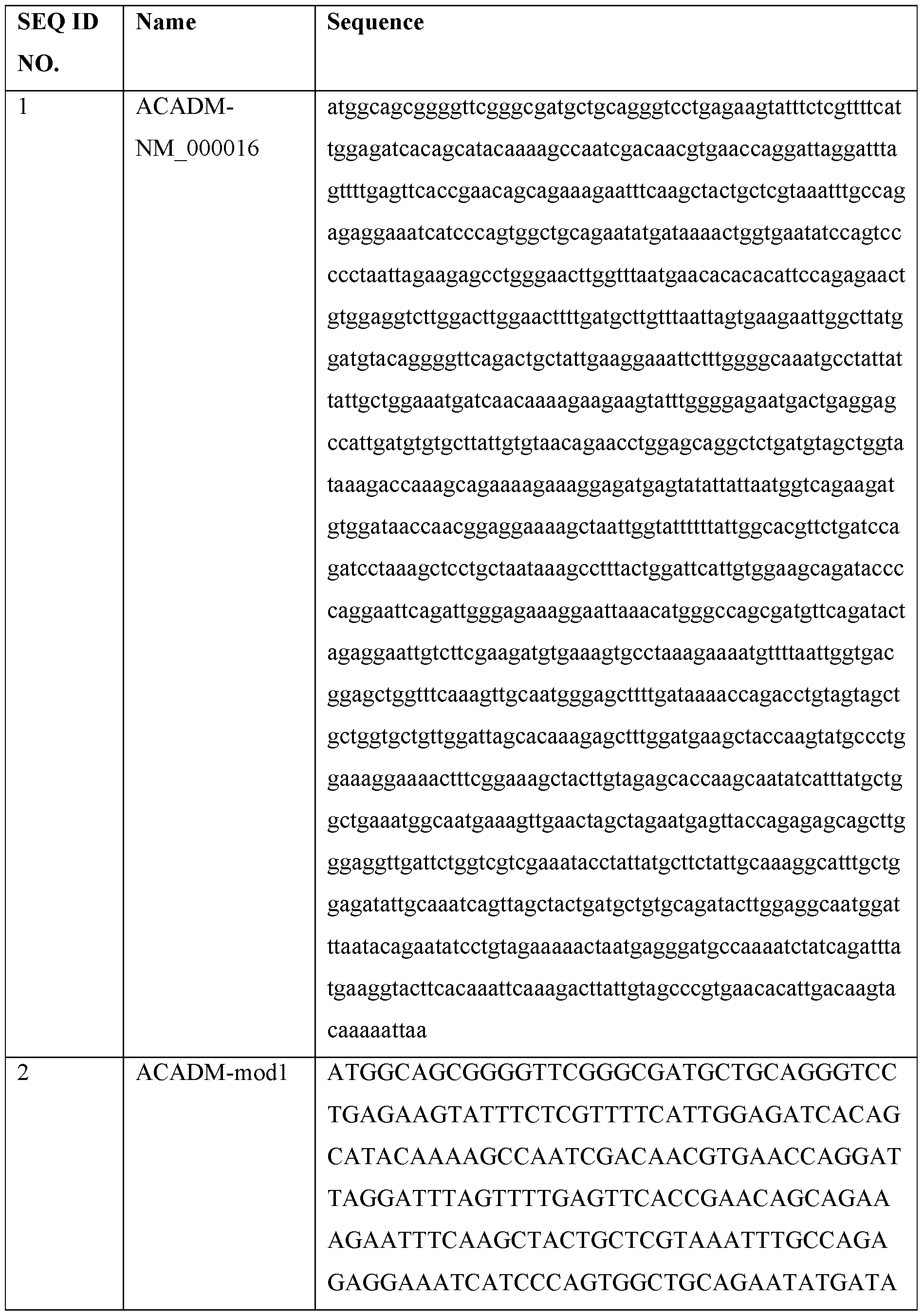
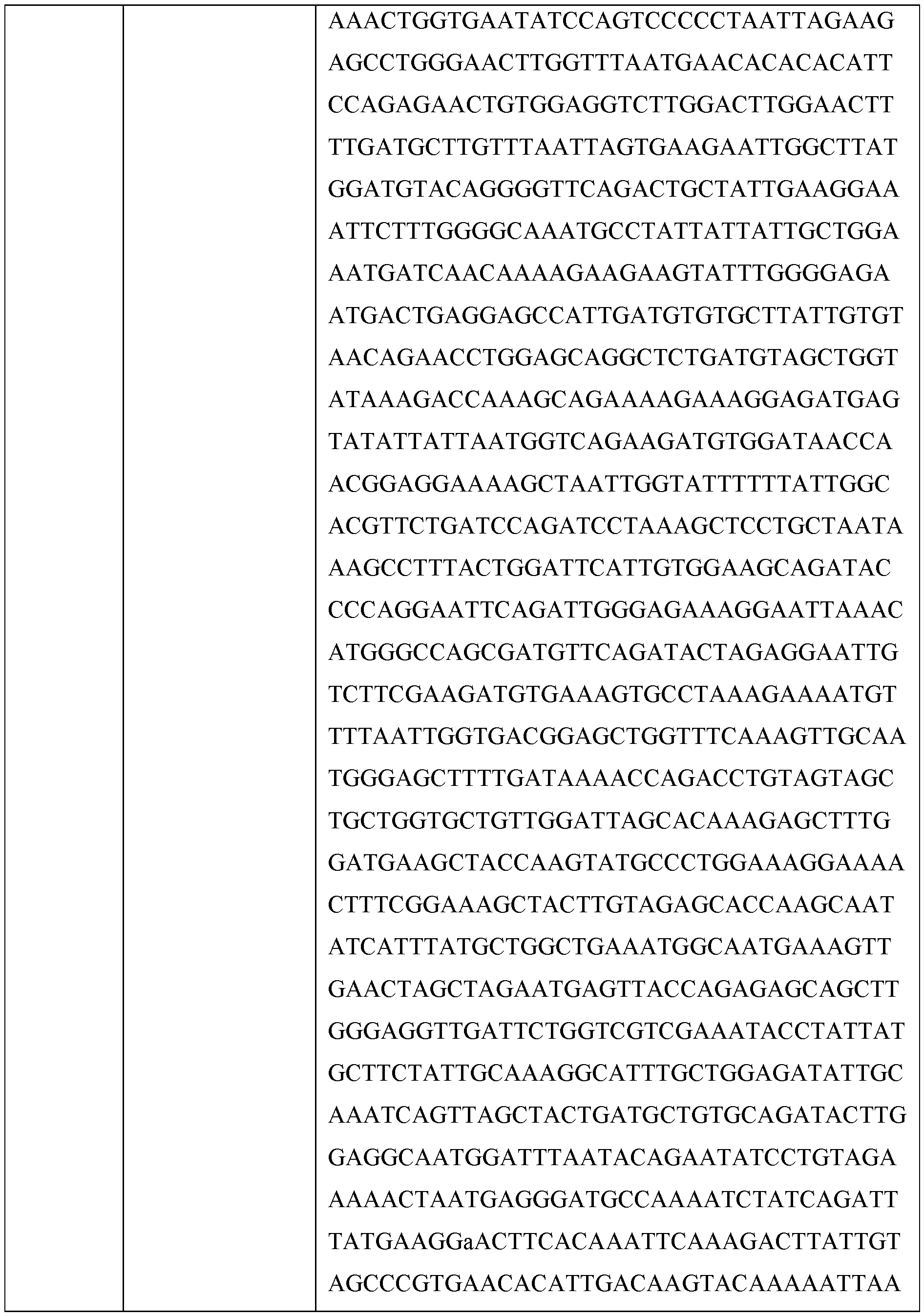
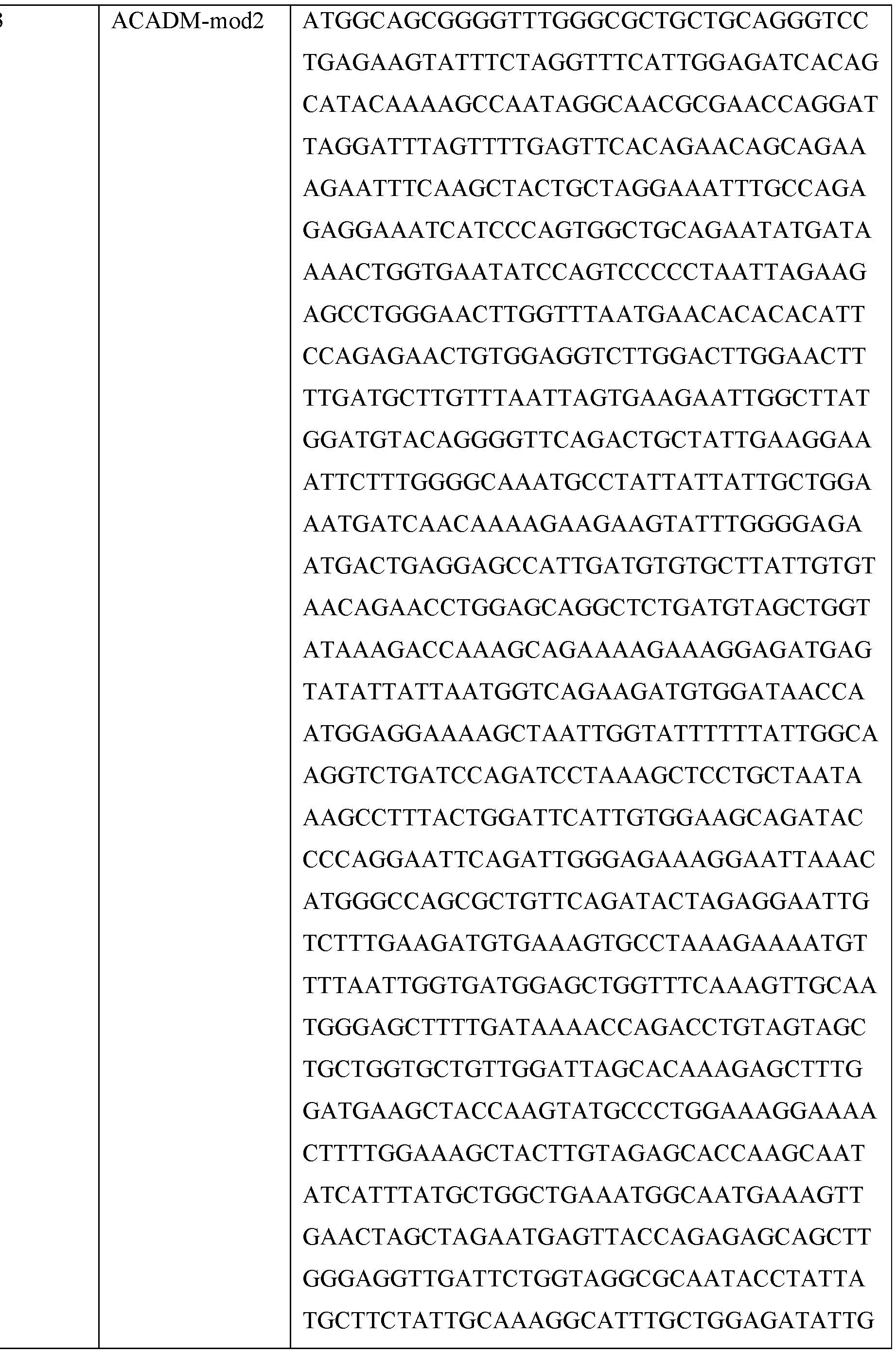
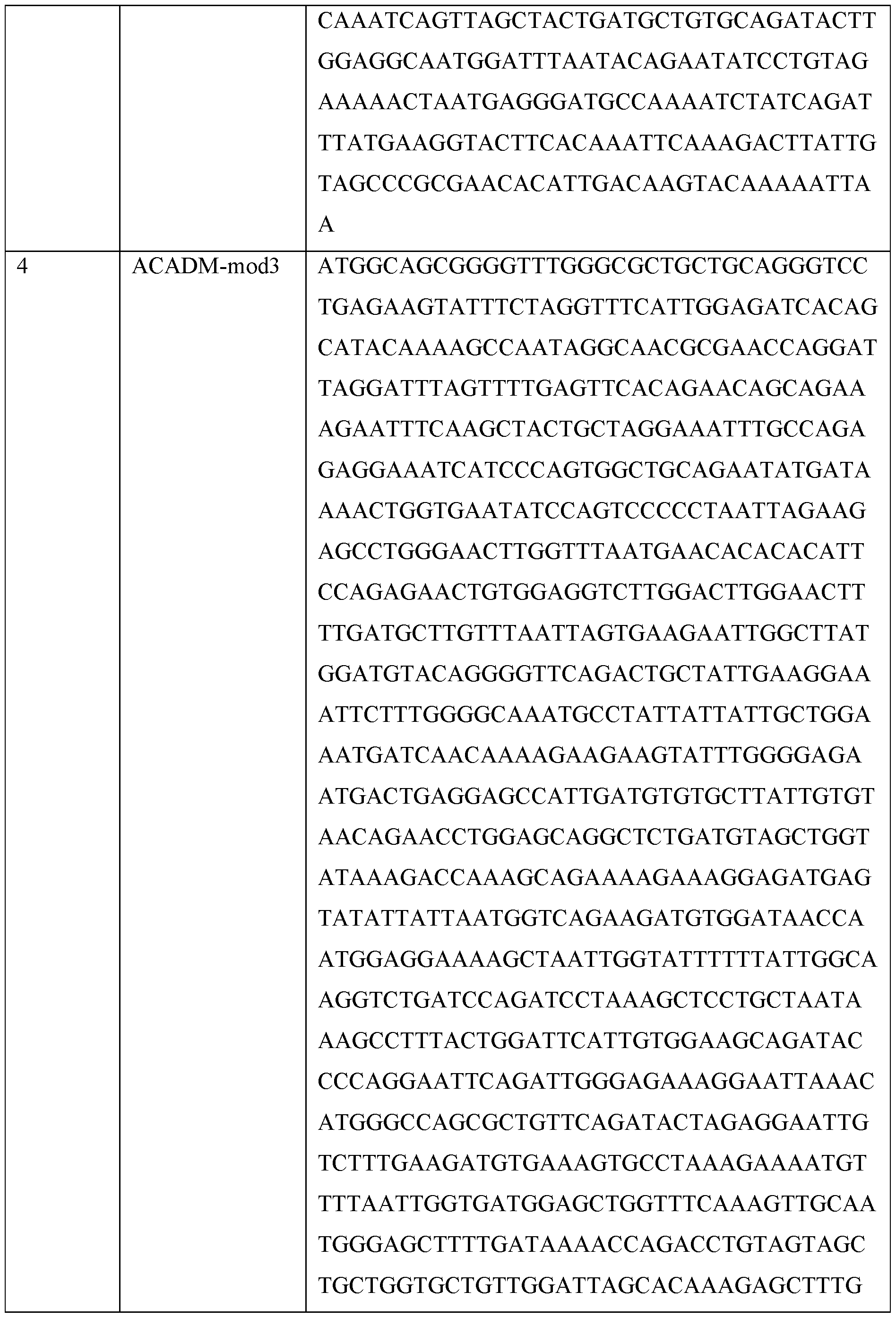

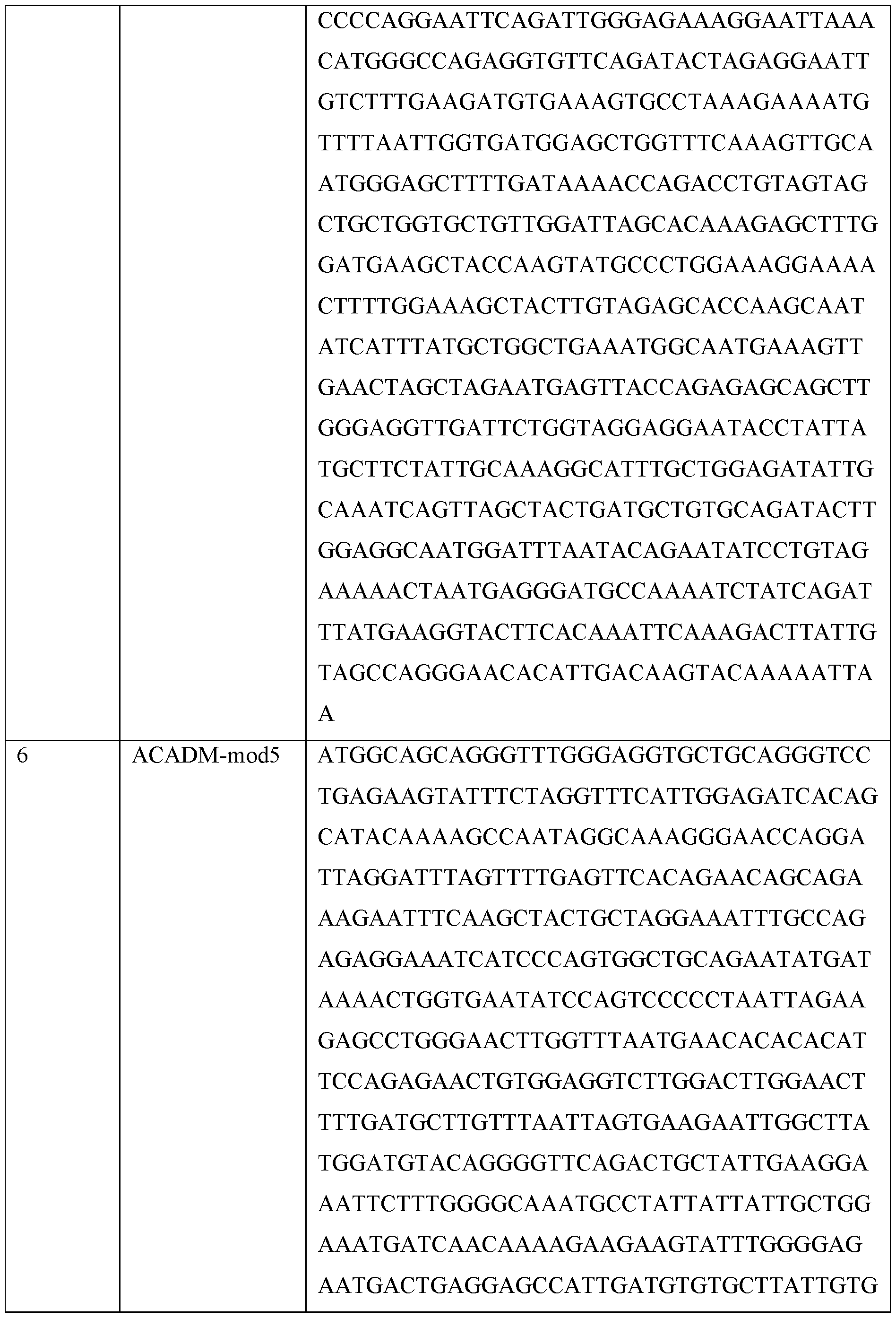


Example 2: Nucleic Acid Encoding Modified Very Long-Chain Acyl-CoA Dehydrogenase
[0271] Modified nucleic acid sequences encoding human very long-chain acyl-CoA dehydrogenase corresponding to SEQ ID NOs: 9-13 were designed in silico. Expression cassettes were prepared with the following elements: 5' ITR-(CAG or smCBA promoter)- VLCAD-BGH polyA-3' ITR. Expression cassette sequences corresponding to SEQ ID NOs: 8-13 (shown in Table 2), and 27-32 were prepared. The prepared ITR to ITR sequences corresponds to SEQ ID NO: 18-23. Examples of constructs are shown in FIG. 16C (WT nucleic acids encoding human VLCAD with smCBA promoter), FIG. 16D (modified nucleic acids encoding human VLCAD with smCBA promoter), FIG. 16E (WT nucleic acids encoding human VLCAD with CAG promoter), and FIG. 16F (modified nucleic acids encoding human VLCAD with CAG promoter).
Th Q ACADVL gene sequence source was GenBank accession number NM 000018 to which modifications were made to generate ACADVL-modl (SEQ ID NO: 9), ACADVL-mod2 (SEQ ID NO: 10), ACADVL-mod3 (SEQ ID NO: 11), ACADVL-mod4 (SEQ ID NO: 12), and ACADVL-mod5 (SEQ ID NO: 13).
[0272] The following modified nucleic acid sequences encoding human very long-chain acyl-CoA dehydrogenase (VLCAD) corresponding to SEQ ID NO: 9-13 (shown in Table 2) were prepared. Th eACADVL gene sequence of GenBank accession number NM 000018 is included as SEQ ID NO: 8.
Table 2: Nucleic Acids Encoding Very Long-Chain Acyl-CoA Dehydrogenase
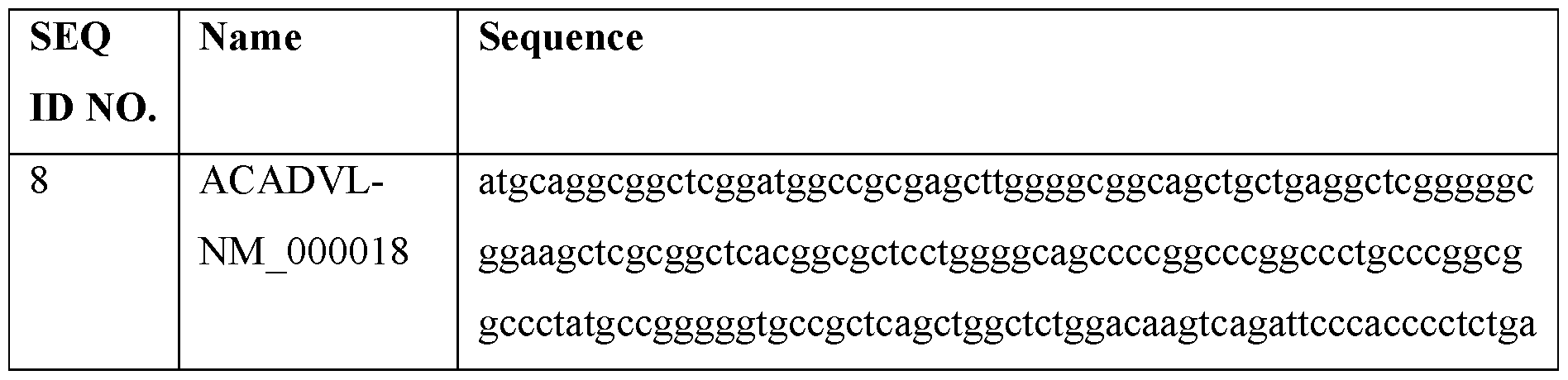
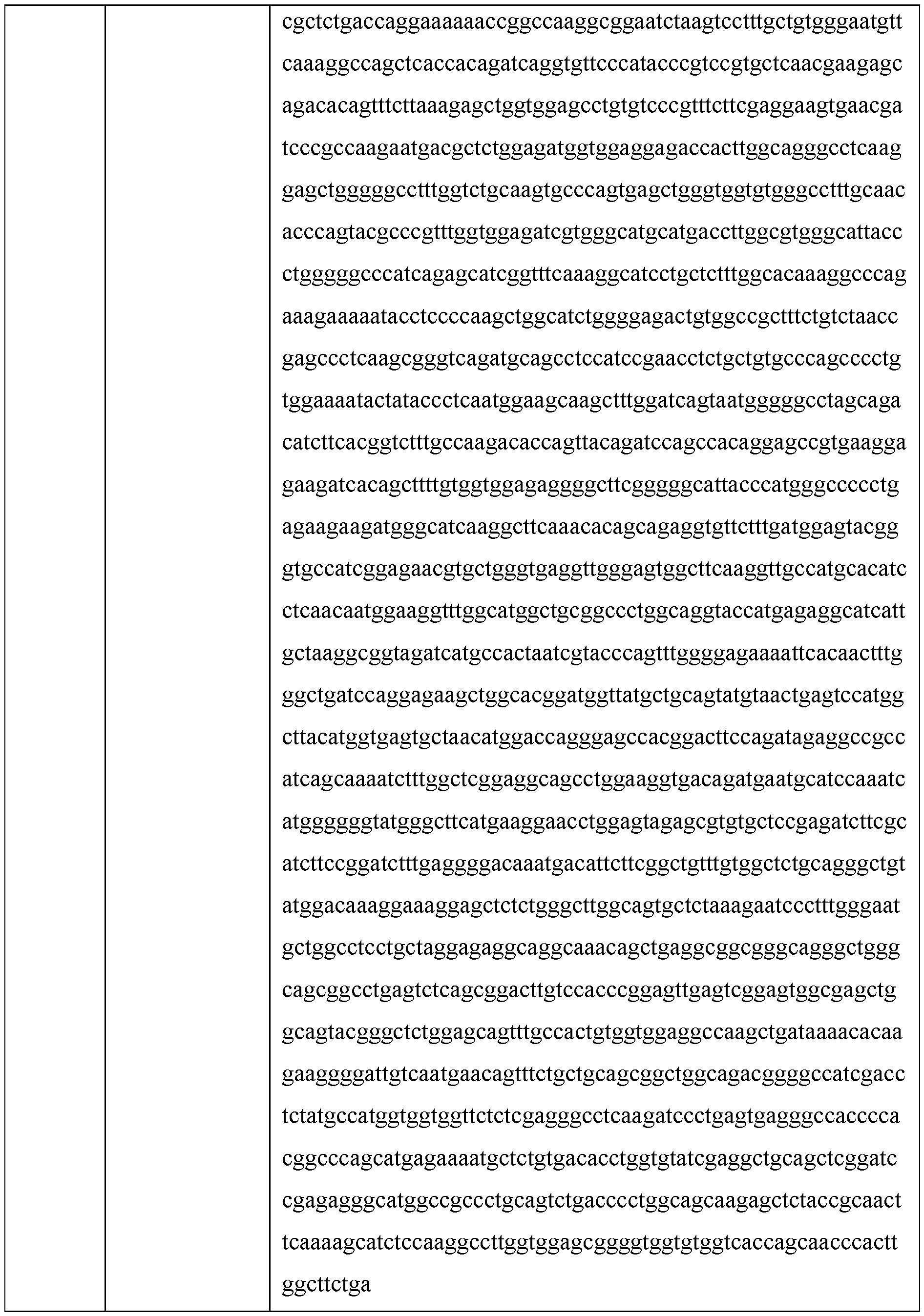
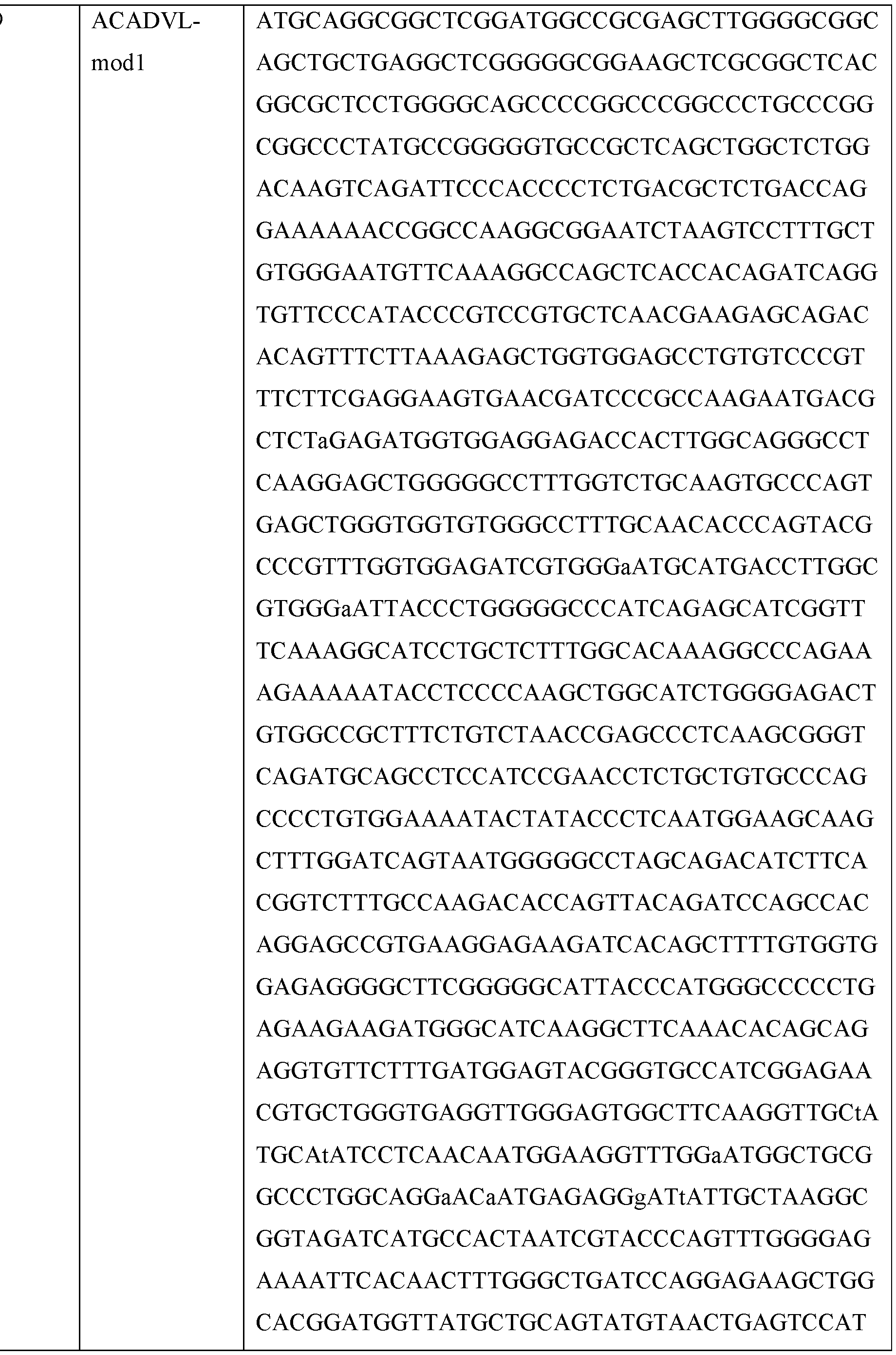


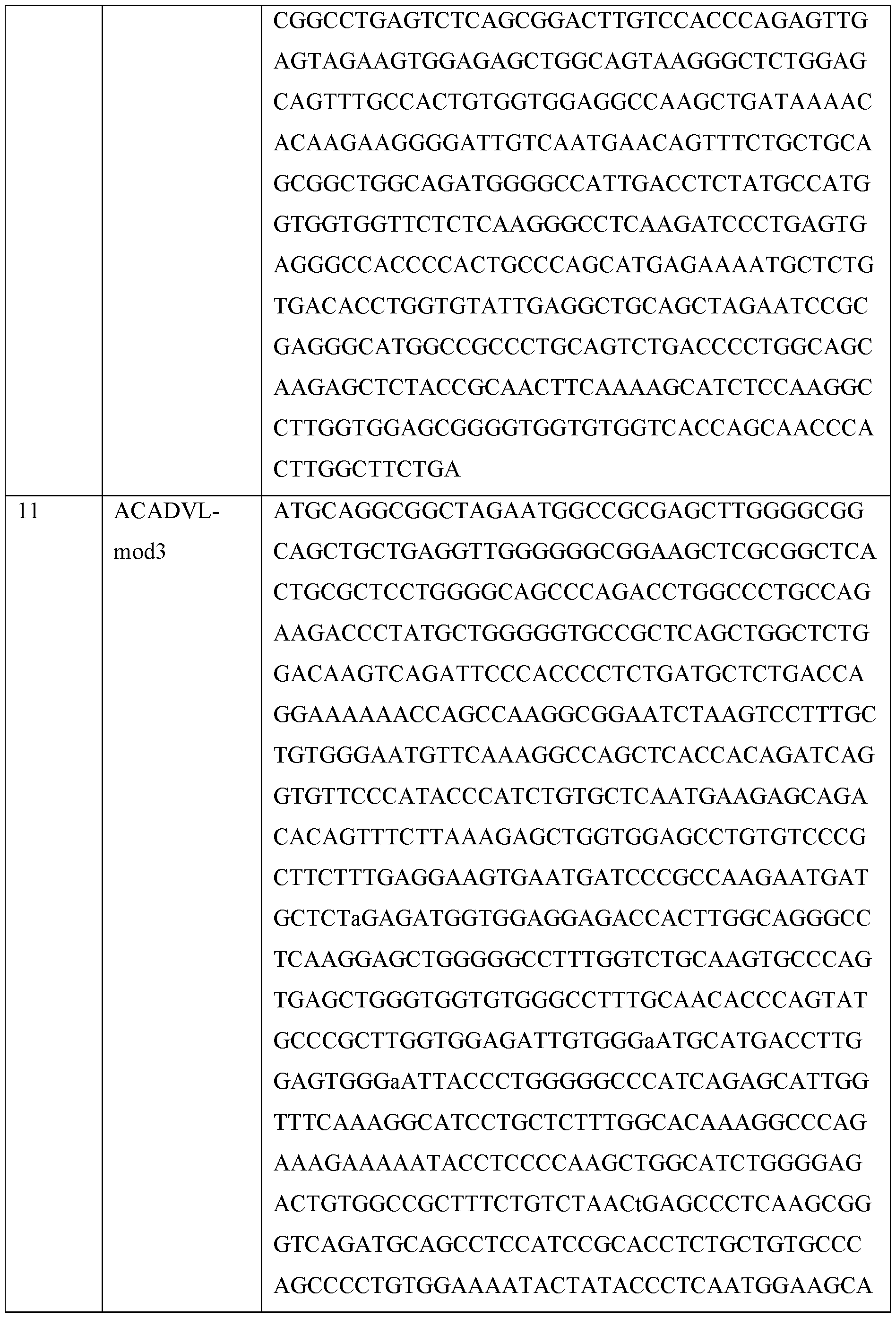
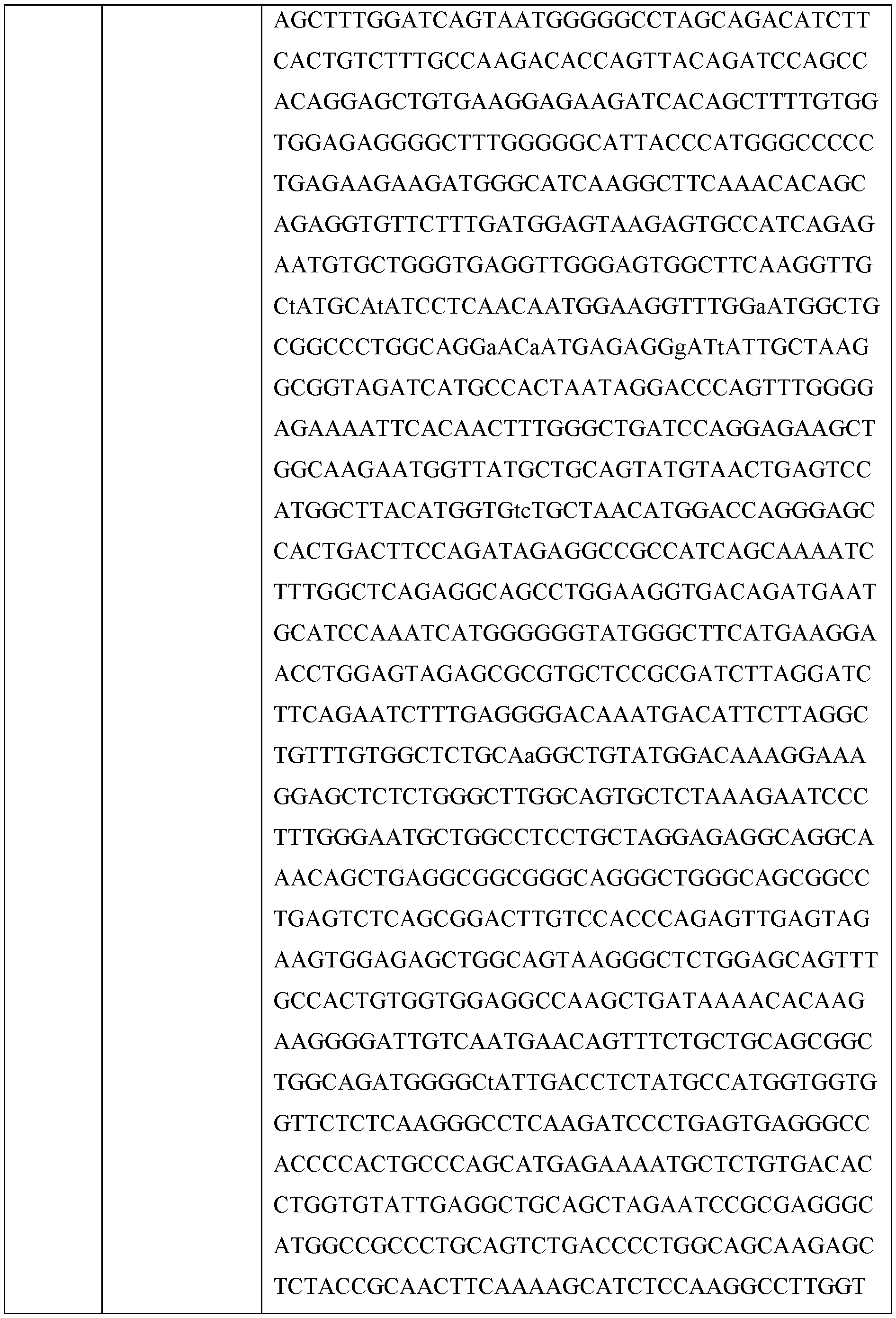
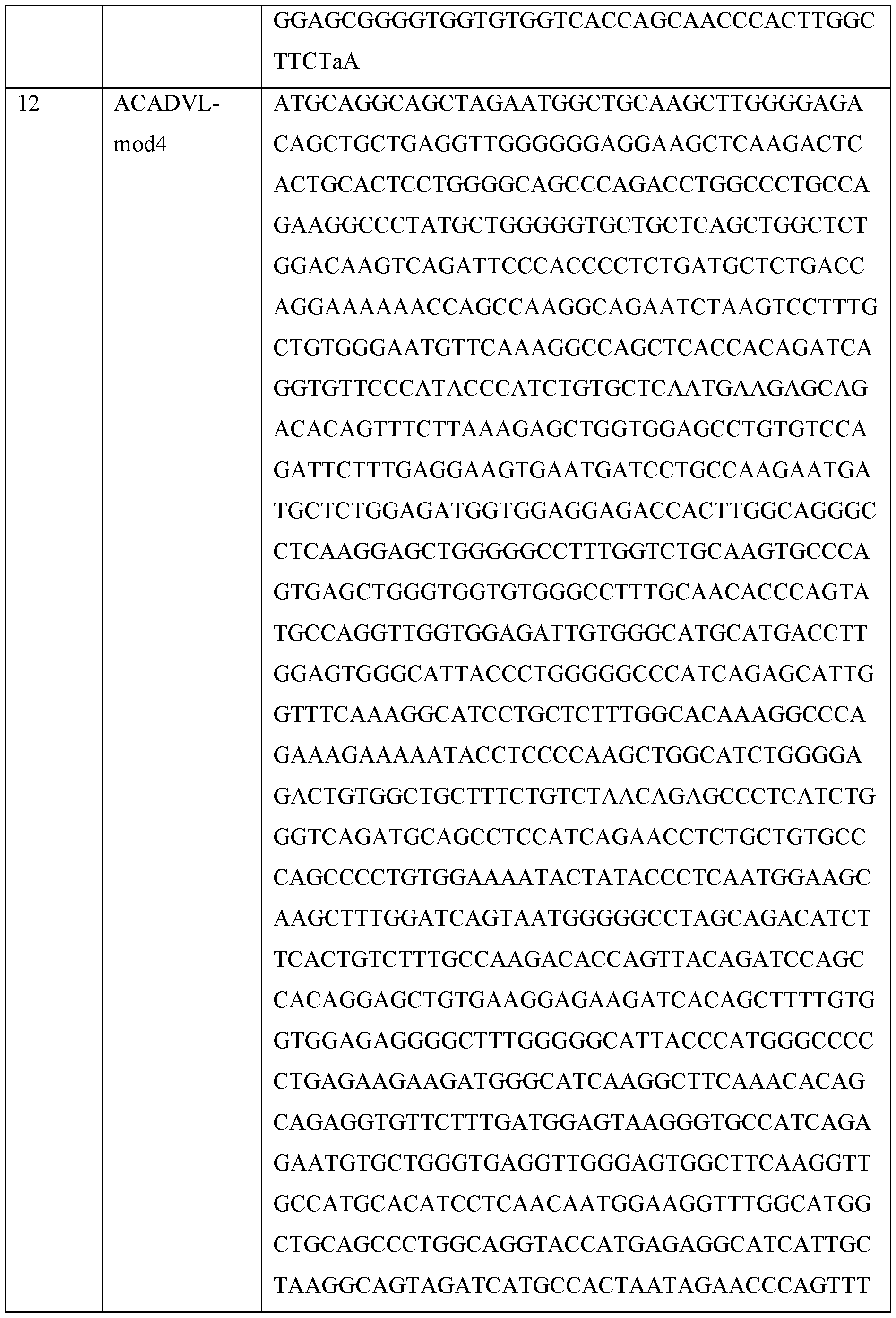
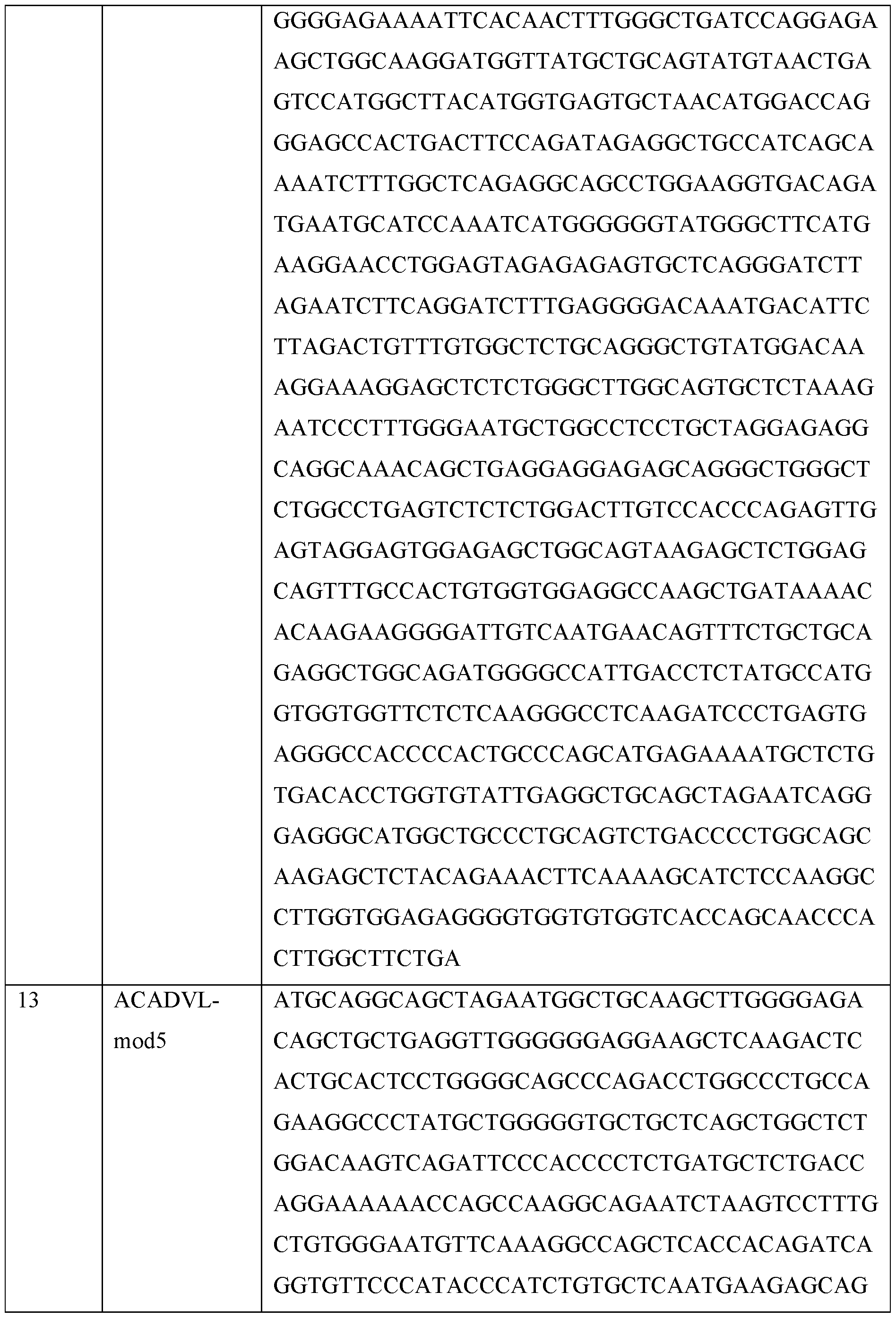
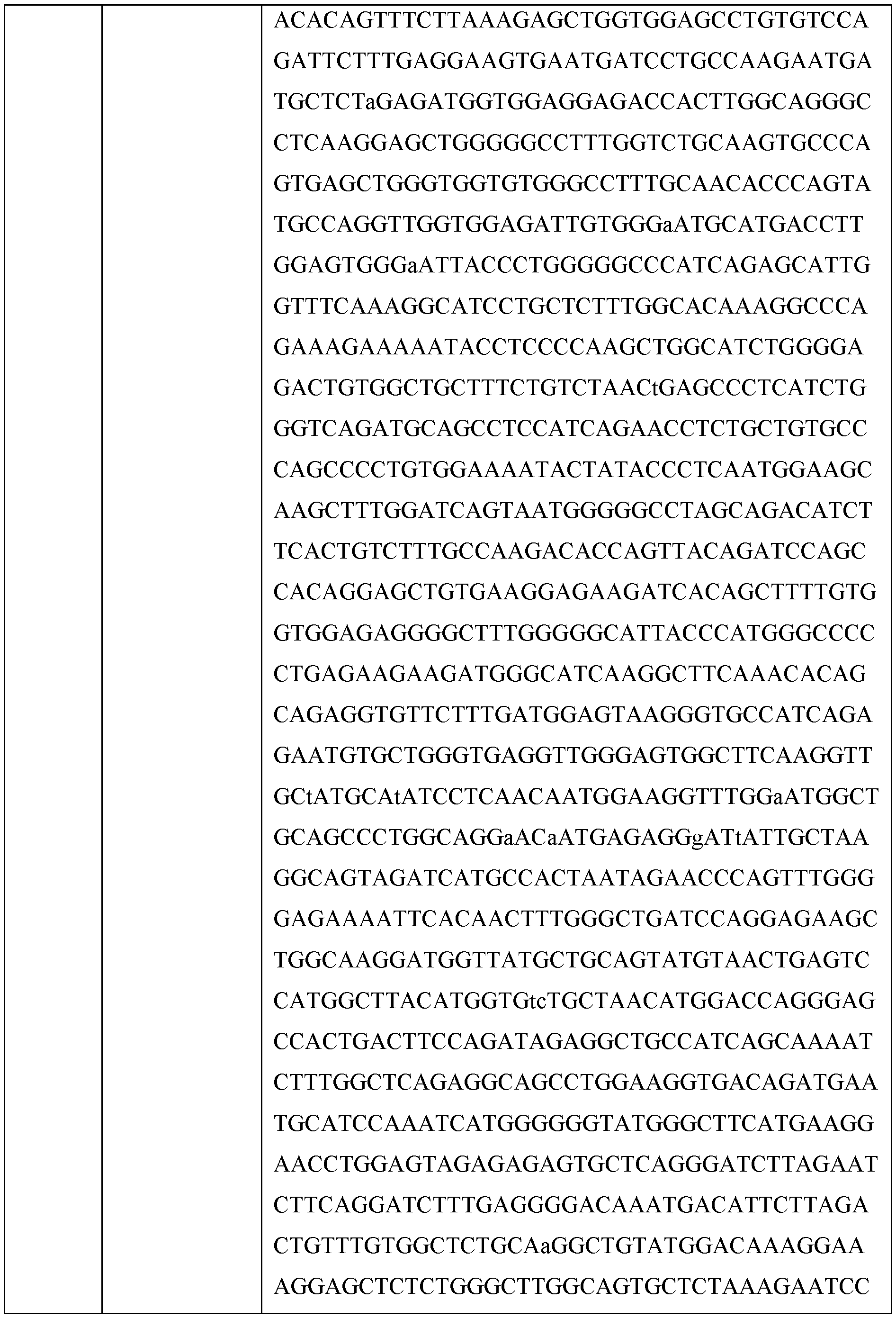
 Example 3: Assessment of AAV-VLCAD vectors
[0273] The constructs disclosed in Example 2 were tested to assess vector transduction, transcription, and protein expression efficiencies.
In vitro screening
[0274] Vector genomic DNA (gDNA) and mRNA expression (cDNA) among different constructs were measured by quantitative polymerase chain reaction (qPCR) (FIGs. 3A- 3B). VLCAD protein expression was measured by Western Blot among different constructs. Constructs tested included C AG- VLCAD- 1 (lane 1), CAG-VLCAD-2 (lane 2), CAG-VLCAD-3 (lane 3), CBA-VLCAD-1 (lane 4), CBA-VLCAD-2 (lane 5), CBA- VLCAD-3 (lane 6), CBh- VLCAD (lane 7), AAV9-GFP (lane 8), and a cell control (lane 9). (FIG. 3C).
[0275] FIG. 3A (gDNA), FIG. 3B (cDNA), and FIG. 3C (protein) collectively show that the vector with the highest transduction, translation, and protein expression in these assays was CBA-VLCAD-2.
HEK293 cell transduction
[0276] Assessment of VLCAD mRNA levels was done using digital droplet PCR (ddPCR) after transduction of HEK293 cells with CAG-VLCAD-1, CAG-VLCAD-2, CAG- VLCAD-3, CBA-VLCAD-1, CBA-VLCAD-2, CBA-VLCAD-3, CBh- VLCAD, and AAV9-GFP.
In vivo analysis
[0277] Cold can induce metabolic disruption in VLCADD patients, since production of heat requires fatty acid oxidation especially after dietary fat stores have been used up. VLCAD-deficient mice are unable to maintain body temperatures during a cold challenge, and it has been shown to be fatal especially when combined with fasting. A cold fast challenge using in vivo mouse model was utilized to test the VLCAD AAV constructs.
[0278] Studies were performed in vivo to get early efficacy reads of the constructs (FIG.
2). lx 1012 vector genomes were administered intravenously. Briefly, blood was drawn 1 week prior to injection, 2 weeks post injection, and 4 weeks post injection. Body temperature was assessed through cold fast challenges. Clinical chemistry analyzing blood glucose and acylcarnitine accumulation was performed. After sacrifice, nucleic acid assessment via qPCR and RT-qPCR of skeletal tissue, cardiac muscle tissue, and liver tissue was performed. Additionally, Western blots and Immunohistochemistry were used
to analyze protein expression in skeletal tissue, cardiac muscle tissue, and liver tissue after sacrifice. Groups were organized as shown in Table 3.
Table 3:
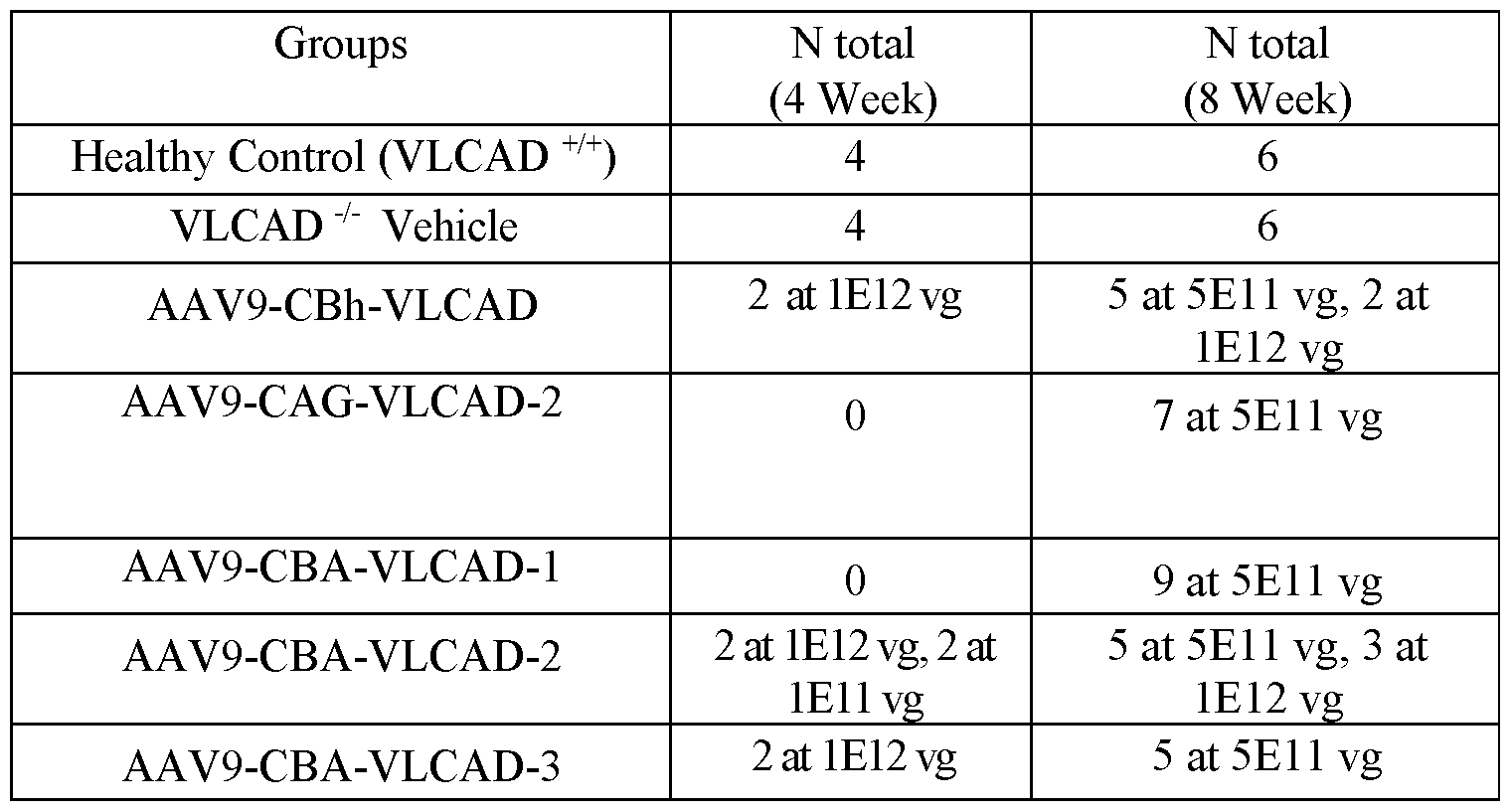
[0279] FIG. 4 shows body temperature (°C) of VLCAD knockout mice 4 weeks after administration of 1 x 10¹² viral genomes (vg) of CBA-VLCAD-2, CBA-VLCAD-3, or CBh- VLCAD. CBA-VLCAD-2 was also administered at 1 c 1011 vg. Wild type mice and untreated VLCAD knockout mice were used as control. A dose response was observed for the CBA-VLCAD-2 vector.
4 week data
[0280] FIG. 5 shows mRNA expression of VLCAD in heart, liver, and skeletal muscle 4 weeks after administration of 1 x 10¹² vg of CBA-VLCAD-2, CBA-VLCAD-3, CBh- VLCAD, or PBS. Wild type mice were used as control. mRNA expression was detected in heart, liver, and skeletal muscle at a similar level across groups.
[0281] FIG. 6A shows a western blot assessing protein expression of human VLCAD in heart and liver after administration of CBA-VLCAD-2 (5E11 vg/mouse). Human VLCAD expression is observed in cardiac muscle and liver from CBA-VLCAD-2 dosing at 5E11 vg/mouse (representative images from 5-9 animals). WT control is negative because antibody is specific for human Very Long-Chain Acyl-Coenzyme A Dehydrogenase (VLCAD).
[0282] FIG. 6B shows a western blot assessing protein expression of human VLCAD in heart and liver after administration of CAG-VLCAD-2 (5E11 vg/mouse). Human VLCAD expression is observed in cardiac muscle and liver from CAG-VLCAD-2 dosing at 5E11
vg/mouse (representative images from 5-9 animals). WT control is negative because antibody is specific for human Very Long-Chain Acyl-Coenzyme A Dehydrogenase (VLCAD)
[0283] FIGs. 7A-7B show body temperature (°C) (FIG. 7A) and glucose (mg/dL) (FIG.
7B) in VLCAD KO mice 8 weeks after administration of 5 x 10¹¹ of CAG-VLCAD-2, CBA-VLCAD-1, CBA-VLCAD-2, CBA-VLCAD-3, or CBh- VLCAD. Untreated VLCAD KO mice and VLCAD WT mice were used as controls. The CAG-VLCAD-2 vector was comparable to CBh-VLCAD and CBA-VLCAD-1 at 5 x 10¹¹ in maintaining body temperature and appeared to performed better than the CBA-VLCAD-2 vector.
[0284] FIGs. 8A-8B show body temperature (°C) (FIG. 8A) and glucose (mg/dL) (FIG.
8B) in VLCAD KO mice 8 weeks after administration of 5 x 10¹¹ of CAG-VLCAD-2 or CBA-VLCAD-1. Untreated VLCAD KO mice and VLCAD WT mice were used as controls. The CBA-VLCAD-1 and CAG-VLCAD-2 vectors perform very similar in the cold-fast challenge (CFC). The CBA-VLCAD-1 has a higher mean glucose value at the 8- week time point.
[0285] FIGs. 9A-9D show acylcarnitine serum levels (ng/mL) 6 weeks after treatment with
CAG-VLCAD-2 (5 x 10¹¹ vg), CBA-VLCAD-2 (5 x 10¹¹ vg), or CBh-VLCAD (5 x 10¹¹ vg). Concentrations of acylcarnitine species with C16 (FIG. 9A), Cl 8 (FIG. 9B), Cl 8:1 (FIG. 9C), and Cl 8:2 (FIG. 9D) were analyzed. Acylcarnitine levels in serum on average were lowest after 6 weeks post dosing of CAG-VLCAD-2 vector at 5xl0u vg/mouse. All vectors lowered acylcarnitine levels.
[0286] FIGs. 10A-10D show acylcarnitine serum levels (ng/mL) 6 weeks after treatment with CAG-VLCAD-2 (5 x 10¹¹ vg), CBA-VLCAD-1 (5 x 10¹¹ vg). Concentrations of acylcarnitine species with C16 (FIG. 10A), C18 (FIG. 10B), Cl 8:1 (FIG. IOC), and Cl 8:2 (FIG. 10D) were analyzed. Across the different carbon chains there was no real difference in performance of the CBA-VLCAD-1 vs CAG-VLCAD-2.
[0287] FIGs. 11 A-l IB show body temperature (°C) (FIG. 11 A) and glucose (mg/dL) at 8 weeks post injection (FIG. 1 IB) in male VLCAD KO mice after administration of 1 x 10¹² of CAG-VLCAD-2, CBA-VLCAD-2 or CBh-VLCAD. The CAG-VLCAD-2 model showed the best performance overall. Glucose readings were not as differentiated; however, these are low Ns and one animal in the untreated group had higher readings than historically observed.
[0288] FIGs. 12A-12B show body temperature (°C) (FIG. 12A and glucose (mg/dL) at 8 weeks post injection (FIG. 12B) in female VLCAD KO mice after administration of 1 x 10¹² of CAG-VLCAD-2, CBA-VLCAD-2 or CBh- VLCAD. All vectors performed well at 1 x 10¹² vg/mouse in females. Glucose readings were not differentiated; however, at the 8-week time point post CFC there was a trend for treated animals to have higher blood glucose (BG) levels than untreated.
[0289] FIGs. 13A-13D show acylcamitine serum levels (ng/mL) 8 weeks after treatment with CAG-VLCAD-2 (5 x 10¹¹ vg), CBA-VLCAD-2 (5 x 10¹¹ vg), CBh- VLCAD (5 x 10¹¹ vg), CBA-VLCAD-3 (5 x 10¹¹ vg), or CBA-VLCAD-1 (5 x 10¹¹ vg). Untreated VLCAD KO mice and WT VLCAD mice were used as controls. Concentrations of acylcamitine species with C16 (FIGs. 13A), C18 (FIG. 13B), C18:l (FIG. 13C), and C18:2 (FIG. 13D) were analyzed.
[0290] FIGs. 14A-14D show acylcamitine serum levels (ng/mL) 8 weeks after treatment with CAG-VLCAD-2 (5 x 10¹¹ vg) or CBA-VLCAD-1 (5 x 10¹¹ vg). VLCAD WT mice or untreated VLCAD KO mice were used as controls. Concentrations of acylcamitine species with C16 (FIGs. 14A), C18 (FIG. 14B), C18:l (FIG. 14C), and C18:2 (FIG. 14D) were analyzed.
[0291] These results show that the CAG-VLCAD-2 construct performed best across all metrics on average. The lx 1011 dose was ineffective with all vector tested; however, the higher 5x10¹¹ dose of CAG-VLCAD-2 performed similar to high performing vectors at a lx 1012 dose.
Example 4: Dose Selection of CBA-VLCAD-1 and CAG-VLCAD-2
[0292] The CBA-VLCAD-1 and CAG-VLCAD-2 constructs disclosed in Example 2 will be analyzed to select appropriate dosage. VLCAD WT mice and untreated VLCAD KO mice will be used as controls. VLCAD KO mice will be intravenously injected with vehicle, CBA-VLCAD-1, or CAG-VLCAD-2 at doses of2.5xlOu, 5xl0u, or DIO12 vg/mouse (see Table 4).
Table 4:

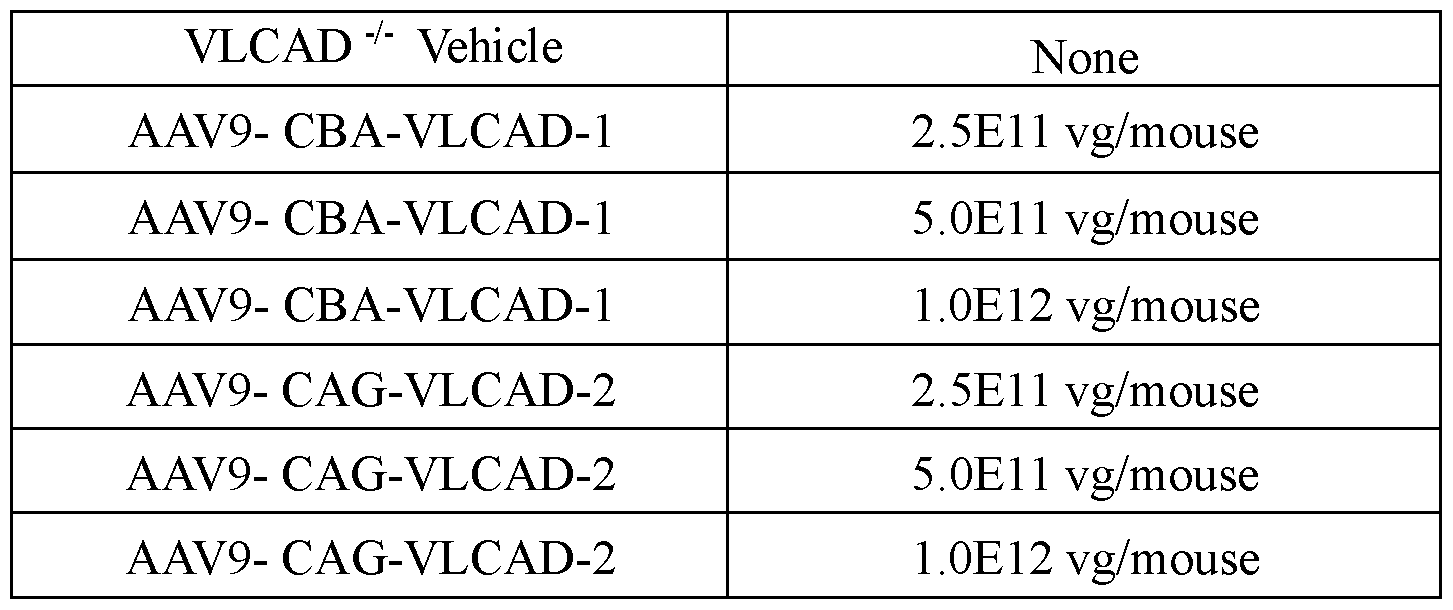
[0293] Blood will be drawn one week preinjection, and 2, 4, 8, 10, 12, 24, 36, and 48 weeks post injection. The blood will be analyzed for glucose and acylcamitines. Cold Fast Challenges will be performed at 12, 36, and 52 weeks post injection. Magnetic Resonance Spectroscopy will be performed at 10, 24 and 48 weeks post injection. After sacrifice, nucleic acid assessment via qPCR and RT-qPCR of skeletal tissue, cardiac muscle tissue, and liver tissue will be performed. Additionally, Western blots and Immunohistochemistry will be used to analyze protein expression in skeletal tissue, cardiac muscle tissue, and liver tissue after sacrifice. (FIG. 15).
Claims
1. A recombinant AAV (rAAV) vector comprising: (a) an AAV capsid and (b) a polynucleotide comprising (i) 3’ and 5’ inverted terminal repeat (ITR) sequences and (ii) an expression cassette comprising a nucleic acid sequence at least 95%, 95.5%, 96%, 96.5%, 97%, 97.5%, 98%, 98.5%, 99%, 99.5% or 100% identical to SEQ ID NO: 8, 9, 10, 11, 12, or 13 and a heterologous expression control sequence operably linked to the nucleic acid sequence, wherein the nucleic acid encodes a very long-chain acyl-CoA dehydrogenase (VLCAD) protein.
2. An expression cassette comprising a nucleic acid sequence at least 95%, 95.5%, 96%, 96.5%, 97%, 97.5%, 98%, 98.5%, 99%, 99.5% or 100% identical to SEQ ID NOs: 9, 10, 11, 12, or 13; and (ii) a heterologous expression control sequence operably linked to the nucleic acid sequence, wherein the nucleic acid encodes a very long-chain acyl-CoA dehydrogenase (VLCAD) protein.
3. A polynucleotide comprising a nucleic acid encoding a very long-chain acyl-CoA dehydrogenase (VLCAD) protein wherein the nucleic acid comprises a nucleotide sequence at least 95%, 95.5%, 96%, 96.5%, 97%, 97.5%, 98%, 98.5%, 99%, 99.5% or 100% identical to any one of SEQ ID NOs: 9 -13.
4. The polynucleotide of claims 3, wherein the polynucleotide further comprises a heterologous expression control sequence.
5. The rAAV vector of claim 1, expression cassette of claim 2, or polynucleotide of claim 4, wherein the heterologous expression control sequence is a promoter.
6. The rAAV vector, expression cassette, or polynucleotide of claim 5, wherein the promoter is a eukaryotic promoter.
7. The rAAV vector, the expression cassette, or the polynucleotide of claim 5, wherein the promoter is a cytomegalovirus (CMV) promoter, a CMV-chicken b-actin (CBA) promoter, or a small CMV-chicken b-actin (smCBA) promoter.
8. The rAAV vector, the expression cassette, or the polynucleotide of claim 7, wherein the promoter is a CBA promoter.
9. The rAAV vector, the expression cassette, or the polynucleotide of claim 7, wherein the promoter is a smCBA promoter.
10. The rAAV vector of any one of claims 1 or 5-9, the expression cassette of any one of claims 2 or 5-9, or the polynucleotide of any one of claims 3-9, wherein the nucleic acid is operably linked to a polyadenylation (poly A) element.
11. The rAAV vector, the expression cassette, or the polynucleotide of claim 10, wherein the polyA element comprises a bovine growth hormone (BGH) poly A, a SV40 early polyadenylation signal sequence, or a human growth hormone (hGH) polyadenylation signal.
12. The rAAV vector of any one of claims 1 or 5-11, wherein the expression cassette is flanked at the 5' end and the 3' end with the ITR sequences from serotype AAV2.
13. The expression cassette of any one of claims 2 or 5-11 or the polynucleotide of any one of claims 3-11, comprising inverted terminal repeat (ITR) sequences.
14. A vector comprising the expression cassette of any one of claims 2, 5-11 or 13, or the polynucleotide of any one of claims 3-11 or 13.
15. The vector of claim 14, wherein the vector is a viral vector, a non-viral vector, a plasmid, a lipid, or a liposome.
16. The vector of claim 14 or 15, wherein the vector is an adeno-associated virus (AAV) vector or a lentivirus vector.
17. The rAAV vector of any one of claims 1 or 5-12 or the vector of claims 16, wherein the AAV capsid serotype is selected from the group consisting of AAV1, AAV2, AAV3, AAV4, AAV5, AAV6, AAV7, AAV8, AAVrh8, AAV9, AAVrh9, AAV10, AAVrhlO, AAV11, and AAV12.
18. The rAAV vector or the vector of claim 17, wherein the AAV capsid serotype is
AAV9.
19. A host cell comprising the rAAV vector, the expression cassette, the polynucleotide or the vector of any of the previous claims.
20. The host cell of claim 19, wherein the host cell is a mammalian cell.
21. A pharmaceutical composition comprising the rAAV vector, the expression cassette, the polynucleotide or the vector of the previous claims and a pharmaceutically acceptable carrier.
22. A method of producing the VLCAD protein in a cell comprising contacting and/or transforming the cell with the rAAV vector, the expression cassette, the polynucleotide, the vector, or pharmaceutical composition of any of the previous claims, thereby producing the VLCAD protein in the cell.
23. A method of producing the VLCAD protein in a subject, comprising administering to the subject the rAAV vector, the expression cassette, the polynucleotide, the vector, or pharmaceutical composition of any of the previous claims, thereby producing the VLCAD in the subject.
24. A method of treating or ameliorating the symptoms associated with very long-chain acyl-CoA dehydrogenase deficiency (VLCADD) in a subject in need thereof, comprising administering to the subject a therapeutically effective amount of the rAAV vector, the expression cassette, the polynucleotide, the vector, or pharmaceutical composition of any of the previous claims, thereby treating the VLCADD in the subject.
25. The method of claim 24, wherein the administering comprises a dose within the range of 6E12 vector genomes per kilogram (vg/kg) to 1E14 vg/kg, 6E12 vg/kg to 2.5E13 vg/kg, 6E12 vg/kg to 1.25E13 vg/kg, 1.25E13 vg/kg to 1E14 vg/kg, 2.5E13 vg/kg to 1E14 vg/kg, or 1.25E13 vg/kg to 2.5E13 vg/kg.
26. The method of claim 25, wherein the administering comprises a dose within the range of 6E12 vector genomes per kilogram (vg/kg) to 1E14 vg/kg.
27. The method of claim 25, wherein the administering comprises a dose within the range of 1.25E13 vg/kg to 2.5E13 vg/kg.
28. A recombinant AAV (rAAV) vector comprising: (a) an AAV capsid and (b) a polynucleotide comprising (i) 3’ and 5’ inverted terminal repeat (ITR) sequences and (ii) an expression cassette comprising a nucleic acid sequence at least 98%, 98.5%, 99%, 99.5%, or 100%
identical to SEQ ID NO: 1, 2, 3, 4, 5, or 6 and a heterologous expression control sequence operably linked to the nucleic acid sequence, wherein the nucleic acid encodes a medium-chain acyl-CoA dehydrogenase (MCAD) protein.
29. An expression cassette comprising a nucleic acid sequence at least 98%, 98.5%, 99%, 99.5%, or 100% identical to any one of SEQ ID NO: 2 -6; and (ii) a heterologous expression control sequence operably linked to the nucleic acid sequence, wherein the nucleic acid encodes a medium-chain acyl-CoA dehydrogenase (MCAD) protein.
30. A polynucleotide comprising a nucleic acid encoding a medium-chain acyl-CoA dehydrogenase (MCAD) protein wherein the nucleic acid comprises a nucleotide sequence at least 98%, 98.5%, 99%, 99.5%, or 100% identical to SEQ ID NO: 1, 2, 3, 4, 5, or 6.
31. The polynucleotide of claim 30, wherein the polynucleotide further comprises a heterologous expression control sequence.
32. The rAAV vector of claim 28, expression cassette of claim 29, or polynucleotide of claim 30, wherein the heterologous expression control sequence is a promoter.
33. The rAAV vector, expression cassette, or polynucleotide of claim 32, wherein the promoter is a eukaryotic promoter.
34. The rAAV vector, the expression cassette, or the polynucleotide of claim 33, wherein the promoter is a cytomegalovirus (CMV) promoter, a CMV-chicken b-actin (CBA) promoter, or a small CMV-chicken b-actin (smCBA) promoter.
35. The rAAV vector of any one of claims 28 or 32-34, the expression cassette of any one of claims 29 or 32-34, or the polynucleotide of any one of claims 30-34 wherein the nucleic acid is operably linked to a polyadenylation (poly A) element.
36. The rAAV vector, the expression cassette, or the polynucleotide of claim 35, wherein the polyA element comprises a bovine growth hormone (BGH) poly A, a SV40 early polyadenylation signal sequence, or a human growth hormone (hGH) polyadenylation signal.
37. The rAAV vector of any one of claims 28 or 32-36, wherein the expression cassette is flanked at the 5' end and the 3' end with ITR sequences from serotype AAV2.
38. The expression cassette of any one of claims 29 or 32-36, or the polynucleotide of any one of claims 31-36, comprising inverted terminal repeat (ITR) sequences.
39. A vector comprising the expression cassette of any one of claims 29, 32-36 or 38, or the polynucleotide of any one of claims 31-36 or 38.
40. The vector of claim 39, wherein the vector is a viral vector, a non-viral vector, a plasmid, a lipid, or a liposome.
41. The vector of claim 39 or 40, wherein the vector is an adeno-associated virus (AAV) vector or a lentivirus vector.
42. The rAAV vector of any one of claims 28 or 32-37 or the vector of claim 41, wherein the AAV capsid serotype is selected from the group consisting of AAV1, AAV2, AAV3, AAV4, AAV5, AAV6, AAV7, AAV8, AAVrh8, AAV9, AAVrh9, AAV10, AAVrhlO, AAV11, and AAV12.
43. A host cell comprising the rAAV vector, the expression cassette, the polynucleotide or the vector of any of the previous claims.
44. The host cell of claim 43, wherein the host cell is a mammalian cell.
45. A pharmaceutical composition comprising the rAAV vector, the expression cassette, the polynucleotide or the vector of the previous claims and a pharmaceutically acceptable carrier.
46. A method of producing the MCAD protein in a cell comprising contacting and/or transforming the cell with the rAAV vector, the expression cassette, the polynucleotide, the vector, or pharmaceutical composition of any of the previous claims, thereby producing the MCAD protein in the cell.
47. A method of producing the MCAD protein in a subject, comprising administering to the subject the rAAV vector, the expression cassette, the polynucleotide, the vector, or pharmaceutical composition of any of the previous claims, thereby producing the MCAD in the subject.
48. A method of treating or ameliorating the symptoms associated with medium-chain acyl-CoA dehydrogenase deficiency (MCADD) in a subject in need thereof, comprising administering to the subject a therapeutically effective amount of the rAAV vector, the expression cassette, the polynucleotide, the vector, or pharmaceutical composition of any of the previous claims, thereby treating the MCADD in the subject.
Applications Claiming Priority (2)
| Application Number | Priority Date | Filing Date | Title |
|---|---|---|---|
| US202163174478P | 2021-04-13 | 2021-04-13 | |
| US63/174,478 | 2021-04-13 |
Publications (1)
| Publication Number | Publication Date |
|---|---|
| WO2022221462A1 true WO2022221462A1 (en) | 2022-10-20 |
Family
ID=81749315
Family Applications (1)
| Application Number | Title | Priority Date | Filing Date |
|---|---|---|---|
| PCT/US2022/024698 Ceased WO2022221462A1 (en) | 2021-04-13 | 2022-04-13 | Vector constructs for delivery of nucleic acids encoding therapeutic vlcad or mcad and methods of using the same |
Country Status (1)
| Country | Link |
|---|---|
| WO (1) | WO2022221462A1 (en) |
Citations (11)
| Publication number | Priority date | Publication date | Assignee | Title |
|---|---|---|---|---|
| WO1996013597A2 (en) | 1994-10-28 | 1996-05-09 | The Trustees Of The University Of Pennsylvania | Improved adenovirus and methods of use thereof |
| US6165782A (en) | 1997-12-12 | 2000-12-26 | Cell Genesys, Inc. | Method and means for producing high titer, safe, recombinant lentivirus vectors |
| US6204059B1 (en) | 1994-06-30 | 2001-03-20 | University Of Pittsburgh | AAV capsid vehicles for molecular transfer |
| US6207455B1 (en) | 1997-05-01 | 2001-03-27 | Lung-Ji Chang | Lentiviral vectors |
| US6218181B1 (en) | 1998-03-18 | 2001-04-17 | The Salk Institute For Biological Studies | Retroviral packaging cell line |
| US6277633B1 (en) | 1997-05-13 | 2001-08-21 | The University Of North Carolina At Chapel Hill | Lentivirus-based gene transfer vectors |
| US6323031B1 (en) | 1999-03-05 | 2001-11-27 | Bundesrepublik Deutschland Letztvertreten Durch Den Prasidenten Des Paul-Elrich-Instituts Prof. Dr. R. Kruth | Lentiviral vectors derived from SIVagm, methods for their preparation and their use for gene transfer into mammalian cells |
| WO2002082904A2 (en) | 2001-04-13 | 2002-10-24 | The Trustees Of The University Of Pennsylvania | Method of treating or retarding the development of blindness |
| WO2003038130A2 (en) * | 2001-10-31 | 2003-05-08 | Pfizer Products Inc. | Therapeutics and diagnostics for disorders of erythropoiesis |
| WO2007127428A2 (en) | 2006-04-28 | 2007-11-08 | University Of Florida Research Foundation, Inc. | Double-stranded/self-complementary vectors with a truncated cba promoter and methods of gene delivery |
| US20120072124A1 (en) * | 2005-12-15 | 2012-03-22 | Rosetta Inpharmatics, Llc | Genes associated with progression and response in chronic myeloid leukemia and uses thereof |
-
2022
- 2022-04-13 WO PCT/US2022/024698 patent/WO2022221462A1/en not_active Ceased
Patent Citations (11)
| Publication number | Priority date | Publication date | Assignee | Title |
|---|---|---|---|---|
| US6204059B1 (en) | 1994-06-30 | 2001-03-20 | University Of Pittsburgh | AAV capsid vehicles for molecular transfer |
| WO1996013597A2 (en) | 1994-10-28 | 1996-05-09 | The Trustees Of The University Of Pennsylvania | Improved adenovirus and methods of use thereof |
| US6207455B1 (en) | 1997-05-01 | 2001-03-27 | Lung-Ji Chang | Lentiviral vectors |
| US6277633B1 (en) | 1997-05-13 | 2001-08-21 | The University Of North Carolina At Chapel Hill | Lentivirus-based gene transfer vectors |
| US6165782A (en) | 1997-12-12 | 2000-12-26 | Cell Genesys, Inc. | Method and means for producing high titer, safe, recombinant lentivirus vectors |
| US6218181B1 (en) | 1998-03-18 | 2001-04-17 | The Salk Institute For Biological Studies | Retroviral packaging cell line |
| US6323031B1 (en) | 1999-03-05 | 2001-11-27 | Bundesrepublik Deutschland Letztvertreten Durch Den Prasidenten Des Paul-Elrich-Instituts Prof. Dr. R. Kruth | Lentiviral vectors derived from SIVagm, methods for their preparation and their use for gene transfer into mammalian cells |
| WO2002082904A2 (en) | 2001-04-13 | 2002-10-24 | The Trustees Of The University Of Pennsylvania | Method of treating or retarding the development of blindness |
| WO2003038130A2 (en) * | 2001-10-31 | 2003-05-08 | Pfizer Products Inc. | Therapeutics and diagnostics for disorders of erythropoiesis |
| US20120072124A1 (en) * | 2005-12-15 | 2012-03-22 | Rosetta Inpharmatics, Llc | Genes associated with progression and response in chronic myeloid leukemia and uses thereof |
| WO2007127428A2 (en) | 2006-04-28 | 2007-11-08 | University Of Florida Research Foundation, Inc. | Double-stranded/self-complementary vectors with a truncated cba promoter and methods of gene delivery |
Non-Patent Citations (43)
| Title |
|---|
| "GenBank", Database accession no. NP_045758.1 |
| "Methods in Molecular Biology", 1995, RICHARD, HUMANA PRESS |
| "Remington: The Science and Practice of Pharmacy", 2000, LIPPINCOTT WILLIAMS & WILKINS |
| AMADOCHEN, SCIENCE, vol. 285, 1999, pages 674 - 6 |
| APPARAILLY ET AL., HUM GENE THER., vol. 16, no. 4, April 2005 (2005-04-01), pages 426 - 34 |
| BEATTIE STUART G. ET AL: "Recombinant adeno-associated virus-mediated gene delivery of long chain acyl coenzyme A dehydrogenase (LCAD) into LCAD-deficient mice", THE JOURNAL OF GENE MEDICINE, vol. 10, no. 10, 1 October 2008 (2008-10-01), US, pages 1113 - 1123, XP055943133, ISSN: 1099-498X, DOI: 10.1002/jgm.1242 * |
| BERNARDO B: "Gene Delivery of Medium Chain Acyl-coenzyme A Dehydrogenase (MCAD) Induces Physiological Cardiac Hypertrophy and Protects Against Pathological Remodelling", HEART, LUNG AND CIRCULATION, vol. 26, no. Abstract 143, 1 January 2017 (2017-01-01), AMSTERDAM, NL, pages S105, XP055943201, ISSN: 1443-9506, DOI: 10.1016/j.hlc.2017.06.143 * |
| CHIORINI ET AL., J. OF VIROLOGY, vol. 73, no. 2, 1999, pages 1309 - 1319 |
| CURIEL ET AL., AM. J. RESPIR. CELL MOL. BIOL., vol. 6, 1992, pages 247 - 52 |
| DATABASE CAS [online] 12 February 2002 (2002-02-12), BRISSETTE WILLIAM H: "DNA (human strain Caucasoid VLACD cDNA)", XP055943124, retrieved from http://ibis.internal.epo.org/exam/dbfetch.jsp?id=CAS:2003_356640_391767865_1 Database accession no. 2003_356640_391767865_1 * |
| DATABASE CAS [online] 24 January 2003 (2003-01-24), NEVINS JOSEPH R: "Dehydrogenase, palmitoyl coenzyme A (human)", XP055943126, retrieved from http://ibis.internal.epo.org/exam/dbfetch.jsp?id=CAS:2004_371153_481153100_1 Database accession no. 2004_371153_481153100_1 * |
| DATABASE CAS [online] 8 May 2003 (2003-05-08), BRISSETTE WILLIAM H: "Dehydrogenase, acyl coenzyme A (human gene MCAD)", XP055943154, retrieved from http://ibis.internal.epo.org/exam/dbfetch.jsp?id=CAS:2003_356640_481303064_1 Database accession no. 2003_356640_481303064_1 * |
| DATABASE GSN [online] 10 May 2012 (2012-05-10), RADICH J P: "Chronic myeloid leukemia associated phase reporter gene, SEQ ID NO:1829", XP055943198, retrieved from http://ibis.internal.epo.org/exam/dbfetch.jsp?id=GSN:AZU18335 Database accession no. AZU18335 * |
| DOMENGER ET AL., HUMAN MOLECULAR GENETICS, vol. 28, 2019, pages R3 - R14 |
| EARLEY ET AL., HUM. GENE THER., vol. 31, 2020, pages 151 - 162 |
| FEDERICO, CURR OPIN BIOTECHNOL, vol. 10, 1999, pages 448 - 53 |
| GAO ET AL., J. VIROL., vol. 78, 2004, pages 6381 |
| GOEDDEL: "Methods in Enzymology", vol. 185, 1990, ACADEMIC PRESS, article "Gene Expression Technology" |
| GONCALVES, VIROL J., vol. 2, no. 1, 2005, pages 43 |
| GRAY ET AL., HUMAN GENE THERAPY, vol. 22, 2011, pages 1143 - 1153 |
| KAJIGAYA ET AL., PROC. NAT'L. ACAD. SCI. USA, vol. 88, 1991, pages 4646 - 50 |
| KEELER ALLISON M ET AL: "Long-term Correction of Very Long-chain Acyl-CoA Dehydrogenase Deficiency in Mice Using AAV9 Gene Therapy", MOLECULAR THERAPY, vol. 20, no. 6, 1 June 2012 (2012-06-01), US, pages 1131 - 1138, XP055943146, ISSN: 1525-0016, DOI: 10.1038/mt.2012.39 * |
| KIMBAUER ET AL., VIR., vol. 219, 1996, pages 37 - 44 |
| KORMAL ET AL., PROC. NATL. ACAD. SCI. USA, vol. 84, 1987, pages 2150 - 2154 |
| KUNKEL, PROC. NATL. ACAD. SCI., vol. 82, 1985, pages 488 |
| LEEUW ET AL., MOLECULAR BRAIN, vol. 9, 2016, pages 52 |
| MANDEL ET AL., CURR OPIN MOL THER., vol. 6, no. 5, 2004, pages 482 - 90 |
| MARTIN ET AL., EYE, vol. 18, no. 11, 2004, pages 1049 - 55 |
| METZGE ET AL., NATURE, vol. 334, 1988, pages 31 - 36 |
| MORIS ET AL., VIROL, vol. 33, 2004, pages 375 |
| NATHWANI ET AL., N ENGL J MED., vol. 365, no. 25, 22 December 2011 (2011-12-22), pages 2357 - 65 |
| NIEMEYER ET AL., BLOOD., vol. 113, no. 4, 22 January 2009 (2009-01-22), pages 797 - 806 |
| O'REILLY ET AL.: "Baculovirus Expression Vectors: A Laboratory Manual", 1994, OXFORD UNIV. PRESS |
| ROBERTS ET AL., NATURE, vol. 328, 1987, pages 731 - 734 |
| RUFFING ET AL., J. VIR., vol. 66, 1992, pages 6922 - 30 |
| RUSSELL, J. GEN. VIROL., vol. 81, 2000, pages 2573 - 2604 |
| SAMBROOKRUSSEL: "Molecular Cloning: A Laboratory Manual", 2001, COLD SPRING HARBOR LABORATORY, COLD SPRING HARBOR LABORATORY PRESS |
| SAMULSKI ET AL., J. VIR., vol. 2nd, 1989, pages 3822 - 8 |
| SIMONELLI ET AL., MOL THER., vol. 18, no. 3, March 2010 (2010-03-01), pages 643 - 50 |
| VIGNA ET AL., J GENE MED, vol. 2, 2000, pages 308 - 16 |
| WANG ET AL., J GENE MED., 2005 |
| WELLS, J. A. ET AL., GENE, vol. 34, pages 315 |
| ZHAO ET AL., VIR., vol. 272, 2000, pages 382 - 93 |
Similar Documents
| Publication | Publication Date | Title |
|---|---|---|
| ES3050313T3 (en) | Liver-specific tropism of adeno-associated viruses | |
| US20240115734A1 (en) | Recombinant aavs with improved tropism and specificity | |
| CN112040988A (en) | Modified AAV capsid polypeptides for the treatment of muscle diseases | |
| JP2017513501A (en) | Treatment of hyperbilirubinemia | |
| JP2022544004A (en) | ENGINEERED NUCLEIC ACID REGULATORY ELEMENTS AND METHODS OF USE THEREOF | |
| KR20110086553A (en) | Porphobilinogen Deaminase Gene Therapy | |
| CN112225793B (en) | Lysosome targeting peptide, fusion protein thereof, adeno-associated virus vector carrying fusion protein coding sequence and application thereof | |
| KR20210148273A (en) | Hybrid promoters for muscle expression | |
| US20230323390A1 (en) | Methods and compositions for expressing phenylalanine hydroxylase | |
| KR20230084542A (en) | Placophilin 2 gene therapy methods and compositions | |
| EP4314295A1 (en) | Nucleotide editing to reframe dmd transcripts by base editing and prime editing | |
| TW202129002A (en) | Gene therapy composition and treatment for myh7-linked cardiomyopathy | |
| US20240279300A1 (en) | Modified insulin and glucokinase nucleic acids for treating diabetes | |
| WO2022221462A1 (en) | Vector constructs for delivery of nucleic acids encoding therapeutic vlcad or mcad and methods of using the same | |
| KR20250114282A (en) | Muscle-specific regulatory cassette | |
| Moulay et al. | Polymers for improving the in vivo transduction efficiency of AAV2 vectors | |
| US20250288693A1 (en) | Insulin and glucokinase gene therapy compositions and its use for treating diabetes | |
| WO2025162449A1 (en) | Compositions and methods for the treatment of heart disease | |
| EP4089171A1 (en) | Recombinant tert-encoding viral genomes and vectors | |
| TW202337476A (en) | Gene therapy composition and treatment for dystrophin-related cardiomyopathy | |
| CN119013408A (en) | Gene therapy for arrhythmogenic cardiomyopathy | |
| JP2023513211A (en) | Target RNA translation by CRISPR-Cas13 to enhance protein synthesis | |
| WO2020187272A1 (en) | Fusion protein for gene therapy and application thereof | |
| HK40044351B (en) | Liver-specific tropism of adeno-associated viruses | |
| HK40044351A (en) | Liver-specific tropism of adeno-associated viruses |
Legal Events
| Date | Code | Title | Description |
|---|---|---|---|
| 121 | Ep: the epo has been informed by wipo that ep was designated in this application |
Ref document number: 22724523 Country of ref document: EP Kind code of ref document: A1 |
|
| NENP | Non-entry into the national phase |
Ref country code: DE |
|
| 122 | Ep: pct application non-entry in european phase |
Ref document number: 22724523 Country of ref document: EP Kind code of ref document: A1 |