[go: up one dir, main page]

WO2022192384A1 - Biosynthetic production of macrocyclic musk lactones from fatty acids - Google Patents

Biosynthetic production of macrocyclic musk lactones from fatty acids Download PDF

Info

Publication number
WO2022192384A1
WO2022192384A1 PCT/US2022/019529 US2022019529W WO2022192384A1 WO 2022192384 A1 WO2022192384 A1 WO 2022192384A1 US 2022019529 W US2022019529 W US 2022019529W WO 2022192384 A1 WO2022192384 A1 WO 2022192384A1
Authority
WO
WIPO (PCT)
Prior art keywords
lactone
fatty acids
acid
reaction mixture
combinations
Prior art date
Legal status (The legal status is an assumption and is not a legal conclusion. Google has not performed a legal analysis and makes no representation as to the accuracy of the status listed.)
Ceased
Application number
PCT/US2022/019529
Other languages
French (fr)
Other versions
WO2022192384A8 (en
Inventor
Hui Chen
Manuel Garcia Venegas
Oliver YU
Michael NAZZARO
Andrew Stewart
Current Assignee (The listed assignees may be inaccurate. Google has not performed a legal analysis and makes no representation or warranty as to the accuracy of the list.)
Conagen Inc
Original Assignee
Conagen Inc
Priority date (The priority date is an assumption and is not a legal conclusion. Google has not performed a legal analysis and makes no representation as to the accuracy of the date listed.)
Filing date
Publication date
Application filed by Conagen Inc filed Critical Conagen Inc
Priority to CN202280034158.3A priority Critical patent/CN118119716A/en
Priority to EP22716135.3A priority patent/EP4305184A1/en
Priority to JP2023555296A priority patent/JP2024509930A/en
Publication of WO2022192384A1 publication Critical patent/WO2022192384A1/en
Publication of WO2022192384A8 publication Critical patent/WO2022192384A8/en
Priority to US18/463,336 priority patent/US20240287561A1/en
Anticipated expiration legal-status Critical
Ceased legal-status Critical Current

Links

Classifications

    • CCHEMISTRY; METALLURGY
    • C12BIOCHEMISTRY; BEER; SPIRITS; WINE; VINEGAR; MICROBIOLOGY; ENZYMOLOGY; MUTATION OR GENETIC ENGINEERING
    • C12PFERMENTATION OR ENZYME-USING PROCESSES TO SYNTHESISE A DESIRED CHEMICAL COMPOUND OR COMPOSITION OR TO SEPARATE OPTICAL ISOMERS FROM A RACEMIC MIXTURE
    • C12P17/00Preparation of heterocyclic carbon compounds with only O, N, S, Se or Te as ring hetero atoms
    • C12P17/02Oxygen as only ring hetero atoms
    • C12P17/08Oxygen as only ring hetero atoms containing a hetero ring of at least seven ring members, e.g. zearalenone, macrolide aglycons
    • CCHEMISTRY; METALLURGY
    • C07ORGANIC CHEMISTRY
    • C07DHETEROCYCLIC COMPOUNDS
    • C07D313/00Heterocyclic compounds containing rings of more than six members having one oxygen atom as the only ring hetero atom
    • CCHEMISTRY; METALLURGY
    • C12BIOCHEMISTRY; BEER; SPIRITS; WINE; VINEGAR; MICROBIOLOGY; ENZYMOLOGY; MUTATION OR GENETIC ENGINEERING
    • C12NMICROORGANISMS OR ENZYMES; COMPOSITIONS THEREOF; PROPAGATING, PRESERVING, OR MAINTAINING MICROORGANISMS; MUTATION OR GENETIC ENGINEERING; CULTURE MEDIA
    • C12N9/00Enzymes; Proenzymes; Compositions thereof; Processes for preparing, activating, inhibiting, separating or purifying enzymes
    • C12N9/0004Oxidoreductases (1.)
    • C12N9/0012Oxidoreductases (1.) acting on nitrogen containing compounds as donors (1.4, 1.5, 1.6, 1.7)
    • C12N9/0036Oxidoreductases (1.) acting on nitrogen containing compounds as donors (1.4, 1.5, 1.6, 1.7) acting on NADH or NADPH (1.6)
    • C12N9/0038Oxidoreductases (1.) acting on nitrogen containing compounds as donors (1.4, 1.5, 1.6, 1.7) acting on NADH or NADPH (1.6) with a heme protein as acceptor (1.6.2)
    • C12N9/0042NADPH-cytochrome P450 reductase (1.6.2.4)
    • CCHEMISTRY; METALLURGY
    • C12BIOCHEMISTRY; BEER; SPIRITS; WINE; VINEGAR; MICROBIOLOGY; ENZYMOLOGY; MUTATION OR GENETIC ENGINEERING
    • C12NMICROORGANISMS OR ENZYMES; COMPOSITIONS THEREOF; PROPAGATING, PRESERVING, OR MAINTAINING MICROORGANISMS; MUTATION OR GENETIC ENGINEERING; CULTURE MEDIA
    • C12N9/00Enzymes; Proenzymes; Compositions thereof; Processes for preparing, activating, inhibiting, separating or purifying enzymes
    • C12N9/14Hydrolases (3)
    • C12N9/16Hydrolases (3) acting on ester bonds (3.1)
    • C12N9/18Carboxylic ester hydrolases (3.1.1)
    • C12N9/20Triglyceride splitting, e.g. by means of lipase
    • CCHEMISTRY; METALLURGY
    • C12BIOCHEMISTRY; BEER; SPIRITS; WINE; VINEGAR; MICROBIOLOGY; ENZYMOLOGY; MUTATION OR GENETIC ENGINEERING
    • C12YENZYMES
    • C12Y106/00Oxidoreductases acting on NADH or NADPH (1.6)
    • C12Y106/02Oxidoreductases acting on NADH or NADPH (1.6) with a heme protein as acceptor (1.6.2)
    • C12Y106/02004NADPH-hemoprotein reductase (1.6.2.4), i.e. NADP-cytochrome P450-reductase
    • CCHEMISTRY; METALLURGY
    • C12BIOCHEMISTRY; BEER; SPIRITS; WINE; VINEGAR; MICROBIOLOGY; ENZYMOLOGY; MUTATION OR GENETIC ENGINEERING
    • C12YENZYMES
    • C12Y301/00Hydrolases acting on ester bonds (3.1)
    • C12Y301/01Carboxylic ester hydrolases (3.1.1)
    • C12Y301/01003Triacylglycerol lipase (3.1.1.3)

Definitions

  • BIOSYNTHETIC PRODUCTION OF MACROCYCLIC MUSK LACTONES FROM FATTY ACIDS RELATED APPLICATIONS This application claims the benefit under 35 U.S.C. ⁇ 119(e) to U.S. Provisional Application No.63/158,843, filed on March 9, 2021 and entitled “BIOSYNTHETIC PRODUCTION OF MACROCYCLIC MUSK LACTONES FROM FATTY ACIDS” and to U.S. Provisional Application No.63/182,242, filed on April 30, 2021 and entitled “BIOSYNTHETIC PRODUCTION OF MACROCYCLIC MUSK LACTONES FROM FATTY ACIDS,” the entire contents of each of which are incorporated herein by reference.
  • the present disclosure in some aspects, provide methods (e.g., biosynthetic methods) of producing lactones, such as macrocyclic lactones, from fatty acids.
  • the lactones, such as macrocyclic lactones, produced using the methods described herein have differentiated musky notes.
  • Cytochrome P450 enzymes that have hydroxylase activity can carry out the first step of the biosynthetic method described herein, i.e., converting fatty acids to ⁇ -1, ⁇ -2, ⁇ -3 hydroxyl fatty acids, or combinations thereof.
  • the second step of the biosynthetic methods described herein, the macrolactonization of the ⁇ -1, ⁇ -2, ⁇ -3 hydroxyl fatty acids, can be carried out by a lipase.
  • Novel lactones, such as macrocyclic lactones are also provided.
  • some aspects of the present disclosure provide methods of producing a lactone, the method comprising: (i) preparing a first reaction mixture comprising one or more fatty acids, a cytochrome P450 hydroxylase, and NADPH; (ii) incubating the first reaction mixture of for a sufficient time to produce hydroxyl fatty acids selected from ⁇ -1 hydroxyl fatty acids, ⁇ -2 hydroxyl fatty acid, ⁇ -3 hydroxyl fatty acid, and combinations thereof; (iii) preparing a second reaction mixture comprising the hydroxyl fatty acids produced in step (ii) and a lipase; and (iv) incubating the second reaction mixture for a sufficient time to produce the lactone.
  • step (ii) further comprises isolating the hydroxyl fatty acids from the first reaction mixture.
  • the cytochrome P450 hydroxylase comprises an amino acid sequence that is at least 80% identical to the amino acid sequence of SEQ ID NO: 1 or SEQ ID NO: 3.
  • the cytochrome P450 hydroxylase comprises the amino acid sequence of SEQ ID NO: 1 or SEQ ID NO: 3.
  • the lipase is lipase B from Candida antarctica.
  • the lipase comprises an amino acid sequence that is at least 80% identical to the amino acid sequence of SEQ ID NO: 5.
  • the lipase comprises the amino acid sequence of SEQ ID NO: 5.
  • the lipase is immobilized on a solid support.
  • the second reaction mixture further comprises a solvent, optionally wherein the solvent is toluene or dichloroethane.
  • the hydroxyl fatty acids in the second reaction mixture are at a total concentration of 0.02-0.1 M, optionally wherein the hydroxyl fatty acids are at a total concentration of 0.025-0.5 M.
  • the lipase in the second reaction mixture is at a concentration of 20-150 g/L, optionally wherein the lipase is at a concentration of 50-100 g/L.
  • step (iv) further comprises isolating the lactone.
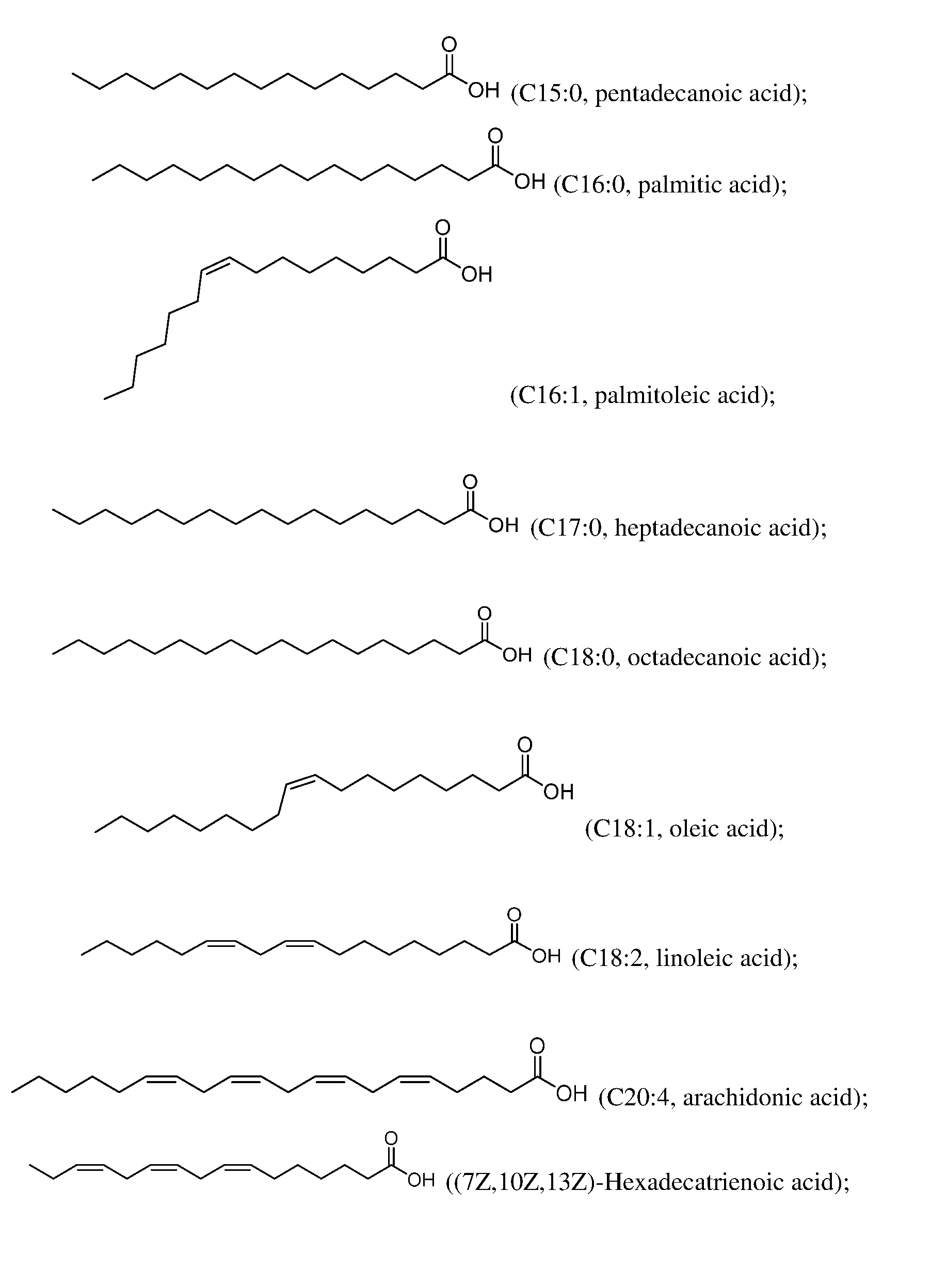
  • the one or more fatty acids of step (i) comprise a linear fatty acid comprising 12-28 carbon atoms, optionally wherein the one or more fatty acids of step (i) comprise a linear fatty acid comprising 15, 16, 17, 18, or 20 carbon atoms. In some embodiments, the one or more fatty acids of step (i) comprise a saturated fatty acid. In some embodiments, the one or more fatty acids of step (i) comprise an unsaturated fatty acid, optionally wherein the unsaturated fatty acid comprises at least one double bond, optionally wherein the unsaturated fatty acid comprises at least one Z double bond. In some embodiments, the one or more fatty acids of step (i) are selected from the group consisting of:
  • the lactone comprises one or more compounds of the formula: wherein: R is methyl, ethyl, or n-propyl; each is independently a single bond, E double bond, Z double bond, or triple bond, as valency permits; and k is an integer between 6 and 30, inclusive.
  • the lactone comprises one or more compounds of the formula: wherein: R is methyl, ethyl, or n-propyl; each is independently a single bond, E double bond, Z double bond, or triple bond, as valency permits; and n is an integer between 6 and 20, inclusive.
  • the one or more fatty acids of step (i) comprise (C15:0, pentadecanoic acid) and the lactone produced in step (iv) comprises: combinations thereof. In some embodiments, the one or more fatty acids of step (i) comprise combinations thereof. In some embodiments, the one or more fatty acids of step (i) comprise combinations thereof. In some embodiments, the one or more fatty acids of step (i) comprise (C18:0, octadecanoic acid) and the lactone and combinations thereof.
  • the one or more fatty acids of step (i) comprise (C18:1, oleic acid) and the lactone produced in step (iv) comprises: and combinations thereof.
  • the one or more fatty acids of step (i) comprise (C18:2, linoleic acid) and the lactone produced in step (iv) comprises: combinations thereof.
  • the one or more fatty acids of step (i) comprise (C20:4, arachidonic acid) and the lactone produced in step (iv) comprises: , and combinations thereof.
  • the one or more fatty acids used as substrates in the first reaction mixture in step (i) comprise ( (7Z,10Z,13Z)-Hexadecatrienoic acid) and the lactone produced in step (iv) comprises: In some embodiments, the one or more fatty acids used as substrates in the first reaction mixture in step (i) comprise ((6Z,9Z,12Z)- Hexadecatrienoic acid) and the lactone produced in step (iv) comprises: and combinations thereof.
  • the one or more fatty acids used as substrates in the first reaction mixture in step (i) comprise ((4E,7E,10E)- Hexadecatrienoic acid) and the lactone produced in step (iv) comprises: , and combinations thereof.
  • the one or more fatty acids used as substrates in the first reaction mixture in step (i) comprise ((2E,4E,6E)- Hexadecatrienoic acid)and the lactone produced in step (iv) comprises: and combinations thereof.
  • the one or more fatty acids used as substrates in the first reaction mixture in step (i) comprise ( ⁇ -linolenic acid) and the lactone produced in step (iv) comprises: and combinations thereof.
  • the one or more fatty acids used as substrates in the first reaction mixture in step (i) comprise ( ⁇ -linolenic acid) and the lactone produced in step (iv) comprises: .
  • the one or more fatty acids used as substrates in the first reaction mixture in step (i) comprise ( ⁇ -Calendic acid; (8E,10E,12Z)-Octadecatrienoic acid) and the lactone produced in step (iv) comprises: and combinations thereof.
  • the one or more fatty acids used as substrates in the first reaction mixture in step (i) comprise ((9Z,11E,13E)- octadeca-9,11,13-trienoic acid) and the lactone produced in step (iv) comprises: and combinations thereof.
  • the one or more fatty acids used as substrates in the first reaction mixture in step (i) comprise ((9E,11E,13E)- octadeca-9,11,13-trienoic acid) and the lactone produced in step (iv) comprises: and combinations thereof.
  • the one or more fatty acids used as substrates in the first reaction mixture in step (i) comprise ((5Z,9Z,12Z)-octadeca- 5,9,12-trienoic acid) and the lactone produced in step (iv) comprises: , and combinations thereof.
  • the one or more fatty acids used as substrates in the first reaction mixture in step (i) comprise (8Z,11Z,14Z-eicosatrienoic acid) and the lactone produced in step (iv) comprises: and combinations thereof.
  • the one or more fatty acids used as substrates in the first reaction mixture in step (i) comprise ((5Z,8Z,11Z)-Eicosa-5,8,11- trienoic acid) and the lactone produced in step (iv) comprises: , , and combinations thereof.
  • the one or more fatty acids used as substrates in the first reaction mixture in step (i) comprise (cis-10-Heptadecenoic acid) and the lactone produced in step (iv) comprises: , and combinations thereof.
  • the one or more fatty acids used as substrates in the first reaction mixture in step (i) comprise (trans- 10-Heptadecenoic acid) and the lactone produced in step (iv) comprises: , and combinations thereof.
  • the one or more fatty acids used as substrates in the first reaction mixture in step (i) comprise (cis-10- Nonadecenoic acid) and the lactone produced in step (iv) comprises: , and combinations thereof.
  • the one or more fatty acids used as substrates in the first reaction mixture in step (i) comprise (cis-11-Eicosenoic acid) and the lactone produced in step (iv) comprises: and combinations thereof.
  • the first reaction mixture is in vitro.
  • the first reaction is a cell-based reaction mixture.
  • the cell-based reaction mixture comprises a cell selected from the group consisting of a yeast, a plant, an alga, a fungus, and a bacterium.
  • the cell-based reaction mixture comprises a bacterial cell of a genus selected from the group consisting of Escherichia; Salmonella; Bacillus; Acinetobacter; Corynebacterium; Methylosinus; Methylomonas; Rhodococcus; Pseudomonas; Rhodobacter; Synechocystis; Brevibacteria; Microbacterium; Arthrobacter; Citrobacter; Escherichia; Klebsiella; Pantoea; Salmonella; Corynebacterium; and Clostridium, optionally wherein the cell-based reaction mixture comprises an E. coli cell.
  • a genus selected from the group consisting of Escherichia; Salmonella; Bacillus; Acinetobacter; Corynebacterium; Methylosinus; Methylomonas; Rhodococcus; Pseudomonas; Rhodobacter; Synechocystis; Brevibacteria
  • the cell-based reaction mixture comprises a fungus of a genus selected from the group consisting of Saccharomyces; Zygosaccharomyces; Kluyveromyces; Candida; Streptomyces; Hansenula; Debaryomyces; Mucor; Pichia; Torulopsis; Aspergillus; and Arthrobotlys.
  • the lactone produced in step (iv) has a purity of at least 70%. In some embodiments, rein the lactone produced in step (iv) has musk notes.
  • the lactone is of the formula: wherein: R is methyl, ethyl, or n-propyl; each is independently a single bond or Z double bond, as valency permits, wherein 0, 1, 2, or 4 are Z double bonds; and m is an integer between 4 and 11, inclusive; provided that the lactone is not of the formula:
  • each is a single bond.
  • one is an E or Z double bond, and the remining are single bonds.
  • two are independently E or Z double bonds, and the remining are single bonds.
  • three are independently E or Z double bonds, and the remining are single bonds.
  • four are independently E or Z double bonds, and the remining are single bonds.
  • each double bond if present is a Z double bond.
  • each double bond if present is an E double bond.
  • k is 8, 9, 10, 11, 12, 13, or 15.
  • the lactone is of the formula:
  • the lactone is of the formula:
  • the lactone is of the formula:
  • the chiral carbon atom is of the S configuration. In some embodiments, the chiral carbon atom is of the R configuration. Mixture of two or more lactones described herein and compositions comprising the lactones or mixtures of two or more lactones described herein are also provided. In some embodiments, the composition further comprising a cosmetically acceptable excipient. Also provided herein are lactones produced by any one of the methods described herein. While the disclosure is susceptible to various modifications and alternative forms, specific embodiments thereof are shown by way of example in the drawing and will herein be described in detail.
  • FIG.3A-3F Reaction schemes showing fatty acid hydroxylation and ring closure for oleic acid (FIG.3A), linoleic acid (FIG.3B), arachidonic acid (FIG.3C), palmitic acid (FIG.
  • FIG.4 Overall synthetic scheme showing palmitic acid hydroxylation (Process 1) and a reaction of obtaining corresponding musk lactone products (Process 2).
  • FIG.5. Reaction showing hydroxyl oleic acid cyclized to obtain corresponding musk lactone products (Process 2).
  • FIG.6 Chromatogram and spectrum showing analysis of the oleic acid macrolactonization products.
  • FIG.7 Overall synthetic scheme showing linoleic acid hydroxylation (Process 1) and a reaction of obtaining corresponding musk lactone products (Process 2) is illustrated in FIG.6.
  • FIG.8 Overall synthetic scheme showing linoleic acid hydroxylation (Process 1) and a reaction of obtaining corresponding musk lactone products
  • FIG.9 Production of musk lactones from hydroxy ⁇ -linolenic acid (GLA, C18:3).
  • FIG.10. GC/MS analysis of musk lactones derived from hydroxy GLA (molecular weight: 276).
  • FIG.11. Production of musky lactone from ⁇ -linolenic acid (ALA, C18:3).
  • FIG.12. GC/MS analysis of musk lactone from hydroxy ALA (molecular weight: 276).
  • FIG.13 Production of musk lactone from 8Z,11Z,14Z-eicosatrienoic acid, dihomo- ⁇ - linolenic acid (DGLA, C20:3).
  • FIG.14 GC/MS analysis of musk lactone from hydroxy DGLA (molecular weight: 304).
  • FIG.15 Reaction showing cis-10-Heptadecenoic acid (C17:1cis-10) hydroxylation and cyclization to obtain corresponding musk lactone products.
  • FIG.16 Reaction showing trans-10-Heptadecenoic acid (C17:1trans-10) hydroxylation and cyclization to obtain corresponding musk lactone products.
  • FIG.17 Reaction showing cis-10-Nonadecenoic acid (C19:1cis-10) hydroxylation and cyclization to obtain corresponding musk lactone products
  • FIG.18 Reaction showing cis-10-Nonadecenoic acid (C19:1cis-10) hydroxylation and cyclization to obtain corresponding musk lactone products
  • FIG.19 GC/MS analysis of musk lactone from cis-10-Heptadecenoic acid (C17:1cis- 10).
  • FIG.20 GC/MS analysis of musk lactone from trans-10-Heptadecenoic acid (C17:1trans-10).
  • FIG.21 GC/MS analysis of musk lactone from cis-10-Nonadecenoic acid (C19:1cis- 10).
  • FIG.22 GM/MS analysis of musk lactone from cis-11-Eicosenoic acid (C20:1cis-11).
  • alkyl refers to a radical of a branched or unbranched, saturated acyclic hydrocarbon group. In certain embodiments, alkyl is C 3-36 alkyl. In certain embodiments, alkyl is C 10-36 alkyl. In certain embodiments, alkyl is C 11-27 alkyl. Unless otherwise provided, alkyl is C 3-29 alkyl.
  • alkenyl is C3- 36 alkenyl.
  • alkenyl is C10-36 alkenyl.
  • alkenyl is C 11-27 alkenyl. Unless otherwise provided, alkenyl is C 3-29 alkenyl.
  • alkynyl refers to a radical of a branched or unbranched, acyclic hydrocarbon group having one or more carbon-carbon triple bonds (C ⁇ C bonds; e.g., 1, 2, 3, or 4 triple bonds), as valency permits.
  • alkynyl is C 3-36 alkynyl.
  • alkynyl is C 10-36 alkynyl.
  • alkynyl is C 11-27 alkynyl. Unless otherwise provided, alkynyl is C 3-29 alkynyl.
  • alkylene is a divalent moiety of alkyl (e.g., C 3-36 alkyl, C10-36 alkyl, C11-27 alkyl, or C 3-29 alkyl)
  • alkenylene is a divalent moiety of alkenyl (e.g., C 3-36 alkenyl, C 10-36 alkenyl, C 11-27 alkenyl, or C 3-29 alkenyl)
  • alkynylene is a divalent moiety of alkynyl (e.g., C 3-36 alkynyl, C10-36 alkynyl, C11-27 alkynyl, or C 3-29 alkynyl).
  • R A is C 3-36 alkyl, C 3-36 alkenyl, or C 3-36 alkynyl (e.g., C 3-29 alkyl, C 3-29 alkenyl, or C 3-29 alkynyl).
  • the carbon atom (e.g., C1) in R A that is farthest to the carboxyl moiety is labelled as ⁇ (omega).
  • the carbon atom (e.g., C2) next to C1 is labelled as ⁇ 1.
  • the carbon atom (e.g., C3) that is next to C2 and is not C1 is labelled as ⁇ 2.
  • the carbon atom (e.g., C4) that is next to C3 and is not C2 is labelled as ⁇ 3.
  • Other fatty acids can be named in this manner.
  • a “saturated fatty acid” is a fatty acid where R A is C 3-36 alkyl (e.g., C 3-29 alkyl).
  • an “unsaturated fatty acid” is a fatty acid where R A is C 3-36 alkenyl or C 3-36 alkynyl (e.g., C 3-29 alkenyl or C 3-29 alkynyl).
  • the term “hydroxyl” or “hydroxy” refers to the group –OH.
  • a “hydroxyl fatty acid,” “hydroxy fatty acid,” or “hydroxylated fatty acid” is a fatty acid where one or more hydrogen atom is replaced with hydroxyl. In some embodiments, the hydroxyl fatty acid is a fatty acid where one hydrogen atom is replaced with hydroxyl (mono- hydroxyl fatty acid).
  • the hydroxyl fatty acid is a fatty acid where more than one (e.g., 2, 3, or more) hydrogen atom is replaced with hydroxyl (poly-hydroxyl fatty acid).
  • Cellular system is any cells that provide for the expression of ectopic proteins.
  • Protein production can occur after gene expression.
  • prokaryotic or eukaryotic host cells which are modified to express a recombinant protein and cultivated in an appropriate culture medium. It also includes the in vitro expression of proteins based on cellular components, such as ribosomes.
  • Coding sequence is to be given its ordinary and customary meaning to a person of ordinary skill in the art, and is used without limitation to refer to a DNA sequence that encodes for a specific amino acid sequence.
  • Growing the Cellular System Growing includes providing an appropriate medium that would allow cells to multiply and divide, to form a cell culture. It also includes providing resources so that cells or cellular components can translate and make recombinant proteins.
  • Protein Expression Protein production can occur after gene expression.
  • DNA or RNA may be present in the cells through transfection - a process of deliberately introducing nucleic acids into cells.
  • transfection is more often used to describe non-viral DNA transfer in bacteria, non-animal eukaryotic cells, including plant cells. In animal cells, transfection is the preferred term as transformation is also used to refer to progression to a cancerous state (carcinogenesis) in these cells. Transduction is often used to describe virus-mediated DNA transfer.
  • yeast According to the current disclosure a yeast are eukaryotic, single-celled microorganisms classified as members of the fungus kingdom. Yeasts are unicellular organisms which are believed to have evolved from multicellular ancestors. As used herein, the singular forms "a, an” and “the” include plural references unless the content clearly dictates otherwise. To the extent that the term “include,” “have,” or the like is used in the description or the claims, such term is intended to be inclusive in a manner similar to the term “comprise” as “comprise” is interpreted when employed as a transitional word in a claim.
  • exemplary is used herein to mean “serving as an example, instance, or illustration.” Any embodiment described herein as “exemplary” is not necessarily to be construed as preferred or advantageous over other embodiments.
  • complementary is to be given its ordinary and customary meaning to a person of ordinary skill in the art and is used without limitation to describe the relationship between nucleotide bases that are capable to hybridizing to one another. For example, with respect to DNA, adenosine is complementary to thymine and cytosine is complementary to guanine. Accordingly, the subject technology also includes isolated nucleic acid fragments that are complementary to the complete sequences as reported in the accompanying Sequence Listing as well as those substantially similar nucleic acid sequences.
  • nucleic acid and “nucleotide” are to be given their respective ordinary and customary meanings to a person of ordinary skill in the art and are used without limitation to refer to deoxyribonucleotides or ribonucleotides and polymers thereof in either single- or double-stranded form. Unless specifically limited, the term encompasses nucleic acids containing known analogues of natural nucleotides that have similar binding properties as the reference nucleic acid and are metabolized in a manner similar to naturally-occurring nucleotides.
  • nucleic acid sequence also implicitly encompasses conservatively modified or degenerate variants thereof (e.g., degenerate codon substitutions) and complementary sequences, as well as the sequence explicitly indicated.
  • isolated is to be given its ordinary and customary meaning to a person of ordinary skill in the art, and when used in the context of an isolated nucleic acid or an isolated polypeptide, is used without limitation to refer to a nucleic acid or polypeptide that, by the hand of man, exists apart from its native environment and is therefore not a product of nature.
  • An isolated nucleic acid or polypeptide can exist in a purified form or can exist in a non-native environment such as, for example, in a transgenic host cell.
  • incubating and “incubation” as used herein means a process of mixing two or more chemical or biological entities (such as a chemical compound and an enzyme) and allowing them to interact under conditions favorable for producing a ⁇ -lactone composition.
  • degenerate variant refers to a nucleic acid sequence having a residue sequence that differs from a reference nucleic acid sequence by one or more degenerate codon substitutions. Degenerate codon substitutions can be achieved by generating sequences in which the third position of one or more selected (or all) codons is substituted with mixed base and/or deoxyinosine residues. A nucleic acid sequence and all of its degenerate variants will express the same amino acid or polypeptide.
  • polypeptide refers to peptides, polypeptides, and proteins, unless otherwise noted.
  • polypeptide and “peptide” are used interchangeably herein when referring to a polyaminoacid product.
  • exemplary polypeptides include polyaminoacid products, naturally occurring proteins, homologs, orthologs, paralogs, fragments and other equivalents, variants, and analogs of the foregoing.
  • polypeptide fragment and “fragment,” when used in reference to a reference polypeptide, are to be given their ordinary and customary meanings to a person of ordinary skill in the art and are used without limitation to refer to a polypeptide in which amino acid residues are deleted as compared to the reference polypeptide itself, but where the remaining amino acid sequence is usually identical to the corresponding positions in the reference polypeptide.
  • Such deletions can occur at the amino-terminus or carboxy-terminus of the reference polypeptide, or alternatively both.
  • the term "functional fragment" of a polypeptide or protein refers to a peptide fragment that is a portion of the full-length polypeptide or protein, and has substantially the same biological activity, or carries out substantially the same function as the full-length polypeptide or protein (e.g., carrying out the same enzymatic reaction).
  • variant polypeptide “modified amino acid sequence” or “modified polypeptide,” which are used interchangeably, refer to an amino acid sequence that is different from the reference polypeptide by one or more amino acids, e.g., by one or more amino acid substitutions, deletions, and/or additions.
  • a variant is a "functional variant” which retains some or all of the ability of the reference polypeptide.
  • the term “functional variant” further includes conservatively substituted variants.
  • the term “conservatively substituted variant” refers to a peptide having an amino acid sequence that differs from a reference peptide by one or more conservative amino acid substitutions and maintains some or all of the activity of the reference peptide.
  • a “conservative amino acid substitution” is a substitution of an amino acid residue with a functionally similar residue.
  • conservative substitutions include the substitution of one non-polar (hydrophobic) residue such as isoleucine, valine, leucine or methionine for another; the substitution of one charged or polar (hydrophilic) residue for another such as between arginine and lysine, between glutamine and asparagine, between threonine and serine; the substitution of one basic residue such as lysine or arginine for another; or the substitution of one acidic residue, such as aspartic acid or glutamic acid for another; or the substitution of one aromatic residue, such as phenylalanine, tyrosine, or tryptophan for another.
  • one non-polar (hydrophobic) residue such as isoleucine, valine, leucine or methionine for another
  • substitution of one charged or polar (hydrophilic) residue for another such as between arginine and lysine, between glutamine and asparagine, between threonine and serine
  • substitution of one basic residue such as
  • substitutions are expected to have little or no effect on the apparent molecular weight or isoelectric point of the protein or polypeptide.
  • the phrase "conservatively substituted variant” also includes peptides wherein a residue is replaced with a chemically-derivatized residue, provided that the resulting peptide maintains some or all of the activity of the reference peptide as described herein.
  • variant in connection with the polypeptides of the subject technology, further includes a functionally active polypeptide having an amino acid sequence at least 75%, at least 76%, at least 77%, at least 78%, at least 79%, at least 80%, at least 81%, at least 82%, at least 83%, at least 84%, at least 85%, at least 86%, at least 87%, at least 88%, at least 89%, at least 90%, at least 91%, at least 92%, at least 93%, at least 94%, at least 95%, at least 96%, at least 97%, at least 98%, at least 99%, and even 100% identical to the amino acid sequence of a reference polypeptide.
  • homologous in all its grammatical forms and spelling variations refers to the relationship between polynucleotides or polypeptides that possess a "common evolutionary origin,” including polynucleotides or polypeptides from super-families and homologous polynucleotides or proteins from different species (Reeck et al., CELL 50:667, 1987). Such polynucleotides or polypeptides have sequence homology, as reflected by their sequence similarity, whether in terms of percent identity or the presence of specific amino acids or motifs at conserved positions.
  • two homologous polypeptides can have amino acid sequences that are at least 75%, at least 76%, at least 77%, at least 78%, at least 79%, at least 80%, at least 81%, at least 82%, at least 83%, at least 84%, at least 85%, at least 86%, at least 87%, at least 88%, at least 89%, at least 900 at least 91%, at least 92%, at least 93%, at least 94%, at least 95%, at least 96%, at least 97%, at least 98%, at least 99%, and even 100% identical.
  • Suitable regulatory sequences is to be given its ordinary and customary meaning to a person of ordinary skill in the art, and is used without limitation to refer to nucleotide sequences located upstream (5' non-coding sequences), within, or downstream (3' non-coding sequences) of a coding sequence, and which influence the transcription, RNA processing or stability, or translation of the associated coding sequence. Regulatory sequences may include promoters, translation leader sequences, introns, and polyadenylation recognition sequences. "Promoter” is to be given its ordinary and customary meaning to a person of ordinary skill in the art, and is used without limitation to refer to a DNA sequence capable of controlling the expression of a coding sequence or functional RNA.
  • a coding sequence is located 3' to a promoter sequence.
  • Promoters may be derived in their entirety from a native gene, or be composed of different elements derived from different promoters found in nature, or even comprise synthetic DNA segments. It is understood by those skilled in the art that different promoters may direct the expression of a gene in different tissues or cell types, or at different stages of development, or in response to different environmental conditions. Promoters which cause a gene to be expressed in most cell types at most times, are commonly referred to as “constitutive promoters.” It is further recognized that since in most cases the exact boundaries of regulatory sequences have not been completely defined, DNA fragments of different lengths may have identical promoter activity.
  • operably linked refers to the association of nucleic acid sequences on a single nucleic acid fragment so that the function of one is affected by the other.
  • a promoter is operably linked with a coding sequence when it is capable of affecting the expression of that coding sequence (i.e., that the coding sequence is under the transcriptional control of the promoter).
  • Coding sequences can be operably linked to regulatory sequences in sense or antisense orientation.
  • expression as used herein, is to be given its ordinary and customary meaning to a person of ordinary skill in the art, and is used without limitation to refer to the transcription and stable accumulation of sense (mRNA) or antisense RNA derived from the nucleic acid fragment of the subject technology.
  • “Over-expression” refers to the production of a gene product in transgenic or recombinant organisms that exceeds levels of production in normal or non-transformed organisms.
  • “Transformation” is to be given its ordinary and customary meaning to a person of reasonable skill in the field, and is used without limitation to refer to the transfer of a polynucleotide into a target cell for further expression by that cell.
  • the transferred polynucleotide can be incorporated into the genome or chromosomal DNA of a target cell, resulting in genetically stable inheritance, or it can replicate independent of the host chromosomal DNA.
  • Host organisms containing the transformed nucleic acid fragments are referred to as "transgenic” or “recombinant” or “transformed” organisms.
  • transformed when used herein in connection with host cells, are to be given their respective ordinary and customary meanings to a person of ordinary skill in the art, and are used without limitation to refer to a cell of a host organism, such as a plant or microbial cell, into which a heterologous nucleic acid molecule has been introduced.
  • the nucleic acid molecule can be stably integrated into the genome of the host cell, or the nucleic acid molecule can be present as an extrachromosomal molecule. Such an extrachromosomal molecule can be auto-replicating.
  • Transformed cells, tissues, or subjects are understood to encompass not only the end product of a transformation process, but also transgenic progeny thereof.
  • heterologous when used herein in connection with polynucleotides, are to be given their ordinary and customary meanings to a person of ordinary skill in the art, and are used without limitation to refer to a polynucleotide (e.g., a DNA sequence or a gene) that originates from a source foreign to the particular host cell or, if from the same source, is modified from its original form.
  • a heterologous gene in a host cell includes a gene that is endogenous to the particular host cell but has been modified through, for example, the use of site-directed mutagenesis or other recombinant techniques.
  • the terms also include non-naturally occurring multiple copies of a naturally occurring DNA sequence.
  • the terms refer to a DNA segment that is foreign or heterologous to the cell, or homologous to the cell but in a position or form within the host cell in which the element is not ordinarily found.
  • the terms "recombinant,” “heterologous,” and “exogenous,” when used herein in connection with a polypeptide or amino acid sequence means a polypeptide or amino acid sequence that originates from a source foreign to the particular host cell or, if from the same source, is modified from its original form.
  • recombinant DNA segments can be expressed in a host cell to produce a recombinant polypeptide.
  • Such elements may be autonomously replicating sequences, genome integrating sequences, phage or nucleotide sequences, linear or circular, of a single- or double-stranded DNA or RNA, derived from any source, in which a number of nucleotide sequences have been joined or recombined into a unique construction which is capable of introducing a promoter fragment and DNA sequence for a selected gene product along with appropriate 3' untranslated sequence into a cell.
  • Transformation cassette refers to a specific vector containing a foreign gene and having elements in addition to the foreign gene that facilitate transformation of a particular host cell.
  • Expression cassette refers to a specific vector containing a foreign gene and having elements in addition to the foreign gene that allow for enhanced expression of that gene in a foreign host. Unless defined otherwise, all technical and scientific terms used herein have the same meaning as commonly understood by one of ordinary skill in the art to which the disclosure belongs. Although any methods and materials similar to or equivalent to those described herein may be used in the practice or testing of the present disclosure, the preferred materials and methods are described below. DETAILED DESCRIPTION Provided herein, in some aspects, are methods (e.g., biosynthetic methods) for the production of lactones, such as macrocyclic lactones, from fatty acids (e.g., linear fatty acids).
  • fatty acids e.g., linear fatty acids
  • the lactones, such as macrocyclic lactones, produced using the methods described herein have differentiated musky notes (also referred to herein as “musk lactones” or “musky lactones”).
  • the macrocyclic lactones produced using the methods described herein comprise methyl, ethyl or propyl side chains.
  • the lactones, such as macrocyclic lactones are produced using the methods described herein from saturated fatty acids (having no carbon-carbon double bonds) or unsaturated fatty acids (e.g., having one or more carbon-carbon double bonds).
  • Cytochrome P450 enzymes that have hydroxylase activity can carry out the first step of the biosynthetic method described herein, i.e., converting fatty acids to ⁇ -1, ⁇ -2, ⁇ -3 hydroxyl fatty acids, or combinations thereof.
  • the second step of the biosynthetic methods described herein, the macrolactonization of the ⁇ -1, ⁇ -2, ⁇ -3 hydroxyl fatty acids can be carried out by a lipase.
  • lactones such as macrocyclic lactones, with differentiated musky notes, which are produced using the methods described herein.
  • the lactones, such as macrocyclic lactones, produced herein comprise one or more compounds of the formula: wherein: R is methyl, ethyl, or n-propyl; each is independently a single bond, E double bond, Z double bond, or triple bond, as valency permits; and k is an integer between 6 and 30, inclusive.
  • the lactones, such as macrocyclic lactones, produced herein comprise a structure of: wherein: R is methyl, ethyl, or n-propyl; each is independently a single bond, E double bond, Z double bond, or triple bond, as valency permits; and n is an integer between 6 and 20, inclusive.
  • Biosynthetic methods for producing lactones utilize fatty acids (e.g., linear fatty acids) as substrates for enzymatic production of lactones, such as macrocyclic lactones (e.g., macrocyclic lactones having differentiated musky notes).
  • the methods described herein comprise two enzymatic conversion steps. In the first step, the fatty acids are hydroxylated at ⁇ -1, ⁇ -2, or ⁇ -3 positions by a cytochrome P450 enzyme having hydroxylase activity, or functional variants thereof to produce hydroxyl fatty acids (e.g., ⁇ -1 hydroxyl fatty acids, ⁇ -2 hydroxyl fatty acid, ⁇ -3 hydroxyl fatty acid, and combinations thereof).
  • the hydroxyl fatty acids are subjected to macrocyclization by a lipase (e.g., Novozyme 435) to produce lactones, such as macrocyclic lactones, with methyl, ethyl, or propyl side chains.
  • a lipase e.g., Novozyme 435
  • lactones such as macrocyclic lactones, with methyl, ethyl, or propyl side chains.
  • the biosynthetic methods of producing lactones comprises: (i) preparing a first reaction mixture comprising one or more fatty acids, a cytochrome P450 hydroxylase, and NADPH; (ii) incubating the first reaction mixture of for a sufficient time to produce hydroxyl fatty acids selected from ⁇ -1 hydroxyl fatty acids, ⁇ -2 hydroxyl fatty acids, ⁇ -3 hydroxyl fatty acids, and combinations thereof; (iii) preparing a second reaction mixture comprising the hydroxyl fatty acids produced in step (ii) and a lipase; and (iv) incubating the second reaction mixture for a sufficient time to produce the musk lactone.
  • fatty acids are substrates that can be converted to a hydroxyl fatty acid by a cytochrome P450 hydroxylase in the presence of NADPH.
  • the one or more fatty acids in the first reaction mixture of step (i) comprise a linear fatty acid comprising at least 12 carbons (e.g., at least 12 carbons, at least 13 carbons, at least 14 carbons, at least 15 carbons, at least 16 carbons, at least 17 carbons, at least 18 carbons, at least 19 carbons, at least 20 carbons, or at least 25 carbons).
  • the one or more fatty acids in the first reaction mixture of step (i) comprise a linear fatty acid comprising 12-28 (e.g., 12-28, 12-25, 12-20, 12-15, 15-28, 15-25, 15-20, 20-28, 20-25, or 25- 28) carbons.
  • the one or more fatty acids in the first reaction mixture of step (i) comprise a linear fatty acid comprising 12, 13, 14, 15, 16, 17, 18, 19, 20, 21, 22, 23, 24, 25, 26, 27, or 28 carbons, or any combinations thereof.
  • the one or more fatty acids in the first reaction mixture of step (i) comprise a linear fatty acid comprising 15, 16, 17, 18, 19, or 20 carbons, or any combinations thereof.
  • the one or more fatty acids in the first reaction mixture of step (i) comprises a mixture of linear fatty acid comprising different numbers of carbons, e.g., a mix of fatty acids comprising 15, 16, 17, 18, 19, or 20 carbons.
  • the one or more fatty acids in the first reaction mixture of step (i) comprises a saturated fatty acid (i.e., no double bonds between any two carbons).
  • the one or more fatty acids in the first reaction mixture of step (i) comprises an unsaturated fatty acid.
  • the unsaturated fatty acid comprises at least one (e.g., 1, 2, 3, 4, 5, or more) double bond.
  • the unsaturated fatty acid comprises at least one (e.g., 1, 2, 3, 4, 5, or more) Z double bond.
  • the one or more fatty acids in the first reaction mixture of step (i) are selected from the group consisting of: and any combinations thereof.
  • the one or more fatty acids in the first reaction mixture of step (i) are selected from the group consisting of: and any combinations thereof.
  • the one or more fatty acids in the first reaction mixture of step (i) are selected from the group consisting of:
  • the enzyme that hydroxylates the fatty acid substrates in the first reaction mixture is a cytochrome P450 enzyme that has hydroxylase activity (referred to herein as “cytochrome P450 hydroxylase”), or a functional variant thereof.
  • the cytochrome P450 hydroxylase is a bacterial cytochrome P450 enzyme.
  • Cytochrome P450 enzymes that may be used in accordance with the present disclosure include, without limitation, CYP102A1 from Bacillus megaterium; CYP106A1 from Bacillus megaterium DSM319; CYP106A2 from B. megaterium ATCC13368; CYP109B1 from B. subtilis 168; CYP109E1 from B.
  • CYP154C5 from Nocardia farcinica IFM 10152
  • CYP260A1 and CYP260B1 from Sorangium cellulosum Soce56
  • CYP154C3 from Streptomyces griseus SGR1085
  • CYP154C8 from Streptomyces sp.
  • W2233-SM and CYP219A from Novosphingobium aromaticivorans DSM12444 (saro0307), CYP105A1 from Streptomyces griseolus ATCC 11796, CYP107E1 from Micromonospora griseorubida, CYP107D1 and CYP127A3 from Mesorhizobium loti MAFF303099 (mlr5876) CYP110A1, CYP110C1, CYP110D1 and CYP110E1 from Nostoc sp.
  • PCC7120 CYP200A1 from Bradyrhizobium japonicum USDA110; CYP102A15 and CYP102A170 from polar Bacillus sp. PAMC 25034 and Paenibacillus sp. PAMC 22724, respectively; CYP709C1 from the wheat plant (Triticum aestivum); CYP147G1 from Mycobacterium marinum; CYP505D6 from White-Rot Fungus Phanerochaete chrysosporium; and the CYP102 family enzymes (bamf2522 and bamf0695) from Bacillus amyloliquefaciens DSM 7.
  • cytochrome P450 enzyme from Bacillus megaterium (CYP102A1, e.g., as described in Miura et al., Biochim. Biophys. Acta.388: 305-317, 1975, incorporated herein by reference) and a cytochrome P450 enzyme from Myceliophthora thermophile (CYP505A30, UniProt Accession No.: G2QDZ3) were able to carry out the first step of the biosynthetic method described herein, i.e., converting fatty acids to mono-hydroxyl fatty acids that are hydroxylated at one of ⁇ -1, ⁇ -2, or ⁇ -3 position, or combinations of the mono-hydroxyl fatty acids thereof.
  • CYP102A1 Bacillus megaterium
  • Myceliophthora thermophile CYP505A30, UniProt Accession No.: G2QDZ3
  • the amino acid sequence of CYP102A1 is provided as SEQ ID NO: 1.
  • the amino acid sequence of CYP505A30 is provided as SEQ ID NO: 3.
  • the cytochrome P450 hydroxylase used in the biosynthetic methods described herein comprises an amino acid sequence that is at least 70% (e.g., at least 70%, at least 75%, at least 80%, at least 85%, at least 90%, at least 95%, or at least 99%) identical to the amino acid sequence of SEQ ID NO: 1.
  • the cytochrome P450 hydroxylase used in the biosynthetic methods described herein comprises an amino acid sequence that is 70%, 75%, 80%, 85%, 90%, 95%, or 99% identical to the amino acid sequence of SEQ ID NO: 1. In some embodiments, the cytochrome P450 hydroxylase used in the biosynthetic methods described herein comprises the amino acid sequence of SEQ ID NO: 1.
  • the cytochrome P450 hydroxylase used in the biosynthetic methods described herein comprises an amino acid sequence that is at least 70% (e.g., at least 70%, at least 75%, at least 80%, at least 85%, at least 90%, at least 95%, or at least 99%) identical to the amino acid sequence of SEQ ID NO: 3.
  • the cytochrome P450 hydroxylase used in the biosynthetic methods described herein comprises an amino acid sequence that is 70%, 75%, 80%, 85%, 90%, 95%, or 99% identical to the amino acid sequence of SEQ ID NO: 3.
  • the cytochrome P450 hydroxylase used in the biosynthetic methods described herein comprises the amino acid sequence of SEQ ID NO: 3.
  • the first reaction mixture of step (i) is an in vitro reaction mixture, e.g., using an isolated recombinantly produced cytochrome P450 hydroxylase.
  • the first reaction mixture of step (i) is a cell-based reaction mixture.
  • the cell-based reaction mixture comprises a cell selected from the group consisting of a yeast, a plant, an alga, a fungus, and a bacterium.
  • the cell-based reaction mixture comprises a bacterial cell of a genus selected from the group consisting of Escherichia; Salmonella; Bacillus; Acinetobacter; Corynebacterium; Methylosinus; Methylomonas; Rhodococcus; Pseudomonas; Rhodobacter; Synechocystis; Brevibacteria; Microbacterium; Arthrobacter; Citrobacter; Escherichia; Klebsiella; Pantoea; Salmonella; Corynebacterium; and Clostridium.
  • the cell-based reaction mixture comprises an E. coli cell.
  • the cell-based reaction mixture comprises a fungus of a genus selected from the group consisting of Saccharomyces; Zygosaccharomyces; Kluyveromyces; Candida; Streptomyces; Hansenula; Debaryomyces; Mucor; Pichia; Torulopsis; Aspergillus; and Arthrobotlys.
  • the cell used in the cell-based reaction mixture recombinantly express the cytochrome P450 hydroxylase.
  • the cell used in the cell-based reaction mixture may be transformed with a nucleic acid molecule (e.g., a vector such as an expression vector) comprising a nucleotide sequence encoding the cytochrome P450 hydroxylase.
  • a nucleic acid molecule e.g., a vector such as an expression vector
  • the nucleotide sequence encoding the cytochrome P450 hydroxylase is operably linked to a promoter (e.g., an inducible promoter or a constitutive promoter).
  • the transformed cells can be cultured under conditions that allow the expression of the cytochrome P450 hydroxylase.
  • the cells contain the expressed cytochrome P450 hydroxylase can be collected and used in the cell-based reaction mixture.
  • Nucleotide sequences encoding CYP102A1 (SEQ ID NO: 1) is provided as SEQ ID NO: 2.
  • Nucleotide sequences encoding CYP505A30 (SEQ ID NO: 3) is provided as SEQ ID NO: 4.
  • the cell e.g., a bacterial cell such as an E.
  • a nucleic acid molecule comprising a nucleotide sequence that is at least 70% (e.g., at least 70%, at least 75%, at least 80%, at least 85%, at least 90%, at least 95%, or at least 99%) to the nucleotide sequence of SEQ ID NO: 2 or SEQ ID NO: 4.
  • the cell e.g., a bacterial cell such as an E.
  • the cell used in the cell-based reaction mixture is transformed with a nucleic acid molecule comprising a nucleotide sequence that is 70%, 75%, 80%, 85%, 90%, 95%, or 99% to the nucleotide sequence of SEQ ID NO: 2 or SEQ ID NO: 4.
  • the cell e.g., a bacterial cell such as an E. coli or Bacillus cell
  • the cell is transformed with a nucleic acid molecule comprising a nucleotide the nucleotide sequence of SEQ ID NO: 2 or SEQ ID NO: 4.
  • the first reaction mixture in step (ii) of the biosynthetic methods described herein, is incubated for a sufficient time to produce hydroxyl fatty acids. In some embodiments, the first reaction mixture is incubated for at least 1 hour (e.g., at least 1 hour, at least 2 hours, at least 5 hours, at least 10 hours, or longer). In some embodiments, the incubation is under 37°C. In some embodiments, the hydroxyl fatty acids produced in step (ii) of the biosynthetic methods described herein are mono-hydroxyl fatty acids that is hydroxylated at any one of positions ⁇ -1, ⁇ -2, or ⁇ -3.
  • the hydroxyl fatty acids produced in step (ii) of the biosynthetic methods described herein comprises ⁇ -1 hydroxyl fatty acids, ⁇ -2 hydroxyl fatty acid, ⁇ -3 hydroxyl fatty acid, and combinations thereof, and any combinations thereof.
  • step (ii) of the biosynthetic method described herein further comprises isolating the hydroxyl fatty acids from the reaction mixture. Any suitable extraction methods may be used.
  • the hydroxyl fatty acids may be extracted by liquid-liquid extraction using a mixture of hydrocarbon-based organic solvents (e.g., hexane) and a water- insoluble polar solvent (e.g., ethyl acetate).
  • hydroxyl fatty acids produced in step (ii) can be further converted to lactones via macrolactonization catalyzed by a lipase.
  • a second reaction mixture is prepared, the second reaction mixture comprising the hydroxyl fatty acids produced in step (ii) and a lipase.
  • the lipase used in the second reaction mixture is lipase B from Candida antarctica (Uniprot Accession No.: P41365).
  • the amino acid sequence of lipase B from Candida antarctica is provided as SEQ ID NO: 5.
  • the lipase used in the biosynthetic methods described herein comprises an amino acid sequence that is at least 70% (e.g., at least 70%, at least 75%, at least 80%, at least 85%, at least 90%, at least 95%, or at least 99%) identical to the amino acid sequence of SEQ ID NO: 5.
  • the lipase used in the biosynthetic methods described herein comprises an amino acid sequence that is 70%, 75%, 80%, 85%, 90%, 95%, or 99% identical to the amino acid sequence of SEQ ID NO: 5. In some embodiments, the lipase used in the biosynthetic methods described herein comprises the amino acid sequence of SEQ ID NO: 5. In some embodiments, the lipase used in the second reaction mixture in step (iii) of the biosynthetic methods described herein is immobilized on a solid support (e.g., acrylic resin).
  • a solid support e.g., acrylic resin
  • the lipase used in the second reaction mixture in step (iii) of the biosynthetic methods described herein is Novozyme 435 (lipase B from Candida antarctica immobilized on acrylic resin, available from Sigma, catalog # L4777).
  • the second reaction mixture further comprises a solvent. Any suitable solvent may be used.
  • the solvent is toluene or dichloroethane.
  • the hydroxyl fatty acids are at a total concentration of 0.02-0.1 M (e.g., 0.02 M, 0.03 M, 0.04 M, 0.05 M, 0.06 M, 0.07 M, 0.08 M, 0.09 M, or 0.1M).
  • the hydroxyl fatty acids are at a total concentration of 0.025-0.05 M (e.g., 0.025 M, 0.03 M, 0.035 M, 0.04 M, 0.045 M, or 0.05 M).
  • the lipase is at a concentration of 20-150 g/L (e.g., 20-150 g/L, 20-100 g/L, 20-50 g/L, 50-150 g/L, 50-100 g/L, or 100-150 g/L).
  • the lipase in the second reaction mixture, is at a concentration of 50-100 g/L (e.g., 50 g/L, 60 g/L, 70 g/L, 80 g/L, 90 g/L, or 100 g/L).
  • the second reaction mixture is incubated for a sufficient time to produce hydroxyl fatty acids. In some embodiments, the second reaction mixture is incubated for at least 10 hours (e.g., at least 10 hours, at least 15 hours, at least 20 hours, at least 24 hours, or longer).
  • the second reaction mixture is incubated for 15-24 hours (e.g., 15, 16, 17, 18, 19, 20, 21, 22, 23, or 24 hours).
  • the incubation is under 40-60 °C (e.g., 40-60 °C, 40-55 °C, 40-50 °C, 40-45 °C, 45-60 °C, 45-55 °C, 45-50 °C, 50-60 °C, 50-55 °C, or 55-60 °C).
  • the incubation is under 40 °C, 45 °C, 50 °C, 55 °C, or 60 °C.
  • step (iv) further comprises isolating the lactone compounds from the reaction mixture.
  • Known methods of isolating lactone compounds from reaction mixture can be used, including without limitation, filtration and/or chromatography methods.
  • the isolated lactone compounds are subjected to drying.
  • the lactone compounds produced by the biosynthetic methods described herein have a purity of at least 50% w/w (e.g., at least 50%, at least 60%, at least 70%, at least 75%, at least 80%, at least 85%, at least 90%, at least 95%, or at least 99%) w/w.
  • the purity relates to all the lactone compounds produced, which, in some embodiments, comprise lactone compounds of different structures.
  • the lactone compounds produced in step (iv) has musk notes.
  • Lactones e.g., macrocyclic lactones
  • the lactones (e.g., macrocyclic lactones) produced using the biosynthetic methods described herein comprise one or more compounds of the formula: wherein: R is methyl, ethyl, or n-propyl; each is independently a single bond, E double bond, Z double bond, or triple bond, as valency permits; and k is an integer between 6 and 30, inclusive.
  • the lactones (e.g., macrocyclic lactones) produced using the biosynthetic methods described herein comprise one or more compounds of the formula: wherein: R is methyl, ethyl, or n-propyl; each is independently a single bond, E double bond, Z double bond, or triple bond, as valency permits; and n is an integer between 6 and 20, inclusive.
  • R is methyl.
  • R is ethyl.
  • R is n-propyl.
  • each is a single bond.
  • at least one (e.g., one, two, three, or four) is an E or Z double bond.
  • At least one is an E double bond. In certain embodiments, at least one (e.g., one, two, three, or four) is an Z double bond. In certain embodiments, each is independently a single bond, E double bond, or Z double bond. In certain embodiments, each is independently a single or Z double bond. In certain embodiments, one is a Z double bond, and each remaining is a single bond. In certain embodiments, two are Z double bonds, and each remaining is a single bond. In certain embodiments, three are Z double bonds, and each remaining is a single bond. In certain embodiments, four are Z double bonds, and each remaining is a single bond.
  • At least one is a triple bond. In certain embodiments, at least one of any two adjacent is a single bond. In certain embodiments, one is an E or Z double bond, and the remining are single bonds. In certain embodiments, two are independently E or Z double bonds, and the remining are single bonds. In certain embodiments, three are independently E or Z double bonds, and the remining are single bonds. In certain embodiments, four are independently E or Z double bonds, and the remining are single bonds. In certain embodiments, each double bond if present is a Z double bond. In certain embodiments, each double bond if present is an E double bond.
  • k is 6. In certain embodiments, k is 7. In certain embodiments, k is 8. In certain embodiments, k is 9. In certain embodiments, k is 10. In certain embodiments, k is 11. In certain embodiments, k is 12. In certain embodiments, k is 13. In certain embodiments, k is 14. In certain embodiments, k is 15. In certain embodiments, k is 16. In certain embodiments, k is 8, 9, 10, 11, 12, 13, or 15. In certain embodiments, k is 8, 9, 10, 11, 12, 13, 14, or 15. In certain embodiments, k is an integer between 17 and 20, inclusive.
  • k is an integer between 21 and 25, inclusive. In certain embodiments, k is an integer between 26 and 30, inclusive. In certain embodiments, n is 6. In certain embodiments, n is 7. In certain embodiments, n is 8. In certain embodiments, n is 9. In certain embodiments, n is 10. In certain embodiments, n is 11. In certain embodiments, n is 12. In certain embodiments, n is 13. In certain embodiments, n is 14. In certain embodiments, n is 15, 16, 17, 18, 19, or 20. In certain embodiments, n is an integer between 7 and 14, inclusive.
  • the lactones produced using the biosynthetic methods described herein include a chiral carbon atom, which is the carbon atom labelled with * in the formula: In certain embodiments, the lactones produced using the biosynthetic methods described herein include a chiral carbon atom, which is the carbon atom labelled with * in the formula: In certain embodiments, the chiral carbon atom is of the S configuration. In certain embodiments, the chiral carbon atom is of the R configuration. In certain embodiments, the lactones produced using the biosynthetic methods described herein are a mixture of lactones.
  • the lactones produced using the biosynthetic methods described herein are a mixture of (e.g., two or three) lactones having different n values and different R moieties when the difference in the R/S configurations if present is disregarded.
  • the lactones produced using the biosynthetic methods described herein are a mixture of lactones having the same R/S configuration but different n values and different R moieties.
  • the lactones produced using the biosynthetic methods described herein are a mixture of lactones having different R/S configurations but the same n values and the same R moieties.
  • the lactones produced using the biosynthetic methods described herein are a mixture of lactones having different R/S configurations, different n values, and different R moieties. In certain embodiments, the lactones produced using the biosynthetic methods described herein are substantially (e.g., between 90% and 95%, between 95% and 97%, between 97% and 99%, or between 99% and 99.9%, inclusive, by mole) a racemic mixture of lactones.
  • the lactones produced using the biosynthetic methods described herein are substantially (e.g., between 90% and 95%, between 95% and 97%, between 97% and 99%, or between 99% and 99.9%, inclusive, by mole) one single type of lactone (e.g., substantially free of other types of lactones, including the opposite enantiomer of the one single type of lactone).
  • the lactones produced using the biosynthetic methods described herein are substantially (between 90% and 95%, between 95% and 97%, between 97% and 99%, or between 99% and 99.9%, inclusive, by mole) two types of lactones, which are opposite enantiomers of each other (e.g., substantially free of other types of lactones).
  • the one or more fatty acids used as substrates in the first reaction mixture in step (i) comprise (C15:0, pentadecanoic acid) and the lactone produced in step (iv) comprises: , and combinations thereof.
  • the one or more fatty acids used as substrates in the first reaction mixture in step (i) comprise (C16:0, palmitic acid) and the lactone produced in step (iv) comprises: and combinations thereof.
  • the one or more fatty acids used as substrates in the first reaction mixture in step (i) comprise (C16:1, palmitoleic acid) and the lactone produced in step (iv) comprises: and combinations thereof.
  • the one or more fatty acids used as substrates in the first reaction mixture in step (i) comprise heptadecanoic acid) and the lactone produced in step (iv) comprises: and combinations thereof.
  • the one or more fatty acids used as substrates in the first reaction mixture in step (i) comprise octadecanoic acid) and the lactone produced in step (iv) comprises: and combinations thereof.
  • the one or more fatty acids used as substrates in the first reaction mixture in step (i) comprise (C18:1, oleic acid) and the lactone produced in step (iv) comprises: , and combinations thereof.
  • the one or more fatty acids used as substrates in the first reaction mixture in step (i) comprise (C18:2, linoleic acid) and the lactone produced in step (iv) comprises: and combinations thereof.
  • the one or more fatty acids used as substrates in the first reaction mixture in step (i) comprise (C20:4, arachidonic acid) and the lactone produced in step (iv) comprises: and combinations thereof.
  • the one or more fatty acids used as substrates in the first reaction mixture in step (i) comprise ((7Z,10Z,13Z)-Hexadecatrienoic acid) and the lactone produced in step (iv) comprises:
  • the one or more fatty acids used as substrates in the first reaction mixture in step (i) comprise Hexadecatrienoic acid) and the lactone produced in step (iv) comprises: and combinations thereof.
  • the one or more fatty acids used as substrates in the first reaction mixture in step (i) comprise ((4E,7E,10E)- Hexadecatrienoic acid) and the lactone produced in step (iv) comprises: and combinations thereof.
  • the one or more fatty acids used as substrates in the first reaction mixture in step (i) comprise ((2E,4E,6E)- Hexadecatrienoic acid) and the lactone produced in step (iv) comprises: , and combinations thereof.
  • the one or more fatty acids used as substrates in the first reaction mixture in step (i) comprise ( ⁇ -linolenic acid) and the lactone produced in step (iv) comprises: and combinations thereof.
  • the one or more fatty acids used as substrates in the first reaction mixture in step (i) comprise ( ⁇ -linolenic acid) and the lactone produced in step (iv) comprises: In some embodiments, the one or more fatty acids used as substrates in the first reaction mixture in step (i) comprise ((8E,10E,12Z)- Octadecatrienoic acid) and the lactone produced in step (iv) comprises: and combinations thereof.
  • the on e or more fatty acids used as substrates in the first reaction mixture in step (i) comprise ((9Z,11E,13E)- octadeca-9,11,13-trienoic acid) and the lactone produced in step (iv) comprises: , , and combinations thereof.
  • the one or more fatty acids used as substrates in the first reaction mixture in step (i) comprise ((9E,11E,13E)- octadeca-9,11,13-trienoic acid) and the lactone produced in step (iv) comprises: and combinations thereof.
  • the one or more fatty acids used as substrates in the first reaction mixture in step (i) comprise ((5Z,9Z,12Z)-octadeca- 5,9,12-trienoic acid) and the lactone produced in step (iv) comprises: and combinations thereof.
  • the one or more fatty acids used as substrates in the first reaction mixture in step (i) comprise (8Z,11Z,14Z-eicosatrienoic acid) and the lactone produced in step (iv) comprises: , and combinations thereof.
  • the one or more fatty acids used as substrates in the first reaction mixture in step (i) comprise ((5Z,8Z,11Z)-Eicosa-5,8,11- trienoic acid) and the lactone produced in step (iv) comprises: and combinations thereof.
  • the one or more fatty acids used as substrates in the first reaction mixture in step (i) comprise (cis-10-Heptadecenoic acid) and the lactone produced in step (iv) comprises: and combinations thereof.
  • the one or more fatty acids used as substrates in the first reaction mixture in step (i) comprise (trans- 10-Heptadecenoic acid) and the lactone produced in step (iv) comprises: and combinations thereof.
  • the one or more fatty acids used as substrates in the first reaction mixture in step (i) comprise (cis-10- Nonadecenoic acid) and the lactone produced in step (iv) comprises: and combinations thereof.
  • the one or more fatty acids used as substrates in the first reaction mixture in step (i) comprise (cis-11-Eicosenoic acid) and the lactone produced in step (iv) comprises: and combinations thereof.
  • the lactone produced using the biosynthetic methods provided herein comprises any one or more (e.g., 1, 2, 3, 4, 5, 6, 7, 8, 9, 10, 11, 12, 13, 14, 15,16, 17, 18, 19, 20, 21, 22, 23, or 24) of the lactones provided in Table 1.
  • the lactone produced using the biosynthetic methods provided herein comprises any one or more (e.g., 25, 26, 27, 28, 29, 30, or 31) of the lactones provided in Table 2.
  • Other aspects of the present disclosure provide novel lactones of the formula: wherein: R is methyl, ethyl, or n-propyl; each is independently a single bond, E double bond, Z double bond, or triple bond, as valency permits; and k is an integer between 6 and 30, inclusive; provided that the lactone is not of the formula:
  • R is methyl, ethyl, or n-propyl; each is independently a single bond or Z double bond, as valency permits, wherein 0, 1, 2, or 4 are Z double bonds; and m is an integer between 4 and 11, inclusive; provided that the lactone is not of the formula:
  • the novel lactone is of the formula: In certain embodiments, the novel lactone is of the formula: or In certain embodiments, the novel lactone is of the formula: In certain embodiments, each is a single bond. In certain embodiments, one is a Z double bond, and the remining are single bonds. In certain embodiments, two are Z double bonds, and the remining are single bonds. In certain embodiments, four are Z double bonds, and the remining are single bonds. In certain embodiments, one is an E or Z double bond, and the remining are single bonds. In certain embodiments, two are independently E or Z double bonds, and the remining are single bonds. In certain embodiments, three are independently E or Z double bonds, and the remining are single bonds.
  • the variable k is as described herein. In certain embodiments, m is 4. In certain embodiments, m is 5. In certain embodiments, m is 6. In certain embodiments, m is 7. In certain embodiments, m is 8. In certain embodiments, m is 9. In certain embodiments, m is 10. In certain embodiments, m is 11.
  • the chiral carbon atom of the novel lactone is of the S configuration. In certain embodiments, the chiral carbon atom of the novel lactone is of the R configuration.
  • Another aspect of the present disclosure provides a mixture of two or more novel lactones. In certain embodiments, the mixture of two or more novel lactones is a mixture of the opposite enantiomers of In certain embodiments, the mixture of two or more novel lactones is a mixture of the opposite enantiomers of the opposite enantiomers of and the opposite enantiomers of .
  • the mixture of two or more novel lactones is a mixture of the opposite enantiomers of In certain embodiments, the mixture of two or more novel lactones is a mixture of the opposite enantiomers of and the opposite enantiomers of . In certain embodiments, the mixture of two or more novel lactones is a mixture of the opposite enantiomers of and the opposite enantiomers of . In certain embodiments, the mixture of two or more novel lactones is a mixture of the opposite enantiomers of , the opposite enantiomers of and the opposite enantiomers of .
  • the mixture of two or more novel lactones is a mixture of the opposite enantiomers of In certain embodiments, the mixture of two or more novel lactones is a mixture of the opposite enantiomers of and the opposite enantiomers of In certain embodiments, the mixture of two or more novel lactones is a mixture of the opposite enantiomers of the opposite enantiomers of and the opposite enantiomers of In certain embodiments, the mixture of two or more novel lactones is a mixture of the opposite enantiomers of the opposite enantiomers of and the opposite enantiomers of In certain embodiments, the mixture of two or more novel lactones is a mixture of the opposite enantiomers of the opposite enantiomers of , and the opposite enantiomers of .
  • the mixture of two or more novel lactones is a mixture of the opposite enantiomers of . In certain embodiments, the mixture of two or more novel lactones is a mixture of the opposite enantiomers of the opposite enantiomers of and the opposite enantiomers of In certain embodiments, the mixture of two or more novel lactones is a mixture of the opposite enantiomers of the opposite enantiomers of , and the opposite enantiomers of .
  • the mixture of two or more novel lactones is a mixture of the opposite enantiomers of , the opposite enantiomers of , and the opposite enantiomers of In certain embodiments, the mixture of two or more novel lactones is a mixture of the opposite enantiomers of the opposite enantiomers of and the opposite enantiomers of . In certain embodiments, the mixture of two O O or more novel lactones is a mixture of the opposite enantiomers of , the opposite enantiomers of , and the opposite enantiomers of .
  • the mixture of two or more novel lactones is a mixture of the opposite enantiomers of , the opposite enantiomers of , and the opposite enantiomers of . In certain embodiments, the mixture of two or more novel lactones is a mixture of the opposite enantiomers of , the opposite enantiomers of , and the opposite enantiomers of . In certain embodiments, the mixture of two or more novel lactones is a mixture of the opposite enantiomers of the opposite enantiomers of , and the opposite enantiomers of .
  • the mixture of two or more novel lactones is a mixture of the opposite enantiomers of , the opposite enantiomers of , and the opposite enantiomers of .
  • the mixture of two or more novel lactones is a mixture of the opposite enantiomers of , the opposite enantiomers of , and the opposite enantiomers of Synthetic Biology Standard recombinant DNA and molecular cloning techniques used here are well known in the art and are described, for example, by Sambrook, J., Fritsch, E. F. and Maniatis, T.
  • MOLECULAR CLONING A LABORATORY MANUAL, 2nd ed.; Cold Spring Harbor Laboratory: Cold Spring Harbor, N.Y., 1989 (hereinafter "Maniatis”); and by Silhavy, T. J., Bennan, M. L. and Enquist, L. W. EXPERIMENTS WITH GENE FUSIONS; Cold Spring Harbor Laboratory: Cold Spring Harbor, N.Y., 1984; and by Ausubel, F. M. et al., IN CURRENT PROTOCOLS IN MOLECULAR BIOLOGY, published by GREENE PUBLISHING AND WILEY-INTERSCIENCE, 1987; (the entirety of each of which is hereby incorporated herein by reference).
  • Fusion vectors add a number of amino acids to a protein encoded therein, usually to the amino terminus of the recombinant protein.
  • Such fusion vectors typically serve three purposes: (l) to increase expression of recombinant protein; (2) to increase the solubility of the recombinant protein; and (3) to aid in the purification of the recombinant protein by acting as a ligand in affinity purification.
  • the expression vector includes those genetic elements for expression of the recombinant polypeptide in bacterial cells.
  • the elements for transcription and translation in the bacterial cell can include a promoter, a coding region for the protein complex, and a transcriptional terminator.
  • a person of ordinary skill in the art will be aware of the molecular biology techniques available for the preparation of expression vectors.
  • the polynucleotide used for incorporation into the expression vector of the subject technology can be prepared by routine techniques such as polymerase chain reaction (PCR).
  • PCR polymerase chain reaction
  • a number of molecular biology techniques have been developed to operably link DNA to vectors via complementary cohesive termini.
  • complementary homopolymer tracts can be added to the nucleic acid molecule to be inserted into the vector DNA.
  • the vector and nucleic acid molecule are then joined by hydrogen bonding between the complementary homopolymeric tails to form recombinant DNA molecules.
  • synthetic linkers containing one or more restriction sites provide are used to operably link the polynucleotide of the subject technology to the expression vector.
  • the polynucleotide is generated by restriction endonuclease digestion.
  • the nucleic acid molecule is treated with bacteriophage T4 DNA polymerase or E. coli DNA polymerase I, enzymes that remove protruding, 3'-single-stranded termini with their 3'-5'-exonucleolytic activities and fill-in recessed 3'-ends with their polymerizing activities, thereby generating blunt-ended DNA segments.
  • the blunt-ended segments are then incubated with a large molar excess of linker molecules in the presence of an enzyme that is able to catalyze the ligation of blunt-ended DNA molecules, such as bacteriophage T4 DNA ligase.
  • the product of the reaction is a polynucleotide carrying polymeric linker sequences at its ends.
  • These polynucleotides are then cleaved with the appropriate restriction enzyme and ligated to an expression vector that has been cleaved with an enzyme that produces termini compatible with those of the polynucleotide.
  • a vector having ligation-independent cloning (LIC) sites can be employed.
  • the required PCR amplified polynucleotide can then be cloned into the LIC vector without restriction digest or ligation (Aslanidis and de Jong, NUCL. ACID.
  • PCR in order to isolate and/or modify the polynucleotide of interest for insertion into the chosen plasmid, it is suitable to use PCR.
  • Appropriate primers for use in PCR preparation of the sequence can be designed to isolate the required coding region of the nucleic acid molecule, add restriction endonuclease or LIC sites, place the coding region in the desired reading frame.
  • a polynucleotide for incorporation into an expression vector of the subject technology is prepared by the use of PCR using appropriate oligonucleotide primers.
  • the coding region is amplified, whilst the primers themselves become incorporated into the amplified sequence product.
  • the amplification primers contain restriction endonuclease recognition sites, which allow the amplified sequence product to be cloned into an appropriate vector.
  • the expression vectors can be introduced into plant or microbial host cells by conventional transformation or transfection techniques. Transformation of appropriate cells with an expression vector of the subject technology is accomplished by methods known in the art and typically depends on both the type of vector and cell.
  • Suitable techniques include calcium phosphate or calcium chloride co-precipitation, DEAE-dextran mediated transfection, lipofection, chemoporation or electroporation.
  • Successfully transformed cells that is, those cells containing the expression vector, can be identified by techniques well known in the art. For example, cells transfected with an expression vector of the subject technology can be cultured to produce polypeptides described herein. Cells can be examined for the presence of the expression vector DNA by techniques well known in the art. The host cells can contain a single copy of the expression vector described previously, or alternatively, multiple copies of the expression vector.
  • the transformed cell is an animal cell, an insect cell, a plant cell, an algal cell, a fungal cell, or a yeast cell.
  • the cell is a plant cell selected from the group consisting of: canola plant cell, a rapeseed plant cell, a palm plant cell, a sunflower plant cell, a cotton plant cell, a corn plant cell, a peanut plant cell, a flax plant cell, a sesame plant cell, a soybean plant cell, and a petunia plant cell.
  • Microbial host cell expression systems and expression vectors containing regulatory sequences that direct high-level expression of foreign proteins are well known to those skilled in the art. Any of these could be used to construct vectors for expression of the recombinant polypeptide of the subjection technology in a microbial host cell.
  • vectors could then be introduced into appropriate microorganisms via transformation to allow for high level expression of the recombinant polypeptide of the subject technology.
  • Vectors or cassettes useful for the transformation of suitable microbial host cells are well known in the art.
  • the vector or cassette contains sequences directing transcription and translation of the relevant polynucleotide, a selectable marker, and sequences allowing autonomous replication or chromosomal integration.
  • Suitable vectors comprise a region 5' of the polynucleotide which harbors transcriptional initiation controls and a region 3' of the DNA fragment which controls transcriptional termination.
  • both control regions are derived from genes homologous to the transformed host cell, although it is to be understood that such control regions need not be derived from the genes native to the specific species chosen as a host.
  • Initiation control regions or promoters, which are useful to drive expression of the recombinant polypeptide in the desired microbial host cell are numerous and familiar to those skilled in the art.
  • Virtually any promoter capable of driving these genes is suitable for the subject technology including but not limited to CYCI, HIS3, GALI, GALIO, ADHI, PGK, PH05, GAPDH, ADCI, TRPI, URA3, LEU2, ENO, TPI (useful for expression in Saccharomyces); AOXI (useful for expression in Pichia); and lac, trp, JPL, IPR, T7, tac, and trc (useful for expression in Escherichia coli). Termination control regions may also be derived from various genes native to the microbial hosts. A termination site optionally may be included for the microbial hosts described herein.
  • the expression vectors of the subject technology can include a coding region operably linked to promoters capable of directing expression of the recombinant polypeptide of the subject technology in the desired tissues at the desired stage of development.
  • the polynucleotides to be expressed may comprise promoter sequences and translation leader sequences derived from the same polynucleotide.3' non-coding sequences encoding transcription termination signals should also be present.
  • the expression vectors may also comprise one or more introns in order to facilitate polynucleotide expression.
  • any combination of any promoter and any terminator capable of inducing expression of a coding region may be used in the vector sequences of the subject technology.
  • promoters and terminators include those from nopaline synthase (nos), octopine synthase (ocs) and cauliflower mosaic virus (CaMV) genes.
  • One type of efficient plant promoter that may be used is a high-level plant promoter. Such promoters, in operable linkage with an expression vector of the subject technology should be capable of promoting the expression of the vector.
  • High level plant promoters that may be used in the subject technology include the promoter of the small subunit (s) of the ribulose-1,5- bisphosphate carboxylase for example from soybean (Berry-Lowe et al., J. MOLECULAR AND APP.
  • sequence identity refers to the extent to which two optimally aligned polynucleotide or peptide sequences are invariant throughout a window of alignment of components, e.g., nucleotides or amino acids.
  • an “identity fraction" for aligned segments of a test sequence and a reference sequence is the number of identical components which are shared by the two aligned sequences divided by the total number of components in reference sequence segment, i.e., the entire reference sequence or a smaller defined part of the reference sequence.
  • percent sequence identity refers to the percentage of identical nucleotides in a linear polynucleotide sequence of a reference (“query”) polynucleotide molecule (or its complementary strand) as compared to a test ("subject”) polynucleotide molecule (or its complementary strand) when the two sequences are optimally aligned (with appropriate nucleotide insertions, deletions, or gaps totaling less than 20 percent of the reference sequence over the window of comparison).
  • Optimal alignment of sequences for aligning a comparison window are well known to those skilled in the art and may be conducted by tools such as the local homology algorithm of Smith and Waterman, the homology alignment algorithm of Needleman and Wunsch, the search for similarity method of Pearson and Lipman, and preferably by computerized implementations of these algorithms such as GAP, BESTFIT, FASTA, and TFASTA available as part of the GCG® Wisconsin Package® (Accelrys Inc., Burlington, MA).
  • An "identity fraction" for aligned segments of a test sequence and a reference sequence is the number of identical components which are shared by the two aligned sequences divided by the total number of components in the reference sequence segment, i.e., the entire reference sequence or a smaller defined part of the reference sequence.
  • Percent sequence identity is represented as the identity fraction multiplied by 100.
  • the comparison of one or more polynucleotide sequences may be to a full-length polynucleotide sequence or a portion thereof, or to a longer polynucleotide sequence.
  • percent identity may also be determined using BLASTX version 2.0 for translated nucleotide sequences and BLASTN version 2.0 for polynucleotide sequences.
  • the percent of sequence identity is preferably determined using the "Best Fit” or "Gap” program of the Sequence Analysis Software PackageTM (Version 10; Genetics Computer Group, Inc., Madison, WI).
  • “Gap” utilizes the algorithm of Needleman and Wunsch (Needleman and Wunsch, JOURNAL OF MOLECULAR BIOLOGY 48:443-453, 1970) to find the alignment of two sequences that maximizes the number of matches and minimizes the number of gaps.
  • “BestFit” performs an optimal alignment of the best segment of similarity between two sequences and inserts gaps to maximize the number of matches using the local homology algorithm of Smith and Waterman (Smith and Waterman, ADVANCES IN APPLIED MATHEMATICS, 2:482-489, 1981, Smith et al., NUCLEIC ACIDS RESEARCH 11:2205-2220, 1983). The percent identity is most preferably determined using the "Best Fit" program.
  • BLAST Basic Local Alignment Search Tool
  • the term "substantial percent sequence identity” refers to a percent sequence identity of at least about 70% sequence identity, at least about 80% sequence identity, at least about 85% identity, at least about 90% sequence identity, or even greater sequence identity, such as about 98% or about 99% sequence identity.
  • one embodiment of the disclosure is a polynucleotide molecule that has at least about 70% sequence identity, at least about 80% sequence identity, at least about 85% identity, at least about 90% sequence identity, or even greater sequence identity, such as about 98% or about 99% sequence identity with a polynucleotide sequence described herein.
  • Polynucleotide molecules that have the activity of the Blu1 and Cytochrome P450 genes of the current disclosure are capable of directing the production of a variety of lactones, such as macrocyclic lactones, and have a substantial percent sequence identity to the polynucleotide sequences provided herein and are encompassed within the scope of this disclosure.
  • Identity is the fraction of amino acids that are the same between a pair of sequences after an alignment of the sequences (which can be done using only sequence information or structural information or some other information, but usually it is based on sequence information alone), and similarity is the score assigned based on an alignment using some similarity matrix.
  • the similarity index can be any one of the following BLOSUM62, PAM250, or GONNET, or any matrix used by one skilled in the art for the sequence alignment of proteins.
  • Identity is the degree of correspondence between two sub-sequences (no gaps between the sequences). An identity of 25% or higher implies similarity of function, while 18- 25% implies similarity of structure or function. Keep in mind that two completely unrelated or random sequences (that are greater than 100 residues) can have higher than 20% identity. Similarity is the degree of resemblance between two sequences when they are compared. This is dependent on their identity.
  • P450 BM3 (Miura and Fulco, 1975) that has fatty acid subterminal hydroxylase activity, was used to make ⁇ -1, ⁇ -2 or ⁇ -3 hydroxyl fatty acids or their mixtures (Process 1, Miura Y, Fulco AJ. (1975) Omega-1, Omega-2 and Omega-3 hydroxylation of long-chain fatty acids, amides and alcohols by a soluble enzyme system from Bacillus megaterium. Biochim. Biophys. Acta.388: 305-317).
  • the hydroxyl fatty acid products may be further processed by lipase-catalyzed ring closure reaction in organic solvents for the formation of branched-chain musky macrolactones (Process 2).
  • the overall synthetic scheme is illustrated in FIG.1.
  • Process 1 involves a fatty acid hydroxylation by subjecting the saturated or unsaturated fatty acid to the action of a biological catalyst (hydroxylase) present in a fermentation media.
  • the hydroxyl fatty acid obtained from Process 1 may be isolated from the fermentation broth (for example by liquid-liquid extraction using a mixture of hydrocarbon-based organic solvents such as hexane and a water-insoluble polar solvent such as ethyl acetate).
  • Process 2 involves a reaction of obtaining macrolactones by subjecting the hydroxyl fatty acids to an intramolecular macrolactonization reaction catalyzed by a lipase enzyme.
  • the lipase enzyme may be immobilized on a solid support and used for the macrolacronization process.
  • Process 2 can be carried out in the presence of immobilized lipase catalyst such as Novozyme 435 in a solvent such as toluene of dichloroethane.
  • concentration of hydroxyl fatty acid is adjusted at 0.05 to 0.025 molar.
  • concentration of immobilized lipase enzyme may be appropriately selected to amounts that do not decrease the reaction rate. In the case of using Novozyme 435, it is preferable to adjust the concentration at 50 to 100 grams per liter.
  • the reaction is usually shaken and stirred for about 15 to 24 hours at 40 to 60 °C.
  • the target macrolactones can be isolated from the reaction mixture using a proper combination of conventional purification techniques such as filtration, chromatography, and drying.
  • Example 2 A total number of eight fatty acids were used for musk lactone production. C15:0 (Pentadecanoic acid) C16:0 (Palmitic acid) C16:1 (Palmitoleic acid) C17:0 (Heptadecanoic acid) C18:0 (Octadecanoic acid) C18:1 (Oleic acid) C18:2 (Linoleic acid) C20:4 (Arachidonic acid) After hydroxylation and ring closure, eight different musk lactone mixtures were produced from these eight fatty acids, respectively as shown in FIG.2.
  • the eight fatty acids and corresponding musk lactone products is shown in Table 1. Reaction schemes showing fatty acid hydroxylation and ring closure are illustrated for oleic acid, linoleic acid, arachidonic acid, palmitic acid, heptadecanoic acid, and octadecanoic acid in FIGs.3A-3F, respectively.
  • Table 1 Fatty acid hydroxylation
  • the amino acid sequence of a BM3 homolog of Myceliophthora thermophile (CYP505A30) was obtained from UniProt (uniprot.org/uniprot/G2QDZ3.fasta) and the corresponding gene was codon optimized for expression in Escherichia coli and synthesized by GenScript (Piscataway, NJ).
  • GenScript GenScript (Piscataway, NJ).
  • the resulting gene product was cloned into pETDuet-1 vector (AMP+, Novagen) through NdeI and XhoI sites.
  • the construct was transformed into BL21(DE3) cells for expression.
  • the mixture was shaken at 37°C in a shaker.
  • Production of branched-chain musky macrolactones from Palmitic acid The overall synthetic scheme showing palmitic acid hydroxylation and a reaction of obtaining corresponding musk lactone products is illustrated in FIG.4.
  • Harvested cell pellets were re-suspended at a concentration of 100 g/L fresh weight in 100 mM potassium phosphate buffer (pH7.0) containing 0.1% Tween 40 and 10 mM NADPH. Then 1 g/L of palmitic acid (C16:0) was added.
  • the mixture was shaken at 37°C in a shaker.
  • Hydroxylated palmitic acids were extracted by ethyl acetate and ethyl acetate phase was dried in SpeedVacTM vacuum concentrator. Then Novozym 435 in the form of acrylic resin (Sigma) was added with toluene as solvent for ring closure reaction at 60 o C with shaking. The products from hydroxyl palmitic acids were analyzed by GC/MS. GC/MS analysis was conducted on Shimadzu GC-2010 system coupled with GCMS- QP2010S detector. The analytical column is SHRXI-5MS (thickness 0.25 ⁇ m; length 30 m; diameter 0.25 mm) and the injection temperature is 265oC under split mode.
  • oleic acid was hydroxylated to form hydroxyl fatty acid, as outlined in Process 1 in Example 1. Thereafter, the hydroxyl fatty acid were cyclized as illustrated in FIG.5 (Process 2). 3 liters of fermentation broth containing hydroxyl oleic acid analogs were extracted with 11 liters of 50% ethyl acetate-hexane in 1-liter batches. The solvents were distilled off under reduced pressure to obtain 11.50 g of crude extract as a reddish oil.
  • the crude extract was purified by column chromatography on silica gel eluting with 20 to 50 % ethyl acetate- hexane to obtain 1.40 g of hydroxyl oleic acid isomers.
  • 1.40 g (4.66 mmol) of hydroxyl oleic acid analogs was dissolved in 200 ml toluene.20 g of Novozyme 435 was added to this solution.
  • the reaction mixture was heated to 55 ° C and stirred for 15 hours then cooled to room temperature.
  • the immobilized lipase enzyme was separated by filtration and rinsed with dichloromethane. The volatiles were distilled off under reduced pressure to obtain 1.50 g of crude product as a yellow oil.
  • the crude product was purified by column chromatography on silica gel eluting with 5% ethyl acetate-hexane to obtain 1.10 g (3.92 mmol, 62.7% isolated yield, 98% total purity of three isomers) of corresponding macrolactonization products. It was confirmed by a sensory evaluation that the mixture of the three components has a luxurious and novel musk fragrance.
  • a 1 mg/ml solution of the purified product in hexane was analyzed on a capillary gas chromatograph-mass spectrometer GCMS-QP2020 NX (manufactured by Shimadzu) using a 30 m x 0.25 mm 0.25 ⁇ m Rtx-5MS (manufactured by Restek).
  • P450 BM3 (Miura and Fulco, 1975; Wen and Fulco, 1987) or its homologs (Baker et. al, 2017) that have fatty acid subterminal hydroxylase activity to make ⁇ -1, ⁇ -2 or ⁇ -3 hydroxy fatty acids or their mixtures was used.
  • hyxroxy fatty acid were subject to lipase-catalyzed ring closure reaction in organic solvents for the formation of branched-chain musky macrolactones (FIG.9).
  • the amino acid sequence of a BM3 homolog of Myceliophthora thermophile was obtained from UniProt (uniprot.org/uniprot/G2QDZ3.fasta) and the corresponding gene was codon optimized for expression in Escherichia coli and synthesized by GenScript (Piscataway, NJ).
  • GenScript GenScript (Piscataway, NJ).
  • the resulting gene product was cloned into pETDuet-1 vector (AMP+, Novagen) through NdeI and XhoI sites.
  • the construct was transformed into BL21(DE3) cells for expression.
  • ⁇ -linolenic acid (GLA, C18:3) was added. The mixture was shaken at 37°C in a shaker. Results of GC/MS analysis of musky lactones derived from hydroxy GLA (molecular weight: 276) are shown in FIG.10. Additional fatty acid substrates that may be used and the lactone products are provided below and shown in Table 2.
  • Production of branched-chain musky macrolactones from ⁇ -linolenic acid (ALA) Harvested cell pellets were re-suspended at a concentration of 100 g/L fresh weight in 100 mM potassium phosphate buffer (pH7.0) containing 0.1% Tween 40 and 10 mM NADPH.
  • ⁇ -linolenic acid (ALA, C18:3) was added. The mixture was shaken at 37°C in a shaker for 5 hours. Hydroxylated ⁇ -linolenic acid was extracted by ethyl acetate and ethyl acetate phase was dried in SpeedVacTM vacuum concentrator. Then Novozym 435 in the form of acrylic resin (Sigma) was added with toluene as solvent for ring closure reaction at 60 ° C with shaking. The products from hydroxy ⁇ -linolenic acid were analyzed by GC/MS. See FIGs.11 and 12.
  • Hydroxylated DGLA was extracted by ethyl acetate and ethyl acetate phase was dried in SpeedVacTM vacuum concentrator. Then Novozym 435 in the form of acrylic resin (Sigma) was added with toluene as solvent for ring closure reaction at 60oC with shaking. The products from hydroxy DGLA acids were analyzed by GC/MS. See FIGs.13 and 14. Table 2 Additional fatty acid substrates and lactones
  • Example 4 A total number of four monounsaturated fatty acids were used for musk lactone production.
  • the biosynthetic processes are illustrated in FIGs.15-18.
  • the structures of the monounsaturated fatty acids and the resulting lactones are shown in Table 3.
  • the lactone production process used involved biosynthetic conversion of the monounsaturated fatty acids using P450 hydroxylase and lipase.
  • the amino acid sequence of a BM3 homolog of Myceliophthora thermophile (CYP505A30) was obtained from UniProt (uniprot.org/uniprot/G2QDZ3.fasta).
  • the corresponding gene was codon optimized for expression in Escherichia coli and synthesized by GenScript (Piscataway, NJ).
  • the resulting gene product was then cloned into pETDuet-1 vector (AMP+, Novagen) through NdeI and XhoI sites.
  • the resulting construct was then transformed into BL21(DE3) cells for expression.
  • To produce hydroxylated fatty acids an overnight culture was used to inoculate liquid LB medium (2%) containing 100mg/L of carbenicillin and 0.4mM 5-aminolevulinic acid. The culture was first grown at 37°C to an OD 600 of 0.6 and then cooled down to 16°C. Then, 1mM IPTG was added to induce protein expression. After 16 hours of incubation at 16°C, cells were harvested by centrifugation.
  • the lactone products were then analyzed by GC/MS. See FIGs. 19-22.
  • GC/MS analysis was conducted on Shimadzu GC-2030 system coupled with GCMS-QP2020NX detector.
  • the analytical column is SHRXI-5MS (thickness 0.25 ⁇ m; length 30m; diameter 0.2mm) and the injection temperature was 265oC under split mode.
  • the temperature gradient was 0-3min 150oC; 3-6.7min 150oC to 260oC, a gradient of 30; 6.7-15.7min, 260oC.

Landscapes

  • Chemical & Material Sciences (AREA)
  • Organic Chemistry (AREA)
  • Life Sciences & Earth Sciences (AREA)
  • Health & Medical Sciences (AREA)
  • Engineering & Computer Science (AREA)
  • Zoology (AREA)
  • Wood Science & Technology (AREA)
  • Bioinformatics & Cheminformatics (AREA)
  • Genetics & Genomics (AREA)
  • General Health & Medical Sciences (AREA)
  • General Engineering & Computer Science (AREA)
  • Biochemistry (AREA)
  • Biotechnology (AREA)
  • Microbiology (AREA)
  • Molecular Biology (AREA)
  • Chemical Kinetics & Catalysis (AREA)
  • General Chemical & Material Sciences (AREA)
  • Biomedical Technology (AREA)
  • Medicinal Chemistry (AREA)
  • Preparation Of Compounds By Using Micro-Organisms (AREA)
  • Pyrane Compounds (AREA)

Abstract

Provided herein are biosynthetic methods for producing lactones, such as macrocyclic lactones, from fatty acids. The lactones produced using and/or during the biosynthetic methods are also provided.

Description

BIOSYNTHETIC PRODUCTION OF MACROCYCLIC MUSK LACTONES FROM FATTY ACIDS RELATED APPLICATIONS This application claims the benefit under 35 U.S.C. § 119(e) to U.S. Provisional Application No.63/158,843, filed on March 9, 2021 and entitled “BIOSYNTHETIC PRODUCTION OF MACROCYCLIC MUSK LACTONES FROM FATTY ACIDS” and to U.S. Provisional Application No.63/182,242, filed on April 30, 2021 and entitled “BIOSYNTHETIC PRODUCTION OF MACROCYCLIC MUSK LACTONES FROM FATTY ACIDS,” the entire contents of each of which are incorporated herein by reference. SEQUENCE LISTING PARAGRAPH The instant application contains a Sequence Listing which has been submitted in ASCII format via EFS-Web and is hereby incorporated by reference in its entirety. Said ASCII copy, created on March 9, 2022, is named C149770047WO00-SEQ-ZJG and is 30,286 bytes in size. FIELD OF THE INVENTION The field of the invention relates to methods and processes useful in the production of lactone compounds (e.g., macrocyclic lactone compounds that may be flavor- or fragrance- bearing). BACKGROUND Musk lactones are generally scarce and expensive. Currently, only a limited number of macrocyclic musk lactones are available and only with limited differentiated musky notes. Most of the existing musk lactones are chemically synthesized, and few are of natural. SUMMARY The present disclosure, in some aspects, provide methods (e.g., biosynthetic methods) of producing lactones, such as macrocyclic lactones, from fatty acids. In some embodiments, the lactones, such as macrocyclic lactones, produced using the methods described herein have differentiated musky notes. As described herein, Cytochrome P450 enzymes that have hydroxylase activity can carry out the first step of the biosynthetic method described herein, i.e., converting fatty acids to ω-1, ω-2, ω-3 hydroxyl fatty acids, or combinations thereof. The second step of the biosynthetic methods described herein, the macrolactonization of the ω-1, ω-2, ω-3 hydroxyl fatty acids, can be carried out by a lipase. Novel lactones, such as macrocyclic lactones are also provided. Accordingly, some aspects of the present disclosure provide methods of producing a lactone, the method comprising: (i) preparing a first reaction mixture comprising one or more fatty acids, a cytochrome P450 hydroxylase, and NADPH; (ii) incubating the first reaction mixture of for a sufficient time to produce hydroxyl fatty acids selected from ω-1 hydroxyl fatty acids, ω-2 hydroxyl fatty acid, ω-3 hydroxyl fatty acid, and combinations thereof; (iii) preparing a second reaction mixture comprising the hydroxyl fatty acids produced in step (ii) and a lipase; and (iv) incubating the second reaction mixture for a sufficient time to produce the lactone. In some embodiments, wherein step (ii) further comprises isolating the hydroxyl fatty acids from the first reaction mixture. In some embodiments, the cytochrome P450 hydroxylase comprises an amino acid sequence that is at least 80% identical to the amino acid sequence of SEQ ID NO: 1 or SEQ ID NO: 3. In some embodiments, the cytochrome P450 hydroxylase comprises the amino acid sequence of SEQ ID NO: 1 or SEQ ID NO: 3. In some embodiments, the lipase is lipase B from Candida antarctica. In some embodiments, the lipase comprises an amino acid sequence that is at least 80% identical to the amino acid sequence of SEQ ID NO: 5. In some embodiments, the lipase comprises the amino acid sequence of SEQ ID NO: 5. In some embodiments, the lipase is immobilized on a solid support. In some embodiments, the second reaction mixture further comprises a solvent, optionally wherein the solvent is toluene or dichloroethane. In some embodiments, the hydroxyl fatty acids in the second reaction mixture are at a total concentration of 0.02-0.1 M, optionally wherein the hydroxyl fatty acids are at a total concentration of 0.025-0.5 M. In some embodiments, the lipase in the second reaction mixture is at a concentration of 20-150 g/L, optionally wherein the lipase is at a concentration of 50-100 g/L. In some embodiments, step (iv) further comprises isolating the lactone. In some embodiments, the one or more fatty acids of step (i) comprise a linear fatty acid comprising 12-28 carbon atoms, optionally wherein the one or more fatty acids of step (i) comprise a linear fatty acid comprising 15, 16, 17, 18, or 20 carbon atoms. In some embodiments, the one or more fatty acids of step (i) comprise a saturated fatty acid. In some embodiments, the one or more fatty acids of step (i) comprise an unsaturated fatty acid, optionally wherein the unsaturated fatty acid comprises at least one double bond, optionally wherein the unsaturated fatty acid comprises at least one Z double bond. In some embodiments, the one or more fatty acids of step (i) are selected from the group consisting of:
Figure imgf000004_0001
Figure imgf000005_0001
and combinations thereof. In some embodiments, the one or more fatty acids of step (i) are selected from the
Figure imgf000006_0002
combinations thereof. In some embodiments, the lactone comprises one or more compounds of the formula:
Figure imgf000006_0001
wherein: R is methyl, ethyl, or n-propyl; each is independently a single bond, E double bond, Z double bond, or triple bond, as valency permits; and k is an integer between 6 and 30, inclusive. In some embodiments, the lactone comprises one or more compounds of the formula:
Figure imgf000007_0001
wherein: R is methyl, ethyl, or n-propyl; each is independently a single bond, E double bond, Z double bond, or triple bond, as valency permits; and n is an integer between 6 and 20, inclusive. In some embodiments, the one or more fatty acids of step (i) comprise
Figure imgf000007_0002
(C15:0, pentadecanoic acid) and the lactone produced in step (iv) comprises:
Figure imgf000007_0003
combinations thereof. In some embodiments, the one or more fatty acids of step (i) comprise
Figure imgf000007_0004
combinations thereof. In some embodiments, the one or more fatty acids of step (i) comprise
Figure imgf000008_0001
combinations thereof. In some embodiments, the one or more fatty acids of step (i) comprise
Figure imgf000008_0002
combinations thereof. In some embodiments, the one or more fatty acids of step (i) comprise
Figure imgf000008_0003
(C18:0, octadecanoic acid) and the lactone
Figure imgf000008_0004
and combinations thereof. In some embodiments, the one or more fatty acids of step (i) comprise (C18:1, oleic acid) and the lactone produced in
Figure imgf000008_0005
step (iv) comprises:
Figure imgf000009_0007
and combinations thereof. In some embodiments, the one or more fatty acids of step (i) comprise
Figure imgf000009_0003
(C18:2, linoleic acid) and the lactone produced in step (iv) comprises:
Figure imgf000009_0004
combinations thereof. In some embodiments, the one or more fatty acids of step (i) comprise
Figure imgf000009_0005
(C20:4, arachidonic acid) and the lactone produced in step (iv) comprises:
Figure imgf000009_0001
,
Figure imgf000009_0006
and combinations thereof. In some embodiments, the one or more fatty acids used as substrates in the first reaction mixture in step (i) comprise
Figure imgf000009_0002
( (7Z,10Z,13Z)-Hexadecatrienoic acid) and the lactone produced in step (iv) comprises:
Figure imgf000010_0003
In some embodiments, the one or more fatty acids used as substrates in the first reaction mixture in step (i) comprise
Figure imgf000010_0004
((6Z,9Z,12Z)- Hexadecatrienoic acid) and the lactone produced in step (iv) comprises:
Figure imgf000010_0005
Figure imgf000010_0006
and combinations thereof. In some embodiments, the one or more fatty acids used as substrates in the first reaction mixture in step (i) comprise
Figure imgf000010_0001
((4E,7E,10E)- Hexadecatrienoic acid) and the lactone produced in step (iv) comprises:
Figure imgf000010_0002
,
Figure imgf000010_0007
and combinations thereof. In some embodiments, the one or more fatty acids used as substrates in the first reaction mixture in step (i) comprise ((2E,4E,6E)-
Figure imgf000010_0008
Hexadecatrienoic acid)and the lactone produced in step (iv) comprises:
Figure imgf000011_0003
Figure imgf000011_0004
and combinations thereof. In some embodiments, the one or more fatty acids used as substrates in the first reaction mixture in step (i) comprise
Figure imgf000011_0001
(γ-linolenic acid) and the lactone produced in step (iv) comprises:
Figure imgf000011_0005
and combinations thereof. In some embodiments, the one or more fatty acids used as substrates in the first reaction mixture in step (i) comprise
Figure imgf000011_0006
(α-linolenic acid) and the lactone produced in step (iv) comprises:
Figure imgf000011_0002
. In some embodiments, the one or more fatty acids used as substrates in the first reaction mixture in step (i) comprise
Figure imgf000011_0007
(α-Calendic acid; (8E,10E,12Z)-Octadecatrienoic acid) and the lactone produced in step (iv) comprises: and combinations thereof.
Figure imgf000011_0008
In some embodiments, the one or more fatty acids used as substrates in the first reaction mixture in step (i) comprise
Figure imgf000012_0001
((9Z,11E,13E)- octadeca-9,11,13-trienoic acid) and the lactone produced in step (iv) comprises:
Figure imgf000012_0002
and combinations thereof. In some embodiments, the one or more fatty acids used as substrates in the first reaction mixture in step (i) comprise
Figure imgf000012_0004
((9E,11E,13E)- octadeca-9,11,13-trienoic acid) and the lactone produced in step (iv) comprises:
Figure imgf000012_0003
and combinations thereof. In some embodiments, the one or more fatty acids used as substrates in the first reaction mixture in step (i) comprise ((5Z,9Z,12Z)-octadeca-
Figure imgf000012_0005
5,9,12-trienoic acid) and the lactone produced in step (iv) comprises:
Figure imgf000012_0006
, and combinations thereof.
Figure imgf000012_0007
In some embodiments, the one or more fatty acids used as substrates in the first reaction mixture in step (i) comprise
Figure imgf000013_0001
(8Z,11Z,14Z-eicosatrienoic acid) and the lactone produced in step (iv) comprises:
Figure imgf000013_0002
and combinations thereof.
Figure imgf000013_0003
In some embodiments, the one or more fatty acids used as substrates in the first reaction mixture in step (i) comprise
Figure imgf000013_0004
((5Z,8Z,11Z)-Eicosa-5,8,11- trienoic acid) and the lactone produced in step (iv) comprises:
Figure imgf000013_0007
,
Figure imgf000013_0005
, and combinations thereof. In some embodiments, the one or more fatty acids used as substrates in the first reaction mixture in step (i) comprise
Figure imgf000013_0006
(cis-10-Heptadecenoic acid) and the lactone produced in step (iv) comprises:
Figure imgf000014_0001
, and combinations thereof.
Figure imgf000014_0002
In some embodiments, the one or more fatty acids used as substrates in the first reaction mixture in step (i) comprise
Figure imgf000014_0003
(trans- 10-Heptadecenoic acid) and the lactone produced in step (iv) comprises:
Figure imgf000014_0004
, and combinations thereof.
Figure imgf000014_0005
In some embodiments, the one or more fatty acids used as substrates in the first reaction mixture in step (i) comprise (cis-10-
Figure imgf000014_0006
Nonadecenoic acid) and the lactone produced in step (iv) comprises:
Figure imgf000015_0001
Figure imgf000015_0002
, and combinations thereof. In some embodiments, the one or more fatty acids used as substrates in the first reaction mixture in step (i) comprise
Figure imgf000015_0003
(cis-11-Eicosenoic acid) and the lactone produced in step (iv) comprises:
Figure imgf000015_0004
Figure imgf000015_0005
and combinations thereof. In some embodiments, the first reaction mixture is in vitro. In some embodiments, the first reaction is a cell-based reaction mixture. In some embodiments, the cell-based reaction mixture comprises a cell selected from the group consisting of a yeast, a plant, an alga, a fungus, and a bacterium. In some embodiments, the cell-based reaction mixture comprises a bacterial cell of a genus selected from the group consisting of Escherichia; Salmonella; Bacillus; Acinetobacter; Corynebacterium; Methylosinus; Methylomonas; Rhodococcus; Pseudomonas; Rhodobacter; Synechocystis; Brevibacteria; Microbacterium; Arthrobacter; Citrobacter; Escherichia; Klebsiella; Pantoea; Salmonella; Corynebacterium; and Clostridium, optionally wherein the cell-based reaction mixture comprises an E. coli cell. In some embodiments, the cell-based reaction mixture comprises a fungus of a genus selected from the group consisting of Saccharomyces; Zygosaccharomyces; Kluyveromyces; Candida; Streptomyces; Hansenula; Debaryomyces; Mucor; Pichia; Torulopsis; Aspergillus; and Arthrobotlys. In some embodiments, the lactone produced in step (iv) has a purity of at least 70%. In some embodiments, rein the lactone produced in step (iv) has musk notes. Other aspects of the present disclosure provide lactones of the formula: wherein:
Figure imgf000016_0001
R is methyl, ethyl, or n-propyl; each is independently a single bond, E double bond, Z double bond, or triple bond, as valency permits; and k is an integer between 6 and 30, inclusive; provided that the lactone is not of the formula:
Figure imgf000016_0002
Figure imgf000017_0001
In some embodiments, the lactone is of the formula:
Figure imgf000017_0002
wherein: R is methyl, ethyl, or n-propyl; each is independently a single bond or Z double bond, as valency permits, wherein 0, 1, 2, or 4 are Z double bonds; and m is an integer between 4 and 11, inclusive; provided that the lactone is not of the formula:
Figure imgf000017_0003
Figure imgf000018_0001
In some embodiments, each is a single bond. In some embodiments, one is an E or Z double bond, and the remining are single bonds. In some embodiments, two are independently E or Z double bonds, and the remining are single bonds. In some embodiments, three are independently E or Z double bonds, and the remining are single bonds. In some embodiments, four are independently E or Z double bonds, and the remining are single bonds. In some embodiments, each double bond if present is a Z double bond. In some embodiments, each double bond if present is an E double bond. In some embodiments, the lactone does not comprise any one of C=C=C, C=C≡C, and C≡C=C. In some embodiments, k is 8, 9, 10, 11, 12, 13, or 15. In some embodiments, the lactone is of the formula:
Figure imgf000018_0002
Figure imgf000019_0001
In some embodiments, the lactone is of the formula:
Figure imgf000019_0002
Figure imgf000020_0001
In some embodiments, the lactone is of the formula:
Figure imgf000020_0002
Figure imgf000021_0001
In some embodiments, the chiral carbon atom is of the S configuration. In some embodiments, the chiral carbon atom is of the R configuration. Mixture of two or more lactones described herein and compositions comprising the lactones or mixtures of two or more lactones described herein are also provided. In some embodiments, the composition further comprising a cosmetically acceptable excipient. Also provided herein are lactones produced by any one of the methods described herein. While the disclosure is susceptible to various modifications and alternative forms, specific embodiments thereof are shown by way of example in the drawing and will herein be described in detail. It should be understood, however, that the drawings and detailed description presented herein are not intended to limit the disclosure to the particular embodiments disclosed, but on the contrary, the intention is to cover all modifications, equivalents, and alternatives falling within the spirit and scope of the present disclosure as defined by the appended claims. Other features and advantages of this invention will become apparent in the following detailed description of preferred embodiments of this invention, taken with reference to the accompanying drawings. BRIEF DESCRIPTION OF THE DRAWINGS The accompanying drawings are not intended to be drawn to scale. In the drawings, each identical or nearly identical component that is illustrated in various figures is represented by a like numeral. For purposes of clarity, not every component may be labeled in every drawing. In the drawings: FIG.1. Overall synthetic scheme showing fatty acid hydroxylation (Process 1) and a reaction of obtaining macrolactones (Process 2). FIG.2. GC/MS analysis of reaction products catalyzed by lipase. The numbers indicate the musk lactone peaks from different fatty acids. The molecular weights of these musky lactones match their calculated molecular weights. FIGs.3A-3F. Reaction schemes showing fatty acid hydroxylation and ring closure for oleic acid (FIG.3A), linoleic acid (FIG.3B), arachidonic acid (FIG.3C), palmitic acid (FIG. 3D), heptadecanoic acid (FIG.3E), and octadecanoic acid (FIG.3F). FIG.4. Overall synthetic scheme showing palmitic acid hydroxylation (Process 1) and a reaction of obtaining corresponding musk lactone products (Process 2). FIG.5. Reaction showing hydroxyl oleic acid cyclized to obtain corresponding musk lactone products (Process 2). FIG.6. Chromatogram and spectrum showing analysis of the oleic acid macrolactonization products. FIG.7. Overall synthetic scheme showing linoleic acid hydroxylation (Process 1) and a reaction of obtaining corresponding musk lactone products (Process 2) is illustrated in FIG.6. FIG.8. GC/MS showing analysis of the linoleic acid macrolactonization products. FIG.9. Production of musk lactones from hydroxy γ-linolenic acid (GLA, C18:3). FIG.10. GC/MS analysis of musk lactones derived from hydroxy GLA (molecular weight: 276). FIG.11. Production of musky lactone from α-linolenic acid (ALA, C18:3). FIG.12. GC/MS analysis of musk lactone from hydroxy ALA (molecular weight: 276). FIG.13. Production of musk lactone from 8Z,11Z,14Z-eicosatrienoic acid, dihomo-γ- linolenic acid (DGLA, C20:3). FIG.14. GC/MS analysis of musk lactone from hydroxy DGLA (molecular weight: 304). FIG.15. Reaction showing cis-10-Heptadecenoic acid (C17:1cis-10) hydroxylation and cyclization to obtain corresponding musk lactone products. FIG.16. Reaction showing trans-10-Heptadecenoic acid (C17:1trans-10) hydroxylation and cyclization to obtain corresponding musk lactone products. FIG.17. Reaction showing cis-10-Nonadecenoic acid (C19:1cis-10) hydroxylation and cyclization to obtain corresponding musk lactone products FIG.18. Reaction showing cis-11-Eicosenoic acid (C20:1cis-11) hydroxylation and cyclization to obtain corresponding musk lactone products FIG.19 GC/MS analysis of musk lactone from cis-10-Heptadecenoic acid (C17:1cis- 10). FIG.20 GC/MS analysis of musk lactone from trans-10-Heptadecenoic acid (C17:1trans-10). FIG.21 GC/MS analysis of musk lactone from cis-10-Nonadecenoic acid (C19:1cis- 10). FIG.22 GM/MS analysis of musk lactone from cis-11-Eicosenoic acid (C20:1cis-11). DEFINITIONS The term “alkyl” refers to a radical of a branched or unbranched, saturated acyclic hydrocarbon group. In certain embodiments, alkyl is C3-36 alkyl. In certain embodiments, alkyl is C10-36 alkyl. In certain embodiments, alkyl is C11-27 alkyl. Unless otherwise provided, alkyl is C3-29 alkyl. The term “alkenyl” refers to a radical of a branched or unbranched, acyclic hydrocarbon group having one or more carbon-carbon double bonds (C=C bonds; e.g., 1, 2, 3, 4, 5, or 6 C=C bonds), as valency permits. In alkenyl groups, is an E double bond,
Figure imgf000023_0001
Figure imgf000023_0002
is an Z double bond. Other situations involving an E or Z double bond are as known in the art. In an alkenyl group, a C=C bond for which the stereochemistry is not specified (e.g., –CH=CH– or
Figure imgf000023_0003
) may be a E or Z double bond. In certain embodiments, alkenyl is C3- 36 alkenyl. In certain embodiments, alkenyl is C10-36 alkenyl. In certain embodiments, alkenyl is C11-27 alkenyl. Unless otherwise provided, alkenyl is C3-29 alkenyl. The term “alkynyl” refers to a radical of a branched or unbranched, acyclic hydrocarbon group having one or more carbon-carbon triple bonds (C≡C bonds; e.g., 1, 2, 3, or 4 triple bonds), as valency permits. In certain embodiments, alkynyl is C3-36 alkynyl. In certain embodiments, alkynyl is C10-36 alkynyl. In certain embodiments, alkynyl is C11-27 alkynyl. Unless otherwise provided, alkynyl is C3-29 alkynyl. Affixing the suffix “ene” to a group indicates the group is a divalent moiety, e.g., alkylene is a divalent moiety of alkyl (e.g., C3-36 alkyl, C10-36 alkyl, C11-27 alkyl, or C3-29 alkyl), alkenylene is a divalent moiety of alkenyl (e.g., C3-36 alkenyl, C10-36 alkenyl, C11-27 alkenyl, or C3-29 alkenyl), and alkynylene is a divalent moiety of alkynyl (e.g., C3-36 alkynyl, C10-36 alkynyl, C11-27 alkynyl, or C3-29 alkynyl). A “fatty acid” is a carboxylic acid of the formula: RA–C(=O)OH, wherein RA is C3-36 alkyl, C3-36 alkenyl, or C3-36 alkynyl (e.g., C3-29 alkyl, C3-29 alkenyl, or C3-29 alkynyl). The carbon atom (e.g., C1) in RA that is farthest to the carboxyl moiety is labelled as ω (omega). The carbon atom (e.g., C2) next to C1 is labelled as ω−1. The carbon atom (e.g., C3) that is next to C2 and is not C1 is labelled as ω−2. The carbon atom (e.g., C4) that is next to C3 and is not C2 is labelled as ω−3. A 15:0 fatty acid is a fatty acid where the number of carbon atoms is 15, and the number of C=C and C≡C bonds is 0. A 16:0 fatty acid is a fatty acid where the number of carbon atoms is 16, and the number of C=C and C≡C bonds is 0. A 16:1 fatty acid is a fatty acid where the number of carbon atoms is 16, the number of C=C bonds is 1, and the number of C≡C bonds is 0. A 16:3 fatty acid is a fatty acid where the number of carbon atoms is 16, the number of C=C bonds is 3, and the number of C≡C bonds is 0. A 17:0 fatty acid is a fatty acid where the number of carbon atoms is 17, and the number of C=C and C≡C bonds is 0. An 18:0 fatty acid is a fatty acid where the number of carbon atoms is 18, and the number of C=C and C≡C bonds is 0. An 18:1 fatty acid is a fatty acid where the number of carbon atoms is 18, the number of C=C bonds is 1, and the number of C≡C bonds is 0. An 18:2 fatty acid is a fatty acid where the number of carbon atoms is 18, the number of C=C bonds is 2, and the number of C≡C bonds is 0. An 18:3 fatty acid is a fatty acid where the number of carbon atoms is 18, the number of C=C bonds is 3, and the number of C≡C bonds is 0. A 20:3 fatty acid is a fatty acid where the number of carbon atoms is 20, the number of C=C bonds is 3, and the number of C≡C bonds is 0. A 20:4 fatty acid is a fatty acid where the number of carbon atoms is 20, the number of C=C bonds is 4, and the number of C≡C bonds is 0. Other fatty acids can be named in this manner. A “saturated fatty acid” is a fatty acid where RA is C3-36 alkyl (e.g., C3-29 alkyl). An “unsaturated fatty acid” is a fatty acid where RA is C3-36 alkenyl or C3-36 alkynyl (e.g., C3-29 alkenyl or C3-29 alkynyl). The term “hydroxyl” or “hydroxy” refers to the group –OH. A “hydroxyl fatty acid,” “hydroxy fatty acid,” or “hydroxylated fatty acid” is a fatty acid where one or more hydrogen atom is replaced with hydroxyl. In some embodiments, the hydroxyl fatty acid is a fatty acid where one hydrogen atom is replaced with hydroxyl (mono- hydroxyl fatty acid). In some embodiments, the hydroxyl fatty acid is a fatty acid where more than one (e.g., 2, 3, or more) hydrogen atom is replaced with hydroxyl (poly-hydroxyl fatty acid). A “lactone” is a monocyclic compound where the moiety –C(=O)O– is part of the monocyclic ring, and the remaining part of the monocyclic compound is alkylene, alkenylene, or alkynylene. When the alkylene, alkenylene, or alkynylene is branched, the lactone also includes the branch(es) of the alkylene, alkenylene, or alkynylene. “Cellular system” is any cells that provide for the expression of ectopic proteins. It includes bacteria, yeast, plant cells and animal cells. It may include prokaryotic or eukaryotic host cells which are modified to express a recombinant protein and cultivated in an appropriate culture medium. It also includes the in vitro expression of proteins based on cellular components, such as ribosomes. "Coding sequence" is to be given its ordinary and customary meaning to a person of ordinary skill in the art, and is used without limitation to refer to a DNA sequence that encodes for a specific amino acid sequence. “Growing the Cellular System”. Growing includes providing an appropriate medium that would allow cells to multiply and divide, to form a cell culture. It also includes providing resources so that cells or cellular components can translate and make recombinant proteins. “Protein Expression”. Protein production can occur after gene expression. It consists of the stages after DNA has been transcribed to messenger RNA (mRNA). The mRNA is then translated into polypeptide chains, which are ultimately folded into proteins. DNA or RNA may be present in the cells through transfection - a process of deliberately introducing nucleic acids into cells. The term is often used for non-viral methods in eukaryotic cells. It may also refer to other methods and cell types, although other terms are preferred: "transformation" is more often used to describe non-viral DNA transfer in bacteria, non-animal eukaryotic cells, including plant cells. In animal cells, transfection is the preferred term as transformation is also used to refer to progression to a cancerous state (carcinogenesis) in these cells. Transduction is often used to describe virus-mediated DNA transfer. Transformation, transduction, and viral infection are included under the definition of transfection for this application. “Yeast”. According to the current disclosure a yeast are eukaryotic, single-celled microorganisms classified as members of the fungus kingdom. Yeasts are unicellular organisms which are believed to have evolved from multicellular ancestors. As used herein, the singular forms "a, an" and "the" include plural references unless the content clearly dictates otherwise. To the extent that the term "include," "have," or the like is used in the description or the claims, such term is intended to be inclusive in a manner similar to the term "comprise" as "comprise" is interpreted when employed as a transitional word in a claim. The word "exemplary" is used herein to mean "serving as an example, instance, or illustration." Any embodiment described herein as "exemplary" is not necessarily to be construed as preferred or advantageous over other embodiments. The term "complementary" is to be given its ordinary and customary meaning to a person of ordinary skill in the art and is used without limitation to describe the relationship between nucleotide bases that are capable to hybridizing to one another. For example, with respect to DNA, adenosine is complementary to thymine and cytosine is complementary to guanine. Accordingly, the subject technology also includes isolated nucleic acid fragments that are complementary to the complete sequences as reported in the accompanying Sequence Listing as well as those substantially similar nucleic acid sequences. The terms "nucleic acid" and "nucleotide" are to be given their respective ordinary and customary meanings to a person of ordinary skill in the art and are used without limitation to refer to deoxyribonucleotides or ribonucleotides and polymers thereof in either single- or double-stranded form. Unless specifically limited, the term encompasses nucleic acids containing known analogues of natural nucleotides that have similar binding properties as the reference nucleic acid and are metabolized in a manner similar to naturally-occurring nucleotides. Unless otherwise indicated, a particular nucleic acid sequence also implicitly encompasses conservatively modified or degenerate variants thereof (e.g., degenerate codon substitutions) and complementary sequences, as well as the sequence explicitly indicated. The term "isolated" is to be given its ordinary and customary meaning to a person of ordinary skill in the art, and when used in the context of an isolated nucleic acid or an isolated polypeptide, is used without limitation to refer to a nucleic acid or polypeptide that, by the hand of man, exists apart from its native environment and is therefore not a product of nature. An isolated nucleic acid or polypeptide can exist in a purified form or can exist in a non-native environment such as, for example, in a transgenic host cell. The terms "incubating" and "incubation" as used herein means a process of mixing two or more chemical or biological entities (such as a chemical compound and an enzyme) and allowing them to interact under conditions favorable for producing a δ-lactone composition. The term "degenerate variant" refers to a nucleic acid sequence having a residue sequence that differs from a reference nucleic acid sequence by one or more degenerate codon substitutions. Degenerate codon substitutions can be achieved by generating sequences in which the third position of one or more selected (or all) codons is substituted with mixed base and/or deoxyinosine residues. A nucleic acid sequence and all of its degenerate variants will express the same amino acid or polypeptide. The terms "polypeptide," "protein," and "peptide" are to be given their respective ordinary and customary meanings to a person of ordinary skill in the art; the three terms are sometimes used interchangeably, and are used without limitation to refer to a polymer of amino acids, or amino acid analogs, regardless of its size or function. Although "protein" is often used in reference to relatively large polypeptides, and "peptide" is often used in reference to small polypeptides, usage of these terms in the art overlaps and varies. The term "polypeptide" as used herein refers to peptides, polypeptides, and proteins, unless otherwise noted. The terms "protein," "polypeptide," and "peptide" are used interchangeably herein when referring to a polyaminoacid product. Thus, exemplary polypeptides include polyaminoacid products, naturally occurring proteins, homologs, orthologs, paralogs, fragments and other equivalents, variants, and analogs of the foregoing. The terms "polypeptide fragment" and "fragment," when used in reference to a reference polypeptide, are to be given their ordinary and customary meanings to a person of ordinary skill in the art and are used without limitation to refer to a polypeptide in which amino acid residues are deleted as compared to the reference polypeptide itself, but where the remaining amino acid sequence is usually identical to the corresponding positions in the reference polypeptide. Such deletions can occur at the amino-terminus or carboxy-terminus of the reference polypeptide, or alternatively both. The term "functional fragment" of a polypeptide or protein refers to a peptide fragment that is a portion of the full-length polypeptide or protein, and has substantially the same biological activity, or carries out substantially the same function as the full-length polypeptide or protein (e.g., carrying out the same enzymatic reaction). The terms "variant polypeptide," "modified amino acid sequence" or "modified polypeptide," which are used interchangeably, refer to an amino acid sequence that is different from the reference polypeptide by one or more amino acids, e.g., by one or more amino acid substitutions, deletions, and/or additions. In an aspect, a variant is a "functional variant" which retains some or all of the ability of the reference polypeptide. The term "functional variant" further includes conservatively substituted variants. The term "conservatively substituted variant" refers to a peptide having an amino acid sequence that differs from a reference peptide by one or more conservative amino acid substitutions and maintains some or all of the activity of the reference peptide. A "conservative amino acid substitution" is a substitution of an amino acid residue with a functionally similar residue. Examples of conservative substitutions include the substitution of one non-polar (hydrophobic) residue such as isoleucine, valine, leucine or methionine for another; the substitution of one charged or polar (hydrophilic) residue for another such as between arginine and lysine, between glutamine and asparagine, between threonine and serine; the substitution of one basic residue such as lysine or arginine for another; or the substitution of one acidic residue, such as aspartic acid or glutamic acid for another; or the substitution of one aromatic residue, such as phenylalanine, tyrosine, or tryptophan for another. Such substitutions are expected to have little or no effect on the apparent molecular weight or isoelectric point of the protein or polypeptide. The phrase "conservatively substituted variant" also includes peptides wherein a residue is replaced with a chemically-derivatized residue, provided that the resulting peptide maintains some or all of the activity of the reference peptide as described herein. The term "variant," in connection with the polypeptides of the subject technology, further includes a functionally active polypeptide having an amino acid sequence at least 75%, at least 76%, at least 77%, at least 78%, at least 79%, at least 80%, at least 81%, at least 82%, at least 83%, at least 84%, at least 85%, at least 86%, at least 87%, at least 88%, at least 89%, at least 90%, at least 91%, at least 92%, at least 93%, at least 94%, at least 95%, at least 96%, at least 97%, at least 98%, at least 99%, and even 100% identical to the amino acid sequence of a reference polypeptide. The term "homologous" in all its grammatical forms and spelling variations refers to the relationship between polynucleotides or polypeptides that possess a "common evolutionary origin," including polynucleotides or polypeptides from super-families and homologous polynucleotides or proteins from different species (Reeck et al., CELL 50:667, 1987). Such polynucleotides or polypeptides have sequence homology, as reflected by their sequence similarity, whether in terms of percent identity or the presence of specific amino acids or motifs at conserved positions. For example, two homologous polypeptides can have amino acid sequences that are at least 75%, at least 76%, at least 77%, at least 78%, at least 79%, at least 80%, at least 81%, at least 82%, at least 83%, at least 84%, at least 85%, at least 86%, at least 87%, at least 88%, at least 89%, at least 900 at least 91%, at least 92%, at least 93%, at least 94%, at least 95%, at least 96%, at least 97%, at least 98%, at least 99%, and even 100% identical. "Suitable regulatory sequences" is to be given its ordinary and customary meaning to a person of ordinary skill in the art, and is used without limitation to refer to nucleotide sequences located upstream (5' non-coding sequences), within, or downstream (3' non-coding sequences) of a coding sequence, and which influence the transcription, RNA processing or stability, or translation of the associated coding sequence. Regulatory sequences may include promoters, translation leader sequences, introns, and polyadenylation recognition sequences. "Promoter" is to be given its ordinary and customary meaning to a person of ordinary skill in the art, and is used without limitation to refer to a DNA sequence capable of controlling the expression of a coding sequence or functional RNA. In general, a coding sequence is located 3' to a promoter sequence. Promoters may be derived in their entirety from a native gene, or be composed of different elements derived from different promoters found in nature, or even comprise synthetic DNA segments. It is understood by those skilled in the art that different promoters may direct the expression of a gene in different tissues or cell types, or at different stages of development, or in response to different environmental conditions. Promoters which cause a gene to be expressed in most cell types at most times, are commonly referred to as "constitutive promoters." It is further recognized that since in most cases the exact boundaries of regulatory sequences have not been completely defined, DNA fragments of different lengths may have identical promoter activity. The term "operably linked" refers to the association of nucleic acid sequences on a single nucleic acid fragment so that the function of one is affected by the other. For example, a promoter is operably linked with a coding sequence when it is capable of affecting the expression of that coding sequence (i.e., that the coding sequence is under the transcriptional control of the promoter). Coding sequences can be operably linked to regulatory sequences in sense or antisense orientation. The term "expression" as used herein, is to be given its ordinary and customary meaning to a person of ordinary skill in the art, and is used without limitation to refer to the transcription and stable accumulation of sense (mRNA) or antisense RNA derived from the nucleic acid fragment of the subject technology. "Over-expression" refers to the production of a gene product in transgenic or recombinant organisms that exceeds levels of production in normal or non-transformed organisms. "Transformation" is to be given its ordinary and customary meaning to a person of reasonable skill in the field, and is used without limitation to refer to the transfer of a polynucleotide into a target cell for further expression by that cell. The transferred polynucleotide can be incorporated into the genome or chromosomal DNA of a target cell, resulting in genetically stable inheritance, or it can replicate independent of the host chromosomal DNA. Host organisms containing the transformed nucleic acid fragments are referred to as "transgenic" or "recombinant" or "transformed" organisms. The terms "transformed," "transgenic," and "recombinant," when used herein in connection with host cells, are to be given their respective ordinary and customary meanings to a person of ordinary skill in the art, and are used without limitation to refer to a cell of a host organism, such as a plant or microbial cell, into which a heterologous nucleic acid molecule has been introduced. The nucleic acid molecule can be stably integrated into the genome of the host cell, or the nucleic acid molecule can be present as an extrachromosomal molecule. Such an extrachromosomal molecule can be auto-replicating. Transformed cells, tissues, or subjects are understood to encompass not only the end product of a transformation process, but also transgenic progeny thereof. The terms "recombinant," "heterologous," and "exogenous," when used herein in connection with polynucleotides, are to be given their ordinary and customary meanings to a person of ordinary skill in the art, and are used without limitation to refer to a polynucleotide (e.g., a DNA sequence or a gene) that originates from a source foreign to the particular host cell or, if from the same source, is modified from its original form. Thus, a heterologous gene in a host cell includes a gene that is endogenous to the particular host cell but has been modified through, for example, the use of site-directed mutagenesis or other recombinant techniques. The terms also include non-naturally occurring multiple copies of a naturally occurring DNA sequence. Thus, the terms refer to a DNA segment that is foreign or heterologous to the cell, or homologous to the cell but in a position or form within the host cell in which the element is not ordinarily found. Similarly, the terms "recombinant," "heterologous," and "exogenous," when used herein in connection with a polypeptide or amino acid sequence, means a polypeptide or amino acid sequence that originates from a source foreign to the particular host cell or, if from the same source, is modified from its original form. Thus, recombinant DNA segments can be expressed in a host cell to produce a recombinant polypeptide. The terms "plasmid," "vector," and "cassette" are to be given their respective ordinary and customary meanings to a person of ordinary skill in the art and are used without limitation to refer to an extra chromosomal element often carrying genes which are not part of the central metabolism of the cell, and usually in the form of circular double-stranded DNA molecules. Such elements may be autonomously replicating sequences, genome integrating sequences, phage or nucleotide sequences, linear or circular, of a single- or double-stranded DNA or RNA, derived from any source, in which a number of nucleotide sequences have been joined or recombined into a unique construction which is capable of introducing a promoter fragment and DNA sequence for a selected gene product along with appropriate 3' untranslated sequence into a cell. "Transformation cassette" refers to a specific vector containing a foreign gene and having elements in addition to the foreign gene that facilitate transformation of a particular host cell. "Expression cassette" refers to a specific vector containing a foreign gene and having elements in addition to the foreign gene that allow for enhanced expression of that gene in a foreign host. Unless defined otherwise, all technical and scientific terms used herein have the same meaning as commonly understood by one of ordinary skill in the art to which the disclosure belongs. Although any methods and materials similar to or equivalent to those described herein may be used in the practice or testing of the present disclosure, the preferred materials and methods are described below. DETAILED DESCRIPTION Provided herein, in some aspects, are methods (e.g., biosynthetic methods) for the production of lactones, such as macrocyclic lactones, from fatty acids (e.g., linear fatty acids). In some embodiments, the lactones, such as macrocyclic lactones, produced using the methods described herein have differentiated musky notes (also referred to herein as “musk lactones” or “musky lactones”). In some embodiments, the macrocyclic lactones produced using the methods described herein comprise methyl, ethyl or propyl side chains. In some embodiments, the lactones, such as macrocyclic lactones, are produced using the methods described herein from saturated fatty acids (having no carbon-carbon double bonds) or unsaturated fatty acids (e.g., having one or more carbon-carbon double bonds). As described herein, Cytochrome P450 enzymes that have hydroxylase activity can carry out the first step of the biosynthetic method described herein, i.e., converting fatty acids to ω-1, ω-2, ω-3 hydroxyl fatty acids, or combinations thereof. The second step of the biosynthetic methods described herein, the macrolactonization of the ω-1, ω-2, ω-3 hydroxyl fatty acids, can be carried out by a lipase. Other aspects of the present disclosure provide lactones, such as macrocyclic lactones, with differentiated musky notes, which are produced using the methods described herein. In some embodiments, the lactones, such as macrocyclic lactones, produced herein comprise one or more compounds of the formula:
Figure imgf000032_0002
wherein: R is methyl, ethyl, or n-propyl; each is independently a single bond, E double bond, Z double bond, or triple bond, as valency permits; and k is an integer between 6 and 30, inclusive. In some embodiments, the lactones, such as macrocyclic lactones, produced herein comprise a structure of:
Figure imgf000032_0001
wherein: R is methyl, ethyl, or n-propyl; each is independently a single bond, E double bond, Z double bond, or triple bond, as valency permits; and n is an integer between 6 and 20, inclusive. Biosynthetic methods for producing lactones The biosynthetic methods described herein utilize fatty acids (e.g., linear fatty acids) as substrates for enzymatic production of lactones, such as macrocyclic lactones (e.g., macrocyclic lactones having differentiated musky notes). The methods described herein comprise two enzymatic conversion steps. In the first step, the fatty acids are hydroxylated at ω-1, ω-2, or ω-3 positions by a cytochrome P450 enzyme having hydroxylase activity, or functional variants thereof to produce hydroxyl fatty acids (e.g., ω-1 hydroxyl fatty acids, ω-2 hydroxyl fatty acid, ω-3 hydroxyl fatty acid, and combinations thereof). In the second step, the hydroxyl fatty acids are subjected to macrocyclization by a lipase (e.g., Novozyme 435) to produce lactones, such as macrocyclic lactones, with methyl, ethyl, or propyl side chains. Without being bound to any particular theory, it is believed that either the macrocyclic rings, or the side chains, or both moieties impart the musky notes which are useful for industrial applications. The lactones, such as macrocyclic lactones, produced using the methods described herein that have musky notes are referred to as “musk lactones.” In some embodiments, the biosynthetic methods of producing lactones (e.g., macrocyclic lactones) comprises: (i) preparing a first reaction mixture comprising one or more fatty acids, a cytochrome P450 hydroxylase, and NADPH; (ii) incubating the first reaction mixture of for a sufficient time to produce hydroxyl fatty acids selected from ω-1 hydroxyl fatty acids, ω-2 hydroxyl fatty acids, ω-3 hydroxyl fatty acids, and combinations thereof; (iii) preparing a second reaction mixture comprising the hydroxyl fatty acids produced in step (ii) and a lipase; and (iv) incubating the second reaction mixture for a sufficient time to produce the musk lactone. In the first reaction mixture, fatty acids are substrates that can be converted to a hydroxyl fatty acid by a cytochrome P450 hydroxylase in the presence of NADPH. In some embodiments, the one or more fatty acids in the first reaction mixture of step (i) comprise a linear fatty acid comprising at least 12 carbons (e.g., at least 12 carbons, at least 13 carbons, at least 14 carbons, at least 15 carbons, at least 16 carbons, at least 17 carbons, at least 18 carbons, at least 19 carbons, at least 20 carbons, or at least 25 carbons). In some embodiments, the one or more fatty acids in the first reaction mixture of step (i) comprise a linear fatty acid comprising 12-28 (e.g., 12-28, 12-25, 12-20, 12-15, 15-28, 15-25, 15-20, 20-28, 20-25, or 25- 28) carbons. In some embodiments, the one or more fatty acids in the first reaction mixture of step (i) comprise a linear fatty acid comprising 12, 13, 14, 15, 16, 17, 18, 19, 20, 21, 22, 23, 24, 25, 26, 27, or 28 carbons, or any combinations thereof. In some embodiments, the one or more fatty acids in the first reaction mixture of step (i) comprise a linear fatty acid comprising 15, 16, 17, 18, 19, or 20 carbons, or any combinations thereof. In some embodiments, the one or more fatty acids in the first reaction mixture of step (i) comprises a mixture of linear fatty acid comprising different numbers of carbons, e.g., a mix of fatty acids comprising 15, 16, 17, 18, 19, or 20 carbons. In some embodiments, the one or more fatty acids in the first reaction mixture of step (i) comprises a saturated fatty acid (i.e., no double bonds between any two carbons). In some embodiments, the one or more fatty acids in the first reaction mixture of step (i) comprises an unsaturated fatty acid. In some embodiments, the unsaturated fatty acid comprises at least one (e.g., 1, 2, 3, 4, 5, or more) double bond. In some embodiments, the unsaturated fatty acid comprises at least one (e.g., 1, 2, 3, 4, 5, or more) Z double bond. In some embodiments, the one or more fatty acids in the first reaction mixture of step (i) are selected from the group consisting of:
Figure imgf000034_0001
and any combinations thereof. In some embodiments, the one or more fatty acids in the first reaction mixture of step (i) are selected from the group consisting of:
Figure imgf000035_0001
and any combinations thereof. In some embodiments, the one or more fatty acids in the first reaction mixture of step (i) are selected from the group consisting of:
Figure imgf000036_0001
and any combinations thereof. The enzyme that hydroxylates the fatty acid substrates in the first reaction mixture is a cytochrome P450 enzyme that has hydroxylase activity (referred to herein as “cytochrome P450 hydroxylase”), or a functional variant thereof. In some embodiments, the cytochrome P450 hydroxylase is a bacterial cytochrome P450 enzyme. Examples of Cytochrome P450 enzymes that may be used in accordance with the present disclosure include, without limitation, CYP102A1 from Bacillus megaterium; CYP106A1 from Bacillus megaterium DSM319; CYP106A2 from B. megaterium ATCC13368; CYP109B1 from B. subtilis 168; CYP109E1 from B. megaterium DSM19; CYP154C5 from Nocardia farcinica IFM 10152; CYP260A1 and CYP260B1 from Sorangium cellulosum Soce56; CYP154C3 from Streptomyces griseus SGR1085; CYP154C8 from Streptomyces sp. W2233-SM and CYP219A from Novosphingobium aromaticivorans DSM12444 (saro0307), CYP105A1 from Streptomyces griseolus ATCC 11796, CYP107E1 from Micromonospora griseorubida, CYP107D1 and CYP127A3 from Mesorhizobium loti MAFF303099 (mlr5876) CYP110A1, CYP110C1, CYP110D1 and CYP110E1 from Nostoc sp. PCC7120; CYP200A1 from Bradyrhizobium japonicum USDA110; CYP102A15 and CYP102A170 from polar Bacillus sp. PAMC 25034 and Paenibacillus sp. PAMC 22724, respectively; CYP709C1 from the wheat plant (Triticum aestivum); CYP147G1 from Mycobacterium marinum; CYP505D6 from White-Rot Fungus Phanerochaete chrysosporium; and the CYP102 family enzymes (bamf2522 and bamf0695) from Bacillus amyloliquefaciens DSM 7. It was shown herein that a cytochrome P450 enzyme from Bacillus megaterium (CYP102A1, e.g., as described in Miura et al., Biochim. Biophys. Acta.388: 305-317, 1975, incorporated herein by reference) and a cytochrome P450 enzyme from Myceliophthora thermophile (CYP505A30, UniProt Accession No.: G2QDZ3) were able to carry out the first step of the biosynthetic method described herein, i.e., converting fatty acids to mono-hydroxyl fatty acids that are hydroxylated at one of ω-1, ω-2, or ω-3 position, or combinations of the mono-hydroxyl fatty acids thereof. The amino acid sequence of CYP102A1 is provided as SEQ ID NO: 1. The amino acid sequence of CYP505A30 is provided as SEQ ID NO: 3. In some embodiments, the cytochrome P450 hydroxylase used in the biosynthetic methods described herein comprises an amino acid sequence that is at least 70% (e.g., at least 70%, at least 75%, at least 80%, at least 85%, at least 90%, at least 95%, or at least 99%) identical to the amino acid sequence of SEQ ID NO: 1. In some embodiments, the cytochrome P450 hydroxylase used in the biosynthetic methods described herein comprises an amino acid sequence that is 70%, 75%, 80%, 85%, 90%, 95%, or 99% identical to the amino acid sequence of SEQ ID NO: 1. In some embodiments, the cytochrome P450 hydroxylase used in the biosynthetic methods described herein comprises the amino acid sequence of SEQ ID NO: 1. In some embodiments, the cytochrome P450 hydroxylase used in the biosynthetic methods described herein comprises an amino acid sequence that is at least 70% (e.g., at least 70%, at least 75%, at least 80%, at least 85%, at least 90%, at least 95%, or at least 99%) identical to the amino acid sequence of SEQ ID NO: 3. In some embodiments, the cytochrome P450 hydroxylase used in the biosynthetic methods described herein comprises an amino acid sequence that is 70%, 75%, 80%, 85%, 90%, 95%, or 99% identical to the amino acid sequence of SEQ ID NO: 3. In some embodiments, the cytochrome P450 hydroxylase used in the biosynthetic methods described herein comprises the amino acid sequence of SEQ ID NO: 3. In some embodiments, the first reaction mixture of step (i) is an in vitro reaction mixture, e.g., using an isolated recombinantly produced cytochrome P450 hydroxylase. In some embodiments, the first reaction mixture of step (i) is a cell-based reaction mixture. In some embodiments, the cell-based reaction mixture comprises a cell selected from the group consisting of a yeast, a plant, an alga, a fungus, and a bacterium. In some embodiments, the cell-based reaction mixture comprises a bacterial cell of a genus selected from the group consisting of Escherichia; Salmonella; Bacillus; Acinetobacter; Corynebacterium; Methylosinus; Methylomonas; Rhodococcus; Pseudomonas; Rhodobacter; Synechocystis; Brevibacteria; Microbacterium; Arthrobacter; Citrobacter; Escherichia; Klebsiella; Pantoea; Salmonella; Corynebacterium; and Clostridium. In some embodiments, the cell-based reaction mixture comprises an E. coli cell. In some embodiments, the cell-based reaction mixture comprises a fungus of a genus selected from the group consisting of Saccharomyces; Zygosaccharomyces; Kluyveromyces; Candida; Streptomyces; Hansenula; Debaryomyces; Mucor; Pichia; Torulopsis; Aspergillus; and Arthrobotlys. In some embodiments, the cell used in the cell-based reaction mixture recombinantly express the cytochrome P450 hydroxylase. For example, the cell used in the cell-based reaction mixture may be transformed with a nucleic acid molecule (e.g., a vector such as an expression vector) comprising a nucleotide sequence encoding the cytochrome P450 hydroxylase. In some embodiments, the nucleotide sequence encoding the cytochrome P450 hydroxylase is operably linked to a promoter (e.g., an inducible promoter or a constitutive promoter). The transformed cells can be cultured under conditions that allow the expression of the cytochrome P450 hydroxylase. The cells contain the expressed cytochrome P450 hydroxylase can be collected and used in the cell-based reaction mixture. Nucleotide sequences encoding CYP102A1 (SEQ ID NO: 1) is provided as SEQ ID NO: 2. Nucleotide sequences encoding CYP505A30 (SEQ ID NO: 3) is provided as SEQ ID NO: 4. In some embodiments, the cell (e.g., a bacterial cell such as an E. coli or Bacillus cell) used in the cell-based reaction mixture is transformed with a nucleic acid molecule comprising a nucleotide sequence that is at least 70% (e.g., at least 70%, at least 75%, at least 80%, at least 85%, at least 90%, at least 95%, or at least 99%) to the nucleotide sequence of SEQ ID NO: 2 or SEQ ID NO: 4. In some embodiments, the cell (e.g., a bacterial cell such as an E. coli or Bacillus cell) used in the cell-based reaction mixture is transformed with a nucleic acid molecule comprising a nucleotide sequence that is 70%, 75%, 80%, 85%, 90%, 95%, or 99% to the nucleotide sequence of SEQ ID NO: 2 or SEQ ID NO: 4. In some embodiments, the cell (e.g., a bacterial cell such as an E. coli or Bacillus cell) used in the cell-based reaction mixture is transformed with a nucleic acid molecule comprising a nucleotide the nucleotide sequence of SEQ ID NO: 2 or SEQ ID NO: 4. In some embodiments, in step (ii) of the biosynthetic methods described herein, the first reaction mixture is incubated for a sufficient time to produce hydroxyl fatty acids. In some embodiments, the first reaction mixture is incubated for at least 1 hour (e.g., at least 1 hour, at least 2 hours, at least 5 hours, at least 10 hours, or longer). In some embodiments, the incubation is under 37°C. In some embodiments, the hydroxyl fatty acids produced in step (ii) of the biosynthetic methods described herein are mono-hydroxyl fatty acids that is hydroxylated at any one of positions ω-1, ω-2, or ω-3. In some embodiments, the hydroxyl fatty acids produced in step (ii) of the biosynthetic methods described herein comprises ω-1 hydroxyl fatty acids, ω-2 hydroxyl fatty acid, ω-3 hydroxyl fatty acid, and combinations thereof, and any combinations thereof. In some embodiments, step (ii) of the biosynthetic method described herein further comprises isolating the hydroxyl fatty acids from the reaction mixture. Any suitable extraction methods may be used. For example, the hydroxyl fatty acids may be extracted by liquid-liquid extraction using a mixture of hydrocarbon-based organic solvents (e.g., hexane) and a water- insoluble polar solvent (e.g., ethyl acetate). The hydroxyl fatty acids produced in step (ii) can be further converted to lactones via macrolactonization catalyzed by a lipase. In some embodiments, as step (iii) of the biosynthetic methods described herein, a second reaction mixture is prepared, the second reaction mixture comprising the hydroxyl fatty acids produced in step (ii) and a lipase. One skilled in the art is able to identify suitable lipase for use in this reaction. In some embodiments, the lipase used in the second reaction mixture is lipase B from Candida antarctica (Uniprot Accession No.: P41365). The amino acid sequence of lipase B from Candida antarctica is provided as SEQ ID NO: 5. In this regard, Krishna et al. (Catalysis Reviews, Vol.44, pp.499-591, 2002) provides an overview of lipase-catalyzed esterifications in organic solvents. Each lipase can be tested with different solvents to identify the combination best suited to the lactonization of hydroxy fatty acids to yield musk lactones. In some embodiments, the lipase used in the biosynthetic methods described herein comprises an amino acid sequence that is at least 70% (e.g., at least 70%, at least 75%, at least 80%, at least 85%, at least 90%, at least 95%, or at least 99%) identical to the amino acid sequence of SEQ ID NO: 5. In some embodiments, the lipase used in the biosynthetic methods described herein comprises an amino acid sequence that is 70%, 75%, 80%, 85%, 90%, 95%, or 99% identical to the amino acid sequence of SEQ ID NO: 5. In some embodiments, the lipase used in the biosynthetic methods described herein comprises the amino acid sequence of SEQ ID NO: 5. In some embodiments, the lipase used in the second reaction mixture in step (iii) of the biosynthetic methods described herein is immobilized on a solid support (e.g., acrylic resin). In some embodiments, the lipase used in the second reaction mixture in step (iii) of the biosynthetic methods described herein is Novozyme 435 (lipase B from Candida antarctica immobilized on acrylic resin, available from Sigma, catalog # L4777). In some embodiments, wherein the second reaction mixture further comprises a solvent. Any suitable solvent may be used. In some embodiments, the solvent is toluene or dichloroethane. In some embodiments, in the second reaction mixture, the hydroxyl fatty acids are at a total concentration of 0.02-0.1 M (e.g., 0.02 M, 0.03 M, 0.04 M, 0.05 M, 0.06 M, 0.07 M, 0.08 M, 0.09 M, or 0.1M). In some embodiments, in the second reaction mixture, the hydroxyl fatty acids are at a total concentration of 0.025-0.05 M (e.g., 0.025 M, 0.03 M, 0.035 M, 0.04 M, 0.045 M, or 0.05 M). In some embodiments, in the second reaction mixture, the lipase is at a concentration of 20-150 g/L (e.g., 20-150 g/L, 20-100 g/L, 20-50 g/L, 50-150 g/L, 50-100 g/L, or 100-150 g/L). In some embodiments, in the second reaction mixture, the lipase is at a concentration of 50-100 g/L (e.g., 50 g/L, 60 g/L, 70 g/L, 80 g/L, 90 g/L, or 100 g/L). In some embodiments, as step (iv) of the biosynthetic methods described herein, the second reaction mixture is incubated for a sufficient time to produce hydroxyl fatty acids. In some embodiments, the second reaction mixture is incubated for at least 10 hours (e.g., at least 10 hours, at least 15 hours, at least 20 hours, at least 24 hours, or longer). In some embodiments, the second reaction mixture is incubated for 15-24 hours (e.g., 15, 16, 17, 18, 19, 20, 21, 22, 23, or 24 hours). In some embodiments, the incubation is under 40-60 °C (e.g., 40-60 °C, 40-55 °C, 40-50 °C, 40-45 °C, 45-60 °C, 45-55 °C, 45-50 °C, 50-60 °C, 50-55 °C, or 55-60 °C). In some embodiments, the incubation is under 40 °C, 45 °C, 50 °C, 55 °C, or 60 °C. In some embodiments, following the incubation of the second reaction mixture, step (iv) further comprises isolating the lactone compounds from the reaction mixture. Known methods of isolating lactone compounds from reaction mixture can be used, including without limitation, filtration and/or chromatography methods. In some embodiments, the isolated lactone compounds are subjected to drying. In some embodiments, the lactone compounds produced by the biosynthetic methods described herein have a purity of at least 50% w/w (e.g., at least 50%, at least 60%, at least 70%, at least 75%, at least 80%, at least 85%, at least 90%, at least 95%, or at least 99%) w/w. The purity relates to all the lactone compounds produced, which, in some embodiments, comprise lactone compounds of different structures. In some embodiments, the lactone compounds produced in step (iv) has musk notes. Lactones In some embodiments, the lactones (e.g., macrocyclic lactones) produced using the biosynthetic methods described herein comprise one or more compounds of the formula:
Figure imgf000041_0001
wherein: R is methyl, ethyl, or n-propyl; each is independently a single bond, E double bond, Z double bond, or triple bond, as valency permits; and k is an integer between 6 and 30, inclusive. In some embodiments, the lactones (e.g., macrocyclic lactones) produced using the biosynthetic methods described herein comprise one or more compounds of the formula:
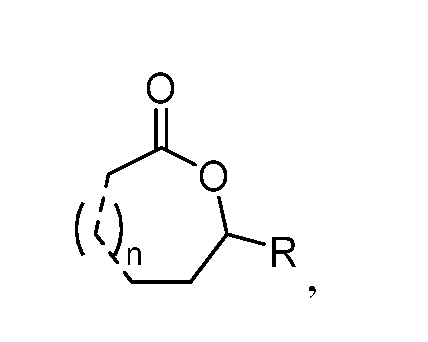
Figure imgf000041_0002
wherein: R is methyl, ethyl, or n-propyl; each is independently a single bond, E double bond, Z double bond, or triple bond, as valency permits; and n is an integer between 6 and 20, inclusive. In certain embodiments, R is methyl. In certain embodiments, R is ethyl. In certain embodiments, R is n-propyl. In certain embodiments, each is a single bond. In certain embodiments, at least one (e.g., one, two, three, or four) is an E or Z double bond. In certain embodiments, at least one (e.g., one, two, three, or four) is an E double bond. In certain embodiments, at least one (e.g., one, two, three, or four) is an Z double bond. In certain embodiments, each is independently a single bond, E double bond, or Z double bond. In certain embodiments, each is independently a single or Z double bond. In certain embodiments, one is a Z double bond, and each remaining is a single bond. In certain embodiments, two are Z double bonds, and each remaining is a single bond. In certain embodiments, three are Z double bonds, and each remaining is a single bond. In certain embodiments, four are Z double bonds, and each remaining is a single bond. In certain embodiments, at least one (e.g., one, two, or three) is a triple bond. In certain embodiments, at least one of any two adjacent is a single bond. In certain embodiments, one is an E or Z double bond, and the remining are single bonds. In certain embodiments, two are independently E or Z double bonds, and the remining are single bonds. In certain embodiments, three are independently E or Z double bonds, and the remining are single bonds. In certain embodiments, four are independently E or Z double bonds, and the remining are single bonds. In certain embodiments, each double bond if present is a Z double bond. In certain embodiments, each double bond if present is an E double bond. In certain embodiments, the lactone does not comprise any one of C=C=C, C=C≡C, and C≡C=C. In certain embodiments, k is 6. In certain embodiments, k is 7. In certain embodiments, k is 8. In certain embodiments, k is 9. In certain embodiments, k is 10. In certain embodiments, k is 11. In certain embodiments, k is 12. In certain embodiments, k is 13. In certain embodiments, k is 14. In certain embodiments, k is 15. In certain embodiments, k is 16. In certain embodiments, k is 8, 9, 10, 11, 12, 13, or 15. In certain embodiments, k is 8, 9, 10, 11, 12, 13, 14, or 15. In certain embodiments, k is an integer between 17 and 20, inclusive. In certain embodiments, k is an integer between 21 and 25, inclusive. In certain embodiments, k is an integer between 26 and 30, inclusive. In certain embodiments, n is 6. In certain embodiments, n is 7. In certain embodiments, n is 8. In certain embodiments, n is 9. In certain embodiments, n is 10. In certain embodiments, n is 11. In certain embodiments, n is 12. In certain embodiments, n is 13. In certain embodiments, n is 14. In certain embodiments, n is 15, 16, 17, 18, 19, or 20. In certain embodiments, n is an integer between 7 and 14, inclusive. In certain embodiments, the lactones produced using the biosynthetic methods described herein include a chiral carbon atom, which is the carbon atom labelled with * in the formula:
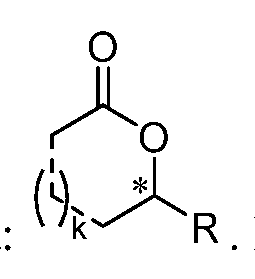
Figure imgf000043_0001
In certain embodiments, the lactones produced using the biosynthetic methods described herein include a chiral carbon atom, which is the carbon atom labelled with * in the formula:
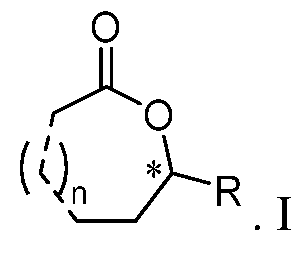
Figure imgf000043_0002
In certain embodiments, the chiral carbon atom is of the S configuration. In certain embodiments, the chiral carbon atom is of the R configuration. In certain embodiments, the lactones produced using the biosynthetic methods described herein are a mixture of lactones. In certain embodiments, the lactones produced using the biosynthetic methods described herein are a mixture of (e.g., two or three) lactones having different n values and different R moieties when the difference in the R/S configurations if present is disregarded. In certain embodiments, the lactones produced using the biosynthetic methods described herein are a mixture of lactones having the same R/S configuration but different n values and different R moieties. In certain embodiments, the lactones produced using the biosynthetic methods described herein are a mixture of lactones having different R/S configurations but the same n values and the same R moieties. In certain embodiments, the lactones produced using the biosynthetic methods described herein are a mixture of lactones having different R/S configurations, different n values, and different R moieties. In certain embodiments, the lactones produced using the biosynthetic methods described herein are substantially (e.g., between 90% and 95%, between 95% and 97%, between 97% and 99%, or between 99% and 99.9%, inclusive, by mole) a racemic mixture of lactones. In certain embodiments, the lactones produced using the biosynthetic methods described herein are substantially (e.g., between 90% and 95%, between 95% and 97%, between 97% and 99%, or between 99% and 99.9%, inclusive, by mole) one single type of lactone (e.g., substantially free of other types of lactones, including the opposite enantiomer of the one single type of lactone). In certain embodiments, the lactones produced using the biosynthetic methods described herein are substantially (between 90% and 95%, between 95% and 97%, between 97% and 99%, or between 99% and 99.9%, inclusive, by mole) two types of lactones, which are opposite enantiomers of each other (e.g., substantially free of other types of lactones). In some embodiments, the one or more fatty acids used as substrates in the first reaction mixture in step (i) comprise
Figure imgf000044_0001
(C15:0, pentadecanoic acid) and the lactone produced in step (iv) comprises:
Figure imgf000044_0002
, and combinations thereof.
Figure imgf000044_0003
In some embodiments, the one or more fatty acids used as substrates in the first reaction mixture in step (i) comprise
Figure imgf000044_0004
(C16:0, palmitic acid) and the lactone produced in step (iv) comprises:
Figure imgf000044_0005
Figure imgf000044_0006
and combinations thereof. In some embodiments, the one or more fatty acids used as substrates in the first reaction mixture in step (i) comprise
Figure imgf000044_0007
(C16:1, palmitoleic acid) and the lactone produced in step (iv) comprises:
Figure imgf000045_0001
and combinations thereof.
Figure imgf000045_0002
In some embodiments, the one or more fatty acids used as substrates in the first reaction mixture in step (i) comprise heptadecanoic acid) and the lactone produced in step (iv) comprises: and combinations thereof.
Figure imgf000045_0003
In some embodiments, the one or more fatty acids used as substrates in the first reaction mixture in step (i) comprise
Figure imgf000045_0004
octadecanoic acid) and the lactone produced in step (iv) comprises:
Figure imgf000045_0005
and combinations thereof.
Figure imgf000045_0006
In some embodiments, the one or more fatty acids used as substrates in the first reaction mixture in step (i) comprise
Figure imgf000046_0001
(C18:1, oleic acid) and the lactone produced in step (iv) comprises:
Figure imgf000046_0002
Figure imgf000046_0003
, and combinations thereof. In some embodiments, the one or more fatty acids used as substrates in the first reaction mixture in step (i) comprise
Figure imgf000046_0004
(C18:2, linoleic acid) and the lactone produced in step (iv) comprises:
Figure imgf000046_0005
and combinations thereof.
Figure imgf000046_0006
In some embodiments, the one or more fatty acids used as substrates in the first reaction mixture in step (i) comprise
Figure imgf000046_0007
(C20:4, arachidonic acid) and the lactone produced in step (iv) comprises:
Figure imgf000047_0001
and combinations thereof. In some embodiments, the one or more fatty acids used as substrates in the first reaction mixture in step (i) comprise
Figure imgf000047_0002
((7Z,10Z,13Z)-Hexadecatrienoic acid) and the lactone produced in step (iv) comprises:
Figure imgf000047_0003
In some embodiments, the one or more fatty acids used as substrates in the first reaction mixture in step (i) comprise
Figure imgf000047_0004
Hexadecatrienoic acid) and the lactone produced in step (iv) comprises:
Figure imgf000047_0005
Figure imgf000047_0006
and combinations thereof. In some embodiments, the one or more fatty acids used as substrates in the first reaction mixture in step (i) comprise
Figure imgf000047_0007
((4E,7E,10E)- Hexadecatrienoic acid) and the lactone produced in step (iv) comprises:
Figure imgf000048_0007
Figure imgf000048_0001
and combinations thereof. In some embodiments, the one or more fatty acids used as substrates in the first reaction mixture in step (i) comprise ((2E,4E,6E)-
Figure imgf000048_0002
Hexadecatrienoic acid) and the lactone produced in step (iv) comprises:
Figure imgf000048_0003
Figure imgf000048_0004
, and combinations thereof. In some embodiments, the one or more fatty acids used as substrates in the first reaction mixture in step (i) comprise
Figure imgf000048_0005
(γ-linolenic acid) and the lactone produced in step (iv) comprises: and combinations thereof.
Figure imgf000048_0006
In some embodiments, the one or more fatty acids used as substrates in the first reaction mixture in step (i) comprise (α-linolenic acid) and
Figure imgf000049_0001
the lactone produced in step (iv) comprises:
Figure imgf000049_0002
In some embodiments, the one or more fatty acids used as substrates in the first reaction mixture in step (i) comprise
Figure imgf000049_0003
((8E,10E,12Z)- Octadecatrienoic acid) and the lactone produced in step (iv) comprises:
Figure imgf000049_0004
Figure imgf000049_0005
and combinations thereof. In some embodiments, the on
Figure imgf000049_0006
e or more fatty acids used as substrates in the first reaction mixture in step (i) comprise
Figure imgf000049_0007
((9Z,11E,13E)- octadeca-9,11,13-trienoic acid) and the lactone produced in step (iv) comprises:
Figure imgf000049_0008
, , and combinations thereof. In some embodiments, the one or more fatty acids used as substrates in the first reaction mixture in step (i) comprise ((9E,11E,13E)-
Figure imgf000049_0009
octadeca-9,11,13-trienoic acid) and the lactone produced in step (iv) comprises:
Figure imgf000050_0001
and combinations thereof. In some embodiments, the one or more fatty acids used as substrates in the first reaction mixture in step (i) comprise
Figure imgf000050_0002
((5Z,9Z,12Z)-octadeca- 5,9,12-trienoic acid) and the lactone produced in step (iv) comprises:
Figure imgf000050_0003
Figure imgf000050_0004
and combinations thereof. In some embodiments, the one or more fatty acids used as substrates in the first reaction mixture in step (i) comprise
Figure imgf000050_0005
(8Z,11Z,14Z-eicosatrienoic acid) and the lactone produced in step (iv) comprises:
Figure imgf000050_0006
, and combinations thereof.
Figure imgf000050_0007
In some embodiments, the one or more fatty acids used as substrates in the first reaction mixture in step (i) comprise
Figure imgf000051_0001
((5Z,8Z,11Z)-Eicosa-5,8,11- trienoic acid) and the lactone produced in step (iv) comprises:
Figure imgf000051_0002
and combinations thereof.
Figure imgf000051_0003
In some embodiments, the one or more fatty acids used as substrates in the first reaction mixture in step (i) comprise (cis-10-Heptadecenoic
Figure imgf000051_0004
acid) and the lactone produced in step (iv) comprises:
Figure imgf000051_0005
Figure imgf000051_0007
and combinations thereof. In some embodiments, the one or more fatty acids used as substrates in the first reaction mixture in step (i) comprise
Figure imgf000051_0006
(trans- 10-Heptadecenoic acid) and the lactone produced in step (iv) comprises:
Figure imgf000052_0001
and combinations thereof.
Figure imgf000052_0002
In some embodiments, the one or more fatty acids used as substrates in the first reaction mixture in step (i) comprise
Figure imgf000052_0003
(cis-10- Nonadecenoic acid) and the lactone produced in step (iv) comprises:
Figure imgf000052_0004
Figure imgf000052_0005
and combinations thereof. In some embodiments, the one or more fatty acids used as substrates in the first reaction mixture in step (i) comprise (cis-11-Eicosenoic acid) and the
Figure imgf000052_0006
lactone produced in step (iv) comprises:
Figure imgf000053_0001
Figure imgf000053_0002
and combinations thereof. In some embodiments, the lactone produced using the biosynthetic methods provided herein comprises any one or more (e.g., 1, 2, 3, 4, 5, 6, 7, 8, 9, 10, 11, 12, 13, 14, 15,16, 17, 18, 19, 20, 21, 22, 23, or 24) of the lactones provided in Table 1. In some embodiments, the lactone produced using the biosynthetic methods provided herein comprises any one or more (e.g., 25, 26, 27, 28, 29, 30, or 31) of the lactones provided in Table 2. Other aspects of the present disclosure provide novel lactones of the formula:
Figure imgf000053_0003
wherein: R is methyl, ethyl, or n-propyl; each is independently a single bond, E double bond, Z double bond, or triple bond, as valency permits; and k is an integer between 6 and 30, inclusive; provided that the lactone is not of the formula:
Figure imgf000053_0004
Figure imgf000054_0001
Other aspects of the present disclosure provide novel lactones of the formula:
Figure imgf000054_0002
wherein: R is methyl, ethyl, or n-propyl; each is independently a single bond or Z double bond, as valency permits, wherein 0, 1, 2, or 4 are Z double bonds; and m is an integer between 4 and 11, inclusive; provided that the lactone is not of the formula:
Figure imgf000054_0003
Figure imgf000055_0001
In certain embodiments, the novel lactone is of the formula:
Figure imgf000055_0002
In certain embodiments, the novel lactone is of the formula:
Figure imgf000055_0003
Figure imgf000056_0001
or
Figure imgf000057_0001
In certain embodiments, the novel lactone is of the formula:
Figure imgf000057_0002
In certain embodiments, each is a single bond. In certain embodiments, one is a Z double bond, and the remining are single bonds. In certain embodiments, two are Z double bonds, and the remining are single bonds. In certain embodiments, four are Z double bonds, and the remining are single bonds. In certain embodiments, one is an E or Z double bond, and the remining are single bonds. In certain embodiments, two are independently E or Z double bonds, and the remining are single bonds. In certain embodiments, three are independently E or Z double bonds, and the remining are single bonds. In certain embodiments, four are independently E or Z double bonds, and the remining are single bonds. In certain embodiments, each double bond if present is a Z double bond. In certain embodiments, each double bond if present is an E double bond. In certain embodiments, the lactone does not comprise any one of C=C=C, C=C≡C, and C≡C=C. The variable k is as described herein. In certain embodiments, m is 4. In certain embodiments, m is 5. In certain embodiments, m is 6. In certain embodiments, m is 7. In certain embodiments, m is 8. In certain embodiments, m is 9. In certain embodiments, m is 10. In certain embodiments, m is 11. In certain embodiments, the chiral carbon atom of the novel lactone is of the S configuration. In certain embodiments, the chiral carbon atom of the novel lactone is of the R configuration. Another aspect of the present disclosure provides a mixture of two or more novel lactones. In certain embodiments, the mixture of two or more novel lactones is a mixture of the opposite enantiomers of In certain embodiments, the mixture of two or more
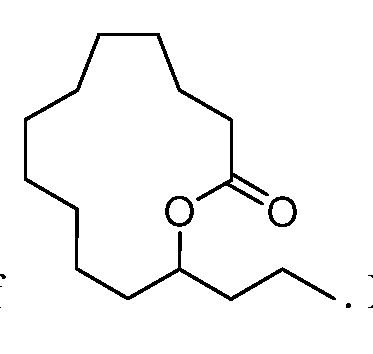
Figure imgf000058_0001
novel lactones is a mixture of the opposite enantiomers of the opposite
Figure imgf000058_0002
enantiomers of
Figure imgf000058_0003
and the opposite enantiomers of
Figure imgf000058_0004
. In certain embodiments, the mixture of two or more novel lactones is a mixture of the opposite enantiomers of
Figure imgf000059_0001
In certain embodiments, the mixture of two or more novel lactones is a mixture of the opposite enantiomers of and the opposite
Figure imgf000059_0002
enantiomers of . In certain embodiments, the mixture of two or more
Figure imgf000059_0003
novel lactones is a mixture of the opposite enantiomers of
Figure imgf000059_0004
and the opposite enantiomers of
Figure imgf000059_0005
. In certain embodiments, the mixture of two or more novel lactones is a mixture of the opposite enantiomers of
Figure imgf000059_0006
, the opposite enantiomers of and the opposite enantiomers of
Figure imgf000060_0001
. In certain embodiments, the mixture of two or more novel lactones is a mixture of the opposite enantiomers of
Figure imgf000060_0002
In certain embodiments, the mixture of two or more novel lactones is a mixture of the opposite enantiomers of
Figure imgf000060_0003
and the opposite enantiomers of In certain embodiments, the mixture of two or more novel
Figure imgf000060_0004
lactones is a mixture of the opposite enantiomers of the opposite enantiomers
Figure imgf000060_0005
of
Figure imgf000060_0006
and the opposite enantiomers of
Figure imgf000060_0007
In certain embodiments, the mixture of two or more novel lactones is a mixture of the opposite enantiomers of the opposite enantiomers of and the opposite enantiomers of
Figure imgf000061_0001
Figure imgf000061_0002
Figure imgf000061_0003
In certain embodiments, the mixture of two or more novel lactones is a mixture of the opposite enantiomers of
Figure imgf000061_0004
the opposite enantiomers of
Figure imgf000061_0005
, and the opposite enantiomers of
Figure imgf000061_0006
. In certain embodiments, the mixture of two or more novel lactones is a mixture of the opposite enantiomers of
Figure imgf000061_0007
. In certain embodiments, the mixture of two or more novel lactones is a mixture of the opposite enantiomers of the opposite enantiomers
Figure imgf000061_0008
of
Figure imgf000062_0001
and the opposite enantiomers of
Figure imgf000062_0002
In certain embodiments, the mixture of two or more novel lactones is a mixture of the opposite enantiomers of
Figure imgf000062_0003
the opposite enantiomers of , and the
Figure imgf000062_0004
opposite enantiomers of
Figure imgf000062_0005
. In certain embod
Figure imgf000062_0006
iments, the mixture of two or more novel lactones is a mixture of the opposite enantiomers of
Figure imgf000062_0007
, the opposite enantiomers of
Figure imgf000062_0008
, and the opposite enantiomers of In
Figure imgf000062_0009
certain embodiments, the mixture of two or more novel lactones is a mixture of the opposite enantiomers of
Figure imgf000062_0012
the opposite enantiomers of
Figure imgf000062_0010
and the opposite enantiomers of
Figure imgf000062_0011
. In certain embodiments, the mixture of two O O or more novel lactones is a mixture of the opposite enantiomers of , the opposite enantiomers of , and the opposite enantiomers of . In certain embodiments, the mixture of two or more novel lactones is a mixture of the opposite enantiomers of , the opposite enantiomers of , and the opposite enantiomers of . In certain embodiments, the mixture of two or more novel lactones is a mixture of the opposite enantiomers of , the opposite enantiomers of , and the opposite enantiomers of . In certain embodiments, the mixture of two or more novel lactones is a mixture of the opposite enantiomers of the opposite enantiomers of , and
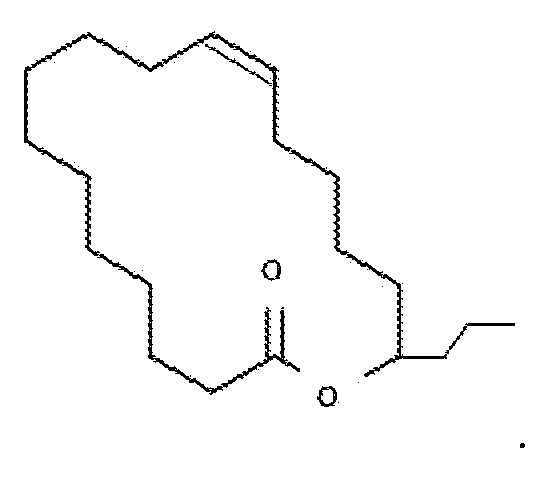
Figure imgf000064_0001
Figure imgf000064_0002
Figure imgf000064_0003
the opposite enantiomers of . In certain embodiments, the mixture of two or more novel lactones is a mixture of the opposite enantiomers of , the
Figure imgf000064_0004
opposite enantiomers of
Figure imgf000064_0005
, and the opposite enantiomers of . In certain embodiments, the mixture of two or more novel
Figure imgf000064_0006
lactones is a mixture of the opposite enantiomers of
Figure imgf000065_0001
, the opposite enantiomers of
Figure imgf000065_0002
, and the opposite enantiomers of
Figure imgf000065_0003
Synthetic Biology Standard recombinant DNA and molecular cloning techniques used here are well known in the art and are described, for example, by Sambrook, J., Fritsch, E. F. and Maniatis, T. MOLECULAR CLONING: A LABORATORY MANUAL, 2nd ed.; Cold Spring Harbor Laboratory: Cold Spring Harbor, N.Y., 1989 (hereinafter "Maniatis"); and by Silhavy, T. J., Bennan, M. L. and Enquist, L. W. EXPERIMENTS WITH GENE FUSIONS; Cold Spring Harbor Laboratory: Cold Spring Harbor, N.Y., 1984; and by Ausubel, F. M. et al., IN CURRENT PROTOCOLS IN MOLECULAR BIOLOGY, published by GREENE PUBLISHING AND WILEY-INTERSCIENCE, 1987; (the entirety of each of which is hereby incorporated herein by reference). Unless defined otherwise, all technical and scientific terms used herein have the same meaning as commonly understood by one of ordinary skill in the art to which the disclosure belongs. Although any methods and materials similar to or equivalent to those described herein can be used in the practice or testing of the present disclosure, the preferred materials and methods are described below. The disclosure will be more fully understood upon consideration of the following non- limiting Examples. It should be understood that these Examples, while indicating preferred embodiments of the subject technology, are given by way of illustration only. From the above discussion and these Examples, one skilled in the art can ascertain the essential characteristics of the subject technology, and without departing from the spirit and scope thereof, can make various changes and modifications of the subject technology to adapt it to various uses and conditions. Bacterial Production Systems Expression of proteins in prokaryotes is most often carried out in a bacterial host cell with vectors containing constitutive or inducible promoters directing the expression of either fusion or non-fusion proteins. Fusion vectors add a number of amino acids to a protein encoded therein, usually to the amino terminus of the recombinant protein. Such fusion vectors typically serve three purposes: (l) to increase expression of recombinant protein; (2) to increase the solubility of the recombinant protein; and (3) to aid in the purification of the recombinant protein by acting as a ligand in affinity purification. Often, a proteolytic cleavage site is introduced at the junction of the fusion moiety and the recombinant protein to enable separation of the recombinant protein from the fusion moiety subsequent to purification of the fusion protein. Such vectors are within the scope of the present disclosure. In an embodiment, the expression vector includes those genetic elements for expression of the recombinant polypeptide in bacterial cells. The elements for transcription and translation in the bacterial cell can include a promoter, a coding region for the protein complex, and a transcriptional terminator. We only used one standard E. coli expression system for this proof- of-concept work. The further modification and optimization is in progress. A person of ordinary skill in the art will be aware of the molecular biology techniques available for the preparation of expression vectors. The polynucleotide used for incorporation into the expression vector of the subject technology, as described above, can be prepared by routine techniques such as polymerase chain reaction (PCR). A number of molecular biology techniques have been developed to operably link DNA to vectors via complementary cohesive termini. In one embodiment, complementary homopolymer tracts can be added to the nucleic acid molecule to be inserted into the vector DNA. The vector and nucleic acid molecule are then joined by hydrogen bonding between the complementary homopolymeric tails to form recombinant DNA molecules. In an alternative embodiment, synthetic linkers containing one or more restriction sites provide are used to operably link the polynucleotide of the subject technology to the expression vector. In an embodiment, the polynucleotide is generated by restriction endonuclease digestion. In an embodiment, the nucleic acid molecule is treated with bacteriophage T4 DNA polymerase or E. coli DNA polymerase I, enzymes that remove protruding, 3'-single-stranded termini with their 3'-5'-exonucleolytic activities and fill-in recessed 3'-ends with their polymerizing activities, thereby generating blunt-ended DNA segments. The blunt-ended segments are then incubated with a large molar excess of linker molecules in the presence of an enzyme that is able to catalyze the ligation of blunt-ended DNA molecules, such as bacteriophage T4 DNA ligase. Thus, the product of the reaction is a polynucleotide carrying polymeric linker sequences at its ends. These polynucleotides are then cleaved with the appropriate restriction enzyme and ligated to an expression vector that has been cleaved with an enzyme that produces termini compatible with those of the polynucleotide. Alternatively, a vector having ligation-independent cloning (LIC) sites can be employed. The required PCR amplified polynucleotide can then be cloned into the LIC vector without restriction digest or ligation (Aslanidis and de Jong, NUCL. ACID. RES.186069-74, (1990), Haun, et al, BIOTECHNIQUES 13, 515-18 (1992), which is incorporated herein by reference to the extent it is consistent herewith). In an embodiment, in order to isolate and/or modify the polynucleotide of interest for insertion into the chosen plasmid, it is suitable to use PCR. Appropriate primers for use in PCR preparation of the sequence can be designed to isolate the required coding region of the nucleic acid molecule, add restriction endonuclease or LIC sites, place the coding region in the desired reading frame. In an embodiment, a polynucleotide for incorporation into an expression vector of the subject technology is prepared by the use of PCR using appropriate oligonucleotide primers. The coding region is amplified, whilst the primers themselves become incorporated into the amplified sequence product. In an embodiment, the amplification primers contain restriction endonuclease recognition sites, which allow the amplified sequence product to be cloned into an appropriate vector. The expression vectors can be introduced into plant or microbial host cells by conventional transformation or transfection techniques. Transformation of appropriate cells with an expression vector of the subject technology is accomplished by methods known in the art and typically depends on both the type of vector and cell. Suitable techniques include calcium phosphate or calcium chloride co-precipitation, DEAE-dextran mediated transfection, lipofection, chemoporation or electroporation. Successfully transformed cells, that is, those cells containing the expression vector, can be identified by techniques well known in the art. For example, cells transfected with an expression vector of the subject technology can be cultured to produce polypeptides described herein. Cells can be examined for the presence of the expression vector DNA by techniques well known in the art. The host cells can contain a single copy of the expression vector described previously, or alternatively, multiple copies of the expression vector. In some embodiments, the transformed cell is an animal cell, an insect cell, a plant cell, an algal cell, a fungal cell, or a yeast cell. In some embodiments, the cell is a plant cell selected from the group consisting of: canola plant cell, a rapeseed plant cell, a palm plant cell, a sunflower plant cell, a cotton plant cell, a corn plant cell, a peanut plant cell, a flax plant cell, a sesame plant cell, a soybean plant cell, and a petunia plant cell. Microbial host cell expression systems and expression vectors containing regulatory sequences that direct high-level expression of foreign proteins are well known to those skilled in the art. Any of these could be used to construct vectors for expression of the recombinant polypeptide of the subjection technology in a microbial host cell. These vectors could then be introduced into appropriate microorganisms via transformation to allow for high level expression of the recombinant polypeptide of the subject technology. Vectors or cassettes useful for the transformation of suitable microbial host cells are well known in the art. Typically the vector or cassette contains sequences directing transcription and translation of the relevant polynucleotide, a selectable marker, and sequences allowing autonomous replication or chromosomal integration. Suitable vectors comprise a region 5' of the polynucleotide which harbors transcriptional initiation controls and a region 3' of the DNA fragment which controls transcriptional termination. It is preferred for both control regions to be derived from genes homologous to the transformed host cell, although it is to be understood that such control regions need not be derived from the genes native to the specific species chosen as a host. Initiation control regions or promoters, which are useful to drive expression of the recombinant polypeptide in the desired microbial host cell are numerous and familiar to those skilled in the art. Virtually any promoter capable of driving these genes is suitable for the subject technology including but not limited to CYCI, HIS3, GALI, GALIO, ADHI, PGK, PH05, GAPDH, ADCI, TRPI, URA3, LEU2, ENO, TPI (useful for expression in Saccharomyces); AOXI (useful for expression in Pichia); and lac, trp, JPL, IPR, T7, tac, and trc (useful for expression in Escherichia coli). Termination control regions may also be derived from various genes native to the microbial hosts. A termination site optionally may be included for the microbial hosts described herein. In plant cells, the expression vectors of the subject technology can include a coding region operably linked to promoters capable of directing expression of the recombinant polypeptide of the subject technology in the desired tissues at the desired stage of development. For reasons of convenience, the polynucleotides to be expressed may comprise promoter sequences and translation leader sequences derived from the same polynucleotide.3' non-coding sequences encoding transcription termination signals should also be present. The expression vectors may also comprise one or more introns in order to facilitate polynucleotide expression. For plant host cells, any combination of any promoter and any terminator capable of inducing expression of a coding region may be used in the vector sequences of the subject technology. Some suitable examples of promoters and terminators include those from nopaline synthase (nos), octopine synthase (ocs) and cauliflower mosaic virus (CaMV) genes. One type of efficient plant promoter that may be used is a high-level plant promoter. Such promoters, in operable linkage with an expression vector of the subject technology should be capable of promoting the expression of the vector. High level plant promoters that may be used in the subject technology include the promoter of the small subunit (s) of the ribulose-1,5- bisphosphate carboxylase for example from soybean (Berry-Lowe et al., J. MOLECULAR AND APP. GEN., 1:483498 (1982), the entirety of which is hereby incorporated herein to the extent it is consistent herewith), and the promoter of the chlorophyll binding protein. These two promoters are known to be light-induced in plant cells (see, for example, GENETIC ENGINEERING OF PLANTS, AN AGRICULTURAL PERSPECTIVE, A. Cashmore, Plenum, N.Y. (1983), pages 2938; Coruzzi, G. et al., The Journal of Biological CHEMISTRY, 258: 1399 (1983), and Dunsmuir, P. et al., JOURNAL OF MOLECULAR AND APPLIED GENETICS, 2:285 (1983), each of which is hereby incorporated herein by reference to the extent they are consistent herewith). One with skill in the art will recognize that the lactone composition(s) produced by the methods described herein can be further purified and mixed with other lactones, flavors, or scents to obtain a desired composition for use in a variety of consumer products or foods. Analysis of Sequence Similarity Using Identity Scoring As used herein "sequence identity" refers to the extent to which two optimally aligned polynucleotide or peptide sequences are invariant throughout a window of alignment of components, e.g., nucleotides or amino acids. An "identity fraction" for aligned segments of a test sequence and a reference sequence is the number of identical components which are shared by the two aligned sequences divided by the total number of components in reference sequence segment, i.e., the entire reference sequence or a smaller defined part of the reference sequence. As used herein, the term "percent sequence identity" or "percent identity" refers to the percentage of identical nucleotides in a linear polynucleotide sequence of a reference ("query") polynucleotide molecule (or its complementary strand) as compared to a test ("subject") polynucleotide molecule (or its complementary strand) when the two sequences are optimally aligned (with appropriate nucleotide insertions, deletions, or gaps totaling less than 20 percent of the reference sequence over the window of comparison). Optimal alignment of sequences for aligning a comparison window are well known to those skilled in the art and may be conducted by tools such as the local homology algorithm of Smith and Waterman, the homology alignment algorithm of Needleman and Wunsch, the search for similarity method of Pearson and Lipman, and preferably by computerized implementations of these algorithms such as GAP, BESTFIT, FASTA, and TFASTA available as part of the GCG® Wisconsin Package® (Accelrys Inc., Burlington, MA). An "identity fraction" for aligned segments of a test sequence and a reference sequence is the number of identical components which are shared by the two aligned sequences divided by the total number of components in the reference sequence segment, i.e., the entire reference sequence or a smaller defined part of the reference sequence. Percent sequence identity is represented as the identity fraction multiplied by 100. The comparison of one or more polynucleotide sequences may be to a full-length polynucleotide sequence or a portion thereof, or to a longer polynucleotide sequence. For purposes of this disclosure "percent identity" may also be determined using BLASTX version 2.0 for translated nucleotide sequences and BLASTN version 2.0 for polynucleotide sequences. The percent of sequence identity is preferably determined using the "Best Fit" or "Gap" program of the Sequence Analysis Software Package™ (Version 10; Genetics Computer Group, Inc., Madison, WI). "Gap" utilizes the algorithm of Needleman and Wunsch (Needleman and Wunsch, JOURNAL OF MOLECULAR BIOLOGY 48:443-453, 1970) to find the alignment of two sequences that maximizes the number of matches and minimizes the number of gaps. "BestFit" performs an optimal alignment of the best segment of similarity between two sequences and inserts gaps to maximize the number of matches using the local homology algorithm of Smith and Waterman (Smith and Waterman, ADVANCES IN APPLIED MATHEMATICS, 2:482-489, 1981, Smith et al., NUCLEIC ACIDS RESEARCH 11:2205-2220, 1983). The percent identity is most preferably determined using the "Best Fit" program. Useful methods for determining sequence identity are also disclosed in the Basic Local Alignment Search Tool (BLAST) programs which are publicly available from National Center Biotechnology Information (NCBI) at the National Library of Medicine, National Institute of Health, Bethesda, Md.20894; see BLAST Manual, Altschul et al., NCBI, NLM, NIH; Altschul et al., J. MOL. BIOL.215:403-410 (1990); version 2.0 or higher of BLAST programs allows the introduction of gaps (deletions and insertions) into alignments; for peptide sequence BLASTX can be used to determine sequence identity; and, for polynucleotide sequence BLASTN can be used to determine sequence identity. As used herein, the term "substantial percent sequence identity" refers to a percent sequence identity of at least about 70% sequence identity, at least about 80% sequence identity, at least about 85% identity, at least about 90% sequence identity, or even greater sequence identity, such as about 98% or about 99% sequence identity. Thus, one embodiment of the disclosure is a polynucleotide molecule that has at least about 70% sequence identity, at least about 80% sequence identity, at least about 85% identity, at least about 90% sequence identity, or even greater sequence identity, such as about 98% or about 99% sequence identity with a polynucleotide sequence described herein. Polynucleotide molecules that have the activity of the Blu1 and Cytochrome P450 genes of the current disclosure are capable of directing the production of a variety of lactones, such as macrocyclic lactones, and have a substantial percent sequence identity to the polynucleotide sequences provided herein and are encompassed within the scope of this disclosure. Identity is the fraction of amino acids that are the same between a pair of sequences after an alignment of the sequences (which can be done using only sequence information or structural information or some other information, but usually it is based on sequence information alone), and similarity is the score assigned based on an alignment using some similarity matrix. The similarity index can be any one of the following BLOSUM62, PAM250, or GONNET, or any matrix used by one skilled in the art for the sequence alignment of proteins. Identity is the degree of correspondence between two sub-sequences (no gaps between the sequences). An identity of 25% or higher implies similarity of function, while 18- 25% implies similarity of structure or function. Keep in mind that two completely unrelated or random sequences (that are greater than 100 residues) can have higher than 20% identity. Similarity is the degree of resemblance between two sequences when they are compared. This is dependent on their identity. As is evident from the foregoing description, certain aspects of the present disclosure are not limited by the particular details of the examples illustrated herein, and it is therefore contemplated that other modifications and applications, or equivalents thereof, will occur to those skilled in the art. It is accordingly intended that the claims shall cover all such modifications and applications that do not depart from the spirit and scope of the present disclosure. Moreover, unless defined otherwise, all technical and scientific terms used herein have the same meaning as commonly understood by one of ordinary skill in the art to which the disclosure belongs. Although any methods and materials similar to or equivalent to or those described herein can be used in the practice or testing of the present disclosure, the preferred methods and materials are described above. EXAMPLES Example 1: In this process, a cytochrome P450 enzyme, e.g. P450 BM3 (Miura and Fulco, 1975) that has fatty acid subterminal hydroxylase activity, was used to make ω-1, ω-2 or ω-3 hydroxyl fatty acids or their mixtures (Process 1, Miura Y, Fulco AJ. (1975) Omega-1, Omega-2 and Omega-3 hydroxylation of long-chain fatty acids, amides and alcohols by a soluble enzyme system from Bacillus megaterium. Biochim. Biophys. Acta.388: 305-317). The hydroxyl fatty acid products may be further processed by lipase-catalyzed ring closure reaction in organic solvents for the formation of branched-chain musky macrolactones (Process 2). The overall synthetic scheme is illustrated in FIG.1. Process 1 involves a fatty acid hydroxylation by subjecting the saturated or unsaturated fatty acid to the action of a biological catalyst (hydroxylase) present in a fermentation media. The hydroxyl fatty acid obtained from Process 1 may be isolated from the fermentation broth (for example by liquid-liquid extraction using a mixture of hydrocarbon-based organic solvents such as hexane and a water-insoluble polar solvent such as ethyl acetate). Process 2 involves a reaction of obtaining macrolactones by subjecting the hydroxyl fatty acids to an intramolecular macrolactonization reaction catalyzed by a lipase enzyme. The lipase enzyme may be immobilized on a solid support and used for the macrolacronization process. The immobilized lipase can be easily recovered and recycled repeatedly for a long term. Process 2 can be carried out in the presence of immobilized lipase catalyst such as Novozyme 435 in a solvent such as toluene of dichloroethane. The concentration of hydroxyl fatty acid is adjusted at 0.05 to 0.025 molar. The concentration of immobilized lipase enzyme may be appropriately selected to amounts that do not decrease the reaction rate. In the case of using Novozyme 435, it is preferable to adjust the concentration at 50 to 100 grams per liter. The reaction is usually shaken and stirred for about 15 to 24 hours at 40 to 60 °C. The target macrolactones can be isolated from the reaction mixture using a proper combination of conventional purification techniques such as filtration, chromatography, and drying. Example 2: A total number of eight fatty acids were used for musk lactone production.

Figure imgf000073_0001
C15:0 (Pentadecanoic acid)
Figure imgf000073_0002
C16:0 (Palmitic acid)
Figure imgf000073_0003
C16:1 (Palmitoleic acid)
Figure imgf000073_0004
C17:0 (Heptadecanoic acid)
Figure imgf000073_0005
C18:0 (Octadecanoic acid)
Figure imgf000073_0006
C18:1 (Oleic acid)
Figure imgf000073_0007
C18:2 (Linoleic acid)
Figure imgf000074_0001
C20:4 (Arachidonic acid) After hydroxylation and ring closure, eight different musk lactone mixtures were produced from these eight fatty acids, respectively as shown in FIG.2. The eight fatty acids and corresponding musk lactone products is shown in Table 1. Reaction schemes showing fatty acid hydroxylation and ring closure are illustrated for oleic acid, linoleic acid, arachidonic acid, palmitic acid, heptadecanoic acid, and octadecanoic acid in FIGs.3A-3F, respectively. Table 1
Figure imgf000074_0002
Figure imgf000075_0001
Figure imgf000076_0001
Figure imgf000077_0001
Fatty acid hydroxylation The amino acid sequence of a BM3 homolog of Myceliophthora thermophile (CYP505A30) was obtained from UniProt (uniprot.org/uniprot/G2QDZ3.fasta) and the corresponding gene was codon optimized for expression in Escherichia coli and synthesized by GenScript (Piscataway, NJ). The resulting gene product was cloned into pETDuet-1 vector (AMP+, Novagen) through NdeI and XhoI sites. The construct was transformed into BL21(DE3) cells for expression. In a typical experiment, an overnight culture was used to inoculate liquid LB medium (2%) containing 100 mg/L of carbenicillin and 0.4 mM 5-aminolevulinic acid. The culture was first grown at 37°C to an OD600 of 0.6 and cooled down to 16°C. Then 1 mM IPTG was added to induce protein expression. After 16 hours of incubation at 16°C, cells were harvested by centrifugation. Harvested cell pellets were re-suspended at a concentration of 100 g/L fresh weight in 100 mM potassium phosphate buffer (pH7.0) containing 0.1% Tween 40 and 10 mM NADPH. Then 1 g/L of fatty acid substrate was added. The mixture was shaken at 37°C in a shaker. Production of branched-chain musky macrolactones from Palmitic acid The overall synthetic scheme showing palmitic acid hydroxylation and a reaction of obtaining corresponding musk lactone products is illustrated in FIG.4. Harvested cell pellets were re-suspended at a concentration of 100 g/L fresh weight in 100 mM potassium phosphate buffer (pH7.0) containing 0.1% Tween 40 and 10 mM NADPH. Then 1 g/L of palmitic acid (C16:0) was added. The mixture was shaken at 37°C in a shaker. Hydroxylated palmitic acids were extracted by ethyl acetate and ethyl acetate phase was dried in SpeedVac™ vacuum concentrator. Then Novozym 435 in the form of acrylic resin (Sigma) was added with toluene as solvent for ring closure reaction at 60oC with shaking. The products from hydroxyl palmitic acids were analyzed by GC/MS. GC/MS analysis was conducted on Shimadzu GC-2010 system coupled with GCMS- QP2010S detector. The analytical column is SHRXI-5MS (thickness 0.25 µm; length 30 m; diameter 0.25 mm) and the injection temperature is 265oC under split mode. The temperature gradient is 0-3 min 150oC; 3-6.7 min 150oC to 260oC, a gradient of 30; 6.7-15.7 min, 260oC. Production of branched-chain musky macrolactones from Oleic acid First, oleic acid was hydroxylated to form hydroxyl fatty acid, as outlined in Process 1 in Example 1. Thereafter, the hydroxyl fatty acid were cyclized as illustrated in FIG.5 (Process 2). 3 liters of fermentation broth containing hydroxyl oleic acid analogs were extracted with 11 liters of 50% ethyl acetate-hexane in 1-liter batches. The solvents were distilled off under reduced pressure to obtain 11.50 g of crude extract as a reddish oil. The crude extract was purified by column chromatography on silica gel eluting with 20 to 50 % ethyl acetate- hexane to obtain 1.40 g of hydroxyl oleic acid isomers. 1.40 g (4.66 mmol) of hydroxyl oleic acid analogs was dissolved in 200 ml toluene.20 g of Novozyme 435 was added to this solution. The reaction mixture was heated to 55 ° C and stirred for 15 hours then cooled to room temperature. The immobilized lipase enzyme was separated by filtration and rinsed with dichloromethane. The volatiles were distilled off under reduced pressure to obtain 1.50 g of crude product as a yellow oil. The crude product was purified by column chromatography on silica gel eluting with 5% ethyl acetate-hexane to obtain 1.10 g (3.92 mmol, 62.7% isolated yield, 98% total purity of three isomers) of corresponding macrolactonization products. It was confirmed by a sensory evaluation that the mixture of the three components has a luxurious and novel musk fragrance. A 1 mg/ml solution of the purified product in hexane was analyzed on a capillary gas chromatograph-mass spectrometer GCMS-QP2020 NX (manufactured by Shimadzu) using a 30 m x 0.25 mm 0.25 µm Rtx-5MS (manufactured by Restek). The analysis was carried out using high purity helium for the mobile phase, at a flow rate of 1 mL/min. The temperature program used was 150° C. for 3 minutes, a temperature gradient of 50° C./minute to 260° C., and isothermic at 260° C. for 9 minutes. Results are shown in FIG.6. Production of branched-chain musky macrolactones from Linoleic acid The overall synthetic scheme showing linoleic acid hydroxylation (Process 1) and a reaction of obtaining corresponding musk lactone products (Process 2) is illustrated in FIG.7. 2 liters of fermentation broth containing hydroxyl linoleic acid analogs was extracted with 7 liters of 50% ethyl acetate-hexane in 0.7-liter batches. The solvents were distilled off under reduced pressure to obtain 18.5 g of crude extract as a reddish oil. The crude extract was purified by column chromatography on silica gel eluting with 20 to 50 % ethyl acetate-hexane to obtain 1.2 g of hydroxyl linoleic acid isomers. 1.2 g (4.05 mmol) of hydroxyl linoleic acid analogs was dissolved in 160 ml toluene. 16 g of Novozyme 435 (100 g/L) was added to this solution. The reaction mixture was heated to 50 °C and stirred for 17 hours then cooled to room temperature. The immobilized lipase enzyme was separated by filtration and rinsed with dichloromethane. The volatiles were distilled off under reduced pressure to obtain 1.10 g of crude product as a yellow oil. The crude product was purified by column chromatography on silica gel eluting with 5% ethyl acetate-hexane to obtain 0.70 g (2.52 mmol, 62.2% isolated yield, 95% total purity of three isomers) of corresponding macrolactonization products. A 1 mg/ml solution of the purified product in hexane was analyzed on a capillary gas chromatograph-mass spectrometer GCMS-QP2020 NX (manufactured by Shimadzu) using a 30 m x 0.25 mm 0.25 µm Rtx-5MS (manufactured by Restek). The analysis was carried out using high purity helium for the mobile phase, at a flow rate of 1 mL/min. The temperature program used was 150° C. for 3 minutes, a temperature gradient of 50° C./minute to 260° C., and isothermic at 260° C. for 9 minutes. Results are shown in FIG.8. Example 3 In this process, a cytochrome P450 enzyme e.g. P450 BM3 (Miura and Fulco, 1975; Wen and Fulco, 1987) or its homologs (Baker et. al, 2017) that have fatty acid subterminal hydroxylase activity to make ω-1, ω-2 or ω-3 hydroxy fatty acids or their mixtures was used. After extraction and purification, hyxroxy fatty acid were subject to lipase-catalyzed ring closure reaction in organic solvents for the formation of branched-chain musky macrolactones (FIG.9). The amino acid sequence of a BM3 homolog of Myceliophthora thermophile (CYP505A30) was obtained from UniProt (uniprot.org/uniprot/G2QDZ3.fasta) and the corresponding gene was codon optimized for expression in Escherichia coli and synthesized by GenScript (Piscataway, NJ). The resulting gene product was cloned into pETDuet-1 vector (AMP+, Novagen) through NdeI and XhoI sites. The construct was transformed into BL21(DE3) cells for expression. In a typical experiment, an overnight culture was used to inoculate liquid LB medium (2%) containing 100 mg/L of carbenicillin and 0.4 mM 5-aminolevulinic acid. The culture was first grown at 37°C to an OD600 of 0.6 and cooled down to 16°C. Then 1 mM IPTG was added to induce protein expression. After 16 h of incubation at 16°C, cells were harvested by centrifugation. Harvested cell pellets were re-suspended at a concentration of 100 g/L fresh weight in 100 mM potassium phosphate buffer (pH7.0) containing 0.1% Tween 40 and 10 mM NADPH. Then 1 g/L of γ-linolenic acid (GLA, C18:3) was added. The mixture was shaken at 37°C in a shaker. Results of GC/MS analysis of musky lactones derived from hydroxy GLA (molecular weight: 276) are shown in FIG.10. Additional fatty acid substrates that may be used and the lactone products are provided below and shown in Table 2. Production of branched-chain musky macrolactones from α-linolenic acid (ALA) Harvested cell pellets were re-suspended at a concentration of 100 g/L fresh weight in 100 mM potassium phosphate buffer (pH7.0) containing 0.1% Tween 40 and 10 mM NADPH. Then 1 g/L of α-linolenic acid (ALA, C18:3) was added. The mixture was shaken at 37°C in a shaker for 5 hours. Hydroxylated α-linolenic acid was extracted by ethyl acetate and ethyl acetate phase was dried in SpeedVac™ vacuum concentrator. Then Novozym 435 in the form of acrylic resin (Sigma) was added with toluene as solvent for ring closure reaction at 60 ° C with shaking. The products from hydroxy α-linolenic acid were analyzed by GC/MS. See FIGs.11 and 12. Production of branched-chain musky macrolactones from C20:3 (8Z,11Z,14Z- eicosatrienoic acid, dihomo-γ-linolenic acid, DGLA) Harvested cell pellets were re-suspended at a concentration of 100 g/L fresh weight in 100 mM potassium phosphate buffer (pH7.0) containing 0.1% Tween 40 and 10 mM NADPH. Then 1 g/L of dihomo-γ-linolenic acid (DGLA, C20:3) was added. The mixture was shaken at 37°C in a shaker for 5 hours. Hydroxylated DGLA was extracted by ethyl acetate and ethyl acetate phase was dried in SpeedVac™ vacuum concentrator. Then Novozym 435 in the form of acrylic resin (Sigma) was added with toluene as solvent for ring closure reaction at 60oC with shaking. The products from hydroxy DGLA acids were analyzed by GC/MS. See FIGs.13 and 14. Table 2 Additional fatty acid substrates and lactones
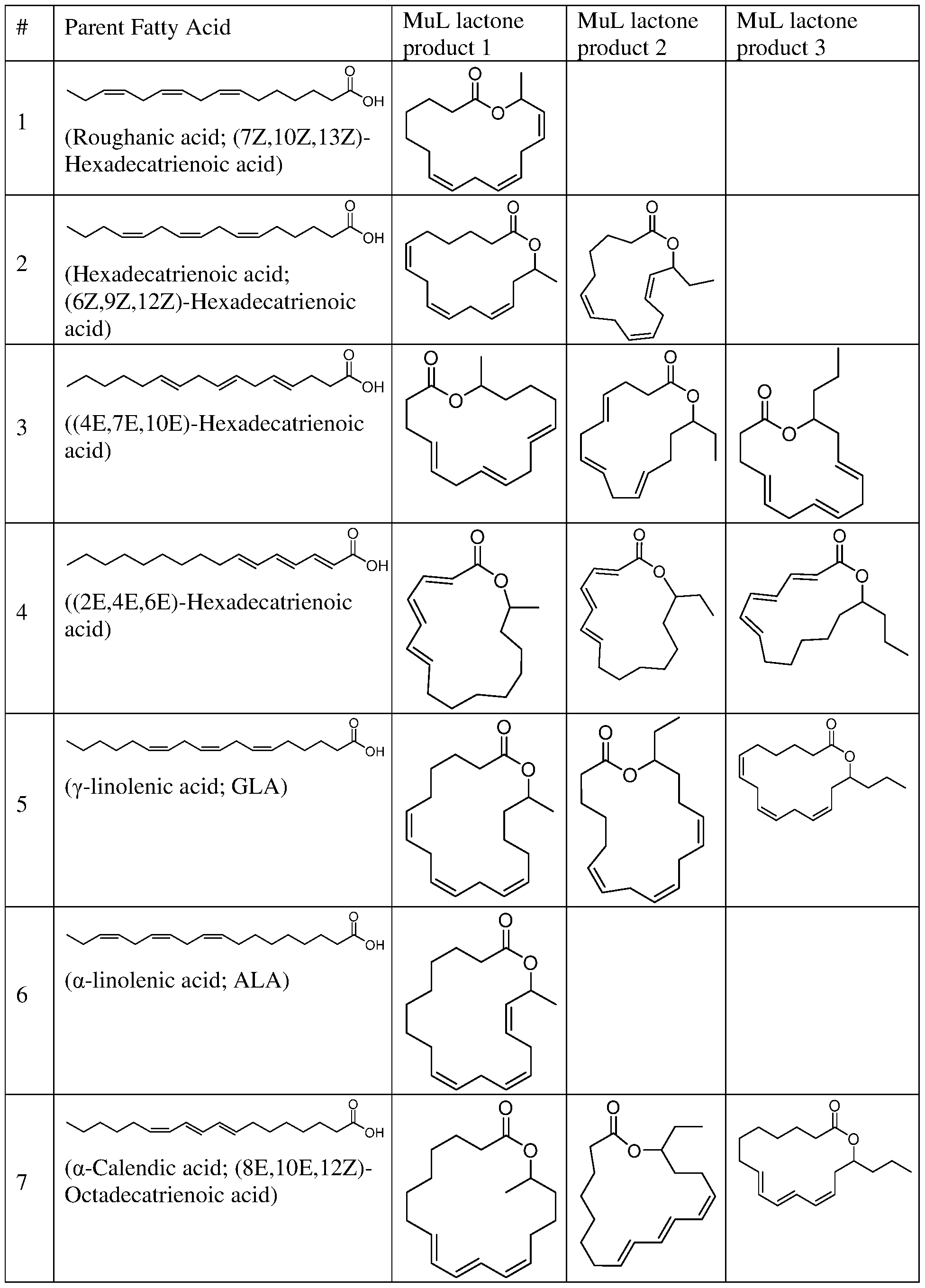
Figure imgf000081_0001
Figure imgf000082_0001
Example 4 A total number of four monounsaturated fatty acids were used for musk lactone production. The biosynthetic processes are illustrated in FIGs.15-18. The structures of the monounsaturated fatty acids and the resulting lactones are shown in Table 3. The lactone production process used involved biosynthetic conversion of the monounsaturated fatty acids using P450 hydroxylase and lipase. The amino acid sequence of a BM3 homolog of Myceliophthora thermophile (CYP505A30) was obtained from UniProt (uniprot.org/uniprot/G2QDZ3.fasta). The corresponding gene was codon optimized for expression in Escherichia coli and synthesized by GenScript (Piscataway, NJ). The resulting gene product was then cloned into pETDuet-1 vector (AMP+, Novagen) through NdeI and XhoI sites. The resulting construct was then transformed into BL21(DE3) cells for expression. To produce hydroxylated fatty acids, an overnight culture was used to inoculate liquid LB medium (2%) containing 100mg/L of carbenicillin and 0.4mM 5-aminolevulinic acid. The culture was first grown at 37°C to an OD600 of 0.6 and then cooled down to 16°C. Then, 1mM IPTG was added to induce protein expression. After 16 hours of incubation at 16°C, cells were harvested by centrifugation. Harvested cell pellets were re-suspended to a concentration of 100g/L fresh weight in 100mM potassium phosphate buffer (pH7.0) containing 0.1% Tween 40 and 10 mM NADPH. Then, 1g/L or 3g/L of various fatty acids was added. The mixture was shaken at 37°C in a shaker. Hydroxylated fatty acids were extracted by ethyl acetate. The ethyl acetate phase was dried in a SpeedVac™ vacuum concentrator. To perform the ring closure reaction, Novozym 435 in the form of acrylic resin (Sigma) was added with toluene as a solvent and incubated at 60ºC with shaking. The lactone products were then analyzed by GC/MS. See FIGs. 19-22. GC/MS analysis was conducted on Shimadzu GC-2030 system coupled with GCMS-QP2020NX detector. The analytical column is SHRXI-5MS (thickness 0.25µm; length 30m; diameter 0.2mm) and the injection temperature was 265ºC under split mode. The temperature gradient was 0-3min 150ºC; 3-6.7min 150ºC to 260ºC, a gradient of 30; 6.7-15.7min, 260ºC. Table 3
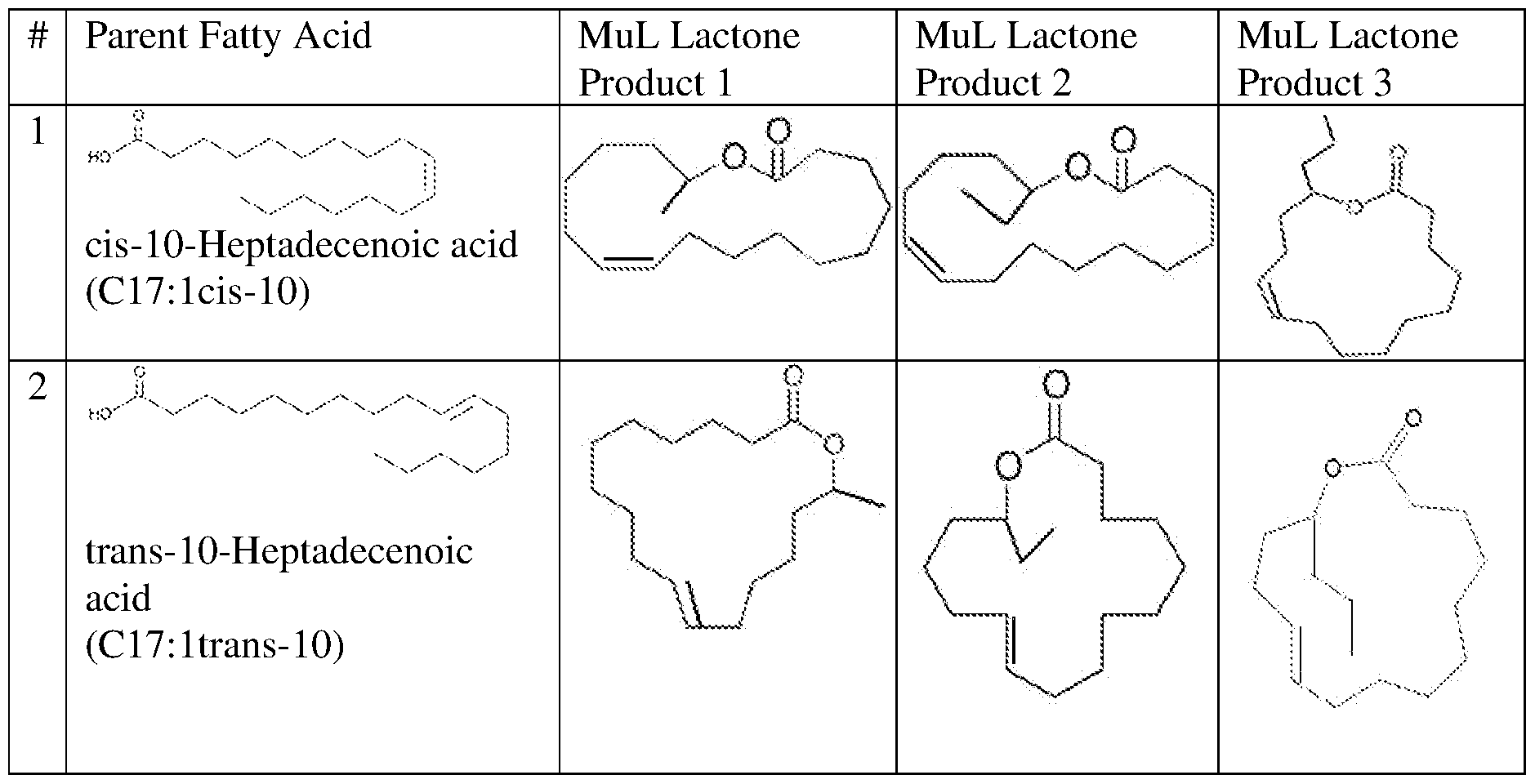
Figure imgf000083_0001
Figure imgf000084_0001
References Baker GJ, Girvan HM, Matthews S, McLean KJ, Golovanova M, Waltham TN, Rigby SEJ, Nelson DR, Blankley RT, Munro AW. (2017) Expression, Purification, and Biochemical Characterization of the Flavocytochrome P450 CYP505A30 from Myceliophthora thermophile. ACS Omega 2: 4705-4724. Miura Y, Fulco AJ. (1975) Omega-1, Omega-2 and Omega-3 hydroxylation of long-chain fatty acids, amides and alcohols by a soluble enzyme system from Bacillus megaterium. Biochim. Biophys. Acta. 388: 305-317. Wen LP, Fulco AJ. (1987) Cloning of the gene encoding a catalytically self-sufficient cytochrome P-450 fatty acid monooxygenase induced by barbiturates in Bacillus megaterium and its functional expression and regulation in heterologous (Escherichia coli) and homologous (Bacillus megaterium) hosts. J. Biol. Chem. 262: 6676-6682. Amino Acid and Nucleotide Sequences SEQ ID NO: 1 - Amino acid sequence of cytochrome P450 CYP102A1 from Bacillus megaterium MTIKEMPQPKTFGELKNLPLLNTDKPVQALMKIADELGEIFKFEAPGRVTRYLSSQRLI KEACDESRFDKNLSQALKFVRDFAGDGLFTSWTHEKNWKKAHNILLPSFSQQAMKG YHAMMVDIAVQLVQKWERLNADEHIEVPEDMTRLTLDTIGLCGFNYRFNSFYRDQPH PFITSMVRALDEAMNKLQRANPDDPAYDENKRQFQEDIKVMNDLVDKIIADRKASGE QSDDLLTHMLNGKDPETGEPLDDENIRYQIITFLIAGHETTSGLLSFALYFLVKNPHVL QKAAEEAARVLVDPVPSYKQVKQLKYVGMVLNEALRLWPTAPAFSLYAKEDTVLGG EYPLEKGDELMVLIPQLHRDKTIWGDDVEEFRPERFENPSAIPQHAFKPFGNGQRACIG QQFALHEATLVLGMMLKHFDFEDHTNYELDIKETLTLKPEGFVVKAKSKKIPLGGIPS PSTEQSAKKVRKKAENAHNTPLLVLYGSNMGTAEGTARDLADIAMSKGFAPQVATL DSHAGNLPREGAVLIVTASYNGHPPDNAKQFVDWLDQASADEVKGVRYSVFGCGDK NWATTYQKVPAFIDETLAAKGAENIADRGEADASDDFEGTYEEWREHMWSDVAAYF NLDIENSEDNKSTLSLQFVDSAADMPLAKMHGAFSTNVVASKELQQPGSARSTRHLEI ELPKEASYQEGDHLGVIPRNYEGIVNRVTARFGLDASQQIRLEAEEEKLAHLPLAKTVS VEELLQYVELQDPVTRTQLRAMAAKTVCPPHKVELEALLEKQAYKEQVLAKRLTML ELLEKYPACEMKFSEFIALLPSIRPRYYSISSSPRVDEKQASITVSVVSGEAWSGYGEYK GIASNYLAELQEGDTITCFISTPQSEFTLPKDPETPLIMVGPGTGVAPFRGFVQARKQLK EQGQSLGEAHLYFGCRSPHEDYLYQEELENAQSEGIITLHTAFSRMPNQPKTYVQHVM EQDGKKLIELLDQGAHFYICGDGSQMAPAVEATLMKSYADVHQVSEADARLWLQQL EEKGRYAKDVWAG SEQ ID NO: 2 - Nucleotide sequence of cytochrome P450 CYP102A1 from Bacillus megaterium ATGACAATTAAAGAAATGCCTCAGCCAAAAACGTTTGGAGAGCTTAAAAATTTAC CGTTATTAAACACAGATAAACCGGTTCAAGCTTTGATGAAAATTGCGGATGAATT AGGAGAAATCTTTAAATTCGAGGCGCCTGGTCGTGTAACGCGCTACTTATCAAGTC AGCGTCTAATTAAAGAAGCATGCGATGAATCACGCTTTGATAAAAACTTAAGTCA AGCGCTTAAATTTGTACGTGATTTTGCAGGAGACGGGTTATTTACAAGCTGGACGC ATGAAAAAAATTGGAAAAAAGCGCATAATATCTTACTTCCAAGCTTCAGTCAGCA GGCAATGAAAGGCTATCATGCGATGATGGTCGATATCGCCGTGCAGCTTGTTCAA AAGTGGGAGCGTCTAAATGCAGATGAGCATATTGAAGTACCGGAAGACATGACAC GTTTAACGCTTGATACAATTGGTCTTTGCGGCTTTAACTATCGCTTTAACAGCTTTT ACCGAGATCAGCCTCATCCATTTATTACAAGTATGGTCCGTGCACTGGATGAAGCA ATGAACAAGCTGCAGCGAGCAAATCCAGACGACCCAGCTTATGATGAAAACAAGC GCCAGTTTCAAGAAGATATCAAGGTGATGAACGACCTAGTAGATAAAATTATTGC AGATCGCAAAGCAAGCGGTGAACAAAGCGATGATTTATTAACGCATATGCTAAAC GGAAAAGATCCAGAAACGGGTGAGCCGCTTGATGACGAGAACATTCGCTATCAAA TTATTACATTCTTAATTGCGGGACACGAAACAACAAGTGGTCTTTTATCATTTGCG CTGTATTTCTTAGTGAAAAATCCACATGTATTACAAAAAGCAGCAGAAGAAGCAG CACGAGTTCTAGTAGATCCTGTTCCAAGCTACAAACAAGTCAAACAGCTTAAATAT GTCGGCATGGTCTTAAACGAAGCGCTGCGCTTATGGCCAACTGCTCCTGCGTTTTC CCTATATGCAAAAGAAGATACGGTGCTTGGAGGAGAATATCCTTTAGAAAAAGGC GACGAACTAATGGTTCTGATTCCTCAGCTTCACCGTGATAAAACAATTTGGGGAGA CGATGTGGAAGAGTTCCGTCCAGAGCGTTTTGAAAATCCAAGTGCGATTCCGCAG CATGCGTTTAAACCGTTTGGAAACGGTCAGCGTGCGTGTATCGGTCAGCAGTTCGC TCTTCATGAAGCAACGCTGGTACTTGGTATGATGCTAAAACACTTTGACTTTGAAG ATCATACAAACTACGAGCTGGATATTAAAGAAACTTTAACGTTAAAACCTGAAGG CTTTGTGGTAAAAGCAAAATCGAAAAAAATTCCGCTTGGCGGTATTCCTTCACCTA GCACTGAACAGTCTGCTAAAAAAGTACGCAAAAAGGCAGAAAACGCTCATAATAC GCCGCTGCTTGTGCTATACGGTTCAAATATGGGAACAGCTGAAGGAACGGCGCGT GATTTAGCAGATATTGCAATGAGCAAAGGATTTGCACCGCAGGTCGCAACGCTTG ATTCACACGCCGGAAATCTTCCGCGCGAAGGAGCTGTATTAATTGTAACGGCGTCT TATAACGGTCATCCGCCTGATAACGCAAAGCAATTTGTCGACTGGTTAGACCAAG CGTCTGCTGATGAAGTAAAAGGCGTTCGCTACTCCGTATTTGGATGCGGCGATAAA AACTGGGCTACTACGTATCAAAAAGTGCCTGCTTTTATCGATGAAACGCTTGCCGC TAAAGGGGCAGAAAACATCGCTGACCGCGGTGAAGCAGATGCAAGCGACGACTTT GAAGGCACATATGAAGAATGGCGTGAACATATGTGGAGTGACGTAGCAGCCTACT TTAACCTCGACATTGAAAACAGTGAAGATAATAAATCTACTCTTTCACTTCAATTT GTCGACAGCGCCGCGGATATGCCGCTTGCGAAAATGCACGGTGCGTTTTCAACGA ACGTCGTAGCAAGCAAAGAACTTCAACAGCCAGGCAGTGCACGAAGCACGCGAC ATCTTGAAATTGAACTTCCAAAAGAAGCTTCTTATCAAGAAGGAGATCATTTAGGT GTTATTCCTCGCAACTATGAAGGAATAGTAAACCGTGTAACAGCAAGGTTCGGCC TAGATGCATCACAGCAAATCCGTCTGGAAGCAGAAGAAGAAAAATTAGCTCATTT GCCACTCGCTAAAACAGTATCCGTAGAAGAGCTTCTGCAATACGTGGAGCTTCAA GATCCTGTTACGCGCACGCAGCTTCGCGCAATGGCTGCTAAAACGGTCTGCCCGCC GCATAAAGTAGAGCTTGAAGCCTTGCTTGAAAAGCAAGCCTACAAAGAACAAGTG CTGGCAAAACGTTTAACAATGCTTGAACTGCTTGAAAAATACCCGGCGTGTGAAA TGAAATTCAGCGAATTTATCGCCCTTCTGCCAAGCATACGCCCGCGCTATTACTCG ATTTCTTCATCACCTCGTGTCGATGAAAAACAAGCAAGCATCACGGTCAGCGTTGT CTCAGGAGAAGCGTGGAGCGGATATGGAGAATATAAAGGAATTGCGTCGAACTAT CTTGCCGAGCTGCAAGAAGGAGATACGATTACGTGCTTTATTTCCACACCGCAGTC AGAATTTACGCTGCCAAAAGACCCTGAAACGCCGCTTATCATGGTCGGACCGGGA ACAGGCGTCGCGCCGTTTAGAGGCTTTGTGCAGGCGCGCAAACAGCTAAAAGAAC AAGGACAGTCACTTGGAGAAGCACATTTATACTTCGGCTGCCGTTCACCTCATGAA GACTATCTGTATCAAGAAGAGCTTGAAAACGCCCAAAGCGAAGGCATCATTACGC TTCATACCGCTTTTTCTCGCATGCCAAATCAGCCGAAAACATACGTTCAGCACGTA ATGGAACAAGACGGCAAGAAATTGATTGAACTTCTTGATCAAGGAGCGCACTTCT ATATTTGCGGAGACGGAAGCCAAATGGCACCTGCCGTTGAAGCAACGCTTATGAA AAGCTATGCTGACGTTCACCAAGTGAGTGAAGCAGACGCTCGCTTATGGCTGCAG CAGCTAGAAGAAAAAGGCCGATACGCAAAAGACGTGTGGGCTGGGTAA SEQ ID NO: 3 - Amino acid sequence of cytochrome P450 CYP505A30 from Myceliophthora thermophile MADKTTETVPIPGPPGLPLVGNALAFDSELPLRTFQEFAEEYGEIYRLTLPTGTTLVVSS QALVHELCDDKRFKKPVAAALAEVRNGVNDGLFTAREEEPNWGIAHRILMPAFGPAS IQGMFTEMHEIASQLALKWARHGPDTPIFVTDDFTRLTLDTLALCTMNFRFNSYYHDE LHPFINAMGNFLTESGARAMRPAITSIFHQAANRKYWEDIEVLRKTAQGVLDTRRKHP TNRKDLLSAMLDGVDAKTGQKLSDSSIIDNLITFLIAGHETTSGLLSFAFYLLIKHQDA YRKAQEEVDRVIGKGPIKVEHIKKLPYIAAVLRETLRLCPTIPIINRAAKQDEVIGGKYA VAKDQRLALLLAQSHLDPAVYGETAKQFIPERMLDENFERLNREYPDCWKPFGTGMR ACIGRPFAWQEAVLVMAMLLQNFDFVLHDPYYELHYKQTLTTKPKDFYMRAILRDG LTATELEHRLAGNAASVARSGGGGGGPSKPTAQKTSPAEAKPMSIFYGSNTGTCESLA QRLATDAASHGYAAAAVEPLDTATEKLPTDRPVVIITASFEGQPPDNAAKFCGWLKN LEGDELKNVSYAVFGCGHHDWSQTFHRIPKLVHQTMKAHGASPICDEGLTDVAEGN MFTDFEQWEDDVFWPAVRARYGAAGAVAETEDAPGSDGLNIHFSSPRSSTLRQDVRE ATVVGEALLTAPDAPPKKHIEVQLPDGATYKVGDYLAVLPVNSKESIGRVMRKFQLS WDSHVTIASDRWTALPTGTPVPAYDVLGSYVELSQPATKRGILRLADAAEDEATKAE LQKLAGDLYTSEISLKRASVLDLLDRFPSISLPFGTFLSLLPPIRPRQYSISSSPLNDPSRA TLTYSLLDSPSLANPSRRFVGVATSYLSSLVRGDKLLVSVRPTHTAFRLPDEDKMGET AIICVGAGSGLAPFRGFIQERAALLAKGTQLAAALLFYGCRSPEKDDLYRDEFDKWQE SGAVDVRRAFSRVDSDDTEARGCRHVQDRLWHDREEVKALWDRGARVYVCGSRQV GEGVKTAMGRIVLGEEDAEDAISKWYETVRNDRYATDVFD SEQ ID NO: 4 - Codon optimized nucleotide sequence of cytochrome P450 CYP505A30 from Myceliophthora thermophile ATGGCGGATAAGACCACCGAAACCGTGCCGATTCCGGGTCCGCCGGGCCTGCCGC TGGTTGGTAATGCGCTGGCGTTTGATAGCGAACTGCCGCTGCGTACCTTCCAGGAA TTTGCGGAGGAATACGGCGAGATCTATCGTCTGACCCTGCCGACCGGTACCACCCT GGTGGTTAGCAGCCAAGCGCTGGTTCACGAACTGTGCGACGATAAGCGTTTCAAG AAGCCGGTTGCTGCGGCGCTGGCGGAAGTGCGTAACGGCGTTAACGACGGTCTGT TTACCGCGCGTGAAGAGGAGCCGAACTGGGGCATCGCGCACCGTATTCTGATGCC GGCGTTTGGTCCGGCGAGCATTCAGGGCATGTTTACCGAAATGCACGAGATCGCG AGCCAACTGGCGCTGAAATGGGCGCGTCACGGTCCGGACACCCCGATTTTCGTTA CCGACGATTTTACCCGTCTGACCCTGGATACCCTGGCGCTGTGCACCATGAACTTC CGTTTTAACAGCTACTATCACGACGAACTGCACCCGTTCATCAACGCGATGGGCAA CTTTCTGACCGAGAGCGGTGCGCGTGCGATGCGTCCGGCGATCACCAGCATTTTCC ACCAGGCGGCGAACCGTAAGTACTGGGAAGATATTGAGGTTCTGCGTAAAACCGC GCAAGGTGTGCTGGACACCCGTCGTAAGCACCCGACCAACCGTAAAGATCTGCTG AGCGCGATGCTGGACGGCGTGGATGCGAAAACCGGTCAGAAACTGAGCGACAGC AGCATCATTGATAACCTGATCACCTTTCTGATTGCGGGCCACGAAACCACCAGCGG TCTGCTGAGCTTCGCGTTTTACCTGCTGATTAAGCACCAGGACGCGTATCGTAAAG CGCAAGAAGAGGTGGATCGTGTTATCGGCAAGGGCCCGATTAAAGTTGAACACAT CAAGAAACTGCCGTACATCGCGGCGGTGCTGCGTGAAACCCTGCGTCTGTGCCCG ACCATTCCGATCATTAACCGTGCGGCGAAGCAGGACGAAGTTATCGGTGGCAAGT ACGCGGTGGCGAAAGATCAGCGTCTGGCGCTGCTGCTGGCGCAAAGCCACCTGGA CCCGGCGGTTTATGGCGAAACCGCGAAGCAATTCATTCCGGAGCGTATGCTGGAC GAAAACTTTGAGCGTCTGAACCGTGAGTATCCGGATTGCTGGAAACCGTTCGGTA CCGGCATGCGTGCGTGCATCGGTCGTCCGTTTGCGTGGCAGGAAGCGGTGCTGGTT ATGGCGATGCTGCTGCAAAACTTCGACTTTGTTCTGCACGATCCGTACTATGAGCT GCACTACAAGCAGACCCTGACCACCAAGCCGAAAGACTTCTATATGCGTGCGATC CTGCGTGATGGCCTGACCGCGACCGAACTGGAGCACCGTCTGGCGGGTAACGCGG CGAGCGTGGCGCGTAGCGGTGGCGGTGGCGGTGGCCCGAGCAAACCGACCGCGC AGAAAACCAGCCCGGCGGAAGCGAAACCGATGAGCATCTTCTACGGCAGCAACA CCGGTACCTGCGAGAGCCTGGCGCAACGTCTGGCGACCGATGCGGCGAGCCACGG TTATGCTGCGGCGGCGGTGGAACCGCTGGACACCGCGACCGAGAAGCTGCCGACC GATCGTCCGGTGGTTATCATTACCGCGAGCTTCGAGGGTCAGCCGCCGGACAACG CGGCGAAGTTTTGCGGCTGGCTGAAAAACCTGGAAGGTGATGAGCTGAAAAACGT GAGCTACGCGGTTTTCGGTTGCGGCCACCACGACTGGAGCCAGACCTTTCACCGTA TTCCGAAGCTGGTTCACCAAACCATGAAAGCGCACGGTGCGAGCCCGATCTGCGA CGAAGGCCTGACCGATGTGGCGGAGGGTAACATGTTCACCGATTTTGAACAATGG GAGGACGATGTGTTCTGGCCGGCGGTTCGTGCGCGTTATGGCGCGGCGGGTGCGG TTGCGGAAACCGAGGACGCGCCGGGTAGCGATGGTCTGAACATCCACTTTAGCAG CCCGCGTAGCAGCACCCTGCGTCAGGACGTGCGTGAAGCGACCGTGGTTGGTGAA GCGCTGCTGACCGCGCCGGATGCGCCGCCGAAGAAACACATTGAAGTTCAACTGC CGGACGGCGCGACCTACAAAGTGGGTGATTATCTGGCGGTGCTGCCGGTTAACAG CAAGGAGAGCATTGGTCGTGTTATGCGTAAATTCCAGCTGAGCTGGGACAGCCAC GTGACCATCGCGAGCGATCGTTGGACCGCGCTGCCGACCGGTACCCCGGTGCCGG CGTACGACGTTCTGGGTAGCTATGTGGAGCTGAGCCAACCGGCGACCAAACGTGG TATCCTGCGTCTGGCGGATGCGGCGGAAGATGAGGCGACCAAGGCGGAACTGCAA AAACTGGCGGGTGATCTGTACACCAGCGAGATTAGCCTGAAACGTGCGAGCGTTC TGGACCTGCTGGATCGTTTCCCGAGCATCAGCCTGCCGTTCGGTACCTTTCTGAGC CTGCTGCCGCCGATTCGTCCGCGTCAATACAGCATCAGCAGCAGCCCGCTGAACG ACCCGAGCCGTGCGACCCTGACCTATAGCCTGCTGGATAGCCCGAGCCTGGCGAA CCCGAGCCGTCGTTTCGTGGGCGTTGCGACCAGCTACCTGAGCAGCCTGGTTCGTG GTGACAAGCTGCTGGTGAGCGTTCGTCCGACCCACACCGCGTTTCGTCTGCCGGAC GAAGATAAAATGGGTGAAACCGCGATCATTTGCGTGGGTGCGGGTAGCGGTCTGG CGCCGTTCCGTGGTTTTATCCAGGAACGTGCGGCGCTGCTGGCGAAAGGTACCCA ACTGGCGGCGGCGCTGCTGTTCTACGGTTGCCGTAGCCCGGAGAAGGACGATCTG TATCGTGACGAATTCGATAAATGGCAAGAGAGCGGTGCGGTGGATGTTCGTCGTG CGTTTAGCCGTGTTGATAGCGACGATACCGAGGCGCGTGGTTGCCGTCACGTTCAG GACCGTCTGTGGCACGATCGTGAAGAGGTGAAGGCGCTGTGGGACCGTGGCGCGC GTGTGTACGTTTGCGGTAGCCGTCAAGTGGGCGAAGGTGTTAAAACCGCGATGGG CCGTATCGTGCTGGGTGAAGAGGACGCGGAGGATGCGATCAGCAAGTGGTATGAA ACCGTGCGTAATGACCGTTATGCGACCGATGTGTTCGACTAA SEQ ID NO: 5 - Amino acid sequence of Lipase B from Candida antarctica MKLLSLTGVAGVLATCVAATPLVKRLPSGSDPAFSQPKSVLDAGLTCQGASPSSVSKP ILLVPGTGTTGPQSFDSNWIPLSTQLGYTPCWISPPPFMLNDTQVNTEYMVNAITALYA GSGNNKLPVLTWSQGGLVAQWGLTFFPSIRSKVDRLMAFAPDYKGTVLAGPLDALA VSAPSVWQQTTGSALTTALRNAGGLTQIVPTTNLYSATDEIVQPQVSNSPLDSSYLFNG KNVQAQAVCGPLFVIDHAGSLTSQFSYVVGRSALRSTTGQARSADYGITDCNPLPAND LTPEQKVAAAALLAPAAAAIVAGPKQNCEPDLMPYARPFAVGKRTCSGIVTP

Claims

CLAIMS What is claimed is: 1. A method of producing a lactone, the method comprising: (i) preparing a first reaction mixture comprising one or more fatty acids, a cytochrome P450 hydroxylase, and NADPH; (ii) incubating the first reaction mixture of for a sufficient time to produce hydroxyl fatty acids selected from ω-1 hydroxyl fatty acids, ω-2 hydroxyl fatty acid, ω-3 hydroxyl fatty acid, and combinations thereof; (iii) preparing a second reaction mixture comprising the hydroxyl fatty acids produced in step (ii) and a lipase; and (iv) incubating the second reaction mixture for a sufficient time to produce the lactone.
2. The method of claim 1, wherein step (ii) further comprises isolating the hydroxyl fatty acids from the first reaction mixture.
3. The method of claim 1 or claim 2, wherein the cytochrome P450 hydroxylase comprises an amino acid sequence that is at least 80% identical to the amino acid sequence of SEQ ID NO: 1 or SEQ ID NO: 3.
4. The method of claim 3, wherein the cytochrome P450 hydroxylase comprises the amino acid sequence of SEQ ID NO: 1 or SEQ ID NO: 3.
5. The method of any one of claims 1-4, wherein the lipase is lipase B from Candida antarctica.
6. The method of claim 5, wherein the lipase comprises an amino acid sequence that is at least 80% identical to the amino acid sequence of SEQ ID NO: 5.
7. The method of claim 6, wherein the lipase comprises the amino acid sequence of SEQ ID NO: 5.
8. The method of any one of claims 1-6, wherein the lipase is immobilized on a solid support.
9. The method of any one of claims 1-8, wherein the second reaction mixture further comprises a solvent, optionally wherein the solvent is toluene or dichloroethane.
10. The method of any one of claims 1-9, wherein the hydroxyl fatty acids in the second reaction mixture are at a total concentration of 0.02-0.1 M, optionally wherein the hydroxyl fatty acids are at a total concentration of 0.025-0.5 M.
11. The method of any one of any one of claims 1-10, wherein the lipase in the second reaction mixture is at a concentration of 20-150 g/L, optionally wherein the lipase is at a concentration of 50-100 g/L.
12. The method of any one of claims 1-11, wherein step (iv) further comprises isolating the lactone.
13. The method of any one of claims 1-12, wherein the one or more fatty acids of step (i) comprise a linear fatty acid comprising 12-28 carbon atoms, optionally wherein the one or more fatty acids of step (i) comprise a linear fatty acid comprising 15, 16, 17, 18, or 20 carbon atoms.
14. The method of any one of claims 1-13, wherein the one or more fatty acids of step (i) comprise a saturated fatty acid.
15. The method of any one of claims 1-13, wherein the one or more fatty acids of step (i) comprise an unsaturated fatty acid, optionally wherein the unsaturated fatty acid comprises at least one double bond, optionally wherein the unsaturated fatty acid comprises at least one Z double bond.
16. The method of any one of claims 1-15, wherein the one or more fatty acids of step (i) are selected from the group consisting of:
Figure imgf000091_0001
Figure imgf000092_0001
Figure imgf000093_0001
Figure imgf000093_0002
Figure imgf000093_0004
and combinations thereof.
17. The method of any one of claims 1-15, wherein the one or more fatty acids of step (i) are selected from the group consisting of:
Figure imgf000093_0003
Figure imgf000094_0001
(cis-11-Eicosenoic acid); and combinations thereof.
18. The method of any one of claims 1-17, wherein the lactone comprises one or more compounds of the formula:
Figure imgf000094_0002
wherein: R is methyl, ethyl, or n-propyl; each is independently a single bond, E double bond, Z double bond, or triple bond, as valency permits; and k is an integer between 6 and 30, inclusive.
19. The method of any one of claims 1-17, wherein the lactone comprises one or more compounds of the formula:
Figure imgf000094_0003
wherein: R is methyl, ethyl, or n-propyl; each is independently a single bond, E double bond, Z double bond, or triple bond, as valency permits; and n is an integer between 6 and 20, inclusive.
20. The method of any one of claims 1-12, wherein the one or more fatty acids of step (i) comprise
Figure imgf000094_0004
(C15:0, pentadecanoic acid) and the lactone produced in step (iv) comprises:
Figure imgf000095_0001
, and combinations thereof.
21. The method of any one of claims 1-12, wherein the one or more fatty acids of step (i) comprise
Figure imgf000095_0002
(C16:0, palmitic acid) and the lactone produced in step (iv) comprises:
Figure imgf000095_0003
and combinations thereof.
Figure imgf000095_0004
22. The method of any one of claims 1-12, wherein the one or more fatty acids of step (i) comprise (C16:1, palmitoleic acid) and the lactone
Figure imgf000095_0005
produced in step (iv) comprises: and combinations thereof.
Figure imgf000095_0006
23. The method of any one of claims 1-12, wherein the one or more fatty acids of step (i) comprise
Figure imgf000095_0007
(C17:0, heptadecanoic acid) and the lactone produced in step (iv) comprises:
Figure imgf000096_0001
Figure imgf000096_0002
and combinations thereof.
24. The method of any one of claims 1-12, wherein the one or more fatty acids of step (i) comprise
Figure imgf000096_0003
(C18:0, octadecanoic acid) and the lactone produced in step (iv) comprises:
Figure imgf000096_0004
Figure imgf000096_0005
, and combinations thereof.
25. The method of any one of claims 1-12, wherein the one or more fatty acids of step (i) comprise
Figure imgf000096_0006
(C18:1, oleic acid) and the lactone produced in step (iv) comprises: and
Figure imgf000096_0007
combinations thereof.
26. The method of any one of claims 1-12, wherein the one or more fatty acids of step (i) comprise (C18:2, linoleic acid) and the lactone produced in step (iv) comprises: , and
Figure imgf000097_0001
combinations thereof.
27. The method of any one of claims 1-12, wherein the one or more fatty acids of step (i) comprise (C20:4, arachidonic acid)
Figure imgf000097_0002
and the lactone produced in step (iv) comprises:
Figure imgf000097_0003
Figure imgf000097_0004
, , and combinations thereof.
28. The method of any one of claims 1-12, wherein the one or more fatty acids used as substrates in the first reaction mixture in step (i) comprise
Figure imgf000097_0005
((7Z,10Z,13Z)-Hexadecatrienoic acid) and the lactone produced in step (iv) comprises:
Figure imgf000097_0006
29. The method of any one of claims 1-12, wherein the one or more fatty acids used as substrates in the first reaction mixture in step (i) comprise
Figure imgf000097_0007
((6Z,9Z,12Z)-Hexadecatrienoic acid) and the lactone produced in step (iv) comprises:
Figure imgf000098_0001
, and combinations thereof.
30. The method of any one of claims 1-12, wherein the one or more fatty acids used as substrates in the first reaction mixture in step (i) comprise
Figure imgf000098_0003
((4E,7E,10E)-Hexadecatrienoic acid) and the lactone produced in step (iv) comprises:
Figure imgf000098_0002
, and combinations thereof.
31. The method of any one of claims 1-12, wherein the one or more fatty acids used as substrates in the first reaction mixture in step (i) comprise ((2E,4E,6E)-Hexadecatrienoic acid)and the lactone produced in step (iv) comprises:
Figure imgf000098_0004
, , , and combinations thereof.
32. The method of any one of claims 1-12, wherein the one or more fatty acids used as substrates in the first reaction mixture in step (i) comprise
Figure imgf000098_0005
(γ-linolenic acid) and the lactone produced in step (iv) comprises:
Figure imgf000099_0001
Figure imgf000099_0002
, , and combinations thereof.
33. The method of any one of claims 1-12, wherein the one or more fatty acids used as substrates in the first reaction mixture in step (i) comprise
Figure imgf000099_0003
(α-linolenic acid) and the lactone produced in step (iv) comprises:
Figure imgf000099_0004
34. The method of any one of claims 1-12, wherein the one or more fatty acids used as substrates in the first reaction mixture in step (i) comprise (α-Calendic acid; (8E,10E,12Z)-Octadecatrienoic acid) and the lactone produced in step (iv) comprises:
Figure imgf000099_0005
and combinations thereof.
35. The method of any one of claims 1-12, wherein the one or more fatty acids used as substrates in the first reaction mixture in step (i) comprise
Figure imgf000099_0006
((9Z,11E,13E)-octadeca-9,11,13-trienoic acid) and the lactone produced in step (iv) comprises:
Figure imgf000100_0001
and combinations thereof.
36. The method of any one of claims 1-12, wherein the one or more fatty acids used as substrates in the first reaction mixture in step (i) comprise ((9E,11E,13E)-octadeca-9,11,13-trienoic acid) and the lactone produced in step (iv) comprises:
Figure imgf000100_0002
, , , and combinations thereof.
37. The method of any one of claims 1-12, wherein the one or more fatty acids used as substrates in the first reaction mixture in step (i) comprise
Figure imgf000100_0003
((5Z,9Z,12Z)-octadeca-5,9,12-trienoic acid) and the lactone produced in step (iv) comprises:
Figure imgf000100_0006
, and combinations thereof.
38. The method of any one of claims 1-12, wherein the one or more fatty acids used as substrates in the first reaction mixture in step (i) comprise
Figure imgf000100_0004
(8Z,11Z,14Z-eicosatrienoic acid) and the lactone produced in step (iv) comprises: and combinations thereof.
Figure imgf000100_0005
39. The method of any one of claims 1-12, wherein the one or more fatty acids used as substrates in the first reaction mixture in step (i) comprise
Figure imgf000101_0001
((5Z,8Z,11Z)-Eicosa-5,8,11-trienoic acid) and the lactone produced in step (iv) comprises: , and combinations thereof.
Figure imgf000101_0002
40. The method of any one of claims 1-12, wherein the one or more fatty acids used as substrates in the first reaction mixture in step (i) comprise
Figure imgf000101_0003
(cis-10-Heptadecenoic acid) and the lactone produced in step (iv) comprises:
Figure imgf000101_0004
and combinations thereof.
41. The method of any one of claims 1-12, wherein the one or more fatty acids used as substrates in the first reaction mixture in step (i) comprise (trans-10-Heptadecenoic acid) and the
Figure imgf000101_0005
lactone produced in step (iv) comprises:
Figure imgf000102_0001
Figure imgf000102_0002
and combinations thereof.
42. The method of any one of claims 1-12, wherein the one or more fatty acids used as substrates in the first reaction mixture in step (i) comprise
Figure imgf000102_0003
(cis-10-Nonadecenoic acid) and the lactone produced in step (iv) comprises:
Figure imgf000102_0004
Figure imgf000102_0005
, and combinations thereof.
43. The method of any one of claims 1-12, wherein the one or more fatty acids used as substrates in the first reaction mixture in step (i) comprise
Figure imgf000102_0006
(cis-11-Eicosenoic acid) and the lactone produced in step (iv) comprises:
Figure imgf000103_0001
Figure imgf000103_0002
and combinations thereof.
44. The method of any one of claims 1-43, wherein the first reaction mixture is in vitro.
45. The method of any one of claims 1-44, wherein the first reaction is a cell-based reaction mixture.
46. The method of claim 45, wherein the cell-based reaction mixture comprises a cell selected from the group consisting of a yeast, a plant, an alga, a fungus, and a bacterium.
47. The method of claim 45, wherein the cell-based reaction mixture comprises a bacterial cell of a genus selected from the group consisting of Escherichia; Salmonella; Bacillus; Acinetobacter; Corynebacterium; Methylosinus; Methylomonas; Rhodococcus; Pseudomonas; Rhodobacter; Synechocystis; Brevibacteria; Microbacterium; Arthrobacter; Citrobacter; Escherichia; Klebsiella; Pantoea; Salmonella; Corynebacterium; and Clostridium, optionally wherein the cell-based reaction mixture comprises an E. coli cell.
48. The method of claim 45, wherein the cell-based reaction mixture comprises a fungus of a genus selected from the group consisting of Saccharomyces; Zygosaccharomyces; Kluyveromyces; Candida; Streptomyces; Hansenula; Debaryomyces; Mucor; Pichia; Torulopsis; Aspergillus; and Arthrobotlys.
49. The method of any one of claims 1-48, wherein the lactone produced in step (iv) has a purity of at least 70%.
50. The method of any one of claims 1-49, wherein the lactone produced in step (iv) has musk notes.
51. A lactone of the formula:
Figure imgf000104_0001
wherein: R is methyl, ethyl, or n-propyl; each is independently a single bond, E double bond, Z double bond, or triple bond, as valency permits; and k is an integer between 6 and 30, inclusive; provided that the lactone is not of the formula:
Figure imgf000104_0002
52. The lactone of claim 51, wherein the lactone is of the formula:
Figure imgf000105_0001
wherein: R is methyl, ethyl, or n-propyl; each is independently a single bond or Z double bond, as valency permits, wherein 0, 1, 2, or 4 are Z double bonds; and m is an integer between 4 and 11, inclusive; provided that the lactone is not of the formula:
Figure imgf000105_0002
53. The method of any one of the preceding claims 18-19, or the lactone of any one of claims 51-52, wherein each is a single bond.
54. The method of any one of claims 18-19, or the lactone of any one of claims 51-52, wherein one is an E or Z double bond, and the remining are single bonds.
55. The method of any one of claims 18-19, or the lactone of any one of claims 51-52, wherein two are independently E or Z double bonds, and the remining are single bonds.
56. The method of any one of claims 18-19, or the lactone of any one of claims 51-52, wherein three are independently E or Z double bonds, and the remining are single bonds.
57. The method of any one of claims 18-19, or the lactone of any one of claims 51-52, wherein four are independently E or Z double bonds, and the remining are single bonds.
58. The method of any one of claims 18-19 and 54-57, or the lactone of any one of claims 51-52 and 54-57, wherein each double bond if present is a Z double bond.
59. The method of any one of claims 18-19 and 54-57, or the lactone of any one of claims 51-52 and 54-57, wherein each double bond if present is an E double bond.
60. The method of any one of claims 18-19 and 54-59, or the lactone of any one of claims 51-52 and 54-59, wherein the lactone does not comprise any one of C=C=C, C=C≡C, and C≡C=C.
61. The method of any one of claims 18-19 and 53-60, or the lactone of any one of claims 51-60, wherein k is 8, 9, 10, 11, 12, 13, or 15.
62. The method of any one of claims 1-61, or the lactone of any one of claims 51-61, wherein the lactone is of the formula:
Figure imgf000106_0001
Figure imgf000107_0001
63. The method of any one of claims 1-61, or the lactone of any one of claims 51-61, wherein the lactone is of the formula:
Figure imgf000107_0002
Figure imgf000108_0001
64. The method of any one of claims 1-61, or the lactone of any one of claims 51-61, wherein the lactone is of the formula:
Figure imgf000108_0002
Figure imgf000109_0001
65. The method of any one of claims 18-64, or the lactone of any one of claims 51-64, wherein the chiral carbon atom is of the S configuration. 66. The method of any one of claims 18-63, or the lactone of any one of claims 51-64, wherein the chiral carbon atom is of the R configuration. 67. A mixture of two or more lactones of any one of claims 51-66. 68. A composition comprising the lactone of any one of claims 51-66 or the mixture of claim 67. 69. The composition of claim 68 further comprising a cosmetically acceptable excipient. 70. A lactone produced by the method of any one of claims 1-66.
PCT/US2022/019529 2021-03-09 2022-03-09 Biosynthetic production of macrocyclic musk lactones from fatty acids Ceased WO2022192384A1 (en)

Priority Applications (4)

Application Number Priority Date Filing Date Title
CN202280034158.3A CN118119716A (en) 2021-03-09 2022-03-09 Biosynthesis of macrocyclic musk lactones from fatty acids
EP22716135.3A EP4305184A1 (en) 2021-03-09 2022-03-09 Biosynthetic production of macrocyclic musk lactones from fatty acids
JP2023555296A JP2024509930A (en) 2021-03-09 2022-03-09 Biosynthetic production of macrocyclic musk lactones from fatty acids
US18/463,336 US20240287561A1 (en) 2021-03-09 2023-09-08 Biosynthetic production of macrocyclic musk lactones from fatty acids

Applications Claiming Priority (4)

Application Number Priority Date Filing Date Title
US202163158843P 2021-03-09 2021-03-09
US63/158,843 2021-03-09
US202163182242P 2021-04-30 2021-04-30
US63/182,242 2021-04-30

Related Child Applications (1)

Application Number Title Priority Date Filing Date
US18/463,336 Continuation US20240287561A1 (en) 2021-03-09 2023-09-08 Biosynthetic production of macrocyclic musk lactones from fatty acids

Publications (2)

Publication Number Publication Date
WO2022192384A1 true WO2022192384A1 (en) 2022-09-15
WO2022192384A8 WO2022192384A8 (en) 2022-10-20

Family

ID=81306691

Family Applications (1)

Application Number Title Priority Date Filing Date
PCT/US2022/019529 Ceased WO2022192384A1 (en) 2021-03-09 2022-03-09 Biosynthetic production of macrocyclic musk lactones from fatty acids

Country Status (4)

Country Link
US (1) US20240287561A1 (en)
EP (1) EP4305184A1 (en)
JP (1) JP2024509930A (en)
WO (1) WO2022192384A1 (en)

Families Citing this family (1)

* Cited by examiner, † Cited by third party
Publication number Priority date Publication date Assignee Title
WO2020018729A1 (en) 2018-07-17 2020-01-23 Conagen Inc. Biosynthetic production of gamma-lactones

Citations (2)

* Cited by examiner, † Cited by third party
Publication number Priority date Publication date Assignee Title
JP2013128440A (en) * 2011-12-21 2013-07-04 Takasago Internatl Corp Method for producing macrocyclic lactone having musky fragrance
JP5474360B2 (en) * 2009-01-13 2014-04-16 花王株式会社 New macrocyclic lactone

Family Cites Families (11)

* Cited by examiner, † Cited by third party
Publication number Priority date Publication date Assignee Title
JPS63238075A (en) * 1987-03-24 1988-10-04 Mitsumaru Kagaku Kk Production of lactones from highly unsaturated fatty acid
DE69321885T2 (en) * 1992-06-25 1999-05-12 International Flavors & Fragrances Inc., New York, N.Y. Process for the fermentative production of 10-hydroxy-C18-carboxylic acid and gamma-dodecalactone derivatives
WO2003008563A2 (en) * 2001-07-20 2003-01-30 California Institute Of Technology Improved cytochrome p450 oxygenases
JP4045403B2 (en) * 2001-11-15 2008-02-13 三栄源エフ・エフ・アイ株式会社 Method for producing hydroxy fatty acid and γ-lactone
EP1538215B1 (en) * 2002-06-28 2014-11-12 Takasago International Corporation Processes for producing lactone
WO2008134063A2 (en) * 2007-04-27 2008-11-06 The University Of North Carolina At Chapel Hill Activated lipases and methods of use therefor
CN104080897A (en) * 2011-09-30 2014-10-01 新加坡国立大学 Process for converting lubricating grease containing high content of free fatty acids into fatty acid esters and catalyst for said process
KR101446051B1 (en) * 2012-07-18 2014-10-01 전남대학교산학협력단 Novel preparation method of metabolites of genistein using bacterial cytochrome P450 and composition therefor
WO2014081700A1 (en) * 2012-11-20 2014-05-30 Codexis, Inc. Recombinant fungal polypeptides
CN111377543A (en) * 2018-12-27 2020-07-07 南京百斯杰生物工程有限公司 Application of lipase in reducing the acidity of yellow water
WO2020191385A1 (en) * 2019-03-21 2020-09-24 Conagen Inc. Biosynthetic production of gamma- and delta-lactones using cytochrome p450 enzymes having subterminal hydroxylase activity

Patent Citations (2)

* Cited by examiner, † Cited by third party
Publication number Priority date Publication date Assignee Title
JP5474360B2 (en) * 2009-01-13 2014-04-16 花王株式会社 New macrocyclic lactone
JP2013128440A (en) * 2011-12-21 2013-07-04 Takasago Internatl Corp Method for producing macrocyclic lactone having musky fragrance

Non-Patent Citations (23)

* Cited by examiner, † Cited by third party
Title
"UniProt", Database accession no. G2QDZ3
ALTSCHUL ET AL., J. MOL. BIOL., vol. 215, 1990, pages 403 - 410
ANAMARIA TODEA ET AL: "Selectivity of lipases for estolides synthesis", PURE & APPLIED CHEMISTRY, PERGAMON PRESS, OXFORD, GB, vol. 87, no. 1, 1 January 2015 (2015-01-01), pages 51 - 58, XP008180099, ISSN: 0033-4545, [retrieved on 20141202], DOI: 10.1515/PAC-2014-0716 *
ASLANIDISDE JONG, NUCL. ACID. RES, vol. 18, 1990, pages 6069 - 74
BAKER GJGIRVAN HMMATTHEWS SMCLEAN KJGOLOVANOVA MWALTHAM TNRIGBY SEJNELSON DRBLANKLEY RTMUNRO AW.: "Expression, Purification, and Biochemical Characterization of the Flavocytochrome P450 CYP505A30 from Myceliophthora thermophile", ACS OMEGA, vol. 2, 2017, pages 4705 - 4724
BERRY-LOWE ET AL., J. MOLECULAR AND APP. GEN., vol. 1, 1982, pages 483 - 498
BESTMAN H J ET AL: "NEUE SYNTHESE MAKROCYCLISCHER LACTONE", ANGEWANDTE CHEMIE, WILEY - V C H VERLAG GMBH & CO. KGAA, DE, vol. 95, no. 10, 1 January 1983 (1983-01-01), pages 810/811, XP002951019, ISSN: 0044-8249, DOI: 10.1002/ANGE.19830951024 *
BODDUPALLI S S ET AL: "Fatty acid monooxygenation by P450"B"M"-"3: Product identification and proposed mechanisms for the sequential hydroxylation reactions", ARCHIVES OF BIOCHEMISTRY AND BIOPHYSICS, ACADEMIC PRESS, US, vol. 292, no. 1, 1 January 1992 (1992-01-01), pages 20 - 28, XP024759301, ISSN: 0003-9861, [retrieved on 19920101], DOI: 10.1016/0003-9861(92)90045-X *
CORUZZI, G. ET AL., THE JOURNAL OF BIOLOGICAL CHEMISTRY, vol. 258, 1983, pages 1399 - 38
DUNSMUIR, P. ET AL., JOURNAL OF MOLECULAR AND APPLIED GENETICS, vol. 2, 1983, pages 285
GARGOURI ED - PUEHLER ALF ET AL: "Synthesis of a novel macrolactone by lipase-catalyzed intra-esterification of hydroxy-fatty acid in organic media", JOURNAL OF BIOTECHNOLOGY, ELSEVIER, AMSTERDAM NL, vol. 92, no. 3, 1 January 2002 (2002-01-01), pages 259 - 266, XP009536490, ISSN: 0168-1656, Retrieved from the Internet <URL:https://api.elsevier.com/content/article/PII:S0168165601003741?httpAccept=text/plain> DOI: 10.1016/S0168-1656(01)00374-1 *
HAUN ET AL., BIOTECHNIQUES, vol. 13, 1992, pages 515 - 18
HAYES D G: "THE CATALYTIC ACTIVITY OF LIPASES TOWARD HYDROXY FATTY ACIDS - A REVIEW", JOURNAL OF THE AMERICAN OIL CHEMISTS SOCIETY, SPRINGER, DE, vol. 73, no. 5, 2 February 1996 (1996-02-02), pages 543 - 549, XP000588420, ISSN: 0003-021X, DOI: 10.1007/BF02518105 *
KRISHNA ET AL., CATALYSIS REVIEWS, vol. 44, 2002, pages 499 - 591
MENG SHUAIQI ET AL: "Enzymatic cascade biosynthesis reaction of musky macrolactones from fatty acids", ENZYME AND MICROBIAL TECHNOLOGY, STONEHAM, MA, US, vol. 131, 27 August 2019 (2019-08-27), XP085858870, ISSN: 0141-0229, [retrieved on 20190827], DOI: 10.1016/J.ENZMICTEC.2019.109417 *
MIURA YFULCO AJ: "Omega-1, Omega-2 and Omega-3 hydroxylation of long-chain fatty acids, amides and alcohols by a soluble enzyme system from Bacillus megaterium", BIOCHIM. BIOPHYS. ACTA, vol. 388, 1975, pages 305 - 317, XP008065033
NEEDLEMANWUNSCH, JOURNAL OF MOLECULAR BIOLOGY, vol. 48, 1970, pages 443 - 453
REECK ET AL., CELL, vol. 50, 1987, pages 667
SAMBROOK, J.FRITSCH, E. F.MANIATIS, T: "MOLECULAR CLONING: A LABORATORY MANUAL", 1989, COLD SPRING HARBOR LABORATORY
SILHAVY, T. J.BENNAN, M. L.ENQUIST, L. W.: "EXPERIMENTS WITH GENE FUSIONS", 1984, COLD SPRING HARBOR LABORATORY
SMITH ET AL., NUCLEIC ACIDS RESEARCH, vol. 11, 1983, pages 2205 - 2220
SMITHWATERMAN, ADVANCES IN APPLIED MATHEMATICS, vol. 2, 1981, pages 482 - 489
WEN LPFULCO AJ: "Cloning of the gene encoding a catalytically self-sufficient cytochrome P-450 fatty acid monooxygenase induced by barbiturates in Bacillus megaterium and its functional expression and regulation in heterologous (Escherichia coli) and homologous (Bacillus megaterium) hosts", J. BIOL. CHEM., vol. 262, 1987, pages 6676 - 6682, XP001180589

Also Published As

Publication number Publication date
JP2024509930A (en) 2024-03-05
EP4305184A1 (en) 2024-01-17
US20240287561A1 (en) 2024-08-29
WO2022192384A8 (en) 2022-10-20

Similar Documents

Publication Publication Date Title
US12416028B2 (en) Biosynthetic production of gamma- and delta-lactones using cytochrome P450 enzymes having subterminal hydroxylase activity
US10450590B2 (en) Process for preparing an alpha, omega-alkanediol
WO2012178126A1 (en) Enzymatic system for monomer synthesis
CN112424338B (en) Biosynthesis of γ-lactones
US11345907B2 (en) Method for producing albicanol compounds
US20220112526A1 (en) Biosynthesis of vanillin from isoeugenol
US20240318210A1 (en) Biosynthetic production of delta-lactones using cytochrome p450 hydroxylase enzymes or mutants thereof
US20240287561A1 (en) Biosynthetic production of macrocyclic musk lactones from fatty acids
Jong-Won et al. Characterization of styrene catabolic genes of Pseudomonas putida SN1 and construction of a recombinant Escherichia coli containing styrene monooxygenase gene for the production of (S)-styrene oxide
EP3963086A1 (en) Biosynthesis of vanillin from isoeugenol
EP3827089A1 (en) Method for producing drimanyl acetate compounds
Summers et al. E. coli cells expressing the Baeyer–Villiger monooxygenase ‘MO14’(ro 03437) from Rhodococcus jostii RHA1 catalyse the gram-scale resolution of a bicyclic ketone in a fermentor
CN118119716A (en) Biosynthesis of macrocyclic musk lactones from fatty acids
WO2022133261A1 (en) Biosynthesis of vanillin from isoeugenol
HK40054240A (en) Biosynthetic production of gamma-lactone and delta-lactone using cytochrome p450 enzymes having subterminal hydroxylase activity
HK40054240B (en) Biosynthetic production of gamma-lactone and delta-lactone using cytochrome p450 enzymes having subterminal hydroxylase activity
WO2023064845A1 (en) Rational design-based engineering of tomo enzymes by site-directed mutagenesis towards resorcinol biosynthesis
JP2010110233A (en) Method for producing carbonyl compound using nitroreductase
HK40039247A (en) Biosynthetic production of gamma-lactones
JP2010110232A (en) Method for producing optically active compound
WO2005044973A2 (en) NOVEL ACETOACETYL-CoA REDUCTASE AND PROCESS FOR PRODUCING OPTICALLY ACTIVE ALCOHOL

Legal Events

Date Code Title Description
121 Ep: the epo has been informed by wipo that ep was designated in this application

Ref document number: 22716135

Country of ref document: EP

Kind code of ref document: A1

WWE Wipo information: entry into national phase

Ref document number: 2023555296

Country of ref document: JP

WWE Wipo information: entry into national phase

Ref document number: 2022716135

Country of ref document: EP

NENP Non-entry into the national phase

Ref country code: DE

ENP Entry into the national phase

Ref document number: 2022716135

Country of ref document: EP

Effective date: 20231009

WWE Wipo information: entry into national phase

Ref document number: 202280034158.3

Country of ref document: CN