WO2022182883A1 - Systems and methods for extracting and isolating purified wheat embryo products - Google Patents
Systems and methods for extracting and isolating purified wheat embryo products Download PDFInfo
- Publication number
- WO2022182883A1 WO2022182883A1 PCT/US2022/017715 US2022017715W WO2022182883A1 WO 2022182883 A1 WO2022182883 A1 WO 2022182883A1 US 2022017715 W US2022017715 W US 2022017715W WO 2022182883 A1 WO2022182883 A1 WO 2022182883A1
- Authority
- WO
- WIPO (PCT)
- Prior art keywords
- wheat
- impacting
- embryos
- berries
- impact
- Prior art date
- Legal status (The legal status is an assumption and is not a legal conclusion. Google has not performed a legal analysis and makes no representation as to the accuracy of the status listed.)
- Ceased
Links
Classifications
-
- B—PERFORMING OPERATIONS; TRANSPORTING
- B02—CRUSHING, PULVERISING, OR DISINTEGRATING; PREPARATORY TREATMENT OF GRAIN FOR MILLING
- B02C—CRUSHING, PULVERISING, OR DISINTEGRATING IN GENERAL; MILLING GRAIN
- B02C9/00—Other milling methods or mills specially adapted for grain
-
- B—PERFORMING OPERATIONS; TRANSPORTING
- B02—CRUSHING, PULVERISING, OR DISINTEGRATING; PREPARATORY TREATMENT OF GRAIN FOR MILLING
- B02B—PREPARING GRAIN FOR MILLING; REFINING GRANULAR FRUIT TO COMMERCIAL PRODUCTS BY WORKING THE SURFACE
- B02B3/00—Hulling; Husking; Decorticating; Polishing; Removing the awns; Degerming
-
- B—PERFORMING OPERATIONS; TRANSPORTING
- B02—CRUSHING, PULVERISING, OR DISINTEGRATING; PREPARATORY TREATMENT OF GRAIN FOR MILLING
- B02B—PREPARING GRAIN FOR MILLING; REFINING GRANULAR FRUIT TO COMMERCIAL PRODUCTS BY WORKING THE SURFACE
- B02B3/00—Hulling; Husking; Decorticating; Polishing; Removing the awns; Degerming
- B02B3/08—Hulling; Husking; Decorticating; Polishing; Removing the awns; Degerming by means of beaters or blades
-
- B—PERFORMING OPERATIONS; TRANSPORTING
- B02—CRUSHING, PULVERISING, OR DISINTEGRATING; PREPARATORY TREATMENT OF GRAIN FOR MILLING
- B02B—PREPARING GRAIN FOR MILLING; REFINING GRANULAR FRUIT TO COMMERCIAL PRODUCTS BY WORKING THE SURFACE
- B02B5/00—Grain treatment not otherwise provided for
- B02B5/02—Combined processes
-
- B—PERFORMING OPERATIONS; TRANSPORTING
- B02—CRUSHING, PULVERISING, OR DISINTEGRATING; PREPARATORY TREATMENT OF GRAIN FOR MILLING
- B02C—CRUSHING, PULVERISING, OR DISINTEGRATING IN GENERAL; MILLING GRAIN
- B02C19/00—Other disintegrating devices or methods
- B02C19/0012—Devices for disintegrating materials by collision of these materials against a breaking surface or breaking body and/or by friction between the material particles (also for grain)
-
- B—PERFORMING OPERATIONS; TRANSPORTING
- B02—CRUSHING, PULVERISING, OR DISINTEGRATING; PREPARATORY TREATMENT OF GRAIN FOR MILLING
- B02C—CRUSHING, PULVERISING, OR DISINTEGRATING IN GENERAL; MILLING GRAIN
- B02C19/00—Other disintegrating devices or methods
- B02C19/0012—Devices for disintegrating materials by collision of these materials against a breaking surface or breaking body and/or by friction between the material particles (also for grain)
- B02C19/0018—Devices for disintegrating materials by collision of these materials against a breaking surface or breaking body and/or by friction between the material particles (also for grain) using a rotor accelerating the materials centrifugally against a circumferential breaking surface
- B02C19/0025—Devices for disintegrating materials by collision of these materials against a breaking surface or breaking body and/or by friction between the material particles (also for grain) using a rotor accelerating the materials centrifugally against a circumferential breaking surface by means of a rotor with radially extending channels
-
- B—PERFORMING OPERATIONS; TRANSPORTING
- B02—CRUSHING, PULVERISING, OR DISINTEGRATING; PREPARATORY TREATMENT OF GRAIN FOR MILLING
- B02C—CRUSHING, PULVERISING, OR DISINTEGRATING IN GENERAL; MILLING GRAIN
- B02C9/00—Other milling methods or mills specially adapted for grain
- B02C9/04—Systems or sequences of operations; Plant
-
- B—PERFORMING OPERATIONS; TRANSPORTING
- B02—CRUSHING, PULVERISING, OR DISINTEGRATING; PREPARATORY TREATMENT OF GRAIN FOR MILLING
- B02C—CRUSHING, PULVERISING, OR DISINTEGRATING IN GENERAL; MILLING GRAIN
- B02C13/00—Disintegrating by mills having rotary beater elements ; Hammer mills
- B02C13/02—Disintegrating by mills having rotary beater elements ; Hammer mills with horizontal rotor shaft
- B02C13/06—Disintegrating by mills having rotary beater elements ; Hammer mills with horizontal rotor shaft with beaters rigidly connected to the rotor
- B02C13/09—Disintegrating by mills having rotary beater elements ; Hammer mills with horizontal rotor shaft with beaters rigidly connected to the rotor and throwing the material against an anvil or impact plate
- B02C13/095—Disintegrating by mills having rotary beater elements ; Hammer mills with horizontal rotor shaft with beaters rigidly connected to the rotor and throwing the material against an anvil or impact plate with an adjustable anvil or impact plate
Definitions
- Cell-free protein synthesis also known as in vitro protein synthesis or CFPS, is the production of protein using biological machinery in a cell-free system, that is, without the use of living cells.
- the in vitro protein synthesis environment is not constrained by a cell wall or homeostasis conditions necessary to maintain cell viability.
- CFPS enables direct access and control of the translation environment which is advantageous for numerous applications including co- translational solubilization of membrane proteins, optimization of protein production, incorporation of non-natural amino acids, selective and site-specific labelling. Due to the open nature of the system, different expression conditions such as pH, redox potentials, temperatures, and chaperones can be screened.
- Posner’s method of repeatedly beating the wheat berries with spinning impellers produces separated wheat embryos having fissures, chips and breaks that are lethal to the embryos. Accordingly, Posner’s process initiates the decomposition process within the embryos. Furthermore, Posner’s process generally results in insufficiently pure wheat embryo intermediate products for the purposes of cell-free protein synthesis.
- the disclosed systems and methods overcome the primary obstacles for a wheat embryo-based process, unlocking the potential to move cell-free protein synthesis from the bench-top to an industrial scale.
- the disclosed systems and methods may yield industrial amounts of wheat embryo having extremely low levels of tritin contamination.
- a method for producing an intermediate purified wheat embryo product comprising the steps of accelerating a plurality of wheat berries toward an impact surface, impacting each of the plurality of wheat berries against the impact surface, dislodging at least some of the wheat embryos from the wheat berries in response to the impacting step such that the dislodged embryos are intact, and separating the dislodged wheat embryos from the bran and the endosperm to produce an intermediate purified wheat embryo product.
- Each of the wheat berries may comprise a wheat embryo, bran, and endosperm.
- the wheat berries may be described as having a long axis extending between a first end and a second end, the wheat embryo being disposed at the first end.
- the method may comprise prior to the impacting step, orienting the wheat berries to an impact orientation such that each wheat berry impacts the impact surface at the first end or the second end.
- the method may comprise impacting each wheat berry against the impact surface with an impact direction, the impact direction being aligned with the long axis of the wheat berry.
- the accelerating step is performed via an impeller.
- the impeller comprises a plurality of radially disposed vanes.
- the orienting step may comprise accelerating the wheat berries along grooves formed in the vanes.
- the accelerating step may be performed via a tube and a compressed gas source.
- the diameter of the tube may correspond to a cross section of a wheat berry perpendicular to its long axis.
- the compressed gas source may be utilized to eject the wheat berry from the tube, analogous to an air rifle.
- the impacting comprises impacting each of the plurality of wheat berries a single time against the impact surface.
- the impacting comprises impacting the wheat berries against the impact surface with an impact speed selected from 29 to 86 m/s. In some embodiments, the impacting comprises impacting the wheat berries against the impact surface with an impact speed selected from 38 to 86 m/s. In some embodiments, the impacting comprises impacting the wheat berries against the impact surface with an impact speed selected from 48 to 72 m/s.
- the method includes adjusting the moisture content of the wheat berries to a predetermined moisture level prior to the impacting step.
- the predetermined moisture level is 11 to 18 wt%.
- the predetermined moisture level is 13 to 15 wt%.
- the predetermined moisture level is 13.5 to 14 wt%.
- the impact surface is a stationary surface during the impacting step. In some embodiments, the impact surface is free of corners, blades, and/or sharp members.
- each wheat berry in response to the accelerating step and before the impacting step, becomes a projectile.
- the intermediate purified wheat embryo product comprises at least 91 wt.% intact wheat embryos. In some embodiments, the intermediate purified wheat embryo product is essentially free of tritin. In some embodiments, the intact dislodged embryos are viable. In some embodiments, the intermediate purified wheat embryo product is essentially free of decomposition products.
- the impacting step comprises accelerating the wheat berries via a centrifugal acceleration of 500 x g to 2500 x g. In one embodiment, the impacting step comprises accelerating the wheat berries via a centrifugal acceleration of 1000 x g to 1650 x g.
- the separating step comprises screening the dislodged wheat embryos from the bran and the endosperm. In one embodiment, the screening step comprises optically color sorting the wheat embryos from the bran and the endosperm. In one embodiment, the separating step comprises floatation of the wheat embryos in an aqueous liquid. In one embodiment, the intermediate purified wheat embryo product comprises at least 99.9 wt.% intact wheat embryos.
- a method for producing an intermediate filtered wheat embryo product comprising the steps of: obtaining a plurality of wheat berries, the wheat berries comprising wheat embryos, bran, and endosperm; accelerating each of the plurality of wheat berries toward an impact surface; impacting each of the plurality of wheat berries against the impact surface; in response to the impacting step, dislodging at least some of the wheat embryos from the wheat berries such that the dislodged embryos are intact; separating the dislodged wheat embryos from the bran and the endosperm; pulverizing the dislodged wheat embryos to produce pulverized wheat embryos; and filtering the pulverized wheat embryos to produce an intermediate filtered wheat embryo product.
- the method comprises, prior to the impacting step, orienting the wheat berries such that each wheat berry impacts the impact surface at the first end or the second end.
- each wheat berry impacts the impact surface with an impact direction, the impact direction being aligned with the long axis of the wheat berry.
- the impacting comprises impacting each of the plurality of wheat berries a single time against the impact surface. In one embodiment, the impacting comprises impacting the wheat berries against the impact surface with an impact speed selected from 29 to 86 m/s. In one embodiment, the impacting comprises impacting the wheat berries against the impact surface with an impact speed selected from 38 to 86 m/s. In one embodiment, the impacting comprises impacting the wheat berries against the impact surface with an impact speed selected from 48 to 72 m/s.
- the impact surface is a stationary surface during the impacting step.
- each wheat berry in response to the accelerating step and before the impacting step, becomes a projectile.
- the intermediate filtered wheat embryo product is essentially free of decomposition products. In one embodiment, the intermediate filtered wheat embryo product is essentially free of tritin.
- the separating step comprises screening the dislodged wheat embryos from the bran and the endosperm. In one embodiment, the screening step comprises screening for particles between 1300 and 600 microns in order to isolate the wheat embryos from the bran and the endosperm. In one embodiment, the screening step comprises screening for particles between 1180 and 680 microns in order to isolate the wheat embryos from the bran and the endosperm.
- the separating step comprises floatation of the wheat embryos in an aqueous liquid.
- the pulverizing step comprises, prior to the blending step, freezing the wheat embryos.
- the freezing step comprises contacting the wheat embryos with liquid nitrogen.
- the pulverizing step comprises blending the wheat embryos with an extraction liquid to produce a slurry.
- the purification step comprises decanting the slurry.
- the decanting step comprises centrifuging the slurry and decanting a supernatant liquid.
- the filtering step comprises passing the supernatant liquid through a column filter.
- the column filter is a gel column filter.
- FIG. 1 is a diagram showing the structure of a wheat berry.
- FIG. 2 is a first schematic diagram showing the wheat flour milling process of the prior art.
- FIG. 3 is a second schematic diagram showing the wheat flour milling process of the prior art.
- FIG. 4 is a photograph of wheat germ produced via the method of the prior art. As can be seen, the wheat germ is composed of crushed wheat embryos, crushed wheat bran and crushed endosperm. The crushed bran particles are embedded with the crushed embryos.
- FIG. 5 is a schematic diagram of a method of producing a purified wheat embryo product in accordance with the present disclosure.
- FIG. 6 is a photograph of intact, viable wheat embryos isolated via methods of the present disclosure. The wheat embryos have been placed on a 0.1mm x 0.1 mm grid to show size.
- FIG. 7 is a photograph of side by side comparison of intact, viable wheat embryos isolated via methods of the present disclosure (left), and wheat germ produced via the method of the prior art (right).
- FIG. 8 is a photograph of the components of conventional wheat germ: crushed, flattened embryo (top left), flattened endosperm (top right) and flattened bran (bottom left).
- FIG. 9 is photograph of a crushed, flattened wheat embryo produced via the method of the prior art (top), and an intact, viable germ (bottom), shown on a 0.1mm x 0.1 mm grid.
- FIG. 10 is a photograph of intact, viable wheat embryos extracted and isolated via methods of the present disclosure (left) and commercial wheat germ of prior art (right), shown on a 0.1mm x 0.1mm grid.
- FIGs. 11 and 12 are photographs of an apparatus for impact milling in accordance with the present disclosure.
- FIGs. 13-17 Show the results of a moisture vs. impact velocity study.
- FIGs. 13 and 14 show the data comprehensively.
- the amount of material recovered in the fraction of interest is reported as a percentage of the total material milled.
- Fig. 16 is a chart showing the impact on composition for increasing impact velocity at constant moisture levels.
- Fig. 17 is a chart showing the total yield of embryo vs impact speed.
- Fig. 18 is a graph showing the actual yield of viable germ at varying impact velocity and moisture levels.
- FIG. 19 shows the results of a pre-impact milling abrasion study.
- FIGs. 20 and 21 show images used in quantitative image analysis of an intermediate purified whet embryo product in accordance with the present disclosure.
- FIGs. 22-25 show quantitative image analysis with ilastic, using machine learning to classify pixels based on a training image.
- Fig. 26 shows a photograph of the product of the Posner prior art process.
- Fig. 27 shows a photograph of the product of impact milling and dry processing in accordance with the present disclosure.
- Fig. 28 shows a photograph of the product of impact and dry processing plus wet post processing in accordance with the present disclosure.
- Fig. 29 shows a test of embryo viability for a randomly selected group of embryos collected via the dry process of the instant disclosure.
- Fig. 30 shows the results of the identical experiment for a group of embryos collected via the Posner process.
- Fig. 31 shows a photograph of a control experiment testing the viability of the feedstock wheat berries used for the Posner process.
- Fig. 32 shows a photograph of germ particle damage resulting from the Posner process.
- Fig. 33 shows the results of the image processing of the Posner sample.
- Fig. 34 shows the results of quantitative Image analysis of the dry process material.
- Fig. 35 shows the results of the image processing for the wet post process.
- a composition or compound of the invention such as an alloy or precursor to an alloy, is isolated or substantially purified.
- an isolated or purified compound is at least partially isolated or substantially purified as would be understood in the art.
- a substantially purified composition, compound or formulation of the invention has a chemical purity of 95%, optionally for some applications 99%, optionally for some applications 99.9%, optionally for some applications 99.99%, and optionally for some applications 99.999% pure.
- wheat germ is sometimes used interchangeably with wheat embryo, or alternatively used to refer to a mixture of crushed wheat embryo, bran and endosperm particles.
- variable wheat embryo refers to an intact, living wheat embryo capable of sprouting into a wheat sprout under the appropriate conditions.
- the term “essentially free of tritin” means having a sufficiently low concentration of tritin such that protein synthesis is not measurably hindered.
- the term “projectile” is an object propelled by the exertion of a force which is allowed to move free under the influence of gravity and air resistance.
- impact orientation refers to the orientation of the wheat berry relative to an impact sustained by the wheat berry. Particularly useful impact orientations include orienting the long axis of the wheat berry such that impact occurs at the rounded “nose” or “tail” of the wheat berry, also referred to herein as the first end and second end.
- impact direction refers to the direction a wheat berry is traveling upon the initiation of the impact against the impact surface.
- Particularly useful impact directions include orienting the long axis of the wheat berry such that impact occurs with the wheat berry traveling in a direction aligned with the long axis.
- the impact direction may be within 10 degrees or less of parallel to the long axis.
- impact speed or “impact velocity” refers to the speed at which a wheat berry is traveling at the moment just before impact with the impact surface.
- single-impact milling refers to impact milling of wheat berries wherein the wheat berries are accelerated and impacted against the impact surface a single time.
- the wheat berry includes an outer casing, or bran, comprised of seed coats and an aleurone layer.
- the bran surrounds and protects both the embryo and the starchy endosperm.
- the embryo includes the cotyledon, the bud, the pedicel and the radicle.
- the embryo is the portion of the wheat berry that includes the protein synthesis machinery of interest, including ribosomes.
- the endosperm includes starches to provide energy to the embryo as it grows and establishes itself in the soil, until it can sprout above the surface and begin photosynthesis.
- the endosperm As a protective measure to prevent parasitic organisms from consuming the endosperm, the endosperm also contains tritin, a protein that inhibits protein synthesis. Even trace amounts of tritin may inhibit protein synthesis in a cell-free protein synthesis context. Thus, unlocking the cell-free protein synthesis potential of the wheat embryo depends on essentially complete separation of the endosperm from the embryo.
- the wheat berry may be described as having a long axis extending between a first end and a second end, the wheat embryo being disposed at the first end.
- FIGS. 2 and 3 prior art wheat processing methods are illustrated. As can be seen, in conventional wheat processing, one or more roller mills are used to crush and flatten the entire wheat berries and then separate the resulting flattened particles by size, via a series of sieves, into at least a flour fraction, a bran fraction, and a wheat germ fraction.
- FIG. 4 shows a close up photograph of representative commercial wheat germ produced by the method of FIGS. 2 and 3.
- the wheat germ includes crushed embryos (pale yellow) along with significant amounts of bran (light brown) and endosperm (white).
- small particles of endosperm are inextricably smashed into the embryos, such that no amount of post processing is likely to remove all the endosperm.
- wheat germ of the prior art is inherently ill-suited for use as a supply of cell-free protein synthesis platform.
- the embryos are crushed by the roller mill processing, thus rendering them inviable and initiating the chemical decomposition process of the ribosomes and other protein synthesis machinery and components.
- FIG. 5 a schematic diagram of one embodiment of a method of producing a highly improved purified wheat embryo product is shown.
- wheat berries are moisture adjusted, then abrasively scoured before being fed into a centrifugal impactor.
- the wheat berries strike an impact surface, thereby dislodging the wheat embryos from the endosperm and bran.
- the impact processing of the present disclosure may leave the vast majority of the embryos intact and viable.
- the wheat embryos may then be separated, via one or more separation steps, from the bran and the endosperm to produce an intermediate purified wheat embryo product.
- the separation process includes the steps of sifting, aspiration, screening and color sorting.
- the fractured wheat berry stream produced in the impactor may be sorted by size via, for example, a gryo-whip sifter to remove a course fraction above and fines fraction below, leaving a crude dry embryo product.
- the middle fraction (crude dry embryo product) from the sifting step comprising at least some of the intact embryos may then be processed via air aspiration to remove bran particles from the heavier embryos, thereby producing an embryo concentrate.
- the embryo concentrate may be screened via one or more vibrator screeners.
- the embryo concentrate may be screened via a first vibratory screener having a round perforations approximately 0.033 inch in diameter to remove fines.
- the embryos left on the top of the first vibratory screener may then be fed to a second vibratory screener having rectangular holes approximately 0.08 x 0.03 inches to allow the embryos to pass through the screen, leaving course bran on top of the screen.
- the fraction that passed through the second screener may be fed into a color sorting machine, where bran and endosperm particles may be removed, leaving a highly refined embryo product.
- the embryo product produced via the methods disclosed herein may be essentially free of tritin.
- industrially useful quantities of pure or nearly pure wheat embryos may be produced.
- the embryo product may be further processed and/or stored in cold or cryogenic conditions, vastly enhancing the shelf life of the product.
- the process may be free of roller milling or any other similar crushing operations.
- the resulting refined embryo products produced via the disclosed methods may be comprised entirely or almost entirely of intact, viable wheat embryos, with little to no endosperm as shown in FIG. 6.
- FIG. 7 A side by side comparison of a refined embryo product of the present disclosure vs. wheat germ of the prior art is shown in FIG. 7. As can be seen, the prior art wheat germ includes significant bran and endosperm, while the refined embryo product does not.
- Fig. 8 shows flattened roller milled embryo (top left), endosperm (top right) and bran (bottom). As can be seen, the roller milling process destroys the embryo
- Figs. 9 and 10 show side by side comparisons of a intact, viable embryos isolated via the methods of the present disclosure vs. wheat embryos produced via the method of the prior art.
- the apparatus includes an impeller 100 having radial vanes 150.
- the radial vanes 150 have grooves formed therein.
- the apparatus also includes an impact surface 200 spaced apart from the radial end of the impeller 100.
- Wheat berries may be fed into the inlet 300 while the impeller is spinning. The wheat berries are then accelerated along the grooves 160 of the vanes 150 until they fly out the end of the impeller 100, across the gap between the impeller 100 and the impact surface 200, and finally striking the impact surface 200.
- the cleaved embryos, along with the bran and endosperm are collected in the bottom of the apparatus for further separation and processing.
- the size and shape of the grooves 160 may correspond to a cross section of a wheat berry perpendicular to its long axis.
- the radius of the groove 160 may be selected to be smaller than the length of a wheat berry but larger than the width of the wheat berry.
- the wheat berries may auto-arrange in the grooves 160 to have an orientation with the long axis aligned with the direction of travel of the wheat berry. In this way, when the wheat berry becomes a projectile traveling toward the impact surface, it may travel in a stable orientation without tumbling, analogous to a football having been thrown in a spiral. Accordingly, the impact direction and impact orientation may be controlled, leading to reliable and repeatable embryo cleavage without lethal damage to the embryo.
- the impact surface 200 is free of corners, blades, and/or sharp members. It has been found that a flat impact surface, free of sharp forms, can allow effective embryo cleavage without causing fissures, chips or other damage to the embryos. Thus, the viability of the embryos may be preserved through the cleavage process.
- the impact surface may be comprised of ceramic, steel, or any other suitably hard material.
- the method may further include seed dormancy pre-treatment prior to the impacting step.
- the pretreatment may bring the wheat seed out of dormancy with the use of natural plant hormones and cofactors including Gibberellin (GA3), Indole Acetic Acid and other Auxins.
- the pretreatment solution may further include cellulose degrading enzymes and other compounds such as antibiotic peptides. This pre-treatment composition may act as a tempering aid to facilitate the extraction of viable wheat embryos
- the moisture may be adjusted to within a target range, however, there may be some differential between the moisture level achieved and the target moisture level. Accordingly, rather than performing a potentially time consuming second moisture level adjustment, the impact velocity may be adjusted.
- a somewhat higher moisture level may require a somewhat higher impact velocity in order to balance the embryo cleavage rate with the embryo damage rate, and vice versa.
- the reported germ yield is based on the % of recovered material versus the percent of material milled. This is done to normalize the data for moisture loss due to the use of air and agitation, which causes drying of the materials. The physical loss of material due to sifting, dusting, spillage was held essentially constant between all samples.
- the ratio of bran and endosperm increases relative to the amount of germ in the fraction of interest; and 2) the fraction of interest increases with increased impact velocity. At an exceedingly high velocity the fraction of interest contains only bran and endosperm with germ being completely destroyed by the process.
- Fig. 15 the amount of material recovered in the fraction of interest is reported as a percentage of the total material milled.
- the graph of Fig. 15 shows that the amount of material released into the fraction of interest decreases with moisture content at all levels of impact velocity.
- Fig. 16 As shown in Fig. 16, at a constant moisture of 13.5% impact velocity between 38.28 and 57.42 produces a favorable mixture as germ (embryo) is the majority portion in the fraction of interest. Above 71.7 m/s, the additional germ yield comes at a penalty for downstream processing.
- the total yield of viable germ is an important factor for optimal impact velocity.
- Fig. 18 is a graph showing the actual yield of viable germ at varying impact velocity and moisture levels. This graph shows that the optimal speed and moisture are a matrix and the speed can be altered within a range to compensate and optimize viable germ yield for a range of conditions.
- Fig. 19 Mechanical surface abrasion is aided by increased moisture content, so this study was conducted at 14% moisture content. The sample was milled at a higher impact velocity of 57.4 m/s to compensate for the increased moisture content. As can be seen, the mechanical surface abrasion improved the yield of cleaved embryo.
- Quantitative Image analysis methods were developed to allow quantification of the results of the process, including the amount of damaged and likely non-viable embryos.
- Machine learning image analysis algorithms were recorded which quantified the type and condition of discrete particles based on the color and size of objects in the images.
- Intact germ particles range from; Large Intact A) 4169 px. to Small Intact B) 2415 px. and broken fragments could range from Small Broken C) 1251 px to Large Broken D) 2203 px. This relative size comparison along with visual inspection gives meaning to the particle size distributions measured for composite samples from each processing technique.
- Figs. 22-25 shows quantitative image analysis with ilastic, using machine learning to classify pixels based on a training image. From the training, pixels are grouped into objects based on their composition, and detailed statistics are reported based on size and abundance.
- the raw input (Fig. 22) contains an image of the three components.
- the three components are classified separately.
- the particles are some combination of the three materials.
- Fig. 23 shows the pixels classified as 1. Germ, from the three main components in Fig. 22.
- Fig. 24 shows the pixels classified as 2. Bran, from the three main components in Fig. 22.
- Fig. 25 shows the pixels classified as 3. Endosperm, from the three main components in Fig. 22.
- Fig. 26 shows a photograph of the product of the Posner process.
- Fig. 27 shows a photograph of the product of impact milling and dry processing in accordance with the present disclosure.
- the dry processing included single-impact milling, sifting, air separating, and color sorting.
- Fig. 28 shows a photograph of the product of impact and dry processing plus wet post processing.
- the wet post processing included single-impact milling, sifting, air separating, color sorting, and subsequent liquid density separation.
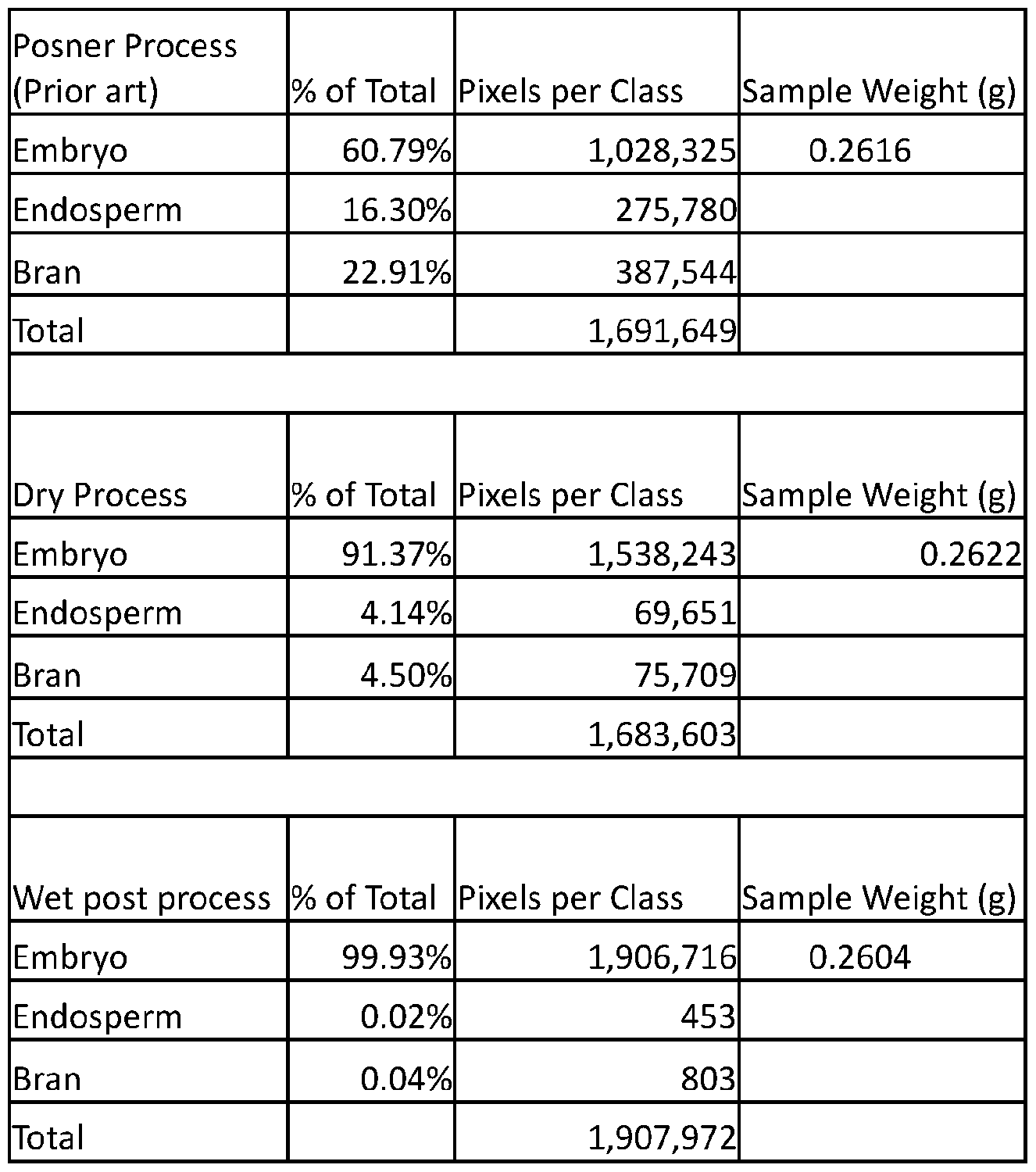
- Image analysis Three samples (one from each process technique) were imaged under identical conditions. For each sample ⁇ 0.25mg of material were used for the image. The images were color adjusted together under identical settings with no image cropping. The exact number of total pixels per image were used in each classification routine. The classified pixels were grouped by composition and nearest neighbor into objects. Each size of each object was calculated and relevant statistics about shape composition and position were collected.
- the Posner process achieved an embryo purity of 61%, as compared to an embryo purity of 91 % for the dry process of the instant disclosure and an embryo purity of 99.93% for the wet post process of the instant disclosure.
- Fig. 29 shows a test of embryo viability for a randomly selected group of embryos collected via the dry process of the instant disclosure (single-impact milling, sifting, air separating, and color sorting). The embryos were germinated on plant growth media for 48 hours. As can be seen, viability is clearly evident, as shown by root emergence and growth of nearly every embryo after the 48 hours of germination.
- Fig. 30 shows the results of the identical experiment for a group of embryos collected via the Posner process. As can be seen, viability appears entirely lacking, as not a single one of the Posner process embryos spouted after the same 48 hours of germination on the same growth media.
- Fig. 32 an image showing the typical germ particle damage resulting from the repeated randomly oriented impacts of the sharp, rotating beaters of the Posner process.
- the white boxes highlight some of the damage sustained by the embryos, including complete breakage, chips, and fissuring, extinguishing viability and preventing germination. Based on the germination study, this damage appears lethal for most or all of the embryos obtained by the Posner process.
- Fig. 33 shows the results of the image processing of the Posner sample.
- the distribution of germ particle size shows statistically what can be seen visually in Fig. 32, which is a large number of broken and chipped germ particles, plus a large amount of contamination from remaining bran and endosperm.
- the Posner method produced about 60% germ which is consistent with commercially produced wheat germ, and is also consistent with the proportion of fat and protein reported by Posner. Table 2 below shows the statistical analysis for the Posner distribution of Germ (embryo)
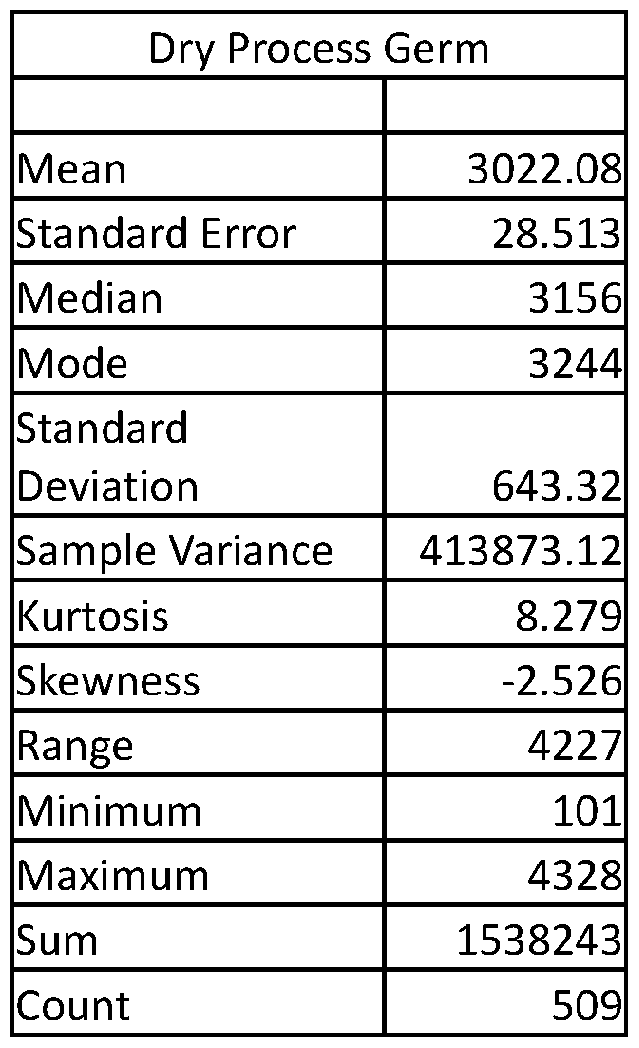
- Fig. 34 and Table 3 show the results of quantitative Image analysis of the dry process material, using the HRS cultivar Murdoch. Based on the understanding that the smallest intact germ particle is approximately 2000 pixels, as detailed above, the dry process method contains less than 5% broken germ particles. Compared to the Posner method which has approximately 36% broken sized germ particles.
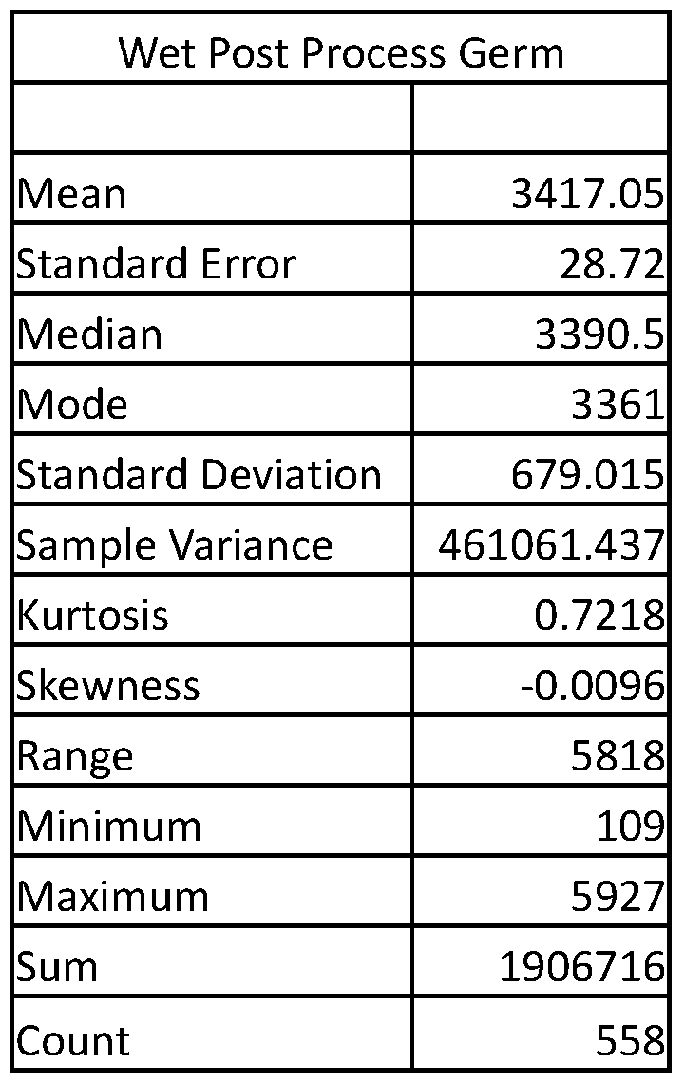
- Fig. 35 and Table 4 show the results of the image processing for the wet post process, which resulted in 99.9% pure intact germ particles, with only 3 particles with a size smaller than 2,000 pixels.
- a cell includes a plurality of such cells and equivalents thereof known to those skilled in the art.
- the terms “a” (or “an”), “one or more” and “at least one” can be used interchangeably herein.
- the terms “comprising”, “including”, and “having” can be used interchangeably.
- the expression “of any of claims XX- YY” (wherein XX and YY refer to claim numbers) is intended to provide a multiple dependent claim in the alternative form, and in some embodiments is interchangeable with the expression “as in any one of claims XX- YY.”
- isotopic variants of compounds disclosed herein are intended to be encompassed by the disclosure.
- any one or more hydrogens in a molecule disclosed can be replaced with deuterium or tritium.
- Isotopic variants of a molecule are generally useful as standards in assays for the molecule and in chemical and biological research related to the molecule or its use. Methods for making such isotopic variants are known in the art. Specific names of compounds are intended to be exemplary, as it is known that one of ordinary skill in the art can name the same compounds differently.
- Certain molecules disclosed herein may contain one or more ionizable groups [groups from which a proton can be removed (e.g., -COOH) or added (e.g., amines) or which can be quaternized (e.g., amines)]. All possible ionic forms of such molecules and salts thereof are intended to be included individually in the disclosure herein. With regard to salts of the compounds herein, one of ordinary skill in the art can select from among a wide variety of available counterions those that are appropriate for preparation of salts of this invention for a given application. In specific applications, the selection of a given anion or cation for preparation of a salt may result in increased or decreased solubility of that salt.
- references cited herein are incorporated by reference herein in their entirety to indicate the state of the art as of their publication or filing date and it is intended that this information can be employed herein, if needed, to exclude specific embodiments that are in the prior art.
- composition of matter are claimed, it should be understood that compounds known and available in the art prior to Applicant's invention, including compounds for which an enabling disclosure is provided in the references cited herein, are not intended to be included in the composition of matter claims herein.
Landscapes
- Engineering & Computer Science (AREA)
- Food Science & Technology (AREA)
- Grain Derivatives (AREA)
- Cereal-Derived Products (AREA)
- Breeding Of Plants And Reproduction By Means Of Culturing (AREA)
- Life Sciences & Earth Sciences (AREA)
- Health & Medical Sciences (AREA)
- Zoology (AREA)
- Wood Science & Technology (AREA)
- Biotechnology (AREA)
- Organic Chemistry (AREA)
- Bioinformatics & Cheminformatics (AREA)
- Genetics & Genomics (AREA)
- Chemical & Material Sciences (AREA)
- Biomedical Technology (AREA)
- Botany (AREA)
- Microbiology (AREA)
- Biochemistry (AREA)
- General Engineering & Computer Science (AREA)
- General Health & Medical Sciences (AREA)
- Cell Biology (AREA)
Abstract
Description

Claims
Priority Applications (9)
| Application Number | Priority Date | Filing Date | Title |
|---|---|---|---|
| JP2023551273A JP2024507567A (en) | 2021-02-25 | 2022-02-24 | Systems and methods for extracting and isolating purified wheat germ products |
| EP22760412.1A EP4297907A4 (en) | 2021-02-25 | 2022-02-24 | Systems and methods for extracting and isolating purified wheat embryo products |
| IL305379A IL305379A (en) | 2021-02-25 | 2022-02-24 | Systems and methods for extracting and isolating purified wheat embryo products |
| BR112023017042A BR112023017042A2 (en) | 2021-02-25 | 2022-02-24 | SYSTEMS AND METHODS FOR EXTRACTING AND ISOLATING PURIFIED WHEAT EMBRYO PRODUCTS |
| CN202280029075.5A CN117177818B (en) | 2021-02-25 | 2022-02-24 | Systems and methods for extracting, separating, and purifying wheat germ products. |
| MX2023009947A MX2023009947A (en) | 2021-02-25 | 2022-02-24 | Systems and methods for extracting and isolating purified wheat embryo products. |
| AU2022226187A AU2022226187A1 (en) | 2021-02-25 | 2022-02-24 | Systems and methods for extracting and isolating purified wheat embryo products |
| KR1020237033086A KR20230148370A (en) | 2021-02-25 | 2022-02-24 | System and method for extraction and isolation of purified wheat germ products |
| CA3211399A CA3211399A1 (en) | 2021-02-25 | 2022-02-24 | Systems and methods for extracting and isolating purified wheat embryo products |
Applications Claiming Priority (2)
| Application Number | Priority Date | Filing Date | Title |
|---|---|---|---|
| US202163153739P | 2021-02-25 | 2021-02-25 | |
| US63/153,739 | 2021-02-25 |
Publications (1)
| Publication Number | Publication Date |
|---|---|
| WO2022182883A1 true WO2022182883A1 (en) | 2022-09-01 |
Family
ID=82901632
Family Applications (1)
| Application Number | Title | Priority Date | Filing Date |
|---|---|---|---|
| PCT/US2022/017715 Ceased WO2022182883A1 (en) | 2021-02-25 | 2022-02-24 | Systems and methods for extracting and isolating purified wheat embryo products |
Country Status (12)
| Country | Link |
|---|---|
| US (3) | US11839881B2 (en) |
| EP (1) | EP4297907A4 (en) |
| JP (1) | JP2024507567A (en) |
| KR (1) | KR20230148370A (en) |
| CN (1) | CN117177818B (en) |
| AU (1) | AU2022226187A1 (en) |
| BR (1) | BR112023017042A2 (en) |
| CA (1) | CA3211399A1 (en) |
| IL (1) | IL305379A (en) |
| MX (1) | MX2023009947A (en) |
| TW (1) | TWI821918B (en) |
| WO (1) | WO2022182883A1 (en) |
Families Citing this family (2)
| Publication number | Priority date | Publication date | Assignee | Title |
|---|---|---|---|---|
| WO2025203909A1 (en) * | 2024-03-29 | 2025-10-02 | 株式会社日清製粉グループ本社 | Plant germ for cell-free protein synthesis |
| WO2025203908A1 (en) * | 2024-03-29 | 2025-10-02 | 株式会社日清製粉グループ本社 | Plant embryo for cell-free protein synthesis |
Citations (8)
| Publication number | Priority date | Publication date | Assignee | Title |
|---|---|---|---|---|
| US2392365A (en) | 1942-05-11 | 1946-01-08 | Pillsbury Mills Inc | Milling process |
| GB583188A (en) * | 1944-03-29 | 1946-12-11 | Quaker Oats Co | Improvements in or relating to grain hullers |
| DE890440C (en) * | 1950-05-25 | 1953-09-17 | Safety Car Heating And Lightin | Method and device for husking grain |
| US2745748A (en) * | 1948-11-04 | 1956-05-15 | James F Mccashen | Whole grain flours and process of making |
| US4365546A (en) * | 1979-11-13 | 1982-12-28 | Cereal Enterprisess, Inc. | Apparatus for degerminating a kernel by compressing the edges of the kernel |
| US4515076A (en) * | 1983-06-22 | 1985-05-07 | David Reznik | Apparatus for cracking and separating nuts |
| US4805527A (en) * | 1987-01-22 | 1989-02-21 | Masazumi Yoshihara | Shell-cracking apparatus for hard-shell coated seeds |
| US4986997A (en) | 1989-04-19 | 1991-01-22 | Kansas State University Research Foundation | Method of separating wheat germ from whole wheat |
Family Cites Families (30)
| Publication number | Priority date | Publication date | Assignee | Title |
|---|---|---|---|---|
| US2428670A (en) * | 1943-12-08 | 1947-10-07 | Safety Car Heating & Lighting | Centrifugal disk mill with adjustable impactor |
| FR919165A (en) * | 1945-12-19 | 1947-02-28 | Pillsbury Mills Inc | Grinding process |
| US4301183A (en) * | 1978-05-26 | 1981-11-17 | Cereal Enterprises, Inc. | Method and apparatus for degerminating a grain kernel by impelling the kernels along a guide vane into an impact surface |
| CA1161328A (en) * | 1981-06-18 | 1984-01-31 | R. James Giguere | Grain milling and degerminating process |
| CN1041293A (en) * | 1988-04-22 | 1990-04-18 | 皇冠铁工公司 | Granular Material Handling Plant |
| CN2058347U (en) * | 1989-10-27 | 1990-06-20 | 山东省农业机械科学研究所 | Flour processing equipment without concentrating wind net |
| US5699724A (en) * | 1992-12-02 | 1997-12-23 | Buhler Ag | Cleaning and sorting bulk material |
| US6168931B1 (en) | 1999-03-17 | 2001-01-02 | The Board Of Trustees Of The Leland Stanford Junior University | Enhanced in vitro synthesis of biological macromolecules using a novel ATP regeneration system |
| US6337191B1 (en) | 1999-03-22 | 2002-01-08 | The Board Of Trustees Of The Leland Stanford Junior University | Vitro protein synthesis using glycolytic intermediates as an energy source |
| US20020168706A1 (en) | 2001-03-08 | 2002-11-14 | Invitrogen Corporation | Improved in vitro synthesis system |
| AUPR858301A0 (en) * | 2001-10-30 | 2001-11-29 | Crushing & Mining Equipment Pty Ltd | An impactor anvil |
| WO2003038117A2 (en) | 2001-10-30 | 2003-05-08 | The Board Of Trustees Of The Leland Stanford Junior University | Enhanced in vitro nucleic acid synthesis using nucleoside monophosphates |
| CA2474466A1 (en) | 2002-01-31 | 2003-08-07 | Yaeta Endo | Germ extract for cell-free protein synthesis and process for producing the same |
| JP4289013B2 (en) * | 2003-05-13 | 2009-07-01 | 株式会社サタケ | Grain impact crusher |
| CA2528876C (en) * | 2003-06-16 | 2012-01-10 | Monsanto Technology Llc | Method and apparatus for preparation of genetically transformable plant tissue |
| US20070141661A1 (en) | 2003-12-26 | 2007-06-21 | Yaeta Endo | Cell extract for high-functioned cell-free protein synthesis and method of preparing the extract |
| US20070117179A1 (en) | 2005-09-27 | 2007-05-24 | Invitrogen Corporation | In vitro protein synthesis systems for membrane proteins that include adolipoproteins and phospholipid-adolipoprotein particles |
| CN102049327A (en) * | 2009-10-29 | 2011-05-11 | 王洪福 | Wheat flour milling process flow using coarse break mill for dehulling and degerming and fine break mill for extracting embryos |
| WO2011107760A2 (en) * | 2010-03-05 | 2011-09-09 | Gloway Properties Limited | High value edible products from bran, and method and apparatus for producing same |
| US20120301904A1 (en) * | 2011-04-26 | 2012-11-29 | Prosetta Antiviral, Inc | Multiprotein assemblies |
| US9528137B2 (en) | 2013-03-15 | 2016-12-27 | Northwestern University | Methods for cell-free protein synthesis |
| KR101671688B1 (en) | 2014-06-12 | 2016-11-03 | 충남대학교산학협력단 | Method of cell-free protein synthesis regulating pH with enzymes |
| CN104187429A (en) * | 2014-07-04 | 2014-12-10 | 陕西陕富面业有限责任公司 | Processing method for wheat germ powder |
| WO2016108158A1 (en) | 2014-12-31 | 2016-07-07 | Northwestern Univeristy | Methods for activating natural energy metabolism for improving yeast cell-free protein synthesis |
| CN106179563B (en) * | 2016-07-08 | 2019-04-05 | 北京水木源生物科技有限公司 | A kind of germ separation technique |
| ES2921017T3 (en) | 2016-12-30 | 2022-08-16 | Natures Toolbox Inc | Cell-free expression system that has a new energy regeneration based on inorganic polyphosphate |
| KR102681025B1 (en) | 2017-09-29 | 2024-07-05 | 미쯔비시 케미컬 주식회사 | Method for producing nicotinamide mononucleotide and transformant used in the method |
| CN208131093U (en) * | 2017-12-26 | 2018-11-23 | 安徽鑫泉米业有限公司 | One kind staying embryo devices for husking rice |
| CN110743704B (en) * | 2019-09-29 | 2021-09-10 | 江苏大学 | Electric field separation method for cell clusters of wheat bran structural layer |
| CN112221602B (en) * | 2020-09-21 | 2022-08-30 | 恒升(新乡)食品有限公司 | Flour processing method |
-
2022
- 2022-02-24 TW TW111106857A patent/TWI821918B/en active
- 2022-02-24 CA CA3211399A patent/CA3211399A1/en active Pending
- 2022-02-24 JP JP2023551273A patent/JP2024507567A/en active Pending
- 2022-02-24 IL IL305379A patent/IL305379A/en unknown
- 2022-02-24 US US17/679,500 patent/US11839881B2/en active Active
- 2022-02-24 WO PCT/US2022/017715 patent/WO2022182883A1/en not_active Ceased
- 2022-02-24 BR BR112023017042A patent/BR112023017042A2/en unknown
- 2022-02-24 AU AU2022226187A patent/AU2022226187A1/en active Pending
- 2022-02-24 KR KR1020237033086A patent/KR20230148370A/en active Pending
- 2022-02-24 CN CN202280029075.5A patent/CN117177818B/en active Active
- 2022-02-24 EP EP22760412.1A patent/EP4297907A4/en active Pending
- 2022-02-24 MX MX2023009947A patent/MX2023009947A/en unknown
-
2023
- 2023-03-10 US US18/120,169 patent/US12434249B2/en active Active
-
2025
- 2025-08-12 US US19/297,619 patent/US20250367676A1/en active Pending
Patent Citations (8)
| Publication number | Priority date | Publication date | Assignee | Title |
|---|---|---|---|---|
| US2392365A (en) | 1942-05-11 | 1946-01-08 | Pillsbury Mills Inc | Milling process |
| GB583188A (en) * | 1944-03-29 | 1946-12-11 | Quaker Oats Co | Improvements in or relating to grain hullers |
| US2745748A (en) * | 1948-11-04 | 1956-05-15 | James F Mccashen | Whole grain flours and process of making |
| DE890440C (en) * | 1950-05-25 | 1953-09-17 | Safety Car Heating And Lightin | Method and device for husking grain |
| US4365546A (en) * | 1979-11-13 | 1982-12-28 | Cereal Enterprisess, Inc. | Apparatus for degerminating a kernel by compressing the edges of the kernel |
| US4515076A (en) * | 1983-06-22 | 1985-05-07 | David Reznik | Apparatus for cracking and separating nuts |
| US4805527A (en) * | 1987-01-22 | 1989-02-21 | Masazumi Yoshihara | Shell-cracking apparatus for hard-shell coated seeds |
| US4986997A (en) | 1989-04-19 | 1991-01-22 | Kansas State University Research Foundation | Method of separating wheat germ from whole wheat |
Non-Patent Citations (2)
| Title |
|---|
| E. S. POSNERY. Z. LI: "A Technique for Separation of Wheat Germ by Impacting and Subsequent Grinding", JOURNAL OF CEREAL SCIENCE, vol. 13, 1991, pages 49 - 70 |
| See also references of EP4297907A4 |
Also Published As
| Publication number | Publication date |
|---|---|
| EP4297907A1 (en) | 2024-01-03 |
| MX2023009947A (en) | 2023-11-17 |
| KR20230148370A (en) | 2023-10-24 |
| US20240058822A1 (en) | 2024-02-22 |
| EP4297907A4 (en) | 2025-06-04 |
| JP2024507567A (en) | 2024-02-20 |
| BR112023017042A2 (en) | 2023-11-07 |
| US12434249B2 (en) | 2025-10-07 |
| IL305379A (en) | 2023-10-01 |
| TW202239338A (en) | 2022-10-16 |
| TWI821918B (en) | 2023-11-11 |
| US20250367676A1 (en) | 2025-12-04 |
| US11839881B2 (en) | 2023-12-12 |
| CN117177818B (en) | 2025-11-25 |
| AU2022226187A1 (en) | 2023-09-07 |
| US20220267721A1 (en) | 2022-08-25 |
| CN117177818A (en) | 2023-12-05 |
| CA3211399A1 (en) | 2022-09-01 |
Similar Documents
| Publication | Publication Date | Title |
|---|---|---|
| US20250367676A1 (en) | Systems and methods for extracting and isolating purified wheat embryo products | |
| US4986997A (en) | Method of separating wheat germ from whole wheat | |
| Astanakulov et al. | Grinding of the grains according to parameters of hummers in double-staged grinder-crusher | |
| Chernyakov et al. | Research of a conical pneumatic grain separator with a device for forced light fraction removal | |
| CN1250106C (en) | Soybean processing | |
| US7419108B2 (en) | Corn fractionation process | |
| US20230270134A1 (en) | Process for refining grains | |
| DK2914122T3 (en) | PROCEDURE FOR THE PREPARATION OF PROTEIN FRIENDLY SUNFLOWER MEAL | |
| US8727250B2 (en) | System and method for creating a test sample from individual seeds or tissue structures | |
| Al Aridhee et al. | ImpacT OF Mill Rolls Gabs and Delay of Harvesting Date of Wheat crop on Some Properties of Flour | |
| RU2778324C2 (en) | Method for processing sunflower meal | |
| RU2567745C1 (en) | Method for production of vegetable oil of melon seed extraction cake | |
| Begunov et al. | Study of a pneumatic separator for grain cleaning | |
| SU733722A1 (en) | Method of cleaning soya seed from cocklebur | |
| Ye et al. | Physical and Mechanical Pretreatment | |
| CN113102002A (en) | Processing method of green rice | |
| WO2013153346A1 (en) | Grinding method using a swinging crusher | |
| JP2005087208A (en) | Method for producing cell extract for cell-free protein synthesis | |
| Sobczak et al. | The effectiveness of paprika seeds germination in relation to the physical properties | |
| Firouzi et al. | Effect of the size of perforated screen and clearance between blade and rotor on the performance of Engleberg rice whitener. | |
| HK1068521B (en) | Process and apparatus for separating hypocotyls from beans | |
| HK1068521A1 (en) | Process and apparatus for separating hypocotyls from beans | |
| SE510964C2 (en) | Milling process for grinding cereal grain hulls or carrying out pre grinding step |
Legal Events
| Date | Code | Title | Description |
|---|---|---|---|
| 121 | Ep: the epo has been informed by wipo that ep was designated in this application |
Ref document number: 22760412 Country of ref document: EP Kind code of ref document: A1 |
|
| ENP | Entry into the national phase |
Ref document number: 3211399 Country of ref document: CA |
|
| WWE | Wipo information: entry into national phase |
Ref document number: 2022226187 Country of ref document: AU |
|
| WWE | Wipo information: entry into national phase |
Ref document number: 2023551273 Country of ref document: JP Ref document number: 305379 Country of ref document: IL |
|
| WWE | Wipo information: entry into national phase |
Ref document number: 202317056859 Country of ref document: IN Ref document number: MX/A/2023/009947 Country of ref document: MX |
|
| REG | Reference to national code |
Ref country code: BR Ref legal event code: B01A Ref document number: 112023017042 Country of ref document: BR |
|
| ENP | Entry into the national phase |
Ref document number: 2022226187 Country of ref document: AU Date of ref document: 20220224 Kind code of ref document: A |
|
| ENP | Entry into the national phase |
Ref document number: 20237033086 Country of ref document: KR Kind code of ref document: A |
|
| WWE | Wipo information: entry into national phase |
Ref document number: 1020237033086 Country of ref document: KR Ref document number: 2022760412 Country of ref document: EP |
|
| NENP | Non-entry into the national phase |
Ref country code: DE |
|
| WWE | Wipo information: entry into national phase |
Ref document number: 11202306196Q Country of ref document: SG |
|
| ENP | Entry into the national phase |
Ref document number: 2022760412 Country of ref document: EP Effective date: 20230925 |
|
| ENP | Entry into the national phase |
Ref document number: 112023017042 Country of ref document: BR Kind code of ref document: A2 Effective date: 20230824 |