WO2022156761A1 - Spirocyclic indenes - Google Patents
Spirocyclic indenes Download PDFInfo
- Publication number
- WO2022156761A1 WO2022156761A1 PCT/CN2022/073129 CN2022073129W WO2022156761A1 WO 2022156761 A1 WO2022156761 A1 WO 2022156761A1 CN 2022073129 W CN2022073129 W CN 2022073129W WO 2022156761 A1 WO2022156761 A1 WO 2022156761A1
- Authority
- WO
- WIPO (PCT)
- Prior art keywords
- alkyl
- compound
- solvate
- group
- salt
- Prior art date
- Legal status (The legal status is an assumption and is not a legal conclusion. Google has not performed a legal analysis and makes no representation as to the accuracy of the status listed.)
- Ceased
Links
Classifications
-
- C—CHEMISTRY; METALLURGY
- C07—ORGANIC CHEMISTRY
- C07D—HETEROCYCLIC COMPOUNDS
- C07D403/00—Heterocyclic compounds containing two or more hetero rings, having nitrogen atoms as the only ring hetero atoms, not provided for by group C07D401/00
- C07D403/14—Heterocyclic compounds containing two or more hetero rings, having nitrogen atoms as the only ring hetero atoms, not provided for by group C07D401/00 containing three or more hetero rings
-
- A—HUMAN NECESSITIES
- A61—MEDICAL OR VETERINARY SCIENCE; HYGIENE
- A61K—PREPARATIONS FOR MEDICAL, DENTAL OR TOILETRY PURPOSES
- A61K31/00—Medicinal preparations containing organic active ingredients
- A61K31/33—Heterocyclic compounds
- A61K31/395—Heterocyclic compounds having nitrogen as a ring hetero atom, e.g. guanethidine or rifamycins
- A61K31/495—Heterocyclic compounds having nitrogen as a ring hetero atom, e.g. guanethidine or rifamycins having six-membered rings with two or more nitrogen atoms as the only ring heteroatoms, e.g. piperazine or tetrazines
- A61K31/505—Pyrimidines; Hydrogenated pyrimidines, e.g. trimethoprim
- A61K31/517—Pyrimidines; Hydrogenated pyrimidines, e.g. trimethoprim ortho- or peri-condensed with carbocyclic ring systems, e.g. quinazoline, perimidine
-
- A—HUMAN NECESSITIES
- A61—MEDICAL OR VETERINARY SCIENCE; HYGIENE
- A61K—PREPARATIONS FOR MEDICAL, DENTAL OR TOILETRY PURPOSES
- A61K31/00—Medicinal preparations containing organic active ingredients
- A61K31/33—Heterocyclic compounds
- A61K31/395—Heterocyclic compounds having nitrogen as a ring hetero atom, e.g. guanethidine or rifamycins
- A61K31/495—Heterocyclic compounds having nitrogen as a ring hetero atom, e.g. guanethidine or rifamycins having six-membered rings with two or more nitrogen atoms as the only ring heteroatoms, e.g. piperazine or tetrazines
- A61K31/505—Pyrimidines; Hydrogenated pyrimidines, e.g. trimethoprim
- A61K31/527—Pyrimidines; Hydrogenated pyrimidines, e.g. trimethoprim spiro-condensed
-
- A—HUMAN NECESSITIES
- A61—MEDICAL OR VETERINARY SCIENCE; HYGIENE
- A61P—SPECIFIC THERAPEUTIC ACTIVITY OF CHEMICAL COMPOUNDS OR MEDICINAL PREPARATIONS
- A61P1/00—Drugs for disorders of the alimentary tract or the digestive system
-
- A—HUMAN NECESSITIES
- A61—MEDICAL OR VETERINARY SCIENCE; HYGIENE
- A61P—SPECIFIC THERAPEUTIC ACTIVITY OF CHEMICAL COMPOUNDS OR MEDICINAL PREPARATIONS
- A61P1/00—Drugs for disorders of the alimentary tract or the digestive system
- A61P1/02—Stomatological preparations, e.g. drugs for caries, aphtae, periodontitis
-
- A—HUMAN NECESSITIES
- A61—MEDICAL OR VETERINARY SCIENCE; HYGIENE
- A61P—SPECIFIC THERAPEUTIC ACTIVITY OF CHEMICAL COMPOUNDS OR MEDICINAL PREPARATIONS
- A61P1/00—Drugs for disorders of the alimentary tract or the digestive system
- A61P1/16—Drugs for disorders of the alimentary tract or the digestive system for liver or gallbladder disorders, e.g. hepatoprotective agents, cholagogues, litholytics
-
- A—HUMAN NECESSITIES
- A61—MEDICAL OR VETERINARY SCIENCE; HYGIENE
- A61P—SPECIFIC THERAPEUTIC ACTIVITY OF CHEMICAL COMPOUNDS OR MEDICINAL PREPARATIONS
- A61P1/00—Drugs for disorders of the alimentary tract or the digestive system
- A61P1/18—Drugs for disorders of the alimentary tract or the digestive system for pancreatic disorders, e.g. pancreatic enzymes
-
- A—HUMAN NECESSITIES
- A61—MEDICAL OR VETERINARY SCIENCE; HYGIENE
- A61P—SPECIFIC THERAPEUTIC ACTIVITY OF CHEMICAL COMPOUNDS OR MEDICINAL PREPARATIONS
- A61P11/00—Drugs for disorders of the respiratory system
-
- A—HUMAN NECESSITIES
- A61—MEDICAL OR VETERINARY SCIENCE; HYGIENE
- A61P—SPECIFIC THERAPEUTIC ACTIVITY OF CHEMICAL COMPOUNDS OR MEDICINAL PREPARATIONS
- A61P11/00—Drugs for disorders of the respiratory system
- A61P11/02—Nasal agents, e.g. decongestants
-
- A—HUMAN NECESSITIES
- A61—MEDICAL OR VETERINARY SCIENCE; HYGIENE
- A61P—SPECIFIC THERAPEUTIC ACTIVITY OF CHEMICAL COMPOUNDS OR MEDICINAL PREPARATIONS
- A61P11/00—Drugs for disorders of the respiratory system
- A61P11/06—Antiasthmatics
-
- A—HUMAN NECESSITIES
- A61—MEDICAL OR VETERINARY SCIENCE; HYGIENE
- A61P—SPECIFIC THERAPEUTIC ACTIVITY OF CHEMICAL COMPOUNDS OR MEDICINAL PREPARATIONS
- A61P13/00—Drugs for disorders of the urinary system
- A61P13/04—Drugs for disorders of the urinary system for urolithiasis
-
- A—HUMAN NECESSITIES
- A61—MEDICAL OR VETERINARY SCIENCE; HYGIENE
- A61P—SPECIFIC THERAPEUTIC ACTIVITY OF CHEMICAL COMPOUNDS OR MEDICINAL PREPARATIONS
- A61P13/00—Drugs for disorders of the urinary system
- A61P13/12—Drugs for disorders of the urinary system of the kidneys
-
- A—HUMAN NECESSITIES
- A61—MEDICAL OR VETERINARY SCIENCE; HYGIENE
- A61P—SPECIFIC THERAPEUTIC ACTIVITY OF CHEMICAL COMPOUNDS OR MEDICINAL PREPARATIONS
- A61P15/00—Drugs for genital or sexual disorders; Contraceptives
-
- A—HUMAN NECESSITIES
- A61—MEDICAL OR VETERINARY SCIENCE; HYGIENE
- A61P—SPECIFIC THERAPEUTIC ACTIVITY OF CHEMICAL COMPOUNDS OR MEDICINAL PREPARATIONS
- A61P17/00—Drugs for dermatological disorders
-
- A—HUMAN NECESSITIES
- A61—MEDICAL OR VETERINARY SCIENCE; HYGIENE
- A61P—SPECIFIC THERAPEUTIC ACTIVITY OF CHEMICAL COMPOUNDS OR MEDICINAL PREPARATIONS
- A61P17/00—Drugs for dermatological disorders
- A61P17/02—Drugs for dermatological disorders for treating wounds, ulcers, burns, scars, keloids, or the like
-
- A—HUMAN NECESSITIES
- A61—MEDICAL OR VETERINARY SCIENCE; HYGIENE
- A61P—SPECIFIC THERAPEUTIC ACTIVITY OF CHEMICAL COMPOUNDS OR MEDICINAL PREPARATIONS
- A61P17/00—Drugs for dermatological disorders
- A61P17/06—Antipsoriatics
-
- A—HUMAN NECESSITIES
- A61—MEDICAL OR VETERINARY SCIENCE; HYGIENE
- A61P—SPECIFIC THERAPEUTIC ACTIVITY OF CHEMICAL COMPOUNDS OR MEDICINAL PREPARATIONS
- A61P17/00—Drugs for dermatological disorders
- A61P17/14—Drugs for dermatological disorders for baldness or alopecia
-
- A—HUMAN NECESSITIES
- A61—MEDICAL OR VETERINARY SCIENCE; HYGIENE
- A61P—SPECIFIC THERAPEUTIC ACTIVITY OF CHEMICAL COMPOUNDS OR MEDICINAL PREPARATIONS
- A61P19/00—Drugs for skeletal disorders
-
- A—HUMAN NECESSITIES
- A61—MEDICAL OR VETERINARY SCIENCE; HYGIENE
- A61P—SPECIFIC THERAPEUTIC ACTIVITY OF CHEMICAL COMPOUNDS OR MEDICINAL PREPARATIONS
- A61P19/00—Drugs for skeletal disorders
- A61P19/02—Drugs for skeletal disorders for joint disorders, e.g. arthritis, arthrosis
-
- A—HUMAN NECESSITIES
- A61—MEDICAL OR VETERINARY SCIENCE; HYGIENE
- A61P—SPECIFIC THERAPEUTIC ACTIVITY OF CHEMICAL COMPOUNDS OR MEDICINAL PREPARATIONS
- A61P21/00—Drugs for disorders of the muscular or neuromuscular system
- A61P21/04—Drugs for disorders of the muscular or neuromuscular system for myasthenia gravis
-
- A—HUMAN NECESSITIES
- A61—MEDICAL OR VETERINARY SCIENCE; HYGIENE
- A61P—SPECIFIC THERAPEUTIC ACTIVITY OF CHEMICAL COMPOUNDS OR MEDICINAL PREPARATIONS
- A61P25/00—Drugs for disorders of the nervous system
- A61P25/14—Drugs for disorders of the nervous system for treating abnormal movements, e.g. chorea, dyskinesia
- A61P25/16—Anti-Parkinson drugs
-
- A—HUMAN NECESSITIES
- A61—MEDICAL OR VETERINARY SCIENCE; HYGIENE
- A61P—SPECIFIC THERAPEUTIC ACTIVITY OF CHEMICAL COMPOUNDS OR MEDICINAL PREPARATIONS
- A61P25/00—Drugs for disorders of the nervous system
- A61P25/28—Drugs for disorders of the nervous system for treating neurodegenerative disorders of the central nervous system, e.g. nootropic agents, cognition enhancers, drugs for treating Alzheimer's disease or other forms of dementia
-
- A—HUMAN NECESSITIES
- A61—MEDICAL OR VETERINARY SCIENCE; HYGIENE
- A61P—SPECIFIC THERAPEUTIC ACTIVITY OF CHEMICAL COMPOUNDS OR MEDICINAL PREPARATIONS
- A61P29/00—Non-central analgesic, antipyretic or antiinflammatory agents, e.g. antirheumatic agents; Non-steroidal antiinflammatory drugs [NSAID]
-
- A—HUMAN NECESSITIES
- A61—MEDICAL OR VETERINARY SCIENCE; HYGIENE
- A61P—SPECIFIC THERAPEUTIC ACTIVITY OF CHEMICAL COMPOUNDS OR MEDICINAL PREPARATIONS
- A61P3/00—Drugs for disorders of the metabolism
- A61P3/08—Drugs for disorders of the metabolism for glucose homeostasis
- A61P3/10—Drugs for disorders of the metabolism for glucose homeostasis for hyperglycaemia, e.g. antidiabetics
-
- A—HUMAN NECESSITIES
- A61—MEDICAL OR VETERINARY SCIENCE; HYGIENE
- A61P—SPECIFIC THERAPEUTIC ACTIVITY OF CHEMICAL COMPOUNDS OR MEDICINAL PREPARATIONS
- A61P35/00—Antineoplastic agents
-
- A—HUMAN NECESSITIES
- A61—MEDICAL OR VETERINARY SCIENCE; HYGIENE
- A61P—SPECIFIC THERAPEUTIC ACTIVITY OF CHEMICAL COMPOUNDS OR MEDICINAL PREPARATIONS
- A61P37/00—Drugs for immunological or allergic disorders
- A61P37/02—Immunomodulators
- A61P37/06—Immunosuppressants, e.g. drugs for graft rejection
-
- A—HUMAN NECESSITIES
- A61—MEDICAL OR VETERINARY SCIENCE; HYGIENE
- A61P—SPECIFIC THERAPEUTIC ACTIVITY OF CHEMICAL COMPOUNDS OR MEDICINAL PREPARATIONS
- A61P37/00—Drugs for immunological or allergic disorders
- A61P37/08—Antiallergic agents
-
- A—HUMAN NECESSITIES
- A61—MEDICAL OR VETERINARY SCIENCE; HYGIENE
- A61P—SPECIFIC THERAPEUTIC ACTIVITY OF CHEMICAL COMPOUNDS OR MEDICINAL PREPARATIONS
- A61P5/00—Drugs for disorders of the endocrine system
- A61P5/06—Drugs for disorders of the endocrine system of the anterior pituitary hormones, e.g. TSH, ACTH, FSH, LH, PRL, GH
-
- A—HUMAN NECESSITIES
- A61—MEDICAL OR VETERINARY SCIENCE; HYGIENE
- A61P—SPECIFIC THERAPEUTIC ACTIVITY OF CHEMICAL COMPOUNDS OR MEDICINAL PREPARATIONS
- A61P5/00—Drugs for disorders of the endocrine system
- A61P5/14—Drugs for disorders of the endocrine system of the thyroid hormones, e.g. T3, T4
-
- A—HUMAN NECESSITIES
- A61—MEDICAL OR VETERINARY SCIENCE; HYGIENE
- A61P—SPECIFIC THERAPEUTIC ACTIVITY OF CHEMICAL COMPOUNDS OR MEDICINAL PREPARATIONS
- A61P7/00—Drugs for disorders of the blood or the extracellular fluid
-
- A—HUMAN NECESSITIES
- A61—MEDICAL OR VETERINARY SCIENCE; HYGIENE
- A61P—SPECIFIC THERAPEUTIC ACTIVITY OF CHEMICAL COMPOUNDS OR MEDICINAL PREPARATIONS
- A61P7/00—Drugs for disorders of the blood or the extracellular fluid
- A61P7/04—Antihaemorrhagics; Procoagulants; Haemostatic agents; Antifibrinolytic agents
-
- A—HUMAN NECESSITIES
- A61—MEDICAL OR VETERINARY SCIENCE; HYGIENE
- A61P—SPECIFIC THERAPEUTIC ACTIVITY OF CHEMICAL COMPOUNDS OR MEDICINAL PREPARATIONS
- A61P7/00—Drugs for disorders of the blood or the extracellular fluid
- A61P7/10—Antioedematous agents; Diuretics
-
- A—HUMAN NECESSITIES
- A61—MEDICAL OR VETERINARY SCIENCE; HYGIENE
- A61P—SPECIFIC THERAPEUTIC ACTIVITY OF CHEMICAL COMPOUNDS OR MEDICINAL PREPARATIONS
- A61P9/00—Drugs for disorders of the cardiovascular system
-
- C—CHEMISTRY; METALLURGY
- C07—ORGANIC CHEMISTRY
- C07D—HETEROCYCLIC COMPOUNDS
- C07D241/00—Heterocyclic compounds containing 1,4-diazine or hydrogenated 1,4-diazine rings
- C07D241/36—Heterocyclic compounds containing 1,4-diazine or hydrogenated 1,4-diazine rings condensed with carbocyclic rings or ring systems
- C07D241/38—Heterocyclic compounds containing 1,4-diazine or hydrogenated 1,4-diazine rings condensed with carbocyclic rings or ring systems with only hydrogen or carbon atoms directly attached to the ring nitrogen atoms
-
- C—CHEMISTRY; METALLURGY
- C07—ORGANIC CHEMISTRY
- C07D—HETEROCYCLIC COMPOUNDS
- C07D453/00—Heterocyclic compounds containing quinuclidine or iso-quinuclidine ring systems, e.g. quinine alkaloids
- C07D453/02—Heterocyclic compounds containing quinuclidine or iso-quinuclidine ring systems, e.g. quinine alkaloids containing not further condensed quinuclidine ring systems
-
- C—CHEMISTRY; METALLURGY
- C07—ORGANIC CHEMISTRY
- C07D—HETEROCYCLIC COMPOUNDS
- C07D471/00—Heterocyclic compounds containing nitrogen atoms as the only ring hetero atoms in the condensed system, at least one ring being a six-membered ring with one nitrogen atom, not provided for by groups C07D451/00 - C07D463/00
- C07D471/02—Heterocyclic compounds containing nitrogen atoms as the only ring hetero atoms in the condensed system, at least one ring being a six-membered ring with one nitrogen atom, not provided for by groups C07D451/00 - C07D463/00 in which the condensed system contains two hetero rings
- C07D471/04—Ortho-condensed systems
-
- C—CHEMISTRY; METALLURGY
- C07—ORGANIC CHEMISTRY
- C07D—HETEROCYCLIC COMPOUNDS
- C07D487/00—Heterocyclic compounds containing nitrogen atoms as the only ring hetero atoms in the condensed system, not provided for by groups C07D451/00 - C07D477/00
- C07D487/02—Heterocyclic compounds containing nitrogen atoms as the only ring hetero atoms in the condensed system, not provided for by groups C07D451/00 - C07D477/00 in which the condensed system contains two hetero rings
- C07D487/04—Ortho-condensed systems
-
- C—CHEMISTRY; METALLURGY
- C07—ORGANIC CHEMISTRY
- C07D—HETEROCYCLIC COMPOUNDS
- C07D487/00—Heterocyclic compounds containing nitrogen atoms as the only ring hetero atoms in the condensed system, not provided for by groups C07D451/00 - C07D477/00
- C07D487/02—Heterocyclic compounds containing nitrogen atoms as the only ring hetero atoms in the condensed system, not provided for by groups C07D451/00 - C07D477/00 in which the condensed system contains two hetero rings
- C07D487/08—Bridged systems
-
- C—CHEMISTRY; METALLURGY
- C07—ORGANIC CHEMISTRY
- C07D—HETEROCYCLIC COMPOUNDS
- C07D487/00—Heterocyclic compounds containing nitrogen atoms as the only ring hetero atoms in the condensed system, not provided for by groups C07D451/00 - C07D477/00
- C07D487/02—Heterocyclic compounds containing nitrogen atoms as the only ring hetero atoms in the condensed system, not provided for by groups C07D451/00 - C07D477/00 in which the condensed system contains two hetero rings
- C07D487/10—Spiro-condensed systems
Definitions
- the present disclosure provides KRAS inhibitors, synthetic intermediates used to prepare KRAS inhibitors, and therapeutic methods of treating conditions and diseases, e.g., cancer, wherein the inhibition of KRAS provides a benefit.
- RAS represents a group of monomeric globular proteins of 189 amino acids (21 kDa molecular mass) that are associated with the plasma membrane and that bind either GDP or GTP.
- RAS acts as a molecular switch. When RAS contains bound GDP, it is in the resting or off position and is “inactive” . In response to exposure of the cell to certain growth promoting stimuli, RAS is induced to exchange its bound GDP for a GTP. With GTP bound, RAS is "switched on” and is able to interact with and activate other proteins (its "downstream targets” ) .
- the RAS protein itself has a very low intrinsic ability to hydrolyze GTP back to GDP, thus turning itself into the off state.
- GTPase-activating proteins GTPase-activating proteins
- Any mutation in RAS that affects its ability to interact with GAP or to convert GTP back to GDP will result in a prolonged activation of the protein and consequently a prolonged signal to the cell telling it to continue to grow and divide. Because these signals result in cell growth and division, overactive RAS signaling may ultimately lead to cancer.
- the most notable members of the RAS are HRAS, KRAS, and NRAS.
- RAS proteins contain a G domain that is responsible for the enzymatic activity of RAS, i.e., the guanine nucleotide binding and the hydrolysis (GTPase reaction) . It also contains a C-terminal extension, known as the CAAX box, which may be post-translationally modified, and is responsible for targeting the protein to the membrane.
- the G domain is approximately 21-25 kDa in size and it contains a phosphate binding loop (P-loop) .
- the P-loop represents the pocket where the nucleotides are bound in the protein, and this is the rigid part of the domain with conserved amino acid residues that are essential for nucleotide binding and hydrolysis (Glycine 12, Threonine 26 and Lysine 16) .
- the G domain also contains the Switch I (residues 30-40) and Switch II (residues 60-76) regions, both of which are the dynamic parts of the protein which are often represented as the "spring-loaded” mechanism because of their ability to switch between the resting and loaded state.
- the key interaction is the hydrogen bonds formed by Threonine-35 and glycine-60 with the gamma-phosphate of GTP that maintain the Switch 1 and Switch 2 regions, respectively, in their active conformation. After hydrolysis of GTP and release of phosphate, these two relax into the inactive GDP conformation.
- KRAS Mutations in the KRAS gene are common events in human tumorigenesis. Indeed, mutations in KRAS are prevalent in the some of the most deadly cancer types: pancreatic (95%) , colorectal (45%) , and lung (35%) . The most common KRAS mutations are found at residue G12 and G13 in the P-loop and at residue Q61.
- KRAS-G12C mutations comprise a patient population with a worldwide annual incidence of >100,000 individuals. See, e.g., Fell et al., ASC Med. Chem. Lett. 9: 1230-1234 (2016) ; Shin et al., ACS Med. Chem. Lett. 10: 1302-1308 (2019) ; Canon et al., Nature 575: 217–223 (2019) . There exists a need in the art for KRAS inhibitors for the treatment of cancer and other diseases.
- the present disclosure provides compounds represented by any one of Formulae I-XV, LXII, or LXIII, below, and the pharmaceutically acceptable salts and solvates, e.g., hydrates, thereof, collectively referred to as "Compounds of the Disclosure.
- Compounds of the Disclosure are KRAS inhibitors and are thus useful in treating or preventing diseases or conditions such as cancer wherein the inhibition of KRAS provides a benefit.
- the present disclosure provides compounds represented by any one of Formulae XVI-LXI, below, and the pharmaceutically acceptable salts and solvates, e.g., hydrates, thereof, collectively referred to as "Intermediates of the Disclosure. " Intermediates of the Disclosure are synthetic intermediates that can be used to prepare Compounds of the Disclosure.
- the present disclosure provides methods of treating or preventing a condition or disease by administering a therapeutically effective amount of a Compound of the Disclosure to a subject, e.g., a human patient, in need thereof.
- the disease or condition of interest that is treatable or preventable by inhibition or of KRAS is, for example, a cancer, a chronic autoimmune disorder, an inflammatory condition, a proliferative disorder, sepsis, or a viral infection.
- methods of preventing the proliferation of unwanted proliferating cells such as in cancer, in a subject comprising administering a therapeutically effective amount of a Compound of the Disclosure to a subject at risk of developing a condition characterized by unwanted proliferating cells.
- Compounds of the Disclosure may reduce the proliferation of unwanted cells by inducing apoptosis in those cells.
- Compounds of the Disclosure are administered in combination with an optional therapeutic agent.
- the present disclosure provides a method of inhibiting KRAS in a subject, comprising administering to the subject a therapeutically effective amount of a Compound of the Disclosure.
- the present disclosure provides a pharmaceutical composition
- a pharmaceutical composition comprising a Compound of the Disclosure and an excipient and/or pharmaceutically acceptable carrier.
- the present disclosure provides a composition comprising a Compound of the Disclosure and an excipient and/or pharmaceutically acceptable carrier for use treating or preventing diseases or conditions wherein inhibition of KRAS provides a benefit, e.g., cancer.
- the present disclosure provides a composition
- a composition comprising: (a) a Compound of the Disclosure; (b) a second therapeutically active agent; and (c) optionally an excipient and/or pharmaceutically acceptable carrier.
- the present disclosure provides a Compound of the Disclosure for use in the treatment or prevention of a disease or condition of interest, e.g., cancer.
- the present disclosure provides a use of a Compound of the Disclosure for the manufacture of a medicament for treating a disease or condition of interest, e.g., cancer.
- the present disclosure provides a kit comprising a Compound of the Disclosure, and, optionally, a packaged composition comprising an optional therapeutic agent useful in the treatment of a disease or condition of interest, and a package insert containing directions for use in the treatment of a disease or condition, e.g., cancer.
- the present disclosure provides methods of preparing Compounds of the Disclosure and Intermediates of the Disclosure.
- Compounds of the Disclosure are compounds of Formula I:
- X represents a 6-to 12-membered monocyclic or bicyclic heterocyclo
- R 1a is selected from the group consisting of C 1 -C 4 alkyl, C 1 -C 4 haloalkyl, and C 3 -C 6 cycloalkyl;
- R 4a , R 4b , and R 4c are independently selected from the group consisting of hydrogen, halogen, C 1 -C 6 alkyl, C 3 -C 6 cycloalkyl, (amino) C 1 -C 4 alkyl, (hydroxy) C 1 -C 4 alkyl, (alkoxy) C 1 -C 4 alkyl, and (heterocyclo) C 1 -C 4 alkyl;
- R 5a is selected from the group consisting of hydrogen, halogen, C 1 -C 6 alkyl, C 3 -C 6 cycloalkyl, (amino) C 1 -C 4 alkyl, (hydroxy) C 1 -C 4 alkyl, (alkoxy) C 1 -C 4 alkyl, and (heterocyclo) C 1 -C 4 alkyl;
- R 4e , R 4f , and R 4g are independently selected from the group consisting of hydrogen, halogen, C 1 -C 6 alkyl, C 3 -C 6 cycloalkyl, (amino) C 1 -C 4 alkyl, (hydroxy) C 1 -C 4 alkyl, (alkoxy) C 1 -C 4 alkyl, and (heterocyclo) C 1 -C 4 alkyl;
- R 5b is selected from the group consisting of hydrogen, halogen, C 1 -C 6 alkyl, C 3 -C 6 cycloalkyl, (amino) C 1 -C 4 alkyl, (hydroxy) C 1 -C 4 alkyl, (alkoxy) C 1 -C 4 alkyl, and (heterocyclo) C 1 -C 4 alkyl;
- R 2b and R 2c are independently selected from the group consisting of hydrogen and C 1 -C 4 alkyl; or
- R 5c is selected from the group consisting hydrogen and C 1 -C 4 alkyl
- R 5d and R 5e are independently selected from the group consisting hydrogen and C 1 -C 4 alkyl; or
- R 5d and R 5e taken together with the nitrogen atom to which they are attached form an optionally substituted 4-to 8-membered heterocyclo;
- R 5f and R 5g are independently selected from the group consisting hydrogen and C 1 -C 4 alkyl; or
- R 5f and R 5g taken together with the nitrogen atom to which they are attached form an optionally substituted 4-to 8-membered heterocyclo;
- L is selected from the group consisting of -O-, -S-, and -N (R 7 ) -; or L is a bond;
- R 7 is selected from the group consisting of hydrogen and C 1 -C 4 alkyl
- R 3 is selected from the group consisting of hydrogen, C 1 -C 4 alkyl, C 3 -C 6 cycloalkyl, (amino) C 1 -C 4 alkyl, (hydroxy) C 1 -C 4 alkyl, (alkoxy) C 1 -C 4 alkyl, (carboxamido) C 1 -C 4 alkyl, (heterocyclo) C 1 -C 4 alkyl, (aryl) C 1 -C 4 alkyl, and (hetereoaryl) C 1 -C 4 alkyl;
- A is selected from the group consisting of - (CR 6a R 6b ) m -, -O-, -S-, and -N (R 7a ) -;
- a 1 is selected from the group consisting of - (CR 6c R 6d ) n -, -O-, -S-, and -N (R 7b ) -;
- a 2 is selected from the group consisting of - (CR 6e R 6f ) o -, -O-, -S-, and -N (R 7c ) -;
- a 3 is selected from the group consisting of - (CR 6g R 6h ) p -, -O-, -S-, and -N (R 7d ) -;
- a 4 is selected from the group consisting of -O-, -S-, and -N (R 7e ) -; or A 4 is a bond,
- R 6a , R 6b , R 6c , R 6d , R 6e , R 6f , R 6g , and R 6h are each independently selected from the group consisting of hydrogen and C 1 -C 4 alkyl;
- n 0, 1, or 2;
- n 0, 1, or 2;
- o 0, 1, or 2;
- p 0, 1, or 2;
- R 7a , R 7b , R 7c , R 7d , and R 7e are independently selected from the group consisting of hydrogen and C 1 -C 4 alkyl;
- E 1 is - (CR 8e R 8f ) r -q is 0 or 1;
- r is 0 or 1;
- R 8a and R 8b are each independently selected from the group consisting of hydrogen and C 1 -C 4 alkyl;
- R 8e and R 8f are each independently selected from the group consisting of hydrogen and C 1 -C 4 alkyl;
- R 8c is selected from the group consisting of hydrogen, halo, C 1 -C 4 alkyl, C 1 -C 4 haloalkyl, and C 3 -C 6 cycloalkyl;
- R 8d is selected from the group consisting of hydrogen, halo, C 1 -C 4 alkyl, C 1 -C 4 haloalkyl, and C 3 -C 6 cycloalkyl;
- R 10 is selected from the group consisting of hydrogen, C 1 -C 4 alkyl and C 3 -C 6 cycloalkyl;
- Compounds of the Disclosure are compounds of Formula I, wherein q is 0 and r is 0, or a pharmaceutically acceptable salt or solvate thereof.
- Compounds of the Disclosure are compounds of Formula I, wherein q is 0 and r is 1, or a pharmaceutically acceptable salt or solvate thereof.
- Compounds of the Disclosure are compounds of Formula I, wherein q is 1 and r is 0, or a pharmaceutically acceptable salt or solvate thereof.
- Compounds of the Disclosure are compounds of Formula II:
- R 3 , A, A 1 , A 2 , A 3 , A 4 , E, E 1 , R 8c , R 8d , L, Q, Z, are as defined in connection with Formula I, or a pharmaceutically acceptable salt or solvate thereof.
- Compounds of the Disclosure are compounds of Formula II, wherein q is 0 and r is 0, or a pharmaceutically acceptable salt or solvate thereof.
- Compounds of the Disclosure are compounds of Formula II, wherein q is 0 and r is 1, or a pharmaceutically acceptable salt or solvate thereof.
- Compounds of the Disclosure are compounds of Formula II, wherein q is 1 and r is 0, or a pharmaceutically acceptable salt or solvate thereof.
- Compounds of the Disclosure are compounds of Formula III:
- R 3 , A, A 1 , A 2 , A 3 , A 4 , E, E 1 , R 8c , R 8d , L, Q, Z, are as defined in connection with Formula I, or a pharmaceutically acceptable salt or solvate thereof.
- Compounds of the Disclosure are compounds of Formula III, wherein q is 0 and r is 0, or a pharmaceutically acceptable salt or solvate thereof.
- Compounds of the Disclosure are compounds of Formula III, wherein q is 0 and r is 1, or a pharmaceutically acceptable salt or solvate thereof.
- Compounds of the Disclosure are compounds of Formula III, wherein q is 1 and r is 0, or a pharmaceutically acceptable salt or solvate thereof.
- Compounds of the Disclosure are compounds of Formula IV:
- R 11a , R 11b , R 11c , and R 11d are independently selected from the group consisting of hydrogen, halo, cyano, hydroxy, C 1 -C 4 alkyl, C 1 -C 4 haloalkyl, C 3 -C 6 cycloalkyl, C 1 -C 4 alkoxy, C 1 -C 4 haloalkoxy, and (hydroxy) C 1 -C 4 alkyl; and R 3 , A, A 1 , A 2 , A 3 , A 4 , E, R 8c , R 8d , L, Q, and Z are as defined in connection with Formula I, or a pharmaceutically acceptable salt or solvate thereof.
- Compounds of the Disclosure are compounds of Formula V:
- R 11a , R 11b , R 11c , R 11d , R 3 , A, A 1 , A 2 , A 3 , A 4 , E, R 8c , R 8d , L, Q, and Z are as defined in connection with Formula IV, or a pharmaceutically acceptable salt or solvate thereof.
- Compounds of the Disclosure are compounds of Formula VI:
- R 11a , R 11b , R 11c , R 11d , R 3 , A, A 1 , A 2 , A 3 , A 4 , E, R 8c , R 8d , L, Q, and Z are as defined in connection with Formula IV, or a pharmaceutically acceptable salt or solvate thereof.
- Compounds of the Disclosure are compounds of Formula VII:
- R 11a , R 11b , R 11c , R 11d , R 3 , A, E, R 8c , R 8d , L, Q, and Z are as defined in connection with Formula IV, or a pharmaceutically acceptable salt or solvate thereof.
- Compounds of the Disclosure are compounds of Formula VIII:
- R 11a , R 11b , R 11c , R 11d , R 3 , A, E, R 8c , R 8d , L, Q, and Z are as defined in connection with Formula IV, or a pharmaceutically acceptable salt or solvate thereof.
- Compounds of the Disclosure are compounds of Formula IX:
- R 11a , R 11b , R 11c , R 11d , R 3 , A, E, R 8c , R 8d , L, Q, and Z are as defined in connection with Formula IV, or a pharmaceutically acceptable salt or solvate thereof.
- Compounds of the Disclosure are compounds of any one of Formulae I-IX, wherein A is - (CH 2 ) m -and m is 0 or 1, or a pharmaceutically acceptable salt or solvate thereof. In another embodiment, m is 1.
- Compounds of the Disclosure are compounds of Formula X:
- R 11a , R 11b , R 11c , R 11d , R 3 , A 1 , A 3 , E, R 8c , R 8d , L, Q, and Z are as defined in connection with Formula IV, or a pharmaceutically acceptable salt or solvate thereof.
- Compounds of the Disclosure are compounds of Formula XI:
- R 11a , R 11b , R 11c , R 11d , R 3 , A 1 , A 3 , E, R 8c , R 8d , L, Q, and Z are as defined in connection with Formula IV, or a pharmaceutically acceptable salt or solvate thereof.
- Compounds of the Disclosure are compounds of Formula XII:
- R 11a , R 11b , R 11c , R 11d , R 3 , A 1 , A 3 , E, R 8c , R 8d , L, Q, and Z are as defined in connection with Formula IV, or a pharmaceutically acceptable salt or solvate thereof.
- Compounds of the Disclosure are compounds of Formula XIII:
- a 2 is selected from the group consisting of -O-, -S-, and -N (R 7c ) -; R 7c , R 3 , A 1 , E, R 8c , R 8d , L, Q, and Z are as defined in connection with Formula I, and R 11a , R 11b , R 11c , and R 11d are as defined in connection with Formula IV, or a pharmaceutically acceptable salt or solvate thereof.
- Compounds of the Disclosure are compounds of Formula XIV:
- a 2 is selected from the group consisting of -O-, -S-, and -N (R 7c ) -; R 7c , R 3 , A 1 , E, R 8c , R 8d L, Q, and Z are as defined in connection with Formula I, and R 11a , R 11b , R 11c , and R 11d are as defined in connection with Formula IV, or a pharmaceutically acceptable salt or solvate thereof.
- Compounds of the Disclosure are compounds of Formula XV:
- a 2 is selected from the group consisting of -O-, -S-, and -N (R 7c ) -; R 7c , R 3 , A 1 , E, R 8c , R 8d L, Q, and Z are as defined in connection with Formula I, and R 11a , R 11b , R 11c , and R 11d are as defined in connection with Formula IV, or a pharmaceutically acceptable salt or solvate thereof.
- Compounds of the Disclosure are compounds of any one of Formulae I-XV, wherein E is - (CH 2 ) q -, or a pharmaceutically acceptable salt or solvate thereof.
- Compounds of the Disclosure are compounds of any one of Formulae I-XV, wherein E is - (CH 2 ) q -; and q is 1, or a pharmaceutically acceptable salt or solvate thereof.
- Compounds of the Disclosure are compounds of any one of Formulae I-XV, wherein q is 0, i.e., E is a bond, or a pharmaceutically acceptable salt or solvate thereof.
- Compounds of the Disclosure are compounds of any one of Formulae I-XV, wherein L is -O-, or a pharmaceutically acceptable salt or solvate thereof.
- Compounds of the Disclosure are compounds of any one of Formulae I-XV, wherein R 3 is selected from the group consisting of (amino) C 1 -C 4 alkyl, (carboxamido) C 1 -C 4 alkyl, and (heterocyclo) C 1 -C 4 alkyl, or a pharmaceutically acceptable salt or solvate thereof.
- Compounds of the Disclosure are compounds of any one of Formulae I-XV, wherein R 3 is (heterocyclo) CH 2 -, or a pharmaceutically acceptable salt or solvate thereof.
- Compounds of the Disclosure are compounds of any one of Formulae I-XV, wherein R 3 is (heterocyclo) CH 2 -and the heterocyclo is an optionally substituted 8-to 12-membered bicyclic group containing one or two nitrogen atoms, or a pharmaceutically acceptable salt or solvate thereof.
- the heterocyclo is an 8-membered bicyclic group containing one nitrogen atom.
- Compounds of the Disclosure are compounds of any one of Formulae I-XV, wherein R 3 is:
- X is selected from the group consisting of -O-and -CR 22a R 22b -;
- each R 21 is independently selected from the group consisting of halo, C 1 -C 3 alkyl, C 1 -C 3 haloalkyl, and (hydroxyl) C 1 -C 3 alkyl;
- R 22a and R 22b are independently selected from the group consisting of hydrogen, halo, C 1 -C 3 alkyl, C 1 -C 3 haloalkyl, and (hydroxyl) C 1 -C 3 alkyl; or
- R 22a and R 22b taken together with the carbon atom to which they are attached form an optionally substituted 3-to 6-membered cycloalkyl
- u is 1, 2, or 3;
- v 0, 1, or 2.
- Compounds of the Disclosure are compounds of any one of Formulae I-XV, wherein R 3 is selected from the group consisting of:
- Compounds of the Disclosure are compounds of any one of Formulae I-XV, wherein R 3 is:
- Compounds of the Disclosure are compounds of any one of Formulae I-XV, wherein R 3 is selected from the group consisting of:
- Compounds of the Disclosure are compounds of any one of Formulae I-XV, wherein Z is selected from the group consisting of:
- Compounds of the Disclosure are compounds of any one of Formulae I-XV, wherein R 2a is -CH 2 CN, or a pharmaceutically acceptable salt or solvate thereof.
- Compounds of the Disclosure are compounds of any one of Formulae I-XV, wherein R 1 is selected from the group consisting of:
- Compounds of the Disclosure are compounds of any one of Formulae I-XV, wherein R 1 is:
- Compounds of the Disclosure are compounds of any one of Formulae I-XV, wherein R 1 is:
- Compounds of the Disclosure are compounds of Formula LXII:
- R 8c and R 8d are as defined in connection with Formula I;
- R 11a , R 11b , R 11c , and R 11d are as defined in connection with Formula IV;
- R 22a and R 22b are independently selected from the group consisting of hydrogen, halo, C 1 -C 3 alkyl, C 1 -C 3 haloalkyl, and (hydroxyl) C 1 -C 3 alkyl; or
- R 22a and R 22b taken together with the carbon atom to which they are attached form an optionally substituted 3-to 6-membered cycloalkyl
- R 23 is selected from the group consisting of hydrogen and fluoro
- Compounds of the Disclosure are compounds of Formula LXIII:
- R 8c , R 8d , R 11a , R 11b , R 11c , R 11d , R 22a , R 22b , and R 23 are as defined in connection with Formula LXII, or a pharmaceutically acceptable salt or solvate thereof.
- Compounds of the Disclosure are any one or more of the compounds listed in Table 1, or a pharmaceutically acceptable salt or solvate thereof.
- the present disclosure encompasses the preparation and use of salts of Compounds of the Disclosure.
- pharmaceutically acceptable salt refers to salts or zwitterionic forms of Compounds of the Disclosure that are suitable for administration to a subject, e.g., a human. Salts of Compounds of the Disclosure can be prepared during the final isolation and purification of the compounds or separately by reacting the compound with a suitable acid.
- the pharmaceutically acceptable salts of Compounds of the Disclosure can be acid addition salts formed with pharmaceutically acceptable acids.
- acids which can be employed to form pharmaceutically acceptable salts include inorganic acids such as nitric, boric, hydrochloric, hydrobromic, sulfuric, and phosphoric, and organic acids such as oxalic, maleic, succinic, and citric.
- Non-limiting examples of salts of Compounds of the Disclosure include, but are not limited to, the hydrochloride, hydrobromide, hydroiodide, sulfate, bisulfate, 2-hydroxyethansulfonate, phosphate, hydrogen phosphate, acetate, adipate, alginate, aspartate, benzoate, bisulfate, butyrate, camphorate, camphorsulfonate, digluconate, glycerolphsphate, hemisulfate, heptanoate, hexanoate, formate, succinate, fumarate, maleate, ascorbate, isethionate, salicylate, methanesulfonate, mesitylenesulfonate, naphthylenesulfonate, nicotinate, 2-naphthalenesulfonate, oxalate, pamoate, pectinate, persulfate, 3-phenylproprionate, pic
- available amino groups present in the compounds of the disclosure can be quaternized with methyl, ethyl, propyl, and butyl chlorides, bromides, and iodides; dimethyl, diethyl, dibutyl, and diamyl sulfates; decyl, lauryl, myristyl, and steryl chlorides, bromides, and iodides; and benzyl and phenethyl bromides.
- any reference Compounds of the Disclosure appearing herein is intended to include compounds of Compounds of the Disclosure as well as pharmaceutically acceptable salts, hydrates, or solvates thereof.
- solvates typically do not significantly alter the physiological activity or toxicity of the compounds, and as such may function as pharmacological equivalents.
- solvate as used herein is a combination, physical association and/or solvation of a compound of the present disclosure with a solvent molecule such as, e.g. a disolvate, monosolvate or hemisolvate, where the ratio of solvent molecule to compound of the present disclosure is about 2: 1, about 1: 1 or about 1: 2, respectively.
- This physical association involves varying degrees of ionic and covalent bonding, including hydrogen bonding.
- solvate can be isolated, such as when one or more solvent molecules are incorporated into the crystal lattice of a crystalline solid.
- solvate encompasses both solution-phase and isolatable solvates.
- Compounds of the Disclosure can be present as solvated forms with a pharmaceutically acceptable solvent, such as water, methanol, and ethanol, and it is intended that the disclosure includes both solvated and unsolvated forms of Compounds of the Disclosure.
- a pharmaceutically acceptable solvent such as water, methanol, and ethanol
- solvate is a hydrate.
- a "hydrate” relates to a particular subgroup of solvates where the solvent molecule is water.
- Solvates typically can function as pharmacological equivalents. Preparation of solvates is known in the art. See, for example, M.
- a typical, non-limiting, process of preparing a solvate would involve dissolving a Compound of the Disclosure in a desired solvent (organic, water, or a mixture thereof) at temperatures above 20 °C to about 25 °C, then cooling the solution at a rate sufficient to form crystals, and isolating the crystals by known methods, e.g., filtration.
- Analytical techniques such as infrared spectroscopy can be used to confirm the presence of the solvate in a crystal of the solvate.
- the disclosure also provides synthetic intermediates, collectively referred to as "Intermediates of the Disclosure, " that can be used to prepare Compounds of the Disclosure.
- Intermediates of the Disclosure are compounds of Formula XVI:
- Z 1 is selected from the group consisting of halo, -OR 17 , and
- X represents a 6-to 12-membered monocyclic or bicyclic heterocyclo
- R 14a is C 1 -C 6 alkyl
- R 14b is selected from the group consisting of C 1 -C 6 alkyl, C 2 -C 6 alkenyl, and aralkyl;
- R 18 is selected from the group consisting of C 1 -C 4 alkyl, C 1 -C 4 haloalkyl, and optionally substituted phenyl;
- R 19 is selected from the group consisting of hydrogen and C 1 -C 4 alkyl;
- R 20 is C 1 -C 4 alkyl;
- L is selected from the group consisting of -O-, -S-, and -N (R 7 ) -; or L is a bond;
- R 7 is selected from the group consisting of hydrogen and C 1 -C 4 alkyl
- R 3 is selected from the group consisting of hydrogen, C 1 -C 4 alkyl, C 3 -C 6 cycloalkyl, (amino) C 1 -C 4 alkyl, (hydroxy) C 1 -C 4 alkyl, (alkoxy) C 1 -C 4 alkyl, (carboxamido) C 1 -C 4 alkyl, (heterocyclo) C 1 -C 4 alkyl, (aryl) C 1 -C 4 alkyl, and (hetereoaryl) C 1 -C 4 alkyl;
- R 2b and R 2c are independently selected from the group consisting of hydrogen and C 1 -C 4 alkyl; or
- R 5c is selected from the group consisting hydrogen and C 1 -C 4 alkyl
- R 5d and R 5e are independently selected from the group consisting hydrogen and C 1 -C 4 alkyl; or
- R 5d and R 5e taken together with the nitrogen atom to which they are attached form an optionally substituted 4-to 8-membered heterocyclo;
- R 5f and R 5g are independently selected from the group consisting hydrogen and C 1 -C 4 alkyl; or
- R 5f and R 5g taken together with the nitrogen atom to which they are attached form an optionally substituted 4-to 8-membered heterocyclo;
- A is selected from the group consisting of - (CR 6a R 6b ) m -, -O-, -S-, and -N (R 7a ) -;
- a 1 is selected from the group consisting of - (CR 6c R 6d ) n -, -O-, -S-, and -N (R 7b ) -;
- a 2 is selected from the group consisting of - (CR 6e R 6f ) o -, -O-, -S-, and -N (R 7c ) -;
- a 3 is selected from the group consisting of - (CR 6g R 6h ) p -, -O-, -S-, and -N (R 7d ) -;
- a 4 is selected from the group consisting of -O-, -S-, and -N (R 7e ) -; or A 4 is a bond,
- R 6a , R 6b , R 6c , R 6d , R 6e , R 6f , R 6g , and R 6h are each independently selected from the group consisting of hydrogen and C 1 -C 4 alkyl;
- n 0, 1, or 2;
- n 0, 1, or 2;
- o 0, 1, or 2;
- p 0, 1, or 2;
- R 7a , R 7b , R 7c , R 7d , and R 7e are independently selected from the group consisting of hydrogen and C 1 -C 4 alkyl;
- E is - (CR 8a R 8b ) q -;
- E 1 is - (CR 8e R 8f ) r --;
- q is 0 or 1
- r is 0 or 1;
- R 8a and R 8b are each independently selected from the group consisting of hydrogen and C 1 -C 4 alkyl;
- R 8c is selected from the group consisting of hydrogen, halo, C 1 -C 4 alkyl, C 1 -C 4 haloalkyl, and C 3 -C 6 cycloalkyl;
- R 8d is selected from the group consisting of hydrogen, halo, C 1 -C 4 alkyl, C 1 -C 4 haloalkyl, and C 3 -C 6 cycloalkyl;
- R 8e and R 8f are each independently selected from the group consisting of hydrogen and C 1 -C 4 alkyl; or
- R 10 is selected from the group consisting of hydrogen, C 1 -C 4 alkyl and C 3 -C 6 cycloalkyl;
- Compounds of the Disclosure are compounds of Formula XVI, wherein q is 0 and r is 0, or a salt or solvate thereof.
- Compounds of the Disclosure are compounds of Formula XVI, wherein q is 0 and r is 1, or a salt or solvate thereof.
- Compounds of the Disclosure are compounds of Formula XVI, wherein q is 1 and r is 0, or a salt or solvate thereof.
- R 12 , A, A 1 , A 2 , A 3 , A 4 , E, E 1 , R 8c , R 8d , Q, Z 1 are as defined in connection with Formula XVI, or a salt or solvate thereof.
- Compounds of the Disclosure are compounds of Formula XVII, wherein q is 0 and r is 0, or a salt or solvate thereof.
- Compounds of the Disclosure are compounds of Formula XVII, wherein q is 0 and r is 1, or a salt or solvate thereof.
- Compounds of the Disclosure are compounds of Formula XVII, wherein q is 1 and r is 0, or a salt or solvate thereof.
- R 12 , A, A 1 , A 2 , A 3 , A 4 , E, E 1 , R 8c , R 8d , Q, Z 1 are as defined in connection with Formula XVI, or a salt or solvate thereof.
- Compounds of the Disclosure are compounds of Formula XVIII, wherein q is 0 and r is 0, or a salt or solvate thereof.
- Compounds of the Disclosure are compounds of Formula XVIII, wherein q is 0 and r is 1, or a salt or solvate thereof.
- Compounds of the Disclosure are compounds of Formula XVIII, wherein q is 1 and r is 0, or a salt or solvate thereof.
- R 11a , R 11b , R 11c , and R 11d are independently selected from the group consisting of hydrogen, halo, cyano, hydroxy, C 1 -C 4 alkyl, C 1 -C 4 haloalkyl, C 3 -C 6 cycloalkyl, C 1 -C 4 alkoxy, C 1 -C 4 haloalkoxy, and (hydroxy) C 1 -C 4 alkyl; and R 12 , A, A 1 , A 2 , A 3 , A 4 , E, R 8c , R 8d , Q, and Z 1 are as defined in connection with Formula XVI, or a salt or solvate thereof.
- R 11a , R 11b , R 11c , R 11d , R 12 , A, A 1 , A 2 , A 3 , A 4 , E, R 8c , R 8d , Q, and Z 1 are as defined in connection with Formula XIX, or a salt or solvate thereof.
- R 11a , R 11b , R 11c , R 11d , R 12 , A, A 1 , A 2 , A 3 , A 4 , E, R 8c , R 8d , Q, and Z 1 are as defined in connection with Formula XIX, or a salt or solvate thereof.
- R 11a , R 11b , R 11c , R 11d , R 12 , A, E, R 8c , R 8d , Q, and Z 1 are as defined in connection with Formula XIX, or a salt or solvate thereof.
- R 11a , R 11b , R 11c , R 11d , R 12 , A, E, R 8c , R 8d , Q, and Z 1 are as defined in connection with Formula XIX, or a salt or solvate thereof.
- R 11a , R 11b , R 11c , R 11d , R 12 , A, E, R 8c , R 8d , Q, and Z 1 are as defined in connection with Formula XIX, or a salt or solvate thereof.
- Intermediates of the Disclosure are compounds of any one of Formulae XVI-XIX, wherein A is- (CH 2 ) m -and m is 0 or 1, or a salt or solvate thereof. In another embodiment, m is 1, or a salt or solvate thereof .
- R 11a , R 11b , R 11c , R 11d , R 12 , A 1 , A 3 , E, R 8c , R 8d , Q, and Z 1 are as defined in connection with Formula XIX, or a salt or solvate thereof.
- R 11a , R 11b , R 11c , R 11d , R 12 , A 1 , A 3 , E, R 8c , R 8d , Q, and Z 1 are as defined in connection with Formula XIX, or a salt or solvate thereof.
- R 11a , R 11b , R 11c , R 11d , R 12 , A 1 , A 3 , E, R 8c , R 8d , Q, and Z 1 are as defined in connection with Formula XIX, or a salt or solvate thereof.
- a 2 is selected from the group consisting of -O-, -S-, and -N (R 7c ) -; R 7c , R 12 , A 1 , E, R 8c , R 8d , Q, and Z 1 are as defined in connection with Formula XVI, and R 11a , R 11b , R 11c , and R 11d are as defined in connection with Formula XIX, or a salt or solvate thereof.
- a 2 is selected from the group consisting of -O-, -S-, and -N (R 7c ) -; R 7c , R 12 , A 1 , E, R 8c , R 8d , Q, and Z 1 are as defined in connection with Formula XVI, and R 11a , R 11b , R 11c , and R 11d are as defined in connection with Formula XIX, or a salt or solvate thereof.
- a 2 is selected from the group consisting of -O-, -S-, and -N (R 7c ) -; R 7c , R 12 , A 1 , E, R 8c , R 8d , Q, and Z 1 are as defined in connection with Formula XVI, and R 11a , R 11b , R 11c , and R 11d are as defined in connection with Formula XIX, or a salt or solvate thereof.
- Intermediates of the Disclosure are compounds of any one of Formula XVI-XXX, wherein E is - (CH 2 ) q -, or a salt or solvate thereof.
- Intermediates of the Disclosure are compounds of any one of Formula XVI-XXX, wherein E is - (CH 2 ) q -; and q is 1, or a salt or solvate thereof.
- Intermediates of the Disclosure are compounds of any one of Formula XVI-XXX, wherein q is 0, or a salt or solvate thereof.
- Intermediates of the Disclosure are compounds of any one of Formula XVI-XXX, wherein Z 1 is -OR 17 , or a salt or solvate thereof.
- R 17 is hydrogen.
- R 17 is -CF 3 .
- Intermediates of the Disclosure are compounds of any one of Formula XVI-XXX, wherein Z 1 halo, or a salt or solvate thereof.
- Intermediates of the Disclosure are compounds of any one of Formula XVI-XXX, wherein Z 1 is selected from the group consisting of:
- Intermediates of the Disclosure are compounds of any one of Formula XVI-XXX, wherein R 13 is hydrogen, or a salt or solvate thereof.
- R 14b is -C (CH 3 ) 3 .
- Intermediates of the Disclosure are compounds of any one of Formula XVI-XXX, wherein R 2a is -CH 2 CN, or a salt or solvate thereof.
- Intermediates of the Disclosure are compounds of any one of Formula XVI-XXX, wherein R 12 is -SR 19 , or a salt or solvate thereof.
- R 19 is hydrogen.
- R 19 is -CH 3.
- R 20 is methyl.
- Intermediates of the Disclosure are compounds of any one of Formula XVI-XXX, wherein R 12 is chloro, or a salt or solvate thereof.
- Intermediates of the Disclosure are compounds of any one of Formula XVI-XXX, wherein R 12 is -LR 3 , or a salt or solvate thereof.
- L is -O-.
- R 3 is selected from the group consisting of (amino) C 1 -C 4 alkyl, (carboxamido) C 1 -C 4 alkyl, and (heterocyclo) C 1 -C 4 alkyl.
- R 3 is (heterocyclo) CH 2 -.
- Intermediates of the Disclosure are any one or more of the compounds listed in Table 2, or a salt or solvate thereof.
- A is selected from the group consisting of - (CR 6a R 6b ) m -, -O-, -S-, and -N (R 7a ) -;
- a 1 is selected from the group consisting of - (CR 6c R 6d ) n -, -O-, -S-, and -N (R 7b ) -;
- a 2 is selected from the group consisting of - (CR 6e R 6f ) o -, -O-, -S-, and -N (R 7c ) -;
- a 3 is selected from the group consisting of - (CR 6g R 6h ) p -, -O-, -S-, and -N (R 7d ) -;
- a 4 is selected from the group consisting of -O-, -S-, and -N (R 7e ) -; or A 4 is a bond,
- R 6a , R 6b , R 6c , R 6d , R 6e , R 6f , R 6g , and R 6h are each independently selected from the group consisting of hydrogen and C 1 -C 4 alkyl;
- n 0, 1, or 2;
- n 0, 1, or 2;
- o 0, 1, or 2;
- p 0, 1, or 2;
- R 7a , R 7b , R 7c , R 7d , and R 7e are independently selected from the group consisting of hydrogen and C 1 -C 4 alkyl;
- E is - (CR 8a R 8b ) q -;
- E 1 is - (CR 8e R 8f ) r -;
- q is 0 or 1
- r is 0 or 1;
- R 8a and R 8b are each independently selected from the group consisting of hydrogen and C 1 -C 4 alkyl;
- R 8c is selected from the group consisting of hydrogen, halo, C 1 -C 4 alkyl, C 1 -C 4 haloalkyl, and C 3 -C 6 cycloalkyl;
- R 8d is selected from the group consisting of hydrogen, halo, C 1 -C 4 alkyl, C 1 -C 4 haloalkyl, and C 3 -C 6 cycloalkyl;
- R 8e and R 8f are each independently selected from the group consisting of hydrogen and C 1 -C 4 alkyl;
- Compounds of the Disclosure are compounds of Formula XXXI, wherein q is 0 and r is 0, or a salt or solvate thereof.
- Compounds of the Disclosure are compounds of Formula XXXI, wherein q is 0 and r is 1, or a salt or solvate thereof.
- Compounds of the Disclosure are compounds of Formula XXXI, wherein q is 1 and r is 0, or a salt or solvate thereof.
- A, A 1 , A 2 , A 3 , A 4 , E, E 1 , R 8c , R 8d are as defined in connection with Formula XXXI, or a salt or solvate thereof.
- A, A 1 , A 2 , A 3 , A 4 , E, E 1 , R 8c , R 8d are as defined in connection with Formula XXXI, or a salt or solvate thereof.
- R 11a , R 11b , R 11c , and R 11d are independently selected from the group consisting of hydrogen, halo, cyano, hydroxy, C 1 -C 4 alkyl, C 1 -C 4 haloalkyl, C 3 -C 6 cycloalkyl, C 1 -C 4 alkoxy, C 1 -C 4 haloalkoxy, and (hydroxy) C 1 -C 4 alkyl; and A, A 1 , A 2 , A 3 , A 4 , E, R 8c , and R 8d , are as defined in connection with Formula XXXI, or a salt or solvate thereof.
- R 11a , R 11b , R 11c , R 11d , A, A 1 , A 2 , A 3 , A 4 , E, R 8c , and R 8d are as defined in connection with Formula XXXIV, or a salt or solvate thereof.
- R 11a , R 11b , R 11c , R 11d , A, A 1 , A 2 , A 3 , A 4 , E, R 8c , and R 8d are as defined in connection with Formula XXXIV, or a salt or solvate thereof.
- R 11a , R 11b , R 11c , R 11d , A, E, R 8c , and R 8d are as defined in connection with Formula XXXIV, or a salt or solvate thereof.
- R 11a , R 11b , R 11c , R 11d , A, E, R 8c , and R 8d are as defined in connection with Formula XXXIV, or a salt or solvate thereof.
- R 11a , R 11b , R 11c , R 11d , A, E, R 8c , and R 8d are as defined in connection with Formula XXXIV, or a salt or solvate thereof.
- Intermediates of the Disclosure are compounds of any one of Formulae XXXI-XXXIX, wherein A is - (CH 2 ) m -and m is 0 or 1, or a salt or solvate thereof. In another embodiment, m is 1.
- R 11a , R 11b , R 11c , R 11d , A 1 , A 3 , E, R 8c , and R 8d are as defined in connection with Formula XXXIV, or a salt or solvate thereof.
- R 11a , R 11b , R 11c , R 11d , A 1 , A 3 , E, R 8c , and R 8d are as defined in connection with Formula XXXIV, or a salt or solvate thereof.
- R 11a , R 11b , R 11c , R 11d , A 1 , A 3 , E, R 8c , and R 8d are as defined in connection with Formula XXXIV, or a salt or solvate thereof.
- a 2 is selected from the group consisting of -O-, -S-, and -N (R 7c ) -; R 11a , R 11b , R 11c , R 11d , A 1 , E, R 8c , and R 8d are as defined in connection with Formula XXXIV; and R 7c , R 8a , R 8b , and q are as defined in connection with Formula XXXI, or a salt or solvate thereof.
- a 2 , E, R 11a , R 11b , R 11c , R 11d , A 1 , R 8c , R 8d are as defined in connection with Formula XLIII, or a salt or solvate thereof.
- a 2 , E, R 11a , R 11b , R 11c , R 11d , A 1 , R 8c , R 8d are as defined in connection with Formula XLIII, or a salt or solvate thereof.
- Intermediates of the Disclosure are compounds of any one of Formulae XXXI-XLV, wherein E is - (CH 2 ) q -; , or a salt or solvate thereof.
- Intermediates of the Disclosure are compounds of any one of Formulae XXXI-XLV, wherein q is 1, or a salt or solvate thereof.
- Intermediates of the Disclosure are compounds of any one of Formulae XXXI-XLV, wherein E is a bond, i.e., E is - (CR 8a R 8b ) q and q is 0.
- R 16 is C 1 -C 6 alkyl
- A is selected from the group consisting of - (CR 6a R 6b ) m -, -O-, -S-, and -N (R 7a ) -;
- a 1 is selected from the group consisting of - (CR 6c R 6d ) n -, -O-, -S-, and -N (R 7b ) -;
- a 2 is selected from the group consisting of - (CR 6e R 6f ) o -, -O-, -S-, and -N (R 7c ) -;
- a 3 is selected from the group consisting of - (CR 6g R 6h ) p -, -O-, -S-, and -N (R 7d ) -;
- a 4 is selected from the group consisting of -O-, -S-, and -N (R 7e ) -; or A 4 is a bond,
- R 6a , R 6b , R 6c , R 6d , R 6e , R 6f , R 6g , and R 6h are each independently selected from the group consisting of hydrogen and C 1 -C 4 alkyl;
- n 0, 1, or 2;
- n 0, 1, or 2;
- o 0, 1, or 2;
- p 0, 1, or 2;
- R 7a , R 7b , R 7c , R 7d , and R 7e are independently selected from the group consisting of hydrogen and C 1 -C 4 alkyl;
- E is - (CR 8a R 8b ) q -;
- E 1 is - (CR 8e R 8f ) r -;
- q is 0 or 1
- r is 0 or 1;
- R 8a and R 8b are each independently selected from the group consisting of hydrogen and C 1 -C 4 alkyl;
- R 8c is selected from the group consisting of hydrogen, halo, C 1 -C 4 alkyl, C 1 -C 4 haloalkyl, and C 3 -C 6 cycloalkyl;
- R 8d is selected from the group consisting of hydrogen, halo, C 1 -C 4 alkyl, C 1 -C 4 haloalkyl, and C 3 -C 6 cycloalkyl;
- R 8e and R 8f are each independently selected from the group consisting of hydrogen and C 1 -C 4 alkyl;
- Compounds of the Disclosure are compounds of Formula XLVI, wherein q is 0 and r is 0, or a salt or solvate thereof.
- Compounds of the Disclosure are compounds of Formula XLVI, wherein q is 0 and r is 1, or a salt or solvate thereof.
- Compounds of the Disclosure are compounds of Formula XLVI, wherein q is 1 and r is 0, or a salt or solvate thereof.
- R 15 , A, A 1 , A 2 , A 3 , A 4 , E, E 1 , R 8c , R 8d are as defined in connection with Formula XLVI, or a salt or solvate thereof.
- Compounds of the Disclosure are compounds of Formula XLVII, wherein q is 0 and r is 0, or a salt or solvate thereof.
- Compounds of the Disclosure are compounds of Formula XLVII, wherein q is 0 and r is 1, or a salt or solvate thereof.
- Compounds of the Disclosure are compounds of Formula XLVII, wherein q is 1 and r is 0, or a salt or solvate thereof.
- R 15 , A, A 1 , A 2 , A 3 , A 4 , E, E 1 , R 8c , R 8d are as defined in connection with Formula XLVI, or a salt or solvate thereof.
- Compounds of the Disclosure are compounds of Formula XLVIII, wherein q is 0 and r is 0, or a salt or solvate thereof.
- Compounds of the Disclosure are compounds of Formula XLVIII, wherein q is 0 and r is 1, or a salt or solvate thereof.
- Compounds of the Disclosure are compounds of Formula XLVIII, wherein q is 1 and r is 0, or a salt or solvate thereof.
- R 11a , R 11b , R 11c , and R 11d are independently selected from the group consisting of hydrogen, halo, cyano, hydroxy, C 1 -C 4 alkyl, C 1 -C 4 haloalkyl, C 3 -C 6 cycloalkyl, C 1 -C 4 alkoxy, C 1 -C 4 haloalkoxy, and (hydroxy) C 1 -C 4 alkyl; and R 15 , A, A 1 , A 2 , A 3 , A 4 , E, R 8c , and R 8d are as defined in connection with Formula XLVI, or a salt or solvate thereof.
- R 11a , R 11b , R 11c , R 11d , R 15 , A, A 1 , A 2 , A 3 , A 4 , E, R 8c , and R 8d are as defined in connection with Formula XLIX, or a salt or solvate thereof.
- R 11a , R 11b , R 11c , R 11d , R 15 , A, A 1 , A 2 , A 3 , A 4 , E, R 8c , and R 8d are as defined in connection with Formula XLIX, or a salt or solvate thereof.
- R 11a , R 11b , R 11c , R 11d , R 15 , A, E, R 8c , and R 8d are as defined in connection with Formula XLIX, or a salt or solvate thereof.
- R 11a , R 11b , R 11c , R 11d , R 15 , A, E, R 8c , and R 8d are as defined in connection with Formula XLIX, or a salt or solvate thereof.
- R 11a , R 11b , R 11c , R 11d , R 15 , A, E, R 8c , and R 8d are as defined in connection with Formula XLIX, or a salt or solvate thereof.
- Intermediates of the Disclosure are compounds of any one of Formulae XLVI-LIV, wherein A is - (CH 2 ) m -and m is 0 or 1, or a salt or solvate thereof. In another embodiment, m is 1.
- R 11a , R 11b , R 11c , R 11d , R 15 , A 1 , A 3 , E, R 8c , and R 8d are as defined in connection with Formula XLIX, or a salt or solvate thereof.
- R 11a , R 11b , R 11c , R 11d , R 15 , A 1 , A 3 , E, R 8c , and R 8d are as defined in connection with Formula XLIX, or a salt or solvate thereof.
- R 11a , R 11b , R 11c , R 11d , R 15 , A 1 , A 3 , E, E 1 , and E 2 are as defined in connection with Formula XLIX, or a salt or solvate thereof.
- a 2 is selected from the group consisting of -O-, -S-, and -N (R 7c ) -; R 11a , R 11b , R 11c , R 11d , R 15 , A 1 , E, R 8c , and R 8d are as defined in connection with Formula XLIX; and R 7c is as defined in connection with Formula XLVI, or a salt or solvate thereof.
- a 2 , E, R 11a , R 11b , R 11c , R 11d , R 15 , A 1 , R 8c , and R 8d are as defined in connection with Formula LIX, or a salt or solvate thereof.
- a 2 , E, R 11a , R 11b , R 11c , R 11d , R 15 , A 1 , R 8c , and R 8d are as defined in connection with Formula LIX, or a salt or solvate thereof.
- Intermediates of the Disclosure are compounds of any one of Formulae XLIX-LXI, wherein R 11a is selected from the group consisting of halo, cyano, hydroxy, C 1 -C 4 alkyl, C 1 -C 4 haloalkyl, C 3 -C 6 cycloalkyl, C 1 -C 4 alkoxy, C 1 -C 4 haloalkoxy, and (hydroxy) C 1 -C 4 alkyl; and R 11b , R 11c , and R 11d are independently selected from the group consisting of hydrogen, halo, cyano, hydroxy, C 1 -C 4 alkyl, C 1 -C 4 haloalkyl, C 3 -C 6 cycloalkyl, C 1 -C 4 alkoxy, C 1 -C 4 haloalkoxy, and (hydroxy) C 1 -C 4 alkyl, or a salt or solvate thereof.
- Intermediates of the Disclosure are compounds of any one of Formulae XLIX-LXI, wherein R 11b is selected from the group consisting of halo, cyano, hydroxy, C 1 -C 4 alkyl, C 1 -C 4 haloalkyl, C 3 -C 6 cycloalkyl, C 1 -C 4 alkoxy, C 1 -C 4 haloalkoxy, and (hydroxy) C 1 -C 4 alkyl; and R 11a , R 11c , and R 11d are independently selected from the group consisting of hydrogen, halo, cyano, hydroxy, C 1 -C 4 alkyl, C 1 -C 4 haloalkyl, C 3 -C 6 cycloalkyl, C 1 -C 4 alkoxy, C 1 -C 4 haloalkoxy, and (hydroxy) C 1 -C 4 alkyl, or a salt or solvate thereof.
- Intermediates of the Disclosure are compounds of any one of Formulae XLIX-LXI, wherein R 11c is selected from the group consisting of halo, cyano, hydroxy, C 1 -C 4 alkyl, C 1 -C 4 haloalkyl, C 3 -C 6 cycloalkyl, C 1 -C 4 alkoxy, C 1 -C 4 haloalkoxy, and (hydroxy) C 1 -C 4 alkyl; and R 11a , R 11b , and R 11d are independently selected from the group consisting of hydrogen, halo, cyano, hydroxy, C 1 -C 4 alkyl, C 1 -C 4 haloalkyl, C 3 -C 6 cycloalkyl, C 1 -C 4 alkoxy, C 1 -C 4 haloalkoxy, and (hydroxy) C 1 -C 4 alkyl, or a salt or solvate thereof.
- Intermediates of the Disclosure are compounds of any one of Formulae XLIX-LXI, wherein R 11d is selected from the group consisting of halo, cyano, hydroxy, C 1 -C 4 alkyl, C 1 -C 4 haloalkyl, C 3 -C 6 cycloalkyl, C 1 -C 4 alkoxy, C 1 -C 4 haloalkoxy, and (hydroxy) C 1 -C 4 alkyl; and R 11a , R 11b , and R 11c are independently selected from the group consisting of hydrogen, halo, cyano, hydroxy, C 1 -C 4 alkyl, C 1 -C 4 haloalkyl, C 3 -C 6 cycloalkyl, C 1 -C 4 alkoxy, C 1 -C 4 haloalkoxy, and (hydroxy) C 1 -C 4 alkyl, or a salt or solvate thereof.
- Intermediates of the Disclosure are compounds of any one of Formulae XLVI-LXI, wherein E is - (CH 2 ) q -; , or a salt or solvate thereof.
- Intermediates of the Disclosure are compounds of any one of Formulae XLVI-LXI, wherein E is - (CH 2 ) -, or a salt or solvate thereof.
- Intermediates of the Disclosure are compounds of any one of Formulae XLVI-LXI, wherein E is is - (CR 8a R 8b ) q and q is 0, or a salt or solvate thereof.
- Intermediates of the Disclosure are compounds of any one of Formulae XLVI-LXI, wherein R 15 is hydrogen, or a salt or solvate thereof.
- Intermediates of the Disclosure are compounds selected from any one or more of the compounds of Table 3, or a salt or solvate thereof.
- the disclosure also provides methods of preparing Compounds of the Disclosure and/or Intermediates of the Disclosure.
- KRAS e.g., KRAS-G12C
- Compounds of the Disclosure are useful in methods of treating or preventing a disease or condition wherein inhibition of KRAS provides a benefit.
- diseases and conditions are cancers and proliferative diseases.
- such a cancer is referred to as a "KRAS-mediated cancer.
- KRAS-mediated cancers are known in the art.
- the therapeutic methods of this disclosure comprise administering a therapeutically effective amount of a Compound of the Disclosure to a subject, e.g., human, in need thereof.
- the present methods also encompass optionally administering an optional therapeutic agent to the subject in addition to the Compound of the Disclosure.
- the optional therapeutic agent is selected from drugs known as useful in treating the disease or condition afflicting the subject in need thereof, e.g., a chemotherapeutic agent and/or radiation known as useful in treating a particular cancer.
- the present disclosure relates to a method of treating an individual suffering from a disease or condition wherein inhibition of KRAS provides a benefit, the method comprising administering a therapeutically effective amount of a Compound of the Disclosure.
- Compounds of the Disclosure are inhibitors of KRAS, a number of diseases and conditions mediated by KRAS can be treated by employing these compounds.
- the present disclosure is thus directed generally to a method for treating a condition or disorder responsive to KRAS inhibition in a subject, e.g., a human subject, suffering from, or at risk of suffering from, the condition or disorder, the method comprising administering to the subject an effective amount of one or more Compounds of the Disclosure.
- the present disclosure is directed to a method of inhibiting KRAS, e.g., KRAS-G12C, in a subject in need thereof, said method comprising administering to the subject an effective amount of at least one Compound of the Disclosure.
- KRAS e.g., KRAS-G12C
- the methods of the present disclosure can be accomplished by administering a Compound of the Disclosure as the neat compound or as a pharmaceutical composition.
- Administration of a pharmaceutical composition, or neat compound of a Compound of the Disclosure can be performed during or after the onset of the disease or condition of interest.
- the pharmaceutical compositions are sterile, and contain no toxic, carcinogenic, or mutagenic compounds that would cause an adverse reaction when administered.
- kits comprising a Compound of the Disclosure and, optionally, an optional therapeutic agent, packaged separately or together, and an insert having instructions for using these active agents.
- a Compound of the Disclosure is administered in conjunction with an optional therapeutic agent useful in the treatment of a disease or condition wherein inhibition of KRAS provides a benefit.
- the optional therapeutic agent is different from the Compound of the Disclosure.
- a Compound of the Disclosure and the optional therapeutic agent can be administered simultaneously or sequentially to achieve the desired effect.
- the Compound of the Disclosure and optional therapeutic agent can be administered from a single composition or two separate compositions.
- the optional therapeutic agent is administered in an amount to provide its desired therapeutic effect.
- the effective dosage range for each optional therapeutic agent is known in the art, and the optional therapeutic agent is administered to an individual in need thereof within such established ranges.
- a Compound of the Disclosure and the optional therapeutic agent can be administered together as a single-unit dose or separately as multi-unit doses, wherein the Compound of the Disclosure is administered before the optional therapeutic agent or vice versa.
- One or more doses of the Compound of the Disclosure and/or one or more dose of the optional therapeutic agent can be administered.
- the Compound of the Disclosure therefore can be used in conjunction with one or more optional therapeutic agents, for example, but not limited to, anticancer agents.
- Diseases and conditions treatable by the methods of the present disclosure include, but are not limited to, cancer and other proliferative disorders, inflammatory diseases, sepsis, autoimmune disease, and viral infection.
- a human subject is treated with a Compound of the Disclosure, or a pharmaceutical composition comprising a Compound of the Disclosure, wherein the compound is administered in an amount sufficient to inhibit KRAS protein in the subject.
- the present disclosure provides a method of treating cancer in a subject comprising administering a therapeutically effective amount of a Compound of the Disclosure. While not being limited to a specific mechanism, in some embodiments, Compounds of the Disclosure treat cancer by inhibiting KRAS.
- the cancer is a KRAS-mutant cancer. In another embodiment, the cancer is a KRAS-G12C-mutant cancer.
- the KRAS-mutant cancer is lung cancer, pancreatic cancer, or colorectal cancer.
- the KRAS-mutant cancer is lung cancer.
- the KRAS-mutant cancer is non-small cell lung cancer.
- the KRAS-mutant cancer is pancreatic cancer.
- the KRAS-mutant cancer is colorectal cancer.
- the present disclosure provides a method of treating a benign proliferative disorder, such as, but are not limited to, benign soft tissue tumors, bone tumors, brain and spinal tumors, eyelid and orbital tumors, granuloma, lipoma, meningioma, multiple endocrine neoplasia, nasal polyps, pituitary tumors, prolactinoma, pseudotumor cerebri, seborrheic keratoses, stomach polyps, thyroid nodules, cystic neoplasms of the pancreas, hemangiomas, vocal cord nodules, polyps, and cysts, Castleman disease, chronic pilonidal disease, dermatofibroma, pilar cyst, pyogenic granuloma, and juvenile polyposis syndrome.
- a benign proliferative disorder such as, but are not limited to, benign soft tissue tumors, bone tumors, brain and spinal tumors, eyelid and orbital tumors, granul
- Compounds of the Disclosure can also treat infectious and noninfectious inflammatory events and autoimmune and other inflammatory diseases by administration of an effective amount of a present compound to a mammal, in particular a human in need of such treatment.
- autoimmune and inflammatory diseases, disorders, and syndromes treated using the compounds and methods described herein include inflammatory pelvic disease, urethritis, skin sunburn, sinusitis, pneumonitis, encephalitis, meningitis, myocarditis, nephritis, osteomyelitis, myositis, hepatitis, gastritis, enteritis, dermatitis, gingivitis, appendicitis, pancreatitis, cholocystitus, agammaglobulinemia, psoriasis, allergy, Crohn's disease, irritable bowel syndrome, ulcerative colitis, Sjogren's disease, tissue graft rejection, hyperacute rejection of transplanted organs, asthma, allergic rhinitis,
- the present disclosure provides a method of treating systemic inflammatory response syndromes, such as LPS-induced endotoxic shock and/or bacteria-induced sepsis by administration of an effective amount of a Compound of the Disclosure to a mammal, in particular a human in need of such treatment.
- systemic inflammatory response syndromes such as LPS-induced endotoxic shock and/or bacteria-induced sepsis
- the present disclosure provides a method for treating viral infections and diseases.
- viral infections and diseases treated using the compounds and methods described herein include episome-based DNA viruses including, but not limited to, human papillomavirus, Herpesvirus, Epstein-Barr virus, human immunodeficiency virus, hepatitis B virus, and hepatitis C virus.
- the present disclosure provides therapeutic method of modulating protein methylation, gene expression, cell proliferation, cell differentiation and/or apoptosis in vivo in diseases mentioned above, in particular cancer, inflammatory disease, and/or viral disease is provided by administering a therapeutically effective amount of a Compound of the Disclosure to a subject in need of such therapy.
- the present disclosure provides a method of regulating endogenous or heterologous promoter activity by contacting a cell with a Compound of the Disclosure.
- a therapeutically effective amount of a Compound of the Disclosure is administered to a human being in need thereof. Whether such a treatment is indicated depends on the individual case and is subject to medical assessment (diagnosis) that takes into consideration signs, symptoms, and/or malfunctions that are present, the risks of developing particular signs, symptoms and/or malfunctions, and other factors.
- a Compound of the Disclosure can be administered by any suitable route, for example by oral, buccal, inhalation, sublingual, rectal, vaginal, intracisternal or intrathecal through lumbar puncture, transurethral, nasal, percutaneous, i.e., transdermal, or parenteral (including intravenous, intramuscular, subcutaneous, intracoronary, intradermal, intramammary, intraperitoneal, intraarticular, intrathecal, retrobulbar, intrapulmonary injection and/or surgical implantation at a particular site) administration.
- Parenteral administration can be accomplished using a needle and syringe or using a high pressure technique.
- compositions include those wherein a Compound of the Disclosure is administered in an effective amount to achieve its intended purpose.
- the exact formulation, route of administration, and dosage is determined by an individual physician in view of the diagnosed condition or disease. Dosage amount and interval can be adjusted individually to provide levels of a Compound of the Disclosure that is sufficient to maintain therapeutic effects.
- Toxicity and therapeutic efficacy of the Compounds of the Disclosure can be determined by standard pharmaceutical procedures in cell cultures or experimental animals, e.g., for determining the maximum tolerated dose (MTD) of a compound, which defines as the highest dose that causes no toxicity in animals.
- MTD maximum tolerated dose
- the dose ratio between the maximum tolerated dose and therapeutic effects (e.g. inhibiting of tumor growth) is the therapeutic index.
- the dosage can vary within this range depending upon the dosage form employed, and the route of administration utilized. Determination of a therapeutically effective amount is well within the capability of those skilled in the art, especially in light of the detailed disclosure provided herein.
- a therapeutically effective amount of a Compound of the Disclosure required for use in therapy varies with the nature of the condition being treated, the length of time that activity is desired, and the age and the condition of the subject, and ultimately is determined by the attendant physician. Dosage amounts and intervals can be adjusted individually to provide plasma levels of the Compound of the Disclosure that are sufficient to maintain the desired therapeutic effects.
- the desired dose can be administered in a single dose, or as multiple doses administered at appropriate intervals, for example as one, two, three, four or more subdoses per day. Multiple doses often are desired, or required.
- a Compound of the Disclosure can be administered at a frequency of: four doses delivered as one dose per day at four-day intervals (q4d x 4) ; four doses delivered as one dose per day at three-day intervals (q3d x 4) ; one dose delivered per day at five-day intervals (qd x 5) ; one dose per week for three weeks (qwk3) ; five daily doses, with two days rest, and another five daily doses (5/2/5) ; or, any dose regimen determined to be appropriate for the circumstance.
- a Compound of the Disclosure used in a method of the present disclosure can be administered in an amount of about 0.005 to about 500 milligrams per dose, about 0.05 to about 250 milligrams per dose, or about 0.5 to about 100 milligrams per dose.
- a Compound of the Disclosure can be administered, per dose, in an amount of about 0.005, about 0.05, about 0.5, about 5, about 10, about 20, about 30, about 40, about 50, about 100, about 150, about 200, about 250, about 300, about 350, about 400, about 450, or about 500 milligrams, including all doses between 0.005 and 500 milligrams.
- the dosage of a composition containing a Compound of the Disclosure, or a composition containing the same can be from about 1 ng/kg to about 200 mg/kg, about 1 ⁇ g/kg to about 100 mg/kg, or about 1 mg/kg to about 50 mg/kg.
- the dosage of a composition can be at any dosage including, but not limited to, about 1 ⁇ g/kg.
- the dosage of a composition may be at any dosage including, but not limited to, about 1 ⁇ g/kg, about 10 ⁇ g/kg, about 25 ⁇ g/kg, about 50 ⁇ g/kg, about 75 ⁇ g/kg, about 100 ⁇ g/kg, about 125 ⁇ g/kg, about 150 ⁇ g/kg, about 175 ⁇ g/kg, about 200 ⁇ g/kg, about 225 ⁇ g/kg, about 250 ⁇ g/kg, about 275 ⁇ g/kg, about 300 ⁇ g/kg, about 325 ⁇ g/kg, about 350 ⁇ g/kg, about 375 ⁇ g/kg, about 400 ⁇ g/kg, about 425 ⁇ g/kg, about 450 ⁇ g/kg, about 475 ⁇ g/kg, about 500 ⁇ g/kg, about 525 ⁇ g/kg, about 550 ⁇ g/kg, about 575 ⁇ g/kg, about 600 ⁇ g/kg, about 625 ⁇ g/kg, about 650 ⁇ g/
- the above dosages are exemplary of the average case, but there can be individual instances in which higher or lower dosages are merited, and such are within the scope of this disclosure.
- the physician determines the actual dosing regimen that is most suitable for an individual subject, which can vary with the age, weight, and response of the particular subject.
- compositions for use in accordance with the present disclosure are formulated in a conventional manner using one or more physiologically acceptable carriers comprising excipients and/or auxiliaries that facilitate processing of Compound of the Disclosure.
- compositions can be manufactured, for example, by conventional mixing, dissolving, granulating, dragee-making, emulsifying, encapsulating, entrapping, or lyophilizing processes. Proper formulation is dependent upon the route of administration chosen.
- a therapeutically effective amount of the Compound of the Disclosure is administered orally, the composition typically is in the form of a tablet, capsule, powder, solution, or elixir.
- the composition additionally can contain a solid carrier, such as a gelatin or an adjuvant.
- the tablet, capsule, and powder contain about 0.01%to about 95%, and preferably from about 1%to about 50%, of a Compound of the Disclosure.
- a liquid carrier such as water, petroleum, or oils of animal or plant origin
- the liquid form of the composition can further contain physiological saline solution, dextrose or other saccharide solutions, or glycols.
- the composition When administered in liquid form, the composition contains about 0.1%to about 90%, and preferably about 1%to about 50%, by weight, of a Compound of the Disclosure.
- composition When a therapeutically effective amount of a Compound of the Disclosure is administered by intravenous, cutaneous, or subcutaneous injection, the composition is in the form of a pyrogen-free, parenterally acceptable aqueous solution.
- parenterally acceptable aqueous solution having due regard to pH, isotonicity, stability, and the like, is within the skill in the art.
- a preferred composition for intravenous, cutaneous, or subcutaneous injection typically contains, an isotonic vehicle.
- Compounds of the Disclosure can be readily combined with pharmaceutically acceptable carriers well-known in the art. Standard pharmaceutical carriers are described in Remington's Pharmaceutical Sciences, Mack Publishing Co., Easton, PA, 19th ed. 1995. Such carriers enable the active agents to be formulated as tablets, pills, dragees, capsules, liquids, gels, syrups, slurries, suspensions and the like, for oral ingestion by a subject to be treated.
- Pharmaceutical preparations for oral use can be obtained by adding the Compound of the Disclosure to a solid excipient, optionally grinding the resulting mixture, and processing the mixture of granules, after adding suitable auxiliaries, if desired, to obtain tablets or dragee cores. Suitable excipients include, for example, fillers and cellulose preparations. If desired, disintegrating agents can be added.
- Compound of the Disclosure can be formulated for parenteral administration by injection, e.g., by bolus injection or continuous infusion.
- Formulations for injection can be presented in unit dosage form, e.g., in ampules or in multidose containers, with an added preservative.
- the compositions can take such forms as suspensions, solutions, or emulsions in oily or aqueous vehicles, and can contain formulatory agents such as suspending, stabilizing, and/or dispersing agents.
- compositions for parenteral administration include aqueous solutions of the active agent in water-soluble form.
- suspensions of a Compound of the Disclosure can be prepared as appropriate oily injection suspensions.
- Suitable lipophilic solvents or vehicles include fatty oils or synthetic fatty acid esters.
- Aqueous injection suspensions can contain substances which increase the viscosity of the suspension.
- the suspension also can contain suitable stabilizers or agents that increase the solubility of the compounds and allow for the preparation of highly concentrated solutions.
- a present composition can be in powder form for constitution with a suitable vehicle, e.g., sterile pyrogen-free water, before use.
- Compounds of the Disclosure also can be formulated in rectal compositions, such as suppositories or retention enemas, e.g., containing conventional suppository bases.
- the Compound of the Disclosure also can be formulated as a depot preparation.
- Such long-acting formulations can be administered by implantation (for example, subcutaneously or intramuscularly) or by intramuscular injection.
- the Compound of the Disclosure can be formulated with suitable polymeric or hydrophobic materials (for example, as an emulsion in an acceptable oil) or ion exchange resins.
- the Compounds of the Disclosure can be administered orally, buccally, or sublingually in the form of tablets containing excipients, such as starch or lactose, or in capsules or ovules, either alone or in admixture with excipients, or in the form of elixirs or suspensions containing flavoring or coloring agents.
- excipients such as starch or lactose
- capsules or ovules either alone or in admixture with excipients, or in the form of elixirs or suspensions containing flavoring or coloring agents.
- Such liquid preparations can be prepared with pharmaceutically acceptable additives, such as suspending agents.
- Compound of the Disclosure also can be injected parenterally, for example, intravenously, intramuscularly, subcutaneously, or intracoronarily.
- the Compound of the Disclosure are typically used in the form of a sterile aqueous solution which can contain other substances, for example, salts or monosaccharides, such as mannitol or glucose, to make the solution isotonic with blood.
- a sterile aqueous solution which can contain other substances, for example, salts or monosaccharides, such as mannitol or glucose, to make the solution isotonic with blood.
- a Compound of the Disclosure is administered to a subject having a disease, disorder, or condition, e.g., cancer, as a single agent.
- a Compound of the Disclosure is administered to a subject having a disease, disorder, or condition, e.g., cancer, in combination with one or more optional therapeutic agents.
- a Compound of the Disclosure is administered in combination with one optional therapeutic agent.
- a Compound of the Disclosure is administered in combination with two optional therapeutic agents.
- a Compound of the Disclosure is administered in combination with three optional therapeutic agents.
- Optional therapeutic agents useful in treating cancer patients include those known in the art as well as those developed in the future.
- Optional therapeutic agents are administered in an amount to provide their desired therapeutic effect.
- the effective dosage range for each optional therapeutic agent is known in the art, and the optional therapeutic agent is administered to an individual in need thereof within such established ranges.
- a Compound of the Disclosure and the optional therapeutic agent (s) can be administered together as a single-unit dose or separately as multi-unit doses, and in any order, e.g., wherein a Compound of the Disclosure is administered before the optional therapeutic agent (s) , or vice versa.
- One or more doses of a Compound of the Disclosure and the optional therapeutic agent (s) can be administered to the subject.
- the disclosure provides the following particular embodiments in connection with treating a disease in a subject.
- Embodiment I A method of treating a subject, the method comprising administering to the subject a therapeutically effective amount of a Compound of the Disclosure, wherein the subject has cancer, a chronic autoimmune disorder, an inflammatory condition, a proliferative disorder, sepsis, or a viral infection.
- Embodiment II The method Embodiment I, wherein the subject has cancer.
- Embodiment III The method of Embodiment II, wherein the cancer is a KRAS-mutant cancer.
- Embodiment IV The method of Embodiments II or III, wherein the cancer is lung cancer, pancreatic cancer, or colorectal cancer.
- Embodiment V The method of Embodiment IV, wherein the cancer is non-small cell lung cancer.
- Embodiment VI The method of any one of Embodiments I-V further comprising administering a therapeutically effective amount of an optional therapeutic agent useful in the treatment of the disease or condition, e.g., an immune checkpoint inhibitor or other anticancer agent.
- an optional therapeutic agent useful in the treatment of the disease or condition e.g., an immune checkpoint inhibitor or other anticancer agent.
- Embodiment VII The method of any one of Embodiments I-VI, wherein the Compound of the Disclosure is a compound of any one of Formulae IV-XV, or a pharmaceutically acceptable salt or solvate thereof.
- Embodiment VIII The method of any one of Embodiments I-VI, wherein the Compound of the Disclosure is a compound of Table 1, or a pharmaceutically acceptable salt or solvate thereof.
- Embodiment IX A pharmaceutical composition comprising a Compound of the Disclosure and a pharmaceutically acceptable excipient for use in treating cancer, a chronic autoimmune disorder, an inflammatory condition, a proliferative disorder, sepsis, or a viral infection.
- Embodiment X The pharmaceutical composition of Embodiment IX for use in treating cancer.
- Embodiment XI The pharmaceutical composition of Embodiment X, wherein the cancer is a KRAS-mutant cancer.
- Embodiment XII The pharmaceutical composition of Embodiment X or XI, wherein the cancer is lung cancer, pancreatic cancer, or colorectal cancer.
- Embodiment XIII The pharmaceutical composition of Embodiment XII, wherein the cancer is non-small cell lung cancer.
- Embodiment XIV The pharmaceutical composition of any one of Embodiments IX-XIII, wherein the Compound of the Disclosure is a compound of any one of Formulae IV-XV, or a pharmaceutically acceptable salt or solvate thereof.
- Embodiment XV The pharmaceutical composition of any one of Embodiments IX-XIII, wherein the Compound of the Disclosure is a compound of Table 1, or a pharmaceutically acceptable salt or solvate thereof.
- Embodiment XVI. A Compound of the Disclosure for use in treatment of cancer, a chronic autoimmune disorder, an inflammatory condition, a proliferative disorder, sepsis, or a viral infection.
- Embodiment XVII The compound of Embodiment XVI for use in treating cancer.
- Embodiment XVIII The compound of Embodiment XVII, wherein the cancer is a KRAS-mutant cancer.
- Embodiment XIX The compound of Embodiment XVII or XVIII, wherein the cancer is lung cancer, pancreatic cancer, or colorectal cancer.
- Embodiment XX The compound of Embodiment XIX, wherein the cancer is non-small cell lung cancer.
- Embodiment XXI The compound of any one of Embodiments XVI-XX, wherein the Compound of the Disclosure is a compound of any one of Formulae IV-XV, or a pharmaceutically acceptable salt or solvate thereof.
- Embodiment XXII The compound of any one of Embodiments XVI-XX, wherein the Compound of the Disclosure is a compound of Table 1, or a pharmaceutically acceptable salt or solvate thereof.
- Embodiment XXIII Use of a Compound of the Disclosure for the manufacture of a medicament for treatment of cancer, a chronic autoimmune disorder, an inflammatory condition, a proliferative disorder, sepsis, or a viral infection.
- Embodiment XXIV The use of Embodiment XXIII for the treatment of cancer.
- Embodiment XXV The use of Embodiment XXIV, wherein the cancer is a KRAS-mutant cancer.
- Embodiment XXVI The use of Embodiments XXIV or XXV, wherein the cancer is lung cancer, pancreatic cancer, or colorectal cancer.
- Embodiment XXVII The use of Embodiment XXVI, wherein the cancer is non-small cell lung cancer.
- Embodiment XXVIII The use of any one of Embodiments XXIII-XXVII, wherein the Compound of the Disclosure is a compound of any one of Formulae IV-XV, or a pharmaceutically acceptable salt or solvate thereof.
- Embodiment XXIX The use of any one of Embodiments XXIII-XXVII, wherein the Compound of the Disclosure is a compound of Table 1, or a pharmaceutically acceptable salt or solvate thereof.
- Embodiment XXX A method of inhibiting KRAS within a cell of a subject in need thereof, the method comprising administering to the subject a Compound of the Disclosure, or a pharmaceutically acceptable salt or solvate thereof.
- Embodiment XXXI The method of Embodiment XXX, wherein the Compound of the Disclosure is a compound of Table 1, or a pharmaceutically acceptable salt or solvate thereof.
- kits which comprise a Compound of the Disclosure (or a composition comprising a Compound of the Disclosure) packaged in a manner that facilitates their use to practice methods of the present disclosure.
- the kit includes a Compound of the Disclosure (or a composition comprising a Compound of the Disclosure) packaged in a container, such as a sealed bottle or vessel, with a label affixed to the container or included in the kit that describes use of the compound or composition to practice the method of the disclosure, e.g., the method of any one of Embodiments I-VI.
- the compound or composition is packaged in a unit dosage form.
- the kit further can include a device suitable for administering the composition according to the intended route of administration.
- a disease or condition wherein inhibition of KRAS provides a benefit pertains to a disease or condition in which KRAS is important or necessary, e.g., for the onset, progress, expression of that disease or condition, or a disease or a condition which is known to be treated by an KRAS inhibitor.
- examples of such conditions include, but are not limited to, a cancer, a chronic autoimmune disease, an inflammatory disease, a proliferative disease, sepsis, and a viral infection.
- One of ordinary skill in the art is readily able to determine whether a compound treats a disease or condition mediated by a KRAS inhibitor for any particular cell type, for example, by assays which conveniently can be used to assess the activity of particular compounds. See, e.g., Yue and Turkson, Expert Opinion Invest Drugs 18: 45-56 (2009) .
- KRAS refers collectively to the wild-type KRAS gene and protein, and mutant forms thereof. The mutations found most frequently in the KRAS gene are primarily at codons 12, 13, or 61. KRAS mutations also occur in codons 63, 117, 119, and 146. Liu et al., Acta Pharmaceutica Sinica B 9: 871–879 (2019) .
- KRAS inhibitor refers a compound that inhibits wild-type KRAS and/or mutant KRAS, and includes electrophilic compounds that form irreversible covalent bonds with the KRAS protein.
- KRAS ihibitors that form irreversible covalent bonds with the nucleophilic sulfur atom of Cys-12 and thus target the KRAS-G12C mutation and leave wild-type KRAS untouched.
- KRAS-mutant cancer refers to a cancer that contains a KRAS mutatation.
- KRAS-mutant cancers include, but are not limited to, KRAS-mutant lung cancer, KRAS-mutant pancreatic cancer, or KRAS-mutant colorectal cancer.
- the KRAS-mutant cancer has a KRAS-G12C mutation.
- optional therapeutic agent refers to a therapeutic agent different from a Compound of the Disclosure and that is known to treat the disease or condition of interest.
- the optional therapeutic agent can be a known chemotherapeutic drug, like taxol, or radiation, for example.
- disease or "condition” denotes disturbances and/or anomalies that as a rule are regarded as being pathological conditions or functions, and that can manifest themselves in the form of particular signs, symptoms, and/or malfunctions.
- Compounds of the Disclosure are inhibitors of KRAS and can be used in treating or preventing diseases and conditions wherein inhibition of KRAS provides a benefit.
- the terms “treat, “ “treating, “ “treatment, “ and the like refer to eliminating, reducing, or ameliorating a disease or condition, and/or symptoms associated therewith. Although not precluded, treating a disease or condition does not require that the disease, condition, or symptoms associated therewith be completely eliminated.
- the term “treat” and synonyms contemplate administering a therapeutically effective amount of a Compound of the Disclosure to a subject in need of such treatment.
- the treatment can be orientated symptomatically, for example, to suppress symptoms. It can be effected over a short period, be oriented over a medium term, or can be a long-term treatment, for example within the context of a maintenance therapy.
- prevent, “preventing, “ and “prevention” refer to a method of preventing the onset of a disease or condition and/or its attendant symptoms or barring a subject from acquiring a disease.
- prevent, “preventing, “ and “prevention” also include delaying the onset of a disease and/or its attendant symptoms and reducing a subject's risk of acquiring a disease.
- prevent may include “prophylactic treatment, " which refers to reducing the probability of redeveloping a disease or condition, or of a recurrence of a previously-controlled disease or condition, in a subject who does not have, but is at risk of or is susceptible to, redeveloping a disease or condition or a recurrence of the disease or condition.
- terapéuticaally effective amount refers to an amount of the active ingredient (s) that is (are) sufficient, when administered by a method of the disclosure, to efficaciously deliver the active ingredient (s) for the treatment of condition or disease of interest to a subject in need thereof.
- the therapeutically effective amount of the agent may reduce (i.e., retard to some extent or stop) unwanted cellular proliferation; reduce the number of cancer cells; reduce the tumor size; inhibit (i.e., retard to some extent or stop) cancer cell infiltration into peripheral organs; inhibit (i.e., retard to some extent or stop) tumor metastasis; inhibit, to some extent, tumor growth; and/or relieve, to some extent, one or more of the symptoms associated with the cancer.
- the administered compound or composition prevents growth and/or kills existing cancer cells, it may be cytostatic and/or cytotoxic.
- tainer means any receptacle and closure therefore suitable for storing, shipping, dispensing, and/or handling a pharmaceutical product.
- insert means information accompanying a pharmaceutical product that provides a description of how to administer the product, along with the safety and efficacy data required to allow the physician, pharmacist, and subject to make an informed decision regarding use of the product.
- the package insert generally is regarded as the "label" for a pharmaceutical product.
- Constant administration means that two or more agents are administered concurrently to the subject being treated.
- each agent is administered either simultaneously or sequentially in any order at different points in time.
- if not administered simultaneously it is meant that they are administered to a subject in a sequence and sufficiently close in time so as to provide the desired therapeutic effect and can act in concert.
- a Compound of the Disclosure can be administered at the same time or sequentially in any order at different points in time as an optional therapeutic agent.
- a Compound of the Disclosure and the optional therapeutic agent can be administered separately, in any appropriate form and by any suitable route.
- a Compound of the Disclosure and the optional therapeutic agent are not administered concurrently, it is understood that they can be administered in any order to a subject in need thereof.
- a Compound of the Disclosure can be administered prior to (e.g., 5 minutes, 15 minutes, 30 minutes, 45 minutes, 1 hour, 2 hours, 4 hours, 6 hours, 12 hours, 24 hours, 48 hours, 72 hours, 96 hours, 1 week, 2 weeks, 3 weeks, 4 weeks, 5 weeks, 6 weeks, 8 weeks, or 12 weeks before) , concomitantly with, or subsequent to (e.g., 5 minutes, 15 minutes, 30 minutes, 45 minutes, 1 hour, 2 hours, 4 hours, 6 hours, 12 hours, 24 hours, 48 hours, 72 hours, 96 hours, 1 week, 2 weeks, 3 weeks, 4 weeks, 5 weeks, 6 weeks, 8 weeks, or 12 weeks after) the administration of an optional therapeutic agent treatment modality (e.g., radiotherapy) , to a subject in need thereof.
- an optional therapeutic agent treatment modality e.g., radiotherapy
- a Compound of the Disclosure and the optional therapeutic agent are administered 1 minute apart, 10 minutes apart, 30 minutes apart, less than 1 hour apart, 1 hour apart, 1 hour to 2 hours apart, 2 hours to 3 hours apart, 3 hours to 4 hours apart, 4 hours to 5 hours apart, 5 hours to 6 hours apart, 6 hours to 7 hours apart, 7 hours to 8 hours apart, 8 hours to 9 hours apart, 9 hours to 10 hours apart, 10 hours to 11 hours apart, 11 hours to 12 hours apart, no more than 24 hours apart or no more than 48 hours apart.
- the components of the combination therapies are administered at about 1 minute to about 24 hours apart.
- halo as used herein by itself or as part of another group refers to -Cl, -F, -Br, or -I.
- nitro as used herein by itself or as part of another group refers to -NO 2 .
- cyano as used herein by itself or as part of another group refers to -CN.
- hydroxy as herein used by itself or as part of another group refers to -OH.
- alkyl refers to a straight-or branched-chain aliphatic hydrocarbon containing one to twelve carbon atoms, i.e., a C 1 -C 12 alkyl, or the number of carbon atoms designated, e.g., a C 1 alkyl such as methyl, a C 2 alkyl such as ethyl, etc.
- the alkyl is a C 1 -C 10 alkyl.
- the alkyl is a C 1 -C 6 alkyl.
- the alkyl is a C 1 -C 4 alkyl.
- the alkyl is a C 1 -C 3 alkyl, i.e., methyl, ethyl, propyl, or isopropyl.
- Non-limiting exemplary C 1 -C 12 alkyl groups include methyl, ethyl, propyl, isopropyl, butyl, sec-butyl, tert-butyl, iso-butyl, 3-pentyl, hexyl, heptyl, octyl, nonyl, and decyl.
- one or more of the hydrogen atoms of the alkyl group are replaced by deuterium atoms, i.e., the alkyl group is isotopically-labeled with deuterium.
- a non-limiting exemplarly deteuterated alkyl group is-CD 3 .
- none of the hydrogen atoms of the alkyl group are replaced by deuterium atoms, i.e., the alkyl group i s isotopically-labeled with deuterium .
- R 56a is hydrogen or alkyl
- R 56b is alkyl, haloalkyl, optionally substituted cycloalkyl, alkoxy, (alkoxy) alkyl, (aryl) alkyl, (heteroaryl) alkyl, (amino) alkyl, (hydroxy) alkyl, (cyano) alkyl, optionally substituted alkenyl, optionally substituted alkynyl, optionally substituted cycloalkyl, optionally substituted heterocycle, optionally substituted C 6 -C 10 aryl, or optionally substituted heteroaryl;
- R 56c is hydrogen or alkyl
- R 56d is alkyl, haloalkyl, optionally substituted cycloalkyl, alkoxy, (alkoxy) alkyl, (aryl) alkyl, (heteroaryl) alkyl, (amino) alkyl, (hydroxy) alkyl, (cyano) alkyl, optionally substituted alkenyl, optionally substituted alkynyl, optionally substituted cycloalkyl, optionally substituted heterocycle, optionally substituted C 6 -C 10 aryl, or optionally substituted heteroaryl;
- R 56e is alkyl, haloalkyl, optionally substituted cycloalkyl, alkoxy, (alkoxy) alkyl, (aryl) alkyl, (heteroaryl) alkyl, (amino) alkyl, (hydroxy) alkyl, (cyano) alkyl, optionally substituted alkenyl, optionally substituted alkynyl, optionally substituted cycloalkyl, optionally substituted heterocycle, optionally substituted C 6 -C 10 aryl, or optionally substituted heteroaryl;
- R 57 is haloalkyl, optionally substituted cycloalkyl, alkoxy, (alkoxy) alkyl, (aryl) alkyl, (heteroaryl) alkyl, (amino) alkyl, (hydroxy) alkyl, (cyano) alkyl, optionally substituted alkenyl, optionally substituted alkynyl, optionally substituted cycloalkyl, optionally substituted heterocycle, or optionally substituted heteroaryl; and
- R 58 is haloalkyl, optionally substituted cycloalkyl, alkoxy, (alkoxy) alkyl, (aryl) alkyl, (heteroaryl) alkyl, (amino) alkyl, (hydroxy) alkyl, (cyano) alkyl, optionally substituted alkenyl, optionally substituted alkynyl, optionally substituted cycloalkyl, optionally substituted heterocycle, or optionally substituted heteroaryl.
- alkenyl refers to an alkyl group containing one, two, or three carbon-to-carbon double bonds.
- the alkenyl group is a C 2 -C 6 alkenyl group.
- the alkenyl group is a C 2 -C 4 alkenyl group.
- the alkenyl group has one carbon-to-carbon double bond.
- Non-limiting exemplary alkenyl groups include ethenyl, propenyl, isopropenyl, butenyl, sec-butenyl, pentenyl, and hexenyl.
- alkenyl as used herein by itself or as part of another refers to an alkenyl group that is either unsubstituted or substituted with one, two or three substituents, wherein each substituent is independently halo, nitro, cyano, hydroxy, amino (e.g., alkylamino, dialkylamino) , haloalkyl, hydroxyalkyl, alkoxy, haloalkoxy, aryloxy, aralkyloxy, alkylthio, carboxamido, sulfonamido, alkylcarbonyl, arylcarbonyl, alkylsulfonyl, arylsulfonyl, ureido, guanidino, carboxy, carboxyalkyl, optionally substituted cycloalkyl, alkenyl, alkynyl, optionally substituted aryl, optionally substituted heteroaryl, or optionally substituted heterocyclo.
- alkynyl refers to an alkyl group containing one, two, or three carbon-to-carbon triple bonds.
- the alkynyl is a C 2 -C 6 alkynyl.
- the alkynyl is a C 2 -C 4 alkynyl.
- the alkynyl has one carbon-to-carbon triple bond.
- Non-limiting exemplary alkynyl groups include ethynyl, propynyl, butynyl, 2-butynyl, pentynyl, and hexynyl groups.
- alkynyl refers to an alkynyl group that is either unsubstituted or substituted with one, two or three substituents, wherein each substituent is independently halo, nitro, cyano, hydroxy, amino, e.g., alkylamino, dialkylamino, haloalkyl, hydroxyalkyl, alkoxy, haloalkoxy, aryloxy, aralkyloxy, alkylthio, carboxamido, sulfonamido, alkylcarbonyl, arylcarbonyl, alkylsulfonyl, arylsulfonyl, ureido, guanidino, carboxy, carboxyalkyl, optionally substituted cycloalkyl, alkenyl, alkynyl, optionally substituted aryl, optionally substituted heteroaryl, or optionally substituted heterocycl
- haloalkyl refers to an alkyl group substituted by one or more fluorine, chlorine, bromine, and/or iodine atoms.
- the alkyl is substituted by one, two, or three fluorine and/or chlorine atoms.
- the alkyl is substituted by one, two, or three fluorine atoms.
- the alkyl is a C 1 -C 6 alkyl.
- the alkyl is a C 1 -C 4 alkyl.
- the alkyl group is a C 1 or C 2 alkyl.
- Non-limiting exemplary haloalkyl groups include fluoromethyl, difluoromethyl, trifluoromethyl, pentafluoroethyl, 1, 1-difluoroethyl, 2, 2-difluoroethyl, 2, 2, 2-trifluoroethyl, 3, 3, 3-trifluoropropyl, 4, 4, 4-trifluorobutyl, and trichloromethyl groups.
- hydroxyalkyl or " (hydroxy) alkyl” as used herein by themselves or as part of another group refer to an alkyl group substituted with one, two, or three hydroxy groups.
- the alkyl is a C 1 -C 6 alkyl.
- the alkyl is a C 1 -C 4 alkyl.
- the alkyl is a C 1 or C 2 alkyl.
- the hydroxyalkyl is a monohydroxyalkyl group, i.e., substituted with one hydroxy group.
- the hydroxyalkyl group is a dihydroxyalkyl group, i.e., substituted with two hydroxy groups.
- Non-limiting exemplary (hydroxy) alkyl groups include hydroxymethyl, hydroxyethyl, hydroxypropyl and hydroxybutyl groups, such as 1-hydroxyethyl, 2-hydroxyethyl, 1, 2-dihydroxyethyl, 2-hydroxypropyl, 3-hydroxypropyl, 3-hydroxybutyl, 4-hydroxybutyl, 2-hydroxy-1-methylpropyl, and 1, 3-dihydroxyprop-2-yl.
- alkoxy refers to an alkyl group attached to a terminal oxygen atom.
- the alkyl is a C 1 -C 6 alkyl and resulting alkoxy is thus referred to as a "C 1 -C 6 alkoxy.
- the alkyl is a C 1 -C 4 alkyl group and resulting alkoxy is thus referred to as a C 1 -C 4 alkoxy.
- Non-limiting exemplary alkoxy groups include methoxy, ethoxy, and tert-butoxy.
- haloalkoxy refers to a haloalkyl group attached to a terminal oxygen atom.
- the haloalkyl group is a C 1 -C 6 haloalkyl.
- the haloalkyl group is a C 1 -C 4 haloalkyl group.
- Non-limiting exemplary haloalkoxy groups include fluoromethoxy, difluoromethoxy, trifluoromethoxy, and 2, 2, 2-trifluoroethoxy.
- alkylthio refers to an alkyl group attached to a terminal sulfur atom.
- the alkyl group is a C 1 -C 4 alkyl group.
- Non-limiting exemplary alkylthio groups include -SCH 3 , and -SCH 2 CH 3 .
- alkoxyalkyl or " (alkoxy) alkyl” as used herein by themselves or as part of another group refers to an alkyl group substituted with one alkoxy group.
- the alkoxy is a C 1 -C 6 alkoxy.
- the alkoxy is a C 1 -C 4 alkoxy.
- the alkyl is a C 1 -C 6 alkyl.
- the alkyl is a C 1 -C 4 alkyl.
- Non-limiting exemplary alkoxyalkyl groups include methoxymethyl, methoxyethyl, methoxypropyl, methoxybutyl, ethoxymethyl, ethoxyethyl, ethoxypropyl, ethoxybutyl, propoxymethyl, iso-propoxymethyl, propoxyethyl, propoxypropyl, butoxymethyl, tert-butoxymethyl, isobutoxymethyl, sec-butoxymethyl, and pentyloxymethyl.
- heteroalkyl refers to unsubstituted straight-or branched-chain aliphatic hydrocarbons containing from three to twenty chain atoms, i.e., 3-to 20-membered heteroalkyl, or the number of chain atoms designated, wherein at least one -CH 2 -is replaced with at least one of -O-, -N (H) -, -N (C 1 -C 4 alkyl) -, or -S-.
- one -CH 2 -group is replaced with one -O-group.
- two -CH 2 -groups are replaced with two -O-groups.
- three -CH 2 -groups are replaced with three -O-groups.
- Non-limiting exemplary heteroalkyl groups include -CH 2 OCH 3 , -CH 2 OCH 2 CH 2 CH 3 , -CH 2 CH 2 CH 2 OCH 3 , -CH 2 CH 2 OCH 2 CH 2 OCH 2 CH 3 , -CH 2 CH 2 OCH 2 CH 2 OCH- 2 CH 2 OCH 2 CH 3 .
- cycloalkyl refers to saturated and partially unsaturated, e.g., containing one or two double bonds, monocyclic, bicyclic, or tricyclic aliphatic hydrocarbons containing three to twelve carbon atoms, i.e., a C 3-12 cycloalkyl, or the number of carbons designated, e.g., a C 3 cycloalkyl such a cyclopropyl, a C 4 cycloalkyl such as cyclobutyl, etc.
- the cycloalkyl is bicyclic, i.e., it has two rings.
- the cycloalkyl is monocyclic, i.e., it has one ring.
- the cycloalkyl is a C 3-8 cycloalkyl.
- the cycloalkyl is a C 3-6 cycloalkyl, i.e., cyclopropyl, cyclobutyl, cyclopentyl, or cyclohexyl.
- the cycloalkyl is a C 5 cycloalkyl, i.e., cyclopentyl.
- the cycloalkyl is a C 6 cycloalkyl, i.e., cyclohexyl.
- Non-limiting exemplary C 3-12 cycloalkyl groups include cyclopropyl, cyclobutyl, cyclopentyl, cyclohexyl, cycloheptyl, cyclooctyl, norbornyl, decalin, adamantyl, cyclohexenyl, and spiro [3.3] heptane.
- cycloalkyl refers to a cycloalkyl group that is either unsubstituted or substituted with one, two, or three substituents, wherein each substituent is independently halo, nitro, cyano, hydroxy, amino (e.g., -NH 2 , alkylamino, dialkylamino, aralkylamino, hydroxyalkylamino, or (heterocyclo) alkylamino) , heteroalkyl, haloalkyl, hydroxyalkyl, alkoxy, haloalkoxy, aryloxy, aralkyl, aralkyloxy, alkylthio, carboxamido, sulfonamido, alkylcarbonyl, arylcarbonyl, alkylsulfonyl, arylsulfonyl, ureido, guanidino, carboxy
- Non-limiting exemplary optionally substituted cycloalkyl groups include:
- heterocyclo refers to saturated and partially unsaturated, e.g., containing one or two double bonds, monocyclic, bicyclic, or tricyclic groups containing three to fourteen ring members, i.e., a 3-to 14-membered heterocyclo, comprising one, two, three, or four heteroatoms.
- Each heteroatom is independently oxygen, sulfur, or nitrogen.
- heterocyclo also includes groups having fused optionally substituted aryl or optionally substituted heteroaryl groups such as indoline, indolin-2-one, 2, 3-dihydro-1H-pyrrolo [2, 3-c] pyridine, 2, 3, 4, 5-tetrahydro-1H-benzo [d] azepine, or 1, 3, 4, 5-tetrahydro-2H-benzo [d] azepin-2-one.
- the heterocyclo group is a 8-to12-membered cyclic group containing two rings and one or two nitrogen atoms. The heterocyclo can be linked to the rest of the molecule through any available carbon or nitrogen atom.
- Non-limiting exemplary heterocyclo groups include:
- optionally substituted heterocyclo refers to a heterocyclo group that is either unsubstituted or substituted with one to four substituents, wherein each substituent is independently halo, nitro, cyano, hydroxy, amino, (e.g., -NH 2 , alkylamino, dialkylamino, aralkylamino, hydroxyalkylamino, or (heterocyclo) alkylamino) , heteroalkyl, haloalkyl, hydroxyalkyl, alkoxy, haloalkoxy, aryloxy, aralkyl, aralkyloxy, alkylthio, carboxamido, sulfonamido, alkylcarbonyl, arylcarbonyl, alkylsulfonyl, arylsulfonyl, ureido, guanidino, carboxy, carboxyalkyl, optionally
- aryl refers to an aromatic ring system having six to fourteen carbon atoms, i.e., C 6 -C 14 aryl.
- Non-limiting exemplary aryl groups include phenyl (abbreviated as "Ph” ) , naphthyl, phenanthryl, anthracyl, indenyl, azulenyl, biphenyl, biphenylenyl, and fluorenyl groups.
- the aryl group is phenyl or naphthyl.
- the aryl group is phenyl.
- aryl that is either unsubstituted or substituted with one to five substituents, wherein the substituents are each independently halo, nitro, cyano, hydroxy, amino, (e.g., -NH 2 , alkylamino, dialkylamino, aralkylamino, hydroxyalkylamino, or (heterocyclo) alkylamino) , heteroalkyl, haloalkyl, hydroxyalkyl, alkoxy, haloalkoxy, aryloxy, aralkyl, aralkyloxy, alkylthio, carboxamido, sulfonamido, alkylcarbonyl, arylcarbonyl, alkylsulfonyl, arylsulfonyl, ureido, guanidino, carboxy, carboxyalkyl, optionally
- the optionally substituted aryl is an optionally substituted phenyl. In another embodiment, the optionally substituted phenyl has four substituents. In another embodiment, the optionally substituted phenyl has three substituents. In another embodiment, the optionally substituted phenyl has two substituents. In another embodiment, the optionally substituted phenyl has one substituent.
- Non-limiting exemplary optionally substituted aryl groups include 2-methylphenyl, 2-methoxyphenyl, 2-fluorophenyl, 2-chlorophenyl, 2-bromophenyl, 3-methylphenyl, 3-methoxyphenyl, 3-fluorophenyl, 3-chlorophenyl, 4-methylphenyl, 4-ethylphenyl, 4-methoxyphenyl, 4-fluorophenyl, 4-chlorophenyl, 2, 6-di-fluorophenyl, 2, 6-di-chlorophenyl, 2-methyl, 3-methoxyphenyl, 2-ethyl, 3-methoxyphenyl, 3, 4-di-methoxyphenyl, 3, 5-di-fluorophenyl 3, 5-di-methylphenyl, 3, 5-dimethoxy, 4-methylphenyl, 2-fluoro-3-chlorophenyl, 3-chloro-4-fluorophenyl, and 2-phenylpropan-2-amine.
- optionally substituted aryl includes aryl groups having fused optionally substituted cycloalkyl groups and fused optionally substituted heterocyclo groups.
- Non-limiting xamples include: 2, 3-dihydro-1H-inden-1-yl, 1, 2, 3, 4-tetrahydronaphthalen-1-yl, 1, 3, 4, 5-tetrahydro-2H-benzo [c] azepin-2-yl, 1, 2, 3, 4-tetrahydroisoquinolin-1-yl, and 2-oxo-2, 3, 4, 5-tetrahydro-1H-benzo [d] azepin-1-yl.
- heteroaryl refers to monocyclic and bicyclic aromatic ring systems having five to 14 fourteen ring members, i.e., a 5-to 14-membered heteroaryl, comprising one, two, three, or four heteroatoms.
- Each heteroatom is independently oxygen, sulfur, or nitrogen.
- the heteroaryl has three heteroatoms.
- the heteroaryl has two heteroatoms.
- the heteroaryl has one heteroatom.
- the heteroaryl is a 5-to 10-membered heteroaryl.
- the heteroaryl has 5 ring atoms, e.g., thienyl, a 5-membered heteroaryl having four carbon atoms and one sulfur atom.
- the heteroaryl has 6 ring atoms, e.g., pyridyl, a 6-membered heteroaryl having five carbon atoms and one nitrogen atom.
- Non-limiting exemplary heteroaryl groups include thienyl, benzo [b] thienyl, naphtho [2, 3-b] thienyl, thianthrenyl, furyl, benzofuryl, pyranyl, isobenzofuranyl, benzooxazonyl, chromenyl, xanthenyl, 2H-pyrrolyl, pyrrolyl, imidazolyl, pyrazolyl, pyridyl, pyrazinyl, pyrimidinyl, pyridazinyl, isoindolyl, 3H-indolyl, indolyl, indazolyl, purinyl, isoquinolyl, quinolyl, phthalazinyl, naphthyridinyl, cinnolinyl, quinazolinyl, pteridinyl, 4aH-carbazolyl, carbazolyl, ⁇ -carbolin
- the heteroaryl is chosen from thienyl (e.g., thien-2-yl and thien-3-yl) , furyl (e.g., 2-furyl and 3-furyl) , pyrrolyl (e.g., 1H-pyrrol-2-yl and 1H-pyrrol-3-yl) , imidazolyl (e.g., 2H-imidazol-2-yl and 2H-imidazol-4-yl) , pyrazolyl (e.g., 1H-pyrazol-3-yl, 1H-pyrazol-4-yl, and 1H-pyrazol-5-yl) , pyridyl (e.g., pyridin-2-yl, pyridin-3-yl, and pyridin-4-yl) , pyrimidinyl (e.g., pyrimidin-2-yl, pyrimidin-4-yl, and pyrimidin-5
- optionally substituted heteroaryl refers to a heteroaryl that is either unsubstituted or substituted with one to four substituents, wherein the substituents are independently halo, nitro, cyano, hydroxy, amino, (e.g., -NH 2 , alkylamino, dialkylamino, aralkylamino, hydroxyalkylamino, or (heterocyclo) alkylamino) , heteroalkyl, haloalkyl, hydroxyalkyl, alkoxy, haloalkoxy, aryloxy, aralkyl, aralkyloxy, alkylthio, carboxamido, sulfonamido, alkylcarbonyl, arylcarbonyl, alkylsulfonyl, arylsulfonyl, ureido, guanidino, carboxy, carboxyalkyl, optional
- the optionally substituted heteroaryl has two substituents. In another embodiment, the optionally substituted heteroaryl has one substituent. Any available carbon or nitrogen atom can be substituted.
- aryloxy as used herein by itself or as part of another group refers to an optionally substituted aryl attached to a terminal oxygen atom.
- a non-limiting exemplary aryloxy group is PhO-.
- aralkyloxy refers to an aralkyl attached to a terminal oxygen atom.
- a non-limiting exemplary aralkyloxy group is PhCH 2 O-.
- (cyano) alkyl refers to an alkyl substituted with one, two, or three cyano groups. In one embodiment, the alkyl is substituted with one cyano group. In another embodiment, the alkyl is a C 1 -C 6 alkyl. In another embodiment, the alkyl is a C 1 -C 4 alkyl and thus the (cyano) alkyl is referred to as a (cyano) C 1 -C 4 alkyl.
- Non-limiting exemplary (cyano) alkyl groups include -CH 2 CN, -CH 2 CH 2 CN and -CH 2 CH 2 CH 2 CN.
- (cycloalkyl) alkyl refers to an alkyl substituted with one or two optionally substituted cycloalkyl groups.
- the cycloalkyl group (s) is an optionally substituted C 3 -C 6 cycloalkyl.
- the alkyl is a C 1 -C 6 alkyl.
- the alkyl is a C 1 -C 4 alkyl.
- the alkyl is a C 1 or C 2 alkyl.
- the alkyl is substituted with one optionally substituted cycloalkyl group.
- the alkyl is substituted with two optionally substituted cycloalkyl groups.
- Non-limiting exemplary (cycloalkyl) alkyl groups include:
- sulfonamido refers to a radical of the formula -SO 2 NR 50a R 50b , wherein R 50a and R 50b are each independently hydrogen, alkyl, optionally substituted cycloalkyl, optionally substituted heterocyclo, optionally substituted aryl, or optionally substituted heteroaryl; or R 50a and R 50b taken together with the nitrogen to which they are attached form a 3-to 8-membered optionally substituted heterocyclo group.
- Non-limiting exemplary sulfonamido groups include -SO 2 NH 2 , -SO 2 N (H) CH 3 , and -SO 2 N (H) Ph.
- (carboxamido) alkyl refers to an alkyl substituted with one carboxamido group.
- the alkyl is a C 1 -C 6 alkyl.
- the alkyl is a C 1 -C 4 alkyl.
- the alkyl is a C 1 or C 2 alkyl.
- the alkyl is a C 1 -C 4 alkyl.
- a non-limiting exemplary alkylcarbonyl group is -COCH 3 .
- a non-limiting exemplary arylcarbonyl group is -COPh.
- alkylsulfonyl as used herein by itself or as part of another group refers to a sulfonyl group, i.e., -SO 2 -, substituted by an alkyl group.
- a non-limiting exemplary alkylsulfonyl group is -SO 2 CH 3 .
- arylsulfonyl as used herein by itself or as part of another group refers to a sulfonyl group, i.e., -SO 2 -, substituted by an optionally substituted aryl group.
- a non-limiting exemplary arylsulfonyl group is -SO 2 Ph.
- mercaptoalkyl as used herein by itself or as part of another group refers to an alkyl substituted by a -SH group.
- (heterocyclo) alkyl refers to an alkyl substituted with one, two, or three optionally substituted heterocyclo groups.
- the alkyl is substituted with one optionally substituted 5-to 8-membered heterocyclo group.
- alkyl is a C 1 -C 6 alkyl.
- alkyl is a C 1 -C 4 alkyl.
- the heterocyclo group can be linked to the alkyl group through a carbon or nitrogen atom.
- Non-limiting exemplary (heterocyclo) alkyl groups include:
- R 54a is hydrogen or alkyl
- R 54b is hydrogen, alkyl, optionally substituted cycloalkyl, optionally substituted heterocyclo, optionally substituted aryl, or optionally substituted heteroaryl.
- (heteroaryl) alkyl refers to an alkyl substituted with one or two optionally substituted heteroaryl groups.
- the alkyl group is substituted with one optionally substituted 5-to 14-membered heteroaryl group.
- the alkyl group is substituted with two optionally substituted 5-to 14-membered heteroaryl groups.
- the alkyl group is substituted with one optionally substituted 5-to 9-membered heteroaryl group.
- the alkyl group is substituted with two optionally substituted 5-to 9-membered heteroaryl groups.
- the alkyl group is substituted with one optionally substituted 5-or 6-membered heteroaryl group. In another embodiment, the alkyl group is substituted with two optionally substituted 5-or 6-membered heteroaryl groups. In one embodiment, the alkyl group is a C 1 -C 6 alkyl. In another embodiment, the alkyl group is a C 1 -C 4 alkyl. In another embodiment, the alkyl group is a C 1 or C 2 alkyl.
- Non-limiting exemplary (heteroaryl) alkyl groups include:
- aralkyl or " (aryl) alkyl” as used herein by themselves or as part of another group refers to an alkyl substituted with one, two, or three optionally substituted aryl groups.
- the alkyl is substituted with one optionally substituted aryl group.
- the alkyl is substituted with two optionally substituted aryl groups.
- the aryl is an optionally substituted phenyl or optionally substituted naphthyl.
- the aryl is an optionally substituted phenyl.
- the alkyl is a C 1 -C 6 alkyl.
- the alkyl is a C 1 -C 4 alkyl.
- the alkyl is a C 1 or C 2 alkyl.
- Non-limiting exemplary (aryl) alkyl groups include benzyl, phenethyl, -CHPh 2 , and -CH (4-F-Ph) 2 .
- R 60a and R 60b are each independently hydrogen, optionally substituted alkyl, optionally substituted alkenyl, optionally substituted alkynyl, haloalkyl, (alkoxy) alkyl, (hydroxy) alkyl, (cyano) alkyl, optionally substituted cycloalkyl, optionally substituted heterocyclo, optionally substituted aryl, optionally substituted heteroaryl, (aryl) alkyl, (cycloalkyl) alkyl, (heterocyclo) alkyl, or (heteroaryl) alkyl; or R 60a and R 60b taken together with the nitrogen to which they are attached from a 4-to 8-membered optionally substituted heterocyclo group.
- R 60a and R 60b are each independently hydrogen or C 1 -C 6 alkyl.
- amino refers to a radical of the formula -NR 55a R 55b , wherein R 55a and R 55b are independently hydrogen, optionally substituted alkyl, haloalkyl, (hydroxy) alkyl, (alkoxy) alkyl, (amino) alkyl, heteroalkyl, optionally substituted cycloalkyl, optionally substituted heterocyclo, optionally substituted aryl, optionally substituted heteroaryl, (aryl) alkyl, (cycloalkyl) alkyl, (heterocyclo) alkyl, or (heteroaryl) alkyl.
- the amino is -NH 2 .
- the amino is an "alkylamino, " i.e., an amino group wherein R 55a is C 1-6 alkyl and R 55b is hydrogen. In one embodiment, R 55a is C 1 -C 4 alkyl.
- Non-limiting exemplary alkylamino groups include -N (H) CH 3 and -N (H) CH 2 CH 3 .
- the amino is a "dialkylamino, " i.e., an amino group wherein R 55a and R 55b are each independently C 1-6 alkyl. In one embodiment, R 55a and R 55b are each independently C 1 -C 4 alkyl.
- Non-limiting exemplary dialkylamino groups include -N (CH 3 ) 2 and -N (CH 3 ) CH 2 CH (CH 3 ) 2 .
- the amino is a "hydroxyalkylamino, " i.e., an amino group wherein R 55a is (hydroxy) alkyl and R 55b is hydrogen or C 1 -C 4 alkyl.
- the amino is a "cycloalkylamino, " i.e., an amino group wherein R 55a is optionally substituted cycloalkyl and R 55b is hydrogen or C 1 -C 4 alkyl.
- the amino is a "aralkylamino, " i.e., an amino group wherein R 55a is aralkyl and R 55b is hydrogen or C 1 -C 4 alkyl.
- aralkylamino groups include -N (H) CH 2 Ph, -N (H) CHPh 2 , and -N (CH 3 ) CH 2 Ph.
- the amino is a " (cycloalkyl) alkylamino, " i.e., an amino group wherein R 55a is (cycloalkyl) alkyl and R 55b is hydrogen or C 1 -C 4 alkyl.
- Non-limiting exemplary (cycloalkyl) alkylamino groups include:
- the amino is a " (heterocyclo) alkylamino, " i.e., an amino group wherein R 55a is (heterocyclo) alkyl and R 55b is hydrogen or C 1 -C 4 alkyl.
- Non-limiting exemplary (heterocyclo) alkylamino groups include:
- (amino) alkyl refers to an alkyl substituted with one amino group.
- the amino group is -NH 2 .
- the amino group is an alkylamino.
- the amino group is a dialkylamino.
- the alkyl is a C 1 -C 6 alkyl.
- the alkyl is a C 1 -C 4 alkyl.
- Non-limiting exemplary (amino) alkyl groups include -CH 2 NH 2 , CH 2 CH 2 N (H) CH 3 , -CH 2 CH 2 N (CH 3 ) 2 , CH 2 N (H) cyclopropyl, -CH 2 N (H) cyclobutyl, and -CH 2 N (H) cyclohexyl, and -CH 2 CH 2 CH 2 N (H) CH 2 Ph and -CH 2 CH 2 CH 2 N (H) CH 2 (4-CF 3 -Ph) .
- the present disclosure encompasses any of the Compounds of the Disclosure being isotopically-labelled (i.e., radiolabeled) by having one or more atoms replaced by an atom having a different atomic mass or mass number.
- isotopes that can be incorporated into the disclosed compounds include isotopes of hydrogen, carbon, nitrogen, oxygen, phosphorous, fluorine and chlorine, such as 2 H (or deuterium (D) ) , 3 H, 11 C, 13 C, 14 C, 15 N, 18 O, 17 O, 31 P, 32 P, 35 S, 18 F, and 36 Cl, respectively, e.g., 3 H, 11 C, and 14 C.
- Isotopically-labelled Compounds of the Disclosure can be prepared by methods known in the art.
- Compounds of the Disclosure contain one or more asymmetric centers and may thus give rise to enantiomers, diastereomers, and other stereoisomeric forms.
- the present disclosure encompasses the use of all such possible forms, as well as their racemic and resolved forms and mixtures thereof.
- the individual enantiomers can be separated according to methods known in the art in view of the present disclosure.
- the compounds described herein contain olefinic double bonds or other centers of geometric asymmetry, and unless specified otherwise, it is intended that they include both E and Z geometric isomers. All tautomers are also encompassed by the present disclosure.
- stereoisomers is a general term for all isomers of individual molecules that differ only in the orientation of their atoms in space. It includes enantiomers and isomers of compounds with more than one chiral center that are not mirror images of one another (diastereomers) .
- chiral center or "asymmetric carbon atom” refers to a carbon atom to which four different groups are attached.
- enantiomer and “enantiomeric” refer to a molecule that cannot be superimposed on its mirror image and hence is optically active wherein the enantiomer rotates the plane of polarized light in one direction and its mirror image compound rotates the plane of polarized light in the opposite direction.
- racemic refers to a mixture of equal parts of enantiomers and which mixture is optically inactive.
- Compounds of the Disclosure are racemic.
- absolute configuration refers to the spatial arrangement of the atoms of a chiral molecular entity (or group) and its stereochemical description, e.g., R or S.
- enantiomeric excess refers to a measure for how much of one enantiomer is present compared to the other.
- the percent enantiomeric excess is defined as ( [a] obs / [a] max ) *100, where [a] obs is the optical rotation of the mixture of enantiomers and [a] max is the optical rotation of the pure enantiomer. Determination of enantiomeric excess is possible using a variety of analytical techniques, including NMR spectroscopy, chiral column chromatography or optical polarimetry.
- the isomers, e.g., diastereomers and/or enantiomers, of a compound of Formula I, wherein Q is N-are resolved using chiral chromatography techniques, e.g., by supercritical fluid chromatography (SFC) using a chiral, e.g., ID, column.
- SFC supercritical fluid chromatography
- a base e.g., NaOH.
- the isomers, e.g., diastereomers and/or enantiomers, of a compound of Formula I, wherein Q is N-are resolved using chiral chromatography techniques, e.g., by supercritical fluid chromatography (SFC) using a chiral, e.g., ID, column.
- SFC supercritical fluid chromatography
- Step 4 Synthesis of tert-butyl 3- (cyanomethyl) piperazine-1-carboxylate
- Step 5 Synthesis of tert-butyl (S) -3- (cyanomethyl) piperazine-1-carboxylate and tert-butyl (R) -3- (cyanomethyl) piperazine-1-carboxylate
- tert-Butyl 3- (cyanomethyl) piperazine-1-carboxylate (Step 4, 31.4 g) was subjected to chiral SFC resolution with CHIRALCEL AY-H column to provide the title compounds (Isomer A: 14.9 g, 100%ee; Isomer B: 14.8 g, 99.7%ee) as white solid.
- Step 1 Synthesis of 2'-bromo-5, 6-dihydro- [1, 1'-biphenyl] -3 (4H) -one
- Step 2 Synthesis of 3- (2-bromophenyl) -3-vinylcyclohexan-1-one
- Step 3 Synthesis of 3- (2- (prop-1-en-2-yl) phenyl) -3-vinylcyclohexan-1-one
- Step 4 Synthesis of 3'-methylspiro [cyclohexane-1, 1'-inden] -3-one
- Step 5 Synthesis of methyl 3'-methyl-3-oxospiro [cyclohexane-1, 1'-indene] -4-carboxylate
- Step 1 Synthesis of 2'-vinyl-5, 6-dihydro- [1, 1'-biphenyl] -3 (4H) -one
- Step 2 Synthesis of 3-vinyl-3- (2-vinylphenyl) cyclohexan-1-one
- Step 3 Synthesis of spiro [cyclohexane-1, 1'-inden] -3-one
- Step 4 Synthesis of dispiro [indene-1, 1'-cyclohexane-3', 2”- [1, 3] dioxolane]
- Step 5 Synthesis of dispiro [indene-1, 1'-cyclohexane-3', 2”- [1, 3] dioxolan] -3 (2H) -one
- step 4 the mixture of dispiro [indene-1, 1'-cyclohexane-3', 2”- [1, 3] dioxolane] (step 4, 10.5 g, 43.3 mmol) and 9-BBN in THF (0.5 M, 260 mL) was stirred at 70°C for 4 h. Concentrated in vacuo to give the residue, which was dissolved in dry DCM (300 mL) and then PCC (93.3 g, 433 mmol, 10.0 eq) was added dropwise. The reaction was stirred at room temperature for 2 h.
- the first eluting stereoisomer (8.6 g, 100%ee) was arbitrarily designated as having S stereochemistry at the spirocarbon atom pending further analysis.
- the second eluting stereoisomer (7.8 g, 99%ee) was arbitrarily designated as having R stereochemistry at the spirocarbon atom pending further analysis.
- Step 6 Synthesis of (R) -2, 2-difluorodispiro [indene-1, 1'-cyclohexane-3', 2”- [1, 3] dioxolan] -3 (2H) -one
- Step 7 Synthesis of (R) -2, 2-difluoro-3-methylene-2, 3-dihydrodispiro [indene-1, 1'-cyclohexane-3', 2”- [1, 3] dioxolane]
- (S) -2, 2-Difluoro-3-methylene-2, 3-dihydrodispiro [indene-1, 1'-cyclohexane-3', 2”- [1, 3] dioxolane] is prepared in essentially the same way using (S) -2, 2-difluorodispiro [indene-1, 1'-cyclohexane-3', 2”- [1, 3] dioxolan] -3 (2H) -one as the starting intermediate.
- Step 8 Synthesis of (R) -2-fluoro-3-methyldispiro [indene-1, 1'-cyclohexane-3', 2”- [1, 3] dioxolane]
- (S) -2-Fluoro-3-methyldispiro [indene-1, 1'-cyclohexane-3', 2”- [1, 3] dioxolane] is prepared in essentially the same way using (S) -2, 2-difluoro-3-methylene-2, 3-dihydrodispiro [indene-1, 1'-cyclohexane-3', 2”- [1, 3] dioxolane] as the starting intermediate.
- Step 9 Synthesis of (R) -2'-fluoro-3'-methylspiro [cyclohexane-1, 1'-inden] -3-one
- Step 10 Synthesis of methyl (1R) -2'-fluoro-3'-methyl-3-oxospiro [cyclohexane-1, 1'-indene] -4-carboxylate
- Step 1 Synthesis of (1R) -2, 2-difluoro-2, 3-dihydrodispiro [indene-1, 1'-cyclohexane-3', 2”- [1, 3] dioxolan] -3-ol
- Step 2 Synthesis of (1R) -2, 2, 3-trifluoro-2, 3-dihydrodispiro [indene-1, 1'-cyclohexane-3', 2”- [1, 3] dioxolane]
- (1S) -2, 2, 3-Trifluoro-2, 3-dihydrodispiro [indene-1, 1'-cyclohexane-3', 2”- [1, 3] dioxolane] is prepared in essentially the same way using (1S) -2, 2-difluoro-2, 3-dihydrodispiro [indene-1, 1'-cyclohexane-3', 2”- [1, 3] dioxolan] -3-ol as the starting intermediate.
- Step 3 Synthesis of (R) -2, 3-difluorodispiro [indene-1, 1'-cyclohexane-3', 2”- [1, 3] dioxolane]
- Step 4 Synthesis of (R) -2', 3'-difluorospiro [cyclohexane-1, 1'-inden] -3-one
- Step 5 Synthesis of methyl (1R) -2', 3'-difluoro-3-oxospiro [cyclohexane-1, 1'-indene] -4-carboxylate
- Step 1 Synthesis of (1R) -3- (trifluoromethyl) -2, 3-dihydrodispiro [indene-1, 1'-cyclohexane-3', 2”- [1, 3] dioxolan] -3-ol
- Step 2 Synthesis of (1R) -3'-hydroxy-3'- (trifluoromethyl) -2', 3'-dihydrospiro [cyclohexane-1, 1'-inden] -3-one
- Step 3 Synthesis of methyl (1R) -3'-hydroxy-3-oxo-3'- (trifluoromethyl) -2', 3'-dihydrospiro [cyclohexane-1, 1'-indene] -4-carboxylate
- Step 4 Synthesis of methyl (1S) -3-oxo-3'- (trifluoromethyl) spiro [cyclohexane-1, 1'-indene] -4-carboxylate
- Methyl (1R) -3-oxo-3'- (trifluoromethyl) spiro [cyclohexane-1, 1'-indene] -4-carboxylate is prepared in essentially the same way using (1S) -3'-hydroxy-3-oxo-3'- (trifluoromethyl) -2', 3'-dihydrospiro [cyclohexane-1, 1'-indene] -4-carboxylate as the starting intermediate.
- Step 1 Synthesis of 2-bromo-2, 3-dihydrodispiro [indene-1, 1'-cyclohexane-3', 2”- [1, 3] dioxolan] -3-ol
- Step 2 Synthesis of 2-bromodispiro [indene-1, 1'-cyclohexane-3', 2”- [1, 3] dioxolane]
- Step 3 Synthesis of 2'-bromospiro [cyclohexane-1, 1'-inden] -3-one
- Step 4 Synthesis of 2'-methylspiro [cyclohexane-1, 1'-inden] -3-one
- Step 5 Synthesis of methyl 2'-methyl-3-oxospiro [cyclohexane-1, 1'-indene] -4-carboxylate
- n-butyllithium (19.61 g, 306 mmol) in Hexane was added to methyltriphenylphosphonium bromide (117 g, 328 mmol) in THF (300 mL) at 0 °C dropwise over 60 mins, and then the mixture was stirred for 1 h at this temperature, 2-bromo-6-chlorobenzaldehyde (60 g, 273 mmol) in THF (200 mL) was added.
- Step 2 Synthesis of 3'-chloro-2'-vinyl-5, 6-dihydro- [1, 1'-biphenyl] -3 (4H) -one
- Step 3 Synthesis of 3- (3-chloro-2-vinylphenyl) -3-vinylcyclohexan-1-one
- Step 4 Synthesis of 4'-chlorospiro [cyclohexane-1, 1'-inden] -3-one
- Step 5 Synthesis of 4-chlorodispiro [indene-1, 1'-cyclohexane-3', 2”- [1, 3] dioxolane]
- Step 6 Synthesis of 4-chlorodispiro [indene-1, 1'-cyclohexane-3', 2”- [1, 3] dioxolan] -3 (2H) -one
- Step 7 Synthesis of (1R) -4-chloro-3- (trifluoromethyl) -2, 3-dihydrodispiro [indene-1, 1'-cyclohexane-3', 2”- [1, 3] dioxolan] -3-ol
- Step 8 Synthesis of (1R) -4'-chloro-3'-hydroxy-3'- (trifluoromethyl) -2', 3'-dihydrospiro [cyclohexane-1, 1'-inden] -3-one
- Step 9 Synthesis of methyl (1R) -4'-chloro-3'-hydroxy-3-oxo-3'- (trifluoromethyl) -2', 3'-dihydrospiro [cyclohexane-1, 1'-indene] -4-carboxylate
- Step 10 Synthesis of methyl (1S) -4'-chloro-3-oxo-3'- (trifluoromethyl) spiro [cyclohexane-1, 1'-indene] -4-carboxylate
- Step 1 Synthesis of (1S) -4-chloro-3- (trifluoromethyl) -2, 3-dihydrodispiro [indene-1, 1'-cyclohexane-3', 2”- [1, 3] dioxolan] -3-ol
- Step 2 Synthesis of (1S) -4'-chloro-3'-hydroxy-3'- (trifluoromethyl) -2', 3'-dihydrospiro [cyclohexane-1, 1'-inden] -3-one
- Step 3 Synthesis of methyl (1S) -4'-chloro-3'-hydroxy-3-oxo-3'- (trifluoromethyl) -2', 3'-dihydrospiro [cyclohexane-1, 1'-indene] -4-carboxylate
- Step 4 Synthesis of methyl (1R) -4'-chloro-3-oxo-3'- (trifluoromethyl) spiro [cyclohexane-1, 1'-indene] -4-carboxylate
- Step 1 Synthesis of (1R) -4-chloro-3-methyl-2, 3-dihydrodispiro [indene-1, 1'-cyclohexane-3', 2”- [1, 3] dioxolan] -3-ol
- Step 2 Synthesis of (S) -4'-chloro-3'-methylspiro [cyclohexane-1, 1'-inden] -3-one
- Step 3 Synthesis of methyl (1S) -4'-chloro-3'-methyl-3-oxospiro [cyclohexane-1, 1'-indene] -4-carboxylate
- Methyl (1R) -4'-chloro-3'-methyl-3-oxospiro [cyclohexane-1, 1'-indene] -4-carboxylate is prepared in essentially the same way using (R) -4'-chloro-3'-methylspiro [cyclohexane-1, 1'-inden] -3-one as the starting intermediate.
Landscapes
- Health & Medical Sciences (AREA)
- Chemical & Material Sciences (AREA)
- Organic Chemistry (AREA)
- Medicinal Chemistry (AREA)
- General Health & Medical Sciences (AREA)
- Veterinary Medicine (AREA)
- Public Health (AREA)
- Bioinformatics & Cheminformatics (AREA)
- Engineering & Computer Science (AREA)
- Animal Behavior & Ethology (AREA)
- Pharmacology & Pharmacy (AREA)
- Life Sciences & Earth Sciences (AREA)
- Nuclear Medicine, Radiotherapy & Molecular Imaging (AREA)
- General Chemical & Material Sciences (AREA)
- Chemical Kinetics & Catalysis (AREA)
- Diabetes (AREA)
- Immunology (AREA)
- Neurology (AREA)
- Pulmonology (AREA)
- Endocrinology (AREA)
- Neurosurgery (AREA)
- Dermatology (AREA)
- Hematology (AREA)
- Biomedical Technology (AREA)
- Physical Education & Sports Medicine (AREA)
- Rheumatology (AREA)
- Orthopedic Medicine & Surgery (AREA)
- Urology & Nephrology (AREA)
- Reproductive Health (AREA)
- Gastroenterology & Hepatology (AREA)
- Heart & Thoracic Surgery (AREA)
- Emergency Medicine (AREA)
- Obesity (AREA)
- Pain & Pain Management (AREA)
- Transplantation (AREA)
- Cardiology (AREA)
- Hospice & Palliative Care (AREA)
- Otolaryngology (AREA)
- Psychiatry (AREA)
- Psychology (AREA)
Abstract
Provides compounds represented by Formula(I): wherein R 3, R 8c, R 8d, A, A 1, A 2, A 3, A 4, E, E 1, L, Q, Z, and (II) are as defined in the specification, and the pharmaceutically acceptable salts and solvates thereof. Compounds of Formula I are KRAS inhibitors and are thus useful to treat cancer and other diseases.
Description
The present disclosure provides KRAS inhibitors, synthetic intermediates used to prepare KRAS inhibitors, and therapeutic methods of treating conditions and diseases, e.g., cancer, wherein the inhibition of KRAS provides a benefit.
Background
RAS represents a group of monomeric globular proteins of 189 amino acids (21 kDa molecular mass) that are associated with the plasma membrane and that bind either GDP or GTP. RAS acts as a molecular switch. When RAS contains bound GDP, it is in the resting or off position and is "inactive" . In response to exposure of the cell to certain growth promoting stimuli, RAS is induced to exchange its bound GDP for a GTP. With GTP bound, RAS is "switched on" and is able to interact with and activate other proteins (its "downstream targets" ) . The RAS protein itself has a very low intrinsic ability to hydrolyze GTP back to GDP, thus turning itself into the off state. Switching RAS off requires extrinsic proteins termed GTPase-activating proteins (GAPs) that interact with RAS and greatly accelerate the conversion of GTP to GDP. Any mutation in RAS that affects its ability to interact with GAP or to convert GTP back to GDP will result in a prolonged activation of the protein and consequently a prolonged signal to the cell telling it to continue to grow and divide. Because these signals result in cell growth and division, overactive RAS signaling may ultimately lead to cancer. The most notable members of the RAS are HRAS, KRAS, and NRAS.
Structurally, RAS proteins contain a G domain that is responsible for the enzymatic activity of RAS, i.e., the guanine nucleotide binding and the hydrolysis (GTPase reaction) . It also contains a C-terminal extension, known as the CAAX box, which may be post-translationally modified, and is responsible for targeting the protein to the membrane. The G domain is approximately 21-25 kDa in size and it contains a phosphate binding loop (P-loop) . The P-loop represents the pocket where the nucleotides are bound in the protein, and this is the rigid part of the domain with conserved amino acid residues that are essential for nucleotide binding and hydrolysis (Glycine 12, Threonine 26 and Lysine 16) . The G domain also contains the Switch I (residues 30-40) and Switch II (residues 60-76) regions, both of which are the dynamic parts of the protein which are often represented as the "spring-loaded" mechanism because of their ability to switch between the resting and loaded state. The key interaction is the hydrogen bonds formed by Threonine-35 and glycine-60 with the gamma-phosphate of GTP that maintain the Switch 1 and Switch 2 regions, respectively, in their active conformation. After hydrolysis of GTP and release of phosphate, these two relax into the inactive GDP conformation.
Mutations in the KRAS gene are common events in human tumorigenesis. Indeed, mutations in KRAS are prevalent in the some of the most deadly cancer types: pancreatic (95%) , colorectal (45%) , and lung (35%) . The most common KRAS mutations are found at residue G12 and G13 in the P-loop and at residue Q61.
The glycine-12 to cysteine (G12C) mutation is a frequent mutation of the KRAS gene. This mutation has a causal role in 14%of lung adenocarcinomas and 5%of colorectal adenocarcinomas. Collectively, KRAS-G12C mutations comprise a patient population with a worldwide annual incidence of >100,000 individuals. See, e.g., Fell et al., ASC Med. Chem. Lett. 9: 1230-1234 (2018) ; Shin et al., ACS Med. Chem. Lett. 10: 1302-1308 (2019) ; Canon et al., Nature 575: 217–223 (2019) . There exists a need in the art for KRAS inhibitors for the treatment of cancer and other diseases.
BRIEF SUMMARY OF THE INVENTION
In one aspect, the present disclosure provides compounds represented by any one of Formulae I-XV, LXII, or LXIII, below, and the pharmaceutically acceptable salts and solvates, e.g., hydrates, thereof, collectively referred to as "Compounds of the Disclosure. " Compounds of the Disclosure are KRAS inhibitors and are thus useful in treating or preventing diseases or conditions such as cancer wherein the inhibition of KRAS provides a benefit.
In another aspect, the present disclosure provides compounds represented by any one of Formulae XVI-LXI, below, and the pharmaceutically acceptable salts and solvates, e.g., hydrates, thereof, collectively referred to as "Intermediates of the Disclosure. " Intermediates of the Disclosure are synthetic intermediates that can be used to prepare Compounds of the Disclosure.
In another aspect, the present disclosure provides methods of treating or preventing a condition or disease by administering a therapeutically effective amount of a Compound of the Disclosure to a subject, e.g., a human patient, in need thereof. The disease or condition of interest that is treatable or preventable by inhibition or of KRAS is, for example, a cancer, a chronic autoimmune disorder, an inflammatory condition, a proliferative disorder, sepsis, or a viral infection. Also provided are methods of preventing the proliferation of unwanted proliferating cells, such as in cancer, in a subject comprising administering a therapeutically effective amount of a Compound of the Disclosure to a subject at risk of developing a condition characterized by unwanted proliferating cells. In some embodiments, Compounds of the Disclosure may reduce the proliferation of unwanted cells by inducing apoptosis in those cells. In some embodiments, Compounds of the Disclosure are administered in combination with an optional therapeutic agent.
In another aspect, the present disclosure provides a method of inhibiting KRAS in a subject, comprising administering to the subject a therapeutically effective amount of a Compound of the Disclosure.
In another aspect, the present disclosure provides a pharmaceutical composition comprising a Compound of the Disclosure and an excipient and/or pharmaceutically acceptable carrier.
In another aspect, the present disclosure provides a composition comprising a Compound of the Disclosure and an excipient and/or pharmaceutically acceptable carrier for use treating or preventing diseases or conditions wherein inhibition of KRAS provides a benefit, e.g., cancer.
In another aspect, the present disclosure provides a composition comprising: (a) a Compound of the Disclosure; (b) a second therapeutically active agent; and (c) optionally an excipient and/or pharmaceutically acceptable carrier.
In another aspect, the present disclosure provides a Compound of the Disclosure for use in the treatment or prevention of a disease or condition of interest, e.g., cancer.
In another aspect, the present disclosure provides a use of a Compound of the Disclosure for the manufacture of a medicament for treating a disease or condition of interest, e.g., cancer.
In another aspect, the present disclosure provides a kit comprising a Compound of the Disclosure, and, optionally, a packaged composition comprising an optional therapeutic agent useful in the treatment of a disease or condition of interest, and a package insert containing directions for use in the treatment of a disease or condition, e.g., cancer.
In another aspect, the present disclosure provides methods of preparing Compounds of the Disclosure and Intermediates of the Disclosure.
Additional embodiments and advantages of the disclosure will be set forth, in part, in the description that follows, and will flow from the description, or can be learned by practice of the disclosure. The embodiments and advantages of the disclosure will be realized and attained by means of the elements and combinations particularly pointed out in the appended claims.
It is to be understood that both the foregoing summary and the following detailed description are exemplary and explanatory only, and are not restrictive of the invention as claimed.
I. Compounds of the Disclosure
In one embodiment, Compounds of the Disclosure are compounds of Formula I:

wherein:
Z is

X represents a 6-to 12-membered monocyclic or bicyclic heterocyclo;
R
1 is selected from the group consisting of -C (=O) R
1a, -C (=O) -CR
4a=CR
4bR
4c, -C (=O) -C≡CR
5a, -S (=O)
2CR
4e=CR
4fR
4g, and -S (=O)
2-C≡CR
5b;
R
1a is selected from the group consisting of C
1-C
4 alkyl, C
1-C
4 haloalkyl, and C
3-C
6 cycloalkyl;
R
4a, R
4b, and R
4c are independently selected from the group consisting of hydrogen, halogen, C
1-C
6 alkyl, C
3-C
6 cycloalkyl, (amino) C
1-C
4 alkyl, (hydroxy) C
1-C
4 alkyl, (alkoxy) C
1-C
4 alkyl, and (heterocyclo) C
1-C
4 alkyl;
R
5a is selected from the group consisting of hydrogen, halogen, C
1-C
6 alkyl, C
3-C
6 cycloalkyl, (amino) C
1-C
4 alkyl, (hydroxy) C
1-C
4 alkyl, (alkoxy) C
1-C
4 alkyl, and (heterocyclo) C
1-C
4 alkyl;
R
4e, R
4f, and R
4g are independently selected from the group consisting of hydrogen, halogen, C
1-C
6 alkyl, C
3-C
6 cycloalkyl, (amino) C
1-C
4 alkyl, (hydroxy) C
1-C
4 alkyl, (alkoxy) C
1-C
4 alkyl, and (heterocyclo) C
1-C
4 alkyl;
R
5b is selected from the group consisting of hydrogen, halogen, C
1-C
6 alkyl, C
3-C
6 cycloalkyl, (amino) C
1-C
4 alkyl, (hydroxy) C
1-C
4 alkyl, (alkoxy) C
1-C
4 alkyl, and (heterocyclo) C
1-C
4 alkyl;
R
2a is selected from the group consisting of hydrogen, C
1-C
4 alkyl, C
1-C
4 haloalkyl, (cyano) C
1-C
4 alkyl, (hydroxy) C
1-C
4 alkyl, (alkoxy) C
1-C
4 alkyl, (amino) C
1-C
4 alkyl, (heterocyclo) C
1-C
4 alkyl, (aryl) C
1-C
4 alkyl, (hetereoaryl) C
1-C
4 alkyl, C
2-C
4 alkynyl, heteroalkyl, cyano, -C (=O) OR
5c, -C (=O) NR
5dR
5e, and -NR
5fR
5g;
R
2b and R
2c are independently selected from the group consisting of hydrogen and C
1-C
4 alkyl; or
R
2b and R
2c are attached to the same carbon atom and are taken together to form a -C (=O) -group;
R
5c is selected from the group consisting hydrogen and C
1-C
4 alkyl;
R
5d and R
5e are independently selected from the group consisting hydrogen and C
1-C
4 alkyl; or
R
5d and R
5e taken together with the nitrogen atom to which they are attached form an optionally substituted 4-to 8-membered heterocyclo;
R
5f and R
5g are independently selected from the group consisting hydrogen and C
1-C
4 alkyl; or
R
5f and R
5g taken together with the nitrogen atom to which they are attached form an optionally substituted 4-to 8-membered heterocyclo;
L is selected from the group consisting of -O-, -S-, and -N (R
7) -; or L is a bond;
R
7 is selected from the group consisting of hydrogen and C
1-C
4 alkyl;
R
3 is selected from the group consisting of hydrogen, C
1-C
4 alkyl, C
3-C
6 cycloalkyl, (amino) C
1-C
4 alkyl, (hydroxy) C
1-C
4 alkyl, (alkoxy) C
1-C
4 alkyl, (carboxamido) C
1-C
4 alkyl, (heterocyclo) C
1-C
4 alkyl, (aryl) C
1-C
4 alkyl, and (hetereoaryl) C
1-C
4 alkyl;
A is selected from the group consisting of - (CR
6aR
6b)
m-, -O-, -S-, and -N (R
7a) -;
A
1 is selected from the group consisting of - (CR
6cR
6d)
n-, -O-, -S-, and -N (R
7b) -;
A
2 is selected from the group consisting of - (CR
6eR
6f)
o-, -O-, -S-, and -N (R
7c) -;
A
3 is selected from the group consisting of - (CR
6gR
6h)
p-, -O-, -S-, and -N (R
7d) -;
A
4 is selected from the group consisting of -O-, -S-, and -N (R
7e) -; or A
4 is a bond,
with the provisos that:
(1) when A is -O-, -S-, or -N (R
7a) -, then A
4 is a bond, A
1 is - (CR
6cR
6d)
n-, and n is 1 or 2;
(2) when A
1 is -O-, -S-, or -N (R
7b) -, then A
4 is a bond, A is - (CR
6aR
6b)
m-, and m is 1 or 2;
(3) when A
2 is -O-, -S-, or -N (R
7c) -, then A
3 is - (CR
6gR
6h)
p-, and p is 1 or 2; and
(4) when A
3 is -O-, -S-, or -N (R
7d) -, then A
2 is - (CR
6eR
6f)
o-and o is 1 or 2,
R
6a, R
6b, R
6c, R
6d, R
6e, R
6f, R
6g, and R
6h are each independently selected from the group consisting of hydrogen and C
1-C
4 alkyl;
m is 0, 1, or 2;
n is 0, 1, or 2;
o is 0, 1, or 2;
p is 0, 1, or 2;
with the proviso that the sum of m, n, o, and p is 2, 3, 4, or 5;
R
7a, R
7b, R
7c, R
7d, and R
7e are independently selected from the group consisting of hydrogen and C
1-C
4 alkyl;
E is - (CR
8aR
8b)
q-
E
1 is - (CR
8eR
8f)
r-q is 0 or 1;
r is 0 or 1;
R
8a and R
8b are each independently selected from the group consisting of hydrogen and C
1-C
4 alkyl;
R
8e and R
8f are each independently selected from the group consisting of hydrogen and C
1-C
4 alkyl;
R
8c is selected from the group consisting of hydrogen, halo, C
1-C
4 alkyl, C
1-C
4 haloalkyl, and C
3-C
6 cycloalkyl;
R
8d is selected from the group consisting of hydrogen, halo, C
1-C
4 alkyl, C
1-C
4 haloalkyl, and C
3-C
6 cycloalkyl;
Q is selected from the group consisting of =C (R
10) -and =N-;
R
10 is selected from the group consisting of hydrogen, C
1-C
4 alkyl and C
3-C
6 cycloalkyl;


or a pharmaceutically acceptable salt or solvate thereof.
In another embodiment, Compounds of the Disclosure are compounds of Formula I, wherein q is 0 and r is 0, or a pharmaceutically acceptable salt or solvate thereof.
In another embodment, Compounds of the Disclosure are compounds of Formula I, wherein q is 0 and r is 1, or a pharmaceutically acceptable salt or solvate thereof.
In another embodment, Compounds of the Disclosure are compounds of Formula I, wherein q is 1 and r is 0, or a pharmaceutically acceptable salt or solvate thereof.
In another embodiment, Compounds of the Disclosure are compounds of Formula II:

wherein R
3, A, A
1, A
2, A
3, A
4, E, E
1, R
8c, R
8d, L, Q, Z,
 are as defined in connection with Formula I, or a pharmaceutically acceptable salt or solvate thereof.
In another embodiment, Compounds of the Disclosure are compounds of Formula II, wherein q is 0 and r is 0, or a pharmaceutically acceptable salt or solvate thereof.
In another embodment, Compounds of the Disclosure are compounds of Formula II, wherein q is 0 and r is 1, or a pharmaceutically acceptable salt or solvate thereof.
In another embodment, Compounds of the Disclosure are compounds of Formula II, wherein q is 1 and r is 0, or a pharmaceutically acceptable salt or solvate thereof.
In another embodiment, Compounds of the Disclosure are compounds of Formula III:

wherein R
3, A, A
1, A
2, A
3, A
4, E, E
1, R
8c, R
8d, L, Q, Z,
 are as defined in connection with Formula I, or a pharmaceutically acceptable salt or solvate thereof.
In another embodiment, Compounds of the Disclosure are compounds of Formula III, wherein q is 0 and r is 0, or a pharmaceutically acceptable salt or solvate thereof.
In another embodment, Compounds of the Disclosure are compounds of Formula III, wherein q is 0 and r is 1, or a pharmaceutically acceptable salt or solvate thereof.
In another embodment, Compounds of the Disclosure are compounds of Formula III, wherein q is 1 and r is 0, or a pharmaceutically acceptable salt or solvate thereof.
In another embodiment, Compounds of the Disclosure are compounds of Formula IV:

wherein R
11a, R
11b, R
11c, and R
11d are independently selected from the group consisting of hydrogen, halo, cyano, hydroxy, C
1-C
4 alkyl, C
1-C
4 haloalkyl, C
3-C
6 cycloalkyl, C
1-C
4 alkoxy, C
1-C
4 haloalkoxy, and (hydroxy) C
1-C
4 alkyl; and R
3, A, A
1, A
2, A
3, A
4, E, R
8c, R
8d, L, Q, and Z are as defined in connection with Formula I, or a pharmaceutically acceptable salt or solvate thereof.
In another embodiment, Compounds of the Disclosure are compounds of Formula V:

wherein R
11a, R
11b, R
11c, R
11d, R
3, A, A
1, A
2, A
3, A
4, E, R
8c, R
8d, L, Q, and Z are as defined in connection with Formula IV, or a pharmaceutically acceptable salt or solvate thereof.
In another embodiment, Compounds of the Disclosure are compounds of Formula VI:

wherein R
11a, R
11b, R
11c, R
11d, R
3, A, A
1, A
2, A
3, A
4, E, R
8c, R
8d, L, Q, and Z are as defined in connection with Formula IV, or a pharmaceutically acceptable salt or solvate thereof.
In another embodiment, Compounds of the Disclosure are compounds of Formula VII:

wherein R
11a, R
11b, R
11c, R
11d, R
3, A, E, R
8c, R
8d, L, Q, and Z are as defined in connection with Formula IV, or a pharmaceutically acceptable salt or solvate thereof.
In another embodiment, Compounds of the Disclosure are compounds of Formula VIII:

wherein R
11a, R
11b, R
11c, R
11d, R
3, A, E, R
8c, R
8d, L, Q, and Z are as defined in connection with Formula IV, or a pharmaceutically acceptable salt or solvate thereof.
In another embodiment, Compounds of the Disclosure are compounds of Formula IX:

wherein R
11a, R
11b, R
11c, R
11d, R
3, A, E, R
8c, R
8d, L, Q, and Z are as defined in connection with Formula IV, or a pharmaceutically acceptable salt or solvate thereof.
In another embodiment, Compounds of the Disclosure are compounds of any one of Formulae I-IX, wherein A is - (CH
2)
m-and m is 0 or 1, or a pharmaceutically acceptable salt or solvate thereof. In another embodiment, m is 1.
In another embodiment, Compounds of the Disclosure are compounds of Formula X:

wherein R
11a, R
11b, R
11c, R
11d, R
3, A
1, A
3, E, R
8c, R
8d, L, Q, and Z are as defined in connection with Formula IV, or a pharmaceutically acceptable salt or solvate thereof.
In another embodiment, Compounds of the Disclosure are compounds of Formula XI:

wherein R
11a, R
11b, R
11c, R
11d, R
3, A
1, A
3, E, R
8c, R
8d, L, Q, and Z are as defined in connection with Formula IV, or a pharmaceutically acceptable salt or solvate thereof.
In another embodiment, Compounds of the Disclosure are compounds of Formula XII:

wherein R
11a, R
11b, R
11c, R
11d, R
3, A
1, A
3, E, R
8c, R
8d, L, Q, and Z are as defined in connection with Formula IV, or a pharmaceutically acceptable salt or solvate thereof.
In another embodiment, Compounds of the Disclosure are compounds of Formula XIII:

wherein A
2 is selected from the group consisting of -O-, -S-, and -N (R
7c) -; R
7c, R
3, A
1, E, R
8c, R
8d, L, Q, and Z are as defined in connection with Formula I, and R
11a, R
11b, R
11c, and R
11d are as defined in connection with Formula IV, or a pharmaceutically acceptable salt or solvate thereof.
In another embodiment, Compounds of the Disclosure are compounds of Formula XIV:

wherein A
2 is selected from the group consisting of -O-, -S-, and -N (R
7c) -; R
7c, R
3, A
1, E, R
8c, R
8dL, Q, and Z are as defined in connection with Formula I, and R
11a, R
11b, R
11c, and R
11d are as defined in connection with Formula IV, or a pharmaceutically acceptable salt or solvate thereof.
In another embodiment, Compounds of the Disclosure are compounds of Formula XV:

wherein A
2 is selected from the group consisting of -O-, -S-, and -N (R
7c) -; R
7c, R
3, A
1, E, R
8c, R
8dL, Q, and Z are as defined in connection with Formula I, and R
11a, R
11b, R
11c, and R
11d are as defined in connection with Formula IV, or a pharmaceutically acceptable salt or solvate thereof.
In another embodiment, Compounds of the Disclosure are compounds of any one of Formulae I-XV, wherein E is - (CH
2)
q-, or a pharmaceutically acceptable salt or solvate thereof.
In another embodiment, Compounds of the Disclosure are compounds of any one of Formulae I-XV, wherein E is - (CH
2)
q-; and q is 1, or a pharmaceutically acceptable salt or solvate thereof.
In another embodiment, Compounds of the Disclosure are compounds of any one of Formulae I-XV, wherein q is 0, i.e., E is a bond, or a pharmaceutically acceptable salt or solvate thereof.
In another embodiment, Compounds of the Disclosure are compounds of any one of Formulae I-XV, wherein Q is =N-, or a pharmaceutically acceptable salt or solvate thereof.
In another embodiment, Compounds of the Disclosure are compounds of any one of Formulae I-XV, wherein L is -O-, or a pharmaceutically acceptable salt or solvate thereof.
In another embodiment, Compounds of the Disclosure are compounds of any one of Formulae I-XV, wherein R
3 is selected from the group consisting of (amino) C
1-C
4 alkyl, (carboxamido) C
1-C
4 alkyl, and (heterocyclo) C
1-C
4 alkyl, or a pharmaceutically acceptable salt or solvate thereof.
In another embodiment, Compounds of the Disclosure are compounds of any one of Formulae I-XV, wherein R
3 is (heterocyclo) CH
2-, or a pharmaceutically acceptable salt or solvate thereof.
In another embodiment, Compounds of the Disclosure are compounds of any one of Formulae I-XV, wherein R
3 is (heterocyclo) CH
2-and the heterocyclo is an optionally substituted 8-to 12-membered bicyclic group containing one or two nitrogen atoms, or a pharmaceutically acceptable salt or solvate thereof. In another embodiment, the heterocyclo is an 8-membered bicyclic group containing one nitrogen atom.
In another embodiment, Compounds of the Disclosure are compounds of any one of Formulae I-XV, wherein R
3 is:

wherein:
X is selected from the group consisting of -O-and -CR
22aR
22b-;
each R
21 is independently selected from the group consisting of halo, C
1-C
3 alkyl, C
1-C
3 haloalkyl, and (hydroxyl) C
1-C
3 alkyl;
R
22a and R
22b are independently selected from the group consisting of hydrogen, halo, C
1-C
3 alkyl, C
1-C
3 haloalkyl, and (hydroxyl) C
1-C
3 alkyl; or
R
22a and R
22b taken together with the carbon atom to which they are attached form an optionally substituted 3-to 6-membered cycloalkyl;
u is 1, 2, or 3; and
v is 0, 1, or 2.,
with the proviso that u is 2 or 3 when X is -O-,
or a pharmaceutically acceptable salt or solvate thereof
In another embodiment, Compounds of the Disclosure are compounds of any one of Formulae I-XV, wherein R
3 is selected from the group consisting of:


or a pharmaceutically acceptable salt or solvate thereof.
In another embodiment, Compounds of the Disclosure are compounds of any one of Formulae I-XV, wherein R
3 is:

or a pharmaceutically acceptable salt or solvate thereof.
In another embodiment, Compounds of the Disclosure are compounds of any one of Formulae I-XV, wherein R
3 is selected from the group consisting of:

In another embodiment, Compounds of the Disclosure are compounds of any one of Formulae I-XV, wherein Z is selected from the group consisting of:

or a pharmaceutically acceptable salt or solvate thereof.
In another embodiment, Compounds of the Disclosure are compounds of any one of Formulae I-XV, wherein R
2a is -CH
2CN, or a pharmaceutically acceptable salt or solvate thereof.
In another embodiment, Compounds of the Disclosure are compounds of any one of Formulae I-XV, wherein R
1 is selected from the group consisting of -C (=O) -CR
4a=CHR
4b, -C (=O) -C≡CR
5a, and -S (=O)
2CH=CHR
4f, or a pharmaceutically acceptable salt or solvate thereof.
In another embodiment, Compounds of the Disclosure are compounds of any one of Formulae I-XV, wherein R
1 is selected from the group consisting of:

or a pharmaceutically acceptable salt or solvate thereof.
In another embodiment, Compounds of the Disclosure are compounds of any one of Formulae I-XV, wherein R
1 is:

or a pharmaceutically acceptable salt or solvate thereof.
In another embodiment, Compounds of the Disclosure are compounds of any one of Formulae I-XV, wherein R
1 is:

In another embodiment, Compounds of the Disclosure are compounds of Formula LXII:

wherein:
R
8c and R
8d are as defined in connection with Formula I;
R
11a, R
11b, R
11c, and R
11d are as defined in connection with Formula IV;
R
22a and R
22b are independently selected from the group consisting of hydrogen, halo, C
1-C
3 alkyl, C
1-C
3 haloalkyl, and (hydroxyl) C
1-C
3 alkyl; or
R
22a and R
22b taken together with the carbon atom to which they are attached form an optionally substituted 3-to 6-membered cycloalkyl; and
R
23 is selected from the group consisting of hydrogen and fluoro;
or a pharmaceutically acceptable salt or solvate thereof.
In another embodiment, Compounds of the Disclosure are compounds of Formula LXIII:

wherein R
8c , R
8d, R
11a, R
11b, R
11c, R
11d, R
22a, R
22b, and R
23 are as defined in connection with Formula LXII, or a pharmaceutically acceptable salt or solvate thereof.
In another embodiment, Compounds of the Disclosure are any one or more of the compounds listed in Table 1, or a pharmaceutically acceptable salt or solvate thereof.


The present disclosure encompasses the preparation and use of salts of Compounds of the Disclosure. As used herein, the term "pharmaceutically acceptable salt" refers to salts or zwitterionic forms of Compounds of the Disclosure that are suitable for administration to a subject, e.g., a human. Salts of Compounds of the Disclosure can be prepared during the final isolation and purification of the compounds or separately by reacting the compound with a suitable acid. The pharmaceutically acceptable salts of Compounds of the Disclosure can be acid addition salts formed with pharmaceutically acceptable acids. Examples of acids which can be employed to form pharmaceutically acceptable salts include inorganic acids such as nitric, boric, hydrochloric, hydrobromic, sulfuric, and phosphoric, and organic acids such as oxalic, maleic, succinic, and citric. Non-limiting examples of salts of Compounds of the Disclosure include, but are not limited to, the hydrochloride, hydrobromide, hydroiodide, sulfate, bisulfate, 2-hydroxyethansulfonate, phosphate, hydrogen phosphate, acetate, adipate, alginate, aspartate, benzoate, bisulfate, butyrate, camphorate, camphorsulfonate, digluconate, glycerolphsphate, hemisulfate, heptanoate, hexanoate, formate, succinate, fumarate, maleate, ascorbate, isethionate, salicylate, methanesulfonate, mesitylenesulfonate, naphthylenesulfonate, nicotinate, 2-naphthalenesulfonate, oxalate, pamoate, pectinate, persulfate, 3-phenylproprionate, picrate, pivalate, propionate, trichloroacetate, trifluoroacetate, phosphate, glutamate, bicarbonate, paratoluenesulfonate, undecanoate, lactate, citrate, tartrate, gluconate, methanesulfonate, ethanedisulfonate, benzene sulfonate, and p-toluenesulfonate salts. In addition, available amino groups present in the compounds of the disclosure can be quaternized with methyl, ethyl, propyl, and butyl chlorides, bromides, and iodides; dimethyl, diethyl, dibutyl, and diamyl sulfates; decyl, lauryl, myristyl, and steryl chlorides, bromides, and iodides; and benzyl and phenethyl bromides. In light of the foregoing, any reference Compounds of the Disclosure appearing herein is intended to include compounds of Compounds of the Disclosure as well as pharmaceutically acceptable salts, hydrates, or solvates thereof.
The present disclosure encompasses the preparation and use of solvates of Compounds of the Disclosure. Solvates typically do not significantly alter the physiological activity or toxicity of the compounds, and as such may function as pharmacological equivalents. The term "solvate" as used herein is a combination, physical association and/or solvation of a compound of the present disclosure with a solvent molecule such as, e.g. a disolvate, monosolvate or hemisolvate, where the ratio of solvent molecule to compound of the present disclosure is about 2: 1, about 1: 1 or about 1: 2, respectively. This physical association involves varying degrees of ionic and covalent bonding, including hydrogen bonding. In certain instances, the solvate can be isolated, such as when one or more solvent molecules are incorporated into the crystal lattice of a crystalline solid. Thus, "solvate" encompasses both solution-phase and isolatable solvates. Compounds of the Disclosure can be present as solvated forms with a pharmaceutically acceptable solvent, such as water, methanol, and ethanol, and it is intended that the disclosure includes both solvated and unsolvated forms of Compounds of the Disclosure. One type of solvate is a hydrate. A "hydrate" relates to a particular subgroup of solvates where the solvent molecule is water. Solvates typically can function as pharmacological equivalents. Preparation of solvates is known in the art. See, for example, M. Caira et al, J. Pharmaceut. Sci., 93 (3) : 601-611 (2004) , which describes the preparation of solvates of fluconazole with ethyl acetate and with water. Similar preparation of solvates, hemisolvates, hydrates, and the like are described by E.C. van Tonder et al., AAPS Pharm. Sci. Tech., 5 (1) : Article 12 (2004) , and A.L. Bingham et al., Chem. Commun. 603-604 (2001) . A typical, non-limiting, process of preparing a solvate would involve dissolving a Compound of the Disclosure in a desired solvent (organic, water, or a mixture thereof) at temperatures above 20 ℃ to about 25 ℃, then cooling the solution at a rate sufficient to form crystals, and isolating the crystals by known methods, e.g., filtration. Analytical techniques such as infrared spectroscopy can be used to confirm the presence of the solvate in a crystal of the solvate.
II. Intermediates of the Disclosure
The disclosure also provides synthetic intermediates, collectively referred to as "Intermediates of the Disclosure, " that can be used to prepare Compounds of the Disclosure.
In one embodiment, Intermediates of the Disclosure are compounds of Formula XVI:

wherein:
Z
1 is selected from the group consisting of halo, -OR
17, and

X represents a 6-to 12-membered monocyclic or bicyclic heterocyclo;
R
13 is selected from the group consisting of hydrogen, -C (=O) R
14a, and -C (=O) OR
14b;
R
14a is C
1-C
6 alkyl;
R
14b is selected from the group consisting of C
1-C
6 alkyl, C
2-C
6 alkenyl, and aralkyl;
R
12 is selected from the group consisting of halo, -SR
19, -S (=O) R
20, -S (=O)
2R
20, and -LR
3;
R
17 is selected from the group consisting of hydrogen and -S (=O)
2R
18;
R
18 is selected from the group consisting of C
1-C
4 alkyl, C
1-C
4 haloalkyl, and optionally substituted phenyl;
R
19 is selected from the group consisting of hydrogen and C
1-C
4 alkyl; R
20 is C
1-C
4 alkyl;
L is selected from the group consisting of -O-, -S-, and -N (R
7) -; or L is a bond;
R
7 is selected from the group consisting of hydrogen and C
1-C
4 alkyl;
R
3 is selected from the group consisting of hydrogen, C
1-C
4 alkyl, C
3-C
6 cycloalkyl, (amino) C
1-C
4 alkyl, (hydroxy) C
1-C
4 alkyl, (alkoxy) C
1-C
4 alkyl, (carboxamido) C
1-C
4 alkyl, (heterocyclo) C
1-C
4 alkyl, (aryl) C
1-C
4 alkyl, and (hetereoaryl) C
1-C
4 alkyl;
R
2a is selected from the group consisting of hydrogen, C
1-C
4 alkyl, C
1-C
4 haloalkyl, (cyano) C
1-C
4 alkyl, (hydroxy) C
1-C
4 alkyl, (alkoxy) C
1-C
4 alkyl, (amino) C
1-C
4 alkyl, (heterocyclo) C
1-C
4 alkyl, (aryl) C
1-C
4 alkyl, (hetereoaryl) C
1-C
4 alkyl, C
2-C
4 alkynyl, heteroalkyl, cyano, -C (=O) OR
5c, -C (=O) NR
5dR
5e, and -NR
5fR
5g;
R
2b and R
2c are independently selected from the group consisting of hydrogen and C
1-C
4 alkyl; or
R
2b and R
2c are attached to the same carbon atom and are taken together to form a -C (=O) -group;
R
5c is selected from the group consisting hydrogen and C
1-C
4 alkyl;
R
5d and R
5e are independently selected from the group consisting hydrogen and C
1-C
4 alkyl; or
R
5d and R
5e taken together with the nitrogen atom to which they are attached form an optionally substituted 4-to 8-membered heterocyclo;
R
5f and R
5g are independently selected from the group consisting hydrogen and C
1-C
4 alkyl; or
R
5f and R
5g taken together with the nitrogen atom to which they are attached form an optionally substituted 4-to 8-membered heterocyclo;
A is selected from the group consisting of - (CR
6aR
6b)
m-, -O-, -S-, and -N (R
7a) -;
A
1 is selected from the group consisting of - (CR
6cR
6d)
n-, -O-, -S-, and -N (R
7b) -;
A
2 is selected from the group consisting of - (CR
6eR
6f)
o-, -O-, -S-, and -N (R
7c) -;
A
3 is selected from the group consisting of - (CR
6gR
6h)
p-, -O-, -S-, and -N (R
7d) -;
A
4 is selected from the group consisting of -O-, -S-, and -N (R
7e) -; or A
4 is a bond,
with the provisos that:
(1) when A is -O-, -S-, or -N (R
7a) -, then A
4 is a bond, A
1 is - (CR
6cR
6d)
n-, and n is 1 or 2;
(2) when A
1 is -O-, -S-, or -N (R
7b) -, then A
4 is a bond, A is - (CR
6aR
6b)
m-, and m is 1 or 2;
(3) when A
2 is -O-, -S-, or -N (R
7c) -, then A
3 is - (CR
6gR
6h)
p-, and p is 1 or 2; and
(4) when A
3 is -O-, -S-, or -N (R
7d) -, then A
2 is - (CR
6eR
6f)
o-and o is 1 or 2,
R
6a, R
6b, R
6c, R
6d, R
6e, R
6f, R
6g, and R
6h are each independently selected from the group consisting of hydrogen and C
1-C
4 alkyl;
m is 0, 1, or 2;
n is 0, 1, or 2;
o is 0, 1, or 2;
p is 0, 1, or 2;
with the proviso that the sum of m, n, o, and p is 2, 3, 4, or 5;
R
7a, R
7b, R
7c, R
7d, and R
7e are independently selected from the group consisting of hydrogen and C
1-C
4 alkyl;
E is - (CR
8aR
8b)
q-;
E
1 is - (CR
8eR
8f)
r--;
q is 0 or 1;
r is 0 or 1;
R
8a and R
8b are each independently selected from the group consisting of hydrogen and C
1-C
4 alkyl; R
8c is selected from the group consisting of hydrogen, halo, C
1-C
4 alkyl, C
1-C
4 haloalkyl, and C
3-C
6 cycloalkyl;
R
8d is selected from the group consisting of hydrogen, halo, C
1-C
4 alkyl, C
1-C
4 haloalkyl, and C
3-C
6 cycloalkyl;
R
8e and R
8f are each independently selected from the group consisting of hydrogen and C
1-C
4 alkyl; or
Q is selected from the group consisting of =C (R
10) -and =N-;
R
10 is selected from the group consisting of hydrogen, C
1-C
4 alkyl and C
3-C
6 cycloalkyl;


In another embodiment, Compounds of the Disclosure are compounds of Formula XVI, wherein q is 0 and r is 0, or a salt or solvate thereof.
In another embodment, Compounds of the Disclosure are compounds of Formula XVI, wherein q is 0 and r is 1, or a salt or solvate thereof.
In another embodment, Compounds of the Disclosure are compounds of Formula XVI, wherein q is 1 and r is 0, or a salt or solvate thereof.
In another embodiment, Intermediates of the Disclosure are compounds of Formula XVII:

wherein R
12, A, A
1, A
2, A
3, A
4, E, E
1, R
8c, R
8d, Q, Z
1,
 are as defined in connection with Formula XVI, or a salt or solvate thereof.
In another embodiment, Compounds of the Disclosure are compounds of Formula XVII, wherein q is 0 and r is 0, or a salt or solvate thereof.
In another embodment, Compounds of the Disclosure are compounds of Formula XVII, wherein q is 0 and r is 1, or a salt or solvate thereof.
In another embodment, Compounds of the Disclosure are compounds of Formula XVII, wherein q is 1 and r is 0, or a salt or solvate thereof.
In another embodiment, Intermediates of the Disclosure are compounds of Formula XVIII:

wherein R
12, A, A
1, A
2, A
3, A
4, E, E
1, R
8c, R
8d, Q, Z
1,
 are as defined in connection with Formula XVI, or a salt or solvate thereof.
In another embodiment, Compounds of the Disclosure are compounds of Formula XVIII, wherein q is 0 and r is 0, or a salt or solvate thereof.
In another embodment, Compounds of the Disclosure are compounds of Formula XVIII, wherein q is 0 and r is 1, or a salt or solvate thereof.
In another embodment, Compounds of the Disclosure are compounds of Formula XVIII, wherein q is 1 and r is 0, or a salt or solvate thereof.
In another embodiment, Intermediates of the Disclosure are compounds of Formula XIX:

wherein R
11a, R
11b, R
11c, and R
11d are independently selected from the group consisting of hydrogen, halo, cyano, hydroxy, C
1-C
4 alkyl, C
1-C
4 haloalkyl, C
3-C
6 cycloalkyl, C
1-C
4 alkoxy, C
1-C
4 haloalkoxy, and (hydroxy) C
1-C
4 alkyl; and R
12, A, A
1, A
2, A
3, A
4, E, R
8c, R
8d, Q, and Z
1 are as defined in connection with Formula XVI, or a salt or solvate thereof.
In another embodiment, Intermediates of the Disclosure are compounds of Formula XX:

wherein R
11a, R
11b, R
11c, R
11d, R
12, A, A
1, A
2, A
3, A
4, E, R
8c, R
8d, Q, and Z
1 are as defined in connection with Formula XIX, or a salt or solvate thereof.
In another embodiment, Intermediates of the Disclosure are compounds of Formula XXI:

wherein R
11a, R
11b, R
11c, R
11d, R
12, A, A
1, A
2, A
3, A
4, E, R
8c, R
8d, Q, and Z
1 are as defined in connection with Formula XIX, or a salt or solvate thereof.
In another embodiment, Intermediates of the Disclosure are compounds of Formula XXII:

wherein R
11a, R
11b, R
11c, R
11d, R
12, A, E, R
8c, R
8d, Q, and Z
1 are as defined in connection with Formula XIX, or a salt or solvate thereof.
In another embodiment, Intermediates of the Disclosure are compounds of Formula XXIII:

wherein R
11a, R
11b, R
11c, R
11d, R
12, A, E, R
8c, R
8d, Q, and Z
1 are as defined in connection with Formula XIX, or a salt or solvate thereof.
In another embodiment, Intermediates of the Disclosure are compounds of Formula XXIV:

wherein R
11a, R
11b, R
11c, R
11d, R
12, A, E, R
8c, R
8d, Q, and Z
1 are as defined in connection with Formula XIX, or a salt or solvate thereof.
In another embodiment, Intermediates of the Disclosure are compounds of any one of Formulae XVI-XIX, wherein A is- (CH
2)
m-and m is 0 or 1, or a salt or solvate thereof. In another embodiment, m is 1, or a salt or solvate thereof .
In another embodiment, Intermediates of the Disclosure are compounds of Formula XXV:

wherein R
11a, R
11b, R
11c, R
11d, R
12, A
1, A
3, E, R
8c, R
8d, Q, and Z
1 are as defined in connection with Formula XIX, or a salt or solvate thereof.
In another embodiment, Intermediates of the Disclosure are compounds of Formula XXVI:

wherein R
11a, R
11b, R
11c, R
11d, R
12, A
1, A
3, E, R
8c, R
8d, Q, and Z
1 are as defined in connection with Formula XIX, or a salt or solvate thereof.
In another embodiment, Intermediates of the Disclosure are compounds of Formula XXVII:

wherein R
11a, R
11b, R
11c, R
11d, R
12, A
1, A
3, E, R
8c, R
8d, Q, and Z
1 are as defined in connection with Formula XIX, or a salt or solvate thereof.
In another embodiment, Intermediates of the Disclosure are compounds of Formula XXVIII:

wherein A
2 is selected from the group consisting of -O-, -S-, and -N (R
7c) -; R
7c, R
12, A
1, E, R
8c, R
8d, Q, and Z
1 are as defined in connection with Formula XVI, and R
11a, R
11b, R
11c, and R
11d are as defined in connection with Formula XIX, or a salt or solvate thereof.
In another embodiment, Intermediates of the Disclosure are compounds of Formula XXIX:

wherein A
2 is selected from the group consisting of -O-, -S-, and -N (R
7c) -; R
7c, R
12, A
1, E, R
8c, R
8d, Q, and Z
1 are as defined in connection with Formula XVI, and R
11a, R
11b, R
11c, and R
11d are as defined in connection with Formula XIX, or a salt or solvate thereof.
In another embodiment, Intermediates of the Disclosure are compounds of Formula XXX:

wherein A
2 is selected from the group consisting of -O-, -S-, and -N (R
7c) -; R
7c, R
12, A
1, E, R
8c, R
8d, Q, and Z
1 are as defined in connection with Formula XVI, and R
11a, R
11b, R
11c, and R
11d are as defined in connection with Formula XIX, or a salt or solvate thereof.
In another embodiment, Intermediates of the Disclosure are compounds of any one of Formula XVI-XXX, wherein E is - (CH
2)
q-, or a salt or solvate thereof.
In another embodiment, Intermediates of the Disclosure are compounds of any one of Formula XVI-XXX, wherein E is - (CH
2)
q-; and q is 1, or a salt or solvate thereof.
In another embodiment, Intermediates of the Disclosure are compounds of any one of Formula XVI-XXX, wherein q is 0, or a salt or solvate thereof.
In another embodiment, Intermediates of the Disclosure are compounds of any one of Formula XVI-XXX, wherein Q is =N-, or a salt or solvate thereof.
In another embodiment, Intermediates of the Disclosure are compounds of any one of Formula XVI-XXX, wherein Z
1 is -OR
17, or a salt or solvate thereof. In another embodiment, R
17 is hydrogen. In another embodiment, R
17 is -CF
3.
In another embodiment, Intermediates of the Disclosure are compounds of any one of Formula XVI-XXX, wherein Z
1 halo, or a salt or solvate thereof.
In another embodiment, Intermediates of the Disclosure are compounds of any one of Formula XVI-XXX, wherein Z
1 is selected from the group consisting of:

or a salt or solvate thereof.
In another embodiment, Intermediates of the Disclosure are compounds of any one of Formula XVI-XXX, wherein R
13 is hydrogen, or a salt or solvate thereof.
In another embodiment, Intermediates of the Disclosure are compounds of any one of Formula XVI-XXX, wherein R
13 is -C (=O) OR
14b, or a salt or solvate thereof. In another embodiment, R
14b is -C (CH
3)
3.
In another embodiment, Intermediates of the Disclosure are compounds of any one of Formula XVI-XXX, wherein R
2a is -CH
2CN, or a salt or solvate thereof.
In another embodiment, Intermediates of the Disclosure are compounds of any one of Formula XVI-XXX, wherein R
12 is -SR
19, or a salt or solvate thereof. In another embodiment, R
19 is hydrogen. In another embodiment, R
19 is -CH
3.
In another embodiment, Intermediates of the Disclosure are compounds of any one of Formula XVI-XXX, wherein R
12 is -S (=O) R
20, or a salt or solvate thereof. In another embodiment, R
20 is methyl.
In another embodiment, Intermediates of the Disclosure are compounds of any one of Formula XVI-XXX, wherein R
12 is chloro, or a salt or solvate thereof.
In another embodiment, Intermediates of the Disclosure are compounds of any one of Formula XVI-XXX, wherein R
12 is -LR
3, or a salt or solvate thereof. In another embodiment, L is -O-. In another embodiment, R
3 is selected from the group consisting of (amino) C
1-C
4 alkyl, (carboxamido) C
1-C
4 alkyl, and (heterocyclo) C
1-C
4 alkyl. In another embodiment, R
3 is (heterocyclo) CH
2-.
In another embodiment, Intermediates of the Disclosure are any one or more of the compounds listed in Table 2, or a salt or solvate thereof.
Table 2


In another embodiment, Intermediates of the Disclosure are compounds of Formula XXXI:

wherein:
A is selected from the group consisting of - (CR
6aR
6b)
m-, -O-, -S-, and -N (R
7a) -;
A
1 is selected from the group consisting of - (CR
6cR
6d)
n-, -O-, -S-, and -N (R
7b) -;
A
2 is selected from the group consisting of - (CR
6eR
6f)
o-, -O-, -S-, and -N (R
7c) -;
A
3 is selected from the group consisting of - (CR
6gR
6h)
p-, -O-, -S-, and -N (R
7d) -;
A
4 is selected from the group consisting of -O-, -S-, and -N (R
7e) -; or A
4 is a bond,
with the provisos that:
(1) when A is -O-, -S-, or -N (R
7a) -, then A
4 is a bond, A
1 is - (CR
6cR
6d)
n-, and n is 1 or 2;
(2) when A
1 is -O-, -S-, or -N (R
7b) -, then A
4 is a bond, A is - (CR
6aR
6b)
m-, and m is 1 or 2;
(3) when A
2 is -O-, -S-, or -N (R
7c) -, then A
3 is - (CR
6gR
6h)
p-, and p is 1 or 2; and
(4) when A
3 is -O-, -S-, or -N (R
7d) -, then A
2 is - (CR
6eR
6f)
o-and o is 1 or 2,
R
6a, R
6b, R
6c, R
6d, R
6e, R
6f, R
6g, and R
6h are each independently selected from the group consisting of hydrogen and C
1-C
4 alkyl;
m is 0, 1, or 2;
n is 0, 1, or 2;
o is 0, 1, or 2;
p is 0, 1, or 2;
with the proviso that the sum of m, n, o, and p is 2, 3, 4, or 5;
R
7a, R
7b, R
7c, R
7d, and R
7e are independently selected from the group consisting of hydrogen and C
1-C
4 alkyl;
E is - (CR
8aR
8b)
q-;
E
1 is - (CR
8eR
8f)
r-;
q is 0 or 1;
r is 0 or 1;
R
8a and R
8b are each independently selected from the group consisting of hydrogen and C
1-C
4 alkyl;
R
8c is selected from the group consisting of hydrogen, halo, C
1-C
4 alkyl, C
1-C
4 haloalkyl, and C
3-C
6 cycloalkyl;
R
8d is selected from the group consisting of hydrogen, halo, C
1-C
4 alkyl, C
1-C
4 haloalkyl, and C
3-C
6 cycloalkyl;
R
8e and R
8f are each independently selected from the group consisting of hydrogen and C
1-C
4 alkyl;


In another embodiment, Compounds of the Disclosure are compounds of Formula XXXI, wherein q is 0 and r is 0, or a salt or solvate thereof.
In another embodment, Compounds of the Disclosure are compounds of Formula XXXI, wherein q is 0 and r is 1, or a salt or solvate thereof.
In another embodment, Compounds of the Disclosure are compounds of Formula XXXI, wherein q is 1 and r is 0, or a salt or solvate thereof.
In another embodiment, Intermediates of the Disclosure are compounds of Formula XXXII:

wherein A, A
1, A
2, A
3, A
4, E, E
1, R
8c, R
8d,
 are as defined in connection with Formula XXXI, or a salt or solvate thereof.
In another embodiment, Intermediates of the Disclosure are compounds of Formula XXXIII:

wherein A, A
1, A
2, A
3, A
4, E, E
1, R
8c, R
8d,
 are as defined in connection with Formula XXXI, or a salt or solvate thereof.
In another embodiment, Intermediates of the Disclosure are compounds of Formula XXXIV:

wherein R
11a, R
11b, R
11c, and R
11d are independently selected from the group consisting of hydrogen, halo, cyano, hydroxy, C
1-C
4 alkyl, C
1-C
4 haloalkyl, C
3-C
6 cycloalkyl, C
1-C
4 alkoxy, C
1-C
4 haloalkoxy, and (hydroxy) C
1-C
4 alkyl; and A, A
1, A
2, A
3, A
4, E, R
8c, and R
8d, are as defined in connection with Formula XXXI, or a salt or solvate thereof.
In another embodiment, Intermediates of the Disclosure are compounds of Formula XXXV:

wherein R
11a, R
11b, R
11c, R
11d, A, A
1, A
2, A
3, A
4, E, R
8c, and R
8d are as defined in connection with Formula XXXIV, or a salt or solvate thereof.
In another embodiment, Intermediates of the Disclosure are compounds of Formula XXXVI:

wherein R
11a, R
11b, R
11c, R
11d, A, A
1, A
2, A
3, A
4, E, R
8c, and R
8d are as defined in connection with Formula XXXIV, or a salt or solvate thereof.
In another embodiment, Intermediates of the Disclosure are compounds of Formula XXXVII:

wherein R
11a, R
11b, R
11c, R
11d, A, E, R
8c, and R
8d are as defined in connection with Formula XXXIV, or a salt or solvate thereof.
In another embodiment, Intermediates of the Disclosure are compounds of Formula XXXVIII:

wherein R
11a, R
11b, R
11c, R
11d, A, E, R
8c, and R
8d are as defined in connection with Formula XXXIV, or a salt or solvate thereof.
In another embodiment, Intermediates of the Disclosure are compounds of Formula XXXIX:

wherein R
11a, R
11b, R
11c, R
11d, A, E, R
8c, and R
8d are as defined in connection with Formula XXXIV, or a salt or solvate thereof.
In another embodiment, Intermediates of the Disclosure are compounds of any one of Formulae XXXI-XXXIX, wherein A is - (CH
2)
m-and m is 0 or 1, or a salt or solvate thereof. In another embodiment, m is 1.
In another embodiment, Intermediates of the Disclosure are compounds of Formula XL:

wherein R
11a, R
11b, R
11c, R
11d, A
1, A
3, E, R
8c, and R
8d are as defined in connection with Formula XXXIV, or a salt or solvate thereof.
In another embodiment, Intermediates of the Disclosure are compounds of Formula XLI:

wherein R
11a, R
11b, R
11c, R
11d, A
1, A
3, E, R
8c, and R
8d are as defined in connection with Formula XXXIV, or a salt or solvate thereof.
In another embodiment, Intermediates of the Disclosure are compounds of Formula XLII:

wherein R
11a, R
11b, R
11c, R
11d, A
1, A
3, E, R
8c, and R
8d are as defined in connection with Formula XXXIV, or a salt or solvate thereof.
In another embodiment, Intermediates of the Disclosure are compounds of Formula XLIII:

wherein A
2 is selected from the group consisting of -O-, -S-, and -N (R
7c) -; R
11a, R
11b, R
11c, R
11d, A
1, E, R
8c, and R
8d are as defined in connection with Formula XXXIV; and R
7c, R
8a, R
8b, and q are as defined in connection with Formula XXXI, or a salt or solvate thereof.
In another embodiment, Intermediates of the Disclosure are compounds of Formula XLIV:

wherein A
2, E, R
11a, R
11b, R
11c, R
11d, A
1, R
8c, R
8d are as defined in connection with Formula XLIII, or a salt or solvate thereof.
In another embodiment, Intermediates of the Disclosure are compounds of Formula XLV:

wherein A
2, E, R
11a, R
11b, R
11c, R
11d, A
1, R
8c, R
8d are as defined in connection with Formula XLIII, or a salt or solvate thereof.
In another embodiment, Intermediates of the Disclosure are compounds of any one of Formulae XXXI-XLV, wherein E is - (CH
2)
q-; , or a salt or solvate thereof.
In another embodiment, Intermediates of the Disclosure are compounds of any one of Formulae XXXI-XLV, wherein q is 1, or a salt or solvate thereof.
In another embodiment, Intermediates of the Disclosure are compounds of any one of Formulae XXXI-XLV, wherein E is a bond, i.e., E is - (CR
8aR
8b)
q and q is 0.
In another embodiment, Intermediates of the Disclosure are compounds of Formula XLVI:

wherein:
R
15 is selected from the group consisting of hydrogen and -C (=O) OR
16;
R
16 is C
1-C
6 alkyl;
A is selected from the group consisting of - (CR
6aR
6b)
m-, -O-, -S-, and -N (R
7a) -;
A
1 is selected from the group consisting of - (CR
6cR
6d)
n-, -O-, -S-, and -N (R
7b) -;
A
2 is selected from the group consisting of - (CR
6eR
6f)
o-, -O-, -S-, and -N (R
7c) -;
A
3 is selected from the group consisting of - (CR
6gR
6h)
p-, -O-, -S-, and -N (R
7d) -;
A
4 is selected from the group consisting of -O-, -S-, and -N (R
7e) -; or A
4 is a bond,
with the provisos that:
(1) when A is -O-, -S-, or -N (R
7a) -, then A
4 is a bond, A
1 is - (CR
6cR
6d)
n-, and n is 1 or 2;
(2) when A
1 is -O-, -S-, or -N (R
7b) -, then A
4 is a bond, A is - (CR
6aR
6b)
m-, and m is 1 or 2;
(3) when A
2 is -O-, -S-, or -N (R
7c) -, then A
3 is - (CR
6gR
6h)
p-, and p is 1 or 2; and
(4) when A
3 is -O-, -S-, or -N (R
7d) -, then A
2 is - (CR
6eR
6f)
o-and o is 1 or 2,
R
6a, R
6b, R
6c, R
6d, R
6e, R
6f, R
6g, and R
6h are each independently selected from the group consisting of hydrogen and C
1-C
4 alkyl;
m is 0, 1, or 2;
n is 0, 1, or 2;
o is 0, 1, or 2;
p is 0, 1, or 2;
with the proviso that the sum of m, n, o, and p is 2, 3, 4, or 5;
R
7a, R
7b, R
7c, R
7d, and R
7e are independently selected from the group consisting of hydrogen and C
1-C
4 alkyl;
E is - (CR
8aR
8b)
q-;
E
1 is - (CR
8eR
8f)
r-;
q is 0 or 1;
r is 0 or 1;
R
8a and R
8b are each independently selected from the group consisting of hydrogen and C
1-C
4 alkyl;
R
8c is selected from the group consisting of hydrogen, halo, C
1-C
4 alkyl, C
1-C
4 haloalkyl, and C
3-C
6 cycloalkyl;
R
8d is selected from the group consisting of hydrogen, halo, C
1-C
4 alkyl, C
1-C
4 haloalkyl, and C
3-C
6 cycloalkyl;
R
8e and R
8f are each independently selected from the group consisting of hydrogen and C
1-C
4 alkyl;
Q is =N-;


In another embodiment, Compounds of the Disclosure are compounds of Formula XLVI, wherein q is 0 and r is 0, or a salt or solvate thereof.
In another embodment, Compounds of the Disclosure are compounds of Formula XLVI, wherein q is 0 and r is 1, or a salt or solvate thereof.
In another embodment, Compounds of the Disclosure are compounds of Formula XLVI, wherein q is 1 and r is 0, or a salt or solvate thereof.
In another embodiment, Intermediates of the Disclosure are compounds of Formula XLVII:

wherein R
15, A, A
1, A
2, A
3, A
4, E, E
1, R
8c, R
8d,
 are as defined in connection with Formula XLVI, or a salt or solvate thereof.
In another embodiment, Compounds of the Disclosure are compounds of Formula XLVII, wherein q is 0 and r is 0, or a salt or solvate thereof.
In another embodment, Compounds of the Disclosure are compounds of Formula XLVII, wherein q is 0 and r is 1, or a salt or solvate thereof.
In another embodment, Compounds of the Disclosure are compounds of Formula XLVII, wherein q is 1 and r is 0, or a salt or solvate thereof.
In another embodiment, Intermediates of the Disclosure are compounds of Formula XLVIII:

wherein R
15, A, A
1, A
2, A
3, A
4, E, E
1, R
8c, R
8d,
 are as defined in connection with Formula XLVI, or a salt or solvate thereof.
In another embodiment, Compounds of the Disclosure are compounds of Formula XLVIII, wherein q is 0 and r is 0, or a salt or solvate thereof.
In another embodment, Compounds of the Disclosure are compounds of Formula XLVIII, wherein q is 0 and r is 1, or a salt or solvate thereof.
In another embodment, Compounds of the Disclosure are compounds of Formula XLVIII, wherein q is 1 and r is 0, or a salt or solvate thereof.
In another embodiment, Intermediates of the Disclosure are compounds of Formula XLIX:

wherein R
11a, R
11b, R
11c, and R
11d are independently selected from the group consisting of hydrogen, halo, cyano, hydroxy, C
1-C
4 alkyl, C
1-C
4 haloalkyl, C
3-C
6 cycloalkyl, C
1-C
4 alkoxy, C
1-C
4 haloalkoxy, and (hydroxy) C
1-C
4 alkyl; and R
15, A, A
1, A
2, A
3, A
4, E, R
8c, and R
8d are as defined in connection with Formula XLVI, or a salt or solvate thereof.
In another embodiment, Intermediates of the Disclosure are compounds of Formula L:

wherein R
11a, R
11b, R
11c, R
11d, R
15, A, A
1, A
2, A
3, A
4, E, R
8c, and R
8d are as defined in connection with Formula XLIX, or a salt or solvate thereof.
In another embodiment, Intermediates of the Disclosure are compounds of Formula LI:

wherein R
11a, R
11b, R
11c, R
11d, R
15, A, A
1, A
2, A
3, A
4, E, R
8c, and R
8d are as defined in connection with Formula XLIX, or a salt or solvate thereof.
In another embodiment, Intermediates of the Disclosure are compounds of Formula LII:

wherein R
11a, R
11b, R
11c, R
11d, R
15, A, E, R
8c, and R
8d are as defined in connection with Formula XLIX, or a salt or solvate thereof.
In another embodiment, Intermediates of the Disclosure are compounds of Formula LIII:

wherein R
11a, R
11b, R
11c, R
11d, R
15, A, E, R
8c, and R
8d are as defined in connection with Formula XLIX, or a salt or solvate thereof.
In another embodiment, Intermediates of the Disclosure are compounds of Formula LIV:

wherein R
11a, R
11b, R
11c, R
11d, R
15, A, E, R
8c, and R
8d are as defined in connection with Formula XLIX, or a salt or solvate thereof.
In another embodiment, Intermediates of the Disclosure are compounds of any one of Formulae XLVI-LIV, wherein A is - (CH
2)
m-and m is 0 or 1, or a salt or solvate thereof. In another embodiment, m is 1.
In another embodiment, Intermediates of the Disclosure are compounds of Formula LV:

wherein R
11a, R
11b, R
11c, R
11d, R
15, A
1, A
3, E, R
8c, and R
8d are as defined in connection with Formula XLIX, or a salt or solvate thereof.
In another embodiment, Intermediates of the Disclosure are compounds of Formula LVI:

wherein R
11a, R
11b, R
11c, R
11d, R
15, A
1, A
3, E, R
8c, and R
8d are as defined in connection with Formula XLIX, or a salt or solvate thereof.
In another embodiment, Intermediates of the Disclosure are compounds of Formula LVII:

wherein R
11a, R
11b, R
11c, R
11d, R
15, A
1, A
3, E, E
1, and E
2 are as defined in connection with Formula XLIX, or a salt or solvate thereof.
In another embodiment, Intermediates of the Disclosure are compounds of Formula LIX:

wherein A
2 is selected from the group consisting of -O-, -S-, and -N (R
7c) -; R
11a, R
11b, R
11c, R
11d, R
15, A
1, E, R
8c, and R
8d are as defined in connection with Formula XLIX; and R
7c is as defined in connection with Formula XLVI, or a salt or solvate thereof.
In another embodiment, Intermediates of the Disclosure are compounds of Formula LX:

wherein A
2, E, R
11a, R
11b, R
11c, R
11d, R
15, A
1, R
8c, and R
8d are as defined in connection with Formula LIX, or a salt or solvate thereof.
In another embodiment, Intermediates of the Disclosure are compounds of Formula LXI:

wherein A
2, E, R
11a, R
11b, R
11c, R
11d, R
15, A
1, R
8c, and R
8d are as defined in connection with Formula LIX, or a salt or solvate thereof.
In another embodiment, Intermediates of the Disclosure are compounds of any one of Formulae XLIX-LXI, wherein R
11a is selected from the group consisting of halo, cyano, hydroxy, C
1-C
4 alkyl, C
1-C
4 haloalkyl, C
3-C
6 cycloalkyl, C
1-C
4 alkoxy, C
1-C
4 haloalkoxy, and (hydroxy) C
1-C
4 alkyl; and R
11b, R
11c, and R
11d are independently selected from the group consisting of hydrogen, halo, cyano, hydroxy, C
1-C
4 alkyl, C
1-C
4 haloalkyl, C
3-C
6 cycloalkyl, C
1-C
4 alkoxy, C
1-C
4 haloalkoxy, and (hydroxy) C
1-C
4 alkyl, or a salt or solvate thereof.
In another embodiment, Intermediates of the Disclosure are compounds of any one of Formulae XLIX-LXI, wherein R
11b is selected from the group consisting of halo, cyano, hydroxy, C
1-C
4 alkyl, C
1-C
4 haloalkyl, C
3-C
6 cycloalkyl, C
1-C
4 alkoxy, C
1-C
4 haloalkoxy, and (hydroxy) C
1-C
4 alkyl; and R
11a, R
11c, and R
11d are independently selected from the group consisting of hydrogen, halo, cyano, hydroxy, C
1-C
4 alkyl, C
1-C
4 haloalkyl, C
3-C
6 cycloalkyl, C
1-C
4 alkoxy, C
1-C
4 haloalkoxy, and (hydroxy) C
1-C
4 alkyl, or a salt or solvate thereof.
In another embodiment, Intermediates of the Disclosure are compounds of any one of Formulae XLIX-LXI, wherein R
11c is selected from the group consisting of halo, cyano, hydroxy, C
1-C
4 alkyl, C
1-C
4 haloalkyl, C
3-C
6 cycloalkyl, C
1-C
4 alkoxy, C
1-C
4 haloalkoxy, and (hydroxy) C
1-C
4 alkyl; and R
11a, R
11b, and R
11d are independently selected from the group consisting of hydrogen, halo, cyano, hydroxy, C
1-C
4 alkyl, C
1-C
4 haloalkyl, C
3-C
6 cycloalkyl, C
1-C
4 alkoxy, C
1-C
4 haloalkoxy, and (hydroxy) C
1-C
4 alkyl, or a salt or solvate thereof.
In another embodiment, Intermediates of the Disclosure are compounds of any one of Formulae XLIX-LXI, wherein R
11d is selected from the group consisting of halo, cyano, hydroxy, C
1-C
4 alkyl, C
1-C
4 haloalkyl, C
3-C
6 cycloalkyl, C
1-C
4 alkoxy, C
1-C
4 haloalkoxy, and (hydroxy) C
1-C
4 alkyl; and R
11a, R
11b, and R
11c are independently selected from the group consisting of hydrogen, halo, cyano, hydroxy, C
1-C
4 alkyl, C
1-C
4 haloalkyl, C
3-C
6 cycloalkyl, C
1-C
4 alkoxy, C
1-C
4 haloalkoxy, and (hydroxy) C
1-C
4 alkyl, or a salt or solvate thereof.
In another embodiment, Intermediates of the Disclosure are compounds of any one of Formulae XLVI-LXI, wherein E is - (CH
2)
q-; , or a salt or solvate thereof.
In another embodiment, Intermediates of the Disclosure are compounds of any one of Formulae XLVI-LXI, wherein E is - (CH
2) -, or a salt or solvate thereof.
In another embodiment, Intermediates of the Disclosure are compounds of any one of Formulae XLVI-LXI, wherein E is is - (CR
8aR
8b)
q and q is 0, or a salt or solvate thereof.
In another embodiment, Intermediates of the Disclosure are compounds of any one of Formulae XLVI-LXI, wherein R
15 is hydrogen, or a salt or solvate thereof.
In another embodiment, Intermediates of the Disclosure are compounds of any one of Formulae XLVI-LXI, wherein R
15 is -C (=O) OR
16, or a salt or solvate thereof.
In another embodiment, Intermediates of the Disclosure are compounds of any one of Formulae XLVI-LXI, wherein R
15 is -C (=O) OR
16 and R
16 is selected from the group consisting of methyl and ethyl, or a salt or solvate thereof.
In another embodiment, Intermediates of the Disclosure are compounds selected from any one or more of the compounds of Table 3, or a salt or solvate thereof.
Table 3


III. Methods of Preparing Compounds and Intermediates of the Disclosure
The disclosure also provides methods of preparing Compounds of the Disclosure and/or Intermediates of the Disclosure.
Exemplary methods of preparing Compounds of the Disclosure and/or Intermediates of the Disclosure are provided in General Schemes 1 and 2, and the EXAMPLES.
IV. Methods of Treating Disease with Compounds of the Disclosure
Compounds of the Disclosure inhibit KRAS, e.g., KRAS-G12C, and are thus useful in the treatment or prevention of a variety of diseases and conditions. In particular, Compounds of the Disclosure are useful in methods of treating or preventing a disease or condition wherein inhibition of KRAS provides a benefit. Foremost among these diseases and conditions are cancers and proliferative diseases. In one embodiment, such a cancer is referred to as a "KRAS-mediated cancer. " KRAS-mediated cancers are known in the art. The therapeutic methods of this disclosure comprise administering a therapeutically effective amount of a Compound of the Disclosure to a subject, e.g., human, in need thereof. The present methods also encompass optionally administering an optional therapeutic agent to the subject in addition to the Compound of the Disclosure. The optional therapeutic agent is selected from drugs known as useful in treating the disease or condition afflicting the subject in need thereof, e.g., a chemotherapeutic agent and/or radiation known as useful in treating a particular cancer.
In another embodiment, the present disclosure relates to a method of treating an individual suffering from a disease or condition wherein inhibition of KRAS provides a benefit, the method comprising administering a therapeutically effective amount of a Compound of the Disclosure.
Since Compounds of the Disclosure are inhibitors of KRAS, a number of diseases and conditions mediated by KRAS can be treated by employing these compounds. The present disclosure is thus directed generally to a method for treating a condition or disorder responsive to KRAS inhibition in a subject, e.g., a human subject, suffering from, or at risk of suffering from, the condition or disorder, the method comprising administering to the subject an effective amount of one or more Compounds of the Disclosure.
In another embodiment, the present disclosure is directed to a method of inhibiting KRAS, e.g., KRAS-G12C, in a subject in need thereof, said method comprising administering to the subject an effective amount of at least one Compound of the Disclosure.
The methods of the present disclosure can be accomplished by administering a Compound of the Disclosure as the neat compound or as a pharmaceutical composition. Administration of a pharmaceutical composition, or neat compound of a Compound of the Disclosure, can be performed during or after the onset of the disease or condition of interest. Typically, the pharmaceutical compositions are sterile, and contain no toxic, carcinogenic, or mutagenic compounds that would cause an adverse reaction when administered. Further provided are kits comprising a Compound of the Disclosure and, optionally, an optional therapeutic agent, packaged separately or together, and an insert having instructions for using these active agents.
In one embodiment, a Compound of the Disclosure is administered in conjunction with an optional therapeutic agent useful in the treatment of a disease or condition wherein inhibition of KRAS provides a benefit. The optional therapeutic agent is different from the Compound of the Disclosure. A Compound of the Disclosure and the optional therapeutic agent can be administered simultaneously or sequentially to achieve the desired effect. In addition, the Compound of the Disclosure and optional therapeutic agent can be administered from a single composition or two separate compositions.
The optional therapeutic agent is administered in an amount to provide its desired therapeutic effect. The effective dosage range for each optional therapeutic agent is known in the art, and the optional therapeutic agent is administered to an individual in need thereof within such established ranges.
A Compound of the Disclosure and the optional therapeutic agent can be administered together as a single-unit dose or separately as multi-unit doses, wherein the Compound of the Disclosure is administered before the optional therapeutic agent or vice versa. One or more doses of the Compound of the Disclosure and/or one or more dose of the optional therapeutic agent can be administered. The Compound of the Disclosure therefore can be used in conjunction with one or more optional therapeutic agents, for example, but not limited to, anticancer agents.
Diseases and conditions treatable by the methods of the present disclosure include, but are not limited to, cancer and other proliferative disorders, inflammatory diseases, sepsis, autoimmune disease, and viral infection. In one embodiment, a human subject is treated with a Compound of the Disclosure, or a pharmaceutical composition comprising a Compound of the Disclosure, wherein the compound is administered in an amount sufficient to inhibit KRAS protein in the subject.
In another aspect, the present disclosure provides a method of treating cancer in a subject comprising administering a therapeutically effective amount of a Compound of the Disclosure. While not being limited to a specific mechanism, in some embodiments, Compounds of the Disclosure treat cancer by inhibiting KRAS. In another embodiment, the cancer is a KRAS-mutant cancer. In another embodiment, the cancer is a KRAS-G12C-mutant cancer.
In another embodiment, the KRAS-mutant cancer is lung cancer, pancreatic cancer, or colorectal cancer.
In another embodiment, the KRAS-mutant cancer is lung cancer.
In another embodiment, the KRAS-mutant cancer is non-small cell lung cancer.
In another embodiment, the KRAS-mutant cancer is pancreatic cancer.
In another embodiment, the KRAS-mutant cancer is colorectal cancer.
In another embodiment, the present disclosure provides a method of treating a benign proliferative disorder, such as, but are not limited to, benign soft tissue tumors, bone tumors, brain and spinal tumors, eyelid and orbital tumors, granuloma, lipoma, meningioma, multiple endocrine neoplasia, nasal polyps, pituitary tumors, prolactinoma, pseudotumor cerebri, seborrheic keratoses, stomach polyps, thyroid nodules, cystic neoplasms of the pancreas, hemangiomas, vocal cord nodules, polyps, and cysts, Castleman disease, chronic pilonidal disease, dermatofibroma, pilar cyst, pyogenic granuloma, and juvenile polyposis syndrome.
Compounds of the Disclosure can also treat infectious and noninfectious inflammatory events and autoimmune and other inflammatory diseases by administration of an effective amount of a present compound to a mammal, in particular a human in need of such treatment. Examples of autoimmune and inflammatory diseases, disorders, and syndromes treated using the compounds and methods described herein include inflammatory pelvic disease, urethritis, skin sunburn, sinusitis, pneumonitis, encephalitis, meningitis, myocarditis, nephritis, osteomyelitis, myositis, hepatitis, gastritis, enteritis, dermatitis, gingivitis, appendicitis, pancreatitis, cholocystitus, agammaglobulinemia, psoriasis, allergy, Crohn's disease, irritable bowel syndrome, ulcerative colitis, Sjogren's disease, tissue graft rejection, hyperacute rejection of transplanted organs, asthma, allergic rhinitis, chronic obstructive pulmonary disease (COPD) , autoimmune polyglandular disease (also known as autoimmune polyglandular syndrome) , autoimmune alopecia, pernicious anemia, glomerulonephritis, dermatomyositis, multiple sclerosis, scleroderma, vasculitis, autoimmune hemolytic and thrombocytopenic states, Goodpasture's syndrome, atherosclerosis, Addison's disease, Parkinson's disease, Alzheimer's disease, Type I diabetes, septic shock, systemic lupus erythematosus (SLE) , rheumatoid arthritis, psoriatic arthritis, juvenile arthritis, osteoarthritis, chronic idiopathic thrombocytopenic purpura, Waldenstrom macroglobulinemia, myasthenia gravis, Hashimoto's thyroiditis, atopic dermatitis, degenerative joint disease, vitiligo, autoimmune hypopituatarism, Guillain-Barre syndrome, Behcet's disease, scleracierma, mycosis fungoides, acute inflammatory responses (such as acute respiratory distress syndrome and ischemia/reperfusion injury) , and Graves' disease.
In another embodiment, the present disclosure provides a method of treating systemic inflammatory response syndromes, such as LPS-induced endotoxic shock and/or bacteria-induced sepsis by administration of an effective amount of a Compound of the Disclosure to a mammal, in particular a human in need of such treatment.
In another embodiment, the present disclosure provides a method for treating viral infections and diseases. Examples of viral infections and diseases treated using the compounds and methods described herein include episome-based DNA viruses including, but not limited to, human papillomavirus, Herpesvirus, Epstein-Barr virus, human immunodeficiency virus, hepatitis B virus, and hepatitis C virus.
In another embodiment, the present disclosure provides therapeutic method of modulating protein methylation, gene expression, cell proliferation, cell differentiation and/or apoptosis in vivo in diseases mentioned above, in particular cancer, inflammatory disease, and/or viral disease is provided by administering a therapeutically effective amount of a Compound of the Disclosure to a subject in need of such therapy.
In another embodiment, the present disclosure provides a method of regulating endogenous or heterologous promoter activity by contacting a cell with a Compound of the Disclosure.
In methods of the present disclosure, a therapeutically effective amount of a Compound of the Disclosure, typically formulated in accordance with pharmaceutical practice, is administered to a human being in need thereof. Whether such a treatment is indicated depends on the individual case and is subject to medical assessment (diagnosis) that takes into consideration signs, symptoms, and/or malfunctions that are present, the risks of developing particular signs, symptoms and/or malfunctions, and other factors.
A Compound of the Disclosure can be administered by any suitable route, for example by oral, buccal, inhalation, sublingual, rectal, vaginal, intracisternal or intrathecal through lumbar puncture, transurethral, nasal, percutaneous, i.e., transdermal, or parenteral (including intravenous, intramuscular, subcutaneous, intracoronary, intradermal, intramammary, intraperitoneal, intraarticular, intrathecal, retrobulbar, intrapulmonary injection and/or surgical implantation at a particular site) administration. Parenteral administration can be accomplished using a needle and syringe or using a high pressure technique.
Pharmaceutical compositions include those wherein a Compound of the Disclosure is administered in an effective amount to achieve its intended purpose. The exact formulation, route of administration, and dosage is determined by an individual physician in view of the diagnosed condition or disease. Dosage amount and interval can be adjusted individually to provide levels of a Compound of the Disclosure that is sufficient to maintain therapeutic effects.
Toxicity and therapeutic efficacy of the Compounds of the Disclosure can be determined by standard pharmaceutical procedures in cell cultures or experimental animals, e.g., for determining the maximum tolerated dose (MTD) of a compound, which defines as the highest dose that causes no toxicity in animals. The dose ratio between the maximum tolerated dose and therapeutic effects (e.g. inhibiting of tumor growth) is the therapeutic index. The dosage can vary within this range depending upon the dosage form employed, and the route of administration utilized. Determination of a therapeutically effective amount is well within the capability of those skilled in the art, especially in light of the detailed disclosure provided herein.
A therapeutically effective amount of a Compound of the Disclosure required for use in therapy varies with the nature of the condition being treated, the length of time that activity is desired, and the age and the condition of the subject, and ultimately is determined by the attendant physician. Dosage amounts and intervals can be adjusted individually to provide plasma levels of the Compound of the Disclosure that are sufficient to maintain the desired therapeutic effects. The desired dose can be administered in a single dose, or as multiple doses administered at appropriate intervals, for example as one, two, three, four or more subdoses per day. Multiple doses often are desired, or required. For example, a Compound of the Disclosure can be administered at a frequency of: four doses delivered as one dose per day at four-day intervals (q4d x 4) ; four doses delivered as one dose per day at three-day intervals (q3d x 4) ; one dose delivered per day at five-day intervals (qd x 5) ; one dose per week for three weeks (qwk3) ; five daily doses, with two days rest, and another five daily doses (5/2/5) ; or, any dose regimen determined to be appropriate for the circumstance.
A Compound of the Disclosure used in a method of the present disclosure can be administered in an amount of about 0.005 to about 500 milligrams per dose, about 0.05 to about 250 milligrams per dose, or about 0.5 to about 100 milligrams per dose. For example, a Compound of the Disclosure can be administered, per dose, in an amount of about 0.005, about 0.05, about 0.5, about 5, about 10, about 20, about 30, about 40, about 50, about 100, about 150, about 200, about 250, about 300, about 350, about 400, about 450, or about 500 milligrams, including all doses between 0.005 and 500 milligrams.
The dosage of a composition containing a Compound of the Disclosure, or a composition containing the same, can be from about 1 ng/kg to about 200 mg/kg, about 1 μg/kg to about 100 mg/kg, or about 1 mg/kg to about 50 mg/kg. The dosage of a composition can be at any dosage including, but not limited to, about 1 μg/kg. The dosage of a composition may be at any dosage including, but not limited to, about 1 μg/kg, about 10 μg/kg, about 25 μg/kg, about 50 μg/kg, about 75 μg/kg, about 100 μg/kg, about 125 μg/kg, about 150 μg/kg, about 175 μg/kg, about 200 μg/kg, about 225 μg/kg, about 250 μg/kg, about 275 μg/kg, about 300 μg/kg, about 325 μg/kg, about 350 μg/kg, about 375 μg/kg, about 400 μg/kg, about 425 μg/kg, about 450 μg/kg, about 475 μg/kg, about 500 μg/kg, about 525 μg/kg, about 550 μg/kg, about 575 μg/kg, about 600 μg/kg, about 625 μg/kg, about 650 μg/kg, about 675 μg/kg, about 700 μg/kg, about 725 μg/kg, about 750 μg/kg, about 775 μg/kg, about 800 μg/kg, about 825 μg/kg, about 850 μg/kg, about 875 μg/kg, about 900 μg/kg, about 925 μg/kg, about 950 μg/kg, about 975 μg/kg, about 1 mg/kg, about 5 mg/kg, about 10 mg/kg, about 15 mg/kg, about 20 mg/kg, about 25 mg/kg, about 30 mg/kg, about 35 mg/kg, about 40 mg/kg, about 45 mg/kg, about 50 mg/kg, about 60 mg/kg, about 70 mg/kg, about 80 mg/kg, about 90 mg/kg, about 100 mg/kg, about 125 mg/kg, about 150 mg/kg, about 175 mg/kg, about 200 mg/kg, or more. The above dosages are exemplary of the average case, but there can be individual instances in which higher or lower dosages are merited, and such are within the scope of this disclosure. In practice, the physician determines the actual dosing regimen that is most suitable for an individual subject, which can vary with the age, weight, and response of the particular subject.
Compounds of the Disclosure typically are administered in admixture with a pharmaceutical carrier to give a pharmaceutical composition selected with regard to the intended route of administration and standard pharmaceutical practice. Pharmaceutical compositions for use in accordance with the present disclosure are formulated in a conventional manner using one or more physiologically acceptable carriers comprising excipients and/or auxiliaries that facilitate processing of Compound of the Disclosure.
These pharmaceutical compositions can be manufactured, for example, by conventional mixing, dissolving, granulating, dragee-making, emulsifying, encapsulating, entrapping, or lyophilizing processes. Proper formulation is dependent upon the route of administration chosen. When a therapeutically effective amount of the Compound of the Disclosure is administered orally, the composition typically is in the form of a tablet, capsule, powder, solution, or elixir. When administered in tablet form, the composition additionally can contain a solid carrier, such as a gelatin or an adjuvant. The tablet, capsule, and powder contain about 0.01%to about 95%, and preferably from about 1%to about 50%, of a Compound of the Disclosure. When administered in liquid form, a liquid carrier, such as water, petroleum, or oils of animal or plant origin, can be added. The liquid form of the composition can further contain physiological saline solution, dextrose or other saccharide solutions, or glycols. When administered in liquid form, the composition contains about 0.1%to about 90%, and preferably about 1%to about 50%, by weight, of a Compound of the Disclosure.
When a therapeutically effective amount of a Compound of the Disclosure is administered by intravenous, cutaneous, or subcutaneous injection, the composition is in the form of a pyrogen-free, parenterally acceptable aqueous solution. The preparation of such parenterally acceptable solutions, having due regard to pH, isotonicity, stability, and the like, is within the skill in the art. A preferred composition for intravenous, cutaneous, or subcutaneous injection typically contains, an isotonic vehicle.
Compounds of the Disclosure can be readily combined with pharmaceutically acceptable carriers well-known in the art. Standard pharmaceutical carriers are described in Remington's Pharmaceutical Sciences, Mack Publishing Co., Easton, PA, 19th ed. 1995. Such carriers enable the active agents to be formulated as tablets, pills, dragees, capsules, liquids, gels, syrups, slurries, suspensions and the like, for oral ingestion by a subject to be treated. Pharmaceutical preparations for oral use can be obtained by adding the Compound of the Disclosure to a solid excipient, optionally grinding the resulting mixture, and processing the mixture of granules, after adding suitable auxiliaries, if desired, to obtain tablets or dragee cores. Suitable excipients include, for example, fillers and cellulose preparations. If desired, disintegrating agents can be added.
Compound of the Disclosure can be formulated for parenteral administration by injection, e.g., by bolus injection or continuous infusion. Formulations for injection can be presented in unit dosage form, e.g., in ampules or in multidose containers, with an added preservative. The compositions can take such forms as suspensions, solutions, or emulsions in oily or aqueous vehicles, and can contain formulatory agents such as suspending, stabilizing, and/or dispersing agents.
Pharmaceutical compositions for parenteral administration include aqueous solutions of the active agent in water-soluble form. Additionally, suspensions of a Compound of the Disclosure can be prepared as appropriate oily injection suspensions. Suitable lipophilic solvents or vehicles include fatty oils or synthetic fatty acid esters. Aqueous injection suspensions can contain substances which increase the viscosity of the suspension. Optionally, the suspension also can contain suitable stabilizers or agents that increase the solubility of the compounds and allow for the preparation of highly concentrated solutions. Alternatively, a present composition can be in powder form for constitution with a suitable vehicle, e.g., sterile pyrogen-free water, before use.
Compounds of the Disclosure also can be formulated in rectal compositions, such as suppositories or retention enemas, e.g., containing conventional suppository bases. In addition to the formulations described previously, the Compound of the Disclosure also can be formulated as a depot preparation. Such long-acting formulations can be administered by implantation (for example, subcutaneously or intramuscularly) or by intramuscular injection. Thus, for example, the Compound of the Disclosure can be formulated with suitable polymeric or hydrophobic materials (for example, as an emulsion in an acceptable oil) or ion exchange resins.
In particular, the Compounds of the Disclosure can be administered orally, buccally, or sublingually in the form of tablets containing excipients, such as starch or lactose, or in capsules or ovules, either alone or in admixture with excipients, or in the form of elixirs or suspensions containing flavoring or coloring agents. Such liquid preparations can be prepared with pharmaceutically acceptable additives, such as suspending agents. Compound of the Disclosure also can be injected parenterally, for example, intravenously, intramuscularly, subcutaneously, or intracoronarily. For parenteral administration, the Compound of the Disclosure are typically used in the form of a sterile aqueous solution which can contain other substances, for example, salts or monosaccharides, such as mannitol or glucose, to make the solution isotonic with blood.
V. Optional Therapeutic Agents
In some therapeutic methods and uses of the disclosure, a Compound of the Disclosure is administered to a subject having a disease, disorder, or condition, e.g., cancer, as a single agent. In other therapeutic methods and uses of the disclosure, a Compound of the Disclosure is administered to a subject having a disease, disorder, or condition, e.g., cancer, in combination with one or more optional therapeutic agents. In one embodiment, a Compound of the Disclosure is administered in combination with one optional therapeutic agent. In another embodiment, a Compound of the Disclosure is administered in combination with two optional therapeutic agents. In another embodiment, a Compound of the Disclosure is administered in combination with three optional therapeutic agents. Optional therapeutic agents useful in treating cancer patients include those known in the art as well as those developed in the future.
Optional therapeutic agents are administered in an amount to provide their desired therapeutic effect. The effective dosage range for each optional therapeutic agent is known in the art, and the optional therapeutic agent is administered to an individual in need thereof within such established ranges.
A Compound of the Disclosure and the optional therapeutic agent (s) can be administered together as a single-unit dose or separately as multi-unit doses, and in any order, e.g., wherein a Compound of the Disclosure is administered before the optional therapeutic agent (s) , or vice versa. One or more doses of a Compound of the Disclosure and the optional therapeutic agent (s) can be administered to the subject.
The disclosure provides the following particular embodiments in connection with treating a disease in a subject.
Embodiment I. A method of treating a subject, the method comprising administering to the subject a therapeutically effective amount of a Compound of the Disclosure, wherein the subject has cancer, a chronic autoimmune disorder, an inflammatory condition, a proliferative disorder, sepsis, or a viral infection.
Embodiment II. The method Embodiment I, wherein the subject has cancer.
Embodiment III. The method of Embodiment II, wherein the cancer is a KRAS-mutant cancer.
Embodiment IV. The method of Embodiments II or III, wherein the cancer is lung cancer, pancreatic cancer, or colorectal cancer.
Embodiment V. The method of Embodiment IV, wherein the cancer is non-small cell lung cancer.
Embodiment VI. The method of any one of Embodiments I-V further comprising administering a therapeutically effective amount of an optional therapeutic agent useful in the treatment of the disease or condition, e.g., an immune checkpoint inhibitor or other anticancer agent.
Embodiment VII. The method of any one of Embodiments I-VI, wherein the Compound of the Disclosure is a compound of any one of Formulae IV-XV, or a pharmaceutically acceptable salt or solvate thereof.
Embodiment VIII. The method of any one of Embodiments I-VI, wherein the Compound of the Disclosure is a compound of Table 1, or a pharmaceutically acceptable salt or solvate thereof.
Embodiment IX. A pharmaceutical composition comprising a Compound of the Disclosure and a pharmaceutically acceptable excipient for use in treating cancer, a chronic autoimmune disorder, an inflammatory condition, a proliferative disorder, sepsis, or a viral infection.
Embodiment X. The pharmaceutical composition of Embodiment IX for use in treating cancer.
Embodiment XI. The pharmaceutical composition of Embodiment X, wherein the cancer is a KRAS-mutant cancer.
Embodiment XII. The pharmaceutical composition of Embodiment X or XI, wherein the cancer is lung cancer, pancreatic cancer, or colorectal cancer.
Embodiment XIII. The pharmaceutical composition of Embodiment XII, wherein the cancer is non-small cell lung cancer.
Embodiment XIV. The pharmaceutical composition of any one of Embodiments IX-XIII, wherein the Compound of the Disclosure is a compound of any one of Formulae IV-XV, or a pharmaceutically acceptable salt or solvate thereof.
Embodiment XV. The pharmaceutical composition of any one of Embodiments IX-XIII, wherein the Compound of the Disclosure is a compound of Table 1, or a pharmaceutically acceptable salt or solvate thereof.
Embodiment XVI. A Compound of the Disclosure for use in treatment of cancer, a chronic autoimmune disorder, an inflammatory condition, a proliferative disorder, sepsis, or a viral infection.
Embodiment XVII. The compound of Embodiment XVI for use in treating cancer.
Embodiment XVIII. The compound of Embodiment XVII, wherein the cancer is a KRAS-mutant cancer.
Embodiment XIX. The compound of Embodiment XVII or XVIII, wherein the cancer is lung cancer, pancreatic cancer, or colorectal cancer.
Embodiment XX. The compound of Embodiment XIX, wherein the cancer is non-small cell lung cancer.
Embodiment XXI. The compound of any one of Embodiments XVI-XX, wherein the Compound of the Disclosure is a compound of any one of Formulae IV-XV, or a pharmaceutically acceptable salt or solvate thereof.
Embodiment XXII. The compound of any one of Embodiments XVI-XX, wherein the Compound of the Disclosure is a compound of Table 1, or a pharmaceutically acceptable salt or solvate thereof.
Embodiment XXIII. Use of a Compound of the Disclosure for the manufacture of a medicament for treatment of cancer, a chronic autoimmune disorder, an inflammatory condition, a proliferative disorder, sepsis, or a viral infection.
Embodiment XXIV. The use of Embodiment XXIII for the treatment of cancer.
Embodiment XXV. The use of Embodiment XXIV, wherein the cancer is a KRAS-mutant cancer.
Embodiment XXVI. The use of Embodiments XXIV or XXV, wherein the cancer is lung cancer, pancreatic cancer, or colorectal cancer.
Embodiment XXVII. The use of Embodiment XXVI, wherein the cancer is non-small cell lung cancer.
Embodiment XXVIII. The use of any one of Embodiments XXIII-XXVII, wherein the Compound of the Disclosure is a compound of any one of Formulae IV-XV, or a pharmaceutically acceptable salt or solvate thereof.
Embodiment XXIX. The use of any one of Embodiments XXIII-XXVII, wherein the Compound of the Disclosure is a compound of Table 1, or a pharmaceutically acceptable salt or solvate thereof.
Embodiment XXX. A method of inhibiting KRAS within a cell of a subject in need thereof, the method comprising administering to the subject a Compound of the Disclosure, or a pharmaceutically acceptable salt or solvate thereof.
Embodiment XXXI. The method of Embodiment XXX, wherein the Compound of the Disclosure is a compound of Table 1, or a pharmaceutically acceptable salt or solvate thereof.
V. Kits of the Disclosure
In another embodiment, the present disclosure provides kits which comprise a Compound of the Disclosure (or a composition comprising a Compound of the Disclosure) packaged in a manner that facilitates their use to practice methods of the present disclosure. In one embodiment, the kit includes a Compound of the Disclosure (or a composition comprising a Compound of the Disclosure) packaged in a container, such as a sealed bottle or vessel, with a label affixed to the container or included in the kit that describes use of the compound or composition to practice the method of the disclosure, e.g., the method of any one of Embodiments I-VI. In one embodiment, the compound or composition is packaged in a unit dosage form. The kit further can include a device suitable for administering the composition according to the intended route of administration.
VI. Definitions
The term "a disease or condition wherein inhibition of KRAS provides a benefit" and the like pertains to a disease or condition in which KRAS is important or necessary, e.g., for the onset, progress, expression of that disease or condition, or a disease or a condition which is known to be treated by an KRAS inhibitor. Examples of such conditions include, but are not limited to, a cancer, a chronic autoimmune disease, an inflammatory disease, a proliferative disease, sepsis, and a viral infection. One of ordinary skill in the art is readily able to determine whether a compound treats a disease or condition mediated by a KRAS inhibitor for any particular cell type, for example, by assays which conveniently can be used to assess the activity of particular compounds. See, e.g., Yue and Turkson, Expert Opinion Invest Drugs 18: 45-56 (2009) .
The term "KRAS" as used herein refers collectively to the wild-type KRAS gene and protein, and mutant forms thereof. The mutations found most frequently in the KRAS gene are primarily at codons 12, 13, or 61. KRAS mutations also occur in codons 63, 117, 119, and 146. Liu et al., Acta Pharmaceutica Sinica B 9: 871–879 (2019) .
The term "KRAS inhibitor" as used herein refers a compound that inhibits wild-type KRAS and/or mutant KRAS, and includes electrophilic compounds that form irreversible covalent bonds with the KRAS protein. Without wishing to be bound by any particular theory, Compounds of the Disclosure are KRAS ihibitors that form irreversible covalent bonds with the nucleophilic sulfur atom of Cys-12 and thus target the KRAS-G12C mutation and leave wild-type KRAS untouched.
The term "KRAS-mutant cancer" as used herein refers to a cancer that contains a KRAS mutatation. KRAS-mutant cancers include, but are not limited to, KRAS-mutant lung cancer, KRAS-mutant pancreatic cancer, or KRAS-mutant colorectal cancer. In some embodiments, the KRAS-mutant cancer has a KRAS-G12C mutation.
The term "optional therapeutic agent" refers to a therapeutic agent different from a Compound of the Disclosure and that is known to treat the disease or condition of interest. For example, when a cancer is the disease or condition of interest, the optional therapeutic agent can be a known chemotherapeutic drug, like taxol, or radiation, for example.
The term "disease" or "condition" denotes disturbances and/or anomalies that as a rule are regarded as being pathological conditions or functions, and that can manifest themselves in the form of particular signs, symptoms, and/or malfunctions. Compounds of the Disclosure are inhibitors of KRAS and can be used in treating or preventing diseases and conditions wherein inhibition of KRAS provides a benefit.
As used herein, the terms "treat, " "treating, " "treatment, " and the like refer to eliminating, reducing, or ameliorating a disease or condition, and/or symptoms associated therewith. Although not precluded, treating a disease or condition does not require that the disease, condition, or symptoms associated therewith be completely eliminated. The term "treat" and synonyms contemplate administering a therapeutically effective amount of a Compound of the Disclosure to a subject in need of such treatment. The treatment can be orientated symptomatically, for example, to suppress symptoms. It can be effected over a short period, be oriented over a medium term, or can be a long-term treatment, for example within the context of a maintenance therapy.
As used herein, the terms "prevent, " "preventing, " and "prevention" refer to a method of preventing the onset of a disease or condition and/or its attendant symptoms or barring a subject from acquiring a disease. As used herein, "prevent, " "preventing, " and "prevention" also include delaying the onset of a disease and/or its attendant symptoms and reducing a subject's risk of acquiring a disease. The terms "prevent, " "preventing" and "prevention" may include "prophylactic treatment, " which refers to reducing the probability of redeveloping a disease or condition, or of a recurrence of a previously-controlled disease or condition, in a subject who does not have, but is at risk of or is susceptible to, redeveloping a disease or condition or a recurrence of the disease or condition.
The term "therapeutically effective amount" or "effective dose" as used herein refers to an amount of the active ingredient (s) that is (are) sufficient, when administered by a method of the disclosure, to efficaciously deliver the active ingredient (s) for the treatment of condition or disease of interest to a subject in need thereof. In the case of a cancer or other proliferation disorder, the therapeutically effective amount of the agent may reduce (i.e., retard to some extent or stop) unwanted cellular proliferation; reduce the number of cancer cells; reduce the tumor size; inhibit (i.e., retard to some extent or stop) cancer cell infiltration into peripheral organs; inhibit (i.e., retard to some extent or stop) tumor metastasis; inhibit, to some extent, tumor growth; and/or relieve, to some extent, one or more of the symptoms associated with the cancer. To the extent the administered compound or composition prevents growth and/or kills existing cancer cells, it may be cytostatic and/or cytotoxic.
The term "container" means any receptacle and closure therefore suitable for storing, shipping, dispensing, and/or handling a pharmaceutical product.
The term "insert" means information accompanying a pharmaceutical product that provides a description of how to administer the product, along with the safety and efficacy data required to allow the physician, pharmacist, and subject to make an informed decision regarding use of the product. The package insert generally is regarded as the "label" for a pharmaceutical product.
"Concurrent administration, " "administered in combination, " "simultaneous administration, " and similar phrases mean that two or more agents are administered concurrently to the subject being treated. By "concurrently, " it is meant that each agent is administered either simultaneously or sequentially in any order at different points in time. However, if not administered simultaneously, it is meant that they are administered to a subject in a sequence and sufficiently close in time so as to provide the desired therapeutic effect and can act in concert. For example, a Compound of the Disclosure can be administered at the same time or sequentially in any order at different points in time as an optional therapeutic agent. A Compound of the Disclosure and the optional therapeutic agent can be administered separately, in any appropriate form and by any suitable route. When a Compound of the Disclosure and the optional therapeutic agent are not administered concurrently, it is understood that they can be administered in any order to a subject in need thereof. For example, a Compound of the Disclosure can be administered prior to (e.g., 5 minutes, 15 minutes, 30 minutes, 45 minutes, 1 hour, 2 hours, 4 hours, 6 hours, 12 hours, 24 hours, 48 hours, 72 hours, 96 hours, 1 week, 2 weeks, 3 weeks, 4 weeks, 5 weeks, 6 weeks, 8 weeks, or 12 weeks before) , concomitantly with, or subsequent to (e.g., 5 minutes, 15 minutes, 30 minutes, 45 minutes, 1 hour, 2 hours, 4 hours, 6 hours, 12 hours, 24 hours, 48 hours, 72 hours, 96 hours, 1 week, 2 weeks, 3 weeks, 4 weeks, 5 weeks, 6 weeks, 8 weeks, or 12 weeks after) the administration of an optional therapeutic agent treatment modality (e.g., radiotherapy) , to a subject in need thereof. In various embodiments, a Compound of the Disclosure and the optional therapeutic agent are administered 1 minute apart, 10 minutes apart, 30 minutes apart, less than 1 hour apart, 1 hour apart, 1 hour to 2 hours apart, 2 hours to 3 hours apart, 3 hours to 4 hours apart, 4 hours to 5 hours apart, 5 hours to 6 hours apart, 6 hours to 7 hours apart, 7 hours to 8 hours apart, 8 hours to 9 hours apart, 9 hours to 10 hours apart, 10 hours to 11 hours apart, 11 hours to 12 hours apart, no more than 24 hours apart or no more than 48 hours apart. In one embodiment, the components of the combination therapies are administered at about 1 minute to about 24 hours apart.
The use of the terms "a" , "an" , "the" , and similar referents in the context of describing the disclosure (especially in the context of the claims) are to be construed to cover both the singular and the plural, unless otherwise indicated. Recitation of ranges of values herein merely are intended to serve as a shorthand method of referring individually to each separate value falling within the range, unless otherwise indicated herein, and each separate value is incorporated into the specification as if it were individually recited herein. The use of any and all examples, or exemplary language (e.g., "such as" ) provided herein, is intended to better illustrate the disclosure and is not a limitation on the scope of the disclosure unless otherwise claimed. No language in the specification should be construed as indicating any non-claimed element as essential to the practice of the disclosure.
The term "halo" as used herein by itself or as part of another group refers to -Cl, -F, -Br, or -I.
The term "nitro" as used herein by itself or as part of another group refers to -NO
2.
The term "cyano" as used herein by itself or as part of another group refers to -CN.
The term "hydroxy" as herein used by itself or as part of another group refers to -OH.
The term "alkyl" as used herein by itself or as part of another group refers to a straight-or branched-chain aliphatic hydrocarbon containing one to twelve carbon atoms, i.e., a C
1-C
12 alkyl, or the number of carbon atoms designated, e.g., a C
1 alkyl such as methyl, a C
2 alkyl such as ethyl, etc. In one embodiment, the alkyl is a C
1-C
10 alkyl. In another embodiment, the alkyl is a C
1-C
6 alkyl. In another embodiment, the alkyl is a C
1-C
4 alkyl. In another embodiment, the alkyl is a C
1-C
3 alkyl, i.e., methyl, ethyl, propyl, or isopropyl. Non-limiting exemplary C
1-C
12 alkyl groups include methyl, ethyl, propyl, isopropyl, butyl, sec-butyl, tert-butyl, iso-butyl, 3-pentyl, hexyl, heptyl, octyl, nonyl, and decyl. In another embodiment, one or more of the hydrogen atoms of the alkyl group are replaced by deuterium atoms, i.e., the alkyl group is isotopically-labeled with deuterium. A non-limiting exemplarly deteuterated alkyl group is-CD
3. In another embodiment, none of the hydrogen atoms of the alkyl group are replaced by deuterium atoms, i.e., the alkyl group i s isotopically-labeled with deuterium .
The term "optionally substituted alkyl" as used herein by itself or as part of another group refers to an alkyl group that is either unsubstituted or substituted with one, two, or three substituents, wherein each substituent is independently nitro, haloalkoxy, aryloxy, aralkyloxy, alkylthio, sulfonamido, alkylcarbonyl, arylcarbonyl, alkylsulfonyl, arylsulfonyl, ureido, guanidino, carbamate, carboxy, alkoxycarbonyl, carboxyalkyl, -N (R
56a) C (=O) R
56b, -N (R
56c) S (=O)
2R
56d, -C (=O) R
57, -S (=O) R
56e, or-S (=O)
2R
58; wherein:
R
56a is hydrogen or alkyl;
R
56b is alkyl, haloalkyl, optionally substituted cycloalkyl, alkoxy, (alkoxy) alkyl, (aryl) alkyl, (heteroaryl) alkyl, (amino) alkyl, (hydroxy) alkyl, (cyano) alkyl, optionally substituted alkenyl, optionally substituted alkynyl, optionally substituted cycloalkyl, optionally substituted heterocycle, optionally substituted C
6-C
10 aryl, or optionally substituted heteroaryl;
R
56c is hydrogen or alkyl;
R
56d is alkyl, haloalkyl, optionally substituted cycloalkyl, alkoxy, (alkoxy) alkyl, (aryl) alkyl, (heteroaryl) alkyl, (amino) alkyl, (hydroxy) alkyl, (cyano) alkyl, optionally substituted alkenyl, optionally substituted alkynyl, optionally substituted cycloalkyl, optionally substituted heterocycle, optionally substituted C
6-C
10 aryl, or optionally substituted heteroaryl;
R
56e is alkyl, haloalkyl, optionally substituted cycloalkyl, alkoxy, (alkoxy) alkyl, (aryl) alkyl, (heteroaryl) alkyl, (amino) alkyl, (hydroxy) alkyl, (cyano) alkyl, optionally substituted alkenyl, optionally substituted alkynyl, optionally substituted cycloalkyl, optionally substituted heterocycle, optionally substituted C
6-C
10 aryl, or optionally substituted heteroaryl;
R
57 is haloalkyl, optionally substituted cycloalkyl, alkoxy, (alkoxy) alkyl, (aryl) alkyl, (heteroaryl) alkyl, (amino) alkyl, (hydroxy) alkyl, (cyano) alkyl, optionally substituted alkenyl, optionally substituted alkynyl, optionally substituted cycloalkyl, optionally substituted heterocycle, or optionally substituted heteroaryl; and
R
58 is haloalkyl, optionally substituted cycloalkyl, alkoxy, (alkoxy) alkyl, (aryl) alkyl, (heteroaryl) alkyl, (amino) alkyl, (hydroxy) alkyl, (cyano) alkyl, optionally substituted alkenyl, optionally substituted alkynyl, optionally substituted cycloalkyl, optionally substituted heterocycle, or optionally substituted heteroaryl. Non-limiting exemplary optionally substituted alkyl groups include -CH (CO
2Me) CH
2CO
2Me and -CH (CH
3) CH
2N (H) C (=O) O (CH
3)
3.
The term "alkenyl" as used herein by itself or as part of another group refers to an alkyl group containing one, two, or three carbon-to-carbon double bonds. In one embodiment, the alkenyl group is a C
2-C
6 alkenyl group. In another embodiment, the alkenyl group is a C
2-C
4 alkenyl group. In another embodiment, the alkenyl group has one carbon-to-carbon double bond. Non-limiting exemplary alkenyl groups include ethenyl, propenyl, isopropenyl, butenyl, sec-butenyl, pentenyl, and hexenyl.
The term "optionally substituted alkenyl" as used herein by itself or as part of another refers to an alkenyl group that is either unsubstituted or substituted with one, two or three substituents, wherein each substituent is independently halo, nitro, cyano, hydroxy, amino (e.g., alkylamino, dialkylamino) , haloalkyl, hydroxyalkyl, alkoxy, haloalkoxy, aryloxy, aralkyloxy, alkylthio, carboxamido, sulfonamido, alkylcarbonyl, arylcarbonyl, alkylsulfonyl, arylsulfonyl, ureido, guanidino, carboxy, carboxyalkyl, optionally substituted cycloalkyl, alkenyl, alkynyl, optionally substituted aryl, optionally substituted heteroaryl, or optionally substituted heterocyclo. Non-limiting exemplary optionally substituted alkenyl groups include -CH=CHPh.
The term "alkynyl" as used herein by itself or as part of another group refers to an alkyl group containing one, two, or three carbon-to-carbon triple bonds. In one embodiment, the alkynyl is a C
2-C
6 alkynyl. In another embodiment, the alkynyl is a C
2-C
4 alkynyl. In another embodiment, the alkynyl has one carbon-to-carbon triple bond. Non-limiting exemplary alkynyl groups include ethynyl, propynyl, butynyl, 2-butynyl, pentynyl, and hexynyl groups.
The term "optionally substituted alkynyl" as used herein by itself or as part of another group refers to an alkynyl group that is either unsubstituted or substituted with one, two or three substituents, wherein each substituent is independently halo, nitro, cyano, hydroxy, amino, e.g., alkylamino, dialkylamino, haloalkyl, hydroxyalkyl, alkoxy, haloalkoxy, aryloxy, aralkyloxy, alkylthio, carboxamido, sulfonamido, alkylcarbonyl, arylcarbonyl, alkylsulfonyl, arylsulfonyl, ureido, guanidino, carboxy, carboxyalkyl, optionally substituted cycloalkyl, alkenyl, alkynyl, optionally substituted aryl, optionally substituted heteroaryl, or optionally substituted heterocyclo. Non-limiting exemplary optionally substituted alkynyl groups include -C≡CPh and -CH (Ph) C≡CH.
The term "haloalkyl" as used herein by itself or as part of another group refers to an alkyl group substituted by one or more fluorine, chlorine, bromine, and/or iodine atoms. In one embodiment, the alkyl is substituted by one, two, or three fluorine and/or chlorine atoms. In another embodiment, the alkyl is substituted by one, two, or three fluorine atoms. In another embodiment, the alkyl is a C
1-C
6 alkyl. In another embodiment, the alkyl is a C
1-C
4 alkyl. In another embodiment, the alkyl group is a C
1 or C
2 alkyl. Non-limiting exemplary haloalkyl groups include fluoromethyl, difluoromethyl, trifluoromethyl, pentafluoroethyl, 1, 1-difluoroethyl, 2, 2-difluoroethyl, 2, 2, 2-trifluoroethyl, 3, 3, 3-trifluoropropyl, 4, 4, 4-trifluorobutyl, and trichloromethyl groups.
The terms "hydroxyalkyl" or " (hydroxy) alkyl" as used herein by themselves or as part of another group refer to an alkyl group substituted with one, two, or three hydroxy groups. In one embodiment, the alkyl is a C
1-C
6 alkyl. In another embodiment, the alkyl is a C
1-C
4 alkyl. In another embodiment, the alkyl is a C
1 or C
2 alkyl. In another embodiment, the hydroxyalkyl is a monohydroxyalkyl group, i.e., substituted with one hydroxy group. In another embodiment, the hydroxyalkyl group is a dihydroxyalkyl group, i.e., substituted with two hydroxy groups. Non-limiting exemplary (hydroxy) alkyl groups include hydroxymethyl, hydroxyethyl, hydroxypropyl and hydroxybutyl groups, such as 1-hydroxyethyl, 2-hydroxyethyl, 1, 2-dihydroxyethyl, 2-hydroxypropyl, 3-hydroxypropyl, 3-hydroxybutyl, 4-hydroxybutyl, 2-hydroxy-1-methylpropyl, and 1, 3-dihydroxyprop-2-yl.
The term "alkoxy" as used herein by itself or as part of another group refers to an alkyl group attached to a terminal oxygen atom. In one embodiment, the alkyl is a C
1-C
6 alkyl and resulting alkoxy is thus referred to as a "C
1-C
6 alkoxy. " In another embodiment, the alkyl is a C
1-C
4 alkyl group and resulting alkoxy is thus referred to as a C
1-C
4 alkoxy. Non-limiting exemplary alkoxy groups include methoxy, ethoxy, and tert-butoxy.
The term "haloalkoxy" as used herein by itself or as part of another group refers to a haloalkyl group attached to a terminal oxygen atom. In one embodiment, the haloalkyl group is a C
1-C
6 haloalkyl. In another embodiment, the haloalkyl group is a C
1-C
4 haloalkyl group. Non-limiting exemplary haloalkoxy groups include fluoromethoxy, difluoromethoxy, trifluoromethoxy, and 2, 2, 2-trifluoroethoxy.
The term "alkylthio" as used herein by itself or as part of another group refers to an alkyl group attached to a terminal sulfur atom. In one embodiment, the alkyl group is a C
1-C
4 alkyl group. Non-limiting exemplary alkylthio groups include -SCH
3, and -SCH
2CH
3.
The terms "alkoxyalkyl" or " (alkoxy) alkyl" as used herein by themselves or as part of another group refers to an alkyl group substituted with one alkoxy group. In one embodiment, the alkoxy is a C
1-C
6 alkoxy. In another embodiment, the alkoxy is a C
1-C
4 alkoxy. In another embodiment, the alkyl is a C
1-C
6 alkyl. In another embodiment, the alkyl is a C
1-C
4 alkyl. Non-limiting exemplary alkoxyalkyl groups include methoxymethyl, methoxyethyl, methoxypropyl, methoxybutyl, ethoxymethyl, ethoxyethyl, ethoxypropyl, ethoxybutyl, propoxymethyl, iso-propoxymethyl, propoxyethyl, propoxypropyl, butoxymethyl, tert-butoxymethyl, isobutoxymethyl, sec-butoxymethyl, and pentyloxymethyl.
The term "heteroalkyl" as used by itself or part of another group refers to unsubstituted straight-or branched-chain aliphatic hydrocarbons containing from three to twenty chain atoms, i.e., 3-to 20-membered heteroalkyl, or the number of chain atoms designated, wherein at least one -CH
2-is replaced with at least one of -O-, -N (H) -, -N (C
1-C
4 alkyl) -, or -S-. The -O-, -N (H) -, -N (C
1-C
4 alkyl) -, or -S-can independently be placed at any interior position of the aliphatic hydrocarbon chain so long as each -O-, -N (H) -, -N (C
1-C
4 alkyl) -, and -S-group is separated by at least two -CH
2-groups. In one embodiment, one -CH
2-group is replaced with one -O-group. In another embodiment, two -CH
2-groups are replaced with two -O-groups. In another embodiment, three -CH
2-groups are replaced with three -O-groups. In another embodiment, four -CH
2-groups are replaced with four -O-groups. Non-limiting exemplary heteroalkyl groups include -CH
2OCH
3, -CH
2OCH
2CH
2CH
3, -CH
2CH
2CH
2OCH
3, -CH
2CH
2OCH
2CH
2OCH
2CH
3, -CH
2CH
2OCH
2CH
2OCH-
2CH
2OCH
2CH
3.
The term "cycloalkyl" as used herein by itself or as part of another group refers to saturated and partially unsaturated, e.g., containing one or two double bonds, monocyclic, bicyclic, or tricyclic aliphatic hydrocarbons containing three to twelve carbon atoms, i.e., a C
3-12 cycloalkyl, or the number of carbons designated, e.g., a C
3 cycloalkyl such a cyclopropyl, a C
4 cycloalkyl such as cyclobutyl, etc. In one embodiment, the cycloalkyl is bicyclic, i.e., it has two rings. In another embodiment, the cycloalkyl is monocyclic, i.e., it has one ring. In another embodiment, the cycloalkyl is a C
3-8 cycloalkyl. In another embodiment, the cycloalkyl is a C
3-6 cycloalkyl, i.e., cyclopropyl, cyclobutyl, cyclopentyl, or cyclohexyl. In another embodiment, the cycloalkyl is a C
5 cycloalkyl, i.e., cyclopentyl. In another embodiment, the cycloalkyl is a C
6 cycloalkyl, i.e., cyclohexyl. Non-limiting exemplary C
3-12 cycloalkyl groups include cyclopropyl, cyclobutyl, cyclopentyl, cyclohexyl, cycloheptyl, cyclooctyl, norbornyl, decalin, adamantyl, cyclohexenyl, and spiro [3.3] heptane.
The term "optionally substituted cycloalkyl" as used herein by itself or as part of another group refers to a cycloalkyl group that is either unsubstituted or substituted with one, two, or three substituents, wherein each substituent is independently halo, nitro, cyano, hydroxy, amino (e.g., -NH
2, alkylamino, dialkylamino, aralkylamino, hydroxyalkylamino, or (heterocyclo) alkylamino) , heteroalkyl, haloalkyl, hydroxyalkyl, alkoxy, haloalkoxy, aryloxy, aralkyl, aralkyloxy, alkylthio, carboxamido, sulfonamido, alkylcarbonyl, arylcarbonyl, alkylsulfonyl, arylsulfonyl, ureido, guanidino, carboxy, carboxyalkyl, optionally substituted alkyl, optionally substituted cycloalkyl, alkenyl, alkynyl, optionally substituted aryl, optionally substituted heteroaryl, optionally substituted heterocyclo, alkoxyalkyl, (amino) alkyl, (cyano) alkyl, (carboxamido) alkyl, mercaptoalkyl, (heterocyclo) alkyl, (heteroaryl) alkyl, -N (R
56a) C (=O) R
56b, -N (R
56c) S (=O)
2R
56d, -C (=O) R
57, -S (=O) R
56e, -S (=O)
2R
58, or -OR
59, wherein R
56a, R
56b, R
56c, R
56d, R
56e, R
57, and R
58 are as defined in connection with the term "optionally substituted alkyl" and R
59 is (hydroxy) alkyl or (amino) alkyl. The term optionally substituted cycloalkyl also includes cycloalkyl groups having fused optionally substituted aryl or optionally substituted heteroaryl groups such as

Non-limiting exemplary optionally substituted cycloalkyl groups include:

The term "heterocyclo" as used herein by itself or as part of another group refers to saturated and partially unsaturated, e.g., containing one or two double bonds, monocyclic, bicyclic, or tricyclic groups containing three to fourteen ring members, i.e., a 3-to 14-membered heterocyclo, comprising one, two, three, or four heteroatoms. Each heteroatom is independently oxygen, sulfur, or nitrogen. Each sulfur atom is independently oxidized to give a sulfoxide, i.e., S (=O) , or sulfone, i.e., S (=O)
2.
The term heterocyclo includes groups wherein one or more -CH
2-groups is replaced with one or more -C (=O) -groups, including cyclic ureido groups such as imidazolidinyl-2-one, cyclic amide groups such as pyrrolidin-2-one or piperidin-2-one, and cyclic carbamate groups such as oxazolidinyl-2-one.
The term heterocyclo also includes groups having fused optionally substituted aryl or optionally substituted heteroaryl groups such as indoline, indolin-2-one, 2, 3-dihydro-1H-pyrrolo [2, 3-c] pyridine, 2, 3, 4, 5-tetrahydro-1H-benzo [d] azepine, or 1, 3, 4, 5-tetrahydro-2H-benzo [d] azepin-2-one.
In one embodiment, the heterocyclo group is a 4-to 8-membered cyclic group containing one ring and one or two oxygen atoms, e.g., tetrahydrofuran or tetrahydropyran, or one or two nitrogen atoms, e.g., pyrrolidine, piperidine, or piperazine, or one oxygen and one nitrogen atom, e.g., morpholine, and, optionally, one -CH
2-group is replaced with one -C (=O) -group, e.g., pyrrolidin-2-one or piperazin-2-one. In another embodiment, the heterocyclo group is a 5-to 8-membered cyclic group containing one ring and one or two nitrogen atoms and, optionally, one -CH
2-group is replaced with one -C (=O) -group. In another embodiment, the heterocyclo group is a 5-or 6-membered cyclic group containing one ring and one or two nitrogen atoms and, optionally, one -CH
2-group is replaced with one -C (=O) -group. In another embodiment, the heterocyclo group is a 8-to12-membered cyclic group containing two rings and one or two nitrogen atoms. The heterocyclo can be linked to the rest of the molecule through any available carbon or nitrogen atom. Non-limiting exemplary heterocyclo groups include:

The term "optionally substituted heterocyclo" as used herein by itself or part of another group refers to a heterocyclo group that is either unsubstituted or substituted with one to four substituents, wherein each substituent is independently halo, nitro, cyano, hydroxy, amino, (e.g., -NH
2, alkylamino, dialkylamino, aralkylamino, hydroxyalkylamino, or (heterocyclo) alkylamino) , heteroalkyl, haloalkyl, hydroxyalkyl, alkoxy, haloalkoxy, aryloxy, aralkyl, aralkyloxy, alkylthio, carboxamido, sulfonamido, alkylcarbonyl, arylcarbonyl, alkylsulfonyl, arylsulfonyl, ureido, guanidino, carboxy, carboxyalkyl, optionally substituted alkyl, optionally substituted cycloalkyl, alkenyl, alkynyl, optionally substituted aryl, optionally substituted heteroaryl, optionally substituted heterocyclo, alkoxyalkyl, (amino) alkyl, (cyano) alkyl, (carboxamido) alkyl, mercaptoalkyl, (heterocyclo) alkyl, (heteroaryl) alkyl, -N (R
56a) C (=O) R
56b, -N (R
56c) S (=O)
2R
56d, -C (=O) R
57, -S (=O) R
56e, -S (=O)
2R
58, or -OR
59, wherein R
56a, R
56b, R
56c, R
56d, R
56e, R
57, R
58, and R
59 are as defined in connection with the term "optionally substituted cycloalkyl. " Substitution may occur on any available carbon or nitrogen atom of the heterocyclo group. Non-limiting exemplary optionally substituted heterocyclo groups include:

The term "aryl" as used herein by itself or as part of another group refers to an aromatic ring system having six to fourteen carbon atoms, i.e., C
6-C
14 aryl. Non-limiting exemplary aryl groups include phenyl (abbreviated as "Ph" ) , naphthyl, phenanthryl, anthracyl, indenyl, azulenyl, biphenyl, biphenylenyl, and fluorenyl groups. In one embodiment, the aryl group is phenyl or naphthyl. In another embodiment, the aryl group is phenyl.
The term "optionally substituted aryl" as used herein by itself or as part of another group refers to aryl that is either unsubstituted or substituted with one to five substituents, wherein the substituents are each independently halo, nitro, cyano, hydroxy, amino, (e.g., -NH
2, alkylamino, dialkylamino, aralkylamino, hydroxyalkylamino, or (heterocyclo) alkylamino) , heteroalkyl, haloalkyl, hydroxyalkyl, alkoxy, haloalkoxy, aryloxy, aralkyl, aralkyloxy, alkylthio, carboxamido, sulfonamido, alkylcarbonyl, arylcarbonyl, alkylsulfonyl, arylsulfonyl, ureido, guanidino, carboxy, carboxyalkyl, optionally substituted alkyl, optionally substituted cycloalkyl, alkenyl, alkynyl, optionally substituted aryl, optionally substituted heteroaryl, optionally substituted heterocyclo, alkoxyalkyl, (amino) alkyl, (cyano) alkyl, (carboxamido) alkyl, mercaptoalkyl, (heterocyclo) alkyl, (heteroaryl) alkyl, -N (R
56a) C (=O) R
56b, -N (R
56c) S (=O)
2R
56d, -C (=O) R
57, -S (=O) R
56e, - S (=O)
2R
58, or -OR
59, wherein R
56a, R
56b, R
56c, R
56d, R
56e, R
57, R
58, and R
59 are as defined in connection with the term "optionally substituted cycloalkyl. "
In one embodiment, the optionally substituted aryl is an optionally substituted phenyl. In another embodiment, the optionally substituted phenyl has four substituents. In another embodiment, the optionally substituted phenyl has three substituents. In another embodiment, the optionally substituted phenyl has two substituents. In another embodiment, the optionally substituted phenyl has one substituent. Non-limiting exemplary optionally substituted aryl groups include 2-methylphenyl, 2-methoxyphenyl, 2-fluorophenyl, 2-chlorophenyl, 2-bromophenyl, 3-methylphenyl, 3-methoxyphenyl, 3-fluorophenyl, 3-chlorophenyl, 4-methylphenyl, 4-ethylphenyl, 4-methoxyphenyl, 4-fluorophenyl, 4-chlorophenyl, 2, 6-di-fluorophenyl, 2, 6-di-chlorophenyl, 2-methyl, 3-methoxyphenyl, 2-ethyl, 3-methoxyphenyl, 3, 4-di-methoxyphenyl, 3, 5-di-fluorophenyl 3, 5-di-methylphenyl, 3, 5-dimethoxy, 4-methylphenyl, 2-fluoro-3-chlorophenyl, 3-chloro-4-fluorophenyl, and 2-phenylpropan-2-amine. The term optionally substituted aryl includes aryl groups having fused optionally substituted cycloalkyl groups and fused optionally substituted heterocyclo groups. Non-limiting xamples include: 2, 3-dihydro-1H-inden-1-yl, 1, 2, 3, 4-tetrahydronaphthalen-1-yl, 1, 3, 4, 5-tetrahydro-2H-benzo [c] azepin-2-yl, 1, 2, 3, 4-tetrahydroisoquinolin-1-yl, and 2-oxo-2, 3, 4, 5-tetrahydro-1H-benzo [d] azepin-1-yl.
The term "heteroaryl" as used herein by itself or as part of another group refers to monocyclic and bicyclic aromatic ring systems having five to 14 fourteen ring members, i.e., a 5-to 14-membered heteroaryl, comprising one, two, three, or four heteroatoms. Each heteroatom is independently oxygen, sulfur, or nitrogen. In one embodiment, the heteroaryl has three heteroatoms. In another embodiment, the heteroaryl has two heteroatoms. In another embodiment, the heteroaryl has one heteroatom. In another embodiment, the heteroaryl is a 5-to 10-membered heteroaryl. In another embodiment, the heteroaryl has 5 ring atoms, e.g., thienyl, a 5-membered heteroaryl having four carbon atoms and one sulfur atom. In another embodiment, the heteroaryl has 6 ring atoms, e.g., pyridyl, a 6-membered heteroaryl having five carbon atoms and one nitrogen atom. Non-limiting exemplary heteroaryl groups include thienyl, benzo [b] thienyl, naphtho [2, 3-b] thienyl, thianthrenyl, furyl, benzofuryl, pyranyl, isobenzofuranyl, benzooxazonyl, chromenyl, xanthenyl, 2H-pyrrolyl, pyrrolyl, imidazolyl, pyrazolyl, pyridyl, pyrazinyl, pyrimidinyl, pyridazinyl, isoindolyl, 3H-indolyl, indolyl, indazolyl, purinyl, isoquinolyl, quinolyl, phthalazinyl, naphthyridinyl, cinnolinyl, quinazolinyl, pteridinyl, 4aH-carbazolyl, carbazolyl, β-carbolinyl, phenanthridinyl, acridinyl, pyrimidinyl, phenanthrolinyl, phenazinyl, thiazolyl, isothiazolyl, phenothiazolyl, isoxazolyl, furazanyl, and phenoxazinyl. In one embodiment, the heteroaryl is chosen from thienyl (e.g., thien-2-yl and thien-3-yl) , furyl (e.g., 2-furyl and 3-furyl) , pyrrolyl (e.g., 1H-pyrrol-2-yl and 1H-pyrrol-3-yl) , imidazolyl (e.g., 2H-imidazol-2-yl and 2H-imidazol-4-yl) , pyrazolyl (e.g., 1H-pyrazol-3-yl, 1H-pyrazol-4-yl, and 1H-pyrazol-5-yl) , pyridyl (e.g., pyridin-2-yl, pyridin-3-yl, and pyridin-4-yl) , pyrimidinyl (e.g., pyrimidin-2-yl, pyrimidin-4-yl, and pyrimidin-5-yl) , thiazolyl (e.g., thiazol-2-yl, thiazol-4-yl, and thiazol-5-yl) , isothiazolyl (e.g., isothiazol-3-yl, isothiazol-4-yl, and isothiazol-5-yl) , oxazolyl (e.g., oxazol-2-yl, oxazol-4-yl, and oxazol-5-yl) and isoxazolyl (e.g., isoxazol-3-yl, isoxazol-4-yl, and isoxazol-5-yl) . The term heteroaryl also includes N-oxides. A non-limiting exemplary N-oxide is pyridyl N-oxide.
The term "optionally substituted heteroaryl" as used herein by itself or as part of another group refers to a heteroaryl that is either unsubstituted or substituted with one to four substituents, wherein the substituents are independently halo, nitro, cyano, hydroxy, amino, (e.g., -NH
2, alkylamino, dialkylamino, aralkylamino, hydroxyalkylamino, or (heterocyclo) alkylamino) , heteroalkyl, haloalkyl, hydroxyalkyl, alkoxy, haloalkoxy, aryloxy, aralkyl, aralkyloxy, alkylthio, carboxamido, sulfonamido, alkylcarbonyl, arylcarbonyl, alkylsulfonyl, arylsulfonyl, ureido, guanidino, carboxy, carboxyalkyl, optionally substituted alkyl, optionally substituted cycloalkyl, alkenyl, alkynyl, optionally substituted aryl, optionally substituted heteroaryl, optionally substituted heterocyclo, alkoxyalkyl, (amino) alkyl, (cyano) alkyl, (carboxamido) alkyl, mercaptoalkyl, (heterocyclo) alkyl, (heteroaryl) alkyl, -N (R
56a) C (=O) R
56b, -N (R
56c) S (=O)
2R
56d, -C (=O) R
57, -S (=O) R
56e, -S (=O)
2R
58, or -OR
59, wherein R
56a, R
56b, R
56c, R
56d, R
56e, R
57, R
58, and R
59 are as defined in connection with the term "optionally substituted cycloalkyl. "
In one embodiment, the optionally substituted heteroaryl has two substituents. In another embodiment, the optionally substituted heteroaryl has one substituent. Any available carbon or nitrogen atom can be substituted.
The term "aryloxy" as used herein by itself or as part of another group refers to an optionally substituted aryl attached to a terminal oxygen atom. A non-limiting exemplary aryloxy group is PhO-.
The term "aralkyloxy" as used herein by itself or as part of another group refers to an aralkyl attached to a terminal oxygen atom. A non-limiting exemplary aralkyloxy group is PhCH
2O-.
The term " (cyano) alkyl" as used herein by itself or as part of another group refers to an alkyl substituted with one, two, or three cyano groups. In one embodiment, the alkyl is substituted with one cyano group. In another embodiment, the alkyl is a C
1-C
6 alkyl. In another embodiment, the alkyl is a C
1-C
4 alkyl and thus the (cyano) alkyl is referred to as a (cyano) C
1-C
4 alkyl. Non-limiting exemplary (cyano) alkyl groups include -CH
2CN, -CH
2CH
2CN and -CH
2CH
2CH
2CN.
The term " (cycloalkyl) alkyl" as used herein by itself or as part of another group refers to an alkyl substituted with one or two optionally substituted cycloalkyl groups. In one embodiment, the cycloalkyl group (s) is an optionally substituted C
3-C
6 cycloalkyl. In another embodiment, the alkyl is a C
1-C
6 alkyl. In another embodiment, the alkyl is a C
1-C
4 alkyl. In another embodiment, the alkyl is a C
1 or C
2 alkyl. In another embodiment, the alkyl is substituted with one optionally substituted cycloalkyl group. In another embodiment, the alkyl is substituted with two optionally substituted cycloalkyl groups. Non-limiting exemplary (cycloalkyl) alkyl groups include:

The term "sulfonamido" as used herein by itself or as part of another group refers to a radical of the formula -SO
2NR
50aR
50b, wherein R
50a and R
50b are each independently hydrogen, alkyl, optionally substituted cycloalkyl, optionally substituted heterocyclo, optionally substituted aryl, or optionally substituted heteroaryl; or R
50a and R
50b taken together with the nitrogen to which they are attached form a 3-to 8-membered optionally substituted heterocyclo group. Non-limiting exemplary sulfonamido groups include -SO
2NH
2, -SO
2N (H) CH
3, and -SO
2N (H) Ph.
The term "carboxamido" as used herein by itself or as part of another group refers to a radical of the formula –C (=O) NR
50cR
50d, wherein R
50c and R
50d are each independently hydrogen, alkyl, optionally substituted cycloalkyl, optionally substituted heterocyclo, optionally substituted aryl, or optionally substituted heteroaryl; or R
50c and R
50d taken together with the nitrogen to which they are attached form a 3-to 8-membered optionally substituted heterocyclo group. Non-limiting exemplary carboxamido groups include -C (=O) NH
2, -C (=O) (H) CH
3, and -C (=O) N (CH
3)
2.
The term " (carboxamido) alkyl" as used herein by itself or as part of another group refers to an alkyl substituted with one carboxamido group. In one embodiment, the alkyl is a C
1-C
6 alkyl. In another embodiment, the alkyl is a C
1-C
4 alkyl. In another embodiment, the alkyl is a C
1 or C
2 alkyl. Non-limiting exemplary (carboxamido) alkyl groups include -CH
2C (=O) NH
2, -CH
2C (=O) (H) CH
3, and -CH
2C (=O) N (CH
3)
2.
The term "alkylcarbonyl" as used herein by itself or as part of another group refers to a carbonyl group, i.e., -C (=O) -, substituted by an alkyl group. In one embodiment, the alkyl is a C
1-C
4 alkyl. A non-limiting exemplary alkylcarbonyl group is -COCH
3.
The term "arylcarbonyl" as used herein by itself or as part of another group refers to a carbonyl group, i.e., -C (=O) -, substituted by an optionally substituted aryl group. A non-limiting exemplary arylcarbonyl group is -COPh.
The term "alkylsulfonyl" as used herein by itself or as part of another group refers to a sulfonyl group, i.e., -SO
2-, substituted by an alkyl group. A non-limiting exemplary alkylsulfonyl group is -SO
2CH
3.
The term "arylsulfonyl" as used herein by itself or as part of another group refers to a sulfonyl group, i.e., -SO
2-, substituted by an optionally substituted aryl group. A non-limiting exemplary arylsulfonyl group is -SO
2Ph.
The term "mercaptoalkyl" as used herein by itself or as part of another group refers to an alkyl substituted by a -SH group.
The term "carboxy" as used by itself or as part of another group refers to a radical of the formula -C (=O) OH.
The term "ureido" as used herein by itself or as part of another group refers to a radical of the formula -NR
51a-C (=O) -NR
51bR
51c, wherein R
51a is hydrogen or alkyl; and R
51b and R
51c are each independently hydrogen, alkyl, optionally substituted cycloalkyl, optionally substituted heterocyclo, optionally substituted aryl, or optionally substituted heteroaryl, or R
51b and R
51c taken together with the nitrogen to which they are attached form a 4-to 8-membered optionally substituted heterocyclo group. Non-limiting exemplary ureido groups include -NH-C (C=O) -NH
2 and -NH-C (C=O) -NHCH
3.
The term "guanidino" as used herein by itself or as part of another group refers to a radical of the formula -NR
52a-C (=NR
53) -NR
52bR
52c, wherein R
52a is hydrogen or alkyl; R
52b and R
53c are each independently hydrogen, alkyl, optionally substituted cycloalkyl, optionally substituted heterocyclo, optionally substituted aryl, or optionally substituted heteroaryl; or R
52b and R
52c taken together with the nitrogen to which they are attached form a 4-to 8-membered optionally substituted heterocyclo group; and R
53 is hydrogen, alkyl, cyano, alkylsulfonyl, alkylcarbonyl, carboxamido, or sulfonamido. Non-limiting exemplary guanidino groups include -NH-C (C=NH) -NH
2, -NH-C (C=NCN) -NH
2, and -NH-C (C=NH) -NHCH
3.
The term " (heterocyclo) alkyl" as used herein by itself or as part of another group refers to an alkyl substituted with one, two, or three optionally substituted heterocyclo groups. In one embodiment, the alkyl is substituted with one optionally substituted 5-to 8-membered heterocyclo group. In another embodiment, alkyl is a C
1-C
6 alkyl. In another embodiment, alkyl is a C
1-C
4 alkyl. The heterocyclo group can be linked to the alkyl group through a carbon or nitrogen atom. Non-limiting exemplary (heterocyclo) alkyl groups include:

The term "carbamate" as used herein by itself or as part of another group refers to a radical of the formula -NR
54a-C (=O) -OR
54b, wherein R
54a is hydrogen or alkyl, and R
54b is hydrogen, alkyl, optionally substituted cycloalkyl, optionally substituted heterocyclo, optionally substituted aryl, or optionally substituted heteroaryl. A non-limiting exemplary carbamate group is -NH- (C=O) -OtBu.
The term " (heteroaryl) alkyl" as used herein by itself or as part of another group refers to an alkyl substituted with one or two optionally substituted heteroaryl groups. In one embodiment, the alkyl group is substituted with one optionally substituted 5-to 14-membered heteroaryl group. In another embodiment, the alkyl group is substituted with two optionally substituted 5-to 14-membered heteroaryl groups. In another embodiment, the alkyl group is substituted with one optionally substituted 5-to 9-membered heteroaryl group. In another embodiment, the alkyl group is substituted with two optionally substituted 5-to 9-membered heteroaryl groups. In another embodiment, the alkyl group is substituted with one optionally substituted 5-or 6-membered heteroaryl group. In another embodiment, the alkyl group is substituted with two optionally substituted 5-or 6-membered heteroaryl groups. In one embodiment, the alkyl group is a C
1-C
6 alkyl. In another embodiment, the alkyl group is a C
1-C
4 alkyl. In another embodiment, the alkyl group is a C
1 or C
2 alkyl. Non-limiting exemplary (heteroaryl) alkyl groups include:

The terms "aralkyl" or " (aryl) alkyl" as used herein by themselves or as part of another group refers to an alkyl substituted with one, two, or three optionally substituted aryl groups. In one embodiment, the alkyl is substituted with one optionally substituted aryl group. In another embodiment, the alkyl is substituted with two optionally substituted aryl groups. In one embodiment, the aryl is an optionally substituted phenyl or optionally substituted naphthyl. In another embodiment, the aryl is an optionally substituted phenyl. In one embodiment, the alkyl is a C
1-C
6 alkyl. In another embodiment, the alkyl is a C
1-C
4 alkyl. In another embodiment, the alkyl is a C
1 or C
2 alkyl. Non-limiting exemplary (aryl) alkyl groups include benzyl, phenethyl, -CHPh
2, and -CH (4-F-Ph)
2.
The term "amido" as used herein by itself or as part of another group refers to a radical of formula -C (=O) NR
60aR
60b, wherein R
60a and R
60b are each independently hydrogen, optionally substituted alkyl, optionally substituted alkenyl, optionally substituted alkynyl, haloalkyl, (alkoxy) alkyl, (hydroxy) alkyl, (cyano) alkyl, optionally substituted cycloalkyl, optionally substituted heterocyclo, optionally substituted aryl, optionally substituted heteroaryl, (aryl) alkyl, (cycloalkyl) alkyl, (heterocyclo) alkyl, or (heteroaryl) alkyl; or R
60a and R
60b taken together with the nitrogen to which they are attached from a 4-to 8-membered optionally substituted heterocyclo group. In one embodiment, R
60a and R
60b are each independently hydrogen or C
1-C
6 alkyl.
The term "amino" as used by itself or as part of another group refers to a radical of the formula -NR
55aR
55b, wherein R
55a and R
55b are independently hydrogen, optionally substituted alkyl, haloalkyl, (hydroxy) alkyl, (alkoxy) alkyl, (amino) alkyl, heteroalkyl, optionally substituted cycloalkyl, optionally substituted heterocyclo, optionally substituted aryl, optionally substituted heteroaryl, (aryl) alkyl, (cycloalkyl) alkyl, (heterocyclo) alkyl, or (heteroaryl) alkyl.
In one embodiment, the amino is -NH
2.
In another embodiment, the amino is an "alkylamino, " i.e., an amino group wherein R
55a is C
1-6 alkyl and R
55b is hydrogen. In one embodiment, R
55a is C
1-C
4 alkyl. Non-limiting exemplary alkylamino groups include -N (H) CH
3 and -N (H) CH
2CH
3.
In another embodiment, the amino is a "dialkylamino, " i.e., an amino group wherein R
55a and R
55b are each independently C
1-6 alkyl. In one embodiment, R
55a and R
55b are each independently C
1-C
4 alkyl. Non-limiting exemplary dialkylamino groups include -N (CH
3)
2 and -N (CH
3) CH
2CH (CH
3)
2.
In another embodiment, the amino is a "hydroxyalkylamino, " i.e., an amino group wherein R
55a is (hydroxy) alkyl and R
55b is hydrogen or C
1-C
4 alkyl.
In another embodiment, the amino is a "cycloalkylamino, " i.e., an amino group wherein R
55a is optionally substituted cycloalkyl and R
55b is hydrogen or C
1-C
4 alkyl.
In another embodiment, the amino is a "aralkylamino, " i.e., an amino group wherein R
55a is aralkyl and R
55b is hydrogen or C
1-C
4 alkyl. Non-limiting exemplary aralkylamino groups include -N (H) CH
2Ph, -N (H) CHPh
2, and -N (CH
3) CH
2Ph.
In another embodiment, the amino is a " (cycloalkyl) alkylamino, " i.e., an amino group wherein R
55a is (cycloalkyl) alkyl and R
55b is hydrogen or C
1-C
4 alkyl. Non-limiting exemplary (cycloalkyl) alkylamino groups include:

In another embodiment, the amino is a " (heterocyclo) alkylamino, " i.e., an amino group wherein R
55a is (heterocyclo) alkyl and R
55b is hydrogen or C
1-C
4 alkyl. Non-limiting exemplary (heterocyclo) alkylamino groups include:

The term " (amino) alkyl" as used herein by itself or as part of another group refers to an alkyl substituted with one amino group. In one embodiment, the amino group is -NH
2. In one embodiment, the amino group is an alkylamino. In another embodiment, the amino group is a dialkylamino. In another embodiment, the alkyl is a C
1-C
6 alkyl. In another embodiment, the alkyl is a C
1-C
4 alkyl. Non-limiting exemplary (amino) alkyl groups include -CH
2NH
2, CH
2CH
2N (H) CH
3, -CH
2CH
2N (CH
3)
2, CH
2N (H) cyclopropyl, -CH
2N (H) cyclobutyl, and -CH
2N (H) cyclohexyl, and -CH
2CH
2CH
2N (H) CH
2Ph and -CH
2CH
2CH
2N (H) CH
2 (4-CF
3-Ph) .
The present disclosure encompasses any of the Compounds of the Disclosure being isotopically-labelled (i.e., radiolabeled) by having one or more atoms replaced by an atom having a different atomic mass or mass number. Examples of isotopes that can be incorporated into the disclosed compounds include isotopes of hydrogen, carbon, nitrogen, oxygen, phosphorous, fluorine and chlorine, such as
2H (or deuterium (D) ) ,
3H,
11C,
13C,
14C,
15N,
18O,
17O,
31P,
32P,
35S,
18F, and
36Cl, respectively, e.g.,
3H,
11C, and
14C. In one embodiment, provided is a compound wherein substantially all of the atoms at a position within the Compound of the Disclosure are replaced by an atom having a different atomic mass or mass number. In another embodiment, provided is a compound wherein substantially all of the atoms at a position within the Compound of the Disclosure are replaced by deuterium atoms, e.g., all of the hydrogen atoms of a -CH
3 group are replaced by deuterium atoms to give a -CD
3 group. In another embodiment, provided is a compound wherein a portion of the atoms at a position within the Compound of the disclosure are replaced, i.e., the Compound of the Disclosure is enriched at a position with an atom having a different atomic mass or mass number. In another embodiment, provided is a compound wherein none of the atoms of the Compound of the Disclosure are replaced by an atom having a different atomic mass or mass number. Isotopically-labelled Compounds of the Disclosure can be prepared by methods known in the art.
Compounds of the Disclosure contain one or more asymmetric centers and may thus give rise to enantiomers, diastereomers, and other stereoisomeric forms. The present disclosure encompasses the use of all such possible forms, as well as their racemic and resolved forms and mixtures thereof. The individual enantiomers can be separated according to methods known in the art in view of the present disclosure. When the compounds described herein contain olefinic double bonds or other centers of geometric asymmetry, and unless specified otherwise, it is intended that they include both E and Z geometric isomers. All tautomers are also encompassed by the present disclosure.
As used herein, the term "stereoisomers" is a general term for all isomers of individual molecules that differ only in the orientation of their atoms in space. It includes enantiomers and isomers of compounds with more than one chiral center that are not mirror images of one another (diastereomers) .
The term "chiral center" or "asymmetric carbon atom" refers to a carbon atom to which four different groups are attached.
The terms "enantiomer" and "enantiomeric" refer to a molecule that cannot be superimposed on its mirror image and hence is optically active wherein the enantiomer rotates the plane of polarized light in one direction and its mirror image compound rotates the plane of polarized light in the opposite direction.
The term "racemic" refers to a mixture of equal parts of enantiomers and which mixture is optically inactive. In one embodiment, Compounds of the Disclosure are racemic.
The term "absolute configuration" refers to the spatial arrangement of the atoms of a chiral molecular entity (or group) and its stereochemical description, e.g., R or S.
The stereochemical terms and conventions used in the specification are meant to be consistent with those described in Pure &Appl. Chem 68: 2193 (1996) , unless otherwise indicated.
The term "enantiomeric excess" or "ee" refers to a measure for how much of one enantiomer is present compared to the other. For a mixture of R and S enantiomers, the percent enantiomeric excess is defined as │R -S│*100, where R and S are the respective mole or weight fractions of enantiomers in a mixture such that R + S = 1. With knowledge of the optical rotation of a chiral substance, the percent enantiomeric excess is defined as ( [a]
obs/ [a]
max) *100, where [a]
obs is the optical rotation of the mixture of enantiomers and [a]
max is the optical rotation of the pure enantiomer. Determination of enantiomeric excess is possible using a variety of analytical techniques, including NMR spectroscopy, chiral column chromatography or optical polarimetry.
The term "about, " as used herein, includes the recited number ± 10%. Thus, "about 10" means 9 to 11.
EXAMPLES
General Synthesis of Compounds of the Disclosure
General Scheme 1

Compounds of the Disclosure can be prepared from Intermediates of the Disclosure according to General Scheme 1. Briefly, in STEP 1, a compound of Formula XLVI, wherein R
15 is hydrogen, is made to react with, for example, dimethyl carbonate in the presence of sodium hydride to give a compound of Formula XLVI, wherein R
15 is -C (=O) OMe.
In STEP 2, a compound of Formula XLVI, wherein R
15 is -C (=O) OMe, is converted to a compound of Formula XXXI by, for example, treatment first with guanidine HCl and then by sodium nitrite.
In STEP 3, to a compound of Formula XXXI is made to react with, for example, phosphoryl chloride, to give a compound of Formula XVI, wherein Z
1 is -Cl, R
12 is -Cl, and Q is =N-.
In STEP 4, a compound of Formula XVI, wherein Z
1 is -Cl, R
12 is -Cl, and Q is =N-, is made to react with a compound of Formula A, wherein R
2a, R
2b, R
2c, and X are as defined in connection with Formula I, to give a compound of Formula XVI, wherein R
12 is -Cl, R
13 is hydrogen, and Q is =N-.
In STEP 5, a compound of Formula XVI, wherein R
12 is -Cl, R
13 is hydrogen, and Q is =N-, is made to react with R
13-Cl, R
13-OH, or similar reagent to give a compound of Formula XVI, wherein R
12 is -Cl, R
13 is -C (=O) R
14a, or -C (=O) OR
14b; and Q is =N-.
In STEP 6, a compound of Formula XVI, wherein R
12 is -Cl, R
13 is -C (=O) R
14a, or -C (=O) OR
14b; and Q is =N-, is made to react with, for example, H-LR
3, to give a compound of Formula XVI, wherein R
12 is -LR
3, R
13 is -C (=O) R
14a, or -C (=O) OR
14b; and Q is =N-.
In STEP 7, a compound of Formula XVI, wherein R
12 is -LR
3, R
13 is -C (=O) R
14a, or -C (=O) OR
14b; and Q is =N-is deprotected to give a compound of Formula XVI, wherein R
12 is -LR
3, R
13 is hydrogen; and Q is =N-. For example, when R
13 is -C (=O) OtBu, a compound of Formula XVI can be treated, for example, with TFA to remove the -C (=O) OtBu group.
In STEP 8, a compound of Formula XVI, wherein R
12 is -LR
3, R
13 is hydrogen; and Q is =N-is made to react with R
1-Cl, R
1-OH or similar reagent to give a compound of Formula I, wherein Q is =N-.
In STEP 9, the isomers, e.g., diastereomers and/or enantiomers, of a compound of Formula I, wherein Q is =N-are resolved using chiral chromatography techniques, e.g., by supercritical fluid chromatography (SFC) using a chiral, e.g.,
 ID, column.
Compounds of the Disclosure can also be prepared from Intermediates of the Disclosure according to General Scheme 2.
General Scheme 2

Compounds of the Disclosure can also be prepared from Intermediates of the Disclosure according to General Scheme 2. Briefly, in STEP 1, a compound of Formula XLVI, wherein R
15 is -C (=O) OMe, is converted to a compound of Formula XVI by, for example, treatment with thiourea, wherein Q is =N-, Z
1 is -OH, and R
12 is -SH.
In STEP 2, a compound of Formula XVI, wherein Q is =N-, Z
1 is -OH, and R
12 is -SH, is converted to a compound of Formula XVI, wherein Q is =N-, Z
1 is -OH, and R
12 is -SMe by, for example, treatment with iodomethane in the presence of a base, e.g., NaOH.
In STEP 3, to a compound of Formula XVI, wherein Q is =N-, Z
1 is -OH, and R
12 is -SMe is made to react with, for example, Tf
2O, to give a compound of Formula XVI, wherein Q is =N-, Z
1 is -OTf, and R
12 is -SMe.
In STEP 4, a compound of Formula XVI, wherein Q is =N-, Z
1 is -OTf, and R
12 is -SMe, is made to react with a compound of Formula A', wherein R
2a, R
2b, R
2c, and X are as defined in connection with Formula I, and R
13 is Boc to give a compound of Formula XVI, wherein Q is =N-, R
12 is -SMe, and R
13 is Boc.
In STEP 5, a compound of Formula XVI, wherein Q is =N-, R
12 is -SMe, and R
13 is Boc, is made to react with mCPBA or another oxidizing reagent to give a compound of Formula XVI, wherein Q is =N-, R
12 is -S (=O) Me, and R
13 is Boc.
In STEP 6, a compound of Formula XVI, wherein Q is =N-, R
12 is –S (=O) Me, and R
13 is Boc, is made to react with, for example, H-LR
3, to give a compound of Formula XVI, wherein R
12 is -LR
3, Q is =N-, and R
13 is Boc.
In STEP 7, a compound of Formula XVI, wherein wherein R
12 is -LR
3, Q is =N-, and R
13 is Boc is deprotected, e.g., with TFA, to give a compound of Formula XVI, wherein R
12 is -LR
3, R
13 is hydrogen; and Q is =N-.
In STEP 8, a compound of Formula XVI, wherein R
12 is -LR
3, R
13 is hydrogen; and Q is =N-is made to react with R
1-Cl, R
1-OH or similar reagent to give a compound of Formula I, wherein Q is =N-.
In STEP 9, the isomers, e.g., diastereomers and/or enantiomers, of a compound of Formula I, wherein Q is =N-are resolved using chiral chromatography techniques, e.g., by supercritical fluid chromatography (SFC) using a chiral, e.g.,
 ID, column.
EXAMPLE 1
Synthesis of Intermediates 1A and 1B: (S) -2- (piperazin-2-yl) acetonitrile (TFA Salt) and (R) -2- (piperazin-2-yl) acetonitrile (TFA Salt)

Step 1: Synthesis of 4-bromobut-2-enenitrile

To a solution of but-3-enenitrile (52.9 g, 788 mmol) in a mixed solvent of t-BuOH (75 mL) and Hexane (300 mL) was added the solution of bromine (126.0 g, 788 mmol) in t-BuOH (75 mL) at 15 ℃ over 30 min, and then the reaction mixture was stirred at room temperature for 2 h. After removal of volatiles under reduced pressure, the residue was purified by silica gel column chromatography (hexane : ethyl actetate = 4 : 1) to afford the title compound (115 g, quantitatively) as a slight yellow oil.
Step 2: Synthesis of 2- (1, 4-dibenzylpiperazin-2-yl) acetonitrile

Under Ar at 0 ℃, to a solution of N
1, N
2-dibenzylethane-1, 2-diamine (107 g, 445 mmol) and Et
3N (90 g, 890 mmol) in dry toluene (400 mL) was dropwise added the solution of 4-bromobut-2-enenitrile (Step 1, 65.0 g, 445 mmol) in dry Toluene (150 mL) ; and the reaction mixture was stirred at room temperature for overnight. After removal of volatiles under reduced pressure, the residue was purified by silica gel column chromatography (hexane : ethyl acetate = 4 : 1) to afford the title compound (68 g, 50%) as a yellow solid.
1H NMR (400 MHz, CDCl
3) δ 7.40 –7.22 (m, 10 H) , 3.81 (d, J = 13.3 Hz, 1 H) , 3.59 –3.45 (m, 3 H) , 3.07 –2.98 (m, 1 H) , 2.91 (dd, J = 16.6, 8.0 Hz, 1 H) , 2.71 –2.54 (m, 4 H) , 2.54 –2.37 (m, 3 H) .
Step 3: Synthesis of 2- (piperazin-2-yl) acetonitrile dihydrochloride

Under Ar, at 0 ℃ to a solution of 2- (1, 4-dibenzylpiperazin-2-yl) acetonitrile (Step 2, 52 g, 170 mmol) in DCE (300 mL) was added AcCl (97 g, 681 mmol) dropwise over 30 minutes; and then the reaction mixture was stirred at 85 ℃ for 24 h. After cooling down to room temperature and removal of volatiles under reduced pressure, the residue was recrystalized with EtOH and water to afford the title compound as an off-white solid (23.0 g, 68%) .
1H NMR (400 MHz, D
2O) δ 4.08 –3.97 (m, 1 H) , 3.89 –3.68 (m, 3 H) , 3.53 –3.29 (m, 3 H) , 3.15 (d, J = 6.1 Hz, 2 H) .
Step 4: Synthesis of tert-butyl 3- (cyanomethyl) piperazine-1-carboxylate

Under Ar, to a solution of 2- (piperazin-2-yl) acetonitrile dihydrochloride (Step 3, 46 g, 0.23 mol) in MeOH (400 mL) was added Et
3N (78 g, 1.16 mol) and Boc
2O (51 g, 0.23 mol) at -15 ℃; and the reaction mixture was stirred at 0 ℃ for 2 h. After removal of volatiles under reduced pressure, the residue was purified by silica gel column chromatography (hexane : ethyl acetate = 1 : 1) to afford the title compound (31.4 g, 63%) as a light yellow oil.
1H NMR (400 MHz, Chloroform-d) δ 4.00 –3.95 (m, 1 H) , 3.91 -3.82 (m, 1 H) , 3.09 –2.91 (m, 3 H) , 2.89 –2.58 (m, 2 H) , 2.57 –2.40 (m, 2 H) , 1.81 (s, 1 H) , 1.49 (s, 9 H) .
Step 5: Synthesis of tert-butyl (S) -3- (cyanomethyl) piperazine-1-carboxylate and tert-butyl (R) -3- (cyanomethyl) piperazine-1-carboxylate

tert-Butyl 3- (cyanomethyl) piperazine-1-carboxylate (Step 4, 31.4 g) was subjected to chiral SFC resolution with CHIRALCEL AY-H column to provide the title compounds (Isomer A: 14.9 g, 100%ee; Isomer B: 14.8 g, 99.7%ee) as white solid.
Step 6: Synthesis of (S) -2- (piperazin-2-yl) acetonitrile (TFA Salt) (Intermediate 1A)

Tert-butyl (S) -3- (cyanomethyl) piperazine-1-carboxylate (Isomer A of Step 5, 2.2 g, 9.77 mmol) was dissolved in a mixed solvent of DCM (30 ml) and TFA (6 mL) , the reaction mixture was stirred at room temperature for 1 h. After removal of volatiles under reduced pressure, the title compound (3.5 g, quantitatively) as a white solid was directly used for the next step without purification. MS: 126.3 (M+H
+) .
Step 7: Synthesis of (R) -2- (piperazin-2-yl) acetonitrile (TFA Salt) (Intermediate 1B)

Tert-butyl (R) -3- (cyanomethyl) piperazine-1-carboxylate (Isomer B of Step 5, 1.1 g, 9.77 mmol) was dissolved in a mixed solvent of DCM (30 ml) and TFA (6 mL) , the reaction mixture was stirred at room temperature for 1 h. After removal of volatiles under reduced pressure, the title compound (1.7 g, quantitatively) as a white solid was directly used for the next step without purification. MS: 126.3 (M+H
+) .
EXAMPLE 2
Synthesis of Intermediate 2: methyl 3'-methyl-3-oxospiro [cyclohexane-1, 1'-indene] -4-carboxylate

Step 1: Synthesis of 2'-bromo-5, 6-dihydro- [1, 1'-biphenyl] -3 (4H) -one

Under Ar, the mixture of 1-bromo-2-iodobenzene (10 g, 35.3 mmol) , 3- (4, 4, 5, 5-tetramethyl-1, 3, 2-dioxaborolan-2-yl) cyclohex-2-en-1-one (8.24 g, 37.1 mmol) , Na
2CO
3 (11.24 g, 106 mmol) and PdCl
2 (dppf) (2.59 g, 3.53 mmol) in DME (120 mL) and Water (30 mL) was stirred at 90 ℃ for 2 h. After cooling drown to room temperature, water (100 mL) was added and the resulting mixture was extracted twice with EA, the combined organic layers were washed with brine, dried over Na
2SO
4, and concentrated under reduced pressure to give a brown oil, which was purified by silica gel column chromatography and eluted with ethyl acetate/hexane from 0%to 10%to afford the title compound (7.12 g, 80 %) as a brown oil. MS: 251.2, 253.2 (M+H
+) .
Step 2: Synthesis of 3- (2-bromophenyl) -3-vinylcyclohexan-1-one

Under Ar, at -78 ℃ to a mixture of copper (I) iodide (11.89 g, 62.4 mmol) and LiCl (2.65 g, 62.4 mmol) in dry THF (150 mL) was added vinylmagnesium bromide (16.4 g, 124.8 mmol) dropwise over 30 min, and then the mixture was stirred at -78 ℃ for another 30 min. 2'-bromo-5, 6-dihydro- [1, 1'-biphenyl] -3 (4H) -one (step 1, 10.4 g, 41.4 mmol) in dry THF (50 mL) was added dropwise, and then the reaction mixture was stirred at -78 ℃ for 1 h and allowed to warm up to room temperature for 1 h. Sat. NH
4Cl (150 mL) was added to quench the reaction and the resulting mixture was extracted with ethyl acetate twice. The combined organic layers were washed with brine, dried over Na
2SO
4, and concentrated under reduced pressure to give a brown oil, which was purified by silica gel column chromatography and eluted with ethyl acetate/hexane from 0%to 10%to afford the title compound (9.2 g, 80%) as a colorless oil. MS: 279.2, 281.1 (M+H
+) .
Step 3: Synthesis of 3- (2- (prop-1-en-2-yl) phenyl) -3-vinylcyclohexan-1-one

Under Ar, the mixture of 4, 4, 5, 5-tetramethyl-2- (prop-1-en-2-yl) -1, 3, 2-dioxaborolane (27.7 g, 165 mmol) , 3- (2-bromophenyl) -3-vinylcyclohexan-1-one (step 2, 9.2 g, 33.0 mmol) , K
2CO
3 (9.11 g, 65.9 mmol) and PdCl
2 (dppf) -CH2Cl2adduct (1.346 g, 1.648 mmol) in DME (50 mL) and Water (10 mL) was stirred at 90 ℃ overnight. The volatiles were removed under reduced pressure, extracted with ethyl acetate twice, the combined organic layers were washed with brine, dried over Na
2SO
4, and concentrated under reduced pressure to give a black oil, which was purified by silica gel column chromatography and eluted with ethyl acetate/hexane from 0%to 10%to afford the title compound (5.02 g, 63.4 %) as a colorless oil. MS: 241.3 (M+H
+) .
Step 4: Synthesis of 3'-methylspiro [cyclohexane-1, 1'-inden] -3-one

Under Ar, the mixture of (1, 3-dimesitylimidazolidin-2-ylidene) (2-isopropoxybenzylidene) ruthenium (VI) chloride (3.71 g, 5.92 mmol) , 3- (2- (prop-1-en-2-yl) phenyl) -3-vinylcyclohexan-1-one (4.74 g, 19.72 mmol) in Toluene (100 mL) was stirred at 80 ℃ overnight. After removal of the volatiles under reduced pressure, the residue was purified by silica gel column chromatography and eluted with ethyl acetate/hexane from 0%to 15%to afford the title compounds as (3.88 g, 93 %) as a colorless oil. MS: 213.3 (M+H
+) .
Step 5: Synthesis of methyl 3'-methyl-3-oxospiro [cyclohexane-1, 1'-indene] -4-carboxylate

Under Ar, to a solution of dimethyl carbonate (8.44 g, 94 mmol) in dry THF (30 mL) was added NaH (3.75 g, 94 mmol, 60%) with small portions, and then the mixture was heated to 80 ℃ and 3'-methylspiro [cyclohexane-1, 1'-inden] -3-one (step 4, 3.98 g, 18.75 mmol) in THF was added to the mixture at 80 ℃. the mixture was stirred at at 80 ℃ for 4 h. After cooling down to room temperature, sat. NH
4Cl was added to quench the reaction and the resulting mixture was extracted with ethyl acetate twice. The combined organic layers were dried over Na
2SO
4, and concentrated under reduce pressure to give a light yellow oil, which was purified by silica gel column chromatography and eluted with ethyl acetate/hexane from 5%to 20%to afford the title compound (4.71 g, 93 %) as a light yellow oil. MS: 271.3 (M+H
+) .
EXAMPLE 3
Synthesis of Intermediate 3: methyl (1R) -2'-fluoro-3'-methyl-3-oxospiro [cyclohexane-1, 1'-indene] -4-carboxylate

Step 1: Synthesis of 2'-vinyl-5, 6-dihydro- [1, 1'-biphenyl] -3 (4H) -one

Under Ar, the mixture of 1-bromo-2-vinylbenzene (20 g, 109 mmol) , 3- (4, 4, 5, 5-tetramethyl-1, 3, 2-dioxaborolan-2-yl) cyclohex-2-en-1-one (29.2 g, 131 mmol) , PdCl
2 (dppf) -CH
2Cl
2 adduct (4 g, 4.90 mmol) and sodium carbonate (29.0 g, 273 mmol) in DME (160 mL) and water (40 mL) was stirred at 85 ℃ for 3 h. After cooling drown to room temperature, partitioned between ethyl acetate /H
2O, extracted with ethyl acetate twice, the combined organic layers were washed with brine, dried over anhydrous Na
2SO
4, filtered and concentrated to give a black oil, which was purified by silica gel column chromatography eluted with ethyl acetate/hexane from 0 to 25 %to afford the title compound (21.6 g, 100 %) as a yellow oil.
1H NMR (400 MHz, CDCl
3) δ 7.59 –7.53 (m, 1 H) , 7.37 –7.27 (m, 2 H) , 7.17 –7.13 (m, 1 H) , 6.74 (dd, J = 17.4, 11.0 Hz, 1 H) , 6.03 (t, J = 1.5 Hz, 1 H) , 5.70 (dd, J = 17.5, 0.9 Hz, 1 H) , 5.30 (dd, J = 11, 0.9 Hz, 1 H) , 2.61 (td, J = 6.1, 1.5 Hz, 2 H) , 2.55 –2.46 (m, 2 H) , 2.20 –2.20 (m, 2 H) . MS: 199.2 (M+H
+) .
Step 2: Synthesis of 3-vinyl-3- (2-vinylphenyl) cyclohexan-1-one

Under Ar at -78 ℃, to a mixture of copper (I) iodide (15.85 g, 83 mmol) and LiCl (3.53 g, 83 mmol) in dry THF (150 mL) was added 1M vinyl magnesium bromide solution (166 mL, 166 mmol) dropwise over 30 min, and then the mixture was stirred at -78 ℃ for another 60 min, and then, 2'-vinyl-5, 6-dihydro- [1, 1'-biphenyl] -3 (4H) -one (step 1, 11 g, 55.5 mmol) in dry THF was added. The reaction was warmed to room temperature gently and stirred for 16 h. Sat. NH
4Cl (150 mL) was added to quench the reaction and the resulting mixture was extracted with ethyl acetate twice. The combined organic layers were dried over Na
2SO
4, and concentrated under reduced pressure to give a brown oil, which was purified by silica gel column chromatography and eluted with ethyl acetate/hexane from 0%to 10%to afford the title compound (7.8 g, 62.1 %) as a yellow oil.
1H NMR (400 MHz, CDCl
3) δ 7.46 –7.40 (m, 1 H) , 7.36 –7.30 (m, 1 H) , 7.29 –7.21 (m, 3 H) , 6.01 (dd, J = 17.5, 10.7 Hz, 1 H) , 5.46 (dd, J = 17.3, 1.4 Hz, 1 H) , 5.22 –5.14 (m, 2 H) , 4.96 (d, J = 17.5 Hz, 1 H) , 2.74 (q, J =15.1 Hz, 2 H) , 2.61 –2.51 (m, 1 H) , 2.30 (t, J = 6.8 Hz, 2 H) , 2.10 –2.01 (m, 1 H) , 1.90 –1.79 (m, 1 H) , 1.59 –1.46 (m, 1 H) . MS: 227.3 (M+H
+) .
Step 3: Synthesis of spiro [cyclohexane-1, 1'-inden] -3-one

Under Ar, The mixture of 3-vinyl-3- (2-vinylphenyl) cyclohexan-1-one (step 2, 5.7 g, 25.2 mmol) and Grubbs-II reagent (4g, 4.71 mmol) in DCM (350 mL) was stirred at 35 ℃for 17 h. The volatiles were removed under reduced pressure to give the residue, which was purified by silica gel column chromatography and eluted with hexane /ethyl acetate from 0 to 8 %to afford the title compound (5 g, 100 %) as a light yellow oil. MS: 199.2 (M+H
+) .
Step 4: Synthesis of dispiro [indene-1, 1'-cyclohexane-3', 2”- [1, 3] dioxolane]

Under Ar, the mixture of spiro [cyclohexane-1, 1'-inden] -3-one (step 3, 32 g, 161 mmol) , ethane-1, 2-diol (16.03 g, 258 mmol) and Ts-OH (4 g, 21.03 mmol) in toluene (600 mL) was stirred at 110 ℃for 6 h. The volatiles were removed under reduced pressure to give the residue, which was purified by silica gel column chromatography and eluted with hexane /ethyl acetate from 0 to 8 %to afford the title compound (26 g, 66.5 %) as an oil.
1H NMR (400 MHz, CDCl
3) δ 7.35 –7.28 (m, 2 H) , 7.28 –7.16 (m, 2 H) , 7.05 (dd, J = 5.2, 2.6 Hz, 1 H) , 6.69 (dd, J = 5.1, 2.6 Hz, 1 H) , 4.03 –3.83 (m, 4 H) , 2.10 (dd, J = 13.5, 2.2 Hz, 1 H) , 1.98 –1.69 (m, 5 H) , 1.43 (d, J = 13.5 Hz, 1 H) , 1.30 (d, J = 10.4 Hz, 1 H) . MS: 243.2 (M+H
+) .
Step 5: Synthesis of dispiro [indene-1, 1'-cyclohexane-3', 2”- [1, 3] dioxolan] -3 (2H) -one

Under Ar, the mixture of dispiro [indene-1, 1'-cyclohexane-3', 2”- [1, 3] dioxolane] (step 4, 10.5 g, 43.3 mmol) and 9-BBN in THF (0.5 M, 260 mL) was stirred at 70℃ for 4 h. Concentrated in vacuo to give the residue, which was dissolved in dry DCM (300 mL) and then PCC (93.3 g, 433 mmol, 10.0 eq) was added dropwise. The reaction was stirred at room temperature for 2 h. the filtrates was concentrated under reduced pressure to give the black residue, which was purified by silica gel column chromatography and eluted with Hex/EA from 5%to 20%to afford the title compound (7.6 g, 68%) as a white solid. MS: 259.4 (M+H
+) .
Total dispiro [indene-1, 1'-cyclohexane-3', 2”- [1, 3] dioxolan] -3 (2H) -one (19 g) was subjected to chiral SFC resolution using a CHIRALPAK IH column to provide two isomers. The stereochemistry of the asymmetric spirocarbon atom of these compounds has not been determined.
The first eluting stereoisomer (8.6 g, 100%ee) was arbitrarily designated as having S stereochemistry at the spirocarbon atom pending further analysis.
(S) -dispiro [indene-1, 1'-cyclohexane-3', 2”- [1, 3] dioxolan] -3 (2H) -one

The second eluting stereoisomer (7.8 g, 99%ee) was arbitrarily designated as having R stereochemistry at the spirocarbon atom pending further analysis.
(R) -dispiro [indene-1, 1'-cyclohexane-3', 2”- [1, 3] dioxolan] -3 (2H) -one

Step 6: Synthesis of (R) -2, 2-difluorodispiro [indene-1, 1'-cyclohexane-3', 2”- [1, 3] dioxolan] -3 (2H) -one

Under Ar, the mixture of (R) -dispiro [indene-1, 1'-cyclohexane-3', 2”- [1, 3] dioxolan] -3 (2H) -one (step 5, 1.5 g, 5.81 mmol) , butan-1-amine (2.12 g, 29.00 mmol) and 4-methylbenzenesulfonic acid hydrate (221 mg, 1.16 mmol) in xylene (30 mL) was stirred at 140 ℃ for 24 h. The solvent was removed under vacuum to give the residue, which was dissolved in ACN (50 mL) , then sodium sulfate (8.25 g, 58.1 mmol, 10.0) and 1- (chloromethyl) -4-fluoro-1, 4-diazabicyclo [2.2.2] octane-1, 4-diium tetrafluoroborate (10.29 g, 29.00 mmol) was added to the mixture, which was stirred at 60 ℃ for 2 h. After cooling down to room temperature, the filtrates was concentrated under reduced pressure to give the light yellow residue, which was purified by silica gel column chromatography and eluted with ethyl acetate/hexane from 0 to 20%to give the title compound (1300 mg, 76 %) as a white solid. MS: 295.3 (M+H
+) .
(S) -2, 2-Difluorodispiro [indene-1, 1'-cyclohexane-3', 2”- [1, 3] dioxolan] -3 (2H) -one is prepared in essentially the same way using (S) -dispiro [indene-1, 1'-cyclohexane-3', 2”- [1, 3] dioxolan] -3 (2H) -one as the starting intermediate.
Step 7: Synthesis of (R) -2, 2-difluoro-3-methylene-2, 3-dihydrodispiro [indene-1, 1'-cyclohexane-3', 2”- [1, 3] dioxolane]

Under Ar, to a solution of methyl triphenyl phosphonium bromide (2.48 g, 6.95 mmol) in tetrahydrofuran (20 mL) was added potassium butan-1-olate (709 mg, 6.32 mmol) at 0 ℃. And then, the mixture was stirred at room temperature for 1 h. (R) -2, 2-difluorodispiro [indene-1, 1'-cyclohexane-3', 2”- [1, 3] dioxolan] -3 (2H) -one (step 6, 930 mg, 3.16 mmol) in tetrahydrofuran (10 mL) was added slowly to the reaction at -78 ℃. After stirred at room temperature overnight, Saturated NH
4Cl was added to the reaction mixture, and extracted twice with ethyl acetate, the combined organic layers were concentrated to give the crude, which was purified by silica gel column chromatography and eluted with ethyl acetate/hexane from 0 to 20%to give (R) -2, 2-difluoro-3-methylene-2, 3-dihydrodispiro [indene-1, 1'-cyclohexane-3', 2”- [1, 3] dioxolane] (600 mg, 65 %) as a white solid. MS: 293.3 (M+H
+) .
(S) -2, 2-Difluoro-3-methylene-2, 3-dihydrodispiro [indene-1, 1'-cyclohexane-3', 2”- [1, 3] dioxolane] is prepared in essentially the same way using (S) -2, 2-difluorodispiro [indene-1, 1'-cyclohexane-3', 2”- [1, 3] dioxolan] -3 (2H) -one as the starting intermediate.
Step 8: Synthesis of (R) -2-fluoro-3-methyldispiro [indene-1, 1'-cyclohexane-3', 2”- [1, 3] dioxolane]

Under Ar, to a solution of (R) -2, 2-difluoro-3-methylene-2, 3-dihydrodispiro [indene-1, 1'-cyclohexane-3', 2”- [1, 3] dioxolane] (step 7, 600 mg, 2.05 mmol) in tetrahydrofuran (10 mL) was added aluminium (III) lithium hydride (312 mg, 8.21 mmol) in tetrahydrofuran slowly at 0 ℃. After the reaction, the mixture was quenched with 2N sodium hydroxide solution. The filtrates were concentrated under reduced pressure to give a colorless oil, which was purified by silica gel column chromatography and eluted with ethyl acetate/hexane from 0 to 5%to afford the title compound (550 mg, 98 %) as colorless oil. MS: 275.4 (M+H
+) .
(S) -2-Fluoro-3-methyldispiro [indene-1, 1'-cyclohexane-3', 2”- [1, 3] dioxolane] is prepared in essentially the same way using (S) -2, 2-difluoro-3-methylene-2, 3-dihydrodispiro [indene-1, 1'-cyclohexane-3', 2”- [1, 3] dioxolane] as the starting intermediate.
Step 9: Synthesis of (R) -2'-fluoro-3'-methylspiro [cyclohexane-1, 1'-inden] -3-one

Under Ar, the mixture of (R) -2-fluoro-3-methyldispiro [indene-1, 1'-cyclohexane-3', 2”- [1, 3] dioxolane] (step 8, 550 mg, 2.0 mmol) and 4N HCl (10 mL) in Acetone (10 mL) was stirred at room temperature for 1 h. Extracted with ethyl acetate twice, the combined organic layers were washed with brine, dried over anhydrous Na
2SO
4 and concentrated in vacuo to give a oil, which was purified by silica gel column chromatography and eluted with ethyl acetate/hexane from 0 to 30%by silica gel to afford the title compound (364 mg, 79 %) as a white solid. MS: 231.6 (M+H
+) .
(S) -2'-Fluoro-3'-methylspiro [cyclohexane-1, 1'-inden] -3-one is prepared in essentially the same way using (S) -2-fluoro-3-methyldispiro [indene-1, 1'-cyclohexane-3', 2”- [1, 3] dioxolane] as the starting intermediate.
Step 10: Synthesis of methyl (1R) -2'-fluoro-3'-methyl-3-oxospiro [cyclohexane-1, 1'-indene] -4-carboxylate

Under Ar, to a suspension of (R) -2'-fluoro-3'-methylspiro [cyclohexane-1, 1'-inden] -3-one (step 9, 360 mg, 1.56 mmol) and sodium hydride (188 mg, 4.69 mmol) tetrahydrofuran (6 mL) was added dimethyl carbonate (704 mg, 7.82 mmol) at 80 ℃, and then, the mixture was stirred this temperature for 1 h. After Cooling down to room temperature, Saturated NH
4Cl was added to the reaction mixture, and extracted twice with ethyl acetate, the combined organic layers were concentrated to give the crude, which was purified by silica gel column chromatography and eluted with ethyl acetate/hexane from 0 to 10%to afford the title compound (400 mg, 89 %) as a light brown solid. MS: 289.3 (M+H
+) .
Methyl (1S) -2'-fluoro-3'-methyl-3-oxospiro [cyclohexane-1, 1'-indene] -4-carboxylate is prepared in essentially the same way using (S) -2'-fluoro-3'-methylspiro [cyclohexane-1, 1'-inden] -3-one as the starting intermediate.
EXAMPLE 4
Synthesis of Intermediate 4: methyl (1R) -2', 3'-difluoro-3-oxospiro [cyclohexane-1, 1'-indene] -4-carboxylate

Step 1: Synthesis of (1R) -2, 2-difluoro-2, 3-dihydrodispiro [indene-1, 1'-cyclohexane-3', 2”- [1, 3] dioxolan] -3-ol

Under Ar, to a solution of (R) -2, 2-difluorodispiro [indene-1, 1'-cyclohexane-3', 2”- [1, 3] dioxolan] -3 (2H) -one (EXAMPLE 3: step 6, 980 mg, 3.33 mmol) in MeOH (30 mL) was added sodium borohydride (252 mg, 6.66 mmol) at room temperature. After the reaction, sat. NH
4Cl solution was added, the volatiles were removed under reduced pressure. The residue was partitioned between ethyl acetate /H
2O. The separated organic layer was washed with brine, dried over anhydrous Na
2SO
4, concentrated to give the crude, which was purified by silica gel column chromatography and eluted with ethyl acetate/hexane from 0 to 30 %to afford the title compound (1.0 g, quantitative) as a colorless oil. MS: 297.7 (M+H
+) .
(1S) -2, 2-Difluoro-2, 3-dihydrodispiro [indene-1, 1'-cyclohexane-3', 2”- [1, 3] dioxolan] -3-ol is prepared in essentially the same way using (S) -2, 2-difluorodispiro [indene-1, 1'-cyclohexane-3', 2”- [1, 3] dioxolan] -3 (2H) -one as the starting intermediate.
Step 2: Synthesis of (1R) -2, 2, 3-trifluoro-2, 3-dihydrodispiro [indene-1, 1'-cyclohexane-3', 2”- [1, 3] dioxolane]

Under Ar, to a solution of (1R) -2, 2-difluoro-2, 3-dihydrodispiro [indene-1, 1'-cyclohexane-3', 2”- [1, 3] dioxolan] -3-ol (step 1, 948 mg, 3.20 mmol) in anhydrous DCM (20 mL) was added DAST (1320 mg, 8.19 mmol) dropwise at 0 ℃. After 2 h, quenched with water, extracted with DCM twice, and the combined organic layers were washed with brine, dried over anhydrous Na
2SO
4, and concentrated to give the residue, which was purified by silica gel column chromatography and eluted with ethyl acetate /hexane from 0 to 10 %to afford the title compound (860 mg, 90 %) as a colorless oil. MS: 299.3 (M+H
+) .
(1S) -2, 2, 3-Trifluoro-2, 3-dihydrodispiro [indene-1, 1'-cyclohexane-3', 2”- [1, 3] dioxolane] is prepared in essentially the same way using (1S) -2, 2-difluoro-2, 3-dihydrodispiro [indene-1, 1'-cyclohexane-3', 2”- [1, 3] dioxolan] -3-ol as the starting intermediate.
Step 3: Synthesis of (R) -2, 3-difluorodispiro [indene-1, 1'-cyclohexane-3', 2”- [1, 3] dioxolane]

Under Ar, to a solution of (1R) -2, 2, 3-trifluoro-2, 3-dihydrodispiro [indene-1, 1'-cyclohexane-3', 2”- [1, 3] dioxolane] (step 2, 815 mg, 2.73 mmol) in anhydrous THF (10 mL) was added 1M KHMDS solution (15 mL, 15.04 mmol) dropwise at room temperature. After 1.5 h later, the mixture was quenched with water, extracted with ethyl acetate twice, and the organic layers were washed with brine, dried over anhydrous Na
2SO
4, concentrated to give the crude product (R) -2, 3-difluorodispiro [indene-1, 1'-cyclohexane-3', 2”- [1, 3] dioxolane] (800 mg, 100 %) , which was used directly for the next step without further purification. MS: 279.3 (M+H
+) .
(S) -2, 3-Difluorodispiro [indene-1, 1'-cyclohexane-3', 2”- [1, 3] dioxolane] is prepared in essentially the same way using (1S) -2, 2, 3-trifluoro-2, 3-dihydrodispiro [indene-1, 1'-cyclohexane-3', 2”- [1, 3] dioxolane] as the starting intermediate.
Step 4: Synthesis of (R) -2', 3'-difluorospiro [cyclohexane-1, 1'-inden] -3-one

Under Ar, the mixture of (R) -2, 3-difluorodispiro [indene-1, 1'-cyclohexane-3', 2”- [1, 3] dioxolane] (step 3, 815 mg, 2.93 mmol) and 4 N HCl (10 mL) solution in THF (20 mL) was stirred at room temperature for 2 h. Extracted with ethyl acetate twice, and the combined organic layers were washed with brine, dried over anhydrous Na
2SO
4, concentrated to give the residue, which was purified by silica gel column chromatography and eluted with ethyl acetate /hexane from 0 to 10 %to afford the title compound (600 mg, 87 %) as a colorless oil. MS: 235.3 (M+H
+) .
(S) -2', 3'-Difluorospiro [cyclohexane-1, 1'-inden] -3-one is prepared in essentially the same way using (S) -2, 3-difluorodispiro [indene-1, 1'-cyclohexane-3', 2”- [1, 3] dioxolane] as the starting intermediate.
Step 5: Synthesis of methyl (1R) -2', 3'-difluoro-3-oxospiro [cyclohexane-1, 1'-indene] -4-carboxylate

Under Ar, to a suspension of (R) -2', 3'-difluorospiro [cyclohexane-1, 1'-inden] -3-one (step 4, 464 mg, 1.981 mmol) and sodium hydride (396 mg, 9.90 mmol) in anhydrous THF (15 mL) was added dimethyl carbonate (892 mg, 9.90 mmol) at 70 ℃. The mixture was stirred at this temperature for 8 h. After cooling down to room temperature, sat. NH
4Cl solution was added, extracted with ethyl acetate twice and the combined organic layers were rinsed with brine, dried over anhydrous Na
2SO
4, concentrated to give the crude product, which was purified by silica gel column chromatography and eluted with ethyl acetate /hexane from 0 to 10 %to afford the title compound (570 mg, 98 %) . MS: 293.3 (M+H
+) .
Methyl (1S) -2', 3'-difluoro-3-oxospiro [cyclohexane-1, 1'-indene] -4-carboxylate is prepared in essentially the same way using (S) -2', 3'-difluorospiro [cyclohexane-1, 1'-inden] -3-one as the starting intermediate.
EXAMPLE 5
Synthesis of Intermediate 5: methyl (1S) -3-oxo-3'- (trifluoromethyl) spiro [cyclohexane-1, 1'-indene] -4-carboxylate

Step 1: Synthesis of (1R) -3- (trifluoromethyl) -2, 3-dihydrodispiro [indene-1, 1'-cyclohexane-3', 2”- [1, 3] dioxolan] -3-ol

Under Ar, to the mixture of (R) -dispiro [indene-1, 1'-cyclohexane-3', 2”- [1, 3] dioxolan] -3 (2H) -one (EXAMPLE 3, step 5; 2 g, 7.74 mmol) and trimethyl (trifluoromethyl) silane (5.50 g, 38.7 mmol) in THF (10 mL) was added TBAF (3.04 g, 11.63 mmol) at 0 ℃, and then, stirred at room temperature overnight. Water was added, extracted with ethyl acetate twice, the combined organic layers were washed with brine, dried over anhydrous Na
2SO
4, concentrated to give the crude product, which was purified by silica gel column chromatography and eluted with ethyl acetate /hexane from 5%to 20%to afford the title compound (1.47g, 57.8 %) as a colorless oil. MS: 311.3 (M-H
2O+H
+) .
(1S) -3- (Trifluoromethyl) -2, 3-dihydrodispiro [indene-1, 1'-cyclohexane-3', 2”- [1, 3] dioxolan] -3-ol is prepared in essentially the same way using (S) -dispiro [indene-1, 1'-cyclohexane-3', 2”- [1, 3] dioxolan] -3 (2H) -one as the starting intermediate.
Step 2: Synthesis of (1R) -3'-hydroxy-3'- (trifluoromethyl) -2', 3'-dihydrospiro [cyclohexane-1, 1'-inden] -3-one

Under Ar, the mixture of (1R) -3- (trifluoromethyl) -2, 3-dihydrodispiro [indene-1, 1'-cyclohexane-3', 2”- [1, 3] dioxolan] -3-ol (step 1, 1.47 g, 4.48 mmol) in Acetone (20 mL) and HCl (6 N, 10 mL) was stirred at 25 ℃ for 2 h. Neutralized with saturated NaHCO
3, the volatiles were removed under reduced pressure, extracted with ethyl acetate twice, the combined organic layers were washed with brine, dried over anhydrous Na
2SO
4, concentrated to give a light yellow oil, which was purified by silica gel column chromatography and eluted with ethyl acetate /hexane from 5%to 25%to afford the title compound (1.17 g, 92 %) as colorless oil.
1H NMR (500 MHz, DMSO-d6) δ7.48-7.33 (m, 4H) , 6.63 (s, 1 H) , 2.87 (d, J=16.5 Hz) , 2.54-2.50 (m, 1 H) , 2.29-2.23 (m, 1 H) , 2.20-2.19 (m, 5 H) , 1.81-1.76 (m, 2 H) . MS: 267.3 (M-H
2O+H
+) .
(1S) -3'-Hydroxy-3'- (trifluoromethyl) -2', 3'-dihydrospiro [cyclohexane-1, 1'-inden] -3-one is prepared in essentially the same way using (1S) -3- (trifluoromethyl) -2, 3-dihydrodispiro [indene-1, 1'-cyclohexane-3', 2”- [1, 3] dioxolan] -3-ol as the starting intermediate.
Step 3: Synthesis of methyl (1R) -3'-hydroxy-3-oxo-3'- (trifluoromethyl) -2', 3'-dihydrospiro [cyclohexane-1, 1'-indene] -4-carboxylate

Under Ar, to the solution of (1R) -3'-hydroxy-3'- (trifluoromethyl) -2', 3'-dihydrospiro [cyclohexane-1, 1'-inden] -3-one (step 2, 1.17 g, 4.12 mmol) and NaH (1.646 g, 41.2 mmol) in THF (20 mL) was added dimethyl carbonate (1.854 g, 20.58 mmol) at room temperature, and then the mixture was stirred at 70 ℃ for 4 h. After cooling down to room temperature, water was added, extracted with ethyl acetate twice, the combined organic layers were washed with brine, dried over anhydrous Na
2SO
4, concentrated to give a light yellow oil, which was purified by silica gel column chromatography and eluted with ethyl acetate /hexane from 5%to 25%to afford the title compound (860 mg, 61.0 %) as a colorless oil. MS: 343.4 (M+H
+) .
Methyl (1S) -3'-hydroxy-3-oxo-3'- (trifluoromethyl) -2', 3'-dihydrospiro [cyclohexane-1, 1'-indene] -4-carboxylate is prepared in essentially the same way using (1S) -3'-hydroxy-3'- (trifluoromethyl) -2', 3'-dihydrospiro [cyclohexane-1, 1'-inden] -3-one as the starting intermediate.
Step 4: Synthesis of methyl (1S) -3-oxo-3'- (trifluoromethyl) spiro [cyclohexane-1, 1'-indene] -4-carboxylate

Under Ar, the mixture of methyl (1R) -3'-hydroxy-3-oxo-3'- (trifluoromethyl) -2', 3'-dihydrospiro [cyclohexane-1, 1'-indene] -4-carboxylate (step 3, 860 mg, 2.51 mmol) in Eaton’s Reagent (10 mL) was stirred at 25 ℃ for 3 h. Neutralized with saturated NaHCO
3, extracted with ethyl acetate twice, the combined organic layers were washed with brine, dried over anhydrous Na
2SO
4, concentrated to give a light yellow oil, which was purified by silica gel column chromatography and eluted with ethyl acetate /hexane from 5%to 20%to afford the title compound (520 mg, 63.8 %) as a colorless oil. MS: 325.3 (M+H
+) .
Methyl (1R) -3-oxo-3'- (trifluoromethyl) spiro [cyclohexane-1, 1'-indene] -4-carboxylate is prepared in essentially the same way using (1S) -3'-hydroxy-3-oxo-3'- (trifluoromethyl) -2', 3'-dihydrospiro [cyclohexane-1, 1'-indene] -4-carboxylate as the starting intermediate.
EXAMPLE 6
Synthesis of Intermediate 6: methyl 2'-methyl-3-oxospiro [cyclohexane-1, 1'-indene] -4-carboxylate

Step 1: Synthesis of 2-bromo-2, 3-dihydrodispiro [indene-1, 1'-cyclohexane-3', 2”- [1, 3] dioxolan] -3-ol

Under Ar, to a solution of dispiro [indene-1, 1'-cyclohexane-3', 2”- [1, 3] dioxolane] (intermediate 3: step 4; 1.25g, 5.16 mmol) in DMSO (10 ml) and water (0.5 ml) was added NBS (918 mg, 5.16 mmol) in portions at 0-10℃. The reaction mixture was stirred at rt for 1 h. Water was added, extracted with ethyl acetate twice, the combined organic layer was washed with brine, dried over anhydrous Na
2SO
4 and concentrated in vacuo to give the residue, which was purified by silica gel column chromatography and eluted with ethyl acetate /hexane from 5% to 10%to give the title compound (1.62g, 92.5 %) as a white solid. MS: 339.3 (M+H
+) .
Step 2: Synthesis of 2-bromodispiro [indene-1, 1'-cyclohexane-3', 2”- [1, 3] dioxolane]

Under Ar, the mixture of 4-methylbenzenesulfonic acid (40.6 mg, 0.236 mmol) and 2-bromo-2, 3-dihydrodispiro [indene-1, 1'-cyclohexane-3', 2”- [1, 3] dioxolan] -3-ol (step 1, 800 mg, 2.358 mmol) in Toluene (20 mL) was stirred at 100℃ under for 3 h. After the reaction, the volatiles were removed under reduced pressure to give the crude title compound (758 mg, 100 %) as colorless oil, which was used directly in next step without further purification. MS: 321.2 (M+H
+) .
Step 3: Synthesis of 2'-bromospiro [cyclohexane-1, 1'-inden] -3-one

Under Ar, the mixture of crude 2-bromodispiro [indene-1, 1'-cyclohexane-3', 2”- [1, 3] dioxolane] (step 2, 758 mg, 2.358 mmol) in THF (12 mL) and 6N HCl aq (6 mL) was stirred at room temperature for 2 h. After the reaction, extracted with ethyl acetate twice, the combined organic layers were washed with brine, dried over anhydrous Na
2SO
4 and concentrated in vacuo to give the residue, which was purified by silica gel column chromatography and eluted with ethyl acetate /hexane from 2%to 30%to give the title compound (480 mg, 69.6 %) as colorless oil. MS: 277.2 (M+H
+) .
Step 4: Synthesis of 2'-methylspiro [cyclohexane-1, 1'-inden] -3-one

Under Ar, the mixture of 2'-bromospiro [cyclohexane-1, 1'-inden] -3-one (step 3, 1.74 g, 13.85 mmol) , 2, 4, 6-trimethyl-1, 3, 5, 2, 4, 6-trioxatriborinane (480 mg, 1.732 mmol) , PdCl
2 (dppf) (253 mg, 0.346 mmol) and NaOBu (666 mg, 6.93 mmol) in dioxane (30 mL) was stirred at 100℃ for 1 h. After cooling down to room temperature, diluted with water, extracted with ethyl acetate twice, the combined organic layers were washed with brine, dried over anhydrous Na
2SO
4 and concentrated in vacuo to give the residue, which was purified by silica gel column chromatography and eluted with ethyl acetate /hexane from 2%to 5%to afford the title compound (350 mg, 95 %) as colorless oil. MS: 213.3 (M+H
+) .
Step 5: Synthesis of methyl 2'-methyl-3-oxospiro [cyclohexane-1, 1'-indene] -4-carboxylate

Under Ar, to a suspension of 2'-methylspiro [cyclohexane-1, 1'-inden] -3-one (step 4, 350 mg, 1.649 mmol) and NaH (119 mg, 4.94 mmol) in dry THF (10 mL) was added dimethyl carbonate (742 mg, 8.245 mmol) at 70℃. The mixture was stirred at 70℃ for 3 h. After cooling down to room temperature, quenched with NH
4Cl solution, extracted with EA for 3 times. The combined organic layers were washed with brine, dried over anhydrous Na
2SO
4 and concentrated in vacuo to give the residue, which was purified by silica gel column chromatography and eluted with ethyl acetate /hexane from 0%to 30%to afford the title compound (400 mg, 89.9%) as colorless oil. MS: 271.3 (M+H
+) .
EXAMPLE 7
Synthesis of Intermediate 7: methyl (1S) -4'-chloro-3-oxo-3'- (trifluoromethyl) spiro [cyclohexane-1, 1'-indene] -4-carboxylate

Step 1: Synthesis of 1-bromo-3-chloro-2-vinylbenzene

Under Ar, n-butyllithium (19.61 g, 306 mmol) in Hexane was added to methyltriphenylphosphonium bromide (117 g, 328 mmol) in THF (300 mL) at 0 ℃ dropwise over 60 mins, and then the mixture was stirred for 1 h at this temperature, 2-bromo-6-chlorobenzaldehyde (60 g, 273 mmol) in THF (200 mL) was added. After the reaction, the mixture was quenched with saturated NH
4Cl (200 mL) and extracted with ethyl acetate twice, the combined organic layers were washed with brine, dried over anhydrous Na
2SO
4 and concentrated in vacuo to give a brown oil, which was purified by silica gel column chromatography and eluted with Hexane to give the title compound (43 g, 72.3 %) as a light-yellow oil.
Step 2: Synthesis of 3'-chloro-2'-vinyl-5, 6-dihydro- [1, 1'-biphenyl] -3 (4H) -one

Under Ar, the mixture of 1-bromo-3-chloro-2-vinylbenzene (step 1, 42g, 193 mmol) , 3- (4, 4, 5, 5-tetramethyl-1, 3, 2-dioxaborolan-2-yl) cyclohex-2-en-1-one (51.5 g, 232 mmol) , PdCl
2 (dppf) -CH
2Cl
2 adduct (7.89 g, 9.66 mmol) , Na
2CO
3 (61.4 g, 579 mmol) in DME (500 mL) and H
2O (150 mL) was stirred at 90 ℃ for 2 h. After the reaction, the mixture was extracted with ethyl acetate twice and the combined organic layers were washed with brine, dried over Na
2SO
4 and concentrated in vacuo to give a brown oil , which was purified by silica gel column chromatography (hexane : ethyl acetate = 15 : 1) to afford the title compound (30g, 66.8 %) as yellow oil.
1H NMR (400 MHz, CDCl
3) δ 7.38 (dt, J = 3.1, 1.6 Hz, 1 H) , 7.20 (t, J = 7.8 Hz, 1 H) , 7.05 (dd, J = 7.7, 1.3 Hz, 1 H) , 6.92 –6.82 (m, 1 H) , 6.11 (t, J = 1.6 Hz, 1 H) , 5.55 –5.42 (m, 2 H) , 2.50-2.55 (m, 2 H) , 2.49 –2.43 (m, 2 H) , 2.11 –1.99 (m, 2 H) . MS: 233.2 (M+H
+) .
Step 3: Synthesis of 3- (3-chloro-2-vinylphenyl) -3-vinylcyclohexan-1-one
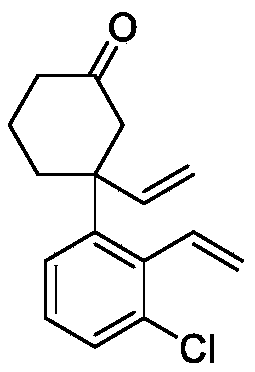
Under Ar, at -78 ℃ to a mixture of copper (I) iodide (15.96 g, 84 mmol) and LiCl (3.55 g, 84 mmol) in dry THF (200 mL) was added vinylmagnesium bromide (21.15 g, 161 mmol) dropwise over 60 min; and then the mixture was stirred at -78 ℃ for another 60 min. 3'-chloro-2'-vinyl-5, 6-dihydro- [1, 1'-biphenyl] -3 (4H) -one (step 2, 15 g, 64.5 mmol) in THF (160 mL) was added dropwise, and then the reaction mixture was stirred at -78 ℃ for 1 h and allowed to warm up to room temperature for 2 h. Sat. NH
4Cl (150 mL) was added to quench the reaction and the resulting mixture was extracted with ethyl acetate twice. The combined organic layers were dried over Na
2SO
4, and concentrated under reduced pressure to give a brown oil, which was purified by silica gel column chromatography and eluted with ethyl acetate/hexane from 0%to 10%to afford the title compound (7g, 41.6 %) as a colorless oil. MS: 261.2 (M+H
+) .
Step 4: Synthesis of 4'-chlorospiro [cyclohexane-1, 1'-inden] -3-one

Under Ar, the mixture of 3- (3-chloro-2-vinylphenyl) -3-vinylcyclohexan-1-one (step 3, 10 g, 38.3 mmol) and Grubbs-II reagent (4.88 g, 5.75 mmol ) in DCM (1 L) was stirred at 30 ℃ over night. After removal of the volatiles under reduced pressure, the residue was purified by silica gel column chromatography and eluted with ethyl acetate/hexane from 0%to 10%to afford the title compounds as (4.5g, 50.2 %) as a light brown oil.
1H NMR (400 MHz, CDCl
3) δ 7.25 –7.13 (m, 3 H) , 6.88 (d, J = 5.7 Hz, 1 H) , 6.52 (d, J = 5.7 Hz, 1 H) , 2.70 (d, J = 13.7 Hz, 1 H) , 2.56 (dd, J = 7.7, 5.9 Hz, 2 H) , 2.32 –2.22 (m, 1 H) , 2.19 –1.99 (m, 3 H) , 1.70 –1.62 (m, 1 H) . MS: 233.2 (M+H
+) .
Total 4'-chlorospiro [cyclohexane-1, 1'-inden] -3-one (20 g) was subjected to chiral SFC resolution using a Lux Cellulose-4 column to provide two isomers, the stereochemistry of the asymmetric spirocarbon atom of these compounds have not been determined.
(R) -4'-chlorospiro [cyclohexane-1, 1'-inden] -3-one: The first eluting stereoisomer (10.9 g, 99%ee) was arbitrarily designated as having R stereochemistry at the spirocarbon atom pending further analysis.

(S) -4'-chlorospiro [cyclohexane-1, 1'-inden] -3-one: The first eluting stereoisomer (7.2 g, 99%ee) was arbitrarily designated as having S stereochemistry at the spirocarbon atom pending further analysis.

Step 5: Synthesis of 4-chlorodispiro [indene-1, 1'-cyclohexane-3', 2”- [1, 3] dioxolane]

Under Ar, The mixture of 4'-chlorospiro [cyclohexane-1, 1'-inden] -3-one (step 4, 33 g, 142 mmol) , ethane-1, 2-diol (17.60 g, 284 mmol) and 4-methylbenzenesulfonic acid hydrate (2.70 g, 14.18 mmol) was stirred at 100 ℃ for 12 h. After cooling down to room temperature, water was added, extracted with ethyl acetate twice, the combined organic layers were washed with brine, dried over sodium sulfate, concentrated in vacuo to give the crude, which was purified by silica gel column chromatography and eluted with ethyl acetate/hexane from 0 to 20%to afford the title compound (33 g, 84 %) as a light brown oil. MS: 277.3 (M+H
+) .
Step 6: Synthesis of 4-chlorodispiro [indene-1, 1'-cyclohexane-3', 2”- [1, 3] dioxolan] -3 (2H) -one

Under Ar, 4-chlorodispiro [indene-1, 1'-cyclohexane-3', 2”- [1, 3] dioxolane] (Step 5, 16.5 g, 59.6 mmol, 1.0) was added to 0.5 M 9-Borabicyclo [3.3.1] nonane (21.82 g, 179 mmol) in tetrahydrofuran (358 mL) at room temperature. after the mixture was stirred at 70 ℃ for 3 h, the volatiles were removed under reduced pressure to give the residue, which was dissolved in dichloromethane (500 mL) to give a clear solution. Pyridinium chlorochromate (103 g, 477 mmol) was added to the mixture slowly at room temperature. The mixture was stirred at 40 ℃ for 2 h, and the filtrates was concentrated in vacuo to give the black residue, which was purified by silica gel column chromatography and eluted with ethyl acetate/hexane from 0 to 15%to give the title compound (13.3 g, 76 %) as a white solid. MS: 293.3 (M+H
+) .
Total 4-chlorodispiro [indene-1, 1'-cyclohexane-3', 2”- [1, 3] dioxolan] -3 (2H) -one (22 g) was subjected to chiral SFC resolution using a CHIRALPAK IH column to provide two isomer, the stereochemistry of the asymmetric spirocarbon atom of these compounds have not been determined.
(S) -4-chlorodispiro [indene-1, 1'-cyclohexane-3', 2”- [1, 3] dioxolan] -3 (2H) -one: The first eluting stereoisomer (9.5 g, 99%ee) was arbitrarily designated as having S stereochemistry at the spirocarbon atom pending further analysis.

(R) -4-chlorodispiro [indene-1, 1'-cyclohexane-3', 2”- [1, 3] dioxolan] -3 (2H) -one: The second eluting stereoisomer (8.6 g, 98%ee) was arbitrarily designated as having R stereochemistry at the spirocarbon atom pending further analysis.

Step 7: Synthesis of (1R) -4-chloro-3- (trifluoromethyl) -2, 3-dihydrodispiro [indene-1, 1'-cyclohexane-3', 2”- [1, 3] dioxolan] -3-ol

Under Ar, to a solution of (R) -4-chlorodispiro [indene-1, 1'-cyclohexane-3', 2”- [1, 3] dioxolan] -3 (2H) -one (step 6, 2.2 g, 7.51 mmol) and trimethyl (trifluoromethyl) silane (5.34 g, 37.6 mmol) in THF (10 mL) was added TBAF (2.95 g, 11.27 mmol) at 0 ℃. After stirred at 25 ℃ overnight, water was added, extracted with ethyl acetate twice, the combined organic layers were washed with brine, dried over sodium sulfate, concentrated in vacuo to give the crude, which was purified by silica gel column chromatography and eluted with ethyl acetate/hexane from 0%to 20%to afford the title compound (2.6 g, 95 %) as a colorless oil. MS: 363.3 (M+H
+) .
Step 8: Synthesis of (1R) -4'-chloro-3'-hydroxy-3'- (trifluoromethyl) -2', 3'-dihydrospiro [cyclohexane-1, 1'-inden] -3-one

Under Ar, The mixture of (1R) -4-chloro-3- (trifluoromethyl) -2, 3-dihydrodispiro [indene-1, 1'-cyclohexane-3', 2”- [1, 3] dioxolan] -3-ol (step 7, 2.6 g, 7.17 mmol) in Acetone (20 mL) and 6N HCl (10 mL) was stirred at 25 ℃ for 2 h. Neutralized with saturated NaHCO
3, extracted with ethyl acetate twice, the combined organic layers were washed with brine, dried over sodium sulfate, concentrated in vacuo to give the crude, which was purified by silica gel column chromatography and eluted with ethyl acetate/hexane from 0%to 20%to afford the title compound (2.1 g, 92 %) as a white solid. MS: 319.3 (M+H
+) .
Step 9: Synthesis of methyl (1R) -4'-chloro-3'-hydroxy-3-oxo-3'- (trifluoromethyl) -2', 3'-dihydrospiro [cyclohexane-1, 1'-indene] -4-carboxylate

Under Ar, To the solution of (1R) -4'-chloro-3'-hydroxy-3'- (trifluoromethyl) -2', 3'-dihydrospiro [cyclohexane-1, 1'-inden] -3-one (step 8, 2.1 g, 6.59 mmol) and NaH (2.64 g, 65.9 mmol) in THF (20 mL) was added dimethyl carbonate (2.97 g, 32.9 mmol) at 70 ℃. The mixture was stirred at 70 ℃ for 4 h. After cooling down to room temperature, water was added, extracted with ethyl acetate twice, the combined organic layers were washed with brine, dried over sodium sulfate, concentrated in vacuo to give the crude, which was purified by silica gel column chromatography and eluted with ethyl acetate/hexane from 0%to 30%to afford the title compound (2g, 81 %) as colorless oil. MS: 377.3 (M+H
+) .
Step 10: Synthesis of methyl (1S) -4'-chloro-3-oxo-3'- (trifluoromethyl) spiro [cyclohexane-1, 1'-indene] -4-carboxylate

Under Ar, the mixture of methyl (1R) -4'-chloro-3'-hydroxy-3-oxo-3'- (trifluoromethyl) -2', 3'-dihydrospiro [cyclohexane-1, 1'-indene] -4-carboxylate (step 9, 2 g, 5.31 mmol) ) in Eaton's Reagent (10 mL) was stirred at 25 ℃ for 3 h. The reaction was neutralized with saturated NaHCO
3, extracted with ethyl acetate twice, the combined organic layers were washed with brine, dried over sodium sulfate, concentrated in vacuo to give the crude, which was purified by silica gel column chromatography and eluted with ethyl acetate/hexane from 0%to 20%to afford the title compound (982 mg, 51.6 %) as colorless oil. MS: 359.2 (M+H
+) .
EXAMPLE 8
Synthesis of Intermediate 8: methyl (1R) -4'-chloro-3-oxo-3'- (trifluoromethyl) spiro [cyclohexane-1, 1'-indene] -4-carboxylate

Step 1: Synthesis of (1S) -4-chloro-3- (trifluoromethyl) -2, 3-dihydrodispiro [indene-1, 1'-cyclohexane-3', 2”- [1, 3] dioxolan] -3-ol

Under Ar, to a solution of (S) -4-chlorodispiro [indene-1, 1'-cyclohexane-3', 2”- [1, 3] dioxolan] -3 (2H) -one (EXAMPLE 7, step 6; 1.5 g, 5.12 mmol) and trimethyl (trifluoromethyl) silane (3.64 g, 25.6 mmol) in THF (10 mL) was added TBAF (2.0 g, 7.65 mmol) at 0 ℃. After stirred at 25 ℃ overnight, water was added, extracted with ethyl acetate twice, the combined organic layers were washed with brine, dried over sodium sulfate, concentrated in vacuo to give the crude, which was purified by silica gel column chromatography and eluted with ethyl acetate/hexane from 0%to 20%to afford the title compound (1.73 g, 93 %) as a colorless oil. MS: 363.3 (M+H
+) .
Step 2: Synthesis of (1S) -4'-chloro-3'-hydroxy-3'- (trifluoromethyl) -2', 3'-dihydrospiro [cyclohexane-1, 1'-inden] -3-one

Under Ar, The mixture of (1S) -4-chloro-3- (trifluoromethyl) -2, 3-dihydrodispiro [indene-1, 1'-cyclohexane-3', 2”- [1, 3] dioxolan] -3-ol (step 1, 1.73 g, 4.77 mmol) in Acetone (10 mL) and 4N HCl (10 mL) was stirred at 25 ℃ for 2 h. Neutralized with saturated NaHCO
3, extracted with ethyl acetate twice, the combined organic layers were washed with brine, dried over sodium sulfate, concentrated in vacuo to give the crude, which was purified by silica gel column chromatography and eluted with ethyl acetate/hexane from 0%to 20%to afford the title compound (1.35 g, 89 %) as a white solid. MS: 301.3 (M-H
2O+H
+) .
Step 3: Synthesis of methyl (1S) -4'-chloro-3'-hydroxy-3-oxo-3'- (trifluoromethyl) -2', 3'-dihydrospiro [cyclohexane-1, 1'-indene] -4-carboxylate

Under Ar, To the solution of (1R) -4'-chloro-3'-hydroxy-3'- (trifluoromethyl) -2', 3'-dihydrospiro [cyclohexane-1, 1'-inden] -3-one (step 2, 1.35 g, 4.24 mmol) and NaH (508 mg, 12.72 mmol) in THF (10 mL) was added dimethyl carbonate (1.91 g, 21.2 mmol) at 70 ℃. The mixture was stirred at 70 ℃ for 4 h. After cooling down to room temperature, water was added, extracted with ethyl acetate twice, the combined organic layers were washed with brine, dried over sodium sulfate, concentrated in vacuo to give the crude, which was purified by silica gel column chromatography and eluted with ethyl acetate/hexane from 0%to 10%to afford the title compound (1.3g, 81 %) as colorless oil. MS: 377.3 (M+H
+) .
Step 4: Synthesis of methyl (1R) -4'-chloro-3-oxo-3'- (trifluoromethyl) spiro [cyclohexane-1, 1'-indene] -4-carboxylate

Under Ar, The mixture of methyl (1S) -4'-chloro-3'-hydroxy-3-oxo-3'- (trifluoromethyl) -2', 3'-dihydrospiro [cyclohexane-1, 1'-indene] -4-carboxylate (step 3, 1.3 g, 3.45 mmol) in Eaton's Reagent (10 mL) was stirred at 25 ℃ for 3 h.
Neutralized with saturated NaHCO
3, extracted with ethyl acetate twice, the combined organic layers were washed with brine, dried over sodium sulfate, concentrated in vacuo to give the crude, which was purified by silica gel column chromatography and eluted with ethyl acetate/hexane from 0%to 20%to afford the title compound (550 mg, 44 %) as colorless oil. MS: 359.2 (M+H
+) .
EXAMPLE 9
Synthesis of Intermediate 9: methyl (1S) -4'-chloro-3'-methyl-3-oxospiro [cyclohexane-1, 1'-indene] -4-carboxylate

Step 1: Synthesis of (1R) -4-chloro-3-methyl-2, 3-dihydrodispiro [indene-1, 1'-cyclohexane-3', 2”- [1, 3] dioxolan] -3-ol

Under Ar, To the mixture of (R) -4-chlorodispiro [indene-1, 1'-cyclohexane-3', 2”- [1, 3] dioxolan] -3 (2H) -one (EXAMPLE 7, step 6; 600 mg, 2.1 mmol) in dry THF (10 mL) was added methyl magnesium bromide (489 mg, 4.10 mmol) at 0 ℃, then the mixture was stirred at rt overnight. Quenched with saturated NH
4Cl, extracted with ethyl acetate twice, the combined organic layer was washed with brine, dried over Na
2SO
4, concentrated to give a colorless oil, which was purified by silica gel column chromatography and eluted with ethyl acetate/hexane from 0%to 30%to afford the title compound (622 mg, 98 %) as a colorless oil. MS: 291.3 (M-H
2O+H
+) .
(1S) -4-Chloro-3-methyl-2, 3-dihydrodispiro [indene-1, 1'-cyclohexane-3', 2”- [1, 3] dioxolan] -3-ol is prepared in essentially the same way using (S) -4-chlorodispiro [indene-1, 1'-cyclohexane-3', 2”- [1, 3] dioxolan] -3 (2H) -one as the starting intermediate.
Step 2: Synthesis of (S) -4'-chloro-3'-methylspiro [cyclohexane-1, 1'-inden] -3-one

Under Ar, the mixture of (1R) -4-chloro-3-methyl-2, 3-dihydrodispiro [indene-1, 1'-cyclohexane-3', 2”- [1, 3] dioxolan] -3-ol (step 1, 622 mg, 2.014 mmol) in Acetone (10 mL) and 4N HCl (10.00 mL) was stirred at 25 ℃ for 1 h. Neutralized with saturated NaHCO
3, extracted with ethyl acetate twice, the combined organic layers were washed with brine, dried over sodium sulfate, concentrated in vacuo to give the crude, which was purified by silica gel column chromatography and eluted with ethyl acetate/hexane from 0%to 20%to afford the title compound (406 mg, 82 %) as colorless oil. MS: 247.3 (M+H
+) .
(R) -4'-Chloro-3'-methylspiro [cyclohexane-1, 1'-inden] -3-one is prepared in essentially the same way using (1S) -4-chloro-3-methyl-2, 3-dihydrodispiro [indene-1, 1'-cyclohexane-3', 2”- [1, 3] dioxolan] -3-ol as the starting intermediate.
Step 3: Synthesis of methyl (1S) -4'-chloro-3'-methyl-3-oxospiro [cyclohexane-1, 1'-indene] -4-carboxylate

Under Ar, to the mixture of (S) -4'-chloro-3'-methylspiro [cyclohexane-1, 1'-inden] -3-one (step 2, 406 mg, 1.645 mmol) and NaH (658 mg, 16.45 mmol) in dry THF (10 mL) was added dimethyl carbonate (148 mg, 1.645 mmol) at 80 ℃, and stirred at this temperature for 1 h. After cooling down to room temperature, quenched with saturated NH
4Cl, extracted with ethyl acetate twice, the combined organic layer was washed with brine, dried over Na
2SO
4, concentrated to give a colorless oil, which was purified by silica gel column chromatography and eluted with ethyl acetate/hexane from 0%to 20%to afford the title compound (445 mg, 89 %) as a colorless oil.
1H NMR (400 MHz, CDCl
3) δ 12.22 (s, 1 H) , 7.21-7.19 (m, 1 H) , 7.14-7.10 (m, 2 H) , 6.18 (s, 1 H) , 3.81 (s, 3 H) , 2.66 (d, J =18 Hz, 1 H) , 2.59-2.53 (m, 1 H) , 2.43-2.35 (m, 4 H) , 2.11 (d, J =18 Hz, 1 H) , 1.86-1.79 (m, 1 H) , 1.52-1.47 (m, 1 H) . MS: 305.3 (M+H
+) .
Methyl (1R) -4'-chloro-3'-methyl-3-oxospiro [cyclohexane-1, 1'-indene] -4-carboxylate is prepared in essentially the same way using (R) -4'-chloro-3'-methylspiro [cyclohexane-1, 1'-inden] -3-one as the starting intermediate.
EXAMPLE 10
Synthesis of Intermediate 10: methyl (1S) -4'-chloro-3'- (methyl-d3) -3-oxospiro [cyclohexane-1, 1'-indene] -4-carboxylate

Intermediate 10 was prepared using essentially the same protocol as in EXAMPLE 9 with (methyl-d3) magnesium bromide in place of methyl magnesium bromide to afford the title compound (470 mg) as a colorless oil.
1H NMR (500 MHz, CDCl
3) δ 12.22 (s, 1 H) , 7.21-7.19 (m, 1 H) , 7.14-7.10 (m, 2 H) , 6.18 (s, 1 H) , 3.81 (s, 3 H) , 2.66 (d, J =22.5 Hz, 1 H) , 2.59-2.53 (m, 1 H) , 2.43-2.35 (m, 1 H) , 2.11 (d, J =22.5 Hz, 1 H) , 1.86-1.79 (m, 1 H) , 1.52-1.47 (m, 1 H) . MS: 308.3 (M+H
+) .
Methyl (1R) -4'-chloro-3'- (methyl-d3) -3-oxospiro [cyclohexane-1, 1'-indene] -4-carboxylate is prepared using essentially the same protocol as in EXA|MPLE 9 with (methyl-d3) magnesium bromide in place of methyl magnesium bromide and using (S) -4-chlorodispiro [indene-1, 1'-cyclohexane-3', 2”- [1, 3] dioxolan] -3 (2H) -one as the starting intermediate.
EXAMPLE 11
Synthesis of Intermediate 11: methyl (1R) -4'-chloro-2', 3'-difluoro-3-oxospiro [cyclohexane-1, 1'-indene] -4-carboxylate

Essentially the same protocol described in EXAMPLE 4 was used to afford intermediate 11 (300 mg) as a colorless oil. MS: 327.2 (M+H
+) .
Essentially the same protocol described in EXAMPLE 4 is used to prepare methyl (1S) -4'-chloro-2', 3'-difluoro-3-oxospiro [cyclohexane-1, 1'-indene] -4-carboxylate using the appropriate starting intermediate.
EXAMPLE 12
Synthesis of Intermediate 12: methyl 4'-fluoro-3-oxospiro [cyclohexane-1, 1'-indene] -4-carboxylate

Step 1: Synthesis of 1-bromo-3-fluoro-2-vinylbenzene

Under Ar, n-butyllithium (17.04 g, 266 mmol) in Hexane was added to methyltriphenylphosphonium bromide (95 g, 266 mmol) in THF (200 mL) at 0 ℃ dropwise over 40 mins, and then the mixture was stirred for 1 h at this temperature, 2-bromo-6-fluorobenzaldehyde (45g, 222 mmol) in THF (100 mL) was added. After the reaction, the reaction mixture was quenched with saturated NH
4Cl (150 mL) and extracted with ethyl acetate twice, the combined EA layers were washed with brine, dried over Na
2SO
4, and concentrated under reduced pressure to afford a yellow oil, which was purified by silica gel column chromatography (hexane : 100%) to give 1-bromo-3-fluoro-2-vinylbenzene (40g, 90 %) as a light yellow oil.
Step 2: Synthesis of 3'-fluoro-2'-vinyl-5, 6-dihydro- [1, 1'-biphenyl] -3 (4H) -one

Under Ar, the mixture of 1-bromo-3-fluoro-2-vinylbenzene (step 1, 13.5 g, 67.2 mmol) , 3- (4, 4, 5, 5-tetramethyl-1, 3, 2-dioxaborolan-2-yl) cyclohex-2-en-1-one (19.4 g, 87 mmol) , Pd (dppf) Cl
2 (2.74 g, 3.36 mmol) and sodium carbonate (17.8 g, 168 mmol) in DME (80 mL) and water (20 mL) was stirred at 90℃ for 3 h. After the reaction, the mixture was extracted with EA twice and the combined EA layers were washed with brine, dried over anhydrous Na
2SO
4 and concentrated in vacuo to give a brown oil , which was purified by silica gel column chromatography (hexane : ethyl acetate = 15 : 1) to afford the title compound as yellow oil (13.1 g, 90%) . MS: 217.3 (M+H
+) .
Step 3: Synthesis of 3- (3-fluoro-2-vinylphenyl) -3-vinylcyclohexan-1-one

Under Ar, at -78 ℃ to a mixture of copper (I) iodide (11.89 g, 62.4 mmol) and LiCl (2.65 g, 62.4 mmol) in dry THF (150 mL) was added vinylmagnesium bromide (16.4 g, 124.8 mmol) dropwise over 30 min, and then the mixture was stirred at -78 ℃ for another 30 min. a solution of 3'-fluoro-2'-vinyl-5, 6-dihydro- [1, 1'-biphenyl] -3 (4H) -one (Step 2, 9 g, 41.6 mmol) in dry THF (70 mL) was added dropwise, and then the reaction mixture was stirred at -78 ℃ for 1 h and allowed to warm up to room temperature for 2 h. Sat. NH
4Cl (150 mL) was added to quench the reaction and the resulting mixture was extracted with ethyl acetate twice. The combined organic layers were dried over Na
2SO
4, and concentrated under reduced pressure to give a brown oil, which was purified by silica gel column chromatography and eluted with ethyl acetate/hexane from 5%to 30%to afford the title compounds (5.6 g, 52%) as a light yellow oil.
1H NMR (400 MHz, CDCl
3) δ 7.24 –7.12 (m, 2 H) , 7.08 –6.98 (m, 1 H) , 6.84 (dd, J = 17.9, 11.7 Hz, 1 H) , 6.00 (dd, J = 17.5, 10.7 Hz, 1 H) , 5.64 –5.51 (m, 2 H) , 5.19 (d, J = 10.7 Hz, 1 H) , 4.96 (d, J = 17.5 Hz, 1 H) , 2.81 (d, J =15.1 Hz, 1 H) , 2.73 (d, J = 15.2 Hz, 1 H) , 2.70 –2.62 (m, 1 H) , 2.32 (t, J = 6.8 Hz, 2 H) , 2.10 –1.98 (m, 1 H) , 1.94 –1.79 (m, 1 H) , 1.59 –1.47 (m, 1 H) . MS: 245.2 (M+H
+) .
Step 4: Synthesis of 4'-fluorospiro [cyclohexane-1, 1'-inden] -3-one

Under Ar, the mixture of 3- (3-fluoro-2-vinylphenyl) -3-vinylcyclohexan-1-one (step 3, 12.5g, 51.0 mmol) and Grubbs-II reagent (4.35g, 5.12 mmol) in DCM (250 mL) was stirred at 30 ℃ overnight. After removal of volatiles under reduced pressure, the residue was purified by silica gel column chromatography and eluted with ethyl acetate/hexane from 0%to 15%to afford the title compounds as (5.6g, 50.2 %) as a colorless oil.
1H NMR (400 MHz, CDCl
3) δ 7.21 (td, J = 7.8, 4.9 Hz, 1 H) , 7.13 (d, J = 7.4 Hz, 1 H) , 7.03 –6.95 (m, 1 H) , 6.88 (d, J = 5.7 Hz, 1 H) , 6.47 (d, J = 5.7 Hz, 1 H) , 2.73 (d, J = 13.7 Hz, 1 H) , 2.62 –2.55 (m, 2 H) , 2.36 –2.24 (m, 1 H) , 2.22 –2.15 (m, 1 H) , 2.14 –2.10 (m, 1 H) , 2.10 –1.97 (m, 1 H) , 1.74 –1.63 (m, 1 H) . MS: 217.3 (M+H
+) .
Step 5: Synthesis of methyl 4'-fluoro-3-oxospiro [cyclohexane-1, 1'-indene] -4-carboxylate

Under Ar, a solution of 4'-fluorospiro [cyclohexane-1, 1'-inden] -3-one (step 4, 450 mg, 2.081 mmol) in THF (10 mL) was added to the mixture of NaH (832 mg, 20.81 mmol) and dimethyl carbonate (1874 mg, 20.81 mmol) in THF (20 mL) at 80 ℃ dropwise. The reaction mixture was refluxed for 2 h. After cooling down to room temperature, sat. NH
4Cl was added to quench the reaction and the resulting mixture was extracted with ethyl acetate twice. The combined organic layers were dried over Na
2SO
4, and concentrated under reduce pressure to give a light yellow oil, which was purified by silica gel column chromatography and eluted with ethyl acetate/hexane from 5%to 20%to afford the title compound (514 mg, 90 %) as a white solid.
1H NMR (400 MHz, CDCl
3) δ 12.27 (s, 1 H) , 7.24 –7.15 (m, 1 H) , 7.09 (d, J = 7.3 Hz, 1 H) , 7.01 –6.95 (m, 1 H) , 6.88 (d, J = 5.7 Hz, 1 H) , 6.49 (d, J = 5.7 Hz, 1 H) , 3.85 (s, 3 H) , 2.69 (dt, J = 18.2, 2.0 Hz, 1 H) , 2.65 –2.56 (m, 1 H) , 2.51 –2.38 (m, 1 H) , 2.23 (dd, J = 18.1, 1.4 Hz, 1 H) , 1.88 (m, 1 H) , 1.64 –1.58 (m, 1 H) . MS: 275.2 (M+H
+) .
EXAMPLE 13
Synthesis of 2- ( (2S) -1-acryloyl-4- (3-methyl-2'- ( ( (S) -1-methylpyrrolidin-2-yl) methoxy) -5', 8'-dihydro-6'H-spiro [indene-1, 7'-quinazolin] -4'-yl) piperazin-2-yl) acetonitrile (Cpd. No. 1 Isomer A/B)

Step 1: Synthesis of 2'-mercapto-3-methyl-5', 8'-dihydro-6'H-spiro [indene-1, 7'-quinazolin] -4'-ol

Under Ar, the mixture of methyl 3'-methyl-3-oxospiro [cyclohexane-1, 1'-indene] -4-carboxylate (intermediate 2, 1.32 g, 4.88 mmol) , thiourea (0.446 g, 5.86 mmol) and DBU (1.115 g, 7.32 mmol) in ACN (16 mL) was stirred at 80℃ for 3 h. After the volatiles were removed under reduced pressure, the residue was dissolved in H
2O, neutralized with HCl, the precipitate was collected and dried vacuo to give the title compound (1.13g, 78 %) as a light yellow solid. MS: 297.5 (M+H
+) .
Step 2: Synthesis of 3-methyl-2'- (methylthio) -5', 8'-dihydro-6'H-spiro [indene-1, 7'-quinazolin] -4'-ol

Under Ar, to a mixture of 3-methyl-2'-thioxo-2', 3', 5', 8'-tetrahydro-1'H-spiro [indene-1, 7'-quinazolin] -4' (6'H) -one (step 1, 1.13 g, 3.81 mmol) and sodium hydroxide (0.137 g, 3.43 mmol) in Acetone (10 mL) and water (2 mL) was added iodomethane (0.487 g, 3.43 mmol) , and then the reaction was stirred at room temperature for 2 h.
The solvent was removed under vacuum to give the residue, which was dissolved in water, adjusted pH=6, the precipitate was collected and dried in vacuo to give the title compound (770 mg, 65.1 %) s a light-yellow solid. MS: 312.10 (M+H
+)
Step 3: Synthesis of 3-methyl-2'- (methylthio) -5', 8'-dihydro-6'H-spiro [indene-1, 7'-quinazolin] -4'-yl trifluoromethanesulfonate

Under Ar, to a suspension of 3-methyl-2'- (methylthio) -5', 8'-dihydro-3'H-spiro [indene-1, 7'-quinazolin] -4' (6'H) -one (step 2, 770 mg, 2.481 mmol) and DIEA (802 mg, 6.20 mmol) in DCM (3 mL) was added Tf
2O (1050 mg, 3.72 mmol) at -40℃. After 1 h later, water was added, extracted with DCM twice, the combined organic layers were washed with brine, dried over anhydrous Na
2SO
4, and concentrated to give the crude title compound (1 g, 91 %) , which was used directly for the next step without further purification. MS: 443.3 (M+H
+) .
Step 4: Synthesis of tert-butyl (2S) -2- (cyanomethyl) -4- (3-methyl-2'- (methylthio) -5', 8'-dihydro-6'H-spiro [indene-1, 7'-quinazolin] -4'-yl) piperazine-1-carboxylate

Under Ar, to the solution of 3-methyl-2'- (methylthio) -5', 8'-dihydro-6'H-spiro [indene-1, 7'-quinazolin] -4'-yl trifluoromethanesulfonate (step 3, 1 g, 2.260 mmol) in DMF (1.5 mL) were added DIEA (1.461 g, 11.30 mmol) and (S) -2- (piperazin-2-yl) acetonitrile dihydrochloride (0.448 g, 2.260 mmol) at room temperature. After 1 h later, the LC-MS showed the starting material was consumed completely, Boc
2O (2.466 g, 11.30 mmol) was added. The mixture was stirred at room temperature for another 1 h. Water was added, extracted with DCM twice, the combined organic layers were washed with brine, dried over anhydrous Na
2SO
4, and concentrated to give a colorless oil, which was purified by silica gel column chromatography and eluted with ethyl acetate/hexane from 0%to 30%to afford the title compound (1.17 g, 100 %) as a colorless oil. MS: 518.5 (M+H
+) .
Step 5: Synthesis of tert-butyl (2S) -2- (cyanomethyl) -4- (3-methyl-2'- (methylsulfinyl) -5', 8'-dihydro-6'H-spiro [indene-1, 7'-quinazolin] -4'-yl) piperazine-1-carboxylate

Under Ar, m-CPBA (0.416 g, 2.051 mmol) was added to the solution of tert-butyl (2S) -2- (cyanomethyl) -4- (3-methyl-2'- (methylthio) -5', 8'-dihydro-6'H-spiro [indene-1, 7'-quinazolin] -4'-yl) piperazine-1-carboxylate (step 4, 1.18 g, 2.279 mmol) in DCM (10 mL) at 0℃. After 30 mins, water was added, extracted with DCM twice, the combined organic layers were washed with brine, dried over Na
2SO
4, concentrated to give the crude title compound (744 mg, 61.2 %) as a foam solid. MS: 534.5 (M+H
+) .
Step 6: Synthesis of tert-butyl (2S) -2- (cyanomethyl) -4- (3-methyl-2'- ( ( (S) -1-methylpyrrolidin-2-yl) methoxy) -5', 8'-dihydro-6'H-spiro [indene-1, 7'-quinazolin] -4'-yl) piperazine-1-carboxylate

Under Ar, to the solution of (S) - (1-methylpyrrolidin-2-yl) methanol (240 mg, 2.080 mmol) in THF (10 mL) was added NaH (83 mg, 2.080 mmol) at 0-10℃. After stirred 10 mins later, tert-butyl (2S) -2- (cyanomethyl) -4- (3-methyl-2'- (methylsulfinyl) -5', 8'-dihydro-6'H-spiro [indene-1, 7'-quinazolin] -4'-yl) piperazine-1-carboxylate (step 5, 370 mg, 0.693 mmol) in THF (10 mL) was added at -20℃. At last, the mixture was stirred at room temperature for 30 mins, Quenched with NH
4Cl aq, extracted with DCM twice, the combined organic layers were washed with brine, dried over Na
2SO
4, concentrated to give the residue, which was purified by silica gel column chromatography and eluted with MeOH/DCM from 2%to 20%to give the title compound (400 mg, 99 %) as a colorless foam solid. MS: 585.7 (M+H
+) .
Step 7: Synthesis of 2- ( (2S) -1-acryloyl-4- (3-methyl-2'- ( ( (S) -1-methylpyrrolidin-2-yl) methoxy) -5', 8'-dihydro-6'H-spiro [indene-1, 7'-quinazolin] -4'-yl) piperazin-2-yl) acetonitrile

Under Ar, the mixture of tert-butyl (2S) -2- (cyanomethyl) -4- (3-methyl-2'- ( ( (S) -1-methylpyrrolidin-2-yl) methoxy) -5', 8'-dihydro-6'H-spiro [indene-1, 7'-quinazolin] -4'-yl) piperazine-1-carboxylate (step 6, 400 mg, 0.684 mmol) in DCM (5 mL) and TFA (10 mL) was stirred at room temperature for 1 h. All the volatiles were removed under reduced pressure to give the TFA salt. Which was dissolved in DCM (5 mL) , followed by adding TEA (350 mg, 3.4 mmol) and acryloyl chloride (124 mg, 1.368 mmol) in at 0 ℃. The mixture was stirred at 0 ℃ for 30 min. water was added, extracted with DCM twice, washed with brine, dried over Na
2SO
4, concentrated to give a light-yellow residue, which was purified by Prep-HPLC to afford Cpd. No. 1 Isomer A/B (65 mg, 17.64 %) as a white solid.
1H NMR (400 MHz, DMSO-d
6) δ 7.45 –7.33 (m, 1 H) , 7.50 –7.32 (m, 2 H) , 7.25 –7.15 (m, 1 H) , 6.86 (br, 1 H) , 6.44 –6.27 (m, 1 H) , 6.26 –6.14 (m, 1 H) , 5.77 (d, J = 10.9 Hz, 1 H) , 5.05 –3.45 (m, 7 H) , 3.29 –2.50 (m, 9 H) , 2.48 –2.33 (m, 4 H) , 2.23 –2.12 (m, 1 H) , 2.09 (s, 3 H) , 2.06 –1.82 (m, 2 H) , 1.73 –1.41 (m, 4 H) . MS: 539.6 (M+H
+) .
2- ( (S) -1-Acryloyl-4- ( (S) -3-methyl-2'- ( ( (S) -1-methylpyrrolidin-2-yl) methoxy) -5', 8'-dihydro-6'H-spiro [indene-1, 7'-quinazolin] -4'-yl) piperazin-2-yl) acetonitrile (Cpd. No. 1 Isomer A) and 2- ( (S) -1-acryloyl-4- ( (R) -3-methyl-2'- ( ( (S) -1-methylpyrrolidin-2-yl) methoxy) -5', 8'-dihydro-6'H-spiro [indene-1, 7'-quinazolin] -4'-yl) piperazin-2-yl) acetonitrile (Cpd. No. 1 Isomer B) are prepared in essentially the same way using methyl (1S) -3'-methyl-3-oxospiro [cyclohexane-1, 1'-indene] -4-carboxylate and methyl (1R) -3'-methyl-3-oxospiro [cyclohexane-1, 1'-indene] -4-carboxylate, respectively, as the starting materials.
Example 14
Synthesis of 2- ( (S) -1-acryloyl-4- ( (R) -2-fluoro-3-methyl-2'- ( ( (S) -1-methylpyrrolidin-2-yl) methoxy) -5', 8'-dihydro-6'H-spiro [indene-1, 7'-quinazolin] -4'-yl) piperazin-2-yl) acetonitrile (Cpd. No. 2 Isomer A)

Step 1: Synthesis of (R) -2-fluoro-2'-mercapto-3-methyl-5', 8'-dihydro-6'H-spiro [indene-1, 7'-quinazolin] -4'-ol

Under Ar, the mixture of methyl methyl (1R) -2'-fluoro-3'-methyl-3-oxospiro [cyclohexane-1, 1'-indene] -4-carboxylate (intermediate 3, 400 mg, 1.39 mmol) , thiourea (157 mg, 2.01 mmol) and 2, 3, 4, 6, 7, 8, 9, 10-octahydropyrimido [1, 2-a] azepine (422 mg, 2.77 mmol) in acetonitrile (8 mL) was stirred at 80℃ for 2 h. The volatiles were removed under reduced pressure to give the residue, which was dissolved in water, neutralized with HCl solution, the precipitates were collected and dried in vacuo to afford the title compound (400 mg, 92 %) as a light yellow solid. MS: 315.2 (M+H
+) .
Step 2: Synthesis of (R) -2-fluoro-3-methyl-2'- (methylthio) -5', 8'-dihydro-6'H-spiro [indene-1, 7'-quinazolin] -4'-ol

Under Ar, to a solution of (R) -2-fluoro-2'-mercapto-3-methyl-5', 8'-dihydro-3'H-spiro [indene-1, 7'-quinazolin] -4' (6'H) -one (step 1, 400 mg, 1.27 mmol) and sodium hydroxide (51 mg, 1.27 mmol) in acetone (10 mL) /water (2 mL) was iodomethane (180 mg, 1.27 mmol) at room temperature. After 1 h later, all the volatiles were removed under reduced pressure, neutralized with HCl solution, and the precipitates was collected and dried in vacuo to afford the title compound (430 mg, crude) as a light yellow solid. MS: 329.5 (M+H
+) .
Step 3: Synthesis of (R) -2-fluoro-3-methyl-2'- (methylthio) -5', 8'-dihydro-6'H-spiro [indene-1, 7'-quinazolin] -4'-yl trifluoromethanesulfonate

Under Ar, to a suspension of (R) -2-fluoro-3-methyl-2'- (methylthio) -5', 8'-dihydro-3'H-spiro [indene-1, 7'-quinazolin] -4' (6'H) -one (step 2, 430 mg, 1.31 mmol) and N, N-Diisopropylethylamine (432 mg, 3.27 mmol) in dichloromethane (10 mL) was Trifluoromethanesulfonic anhydride (554 mg, 1.96 mmol) at -40℃. The reaction was kept at this temperature for 1 h, water was added, extracted with DCM twice and the combined organic layers were washed with brine, dried over anhydrous sodium sulfate, concentrated in vacuo to give the title compound (600 mg, 99 %) which was used directly for the next step without further purification. MS: 461.5 (M+H
+) .
Step 4: Synthesis of tert-butyl (S) -2- (cyanomethyl) -4- ( (R) -2-fluoro-3-methyl-2'- (methylthio) -5', 8'-dihydro-6'H-spiro [indene-1, 7'-quinazolin] -4'-yl) piperazine-1-carboxylate

Under Ar, to a solution of (R) -2-fluoro-3-methyl-2'- (methylthio) -5', 8'-dihydro-6'H-spiro [indene-1, 7'-quinazolin] -4'-yl trifluoromethanesulfonate (step 3, 600 mg, 1.3 mmol) and N, N-Diisopropylethylamine (842 mg, 6.5 mmol) in N, N-Dimethylformamide (5 mL) was added (S) -2- (piperazin-2-yl) acetonitrile dihydrochloride (258 mg, 0.1.3 mmol) at room temperature. After 30 mins later, Di-tert-butyl dicarbonate (1422 mg, 6.5 mmol) was added, and the mixture was stirred at room temperature for 1 h. Water was added, extracted with ethyl acetate three times. The organic layers were rinsed with brine, dried over sodium sulfate, and concentrated to give the residue, which was purified by silica gel column chromatography and eluted with ethyl acetate/hexane from 0 to 30%to give the title compound (600 mg, 86 %) as a colorless oil. MS: 536.8 (M+H
+) .
Step 5: Synthesis of tert-butyl (2S) -2- (cyanomethyl) -4- ( (1R) -2-fluoro-3-methyl-2'- (methylsulfinyl) -5', 8'-dihydro-6'H-spiro [indene-1, 7'-quinazolin] -4'-yl) piperazine-1-carboxylate

Under Ar, 3-Chloroperoxybenzoic acid (54 mg, 0.27 mmol, 85%purity) was added to the solution of tert-butyl (S) -2- (cyanomethyl) -4- ( (R) -2-fluoro-3-methyl-2'- (methylthio) -5', 8'-dihydro-6'H-spiro [indene-1, 7'-quinazolin] -4'-yl) piperazine-1-carboxylate (step 4, 150 mg, 0.28 mmol) in dichloromethane (10 mL) at 0℃. After 30 mins later, water was added, extracted with dichloromethane twice, the combined organic layers were washed with brine, dried over sodium sulfate, and concentrated in vacuo to afford the title compound (140 mg, 91 %) as a foam solid. MS: 552.5 (M+H
+) .
Step 6: Synthesis of tert-butyl (S) -2- (cyanomethyl) -4- ( (R) -2-fluoro-3-methyl-2'- ( ( (S) -1-methylpyrrolidin-2-yl) methoxy) -5', 8'-dihydro-6'H-spiro [indene-1, 7'-quinazolin] -4'-yl) piperazine-1-carboxylate

Under Ar, to the solution of (S) - (1-methylpyrrolidin-2-yl) methanol (88 mg, 0.76 mmol) and sodium hydride (30 mg, 0.76 mmol) in tetrahydrofuran (10 mL) was added a solution of tert-butyl (2S) -2- (cyanomethyl) -4- ( (1R) -2-fluoro-3-methyl-2'- (methylsulfinyl) -5', 8'-dihydro-6'H-spiro [indene-1, 7'-quinazolin] -4'-yl) piperazine-1-carboxylate (step 5, 140 mg, 0.25 mmol) in tetrahydrofuran (10 mL) at -20℃. The reaction was warmed to room temperature and stirred for 30 mins. Water was added, extracted with ethyl acetate twice, the combined organic layers were washed with brine, dried over sodium sulfate, and concentrated in vacuo to give a residue, which was purified by silica gel column chromatography and eluted with dichloromethane/methanol from 0 to 10%to afford the title compound (132 mg, 86 %) as colorless oil. MS: 603.8 (M+H
+) .
Step 7: Synthesis of 2- ( (S) -1-acryloyl-4- ( (R) -2-fluoro-3-methyl-2'- ( ( (S) -1-methylpyrrolidin-2-yl) methoxy) -5', 8'-dihydro-6'H-spiro [indene-1, 7'-quinazolin] -4'-yl) piperazin-2-yl) acetonitrile

Under Ar, the mixture of crude tert-butyl (S) -2- (cyanomethyl) -4- ( (R) -2-fluoro-3-methyl-2'- ( ( (S) -1-methylpyrrolidin-2-yl) methoxy) -5', 8'-dihydro-6'H-spiro [indene-1, 7'-quinazolin] -4'-yl) piperazine-1-carboxylate (step 6, 132 mg, 0.22 mmol) in dichloromethane (6 mL) and trifluoroacetic acid (3 mL) was stirred at room temperature for 1 h. All the volatiles were removed under reduced pressure to give a residue, which was dissolved in dichloromethane (5 mL) , and then, triethylamine (111 mg, 1.1 mmol) and acryloyl chloride (39 mg, 0.44 mmol) were added to the mixture at 0 ℃. After 30 mins, water was added, extracted with dichloromethane twice, the combined organic layers were washed with brine, dried over sodium sulfate, concentrated in vacuo to give the crude product, which was purified by Prep-HPLC to afford the title compound (36 mg, 30 %) as a white solid.
1H NMR (400 MHz, DMSO-d
6) δ 7.35-7.25 (m, 2 H) , 7.25-7.12 (m, 2 H) , 6.96-6.70 (br, 1 H) , 6.18 (dd, J = 16.6, 2.1 Hz, 1 H) , 5.77 (dd, J = 10.5, 2.1 Hz, 1 H) , 5.05-4.70 (m, 1 H) , 4.51-3.75 (m, 5 H) , 3.30-2.50 (m, 11 H) , 2.33 (s, 3 H) , 2.24 -2.10 (m, 1 H) , 1.99-1.78 (m, 6 H) , 1.73-1.51 (m, 3 H) . MS: 577.8 (M+H
+) .
2- ( (2S) -1-Acryloyl-4- (2-fluoro-3-methyl-2'- ( ( (S) -1-methylpyrrolidin-2-yl) methoxy) -5', 8'-dihydro-6'H-spiro [indene-1, 7'-quinazolin] -4'-yl) piperazin-2-yl) acetonitrile (Cpd. 2 Isomer A/B) and 2- ( (S) -1-acryloyl-4- ( (S) -2-fluoro-3-methyl-2'- ( ( (S) -1-methylpyrrolidin-2-yl) methoxy) -5', 8'-dihydro-6'H-spiro [indene-1, 7'-quinazolin] -4'-yl) piperazin-2-yl) acetonitrile (Cpd. No. 2 Isomer B) are prepared in essentially the same way using methyl 2'-fluoro-3'-methyl-3-oxospiro [cyclohexane-1, 1'-indene] -4-carboxylate and methyl (1S) -2'-fluoro-3'- methyl-3-oxospiro [cyclohexane-1, 1'-indene] -4-carboxylate, respectively, as the starting materials.
EXAMPLE 15
Synthesis of 2- ( (S) -1-acryloyl-4- ( (S) -2'- ( ( (S) -1, 2-dimethylpyrrolidin-2-yl) methoxy) -2-fluoro-3-methyl-5', 8'-dihydro-6'H-spiro [indene-1, 7'-quinazolin] -4'-yl) piperazin-2-yl) acetonitrile (Cpd. No. 3 Isomer B)

Essentially the same protocol described in EXAMPLE 14 was used to afford Cpd. No. 3 Isomer B (30 mg) as a white solid.
1H NMR (400 MHz, DMSO-d
6) δ 7.34 –7.26 (m, 2 H) , 7.24 –7.11 (m, 2 H) , 6.96 –6.72 (br, 1 H) , 6.18 (dd, J = 16.7, 2.2 Hz, 1 H) , 5.77 (dd, J =10.5, 2.1 Hz, 1 H) , 5.10 –4.66 (m, 1 H) , 4.56 –3.60 (m, 5 H) , 3.48 –2.76 (m, 10 H) , 2.67 –1.2.54 (m, 1 H) , 2.27 (s, 3 H) , 2.10 –1.80 (m, 6 H) , 1.76 –1.50 (m, 3 H) , 1.02 (s, 3 H) . MS: 571.6 (M+H
+) .
Essentially the same protocol described in EXAMPLE 14 is also used to prepare 2- ( (2S) -1-acryloyl-4- (2'- ( ( (S) -1, 2-dimethylpyrrolidin-2-yl) methoxy) -2-fluoro-3-methyl-5', 8'-dihydro-6'H-spiro [indene-1, 7'-quinazolin] -4'-yl) piperazin-2-yl) acetonitrile (Cpd. No. 3 Isomer A/B) and 2- ( (S) -1-acryloyl-4- ( (R) -2'- ( ( (S) -1, 2-dimethylpyrrolidin-2-yl) methoxy) -2-fluoro-3-methyl-5', 8'-dihydro-6'H-spiro [indene-1, 7'-quinazolin] -4'-yl) piperazin-2-yl) acetonitrile (Cpd. No. 3 Isomer A) using the appropriate starting intermediates.
EXAMPLE 16
Synthesis of 2- ( (S) -1-acryloyl-4- ( (R) -2, 3-difluoro-2'- ( ( (S) -1-methylpyrrolidin-2-yl) methoxy) -5', 8'-dihydro-6'H-spiro [indene-1, 7'-quinazolin] -4'-yl) piperazin-2-yl) acetonitrile Cpd. No. 4 Isomer A)

The title compound was prepared using essentially the same protocol described in EXAMPLE 14 with methyl (1R) -2', 3'-difluoro-3-oxospiro [cyclohexane-1, 1'-indene] -4-carboxylate (Intermediate 4) as the starting material to afford Cpd. No. 4 Isomer A (62 mg) as a light-yellow solid.
1H NMR (400 MHz, DMSO-d
6) δ 7.65 –7.35 (m, 3 H) , 7.35 –7.16 (m, 1 H) , 7.00 –6.72 (br, 1 H) , 6.18 (d, J = 16.5 Hz, 1 H) , 5.77 (d, J = 10.7 Hz, 1 H) , 5.06 –3.77 (m, 6 H) , 4.50 –2.50 (m, 10 H) , 2.32 (s, 3 H) , 2.24 –1.85 (m, 4 H) , 1.73 –1.51 (m, 3 H) . MS: 561.6 (M+H
+) .
Essentially the same protocol described in EXAMPLE 14 is also used to prepare 2- ( (2S) -1-acryloyl-4- (2, 3-difluoro-2'- ( ( (S) -1-methylpyrrolidin-2-yl) methoxy) -5', 8'-dihydro-6'H-spiro [indene-1, 7'-quinazolin] -4'-yl) piperazin-2-yl) acetonitrile (Cpd. No. 4 Isomer A/B) and 2- ( (S) -1-acryloyl-4- ( (S) -2, 3-difluoro-2'- ( ( (S) -1-methylpyrrolidin-2-yl) methoxy) -5', 8'-dihydro-6'H-spiro [indene-1, 7'-quinazolin] -4'-yl) piperazin-2-yl) acetonitrile (Cpd. No. 4 Isomer B) using the appropriate starting intermediates.
EXAMPLE 17
Synthesis of 2- ( (S) -1-acryloyl-4- ( (S) -2'- ( ( (S) -1-methylpyrrolidin-2-yl) methoxy) -3- (trifluoromethyl) -5', 8'-dihydro-6'H-spiro [indene-1, 7'-quinazolin] -4'-yl) piperazin-2-yl) acetonitrile (Cpd. No. 5 Isomer A)

The title compound was prepared using essentially the same protocol described in EXAMPLE 14 with methyl (1S) -3-oxo-3'- (trifluoromethyl) spiro [cyclohexane-1, 1'-indene] -4-carboxylate (Intermediate 5) as the starting material to afford Cpd. No. 5 Isomer A (65 mg) as a white solid.
1H NMR (400 MHz, DMSO-d
6) δ 7.63 –7.55 (m, 1 H) , 7.50 –7.33 (m, 4 H) , 6.87 (s, 1 H) , 6.19 (dd, J = 16.6, 2.2 Hz, 1 H) , 5.77 (dd, J = 10.5, 2.0 Hz, 1 H) , 5.05 –4.69 (m, 1 H) , 4.53 –3.51 (m, 5 H) , 3.30 –2.40 (m, 11 H) , 2.33 (s, 3 H) , 2.25 –2.10 (m, 2 H) , 1.97 –1.83 (m, 1 H) , 1.74 –1.48 (m, 4 H) . MS: 593.8 (M+H
+) .
Essentially the same protocol described in EXAMPLE 14 is also used to prepare 2- ( (2S) -1-acryloyl-4- (2'- ( ( (S) -1-methylpyrrolidin-2-yl) methoxy) -3- (trifluoromethyl) -5', 8'-dihydro-6'H-spiro [indene-1, 7'-quinazolin] -4'-yl) piperazin-2-yl) acetonitrile (Cpd. No. 5 Isomer A/B) and 2- ( (S) -1-acryloyl-4- ( (R) -2'- ( ( (S) -1-methylpyrrolidin-2-yl) methoxy) -3- (trifluoromethyl) -5', 8'-dihydro-6'H-spiro [indene-1, 7'-quinazolin] -4'-yl) piperazin-2-yl) acetonitrile (Cpd. No. 5 Isomer B) using the appropriate starting intermediates.
EXAMPLE 18
Synthesis of 2- ( (2S) -1-acryloyl-4- (2-methyl-2'- ( ( (S) -1-methylpyrrolidin-2-yl) methoxy) -5', 8'-dihydro-6'H-spiro [indene-1, 7'-quinazolin] -4'-yl) piperazin-2-yl) acetonitrile (Cpd. No. 6 Isomer A/B)

The title compound was prepared using essentially the same protocol described in EXAMPLE 14 with methyl 2'-methyl-3-oxospiro [cyclohexane-1, 1'-indene] -4-carboxylate (Intermediate 6) as the starting material to afford Cpd. No. 6 Isomer A/B (17 mg) as a white solid.
1H NMR (400 MHz, DMSO-d6) δ 7.30 –7.24 (m, 1 H) , 7.23 –7.16 (m, 1 H) , 7.12 –6.96 (m, 2 H) , 6.95 –6.74 (br, 1 H) , 6.51 (s, 1 H) , 6.24 –6.12 (m, 1 H) , 5.34 –5.72 (m, 1 H) , 5.08 –4.67 (m, 1 H) , 4.55 –3.40 (m, 5 H) , 3.30 –2.50 (m, 9 H) , 2.33 (s, 3 H) , 2.32 –2.10 (m, 2 H) , 1.99 –1.87 (m, 6 H) , 1.70 –1.55 (m, 3 H) , 1.45 –1.25 (m, 1 H) . MS: 539.8 (M+H
+) .
Essentially the same protocol described in EXAMPLE 14 is also used to prepare 2- ( (S) -1-acryloyl-4- ( (S) -2-methyl-2'- ( ( (S) -1-methylpyrrolidin-2-yl) methoxy) -5', 8'-dihydro-6'H-spiro [indene-1, 7'-quinazolin] -4'-yl) piperazin-2-yl) acetonitrile (Cpd. No. 6 Isomer A) and 2- ( (S) -1-acryloyl-4- ( (R) -2-methyl-2'- ( ( (S) -1-methylpyrrolidin-2-yl) methoxy) -5', 8'-dihydro-6'H-spiro [indene-1, 7'-quinazolin] -4'-yl) piperazin-2-yl) acetonitrile (Cpd. No. 6 Isomer B) using the appropriate starting intermediates.
EXAMPLE 19
Synthesis of 2- ( (S) -1-acryloyl-4- ( (S) -4-chloro-2'- ( ( (S) -1-methylpyrrolidin-2-yl) methoxy) -3- (trifluoromethyl) -5', 8'-dihydro-6'H-spiro [indene-1, 7'-quinazolin] -4'-yl) piperazin-2-yl) acetonitrile (Cpd. No. 7 Isomer A)

The title compound was prepared using essentially the same protocol described in EXAMPLE 14 with methyl (1S) -4'-chloro-3-oxo-3'- (trifluoromethyl) spiro [cyclohexane-1, 1'-indene] -4-carboxylate (Intermediate 7) as the starting material to afford Cpd. No. 7 Isomer A (106 mg) as a white solid.
1H NMR (400 MHz, DMSO-d
6) δ 7.70 –7.54 (m, 2 H) , 7.49 –7.32 (m, 2 H) , 5.97 –6.72 (br, 1 H) , 6.18 (dd, J = 16.6, 2.1 Hz, 1 H) , 5.81 –5.66 (m, 1 H) , 5.07 –3.53 (m, 6 H) , 3.30 –2.50 (m, 11 H) , 2.33 (s, 3 H) , 2.26 –2.10 (m, 2 H) , 1.91 –1.85 (m, 1 H) , 1.74 –1.47 (m, 4 H) . MS: 628.6 (M+H
+) .
EXAMPLE 20
Synthesis of 2- ( (S) -1-acryloyl-4- ( (R) -4-chloro-2'- ( ( (S) -1-methylpyrrolidin-2-yl) methoxy) -3- (trifluoromethyl) -5', 8'-dihydro-6'H-spiro [indene-1, 7'-quinazolin] -4'-yl) piperazin-2-yl) acetonitrile (Cpd. No. 7 Isomer B)

The title compound was prepared using essentially the same protocol described in EXAMPLE 14 with methyl (1R) -4'-chloro-3-oxo-3'- (trifluoromethyl) spiro [cyclohexane-1, 1'-indene] -4-carboxylate (Intermediate 8) as the starting material to afford Cpd. No. 7 Isomer B (51 mg) as a white solid.
1H NMR (400 MHz, DMSO-d
6) δ 7.62 –7.50 (m, 2 H) , 7.48 –7.34 (m, 2 H) , 6.96 –6.75 (br, 1 H) , 6.18 (dd, J = 16.7, 2.1 Hz, 1 H) , 5.77 (dd, J = 10.5, 2.1 Hz, 1 H) , 5.07 –3.78 (m, 6 H) , 3.60 –2.50 (m, 11 H) , 2.36 (s, 3 H) , 2.28 –1.84 (m, 3 H) , 1.73 –1.53 (m, 4 H) . MS: 628.6 (M+H
+) .
Essentially the same protocol described in EXAMPLE 14 is also used to prepare 2- ( (2S) -1-acryloyl-4- (4-chloro-2'- ( ( (S) -1-methylpyrrolidin-2-yl) methoxy) -3- (trifluoromethyl) -5', 8'-dihydro-6'H-spiro [indene-1, 7'-quinazolin] -4'-yl) piperazin-2-yl) acetonitrile (Cpd. No. 7 Isomer A/B) using methyl 4'-chloro-3-oxo-3'- (trifluoromethyl) spiro [cyclohexane-1, 1'-indene] -4-carboxylate as the starting material.
EXAMPLE 21
Synthesis of 2- ( (S) -1-acryloyl-4- ( (S) -4-chloro-3-methyl-2'- ( ( (S) -1-methylpyrrolidin-2-yl) methoxy) -5', 8'-dihydro-6'H-spiro [indene-1, 7'-quinazolin] -4'-yl) piperazin-2-yl) acetonitrile (Cpd. No. 8 Isomer A)

Step 1: Synthesis of (S) -4-chloro-2'-mercapto-3-methyl-5', 8'-dihydro-6'H-spiro [indene-1, 7'-quinazolin] -4'-ol

Under Ar, the mixture of methyl (1S) -4'-chloro-3'-methyl-3-oxospiro [cyclohexane-1, 1'-indene] -4-carboxylate (intermediate 9, 440 mg, 1.444 mmol) , thiourea (121 mg, 1.588 mmol) and 2, 3, 4, 6, 7, 8, 9, 10-octahydropyrimido [1, 2-a] azepine (330 mg, 2.166 mmol) in ACN (16 mL) was stirred at 80℃ for 2 h. All the volatiles were removed under reduced pressure to give a residue, which was dissolved in water and neutralized with HCl. The precipitated solid was collected and dried in vacuo to give the title compound (441 mg, 92 %) as a light yellow solid. MS: 331.3 (M+H
+) .
Step 2: Synthesis of (S) -4-chloro-3-methyl-2'- (methylthio) -5', 8'-dihydro-6'H-spiro [indene-1, 7'-quinazolin] -4'-ol

Under Ar, to a solution of (S) -4-chloro-2'-mercapto-3-methyl-5', 8'-dihydro-6'H-spiro [indene-1, 7'-quinazolin] -4'-ol (step 1, 440 mg, 1.330 mmol) and sodium hydroxide (53.2 mg, 1.330 mmol) in acetone (10 mL) /water (2 mL) was iodomethane (189 mg, 1.330 mmol) at room temperature. After 1 h, all the volatiles were removed under reduced pressure, neutralized with HCl solution, and the precipitates was collected and dried in vacuo to afford the title compound (400 mg, 87%) as a light-yellow solid. MS: 345.3 (M+H
+) .
Step 3: Synthesis of (S) -4-chloro-3-methyl-2'- (methylthio) -5', 8'-dihydro-6'H-spiro [indene-1, 7'-quinazolin] -4'-yl trifluoromethanesulfonate

Under Ar, to a mixture of (R) -4-chloro-3-methyl-2'- (methylthio) -5', 8'-dihydro-6'H-spiro [indene-1, 7'-quinazolin] -4'-ol (step 2, 400 mg, 1.160 mmol) and DIPEA (375 mg, 2.90 mmol) in DCM (10 mL) was added Tf
2O (491 mg, 1.740 mmol) at -40℃. After 1 h, water was added, extracted with DCM twice, the combined organic layers were washed with brine, dried over anhydrous Na
2SO
4, and the filtrates was concentrated in vacuo to give the title compound (530 mg, 96 %) as a oil, which was used directly for the next step. MS: 477.3 (M+H
+) .
Step 4: Synthesis of tert-butyl (S) -4- ( (S) -4-chloro-3-methyl-2'- (methylthio) -5', 8'-dihydro-6'H-spiro [indene-1, 7'-quinazolin] -4'-yl) -2- (cyanomethyl) piperazine-1-carboxylate

Under Ar, to a solution of (S) -4-chloro-3-methyl-2'- (methylthio) -5', 8'-dihydro-6'H-spiro [indene-1, 7'-quinazolin] -4'-yl trifluoromethanesulfonate (step 3, 530 mg, 1.111 mmol) and N, N-Diisopropylethylamine (718 mg, 5.56 mmol, ) in N, N-Dimethylformamide (5 mL) was added (S) -2- (piperazin-2-yl) acetonitrile dihydrochloride (220 mg, 1.111 mmol) at room temperature. After 30 mins later, Di-tert-butyl dicarbonate (1213 mg, 5.56 mmol) was added, and the mixture was stirred at room temperature for 1 h. Water was added, extracted with ethyl acetate three times. The organic layers were rinsed with brine, dried over sodium sulfate, and concentrated to give the residue, which was purified by silica gel column chromatography and eluted with ethyl acetate/hexane from 0 to 30%to give the title compound (572 mg, 93 %) as a colorless oil. MS: 552.3 (M+H
+) .
Step 5: Synthesis of tert-butyl (2S) -4- ( (1S) -4-chloro-3-methyl-2'- (methylsulfinyl) -5', 8'-dihydro-6'H-spiro [indene-1, 7'-quinazolin] -4'-yl) -2- (cyanomethyl) piperazine-1-carboxylate

Under Ar, m-CPBA (231 mg, 1.140 mmol, 1.1) was added to the solution of tert-butyl (S) -4- ( (S) -4-chloro-3-methyl-2'- (methylthio) -5', 8'-dihydro-6'H-spiro [indene-1, 7'-quinazolin] -4'-yl) -2- (cyanomethyl) piperazine-1-carboxylate (572 mg, 1.036 mmol) in DCM (10 mL) at 0℃. After 30 mins, Water was added, extracted with DCM twice, and the combined organic layers were with brine, dried over Na
2SO
4, concentrated to give the title compound (590 mg, 100 %) as a foam solid. MS: 569.9 (M+H
+) .
Step 6: Synthesis of tert-butyl (S) -4- ( (S) -4-chloro-3-methyl-2'- ( ( (S) -1-methylpyrrolidin-2-yl) methoxy) -5', 8'-dihydro-6'H-spiro [indene-1, 7'-quinazolin] -4'-yl) -2- (cyanomethyl) piperazine-1-carboxylate

Under Ar, to the suspension of (S) - (1-methylpyrrolidin-2-yl) methanol (359 mg, 3.12 mmol) and NaH (125 mg, 3.12 mmol) in THF (10 mL) was added a solution of tert-butyl (2S) -4- ( (1S) -4-chloro-3-methyl-2'- (methylsulfinyl) -5', 8'-dihydro-6'H-spiro [indene-1, 7'-quinazolin] -4'-yl) -2- (cyanomethyl) piperazine-1-carboxylate (step 5, 590 mg, 1.038 mmol) in THF (10 mL) at -20℃. The reaction was warmed to room temperature and stirred for 30 mins. Water was added, extracted with ethyl acetate twice, the combined organic layers were washed with brine, dried over sodium sulfate, and concentrated in vacuo to give a residue, which was purified by silica gel column chromatography and eluted with dichloromethane/methanol from 0 to 20%to afford the title compound (620 mg, 96 %) as colorless oil. MS: 620.6 (M+H
+) .
Step 7: Synthesis of 2- ( (S) -1-acryloyl-4- ( (S) -4-chloro-3-methyl-2'- ( ( (S) -1-methylpyrrolidin-2-yl) methoxy) -5', 8'-dihydro-6'H-spiro [indene-1, 7'-quinazolin] -4'-yl) piperazin-2-yl) acetonitrile

Under Ar, the mixture of tert-butyl (S) -4- ( (S) -4-chloro-3-methyl-2'- ( ( (S) -1-methylpyrrolidin-2-yl) methoxy) -5', 8'-dihydro-6'H-spiro [indene-1, 7'-quinazolin] -4'-yl) -2- (cyanomethyl) piperazine-1-carboxylate (step 6, 500 mg, 0.807 mmol) in DCM (5 mL) and TFA (10 mL) was stirred at room temperature for 1 h. All the volatiles were removed under reduced pressure to give a residue, which was dissolved in DCM (5 mL) , followed by adding TEA (700 mg, 6.8 mmol) and acryloyl chloride (124 mg, 1.368 mmol) at 0 ℃. The mixture was stirred at 0 ℃ for 30 min. water was added, extracted with DCM twice, washed with brine, dried over Na
2SO
4, concentrated to give a light-yellow residue, which was purified by Prep-HPLC to afford the title compound (130 mg, 28 %) as a white solid.
1H NMR (400 MHz, DMSO-d
6) δ 7.41 (d, J = 6.4 Hz, 1 H) , 7.29 –7.19 (m, 2 H) , 6.92 –6.75 (m, 1 H) , 6.53 (d, J = 1.2 Hz, 1 H) , 6.18 (dd, J = 16.7, 2.1 Hz, 1 H) , 5.77 (dd, J = 10.5, 2.0 Hz, 1 H) , 5.05 –3.52 (m, 6 H) , 3.30 –2.50 (m, 9 H) , 2.44 –2.2 (m, 8 H) , 2.20 –1.99 (m, 2 H) , 1.98 –1.84 (m, 1 H) , 1.74 –1.40 (m, 4 H) . MS: 574.7 (M+H
+) .
2- ( (2S) -1-Acryloyl-4- (4-chloro-3-methyl-2'- ( ( (S) -1-methylpyrrolidin-2-yl) methoxy) -5', 8'-dihydro-6'H-spiro [indene-1, 7'-quinazolin] -4'-yl) piperazin-2-yl) acetonitrile (Cpd. No. 8 Isomer A/B) and 2- ( (S) -1-acryloyl-4- ( (R) -4-chloro-3-methyl-2'- ( ( (S) -1-methylpyrrolidin-2-yl) methoxy) -5', 8'-dihydro-6'H-spiro [indene-1, 7'-quinazolin] -4'-yl) piperazin-2-yl) acetonitrile (Cpd. No. 8 Isomer B) are prepared in essentially the same way using the appropriate starting materials.
EXAMPLE 22
Synthesis of 2- ( (S) -4- ( (S) -4-chloro-3-methyl-2'- ( ( (S) -1-methylpyrrolidin-2-yl) methoxy) -5', 8'-dihydro-6'H-spiro [indene-1, 7'-quinazolin] -4'-yl) -1- (2-fluoroacryloyl) piperazin-2-yl) acetonitrile (Cpd. No. 9 Isomer A)

Step 1: Synthesis of 2- ( (S) -4- ( (S) -4-chloro-3-methyl-2'- ( ( (S) -1-methylpyrrolidin-2-yl) methoxy) -5', 8'-dihydro-6'H-spiro [indene-1, 7'-quinazolin] -4'-yl) piperazin-2-yl) acetonitrile

Under Ar, the mixture of tert-butyl (S) -4- ( (S) -4-chloro-3-methyl-2'- ( ( (S) -1-methylpyrrolidin-2-yl) methoxy) -5', 8'-dihydro-6'H-spiro [indene-1, 7'-quinazolin] -4'-yl) -2- (cyanomethyl) piperazine-1-carboxylate (EXAMPLE 21, step 6, 100 mg, 0.161 mmol) in DCM (5 mL) and TFA (10 mL) was stirred at room temperature for 1 h. All the volatiles were removed under reduced pressure to give a residue, saturated NaHCO
3 solution was added, extracted with DCM twice, and the combined organic layers were washed with brine, dried over Na
2SO
4, concentrated to give the title compound (80 mg, 95 %) as a brown oil. MS: 519.6 (M+H
+) .
Step 2: Synthesis of 2- ( (S) -4- ( (S) -4-chloro-3-methyl-2'- ( ( (S) -1-methylpyrrolidin-2-yl) methoxy) -5', 8'-dihydro-6'H-spiro [indene-1, 7'-quinazolin] -4'-yl) -1- (2-fluoroacryloyl) piperazin-2-yl) acetonitrile

Under Ar, the mixture of 2- ( (S) -4- ( (S) -4-chloro-3-methyl-2'- ( ( (S) -1-methylpyrrolidin-2-yl) methoxy) -5', 8'-dihydro-6'H-spiro [indene-1, 7'-quinazolin] -4'-yl) piperazin-2-yl) acetonitrile (step 1, 80 mg, 0.154 mmol) , 2-fluoroacrylic acid (41.6 mg, 0.462 mmol) , TEA (46.8 mg, 0.462 mmol) , 2, 4, 6-tripropyl-1, 3, 5, 2, 4, 6-trioxatriphosphinane 2, 4, 6-trioxide (147 mg, 0.462 mmol) and DMAP (18.83 mg, 0.154 mmol) in DCM (10 mL) was stirred at room temperature for 1 h. Water was added, extracted with DCM twice, and the combined organic layers were washed with brine, dried over Na
2SO
4, concentrated to give a light-yellow residue, which was purified by Prep-HPLC to afford Cpd. No. 9 Isomer A (30 mg, 32.9 %) as a white solid.
1H NMR (400 MHz, DMSO-d
6) δ 7.41 (d, J = 6.7 Hz, 1 H) , 7.32 –7.17 (m, 2 H) , 6.51 (s, 1 H) , 5.45 –5.15 (m, 2 H) , 5.05 –3.45 (m, 6 H) , 3.30 –2.50 (m, 9 H) , 2.40 –2.23 (m, 8 H) , 2.20 –1.85 (m, 3 H) , 1.72 –1.41 (m, 4 H) . MS: 591.6 (M+H
+) .
2- ( (2S) -4- (4-Chloro-3-methyl-2'- ( ( (S) -1-methylpyrrolidin-2-yl) methoxy) -5', 8'-dihydro-6'H-spiro [indene-1, 7'-quinazolin] -4'-yl) -1- (2-fluoroacryloyl) piperazin-2-yl) acetonitrile (Cpd. No. 9 Isomer A/B) and 2- ( (S) -4- ( (R) -4-chloro-3-methyl-2'- ( ( (S) -1-methylpyrrolidin-2-yl) methoxy) -5', 8'-dihydro-6'H-spiro [indene-1, 7'-quinazolin] -4'-yl) -1- (2-fluoroacryloyl) piperazin-2-yl) acetonitrile (Cpd. No. 9 Isomer B) are prepared in essentially the same way using the appropriate starting materials.
EXAMPLE 23
Synthesis of 2- ( (S) -1-acryloyl-4- ( (S) -4-chloro-3- (methyl-d3) -2'- ( ( (S) -1-methylpyrrolidin-2-yl) methoxy) -5', 8'-dihydro-6'H-spiro [indene-1, 7'-quinazolin] -4'-yl) piperazin-2-yl) acetonitrile (Cpd. No. 10 Isomer A)

The title compound was prepared using essentially the same protocol described in EXAMPLE 21 with methyl (1S) -4'-chloro-3'- (methyl-d3) -3-oxospiro [cyclohexane-1, 1'-indene] -4-carboxylate (Intermediate 10) as the starting material to afford Cpd. No. 10 Isomer A (79 mg) as a light-yellow solid.
1H NMR (400 MHz, DMSO-d
6) δ 7.41 (d, J = 7.0 Hz, 1 H) , 7.29 –7.17 (m, 2 H) , 7.00 –6.74 (br, 1 H) , 6.53 (s, 1 H) , 6.18 (dd, J = 16.7, 2.1 Hz, 1 H) , 5.77 (dd, J = 10.5, 2.0 Hz, 1 H) , 5.05 –3.49 (m, 6 H) , 3.30 –2.50 (m, 10 H) , 2.40 –2.25 (m, 4 H) , 2.22 –1.83 (m, 3 H) , 1.74 –1.41 (m, 4 H) . MS: 576.8 (M+H
+) .
Essentially the same protocol described in EXAMPLE 21 is used to prepare 2- ( (2S) -1-acryloyl-4- (4-chloro-3- (methyl-d3) -2'- ( ( (S) -1-methylpyrrolidin-2-yl) methoxy) -5', 8'-dihydro-6'H-spiro [indene-1, 7'-quinazolin] -4'-yl) piperazin-2-yl) acetonitrile (Cpd. No. 10 Isomer A/B) and 2- ( (2S) -1-acryloyl-4- (4-chloro-3- (methyl-d3) -2'- ( ( (S) -1-methylpyrrolidin-2-yl) methoxy) -5', 8'-dihydro-6'H-spiro [indene-1, 7'-quinazolin] -4'-yl) piperazin-2-yl) acetonitrile (Cpd. No. 10 Isomer B) using the appropriate starting materials.
EXAMPLE 24
Synthesis of 2- ( (S) -4- ( (S) -4-chloro-3- (methyl-d3) -2'- ( ( (S) -1-methylpyrrolidin-2-yl) methoxy) -5', 8'-dihydro-6'H-spiro [indene-1, 7'-quinazolin] -4'-yl) -1- (2-fluoroacryloyl) piperazin-2-yl) acetonitrile (Cpd. No. 11 Isomer A)

The title compound was prepared using essentially the same protocol described in EXAMPLE 22 to afford Cpd. No. 11 Isomer A (40 mg) as a white solid.
1H NMR (400 MHz, DMSO-d
6) δ 7.41 (d, J = 7.1 Hz, 1 H) , 7.29 –7.17 (m, 2 H) , 6.51 (s, 1 H) , 5.47 –5.12 (m, 2 H) , 5.00 –3.49 (m, 6 H) , 3.30 –2.50 (m, 9 H) , 2.40 –2.25 (m, 5 H) , 2.20 –1.84 (m, 3 H) , 1.72 –1.37 (m, 4 H) . 594.7 (M+H
+) .
Essentially the same protocol described in EXAMPLE 22 is used to prepare 2- ( (2S) -4- (4-chloro-3- (methyl-d3) -2'- ( ( (S) -1-methylpyrrolidin-2-yl) methoxy) -5', 8'-dihydro-6'H-spiro [indene-1, 7'-quinazolin] -4'-yl) -1- (2-fluoroacryloyl) piperazin-2-yl) acetonitrile (Cpd. No. 11 Isomer A/B) and 2- ( (S) -4- ( (R) -4-chloro-3- (methyl-d3) -2'- ( ( (S) -1-methylpyrrolidin-2-yl) methoxy) -5', 8'-dihydro-6'H-spiro [indene-1, 7'-quinazolin] -4'-yl) -1- (2-fluoroacryloyl) piperazin-2-yl) acetonitrile (Cpd. No. 11 Isomer B) using the appropriate starting materials.
EXAMPLE 25
Synthesis of 2- ( (S) -1-acryloyl-4- ( (R) -4-chloro-2, 3-difluoro-2'- ( ( (S) -1-methylpyrrolidin-2-yl) methoxy) -5', 8'-dihydro-6'H-spiro [indene-1, 7'-quinazolin] -4'-yl) piperazin-2-yl) acetonitrile (Cpd. No. 12 Isomer A)

The title compound was prepared using essentially the same protocol described in EXAMPLE 21 with methyl (1R) -4'-chloro-2', 3'-difluoro-3-oxospiro [cyclohexane-1, 1'-indene] -4-carboxylate (Intermediate 11) as the starting material to afford Cpd. No. 12 Isomer A (36 mg) as a white solid.
1H NMR (400 MHz, DMSO-d6) δ 7.40 (d, J = 7.6 Hz, 2 H) , 7.36 –7.28 (m, 1 H) , 6.98 –6.72 (br, 1 H) , 6.18 (dd, J = 16.7, 2.1 Hz, 1 H) , 5.77 (dd, J = 10.5, 2.1 Hz, 1 H) , 5.50 –3.76 (m, 6 H) , 3.51 –2.50 (m, 11 H) , 2.32 (s, 3 H) , 2.19 –2.06 (m, 2 H) , 1.96 –1.85 (m, 2 H) , 1.72 –1.50 (m, 3 H) . MS: 595.7 (M+H
+) .
Essentially the same protocol described in EXAMPLE 21 is used to prepare 2- ( (2S) -1-acryloyl-4- (4-chloro-2, 3-difluoro-2'- ( ( (S) -1-methylpyrrolidin-2-yl) methoxy) -5', 8'-dihydro-6'H-spiro [indene-1, 7'-quinazolin] -4'-yl) piperazin-2-yl) acetonitrile (Cpd. No. 12 Isomer A/B) and 2- ( (S) -1-acryloyl-4- ( (S) -4-chloro-2, 3-difluoro-2'- ( ( (S) -1-methylpyrrolidin-2-yl) methoxy) -5', 8'-dihydro-6'H-spiro [indene-1, 7'-quinazolin] -4'-yl) piperazin-2-yl) acetonitrile (Isomer B) using the appropriate starting materials.
EXAMPLE 26
Synthesis of 2- ( (S) -4- ( (R) -4-chloro-2, 3-difluoro-2'- ( ( (S) -1-methylpyrrolidin-2-yl) methoxy) -5', 8'-dihydro-6'H-spiro [indene-1, 7'-quinazolin] -4'-yl) -1- (2-fluoroacryloyl) piperazin-2-yl) acetonitrile (Cpd. No. 13 Isomer A)

The title compound was prepared using essentially the same protocol described in EXAMPLE 22 to afford Cpd. No. 13 Isomer A) 40 mg as a white solid.
1H NMR (400 MHz, DMSO-d
6) δ 7.44 –7.29 (m, 3 H) , 5.39 (dd, J = 18.0, 4.1 Hz, 1 H) , 5.35 –5.16 (m, 1 H) , 5.05 –3.50 (m, 6 H) , 3.30 –2.50 (m, 11 H) , 2.37 (s, 3 H) , 2.33 –1.85 (m, 4 H) , 1.75 –1.53 (m, 3 H) . MS: 613.7 (M+H
+) .
Essentially the same protocol described in EXAMPLE 22 is used to prepare 2- ( (2S) -4- (4-chloro-2, 3-difluoro-2'- ( ( (S) -1-methylpyrrolidin-2-yl) methoxy) -5', 8'-dihydro-6'H-spiro [indene-1, 7'-quinazolin] -4'-yl) -1- (2-fluoroacryloyl) piperazin-2-yl) acetonitrile (Cpd. No. 13 Isomer A/B) and 2- ( (S) -4- ( (S) -4-chloro-2, 3-difluoro-2'- ( ( (S) -1-methylpyrrolidin-2-yl) methoxy) -5', 8'-dihydro-6'H-spiro [indene-1, 7'-quinazolin] -4'-yl) -1- (2-fluoroacryloyl) piperazin-2-yl) acetonitrile (Isomer B) using the appropriate starting materials.
EXAMPLE 27
Synthesis of 2- ( (S) -1-acryloyl-4- ( (S) -4-chloro-3-methyl-2'- ( (tetrahydro-1H-pyrrolizin-7a (5H) -yl) methoxy) -5', 8'-dihydro-6'H-spiro [indene-1, 7'-quinazolin] -4'-yl) piperazin-2-yl) acetonitrile (Cpd. No. 14 Isomer A)

Step 1: Synthesis of tert-butyl (S) -4- ( (S) -4-chloro-3-methyl-2'- ( (tetrahydro-1H-pyrrolizin-7a (5H) -yl) methoxy) -5', 8'-dihydro-6'H-spiro [indene-1, 7'-quinazolin] -4'-yl) -2- (cyanomethyl) piperazine-1-carboxylate

Under Ar, to the mixture of (tetrahydro-1H-pyrrolizin-7a (5H) -yl) methanol (55.9 mg, 0.396 mmol) and sodium hydride (31.7 mg, 0.792 mmol) in dry THF (10 mL) was added tert-butyl (2S) -4- ( (1S) -4-chloro-3-methyl-2'- (methylsulfinyl) -5', 8'-dihydro-6'H-spiro [indene-1, 7'-quinazolin] -4'-yl) -2- (cyanomethyl) piperazine-1-carboxylate (intermediate 9, step 5; 150 mg, 0.264 mmol) at 0 ℃, the resulting mixture was stirred at room temperature for 1 h. Quenched with water, extracted with EA twice, the combined organic layers were washed with brine, dried over Na
2SO
4, and concentrated in vacuo to give a residue, which was purified by silica gel column chromatography and eluted with MeOH/DCM from 0%to 10%to afford the title compound (110 mg, 64.6 %) as a light brown oil. MS: 645.9 (M+H
+) .
Step 2: Synthesis of 2- ( (S) -1-acryloyl-4- ( (S) -4-chloro-3-methyl-2'- ( (tetrahydro-1H-pyrrolizin-7a (5H) -yl) methoxy) -5', 8'-dihydro-6'H-spiro [indene-1, 7'-quinazolin] -4'-yl) piperazin-2-yl) acetonitrile

Under Ar, the mixture of tert-butyl (S) -4- ( (S) -4-chloro-3-methyl-2'- ( (tetrahydro-1H-pyrrolizin-7a (5H) -yl) methoxy) -5', 8'-dihydro-6'H-spiro [indene-1, 7'-quinazolin] -4'-yl) -2- (cyanomethyl) piperazine-1-carboxylate (step 1, 110 mg, 0.170 mmol) in DCM (10 mL) and TFA (2 mL) was stirred at room temperature for 1 h. All the volatiles were removed under reduced pressure to give a residue, which was dissolved in DCM (5 mL) , followed by adding TEA (102 mg, 1 mmol) and acryloyl chloride (23.14 mg, 0.256 mmol) at 0 ℃. The mixture was stirred at 0 ℃ for 30 min. water was added, extracted with DCM twice, washed with brine, dried over Na
2SO
4, concentrated to give a light-yellow residue, which was purified by Prep-HPLC to afford the title compound (30 mg, 29.4 %) as a white solid. MS: 599.7 (M+H
+) .
2- ( (2S) -1-Acryloyl-4- (4-chloro-3-methyl-2'- ( (tetrahydro-1H-pyrrolizin-7a (5H) -yl) methoxy) -5', 8'-dihydro-6'H-spiro [indene-1, 7'-quinazolin] -4'-yl) piperazin-2-yl) acetonitrile (Cpd. No. 14 Isomer A/B) and 2- ( (S) -1-acryloyl-4- ( (R) -4-chloro-3-methyl-2'- ( (tetrahydro-1H-pyrrolizin-7a (5H) -yl) methoxy) -5', 8'-dihydro-6'H-spiro [indene-1, 7'-quinazolin] -4'-yl) piperazin-2-yl) acetonitrile (Cpd. No. 14 Isomer B) are prepared in essentially the same way using the appropriate starting intermediates.
EXAMPLE 28
Synthesis of 2- ( (S) -4- ( (S) -4-chloro-3-methyl-2'- ( (tetrahydro-1H-pyrrolizin-7a (5H) -yl) methoxy) -5', 8'-dihydro-6'H-spiro [indene-1, 7'-quinazolin] -4'-yl) -1- (2-fluoroacryloyl) piperazin-2-yl) acetonitrile (Cpd. No. 15 Isomer A)

The title compound was prepared using essentially the same protocol described in EXAMPLE 22 to afford Cpd. No. 15 Isomer A (25 mg) as a white solid.
1H NMR (400 MHz, DMSO) δ 7.45 (d, J = 7.0 Hz, 1 H) , 7.31 (d, J = 7.9 Hz, 1 H) , 7.29 –7.22 (m, 1 H) , 6.54 (s, 1 H) , 5.48 –5.20 (m, 2 H) , 5.05 –2.50 (m, 18 H) , 2.41 (d, J = 18.1 Hz, 1H) , 2.33 (s, 3 H) , 2.14 –1.84 (m, 9 H) , 1.62 –1.46 (m, 1 H) . MS: 617.4 (M+H
+) .
Essentially the same protocol described in EXAMPLE 22 is used to prepare 2- ( (2S) -4- (4-chloro-3-methyl-2'- ( (tetrahydro-1H-pyrrolizin-7a (5H) -yl) methoxy) -5', 8'-dihydro-6'H-spiro [indene-1, 7'-quinazolin] -4'-yl) -1- (2-fluoroacryloyl) piperazin-2-yl) acetonitrile (Cpd. No. 15 Isomer A/B) and 2- ( (S) -4- ( (R) -4-chloro-3-methyl-2'- ( (tetrahydro-1H-pyrrolizin-7a (5H) -yl) methoxy) -5', 8'-dihydro-6'H-spiro [indene-1, 7'-quinazolin] -4'-yl) -1- (2-fluoroacryloyl) piperazin-2-yl) acetonitrile (Cpd. No. 15 Isomer B) using the appropriate starting intermediates.
EXAMPLE 29
Synthesis of 2- ( (S) -4- ( (S) -4-chloro-3-methyl-2'- ( (tetrahydro-1H-pyrrolizin-7a (5H) -yl) methoxy) -5', 8'-dihydro-6'H-spiro [indene-1, 7'-quinazolin] -4'-yl) -1- (2-fluoroacryloyl) piperazin-2-yl) acetonitrile (Cpd. No. 16 Isomer A)

The title compound was prepared using essentially the same protocol described in EXAMPLE 27 with ( (2R, 7aS) -2-fluorotetrahydro-1H-pyrrolizin-7a (5H) -yl) methanol instead of (tetrahydro-1H-pyrrolizin-7a (5H) -yl) methanol to afford Cpd. No. 16 Isomer A (55 mg) as a white solid. MS: 635.5 (M+H
+) .
Essentially the same protocol described in EXAMPLE 27 is used to prepare 2- ( (2S) -4- (4-chloro-2'- ( ( (2R, 7aS) -2-fluorotetrahydro-1H-pyrrolizin-7a (5H) -yl) methoxy) -3-methyl-5', 8'-dihydro-6'H-spiro [indene-1, 7'-quinazolin] -4'-yl) -1- (2-fluoroacryloyl) piperazin-2-yl) acetonitrile (Cpd. No. 16 Isomer A/B) and 2- ( (S) -4- ( (R) -4-chloro-2'- ( ( (2R, 7aS) -2-fluorotetrahydro-1H-pyrrolizin-7a (5H) -yl) methoxy) -3-methyl-5', 8'-dihydro-6'H-spiro [indene-1, 7'-quinazolin] -4'-yl) -1- (2-fluoroacryloyl) piperazin-2-yl) acetonitrile (Cpd. No. 16 Isomer B) using the appropriate starting intermediates.
EXAMPLE 30
Synthesis of 2- ( (2S) -4- ( (1S) -4-chloro-2'- ( (2, 2-difluorotetrahydro-1H-pyrrolizin-7a (5H) -yl) methoxy) -3-methyl-5', 8'-dihydro-6'H-spiro [indene-1, 7'-quinazolin] -4'-yl) -1- (2-fluoroacryloyl) piperazin-2-yl) acetonitrile (Cpd. No. 17 Isomer A)

The title compound was prepared using essentially the same protocol described in EXAMPLE 27 with (2, 2-difluorotetrahydro-1H-pyrrolizin-7a (5H) -yl) methanol instead of (tetrahydro-1H-pyrrolizin-7a (5H) -yl) methanol to afford Cpd. No. 17 Isomer A (44 mg) as a white solid. MS: 653.5 (M+H
+) .
Essentially the same protocol described in EXAMPLE 27 is used to prepare 2- ( (2S) -4- (4-chloro-2'- ( (2, 2-difluorotetrahydro-1H-pyrrolizin-7a (5H) -yl) methoxy) -3-methyl-5', 8'-dihydro-6'H-spiro [indene-1, 7'-quinazolin] -4'-yl) -1- (2-fluoroacryloyl) piperazin-2-yl) acetonitrile (Cpd. No. 17 Isomer A/B) and 2- ( (2S) -4- ( (1R) -4-chloro-2'- ( (2, 2-difluorotetrahydro-1H-pyrrolizin-7a (5H) -yl) methoxy) -3-methyl-5', 8'-dihydro-6'H-spiro [indene-1, 7'-quinazolin] -4'-yl) -1- (2-fluoroacryloyl) piperazin-2-yl) acetonitrile (Cpd. No. 17 Isomer B) using the appropriate starting intermediates.
EXAMPLE 31
Synthesis of 2- ( (2S) -4- ( (1S) -4-chloro-2'- ( (hexahydro-1H-pyrrolizin-3-yl) methoxy) -3-methyl-5', 8'-dihydro-6'H-spiro [indene-1, 7'-quinazolin] -4'-yl) -1- (2-fluoroacryloyl) piperazin-2-yl) acetonitrile (Cpd. No. 18 Isomer A)

Intermediate Step 1: Synthesis of benzyl (4- (methoxy (methyl) amino) -4-oxobutyl) carbamate

Under Ar, to a solution of 4- ( ( (benzyloxy) carbonyl) amino) butanoic acid (5.0 g, 21.07 mmol) and TEA (6.4 g, 63.2 mmol) in dry DCM (100 mL) was added T
3P (8.05 g, 25.3 mmol) and N, O-dimethylhydroxylamine (1.93 g, 31.6 mmol) at 0 ℃. Then the mixture was stirred at RT for 16 h. Washed with water, brine, dried over anhydrous Na
2SO
4 and concentrated in vacuo to give a residue, which was purified by flash chromatography eluted with Hex/EA from 3: 1 to 1: 1 to afford the title compound (5.5 g, 93 %) as colorless oil. MS: 281.3 (M+H
+) .
Step 2: Synthesis of benzyl (4-oxooct-7-en-1-yl) carbamate

Under Ar, to a solution of benzyl (4- (methoxy (methyl) amino) -4-oxobutyl) carbamate (4.4 g, 15.7 mmol) in dry THF (50 mL) was added but-3-en-1-ylmagnesium bromide (7.5 g, 47.1 mmol) at 0 ℃. The reaction mixture was stirred at rt for 1 h. Adjust pH=3-4 using HCl aq and extracted with EA for 3 times. The combined EA layers were washed with brine, dried over anhydrous Na
2SO
4 and concentrated in vacuo to give a residue, which was purified by flash chromatography eluted with Hex/EA from 10: 1 to 3: 1 to afford the title compound (3.3 g, 76 %) as colorless oil.
1H NMR (400 MHz, CDCl
3) δ 7.35 (m, 5 H) , 5.79 (m, 1 H) , 5.09 (s, 2 H) , 5.00 (m, 2 H) , 4.82 (s, 1 H) , 3.20 (m, 2 H) , 2.54 -2.42 (m, 4 H) , 2.31 (m, 2 H) , 1.84 -1.73 (m, 2 H) .
Step 3: Synthesis of benzyl 2- (but-3-en-1-yl) pyrrolidine-1-carboxylate

Under Ar, to a solution of triphenylsilane (5.62 g, 21.6 mmol) in dry DCM (50 ml) was added BF
3OEt
2 (6.23 g, 43.9 mmol) at rt. The reaction mixture was stirred at rt for 10 min prior to cooling to -70 ℃. A solution of benzyl (4-oxooct-7-en-1-yl) carbamate (3.3 g, 11.98 mmol) in DCM (50 mL) was added to the above mixture and stirred at -70 ℃ for 30mins. The reaction mixture was stirred at rt for 2 h. Quenched with NaHCO
3 aq and extracted with DCM for 3 times. The combined DCM layers were washed with brine, dried over anhydrous Na
2SO
4 and concentrated in vacuo. The residue was purified by flash chromatography eluted with Hex/EA from 10: 1 to 4: 1 to give the title compound (2.6 g, 84 %) as colorless oil.
1H NMR (400 MHz, DMSO) δ 7.45 -7.38 (m, 5 H) , 5.83 (m, 1 H) , 5.17 (m, 2 H) , 5.05 (d, J = 17.2 Hz, 1 H) , 4.98 (d, J = 10.2 Hz, 1 H) , 3.90 (m, 1 H) , 3.54 -3.37 (m, 2 H) , 2.15 -2.01 (m, 2 H) , 2.01 -1.81 (m, 4 H) , 1.77 -1.68 (m, 1 H) , 1.50 -1.39 (m, 1 H) .
Step 4: Synthesis of benzyl 2- (2- (oxiran-2-yl) ethyl) pyrrolidine-1-carboxylate

To a solution of oxone (30.8 g, 50.1 mmol) and NaHCO
3 (12.63 g, 150 mmol) in ACE/H
2O (75 mL/150 mL) was added benzyl 2- (but-3-en-1-yl) pyrrolidine-1-carboxylate (2.6 g, 10.0 mmol) at 0℃. The reaction mixture was stirred at rt for 2 h. Diluted with water, extracted with EA for 3 times. The combined EA layers were washed with brine, dried over anhydrous Na
2SO
4 and concentrated in vacuo. The residue was purified by flash chromatography eluted with Hex/EA from 10: 1 to 4: 1 to give the title compound (1.8 g, 65.2 %) as colorless oil. MS: 276.3 (M+H
+) .
Step 5: Synthesis of (hexahydro-1H-pyrrolizin-3-yl) methanol

A mixture of benzyl 2- (2- (oxiran-2-yl) ethyl) pyrrolidine-1-carboxylate (1.8 g, 6.54 mmol, 1.0 eq) and Pd/C (600 mg) in MeOH (50 mL) was stirred at rt under H
2 for 16 h. Filtered and concentrated in vacuo. The residue was purified by flash chromatography eluted with DCM/MeOH (1%NH
4OH) from 50: 1 to 20: 1 to afford the title compound (450 mg, 49%) as yellow oil. MS: 142.1 (M+H
+) .
1H NMR (400 MHz, CDCl
3) δ 4.02 (s, 1 H) , 3.65 -3.54 (m, 2 H) , 3.46 (dd, J = 10.8, 5.2 Hz, 1 H) , 3.04 (m, 1 H) , 2.88 (m, 1 H) , 2.71 (m, 1 H) , 2.09 -1.66 (m, 6 H) , 1.55 -1.38 (m, 2 H) .
Step 6: Synthesis of 2- ( (2S) -4- ( (1S) -4-chloro-2'- ( (hexahydro-1H-pyrrolizin-3-yl) methoxy) -3-methyl-5', 8'-dihydro-6'H-spiro [indene-1, 7'-quinazolin] -4'-yl) -1- (2-fluoroacryloyl) piperazin-2-yl) acetonitrile
The title compound was prepared essentially the same protocol described in EXAMPLE 27 with (hexahydro-1H-pyrrolizin-3-yl) methanol to afford Cpd. No. 18 Isomer A (21 mg) as a white solid. MS: 617.4 (M+H
+) .
2- ( (2S) -4- (4-Chloro-2'- ( (hexahydro-1H-pyrrolizin-3-yl) methoxy) -3-methyl-5', 8'-dihydro-6'H-spiro [indene-1, 7'-quinazolin] -4'-yl) -1- (2-fluoroacryloyl) piperazin-2-yl) acetonitrile (Cpd. No. 18 Isomer A/B) and 2- ( (2S) -4- ( (1R) -4-chloro-2'- ( (hexahydro-1H-pyrrolizin-3-yl) methoxy) -3-methyl-5', 8'-dihydro-6'H-spiro [indene-1, 7'-quinazolin] -4'-yl) -1- (2-fluoroacryloyl) piperazin-2-yl) acetonitrile (Cpd. No. 18 Isomer B) are prepared in essentially the same way using the appropriate starting intermediates.
EXAMPLE 32
Synthesis of 2- ( (2S) -4- ( (1S) -2'- ( ( (2S) -1-azabicyclo [2.2.1] heptan-2-yl) methoxy) -4-chloro-3-methyl-5', 8'-dihydro-6'H-spiro [indene-1, 7'-quinazolin] -4'-yl) -1- (2-fluoroacryloyl) piperazin-2-yl) acetonitrile (Cpd. No. 19 Isomer A)

Step 1: Synthesis of tert-butyl (2S) -4-hydroxy-2- (hydroxymethyl) pyrrolidine-1-carboxylate

To a solution of 1- (tert-butyl) 2-methyl (S) -4-oxopyrrolidine-1, 2-dicarboxylate (10 g, 41.1 mmol) in THF (100 mL) was added LiAlH
4 (3.12 g, 82 mmol) at -40 ℃ and stirred for 30min. 3.12 mL H
2O, 3.12 mL 15%NaOH and 9.36 mL H
2O were added to quench the reaction. The mixture was dried over Na
2SO
4 and filtered. The filtrate was concentrated to afford the title compound (8.8 g, 99 %) as a yellow oil.
Step 2: Synthesis of tert-butyl (2S) -2- ( (benzyloxy) methyl) -4-hydroxypyrrolidine-1-carboxylate

To a mixture of tert-butyl (2S) -4-hydroxy-2- (hydroxymethyl) pyrrolidine-1-carboxylate (8.8 g, 40.5 mmol) and benzyl bromide (6.93 g, 40.5 mmol) in MeCN (200 mL) was added silver oxide (28.2 g, 122 mmol) . The mixture was stirred for 16 h at 80 ℃, filtered and concentrated under reduced pressure to give a residue, which was purified by silica gel column and eluted with ethyl acetate/hexane from 0 to 50%to afford the title compound (5.7 g, 45.8 %) as a yellow oil.
Step 3: Synthesis of tert-butyl (S) -2- ( (benzyloxy) methyl) -4-oxopyrrolidine-1-carboxylate

To a solution of tert-butyl (2S) -2- ( (benzyloxy) methyl) -4-hydroxypyrrolidine-1-carboxylate (5.7 g, 18.54 mmol) in DCM (100 mL) was added DMP (11.80 g, 27.8 mmol) at 0 ℃ and stirred for 2 h at rt. Saturated NaHCO
3 and Na
2S
2O
3 was added, the resulting mixture was extracted with DCM three times. The combined organic layer was concentrated in vacuo to give a residue, which was purified by silica gel column and eluted with ethyl acetate/hexane from 0 to 30%to give the title compound (5.5 g, 97 %) as a yellow oil.
Step 4: Synthesis of tert-butyl (S, E) -2- ( (benzyloxy) methyl) -4- (2-ethoxy-2-oxoethylidene) pyrrolidine-1-carboxylate

To a solution of ethyl 2- (diethoxyphosphanyl) acetate (7.50 g, 36.0 mmol) in THF (20 mL) , NaH (1.081 g, 27.0 mmol) was added at 0 ℃ and stirred for 30min. tert-butyl (S) -2- ( (benzyloxy) methyl) -4-oxopyrrolidine-1-carboxylate (5.5 g, 18.01 mmol) in THF (20 mL) was added dropwise and stirred for 1 h at rt. Saturated NH
4Cl was added to the reaction mixture followed by extraction with ethyl acetate. The combined organic layers were dried over Na
2SO
4, filtered and concentrated. The crude product was purified by silica gel column and eluted with ethyl acetate/hexane from 0 to 20%to afford the title compound (5.22 g, 77 %) as a yellow oil.
Step 5: Synthesis of tert-butyl (2S) -2- ( (benzyloxy) methyl) -4- (2-ethoxy-2-oxoethyl) pyrrolidine-1-carboxylate

To a solution of tert-butyl (S, E) -2- ( (benzyloxy) methyl) -4- (2-ethoxy-2-oxoethylidene) pyrrolidine-1-carboxylate (5.22 g, 13.90 mmol) in Ethyl acetate (30 mL) , sodium carbonate (1.474 g, 13.90 mmol) and platinum (IV) oxide (0.316 g, 1.390 mmol) was added and stirred for 1 h under a H
2 balloon at 25 ℃. The reaction mixture was filtered and concentrated to afford the title compound (5.2 g, 99 %) as a yellow oil. MS: 400.3 (M+Na
+) .
Step 6: tert-butyl (2S) -2- ( (benzyloxy) methyl) -4- (2-hydroxyethyl) pyrrolidine-1-carboxylate

To a solution of tert-butyl (2S) -2- ( (benzyloxy) methyl) -4- (2-ethoxy-2-oxoethyl) pyrrolidine-1-carboxylate (5.2 g, 13.78 mmol) in THF (40 mL) , LiAlH
4 (0.784 g, 20.66 mmol) was added at -40 ℃ and stirred for 1 h. The mixture was quenched with 0.78 mL H
2O, 0.78 mL 15%NaOH, 2.34 mL H
2O, and dried over Na
2SO
4. The reaction mixture was filtered and concentrated to afford the title compouns (4.6 g, 100 %) as a yellow oil. MS: 358.3 (M+Na
+) .
Step 7: Synthesis of tert-butyl (2S) -2- ( (benzyloxy) methyl) -4- (2- (tosyloxy) ethyl) pyrrolidine-1-carboxylate

To a mixture of tert-butyl (2S) -2- ( (benzyloxy) methyl) -4- (2-hydroxyethyl) pyrrolidine-1-carboxylate (4.6 g, 13.71 mmol) in DCM (30 mL) were added DMAP (0.168 g, 1.371 mmol) , DIEA (3.54 g, 27.4 mmol) and tosyl-Cl (3.92 g, 20.57 mmol) at ice-water condition, and then the mixture was stirred for 48 h at RT. The volatiles were removed under reduced pressure to give a residue, which was purified by silica gel column and eluted with ethyl acetate/hexane from 0 to 20%to afford the title compound (5.5 g, 82 %) as a yellow oil. MS: 512.4 (M+Na
+) .
Step 8: Synthesis of (2S) -2- ( (benzyloxy) methyl) -1-azabicyclo [2.2.1] heptane

To a solution of tert-butyl (2S) -2- ( (benzyloxy) methyl) -4- (2- (tosyloxy) ethyl) pyrrolidine-1-carboxylate (5.5g, 11.23 mmol) in DCM (30 mL) , TFA (6 ml) was added and stirred for 1 h at rt. All the volatiles were removed in vacuo to give the crude intermediate, which was dissolved in MeCN (50 mL) . K
2CO
3 (6.21 g, 44.9 mmol) was added to the above mixture and stirred for 2 h. The reaction mixture was filtered and concentrated to give a residue, which was purified by silica gel column and eluted with methanol/dichloromethane from 0 to 10% to afford the title compound (2.3g, 94 %) as a yellow oil.
1H NMR (400 MHz, CDCl
3) δ 7.40 –7.27 (m, 5 H) , 4.63 (d, J = 11.9 Hz, 1 H) , 4.48 (d, J = 11.9 Hz, 1 H) , 4.04 –3.92 (m, 2 H) , 3.71 –3.56 (m, 2 H) , 3.31 –3.20 (m, 2 H) , 3.15 –3.08 (m, 1 H) , 2.88 –2.83 (m, 1 H) , 2.14 –1.88 (m, 2 H) , 1.72 –1.47 (m, 2 H) . MS: 218.3 (M+H
+) .
Step 9: Synthesis of ( (2S) -1-azabicyclo [2.2.1] heptan-2-yl) methanol

To a solution of (2S) -2- ( (benzyloxy) methyl) -1-azabicyclo [2.2.1] heptane (1.5 g, 6.90 mmol) in THF (20 mL) /Ethanol (5 mL) , Pd-C (800 mg, 10 wt. %) was added and the mixture was stirred for 24 h at 60 ℃ under H
2 balloon. The reaction mixture was filtered through a celite and the filter cake was rinsed with EtOH. The filtrate was concentrated to afford the title (800 mg, 91 %) as a white solid.
1H NMR (400 MHz, DMSO-d6) δ 5.58 (t, J = 4.8 Hz, 1 H) , 3.77 –3.65 (m, 2 H) , 3.62 –3.51 (m, 1 H) , 3.48 –3.39 (m, 1 H) , 3.27 –3.20 (m, 1 H) , 3.17 –3.06 (m, 2 H) , 2.76 (t, J = 4.6 Hz, 1 H) , 2.05 –1.84 (m, 2 H) , 1.57 –1.43 (m, 1 H) , 1.13 –1.05 (m, 1 H) . MS: 128.3 (M+H
+) .
Step 10: Synthesis of 2- ( (2S) -4- ( (1S) -2'- ( ( (2S) -1-azabicyclo [2.2.1] heptan-2-yl) methoxy) -4-chloro-3-methyl-5', 8'-dihydro-6'H-spiro [indene-1, 7'-quinazolin] -4'-yl) -1- (2-fluoroacryloyl) piperazin-2-yl) acetonitrile
The title compound was prepared essentially the same protocol described in EXAMPLE 27 with ( (2S) -1-azabicyclo [2.2.1] heptan-2-yl) methanol to afford Cpd. No. 19 Isomer A (26 mg) as a white solid. MS: 603.3 (M+H+) .
2- ( (2S) -4- (2'- ( ( (2S) -1-Azabicyclo [2.2.1] heptan-2-yl) methoxy) -4-chloro-3-methyl-5', 8'-dihydro-6'H-spiro [indene-1, 7'-quinazolin] -4'-yl) -1- (2-fluoroacryloyl) piperazin-2-yl) acetonitrile (Cpd. No. 19 Isomer A/B) and 2- ( (2S) -4- ( (1R) -2'- ( ( (2S) -1-azabicyclo [2.2.1] heptan-2-yl) methoxy) -4-chloro-3-methyl-5', 8'-dihydro-6'H-spiro [indene-1, 7'-quinazolin] -4'-yl) -1- (2-fluoroacryloyl) piperazin-2-yl) acetonitrile (Cpd. No. 19 Isomer B) are prepared in essentially the same way using the appropriate starting intermediates.
EXAMPLE 33
Synthesis of 2- ( (2S) -4- ( (1S) -4-chloro-3-methyl-2'- ( ( (3S) -2-methyl-2-azabicyclo [2.2.1] heptan-3-yl) methoxy) -5', 8'-dihydro-6'H-spiro [indene-1, 7'-quinazolin] -4'-yl) -1- (2-fluoroacryloyl) piperazin-2-yl) acetonitrile (Cpd. No. 20 Isomer A)

Step 1: Synthesis of ethyl (R) -2- ( (1-phenylethyl) imino) acetate

To a solution of (R) -1-phenylethan-1-amine (15 g, 124 mmol) in Toluene (150 mL) , 50%of ethyl 2-oxoacetate (25.3 g, 124 mmol) in Toluene was added dropwise and sirred for 2 h. The solvent was removed in vacuo to give ethyl (R) -2- ( (1-phenylethyl) imino) acetate (25 g, 98 %) as a yellow oil. MS: 206.2 (M+H
+) .
Step 2: Synthesis of ethyl (3S) -2- ( (R) -1-phenylethyl) -2-azabicyclo [2.2.1] hept-5-ene-3-carboxylate

To a solution of ethyl (R) -2- ( (1-phenylethyl) imino) acetate (25 g, 122 mmol) in DMF (150 mL) , TFA (13.89 g, 122 mmol) was added at 0 ℃ and stirred for 2 min. Cracked cyclopenta-1, 3-diene (16.10 g, 244 mmol) was added and stirred for 16 h at rt. Saturated NaHCO
3 was added to the reaction mixture followed by extraction with ethyl acetate. The combined organic layers were dried over Na
2SO
4, filtered and concentrated to give a residue, which was purified by silica gel column chromatography and eluted with ethyl acetate/hexane from 0 to 30%to afford the title compound (22 g, 66.6 %) as a yellow oil.
1H NMR (400 MHz, CDCl
3) δ 7.41 –7.10 (m, 5 H) , 6.46 –6.39 (m, 1 H) , 6.30 –6.23 (m, 1 H) , 4.34 –4.28 (m, 1 H) , 3.87 –3.73 (m, 2 H) , 3.07 –2.97 (m, 1 H) , 2.94 –2.85 (m, 1 H) , 2.20 (s, 1 H) , 2.15 –2.08 (m, 1 H) , 1.46 –1.36 (m, 4 H) , 0.95 (t, J = 7.1 Hz, 3 H) . MS: 272.2 (M+H
+) .
Step 3: Synthesis of ethyl (3S) -2-azabicyclo [2.2.1] heptane-3-carboxylate

To a solution of ethyl (3S) -2- ( (R) -1-phenylethyl) -2-azabicyclo [2.2.1] hept-5-ene-3-carboxylate (2.8 g, 10.32 mmol) in Ethanol (20 ml) , Pd-C (300 mg, 10 wt. %) was added. The mixture was stirred for 24 h at 25 ℃ under a H
2 balloon. The reaction mixture was filtered through a celite and the filter cake was rinsed with EtOH and concentrated to affod the title compound (1.6 g, 92 %) as a yellow oil. MS: 170.1 (M+H
+) .
Step 4: Synthesis of 2- (tert-butyl) 3-ethyl (3S) -2-azabicyclo [2.2.1] heptane-2, 3-dicarboxylate

To a mixture of ethyl (3S) -2-azabicyclo [2.2.1] heptane-3-carboxylate (1.6 g, 9.45 mmol) in DCM (15 mL) , TEA (2.87 g, 28.4 mmol) and Boc
2O (3.10 g, 14.18 mmol) was added. The mixture was stirred for 1 h at rt. H
2O was added to the reaction mixture followed by extraction with ethyl acetate. The combined organic layers were dried over Na
2SO
4, filtered and concentrated in vacuo to give a residue, which was purified by silica gel column and eluted with methanol/dichloromethane from 0 to 5%to afford the title compound (1.6 g, 62.8 %) as a yellow oil.
Step 5: Synthesis of ( (3S) -2-methyl-2-azabicyclo [2.2.1] heptan-3-yl) methanol

To a solution of 2- (tert-butyl) 3-ethyl (3S) -2-azabicyclo [2.2.1] heptane-2, 3-dicarboxylate (1.6 g, 5.94 mmol) in THF (30 mL) , LiAlH
4 (0.902 g, 23.76 mmol) was added and the mixture was stirred for 8 h at 80 ℃. 0.9 ml H
2O, 0.9 ml 15%NaOH and 2.7 ml H
2O was added to quench the reaction. The mixture was filtered and concentrated to afford the title compound (830 mg, 98 %) .
1H NMR (400 MHz, CDCl
3) δ 3.47 (dd, J = 10.7, 5.9 Hz, 1 H) , 3.34 (dd, J = 10.7, 5.2 Hz, 1 H) , 3.21 –3.16 (m, 1 H) , 2.34 (s, 3 H) , 2.16 –2.12 (m, 1 H) , 1.98 –1.93 (m, 1 H) , 1.93 –1.86 (m, 1 H) , 1.76 –1.66 (m, 2 H) , 1.62 –1.52 (m, 1 H) , 1.35 –1.16 (m, 3 H) . MS: 142.1 (M+H
+) .
Step 6: Synthesis of 2- ( (2S) -4- ( (1S) -4-chloro-3-methyl-2'- ( ( (3S) -2-methyl-2-azabicyclo [2.2.1] heptan-3-yl) methoxy) -5', 8'-dihydro-6'H-spiro [indene-1, 7'-quinazolin] -4'-yl) -1- (2-fluoroacryloyl) piperazin-2-yl) acetonitrile
The title compound was prepared essentially the same protocol described in EXAMPLE 27 with ( (3S) -2-methyl-2-azabicyclo [2.2.1] heptan-3-yl) methanol to afford Cpd. No. 20 Isomer A (4.3 mg) as a white solid. MS: 617.3 (M+H
+) .
2- ( (2S) -4- (4-Chloro-3-methyl-2'- ( ( (3S) -2-methyl-2-azabicyclo [2.2.1] heptan-3-yl) methoxy) -5', 8'-dihydro-6'H-spiro [indene-1, 7'-quinazolin] -4'-yl) -1- (2-fluoroacryloyl) piperazin-2-yl) acetonitrile (Cpd. No. 20 Isomer A/B) and 2- ( (2S) -4- ( (1R) -4-chloro-3-methyl-2'- ( ( (3S) -2-methyl-2-azabicyclo [2.2.1] heptan-3-yl) methoxy) -5', 8'-dihydro-6'H-spiro [indene-1, 7'-quinazolin] -4'-yl) -1- (2-fluoroacryloyl) piperazin-2-yl) acetonitrile (Cpd. No. 20 Isomer B) are prepared in essentially the same way using the appropriate starting intermediates.
EXAMPLE 34
Synthesis of 2- ( (2S) -4- ( (1S) -4-chloro-2'- ( (dihydro-1'H, 3'H-spiro [cyclopropane-1, 2'-pyrrolizin] -7a' (5'H) -yl) methoxy) -3-methyl-5', 8'-dihydro-6'H-spiro [indene-1, 7'-quinazolin] -4'-yl) -1- (2-fluoroacryloyl) piperazin-2-yl) acetonitrile (Cpd. No. 21 Isomer A)

Step 1: Synthesis of 1- (tert-butyl) 2-methyl 2- ( (1- (bromomethyl) cyclopropyl) methyl) pyrrolidine-1, 2-dicarboxylate

Under Ar, to a solution of 1- (tert-butyl) 2-methyl pyrrolidine-1, 2-dicarboxylate (1 g, 4.37mmol) in THF (20 mL) was added LiHMDS (6.55 mmol) at -78 ℃ and stirred for 1 h at -78 ℃. 1, 1-bis (bromomethyl) cyclopropane (2.0g, 8.73mmol) in THF (20 mL) was added dropwise to the above mixture at -78 ℃. The resulting mixture was stirred overnight at rt, quenched with NH
4Cl a.q, followed by extraction with EA 3 times, the combined organic layers were washed with brine, dried over Na
2SO
4, filtrated and concentrated in vacuo to give a residue, which was purified by silica gel column chromatography (EA/HEX from 0 to 20%) to afford the title compound (1.4 g, 29.9 %) as yellow oil.
Step 2: Synthesis of methyl dihydro-1'H, 3'H-spiro [cyclopropane-1, 2'-pyrrolizine] -7a' (5'H) -carboxylate

Under Ar, to a solution of 1- (tert-butyl) 2-methyl 2- ( (1- (bromomethyl) cyclopropyl) methyl) pyrrolidine-1, 2-dicarboxylate (1.4 g, 3.72 mmol) in Ethyl acetate (50 mL) was added hydrogen chloride (6.78 g, 186 mmol) at rt, then the mixture was stirred for 3 h at rt. The volatile was removed under reduced pressure to give the crude intermediate, which was dissolved in MeCN (20 mL) . K
2CO
3 (0.514 g, 3.72 mmol) was added to the above mixture, and stirred for 2 h. The reaction mixture was filtered and concentrated to give a residue, which was purified by silica gel column chromatography (EA/HEX from 0 to 50%) to afford the title compound (200 mg, 27.5 %) as yellow oil.
1H NMR (400 MHz, DMSO) δ 3.60 (s, 3 H) , 3.05–2.95 (m, 1 H) , 2.84 (d, J = 10.1 Hz, 1 H) , 2.76 –2.66 (m, 1 H) , 2.61 (d, J = 10.1 Hz, 1 H) , 2.22 –2.09 (m, 2 H) , 1.89 –1.65 (m, 4 H) , 0.59 –0.51 (m, 2 H) , 0.45 –0.33 (m, 2 H) .
Step 3: Synthesis of (dihydro-1'H, 3'H-spiro [cyclopropane-1, 2'-pyrrolizin] -7a' (5'H) -yl) methanol

Under Ar, to a solution of methyl dihydro-1'H, 3'H-spiro [cyclopropane-1, 2'-pyrrolizine] -7a' (5'H) -carboxylate (200 mg, 1.024 mmol) in THF (20 mL) was added LiAlH
4 (78 mg, 2.049 mmol) at 0 ℃, and then the mixture was stirred at rt for 30 min. Quenched with water, followed by extraction with EA 3 times, the combined organic layers were washed brine, dried over Na
2SO
4, filtrated and concentrated in vacuo to afford the title compound (120 mg, 69%) as yellow oil. MS: 168.2 (M+H
+) .
Step 4: 2- ( (2S) -4- ( (1S) -4-chloro-2'- ( (dihydro-1'H, 3'H-spiro [cyclopropane-1, 2'-pyrrolizin] -7a' (5'H) -yl) methoxy) -3-methyl-5', 8'-dihydro-6'H-spiro [indene-1, 7'-quinazolin] -4'-yl) -1- (2-fluoroacryloyl) piperazin-2-yl) acetonitrile
The title compound was prepared essentially the same protocol described in EXAMPLE 27 with (dihydro-1'H, 3'H-spiro [cyclopropane-1, 2'-pyrrolizin] -7a' (5'H) -yl) methanol to afford Cpd. No. 21 Isomer A (11 mg) as a white solid. MS: 644.3 (M+H
+) .
2- ( (2S) -4- (4-Chloro-2'- ( (dihydro-1'H, 3'H-spiro [cyclopropane-1, 2'-pyrrolizin] -7a' (5'H) -yl) methoxy) -3-methyl-5', 8'-dihydro-6'H-spiro [indene-1, 7'-quinazolin] -4'-yl) -1- (2-fluoroacryloyl) piperazin-2-yl) acetonitrile (Cpd. No. 21 Isomer A/B) and 2- ( (2S) -4- ( (1R) -4-chloro-2'- ( (dihydro-1'H, 3'H-spiro [cyclopropane-1, 2'-pyrrolizin] -7a' (5'H) -yl) methoxy) -3- methyl-5', 8'-dihydro-6'H-spiro [indene-1, 7'-quinazolin] -4'-yl) -1- (2-fluoroacryloyl) piperazin-2-yl) acetonitrile (Cpd. No. 21 Isomer B) are prepared in essentially the same way using the appropriate starting intermediates.
EXAMPLE 35
Synthesis of 2- ( (2S) -1-acryloyl-4- (4-fluoro-2'- ( ( (S) -1-methylpyrrolidin-2-yl) methoxy) -5', 8'-dihydro-6'H-spiro [indene-1, 7'-quinazolin] -4'-yl) piperazin-2-yl) acetonitrile (Cpd. No. 22 Isomer A/B)

The title compound was prepared using essentially the same protocol described in EXAMPLE 21 with methyl 4'-fluoro-3-oxospiro [cyclohexane-1, 1'-indene] -4-carboxylate (Intermediate 12) as the starting material to afford Cpd. No. 22 Isomer A/B (17 mg) as a white solid.
1H NMR (400 MHz, DMSO) δ 7.40 –7.05 (m, 3 H) , 7.00 –6.64 (m, 3 H) , 6.27 –6.12 (m, 1 H) , 5.81 –5.73 (m, 1 H) , 5.05 –3.50 (m, 6 H) , 3.30 –2.50 (m, 11 H) , 2.32 (s, 3 H) , 2.21 –1.85 (m, 3 H) , 1.72 –1.46 (m, 4 H) . MS: 543.7 (M+H
+) .
Essentially the same protocol described in EXAMPLE 21 is used to prepare 2- ( (S) -1-acryloyl-4- ( (S) -4-fluoro-2'- ( ( (S) -1-methylpyrrolidin-2-yl) methoxy) -5', 8'-dihydro-6'H-spiro [indene-1, 7'-quinazolin] -4'-yl) piperazin-2-yl) acetonitrile (Cpd. No. 22 Isomer A) and 2- ( (S) -1-acryloyl-4- ( (R) -4-fluoro-2'- ( ( (S) -1-methylpyrrolidin-2-yl) methoxy) -5', 8'-dihydro-6'H-spiro [indene-1, 7'-quinazolin] -4'-yl) piperazin-2-yl) acetonitrile (Cpd. No. 22 Isomer B) using the appropriate starting intermediates.
EXAMPLE 36
Synthesis of 2- ( (S) -1-acryloyl-4- ( (S) -4-chloro-2'- ( ( (S) -1-methylpyrrolidin-2-yl) methoxy) -5', 8'-dihydro-6'H-spiro [indene-1, 7'-quinazolin] -4'-yl) piperazin-2-yl) acetonitrile (Cpd. No. 23 Isomer A)

The title compound was prepared using essentially the same protocol described in EXAMPLE 21 with (S) -4'-chlorospiro [cyclohexane-1, 1'-inden] -3-one as the starting material to afford Cpd. No. 23 Isomer A (124 mg) as a white solid.
1H NMR (400 MHz, DMSO-d6) δ7.44-7.22 (m, 3 H) , 6.92-6.79 (m, 3 H) , 6.21-6.16 (m, 1 H) , 5.78-5.76 (m, 1 H) , 4.96-4.77 (m, 1 H) , 4.39-3.59 (m, 5 H) , 3.29-2.77 (m, 9 H) , 2.54-2.39 (m, 2 H) , 2.32 (s, 3 H) , 2.18-2.05 (m, 2 H) , 1.95-1.86 (s, 1 H) , 1.67-1.51 (m, 4 H) . MS: 560.4 (M+H
+) .
Essentially the same protocol described in EXAMPLE 21 is used to prepare 2- ( (2S) -1-acryloyl-4- (4-chloro-2'- ( ( (S) -1-methylpyrrolidin-2-yl) methoxy) -5', 8'-dihydro-6'H-spiro [indene-1, 7'-quinazolin] -4'-yl) piperazin-2-yl) acetonitrile (Cpd. No. 23 Isomer A/B) and 2- ( (S) -1-acryloyl-4- ( (R) -4-chloro-2'- ( ( (S) -1-methylpyrrolidin-2-yl) methoxy) -5', 8'-dihydro-6'H-spiro [indene-1, 7'-quinazolin] -4'-yl) piperazin-2-yl) acetonitrile (Cpd. No. 23 Isomer B) using the appropriate starting intermediates.
EXAMPLE 37
Synthesis of 2- ( (S) -4- ( (S) -4-chloro-2'- ( ( (S) -1-methylpyrrolidin-2-yl) methoxy) -5', 8'-dihydro-6'H-spiro [indene-1, 7'-quinazolin] -4'-yl) -1- (2-fluoroacryloyl) piperazin-2-yl) acetonitrile (Cpd. No. 24 Isomer A)

The title compound was prepared using essentially the same protocol described in EXAMPLE 27 with (S) -4'-chlorospiro [cyclohexane-1, 1'-inden] -3-one as the starting material to afford Cpd. No. 24 Isomer A (142 mg) as a white solid.
1H NMR (400 MHz, DMSO-d6) δ7.44-7.22 (m, 3 H) , 6.89 (s, 2 H) , 5.42-5.22 (m, 2 H) , 4.93-4.83 (m, 1 H) , 4.25-3.88 (m, 5 H) , 3.30-2.81 (m, 9 H) , 2.53-2.40 (m, 2 H) , 2.32 (s, 3 H) , 2.18-2.07 (m, 2 H) , 1.95-1.86 (m, 1 H) , 1.67-1.51 (m, 4 H) . MS: 578.4 (M+H
+) .
Essentially the same protocol described in EXAMPLE 27 is used to prepare 2- ( (2S) -4- (4-chloro-2'- ( ( (S) -1-methylpyrrolidin-2-yl) methoxy) -5', 8'-dihydro-6'H-spiro [indene-1, 7'-quinazolin] -4'-yl) -1- (2-fluoroacryloyl) piperazin-2-yl) acetonitrile (Cpd. No. 24 Isomer A/B) and 2- ( (S) -4- ( (R) -4-chloro-2'- ( ( (S) -1-methylpyrrolidin-2-yl) methoxy) -5', 8'-dihydro-6'H-spiro [indene-1, 7'-quinazolin] -4'-yl) -1- (2-fluoroacryloyl) piperazin-2-yl) acetonitrile (Cpd. No. 24 Isomer B) using the appropriate starting intermediates.
EXAMPLE 38
Synthesis of 2- ( (S) -1- (acryloyl-d3) -4- ( (S) -4-chloro-2'- ( (tetrahydro-1H-pyrrolizin-7a (5H) -yl) methoxy) -5', 8'-dihydro-6'H-spiro [indene-1, 7'-quinazolin] -4'-yl) piperazin-2-yl) acetonitrile (Cpd. No. 25 Isomer A)

The title compound was prepared using essentially the same protocol described in EXAMPLE 27 with (S) -4'-chlorospiro [cyclohexane-1, 1'-inden] -3-one as the starting material to afford Cpd. No. 25 Isomer A as a white solid. MS: 588.4 (M+H
+) .
Essentially the same protocol described in EXAMPLE 27 is used to prepare Cpd. No. 25 Isomer A/B) and Cpd. No. 25 Isomer B using the appropriate starting intermediates.
EXAMPLE 39
Synthesis of 2- ( (S) -4- ( (S) -4-chloro-2'- ( (tetrahydro-1H-pyrrolizin-7a (5H) -yl) methoxy) -5', 8'-dihydro-6'H-spiro [indene-1, 7'-quinazolin] -4'-yl) -1- (2-fluoroacryloyl) piperazin-2-yl) acetonitrile (Cpd. No. 26 Isomer A)

The title compound was prepared using essentially the same protocol described in EXAMPLE 27 with (S) -4'-chlorospiro [cyclohexane-1, 1'-inden] -3-one as the starting material to afford Cpd. No. 26 Isomer A as a white solid. MS: 603.5 (M+H
+) .
Essentially the same protocol described in EXAMPLE 27 is used to prepare Cpd. No. 26 Isomer A/B) and Cpd. No. 26 Isomer B using the appropriate starting intermediates.
EXAMPLE 40
Synthesis of 2- ( (2S) -4- ( (1S) -4-chloro-2'- ( ( (2S) -1-methyloctahydrocyclopenta [b] pyrrol-2-yl) methoxy) -5', 8'-dihydro-6'H-spiro [indene-1, 7'-quinazolin] -4'-yl) -1- (2-fluoroacryloyl) piperazin-2-yl) acetonitrile (Cpd. No. 27 Isomer A)

The title compound was prepared using essentially the same protocol described in EXAMPLE 27 with (S) -4'-chlorospiro [cyclohexane-1, 1'-inden] -3-one as the starting material to afford Cpd. No. 27 Isomer A as a white solid. NMR:
1HNMR (400 MHz, DMSO-d
6) δ7.43-7.41 (d, J=7.6 Hz, 1H) , 7.33-7.31 (d, J=8.0 Hz, 1H) , 7.26-7.22 (m, 1H) , 6.88 (s, 2H) , 5.42-5.36 (m, 1H) , 5.34-5.22 (m, 1H) , 4.28-4.24 (m, 1H) 4.05-3.97 (m, 2H) , 3.91-3.87 (m, 1H) , 3.26-3.16 (m, 2H) , 2.97-2.80 (m, 4H) , 2.75-2.71 (m, 1H) , 2.56-2.50 (m, 2H) , 2.47-2.40 (m, 2H) , 2.24 (s, 3H) , 2.56-2.50 (m, 2H) , 2.17-1.98 (m, 2H) , 1.52-1.41 (m, 5H) , 1.37-1.23 (m, 3H) , 1.12-1.05 (m, 1H) , ) . MS: 617.5 (M+H
+) .
Essentially the same protocol described in EXAMPLE 27 is used to prepare Cpd. No. 27 Isomer A/B and Cpd. No. 27 Isomer B using the appropriate starting intermediates.
EXAMPLE 41
Synthesis of 2- ( (2S) -4- ( (1S) -4-chloro-2'- ( (3-methyltetrahydro-1H-pyrrolizin-7a (5H) -yl) methoxy) -5', 8'-dihydro-6'H-spiro [indene-1, 7'-quinazolin] -4'-yl) -1- (2-fluoroacryloyl) piperazin-2-yl) acetonitrile (Cpd. No. 28 Isomer A)

The title compound was prepared using essentially the same protocol described in EXAMPLE 27 with (S) -4'-chlorospiro [cyclohexane-1, 1'-inden] -3-one as the starting material to afford Cpd. No. 28 Isomer A as a white solid. MS: 617.5 (M+H
+) .
Essentially the same protocol described in EXAMPLE 27 is used to prepare Cpd. No. 28 Isomer A/B) and Cpd. No. 28 Isomer B using the appropriate starting intermediates.
EXAMPLE 42
Synthesis of 2- ( (2S) -4- ( (1S) -4-chloro-2'- ( (6-hydroxyhexahydroindolizin-8a (1H) -yl) methoxy) -5', 8'-dihydro-6'H-spiro [indene-1, 7'-quinazolin] -4'-yl) -1- (2-fluoroacryloyl) piperazin-2-yl) acetonitrile (Cpd. No. 29 Isomer A)

The title compound was prepared using essentially the same protocol described in EXAMPLE 27 with (S) -4'-chlorospiro [cyclohexane-1, 1'-inden] -3-one as the starting material to afford Cpd. No. 29 Isomer A as a white solid.
1H NMR (400 MHz, DMSO) δ 7.42 (d, J =7.3 Hz, 1H) , 7.32 (d, J = 7.6 Hz, 1H) , 7.28 –7.20 (m, 1H) , 6.89 (s, 2H) , 5.45 –5.16 (m, 2 H) , 5.01 –4.17 (m, 1 H) , 4.12 –3.42 (m, 8 H) , 3.27 –3.13 (m, 4 H) , 2.99 –2.64 (m, 7 H) , 2.44 (d, J = 18.2 Hz, 1 H) , 2.12 –2.03 (m, 1 H) , 2.00 –1.87 (m, 2 H) , 1.81 –1.66 (m, 3 H) , 1.64 –1.35 (m, 4 H) MS: 633.5 (M+H
+) .
Essentially the same protocol described in EXAMPLE 27 is used to prepare Cpd. No. 29 Isomer A/B) and Cpd. No. 29 Isomer B using the appropriate starting intermediates.
EXAMPLE 43
Synthesis of 8a- ( ( ( (S) -4-chloro-4'- ( (S) -3- (cyanomethyl) -4- (2-fluoroacryloyl) piperazin-1-yl) -5', 8'-dihydro-6'H-spiro [indene-1, 7'-quinazolin] -2'-yl) oxy) methyl) octahydroindolizin-6-yl dimethylcarbamate (Cpd. No. 30 Isomer A)

The title compound was prepared using essentially the same protocol described in EXAMPLE 27 with (S) -4'-chlorospiro [cyclohexane-1, 1'-inden] -3-one as the starting material to afford Cpd. No. 30 Isomer A as a white solid.
1H NMR (400 MHz, DMSO) δ 7.42 (dd, J =7.2, 2.3 Hz, 1 H) , 7.31 (d, J = 7.6 Hz, 1 H) , 7.27 –7.19 (m, 1 H) , 6.88 (s, 2 H) , 5.44 –5.16 (m, 2 H) , 5.04 –4.49 (m, 1 H) , 4.33 –3.57 (m, 8 H) , 3.26 –3.10 (m, 3 H) , 2.97 –2.72 (m, 12 H) , 2.69 –2.60 (m, 1 H) , 2.5 –2.40 (m, 1 H) , 2.13 –2.02 (m, 1 H) , 2.02 –1.95 (m, 1 H) , 1.93 –1.85 (m, 1 H) , 1.83 –1.70 (m, 3 H) , 1.66 –1.41 (m, 4 H) . MS: 704.5 (M+H
+) .
Essentially the same protocol described in EXAMPLE 27 is used to prepare Cpd. No. 30 Isomer A/B) and Cpd. No. 30 Isomer B using the appropriate starting intermediates.
EXAMPLE 44
Synthesis of 2- ( (2S) -4- ( (1S) -4-chloro-2'- ( (3- (hydroxymethyl) tetrahydro-1H-pyrrolizin-7a (5H) -yl) methoxy) -5', 8'-dihydro-6'H-spiro [indene-1, 7'-quinazolin] -4'-yl) -1- (2-fluoroacryloyl) piperazin-2-yl) acetonitrile (Cpd. No. 31 Isomer A)

The title compound was prepared using essentially the same protocol described in EXAMPLE 27 with (S) -4'-chlorospiro [cyclohexane-1, 1'-inden] -3-one as the starting material to afford Cpd. No. 31 Isomer A as a white solid. MS: 633.5 (M+H
+) .
Essentially the same protocol described in EXAMPLE 27 is used to prepare Cpd. No. 31 Isomer A/B) and Cpd. No. 31 Isomer B using the appropriate starting intermediates.
EXAMPLE 45
Synthesis of (7a- ( ( ( (S) -4-chloro-4'- ( (S) -3- (cyanomethyl) -4- (2-fluoroacryloyl) piperazin-1-yl) -5', 8'-dihydro-6'H-spiro [indene-1, 7'-quinazolin] -2'-yl) oxy) methyl) hexahydro-1H-pyrrolizin-3-yl) methyl dimethylcarbamate (Cpd. No. 32 Isomer A)

The title compound was prepared using essentially the same protocol described in EXAMPLE 27 with (S) -4'-chlorospiro [cyclohexane-1, 1'-inden] -3-one as the starting material to afford Cpd. No. 32 Isomer A as a white solid.
1H NMR (400 MHz, DMSO) δ 7.42 (d, J = 7.2 Hz, 1H) , 7.32 (d, J = 7.8 Hz, 1H) , 7.28 –7.21 (m, 1H) , 6.88 (s, 2H) , 5.44 –5.38 (m, 1H) , 5.35 –5.18 (m, 1H) , 4.89 –3.57 (m, 9H) , 3.26 –3.14 (m, 4H) , 3.00 –2.71 (m, 12H) , 2.47 –2.39 (m, 1H) , 2.16 –1.95 (m, 3H) , 1.84 –1.60 (m, 5H) , 1.59 –1.46 (m, 2H) . MS: 704.5 (M+H
+) .
Essentially the same protocol described in EXAMPLE 27 is used to prepare Cpd. No. 32 Isomer A/B) and Cpd. No. 32 Isomer B using the appropriate starting intermediates.
EXAMPLE 46
Synthesis of 3- ( (7a- ( ( ( (S) -4-chloro-4'- ( (S) -3- (cyanomethyl) -4- (2-fluoroacryloyl) piperazin-1-yl) -5', 8'-dihydro-6'H-spiro [indene-1, 7'-quinazolin] -2'-yl) oxy) methyl) hexahydro-1H-pyrrolizin-3-yl) methyl) -1, 1-dimethylurea (Cpd. No. 33 Isomer A)

The title compound was prepared using essentially the same protocol described in EXAMPLE 27 with (S) -4'-chlorospiro [cyclohexane-1, 1'-inden] -3-one as the starting material to afford Cpd. No. 33 Isomer A as a white solid. MS: 703.5 (M+H
+) .
Essentially the same protocol described in EXAMPLE 27 is used to prepare Cpd. No. 33 Isomer A/B) and Cpd. No. 33 Isomer B using the appropriate starting intermediates.
EXAMPLE 47
Synthesis of 2- ( (S) -1-acryloyl-4- ( (S) -4-chloro-3- (difluoromethyl) -2'- ( (tetrahydro-1H-pyrrolizin-7a (5H) -yl) methoxy) -5', 8'-dihydro-6'H-spiro [indene-1, 7'-quinazolin] -4'-yl) piperazin-2-yl) acetonitrile (Cpd. No. 34 Isomer A)

Step 1: synthesis of (1R) -4-chloro-3- (difluoromethyl) -2, 3-dihydrodispiro [indene-1, 1'-cyclohexane-3', 2”- [1, 3] dioxolan] -3-ol

Under Ar, To a mixture of cesium fluoride (1.09 g) , 18-crown-6 (1.89 g, 7.17 mmol) and (R) -4-chlorodispiro [indene-1, 1'-cyclohexane-3', 2”- [1, 3] dioxolan] -3 (2H) -one (1.4 g, 4.78 mmol) in DME (30 mL) was added (difluoromethyl) trimethylsilane (1.78 g, 14.34 mmol) at RT, after the mixture was stirred at RT for 3hours, TBAF (9.6 mL, 9.6 mmol, 1 M in THF) was added and stirred for another 30 mins. Diluted with water, extracted with EA for 3 times. The combined EA layers were washed with brine and concentrated in vacuo to give crude (1R) -4-chloro-3- (difluoromethyl) -2, 3-dihydrodispiro [indene-1, 1'-cyclohexane-3', 2”- [1, 3] dioxolan] -3-ol (1.65 g, 97 %) .
Step 2: synthesis of (1R) -4'-chloro-3'- (difluoromethyl) -3'-hydroxy-2', 3'-dihydrospiro [cyclohexane-1, 1'-inden] -3-one

Under Ar, the solution of crude (1R) -4-chloro-3- (difluoromethyl) -2, 3-dihydrodispiro [indene-1, 1'-cyclohexane-3', 2”- [1, 3] dioxolan] -3-ol (1.6 g, 4.64 mmol) in THF (12 mL) and 6N HCl aq (4 mL) was stirred at rt for 2hs. Diluted with water, extracted with EA for 3 times, the combined organic layers were washed with brine, dried over anhydrous Na
2SO
4 and concentrated in vacuo to give a residual, which was purified by silica gel column and eluted with Hex/EA= 10: 1-3: 1 to afford the title compound (1.2 g, 86 %) as a white solid.
Step 3: synthesis of methyl (1R) -4'-chloro-3'- (difluoromethyl) -3'-hydroxy-3-oxo-2', 3'-dihydrospiro [cyclohexane-1, 1'-indene] -4-carboxylate

Under Ar, the mixture of (1R) -4'-chloro-3'- (difluoromethyl) -3'-hydroxy-2', 3'-dihydrospiro [cyclohexane-1, 1'-inden] -3-one (1.2 g, 3.99 mmol) , NaH (638 mg, 15.96 mmol) and dimethyl carbonate (7.19 g, 80 mmol) in dry THF (20 mL) was stirred at 70℃ for 2hs. After cooling down to rt, quenched with NH
4Cl aq and extracted with EA for 3 times. The combined organic layers were washed with brine, dried over anhydrous Na
2SO
4 and concentrated in vacuo to give a residual, which was purified by silica gel column and eluted with Hex/EA=30: 1 to afford the title compound (1.15 g, 80 %) as colorless oil.
Step 3: synthesis of methyl (1S) -4'-chloro-3'- (difluoromethyl) -3-oxospiro [cyclohexane-1, 1'-indene] -4-carboxylate

Under Ar, the mixture of methyl (1R) -4'-chloro-3'- (difluoromethyl) -3'-hydroxy-3-oxo-2', 3'-dihydrospiro [cyclohexane-1, 1'-indene] -4-carboxylate (1.15 g, 3.21 mmol) and Eaton's (10 mL) in DCM (5 mL) and was stirred at rt for 16hs. The mixture was quenched by slowly adding NaHCO
3 aq and the resulting mixture was extracted with EA for 3 times. The combined organic layers were washed with brine, dried over anhydrous Na
2SO
4 and concentrated in vacuo to give a residual, whcih was purified by silica gel column and eluted with Hex/EA=20: 1 to afford the title compound (400 mg, 36.6 %) as colorless oil.
Step 4: synthesis of 2- ( (S) -1-acryloyl-4- ( (S) -4-chloro-3- (difluoromethyl) -2'- ( (tetrahydro-1H-pyrrolizin-7a (5H) -yl) methoxy) -5', 8'-dihydro-6'H-spiro [indene-1, 7'-quinazolin] -4'-yl) piperazin-2-yl) acetonitrile

The title compound was prepared using essentially the same protocol described in EXAMPLE 27 with methyl (1S) -4'-chloro-3'- (difluoromethyl) -3-oxospiro [cyclohexane-1, 1'-indene] -4-carboxylate as the starting material to afford Cpd. No. 34 Isomer A as a white solid. NMR:
1H NMR (400 MHz, DMSO) δ 7.57 (d, J = 7.1 Hz, 1H) , 7.43-7.11 (m, 4H) , 6.89 (m, 1H) , 6.22 (d, J = 16.6, 1H) , 5.80 (d, J = 12.3 Hz, 1H) , 4.89 (m, 1H) , 4.45 -3.85 (m, 5H) , 3.64 (m, 1H) , 3.28 (d, J = 18.1 Hz, 2H) , 3.07 -2.68 (m, 7H) , 2.59 (m, 2H) , 2.45 (d, J =17.9 Hz, 1H) , 2.19 (m, 1H) , 1.95-1.70 (m, 6H) , 1.65-1.55 (m, 3H) . MS: 635.5 (M+H
+) .
Essentially the same protocol described in EXAMPLE 27 is used to prepare Cpd. No. 34 Isomer A/B) and Cpd. No. 34 Isomer B using the appropriate starting intermediates.
EXAMPLE 48
Synthesis of 4'- ( (S) -4-acryloyl-3- (cyanomethyl) piperazin-1-yl) -3-methyl-2'- ( ( (S) -1-methylpyrrolidin-2-yl) methoxy) -5', 8'-dihydro-6'H-spiro [indene-1, 7'-quinazoline] -4-carbonitrile (Cpd. No. 35 Isomer A/B)

The title compound was prepared using essentially the same protocol described in EXAMPLE 21 with methyl (1S) -4'-chloro-3'- (difluoromethyl) -3-oxospiro [cyclohexane-1, 1'-indene] -4-carboxylate as the starting material to afford Cpd. No. 35 Isomer A/B as a white solid. MS: 564.9 (M+H
+) .
Essentially the same protocol described in EXAMPLE 21 is used to prepare Cpd. No. 35 Isomer A and Cpd. No. 35 Isomer B using the appropriate starting intermediates.
EXAMPLE 49
Synthesis of 2- ( (2S) -1-acryloyl-4- (3, 4-difluoro-2'- ( ( (S) -1-methylpyrrolidin-2-yl) methoxy) -5', 8'-dihydro-6'H-spiro [indene-1, 7'-quinazolin] -4'-yl) piperazin-2-yl) acetonitrile (Cpd. No. 36 Isomer A/B)

The title compound was prepared using essentially the same protocol described in EXAMPLE 21 with methyl (1S) -4'-chloro-3'- (difluoromethyl) -3-oxospiro [cyclohexane-1, 1'-indene] -4-carboxylate as the starting material to afford Cpd. No. 36 Isomer A/B as a white solid. MS: 561.5 (M+H
+) .
Essentially the same protocol described in EXAMPLE 21 is used to prepare Cpd. No. 36 Isomer A and Cpd. No. 36 Isomer B using the appropriate starting intermediates.
EXAMPLE 50
Synthesis of 2- ( (2S) -1-acryloyl-4- (5-fluoro-4-methyl-2'- ( ( (S) -1-methylpyrrolidin-2-yl) methoxy) -5', 8'-dihydro-2H, 6'H-spiro [naphthalene-1, 7'-quinazolin] -4'-yl) piperazin-2-yl) acetonitrile (Cpd. No. 37 Isomer A/B)

Step 1: synthesis of 1-bromo-2- (bromomethyl) -3-fluorobenzene

Under Ar, to a solution of 1-bromo-3-fluoro-2-methylbenzene (50 g, 265 mmol) in CCl
4 (300 mL) was added NBS (47.1 g, 265 mmol) and AIBN (17.37 g, 106 mmol) at room temperature. The reaction was stirred at 95 ℃ for 17 hs. After cooling down to rt, the resulting mixture was partitioned between ethyl acetate /H
2O. The organics were collected, rinsed with brine, dried over Na
2SO
4, and concentrated under reduced pressure to give the residue, which was purified by silica gel column and eluted with ethyl acetate /hexane from 0 to 20 %to afford the title compound (60 g, 85 %) .
Step 2: synthesis of 2-allyl-1-bromo-3-fluorobenzene

Under Ar, Vinyl magnesium bromide (84 mL, 84 mmol, 1M solution in THF) , was added dropwise to a solution of 1-bromo-2- (bromomethyl) -3-fluorobenzene (9 g, 33.6 mmol) , copper (I) iodide (0.64 g, 3.36 mmol) and 2, 2'-bipyridine (0.525 g, 3.36 mmol) in toluene (100 mL) at -78 ℃. The reaction solution was warmed to room temperature gently and stirred for 17 h. Sat. NH
4Cl solution was added. The resulting mixture was partitioned between ethyl acetate /H
2O. The organics were collected, rinsed with brine, dried over Na
2SO
4, and concentrated to give the residue, which was purified by silica gel chromatography eluting with hexane to afford the title compound (6 g, 82.8 %) .
Step 3: synthesis of 2'-allyl-3'-fluoro-5, 6-dihydro- [1, 1'-biphenyl] -3 (4H) -one

Under Ar, the mixture of 2-allyl-1-bromo-3-fluorobenzene (6 g, 27.9 mmol) , 3- (4, 4, 5, 5-tetramethyl-1, 3, 2-dioxaborolan-2-yl) cyclohex-2-en-1-one (8.05 g, 36.3 mmol) , PdCl
2 (dppf) -CH
2Cl
2 adduct (1.14 g, 1.395 mmol) and sodium carbonate (8.87 g, 84 mmol) in DME (100 mL) and H
2O (25 mL) was stirred at 85 ℃ for 3 h. The reaction solution was cooled to room temperature and partitioned between ethyl acetate /H
2O. The organics were collected, rinsed with brine, dried over Na
2SO
4, and concentrated to give the residue, which was purified by silica gel chromatography eluting with ethyl acetate/hexane from 0 to 25 %to afford the title compound (5 g, 78 %) as a yellow oil. MS: 231.4 (M+H
+) .
Step 4: synthesis of 3- (2-allyl-3-fluorophenyl) -3-vinylcyclohexan-1-one

Under Ar, vinyl magnesium bromide (19.5 mL, 19.54 mmol, 1M solution in THF) , was added via funnel to a solution of copper (I) iodide (1.241 g, 6.51 mmol) and lithium chloride (0.276 g, 6.51 mmol) in dry THF (40 mL) at -78 ℃. The mixture was kept for 1 h. Then 2'-allyl-3'-fluoro-5, 6-dihydro- [1, 1'-biphenyl] -3 (4H) -one (1 g, 4.34 mmol) in dry THF was added. The reaction solution was gently warmed to room temperature and stirred for 16 h. Sat. NH
4Cl solution was added. The resulting mixture was partitioned between ethyl acetate /H
2O. The organics were collected, rinsed with brine, dried over Na
2SO
4, and concentrated to give the residue, which was purified by silica gel chromatography eluting with ethyl acetate/hexane from 0 to 20 %to afford the title compound (518 mg, 46.2 %) as a colorless oil.
1H NMR (400 MHz, CDCl
3) δ 7.21–7.14 (m, 1H) , 7.13–7.09 (m, 1H) , 7.01–6.93 (m, 1H) , 6.10 –5.99 (m, 1H) , 5.97 –5.85 (m, 1H) , 5.13 (d, J = 10.7 Hz, 1H) , 5.02 (dd, J = 10.3, 1.5 Hz, 1H) , 4.93 –4.79 (m, 2H) , 3.61 –3.45 (m, 2H) , 2.82 –2.73 (m, 1H) , 2.62 –2.54 (m, 1H) , 2.49 –2.41 (m, 1H) , 2.38 –2.25 (m, 2H) , 2.11–1.99 (m, 1H) , 1.91 –1.79 (m, 1H) , 1.56 –1.44 (m, 1H) . MS: 259.5 (M+H
+) .
Step 5: synthesis of 5'-fluoro-4'H-spiro [cyclohexane-1, 1'-naphthalen] -3-one

Under Ar, a solution of 3- (2-allyl-3-fluorophenyl) -3-vinylcyclohexan-1-one (518mg, 2.005 mmol) and grubbsⅡ (400 mg, 0.471 mmol) in DCM (40 mL) was stirred at 35 ℃ for 17 h. The volatiles were removed under reduced pressure to give the residue, which was purified by silica gel chromatography eluting with ethyl acetate/hexane from 0 to 20 %to afford the title compound (455 mg, 99 %) as a yellow oil. MS: 231.5 (M+H
+) .
Step 6: synthesis of 5-fluoro-4H-dispiro [naphthalene-1, 1'-cyclohexane-3', 2”- [1, 3] dioxolane]

Under Ar, the mixture of 5'-fluoro-4'H-spiro [cyclohexane-1, 1'-naphthalen] -3-one (455 mg, 1.976 mmol) , ethane-1, 2-diol (208 mg, 3.35 mmol) and Ts-OH (39 mg, 0.205 mmol) in toluene (10 mL) was stirred at 110 ℃ for 6 h. The volatiles were removed under reduced pressure to give the residue, which was purified by silica gel chromatography eluting with ethyl acetate/hexane from 0 to 10 %to afford the title compound (430 mg, 79 %) as a yellow oil. MS: 275.4 (M+H
+) .
Step 7: synthesis of 5-fluoro-3, 4-dihydro-2H-dispiro [naphthalene-1, 1'-cyclohexane-3', 2”- [1, 3] dioxolane]

A mixture of 5-fluoro-4H-dispiro [naphthalene-1, 1'-cyclohexane-3', 2”- [1, 3] dioxolane] (430 mg, 1.567 mmol) and 10 %Pd /C (220 mg, 2.067 mmol) in ethyl acetate (20 mL) was stirred at room temperature under H
2 condition for 5 h. The solution was filtered and the filtrate was concentrated to give the crude title compound (440 mg, crude) , which was used directly for the next step. MS: 277.4 (M+H
+) .
Step 8: synthesis of 5-fluoro-2, 3-dihydro-4H-dispiro [naphthalene-1, 1'-cyclohexane-3', 2”- [1, 3] dioxolan] -4-one

To a mixture of 5-fluoro-3, 4-dihydro-2H-dispiro [naphthalene-1, 1'-cyclohexane-3', 2”- [1, 3] dioxolane] (324 mg, 1.172 mmol) in acetone (8 mL) was added MgSO4 (705 mg, 5.86 mmol) and water (2 mL) at 0 ℃. KMnO
4 (926 mg, 5.86 mmol) was added portion-wise. The reaction solution was stirred at room temperature for 24 h, quenched with sat. Na
2S
2O
3 solution and filtered. The filtrate was partitioned between DCM /H
2O. The organics were rinsed with brine, dried over anhydrous Na
2SO
4, filtered and concentrated to give the crude product, which was purified by silica gel chromatography eluting with ethyl acetate /hexane from 0 to 20 %to afford the title compound (193 mg, 56.7 %) as an oil.
1H NMR (400 MHz, CDCl
3) δ 7.52 –7.44 (m, 1H) , 7.29 –7.25 (m, 1H) , 7.03 –6.94 (m, 1H) , 4.01 –3.95 (m, 2H) , 3.94 –3.84 (m, 2H) , 2.75 –2.59 (m, 2H) , 2.50 –2.41 (m, 1H) , 2.15 –2.05 (m, 1H) , 1.94 –1.69 (m, 7H) , 1.62 –1.57 (m, 1H) . MS: 291.3 (M+H
+) .
Step 9: Synthesis of 2- ( (2S) -1-acryloyl-4- (5-fluoro-4-methyl-2'- ( ( (S) -1-methylpyrrolidin-2-yl) methoxy) -5', 8'-dihydro-2H, 6'H-spiro [naphthalene-1, 7'-quinazolin] -4'-yl) piperazin-2-yl) acetonitrile

The title compound was prepared using essentially the same protocol described in EXAMPLE 21 with 5-fluoro-2, 3-dihydro-4H-dispiro [naphthalene-1, 1'-cyclohexane-3', 2”- [1, 3] dioxolan] -4-one as the starting material to afford Cpd. No. 37 Isomer A/B as a white solid. MS: 570.5 (M+H
+) .
Essentially the same protocol described in EXAMPLE 21 is used to prepare Cpd. No. 37 Isomer A and Cpd. No. 37 Isomer B using the appropriate starting intermediates.
EXAMPLE 51
Biology Assays
Cell Proliferation Assay:
NCI-H358 cells and MIA PaCa-2 cells were cultured in RPMI-1640 supplemented with 10%FBS in a humidified incubator at 37 ℃, 5%CO
2. To asses the effect of Compounds of the Disclosure on cell proliferation, exponentially growing cells (5000 cells/well) were plated onto 96-well plates. After cell seeding, representative Compounds of the Disclosure were added to the cell media (in concentrations ranging from 0 to 10 μM, 3×dilution series) . After 3 days, 30 μL Celltiter-Glo reagent was added, and the luminescent signal was determined according to supplier’s instruction. The dose response curves and IC
50 values were generated using Prism. The results are provided in Table 4.
Table 4


EXAMPLE 52
Mouse PK Studies
The pharmacokinetic (PK) profile of representative Compounds of the Disclosure following single i. v. and p. o. administration in CD1 mice obtained from Zhejiang Vital River Laboratory Animal Technology Co., Ltd. was determined. The results are provided in Table 5. Three male rats of weight 200-300 g were used. Compounds were prepared at 0.4 mg/mL with the formulation of 10%DMSO, 5%Solutol HS15, and 85%Saline, and at 2 mg/mL with the formulation of 20%DMSO, 10%Solutol HS15, and 70%Distilled water. Blood samples (0.3 mL) were collected at 0.083, 0.25, 0.5, 1, 2, 4, 6, 8, 24 h for i. v. and 0.25, 0.5, 1, 2, 4, 6, 8, 24 h for p. o. post dose at 2 mg/kg and 10 mg/kg, respectively.
The collected blood samples were centrifuged within 30 mins and the plasma was separated and transferred into tubes before storage at -75±15 ℃ prior to analysis. Aliquots of the plasma unknowns, blank and calibration standards were added to 200 μL of acetonitrile containing IS mixture for precipitating protein respectively. Then the samples were vortexed for 30 s. After centrifugation at 4 degree Celsius, 3900 rpm for 15 min, the supernatant was diluted 3 times with water. The supernatant was injected into the LC/MS/MS system for quantitative analysis.
The LC-MS/MS system consisted of two Shimadzu LC-30AD pumps, a DGU-20A5R degasser, a Rack changer II and an AB Sciex Triple Quad 5500 LC/MS/MS mass spectrometer. Chromatographic separation was performed on a YMC-Triart C18 5μm (50*2.1 mm) column at room temperature. The mobile phase was composed of A: 95%water (0.1%formic acid) ; B: 95%acetonitrile (0.1%formic acid) . The flow rate was 0.6 mL/min. The injection volume was 5 μL.
To improve the sensitivity of the test compound screening. A MRM method in positive electrospray ionization mode was employed. Mass spectrometry data was acquired and analysed using AB Sciex Analyst version1.6.2 version. The pharmacokinetic parameters were derived using standard noncompartmental methods with Phoneix WinNonlin Professional Version 6.1. The following pharmacokinetics parameters were calculated. The following pharmacokinetic parameters were calculated, whenever possible from the plasma concentration versus time data:
IV administration: T
1/2 (terminal half-life) , C0, AUC
last, AUC
inf, MRT
inf, Cl, Vss, Number of Points for Regression.
PO administration: T
1/2 (terminal half-life) , C
max, T
max, MRT
inf, AUC
inf, AUC
last, F%, Number of Points for Regression. The pharmacokinetic data was described using descriptive statistics such as mean, standard deviation.
Table 5

Having now fully described the methods, compounds, and compositions herein, it will be understood by those of skill in the art that the same can be performed within a wide and equivalent range of conditions, formulations, and other parameters without affecting the scope of the methods, compounds, and compositions provided herein or any embodiment thereof.
All patents, patent applications, and publications cited herein are fully incorporated by reference herein in their entirety.
Claims (145)
- A compound of Formula I:
 wherein:Z is
 X represents a 6-to 12-membered monocyclic or bicyclic heterocyclo;R 1 is selected from the group consisting of -C (=O) R 1a, -C (=O) -CR 4a=CR 4bR 4c, -C (=O) -C≡CR 5a, -S (=O) 2CR 4e=CR 4fR 4g, and -S (=O) 2-C≡CR 5b;R 1a is selected from the group consisting of C 1-C 4 alkyl, C 1-C 4 haloalkyl, and C 3-C 6 cycloalkyl;R 4a, R 4b, and R 4c are independently selected from the group consisting of hydrogen, halogen, C 1-C 6 alkyl, C 3-C 6 cycloalkyl, (amino) C 1-C 4 alkyl, (hydroxy) C 1-C 4 alkyl, (alkoxy) C 1-C 4 alkyl, and (heterocyclo) C 1-C 4 alkyl;R 5a is selected from the group consisting of hydrogen, halogen, C 1-C 6 alkyl, C 3-C 6 cycloalkyl, (amino) C 1-C 4 alkyl, (hydroxy) C 1-C 4 alkyl, (alkoxy) C 1-C 4 alkyl, and (heterocyclo) C 1-C 4 alkyl;R 4e, R 4f, and R 4g are independently selected from the group consisting of hydrogen, halogen, C 1-C 6 alkyl, C 3-C 6 cycloalkyl, (amino) C 1-C 4 alkyl, (hydroxy) C 1-C 4 alkyl, (alkoxy) C 1-C 4 alkyl, and (heterocyclo) C 1-C 4 alkyl;R 5b is selected from the group consisting of hydrogen, halogen, C 1-C 6 alkyl, C 3-C 6 cycloalkyl, (amino) C 1-C 4 alkyl, (hydroxy) C 1-C 4 alkyl, (alkoxy) C 1-C 4 alkyl, and (heterocyclo) C 1-C 4 alkyl;R 2a is selected from the group consisting of hydrogen, C 1-C 4 alkyl, C 1-C 4 haloalkyl, (cyano) C 1-C 4 alkyl, (hydroxy) C 1-C 4 alkyl, (alkoxy) C 1-C 4 alkyl, (amino) C 1-C 4 alkyl, (heterocyclo) C 1-C 4 alkyl, (aryl) C 1-C 4 alkyl, (hetereoaryl) C 1-C 4 alkyl, C 2-C 4 alkynyl, heteroalkyl, cyano, -C (=O) OR 5c, -C (=O) NR 5dR 5e, and -NR 5fR 5g;R 2b and R 2c are independently selected from the group consisting of hydrogen and C 1-C 4 alkyl; orR 2b and R 2c are attached to the same carbon atom and are taken together to form a -C (=O) -group;R 5c is selected from the group consisting hydrogen and C 1-C 4 alkyl;R 5d and R 5e are independently selected from the group consisting hydrogen and C 1-C 4 alkyl; orR 5d and R 5e taken together with the nitrogen atom to which they are attached form an optionally substituted 4-to 8-membered heterocyclo;R 5f and R 5g are independently selected from the group consisting hydrogen and C 1-C 4 alkyl; orR 5f and R 5g taken together with the nitrogen atom to which they are attached form an optionally substituted 4-to 8-membered heterocyclo;L is selected from the group consisting of -O-, -S-, and -N (R 7) -; or L is a bond;R 7 is selected from the group consisting of hydrogen and C 1-C 4 alkyl;R 3 is selected from the group consisting of hydrogen, C 1-C 4 alkyl, C 3-C 6 cycloalkyl, (amino) C 1-C 4 alkyl, (hydroxy) C 1-C 4 alkyl, (alkoxy) C 1-C 4 alkyl, (carboxamido) C 1-C 4 alkyl, (heterocyclo) C 1-C 4 alkyl, (aryl) C 1-C 4 alkyl, and (hetereoaryl) C 1-C 4 alkyl;A is selected from the group consisting of - (CR 6aR 6b) m-, -O-, -S-, and -N (R 7a) -;A 1 is selected from the group consisting of - (CR 6cR 6d) n-, -O-, -S-, and -N (R 7b) -;A 2 is selected from the group consisting of - (CR 6eR 6f) o-, -O-, -S-, and -N (R 7c) -;A 3 is selected from the group consisting of - (CR 6gR 6h) p-, -O-, -S-, and -N (R 7d) -;A 4 is selected from the group consisting of -O-, -S-, and -N (R 7e) -; or A 4 is a bond,with the provisos that:(1) when A is -O-, -S-, or -N (R 7a) -, then A 4 is a bond, A 1 is - (CR 6cR 6d) n-, and n is 1 or 2;(2) when A 1 is -O-, -S-, or -N (R 7b) -, then A 4 is a bond, A is - (CR 6aR 6b) m-, and m is 1 or 2;(3) when A 2 is -O-, -S-, or -N (R 7c) -, then A 3 is - (CR 6gR 6h) p-, and p is 1 or 2; and(4) when A 3 is -O-, -S-, or -N (R 7d) -, then A 2 is - (CR 6eR 6f) o-and o is 1 or 2,R 6a, R 6b, R 6c, R 6d, R 6e, R 6f, R 6g, and R 6h are each independently selected from the group consisting of hydrogen and C 1-C 4 alkyl;m is 0, 1, or 2;n is 0, 1, or 2;o is 0, 1, or 2;p is 0, 1, or 2;with the proviso that the sum of m, n, o, and p is 2, 3, 4, or 5;R 7a, R 7b, R 7c, R 7d, and R 7e are independently selected from the group consisting of hydrogen and C 1-C 4 alkyl;E is - (CR 8aR 8b) q-;E 1 is - (CR 8eR 8f) r;q is 0 or 1;r is 0 or 1;R 8a and R 8b are each independently selected from the group consisting of hydrogen and C 1-C 4 alkyl;R 8c is selected from the group consisting of hydrogen, halo, C 1-C 4 alkyl, C 1-C 4 haloalkyl, and C 3-C 6 cycloalkyl;R 8d is selected from the group consisting of hydrogen, halo, C 1-C 4 alkyl, C 1-C 4 haloalkyl, and C 3-C 6 cycloalkyl;R 8e and R 8f are each independently selected from the group consisting of hydrogen and C 1-C 4 alkyl;Q is selected from the group consisting of =C (R 10) -and =N-;R 10 is selected from the group consisting of hydrogen, C 1-C 4 alkyl and C 3-C 6 cycloalkyl;represents a fused optionally substituted C 3-C 8 cycloalkyl, a fused optionally substituted heterocylo, a fused optionally substituted C 6-C 10 aryl, or a fused optionally5-to 10-membered heteroaryl; and
 represents a single or double bond,
 or a pharmaceutically acceptable salt or solvate thereof.
 - The compound of claim 1 of Formula II:
 or a pharmaceutically acceptable salt or solvate thereof.
 - The compound of claim 1 of Formula III:
 or a pharmaceutically acceptable salt or solvate thereof.
 - The compound of claim 1 of Formula IV:
 wherein R 11a, R 11b, R 11c, and R 11d are independently selected from the group consisting of hydrogen, halo, cyano, hydroxy, C 1-C 4 alkyl, C 1-C 4 haloalkyl, C 3-C 6 cycloalkyl, C 1-C 4 alkoxy, C 1-C 4 haloalkoxy, and (hydroxy) C 1-C 4 alkyl,or a pharmaceutically acceptable salt or solvate thereof.
 - The compound of claim 4 of Formula V:
 or a pharmaceutically acceptable salt or solvate thereof.
 - The compound of claim 4 of Formula VI:
 or a pharmaceutically acceptable salt or solvate thereof.
 - The compound of claim 4 of Formula VII:
 or a pharmaceutically acceptable salt or solvate thereof.
 - The compound of claim 7 of Formula VIII:
 or a pharmaceutically acceptable salt or solvate thereof.
 - The compound of claim 7 of Formula IX:
 or a pharmaceutically acceptable salt or solvate thereof.
 - The compound of claims 1-9, wherein A is- (CH 2) m-and m is 0 or 1, or a pharmaceutically acceptable salt or solvate thereof.
- The compound of claim 10, wherein m is 1, or a pharmaceutically acceptable salt or solvate thereof .
- The compound of claim 4 of Formula X:
 or a pharmaceutically acceptable salt or solvate thereof.
 - The compound of claim 12 of Formula XI:
 or a pharmaceutically acceptable salt or solvate thereof.
 - The compound of claim 12 of Formula XII:
 or a pharmaceutically acceptable salt or solvate thereof.
 - The compound of claim 4 of Formula XIII:
 wherein A 2 is selected from the group consisting of -O-, -S-, and -N (R 7c) -; or a pharmaceutically acceptable salt or solvate thereof.
 - The compound of claim 15 of Formula XIV:
 or a pharmaceutically acceptable salt or solvate thereof.
 - The compound of claim 15 of Formula XV:
 or a pharmaceutically acceptable salt or solvate thereof.
 - The compound of any one of claims 1-17, wherein E is - (CH 2) q-, or a pharmaceutically acceptable salt or solvate thereof.
- The compound of any one of claims 1-18, wherein q is 1, or a pharmaceutically acceptable salt or solvate thereof.
- The compound of any one of claims 1-18, wherein q is 0, or a pharmaceutically acceptable salt or solvate thereof.
- The compound of any one of claims 1-3 or 18-20, wherein E 1 is - (CH 2) r-, or a pharmaceutically acceptable salt or solvate thereof.
- The compound of claim 21, wherein r is 1, or a pharmaceutically acceptable salt or solvate thereof.
- The compound of claim 21, wherein r is 0, or a pharmaceutically acceptable salt or solvate thereof.
- The compound of any one of claims 1-23, wherein Q is =N-, or a pharmaceutically acceptable salt or solvate thereof.
- The compound of any one of claims 1-24, wherein L is -O-, or a pharmaceutically acceptable salt or solvate thereof.
- The compound of any one of claims 1-25, wherein R 3 is selected from the group consisting of (amino) C 1-C 4 alkyl, (carboxamido) C 1-C 4 alkyl, and (heterocyclo) C 1-C 4 alkyl, or a pharmaceutically acceptable salt or solvate thereof.
- The compound of any one of claims 1-26, wherein R 3 is selected from the group consisting of:
 or a pharmaceutically acceptable salt or solvate thereof.
 - The compound of any one of claims 1-26, wherein R 3 is:
 or a pharmaceutically acceptable salt or solvate thereof.
 - The compound of any one of claims 1-28, wherein Z is selected from the group consisting of:
 or a pharmaceutically acceptable salt or solvate thereof.
 - The compound of any one of claims 1-29, wherein R 2a is -CH 2CN, or a pharmaceutically acceptable salt or solvate thereof.
- The compound of any one of claims 1-30, wherein R 1 is selected from the group consisting of -C (=O) -CR 4a=CHR 4b, -C (=O) -C≡CR 5a, and -S (=O) 2CH=CHR 4f, or a pharmaceutically acceptable salt or solvate thereof.
- The compound of any one of claims 1-31, wherein R 1 is selected from the group consisting of:
 or a pharmaceutically acceptable salt or solvate thereof.
 - The compound of any one of claims 1-31, wherein R 1 is:
 or a pharmaceutically acceptable salt or solvate thereof.
 - The compound of claim 1 selected from any one or more of the compounds of Table 1, or a pharmaceutically acceptable salt or solvate thereof.
- A compound of Formula XVI:
 wherein:Z 1 is selected from the group consisting of halo, -OR 17, and
 X represents a 6-to 12-membered monocyclic or bicyclic heterocyclo;R 13 is selected from the group consisting of hydrogen, -C (=O) R 14a, and -C (=O) OR 14b;R 14a is C 1-C 6 alkyl;R 14b is selected from the group consisting of C 1-C 6 alkyl, C 2-C 6 alkenyl, and aralkyl;R 12 is selected from the group consisting of halo, -SR 19, -S (=O) R 20, -S (=O) 2R 20, and -LR 3;R 17 is selected from the group consisting of hydrogen and -S (=O) 2R 18;R 18 is selected from the group consisting of C 1-C 4 alkyl, C 1-C 4 haloalkyl, and optionally substituted phenyl;R 19 is selected from the group consisting of hydrogen and C 1-C 4 alkyl;R 20 is C 1-C 4 alkyl;L is selected from the group consisting of -O-, -S-, and -N (R 7) -; or L is a bond;R 7 is selected from the group consisting of hydrogen and C 1-C 4 alkyl;R 3 is selected from the group consisting of hydrogen, C 1-C 4 alkyl, C 3-C 6 cycloalkyl, (amino) C 1-C 4 alkyl, (hydroxy) C 1-C 4 alkyl, (alkoxy) C 1-C 4 alkyl, (carboxamido) C 1-C 4 alkyl, (heterocyclo) C 1-C 4 alkyl, (aryl) C 1-C 4 alkyl, and (hetereoaryl) C 1-C 4 alkyl;R 2a is selected from the group consisting of hydrogen, C 1-C 4 alkyl, C 1-C 4 haloalkyl, (cyano) C 1-C 4 alkyl, (hydroxy) C 1-C 4 alkyl, (alkoxy) C 1-C 4 alkyl, (amino) C 1-C 4 alkyl, (heterocyclo) C 1-C 4 alkyl, (aryl) C 1-C 4 alkyl, (hetereoaryl) C 1-C 4 alkyl, C 2-C 4 alkynyl, heteroalkyl, cyano, -C (=O) OR 5c, -C (=O) NR 5dR 5e, and -NR 5fR 5g;R 2b and R 2c are independently selected from the group consisting of hydrogen and C 1-C 4 alkyl; orR 2b and R 2c are attached to the same carbon atom and are taken together to form a -C (=O) -group;R 5c is selected from the group consisting hydrogen and C 1-C 4 alkyl;R 5d and R 5e are independently selected from the group consisting hydrogen and C 1-C 4 alkyl; orR 5d and R 5e taken together with the nitrogen atom to which they are attached form an optionally substituted 4-to 8-membered heterocyclo;R 5f and R 5g are independently selected from the group consisting hydrogen and C 1-C 4 alkyl; orR 5f and R 5g taken together with the nitrogen atom to which they are attached form an optionally substituted 4-to 8-membered heterocyclo;A is selected from the group consisting of - (CR 6aR 6b) m-, -O-, -S-, and -N (R 7a) -;A 1 is selected from the group consisting of - (CR 6cR 6d) n-, -O-, -S-, and -N (R 7b) -;A 2 is selected from the group consisting of - (CR 6eR 6f) o-, -O-, -S-, and -N (R 7c) -;A 3 is selected from the group consisting of - (CR 6gR 6h) p-, -O-, -S-, and -N (R 7d) -;A 4 is selected from the group consisting of -O-, -S-, and -N (R 7e) -; or A 4 is a bond,with the provisos that:(1) when A is -O-, -S-, or -N (R 7a) -, then A 4 is a bond, A 1 is - (CR 6cR 6d) n-, and n is 1 or 2;(2) when A 1 is -O-, -S-, or -N (R 7b) -, then A 4 is a bond, A is - (CR 6aR 6b) m-, and m is 1 or 2;(3) when A 2 is -O-, -S-, or -N (R 7c) -, then A 3 is - (CR 6gR 6h) p-, and p is 1 or 2; and(4) when A 3 is -O-, -S-, or -N (R 7d) -, then A 2 is - (CR 6eR 6f) o-and o is 1 or 2,R 6a, R 6b, R 6c, R 6d, R 6e, R 6f, R 6g, and R 6h are each independently selected from the group consisting of hydrogen and C 1-C 4 alkyl;m is 0, 1, or 2;n is 0, 1, or 2;o is 0, 1, or 2;p is 0, 1, or 2;with the proviso that the sum of m, n, o, and p is 2, 3, 4, or 5;R 7a, R 7b, R 7c, R 7d, and R 7e are independently selected from the group consisting of hydrogen and C 1-C 4 alkyl;E is - (CR 8aR 8b) q--;E 1 is - (CR 8eR 8f) r-;q is 0 or 1;r is 0 or 1;R 8a and R 8b are each independently selected from the group consisting of hydrogen and C 1-C 4 alkyl;R 8e and R 8f are each independently selected from the group consisting of hydrogen and C 1-C 4 alkyl;R 8c is selected from the group consisting of hydrogen, halo, C 1-C 4 alkyl, C 1-C 4 haloalkyl, and C 3-C 6 cycloalkyl;R 8d is selected from the group consisting of hydrogen, halo, C 1-C 4 alkyl, C 1-C 4 haloalkyl, and C 3-C 6 cycloalkyl;Q is selected from the group consisting of =C (R 10) -and =N-;R 10 is selected from the group consisting of hydrogen, C 1-C 4 alkyl and C 3-C 6 cycloalkyl;represents a fused optionally substituted C 3-C 8 cycloalkyl, a fused optionally substituted heterocylo, a fused optionally substituted C 6-C 10 aryl, or a fused optionally substituted 5-to 10-membered heteroaryl; and
 represents a single or double bond,
 or a salt or solvate thereof.
 - The compound of claim 35 of Formula XVII:
 or a salt or solvate thereof.
 - The compound of claim 35 of Formula XVIII:
 or a salt or solvate thereof.
 - The compound of claim 35 of Formula XIX:
 wherein R 11a, R 11b, R 11c, and R 11d are independently selected from the group consisting of hydrogen, halo, cyano, hydroxy, C 1-C 4 alkyl, C 1-C 4 haloalkyl, C 3-C 6 cycloalkyl, C 1-C 4 alkoxy, C 1-C 4 haloalkoxy, and (hydroxy) C 1-C 4 alkyl,or a salt or solvate thereof.
 - The compound of claim 38 of Formula XX:
 or a salt or solvate thereof.
 - The compound of claim 38 of Formula XXI:
 or a salt or solvate thereof.
 - The compound of claim 38 of Formula XXII:
 or a salt or solvate thereof.
 - The compound of claim 41 of Formula XXIII:
 or a salt or solvate thereof.
 - The compound of claim 41 of Formula XXIV:
 or a salt or solvate thereof.
 - The compound of claims 35-43, wherein A is- (CH 2) m-and m is 0 or 1, or a salt or solvate thereof.
- The compound of claim 44, wherein m is 1, or a salt or solvate thereof .
- The compound of claim 38 of Formula XXV:
 or a or solvate thereof.
 - The compound of claim 46 of Formula XXVI:
 or a salt or solvate thereof.
 - The compound of claim 46 of Formula XXVII:
 or a salt or solvate thereof.
 - The compound of claim 38 of Formula XXVIII:
 wherein A 2 is selected from the group consisting of -O-, -S-, and -N (R 7c) -, or a salt or solvate thereof.
 - The compound of claim 49 of Formula XXIX:
 or a salt or solvate thereof.
 - The compound of claim 49 of Formula XXX:
 or a salt or solvate thereof.
 - The compound of any one of claims 35-51, whereinE is - (CH 2) q-, or a salt or solvate thereof.
- The compound of any one of claims 35-52, wherein q is 1, or a salt or solvate thereof.
- The compound of any one of claims 35-52, wherein q is 0, or a salt or solvate thereof.
- The compound of any one of claims 35-37, 44, 45, or 52-54, wherein E 1 is - (CH 2) r-; , or a salt or solvate thereof.
- The compound of claim 55, wherein r is 1, or a salt or solvate thereof.
- The compound of claim 55, wherein r is 0, or a salt or solvate thereof.
- The compound of any one of claims 35-57, wherein Q is =N-, or a salt or solvate thereof.
- The compound of any one of claims 35-58, wherein Z 1 is selected from the group consisting of halo and -OR 17, or a salt or solvate thereof.
- The compound of any one of claims 35-58, wherein Z 1 is selected from the group consisting of:
 or a salt or solvate thereof.
 - The compound of claim 60, wherein R 13 is hydrogen, or a salt or solvate thereof.
- The compound of claim 60, wherein R 13 is -C (=O) OR 14b, or a salt or solvate thereof.
- The compound of claim 62, wherein R 14b is -C (CH 3) 3, or a salt or solvate thereof.
- The compound of any one of claims 35-63, wherein R 2a is -CH 2CN, or a salt or solvate thereof.
- The compound of any one of claims 35-63, wherein R 12 is selected from the group consisting of chloro, -SR 19, and -S (=O) R 20, or a salt or solvate thereof.
- The compound of any one of claims 35-63, wherein R 12 is –LR 3, or a salt or solvate thereof.
- The compound of claim 35 selected from any one or more of the compounds of Table 2, or a salt or solvate thereof.
- A compound of Formula XXXI:
 wherein:A is selected from the group consisting of - (CR 6aR 6b) m-, -O-, -S-, and -N (R 7a) -;A 1 selected from the group consisting of - (CR 6cR 6d) n-, -O-, -S-, and -N (R 7b) -;A 2 is selected from the group consisting of - (CR 6eR 6f) o-, -O-, -S-, and -N (R 7c) -;A 3 is selected from the group consisting of - (CR 6gR 6h) p-, -O-, -S-, and -N (R 7d) -;A 4 is selected from the group consisting of -O-, -S-, and -N (R 7e) -; or A 4 is a bond,with the provisos that:(1) when A is -O-, -S-, or -N (R 7a) -, then A 4 is a bond, A 1 is - (CR 6cR 6d) n-, and n is 1 or 2;(2) when A 1 is -O-, -S-, or -N (R 7b) -, then A 4 is a bond, A is - (CR 6aR 6b) m-, and m is 1 or 2;(3) when A 2 is -O-, -S-, or -N (R 7c) -, then A 3 is - (CR 6gR 6h) p-, and p is 1 or 2; and(4) when A 3 is -O-, -S-, or -N (R 7d) -, then A 2 is - (CR 6eR 6f) o-and o is 1 or 2,R 6a, R 6b, R 6c, R 6d, R 6e, R 6f, R 6g, and R 6h are each independently selected from the group consisting of hydrogen and C 1-C 4 alkyl;m is 0, 1, or 2;n is 0, 1, or 2;o is 0, 1, or 2;p is 0, 1, or 2;with the proviso that the sum of m, n, o, and p is 2, 3, 4, or 5;R 7a, R 7b, R 7c, R 7d, and R 7e are independently selected from the group consisting of hydrogen and C 1-C 4 alkyl;E is - (CR 8aR 8b) q-;E 1 is - (CR 8eR 8f) r-;q is 0 or 1;r is 0 or 1;R 8a and R 8b are each independently selected from the group consisting of hydrogen and C 1-C 4 alkyl;R 8c is selected from the group consisting of hydrogen, halo, C 1-C 4 alkyl, C 1-C 4 haloalkyl, and C 3-C 6 cycloalkyl;R 8d is selected from the group consisting of hydrogen, halo, C 1-C 4 alkyl, C 1-C 4 haloalkyl, and C 3-C 6 cycloalkyl;R 8e and R 8f are each independently selected from the group consisting of hydrogen and C 1-C 4 alkyl;represents a fused optionally substituted C 3-C 8 cycloalkyl, a fused optionally substituted heterocylo, a fused optionally substituted C 6-C 10 aryl, or a fused optionally substituted 5-to 10-membered heteroaryl; and
 represents a single or double bond,
 or a salt or solvate thereof.
 - The compound of claim 68 of Formula XXXII:
 or a salt or solvate thereof.
 - The compound of claim 68 of Formula XXXIII:
 or a salt or solvate thereof.
 - The compound of claim 68 of Formula XXXIV:
 wherein R 11a, R 11b, R 11c, and R 11d are independently selected from the group consisting of hydrogen, halo, cyano, hydroxy, C 1-C 4 alkyl, C 1-C 4 haloalkyl, C 3-C 6 cycloalkyl, C 1-C 4 alkoxy, C 1-C 4 haloalkoxy, and (hydroxy) C 1-C 4 alkyl,or a salt or solvate thereof.
 - The compound of claim 71 of Formula XXXV:
 or a salt or solvate thereof.
 - The compound of claim 71 of Formula XXXVI:
 or a salt or solvate thereof.
 - The compound of claim 71 of Formula XXXVII:
 or a salt or solvate thereof.
 - The compound of claim 74 of Formula XXXVIII:
 or a salt or solvate thereof.
 - The compound of claim 74 of Formula XXXIX:
 or a salt or solvate thereof.
 - The compound of claims 68-76, wherein A is- (CH 2) m-and m is 0 or 1, or a salt or solvate thereof.
- The compound of claim 77, wherein m is 1, or a salt or solvate thereof .
- The compound of claim 71 of Formula XL:
 or a or solvate thereof.
 - The compound of claim 79 of Formula XLI:
 or a salt or solvate thereof.
 - The compound of claim 79 of Formula XLII:
 or a salt or solvate thereof.
 - The compound of claim 71 of Formula XLIII:
 wherein A 2 is selected from the group consisting of -O-, -S-, and -N (R 7c) -, or a salt or solvate thereof.
 - The compound of claim 82 of Formula XLIV:
 or a salt or solvate thereof.
 - The compound of claim 82 of Formula XLV:
 or a salt or solvate thereof.
 - The compound of any one of claims 68-84, wherein E is - (CH 2) q-, or a salt or solvate thereof.
- The compound of claim 85, wherein q is 1, or a salt or solvate thereof.
- The compound of claim 85, wherein q is 0, or a salt or solvate thereof.
- The compound of any one of claims 68-70, 77, 78, or 85-87, wherein E 1 is - (CH 2) r-, or a salt or solvate thereof.
- The compound of claim 88, wherein r is 1, or a salt or solvate thereof.
- The compound of claim 88, wherein r is 0, or a salt or solvate thereof.
- The compound of claim 68 selected from the group consisting of:

- A compound of Formula XLVI:
 wherein:R 15 is selected from the group consisting of hydrogen and -C (=O) OR 16;R 16 is C 1-C 6 alkyl;A is selected from the group consisting of - (CR 6aR 6b) m-, -O-, -S-, and -N (R 7a) -;A 1 is selected from the group consisting of - (CR 6cR 6d) n-, -O-, -S-, and -N (R 7b) -;A 2 is selected from the group consisting of - (CR 6eR 6f) o-, -O-, -S-, and -N (R 7c) -;A 3 is selected from the group consisting of - (CR 6gR 6h) p-, -O-, -S-, and -N (R 7d) -;A 4 is selected from the group consisting of -O-, -S-, and -N (R 7e) -; or A 4 is a bond,with the provisos that:(1) when A is -O-, -S-, or -N (R 7a) -, then A 4 is a bond, A 1 is - (CR 6cR 6d) n-, and n is 1 or 2;(2) when A 1 is -O-, -S-, or -N (R 7b) -, then A 4 is a bond, A is - (CR 6aR 6b) m-, and m is 1 or 2;(3) when A 2 is -O-, -S-, or -N (R 7c) -, then A 3 is - (CR 6gR 6h) p-, and p is 1 or 2; and(4) when A 3 is -O-, -S-, or -N (R 7d) -, then A 2 is - (CR 6eR 6f) o-and o is 1 or 2,R 6a, R 6b, R 6c, R 6d, R 6e, R 6f, R 6g, and R 6h are each independently selected from the group consisting of hydrogen and C 1-C 4 alkyl;m is 0, 1, or 2;n is 0, 1, or 2;o is 0, 1, or 2;p is 0, 1, or 2;with the proviso that the sum of m, n, o, and p is 2, 3, 4, or 5;R 7a, R 7b, R 7c, R 7d, and R 7e are independently selected from the group consisting of hydrogen and C 1-C 4 alkyl;E is - (CR 8aR 8b) q-;E 1 is - (CR 8eR 8f) r-;q is 0 or 1;r is 0 or 1;R 8a and R 8b are each independently selected from the group consisting of hydrogen and C 1-C 4 alkyl;R 8c is selected from the group consisting of hydrogen, halo, C 1-C 4 alkyl, C 1-C 4 haloalkyl, and C 3-C 6 cycloalkyl;R 8d is selected from the group consisting of hydrogen, halo, C 1-C 4 alkyl, C 1-C 4 haloalkyl, and C 3-C 6 cycloalkyl;R 8e and R 8f are each independently selected from the group consisting of hydrogen and C 1-C 4 alkyl;Q is =N-;represents a fused optionally substituted C 3-C 8 cycloalkyl, a fused optionally substituted heterocylo, a fused optionally substituted C 6-C 10 aryl, or a fused optionally substituted 5-to 10-membered heteroaryl; and
 represents a single or double bond,
 or a salt or solvate thereof.
 - The compound of claim 92 of Formula XLVII:
 or a salt or solvate thereof.
 - The compound of claim 92 of Formula XLVIII:
 or a salt or solvate thereof.
 - The compound of claim 92 of Formula XLIX:
 wherein R 11a, R 11b, R 11c, and R 11d are independently selected from the group consisting of hydrogen, halo, cyano, hydroxy, C 1-C 4 alkyl, C 1-C 4 haloalkyl, C 3-C 6 cycloalkyl, C 1-C 4 alkoxy, C 1-C 4 haloalkoxy, and (hydroxy) C 1-C 4 alkyl,or a salt or solvate thereof.
 - The compound of claim 95 of Formula L:
 or a salt or solvate thereof.
 - The compound of claim 95 of Formula LI:
 or a salt or solvate thereof.
 - The compound of claim 95 of Formula LII:
 or a salt or solvate thereof.
 - The compound of claim 98 of Formula LIII:
 or a salt or solvate thereof.
 - The compound of claim 98 of Formula LIV:
 or a salt or solvate thereof.
 - The compound of claims 92-100, wherein A is- (CH 2) m-and m is 0 or 1, or a salt or solvate thereof.
- The compound of claim 101, wherein m is 1, or a salt or solvate thereof .
- The compound of claim 94 of Formula LV:
 or a or solvate thereof.
 - The compound of claim 103 of Formula LVI:
 or a salt or solvate thereof.
 - The compound of claim 103 of Formula LVII:
 or a salt or solvate thereof.
 - The compound of claim 95 of Formula LIX:
 wherein A 2 is selected from the group consisting of -O-, -S-, and -N (R 7c) -, or a salt or solvate thereof.
 - The compound of claim 106 of Formula LX:
 or a salt or solvate thereof.
 - The compound of claim 106 of Formula LXI:
 or a salt or solvate thereof.
 - The compound of any one of claims 95-108, wherein R 11a is selected from the group consisting of halo, cyano, hydroxy, C 1-C 4 alkyl, C 1-C 4 haloalkyl, C 3-C 6 cycloalkyl, C 1-C 4 alkoxy, C 1-C 4 haloalkoxy, and (hydroxy) C 1-C 4 alkyl; andR 11b, R 11c, and R 11d are independently selected from the group consisting of hydrogen, halo, cyano, hydroxy, C 1-C 4 alkyl, C 1-C 4 haloalkyl, C 3-C 6 cycloalkyl, C 1-C 4 alkoxy, C 1-C 4 haloalkoxy, and (hydroxy) C 1-C 4 alkyl,or a salt or solvate thereof.
- The compound of any one of claims 95-108, wherein R 11b is selected from the group consisting of halo, cyano, hydroxy, C 1-C 4 alkyl, C 1-C 4 haloalkyl, C 3-C 6 cycloalkyl, C 1-C 4 alkoxy, C 1-C 4 haloalkoxy, and (hydroxy) C 1-C 4 alkyl; andR 11a, R 11c, and R 11d are independently selected from the group consisting of hydrogen, halo, cyano, hydroxy, C 1-C 4 alkyl, C 1-C 4 haloalkyl, C 3-C 6 cycloalkyl, C 1-C 4 alkoxy, C 1-C 4 haloalkoxy, and (hydroxy) C 1-C 4 alkyl,or a salt or solvate thereof.
- The compound of any one of claims 95-108, wherein R 11c is selected from the group consisting of halo, cyano, hydroxy, C 1-C 4 alkyl, C 1-C 4 haloalkyl, C 3-C 6 cycloalkyl, C 1-C 4 alkoxy, C 1-C 4 haloalkoxy, and (hydroxy) C 1-C 4 alkyl; andR 11a, R 11b, and R 11d are independently selected from the group consisting of hydrogen, halo, cyano, hydroxy, C 1-C 4 alkyl, C 1-C 4 haloalkyl, C 3-C 6 cycloalkyl, C 1-C 4 alkoxy, C 1-C 4 haloalkoxy, and (hydroxy) C 1-C 4 alkyl,or a salt or solvate thereof.
- The compound of any one of claims 95-108, wherein R 11d is selected from the group consisting of halo, cyano, hydroxy, C 1-C 4 alkyl, C 1-C 4 haloalkyl, C 3-C 6 cycloalkyl, C 1-C 4 alkoxy, C 1-C 4 haloalkoxy, and (hydroxy) C 1-C 4 alkyl; andR 11a, R 11b, and R 11c are independently selected from the group consisting of hydrogen, halo, cyano, hydroxy, C 1-C 4 alkyl, C 1-C 4 haloalkyl, C 3-C 6 cycloalkyl, C 1-C 4 alkoxy, C 1-C 4 haloalkoxy, and (hydroxy) C 1-C 4 alkyl,or a salt or solvate thereof.
- The compound of any one of claims 92-112, wherein E is - (CH 2) q-, or a salt or solvate thereof.
- The compound of claim 113, wherein q is 1, or a salt or solvate thereof.
- The compound of claim 113, wherein q is 0, or a salt or solvate thereof.
- The compound of any one of claims 92-94, 101, 102, or 113-115, whereinE 1 is - (CH 2) r-;, or a salt or solvate thereof.
- The compound of claim 116, wherein r is 1, or a salt or solvate thereof.
- The compound of claim 116, wherein r is 0, or a salt or solvate thereof.
- The compound of any one of claims 92-118, wherein R 15 is hydrogen, or a salt or solvate thereof.
- The compound of any one of claims 92-118, wherein R 15 is -C (=O) OR 16, or a salt or solvate thereof.
- The compound of claim 120, wherein R 16 is selected from the group consisting of methyl and ethyl, or a salt or solvate thereof.
- The compound of claim 92 selected from any one or more of the compounds of Table 3, or a salt or solvate thereof.
- The compound of claim 1 of Formula LXII:
 wherein:R 8c is selected from the group consisting of hydrogen, halo, C 1-C 4 alkyl, C 1-C 4 haloalkyl, and C 3-C 6 cycloalkyl;R 8d is selected from the group consisting of hydrogen, halo, C 1-C 4 alkyl, C 1-C 4 haloalkyl, and C 3-C 6 cycloalkyl;R 11a, R 11b, R 11c, and R 11d are independently selected from the group consisting of hydrogen, halo, cyano, hydroxy, C 1-C 4 alkyl, C 1-C 4 haloalkyl, C 3-C 6 cycloalkyl, C 1-C 4 alkoxy, C 1-C 4 haloalkoxy, and (hydroxy) C 1-C 4 alkyl;R 22a and R 22b are independently selected from the group consisting of hydrogen, halo, C 1-C 3 alkyl, C 1-C 3 haloalkyl, and (hydroxyl) C 1-C 3 alkyl; orR 22a and R 22b taken together with the carbon atom to which they are attached form an optionally substituted 3-to 6-membered cycloalkyl; andR 23 is selected from the group consisting of hydrogen and fluoro,or a pharmaceutically acceptable salt or solvate thereof.
 - The compound of claim 1 of Formula LXIII:
 wherein:R 8c is selected from the group consisting of hydrogen, halo, C 1-C 4 alkyl, C 1-C 4 haloalkyl, and C 3-C 6 cycloalkyl;R 8d is selected from the group consisting of hydrogen, halo, C 1-C 4 alkyl, C 1-C 4 haloalkyl, and C 3-C 6 cycloalkyl;R 11a, R 11b, R 11c, and R 11d are independently selected from the group consisting of hydrogen, halo, cyano, hydroxy, C 1-C 4 alkyl, C 1-C 4 haloalkyl, C 3-C 6 cycloalkyl, C 1-C 4 alkoxy, C 1-C 4 haloalkoxy, and (hydroxy) C 1-C 4 alkyl;R 22a and R 22b are independently selected from the group consisting of hydrogen, halo, C 1-C 3 alkyl, C 1-C 3 haloalkyl, and (hydroxyl) C 1-C 3 alkyl; orR 22a and R 22b taken together with the carbon atom to which they are attached form an optionally substituted 3-to 6-membered cycloalkyl; andR 23 is selected from the group consisting of hydrogen and fluoro,or a pharmaceutically acceptable salt or solvate thereof.
 - The compound of claim 34, or a pharmaceutically acceptable salt or solvate thereof, selected from the group consisting of Cpd. No. 14 Isomer A, Cpd. No. 14 Isomer B, Cpd. No. 15 Isomer A, Cpd. No. 15 Isomer B, Cpd. No. 16 Isomer A, Cpd. No. 16 Isomer B, Cpd. No. 23 Isomer A, and Cpd. No. 23 Isomer B.
- A pharmaceutical composition comprising the compound of any one of claims 1-34 or 123-125, or a pharmaceutically acceptable salt or solvate thereof, and a pharmaceutically acceptable carrier.
- A method of treating cancer in a subject in need thereof, the method comprising administering to the subject a therapeutically effective amount of the compound of any one of claims 1-34 or 123-125, or a pharmaceutically acceptable salt or solvate thereof.
- The method of claim 127, wherein the cancer is lung cancer, pancreatic cancer, or colorectal cancer.
- The method of claims 127 or 128, wherein the cancer is a KRAS-mutant cancer.
- The method of any one of claims 127-129 further comprising administering a therapeutically effective amount of an optional therapeutic agent useful in the treatment of cancer.
- The pharmaceutical composition of claim 126 for use in treating cancer.
- The pharmaceutical composition of claim 131, wherein the cancer is lung cancer, pancreatic cancer, or colorectal cancer.
- The pharmaceutical composition of claims 131 or 132, wherein the cancer is a KRAS-mutant cancer.
- A compound of any one of claims 1-34 or 123-125, or a pharmaceutically acceptable salt or solvate thereof, for use in treating cancer.
- The compound for use of claim 134, wherein the cancer is lung cancer, pancreatic cancer, or colorectal cancer.
- The compound for use of claims 134 or 135, wherein the cancer is a KRAS-mutant cancer.
- Use of a compound of any one of claims 1-34 or 123-125, or a pharmaceutically acceptable salt or solvate thereof, for the manufacture of a medicament for the treatment of cancer.
- The use of claim 137, wherein the cancer is lung cancer, pancreatic cancer, or colorectal cancer.
- The use of claim 137 or 138, wherein the cancer is a KRAS-mutant cancer.
- A method of inhibiting KRAS within a cell of a subject in need thereof, the method comprising administering to the subject a compound of any one of claims 1-34 or 123-125, or a pharmaceutically acceptable salt or solvate thereof.
- The method of claim 139, wherein the KRAS is KRAS-G12C.
- A kit comprising the compound of any one of claims 1-34 or 123-125, or a pharmaceutically acceptable salt or solvate thereof, and instructions for administering the compound, or a pharmaceutically acceptable salt or solvate thereof, to a subject having cancer.
- The kit of claim 142, wherein the cancer is lung cancer, pancreatic cancer, or colorectal cancer.
- The kit of claims 142 or 143, wherein the cancer is a KRAS-mutant cancer.
- A Protac compound, wherein the protac compound is derived from the compound of any one claims of 1-144.
Applications Claiming Priority (2)
| Application Number | Priority Date | Filing Date | Title |
|---|---|---|---|
| CN2021073077 | 2021-01-21 | ||
| CNPCT/CN2021/073077 | 2021-01-21 |
Publications (1)
| Publication Number | Publication Date |
|---|---|
| WO2022156761A1 true WO2022156761A1 (en) | 2022-07-28 |
Family
ID=82527872
Family Applications (1)
| Application Number | Title | Priority Date | Filing Date |
|---|---|---|---|
| PCT/CN2022/073129 Ceased WO2022156761A1 (en) | 2021-01-21 | 2022-01-21 | Spirocyclic indenes |
Country Status (2)
| Country | Link |
|---|---|
| CN (1) | CN114805311B (en) |
| WO (1) | WO2022156761A1 (en) |
Cited By (4)
| Publication number | Priority date | Publication date | Assignee | Title |
|---|---|---|---|---|
| US11912723B2 (en) | 2022-02-09 | 2024-02-27 | Quanta Therapeutics, Inc. | KRAS modulators and uses thereof |
| US12145947B2 (en) | 2022-05-25 | 2024-11-19 | Quanta Therapeutics, Inc. | Pyrimidine based modulators and uses thereof |
| US12421254B2 (en) | 2023-03-15 | 2025-09-23 | Quanta Therapeutics, Inc. | KRAS modulators and uses thereof |
| US12448399B2 (en) | 2023-01-26 | 2025-10-21 | Arvinas Operations, Inc. | Cereblon-based KRAS degrading PROTACs and uses related thereto |
Families Citing this family (1)
| Publication number | Priority date | Publication date | Assignee | Title |
|---|---|---|---|---|
| WO2023143623A1 (en) * | 2022-01-30 | 2023-08-03 | 上海医药集团股份有限公司 | Quinoline compound and use thereof |
Citations (4)
| Publication number | Priority date | Publication date | Assignee | Title |
|---|---|---|---|---|
| WO2020236940A1 (en) * | 2019-05-20 | 2020-11-26 | California Institute Of Technology | Kras g12c inhibitors and uses thereof |
| CN112119075A (en) * | 2018-08-16 | 2020-12-22 | 豪夫迈·罗氏有限公司 | fused ring compound |
| WO2021093758A1 (en) * | 2019-11-15 | 2021-05-20 | 四川海思科制药有限公司 | Pyrimido derivative and application thereof in medicine |
| WO2021139748A1 (en) * | 2020-01-08 | 2021-07-15 | Ascentage Pharma (Suzhou) Co., Ltd. | Spirocyclic tetrahydroquinazolines |
-
2022
- 2022-01-21 WO PCT/CN2022/073129 patent/WO2022156761A1/en not_active Ceased
- 2022-01-21 CN CN202210064472.8A patent/CN114805311B/en active Active
Patent Citations (4)
| Publication number | Priority date | Publication date | Assignee | Title |
|---|---|---|---|---|
| CN112119075A (en) * | 2018-08-16 | 2020-12-22 | 豪夫迈·罗氏有限公司 | fused ring compound |
| WO2020236940A1 (en) * | 2019-05-20 | 2020-11-26 | California Institute Of Technology | Kras g12c inhibitors and uses thereof |
| WO2021093758A1 (en) * | 2019-11-15 | 2021-05-20 | 四川海思科制药有限公司 | Pyrimido derivative and application thereof in medicine |
| WO2021139748A1 (en) * | 2020-01-08 | 2021-07-15 | Ascentage Pharma (Suzhou) Co., Ltd. | Spirocyclic tetrahydroquinazolines |
Non-Patent Citations (2)
| Title |
|---|
| SEISER TOBIAS, CRAMER NICOLAI: "Rhodium(I)-Catalyzed Enantioselective Activation of Cyclobutanols: Formation of Cyclohexane Derivatives with Quaternary Stereogenic Centers", CHEMISTRY - A EUROPEAN JOURNAL, vol. 16, no. 11, 15 March 2010 (2010-03-15), DE, pages 3383 - 3391, XP055827017, ISSN: 0947-6539, DOI: 10.1002/chem.200903225 * |
| XI CHANJUAN, KOTORA MARTIN, NAKAJIMA KIYOHIKO, TAKAHASHI TAMOTSU: "Reaction of Zirconacycles with 3-Iodopropenoates and 3-Iodocycloenones in the Presence of CuCl: A New Pathway for the Formation of Cyclopentadienes and Spirocyclic Compounds", THE JOURNAL OF ORGANIC CHEMISTRY, vol. 65, no. 4, 1 February 2000 (2000-02-01), pages 945 - 950, XP055952227, ISSN: 0022-3263, DOI: 10.1021/jo9905975 * |
Cited By (4)
| Publication number | Priority date | Publication date | Assignee | Title |
|---|---|---|---|---|
| US11912723B2 (en) | 2022-02-09 | 2024-02-27 | Quanta Therapeutics, Inc. | KRAS modulators and uses thereof |
| US12145947B2 (en) | 2022-05-25 | 2024-11-19 | Quanta Therapeutics, Inc. | Pyrimidine based modulators and uses thereof |
| US12448399B2 (en) | 2023-01-26 | 2025-10-21 | Arvinas Operations, Inc. | Cereblon-based KRAS degrading PROTACs and uses related thereto |
| US12421254B2 (en) | 2023-03-15 | 2025-09-23 | Quanta Therapeutics, Inc. | KRAS modulators and uses thereof |
Also Published As
| Publication number | Publication date |
|---|---|
| CN114805311A (en) | 2022-07-29 |
| CN114805311B (en) | 2024-10-29 |
Similar Documents
| Publication | Publication Date | Title |
|---|---|---|
| US11312724B2 (en) | Spirocyclic tetrahydroquinazolines | |
| WO2022156761A1 (en) | Spirocyclic indenes | |
| WO2023030495A1 (en) | Kras inhibitors | |
| CN112778276A (en) | Compound as SHP2 inhibitor and application thereof | |
| WO2024179546A1 (en) | Kras inhibitors | |
| WO2020198435A1 (en) | Small molecule degraders of stat3 | |
| WO2020151738A1 (en) | Macrocyclic fused pyrrazoles as mcl-1 inhibitors | |
| EP3440066A1 (en) | Mdm2 protein degraders | |
| WO2021195481A1 (en) | Small molecule stat protein degraders | |
| KR20210013544A (en) | ERBB/BTK inhibitor | |
| WO2020205467A1 (en) | Stat3 protein degraders | |
| AU2019243587A1 (en) | Piperidine compounds as covalent menin inhibitors | |
| WO2018213211A1 (en) | Pyrrolo[2,3-c]pyridines and related analogs as lsd-1 inhibitors | |
| EP3600313A1 (en) | Piperidines as covalent menin inhibitors | |
| WO2019222069A1 (en) | Imidazo[4,5-c]pyridine compounds as lsd-1 inhibitors | |
| WO2020072391A1 (en) | Small molecule menin inhibitors | |
| CN104394862A (en) | Chromane compounds | |
| CA2948878A1 (en) | Nampt inhibitors and methods | |
| WO2021018194A1 (en) | Heterocyclic compounds as bcr-abl inhibitors | |
| KR20230158659A (en) | CTLA-4 small molecule degrader and its applications | |
| AU2023378440A1 (en) | A nitrogen-containing spirocyclic compound, pharmaceutical composition and use thereof | |
| CN120535527A (en) | A class of nitrogen-containing fused ring compounds, preparation method and use | |
| EP3853221A1 (en) | Novel tricyclic compounds as bcr-abl inhibitors |
Legal Events
| Date | Code | Title | Description |
|---|---|---|---|
| 121 | Ep: the epo has been informed by wipo that ep was designated in this application |
Ref document number: 22742240 Country of ref document: EP Kind code of ref document: A1 |
|
| NENP | Non-entry into the national phase |
Ref country code: DE |
|
| 122 | Ep: pct application non-entry in european phase |
Ref document number: 22742240 Country of ref document: EP Kind code of ref document: A1 |