WO2022154484A1 - Method and device for supporting security of application by using nas message in wireless communication system - Google Patents
Method and device for supporting security of application by using nas message in wireless communication system Download PDFInfo
- Publication number
- WO2022154484A1 WO2022154484A1 PCT/KR2022/000570 KR2022000570W WO2022154484A1 WO 2022154484 A1 WO2022154484 A1 WO 2022154484A1 KR 2022000570 W KR2022000570 W KR 2022000570W WO 2022154484 A1 WO2022154484 A1 WO 2022154484A1
- Authority
- WO
- WIPO (PCT)
- Prior art keywords
- key
- ausf
- request message
- amf
- message
- Prior art date
- Legal status (The legal status is an assumption and is not a legal conclusion. Google has not performed a legal analysis and makes no representation as to the accuracy of the status listed.)
- Ceased
Links
Images


Classifications
-
- H—ELECTRICITY
- H04—ELECTRIC COMMUNICATION TECHNIQUE
- H04W—WIRELESS COMMUNICATION NETWORKS
- H04W12/00—Security arrangements; Authentication; Protecting privacy or anonymity
- H04W12/04—Key management, e.g. using generic bootstrapping architecture [GBA]
- H04W12/041—Key generation or derivation
-
- H—ELECTRICITY
- H04—ELECTRIC COMMUNICATION TECHNIQUE
- H04L—TRANSMISSION OF DIGITAL INFORMATION, e.g. TELEGRAPHIC COMMUNICATION
- H04L9/00—Cryptographic mechanisms or cryptographic arrangements for secret or secure communications; Network security protocols
- H04L9/08—Key distribution or management, e.g. generation, sharing or updating, of cryptographic keys or passwords
- H04L9/0861—Generation of secret information including derivation or calculation of cryptographic keys or passwords
- H04L9/0869—Generation of secret information including derivation or calculation of cryptographic keys or passwords involving random numbers or seeds
-
- H—ELECTRICITY
- H04—ELECTRIC COMMUNICATION TECHNIQUE
- H04W—WIRELESS COMMUNICATION NETWORKS
- H04W12/00—Security arrangements; Authentication; Protecting privacy or anonymity
- H04W12/03—Protecting confidentiality, e.g. by encryption
- H04W12/037—Protecting confidentiality, e.g. by encryption of the control plane, e.g. signalling traffic
-
- H—ELECTRICITY
- H04—ELECTRIC COMMUNICATION TECHNIQUE
- H04W—WIRELESS COMMUNICATION NETWORKS
- H04W12/00—Security arrangements; Authentication; Protecting privacy or anonymity
- H04W12/04—Key management, e.g. using generic bootstrapping architecture [GBA]
-
- H—ELECTRICITY
- H04—ELECTRIC COMMUNICATION TECHNIQUE
- H04W—WIRELESS COMMUNICATION NETWORKS
- H04W12/00—Security arrangements; Authentication; Protecting privacy or anonymity
- H04W12/06—Authentication
-
- H—ELECTRICITY
- H04—ELECTRIC COMMUNICATION TECHNIQUE
- H04W—WIRELESS COMMUNICATION NETWORKS
- H04W12/00—Security arrangements; Authentication; Protecting privacy or anonymity
- H04W12/30—Security of mobile devices; Security of mobile applications
Definitions
- the present disclosure relates to an apparatus and method for supporting the security of an application in a wireless communication system. Specifically, the present disclosure relates to a processing method and apparatus of a NAS for protecting the security of an application in a terminal and a network (network).
- the maximum transmission speed is tera (ie, 1,000 gigabytes) bps
- the wireless latency is 100 microseconds ( ⁇ sec). That is, the transmission speed in the 6G communication system is 50 times faster than in the 5G communication system, and the wireless delay time is reduced to 1/10.
- 6G communication systems use the terahertz band (for example, the 95 gigahertz (95 GHz) to 3 terahertz (3 THz) band). implementation is being considered.
- the terahertz band compared to the millimeter wave (mmWave) band introduced in 5G, it can be expected that the importance of the technology that can guarantee the signal reach, that is, the coverage, will increase due to the more severe path loss and atmospheric absorption.
- Multi-antenna transmission technologies such as input and multiple-output (massive MIMO), full dimensional MIMO (FD-MIMO), array antennas, and large scale antennas should be developed.
- new technologies such as metamaterial-based lenses and antennas, high-dimensional spatial multiplexing technology using orbital angular momentum (OAM), and reconfigurable intelligent surface (RIS) are being discussed to improve the coverage of terahertz band signals.
- a full duplex technology in which uplink and downlink simultaneously use the same frequency resource at the same time satellite and Network technology that integrates high-altitude platform stations (HAPS), etc., network structure innovation that supports mobile base stations, etc. and enables network operation optimization and automation, etc., and dynamic frequency sharing through collision avoidance based on spectrum usage prediction AI-based communication technology that realizes system optimization by utilizing dynamic spectrum sharing technology and artificial intelligence (AI) from the design stage and internalizing end-to-end AI support functions
- AI artificial intelligence
- next hyper-connected experience (the next hyper-connected) through the hyper-connectivity of the 6G communication system that includes not only the connection between objects but also the connection between people and objects. experience) can be expected to become possible.
- services such as truly immersive extended reality ( truly immersive XR), high-fidelity mobile hologram, and digital replica can be provided through the 6G communication system.
- services such as remote surgery, industrial automation, and emergency response through security and reliability enhancement are provided through the 6G communication system, so it is applied in various fields such as industry, medical care, automobiles, and home appliances.
- the present disclosure relates to an apparatus and method for supporting application security in a wireless communication system, and to provide a process for renewing a security key when the expiration time of a security key used in a UE and an AF application function expires. .
- the user equipment is the master of the security key as a message for notifying the expiration of the security key used for communication between the UE and the AF (application function) is received by the authentication server function (AUSF).
- AUSF authentication server function
- an authentication request message including random number information used to generate the master key is received from an access and mobility management function (AMF) connected to the AUSF, and based on the reception of the authentication request message, the authentication request Transmitting a response message, generating a master key based on the received random number information, and the authentication request message, when a key refresh triggering message including random number information is received from the AUSF to the AMF, the UE from the AMF can be sent to
- AMF access and mobility management function
- FIG. 1 illustrates an embodiment of a communication environment for supporting application security in a 5G network according to an embodiment of the present disclosure.
- FIG. 2 is a flowchart illustrating a procedure for supporting application security in a 5G network according to an embodiment of the present disclosure.
- FIG. 3 is a flowchart illustrating a procedure for supporting application security in a 5G network according to an embodiment of the present disclosure.
- FIG. 4 is a flowchart illustrating a procedure for supporting application security in a 5G network according to an embodiment of the present disclosure.
- 5 is a flowchart illustrating a procedure for supporting application security in a 5G network according to an embodiment of the present disclosure.
- FIG. 6 is a flowchart illustrating a procedure for supporting application security in a 5G network according to an embodiment of the present disclosure.
- FIG. 7 is a diagram illustrating a configuration of a UE according to an embodiment of the present disclosure.
- FIG. 8 is a diagram illustrating a configuration of a network entity according to an embodiment of the present disclosure.
- FIG. 9 is a flowchart illustrating a procedure for supporting application security in a 5G network according to an embodiment of the present disclosure.
- FIG. 10 is a flowchart illustrating a procedure for supporting application security in a 5G network according to an embodiment of the present disclosure.
- FIG. 11 is a flowchart illustrating a procedure for supporting application security in a 5G network according to an embodiment of the present disclosure.
- FIG. 12 is a flowchart illustrating a procedure for supporting application security in a 5G network according to an embodiment of the present disclosure.
- a user equipment (UE) for supporting security includes: a transceiver; and a processor connected to the transceiver, wherein the processor: As a message for notifying expiration of the security key used for communication between the UE and the AF (application function) is received by the authentication server function (AUSF), the master key of the security key is When generated in the AUSF, an authentication request message including random number information used to generate a master key is received from an access and mobility management function (AMF) connected to the AUSF, and based on the reception of the authentication request message, an authentication request response A message is transmitted, a master key is generated based on the received random number information, and the authentication request message is, when a key refresh triggering message including random number information is received from the AUSF to the AMF, from the AMF to the UE can be sent.
- AMF access and mobility management function
- the processor may identify expiration of the master key based on the reception of the authentication request message.
- the message indicating the expiration of the first security key is, as the expiration of the first security key is identified in the AF (application function), It may be received from the AF to the AUSF through an AKMA anchor function (AAnF).
- AF application function
- AAAMA anchor function AAAMA anchor function
- the message indicating the expiration of the first security key is, as the expiration of the first security key is identified in AAnF (AKMA anchor function) may be received from AAnF to AUSF.
- a user equipment (UE) for supporting security includes: a transceiver; and a processor connected to the transceiver, wherein the processor: as the security key used for communication between the UE and the AF (application function) expires, generates random number information related to the master key of the security key, and transmits the generated random number information
- the key generation request message is transmitted to the base station, and the random number information included in the key generation request message is transmitted to the AUSF (authentication server function) from the access and mobility management function (AMF) that has received the request message from the base station.
- the AUSF authentication server function
- AMF access and mobility management function
- the processor may generate the master key based on random number information by transmitting the key generation request message.
- the processor may generate a master key based on random number information as it receives an authentication request message from the AMF through the base station. have.
- the authentication request message received from the AMF through the base station includes random number information used by the AMF to generate the master key
- the processor comprises: , the master key may be generated using random number information generated by the UE or random number information used by the AMF to generate the master key.
- a message for notifying expiration of a security key used for communication between the UE and an application function (AF) is an authentication method (AUSF).
- server function when the master key of the security key is generated in the AUSF, an authentication request message including random number information used to generate the master key from the access and mobility management function (AMF) connected to the AUSF is received.
- AMF access and mobility management function
- step transmitting an authentication request response message based on the reception of the authentication request message; and generating a master key based on the received random number information, wherein the authentication request message is, when a key refresh triggering message including random number information is received from the AUSF to the AMF, from the AMF to the UE can be sent.
- a wireless communication system in a method for a user equipment (UE) to support security, as a security key used for communication between a UE and an application function (AF) expires, the master key of the security key generating random number information related to
- a key generation request message including the generated random number information transmitting a key generation request message including the generated random number information to the base station; and random number information included in the key generation request message is transmitted to the AUSF (authentication server function) from the access and mobility management function (AMF) receiving the request message from the base station, and the master key is generated based on the key generation request message in the AUSF If it is, based on the message about the master key received from the AUSF to the AMF, may include the step of receiving an authentication request message from the AMF through the base station.
- AUSF authentication server function
- AMF access and mobility management function
- each block may represent a module, segment, or portion of code that includes one or more executable instructions for executing specified logical function(s). It should also be noted that in some alternative implementations it is also possible for the functions recited in the blocks to occur out of order. For example, it is possible that two blocks shown in succession are actually performed substantially simultaneously, or that the blocks are sometimes performed in the reverse order according to the corresponding function.
- ' ⁇ unit' used in this embodiment means software or hardware components such as FPGA (Field Programmable Gate Array) or ASIC (Application Specific Integrated Circuit), and ' ⁇ unit' performs certain roles do.
- '-part' is not limited to software or hardware.
- ' ⁇ unit' may be configured to reside in an addressable storage medium or may be configured to refresh one or more processors.
- ' ⁇ ' denotes components such as software components, object-oriented software components, class components, and task components, and processes, functions, properties, and procedures. , subroutines, segments of program code, drivers, firmware, microcode, circuitry, data, databases, data structures, tables, arrays, and variables.
- components and ' ⁇ units' may be combined into a smaller number of components and ' ⁇ units' or further separated into additional components and ' ⁇ units'.
- components and ' ⁇ units' may be implemented to play one or more CPUs in a device or secure multimedia card.
- ' ⁇ unit' may include one or more processors.
- a term for identifying an access node used in the following description a term referring to network entities, a term referring to messages, a term referring to an interface between network objects, a term referring to various identification information and the like are exemplified for convenience of description. Accordingly, the present disclosure is not limited to the terms described below, and other terms referring to objects having equivalent technical meanings may be used.
- the present disclosure uses terms and names defined in the 3GPP LTE (3rd Generation Partnership Project Long Term Evolution) standard, or terms and names modified based on the terms and names.
- 3GPP LTE 3rd Generation Partnership Project Long Term Evolution
- the present disclosure is not limited by the above-described terms and names, and may be equally applied to systems conforming to other standards.
- eNB may be used interchangeably with gNB for convenience of description. That is, a base station described as an eNB may represent a gNB.
- the term terminal may refer to a mobile phone, NB-IoT devices, sensors, as well as various wireless communication devices.
- the 3GPP will mainly target the communication standards set by the standards, but the main gist of the present disclosure is to greatly expand the scope of the present disclosure to other communication systems having similar technical backgrounds. It can be applied with some modifications within the scope not departing from, and this will be possible at the judgment of a person skilled in the art of the present disclosure.
- FIG. 1 illustrates a first embodiment of a terminal and a network environment for communication with improved communication performance in a 5G network according to an embodiment of the present disclosure.
- 5G or NR core network is UPF (User Plane Function, 131), SMF (Session Management Function, 121), AMF (Access and Mobility Management Function, 111), 5G RAN (Radio Access) Network, 103), UDM (User Data Management, 151), PCF (Policy Control Function, 161), such as network functions (NF, Network Function) may be configured.
- UPF User Plane Function
- SMF Session Management Function
- AMF Access and Mobility Management Function
- 5G RAN Radio Access
- UDM User Data Management
- PCF Policy Control Function
- NF Network Function
- AUSF Authentication Server Function
- AAA authentication, authorization and accounting, 171
- UE User Equipment, Terminal, 101
- 5G RAN Radio Access Network, basestation, BS, 103
- 5G RAN Radio Access Network, basestation, BS, 103
- UDM In the case of UDM, it is an entity that stores security-related information such as user security key and user's subscription-related information.
- N3IWF N3 interworking function
- the UE communicates through non 3GPP access and when through non3GPP access, session management is controlled by the UE, non 3GPP access, N3IWF, SMF, and for mobility management, the UE, Control occurs through non 3GPP access, N3IWF, and AMF.
- a 5G or NR system In the 5G or NR system, entities performing mobility management and session management are separated into an AMF 111 and an SMF 121 .
- a 5G or NR system is considered a stand alone deployment structure that performs communication only with 5G or NR entities and a non stand alone deployment structure that uses 4G entities and 5G or NR entities together.
- the UE when the UE communicates with the network, control is performed by the eNB, and deployment of a form in which 5G entity of the core network is used may be possible.
- mobility management between the UE and the AMF and session management between the UE and the SMF may be performed in a layer 3, non-access stratum (NAS) layer.
- layer 2 AS Access Stratum
- layer 2 AS Access Stratum
- the communication network on which the present disclosure is based assumes a network of 5G and 4G LTE, it can be applied if the same concept is applied to other systems within a range that can be understood by a person of ordinary skill in the art.
- AAnF 181 and AF 183 are entities used for communication with an application.
- AAnf is an AKMA anchor function and manages security keys for AKMA service.
- AF is an entity for providing application services as an application function.
- AKMA is an abbreviation for authentication and key management for applications, and can provide authentication and key management services to use applications.
- A-KID is an abbreviation of AKMA key identifier
- An identifier used to identify A-KID is in the form of username@realm in NAI format to identify the UE or use the security key. can be used to identify
- A-TID is an abbreviation of AKMA temporary UE identifier, and may include an identifier used for application communication in the UE.
- a UE and an AKMA anchor function communicate with an application function (AF).
- Security key used in UE and AAnF key is used by UE and AUSF is created based on Meanwhile is a security key used in UE and AF application functions.
- AF application function
- Security key used in UE and AAnF key is used by UE and AUSF is created based on Meanwhile is a security key used in UE and AF application functions.
- has an expiration time of the corresponding key and must be updated when the expiration time expires. It is a security key to Accordingly, When the expiration time of A process to update is required. therefore, When is expired should be updated Meanwhile is updated, the UE and AF used The key must also be updated.
- FIG. 2 is a flowchart illustrating a procedure for supporting application security in a 5G network according to an embodiment of the present disclosure.
- the UE sends a REGISTRATION REQUEST message to the AMF.
- step 204 the AMF sends a UEAuthentication_authentication request message to the AUSF.
- step 205 the AUSF sends a UEAuthentication_authentication_get_request message to the UDM.
- step 207 upon receiving the UEAuthentication_authentication_get_request message, the UDM generates an authentication vector. UDM sends authentication_get_response message to AUSF.
- step 208 the AUSF sends a UEAuthentication_authentication response message to the AMF.
- the AMF sends an AUTHENTICATION REQUEST message to the UE.
- the UE sends an AUTHENTICATION RESPONSE message to the AMF.
- step 225 the AMF sends a UEAuthentication_authentication request message to the AUSF.
- step 241 AUSF sends AnchorKey_Register request message to AAnF.
- A-KID which is an identifier for identifying the UE and key, and may be transmitted together.
- step 243 AAnF sends AnchorKey_Register response message to AUSF.
- step 244 the UE sends an application session establishment request message to the application function.
- step 245 the Application function makes a request to AAnF so that AF is used to communicate with the UE. Sends a request message including A-KID and AF-ID to receive
- step 246 AAnF is from induce
- AAnF is AF, and AF is used to communicate with the UE.
- Wow exptime (i.e. information about the expiration time of
- step 248 the AF sends an application session establishment response message to the UE.
- step 251 the UE and AAnF execute an application and communicate.
- operations may be performed as in 260-1, 260-2, and 260-3. That is, in 260-1, AF is the security key. It can be recognized that is expired. AF to AAnF as in 260-2 AF to can inform that it has expired. This expiration message notifies that a new key generation is required, and can trigger key generation by transmitting a message from AF to AUSF for key generation. As in 260-3, the response message is transmitted from AAnF to AF.
- the security key in AAnF can recognize the expiration of . Therefore, in one embodiment, AAnF may trigger the need to generate a security key to AUSF. In this case, AAnF is AF as in AAnF as in 261-2. It can inform you that the security key is being updated.
- step 263 in the UE, the AF security key used by the AF to communicate with the UE. timer expires.
- the UE and AUSF use is the master key that is the seed of the security key used by UE and AF The key has not expired.
- the current standard cannot know that the corresponding key is expired, and AUSF must know the corresponding key. Regeneration or refresh can be ordered.
- AAnF is set to AUSF as the AF key. AUSF notifies that it has expired. Generate a key and create a new based on the key A message for triggering key refresh can be transmitted to generate a key.
- a key refresh triggering message which is a new message, may be defined to perform this function, and the AAnF may transmit the key refresh triggering message to the AUSF.
- AUSF When receiving a key refresh triggering message transmitted from AAnF to AUSF in step 271, AUSF moves from upper layer to layer 3 It can signal that the key needs to be updated. Such When the request for key update is transmitted to layer 3 from the upper layer, that is, the application layer, in layer 3 of AUSF, a new create
- the AUSF when the AUSF receives the key refresh trigger message of step 271, the AUSF sends an authentication_get_request message to the UDM as in steps 273 and 275, and the AUSF receives the authentication_get_response message from the UDM and receives the AKMA indication. create According to another example, the AUSF receives a new AKMA refresh indication. create
- step 273 the AUSF sends an authentication_get_request message to the UDM.
- step 275 when the UDM receives the authentication_get_request message, an authentication vector is generated. Send authentication_get_response message from UDM to AUSF.
- the process of triggering steps 271 to 277 can be viewed as a process of triggering the process by sending a notice from the upper layer of the AUSF, that is, the application layer to the layer corresponding to layer 3 .
- step 277 from AUSF to AMF, To refresh the key, a key refresh triggering message can be transmitted.
- a UEAuthentication_authentication response message is transmitted from the AUSF to the AMF.
- the authentication response message is Key refresh triggering can be performed to refresh the key.
- the AMF may transmit an AUTHENTICATION REQUEST message to the UE.
- the authentication request message used in steps 281 and 283 is the UE's It can play a key refresh triggering role to refresh the key.
- the format of the message is shown in Table 1. Referring to Table 1 Notifying that the key needs to be refreshed A key refresh indication information element is included in the message, It can indicate that key refresh is required.
- the message may include an AKMA indication information element.
- the AKMA indication information element may be used to inform the UE that the UE is a terminal capable of AKMA service and that the corresponding service is possible when the AKMA service is available in the subscription.
- the AKMA indication information element Used with key refresh indication It can indicate that key refresh is required.
- the UE may use the AKMA indication information element or When a key refresh indication is received, key, update key.
- the UE may transmit an AUTHENTICATION RESPONSE message to the AMF.
- step 288 the AMF sends a UEAuthentication_authentication request message to the AUSF.
- AnchorKey_Register request message is sent from AUSF to AAnF.
- A-KID an identifier for identifying the UE and key, and may be transmitted together.
- AnchorKey_Register response message is sent from AAnF to AUSF.
- step 294 the UE sends an application session establishment request message to the application function.
- step 295 the Application function makes a request to AAnF so that AF is used to communicate with the UE. Sends a request message including A-KID and AF-ID to receive
- step 296 AAnF is from induce
- step 297 AAnF is AF, and AF is used to communicate with the UE.
- Wow exptime i.e. information about the expiration time of
- step 298 the AF sends an application session establishment response message to the UE.
- FIG. 3 is a flowchart illustrating a procedure for supporting application security in a 5G network according to an embodiment of the present disclosure.
- An embodiment of the present disclosure relates to a procedure for supporting application security through a UE-based triggering method.
- the UE sends a REGISTRATION REQUEST message to the AMF.
- step 304 the AMF sends a UEAuthentication_authentication request message to the AUSF.
- step 305 the AUSF sends a UEAuthentication_authentication_get_request message to the UDM.
- step 307 when the UDM receives the UEAuthentication_authentication_get_request message, an authentication vector is generated. Send authentication_get_response message from UDM to AUSF.
- step 308 the AUSF sends a UEAuthentication_authentication response message to the AMF.
- the AMF sends an AUTHENTICATION REQUEST message to the UE.
- the UE sends an AUTHENTICATION RESPONSE message to the AMF.
- step 325 the AMF sends a UEAuthentication_authentication request message to the AUSF.
- AnchorKey_Register request message is sent from AUSF to AAnF.
- A-KID an identifier for identifying the UE and key, and may be transmitted together.
- AnchorKey_Register response message is sent from AAnF to AUSF.
- step 344 the UE sends an application session establishment request message to the application function.
- step 345 the Application function requests AAnF to be used for AF to communicate with the UE. Sends a request message including A-KID and AF-ID to receive
- AAnF is AF, which AF is used to communicate with the UE.
- Wow exptime i.e. information about the expiration time of .
- step 348 the AF sends an application session establishment response message to the UE.
- step 351 the UE and AAnF are communicating while executing an application.
- step 360-1 the AF security key used by the AF to communicate with the UE in AF timer expires.
- AF is the security key. It can be recognized that is expired.
- the security key in AAnF can recognize the expiration of .
- step 363 in the UE, the AF security key used by the AF to communicate with the UE. timer expires.
- the UE and AUSF use is the master key that is the seed of the security key used by UE and AF The key has not expired.
- the UE may request to refresh the AF-related key by sending a rekey request message to the AMF.
- the security key used in AF is from the upper layer to the NAS layer of the UE. has expired, so in order to generate a new key, may indicate that it needs to be updated.
- the UE can trigger a new authentication process to refresh the AF-related key as in steps 371 and 373 with AMF.
- a new message may be defined and used as an embodiment.
- the new message may be a rekey request message.
- the new rekey request message used here may include identity information such as SUCI and 5G-GUTI.
- these rekey request messages contain the application security key. is expired and is a message for triggering the authentication request message, so it may include an indication that new authentication is required or related information.
- the types of messages 371 and 373 are shown in Table 2. Referring to Table 2 Notifying that the key needs to be refreshed By including a key refresh indication information element, It can indicate that key refresh is required.
- an AKMA indication information element may be included. This can be used to inform the network that the UE is a terminal capable of AKMA service and that the corresponding service is possible when the AKMA service is available in the subscription.
- AKMA indication information element Used with key refresh indication It can be used to indicate that a key refresh is required.
- AMF As AMF receives the rekey request message, it can trigger authentication with AUSF as shown in 374, 375, 377, 378. That is, the AMF sends a UEAuthentication_authentication request message to the AUSF.
- the UE may include these AKMA indication information elements or When a key refresh indication is received key, update key.
- cause or authentication request indication may be included.
- an authentication request indication when the corresponding message is received, it can be used as a notice to trigger primary authentication. That is, the AMF receiving the corresponding message can trigger primary authentication by sending a UEAuthentication_authentication request message to the AUSF.
- the application security key may inform that has expired, triggering the primary authentication process.
- the AMF receives the registration request from the UE in steps 371 and 373.
- This registration request is sent by AUSF It plays a triggering role so that AMF sends UEAuthentication_authentication request to AUSF to update .
- step 374 the AMF sends a UEAuthentication_authentication request message to the AUSF.
- step 375 the AUSF sends a UEAuthentication_authentication_get_request message to the UDM.
- step 377 when the UDM receives the UEAuthentication_authentication_get_request message, an authentication vector is generated. Send authentication_get_response message from UDM to AUSF.
- step 378 the AUSF sends a UEAuthentication_authentication response message to the AMF.
- the AMF may transmit an authentication request message to the UE in steps 381 and 383 thereafter.
- the format of the message is shown in Table 3. Referring to Table 3 Notifying that the key needs to be refreshed A key refresh-sync indication information element is included. It can inform that key refresh is completed in AUSF. In addition, the message may include an AKMA indication information element.
- AKMA indication information element When the UE is a terminal capable of AKMA service and an AKMA service is available in a subscription, it may be used to inform the UE that the corresponding service is possible. Also in another embodiment, the AKMA indication information element in the network When the update of the key is in progress and the UE needs to update it, it can be used to inform it. In addition, the AKMA indication information element is Used with key refresh-sync indication, It can notify that key refresh is complete.
- the UE receives the Authentication request message, , can be updated.
- the UE may use the AKMA indication information element or When a key refresh indication is received key, update key.
- the UE may transmit an AUTHENTICATION RESPONSE message to the AMF.
- step 388 the AMF sends a UEAuthentication_authentication request message to the AUSF.
- AnchorKey_Register request message is sent from AUSF to AAnF.
- A-KID an identifier for identifying the UE and key, and may be transmitted together.
- AnchorKey_Register response message is sent from AAnF to AUSF.
- step 394 the UE sends an application session establishment request message to the application function.
- step 395 the Application function requests AAnF to be used for AF to communicate with the UE. Sends a request message including A-KID and AF-ID to receive
- step 397 AAnF is AF and AF is used to communicate with the UE.
- Wow exptime i.e. information about the expiration time of ).
- step 398 the AF sends an application session establishment response message to the UE.
- FIG. 4 is a flowchart illustrating a procedure for supporting application security in a 5G network according to an embodiment of the present disclosure.
- An embodiment of the present disclosure relates to a UE-based triggering method using a registration request message to support application security.
- the UE sends a REGISTRATION REQUEST message to the AMF.
- step 404 the AMF sends a UEAuthentication_authentication request message to the AUSF.
- step 405 the AUSF sends a UEAuthentication_authentication_get_request message to the UDM.
- step 407 upon receiving the UEAuthentication_authentication_get_request message, the UDM generates an authentication vector. Send authentication_get_response message from UDM to AUSF.
- step 408 the AUSF sends a UEAuthentication_authentication response message to the AMF.
- the AMF sends an AUTHENTICATION REQUEST message to the UE.
- the UE sends an AUTHENTICATION RESPONSE message to the AMF.
- step 425 the AMF sends a UEAuthentication_authentication request message to the AUSF.
- AnchorKey_Register request message is sent from AUSF to AAnF.
- A-KID an identifier for identifying the UE and key, and may be transmitted together.
- AnchorKey_Register response message is sent from AAnF to AUSF.
- step 444 the UE sends an application session establishment request message to the application function.
- step 445 the Application function requests AAnF to be used for AF to communicate with the UE. Sends a request message including A-KID and AF-ID to receive
- AAnF is AF, which AF is used to communicate with the UE.
- Wow exptime i.e. information about the expiration time of
- step 448 the AF sends an application session establishment response message to the UE.
- step 451 the UE and AAnF are communicating while executing an application.
- AF is the security key. It can be recognized that is expired.
- the security key in AAnF as in step 461 can recognize the expiration of .
- step 463 in the UE, the AF security key used by the AF to communicate with the UE timer expires.
- the UE and AUSF use is the master key that is the seed of the security key used by UE and AF The key has not expired.
- the UE may request to refresh the AF-related key by sending a rekey request message to the AMF.
- the security key used in AF is from the upper layer to the NAS layer of the UE. has expired, so in order to generate a new key, may indicate that it needs to be updated.
- the UE may trigger a new authentication process to refresh the AF-related key as in steps 471 and 473 with the AMF.
- a registration request message may be used as an embodiment.
- the registration request message used here may include identity information such as SUCI and 5G-GUTI.
- these registration request messages contain the application security key is expired and is a message for triggering the authentication request message, so it may include an indication that new authentication is required or related information.
- the AMF receives the registration request from the UE in steps 471 and 473.
- This registration request is sent by AUSF It plays a triggering role so that AMF sends UEAuthentication_authentication request to AUSF to update .
- the types of messages 471 and 473 are shown in Table 4.
- the message Notifying that the key needs to be refreshed By including the key refresh indication information element, it can be informed that KAKMA key refresh is required through this.
- the message may include an AKMA indication information element.
- the AKMA indication information element may be used to inform the network that the UE is a terminal capable of AKMA service and that the corresponding service is possible when the AKMA service is available in the subscription.
- AKMA indication information element Used with key refresh indication It can indicate that key refresh is required.
- AMF As AMF receives the rekey request message, it can trigger authentication with AUSF as in 474, 475, 477, 478. That is, the AMF sends a UEAuthentication_authentication request message to the AUSF.
- the UE may use the AKMA indication information element or When a key refresh indication is received key, update key.
- cause or authentication request indication may be included.
- an authentication request indication it is to act as a notice to trigger primary authentication when the corresponding message is received. That is, the AMF receiving the message can trigger primary authentication by sending a UEAuthentication_authentication request message to the AUSF.
- the application security key including the cause information element may inform that has expired, triggering the primary authentication process.
- step 474 the AMF sends a UEAuthentication_authentication request message to the AUSF.
- step 475 the AUSF sends a UEAuthentication_authentication_get_request message to the UDM.
- step 477 upon receiving the UEAuthentication_authentication_get_request message, the UDM generates an authentication vector. Send authentication_get_response message from UDM to AUSF.
- step 478 the AUSF sends a UEAuthentication_authentication response message to the AMF.
- the AMF may transmit an authentication request message to the UE in steps 481 and 483 thereafter.
- the format of the message is shown in Table 5. Referring to Table 5, the message Notifying that the key needs to be refreshed By including the key refresh-sync indication information element It can inform that key refresh is completed in AUSF.
- the message may include an AKMA indication information element.
- the AKMA indication information element may be used to inform the UE that the UE is a terminal capable of AKMA service and that the corresponding service is possible when the AKMA service is available in the subscription.
- the AKMA key in the network It can be used to notify when key update is in progress and the UE needs to update.
- the AKMA indication information element Used with key refresh-sync indication It can notify that key refresh is complete.
- the UE may use the AKMA indication information element or When a key refresh indication is received, key, update key.
- the UE may transmit an AUTHENTICATION RESPONSE message to the AMF.
- step 488 the AMF sends a UEAuthentication_authentication request message to the AUSF.
- AnchorKey_Register request message is sent from AUSF to AAnF.
- A-KID an identifier for identifying the UE and key, and may be transmitted together.
- AnchorKey_Register response message is sent from AAnF to AUSF.
- step 494 the UE sends an application session establishment request message to the application function.
- step 495 the Application function makes a request to AAnF so that AF is used to communicate with the UE.
- step 496 AAnF is from induce
- AAnF is AF, which AF is used to communicate with the UE.
- Wow exptime i.e. The expiration time of
- step 498 the AF sends an application session establishment response message to the UE.
- 5 is a flowchart illustrating a procedure for supporting application security in a 5G network according to an embodiment of the present disclosure.
- An embodiment of the present disclosure relates to a UE-based triggering method using a registration request message to support application security.
- the UE sends a REGISTRATION REQUEST message to the AMF.
- step 504 the AMF sends a UEAuthentication_authentication request message to the AUSF.
- step 505 the AUSF sends a UEAuthentication_authentication_get_request message to the UDM.
- step 507 when the UDM receives the UEAuthentication_authentication_get_request message, an authentication vector is generated. Send authentication_get_response message from UDM to AUSF.
- step 508 the AUSF sends a UEAuthentication_authentication response message to the AMF.
- the AMF sends an AUTHENTICATION REQUEST message to the UE.
- the UE sends an AUTHENTICATION RESPONSE message to the AMF.
- step 525 the AMF sends a UEAuthentication_authentication request message to the AUSF.
- AnchorKey_Register request message is sent from AUSF to AAnF.
- A-KID an identifier for identifying the UE and key, and may be transmitted together.
- AnchorKey_Register response message is sent from AAnF to AUSF.
- step 544 the UE sends an application session establishment request message to the application function.
- step 545 the Application function makes a request to AAnF so that AF is used to communicate with the UE. Sends a request message including A-KID and AF-ID to receive
- AAnF is from induce
- AAnF is AF, and AF is used to communicate with the UE.
- Wow exptime i.e. information about the expiration time of
- step 548 the AF sends an application session establishment response message to the UE.
- step 551 the UE and AAnF are communicating while executing the application.
- AF is the security key. It can be recognized that is expired.
- the security key in AAnF can recognize the expiration of .
- step 563 the AF security key used by the AF to communicate with the UE in the UE timer expires.
- the UE and AUSF use is the master key that is the seed of the security key used by UE and AF The key has not expired.
- the UE may request to refresh the AF-related key by sending a rekey request message to the AMF.
- the security key used in AF is from the upper layer to the NAS layer of the UE. has expired, so in order to generate a new key, may indicate that it needs to be updated.
- the UE can trigger a new authentication process to refresh the AF-related key as in steps 571 and 573 with AMF.
- a registration request message may be used as an embodiment.
- the registration request message used here may include identity information such as SUCI and 5G-GUTI.
- the application security key It may include information informing that the related information has expired. or application security key is expired and is a message for triggering the authentication request message, so it may include an indication that new authentication is required or related information.
- the AMF receives the registration request from the UE in steps 571 and 573.
- This registration request is sent by AUSF It plays a triggering role so that AMF sends UEAuthentication_authentication request to AUSF to update .
- the types of messages 571 and 573 are shown in Table 6. Referring to Table 6, indicating that KAKMA key refresh is required.
- a key refresh indication information element is included It can indicate that key refresh is required.
- an AKMA indication information element may be included. This can be used to inform the network that the UE is a terminal capable of AKMA service and that the corresponding service is possible when the AKMA service is available in the subscription.
- AKMA indication information element Used with key refresh indication It can indicate that key refresh is required.
- AMF As AMF receives the rekey request message, it can trigger authentication with AUSF as in 574, 575, 577, 578. That is, the AMF sends a UEAuthentication_authentication request message to the AUSF.
- the UE may include these AKMA indication information elements or When a key refresh indication is received key, update key.
- cause or authentication request indication may be included.
- an authentication request indication it is to act as a notice to trigger primary authentication when the corresponding message is received. That is, the AMF receiving the message can trigger primary authentication by sending a UEAuthentication_authentication request message to the AUSF.
- the application security key including the cause information element may inform that has expired, triggering the primary authentication process.
- step 574 the AMF sends a UEAuthentication_authentication request message to the AUSF.
- step 575 the AUSF sends a UEAuthentication_authentication_get_request message to the UDM.
- step 577 upon receiving the UEAuthentication_authentication_get_request message, the UDM generates an authentication vector. Send authentication_get_response message from UDM to AUSF.
- step 578 the AUSF sends a UEAuthentication_authentication response message to the AMF.
- the AMF may transmit an authentication request message to the UE in steps 581 and 583 thereafter.
- the AMF may transmit an AUTHENTICATION REQUEST message to the UE.
- the format of the message is shown in Table 7. Referring to Table 7, the message Notifying that the key needs to be refreshed By including the key refresh-sync indication information element, It can inform that key refresh is completed in AUSF.
- the message may include an AKMA indication information element.
- the AKMA indication information element may be used to inform the UE that if the UE is a terminal capable of AKMA service and the AKMA service is available in a subscription, the corresponding service is possible. Also in another embodiment, the AKMA indication information element is an AKMA key in the network The key may be used to inform when the update is in progress and the UE needs to update. In addition, in the case of the AKMA indication information element Used with key refresh-sync indication It can notify that key refresh is complete.
- the UE may include these AKMA indication information elements or When a key refresh indication is received key, update key.
- the UE may transmit an AUTHENTICATION RESPONSE message to the AMF.
- step 588 the AMF sends a UEAuthentication_authentication request message to the AUSF.
- AnchorKey_Register request message is sent from AUSF to AAnF.
- A-KID an identifier for identifying the UE and key, and may be transmitted together.
- AnchorKey_Register response message is sent from AAnF to AUSF.
- step 594 the UE sends an application session establishment request message to the application function.
- step 595 the Application function makes a request to AAnF so that AF is used to communicate with the UE. Sends a request message including A-KID and AF-ID to receive
- step 597 AAnF is AF and AF is used to communicate with the UE.
- step 598 the AF sends an application session establishment response message to the UE.
- FIG. 6 is a flowchart illustrating a procedure for supporting application security in a 5G network according to an embodiment of the present disclosure.
- An embodiment of the present disclosure relates to a UE-based triggering method using a service request message to support application security.
- the UE sends a REGISTRATION REQUEST message to the AMF.
- step 604 the AMF sends a UEAuthentication_authentication request message to the AUSF.
- step 605 the AUSF sends a UEAuthentication_authentication_get_request message to the UDM.
- step 607 upon receiving the UEAuthentication_authentication_get_request message, the UDM generates an authentication vector. Send authentication_get_response message from UDM to AUSF.
- step 608 the AUSF sends a UEAuthentication_authentication response message to the AMF.
- the AMF sends an AUTHENTICATION REQUEST message to the UE.
- the UE sends an AUTHENTICATION RESPONSE message to the AMF.
- step 625 the AMF sends a UEAuthentication_authentication request message to the AUSF.
- AnchorKey_Register request message is sent from AUSF to AAnF.
- A-KID an identifier for identifying the UE and key, and may be transmitted together.
- AnchorKey_Register response message is sent from AAnF to AUSF.
- step 644 the UE sends an application session establishment request message to the application function.
- step 645 the Application function makes a request to AAnF so that AF is used to communicate with the UE. Sends a request message including A-KID and AF-ID to receive
- AAnF is AF, which AF is used to communicate with the UE.
- Wow exptime i.e. information about the expiration time of
- step 648 the AF sends an application session establishment response message to the UE.
- step 651 the UE and AAnF are communicating while executing an application.
- AF is the security key. It can be recognized that is expired.
- the security key in AAnF can recognize the expiration of .
- step 663 the AF security key used by the AF to communicate with the UE in the UE timer expires.
- the UE and AUSF use is the master key that is the seed of the security key used by UE and AF The key has not expired.
- the UE may request to refresh the AF-related key by sending a rekey request message to the AMF.
- the security key used in AF is from the upper layer to the NAS layer of the UE. has expired, so in order to generate a new key, may indicate that it needs to be updated.
- the UE can trigger a new authentication process to refresh the AF-related key as in steps 671 and 673 with AMF.
- a service request message may be used as an embodiment.
- the service request message used here may include identity information such as SUCI and 5G-GUTI. Also, these service request messages contain the application security key. is expired and is a message for triggering the authentication request message, so it may include an indication that new authentication is required or related information.
- the AMF receives a service request from the UE in steps 671 and 673.
- This service request is sent by AUSF It plays a triggering role to send the UEAuthentication_authentication request that the AMF sends to the AUSF to update the AUSF.
- the types of messages 671 and 673 are shown in Table 8. Referring to Table 8 Notifying that the key needs to be refreshed A key refresh indication information element is included It can indicate that key refresh is required. In addition, an AKMA indication information element may be included. This may be used to inform the network that the UE is a terminal capable of AKMA service and that the corresponding service is available when the AKMA service is available in the subscription.
- AKMA indication information element Used with key refresh indication It can indicate that key refresh is required.
- AMF As AMF receives the rekey request message, it can trigger authentication with AUSF as in 674, 675, 677, 678. That is, the AMF sends a UEAuthentication_authentication request message to the AUSF.
- the UE may use the AKMA indication information element or When a key refresh indication is received key, update key.
- cause or authentication request indication may be included.
- an authentication request indication it is intended to act as a notice to trigger primary authentication when a corresponding message is received. That is, the AMF receiving the corresponding message can trigger primary authentication by sending a UEAuthentication_authentication request message to the AUSF.
- the application security key including the cause information element may inform that has expired, triggering the primary authentication process.
- step 674 the AMF sends a UEAuthentication_authentication request message to the AUSF.
- step 675 the AUSF sends a UEAuthentication_authentication_get_request message to the UDM.
- step 677 upon receiving the UEAuthentication_authentication_get_request message, the UDM generates an authentication vector. Send authentication_get_response message from UDM to AUSF.
- step 678 the AUSF sends a UEAuthentication_authentication response message to the AMF.
- the AMF may transmit an authentication request message to the UE in steps 681 and 683 thereafter.
- the AMF may transmit an AUTHENTICATION REQUEST message to the UE.
- the format of the message is shown in Table 9. Referring to Table 9, the message Notifying that the key needs to be refreshed A key refresh-sync indication information element is included. It can inform that key refresh is completed in AUSF. In addition, an AKMA indication information element may be included.
- the AKMA key in the network may be used to inform when the update is in progress and the UE needs to update.
- the AKMA indication information element Used with key refresh-sync indication It can notify that key refresh is complete.
- the UE may include these AKMA indication information elements or When a key refresh indication is received key, update key.
- the UE may transmit an AUTHENTICATION RESPONSE message to the AMF.
- step 688 the AMF sends a UEAuthentication_authentication request message to the AUSF.
- AnchorKey_Register request message is sent from AUSF to AAnF.
- A-KID an identifier for identifying the UE and key, and may be transmitted together.
- AnchorKey_Register response message is sent from AAnF to AUSF.
- step 694 the UE sends an application session establishment request message to the application function.
- step 695 the Application function makes a request to AAnF so that AF is used to communicate with the UE. Sends a request message including A-KID and AF-ID to receive
- AAnF is AF, which AF is used to communicate with the UE.
- Wow exptime i.e. information about the expiration time of
- step 698 the AF sends an application session establishment response message to the UE.
- FIG. 7 is a diagram illustrating a configuration of a UE according to an embodiment of the present disclosure.
- the UE of the present disclosure may include a transceiver 710 , a memory 720 , and a processor 730 .
- the processor 730 , the transceiver 710 , and the memory 720 of the terminal may operate according to the communication method of the UE described above.
- the components of the UE are not limited to the above-described examples.
- the UE may include more or fewer components than the aforementioned components.
- the processor 730 , the transceiver 710 , and the memory 720 may be implemented in the form of a single chip.
- the transmitter/receiver 710 collectively refers to a receiver of a UE and a transmitter of a terminal, and may transmit/receive a signal to/from a base station or a network entity.
- a signal transmitted and received with the base station may include control information and data.
- the transceiver 710 may include an RF transmitter for up-converting and amplifying a frequency of a transmitted signal, and an RF receiver for low-noise amplifying and down-converting a received signal.
- this is only an embodiment of the transceiver 710 and components of the transceiver 710 are not limited to the RF transmitter and the RF receiver.
- the transceiver 710 may include a wired/wireless transceiver, and may include various configurations for transmitting and receiving signals.
- the transceiver 710 may receive a signal through a wireless channel and output it to the processor 730 , and transmit the signal output from the processor 730 through a wireless channel.
- the transceiver 710 may receive a communication signal and output it to the processor, and transmit the signal output from the processor to the network entity through a wired/wireless network.
- the memory 720 may store programs and data necessary for the operation of the UE. Also, the memory 720 may store control information or data included in a signal obtained from the terminal.
- the memory 720 may be configured as a storage medium or a combination of storage media such as ROM, RAM, hard disk, CD-ROM, and DVD.
- the processor 730 may control a series of processes so that the UE can operate according to the above-described embodiment of the present disclosure.
- the processor 730 may include at least one or more processors.
- the processor 730 may include a communication processor (CP) that controls for communication and an application processor (AP) that controls an upper layer such as an application program.
- CP communication processor
- AP application processor
- the network entity may be any one of the aforementioned AMF, AUSF, AAnF, and AF.
- the network entity of the present disclosure may include a transceiver 810 , a memory 820 , and a processor 830 .
- the processor 830 , the transceiver 810 , and the memory 820 of the network entity may operate.
- the components of the network entity are not limited to the above-described example.
- the network entity may include more or fewer components than the aforementioned components.
- the processor 830 , the transceiver 810 , and the memory 820 may be implemented in the form of a single chip.
- the network entity is, as described above, AMF (Access and Mobility management Function), SMF Session Management Function), PCF (Policy and Charging Function), NEF (Network Exposure Function), UDM (Unified Data Management), UPF (User Plane Function), etc.
- AMF Access and Mobility management Function
- SMF Session Management Function SMF Session Management Function
- PCF Policy and Charging Function
- NEF Network Exposure Function
- UDM Unified Data Management
- UPF User Plane Function
- NF Network Function
- base station base station
- the transmitter/receiver 810 collectively refers to a receiver of a network entity and a transmitter of a network entity, and may transmit/receive a signal to/from a UE or other network entity.
- the transmitted/received signal may include control information and data.
- the transceiver 810 may include an RF transmitter that up-converts and amplifies the frequency of a transmitted signal, and an RF receiver that low-noise amplifies and down-converts a received signal.
- the transceiver 810 may include a wired/wireless transceiver, and may include various components for transmitting and receiving signals.
- the transceiver 810 may receive a signal through a communication channel (eg, a wireless channel) and output it to the processor 830 , and transmit the signal output from the processor 830 through the communication channel.
- a communication channel eg, a wireless channel
- the transceiver 810 may receive a communication signal and output it to the processor, and transmit the signal output from the processor to the UE or a network entity through a wired/wireless network.
- the memory 820 may store programs and data necessary for the operation of the network entity. Also, the memory 820 may store control information or data included in a signal obtained from a network entity.
- the memory 820 may be configured as a storage medium or a combination of storage media such as ROM, RAM, hard disk, CD-ROM, and DVD.
- the processor 830 may control a series of processes so that the network entity operates according to the above-described embodiment of the present disclosure.
- the processor 830 may include at least one or more processors. Methods according to the embodiments described in the claims or specifications of the present disclosure may be implemented in the form of hardware, software, or a combination of hardware and software.
- a computer-readable storage medium storing one or more programs (software modules) may be provided.
- One or more programs stored in the computer-readable storage medium are configured to be executable by one or more processors in an electronic device (device).
- One or more programs include instructions for causing an electronic device to execute methods according to embodiments described in a claim or specification of the present disclosure.
- Such programs include random access memory, non-volatile memory including flash memory, read only memory (ROM), electrically erasable programmable ROM (electrically erasable programmable read only memory, EEPROM), magnetic disc storage device, compact disc-ROM (CD-ROM), digital versatile discs (DVDs), or other It may be stored in an optical storage device or a magnetic cassette. Alternatively, it may be stored in a memory composed of a combination of some or all thereof. In addition, each configuration memory may be included in plurality.
- non-volatile memory including flash memory, read only memory (ROM), electrically erasable programmable ROM (electrically erasable programmable read only memory, EEPROM), magnetic disc storage device, compact disc-ROM (CD-ROM), digital versatile discs (DVDs), or other It may be stored in an optical storage device or a magnetic cassette. Alternatively, it may be stored in a memory composed of a combination of some or all thereof. In addition, each configuration memory may be included in plurality.
- the program is transmitted through a communication network consisting of a communication network such as the Internet, an intranet, a local area network (LAN), a wide area network (WAN), or a storage area network (SAN), or a combination thereof. It may be stored on an attachable storage device that can be accessed. Such a storage device may be connected to a device implementing an embodiment of the present disclosure through an external port. In addition, a separate storage device on the communication network may be connected to the device implementing the embodiment of the present disclosure.
- a communication network such as the Internet, an intranet, a local area network (LAN), a wide area network (WAN), or a storage area network (SAN), or a combination thereof. It may be stored on an attachable storage device that can be accessed.
- Such a storage device may be connected to a device implementing an embodiment of the present disclosure through an external port.
- a separate storage device on the communication network may be connected to the device implementing the embodiment of the present disclosure.
- FIG. 9 is a flowchart illustrating a procedure for supporting application security in a 5G network according to an embodiment of the present disclosure.
- An embodiment of the present disclosure relates to a network-based triggering method for supporting application security.
- the UE sends a REGISTRATION REQUEST message to the AMF.
- step 904 the AMF sends a UEAuthentication_authentication request message to the AUSF.
- step 905 the AUSF sends a UEAuthentication_authentication_get_request message to the UDM.
- step 907 upon receiving the UEAuthentication_authentication_get_request message, the UDM generates an authentication vector. Send authentication_get_response message from UDM to AUSF.
- step 908 the AUSF sends a UEAuthentication_authentication response message to the AMF.
- the AMF sends an AUTHENTICATION REQUEST message to the UE.
- the UE sends an AUTHENTICATION RESPONSE message to the AMF.
- step 925 the AMF sends a UEAuthentication_authentication request message to the AUSF.
- AnchorKey_Register request message is sent from AUSF to AAnF.
- A-KID an identifier for identifying the UE and key, and may be transmitted together.
- AnchorKey_Register response message is sent from AAnF to AUSF.
- step 944 the UE sends an application session establishment request message to the application function.
- step 945 the Application function requests the AAnF to be used for AF to communicate with the UE. Sends a request message including A-KID and AF-ID to receive
- AAnF is the AF, and the AF is used to communicate with the UE.
- Wow exptime i.e. information about the expiration time of
- step 948 the AF sends an application session establishment response message to the UE.
- step 951 the UE and AAnF are communicating while executing the application.
- AF security key used by AF to communicate with UE in AF in step 960-1 timer expires.
- the operation may be performed as in 960-1, 960-2, and 960-3. That is, in 960-1, AF is the security key. It can be recognized that is expired. AF to AAnF as in 960-2 AF to can inform that it has expired. Such an expiration message notifies that a new key generation is required, and at the same time transmits a message from AF to AUSF for key generation to trigger key generation. As in 960-3, the response message is transferred from AAnF to AF.
- the security key in AAnF as in step 961 can recognize the expiration of . Therefore, in one embodiment, AAnF may trigger the need to generate a security key to AUSF. In this case, AAnF is AF as well as in AAnF as in 961-2. It can inform you that the security key is being updated.
- step 963 in the UE, the AF security key used by the AF to communicate with the UE timer expires.
- the UE and AUSF use is the master key that is the seed of the security key used by UE and AF The key has not expired.
- the current standard cannot know that the corresponding key is expired, and AUSF must know the corresponding key. Regeneration or refresh can be ordered.
- AAnF is set to AUSF as the AF key.
- AUSF notifies that it has expired.
- a message for triggering key refresh can be transmitted to generate a key.
- a key refresh triggering message may be transmitted from AAnF to AUSF by defining a new message having such a function.
- AUSF When receiving a key refresh triggering message transmitted from AAnF to AUSF in step 971, AUSF moves from upper layer to layer 3 It can signal that the key needs to be updated. Such When the request for key update is transmitted to layer 3 from the upper layer, that is, the application layer, in layer 3 of AUSF, a new create
- AUSF is You can create a KEY. created at this time can be calculated by the following formula.
- RAND that is, a random number value may be used as an input value.
- Input key is to be.
- AUSF The value such as the random RAND number used to generate the KEY can be transmitted from the AUSF to the AMF and the UE through steps 977, 981, and 983.
- the process of triggering steps 971 to 977 can be viewed as a process of triggering the process by sending a notice from the upper layer of the AUSF, that is, the application layer to the layer corresponding to layer 3 .
- step 977 from AUSF to AMF, the To refresh the key, a key refresh triggering message can be transmitted.
- the UEAuthentication_authentication response message is transmitted from the AUSF to the AMF.
- the authentication response message is It plays a key refresh triggering role to refresh the key.
- the AMF may transmit an AUTHENTICATION REQUEST message to the UE.
- the authentication request message used in steps 981 and 983 is the UE's It plays a key refresh triggering role to refresh the key.
- the format of the message is shown in Table 10.
- the message Notifying that the key needs to be refreshed By including a key refresh indication information element, It can indicate that key refresh is required.
- the message may include an AKMA indication information element.
- the AKMA indication information element may be used to inform the UE that if the UE is a terminal capable of AKMA service and the AKMA service is available in a subscription, the corresponding service is possible.
- the AKMA indication information element Used with key refresh indication It can indicate that key refresh is required.
- the UE may include these AKMA indication information elements or When a key refresh indication is received key, update key.
- an AKMA RAND information element may be included, and such a RAND random number value is an AKMA key. It is used to update and create
- Input key is to be.
- the UE may transmit an AUTHENTICATION RESPONSE message to the AMF.
- step 986 in an embodiment, the UE uses RAND as an input value based on the following equation can also create
- step 988 the AMF sends a UEAuthentication_authentication request message to the AUSF.
- AnchorKey_Register request message is sent from AUSF to AAnF.
- A-KID an identifier for identifying the UE and key, and may be transmitted together.
- step 993 AnchorKey_Register response message is sent from AAnF to AUSF.
- step 994 the UE sends an application session establishment request message to the application function.
- step 995 the Application function requests the AAnF to be used for AF to communicate with the UE. Sends a request message including A-KID and AF-ID to receive
- step 997 AAnF is AF and AF is used to communicate with the UE.
- Wow exptime i.e. information about the expiration time of
- step 998 the AF sends an application session establishment response message to the UE.
- FIG. 10 is a flowchart illustrating a procedure for supporting application security in a 5G network according to an embodiment of the present disclosure.
- An embodiment of the present disclosure relates to a UE-based triggering method using a new message to support application security.
- the UE sends a REGISTRATION REQUEST message to the AMF.
- step 1004 the AMF sends a UEAuthentication_authentication request message to the AUSF.
- step 1005 the AUSF sends a UEAuthentication_authentication_get_request message to the UDM.
- step 1007 when the UDM receives the UEAuthentication_authentication_get_request message, an authentication vector is generated. Send authentication_get_response message from UDM to AUSF.
- step 1008 the AUSF sends a UEAuthentication_authentication response message to the AMF.
- the AMF sends an AUTHENTICATION REQUEST message to the UE.
- the UE sends an AUTHENTICATION RESPONSE message to the AMF.
- step 1025 the AMF sends a UEAuthentication_authentication request message to the AUSF.
- AnchorKey_Register request message is sent from AUSF to AAnF.
- A-KID an identifier for identifying the UE and key, and may be transmitted together.
- AnchorKey_Register response message is sent from AAnF to AUSF.
- step 1044 the UE sends an application session establishment request message to the application function.
- step 1045 the Application function makes a request to AAnF so that AF is used to communicate with the UE. Sends a request message including A-KID and AF-ID to receive
- AAnF is AF, which AF is used to communicate with the UE.
- Wow exptime i.e. information about the expiration time of
- step 1048 the AF sends an application session establishment response message to the UE.
- step 1051 the UE and AAnF are communicating while executing the application.
- step 1060-1 the AF security key used by the AF to communicate with the UE in the AF timer expires.
- AF is the security key. It can be recognized that is expired.
- the security key in AAnF as in step 1061 can recognize the expiration of .
- step 1063 in the UE, the AF security key used by the AF to communicate with the UE timer expires.
- the UE and AUSF use is the master key that is the seed of the security key used by UE and AF The key has not expired.
- the UE may request to refresh the AF-related key by sending a rekey request message to the AMF.
- the security key used in AF is from the upper layer to the NAS layer of the UE. has expired, so in order to generate a new key, may indicate that it needs to be updated.
- the UE can trigger a new authentication process to refresh the AF-related key as in steps 1071 and 1073 with AMF.
- a new message may be defined and used as an embodiment.
- the new message is a rekey request message.
- a newly defined message called a Rekey request message is taken as an example, but in another embodiment, a registration request or a service request message in another embodiment is used to transmit related information and trigger an operation.
- the new rekey request message of steps 1071 and 1073 used herein may include identity information such as SUCI and 5G-GUTI. Also, these rekey request messages contain the application security key. is expired and is a message for triggering the authentication request message, so it may include an indication that new authentication is required or related information.
- the message requesting such a rekey may include information such as rand, that is, a random number.
- rand random number is as follows: can be used to create
- the AMF receives the Rekey request from the UE in steps 1071 and 1073.
- This registration request is sent by AUSF It plays a triggering role so that AMF sends UEAuthentication_authentication request to AUSF to update .
- the types of messages 1071 and 1073 are shown in Table 11. Referring to Table 11, the message Notifying that the key needs to be refreshed By including a key refresh indication information element, It can indicate that key refresh is required.
- the message may include an AKMA indication information element.
- the AKMA indication information element may be used to inform the network that the UE is a terminal capable of AKMA service and that the corresponding service is possible when the AKMA service is available in the subscription.
- AKMA indication information element Used with key refresh indication It can indicate that key refresh is required.
- AMF As AMF receives the rekey request message, it can trigger authentication with AUSF as shown in 374, 375, 377, 378. That is, the AMF sends a UEAuthentication_authentication request message to the AUSF.
- the UE may include these AKMA indication information elements or When a key refresh indication is received key, update key.
- cause or authentication request indication may be included.
- an authentication request indication it is to act as a notice to trigger primary authentication when the corresponding message is received. That is, the AMF receiving the message can trigger primary authentication by sending a UEAuthentication_authentication request message to the AUSF.
- the application security key may inform that has expired, triggering the primary authentication process.
- the AKMA rand random number information element it is to deliver the AKMA key, that is, the random number value required to update the KAKMA.
- the AMF sends a UEAuthentication_authentication request message to the AUSF.
- a value such as a rand value and a random number used to update the KAKMA transmitted from the UE may be transmitted.
- the AUSF may use the received random number to generate KAKMA as follows. In an embodiment, the AUSF may use the received random number to generate A-KID as follows.
- KAKMA The formula for generating KAKMA is as follows.
- Input key is to be.
- Input key is to be.
- the A-KID is configured to include a routing identifier, an A-TID, and a home network identifier.
- the RAND used when generating the KAKMA may be a random number transmitted by the UE.
- the RAND used when generating the KAKMA may be a random number generated by the AUSF.
- the corresponding RAND is informed to the UE through steps 1078, 1081, and 1083, and the UE also generates KAKMA using the same RAND.
- step 1078 the AUSF sends a UEAuthentication_authentication response message to the AMF.
- the AMF may transmit an authentication request message to the UE in steps 1081 and 1083 thereafter.
- rand random number information transmitted by the AUSF to the UE may be included in the message and transmitted.
- the AMF may transmit an AUTHENTICATION REQUEST message to the UE.
- the UE may use the received/transmitted random number of rand to generate KAKMA as follows. In an embodiment, the UE may use the received/transmitted random number of rand to generate A-KID as follows.
- KAKMA The formula for generating KAKMA is as follows.
- Input key is to be.
- Input key is to be.
- the A-KID is configured to include a routing identifier, an A-TID, and a home network identifier.
- the RAND used when generating the KAKMA may be a random number transmitted by the UE.
- the RAND used when generating the KAKMA may be a random number generated by the AUSF.
- the AUSF informs the UE of the corresponding RAND through steps 1078, 1081, and 1083, and the UE generates a KAKMA using the same RAND as the AUSF.
- step 1084 is performed after step 1083, this is only an example, and step 1084 may be performed after step 1071.
- the UE may transmit an AUTHENTICATION RESPONSE message to the AMF.
- step 1088 the AMF sends a UEAuthentication_authentication request message to the AUSF.
- AnchorKey_Register request message is sent from AUSF to AAnF.
- A-KID an identifier for identifying the UE and key, and may be transmitted together.
- AnchorKey_Register response message is sent from AAnF to AUSF.
- step 1094 the UE sends an application session establishment request message to the application function.
- step 1095 the Application function requests AAnF to be used for AF to communicate with the UE. Sends a request message including A-KID and AF-ID to receive
- step 1097 AAnF is AF and AF is used to communicate with the UE.
- Wow exptime i.e. information about the expiration time of
- step 1098 the AF sends an application session establishment response message to the UE.
- FIG. 11 is a flowchart illustrating a procedure for supporting application security in a 5G network according to an embodiment of the present disclosure.
- An embodiment of the present disclosure relates to a UE-based triggering method using a new message to support application security.
- the UE sends a REGISTRATION REQUEST message to the AMF.
- step 1104 the AMF sends a UEAuthentication_authentication request message to the AUSF.
- step 1105 the AUSF sends a UEAuthentication_authentication_get_request message to the UDM.
- step 1107 when the UDM receives the UEAuthentication_authentication_get_request message, an authentication vector is generated. Send authentication_get_response message from UDM to AUSF.
- step 1108 the AUSF sends a UEAuthentication_authentication response message to the AMF.
- the AMF sends an AUTHENTICATION REQUEST message to the UE.
- the UE sends an AUTHENTICATION RESPONSE message to the AMF.
- step 1125 the AMF sends a UEAuthentication_authentication request message to the AUSF.
- AnchorKey_Register request message is sent from AUSF to AAnF.
- A-KID an identifier for identifying the UE and key, and may be transmitted together.
- AnchorKey_Register response message is sent from AAnF to AUSF.
- step 1144 the UE sends an application session establishment request message to the application function.
- step 1145 the Application function makes a request to AAnF so that AF is used to communicate with the UE. Sends a request message including A-KID and AF-ID to receive
- AAnF is AF, and AF is used to communicate with the UE.
- Wow exptime i.e. information about the expiration time of
- step 1148 the AF sends an application session establishment response message to the UE.
- step 1151 the UE and AAnF are communicating while executing an application.
- step 1160-1 the AF security key used by the AF to communicate with the UE in AF timer expires.
- AF is the security key. It can be recognized that is expired.
- the security key in AAnF as in step 1161 can recognize the expiration of .
- step 1163 the AF security key used by the AF to communicate with the UE in the UE timer expires.
- the UE and AUSF use is the master key that is the seed of the security key used by UE and AF, but the KAKMA key has not expired.
- the KAKMA key has not expired.
- step 1184 the UE generates an AF-KSI and generates a RAND value.
- step 1194 the UE sends an application session establishment request message to the application function.
- the UE may transmit the application session establishment request message including the rand value.
- step 1194-2 the AF generates an identifier called AF-KSI.
- step 1195 the Application function requests the AAnF to be used for AF to communicate with the UE. Sends a request message including A-KID and AF-ID to receive Also, AF may transmit the rand value to AAnF together with AF-KSI.
- AF_ID FQDN of the AF
- Input key is to be.
- AAnF is AF, and AF is used to communicate with the UE.
- Wow exptime i.e. information about the expiration time of
- step 1198 the AF sends an application session establishment response message to the UE.
- step 1199 the UE from induce
- AF_ID FQDN of the AF
- Input key is to be.
- FIG. 12 is a flowchart illustrating a procedure for supporting application security in a 5G network according to an embodiment of the present disclosure.
- An embodiment of the present disclosure relates to a network-based triggering method for supporting application security.
- the UE sends a REGISTRATION REQUEST message to the AMF.
- step 1204 the AMF sends a UEAuthentication_authentication request message to the AUSF.
- step 1205 the AUSF sends a UEAuthentication_authentication_get_request message to the UDM.
- step 1207 upon receiving the UEAuthentication_authentication_get_request message, the UDM generates an authentication vector. Send authentication_get_response message from UDM to AUSF.
- step 1208 the AUSF sends a UEAuthentication_authentication response message to the AMF.
- the AMF sends an AUTHENTICATION REQUEST message to the UE.
- the UE sends an AUTHENTICATION RESPONSE message to the AMF.
- step 1225 the AMF sends a UEAuthentication_authentication request message to the AUSF.
- AnchorKey_Register request message is sent from AUSF to AAnF.
- A-KID an identifier for identifying the UE and key, and may be transmitted together.
- AnchorKey_Register response message is sent from AAnF to AUSF.
- step 1244 the UE sends an application session establishment request message to the application function.
- step 1245 the Application function makes a request to AAnF so that AF is used to communicate with the UE. Sends a request message including A-KID and AF-ID to receive
- AAnF is from induce
- AAnF is AF, which AF is used to communicate with the UE.
- Wow exptime i.e. information about the expiration time of
- step 1248 the AF sends an application session establishment response message to the UE.
- step 1251 the UE and AAnF are communicating while executing the application.
- the AF security key used by the AF to communicate with the UE in AF in step 1260-1 timer expires.
- operations may be performed as in 1260-1, 1260-2, and 1260-3. That is, in 1260-1, AF is the security key. It can be recognized that is expired. AF to AAnF as in 1260-2 AF to can inform that it has expired. Such an expiration message notifies that a new key generation is required, and at the same time transmits a message from AF to AUSF for key generation to trigger key generation. As in 1260-3, the response message is transmitted from AAnF to AF.
- the security key in AAnF as in step 1261 can recognize the expiration of . Therefore, in one embodiment, AAnF may trigger the need to generate a security key to AUSF. In this case, AAnF is AF as in AAnF as in 1261-2. It can inform you that the security key is being updated.
- step 1263 in the UE, the AF security key used by the AF to communicate with the UE. timer expires.
- the UE and AUSF use is the master key that is the seed of the security key used by UE and AF The key has not expired.
- the current standard cannot know that the corresponding key is expired, and AUSF must know the corresponding key. Regeneration or refresh can be ordered.
- step 1294 the UE sends an application session establishment request message to the application function.
- step 1295 the Application function requests AAnF to be used for AF to communicate with the UE. Sends a request message including A-KID and AF-ID to receive
- AF_ID FQDN of the AF
- Input key is to be.
- step 1297 AAnF is AF and AF is used to communicate with the UE.
- Wow exptime i.e. information about the expiration time of
- AAnF sends the rand value used as an input value for generation to AF.
- step 1298 the AF sends an application session establishment response message to the UE. At this time, AF responds to the message sent to the UE.
- the rand value used as an input value for generation is transmitted to the UE.
- step 1299 the UE uses the following equation create
- AF_ID FQDN of the AF
- Input key is to be.
Landscapes
- Engineering & Computer Science (AREA)
- Computer Security & Cryptography (AREA)
- Computer Networks & Wireless Communication (AREA)
- Signal Processing (AREA)
- Mobile Radio Communication Systems (AREA)
Abstract
Description
본 개시는 무선 통신 시스템에서 애플리케이션(application)의 보안(security)을 지원하기 위한 장치 및 방법에 관한 것이다. 구체적으로, 본 개시는 단말과 네트워크(network)에 있어서 애플리케이션(application)의 보안(security)을 보호하기 위한 NAS의 처리 방법 및 장치에 관한 것이다.The present disclosure relates to an apparatus and method for supporting the security of an application in a wireless communication system. Specifically, the present disclosure relates to a processing method and apparatus of a NAS for protecting the security of an application in a terminal and a network (network).
무선 통신 세대를 거듭하면서 발전한 과정을 돌아보면 음성, 멀티미디어, 데이터 등 주로 인간 대상의 서비스를 위한 기술이 개발되어 왔다. 5G (5th-generation) 통신 시스템 상용화 이후 폭발적인 증가 추세에 있는 커넥티드 기기들이 통신 네트워크에 연결될 것으로 전망되고 있다. 네트워크에 연결된 사물의 예로는 차량, 로봇, 드론, 가전제품, 디스플레이, 각종 인프라에 설치된 스마트 센서, 건설기계, 공장 장비 등이 있을 수 있다. 모바일 기기는 증강현실 안경, 가상현실 헤드셋, 홀로그램 기기 등 다양한 폼팩터로 진화할 것으로 예상될 수 있다. 6G (6th-generation) 시대에는 수천억 개의 기기 및 사물을 연결하여 다양한 서비스를 제공하기 위해, 개선된 6G 통신 시스템을 개발하기 위한 노력이 이루어지고 있다. 이러한 이유로, 6G 통신 시스템은 5G 통신 이후 (beyond 5G) 시스템이라 불리어지고 있다. Looking back on the progress of wireless communication generations, technologies have been developed mainly for human-targeted services such as voice, multimedia, and data. After the commercialization of the 5G (5th-generation) communication system, it is expected that connected devices, which are on an explosive increase, will be connected to the communication network. Examples of things connected to the network may include vehicles, robots, drones, home appliances, displays, smart sensors installed in various infrastructures, construction machines, and factory equipment. Mobile devices can be expected to evolve into various form factors such as augmented reality glasses, virtual reality headsets, and hologram devices. In the 6G (6th-generation) era, efforts are being made to develop an improved 6G communication system to provide various services by connecting hundreds of billions of devices and things. For this reason, the 6G communication system is called a system after 5G communication (beyond 5G).
2030년쯤 실현될 것으로 예측되는 6G 통신 시스템에서 최대 전송 속도는 테라 (즉, 1,000기가) bps, 무선 지연시간은 100마이크로초(μsec) 이다. 즉, 5G 통신 시스템대비 6G 통신 시스템에서의 전송 속도는 50배 빨라지고 무선 지연시간은 10분의 1로 줄어든다.In a 6G communication system that is predicted to be realized around 2030, the maximum transmission speed is tera (ie, 1,000 gigabytes) bps, and the wireless latency is 100 microseconds (μsec). That is, the transmission speed in the 6G communication system is 50 times faster than in the 5G communication system, and the wireless delay time is reduced to 1/10.
이러한 높은 데이터 전송 속도 및 초저(ultra low) 지연시간을 달성하기 위해, 6G 통신 시스템은 테라헤르츠(terahertz) 대역 (예를 들어, 95기가헤르츠(95GHz)에서 3테라헤르츠(3THz)대역과 같은)에서의 구현이 고려되고 있다. 테라헤르츠 대역에서는 5G에서 도입된 밀리미터파(mmWave) 대역에 비해 더 심각한 경로손실 및 대기흡수 현상으로 인해서 신호 도달거리, 즉 커버리지를 보장할 수 있는 기술의 중요성이 더 커질 것으로 예상될 수 있다. 커버리지를 보장하기 위한 주요 기술로서 RF(radio frequency) 소자, 안테나, OFDM (orthogonal frequency division multiplexing)보다 커버리지 측면에서 더 우수한 신규 파형(waveform), 빔포밍(beamforming) 및 거대 배열 다중 입출력(massive multiple-input and multiple-output; massive MIMO), 전차원 다중 입출력(full dimensional MIMO; FD-MIMO), 어레이 안테나(array antenna), 대규모 안테나(large scale antenna)와 같은 다중 안테나 전송 기술 등이 개발되어야 한다. 이 외에도 테라헤르츠 대역 신호의 커버리지를 개선하기 위해 메타물질(metamaterial) 기반 렌즈 및 안테나, OAM(orbital angular momentum)을 이용한 고차원 공간 다중화 기술, RIS(reconfigurable intelligent surface) 등 새로운 기술들이 논의되고 있다.In order to achieve such high data rates and ultra low latency, 6G communication systems use the terahertz band (for example, the 95 gigahertz (95 GHz) to 3 terahertz (3 THz) band). implementation is being considered. In the terahertz band, compared to the millimeter wave (mmWave) band introduced in 5G, it can be expected that the importance of the technology that can guarantee the signal reach, that is, the coverage, will increase due to the more severe path loss and atmospheric absorption. As major technologies to ensure coverage, new waveforms, beamforming, and massive arrays that are superior to RF (radio frequency) devices, antennas, and OFDM (orthogonal frequency division multiplexing) in terms of coverage Multi-antenna transmission technologies such as input and multiple-output (massive MIMO), full dimensional MIMO (FD-MIMO), array antennas, and large scale antennas should be developed. In addition, new technologies such as metamaterial-based lenses and antennas, high-dimensional spatial multiplexing technology using orbital angular momentum (OAM), and reconfigurable intelligent surface (RIS) are being discussed to improve the coverage of terahertz band signals.
또한 주파수 효율 향상 및 시스템 네트워크 개선을 위해, 6G 통신 시스템에서는 상향링크(uplink)와 하향링크(downlink)가 동일 시간에 동일 주파수 자원을 동시에 활용하는 전이중화(full duplex) 기술, 위성(satellite) 및 HAPS(high-altitude platform stations)등을 통합적으로 활용하는 네트워크 기술, 이동 기지국 등을 지원하고 네트워크 운영 최적화 및 자동화 등을 가능하게 하는 네트워크 구조 혁신 기술, 스펙트럼 사용 예측에 기초한 충돌 회피를 통한 동적 주파수 공유 (dynamic spectrum sharing) 기술, AI (artificial intelligence)를 설계 단계에서부터 활용하고 종단간(end-to-end) AI 지원 기능을 내재화하여 시스템 최적화를 실현하는 AI 기반 통신 기술, 단말 연산 능력의 한계를 넘어서는 복잡도의 서비스를 초고성능 통신과 컴퓨팅 자원(mobile edge computing (MEC), 클라우드 등)을 활용하여 실현하는 차세대 분산 컴퓨팅 기술 등의 개발이 이루어지고 있다. 뿐만 아니라 6G 통신 시스템에서 이용될 새로운 프로토콜의 설계, 하드웨어 기반의 보안 환경의 구현 및 데이터의 안전 활용을 위한 메커니즘 개발 및 프라이버시 유지 방법에 관한 기술 개발을 통해 디바이스 간의 연결성을 더 강화하고, 네트워크를 더 최적화하고, 네트워크 엔티티의 소프트웨어화를 촉진하며, 무선 통신의 개방성을 높이려는 시도가 계속되고 있다.In addition, for frequency efficiency improvement and system network improvement, in a 6G communication system, a full duplex technology in which uplink and downlink simultaneously use the same frequency resource at the same time, satellite and Network technology that integrates high-altitude platform stations (HAPS), etc., network structure innovation that supports mobile base stations, etc. and enables network operation optimization and automation, etc., and dynamic frequency sharing through collision avoidance based on spectrum usage prediction AI-based communication technology that realizes system optimization by utilizing dynamic spectrum sharing technology and artificial intelligence (AI) from the design stage and internalizing end-to-end AI support functions, The development of next-generation distributed computing technology that realizes complex services by utilizing ultra-high-performance communication and computing resources (mobile edge computing (MEC), cloud, etc.) is underway. In addition, through the design of a new protocol to be used in the 6G communication system, the implementation of a hardware-based security environment, the development of mechanisms for the safe use of data, and the development of technologies for maintaining privacy, the connectivity between devices is further strengthened and the network is further enhanced. Attempts to optimize, promote the softwareization of network entities, and increase the openness of wireless communication continue.
이러한 6G 통신 시스템의 연구 및 개발로 인해, 사물 간의 연결뿐만 아니라 사람과사물 간의 연결까지 모두 포함하는 6G 통신 시스템의 초연결성(hyper-connectivity)을 통해 새로운 차원의 초연결 경험(the next hyper-connected experience)이 가능해질 것으로 기대될 수 있다. 구체적으로 6G 통신 시스템을 통해 초실감 확장 현실(truly immersive extended reality; truly immersive XR), 고정밀 모바일 홀로그램(high-fidelity mobile hologram), 디지털 복제(digital replica) 등의 서비스 제공이 가능할 것으로 전망될 수 있다. 또한 보안 및 신뢰도 증진을 통한 원격 수술(remote surgery), 산업 자동화(industrial automation) 및 비상 응답(emergency response)과 같은 서비스가 6G 통신 시스템을 통해 제공됨으로써 산업, 의료, 자동차, 가전 등 다양한 분야에서 응용될 것이다.Due to the research and development of this 6G communication system, the next hyper-connected experience (the next hyper-connected) through the hyper-connectivity of the 6G communication system that includes not only the connection between objects but also the connection between people and objects. experience) can be expected to become possible. Specifically, it is expected that services such as truly immersive extended reality ( truly immersive XR), high-fidelity mobile hologram, and digital replica can be provided through the 6G communication system. . In addition, services such as remote surgery, industrial automation, and emergency response through security and reliability enhancement are provided through the 6G communication system, so it is applied in various fields such as industry, medical care, automobiles, and home appliances. will be
본 개시는 무선 통신 시스템에서 애플리케이션의 보안을 지원하기 위한 장치 및 방법에 관한 것으로서, UE 와 AF application function에서 사용되는 보안키의 만료 시간이 종료되는 경우, 보안키를 갱신하기 위한 프로세스를 제공하고자 한다.The present disclosure relates to an apparatus and method for supporting application security in a wireless communication system, and to provide a process for renewing a security key when the expiration time of a security key used in a UE and an AF application function expires. .
본 개시의 일 실시예에 따르면, UE(user equipment)는 UE와 AF (application function) 간의 통신에 사용되는 보안키의 만료를 알리기 위한 메시지가 AUSF(authentication server function)에 수신됨에 따라 보안키의 마스터 키가 AUSF에서 생성된 경우, AUSF에 연결된 AMF(access and mobility management function)로부터 마스터 키의 생성에 이용된 난수 정보를 포함하는 인증 요청 메시지를 수신하고, 인증 요청 메시지의 수신에 기초하여, 인증 요청 응답 메시지를 전송하며, 수신된 난수 정보를 기초로 마스터 키를 생성하고, 인증 요청 메시지는, 난수 정보를 포함하는 키 리프레시 트리거링(key refresh triggering) 메시지가 AUSF로부터 AMF에 수신된 경우, AMF로부터 UE에 송신될 수 있다.According to an embodiment of the present disclosure, the user equipment (UE) is the master of the security key as a message for notifying the expiration of the security key used for communication between the UE and the AF (application function) is received by the authentication server function (AUSF). When the key is generated in AUSF, an authentication request message including random number information used to generate the master key is received from an access and mobility management function (AMF) connected to the AUSF, and based on the reception of the authentication request message, the authentication request Transmitting a response message, generating a master key based on the received random number information, and the authentication request message, when a key refresh triggering message including random number information is received from the AUSF to the AMF, the UE from the AMF can be sent to
도 1은 본 개시의 일 실시예에 따른 5G 네트워크에서 application의 security를 지원하기 위한 통신 환경의 실시예를 도시한다.1 illustrates an embodiment of a communication environment for supporting application security in a 5G network according to an embodiment of the present disclosure.
도 2는 본 개시의 일 실시예에 따른 5G 네트워크에서 application의 security를 지원하기 위한 절차를 설명하기 위한 흐름도이다. 2 is a flowchart illustrating a procedure for supporting application security in a 5G network according to an embodiment of the present disclosure.
도 3는 본 개시의 일 실시예에 따른 5G 네트워크에서 application의 security를 지원하기 위한 절차를 설명하기 위한 흐름도이다. 3 is a flowchart illustrating a procedure for supporting application security in a 5G network according to an embodiment of the present disclosure.
도 4는 본 개시의 일 실시예에 따른 5G 네트워크에서 application의 security를 지원하기 위한 절차를 설명하기 위한 흐름도이다. 4 is a flowchart illustrating a procedure for supporting application security in a 5G network according to an embodiment of the present disclosure.
도 5는 본 개시의 일 실시예에 따른 5G 네트워크에서 application의 security를 지원하기 위한 절차를 설명하기 위한 흐름도이다. 5 is a flowchart illustrating a procedure for supporting application security in a 5G network according to an embodiment of the present disclosure.
도 6는 본 개시의 일 실시예에 따른 5G 네트워크에서 application의 security를 지원하기 위한 절차를 설명하기 위한 흐름도이다. 6 is a flowchart illustrating a procedure for supporting application security in a 5G network according to an embodiment of the present disclosure.
도 7은 본 개시의 일 실시예에 따른 UE의 구성을 나타내는 도면이다.7 is a diagram illustrating a configuration of a UE according to an embodiment of the present disclosure.
도 8은 본 개시의 일 실시예에 따른 네트워크 엔티티의 구성을 나타내는 도면이다.8 is a diagram illustrating a configuration of a network entity according to an embodiment of the present disclosure.
도 9는 본 개시의 일 실시예에 따른 5G 네트워크에서 application의 security를 지원하기 위한 절차를 설명하기 위한 흐름도이다. 9 is a flowchart illustrating a procedure for supporting application security in a 5G network according to an embodiment of the present disclosure.
도 10는 본 개시의 일 실시예에 따른 5G 네트워크에서 application의 security를 지원하기 위한 절차를 설명하기 위한 흐름도이다. 10 is a flowchart illustrating a procedure for supporting application security in a 5G network according to an embodiment of the present disclosure.
도 11는 본 개시의 일 실시예에 따른 5G 네트워크에서 application의 security를 지원하기 위한 절차를 설명하기 위한 흐름도이다. 11 is a flowchart illustrating a procedure for supporting application security in a 5G network according to an embodiment of the present disclosure.
도 12는 본 개시의 일 실시예에 따른 5G 네트워크에서 application의 security를 지원하기 위한 절차를 설명하기 위한 흐름도이다. 12 is a flowchart illustrating a procedure for supporting application security in a 5G network according to an embodiment of the present disclosure.
본 개시의 일 실시예에 따른 무선통신시스템에서, 보안을 지원하기 위한 UE (user equipment)는, 송수신부; 및 송수신부에 연결된 프로세서를 포함하고, 프로세서는: UE와 AF (application function) 간의 통신에 사용되는 보안키의 만료를 알리기 위한 메시지가 AUSF(authentication server function)에 수신됨에 따라 보안키의 마스터 키가 상기 AUSF에서 생성된 경우, AUSF에 연결된 AMF(access and mobility management function)로부터 마스터 키의 생성에 이용된 난수 정보를 포함하는 인증 요청 메시지를 수신하고, 인증 요청 메시지의 수신에 기초하여, 인증 요청 응답 메시지를 전송하며, 수신된 난수 정보를 기초로 마스터 키를 생성하고, 인증 요청 메시지는, 난수 정보를 포함하는 키 리프레시 트리거링(key refresh triggering) 메시지가 AUSF로부터 AMF에 수신된 경우, AMF로부터 UE에 송신될 수 있다. In a wireless communication system according to an embodiment of the present disclosure, a user equipment (UE) for supporting security includes: a transceiver; and a processor connected to the transceiver, wherein the processor: As a message for notifying expiration of the security key used for communication between the UE and the AF (application function) is received by the authentication server function (AUSF), the master key of the security key is When generated in the AUSF, an authentication request message including random number information used to generate a master key is received from an access and mobility management function (AMF) connected to the AUSF, and based on the reception of the authentication request message, an authentication request response A message is transmitted, a master key is generated based on the received random number information, and the authentication request message is, when a key refresh triggering message including random number information is received from the AUSF to the AMF, from the AMF to the UE can be sent.
본 개시의 일 실시예에 따른 무선통신시스템에서, 보안을 지원하기 위한 UE 에 있어서, 프로세서는, 인증 요청 메시지의 수신에 기초하여, 마스터 키의 만료를 식별할 수 있다. In the wireless communication system according to an embodiment of the present disclosure, in the UE for supporting security, the processor may identify expiration of the master key based on the reception of the authentication request message.
본 개시의 일 실시예에 따른 무선통신시스템에서, 보안을 지원하기 위한 UE에 있어서, 제 1 보안키의 만료를 알리는 메시지는, AF(application function)에서 제 1 보안키의 만료가 식별됨에 따라, AF로부터 AAnF(AKMA anchor function)를 통해 AUSF에 수신될 수 있다. In the wireless communication system according to an embodiment of the present disclosure, in the UE for supporting security, the message indicating the expiration of the first security key is, as the expiration of the first security key is identified in the AF (application function), It may be received from the AF to the AUSF through an AKMA anchor function (AAnF).
본 개시의 일 실시예에 따른 무선통신시스템에서, 보안을 지원하기 위한 UE에 있어서, 제 1 보안키의 만료를 알리는 메시지는, AAnF(AKMA anchor function)에서 제 1 보안키의 만료가 식별됨에 따라, AAnF로부터 AUSF에 수신될 수 있다. In the wireless communication system according to an embodiment of the present disclosure, in the UE for supporting security, the message indicating the expiration of the first security key is, as the expiration of the first security key is identified in AAnF (AKMA anchor function) , may be received from AAnF to AUSF.
본 개시의 일 실시예에 따른 무선통신시스템에서, 보안을 지원하기 위한 UE (user equipment)는, 송수신부; 및 송수신부에 연결된 프로세서를 포함하고, 프로세서는: UE와 AF (application function) 간의 통신에 사용되는 보안키가 만료됨에 따라, 보안키의 마스터 키와 관련된 난수 정보를 생성하고, 생성된 난수 정보를 포함한 키 생성 요청 메시지를 기지국에 송신하며, 기지국으로부터 요청 메시지를 수신한 AMF(access and mobility management function)로부터 AUSF(authentication server function)에 키 생성 요청 메시지에 포함된 난수 정보가 전달되고, AUSF에서 키 생성 요청 메시지를 기초로 마스터 키가 생성된 경우, AUSF로부터 AMF에 수신된 마스터 키에 관한 메시지에 기초하여, AMF로부터 기지국을 통해 인증 요청 메시지를 수신할 수 있다.In a wireless communication system according to an embodiment of the present disclosure, a user equipment (UE) for supporting security includes: a transceiver; and a processor connected to the transceiver, wherein the processor: as the security key used for communication between the UE and the AF (application function) expires, generates random number information related to the master key of the security key, and transmits the generated random number information The key generation request message is transmitted to the base station, and the random number information included in the key generation request message is transmitted to the AUSF (authentication server function) from the access and mobility management function (AMF) that has received the request message from the base station. When the master key is generated based on the generation request message, an authentication request message may be received from the AMF through the base station based on the message regarding the master key received from the AUSF to the AMF.
본 개시의 일 실시예에 따른 무선통신시스템에서, 보안을 지원하기 위한 UE 에 있어서, 프로세서는, 키 생성 요청 메시지를 송신함에 따라, 난수 정보를 기초로 마스터 키를 생성할 수 있다. In the wireless communication system according to an embodiment of the present disclosure, in the UE for supporting security, the processor may generate the master key based on random number information by transmitting the key generation request message.
본 개시의 일 실시예에 따른 무선통신시스템에서, 보안을 지원하기 위한 UE 에 있어서, 프로세서는, AMF로부터 상기 기지국을 통해 인증 요청 메시지를 수신함에 따라, 난수 정보를 기초로 마스터 키를 생성할 수 있다.In the wireless communication system according to an embodiment of the present disclosure, in the UE for supporting security, the processor may generate a master key based on random number information as it receives an authentication request message from the AMF through the base station. have.
본 개시의 일 실시예에 따른 무선통신시스템에서, 보안을 지원하기 위한 UE 에 있어서, AMF로부터 상기 기지국을 통해 수신된 인증 요청 메시지에는 AMF가 마스터 키를 생성하는데 이용한 난수 정보가 포함되고, 프로세서는, UE에서 생성된 난수 정보 또는 AMF가 마스터 키를 생성하는데 이용한 난수 정보를 이용하여 마스터 키를 생성할 수 있다. In the wireless communication system according to an embodiment of the present disclosure, in the UE for supporting security, the authentication request message received from the AMF through the base station includes random number information used by the AMF to generate the master key, and the processor comprises: , the master key may be generated using random number information generated by the UE or random number information used by the AMF to generate the master key.
본 개시의 일 실시예에 따른 무선통신시스템에서, UE (user equipment)가 보안을 지원하는 방법은, UE와 AF (application function) 간의 통신에 사용되는 보안키의 만료를 알리기 위한 메시지가 AUSF(authentication server function)에 수신됨에 따라 보안키의 마스터 키가 상기 AUSF에서 생성된 경우, AUSF에 연결된 AMF(access and mobility management function)로부터 마스터 키의 생성에 이용된 난수 정보를 포함하는 인증 요청 메시지를 수신하는 단계; 인증 요청 메시지의 수신에 기초하여, 인증 요청 응답 메시지를 전송하는 단계; 및 수신된 난수 정보를 기초로 마스터 키를 생성하는 단계를 포함하고, 인증 요청 메시지는, 난수 정보를 포함하는 키 리프레시 트리거링(key refresh triggering) 메시지가 AUSF로부터 AMF에 수신된 경우, AMF로부터 UE에 송신될 수 있다. In a wireless communication system according to an embodiment of the present disclosure, in a method for a user equipment (UE) to support security, a message for notifying expiration of a security key used for communication between the UE and an application function (AF) is an authentication method (AUSF). server function), when the master key of the security key is generated in the AUSF, an authentication request message including random number information used to generate the master key from the access and mobility management function (AMF) connected to the AUSF is received. step; transmitting an authentication request response message based on the reception of the authentication request message; and generating a master key based on the received random number information, wherein the authentication request message is, when a key refresh triggering message including random number information is received from the AUSF to the AMF, from the AMF to the UE can be sent.
본 개시의 일 실시예에 따른 무선통신시스템에서, UE (user equipment)가 보안을 지원하는 방법은, UE와 AF (application function) 간의 통신에 사용되는 보안키가 만료됨에 따라, 보안키의 마스터 키와 관련된 난수 정보를 생성하는 단계; In a wireless communication system according to an embodiment of the present disclosure, in a method for a user equipment (UE) to support security, as a security key used for communication between a UE and an application function (AF) expires, the master key of the security key generating random number information related to
생성된 난수 정보를 포함한 키 생성 요청 메시지를 기지국에 송신하는 단계; 및 기지국으로부터 요청 메시지를 수신한 AMF(access and mobility management function)로부터 AUSF(authentication server function)에 키 생성 요청 메시지에 포함된 난수 정보가 전달되고, AUSF에서 키 생성 요청 메시지를 기초로 마스터 키가 생성된 경우, AUSF로부터 AMF에 수신된 마스터 키에 관한 메시지에 기초하여, AMF로부터 기지국을 통해 인증 요청 메시지를 수신하는 단계를 포함할 수 있다. transmitting a key generation request message including the generated random number information to the base station; and random number information included in the key generation request message is transmitted to the AUSF (authentication server function) from the access and mobility management function (AMF) receiving the request message from the base station, and the master key is generated based on the key generation request message in the AUSF If it is, based on the message about the master key received from the AUSF to the AMF, may include the step of receiving an authentication request message from the AMF through the base station.
이하 본 개시의 실시예를 첨부된 도면을 참조하여 상세하게 설명한다. 실시예를 설명함에 있어서 본 개시가 속하는 기술 분야에 익히 알려져 있고 본 개시와 직접적으로 관련이 없는 기술 내용에 대해서는 설명을 생략한다. 이는 불필요한 설명을 생략함으로써 본 개시의 요지를 흐리지 않고 더욱 명확히 전달하기 위함이다.Hereinafter, embodiments of the present disclosure will be described in detail with reference to the accompanying drawings. In describing the embodiments, descriptions of technical contents that are well known in the technical field to which the present disclosure pertains and are not directly related to the present disclosure will be omitted. This is to more clearly convey the gist of the present disclosure without obscuring the gist of the present disclosure by omitting unnecessary description.
마찬가지 이유로 첨부된 도면에 있어서 일부 구성요소는 과장되거나 생략되거나 개략적으로 도시되었다. 또한, 각 구성요소의 크기는 실제 크기를 전적으로 반영하는 것이 아니다. 각 도면에서 동일한 또는 대응하는 구성 요소에는 동일한 참조 번호를 부여하였다.For the same reason, some components are exaggerated, omitted, or schematically illustrated in the accompanying drawings. In addition, the size of each component does not fully reflect the actual size. In each figure, the same or corresponding elements are assigned the same reference numbers.
본 개시의 이점 및 특징, 그리고 그것들을 달성하는 방법은 첨부되는 도면과 함께 상세하게 후술되어 있는 실시예들을 참조하면 명확해질 것이다. 그러나 본 개시는 이하에서 개시되는 실시예들에 한정되는 것이 아니라 서로 다른 다양한 형태로 구현될 수 있으며, 단지 본 실시예들은 본 개시의 개시가 완전하도록 하고, 본 개시가 속하는 기술분야에서 통상의 지식을 가진 자에게 발명의 범주를 완전하게 알려주기 위해 제공되는 것이며, 본 개시는 청구항의 범주에 의해 정의될 뿐이다. 명세서 전체에 걸쳐 동일 참조 부호는 동일 구성 요소를 지칭한다.Advantages and features of the present disclosure and methods of achieving them will become apparent with reference to the embodiments described below in detail in conjunction with the accompanying drawings. However, the present disclosure is not limited to the embodiments disclosed below, but may be implemented in various different forms, and only the present embodiments allow the disclosure of the present disclosure to be complete, and common knowledge in the art to which the present disclosure belongs It is provided to fully inform those who have the scope of the invention, and the present disclosure is only defined by the scope of the claims. Like reference numerals refer to like elements throughout.
이때, 처리 흐름도 도면들의 각 블록과 흐름도 도면들의 조합들은 컴퓨터 프로그램 인스트럭션들에 의해 수행될 수 있음을 이해할 수 있을 것이다. At this time, it will be understood that each block of the flowchart diagrams and combinations of the flowchart diagrams may be performed by computer program instructions.
또한, 각 블록은 특정된 논리적 기능(들)을 실행하기 위한 하나 이상의 실행 가능한 인스트럭션들을 포함하는 모듈, 세그먼트 또는 코드의 일부를 나타낼 수 있다. 또, 몇 가지 대체 실행 예들에서는 블록들에서 언급된 기능들이 순서를 벗어나서 발생하는 것도 가능함을 주목해야 한다. 예컨대, 잇달아 도시되어 있는 두 개의 블록들은 사실 실질적으로 동시에 수행되는 것도 가능하고 또는 그 블록들이 때때로 해당하는 기능에 따라 역순으로 수행되는 것도 가능하다.Additionally, each block may represent a module, segment, or portion of code that includes one or more executable instructions for executing specified logical function(s). It should also be noted that in some alternative implementations it is also possible for the functions recited in the blocks to occur out of order. For example, it is possible that two blocks shown in succession are actually performed substantially simultaneously, or that the blocks are sometimes performed in the reverse order according to the corresponding function.
이때, 본 실시예에서 사용되는 '~부'라는 용어는 소프트웨어 또는 FPGA(Field Programmable Gate Array) 또는 ASIC(Application Specific Integrated Circuit)과 같은 하드웨어 구성요소를 의미하며, '~부'는 어떤 역할들을 수행한다. 그렇지만 '~부'는 소프트웨어 또는 하드웨어에 한정되는 의미는 아니다. '~부'는 어드레싱할 수 있는 저장 매체에 있도록 구성될 수도 있고 하나 또는 그 이상의 프로세서들을 재생시키도록 구성될 수도 있다. 따라서, 일 예로서 '~부'는 소프트웨어 구성요소들, 객체지향 소프트웨어 구성요소들, 클래스 구성요소들 및 태스크 구성요소들과 같은 구성요소들과, 프로세스들, 함수들, 속성들, 프로시저들, 서브루틴들, 프로그램 코드의 세그먼트들, 드라이버들, 펌웨어, 마이크로코드, 회로, 데이터, 데이터베이스, 데이터 구조들, 테이블들, 어레이들, 및 변수들을 포함한다. 구성요소들과 '~부'들 안에서 제공되는 기능은 더 작은 수의 구성요소들 및 '~부'들로 결합되거나 추가적인 구성요소들과 '~부'들로 더 분리될 수 있다. 뿐만 아니라, 구성요소들 및 '~부'들은 디바이스 또는 보안 멀티미디어카드 내의 하나 또는 그 이상의 CPU들을 재생시키도록 구현될 수도 있다. 또한 실시예에서 '~부'는 하나 이상의 프로세서를 포함할 수 있다.At this time, the term '~ unit' used in this embodiment means software or hardware components such as FPGA (Field Programmable Gate Array) or ASIC (Application Specific Integrated Circuit), and '~ unit' performs certain roles do. However, '-part' is not limited to software or hardware. '~unit' may be configured to reside in an addressable storage medium or may be configured to refresh one or more processors. Thus, as an example, '~' denotes components such as software components, object-oriented software components, class components, and task components, and processes, functions, properties, and procedures. , subroutines, segments of program code, drivers, firmware, microcode, circuitry, data, databases, data structures, tables, arrays, and variables. The functions provided in the components and '~ units' may be combined into a smaller number of components and '~ units' or further separated into additional components and '~ units'. In addition, components and '~ units' may be implemented to play one or more CPUs in a device or secure multimedia card. Also, in an embodiment, '~ unit' may include one or more processors.
이하 설명에서 사용되는 접속 노드(node)를 식별하기 위한 용어, 망 객체(network entity)들을 지칭하는 용어, 메시지들을 지칭하는 용어, 망 객체들 간 인터페이스를 지칭하는 용어, 다양한 식별 정보들을 지칭하는 용어 등은 설명의 편의를 위해 예시된 것이다. 따라서, 본 개시가 후술되는 용어들에 한정되는 것은 아니며, 동등한 기술적 의미를 가지는 대상을 지칭하는 다른 용어가 사용될 수 있다.A term for identifying an access node used in the following description, a term referring to network entities, a term referring to messages, a term referring to an interface between network objects, a term referring to various identification information and the like are exemplified for convenience of description. Accordingly, the present disclosure is not limited to the terms described below, and other terms referring to objects having equivalent technical meanings may be used.
이하 설명의 편의를 위하여, 본 개시는 3GPP LTE(3rd Generation Partnership Project Long Term Evolution) 규격에서 정의하고 있는 용어 및 명칭들, 혹은 이를 기반으로 변형한 용어 및 명칭들을 사용한다. 하지만, 본 개시가 상술된 용어 및 명칭들에 의해 한정되는 것은 아니며, 다른 규격에 따르는 시스템에도 동일하게 적용될 수 있다. 본 개시에서 eNB는 설명의 편의를 위하여 gNB와 혼용되어 사용될 수 있다. 즉 eNB로 설명한 기지국은 gNB를 나타낼 수 있다. 본 개시에서, 단말이라는 용어는 핸드폰, NB-IoT 기기들, 센서들 뿐만 아니라 다양한 무선 통신 기기들을 나타낼 수 있다. For convenience of description, the present disclosure uses terms and names defined in the 3GPP LTE (3rd Generation Partnership Project Long Term Evolution) standard, or terms and names modified based on the terms and names. However, the present disclosure is not limited by the above-described terms and names, and may be equally applied to systems conforming to other standards. In the present disclosure, eNB may be used interchangeably with gNB for convenience of description. That is, a base station described as an eNB may represent a gNB. In the present disclosure, the term terminal may refer to a mobile phone, NB-IoT devices, sensors, as well as various wireless communication devices.
즉, 본 개시의 실시 예들을 구체적으로 설명함에 있어서, 3GPP가 규격을 정한 통신 규격을 주된 대상으로 할 것이지만, 본 개시의 주요한 요지는 유사한 기술적 배경을 가지는 여타의 통신 시스템에도 본 개시의 범위를 크게 벗어나지 아니하는 범위에서 약간의 변형으로 적용 가능하며, 이는 본 개시의 기술 분야에서 숙련된 기술적 지식을 가진 자의 판단으로 가능할 것이다. That is, in describing the embodiments of the present disclosure in detail, the 3GPP will mainly target the communication standards set by the standards, but the main gist of the present disclosure is to greatly expand the scope of the present disclosure to other communication systems having similar technical backgrounds. It can be applied with some modifications within the scope not departing from, and this will be possible at the judgment of a person skilled in the art of the present disclosure.
도 1는 본 개시의 일 실시예에 따른 5G 네트워크에서 통신 성능이 향상된 통신을 하기 위한 단말과 네트워크 환경의 제1 실시예를 도시한다.1 illustrates a first embodiment of a terminal and a network environment for communication with improved communication performance in a 5G network according to an embodiment of the present disclosure.
도 1을 참조하면, 5G 또는 NR 코어 네트워크(core network)는 UPF (User Plane Function, 131), SMF (Session Management Function, 121 ), AMF ( Access and Mobility Management Function, 111 ), 5G RAN ( Radio Access Network, 103), UDM (User Data Management, 151) , PCF (Policy Control Function, 161) 등의 네트워크 기능(NF, Network Function)으로 구성될 수 있다. 1, 5G or NR core network (core network) is UPF (User Plane Function, 131), SMF (Session Management Function, 121), AMF (Access and Mobility Management Function, 111), 5G RAN (Radio Access) Network, 103), UDM (User Data Management, 151), PCF (Policy Control Function, 161), such as network functions (NF, Network Function) may be configured.
또한, 이러한 엔티티들의 인증을 위하여, AUSF (Authentication Server Function, 141), AAA (authentication, authorization and accounting, 171) 등의 엔티티를 포함할 수 있다. UE(User Equipment, Terminal, 101)는 기지국(5G RAN, Radio Access Network, basestation, BS, 103)을 통해 5G 코어 네트워크에 접속할 수 있다. In addition, for authentication of these entities, entities such as AUSF (Authentication Server Function, 141) and AAA (authentication, authorization and accounting, 171) may be included. UE (User Equipment, Terminal, 101) may access the 5G core network through a base station (5G RAN, Radio Access Network, basestation, BS, 103).
UDM의 경우는 user 보안키 등의 보안 관련 정보, user 의 subscription 관련 정보 등을 보관하는 entity 이다. In the case of UDM, it is an entity that stores security-related information such as user security key and user's subscription-related information.
한편 non 3GPP access 를 통해서 UE 가 통신하는 경우를 위해서 N3IWF ( N3 interworking function) 이 존재하고, non3GPP access 를 통하는 경우 session management 는 UE, non 3GPP access, N3IWF, SMF 에서 control 하고, mobility management 를 위해서는 UE, non 3GPP access, N3IWF, AMF 를 통해서 control 이 일어난다. On the other hand, N3IWF (N3 interworking function) exists for the case where the UE communicates through non 3GPP access, and when through non3GPP access, session management is controlled by the UE, non 3GPP access, N3IWF, SMF, and for mobility management, the UE, Control occurs through non 3GPP access, N3IWF, and AMF.
5G 또는 NR 시스템에서는 이동성 관리(mobility management)와 세션 관리(session management)를 수행하는 엔티티가 AMF(111), SMF(121)로 분리 되어 있다. 한편, 5G 또는 NR 시스템은 5G 또는 NR 엔티티들로만 통신을 수행하는 stand alone deployment 구조와 4G 엔티티와 5G 또는 NR 엔티티들을 함께 사용하는 non stand alone deployment 구조가 고려되고 있다. In the 5G or NR system, entities performing mobility management and session management are separated into an
도 1에서 보는 바와 같이 UE 가 network 와 통신함에 있어서 제어(control)는 eNB에 의해 수행되고, 코어 네트워크(core network)의 5G entitiy가 사용되는 형태의 deployment 가능할 수 있다. 이러한 경우 UE와 AMF 간 이동성 관리(mobility management)및 UE와 SMF 간 세션 관리(session management)는 layer 3 인 NAS(Non Access Stratum) 계층에서 수행될 수 있다. 한편, layer 2인 AS(Access Stratum)는 UE 와 eNB 사이에서 전달될 수 있다. 이에 따라 UE(101)는 각각 5G RAN(103) 에 접속한 경우, security context를 생성하고, 관리하는 방안이 필요하다. As shown in FIG. 1 , when the UE communicates with the network, control is performed by the eNB, and deployment of a form in which 5G entity of the core network is used may be possible. In this case, mobility management between the UE and the AMF and session management between the UE and the SMF may be performed in a layer 3, non-access stratum (NAS) layer. On the other hand, layer 2 AS (Access Stratum) may be transmitted between the UE and the eNB. Accordingly, when each
본 개시가 기초하고 있는 통신망은 5G, 4G LTE 의 망을 가정하고 있으나, 통상의 기술력을 가진 자가 이해 할 수 있는 범주 안에서 다른 시스템에서도 같은 개념이 적용되는 경우 이를 적용할 수 있다. Although the communication network on which the present disclosure is based assumes a network of 5G and 4G LTE, it can be applied if the same concept is applied to other systems within a range that can be understood by a person of ordinary skill in the art.
도 1에서 AAnF (181) 과 AF (183)은 application 과의 통신을 위해서 사용되는 entity 이다. AAnf 는 AKMA anchor function 으로 AKMA service 를 위한 보안 key 등을 관리한다. AF 는 application function 으로 응용 서비스를 제공하기 위한 entity 이다. 1,
여기에서 AKMA 는 authentication and key management for applications의 약어로, application 을 사용하기 위하여 인증과 key management 서비스를 제공할 수 있다. Here, AKMA is an abbreviation for authentication and key management for applications, and can provide authentication and key management services to use applications.
또한 A-KID는 AKMA key identifier의 약어로, 보안키인 

한편 A-TID는 AKMA temporary UE identifier의 약어로, UE 에서 application 통신을 위하여 사용되는 식별자를 포함할 수 있다. Meanwhile, A-TID is an abbreviation of AKMA temporary UE identifier, and may include an identifier used for application communication in the UE.
도 1을 참조하면, UE 와 AAnF(AKMA anchor function) 는 application function (AF) 와 통신한다. UE 와 AAnF에서 사용되는 보안키인 


도 2는 본 개시의 일 실시예에 따른 5G 네트워크에서 application 의 security 를 지원하기 위한 절차를 설명하기 위한 흐름도이다. 2 is a flowchart illustrating a procedure for supporting application security in a 5G network according to an embodiment of the present disclosure.
201, 203 단계에서는 UE 에서 AMF로 REGISTRATION REQUEST 메시지를 보낸다. In
204, 단계에서 AMF 는 AUSF 로 UEAuthentication_authentication request 메시지를 보낸다. In
205 단계에서 AUSF 은 UDM으로 UEAuthentication_authentication_get_request 메시지를 보낸다. In
207 단계에서 UDM 에서는 UEAuthentication_authentication_get_request 메시지를 수신하면, authentication vector 를 생성한다. UDM 은 AUSF 로 authentication_get_response 메시지를 보낸다.In
208단계에서 AUSF 는 AMF 로 UEAuthentication_authentication response 메시지를 보낸다.In
211, 213 단계에서는 AMF 는 UE 로 AUTHENTICATION REQUEST 메시지를 보낸다. In
221, 223 단계에서는 UE 는 AMF 로 AUTHENTICATION RESPONSE 메시지를 보낸다. In
225 단계에서는 AMF 는 AUSF 로 UEAuthentication_authentication request 메시지를 보낸다.In
241 단계에서는 AUSF 는 AAnF 로 AnchorKey_Register request 메시지를 보낸다. 이 단계에서는 UE 및 키를 식별하기 위한 식별자인 A-KID와, key 생성의 seed 가 되는 
243 단계에서는 AAnF 는 AUSF 로 AnchorKey_Register response 메시지를 보낸다. In
244 단계에서 UE 가 application function으로 application session establishment request 메시지를 보낸다. In
245 단계에서 Application function 은 AAnF 로 요청하여 AF 가 UE 와 통신하기 위하여 사용되는 
246 단계에서 AAnF 는 

247 단계에서 AAnF 는 AF 로, AF 가 UE 와 통신하기 위하여 사용되는 


248 단계에서 AF 는 UE 로 application session establishment response 메시지를 보낸다. In
251 단계에서 UE 와 AAnF 는 application 을 실행하며 통신을 수행한다. In
260-1 단계에서 AF 에 있어서 AF가 UE 와 통신하기 위해 사용하는 AF 보안 key 
이러한 경우 일 실시예로 260-1, 260-2, 260-3 에서와 같이 동작할 수 있다. 즉 260-1 에서 AF 는 보안키 

또 다른 일 실시예로 261 단계에서와 같이 AAnF 에서도 보안키 

263 단계에서 UE에 있어서 AF 가 UE 와 통신하기 위해 사용하는 AF보안 key 
하지만 265 단계와 267 단계에서 UE 와 AUSF에서 사용하는 


따라서, 271 단계에서 AAnF 는 AUSF 로 AF 키 


271 단계에서 AAnF 에서 AUSF 로 전송하는 key refresh triggering 하는 메시지를 수신하면 AUSF 는 상위 레이어(upper layer) 에서 layer 3 로 새로운 


다른 일 실시예로 AUSF 는 271 단계의 key refresh trigger 메시지를 수신하면, 273, 275 단계에서와 같이 AUSF 에서 UDM 으로 authentication_get_request 메시지를 보내고, AUSF는 UDM 으로 부터 authentication_get_response 메시지를 수신하여 AKMA indication 을 받으면 새로운 

273 단계에서 AUSF 는 UDM으로 authentication_get_request 메시지를 보낸다. In
275 단계에서 UDM 에서는 authentication_get_request 메시지를 수신하면, authentication vector 를 생성한다. UDM 에서 AUSF 로 authentication_get_response 메시지를 보낸다.In
일 실시예로 271 단계에서 277 단계를 triggering 는 과정은 AUSF 의 upper layer 즉 application layer 에서 layer 3 에 해당하는 layer 로 notice 를 보내 해당 과정을 triggering 하는 과정으로 볼 수 있다. As an example, the process of triggering
또 다른 일 실시예로 271 단계에서 273단계, 277 단계를 triggering 하는 과정은 In another embodiment, the process of triggering
AUSF 의 upper layer 즉 application layer 에서 layer 3 에 해당하는 layer 로 notice 를 보내 해당 과정을 triggering 하는 과정으로 볼 수 있다. It can be seen as a process of triggering the process by sending a notice from the upper layer of AUSF, that is, the application layer to the layer corresponding to layer 3.
277 단계에서 AUSF 에서 AMF 로 UE 의 
혹은 또 다른 일 실시예로 277 단계에서 AUSF 에서 AMF 로 UEAuthentication_authentication response 메시지를 보낸다. 이러한 경우 authentication response 메시지는 
281, 283 단계에서 AMF 는 UE 로 AUTHENTICATION REQUEST 메시지를 전송할 수 있다. In
281, 283 단계에서 사용되는 authentication request 메시지는 UE 의 
따라서, 메시지의 형태는 표 1과 같다. 표 1을 참조하면 


UE 는 Authentication request 메시지를 수신함에 따라, 

또한 UE 는 Authentication request 메시지를 통해 AKMA indication information element 또는 


표 1 AUTHENTICATION REQUEST Table 1 AUTHENTICATION REQUEST
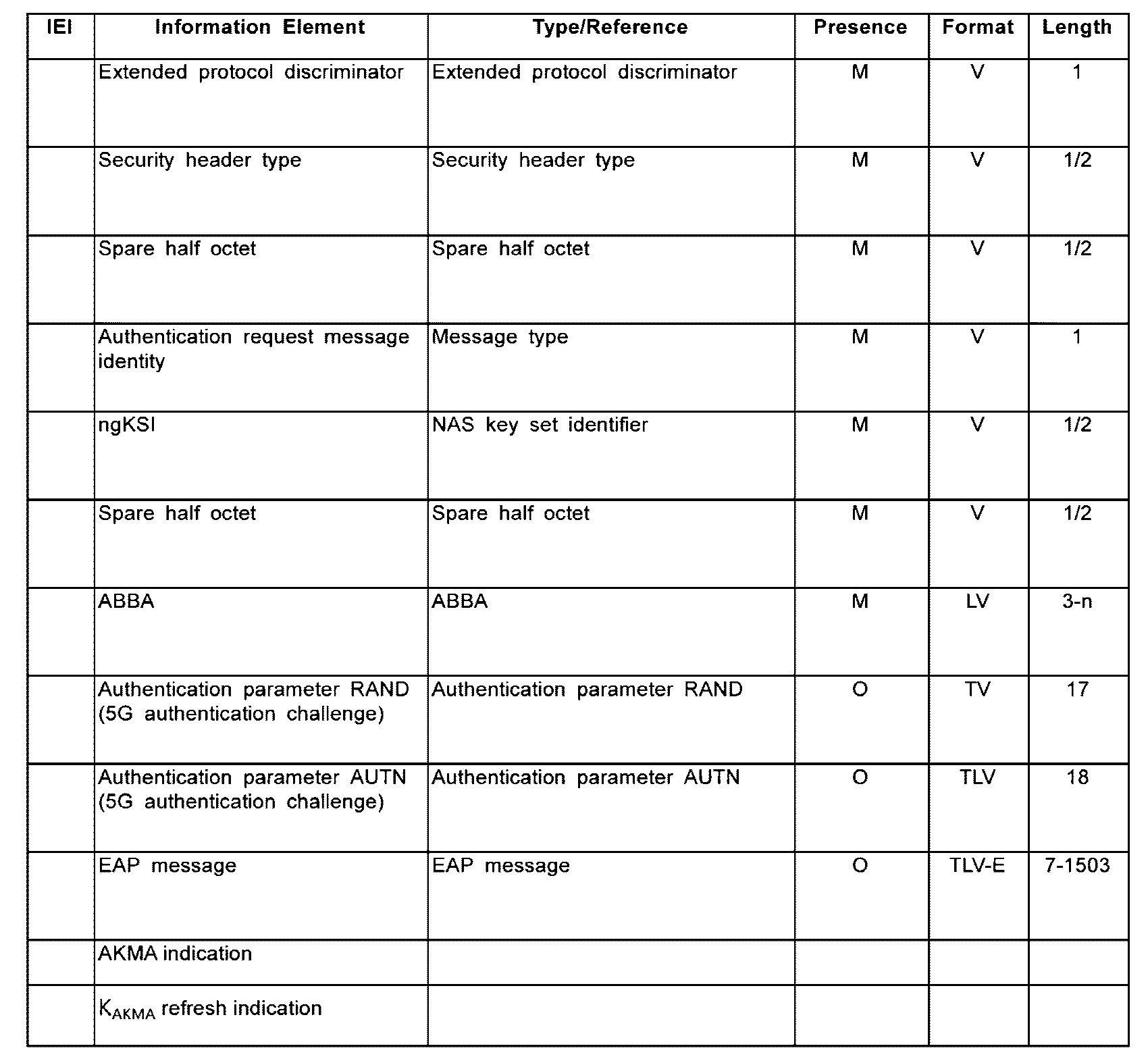
285, 287 단계에서 UE 는 AMF 로 AUTHENTICATION RESPONSE 메시지를 전송할 수 있다. In
288 단계에서는 AMF 는 AUSF 로 UEAuthentication_authentication request 메시지를 보낸다.In
291 단계에서는 AUSF 에서 AAnF 로 AnchorKey_Register request 메시지를 보낸다. 이 단계에서는 UE 및 키를 식별하기 위한 식별자인 A-KID와 key 생성의 seed 가 되는 
293 단계에서는 AAnF 에서 AUSF 로 AnchorKey_Register response 메시지를 보낸다. In
294 단계에서 UE 가 application function으로 application session establishment request 메시지를 보낸다. In
295 단계에서 Application function 은 AAnF 로 요청하여 AF 가 UE 와 통신하기 위하여 사용되는 
296 단계에서 AAnF 는 

297 단계에서 AAnF 는 AF 로 AF 가 UE 와 통신하기 위하여 사용되는 


298 단계에서 AF 는 UE 로 application session establishment response 메시지를 보낸다. In
도 3 은 본 개시의 일 실시예에 따른 5G 네트워크에서 application 의 security 를 지원하기 위한 절차를 설명하기 위한 흐름도이다. 3 is a flowchart illustrating a procedure for supporting application security in a 5G network according to an embodiment of the present disclosure.
본 개시의 실시예는, UE 기반의 트리거링 방법을 통한 application 의 security 를 지원하기 위한 절차에 관한 것이다. An embodiment of the present disclosure relates to a procedure for supporting application security through a UE-based triggering method.
301, 303 단계에서는 UE 에서 AMF로 REGISTRATION REQUEST 메시지를 보낸다. In
304 단계에서 AMF 는 AUSF 로 UEAuthentication_authentication request 메시지를 보낸다. In
305 단계에서 AUSF 에서 UDM으로 UEAuthentication_authentication_get_request 메시지를 보낸다. In
307 단계에서 UDM 에서는 UEAuthentication_authentication_get_request 메시지를 수신하면, authentication vector 를 생성한다. UDM 에서 AUSF 로 authentication_get_response 메시지를 보낸다.In
308단계에서 AUSF 에서 AMF 로 UEAuthentication_authentication response 메시지를 보낸다.In
311, 313 단계에서는 AMF 에서 UE 로 AUTHENTICATION REQUEST 메시지를 보낸다. In
321, 323 단계에서는 UE 에서 AMF 로 AUTHENTICATION RESPONSE 메시지를 보낸다. In
325 단계에서 AMF 는 AUSF 로 UEAuthentication_authentication request 메시지를 보낸다. In
341 단계에서는 AUSF 에서 AAnF 로 AnchorKey_Register request 메시지를 보낸다. 이 단계에서는 UE 및 키를 식별하기 위한 식별자인 A-KID와 key 생성의 seed 가 되는 
343 단계에서는 AAnF 에서 AUSF 로 AnchorKey_Register response 메시지를 보낸다. In
344 단계에서 UE 가 application function으로 application session establishment request 메시지를 보낸다. In step 344, the UE sends an application session establishment request message to the application function.
345 단계에서 Application function 은 AAnF 로 요청하여 AF 가 UE 와 통신하기 위하여 사용되는 
346 단계에서 AAnF 는 

347 단계에서 AAnF 는 AF 로 AF 가 UE 와 통신하기 위하여 사용되는 


348 단계에서 AF 는 UE 로 application session establishment response 메시지를 보낸다. 351 단계에서 UE 와 AAnF 는 application 을 실행하며 통신 중이다. In
360-1 단계에서 AF 에 있어서 AF 가 UE 와 통신하기 위해 사용하는 AF 보안 key 
즉 360-1 에서 AF 는 보안키 
또 다른 일 실시예로 361 단계에서와 같이 AAnF 에서도 보안키 
363 단계에서 UE에 있어서 AF 가 UE 와 통신하기 위해 사용하는 AF 보안 key 
하지만 365 단계와 367 단계에서 UE 와 AUSF에서 사용하는 


따라서 371 단계에서 UE 는 AMF 로 rekey request 메시지를 보내 AF 관련 키를 refresh 하는 것을 요청할 수 있다.Therefore, in
이 때 UE 의 내부에서는 도 1에서 보는 바와 같이 UE 의 application layer 즉 upper layer 에서 NAS layer 로 AF 에서 사용하는 보안 key 

이후 UE 에서는 AMF 로 371, 373 단계에서와 같이 AF 관련 키를 refresh 하기위해 authentication 과정을 새로이 시행하도록 triggering 할 수 있다. Afterwards, the UE can trigger a new authentication process to refresh the AF-related key as in
이러한 triggering 에는 371, 373 단계에서와 같이 일 실시예로 새로운 메시지가 정의되어 사용될 수 있다. 새로운 메시지는 rekey request 메시지 일 수 있다. For such triggering, as in
일 실시예로 여기에 사용되는 새로운 rekey request 메시지에는 SUCI, 5G-GUTI 등의 identity 정보가 포함될 수 있다. 또한 이러한 rekey request 메시지는 application 보안 키 


또한 AKMA indication information element 의 경우 

AMF 는 rekey request 메시지를 수신함에 따라서 374, 375, 377, 378 과 같이 AUSF 로 authentication 을 triggering 할 수 있다. 즉 AMF 는 AUSF 로 UEAuthentication_authentication request 메시지를 보낸다. As AMF receives the rekey request message, it can trigger authentication with AUSF as shown in 374, 375, 377, 378. That is, the AMF sends a UEAuthentication_authentication request message to the AUSF.
AUSF 는 UEAuthentication_authentication request 메시지를 수신함에 따라서 

또한 UE 는 Authentication request 메시지 안에 이러한 AKMA indication information element 또는 


또한 또 다른 일 실시예로 cause 혹은 authentication request indication 이 포함될 수 있다. Authentication request indication 의 경우, 해당 메시지를 받으면 primary authentication 을 triggering 하라는 notice 로 이용될 수 있다. 즉 해당 메시지를 받은 AMF 는 AUSF 로 UEAuthentication_authentication request 메시지를 보내어 primary authentication 을 triggering 할 수 있다. Also, as another embodiment, cause or authentication request indication may be included. In the case of an authentication request indication, when the corresponding message is received, it can be used as a notice to trigger primary authentication. That is, the AMF receiving the corresponding message can trigger primary authentication by sending a UEAuthentication_authentication request message to the AUSF.
한편, 메시지에 cause information element 를 포함시킴으로써, application 보안 키 
표 2 Rekey REQUEST 메시지 Table 2 Rekey REQUEST messages

즉 AMF 는 UE 로부터 371, 373 단계에서 registration request 를 받는다. 이 registration request 는 AUSF가 
374 단계에서 AMF 는 AUSF 로 UEAuthentication_authentication request 메시지를 보낸다. In
375 단계에서 AUSF 에서 UDM으로 UEAuthentication_authentication_get_request 메시지를 보낸다. In
377 단계에서 UDM 에서는 UEAuthentication_authentication_get_request 메시지를 수신하면, authentication vector 를 생성한다. UDM 에서 AUSF 로 authentication_get_response 메시지를 보낸다.In
378단계에서 AUSF 에서 AMF 로 UEAuthentication_authentication response 메시지를 보낸다.In
그리고, AMF 는 이후 381, 383 단계에서 authentication request 메시지를 UE 로 전송할 수 있다. Then, the AMF may transmit an authentication request message to the UE in
따라서, 메시지의 형태는 표 3과 같다. 표 3을 참조하면 


AKMA indication information element UE 가 AKMA 서비스가 가능한 단말이고 subscription 에 AKMA 서비스가 가능한 경우 해당 서비스가 가능함을 UE 에게 알려주기 위해 사용될 수 있다. 또한 다른 일 실시예로, AKMA indication information element는 network 에서 


UE 는 Authentication request 메시지를 수신함에 따라서 

또한 UE 는 Authentication request 메시지를 통해 AKMA indication information element 또는 


표 3 AUTHENTICATION REQUEST Table 3 AUTHENTICATION REQUEST

385, 387 단계에서 UE 는 AMF 로 AUTHENTICATION RESPONSE 메시지를 전송할 수 있다. In
388 단계에서 AMF 는 AUSF 로 UEAuthentication_authentication request 메시지를 보낸다. In
391 단계에서는 AUSF 에서 AAnF 로 AnchorKey_Register request 메시지를 보낸다. 이 단계에서는 UE 및 키를 식별하기 위한 식별자인 A-KID와 key 생성의 seed 가 되는 
393 단계에서는 AAnF 에서 AUSF 로 AnchorKey_Register response 메시지를 보낸다. In
394 단계에서 UE 가 application function으로 application session establishment request 메시지를 보낸다. In
395 단계에서 Application function 은 AAnF 로 요청하여 AF 가 UE 와 통신하기 위하여 사용되는 
396 단계에서 AAnF 는 

397 단계에서 AAnF 는 AF 로 AF 가 UE 와 통신하기 위하여 사용되는 


398 단계에서 AF 는 UE 로 application session establishment response 메시지를 보낸다. In
도 4 는 본 개시의 일 실시예에 따른 5G 네트워크에서 application 의 security 를 지원하기 위한 절차를 설명하기 위한 흐름도이다. 4 is a flowchart illustrating a procedure for supporting application security in a 5G network according to an embodiment of the present disclosure.
본 개시의 실시예는, application의 security를 지원하기 위해, registration request 메시지를 사용한, UE 기반의 트리거링 방법에 관한 것이다.401, 403 단계에서는 UE 에서 AMF로 REGISTRATION REQUEST 메시지를 보낸다. An embodiment of the present disclosure relates to a UE-based triggering method using a registration request message to support application security. In
404 단계에서 AMF 는 AUSF 로 UEAuthentication_authentication request 메시지를 보낸다. In
405 단계에서 AUSF 에서 UDM으로 UEAuthentication_authentication_get_request 메시지를 보낸다. In
407 단계에서 UDM 에서는 UEAuthentication_authentication_get_request 메시지를 수신하면, authentication vector 를 생성한다. UDM 에서 AUSF 로 authentication_get_response 메시지를 보낸다.In
408단계에서 AUSF 에서 AMF 로 UEAuthentication_authentication response 메시지를 보낸다.In
411, 413 단계에서는 AMF 에서 UE 로 AUTHENTICATION REQUEST 메시지를 보낸다. In
421, 423 단계에서는 UE 에서 AMF 로 AUTHENTICATION RESPONSE 메시지를 보낸다. In
425 단계에서 AMF 는 AUSF 로 UEAuthentication_authentication request 메시지를 보낸다. In
441 단계에서는 AUSF 에서 AAnF 로 AnchorKey_Register request 메시지를 보낸다. 이 단계에서는 UE 및 키를 식별하기 위한 식별자인 A-KID와 key 생성의 seed 가 되는 
443 단계에서는 AAnF 에서 AUSF 로 AnchorKey_Register response 메시지를 보낸다. In
444 단계에서 UE 가 application function으로 application session establishment request 메시지를 보낸다. In step 444, the UE sends an application session establishment request message to the application function.
445 단계에서 Application function 은 AAnF 로 요청하여 AF 가 UE 와 통신하기 위하여 사용되는 
446 단계에서 AAnF 는 

447 단계에서 AAnF 는 AF 로 AF 가 UE 와 통신하기 위하여 사용되는 


448 단계에서 AF 는 UE 로 application session establishment response 메시지를 보낸다. 451 단계에서 UE 와 AAnF 는 application 을 실행하며 통신중이다. In
460-1 단계에서 AF 에 있어서 AF 가 UE 와 통신하기 위해 사용하는 AF 보안 key 
즉 460-1 에서 AF 는 보안키 

463 단계에서 UE에 있어서 AF 가 UE 와 통신하기 위해 사용하는 AF 보안 key 
하지만 465 단계와 467 단계에서 UE 와 AUSF에서 사용하는 


따라서 471 단계에서 UE 는 AMF 로 rekey request 메시지를 보내 AF 관련 키를 refresh 하는 것을 요청할 수 있다.Therefore, in
이 때 UE 의 내부에서는 도 1에서 보는 바와 같이 UE 의 application layer 즉 upper layer 에서 NAS layer 로 AF 에서 사용하는 보안 key 

이후, UE 에서는 AMF 로 471, 473 단계에서와 같이 AF 관련 키를 refresh 하기위해 authentication 과정을 새로이 시행하도록 triggering 할 수 있다. Thereafter, the UE may trigger a new authentication process to refresh the AF-related key as in
이러한 triggering 에는 471, 473 단계에서와 같이 일 실시예로 registration request 메시지를 사용할 수 있다. For such triggering, as in
일 실시예로 여기에 사용되는 registration request 메시지에는 SUCI, 5G-GUTI 등의 identity 정보가 포함될 수 있다. 또한 이러한 registration request 메시지는 application 보안 키 
즉 AMF 는 UE 로부터 471, 473 단계에서 registration request 를 받는다. 이 registration request 는, AUSF가 
따라서, 471, 473의 메시지의 형태는 표 4와 같다. 표 4을 참조하면, 메시지에는 

또한 AKMA indication information element 의 경우 

AMF 는 rekey request 메시지를 수신함에 따라서 474, 475, 477, 478 과 같이 AUSF 로 authentication 을 triggering 할 수 있다. 즉 AMF 는 AUSF 로 UEAuthentication_authentication request 메시지를 보낸다. As AMF receives the rekey request message, it can trigger authentication with AUSF as in 474, 475, 477, 478. That is, the AMF sends a UEAuthentication_authentication request message to the AUSF.
AUSF 는 UEAuthentication_authentication request 메시지를 수신함에 따라서 

또한 UE 는 Authentication request 메시지에 포함된 AKMA indication information element 또는 


또한 또 다른 일 실시예로 cause 혹은 authentication request indication 이 포함될 수 있다. Authentication request indication 의 경우 해당 메시지를 받으면 primary authentication 을 triggering 하라는 notice 로 동작하기 위함이다. 즉 해당 메시지를 받은 AMF 는 AUSF 로 UEAuthentication_authentication request 메시지를 보내어 primary authentication 을 triggering 할 수 있다. Also, as another embodiment, cause or authentication request indication may be included. In the case of an authentication request indication, it is to act as a notice to trigger primary authentication when the corresponding message is received. That is, the AMF receiving the message can trigger primary authentication by sending a UEAuthentication_authentication request message to the AUSF.
한편 cause information element 를 포함하여 application 보안 키 
표 4 registration REQUEST 메시지 Table 4 registration REQUEST messages
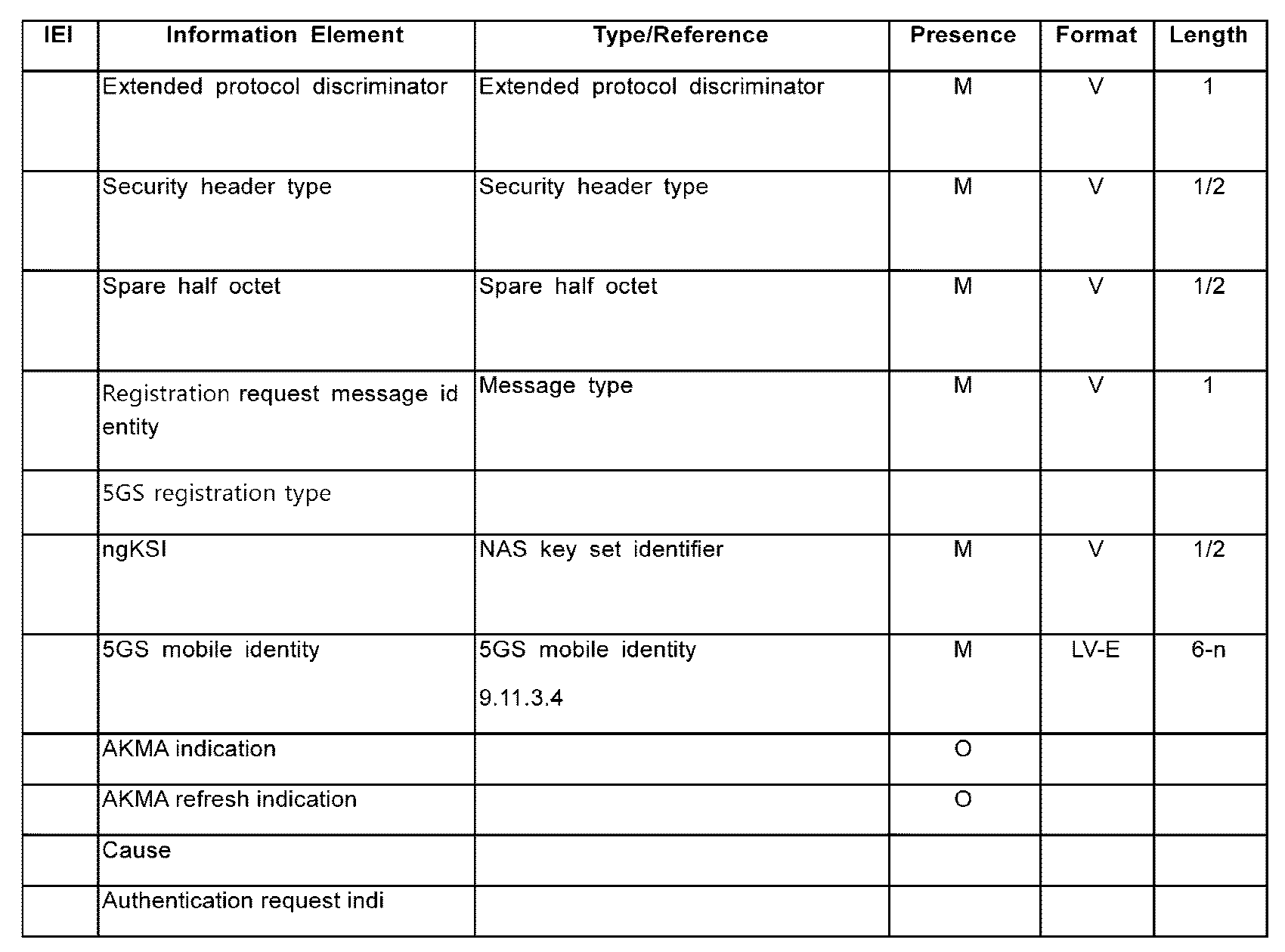
474 단계에서 AMF 는 AUSF 로 UEAuthentication_authentication request 메시지를 보낸다. In
475 단계에서 AUSF 에서 UDM으로 UEAuthentication_authentication_get_request 메시지를 보낸다. In
477 단계에서 UDM 에서는 UEAuthentication_authentication_get_request 메시지를 수신하면, authentication vector 를 생성한다. UDM 에서 AUSF 로 authentication_get_response 메시지를 보낸다.In
478단계에서 AUSF 에서 AMF 로 UEAuthentication_authentication response 메시지를 보낸다.In
그리고, AMF 는 이후 481, 483 단계에서 authentication request 메시지를 UE 로 전송할 수 있다. Then, the AMF may transmit an authentication request message to the UE in
따라서, 메시지의 형태는 표 5과 같다. 표 5을 참조하면, 메시지에 


AKMA indication information element 는 UE 가 AKMA 서비스가 가능한 단말이고 subscription 에 AKMA 서비스가 가능한 경우 해당 서비스가 가능함을 UE 에게 알려주기 위해 사용될 수 있다. 또한 다른 일 실시예로 network 에서 AKMA key 


UE 는 Authentication request 메시지를 수신함에 따라서 

또한 UE 는 Authentication request 메시지에 포함된 AKMA indication information element 또는 


표 5 AUTHENTICATION REQUEST Table 5 AUTHENTICATION REQUEST

485, 487 단계에서 UE 는 AMF 로 AUTHENTICATION RESPONSE 메시지를 전송할 수 있다. In
488 단계에서 AMF 는 AUSF 로 UEAuthentication_authentication request 메시지를 보낸다. In
491 단계에서는 AUSF 에서 AAnF 로 AnchorKey_Register request 메시지를 보낸다. 이 단계에서는 UE 및 키를 식별하기 위한 식별자인 A-KID와 key 생성의 seed 가 되는 
493 단계에서는 AAnF 에서 AUSF 로 AnchorKey_Register response 메시지를 보낸다. In
494 단계에서 UE 가 application function으로 application session establishment request 메시지를 보낸다. In
495 단계에서 Application function 은 AAnF 로 요청하여 AF 가 UE 와 통신하기 위하여 사용되는 
496 단계에서 AAnF 는 

497 단계에서 AAnF 는 AF 로 AF 가 UE 와 통신하기 위하여 사용되는 


498 단계에서 AF 는 UE 로 application session establishment response 메시지를 보낸다. In
도 5 는 본 개시의 일 실시예에 따른 5G 네트워크에서 application 의 security 를 지원하기 위한 절차를 설명하기 위한 흐름도이다. 5 is a flowchart illustrating a procedure for supporting application security in a 5G network according to an embodiment of the present disclosure.
본 개시의 실시예는, application의 security를 지원하기 위해, registration request 메시지를 사용한, UE 기반의 트리거링 방법에 관한 것이다. An embodiment of the present disclosure relates to a UE-based triggering method using a registration request message to support application security.
501, 503 단계에서는 UE 에서 AMF로 REGISTRATION REQUEST 메시지를 보낸다. In
504 단계에서 AMF 는 AUSF 로 UEAuthentication_authentication request 메시지를 보낸다. In
505 단계에서 AUSF 에서 UDM으로 UEAuthentication_authentication_get_request 메시지를 보낸다. In
507 단계에서 UDM 에서는 UEAuthentication_authentication_get_request 메시지를 수신하면, authentication vector 를 생성한다. UDM 에서 AUSF 로 authentication_get_response 메시지를 보낸다.In
508단계에서 AUSF 에서 AMF 로 UEAuthentication_authentication response 메시지를 보낸다.In
511, 513 단계에서는 AMF 에서 UE 로 AUTHENTICATION REQUEST 메시지를 보낸다. In
521, 523 단계에서는 UE 에서 AMF 로 AUTHENTICATION RESPONSE 메시지를 보낸다. In
525 단계에서 AMF 는 AUSF 로 UEAuthentication_authentication request 메시지를 보낸다. In
541 단계에서는 AUSF 에서 AAnF 로 AnchorKey_Register request 메시지를 보낸다. 이 단계에서는 UE 및 키를 식별하기 위한 식별자인 A-KID와 key 생성의 seed 가 되는 
543 단계에서는 AAnF 에서 AUSF 로 AnchorKey_Register response 메시지를 보낸다. In
544 단계에서 UE 가 application function으로 application session establishment request 메시지를 보낸다. In
545 단계에서 Application function 은 AAnF 로 요청하여 AF 가 UE 와 통신하기 위하여 사용되는 
546 단계에서 AAnF 는 

547 단계에서 AAnF 는 AF 로 AF 가 UE 와 통신하기 위하여 사용되는 


548 단계에서 AF 는 UE 로 application session establishment response 메시지를 보낸다. 551 단계에서 UE 와 AAnF 는 application 을 실행하며 통신중이다. In
560-1 단계에서 AF 에 있어서 AF 가 UE 와 통신하기 위해 사용하는 AF 보안 key 
즉 560-1 에서 AF 는 보안키 

563 단계에서 UE에 있어서 AF 가 UE 와 통신하기 위해 사용하는 AF 보안 key 
하지만 565 단계와 567 단계에서 UE 와 AUSF에서 사용하는 


따라서 571 단계에서 UE 는 AMF 로 rekey request 메시지를 보내 AF 관련 키를 refresh 하는 것을 요청할 수 있다.Therefore, in
이 때 UE 의 내부에서는 도 1에서 보는 바와 같이 UE 의 application layer 즉 upper layer 에서 NAS layer 로 AF 에서 사용하는 보안 key 

이후 UE 에서는 AMF 로 571, 573 단계에서와 같이 AF 관련 키를 refresh 하기위해 authentication 과정을 새로이 시행하도록 triggering 할 수 있다. Afterwards, the UE can trigger a new authentication process to refresh the AF-related key as in
이러한 triggering 에는 571, 573 단계에서와 같이 일 실시예로 registration request 메시지를 사용할 수 있다. For such triggering, as in
일 실시예로 여기에 사용되는 registration request 메시지에는 SUCI, 5G-GUTI 등의 identity 정보가 포함될 수 있다. In an embodiment, the registration request message used here may include identity information such as SUCI and 5G-GUTI.
또한 이러한 registration request 메시지는 periodic 하게 전송되는 메시지 이므로, application 보안키 

즉 AMF 는 UE 로부터 571, 573 단계에서 registration request 를 받는다. 이 registration request 는 AUSF가 
따라서, 571, 573의 메시지의 형태는 표 6와 같다. 표 6을 참조하면 KAKMA key 의 refresh 가 필요함을 알리는 

또한 AKMA indication information element 의 경우 

AMF 는 rekey request 메시지를 수신함에 따라서 574, 575, 577, 578 과 같이 AUSF 로 authentication 을 triggering 할 수 있다. 즉 AMF 는 AUSF 로 UEAuthentication_authentication request 메시지를 보낸다. As AMF receives the rekey request message, it can trigger authentication with AUSF as in 574, 575, 577, 578. That is, the AMF sends a UEAuthentication_authentication request message to the AUSF.
AUSF 는 UEAuthentication_authentication request 메시지를 수신함에 따라서 

또한 UE 는 Authentication request 메시지 안에 이러한 AKMA indication information element 또는 


또한 또 다른 일 실시예로 cause 혹은 authentication request indication 이 포함될 수 있다. Authentication request indication 의 경우 해당 메시지를 받으면 primary authentication 을 triggering 하라는 notice 로 동작하기 위함이다. 즉 해당 메시지를 받은 AMF 는 AUSF 로 UEAuthentication_authentication request 메시지를 보내어 primary authentication 을 triggering 할 수 있다. Also, as another embodiment, cause or authentication request indication may be included. In the case of an authentication request indication, it is to act as a notice to trigger primary authentication when the corresponding message is received. That is, the AMF receiving the message can trigger primary authentication by sending a UEAuthentication_authentication request message to the AUSF.
한편 cause information element 를 포함하여 application 보안 키 
표 6 registration REQUEST 메시지 Table 6 registration REQUEST messages

574 단계에서 AMF 는 AUSF 로 UEAuthentication_authentication request 메시지를 보낸다. In
575 단계에서 AUSF 에서 UDM으로 UEAuthentication_authentication_get_request 메시지를 보낸다. In
577 단계에서 UDM 에서는 UEAuthentication_authentication_get_request 메시지를 수신하면, authentication vector 를 생성한다. UDM 에서 AUSF 로 authentication_get_response 메시지를 보낸다.In
578단계에서 AUSF 에서 AMF 로 UEAuthentication_authentication response 메시지를 보낸다.In
그리고, AMF 는 이후 581, 583 단계에서 authentication request 메시지를 UE 로 전송할 수 있다. Then, the AMF may transmit an authentication request message to the UE in
581, 583 단계에서 AMF 는 UE 로 AUTHENTICATION REQUEST 메시지를 전송할 수 있다. In
따라서, 메시지의 형태는 표 7과 같다. 표 7을 참조하면, 메시지에는 


AKMA indication information element 는 UE 가 AKMA 서비스가 가능한 단말이고 subscription 에 AKMA 서비스가 가능한 경우 해당 서비스가 가능함을 UE 에게 알려주기 위해 사용될 수 있다. 또한 다른 일 실시예로, AKMA indication information element는 network 에서 AKMA key 


UE 는 Authentication request 메시지를 수신함에 따라서 

또한 UE 는 Authentication request 메시지 안에 이러한 AKMA indication information element 또는 


표 7 AUTHENTICATION REQUEST Table 7 AUTHENTICATION REQUEST

585, 587 단계에서 UE 는 AMF 로 AUTHENTICATION RESPONSE 메시지를 전송할 수 있다. In
588 단계에서 AMF 는 AUSF 로 UEAuthentication_authentication request 메시지를 보낸다. In
591 단계에서는 AUSF 에서 AAnF 로 AnchorKey_Register request 메시지를 보낸다. 이 단계에서는 UE 및 키를 식별하기 위한 식별자인 A-KID와 key 생성의 seed 가 되는 
593 단계에서는 AAnF 에서 AUSF 로 AnchorKey_Register response 메시지를 보낸다. In
594 단계에서 UE 가 application function으로 application session establishment request 메시지를 보낸다. In
595 단계에서 Application function 은 AAnF 로 요청하여 AF 가 UE 와 통신하기 위하여 사용되는 
596 단계에서 AAnF 는 

597 단계에서 AAnF 는 AF 로 AF 가 UE 와 통신하기 위하여 사용되는 


598 단계에서 AF 는 UE 로 application session establishment response 메시지를 보낸다. In
도 6 은 본 개시의 일 실시예에 따른 5G 네트워크에서 application 의 security 를 지원하기 위한 절차를 설명하기 위한 흐름도이다. 6 is a flowchart illustrating a procedure for supporting application security in a 5G network according to an embodiment of the present disclosure.
본 개시의 실시예는, application의 security를 지원하기 위해, service request 메시지를 사용한, UE 기반의 트리거링 방법에 관한 것이다. An embodiment of the present disclosure relates to a UE-based triggering method using a service request message to support application security.
601, 603 단계에서는 UE 에서 AMF로 REGISTRATION REQUEST 메시지를 보낸다. In
604 단계에서 AMF 는 AUSF 로 UEAuthentication_authentication request 메시지를 보낸다. In
605 단계에서 AUSF 에서 UDM으로 UEAuthentication_authentication_get_request 메시지를 보낸다. In
607 단계에서 UDM 에서는 UEAuthentication_authentication_get_request 메시지를 수신하면, authentication vector 를 생성한다. UDM 에서 AUSF 로 authentication_get_response 메시지를 보낸다.In
608단계에서 AUSF 에서 AMF 로 UEAuthentication_authentication response 메시지를 보낸다.In
611, 613 단계에서는 AMF 에서 UE 로 AUTHENTICATION REQUEST 메시지를 보낸다. In
621, 623 단계에서는 UE 에서 AMF 로 AUTHENTICATION RESPONSE 메시지를 보낸다. In
625 단계에서 AMF 는 AUSF 로 UEAuthentication_authentication request 메시지를 보낸다. In
641 단계에서는 AUSF 에서 AAnF 로 AnchorKey_Register request 메시지를 보낸다. 이 단계에서는 UE 및 키를 식별하기 위한 식별자인 A-KID와 key 생성의 seed 가 되는 
643 단계에서는 AAnF 에서 AUSF 로 AnchorKey_Register response 메시지를 보낸다. In
644 단계에서 UE 가 application function으로 application session establishment request 메시지를 보낸다. In
645 단계에서 Application function 은 AAnF 로 요청하여 AF 가 UE 와 통신하기 위하여 사용되는 
646 단계에서 AAnF 는 

647 단계에서 AAnF 는 AF 로 AF 가 UE 와 통신하기 위하여 사용되는 


648 단계에서 AF 는 UE 로 application session establishment response 메시지를 보낸다. 651 단계에서 UE 와 AAnF 는 application 을 실행하며 통신중이다. In
660-1 단계에서 AF 에 있어서 AF 가 UE 와 통신하기 위해 사용하는 AF 보안key 
즉 660-1 에서 AF 는 보안키 
또 다른 일 실시예로 661 단계에서와 같이 AAnF 에서도 보안키 
663 단계에서 UE에 있어서 AF 가 UE 와 통신하기 위해 사용하는 AF 보안 key 
하지만 665 단계와 667 단계에서 UE 와 AUSF에서 사용하는 


따라서 671 단계에서 UE 는 AMF 로 rekey request 메시지를 보내 AF 관련 키를 refresh 하는 것을 요청할 수 있다.Accordingly, in
이 때 UE 의 내부에서는 도 1에서 보는 바와 같이 UE 의 application layer 즉 upper layer 에서 NAS layer 로 AF 에서 사용하는 보안 key 

이후 UE 에서는 AMF 로 671, 673 단계에서와 같이 AF 관련 키를 refresh 하기위해 authentication 과정을 새로이 시행하도록 triggering 할 수 있다. Afterwards, the UE can trigger a new authentication process to refresh the AF-related key as in
이러한 triggering 에는 671, 673 단계에서와 같이 일 실시예로 service request 메시지를 사용할 수 있다. For such triggering, as in
일 실시예로 여기에 사용되는 service request 메시지에는 SUCI, 5G-GUTI 등의 identity 정보가 포함될 수 있다. 또한 이러한 service request 메시지는 application 보안 키 
즉 AMF 는 UE 로부터 671, 673 단계에서 service request 를 받는다. 이 service request 는 AUSF가 
따라서, 671, 673의 메시지의 형태는 표 8와 같다. 표 8을 참조하면 


또한 AKMA indication information element 의 경우 

AMF 는 rekey request 메시지를 수신함에 따라서 674, 675, 677, 678 과 같이 AUSF 로 authentication 을 triggering 할 수 있다. 즉 AMF 는 AUSF 로 UEAuthentication_authentication request 메시지를 보낸다. As AMF receives the rekey request message, it can trigger authentication with AUSF as in 674, 675, 677, 678. That is, the AMF sends a UEAuthentication_authentication request message to the AUSF.
AUSF 는 UEAuthentication_authentication request 메시지를 수신함에 따라서 

또한 UE 는 Authentication request 메시지를 통해 AKMA indication information element 또는 


또한 또 다른 일 실시예로 cause 혹은 authentication request indication 이 포함될 수 있다. Authentication request indication 의 경우 해당 메시지를 받으면 primary authentication 을 triggering 하라는 notice 로 동작하기 위함이다. 즉 해당 메시지를 받은 AMF 는 AUSF 로 UEAuthentication_authentication request 메시지를 보내어 primary authentication 을 triggering 할 수 있다. Also, as another embodiment, cause or authentication request indication may be included. In the case of an authentication request indication, it is intended to act as a notice to trigger primary authentication when a corresponding message is received. That is, the AMF receiving the corresponding message can trigger primary authentication by sending a UEAuthentication_authentication request message to the AUSF.
한편 cause information element 를 포함하여 application 보안 키 
표 8 Service REQUEST 메시지 Table 8 Service REQUEST messages
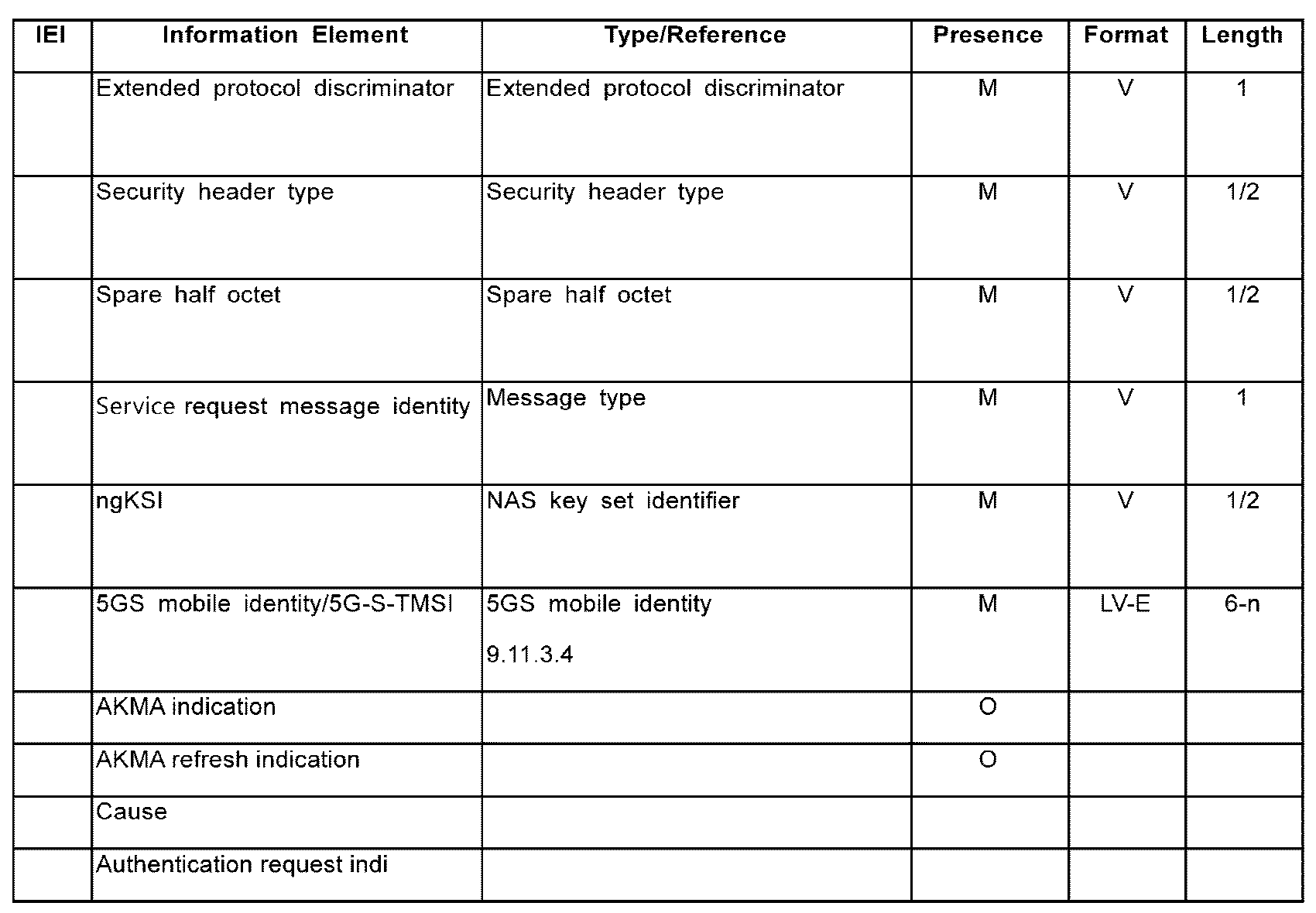
674 단계에서 AMF 는 AUSF 로 UEAuthentication_authentication request 메시지를 보낸다. In
675 단계에서 AUSF 에서 UDM으로 UEAuthentication_authentication_get_request 메시지를 보낸다. In
677 단계에서 UDM 에서는 UEAuthentication_authentication_get_request 메시지를 수신하면, authentication vector 를 생성한다. UDM 에서 AUSF 로 authentication_get_response 메시지를 보낸다.In
678단계에서 AUSF 에서 AMF 로 UEAuthentication_authentication response 메시지를 보낸다.In
그리고, AMF 는 이후 681, 683 단계에서 authentication request 메시지를 UE 로 전송할 수 있다. Then, the AMF may transmit an authentication request message to the UE in
681, 683 단계에서 AMF 는 UE 로 AUTHENTICATION REQUEST 메시지를 전송할 수 있다. In
따라서, 메시지의 형태는 표 9과 같다. 표 9을 참조하면, 메시지에는 


이는 UE 가 AKMA 서비스가 가능한 단말이고 subscription 에 AKMA 서비스가 가능한 경우 해당 서비스가 가능함을 UE 에게 알려주기 위해 사용될 수 있다. 또한 다른 일 실시예로 network 에서 AKMA key 


UE 는 Authentication request 메시지를 수신함에 따라서 

또한 UE 는 Authentication request 메시지 안에 이러한 AKMA indication information element 또는 


표 9 AUTHENTICATION REQUEST Table 9 AUTHENTICATION REQUEST
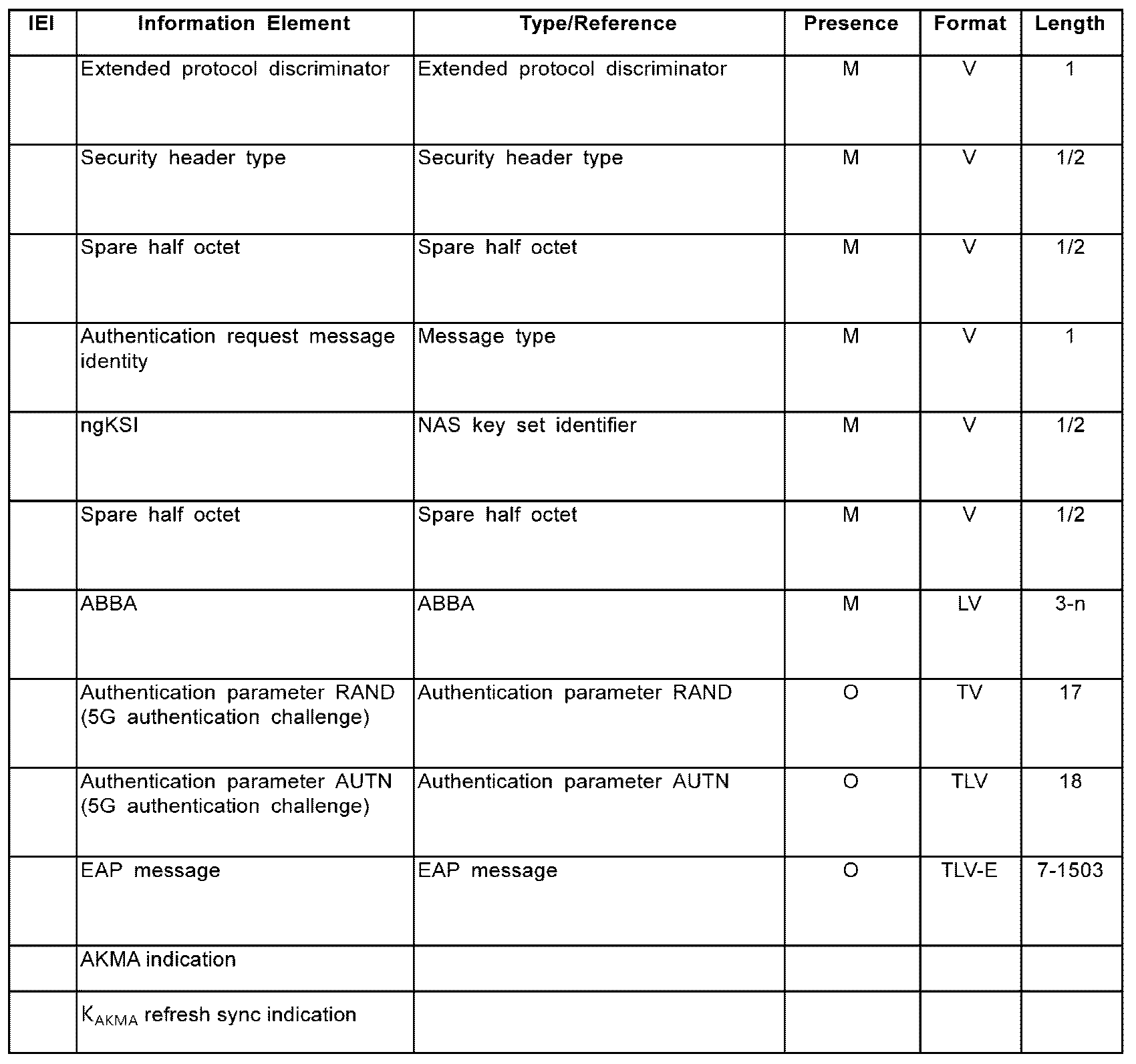
685, 687 단계에서 UE 는 AMF 로 AUTHENTICATION RESPONSE 메시지를 전송할 수 있다. In
688 단계에서 AMF 는 AUSF 로 UEAuthentication_authentication request 메시지를 보낸다. In
691 단계에서는 AUSF 에서 AAnF 로 AnchorKey_Register request 메시지를 보낸다. 이 단계에서는 UE 및 키를 식별하기 위한 식별자인 A-KID와 key 생성의 seed 가 되는 
693 단계에서는 AAnF 에서 AUSF 로 AnchorKey_Register response 메시지를 보낸다. In
694 단계에서 UE 가 application function으로 application session establishment request 메시지를 보낸다. In
695 단계에서 Application function 은 AAnF 로 요청하여 AF 가 UE 와 통신하기 위하여 사용되는 
696 단계에서 AAnF 는 

697 단계에서 AAnF 는 AF 로 AF 가 UE 와 통신하기 위하여 사용되는 


698 단계에서 AF 는 UE 로 application session establishment response 메시지를 보낸다. In
도 7은 본 개시의 일 실시예에 따른 UE의 구성을 나타내는 도면이다.7 is a diagram illustrating a configuration of a UE according to an embodiment of the present disclosure.
도 7에서 도시되는 바와 같이, 본 개시의 UE는 송수신부(710), 메모리(720), 프로세서(730)를 포함할 수 있다. 전술한 UE의 통신 방법에 따라 단말의 프로세서(730), 송수신부(710) 및 메모리(720)가 동작할 수 있다. 다만, UE의 구성 요소가 전술한 예에 한정되는 것은 아니다. 예를 들어, UE는 전술한 구성 요소들 보다 더 많은 구성 요소를 포함하거나 더 적은 구성 요소를 포함할 수도 있다. 뿐만 아니라 프로세서(730), 송수신부(710) 및 메모리(720)가 하나의 칩(chip) 형태로 구현될 수도 있다. 7 , the UE of the present disclosure may include a
송수신부(710)는 UE의 수신부와 단말의 송신부를 통칭한 것으로 기지국 혹은 네트웍 엔티티와 신호를 송수신할 수 있다. 기지국과 송수신하는 신호는 제어 정보와 데이터를 포함할 수 있다. 이를 위해, 송수신부(710)는 송신되는 신호의 주파수를 상승 변환 및 증폭하는 RF 송신기와, 수신되는 신호를 저 잡음 증폭하고 주파수를 하강 변환하는 RF 수신기 등으로 구성될 수 있다. 다만, 이는 송수신부(710)의 일 실시예일 뿐이며, 송수신부(710)의 구성요소가 RF 송신기 및 RF 수신기에 한정되는 것은 아니다.The transmitter/
또한, 송수신부(710)는 유무선 송수신부를 포함할 수 있으며, 신호를 송수신하기 위한 다양한 구성을 포함할 수 있다. In addition, the
또한, 송수신부(710)는 무선 채널을 통해 신호를 수신하여 프로세서(730)로 출력하고, 프로세서(730)로부터 출력된 신호를 무선 채널을 통해 전송할 수 있다. In addition, the
또한, 송수신부(710)는 통신 신호를 수신하여 프로세서로 출력하고, 프로세서로부터 출력된 신호를 유무선망을 통해 네트웍 엔티티로 전송할 수 있다. In addition, the
메모리(720)는 UE의 동작에 필요한 프로그램 및 데이터를 저장할 수 있다. 또한, 메모리(720)는 단말에서 획득되는 신호에 포함된 제어 정보 또는 데이터를 저장할 수 있다. 메모리(720)는 롬(ROM), 램(RAM), 하드디스크, CD-ROM 및 DVD 등과 같은 저장 매체 또는 저장 매체들의 조합으로 구성될 수 있다.The
프로세서(730)는 상술한 본 개시의 실시 예에 따라 UE가 동작할 수 있도록 일련의 과정을 제어할 수 있다. 프로세서(730)는 적어도 하나 이상의 프로세서를 포함할 수 있다. 예를 들어, 프로세서(730)는 통신을 위한 제어를 수행하는 CP(communication processor) 및 응용 프로그램 등 상위 계층을 제어하는 AP(application processor)를 포함할 수 있다.The
도 8은 본 개시의 일 실시예에 따른 네트워크 엔티티의 구성을 나타내는 도면이다. 네트워크 엔티티는 전술한 AMF, AUSF, AAnF, AF 중 어느 하나일 수 있다. 8 is a diagram illustrating a configuration of a network entity according to an embodiment of the present disclosure. The network entity may be any one of the aforementioned AMF, AUSF, AAnF, and AF.
도 8에서 도시되는 바와 같이, 본 개시의 네트워크 엔티티(network entity)는 송수신부(810), 메모리(820), 프로세서(830)를 포함할 수 있다. 전술한 네트워크 엔티티의 통신 방법에 따라 네트워크 엔티티의 프로세서(830), 송수신부(810) 및 메모리(820)가 동작할 수 있다. 다만, 네트워크 엔티티의 구성 요소가 전술한 예에 한정되는 것은 아니다. 예를 들어, 네트워크 엔티티는 전술한 구성 요소들 보다 더 많은 구성 요소를 포함하거나 더 적은 구성 요소를 포함할 수도 있다. 뿐만 아니라 프로세서(830), 송수신부(810) 및 메모리(820)가 하나의 칩(chip) 형태로 구현될 수도 있다. 네트워크 엔티티는, 위에서 설명한 AMF(Access and Mobility management Function), SMF Session Management Function), PCF(Policy and Charging Function), NEF(Network Exposure Function), UDM(Unified Data Management), UPF(User Plane Function) 등의 네트워크 기능(NF, Network Function)을 포함할 수 있다. 또한, 기지국(base station)을 포함할 수도 있다. As shown in FIG. 8 , the network entity of the present disclosure may include a
송수신부(810)는 네트워크 엔티티의 수신부와 네트워크 엔티티의 송신부를 통칭한 것으로 UE 또는 다른 네트워크 엔티티와 신호를 송수신할 수 있다. 이때, 송수신하는 신호는 제어 정보와 데이터를 포함할 수 있다. 이를 위해, 송수신부(810)는 송신되는 신호의 주파수를 상승 변환 및 증폭하는 RF 송신기와, 수신되는 신호를 저 잡음 증폭하고 주파수를 하강 변환하는 RF 수신기 등으로 구성될 수 있다. 다만, 이는 송수신부(810)의 일 실시예일 뿐이며, 송수신부(810)의 구성요소가 RF 송신기 및 RF 수신기에 한정되는 것은 아니다. 송수신부(810)는 유무선 송수신부를 포함할 수 있으며, 신호를 송수신하기 위한 다양한 구성을 포함할 수 있다. The transmitter/
또한, 송수신부(810)는 통신 채널(예를 들어, 무선 채널)을 통해 신호를 수신하여 프로세서(830)로 출력하고, 프로세서(830)로부터 출력된 신호를 통신 채널을 통해 전송할 수 있다. In addition, the
또한, 송수신부(810)는 통신 신호를 수신하여 프로세서로 출력하고, 프로세서로부터 출력된 신호를 유무선망을 통해 UE 또는 네트웍 엔티티로 전송할 수 있다. In addition, the
메모리(820)는 네트워크 엔티티의 동작에 필요한 프로그램 및 데이터를 저장할 수 있다. 또한, 메모리(820)는 네트워크 엔티티에서 획득되는 신호에 포함된 제어 정보 또는 데이터를 저장할 수 있다. 메모리(820)는 롬(ROM), 램(RAM), 하드디스크, CD-ROM 및 DVD 등과 같은 저장 매체 또는 저장 매체들의 조합으로 구성될 수 있다.The
프로세서(830)는 상술한 본 개시의 실시 예에 따라 네트워크 엔티티가 동작할 수 있도록 일련의 과정을 제어할 수 있다. 프로세서(830)는 적어도 하나 이상의 프로세서를 포함할 수 있다. 본 개시의 청구항 또는 명세서에 기재된 실시 예들에 따른 방법들은 하드웨어, 소프트웨어, 또는 하드웨어와 소프트웨어의 조합의 형태로 구현될(implemented) 수 있다. The
소프트웨어로 구현하는 경우, 하나 이상의 프로그램(소프트웨어 모듈)을 저장하는 컴퓨터 판독 가능 저장 매체가 제공될 수 있다. 컴퓨터 판독 가능 저장 매체에 저장되는 하나 이상의 프로그램은, 전자 장치(device) 내의 하나 이상의 프로세서에 의해 실행 가능하도록 구성된다(configured for execution). 하나 이상의 프로그램은, 전자 장치로 하여금 본 개시의 청구항 또는 명세서에 기재된 실시 예들에 따른 방법들을 실행하게 하는 명령어(instructions)를 포함한다. When implemented in software, a computer-readable storage medium storing one or more programs (software modules) may be provided. One or more programs stored in the computer-readable storage medium are configured to be executable by one or more processors in an electronic device (device). One or more programs include instructions for causing an electronic device to execute methods according to embodiments described in a claim or specification of the present disclosure.
이러한 프로그램(소프트웨어 모듈, 소프트웨어)은 랜덤 액세스 메모리(random access memory), 플래시(flash) 메모리를 포함하는 불휘발성(non-volatile) 메모리, 롬(read only memory, ROM), 전기적 삭제가능 프로그램가능 롬(electrically erasable programmable read only memory, EEPROM), 자기 디스크 저장 장치(magnetic disc storage device), 컴팩트 디스크 롬(compact disc-ROM, CD-ROM), 디지털 다목적 디스크(digital versatile discs, DVDs) 또는 다른 형태의 광학 저장 장치, 마그네틱 카세트(magnetic cassette)에 저장될 수 있다. 또는, 이들의 일부 또는 전부의 조합으로 구성된 메모리에 저장될 수 있다. 또한, 각각의 구성 메모리는 다수 개 포함될 수도 있다. Such programs (software modules, software) include random access memory, non-volatile memory including flash memory, read only memory (ROM), electrically erasable programmable ROM (electrically erasable programmable read only memory, EEPROM), magnetic disc storage device, compact disc-ROM (CD-ROM), digital versatile discs (DVDs), or other It may be stored in an optical storage device or a magnetic cassette. Alternatively, it may be stored in a memory composed of a combination of some or all thereof. In addition, each configuration memory may be included in plurality.
또한, 프로그램은 인터넷(Internet), 인트라넷(Intranet), LAN(local area network), WAN(wide area network), 또는 SAN(storage area network)과 같은 통신 네트워크, 또는 이들의 조합으로 구성된 통신 네트워크를 통하여 접근(access)할 수 있는 부착 가능한(attachable) 저장 장치(storage device)에 저장될 수 있다. 이러한 저장 장치는 외부 포트를 통하여 본 개시의 실시 예를 수행하는 장치에 접속할 수 있다. 또한, 통신 네트워크상의 별도의 저장장치가 본 개시의 실시 예를 수행하는 장치에 접속할 수도 있다.In addition, the program is transmitted through a communication network consisting of a communication network such as the Internet, an intranet, a local area network (LAN), a wide area network (WAN), or a storage area network (SAN), or a combination thereof. It may be stored on an attachable storage device that can be accessed. Such a storage device may be connected to a device implementing an embodiment of the present disclosure through an external port. In addition, a separate storage device on the communication network may be connected to the device implementing the embodiment of the present disclosure.
도 9는 본 개시의 일 실시예에 따른 5G 네트워크에서 application 의 security 를 지원하기 위한 절차를 설명하기 위한 흐름도이다. 9 is a flowchart illustrating a procedure for supporting application security in a 5G network according to an embodiment of the present disclosure.
본 개시의 실시예는, application의 security를 지원하기 위한 네트워크 기반의 트리거링 방법에 관한 것이다. 901, 903 단계에서는 UE 에서 AMF로 REGISTRATION REQUEST 메시지를 보낸다. An embodiment of the present disclosure relates to a network-based triggering method for supporting application security. In
904, 단계에서 AMF 는 AUSF 로 UEAuthentication_authentication request 메시지를 보낸다. In
905 단계에서 AUSF 에서 UDM으로 UEAuthentication_authentication_get_request 메시지를 보낸다. In
907 단계에서 UDM 에서는 UEAuthentication_authentication_get_request 메시지를 수신하면, authentication vector 를 생성한다. UDM 에서 AUSF 로 authentication_get_response 메시지를 보낸다.In
908단계에서 AUSF 에서 AMF 로 UEAuthentication_authentication response 메시지를 보낸다.In
911, 913 단계에서는 AMF 에서 UE 로 AUTHENTICATION REQUEST 메시지를 보낸다. In
921, 923 단계에서는 UE 에서 AMF 로 AUTHENTICATION RESPONSE 메시지를 보낸다. In
925 단계에서는 AMF 는 AUSF 로 UEAuthentication_authentication request 메시지를 보낸다.In
941 단계에서는 AUSF 에서 AAnF 로 AnchorKey_Register request 메시지를 보낸다. 이 단계에서는 UE 및 키를 식별하기 위한 식별자인 A-KID와 key 생성의 seed 가 되는 
943 단계에서는 AAnF 에서 AUSF 로 AnchorKey_Register response 메시지를 보낸다. In
944 단계에서 UE 가 application function으로 application session establishment request 메시지를 보낸다. In step 944, the UE sends an application session establishment request message to the application function.
945 단계에서 Application function 은 AAnF 로 요청하여 AF 가 UE 와 통신하기 위하여 사용되는 
946 단계에서 AAnF 는 

947 단계에서 AAnF 는 AF 로 AF 가 UE 와 통신하기 위하여 사용되는 


948 단계에서 AF 는 UE 로 application session establishment response 메시지를 보낸다. In
951 단계에서 UE 와 AAnF 는 application 을 실행하며 통신중이다. In
960-1 단계에서 AF 에 있어서 AF가 UE 와 통신하기 위해 사용하는 AF 보안 key 
이러한 경우 일 실시예로 960-1, 960-2, 960-3 에서와 같이 동작할 수 있다. 즉 960-1 에서 AF 는 보안키 

또 다른 일 실시예로 961 단계에서와 같이 AAnF 에서도 보안키 

963 단계에서 UE에 있어서 AF 가 UE 와 통신하기 위해 사용하는 AF보안 key
하지만 965 단계와 967 단계에서 UE 와 AUSF에서 사용하는 


따라서, 971 단계에서 AAnF 는 AUSF 로 AF 키 


971 단계에서 AAnF 에서 AUSF 로 전송하는 key refresh triggering 하는 메시지를 수신하면 AUSF 는 upper layer 에서 layer 3 로 새로운 


이후 974 단계에서 AUSF 는 

일 실시예로 RAND 즉 난수 값이 입력 값으로 사용될 수 있다. In an embodiment, RAND, that is, a random number value may be used as an input value.
Input key 는 
- FC = 0x80;- FC = 0x80;
- P0 = "AKMA";- P0 = "AKMA";
- L0 = length of "AKMA"; (i.e. 0x00 0x04)- L0 = length of "AKMA"; (i.e. 0x00 0x04)
- P1 = SUPI;- P1 = SUPI;
- L1 = length of SUPI.- L1 = length of SUPI.
- P2 = RAND (난수) - P2 = RAND (random number)
- L2 = length of RAND - L2 = length of RAND
이처럼 974 단계에서 AUSF 가 
일 실시예로 971 단계에서 977 단계를 triggering 는 과정은 AUSF 의 upper layer 즉 application layer 에서 layer 3 에 해당하는 layer 로 notice 를 보내 해당 과정을 triggering 하는 과정으로 볼 수 있다. In one embodiment, the process of triggering
또 다른 일 실시예로 971 단계에서 977 단계를 triggering 하는 과정은 In another embodiment, the process of triggering
AUSF 의 upper layer 즉 application layer 에서 layer 3 에 해당하는 layer 로 notice 를 보내 해당 과정을 triggering 하는 과정으로 볼 수 있다. It can be seen as a process of triggering the process by sending a notice from the upper layer of AUSF, that is, the application layer to the layer corresponding to layer 3.
977 단계에서 AUSF 에서 AMF 로 UE 의 
혹은 또 다른 일 실시예로 977 단계에서 AUSF 에서 AMF 로 UEAuthentication_authentication response 메시지를 보낸다. 이러한 경우 authentication response 메시지는 
981, 983 단계에서 AMF 는 UE 로 AUTHENTICATION REQUEST 메시지를 전송할 수 있다. In
981, 983 단계에서 사용되는 authentication request 메시지는 UE 의 
따라서, 메시지의 형태는 표 10과 같다. 표 10을 참조하면, 메시지에는 


UE 는 Authentication request 메시지를 수신함에 따라서 

또한 UE 는 Authentication request 메시지 안에 이러한 AKMA indication information element 또는 


표 10 AUTHENTICATION REQUEST Table 10 AUTHENTICATION REQUEST
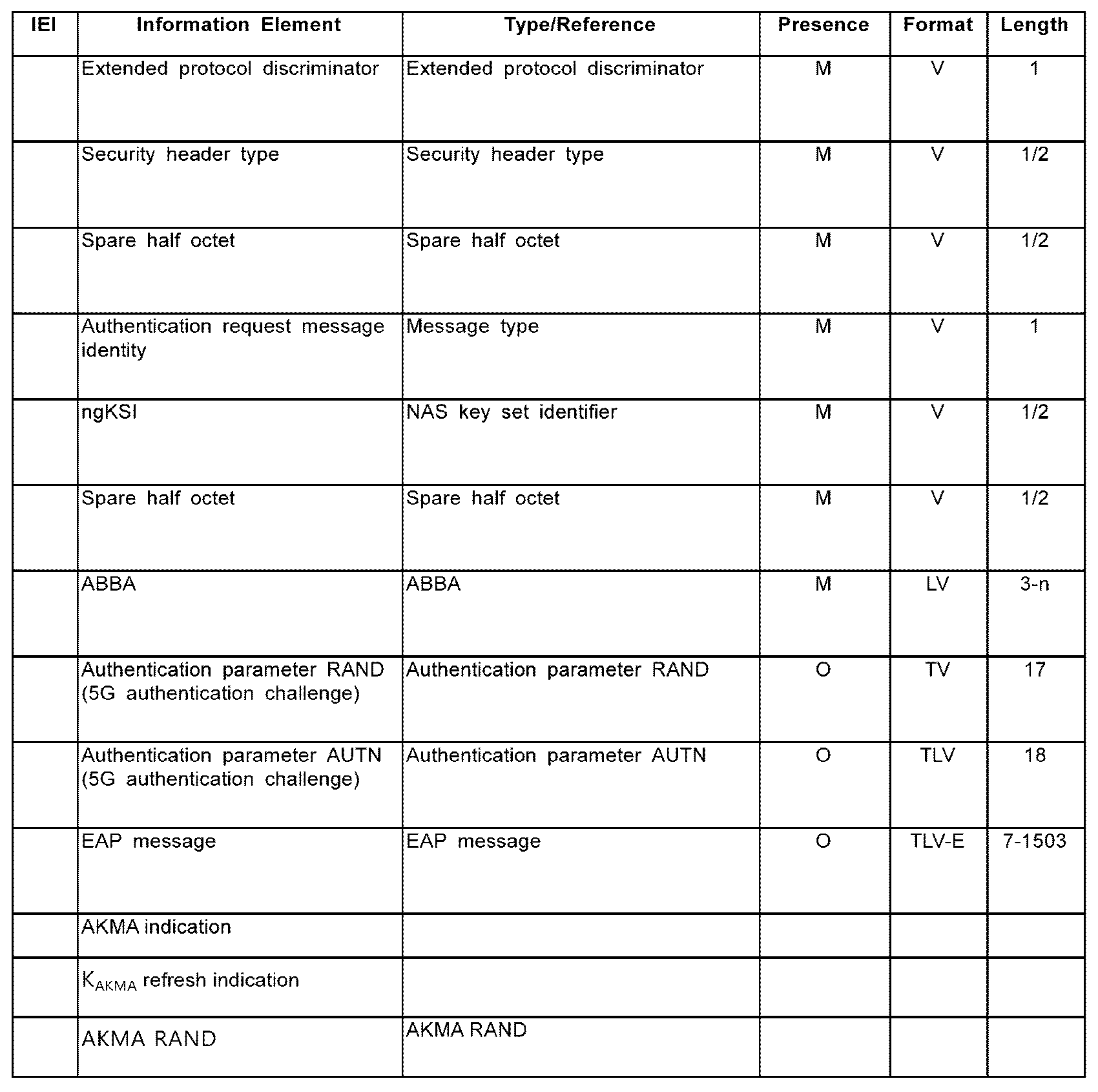
한편 AKMA RAND information element 가 포함될 수 있으며, 이러한 RAND 난수 값은 AKMA key 즉 
사용되는 식은 다음과 같다.The formula used is:
Input key 는 
- FC = 0x80;- FC = 0x80;
- P0 = "AKMA";- P0 = "AKMA";
- L0 = length of "AKMA"; (i.e. 0x00 0x04)- L0 = length of "AKMA"; (i.e. 0x00 0x04)
- P1 = SUPI;- P1 = SUPI;
- L1 = length of SUPI.- L1 = length of SUPI.
- P2 = RAND (난수) - P2 = RAND (random number)
- L2 = length of RAND - L2 = length of RAND
985, 987 단계에서 UE 는 AMF 로 AUTHENTICATION RESPONSE 메시지를 전송할 수 있다. In
986 단계에서 일 실시예로 UE 는 다음과 같은 식에 기초하여 RAND 를 입력값으로 활용하여 
988 단계에서는 AMF 는 AUSF 로 UEAuthentication_authentication request 메시지를 보낸다.In
991 단계에서는 AUSF 에서 AAnF 로 AnchorKey_Register request 메시지를 보낸다. 이 단계에서는 UE 및 키를 식별하기 위한 식별자인 A-KID와 key 생성의 seed 가 되는 
993 단계에서는 AAnF 에서 AUSF 로 AnchorKey_Register response 메시지를 보낸다. In
994 단계에서 UE 가 application function으로 application session establishment request 메시지를 보낸다. In
995 단계에서 Application function 은 AAnF 로 요청하여 AF 가 UE 와 통신하기 위하여 사용되는 
996 단계에서 AAnF 는 

997 단계에서 AAnF 는 AF 로 AF 가 UE 와 통신하기 위하여 사용되는 


998 단계에서 AF 는 UE 로 application session establishment response 메시지를 보낸다.In
도 10 은 본 개시의 일 실시예에 따른 5G 네트워크에서 application 의 security 를 지원하기 위한 절차를 설명하기 위한 흐름도이다. 10 is a flowchart illustrating a procedure for supporting application security in a 5G network according to an embodiment of the present disclosure.
본 개시의 실시예는, application의 security를 지원하기 위한, 새로운 메시지를 이용한 UE 기반의 트리거링 방법에 관한 것이다. An embodiment of the present disclosure relates to a UE-based triggering method using a new message to support application security.
1001, 1003 단계에서는 UE 에서 AMF로 REGISTRATION REQUEST 메시지를 보낸다. In
1004 단계에서 AMF 는 AUSF 로 UEAuthentication_authentication request 메시지를 보낸다. In
1005 단계에서 AUSF 에서 UDM으로 UEAuthentication_authentication_get_request 메시지를 보낸다. In
1007 단계에서 UDM 에서는 UEAuthentication_authentication_get_request 메시지를 수신하면, authentication vector 를 생성한다. UDM 에서 AUSF 로 authentication_get_response 메시지를 보낸다.In
1008단계에서 AUSF 에서 AMF 로 UEAuthentication_authentication response 메시지를 보낸다.In
1011, 1013 단계에서는 AMF 에서 UE 로 AUTHENTICATION REQUEST 메시지를 보낸다. In
1021, 1023 단계에서는 UE 에서 AMF 로 AUTHENTICATION RESPONSE 메시지를 보낸다. In
1025 단계에서 AMF 는 AUSF 로 UEAuthentication_authentication request 메시지를 보낸다. In
1041 단계에서는 AUSF 에서 AAnF 로 AnchorKey_Register request 메시지를 보낸다. 이 단계에서는 UE 및 키를 식별하기 위한 식별자인 A-KID와 key 생성의 seed 가 되는 
1043 단계에서는 AAnF 에서 AUSF 로 AnchorKey_Register response 메시지를 보낸다. In
1044 단계에서 UE 가 application function으로 application session establishment request 메시지를 보낸다. In
1045 단계에서 Application function 은 AAnF 로 요청하여 AF 가 UE 와 통신하기 위하여 사용되는 
1046 단계에서 AAnF 는 

1047 단계에서 AAnF 는 AF 로 AF 가 UE 와 통신하기 위하여 사용되는 


1048 단계에서 AF 는 UE 로 application session establishment response 메시지를 보낸다. 1051 단계에서 UE 와 AAnF 는 application 을 실행하며 통신중이다. In
1060-1 단계에서 AF 에 있어서 AF 가 UE 와 통신하기 위해 사용하는 AF 보안 key
즉 1060-1 에서 AF 는 보안키 
또 다른 일 실시예로 1061 단계에서와 같이 AAnF 에서도 보안키 
1063 단계에서 UE에 있어서 AF 가 UE 와 통신하기 위해 사용하는 AF 보안 key 
하지만 1065 단계와 1067 단계에서 UE 와 AUSF에서 사용하는 


따라서 1071 단계에서 UE 는 AMF 로 rekey request 메시지를 보내 AF 관련 키를 refresh 하는 것을 요청할 수 있다.Therefore, in
이 때 UE 의 내부에서는 도 1에서 보는 바와 같이 UE 의 application layer 즉 upper layer 에서 NAS layer 로 AF 에서 사용하는 보안 key 

이후 UE 에서는 AMF 로 1071, 1073 단계에서와 같이 AF 관련 키를 refresh 하기위해 authentication 과정을 새로이 시행하도록 triggering 할 수 있다. Afterwards, the UE can trigger a new authentication process to refresh the AF-related key as in
이러한 triggering 에는 1071, 1073 단계에서와 같이 일 실시예로 새로운 메시지를 정의하여 사용할 수 있다. 새로운 메시지는 rekey request 메시지 이다. For such triggering, as in
여기서 일 실시예로 Rekey request 메시지라고 하는 새로 정의하는 메시지를 예시로 들었으나, 또 다른 일 실시예로 registration request 혹은 또다른 일 실시예로 service request 메시지가 관련 정보를 전송, 동작을 triggering 하기 위하여 사용될 수 있다. Here, as an example, a newly defined message called a Rekey request message is taken as an example, but in another embodiment, a registration request or a service request message in another embodiment is used to transmit related information and trigger an operation. can
일 실시예로 여기에 사용되는 새로운 1071, 1073 단계의 rekey request 메시지에는 SUCI, 5G-GUTI 등의 identity 정보가 포함될 수 있다. 또한 이러한 rekey request 메시지는 application 보안 키 
또한 또 다른 일 실시예에 의하면 이러한 rekey 를 요청하는 메시지에는 rand 즉 난수 등의 정보가 포함될 수 있다. Also, according to another embodiment, the message requesting such a rekey may include information such as rand, that is, a random number.
포함된 rand 난수는 다음과 같이 
즉 AMF 는 UE 로부터 1071, 1073 단계에서 Rekey request 를 받는다. 이 registration request 는 AUSF가 
따라서, 1071, 1073의 메시지의 형태는 표 11와 같다. 표 11을 참조하면 메시지에는 


또한 AKMA indication information element 의 경우 

AMF 는 rekey request 메시지를 수신함에 따라서 374, 375, 377, 378 과 같이 AUSF 로 authentication 을 triggering 할 수 있다. 즉 AMF 는 AUSF 로 UEAuthentication_authentication request 메시지를 보낸다. As AMF receives the rekey request message, it can trigger authentication with AUSF as shown in 374, 375, 377, 378. That is, the AMF sends a UEAuthentication_authentication request message to the AUSF.
AUSF 는 UEAuthentication_authentication request 메시지를 수신함에 따라서 

또한 UE 는 Authentication request 메시지 안에 이러한 AKMA indication information element 또는 


또한 또 다른 일 실시예로 cause 혹은 authentication request indication 이 포함될 수 있다. Authentication request indication 의 경우 해당 메시지를 받으면 primary authentication 을 triggering 하라는 notice 로 동작하기 위함이다. 즉 해당 메시지를 받은 AMF 는 AUSF 로 UEAuthentication_authentication request 메시지를 보내어 primary authentication 을 triggering 할 수 있다. Also, as another embodiment, cause or authentication request indication may be included. In the case of an authentication request indication, it is to act as a notice to trigger primary authentication when the corresponding message is received. That is, the AMF receiving the message can trigger primary authentication by sending a UEAuthentication_authentication request message to the AUSF.
한편, 메시지에 cause information element 를 포함시킴으로써, application 보안 키 
표 11 Rekey REQUEST 메시지 Table 11 Rekey REQUEST messages
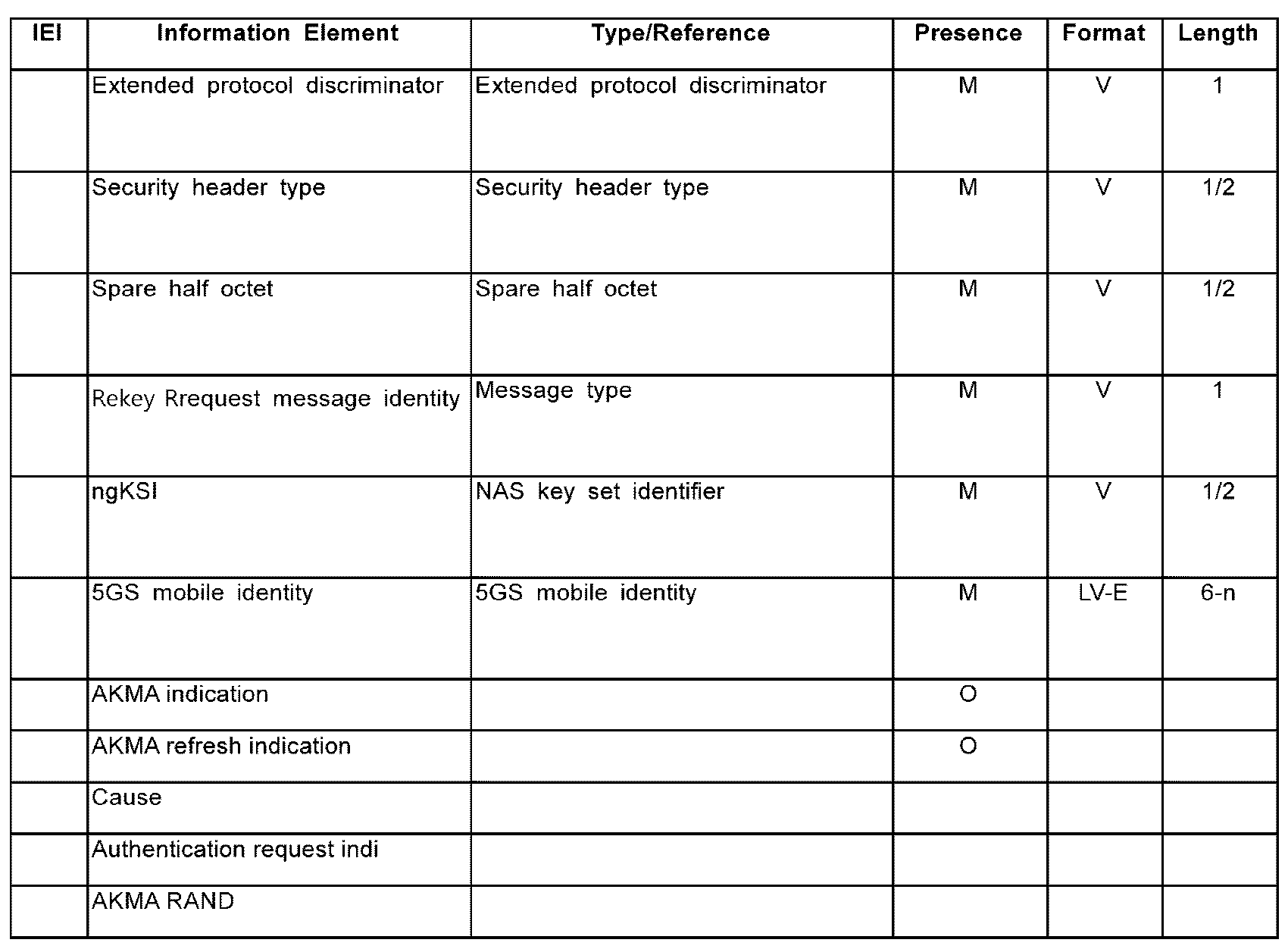
한편 AKMA rand 난수 information element 의 경우 AKMA key 즉 KAKMA 를 갱신하는데 필요한 난수 값을 전달하기 위함이다. On the other hand, in the case of the AKMA rand random number information element, it is to deliver the AKMA key, that is, the random number value required to update the KAKMA.
1074 단계에서 AMF 는 AUSF 로 UEAuthentication_authentication request 메시지를 보낸다. 이 때는 UE 로부터 전송된 KAKMA 를 갱신하는데 사용되는 rand 값 난수 등의 값이 전송될 수 있다. In
1076 단계에서는 일 실시예로 AUSF는 수신한 rand 난수를 다음과 같이 KAKMA 생성에 사용할 수 있다. 일 실시예로 AUSF는 수신한 rand 난수를 다음과 같이 A-KID 생성에 사용할 수 있다. In
KAKMA 생성 수식은 다음과 같다. The formula for generating KAKMA is as follows.
Input key 는 
- FC = 0x80;- FC = 0x80;
- P0 = "AKMA";- P0 = "AKMA";
- L0 = length of "AKMA"; (i.e. 0x00 0x04)- L0 = length of "AKMA"; (i.e. 0x00 0x04)
- P1 = SUPI;- P1 = SUPI;
- L1 = length of SUPI.- L1 = length of SUPI.
- P2 = RAND (난수) - P2 = RAND (random number)
- L2 = length of RAND - L2 = length of RAND
한편 A-KID 의 일 부분을 이루는 A-TID의 생성 수식은 다음과 같다. Meanwhile, the formula for generating A-TID constituting a part of A-KID is as follows.
Input key 는 
- FC = 0x81;- FC = 0x81;
- P0 = "A-TID";- P0 = "A-TID";
- L0 = length of "A-TID"; (i.e. 0x00 0x05)- L0 = length of "A-TID"; (i.e. 0x00 0x05)
- P1 = SUPI;- P1 = SUPI;
- L1 = length of SUPI.- L1 = length of SUPI.
- P2 = RAND (난수) - P2 = RAND (random number)
- L2 = length of RAND - L2 = length of RAND
일 실시예로 A-KID 는 routing identifier, A-TID, home network identifier 를 포함하여 구성된다. In one embodiment, the A-KID is configured to include a routing identifier, an A-TID, and a home network identifier.
일 실시예로 KAKMA 생성시 사용된 RAND 가 UE 가 전송한 난수 일 수 있다. In an embodiment, the RAND used when generating the KAKMA may be a random number transmitted by the UE.
또 다른 일 실시예로 KAKMA 생성시 사용된 RAND 가 AUSF가 생성한 난수 일 수 있다.In another embodiment, the RAND used when generating the KAKMA may be a random number generated by the AUSF.
AUSF 가 생성한 난수 RAND 인 경우 해당 RAND 를 1078, 1081, 1083 단계를 통해 UE 에 알려주어 UE 도 같은 RAND 를 이용하여 KAKMA 생성한다. In the case of a random number RAND generated by AUSF, the corresponding RAND is informed to the UE through
1078단계에서 AUSF 에서 AMF 로 UEAuthentication_authentication response 메시지를 보낸다.In
그리고, AMF 는 이후 1081, 1083 단계에서 authentication request 메시지를 UE 로 전송할 수 있다. Then, the AMF may transmit an authentication request message to the UE in
1078, 1081, 1083 단계에서는 일 실시예로 AUSF 가 UE 로 전달하는 rand 난수 정보 등이 메시지에 포함되어 전송될 수도 있다. In
1081, 1083 단계에서 AMF는 UE 로 AUTHENTICATION REQUEST 메시지를 전송할 수 있다. In
1084 단계에서는 일 실시예로 UE는 수신/송신한 rand 난수를 다음과 같이 KAKMA 생성에 사용할 수 있다. 일 실시예로 UE는 수신/송신한 rand 난수를 다음과 같이 A-KID 생성에 사용할 수 있다. In
KAKMA 생성 수식은 다음과 같다. The formula for generating KAKMA is as follows.
Input key 는
- FC = 0x80;- FC = 0x80;
- P0 = "AKMA";- P0 = "AKMA";
- L0 = length of "AKMA"; (i.e. 0x00 0x04)- L0 = length of "AKMA"; (i.e. 0x00 0x04)
- P1 = SUPI;- P1 = SUPI;
- L1 = length of SUPI.- L1 = length of SUPI.
- P2 = RAND (난수) - P2 = RAND (random number)
- L2 = length of RAND - L2 = length of RAND
한편 A-KID 의 일 부분을 이루는 A-TID의 생성 수식은 다음과 같다. Meanwhile, the formula for generating A-TID constituting a part of A-KID is as follows.
Input key 는 
- FC = 0x81;- FC = 0x81;
- P0 = "A-TID";- P0 = "A-TID";
- L0 = length of "A-TID"; (i.e. 0x00 0x05)- L0 = length of "A-TID"; (i.e. 0x00 0x05)
- P1 = SUPI;- P1 = SUPI;
- L1 = length of SUPI.- L1 = length of SUPI.
- P2 = RAND (난수) - P2 = RAND (random number)
- L2 = length of RAND - L2 = length of RAND
일 실시예로 A-KID 는 routing identifier, A-TID, home network identifier 를 포함하여 구성된다. In one embodiment, the A-KID is configured to include a routing identifier, an A-TID, and a home network identifier.
일 실시예로 KAKMA 생성시 사용된 RAND 가 UE 가 전송한 난수 일 수 있다. In an embodiment, the RAND used when generating the KAKMA may be a random number transmitted by the UE.
또 다른 일 실시예로 KAKMA 생성시 사용된 RAND 가 AUSF가 생성한 난수 일 수 있다.In another embodiment, the RAND used when generating the KAKMA may be a random number generated by the AUSF.
AUSF 가 생성한 난수 RAND 인 경우 해당 RAND 를 1078, 1081, 1083 단계를 통해 AUSF 가 UE 에 알려주어 UE 가 AUSF 와 같은 RAND 를 이용하여 KAKMA 생성한다. In the case of a random number RAND generated by the AUSF, the AUSF informs the UE of the corresponding RAND through
한편, 본 도 10에서는, 1084 단계가 1083 단계 이후에 수행되는 것으로 도시되어 있으나, 이는 일 실시예일 뿐, 1084 단계는 1071 단계 이후에 수행될 수 있다. Meanwhile, in FIG. 10 , although it is illustrated that
1085, 1087 단계에서 UE 는 AMF 로 AUTHENTICATION RESPONSE 메시지를 전송할 수 있다. In
1088 단계에서 AMF 는 AUSF 로 UEAuthentication_authentication request 메시지를 보낸다. In
1091 단계에서는 AUSF 에서 AAnF 로 AnchorKey_Register request 메시지를 보낸다. 이 단계에서는 UE 및 키를 식별하기 위한 식별자인 A-KID와 key 생성의 seed 가 되는 
1093 단계에서는 AAnF 에서 AUSF 로 AnchorKey_Register response 메시지를 보낸다. In
1094 단계에서 UE 가 application function으로 application session establishment request 메시지를 보낸다. In
1095 단계에서 Application function 은 AAnF 로 요청하여 AF 가 UE 와 통신하기 위하여 사용되는 
1096 단계에서 AAnF 는 

1097 단계에서 AAnF 는 AF 로 AF 가 UE 와 통신하기 위하여 사용되는 


1098 단계에서 AF 는 UE 로 application session establishment response 메시지를 보낸다. In
도 11 은 본 개시의 일 실시예에 따른 5G 네트워크에서 application 의 security 를 지원하기 위한 절차를 설명하기 위한 흐름도이다. 11 is a flowchart illustrating a procedure for supporting application security in a 5G network according to an embodiment of the present disclosure.
본 개시의 실시예는, application의 security를 지원하기 위한, 새로운 메시지를 이용한 UE 기반의 트리거링 방법에 관한 것이다. An embodiment of the present disclosure relates to a UE-based triggering method using a new message to support application security.
1101, 1103 단계에서는 UE 에서 AMF로 REGISTRATION REQUEST 메시지를 보낸다. In
1104 단계에서 AMF 는 AUSF 로 UEAuthentication_authentication request 메시지를 보낸다. In
1105 단계에서 AUSF 에서 UDM으로 UEAuthentication_authentication_get_request 메시지를 보낸다. In
1107 단계에서 UDM 에서는 UEAuthentication_authentication_get_request 메시지를 수신하면, authentication vector 를 생성한다. UDM 에서 AUSF 로 authentication_get_response 메시지를 보낸다.In
1108단계에서 AUSF 에서 AMF 로 UEAuthentication_authentication response 메시지를 보낸다.In
1111, 1113 단계에서는 AMF 에서 UE 로 AUTHENTICATION REQUEST 메시지를 보낸다. In
1121, 1123 단계에서는 UE 에서 AMF 로 AUTHENTICATION RESPONSE 메시지를 보낸다. In
1125 단계에서 AMF 는 AUSF 로 UEAuthentication_authentication request 메시지를 보낸다. In
1141 단계에서는 AUSF 에서 AAnF 로 AnchorKey_Register request 메시지를 보낸다. 이 단계에서는 UE 및 키를 식별하기 위한 식별자인 A-KID와 key 생성의 seed 가 되는 
1143 단계에서는 AAnF 에서 AUSF 로 AnchorKey_Register response 메시지를 보낸다. In
1144 단계에서 UE 가 application function으로 application session establishment request 메시지를 보낸다. In
1145 단계에서 Application function 은 AAnF 로 요청하여 AF 가 UE 와 통신하기 위하여 사용되는 
1146 단계에서 AAnF 는 

1147 단계에서 AAnF 는 AF 로 AF 가 UE 와 통신하기 위하여 사용되는 


1148 단계에서 AF 는 UE 로 application session establishment response 메시지를 보낸다. 1151 단계에서 UE 와 AAnF 는 application 을 실행하며 통신중이다. In
1160-1 단계에서 AF 에 있어서 AF 가 UE 와 통신하기 위해 사용하는 AF 보안 key 
즉 1160-1 에서 AF 는 보안키 
또 다른 일 실시예로 1161 단계에서와 같이 AAnF 에서도 보안키 
1163 단계에서 UE에 있어서 AF 가 UE 와 통신하기 위해 사용하는 AF 보안 key 
하지만 1165 단계와 1167 단계에서 UE 와 AUSF에서 사용하는 

1184 단계에서 UE 는 AF-KSI 를 생성하고, RAND 값을 생성한다. In
1194 단계에서 UE 가 application function으로 application session establishment request 메시지를 보낸다. 이때 UE는 application session establishment request 메시지에 rand 값을 포함하여 전송할 수 있다. In
1194-2 단계에서 AF 는 AF-KSI 라는 식별자를 생성한다. In step 1194-2, the AF generates an identifier called AF-KSI.
1195 단계에서 Application function 은 AAnF 로 요청하여 AF 가 UE 와 통신하기 위하여 사용되는 
1196 단계에서 AAnF 는 

수식은 다음과 같다. The formula is:
- FC = 0x82;- FC = 0x82;
- P0 =AF_ID; - P0 =AF_ID;
AF_ID = FQDN of the AF || Ua* security protocol identifier,AF_ID = FQDN of the AF || Ua* security protocol identifier,
- L0 = length of AF_ID - L0 = length of AF_ID
- P1 = RAND- P1 = RAND
- L1= length of RAND - L1= length of RAND
Input keY 는 
1197 단계에서 AAnF 는 AF 로 AF 가 UE 와 통신하기 위하여 사용되는 


1198 단계에서 AF 는 UE 로 application session establishment response 메시지를 보낸다. In
1199 단계에서 UE 는 

수식은 다음과 같다. The formula is:
- FC = 0x82;- FC = 0x82;
- P0 =AF_ID; - P0 =AF_ID;
AF_ID = FQDN of the AF || Ua* security protocol identifier,AF_ID = FQDN of the AF || Ua* security protocol identifier,
- L0 = length of AF_ID - L0 = length of AF_ID
P1 = RANDP1 = RAND
L1= length of RAND L1= length of RAND
Input keY 는 
도 12는 본 개시의 일 실시예에 따른 5G 네트워크에서 application 의 security 를 지원하기 위한 절차를 설명하기 위한 흐름도이다. 12 is a flowchart illustrating a procedure for supporting application security in a 5G network according to an embodiment of the present disclosure.
본 개시의 실시예는, application의 security를 지원하기 위한, 네트워크 기반의 트리거링 방법에 관한 것이다. 1201, 1203 단계에서는 UE 에서 AMF로 REGISTRATION REQUEST 메시지를 보낸다. An embodiment of the present disclosure relates to a network-based triggering method for supporting application security. In
1204, 단계에서 AMF 는 AUSF 로 UEAuthentication_authentication request 메시지를 보낸다. In
1205 단계에서 AUSF 에서 UDM으로 UEAuthentication_authentication_get_request 메시지를 보낸다. In
1207 단계에서 UDM 에서는 UEAuthentication_authentication_get_request 메시지를 수신하면, authentication vector 를 생성한다. UDM 에서 AUSF 로 authentication_get_response 메시지를 보낸다.In
1208단계에서 AUSF 에서 AMF 로 UEAuthentication_authentication response 메시지를 보낸다.In
1211, 1213 단계에서는 AMF 에서 UE 로 AUTHENTICATION REQUEST 메시지를 보낸다. In
1221, 1223 단계에서는 UE 에서 AMF 로 AUTHENTICATION RESPONSE 메시지를 보낸다. In
1225 단계에서는 AMF 는 AUSF 로 UEAuthentication_authentication request 메시지를 보낸다.In
1241 단계에서는 AUSF 에서 AAnF 로 AnchorKey_Register request 메시지를 보낸다. 이 단계에서는 UE 및 키를 식별하기 위한 식별자인 A-KID와 key 생성의 seed 가 되는 
1243 단계에서는 AAnF 에서 AUSF 로 AnchorKey_Register response 메시지를 보낸다. In
1244 단계에서 UE 가 application function으로 application session establishment request 메시지를 보낸다. In
1245 단계에서 Application function 은 AAnF 로 요청하여 AF 가 UE 와 통신하기 위하여 사용되는 
1246 단계에서 AAnF 는 

1247 단계에서 AAnF 는 AF 로 AF 가 UE 와 통신하기 위하여 사용되는 


1248 단계에서 AF 는 UE 로 application session establishment response 메시지를 보낸다. In
1251 단계에서 UE 와 AAnF 는 application 을 실행하며 통신중이다. In
1260-1 단계에서 AF 에 있어서 AF가 UE 와 통신하기 위해 사용하는 AF 보안 key 
이러한 경우 일 실시예로 1260-1, 1260-2, 1260-3 에서와 같이 동작할 수 있다. 즉 1260-1 에서 AF 는 보안키 

또 다른 일 실시예로 1261 단계에서와 같이 AAnF 에서도 보안키 

1263 단계에서 UE에 있어서 AF 가 UE 와 통신하기 위해 사용하는 AF보안 key 
하지만 1265 단계와 1267 단계에서 UE 와 AUSF에서 사용하는 


1294 단계에서 UE 가 application function으로 application session establishment request 메시지를 보낸다. In
1295 단계에서 Application function 은 AAnF 로 요청하여 AF 가 UE 와 통신하기 위하여 사용되는 
1296 단계에서 AAnF 는 

이 때 생성시 사용하는 수식은 다음과 같다. In this case, the formula used for creation is as follows.
수식은 다음과 같다. The formula is:
- FC = 0x82;- FC = 0x82;
- P0 =AF_ID; - P0 =AF_ID;
AF_ID = FQDN of the AF || Ua* security protocol identifier,AF_ID = FQDN of the AF || Ua* security protocol identifier,
- L0 = length of AF_ID - L0 = length of AF_ID
P1 = RANDP1 = RAND
L1= length of RAND L1= length of RAND
Input keY 는 
1297 단계에서 AAnF 는 AF 로 AF 가 UE 와 통신하기 위하여 사용되는 


이 때 
1298 단계에서 AF 는 UE 로 application session establishment response 메시지를 보낸다. 이 때 AF 는 UE 로 보내는 메시지에 
1299 단계에서 UE 는 다음 수식을 이용하여 
수식은 다음과 같다. The formula is:
- FC = 0x82;- FC = 0x82;
- P0 =AF_ID; - P0 =AF_ID;
AF_ID = FQDN of the AF || Ua* security protocol identifier,AF_ID = FQDN of the AF || Ua* security protocol identifier,
- L0 = length of AF_ID - L0 = length of AF_ID
P1 = RANDP1 = RAND
L1= length of RAND L1= length of RAND
Input keY 는 
상술한 본 개시의 구체적인 실시 예들에서, 개시에 포함되는 구성 요소는 제시된 구체적인 실시 예에 따라 단수 또는 복수로 표현되었다. 그러나, 단수 또는 복수의 표현은 설명의 편의를 위해 제시한 상황에 적합하게 선택된 것으로서, 본 개시가 단수 또는 복수의 구성 요소에 제한되는 것은 아니며, 복수로 표현된 구성 요소라 하더라도 단수로 구성되거나, 단수로 표현된 구성 요소라 하더라도 복수로 구성될 수 있다.In the specific embodiments of the present disclosure described above, components included in the disclosure are expressed in the singular or plural according to the specific embodiments presented. However, the singular or plural expression is appropriately selected for the context presented for convenience of description, and the present disclosure is not limited to the singular or plural element, and even if the element is expressed in plural, it is composed of the singular or singular. Even an expressed component may be composed of a plurality of components.
한편 본 개시의 상세한 설명에서는 구체적인 실시 예에 관해 설명하였으나, 본 개시의 범위에서 벗어나지 않는 한도 내에서 여러 가지 변형이 가능함은 물론이다. 그러므로 본 개시의 범위는 설명된 실시 예에 국한되어 정해져서는 아니 되며 후술하는 특허청구의 범위뿐만 아니라 이 특허청구의 범위와 균등한 것들에 의해 정해져야 한다.Meanwhile, although specific embodiments have been described in the detailed description of the present disclosure, various modifications are possible without departing from the scope of the present disclosure. Therefore, the scope of the present disclosure should not be limited to the described embodiments and should be defined by the claims described below as well as the claims and equivalents.
Claims (15)
Priority Applications (2)
| Application Number | Priority Date | Filing Date | Title |
|---|---|---|---|
| US18/271,599 US12538122B2 (en) | 2021-01-13 | 2022-01-12 | Method and device for supporting security of application by using NAS message in wireless communication system |
| CN202280010048.3A CN116762380A (en) | 2021-01-13 | 2022-01-12 | Method and device for supporting application security by using NAS messages in a wireless communication system |
Applications Claiming Priority (4)
| Application Number | Priority Date | Filing Date | Title |
|---|---|---|---|
| KR10-2021-0004935 | 2021-01-13 | ||
| KR20210004935 | 2021-01-13 | ||
| KR10-2022-0004306 | 2022-01-11 | ||
| KR1020220004306A KR20220102585A (en) | 2021-01-13 | 2022-01-11 | Method and apparatus for supporting application security using nas message in wireless communication system |
Publications (1)
| Publication Number | Publication Date |
|---|---|
| WO2022154484A1 true WO2022154484A1 (en) | 2022-07-21 |
Family
ID=82447369
Family Applications (1)
| Application Number | Title | Priority Date | Filing Date |
|---|---|---|---|
| PCT/KR2022/000570 Ceased WO2022154484A1 (en) | 2021-01-13 | 2022-01-12 | Method and device for supporting security of application by using nas message in wireless communication system |
Country Status (2)
| Country | Link |
|---|---|
| US (1) | US12538122B2 (en) |
| WO (1) | WO2022154484A1 (en) |
Cited By (3)
| Publication number | Priority date | Publication date | Assignee | Title |
|---|---|---|---|---|
| CN116709315A (en) * | 2023-07-05 | 2023-09-05 | 中国电信股份有限公司技术创新中心 | A key update method and device |
| WO2024193506A1 (en) * | 2023-03-20 | 2024-09-26 | 中国移动通信有限公司研究院 | Key updating method and apparatus, communication device, and readable storage medium |
| WO2025030883A1 (en) * | 2023-08-04 | 2025-02-13 | 中兴通讯股份有限公司 | Key updating method, communication apparatus, and storage medium |
Families Citing this family (3)
| Publication number | Priority date | Publication date | Assignee | Title |
|---|---|---|---|---|
| KR20240035955A (en) * | 2021-07-28 | 2024-03-19 | 삼성전자주식회사 | Apparatus and method for establishing communication in Application Authentication and Key Management (AKMA) |
| US20250008323A1 (en) * | 2023-06-28 | 2025-01-02 | Verizon Patent And Licensing Inc. | Systems and methods for provisioning security policies for deriving session keys |
| US20250112780A1 (en) * | 2023-09-29 | 2025-04-03 | Lenovo (Singapore) Pte. Limited | User equipment parameter update header protection |
Citations (3)
| Publication number | Priority date | Publication date | Assignee | Title |
|---|---|---|---|---|
| KR101139558B1 (en) * | 2007-11-08 | 2012-04-27 | 차이나 아이더블유엔콤 씨오., 엘티디 | A two-way access authentication method |
| CN110891271A (en) * | 2018-09-10 | 2020-03-17 | 大唐移动通信设备有限公司 | Authentication method and device |
| CN111866874A (en) * | 2019-04-29 | 2020-10-30 | 华为技术有限公司 | Registration method and device |
Family Cites Families (6)
| Publication number | Priority date | Publication date | Assignee | Title |
|---|---|---|---|---|
| US7835528B2 (en) * | 2005-09-26 | 2010-11-16 | Nokia Corporation | Method and apparatus for refreshing keys within a bootstrapping architecture |
| US10536357B2 (en) | 2015-06-05 | 2020-01-14 | Cisco Technology, Inc. | Late data detection in data center |
| CN108966220B (en) * | 2017-07-28 | 2019-07-23 | 华为技术有限公司 | A kind of key deduction method and network device |
| US11937079B2 (en) * | 2017-09-27 | 2024-03-19 | Nec Corporation | Communication terminal, core network device, core network node, network node, and key deriving method |
| CN111464287A (en) * | 2019-01-21 | 2020-07-28 | 华为技术有限公司 | Method and apparatus for generating a key |
| US11863665B2 (en) * | 2019-08-16 | 2024-01-02 | Lenovo (Singapore) Pte. Ltd. | Security capabilities in an encryption key request |
-
2022
- 2022-01-12 WO PCT/KR2022/000570 patent/WO2022154484A1/en not_active Ceased
- 2022-01-12 US US18/271,599 patent/US12538122B2/en active Active
Patent Citations (3)
| Publication number | Priority date | Publication date | Assignee | Title |
|---|---|---|---|---|
| KR101139558B1 (en) * | 2007-11-08 | 2012-04-27 | 차이나 아이더블유엔콤 씨오., 엘티디 | A two-way access authentication method |
| CN110891271A (en) * | 2018-09-10 | 2020-03-17 | 大唐移动通信设备有限公司 | Authentication method and device |
| CN111866874A (en) * | 2019-04-29 | 2020-10-30 | 华为技术有限公司 | Registration method and device |
Non-Patent Citations (3)
| Title |
|---|
| "3rd Generation Partnership Project; Technical Specification Group Services and System Aspects; Authentication and Key Management for Applications (AKMA) based on 3GPP credentials in the 5G System (5GS) (Release 17)", 3GPP STANDARD; TECHNICAL SPECIFICATION; 3GPP TS 33.535, 3RD GENERATION PARTNERSHIP PROJECT (3GPP), MOBILE COMPETENCE CENTRE ; 650, ROUTE DES LUCIOLES ; F-06921 SOPHIA-ANTIPOLIS CEDEX ; FRANCE, vol. SA WG3, no. V17.0.0, 16 December 2020 (2020-12-16), Mobile Competence Centre ; 650, route des Lucioles ; F-06921 Sophia-Antipolis Cedex ; France , pages 1 - 20, XP051999388 * |
| S3: "Network provides authorization to AF/UE for KAF Key refresh", 3GPP DRAFT; S3-210447, 3RD GENERATION PARTNERSHIP PROJECT (3GPP), MOBILE COMPETENCE CENTRE ; 650, ROUTE DES LUCIOLES ; F-06921 SOPHIA-ANTIPOLIS CEDEX ; FRANCE, vol. SA WG3, no. e-meeting; 20210118 - 20210129, 11 January 2021 (2021-01-11), Mobile Competence Centre ; 650, route des Lucioles ; F-06921 Sophia-Antipolis Cedex ; France , XP051968399 * |
| ZTE: "the KAF lifetime expiration in clause 5.2", 3GPP DRAFT; S3-210156, 3RD GENERATION PARTNERSHIP PROJECT (3GPP), MOBILE COMPETENCE CENTRE ; 650, ROUTE DES LUCIOLES ; F-06921 SOPHIA-ANTIPOLIS CEDEX ; FRANCE, vol. SA WG3, no. e-meeting; 20210118 - 20210129, 11 January 2021 (2021-01-11), Mobile Competence Centre ; 650, route des Lucioles ; F-06921 Sophia-Antipolis Cedex ; France , XP051968108 * |
Cited By (3)
| Publication number | Priority date | Publication date | Assignee | Title |
|---|---|---|---|---|
| WO2024193506A1 (en) * | 2023-03-20 | 2024-09-26 | 中国移动通信有限公司研究院 | Key updating method and apparatus, communication device, and readable storage medium |
| CN116709315A (en) * | 2023-07-05 | 2023-09-05 | 中国电信股份有限公司技术创新中心 | A key update method and device |
| WO2025030883A1 (en) * | 2023-08-04 | 2025-02-13 | 中兴通讯股份有限公司 | Key updating method, communication apparatus, and storage medium |
Also Published As
| Publication number | Publication date |
|---|---|
| US20240080662A1 (en) | 2024-03-07 |
| US12538122B2 (en) | 2026-01-27 |
Similar Documents
| Publication | Publication Date | Title |
|---|---|---|
| WO2022154484A1 (en) | Method and device for supporting security of application by using nas message in wireless communication system | |
| WO2019125061A1 (en) | A method and an apparatus for handling a bandwidth part inactivity timer in wireless communication system | |
| WO2020040530A1 (en) | Method and apparatus for performing communication in wireless communication system | |
| WO2019139405A1 (en) | Method and apparatus for transmitting hybrid automatic repeat and request information in a wireless communication system | |
| EP3698500A1 (en) | Method and apparatus for transmitting hybrid automatic repeat and request information in a wireless communication system | |
| WO2019125090A1 (en) | Method and apparatus for configuring demodulation reference signal information in wireless cellular communication system | |
| WO2009157715A2 (en) | Codebook design method for multiple input multiple output system and method for using the codebook | |
| WO2011136627A2 (en) | Multiple input multiple output communication system using codebook corresponding to each reporting mode | |
| WO2019216739A1 (en) | Security protection method and apparatus in wireless communication system | |
| WO2009131376A2 (en) | Multiple antenna communication system including adaptive updating and changing of codebooks | |
| WO2017155137A1 (en) | Beamforming method and device therefor | |
| EP3149869A1 (en) | Soft buffer processing method and apparatus | |
| WO2017078279A1 (en) | Method for transmitting synchronization signal using codebook in wireless communication system | |
| WO2020009432A1 (en) | Method and device for performing beamforming in wireless communication system | |
| WO2023191377A1 (en) | Method and apparatus for sounding reference signal configuration | |
| EP3669487A1 (en) | Method and apparatus for configuring demodulation reference signal information in wireless cellular communication system | |
| WO2021060904A1 (en) | Method and device for performing communication in wireless communication system | |
| WO2017018593A1 (en) | Device and method for determining transmission power in device-to-device communication system | |
| WO2011002260A2 (en) | Rotating reference codebook that is used in a multiple-input multiple-output (mimo) communication system | |
| WO2011040707A2 (en) | Multiple-input multiple-output communication system using explicit feedback | |
| WO2024136577A1 (en) | Support of toeplitz-based csi feedback/reporting methods | |
| WO2023003149A1 (en) | Signal transmission method using spectrum sharing multi-numerologies, and electronic device performing same | |
| WO2021137675A1 (en) | Method and apparatus for positioning | |
| WO2021112518A1 (en) | Method for estimating reception delay time of reference signal and apparatus using the same | |
| WO2024237758A1 (en) | Method and device for hybrid beamformer for supporting multiple numerologies in wireless communication system |
Legal Events
| Date | Code | Title | Description |
|---|---|---|---|
| 121 | Ep: the epo has been informed by wipo that ep was designated in this application |
Ref document number: 22739679 Country of ref document: EP Kind code of ref document: A1 |
|
| WWE | Wipo information: entry into national phase |
Ref document number: 18271599 Country of ref document: US |
|
| WWE | Wipo information: entry into national phase |
Ref document number: 202280010048.3 Country of ref document: CN |
|
| NENP | Non-entry into the national phase |
Ref country code: DE |
|
| 122 | Ep: pct application non-entry in european phase |
Ref document number: 22739679 Country of ref document: EP Kind code of ref document: A1 |
|
| WWG | Wipo information: grant in national office |
Ref document number: 18271599 Country of ref document: US |