WO2022138626A1 - Compound, composition, biotissue embrittlement agent, biotissue surface detachment method, and biotissue detachment kit - Google Patents
Compound, composition, biotissue embrittlement agent, biotissue surface detachment method, and biotissue detachment kit Download PDFInfo
- Publication number
- WO2022138626A1 WO2022138626A1 PCT/JP2021/047282 JP2021047282W WO2022138626A1 WO 2022138626 A1 WO2022138626 A1 WO 2022138626A1 JP 2021047282 W JP2021047282 W JP 2021047282W WO 2022138626 A1 WO2022138626 A1 WO 2022138626A1
- Authority
- WO
- WIPO (PCT)
- Prior art keywords
- general formula
- compound
- tissue
- group
- biological tissue
- Prior art date
- Legal status (The legal status is an assumption and is not a legal conclusion. Google has not performed a legal analysis and makes no representation as to the accuracy of the status listed.)
- Ceased
Links
Classifications
-
- C—CHEMISTRY; METALLURGY
- C07—ORGANIC CHEMISTRY
- C07C—ACYCLIC OR CARBOCYCLIC COMPOUNDS
- C07C229/00—Compounds containing amino and carboxyl groups bound to the same carbon skeleton
- C07C229/02—Compounds containing amino and carboxyl groups bound to the same carbon skeleton having amino and carboxyl groups bound to acyclic carbon atoms of the same carbon skeleton
- C07C229/04—Compounds containing amino and carboxyl groups bound to the same carbon skeleton having amino and carboxyl groups bound to acyclic carbon atoms of the same carbon skeleton the carbon skeleton being acyclic and saturated
- C07C229/24—Compounds containing amino and carboxyl groups bound to the same carbon skeleton having amino and carboxyl groups bound to acyclic carbon atoms of the same carbon skeleton the carbon skeleton being acyclic and saturated having more than one carboxyl group bound to the carbon skeleton, e.g. aspartic acid
-
- A—HUMAN NECESSITIES
- A61—MEDICAL OR VETERINARY SCIENCE; HYGIENE
- A61P—SPECIFIC THERAPEUTIC ACTIVITY OF CHEMICAL COMPOUNDS OR MEDICINAL PREPARATIONS
- A61P1/00—Drugs for disorders of the alimentary tract or the digestive system
- A61P1/04—Drugs for disorders of the alimentary tract or the digestive system for ulcers, gastritis or reflux esophagitis, e.g. antacids, inhibitors of acid secretion, mucosal protectants
-
- A—HUMAN NECESSITIES
- A61—MEDICAL OR VETERINARY SCIENCE; HYGIENE
- A61K—PREPARATIONS FOR MEDICAL, DENTAL OR TOILETRY PURPOSES
- A61K31/00—Medicinal preparations containing organic active ingredients
- A61K31/185—Acids; Anhydrides, halides or salts thereof, e.g. sulfur acids, imidic, hydrazonic or hydroximic acids
- A61K31/19—Carboxylic acids, e.g. valproic acid
- A61K31/194—Carboxylic acids, e.g. valproic acid having two or more carboxyl groups, e.g. succinic, maleic or phthalic acid
-
- A—HUMAN NECESSITIES
- A61—MEDICAL OR VETERINARY SCIENCE; HYGIENE
- A61K—PREPARATIONS FOR MEDICAL, DENTAL OR TOILETRY PURPOSES
- A61K31/00—Medicinal preparations containing organic active ingredients
- A61K31/74—Synthetic polymeric materials
- A61K31/765—Polymers containing oxygen
- A61K31/77—Polymers containing oxygen of oxiranes
-
- C—CHEMISTRY; METALLURGY
- C08—ORGANIC MACROMOLECULAR COMPOUNDS; THEIR PREPARATION OR CHEMICAL WORKING-UP; COMPOSITIONS BASED THEREON
- C08G—MACROMOLECULAR COMPOUNDS OBTAINED OTHERWISE THAN BY REACTIONS ONLY INVOLVING UNSATURATED CARBON-TO-CARBON BONDS
- C08G65/00—Macromolecular compounds obtained by reactions forming an ether link in the main chain of the macromolecule
- C08G65/02—Macromolecular compounds obtained by reactions forming an ether link in the main chain of the macromolecule from cyclic ethers by opening of the heterocyclic ring
- C08G65/26—Macromolecular compounds obtained by reactions forming an ether link in the main chain of the macromolecule from cyclic ethers by opening of the heterocyclic ring from cyclic ethers and other compounds
- C08G65/2603—Macromolecular compounds obtained by reactions forming an ether link in the main chain of the macromolecule from cyclic ethers by opening of the heterocyclic ring from cyclic ethers and other compounds the other compounds containing oxygen
- C08G65/2606—Macromolecular compounds obtained by reactions forming an ether link in the main chain of the macromolecule from cyclic ethers by opening of the heterocyclic ring from cyclic ethers and other compounds the other compounds containing oxygen containing hydroxyl groups
- C08G65/2609—Macromolecular compounds obtained by reactions forming an ether link in the main chain of the macromolecule from cyclic ethers by opening of the heterocyclic ring from cyclic ethers and other compounds the other compounds containing oxygen containing hydroxyl groups containing aliphatic hydroxyl groups
-
- C—CHEMISTRY; METALLURGY
- C08—ORGANIC MACROMOLECULAR COMPOUNDS; THEIR PREPARATION OR CHEMICAL WORKING-UP; COMPOSITIONS BASED THEREON
- C08G—MACROMOLECULAR COMPOUNDS OBTAINED OTHERWISE THAN BY REACTIONS ONLY INVOLVING UNSATURATED CARBON-TO-CARBON BONDS
- C08G65/00—Macromolecular compounds obtained by reactions forming an ether link in the main chain of the macromolecule
- C08G65/02—Macromolecular compounds obtained by reactions forming an ether link in the main chain of the macromolecule from cyclic ethers by opening of the heterocyclic ring
- C08G65/32—Polymers modified by chemical after-treatment
- C08G65/329—Polymers modified by chemical after-treatment with organic compounds
- C08G65/333—Polymers modified by chemical after-treatment with organic compounds containing nitrogen
- C08G65/3332—Polymers modified by chemical after-treatment with organic compounds containing nitrogen containing carboxamide group
-
- C—CHEMISTRY; METALLURGY
- C08—ORGANIC MACROMOLECULAR COMPOUNDS; THEIR PREPARATION OR CHEMICAL WORKING-UP; COMPOSITIONS BASED THEREON
- C08G—MACROMOLECULAR COMPOUNDS OBTAINED OTHERWISE THAN BY REACTIONS ONLY INVOLVING UNSATURATED CARBON-TO-CARBON BONDS
- C08G2650/00—Macromolecular compounds obtained by reactions forming an ether link in the main chain of the macromolecule
- C08G2650/22—Macromolecular compounds obtained by reactions forming an ether link in the main chain of the macromolecule characterised by the initiator used in polymerisation
- C08G2650/24—Polymeric initiators
Definitions
- the compound (Z) of the present invention can suppress the production of EDTA even if the pH is changed between 4 and 8. Therefore, it was suggested that the compound (Z) of the present invention can suppress the production of EDTA even under the pH environment in the living body.
- the tissue pieces were transferred to a 1.5 ml microtube containing 1 ml of Hanks balanced salt solution and stirred with a microtube mixer for 5 minutes to release the crypts.
- 0.5 ml of 4% paraformaldehyde / phosphate buffer (Nacalai Tesque Cat # 09154-85) was added to the microtube containing the tissue to fix the tissue.
- 50 ⁇ l was collected from the sample and dropped onto a dish, and the number of crypts contained therein was measured using an optical microscope. The measurement of the number of crypts was repeated 3 times for one concentration, and the average value was calculated. The results are shown in Table 2. If the number of crypts is 1 or more, it can be considered that a sufficient embrittlement effect is obtained.
- Comparative Examples 8 to 9 Production of Comparative Composition Containing Comparative Compound (Z')>
- a composition containing Na 2 EDTA ethylenediaminetetraacetic acid disodium
- Na 2 EDTA 0.5 mol / l EDTA solution pH 8.0 Nakalaitesk Cat # 14347-21
- Hanks balanced salt solution Ca, Mg-free, phenol red-containing
- the mixture was diluted to the molar concentration shown in Table 3 to obtain comparative compositions (C'-8) to (C'-9).
- Comparative Examples 10 to 12 Production of Comparative Biological Tissue Embrittler>
- a biological tissue embrittler containing Na 2 EDTA ethylenediaminetetraacetic acid disodium
- Na 2 EDTA 0.5 mol / l EDTA solution pH 8.0 Nakaraitesku Cat # 14347-21
- M'. -1)-(M'-3) a biological tissue brittle agent
- a 1 ml aqueous solution containing Na 2 EDTA (0.5 mol / l EDTA solution pH 8.0 Nacalai Tesque Cat # 14347-21) in an amount equivalent to LD50 or half the amount thereof (0.5 times the amount of LD50) was prepared.
- a 1 ml aqueous solution containing the substance amount of Na 2 EDTA contained in the toxicity evaluation reagent (P'-1) and the compound (Z-1) having the same amount of substance was prepared, and this was used as a toxicity evaluation reagent (toxicity evaluation reagent (P'-1). It was designated as P-1).
- the reagents using (Z-5) or (Z-4) instead of (Z-3) were designated as toxicity evaluation reagents (P-11) and (P-12), respectively.
- toxicity evaluation reagents (P-11) and (P-12) were designated as toxicity evaluation reagents (P-11) and (P-12), respectively.
- An aqueous solution was prepared and used as a toxicity evaluation reagent (P-13).
- reagents using (Z-3), (Z-5) or (Z-4) instead of (Z-1) are used as toxicity evaluation reagents (P-14), (P-15), respectively.
- P-16 toxicity evaluation reagents
- An aqueous solution was prepared and used as a toxicity evaluation reagent (P-20).
- the reagents using (Z-5) or (Z-4) instead of (Z-3) were designated as toxicity evaluation reagents (P-21) and (P-22), respectively.
- An aqueous solution was prepared and used as a toxicity evaluation reagent (P-23).
- the reagents using (Z-5) or (Z-4) instead of (Z-3) were designated as toxicity evaluation reagents (P-24) and (P-25), respectively.
- the toxicity evaluation reagents (P-7) to (P-25) or the toxicity evaluation reagents (P'-3) or (P'-5) were administered to the above-mentioned mice.
- the reagent for toxicity evaluation was a syringe equipped with a needle [A 0.5 ml aqueous solution containing a compound having a substance amount of 0.5 to 4.0 times the substance amount of Na 2 EDTA is a 1 ml syringe with a 29 G needle. (Terumo Cat # SS-10M2913A) was used.
- a 1.5 ml aqueous solution containing a compound having a substance amount of 0.5 to 4.0 times the substance amount of Na 2 EDTA is a 2.5 ml syringe (Terumo Cat # NN-2719S) attached with a 27 G needle (Terumo Cat # NN-2719S). Terumo Cat # SS-02SZ)] was used for intraperitoneal administration under isoflurane anesthesia.
- the amount of LD50, 0.5 times the amount of LD50, 1.5 times the amount of LD50, 2.0 times the amount of LD50, 3.0 times the amount of LD50 is 3 each, 4.0 times the amount of LD50.
- a 0.5 ml aqueous solution containing the substance amount of Na 2 EDTA contained in the toxicity evaluation reagent (P'-6) and the compound (Z-1) having the same amount of substance was prepared, and this was used as a toxicity evaluation reagent (toxicity evaluation reagent (P'-6). It was designated as P-26).
- reagents using (Z-3), (Z-5) or (Z-4) instead of (Z-1) are used as toxicity evaluation reagents (P-27), (P-28), respectively. It was designated as (P-29).
- the above aqueous solution was intraperitoneally administered to the above mice by the same method as in "Toxicity evaluation by intraperitoneal administration", and blood was collected 2 minutes later.
- the corrected Ca concentration (mg / dl) [Ca concentration of Ca in the blood excluding Ca bound to blood albumin] was determined based on the following formula.
- Corrected Ca concentration (mg / dL) Measured Ca concentration (mg / dL) + 4-Alb (g / dL)
- “measured Ca concentration (mg / dL)” and “Alb (g / dL)” are values obtained by the following measurements.
- Measured Ca concentration (mg / dL) Measure Ca concentration (mg / dl) [measured Ca concentration] using the Arsenazo III method (consigned to BML Co., Ltd.) for serum obtained from collected blood. did.
- composition containing the compound of the present invention When used as a biological tissue embrittlement agent, it has the same tissue embrittlement effect as conventional EDTA, but has the effect of being less toxic to the living body.
- the above composition is useful as a biological tissue embrittler.
Landscapes
- Chemical & Material Sciences (AREA)
- Health & Medical Sciences (AREA)
- Organic Chemistry (AREA)
- Medicinal Chemistry (AREA)
- Life Sciences & Earth Sciences (AREA)
- Chemical Kinetics & Catalysis (AREA)
- Animal Behavior & Ethology (AREA)
- General Health & Medical Sciences (AREA)
- Public Health (AREA)
- Veterinary Medicine (AREA)
- Pharmacology & Pharmacy (AREA)
- General Chemical & Material Sciences (AREA)
- Epidemiology (AREA)
- Polymers & Plastics (AREA)
- Bioinformatics & Cheminformatics (AREA)
- Engineering & Computer Science (AREA)
- Nuclear Medicine, Radiotherapy & Molecular Imaging (AREA)
- Polyethers (AREA)
- Medicinal Preparation (AREA)
- Pharmaceuticals Containing Other Organic And Inorganic Compounds (AREA)
Abstract
Description
本発明は、化合物、組成物、生体組織脆化剤、生体組織表面の剥離方法及び生体組織剥離キットに関する。 The present invention relates to a compound, a composition, a biological tissue embrittler, a biological tissue surface peeling method, and a biological tissue peeling kit.
再生医療技術の進展に伴い、生体組織表面の加工や細胞の移植が実用化されようとしている。こうした技術は、異常組織の除去や難治性炎症組織の修復に有用である。腸管における難治性疾患のひとつで、小腸の広範切除によって生じる短腸症候群は、残存腸機能不全により長期の経静脈栄養(TPN)や小腸移植が必要となる難治性疾患である。小腸移植治療が行われることもあるが、術後の拒絶反応やドナー不足が重要な課題であり、実用的な治療法は確立されていない。 With the progress of regenerative medicine technology, processing of the surface of living tissue and transplantation of cells are about to be put into practical use. These techniques are useful for removing abnormal tissue and repairing refractory inflamed tissue. Short bowel syndrome, which is one of the intractable diseases in the intestinal tract and is caused by extensive resection of the small intestine, is an intractable disease that requires long-term parenteral nutrition (TPN) or small intestinal transplantation due to residual intestinal dysfunction. Small intestine transplantation treatment may be performed, but postoperative rejection and donor shortage are important issues, and no practical treatment method has been established.
短腸症候群に対して画期的治療が求められており、再生医療の領域で多くの検討が行われている。近年、その中でも小腸機能再生への腸オルガノイド利用が注目されている。例えばマウス大腸上皮を、キレート剤であるエチレンジアミン四酢酸(EDTA)による生体組織脆化作用と、その後の機械的刺激によって剥離し、そこへ小腸オルガノイドを移植し、動物個体内で長期維持できる方法が報告されている。(例えば非特許文献1~3)
なお、非特許文献3は、本件国際特許出願の優先日後に発行された文献である。
Breakthrough therapy for short bowel syndrome is required, and many studies are being conducted in the field of regenerative medicine. In recent years, the use of intestinal organoids for the regeneration of small intestinal function has attracted attention. For example, a method of exfoliating the large intestine epithelium of a mouse by a chelating agent, ethylenediaminetetraacetic acid (EDTA), and then mechanically stimulating it, and then transplanting a small intestinal organoid into it so that it can be maintained for a long time in an individual animal. It has been reported. (For example, Non-Patent Documents 1 to 3)
Non-Patent Document 3 is a document issued after the priority date of the International Patent Application.
しかしながら上記非特許文献の方法では、大腸上皮剥離時にEDTAが血液中に漏れて体循環流入を来し、低カルシウム血症などの重篤な副作用を招く恐れがある。そのため、EDTA等のキレート剤を正常粘膜上皮に作用させて、粘膜上皮を剥離する際には、粘膜障害やキレート剤の血中移行を抑制するなどのリスクを最小化することが課題であった。 However, in the method of the above non-patent document, EDTA may leak into the blood at the time of colorectal epithelial detachment and cause systemic circulation inflow, leading to serious side effects such as hypocalcemia. Therefore, when a chelating agent such as EDTA is allowed to act on the normal mucosal epithelium to exfoliate the mucosal epithelium, it has been a problem to minimize the risk of mucosal damage and suppression of blood transfer of the chelating agent. ..
本発明は、再生医療における生体組織の加工と修復に鑑みてなされたものであり、本発明の目的は、生体組織脆化剤としての効果と生体への安全性を両立した材料を提供し、また安全な生体組織表面の剥離方法を提供することにある。 The present invention has been made in view of the processing and repair of living tissue in regenerative medicine, and an object of the present invention is to provide a material having both an effect as a living tissue brittle agent and safety to a living body. Another object of the present invention is to provide a safe method for peeling off the surface of a living tissue.
本発明者らは、上記の課題を解決すべく鋭意検討した結果、本発明に到達した。
即ち本発明は、一般式(1)又は一般式(2)で表される化合物(Z);前記化合物(Z)を含有する組成物;前記化合物(Z)を含有する生体組織脆化剤;生体組織に前記化合物(Z)を接触させて前記生体組織の表面を脆化する工程と、前記生体組織の脆化した表面部分から細胞組織を剥離する工程とを含む、生体組織表面の剥離方法、及び、前記生体組織脆化剤を含む生体組織剥離キットである。


一般式(1)及び一般式(2)における複数のXの内、少なくとも1つがカルボキシ基又はカルボキシレート基であり;
一般式(1)及び一般式(2)における複数のXの内、少なくとも1つが一般式(3)で表される1価の基である。]
-C(O)-Y-(AO)n-R (3)
[一般式(3)において、-Y-は-O-、-NH-又は-S-であり;Aは、炭素数2~4のアルキレン基であり;Rは水素原子又は水素原子が炭素数1~10のアルコキシ基で置換されていてもよい炭素数1~15の1価の炭化水素基であり;nは、4~1000の整数であり;n個あるAの内、少なくとも1個はエチレン基であり;一般式(1)及び一般式(2)において一般式(3)で表される1価の基を複数有する場合、-Y-、A、R及びnは同一でも異なっていても良い。]
The present inventors have arrived at the present invention as a result of diligent studies to solve the above problems.
That is, the present invention is a compound (Z) represented by the general formula (1) or the general formula (2); a composition containing the compound (Z); a biological tissue brittle agent containing the compound (Z); A method for peeling the surface of a living tissue, which comprises a step of bringing the compound (Z) into contact with the living tissue to fragile the surface of the living tissue and a step of peeling the cell tissue from the fragile surface portion of the living tissue. , And a biological tissue exfoliation kit containing the biological tissue brittle agent.
Of the plurality of Xs in the general formula (1) and the general formula (2), at least one is a carboxy group or a carboxylate group;
Of the plurality of Xs in the general formula (1) and the general formula (2), at least one is a monovalent group represented by the general formula (3). ]
-C (O) -Y- (AO) n -R (3)
[In the general formula (3), -Y- is -O-, -NH- or -S-; A is an alkylene group having 2 to 4 carbon atoms; R is a hydrogen atom or a hydrogen atom having a carbon number of carbon atoms. It is a monovalent hydrocarbon group having 1 to 15 carbon atoms which may be substituted with 1 to 10 alkoxy groups; n is an integer of 4 to 1000; at least one of n A's is It is an ethylene group; when it has a plurality of monovalent groups represented by the general formula (3) in the general formula (1) and the general formula (2), -Y-, A, R and n are the same but different. Is also good. ]
本発明によれば、生体組織脆化剤としての効果と生体への安全性を両立した材料を提供し、また安全な生体組織表面の剥離方法を提供することができる。
また、再生医療における組織の加工や修復に有用な生体組織脆化剤を提供し、剥離除去しようとする組織を簡便に安全性の高い手法で加工・修飾することができる。特に、粘膜上皮を剥離し、剥離部位に新たなオルガノイド等を移植する場合に有用である。
INDUSTRIAL APPLICABILITY According to the present invention, it is possible to provide a material having both an effect as a living tissue embrittler and a safety to a living body, and to provide a safe method for exfoliating a living tissue surface.
Further, it is possible to provide a biological tissue embrittlement agent useful for tissue processing and repair in regenerative medicine, and to easily process and modify the tissue to be exfoliated and removed by a highly safe method. In particular, it is useful when exfoliating the mucosal epithelium and transplanting a new organoid or the like to the exfoliated site.
本発明は、一般式(1)又は一般式(2)で表される化合物(Z)である。 The present invention is a compound (Z) represented by the general formula (1) or the general formula (2).
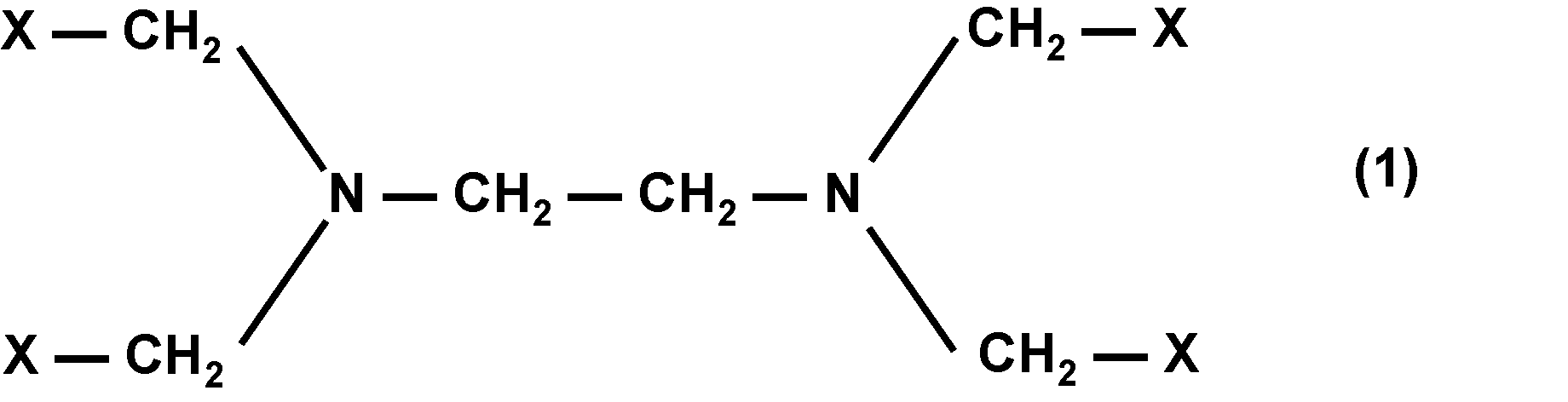
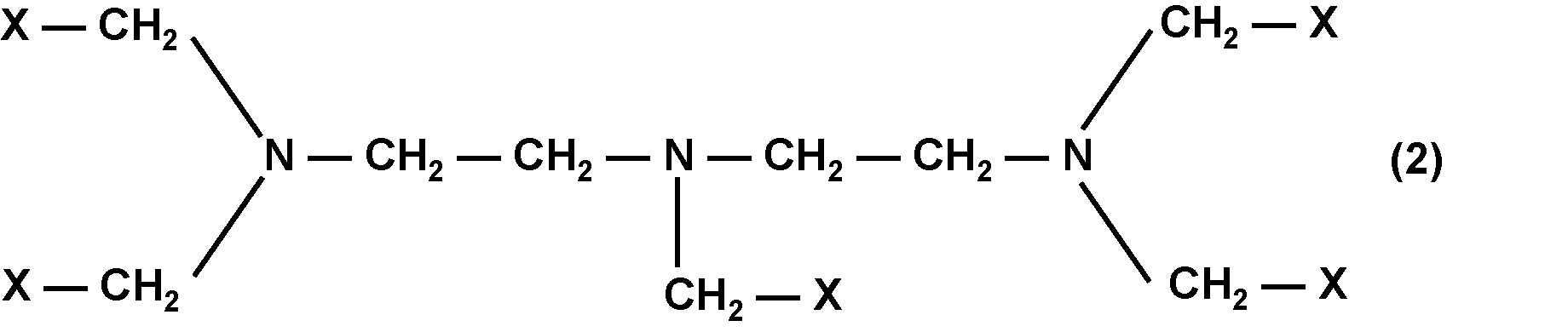
一般式(1)及び一般式(2)において、Xは、それぞれ独立に、カルボキシ基、カルボキシレート基又は一般式(3)で表される1価の基である。
また、一般式(1)及び一般式(2)における複数のXの内、少なくとも1つがカルボキシ基又はカルボキシレート基である。生体組織脆化作用の観点からは、少なくとも2つがカルボキシ基又はカルボキシレート基であることが好ましく、少なくとも3つがカルボキシ基又はカルボキシレート基であることが更に好ましい。
また、一般式(1)及び一般式(2)における複数のXの内、少なくとも1つが一般式(3)で表される1価の基である。生体への安全性の観点からは、少なくとも2つが一般式(3)で表される1価の基であることが好ましい。
In the general formula (1) and the general formula (2), X is independently a carboxy group, a carboxylate group, or a monovalent group represented by the general formula (3).
Further, at least one of the plurality of Xs in the general formula (1) and the general formula (2) is a carboxy group or a carboxylate group. From the viewpoint of biological tissue embrittlement, at least two are preferably carboxy groups or carboxylate groups, and at least three are more preferably carboxy groups or carboxylate groups.
Further, at least one of the plurality of Xs in the general formula (1) and the general formula (2) is a monovalent group represented by the general formula (3). From the viewpoint of safety to the living body, it is preferable that at least two are monovalent groups represented by the general formula (3).
アミノポリカルボン酸型化合物は工業用途で古くからキレート剤として利用されており、「DTPA(一般式(2)に対応する骨格)」は、「EDTA(一般式(1)に対応する骨格)」と比較してほぼ同等のキレート生成能力を有する。カルシウムイオンに対する安定度定数(logK)はEDTA:10.9に対し、DTPA:10.7である。また、安全性については、Ca-EDTAとCa-DTPAをそれぞれビーグル犬に1ヶ月間静脈投与した際に大きな差が無いことが知られている。
従って、一般式(1)又は一般式(2)で表される化合物は、キレート能および安全性の観点から同様の効果を示すと考えられる。
Aminopolycarboxylic acid type compounds have been used as chelating agents for a long time in industrial applications, and "DTPA (skeleton corresponding to general formula (2))" is "EDTA (skeleton corresponding to general formula (1))". Has almost the same chelate-producing ability as compared with. The stability constant (logK) for calcium ions is DTPA: 10.7 with respect to EDTA: 10.9. In addition, it is known that there is no significant difference in safety when Ca-EDTA and Ca-DTPA are intravenously administered to beagle dogs for one month.
Therefore, the compound represented by the general formula (1) or the general formula (2) is considered to exhibit the same effect from the viewpoint of chelating ability and safety.
一般式(1)及び一般式(2)におけるXがカルボキシレート基である場合、カルボキシレート基の対イオンは、アルカリ金属イオン(ナトリウムイオン及びカリウムイオン等)及びアルカリ土類金属イオン(カルシウムイオン等)等が挙げられ、好ましくはナトリウムイオンである。 When X in the general formula (1) and the general formula (2) is a carboxylate group, the counter ion of the carboxylate group is an alkali metal ion (sodium ion, potassium ion, etc.) and an alkaline earth metal ion (calcium ion, etc.). ) And the like, preferably sodium ion.
-C(O)-Y-(AO)n-R (3) -C (O) -Y- (AO) n -R (3)
一般式(3)において、-Y-は-O-、-NH-又は-S-である。-Y-は-O-であることが好ましい。 In the general formula (3), -Y- is -O-, -NH- or -S-. -Y- is preferably -O-.
-Y-が-NH-又は-S-であっても、これらは非共有孤立電子対を有するヘテロ原子のためYが-O-である場合と同様のキレート効果を発揮する。また、-Y-が-NH-又は-S-であっても、-Y-が-O-の場合と比較して安全性は同等である。 Even if -Y- is -NH- or -S-, these are heteroatoms having unshared isolated electron pairs, so that they exhibit the same chelating effect as when Y is -O-. Further, even if -Y- is -NH- or -S-, the safety is equivalent as compared with the case where -Y- is -O-.
また、一般式(3)において、Aは、炭素数2~4のアルキレン基(エチレン基、1,2-又は1,3-プロピレン基、1,2-、1,3-、1,4-又は2,3-ブチレン基等)である。
また、一般式(3)において、Rは、水素原子、又は、水素原子が炭素数1~10のアルコキシ基で置換されていてもよい炭素数1~15の1価の炭化水素基(メチル基、エチル基、iso-プロピル基、tert-ブチル基、ネオペンチル基及びテトラデシル基等)である。
また、一般式(3)において、nは、4~1000の整数である。生体への安全性の観点からは、nは10~500であることが好ましい。また、生体組織脆化作用の観点からは、nは、4~100であることがより好ましく、4~50であることが更に好ましい。
なお、一般式(3)において、n個あるAの内、少なくとも1個はエチレン基である。製剤安定性並びに生体への安全性の観点の観点からは、n個あるAの内、85%以上の個数がエチレン基であることが好ましい。
なお、Aのアルキレン基の炭素数が2~4のいずれであるかに関わらず、キレート効果は同様に発揮される。また、Aのアルキレン基の炭素数が2~4のいずれであっても、安全性は同等である。
なお、一般式(1)及び一般式(2)において、一般式(3)で表される1価の基を複数有する場合、Y、A、R及びnは同一でも異なっていても良い。
Further, in the general formula (3), A is an alkylene group having 2 to 4 carbon atoms (ethylene group, 1,2- or 1,3-propylene group, 1,2-, 1,3-, 1,4-. Or 2,3-butylene group, etc.).
Further, in the general formula (3), R is a hydrogen atom or a monovalent hydrocarbon group (methyl group) having 1 to 15 carbon atoms in which the hydrogen atom may be substituted with an alkoxy group having 1 to 10 carbon atoms. , Ethyl group, iso-propyl group, tert-butyl group, neopentyl group, tetradecyl group, etc.).
Further, in the general formula (3), n is an integer of 4 to 1000. From the viewpoint of safety to the living body, n is preferably 10 to 500. Further, from the viewpoint of the embrittlement action of living tissue, n is more preferably 4 to 100, further preferably 4 to 50.
In the general formula (3), at least one of the n A's is an ethylene group. From the viewpoint of pharmaceutical stability and safety to the living body, it is preferable that 85% or more of the n A's are ethylene groups.
The chelating effect is similarly exhibited regardless of whether the alkylene group of A has 2 to 4 carbon atoms. Further, the safety is the same regardless of whether the alkylene group of A has 2 to 4 carbon atoms.
In the general formula (1) and the general formula (2), when a plurality of monovalent groups represented by the general formula (3) are present, Y, A, R and n may be the same or different.
前記の化合物(Z)が有するカルボキシ基及びカルボキシレート基の合計モル数は、生体組織脆化作用の観点から、化合物(Z)の重量を基準として、0.04~14mmol/gであることが好ましく、0.04~5mmol/gであることがさらに好ましい。 The total number of moles of the carboxy group and the carboxylate group contained in the compound (Z) may be 0.04 to 14 mmol / g based on the weight of the compound (Z) from the viewpoint of the embrittlement of the biological tissue. It is preferably 0.04 to 5 mmol / g, and more preferably 0.04 to 5 mmol / g.
前記の化合物(Z)の重量平均分子量は、生体への安全性の観点から500~20000であることが好ましく、500~10000であることがより好ましく、2000~10000であることが更に好ましい。
また、一般式(1)又は一般式(2)で表される化合物(Z)を複数含有する組成物の場合は、化合物(Z)に該当する全ての化合物の重量平均分子量が上記の範囲であることが好ましい。
本発明において、重量平均分子量は、下記の方法で測定することができる。
装置本体:HLC-8320GPC(東ソー(株)製)
カラム:東ソー(株)製TSK gel Super AW
検出器:RI(Refractive Index)
溶離液:0.01M LiBr・DMF
溶離液流量:0.6ml/分
カラム温度:40℃
試料濃度:0.125重量%
注入量:20μl
標準物質:東ソー(株)製TSK STANDARD POLYETHYLENE OXIDE
The weight average molecular weight of the compound (Z) is preferably 500 to 20000, more preferably 500 to 10000, and even more preferably 2000 to 10000 from the viewpoint of safety to the living body.
Further, in the case of a composition containing a plurality of compounds (Z) represented by the general formula (1) or the general formula (2), the weight average molecular weights of all the compounds corresponding to the compound (Z) are within the above range. It is preferable to have.
In the present invention, the weight average molecular weight can be measured by the following method.
Device body: HLC-8320GPC (manufactured by Tosoh Corporation)
Column: TSK gel Super AW manufactured by Tosoh Corporation
Detector: RI (Refractive Index)
Eluent: 0.01M LiBr · DMF
Eluent flow rate: 0.6 ml / min Column temperature: 40 ° C
Sample concentration: 0.125% by weight
Injection volume: 20 μl
Standard material: TSK STANDARD POLYETHYLENE OXIDE manufactured by Tosoh Corporation
前記の化合物(Z)の数平均分子量は、生体への安全性の観点から500~20000であることが好ましく、500~10000であることがより好ましく、2000~10000であることが更に好ましい。
また、一般式(1)又は一般式(2)で表される化合物(Z)を複数含有する組成物の場合は、化合物(Z)に該当する全ての化合物の数平均分子量が上記の範囲であることが好ましい。
本発明において、数平均分子量は、下記の方法で測定することができる。
数平均分子量は、1H-NMRを用いて測定することができる。例えば、化合物(Z)が、一般式(1)において一般式(3)で表される1価の基を1つ有する化合物と、一般式(1)において一般式(3)で表される1価の基を2つ有する化合物との混合物であり、かつ、Aが炭素数2のアルキレン基である場合、以下の方法で算出することができる。
一般式(1)において一般式(3)で表される1価の基を1つ有する化合物と、一般式(1)において一般式(3)で表される1価の基を2つ有する化合物のモル比(α:β)及び1H-NMRにおけるAのメチレン基由来シグナルの積分値(γ)から、以下の通り算出できる。ただし、1H-NMRの積分値を算出する場合、一般式(1)において2個の窒素に挟まれる2個のメチレン基由来シグナルの合計積分値を4とする。
nsum=γ/{[4×α+8×β]/(α+β)}
(数平均分子量)=44×nsum+292
<1H-NMRの評価条件>
溶媒:重DMSO
装置:AVANCE III HD400(ブルカージャパン株式会社製)
周波数:400MHz
The number average molecular weight of the compound (Z) is preferably 500 to 20000, more preferably 500 to 10000, and even more preferably 2000 to 10000 from the viewpoint of safety to the living body.
Further, in the case of a composition containing a plurality of compounds (Z) represented by the general formula (1) or the general formula (2), the number average molecular weight of all the compounds corresponding to the compound (Z) is within the above range. It is preferable to have.
In the present invention, the number average molecular weight can be measured by the following method.
The number average molecular weight can be measured using 1 H-NMR. For example, a compound (Z) having one monovalent group represented by the general formula (3) in the general formula (1) and a compound represented by the general formula (3) in the general formula (1) 1 When it is a mixture with a compound having two valence groups and A is an alkylene group having 2 carbon atoms, it can be calculated by the following method.
A compound having one monovalent group represented by the general formula (3) in the general formula (1) and a compound having two monovalent groups represented by the general formula (3) in the general formula (1). It can be calculated as follows from the molar ratio (α: β) of No. 1 and the integrated value (γ) of the signal derived from the methylene group of A in 1 H-NMR. However, when calculating the integral value of 1 H-NMR, the total integral value of the signals derived from the two methylene groups sandwiched between the two nitrogens in the general formula (1) is set to 4.
n sum = γ / {[4 × α + 8 × β] / (α + β)}
(Number average molecular weight) = 44 × n sum +292
< 1 1 H-NMR evaluation conditions>
Solvent: heavy DMSO
Equipment: AVANCE III HD400 (manufactured by Bruker Japan Co., Ltd.)
Frequency: 400MHz
前記の化合物(Z)は、以下の方法により製造することができる。
EDTA二無水物及び水(EDTA二無水物に対して1モル当量であることが好ましい)を、有機溶媒(DMF等)中で、70~80℃で混合することで(2~4時間混合することが好ましい)、EDTA一無水物を得る。
次いで、塩基性化合物(トリエチルアミン及びジイソプロピルエチルアミン等)、一般式(4)で表される化合物を添加し、25~70℃で混合することで(2~24時間混合することが好ましい)、化合物(Z)を製造することができる[この場合、一般式(3)で表される1価の基を1つ有する化合物(Z)が主生成物として得られる。一般式(3)における-Y-は-O-となる。]。
HO-(AO)n-R (4)
なお、一般式(4)におけるA、R及びnは、一般式(3)におけるA、R及びnと同じである。
The compound (Z) can be produced by the following method.
EDTA dianhydride and water (preferably 1 mol equivalent relative to EDTA dianhydride) are mixed in an organic solvent (such as DMF) at 70-80 ° C (2-4 hours). Preferably), EDTA monoanhydride is obtained.
Then, a basic compound (triethylamine, diisopropylethylamine, etc.) and a compound represented by the general formula (4) are added and mixed at 25 to 70 ° C. (preferably mixed for 2 to 24 hours) to obtain a compound (preferably mixed for 2 to 24 hours). Z) can be produced [in this case, the compound (Z) having one monovalent group represented by the general formula (3) is obtained as the main product. -Y- in the general formula (3) becomes -O-. ].
HO- (AO) n -R (4)
In addition, A, R and n in the general formula (4) are the same as A, R and n in the general formula (3).
また、一般式(4)で表される化合物に代えて、下記の化合物を使用してもよい。
H2N-(AO)n-R (5)
HS-(AO)n-R (6)
一般式(5)で表される化合物を使用した場合、一般式(3)における-Y-は-NH-となり、一般式(6)で表される化合物を使用した場合、一般式(3)における-Y-は-S-となる。
なお、一般式(5)及び(6)におけるA、R及びnは、一般式(3)におけるA、R及びnと同じである。
Further, the following compound may be used instead of the compound represented by the general formula (4).
H 2 N- (AO) n -R (5)
HS- (AO) n -R (6)
When the compound represented by the general formula (5) is used, -Y- in the general formula (3) becomes -NH-, and when the compound represented by the general formula (6) is used, the general formula (3) is used. In-Y- becomes -S-.
Note that A, R and n in the general formulas (5) and (6) are the same as A, R and n in the general formula (3).
また、上記以外の方法であっても、例えば以下の方法で製造することもできる。
EDTA二無水物及び一般式(3)で表される基と水酸基が結合した化合物を、有機溶媒(DMF等)中で、前記の塩基性化合物の存在下で、25~70℃で混合することで、(2~24時間混合することが好ましい)化合物(Z)を製造することができる[この場合、一般式(3)で表される1価の基を2つ有する化合物(Z)が主生成物として得られる]。
Further, even if it is a method other than the above, it can be produced by, for example, the following method.
The EDTA dianhydride and the compound in which the group represented by the general formula (3) and the hydroxyl group are bonded are mixed in an organic solvent (DMF or the like) at 25 to 70 ° C. in the presence of the basic compound. The compound (Z) can be produced (preferably mixed for 2 to 24 hours) [in this case, the compound (Z) having two monovalent groups represented by the general formula (3) is the main component. Obtained as a product].
本発明の組成物は、前記の化合物(Z)を含有する。
前記の化合物(Z)は、1種を単独で用いても、2種以上を併用してもよい。
The composition of the present invention contains the above-mentioned compound (Z).
The compound (Z) may be used alone or in combination of two or more.
本発明の組成物は、粉末、錠剤、ゲル、ゾル及び溶液のいずれでも構わないが、溶液である場合、前記の化合物(Z)以外に、水を含有することが好ましい。
また、本発明の組成物は、前記の化合物(Z)及び水以外に、発明の効果を阻害しない範囲で、塩(塩化ナトリウム等)等を含有していても良い。
The composition of the present invention may be any of powder, tablet, gel, sol and solution, but when it is a solution, it preferably contains water in addition to the above compound (Z).
Further, the composition of the present invention may contain a salt (sodium chloride or the like) or the like as long as the effect of the present invention is not impaired, in addition to the above-mentioned compound (Z) and water.
組成物が溶液である場合、前記の化合物(Z)の重量割合は、生体組織脆化作用の観点から、組成物の重量を基準として1~500mMであることが好ましく、更に好ましくは2~250mMである。 When the composition is a solution, the weight ratio of the compound (Z) is preferably 1 to 500 mM, more preferably 2 to 250 mM with respect to the weight of the composition from the viewpoint of the embrittlement of biological tissues. Is.
本発明の組成物は、後述の生体組織脆化剤として用いることができ、有用である。 The composition of the present invention can be used as a biological tissue embrittlement agent described later and is useful.
本発明の生体組織脆化剤は、前記の化合物(Z)を含有する。本発明の生体組織脆化剤の好ましい態様は、本発明の組成物と同じである。
生体組織脆化剤は、粉末、錠剤、ゲル、ゾル及び溶液のいずれでも構わないが、溶液である場合、前記の化合物(Z)以外に、水を含有することが好ましい。
また、本発明の生体組織脆化剤は、前記の化合物(Z)及び水以外に、発明の効果を阻害しない範囲で、塩(塩化ナトリウム等)等を含有していても良い。
The biological tissue embrittler of the present invention contains the above-mentioned compound (Z). A preferred embodiment of the biological tissue embrittler of the present invention is the same as the composition of the present invention.
The biological tissue embrittler may be any of powder, tablet, gel, sol and solution, but when it is a solution, it preferably contains water in addition to the above compound (Z).
Further, the biological tissue embrittler of the present invention may contain a salt (sodium chloride or the like) or the like as long as the effect of the present invention is not impaired, in addition to the above-mentioned compound (Z) and water.
生体組織脆化剤が溶液である場合、前記の化合物(Z)の重量割合は、生体組織脆化作用の観点から、生体組織脆化剤の重量を基準として1~500mMであることが好ましく、更に好ましくは2~250mMである。 When the biological tissue embrittler is a solution, the weight ratio of the compound (Z) is preferably 1 to 500 mM based on the weight of the biological tissue embrittlement from the viewpoint of the biological tissue embrittlement action. More preferably, it is 2 to 250 mM.
生体組織脆化剤の適用対象とされる生体組織としては、消化管上皮、粘膜、皮膚、結合織等が挙げられる。生体組織脆化は、再生医療で新規細胞構造体を移植する際に、前処理として移植部位の上皮や粘膜から不要組織を除去する目的や、傷害組織や壊死組織を除去して組織再生を促す場合に主に利用される。この場合、基盤組織をできるだけ傷つけないように侵襲度を最小限にし、除去目的組織を効率的に取り除く必要がある。本発明者らは、この観点から日本薬局方に登録され、医療分野でも利用できるEDTAをベースとして、キレート能を保持しつつ生体作用の安全性を高めるべく、高機能複合体として創製することに成功した。
前記の生体組織として、消化管を標的とする場合に生体組織脆化の観点から好ましいのは、大腸上皮及び小腸上皮である。大腸上皮を剥離除去し、その部位に各種オルガノイド(大腸オルガノイド及び小腸オルガノイド等)を移植することが考えられる。
Examples of the biological tissue to which the biological tissue embrittlement agent is applied include gastrointestinal epithelium, mucous membrane, skin, connective tissue and the like. When transplanting a new cell structure in regenerative medicine, biological tissue brittleness has the purpose of removing unnecessary tissue from the epithelium and mucous membrane of the transplant site as a pretreatment, and removes injured tissue and necrotic tissue to promote tissue regeneration. Mainly used in cases. In this case, it is necessary to minimize the degree of invasiveness so as not to damage the underlying tissue as much as possible, and to efficiently remove the tissue to be removed. From this point of view, the present inventors decided to create a highly functional complex based on EDTA, which is registered in the Japanese Pharmacopoeia and can be used in the medical field, in order to enhance the safety of biological action while maintaining the chelating ability. Successful.
When the gastrointestinal tract is targeted as the above-mentioned biological tissue, the large intestine epithelium and the small intestinal epithelium are preferable from the viewpoint of embrittlement of the biological tissue. It is conceivable to exfoliate and remove the large intestine epithelium and transplant various organoids (large intestine organoids, small intestine organoids, etc.) to the site.
本発明の生体組織脆化剤は、細胞接着に必要なカルシウム等のイオンをキレートし、細胞間接着を脆弱化して、細胞遊離機能を発揮する。それゆえ、生体組織に適用する場合は、本剤を接触させる工程であれば、固定、塗布、滞留等の手技は問わない。また、組織脆化後の組織除去は、剥離、擦過、洗浄など、細胞や結合織が遊離する方法であれば、いずれでもよい。さらに、本剤によって組織脆化・除去が行われた部位に細胞や組織のオルガノイド等を移植する操作も、特に限定はされない。また、移植される細胞や組織の構造体は、シート、ブロック、オルガノイド等、その形状はいずれでも適用し得る。
たとえば、本発明の生体組織表面の剥離方法により、大腸上皮を剥離し、他の組織を移植することができ、移植する組織に応じた特性を生体組織に付与することができる。短腸症候群の再生医療治療法に本技術を適用させる場合に好ましいのは小腸オルガノイド(非特許文献1~2等に記載)である。
The biological tissue embrittlement agent of the present invention chelate ions such as calcium required for cell adhesion, weaken cell-cell adhesion, and exert a cell release function. Therefore, when applied to living tissues, any procedure such as fixing, coating, or retention may be used as long as it is a step of contacting this agent. Further, the tissue removal after the tissue embrittlement may be any method as long as it is a method for releasing cells and connective tissue, such as peeling, scraping, and washing. Furthermore, the operation of transplanting cell or tissue organoids to the site where the tissue is embrittled / removed by this drug is not particularly limited. Further, the structure of the cell or tissue to be transplanted can be any shape such as a sheet, a block, and an organoid.
For example, according to the method for exfoliating the surface of a living tissue of the present invention, the large intestine epithelium can be exfoliated and another tissue can be transplanted, and the living tissue can be imparted with characteristics according to the tissue to be transplanted. Small intestinal organoids (described in Non-Patent Documents 1 and 2 and the like) are preferable when this technique is applied to a regenerative medicine treatment method for short bowel syndrome.
また、本発明の生体組織脆化剤は、潰瘍や傷害、壊死などに至った皮膚組織を除去するデブリードマンにも利用することができ、健常組織の再生にも適用できる。褥瘡部位の傷の清浄化、痔瘻や外科手術後の瘻管の清浄化、炎症粘膜の剥離・洗浄化などで、さらには、皮下組織や体腔内であれば、臓器や組織の不具合のある癒着部位に本剤を剥離補助剤として適用し、癒着修復を促進させる目的で使用することもできる。外科手術時に、組織や臓器の癒着は、ときに手術を困難にさせることがあるが、こうした場合にも、本発明技術は有効な解決手段を提供する。 Further, the biological tissue embrittlement agent of the present invention can also be used for debridement that removes skin tissue that has led to ulcers, injuries, necrosis, etc., and can also be applied to regeneration of healthy tissues. Cleaning of wounds in the decubitus area, cleaning of fistulas and fistulas after surgery, peeling and cleaning of inflamed mucous membranes, and adhesion sites with defective organs and tissues in the subcutaneous tissue and body cavity. This agent can also be applied as a peeling aid and used for the purpose of promoting adhesion repair. During surgery, adhesions of tissues and organs can sometimes make surgery difficult, and the techniques of the present invention also provide an effective solution.
さらに、スキンケア領域では、本剤を古い角質層を除去するケミカルピーリングにおける補助剤として使用し、皮膚刺激を最小限に調整しながら、有効に角質層を除去し得る。 Furthermore, in the skin care area, this agent can be used as an auxiliary agent in chemical peels to remove the old stratum corneum, and the stratum corneum can be effectively removed while minimizing skin irritation.
また、臨床検査時における粘膜組織の剥離分離にも広く使用できる。従来、切除、引っ掻き、拭いなどの作業で組織片を取得したような場合でも、本発明の生体組織脆化剤は目的組織表面から細胞生化学的に一定の構造を保持した形で組織片を剥離取得できるため、臨床検査における組織病理診断や細胞診における三次元的観察に適した組織採取法として活用できる。たとえば、子宮頸がん検査などに有用である。 It can also be widely used for exfoliation and separation of mucosal tissue during clinical examination. Conventionally, even when a tissue piece is obtained by excision, scratching, wiping, etc., the biological tissue brittle agent of the present invention can remove the tissue piece from the surface of the target tissue in a form that retains a certain cell biochemical structure. Since it can be peeled off, it can be used as a tissue collection method suitable for histopathological diagnosis in clinical examination and three-dimensional observation in cytodiagnosis. For example, it is useful for cervical cancer examination.
具体的には、後述の本発明の生体組織表面の剥離方法にて説明するが、本発明の生体組織脆化剤を適用する形態は、目的部位の生体組織表面に一定時間接触できることができれば、粉末、錠剤、ゲル、ゾル、クリーム、貼付剤、パッチ、溶液のいずれでも構わない。たとえば、ゲルを粘膜上皮部位に接触させ、一定時間経過後に、接触部位の組織を洗浄剥離や擦過剥離で除去することが好ましい手法のひとつである。また、本剤を標的部位に接触させる手法としては、ゾンデ、カテーテル、注射、スプレー、内視鏡、腹腔鏡、胸腔鏡、貼付材、ブラシなどを接触用機材として用いることができ、本発明の生体組織脆化剤を一定時間接触後に除去する際には、洗浄、吸引、剥離などの操作を加えることで、接触部位の除去が達成される。 Specifically, the method for peeling the surface of the biological tissue of the present invention will be described later, but the form to which the biological tissue brittle agent of the present invention is applied is long if it can be in contact with the surface of the biological tissue of the target site for a certain period of time. It can be a powder, tablet, gel, sol, cream, patch, patch, or solution. For example, it is one of the preferable methods to bring the gel into contact with the mucosal epithelial site and remove the tissue at the contact site by washing peeling or scraping peeling after a certain period of time. Further, as a method for bringing this agent into contact with a target site, a sonde, a catheter, an injection, a spray, an endoscope, a laparoscope, a thoracoscope, a patch, a brush, etc. can be used as contact equipment, and the present invention can be used. When removing the biological tissue brittle agent after contact for a certain period of time, removal of the contact portion is achieved by adding operations such as washing, suction, and peeling.
本発明の生体組織表面の剥離方法は、生体組織に前記の化合物(Z)を接触させて前記生体組織の表面を脆化する工程(以降「脆化工程」と略記することがある)と、前記生体組織の脆化した表面部分から細胞組織を剥離する工程(以降「剥離工程」と略記することがある)とを含む方法である。
ここで、本発明において、生体組織の表面とは細胞が表層状に結合している状態であればよく、前記の皮膚、消化管上皮、外部粘膜等に限らず、器官内部の存在する表面も含む概念である。
The method for peeling the surface of a living tissue of the present invention includes a step of bringing the compound (Z) into contact with the living tissue to make the surface of the living tissue brittle (hereinafter, may be abbreviated as "brittle step"). It is a method including a step of peeling a cell tissue from a brittled surface portion of the living tissue (hereinafter, may be abbreviated as "peeling step").
Here, in the present invention, the surface of the living tissue may be in a state where cells are connected in a surface layer, and not only the skin, gastrointestinal epithelium, external mucous membrane, etc., but also the surface where the inside of the organ exists. It is a concept that includes.
前記の脆化工程の具体的な態様としては、以下の内容が挙げられる。
生体組織脆化剤が含有する化合物(Z)に接触させる方法としては、脆化させたい生体組織(接触部位)を外科的手法により露出させ(上記の非特許文献1及び非特許文献2等に記載の方法等を用いることができる)、生体組織脆化剤をゾンデ、カテーテル、注射、スプレーを用いて投与する方法等が挙げられる。
例えば、脆化させたい生体組織が大腸上皮である場合は、外科的手法により大腸を腹腔外に露出させ、カテーテルを用いて、腸管内に、生体組織脆化剤を投与する方法等が挙げられる。
生体組織脆化剤は、脆化させたい生体組織(接触部位)に投与する前に、20~50℃に加温することが好ましい。
Specific embodiments of the embrittlement step include the following contents.
As a method of contacting the compound (Z) contained in the biological tissue embrittlement agent, the biological tissue (contact site) to be embrittled is exposed by a surgical method (see Non-Patent Document 1 and Non-Patent Document 2 above). The method described above can be used), a method of administering a biological tissue embrittler using a sonde, a catheter, an injection, a spray, or the like.
For example, when the living tissue to be embrittled is the large intestine epithelium, a method of exposing the large intestine to the outside of the abdominal cavity by a surgical technique and administering a living tissue embrittlement agent into the intestinal tract using a catheter can be mentioned. ..
The biological tissue embrittlement agent is preferably heated to 20 to 50 ° C. before being administered to the biological tissue (contact site) to be embrittled.
前記の剥離工程の具体的な態様としては、以下の内容が挙げられる。
生体組織の脆化した表面部分から細胞組織を剥離する方法としては、接触部位について、洗浄剥離(生理食塩水等による洗浄の圧力による剥離)及び擦過剥離[ブラシ(歯間ブラシ等)等による擦過による剥離]等を実施することにより、細胞組織を除去する方法等が挙げられる。
剥離工程は、前記の脆化工程において、生体組織に前記の化合物(Z)を接触させてから、直後に速やかに実施することが好ましい。
Specific embodiments of the peeling step include the following contents.
As a method of exfoliating the cell tissue from the fragile surface portion of the living tissue, the contact site is exfoliated by washing (peeling by the pressure of washing with physiological saline or the like) and scraping by scraping [rubbing with a brush (interdental brush or the like) or the like). A method of removing the cell tissue by carrying out [peeling by] or the like can be mentioned.
It is preferable that the peeling step is immediately carried out immediately after the compound (Z) is brought into contact with the biological tissue in the embrittlement step.
本発明の生体組織表面の剥離方法は、前記の剥離工程以降に、生体組織脆化剤を生体から除去する除去工程を含んでいてもよい。
生体組織脆化剤を除去する方法としては、洗浄、吸引等の操作を実施することで、生体組織脆化剤を除去する方法等が挙げられる。なお、前記の除去工程は、剥離工程における洗浄剥離及び擦過剥離と同時に実施してもよい。
The method for peeling the surface of a living tissue of the present invention may include a removing step of removing the embrittlement agent for the living tissue from the living body after the peeling step.
Examples of the method for removing the biological tissue embrittler include a method for removing the biological tissue embrittler by performing operations such as washing and suction. The removal step may be performed at the same time as the washing peeling and the scraping peeling in the peeling step.
本発明の生体組織剥離キットは、本発明の生体組織脆化剤を必須の構成として含むキットである。
前記の生体組織剥離キットは、本発明の生体組織脆化剤以外に、生体組織脆化剤を注入するための器具(ゾンデ、カテーテル、注射、スプレー等)、剥離工程に用いる材料(生理食塩水及びブラシ等)を含んでいることが好ましい。医療用あるいはスキンケア用等に用いることができる。
The biological tissue exfoliation kit of the present invention is a kit containing the biological tissue embrittler of the present invention as an essential configuration.
In addition to the biological tissue brittle agent of the present invention, the above-mentioned biological tissue stripping kit includes an instrument for injecting a biological tissue brittle agent (sonde, catheter, injection, spray, etc.) and a material used in the stripping step (physiological saline solution). And brushes, etc.) are preferably included. It can be used for medical purposes or skin care.
以下本発明を実施例により具体的に説明するが、本発明はこれらの実施例に限定されるものではない。
尚、以下において部は重量部を表す。
Hereinafter, the present invention will be specifically described with reference to Examples, but the present invention is not limited to these Examples.
In the following, the part represents the weight part.
<製造例1:EDTA一無水物の製造>
EDTA二無水物(東京化成工業(株)製)148.5部をDMF(富士フイルム和光純薬(株)製)701部に90℃で溶解させ、75℃に冷却した後、DMF140.1部及び水10.4部(EDTA一無水物に対して1モル当量)の混合物を2時間かけて滴下した。滴下後75℃で2時間混合することで析出した固体を吸引ろ過することにより、化合物(PX-1)(EDTA一無水物)を収率62%、純度93重量%で得た。
<Production Example 1: Production of EDTA monoanhydride>
148.5 parts of EDTA dianhydride (manufactured by Tokyo Chemical Industry Co., Ltd.) was dissolved in 701 parts of DMF (manufactured by Wako Pure Chemical Industries, Ltd.) at 90 ° C., cooled to 75 ° C., and then 140.1 parts of DMF. And 10.4 parts of water (1 mol equivalent to EDTA monoanhydride) was added dropwise over 2 hours. The solid precipitated by mixing at 75 ° C. for 2 hours after the dropping was suction-filtered to obtain a compound (PX-1) (EDTA monoanhydride) in a yield of 62% and a purity of 93% by weight.
<製造例2:一般式(4)で表される化合物の製造方法>
メトキシポリエチレングリコール[一般式(4)で表される化合物(n=12が主成分である)、数平均分子量550、日油(株)製「ユニオックスM-550」]275部及び水酸化カリウム水溶液[東亞合成(株)製「スーパーカリ」]0.40部を撹拌及び温度調節機能の付いたステンレス製オートクレーブに仕込み、アルゴンガスで置換してから減圧にし、130℃に昇温した。
2.7kPa、130℃で2時間脱水を行なった後、150℃に昇温し、エチレンオキサイド725部をオートクレーブ内圧が0.4MPa以上にならないようにして、145~155℃の範囲で5時間かけて徐々に滴下した。滴下終了後、145~155℃でオートクレーブの内圧が滴下開始時と同じ圧力を示すまで1時間熟成させ、一般式(4)で表される化合物(n=45の化合物が主成分である)メトキシポリエチレングリコール1000部を得た。
<Production Example 2: Method for producing a compound represented by the general formula (4)>
Methoxypolyethylene glycol [Compound represented by the general formula (4) (mainly composed of n = 12), number average molecular weight 550, "Uniox M-550" manufactured by Nichiyu Co., Ltd.] 275 parts and potassium hydroxide 0.40 part of an aqueous solution [“Super Potassium” manufactured by Toa Synthetic Co., Ltd.] was placed in a stainless steel autoclave equipped with stirring and temperature control functions, replaced with argon gas, reduced in pressure, and heated to 130 ° C.
After dehydration at 2.7 kPa and 130 ° C. for 2 hours, the temperature is raised to 150 ° C., and 725 parts of ethylene oxide is placed in the range of 145 to 155 ° C. for 5 hours so that the internal pressure of the autoclave does not exceed 0.4 MPa. And gradually dropped. After the completion of the dropping, the mixture is aged at 145 to 155 ° C. for 1 hour until the internal pressure of the autoclave shows the same pressure as that at the start of the dropping, and the compound represented by the general formula (4) (mainly composed of the compound of n = 45) methoxy. 1000 parts of polyethylene glycol was obtained.
<製造例3:一般式(4)で表される化合物の製造方法>
メトキシポリエチレングリコール[一般式(4)で表される化合物(n=12が主成分である)、数平均分子量550、日油(株)製「ユニオックスM-550」]137部及び水酸化カリウム水溶液[東亞合成(株)製「スーパーカリ」]0.4部を撹拌及び温度調節機能の付いたステンレス製オートクレーブに仕込み、アルゴンガスで置換してから減圧にし、130℃に昇温した。
2.7kPa、130℃で2時間脱水を行なった後、120℃に温調し、エチレンオキサイド863部をオートクレーブ内圧が0.4MPa以上にならないようにして、115~125℃の範囲で10時間かけて徐々に滴下した。滴下終了後、115~125℃でオートクレーブの内圧が滴下開始時と同じ圧力を示すまで1時間熟成させ、一般式(4)で表される化合物(n=90の化合物が主成分である)メトキシポリエチレングリコール1000部を得た。
<Production Example 3: Method for producing a compound represented by the general formula (4)>
Methoxypolyethylene glycol [Compound represented by the general formula (4) (mainly composed of n = 12), number average molecular weight 550, "Uniox M-550" manufactured by Nichiyu Co., Ltd.] 137 parts and potassium hydroxide 0.4 part of an aqueous solution [“Super Potassium” manufactured by Toa Synthetic Co., Ltd.] was placed in a stainless steel autoclave equipped with stirring and temperature control functions, replaced with argon gas, reduced in pressure, and heated to 130 ° C.
After dehydration at 2.7 kPa and 130 ° C. for 2 hours, the temperature was adjusted to 120 ° C., and 863 parts of ethylene oxide was placed in the autoclave so that the internal pressure of the autoclave did not exceed 0.4 MPa over 10 hours in the range of 115 to 125 ° C. And gradually dropped. After the completion of the dropping, the mixture is aged at 115 to 125 ° C. for 1 hour until the internal pressure of the autoclave shows the same pressure as that at the start of the dropping, and the compound represented by the general formula (4) (mainly composed of the compound of n = 90) methoxy. 1000 parts of polyethylene glycol was obtained.
<実施例1:化合物(Z-1)の製造>
メトキシポリエチレングリコール[一般式(4)で表される化合物(n=12の化合物が主成分である)、数平均分子量550、日油(株)製「ユニオックスM-550」]22部をDMF107部に溶解し、60℃でジイソプロピルエチルアミン(東京化成工業(株)製)5部、製造例1で製造した化合物(PX-1)11部を順に投入し、60℃で5時間混合し、t-ブチルメチルエーテル(ナカライテスク製)855部を加え、吸引ろ過することにより化合物(Z-1)[一般式(1)において一般式(3)で表される1価の基を1つ有する化合物(Z-1-1)(82重量%)と、一般式(1)において一般式(3)で表される1価の基を2つ有する化合物(Z-1-2)(15重量%)]と、不純物であるメトキシポリエチレングリコール(3重量%)との混合物を得た。上記混合物100重量%に含まれる化合物(Z-1)の純度は97重量%であった。また、上記混合物の収率は45%であった。
化合物(Z-1)の主成分(Z-1-1)と副成分(Z-1-2)の数平均分子量はそれぞれ850と1400であり、化合物(Z-1)の主成分(Z-1-1)が有するカルボキシ基の合計モル数は主成分(Z-1-1)の重量を基準として1.2mmol/gであり、副成分(Z-1-2)が有するカルボキシ基の合計モル数は副成分(Z-1-2)の重量を基準として1.4mmol/gであった。
また、化合物(Z)に該当する成分[主成分(Z-1-1)及び副成分(Z-1-2)]の数平均分子量は935であり、化合物(Z)に該当する成分が有するカルボキシ基及びカルボキシレート基の合計モル数は1.2mmol/gであった。
なお化合物(Z-1)の1H-NMRスペクトルチャートは、以下の通りであった。
1H-NMR(D2O,400MHz):δ3.25(t,2H,-NCH2CH2N-),3.36(s,3H,-OMe),3.44(t,2H,-NCH2CH2N-),3.58-3.80(m,PEG),3.90(s,4H,-NCH2COOH and -NCH2COO-),3.93(s,4H,-NCH2COOH×2),4.33(m,2H,-COOCH2CH2O-)
<Example 1: Production of compound (Z-1)>
DMF107 of methoxypolyethylene glycol [a compound represented by the general formula (4) (mainly composed of a compound of n = 12), number average molecular weight 550, "Uniox M-550" manufactured by Nichiyu Co., Ltd.] 5 parts of diisopropylethylamine (manufactured by Tokyo Kasei Kogyo Co., Ltd.) and 11 parts of the compound (PX-1) manufactured in Production Example 1 were added in this order at 60 ° C. and mixed at 60 ° C. for 5 hours. -Add 855 parts of butyl methyl ether (manufactured by Nakaraitesk) and suction filter to compound (Z-1) [a compound having one monovalent group represented by the general formula (3) in the general formula (1). (Z-1-1) (82% by weight) and a compound (Z-1-2) (15% by weight) having two monovalent groups represented by the general formula (3) in the general formula (1). ] And the impurity methoxypolyethylene glycol (3% by weight) were obtained. The purity of the compound (Z-1) contained in 100% by weight of the mixture was 97% by weight. The yield of the mixture was 45%.
The number average molecular weights of the main component (Z-1-1) and the sub-component (Z-1-2) of the compound (Z-1) are 850 and 1400, respectively, and the main component (Z-) of the compound (Z-1). The total number of moles of carboxy groups contained in 1-1) is 1.2 mmol / g based on the weight of the main component (Z-1-1), and the total number of carboxy groups contained in the sub-component (Z-1-2). The number of moles was 1.4 mmol / g based on the weight of the subcomponent (Z-1-2).
Further, the number average molecular weight of the component [main component (Z-1-1) and sub-component (Z-1-2)] corresponding to the compound (Z) is 935, and the component corresponding to the compound (Z) has. The total number of moles of the carboxy group and the carboxylate group was 1.2 mmol / g.
The 1 H-NMR spectrum chart of compound (Z-1) was as follows.
1 1 H-NMR (D2 O, 400 MHz): δ3.25 (t, 2H, -NCH 2 CH 2N- ), 3.36 (s, 3H, -OMe), 3.44 (t, 2H,- NCH 2 CH 2 N-), 3.58-3.80 (m, PEG), 3.90 (s, 4H, -NCH 2 COOH and -NCH 2 COO-), 3.93 (s, 4H,- NCH 2 COOH x 2), 4.33 (m, 2H, -COOCH 2 CH 2 O-)
<実施例2:化合物(Z-2)の製造>
メトキシポリエチレングリコール[一般式(4)で表される化合物(n=12の化合物が主成分である)、数平均分子量550、日油(株)製「ユニオックスM-550」]46部をDMF104部に溶解し、25℃でジイソプロピルエチルアミン10.5部、EDTA二無水物10.5部を順に投入し、60℃で5時間混合し、t-ブチルメチルエーテル829部を加え、吸引ろ過することにより化合物(Z-2)[一般式(1)において一般式(3)で表される1価の基を1つ有する化合物(Z-2-2)(2重量%)と、一般式(1)において一般式(3)で表される1価の基を2つ有する化合物(Z-2-1)(95重量%)]と、不純物であるメトキシポリエチレングリコール(3重量%)との混合物を得た。上記混合物100重量%に含まれる化合物(Z-2)の純度は97重量%であった。また、上記混合物の収率は86%であった。
化合物(Z-2)の主成分(Z-2-1)と副成分(Z-2-2)の数平均分子量はそれぞれ1400と850であり、化合物(Z-2)の主成分(Z-2-1)が有するカルボキシ基の合計モル数は(Z-2-1)の重量を基準として1.4mmol/gであり、副成分(Z-2-2)が有するカルボキシ基の合計モル数は副成分(Z-2-2)の重量を基準として1.2mmol/gであった。
また、化合物(Z)に該当する成分[主成分(Z-2-1)及び副成分(Z-2-2)]の数平均分子量は1390であり、化合物(Z)に該当する成分が有するカルボキシ基及びカルボキシレート基の合計モル数は1.4mmol/gであった。
なお化合物(Z-2)の1H-NMRスペクトルチャートは、以下の通りであった。
1H-NMR(D2O,400MHz):δ3.30(s,4H,-NCH2CH2N-),3.31(s,6H,-OMe×2),3.50-3.86(m,PEG),4.02(m,4H,-NCH2COOH×2),4.35(m,4H,-COOCH2CH2O-×2)
<Example 2: Production of compound (Z-2)>
Methoxypolyethylene glycol [Compound represented by the general formula (4) (main component is a compound of n = 12), number average molecular weight 550, "Uniox M-550" manufactured by Nichiyu Co., Ltd.] 46 parts DMF104 Dissolve in parts, add 10.5 parts of diisopropylethylamine and 10.5 parts of EDTA dianhydride in order at 25 ° C, mix at 60 ° C for 5 hours, add 829 parts of t-butyl methyl ether, and suction filter. According to the compound (Z-2) [the compound (Z-2-2) (2% by weight) having one monovalent group represented by the general formula (3) in the general formula (1), and the general formula (1). ), A mixture of a compound having two monovalent groups represented by the general formula (3) (Z-2-1) (95% by weight)] and methoxypolyethylene glycol (3% by weight) which is an impurity. Obtained. The purity of the compound (Z-2) contained in 100% by weight of the mixture was 97% by weight. The yield of the mixture was 86%.
The number average molecular weights of the main component (Z-2-1) and the sub-component (Z-2-2) of the compound (Z-2) are 1400 and 850, respectively, and the main component (Z-) of the compound (Z-2) is (Z-). The total number of moles of carboxy groups contained in 2-1) is 1.4 mmol / g based on the weight of (Z-2-1), and the total number of moles of carboxy groups contained in the subcomponent (Z-2-2). Was 1.2 mmol / g based on the weight of the subcomponent (Z-2-2).
Further, the number average molecular weight of the component [main component (Z-2-1) and sub-component (Z-2-2)] corresponding to the compound (Z) is 1390, and the component corresponding to the compound (Z) has. The total number of moles of the carboxy group and the carboxylate group was 1.4 mmol / g.
The 1 H-NMR spectrum chart of compound (Z-2) was as follows.
1 1 H-NMR (D2 O, 400 MHz): δ3.30 (s, 4H, -NCH 2 CH 2N- ), 3.31 (s, 6H, -OMe × 2 ), 3.50-3.86 (M, PEG), 4.02 (m, 4H, -NCH 2 COOH x 2), 4.35 (m, 4H, -COOCH 2 CH 2 O- x 2)
<実施例3:化合物(Z-3)の製造>
製造例2で製造したメトキシポリエチレングリコール23.5部をDMF110.5部に溶解し、60℃でジイソプロピルエチルアミン0.5部、製造例1で製造した化合物(PX-1)3.5部を順に投入し、60℃で5時間混合し、t-ブチルメチルエーテル862部を加え、吸引ろ過することにより化合物(Z-3)[一般式(1)において一般式(3)で表される1価の基を1つ有する化合物(Z-3-1)(83重量%)と、一般式(1)において一般式(3)で表される1価の基を2つ有する化合物(Z-3-2)(11重量%)]と、不純物であるメトキシポリエチレングリコール(6重量%)との混合物を得た。上記混合物100重量%に含まれる化合物(Z-3)の純度は94重量%であった。また、上記混合物の収率は64%であった。
化合物(Z-3)の主成分(Z-3-1)と副成分(Z-3-2)の数平均分子量はそれぞれ2300と4300であり、化合物(Z-3)の主成分(Z-3-1)が有するカルボキシ基の合計モル数は主成分(Z-3-1)の重量を基準として0.4mmol/gであり、副成分(Z-3-2)が有するカルボキシ基の合計モル数は副成分(Z-3-2)の重量を基準として0.5mmol/gであった。
また、化合物(Z)に該当する成分[主成分(Z-3-1)及び副成分(Z-3-2)]の数平均分子量は2530であり、化合物(Z)に該当する成分が有するカルボキシ基及びカルボキシレート基の合計モル数は0.4mmol/gであった。
なお化合物(Z-3)の1H-NMRスペクトルチャートは、以下の通りであった。
1H-NMR(D2O,400MHz):δ3.25(t,2H,-NCH2CH2N-),3.42(s,3H,-OMe),3.44(t,2H,-NCH2CH2N-),3.59-3.79(m,PEG),3.90(s,4H,-NCH2COOH and -NCH2COO-),3.98(s,4H,-NCH2COOH×2),4.35(m,2H,-COOCH2CH2O-)
<Example 3: Production of compound (Z-3)>
23.5 parts of methoxypolyethylene glycol produced in Production Example 2 was dissolved in 110.5 parts of DMF, 0.5 part of diisopropylethylamine was added at 60 ° C., and 3.5 parts of the compound (PX-1) produced in Production Example 1 was sequentially added. It is charged, mixed at 60 ° C. for 5 hours, 862 parts of t-butylmethyl ether is added, and suction filtration is performed to compound (Z-3) [monovalent represented by the general formula (3) in the general formula (1). A compound having one group (Z-3-1) (83% by weight) and a compound having two monovalent groups represented by the general formula (3) in the general formula (1) (Z-3-). 2) (11% by weight)] and methoxypolyethylene glycol (6% by weight), which is an impurity, were obtained. The purity of the compound (Z-3) contained in 100% by weight of the mixture was 94% by weight. The yield of the mixture was 64%.
The number average molecular weights of the main component (Z-3-1) and the sub-component (Z-3-2) of the compound (Z-3) are 2300 and 4300, respectively, and the main component (Z-) of the compound (Z-3) is (Z-). The total number of moles of carboxy groups contained in 3-1) is 0.4 mmol / g based on the weight of the main component (Z-3-1), and the total number of carboxy groups contained in the sub-component (Z-3-2). The number of moles was 0.5 mmol / g based on the weight of the subcomponent (Z-3-2).
Further, the number average molecular weight of the component [main component (Z-3-1) and subcomponent (Z-3-2)] corresponding to the compound (Z) is 2530, and the component corresponding to the compound (Z) has. The total number of moles of the carboxy group and the carboxylate group was 0.4 mmol / g.
The 1 H-NMR spectrum chart of compound (Z-3) was as follows.
1 1 H-NMR (D2 O, 400 MHz): δ3.25 (t, 2H, -NCH 2 CH 2N- ), 3.42 (s, 3H, -OMe), 3.44 (t, 2H,- NCH 2 CH 2 N-), 3.59-3.79 (m, PEG), 3.90 (s, 4H, -NCH 2 COOH and -NCH 2 COO-), 3.98 (s, 4H,- NCH 2 COOH x 2), 4.35 (m, 2H, -COOCH 2 CH 2 O-)
<実施例4:化合物(Z-4)の製造>
製造例2で製造したメトキシポリエチレングリコール27部をDMF126部に溶解し、25℃でジイソプロピルエチルアミン2部、EDTA二無水物2部を順に投入し、60℃で5時間混合し、t-ブチルメチルエーテル843部を加え、吸引ろ過することにより化合物(Z-4)[一般式(1)において一般式(3)で表される1価の基を1つ有する化合物(Z-4-2)(1重量%)と、一般式(1)において一般式(3)で表される1価の基を2つ有する化合物(Z-4-1)(96重量%)]と、不純物であるメトキシポリエチレングリコール(3重量%)との混合物を得た。上記混合物100重量%に含まれる化合物(Z-4)の純度は97重量%であった。また、上記混合物の収率は85%であった。
化合物(Z-4)の主成分(Z-4-1)と副成分(Z-4-2)の数平均分子量はそれぞれ4300と2300であり、化合物(Z-4)の主成分(Z-4-1)が有するカルボキシ基の合計モル数は主成分(Z-4-1)の重量を基準として0.5mmol/gであり、副成分(Z-4-2)が有するカルボキシ基の合計モル数は副成分(Z-4-2)の重量を基準として0.4mmol/gであった。
また、化合物(Z)に該当する成分[主成分(Z-4-1)及び副成分(Z-4-2)]の数平均分子量は4280であり、化合物(Z)に該当する成分が有するカルボキシ基及びカルボキシレート基の合計モル数は0.5mmol/gであった。
なお化合物(Z-4)の1H-NMRスペクトルチャートは、以下の通りであった。
1H-NMR(D2O,400MHz):δ3.30(s,4H,-NCH2CH2N-),3.36(s,6H,-OMe×2),3.49-3.85(m,PEG),4.03(m,4H,-NCH2COOH×2),4.36(m,4H,-COOCH2CH2O-×2)
<Example 4: Production of compound (Z-4)>
27 parts of methoxypolyethylene glycol produced in Production Example 2 was dissolved in 126 parts of DMF, 2 parts of diisopropylethylamine and 2 parts of EDTA dianhydride were added in this order at 25 ° C, mixed at 60 ° C for 5 hours, and t-butyl methyl ether. By adding 843 parts and suction filtration, the compound (Z-4) [the compound (Z-4-2) (1) having one monovalent group represented by the general formula (3) in the general formula (1). % By weight), a compound having two monovalent groups represented by the general formula (3) in the general formula (1) (Z-4-1) (96% by weight)], and methoxypolyethylene glycol which is an impurity. A mixture with (3% by weight) was obtained. The purity of the compound (Z-4) contained in 100% by weight of the mixture was 97% by weight. The yield of the mixture was 85%.
The number average molecular weights of the main component (Z-4-1) and the sub-component (Z-4-2) of the compound (Z-4) are 4300 and 2300, respectively, and the main component (Z-) of the compound (Z-4) has. The total number of moles of carboxy groups contained in 4-1) is 0.5 mmol / g based on the weight of the main component (Z-4-1), and the total number of carboxy groups contained in the sub-component (Z-4-2). The number of moles was 0.4 mmol / g based on the weight of the subcomponent (Z-4-2).
Further, the number average molecular weight of the component [main component (Z-4-1) and sub-component (Z-4-2)] corresponding to the compound (Z) is 4280, and the component corresponding to the compound (Z) has. The total number of moles of the carboxy group and the carboxylate group was 0.5 mmol / g.
The 1 H-NMR spectrum chart of compound (Z-4) was as follows.
1 1 H-NMR (D 2 O, 400 MHz): δ 3.30 (s, 4H, -NCH 2 CH 2 N-), 3.36 (s, 6H, -OMe × 2), 3.49-3.85 (M, PEG), 4.03 (m, 4H, -NCH 2 COOH x 2), 4.36 (m, 4H, -COOCH 2 CH 2 O- x 2)
<実施例5:化合物(Z-5)の製造>
製造例3で製造したメトキシポリエチレングリコール32.3部をDMF110.9部に溶解し、60℃でジイソプロピルエチルアミン1.4部、製造例1で製造した化合物(PX-1)3.4部を順に投入し、60℃で12時間混合し、t-ブチルメチルエーテル852部を加え、吸引ろ過することにより化合物(Z-5)[一般式(1)において一般式(3)で表される1価の基を1つ有する化合物(Z-5-1)(82重量%)と、一般式(1)において一般式(3)で表される1価の基を2つ有する化合物(Z-5-2)(15重量%)]と、不純物であるメトキシポリエチレングリコール(3重量%)との混合物を得た。上記混合物100重量%に含まれる化合物(Z-5)の純度は97重量%であった。また、上記混合物の収率は91%であった。
化合物(Z-5)の主成分(Z-5-1)と副成分(Z-5-2)の数平均分子量はそれぞれ4300と8300であり、化合物(Z-5)の主成分(Z-5-1)が有するカルボキシ基の合計モル数は主成分(Z-5-1)の重量を基準として0.23mmol/gであり、副成分(Z-5-2)が有するカルボキシ基の合計モル数は副成分(Z-5-2)の重量を基準として0.24mmol/gであった。
また、化合物(Z)に該当する成分[主成分(Z-5-1)及び副成分(Z-5-2)]の数平均分子量は4920であり、化合物(Z)に該当する成分が有するカルボキシ基の合計モル数は0.2mmol/gであった。
なお化合物(Z-5)の1H-NMRスペクトルチャートは、以下の通りであった。
1H-NMR(D2O,400MHz):δ3.20(t,2H,-NCH2CH2N-),3.32(s,3H,-OMe),3.37(t,2H,-NCH2CH2N-),3.55-3.75(m,PEG),3.88(s,4H,-NCH2COOH and -NCH2COO-),3.98(s,4H,-NCH2COOH×2),4.30(m,2H,-COOCH2CH2O-)
<Example 5: Production of compound (Z-5)>
32.3 parts of methoxypolyethylene glycol produced in Production Example 3 was dissolved in 110.9 parts of DMF, 1.4 parts of diisopropylethylamine was added at 60 ° C., and 3.4 parts of the compound (PX-1) produced in Production Example 1 were sequentially added. The compound (Z-5) was added, mixed at 60 ° C. for 12 hours, 852 parts of t-butylmethyl ether was added, and suction filtered to obtain a compound (Z-5) [monovalent represented by the general formula (3) in the general formula (1). A compound having one group (Z-5-1) (82% by weight) and a compound having two monovalent groups represented by the general formula (3) in the general formula (1) (Z-5-). 2) (15% by weight)] and methoxypolyethylene glycol (3% by weight), which is an impurity, were obtained. The purity of the compound (Z-5) contained in 100% by weight of the mixture was 97% by weight. The yield of the mixture was 91%.
The number average molecular weights of the main component (Z-5-1) and the sub-component (Z-5-2) of the compound (Z-5) are 4300 and 8300, respectively, and the main component (Z-) of the compound (Z-5) is (Z-). The total number of moles of carboxy groups contained in 5-1) is 0.23 mmol / g based on the weight of the main component (Z-5-1), and the total number of carboxy groups contained in the subcomponent (Z-5-2). The number of moles was 0.24 mmol / g based on the weight of the subcomponent (Z-5-2).
Further, the number average molecular weight of the component [main component (Z-5-1) and sub-component (Z-5-2)] corresponding to the compound (Z) is 4920, and the component corresponding to the compound (Z) has. The total number of moles of carboxy groups was 0.2 mmol / g.
The 1 H-NMR spectrum chart of compound (Z-5) was as follows.
1 1 H-NMR (D 2 O, 400 MHz): δ 3.20 (t, 2H, -NCH 2 CH 2 N-), 3.32 (s, 3H, -OMe), 3.37 (t, 2H,- NCH 2 CH 2 N-), 3.55-3.75 (m, PEG), 3.88 (s, 4H, -NCH 2 COOH and -NCH 2 COO-), 3.98 (s, 4H,- NCH 2 COOH x 2), 4.30 (m, 2H, -COOCH 2 CH 2 O-)
実施例1~5で合成した化合物(Z-1)~(Z-5)について、以下の通り、安定性及びキレート能を評価した。 The stability and chelating ability of the compounds (Z-1) to (Z-5) synthesized in Examples 1 to 5 were evaluated as follows.
<化合物(Z)の安定性評価(pH:7)>
化合物(Z)を、重水に濃度1重量%となるように溶解させ、試験用の溶液(溶液のpHは7であった)を得た。
次に、25℃、40℃又は60℃の温度で、3時間静置した。
その後、各溶液を1H-NMRを用いて分析し(条件は下記の通り)、以下のαを算出した。
α=100×[「4.3ppm付近の一般式(3)のエステル結合由来の酸素原子に隣接したメチレン基由来シグナルの積分値」/2]/[「3.35ppm付近の一般式(3)のR(メチル基)由来シグナルの積分値」/3]
次に、温調前後のαの保持率[100×(3時間静置後のα)/(3時間静置前のα)]]を計算した。以下の基準で評価した結果を表1に示す。
一般式(3)に由来するエステル結合の保持率95%以上・・・◎
一般式(3)に由来するエステル結合の保持率90%以上~95%未満・・・○
一般式(3)に由来するエステル結合の保持率80%以上~90%未満・・・△
一般式(3)に由来するエステル結合の保持率80%未満・・・×
<Evaluation of stability of compound (Z) (pH: 7)>
Compound (Z) was dissolved in heavy water to a concentration of 1% by weight to obtain a test solution (the pH of the solution was 7).
Next, it was allowed to stand at a temperature of 25 ° C., 40 ° C. or 60 ° C. for 3 hours.
Then, each solution was analyzed using 1 H-NMR (conditions are as follows), and the following α was calculated.
α = 100 × [“Integral value of signal derived from methylene group adjacent to oxygen atom derived from ester bond of general formula (3) near 4.3 ppm” / 2] / [“General formula (3) near 3.35 ppm” Integral value of signal derived from R (methyl group) of
Next, the retention rate of α before and after temperature control [100 × (α after standing for 3 hours) / (α before standing for 3 hours)]] was calculated. Table 1 shows the results of evaluation based on the following criteria.
Retention rate of ester bond derived from general formula (3) 95% or more ... ◎
Retention rate of ester bond derived from general formula (3) 90% or more and less than 95% ... ○
Retention rate of ester bond derived from general formula (3) 80% or more and less than 90% ... Δ
Retention rate of ester bond derived from general formula (3) is less than 80% ... ×
<1H-NMRの評価条件>
溶媒:重水
装置:AVANCE III HD400(ブルカージャパン株式会社製)
周波数:400MHz
< 1 1 H-NMR evaluation conditions>
Solvent: Heavy water Equipment: AVANCE III HD400 (manufactured by Bruker Japan Co., Ltd.)
Frequency: 400MHz
<化合物(Z)の安定性評価(pH:8)>
化合物(Z)を重水に溶解し、酢酸ナトリウムを用いてpH8に調整し、最終的に化合物(Z)の重量割合が1重量%となるように調整し、試験用の溶液を得た。
上記の<化合物(Z)の安定性評価(pH:7)>において、試験用の溶液を、上記で得た試験用の溶液に変更した以外は、<化合物(Z)の安定性評価(pH:7)>と同様に、試験し、αの保持率を計算した。結果を表1に示す。
<Evaluation of stability of compound (Z) (pH: 8)>
Compound (Z) was dissolved in heavy water, adjusted to pH 8 using sodium acetate, and finally adjusted so that the weight ratio of compound (Z) was 1% by weight to obtain a test solution.
In the above <Stability evaluation of compound (Z) (pH: 7)>, except that the test solution was changed to the test solution obtained above, <Stability evaluation of compound (Z) (pH: pH). : 7)> was tested and the retention rate of α was calculated. The results are shown in Table 1.
<化合物(Z)の安定性評価(pH:4)>
化合物(Z)を重水に溶解し、酢酸を用いてpH4に調整し、最終的に化合物(Z)の重量割合が1重量%となるように調整し、試験用の溶液を得た。
上記の<化合物(Z)の安定性評価(pH:7)>において、試験用の溶液として、試験用の溶液を、上記で得た試験用の溶液に変更した以外は、<化合物(Z)の安定性評価(pH:7)>と同様に、試験し、αの保持率を計算した。結果を表1に示す。
<Stability evaluation of compound (Z) (pH: 4)>
Compound (Z) was dissolved in heavy water, adjusted to pH 4 using acetic acid, and finally adjusted so that the weight ratio of compound (Z) was 1% by weight to obtain a test solution.
In the above <Stability evaluation of compound (Z) (pH: 7)>, <Compound (Z) except that the test solution was changed to the test solution obtained above as the test solution. Stability evaluation (pH: 7)> was performed and the retention rate of α was calculated. The results are shown in Table 1.
αの保持率が高いほど、化合物(Z)の安定性が優れており、低カルシウム血症等の重篤な副作用の原因となるEDTAが、化合物(Z)から生成することを抑制できていることを示す。ここで、上記の通り、本発明の化合物(Z)は、pHを4~8の間で変化させても、EDTAの生成を抑制できている。よって、本発明の化合物(Z)は、生体内のpH環境下においても、EDTAの生成を抑制できることが示唆された。 The higher the retention rate of α, the better the stability of compound (Z), and it is possible to suppress the formation of EDTA, which causes serious side effects such as hypocalcemia, from compound (Z). Show that. Here, as described above, the compound (Z) of the present invention can suppress the production of EDTA even if the pH is changed between 4 and 8. Therefore, it was suggested that the compound (Z) of the present invention can suppress the production of EDTA even under the pH environment in the living body.
<PEG-EDTAのキレート能評価>
化合物(Z)と塩化カルシウムを1:1のモル比で混合し、イオン交換水で濃度10ppmとなるように希釈した。この試料について、LC/TOF-MSで分子量測定を行い(条件は下記の通り)、化合物(Z)とカルシウムイオンとのキレートに由来するシグナルを観測できるか否かを確認した。
化合物(Z)とカルシウムイオンとのキレートに由来するシグナルが確認できた場合を○、キレートに由来するシグナルを確認できなかった場合を×として評価した。結果を表1に示す。
<LC/TOF-MSでの評価条件>
装置本体:Waters社製
LC:Aquity UFLC, セミミクロ型超高速LC
MS:SYNAPT HDMS, Q-TOF型ハイブリッドMS
試料濃度:10ppm
注入量:0.2μlまたは1.0μl
<Evaluation of chelating ability of PEG-EDTA>
Compound (Z) and calcium chloride were mixed at a molar ratio of 1: 1 and diluted with ion-exchanged water to a concentration of 10 ppm. The molecular weight of this sample was measured by LC / TOF-MS (conditions are as follows), and it was confirmed whether or not a signal derived from the chelate of compound (Z) and calcium ion could be observed.
The case where the signal derived from the chelate of the compound (Z) and the calcium ion could be confirmed was evaluated as ◯, and the case where the signal derived from the chelate could not be confirmed was evaluated as ×. The results are shown in Table 1.
<Evaluation conditions by LC / TOF-MS>
Equipment body: Waters LC: Aquity UFLC, semi-micro type ultra-high speed LC
MS: SYNAPT HDMS, Q-TOF type hybrid MS
Sample concentration: 10ppm
Injection volume: 0.2 μl or 1.0 μl

<実施例6~11:化合物(Z)を含有する組成物の製造>
化合物(Z-1)に対して室温の水を少量ずつ添加し、ボルテックスミキサー(ケニス(株)製Vortex-Genie 2)で攪拌振盪、すべて溶解するまで水を添加した。5分程度で溶解させて、その後、1M NaOHでpH8に調整した。その後、ハンクス平衡塩溶液(Ca,Mg不含,フェノールレッド含有)(ナカライテスクCat#17460-15)で表2のモル濃度となるように希釈し、組成物(C-1)~(C-6)を得た。
<Examples 6 to 11: Production of composition containing compound (Z)>
Water at room temperature was added little by little to the compound (Z-1), stirred and shaken with a vortex mixer (Vortex-Genie 2 manufactured by KENIS, Ltd.), and water was added until all were dissolved. It was dissolved in about 5 minutes, and then adjusted to pH 8 with 1M NaOH. Then, it was diluted with a Hanks balanced salt solution (without Ca, Mg, containing phenol red) (Nakalitesk Cat # 17460-15) to the molar concentration shown in Table 2, and the compositions (C-1) to (C-) were diluted. 6) was obtained.
<比較例1~7:比較用の化合物(Z’)を含有する比較用の組成物の製造>
比較用の化合物(Z’-1)として、Na2EDTA(エチレンジアミン四酢酸二ナトリウム)を含有する組成物を以下の方法で製造した。
Na2EDTA(0.5mol/l EDTA solution pH 8.0 ナカライテスク Cat# 14347-21)を、ハンクス平衡塩溶液(Ca,Mg不含,フェノールレッド含有)(ナカライテスクCat#17460-15)で表2のモル濃度となるように希釈し、比較用の組成物(C’-1)~(C’-7)を得た。
<Comparative Examples 1 to 7: Production of Comparative Composition Containing Comparative Compound (Z')>
As a comparative compound (Z'-1), a composition containing Na 2 EDTA (ethylenediaminetetraacetic acid disodium) was produced by the following method.
Na 2 EDTA (0.5 mol / l EDTA solution pH 8.0 Nakalaitesk Cat # 14347-21) with Hanks balanced salt solution (Ca, Mg-free, phenol red-containing) (Nakalitesk Cat # 17460-15). The mixture was diluted to the molar concentration shown in Table 2 to obtain comparative compositions (C'-1) to (C'-7).
実施例で得た組成物(C-1)~(C-6)及び比較用の組成物(C’-1)~(C’-7)を用いて、以下の方法で、性能を評価した。 Using the compositions (C-1) to (C-6) and the comparative compositions (C'-1) to (C'-7) obtained in Examples, the performance was evaluated by the following method. ..
<in vitroの陰窩単離効果の評価1>
マウス(C57B6/j 8週雄 日本クレア)を頚椎脱臼で屠殺後、全長の大腸をとりだし、ハンクス平衡塩溶液(Ca,Mg不含,フェノールレッド含有)(ナカライテスクCat#17460-15)で洗浄した。腸管を長軸方向に展開して5mmの長さの組織小片にし、一つずつハンクス平衡塩溶液を1ml入れた1.5mlマイクロチューブに入れた。マイクロチューブミキサー((株)トミー精工製MT-400)で10分間攪拌し、組織小片を洗浄した。洗浄後、新しいハンクス平衡塩溶液が1ml入った1.5mlマイクロチューブに組織小片を移し、同様の洗浄操作を行った。
組織小片を、組成物(C-1)~(C-6)又は比較用の組成物(C’-1)~(C’-7)1mlが入った1.5mlマイクロチューブに移し、37℃で30分静置した。
<Evaluation of in vitro crypt isolation effect 1>
After slaughtering mice (C57B6 / j 8 weeks male Nippon Claire) by cervical dislocation, the entire large intestine was taken out and washed with Hanks balanced salt solution (Ca, Mg-free, phenol red-containing) (Nakalitesk Cat # 17460-15). did. The intestinal tract was expanded in the longitudinal direction into 5 mm long tissue pieces and placed one by one in a 1.5 ml Eppendorf tube containing 1 ml of Hanks balanced salt solution. The tissue was washed with a microtube mixer (MT-400 manufactured by Tomy Seiko Co., Ltd.) for 10 minutes. After washing, the tissue pieces were transferred to a 1.5 ml microtube containing 1 ml of a new Hanks balanced salt solution, and the same washing operation was performed.
The tissue pieces are transferred to a 1.5 ml microtube containing 1 ml of the composition (C-1) to (C-6) or the comparative composition (C'-1) to (C'-7) and transferred to 37 ° C. It was allowed to stand for 30 minutes.
30分経過後、ハンクス平衡塩溶液1mlが入った1.5mlマイクロチューブに組織小片を移し、マイクロチューブミキサーで5分間攪拌し、陰窩を遊離させた。5分経過後、組織が入ったマイクロチューブに4%パラホルムアルデヒド・りん酸緩衝液(ナカライテスク Cat#09154-85)を0.5ml添加し組織を固定した。そこから50μlを採取してディッシュに滴下し、含まれる陰窩数を、光学顕微鏡を用いて、計測した。陰窩数の計測は、一濃度に対して3回繰り返し、平均値を計算した。結果を表2に示す。
なお、陰窩数が1以上確認できていれば、十分な脆化効果が得られているとみなせる。
After 30 minutes, the tissue pieces were transferred to a 1.5 ml microtube containing 1 ml of Hanks balanced salt solution and stirred with a microtube mixer for 5 minutes to release the crypts. After 5 minutes, 0.5 ml of 4% paraformaldehyde / phosphate buffer (Nacalai Tesque Cat # 09154-85) was added to the microtube containing the tissue to fix the tissue. 50 μl was collected from the sample and dropped onto a dish, and the number of crypts contained therein was measured using an optical microscope. The measurement of the number of crypts was repeated 3 times for one concentration, and the average value was calculated. The results are shown in Table 2.
If the number of crypts is 1 or more, it can be considered that a sufficient embrittlement effect is obtained.

<実施例12~19:化合物(Z)を含有する組成物の製造>
表3に記載の種類の化合物(Z)に対して室温の水を少量ずつ添加し、ボルテックスミキサー(ケニス(株)製Vortex-Genie 2)で攪拌振盪、すべて溶解するまで水を添加した。5分程度で溶解させて、その後、1M NaOHでpH8に調整した。その後、ハンクス平衡塩溶液(Ca,Mg不含,フェノールレッド含有)(ナカライテスクCat#17460-15)で表3のモル濃度となるように希釈し、組成物(C-7)~(C-14)を得た。
<Examples 12 to 19: Production of composition containing compound (Z)>
Water at room temperature was added little by little to the compound (Z) of the type shown in Table 3, and the mixture was stirred and shaken with a vortex mixer (Vortex-Genie 2 manufactured by KENIS, Ltd.), and water was added until all of them were dissolved. It was dissolved in about 5 minutes, and then adjusted to pH 8 with 1M NaOH. Then, it was diluted with a Hanks balanced salt solution (without Ca, Mg, containing phenol red) (Nakalitesk Cat # 17460-15) to the molar concentration shown in Table 3, and the compositions (C-7) to (C-) were diluted. 14) was obtained.
<比較例8~9:比較用の化合物(Z’)を含有する比較用の組成物の製造>
比較用の化合物(Z’-1)として、Na2EDTA(エチレンジアミン四酢酸二ナトリウム)を含有する組成物を以下の方法で製造した。
Na2EDTA(0.5mol/l EDTA solution pH 8.0 ナカライテスク Cat# 14347-21)を、ハンクス平衡塩溶液(Ca,Mg不含,フェノールレッド含有)(ナカライテスクCat#17460-15)で表3のモル濃度となるように希釈し、比較用の組成物(C’-8)~(C’-9)を得た。
<Comparative Examples 8 to 9: Production of Comparative Composition Containing Comparative Compound (Z')>
As a comparative compound (Z'-1), a composition containing Na 2 EDTA (ethylenediaminetetraacetic acid disodium) was produced by the following method.
Na 2 EDTA (0.5 mol / l EDTA solution pH 8.0 Nakalaitesk Cat # 14347-21) with Hanks balanced salt solution (Ca, Mg-free, phenol red-containing) (Nakalitesk Cat # 17460-15). The mixture was diluted to the molar concentration shown in Table 3 to obtain comparative compositions (C'-8) to (C'-9).
実施例で得た組成物(C-7)~(C-14)及び比較用の組成物(C’-8)~(C’-9)を用いて、以下の方法で、性能を評価した。 Using the compositions (C-7) to (C-14) and the comparative compositions (C'-8) to (C'-9) obtained in Examples, the performance was evaluated by the following method. ..
<in vitroの陰窩単離効果の評価2>
マウス(C57B6/j 8週雄 日本クレア)を頚椎脱臼で屠殺後、遠位大腸4cmをとりだし、ハンクス平衡塩溶液(Ca,Mg不含,フェノールレッド含有)(ナカライテスクCat#17460-15)で洗浄した。腸管を長軸方向に展開して、剃刀(フェザーCat#FAS-10)を用いてミンチにした。ミンチ組織をハンクス平衡塩溶液に40ml懸濁し、4mlずつ15mlチューブに等分した。1500rpmで1分間遠心してミンチ組織を沈殿させ、上澄を破棄した。ハンクス平衡塩溶液を1ml添加してミンチ組織を懸濁し、溶液ごとミンチ組織を1.5mlマイクロチューブに移し替えた。マイクロチューブミキサー((株)トミー精工製MT-400)で10分間攪拌し、ミンチ組織を洗浄した。チューブを15000rpmで1分間遠心してミンチ組織を沈殿させ、上澄を破棄した。ハンクス平衡塩溶液を1ml添加して同様の洗浄操作を行った。チューブを15000rpmで1分間遠心してミンチ組織を沈殿させ、上澄を破棄し、組成物(C-7)~(C-14)又は比較用の組成物(C’-8)~(C’-9)1mlを添加し、37℃で30分静置した。
<Evaluation of in vitro crypt isolation effect 2>
After slaughtering a mouse (C57B6 / j 8-week male Nippon Claire) by cervical dislocation, the distal large intestine 4 cm was taken out and used in a Hanks balanced salt solution (Ca, Mg-free, phenol red-containing) (Nakalitesk Cat # 17460-15). Washed. The intestinal tract was expanded in the longitudinal direction and minced using a razor (Feather Cat # FAS-10). 40 ml of minced meat was suspended in Hanks balanced salt solution, and 4 ml each was equally divided into 15 ml tubes. The minced tissue was precipitated by centrifugation at 1500 rpm for 1 minute and the supernatant was discarded. 1 ml of Hanks balanced salt solution was added to suspend the minced tissue, and the minced tissue together with the solution was transferred to a 1.5 ml microtube. The minced tissue was washed by stirring with a microtube mixer (MT-400 manufactured by Tomy Seiko Co., Ltd.) for 10 minutes. The tube was centrifuged at 15000 rpm for 1 minute to precipitate the minced tissue and the supernatant was discarded. The same washing operation was performed by adding 1 ml of Hanks balanced salt solution. Centrifuge the tube at 15000 rpm for 1 minute to precipitate the minced tissue, discard the supernatant and dispose of the composition (C-7)-(C-14) or the comparative composition (C'-8)-(C'-. 9) 1 ml was added, and the mixture was allowed to stand at 37 ° C. for 30 minutes.
30分経過後、チューブを15000rpmで1分間遠心してミンチ組織を沈殿させ、上澄を破棄した。ハンクス平衡塩溶液を1ml添加してマイクロチューブミキサーで5分間攪拌し、陰窩を遊離させた。5分経過後、組織が入ったマイクロチューブに4%パラホルムアルデヒド・りん酸緩衝液(ナカライテスク Cat#09154-85)を0.5ml添加し組織を固定した。そこから50μlを採取してディッシュに滴下し、含まれる陰窩数を、光学顕微鏡を用いて、計測した。陰窩数の計測は、一濃度に対して3回繰り返し、平均値を計算した。この実験を、6回ずつ行い、その平均値を計算した。結果を表3に示す。
なお、陰窩数が1以上確認できていれば、十分な脆化効果が得られているとみなせる。
After 30 minutes, the tube was centrifuged at 15000 rpm for 1 minute to precipitate the minced tissue and the supernatant was discarded. 1 ml of Hanks balanced salt solution was added and stirred with a microtube mixer for 5 minutes to release the crypts. After 5 minutes, 0.5 ml of 4% paraformaldehyde / phosphate buffer (Nacalai Tesque Cat # 09154-85) was added to the microtube containing the tissue to fix the tissue. 50 μl was collected from the sample and dropped onto a dish, and the number of crypts contained therein was measured using an optical microscope. The measurement of the number of crypts was repeated 3 times for one concentration, and the average value was calculated. This experiment was performed 6 times each, and the average value was calculated. The results are shown in Table 3.
If the number of crypts is 1 or more, it can be considered that a sufficient embrittlement effect is obtained.

<実施例20~24:生体組織脆化剤の製造>
表4に記載の化合物(Z)に室温の水を少量ずつ添加し、ボルテックスミキサー(ケニス(株)製Vortex-Genie 2)で攪拌振盪、すべて溶解するまで水を添加した。5分程度で溶解し、その後、1M NaOHでpH8に調整することで、生体組織脆化剤(M-1)~(M-5)を得た。生体組織脆化剤(M)中の化合物(Z)の濃度は、表4に記載した通りであった。
<Examples 20 to 24: Production of biological tissue embrittlement agent>
Water at room temperature was added little by little to the compound (Z) shown in Table 4, and the mixture was stirred and shaken with a vortex mixer (Vortex-Genie 2 manufactured by KENIS, Ltd.), and water was added until all of them were dissolved. It was dissolved in about 5 minutes, and then adjusted to pH 8 with 1M NaOH to obtain biological tissue embrittlers (M-1) to (M-5). The concentration of the compound (Z) in the biological tissue embrittlement agent (M) was as shown in Table 4.
<比較例10~12:比較用の生体組織脆化剤の製造>
比較用の化合物(Z’-1)として、Na2EDTA(エチレンジアミン四酢酸二ナトリウム)を含有する生体組織脆化剤を製造した。
Na2EDTA(0.5mol/l EDTA solution pH 8.0 ナカライテスク Cat# 14347-21)を、水で表4のモル濃度となるように希釈し、比較用の生体組織脆化剤(M’-1)~(M’-3)を得た。
<Comparative Examples 10 to 12: Production of Comparative Biological Tissue Embrittler>
As a comparative compound (Z'-1), a biological tissue embrittler containing Na 2 EDTA (ethylenediaminetetraacetic acid disodium) was produced.
Na 2 EDTA (0.5 mol / l EDTA solution pH 8.0 Nakaraitesku Cat # 14347-21) was diluted with water to the molar concentration shown in Table 4 and compared with a biological tissue brittle agent (M'. -1)-(M'-3) were obtained.
実施例で得た生体組織脆化剤(M-1)~(M-5)及び比較用の生体組織脆化剤(M’-1)~(M’-3)を用いて、以下の方法で、性能を評価した。 Using the biological tissue embrittlers (M-1) to (M-5) obtained in Examples and the comparative biological tissue embrittlers (M'-1) to (M'-3), the following method So, I evaluated the performance.
<in vivoの上皮剥離効果の評価1>
マウス(C57B6/j 8週雄 日本クレア)をイソフルラン(FUJIFILM Cat#099-06571)麻酔下に仰臥位で固定後、腹部正中に1cmの縦切開をおき、近位大腸を腹腔外に露出させた。近位大腸の盲腸より1cm肛門側に小切開をおき肛門側に向かってカテーテルを挿入した。ダルベッコりん酸緩衝生理食塩水(Ca,Mg不含)(ナカライテスク Cat# 14249-24)で内腔を洗浄した。カテーテル挿入部より1cm肛門側に小切開を置き、カテーテルを口側に向かって挿入した。これにより1cm長の腸管を2本のカテーテルを通して灌流可能とした。カテーテルを腸管の外から糸で縛って固定することで、2本のカテーテルに挟まれた1cm長の腸管の血流を遮断した状態で、50℃に加温した生体組織脆化剤(M-1)又は比較用の生体組織脆化剤(M’-1)~(M’-3)をカテーテルから8mlを2分かけて注入した。
<Evaluation of epithelial exfoliation effect of in vivo 1>
Mice (C57B6 / j 8 weeks old, Japanese Claire) were fixed in the supine position under isoflurane (FUJIFILM Cat # 099-06571) anesthesia, and then a 1 cm longitudinal incision was made in the midline of the abdomen to expose the proximal large intestine to the outside of the abdominal cavity. .. A small incision was made 1 cm from the cecum of the proximal large intestine on the anal side, and a catheter was inserted toward the anal side. The lumen was washed with Dulbecco phosphate buffered saline (Ca, Mg-free) (Nacalai Tesque Cat # 14249-24). A small incision was placed 1 cm from the catheter insertion site on the anal side, and the catheter was inserted toward the oral side. This made it possible to perfuse the 1 cm long intestine through two catheters. By tying the catheter from the outside of the intestinal tract with a thread and fixing it, a biological tissue embrittler (M-) heated to 50 ° C. with the blood flow in the 1 cm long intestinal tract sandwiched between the two catheters blocked. 1) or comparative biological tissue embrittlers (M'-1) to (M'-3) were injected from the catheter in 8 ml over 2 minutes.
生体組織脆化剤の注入直後に、ダルベッコりん酸緩衝生理食塩水(Ca,Mg不含)25mlを45秒かけて3回連続注入して陰窩を脱落させた。Dulbecco’s Modified Eagle’s Medium high glucose(Sigma-Aldrich Cat#D5796)を20ml注入し、生体組織脆化剤の拮抗を行なった。操作を行なった近位大腸部を切り出し、4%パラホルムアルデヒド・りん酸緩衝液で組織を固定した。大腸を長軸切開して平面に展開し、実体蛍光顕微鏡 (Leica M165FC)とオールインワン蛍光顕微鏡(KEYENCE BZ-X800)で撮像した。画像をImageJで解析し、剥離面積を計測した。結果を表4に示す。 Immediately after the injection of the biological tissue embrittler, 25 ml of Dulbecco phosphate buffered saline (without Ca and Mg) was continuously injected 3 times over 45 seconds to remove the crypt. 20 ml of Dulbecco's Modified Eagle's Medium high glucose (Sigma-Aldrich Cat # D5796) was injected to antagonize the biological tissue embrittler. The treated proximal large intestine was excised and the tissue was fixed with 4% paraformaldehyde / phosphate buffer. A long-axis incision was made in the colon and expanded into a plane, and images were taken with a stereoscopic fluorescence microscope (Leica M165FC) and an all-in-one fluorescence microscope (KEYENCE BZ-X800). The image was analyzed by ImageJ and the peeled area was measured. The results are shown in Table 4.
<in vivoの上皮剥離効果の評価2>
PEG-EDTA投与時間延長による、剥離効果の拡大可否を評価するため、<in vivoの上皮剥離効果の評価1>において、50℃に加温した生体組織脆化剤(M-1)~(M-5)をカテーテルから8mlを2分かけて注入する操作を1回でなく、4回繰り返したこと以外は、<in vivoの上皮剥離効果の評価1>と同様に操作し、剥離面積を計測した。結果を表4に示す。
なお、上皮の剥離が確認できれば、十分な脆化効果が得られているとみなせる(本評価の場合、1mm2以上の上皮の剥離が確認できることが好ましい。)。
<Evaluation of epithelial exfoliation effect of in vivo 2>
In order to evaluate whether or not the exfoliation effect can be expanded by extending the administration time of PEG-EDTA, in <Evaluation 1 of the epithelial exfoliation effect of in vivo>, the biological tissue brittle agents (M-1) to (M) heated to 50 ° C. The peeling area was measured by operating in the same manner as in <Evaluation 1 of in vivo epithelial peeling effect>, except that the operation of injecting 8 ml from the catheter over 2 minutes was repeated 4 times instead of once. did. The results are shown in Table 4.
If the peeling of the epithelium can be confirmed, it can be considered that a sufficient embrittlement effect is obtained (in the case of this evaluation, it is preferable that the peeling of the epithelium of 1 mm 2 or more can be confirmed).

<評価例及び比較評価例:経口投与による毒性評価>
マウス(C57B6/j 8週雄 日本クレア)を投与の前日20時から禁食(飲水可)にした。12時間後の検査日8時から投与を開始した。投与する溶液は、投与直前に体重を測定し、Na2EDTAにおけるLD50相当量(参照:化学物質の初期リスク評価書 暫定版 No.14. 化学物質排出把握管理促進法政令号番号: 1-47 CAS 登録番号: 60-00-4)、その半量(LD50の0.5倍量)、及び、その1.5倍量(LD50の1.5倍量)を計算した。
Na2EDTA (0.5mol/l EDTA solution pH 8.0 ナカライテスク Cat# 14347-21)を、LD50相当量又はその半量(LD50の0.5倍量)含有する1mlの水溶液を調整し、これを毒性評価用試薬(P’-1)~(P’-2)とした。
また、毒性評価用試薬(P’-1)が含有するNa2EDTAの物質量と、同じ物質量の化合物(Z-1)を含有する1mlの水溶液を調整し、これを毒性評価用試薬(P-1)とした。また、(Z-1)に代えて(Z-3)、(Z-5)又は(Z-4)を用いた試薬を、それぞれ毒性評価用試薬(P-3)、(P-4)、(P-5)とした。
毒性評価用試薬(P’-2)が含有するNa2EDTAの物質量と、同じ物質量の化合物(Z-1)を含有する1mlの水溶液を調整し、これを毒性評価用試薬(P-2)とした。
毒性評価用試薬(P’-1)が含有するNa2EDTAの物質量の1.5倍の物質量(LD50の1.5倍量)の化合物(Z-3)を含有する1mlの水溶液を調整し、これを毒性評価用試薬(P-6)とした。
次に、毒性評価用試薬(P-1)~(P-6)又は毒性評価用試薬(P’-1)又は(P’-2)を上記のマウスに投与した。
投与に際して、毒性評価用試薬は、DISPOSABLE経口ゾンデ(FUCHIGAMI Cat# 4200)を用いてイソフルラン麻酔下に強制経口投与を行なった。それぞれの溶液についてLD50量は3匹ずつ、LD50の0.5倍量は5匹ずつ、LD50の1.5倍量は5匹ずつで検証し、以下の基準で評価した。結果を表5~表7に示す。
◎:全量投与後1週間以上経過しても生存していることを確認
〇:全量投与後15分以上経過しても生存していることを確認
×:全量投与後15分未満の時間で死亡を確認
<Evaluation examples and comparative evaluation examples: Toxicity evaluation by oral administration>
Mice (C57B6 / j 8-week male Nippon Claire) were fasted (drinkable) from 20:00 the day before administration. Administration was started at 8 o'clock on the day of the examination 12 hours later. The solution to be administered should be weighed immediately before administration, and the amount equivalent to LD50 in Na 2 EDTA (Reference: Initial Risk Assessment Report for Chemical Substances, Provisional Edition No. 14. Chemical Substance Emission Control Promotion Law, Government Ordinance No. 1-47) CAS registration number: 60-00-4), half the amount (0.5 times the amount of LD50), and 1.5 times the amount (1.5 times the amount of LD50) were calculated.
A 1 ml aqueous solution containing Na 2 EDTA (0.5 mol / l EDTA solution pH 8.0 Nacalai Tesque Cat # 14347-21) in an amount equivalent to LD50 or half the amount thereof (0.5 times the amount of LD50) was prepared. Was designated as a toxicity evaluation reagent (P'-1) to (P'-2).
Further, a 1 ml aqueous solution containing the substance amount of Na 2 EDTA contained in the toxicity evaluation reagent (P'-1) and the compound (Z-1) having the same amount of substance was prepared, and this was used as a toxicity evaluation reagent (toxicity evaluation reagent (P'-1). It was designated as P-1). In addition, reagents using (Z-3), (Z-5) or (Z-4) instead of (Z-1) are used as toxicity evaluation reagents (P-3), (P-4), respectively. It was designated as (P-5).
A 1 ml aqueous solution containing the substance amount of Na 2 EDTA contained in the toxicity evaluation reagent (P'-2) and the compound (Z-1) having the same amount of substance was prepared, and this was used as the toxicity evaluation reagent (P-). 2).
A 1 ml aqueous solution containing a compound (Z-3) having a substance amount of 1.5 times the substance amount of Na 2 EDTA (1.5 times the amount of LD50) contained in the toxicity evaluation reagent (P'-1). It was adjusted and used as a toxicity evaluation reagent (P-6).
Next, the toxicity evaluation reagents (P-1) to (P-6) or the toxicity evaluation reagents (P'-1) or (P'-2) were administered to the above-mentioned mice.
At the time of administration, the reagent for toxicity evaluation was forced oral administration under isoflurane anesthesia using a DISPOSABLE oral sonde (FUCHIGAMI Cat # 4200). For each solution, the amount of LD50 was verified by 3 animals, 0.5 times the amount of LD50 by 5 animals, and 1.5 times the amount of LD50 by 5 animals, and evaluated according to the following criteria. The results are shown in Tables 5 to 7.
⊚: Confirmed to be alive even after 1 week or more after full dose administration 〇: Confirmed to be alive even after 15 minutes or more after full dose administration ×: Died less than 15 minutes after total dose administration confirm

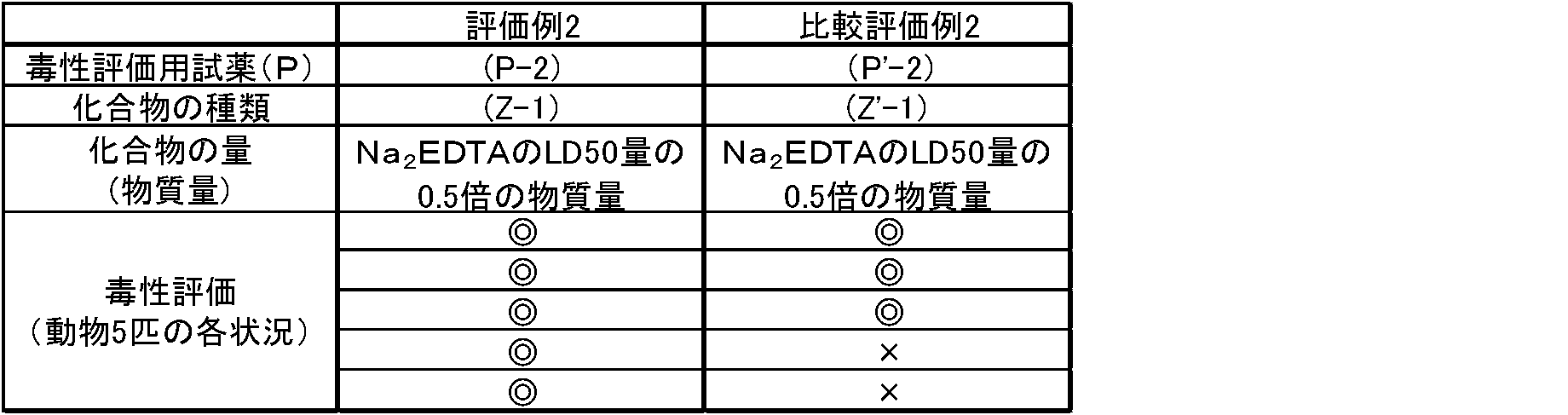

<評価例7~25及び比較評価例3~5:腹腔内投与による毒性評価>
マウス(C57B6/j 8週雄 日本クレア)に以下の通り投与した。投与する溶液は、投与直前に体重を測定し、Na2EDTAにおけるLD50相当量(参照:化学物質の初期リスク評価書 暫定版 No.14. 化学物質排出把握管理促進法政令号番号: 1-47 CAS 登録番号: 60-00-4)、その半量(LD50の0.5倍量)、その1.5倍量(LD50の1.5倍量)、その2.0倍量(LD50の2.0倍量)、その3.0倍量(LD50の3.0倍量)、その4.0倍量(LD50の4.0倍量)、及び、その8.0倍量(LD50の8.0倍量)を計算した。
Na2EDTA (0.5mol/l EDTA solution pH 8.0 ナカライテスク Cat# 14347-21)を、LD50相当量、その半量(LD50の0.5倍量)又はその1.5倍量(LD50の1.5倍量)含有する0.5mlの水溶液を調整し、これを毒性評価用試薬(P’-3)~(P’-5)とした。
また、毒性評価用試薬(P’-3)~(P’-5)がそれぞれ含有するNa2EDTAの物質量と、同じ物質量の化合物(Z-1)を含有する0.5mlの水溶液を調整し、これを毒性評価用試薬(P-7)~(P-9)とした。
毒性評価用試薬(P’-3)が含有するNa2EDTAの物質量の1.5倍の物質量(LD50の1.5倍量)の化合物(Z-3)を含有する0.5mlの水溶液を調整し、これを毒性評価用試薬(P-10)とした。また、(Z-3)に代えて(Z-5)又は(Z-4)を用いた試薬を、それぞれ毒性評価用試薬(P-11)、(P-12)とした。
毒性評価用試薬(P’-3)が含有するNa2EDTAの物質量の2.0倍の物質量(LD50の2.0倍量)の化合物(Z-1)を含有する0.5mlの水溶液を調整し、これを毒性評価用試薬(P-13)とした。また、(Z-1)に代えて(Z-3)、(Z-5)又は(Z-4)を用いた試薬を、それぞれ毒性評価用試薬(P-14)、(P-15)、(P-16)とした。
毒性評価用試薬(P’-3)が含有するNa2EDTAの物質量の3.0倍の物質量(LD50の3.0倍量)の化合物(Z-3)を含有する0.5mlの水溶液を調整し、これを毒性評価用試薬(P-17)とした。また、(Z-3)に代えて(Z-5)又は(Z-4)を用いた試薬を、それぞれ毒性評価用試薬(P-18)、(P-19)とした。
毒性評価用試薬(P’-3)が含有するNa2EDTAの物質量の4.0倍の物質量(LD50の4.0倍量)の化合物(Z-3)を含有する0.5mlの水溶液を調整し、これを毒性評価用試薬(P-20)とした。また、(Z-3)に代えて(Z-5)又は(Z-4)を用いた試薬を、それぞれ毒性評価用試薬(P-21)、(P-22)とした。
毒性評価用試薬(P’-3)が含有するNa2EDTAの物質量の8.0倍の物質量(LD50の8.0倍量)の化合物(Z-3)を含有する1.5mlの水溶液を調整し、これを毒性評価用試薬(P-23)とした。また、(Z-3)に代えて(Z-5)又は(Z-4)を用いた試薬を、それぞれ毒性評価用試薬(P-24)、(P-25)とした。
次に、毒性評価用試薬(P-7)~(P-25)又は毒性評価用試薬(P’-3)又は(P’-5)を上記のマウスに投与した。
投与に際して、毒性評価用試薬は、針を装着したシリンジ[Na2EDTAの物質量の0.5倍~4.0倍の物質量の化合物を含有する0.5ml水溶液は、29G針付き1mlシリンジ(テルモCat#SS-10M2913A)を用いた。また、Na2EDTAの物質量の0.5倍~4.0倍の物質量の化合物を含有する1.5ml水溶液は、27G針(テルモCat#NN-2719S)を付けた2.5mlシリンジ(テルモCat#SS-02SZ)]を用いてイソフルラン麻酔下に腹腔内投与を行なった。それぞれの溶液についてLD50量、LD50の0.5倍量、LD50の1.5倍量、LD50の2.0倍量、LD50の3.0倍量は3匹ずつ、LD50の4.0倍量、LD50の8.0倍量、は2匹ずつで検証し、以下の基準で評価した。結果を表8~表14に示す。
◎:全量投与後1週間以上経過しても生存していることを確認
○:全量投与後60分以上経過しても生存していることを確認
△:全量投与後15分以上経過しても生存していることを確認
×:全量投与後15分未満の時間で死亡を確認
<Evaluation Examples 7 to 25 and Comparative Evaluation Examples 3 to 5: Toxicity evaluation by intraperitoneal administration>
Mice (C57B6 / j 8-week male Japan Claire) were administered as follows. The solution to be administered should be weighed immediately before administration, and the amount equivalent to LD50 in Na 2 EDTA (Reference: Initial Risk Assessment Report for Chemical Substances, Provisional Edition No. 14. Chemical Substance Emission Control Promotion Law, Government Ordinance No. 1-47) CAS registration number: 60-00-4), half the amount (0.5 times the amount of LD50), 1.5 times the amount (1.5 times the amount of LD50), 2.0 times the amount (2. 0 times the amount), 3.0 times the amount (3.0 times the amount of LD50), 4.0 times the amount (4.0 times the amount of LD50), and 8.0 times the amount (8.0 times the amount of LD50). (0 times amount) was calculated.
Na 2 EDTA (0.5 mol / l EDTA solution pH 8.0 Nakaraitesku Cat # 14347-21) is added in an amount equivalent to LD50, half the amount (0.5 times the amount of LD50) or 1.5 times the amount (of LD50). A 0.5 ml aqueous solution containing (1.5 times the amount) was prepared, and these were used as reagents for toxicity evaluation (P'-3) to (P'-5).
In addition, a 0.5 ml aqueous solution containing the substance amount of Na 2 EDTA contained in each of the toxicity evaluation reagents (P'-3) to (P'-5) and the compound (Z-1) having the same amount of substance. These were adjusted and used as toxicity evaluation reagents (P-7) to (P-9).
0.5 ml of compound (Z-3) containing 1.5 times the amount of substance of Na 2 EDTA (1.5 times the amount of LD50) contained in the toxicity evaluation reagent (P'-3) An aqueous solution was prepared and used as a toxicity evaluation reagent (P-10). The reagents using (Z-5) or (Z-4) instead of (Z-3) were designated as toxicity evaluation reagents (P-11) and (P-12), respectively.
0.5 ml of the compound (Z-1) containing 2.0 times the amount of substance of Na 2 EDTA (2.0 times the amount of LD50) contained in the toxicity evaluation reagent (P'-3). An aqueous solution was prepared and used as a toxicity evaluation reagent (P-13). In addition, reagents using (Z-3), (Z-5) or (Z-4) instead of (Z-1) are used as toxicity evaluation reagents (P-14), (P-15), respectively. (P-16).
0.5 ml containing the compound (Z-3) having a substance amount of 3.0 times the substance amount of Na 2 EDTA (3.0 times the amount of LD50) contained in the toxicity evaluation reagent (P'-3). An aqueous solution was prepared and used as a toxicity evaluation reagent (P-17). The reagents using (Z-5) or (Z-4) instead of (Z-3) were designated as toxicity evaluation reagents (P-18) and (P-19), respectively.
0.5 ml of the compound (Z-3) containing 4.0 times the amount of substance of Na 2 EDTA (4.0 times the amount of LD50) contained in the toxicity evaluation reagent (P'-3). An aqueous solution was prepared and used as a toxicity evaluation reagent (P-20). The reagents using (Z-5) or (Z-4) instead of (Z-3) were designated as toxicity evaluation reagents (P-21) and (P-22), respectively.
1.5 ml of the compound (Z-3) containing 8.0 times the amount of substance of Na 2 EDTA (8.0 times the amount of LD50) contained in the toxicity evaluation reagent (P'-3) An aqueous solution was prepared and used as a toxicity evaluation reagent (P-23). The reagents using (Z-5) or (Z-4) instead of (Z-3) were designated as toxicity evaluation reagents (P-24) and (P-25), respectively.
Next, the toxicity evaluation reagents (P-7) to (P-25) or the toxicity evaluation reagents (P'-3) or (P'-5) were administered to the above-mentioned mice.
Upon administration, the reagent for toxicity evaluation was a syringe equipped with a needle [A 0.5 ml aqueous solution containing a compound having a substance amount of 0.5 to 4.0 times the substance amount of Na 2 EDTA is a 1 ml syringe with a 29 G needle. (Terumo Cat # SS-10M2913A) was used. Further, a 1.5 ml aqueous solution containing a compound having a substance amount of 0.5 to 4.0 times the substance amount of Na 2 EDTA is a 2.5 ml syringe (Terumo Cat # NN-2719S) attached with a 27 G needle (Terumo Cat # NN-2719S). Terumo Cat # SS-02SZ)] was used for intraperitoneal administration under isoflurane anesthesia. For each solution, the amount of LD50, 0.5 times the amount of LD50, 1.5 times the amount of LD50, 2.0 times the amount of LD50, 3.0 times the amount of LD50 is 3 each, 4.0 times the amount of LD50. , 8.0 times the amount of LD50, was verified with 2 animals each and evaluated according to the following criteria. The results are shown in Tables 8 to 14.
⊚: Confirmed to be alive even after 1 week or more after total dose administration ○: Confirmed to be alive 60 minutes or more after total dose administration △: Confirmed to be alive even after 15 minutes or more after total dose administration Confirmed to be alive ×: Confirmed death in less than 15 minutes after full dose administration
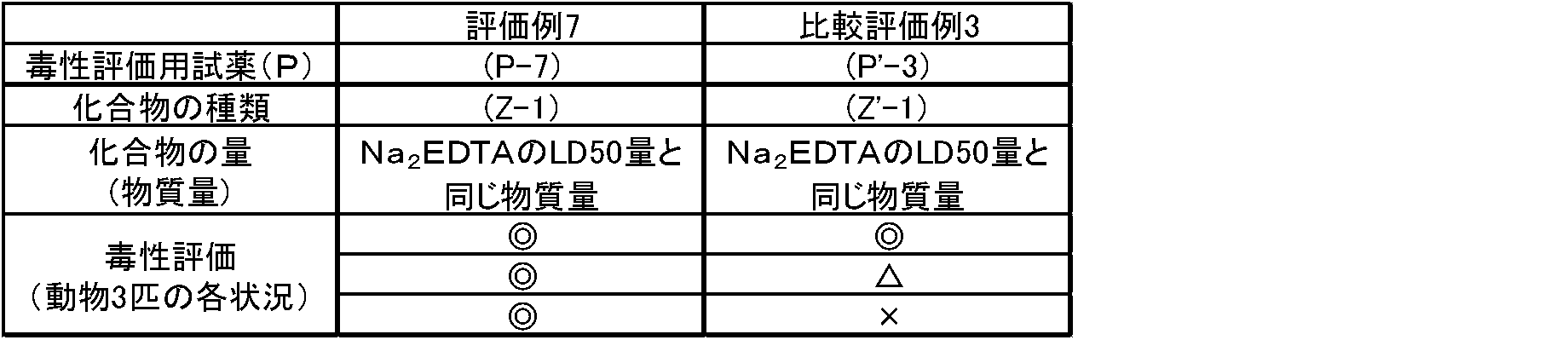




<評価例26~29及び比較評価例6~7:腹腔内投与後のCa濃度評価>
「腹腔内投与による毒性評価」と同様に、Na2EDTA (0.5mol/l EDTA solution pH 8.0 ナカライテスク Cat# 14347-21)を、LD50相当量の2.0倍量(LD50の2.0倍量)含有する0.5mlの水溶液を調整し、これを毒性評価用試薬(P’-6)とした。
毒性評価用試薬(P’-6)が含有するNa2EDTAの物質量と、同じ物質量の化合物(Z-1)を含有する0.5mlの水溶液を調整し、これを毒性評価用試薬(P-26)とした。
また、(Z-1)に代えて(Z-3)、(Z-5)又は(Z-4)を用いた試薬を、それぞれ毒性評価用試薬(P-27)、(P-28)、(P-29)とした。
上記の水溶液を、「腹腔内投与による毒性評価」と同様の方法で、上記のマウスに腹腔内投与し、2分後に採血した。採取した血液から得た血清について、以下の式に基づいて補正Ca濃度(mg/dl)[血中にあるCaのうち、血中アルブミンと結合したCaを除いたCa濃度]を求めた。
補正Ca濃度(mg/dL)=実測Ca濃度(mg/dL)+4-Alb(g/dL)
なお、上記の式中、「実測Ca濃度(mg/dL)」及び「Alb(g/dL)」は、以下の測定で得られた値である。
実測Ca濃度(mg/dL):採取した血液から得た血清について、アルセナゾIII法(株式会社ビー・エム・エルに委託)を用いて、Ca濃度(mg/dl)[実測Ca濃度]を測定した。
Alb(g/dL):採取した血液から得た血清について、アルブミンIIHA-テストワコー(富士フイルム和光純薬株式会社製)を用いて、アルブミン濃度(g/dL)を測定した(測定は、富士フイルム和光純薬株式会社に委託)。
また、上記の毒性評価用試薬に代えて、水を投与し、上記と同様の方法で、補正Ca濃度(mg/dl)を測定した。水を用いた毒性評価用試薬を(P’-7)とした。
毒性評価用試薬毎に、3匹のマウスで実施し、補正Ca濃度(mg/dl)の平均値を求めた。結果を表15に示す。
なお、生体安全性の観点から、補正Ca濃度は7.0mg/dl以上であることが好ましい。補正Ca濃度が7.0mg/dl未満であると、テタニー及び全身痙攣等の神経症状、並びに、QT延長及び徐脈等の重篤な不整脈等の症状が生じるおそれがある。
<Evaluation Examples 26 to 29 and Comparative Evaluation Examples 6 to 7: Evaluation of Ca concentration after intraperitoneal administration>
Similar to "Toxicity evaluation by intraperitoneal administration", Na 2 EDTA (0.5 mol / l EDTA solution pH 8.0 Nakaraitesk Cat # 14347-21) was 2.0 times the amount equivalent to LD50 (2 of LD50). A 0.5 ml aqueous solution containing (0.0 times the amount) was prepared and used as a toxicity evaluation reagent (P'-6).
A 0.5 ml aqueous solution containing the substance amount of Na 2 EDTA contained in the toxicity evaluation reagent (P'-6) and the compound (Z-1) having the same amount of substance was prepared, and this was used as a toxicity evaluation reagent (toxicity evaluation reagent (P'-6). It was designated as P-26).
In addition, reagents using (Z-3), (Z-5) or (Z-4) instead of (Z-1) are used as toxicity evaluation reagents (P-27), (P-28), respectively. It was designated as (P-29).
The above aqueous solution was intraperitoneally administered to the above mice by the same method as in "Toxicity evaluation by intraperitoneal administration", and blood was collected 2 minutes later. For the serum obtained from the collected blood, the corrected Ca concentration (mg / dl) [Ca concentration of Ca in the blood excluding Ca bound to blood albumin] was determined based on the following formula.
Corrected Ca concentration (mg / dL) = Measured Ca concentration (mg / dL) + 4-Alb (g / dL)
In the above formula, "measured Ca concentration (mg / dL)" and "Alb (g / dL)" are values obtained by the following measurements.
Measured Ca concentration (mg / dL): Measure Ca concentration (mg / dl) [measured Ca concentration] using the Arsenazo III method (consigned to BML Co., Ltd.) for serum obtained from collected blood. did.
Alb (g / dL): Albumin concentration (g / dL) was measured using albumin IIHA-Test Wako (manufactured by Wako Pure Chemical Industries, Ltd.) for serum obtained from collected blood (measured by Fuji). Outsourced to Wako Pure Chemical Industries, Ltd.).
In addition, water was administered instead of the above-mentioned reagent for toxicity evaluation, and the corrected Ca concentration (mg / dl) was measured by the same method as above. The reagent for toxicity evaluation using water was designated as (P'-7).
For each toxicity evaluation reagent, 3 mice were used to determine the average value of the corrected Ca concentration (mg / dl). The results are shown in Table 15.
From the viewpoint of biosafety, the corrected Ca concentration is preferably 7.0 mg / dl or more. If the corrected Ca concentration is less than 7.0 mg / dl, neurological symptoms such as tetany and systemic spasm, and serious arrhythmia such as QT prolongation and bradycardia may occur.

本発明の化合物を含有する組成物を、生体組織脆化剤として用いた場合に、従来のEDTAと同様の組織脆化作用が得られる一方で、生体への毒性が少ないという効果を奏するため、前記の組成物は生体組織脆化剤として有用である。 When the composition containing the compound of the present invention is used as a biological tissue embrittlement agent, it has the same tissue embrittlement effect as conventional EDTA, but has the effect of being less toxic to the living body. The above composition is useful as a biological tissue embrittler.
Claims (7)
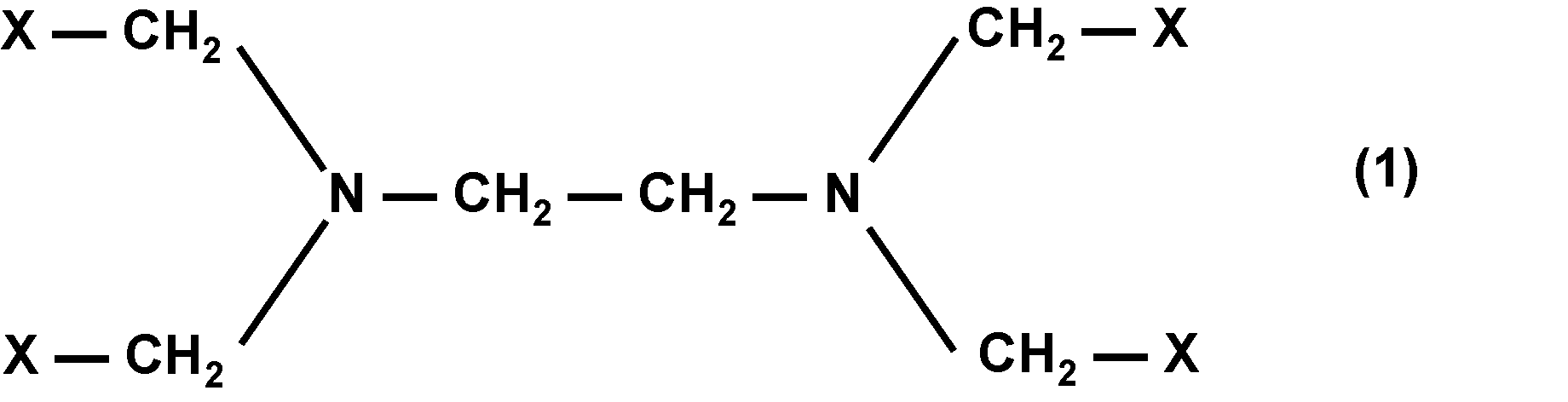

一般式(1)及び一般式(2)における複数のXの内、少なくとも1つがカルボキシ基又はカルボキシレート基であり;
一般式(1)及び一般式(2)における複数のXの内、少なくとも1つが一般式(3)で表される1価の基である。]
-C(O)-Y-(AO)n-R (3)
[一般式(3)において、-Y-は-O-、-NH-又は-S-であり;Aは、炭素数2~4のアルキレン基であり;Rは水素原子又は水素原子が炭素数1~10のアルコキシ基で置換されていてもよい炭素数1~15の1価の炭化水素基であり;nは、4~1000の整数であり;n個あるAの内、少なくとも1個はエチレン基であり;一般式(1)及び一般式(2)において一般式(3)で表される1価の基を複数有する場合、-Y-、A、R及びnは同一でも異なっていても良い。] The compound (Z) represented by the general formula (1) or the general formula (2).
Of the plurality of Xs in the general formula (1) and the general formula (2), at least one is a carboxy group or a carboxylate group;
Of the plurality of Xs in the general formula (1) and the general formula (2), at least one is a monovalent group represented by the general formula (3). ]
-C (O) -Y- (AO) n -R (3)
[In the general formula (3), -Y- is -O-, -NH- or -S-; A is an alkylene group having 2 to 4 carbon atoms; R is a hydrogen atom or a hydrogen atom having a carbon number of carbon atoms. It is a monovalent hydrocarbon group having 1 to 15 carbon atoms which may be substituted with 1 to 10 alkoxy groups; n is an integer of 4 to 1000; at least one of n A's is It is an ethylene group; when it has a plurality of monovalent groups represented by the general formula (3) in the general formula (1) and the general formula (2), -Y-, A, R and n are the same but different. Is also good. ]
前記生体組織の脆化した表面部分から細胞組織を剥離する工程とを含む、生体組織表面の剥離方法。 A step of contacting the biological tissue with the compound (Z) according to claim 1 to embrittle the surface of the biological tissue.
A method for exfoliating a living tissue surface, which comprises a step of exfoliating the cell tissue from the embrittled surface portion of the living tissue.
Priority Applications (4)
| Application Number | Priority Date | Filing Date | Title |
|---|---|---|---|
| JP2022571490A JPWO2022138626A1 (en) | 2020-12-25 | 2021-12-21 | |
| EP21910769.5A EP4269467A4 (en) | 2020-12-25 | 2021-12-21 | COMPOUND, COMPOSITION, BIO-TISSUE EMBRITTILATION AGENT, BIO-TISSUE SURFACE SEPARATION METHOD AND BIO-TISSUE SEPARATION KIT |
| US18/269,510 US20240059644A1 (en) | 2020-12-25 | 2021-12-21 | Compound, composition, biotissue embrittlement agent, biotissue surface detachment method, and biotissue detachment kit |
| CN202180086614.4A CN116615191B (en) | 2020-12-25 | 2021-12-21 | Compound, composition, biological tissue embrittling agent, method for removing surface of biological tissue, and biological tissue removing kit |
Applications Claiming Priority (2)
| Application Number | Priority Date | Filing Date | Title |
|---|---|---|---|
| JP2020-216704 | 2020-12-25 | ||
| JP2020216704 | 2020-12-25 |
Publications (1)
| Publication Number | Publication Date |
|---|---|
| WO2022138626A1 true WO2022138626A1 (en) | 2022-06-30 |
Family
ID=82159372
Family Applications (1)
| Application Number | Title | Priority Date | Filing Date |
|---|---|---|---|
| PCT/JP2021/047282 Ceased WO2022138626A1 (en) | 2020-12-25 | 2021-12-21 | Compound, composition, biotissue embrittlement agent, biotissue surface detachment method, and biotissue detachment kit |
Country Status (5)
| Country | Link |
|---|---|
| US (1) | US20240059644A1 (en) |
| EP (1) | EP4269467A4 (en) |
| JP (1) | JPWO2022138626A1 (en) |
| CN (1) | CN116615191B (en) |
| WO (1) | WO2022138626A1 (en) |
Citations (6)
| Publication number | Priority date | Publication date | Assignee | Title |
|---|---|---|---|---|
| JPH06511033A (en) * | 1991-09-24 | 1994-12-08 | イマアーレクス・フアーマシユーチカル・コーポレーシヨン | Copolymers and their use as contrast agents in magnetic resonance imaging and other applications |
| JPH09511013A (en) * | 1994-03-31 | 1997-11-04 | ニコムド イメージング エイエス | Segmented chelating polymers as imaging and therapeutic agents |
| US6020373A (en) * | 1995-10-20 | 2000-02-01 | Eastern Virginia Medical School | Chelate derivatives as protectors against tissue injury |
| JP2007533624A (en) * | 2003-09-26 | 2007-11-22 | ビーエーエスエフ アクチェンゲゼルシャフト | Radical scavengers as stabilizers for polymerizable compounds. |
| JP2008508346A (en) * | 2004-08-05 | 2008-03-21 | ビーエーエスエフ ソシエタス・ヨーロピア | Stabilizer for NVP synthesis |
| US20080197082A1 (en) * | 2005-06-17 | 2008-08-21 | Basf Aktiengesellschaft | Aminocarboxylic Acid Esters Having Eo/Po/Buo-Blockpolymers and Use Thereof as Demulsifiers |
Family Cites Families (5)
| Publication number | Priority date | Publication date | Assignee | Title |
|---|---|---|---|---|
| US20020009491A1 (en) * | 2000-02-14 | 2002-01-24 | Rothbard Jonathan B. | Compositions and methods for enhancing drug delivery across biological membranes and tissues |
| FR2910292B1 (en) * | 2006-12-20 | 2009-03-20 | Oreal | CURING COMPOSITION BASED ON SILICONE COMPOUNDS. |
| EP3395910A1 (en) * | 2015-12-24 | 2018-10-31 | AGC Inc. | Resin composition, substrate, and cell culture method |
| CN108651438B (en) * | 2018-05-02 | 2019-04-05 | 济南天灿医疗科技有限公司 | A kind of fixed agents for defoliating of tissue for tissue block and application |
| CN110286009B (en) * | 2019-06-06 | 2021-09-24 | 强安医疗器械有限公司 | Rectal mucosa exfoliated cell sample pretreatment liquid and preparation method thereof |
-
2021
- 2021-12-21 JP JP2022571490A patent/JPWO2022138626A1/ja active Pending
- 2021-12-21 CN CN202180086614.4A patent/CN116615191B/en active Active
- 2021-12-21 EP EP21910769.5A patent/EP4269467A4/en active Pending
- 2021-12-21 WO PCT/JP2021/047282 patent/WO2022138626A1/en not_active Ceased
- 2021-12-21 US US18/269,510 patent/US20240059644A1/en active Pending
Patent Citations (6)
| Publication number | Priority date | Publication date | Assignee | Title |
|---|---|---|---|---|
| JPH06511033A (en) * | 1991-09-24 | 1994-12-08 | イマアーレクス・フアーマシユーチカル・コーポレーシヨン | Copolymers and their use as contrast agents in magnetic resonance imaging and other applications |
| JPH09511013A (en) * | 1994-03-31 | 1997-11-04 | ニコムド イメージング エイエス | Segmented chelating polymers as imaging and therapeutic agents |
| US6020373A (en) * | 1995-10-20 | 2000-02-01 | Eastern Virginia Medical School | Chelate derivatives as protectors against tissue injury |
| JP2007533624A (en) * | 2003-09-26 | 2007-11-22 | ビーエーエスエフ アクチェンゲゼルシャフト | Radical scavengers as stabilizers for polymerizable compounds. |
| JP2008508346A (en) * | 2004-08-05 | 2008-03-21 | ビーエーエスエフ ソシエタス・ヨーロピア | Stabilizer for NVP synthesis |
| US20080197082A1 (en) * | 2005-06-17 | 2008-08-21 | Basf Aktiengesellschaft | Aminocarboxylic Acid Esters Having Eo/Po/Buo-Blockpolymers and Use Thereof as Demulsifiers |
Non-Patent Citations (5)
| Title |
|---|
| CAS, no. 60-00-4 |
| CELL STEM CELL, vol. 22, 2018, pages 1 - 6 |
| GENES AND DEVELOPMENT, vol. 28, 2014, pages 1752 - 1757 |
| NATURE, vol. 592, 1 April 2021 (2021-04-01), pages 99 - 104 |
| See also references of EP4269467A4 |
Also Published As
| Publication number | Publication date |
|---|---|
| JPWO2022138626A1 (en) | 2022-06-30 |
| CN116615191A (en) | 2023-08-18 |
| CN116615191B (en) | 2025-08-19 |
| EP4269467A1 (en) | 2023-11-01 |
| US20240059644A1 (en) | 2024-02-22 |
| EP4269467A4 (en) | 2024-11-27 |
Similar Documents
| Publication | Publication Date | Title |
|---|---|---|
| JP6289858B2 (en) | Use of adipose tissue-derived stromal stem cells in the treatment of hemorrhoids | |
| Mawhorter et al. | Nonsurgical therapy for pulmonary hydatid cyst disease | |
| US12383243B2 (en) | Extracellular matrix (ECM) hydrogel as a submucosal fluid cushion | |
| JPS63500943A (en) | anticoagulant | |
| WO2018192550A1 (en) | Multi-arm targeted anti-cancer conjugate | |
| Jeon et al. | Transplantation of stem cell spheroid-laden 3-dimensional patches with bioadhesives for the treatment of myocardial infarction | |
| WO2022138626A1 (en) | Compound, composition, biotissue embrittlement agent, biotissue surface detachment method, and biotissue detachment kit | |
| CN107349434A (en) | A kind of dissaving polymer and its preparation method and application | |
| CN117379379A (en) | A kind of nanoparticle containing alkaloid compounds and its application in the treatment of osteoarthritis | |
| CN112469449A (en) | Use of extracellular matrix (ECM) hydrogels as fluid pads under esophageal mucosa | |
| US20250228896A1 (en) | Matrix bound nanovesicles encapsulated in hydrogels | |
| CN117717539B (en) | Skatole-containing bone-targeted nanoparticles and their application in drugs for treating osteoarthritis | |
| RU2367450C1 (en) | Method of treating ulcerative proctosigmoiditis | |
| Li et al. | Impact of curative effect of laparoscopic and open partial nephrectomy for complex renal tumours on renal function | |
| CN101940565B (en) | Application of T-2 toxin in preparing drug for treating prostatic cancer | |
| Kligman et al. | Spontaneous external biliary fistula in a dog | |
| Alex et al. | Inflammatory fibroid polyp presenting as intussusception | |
| Samarathunga et al. | Primary Ewing's sarcoma of the kidney presenting with left-sided varicocele | |
| CN121243207A (en) | Application of a SYK DNA/RNA heteroduplex oligonucleotide in the preparation of a drug to inhibit intrahepatic cholangiocarcinoma metastasis | |
| CN113425859A (en) | GnRH polypeptide modified probe, preparation containing GnRH polypeptide modified probe, pharmaceutical composition containing GnRH polypeptide modified probe, and preparation method and application of GnRH polypeptide modified probe | |
| HK40040023B (en) | Extracellular matrix (ecm) hydrogel as a submucosal fluid cushion | |
| HK40040023A (en) | Extracellular matrix (ecm) hydrogel as a submucosal fluid cushion | |
| CN117986618A (en) | Preparation and application of humic acid-bismuth nanomaterial | |
| JPH03501124A (en) | Injectable hemostatic preparation | |
| Cheung et al. | Laparoscopic nephrectomy: an early experience at Queen Mary Hospital |
Legal Events
| Date | Code | Title | Description |
|---|---|---|---|
| 121 | Ep: the epo has been informed by wipo that ep was designated in this application |
Ref document number: 21910769 Country of ref document: EP Kind code of ref document: A1 |
|
| ENP | Entry into the national phase |
Ref document number: 2022571490 Country of ref document: JP Kind code of ref document: A |
|
| WWE | Wipo information: entry into national phase |
Ref document number: 202180086614.4 Country of ref document: CN |
|
| WWE | Wipo information: entry into national phase |
Ref document number: 18269510 Country of ref document: US |
|
| NENP | Non-entry into the national phase |
Ref country code: DE |
|
| ENP | Entry into the national phase |
Ref document number: 2021910769 Country of ref document: EP Effective date: 20230725 |
|
| WWG | Wipo information: grant in national office |
Ref document number: 202180086614.4 Country of ref document: CN |