METHOD OF PRODUCING A POLYMER USING A PIGMENT DISPERSION FIELD OF THE INVENTION
[0001] The disclosed technology relates to a method of producing a pigmented polymer using a pigment dispersion which is stable at elevated temperatures.
SUMMARY OF THE INVENTION
[0002] The present invention relates to a method of producing a polymer using a pigment dispersion that is stable at elevated temperatures, comprising the steps of (1) providing a pigment dispersion containing (a) a solvent, having a boiling temperature (T), wherein the solvent comprises or consists of ethylene glycol or oligomers of ethylene glycol, (b) a pigment, for example, carbon black, and (c) a dispersant, (2) adding a material having a boiling point higher than temperature (T), and (3) heating the dispersion to at least the boiling temperature (T) of the solvent.
[0003] The dispersant used in the present invention comprises a salt of P and X. P is a polyether functionalized polyacid intermediate formed via the reaction of (i) a maleic anhydride containing polymer, (ii) polyether mono-nucleophile C, and (iii) optionally a non-polymeric mono-nucleophile D. X may be an alkali metal, an alkaline earth metal, ammonia, an amine or mixtures thereof.
[0004] In the dispersant used in the method described herein, maleic anhydride containing polymer has the formula (A)
n-(B)
m-(E)
q, where. A is a maleic anhydride unit having the structure
B is a vinyl benzene or substituted vinyl benzene unit having the structure
where R is H or CH3, preferably H, and R' is a halogen, a nitro (NO2) group, or a Ci to C10 alkyl or aromatic group optionally containing oxygen atoms, and e is 0 to 5, for example 1 to 5, or 0, and E is derived from a mono-unsaturated monomer
containing 2 to 45 carbon atoms which may optionally contain ethers, esters, amides, tertiary amines, acids, halogens, but does not contain alcohols, primary amines, or secondary amines. In the maleic anhydride containing polymer, n is 10 to 50, m is 10 to 150, and q is 0 to 200, preferably 0, with the proviso that the ratio of n to m is between 1 : 1 and 1 :6.
[0005] Polyether mono-nucleophile C contains 6 to 70 ethylene glycol repeat units, and, optionally, contains propylene glycol and/or butylene glycol repeat units, with the proviso that at least 50%, or at least 70% of all repeat units are ethylene glycol. The poly ether mono-nucleophile C contain a single alcohol, primary amine, or secondary amine group. The non-polymeric mono-nucleophile D is a linear or branched, saturated or unsaturated alkyl or aryl chain having 1 to 22 carbon atoms and contains a single alcohol, primary amine, or secondary amine group and optionally one or more tertiary amine, halide, or nitro groups with the proviso that D is substantially free of or free of acid groups.
[0006] In polyether functionalized polyacid P, 10% to 100% or 30% to 100%, or 50% to 100%, or 70% to 100% of the total moles of A are reacted with C; and 0% to 80%, or 0% to 50% or 0% to 25% of the total moles of A is reacted with D; with the proviso that at least 20%, or at least 30%, or at least 40%, or at least 50%, or at least 60%, or at least 70%, or at least 80%, or at least 90% of A must contain a carboxylic acid group after repeat unit A is reacted with C and D, and no more than 10%, or 0 to 10%, or 0 to 5% of A units can still be in their anhydride form;
[0007] The present invention also includes the use of the dispersant described above to provide a stable pigment dispersion at elevated temperatures.
DETAILED DESCRIPTION OF THE INVENTION
[0008] Definitions. To simplify the disclosure, we will use parentheses around “meth” to indicate that a named molecule can optionally include a methyl substituent such as (meth)acrylic acid will refer to methacrylic acid and/or acrylic acid and methyl (meth)acrylate will refer to methacrylate and/or acrylate. We intend that the polyethers used herein can be random or blocky and do not intend for them to limit the polyethers to a single block or blocks of any particular repeat unit. We will use the symbolic representation C(=O)-OH to represent carboxylic acid in any form such as the acid form, the salt form, or if two carboxylic acids are physically adjacent and
can form an anhydride ring, the anhydride form. If the C(=O)-OH is adjacent to a nitrogen of an amide linkage we will also anticipate that it can be converted to a C(=O)- as part of an imide. We will use the term hydrocarbyl to describe a hydrocarbon type group with one hydrogen removed. Hydrocarbyl in this specification will mean hydrocarbon like and can include up to one oxygen or nitrogen for every four carbon atoms in the group, but preferably is just carbon and hydrogen atoms. Hydro- carbylene will mean hydrocarbon with two hydrogen atoms removed. Hydro- carbylene will also optionally include up to one oxygen or nitrogen atom for every two carbon atoms in the group, but preferably is just carbon and hydrogen. For the avoidance of doubt, when we are counting carboxylic acid or carbonyl groups, we will count an anhydride of a dicarboxylic acid and an imide as having two carbonyl groups.
[0009] The present invention relates to a method of forming a pigment dispersion that is stable at elevated temperatures. The method comprises the steps of (1) preparing a dispersion containing (a) a solvent, having a boiling temperature (T), wherein the solvent comprises or consists of ethylene glycol or oligomers of ethylene glycol, (b) a pigment, and (c) a dispersant, (2) adding a material having a boiling point higher than temperature (T), and (3) heating the dispersion to a temperature that is at least the boiling temperature (T) of the solvent. The invention also includes the use of a dispersant to provide a stable pigment dispersion at elevated temperatures. [0010] The solvent used in the present invention comprises ethylene glycol or oligomers of ethylene glycol or mixtures thereof. In one embodiment the solvent comprises or consists of ethylene glycol. In another embodiment, the solvent comprises or consists of oligomers of ethylene glycol. Where the solvent comprises or consists of oligomers of ethylene glycol, the oligomers may comprise 2 to 5 repeat units of ethylene glycol. If the dispersion used in the present invention contains one or more other co-solvents, these solvents may be selected from water, alkanols, alkane carboxylic acids and esters of alkane carboxylic acids among other solvents known to those skilled in the art. In one embodiment, the solvent will have a boiling temperature of at least 180 °C, or at least 190 °C, or at least 195 °C, or at least 200 °C. For example, ethylene glycol has a boiling temperature of 197 °C. In embodiments where mixtures of solvents or oligomers of ethylene glycol are used, the
boiling temperature refers to the initial boiling temperature, or the temperature at which any of the components of a mixture boil.
[0011] The dispersant used in the present invention comprises a salt of P and X. where P is a polyether functionalized polyacid intermediate formed via the reaction of (i) a maleic anhydride containing polymer, (ii) polyether mono-nucleophile C, and (iii) optionally a non-polymeric mono-nucleophile D. X is an alkali metal, an alkaline earth metal, ammonia, an amine or mixtures thereof.
[0012] The maleic anhydride containing polymer has the formula (A)
n-(B)
m- (E). In the maleic anhydride containing polymer, A is a maleic anhydride unit having the structure
[0013] B is a vinyl benzene or substituted vinyl benzene unit having the structure
where R is H or CEE, preferably H, R' is a halogen, a nitro (NO2) group, or a Ci to C10 alkyl or aromatic group optionally containing oxygen atoms. The variable e may be 0 to 5, for example 1 to 5, or 0.
[0014] E is derived from a mono-unsaturated monomer containing 2 to 160 carbon atoms or 2 to 45 carbon atoms which may optionally contain ethers, esters, amides, tertiary amines, acids, halogens, but does not contain alcohols, primary amines, or secondary amines. In one embodiment, E comprises, for example, a (meth)acrylic repeat unit having the structure
where R is H or CH3, preferably H, and Ri is a Ci to C10 alkyl or aromatic group optionally including two hetero atoms or a polyether of ethylene and/or propylene oxide with a weight average molecular weight (MW) of 150 to 3000 and terminating in a Ci to C20 alkyl group. In another embodiment, E comprises, for example, a (meth)acrylamide unit having the structure
where R is H or CH3, R2 and R3 are each independently H or a Ci to C20 alkyl or aryl group including a heteroatom, or a polyether of ethylene and/or propylene oxide with a weight average molecular weight (MW) of 150 to 3000 terminating in a Ci to C20 alkyl group, with the proviso that both R2 and R3 cannot both be H. In another embodiment, E comprises, for example, a (meth)acrylamide repeat unit having the structure
where R is H or CEE and R2 and R3 are connected together to form a C2 to Ci6 cyclic group. In still another embodiment, E comprises, for example, a vinyl repeat unit having the structure
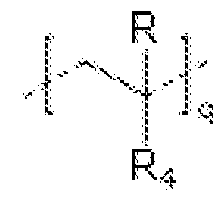
where R is H or CH3, and R4 is H or Ci to C20 alkyl or aryl group optionally including hetero atoms such as oxygen or halides, or a polyether of ethylene and/or propylene oxide with a MW of 150 to 3000 and terminating in a Ci to C20 cyclic group. For clarity, in embodiments where E is derived from a mono-unsaturated monomer having 2 to 45 carbon atoms, when an optional poly ether group having a MW of 150 to 3000 is included as Ri, R2, R3, or R4, the carbon atoms of these groups are in addition to the 2 to 45 carbon atom mono-unsaturated monomer used for E.
[0015] In maleic anhydride containing polymer, n is 10 to 50, m is 10 to 150, and q is 0 to 200, with the proviso that the ratio of n to m is between 1 : 1 and 1 :6. In polyether functionalized intermediate P, the units A, B, and E may be arranged in a statistical or random architecture or they may have a block architecture, wherein (E)
q forms one block and the combination of (A)
n(B)
m together forms the other block. These two blocks can be arranged in any combination and repeated throughout P.
[0016] Polyether mono-nucleophile C contains 6 to 70 ethylene glycol repeat units, and, optionally, contains propylene glycol and/or butylene glycol repeat units, with the proviso that at least 50%, or at least 70% of all repeat units are ethylene glycol. In one embodiment, C contains from 1 to 15 or even 1 to 10 propylene glycol repeat units. The polyether mono-nucleophile C also contains a single alcohol, primary amine, or secondary amine group.
[0017] Polyether mono-nucleophile may be derived from a poly(alkyleneox- ide) monoalkyl ether monoamine. Exemplary monoamine compounds of this type are commercially available as the Surfonamine® or Jeffamine™ amines from Huntsman Corporation. Specific examples of Surfonamine® amines are L-100 (propylene oxide to ethylene oxide mole ratio of 3: 19), L-207 (propylene oxide to ethylene oxide mole ratio of 10:33), L-200 (propylene oxide to ethylene oxide mole ratio of4:41), L-300 (propylene oxide to ethylene oxide mole ratio of 8:58).
[0018] When C contains a single alcohol group, C may be derived from a poly(alkyleneoxide) monoalkyl ether. These mono-alkyl ethers are available from a variety of sources such as Sigma-Aldrich, Croda, BASF, Dow, and Ineos.
[0019] The non-polymeric mono-nucleophile D is a linear or branched, saturated or unsaturated alkyl or aryl chain having 1 to 22 carbon atoms and contains a single alcohol, primary amine, or secondary amine group and optionally one or more tertiary amine, halide, or nitro groups with the proviso that D is substantially free of or free of acid groups.
[0020] In some embodiments where non-polymeric mono-nucleophile D contains a primary amine, the primary amine may include methylamine, ethylamine, propylamine, butylamine, pentylamine, hexylamine, heptylamine, octylamine, 2- ethylhexyl amine, nonylamine, decylamine, undecylamine, dodecylamine, tridecyl amine, tetradecyl amine, pentadecyl amine, hexadecylamine, heptadecylamine,
octadecylamine, nonadecylamine, eicosylamine, or mixtures thereof. In some embodiments, the amine may include benzyl amine, 2-phenylethanamine (often referred to as phenylethyl amine), 3- phenylpropanamine, 4-phenylbutanamine, or mixtures thereof. In one embodiment, the primary amine may include benzyl amine or 2- phenyl ethanamine. In one embodiment, the primary amine may include 2-phenylethanamine.
[0021] In some embodiments where non-polymeric mono-nucleophile D contains a secondary amine, the secondary amine may be, for example, dimethyl amine, diethyl amine, dipropyl amine, dibutyl amine, dipentylamine, dihexylamine, diheptylamine, dioctylamine, dinonylamine, didecylamine, N,N-diisopropylamine, N,N- diisobutylamine, diisoamylamine, piperidine, N,N-dimethylpiperidin-4-amine, N,N- dibenzylamine, N-benzylmethylamine, N-phenyl-N-propylamine, N-methyl-phene- thylamine, N-methyl-N-(l-phenylethyl)amine, 4-Bromo-N-methylbenzylamine, or 4-Fluoro-N-methylbenzylamine.
[0022] Specific examples of suitable mono-functional nucleophiles D containing a hydroxyl functionality include alcohols with optionally substituted Cl-22 hy- drocarbylene groups such as methanol, ethanol, propan- l-ol, propan-2-ol, butanol, isobutanol, neopentyl alcohol, hexanol, octan-l-ol, 2-ethylhexanol, decanol, dodecanol, oleyl alcohol, stearyl alcohol, behenyl alcohol, cyclohexanol, benzyl alcohol, phenol, octylphenol, nonylphenol, phenylethanol, fluorinated alcohols such as lH,lH,2H,2H-perfluoro-l-decanol, C8-22 branched alcohols available under the trademark Isofol™ (ex Sasol).
[0023] The maleic anhydride containing polymer may be prepared by processes known to a skilled person and functionalized with the polyether mono-nucle- ophile C and, optionally, non-polymeric nucleophile D, by any method known in the art. For example, the polyacid may be prepared by esterification and/or amidation maleic anhydride containing copolymer, or the maleic anhydride can first be esteri- fied and/or amidated and then polymerized with vinyl benzene and/or substituted vinyl benzene to form the polyacid by any known polymerization technique or a combination of polymerization techniques using a bulk, solution, suspension or emulsion process. The polymerization may comprise of a radical, anionic, cationic, atom transfer or group transfer polymerization process or combinations thereof.
[0024] In the dispersant described herein, one or more of the maleic anhydride repeat units of A react with, polyether nucleophile C and/or non-polymeric nucleophile D to form one or more bonds, where the bonds are selected from (i) an ester bond formed from the reaction product of an alcohol group of polyether nucleophile C and/or non-polymeric nucleophile D with a maleic anhydride of repeat unit of A; (ii) salt bonds and/or amide bonds formed from the reaction product of a primary or secondary amine of polyether nucleophile C and/or non-polymeric nucleophile D with a maleic anhydride repeat unit of A; or (iii) imide bonds formed from the reaction product of a primary amine group of polyether nucleophile C and/or non-polymeric nucleophile D with a maleic anhydride of repeat unit A.
[0025] In another embodiment, the polymer intermediate P may be obtained or obtainable by reacting maleic anhydride containing polymer (typically with a number average molecular weight between 200 to 50,000, or 700 to 20,000) with polyether mono-nucleophile C and, optionally, non-polymeric nucleophile D, optionally in the presence of a catalyst, such as an acid or base catalyst, optionally using an appropriate solvent. In one embodiment of polymer intermediate P, 10% to 100% or 30% to 100%, or 50% to 100%, or 80% to 100% of the total moles of A are reacted with C; and 0% to 80%, or 0% to 50% or 0% to 20% or 0% of the total moles of A is reacted with D; with the proviso that at least 20%, or at least 30%, or at least 40%, or at least 50%, or at least 60%, or at least 70%, or at least 80%, or at least 90% of A must contain a carboxylic acid group after repeat unit A is reacted with C and D, and no more than 10%, or 0 to 10%, or 0 to 5% of A units can still be in their anhydride form.
[0026] The dispersant used in the present invention comprises a salt of P and X. X is an alkali metal, an alkaline earth metal, ammonia, an amine or mixtures thereof.
[0027] In some embodiments, the salt may be formed by using ammonia, an amine, quaternary ammonium or pyridinium cation as X. Examples of amines are methylamine, diethylamine, ethanolamine, diethanolamine, hexylamine, 2-ethylhex- ylamine, octadecylamine, 2-(Dimethylamino)-2-methylpropan-l-ol, 2-dimethylami- noethanol and 2-amino-2-methyl-l -propanol. The quaternary ammonium cation may be a quaternary ammonium cation or a benzalkonium cation. The quaternary
ammonium cation may contain one or two alkyl groups containing from 6 to 20 carbon atoms. Examples of quaternary ammonium cations are tetraethyl ammonium, N- octadecyl-N,N,N-trimethyl ammonium; N,N-didodecyl-N,N-dimethyl ammonium, N-benzyl-N,N,N-trimethyl ammonium and N-benzyl-N-octadecyl-N,N-dimethyl ammonium cation.
[0028] In other embodiments, the salt may be formed by using an alkali metal or alkaline earth metal as X. For example, monovalent alkali metals (Li, Na, K, Rb, Cs, and Fr) or divalent alkaline earth metals (Be, Mg, Ca, Sr, Ba, and Ra) may be used. In some exemplary embodiments, lithium, sodium and potassium may be used. [0029] In another embodiment, X can be a polyamine such as poly(vinyla- mine), alkylenepolyamine, or polyallylamine or poly(C2-6-alkyleneimine), for example, in one embodiment, polyethyleneimine. The polyamine or polyalkyleneimine may be linear or branched. The polyamine or polyalkyleneimine may have a number average molecular weight of from 140-100, OOOg/mole; more desirably from 140 to 75,000; or preferably from 200 to 10,000 or 20,000. In some embodiments, X may have a total of at least four primary and/or secondary amine groups per molecule and more desirably at least six primary and/or secondary amine groups.
[0030] Examples of polyamines that may be used as X in the present invention may include but are not limited to: amino-functional polyamino acids such as poly(ly- sine) from Aldrich Chemical Co.; amino-functional silicones which are available under the trade name Tegomer® ASi 2122 from Degussa AG; polyamidoamines which are available under the trade names Polypox®, Aradur® or "Starburst®" dendrimers from Aldrich Chemical Co.; polyallylamines and poly(N-alkyl)allylamines which are available under the trade names PAA from Nitto Boseki; polyvinylamines which are available from Mitsubishi Kasei and under the trade name Lupamin® from BASF AG; polyalkyleneimines, such as polyethyleneimines, which are available under the trade names Epomin® (Nippon Shokubai Co., Ltd.) and Lupasol® (BASF AG); and polypropyleneimines, which are available under the trade name Astramol® from DSM AG. Linear polyethyleneimine may be prepared by the hydrolysis of poly(N- acyl) alkyleneimines as described, for example, by Takeo Saegusa et al in Macromolecules, 1972, Vol 5, page 4470. Polypropyleneimine dendrimers are commercially available from DSM Fine Chemicals and poly(amidoamine) dendrimers are available
as “Starburst” dendrimers from Aldrich Chemical Company. Alkylenepolyamines may be characterized as having less than two, usually less than 1% (by weight) material boiling below about 200°C and include still bottoms such as ethylene polyamine still bottoms obtained from the Dow Chemical Company of Freeport, Texas [0031] When X is a polyimine, in one exemplary embodiment, it is poly (C2-6- alkyleneimine) or polyethyleneimine (PEI). The polyimine may be linear or especially branched.
[0032] In one embodiment, X comprises or consists of an amine. In another embodiment, X may comprise a mixture of an amine and an alkali metal or an alkaline earth metal, or a mixture of such metals. In some embodiments, where X comprises a mixture of amine and metal, the metal may be present in amounts of up to 50% by weight, or in some embodiments, no more than 50% by weight of X, or even no more than 40%, or 30%, or 25%, or 20%, or 10%, or 5% by weight.
[0033] As both P and X may have multiple co-reactive groups, in some cases, there may be more than one bond (as defined above) between them. It is also acknowledged that more than one P can be bonded to a single X. Similarly, there can be more than one X chemically bonded to a single P. However, in one embodiment of the invention, there may also be a single P bonded to a single X.
[0034] In the dispersant used in the present invention, polymer intermediate P and species X are reacted together such that -CO2H or -CCh' of P reacts with the amine, metal, or other basic groups of X to give ionic salt bonds and/or covalent bonds or a mixture of ionic salt bonds and covalent bonds. The weight ratio of P to X 30: 1 to 1 : 1, or 15: 1 to 1 : 1, or 14: 1, 13 : 1, 12: 1, 11 : 1, 10: 1, 9: 1, 8: 1, 7: 1, 6: 1, 5: 1, 4: 1, 3: 1, or 2: 1.
[0035] In one embodiment, the reaction product or co-polymer product of P and X may be presented as a neat polymer or a polymer in an organic solvent. This can be achieved by dissolving the neat reaction product or co-polymer product into the solvent, or by carrying out the synthesis of the reaction product or co-polymer product in the solvent. In one embodiment, the solvent comprises or consists of ethylene glycol, oligomers of ethylene glycol, or mixtures thereof.
[0036] The dispersion used in the present invention also includes one or more pigments or other particulate solid material. In one embodiment, the solid is an
organic pigment from any of the recognised classes of pigments described, for example, in the Third Edition of the Colour Index (1971) and subsequent revisions of, and supplements thereto, under the chapter headed “Pigments”. Examples of organic pigments are those from the azo, disazo, trisazo, condensed azo, azo lakes, naphthol pigments, anthanthrone, anthrapyrimidine, anthraquinone, benzimidazolone, carbazole, diketopyrrolopyrrole, flavanthrone, indigoid pigments, indanthrone, isodibenzanthrone, isoindanthrone, isoindolinone, isoindoline, isoviolanthrone, metal complex pigments, oxazine, perylene, perinone, pyranthrone, pyrazoloquinazolone, quin- acridone, quinophthalone, thioindigo, triarylcarbonium pigments, triphendioxazine, xanthene and phthalocyanine series, especially copper phthalocyanine and its nuclear halogenated derivatives, and also lakes of acid, basic and mordant dyes. Carbon black, although strictly inorganic, behaves more like an organic pigment in its dispersing properties. In one embodiment, the organic pigments are phthalocyanines, especially copper phthalocyanines, monoazos, disazos, indanthrones, anthranthrones, quinacridones, diketopyrrolopyrroles, perylenes and carbon blacks.
[0037] Examples of inorganic pigments include metallic oxides such as titanium dioxide, rutile titanium dioxide and surface coated titanium dioxide, titanium oxides of different colours such as yellow and black, iron oxides of different colours such as yellow, red, brown and black, zinc oxide, zirconium oxides, aluminium oxide, oxy-metallic compounds such as bismuth vanadate, cobalt aluminate, cobalt stannate, cobalt zincate, zinc chromate and mixed metal oxides of two or more of manganese, nickel, titanium, chromium, antimony, magnesium, cobalt, iron or aluminium, Prussian blue, vermillion, ultramarine, zinc phosphate, zinc sulphide, molybdates and chromates of calcium and zinc, metal effect pigments such as aluminium flake, copper, and copper/zinc alloy, pearlescent flake such as lead carbonate and bismuth oxychloride.
[0038] Inorganic solids include extenders and fillers such as ground and precipitated calcium carbonate, calcium sulphate, calcium oxide, calcium oxalate, calcium phosphate, calcium phosphonate, barium sulphate, barium carbonate, magnesium oxide, magnesium hydroxide, natural magnesium hydroxide or brucite, precipitated magnesium hydroxide, magnesium carbonate, dolomite, aluminium trihydroxide, aluminium hydroperoxide or boehmite, calcium and magnesium silicates,
aluminosilicates including nanoclays, kaolin, montmorillonites including bentonites, hectorites and saponites, mica, talc including muscovites, phlogopites, lepidolites and chlorites, chalk, synthetic and precipitated silica, fumed silica, metal fibres and powders, zinc, aluminium, glass fibres, refractory fibres, carbon black including single- and multi-walled carbon nanotubes, reinforcing and non-reinforcing carbon black, graphite, Buckminsterfullerenes, asphaltene, graphene, diamond, alumina, quartz, silica gel, wood flour, wood flake including soft and hard woods, saw dust, powdered paper/fibre, cellulosic fibres such as kenaf, hemp, sisal, flax, cotton, cotton linters, jute, ramie, rice husk or hulls, raffia, typha reed, coconut fibre, coir, oil palm fibre, kapok, banana leaf, caro, curaua, henequen leaf, harakeke leaf, abaca, sugar cane bagasse, straw, bamboo strips, wheat flour, MDF and the like, vermiculite, zeolites, hydrotalcites, fly ash from power plants, incinerated sewage sludge ash, pozzolanes, blast furnace slag, asbestos, chrysotile, anthophylite, crocidolite, wollastonite, attapulgite and the like, particulate ceramic materials such as alumina, zirconia, titania, ceria, silicon nitride, aluminium nitride, boron nitride, silicon carbide, boron carbide, mixed silicon-aluminium nitrides and metal titanates; particulate magnetic materials such as the magnetic oxides of transition metals, often iron and chromium, e.g., gamma-Fe2O3, FesCh, and cobalt-doped iron oxides, ferrites, e.g., barium ferrites; and metal particles, for instance metallic aluminium, iron, nickel, cobalt, copper, silver, gold, palladium, and platinum and alloys thereof.
[0039] Other useful solid materials include flame retardants such as pentabromodiphenyl ether, octabromodiphenyl ether, decabromodiphenyl ether, hexabromocyclododecane, ammonium polyphosphate, melamine, melamine cyanurate, antimony oxide and borates.
[0040] In one particular embodiment of the invention, the pigment comprises or consists of carbon black.
[0041] The dispersion of the present invention may be prepared by methods known and understood by those skilled in the art. In some embodiments, the dispersion used in the methods of the present invention comprises 0.5% to 40% by weight pigment, 0.5% to 40% by weight of the dispersant described herein, and 20% to 99% by weight solvent. Small amounts of other additives may be included in the dispersion as described herein and understood to those skilled in the art. In one embodiment, the
solvent is primarily or solely ethylene glycol. In another embodiment, the solvent is primarily or solely oligomers of ethylene glycol having 2 to 5 repeat units of ethylene glycol.
[0042] In one embodiment, the dispersant used in the methods of the present invention has a pH of greater than or equal to 5, or even greater than or equal to 7, when measured in a 50% solution of the dispersant in ethylene glycol.
[0043] After preparing the dispersion comprising the solvent, dispersant, and pigment (all as described above), the method of the present invention further includes the steps of adding to the dispersion a material having a boiling point higher than temperature (T), which is the boiling point of the solvent. In one embodiment, the solvent comprises or consists of ethylene glycol or oligomers of ethylene glycol having 2 to 5 repeat units. In such embodiments, temperature T may be at least 180 °C, or 190 °C, or 195 °C, or even at least 200 °C. Materials which have a boiling point higher than temperature T may include other solvents but may also include reactive monomeric components. In a particular embodiment, the materials having a boiling point higher than temperature (T) include monomers formed by the reaction product of a lower-aliphatic glycol with dimethyl terephthalate or the reaction product of a lower-aliphatic diol with terephthalic acid. The materials having a boiling point higher than temperature (T) may also include bis(2-hydroxyethyl)terephthalate, 2- hydroxy ethyl terephthalic acid, or mixtures thereof.
[0044] After mixing or while mixing the material having a boiling temperature higher than (T) with the dispersion described herein the mixture is heated to a temperature that is at least T or higher. In some embodiments, the mixture is heated to temperatures above 180 °C, or 190 °C, or 195 °C, or 200 °C, or even at least 250 °C, for example, 200 °C to 300 °C, or even 250 °C to 295 °C. The dispersant of the present invention unexpectedly provides a stable pigment dispersion at elevated temperatures.
[0045] In one embodiment, the present invention also provides a method for producing a pigmented polymer comprising the steps of providing a pigment dispersion comprising, (i) a solvent, comprising or consisting of ethylene glycol; (ii) a dispersant comprising a salt of P and X; wherein P is a polyether functionalized polyacid formed via the reaction of (i) a maleic anhydride containing polymer, (ii) polyether
mono-nucleophile C, and, optionally, (iii) a non-polymeric mono-nucleophile D, and X is an alkali metal, an alkaline earth metal, ammonia, an amine or mixtures thereof. Each of the components and the preparation of the dispersant are as described hereinabove. The present invention also includes the use of a pigment dispersion in the manufacture of a polymer, for example, polyethylene terephthalate, wherein the pigment dispersion contains the dispersant as described herein.
[0046] In one embodiment, the pigmented polymer prepared by the method of the present invention is polyethylene terephthalate (PET). Preparation processes for PET are known to those skilled in the art and are described in references such as US Publication No. 2003/0105214 which is incorporated by reference herein. In the process, monomers for preparation of PET polymer are formed by transesterification or esterification reactions. The monomers are prepared by the transesterification or esterification reaction of dimethyl terephthalate and a lower-aliphatic diol (such as ethylene glycol or mono-ethylene glycol) or terephthalic acid and a lower aliphatic diol (such as ethylene glycol or mono-ethylene glycol). The products of the transesterification or esterification reactions include bis-(2-hydroxy ethyl) terephthalate or 2-hy- droxyethyl terephthalic acid. In one embodiment of the invention, the dispersion described herein and the product of the transesterification or esterification reaction are mixed and then heated to temperatures of at least 180 °C, or at least 190 °C, or at least 195 °C, or at least 200 °C, or even at least 250 °C, for example, 200 °C to 300 °C, or even 250 °C to 295 °C.
[0047] In one embodiment, the polymer produced by the method of the present invention comprises from 0.01 to 20% based on the weight of the polymer, further for example 0.1 to 2% by weight, or even 0.4% to 1.6% by weight of the pigment. In one exemplary embodiment, the pigment comprises carbon black.
[0048] The following examples provide illustrations of the invention. These examples are non-exhaustive and are not intended to limit the scope of the invention.
EXAMPLES
[00183] A series of polymer intermediates (Z) are prepared as follows:
[00184] Intermediate 1: Poly(styrene-co-maleic anhydride) (Xiran 2000P, Polyscope) (50.00 parts) and ethyl acetate (240.06 parts) are heated at 50 °C for 0.5 hours. Polyether amine (Surfonamine L-207) (310.09 parts) is charged to reaction vessel, heated at 70 °C for 4 hours. Reaction is fitted with solvent trap and heated at 80 °C for 11.25 hours. Reaction is heated at 90 °C for 6.5 hours, yielding a clear yellow liquid. Acid Value = 24.98 mgKOH g-1, Amine Value = 1.66 mgKOH g-1, Active content = 100.00%.
[00185] Intermediate 2: Poly(styrene-co-maleic anhydride) (Xiran 2000P, Polyscope) (8.00 parts) and ethyl acetate (54.95 parts) are heated at 50 °C for 1 hour. Polyether amine (Surfonamine L-300) (74.42 parts) is charged to reaction vessel, heated at 70 °C for 3.5 hours. Reaction is fitted with solvent trap and heated at 80 °C for 4 hours. Reaction is heated at 90 °C for 4.33 hours, yielding an opaque yellow solid. Acid Value = 21.95 mgKOH g-1, Amine Value = 2.21 mgKOH g-1, Active content = 100.00%.
[00186] Intermediate 3: Poly(styrene-co-maleic anhydride) (Xiran 2000P, Polyscope) (12.51 parts) and propylene glycol monomethyl ether acetate (58.09 parts) are heated at 70 °C for 1 hour. Polyether amine (Surfonamine L-207) (42.30 parts) is charged to reaction vessel over 0.5 hours, heated at 110 °C for 0.66 hours. 3 -(Dimethylamino)- 1 -propylamine (2.08 parts) is charged to reaction vessel, heated at 130 °C for 2 hours. Reaction is fitted with solvent trap and heated at 170 °C for 30 hours, yielding a clear yellow viscous liquid. Acid Value = 8.19 mgKOH g-1, Amine Value = 20.63 mgKOH g-1, Active content = 100.00%.
[00187] Intermediate 4: Poly(styrene-co-maleic anhydride) (Xiran 2000P, Polyscope) (12.51 parts) and ethyl acetate (52.13 parts) are heated at 50 °C for 1 hour. Polyether amine (Surfonamine L-207) (16.89 parts) is charged to reaction vessel, heated at 50 °C for 3 hours. Poly(ethylene glycol) monomethyl ether MW1000 (20.41 parts) is charged to reaction vessel, heated at 70 °C for 19.5 hours. Phenethylamine (1.24 parts) is charged to reaction vessel, heated at 70 °C for 23 hours. Reaction is fitted with solvent trap and heated at 85 °C for 4.5 hours, yielding an opaque amber solid. Acid Value = 38.77 mgKOH g-1, Amine Value = 0 mgKOH g-1, Active content = 100.00%.
[00188] Intermediate 5: Poly(styrene-co-maleic anhydride) (Xiran EF60, Polyscope) (22.00 parts) and ethyl acetate (53.21 parts) are heated at 50 °C for 20 minutes. Polyether amine (Surfonamine L-207) (57.82 parts) is charged to reaction vessel, heated at 70 °C for 4 hours. Reaction is fitted with solvent trap and heated at 90 °C for 13 hours, yielding a clear brown viscous liquid. Acid Value = 21.99 mgKOH g-1, Amine Value = 0 mgKOH g-1, Active content = 100.00%.
[00189] Intermediate 6: Poly(styrene-co-maleic anhydride) (Xiran 1000P, Polyscope) (13.00 parts) and ethyl acetate (54.22 parts) are heated at 50 °C for 40 minutes. Polyether amine (Surfonamine L-207) (64.29 parts) is charged to reaction vessel, heated at 70 °C for 3 hours. Phenethylamine (1.75 parts) and 1 -decanol (2.29 parts) are charged to reaction vessel, heated at 70 °C for 14.75 hours. Reaction is fitted with solvent trap and heated at 90 °C for 9.25 hours, yielding a clear brown liquid. Acid Value = 37.11 mgKOH g-1, Amine Value = 2.00 mgKOH g-1, Active content = 100.00%.
[00190] A series of dispersant examples were prepared or provided as described below. The pH of the dispersant was measured using a 50% solution of the dispersant in ethylene glycol:
[00191] Example 1: Intermediate 1 (25.00 parts) and ethylene glycol (27.50 parts) are heated at 60 °C. 2-Dimethylamino-2-methylpropanol (80% solution in water) (2.50 parts) is added to the resultant material and heated for 0.25 hours, yielding a clear light yellow solution. Active content = 45.5%, pH = 9.
[00192] Example 2: Intermediate 1 (25.00 parts) and ethylene glycol (30.00 parts) are heated at 60 °C. 2-Dimethylamino-2-methylpropanol (80% solution in water) (5.00 parts) is added to the resultant material and heated for 0.25 hours, yielding a clear light yellow solution. Active content = 40.9%, pH = 9.
[00193] Example 3: Intermediate 2 (40.00 parts) and ethylene glycol (44.00 parts) are heated at 60 °C. 2-Dimethylamino-2-methylpropanol (80% solution in water) (4.00 parts) is added to the resultant material and heated for 0.5 hours, yielding a clear light yellow solution. Active content = 45.5%, pH = 9.
[00194] Example 4: Intermediate 3 (1.05 parts) and ethylene glycol (7.45 parts) are heated at 70 °C. 2-Dimethylamino-2-methylpropanol (80% solution in water)
(0.21 parts) is added to the resultant material and heated for 0.5 hours, yielding a clear light yellow solution. Active content = 11.97%, pH = 9.
[00195] Example 5: Intermediate 4 (1.05 parts) and ethylene glycol (7.45 parts) are heated at 70 °C. 2-Dimethylamino-2-methylpropanol (80% solution in water) (0.21 parts) is added to the resultant material and heated for 0.5 hours, yielding a clear light yellow solution. Active content = 11.73%, pH = 9.
[00196] Example 6: Intermediate 1 (15.15 parts) and ethylene glycol (16.57 parts) are heated at 50 °C. 2-amino-2-methyl-l -propanol (95% solution in water) (1.52 parts) is added to the resultant material and heated for 0.50 hours, yielding a clear colourless solution. Active content = 46.11%, pH = 9.
[00197] Example 7: Intermediate 5 (18.62 parts) and ethylene glycol (20.48 parts) are heated at 60 °C. 2-(dimethylamino)-ethanol (1.86 parts) is added to the resultant material and heated for 0.25 hours, yielding a clear amber solution. Active content = 44.95%, pH = 8.
[00198] Example 8: Intermediate 6 (20.22 parts) and ethylene glycol (22.24 parts) are heated at 50 °C. 2-(dimethylamino)-ethanol (2.02 parts) is added to the resultant material and heated for 0.33 hours, yielding a clear brown solution. Active content = 44.44%, pH = 8.
[00199] Example 9: Intermediate 1 (33.81 parts) and ethylene glycol (37.19 parts) are heated at 50 °C. Tri ethylamine (3.38 parts) is added to the resultant material and heated for 0.25 hours, yielding a clear yellow solution. Active content = 45.80%, pH = 9.
[00200] Comparative example 1: Orotan SN (Dow) - Naphthalene sulfonic acid-formaldehyde condensate.
[00201] Comparative example 2: Morwet D-809 (Nouryon) Naphthalene sulfonic acid-formaldehyde condensate
[00202] Comparative example 3: Intermediate 6
[00203] Test 1 - High temperature test 200°C: 1.05 g of the example or comparative example (of 100% active material not including ethylene glycol or water i.e. 2.10 g of a 50% active material would be used) to be tested and 7.45 g of ethylene glycol (this value is reduced by the amount of non-active material added as part of the example or comparative example i.e. for a 50% active material 6.40 g) were
charged to 32 mL vial and shaken until the sample fully dissolves. Glass beads (17.00 g) and carbon black (Special Black 4, 1.50 g) were charged to the vial and the vial sealed. The material was then milled for 16 hours on a horizontal shaker to produce a mill base. The mill base (1.00 g) was then removed from the vial and charged to a 32 mL vial. Ethylene glycol (6.75 g) was charged to the vial, and the contents was then stirred until homogeneous to produce a dilute mill base. The vial was heated to 200 °C. Once the dilute mill base had reached 200 °C it was examined to determine if it was homogeneous or not. With non-homogeneous materials having a much greater proportion of pigment at the bottom of the vial and with homogeneous being a pass. The results are summarized in Table 1.
[00205] Test 2: Addition of Material Having a Boiling Point Higher than Ethylene Glycol solvent (Bis-(2-hydroxyethyl) terephthalate (“BHET”)) at 200 °C: The material resulting from Test 1 was carried forward into Test 2. BHET (7.75 g) was charged to the vial at 200 °C. Once the BHET had melted the sample was stirred and heated for a further hour. This process was repeated a further two times, so that in total 23.25 g of BHET had been added in total and the sample had been heated for a total of 3 hours. The sample is allowed to cool to room temperature. Once the sample had cooled it was examined firstly to determine homogeneity, with a non-homogeneous sample having either/both black specs throughout or a black layer at the bottom. Secondly, to determine the colour. With a pass being a homogeneous sample that was black in colour. The results are summarized in Table 2.
[00206] Table 2
[00207] This test indicates that the pigment dispersion described herein is able to be used at elevated temperatures, for example, the temperature required to polymerize a PET polymer.
[00208] Each of the documents referred to above is incorporated herein by reference, including any prior applications, whether or not specifically listed above, from which priority is claimed. The mention of any document is not an admission that such document qualifies as prior art or constitutes the general knowledge of the skilled person in any jurisdiction. Except in the Examples, or where otherwise explicitly indicated, all numerical quantities in this description specifying amounts of materials, reaction conditions, molecular weights, number of carbon atoms, and the like, are to be understood as modified by the word "about." It is to be understood that the upper and lower amount, range, and ratio limits set forth herein may be independently combined. Similarly, the ranges and amounts for each element of the invention can be used together with ranges or amounts for any of the other elements. [00209] As used herein, the transitional term “comprising,” which is synonymous with “including,” “containing,” or “characterized by,” is inclusive or open- ended and does not exclude additional, un-recited elements or method steps. However, in each recitation of “comprising” herein, it is intended that the term also encompass, as alternative narrower embodiments, the phrases “consisting essentially of’ and “consisting of,” where “consisting of’ excludes any element or step not specified and “consisting essentially of’ permits the inclusion of additional un-recited
elements or steps that do not materially affect the basic and novel characteristics of the composition or method under consideration.
[00210] While certain representative embodiments and details have been shown for the purpose of illustrating the subject invention, it will be apparent to those skilled in this art that various changes and modifications can be made therein without departing from the scope of the subject invention. In this regard, the scope of the invention is to be limited only by the following claims.


