WO2022040577A1 - Compositions and uses of cd45 targeted chimeric antigen receptor modified t cells - Google Patents
Compositions and uses of cd45 targeted chimeric antigen receptor modified t cells Download PDFInfo
- Publication number
- WO2022040577A1 WO2022040577A1 PCT/US2021/046980 US2021046980W WO2022040577A1 WO 2022040577 A1 WO2022040577 A1 WO 2022040577A1 US 2021046980 W US2021046980 W US 2021046980W WO 2022040577 A1 WO2022040577 A1 WO 2022040577A1
- Authority
- WO
- WIPO (PCT)
- Prior art keywords
- cells
- population
- car
- seq
- amino acid
- Prior art date
- Legal status (The legal status is an assumption and is not a legal conclusion. Google has not performed a legal analysis and makes no representation as to the accuracy of the status listed.)
- Ceased
Links
Classifications
-
- A—HUMAN NECESSITIES
- A61—MEDICAL OR VETERINARY SCIENCE; HYGIENE
- A61K—PREPARATIONS FOR MEDICAL, DENTAL OR TOILETRY PURPOSES
- A61K40/00—Cellular immunotherapy
- A61K40/30—Cellular immunotherapy characterised by the recombinant expression of specific molecules in the cells of the immune system
- A61K40/33—Antibodies; T-cell engagers
-
- A—HUMAN NECESSITIES
- A61—MEDICAL OR VETERINARY SCIENCE; HYGIENE
- A61K—PREPARATIONS FOR MEDICAL, DENTAL OR TOILETRY PURPOSES
- A61K35/00—Medicinal preparations containing materials or reaction products thereof with undetermined constitution
- A61K35/12—Materials from mammals; Compositions comprising non-specified tissues or cells; Compositions comprising non-embryonic stem cells; Genetically modified cells
- A61K35/28—Bone marrow; Haematopoietic stem cells; Mesenchymal stem cells of any origin, e.g. adipose-derived stem cells
-
- A—HUMAN NECESSITIES
- A61—MEDICAL OR VETERINARY SCIENCE; HYGIENE
- A61K—PREPARATIONS FOR MEDICAL, DENTAL OR TOILETRY PURPOSES
- A61K40/00—Cellular immunotherapy
- A61K40/10—Cellular immunotherapy characterised by the cell type used
- A61K40/11—T-cells, e.g. tumour infiltrating lymphocytes [TIL] or regulatory T [Treg] cells; Lymphokine-activated killer [LAK] cells
-
- A—HUMAN NECESSITIES
- A61—MEDICAL OR VETERINARY SCIENCE; HYGIENE
- A61K—PREPARATIONS FOR MEDICAL, DENTAL OR TOILETRY PURPOSES
- A61K40/00—Cellular immunotherapy
- A61K40/10—Cellular immunotherapy characterised by the cell type used
- A61K40/15—Natural-killer [NK] cells; Natural-killer T [NKT] cells
-
- A—HUMAN NECESSITIES
- A61—MEDICAL OR VETERINARY SCIENCE; HYGIENE
- A61K—PREPARATIONS FOR MEDICAL, DENTAL OR TOILETRY PURPOSES
- A61K40/00—Cellular immunotherapy
- A61K40/30—Cellular immunotherapy characterised by the recombinant expression of specific molecules in the cells of the immune system
- A61K40/31—Chimeric antigen receptors [CAR]
-
- A—HUMAN NECESSITIES
- A61—MEDICAL OR VETERINARY SCIENCE; HYGIENE
- A61K—PREPARATIONS FOR MEDICAL, DENTAL OR TOILETRY PURPOSES
- A61K40/00—Cellular immunotherapy
- A61K40/30—Cellular immunotherapy characterised by the recombinant expression of specific molecules in the cells of the immune system
- A61K40/32—T-cell receptors [TCR]
-
- A—HUMAN NECESSITIES
- A61—MEDICAL OR VETERINARY SCIENCE; HYGIENE
- A61K—PREPARATIONS FOR MEDICAL, DENTAL OR TOILETRY PURPOSES
- A61K40/00—Cellular immunotherapy
- A61K40/40—Cellular immunotherapy characterised by antigens that are targeted or presented by cells of the immune system
- A61K40/41—Vertebrate antigens
- A61K40/42—Cancer antigens
- A61K40/4202—Receptors, cell surface antigens or cell surface determinants
- A61K40/421—Immunoglobulin superfamily
- A61K40/4211—CD19 or B4
-
- A—HUMAN NECESSITIES
- A61—MEDICAL OR VETERINARY SCIENCE; HYGIENE
- A61K—PREPARATIONS FOR MEDICAL, DENTAL OR TOILETRY PURPOSES
- A61K40/00—Cellular immunotherapy
- A61K40/40—Cellular immunotherapy characterised by antigens that are targeted or presented by cells of the immune system
- A61K40/41—Vertebrate antigens
- A61K40/42—Cancer antigens
- A61K40/4202—Receptors, cell surface antigens or cell surface determinants
- A61K40/4224—Molecules with a "CD" designation not provided for elsewhere
-
- A—HUMAN NECESSITIES
- A61—MEDICAL OR VETERINARY SCIENCE; HYGIENE
- A61P—SPECIFIC THERAPEUTIC ACTIVITY OF CHEMICAL COMPOUNDS OR MEDICINAL PREPARATIONS
- A61P35/00—Antineoplastic agents
-
- C—CHEMISTRY; METALLURGY
- C07—ORGANIC CHEMISTRY
- C07K—PEPTIDES
- C07K14/00—Peptides having more than 20 amino acids; Gastrins; Somatostatins; Melanotropins; Derivatives thereof
- C07K14/435—Peptides having more than 20 amino acids; Gastrins; Somatostatins; Melanotropins; Derivatives thereof from animals; from humans
- C07K14/705—Receptors; Cell surface antigens; Cell surface determinants
- C07K14/70503—Immunoglobulin superfamily
-
- C—CHEMISTRY; METALLURGY
- C07—ORGANIC CHEMISTRY
- C07K—PEPTIDES
- C07K14/00—Peptides having more than 20 amino acids; Gastrins; Somatostatins; Melanotropins; Derivatives thereof
- C07K14/435—Peptides having more than 20 amino acids; Gastrins; Somatostatins; Melanotropins; Derivatives thereof from animals; from humans
- C07K14/705—Receptors; Cell surface antigens; Cell surface determinants
- C07K14/70503—Immunoglobulin superfamily
- C07K14/7051—T-cell receptor (TcR)-CD3 complex
-
- C—CHEMISTRY; METALLURGY
- C07—ORGANIC CHEMISTRY
- C07K—PEPTIDES
- C07K14/00—Peptides having more than 20 amino acids; Gastrins; Somatostatins; Melanotropins; Derivatives thereof
- C07K14/435—Peptides having more than 20 amino acids; Gastrins; Somatostatins; Melanotropins; Derivatives thereof from animals; from humans
- C07K14/705—Receptors; Cell surface antigens; Cell surface determinants
- C07K14/70503—Immunoglobulin superfamily
- C07K14/70514—CD4
-
- C—CHEMISTRY; METALLURGY
- C07—ORGANIC CHEMISTRY
- C07K—PEPTIDES
- C07K14/00—Peptides having more than 20 amino acids; Gastrins; Somatostatins; Melanotropins; Derivatives thereof
- C07K14/435—Peptides having more than 20 amino acids; Gastrins; Somatostatins; Melanotropins; Derivatives thereof from animals; from humans
- C07K14/705—Receptors; Cell surface antigens; Cell surface determinants
- C07K14/70503—Immunoglobulin superfamily
- C07K14/70517—CD8
-
- C—CHEMISTRY; METALLURGY
- C07—ORGANIC CHEMISTRY
- C07K—PEPTIDES
- C07K14/00—Peptides having more than 20 amino acids; Gastrins; Somatostatins; Melanotropins; Derivatives thereof
- C07K14/435—Peptides having more than 20 amino acids; Gastrins; Somatostatins; Melanotropins; Derivatives thereof from animals; from humans
- C07K14/705—Receptors; Cell surface antigens; Cell surface determinants
- C07K14/70503—Immunoglobulin superfamily
- C07K14/70521—CD28, CD152
-
- C—CHEMISTRY; METALLURGY
- C07—ORGANIC CHEMISTRY
- C07K—PEPTIDES
- C07K14/00—Peptides having more than 20 amino acids; Gastrins; Somatostatins; Melanotropins; Derivatives thereof
- C07K14/435—Peptides having more than 20 amino acids; Gastrins; Somatostatins; Melanotropins; Derivatives thereof from animals; from humans
- C07K14/705—Receptors; Cell surface antigens; Cell surface determinants
- C07K14/7056—Lectin superfamily, e.g. CD23, CD72
-
- C—CHEMISTRY; METALLURGY
- C07—ORGANIC CHEMISTRY
- C07K—PEPTIDES
- C07K14/00—Peptides having more than 20 amino acids; Gastrins; Somatostatins; Melanotropins; Derivatives thereof
- C07K14/435—Peptides having more than 20 amino acids; Gastrins; Somatostatins; Melanotropins; Derivatives thereof from animals; from humans
- C07K14/705—Receptors; Cell surface antigens; Cell surface determinants
- C07K14/715—Receptors; Cell surface antigens; Cell surface determinants for cytokines; for lymphokines; for interferons
- C07K14/7151—Receptors; Cell surface antigens; Cell surface determinants for cytokines; for lymphokines; for interferons for tumor necrosis factor [TNF], for lymphotoxin [LT]
-
- C—CHEMISTRY; METALLURGY
- C07—ORGANIC CHEMISTRY
- C07K—PEPTIDES
- C07K16/00—Immunoglobulins [IGs], e.g. monoclonal or polyclonal antibodies
- C07K16/18—Immunoglobulins [IGs], e.g. monoclonal or polyclonal antibodies against material from animals or humans
- C07K16/28—Immunoglobulins [IGs], e.g. monoclonal or polyclonal antibodies against material from animals or humans against receptors, cell surface antigens or cell surface determinants
- C07K16/289—Immunoglobulins [IGs], e.g. monoclonal or polyclonal antibodies against material from animals or humans against receptors, cell surface antigens or cell surface determinants against CD45
-
- C—CHEMISTRY; METALLURGY
- C12—BIOCHEMISTRY; BEER; SPIRITS; WINE; VINEGAR; MICROBIOLOGY; ENZYMOLOGY; MUTATION OR GENETIC ENGINEERING
- C12N—MICROORGANISMS OR ENZYMES; COMPOSITIONS THEREOF; PROPAGATING, PRESERVING, OR MAINTAINING MICROORGANISMS; MUTATION OR GENETIC ENGINEERING; CULTURE MEDIA
- C12N15/00—Mutation or genetic engineering; DNA or RNA concerning genetic engineering, vectors, e.g. plasmids, or their isolation, preparation or purification; Use of hosts therefor
- C12N15/09—Recombinant DNA-technology
- C12N15/11—DNA or RNA fragments; Modified forms thereof; Non-coding nucleic acids having a biological activity
-
- C—CHEMISTRY; METALLURGY
- C12—BIOCHEMISTRY; BEER; SPIRITS; WINE; VINEGAR; MICROBIOLOGY; ENZYMOLOGY; MUTATION OR GENETIC ENGINEERING
- C12N—MICROORGANISMS OR ENZYMES; COMPOSITIONS THEREOF; PROPAGATING, PRESERVING, OR MAINTAINING MICROORGANISMS; MUTATION OR GENETIC ENGINEERING; CULTURE MEDIA
- C12N15/00—Mutation or genetic engineering; DNA or RNA concerning genetic engineering, vectors, e.g. plasmids, or their isolation, preparation or purification; Use of hosts therefor
- C12N15/09—Recombinant DNA-technology
- C12N15/87—Introduction of foreign genetic material using processes not otherwise provided for, e.g. co-transformation
- C12N15/90—Stable introduction of foreign DNA into chromosome
- C12N15/902—Stable introduction of foreign DNA into chromosome using homologous recombination
- C12N15/907—Stable introduction of foreign DNA into chromosome using homologous recombination in mammalian cells
-
- C—CHEMISTRY; METALLURGY
- C12—BIOCHEMISTRY; BEER; SPIRITS; WINE; VINEGAR; MICROBIOLOGY; ENZYMOLOGY; MUTATION OR GENETIC ENGINEERING
- C12N—MICROORGANISMS OR ENZYMES; COMPOSITIONS THEREOF; PROPAGATING, PRESERVING, OR MAINTAINING MICROORGANISMS; MUTATION OR GENETIC ENGINEERING; CULTURE MEDIA
- C12N9/00—Enzymes; Proenzymes; Compositions thereof; Processes for preparing, activating, inhibiting, separating or purifying enzymes
- C12N9/14—Hydrolases (3)
- C12N9/16—Hydrolases (3) acting on ester bonds (3.1)
- C12N9/22—Ribonucleases [RNase]; Deoxyribonucleases [DNase]
-
- A—HUMAN NECESSITIES
- A61—MEDICAL OR VETERINARY SCIENCE; HYGIENE
- A61K—PREPARATIONS FOR MEDICAL, DENTAL OR TOILETRY PURPOSES
- A61K2239/00—Indexing codes associated with cellular immunotherapy of group A61K40/00
- A61K2239/10—Indexing codes associated with cellular immunotherapy of group A61K40/00 characterized by the structure of the chimeric antigen receptor [CAR]
- A61K2239/17—Hinge-spacer domain
-
- A—HUMAN NECESSITIES
- A61—MEDICAL OR VETERINARY SCIENCE; HYGIENE
- A61K—PREPARATIONS FOR MEDICAL, DENTAL OR TOILETRY PURPOSES
- A61K2239/00—Indexing codes associated with cellular immunotherapy of group A61K40/00
- A61K2239/46—Indexing codes associated with cellular immunotherapy of group A61K40/00 characterised by the cancer treated
- A61K2239/48—Blood cells, e.g. leukemia or lymphoma
-
- C—CHEMISTRY; METALLURGY
- C07—ORGANIC CHEMISTRY
- C07K—PEPTIDES
- C07K2317/00—Immunoglobulins specific features
- C07K2317/60—Immunoglobulins specific features characterized by non-natural combinations of immunoglobulin fragments
- C07K2317/62—Immunoglobulins specific features characterized by non-natural combinations of immunoglobulin fragments comprising only variable region components
- C07K2317/622—Single chain antibody (scFv)
-
- C—CHEMISTRY; METALLURGY
- C07—ORGANIC CHEMISTRY
- C07K—PEPTIDES
- C07K2319/00—Fusion polypeptide
- C07K2319/01—Fusion polypeptide containing a localisation/targetting motif
- C07K2319/02—Fusion polypeptide containing a localisation/targetting motif containing a signal sequence
-
- C—CHEMISTRY; METALLURGY
- C07—ORGANIC CHEMISTRY
- C07K—PEPTIDES
- C07K2319/00—Fusion polypeptide
- C07K2319/01—Fusion polypeptide containing a localisation/targetting motif
- C07K2319/03—Fusion polypeptide containing a localisation/targetting motif containing a transmembrane segment
-
- C—CHEMISTRY; METALLURGY
- C07—ORGANIC CHEMISTRY
- C07K—PEPTIDES
- C07K2319/00—Fusion polypeptide
- C07K2319/33—Fusion polypeptide fusions for targeting to specific cell types, e.g. tissue specific targeting, targeting of a bacterial subspecies
-
- C—CHEMISTRY; METALLURGY
- C12—BIOCHEMISTRY; BEER; SPIRITS; WINE; VINEGAR; MICROBIOLOGY; ENZYMOLOGY; MUTATION OR GENETIC ENGINEERING
- C12N—MICROORGANISMS OR ENZYMES; COMPOSITIONS THEREOF; PROPAGATING, PRESERVING, OR MAINTAINING MICROORGANISMS; MUTATION OR GENETIC ENGINEERING; CULTURE MEDIA
- C12N2310/00—Structure or type of the nucleic acid
- C12N2310/10—Type of nucleic acid
- C12N2310/20—Type of nucleic acid involving clustered regularly interspaced short palindromic repeats [CRISPR]
-
- C—CHEMISTRY; METALLURGY
- C12—BIOCHEMISTRY; BEER; SPIRITS; WINE; VINEGAR; MICROBIOLOGY; ENZYMOLOGY; MUTATION OR GENETIC ENGINEERING
- C12N—MICROORGANISMS OR ENZYMES; COMPOSITIONS THEREOF; PROPAGATING, PRESERVING, OR MAINTAINING MICROORGANISMS; MUTATION OR GENETIC ENGINEERING; CULTURE MEDIA
- C12N2800/00—Nucleic acids vectors
- C12N2800/80—Vectors containing sites for inducing double-stranded breaks, e.g. meganuclease restriction sites
Definitions
- This disclosure concerns CD45-specific chimeric antigen receptor (CAR)-engineered T cells and NK cells, methods of formulating, and methods of use.
- CAR chimeric antigen receptor
- Hematopoietic Cell Transplantation is a curative therapeutic option to treat a variety of acquired and inherited malignant and nonmalignant disorders, including hematopoietic malignancies (e.g. Leukemia, lymphoma, and myeloma), genetic and acquired hematopoietic disorders (sickle cell anemia, aplastic anemia and severe combined immunodeficiency) [Stephen J. Forman , R.S.N., Joseph H. Antin, Frederick R. Appelbaum, Thomas ’ Hematopoietic Cell Transplantation: Stem Cell Transplantation, I, Fifth Edition.
- hematopoietic malignancies e.g. Leukemia, lymphoma, and myeloma
- genetic and acquired hematopoietic disorders slowle cell anemia, aplastic anemia and severe combined immunodeficiency
- the preparative regimen is a key element in HCT procedure, which was typically classified into myeloablative, reduced intensity conditioning (RIC) and non-myeloablative regimens.
- the purpose of preparative regimen is to ablate or reduce recipient bone marrow cells including myeloid cells and hematopoietic stem cells (HSCs) to ensure the engraftment success.
- Most preparative regimens consist of total body irradiation (TBI), chemotherapy agents or combination of them [Stephen J. Forman , R.S.N., Joseph H. Antin, Frederick R.
- Novel regimens such as radiolabeled, drug conjugated or cold monoclonal antibodies targeting CD33, CD133, c-kit and CD45 were explored to reduce the toxicity and achieved promising results [Appelbaum, F.R., et al., The use of radiolabeled anti-CD33 antibody to augment marrow irradiation prior to marrow transplantation for acute myelogenous leukemia. Transplantation, 1992. 54(5):829-33; Matthews, D.C., et al., Phase I study of (131)I-anti- CD45 antibody plus cyclophosphamide and total body irradiation for advanced acute leukemia and myelodysplastic syndrome. Blood, 1999.
- CD45 is a protein tyrosine phosphatase encoded by PTPRC gene (Human CD45: GenBank ID 5788). CD45 is exclusively expressed on majority of hematopoietic lineage cells including T cells, B cells, myeloid cells, and HSC with exception of erythrocytes and platelets [Rheinlander, A., B. Schraven, and U. Bommhardt, CD45 in human physiology and clinical medicine. Immunol Lett, 2018. 196:22-32; Bhatia, M., et al., Purification of primitive human hematopoietic cells capable of repopulating immune-deficient mice. Proc Natl Acad Sci U S A, 1997.
- CD45 is also widely expressed on different hematopoietic malignant cells as well as cancer stem cells in diseases such as AML, CML, ALL, MM, etc. [Bonnet, D. and J.E. Dick, Human acute myeloid leukemia is organized as a hierarchy that originates from a primitive hematopoietic cell. Nat Med, 1997. 3(7):730-7; Dick, J.E., Stem cell concepts renew cancer research. Blood, 2008. 112(13):4793-807], which make CAR T cells targeting CD45 a potential therapy against these hematopoietic malignancies. Since CD45 is also expressed on T cells, fratricide effect of CD45CAR T cells is expected and presents a significant hurdle.
- CD45KO CD45 targeted CAR T cells also herein called CD45 CAR T cells
- CD45KO CD45 targeted CAR natural killer (NK) cells also herein called CD45 CAR NK cells
- CD45 CAR NK cells CD45 CAR natural killer cells
- CD45 (encoded by the gene PTPRC) is knocked out, knocked down, or mutated (e.g., by gene editing technologies such as CRISPR-Cas9 or TALEN system).
- CD45KO CD45 CAR T cells were generated by sequential gene editing followed by CAR transduction. The CD45KO CD45 CAR T cells possess potent antigenspecific anti-tumor efficacy in vitro and in vivo, as well as myeloid & lymphoid depletion capability in vitro.
- the hematopoietic malignancy or hematopoietic disorder is any one or more of a leukemia, a lymphoma, a myeloma, a myeloid leukemia, a T cell leukemia, a T cell lymphoma, a B cell leukemia, a B cell lymphoma, AML, CML, ALL, multiple myeloma, sickle cell anemia, aplastic anemia, and severe combined immunodeficiency.
- Also described herein is a method of treating CD45-positive cancers (including, e.g., peripheral T cell lymphoma, adult T cell lymphoma, anaplastic large cell lymphoma, primary cutaneous T cell lymphoma, renal cell carcinoma, lung cancer, hepatocellular carcinoma, and diffuse large B-cell lymphoma) in a patient comprising administering a population of autologous or allogeneic human T cells transduced by a vector comprising a nucleic acid molecule described herein, wherein the T cell leukemia, the T cell lymphoma, the B cell leukemia, and or the B cell lymphoma comprises cells expressing CD45.
- the chimeric antigen receptor or polypeptide is administered locally or systemically; the CD45-expressing cells are cancerous T cells; and the chimeric antigen receptor or polypeptide is administered by single or repeat dosing.
- CD45 CAR T cells or CD45 CAR NK cells are methods for using CD45 CAR T cells or CD45 CAR NK cells as anti-cancer agents selective against CD45-positive cells, also described herein are methods of decreasing the population of non-cancerous CD45-positive cells.
- a method of reducing or eliminating CD45-positive cells in a subject comprising administering a population of autologous or allogeneic human T or NK cells transduced by a vector comprising the nucleic acid molecule encoding a CD45 CAR or a CD45 polypeptide, wherein CD45 (PTPRC) is knocked out, knocked down, or mutated in the human T or NK cells.
- hematological cell transplantation conditioning in a patient comprises administering a population of autologous or allogeneic human T or NK cells transduced by a vector comprising the nucleic acid molecule encoding a CD45 CAR or a CD45 polypeptide, wherein the PTPRC is knocked out, knocked down, or mutated in the T or NK cells.
- a nucleic acid molecule comprising a nucleotide sequence encoding a chimeric antigen receptor (CAR) or polypeptide, wherein the chimeric antigen receptor or polypeptide comprises: an scFv targeting CD45, a spacer, a transmembrane domain, a costimulatory domain, and a CD3 C, signaling domain.
- CAR chimeric antigen receptor
- the transmembrane domain is selected from: a CD4 transmembrane domain or variant thereof having 1-5 amino acid modifications, a CD8 transmembrane domain or variant thereof having 1-5 amino acid modifications, a CD28 transmembrane domain or a variant thereof having 1-5 amino acid modifications;
- the spacer comprises 20- 150 amino acids and is located between the scFv and the transmembrane domain;
- the transmembrane domain is a CD4 transmembrane domain or variant thereof having 1-5 amino acid modifications;
- the transmembrane domain is a CD4 transmembrane domain;
- the chimeric antigen receptor comprises a transmembrane domain selected from: a CD4 transmembrane domain or variant thereof having 1-2 amino acid modifications, a CD8 transmembrane domain or variant thereof having 1-2 amino acid modifications, a CD28 transmembrane domain or a variant thereof having 1-2 amino acid modifications;
- the spacer region comprises an amino acid sequence selected from the group consisting
- a viral vector comprising a nucleic acid molecule described herein; a population of human T cells (e.g., a population comprising central memory T cells) or of human NK cells transduced by a vector comprising a nucleic acid molecule described herein.
- the T cells comprise PBMC, dPBMC (PBMC with depletion of CD14+ and CD25+ cells), Tn/mem (naive and memory T cells, CD62L+ enriched from dPBMC), or Tcm (central memory T cells).
- the chimeric antigen receptor or polypeptide comprises: a CD45 scFv, e.g., an scFv comprising the amino acid sequence
- the CD45 scFv comprises a heavy chain variable region that is at least 95% identical to or includes up to 5 single amino acid substitutions compared to: OVOLVESGGGLVOPGGSLKLSCAASGFDFSRYWMSWVROAPGKGLEWIGEINPTSS TINFTPSLKDKVFISRDNAKNTLYLOMSKVRSEDTALYYCARGNYYRYGDAMDYW GQGTSVTVSKIS (SEQ ID NO: 32) or OVOLVESGGGLVOPGGSLKLSCAASGFDFSRYWMSWVROAPGKGLEWIGEINPTSS TINFTPSLKDKVFISRDNAKNTLYLOMSKVRSEDTALYYCARGNYYRYGDAMDYW GQGTSVTVSK (SEQ ID NO: 46).
- the CD45 scFv comprises a heavy chain variable region that comprises a CDR1 comprising: RYWMS (SEQ ID NO: 47), a CDR2 comprising EINPTSSTINFTPSLKD (SEQ ID NO: 48); and a CDR3 comprising GNYYRYGDAMDY (SEQ ID NO: 49).
- the CD45 scFv comprises a heavy chain variable region that is at least 95% identical to or includes up to 5 single amino acid substitutions compared to:
- the CD45 scFv comprises a light chain variable region that is at least 95% identical to or includes up to 5 single amino acid substitutions compared to:
- the CD45 scFv comprises a light chain variable region that comprises a CDR1 comprising: RASKSVSTSGYSYLH (SEQ ID NO: 50), a CDR2 comprising LASNLES (SEQ ID NO: 51); and a CDR3 comprising QHSRELPFTFGSGT (SEQ ID NO: 52).
- the CD45 scFv comprises a light chain variable region that is at least 95% identical to or includes up to 5 single amino acid substitutions compared to:
- DIVLTOSPASLAVSLGORATISCRASKSVSTSGYSYLHWYOQKPGOPPKLLIYLASNL ESGVPARFSGSGSGTDFTLNIHPVEEEDAATYYCOHSRELPFTFGSGTKLEIK (SEQ ID NO: 33) and comprises a CDR1 comprising: RASKSVSTSGYSYLH (SEQ ID NO: 50), a CDR2 comprising LASNLES (SEQ ID NO: 51); and a CDR3 comprising QHSRELPFTFGSGT (SEQ ID NO: 52).
- T cells or NK cells harboring a vector expressing the CAR or polypeptide.
- At least 20%, 30%, or 40% of the transduced human T cells are central memory T cells; at least 30% of the transduced human T cells are CD4+ and CD62L+ or CD8+ and CD62L+; the population of human T cells are autologous to the patient; and the population of human T cells are allogenic to the patient.
- Also described herein is a method of preparing CD45 CAR T cells comprising: providing a population of autologous or allogeneic human T cells, knock out, knock down, or mutate the PTPRC gene in the T cells, and transducing the T cells by a vector comprising the nucleic acid molecule encoding a CD45 CAR or a CD45 polypeptide, wherein the T cells comprise PBMC, dPBMC (PBMC with depletion of CD14+ and CD25+ cells), Tn/mem (naive and memory T cells, CD62L+ enriched from dPBMC), or Tcm (central memory T cells).
- CD45 targeted CAR also called “CD45 CAR”
- CD45 targeted polypeptide also called “CD45 polypeptide”
- CD45 targeting scFv an scFv comprising the amino acid sequence:
- a useful flexible linker is 1, 2, 3, 4, 5, 6, 7, 8, 9, or 10 repeats of the sequence GGGS (SEQ ID NO:34). In some embodiments, a useful flexible linker is 1, 2, 3, 4, 5, 6, 7, 8, 9, or 10 repeats of the sequence GGGGS (SEQ ID NO:35).
- a useful CD45 CAR or CD45 polypeptide can consist of or comprises the amino acid sequence of SEQ ID NO:30, 63, 66, 69, 72, 75, 78, or 81 (mature CAR lacking a signal sequence) or the CD45 CAR or CD45 polypeptide can consist of or comprise the amino acid sequence of SEQ ID NO:29, 62, 65, 68, 71, 74, 77, or 80 (immature CAR having a GMCSFRa signal sequence).
- the CAR or polypeptide can be expressed in a form that includes a signal sequence, e.g., a human GM-CSF receptor alpha signal sequence (MLLLVTSLLLCELPHPAFLLIP; SEQ ID NO:36).
- the CAR or polypeptide can be expressed with additional sequences that are useful for monitoring expression or inhibiting CAR expression via an inducible suicide switch, for example, a T2A skip sequence and a truncated EGFR or truncated CD 19 (can consist of or comprise the amino acid sequence of SEQ ID NO:31, 64, 67, 70, 73, 76, 79, or 82).
- a T2A skip sequence and a truncated EGFR or truncated CD 19 can consist of or comprise the amino acid sequence of SEQ ID NO:31, 64, 67, 70, 73, 76, 79, or 82).
- the CAR or polypeptide can comprise or consist of the amino acid sequence of SEQ ID Nos: 1, 29, 30, 31, 62, 63, 64, 65, 66, 67, 68, 69, 70, 71, 72, 73, 74, 75, 76, 77, 78, 79, 80, 81, or 82, or can comprise or consist of an amino acid sequence that is at least 95%, 96%, 97%, 98% or 99% identical to SEQ ID Nos: 1, 29, 30, 31, or 62-82.
- the CAR or polypeptide can comprise or consist of the amino acid sequence of any of SEQ ID Nos 1, 29, 30, 31, or 62-82 with up to 1, 2, 3, 4 or 5 amino acid changes (preferably conservative amino acid changes).
- the CAR or polypeptide can comprise SEQ ID NO:32 with up to 1, 2, 3, 4 or 5 amino acid changes (preferably conservative amino acid changes) and SEQ ID NO:33 with up to 1, 2, 3, 4 or 5 amino acid changes (preferably conservative amino acid changes) joined by a flexible linker.
- nucleic acid encoding amino acid sequences SEQ ID NOs: l, 29- 33, and 62-82 are codon optimized.
- the CAR or polypeptide described herein can include a spacer located between the CD45 targeting domain (i.e., a CD45 targeted ScFv or variant thereof) and the transmembrane domain.
- a spacer located between the CD45 targeting domain (i.e., a CD45 targeted ScFv or variant thereof) and the transmembrane domain.
- spacers can be used. Some of them include at least portion of a human Fc region, for example a hinge portion of a human Fc region or a CH3 domain or variants thereof.
- Table 1 below provides various spacers that can be used in the CARs described herein. Table 1: Examples of Spacers
- Some spacer regions include all or part of an immunoglobulin (e.g., IgGl, IgG2, IgG3, IgG4) hinge region, i.e., the sequence that falls between the CHI and CH2 domains of an immunoglobulin, e.g., an IgG4 Fc hinge or a CD8 hinge.
- Some spacer regions include an immunoglobulin CH3 domain (called CH3 or ACH2) or both a CH3 domain and a CH2 domain.
- the immunoglobulin derived sequences can include one or more amino acid modifications, for example, 1, 2, 3, 4 or 5 substitutions, e.g., substitutions that reduce off- target binding.
- the hinge/linker region can also comprise an IgG4 hinge region having the sequence ESKYGPPCPSCP (SEQ ID NO:4) or ESKYGPPCPPCP (SEQ ID NO:3).
- the hinge/linger region can also comprise the sequence ESKYGPPCPPCP (SEQ ID NO:3) followed by the linker sequence GGGSSGGGSG (SEQ ID NO:2) followed by IgG4 CH3 sequence GQPREPQVYTLPPSQEEMTKNQVSLTCLVKGFYPSDIAVEWESNGQPENNYKTTPPV LDSDGSFFLYSRLTVDKSRWQEGNVFSCSVMHEALHNHYTQKSLSLSLGK (SEQ ID NO: 12).
- the entire linker/spacer region can comprise the sequence:
- the spacer has 1, 2, 3, 4, or 5 single amino acid changes (e.g., conservative changes) compared to SEQ ID NO: 11.
- the IgG4 Fc hinge/linker region that is mutated at two positions (L235E; N297Q) in a manner that reduces binding by Fc receptors (FcRs).
- transmembrane domains can be used in the.
- Table 2 includes examples of suitable transmembrane domains. Where a spacer region is present, the transmembrane domain (TM) is located carboxy terminal to the spacer region.
- the costimulatory domain can be any domain that is suitable for use with a CD3( ⁇ signaling domain.
- the co-signaling domain is a 4- IBB co-signaling domain that includes a sequence that is at least 90%, at least 95%, at least 98% identical to or identical to: KRGRKKLLYIFKQPFMRPVQTTQEEDGCSCRFPEEEEGGCEL (SEQ ID NO:24).
- the 4-1BB co-signaling domain has 1, 2, 3, 4 of 5 amino acid changes (preferably conservative) compared to SEQ ID NO:24.
- the costimulatory domain(s) are located between the transmembrane domain and the CD3( ⁇ signaling domain.
- Table 3 includes examples of suitable costimulatory domains together with the sequence of the CD3( ⁇ signaling domain.
- the costimulatory domain is selected from the group consisting of: a costimulatory domain depicted in Table 3 or a variant thereof having 1-5 (e.g., 1 or 2) amino acid modifications, a CD28 costimulatory domain or a variant thereof having 1-5 (e.g., 1 or 2) amino acid modifications, a 4- IBB costimulatory domain or a variant thereof having 1-5 (e.g., 1 or 2) amino acid modifications and an 0X40 costimulatory domain or a variant thereof having 1-5 (e.g., 1 or 2) amino acid modifications.
- a 4- IBB costimulatory domain or a variant thereof having 1-5 (e.g., 1 or 2) amino acid modifications in present.
- costimulatory domains there are two costimulatory domains, for example a CD28 co-stimulatory domain or a variant thereof having 1-5 (e.g., 1 or 2) amino acid modifications (e.g., substitutions) and a 4-1BB co-stimulatory domain or a variant thereof having 1-5 (e.g., 1 or 2) amino acid modifications (e.g., substitutions).
- the 1-5 (e.g., 1 or 2) amino acid modification are substitutions.
- the costimulatory domain is amino terminal to the CD3( ⁇ signaling domain and a short linker consisting of 2 - 10, e.g., 3 amino acids (e.g., GGG) is can be positioned between the costimulatory domain and the CD3( ⁇ signaling domain.
- the CD3( ⁇ Signaling domain can be any domain that is suitable for use with a CD3( ⁇ signaling domain.
- the CD3( ⁇ signaling domain includes a sequence that is at least 90%, at least 95%, at least 98% identical to or identical to:
- the CD3( ⁇ signaling has 1, 2, 3, 4 of 5 amino acid changes (preferably conservative) compared to SEQ ID NO:21.
- the CD3( ⁇ signaling domain can be followed by a ribosomal skip sequence (e.g., LEGGGEGRGSLLTCGDVEENPGPR; SEQ ID NO:27) and a truncated EGFR having a sequence that is at least 90%, at least 95%, at least 98% identical to or identical to: LVTSLLLCELPHPAFLLIPRKVCNGIGIGEFKDSLSINATNIKHFKNCTSISGDLHILPVA FRGDSFTHTPPLDPQELDILKTVKEITGFLLIQAWPENRTDLHAFENLEIIRGRTKQHG QFSLAVVSLNITSLGLRSLKEISDGDVIISGNKNLCYANTINWKKLFGTSGQKTKIISN RGENSCKATGQVCHALCSPEGCWGPEPRDCVSCRNVSRGRECVDKCNLLEGEPREF VENSECIQCHPECLPQAMNITCTGRGPDNCIQCAHYIDGPHCVKTCPAGVMGENNTL VWKYADAGHVCHLCHPNCTYGC
- the truncated EGFR has 1, 2, 3, 4 of 5 amino acid changes (preferably conservative) compared to SEQ ID NO:28.
- the CD3( ⁇ signaling domain can be followed by a ribosomal skip sequence (e.g.,
- amino acid modification refers to an amino acid substitution, insertion, and/or deletion in a protein or peptide sequence.
- An “amino acid substitution” or “substitution” refers to replacement of an amino acid at a particular position in a parent peptide or protein sequence with another amino acid.
- a substitution can be made to change an amino acid in the resulting protein in a non-conservative manner (i.e., by changing the codon from an amino acid belonging to a grouping of amino acids having a particular size or characteristic to an amino acid belonging to another grouping) or in a conservative manner (i.e., by changing the codon from an amino acid belonging to a grouping of amino acids having a particular size or characteristic to an amino acid belonging to the same grouping).
- Amino acids with nonpolar R groups Alanine, Valine, Leucine, Isoleucine, Proline, Phenylalanine, Tryptophan, Methionine
- Amino acids with uncharged polar R groups Glycine, Serine, Threonine, Cysteine, Tyrosine, Asparagine, Glutamine
- Amino acids with charged polar R groups negatively charged at pH 6.0: Aspartic acid, Glutamic acid
- Basic amino acids positively charged at pH 6.0
- Lysine, Arginine, Histidine at pH 6.0
- Another grouping may be those amino acids with phenyl groups: Phenylalanine, Tryptophan, and Tyrosine.
- the CD45 CAR or CD45 polypeptide can be produced using a vector in which the CAR open reading frame is followed by a T2A ribosome skip sequence and a truncated EGFR (EGFRt), which lacks the cytoplasmic signaling tail.
- EGFRt truncated EGFR
- coexpression of EGFRt provides an inert, non-immunogenic surface marker that allows for accurate measurement of gene modified cells, and enables positive selection of gene- modified cells, as well as efficient cell tracking of the therapeutic T cells in vivo following adoptive transfer. Efficiently controlling proliferation to avoid cytokine storm and off-target toxicity is an important hurdle for the success of T cell immunotherapy.
- the EGFRt incorporated in the CD45 CAR lentiviral vector can act as suicide gene to ablate the CAR+ T cells in cases of treatment-related toxicity.
- the CAR or polypeptide described herein can be produced by any means known in the art, though preferably it is produced using recombinant DNA techniques.
- Nucleic acids encoding the several regions of the chimeric receptor can be prepared and assembled into a complete coding sequence by standard techniques of molecular cloning known in the art (genomic library screening, overlapping PCR, primer-assisted ligation, site-directed mutagenesis, etc.) as is convenient.
- the resulting coding region is preferably inserted into an expression vector and used to transform a suitable expression host cell line, preferably a T lymphocyte, and most preferably an autologous T lymphocyte.
- a suitable expression host cell line preferably a T lymphocyte, and most preferably an autologous T lymphocyte.
- Various T cell subsets isolated from the patient can be transduced with a vector for CAR or polypeptide expression.
- Central memory T cells are one useful T cell subset.
- Central memory T cell can be isolated from peripheral blood mononuclear cells (PBMC) by selecting for CD45RO+/CD62L+ cells, using, for example, the CliniMACS® device to immunomagnetically select cells expressing the desired receptors.
- the cells enriched for central memory T cells can be activated with anti-CD3/CD28, transduced with, for example, a lentiviral vector that directs the expression of an CD45 CAR or CD45 polypeptide as well as a non-immunogenic surface marker for in vivo detection, ablation, and potential ex vivo selection.
- the activated/genetically modified CD45 central memory T cells can be expanded in vitro with IL-2/IL-15 and then cryopreserved. Additional methods of preparing CAR T cells can be found in PCT/US2016/043392.
- NK cells natural killer cells
- hESCs human embryonic stem cells
- iPSCs induced pluripotent stem cells
- a composition comprising the iPSC-derived CAR T cells or CARNK cells.
- a composition comprising iPSC-derived CAR T cells or CAR NK cells has enhanced therapeutic properties.
- the iPSC-derived CAR T cells or CARNK cells demonstrate enhanced functional activity including potent cytokine production, cytotoxicity and cytostatic inhibition of tumor growth, e.g. as activity that reduces the amount of tumor load.
- the CAR can be transiently expressed in a T cell population by an mRNA encoding the CAR.
- the mRNA can be introduced into the T cells by electroporation (Wiesinger et al. 2019 Cancers (Basel) 11 : 1198).
- a composition comprising the CAR T cells comprise one or more of helper T cells, cytotoxic T cells, memory T cells, naive T cells, regulatory T cells, natural killer T cells, or combinations thereof.
- a composition comprising the CAR T cells comprise CD3+, CD5+, CD7+, and TCRaP+.
- a composition comprising the CAR T cells comprise CD8+ CAR T cells are CD8aP T cells, which have strong cytotoxicity against tumor cells in an antigen specific manner and can potently secret cytokines such as ZFNy.
- CAR T cells have predominant homogenous TCR phenotype.
- a composition comprising the CAR T cells comprise CD3+CD5+CD7+TCRap+CD8ap+, CD3+CD5+CD7+TCRap+CD4+, CD62L+CD45RA+ stem memory T cells, CD62L- CD45RA-CD45RO+ effector memory T cells and CD62L-CD45RA+ effector T cells, and combinations thereof.
- the fratricide effect is less than about 10%, 9%, 8%, 7%, 6%, 5%, 4%, 3%, 2%, or 1%.
- one or more genes are knocked out, knocked down, mutated, down regulated, or upregulated.
- the one or more genes comprise the gene encoding CD45 (PTPRC).
- CD45 (PTPRC) is knocked out.
- CD45 (PTPRC) is down regulated.
- genetic modification is achieved by methods described herein and those known in the art.
- genetic modification methods comprise gene editing, homologous recombination, non-homologous recombination, RNA-mediated genetic modification, DNA- mediated genetic modification, zinc finger nucleases, meganucleases, TALEN, or CRISPR/CAS9.
- the CRISPR/CAS9 system comprises a gRNA targeting a CD45 exon. In some embodiments, the CRISPR/CAS9 system comprises a gRNA targeting any one of CD45 exon #3, CD45 exon #8, CD45 exon #12, or CD45 exon #25. In some embodiments, the CRISPR/CAS9 system comprises a gRNA comprising or consisting of AUAUUAAUUCUUACCAGUGG (SEQ ID NO:37) or a variant thereof with 1, 2, 3, 4, or 5 nucleotide changes.
- the CRISPR/CAS9 system comprises a gRNA comprising or consisting of ACUCCAUCUAAGCCAACAUG (SEQ ID NO:38) or a variant thereof with 1, 2, 3, 4, or 5 nucleotide changes. In some embodiments, the CRISPR/CAS9 system comprises a gRNA comprising or consisting of CUUCUACAAAAAAUAAUCUG (SEQ ID NO: 39) or a variant thereof with 1, 2, 3, 4, or 5 nucleotide changes. In some embodiments, the CRISPR/CAS9 system comprises a gRNA comprising or consisting of GUGCUGGUGUUGGGCGC (SEQ ID NO:40) or a variant thereof with 1, 2, 3, 4, or 5 nucleotide changes. In some embodiments, the CRISPR/CAS9 system comprises a gRNA comprising or consisting of a sequence selected from the group consisting of: UUAUGAAAUGAUCUUUGAGG (SEQ ID NO: 41; exon #12);
- AAAAUAAUCUGAGGCUCUCC SEQ ID NO: 42; exon #12
- AUAGUAUGCAUGUCAAGUGU SEQ ID NO: 43; exon #14
- GGGCCAUUACGGUCCCUGGG SEQ ID NO: 44; exon #14 or a variant of any of these with 1, 2, 3, 4, or 5 nucleotide changes.
- the methods described herein provide for controlling the persistence of CAR T cells and CARNK cells via an inducible suicide switch or transient expression by mRNA CAR technology.
- the CAR comprises an inducible “suicide switch” or transduction of the CAR is conducted for transient expression to effectively control the persistence of CAR T cells and CAR NK cells. In some embodiments, this mitigates the risk of hematopoietic toxicity and facilitates clinical application of the CD45- CAR T cells or CD45-CAR NK cells described herein.
- the CAR constructs described herein comprise an inducible suicide switch.
- the inducible suicide gene is any one of inducible Caspase 9 (iCasp9), EGFR (and/or tEGFR), herpes simplex virus tyrosine kinase (HSV-TK), or human thymidylate kinase (TMPK); other inducible suicide switches are known in the art.
- iCasp9 inducible Caspase 9
- EGFR and/or tEGFR
- HSV-TK herpes simplex virus tyrosine kinase
- TMPK human thymidylate kinase
- the suicide switch is induced by an antibody, such as a clinically approved antibody, e.g., rituximab targeting CD20; cetuximab, panitumumab, zalutumumab, nimotuzumab, matuzumab, or any other antibody targeting EGFR.
- the suicide switch is induced by a small molecule or drug, such as a specific chemical inducer of dimerization (CID); e.g., ganciclovir to target TMPK; ramiducid to target iCASp9; etc.
- CID chemical inducer of dimerization
- Other ways to target or induce a suicide switch are known in the art.
- the inducible suicide switch is N-terminal to an scFv or the inducible suicide switch is C- terminal to an scFv.
- the inducible suicide switch and scFv are joined by a flexible linker or skip sequence as described herein (e.g., SEQ ID NO:60-61, or a variant hereof having 1, 2, 3, 4, 5, 6, 7, 8, 9, or 10 single amino acid substitutions).
- the inducible suicide switch is C-terminal to a costimulatory domain or a CD3( ⁇ domain.
- a CAR can comprise an EGFR or tEGFR domain as described herein (e.g., SEQ ID NO:31) and targeted via an antibody (e.g., panitumumab).
- SEQ ID NO: 60 (iCasp9-T2A-CD45 scFV)
- transient expression is induced by mRNA CAR technology.
- the mRNA encodes a CD45 CAR, a CD45 CAR with an inducible suicide switch, and/or an mRNA encoding a CD45 CAR and an mRNA encoding a suicide switch (e.g., iCaspase9).
- Methods of administering mRNA to a population of T cells or NK cells are known in the art (e.g., transfecting via electroporation).
- the population of T cells or population of NK cells transfected by an mRNA has been genetically altered as described herein (e.g., CD45 (PTPRC) has been knocked out, knocked down, mutated, down regulated, or upregulated).
- the mRNA comprises an 2bgUTR (beta globulin untranslated region; SEQ ID NO:55) and/or a polyA (pA) sequence; e.g., 100 pA, 110 pA, 120 pA, 130 pA, 140 pA, 150 pA (SEQ ID NO:56), etc .
- the 2bgUTR and 150 pA increase the stability of an mRNA encoding a CAR (Modification of antigen-encoding RNA increases stability, translational efficacy, and T-cell stimulatory capacity of dendritic cells. Blood (2006) 108 (13): 4009-4017).
- the mRNA comprises a promoter sequence; e.g., T7 (SEQ ID NO:57), T3, SP6, etc.
- An mRNA can encode any scFv or CAR described herein (SEQ ID NOs: 1, 29-31, 62-82); for example, an mRNA can comprise or consist of the sequence in FIG. 12B (SEQ ID NO: 58) CD45scfv- IgG4(L235E, N297Q)-CD28tm-CD28gg-Zeta
- described herein is a method of increasing survival of a subject having cancer comprising administering a composition comprising a CAR T cell or CAR NK cell described herein.
- described herein is a method of treating a cancer in a patient comprising administering a composition comprising a CAR T cell or CARNK cell described herein.
- described herein is a method of reducing or ameliorating a symptom associated with a cancer in a patient comprising administering a composition comprising a CAR T cell or CARNK cell described herein.
- a composition comprising CAR T cells or CAR NK cells described herein is administered locally or systemically. In some embodiments, a composition comprising CAR T cells or CAR NK cells described herein is administered by single or repeat dosing. In some embodiments, a composition comprising CAR T cells or CAR NK cells described herein is administered to a patient having a cancer, a pathogen infection, an autoimmune disorder, or undergoing allogeneic transplant.
- the cancer is selected from the group consisting of blood cancer, B cell leukemia, multiple myeloma, lymphoblastic leukemia (ALL), chronic lymphocytic leukemia, non-Hodgkin's lymphoma, ovarian cancer, prostate cancer, pancreatic cancer, lung cancer, breast cancer, and sarcoma, acute myeloid leukemia (AML).
- B cell leukemia multiple myeloma
- ALL lymphoblastic leukemia
- chronic lymphocytic leukemia non-Hodgkin's lymphoma
- ovarian cancer prostate cancer
- pancreatic cancer lung cancer
- breast cancer and sarcoma
- AML acute myeloid leukemia
- Also provided herein is a method of enhancing T cell proliferation in T cells expressing a CAR comprising knocking out, knocking down, or mutating the PTPRC gene in the T cells thereby creating CD45 CAR T cells.
- a method of enhancing T cell proliferation in T cells expressing a CAR comprising knocking out, knocking down, or mutating the PTPRC gene in the T cells thereby creating CD45 CAR T cells.
- FIGS. 1A-1B show a schematic depicting CD45 CAR constructs (A) and the annotated amino acid sequences of a CD45 CAR (SEQ ID NO:29; B).
- FIGS. 2A-2D show generation of CD45 knockout CD45CAR T cells.
- FIG. 2A shows a timeline schematic to generate CD45 knockout CD45CAR T cells.
- CD45 (PTPRC) gene was knocked out on T cells before CD45CAR lentivirus transduction.
- CRISPR-cas9 RNP system were used to edit the CD45 genes with guide RNAs (gRNA) targeting different exons (E3, 8, 12, 25) of CD45.
- FIG. 2B shows the growth curves of CD45CAR T cells.
- FIG. 2C shows the expression profiles of CAR was evaluated by truncated EGFR staining.
- FIG. 2D shows the presence of CD45, CD4 and CD8 of the CAR+ T cells.
- FIG. 3 shows CD45 expression profiles of hematopoietic malignant cells.
- Myeloid leukemia cell lines (KG1 A, MV4-11, K562), T cell leukemia and lymphoma cell lines (Jurkat, CEM and Hut78), B cell leukemia and blast cell lines (TM-LCL, Raji and NALM6), multiple myeloma cell line MM.
- IS were stained with anti-CD45 antibody (BD55482, clone HI30) and analyzed by flow cytometry.
- FIGS. 4A-4E show Cytotoxicity of CD45CAR T cells against different hematopoietic malignant cell lines. Indicated tumor cells were co-cultured with CAR T /T cells in series of Effector: Target (E:T) ratios for 4h (FIGS. 4A-4D) or 48h (FIG. 4E) and cytotoxic effect was measured by flow cytometry.
- FIG. 4A Cytotoxicity of CD45KO CD45CAR T cells generated by different gRNAs. 4h cytotoxicity of gRNA #3 generated CD45KO CD45 CAR T cells against myeloid leukemia cell line KG1 A (FIG. 4B), B-ALL line Raji (FIG.
- FIGS. 5A-5C show myeloid and lymphoid depletion effect of CD45KO CD45CAR T cells against CD45+ healthy hematopoietic cells.
- PBMCs from heathy donor were co-cultured with CFSE labeled CAR T (FIGS. 5A and 5B) or T cells (FIG. 5C) in series of Effector: Target (E:T) ratios for 4h (FIG. 5A) or 24h (FIGS. 5B and 5C) and cytotoxic effect was analyzed by flow cytometry in combination with myeloid cells (CD1 lb+), T (CD3+) and B (CD 19+) cell markers.
- FIG. 6 shows degranulation activity and ZFNy production of CD45CAR T cells against CD45+ AML KG1 A cells.
- CD45KO CD45 CAR T or mock T cells were cocultured with KG1 A cells with Effector: Target (E:T) ratios 1 : 1 for 5h and the degranulation activity was indicated by CD 107a staining together with ZFNy intracellular staining.
- FIGS. 7A-7D shows myeloid depletion effect of CD45CAR T cells in an AML mouse model.
- FIG. 7A NSG mice were engrafted with 1 million MV4-1 LeGFP.ffluc cells by i.v. injection. 5 days later, tumor cells were measured by noninvasive optical bio-photonic imaging using a Xenogen IVIS system and the mice were treated with 2 million mock T cells or CD45 CAR T cells (CD45KO). The tumor growth was monitored every week by imaging (FIGS. 7B-7C).
- FIG. 7D The health status and survival was tracked, and survival curve was monitored.
- FIGS. 8A-8E shows CD45 Knockout enhance CD19CAR T cells proliferation and preserve the functionality.
- FIG. 8A Surface marker profiles of wild type (WT) and CD45KO CD 19- CAR T cells.
- FIG. 8B Degranulation activity and fFNy production of WT and CD45KO CD19-CAR T cells with 4h-coculture with CD19 negative KG1 A cells and CD19 positive cells (TM-LCL, NALM6 and Raji). The labeled number is the percentage of positive populations.
- FIG. 8C Proliferation of FACS sorted T cells and CD19-CART cells with and without CD45 knockout. The cells were cultured for 26 days.
- FIG. 9 shows antigen specific anti -turn or and myeloid-/lymphoid- ablation effect of CD45- CAR T cells.
- FIGS. 10A-10C show induced cell depletion effect of rimiducid on iCasp9-CD45-CAR lentivirus transduced cells.
- FIG. 10A is a schematic showing an iCasp9-CD45-CAR construct containing iCaspase9 as safety switch. The order of iCaspase 9 and CD45CAR components can be switched (e.g., promoter-CD45CAR-T2A-iCaspase9-etc).
- FIG. 10B shows flow cytometry results of HT1080 cells transduced by iCasp9-CD45-CAR lentivirus.
- FIG. 10A is a schematic showing an iCasp9-CD45-CAR construct containing iCaspase9 as safety switch. The order of iCaspase 9 and CD45CAR components can be switched (e.g., promoter-CD45CAR-T2A-iCas
- 10C shows a bar graph quantifying relative survival cell number in an experiment where the same number of transduced HT1080 cells as in FIG. 10B were seeded in 24 well plate and treated with 100 pM ramiducid for 24h normalized and compared to non -treated group.
- FIGS. 11A-11B show CD45 protein expression profile after PTPRC (CD45) gene knockout by CRISPR/Cas9 gene editing.
- Data show flow cytometry profiles (FIG. 11 A) and quantified MFI (FIG. 11B) of CD45 expression on wild type and CD45 knock out T cells.
- hCD45gRNA#3_E12, CUUCUACAAAAAAUAAUCUG (SEQ ID NO: 39) was used for this experiment.
- FIGS. 12A-12B show a schematic (FIG. 12A) and sequence (FIG. 12B) of the cDNA of a CD45 mRNA CAR construct with a T7 promoter and stabilization sequences (SEQ ID NO:58).
- FIGS. 13A-13B show a schematic (FIG. 13A) and amino acid sequence (FIG. 13B) of the iCaspase 9 mRNA as safety switch construct (SEQ ID NO:59).
- FIGS. 14A-14C show characteristics of CD45KO CD45CAR T cells generated by mRNA transduction.
- FIG 14A shows the CD45 expression profile on wild type T cells, CD45KO T cells, and CD45KO CD45CAR T cells.
- FIG. 14B shows CAR expression profile of CD45KO CD45CAR T cells 24h after mRNA electroporation.
- FIG. 14C shows cytotoxicity of CD45KO CD45CAR T cells generated by mRNA transduction against tumor cells. Raji cells were co-cultured with CAR T cells for 24h.
- FIG. 15 shows mRNA electroporated T cells preserve expression for 2 weeks.
- T cells cultured for 7 days were transduced via electroporation with GFP mRNA in a dose of 2.5 ug/million and the expression level of GFP expression was tracked by flow cytometry.
- FIGS. 16A-16G Amino acid sequences of CD45 scFv CAR.
- FIG. 16A CD45 scFv CAR with IgG4(HL-CH3) spacer, CD28 transmembrane domain, CD28 co-stimulatory domain, and CD3 zeta domain (SEQ ID NO:62), without signal sequence (SEQ ID NO:63), and with tEGFR (SEQ ID NO:64).
- FIGS. 16A-16G. 16A CD45 scFv CAR with IgG4(HL-CH3) spacer, CD28 transmembrane domain, CD28 co-stimulatory domain, and CD3 zeta domain (SEQ ID NO:62), without signal sequence (SEQ ID NO:63), and with tEGFR (SEQ ID NO:64).
- FIG. 16C CD45 scFv CAR with IgG4(HL-CH3) spacer, NKG2D transmembrane domain, 2B4 co-stimulatory domain, and CD3 zeta domain (SEQ ID NO: 68), without signal sequence (SEQ ID NO:69) and with tEGFR (SEQ ID NO:70).
- FIG. 16D CD45 scFv CAR with CD8h spacer, NKG2D transmembrane domain, 2B4 co-stimulatory domain, and CD3 zeta domain (SEQ ID NO:71), without signal sequence (SEQ ID NO:72), and with tEGFR (SEQ ID NO:73).
- FIG. 16E CD45 scFv CAR with CD8h spacer, CD8 transmembrane domain, 41BB co-stimulatory domain, and CD3 zeta domain (SEQ ID NO:74), without signal sequence (SEQ ID NO:75), and with tEGFR (SEQ ID NO:76).
- FIG. 16G CD45 scFv CAR IgG4(S228P, L235E,N297Q) spacer, CD4 transmembrane domain, 41BB co-stimulatory domain, and CD3 zeta domain (SEQ ID NO: 80), without signal sequence (SEQ ID NO: 81), and with tEGFR (SEQ ID NO: 82).
- Hematopoietic transplantation has been proven effective to treat a wide array of malignant and non-malignant hematological diseases.
- the preparative regimen routinely entails aggressive and genotoxic treatment with whole body irradiation and/or chemotherapy, which can introduce severe and even life-threatening complications.
- Ablation of recipient bone marrow cells, including myeloid cells and HSCs is a requirement of these conditioning regimens in order allow successful engraftment of the composite donor HSCs.
- Alternative conditioning approaches for bone marrow transplantation (BMT) with less toxic side-effects are desirable.
- CD45 is a hematopoietic lineage specific marker.
- CD45 targeting chimeric antigen receptor (CAR) T or CAR NK cells for hematological cell transplantation conditioning.
- CD45 is also a widely expressed surface marker of different types of hematological malignancies including AML, B-ALL, T-ALL, and CML.
- CD45CAR T cells or CARNK cells can also be used to treat CD45 positive hematological malignancies.
- the CD45 (PTPRC) gene can be knockout out or mutated by gene editing technologies.
- the present disclosure relates to novel chimeric antigen receptors (CARs) and applications thereof.
- CARs are able to redirect immune cell specificity and reactivity toward a selected target through exploiting the ligand-binding domain properties.
- the present disclosure relates to a Chimeric Antigen Receptor with extracellular scFv domain of a CD45 monoclonal antibody (e.g., BC8 clone).
- the present disclosure also relates to polynucleotides, vectors encoding said CAR and genetically modified immune cells expressing said CAR at their surface.
- the present disclosure also relates to methods to gene edit immune cells by knockout, knockdown or mutant CD45 gene along with co-expressing CD45CAR to produce fratricide resistant CD45CAR T cells or CD45CAR NK cells.
- the present disclosure is particularly useful for myeloid ablation, hematological cell transplantation conditioning and for the treatment of CD45 positive hematopoietic malignancies such as myeloid leukemia, T cell leukemia/lymphomas, and the like.
- Myeloid leukemia cell lines (KG1 A, MV4-11, K562), T cell leukemia and lymphoma cell lines (Jurkat, CEM, and Hut78), B cell leukemia and blast cell lines (TM-LCL, Raji and NALM6), multiple myeloma cell line (MM. IS) were cultured in RPMI-1640 (Lonza) containing 10% fetal bovine serum (FBS, Hyclone) (complete RPMI).
- RPMI-1640 Lyza
- FBS Hyclone
- the 293T and HT1080 cell lines were cultured in Dulbecco’s Modified Eagles Medium (DMEM, Life Technologies) containing 10% FBS, IX AA, 25 mM HEPES (Irvine Scientific), and 2 mM L-Glutamine (Fisher Scientific) (complete DMEM). All cells were cultured at 37°C with 5% CO2. HUT78 cells were cultured in IMDM (Iscove's Modified Dulbecco’s Medium; Fisher Scientific) with 20% FBS.
- DMEM Modified Eagles Medium
- Fisher Scientific Fisher Scientific
- Tumor cells were engineered to express enhanced green fluorescent protein and firefly luciferase (eGFP/ffluc) by transduction with epHIV7 lentivirus carrying the eGFP/ffluc fusion under the control of the EFla promoter as described previously (Lenalidomide Enhances the Function of CS1 Chimeric Antigen Receptor-Redirected T Cells against Multiple Myeloma (Wang et al). Clinical Cancer Research 2018).
- eGFP/ffluc enhanced green fluorescent protein and firefly luciferase
- lentivirus was generated using a modified polyethylenimine (PEI) mediated transfection method (Optimization of lentiviral vector production using polyethyl enimine- mediated transfection. Yong Tang, et al. Oncology Letters. 2015). Briefly, 293T cells were transfected with packaging plasmid and CAR lentiviral backbone plasmid using a modified PEI method. Viral supernatants were collected after 3 to 4 days.
- PEI polyethylenimine
- SEQ ID NO: 64 (CD45 scFv -IgG4(HL-CH3) - CD28 TM - CD28GG - CD3i with signal and EGFRt)
- SEQ ID NO: 68 (CD45 scFv - IgG4(HL-CH3)- NKG2D TM - 2B4- CD3i with signal)
- SEQ ID NO: 70 (CD45 scFv - IgG4(HL-CH3)- NKG2D TM - 2B4- CD3i with signal and EGFRt)
- SEQ ID NO: 73 (CD45 scFv - CD8h - NKG2D TM - 2B4- CD3i with signal and EGFRt) MLLLVTSLLLCELPHPAFLLIPOVOLVESGGGLVOPGGSLKLSCAASGFDFSRYWMS WVRQAPGKGLEWIGEINPTSSTINFTPSLKDKVFISRDNAKNTLYLQMSKVRSEDTAL YYCARGNYYRYGDAMDYWGQGTSVTVSKISGGGGSGGGGSGGGGSGGGGSGGGGGG SSDIVLTQSPASLAVSLGQRATISCRASKSVSTSGYSYLHWYQQKPGQPPKLLIYLAS NLESGVPARFSGSGSGTDFTLNIHPVEEEDAATYYCQHSRELPFTFGSGTKLEIKPAPR PPTPAPTIASQPLSLRPEACRPAAGGAVHTRGLDFACDPFFFCCFIAVAMGIRFIIMVT WRRKRKEKQSETSPKEFLTIYEDVK
- SEQ ID NO: 76 (CD45 scFv - CD8h - CD8 TM - 41BB- CD3i with signal and EGFRt)
- SEQ ID NO: 80 (CD45 scFv - IgG4(S228P, L235E,N297Q)- CD4 TM - 41BB- CD3i with signal)
- SEQ ID NO: 82 (CD45 scFv - IgG4(S228P, L235E,N297Q)- CD4 TM - 41BB- CD3i with signal and EGFRt)
- PBMC peripheral blood mononuclear cells
- PBMC depleted PBMCs
- dPBMC or Tn/mem were stimulated with CD3/CD28 Dyna-beads (Thermal Fisher Scientific, Ratio of Cell to Beads is 1 to 2) in X- vivol5 medium with 10 U/mL IL2 and 0.5 ng/mL IL15.
- PTPRC CD45
- the RNP was prepared by mixing 60 pmol Truecut Cas9 V2 protein (Thermo Fisher) and 180 pmol gRNA targeting PTPRC in 50 uL electroporation P3 buffer (Lonza) and incubate for 15min at room temperature.
- the RNP solution was then mixed with 50 uL T cell suspension of 2 million cells and delivered by electroporation using 4D Nucleofector system (Lonza). After electroporation, T cells were incubated with 0.5 mL culture medium for 15 min then transferred to wells with 2 mL medium and fresh CD3/CD28 beads (Ratio of Cells to Beads is 1 to 1.)
- Lentiviral transduction was performed at 2-5 days after gene editing. Briefly gene modified T cells were cultured with CD3/CD28 Dynabeads® (Life Technologies), protamine sulfate (APP Pharmaceuticals), cytokine mixture (as stated above) and desired lentivirus at a multiplicity of infection (MOI) of 1-3. Cells were then cultured in and replenished with fresh complete X-VIVO containing cytokines every 2-3 days. After 7 days, beads were magnetically removed, and cells were further expanded in complete X-VIVO containing cytokines to achieve desired cell yield. Following further expansion, cells were frozen in CryoStor® CS5 prior to in vitro functional assays and in vivo tumor models.
- CD3/CD28 Dynabeads® Life Technologies
- protamine sulfate APP Pharmaceuticals
- cytokine mixture as stated above
- MOI multiplicity of infection
- CAR T cells Purity and phenotype of CAR T cells were verified by flow cytometry.
- T cells were harvested and stained as described previously (Jonnalagadda, M., et al., Chimeric antigen receptors with mutated IgG4 Fc spacer avoid fc receptor binding and improve T cell persistence and antitumor efficacy. Mol Ther, 2015. 23(4): p. 757-68.). T cell phenotype was examined using fluorochrome-conjugated antibodies against CD3, CD4, CD8a, CD45 (clone HI30, BC-8 or 94.1). Transgenic CAR expression was determined by staining of the truncated EGFR tag. Data were acquired on MacsQuant Analyzer 10 (Miltenyi Biotec) flow cytometers and analyzed with FlowJo (vlO.6.1).
- CAR T cells and tumor targets were co-cultured at indicated effectortumor (E:T) ratios.
- E:T effectortumor
- GFP expressing tumor cells were plated in 96-well U-bottom plates at the indicated density. Effector cells (CD45KO CD45CAR T or Mock T cells) were washed, resuspended in fresh medium without cytokines and co-cultured with the indicated tumor cells for 4 hours (short term) or 48 hours (long term). Cytotoxicity was routinely evaluated by flow cytometry with enumeration of GFP+DAPI- tumor cells for viable GFP-expressing tumor cells. For primary PBMC, viable T cells (CD3+), B cells (CD 19+) and myeloid cells (CD1 lb+) were analyzed by staining with lineage specific markers.
- CAR T or control T cells were incubated with tumor cells for five hours in the presence of CD107a antibody and GolgiStop protein transport inhibitor (BD Biosciences). After the co-culture, cells were harvested, fixed, permeabilized, and stained for intracellular cytokines. Degranulation (CD 107a staining) and intracellular cytokine staining (e.g. ZFNy) were examined by flow cytometry.
- Tumor xenograft models were generated using 6 to 8 week-old NOD/SCID/IL2R-/- (NSG) mice as previously described (Jackson Laboratory) [Urak, R., et al., Ex vivo Akt inhibition promotes the generation of potent CD19CAR T cells foradoptive immunotherapy. J Immunother Cancer, 2017. 5:26], Briefly, on day 0, ffLuc+ MV4-11 cells (1 x 10 6 ) were injected intravenously (z.v.) into the NSG mice. After 5 days, mice were then treated with CAR T cells or mock T cells as described for each experiment.
- the CD45 CAR construct for T cells is composed with anti-CD45 scfv domain, an IgG4 spacer with two pointmutations (L235E and N297Q) within the CH2 region, a CD28GG costimulatory domain, CD3( ⁇ , and a truncated human epidermal growth factor receptor (huEGFRt) as a marker (FIG. 1A-1B).
- the CAR construct can also use other costimulatory domains such as 4 IBB, other spacer domains and transmembrane domains such as CD8 hinge and CD4 transmembrane domain.
- costimulatory domains such as 4 IBB
- other spacer domains such as CD8 hinge and CD4 transmembrane domain.
- transmembrane domain can be the NKG2D transmembrane domain
- costimulatory domain can be the 2B4 costimulatory domain.
- CD45KO CD45CAR T cells can be prepare from, for example, PBMC, dPBMC (PBMC with depletion of CD14+ and CD25+ cells), Tn/mem (naive and memory T cells, CD62L+ enriched from dPBMC), or Tcm (central memory T cells).
- CD45KO CD45CAR T cells were generated from Tn/mem cells (FIG. 2A).
- a number of different gRNAs targeting different exons of PTPRC gene were used knock out PTPRC gene.
- the generated CD45CAR T cells with PTPRC gene knock out demonstrated better proliferation capacity and generated more cells compared to WT CD45CAR T cells (FIG. 2B), in which CD45CAR can cause a fratricidal effect.
- Example 2 Validation that CD45 CAR T cells selectively target CD45-positive cells in vitro To determine whether CD45 CAR T cells demonstrate selective activity against CD45- positive cancer and noncancerous cells, the CD45 CAR T cells were grown in presence of either CD45-positive cells.
- CD45 is widely expressed on different hematopoietic malignant cells, including acute myeloid leukemia (KG1 A, MV4-11, K562), T cell leukemia and lymphoma (Jurkat, CEM, Hut78), B cell leukemia and lymphoma (TM-LCL, Raji, NALM6) and Multiple Myeloma (MM. IS). It was also well established that CD45 is a hematopoietic specific marker in healthy physiological condition [Rheinlander, A., B. Schraven, and U. Bommhardt, CD45 in human physiology and clinical medicine. Immunol Lett, 2018. 196:22- 32], By coculturing with CD45+ KG1 A and Raji cells, all CD45KO CD45CAR T cells demonstrated potent antigen specific cytotoxicity while mock T cells did not (FIG. 4A).
- the gRNA#3 (target PTPRC exon 12) CD45 knock out cells were used for further functional characterization.
- the CD45KO CD45CAR T cells demonstrated potent cytotoxicity against AML (KGla, MV4-11) (FIGS. 4B and 4E), B-ALL (Raji, TM-LCL) (FIG. 4C), blast crisis CML (KCL22M with T315I mutation) (FIG. 4D) and multiple myeloma (MM. IS) (FIG. 4E).
- CD45KO CD45CAR T cells were shown to eliminate healthy myeloid cells (CD1 lb+), B cells (CD 19+) and T cells (CD3+) (FIGS. 5A and 5B), while mock T cells did not (FIG. 5C). This functional phenotype indicated potential application of CD45KO CD45 CAR T cells for HCT conditioning.
- the CD45KO CD45CAR T cells also demonstrated potent antigen specific degranulation activity and IFNy secretion (FIG. 6).
- Example 3 Validation that CD45 CAR T cells delivered in vivo in a mouse model exhibit potent anti-tumor activity and confer extended lifespan to the mice
- CD45 CAR T cells were delivered and tumor size and survival was evaluated over time.
- CD45 is reported to play key roles in T cell development and function regulation in both negative and positive way [Alexander, D.R., The CD45 tyrosine phosphatase: a positive and negative regulator of immune cell function. Semin Immunol, 2000. 12(4): 349-59; Cho, J.H., et al., CD45-mediated control of TCR tuning in naive and memory CD8(+) T cells. Nat Commun, 2016. 7:13373; Virts, E.L., O. Diago, and W.C. Raschke, A CD45 minigene restores regulated isoform expression and immune function in CD 45 -deficient mice: therapeutic implications for human CD45-null severe combined immunodeficiency. Blood, 2003.
- CD45KO CD19-CAR T cells demonstrated potent degranulation, IFNy secretion activity (FIG. 8B) and comparable antigen specific cytotoxicity (FIG. 8D). As shown in FIG. 8A
- FIG. 8E which depicts the results of a 4 hr cytotoxicity assay using wt or CD45KO CD19-CAR T cells against WT NALM6 or CD19KO NALM6, knockout of CD45 did not impair antigen specific cytotoxicity of CD19-CAR T cells.
- the CD45 knockout enhanced the proliferation of T cells and CD19CAR T cells (FIG. 8C). This phenotype suggests various CAR T cells, e.g., CAR T cells targeted to CD 19 may benefit from knockout or knockdown of CD45.
- Example 5 Myeloid/lymphoid ablation effect of CD45 CAR T cells in humanized mouse model with human PBMC or HSC engraftments
- myeloid and/or lymphoid cells in vivo.
- Experiments will be conducted in a humanized mouse model to measure depletion of myeloid and lymphoid cells as a function of treatment with CD45KO CD45 CAR T cells and CD45KO CD45 CAR NK cells. Results will show a reduction of myeloid and/or lymphoid cells and in increase of success of PBMC and/or HCS (hematopoietic stem cells) engraftment with CD45 CAR T cells and/or CD45KO CD45 CAR NK cells treatment.
- PBMC and/or HCS hematopoietic stem cells
- CD45KO CD45CAR T cells have antigen-specific anti-tumor and myeloid- ablation and lymphoid-ablation activity Killing assays demonstrated that CD45KO CD45CAR T cells have antigen specific antitumor and myeloid-ablation and lymphoid-ablation activity.
- iCasp9 can be activated by a specific chemical inducer of dimerization (CID) such as rimiducid, leading to efficient elimination of iCasp9 engineered cell.
- CID chemical inducer of dimerization
- FIG. 10A The design of an iCasp9-CD45-CAR construct containing iCaspase9 is shown in FIG. 10A.
- the order of iCaspase 9 and CD45 scFv components can be switched (e.g., promoter- CD45CAR-T2A-iCaspase9-etc).
- HT1080 cells were transduced by lentivirus. Flow cytometry showed 22% of the transduced T cells expressed CD45 CAR (FIG. 10B).
- Transduced HT1080 cells were seeded in 24 well plate and treated with 100 pM ramiducid for 24h normalized and compared to non-treated group, and the relative survival cell number was quantified (FIG. 10C). Treating the iCasp9-CD45-CAR cells with ramiducid reduced cell survival to 36% (FIG. 10C)
- Example 9 CD45KO CD45CAR T cells generated by mRNA transduction/ iCaspase9 for generating mRNA by in vitro transcription method/ mRNA electroporated T cells can preserve transitory expression for 2 weeks
- the design of a CD45 mRNA CAR is shown in FIG. 12A.
- the sequence of the CD45 mRNA CAR is shown in FIG. 12B.
- CD45KO CD45CAR T cells are used here but it works the same for a CD45KO CD45CAR NK cells (data not shown).
- the design of an iCaspase 9 mRNA is shown in FIG. 13A.
- the sequence of the iCaspase 9 mRNA is shown in FIG. 13B.
- the iCaspase 9 mRNA is used as a safety switch construct.
- T cells cultured for 7 days were transduced via electroporation with GFP mRNA in a dose of 2.5 ug/million and the expression level of GFP expression was tracked by flow cytometry. This data demonstrated that GFP mRNA can express GFP protein for about 2 weeks. Importantly, mRNA electroporated T cells preserved expression for 2 weeks indicates the feasibility of mRNA CD45CAR T cells with transitional expression as a strategy to make these CAR T and NK cells safer for patients.
Landscapes
- Health & Medical Sciences (AREA)
- Life Sciences & Earth Sciences (AREA)
- Chemical & Material Sciences (AREA)
- Organic Chemistry (AREA)
- General Health & Medical Sciences (AREA)
- Genetics & Genomics (AREA)
- Immunology (AREA)
- Molecular Biology (AREA)
- Zoology (AREA)
- Biochemistry (AREA)
- Medicinal Chemistry (AREA)
- Biophysics (AREA)
- Cell Biology (AREA)
- Engineering & Computer Science (AREA)
- Proteomics, Peptides & Aminoacids (AREA)
- Animal Behavior & Ethology (AREA)
- Public Health (AREA)
- Veterinary Medicine (AREA)
- Epidemiology (AREA)
- Toxicology (AREA)
- Gastroenterology & Hepatology (AREA)
- Biomedical Technology (AREA)
- Wood Science & Technology (AREA)
- Bioinformatics & Cheminformatics (AREA)
- Biotechnology (AREA)
- General Engineering & Computer Science (AREA)
- Microbiology (AREA)
- Plant Pathology (AREA)
- Physics & Mathematics (AREA)
- Pharmacology & Pharmacy (AREA)
- Developmental Biology & Embryology (AREA)
- Chemical Kinetics & Catalysis (AREA)
- Nuclear Medicine, Radiotherapy & Molecular Imaging (AREA)
- General Chemical & Material Sciences (AREA)
- Mycology (AREA)
- Virology (AREA)
- Hematology (AREA)
- Micro-Organisms Or Cultivation Processes Thereof (AREA)
- Medicines Containing Material From Animals Or Micro-Organisms (AREA)
Abstract
Immune cells, including T cells, expressing a chimeric antigen receptor targeted to CD45 are described. In some cases, the immune cells lack a functional CD45 gene. In some cases, the immune cells also include a modification (a suicide sequence) that allows the cells to be killed in vivo. The immune cells are useful for treating a variety of cancers.
Description
COMPOSITIONSAND USES OF CD45 TARGETED CHIMERIC
ANTIGEN RECEPTOR MODIFIED T CELLS
CLAIM OF PRIORITY
This application claims the benefit of U.S. Provisional Application Serial No. 63/068,289, filed on August 20, 2020. The entire contents of the foregoing are incorporated herein by reference.
TECHNICAL FIELD
This disclosure concerns CD45-specific chimeric antigen receptor (CAR)-engineered T cells and NK cells, methods of formulating, and methods of use.
BACKGROUND
Hematopoietic Cell Transplantation (HCT) is a curative therapeutic option to treat a variety of acquired and inherited malignant and nonmalignant disorders, including hematopoietic malignancies (e.g. Leukemia, lymphoma, and myeloma), genetic and acquired hematopoietic disorders (sickle cell anemia, aplastic anemia and severe combined immunodeficiency) [Stephen J. Forman , R.S.N., Joseph H. Antin, Frederick R. Appelbaum, Thomas ’ Hematopoietic Cell Transplantation: Stem Cell Transplantation, I, Fifth Edition. 2015; Chabannon, C., et al., Hematopoietic stem cell transplantation in its 60s: A platform for cellular therapies. Sci Transl Med, 2018. 10 (436)]. The preparative regimen is a key element in HCT procedure, which was typically classified into myeloablative, reduced intensity conditioning (RIC) and non-myeloablative regimens. The purpose of preparative regimen is to ablate or reduce recipient bone marrow cells including myeloid cells and hematopoietic stem cells (HSCs) to ensure the engraftment success. Most preparative regimens consist of total body irradiation (TBI), chemotherapy agents or combination of them [Stephen J. Forman , R.S.N., Joseph H. Antin, Frederick R. Appelbaum, Thomas ’ Hematopoietic Cell Transplantation: Stem Cell Transplantation, I, Fifth Edition. 2015; Gyurkocza, B. and B.M. Sandmaier, Conditioning regimens for hematopoietic cell transplantation: one size does not fit all. Blood, 2014. 124(3):344-53], These regimens all have side effects in addition to myelotoxicity, which may lead to severe and even life-threatening complications. Novel
regimens such as radiolabeled, drug conjugated or cold monoclonal antibodies targeting CD33, CD133, c-kit and CD45 were explored to reduce the toxicity and achieved promising results [Appelbaum, F.R., et al., The use of radiolabeled anti-CD33 antibody to augment marrow irradiation prior to marrow transplantation for acute myelogenous leukemia. Transplantation, 1992. 54(5):829-33; Matthews, D.C., et al., Phase I study of (131)I-anti- CD45 antibody plus cyclophosphamide and total body irradiation for advanced acute leukemia and myelodysplastic syndrome. Blood, 1999. 94(4): 1237-47; Pagel, J.M., et al., 131I-anti-CD45 antibody plus busulfan and cyclophosphamide before allogeneic hematopoietic cell transplantation for treatment of acute myeloid leukemia in first remission. Blood, 2006. 107(5):2184-91 ; Green, D.J., et al., Pretargeting CD45 enhances the selective delivery of radiation to hematolymphoid tissues in nonhuman primates. Blood, 2009.
114(6): 1226-35; Mawad, R., et al., Radiolabeled anti-CD45 antibody with reduced-intensity conditioning and allogeneic transplantation for younger patients with advanced acute myeloid leukemia or myelodysplastic syndrome. Biol Blood Marrow Transplant, 2014.
20(9): 1363-8], However, concerns regarding stromal cell ablation by high dose of irradiation or toxin in bone marrow and the sophisticated requirements of radioisotope reagent administration limited some of the applications. Recently, Chimeric Antigen Receptor (CAR) T cells targeting c-Kit were explored on animal model to be used as HCT conditioning method and demonstrated promising BM ablation effects [Chabannon, C., et al., Hematopoietic stem cell transplantation in its 60s: A platform for cellular therapies. Sci Transl Med, 2018. 10(436)]. However, c-Kit is widely expressed on several key organs in healthy human body such as lung, brain and skin [Lammie, A., et al., Expression of c-kit and kit ligand proteins in normal human tissues. J Histochem Cytochem, 1994. 42(11): 1417-25; Miettinen, M. and J. Lasota, KIT (CD 117): a review on expression in normal and neoplastic tissues, and mutations and their clinicopathologic correlation. Appl Immunohistochem Mol Morphol, 2005. 13(3):205-20.] and on-target off-site toxicity would be a concern by CAR T targeting.
CD45 is a protein tyrosine phosphatase encoded by PTPRC gene (Human CD45: GenBank ID 5788). CD45 is exclusively expressed on majority of hematopoietic lineage cells including T cells, B cells, myeloid cells, and HSC with exception of erythrocytes and platelets [Rheinlander, A., B. Schraven, and U. Bommhardt, CD45 in human physiology and clinical medicine. Immunol Lett, 2018. 196:22-32; Bhatia, M., et al., Purification of primitive human hematopoietic cells capable of repopulating immune-deficient mice. Proc Natl Acad Sci U S
A, 1997. 94( 10): 5320-5] . CD45 is also widely expressed on different hematopoietic malignant cells as well as cancer stem cells in diseases such as AML, CML, ALL, MM, etc. [Bonnet, D. and J.E. Dick, Human acute myeloid leukemia is organized as a hierarchy that originates from a primitive hematopoietic cell. Nat Med, 1997. 3(7):730-7; Dick, J.E., Stem cell concepts renew cancer research. Blood, 2008. 112(13):4793-807], which make CAR T cells targeting CD45 a potential therapy against these hematopoietic malignancies. Since CD45 is also expressed on T cells, fratricide effect of CD45CAR T cells is expected and presents a significant hurdle.
SUMMARY
Described herein are methods for making and using CD45KO CD45 targeted CAR T cells (also herein called CD45 CAR T cells) and CD45KO CD45 targeted CAR natural killer (NK) cells (also herein called CD45 CAR NK cells) to treat a variety of acquired and inherited malignant and nonmalignant disorders, for example, hematopoietic malignancies (e.g. Leukemia, lymphoma, and myeloma), genetic and acquired hematopoietic disorders (sickle cell anemia, aplastic anemia and severe combined immunodeficiency). In some embodiments, CD45 (encoded by the gene PTPRC) is knocked out, knocked down, or mutated (e.g., by gene editing technologies such as CRISPR-Cas9 or TALEN system). In some embodiments, CD45KO CD45 CAR T cells were generated by sequential gene editing followed by CAR transduction. The CD45KO CD45 CAR T cells possess potent antigenspecific anti-tumor efficacy in vitro and in vivo, as well as myeloid & lymphoid depletion capability in vitro.
In some embodiments, described herein is a method of treating a hematopoietic malignancy or hematopoietic disorder. In some embodiments, the hematopoietic malignancy or hematopoietic disorder is any one or more of a leukemia, a lymphoma, a myeloma, a myeloid leukemia, a T cell leukemia, a T cell lymphoma, a B cell leukemia, a B cell lymphoma, AML, CML, ALL, multiple myeloma, sickle cell anemia, aplastic anemia, and severe combined immunodeficiency. Also described herein is a method of treating CD45-positive cancers (including, e.g., peripheral T cell lymphoma, adult T cell lymphoma, anaplastic large cell lymphoma, primary cutaneous T cell lymphoma, renal cell carcinoma, lung cancer, hepatocellular carcinoma, and diffuse large B-cell lymphoma) in a patient comprising administering a population of autologous or allogeneic human T cells transduced by a vector
comprising a nucleic acid molecule described herein, wherein the T cell leukemia, the T cell lymphoma, the B cell leukemia, and or the B cell lymphoma comprises cells expressing CD45. In various embodiments: the chimeric antigen receptor or polypeptide is administered locally or systemically; the CD45-expressing cells are cancerous T cells; and the chimeric antigen receptor or polypeptide is administered by single or repeat dosing.
Also described herein are methods for using CD45 CAR T cells or CD45 CAR NK cells as anti-cancer agents selective against CD45-positive cells, also described herein are methods of decreasing the population of non-cancerous CD45-positive cells. In some embodiments, described herein is a method of reducing or eliminating CD45-positive cells in a subject comprising administering a population of autologous or allogeneic human T or NK cells transduced by a vector comprising the nucleic acid molecule encoding a CD45 CAR or a CD45 polypeptide, wherein CD45 (PTPRC) is knocked out, knocked down, or mutated in the human T or NK cells.
Also described herein is a method of hematological cell transplantation conditioning. In some embodiments, hematological cell transplantation conditioning in a patient comprises administering a population of autologous or allogeneic human T or NK cells transduced by a vector comprising the nucleic acid molecule encoding a CD45 CAR or a CD45 polypeptide, wherein the PTPRC is knocked out, knocked down, or mutated in the T or NK cells.
Described herein is a nucleic acid molecule comprising a nucleotide sequence encoding a chimeric antigen receptor (CAR) or polypeptide, wherein the chimeric antigen receptor or polypeptide comprises: an scFv targeting CD45, a spacer, a transmembrane domain, a costimulatory domain, and a CD3 C, signaling domain.
In various embodiments: the transmembrane domain is selected from: a CD4 transmembrane domain or variant thereof having 1-5 amino acid modifications, a CD8 transmembrane domain or variant thereof having 1-5 amino acid modifications, a CD28 transmembrane domain or a variant thereof having 1-5 amino acid modifications; the spacer comprises 20- 150 amino acids and is located between the scFv and the transmembrane domain; the transmembrane domain is a CD4 transmembrane domain or variant thereof having 1-5 amino acid modifications; the transmembrane domain is a CD4 transmembrane domain; the chimeric antigen receptor comprises a transmembrane domain selected from: a CD4 transmembrane domain or variant thereof having 1-2 amino acid modifications, a CD8
transmembrane domain or variant thereof having 1-2 amino acid modifications, a CD28 transmembrane domain or a variant thereof having 1-2 amino acid modifications; the spacer region comprises an amino acid sequence selected from the group consisting of SEQ ID NOs: 2-12 or a variant thereof having 1-5 amino acid modifications; the spacer comprises an IgG hinge region; the spacer comprises 10-50 amino acids; the costimulatory domain comprises the amino acid sequence of SEQ ID NO: 22, 23, or 24 or a variant thereof having 1-5 amino acid modifications; the CD3(^ signaling domain comprises the amino acid sequence of SEQ ID NO:21; a linker of 3 to 15 amino acids is located between the costimulatory domain and the CD3 C, signaling domain or variant thereof; the CAR or polypeptide comprises the amino acid sequence of SEQ ID NO: 29 or a variant thereof having 1-5 amino acid modifications; the scFv comprises the amino acid sequence of SEQ ID NO: 1; the nucleic acid molecule of claim 1.
Also disclosed herein is: a viral vector comprising a nucleic acid molecule described herein; a population of human T cells (e.g., a population comprising central memory T cells) or of human NK cells transduced by a vector comprising a nucleic acid molecule described herein. In some embodiments, the T cells comprise PBMC, dPBMC (PBMC with depletion of CD14+ and CD25+ cells), Tn/mem (naive and memory T cells, CD62L+ enriched from dPBMC), or Tcm (central memory T cells).
In various embodiments: the chimeric antigen receptor or polypeptide comprises: a CD45 scFv, e.g., an scFv comprising the amino acid sequence
Q VQLVESGGGLVQPGGSLKLSC AASGFDF SRYWMSWVRQAPGKGLEWIGEINPTS S TINFTPSLKDKVFISRDNAKNTLYLQMSKVRSEDTALYYCARGNYYRYGDAMDYW GQGTSVTVSKISGGGGSGGGGSGGGGSGGGGSGGGGSSDIVLTQSPASLAVSLGQRA TISCRASKSVSTSGYSYLHWYQQKPGQPPKLLIYLASNLESGVPARFSGSGSGTDFTL NIHPVEEEDAATYYCQHSRELPFTFGSGTKLEIK (SEQ ID NO: 1) with up to 5 or up to 10 single amino acid substitutions).
In certain embodiments, the CD45 scFv comprises a heavy chain variable region that is at least 95% identical to or includes up to 5 single amino acid substitutions compared to: OVOLVESGGGLVOPGGSLKLSCAASGFDFSRYWMSWVROAPGKGLEWIGEINPTSS TINFTPSLKDKVFISRDNAKNTLYLOMSKVRSEDTALYYCARGNYYRYGDAMDYW GQGTSVTVSKIS (SEQ ID NO: 32) or OVOLVESGGGLVOPGGSLKLSCAASGFDFSRYWMSWVROAPGKGLEWIGEINPTSS
TINFTPSLKDKVFISRDNAKNTLYLOMSKVRSEDTALYYCARGNYYRYGDAMDYW GQGTSVTVSK (SEQ ID NO: 46). In certain embodiments, the CD45 scFv comprises a heavy chain variable region that comprises a CDR1 comprising: RYWMS (SEQ ID NO: 47), a CDR2 comprising EINPTSSTINFTPSLKD (SEQ ID NO: 48); and a CDR3 comprising GNYYRYGDAMDY (SEQ ID NO: 49). In some embodiments, the CD45 scFv comprises a heavy chain variable region that is at least 95% identical to or includes up to 5 single amino acid substitutions compared to:
Q VQLVESGGGLVQPGGSLKLSC AASGFDF SRYWMSWVRQAPGKGLEWIGEINPTS S TINFTPSLKDKVFISRDNAKNTLYLQMSKVRSEDTALYYCARGNYYRYGDAMDYW GQGTSVTVSKIS (SEQ ID NO: 32) or
Q VQLVESGGGLVQPGGSLKLSC AASGFDF SRYWMSWVRQ APGKGLEWIGEINPTS S TINFTPSLKDKVFISRDNAKNTLYLQMSKVRSEDTALYYCARGNYYRYGDAMDYW GQGTSVTVSK (SEQ ID NO: 46) and comprises a CDR1 comprising: RYWMS (SEQ ID NO: 47), a CDR2 comprising EINPTSSTINFTPSLKD (SEQ ID NO: 48); and a CDR3 comprising GNYYRYGDAMDY (SEQ ID NO: 49).
In certain embodiments, the CD45 scFv comprises a light chain variable region that is at least 95% identical to or includes up to 5 single amino acid substitutions compared to:
DIVLTOSPASLAVSLGORATISCRASKSVSTSGYSYLHWYOQKPGOPPKLLIYLASNL ESGVPARFSGSGSGTDFTLNIHPVEEEDAATYYCOHSRELPFTFGSGTKLEIK (SEQ ID NO: 33). In certain embodiments, the CD45 scFv comprises a light chain variable region that comprises a CDR1 comprising: RASKSVSTSGYSYLH (SEQ ID NO: 50), a CDR2 comprising LASNLES (SEQ ID NO: 51); and a CDR3 comprising QHSRELPFTFGSGT (SEQ ID NO: 52). In certain embodiments, the CD45 scFv comprises a light chain variable region that is at least 95% identical to or includes up to 5 single amino acid substitutions compared to:
DIVLTOSPASLAVSLGORATISCRASKSVSTSGYSYLHWYOQKPGOPPKLLIYLASNL ESGVPARFSGSGSGTDFTLNIHPVEEEDAATYYCOHSRELPFTFGSGTKLEIK (SEQ ID NO: 33) and comprises a CDR1 comprising: RASKSVSTSGYSYLH (SEQ ID NO: 50), a CDR2 comprising LASNLES (SEQ ID NO: 51); and a CDR3 comprising QHSRELPFTFGSGT (SEQ ID NO: 52).
Also described are T cells or NK cells harboring a vector expressing the CAR or polypeptide.
In various embodiments: at least 20%, 30%, or 40% of the transduced human T cells are
central memory T cells; at least 30% of the transduced human T cells are CD4+ and CD62L+ or CD8+ and CD62L+; the population of human T cells are autologous to the patient; and the population of human T cells are allogenic to the patient.
Also described herein is a method of preparing CD45 CAR T cells comprising: providing a population of autologous or allogeneic human T cells, knock out, knock down, or mutate the PTPRC gene in the T cells, and transducing the T cells by a vector comprising the nucleic acid molecule encoding a CD45 CAR or a CD45 polypeptide, wherein the T cells comprise PBMC, dPBMC (PBMC with depletion of CD14+ and CD25+ cells), Tn/mem (naive and memory T cells, CD62L+ enriched from dPBMC), or Tcm (central memory T cells).
CD45 Targeted CAR
The CD45 targeted CAR (also called “CD45 CAR”) or CD45 targeted polypeptide (also called “CD45 polypeptide”) described herein include a CD45 targeting scFv. In some embodiments, an scFv comprising the amino acid sequence:
Q VQLVESGGGLVQPGGSLKLSC AASGFDF SRYWMSWVRQ APGKGLEWIGEINPTS S TINFTPSLKDKVFISRDNAKNTLYLQMSKVRSEDTALYYCARGNYYRYGDAMDYW GQGTSVTVSKISGGGGSGGGGSGGGGSGGGGSGGGGSSDIVLTQSPASLAVSLGQRA TISCRASKSVSTSGYSYLHWYQQKPGQPPKLLIYLASNLESGVPARFSGSGSGTDFTL NH4PVEEEDAATYYCQHSRELPFTFGSGTKLEIK (SEQ ID NO: 1) or comprising the sequence
Q VQLVESGGGLVQPGGSLKLSC AASGFDF SRYWMSWVRQ APGKGLEWIGEINPTS S TINFTPSLKDKVFISRDNAKNTLYLQMSKVRSEDTALYYCARGNYYRYGDAMDYW GQGTSVTVSKIS (SEQ ID NO:32) and the sequence DIVLTQSPASLAVSLGQRATISCRASKSVSTSGYSYLHWYQQKPGQPPKLLIYLASNL ESGVPARFSGSGSGTDFTLNIHPVEEEDAATYYCQHSRELPFTFGSGTKLEIK (SEQ ID NO:33) joined by a flexible linker.
In some embodiments, a useful flexible linker is 1, 2, 3, 4, 5, 6, 7, 8, 9, or 10 repeats of the sequence GGGS (SEQ ID NO:34). In some embodiments, a useful flexible linker is 1, 2, 3, 4, 5, 6, 7, 8, 9, or 10 repeats of the sequence GGGGS (SEQ ID NO:35).
A useful CD45 CAR or CD45 polypeptide can consist of or comprises the amino acid sequence of SEQ ID NO:30, 63, 66, 69, 72, 75, 78, or 81 (mature CAR lacking a signal sequence) or the CD45 CAR or CD45 polypeptide can consist of or comprise the amino acid
sequence of SEQ ID NO:29, 62, 65, 68, 71, 74, 77, or 80 (immature CAR having a GMCSFRa signal sequence). The CAR or polypeptide can be expressed in a form that includes a signal sequence, e.g., a human GM-CSF receptor alpha signal sequence (MLLLVTSLLLCELPHPAFLLIP; SEQ ID NO:36). The CAR or polypeptide can be expressed with additional sequences that are useful for monitoring expression or inhibiting CAR expression via an inducible suicide switch, for example, a T2A skip sequence and a truncated EGFR or truncated CD 19 (can consist of or comprise the amino acid sequence of SEQ ID NO:31, 64, 67, 70, 73, 76, 79, or 82). Thus, the CAR or polypeptide can comprise or consist of the amino acid sequence of SEQ ID Nos: 1, 29, 30, 31, 62, 63, 64, 65, 66, 67, 68, 69, 70, 71, 72, 73, 74, 75, 76, 77, 78, 79, 80, 81, or 82, or can comprise or consist of an amino acid sequence that is at least 95%, 96%, 97%, 98% or 99% identical to SEQ ID Nos: 1, 29, 30, 31, or 62-82. The CAR or polypeptide can comprise or consist of the amino acid sequence of any of SEQ ID Nos 1, 29, 30, 31, or 62-82 with up to 1, 2, 3, 4 or 5 amino acid changes (preferably conservative amino acid changes). The CAR or polypeptide can comprise SEQ ID NO:32 with up to 1, 2, 3, 4 or 5 amino acid changes (preferably conservative amino acid changes) and SEQ ID NO:33 with up to 1, 2, 3, 4 or 5 amino acid changes (preferably conservative amino acid changes) joined by a flexible linker.
In some embodiments, the nucleic acid encoding amino acid sequences SEQ ID NOs: l, 29- 33, and 62-82 are codon optimized.
Spacer Region
The CAR or polypeptide described herein can include a spacer located between the CD45 targeting domain (i.e., a CD45 targeted ScFv or variant thereof) and the transmembrane domain. A variety of different spacers can be used. Some of them include at least portion of a human Fc region, for example a hinge portion of a human Fc region or a CH3 domain or variants thereof. Table 1 below provides various spacers that can be used in the CARs described herein.
Table 1: Examples of Spacers

Some spacer regions include all or part of an immunoglobulin (e.g., IgGl, IgG2, IgG3, IgG4) hinge region, i.e., the sequence that falls between the CHI and CH2 domains of an immunoglobulin, e.g., an IgG4 Fc hinge or a CD8 hinge. Some spacer regions include an immunoglobulin CH3 domain (called CH3 or ACH2) or both a CH3 domain and a CH2 domain. The immunoglobulin derived sequences can include one or more amino acid
modifications, for example, 1, 2, 3, 4 or 5 substitutions, e.g., substitutions that reduce off- target binding.
The hinge/linker region can also comprise an IgG4 hinge region having the sequence ESKYGPPCPSCP (SEQ ID NO:4) or ESKYGPPCPPCP (SEQ ID NO:3). The hinge/linger region can also comprise the sequence ESKYGPPCPPCP (SEQ ID NO:3) followed by the linker sequence GGGSSGGGSG (SEQ ID NO:2) followed by IgG4 CH3 sequence GQPREPQVYTLPPSQEEMTKNQVSLTCLVKGFYPSDIAVEWESNGQPENNYKTTPPV LDSDGSFFLYSRLTVDKSRWQEGNVFSCSVMHEALHNHYTQKSLSLSLGK (SEQ ID NO: 12). Thus, the entire linker/spacer region can comprise the sequence:
ESKYGPPCPPCPGGGSSGGGSGGQPREPQVYTLPPSQEEMTKNQVSLTCLVKGFYPS DIAVEWESNGQPENNYKTTPPVLDSDGSFFLYSRLTVDKSRWQEGNVFSCSVMHEA LHNHYTQKSLSLSLGK (SEQ ID NO: 11). In some cases, the spacer has 1, 2, 3, 4, or 5 single amino acid changes (e.g., conservative changes) compared to SEQ ID NO: 11. In some cases, the IgG4 Fc hinge/linker region that is mutated at two positions (L235E; N297Q) in a manner that reduces binding by Fc receptors (FcRs).
Transmembrane Domain
A variety of transmembrane domains can be used in the. Table 2 includes examples of suitable transmembrane domains. Where a spacer region is present, the transmembrane domain (TM) is located carboxy terminal to the spacer region.
Table 2: Examples of Transmembrane Domains
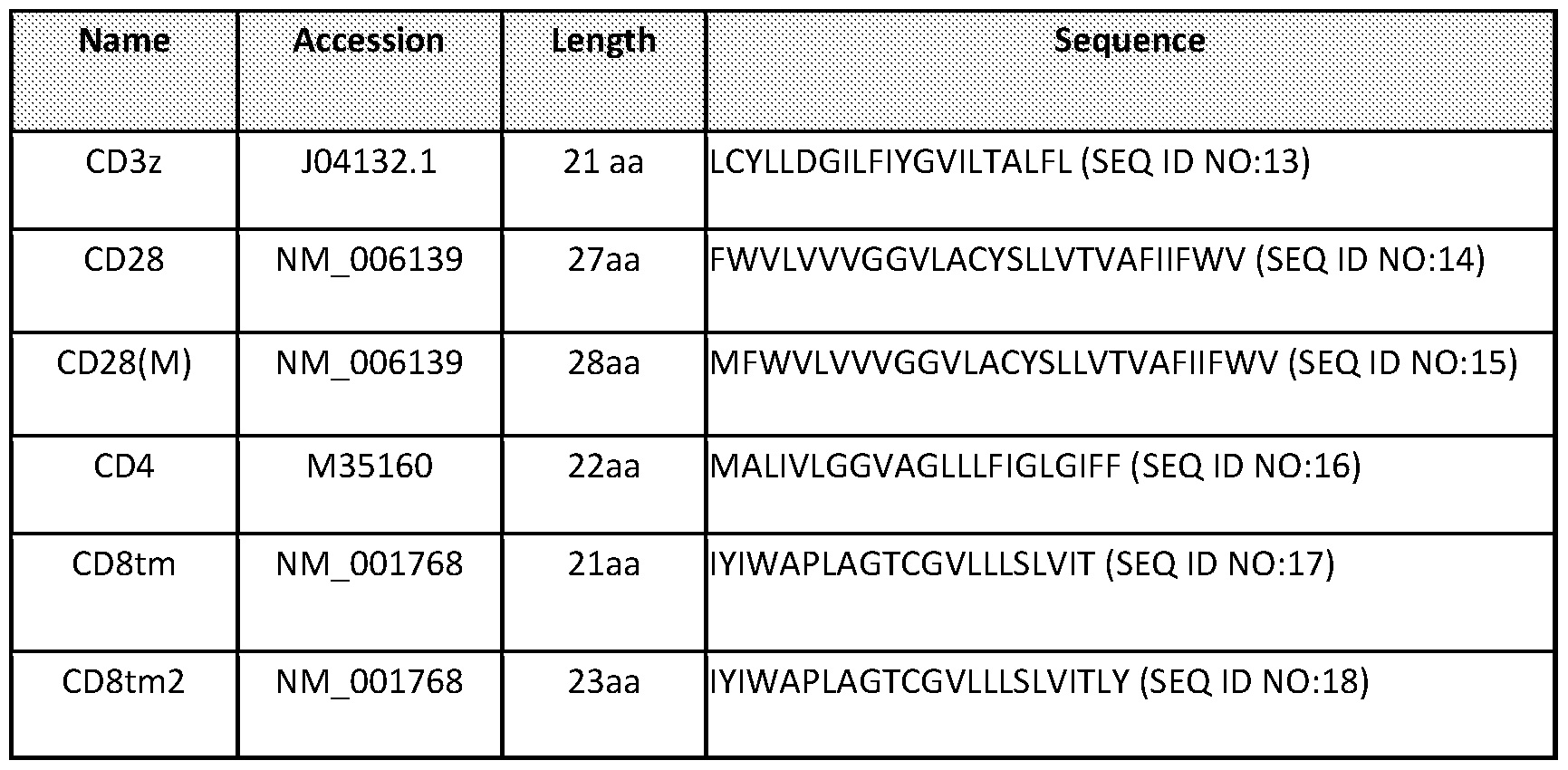

Costimulatory Domain
The costimulatory domain can be any domain that is suitable for use with a CD3(^ signaling domain. In some cases the co-signaling domain is a 4- IBB co-signaling domain that includes a sequence that is at least 90%, at least 95%, at least 98% identical to or identical to: KRGRKKLLYIFKQPFMRPVQTTQEEDGCSCRFPEEEEGGCEL (SEQ ID NO:24). In some cases, the 4-1BB co-signaling domain has 1, 2, 3, 4 of 5 amino acid changes (preferably conservative) compared to SEQ ID NO:24.
The costimulatory domain(s) are located between the transmembrane domain and the CD3(^ signaling domain. Table 3 includes examples of suitable costimulatory domains together with the sequence of the CD3(^ signaling domain.
Table 3: CD3 Domain and Examples of Costimulatory Domains

In various embodiments: the costimulatory domain is selected from the group consisting of: a costimulatory domain depicted in Table 3 or a variant thereof having 1-5 (e.g., 1 or 2) amino acid modifications, a CD28 costimulatory domain or a variant thereof having 1-5 (e.g., 1 or 2) amino acid modifications, a 4- IBB costimulatory domain or a variant thereof having 1-5 (e.g., 1 or 2) amino acid modifications and an 0X40 costimulatory domain or a variant thereof having 1-5 (e.g., 1 or 2) amino acid modifications. In certain embodiments, a 4- IBB costimulatory domain or a variant thereof having 1-5 (e.g., 1 or 2) amino acid modifications in present. In some embodiments there are two costimulatory domains, for example a CD28 co-stimulatory domain or a variant thereof having 1-5 (e.g., 1 or 2) amino acid modifications (e.g., substitutions) and a 4-1BB co-stimulatory domain or a variant thereof having 1-5 (e.g., 1 or 2) amino acid modifications (e.g., substitutions). In various embodiments the 1-5 (e.g., 1 or 2) amino acid modification are substitutions. The costimulatory domain is amino terminal to the CD3(^ signaling domain and a short linker consisting of 2 - 10, e.g., 3 amino acids (e.g., GGG) is can be positioned between the costimulatory domain and the CD3(^ signaling domain. Signaling Domain
The CD3(^ Signaling domain can be any domain that is suitable for use with a CD3(^ signaling domain. In some cases, the CD3(^ signaling domain includes a sequence that is at least 90%, at least 95%, at least 98% identical to or identical to:
RVKFSRSADAPAYQQGQNQLYNELNLGRREEYDVLDKRRGRDPEMGGKPRRKNPQ EGLYNELQKDKMAEAYSEIGMKGERRRGKGHDGLYQGLSTATKDTYDALHMQAL PPR (SEQ ID NO:21). In some cases, the CD3(^ signaling has 1, 2, 3, 4 of 5 amino acid changes (preferably conservative) compared to SEQ ID NO:21.
Truncated EGFR or CD 19
The CD3(^ signaling domain can be followed by a ribosomal skip sequence (e.g., LEGGGEGRGSLLTCGDVEENPGPR; SEQ ID NO:27) and a truncated EGFR having a sequence that is at least 90%, at least 95%, at least 98% identical to or identical to: LVTSLLLCELPHPAFLLIPRKVCNGIGIGEFKDSLSINATNIKHFKNCTSISGDLHILPVA FRGDSFTHTPPLDPQELDILKTVKEITGFLLIQAWPENRTDLHAFENLEIIRGRTKQHG QFSLAVVSLNITSLGLRSLKEISDGDVIISGNKNLCYANTINWKKLFGTSGQKTKIISN RGENSCKATGQVCHALCSPEGCWGPEPRDCVSCRNVSRGRECVDKCNLLEGEPREF VENSECIQCHPECLPQAMNITCTGRGPDNCIQCAHYIDGPHCVKTCPAGVMGENNTL VWKYADAGHVCHLCHPNCTYGCTGPGLEGCPTNGPKIPSIATGMVGALLLLLVVAL GIGLFM (SEQ ID NO:28). In some cases, the truncated EGFR has 1, 2, 3, 4 of 5 amino acid changes (preferably conservative) compared to SEQ ID NO:28. Alternatively the CD3(^ signaling domain can be followed by a ribosomal skip sequence (e.g.,
LEGGGEGRGSLLTCGDVEENPGPR; SEQ ID NO:27) and a truncated CD19R (also called CD19t) having a sequence that is at least 90%, at least 95%, at least 98% identical to or identical to:
MPPPRLLFFLLFLTPMEVRPEEPLVVKVEEGDNAVLQCLKGTSDGPTQQLTWSRESP LKPFLKLSLGLPGLGIHMRPLAIWLFIFNVSQQMGGFYLCQPGPPSEKAWQPGWTVN VEGSGELFRWNVSDLGGLGCGLKNRSSEGPSSPSGKLMSPKLYVWAKDRPEIWEGE PPCVPPRDSLNQSLSQDLTMAPGSTLWLSCGVPPDSVSRGPLSWTHVHPKGPKSLLS LELKDDRPARDMWVMETGLLLPRATAQDAGKYYCHRGNLTMSFHLEITARPVLWH WLLRTGGWKVSAVTLAYLIFCLCSLVGILHLQRALVLRRKR (SEQ ID NO:26)
An amino acid modification refers to an amino acid substitution, insertion, and/or deletion in a protein or peptide sequence. An “amino acid substitution” or "substitution" refers to replacement of an amino acid at a particular position in a parent peptide or protein sequence
with another amino acid. A substitution can be made to change an amino acid in the resulting protein in a non-conservative manner (i.e., by changing the codon from an amino acid belonging to a grouping of amino acids having a particular size or characteristic to an amino acid belonging to another grouping) or in a conservative manner (i.e., by changing the codon from an amino acid belonging to a grouping of amino acids having a particular size or characteristic to an amino acid belonging to the same grouping). Such a conservative change generally leads to less change in the structure and function of the resulting protein. The following are examples of various groupings of amino acids: 1) Amino acids with nonpolar R groups: Alanine, Valine, Leucine, Isoleucine, Proline, Phenylalanine, Tryptophan, Methionine; 2) Amino acids with uncharged polar R groups: Glycine, Serine, Threonine, Cysteine, Tyrosine, Asparagine, Glutamine; 3) Amino acids with charged polar R groups (negatively charged at pH 6.0): Aspartic acid, Glutamic acid; 4) Basic amino acids (positively charged at pH 6.0): Lysine, Arginine, Histidine (at pH 6.0). Another grouping may be those amino acids with phenyl groups: Phenylalanine, Tryptophan, and Tyrosine.
In some cases, the CD45 CAR or CD45 polypeptide can be produced using a vector in which the CAR open reading frame is followed by a T2A ribosome skip sequence and a truncated EGFR (EGFRt), which lacks the cytoplasmic signaling tail. In this arrangement, coexpression of EGFRt provides an inert, non-immunogenic surface marker that allows for accurate measurement of gene modified cells, and enables positive selection of gene- modified cells, as well as efficient cell tracking of the therapeutic T cells in vivo following adoptive transfer. Efficiently controlling proliferation to avoid cytokine storm and off-target toxicity is an important hurdle for the success of T cell immunotherapy. The EGFRt incorporated in the CD45 CAR lentiviral vector can act as suicide gene to ablate the CAR+ T cells in cases of treatment-related toxicity.
The CAR or polypeptide described herein can be produced by any means known in the art, though preferably it is produced using recombinant DNA techniques. Nucleic acids encoding the several regions of the chimeric receptor can be prepared and assembled into a complete coding sequence by standard techniques of molecular cloning known in the art (genomic library screening, overlapping PCR, primer-assisted ligation, site-directed mutagenesis, etc.) as is convenient. The resulting coding region is preferably inserted into an expression vector and used to transform a suitable expression host cell line, preferably a T lymphocyte, and most preferably an autologous T lymphocyte.
Various T cell subsets isolated from the patient can be transduced with a vector for CAR or polypeptide expression. Central memory T cells are one useful T cell subset. Central memory T cell can be isolated from peripheral blood mononuclear cells (PBMC) by selecting for CD45RO+/CD62L+ cells, using, for example, the CliniMACS® device to immunomagnetically select cells expressing the desired receptors. The cells enriched for central memory T cells can be activated with anti-CD3/CD28, transduced with, for example, a lentiviral vector that directs the expression of an CD45 CAR or CD45 polypeptide as well as a non-immunogenic surface marker for in vivo detection, ablation, and potential ex vivo selection. The activated/genetically modified CD45 central memory T cells can be expanded in vitro with IL-2/IL-15 and then cryopreserved. Additional methods of preparing CAR T cells can be found in PCT/US2016/043392.
Methods for preparing useful T cell populations are described in, for example, WO 2017/015490 and WO 2018/102761. In some cases, it may be useful to use natural killer (NK) cells, e.g., allogenic NK cells derived from peripheral blood or cord blood. In other cases, NK cells can be derived from human embryonic stem cells (hESCs) or induced pluripotent stem cells (iPSCs).
In some embodiments, described herein is a composition comprising the iPSC-derived CAR T cells or CARNK cells. In some embodiments, a composition comprising iPSC-derived CAR T cells or CAR NK cells has enhanced therapeutic properties. In some embodiments, the iPSC-derived CAR T cells or CARNK cells demonstrate enhanced functional activity including potent cytokine production, cytotoxicity and cytostatic inhibition of tumor growth, e.g. as activity that reduces the amount of tumor load.
The CAR can be transiently expressed in a T cell population by an mRNA encoding the CAR. The mRNA can be introduced into the T cells by electroporation (Wiesinger et al. 2019 Cancers (Basel) 11 : 1198).
In some embodiments, a composition comprising the CAR T cells comprise one or more of helper T cells, cytotoxic T cells, memory T cells, naive T cells, regulatory T cells, natural killer T cells, or combinations thereof. In some embodiments, a composition comprising the CAR T cells comprise CD3+, CD5+, CD7+, and TCRaP+. In some embodiments, a composition comprising the CAR T cells comprise CD8+ CAR T cells are CD8aP T cells, which have strong cytotoxicity against tumor cells in an antigen specific manner and can
potently secret cytokines such as ZFNy. In some embodiments, CAR T cells have predominant homogenous TCR phenotype. In some embodiments, a composition comprising the CAR T cells comprise CD3+CD5+CD7+TCRap+CD8ap+, CD3+CD5+CD7+TCRap+CD4+, CD62L+CD45RA+ stem memory T cells, CD62L- CD45RA-CD45RO+ effector memory T cells and CD62L-CD45RA+ effector T cells, and combinations thereof.
In some embodiments, the fratricide effect is less than about 10%, 9%, 8%, 7%, 6%, 5%, 4%, 3%, 2%, or 1%.
In some embodiments, one or more genes are knocked out, knocked down, mutated, down regulated, or upregulated. In some embodiments, the one or more genes comprise the gene encoding CD45 (PTPRC). In some embodiments, CD45 (PTPRC) is knocked out. In some embodiments, CD45 (PTPRC) is down regulated. In some embodiments, genetic modification is achieved by methods described herein and those known in the art. In some embodiments, genetic modification methods comprise gene editing, homologous recombination, non-homologous recombination, RNA-mediated genetic modification, DNA- mediated genetic modification, zinc finger nucleases, meganucleases, TALEN, or CRISPR/CAS9. In some embodiments, the CRISPR/CAS9 system comprises a gRNA targeting a CD45 exon. In some embodiments, the CRISPR/CAS9 system comprises a gRNA targeting any one of CD45 exon #3, CD45 exon #8, CD45 exon #12, or CD45 exon #25. In some embodiments, the CRISPR/CAS9 system comprises a gRNA comprising or consisting of AUAUUAAUUCUUACCAGUGG (SEQ ID NO:37) or a variant thereof with 1, 2, 3, 4, or 5 nucleotide changes. In some embodiments, the CRISPR/CAS9 system comprises a gRNA comprising or consisting of ACUCCAUCUAAGCCAACAUG (SEQ ID NO:38) or a variant thereof with 1, 2, 3, 4, or 5 nucleotide changes. In some embodiments, the CRISPR/CAS9 system comprises a gRNA comprising or consisting of CUUCUACAAAAAAUAAUCUG (SEQ ID NO: 39) or a variant thereof with 1, 2, 3, 4, or 5 nucleotide changes. In some embodiments, the CRISPR/CAS9 system comprises a gRNA comprising or consisting of GUGCUGGUGUUGGGCGC (SEQ ID NO:40) or a variant thereof with 1, 2, 3, 4, or 5 nucleotide changes. In some embodiments, the CRISPR/CAS9 system comprises a gRNA comprising or consisting of a sequence selected from the group consisting of: UUAUGAAAUGAUCUUUGAGG (SEQ ID NO: 41; exon #12);
AAAAUAAUCUGAGGCUCUCC (SEQ ID NO: 42; exon #12);
AUAGUAUGCAUGUCAAGUGU (SEQ ID NO: 43; exon #14);
GGGCCAUUACGGUCCCUGGG (SEQ ID NO: 44; exon #14) or a variant of any of these with 1, 2, 3, 4, or 5 nucleotide changes.
In some embodiments, the methods described herein provide for controlling the persistence of CAR T cells and CARNK cells via an inducible suicide switch or transient expression by mRNA CAR technology. In some embodiments, the CAR comprises an inducible “suicide switch” or transduction of the CAR is conducted for transient expression to effectively control the persistence of CAR T cells and CAR NK cells. In some embodiments, this mitigates the risk of hematopoietic toxicity and facilitates clinical application of the CD45- CAR T cells or CD45-CAR NK cells described herein. In some embodiments, the CAR constructs described herein comprise an inducible suicide switch. In some embodiments, the inducible suicide gene is any one of inducible Caspase 9 (iCasp9), EGFR (and/or tEGFR), herpes simplex virus tyrosine kinase (HSV-TK), or human thymidylate kinase (TMPK); other inducible suicide switches are known in the art. Without being bound by theory, cells expressing constructs comprising iCasp9 or TMPK, elimination is achieved through activation of the caspase 3 apoptotic pathway when a small molecule is administered. In some embodiments, the suicide switch is induced by an antibody, such as a clinically approved antibody, e.g., rituximab targeting CD20; cetuximab, panitumumab, zalutumumab, nimotuzumab, matuzumab, or any other antibody targeting EGFR. In some embodiments, the suicide switch is induced by a small molecule or drug, such as a specific chemical inducer of dimerization (CID); e.g., ganciclovir to target TMPK; ramiducid to target iCASp9; etc. Other ways to target or induce a suicide switch are known in the art. In some embodiments, the inducible suicide switch is N-terminal to an scFv or the inducible suicide switch is C- terminal to an scFv. In some embodiments, the inducible suicide switch and scFv are joined by a flexible linker or skip sequence as described herein (e.g., SEQ ID NO:60-61, or a variant hereof having 1, 2, 3, 4, 5, 6, 7, 8, 9, or 10 single amino acid substitutions). In some embodiments, the inducible suicide switch is C-terminal to a costimulatory domain or a CD3(^ domain. For example, a CAR can comprise an EGFR or tEGFR domain as described herein (e.g., SEQ ID NO:31) and targeted via an antibody (e.g., panitumumab).
SEQ ID NO: 60 (iCasp9-T2A-CD45 scFV)
MLEGVQVETISPGDGRTFPKRGQTCVVHYTGMLEDGKKVDSSRDRNKPFKFMLGK
QEVIRGWEEGVAQMSVGQRAKLTISPDYAYGATGHPGIIPPHATLVFDVELLKLESG
GGSGVDGFGDVGALESLRGNADLAYILSMEPCGHCLIINNVNFCRESGLRTRTGSNID CEKLRRRF S SLHFMVEVKGDLTAKKMVLALLELARQDHGALDCC VVVILSHGCQ AS HLQFPGAVYGTDGCPVSVEKIVNIFNGTSCPSLGGKPKLFFIQACGGEQKDHGFEVAS TSPEDESPGSNPEPDATPFQEGLRTFDQLDAISSLPTPSDIFVSYSTFPGFVSWRDPKSG SWYVETLDDIFEQWAHSEDLQSLLLRVANAVSVKGIYKQMPGCFNFLRKKLFFKTE GRGSLLTCGDVEENPGPOVOLVESGGGLVQPGGSLKLSCAASGFDFSRYWMSWVR QAPGKGLEWIGEINPTSSTINFTPSLKDKVFISRDNAKNTLYLQMSKVRSEDTALYYC ARGNYYRYGDAMDYWGQGTSVTVSKISGGGGSGGGGSGGGGSGGGGSGGGGSSDI VLTQSPASLAVSLGQRATISCRASKSVSTSGYSYLHWYQQKPGQPPKLLIYLASNLES GVPARFSGSGSGTDFTLNIHPVEEEDAATYYCQHSRELPFTFGSGTKLEIK
SEQ ID NO:61 (CD45 scFV-T2A- iCasp9)
Q VQLVESGGGLVQPGGSLKLSC AASGFDF SRYWMSWVRQ APGKGLEWIGEINPTS S TINFTPSLKDKVFISRDNAKNTLYLQMSKVRSEDTALYYCARGNYYRYGDAMDYW GQGTSVTVSKISGGGGSGGGGSGGGGSGGGGSGGGGSSDIVLTQSPASLAVSLGQRA TISCRASKSVSTSGYSYLHWYQQKPGQPPKLLIYLASNLESGVPARFSGSGSGTDFTL NIHPVEEEDAATYYCOHSRELPFTFGSGTKLEIKEGRGSLLTCGDVEENPGPMLEGVO VETISPGDGRTFPKRGQTCVVHYTGMLEDGKKVDSSRDRNKPFKFMLGKQEVIRGW EEGVAQMSVGQRAKLTISPDYAYGATGHPGIIPPHATLVFDVELLKLESGGGSGVDG FGDVGALESLRGNADLAYILSMEPCGHCLIINNVNFCRESGLRTRTGSNIDCEKLRRR F S SLHFMVEVKGDLTAKKMVLALLELARQDHGALDCC VVVILSHGCQ ASHLQFPGA VYGTDGCPVSVEKIVNIFNGTSCPSLGGKPKLFFIQACGGEQKDHGFEVASTSPEDES PGSNPEPDATPFQEGLRTFDQLDAISSLPTPSDIFVSYSTFPGFVSWRDPKSGSWYVET LDDIFEQWAHSEDLQSLLLRVANAVSVKGIYKQMPGCFNFLRKKLFFKT
In some embodiments, transient expression is induced by mRNA CAR technology. In some embodiments, the mRNA encodes a CD45 CAR, a CD45 CAR with an inducible suicide switch, and/or an mRNA encoding a CD45 CAR and an mRNA encoding a suicide switch (e.g., iCaspase9). Methods of administering mRNA to a population of T cells or NK cells are known in the art (e.g., transfecting via electroporation). In some embodiments, the population of T cells or population of NK cells transfected by an mRNA has been genetically altered as described herein (e.g., CD45 (PTPRC) has been knocked out, knocked down, mutated, down regulated, or upregulated). In some embodiments the mRNA comprises an 2bgUTR (beta globulin untranslated region; SEQ ID NO:55) and/or a polyA (pA) sequence; e.g., 100 pA,
110 pA, 120 pA, 130 pA, 140 pA, 150 pA (SEQ ID NO:56), etc . In some embodiments, the 2bgUTR and 150 pA increase the stability of an mRNA encoding a CAR (Modification of antigen-encoding RNA increases stability, translational efficacy, and T-cell stimulatory capacity of dendritic cells. Blood (2006) 108 (13): 4009-4017). In some embodiments, the mRNA comprises a promoter sequence; e.g., T7 (SEQ ID NO:57), T3, SP6, etc. An mRNA can encode any scFv or CAR described herein (SEQ ID NOs: 1, 29-31, 62-82); for example, an mRNA can comprise or consist of the sequence in FIG. 12B (SEQ ID NO: 58) CD45scfv- IgG4(L235E, N297Q)-CD28tm-CD28gg-Zeta
SEQ ID NO: 55 cagctcgctttcttgctgtccaatttctattaaaggttcctttgttccctaagtccaactactaaactgggggatattatgaagggccttgagc atctggattctgcctaataaaaaacatttattttcattgctgcgtcgagagctcgctttcttgctgtccaatttctattaaaggttcctttgttccc taagtccaactactaaactgggggatattatgaagggccttgagcatctggattctgcctaataaaaaacatttattttcattgctgcctcga
SEQ ID NO: 56
333333333333333333333333333333333333333333333333333333333333333333333333333333333333 333333333333333333333333333333333333333333333333333333333333333333
SEQ ID NO: 57 taatacgactcactatagg
In some embodiments, described herein is a method of increasing survival of a subject having cancer comprising administering a composition comprising a CAR T cell or CAR NK cell described herein.
In some embodiments, described herein is a method of treating a cancer in a patient comprising administering a composition comprising a CAR T cell or CARNK cell described herein.
In some embodiments, described herein is a method of reducing or ameliorating a symptom associated with a cancer in a patient comprising administering a composition comprising a CAR T cell or CARNK cell described herein.
In some embodiments, a composition comprising CAR T cells or CAR NK cells described herein is administered locally or systemically. In some embodiments, a composition
comprising CAR T cells or CAR NK cells described herein is administered by single or repeat dosing. In some embodiments, a composition comprising CAR T cells or CAR NK cells described herein is administered to a patient having a cancer, a pathogen infection, an autoimmune disorder, or undergoing allogeneic transplant.
In some embodiments, the cancer is selected from the group consisting of blood cancer, B cell leukemia, multiple myeloma, lymphoblastic leukemia (ALL), chronic lymphocytic leukemia, non-Hodgkin's lymphoma, ovarian cancer, prostate cancer, pancreatic cancer, lung cancer, breast cancer, and sarcoma, acute myeloid leukemia (AML).
Also provided herein is a method of enhancing T cell proliferation in T cells expressing a CAR comprising knocking out, knocking down, or mutating the PTPRC gene in the T cells thereby creating CD45 CAR T cells. In some embodiments, there is less than 25%, 20%, 15%, 10%, 9%, 8%, 7%, 6%, 5%, 4%, 3%, 2%, or 1% decrease in antigen-specific toxicity of the CD45- CAR T cells compared the CD45+ CAR T cells expressing the same CAR.
The materials, methods, and examples are illustrative only and not intended to be limiting. All publications, patent applications, patents, sequences, database entries, and other references mentioned herein are incorporated by reference in their entirety for any and all purposes.
Other features and advantages of the described compositions and methods will be apparent from the following detailed description and figures, and from the claims.
DESCRIPTION OF DRAWINGS
FIGS. 1A-1B show a schematic depicting CD45 CAR constructs (A) and the annotated amino acid sequences of a CD45 CAR (SEQ ID NO:29; B).
FIGS. 2A-2D show generation of CD45 knockout CD45CAR T cells. FIG. 2A shows a timeline schematic to generate CD45 knockout CD45CAR T cells. To prevent the strong fratricide effect of WT CD45CAR T cells, CD45 (PTPRC) gene was knocked out on T cells before CD45CAR lentivirus transduction. CRISPR-cas9 RNP system were used to edit the CD45 genes with guide RNAs (gRNA) targeting different exons (E3, 8, 12, 25) of CD45. FIG. 2B shows the growth curves of CD45CAR T cells. FIG. 2C shows the expression
profiles of CAR was evaluated by truncated EGFR staining. FIG. 2D shows the presence of CD45, CD4 and CD8 of the CAR+ T cells.
FIG. 3 shows CD45 expression profiles of hematopoietic malignant cells. Myeloid leukemia cell lines (KG1 A, MV4-11, K562), T cell leukemia and lymphoma cell lines (Jurkat, CEM and Hut78), B cell leukemia and blast cell lines (TM-LCL, Raji and NALM6), multiple myeloma cell line MM. IS were stained with anti-CD45 antibody (BD55482, clone HI30) and analyzed by flow cytometry.
FIGS. 4A-4E show Cytotoxicity of CD45CAR T cells against different hematopoietic malignant cell lines. Indicated tumor cells were co-cultured with CAR T /T cells in series of Effector: Target (E:T) ratios for 4h (FIGS. 4A-4D) or 48h (FIG. 4E) and cytotoxic effect was measured by flow cytometry. (FIG. 4A) Cytotoxicity of CD45KO CD45CAR T cells generated by different gRNAs. 4h cytotoxicity of gRNA #3 generated CD45KO CD45 CAR T cells against myeloid leukemia cell line KG1 A (FIG. 4B), B-ALL line Raji (FIG. 4C), and blast crisis CML cell line KCL22M with T3151 BCR-ABL mutation (FIG. 4D). 48h cytotoxicity effect against AML cell line MV4-11, multiple myeloma cell line MM. IS, and B lymphoblast cell line TM-LCL (FIG. 4E).
FIGS. 5A-5C show myeloid and lymphoid depletion effect of CD45KO CD45CAR T cells against CD45+ healthy hematopoietic cells. PBMCs from heathy donor were co-cultured with CFSE labeled CAR T (FIGS. 5A and 5B) or T cells (FIG. 5C) in series of Effector: Target (E:T) ratios for 4h (FIG. 5A) or 24h (FIGS. 5B and 5C) and cytotoxic effect was analyzed by flow cytometry in combination with myeloid cells (CD1 lb+), T (CD3+) and B (CD 19+) cell markers.
FIG. 6 shows degranulation activity and ZFNy production of CD45CAR T cells against CD45+ AML KG1 A cells. CD45KO CD45 CAR T or mock T cells were cocultured with KG1 A cells with Effector: Target (E:T) ratios 1 : 1 for 5h and the degranulation activity was indicated by CD 107a staining together with ZFNy intracellular staining.
FIGS. 7A-7D shows myeloid depletion effect of CD45CAR T cells in an AML mouse model. (FIG. 7A) NSG mice were engrafted with 1 million MV4-1 LeGFP.ffluc cells by i.v. injection. 5 days later, tumor cells were measured by noninvasive optical bio-photonic imaging using a Xenogen IVIS system and the mice were treated with 2 million mock T cells or CD45 CAR T cells (CD45KO). The tumor growth was monitored every week by imaging
(FIGS. 7B-7C). (FIG. 7D) The health status and survival was tracked, and survival curve was monitored.
FIGS. 8A-8E shows CD45 Knockout enhance CD19CAR T cells proliferation and preserve the functionality. (FIG. 8A) Surface marker profiles of wild type (WT) and CD45KO CD 19- CAR T cells. (FIG. 8B) Degranulation activity and fFNy production of WT and CD45KO CD19-CAR T cells with 4h-coculture with CD19 negative KG1 A cells and CD19 positive cells (TM-LCL, NALM6 and Raji). The labeled number is the percentage of positive populations. (FIG. 8C) Proliferation of FACS sorted T cells and CD19-CART cells with and without CD45 knockout. The cells were cultured for 26 days. (FIG. 8D) Cytotoxicity of WT and CD45KO CD19-CAR T cells against CD19 negative KG1 A cells and CD19 positive NALM6 cells with effector : target (E:T) ratio of 5: 1 for 4h. (FIG. 8E) Cytotoxicity of WT and CD45KO CD19-CAR T cells against CD 19 positive NALM6 cells and CD19KO NALM6 cells with series of effector : target (E:T) ratios for 4h.
FIG. 9 shows antigen specific anti -turn or and myeloid-/lymphoid- ablation effect of CD45- CAR T cells. Luciferase-based Cytotoxicity Assay (LCA) of CD45-CAR T cells against different target cells with 48-hour co-culture in different Effector (E): Target (T) ratios. All the target cells were engineered with firefly luciferase (ffLuc+).
FIGS. 10A-10C show induced cell depletion effect of rimiducid on iCasp9-CD45-CAR lentivirus transduced cells. FIG. 10A is a schematic showing an iCasp9-CD45-CAR construct containing iCaspase9 as safety switch. The order of iCaspase 9 and CD45CAR components can be switched (e.g., promoter-CD45CAR-T2A-iCaspase9-etc). FIG. 10B shows flow cytometry results of HT1080 cells transduced by iCasp9-CD45-CAR lentivirus. FIG. 10C shows a bar graph quantifying relative survival cell number in an experiment where the same number of transduced HT1080 cells as in FIG. 10B were seeded in 24 well plate and treated with 100 pM ramiducid for 24h normalized and compared to non -treated group.
FIGS. 11A-11B show CD45 protein expression profile after PTPRC (CD45) gene knockout by CRISPR/Cas9 gene editing. Data show flow cytometry profiles (FIG. 11 A) and quantified MFI (FIG. 11B) of CD45 expression on wild type and CD45 knock out T cells. hCD45gRNA#3_E12, CUUCUACAAAAAAUAAUCUG (SEQ ID NO: 39) was used for this experiment.
FIGS. 12A-12B show a schematic (FIG. 12A) and sequence (FIG. 12B) of the cDNA of a CD45 mRNA CAR construct with a T7 promoter and stabilization sequences (SEQ ID NO:58).
FIGS. 13A-13B show a schematic (FIG. 13A) and amino acid sequence (FIG. 13B) of the iCaspase 9 mRNA as safety switch construct (SEQ ID NO:59).
FIGS. 14A-14C show characteristics of CD45KO CD45CAR T cells generated by mRNA transduction. FIG 14A shows the CD45 expression profile on wild type T cells, CD45KO T cells, and CD45KO CD45CAR T cells. FIG. 14B shows CAR expression profile of CD45KO CD45CAR T cells 24h after mRNA electroporation. FIG. 14C shows cytotoxicity of CD45KO CD45CAR T cells generated by mRNA transduction against tumor cells. Raji cells were co-cultured with CAR T cells for 24h.
FIG. 15 shows mRNA electroporated T cells preserve expression for 2 weeks. T cells cultured for 7 days were transduced via electroporation with GFP mRNA in a dose of 2.5 ug/million and the expression level of GFP expression was tracked by flow cytometry.
FIGS. 16A-16G. Amino acid sequences of CD45 scFv CAR. (FIG. 16A) CD45 scFv CAR with IgG4(HL-CH3) spacer, CD28 transmembrane domain, CD28 co-stimulatory domain, and CD3 zeta domain (SEQ ID NO:62), without signal sequence (SEQ ID NO:63), and with tEGFR (SEQ ID NO:64). (FIG. 16B) CD45 scFv CAR with IgG4(S228P, L235E,N297Q) spacer, NKG2D transmembrane domain, 2B4 co-stimulatory domain, and CD3 zeta domain (SEQ ID NO: 65), without signal sequence (SEQ ID NO: 66), and with tEGFR (SEQ ID NO:67). (FIG. 16C) CD45 scFv CAR with IgG4(HL-CH3) spacer, NKG2D transmembrane domain, 2B4 co-stimulatory domain, and CD3 zeta domain (SEQ ID NO: 68), without signal sequence (SEQ ID NO:69) and with tEGFR (SEQ ID NO:70). (FIG. 16D) CD45 scFv CAR with CD8h spacer, NKG2D transmembrane domain, 2B4 co-stimulatory domain, and CD3 zeta domain (SEQ ID NO:71), without signal sequence (SEQ ID NO:72), and with tEGFR (SEQ ID NO:73). (FIG. 16E) CD45 scFv CAR with CD8h spacer, CD8 transmembrane domain, 41BB co-stimulatory domain, and CD3 zeta domain (SEQ ID NO:74), without signal sequence (SEQ ID NO:75), and with tEGFR (SEQ ID NO:76). (FIG. 16F) CD45 scFv CAR with IgG4(HL-CH3) spacer, CD4 transmembrane domain, 41BB co-stimulatory domain, and CD3 zeta domain (SEQ ID NO:77), without signal sequence (SEQ ID NO:78), and with tEGFR (SEQ ID NO:79). (FIG. 16G) CD45 scFv CAR IgG4(S228P,
L235E,N297Q) spacer, CD4 transmembrane domain, 41BB co-stimulatory domain, and CD3 zeta domain (SEQ ID NO: 80), without signal sequence (SEQ ID NO: 81), and with tEGFR (SEQ ID NO: 82).
DETAILED DESCRIPTION
In this disclosure, the generation and anti-tumor efficacy of CAR with an anti-CD45 scFv antigen-binding domain are described, inter alia.
Hematopoietic transplantation has been proven effective to treat a wide array of malignant and non-malignant hematological diseases. The preparative regimen, however, routinely entails aggressive and genotoxic treatment with whole body irradiation and/or chemotherapy, which can introduce severe and even life-threatening complications. Ablation of recipient bone marrow cells, including myeloid cells and HSCs, is a requirement of these conditioning regimens in order allow successful engraftment of the composite donor HSCs. Alternative conditioning approaches for bone marrow transplantation (BMT) with less toxic side-effects are desirable. CD45 is a hematopoietic lineage specific marker. Precise hematopoietic cells targeting may be achieved by the application of CD45 targeting chimeric antigen receptor (CAR) T or CAR NK cells for hematological cell transplantation conditioning. CD45 is also a widely expressed surface marker of different types of hematological malignancies including AML, B-ALL, T-ALL, and CML. CD45CAR T cells or CARNK cells can also be used to treat CD45 positive hematological malignancies. To prevent the fratricide effect of CD45 CAR T or CAR NK cells, the CD45 (PTPRC) gene can be knockout out or mutated by gene editing technologies.
The present disclosure relates to novel chimeric antigen receptors (CARs) and applications thereof. CARs are able to redirect immune cell specificity and reactivity toward a selected target through exploiting the ligand-binding domain properties. In particular, the present disclosure relates to a Chimeric Antigen Receptor with extracellular scFv domain of a CD45 monoclonal antibody (e.g., BC8 clone). The present disclosure also relates to polynucleotides, vectors encoding said CAR and genetically modified immune cells expressing said CAR at their surface. The present disclosure also relates to methods to gene edit immune cells by knockout, knockdown or mutant CD45 gene along with co-expressing CD45CAR to produce fratricide resistant CD45CAR T cells or CD45CAR NK cells. The present disclosure is particularly useful for myeloid ablation, hematological cell
transplantation conditioning and for the treatment of CD45 positive hematopoietic malignancies such as myeloid leukemia, T cell leukemia/lymphomas, and the like.
EXAMPLES
The CD45 CAR and their use is further described in the following examples, which do not limit the scope the claims.
Materials and Methods
The following materials and methods were used in the Examples set forth herein.
Cell Lines
Myeloid leukemia cell lines (KG1 A, MV4-11, K562), T cell leukemia and lymphoma cell lines (Jurkat, CEM, and Hut78), B cell leukemia and blast cell lines (TM-LCL, Raji and NALM6), multiple myeloma cell line (MM. IS) were cultured in RPMI-1640 (Lonza) containing 10% fetal bovine serum (FBS, Hyclone) (complete RPMI). The 293T and HT1080 cell lines were cultured in Dulbecco’s Modified Eagles Medium (DMEM, Life Technologies) containing 10% FBS, IX AA, 25 mM HEPES (Irvine Scientific), and 2 mM L-Glutamine (Fisher Scientific) (complete DMEM). All cells were cultured at 37°C with 5% CO2. HUT78 cells were cultured in IMDM (Iscove's Modified Dulbecco’s Medium; Fisher Scientific) with 20% FBS.
DNA Constructs and Lentivirus Production
Tumor cells were engineered to express enhanced green fluorescent protein and firefly luciferase (eGFP/ffluc) by transduction with epHIV7 lentivirus carrying the eGFP/ffluc fusion under the control of the EFla promoter as described previously (Lenalidomide Enhances the Function of CS1 Chimeric Antigen Receptor-Redirected T Cells Against Multiple Myeloma (Wang et al). Clinical Cancer Research 2018).
Research grade lentivirus was generated using a modified polyethylenimine (PEI) mediated transfection method (Optimization of lentiviral vector production using polyethyl enimine- mediated transfection. Yong Tang, et al. Oncology Letters. 2015). Briefly, 293T cells were transfected with packaging plasmid and CAR lentiviral backbone plasmid using a modified PEI method. Viral supernatants were collected after 3 to 4 days. Supernatants were
concentrated via high-speed centrifugation and lentiviral pellets were resuspended in phosphate-buff ered saline (PBS)-lactose solution (4g lactose per 100 mL PBS), aliquoted and stored at -80°C. Lentiviral titers were quantified using HT1080 cells based on EGFRt expression.
SEQ ID NO:29 (CD45 CAR with signal sequence)
MLLLVTSLLLCELPHPAFLLIPQVQLVESGGGLVQPGGSLKLSCAASGFDFSRYWMS WVRQAPGKGLEWIGEINPTSSTINFTPSLKDKVFISRDNAKNTLYLQMSKVRSEDTAL YYCARGNYYRYGDAMDYWGQGTSVTVSKISGGGGSGGGGSGGGGSGGGGSGGGG SSDIVLTQSPASLAVSLGQRATISCRASKSVSTSGYSYLHWYQQKPGQPPKLLIYLAS NLESGVPARFSGSGSGTDFTLNIHPVEEEDAATYYCQHSRELPFTFGSGTKLEIKESKY GPPCPPCPAPEFEGGPSVFLFPPKPKDTLMISRTPEVTCVVVDVSQEDPEVQFNWYVD GVEVHNAKTKPREEQFQSTYRVVSVLTVLHQDWLNGKEYKCKVSNKGLPSSIEKTIS KAKGQPREPQVYTLPPSQEEMTKNQVSLTCLVKGFYPSDIAVEWESNGQPENNYKT TPPVLDSDGSFFLYSRLTVDKSRWQEGNVFSCSVMHEALHNHYTQKSLSLSLGKMF WVLVWGGVLACYSLLVTVAFIIFWVRSKRSRGGHSDYMNMTPRRPGPTRKHYQP YAPPRDFAAYRSGGGRVKFSRSADAPAYQQGQNQLYNELNLGRREEYDVLDKRRG RDPEMGGKPRRKNPQEGLYNELQKDKMAEAYSEIGMKGERRRGKGHDGLYQGLST
ATKDTYDALHMQALPPR
SEQ ID NO:30 (CD45 CAR)
Q VQLVESGGGLVQPGGSLKLSC AASGFDF SRYWMSWVRQAPGKGLEWIGEINPTS S TINFTPSLKDKVFISRDNAKNTLYLQMSKVRSEDTALYYCARGNYYRYGDAMDYW GQGTSVTVSKISGGGGSGGGGSGGGGSGGGGSGGGGSSDIVLTQSPASLAVSLGQRA TISCRASKSVSTSGYSYLHWYQQKPGQPPKLLIYLASNLESGVPARFSGSGSGTDFTL NIHPVEEEDAATYYCQHSRELPFTFGSGTKLEIKESKYGPPCPPCPAPEFEGGPSVFLF PPKPKDTLMISRTPEVTCVVVDVSQEDPEVQFNWYVDGVEVHNAKTKPREEQFQST YRVVSVLTVLHQDWLNGKEYKCKVSNKGLPSSIEKTISKAKGQPREPQVYTLPPSQE EMTKNQVSLTCLVKGFYPSDIAVEWESNGQPENNYKTTPPVLDSDGSFFLYSRLTVD KSRWQEGNVFSCSVMHEALHNHYTQKSLSLSLGKMFWVLVVVGGVLACYSLLVTV AFIIFWVRSKRSRGGHSDYMNMTPRRPGPTRKHYQPYAPPRDFAAYRSGGGRVKFS RSADAPAYQQGQNQLYNELNLGRREEYDVLDKRRGRDPEMGGKPRRKNPQEGLYN ELQKDKMAEAYSEIGMKGERRRGKGHDGLYQGLSTATKDTYDALHMQALPPR
SEQ ID NO: 31 (CD45 CAR with signal sequence and EGFRt)
MLLLVTSLLLCELPHPAFLLIPQVQLVESGGGLVQPGGSLKLSCAASGFDFSRYWMS WVRQAPGKGLEWIGEINPTSSTINFTPSLKDKVFISRDNAKNTLYLQMSKVRSEDTAL YYCARGNYYRYGDAMDYWGQGTSVTVSKISGGGGSGGGGSGGGGSGGGGSGGGG SSDIVLTQSPASLAVSLGQRATISCRASKSVSTSGYSYLHWYQQKPGQPPKLLIYLAS NLESGVPARFSGSGSGTDFTLNIHPVEEEDAATYYCQHSRELPFTFGSGTKLEIKESKY GPPCPPCPAPEFEGGPSVFLFPPKPKDTLMISRTPEVTCVVVDVSQEDPEVQFNWYVD GVEVHNAKTKPREEQFQSTYRVVSVLTVLHQDWLNGKEYKCKVSNKGLPSSIEKTIS KAKGQPREPQVYTLPPSQEEMTKNQVSLTCLVKGFYPSDIAVEWESNGQPENNYKT TPPVLDSDGSFFLYSRLTVDKSRWQEGNVFSCSVMHEALHNHYTQKSLSLSLGKMF WVLVWGGVLACYSLLVTVAFIIFWVRSKRSRGGHSDYMNMTPRRPGPTRKHYQP YAPPRDFAAYRSGGGRVKFSRSADAPAYQQGQNQLYNELNLGRREEYDVLDKRRG RDPEMGGKPRRKNPQEGLYNELQKDKMAEAYSEIGMKGERRRGKGHDGLYQGLST ATKDTYDALHMQALPPRLEGGGEGRGSLLTCGDVEENPGPRMLLLVTSLLLCELPHP AFLLIPRKVCNGIGIGEFKDSLSINATNIKHFKNCTSISGDLHILPVAFRGDSFTHTPPLD PQELDILKTVKEITGFLLIQAWPENRTDLHAFENLEIIRGRTKQHGQFSLAVVSLNITSL GLRSLKEISDGDVIISGNKNLCYANTINWKKLFGTSGQKTKIISNRGENSCKATGQVC HALCSPEGCWGPEPRDCVSCRNVSRGRECVDKCNLLEGEPREFVENSECIQCHPECL
PQAMNITCTGRGPDNCIQCAHYIDGPHCVKTCPAGVMGENNTLVWKYADAGHVCH LCHPNCTYGCTGPGLEGCPTNGPKIPSIATGMVGALLLLLVVALGIGLFMT
SEQ ID NO: 62 (CD45 scFv -IgG4(HL-CH3) - CD28 TM - CD28GG - CD3i with signal)
MLLLVTSLLLCELPHPAFLLIPOVOLVESGGGLVOPGGSLKLSCAASGFDFSRYWMS WVRQAPGKGLEWIGEINPTSSTINFTPSLKDKVFISRDNAKNTLYLQMSKVRSEDTAL YYCARGNYYRYGDAMDYWGQGTSVTVSKISGGGGSGGGGSGGGGSGGGGSGGGG SSDIVLTQSPASLAVSLGQRATISCRASKSVSTSGYSYLHWYQQKPGQPPKLLIYLAS NLESGVPARFSGSGSGTDFTLNIHPVEEEDAATYYCQHSRELPFTFGSGTKLEIKESKY GPPCPPCPGGGSSGGGSGGQPREPQVYTLPPSQEEMTKNQVSLTCLVKGFYPSDIAVE WESNGQPENNYKTTPPVLDSDGSFFLYSRLTVDKSRWQEGNVFSCSVMHEALHNHY TQKSLSLSLGKMFWVLVVVGGVLACYSLLVTVAFIIFWVRSKRSRGGHSDYMNMTP RRPGPTRKHYQPYAPPRDFAAYRSGGGRVKFSRSADAPAYQQGQNQLYNELNLGRR EEYDVLDKRRGRDPEMGGKPRRKNPQEGLYNELQKDKMAEAYSEIGMKGERRRGK GHDGLYQGLSTATKDTYDALHMQALPPR
SEQ ID NO: 63 (CD45 scFv -IgG4(HL-CH3) - CD28 TM - CD28GG - CD3Q
Q VQLVESGGGLVQPGGSLKLSC AASGFDF SRYWMSWVRQAPGKGLEWIGEINPTS S TINFTPSLKDKVFISRDNAKNTLYLQMSKVRSEDTALYYCARGNYYRYGDAMDYW GQGTSVTVSKISGGGGSGGGGSGGGGSGGGGSGGGGSSDIVLTQSPASLAVSLGQRA TISCRASKSVSTSGYSYLHWYQQKPGQPPKLLIYLASNLESGVPARFSGSGSGTDFTL NIHPVEEEDAATYYCQHSRELPFTFGSGTKLEIKESKYGPPCPPCPGGGSSGGGSGGQ PREPQVYTLPPSQEEMTKNQVSLTCLVKGFYPSDIAVEWESNGQPENNYKTTPPVLD SDGSFFLYSRLTVDKSRWQEGNVFSCSVMHEALHNHYTQKSLSLSLGKMFWVLVV VGGVLACYSLLVTVAFIIFWVRSKRSRGGHSDYMNMTPRRPGPTRKHYQPYAPPRD FAAYRSGGGRVKFSRSADAPAYQQGQNQLYNELNLGRREEYDVLDKRRGRDPEMG GKPRRKNPQEGLYNELQKDKMAEAYSEIGMKGERRRGKGHDGLYQGLSTATKDTY DALHMQALPPR
SEQ ID NO: 64 (CD45 scFv -IgG4(HL-CH3) - CD28 TM - CD28GG - CD3i with signal and EGFRt)
MLLLVTSLLLCELPHPAFLLIPOVOLVESGGGLVOPGGSLKLSCAASGFDFSRYWMS WVRQAPGKGLEWIGEINPTSSTINFTPSLKDKVFISRDNAKNTLYLQMSKVRSEDTAL YYCARGNYYRYGDAMDYWGQGTSVTVSKISGGGGSGGGGSGGGGSGGGGSGGGG SSDIVLTQSPASLAVSLGQRATISCRASKSVSTSGYSYLHWYQQKPGQPPKLLIYLAS NLESGVPARFSGSGSGTDFTLNIHPVEEEDAATYYCQHSRELPFTFGSGTKLEIKESKY GPPCPPCPGGGSSGGGSGGQPREPQVYTLPPSQEEMTKNQVSLTCLVKGFYPSDIAVE WESNGQPENNYKTTPPVLDSDGSFFLYSRLTVDKSRWQEGNVFSCSVMHEALHNHY TQKSLSLSLGKMFWVLVVVGGVLACYSLLVTVAFIIFWVRSKRSRGGHSDYMNMTP RRPGPTRKHYQPYAPPRDFAAYRSGGGRVKFSRSADAPAYQQGQNQLYNELNLGRR EEYDVLDKRRGRDPEMGGKPRRKNPQEGLYNELQKDKMAEAYSEIGMKGERRRGK GHDGLYQGLSTATKDTYDALHMQALPPRLEGGGEGRGSLLTCGDVEENPGPRMLLL VTSLLLCELPHPAFLLIPRKVCNGIGIGEFKDSLSINATNIKHFKNCTSISGDLHILPVAF RGDSFTHTPPLDPQELDILKTVKEITGFLLIQAWPENRTDLHAFENLEIIRGRTKQHGQ FSLAVVSLNITSLGLRSLKEISDGDVIISGNKNLCYANTINWKKLFGTSGQKTKIISNR GENSCKATGQVCHALCSPEGCWGPEPRDCVSCRNVSRGRECVDKCNLLEGEPREFV ENSECIQCHPECLPQAMNITCTGRGPDNCIQCAHYIDGPHCVKTCPAGVMGENNTLV
WKYADAGHVCHLCHPNCTYGCTGPGLEGCPTNGPKIPSIATGMVGALLLLLVVALG IGLFMT
SEQ ID NO: 65 (CD45 scFv - IgG4(S228P, L235E,N297Q)- NKG2D TM - 2B4- CD3^ with signal)
MLLLVTSLLLCELPHPAFLLIPOVOLVESGGGLVOPGGSLKLSCAASGFDFSRYWMS WVRQAPGKGLEWIGEINPTSSTINFTPSLKDKVFISRDNAKNTLYLQMSKVRSEDTAL YYCARGNYYRYGDAMDYWGQGTSVTVSKISGGGGSGGGGSGGGGSGGGGSGGGG SSDIVLTQSPASLAVSLGQRATISCRASKSVSTSGYSYLHWYQQKPGQPPKLLIYLAS NLESGVPARFSGSGSGTDFTLNIHPVEEEDAATYYCQHSRELPFTFGSGTKLEIKESKY GPPCPPCPAPEFEGGPSVFLFPPKPKDTLMISRTPEVTCVVVDVSQEDPEVQFNWYVD GVEVHNAKTKPREEQFQSTYRVVSVLTVLHQDWLNGKEYKCKVSNKGLPSSIEKTIS KAKGQPREPQVYTLPPSQEEMTKNQVSLTCLVKGFYPSDIAVEWESNGQPENNYKT TPPVLDSDGSFFLYSRLTVDKSRWQEGNVFSCSVMHEALHNHYTQKSLSLSLGKPFF FCCFIAVAMGIRFIIMVTWRRKRKEKQSETSPKEFLTIYEDVKDLKTRRNHEQEQTFP GGGSTIYSMIQSQSSAPTSQEPAYTLYSLIQPSRKSGSRKRNHSPSFNSTIYEVIGKSQP KAQNPARLSRKELENFDVYSGGGRVKFSRSADAPAYQQGQNQLYNELNLGRREEY DVLDKRRGRDPEMGGKPRRKNPQEGLYNELQKDKMAEAYSEIGMKGERRRGKGH DGLYQGLSTATKDTYDALHMQALPPR
SEQ ID NO: 66 (CD45 scFv - IgG4(S228P, L235E,N297Q)- NKG2D TM - 2B4- CD3Q
Q VQLVESGGGLVQPGGSLKLSC AASGFDF SRYWMSWVRQ APGKGLEWIGEINPTS S TINFTPSLKDKVFISRDNAKNTLYLQMSKVRSEDTALYYCARGNYYRYGDAMDYW GQGTSVTVSKISGGGGSGGGGSGGGGSGGGGSGGGGSSDIVLTQSPASLAVSLGQRA TISCRASKSVSTSGYSYLHWYQQKPGQPPKLLIYLASNLESGVPARFSGSGSGTDFTL NH4PVEEEDAATYYCQHSRELPFTFGSGTKLEIKESKYGPPCPPCPAPEFEGGPSVFLF PPKPKDTLMISRTPEVTCVVVDVSQEDPEVQFNWYVDGVEVHNAKTKPREEQFQST YRVVSVLTVLHQDWLNGKEYKCKVSNKGLPSSIEKTISKAKGQPREPQVYTLPPSQE EMTKNQVSLTCLVKGFYPSDIAVEWESNGQPENNYKTTPPVLDSDGSFFLYSRLTVD KSRWQEGNVFSCSVMHEALHNHYTQKSLSLSLGKPFFFCCFIAVAMGIRFIIMVTWR RKRKEKQSETSPKEFLTIYEDVKDLKTRRNHEQEQTFPGGGSTIYSMIQSQSSAPTSQE PAYTLYSLIQPSRKSGSRKRNHSPSFNSTIYEVIGKSQPKAQNPARLSRKELENFDVYS GGGRVKFSRSADAPAYQQGQNQLYNELNLGRREEYDVLDKRRGRDPEMGGKPRRK NPQEGLYNELQKDKMAEAYSEIGMKGERRRGKGHDGLYQGLSTATKDTYDALHM QALPPR
SEQ ID NO: 67 (CD45 scFv - IgG4(S228P, L235E,N297Q)- NKG2D TM - 2B4- CD3^ with signal and EGFRt)
MLLLVTSLLLCELPHPAFLLIPOVOLVESGGGLVOPGGSLKLSCAASGFDFSRYWMS WVRQAPGKGLEWIGEINPTSSTINFTPSLKDKVFISRDNAKNTLYLQMSKVRSEDTAL YYCARGNYYRYGDAMDYWGQGTSVTVSKISGGGGSGGGGSGGGGSGGGGSGGGG SSDIVLTQSPASLAVSLGQRATISCRASKSVSTSGYSYLHWYQQKPGQPPKLLIYLAS NLESGVPARFSGSGSGTDFTLNIHPVEEEDAATYYCQHSRELPFTFGSGTKLEIKESKY GPPCPPCPAPEFEGGPSVFLFPPKPKDTLMISRTPEVTCVVVDVSQEDPEVQFNWYVD GVEVHNAKTKPREEQFQSTYRVVSVLTVLHQDWLNGKEYKCKVSNKGLPSSIEKTIS KAKGQPREPQVYTLPPSQEEMTKNQVSLTCLVKGFYPSDIAVEWESNGQPENNYKT TPPVLDSDGSFFLYSRLTVDKSRWQEGNVFSCSVMHEALHNHYTQKSLSLSLGKPFF FCCFIAVAMGIRFIIMVTWRRKRKEKQSETSPKEFLTIYEDVKDLKTRRNHEQEQTFP GGGSTIYSMIQSQSSAPTSQEPAYTLYSLIQPSRKSGSRKRNHSPSFNSTIYEVIGKSQP KAQNPARLSRKELENFDVYSGGGRVKFSRSADAPAYQQGQNQLYNELNLGRREEY DVLDKRRGRDPEMGGKPRRKNPQEGLYNELQKDKMAEAYSEIGMKGERRRGKGH DGLYQGLSTATKDTYDALHMQALPPRLEGGGEGRGSLLTCGDVEENPGPRMLLLVT SLLLCELPHPAFLLIPRKVCNGIGIGEFKDSLSINATNIKHFKNCTSISGDLHILPVAFRG DSFTHTPPLDPQELDILKTVKEITGFLLIQAWPENRTDLHAFENLEIIRGRTKQHGQFS LAVVSLNITSLGLRSLKEISDGDVIISGNKNLCYANTINWKKLFGTSGQKTKIISNRGE NSCKATGQVCHALCSPEGCWGPEPRDCVSCRNVSRGRECVDKCNLLEGEPREFVEN SECIQCHPECLPQAMNITCTGRGPDNCIQCAHYIDGPHCVKTCPAGVMGENNTLVW
KYADAGHVCHLCHPNCTYGCTGPGLEGCPTNGPKIPSIATGMVGALLLLLVVALGIG LFMT
SEQ ID NO: 68 (CD45 scFv - IgG4(HL-CH3)- NKG2D TM - 2B4- CD3i with signal)
MLLLVTSLLLCELPHPAFLLIPOVOLVESGGGLVOPGGSLKLSCAASGFDFSRYWMS WVRQAPGKGLEWIGEINPTSSTINFTPSLKDKVFISRDNAKNTLYLQMSKVRSEDTAL YYCARGNYYRYGDAMDYWGQGTSVTVSKISGGGGSGGGGSGGGGSGGGGSGGGG SSDIVLTQSPASLAVSLGQRATISCRASKSVSTSGYSYLHWYQQKPGQPPKLLIYLAS NLESGVPARFSGSGSGTDFTLNIHPVEEEDAATYYCQHSRELPFTFGSGTKLEIKESKY GPPCPPCPGGGSSGGGSGGQPREPQVYTLPPSQEEMTKNQVSLTCLVKGFYPSDIAVE WESNGQPENNYKTTPPVLDSDGSFFLYSRLTVDKSRWQEGNVFSCSVMHEALHNHY TQKSLSLSLGKPFFFCCFIAVAMGIRFIIMVTWRRKRKEKQSETSPKEFLTIYEDVKDL
KTRRNHEQEQTFPGGGSTIYSMIQSQSSAPTSQEPAYTLYSLIQPSRKSGSRKRNHSPS FNSTIYEVIGKSQPKAQNPARLSRKELENFDVYSGGGRVKFSRSADAPAYQQGQNQL YNELNLGRREEYDVLDKRRGRDPEMGGKPRRKNPQEGLYNELQKDKMAEAYSEIG MKGERRRGKGHDGLYQGLSTATKDTYDALHMQALPPR
SEQ ID NO: 69 (CD45 scFv - IgG4(HL-CH3)- NKG2D TM - 2B4- CD3Q
Q VQLVESGGGLVQPGGSLKLSC AASGFDF SRYWMSWVRQ APGKGLEWIGEINPTS S TINFTPSLKDKVFISRDNAKNTLYLQMSKVRSEDTALYYCARGNYYRYGDAMDYW GQGTSVTVSKISGGGGSGGGGSGGGGSGGGGSGGGGSSDIVLTQSPASLAVSLGQRA TISCRASKSVSTSGYSYLHWYQQKPGQPPKLLIYLASNLESGVPARFSGSGSGTDFTL NIHPVEEEDAATYYCQHSRELPFTFGSGTKLEIKESKYGPPCPPCPGGGSSGGGSGGQ PREPQVYTLPPSQEEMTKNQVSLTCLVKGFYPSDIAVEWESNGQPENNYKTTPPVLD SDGSFFLYSRLTVDKSRWQEGNVFSCSVMHEALHNHYTQKSLSLSLGKPFFFCCFIA VAMGIRFIIMVTWRRKRKEKQSETSPKEFLTIYEDVKDLKTRRNHEQEQTFPGGGSTI YSMIQSQSSAPTSQEPAYTLYSLIQPSRKSGSRKRNHSPSFNSTIYEVIGKSQPKAQNP ARLSRKELENFDVYSGGGRVKFSRSADAPAYQQGQNQLYNELNLGRREEYDVLDK RRGRDPEMGGKPRRKNPQEGLYNELQKDKMAEAYSEIGMKGERRRGKGHDGLYQ GLSTATKDTYDALHMQALPPR
SEQ ID NO: 70 (CD45 scFv - IgG4(HL-CH3)- NKG2D TM - 2B4- CD3i with signal and EGFRt)
MLLLVTSLLLCELPHPAFLLIPOVOLVESGGGLVOPGGSLKLSCAASGFDFSRYWMS WVRQAPGKGLEWIGEINPTSSTINFTPSLKDKVFISRDNAKNTLYLQMSKVRSEDTAL YYCARGNYYRYGDAMDYWGQGTSVTVSKISGGGGSGGGGSGGGGSGGGGSGGGG SSDIVLTQSPASLAVSLGQRATISCRASKSVSTSGYSYLHWYQQKPGQPPKLLIYLAS NLESGVPARFSGSGSGTDFTLNIHPVEEEDAATYYCQHSRELPFTFGSGTKLEIKESKY GPPCPPCPGGGSSGGGSGGQPREPQVYTLPPSQEEMTKNQVSLTCLVKGFYPSDIAVE WESNGQPENNYKTTPPVLDSDGSFFLYSRLTVDKSRWQEGNVFSCSVMHEALHNHY TQKSLSLSLGKPFFFCCFIAVAMGIRFIIMVTWRRKRKEKQSETSPKEFLTIYEDVKDL KTRRNHEQEQTFPGGGSTIYSMIQSQSSAPTSQEPAYTLYSLIQPSRKSGSRKRNHSPS FNSTIYEVIGKSQPKAQNPARLSRKELENFDVYSGGGRVKFSRSADAPAYQQGQNQL YNELNLGRREEYDVLDKRRGRDPEMGGKPRRKNPQEGLYNELQKDKMAEAYSEIG MKGERRRGKGHDGLYQGLSTATKDTYDALHMQALPPRLEGGGEGRGSLLTCGDVE
ENPGPRMLLLVTSLLLCELPHPAFLLIPRKVCNGIGIGEFKDSLSINATNIKHFKNCTSI SGDLHILPVAFRGDSFTHTPPLDPQELDILKTVKEITGFLLIQAWPENRTDLHAFENLEI IRGRTKQHGQFSLAVVSLNITSLGLRSLKEISDGDVIISGNKNLCYANTINWKKLFGTS GQKTKIISNRGENSCKATGQVCHALCSPEGCWGPEPRDCVSCRNVSRGRECVDKCN LLEGEPREFVENSECIQCHPECLPQAMNITCTGRGPDNCIQCAHYIDGPHCVKTCPAG VMGENNTLVWKYADAGHVCHLCHPNCTYGCTGPGLEGCPTNGPKIPSIATGMVGA LLLLLVVALGIGLFMT
SEQ ID NO: 71 (CD45 scFv - CD8h - NKG2D TM - 2B4- CD3i with signal)
MLLLVTSLLLCELPHPAFLLIPOVOLVESGGGLVOPGGSLKLSCAASGFDFSRYWMS WVRQAPGKGLEWIGEINPTSSTINFTPSLKDKVFISRDNAKNTLYLQMSKVRSEDTAL YYCARGNYYRYGDAMDYWGQGTSVTVSKISGGGGSGGGGSGGGGSGGGGSGGGG SSDIVLTQSPASLAVSLGQRATISCRASKSVSTSGYSYLHWYQQKPGQPPKLLIYLAS NLESGVPARFSGSGSGTDFTLNIHPVEEEDAATYYCQHSRELPFTFGSGTKLEIKPAPR PPTPAPTIASQPLSLRPEACRPAAGGAVHTRGLDFACDPFFFCCFIAVAMGIRFHMVT WRRKRKEKQSETSPKEFLTIYEDVKDLKTRRNHEQEQTFPGGGSTIYSMIQSQSSAPT SQEPAYTLYSLIQPSRKSGSRKRNHSPSFNSTIYEVIGKSQPKAQNPARLSRKELENFD VYSGGGRVKFSRSADAPAYQQGQNQLYNELNLGRREEYDVLDKRRGRDPEMGGKP RRKNPQEGLYNELQKDKMAEAYSEIGMKGERRRGKGHDGLYQGLSTATKDTYDAL
HMQALPPR
SEQ ID NO: 72 (CD45 scFv - CD8h - NKG2D TM - 2B4- CD3Q
Q VQLVESGGGLVQPGGSLKLSC AASGFDF SRYWMSWVRQ APGKGLEWIGEINPTS S TINFTPSLKDKVFISRDNAKNTLYLQMSKVRSEDTALYYCARGNYYRYGDAMDYW GQGTSVTVSKISGGGGSGGGGSGGGGSGGGGSGGGGSSDIVLTQSPASLAVSLGQRA TISCRASKSVSTSGYSYLHWYQQKPGQPPKLLIYLASNLESGVPARFSGSGSGTDFTL NIHPVEEEDAATYYCQHSRELPFTFGSGTKLEIKPAPRPPTPAPTIASQPLSLRPEACRP AAGGAVHTRGLDFACDPFFFCCFIAVAMGIRFIIMVTWRRKRKEKQSETSPKEFLTIY EDVKDLKTRRNHEQEQTFPGGGSTIYSMIQSQSSAPTSQEPAYTLYSLIQPSRKSGSRK RNHSPSFNSTIYEVIGKSQPKAQNPARLSRKELENFDVYSGGGRVKFSRSADAPAYQ QGQNQLYNELNLGRREEYDVLDKRRGRDPEMGGKPRRKNPQEGLYNELQKDKMA EAYSEIGMKGERRRGKGHDGLYQGLSTATKDTYDALHMQALPPR
SEQ ID NO: 73 (CD45 scFv - CD8h - NKG2D TM - 2B4- CD3i with signal and EGFRt)
MLLLVTSLLLCELPHPAFLLIPOVOLVESGGGLVOPGGSLKLSCAASGFDFSRYWMS WVRQAPGKGLEWIGEINPTSSTINFTPSLKDKVFISRDNAKNTLYLQMSKVRSEDTAL YYCARGNYYRYGDAMDYWGQGTSVTVSKISGGGGSGGGGSGGGGSGGGGSGGGG SSDIVLTQSPASLAVSLGQRATISCRASKSVSTSGYSYLHWYQQKPGQPPKLLIYLAS NLESGVPARFSGSGSGTDFTLNIHPVEEEDAATYYCQHSRELPFTFGSGTKLEIKPAPR PPTPAPTIASQPLSLRPEACRPAAGGAVHTRGLDFACDPFFFCCFIAVAMGIRFIIMVT WRRKRKEKQSETSPKEFLTIYEDVKDLKTRRNHEQEQTFPGGGSTIYSMIQSQSSAPT SQEPAYTLYSLIQPSRKSGSRKRNHSPSFNSTIYEVIGKSQPKAQNPARLSRKELENFD VYSGGGRVKFSRSADAPAYQQGQNQLYNELNLGRREEYDVLDKRRGRDPEMGGKP RRKNPQEGLYNELQKDKMAEAYSEIGMKGERRRGKGHDGLYQGLSTATKDTYDAL HMQALPPRLEGGGEGRGSLLTCGDVEENPGPRMLLLVTSLLLCELPHPAFLLIPRKVC NGIGIGEFKDSLSINATNIKHFKNCTSISGDLHILPVAFRGDSFTHTPPLDPQELDILKT VKEITGFLLIQAWPENRTDLHAFENLEIIRGRTKQHGQFSLAVVSLNITSLGLRSLKEIS DGDVIISGNKNLCYANTINWKKLFGTSGQKTKIISNRGENSCKATGQVCHALCSPEG CWGPEPRDCVSCRNVSRGRECVDKCNLLEGEPREFVENSECIQCHPECLPQAMNITC
TGRGPDNCIQCAHYIDGPHCVKTCPAGVMGENNTLVWKYADAGHVCHLCHPNCTY GCTGPGLEGCPTNGPKIPSIATGMVGALLLLLVVALGIGLFMT
SEQ ID NO: 74 (CD45 scFv - CD8h - CD8 TM - 41BB- CD3i with signal)
MLLLVTSLLLCELPHPAFLLIPOVOLVESGGGLVOPGGSLKLSCAASGFDFSRYWMS WVRQAPGKGLEWIGEINPTSSTINFTPSLKDKVFISRDNAKNTLYLQMSKVRSEDTAL YYCARGNYYRYGDAMDYWGQGTSVTVSKISGGGGSGGGGSGGGGSGGGGSGGGG SSDIVLTQSPASLAVSLGQRATISCRASKSVSTSGYSYLHWYQQKPGQPPKLLIYLAS NLESGVPARFSGSGSGTDFTLNIHPVEEEDAATYYCQHSRELPFTFGSGTKLEIKPAPR PPTPAPTIASQPLSLRPEACRPAAGGAVHTRGLDFACDIYIWAPLAGTCGVLLLSLVIT KRGRKKLLYIFKQPFMRP VQTTQEEDGC SCRFPEEEEGGCELGGGRVKF SRS AD AP A YQQGQNQLYNELNLGRREEYDVLDKRRGRDPEMGGKPRRKNPQEGLYNELQKDK MAEAYSEIGMKGERRRGKGHDGLYQGLSTATKDTYDALHMQALPPR
SEQ ID NO: 75 (CD45 scFv - CD8h - CD8 TM - 41BB- CD3Q
Q VQLVESGGGLVQPGGSLKLSC AASGFDF SRYWMSWVRQ APGKGLEWIGEINPTS S
TINFTPSLKDKVFISRDNAKNTLYLQMSKVRSEDTALYYCARGNYYRYGDAMDYW
GQGTSVTVSKISGGGGSGGGGSGGGGSGGGGSGGGGSSDIVLTQSPASLAVSLGQRA
TISCRASKSVSTSGYSYLHWYQQKPGQPPKLLIYLASNLESGVPARFSGSGSGTDFTL NIHPVEEEDAATYYCQHSRELPFTFGSGTKLEIKPAPRPPTPAPTIASQPLSLRPEACRP AAGGAVHTRGLDFACDIYIWAPLAGTCGVLLLSLVITKRGRKKLLYIFKQPFMRPVQ TTQEEDGC SCRFPEEEEGGCELGGGRVKF SRS AD AP AYQQGQNQLYNELNLGRREE YDVLDKRRGRDPEMGGKPRRKNPQEGLYNELQKDKMAEAYSEIGMKGERRRGKG HDGLYQGLSTATKDTYDALHMQALPPR
SEQ ID NO: 76 (CD45 scFv - CD8h - CD8 TM - 41BB- CD3i with signal and EGFRt)
MLLLVTSLLLCELPHPAFLLIPOVOLVESGGGLVOPGGSLKLSCAASGFDFSRYWMS WVRQAPGKGLEWIGEINPTSSTINFTPSLKDKVFISRDNAKNTLYLQMSKVRSEDTAL YYCARGNYYRYGDAMDYWGQGTSVTVSKISGGGGSGGGGSGGGGSGGGGSGGGG SSDIVLTQSPASLAVSLGQRATISCRASKSVSTSGYSYLHWYQQKPGQPPKLLIYLAS NLESGVPARFSGSGSGTDFTLNIHPVEEEDAATYYCQHSRELPFTFGSGTKLEIKPAPR PPTPAPTIASQPLSLRPEACRPAAGGAVHTRGLDFACDIYIWAPLAGTCGVLLLSLVIT KRGRKKLLYIFKQPFMRP VQTTQEEDGC SCRFPEEEEGGCELGGGRVKF SRS AD AP A YQQGQNQLYNELNLGRREEYDVLDKRRGRDPEMGGKPRRKNPQEGLYNELQKDK MAEAYSEIGMKGERRRGKGHDGLYQGLSTATKDTYDALHMQALPPRLEGGGEGRG SLLTCGDVEENPGPRMLLLVTSLLLCELPHPAFLLIPRKVCNGIGIGEFKDSLSINATNI KHFKNCTSISGDLHILPVAFRGDSFTHTPPLDPQELDILKTVKEITGFLLIQAWPENRT DLHAFENLEIIRGRTKQHGQFSLAVVSLNITSLGLRSLKEISDGDVIISGNKNLCYANTI NWKKLFGTSGQKTKIISNRGENSCKATGQVCHALCSPEGCWGPEPRDCVSCRNVSR GRECVDKCNLLEGEPREFVENSECIQCHPECLPQAMNITCTGRGPDNCIQCAHYIDGP HCVKTCPAGVMGENNTLVWKYADAGHVCHLCHPNCTYGCTGPGLEGCPTNGPKIP
SIATGMVGALLLLLVVALGIGLFMT
SEQ ID NO: 77 (CD45 scFv - IgG4(HL-CH3)- CD4 TM - 41BB- CD3i with signal)
MLLLVTSLLLCELPHPAFLLIPOVOLVESGGGLVOPGGSLKLSCAASGFDFSRYWMS WVRQAPGKGLEWIGEINPTSSTINFTPSLKDKVFISRDNAKNTLYLQMSKVRSEDTAL YYCARGNYYRYGDAMDYWGQGTSVTVSKISGGGGSGGGGSGGGGSGGGGSGGGG SSDIVLTQSPASLAVSLGQRATISCRASKSVSTSGYSYLHWYQQKPGQPPKLLIYLAS NLESGVPARFSGSGSGTDFTLNIHPVEEEDAATYYCQHSRELPFTFGSGTKLEIKESKY GPPCPPCPGGGSSGGGSGGQPREPQVYTLPPSQEEMTKNQVSLTCLVKGFYPSDIAVE WESNGQPENNYKTTPPVLDSDGSFFLYSRLTVDKSRWQEGNVFSCSVMHEALHNHY
TQKSLSLSLGKMALIVLGGVAGLLLFIGLGIFFKRGRKKLLYIFKQPFMRPVQTTQEE DGCSCRFPEEEEGGCELGGGRVKFSRSADAPAYQQGQNQLYNELNLGRREEYDVLD KRRGRDPEMGGKPRRKNPQEGLYNELQKDKMAEAYSEIGMKGERRRGKGHDGLY QGLSTATKDTYDALHMQALPPR
SEQ ID NO: 78 (CD45 scFv - IgG4(HL-CH3)- CD4 TM - 41BB- CD3Q
Q VQLVESGGGLVQPGGSLKLSC AASGFDF SRYWMSWVRQ APGKGLEWIGEINPTS S TINFTPSLKDKVFISRDNAKNTLYLQMSKVRSEDTALYYCARGNYYRYGDAMDYW GQGTSVTVSKISGGGGSGGGGSGGGGSGGGGSGGGGSSDIVLTQSPASLAVSLGQRA TISCRASKSVSTSGYSYLHWYQQKPGQPPKLLIYLASNLESGVPARFSGSGSGTDFTL NIHPVEEEDAATYYCQHSRELPFTFGSGTKLEIKESKYGPPCPPCPGGGSSGGGSGGQ PREPQVYTLPPSQEEMTKNQVSLTCLVKGFYPSDIAVEWESNGQPENNYKTTPPVLD SDGSFFLYSRLTVDKSRWQEGNVFSCSVMHEALHNHYTQKSLSLSLGKMALIVLGG VAGLLLFIGLGIFFKRGRKKLLYIFKQPFMRPVQTTQEEDGCSCRFPEEEEGGCELGG GRVKFSRSADAPAYQQGQNQLYNELNLGRREEYDVLDKRRGRDPEMGGKPRRKNP QEGLYNELQKDKMAEAYSEIGMKGERRRGKGHDGLYQGLSTATKDTYDALHMQA LPPR
SEQ ID NO: 79 (CD45 scFv - IgG4(HL-CH3)- CD4 TM - 41BB- CD3i with signal and EGFRt)
MLLLVTSLLLCELPHPAFLLIPOVOLVESGGGLVOPGGSLKLSCAASGFDFSRYWMS WVRQAPGKGLEWIGEINPTSSTINFTPSLKDKVFISRDNAKNTLYLQMSKVRSEDTAL YYCARGNYYRYGDAMDYWGQGTSVTVSKISGGGGSGGGGSGGGGSGGGGSGGGG SSDIVLTQSPASLAVSLGQRATISCRASKSVSTSGYSYLHWYQQKPGQPPKLLIYLAS NLESGVPARFSGSGSGTDFTLNIHPVEEEDAATYYCQHSRELPFTFGSGTKLEIKESKY GPPCPPCPGGGSSGGGSGGQPREPQVYTLPPSQEEMTKNQVSLTCLVKGFYPSDIAVE WESNGQPENNYKTTPPVLDSDGSFFLYSRLTVDKSRWQEGNVFSCSVMHEALHNHY TQKSLSLSLGKMALIVLGGVAGLLLFIGLGIFFKRGRKKLLYIFKQPFMRPVQTTQEE DGC SCRFPEEEEGGCELGGGRVKF SRS AD AP AYQQGQNQLYNELNLGRREE YD VLD KRRGRDPEMGGKPRRKNPQEGLYNELQKDKMAEAYSEIGMKGERRRGKGHDGLY QGLSTATKDTYDALHMQALPPRLEGGGEGRGSLLTCGDVEENPGPRMLLLVTSLLL
CELPHPAFLLIPRKVCNGIGIGEFKDSLSINATNIKHFKNCTSISGDLHILPVAFRGDSFT HTPPLDPQELDILKTVKEITGFLLIQAWPENRTDLHAFENLEIIRGRTKQHGQFSLAW
SLNITSLGLRSLKEISDGDVIISGNKNLCYANTINWKKLFGTSGQKTKIISNRGENSCK ATGQVCHALCSPEGCWGPEPRDCVSCRNVSRGRECVDKCNLLEGEPREFVENSECIQ CHPECLPQAMNITCTGRGPDNCIQCAHYIDGPHCVKTCPAGVMGENNTLVWKYAD AGHVCHLCHPNCTYGCTGPGLEGCPTNGPKIPSIATGMVGALLLLLVVALGIGLFMT
SEQ ID NO: 80 (CD45 scFv - IgG4(S228P, L235E,N297Q)- CD4 TM - 41BB- CD3i with signal)
MLLLVTSLLLCELPHPAFLLIPOVOLVESGGGLVOPGGSLKLSCAASGFDFSRYWMS WVRQAPGKGLEWIGEINPTSSTINFTPSLKDKVFISRDNAKNTLYLQMSKVRSEDTAL YYCARGNYYRYGDAMDYWGQGTSVTVSKISGGGGSGGGGSGGGGSGGGGSGGGG SSDIVLTQSPASLAVSLGQRATISCRASKSVSTSGYSYLHWYQQKPGQPPKLLIYLAS NLESGVPARFSGSGSGTDFTLNIHPVEEEDAATYYCQHSRELPFTFGSGTKLEIKESKY GPPCPPCPAPEFEGGPSVFLFPPKPKDTLMISRTPEVTCVVVDVSQEDPEVQFNWYVD GVEVHNAKTKPREEQFQSTYRVVSVLTVLHQDWLNGKEYKCKVSNKGLPSSIEKTIS KAKGQPREPQVYTLPPSQEEMTKNQVSLTCLVKGFYPSDIAVEWESNGQPENNYKT TPPVLDSDGSFFLYSRLTVDKSRWQEGNVFSCSVMHEALHNHYTQKSLSLSLGKMA LIVLGGVAGLLLFIGLGIFFKRGRKKLLYIFKQPFMRPVQTTQEEDGCSCRFPEEEEGG CELGGGRVKFSRSADAPAYQQGQNQLYNELNLGRREEYDVLDKRRGRDPEMGGKP RRKNPQEGLYNELQKDKMAEAYSEIGMKGERRRGKGHDGLYQGLSTATKDTYDAL HMQALPPR
SEQ ID NO: 81 (CD45 scFv - IgG4(S228P, L235E,N297Q)- CD4 TM - 41BB- CD3Q
Q VQLVESGGGLVQPGGSLKLSC AASGFDF SRYWMSWVRQ APGKGLEWIGEINPTS S TINFTPSLKDKVFISRDNAKNTLYLQMSKVRSEDTALYYCARGNYYRYGDAMDYW GQGTSVTVSKISGGGGSGGGGSGGGGSGGGGSGGGGSSDIVLTQSPASLAVSLGQRA TISCRASKSVSTSGYSYLHWYQQKPGQPPKLLIYLASNLESGVPARFSGSGSGTDFTL NH4PVEEEDAATYYCQHSRELPFTFGSGTKLEIKESKYGPPCPPCPAPEFEGGPSVFLF PPKPKDTLMISRTPEVTCVVVDVSQEDPEVQFNWYVDGVEVHNAKTKPREEQFQST YRVVSVLTVLHQDWLNGKEYKCKVSNKGLPSSIEKTISKAKGQPREPQVYTLPPSQE EMTKNQVSLTCLVKGFYPSDIAVEWESNGQPENNYKTTPPVLDSDGSFFLYSRLTVD KSRWQEGNVFSCSVMHEALHNHYTQKSLSLSLGKMALIVLGGVAGLLLFIGLGIFFK RGRKKLLYIFKQPFMRPVQTTQEEDGCSCRFPEEEEGGCELGGGRVKFSRSADAPAY QQGQNQLYNELNLGRREEYDVLDKRRGRDPEMGGKPRRKNPQEGLYNELQKDKM
AEAYSEIGMKGERRRGKGHDGLYQGLSTATKDTYDALHMQALPPR
SEQ ID NO: 82 (CD45 scFv - IgG4(S228P, L235E,N297Q)- CD4 TM - 41BB- CD3i with signal and EGFRt)
MLLLVTSLLLCELPHPAFLLIPQVQLVESGGGLVQPGGSLKLSCAASGFDFSRYWMS WVRQAPGKGLEWIGEINPTSSTINFTPSLKDKVFISRDNAKNTLYLQMSKVRSEDTAL YYCARGNYYRYGDAMDYWGQGTSVTVSKISGGGGSGGGGSGGGGSGGGGSGGGG SSDIVLTQSPASLAVSLGQRATISCRASKSVSTSGYSYLHWYQQKPGQPPKLLIYLAS NLESGVPARFSGSGSGTDFTLNIHPVEEEDAATYYCQHSRELPFTFGSGTKLEIKESKY GPPCPPCPAPEFEGGPSVFLFPPKPKDTLMISRTPEVTCVVVDVSQEDPEVQFNWYVD GVEVHNAKTKPREEQFQSTYRVVSVLTVLHQDWLNGKEYKCKVSNKGLPSSIEKTIS KAKGQPREPQVYTLPPSQEEMTKNQVSLTCLVKGFYPSDIAVEWESNGQPENNYKT TPPVLDSDGSFFLYSRLTVDKSRWQEGNVFSCSVMHEALHNHYTQKSLSLSLGKMA LIVLGGVAGLLLFIGLGIFFKRGRKKLLYIFKQPFMRPVQTTQEEDGCSCRFPEEEEGG CELGGGRVKFSRSADAPAYQQGQNQLYNELNLGRREEYDVLDKRRGRDPEMGGKP RRKNPQEGLYNELQKDKMAEAYSEIGMKGERRRGKGHDGLYQGLSTATKDTYDAL HMQALPPRLEGGGEGRGSLLTCGDVEENPGPRMLLLVTSLLLCELPHPAFLLIPRKVC NGIGIGEFKDSLSINATNIKHFKNCTSISGDLHILPVAFRGDSFTHTPPLDPQELDILKT VKEITGFLLIQAWPENRTDLHAFENLEIIRGRTKQHGQFSLAVVSLNITSLGLRSLKEIS DGDVIISGNKNLCYANTINWKKLFGTSGQKTKIISNRGENSCKATGQVCHALCSPEG CWGPEPRDCVSCRNVSRGRECVDKCNLLEGEPREFVENSECIQCHPECLPQAMNITC
TGRGPDNCIQCAHYIDGPHCVKTCPAGVMGENNTLVWKYADAGHVCHLCHPNCTY GCTGPGLEGCPTNGPKIPSIATGMVGALLLLLVVALGIGLFMT
Cell Isolation, CD45 gene editing, CD45-CAR Lentiviral Transduction, and Ex Vivo Expansion _Leukapheresis products were obtained from consented research participants (healthy donors) under protocols approved by the City of Hope Internal Review Board (IRB). On the day of leukapheresis, peripheral blood mononuclear cells (PBMC) were isolated by density gradient centrifugation over Ficoll-Paque (GE Healthcare) followed by multiple washes in PBSZEDTA (Miltenyi Biotec). Cells were rested overnight at room temperature (RT) on a rotator, and subsequently washed and resuspended in X-VIVO T cell medium (Lonza) containing 10% FBS (complete X-VIVO). Up to 5.0 x 10⁹ PBMC were incubated with anti-CD14 and anti-CD25 microbeads (Miltenyi Biotec) for 30 min at RT and magnetically depleted using the CliniMACS® system (Miltenyi Biotec) according to the
manufacturer’s protocol and these were termed depleted PBMCs (dPBMC). dPBMC were frozen in CryoStor® CS5 (StemCell Technologies) until further processing. Tn/mem cells were prepared from dPBMC by staining with anti-CD62L microbeads(Miltenyi Biotec) and enriching CD62L+ cells using AutoMACS system.. dPBMC or Tn/mem were stimulated with CD3/CD28 Dyna-beads (Thermal Fisher Scientific, Ratio of Cell to Beads is 1 to 2) in X- vivol5 medium with 10 U/mL IL2 and 0.5 ng/mL IL15. After one day, the cells were harvested and PTPRC (CD45) gene was knocked out by CRISPR-Cas9 ribonucleoprotein (RNP) system. For small scale experiment, the RNP was prepared by mixing 60 pmol Truecut Cas9 V2 protein (Thermo Fisher) and 180 pmol gRNA targeting PTPRC in 50 uL electroporation P3 buffer (Lonza) and incubate for 15min at room temperature. The RNP solution was then mixed with 50 uL T cell suspension of 2 million cells and delivered by electroporation using 4D Nucleofector system (Lonza). After electroporation, T cells were incubated with 0.5 mL culture medium for 15 min then transferred to wells with 2 mL medium and fresh CD3/CD28 beads (Ratio of Cells to Beads is 1 to 1.)
Lentiviral transduction was performed at 2-5 days after gene editing. Briefly gene modified T cells were cultured with CD3/CD28 Dynabeads® (Life Technologies), protamine sulfate (APP Pharmaceuticals), cytokine mixture (as stated above) and desired lentivirus at a multiplicity of infection (MOI) of 1-3. Cells were then cultured in and replenished with fresh complete X-VIVO containing cytokines every 2-3 days. After 7 days, beads were magnetically removed, and cells were further expanded in complete X-VIVO containing cytokines to achieve desired cell yield. Following further expansion, cells were frozen in CryoStor® CS5 prior to in vitro functional assays and in vivo tumor models. Purity and phenotype of CAR T cells were verified by flow cytometry. We designed multiple gRNAs targeting different exons of CD45 (PTPRC) gene to knock out it. Examples used are as follows: hCD45gRNA#l_E3, AUAUUAAUUCUUACCAGUGG (SEQ ID NO: 37); hCD45gRNA#2_E8, ACUCCAUCUAAGCCAACAUG (SEQ ID NO: 38); hCD45gRNA#3_E12, CUUCUACAAAAAAUAAUCUG (SEQ ID NO: 39); hCD45gRNA#4_E25, GUGCUGGUGUUGGGCGCAC (SEQ ID NO: 45).
Flow Cytometry
T cells were harvested and stained as described previously (Jonnalagadda, M., et al., Chimeric antigen receptors with mutated IgG4 Fc spacer avoid fc receptor binding and improve T cell persistence and antitumor efficacy. Mol Ther, 2015. 23(4): p. 757-68.). T cell
phenotype was examined using fluorochrome-conjugated antibodies against CD3, CD4, CD8a, CD45 (clone HI30, BC-8 or 94.1). Transgenic CAR expression was determined by staining of the truncated EGFR tag. Data were acquired on MacsQuant Analyzer 10 (Miltenyi Biotec) flow cytometers and analyzed with FlowJo (vlO.6.1).
In Vitro T cell Assays
For tumor killing assays, CAR T cells and tumor targets were co-cultured at indicated effectortumor (E:T) ratios. To test cytotoxicity effect of CD45CAR T cells, GFP expressing tumor cells were plated in 96-well U-bottom plates at the indicated density. Effector cells (CD45KO CD45CAR T or Mock T cells) were washed, resuspended in fresh medium without cytokines and co-cultured with the indicated tumor cells for 4 hours (short term) or 48 hours (long term). Cytotoxicity was routinely evaluated by flow cytometry with enumeration of GFP+DAPI- tumor cells for viable GFP-expressing tumor cells. For primary PBMC, viable T cells (CD3+), B cells (CD 19+) and myeloid cells (CD1 lb+) were analyzed by staining with lineage specific markers.
To test for degranulation activity, CAR T or control T cells were incubated with tumor cells for five hours in the presence of CD107a antibody and GolgiStop protein transport inhibitor (BD Biosciences). After the co-culture, cells were harvested, fixed, permeabilized, and stained for intracellular cytokines. Degranulation (CD 107a staining) and intracellular cytokine staining (e.g. ZFNy) were examined by flow cytometry.
In Vivo Tumor Studies
All animal experiments were performed under protocols approved by the City of Hope Institutional Animal Care and Use Committee. Tumor xenograft models were generated using 6 to 8 week-old NOD/SCID/IL2R-/- (NSG) mice as previously described (Jackson Laboratory) [Urak, R., et al., Ex vivo Akt inhibition promotes the generation of potent CD19CAR T cells foradoptive immunotherapy. J Immunother Cancer, 2017. 5:26], Briefly, on day 0, ffLuc+ MV4-11 cells (1 x 10⁶) were injected intravenously (z.v.) into the NSG mice. After 5 days, mice were then treated with CAR T cells or mock T cells as described for each experiment. Tumor growth was determined by in vivo bio-photonic imaging using a Xenogen IVIS 100. Mice were also monitored for survival, with euthanasia applied according to the American Veterinary Medical Association Guidelines.
Example 1: Generation of CD45KO CD45 CAR T cells
We utilized the single chain variable fragment (scFv) sequence of an anti-CD45 antibody clone BC-8, which already shown good profiles of safety and specificity [Mawad, R., et al., Radiolabeled anti-CD45 antibody with reduced-intensity conditioning and allogeneic transplantation for younger patients with advanced acute myeloid leukemia or myelodysplastic syndrome. Biol Blood Marrow Transplant, 2014. 20(9): 1363-8; Lin, Y., et al., A genetically engineered anti-CD45 single-chain antibody-streptavidin fusion protein for pretargeted radioimmunotherapy of hematologic malignancies. Cancer Res, 2006. 66(7):3884-92; Orozco, J. J., J. Zeller, and J.M. Pagel, Radiolabeled antibodies directed at CD45 for conditioning prior to allogeneic transplantation in acute myeloid leukemia and myelodysplastic syndrome. Ther Adv Hematol, 2012. 3( 1 ): 5- 16] . The CD45 CAR construct for T cells is composed with anti-CD45 scfv domain, an IgG4 spacer with two pointmutations (L235E and N297Q) within the CH2 region, a CD28GG costimulatory domain, CD3(^, and a truncated human epidermal growth factor receptor (huEGFRt) as a marker (FIG. 1A-1B). The CAR construct can also use other costimulatory domains such as 4 IBB, other spacer domains and transmembrane domains such as CD8 hinge and CD4 transmembrane domain. For CAR constructs for NK cells, the transmembrane domain can be the NKG2D transmembrane domain and the costimulatory domain can be the 2B4 costimulatory domain.
CD45KO CD45CAR T cells can be prepare from, for example, PBMC, dPBMC (PBMC with depletion of CD14+ and CD25+ cells), Tn/mem (naive and memory T cells, CD62L+ enriched from dPBMC), or Tcm (central memory T cells). In this case, CD45KO CD45CAR T cells were generated from Tn/mem cells (FIG. 2A). A number of different gRNAs targeting different exons of PTPRC gene were used knock out PTPRC gene. The generated CD45CAR T cells with PTPRC gene knock out demonstrated better proliferation capacity and generated more cells compared to WT CD45CAR T cells (FIG. 2B), in which CD45CAR can cause a fratricidal effect. There was a CAR positive percentage range from 35.5% to 48.3% with MOI of 2 for lenti virus transduction (FIG. 2C). Surface marker analysis by flow cytometry showed that CD45KO CD45CAR T cells had no detectable cell surface CD45 expression (FIG. 2D). Moreover, the relative CD4+ and CD8+ population was not significantly altered (FIG. 2D).
Example 2: Validation that CD45 CAR T cells selectively target CD45-positive cells in vitro
To determine whether CD45 CAR T cells demonstrate selective activity against CD45- positive cancer and noncancerous cells, the CD45 CAR T cells were grown in presence of either CD45-positive cells.
As shown in FIG. 3, CD45 is widely expressed on different hematopoietic malignant cells, including acute myeloid leukemia (KG1 A, MV4-11, K562), T cell leukemia and lymphoma (Jurkat, CEM, Hut78), B cell leukemia and lymphoma (TM-LCL, Raji, NALM6) and Multiple Myeloma (MM. IS). It was also well established that CD45 is a hematopoietic specific marker in healthy physiological condition [Rheinlander, A., B. Schraven, and U. Bommhardt, CD45 in human physiology and clinical medicine. Immunol Lett, 2018. 196:22- 32], By coculturing with CD45+ KG1 A and Raji cells, all CD45KO CD45CAR T cells demonstrated potent antigen specific cytotoxicity while mock T cells did not (FIG. 4A).
The gRNA#3 (target PTPRC exon 12) CD45 knock out cells were used for further functional characterization. The CD45KO CD45CAR T cells demonstrated potent cytotoxicity against AML (KGla, MV4-11) (FIGS. 4B and 4E), B-ALL (Raji, TM-LCL) (FIG. 4C), blast crisis CML (KCL22M with T315I mutation) (FIG. 4D) and multiple myeloma (MM. IS) (FIG. 4E).
By co-culturing with PBMC from healthy donor, CD45KO CD45CAR T cells were shown to eliminate healthy myeloid cells (CD1 lb+), B cells (CD 19+) and T cells (CD3+) (FIGS. 5A and 5B), while mock T cells did not (FIG. 5C). This functional phenotype indicated potential application of CD45KO CD45 CAR T cells for HCT conditioning.
The CD45KO CD45CAR T cells also demonstrated potent antigen specific degranulation activity and IFNy secretion (FIG. 6).
Example 3: Validation that CD45 CAR T cells delivered in vivo in a mouse model exhibit potent anti-tumor activity and confer extended lifespan to the mice
To evaluate in vivo efficacy of CD45 CAR T cells to selectively target CD45-positive cells in the AML model, CD45 CAR T cells were delivered and tumor size and survival was evaluated over time.
To further evaluate the in vivo activity, we tested in a tumor xenograft mouse model with MV4-11 AML cells (FIG. 7A). CD45KO CD45 CAR T cells treatment significantly eliminated tumor engrafts and prolonged the survival of the mice (FIGS. 7B-7D).
Example 4: Validation that CD45KO CAR T cells targeted to other antigens benefit from enhanced features
CD45 is reported to play key roles in T cell development and function regulation in both negative and positive way [Alexander, D.R., The CD45 tyrosine phosphatase: a positive and negative regulator of immune cell function. Semin Immunol, 2000. 12(4): 349-59; Cho, J.H., et al., CD45-mediated control of TCR tuning in naive and memory CD8(+) T cells. Nat Commun, 2016. 7:13373; Virts, E.L., O. Diago, and W.C. Raschke, A CD45 minigene restores regulated isoform expression and immune function in CD 45 -deficient mice: therapeutic implications for human CD45-null severe combined immunodeficiency. Blood, 2003. 101(3): 849-55] . However, the role of CD45 in CAR T cells is not well studied. We explored the functions of CD45 on CD19-CAR T cells by knocking out CD45. As shown in FIG. 8A, knocking out CD45 on CD19-CAR T cells or mock T cells increased CD4+ population with expense of CD8+ population. CD45KO CD19-CAR T cells demonstrated potent degranulation, IFNy secretion activity (FIG. 8B) and comparable antigen specific cytotoxicity (FIG. 8D). As shown in FIG. 8E, which depicts the results of a 4 hr cytotoxicity assay using wt or CD45KO CD19-CAR T cells against WT NALM6 or CD19KO NALM6, knockout of CD45 did not impair antigen specific cytotoxicity of CD19-CAR T cells. The CD45 knockout enhanced the proliferation of T cells and CD19CAR T cells (FIG. 8C). This phenotype suggests various CAR T cells, e.g., CAR T cells targeted to CD 19 may benefit from knockout or knockdown of CD45.
Example 5: Myeloid/lymphoid ablation effect of CD45 CAR T cells in humanized mouse model with human PBMC or HSC engraftments
In some circumstances it is desirable to reduce or eliminate myeloid and/or lymphoid cells in vivo. Experiments will be conducted in a humanized mouse model to measure depletion of myeloid and lymphoid cells as a function of treatment with CD45KO CD45 CAR T cells and CD45KO CD45 CAR NK cells. Results will show a reduction of myeloid and/or lymphoid cells and in increase of success of PBMC and/or HCS (hematopoietic stem cells) engraftment with CD45 CAR T cells and/or CD45KO CD45 CAR NK cells treatment.
Example 6: CD45KO CD45CAR T cells have antigen-specific anti-tumor and myeloid- ablation and lymphoid-ablation activity
Killing assays demonstrated that CD45KO CD45CAR T cells have antigen specific antitumor and myeloid-ablation and lymphoid-ablation activity. Luciferase-based Cytotoxicity Assay (LCA) of CD45KO CD45-CAR T cells against different CD45+ target cells (M0LM14, MV4-11, Jurkat, and Hut78) with 48-hour co-culture in different Effector (E): Target (T) ratios showed effective killing of the CD45+ target cells (FIG. 9).
Example 7: Validation of iCasp9-CD45-CAR expression and function
To test the effects of a suicide switch as a safety precaution, experiments were conducted to investigate the induced cell depletion effect of rimiducid on iCasp9-CD45-CAR lentivirus transduced cells. iCasp9 can be activated by a specific chemical inducer of dimerization (CID) such as rimiducid, leading to efficient elimination of iCasp9 engineered cell.
The design of an iCasp9-CD45-CAR construct containing iCaspase9 is shown in FIG. 10A. The order of iCaspase 9 and CD45 scFv components can be switched (e.g., promoter- CD45CAR-T2A-iCaspase9-etc). HT1080 cells were transduced by lentivirus. Flow cytometry showed 22% of the transduced T cells expressed CD45 CAR (FIG. 10B). Transduced HT1080 cells were seeded in 24 well plate and treated with 100 pM ramiducid for 24h normalized and compared to non-treated group, and the relative survival cell number was quantified (FIG. 10C). Treating the iCasp9-CD45-CAR cells with ramiducid reduced cell survival to 36% (FIG. 10C)
Example 8: Validation of CD45 depletion on T cells following CRISPR/Cas9 gene editing
Experiments were then conducted to quantify the CD45 protein expression on wild type and CD45 knock out T cells after PTPRC (CD45) gene knockout by CRISPR/Cas9 gene editing. hCD45gRNA#3_E12, CUUCUACAAAAAAUAAUCUG (SEQ ID NO: 39) was used for this experiment. This experiment demonstrated the decreasing expression of CD45 via flow cytometry (FIG. 11 A) and quantified MFI (FIG. 11B) after CRISPR/cas9 mediated CD45KO, which provided evidence that transduction CD45-CAR after 5 days following CRISPR can avoid fratricide effect.
Example 9: CD45KO CD45CAR T cells generated by mRNA transduction/ iCaspase9 for generating mRNA by in vitro transcription method/ mRNA electroporated T cells can preserve transitory expression for 2 weeks
The design of a CD45 mRNA CAR is shown in FIG. 12A. The sequence of the CD45 mRNA CAR is shown in FIG. 12B. CD45KO CD45CAR T cells are used here but it works the same for a CD45KO CD45CAR NK cells (data not shown). The design of an iCaspase 9 mRNA is shown in FIG. 13A. The sequence of the iCaspase 9 mRNA is shown in FIG. 13B. The iCaspase 9 mRNA is used as a safety switch construct.
Experiments were then conducted to investigate the characteristics of CD45KO CD45CAR T cells generated by mRNA transduction. Flow cytometry probed the CD45 expression profile on wild type T cells, CD45KO T cells, and CD45KO CD45CAR T cells and showed CD45 was effectively knocked out (FIG. 14A). The CAR expression profile of CD45KO CD45CAR T cells 24h after mRNA electroporation shows 20% of the cells expressed the CAR (FIG. 14B)
T cells cultured for 7 days were transduced via electroporation with GFP mRNA in a dose of 2.5 ug/million and the expression level of GFP expression was tracked by flow cytometry. This data demonstrated that GFP mRNA can express GFP protein for about 2 weeks. Importantly, mRNA electroporated T cells preserved expression for 2 weeks indicates the feasibility of mRNA CD45CAR T cells with transitional expression as a strategy to make these CAR T and NK cells safer for patients.
OTHER EMBODIMENTS
It is to be understood that while the invention has been described in conjunction with the detailed description thereof, the foregoing description is intended to illustrate and not limit the scope of the invention.
Claims
1. A nucleic acid molecule comprising a nucleotide sequence encoding a chimeric antigen receptor (CAR) or a polypeptide, wherein the chimeric antigen receptor or polypeptide comprises: an scFv targeting CD45, a spacer, a transmembrane domain, a costimulatory domain, and a CD3 C, signaling domain.
2. The nucleic acid molecule of claim 1, wherein the scFv comprises the amino acid sequence of SEQ ID NO: 1 or variant thereof having 1-5 amino acid modifications.
3. The nucleic acid molecule of claim 1, wherein the scFv comprises the amino acid sequence of SEQ ID NO:32 or variant thereof having 1-5 amino acid modifications and the amino acid sequence of SEQ ID NO: 33 or variant thereof having 1-5 amino acid modifications.
4. The nucleic acid molecule of claim 1, wherein the transmembrane domain is selected from the group consisting of: a CD4 transmembrane domain or variant thereof having 1-5 amino acid modifications, a CD8 transmembrane domain or variant thereof having 1-5 amino acid modifications, a CD28 transmembrane domain or a variant thereof having 1-5 amino acid modifications, and a NKG2D transmembrane domain or a variant thereof having 1-5 amino acid modifications.
5. The nucleic acid molecule of claim 1, wherein the transmembrane domain is a CD4 transmembrane domain, a CD8 transmembrane domain, a CD28 transmembrane domain or a NKG2D transmembrane domain.
6. The nucleic acid molecule of claim 1, wherein the costimulatory domain is a CD28, 4-1BB, or a 2B4 costimulatory domain.
7. The nucleic acid molecule of claim 1, wherein the costimulatory domain comprises the amino acid sequence of any of SEQ ID NOs:22-25 and 54 or a variant thereof having 1-5 amino acid modifications.
8. The nucleic acid molecule of claim 1, wherein the CD3(^ signaling domain comprises the amino acid sequence of SEQ ID NO:21.
45
9. The nucleic acid molecule of claim 1, wherein a linker of 3 to 15 amino acids is located between the costimulatory domain and the CD3 C, signaling domain or variant thereof.
10. The nucleic acid molecule of claim 1, wherein the spacer comprises any one of SEQ ID NOs:2-12 or a variant thereof having 1-5 amino acid modifications.
11. The nucleic acid molecule of claim 1, wherein the CAR or the polypeptide comprises the amino acid sequence of SEQ ID NO:29 or 30, or a variant thereof having 1-5 amino acid modifications.
12. The nucleic acid molecule of claim 1, which is an mRNA molecule.
13. An expression vector comprising the nucleic acid molecule of claim 1.
14. A population of human T cells harboring the mRNA molecule of claim 12.
15. A population of human T cells transduced by a vector comprising the nucleic acid molecule of claim 1.
16. The population of human T cells of claim 15, wherein the population of human T cells comprise central memory T cells, naive memory T cells, CD4+ cells and CD8+ cells enriched from PBMC cells, T cells isolated via negative depletion, or PBMC substantially depleted for CD25+ cells and CD14+ cells.
17. The population of T cells of claim 15, wherein CD45 (PTPRC) is knocked out, knocked down, or mutated.
17a. The population of T cells of claim 17, wherein the mutation is a deletion that eliminates CD45 expression.
18. The population of T cells of claim 17, wherein CD45 (PTPRC) is knocked out, knocked down, or mutated by CRISPR-Cas9 or TALEN system.
19. A population of human NK cells transduced by a vector comprising the nucleic acid molecule of claim 1 or harboring the mRNA molecule of claim 12.
20. The population of NK cells of claim 19, wherein CD45 (PTPRC) is knocked out, knocked down, or mutated.
46
20a. The population of NK cells of claim 20, wherein the mutation is a deletion that eliminates CD45 expression,
21. The population of NK cells of claim 19, wherein CD45 (PTPRC) is knocked out, knocked down, or mutated by CRISPR-Cas9 or TALEN system.
22. The population of T cells of claim 18 or the population of NK cells of claim 21, wherein the CRISPR/CAS9 system comprises a gRNA targeted to a CD45 exon.
23. The population of T cells of claim 18 or the population of NK cells of claim 21, wherein the CRISPR/CAS9 system comprises a gRNA targeted to CD45 exon #3, CD45 exon #8, CD45 exon #12, or CD45 exon #25.
24. The population of T cells of claim 18 or the population of NK cells of claim 21, wherein the CRISPR/CAS9 system comprises a gRNA comprising SEQ ID NO: 37, 38, 39, 40, 41, 42, 43, 44, or 45, or a variant thereof having 1-5 nucleotide changes.
25. A method of treating a hematopoietic malignancy or hematopoietic disorder in a patient comprising administering a population of autologous or allogeneic human T or NK cells transduced by a vector comprising the nucleic acid molecule of claim 1, wherein the hematopoietic malignancy or hematopoietic disorder comprises cells expressing CD45, where in the CD45 (PTPRC) is knocked out, knocked down, or mutated in the human T or NK cells.
26. The method of claim 25, wherein the hematopoietic malignancy or hematopoietic disorder is any one or more of a leukemia, a lymphoma, a myeloma, a myeloid leukemia, a T cell leukemia, a T cell lymphoma, a B cell leukemia, a B cell lymphoma, AML, CML, ALL, multiple myeloma, sickle cell anemia, aplastic anemia, severe combined immunodeficiency, myelodysplastic syndromes, myeloproliferative neoplasms, histiocytic and dendritic cell neoplasms.
27. The method of claim 25, wherein the population of T cells or NK cells expressing the chimeric antigen receptor or the polypeptide is administered locally or systemically.
28. The method of claim 25, wherein the CD45 -expressing cells are cancerous cells.
47
29. The method of claim 25, wherein the population of human T cells expressing the chimeric antigen receptor or the polypeptide is administered by single or repeat dosing.
30. A method of reducing or eliminating CD45-positive cells in a subject comprising administering a population of autologous or allogeneic human T or NK cells transduced by a vector comprising the nucleic acid molecule of claim 1, wherein the PTPRC is knocked out, knocked down, or mutated in the T or NK cells.
31. The method of claim 30, wherein the population of T cells or NK cells expressing the chimeric antigen receptor or the polypeptide is administered locally or systemically.
32. The method of claim 30, wherein the CD45-positive cells are cancerous cells or noncancerous cells.
33. The method of claim 30, wherein the population of human T cells expressing the chimeric antigen receptor or the polypeptide is administered by single or repeat dosing.
34. A method of hematological cell transplantation conditioning in a patient comprising administering a population of autologous or allogeneic human T or NK cells transduced by a vector comprising the nucleic acid molecule of claim 1, wherein the PTPRC is knocked out, knocked down, or mutated in the T or NK cells.
35. The method of claim 34, wherein the population of T cells or NK cells expressing the chimeric antigen receptor or the polypeptide is administered locally or systemically.
36. The method of claim 34, wherein CD45-expressing cells are reduced or eliminated.
37. The method of claim 34, wherein the population of human T cells expressing the chimeric antigen receptor or the polypeptide is administered by single or repeat dosing.
38. The method of claim 34, wherein the hematological cell transplantation conditioning precedes a hematopoietic cell transplantation.
39. The method of claim 38, wherein the hematopoietic cell transplantation is a bone marrow transplant.
40. A method of preparing CD45 CAR T cells comprising: providing a population of autologous or allogeneic human T cells or NK cells modifying the T cells or NK cells to reduce expression of CD45, and introducing into the T cells or NK cells the nucleic acid molecule of claiml .
41. The method of claim 40, wherein the T cells are at least about 80%, 85%, 90%, 95%, 96%, 97%, 98%, 99%, or 100% CD14 negative and at least about 80%, 85%, 90%, 95%, 96%, 97%, 98%, 99%, or 100% CD25 negative.
42. The method of claim 40, wherein the T cells comprise CD4+ T cells or CD8+ T cells or both.
43. A method of enhancing T cell proliferation in T cells expressing a CAR comprising knocking out, knocking down, or mutating the PTPRC gene in the T cells or NK cells thereby creating CD45- CAR T cells.
44. The method of claim 43, wherein there is less than 25%, 20%, 15%, 10%, 9%, 8%, 7%, 6%, 5%, 4%, 3%, 2%, or 1% decrease in antigen-specific toxicity of the CD45- CAR T or NK cells cells compared the CD45+ CAR T cells or NK cells expressing the same CAR.
45. The population of T cells of claim 18 or the population of NK cells of claim 21, wherein the fratricide effect is less than about 10%, 9%, 8%, 7%, 6%, 5%, 4%, 3%, 2%, or 1%.
Priority Applications (1)
| Application Number | Priority Date | Filing Date | Title |
|---|---|---|---|
| US18/021,519 US20230338531A1 (en) | 2020-08-20 | 2021-08-20 | Compositions and uses of cd45 targeted chimeric antigen receptor modified t cells |
Applications Claiming Priority (2)
| Application Number | Priority Date | Filing Date | Title |
|---|---|---|---|
| US202063068289P | 2020-08-20 | 2020-08-20 | |
| US63/068,289 | 2020-08-20 |
Publications (1)
| Publication Number | Publication Date |
|---|---|
| WO2022040577A1 true WO2022040577A1 (en) | 2022-02-24 |
Family
ID=78032490
Family Applications (1)
| Application Number | Title | Priority Date | Filing Date |
|---|---|---|---|
| PCT/US2021/046980 Ceased WO2022040577A1 (en) | 2020-08-20 | 2021-08-20 | Compositions and uses of cd45 targeted chimeric antigen receptor modified t cells |
Country Status (2)
| Country | Link |
|---|---|
| US (1) | US20230338531A1 (en) |
| WO (1) | WO2022040577A1 (en) |
Cited By (10)
| Publication number | Priority date | Publication date | Assignee | Title |
|---|---|---|---|---|
| WO2023091954A3 (en) * | 2021-11-19 | 2023-08-03 | The Trustees Of The University Of Pennsylvania | Engineered pan-leukocyte antigen cd45 to facilitate car t cell therapy |
| EP4272754A1 (en) * | 2022-05-04 | 2023-11-08 | Universitätsklinikum Hamburg-Eppendorf | Method for producing cells expressing a chimeric antigen receptor (car) |
| US11981741B2 (en) | 2022-03-24 | 2024-05-14 | Actinium Pharmaceuticals, Inc. | Humanized anti-CD45 antibodies |
| WO2024196776A3 (en) * | 2023-03-17 | 2024-10-31 | Dana-Farber Cancer Institute, Inc. | Developing an anti-human cd45 imaging probe for noninvasive detection of human immune cells |
| WO2024249954A1 (en) | 2023-05-31 | 2024-12-05 | Capstan Therapeutics, Inc. | Lipid nanoparticle formulations and compositions |
| WO2025076127A1 (en) | 2023-10-05 | 2025-04-10 | Capstan Therapeutics, Inc. | Constrained ionizable cationic lipids and lipid nanoparticles |
| WO2025076113A1 (en) | 2023-10-05 | 2025-04-10 | Capstan Therapeutics, Inc. | Ionizable cationic lipids with conserved spacing and lipid nanoparticles |
| WO2025179294A2 (en) | 2024-02-22 | 2025-08-28 | Capstan Therapeutics, Inc. | Immune engineering amplification |
| WO2025217454A2 (en) | 2024-04-11 | 2025-10-16 | Capstan Therapeutics, Inc. | Ionizable cationic lipids and lipid nanoparticles |
| WO2025217452A1 (en) | 2024-04-11 | 2025-10-16 | Capstan Therapeutics, Inc. | Constrained ionizable cationic lipids and lipid nanoparticles |
Families Citing this family (2)
| Publication number | Priority date | Publication date | Assignee | Title |
|---|---|---|---|---|
| CN117247465B (en) * | 2023-11-02 | 2026-01-30 | 浙江大学 | Preparation and Application of a Non-Natural Humanized Chimeric Antigen Receptor Against Human CD45RA |
| CN117247464B (en) * | 2023-11-02 | 2026-01-30 | 浙江大学 | Preparation and Uses of a Non-Natural Anti-Human CD45RA Murine Chimeric Antigen Receptor |
Citations (6)
| Publication number | Priority date | Publication date | Assignee | Title |
|---|---|---|---|---|
| WO2017015490A1 (en) | 2015-07-21 | 2017-01-26 | City Of Hope | T cells for expression of chimeric antigen receptors and other receptors |
| WO2018102761A1 (en) | 2016-12-02 | 2018-06-07 | City Of Hope | Methods for manufacturing and expanding t cells expressing chimeric antigen receptors and other receptors |
| WO2019010224A1 (en) * | 2017-07-03 | 2019-01-10 | Torque Therapeutics, Inc. | Fusion molecules targeting immune regulatory cells and uses thereof |
| US20190112380A1 (en) * | 2016-03-29 | 2019-04-18 | University Of Southern California | Chimeric antigen receptors targeting cancer |
| US20200024342A9 (en) * | 2016-06-24 | 2020-01-23 | Icell Gene Therapeutics Llc | CHIMERIC ANTIGEN RECEPTORS (CARs), COMPOSITIONS AND METHODS THEREOF |
| WO2020247392A1 (en) * | 2019-06-04 | 2020-12-10 | Nkarta, Inc. | Combinations of engineered natural killer cells and engineered t cells for immunotherapy |
-
2021
- 2021-08-20 WO PCT/US2021/046980 patent/WO2022040577A1/en not_active Ceased
- 2021-08-20 US US18/021,519 patent/US20230338531A1/en active Pending
Patent Citations (6)
| Publication number | Priority date | Publication date | Assignee | Title |
|---|---|---|---|---|
| WO2017015490A1 (en) | 2015-07-21 | 2017-01-26 | City Of Hope | T cells for expression of chimeric antigen receptors and other receptors |
| US20190112380A1 (en) * | 2016-03-29 | 2019-04-18 | University Of Southern California | Chimeric antigen receptors targeting cancer |
| US20200024342A9 (en) * | 2016-06-24 | 2020-01-23 | Icell Gene Therapeutics Llc | CHIMERIC ANTIGEN RECEPTORS (CARs), COMPOSITIONS AND METHODS THEREOF |
| WO2018102761A1 (en) | 2016-12-02 | 2018-06-07 | City Of Hope | Methods for manufacturing and expanding t cells expressing chimeric antigen receptors and other receptors |
| WO2019010224A1 (en) * | 2017-07-03 | 2019-01-10 | Torque Therapeutics, Inc. | Fusion molecules targeting immune regulatory cells and uses thereof |
| WO2020247392A1 (en) * | 2019-06-04 | 2020-12-10 | Nkarta, Inc. | Combinations of engineered natural killer cells and engineered t cells for immunotherapy |
Non-Patent Citations (27)
| Title |
|---|
| "GenBank", Database accession no. 5788 |
| ALEXANDER, D.R.: "The CD45 tyrosine phosphatase: a positive and negative regulator of immune cell function", SEMIN IMMUNOL, vol. 12, no. 4, 2000, pages 349 - 59 |
| BHATIA, M. ET AL.: "Purification of primitive human hematopoietic cells capable of repopulating immune-deficient mice", PROC NATL ACAD SCI U S A, vol. 94, no. 10, 1997, pages 5320 - 5, XP002097291, DOI: 10.1073/pnas.94.10.5320 |
| BLOOD, vol. 108, no. 13, 2006, pages 4009 - 4017 |
| BONNET, DJ.E. DICK: "Human acute myeloid leukemia is organized as a hierarchy that originates from a primitive hematopoietic cell", NAT MED, vol. 3, no. 7, 1997, pages 730 - 7, XP009065505, DOI: 10.1038/nm0797-730 |
| CHABANNON, C. ET AL.: "Hematopoietic stem cell transplantation in its 60s: A platform for cellular therapies", SCI TRANSL MED, vol. 10, 2018, pages 436 |
| CHO, J.H. ET AL.: "CD45-mediated control of TCR tuning in naive and memory CD8(+) T cells", NAT COMMUN, vol. 7, 2016, pages 13373 |
| DICK, J.E.: "Stem cell concepts renew cancer research", BLOOD, vol. 112, no. 13, 2008, pages 4793 - 807, XP009136497, DOI: 10.1182/blood-2008-08-077941 |
| GREEN, D.J. ET AL.: "Pretargeting CD45 enhances the selective delivery of radiation to hematolymphoid tissues in nonhuman primates", BLOOD, vol. 114, no. 6, 2009, pages 1226 - 35 |
| GYURKOCZA, B.B.M. SANDMAIER: "Conditioning regimens for hematopoietic cell transplantation: one size does not fit all", BLOOD, vol. 124, no. 3, 2014, pages 344 - 53 |
| JONNALAGADDA, M. ET AL.: "Chimeric antigen receptors with mutated IgG4 Fc spacer avoidfc receptor binding and improve T cell persistence and antitumor efficacy", MOL THER, vol. 23, no. 4, 2015, pages 757 - 68 |
| LAMMIE, A. ET AL.: "Expression of c-kit and kit ligand proteins in normal human tissues", J HISTOCHEM CYTOCHEM, vol. 42, no. 11, 1994, pages 1417 - 25 |
| LIN, Y. ET AL.: "A genetically engineered anti-CD45 single-chain antibody-streptavidin fusion protein for pretargeted radioimmunotherapy of hematologic malignancies", CANCER RES, vol. 66, no. 7, 2006, pages 3884 - 92, XP055521262, DOI: 10.1158/0008-5472.CAN-05-3443 |
| MATTHEWS, D.C. ET AL.: "Phase I study of (131)I-anti-CD45 antibody plus cyclophosphamide and total body irradiation for advanced acute leukemia and myelodysplastic syndrome", BLOOD, vol. 94, no. 4, 1999, pages 1237 - 47, XP002664138 |
| MAWAD, R. ET AL.: "Radiolabeled anti-CD45 antibody with reduced-intensity conditioning and allogeneic transplantation for younger patients with advanced acute myeloid leukemia or myelodysplastic syndrome", BIOL BLOOD MARROW TRANSPLANT, vol. 20, no. 9, 2014, pages 1363 - 8, XP029040968, DOI: 10.1016/j.bbmt.2014.05.014 |
| MAWAD, R.: "conditioning and allogeneic transplantation for younger patients with advanced acute myeloid leukemia or myelodysplastic syndrome", BIOL BLOOD MARROW TRANSPLANT, vol. 20, no. 9, 2014, pages 1363 - 8, XP029040968, DOI: 10.1016/j.bbmt.2014.05.014 |
| MIETTINEN, M.J. LASOTA: "KIT (CD 117): a review on expression in normal and neoplastic tissues, and mutations and their clinicopathologic correlation", APPL IMMUNOHISTOCHEM MOL MORPHOL, vol. 13, no. 3, 2005, pages 205 - 20 |
| OROZCO, J.J.J. ZELLERJ.M. PAGEL: "Radiolabeled antibodies directed at CD45 for conditioning prior to allogeneic transplantation in acute myeloid leukemia and myelodysplastic syndrome", THER ADV HEMATOL, vol. 3, no. 1, 2012, pages 5 - 16 |
| PAGEL, J.M. ET AL.: "131I-anti-CD45 antibody plus busulfan and cyclophosphamide before allogeneic hematopoietic cell transplantation for treatment of acute myeloid leukemia in first remission", BLOOD, vol. 107, no. 5, 2006, pages 2184 - 91, XP055521263, DOI: 10.1182/blood-2005-06-2317 |
| RHEINLANDER, A.B. SCHRAVENU. BOMMHARDT: "CD45 in human physiology and clinical medicine", IMMUNOL LETT, vol. 196, 2018, pages 22 - 32 |
| STEPHEN J. FORMANR.S.N.JOSEPH H. ANTINFREDERICK R. APPELBAUM, THOMAS' HEMATOPOIETIC CELL TRANSPLANTATION: STEM CELL TRANSPLANTATION, 2015 |
| TRANSPLANTATION, vol. 54, no. 5, 1992, pages 829 - 33 |
| URAK, R. ET AL.: "Ex vivo Akt inhibition promotes the generation of potent CD19CAR T cells foradoptive immunotherapy", J IMMUNOTHER CANCER, vol. 5, 2017, pages 26 |
| VIRTS, E.L.O. DIAGOW.C. RASCHKE, BLOOD, vol. 101, no. 3, 2003, pages 849 - 55 |
| WANG ET AL.: "Lenalidomide Enhances the Function of CS 1 Chimeric Antigen Receptor-Redirected T Cells Against Multiple Myeloma", CLINICAL CANCER RESEARCH, 2018 |
| WIESINGER ET AL., CANCERS (BASEL, vol. 11, 2019, pages 1198 |
| YONG TANG ET AL.: "Optimization of lentiviral vector production using polyethylenimine-mediated transfection", ONCOLOGY LETTERS, 2015 |
Cited By (10)
| Publication number | Priority date | Publication date | Assignee | Title |
|---|---|---|---|---|
| WO2023091954A3 (en) * | 2021-11-19 | 2023-08-03 | The Trustees Of The University Of Pennsylvania | Engineered pan-leukocyte antigen cd45 to facilitate car t cell therapy |
| US11981741B2 (en) | 2022-03-24 | 2024-05-14 | Actinium Pharmaceuticals, Inc. | Humanized anti-CD45 antibodies |
| EP4272754A1 (en) * | 2022-05-04 | 2023-11-08 | Universitätsklinikum Hamburg-Eppendorf | Method for producing cells expressing a chimeric antigen receptor (car) |
| WO2024196776A3 (en) * | 2023-03-17 | 2024-10-31 | Dana-Farber Cancer Institute, Inc. | Developing an anti-human cd45 imaging probe for noninvasive detection of human immune cells |
| WO2024249954A1 (en) | 2023-05-31 | 2024-12-05 | Capstan Therapeutics, Inc. | Lipid nanoparticle formulations and compositions |
| WO2025076127A1 (en) | 2023-10-05 | 2025-04-10 | Capstan Therapeutics, Inc. | Constrained ionizable cationic lipids and lipid nanoparticles |
| WO2025076113A1 (en) | 2023-10-05 | 2025-04-10 | Capstan Therapeutics, Inc. | Ionizable cationic lipids with conserved spacing and lipid nanoparticles |
| WO2025179294A2 (en) | 2024-02-22 | 2025-08-28 | Capstan Therapeutics, Inc. | Immune engineering amplification |
| WO2025217454A2 (en) | 2024-04-11 | 2025-10-16 | Capstan Therapeutics, Inc. | Ionizable cationic lipids and lipid nanoparticles |
| WO2025217452A1 (en) | 2024-04-11 | 2025-10-16 | Capstan Therapeutics, Inc. | Constrained ionizable cationic lipids and lipid nanoparticles |
Also Published As
| Publication number | Publication date |
|---|---|
| US20230338531A1 (en) | 2023-10-26 |
Similar Documents
| Publication | Publication Date | Title |
|---|---|---|
| US20230338531A1 (en) | Compositions and uses of cd45 targeted chimeric antigen receptor modified t cells | |
| Zhang et al. | Chimeric antigen receptor-based natural killer cell immunotherapy in cancer: from bench to bedside | |
| JP7254870B2 (en) | Construction of chimeric antibody receptors (CARs) and methods of their use | |
| Elahi et al. | Chimeric antigen receptor-engineered natural killer (CAR NK) cells in cancer treatment; recent advances and future prospects | |
| US20230340113A1 (en) | CHIMERIC ANTIGEN RECEPTORS (CARs), COMPOSITIONS AND METHODS THEREOF | |
| Rezvani et al. | The application of natural killer cell immunotherapy for the treatment of cancer | |
| JP7178906B2 (en) | Interleukin-2 tethered to its receptor IL-2Rβ, a platform for enhancing the activity of natural killer cells and regulatory T cells | |
| CN105408473B (en) | Human applications of engineered chimeric antigen receptor (CAR) T cells | |
| AU2018288814A1 (en) | Chimeric antigen receptors (CARs), compositions and methods thereof | |
| AU2016349280A1 (en) | Methods and compositions for gene editing in hematopoietic stem cells | |
| US20250320291A1 (en) | Compositions and uses of cd19 targeted chimeric antigen receptor modified immune cells | |
| JP2025129148A (en) | Bispecific polypeptides and their uses for engaging antigen-presenting cells with immune cells expressing CAR | |
| US20220195007A1 (en) | Chimeric antigen receptors with cd20 safety switch | |
| Hu et al. | Application and prospects of genetic engineering in CAR-NK cell therapy | |
| JP2025157227A (en) | CCR4-targeted chimeric antigen receptor-modified T cells for the treatment of CCR4-positive malignancies | |
| WO2021183755A1 (en) | Dual-targeting chimeric antigen receptor modified t cells comprising il-13 and chlorotoxin for cancer treatment | |
| Mansour et al. | CAR-NK cell immunotherapy: Development and challenges toward an off-the-shelf product | |
| US20220213489A1 (en) | Cd33 targeted chimeric antigen receptor modified t cells for treatment of cd33 positive malignancies | |
| US20250195658A1 (en) | Bispecific chimeric antigen receptors targeting grp78 and cd123 or grp78 and b7h3 | |
| US20230303643A1 (en) | Constitutively active tcf1 to promote memory-associated traits in car t cells | |
| Vanichapol et al. | Chimeric Antigen Receptor (CAR) T Cell for Pediatric Solid Tumors: The Next Frontier in Cancer Treatment | |
| HK40117796A (en) | Immune cell therapy | |
| Chena | CAR-NK cells: A promising cellular immunotherapy for cancer | |
| Biondi | Enhancing AML CAR CIK therapeutic potency increasing the localization of engineered cells in the malignant niche and its selectivity by LSCs specific targeting | |
| EP4229079A1 (en) | Methods and compositions comprising pd1 chimeric polypeptides |
Legal Events
| Date | Code | Title | Description |
|---|---|---|---|
| 121 | Ep: the epo has been informed by wipo that ep was designated in this application |
Ref document number: 21783612 Country of ref document: EP Kind code of ref document: A1 |
|
| NENP | Non-entry into the national phase |
Ref country code: DE |
|
| 122 | Ep: pct application non-entry in european phase |
Ref document number: 21783612 Country of ref document: EP Kind code of ref document: A1 |