WO2022014703A1 - Agent for preventing or treating muscular disease - Google Patents
Agent for preventing or treating muscular disease Download PDFInfo
- Publication number
- WO2022014703A1 WO2022014703A1 PCT/JP2021/026798 JP2021026798W WO2022014703A1 WO 2022014703 A1 WO2022014703 A1 WO 2022014703A1 JP 2021026798 W JP2021026798 W JP 2021026798W WO 2022014703 A1 WO2022014703 A1 WO 2022014703A1
- Authority
- WO
- WIPO (PCT)
- Prior art keywords
- mrln
- muscle
- muscular dystrophy
- inhibitor
- agent
- Prior art date
- Legal status (The legal status is an assumption and is not a legal conclusion. Google has not performed a legal analysis and makes no representation as to the accuracy of the status listed.)
- Ceased
Links
Images


Classifications
-
- C—CHEMISTRY; METALLURGY
- C12—BIOCHEMISTRY; BEER; SPIRITS; WINE; VINEGAR; MICROBIOLOGY; ENZYMOLOGY; MUTATION OR GENETIC ENGINEERING
- C12N—MICROORGANISMS OR ENZYMES; COMPOSITIONS THEREOF; PROPAGATING, PRESERVING, OR MAINTAINING MICROORGANISMS; MUTATION OR GENETIC ENGINEERING; CULTURE MEDIA
- C12N15/00—Mutation or genetic engineering; DNA or RNA concerning genetic engineering, vectors, e.g. plasmids, or their isolation, preparation or purification; Use of hosts therefor
- C12N15/09—Recombinant DNA-technology
- C12N15/11—DNA or RNA fragments; Modified forms thereof; Non-coding nucleic acids having a biological activity
- C12N15/113—Non-coding nucleic acids modulating the expression of genes, e.g. antisense oligonucleotides; Antisense DNA or RNA; Triplex- forming oligonucleotides; Catalytic nucleic acids, e.g. ribozymes; Nucleic acids used in co-suppression or gene silencing
-
- A—HUMAN NECESSITIES
- A61—MEDICAL OR VETERINARY SCIENCE; HYGIENE
- A61K—PREPARATIONS FOR MEDICAL, DENTAL OR TOILETRY PURPOSES
- A61K31/00—Medicinal preparations containing organic active ingredients
- A61K31/70—Carbohydrates; Sugars; Derivatives thereof
- A61K31/7088—Compounds having three or more nucleosides or nucleotides
-
- A—HUMAN NECESSITIES
- A61—MEDICAL OR VETERINARY SCIENCE; HYGIENE
- A61K—PREPARATIONS FOR MEDICAL, DENTAL OR TOILETRY PURPOSES
- A61K31/00—Medicinal preparations containing organic active ingredients
- A61K31/70—Carbohydrates; Sugars; Derivatives thereof
- A61K31/7088—Compounds having three or more nucleosides or nucleotides
- A61K31/713—Double-stranded nucleic acids or oligonucleotides
-
- A—HUMAN NECESSITIES
- A61—MEDICAL OR VETERINARY SCIENCE; HYGIENE
- A61P—SPECIFIC THERAPEUTIC ACTIVITY OF CHEMICAL COMPOUNDS OR MEDICINAL PREPARATIONS
- A61P21/00—Drugs for disorders of the muscular or neuromuscular system
-
- C—CHEMISTRY; METALLURGY
- C12—BIOCHEMISTRY; BEER; SPIRITS; WINE; VINEGAR; MICROBIOLOGY; ENZYMOLOGY; MUTATION OR GENETIC ENGINEERING
- C12N—MICROORGANISMS OR ENZYMES; COMPOSITIONS THEREOF; PROPAGATING, PRESERVING, OR MAINTAINING MICROORGANISMS; MUTATION OR GENETIC ENGINEERING; CULTURE MEDIA
- C12N2310/00—Structure or type of the nucleic acid
- C12N2310/10—Type of nucleic acid
- C12N2310/11—Antisense
-
- C—CHEMISTRY; METALLURGY
- C12—BIOCHEMISTRY; BEER; SPIRITS; WINE; VINEGAR; MICROBIOLOGY; ENZYMOLOGY; MUTATION OR GENETIC ENGINEERING
- C12N—MICROORGANISMS OR ENZYMES; COMPOSITIONS THEREOF; PROPAGATING, PRESERVING, OR MAINTAINING MICROORGANISMS; MUTATION OR GENETIC ENGINEERING; CULTURE MEDIA
- C12N2310/00—Structure or type of the nucleic acid
- C12N2310/10—Type of nucleic acid
- C12N2310/14—Type of nucleic acid interfering nucleic acids [NA]
Definitions
- the present invention relates to a drug for preventing or treating a muscle disease.
- the dystrophin-glycoprotein complex plays a role in connecting skeletal muscle and extracellular matrix.
- DGC is composed of proteins such as dystrophin, sarcoglycan, and dystroglycan.
- proteins such as dystrophin, sarcoglycan, and dystroglycan.
- DMD Duchenne muscular dystrophy
- DMD is the most frequently occurring muscular dystrophy, affecting boys with an estimated frequency of 1 in 3,000.
- DMD is one of the most severe types of muscular dystrophy, and around the age of 10, he becomes unable to walk and becomes wheelchair-bound.
- BMD Becker muscular dystrophy
- LGMD limb-girdle muscular dystrophy
- Sarcoglycanopathies are also a severe form, many of which exhibit clinical symptoms similar to DMD.
- Non-Patent Document 1 Muscular dystrophy caused by deficiency of proteins constituting DGC is considered to be one of the causes of pathological progression due to abnormal intracellular calcium regulation. It has been reported that DMD improves the pathological condition of muscular dystrophy when the expression of Sarcoplasmic / Endoplasmic Reticulum Calcium ATPase (SERCA) 1 is enhanced in the skeletal muscle of the model mouse (Non-Patent Document 2). Similarly, in a mouse model of sarcoglycanopathy, it has been clarified that the pathological condition of muscular dystrophy is improved by increasing the expression of SERCA1 (Non-Patent Document 3).
- SERCA Sarcoplasmic / Endoplasmic Reticulum Calcium ATPase
- SERCA is a protein that is localized in the endoplasmic reticulum membrane and plays a role of a pump that takes calcium from the cytoplasm into the endoplasmic reticulum, thereby contributing to the regulation of the intracellular calcium amount.
- SERCA1 is specifically expressed in skeletal muscle. The type.
- MLLN Myoregluin
- Non-Patent Document 5 As described above, although the relationship between MRLN and SERCA1 has been reported, the relationship between the suppression of MRLN expression and the pathophysiology of muscular diseases such as muscular dystrophy has not been reported.
- An object of the present invention is to provide a drug for treating or preventing a muscle disease such as muscular dystrophy.
- an MRLN inhibitor is effective for the treatment and prevention of muscle diseases, and have completed the present invention.
- the gist of the present invention is as follows. [1] A prophylactic or therapeutic agent for muscle diseases containing a Myoregluin inhibitor as an active ingredient. [2] The prophylactic or therapeutic agent according to [1], wherein the Myoregluin inhibitor is a nucleic acid. [3] The prophylactic or therapeutic agent according to [2], wherein the Myoregulin inhibitor is an antisense oligonucleotide against Myoregulin. [4] The prevention according to any one of [1] to [3], wherein the muscle disease is selected from the group including muscular dystrophy, inclusion body myositis, amyotrophic lateral sclerosis, disused muscular atrophy and sarcopenia. Or a remedy.
- the prophylactic or therapeutic agent according to [4], wherein the muscular dystrophy is selected from the group containing Duchenne muscular dystrophy, Becker muscular dystrophy, and sarcoglycanopathies.
- the prophylactic or therapeutic agent according to [4], wherein the muscular dystrophy is Duchenne muscular dystrophy.
- the present invention it is possible to improve the symptoms of muscular diseases such as muscular dystrophy, and a drug effective for the prevention and treatment of the diseases is provided.
- the graph which shows the MRLN expression inhibitory effect by MRLN-specific antisense oligonucleotide The graph which shows the expression level ratio of MRLN and the value of creatine kinase (CK) when MRLN-specific antisense oligonucleotide was administered to mdx mouse. The graph which shows the expression level ratio of MRLN and the value of CK when MRLN-specific antisense oligonucleotide was administered to Sgcb knockout mouse. The graph which shows the result of having compared the 4-Chloromethcationone (CMC) -dependent increase in calcium concentration with the addition of MRLN-specific siRNA in the cell derived from a DMD patient with the addition of a negative control.
- CMC 4-Chloromethcationone
- MLLN means an oligonucleotide or protein called Myoregluin.
- MLLN includes, for example, various splicing variants transcribed from the MRLN gene, sequence variants such as single nucleotide polymorphisms (SNPs), and variant proteins translated from them.
- SNPs single nucleotide polymorphisms
- Nucleobase means a heterocyclic moiety that can be paired with the base of another nucleic acid.
- Nucleobase sequence means a continuous sequence of nucleobases constituting an oligonucleotide.
- Nucleoside means a molecule in which a sugar and a nucleobase are linked. In certain embodiments, the nucleoside is linked to a phosphate group.
- Nucleotide means a molecule in which a phosphate group is bonded to the sugar portion of a nucleoside.
- the naturally occurring nucleotide has a sugar moiety of ribose or deoxyribose, which is covalently bonded by a phosphodiester bond via a phosphate group.
- Oligonucleotide means a polymer of nucleosides in which each nucleoside and the bonds between each nucleoside are linked independently of each other.
- “Complementary” means the ability of the first nucleic acid to form a pair between the nucleobases of the second nucleic acid.
- adenine is complementary to thymidine or uracil.
- cytosine is complementary to guanine.
- 5-methylcytosine is complementary to guanine.
- “Completely complementary (also referred to as complementary)” or “100% complementary (also referred to as complementary)” means that all of the nucleobases in the nucleic acid base sequence of the first nucleic acid are the second of the second nucleic acid. Means having a complementary nucleobase in the nucleobase sequence of.
- the first nucleic acid is a modified oligonucleotide and the target nucleic acid is a second nucleic acid.
- Modified nucleoside means a nucleoside having a modified sugar and / or a modified nucleobase.
- Modified oligonucleotide means an oligonucleotide containing at least one of the modified nucleosides and / or the linkage between the modified nucleosides.
- Nucleoside bond refers to a chemical bond between nucleosides
- modified nucleoside bond is a substitution from a naturally occurring nucleoside bond (ie, a 3'-5'phosphodiester nucleoside bond) or any of them. Refers to change. For example, there are, but are not limited to, phosphorothioate nucleoside linkages.
- Phosphodiester bond between nucleosides means a bond between nucleosides in which the phosphodiester bond is modified by replacing one of the non-crosslinked oxygen atoms with a sulfur atom.
- Modified base refers to any nucleobase other than adenine, cytosine, guanine, thymidine or uracil. For example, there is, but is not limited to, 5-methylcytosine.
- Unmodified nucleobase means the purine bases adenine (A) and guanine (G), as well as the pyrimidine bases thymine (T), cytosine (C) and uracil (U).
- “Sugar” or “sugar moiety” means a natural sugar moiety or a modified sugar moiety.
- Modified sugar refers to a substitution or modification from a naturally occurring sugar, such as a substituted sugar moiety and a bicyclic sugar.
- the "substituted sugar moiety” means a furanosyl other than the natural sugar of RNA or DNA
- the "bicyclic sugar” is a furanosyl ring modified by cross-linking two different carbon atoms existing on the same ring.
- “Bicyclic nucleic acid” refers to a nucleoside or nucleotide in which the furanose portion of the nucleoside or nucleotide comprises a "bicyclic sugar”.
- RNA is an abbreviation for small interfering RNA, and is a double-stranded RNA consisting of about 20 to 30 base pairs used for gene silencing by RNA interference (RNAi). Also, shRNA is an abbreviation for short hairpin RNA, which is a hairpin-type RNA sequence used for gene silencing by RNA interference.
- an “antibody” is a polypeptide that specifically binds to a specific antigen, and includes polyclonal antibodies, monoclonal antibodies, and antigen-binding fragments.
- Compound means all substances generated by chemical bonds of atoms such as C, H, O, N, S, and includes low molecular weight compounds, peptides, sugars, high molecular weight compounds and the like.
- administering means giving the drug to an animal, and includes, but is not limited to, administration by a medical expert and self-administration.
- Effective amount means the amount of the modified oligonucleotide of the invention that is sufficient to achieve the desired physiological outcome in an individual in need of the drug. Effective amounts vary among individuals depending on the health and physical condition of the individual being treated, the taxon of the individual being treated, the formulation of the composition, the assessment of the individual's medical condition and other relevant factors. obtain.
- Prevention delays or delays the onset or onset of a disease, disorder or unfavorable health condition, or one or more symptoms associated with the disease, disorder or unfavorable health condition, over a period of minutes to indefinitely. It means to prevent it. Prevention also means reducing the risk of developing a disease, disorder or unfavorable health condition.
- Treatment alleviates, improves, delays, or eliminates a disease, disorder or unfavorable health condition, or one or more symptoms associated with the disease, disorder or unfavorable health condition. Or means to partially eliminate or eradicate one or more causes of the disease, disorder, or unfavorable health condition itself.
- Certain specific embodiments shown below are not limited to these, but the present invention is a prophylactic or therapeutic agent for muscle diseases (hereinafter referred to as an agent of the present invention) containing a Myoregluin inhibitor as an active ingredient. May) provide.
- an agent of the present invention a prophylactic or therapeutic agent for muscle diseases
- Myoregluin inhibitor a Myoregluin inhibitor as an active ingredient. May
- Myoregulin> Myoregluin is a micropeptide that is expressed in skeletal muscle and regulates the amount of calcium in muscle vesicles, specifically, suppresses the uptake of calcium in muscle vesicles.
- the MLLN may be any MLLN expressed in mammals such as humans and mice, but human MRLN is preferable.
- Examples of the nucleic acid base sequence of the mouse MRLN gene include a nucleic acid base sequence (SEQ ID NO: 1) registered in NCBI GenBank under accession number NM_001304739.1, and an amino acid of the mouse MRLN protein encoded by the nucleic acid base sequence. The sequence includes SEQ ID NO: 2.
- nucleic acid base sequence of the human MRLN gene examples include a nucleic acid base sequence (SEQ ID NO: 3) registered in NCBI GenBank under accession number NM_001304731, and the amino acid of the human MRLN protein encoded by the nucleic acid base sequence.
- the sequence includes SEQ ID NO: 4.
- T shall be read as U in SEQ ID NOs: 1 and 3.
- the sequence of the MRLN gene may differ depending on the individual, the sequence is not limited to the above sequence, and it regulates calcium in muscle vesicles, specifically, calcium in muscle vesicles.
- the nucleobase sequence of mouse MRLN may be a nucleobase sequence having 90%, 95%, or 98% or more identity with SEQ ID NO: 1.
- the nucleobase sequence of the human MRLN gene may be a nucleobase sequence having 90%, 95%, or 98% or more identity with SEQ ID NO: 3.
- amino acid sequences of the mouse MRLN protein are 90% and 95% of SEQ ID NO: 2 as long as they have a function of regulating calcium in the muscle vesicle, specifically, suppressing the uptake of calcium in the muscle vesicle.
- amino acid sequence of the human MRLN protein is an amino acid sequence having 90%, 95%, or 98% or more identity with SEQ ID NO: 4. May be good.
- MLLN inhibitors include substances that inhibit the function of MRLN and substances that inhibit its expression.
- the function of MRLN includes, for example, the function of suppressing calcium uptake into the sarcoplasmic reticulum.
- MRLN inhibitors are substances that can increase calcium uptake into the sarcoplasmic reticulum.
- the effect of increasing the uptake of calcium by the MRLN inhibitor into the sarcoplasmic reticulum may be due to the release of the suppression of SERCA1 activity.
- the increase in calcium uptake into the sarcoplasmic reticulum can be measured by the system described below, and the agent of the present invention measures calcium uptake into the sarcoplasmic reticulum when the agent is not added or when a negative control is added. It is preferable to increase it 1.1 times or more, preferably 1.2 times or more, and more preferably 1.5 times or more.
- the agent of the present invention may be an agent that directly acts on MRLN to inhibit the above function, or may be an agent that indirectly acts on MRLN and inhibits the above function.
- inhibition of MRLN expression means reducing the amount of any one or more of MRLN pre-mRNA, mRNA and protein.
- Inhibition of MRLN expression can be evaluated by the expression measurement system described later, and the agent of the present invention measures the amount of pre-mRNA, mRNA and / or protein of MRLN when the agent is not added or when a negative control is added. It is preferable to reduce it to 70% or less, preferably to 50% or less, and preferably to 30% or less.
- MLLN inhibitor is not particularly limited as long as it is a substance capable of inhibiting the function and / or expression of MLLN, and examples thereof include nucleic acids (oligonucleotides), antibodies, and compounds.
- nucleic acid as an MRLN inhibitor examples include antisense oligonucleotides against MRLN, siRNA, shRNA, and vectors expressing these, and antisense oligonucleotides against MRLN are preferably used.
- the antisense oligonucleotide against MLLN consists of 10 to 50 bases, preferably 15 to 30 bases, and has a nucleic acid base sequence of MRLN (for example, SEQ ID NOs: 1, 3 or 90%, 95%, or 98% or more thereof).
- An antisense oligonucleotide containing at least 8 consecutive nucleobase sequences (hereinafter referred to as "MRLN complementary nucleobase sequences") that are 100% complementary to the equal length portion of the nucleobase sequence having the same identity. Is preferable.
- the equal-length portion as used herein means a portion having complementarity between the nucleic acid base sequence of the antisense oligonucleotide and the nucleic acid base sequence of MRLN.
- the antisense oligonucleotide for MRLN may be any one having a nucleobase sequence having a total length of 10 to 50 bases including the above-mentioned MRLN complementary nucleobase sequence, and may be one or more in a portion other than the MRLN complementary nucleobase sequence. It may have a mismatched nucleobase or an additional base, and has an overall length of 85% or more, 90% or more, preferably 95% with respect to the equilong portion of the nucleobase sequence of MRLN (for example, SEQ ID NOs: 1 and 3). It may have the above-mentioned complementarity.
- the complementarity percent of the nucleic acid base sequence of MRLN and the antisense oligonucleotide which is an MRLN inhibitor is, for example, a BLAST program (basic local coincidental sequence software) known in the art, a PowerBLAST program (Altschul et al., J.). .Mol.Biol., 1990,215,403410; Zhang and Madden, GenomeRes., 1997,7,649,656), it can be determined by convention using the default settings of the Geneticx software (GENETYX CORPORATION). can.
- Percent of homology, sequence identity or complementarity can be determined, for example, by the Gap Program (WisconsinSequence Analysis Package, Version 8 for Unix, Genetics Computer Group, Universals Computer Group, University ResearchAp.M. It can be determined using the default settings using the algorithms of., 1981, 2, 482, 489) and the default settings of the Genetyx software (GENETYX CORPORATION).
- Gap Program WidesinSequence Analysis Package, Version 8 for Unix, Genetics Computer Group, Universals Computer Group, University ResearchAp.M. It can be determined using the default settings using the algorithms of., 1981, 2, 482, 489) and the default settings of the Genetyx software (GENETYX CORPORATION).
- the antisense oligonucleotide against MRLN can be a modified oligonucleotide.
- the modified oligonucleotide may contain a modified base such as 5-methylcytosine, or may contain a modified sugar in at least one nucleoside constituting the oligonucleotide. Further, the nucleoside bond may be modified.
- the modified sugar means a modified sugar moiety
- a modified oligonucleotide containing one or more of the modified sugars has advantageous features such as enhanced nuclease stability and increased binding affinity.
- At least one of the modified sugars preferably has a bicyclic sugar or a substituted sugar moiety.
- nucleosides with modified sugars are 5'-vinyl, 5'-methyl (R or S), 4'-S, 2'-F, 2'-OCH 3 , 2'-OCH 2 CH 3 , 2 Included are nucleosides containing the'-OCH 2 CH 2 F and 2'-O (CH 2 ) 2 OCH 3 substituents. Substituents at the 2'position are allyl, amino, azide, thio, O-allyl , OC 1 to C 10 alkyl, OCF 3 , OCH 2 F, O (CH 2 ) 2 SCH 3 , O (CH 2 ).
- each R l , R m and R n are independently H or substituted or unsubstituted C 1 to C 10 alkyl). You can also choose from.
- nucleosides with bicyclic sugars examples include nucleosides containing crosslinks between the 4'and 2'ribosyl ring atoms.
- the oligonucleotides provided herein comprise a nucleoside having one or more bicyclic sugars whose cross-linking comprises one of the following formulas: 4'-(CH 2). ) -O-2'(LNA);4'-(CH 2 ) -S-2';4'-(CH 2 ) 2- O-2'(ENA);4'-CH (CH 3 ) -O -2'and 4'-CH (CH 2 OCH 3 ) -O-2' (and their analogs, see US Pat. No.
- the nucleoside containing a bicyclic sugar can be a nucleoside containing a sugar moiety of the crosslinked artificial nucleic acid ALNA disclosed in WO2020 / 100926, for example, represented by the following general formula (I). It can be a nucleoside containing a sugar moiety of ALNA [Ms].
- B is a nucleobase
- R 1 , R 2 , R 3 and R 4 are C 1-6 alkyl groups, each independently of which may be substituted with a hydrogen atom or one or more substituents
- R 5 and R 6 are each independently a hydrogen atom, a protecting group for a hydroxyl group, a phosphate group which may be substituted, a covalent bond to a phosphorus moiety or a support, and the like
- m is 1 or 2
- M is a sulfonyl group substituted with a methyl group optionally substituted with one or more substituents.
- a typical embodiment of ALNA [Ms] is a nucleoside, which is a sulfonyl group in which M is substituted with an unsubstituted methyl group.
- the antisense oligonucleotide as an MRLN inhibitor has a nucleobase sequence in which at least one nucleobase is cytosine.
- the at least one cytosine is the modified nucleobase 5-methylcytosine.
- RNA and DNA The naturally occurring nucleoside bond between RNA and DNA is a 3'-5'phosphodiester bond.
- modified, i.e., non-naturally occurring, oligonucleotides with nucleoside linkages include, for example, enhanced cell uptake, enhanced affinity for target nucleic acids and increased stability in the presence of nucleases. Often preferred over naturally occurring oligonucleotides with internucleoside linkages because of their properties. Oligonucleotides with modified nucleoside bonds include nucleoside bonds that retain a phosphorus atom and nucleoside bonds that do not have a phosphorus atom.
- Representative phosphorus-containing nucleoside bonds include, but are not limited to, one or more of phosphodiesters, phosphotriesters, methylphosphonates, phosphoramidates and phosphorothioates. Methods for preparing phosphorus-containing and non-phosphorus-containing bonds are well known.
- the internucleoside linkages of the antisense oligonucleotide as the MRLN inhibitor are all phosphorothioate nucleoside linkages.
- the antisense oligonucleotide as an MRLN inhibitor can be synthesized by a conventional method, and can be easily synthesized by, for example, a commercially available nucleic acid synthesizer.
- the nucleoside sugar-modified ALNA [Ms] which may be included in the antisense oligonucleotide, can be synthesized by the method disclosed in WO2020 / 100826.
- SiRNA for MRLN has a sequence complementary to a partial sequence of MRLN mRNA (usually 20 bases or more, preferably 21 bases or more, and usually 30 bases or less, preferably 27 bases or less, more preferably 23 bases or less). It is not particularly limited as long as it is a double-stranded oligo RNA and can inhibit the expression of MRLN by specifically recognizing and cleaving the transcript. Those skilled in the art have been used to inhibit the expression of human or mouse MRLN based on the nucleic acid base sequence of the mouse MRLN gene set forth in SEQ ID NO: 1 or the nucleic acid base sequence of the human MRLN gene set forth in SEQ ID NO: 3.
- the sequence of the sense strand and antisense strand of the resulting siRNA can be determined.
- the synthesis of siRNA may be carried out by a method known per se, for example, the sense strand and the antisense strand can be synthesized by DNA / RNA chemical synthesis or enzymatic synthesis, respectively, and annealed thereof.
- any virus used in the art can be used, for example, a plasmid derived from Escherichia coli (eg, pBR322, pBR325, pUC12, pUC13), a plasmid derived from bacteriophage (eg, pUB110, etc.).
- pTP5, pC194), yeast-derived plasmids (eg, pSH19, pSH15), bacteriophage such as ⁇ phage, animal viruses such as retrovirus, vaccinia virus, baculovirus, etc., as well as pA1-11, pXT1, pRc / CMV, pRc. / RSV, cDNAI / Neo and the like can be mentioned.
- the antibody against MRLN it is preferable to use an antibody that specifically binds to MRLN and an antagonist antibody that inhibits the function of MRLN by binding.
- antibody refers to natural antibodies such as polyclonal antibodies and monoclonal antibodies, chimeric antibodies that can be produced using gene recombination technology, humanized antibodies and single-stranded antibodies, and human antibody-producing transgenic animals. And the like, human antibodies that can be produced using, etc., antibodies produced by phage display and binding fragments thereof are included.
- the binding fragment means a region of a part of the antibody described above, and specifically, for example, F (ab') 2, Fab', Fab, Fv (variable fragment of antibody), sFv, dsFv (disulphide studied Fv). , DAb (single domain antibody) and the like (Exp. Opin. Ther. Patents, Vol. 6, No. 5, P. 441-456, 1996).
- the class of antibody is not particularly limited, and includes antibodies having any isotype such as IgG, IgM, IgA, IgD or IgE. It is preferably IgG or IgM, and more preferably IgG in consideration of easiness of purification and the like.
- the polyclonal antibody can be produced, for example, as follows. That is, immunosensitization is achieved by injecting the immunogen subcutaneously, intramuscularly, intravenously, into the hood pad or intraperitoneally in animals such as mice, rats, hamsters, guinea pigs, goats, horses or rabbits. Give. Usually, immunization is performed 1 to 5 times every 1 to 14 days after the initial immunization, and serum is obtained from the immunosensitized mammal about 1 to 5 days after the final immunization.
- the serum As it is as a polyclonal antibody, it is preferable to use ultrafiltration, sulfur fractionation, euglobulin precipitation method, caproic acid method, capricyl acid method, ion exchange chromatography (DEAE or DE52, etc.), anti-antibody. Isolation and / or purification by affinity column chromatography using an immunoglobulin column or protein A / G column, a column cross-linked with an immunogen, or the like.
- the monoclonal antibody can be produced, for example, as follows. That is, a hybridoma was prepared from antibody-producing cells obtained from immunosensitizers such as mice, rats or hamsters to which immunogen was administered, and myeloma cells (myeloma cells) incapable of producing autoantibodies, and the hybridoma was prepared. It is produced by selecting a clone that produces a monoclonal antibody that is cloned and exhibits a specific affinity for the immunogen used for mammalian immunization.
- hybridomas that secrete monoclonal antibodies
- myeloma cells used for cell fusion include mouse-derived myeloma p3 / X63-AG8.653 (653; ATCC No. CRL1580), p3 / NSI / 1-Ag4-1 (NS-1), p3 / X63-Ag8. ..
- U1 (p3U1), SP2 / 0-Ag14 (Sp2 / 0, Sp2), PAI, F0 or BW5147, rat-derived myeloma 210RCY3-Ag. 2.3.
- Human-derived Mieroma U-266AR1, GM1500-6TG-A1-2, UC729-6, CEM-AGR, D1R11 or CEM-T15 can be used.
- the reactivity of the hybridoma to the immunogen used in the aforementioned immunosensitization eg, the culture supernatant of the wells in which proliferation was observed, was cultured in a microtiter plate. It can be carried out by measuring by an enzyme immunoassay method such as ELISA.
- the monoclonal antibody is preferably isolated and / or purified in the same manner as the polyclonal antibody described above.
- the chimeric antibody is, for example, "Experimental Medicine (Temporary Special Issue), Vol. 6, No. 10, 1988", Japanese Patent Publication No. 3-73280
- the humanized antibody is, for example, Japanese Patent Publication No. 4-506458.
- human antibodies for example, "Nature Genetics, Vol. 15, P.146-156, 1997", “Nature Genetics, Vol. 7, P.13-21, 1994", JP-A-62-296890, etc.
- antibodies such as Fab can be easily obtained by collecting and concentrating phages having an affinity for an antigen from a phage library prepared for antibody screening, for example, by biopanning. can.
- phage display "Nature, Vol. 348, P.552-554, 1990”, “” Page display a laboratory manual “In Cold Spring Harbor Laboratory Press, 2001”, “Antibody”, “Antibody”. IRL Press, Oxford, 1996 ".
- F (ab) 2 and Fab' can be produced by treating the immunoglobulin with the proteolytic enzyme pepsin or papain, respectively.
- Fab can be produced by screening the Fab-expressing phage library in the same manner as in the antibody production method using the phage display described above.
- the MRLN inhibitor which is the active ingredient of the agent of the present invention, may be a compound that inhibits the function or expression of MRLN.
- the structure of the compound is not limited as long as it can inhibit the function and expression of MRLN, and may be any of a small molecule compound, a peptide, a sugar, a high molecular compound and the like.
- the compound can be obtained by screening.
- ⁇ Evaluation or screening method for MRLN inhibitors As a method for evaluating or screening (selecting) an MRLN inhibitor, any method can be used as long as it can verify the inhibition of intracellular expression or function of MLLN, and specific examples thereof are shown below. In vitro and in vivo verification methods are used.
- MRLN expression inhibition is used as an index in the evaluation or screening of MRLN inhibitors
- the inhibitor or a candidate substance thereof is added to cells or tissues expressing MRLN, and the expression level of MRLN mRNA or protein is measured. Examples thereof include a method of comparison with the case where the inhibitor or candidate substance is not added or when the negative control is added.
- Examples of cells expressing MRLN include myoblasts and myotube cells, and examples of cultured muscle cells include C2C12 cells used in Examples. Cells into which the MRLN gene has been introduced extrinsically may be used.
- the MRLN inhibitor may be administered to a non-human animal and the expression level of MRLN may be measured in the muscle tissue of the animal, or the MRLN inhibitor may be administered to the isolated muscle tissue and the MRLN may be measured in the muscle tissue. The expression level of may be measured.
- the method of contacting the MRLN inhibitor with the MRLN-expressing cell is not particularly limited, but when the MRLN inhibitor is a nucleic acid, a method generally used for introducing the nucleic acid into the cell, for example, lipofection. A method, an electroporation method, a nucleic acid method, or the like can be used.
- the intracellular mRNA expression level of MRLN can be measured by various methods known in the art. Specific examples include Northern blot analysis, competitive polymerase chain reaction (PCR), quantitative real-time PCR, and the like. When the mRNA is isolated, a method well known in the art is used, for example, according to the manufacturer's recommended protocol, SuperPrep Cell Lysis & RT Kit for qPCR (Toyobo), RNeasy Tissue Mini Kit (Qiagen), etc. Can be used. In this way, the expression level of MRLN can be measured.
- PCR competitive polymerase chain reaction
- Qiagen RNeasy Tissue Mini Kit
- the expression level of MRLN in cells can be assayed by various methods known in the art. Specifically, for example, immunoprecipitation, Western blotting (* immunoblotting), enzyme-linked immunosorbent assay (ELISA), quantitative protein assay, protein activity assay (eg, caspase activity assay), immunohistochemistry. Methods, immunohistochemistry methods, fluorescence activated cell sorting (FACS) and the like can be mentioned.
- MRLN inhibitors when screening or evaluating MRLN inhibitors using the inhibition of MRLN function as an index, for example, calcium uptake into the sarcoplasmic reticulum and calcium release from the sarcoplasmic reticulum may be used as an index. can.
- an MRLN inhibitor or a candidate substance thereof is present and its effect is affected. By examining, MRLN inhibitors can be screened or evaluated.
- MRLN inhibitors can also be evaluated or screened using muscle disease model animals.
- a muscle disease model animal for example, a dystrophin-deficient mouse or a sarcoglycan-deficient mouse can be used.
- the amount of creatine kinase in blood is increased as compared with normal mice, but the amount of creatine kinase in blood is decreased by administration of an MRLN inhibitor, so that the amount of creatine kinase in blood is decreased.
- MRLN inhibitors can be evaluated or screened using the amount as an index.
- the MRLN inhibitor obtained by the selection method of the present invention can be used as a prophylactic and / or therapeutic agent for muscle diseases because it suppresses the onset or progression of muscle diseases. That is, the present invention provides a method for screening a prophylactic and / or therapeutic agent for muscle disease, which comprises a step of selecting an MRLN inhibitor by the above method.
- the screening method preferably includes a step of evaluating both the ability of the candidate substance to inhibit MRLN expression and the ability of the candidate substance to inhibit MRLN function such as calcium release from the sarcoplasmic reticulum.
- MRLN inhibitors can treat or prevent muscle diseases.
- muscle diseases include, but are not limited to, muscular dystrophy, inclusion body myositis, amyotrophic lateral sclerosis, disuse muscle atrophy, and sarcopenia. Of these, muscular dystrophy is preferred.
- Muscular dystrophy typically includes muscular dystrophy having a mutation or deficiency in a component of the dystrophin-glycoprotein complex (DGC), such as Duchenne muscular dystrophy, Becker muscular dystrophy, and limb muscular dystrophy (such as sarcoglycanopathy).
- DGC dystrophin-glycoprotein complex
- the sarcoglycanopathies include LGMD2C, LGMD2D, LGMD2E, and LGMD2F.
- Muscle diseases are preferably diseases associated with abnormal calcium influx in the cytoplasm of muscle cells.
- the MRLN inhibitor has a function of increasing sarcoplasmic reticulum calcium uptake by inhibiting the function or expression of MRLN, thereby reducing the amount of calcium in the cytoplasm. Therefore, it is effective for the treatment and prevention of the above-mentioned muscle diseases accompanied by abnormal calcium influx into the cytoplasm.
- DGC deficiency enhances membrane permeability, which increases the amount of calcium in the cytoplasm and causes cell death
- nNOS neuronitrate synthase
- MRLN inhibitors suppress the death of muscle cells, maintain and restore muscle contractile force, and treat muscle diseases by reducing the amount of calcium in the cytoplasm and increasing the uptake of calcium in the muscle vesicles. It has an effective and / or preventive effect. That is, the agent of the present invention may be an agent that suppresses muscle cell death or an agent that maintains / restores muscle contractile force.
- the present invention requires a therapeutic or prophylactic agent for muscle disease containing an MRLN inhibitor as an active ingredient or a pharmaceutical composition for treating or preventing muscle disease; an effective amount of MRLN inhibitor for treating or preventing muscle disease.
- a method for treating or preventing a muscle disease including a step of administering to a subject; an MRLN inhibitor for treating or preventing the muscle disease; the use of the MRLN inhibitor in the manufacture of a pharmaceutical for treating or preventing the muscle disease. ..
- the agent of the present invention can be prepared by adding an MRLN inhibitor as it is or by adding a pharmacologically acceptable carrier.
- a pharmacologically acceptable carrier various conventional organic or inorganic carrier substances are used as the pharmaceutical material, and excipients, lubricants, binders and disintegrants in solid pharmaceuticals; solvents in liquid pharmaceuticals and lysis aids. It is compounded as an agent, a suspending agent, an isotonic agent, a buffering agent, a pain-relieving agent, and the like. If necessary, pharmaceutical additives such as preservatives, antioxidants, colorants, and sweeteners can also be used.
- the agent of the present invention can include a reagent for introducing a nucleic acid.
- the nucleic acid introduction reagent include liposomes, lipofectin, lipofectamine, DOGS (transferase), DOPE, DOTAP, DDAB, DHDEAB, HDEAB, polybrene, and cationic lipids such as poly (ethyleneimine) (PEI).
- PES poly (ethyleneimine)
- the agent of the present invention can be orally or parenterally administered to a subject in need of treatment or prevention of muscle disease.
- Parenteral administration includes, for example, subcutaneous administration, intravenous administration, intramuscular administration, intraarterial administration, intraperitoneal administration and the like. Administration may be continuous or long-term, short-term or intermittent.
- Dosage forms for oral administration include, for example, tablets (including sugar-coated tablets and film-coated tablets), pills, granules, powders, capsules (including soft capsules and microcapsules), syrups, emulsions, and suspensions. Examples include turbidants.
- examples of the dosage form for parenteral administration include injections, infusions, infusions, suppositories and the like.
- suitable bases eg, butyric acid polymers, glycolic acid polymers, butyric acid-glycolic acid copolymers, butyric acid polymers and glycolic acid polymers mixtures, polyglycerol fatty acid esters, etc.
- an excipient such as a binder, a disintegrant, a carrier such as a lubricant, a sweetness, etc.
- a carrier such as a lubricant, a sweetness, etc.
- an excipient such as an agent, a surfactant, a suspending agent and an emulsifier.
- an injection is preferably used as the agent for parenteral administration.
- injectable preparations include subcutaneous injections, intradermal injections, intramuscular injections, drip injections and the like, in addition to intravenous injections.
- Such injections are prepared according to methods known per se, for example, by dissolving, suspending or emulsifying an MRLN inhibitor such as the antisense oligonucleotide in a sterile aqueous or oily solution normally used for injections.
- Aqueous solutions for injection include, for example, phosphate buffered saline, physiological saline, isotonic solutions containing glucose and other adjuvants, and suitable solubilizing agents such as alcohol (eg, ethanol).
- Polyalcohol eg, propylene glycol, polyethylene glycol
- nonionic surfactant eg, polysorbate 80, HCO-50 (polyoxyethylene (50mo1) addedut of hydrided castor oil)
- a buffering agent e.g, a pH adjusting agent, an tonicity agent, a pain-relieving agent, a preservative, a stabilizer and the like
- Such compositions are produced by known methods.
- the ratio of the active ingredient, that is, the MRLN inhibitor contained in the agent of the present invention can be appropriately set within a range in which the desired effect can be obtained, but is usually 0.01 to 100% by weight, preferably 0.01 to 100% by weight. Is 0.1 to 99.9% by weight, more preferably 0.5 to 99.5% by weight.
- the agent of the present invention containing an MRLN inhibitor as an active ingredient is stable, has low toxicity, and can be used safely.
- the daily dose is not unconditionally defined depending on the type of active ingredient, body weight and age of the subject to be administered, symptoms, etc., but is in the range of 0.1 ng to 1000 mg per 1 kg of body weight, preferably 1 ng at a time. It is possible to select in the range of ⁇ 100 mg / kg / week.
- the number of administrations of the agent of the present invention is not particularly limited, but is usually about 1 to 10 times per month.
- the administration period may be short-term administration of several days to one week, long-term administration of several weeks to several months, or several years to several decades. If the symptoms of the disease recur at considerable intervals, the agent of the present invention can be re-administered.
- the subject of administration of the agent of the present invention is a subject requiring treatment or prevention of muscle disease, but mammals such as mice, rats, hamsters, guinea pigs, rabbits, cats, dogs, cows, horses, sheep, monkeys, and humans. Animals are mentioned, preferably primates, and particularly preferably humans.
- Example 1 Preparation of Modified Antisense oligonucleotide
- the modified antisense oligonucleotide was synthesized and purified by Nippon Gene Co., Ltd./Nippon Gene Material Co., Ltd. according to a general solid-phase synthesis method of oligonucleic acid.
- the compounds were identified by a high-speed liquid chromatographic mass spectrometer.
- the synthesized MRLN antisense oligonucleotide is a modified antisense oligonucleotide consisting of 16 bases complementary to positions 409 to 424 of the nucleic acid base sequence (SEQ ID NO: 1) of mouse MRLN.
- Example 2 In vitro MRLN knockdown activity test (Gymnosis method) C2C12 cells were seeded on 384 plates and cultured in a CO 2 incubator. After 3 hours, the MRLN antisense oligonucleotide synthesized in Example 1 was added and cultured in a CO 2 incubator. After about 72 hours, the MRLN antisense oligonucleotide-containing medium was removed from the cells, and Wash was performed with Phosphate-buffered saline (PBS). Then, using SuperPrep Cell Lysis & RT Kit for qPCR (Toyobo), cell lysates containing RNA were prepared, and reverse transcription reaction from lysates was performed to synthesize template cDNA.
- PBS Phosphate-buffered saline
- MRLN antisense oligonucleotide As the treatment concentration of the MRLN antisense oligonucleotide, the maximum concentration was 1000 nM, and the one diluted with 4 concentrations having a common ratio of 3 was used, and IC 50 was calculated as the MRLN knockdown activity. The test was carried out three times, and the average value of the IC 50 was calculated to be 119.9 nM. Thus, MRLN antisense oligonucleotides have been shown to inhibit MRLN expression.
- Example 3 In vivo MRLN Knockdown Activity Test
- the MRLN antisense oligonucleotide synthesized in Example 1 was prepared with saline to 10 and 50 mg / 5 mL / kg, and was 7-week-old C57BL / 10ScSn-Dmdx / J ( mdx) mice (male, Jackson Laboratory) were administered intravenously to the tail vein.
- the mdx mouse is the most used mouse as a model mouse for DMD.
- All blood was collected from the abdominal vena cava under isoflurane (Pfizer) anesthesia and killed. After lethality, the tibialis anterior muscle was collected and RNAlater Soln.
- MRLN antisense oligonucleotide was shown as the amount ratio of MRLN to 18S rRNA as a relative value to the vehicle group. The results are shown in FIG. MRLN antisense oligonucleotides have been shown to inhibit MRLN expression in muscle.
- Example 4 MRLN antisense oligonucleotide administration test for muscular dystrophy model mice
- the MRLN antisense oligonucleotides synthesized in Example 1 were prepared in physiological saline at appropriate concentrations, and were prepared in mdx mice, sarcoglycan ⁇ (Sgcb) knockout mice, and It is administered intravenously to the sarcoglycan ⁇ (Sgca) knockout mouse, sarcoglycan ⁇ (Sgcg) knockout mouse, sarcoglycan ⁇ (Sgcd) knockout mouse, or dystrophin / utophin double knockout mouse.
- RNA extraction for gene analysis is performed according to the protocol described in the kit after adding RLT buffer of RNeasy Fiberous Tissue Mini Kit (Qiagen) to the tissue and disrupting it using a multi-bead shocker.
- MRLN antisense oligonucleotides synthesized in Example 1 were prepared with saline to a concentration of 3 and 10 mg / 5 mL / kg and were 8 week old C57BL / 10ScSn-Dmdmdx / J (mdx) mice (male, Jackson). Laboratory) was administered intravenously to the tail vein. It was administered once or twice a week, and one week after the final administration, all blood was collected from the abdominal vena cava under the anesthesia of isoflurane (Pfizer Japan Inc.) and killed.
- the MRLN antisense oligonucleotide was prepared in physiological saline so as to be 10 and 50 mg / 5 mL / kg, and was intravenously administered to 15-week-old sarcoglycan ⁇ (Sgcb) knockout mice.
- the Sgcb knockout mouse is a model mouse of sarcoglycanopathy and was created by deleting Exon2 of the Sgcb gene.
- Three days after administration all blood was collected from the abdominal vena cava under anesthesia of sevoflurane (Maruishi Pharmaceutical Co., Ltd.) and the patient was killed. After lethality, the tibialis anterior muscle was collected and RNAlater Soln. It was immersed in (invitrogen).
- Example 5 Intracellular calcium measurement test using cells derived from muscular dystrophy patients DMD and myoblasts derived from sarcoglycanopathies (LGMD2E) patients are seeded on 96 well plates or 384 well plates and cultured in a CO 2 incubator. During the culture period, cells are induced to differentiate in a semi-confluent state. After the cells have differentiated into myotubes, they are treated with MRLN antisense oligonucleotides or siRNA mixed with MRLN antisense oligonucleotides or siRNAs or transfection reagents (such as Lipofectamine RNAi Reagent) and further cultured in a CO 2 incubator.
- MRLN antisense oligonucleotides or siRNA mixed with MRLN antisense oligonucleotides or siRNAs or transfection reagents such as Lipofectamine RNAi Reagent
- the MRLN antisense oligonucleotide or siRNA used is an antisense oligonucleotide or siRNA that is complementary to a part of the nucleic acid base sequence (SEQ ID NO: 3) of human MRLN.
- SEQ ID NO: 3 the nucleic acid base sequence of human MRLN.
- a few days after treatment with the MRLN antisense oligonucleotide or siRNA, the MRLN antisense oligonucleotide or siRNA-containing medium is removed from the cells, a loading die containing calcium Dye is added, and the cells are cultured at room temperature. After 1 hour, intracellular calcium measurement by FDSS is performed. A ryanodine receptor agonist or the like is used to stimulate cells during calcium measurement. Confirm an increase in intramuscular calcium in patient-derived cells by MRLN antisense oligonucleotide or siRNA treatment.
- the intracellular calcium measurement was performed as follows. DMD patient-derived cells (NCNP Muscle Repository) were seeded on a 384-well plate, cultured, and then induced to differentiate into myotube cells. After differentiation into myotubes, RNAi Silencer Select siRNA (Thermo Fisher) as a siRNA against the nucleic acid base sequence (SEQ ID NO: 3) of Lipofectamine RNAiMAX Transfection Reagent (invitrogen) and human MRLN, or Silencer as a negative control. 1 siRNA (Thermo Fisher) was mixed, then added to the cells, and further cultured in a CO 2 incubator.
- a loading die containing Cal-520 (AAT Bioquest) was added, and after culturing at room temperature for 1 hour, an excitation wavelength of 480 nm and a detection wavelength of 540 nm were used using FDSS7000EX (Hamamatsu Photonics).
- the fluorescence value was measured at 1-second intervals for 10 minutes. The fluorescence value was measured for 1 minute and used as the baseline.
- ryanodine receptor agonist 4-Chloromethcyne (CMC: Kanto Chemical Co., Inc.) was added to a final concentration of 1 mM, and the measurement was continued for another 9 minutes.
- the value obtained by subtracting the baseline from the maximum value of the increase in fluorescence value due to the increase in intracellular calcium concentration was calculated, and the value was analyzed as the amount of calcium in the muscle vesicle.
- the results are shown in FIG. Since the amount of calcium released from the muscle vesicles was increased by the siRNA treatment, it was shown that the amount of calcium in the muscle vesicles was increased by the MRLN knockdown by siRNA.
Landscapes
- Health & Medical Sciences (AREA)
- Life Sciences & Earth Sciences (AREA)
- Engineering & Computer Science (AREA)
- Chemical & Material Sciences (AREA)
- Genetics & Genomics (AREA)
- Organic Chemistry (AREA)
- Bioinformatics & Cheminformatics (AREA)
- Biomedical Technology (AREA)
- Molecular Biology (AREA)
- General Health & Medical Sciences (AREA)
- Biotechnology (AREA)
- General Engineering & Computer Science (AREA)
- Pharmacology & Pharmacy (AREA)
- Medicinal Chemistry (AREA)
- Animal Behavior & Ethology (AREA)
- Public Health (AREA)
- Veterinary Medicine (AREA)
- Zoology (AREA)
- Wood Science & Technology (AREA)
- Biochemistry (AREA)
- Orthopedic Medicine & Surgery (AREA)
- Nuclear Medicine, Radiotherapy & Molecular Imaging (AREA)
- Physics & Mathematics (AREA)
- Biophysics (AREA)
- Neurology (AREA)
- Physical Education & Sports Medicine (AREA)
- Plant Pathology (AREA)
- Microbiology (AREA)
- Epidemiology (AREA)
- Chemical Kinetics & Catalysis (AREA)
- General Chemical & Material Sciences (AREA)
- Medicines That Contain Protein Lipid Enzymes And Other Medicines (AREA)
- Pharmaceuticals Containing Other Organic And Inorganic Compounds (AREA)
Abstract
Description
本発明は、筋疾患を予防または治療するための薬剤に関する。 The present invention relates to a drug for preventing or treating a muscle disease.
ジストロフィン-糖タンパク質複合体(dystrophin-glycoprotein complex: DGC)は骨格筋と細胞外マトリックスを連結する役割を担っている。DGCはジストロフィン、サルコグリカン(sarcoglycan)、ジストログリカン(dystroglycan)等の蛋白質で構成される。DGCを構成する上記タンパク質のいずれかが遺伝子変異により欠損すると、筋ジストロフィー病態を発症する。ジストロフィンが欠損したタイプはデュシェンヌ型筋ジストロフィー(duchenne muscular dystrophy:DMD)と呼ばれる。DMDは最も発現頻度の高い筋ジストロフィーであり、男児に3,000分の1の概算頻度で発症する。DMDは筋ジストロフィーの中でも重症な型であり、10歳前後で歩行不能となり、車椅子生活となる。ジストロフィンの発現異常が軽微な場合は、DMDよりも症状は軽度となり、このような病態はベッカー型筋ジストロフィー(becker muscular dystrophy: BMD)と呼ばれる。サルコグリカンが欠損したタイプは肢帯型筋ジストロフィー(limb-girdle muscular dystrophy: LGMD)の2C~2F型に分類され、サルコグリカノパチー(sarcoglycanopathy)と総称される。サルコグリカノパチーも重症な型であり、その多くがDMDと同様の臨床症状を示す。 The dystrophin-glycoprotein complex (DGC) plays a role in connecting skeletal muscle and extracellular matrix. DGC is composed of proteins such as dystrophin, sarcoglycan, and dystroglycan. When any of the above proteins constituting DGC is deficient due to a gene mutation, muscular dystrophy pathology develops. The type lacking dystrophin is called Duchenne muscular dystrophy (DMD). DMD is the most frequently occurring muscular dystrophy, affecting boys with an estimated frequency of 1 in 3,000. DMD is one of the most severe types of muscular dystrophy, and around the age of 10, he becomes unable to walk and becomes wheelchair-bound. When the abnormal expression of dystrophin is slight, the symptom is milder than that of DMD, and such a pathological condition is called Becker muscular dystrophy (BMD). The type lacking sarcoglycan is classified into 2C to 2F type of limb-girdle muscular dystrophy (LGMD), and is collectively called sarcoglycanopathy. Sarcoglycanopathies are also a severe form, many of which exhibit clinical symptoms similar to DMD.
DGCを構成するタンパク質の欠損が原因で発症する筋ジストロフィーは、細胞内のカルシウム調節に異常が起きることが病態進行の一因であると考えられている(非特許文献1)。DMDは、そのモデルマウスの骨格筋においてSarcoplasmic/Endoplasmic Reticulum Calcium ATPase(SERCA)1の発現を亢進させると、筋ジストロフィー病態が改善することが報告されている(非特許文献2)。同様に、サルコグリカノパチーのモデルマウスにおいても、SERCA1の発現亢進により筋ジストロフィー病態が改善することが明らかにされている(非特許文献3)。SERCAは小胞体膜に局在し、細胞質から小胞体内にカルシウムを取り込むポンプの役割を担う事で細胞内カルシウム量の調節に寄与するタンパク質であり、その中でもSERCA1は骨格筋特異的に発現するタイプである。 Muscular dystrophy caused by deficiency of proteins constituting DGC is considered to be one of the causes of pathological progression due to abnormal intracellular calcium regulation (Non-Patent Document 1). It has been reported that DMD improves the pathological condition of muscular dystrophy when the expression of Sarcoplasmic / Endoplasmic Reticulum Calcium ATPase (SERCA) 1 is enhanced in the skeletal muscle of the model mouse (Non-Patent Document 2). Similarly, in a mouse model of sarcoglycanopathy, it has been clarified that the pathological condition of muscular dystrophy is improved by increasing the expression of SERCA1 (Non-Patent Document 3). SERCA is a protein that is localized in the endoplasmic reticulum membrane and plays a role of a pump that takes calcium from the cytoplasm into the endoplasmic reticulum, thereby contributing to the regulation of the intracellular calcium amount. Among them, SERCA1 is specifically expressed in skeletal muscle. The type.
以上のことから,DGCを構成するタンパク質の欠損が原因で発症する筋ジストロフィーに対し、SERCA1活性を亢進することは、筋ジストロフィー病態の改善に繋がることが示唆される。また、カルシウム調節に異常が生じる他の筋疾患においても、SERCA1活性を亢進することは病態の改善に繋がる可能性がある。しかし、SERCA1を選択的に、活性を十分に亢進することができる化合物は、現在まで報告されていない。 From the above, it is suggested that enhancing the SERCA1 activity for muscular dystrophy caused by the deficiency of the protein constituting DGC leads to the improvement of the pathological condition of muscular dystrophy. In addition, in other muscle diseases in which calcium regulation is abnormal, enhancing SERCA1 activity may lead to improvement of the pathological condition. However, no compound capable of selectively enhancing the activity of SERCA1 has been reported so far.
Myoregulin(MRLN)は、Long noncoding RNAによってコードされ、骨格筋特異的に発現し、SERCA活性を抑制することにより筋小胞体内カルシウムを調節するマイクロペプチドとして発見された。MRLNの遺伝子欠損マウスは、筋小胞体内カルシウム量と運動能力が増加することが報告され、そのメカニズムはSERCA1の抑制解除によることが示唆されている(非特許文献4)。しかしながら、この文献で使用されたマウスは野生型マウスにおいてMRLNを欠損させたマウスであり、筋疾患の病態を反映していない。DMDのモデルマウス(mdxマウス)ではSERCA1の発現が低下しているとの報告もあり、筋疾患の状態においてMRLNの発現を調節してSERCA1の活性を向上させても筋疾患の病態が改善するかは不明であった(非特許文献5)。
このように、MRLNとSERCA1の関係について報告はされているが、MRLNの発現抑制と筋ジストロフィーをはじめとする筋疾患の病態との関係については報告されていない。
Myoregluin (MRLN) was discovered as a micropeptide encoded by Long noncoding RNA, expressed specifically in skeletal muscle, and regulating calcium in muscle vesicles by suppressing SERCA activity. It has been reported that MLLN gene-deficient mice have an increased amount of calcium in muscle vesicles and exercise capacity, and it is suggested that the mechanism is due to the release of suppression of SERCA1 (Non-Patent Document 4). However, the mice used in this document are MLRN-deficient mice in wild-type mice and do not reflect the pathophysiology of muscle disease. It has been reported that the expression of SERCA1 is decreased in DMD model mice (mdx mice), and even if the expression of MRLN is regulated to improve the activity of SERCA1 in the state of muscle disease, the pathological condition of muscle disease is improved. It was unknown (Non-Patent Document 5).
As described above, although the relationship between MRLN and SERCA1 has been reported, the relationship between the suppression of MRLN expression and the pathophysiology of muscular diseases such as muscular dystrophy has not been reported.
本発明の課題は筋ジストロフィーなどの筋疾患を治療または予防するための薬剤を提供することである。 An object of the present invention is to provide a drug for treating or preventing a muscle disease such as muscular dystrophy.
本発明者らは鋭意検討を行った結果、MRLN阻害物質が筋疾患の治療や予防に有効であることを見出し、本発明を完成させるに至った。 As a result of diligent studies, the present inventors have found that an MRLN inhibitor is effective for the treatment and prevention of muscle diseases, and have completed the present invention.
本発明の要旨は以下の通りである。
[1]Myoregulin阻害物質を有効成分とする、筋疾患の予防または治療剤。
[2]Myoregulin阻害物質が核酸である、[1]に記載の予防または治療剤。
[3]Myoregulin阻害物質がMyoregulinに対するアンチセンスオリゴヌクレオチドである、[2]に記載の予防または治療剤。
[4]筋疾患が、筋ジストロフィー、封入体筋炎、筋委縮性側索硬化症、廃用性筋萎縮およびサルコペニアを含む群から選択される、[1]~[3]のいずれかに記載の予防または治療剤。
[5]筋ジストロフィーがデュシェンヌ型筋ジストロフィー、ベッカー型筋ジストロフィー、およびサルコグリカノパチーを含む群から選択される、[4]に記載の予防または治療剤。
[6]筋ジストロフィーがデュシェンヌ型筋ジストロフィーである、[4]に記載の予防または治療剤。
[7]筋ジストロフィーがサルコグリカノパチーである、[4]に記載の予防または治療剤。
The gist of the present invention is as follows.
[1] A prophylactic or therapeutic agent for muscle diseases containing a Myoregluin inhibitor as an active ingredient.
[2] The prophylactic or therapeutic agent according to [1], wherein the Myoregluin inhibitor is a nucleic acid.
[3] The prophylactic or therapeutic agent according to [2], wherein the Myoregulin inhibitor is an antisense oligonucleotide against Myoregulin.
[4] The prevention according to any one of [1] to [3], wherein the muscle disease is selected from the group including muscular dystrophy, inclusion body myositis, amyotrophic lateral sclerosis, disused muscular atrophy and sarcopenia. Or a remedy.
[5] The prophylactic or therapeutic agent according to [4], wherein the muscular dystrophy is selected from the group containing Duchenne muscular dystrophy, Becker muscular dystrophy, and sarcoglycanopathies.
[6] The prophylactic or therapeutic agent according to [4], wherein the muscular dystrophy is Duchenne muscular dystrophy.
[7] The prophylactic or therapeutic agent according to [4], wherein the muscular dystrophy is sarcoglycanopathy.
本発明によれば、筋ジストロフィーなどの筋疾患の症状を改善することができ、当該疾患の予防や治療に有効な医薬が提供される。 According to the present invention, it is possible to improve the symptoms of muscular diseases such as muscular dystrophy, and a drug effective for the prevention and treatment of the diseases is provided.
前述の概要及び以下の詳細な説明の両方とも例示的且つ説明的なものに過ぎず、請求される本発明を制限するものではないことを理解されたい。また、本明細書で使用されるセクションの見出しは、構成上の目的のためだけであり、記載される主題を制限するものとして解釈されるべきでない。 It should be understood that both the above outline and the following detailed description are merely exemplary and descriptive and do not limit the claimed invention. Also, the section headings used herein are for structural purposes only and should not be construed as limiting the subject matter described.
(定義)
具体的な定義が与えられない限り、本明細書に記載の分析化学、有機合成化学、並びに医化学及び薬化学に関連して利用される命名法、及びそれらの手順及び技法は、当技術分野で周知であり、一般に使用されるものである。標準的な技法を、本明細書中で使用する化学合成及び化学分析に使用することができる。許容される場合、本明細書の開示の全体を通して言及される、すべての特許、出願、公開出願及び他の刊行物、国立バイオテクノロジー情報センター(NCBI)などのデータベースを通して入手可能なGenBank受託番号及び関連する配列情報並びに他のデータは、本明細書に論じる文書の一部分に関して、及びその全体が、参照により組み込まれる。
また、本明細書は、電子フォーマットの配列表と共に出願するが、当該電子フォーマット中に記載する配列表の情報は、参照によりその全体が本明細書中に組み込まれる。
(Definition)
Unless a specific definition is given, the nomenclatures used in connection with analytical chemistry, synthetic organic chemistry, and medical chemistry and medicinal chemistry described herein, and their procedures and techniques, are in the art. It is well known and commonly used in. Standard techniques can be used for chemical synthesis and analysis as used herein. Where permitted, all patents, applications, published applications and other publications referred to throughout the disclosure of this specification, GenBank accession numbers and GenBank accession numbers available through databases such as the National Center for Biotechnology Information (NCBI). Relevant sequence information and other data are incorporated by reference with respect to and in whole the documents discussed herein.
In addition, although this specification is filed together with an electronic format sequence listing, the information in the sequence listing described in the electronic format is incorporated herein by reference in its entirety.
別段の指示がない限り、以下の用語は以下の意味を有する。 Unless otherwise instructed, the following terms have the following meanings.
「MRLN」は、Myoregulinといわれるオリゴヌクレオチド又はタンパク質を意味する。MRLNは、例えば、MRLN遺伝子から転写される各種スプライシングバリアント、一塩基置換体(SNP)などの配列バリアントおよびそれらから翻訳されるバリアントタンパク質を包含する。 "MRLN" means an oligonucleotide or protein called Myoregluin. MLLN includes, for example, various splicing variants transcribed from the MRLN gene, sequence variants such as single nucleotide polymorphisms (SNPs), and variant proteins translated from them.
「核酸塩基」は、別の核酸の塩基と対形成することができる複素環部分を意味する。 "Nucleobase" means a heterocyclic moiety that can be paired with the base of another nucleic acid.
「核酸塩基配列」は、オリゴヌクレオチドを構成する、連続的な核酸塩基の順序を意味する。 "Nucleobase sequence" means a continuous sequence of nucleobases constituting an oligonucleotide.
「ヌクレオシド」は、糖と核酸塩基が連結した分子を意味する。ある種の実施態様では、ヌクレオシドはリン酸基に連結している。 "Nucleoside" means a molecule in which a sugar and a nucleobase are linked. In certain embodiments, the nucleoside is linked to a phosphate group.
「ヌクレオチド」は、ヌクレオシドの糖部分にリン酸基が結合した分子を意味する。天然に存在するヌクレオチドは糖部分がリボース又はデオキシリボースであり、リン酸基を介してホスホジエステル結合により共有結合している。 "Nucleotide" means a molecule in which a phosphate group is bonded to the sugar portion of a nucleoside. The naturally occurring nucleotide has a sugar moiety of ribose or deoxyribose, which is covalently bonded by a phosphodiester bond via a phosphate group.
「オリゴヌクレオチド」は、各ヌクレオシド及び各ヌクレオシド間結合が、互いに独立して連結したヌクレオシドのポリマーを意味する。 "Oligonucleotide" means a polymer of nucleosides in which each nucleoside and the bonds between each nucleoside are linked independently of each other.
「相補的」は、第一の核酸と第二の核酸の核酸塩基間の対形成に対する能力を意味する。ある種の実施態様では、アデニンはチミジン又はウラシルと相補的である。ある種の実施態様では、シトシンはグアニンと相補的である。ある種の実施態様では5-メチルシトシンは、グアニンと相補的である。 "Complementary" means the ability of the first nucleic acid to form a pair between the nucleobases of the second nucleic acid. In certain embodiments, adenine is complementary to thymidine or uracil. In certain embodiments, cytosine is complementary to guanine. In certain embodiments, 5-methylcytosine is complementary to guanine.
「完全に相補的(相補性ともいう)」又は「100%相補的(相補性ともいう)」は、第一の核酸の核酸塩基配列の各核酸塩基のすべてが、第二の核酸の第二の核酸塩基配列中に相補的核酸塩基を有することを意味する。ある種の実施態様では、第一の核酸は修飾オリゴヌクレオチドであり、標的核酸が第二の核酸である。 "Completely complementary (also referred to as complementary)" or "100% complementary (also referred to as complementary)" means that all of the nucleobases in the nucleic acid base sequence of the first nucleic acid are the second of the second nucleic acid. Means having a complementary nucleobase in the nucleobase sequence of. In certain embodiments, the first nucleic acid is a modified oligonucleotide and the target nucleic acid is a second nucleic acid.
「修飾ヌクレオシド」は、修飾糖及び/又は修飾核酸塩基を有するヌクレオシドを意味する。「修飾オリゴヌクレオチド」は、少なくとも1つの当該修飾ヌクレオシド及び/又は当該修飾ヌクレオシド間結合を含むオリゴヌクレオチドを意味する。 "Modified nucleoside" means a nucleoside having a modified sugar and / or a modified nucleobase. "Modified oligonucleotide" means an oligonucleotide containing at least one of the modified nucleosides and / or the linkage between the modified nucleosides.
「ヌクレオシド間結合」は、ヌクレオシド間の化学結合を指し、「修飾ヌクレオシド間結合」は、天然に存在するヌクレオシド間結合(すなわち、3’-5’ホスホジエステルヌクレオシド間結合)からの置換又は任意の変化を指す。例えば、ホスホロチオエートヌクレオシド間結合があるが、これに限定されない。「ホスホロチオエートヌクレオシド間結合」は、非架橋酸素原子の1つを硫黄原子で置き換えることによってホスホジエステル結合が修飾される、ヌクレオシド間の結合を意味する。 "Nucleoside bond" refers to a chemical bond between nucleosides, and "modified nucleoside bond" is a substitution from a naturally occurring nucleoside bond (ie, a 3'-5'phosphodiester nucleoside bond) or any of them. Refers to change. For example, there are, but are not limited to, phosphorothioate nucleoside linkages. "Phosphodiester bond between nucleosides" means a bond between nucleosides in which the phosphodiester bond is modified by replacing one of the non-crosslinked oxygen atoms with a sulfur atom.
「修飾塩基」は、アデニン、シトシン、グアニン、チミジン又はウラシル以外の任意の核酸塩基を指す。例えば、5-メチルシトシンがあるが、これに限定されない。「非修飾核酸塩基」は、プリン塩基のアデニン(A)及びグアニン(G)、並びにピリミジン塩基のチミン(T)、シトシン(C)及びウラシル(U)を意味する。 "Modified base" refers to any nucleobase other than adenine, cytosine, guanine, thymidine or uracil. For example, there is, but is not limited to, 5-methylcytosine. "Unmodified nucleobase" means the purine bases adenine (A) and guanine (G), as well as the pyrimidine bases thymine (T), cytosine (C) and uracil (U).
「糖」又は「糖部分」は、天然糖部分又は修飾糖部分を意味する。「修飾糖」は、天然の糖からの置換又は変化を指し、例えば、置換糖部分及び二環式糖が挙げられる。ここで、「置換糖部分」は、RNA又はDNAの天然糖以外のフラノシルを意味し、「二環式糖」は、同一環上に存在する2つの異なる炭素原子の架橋によって修飾されるフラノシル環を意味する。「二環式核酸」は、ヌクレオシド又はヌクレオチドのフラノース部分が、「二環式糖」を含む、ヌクレオシド又はヌクレオチドを指す。 "Sugar" or "sugar moiety" means a natural sugar moiety or a modified sugar moiety. "Modified sugar" refers to a substitution or modification from a naturally occurring sugar, such as a substituted sugar moiety and a bicyclic sugar. Here, the "substituted sugar moiety" means a furanosyl other than the natural sugar of RNA or DNA, and the "bicyclic sugar" is a furanosyl ring modified by cross-linking two different carbon atoms existing on the same ring. Means. "Bicyclic nucleic acid" refers to a nucleoside or nucleotide in which the furanose portion of the nucleoside or nucleotide comprises a "bicyclic sugar".
「siRNA」はsmall interfering RNAの略称であり、RNA干渉(RNAi)による遺伝子サイレンシングのために用いられる20~30塩基程度の塩基対からなる二本鎖RNAである。また、shRNAはshort hairpin RNAの略称であり、RNA干渉による遺伝子サイレンシングのために用いられるヘアピン型のRNA配列である。 "SiRNA" is an abbreviation for small interfering RNA, and is a double-stranded RNA consisting of about 20 to 30 base pairs used for gene silencing by RNA interference (RNAi). Also, shRNA is an abbreviation for short hairpin RNA, which is a hairpin-type RNA sequence used for gene silencing by RNA interference.
「抗体」は特定の抗原に特異的に結合するポリペプチドであり、ポリクローナル抗体、モノクローナル抗体および抗原結合断片を包含する。 An "antibody" is a polypeptide that specifically binds to a specific antigen, and includes polyclonal antibodies, monoclonal antibodies, and antigen-binding fragments.
「化合物」は、C、H、O、N、S等の原子の化学結合によって生じる物質全般を意味し、低分子化合物、ペプチド、糖、高分子化合物等を包含する。 "Compound" means all substances generated by chemical bonds of atoms such as C, H, O, N, S, and includes low molecular weight compounds, peptides, sugars, high molecular weight compounds and the like.
「投与」は、薬剤を動物に与えることを意味し、これらに限定されないが、医療専門家による投与及び自己投与が挙げられる。 "Administration" means giving the drug to an animal, and includes, but is not limited to, administration by a medical expert and self-administration.
「有効量」は、薬剤を必要としている個体において所望の生理的転帰を実現するのに十分である、本発明の修飾オリゴヌクレオチドの量を意味する。有効量は、処置される個体の健康及び身体状態、処置される個体の分類群、組成物の製剤、個体の医学的状態の評価並びに他の関連する因子に応じて、個体の間で変動し得る。 "Effective amount" means the amount of the modified oligonucleotide of the invention that is sufficient to achieve the desired physiological outcome in an individual in need of the drug. Effective amounts vary among individuals depending on the health and physical condition of the individual being treated, the taxon of the individual being treated, the formulation of the composition, the assessment of the individual's medical condition and other relevant factors. obtain.
「予防」は、数分から無期限の期間にわたって、疾患、障害もしくは好ましくない健康状態、又は当該疾患、障害もしくは好ましくない健康状態に関連する1つ以上の症状、の発症又は発生を遅延させるか又は未然に防ぐことを意味する。予防するは、疾患、障害又は好ましくない健康状態を発生する危険性を低減させることも意味する。 "Prevention" delays or delays the onset or onset of a disease, disorder or unfavorable health condition, or one or more symptoms associated with the disease, disorder or unfavorable health condition, over a period of minutes to indefinitely. It means to prevent it. Prevention also means reducing the risk of developing a disease, disorder or unfavorable health condition.
「治療」は、疾患、障害もしくは好ましくない健康状態、又は当該疾患、障害もしくは好ましくない健康状態に関連する1つ以上の症状、を軽減するか、改善するか、進行を遅延させるか、もしくは排除するか、又は、当該疾患、障害、もしくは好ましくない健康状態自体の1つもしくはそれ以上の原因を部分的に解消するか又は根絶することを意味する。 "Treatment" alleviates, improves, delays, or eliminates a disease, disorder or unfavorable health condition, or one or more symptoms associated with the disease, disorder or unfavorable health condition. Or means to partially eliminate or eradicate one or more causes of the disease, disorder, or unfavorable health condition itself.
(具体的実施態様)
下記に示すある種の具体的実施態様は、これらに限定するものではないが、本発明は、Myoregulin阻害物質を有効成分とする、筋疾患の予防または治療剤(以下、本発明の剤と呼ぶことがある)を提供する。
(Specific embodiment)
Certain specific embodiments shown below are not limited to these, but the present invention is a prophylactic or therapeutic agent for muscle diseases (hereinafter referred to as an agent of the present invention) containing a Myoregluin inhibitor as an active ingredient. May) provide.
<Myoregulin>
Myoregulin(MRLN)は、骨格筋に発現し、筋小胞体内カルシウム量を調節する、具体的には、筋小胞体内のカルシウムの取り込みを抑制する、マイクロペプチドである。MRLNとしては、ヒトやマウスなどの哺乳動物において発現するMRLNであればよいが、ヒトのMRLNが好ましい。マウスMRLN遺伝子の核酸塩基配列としては、例えば、NCBI GenBankに受託番号NM_001304739.1で登録されている核酸塩基配列(配列番号1)が挙げられ、当該核酸塩基配列によってコードされるマウスMRLNタンパク質のアミノ酸配列としては配列番号2が挙げられる。ヒトMRLN遺伝子の核酸塩基配列としては、例えば、NCBI GenBankに受託番号NM_001304731.2で登録されている核酸塩基配列(配列番号3)が挙げられ、当該核酸塩基配列によってコードされるヒトMRLNタンパク質のアミノ酸配列としては配列番号4が挙げられる。なお、mRNAの核酸塩基配列を表すときは、配列番号1および3において、TはUに読み替えるものとする。
<Myoregulin>
Myoregluin (MRLN) is a micropeptide that is expressed in skeletal muscle and regulates the amount of calcium in muscle vesicles, specifically, suppresses the uptake of calcium in muscle vesicles. The MLLN may be any MLLN expressed in mammals such as humans and mice, but human MRLN is preferable. Examples of the nucleic acid base sequence of the mouse MRLN gene include a nucleic acid base sequence (SEQ ID NO: 1) registered in NCBI GenBank under accession number NM_001304739.1, and an amino acid of the mouse MRLN protein encoded by the nucleic acid base sequence. The sequence includes SEQ ID NO: 2. Examples of the nucleic acid base sequence of the human MRLN gene include a nucleic acid base sequence (SEQ ID NO: 3) registered in NCBI GenBank under accession number NM_001304731, and the amino acid of the human MRLN protein encoded by the nucleic acid base sequence. The sequence includes SEQ ID NO: 4. When representing the nucleic acid base sequence of mRNA, T shall be read as U in SEQ ID NOs: 1 and 3.
ただし、MRLN遺伝子の核酸塩基配列は個体によって配列に差異を有することがあるため、上記配列には限定されず、筋小胞体内カルシウムを調節する、具体的には、筋小胞体内のカルシウムの取り込みを抑制する、マイクロペプチドをコードする限りにおいて、例えば、マウスMRLNの核酸塩基配列は配列番号1と90%、95%、または98%以上の同一性を有する核酸塩基配列であってもよいし、ヒトMRLN遺伝子の核酸塩基配列は配列番号3と90%、95%、または98%以上の同一性を有する核酸塩基配列であってもよい。また、筋小胞体内カルシウムを調節する、具体的には、筋小胞体内のカルシウムの取り込みを抑制する、機能を有する限りにおいて、マウスMRLNタンパク質のアミノ酸配列は配列番号2と90%、95%、または98%以上の同一性を有するアミノ酸配列であってもよいし、ヒトMRLNタンパク質のアミノ酸配列は配列番号4と90%、95%、または98%以上の同一性を有するアミノ酸配列であってもよい。 However, since the nucleobase sequence of the MRLN gene may differ depending on the individual, the sequence is not limited to the above sequence, and it regulates calcium in muscle vesicles, specifically, calcium in muscle vesicles. As long as it encodes a micropeptide that suppresses uptake, for example, the nucleobase sequence of mouse MRLN may be a nucleobase sequence having 90%, 95%, or 98% or more identity with SEQ ID NO: 1. , The nucleobase sequence of the human MRLN gene may be a nucleobase sequence having 90%, 95%, or 98% or more identity with SEQ ID NO: 3. In addition, the amino acid sequences of the mouse MRLN protein are 90% and 95% of SEQ ID NO: 2 as long as they have a function of regulating calcium in the muscle vesicle, specifically, suppressing the uptake of calcium in the muscle vesicle. , Or an amino acid sequence having 98% or more identity, and the amino acid sequence of the human MRLN protein is an amino acid sequence having 90%, 95%, or 98% or more identity with SEQ ID NO: 4. May be good.
<MRLN阻害物質>
MRLN阻害物質はMRLNの機能を阻害する物質および発現を阻害する物質を含む。
MRLNの機能としては、例えば、筋小胞体へのカルシウム取り込みを抑制する機能が挙げられる。
<MRLN inhibitor>
MLLN inhibitors include substances that inhibit the function of MRLN and substances that inhibit its expression.
The function of MRLN includes, for example, the function of suppressing calcium uptake into the sarcoplasmic reticulum.
したがって、MRLN阻害物質は、筋小胞体へのカルシウム取り込みを増加させることができる物質である。なお、MRLN阻害物質の筋小胞体へのカルシウム取り込みを増加させる効果は、SERCA1活性抑制解除による可能性がある。
筋小胞体へのカルシウム取り込みの増加は、後述の系で測定することができ、本発明の剤は、筋小胞体へのカルシウム取り込みを、当該剤を添加しないときまたは陰性コントロールを添加したときと比べて1.1倍以上に増加させることが好ましく、1.2倍以上に増加させることが好ましく、1.5倍以上に増加させることがより好ましい。
本発明の剤は、MRLNに直接作用して上記機能を阻害する剤であってもよいし、MRLNに間接的に作用して上記機能を阻害する剤であってもよい。
Therefore, MRLN inhibitors are substances that can increase calcium uptake into the sarcoplasmic reticulum. The effect of increasing the uptake of calcium by the MRLN inhibitor into the sarcoplasmic reticulum may be due to the release of the suppression of SERCA1 activity.
The increase in calcium uptake into the sarcoplasmic reticulum can be measured by the system described below, and the agent of the present invention measures calcium uptake into the sarcoplasmic reticulum when the agent is not added or when a negative control is added. It is preferable to increase it 1.1 times or more, preferably 1.2 times or more, and more preferably 1.5 times or more.
The agent of the present invention may be an agent that directly acts on MRLN to inhibit the above function, or may be an agent that indirectly acts on MRLN and inhibits the above function.
一方、MRLNの発現阻害は、MRLNのpre-mRNA、mRNAおよびタンパク質のいずれか1つ以上の量を低減させることを意味する。
MRLNの発現阻害は、後述する発現測定系で評価することができ、本発明の剤は、MRLNのpre-mRNA、mRNAおよび/またはタンパク質の量を、当該剤を添加しないときまたは陰性コントロールを添加したときと比べて、70%以下に低下させることが好ましく、50%以下に低下させることが好ましく、30%以下に低下させることが好ましい。
On the other hand, inhibition of MRLN expression means reducing the amount of any one or more of MRLN pre-mRNA, mRNA and protein.
Inhibition of MRLN expression can be evaluated by the expression measurement system described later, and the agent of the present invention measures the amount of pre-mRNA, mRNA and / or protein of MRLN when the agent is not added or when a negative control is added. It is preferable to reduce it to 70% or less, preferably to 50% or less, and preferably to 30% or less.
MRLN阻害物質はMRLNの機能および/または発現を阻害することができる物質であれば特にその種類は制限されないが、核酸(オリゴヌクレオチド)、抗体、化合物などが挙げられる。 The type of MLLN inhibitor is not particularly limited as long as it is a substance capable of inhibiting the function and / or expression of MLLN, and examples thereof include nucleic acids (oligonucleotides), antibodies, and compounds.
MRLN阻害物質である核酸としては、具体的には、例えば、MRLNに対するアンチセンスオリゴヌクレオチド、siRNA、shRNAまたはこれらを発現するベクターが挙げられるが、MRLNに対するアンチセンスオリゴヌクレオチドが好ましく用いられる。 Specific examples of the nucleic acid as an MRLN inhibitor include antisense oligonucleotides against MRLN, siRNA, shRNA, and vectors expressing these, and antisense oligonucleotides against MRLN are preferably used.
MRLNに対するアンチセンスオリゴヌクレオチドとしては、10~50塩基、好ましくは15~30塩基からなり、MRLNの核酸塩基配列(例えば、配列番号1、3もしくはこれらと90%、95%、または98%以上の同一性を有する核酸塩基配列)の等長部分に100%相補的である連続した少なくとも8塩基の核酸塩基配列(以下「MRLN相補的核酸塩基配列」と称する)を含むアンチセンスオリゴヌクレオチドであることが好ましい。ここでいう、等長部分とは、アンチセンスオリゴヌクレオチドの核酸塩基配列と、MRLNの核酸塩基配列とで相補性を有する部分を意味する。 The antisense oligonucleotide against MLLN consists of 10 to 50 bases, preferably 15 to 30 bases, and has a nucleic acid base sequence of MRLN (for example, SEQ ID NOs: 1, 3 or 90%, 95%, or 98% or more thereof). An antisense oligonucleotide containing at least 8 consecutive nucleobase sequences (hereinafter referred to as "MRLN complementary nucleobase sequences") that are 100% complementary to the equal length portion of the nucleobase sequence having the same identity. Is preferable. The equal-length portion as used herein means a portion having complementarity between the nucleic acid base sequence of the antisense oligonucleotide and the nucleic acid base sequence of MRLN.
MRLNに対するアンチセンスオリゴヌクレオチドは、上記MRLN相補的核酸塩基配列を含んだ全長10~50塩基の核酸塩基配列を有するものであればよく、MRLN相補的核酸塩基配列以外の部分において1つまたは複数のミスマッチ核酸塩基や付加塩基を有していてもよく、全長として、MRLNの核酸塩基配列(例えば、配列番号1、3)の等長部分に対して85%以上、90%以上、好ましくは95%以上の相補性を有してもよい。 The antisense oligonucleotide for MRLN may be any one having a nucleobase sequence having a total length of 10 to 50 bases including the above-mentioned MRLN complementary nucleobase sequence, and may be one or more in a portion other than the MRLN complementary nucleobase sequence. It may have a mismatched nucleobase or an additional base, and has an overall length of 85% or more, 90% or more, preferably 95% with respect to the equilong portion of the nucleobase sequence of MRLN (for example, SEQ ID NOs: 1 and 3). It may have the above-mentioned complementarity.
なお、MRLNの核酸塩基配列とMRLN阻害物質であるアンチセンスオリゴヌクレオチドの相補性パーセントは、例えば、当技術分野で既知のBLASTプログラム(basic local alignment search tools)、PowerBLASTプログラム(Altschul et al.,J.Mol.Biol.,1990,215,403 410;Zhang and Madden,Genome Res.,1997,7,649 656)、Genetyxソフトウェア(GENETYX CORPORATION)のデフォルト設定を使用して、慣例的に決定することができる。相同性パーセント、配列同一性または相補性は、例えば、ギャッププログラム(Wisconsin Sequence Analysis Package,Version 8 for Unix,Genetics Computer Group,University Research Park,Madison Wis.)によって、Smith and Waterman(Adv.Appl.Math.,1981,2,482 489)のアルゴリズムを使用するデフォルト設定、Genetyxソフトウェア(GENETYX CORPORATION)のデフォルト設定を使用して決定することができる。 In addition, the complementarity percent of the nucleic acid base sequence of MRLN and the antisense oligonucleotide which is an MRLN inhibitor is, for example, a BLAST program (basic local coincidental sequence software) known in the art, a PowerBLAST program (Altschul et al., J.). .Mol.Biol., 1990,215,403410; Zhang and Madden, GenomeRes., 1997,7,649,656), it can be determined by convention using the default settings of the Geneticx software (GENETYX CORPORATION). can. Percent of homology, sequence identity or complementarity can be determined, for example, by the Gap Program (WisconsinSequence Analysis Package, Version 8 for Unix, Genetics Computer Group, Universals Computer Group, University ResearchAp.M. It can be determined using the default settings using the algorithms of., 1981, 2, 482, 489) and the default settings of the Genetyx software (GENETYX CORPORATION).
MRLNに対するアンチセンスオリゴヌクレオチドは、修飾オリゴヌクレオチドでありうる。修飾オリゴヌクレオチドとしては、5-メチルシトシンのような修飾塩基を含むものでもよいし、オリゴヌクレオチドを構成する少なくとも1つのヌクレオシドが修飾糖を含むものでもよい。また、ヌクレオシド間結合が修飾されているものでもよい。 The antisense oligonucleotide against MRLN can be a modified oligonucleotide. The modified oligonucleotide may contain a modified base such as 5-methylcytosine, or may contain a modified sugar in at least one nucleoside constituting the oligonucleotide. Further, the nucleoside bond may be modified.
ここで、修飾糖とは、糖部分が修飾されたものをいい、当該修飾糖を1つ以上含む修飾オリゴヌクレオチドは、ヌクレアーゼ安定性の増強、結合親和性の増大等の有利な特徴を有する。修飾糖のうち少なくとも一つは、二環式糖または置換糖部分を有することが好ましい。 Here, the modified sugar means a modified sugar moiety, and a modified oligonucleotide containing one or more of the modified sugars has advantageous features such as enhanced nuclease stability and increased binding affinity. At least one of the modified sugars preferably has a bicyclic sugar or a substituted sugar moiety.
修飾糖を有するヌクレオシドの例としては、5’-ビニル、5’-メチル(RまたはS)、4’-S、2’-F、2’-OCH3、2’-OCH2CH3、2’-OCH2CH2F及び2’-O(CH2)2OCH3置換基を含むヌクレオシドが挙げられる。2’位の置換基は、アリル、アミノ、アジド、チオ、O-アリル、O-C1~C10アルキル、OCF3、OCH2F、O(CH2)2SCH3、O(CH2)2-O-N(Rm)(Rn)、O-CH2-C(=O)-N(Rm)(Rn)及びO-CH2-C(=O)-N(Rl)-(CH2)2-N(Rm)(Rn)(式中、各Rl、Rm及びRnは独立に、Hまたは置換もしくは無置換のC1~C10アルキルである)から選択することもできる。 Examples of nucleosides with modified sugars are 5'-vinyl, 5'-methyl (R or S), 4'-S, 2'-F, 2'-OCH 3 , 2'-OCH 2 CH 3 , 2 Included are nucleosides containing the'-OCH 2 CH 2 F and 2'-O (CH 2 ) 2 OCH 3 substituents. Substituents at the 2'position are allyl, amino, azide, thio, O-allyl , OC 1 to C 10 alkyl, OCF 3 , OCH 2 F, O (CH 2 ) 2 SCH 3 , O (CH 2 ). 2- ON (R m ) (R n ), O-CH 2- C (= O) -N (R m ) (R n ) and O-CH 2- C (= O) -N (R l) )-(CH 2 ) 2- N (R m ) (R n ) (In the formula, each R l , R m and R n are independently H or substituted or unsubstituted C 1 to C 10 alkyl). You can also choose from.
二環式糖を有するヌクレオシドの例としては、4’と2’のリボシル環原子の間の架橋を含むヌクレオシドが挙げられる。ある種の実施態様では、本明細書で提供されるオリゴヌクレオチドは、架橋が以下の式の1つを含む、1つまたは複数の二環式糖を有するヌクレオシドを含む:4’-(CH2)-O-2’(LNA);4’-(CH2)-S-2’;4’-(CH2)2-O-2’(ENA);4’-CH(CH3)-O-2’及び4’-CH(CH2OCH3)-O-2’(及びそれらの類似物。米国特許7,399,845号を参照されたい);4’-C(CH3)(CH3)-O-2’(及びそれらの類似物。WO2009/006478号を参照されたい);4’-CH2-N(OCH3)-2’(及びそれらの類似物。WO2008/150729号を参照されたい);4’-CH2-O-N(CH3)-2’(US2004-0171570号を参照されたい);4’-CH2-N(R)-O-2’(式中、Rは、H、C1~C12アルキルまたは保護基である)(米国特許7,427,672号を参照されたい);4’-CH2-C(H)(CH3)-2’(Chattopadhyaya et al.,J.Org.Chem.,2009,74,118-134を参照されたい);並びに4’-CH2-C(=CH2)-2’(及びそれらの類似物。WO2008/154401号を参照されたい)。 Examples of nucleosides with bicyclic sugars include nucleosides containing crosslinks between the 4'and 2'ribosyl ring atoms. In certain embodiments, the oligonucleotides provided herein comprise a nucleoside having one or more bicyclic sugars whose cross-linking comprises one of the following formulas: 4'-(CH 2). ) -O-2'(LNA);4'-(CH 2 ) -S-2';4'-(CH 2 ) 2- O-2'(ENA);4'-CH (CH 3 ) -O -2'and 4'-CH (CH 2 OCH 3 ) -O-2' (and their analogs, see US Pat. No. 7,399,845); 4'-C (CH 3 ) (CH). 3 ) -O-2'(and their analogs, see WO2009 / 006478); 4'-CH 2- N (OCH 3 ) -2'(and their analogs, WO2008 / 150729). (See); 4'-CH 2 -ON (CH 3 ) -2'(see US2004-0171570); 4'-CH 2- N (R) -O-2'(in the formula). , R represents, H, a C 1 ~ C 12 alkyl or a protecting group) (see U.S. Pat. No. 7,427,672); 4'-CH 2 -C (H) (CH 3) -2 ' (See Chattopadhyaya et al., J. Org. Chem., 2009, 74, 118-134); and 4'-CH 2- C (= CH 2 ) -2'(and their analogs. WO 2008). See / 154401).
ある種の実施態様では、二環式糖を含むヌクレオシドはWO2020/100826に開示された架橋型人工核酸ALNAの糖部分を含むヌクレオシドであることができ、例えば、下記一般式(I)で表されるALNA[Ms]の糖部分を含むヌクレオシドとすることができる。
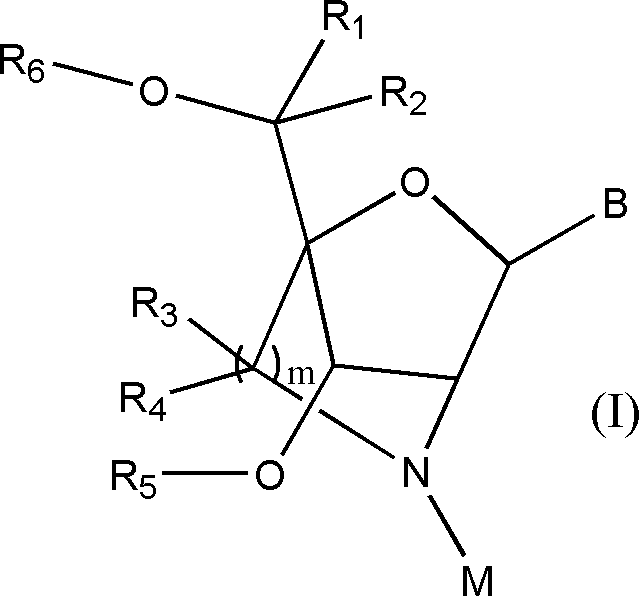
[式中、
Bは、核酸塩基であり;
R1、R2、R3及びR4は各々独立して、水素原子、又は1つ以上の置換基で置換されていてもよいC1-6アルキル基であり;
R5及びR6は各々独立して、水素原子、水酸基の保護基、置換されてもよいリン酸基、リン部分又は支持体への共有結合等であり;
mは、1又は2であり;
Mは、1つ以上の置換基で置換されていてもよいメチル基で置換された、スルホニル基である。ALNA[Ms]の典型的な具体例は、Mが無置換のメチル基で置換されたスルホニル基である、ヌクレオシドである。
In certain embodiments, the nucleoside containing a bicyclic sugar can be a nucleoside containing a sugar moiety of the crosslinked artificial nucleic acid ALNA disclosed in WO2020 / 100926, for example, represented by the following general formula (I). It can be a nucleoside containing a sugar moiety of ALNA [Ms].
[During the ceremony,
B is a nucleobase;
R 1 , R 2 , R 3 and R 4 are C 1-6 alkyl groups, each independently of which may be substituted with a hydrogen atom or one or more substituents;
R 5 and R 6 are each independently a hydrogen atom, a protecting group for a hydroxyl group, a phosphate group which may be substituted, a covalent bond to a phosphorus moiety or a support, and the like;
m is 1 or 2;
M is a sulfonyl group substituted with a methyl group optionally substituted with one or more substituents. A typical embodiment of ALNA [Ms] is a nucleoside, which is a sulfonyl group in which M is substituted with an unsubstituted methyl group.
ある種の実施態様では、MRLN阻害物質としてのアンチセンスオリゴヌクレオチドは、少なくとも1つの核酸塩基がシトシンである核酸塩基配列を有する。ある種の実施態様では、少なくとも1つのシトシンは修飾核酸塩基の5-メチルシトシンである。 In certain embodiments, the antisense oligonucleotide as an MRLN inhibitor has a nucleobase sequence in which at least one nucleobase is cytosine. In certain embodiments, the at least one cytosine is the modified nucleobase 5-methylcytosine.
RNA及びDNAの天然に存在するヌクレオシド間結合は、3’-5’ホスホジエステル結合である。1つまたは複数の修飾された、すなわち天然に存在しない、ヌクレオシド間結合を有するオリゴヌクレオチドは、例えば、細胞取り込みの増強、標的核酸に対する親和性の増強及びヌクレアーゼの存在下での安定性の増大などの特性が理由で、天然に存在するヌクレオシド間結合を有するオリゴヌクレオチドよりも好ましいことが多い。
修飾ヌクレオシド間結合を有するオリゴヌクレオチドは、リン原子を保持するヌクレオシド間結合及びリン原子を有さないヌクレオシド間結合を含む。代表的なリン含有ヌクレオシド間結合としては、これらに限定されないが、ホスホジエステル、ホスホトリエステル、メチルホスホネート、ホスホルアミデート及びホスホロチオエートの1つ以上が挙げられる。リン含有及び非リン含有結合の調製方法は周知である。
ある種の実施態様では、MRLN阻害物質としてのアンチセンスオリゴヌクレオチドのヌクレオシド間結合は、全てホスホロチオエートヌクレオシド間結合である。
The naturally occurring nucleoside bond between RNA and DNA is a 3'-5'phosphodiester bond. One or more modified, i.e., non-naturally occurring, oligonucleotides with nucleoside linkages include, for example, enhanced cell uptake, enhanced affinity for target nucleic acids and increased stability in the presence of nucleases. Often preferred over naturally occurring oligonucleotides with internucleoside linkages because of their properties.
Oligonucleotides with modified nucleoside bonds include nucleoside bonds that retain a phosphorus atom and nucleoside bonds that do not have a phosphorus atom. Representative phosphorus-containing nucleoside bonds include, but are not limited to, one or more of phosphodiesters, phosphotriesters, methylphosphonates, phosphoramidates and phosphorothioates. Methods for preparing phosphorus-containing and non-phosphorus-containing bonds are well known.
In certain embodiments, the internucleoside linkages of the antisense oligonucleotide as the MRLN inhibitor are all phosphorothioate nucleoside linkages.
MRLN阻害物質としてのアンチセンスオリゴヌクレオチドは常法によって合成することができ、例えば、市販の核酸合成装置によって容易に合成することができる。また、アンチセンスオリゴヌクレオチドに含まれてもよい、ヌクレオシドの糖修飾のALNA[Ms]はWO2020/100826に開示されている方法で合成することができる。 The antisense oligonucleotide as an MRLN inhibitor can be synthesized by a conventional method, and can be easily synthesized by, for example, a commercially available nucleic acid synthesizer. Also, the nucleoside sugar-modified ALNA [Ms], which may be included in the antisense oligonucleotide, can be synthesized by the method disclosed in WO2020 / 100826.
MRLNに対するsiRNAは、MRLNのmRNAの部分配列(通常20塩基以上、好ましくは21塩基以上、且つ通常30塩基以下、好ましくは27塩基以下、より好ましくは23塩基以下)に相補的な配列を有する二本鎖オリゴRNAであり、当該転写産物を特異的に認識して切断することによりMRLNの発現を阻害し得るものであれば特に制限されない。当業者は、配列番号1に記載したマウスMRLN遺伝子の核酸塩基配列又は配列番号3に記載したヒトMRLN遺伝子の核酸塩基配列をもとに、ヒト又はマウスのMRLNの発現を阻害するために使用され得るsiRNAのセンス鎖及びアンチセンス鎖の配列を決定することができる。siRNAの合成は自体公知の方法で行えば良く、例えば、センス鎖及びアンチセンス鎖をDNA/RNA化学合成または酵素合成によりそれぞれ合成し、それらをアニーリングさせることにより合成することができる。 SiRNA for MRLN has a sequence complementary to a partial sequence of MRLN mRNA (usually 20 bases or more, preferably 21 bases or more, and usually 30 bases or less, preferably 27 bases or less, more preferably 23 bases or less). It is not particularly limited as long as it is a double-stranded oligo RNA and can inhibit the expression of MRLN by specifically recognizing and cleaving the transcript. Those skilled in the art have been used to inhibit the expression of human or mouse MRLN based on the nucleic acid base sequence of the mouse MRLN gene set forth in SEQ ID NO: 1 or the nucleic acid base sequence of the human MRLN gene set forth in SEQ ID NO: 3. The sequence of the sense strand and antisense strand of the resulting siRNA can be determined. The synthesis of siRNA may be carried out by a method known per se, for example, the sense strand and the antisense strand can be synthesized by DNA / RNA chemical synthesis or enzymatic synthesis, respectively, and annealed thereof.
発現ベクターとしては、当該技術分野で使用される任意のものを使用することができ、例えば、大腸菌由来のプラスミド(例、pBR322,pBR325,pUC12,pUC13)、枯草菌由来のプラスミド(例、pUB110,pTP5,pC194)、酵母由来プラスミド(例、pSH19,pSH15)、λファージなどのバクテリオファージ、レトロウイルス,ワクシニアウイルス,バキュロウイルスなどの動物ウイルスなどの他、pA1-11、pXT1、pRc/CMV、pRc/RSV、pcDNAI/Neoなどが挙げられる。 As the expression vector, any virus used in the art can be used, for example, a plasmid derived from Escherichia coli (eg, pBR322, pBR325, pUC12, pUC13), a plasmid derived from bacteriophage (eg, pUB110, etc.). pTP5, pC194), yeast-derived plasmids (eg, pSH19, pSH15), bacteriophage such as λ phage, animal viruses such as retrovirus, vaccinia virus, baculovirus, etc., as well as pA1-11, pXT1, pRc / CMV, pRc. / RSV, cDNAI / Neo and the like can be mentioned.
前記MRLNに対する抗体は、MRLNに特異的に結合する抗体であって、結合することによりMRLNの機能を阻害するアンタゴニスト抗体を用いることが好ましい。 As the antibody against MRLN, it is preferable to use an antibody that specifically binds to MRLN and an antagonist antibody that inhibits the function of MRLN by binding.
本明細書でいう「抗体」には、ポリクローナル抗体、モノクローナル抗体等の天然型抗体、遺伝子組換技術を用いて製造され得るキメラ抗体、ヒト化抗体や一本鎖抗体、ヒト抗体産生トランスジェニック動物等を用いて製造され得るヒト抗体、ファージディスプレイによって作製された抗体およびこれらの結合性断片が含まれる。 The term "antibody" as used herein refers to natural antibodies such as polyclonal antibodies and monoclonal antibodies, chimeric antibodies that can be produced using gene recombination technology, humanized antibodies and single-stranded antibodies, and human antibody-producing transgenic animals. And the like, human antibodies that can be produced using, etc., antibodies produced by phage display and binding fragments thereof are included.
結合性断片とは、前述した抗体の一部分の領域を意味し、具体的には例えばF(ab‘)2、Fab’、Fab、Fv(variable fragment of antibody)、sFv、dsFv(disulphide stabilized Fv)、dAb(single domain antibody)等があげられる(Exp.Opin.Ther.Patents,Vol.6,No.5,P.441-456,1996)。 The binding fragment means a region of a part of the antibody described above, and specifically, for example, F (ab') 2, Fab', Fab, Fv (variable fragment of antibody), sFv, dsFv (disulphide studied Fv). , DAb (single domain antibody) and the like (Exp. Opin. Ther. Patents, Vol. 6, No. 5, P. 441-456, 1996).
抗体のクラスは、特に限定されず、IgG、IgM、IgA、IgDまたはIgE等のいずれのアイソタイプを有する抗体をも包含する。好ましくは、IgGまたはIgMであり、精製の容易性等を考慮するとより好ましくはIgGである。 The class of antibody is not particularly limited, and includes antibodies having any isotype such as IgG, IgM, IgA, IgD or IgE. It is preferably IgG or IgM, and more preferably IgG in consideration of easiness of purification and the like.
ポリクローナル抗体は、例えば、下記のようにして製造することができる。即ち、免疫原をマウス、ラット、ハムスター、モルモット、ヤギ、ウマまたはウサギなどの動物の皮下内、筋肉内、静脈内、フッドパット内あるいは腹腔内に1~数回注射することにより免疫感作を施す。通常、初回免疫から約1~14日毎に1~5回免疫を行って、最終免疫より約1~5日後に免疫感作された該哺乳動物から血清が取得される。血清をそのままポリクローナル抗体として用いることも可能であるが、好ましくは、限外ろ過、硫安分画、ユーグロブリン沈澱法、カプロイン酸法、カプリル酸法、イオン交換クロマトグラフィー(DEAEまたはDE52等)、抗イムノグロブリンカラムもしくはプロテインA/Gカラム、免疫原を架橋させたカラム等を用いたアフィニティカラムクロマトグラフィーにより単離および/または精製される。 The polyclonal antibody can be produced, for example, as follows. That is, immunosensitization is achieved by injecting the immunogen subcutaneously, intramuscularly, intravenously, into the hood pad or intraperitoneally in animals such as mice, rats, hamsters, guinea pigs, goats, horses or rabbits. Give. Usually, immunization is performed 1 to 5 times every 1 to 14 days after the initial immunization, and serum is obtained from the immunosensitized mammal about 1 to 5 days after the final immunization. Although it is possible to use the serum as it is as a polyclonal antibody, it is preferable to use ultrafiltration, sulfur fractionation, euglobulin precipitation method, caproic acid method, capricyl acid method, ion exchange chromatography (DEAE or DE52, etc.), anti-antibody. Isolation and / or purification by affinity column chromatography using an immunoglobulin column or protein A / G column, a column cross-linked with an immunogen, or the like.
モノクローナル抗体は、例えば、下記のようにして製造することができる。すなわち、免疫原を投与されたマウス、ラットまたはハムスターなどの免疫感作動物から得られた抗体産生細胞と自己抗体産生能のない骨髄腫系細胞(ミエローマ細胞)からハイブリドーマを調製し、該ハイブリドーマをクローン化し、哺乳動物の免疫に用いた免疫原に対して特異的親和性を示すモノクローナル抗体を産生するクローンを選択することによって製造される。 The monoclonal antibody can be produced, for example, as follows. That is, a hybridoma was prepared from antibody-producing cells obtained from immunosensitizers such as mice, rats or hamsters to which immunogen was administered, and myeloma cells (myeloma cells) incapable of producing autoantibodies, and the hybridoma was prepared. It is produced by selecting a clone that produces a monoclonal antibody that is cloned and exhibits a specific affinity for the immunogen used for mammalian immunization.
モノクローナル抗体を分泌するハイブリドーマ(融合細胞)の調製は、ケーラーおよびミルシュタインらの方法(Nature,Vol.256,P.495-497,1975)およびそれに準じる修飾方法に従って行うことができる。細胞融合に用いられるミエローマ細胞としては、例えばマウス由来ミエローマp3/X63-AG8.653(653;ATCC No.CRL1580)、p3/NSI/1-Ag4-1(NS-1)、p3/X63-Ag8.U1(p3U1)、SP2/0-Ag14(Sp2/0、Sp2)、PAI、F0またはBW5147、ラット由来ミエローマ210RCY3-Ag.2.3.、ヒト由来ミエローマU-266AR1、GM1500-6TG-A1-2、UC729-6、CEM-AGR、D1R11またはCEM-T15を使用することができる。 Preparation of hybridomas (fusion cells) that secrete monoclonal antibodies can be performed according to the method of Koehler and Milstein et al. (Nature, Vol. 256, P. 495-497, 1975) and similar modification methods. Examples of myeloma cells used for cell fusion include mouse-derived myeloma p3 / X63-AG8.653 (653; ATCC No. CRL1580), p3 / NSI / 1-Ag4-1 (NS-1), p3 / X63-Ag8. .. U1 (p3U1), SP2 / 0-Ag14 (Sp2 / 0, Sp2), PAI, F0 or BW5147, rat-derived myeloma 210RCY3-Ag. 2.3. , Human-derived Mieroma U-266AR1, GM1500-6TG-A1-2, UC729-6, CEM-AGR, D1R11 or CEM-T15 can be used.
モノクローナル抗体を産生するハイブリドーマクローンのスクリーニングは、ハイブリドーマを、例えばマイクロタイタープレート中で培養し、増殖の見られたウェルの培養上清の前述の免疫感作で用いた免疫原に対する反応性を、例えばELISA等の酵素免疫測定法によって測定することにより行なうことができる。モノクローナル抗体は、上述のポリクローナル抗体と同様に、単離および/または精製されることが好ましい。 For screening of hybridoma clones that produce monoclonal antibodies, eg, the reactivity of the hybridoma to the immunogen used in the aforementioned immunosensitization, eg, the culture supernatant of the wells in which proliferation was observed, was cultured in a microtiter plate. It can be carried out by measuring by an enzyme immunoassay method such as ELISA. The monoclonal antibody is preferably isolated and / or purified in the same manner as the polyclonal antibody described above.
キメラ抗体は、例えば「実験医学(臨時増刊号), Vol.6,No.10,1988」、特公平3-73280号公報等を、ヒト化抗体は、例えば特表平4-506458号公報、特開昭62-296890号公報等を、ヒト抗体は、例えば「Nature Genetics,Vol.15,P.146-156,1997」、「Nature Genetics,Vol.7,P.13-21,1994」、特表平4-504365号公報、国際出願公開WO94/25585号公報、「Nature,Vol.368,P.856-859,1994」、特表平6-500233号公報等を参考にそれぞれ製造することができる。 The chimeric antibody is, for example, "Experimental Medicine (Temporary Special Issue), Vol. 6, No. 10, 1988", Japanese Patent Publication No. 3-73280, and the humanized antibody is, for example, Japanese Patent Publication No. 4-506458. For human antibodies, for example, "Nature Genetics, Vol. 15, P.146-156, 1997", "Nature Genetics, Vol. 7, P.13-21, 1994", JP-A-62-296890, etc. Manufacture with reference to Japanese Patent Publication No. 4-504365, International Application Publication No. WO94 / 25585, "Nature, Vol. 368, P.856-859, 1994", Japanese Patent Publication No. 6-500233, etc. Can be done.
ファージディスプレイによる抗体作製は、抗体スクリーニング用に作製されたファージライブラリーから、例えば、バイオパニングにより抗原に親和性を有するファージを回収、濃縮することにより、Fab等の抗体等を容易に得ることができる。ファージディスプレイによる抗体作製については、「Nature,Vol.348,P.552-554,1990」、「“Phage display a laboratory manual” In cold spring harbor laboratory press,2001」、「Antibody Engineering - a Practical Approach,IRL Press,Oxford,1996」を参照のこと。 For antibody production by phage display, antibodies such as Fab can be easily obtained by collecting and concentrating phages having an affinity for an antigen from a phage library prepared for antibody screening, for example, by biopanning. can. Regarding antibody production by phage display, "Nature, Vol. 348, P.552-554, 1990", "" Page display a laboratory manual "In Cold Spring Harbor Laboratory Press, 2001", "Antibody", "Antibody". IRL Press, Oxford, 1996 ".
F(ab)2およびFab’は、イムノグロブリンを、蛋白分解酵素であるペプシンまたはパパインで処理することによりそれぞれ製造することができる。Fabは、Fab発現ファージライブラリーを上記ファージディスプレイによる抗体作製法と同様にスクリーニングすることにより、製造することができる。 F (ab) 2 and Fab'can be produced by treating the immunoglobulin with the proteolytic enzyme pepsin or papain, respectively. Fab can be produced by screening the Fab-expressing phage library in the same manner as in the antibody production method using the phage display described above.
本発明の剤の有効成分であるMRLN阻害物質は、MRLNの機能や発現を阻害する化合物でもよい。化合物は、MRLNの機能や発現を阻害できる限り、その構造は限定されず、低分子化合物、ペプチド、糖、高分子化合物等いずれであってもよい。化合物はスクリーニングにより得ることができる。 The MRLN inhibitor, which is the active ingredient of the agent of the present invention, may be a compound that inhibits the function or expression of MRLN. The structure of the compound is not limited as long as it can inhibit the function and expression of MRLN, and may be any of a small molecule compound, a peptide, a sugar, a high molecular compound and the like. The compound can be obtained by screening.
<MRLN阻害物質の評価またはスクリーニング方法>
MRLN阻害物質を評価またはスクリーニング(選抜)する方法としては、MRLNの細胞内における発現の阻害あるいは機能の阻害を検証できる方法であればいかなるものでもよいが、具体的には、例えば、以下に示すin vitro、及びin vivoの検証方法が用いられる。
<Evaluation or screening method for MRLN inhibitors>
As a method for evaluating or screening (selecting) an MRLN inhibitor, any method can be used as long as it can verify the inhibition of intracellular expression or function of MLLN, and specific examples thereof are shown below. In vitro and in vivo verification methods are used.
MRLN阻害物質の評価またはスクリーニングにおいて、MRLN発現阻害を指標とする場合は、MRLNを発現する細胞や組織において阻害物質又はその候補物質を添加して、MRLNのmRNAやタンパク質の発現量を測定し、該阻害物質または候補物質の非添加時または陰性コントロール添加時と比較する方法が挙げられる。 When MRLN expression inhibition is used as an index in the evaluation or screening of MRLN inhibitors, the inhibitor or a candidate substance thereof is added to cells or tissues expressing MRLN, and the expression level of MRLN mRNA or protein is measured. Examples thereof include a method of comparison with the case where the inhibitor or candidate substance is not added or when the negative control is added.
MRLNを発現する細胞としては、筋芽細胞や筋管細胞が挙げられ、培養筋細胞の一例としては、実施例で使用されたC2C12細胞が挙げられる。MRLN遺伝子が外来的に導入された細胞を用いてもよい。 Examples of cells expressing MRLN include myoblasts and myotube cells, and examples of cultured muscle cells include C2C12 cells used in Examples. Cells into which the MRLN gene has been introduced extrinsically may be used.
また、非ヒト動物にMRLN阻害物質を投与し、当該動物の筋組織においてMRLNの発現量を測定してもよいし、単離された筋組織にMRLN阻害物質を投与し、当該筋組織においてMRLNの発現量を測定してもよい。 Further, the MRLN inhibitor may be administered to a non-human animal and the expression level of MRLN may be measured in the muscle tissue of the animal, or the MRLN inhibitor may be administered to the isolated muscle tissue and the MRLN may be measured in the muscle tissue. The expression level of may be measured.
このようなin vitroやin vivoのMRLN発現量測定系においてMRLN発現量を測定することで、MRLN阻害物質をスクリーニングしたり評価したりすることができる。 By measuring the MLLN expression level in such an in vitro or in vivo MRLN expression level measurement system, it is possible to screen and evaluate an MRLN inhibitor.
なお、MRLN阻害物質をMRLN発現細胞に接触させる方法も特に制限はないが、MRLN阻害物質が核酸である場合には、一般的に核酸を細胞内へ導入するために用いられる方法、例えば、リポフェクション法やエレクトロポレーション法、Gymnosis法等を用いることができる。 The method of contacting the MRLN inhibitor with the MRLN-expressing cell is not particularly limited, but when the MRLN inhibitor is a nucleic acid, a method generally used for introducing the nucleic acid into the cell, for example, lipofection. A method, an electroporation method, a nucleic acid method, or the like can be used.
MRLNの細胞内におけるmRNA発現量は、当技術分野で既知の様々な方法で測定することができる。具体的には、ノーザンブロット解析、競合的ポリメラーゼ連鎖反応(PCR)または定量的リアルタイムPCR等が挙げられる。mRNAを単離する際には、当技術分野で周知の方法を使用して、例えば、製造業者の推奨プロトコルに従ってSuperPrep Cell Lysis & RT Kit for qPCR(Toyobo)、RNeasy Fibrous Tissue Mini Kit(Qiagen)等を使用することができる。このようにしてMRLNの発現量を測定することができる。 The intracellular mRNA expression level of MRLN can be measured by various methods known in the art. Specific examples include Northern blot analysis, competitive polymerase chain reaction (PCR), quantitative real-time PCR, and the like. When the mRNA is isolated, a method well known in the art is used, for example, according to the manufacturer's recommended protocol, SuperPrep Cell Lysis & RT Kit for qPCR (Toyobo), RNeasy Tissue Mini Kit (Qiagen), etc. Can be used. In this way, the expression level of MRLN can be measured.
MRLNの細胞内におけるタンパク質の発現量は、当技術分野で既知の様々な方法でアッセイすることができる。具体的には、例えば、免疫沈降法、ウェスタンブロット解析(*免疫ブロット法)、酵素結合免疫吸着測定法(ELISA)、定量的タンパク質アッセイ、タンパク質活性アッセイ(例えば、カスパーゼ活性アッセイ)、免疫組織化学法、免疫細胞化学法又は蛍光活性化セルソーティング(FACS)等があげられる。 The expression level of MRLN in cells can be assayed by various methods known in the art. Specifically, for example, immunoprecipitation, Western blotting (* immunoblotting), enzyme-linked immunosorbent assay (ELISA), quantitative protein assay, protein activity assay (eg, caspase activity assay), immunohistochemistry. Methods, immunohistochemistry methods, fluorescence activated cell sorting (FACS) and the like can be mentioned.
MRLN阻害物質の評価またはスクリーニングにおいて、MRLNの機能阻害を指標としてMRLN阻害物質をスクリーニング又は評価する場合は、例えば、筋小胞体へのカルシウム取り込みおよび筋小胞体からのカルシウム放出を指標とすることができる。一例として、筋細胞へリアノジン(ryanodine)受容体アゴニストを添加して刺激を行い、筋小胞体から放出されるカルシウム量を測定する系において、MRLN阻害物質またはその候補物質を存在させ、その影響を調べることでMRLN阻害物質をスクリーニング又は評価することができる。筋疾患においては、筋小胞体からのカルシウム漏出が起こり、筋小胞体内のカルシウム量が低下して、リアノジン受容体アゴニスト刺激による筋小胞体からのカルシウム放出量が低下しているところ、MRLN阻害物質が存在することで筋小胞体内のカルシウム量が回復し、筋小胞体からのカルシウム放出量が増加(回復)するので、このカルシウム放出の増加(回復)を指標としてMRLN阻害物質をスクリーニング又は評価することができる。 In the evaluation or screening of MRLN inhibitors, when screening or evaluating MRLN inhibitors using the inhibition of MRLN function as an index, for example, calcium uptake into the sarcoplasmic reticulum and calcium release from the sarcoplasmic reticulum may be used as an index. can. As an example, in a system in which a ryanodine receptor agonist is added to muscle cells to stimulate them and the amount of calcium released from the sarcoplasmic reticulum is measured, an MRLN inhibitor or a candidate substance thereof is present and its effect is affected. By examining, MRLN inhibitors can be screened or evaluated. In myopathy, calcium leakage from the sarcoplasmic reticulum occurs, the amount of calcium in the sarcoplasmic reticulum decreases, and the amount of calcium released from the sarcoplasmic reticulum by stimulation with a ryanodine receptor agonist decreases. The presence of the substance restores the amount of calcium in the sarcoplasmic reticulum and increases (recovers) the amount of calcium released from the sarcoplasmic reticulum. Can be evaluated.
また、MRLN阻害物質は筋疾患モデル動物を用いて評価またはスクリーニングすることもできる。筋疾患モデル動物としては、例えば、ジストロフィンの欠損マウスやサルコグリカンの欠損マウスを用いることができる。 MRLN inhibitors can also be evaluated or screened using muscle disease model animals. As the muscle disease model animal, for example, a dystrophin-deficient mouse or a sarcoglycan-deficient mouse can be used.
例えば、これらの欠損マウスは血中クレアチンキナーゼ量が正常マウスに比べて増加しているところ、MRLN阻害物質を投与することで血中クレアチンキナーゼ量が低下するので、この血中クレアチンキナーゼ量の低下量を指標としてMRLN阻害物質を評価またはスクリーニングすることができる。 For example, in these deficient mice, the amount of creatine kinase in blood is increased as compared with normal mice, but the amount of creatine kinase in blood is decreased by administration of an MRLN inhibitor, so that the amount of creatine kinase in blood is decreased. MRLN inhibitors can be evaluated or screened using the amount as an index.
また、筋疾患モデル動物における筋線維の崩壊や細胞死などの病態改善を指標としてMRLN阻害物質を評価またはスクリーニングすることもできる。 It is also possible to evaluate or screen an MRLN inhibitor using the improvement of pathological conditions such as muscle fiber collapse and cell death in a muscle disease model animal as an index.
本発明の選抜方法により得られるMRLN阻害物質は、筋疾患の発生又は進行を抑制するため、筋疾患の予防及び/又は治療薬として用いることができる。すなわち、本発明は、上記方法によりMRLN阻害物質を選抜する工程を含む、筋疾患の予防及び/又は治療薬のスクリーニング方法を提供する。当該スクリーニング方法は、候補物質のMRLN発現阻害能と、筋小胞体からのカルシウム放出等のMRLN機能阻害能の両方を評価する工程を含むことが好ましい。 The MRLN inhibitor obtained by the selection method of the present invention can be used as a prophylactic and / or therapeutic agent for muscle diseases because it suppresses the onset or progression of muscle diseases. That is, the present invention provides a method for screening a prophylactic and / or therapeutic agent for muscle disease, which comprises a step of selecting an MRLN inhibitor by the above method. The screening method preferably includes a step of evaluating both the ability of the candidate substance to inhibit MRLN expression and the ability of the candidate substance to inhibit MRLN function such as calcium release from the sarcoplasmic reticulum.
<MRLN阻害物質による筋疾患治療>
本発明においては、MRLN阻害物質によって、筋疾患を治療又は予防することができる。
筋疾患としては、例えば、筋ジストロフィー、封入体筋炎、筋委縮性側索硬化症、廃用性筋萎縮、サルコペニアが挙げられるが、特にこれらには限定されない。この中では、筋ジストロフィーが好ましい。筋ジストロフィーは代表的にはジストロフィン-糖タンパク質複合体(DGC)の構成因子に変異又は欠損を有する筋ジストロフィーが挙げられ、例えば、デュシェンヌ型筋ジストロフィー、ベッカー型筋ジストロフィー、肢体型筋ジストロフィー(サルコグリカノパチーなど)が挙げられる。なお、サルコグリカノパチーはLGMD2C、LGMD2D、LGMD2E、LGMD2Fを含む。
筋疾患は筋細胞の細胞質におけるカルシウム異常流入を伴う疾患であることが好ましい。
<Treatment of muscle diseases with MRLN inhibitors>
In the present invention, MRLN inhibitors can treat or prevent muscle diseases.
Examples of muscle diseases include, but are not limited to, muscular dystrophy, inclusion body myositis, amyotrophic lateral sclerosis, disuse muscle atrophy, and sarcopenia. Of these, muscular dystrophy is preferred. Muscular dystrophy typically includes muscular dystrophy having a mutation or deficiency in a component of the dystrophin-glycoprotein complex (DGC), such as Duchenne muscular dystrophy, Becker muscular dystrophy, and limb muscular dystrophy (such as sarcoglycanopathy). Can be mentioned. The sarcoglycanopathies include LGMD2C, LGMD2D, LGMD2E, and LGMD2F.
Muscle diseases are preferably diseases associated with abnormal calcium influx in the cytoplasm of muscle cells.
MRLN阻害物質は、MRLNの機能または発現を阻害することにより筋小胞体カルシウム取り込み増加機能を有し、それにより細胞質内のカルシウム量を低下させる。
したがって、細胞質内へのカルシウム異常流入を伴う上記のような筋疾患の治療や予防に有効である。
特に、筋ジストロフィーの病態には、1)DGCの欠損によって膜の透過性が亢進し、それによって細胞質内カルシウム量が増加し、細胞死が起こる、2)DGCの欠損によってnNOS(neuronal nitric oxide synthase)が減少して細胞質でiNOS(inducible nitric oxide synthase)が増加し、リアノジン受容体がニトロシル化され、筋小胞体内カルシウムが減少して筋収縮が低下する、という2つのメカニズムが示唆されている。
MRLN阻害剤は、細胞質内カルシウム量を減少させ、かつ、筋小胞体内のカルシウム取り込みを増加させることで、筋細胞死を抑制し、筋収縮力を維持・回復させ、筋疾患に対して治療効果および/または予防効果を発揮する。
すなわち、本発明の剤は、筋細胞死を抑制する剤または筋収縮力を維持・回復する剤でありうる。
The MRLN inhibitor has a function of increasing sarcoplasmic reticulum calcium uptake by inhibiting the function or expression of MRLN, thereby reducing the amount of calcium in the cytoplasm.
Therefore, it is effective for the treatment and prevention of the above-mentioned muscle diseases accompanied by abnormal calcium influx into the cytoplasm.
In particular, in the pathology of muscle dystrophy, 1) DGC deficiency enhances membrane permeability, which increases the amount of calcium in the cytoplasm and causes cell death, and 2) DGC deficiency causes nNOS (neuronal nitrate synthase). It has been suggested that there are two mechanisms in which iNOS (industrial nitric synthase) increases in the cytoplasm, ryanodine receptors are nitrosylated, calcium in the myocysts decreases, and muscle contraction decreases.
MRLN inhibitors suppress the death of muscle cells, maintain and restore muscle contractile force, and treat muscle diseases by reducing the amount of calcium in the cytoplasm and increasing the uptake of calcium in the muscle vesicles. It has an effective and / or preventive effect.
That is, the agent of the present invention may be an agent that suppresses muscle cell death or an agent that maintains / restores muscle contractile force.
したがって、本発明は、MRLN阻害物質を有効成分とする筋疾患の治療もしくは予防剤または筋疾患の治療もしくは予防のための医薬組成物;有効量のMRLN阻害物質を筋疾患の治療又は予防を必要とする対象へ投与する工程を含む筋疾患の治療または予防方法;筋疾患を治療または予防するためのMRLN阻害物質;筋疾患の治療または予防用医薬の製造におけるMRLN阻害物質の使用;を提供する。 Therefore, the present invention requires a therapeutic or prophylactic agent for muscle disease containing an MRLN inhibitor as an active ingredient or a pharmaceutical composition for treating or preventing muscle disease; an effective amount of MRLN inhibitor for treating or preventing muscle disease. Provided are a method for treating or preventing a muscle disease including a step of administering to a subject; an MRLN inhibitor for treating or preventing the muscle disease; the use of the MRLN inhibitor in the manufacture of a pharmaceutical for treating or preventing the muscle disease. ..
本発明の剤は、MRLN阻害物質をそのままあるいは薬理学的に許容し得る担体を配合することで調製することができる。薬理学的に許容し得る担体としては、製剤素材として慣用の各種有機あるいは無機担体物質が用いられ、固形製剤における賦形剤、滑沢剤、結合剤、崩壊剤;液状製剤における溶剤、溶解補助剤、懸濁化剤、等張化剤、緩衝剤、無痛化剤などとして配合される。また必要に応じて、防腐剤、抗酸化剤、着色剤、甘味剤などの製剤添加物を用いることもできる。 The agent of the present invention can be prepared by adding an MRLN inhibitor as it is or by adding a pharmacologically acceptable carrier. As the pharmacologically acceptable carrier, various conventional organic or inorganic carrier substances are used as the pharmaceutical material, and excipients, lubricants, binders and disintegrants in solid pharmaceuticals; solvents in liquid pharmaceuticals and lysis aids. It is compounded as an agent, a suspending agent, an isotonic agent, a buffering agent, a pain-relieving agent, and the like. If necessary, pharmaceutical additives such as preservatives, antioxidants, colorants, and sweeteners can also be used.
また、MRLN阻害物質が核酸である場合は、本発明の剤は、核酸導入用試薬を含むことができる。該核酸導入用試薬としては、リポソーム、リポフェクチン、リポフェクタミン、DOGS(トランスフェクタム)、DOPE、DOTAP、DDAB、DHDEAB、HDEAB、ポリブレン、あるいはポリ(エチレンイミン)(PEI)等の陽イオン性脂質等を用いることができる。 Further, when the MRLN inhibitor is a nucleic acid, the agent of the present invention can include a reagent for introducing a nucleic acid. Examples of the nucleic acid introduction reagent include liposomes, lipofectin, lipofectamine, DOGS (transferase), DOPE, DOTAP, DDAB, DHDEAB, HDEAB, polybrene, and cationic lipids such as poly (ethyleneimine) (PEI). Can be used.
本発明の剤は、筋疾患の治療や予防を必要とする対象に、経口または非経口に投与することができる。非経口投与としては、例えば、皮下投与、静脈内投与、筋肉内投与、動脈内投与、腹腔内投与などが挙げられる。投与は、持続的又は長期的でもよいし、短期的又は断続的でもよい。 The agent of the present invention can be orally or parenterally administered to a subject in need of treatment or prevention of muscle disease. Parenteral administration includes, for example, subcutaneous administration, intravenous administration, intramuscular administration, intraarterial administration, intraperitoneal administration and the like. Administration may be continuous or long-term, short-term or intermittent.
経口投与する場合の剤形としては、例えば、錠剤(糖衣錠、フィルムコーティング錠を含む)、丸剤、顆粒剤、散剤、カプセル剤(ソフトカプセル剤、マイクロカプセル剤を含む)、シロップ剤、乳剤、懸濁剤などが挙げられる。
一方、非経口投与する場合の剤形としては、例えば、注射剤、注入剤、点滴剤、坐剤などが挙げられる。また、適当な基剤(例、酪酸の重合体、グリコール酸の重合体、酪酸-グリコール酸の共重合体、酪酸の重合体とグリコール酸の重合体との混合物、ポリグリセロール脂肪酸エステルなど)と組み合わせて徐放性製剤とすることも有効である。
Dosage forms for oral administration include, for example, tablets (including sugar-coated tablets and film-coated tablets), pills, granules, powders, capsules (including soft capsules and microcapsules), syrups, emulsions, and suspensions. Examples include turbidants.
On the other hand, examples of the dosage form for parenteral administration include injections, infusions, infusions, suppositories and the like. Also with suitable bases (eg, butyric acid polymers, glycolic acid polymers, butyric acid-glycolic acid copolymers, butyric acid polymers and glycolic acid polymers mixtures, polyglycerol fatty acid esters, etc.) It is also effective to combine them into a sustained-release preparation.
MRLN阻害物質を上記の剤形に製剤化する方法としては、当該分野で一般的に用いられている公知の製造方法を適用することができる。また、上記の剤形に製する場合には、必要に応じて、その剤形に製する際に製剤分野において通常用いられる賦形剤、結合剤、崩壊剤、滑沢剤などの担体、甘味剤、界面活性剤、懸濁化剤、乳化剤などの各種製剤添加物などを適宜、適量含有させて製造することができる。 As a method for formulating the MRLN inhibitor into the above-mentioned dosage form, a known production method generally used in the art can be applied. In addition, when the dosage form is manufactured as described above, if necessary, an excipient, a binder, a disintegrant, a carrier such as a lubricant, a sweetness, etc., which are usually used in the pharmaceutical field when the dosage form is prepared. It can be produced by appropriately containing an appropriate amount of various pharmaceutical additives such as an agent, a surfactant, a suspending agent and an emulsifier.
例えば、非経口投与のための剤としては、好ましくは、注射剤が用いられる。注射剤としては、静脈注射剤のほか、皮下注射剤、皮内注射剤、筋肉注射剤、点滴注射剤などが含まれる。かかる注射剤は、自体公知の方法に従って、例えば、上記アンチセンスオリゴヌクレオチドなどのMRLN阻害物質を通常注射剤に用いられる無菌の水性もしくは油性液に溶解、懸濁又は乳化することによって調製する。注射用の水性液としては、例えば、リン酸緩衝食塩水、生理食塩水、ブドウ糖やその他の補助薬を含む等張液などが用いられ、適当な溶解補助剤、例えば、アルコール(例、エタノール)、ポリアルコール(例、プロピレングリコール、ポリエチレングリコール)、非イオン界面活性剤〔例、ポリソルべート80、HCO-50(polyoxyethylene(50mo1)adduct of hydrogenated castor oil)]などと併用してもよい。また、緩衝剤、pH調整剤、等張化剤、無痛化剤、保存剤、安定化剤などを含むことができる。かかる組成物は公知の方法によって製造される。 For example, an injection is preferably used as the agent for parenteral administration. Injectable preparations include subcutaneous injections, intradermal injections, intramuscular injections, drip injections and the like, in addition to intravenous injections. Such injections are prepared according to methods known per se, for example, by dissolving, suspending or emulsifying an MRLN inhibitor such as the antisense oligonucleotide in a sterile aqueous or oily solution normally used for injections. Aqueous solutions for injection include, for example, phosphate buffered saline, physiological saline, isotonic solutions containing glucose and other adjuvants, and suitable solubilizing agents such as alcohol (eg, ethanol). , Polyalcohol (eg, propylene glycol, polyethylene glycol), nonionic surfactant [eg, polysorbate 80, HCO-50 (polyoxyethylene (50mo1) addedut of hydrided castor oil)] and the like may be used in combination. Further, a buffering agent, a pH adjusting agent, an tonicity agent, a pain-relieving agent, a preservative, a stabilizer and the like can be included. Such compositions are produced by known methods.
本発明の剤に含まれる有効成分、すなわち、MRLN阻害物質の割合は、所望の効果を奏することができる範囲で適宜設定することができるが、通常、0.01~100重量%であり、好ましくは0.1~99.9重量%、より好ましくは0.5~99.5重量%である。 The ratio of the active ingredient, that is, the MRLN inhibitor contained in the agent of the present invention can be appropriately set within a range in which the desired effect can be obtained, but is usually 0.01 to 100% by weight, preferably 0.01 to 100% by weight. Is 0.1 to 99.9% by weight, more preferably 0.5 to 99.5% by weight.
MRLN阻害物質を有効成分として含有する本発明の剤は、安定かつ低毒性で安全に使用することができる。その1日の投与量は、有効成分の種類、投与対象の体重や年齢、症状などにより一概に規定されるものではないが、1回につき体重1kgあたり0.1ngから1000mgの範囲、好ましくは1ng~100mg/kg/週の範囲で選ぶことが可能である。 The agent of the present invention containing an MRLN inhibitor as an active ingredient is stable, has low toxicity, and can be used safely. The daily dose is not unconditionally defined depending on the type of active ingredient, body weight and age of the subject to be administered, symptoms, etc., but is in the range of 0.1 ng to 1000 mg per 1 kg of body weight, preferably 1 ng at a time. It is possible to select in the range of ~ 100 mg / kg / week.
本発明の剤の投与回数は、特に限定されるものではないが、通常、1月当たり1~10回程度である。また、投与期間は、数日~1週間程度の短期服用であっても、数週間~数ヶ月程度の長期服用であっても、数年~数十年であってもよい。なお、相当程度の間隔を置いて前記疾患の症状が再発した場合、本発明の剤の再度の投与が可能である。 The number of administrations of the agent of the present invention is not particularly limited, but is usually about 1 to 10 times per month. The administration period may be short-term administration of several days to one week, long-term administration of several weeks to several months, or several years to several decades. If the symptoms of the disease recur at considerable intervals, the agent of the present invention can be re-administered.
本発明の剤の投与対象としては筋疾患の治療や予防を必要とする対象であるが、マウス、ラット、ハムスター、モルモット、ウサギ、ネコ、イヌ、ウシ、ウマ、ヒツジ、サル、ヒト等の哺乳動物があげられ、好ましくは霊長類であり、特に好ましくはヒトである。 The subject of administration of the agent of the present invention is a subject requiring treatment or prevention of muscle disease, but mammals such as mice, rats, hamsters, guinea pigs, rabbits, cats, dogs, cows, horses, sheep, monkeys, and humans. Animals are mentioned, preferably primates, and particularly preferably humans.
非限定開示及び参照による組み込み
本明細書に記載のある種の化合物、組成物及び方法は、ある種の実施態様に従って特異的に記載されているが、以下の実施例は、本明細書に記載の化合物を例示する役割を果たすにすぎず、これを限定することを意図しない。本出願に記載される参考文献のそれぞれは、参照によりその全体が本明細書に組み込まれる。
Non-Limited Disclosure and Incorporation by Reference Certain compounds, compositions and methods described herein are specifically described according to certain embodiments, while the following examples are described herein. It serves only as an example of the compounds of, and is not intended to limit it. Each of the references described in this application is incorporated herein by reference in its entirety.
以下に実施例を挙げて本発明を更に具体的に説明するが、本発明はこれら実施例に限定されるものではない。 Hereinafter, the present invention will be described in more detail with reference to examples, but the present invention is not limited to these examples.
実施例1
修飾アンチセンスオリゴヌクレオチドの調製
修飾アンチセンスオリゴヌクレオチドは一般的なオリゴ核酸の固相合成法に従い株式会社ニッポンジーン社/株式会社ニッポンジーンマテリアル社により合成および精製された。なお、化合物の同定は高速液体クロマト質量分析計により行った。
Example 1
Preparation of Modified Antisense oligonucleotide The modified antisense oligonucleotide was synthesized and purified by Nippon Gene Co., Ltd./Nippon Gene Material Co., Ltd. according to a general solid-phase synthesis method of oligonucleic acid. The compounds were identified by a high-speed liquid chromatographic mass spectrometer.
合成したMRLNアンチセンスオリゴヌクレオチドはマウスMRLNの核酸塩基配列(配列番号1)の409~424位に相補的な16塩基からなる修飾アンチセンスオリゴヌクレオチドである。 The synthesized MRLN antisense oligonucleotide is a modified antisense oligonucleotide consisting of 16 bases complementary to positions 409 to 424 of the nucleic acid base sequence (SEQ ID NO: 1) of mouse MRLN.
実施例2
In vitro MRLN ノックダウン活性試験(Gymnosis法)
C2C12細胞を384plateに播種し、CO2インキュベーターで培養した。3時間後、実施例1で合成したMRLNアンチセンスオリゴヌクレオチドを添加し、CO2インキュベーターで培養した。約72時間後、細胞からMRLNアンチセンスオリゴヌクレオチド含有培地を除去し、リン酸緩衝生理食塩水(Phosphate-buffered saline: PBS)でWashを行った。その後、SuperPrep Cell Lysis & RT Kit for qPCR(Toyobo)を用い、RNAを含む細胞ライセートの調製と、ライセートからの逆転写反応を行い、鋳型cDNAの合成を行った。このcDNAを用いてリアルタイムPCRを行い、MRLNのmRNA発現量を定量した。MRLNアンチセンスオリゴヌクレオチドの処理濃度は、最高濃度を1000nMとし、公比3の4濃度で希釈したものを用い、MRLNノックダウン活性としてIC50を算出した。試験を3回行い、IC50の平均値を求めたところ、119.9nMであった。このように、MRLNアンチセンスオリゴヌクレオチドは、MRLN発現を阻害することが示された。
Example 2
In vitro MRLN knockdown activity test (Gymnosis method)
C2C12 cells were seeded on 384 plates and cultured in a CO 2 incubator. After 3 hours, the MRLN antisense oligonucleotide synthesized in Example 1 was added and cultured in a CO 2 incubator. After about 72 hours, the MRLN antisense oligonucleotide-containing medium was removed from the cells, and Wash was performed with Phosphate-buffered saline (PBS). Then, using SuperPrep Cell Lysis & RT Kit for qPCR (Toyobo), cell lysates containing RNA were prepared, and reverse transcription reaction from lysates was performed to synthesize template cDNA. Real-time PCR was performed using this cDNA to quantify the mRNA expression level of MRLN. As the treatment concentration of the MRLN antisense oligonucleotide, the maximum concentration was 1000 nM, and the one diluted with 4 concentrations having a common ratio of 3 was used, and IC 50 was calculated as the MRLN knockdown activity. The test was carried out three times, and the average value of the IC 50 was calculated to be 119.9 nM. Thus, MRLN antisense oligonucleotides have been shown to inhibit MRLN expression.
実施例3
In vivo MRLN ノックダウン活性試験
実施例1で合成したMRLNアンチセンスオリゴヌクレオチドを、10および50mg/5mL/kgとなるように生理食塩水で調製し、7週齢のC57BL/10ScSn-Dmdmdx/J(mdx)マウス(雄性、Jackson Laboratory)に尾静脈内投与した。mdxマウスはDMDのモデルマウスとして最も使用されているマウスである。約72時間後にイソフルラン(ファイザー)麻酔下にて腹部大静脈より全採血を行い、致死させた。致死後、前脛骨筋を採取し、RNAlater Soln.(invitrogen)に浸漬させた。組織にRNeasy Fibrous Tissue Mini Kit(Qiagen)のRLTバッファーを加え、マルチビーズショッカーを用いて破砕し、キット記載のプロトコルに従ってRNAを精製した。RNA200ngを逆転写し、得られたcDNAを用いて定量PCRを行った。MRLNアンチセンスオリゴヌクレオチドのノックダウン活性は、MRLNの18S rRNAに対する量比を、vehicle群に対する相対値で示した。結果を図1に示す。MRLNアンチセンスオリゴヌクレオチドは、筋肉においてMRLN発現を阻害することが示された。
Example 3
In vivo MRLN Knockdown Activity Test The MRLN antisense oligonucleotide synthesized in Example 1 was prepared with saline to 10 and 50 mg / 5 mL / kg, and was 7-week-old C57BL / 10ScSn-Dmdx / J ( mdx) mice (male, Jackson Laboratory) were administered intravenously to the tail vein. The mdx mouse is the most used mouse as a model mouse for DMD. Approximately 72 hours later, all blood was collected from the abdominal vena cava under isoflurane (Pfizer) anesthesia and killed. After lethality, the tibialis anterior muscle was collected and RNAlater Soln. It was immersed in (invitrogen). RLT buffer of RNeasy Fiberus Tissue Mini Kit (Qiagen) was added to the tissue, disrupted using a multi-bead shocker, and RNA was purified according to the protocol described in the kit. 200 ng of RNA was reverse transcribed, and quantitative PCR was performed using the obtained cDNA. The knockdown activity of the MRLN antisense oligonucleotide was shown as the amount ratio of MRLN to 18S rRNA as a relative value to the vehicle group. The results are shown in FIG. MRLN antisense oligonucleotides have been shown to inhibit MRLN expression in muscle.
実施例4
筋ジストロフィーモデルマウスに対するMRLN アンチセンスオリゴヌクレオチド投与試験
実施例1で合成したMRLNアンチセンスオリゴヌクレオチドを、適切な濃度に生理食塩水で調製し、mdxマウス、サルコグリカンβ(sarcoglycan β:Sgcb)ノックアウトマウス、サルコグリカンα(Sgca)ノックアウトマウス、サルコグリカンγ(Sgcg)ノックアウトマウス、サルコグリカンδ(Sgcd)ノックアウトマウスまたはジストロフィン/ユートロフィン(utrophin)ダブルノックアウトマウスに尾静脈内投与する。適切な回数投与する群を設定し、最終投与の数日から1週間後に麻酔下にて腹部大静脈より全採血を行い、致死させる。採取した血漿または血清を用い、クレアチンキナーゼ(CK)の測定を行う。致死後、病理解析用に骨格筋組織の一部を採取し、10%中性緩衝ホルマリン液で浸漬固定する。遺伝子解析用に骨格筋組織の一部を採取し、RNAlater Soln.(invitrogen)に浸漬させる。遺伝子解析のためのRNA抽出は、組織にRNeasy Fibrous Tissue Mini Kit(Qiagen)のRLTバッファーを加えた後、マルチビーズショッカーを用いて破砕し、キット記載のプロトコルに従って行う。RNA200ngを逆転写し、得られたcDNAを用いて定量PCRを行う。ホルマリン固定後の骨格筋組織は、パラフィン切片を作製し、IgG抗体(Anti-IgG(H+L)Mouse,Goat-Poly Biotin、Vector Laboratories)による免疫染色を実施することで組織標本を作製する。各組織標本は、Aperio AT2(Leica Biosystems)を用いて撮影する。このデジタル画像を用いて、IgG免疫染色の陽性面積を画像解析ソフトウェア「HALO」のArea Quantification Moduleにより定量解析し、全体面積あたりの陽性面積の比率(%)を算出する。IgG免疫染色の陽性領域は、細胞の壊死線維の指標となる。MRLNアンチセンスオリゴヌクレオチド投与により、MRLN遺伝子の発現抑制、血漿または血清中CKの低下、そして骨格筋病理像の改善を確認する。
Example 4
MRLN antisense oligonucleotide administration test for muscular dystrophy model mice The MRLN antisense oligonucleotides synthesized in Example 1 were prepared in physiological saline at appropriate concentrations, and were prepared in mdx mice, sarcoglycan β (Sgcb) knockout mice, and It is administered intravenously to the sarcoglycan α (Sgca) knockout mouse, sarcoglycan γ (Sgcg) knockout mouse, sarcoglycan δ (Sgcd) knockout mouse, or dystrophin / utophin double knockout mouse. A group to be administered an appropriate number of times is set, and total blood is collected from the abdominal vena cava under anesthesia several days to 1 week after the final administration, and the patient is killed. Creatine kinase (CK) is measured using the collected plasma or serum. After lethality, a part of skeletal muscle tissue is collected for pathological analysis and fixed by immersion in 10% neutral buffered formalin solution. A part of skeletal muscle tissue was collected for gene analysis, and RNAlater Soln. Immerse in (invitrogen). RNA extraction for gene analysis is performed according to the protocol described in the kit after adding RLT buffer of RNeasy Fiberous Tissue Mini Kit (Qiagen) to the tissue and disrupting it using a multi-bead shocker. Reverse transcription of 200 ng of RNA is performed, and quantitative PCR is performed using the obtained cDNA. For the skeletal muscle tissue after formalin fixation, paraffin sections are prepared and immunostaining with IgG antibody (Anti-IgG (H + L) Mouse, Goat-Poly Biotin, Vector Laboratories) is performed to prepare a tissue specimen. Each tissue specimen is photographed using Aero AT2 (Leica Biosystems). Using this digital image, the positive area of IgG immunostaining is quantitatively analyzed by the Area Quantification Model of the image analysis software "HALO", and the ratio (%) of the positive area to the total area is calculated. Positive regions of IgG immunostaining are indicators of cell necrotic fibers. Administration of MRLN antisense oligonucleotide confirms suppression of MRLN gene expression, reduction of plasma or serum CK, and improvement of skeletal muscle pathology.
具体的には、MRLNの発現量比とCKの値の解析は以下のようにして行った。
実施例1で合成したMRLNアンチセンスオリゴヌクレオチドを、3および10mg/5mL/kgとなるように生理食塩水で調製し、8週齢のC57BL/10ScSn-Dmdmdx/J(mdx)マウス(雄性、Jackson Laboratory)に尾静脈内投与した。週1回、2回投与し、最終投与の1週間後にイソフルラン(ファイザー株式会社)麻酔下にて腹部大静脈より全採血を行い、致死させた。また、上記MRLNアンチセンスオリゴヌクレオチドを、10および50mg/5mL/kgとなるように生理食塩水で調製し、15週齢のサルコグリカンβ(sarcoglycan β:Sgcb)ノックアウトマウスに尾静脈内投与した。Sgcbノックアウトマウスはサルコグリカノパチーのモデルマウスであり、Sgcb遺伝子のExon2を欠損させることにより作出した。投与の3日後にセボフルラン(丸石製薬)麻酔下にて腹部大静脈より全採血を行い、致死させた。致死後、前脛骨筋を採取し、RNAlater Soln.(invitrogen)に浸漬させた。組織にRNeasy Fibrous Tissue Mini Kit(Qiagen)のRLTバッファーを加え、マルチビーズショッカーを用いて破砕し、キット記載のプロトコルに従ってRNAを精製した。RNA200ngを逆転写し、得られたcDNAを用いて定量PCRを行った。採取した血漿を用い、クレアチンキナーゼ(CK)の測定を行った。mdxマウスの結果を図2に、Sgcbノックアウトマウスの結果を図3に示す。MRLNアンチセンスオリゴヌクレオチドは、どちらのモデルマウスにおいても、MRLN発現の阻害と共にCKを低下させた。
Specifically, the analysis of the expression level ratio of MRLN and the value of CK was performed as follows.
The MRLN antisense oligonucleotides synthesized in Example 1 were prepared with saline to a concentration of 3 and 10 mg / 5 mL / kg and were 8 week old C57BL / 10ScSn-Dmdmdx / J (mdx) mice (male, Jackson). Laboratory) was administered intravenously to the tail vein. It was administered once or twice a week, and one week after the final administration, all blood was collected from the abdominal vena cava under the anesthesia of isoflurane (Pfizer Japan Inc.) and killed. In addition, the MRLN antisense oligonucleotide was prepared in physiological saline so as to be 10 and 50 mg / 5 mL / kg, and was intravenously administered to 15-week-old sarcoglycan β (Sgcb) knockout mice. The Sgcb knockout mouse is a model mouse of sarcoglycanopathy and was created by deleting Exon2 of the Sgcb gene. Three days after administration, all blood was collected from the abdominal vena cava under anesthesia of sevoflurane (Maruishi Pharmaceutical Co., Ltd.) and the patient was killed. After lethality, the tibialis anterior muscle was collected and RNAlater Soln. It was immersed in (invitrogen). RLT buffer of RNeasy Fiberus Tissue Mini Kit (Qiagen) was added to the tissue, disrupted using a multi-bead shocker, and RNA was purified according to the protocol described in the kit. 200 ng of RNA was reverse transcribed, and quantitative PCR was performed using the obtained cDNA. Creatine kinase (CK) was measured using the collected plasma. The results of the mdx mouse are shown in FIG. 2, and the results of the Sgcb knockout mouse are shown in FIG. MLLN antisense oligonucleotides reduced CK with inhibition of MRLN expression in both model mice.
実施例5
筋ジストロフィー患者由来細胞を用いた細胞内カルシウム測定試験
DMDおよびサルコグリカノパチー(LGMD2E)患者由来筋芽細胞を96 well plateまたは384 well plateに播種し、CO2インキュベーターで培養する。培養期間中、細胞がセミコンフルエントの状態で分化誘導を行う。細胞が筋管に分化した後、MRLNアンチセンスオリゴヌクレオチドもしくはsiRNAまたはトランスフェクション試薬(Lipofectamine RNAi Reagent等)と混合したMRLNアンチセンスオリゴヌクレオチドもしくはsiRNAを処置し、さらにCO2インキュベーターで培養する。用いるMRLNアンチセンスオリゴヌクレオチドもしくはsiRNAは、ヒトMRLNの核酸塩基配列(配列番号3)の一部に相補的なアンチセンスオリゴヌクレオチドもしくはsiRNAである。MRLNアンチセンスオリゴヌクレオチドもしくはsiRNAを処置してから数日後、細胞からMRLNアンチセンスオリゴヌクレオチドもしくはsiRNA含有培地を除去し、カルシウムDyeを含むLoading Dyeを加え、室温で培養する。1時間後、FDSSによる細胞内カルシウム測定を行う。カルシウム測定時、細胞を刺激するために、リアノジン受容体アゴニスト等を用いる。MRLNアンチセンスオリゴヌクレオチドもしくはsiRNA処置による、患者由来細胞の筋小胞体内カルシウムの増加を確認する。
Example 5
Intracellular calcium measurement test using cells derived from muscular dystrophy patients DMD and myoblasts derived from sarcoglycanopathies (LGMD2E) patients are seeded on 96 well plates or 384 well plates and cultured in a CO 2 incubator. During the culture period, cells are induced to differentiate in a semi-confluent state. After the cells have differentiated into myotubes, they are treated with MRLN antisense oligonucleotides or siRNA mixed with MRLN antisense oligonucleotides or siRNAs or transfection reagents (such as Lipofectamine RNAi Reagent) and further cultured in a CO 2 incubator. The MRLN antisense oligonucleotide or siRNA used is an antisense oligonucleotide or siRNA that is complementary to a part of the nucleic acid base sequence (SEQ ID NO: 3) of human MRLN. A few days after treatment with the MRLN antisense oligonucleotide or siRNA, the MRLN antisense oligonucleotide or siRNA-containing medium is removed from the cells, a loading die containing calcium Dye is added, and the cells are cultured at room temperature. After 1 hour, intracellular calcium measurement by FDSS is performed. A ryanodine receptor agonist or the like is used to stimulate cells during calcium measurement. Confirm an increase in intramuscular calcium in patient-derived cells by MRLN antisense oligonucleotide or siRNA treatment.
具体的には、細胞内カルシウム測定は以下のようにして行った。
DMD患者由来細胞(NCNP Muscle Repository)を384well plateに播種し、培養した後、筋管細胞へ分化誘導を行った。筋管に分化した後、Lipofectamine RNAiMAX Transfection Reagent(invitrogen)とヒトMRLNの核酸塩基配列(配列番号3)に対するsiRNAとしてRNAi Silencer Select siRNA(Thermo Fisher)、もしくは陰性コントロールとしてSilencer Select Negative Control No.1 siRNA(Thermo Fisher)を混合した後に細胞に添加し、さらにCO2インキュベーターで培養した。7日間培養後、細胞から培地を除去し、Cal-520(AAT Bioquest)を含むLoading Dyeを加え、室温で1時間培養した後、FDSS7000EX(浜松ホトニクス)を用いて、励起波長480nm、検出波長540nmで蛍光値を1秒間隔で10分間測定した。蛍光値を1分間測定し、ベースラインとした。測定開始1分後にリアノジン受容体アゴニスト4-Chloromethcathinone(CMC:関東化学)を終濃度1mMになるように添加し、さらに9分間測定を継続した。細胞内カルシウム濃度上昇による蛍光値の増大の最大値からベースラインを差し引いた値を算出し、その値を筋小胞体内カルシウム量として解析した。結果を図4に示す。siRNA処置により、筋小胞体内からのカルシウム放出量が増加したことから、siRNAによるMRLNノックダウンにより、筋小胞体内カルシウム量が増加したことが示された。
Specifically, the intracellular calcium measurement was performed as follows.
DMD patient-derived cells (NCNP Muscle Repository) were seeded on a 384-well plate, cultured, and then induced to differentiate into myotube cells. After differentiation into myotubes, RNAi Silencer Select siRNA (Thermo Fisher) as a siRNA against the nucleic acid base sequence (SEQ ID NO: 3) of Lipofectamine RNAiMAX Transfection Reagent (invitrogen) and human MRLN, or Silencer as a negative control. 1 siRNA (Thermo Fisher) was mixed, then added to the cells, and further cultured in a CO 2 incubator. After culturing for 7 days, the medium was removed from the cells, a loading die containing Cal-520 (AAT Bioquest) was added, and after culturing at room temperature for 1 hour, an excitation wavelength of 480 nm and a detection wavelength of 540 nm were used using FDSS7000EX (Hamamatsu Photonics). The fluorescence value was measured at 1-second intervals for 10 minutes. The fluorescence value was measured for 1 minute and used as the baseline. One minute after the start of the measurement, ryanodine receptor agonist 4-Chloromethcyne (CMC: Kanto Chemical Co., Inc.) was added to a final concentration of 1 mM, and the measurement was continued for another 9 minutes. The value obtained by subtracting the baseline from the maximum value of the increase in fluorescence value due to the increase in intracellular calcium concentration was calculated, and the value was analyzed as the amount of calcium in the muscle vesicle. The results are shown in FIG. Since the amount of calcium released from the muscle vesicles was increased by the siRNA treatment, it was shown that the amount of calcium in the muscle vesicles was increased by the MRLN knockdown by siRNA.
Claims (7)
Priority Applications (4)
| Application Number | Priority Date | Filing Date | Title |
|---|---|---|---|
| JP2022536461A JPWO2022014703A1 (en) | 2020-07-17 | 2021-07-16 | |
| CN202180061076.3A CN116209478A (en) | 2020-07-17 | 2021-07-16 | Preventive or therapeutic agent for myopathy |
| EP21842938.9A EP4183416A4 (en) | 2020-07-17 | 2021-07-16 | Means for the prevention or treatment of muscular diseases |
| US18/005,520 US20230272386A1 (en) | 2020-07-17 | 2021-07-16 | Agent for preventing or treating muscular disease |
Applications Claiming Priority (4)
| Application Number | Priority Date | Filing Date | Title |
|---|---|---|---|
| JP2020122975 | 2020-07-17 | ||
| JP2020-122975 | 2020-07-17 | ||
| JP2021-025158 | 2021-02-19 | ||
| JP2021025158 | 2021-02-19 |
Publications (1)
| Publication Number | Publication Date |
|---|---|
| WO2022014703A1 true WO2022014703A1 (en) | 2022-01-20 |
Family
ID=79555651
Family Applications (1)
| Application Number | Title | Priority Date | Filing Date |
|---|---|---|---|
| PCT/JP2021/026798 Ceased WO2022014703A1 (en) | 2020-07-17 | 2021-07-16 | Agent for preventing or treating muscular disease |
Country Status (5)
| Country | Link |
|---|---|
| US (1) | US20230272386A1 (en) |
| EP (1) | EP4183416A4 (en) |
| JP (1) | JPWO2022014703A1 (en) |
| CN (1) | CN116209478A (en) |
| WO (1) | WO2022014703A1 (en) |
Cited By (1)
| Publication number | Priority date | Publication date | Assignee | Title |
|---|---|---|---|---|
| WO2025206092A1 (en) * | 2024-03-27 | 2025-10-02 | 田辺三菱製薬株式会社 | Compound and pharmaceutical composition for regulating myoregulin expression |
Citations (16)
| Publication number | Priority date | Publication date | Assignee | Title |
|---|---|---|---|---|
| JPS62296890A (en) | 1986-03-27 | 1987-12-24 | メディカル リサーチ カウンスル | Recombinant dna product and its production |
| JPH0373280B2 (en) | 1984-08-15 | 1991-11-21 | Shingijutsu Kaihatsu Jigyodan | |
| JPH04504365A (en) | 1990-01-12 | 1992-08-06 | アブジェニックス インコーポレイテッド | Generation of xenoantibodies |
| JPH04506458A (en) | 1989-12-21 | 1992-11-12 | セルテック リミテッド | CD3-specific recombinant antibody |
| JPH06500233A (en) | 1990-08-29 | 1994-01-13 | ジェンファーム インターナショナル,インコーポレイティド | Method for producing heterologous immunoglobulin and transgenic mouse |
| WO1994025585A1 (en) | 1993-04-26 | 1994-11-10 | Genpharm International, Inc. | Transgenic non-human animals capable of producing heterologous antibodies |
| US20040171570A1 (en) | 2002-11-05 | 2004-09-02 | Charles Allerson | Polycyclic sugar surrogate-containing oligomeric compounds and compositions for use in gene modulation |
| US7399845B2 (en) | 2006-01-27 | 2008-07-15 | Isis Pharmaceuticals, Inc. | 6-modified bicyclic nucleic acid analogs |
| US7427672B2 (en) | 2003-08-28 | 2008-09-23 | Takeshi Imanishi | Artificial nucleic acids of n-o bond crosslinkage type |
| WO2008150729A2 (en) | 2007-05-30 | 2008-12-11 | Isis Pharmaceuticals, Inc. | N-substituted-aminomethylene bridged bicyclic nucleic acid analogs |
| WO2008154401A2 (en) | 2007-06-08 | 2008-12-18 | Isis Pharmaceuticals, Inc. | Carbocyclic bicyclic nucleic acid analogs |
| WO2009006478A2 (en) | 2007-07-05 | 2009-01-08 | Isis Pharmaceuticals, Inc. | 6-disubstituted bicyclic nucleic acid analogs |
| US20160228502A1 (en) * | 2015-02-05 | 2016-08-11 | University Of Maryland, Baltimore | Regulating calcium in excitable cells with a novel protein |
| US20170298107A1 (en) * | 2016-04-19 | 2017-10-19 | The Board Of Regents Of The University Of Texas System | Use of a small native peptide activator of serca pump for treatment of heart failure and other disorders characterized by cytosolic calcium overload |
| JP2017214337A (en) * | 2016-06-01 | 2017-12-07 | 国立研究開発法人国立精神・神経医療研究センター | Muscular dystrophy treatment |
| WO2020100826A1 (en) | 2018-11-12 | 2020-05-22 | 田辺三菱製薬株式会社 | Crosslinked artificial nucleic acid alna |
Family Cites Families (1)
| Publication number | Priority date | Publication date | Assignee | Title |
|---|---|---|---|---|
| US9050373B2 (en) * | 2010-05-13 | 2015-06-09 | The Charlotte-Mecklenburg Hospital Authority | Pharmaceutical compositions comprising antisense oligonucleotides and methods of using same |
-
2021
- 2021-07-16 WO PCT/JP2021/026798 patent/WO2022014703A1/en not_active Ceased
- 2021-07-16 EP EP21842938.9A patent/EP4183416A4/en active Pending
- 2021-07-16 JP JP2022536461A patent/JPWO2022014703A1/ja active Pending
- 2021-07-16 US US18/005,520 patent/US20230272386A1/en active Pending
- 2021-07-16 CN CN202180061076.3A patent/CN116209478A/en active Pending
Patent Citations (16)
| Publication number | Priority date | Publication date | Assignee | Title |
|---|---|---|---|---|
| JPH0373280B2 (en) | 1984-08-15 | 1991-11-21 | Shingijutsu Kaihatsu Jigyodan | |
| JPS62296890A (en) | 1986-03-27 | 1987-12-24 | メディカル リサーチ カウンスル | Recombinant dna product and its production |
| JPH04506458A (en) | 1989-12-21 | 1992-11-12 | セルテック リミテッド | CD3-specific recombinant antibody |
| JPH04504365A (en) | 1990-01-12 | 1992-08-06 | アブジェニックス インコーポレイテッド | Generation of xenoantibodies |
| JPH06500233A (en) | 1990-08-29 | 1994-01-13 | ジェンファーム インターナショナル,インコーポレイティド | Method for producing heterologous immunoglobulin and transgenic mouse |
| WO1994025585A1 (en) | 1993-04-26 | 1994-11-10 | Genpharm International, Inc. | Transgenic non-human animals capable of producing heterologous antibodies |
| US20040171570A1 (en) | 2002-11-05 | 2004-09-02 | Charles Allerson | Polycyclic sugar surrogate-containing oligomeric compounds and compositions for use in gene modulation |
| US7427672B2 (en) | 2003-08-28 | 2008-09-23 | Takeshi Imanishi | Artificial nucleic acids of n-o bond crosslinkage type |
| US7399845B2 (en) | 2006-01-27 | 2008-07-15 | Isis Pharmaceuticals, Inc. | 6-modified bicyclic nucleic acid analogs |
| WO2008150729A2 (en) | 2007-05-30 | 2008-12-11 | Isis Pharmaceuticals, Inc. | N-substituted-aminomethylene bridged bicyclic nucleic acid analogs |
| WO2008154401A2 (en) | 2007-06-08 | 2008-12-18 | Isis Pharmaceuticals, Inc. | Carbocyclic bicyclic nucleic acid analogs |
| WO2009006478A2 (en) | 2007-07-05 | 2009-01-08 | Isis Pharmaceuticals, Inc. | 6-disubstituted bicyclic nucleic acid analogs |
| US20160228502A1 (en) * | 2015-02-05 | 2016-08-11 | University Of Maryland, Baltimore | Regulating calcium in excitable cells with a novel protein |
| US20170298107A1 (en) * | 2016-04-19 | 2017-10-19 | The Board Of Regents Of The University Of Texas System | Use of a small native peptide activator of serca pump for treatment of heart failure and other disorders characterized by cytosolic calcium overload |
| JP2017214337A (en) * | 2016-06-01 | 2017-12-07 | 国立研究開発法人国立精神・神経医療研究センター | Muscular dystrophy treatment |
| WO2020100826A1 (en) | 2018-11-12 | 2020-05-22 | 田辺三菱製薬株式会社 | Crosslinked artificial nucleic acid alna |
Non-Patent Citations (16)
| Title |
|---|
| "Antibody Engineering - a Practical Approach", 1996, IRL PRESS |
| "Phage display a laboratory manual", 2001, COLD SPRING HARBOR LABORATORY PRESS |
| ALTSCHUL ET AL., J. MOL. BIOL., vol. 215, 1990, pages 403 - 410 |
| AM J PHYSIOL CELL PHYSIOL., vol. 308, no. 9, pages C699 - 709 |
| ANDERSON, DOUGLAS M. ET AL.: "A Micropeptide Encoded by a Putative Long Noncoding RNA Regulates Muscle Performance", CELL, vol. 160, 2015, pages 595 - 606, XP029139829, Retrieved from the Internet <URL:http://dx.doi.org/10.1016/j.cell2015.01.009> DOI: 10.1016/j.cell.2015.01.009 * |
| CHATTOPADHYAYA ET AL., J. ORG. CHEM., vol. 74, 2009, pages 118 - 134 |
| EXP.OPIN.THER.PATENTS, vol. 6, no. 5, 1996, pages 441 - 456 |
| EXPERIMENTAL MEDICINE (EXTRA ISSUE, vol. 6, no. 10, 1988 |
| KOEHLERMILSTEIN ET AL., NATURE, vol. 256, 1975, pages 495 - 497 |
| NATURE GENETICS, vol. 15, 1997, pages 146 - 156 |
| NATURE GENETICS, vol. 7, 1994, pages 13 - 21 |
| NATURE, vol. 348, 1990, pages 552 - 554 |
| NATURE, vol. 368, 1994, pages 856 - 859 |
| See also references of EP4183416A4 |
| SMITHWATERMAN, ADV. APPL. MATH., vol. 2, 1981, pages 482 - 489 |
| ZHANGMADDEN, GENOME RES, vol. 7, 1997, pages 649 - 656 |
Cited By (1)
| Publication number | Priority date | Publication date | Assignee | Title |
|---|---|---|---|---|
| WO2025206092A1 (en) * | 2024-03-27 | 2025-10-02 | 田辺三菱製薬株式会社 | Compound and pharmaceutical composition for regulating myoregulin expression |
Also Published As
| Publication number | Publication date |
|---|---|
| EP4183416A4 (en) | 2025-08-27 |
| EP4183416A1 (en) | 2023-05-24 |
| CN116209478A (en) | 2023-06-02 |
| JPWO2022014703A1 (en) | 2022-01-20 |
| US20230272386A1 (en) | 2023-08-31 |
Similar Documents
| Publication | Publication Date | Title |
|---|---|---|
| US20180155414A1 (en) | Targeting Apolipoprotein E (APOE) in Neurologic Disease | |
| AU2016201644B2 (en) | Detection and treatment of fibrosis | |
| US8877188B2 (en) | Detection and treatment of non-dermal fibrosis | |
| EP3210611B1 (en) | Methods of treating vascular inflammatory disorders | |
| JP2022536085A (en) | Oligonucleotides and methods of their use for treating neurological diseases | |
| US20180110837A1 (en) | Methods and assays relating to macrophage differentiation | |
| KR20080079264A (en) | RNA-mediated inhibition of Rho kinase to treat ocular hypertension / glaucoma | |
| WO2022014703A1 (en) | Agent for preventing or treating muscular disease | |
| EP2575883B1 (en) | Treatment of inflammatory disorders | |
| US20110287008A1 (en) | Inhibition of emmprin to treat multiple sclerosis | |
| WO2024231559A1 (en) | Methods of treatment of chronic kidney disease | |
| JP2025077049A (en) | Treatment, diagnosis and screening using CARD14 | |
| JP2007537167A (en) | Regulation of phospholipase C gamma and thereby regulation of pain and nociception | |
| HK1183322B (en) | Cadherin-11 antagonist for the treatment of fibrosis |
Legal Events
| Date | Code | Title | Description |
|---|---|---|---|
| 121 | Ep: the epo has been informed by wipo that ep was designated in this application |
Ref document number: 21842938 Country of ref document: EP Kind code of ref document: A1 |
|
| ENP | Entry into the national phase |
Ref document number: 2022536461 Country of ref document: JP Kind code of ref document: A |
|
| NENP | Non-entry into the national phase |
Ref country code: DE |
|
| ENP | Entry into the national phase |
Ref document number: 2021842938 Country of ref document: EP Effective date: 20230217 |