[go: up one dir, main page]

WO2021260048A1 - Cosmetic composition comprising a polyhydroxyalkanoate copolymer comprising at least two different polymer units bearing a(n) (un)saturated hydrocarbon-based chain in a fatty medium - Google Patents

Cosmetic composition comprising a polyhydroxyalkanoate copolymer comprising at least two different polymer units bearing a(n) (un)saturated hydrocarbon-based chain in a fatty medium Download PDF

Info

Publication number
WO2021260048A1
WO2021260048A1 PCT/EP2021/067220 EP2021067220W WO2021260048A1 WO 2021260048 A1 WO2021260048 A1 WO 2021260048A1 EP 2021067220 W EP2021067220 W EP 2021067220W WO 2021260048 A1 WO2021260048 A1 WO 2021260048A1
Authority
WO
WIPO (PCT)
Prior art keywords
carbon atoms
carbon number
oil
alkyl group
alkyl
Prior art date
Legal status (The legal status is an assumption and is not a legal conclusion. Google has not performed a legal analysis and makes no representation as to the accuracy of the status listed.)
Ceased
Application number
PCT/EP2021/067220
Other languages
French (fr)
Inventor
Etienne SAVONNET
Romain GARCON
Julien PORTAL
Current Assignee (The listed assignees may be inaccurate. Google has not performed a legal analysis and makes no representation or warranty as to the accuracy of the list.)
LOreal SA
Original Assignee
LOreal SA
Priority date (The priority date is an assumption and is not a legal conclusion. Google has not performed a legal analysis and makes no representation as to the accuracy of the date listed.)
Filing date
Publication date
Application filed by LOreal SA filed Critical LOreal SA
Priority to BR112022026075A priority Critical patent/BR112022026075A2/en
Priority to US17/794,708 priority patent/US20230293421A1/en
Priority to CN202180043250.1A priority patent/CN115916149A/en
Priority to EP21734162.7A priority patent/EP4167953A1/en
Priority to KR1020227041641A priority patent/KR20230003130A/en
Priority to JP2022574267A priority patent/JP2023528858A/en
Publication of WO2021260048A1 publication Critical patent/WO2021260048A1/en
Anticipated expiration legal-status Critical
Priority to JP2024177919A priority patent/JP2025004208A/en
Ceased legal-status Critical Current

Links

Classifications

    • AHUMAN NECESSITIES
    • A61MEDICAL OR VETERINARY SCIENCE; HYGIENE
    • A61QSPECIFIC USE OF COSMETICS OR SIMILAR TOILETRY PREPARATIONS
    • A61Q1/00Make-up preparations; Body powders; Preparations for removing make-up
    • A61Q1/02Preparations containing skin colorants, e.g. pigments
    • A61Q1/04Preparations containing skin colorants, e.g. pigments for lips
    • A61Q1/06Lipsticks
    • AHUMAN NECESSITIES
    • A61MEDICAL OR VETERINARY SCIENCE; HYGIENE
    • A61KPREPARATIONS FOR MEDICAL, DENTAL OR TOILETRY PURPOSES
    • A61K8/00Cosmetics or similar toiletry preparations
    • A61K8/18Cosmetics or similar toiletry preparations characterised by the composition
    • A61K8/19Cosmetics or similar toiletry preparations characterised by the composition containing inorganic ingredients
    • AHUMAN NECESSITIES
    • A61MEDICAL OR VETERINARY SCIENCE; HYGIENE
    • A61KPREPARATIONS FOR MEDICAL, DENTAL OR TOILETRY PURPOSES
    • A61K8/00Cosmetics or similar toiletry preparations
    • A61K8/18Cosmetics or similar toiletry preparations characterised by the composition
    • A61K8/30Cosmetics or similar toiletry preparations characterised by the composition containing organic compounds
    • A61K8/31Hydrocarbons
    • AHUMAN NECESSITIES
    • A61MEDICAL OR VETERINARY SCIENCE; HYGIENE
    • A61KPREPARATIONS FOR MEDICAL, DENTAL OR TOILETRY PURPOSES
    • A61K8/00Cosmetics or similar toiletry preparations
    • A61K8/18Cosmetics or similar toiletry preparations characterised by the composition
    • A61K8/72Cosmetics or similar toiletry preparations characterised by the composition containing organic macromolecular compounds
    • A61K8/84Cosmetics or similar toiletry preparations characterised by the composition containing organic macromolecular compounds obtained by reactions otherwise than those involving only carbon-carbon unsaturated bonds
    • A61K8/85Polyesters
    • CCHEMISTRY; METALLURGY
    • C12BIOCHEMISTRY; BEER; SPIRITS; WINE; VINEGAR; MICROBIOLOGY; ENZYMOLOGY; MUTATION OR GENETIC ENGINEERING
    • C12NMICROORGANISMS OR ENZYMES; COMPOSITIONS THEREOF; PROPAGATING, PRESERVING, OR MAINTAINING MICROORGANISMS; MUTATION OR GENETIC ENGINEERING; CULTURE MEDIA
    • C12N1/00Microorganisms, e.g. protozoa; Compositions thereof; Processes of propagating, maintaining or preserving microorganisms or compositions thereof; Processes of preparing or isolating a composition containing a microorganism; Culture media therefor
    • C12N1/20Bacteria; Culture media therefor
    • C12N1/205Bacterial isolates
    • CCHEMISTRY; METALLURGY
    • C12BIOCHEMISTRY; BEER; SPIRITS; WINE; VINEGAR; MICROBIOLOGY; ENZYMOLOGY; MUTATION OR GENETIC ENGINEERING
    • C12PFERMENTATION OR ENZYME-USING PROCESSES TO SYNTHESISE A DESIRED CHEMICAL COMPOUND OR COMPOSITION OR TO SEPARATE OPTICAL ISOMERS FROM A RACEMIC MIXTURE
    • C12P7/00Preparation of oxygen-containing organic compounds
    • C12P7/62Carboxylic acid esters
    • C12P7/625Polyesters of hydroxy carboxylic acids
    • AHUMAN NECESSITIES
    • A61MEDICAL OR VETERINARY SCIENCE; HYGIENE
    • A61KPREPARATIONS FOR MEDICAL, DENTAL OR TOILETRY PURPOSES
    • A61K2800/00Properties of cosmetic compositions or active ingredients thereof or formulation aids used therein and process related aspects
    • A61K2800/40Chemical, physico-chemical or functional or structural properties of particular ingredients
    • A61K2800/42Colour properties
    • A61K2800/43Pigments; Dyes
    • AHUMAN NECESSITIES
    • A61MEDICAL OR VETERINARY SCIENCE; HYGIENE
    • A61KPREPARATIONS FOR MEDICAL, DENTAL OR TOILETRY PURPOSES
    • A61K2800/00Properties of cosmetic compositions or active ingredients thereof or formulation aids used therein and process related aspects
    • A61K2800/80Process related aspects concerning the preparation of the cosmetic composition or the storage or application thereof
    • A61K2800/85Products or compounds obtained by fermentation, e.g. yoghurt, beer, wine
    • AHUMAN NECESSITIES
    • A61MEDICAL OR VETERINARY SCIENCE; HYGIENE
    • A61QSPECIFIC USE OF COSMETICS OR SIMILAR TOILETRY PREPARATIONS
    • A61Q5/00Preparations for care of the hair
    • CCHEMISTRY; METALLURGY
    • C12BIOCHEMISTRY; BEER; SPIRITS; WINE; VINEGAR; MICROBIOLOGY; ENZYMOLOGY; MUTATION OR GENETIC ENGINEERING
    • C12RINDEXING SCHEME ASSOCIATED WITH SUBCLASSES C12C - C12Q, RELATING TO MICROORGANISMS
    • C12R2001/00Microorganisms ; Processes using microorganisms
    • C12R2001/01Bacteria or Actinomycetales ; using bacteria or Actinomycetales
    • C12R2001/38Pseudomonas

Definitions

  • Cosmetic composition comprising a polyhydroxyalkanoate copolymer comprising at least two different polymer units bearing a(n) (un)saturated hydrocarbon-based chain in a fatty medium
  • the present invention relates to a cosmetic composition
  • a cosmetic composition comprising at least one polyhydroxyalkanoate copolymer comprising at least two different polymer units bearing a saturated or unsaturated hydrocarbon-based chain in a fatty and preferably oily medium, and also to a process for treating keratin materials using such a composition.
  • FR-A-2964663 describes a cosmetic composition comprising pigments coated with a C3-C21 polyhydroxyalkanoate, such as poly(hydroxybutyrate-co-hydroxyvalerate).
  • WO 2011/154508 describes a cosmetic composition
  • a cosmetic composition comprising a 4-carboxy-2- pyrrolidinone ester derivative and a film-forming polymer which may be a polyhydroxyalkanoate, such as polyhydroxybutyrate, polyhydroxyvalerate and polyhydroxybutyrate-co-polyhydroxyvalerate.
  • US-A-2015/274972 describes a cosmetic composition
  • a cosmetic composition comprising a thermoplastic resin, such as a polyhydroxyalkanoate, in aqueous dispersion and a silicone elastomer.
  • WO 2018/178899 describes a cosmetic composition
  • a cosmetic composition comprising at least one polyhydroxyalkanoate (PHA) in the form of particles with an average diameter (d50) from 0.1 pm to 100 pm, in an amount of from 0.1 % by weight to 30 %. by weight, with respect to the total weight of the composition. in order to absorb oily substances, such as sebum. Nevertheless the later PHAs are not acceptable film forming polymers in fatty substances such as oil.
  • PHA polyhydroxyalkanoate
  • polyhydroxyalkanoates are polymers derived from the polycondensation of polymeric repeating units that are for the most part identical and derived from the same carbon source or substrate. These documents do not describe the use of copolymers derived from polycondensation using a substrate composed of a mixture of aliphatic carbon sources and of carbon sources comprising one or more reactive functions, of different chemical nature from the first carbon source. Copolymers derived from polycondensation may also be prepared from an aliphatic substrate or first carbon source, and at least one second substrate, different from the first, comprising one or more reactive functions of different chemical nature from the first carbon source. [0007] A need thus exists to have available a composition comprising a solubilized polyhydroxyalkanoate making it possible to obtain a film that has good cosmetic properties, notably good resistance to oils and to sebum, and also good mattness.
  • polyhydroxyalkanoate copolymers comprising at least two different polymer units (A) and (B) as defined below may be readily used in fatty and notably oily media, thus making it possible to obtain homogeneous compositions.
  • the PHA according to the invention are film forming polymers.
  • the composition shows good stability, notably after storage for one month at room temperature (25°C).
  • the composition notably after its application to keratin materials, makes it possible to obtain a film having good cosmetic properties, in particular good resistance to oils and to sebum, and also a matt or glossy appearance.
  • the main subject of the present invention is a composition, notably a cosmetic composition, comprising: a) one or more polyhydroxyalkanoate (PHA) copolymers which contain, and preferably consist of, at least two different repeating polymer units chosen from the units (A) and (B) below, and also the optical or geometrical isomers thereof and the solvates thereof such as hydrates:
  • PHA polyhydroxyalkanoate
  • R 1 represents a hydrocarbon-based chain chosen from: i) branched (C 5 -C 9 )alkyl, ii) (C 10 - C 30 )alkyl; ill) linear or branched (C 5 -C 30 )alkenyl; iv) linear or branched (C 5 -C 30 )alkynyl; v) (hetero)aryl; vi) (hetero)cycloalkyl; preferably the group i) (C 10 -C 20 )alkyl, or ill) (C 8 - C 20 )alkenyl;
  • R 2 represents a cyclic or non-cyclic, linear or branched, saturated or unsaturated hydrocarbon-based group, comprising from 1 to 30 carbon atoms; and b) a fatty medium comprising one or more fatty substances, which are preferably liquid at
  • Another subject of the invention is the use a) of one or more PHAs as defined previously and b) one or more fatty substances as defined previously, in cosmetics.
  • Another subject of the invention is a process for treating keratin materials, preferably a) keratin fibres, notably human keratin fibres such as the hair, or ⁇ ) human skin, in particular the lips, using a) one or more PHAs as defined previously and b) one or more fatty substances as defined previously. More particularly, a subject of the invention is the process for treating keratin materials, preferably a) keratin fibres, notably human keratin fibres such as the hair, or ⁇ ) human skin, in particular the lips, by applying to said materials the composition as defined previously.
  • a subject of the invention is also a non-therapeutic cosmetic process for treating keratin materials, comprising the application to the keratin materials of a composition as defined previously.
  • the treatment process is in particular a process for caring for or making up keratin materials.
  • (hetero)aryl means aryl or heteroaryl groups
  • (hetero)cycloalkyl means cycloalkyl or heterocycloalkyl groups
  • aryl or heteroaryl radicals or the aryl or heteroaryl part of a radical may be substituted with at least one substituent borne by a carbon atom, chosen from:
  • halogen atom such as chlorine, fluorine or bromine
  • radical R’ is a C 1 -C 4 alkyl radical
  • an alkylsulfonylamino radical (R’SO 2 -NR- ) in which the radical R represents a hydrogen atom or a C 1 -C 4 alkyl radical and the radical R’ represents a C 1 -C 4 alkyl radical, or a phenyl radical;
  • cyclic or heterocyclic part of a non-aromatic radical may be substituted with at least one substituent borne by a carbon atom, chosen from the groups:
  • RCO-NR ⁇ alkylcarbonylamino (RCO-NR’-), in which the radical R’ is a hydrogen atom or a C 1 -C 4 alkyl radical and the radical R is a C 1 -C 2 alkyl radical or an amino radical substituted with one or two identical or different C 1 -C 4 alkyl groups;
  • RCO-O- alkylcarbonyloxy
  • a cyclic or heterocyclic radical, or a non-aromatic part of an aryl or heteroaryl radical may also be substituted with one or more oxo groups;
  • an “aryl” radical represents a monocyclic or fused or non-fused polycyclic hydrocarbon- based group comprising from 6 to 22 carbon atoms, at least one ring of which is aromatic; preferentially, the aryl radical is a phenyl, biphenyl, naphthyl, indenyl, anthracenyl or tetrahydronaphthyl and more preferentially phenyl;
  • a “heteroaryl” radical represents a monocyclic or fused or non-fused polycyclic, 5- to 22- membered group, comprising from 1 to 6 heteroatoms chosen from nitrogen, oxygen, sulfur and selenium atoms, and at least one ring of which is aromatic; preferentially, a heteroaryl radical is chosen from acridinyl, benzimidazolyl, benzobistriazolyl, benzopyrazoly
  • composition of the invention comprises as first ingredient a) one or more PHA copolymers which contain, and which are preferably consist of, at least two different repeating polymer units chosen from the units (A) and (B) as defined previously.
  • copolymer means that said polymer is derived from the polycondensation of repeating polymer units that are different from each other, i.e. said polymer is derived from the polycondensation of repeating polymer units (A) with (B), it being understood that the polymer units (A) are different from the polymer units (B).
  • the PHA copolymer(s) consist of two different repeating polymer units chosen from the units (A) and (B) as defined previously.
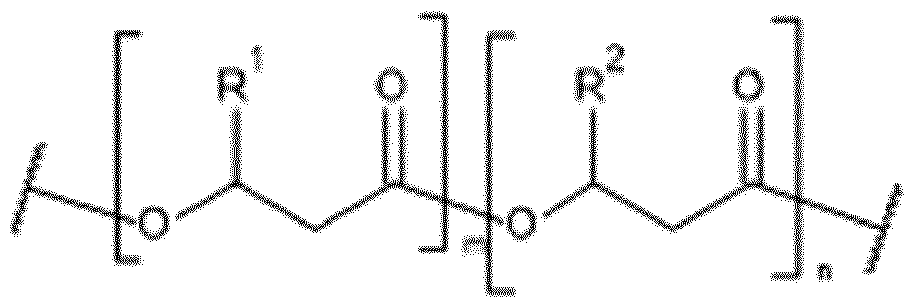
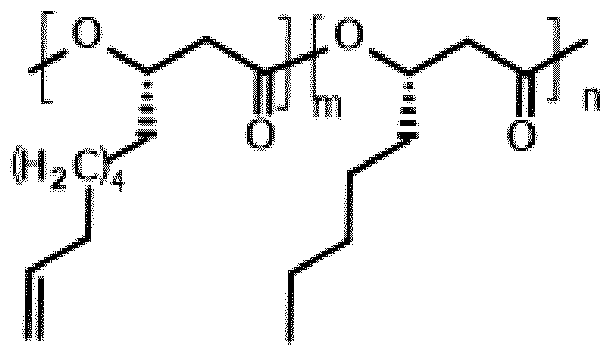
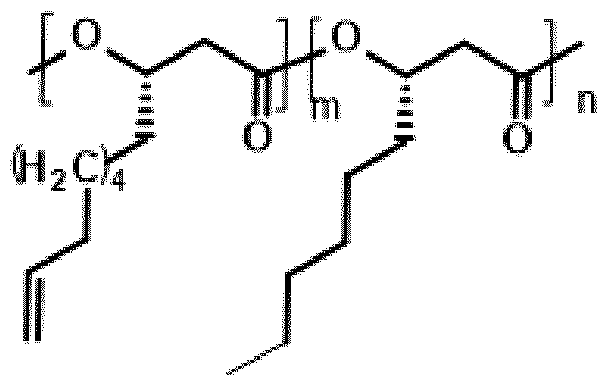
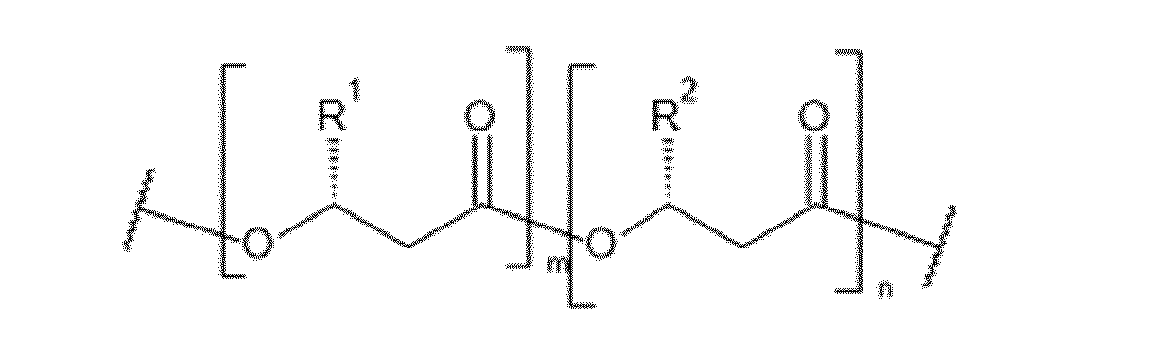
  • the PHA copolymer(s) according to the invention comprise the repeating unit of formula (I), and also the optical or geometrical isomers thereof and the solvates thereof such as hydrates:
  • ⁇ m and n are integers greater than or equal to 1; preferably, the sum n + m is inclusively between 450 and 1400; preferably, m > n when R 1 and R 2 represent an alkyl group - more preferentially, when R 1 and R 2 are alkyl, then R 1 is a C 5 -C 13 alkyl group; and R 2 represents a linear alkyl group with a carbon number corresponding to the carbon number of R 1 from which two carbon atoms are subtracted; and preferably, m ⁇ n when R 1 represents an alkenyl or alkyl group, and R 2 represents an alkyl group.
  • the PHA copolymer(s) of composition a) contain three different repeating polymer units (A), (B) and (C), and preferably consist of three different polymer units (A), (B) and (C), below, and also the optical or geometrical isomers thereof and the solvates thereof such as hydrates:
  • R 1 and R 2 are as defined previously;
  • R 3 represents a cyclic or non-cyclic, linear or branched, saturated or unsaturated hydrocarbon-based group comprising from 1 to 30 carbon atoms, and in particular represents a hydrocarbon-based group chosen from linear or branched (Ci-C 2 s)alkyl and linear or branched (C 2 -C 28 )alkenyl, in particular a linear hydrocarbon-based group, more particularly (C 4 -C 20 )alkenyl; preferably, the hydrocarbon-based group has a carbon number corresponding to the number of carbon atoms of the radical R 1 , or else corresponding to the number of carbon atoms of the radical R 1 from which at least three carbon atoms are subtracted, preferably corresponding to the number of carbon atoms of the radical R 1 from which four carbon atoms are subtracted; and it being understood that: (A) is different from (B) and (C), (B) is different from (A) and (C), and (C) is different from (A) and (B); and
  • the PHA copolymer(s) comprise the repeating unit of formula (II), and also the optical or geometrical isomers thereof and the solvates thereof such as hydrates:
  • R 1 , R 2 and R 3 are as defined previously;
  • ⁇ m, n and p are integers greater than or equal to 1; preferably, the sum n + m + p is inclusively between 450 and 1400; preferably, m > n + p when R 1 , R 2 and R 3 represent an unsubstituted and uninterrupted alkyl group - more preferentially, when R 1 , R 2 and R 3 are alkyl, then R 1 is a C 5 -C 13 alkyl group; and R 2 represents an alkyl group with a carbon number corresponding to the carbon number of R 1 from which two carbon atoms are subtracted, and R 3 represents an alkyl group with a carbon number corresponding to the carbon number of R 1 from which four carbon atoms are subtracted; and preferably, m ⁇ n + p when R 1 represents an alkenyl or alkynyl group, R 2 and R 3 represent an alkyl group, preferably R 3 represents an alkyl group with a carbon number corresponding to the carbon number of R 2 from which two
  • the PHA copolymer(s) of composition a) contain four different repeating polymer units (A), (B), (C) and (D), and preferably consist of four different polymer units (A), (B), (C) and (D), below, and also the optical or geometrical isomers thereof, the organic or mineral acid or base salts thereof, and the solvates thereof such as hydrates:
  • R 1 , R 2 and R 3 are as defined previously;
  • R 4 represents a cyclic or non-cyclic, linear or branched saturated hydrocarbon-based group comprising from 3 to 30 carbon atoms; in particular represents a hydrocarbon- based group chosen from linear or branched (C4-C 2 s)alkyl; and it being understood that:
  • R 1 , R 2 , R 3 and R 4 represent an alkyl group
  • the molar percentage of units (A) is greater than the molar percentage of units (B), greater than the molar percentage of units (C), and greater than the molar percentage of units (D) - more preferentially, when R 1 , R 2 , R 3 and R 4 are alkyl, then R 1 is a C5-C13 alkyl group; and R 2 represents an alkyl group with a carbon number corresponding to the carbon number of R 1 from which two carbon atoms are subtracted, and R 3 represents an alkyl group with a carbon number corresponding to the carbon number of R 1 from which four carbon atoms are subtracted, and R 4 represents an alkyl group
  • the PHA copolymer(s) comprise the repeating unit of formula (III), and also the optical or geometrical isomers thereof, the organic or mineral acid or base salts thereof, and the solvates thereof such as hydrates:
  • R 1 , R 2 , R 3 and R 4 are as defined previously;
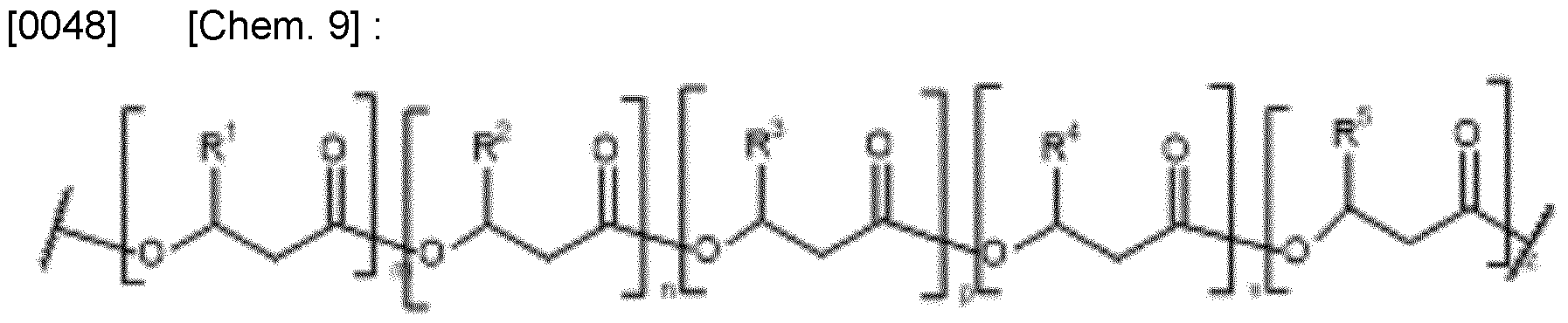
  • ⁇ m, n, p and v are integers greater than or equal to 1 ; preferably, the sum n + m + p + v is inclusively between 450 and 1400; and preferably, when R 1 , R 2 , R 3 and R 4 represent an alkyl group, then m > n + p + q - more preferentially, when R 1 , R 2 , R 3 and R 4 are alkyl, then R 1 is a C5-C13 alkyl group; and R 2 represents a linear alkyl group with a carbon number corresponding to the carbon number of R 1 from which two carbon atoms are subtracted, R 3 represents a linear alkyl group with a carbon number corresponding to the carbon number of R 1 from which four carbon atoms are subtracted, and R 4 represents a linear alkyl group with a carbon number corresponding to the carbon number of R 1 from which six carbon atoms are subtracted; and preferably, when R 1 represents an alkenyl or alkyny
  • the PHA copolymer(s) of composition a) contain five different repeating polymer units (A), (B), (C), (D) and (E), and preferably consist of five different polymer units (A), (B), (C), (D) and (E), below, and also the optical or geometrical isomers thereof, the organic or mineral acid or base salts thereof, and also the solvates thereof such as hydrates:
  • R 1 , R 2 and R 3 are as defined previously;
  • R 4 represents a cyclic or non-cyclic, linear or branched saturated hydrocarbon-based group comprising from 3 to 30 carbon atoms, and in particular represents a hydrocarbon-based group chosen from linear or branched (C 4 -C 2 8)alkyl;
  • R 5 represents a cyclic or non-cyclic, linear or branched, saturated hydrocarbon-based group comprising from 3 to 30 carbon atoms, and in particular represents a hydrocarbon-based group chosen from linear or branched (C 4 -C 28 )alkyl;
  • the hydrocarbon-based group has a carbon number corresponding to the number of carbon atoms of the radical R 4 from which at least one carbon atom is subtracted, preferably corresponding to the number of carbon atoms of the radical R 4 from which at least two carbon atoms are subtracted, preferably from which two carbon atoms are subtracted; it being understood that:
  • the PHA copolymer(s) comprise the repeating unit of formula (IV), and also the optical or geometrical isomers thereof, the organic or mineral acid or base salts thereof, and the solvates thereof such as hydrates:
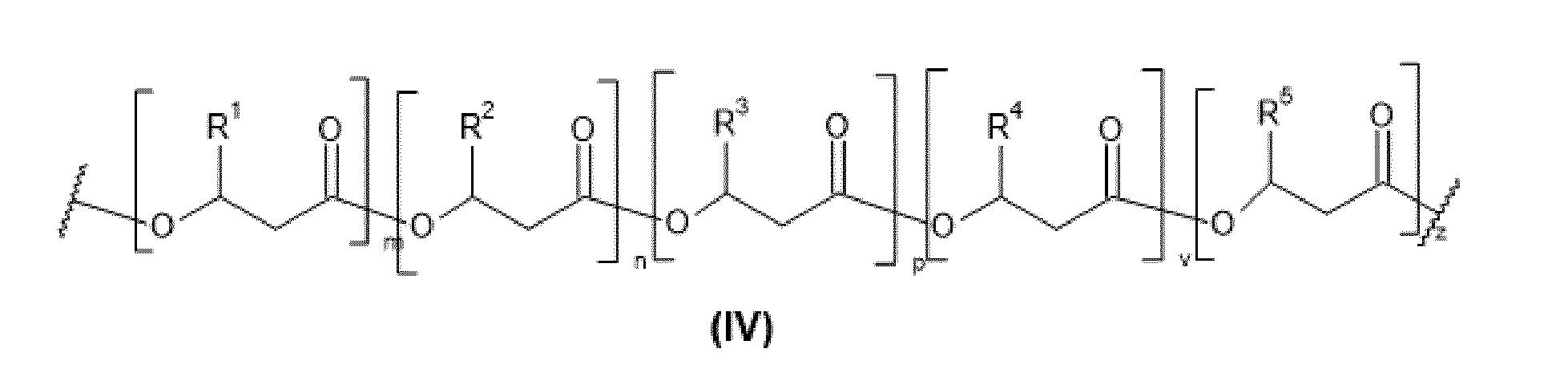
  • R 1 , R 2 , R 3 , R 4 and R 5 are as defined previously;
  • ⁇ m, n, p, v and z are integers greater than or equal to 1; preferably, the sum n + m + p + v + z is inclusively between 450 and 1400; and preferably, when R 1 , R 2 , R 3 , R 4 and R 5 represent an alkyl group, then m > n + p + v + z; preferably, when R 1 represents an alkenyl or alkynyl group, R 2 and R 3 represent an alkyl group and the groups R 4 and R 5 represent an alkenyl or alkynyl group, then n > m + v + z; more preferentially n + p > m + v + z; preferably, R 3 represents an alkyl group with a carbon number corresponding to the carbon number of R 2 from which two carbon atoms are subtracted, and R 4 represents an alkenyl or alkynyl group with a carbon number corresponding to the carbon number of R 1 from which two
  • the PHA copolymer(s) are such that the radical R 1 is a branched alkyl comprising 5 to 9 carbon atoms such as 2-methyl-5-pentyl, 2-methyl-2-pentyl, isobutyl or 2-methylheptyl, preferably 2- methyl-5-pentyl.
  • the PHA copolymer(s) are such that R 1 represents ii) a linear or branched, preferably linear, (C 10 -C 3 0)alkyl.
  • the PHA copolymer(s) are such that R 2 is chosen from linear or branched (Ci-C28)alkyl, and linear or branched (C 2 -C 28 )alkenyl, in particular a linear hydrocarbon- based group, more particularly (C 3 -C 2 0)alkyl or (C 3 -C 20 )alkenyl; preferably, the hydrocarbon- based group has a carbon number corresponding to the number of carbon atoms of the radical R 1 from which at least one carbon atom is subtracted, preferably corresponding to the number of carbon atoms of the radical R 1 from which at least two carbon atoms are subtracted, preferably to the number of carbon atoms of the radical R 1 from which two carbon atoms are subtracted.
  • the PHA copolymer(s) are such that the radical R 2 is a linear or branched, preferably linear, (C 1 -C 1 0)alkyl, in particular (C 2 -C 8 )alkyl, preferably (C 4 -C 6 )alkyl group such as n-pentyl or n-hexyl, n-heptyl or n-nonyl.
  • the PHA copolymer(s) comprise a branched (C 3 -C 8 )alkyl, particularly (C 4 -C 6 )alkyl radical R 2 , preferably a branched (C 4 -C 5 )alkyl radical such as isobutyl.
  • the units (A) comprises a hydrocarbon-based chain R 1 which is an alkenyl or alkynyl group as defined previously, in particular iii), said unit (A) is present in a molar percentage ranging from 0.1% to 50%, more preferentially a molar percentage ranging from 0.5% to 40%, even more preferentially a molar percentage ranging from 1% to 40%, better still a molar percentage ranging from 2% to 30%, or a molar percentage ranging from 5% to 20%.
  • R 1 of the unit (A) is an unsaturated hydrocarbon-based chain
  • said unit (A) is present in a molar percentage of less than or equal to 30%, more particularly less than 20%, preferably between 8% and 13%.
  • the unit (A) comprises a hydrocarbon-based chain R 1 which is an alkenyl or alkynyl group as defined previously, in particular iii)
  • said unit (A) is present in a molar percentage ranging from 0.1% to 50%, more preferentially a molar percentage ranging from 0.5% to 40%, even more preferentially a molar percentage ranging from 1% to 40%, better still a molar percentage ranging from 5% to 30%, a molar percentage ranging from 8% to 20%
  • the unit (B) is present in a molar percentage ranging from 70% to 99.5%, preferably between 60% and 95%
  • the unit (C) is present in a molar percentage ranging from 0 to 30%, preferably between 1% and 25%, more preferentially between 5% and 24% relative to the sum of the units (A), (B) and (C).
  • the PHA copolymer(s) of the invention comprise from 70 mol% to 90 mol% of units (B), and from 6 mol% to 24 mol% of units (C).
  • R 1 of the unit (A) is a saturated hydrocarbon-based chain, said unit
  • (A) is present in a molar percentage of greater than 30%, more particularly greater than 50%, more preferentially greater than 60%, preferably between 60% and 90%.
  • the PHA copolymer(s) are such that, in the PHA copolymer(s) a):
  • the unit (A) is present in a molar percentage ranging from 30% to 99%, preferentially a molar percentage ranging from 40% to 95%, more preferentially a molar percentage ranging from 50% to 85%, even more preferentially a molar percentage ranging from 60% to 70%; and
  • the unit (B) is present in a molar percentage ranging from 0.5% to 70%, preferentially a molar percentage ranging from 2% to 10%, more preferentially a molar percentage ranging from 5% to 35% of units (B); and/or
  • the unit (C) is present in a molar percentage ranging from 0% to 20%, preferentially a molar percentage ranging from 0.1% to 10%, more preferentially from 0.5% to 7% of units (C).
  • the unit (A) comprises a hydrocarbon-based chain R 1 which is an alkenyl or alkynyl group as defined previously, in particular iii)
  • said unit (A) is present in a molar percentage ranging from 0.1% to 50%, more preferentially a molar percentage ranging from 0.5% to 40%, even more preferentially a molar percentage ranging from 1% to 40%, better still a molar percentage ranging from 5% to 30%, a molar percentage ranging from 8% to 20%
  • the unit (B) is present in a molar percentage ranging from 70% to 99.5%, preferably between 60% and 95%
  • the unit (C) is present in a molar percentage ranging from 0 to 30%, preferably between 1% and 25%, more preferentially between 5% and 24% relative to the sum
  • the unit (D) is present in a molar percentage ranging from 0 to 10%
  • the values of the molar percentages of the units (A), (B), (C), (D) and (E) of the PHA copolymer(s) are calculated relative to the total number of moles of (A) + (B) if the copolymer(s) do not comprise any additional units (C), (D) or (E), otherwise, if the copolymer(s) of the invention contain more than two different units, i.e. (A), (B) and (C), (A),
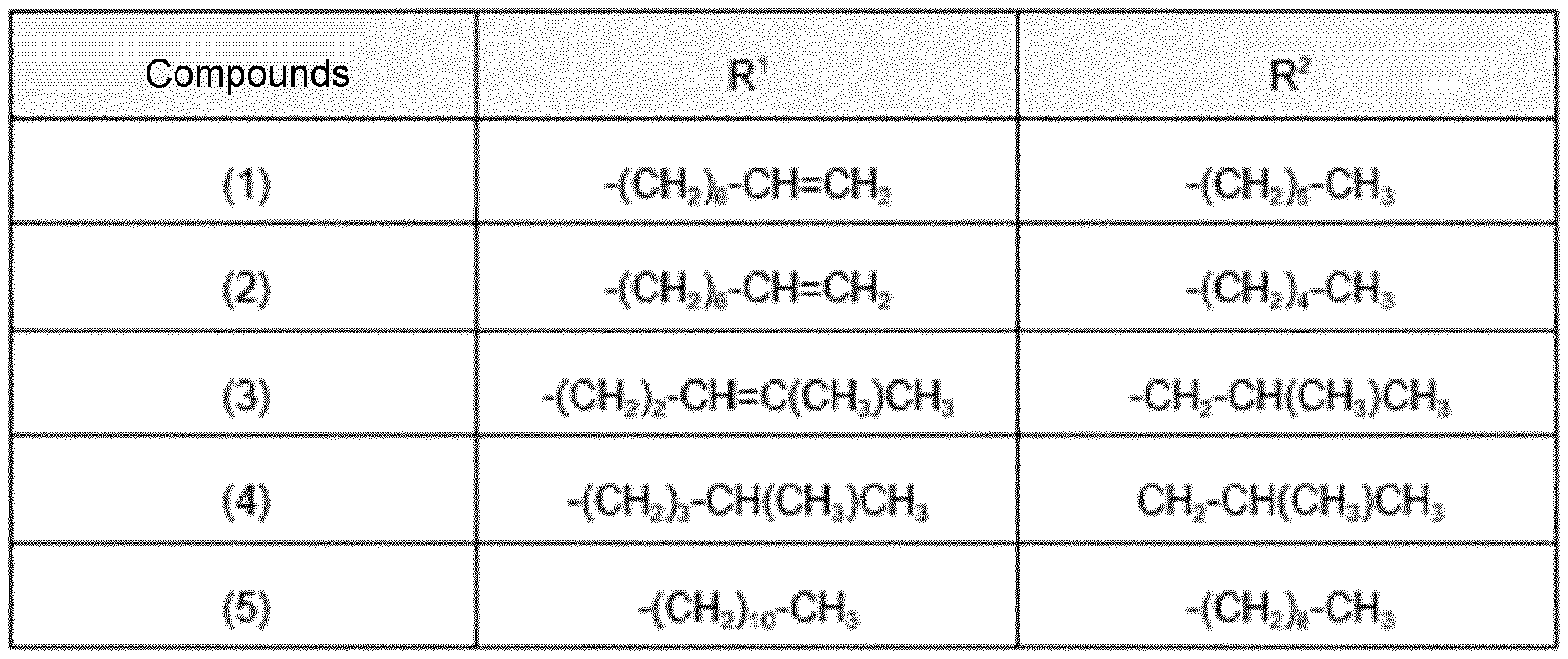
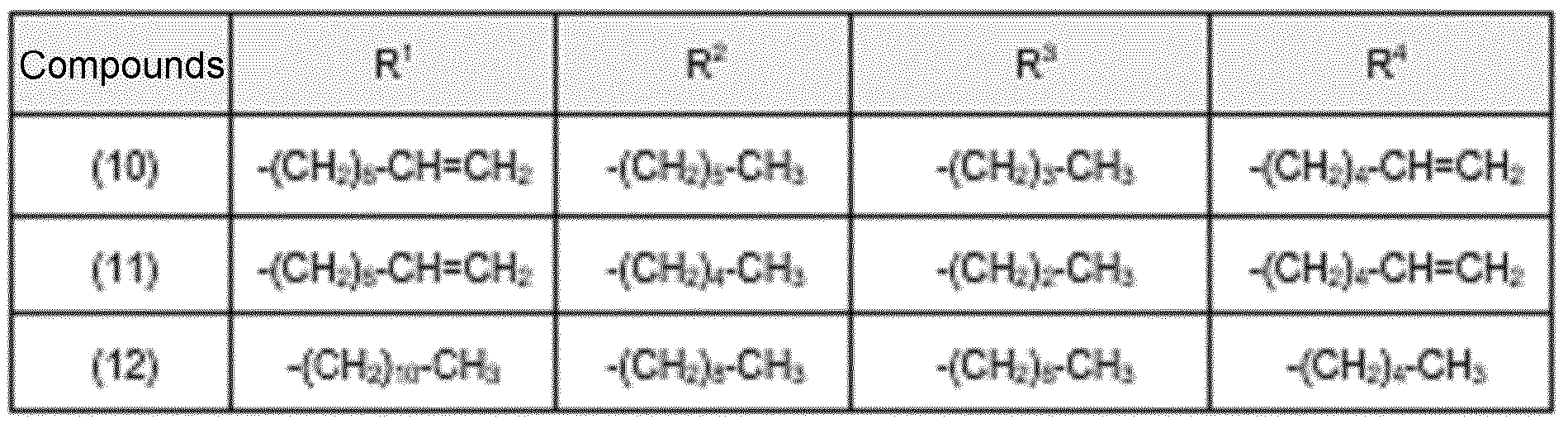
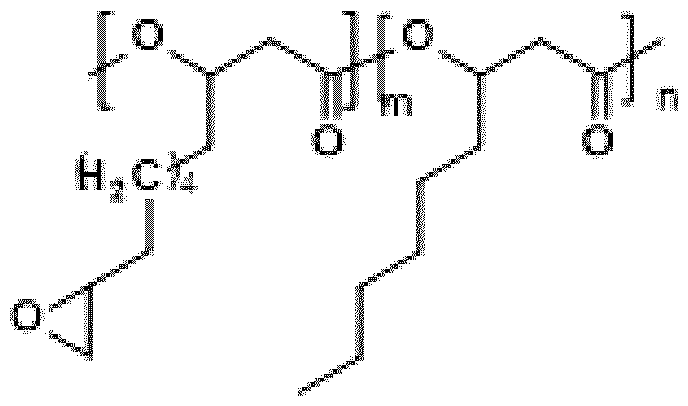
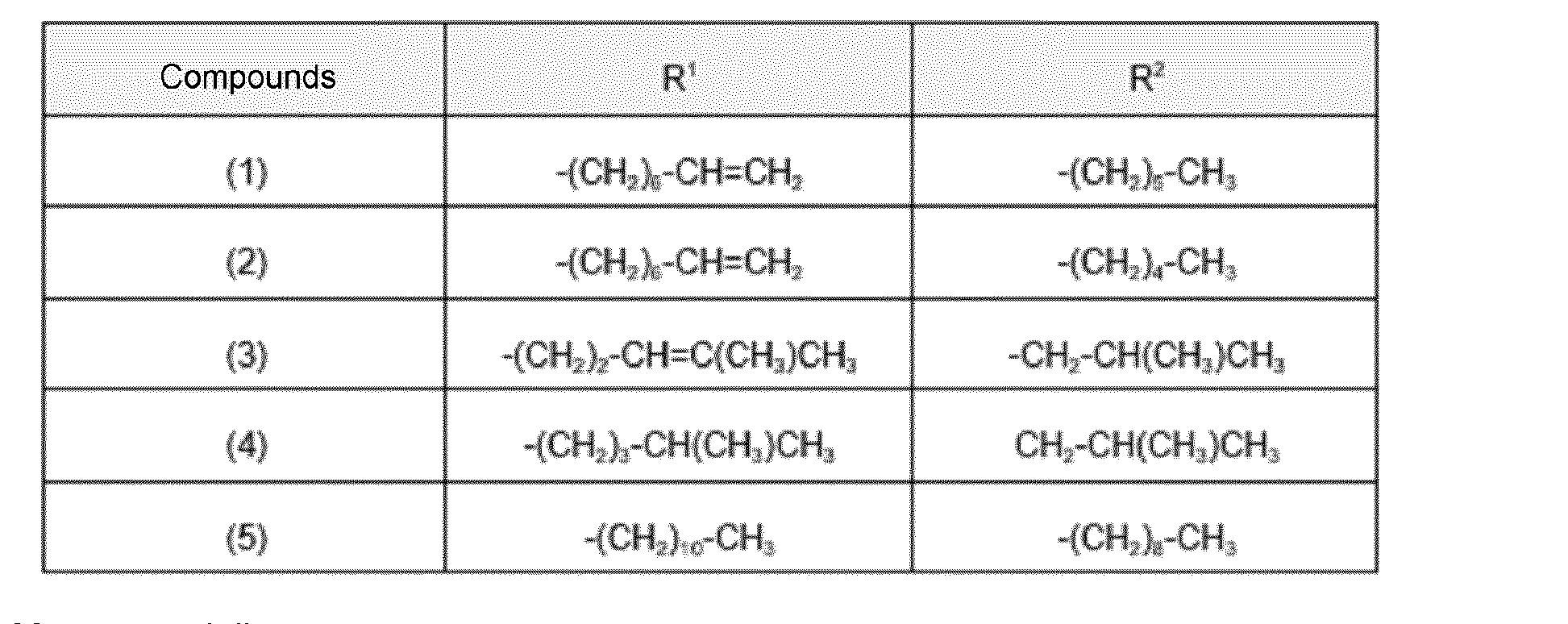
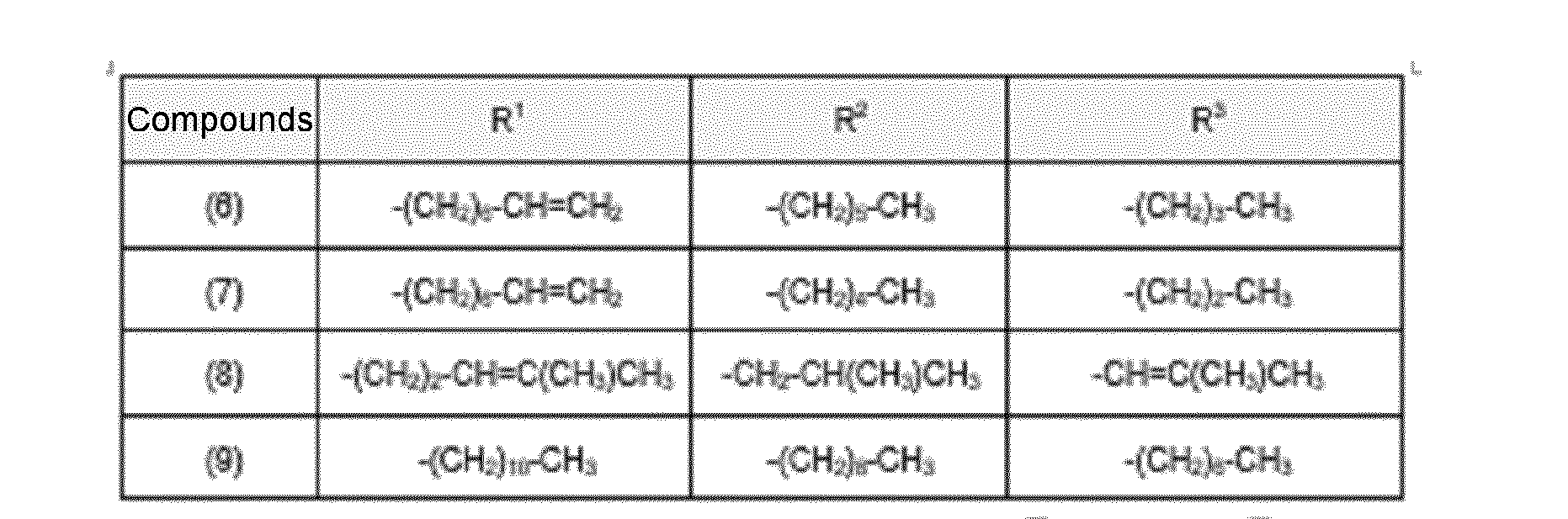
  • the PHA copolymer(s) of the invention comprise the following repeating units:
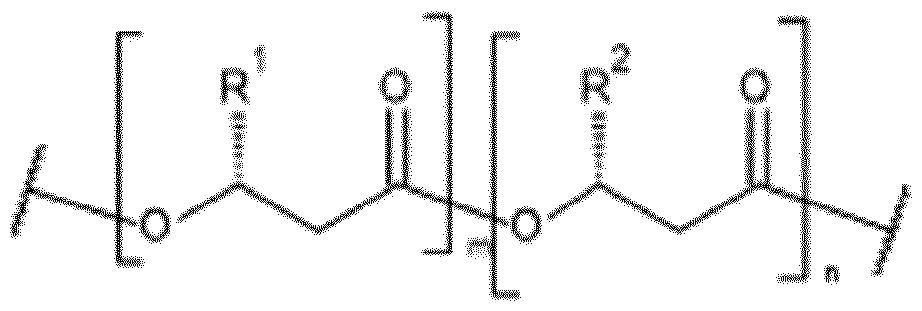
  • the stereochemistry of the carbon atoms bearing the radicals R 1 and R 2 is of the same (R) or (S) configuration, preferably of (R) configuration.
  • stereochemistry of the carbon atoms bearing the radicals R 1 , R 2 and R 3 is of the same (R) or (S) configuration, preferably of (R) configuration.
  • stereochemistry of the carbon atoms bearing the radicals R 1 , R 2 , R 3 and R 4 is of the same (R) or (S) configuration, preferably of (R) configuration.
  • stereochemistry of the carbon atoms bearing the radicals R 1 , R 2 , R 3 , R 4 and R 5 is of the same (R) or (S) configuration, preferably of (R) configuration.
  • the PHA copolymer(s) of the invention comprise the following repeating units:
  • the PHA copolymer(s) of the invention are different of compound (2) and/or (2’) especially (2), and more particularly are different from compounds (1) and (2) and/or (1’) and (2’) especially (1) and (2).
  • the PHA copolymer(s) of the invention preferably have a number-average molecular weight ranging from 50000 to 150000.
  • the molecular weight may notably be measured by size exclusion chromatography. A method is described below in the examples.
  • the PHA copolymer(s) are particularly present in the composition according to the invention in a content ranging from 0.1% to 30% by weight and preferably ranging from 0.1 % to 25% by weight relative to the total weight of the composition.
  • the term “functionalizable” means that the PHA copolymer(s) comprise a hydrocarbon- based chain comprising one or more atoms or groups that are capable of reacting chemically with another reagent - also referred to as “reactive atoms or reactive groups ” - to give a covalent bond functionalized with said reagent.
  • the reagent is, for example, a compound comprising at least one nucleophilic group and said functionalized hydrocarbon- based chain comprises at least one electrophilic or nucleofugal atom or group, the nucleophilic group(s) reacting with the electrophilic group(s) to covalently graft the reagent.
  • the nucleophilic reagent may also react with one or more unsaturations of the alkenyl group(s) to also lead to grafting by covalent bonding of the functionalized hydrocarbon- based chain with said reagent.
  • the addition may also be radical-based, an addition of Markovnikov or anti-Markovnikov type, or nucleophilic or electrophilic substitution.
  • the addition or condensation reactions may or may not take place via a radical route, with or without the use of catalysts or of enzymes, with heating preferably less than or equal to 100°C, under a pressure of greater than 1 atm, under an inert atmosphere or under oxygen.
  • nucleophilic refers to any atom or group which is electron-donating by an inductive effect +l and/or a mesomeric effect +M. Electron-donating groups that may be mentioned include hydroxyl, thiol and amino groups.
  • electrophilic refers to any atom or group which is electron-withdrawing by an inductive effect -I and/or a mesomeric effect -M. Electron-withdrawing species that may be mentioned include.
  • the microorganisms which produce PHAs of the invention notably bearing a C 3 -C 5 hydrocarbon-based chain may be naturally produced by the bacterial kingdom, such as Cyanobacteria of the order of Nostocales (e.g.: Nostoc muscorum, Synechocystis and Synechococcus ) but mainly by the Proteobacteria, for example in the class of: -beta-Proteobacteria, of the order Burkholderiales ( Cupriavidus negator synonym Rasltonia eutropha )
  • Nostocales e.g.: Nostoc muscorum, Synechocystis and Synechococcus
  • Proteobacteria for example in the class of: -beta-Proteobacteria, of the order Burkholderiales ( Cupriavidus negator synonym Rasltonia eutropha )
  • Rhodobacter capsulatus marine and photosynthetic -alpha-Proteobacteria, of the order Rhodobacteriales (Rhodobacter capsulatus marine and photosynthetic)
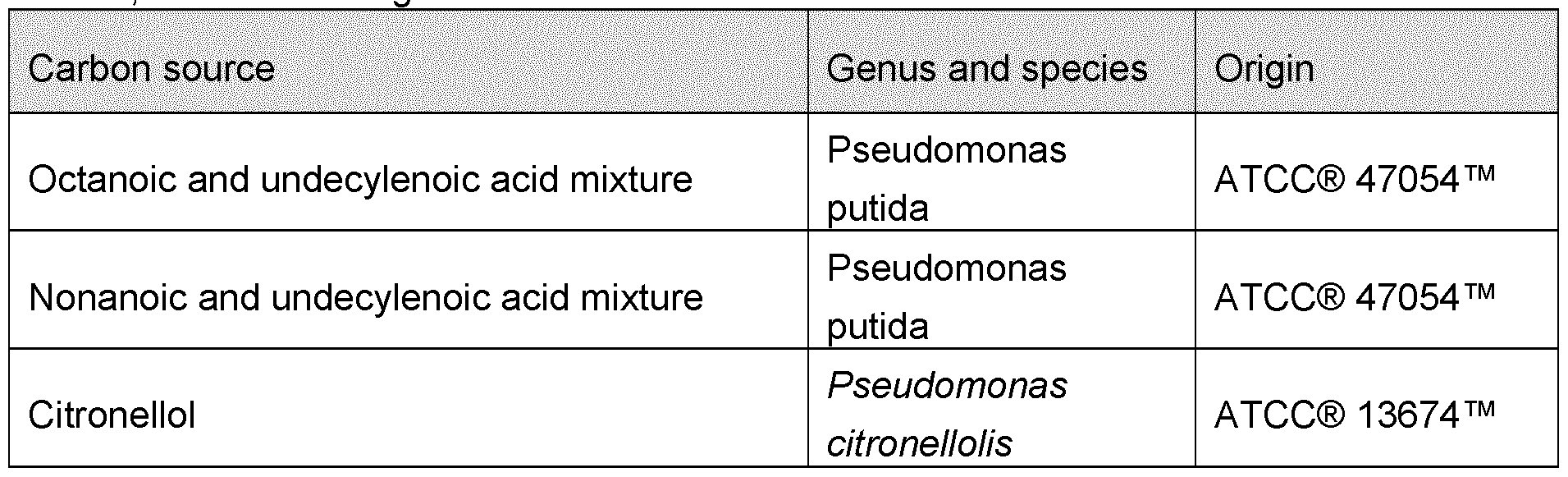
  • the organisms which naturally produce PHAs bearing a C 3 -C 5 hydrocarbon-based chain are notably Proteobacteria, such as gamma-Proteobacteria, and more particularly of the order Pseudomonales of the family Pseudomonas such as Pseudomonas resinovorans, Pseudomonas putida, Pseudomonas fluorescens, Pseudomonas aeruginosa, Pseudomonas citronellolis, Pseudomonas mendocina, Pseudomonas chlororaphis and preferably Pseudomonas putida GPo1 and Pseudomonas putida
  • Certain organisms may also naturally produce PHAs without belonging to the order of Pseudomonales, such as Commamonas testosteroni which belongs to the class of beta- Proteobacteria of the order Burkholderiales of the family of Comamonadaceae.
  • the PHA-producing microorganism according to the invention may also be a recombinant strain if a 3-oxidation PHA synthase metabolic pathway is present.
  • the 3- oxidation PHA synthase metabolic pathway is mainly represented by four enzymes, EC: 2.3.1 B2, EC: 2.3.1 B3, EC: 2.3.1 B4 and EC: 2.3.1 B5.
  • the recombinant strain may be of the Bacteria kingdom, e.g.: Escherichia coli or of the Plantae kingdom, e.g.: Chlorella pyrenoidosa: International Journal of Biological Macromolecules, 116, 552-562 “Influence of nitrogen on growth, biomass composition, production, and properties of polyhydroxyalkanoates (PHAs) by microalgae”) or of the Fungi kingdom, e.g.
  • PHAs polyhydroxyalkanoates
  • Saccaromyces cerevisiae or Yarrowia lipolytica Applied Microbiology and Biotechnology 91, 1327-1340 (2011) “Engineering polyhydroxyalkanoate content and monomer composition in the oleaginous yeast Yarrowia lipolytica by modifying the b-oxidation multifunctional protein”).
  • Use may also be made of genetically modified microorganisms, which may make it possible, for example, to increase the production of PHA, to increase the oxygen consumption capacity, to reduce the autolysis and/or to modify the monomer ratio.
  • the copolymer may also be obtained in a known manner by biosynthesis, for example with the microorganisms belonging to the genus Pseudomonas, such as Pseudomonas resinovorans, Pseudomomonas putida, Pseudomonas fluorescens, Pseudomonas aeruginosa, Pseudomonas citronellolis, Pseudomonas mendocina, Pseudomonas chlororaphis and preferably Pseudomonas putida ; and with a carbon source which may be a C 2 -C 20 , preferably C 6 -C 18 , carboxylic acid, such as acetic acid, propionic acid, butyric acid, hexanoicacid, heptanoicacid, octanoic acid, nonanoic acid, dodecanoic acid; a sacchar
  • the biosynthesis may optionally be performed in the presence of an inhibitor of the b-oxidation pathway, such as acrylic acid, methacrylic acid, propionic acid, cinnamic acid, salicylic acid, pentenoic acid, 2-butynoic acid, 2-octynoic acid or phenylpropionic acid, and preferably acrylic acid.
  • an inhibitor of the b-oxidation pathway such as acrylic acid, methacrylic acid, propionic acid, cinnamic acid, salicylic acid, pentenoic acid, 2-butynoic acid, 2-octynoic acid or phenylpropionic acid, and preferably acrylic acid.
  • the process for preparing the PHAs of the invention uses microbial cells which produce PHAs via genetically modified microorganisms (GMOs).
  • GMOs genetically modified microorganisms
  • the genetic modification may increase the production of PHA, increase the oxygen absorption capacity, increase the resistance to the toxicity of solvents, reduce the autolysis, modify the ratio of the PHA comonomers, and/or any combination thereof.
  • the modification of the comonomer ratio of the unit (A) increases the amount of predominant monomer versus (B) of the PHA of the invention which is obtained.
  • the PHA-producing microbial cells reproduce naturally.
  • a genetically modified microbial strain producing PHA that is functionalizable or comprising a reactive group is Pseudomonas entomophila LAC23 (Biomacromolecules. 2014 Jun 9;15(6):2310-9. doi: 10.1021/bm500669s).
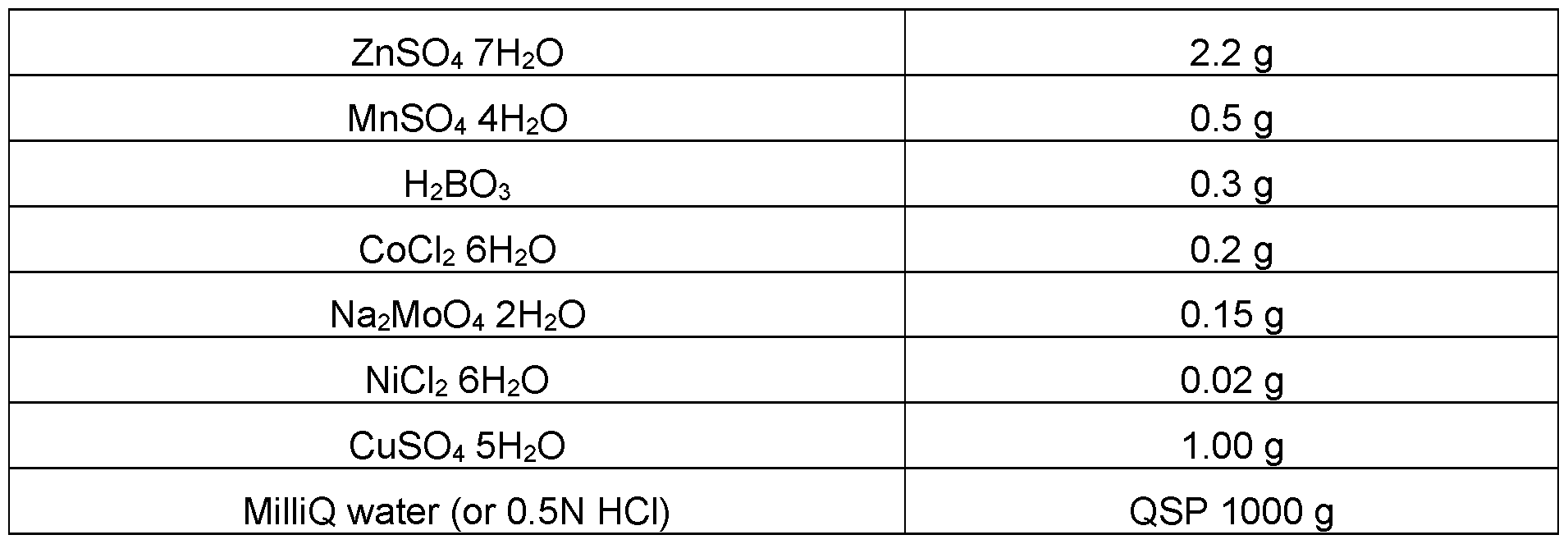
  • Nutrients such as water-soluble salts based on nitrogen, phosphorus, sulfur, magnesium, sodium, potassium and iron, may also be used for the biosynthesis.
  • the known appropriate temperature, pH and dissolved oxygen (O D ) conditions may be used for the culturing of the microorganisms.
  • the microorganisms may be cultured according to any known method of culturing, such as in a bioreactor in continuous or batch mode, in fed or unfed mode.
  • the microbial strains producing PHA which is functionalizable or comprising a reactive group are, for example, of the genus Pseudomonas such as P. cichorii YN2, P. citronellolis, P. jessenii, and more generally with species of Pseudomonas putida such as Pseudomonas putida GPo1 (synonym of Pseudomonas oieovorans), P. putida KT2442, P. putida KCTC 2407, P. putida BM01.
  • Pseudomonas such as P. cichorii YN2, P. citronellolis, P. jessenii
  • species of Pseudomonas putida such as Pseudomonas putida GPo1 (synonym of Pseudomonas oieovorans), P. put
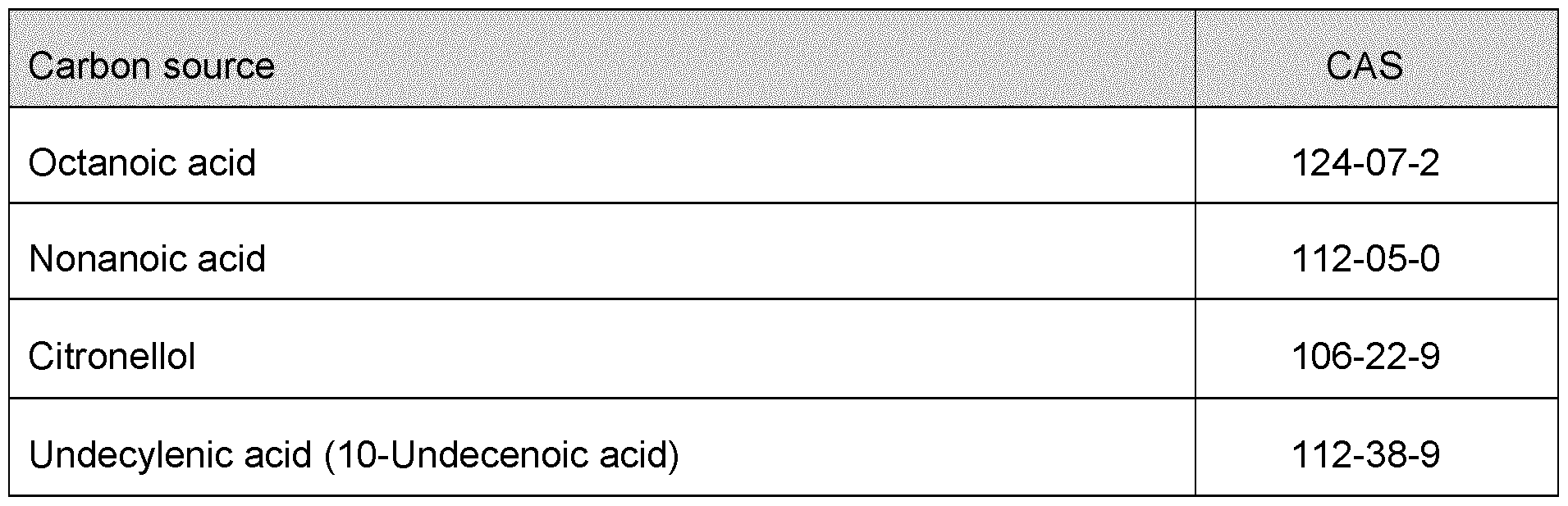
  • One means for gaining access to the PHAs of the invention is to introduce one or more organic compounds into the culture medium, this or these organic compounds representing a carbon source preferably chosen from alkanes, alkenes, alcohols, carboxylic acids and a mixture thereof.
  • the organic compound(s) will preferably be chosen from alcohols, carboxylic acids and a mixture thereof.
  • the carbon source(s) may be classified in two categories:
  • One means for gaining access to the PHAs of the invention is to introduce one or more organic compounds into the culture medium, this organic compound being a carbon source preferably chosen from alkanes, alkenes, alcohols, carboxylic acids and mixtures thereof.
  • the organic compound(s) are chosen from alcohols, in particular (C 5 -C 20 )alkanols, and/or carboxylic acids, in particular (C 5 -C 20 )alkanoic acids.
  • the carbon source(s) may be classified in three groups: group A: the organic compound may aid the growth of the productive strain and aid the production of PHA structural linked to the organic compound.
  • group B the organic compound may aid the growth of the strain but does not participate in the production of PHA structural linked to the organic compound.
  • group C the organic compound does not participate in the growth of the strain.
  • microbiological processes are known to those skilled in the art, notably in the scientific literature. Mention may be made of: International Journal of Biological Macromolecules 28, 23-29 (2000); The Journal of Microbiology, 45, No. 2, 87-97, (2007).
  • the integration of the substrate that is structurally linked to the reactive atom(s) or to the reactive group(s) of the PHAs of the invention is introduced directly into the medium as sole carbon source in a medium suitable for microbial growth.
  • group A for P. putida GPo1 ⁇ alkenoic acid, notably terminal group A for P. putida GPo1 ⁇ alkenoic acid, notably terminal.
  • the integration of the substrate that is structurally linked to the reactive atom(s), notably halogen, or to the reactive group(s) of the PHAs of the invention is introduced into the medium as carbon source with a second carbon source as co-substrate which is also structurally linked to the PHA, in a medium suitable for microbial growth.
  • group B for P. putida GPoT. haloalkanoic acids which are preferably terminal, such as terminal bromoalkanoic acids are preferably terminal, such as terminal bromoalkanoic acids.
  • the integration of the substrate that is structurally linked to the reactive atom(s), notably halogen, or to the reactive group(s) of the PHAs of the invention may be introduced directly into the medium as carbon source with a second carbon source as co-substrate which is also structurally linked to the PHAs and a third carbon source as co-substrate which is not structurally linked to the PHAs, in a medium suitable for microbial growth.
  • a medium suitable for microbial growth for example: group C glucose or sucrose.
  • the b-oxidation pathway inhibitor is acrylic acid, 2-butynoic acid, 2-octynoic acid, phenylpropionic acid, propionic acid, trans-cinnamic acid, salicylic acid, methacrylic acid, 4-pentenoic acid or 3-mercaptopropionic acid.
  • the functionalized fatty acid is a functionalized hexanoic acid, functionalized heptanoic acid, functionalized octanoic acid, functionalized nonanoic acid, functionalized decanoic acid, functionalized undecanoic acid, functionalized dodecanoic acid or functionalized tetradecanoic acid.
  • the functionalization may be introduced by means of an organic compound chosen from precursors of the alcohol and/or carboxylic acid category, notably: for functionalization of the PHA(s) with a branched alkyl group: see, for example Applied and Environmental Microbiology,. 60, No.
  • the fatty acid from group A is chosen from 11-undecenoic acid, 10-epoxyundecanoic acid, 5-phenylvaleric acid, citronellol and 5-cyanopentanoic acid.
  • the fatty acid from group B is chosen from halooctanoic acids such as 8-bromooctanoic acid.
  • the carbon source from group C is a monosaccharide, preferably glucose.
  • Another aspect of the invention is the use of the PHA-producing microbial strains in a medium that is suitable for microbial growth, said medium comprising: a substrate which is structurally linked to the PHA(s); at least one carbon source which is not structurally linked to the PHA(s); and at least one oxidation and notably b-oxidation pathway inhibitor.
  • the microbial cells synthesizing the PHA polymer(s) of the invention; preferably copolymer particularly containing more than 95% of identical units, which has a comonomer ratio of unit (A) and of unit (B) which differs from that obtained in the absence of the b-oxidation pathway inhibitor.
  • the fatty medium preferably copolymer particularly containing more than 95% of identical units, which has a comonomer ratio of unit (A) and of unit (B) which differs from that obtained in the absence of the b-oxidation pathway inhibitor.
  • the composition comprises as second ingredient a fatty medium, which is preferably oily.
  • fatty medium means that the composition of the invention comprises one or more fatty substances.
  • the composition may also comprise water.
  • the composition of the invention predominantly comprises on a weight basis one or more fatty substances versus the amount by weight of water.
  • fatty substance means an organic compound that is insoluble in water at ordinary room temperature (25°C) and at atmospheric pressure (760 mmHg) (solubility of less than 5%, preferably 1% and even more preferentially 0.1%). They bear in their structure at least one hydrocarbon-based chain including at least 6 carbon atoms or a sequence of at least two siloxane groups.
  • the fatty substances are generally soluble in organic solvents under the same temperature and pressure conditions, for instance chloroform, ethanol, benzene, liquid petroleum jelly or decamethylcyclopentasiloxane.
  • the fatty substance(s) of the invention are of natural or synthetic origin, preferably natural, more preferentially of plant origin. These fatty substances are preferably neither polyoxyethylenated nor polyglycerolated. They are different from fatty acids since salified fatty acids constitute soaps which are generally soluble in aqueous media.
  • the composition comprises one or more fatty substances that are not liquid at 25°C and at atmospheric pressure.
  • the composition of the invention comprises one or more waxes.
  • wax means a lipophilic compound that is solid at room temperature (25°C), with a reversible solid/liquid change of state, having a melting point of greater than or equal to 30°C, which may be up to 200°C and notably up to 120°C.
  • the wax(es) that are suitable for use in the invention may have a melting point of greater than or equal to 45°C and in particular of greater than or equal to 55°C.
  • the composition according to the invention preferably comprises a content of wax(es) ranging from 3% to 20% by weight relative to the total weight of the composition, in particular from 5% to 15% and more particularly from 6% to 15%.
  • the composition of the invention is solid, in particular anhydrous. It may then be in stick form; use will be made of polyethylene microwaxes in the form of crystallites with an aspect ratio at least equal to 2, and with a melting point ranging from 70 to 110°C and preferably from 70 to 100°C, so as to reduce or even eliminate the presence of strata in the solid composition.
  • crystallites in needle form and notably the dimensions thereof may be characterized visually according to the following method.
  • the composition of the invention comprises one or more pasty compounds.
  • the term “pasty compound’ means a lipophilic fatty compound that undergoes a reversible solid/liquid change of state, having anisotropic crystal organization in the solid state, and including, at a temperature of 23°C, a liquid fraction and a solid fraction.
  • the composition comprises one or more oils.
  • oiT means a hydrophobic (i.e. water-immiscible) fatty (i.e. non- aqueous) substance that is liquid at room temperature (25°C) and at atmospheric pressure (1 atm or 760 mmHg).
  • liquid fatty substances notably means liquid fatty substance(s) preferably having a viscosity of less than or equal to 7000 centipoises at 20°C.
  • the liquid fatty substance(s) of the invention more particularly have a viscosity of less than or equal to 2 Pa.s, more particularly less than or equal to 1 Pa.s, even more particularly less than or equal to 0.1 Pa.s, and more preferentially less than or equal to 0.09 Pa.s at a temperature of 25°C and at a shear rate of 1 s -1 .
  • the liquid fatty substance(s) have a viscosity of between 0.001 Pa.s and 2 Pa.s, more particularly inclusively between 0.01 and 1 Pa.s and even more particularly inclusively between 0.014 and 0.1 Pa.s, more preferentially inclusively between 0.015 and 0.09 Pa.s at a temperature of 25°C and at a shear rate of 1 s -1 .
  • the PHA copolymer(s) according to the invention are soluble in the liquid fatty substances at 25°C and at atmospheric pressure.
  • the medium is said to be carbon-based if it comprises at least 50% by weight, notably from 50% to 100% by weight, for example from 60% to 99% by weight, or else from 65% to 95% by weight, or even from 70% to 90% by weight, relative to the total weight of the carbon-based medium, of carbon-based compound, which is liquid at 25°C.
  • the liquid fatty substance(s) have an overall solubility parameter according to the Hansen solubility space of less than or equal to 20 (MPa) 1/2 , or a mixture of such compounds.
  • liquid carbon-based compounds having an overall solubility parameter according to the Hansen solubility space of less than or equal to 20 (MPa) 1/2
  • liquid fatty substances notably oils, which may be chosen from natural or synthetic, carbon-based, or hydrocarbon-based oils, which are optionally fluorinated, and optionally branched, alone or as a mixture.
  • the liquid fatty substances are notably chosen from C6-C16 hydrocarbons or hydrocarbons comprising more than 16 carbon atoms and up to 60 carbon atoms and in particular alkanes, oils of animal origin, oils of plant origin, glycerides or fluoro oils of synthetic origin, fatty alcohols, fatty acid and/or fatty alcohol esters, non-silicone waxes, and silicones.
  • the fatty alcohols, fatty esters and fatty acids more particularly contain one or more linear or branched, saturated or unsaturated hydrocarbon-based groups comprising 6 to 30 carbon atoms, which are optionally substituted, in particular, with one or more (in particular 1 to 4) hydroxyl groups. If they are unsaturated, these compounds may comprise one to three conjugated or unconjugated carbon-carbon double bonds.
  • C 6 -C 16 alkanes they are linear or branched, and possibly cyclic. Examples that may be mentioned include hexane, dodecane and isoparaffins such as isohexadecane and isodecane.
  • the linear or branched hydrocarbons containing more than 16 carbon atoms may be chosen from liquid paraffins, petroleum jelly, liquid petroleum jelly, polydecenes, and hydrogenated polyisobutene.
  • the fatty substance(s) used in the process of the invention are chosen from volatile linear alkanes.
  • one or more volatile linear alkanes means, without distinction, “one or more volatile linear alkane oils”.
  • a volatile linear alkane that is suitable for use in the invention is liquid at room temperature (about 25°C) and atmospheric pressure (101 325 Pa or 760 mmHg).
  • volatile linear alkane that is suitable for use in the invention means a linear alkane that can evaporate on contact with the skin in less than one hour, at room temperature (25°C) and atmospheric pressure (101 325 Pa), which is liquid at room temperature, notably having an evaporation rate ranging from 0.01 to 15 mg/cm 2 /minute, at room temperature (25°C) and atmospheric pressure (101 325 Pa).
  • the volatile linear alkanes that are suitable for use in the invention have an evaporation rate ranging from 0.01 to 3.5 mg/cm 2 /minute and better still from 0.01 to 1.5 mg/cm 2 /minute, at room temperature (25°C) and atmospheric pressure (101 325 Pa).
  • the volatile linear alkanes that are suitable for use in the invention have an evaporation rate ranging from 0.01 to 0.8 mg/cm 2 /minute, preferentially from 0.01 to 0.3 mg/cm 2 /minute and even more preferentially from 0.01 to 0.12 mg/cm 2 /minute, at room temperature (25°C) and atmospheric pressure (101 325 Pa).
  • the evaporation rate of a volatile alkane in accordance with the invention may notably be evaluated by means of the protocol described in WO 06/013 413, and more particularly by means of the protocol described below.
  • the volatile hydrocarbon-based solvent is allowed to evaporate freely, without stirring it, while providing ventilation by means of a fan (Papst-Motoren, reference 8550 N, rotating at 2700 rpm) placed in a vertical position above the crystallizing dish containing the volatile hydrocarbon-based solvent, the blades being directed towards the crystallizing dish, 20 cm away from the bottom of the crystallizing dish.
  • a fan Paperst-Motoren, reference 8550 N, rotating at 2700 rpm
  • the mass of volatile hydrocarbon-based solvent remaining in the crystallizing dish is measured at regular time intervals.
  • the evaporation rate is then calculated, which corresponds to the tangent to the origin of the curve obtained.
  • the evaporation rates are expressed in mg of volatile solvent evaporated per unit area (cm 2 ) and per unit time (minutes).
  • the volatile linear alkanes that are suitable for use in the invention have a non-zero vapour pressure (also known as the saturation vapour pressure), at room temperature, in particular a vapour pressure ranging from 0.3 Pa to 6000 Pa.
  • a non-zero vapour pressure also known as the saturation vapour pressure
  • the volatile linear alkanes that are suitable for use in the invention have a vapour pressure ranging from 0.3 to 2000 Pa and better still from 0.3 to 1000 Pa, at room temperature (25°C).
  • the volatile linear alkanes that are suitable for use in the invention have a vapour pressure ranging from 0.4 to 600 Pa, preferentially from 1 to 200 Pa and even more preferentially from 3 to 60 Pa, at room temperature (25°C).
  • a volatile linear alkane that is suitable for use in the invention may have a flash point that is within the range from 30 to 120°C and more particularly from 40 to 100°C.
  • the flash point is in particular measured according to the standard ISO 3679.
  • the volatile linear alkanes that are suitable for use in the invention may be linear alkanes including from 7 to 15 carbon atoms, preferably from 8 to 14 carbon atoms and better still from 9 to 14 carbon atoms.
  • the volatile linear alkanes that are suitable for use in the invention may be linear alkanes including from 10 to 14 carbon atoms and even more preferentially from 11 to 14 carbon atoms.
  • a volatile linear alkane that is suitable for use in the invention may advantageously be of plant origin.
  • the fatty medium of the composition is oily. More particularly, the composition comprises one or more oils, preferably non-silicone oils, notably hydrocarbon-based oils.
  • hydrocarbon-based oil means an oil consisting of carbon and hydrogen atoms.
  • the liquid fatty substances of the invention are chosen from hydrocarbons, fatty alcohols, fatty esters, silicones and fatty ethers, or mixtures thereof. More particularly, the fatty substances of the invention are not (poly)oxyalkylenated.
  • liquid hydrocarbon means a hydrocarbon composed solely of carbon and hydrogen atoms, which is liquid at ordinary temperature (25°C) and at atmospheric pressure (760 mmHg; i.e. 1.013x10 5 Pa).
  • liquid hydrocarbons are chosen from:
  • C 6 -C 16 alkanes examples include hexane, undecane, dodecane, tridecane, and isoparaffins, for instance isohexadecane, isododecane and isodecane;
  • 16 carbon atoms such as liquid paraffins, liquid petroleum jelly, polydecenes hydrogenated polyisobutene such as Parleam®, and squalane.
  • liquid hydrocarbon(s) are chosen from liquid paraffins and liquid petroleum jelly.
  • liquid fatty alcohof means a non-glycerolated and non- oxyalkylenated fatty alcohol that is liquid at ordinary temperature (25°C) and at atmospheric pressure (760 mmHg; i.e. 1.013x10 5 Pa).
  • the liquid fatty alcohols of the invention include from 8 to 30 carbon atoms, more preferentially C 10 -C 2 2, even more preferentially C 14 -C 20 , better still C 16 -C 18 .
  • liquid fatty alcohols of the invention may be saturated or unsaturated.
  • the saturated liquid fatty alcohols are preferably branched. They may optionally comprise in their structure at least one aromatic or non-aromatic ring. Preferably, they are acyclic.
  • saturated liquid fatty alcohols of the invention are chosen from octyldodecanol, isostearyl alcohol and 2-hexyldecanol.
  • the fatty substance(s) are chosen from liquid unsaturated fatty alcohols. These liquid unsaturated fatty alcohols contain in their structure at least one double or triple bond. Preferably, the fatty alcohols of the invention bear in their structure one or more double bonds. When several double bonds are present, there are preferably two or three of them, and they may be conjugated or non-conjugated.
  • These unsaturated fatty alcohols may be linear or branched.
  • They may optionally comprise in their structure at least one aromatic or non- aromatic ring. Preferably, they are acyclic.
  • liquid unsaturated fatty alcohols of the invention are chosen from oleyl alcohol, linolyl alcohol, linolenyl alcohol and undecylenyl alcohol.
  • Oleyl alcohol is most particularly preferred.
  • liquid fatty ester or “ester oil” means a compound comprising one or more ester groups derived from a fatty acid and/or from a fatty alcohol and that is liquid at ordinary temperature (25°C) and at atmospheric pressure (760 mmHg; i.e. 1.013 x 10 5 Pa).
  • the esters are preferably liquid esters of saturated or unsaturated, linear or branched C 1 -C 26 aliphatic monoacids or polyacids and of saturated or unsaturated, linear or branched C 1 -C 26 aliphatic monoalcohols or polyalcohols, the total number of carbon atoms in the esters being greater than or equal to 10.
  • esters of monoalcohols Preferably, for the esters of monoalcohols, at least one from among the alcohol and the acid from which the esters of the invention are derived is branched.
  • ethyl palmitate isopropyl palmitate
  • alkyl myristates such as isopropyl myristate or ethyl myristate
  • isocetyl stearate 2-ethylhexyl isononanoate
  • isodecyl neopentanoate isostearyl neopentanoate
  • C 10 -C 22 and preferably C 12 -C 20 alkyl (iso)stearates such as isopropyl isostearate.
  • esters of C 4 -C 22 dicarboxylic or tricarboxylic acids and of C 1 -C 22 alcohols and esters of monocarboxylic, dicarboxylic or tricarboxylic acids and of non-sugar C 4 -C 26 dihydroxy, trihydroxy, tetrahydroxy or pentahydroxy alcohols may also be used.
  • the composition may also comprise, as liquid fatty ester, sugar esters and diesters of C 6 -C 30 and preferably C 12 -C 22 fatty acids.
  • sugar esters and diesters of C 6 -C 30 and preferably C 12 -C 22 fatty acids.
  • sugar esters means oxygen-bearing hydrocarbon-based compounds bearing several alcohol functions, with or without aldehyde or ketone functions, and which include at least 4 carbon atoms.
  • sugars may be monosaccharides, oligosaccharides or polysaccharides.
  • Suitable sugars include sucrose, glucose, galactose, ribose, fucose, maltose, fructose, mannose, arabinose, xylose and lactose, and derivatives thereof, notably alkyl derivatives, such as methyl derivatives, for instance methylglucose.
  • the sugar esters of fatty acids may be notably chosen from the group comprising the esters or mixtures of esters of sugars described previously and of linear or branched, saturated or unsaturated C 6 - C 30 and preferably C 12 -C 22 fatty acids. If they are unsaturated, these compounds may comprise one to three conjugated or unconjugated carbon-carbon double bonds.
  • esters according to this variant may also be chosen from mono-, di-, tri- and tetraesters, polyesters, and mixtures thereof.
  • esters may be, for example, oleates, laurates, palmitates, myristates, behenates, cocoates, stearates, linoleates, linolenates, caprates and arachidonates, or mixtures thereof such as, notably, oleopalmitate, oleostearate and palmitostearate mixed esters.
  • monoesters and diesters and notably sucrose, glucose or methylglucose monooleate or dioleate, stearate, behenate, oleopalmitate, linoleate, linolenate or oleostearate.
  • oils of plant origin or synthetic triglycerides that may be used in the composition of the invention as liquid fatty esters
  • examples that may be mentioned include: - triglyceride oils of plant or synthetic origin, such as liquid fatty acid triglycerides including from 6 to 30 carbon atoms, for instance heptanoic or octanoic acid triglycerides, or alternatively, for example, sunflower oil, corn oil, soybean oil, marrow oil, grapeseed oil, sesame seed oil, hazelnut oil, apricot oil, macadamia oil, arara oil, sunflower oil, castor oil, avocado oil, caprylic/capric acid triglycerides, for instance those sold by the company Stearinerie Dubois or those sold under the names Miglyol® 810, 812 and 818 by the company Dynamit Nobel, jojoba oil and shea butter oil.
  • Use will preferably be made, as esters according to the invention, of liquid fatty acid trig
  • liquid fatty ethers are chosen from liquid dialkyl ethers such as dicaprylyl ether.
  • the composition comprises one or more hydrocarbon-based oils containing from 8 to 16 carbon atoms.
  • hydrocarbon-based oil(s) containing from 8 to 16 carbon atoms are chosen from:
  • C 8 -C 16 alkanes such as C 8 -C 16 isoalkanes of petroleum origin (also known as isoparaffins), such as isododecane (also known as 2,2,4,4,6-pentamethylheptane), isodecane, isohexadecane and, for example, the oils sold under the Isopar or Permethyl trade names,
  • ester oil(s) are particularly chosen from:
  • oils of plant origin such as triglycerides consisting of fatty acid esters of glycerol in which the fatty acids may have varied chain lengths from C 4 to C 24 , these chains possibly being linear or branched, and saturated or unsaturated; these oils are notably heptanoic acid or octanoic acid triglycerides.
  • the oils of plant origin may be chosen from wheatgerm oil, sunflower oil, grapeseed oil, sesame seed oil, groundnut oil, corn oil, apricot oil, castor oil, shea oil, avocado oil, olive oil, soybean oil, sweet almond oil, palm oil, rapeseed oil, cottonseed oil, coconut oil, hazelnut oil, walnut oil, rice oil, linseed oil, macadamia oil, alfalfa oil, poppy oil, pumpkin oil, sesame seed oil, marrow oil, rapeseed oil, blackcurrant oil, evening primrose oil, millet oil, barley oil, quinoa oil, rye oil, safflower oil, candlenut oil, passion flower oil, musk rose oil and argan oil; shea butter; or alternatively caprylic/capric acid triglycerides such as those sold by the company Stearinerie Dubois or those sold under the names Miglyol 810 ® , 812 ® and 818 ® by the
  • R 9 represents a linear or branched hydrocarbon-based chain including from 5 to 19 carbon atoms and R 10 represents a linear or branched, notably branched, hydrocarbon-based chain containing from 4 to 20 carbon atoms, on condition that R 9 + R 10 > 9 carbon atoms and preferably less than 29 carbon atoms, for instance palmitates, adipates, myristates and benzoates, notably diisopropyl adipate and isopropyl myristate; cetearyl octanoate (purcellin oil), isopropyl myristate, isopropyl palmitate, hexyl laurate, isononyl isononanoate, 2-ethylhexyl palmitate, isostearyl isostearate, 2-hexyldecyl laurate, 2-octyldecyl palmitate, 2-oct
  • esters of lactic acid and of C 10 -C 20 alcohol such as isostearyl lactate, 2-octyldodecyl lactate, myristyl lactate, C 12 -C 13 alkyl lactate (Cosmacol® Eli from Sasol), cetyl lactate or lauryl lactate;
  • diesters of malic acid and of C 10 -C 20 alcohol such as diisostearyl malate, di(C 12 -C 13 alkyl) malate (Cosmacol® EMI from Sasol), dibutyloctyl malate, diethylhexyl malate or dioctyldodecyl malate;
  • esters of pentaerythritol and of C 8 -C 22 carboxylic acid such as pentaerythrityl tetraoctanoate, pentaerythrityl tetraisostearate, pentaerythrityl tetrabehenate, pentaerythrityl tetracaprylate/tetracaprate, pentaerythrityl tetracocoate, pentaerythrityl tetraethylhexanoate, pentaerythrityl tetraisononanoate, pentaerythrityl tetrastearate, pentaerythityl tetraisostearate, pentaerythrityl tetralaurate, pentaerythrityl tetramyristate, pentaerythrityl tetraoleate or pent
  • R 11 and R 13 which may be identical or different, representing a linear or branched, saturated or unsaturated (preferably saturated) C 4 to C 12 and preferentially C 5 to C 10 alkyl chain, optionally containing at least one saturated or unsaturated, preferably saturated, ring, and R 12 representing a saturated or unsaturated C 1 to C 4 , preferably C 2 to C 4 , alkylene chain, for instance an alkylene chain derived from succinate (in this case R 12 is a saturated C 2 alkylene chain), maleate (in this case R 12 is an unsaturated C 2 alkylene chain), glutarate (in this case R 12 is a saturated C 3 alkylene chain) or adipate (in this case R 12 is a saturated C 4 alkylene chain); in particular, R 11 and R 13 are chosen from isobutyl, pentyl, n
  • the carbonate oils may be chosen from the carbonates of the following formula R 17 -O- C(O)-O-R 18 , with R 17 and R 18 , which may be identical or different, representing a linear or branched C 4 to C 12 and preferentially C 6 to C 10 alkyl chain;
  • the carbonate oils may be dicaprylyl carbonate (or dioctyl carbonate), sold under the name Cetiol CC® by the company BASF, bis(2-ethylhexyl) carbonate, sold under the name Tegosoft DEC® by the company Evonik, dipropylheptyl carbonate (Cetiol 4 All from BASF), dibutyl carbonate, dineopentyl carbonate, dipentyl carbonate, dineoheptyl carbonate, diheptyl carbonate, diisononyl carbonate or dinonyl carbonate and preferably dioctyl carbonate.
  • the fatty substance(s) b) are chosen from:
  • - plant oils formed by fatty acid esters of polyols in particular triglycerides, such as sunflower oil, sesame oil, rapeseed oil, macadamia oil, soybean oil, sweet almond oil, beauty-leaf oil, palm oil, grapeseed oil, corn oil, arara oil, cottonseed oil, apricot oil, avocado oil, jojoba oil, olive oil or cereal germ oil;
  • triglycerides such as sunflower oil, sesame oil, rapeseed oil, macadamia oil, soybean oil, sweet almond oil, beauty-leaf oil, palm oil, grapeseed oil, corn oil, arara oil, cottonseed oil, apricot oil, avocado oil, jojoba oil, olive oil or cereal germ oil;
  • volatile or non-volatile, linear, branched and/or cyclic alkanes such as C 5 -C 60 isoparaffins, which are optionally volatile, such as isododecane, Parleam (hydrogenated polyisobutene), isohexadecane, cyclohexane or Isopars; or else liquid paraffins, liquid petroleum jelly, or hydrogenated polyisobutylene;
  • aliphatic fatty monoalcohols containing 6 to 30 carbon atoms, the hydrocarbon-based chain not including any substitution groups, such as oleyl alcohol, decanol, dodecanol, octadecanol, octyldodecanol and linoleyl alcohol;
  • the composition comprises, in the fatty medium, at least one oil chosen from:
  • RCOOR represents a higher fatty acid residue including from 7 to 19 carbon atoms and R’ represents a hydrocarbon-based chain including from 3 to 20 carbon atoms
  • the fatty substance(s) b) are chosen from apolar hydrocarbon-based oils containing from 8 to 14 carbon atoms in the absence of monoalcohol containing from 2 to 6 carbon atoms.
  • the fatty substance(s) b) are chosen from hydrogenated polyisobutylenes.
  • the fatty substance(s) are chosen from non-silicone oils; preferably, the liquid fatty substance(s) are chosen from: ester oils, carbonate oils; and branched apolar hydrocarbon-based oils containing from 8 to 14 carbon atoms; as a mixture with a monoalcohol containing from 2 to 6 carbon atoms preferably in a monoalcohol/branched apolar hydrocarbon-based oil weight ratio ranging from 1/99 to 10/90.
  • the composition comprises one or more fatty substances, which are notably liquid at 25°C and at atmospheric pressure, preferably one or more oils, of the fatty medium in a content ranging from 2% to 99.9% by weight, relative to the total weight of the composition, preferably ranging from 5% to 90% by weight, preferably ranging from 10% to 80% by weight, preferably ranging from 20% to 80% by weight.
  • one or more fatty substances which are notably liquid at 25°C and at atmospheric pressure, preferably one or more oils, of the fatty medium in a content ranging from 2% to 99.9% by weight, relative to the total weight of the composition, preferably ranging from 5% to 90% by weight, preferably ranging from 10% to 80% by weight, preferably ranging from 20% to 80% by weight.
  • the composition according to the invention comprises a physiologically acceptable medium.
  • the composition is a cosmetic composition.
  • physiologically acceptable medium means a medium that is compatible with human keratin materials, for instance the skin, the lips, the nails, the eyelashes, the eyebrows or the hair.
  • cosmetic composition means a composition that is compatible with keratin materials, which has a pleasant colour, odour and feel and which does not cause any unacceptable discomfort (stinging, tautness or redness) liable to discourage the consumer from using it.
  • keratin materials means the skin (body, face, contour of the eyes, scalp), head hair, the eyelashes, the eyebrows, bodily hair, the nails or the lips.
  • the composition comprises an aqueous phase.
  • the composition is notably formulated as aqueous lotions or as water-in- oil or oil-in-water emulsions or as multiple emulsions (oil-in-water-in-oil or water-in-oil-in- water triple emulsion (such emulsions are known and described, for example, by C. Fox in “Cosmetics and Toiletries” - November 1986 - Vol. 101 - pages 101-112)).
  • the aqueous phase of the composition contains water and in general other water-soluble or water-miscible solvents such as polar and protic solvents as defined below (see additional solvents).
  • the composition according to the invention preferably has a pH ranging from 3 to 9, depending on the support chosen.
  • the pH of the composition(s) is neutral or even slightly acidic.
  • the pH of the composition is between 6 and 7.
  • the pH of these compositions may be adjusted to the desired value by means of acidifying or basifying agents usually used in cosmetics, or alternatively using standard buffer systems.
  • the term “basifying agent’ or “base” means any agent for increasing the pH of the composition in which it is present.
  • the basifying agent is a Br ⁇ nsted, Lowry or Lewis base. It may be mineral or organic.
  • said agent is chosen from a) aqueous ammonia, b) (bi)carbonate, c) alkanolamines such as monoethanolamine, diethanolamine, triethanolamine and derivatives thereof, d) oxyethylenated and/or oxypropylenated ethylenediamines, e) organic amines, f) mineral or organic hydroxides, g) alkali metal silicates such as sodium metasilicates, h) amino acids, preferably basic amino acids such as arginine, lysine, ornithine, citrulline and histidine, and i) the compounds of formula (E) below:
  • ⁇ W is a divalent C 1 -C 6 alkylene radical optionally substituted with one or more hydroxyl groups or a C 1 -C 6 alkyl radical, and/or optionally interrupted with one or more heteroatoms such as O or NR U ;
  • R x , R y , R z , R t and R u which may be identical or different, represent a hydrogen atom or a C 1 -C 6 alkyl, C 1 -C 6 hydroxyalkyl or C 1 -C 6 aminoalkyl radical.
  • Examples of amines of formula (E) that may be mentioned include 1,3- diaminopropane, 1,3-diamino-2-propanol, spermine and spermidine.
  • alkanolamine means an organic amine comprising a primary, secondary or tertiary amine function, and one or more linear or branched CrCs alkyl groups bearing one or more hydroxyl radicals.
  • mineral or organic hydroxides examples include those chosen from a) hydroxides of an alkali metal, b) hydroxides of an alkaline-earth metal, for instance sodium hydroxide or potassium hydroxide, c) hydroxides of a transition metal, d) hydroxides of lanthanides or actinides, quaternary ammonium hydroxides and guanidinium hydroxide.
  • the mineral or organic hydroxides a) and b) are preferred.
  • acidifying agents for the compositions used in the invention examples include mineral or organic acids, for instance hydrochloric acid, orthophosphoric acid, sulfuric acid, carboxylic acids, for instance acetic acid, tartaric acid, citric acid or lactic acid, or sulfonic acids.
  • mineral or organic acids for instance hydrochloric acid, orthophosphoric acid, sulfuric acid, carboxylic acids, for instance acetic acid, tartaric acid, citric acid or lactic acid, or sulfonic acids.
  • the basifying agents and the acidifying agents as defined previously preferably represent from 0.001% to 20% by weight relative to the weight of the composition containing them and more particularly from 0.005% to 8% by weight of the composition.
  • the composition comprises an amount of water of less than or equal to 10% by weight relative to the total weight of the composition. Even more preferentially, the composition comprises an amount of water of less than or equal to 5%, better still less than 2%, even better still less than 0.5%, and is notably free of water. Where appropriate, such small amounts of water may notably be introduced by ingredients of the composition that may contain residual amounts thereof.
  • the composition does not comprise any water.
  • composition according to the invention may comprise a cosmetic additive chosen from water, fragrances, preserving agents, fillers, colouring agents, UV-screening agents, surfactants, moisturizers, vitamins, ceramides, antioxidants, free-radical scavengers, polymers and thickeners.
  • a cosmetic additive chosen from water, fragrances, preserving agents, fillers, colouring agents, UV-screening agents, surfactants, moisturizers, vitamins, ceramides, antioxidants, free-radical scavengers, polymers and thickeners.
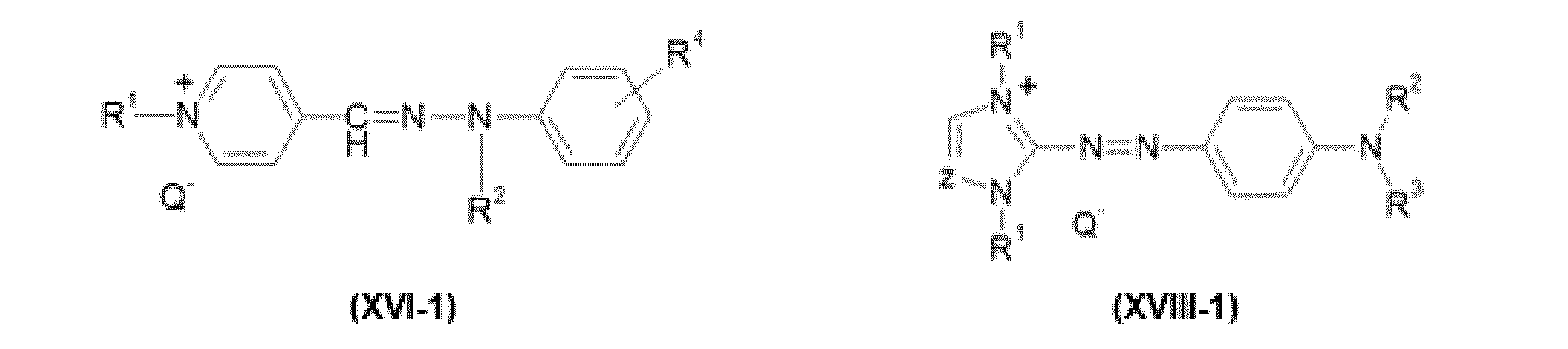
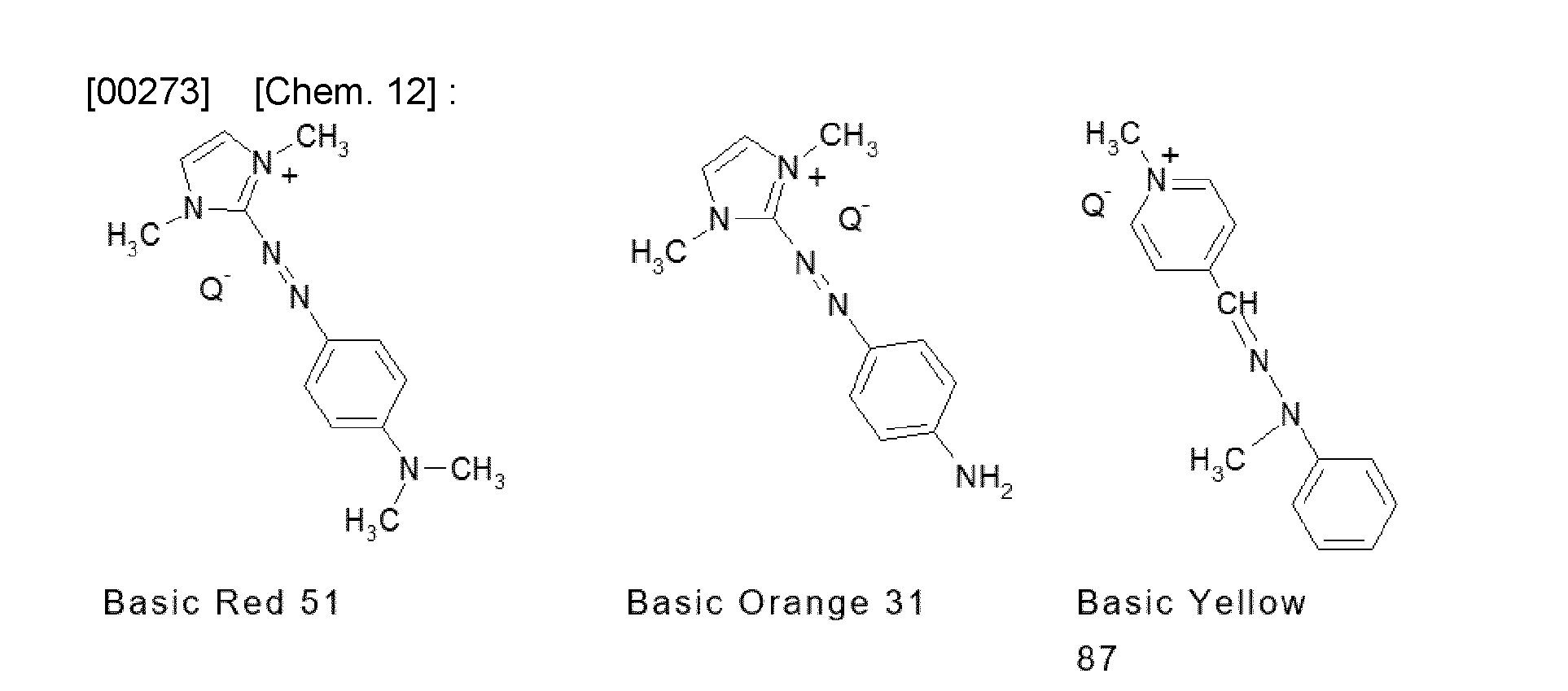
  • the composition also comprises one or more colouring agents chosen from pigments, direct dyes and mixtures thereof, preferably pigments.
  • pigment refers to any pigment, of synthetic or natural origin, which gives colour to keratin materials.
  • solubility of the pigments in water at 25°C and at atmospheric pressure (760 mmHg) is less than 0.05% by weight, and preferably less than 0.01%.
  • the pigments that may be used are notably chosen from the organic and/or mineral pigments known in the art, notably those described in Kirk-Othmer’s Encyclopedia of Chemical Technology and in Ullmann’s Encyclopedia of Industrial Chemistry. Pigments that may notably be mentioned include organic and mineral pigments such as those defined and described in Ullmann’s Encyclopedia of Industrial Chemistry “Pigments, Organic”, 2005 Wiley- VCH Verlag GmbH & Co. KGaA, Weinheim 10.1002/14356007.a20 371 and ibid, “Pigments, Inorganic, 1. General” 2009 Wiley-VCH Verlag GmbH & Co. KGaA, Weinheim 10.1002/14356007.a20_243.pub3.
  • These pigments may be in pigment powder or paste form. They may be coated or uncoated.
  • the pigments may be chosen, for example, from mineral pigments, organic pigments, lakes, pigments with special effects such as nacres or glitter flakes, and mixtures thereof.
  • the pigment may be a mineral pigment.
  • mineral pigment refers to any pigment that satisfies the definition in Ullmann’s encyclopedia in the chapter on inorganic pigments.
  • the pigment may be an organic pigment.
  • organic pigment refers to any pigment that satisfies the definition in Ullmann’s encyclopaedia in the chapter on organic pigments.
  • the organic pigment may notably be chosen from nitroso, nitro, azo, xanthene, quinoline, anthraquinone, phthalocyanine, metal complex type, isoindolinone, isoindoline, quinacridone, perinone, perylene, diketopyrrolopyrrole, thioindigo, dioxazine, triphenylmethane and quinophthalone compounds.
  • the white or coloured organic pigments may be chosen from carmine, carbon black, aniline black, azo yellow, quinacridone, phthalocyanine blue, sorghum red, the blue pigments codified in the Color Index under the references Cl 42090, 69800, 69825, 73000, 74100, 74160, the yellow pigments codified in the Color Index under the references Cl 11680, 11710, 15985, 19140, 20040, 21100, 21108, 47000, 47005, the green pigments codified in the Color Index under the references Cl 61565, 61570, 74260, the orange pigments codified in the Color Index under the references Cl 11725, 15510, 45370, 71105, the red pigments codified in the Color Index under the references Cl 12085, 12120, 12370, 12420, 12490, 14700, 15525, 15580, 15620, 15630, 15800, 15850, 15865, 15880, 17200, 26100,
  • the pigment(s) used are pigment pastes of organic pigments such as the products sold by the company Hoechst under the name: Cosmenyl Yellow IOG: Yellow 3 pigment (Cl 11710); Cosmenyl G yellow: Yellow 1 pigment (Cl 11680); Cosmenyl GR orange: Orange 43 pigment (Cl 71105); Cosmenyl R red: Red 4 pigment (Cl 12085); Cosmenyl FB carmine: Red 5 pigment (Cl 12490); Cosmenyl RL violet: Violet 23 pigment (Cl 51319); Cosmenyl A2R blue: Blue 15.1 pigment (Cl 74160); Cosmenyl GG green: Green 7 pigment (Cl 74260); Cosmenyl R black: Black 7 pigment (Cl 77266).
  • Cosmenyl Yellow IOG Yellow 3 pigment (Cl 11710)
  • Cosmenyl G yellow Yellow 1 pigment (Cl 11680)
  • Cosmenyl GR orange Orange 43 pigment (Cl
  • the pigments in accordance with the invention may also be in the form of composite pigments, as described in patent EP 1 184426.
  • These composite pigments may be composed notably of particles including: a mineral core, at least one binder for fixing the organic pigments to the core, and at least one organic pigment at least partially covering the core.
  • the term “lake” refers to dyes adsorbed onto insoluble particles, the assembly thus obtained remaining insoluble during use.
  • the mineral substrates onto which the dyes are adsorbed are, for example, alumina, silica, calcium sodium borosilicate or calcium aluminium borosilicate and aluminium.
  • Examples of lakes that may be mentioned include the products known under the following names: D & C Red 21 (Cl 45 380), D & C Orange 5 (Cl 45 370), D & C Red 27 (Cl 45 410), D & C Orange 10 (Cl 45425), D & C Red 3 (Cl 45430), D & C Red 7 (Cl 15850:1), D & C Red 4 (Cl 15510), D & C Red 33 (Cl 17200), D & C Yellow 5 (Cl 19 140), D & C Yellow 6 (Cl 15 985), D & C Green 5 (Cl 61 570), D & C Yellow 10 (Cl 77 002), D & C Green 3 (Cl 42 053), D & C Blue 1 (Cl 42 090).
  • the mineral substrates onto which the dyes are adsorbed are, for example, alumina, silica, calcium sodium borosilicate or calcium aluminium borosilicate and aluminium.
  • D & C Red 21 (Cl 45 380), D & C Orange 5 (Cl 45370), D & C Red 27 (Cl 45410), D & C Orange 10 (Cl 45425), D & C Red 3 (Cl 45430), D & C Red 4 (Cl 15 510), D & C Red 33 (Cl 17200), D & C Yellow 5 (Cl 19 140), D & C Yellow 6 (Cl 15985), D & C Green 5 (Cl 61 570), D & C Yellow 10 (Cl 77002), D & C Green 3 (Cl 42 053), D & C Blue 1 (Cl 42 090).
  • the pigment(s) may also be pigments with special effects.
  • pigments with special effects refers to pigments that generally create a coloured appearance (characterized by a certain shade, a certain vivacity and a certain level of luminance) that is non-uniform and that changes as a function of the conditions of observation (light, temperature, angles of observation, etc.). They thereby differ from coloured pigments, which afford a standard uniform opaque, semi-transparent or transparent shade.
  • pigments with special effects exist: those with a low refractive index, such as fluorescent, photochromic or thermochromic pigments, and those with a higher refractive index, such as nacres or glitter flakes.
  • pigments with special effects include nacreous pigments such as titanium mica coated with an iron oxide, mica coated with an iron oxide, mica coated with bismuth oxychloride, titanium mica coated with chromium oxide, titanium mica coated with an organic dye notably of the abovementioned type, and also nacreous pigments based on bismuth oxychloride. They may also be mica particles, at the surface of which are superposed at least two successive layers of metal oxides and/or of organic dyestuffs.
  • the nacres may more particularly have a yellow, pink, red, bronze, orange, brown, gold and/or coppery colour or tint.
  • nacres that may be used in the context of the present invention, mention may notably be made of the gold-coloured nacres sold notably by the company Engelhard under the name Gold 222C (Cloisonne), Sparkle gold (Timica), Gold 4504 (Chromalite) and Monarch gold 233X (Cloisonne); the bronze nacres sold notably by the company Merck under the names Bronze fine (17384) (Colorona) and Bronze (17353) (Colorona), by the company Eckart under the name Prestige Bronze and by the company Engelhard under the name Super bronze (Cloisonne); the orange nacres sold notably by the company Engelhard under the names Orange 363C (Cloisonne) and Orange MCR 101 (Cosmica) and by the company Merck under the names Passion orange (Colorona) and Matte orange (17449) (Microna); the brown-tinted nacres sold notably by the company Engelhard under the names Nu-antique copper 340XB (Cloisonne).
  • multilayer pigments based on synthetic substrates such as alumina, silica, sodium calcium borosilicate or calcium aluminium borosilicate, and aluminium, may be envisaged.
  • Pigments with an interference effect which are not attached to a substrate, such as liquid crystals (Helicones HC from Wacker) or interference holographic glitter flakes (Geometric Pigments or Spectra f/x from Spectratek).
  • Pigments with special effects also comprise fluorescent pigments, whether these are substances that are fluorescent in daylight or that produce an ultraviolet fluorescence, phosphorescent pigments, photochromic pigments, thermochromic pigments and quantum dots, sold, for example, by the company Quantum Dots Corporation.
  • the variety of pigments that may be used in the present invention makes it possible to obtain a wide range of colours, and also particular optical effects such as metallic effects or interference effects.
  • the size of the pigment used in the cosmetic composition according to the present invention is generally between 10 nm and 200 ⁇ m, preferably between 20 nm and 80 ⁇ m and more preferentially between 30 nm and 50 ⁇ m.
  • the pigments may be dispersed in the product by means of a dispersant.
  • the term “dispersant” refers to a compound which can protect the dispersed particles from agglomerating or flocculating.
  • This dispersant may be a surfactant, an oligomer, a polymer or a mixture of several thereof, bearing one or more functionalities with strong affinity for the surface of the particles to be dispersed. In particular, they may become physically or chemically attached to the surface of the pigments.
  • These dispersants also contain at least one functional group that is compatible with or soluble in the continuous medium. Said agent may be charged: it may be anionic, cationic, zwitterionic or neutral.
  • the dispersants used are chosen from 12-hydroxystearic acid esters, more particularly, and from C 8 to C 20 fatty acid esters of polyols such as glycerol or diglycerol, such as poly(12-hydroxystearic acid) stearate with a molecular weight of approximately 750 g/mol, such as the product sold under the name Solsperse 21 000 by the company Avecia, polyglyceryl-2 dipolyhydroxystearate (CTFA name) sold under the reference Dehymyls PGPH by the company Henkel, or polyhydroxystearic acid such as the product sold under the reference Arlacel P100 by the company Uniqema, and mixtures thereof.
  • polyols such as glycerol or diglycerol
  • CFA name poly(12-hydroxystearic acid) stearate with a molecular weight of approximately 750 g/mol
  • CTFA name polyglyceryl-2 dipolyhydroxystearate
  • dispersants that may be used in the compositions of the invention, mention may be made of quaternary ammonium derivatives of polycondensed fatty acids, for instance Solsperse 17 000 sold by the company Avecia, and polydimethylsiloxane/oxypropylene mixtures such as those sold by the company Dow Corning under the references DC2-5185 and DC2-5225 C.
  • Solsperse 17 000 sold by the company Avecia
  • polydimethylsiloxane/oxypropylene mixtures such as those sold by the company Dow Corning under the references DC2-5185 and DC2-5225 C.
  • the pigments used in the cosmetic composition according to the invention may be surface-treated with an organic agent.
  • the pigments that have been surface-treated beforehand are pigments that have totally or partially undergone a surface treatment of chemical, electronic, electrochemical, mechanochemical or mechanical nature, with an organic agent such as those described notably in Cosmetics and Toiletries, February 1990, Vol. 105, pages 53-64, before being dispersed in the composition in accordance with the invention.
  • organic agents may be chosen, for example, from amino acids; waxes, for example carnauba wax and beeswax; fatty acids, fatty alcohols and derivatives thereof, such as stearic acid, hydroxystearic acid, stearyl alcohol, hydroxystearyl alcohol and lauric acid and derivatives thereof; anionic surfactants; lecithins; sodium, potassium, magnesium, iron, titanium, zinc or aluminium salts of fatty acids, for example aluminium stearate or laurate; metal alkoxides; polysaccharides, for example chitosan, cellulose and derivatives thereof; polyethylene; (meth)acrylic polymers, for example polymethyl methacrylates; polymers and copolymers containing acrylate units; proteins; alkanolamines; silicone compounds, for example silicones, polydimethylsiloxanes, alkoxysilanes, alkylsilanes and siloxysilicates; organofluorine compounds, for example perfluor
  • the surface-treated pigments that are useful in the cosmetic composition according to the invention may also have been treated with a mixture of these compounds and/or may have undergone several surface treatments.
  • the surface-treated pigments that are useful in the context of the present invention may be prepared according to surface-treatment techniques that are well known to those skilled in the art, or may be commercially available as is.
  • the surface-treated pigments are coated with an organic layer.
  • the organic agent with which the pigments are treated may be deposited on the pigments by evaporation of solvent, chemical reaction between the molecules of the surface agent or creation of a covalent bond between the surface agent and the pigments.
  • the surface treatment may thus be performed, for example, by chemical reaction of a surface agent with the surface of the pigments and creation of a covalent bond between the surface agent and the pigments or the fillers. This method is notably described in patent US 4578266.
  • An organic agent covalently bonded to the pigments will preferably be used.
  • the agent for the surface treatment may represent from 0.1 % to 50% by weight, preferably from 0.5% to 30% by weight and even more preferentially from 1% to 10% by weight relative to the total weight of the surface-treated pigments.
  • the surface treatments of the pigments are chosen from the following treatments: a PEG-silicone treatment, for instance the AQ surface treatment sold by LCW; a chitosan treatment, for instance the CTS surface treatment sold by LCW; a triethoxycaprylylsilane treatment, for instance the AS surface treatment sold by LCW; a methicone treatment, for instance the SI surface treatment sold by LCW; a dimethicone treatment, for instance the Covasil 3.05 surface treatment sold by LCW; a dimethicone/trimethyl siloxysilicate treatment, for instance the Covasil 4.05 surface treatment sold by LCW; a lauroyllysine treatment, for instance the LL surface treatment sold by LCW; a lauroyllysine dimethicone treatment, for instance the LL/SI surface treatment sold by LCW; a magnesium myristate treatment, for instance the MM surface treatment sold by LCW; an aluminium dimyristate treatment, such as the M
  • composition in accordance with the present invention may furthermore comprise one or more surface-untreated pigments.
  • the pigment(s) are mineral pigments.
  • the pigment(s) are chosen from nacres.
  • the dispersant is present with organic pigments in dispersion (A), and/or composition (B) and/or (C) or with inorganic pigments in particulate form of submicron size.
  • the term “submicron” or “submicronic” refers to pigments having a particle size that has been micronized by a micronization method and having a mean particle size of less than a micrometre (pm), in particular between 0.1 and 0.9 ⁇ m, and preferably between 0.2 and 0.6 p ⁇ .
  • the dispersant and the pigment(s) are present in an amount (dispersant:pigment) of between 0.5:1 and 2:1, particularly between 0.75:1 and 1.5:1 or better still between 0.8:1 and 1.2:1.
  • the dispersant is suitable for dispersing the pigments and is compatible with a condensation-curable formulation.
  • compatible means, for example, that said dispersant is miscible in the oily phase of the composition or of the dispersion containing the pigment(s), and it does not retard or reduce the curing.
  • the dispersant is preferably cationic.
  • the dispersant(s) may therefore have a silicone backbone, such as silicone polyether and dispersants of amino silicone type.
  • suitable dispersants that may be mentioned are: amino silicones, i.e. silicones comprising one or more amino groups such as those sold under the names and references: BYK LPX 21879 by BYK, GP-4, GP-6, GP-344, GP- 851, GP-965, GP-967 and GP-988-1, sold by Genesee Polymers, silicone acrylates such as Tego ® RC 902, Tego ® RC 922, Tego ® RC 1041, and Tego ® RC 1043, sold by Evonik, polydimethylsiloxane (PDMS) silicones bearing carboxylic groups, such as X- 22162 and X-22370 by Shin-Etsu, epoxy silicones such as GP-29, GP-32, GP-502, GP-504, GP-514, GP-607,
  • PDMS poly
  • the dispersant(s) are of aminosilicone type and are positively charged.
  • dispersants bearing chemical groups that are capable of reacting with the reagents of the oily phase and are thus capable of improving the 3D network formed from the aminosilicones.
  • dispersants of epoxy silicone pigments can react chemically with the amino silicone prepolymer amino group(s) to increase the cohesion of the aminosilicone film comprising the pigment(s).
  • the pigment(s) of the invention are chosen from carbon black, iron oxides, notably black iron oxides, and micas coated with iron oxide, triarylmethane pigments, notably blue and violet triarylmethane pigments, such as Blue 1 Lake, azo pigments, notably red azo pigments, such as D&C Red 7, an alkali metal salt of lithol red, such as the calcium salt of lithol red B, even more preferentially red iron oxides.
  • the colouring agents may be chosen from direct dyes.
  • direct dye means natural and/or synthetic dyes, other than oxidation dyes. These are dyes that will spread superficially on the fibre.
  • They may be ionic or nonionic, preferably cationic or nonionic, either as sole dyes.
  • These direct dyes are chosen, for example, from neutral, acidic or cationic nitrobenzene direct dyes, neutral, acidic or cationic azo direct dyes, tetraazapentamethine dyes, neutral, acidic or cationic quinone and in particular anthraquinone dyes, azine direct dyes, triarylmethane direct dyes, azomethine direct dyes and natural direct dyes.
  • Examples of suitable direct dyes include azo direct dyes; (poly)methine dyes such as cyanines, hemicyanines and styryl dyes; carbonyl dyes; azine dyes; nitro(hetero)aryl dyes; tri(hetero)arylmethane dyes; porphyrin dyes; phthalocyanine dyes, and natural direct dyes, alone or as mixtures.
  • azo direct dyes include azo direct dyes; (poly)methine dyes such as cyanines, hemicyanines and styryl dyes; carbonyl dyes; azine dyes; nitro(hetero)aryl dyes; tri(hetero)arylmethane dyes; porphyrin dyes; phthalocyanine dyes, and natural direct dyes, alone or as mixtures.
  • the direct dye(s) contain at least one quaternized cationic chromophore or at least one chromophore bearing a quaternized or quaternizable cationic group.
  • the direct dyes comprise at least one quaternized cationic chromophore.
  • dyes As direct dyes according to the invention, mention may be made of the following dyes: acridines; acridones; anthranthrones; anthrapyrimidines; anthraquinones; azines; (poly)azos, hydrazono or hydrazones, in particular arylhydrazones; azomethines; benzanthrones; benzimidazoles; benzimidazolones; benzindoles; benzoxazoles; benzopyrans; benzothiazoles; benzoquinones; bisazines; bis-isoindolines; carboxanilides; coumarins; cyanines such as azacarbocyanines, diazacarbocyanines, diazahemicyanines, hemicyanines, or tetraazacarbocyanines; diazines; diketopyrrolopyrroles; dioxazines; diphenylamines; diphenylmethane
  • cationic azo dyes mention may be made particularly of those resulting from the cationic dyes described in Kirk-Othmer’s Encyclopedia of Chemical Technology, “Dyes, Azo”, J. Wiley & Sons, updated on 19 April 2010.
  • azo dyes mention may be made of the cationic azo dyes described in patent applications WO 95/15144, WO 95/01772 and EP-714954.
  • the direct dye(s) are chosen from cationic dyes known as “basic dyes”.
  • Basic Red 22 Basic Red 76, Basic Yellow 57, Basic Brown 16 and Basic Brown 17.
  • cationic quinone dyes those mentioned in the abovementioned Colour Index International are suitable for use and, among these, mention may be made, inter alia, of the following dyes: Basic Blue 22, Basic Blue 99.
  • azine dyes that are suitable for use, mention may be made of those listed in the Colour Index International, for example the following dyes: Basic Blue 17, Basic Red 2.
  • the cationic direct dyes are chosen from those resulting from dyes of azo and hydrazono type.
  • the direct dyes are cationic azo dyes, described in EP 850636, FR 2788433, EP 920856, WO 99/48465, FR 2757385, EP 850
  • the cationic direct dye(s) comprise a quaternary ammonium group; more preferentially, the cationic charge is endocyclic.
  • cationic radicals are, for example, a cationic radical:
  • an endocyclic charge such as comprising a cationic heteroaryl group chosen from: acridinium, benzimidazolium, benzobistriazolium, benzopyrazolium, benzopyridazinium, benzoquinolium, benzothiazolium, benzotriazolium, benzoxazolium, bipyridinium, bis- tetrazolium, dihydrothiazolium, imidazopyridinium, imidazolium, indolium, isoquinolium, naphthoimidazolium, naphthoxazolium, naphthopyrazolium, oxadiazolium, oxazolium, oxazolopyridinium, oxonium, phenazinium, phenooxazolium, pyrazinium, pyrazolium, pyrazoyltriazolium, pyridinium, pyridinoimidazolium, pyrrolium,
  • cationic dyes chosen from: the hydrazono dyes having the following formulae:
  • Het + represents a cationic heteroaryl radical, preferentially bearing an endocyclic cationic charge, such as imidazolium, indolium or pyridinium, which is optionally substituted, preferentially with at least one (C 1 -C 8 ) alkyl group such as methyl
  • Ar + represents an aryl radical, such as phenyl or naphthyl, bearing an exocyclic cationic charge, preferentially ammonium, particularly tri(C 1 -C 8 )alkylammonium, such as trimethylammonium
  • Ar represents an aryl group, notably phenyl, which is optionally substituted, preferentially with one or more electron-donating groups such as i) optionally substituted (C 1 -C 8 )alkyl, ii)
  • R’ a and R’ b represent a hydrogen atom or a (C 1 -C 4 )alkyl group optionally substituted with a hydroxyl group;
  • ⁇ Q- represents an anionic counterion such as a halide or an alkyl sulfate.
  • R 1 represents a (C 1 -C 4 )alkyl group such as methyl
  • R 2 and R 3 which may be identical or different, represent a hydrogen atom or a (C 1 - C 4 )alkyl group, such as methyl;
  • R 4 represents a hydrogen atom or an electron-donating group such as optionally substituted (C 1 -C 8 )alkyl, optionally substituted (C 1 -C 8 )alkoxy, or (di)(C 1 -C 8 )(alkyl)amino optionally substituted on the alkyl group(s) with a hydroxyl group; in particular, R 4 is a hydrogen atom;
  • - Z represents a CH group or a nitrogen atom, preferentially CH;
  • - Q- is an anionic counterion as defined previously, in particular a halide, such as chloride, or an alkyl sulfate, such as methyl sulfate or mesyl.
  • the dyes of formulae (XVI-1) and (XVI 11-1) are chosen from Basic Red 51 , Basic Yellow 87 and Basic Orange 31 or derivatives thereof:
  • Q- being an anionic counterion as defined previously, in particular a halide, such as chloride, or an alkyl sulfate, such as methyl sulfate or mesyl.
  • a halide such as chloride
  • an alkyl sulfate such as methyl sulfate or mesyl.
  • the direct dyes are fluorescent, i.e. they contain at least one fluorescent chromophore as defined previously.
  • Fluorescent dyes that may be mentioned include the radicals resulting from the following dyes: acridines, acridones, benzanthrones, benzimidazoles, benzimidazolones, benzindoles, benzoxazoles, benzopyrans, benzothiazoles, coumarins, difluoro ⁇ 2-[(2H- pyrrol-2-ylidene-kN)methyl]-1H-pyrrolato-kN ⁇ borons (BODIPY ® ), diketopyrrolopyrroles, fluorindines, (poly)methines (notably cyanines and styryls/hemicyanines), naphthalimides, naphthanilides, naphthylamines (such as dansyls), oxadiazoles, oxazines, perilones, perinones, perylenes, polyenes/carotenoids, squaranes,
  • the fluorescent dye(s) are cationic and comprise at least one quaternary ammonium radical, such as those of formula (XIII) below:
  • W + -[C(R c ) C(R d )] m’ -Ar, Q- in which formula (XIII): ⁇ W + represents a cationic heterocyclic or heteroaryl group, particularly comprising a quaternary ammonium optionally substituted with one or more (C 1 -C 8 )alkyl groups, optionally substituted notably with one or more hydroxyl groups;
  • ⁇ Ar representing an aryl group such as phenyl or naphthyl, optionally substituted preferentially with i) one or more halogen atoms such as chlorine or fluorine; ii) one or more (C 1 -C 8 )alkyl groups, preferably of C 1 -C 4 such as methyl; iii) one or more hydroxyl groups; iv) one or more (C 1 -C 8 )alkoxy groups such as methoxy; v) one or more hydroxy(C 1 -C 8 )alkyl groups such as hydroxyethyl, vi) one or more amino groups or (di)(Cr Cs)alkylamino, preferably with the C 1 -C 4 alkyl part optionally substituted with one or more hydroxyl groups, such as (di)hydroxyethylamino, vii) with one or more acylamino groups; viii) one or more heterocycloalkyl groups such as piperazinyl
  • ⁇ m’ represents an integer ranging from 1 to 4, in particular m’ is 1 or 2, more preferentially
  • R c and R d which may be identical or different, represent a hydrogen atom or an optionally substituted (C 1 -C 8 )alkyl group, preferentially a C 1 -C 4 alkyl group, or alternatively R c contiguous with W + and/or R d contiguous with Ar form, with the atoms that bear them, a (hetero)cycloalkyl; in particular, R c is contiguous with W + and they form a (hetero)cycloalkyl such as cyclohexyl;
  • ⁇ Q- is an organic or mineral anionic counterion as defined previously.
  • the amount of colouring agents notably of pigments, ranges from 0.5% to 40% and preferably from 1% to 20% relative to the weight of the composition and dispersion comprising them.
  • the composition according to the invention is a makeup composition, in particular a lip makeup composition, a mascara, an eyeliner, an eyeshadow or a foundation.
  • the composition comprises one or more solvents, which are preferably polar and/or protic, other than water in the predominantly fatty medium.
  • the solvent(s), which are preferably polar and/or protic, other than water are present in the composition in a weight percentage of between 0 and 10% relative to the total weight of the solvent mixture, preferentially between 0.5% and 8%, more particularly between 1% and 5%, such as 2% by weight, relative to the total weight of the composition.
  • the solvent(s) are polar protic solvents such as alkanols, more preferentially C 2 - C 6 alkanols, such as ethanol.
  • the composition according to the invention may also comprise one or more fillers, notably in a content ranging from 0.01% to 30% by weight and preferably ranging from 0.01 % to 20% by weight relative to the total weight of the composition.
  • fillers should be understood as meaning colourless or white, mineral or synthetic particles of any shape, which are insoluble in the medium of the composition, irrespective of the temperature at which the composition is manufactured. These fillers notably serve to modify the rheology or texture of the composition.
  • composition according to the invention may also contain ingredients commonly used in cosmetics, such as vitamins, thickeners, trace elements, softeners, sequestrants, fragrances, preserving agents, sunscreens, surfactants, antioxidants, agents for combating loss, antidandruff agents and propellants, or mixtures thereof.
  • ingredients commonly used in cosmetics such as vitamins, thickeners, trace elements, softeners, sequestrants, fragrances, preserving agents, sunscreens, surfactants, antioxidants, agents for combating loss, antidandruff agents and propellants, or mixtures thereof.
  • the PHA copolymers illustrated were prepared in 3-litre chemostats and/or 5-litre Fernbach flasks depending on whether or not a b-oxidation pathway inhibitor is used.
  • the isolation of the PHAs is similar for all the examples obtained.
  • the microorganism In a first step, the microorganism generates the PHA copolymers which are stored in intracellular granules, the proportion of which varies as a function of the applied conditions such as the temperature or the nature of the culture medium. The generation of PHA copolymer granules may or may not be associated with the growth of the microorganism as a function of the nature of the microorganisms.
  • the biomass containing the PHA copolymers is isolated, i.e. separated from the fermentation medium, and then dried. The PHA copolymers are extracted from the biomass before being purified, if necessary.
  • a mixture of saturated and unsaturated carbon sources is, for certain examples, necessary for the stability of the PHA copolymer obtained. [00287] [Table 1]:
  • Table 2 summary of the carbon sources used by genus and species of microorganism chosen, and of their origin.
  • Example 1 Copolymer of PH A bearing a side chain R 1 representing an n-octenyl group and R 2 representing an n-pentyl group
  • the process for synthesizing the compound of Example 1 is adapted from the article: Fed- batch production of unsaturated medium-chain-length poiyhydroxyaikanoates with controlled composition by Pseudomonas putida KT2440, Z. Sun, J.A. Ramsay, M. Guay, B.A. Ramsay, Applied Microbiology Biotechnology, 82. 657-662 (2009).
  • the microorganism used is Pseudomonas putida KT2440 ATCC® 47054TM.
  • the system is aerated with a flow of 0.5 vvm of air for a nominal dissolved oxygen (OD) value at 30% of saturation.
  • the pH is regulated with 15% aqueous ammonia solution.
  • the temperature of the fermentation medium is regulated at 30°C.
  • the fermentation medium is regulated in terms of temperature-pressure of dissolved oxygen and pH (not shown)
  • the production process is performed using three different culture media.
  • the first culture medium defined CM1 “inoculum”, is used for the preparation of the preculture.
  • the second culture medium defined CM2 “batch”, is used for unfed batch growth of the microorganism with the primary carbon sources in the Fernbach flasks.
  • the third culture medium defined CM3 “maintenance”, is used for the fed-batch or maintenance fermentation mode with the carbon sources of interest at a flow rate calibrated as a function of the growth of the microorganism.
  • composition of the Nutrient Broth is 37.5% of beef extract and 62.5% of peptone.
  • Reference 233000 DIFCOTM is 37.5% of beef extract and 62.5% of peptone.
  • 100 mL of preculture are prepared by suspending a cryotube containing 1 mL of the strain with 100 mL of “inoculum” culture medium at a pH adjusted to 6.8 with 2N NaOH in a 250 mL Fernbach flask and are then incubated at 30°C at 150 rpm for 24 hours.
  • the biomass is isolated by centrifugation and then washed three times with water.
  • the biomass is dried by lyophilization before being extracted with ethyl acetate for 24 hours.
  • the suspension is clarified by filtration on a GF/A filter (Whatman®).
  • the filtrate, the PHA copolymer dissolved in the ethyl acetate, is concentrated by evaporation and then dried under high vacuum at 40°C to constant mass.
  • the PHA copolymer may optionally be purified by successive dissolution and precipitation from an ethyl acetate/ethanol 70% methanol system, for example.
  • Example 2 Copolymer of PHA bearing a side chain R 1 representing an n-octenyl group and R 2 representing an n-hexyl group
  • Example 2 The production process of Example 2 is adapted from that of Example 1 , replacing the n-octanoic acid carbon source of Example 1 with n-nonanoic acid.
  • Example 3 Copolymer of PHA bearing a side chain R 1 representing an isohexenyl group and R 2 representing an isobutyl group
  • Example 3 The production process of Example 3 is an adaptation of Applied and Environmental Microbiology, Vol 60, No. 9. 3245-3254 (1994) “Polyester Biosynthesis Characteristics of Pseudomonas citronellolis Grown on Various Carbon Sources, Including 3-Methyl-Branched Substrate”. Mun Hwan Choi and Sung Chul Yoon.
  • the microorganism used is Pseudomonas citronellolis ATCC® 13674TM.
  • the culture method is performed under unfed-batch axenic culture conditions in 5 L Fernbach flasks (Corning® ref.
  • the production process is performed using two different culture media.
  • the first culture medium defined CM1 “inoculum”, is used for the preparation of the preculture.
  • the second culture medium defined CM2 “batch”, is used for unfed batch culture growth of the microorganism with the carbon source of interest in the Fernbach flasks.
  • composition of the Nutrient Broth is 37.5% beef extract and 62.5% peptone.
  • composition of the yeast extract is 100% autolysate of the yeast Saccharomyces cerevisiae. Reference 210933 DIFCOTM BD.
  • 100 mL of preculture are prepared by suspending a cryotube containing 1 mL of the strain with 100 mL of “inoculum” culture medium at a pH adjusted to 6.8 with 2N NaOH in a 250 mL Fernbach flask and then incubated at 30°C at 150 rpm for 24 hours.
  • the biomass After 70 hours at 30°C at 110 rpm, the biomass is dried by lyophilization before being extracted with dichloromethane for 24 hours.
  • the suspension is clarified by filtration on a GF/A filter (Whatman®).
  • the filtrate composed of PHA dissolved in dichloromethane, is concentrated by evaporation and then dried under high vacuum at 40°C to constant mass.
  • the PHA may optionally be purified by successive dissolution and precipitation, for instance using a dichloromethane/methanol system.
  • Example 4 Copolymer of PHA bearing a side chain R 1 representing an isohexyl group and R 2 representing an isobutyl group
  • Example 4 is obtained by hydrogenation of Example 3 using an H-Cube Midi® continuous hydrogenator from ThalesNano Technologie.
  • Example 3 A solution of 2 g (8.83 mmol) of Example 3 is prepared with a mixture composed of 100 mL of ethyl acetate (Sigma-Aldrich - CAS: 141-78-6) and 100 mL of methanol (Sigma-Aldrich - CAS: 67-56-1) is introduced at a flow rate of 3 mL per minute into a hydrogenation cartridge containing the catalyst containing 5% palladium on charcoal (MidiCard ref. DHS 2141; ThalesNano TECH) maintained at 100°C under a pressure of 80 bar in the presence of hydrogen in the ThalesNano Technologie H-Cube Midi® system. The reduction of the double bond is monitored by NMR. After six consecutive cycles of reduction, the solution is concentrated by evaporation and then dried under vacuum to constant mass.
  • ethyl acetate Sigma-Aldrich - CAS: 141-78-6
  • methanol Sigma-Aldrich -
  • the PHA may optionally be purified by successive dissolution and precipitation, for instance using a dichloromethane/methanol system.
  • Example 5 Outside the invention - comparative - Copolymer of 3-hydroxybutyric acid and 3-hydroxyvaleric acid, PHB-co-HV with 12 mol% of HV - CAS Number 80181-31-3, commercial reference: 403121 (Sigma-Aldrich)
  • a film is prepared on a contrast card with a film spreader (speed: 50 mm/s - Cylinder: 100 pm). The film is left to dry for 24 hours at room temperature. Once dry, the film has a thickness of about 40 pm, Figure 1.
  • a film is prepared on a contrast card with a film spreader (speed: 50 mm/s - Cylinder: 100 pm). The film is left to dry for 24 hours at room temperature. Once dry, the film has a thickness of about 40 pm.
  • the drop is left in contact with the dry film for two times: 5 minutes and 30 minutes. Once the time has elapsed, the drop of olive oil or sebum or water is wiped off and observation of the deterioration of the polymer film is performed. If the film was damaged by the drop of olive oil or sebum or water, the polymer film is regarded as being non-resistant to olive oil or to sebum.
  • the PHA copolymers of the invention make it possible to obtain dry, homogeneous films that are particularly resistant to water, olive oil and sebum.
  • the tackiness was evaluated in a sensory and qualitative manner by touching the dry film with a finger.
  • the evaluations are performed on BioSkin.
  • a film of each formulation is deposited on a BioSkin sample by means of a film spreader.
  • the thickness of the wet film is 100 pm.
  • the films are dried for 24 hours at room temperature. Once the films are dry, the tests may be performed.
  • a strip of adhesive tape (of Scotch® type) is applied to the film of formulation.
  • a weight is applied to the strip of said tape for 30 seconds.
  • the adhesive tape is then removed and mounted on a slide holder so as to observe the result.
  • compositions according to the invention have good resistance to oil and sebum and good staying power.
  • the lipstick composition applied to the lips thus makes it possible to obtain a makeup result that is resistant to oil and to sebum and which thus has good staying power without suffering any colour fragmentation on the lips.
  • Example 7 Copolymer of PH A bearing a side chain R 1 representing a linear Cn alkyl group (n-undecyl group) and R 2 representing a n -nonyl group
  • Example 7 is an adaptation of ACS Symposium Series; American Chemical Society: Washington, DC, 2001. “Biosynthesis and Properties of Medium-Chain- Length Polyhydroxyalkanoates” Richard D. Ashby, Daniel K. Y. Solaiman, and Thomas A. Foglia.
  • the microorganism used is Pseudomonas resinovorans ATCC® 14235 TM.
  • the culture mode is carried out under axenic conditions in non-fed discontinuous culture in 5L Fernbachs flasks (Corning® ref. 431685) containing 2 of culture medium, stirred at 110 rpm at 30 °C in an orbital incubator (orbital diameter of 2.5 cm).
  • the synthesis process is carried out using two separate culture media.
  • the first culture medium defined MC1 “inoculum” is used for the preparation of the preculture.
  • the second culture medium defined MC2 “bach” is used for the growth in non-fed batch culture of the microorganism with the carbon source of interest in the Fernbachs flasks.
  • composition of Nutrient Broth in percentage by mass is 37.5 % beef extract and 62.5 % peptone.
  • 100 mL of pre-culture are prepared by suspending a cryotube containing 1 mL of the strain with 100 mL “inoculum” culture media at pH adjusted to 6.8 with 2N NaOH in a 250 mL Fernbach flask then incubate at 30 ° C at 150 rpm for 24 h.
  • the biomass After 50 hours at 30 °C at 110 rpm, the biomass dried by lyophilisation before being extracted with dichloromethane for 24 hours.
  • the suspension is clarified by filtration through a GF / A filter (Wattman®), the filtrate, composed of PHA dissolved in dichloromethane, is concentrated by evaporation and then dried under high vacuum at 40 ° C to constant mass.
  • the PHA can optionally be purified by solubilisation and successive precipitations such as with a dichloromethane methanol mixture.
  • Example 7 For the PHA copolymer of Example 7 is soluble in isododecane or an isododecane/ethanol mixture, evaluation of the cosmetic properties on a dry film was performed.
  • the PHA copolymer 7 of the invention makes it possible to obtain dry, homogeneous films that are particularly resistant to water, olive oil and sebum.
  • Example 8 Poly(3-hydroxynonanoate-co-undecenoate) containing 5% unsaturations 100% epoxidized :
  • reaction medium was then precipitated from a 500 mL mixture of 70/30 v/v ethanol/water. A viscous white precipitate was obtained. This step may be repeated.
  • the product thus obtained was dissolved in a minimum amount of ethyl acetate, poured onto a Teflon plate and then dried under dynamic vacuum at 40 °C to obtain a homogeneous film.
  • the PHA of Example 8 was fully characterized by spectroscopic and spectrometric methods and is in accordance with the expected chemical structure. Epoxidation to 100%.
  • the PHA copolymer 8 of the invention makes it possible to obtain dry, homogeneous films that are particularly resistant to water, olive oil and sebum. Measurement of the gloss
  • Example 8 tested does not have a tacky feel.

Landscapes

  • Life Sciences & Earth Sciences (AREA)
  • Health & Medical Sciences (AREA)
  • General Health & Medical Sciences (AREA)
  • Veterinary Medicine (AREA)
  • Animal Behavior & Ethology (AREA)
  • Public Health (AREA)
  • Chemical & Material Sciences (AREA)
  • Epidemiology (AREA)
  • Birds (AREA)
  • Engineering & Computer Science (AREA)
  • Organic Chemistry (AREA)
  • Zoology (AREA)
  • Wood Science & Technology (AREA)
  • Bioinformatics & Cheminformatics (AREA)
  • Biotechnology (AREA)
  • Genetics & Genomics (AREA)
  • Biochemistry (AREA)
  • Microbiology (AREA)
  • General Engineering & Computer Science (AREA)
  • Tropical Medicine & Parasitology (AREA)
  • Medicinal Chemistry (AREA)
  • Virology (AREA)
  • Biomedical Technology (AREA)
  • Inorganic Chemistry (AREA)
  • Chemical Kinetics & Catalysis (AREA)
  • General Chemical & Material Sciences (AREA)
  • Cosmetics (AREA)
  • Compositions Of Macromolecular Compounds (AREA)
  • Biological Depolymerization Polymers (AREA)
  • Polyesters Or Polycarbonates (AREA)

Abstract

The invention relates to a composition comprising: a) one or more polyhydroxyalkanoate (PHA) copolymers which contain, and preferably consist of, at least two different repeating polymer units chosen from the units (A) and (B) below, and also the optical or geometrical isomers thereof and the solvates thereof such as hydrates: -[-0-CH(R1)-CH2-C(0)-]- unit (A) -[-0-CH(R2)-CH2-C(0)-]- unit (B) in which polymer units (A) and (B): R1 represents a hydrocarbon-based chain chosen from: i) branched (C5-C9)alkyl, ii) (C10-C30)alkyl; iii) linear or branched (C5-C30)alkenyl; iv) linear or branched (C5-C30)alkynyl; v) (hetero)aryl; vi) (hetero)cycloalkyl; preferably the group i) (C10-C20)alkyl, or iii) (C8-C20)alkenyl; R2 represents a cyclic or non-cyclic, linear or branched, saturated or unsaturated hydrocarbon-based group, comprising from 1 to 30 carbon atoms; and b) a fatty medium comprising one or more fatty substances; preferably, the fatty substance(s) are liquid at 25°C and at atmospheric pressure; it being understood that (A) is different from (B).

Description

Description
Title: Cosmetic composition comprising a polyhydroxyalkanoate copolymer comprising at least two different polymer units bearing a(n) (un)saturated hydrocarbon-based chain in a fatty medium
[0001] The present invention relates to a cosmetic composition comprising at least one polyhydroxyalkanoate copolymer comprising at least two different polymer units bearing a saturated or unsaturated hydrocarbon-based chain in a fatty and preferably oily medium, and also to a process for treating keratin materials using such a composition.
[0002] It is known practice to use, in cosmetics, film-forming polymers which can be conveyed in organic media, such as hydrocarbon-based oils. Polymers are notably used as film- forming agents in makeup products such as mascaras, eyeliners, eyeshadows or lipsticks.
[0003] FR-A-2964663 describes a cosmetic composition comprising pigments coated with a C3-C21 polyhydroxyalkanoate, such as poly(hydroxybutyrate-co-hydroxyvalerate).
[0004] WO 2011/154508 describes a cosmetic composition comprising a 4-carboxy-2- pyrrolidinone ester derivative and a film-forming polymer which may be a polyhydroxyalkanoate, such as polyhydroxybutyrate, polyhydroxyvalerate and polyhydroxybutyrate-co-polyhydroxyvalerate.
[0005] US-A-2015/274972 describes a cosmetic composition comprising a thermoplastic resin, such as a polyhydroxyalkanoate, in aqueous dispersion and a silicone elastomer.
On the other hand, WO 2018/178899 describes a cosmetic composition comprising at least one polyhydroxyalkanoate (PHA) in the form of particles with an average diameter (d50) from 0.1 pm to 100 pm, in an amount of from 0.1 % by weight to 30 %. by weight, with respect to the total weight of the composition. in order to absorb oily substances, such as sebum. Nevertheless the later PHAs are not acceptable film forming polymers in fatty substances such as oil.
[0006] The majority of the polyhydroxyalkanoates are polymers derived from the polycondensation of polymeric repeating units that are for the most part identical and derived from the same carbon source or substrate. These documents do not describe the use of copolymers derived from polycondensation using a substrate composed of a mixture of aliphatic carbon sources and of carbon sources comprising one or more reactive functions, of different chemical nature from the first carbon source. Copolymers derived from polycondensation may also be prepared from an aliphatic substrate or first carbon source, and at least one second substrate, different from the first, comprising one or more reactive functions of different chemical nature from the first carbon source. [0007] A need thus exists to have available a composition comprising a solubilized polyhydroxyalkanoate making it possible to obtain a film that has good cosmetic properties, notably good resistance to oils and to sebum, and also good mattness.
[0008] The Applicant has discovered that polyhydroxyalkanoate copolymers comprising at least two different polymer units (A) and (B) as defined below may be readily used in fatty and notably oily media, thus making it possible to obtain homogeneous compositions. Moreover, the PHA according to the invention are film forming polymers. The composition shows good stability, notably after storage for one month at room temperature (25°C). The composition, notably after its application to keratin materials, makes it possible to obtain a film having good cosmetic properties, in particular good resistance to oils and to sebum, and also a matt or glossy appearance.
[0009] Thus, the main subject of the present invention is a composition, notably a cosmetic composition, comprising: a) one or more polyhydroxyalkanoate (PHA) copolymers which contain, and preferably consist of, at least two different repeating polymer units chosen from the units (A) and (B) below, and also the optical or geometrical isomers thereof and the solvates thereof such as hydrates:
-[-O-CH(R1)-CH2-C(O)-]- unit (A)
-[-O-CH(R2)-CH2-C(O)-]- unit (B) in which polymer units (A) and (B):
- R1 represents a hydrocarbon-based chain chosen from: i) branched (C5-C9)alkyl, ii) (C10- C30)alkyl; ill) linear or branched (C5-C30)alkenyl; iv) linear or branched (C5-C30)alkynyl; v) (hetero)aryl; vi) (hetero)cycloalkyl; preferably the group i) (C10-C20)alkyl, or ill) (C8- C20)alkenyl;
- R2 represents a cyclic or non-cyclic, linear or branched, saturated or unsaturated hydrocarbon-based group, comprising from 1 to 30 carbon atoms; and b) a fatty medium comprising one or more fatty substances, which are preferably liquid at
25°C and at atmospheric pressure; it being understood that (A) is different from (B).
[0010] Another subject of the invention is the use a) of one or more PHAs as defined previously and b) one or more fatty substances as defined previously, in cosmetics.
[0011] Another subject of the invention is a process for treating keratin materials, preferably a) keratin fibres, notably human keratin fibres such as the hair, or β) human skin, in particular the lips, using a) one or more PHAs as defined previously and b) one or more fatty substances as defined previously. More particularly, a subject of the invention is the process for treating keratin materials, preferably a) keratin fibres, notably human keratin fibres such as the hair, or β) human skin, in particular the lips, by applying to said materials the composition as defined previously. [0012] More particularly, a subject of the invention is also a non-therapeutic cosmetic process for treating keratin materials, comprising the application to the keratin materials of a composition as defined previously. The treatment process is in particular a process for caring for or making up keratin materials.
[0013] For the purposes of the present invention and unless otherwise indicated:
- the term “(hetero)aryl" means aryl or heteroaryl groups;
- the term “(hetero)cycloalkyl" means cycloalkyl or heterocycloalkyl groups;
- the “aryl" or “heteroaryl" radicals or the aryl or heteroaryl part of a radical may be substituted with at least one substituent borne by a carbon atom, chosen from:
□ a C1-C6 and preferably C1-C4 alkyl radical;
□ a halogen atom such as chlorine, fluorine or bromine;
□ a C1-C2 alkoxy radical; a C2-C4 (poly)hydroxyalkoxy radical;
□ an acylamino radical (-NR-COR’) in which the radical R is a hydrogen atom;
□ a C1-C4 alkyl radical and the radical R’ is a C1-C4 alkyl radical; a carbamoyl radical ((R)2N-CO-) in which the radicals R, which may be identical or different, represent a hydrogen atom or a C1-C4 alkyl radical;
□ an alkylsulfonylamino radical (R’SO2-NR- ) in which the radical R represents a hydrogen atom or a C1-C4 alkyl radical and the radical R’ represents a C1-C4 alkyl radical, or a phenyl radical;
□ a cyano group (CN);
□ a polyhalo(C1-C4)alkyl group, preferentially trifluoromethyl (CF3);
- the cyclic or heterocyclic part of a non-aromatic radical may be substituted with at least one substituent borne by a carbon atom, chosen from the groups:
□ C1-C4 alkoxy, C2-C4 (poly)hydroxyalkoxy,
□ alkylcarbonylamino (RCO-NR’-), in which the radical R’ is a hydrogen atom or a C1-C4 alkyl radical and the radical R is a C1-C2 alkyl radical or an amino radical substituted with one or two identical or different C1-C4 alkyl groups;
□ alkylcarbonyloxy (RCO-O-), in which the radical R is a C1-C4 alkyl radical or an amino radical substituted with one or two identical or different C1-C4 alkyl groups;
□ alkoxycarbonyl ((RO-CO-) in which the radical R is a C1-C4 alkyl radical or an amino radical substituted with one or two identical or different C1-C4 alkyl groups;
- a cyclic or heterocyclic radical, or a non-aromatic part of an aryl or heteroaryl radical, may also be substituted with one or more oxo groups;
- a hydrocarbon-based chain is unsaturated when it includes one or more double bonds and/or one or more triple bonds; an “aryl" radical represents a monocyclic or fused or non-fused polycyclic hydrocarbon- based group comprising from 6 to 22 carbon atoms, at least one ring of which is aromatic; preferentially, the aryl radical is a phenyl, biphenyl, naphthyl, indenyl, anthracenyl or tetrahydronaphthyl and more preferentially phenyl; a “heteroaryl" radical represents a monocyclic or fused or non-fused polycyclic, 5- to 22- membered group, comprising from 1 to 6 heteroatoms chosen from nitrogen, oxygen, sulfur and selenium atoms, and at least one ring of which is aromatic; preferentially, a heteroaryl radical is chosen from acridinyl, benzimidazolyl, benzobistriazolyl, benzopyrazolyl, benzopyridazinyl, benzoquinolyl, benzothiazolyl, benzotriazolyl, benzoxazolyl, pyridyl, tetrazolyl, dihydrothiazolyl, imidazopyridyl, imidazolyl, indolyl, isoquinolyl, naphthoimidazolyl, naphthooxazolyl, naphthopyrazolyl, oxadiazolyl, oxazolyl, oxazolopyridyl, phenazinyl, phenoxazolyl, pyrazinyl, pyrazolyl, pyrilyl, pyrazoyltriazyl, pyridyl, pyridinoimidazolyl, pyrrolyl, quinolyl, tetrazolyl, thiadiazolyl, thiazolyl, thiazolopyridyl, thiazoylimidazolyl, thiopyrylyl, triazolyl and xanthylyl; a “cyclic" or “cycloalkyl·’ radical is a monocyclic or fused or non-fused polycyclic, non- aromatic cyclic hydrocarbon-based radical containing from 5 to 22 carbon atoms, which may include one or more unsaturations; the cycloalkyl is preferably a cyclohexyl group; a “ heterocyclic or “heterocycloalkyl·’ radical is a monocyclic or fused or non-fused polycyclic 5- to 9-membered non-aromatic cyclic radical, including from 1 to 4 heteroatoms chosen from nitrogen, oxygen and sulfur atoms; preferably, the heterocycloalkyl is chosen from epoxide, piperazinyl, piperidyl and morpholinyl; an “alkyl" radical is a linear or branched, in particular C1-C6 and preferably C1-C4 saturated hydrocarbon-based radical; an “alkenyl" radical is a linear or branched unsaturated hydrocarbon-based radical, comprising one or more conjugated or non-conjugated double bonds; preferably, the radical comprises only one double bond at the chain end on the side opposite its point of attachment to the rest of the molecule; an “alkynyl" radical is a linear or branched unsaturated hydrocarbon-based radical, comprising one or more conjugated or non-conjugated triple bonds; preferably, the radical comprises only one triple bond at the chain end on the side opposite its point of attachment to the rest of the molecule; an “alkoxy radical"’ is an alkyl-oxy radical for which the alkyl radical is a linear or branched C1-C6 and preferentially C1-C4 hydrocarbon-based radical; the term “organic or mineral acid salf’ more particularly means organic or mineral acid salts in particular chosen from a salt derived from i) hydrochloric acid HCI, ii) hydrobromic acid HBr, iii) sulfuric acid H2SO4, iv) alkylsulfonic acids: Alk-S(O)2OH such as methylsulfonic acid and ethylsulfonic acid; v) arylsulfonic acids: Ar-S(O)2OH such as benzenesulfonic acid and toluenesulfonic acid; vi) alkoxysulfinic acids: Alk-O-S(O)OH such as methoxysulfinic acid and ethoxysulfinic acid; vii) aryloxysulfinic acids such as tolueneoxysulfinic acid and phenoxysulfinic acid; viii) phosphoric acid H3PO4; ix) triflic acid CF3SO3H and x) tetrafluoroboric acid HBF4; xi) organic carboxylic acids R°-C(O)-OH (I’z), in which formula (I’z) R° represents a (hetero)aryl group such as phenyl, (hetero)aryl(C1-C4)alkyl group such as benzyl, or (Ci-Cio)alkyl, said alkyl group being optionally substituted preferably with one or more hydroxyl groups or amino or carboxyl radicals, R° preferably denoting a (C1- C6)alkyl group optionally substituted with 1, 2 or 3 hydroxyl or carboxyl groups; more preferentially, the monocarboxylic acids of formula (I’z) are chosen from acetic acid, glycolic acid, lactic acid, and mixtures thereof, and more particularly from acetic acid and lactic acid; and the polycarboxylic acids are chosen from tartaric acid, succinic acid, fumaric acid, citric acid and mixtures thereof; and xii) amino acids including more carboxylic acid radicals than amino groups, such as γ-carboxyglutamic acid, aspartic acid or glutamic acid, in particular g-carboxyglutamic acid; an “anionic counterion ” is an anion or an anionic group associated with the cationic charge; more particularly, the anionic counterion is chosen from: i) halides such as chloride or bromide; ii) nitrates; iii) sulfonates, including C1-C6 alkylsulfonates: Alk-S(O)2O- such as methanesulfonate or mesylate and ethanesulfonate; iv) arylsulfonates: Ar-S(O)2O- such as benzenesulfonate and toluenesulfonate ortosylate; v) citrate; vi) succinate; vii) tartrate; viii) lactate; ix) alkyl sulfates: Alk-O-S(O)O- such as methyl sulfate and ethyl sulfate; x) aryl sulfates: Ar-O-S(O)O- such as benzene sulfate and toluene sulfate; xi) alkoxy sulfates: Alk- O-S(O)2O- such as methoxy sulfate and ethoxy sulfate; xii) aryloxy sulfates: Ar-O-S(O)2O-; xiii) phosphate; xiv) acetate; xv) triflate; and xvi) borates such as tetrafluoroborate. the “ solvates ” represent hydrates and also the combination with linear or branched C1-C4 alcohols such as ethanol, isopropanol or n-propanol.
Furthermore, unless otherwise indicated, the limits delimiting the extent of a range of values are included in that range of values.
[0014] a) The PHA copolymer(s)
[0015] The composition of the invention comprises as first ingredient a) one or more PHA copolymers which contain, and which are preferably consist of, at least two different repeating polymer units chosen from the units (A) and (B) as defined previously.
[0016] The term “ copolymer” means that said polymer is derived from the polycondensation of repeating polymer units that are different from each other, i.e. said polymer is derived from the polycondensation of repeating polymer units (A) with (B), it being understood that the polymer units (A) are different from the polymer units (B).
[0017] According to a particular embodiment of the invention, the PHA copolymer(s) consist of two different repeating polymer units chosen from the units (A) and (B) as defined previously. [0018] More particularly, the PHA copolymer(s) according to the invention comprise the repeating unit of formula (I), and also the optical or geometrical isomers thereof and the solvates thereof such as hydrates:
[0019] [Chem. 1] :
Figure imgf000008_0001
in which formula (I):
□ R1 and R2 are as defined previously,
□ m and n are integers greater than or equal to 1; preferably, the sum n + m is inclusively between 450 and 1400; preferably, m > n when R1 and R2 represent an alkyl group - more preferentially, when R1 and R2 are alkyl, then R1 is a C5-C13 alkyl group; and R2 represents a linear alkyl group with a carbon number corresponding to the carbon number of R1 from which two carbon atoms are subtracted; and preferably, m < n when R1 represents an alkenyl or alkyl group, and R2 represents an alkyl group.
[0020] According to a particular embodiment, the PHA copolymer(s) of composition a) contain three different repeating polymer units (A), (B) and (C), and preferably consist of three different polymer units (A), (B) and (C), below, and also the optical or geometrical isomers thereof and the solvates thereof such as hydrates:
-[-O-CH(R1)-CH2-C(O)-]- unit (A)
-[-O-CH(R2)-CH2-C(O)-]- unit (B)
-[-O-CH(R3)-CH2-C(O)-]- unit (C) in which polymer units (A), (B) and (C):
R1 and R2 are as defined previously;
R3 represents a cyclic or non-cyclic, linear or branched, saturated or unsaturated hydrocarbon-based group comprising from 1 to 30 carbon atoms, and in particular represents a hydrocarbon-based group chosen from linear or branched (Ci-C2s)alkyl and linear or branched (C2-C28)alkenyl, in particular a linear hydrocarbon-based group, more particularly (C4-C20)alkenyl; preferably, the hydrocarbon-based group has a carbon number corresponding to the number of carbon atoms of the radical R1, or else corresponding to the number of carbon atoms of the radical R1 from which at least three carbon atoms are subtracted, preferably corresponding to the number of carbon atoms of the radical R1 from which four carbon atoms are subtracted; and it being understood that: (A) is different from (B) and (C), (B) is different from (A) and (C), and (C) is different from (A) and (B); and preferably, when R1, R2 and R3 represent an alkyl group, the molar percentage of units (A) is greater than the molar percentage of units (B), and greater than the molar percentage of units (C) - more preferentially, when R1, R2 and R3 are alkyl, then R1 is a C5-C13 alkyl group; and R2 represents an alkyl group with a carbon number corresponding to the carbon number of R1 from which two carbon atoms are subtracted, and R3 represents an alkyl group with a carbon number corresponding to the carbon number of R1 from which four carbon atoms are subtracted; and preferably, when R1 represents an alkenyl or alkynyl group, then the molar percentage of units (A) is less than the molar percentage of units (B) and less than the molar percentage of units (C) notably if R2 represents an alkyl group and/or R3 represent an alkyl group, preferably R3 represents an alkyl group with a carbon number corresponding to the carbon number of R2 from which two carbon atoms are subtracted.
[0021] According to a particular embodiment of the invention, the PHA copolymer(s) comprise the repeating unit of formula (II), and also the optical or geometrical isomers thereof and the solvates thereof such as hydrates:
[0022] [Chem. 2] :
Figure imgf000009_0001
in which formula (II):
□ R1, R2 and R3 are as defined previously;
□ m, n and p are integers greater than or equal to 1; preferably, the sum n + m + p is inclusively between 450 and 1400; preferably, m > n + p when R1, R2 and R3 represent an unsubstituted and uninterrupted alkyl group - more preferentially, when R1, R2 and R3 are alkyl, then R1 is a C5-C13 alkyl group; and R2 represents an alkyl group with a carbon number corresponding to the carbon number of R1 from which two carbon atoms are subtracted, and R3 represents an alkyl group with a carbon number corresponding to the carbon number of R1 from which four carbon atoms are subtracted; and preferably, m < n + p when R1 represents an alkenyl or alkynyl group, R2 and R3 represent an alkyl group, preferably R3 represents an alkyl group with a carbon number corresponding to the carbon number of R2 from which two carbon atoms are subtracted.
[0023] According to a particular embodiment, the PHA copolymer(s) of composition a) contain four different repeating polymer units (A), (B), (C) and (D), and preferably consist of four different polymer units (A), (B), (C) and (D), below, and also the optical or geometrical isomers thereof, the organic or mineral acid or base salts thereof, and the solvates thereof such as hydrates:
-[-O-CH(R1)-CH2-C(O)-]- unit (A)
-[-O-CH(R2)-CH2-C(O)-]- unit (B)
-[-O-CH(R3)-CH2-C(O)-]- unit (C)
-[-O-CH(R4)-CH2-C(O)-]) unit (D) in which polymer units (A), (B), (C) and (D):
R1, R2 and R3 are as defined previously;
R4 represents a cyclic or non-cyclic, linear or branched saturated hydrocarbon-based group comprising from 3 to 30 carbon atoms; in particular represents a hydrocarbon- based group chosen from linear or branched (C4-C2s)alkyl; and it being understood that:
(A) is different from (B), (C) and (D), (B) is different from (A), (C) and (D), (C) is different from (A), (B) and (D), and (D) is different from (A), (B) and (C); and preferably, when R1, R2, R3 and R4 represent an alkyl group, the molar percentage of units (A) is greater than the molar percentage of units (B), greater than the molar percentage of units (C), and greater than the molar percentage of units (D) - more preferentially, when R1, R2, R3 and R4 are alkyl, then R1 is a C5-C13 alkyl group; and R2 represents an alkyl group with a carbon number corresponding to the carbon number of R1 from which two carbon atoms are subtracted, and R3 represents an alkyl group with a carbon number corresponding to the carbon number of R1 from which four carbon atoms are subtracted, and R4 represents an alkyl group with a carbon number corresponding to the carbon number of R1 from which six carbon atoms are subtracted; and preferably, when R1 represents an alkenyl or alkynyl group, then the molar percentage of units (A) is less than the molar percentage of units (B), and is less than the molar percentage of units (C), notably if R2 represents an alkyl group and/or R3 represents an alkyl group, and R4 represents an alkenyl or alkynyl group, preferably R3 represents an alkyl group with a carbon number corresponding to the carbon number of R2 from which two carbon atoms are subtracted, and R4 represents an alkenyl or alkynyl group with a carbon number corresponding to the carbon number of R1 from which two carbon atoms are subtracted.
[0024] According to a particular embodiment of the invention, the PHA copolymer(s) comprise the repeating unit of formula (III), and also the optical or geometrical isomers thereof, the organic or mineral acid or base salts thereof, and the solvates thereof such as hydrates:
[0025] [Chem. 3] :
Figure imgf000011_0001
in which formula (III):
□ R1, R2, R3 and R4 are as defined previously;
□ m, n, p and v are integers greater than or equal to 1 ; preferably, the sum n + m + p + v is inclusively between 450 and 1400; and preferably, when R1, R2, R3 and R4 represent an alkyl group, then m > n + p + q - more preferentially, when R1, R2, R3 and R4 are alkyl, then R1 is a C5-C13 alkyl group; and R2 represents a linear alkyl group with a carbon number corresponding to the carbon number of R1 from which two carbon atoms are subtracted, R3 represents a linear alkyl group with a carbon number corresponding to the carbon number of R1 from which four carbon atoms are subtracted, and R4 represents a linear alkyl group with a carbon number corresponding to the carbon number of R1 from which six carbon atoms are subtracted; and preferably, when R1 represents an alkenyl or alkynyl group, R2 and R3 represent an alkyl group, and R4 represents an alkenyl or alkynyl group, then n > m + v; more preferentially n + p > m + v; preferably, R3 represents an alkyl group with a carbon number corresponding to the carbon number of R2 from which two carbon atoms are subtracted, and R4 represents an alkenyl or alkynyl group with a carbon number corresponding to the carbon number of R1 from which two carbon atoms are subtracted.
[0026] According to a more particular embodiment, the PHA copolymer(s) of composition a) contain five different repeating polymer units (A), (B), (C), (D) and (E), and preferably consist of five different polymer units (A), (B), (C), (D) and (E), below, and also the optical or geometrical isomers thereof, the organic or mineral acid or base salts thereof, and also the solvates thereof such as hydrates:
-[-O-CH(R1)-CH2-C(O)-]- unit (A)
-[-O-CH(R2)-CH2-C(O)-]- unit (B)
-[-O-CH(R3)-CH2-C(O)-]- unit (C)
-[-O-CH(R4)-CH2-C(O)-]- unit (D)
-[-O-CH(R5)-CH2-C(O)-]- unit (E) in which polymer units (A), (B), (C), (D) and (E):
R1, R2 and R3 are as defined previously; R4 represents a cyclic or non-cyclic, linear or branched saturated hydrocarbon-based group comprising from 3 to 30 carbon atoms, and in particular represents a hydrocarbon-based group chosen from linear or branched (C4-C28)alkyl; and R5 represents a cyclic or non-cyclic, linear or branched, saturated hydrocarbon-based group comprising from 3 to 30 carbon atoms, and in particular represents a hydrocarbon-based group chosen from linear or branched (C4-C28)alkyl; preferably, the hydrocarbon-based group has a carbon number corresponding to the number of carbon atoms of the radical R4 from which at least one carbon atom is subtracted, preferably corresponding to the number of carbon atoms of the radical R4 from which at least two carbon atoms are subtracted, preferably from which two carbon atoms are subtracted; it being understood that:
- (A) is different from (B), (C), (D) and (E); (B) is different from (A), (C), (D) and (E); (C) is different from (A), (B), (D) and (E); (D) is different from (A), (B), (C) and (E); and (E) is different from (A), (B), (C) and (D); and preferably, when R1, R2, R3, R4 and R5 represent an alkyl group, the molar percentage of units (A) is greater than the molar percentage of units (B), greater than the molar percentage of units (C), greater than the molar percentage of units (D) and greater than the molar percentage of units (E) - more preferentially, when R1, R2, R3, R4 and R5 are alkyl, then R1 is a C5-C13 alkyl group; and R2 represents an alkyl group with a carbon number corresponding to the carbon number of R1 from which two carbon atoms are subtracted, R3 represents an alkyl group with a carbon number corresponding to the carbon number of R1 from which four carbon atoms are subtracted, R4 represents an alkyl group with a carbon number corresponding to the carbon number of R1 from which six carbon atoms are subtracted, and R5 represents an alkyl group with a carbon number corresponding to the carbon number of R1 from which eight carbon atoms are subtracted, and preferably, when R1 represents an alkenyl or alkynyl group, then the molar percentage of units (A) is less than the molar percentage of units (B), and is less than the molar percentage of units (C), notably if R2 represents an alkyl group and R3 represents an alkyl group, and R4 and R5 represent an alkenyl or alkynyl group, preferably R3 represents an alkyl group with a carbon number corresponding to the carbon number of R2 from which two carbon atoms are subtracted, and R4 represents an alkenyl or alkynyl group with a carbon number corresponding to the carbon number of R1 from which two carbon atoms are subtracted, and R5 represents an alkenyl or alkynyl group with a carbon number corresponding to the carbon number of R1 from which four carbon atoms are subtracted.
[0027] According to a particular embodiment of the invention, the PHA copolymer(s) comprise the repeating unit of formula (IV), and also the optical or geometrical isomers thereof, the organic or mineral acid or base salts thereof, and the solvates thereof such as hydrates:
[0028] [Chem. 4] :
Figure imgf000013_0001
in which formula (IV):
□ R1, R2, R3, R4 and R5 are as defined previously;
□ m, n, p, v and z are integers greater than or equal to 1; preferably, the sum n + m + p + v + z is inclusively between 450 and 1400; and preferably, when R1, R2, R3, R4 and R5 represent an alkyl group, then m > n + p + v + z; preferably, when R1 represents an alkenyl or alkynyl group, R2 and R3 represent an alkyl group and the groups R4and R5 represent an alkenyl or alkynyl group, then n > m + v + z; more preferentially n + p > m + v + z; preferably, R3 represents an alkyl group with a carbon number corresponding to the carbon number of R2 from which two carbon atoms are subtracted, and R4 represents an alkenyl or alkynyl group with a carbon number corresponding to the carbon number of R1 from which two carbon atoms are subtracted, and R5 represents an alkenyl or alkynyl group with a carbon number corresponding to the carbon number of R1 from which four carbon atoms are subtracted.
[0029] According to one embodiment of the composition according to the invention, the PHA copolymer(s) are such that the radical R1 is a branched alkyl comprising 5 to 9 carbon atoms such as 2-methyl-5-pentyl, 2-methyl-2-pentyl, isobutyl or 2-methylheptyl, preferably 2- methyl-5-pentyl.
[0030] According to another particular embodiment of the invention, the PHA copolymer(s) are such that R1 represents ii) a linear or branched, preferably linear, (C10-C30)alkyl.
[0031] According to another particular embodiment of the invention, the PHA copolymer(s) are such that R1 represents iii) linear or branched (C5-C30)alkenyl; more particularly linear, comprising at least one unsaturation, preferably only one unsaturation, at the end of said alkenyl group; even more particularly, R1 represents the following group: -[CR4(R5)]q- C(R6)=C(R7)-R8 with R4, R5, R6, R7 and R8, which may be identical or different, representing a hydrogen atom or a (C1-C4)alkyl group such as methyl, preferably a hydrogen atom, and q represents an integer inclusively between 2 and 20, preferably between 3 and 10, more preferentially between 4 and 8, such as 6. More particularly, R1 is chosen from hexenyl, octenyl, undecenyl, 2-butenyl and 2-methyl-2-pentenyl.
[0032] In particular, the PHA copolymer(s) are such that R2 is chosen from linear or branched (Ci-C28)alkyl, and linear or branched (C2-C28)alkenyl, in particular a linear hydrocarbon- based group, more particularly (C3-C20)alkyl or (C3-C20)alkenyl; preferably, the hydrocarbon- based group has a carbon number corresponding to the number of carbon atoms of the radical R1 from which at least one carbon atom is subtracted, preferably corresponding to the number of carbon atoms of the radical R1 from which at least two carbon atoms are subtracted, preferably to the number of carbon atoms of the radical R1 from which two carbon atoms are subtracted.
[0033] According to one embodiment of the invention, the PHA copolymer(s) are such that the radical R2 is a linear or branched, preferably linear, (C1-C10)alkyl, in particular (C2-C8)alkyl, preferably (C4-C6)alkyl group such as n-pentyl or n-hexyl, n-heptyl or n-nonyl.
[0034] According to another embodiment of the composition according to the invention, the PHA copolymer(s) comprise a branched (C3-C8)alkyl, particularly (C4-C6)alkyl radical R2, preferably a branched (C4-C5)alkyl radical such as isobutyl.
[0035] According to another embodiment of the composition according to the invention, the PHA copolymer(s) of the invention comprise the units (A) containing an alkyl radical R1 as defined previously, the units (B) as defined previously and the units (C) containing a linear or branched (C6-C20)alkenyl and particularly (C7-C14)alkenyl radical, more particularly a (C8- C10)alkenyl radical, which is preferably linear, and comprising only one unsaturation at the chain end such as -[CH2]q-CH=CH2 and q represents an integer inclusively between 3 and 8, preferably between 4 and 6, such as 5.
[0036] According to a particular embodiment of the invention, in the PHA copolymer(s), the units (A) comprises a hydrocarbon-based chain R1 which is an alkenyl or alkynyl group as defined previously, in particular iii), said unit (A) is present in a molar percentage ranging from 0.1% to 50%, more preferentially a molar percentage ranging from 0.5% to 40%, even more preferentially a molar percentage ranging from 1% to 40%, better still a molar percentage ranging from 2% to 30%, or a molar percentage ranging from 5% to 20%.
[0037] Preferably, when R1 of the unit (A) is an unsaturated hydrocarbon-based chain, said unit (A) is present in a molar percentage of less than or equal to 30%, more particularly less than 20%, preferably between 8% and 13%.
[0038] According to a more particular embodiment of the invention in the PHA copolymer(s), when the unit (A) comprises a hydrocarbon-based chain R1 which is an alkenyl or alkynyl group as defined previously, in particular iii), said unit (A) is present in a molar percentage ranging from 0.1% to 50%, more preferentially a molar percentage ranging from 0.5% to 40%, even more preferentially a molar percentage ranging from 1% to 40%, better still a molar percentage ranging from 5% to 30%, a molar percentage ranging from 8% to 20%; the unit (B) is present in a molar percentage ranging from 70% to 99.5%, preferably between 60% and 95%; and the unit (C) is present in a molar percentage ranging from 0 to 30%, preferably between 1% and 25%, more preferentially between 5% and 24% relative to the sum of the units (A), (B) and (C). Advantageously, the PHA copolymer(s) of the invention comprise from 70 mol% to 90 mol% of units (B), and from 6 mol% to 24 mol% of units (C). [0039] Preferably, when R1 of the unit (A) is a saturated hydrocarbon-based chain, said unit
(A) is present in a molar percentage of greater than 30%, more particularly greater than 50%, more preferentially greater than 60%, preferably between 60% and 90%.
[0040] According to a more particular embodiment of the invention when R1 is an alkyl group, the PHA copolymer(s) are such that, in the PHA copolymer(s) a):
- the unit (A) is present in a molar percentage ranging from 30% to 99%, preferentially a molar percentage ranging from 40% to 95%, more preferentially a molar percentage ranging from 50% to 85%, even more preferentially a molar percentage ranging from 60% to 70%; and
- the unit (B) is present in a molar percentage ranging from 0.5% to 70%, preferentially a molar percentage ranging from 2% to 10%, more preferentially a molar percentage ranging from 5% to 35% of units (B); and/or
- the unit (C) is present in a molar percentage ranging from 0% to 20%, preferentially a molar percentage ranging from 0.1% to 10%, more preferentially from 0.5% to 7% of units (C).
[0041] According to a more particular embodiment of the invention in the PHA copolymer(s), when the unit (A) comprises a hydrocarbon-based chain R1 which is an alkenyl or alkynyl group as defined previously, in particular iii), said unit (A) is present in a molar percentage ranging from 0.1% to 50%, more preferentially a molar percentage ranging from 0.5% to 40%, even more preferentially a molar percentage ranging from 1% to 40%, better still a molar percentage ranging from 5% to 30%, a molar percentage ranging from 8% to 20%; the unit (B) is present in a molar percentage ranging from 70% to 99.5%, preferably between 60% and 95%; and the unit (C) is present in a molar percentage ranging from 0 to 30%, preferably between 1% and 25%, more preferentially between 5% and 24% relative to the sum, the unit (D) is present in a molar percentage ranging from 0 to 10%, preferably between 0.1% and 5%, more preferentially between 0.5% and 2% relative to the sum, and the unit (E) 0 to 10%, preferably between 0.1% and 5%, more preferentially between 0.5% and 2% relative to the sum. Advantageously, the PHA copolymer(s) of the invention comprise from 70 mol% to 90 mol% of units (B), and from 6 mol% to 24 mol% of units (C).
[0042] The values of the molar percentages of the units (A), (B), (C), (D) and (E) of the PHA copolymer(s) are calculated relative to the total number of moles of (A) + (B) if the copolymer(s) do not comprise any additional units (C), (D) or (E), otherwise, if the copolymer(s) of the invention contain more than two different units, i.e. (A), (B) and (C), (A),
(B), (C) and (D), or (A), (B), (C), (D) and (E), then the molar percentage is calculated relative to the total number of moles, i.e. respectively (A) + (B) + (C), (A) + (B) + (C) +(D) or (A) + (B) + (C) +(D) + (E).
[0043] Preferentially, the PHA copolymer(s) of the invention comprise the following repeating units: In particular, the stereochemistry of the carbon atoms bearing the radicals R1 and R2 is of the same (R) or (S) configuration, preferably of (R) configuration.
More particularly, the stereochemistry of the carbon atoms bearing the radicals R1, R2 and R3 is of the same (R) or (S) configuration, preferably of (R) configuration.
More particularly, the stereochemistry of the carbon atoms bearing the radicals R1, R2, R3 and R4 is of the same (R) or (S) configuration, preferably of (R) configuration.
More particularly, the stereochemistry of the carbon atoms bearing the radicals R1, R2, R3, R4 and R5 is of the same (R) or (S) configuration, preferably of (R) configuration.
More preferentially, the PHA copolymer(s) of the invention comprise the following repeating units:
[0044] [Chem. 5] :
Figure imgf000016_0001
Figure imgf000016_0002
[0045] [Chem. 6] :
Figure imgf000017_0001
Figure imgf000017_0003
[0046] [Chem. 7] :
Figure imgf000017_0002
Figure imgf000017_0004
[0047] [Chem. 8] :
Figure imgf000018_0001
Figure imgf000018_0003
Figure imgf000018_0002
Figure imgf000018_0004
[0049] According to an embodiment, the PHA copolymer(s) of the invention are different of compound (2) and/or (2’) especially (2), and more particularly are different from compounds (1) and (2) and/or (1’) and (2’) especially (1) and (2).
The PHA copolymer(s) of the invention preferably have a number-average molecular weight ranging from 50000 to 150000.
[0050] The molecular weight may notably be measured by size exclusion chromatography. A method is described below in the examples.
[0051] The PHA copolymer(s) are particularly present in the composition according to the invention in a content ranging from 0.1% to 30% by weight and preferably ranging from 0.1 % to 25% by weight relative to the total weight of the composition. Method for preparing the PHA copolymer(s):
[0052] The methods for preparing the PHA copolymer(s) of the invention are known to those skilled in the art. Mention may notably be made of the use of “functionalizable” PHA- producing microbial strains.
[0053] The term “functionalizable” means that the PHA copolymer(s) comprise a hydrocarbon- based chain comprising one or more atoms or groups that are capable of reacting chemically with another reagent - also referred to as “reactive atoms or reactive groups ” - to give a covalent bond functionalized with said reagent. The reagent is, for example, a compound comprising at least one nucleophilic group and said functionalized hydrocarbon- based chain comprises at least one electrophilic or nucleofugal atom or group, the nucleophilic group(s) reacting with the electrophilic group(s) to covalently graft the reagent. The nucleophilic reagent may also react with one or more unsaturations of the alkenyl group(s) to also lead to grafting by covalent bonding of the functionalized hydrocarbon- based chain with said reagent. The addition may also be radical-based, an addition of Markovnikov or anti-Markovnikov type, or nucleophilic or electrophilic substitution. The addition or condensation reactions may or may not take place via a radical route, with or without the use of catalysts or of enzymes, with heating preferably less than or equal to 100°C, under a pressure of greater than 1 atm, under an inert atmosphere or under oxygen.
[0054] The term “ nucleophilic ” refers to any atom or group which is electron-donating by an inductive effect +l and/or a mesomeric effect +M. Electron-donating groups that may be mentioned include hydroxyl, thiol and amino groups.
[0055] The term “ electrophilic ” refers to any atom or group which is electron-withdrawing by an inductive effect -I and/or a mesomeric effect -M. Electron-withdrawing species that may be mentioned include.
[0056] The microorganisms which produce PHAs of the invention notably bearing a C3-C5 hydrocarbon-based chain may be naturally produced by the bacterial kingdom, such as Cyanobacteria of the order of Nostocales (e.g.: Nostoc muscorum, Synechocystis and Synechococcus ) but mainly by the Proteobacteria, for example in the class of: -beta-Proteobacteria, of the order Burkholderiales ( Cupriavidus negator synonym Rasltonia eutropha )
[0057] -alpha-Proteobacteria, of the order Rhodobacteriales (Rhodobacter capsulatus marine and photosynthetic)
[0058] -gamma-Proteobacteria, of the order Pseudomonales of the family Moraxellaceae (Acinetobacter junii).
[0059] Among the microorganisms of the bacterial kingdom, the genera Azotobacter, Hydrogenomomas or Chromatium are the most representative of the PHA-producing organisms. [0060] The organisms which naturally produce PHAs bearing a C3-C5 hydrocarbon-based chain are notably Proteobacteria, such as gamma-Proteobacteria, and more particularly of the order Pseudomonales of the family Pseudomonas such as Pseudomonas resinovorans, Pseudomonas putida, Pseudomonas fluorescens, Pseudomonas aeruginosa, Pseudomonas citronellolis, Pseudomonas mendocina, Pseudomonas chlororaphis and preferably Pseudomonas putida GPo1 and Pseudomonas putida KT2440.
[0061] Certain organisms may also naturally produce PHAs without belonging to the order of Pseudomonales, such as Commamonas testosteroni which belongs to the class of beta- Proteobacteria of the order Burkholderiales of the family of Comamonadaceae.
[0062] The PHA-producing microorganism according to the invention may also be a recombinant strain if a 3-oxidation PHA synthase metabolic pathway is present. The 3- oxidation PHA synthase metabolic pathway is mainly represented by four enzymes, EC: 2.3.1 B2, EC: 2.3.1 B3, EC: 2.3.1 B4 and EC: 2.3.1 B5.
[0063] The recombinant strain may be of the Bacteria kingdom, e.g.: Escherichia coli or of the Plantae kingdom, e.g.: Chlorella pyrenoidosa: International Journal of Biological Macromolecules, 116, 552-562 “Influence of nitrogen on growth, biomass composition, production, and properties of polyhydroxyalkanoates (PHAs) by microalgae”) or of the Fungi kingdom, e.g. Saccaromyces cerevisiae or Yarrowia lipolytica: Applied Microbiology and Biotechnology 91, 1327-1340 (2011) “Engineering polyhydroxyalkanoate content and monomer composition in the oleaginous yeast Yarrowia lipolytica by modifying the b-oxidation multifunctional protein”).
[0064] Use may also be made of genetically modified microorganisms, which may make it possible, for example, to increase the production of PHA, to increase the oxygen consumption capacity, to reduce the autolysis and/or to modify the monomer ratio.
[0065] It is known that, for PHAs, a large portion of the total production cost is devoted to the culture medium and mainly to the substrate/carbon source. Use may thus be made of genetically modified microorganisms using a smaller amount of nutrient with little added value (such as methane or CO2) (carbon source) for their growth, for example photo- autotrophic by nature, i.e. using light and CO2 as main energy source.
[0066] The copolymer may also be obtained in a known manner by biosynthesis, for example with the microorganisms belonging to the genus Pseudomonas, such as Pseudomonas resinovorans, Pseudomomonas putida, Pseudomonas fluorescens, Pseudomonas aeruginosa, Pseudomonas citronellolis, Pseudomonas mendocina, Pseudomonas chlororaphis and preferably Pseudomonas putida ; and with a carbon source which may be a C2-C20, preferably C6-C18, carboxylic acid, such as acetic acid, propionic acid, butyric acid, hexanoicacid, heptanoicacid, octanoic acid, nonanoic acid, dodecanoic acid; a saccharide, such as fructose, maltose, lactose, xylose, arabinose, etc.); an n- alkane, such as hexane, octane or dodecane; an n-alcohol, such as methanol, ethanol, octanol or glycerol; methane or carbon dioxide. [0067] The biosynthesis may optionally be performed in the presence of an inhibitor of the b-oxidation pathway, such as acrylic acid, methacrylic acid, propionic acid, cinnamic acid, salicylic acid, pentenoic acid, 2-butynoic acid, 2-octynoic acid or phenylpropionic acid, and preferably acrylic acid.
[0068] According to one embodiment, the process for preparing the PHAs of the invention uses microbial cells which produce PHAs via genetically modified microorganisms (GMOs). The genetic modification may increase the production of PHA, increase the oxygen absorption capacity, increase the resistance to the toxicity of solvents, reduce the autolysis, modify the ratio of the PHA comonomers, and/or any combination thereof. In some of these embodiments, the modification of the comonomer ratio of the unit (A) increases the amount of predominant monomer versus (B) of the PHA of the invention which is obtained. In another embodiment, the PHA-producing microbial cells reproduce naturally.
[0069] By way of example, a genetically modified microbial strain producing PHA that is functionalizable or comprising a reactive group is Pseudomonas entomophila LAC23 (Biomacromolecules. 2014 Jun 9;15(6):2310-9. doi: 10.1021/bm500669s).
[0070] It is also possible to use genetically modified microorganisms which produce phenylvaleric-co-3-hydroxydodecanoic copolymers ( Sci . China Life Sci., Shen R., et al., 57 No. 1 , (2014) with a strain: Pseudomonas entomophila LAC23.
[0071] Nutrients, such as water-soluble salts based on nitrogen, phosphorus, sulfur, magnesium, sodium, potassium and iron, may also be used for the biosynthesis.
[0072] The known appropriate temperature, pH and dissolved oxygen (OD) conditions may be used for the culturing of the microorganisms.
[0073] The microorganisms may be cultured according to any known method of culturing, such as in a bioreactor in continuous or batch mode, in fed or unfed mode.
[0074] The biosynthesis of the polymers used according to the invention is notably described in the article “Biosynthesis and Properties of Medium-Chain-Length Polyhydroxyalkanoates with Enriched Content of the Dominant Monomer”, Xun Juan et al., Biomacromolecules, 2012, 13, 2926-2932 (2012), and in patent application WO 2011/069244.
[0075] The microbial strains producing PHA which is functionalizable or comprising a reactive group, as defined previously, are, for example, of the genus Pseudomonas such as P. cichorii YN2, P. citronellolis, P. jessenii, and more generally with species of Pseudomonas putida such as Pseudomonas putida GPo1 (synonym of Pseudomonas oieovorans), P. putida KT2442, P. putida KCTC 2407, P. putida BM01.
[0076] The carbon source(s):
[0077] One means for gaining access to the PHAs of the invention is to introduce one or more organic compounds into the culture medium, this or these organic compounds representing a carbon source preferably chosen from alkanes, alkenes, alcohols, carboxylic acids and a mixture thereof.
[0078] In one embodiment, the organic compound(s) will preferably be chosen from alcohols, carboxylic acids and a mixture thereof.
[0079] The carbon source(s) may be classified in two categories:
1) Carbon source via one or more organic compounds introduced into the medium:
One means for gaining access to the PHAs of the invention is to introduce one or more organic compounds into the culture medium, this organic compound being a carbon source preferably chosen from alkanes, alkenes, alcohols, carboxylic acids and mixtures thereof.
[0080] According to a particular embodiment of the invention, the organic compound(s) are chosen from alcohols, in particular (C5-C20)alkanols, and/or carboxylic acids, in particular (C5-C20)alkanoic acids.
[0081] The carbon source(s) may be classified in three groups: group A: the organic compound may aid the growth of the productive strain and aid the production of PHA structural linked to the organic compound. group B: the organic compound may aid the growth of the strain but does not participate in the production of PHA structural linked to the organic compound. group C: the organic compound does not participate in the growth of the strain.
[0082] Such microbiological processes are known to those skilled in the art, notably in the scientific literature. Mention may be made of: International Journal of Biological Macromolecules 28, 23-29 (2000); The Journal of Microbiology, 45, No. 2, 87-97, (2007).
[0083] According to one variant, the integration of the substrate that is structurally linked to the reactive atom(s) or to the reactive group(s) of the PHAs of the invention is introduced directly into the medium as sole carbon source in a medium suitable for microbial growth. (Example: group A for P. putida GPo1\ alkenoic acid, notably terminal).
[0084] According to another variant, the integration of the substrate that is structurally linked to the reactive atom(s), notably halogen, or to the reactive group(s) of the PHAs of the invention is introduced into the medium as carbon source with a second carbon source as co-substrate which is also structurally linked to the PHA, in a medium suitable for microbial growth. (Example: group B for P. putida GPoT. haloalkanoic acids which are preferably terminal, such as terminal bromoalkanoic acids).
[0085] According to yet another variant, the integration of the substrate that is structurally linked to the reactive atom(s), notably halogen, or to the reactive group(s) of the PHAs of the invention may be introduced directly into the medium as carbon source with a second carbon source as co-substrate which is also structurally linked to the PHAs and a third carbon source as co-substrate which is not structurally linked to the PHAs, in a medium suitable for microbial growth. (Example: group C glucose or sucrose). [0086] In one embodiment, the b-oxidation pathway inhibitor is acrylic acid, 2-butynoic acid, 2-octynoic acid, phenylpropionic acid, propionic acid, trans-cinnamic acid, salicylic acid, methacrylic acid, 4-pentenoic acid or 3-mercaptopropionic acid.
[0087] In one embodiment of the first aspect, the functionalized fatty acid is a functionalized hexanoic acid, functionalized heptanoic acid, functionalized octanoic acid, functionalized nonanoic acid, functionalized decanoic acid, functionalized undecanoic acid, functionalized dodecanoic acid or functionalized tetradecanoic acid.
[0088] The functionalization may be introduced by means of an organic compound chosen from precursors of the alcohol and/or carboxylic acid category, notably: for functionalization of the PHA(s) with a branched alkyl group: see, for example Applied and Environmental Microbiology,. 60, No. 9, 3245-325 (1994); for functionalization of the PHA(s) with a linear alkyl group comprising a terminal cyclohexyl unit: see, for example doi.org/10.1016/S0141-8130(01)00144-1; for functionalization of the PHA(s) with an unsaturated alkyl group which is preferably terminal: see, for example doi.org/10.1021/bm8005616); for functionalization of the PHA(s) with a linear alkyl group comprising a halogen preferably at the end of the hydrocarbon-based chain (doi.org/10.1021/ma00033a002); for functionalization of the PHA(s) with a (hetero)aromatic alkyl group, for example phenyl, benzoyl, phenoxy, see, for example J. Microbiol. Biotechnol., 11, 3,435-442 (2001); for functionalization of the PHA(s) with a linear alkyl group comprising a heteroatom notably at the end of the hydrocarbon-based chain, see, for example DOI 10.1007/S00253-011 -3099-4; for functionalization of the PHA(s) with a linear alkyl group comprising a cyano function notably at the end of the hydrocarbon-based chain, see, for example doi.org/10.1111/j.1574-6968.1992. tb05839.x; for functionalization of the PHA(s) with a linear alkyl group comprising an epoxy function notably at the end of the hydrocarbon-based chain, see, for example doi.org/10.1016/S1381 -5148(97)00024-2;
The review International Microbiology 16:1-15 (2013) doi: 10.2436/20.1501.01.175) also mentions the majority of the functionalized native PHAs.
[0089] In a particular embodiment of the invention, the fatty acid from group A is chosen from 11-undecenoic acid, 10-epoxyundecanoic acid, 5-phenylvaleric acid, citronellol and 5-cyanopentanoic acid.
[0090] In a particular embodiment of the invention, the fatty acid from group B is chosen from halooctanoic acids such as 8-bromooctanoic acid.
[0091] In a particular embodiment of the invention, the carbon source from group C is a monosaccharide, preferably glucose.
2) Carbon source in the presence of oxidation inhibitor introduced into the medium: [0092] Another aspect of the invention is the use of the PHA-producing microbial strains in a medium that is suitable for microbial growth, said medium comprising: a substrate which is structurally linked to the PHA(s); at least one carbon source which is not structurally linked to the PHA(s); and at least one oxidation and notably b-oxidation pathway inhibitor. This allows the growth of the microbial cells to take place in said medium, the microbial cells synthesizing the PHA polymer(s) of the invention; preferably copolymer particularly containing more than 95% of identical units, which has a comonomer ratio of unit (A) and of unit (B) which differs from that obtained in the absence of the b-oxidation pathway inhibitor. b) The fatty medium
[0093] The composition comprises as second ingredient a fatty medium, which is preferably oily.
[0094] The term “fatty medium ” means that the composition of the invention comprises one or more fatty substances. The composition may also comprise water. Preferably, the composition of the invention predominantly comprises on a weight basis one or more fatty substances versus the amount by weight of water.
[0095] The term “fatty substance ” means an organic compound that is insoluble in water at ordinary room temperature (25°C) and at atmospheric pressure (760 mmHg) (solubility of less than 5%, preferably 1% and even more preferentially 0.1%). They bear in their structure at least one hydrocarbon-based chain including at least 6 carbon atoms or a sequence of at least two siloxane groups. In addition, the fatty substances are generally soluble in organic solvents under the same temperature and pressure conditions, for instance chloroform, ethanol, benzene, liquid petroleum jelly or decamethylcyclopentasiloxane.
[0096] The fatty substance(s) of the invention are of natural or synthetic origin, preferably natural, more preferentially of plant origin. These fatty substances are preferably neither polyoxyethylenated nor polyglycerolated. They are different from fatty acids since salified fatty acids constitute soaps which are generally soluble in aqueous media.
[0097] According to a particular embodiment of the invention, the composition comprises one or more fatty substances that are not liquid at 25°C and at atmospheric pressure.
The wax(es)
[0098] According to a particular embodiment, the composition of the invention comprises one or more waxes.
[0099] The term “wax” means a lipophilic compound that is solid at room temperature (25°C), with a reversible solid/liquid change of state, having a melting point of greater than or equal to 30°C, which may be up to 200°C and notably up to 120°C. [00100] In particular, the wax(es) that are suitable for use in the invention may have a melting point of greater than or equal to 45°C and in particular of greater than or equal to 55°C.
[00101] The composition according to the invention preferably comprises a content of wax(es) ranging from 3% to 20% by weight relative to the total weight of the composition, in particular from 5% to 15% and more particularly from 6% to 15%.
[00102] According to a particular form of the invention, the composition of the invention is solid, in particular anhydrous. It may then be in stick form; use will be made of polyethylene microwaxes in the form of crystallites with an aspect ratio at least equal to 2, and with a melting point ranging from 70 to 110°C and preferably from 70 to 100°C, so as to reduce or even eliminate the presence of strata in the solid composition. These crystallites in needle form and notably the dimensions thereof may be characterized visually according to the following method.
The pasty compound(s)
[00103] According to a particular embodiment, the composition of the invention comprises one or more pasty compounds.
[00104] For the purposes of the present invention, the term “pasty compound’ means a lipophilic fatty compound that undergoes a reversible solid/liquid change of state, having anisotropic crystal organization in the solid state, and including, at a temperature of 23°C, a liquid fraction and a solid fraction.
The oil(s)
[00105] Preferably, the composition comprises one or more oils.
[00106] The term “oiT means a hydrophobic (i.e. water-immiscible) fatty (i.e. non- aqueous) substance that is liquid at room temperature (25°C) and at atmospheric pressure (1 atm or 760 mmHg).
[00107] The term “liquid fatty substances” notably means liquid fatty substance(s) preferably having a viscosity of less than or equal to 7000 centipoises at 20°C.
[00108] The liquid fatty substance(s) of the invention more particularly have a viscosity of less than or equal to 2 Pa.s, more particularly less than or equal to 1 Pa.s, even more particularly less than or equal to 0.1 Pa.s, and more preferentially less than or equal to 0.09 Pa.s at a temperature of 25°C and at a shear rate of 1 s-1.
[00109] According to a particular embodiment of the invention, the liquid fatty substance(s) have a viscosity of between 0.001 Pa.s and 2 Pa.s, more particularly inclusively between 0.01 and 1 Pa.s and even more particularly inclusively between 0.014 and 0.1 Pa.s, more preferentially inclusively between 0.015 and 0.09 Pa.s at a temperature of 25°C and at a shear rate of 1 s-1.
[00110] The PHA copolymer(s) according to the invention are soluble in the liquid fatty substances at 25°C and at atmospheric pressure. [00111] According to the invention, the medium is said to be carbon-based if it comprises at least 50% by weight, notably from 50% to 100% by weight, for example from 60% to 99% by weight, or else from 65% to 95% by weight, or even from 70% to 90% by weight, relative to the total weight of the carbon-based medium, of carbon-based compound, which is liquid at 25°C.
[00112] Preferably, the liquid fatty substance(s) have an overall solubility parameter according to the Hansen solubility space of less than or equal to 20 (MPa)1/2, or a mixture of such compounds.
[00113] The global solubility parameter d according to the Hansen solubility space is defined in the article “Solubility parameter values” by Grulke in the book “Polymer Handbook”, 3rd Edition, Chapter VII, pages 519-559, by the relationship d = (dD2+ dP2 + dH2)1/2 in which:
- dD characterizes the London dispersion forces derived from the formation of dipoles induced during molecular impacts,
- dp characterizes the Debye interaction forces between permanent dipoles,
- dH characterizes the forces of specific interactions (such as hydrogen bonding, acid/base, donor/acceptor, etc.).
[00114] The definition of solvents in the Hansen three-dimensional solubility space is described in the article by Hansen: “The three-dimensional solubility parameters”, J. Paint Technol. 39, 105 (1967).
[00115] Among the liquid carbon-based compounds having an overall solubility parameter according to the Hansen solubility space of less than or equal to 20 (MPa)1/2, mention may be made of liquid fatty substances, notably oils, which may be chosen from natural or synthetic, carbon-based, or hydrocarbon-based oils, which are optionally fluorinated, and optionally branched, alone or as a mixture.
[00116] The liquid fatty substances are notably chosen from C6-C16 hydrocarbons or hydrocarbons comprising more than 16 carbon atoms and up to 60 carbon atoms and in particular alkanes, oils of animal origin, oils of plant origin, glycerides or fluoro oils of synthetic origin, fatty alcohols, fatty acid and/or fatty alcohol esters, non-silicone waxes, and silicones.
[00117] It is recalled that, for the purposes of the invention, the fatty alcohols, fatty esters and fatty acids more particularly contain one or more linear or branched, saturated or unsaturated hydrocarbon-based groups comprising 6 to 30 carbon atoms, which are optionally substituted, in particular, with one or more (in particular 1 to 4) hydroxyl groups. If they are unsaturated, these compounds may comprise one to three conjugated or unconjugated carbon-carbon double bonds.
[00118] As regards the C6-C16 alkanes, they are linear or branched, and possibly cyclic. Examples that may be mentioned include hexane, dodecane and isoparaffins such as isohexadecane and isodecane. The linear or branched hydrocarbons containing more than 16 carbon atoms may be chosen from liquid paraffins, petroleum jelly, liquid petroleum jelly, polydecenes, and hydrogenated polyisobutene.
[00119] According to a particular embodiment, the fatty substance(s) used in the process of the invention are chosen from volatile linear alkanes.
[00120] The term “one or more volatile linear alkanes” means, without distinction, “one or more volatile linear alkane oils”.
[00121] A volatile linear alkane that is suitable for use in the invention is liquid at room temperature (about 25°C) and atmospheric pressure (101 325 Pa or 760 mmHg).
[00122] The term “volatile linear alkane" that is suitable for use in the invention means a linear alkane that can evaporate on contact with the skin in less than one hour, at room temperature (25°C) and atmospheric pressure (101 325 Pa), which is liquid at room temperature, notably having an evaporation rate ranging from 0.01 to 15 mg/cm2/minute, at room temperature (25°C) and atmospheric pressure (101 325 Pa).
[00123] Preferably, the volatile linear alkanes that are suitable for use in the invention have an evaporation rate ranging from 0.01 to 3.5 mg/cm2/minute and better still from 0.01 to 1.5 mg/cm2/minute, at room temperature (25°C) and atmospheric pressure (101 325 Pa).
[00125] More preferably, the volatile linear alkanes that are suitable for use in the invention have an evaporation rate ranging from 0.01 to 0.8 mg/cm2/minute, preferentially from 0.01 to 0.3 mg/cm2/minute and even more preferentially from 0.01 to 0.12 mg/cm2/minute, at room temperature (25°C) and atmospheric pressure (101 325 Pa).
[00126] The evaporation rate of a volatile alkane in accordance with the invention (and more generally of a volatile solvent) may notably be evaluated by means of the protocol described in WO 06/013 413, and more particularly by means of the protocol described below.
[00127] 15 g of volatile hydrocarbon-based solvent are placed in a crystallizing dish
(diameter: 7 cm) placed on a balance that is in a chamber of about 0.3 m3 with regulated temperature (25°C) and hygrometry (50% relative humidity).
[00128] The volatile hydrocarbon-based solvent is allowed to evaporate freely, without stirring it, while providing ventilation by means of a fan (Papst-Motoren, reference 8550 N, rotating at 2700 rpm) placed in a vertical position above the crystallizing dish containing the volatile hydrocarbon-based solvent, the blades being directed towards the crystallizing dish, 20 cm away from the bottom of the crystallizing dish.
[00129] The mass of volatile hydrocarbon-based solvent remaining in the crystallizing dish is measured at regular time intervals.
[00130] The evaporation profile of the solvent is then obtained by plotting the curve of the amount of product evaporated (in mg/cm2) as a function of the time (in min).
[00131] The evaporation rate is then calculated, which corresponds to the tangent to the origin of the curve obtained. The evaporation rates are expressed in mg of volatile solvent evaporated per unit area (cm2) and per unit time (minutes).
[00132] According to a preferred embodiment, the volatile linear alkanes that are suitable for use in the invention have a non-zero vapour pressure (also known as the saturation vapour pressure), at room temperature, in particular a vapour pressure ranging from 0.3 Pa to 6000 Pa.
[00133] Preferably, the volatile linear alkanes that are suitable for use in the invention have a vapour pressure ranging from 0.3 to 2000 Pa and better still from 0.3 to 1000 Pa, at room temperature (25°C).
[00134] More preferably, the volatile linear alkanes that are suitable for use in the invention have a vapour pressure ranging from 0.4 to 600 Pa, preferentially from 1 to 200 Pa and even more preferentially from 3 to 60 Pa, at room temperature (25°C).
[00135] According to one embodiment, a volatile linear alkane that is suitable for use in the invention may have a flash point that is within the range from 30 to 120°C and more particularly from 40 to 100°C. The flash point is in particular measured according to the standard ISO 3679.
[00136] According to one embodiment, the volatile linear alkanes that are suitable for use in the invention may be linear alkanes including from 7 to 15 carbon atoms, preferably from 8 to 14 carbon atoms and better still from 9 to 14 carbon atoms.
[00137] More preferably, the volatile linear alkanes that are suitable for use in the invention may be linear alkanes including from 10 to 14 carbon atoms and even more preferentially from 11 to 14 carbon atoms.
A volatile linear alkane that is suitable for use in the invention may advantageously be of plant origin.
[00138] According to a particular embodiment of the invention, the fatty medium of the composition is oily. More particularly, the composition comprises one or more oils, preferably non-silicone oils, notably hydrocarbon-based oils.
[00139] The term “hydrocarbon-based oil" means an oil consisting of carbon and hydrogen atoms.
[00140] Preferably, the liquid fatty substances of the invention are chosen from hydrocarbons, fatty alcohols, fatty esters, silicones and fatty ethers, or mixtures thereof. More particularly, the fatty substances of the invention are not (poly)oxyalkylenated.
[00141] The term “liquid hydrocarbon ” means a hydrocarbon composed solely of carbon and hydrogen atoms, which is liquid at ordinary temperature (25°C) and at atmospheric pressure (760 mmHg; i.e. 1.013x10⁵ Pa).
[00142] More particularly, the liquid hydrocarbons are chosen from:
- linear or branched, optionally cyclic, C6-C16 alkanes. Examples that may be mentioned include hexane, undecane, dodecane, tridecane, and isoparaffins, for instance isohexadecane, isododecane and isodecane;
- linear or branched hydrocarbons of mineral, animal or synthetic origin, containing more than
16 carbon atoms, such as liquid paraffins, liquid petroleum jelly, polydecenes hydrogenated polyisobutene such as Parleam®, and squalane.
[00143] In a preferred variant, the liquid hydrocarbon(s) are chosen from liquid paraffins and liquid petroleum jelly. [00144] The term “liquid fatty alcohof’ means a non-glycerolated and non- oxyalkylenated fatty alcohol that is liquid at ordinary temperature (25°C) and at atmospheric pressure (760 mmHg; i.e. 1.013x10⁵ Pa).
[00145] Preferably, the liquid fatty alcohols of the invention include from 8 to 30 carbon atoms, more preferentially C10-C22, even more preferentially C14-C20, better still C16-C18.
[00146] The liquid fatty alcohols of the invention may be saturated or unsaturated.
[00147] The saturated liquid fatty alcohols are preferably branched. They may optionally comprise in their structure at least one aromatic or non-aromatic ring. Preferably, they are acyclic.
[00148] More particularly, the saturated liquid fatty alcohols of the invention are chosen from octyldodecanol, isostearyl alcohol and 2-hexyldecanol.
[00149] According to another variant of the invention, the fatty substance(s) are chosen from liquid unsaturated fatty alcohols. These liquid unsaturated fatty alcohols contain in their structure at least one double or triple bond. Preferably, the fatty alcohols of the invention bear in their structure one or more double bonds. When several double bonds are present, there are preferably two or three of them, and they may be conjugated or non-conjugated.
[00150] These unsaturated fatty alcohols may be linear or branched.
[00151] They may optionally comprise in their structure at least one aromatic or non- aromatic ring. Preferably, they are acyclic.
[00152] More particularly, the liquid unsaturated fatty alcohols of the invention are chosen from oleyl alcohol, linolyl alcohol, linolenyl alcohol and undecylenyl alcohol.
[00153] Oleyl alcohol is most particularly preferred.
[00154] The term “liquid fatty ester” or “ester oil" means a compound comprising one or more ester groups derived from a fatty acid and/or from a fatty alcohol and that is liquid at ordinary temperature (25°C) and at atmospheric pressure (760 mmHg; i.e. 1.013x10⁵ Pa).
[00155] The esters are preferably liquid esters of saturated or unsaturated, linear or branched C1-C26 aliphatic monoacids or polyacids and of saturated or unsaturated, linear or branched C1-C26 aliphatic monoalcohols or polyalcohols, the total number of carbon atoms in the esters being greater than or equal to 10.
[00156] Preferably, for the esters of monoalcohols, at least one from among the alcohol and the acid from which the esters of the invention are derived is branched.
[00157] Among the monoesters of monoacids and of monoalcohols, mention may be made of ethyl palmitate, isopropyl palmitate, alkyl myristates such as isopropyl myristate or ethyl myristate, isocetyl stearate, 2-ethylhexyl isononanoate, isodecyl neopentanoate, isostearyl neopentanoate, and C10-C22 and preferably C12-C20 alkyl (iso)stearates such as isopropyl isostearate.
[00158] Esters of C4-C22 dicarboxylic or tricarboxylic acids and of C1-C22 alcohols and esters of monocarboxylic, dicarboxylic or tricarboxylic acids and of non-sugar C4-C26 dihydroxy, trihydroxy, tetrahydroxy or pentahydroxy alcohols may also be used.
[00159] Mention may notably be made of diethyl sebacate, diisopropyl sebacate, bis(2- ethylhexyl) sebacate, diisopropyl adipate, di-n-propyl adipate, dioctyl adipate, bis(2- ethylhexyl) adipate, diisostearyl adipate, bis(2-ethylhexyl) maleate, triisopropyl citrate, triisocetyl citrate, triisostearyl citrate, glyceryl trilactate, glyceryl trioctanoate, trioctyldodecyl citrate, trioleyl citrate, neopentyl glycol diheptanoate, and diethylene glycol diisononanoate.
[00160] The composition may also comprise, as liquid fatty ester, sugar esters and diesters of C6-C30 and preferably C12-C22 fatty acids. It is recalled that the term “sugar" means oxygen-bearing hydrocarbon-based compounds bearing several alcohol functions, with or without aldehyde or ketone functions, and which include at least 4 carbon atoms. These sugars may be monosaccharides, oligosaccharides or polysaccharides.
[00161] Examples of suitable sugars that may be mentioned include sucrose, glucose, galactose, ribose, fucose, maltose, fructose, mannose, arabinose, xylose and lactose, and derivatives thereof, notably alkyl derivatives, such as methyl derivatives, for instance methylglucose.
[00162] The sugar esters of fatty acids may be notably chosen from the group comprising the esters or mixtures of esters of sugars described previously and of linear or branched, saturated or unsaturated C6-C30 and preferably C12-C22 fatty acids. If they are unsaturated, these compounds may comprise one to three conjugated or unconjugated carbon-carbon double bonds.
[00163] The esters according to this variant may also be chosen from mono-, di-, tri- and tetraesters, polyesters, and mixtures thereof.
[00164] These esters may be, for example, oleates, laurates, palmitates, myristates, behenates, cocoates, stearates, linoleates, linolenates, caprates and arachidonates, or mixtures thereof such as, notably, oleopalmitate, oleostearate and palmitostearate mixed esters.
[00165] More particularly, use is made of monoesters and diesters and notably sucrose, glucose or methylglucose monooleate or dioleate, stearate, behenate, oleopalmitate, linoleate, linolenate or oleostearate.
[00166] An example that may be mentioned is the product sold under the name Glucate® DO by the company Amerchol, which is a methylglucose dioleate.
[00167] Finally, use may also be made of natural or synthetic glycerol esters of mono-, di- or triacids.
[00168] Among these, mention may be made of plant oils.
[00169] As oils of plant origin or synthetic triglycerides that may be used in the composition of the invention as liquid fatty esters, examples that may be mentioned include: - triglyceride oils of plant or synthetic origin, such as liquid fatty acid triglycerides including from 6 to 30 carbon atoms, for instance heptanoic or octanoic acid triglycerides, or alternatively, for example, sunflower oil, corn oil, soybean oil, marrow oil, grapeseed oil, sesame seed oil, hazelnut oil, apricot oil, macadamia oil, arara oil, sunflower oil, castor oil, avocado oil, caprylic/capric acid triglycerides, for instance those sold by the company Stearinerie Dubois or those sold under the names Miglyol® 810, 812 and 818 by the company Dynamit Nobel, jojoba oil and shea butter oil. [00170] Use will preferably be made, as esters according to the invention, of liquid fatty esters derived from monoalcohols.
[00171] Isopropyl myristate or isopropyl palmitate is preferred.
[00172] The liquid fatty ethers are chosen from liquid dialkyl ethers such as dicaprylyl ether.
[00173] According to a preferred embodiment of the invention, the composition comprises one or more hydrocarbon-based oils containing from 8 to 16 carbon atoms.
[00174] More particularly, the hydrocarbon-based oil(s) containing from 8 to 16 carbon atoms are chosen from:
■ branched C8-C16 alkanes, such as C8-C16 isoalkanes of petroleum origin (also known as isoparaffins), such as isododecane (also known as 2,2,4,4,6-pentamethylheptane), isodecane, isohexadecane and, for example, the oils sold under the Isopar or Permethyl trade names,
■ linear Cs to Cie alkanes, for instance n-dodecane (C12) and n-tetradecane (C14) sold by Sasol under the references, respectively, Parafol 12-97 and Parafol 14-97, and also mixtures thereof, the undecane-tridecane mixture, mixtures of n-undecane (C11) and of n-tridecane (C13) obtained in Examples 1 and 2 of patent application WO 2008/155059 from the company Cognis, and mixtures thereof.
[00175] The ester oil(s) are particularly chosen from:
■ oils of plant origin, such as triglycerides consisting of fatty acid esters of glycerol in which the fatty acids may have varied chain lengths from C4 to C24, these chains possibly being linear or branched, and saturated or unsaturated; these oils are notably heptanoic acid or octanoic acid triglycerides. The oils of plant origin may be chosen from wheatgerm oil, sunflower oil, grapeseed oil, sesame seed oil, groundnut oil, corn oil, apricot oil, castor oil, shea oil, avocado oil, olive oil, soybean oil, sweet almond oil, palm oil, rapeseed oil, cottonseed oil, coconut oil, hazelnut oil, walnut oil, rice oil, linseed oil, macadamia oil, alfalfa oil, poppy oil, pumpkin oil, sesame seed oil, marrow oil, rapeseed oil, blackcurrant oil, evening primrose oil, millet oil, barley oil, quinoa oil, rye oil, safflower oil, candlenut oil, passion flower oil, musk rose oil and argan oil; shea butter; or alternatively caprylic/capric acid triglycerides such as those sold by the company Stearinerie Dubois or those sold under the names Miglyol 810®, 812® and 818® by the company Dynamit Nobel;
■ monoester oils of formula R9-C(O)-OR10 in which R9 represents a linear or branched hydrocarbon-based chain including from 5 to 19 carbon atoms and R10 represents a linear or branched, notably branched, hydrocarbon-based chain containing from 4 to 20 carbon atoms, on condition that R9 + R10 > 9 carbon atoms and preferably less than 29 carbon atoms, for instance palmitates, adipates, myristates and benzoates, notably diisopropyl adipate and isopropyl myristate; cetearyl octanoate (purcellin oil), isopropyl myristate, isopropyl palmitate, hexyl laurate, isononyl isononanoate, 2-ethylhexyl palmitate, isostearyl isostearate, 2-hexyldecyl laurate, 2-octyldecyl palmitate, 2-octyldodecyl myristate, 2-ethylhexyl hexanoate, isononyl hexanoate, neopentyl hexanoate, caprylyl heptanoate or octyl octanoate;
■ esters of lactic acid and of C10-C20 alcohol, such as isostearyl lactate, 2-octyldodecyl lactate, myristyl lactate, C12-C13 alkyl lactate (Cosmacol® Eli from Sasol), cetyl lactate or lauryl lactate;
■ diesters of malic acid and of C10-C20 alcohol, such as diisostearyl malate, di(C12-C13 alkyl) malate (Cosmacol® EMI from Sasol), dibutyloctyl malate, diethylhexyl malate or dioctyldodecyl malate;
■ esters of pentaerythritol and of C8-C22 carboxylic acid (in particular tetraesters or diesters), such as pentaerythrityl tetraoctanoate, pentaerythrityl tetraisostearate, pentaerythrityl tetrabehenate, pentaerythrityl tetracaprylate/tetracaprate, pentaerythrityl tetracocoate, pentaerythrityl tetraethylhexanoate, pentaerythrityl tetraisononanoate, pentaerythrityl tetrastearate, pentaerythityl tetraisostearate, pentaerythrityl tetralaurate, pentaerythrityl tetramyristate, pentaerythrityl tetraoleate or pentaerythrityl distearate;
■ diesters of formula R1 1-O-C(=O)-R12-C(=O)-O-R13, with R11 and R13, which may be identical or different, representing a linear or branched, saturated or unsaturated (preferably saturated) C4 to C12 and preferentially C5 to C10 alkyl chain, optionally containing at least one saturated or unsaturated, preferably saturated, ring, and R12 representing a saturated or unsaturated C1 to C4, preferably C2 to C4, alkylene chain, for instance an alkylene chain derived from succinate (in this case R12 is a saturated C2 alkylene chain), maleate (in this case R12 is an unsaturated C2 alkylene chain), glutarate (in this case R12 is a saturated C3 alkylene chain) or adipate (in this case R12 is a saturated C4 alkylene chain); in particular, R11 and R13 are chosen from isobutyl, pentyl, neopentyl, hexyl, heptyl, neoheptyl, 2-ethylhexyl, octyl, nonyl and isononyl; mention may be made preferentially of dicaprylyl maleate or bis(2-ethylhexyl) succinate;
■ diesters of formula R14-C(=O)-O-R15-O-C(=O)-R16, with R14 and R16, which may be identical or different, representing a linear or branched, saturated or unsaturated (preferably saturated) C4 to C12 and preferentially C5 to C10 alkyl chain and R15 representing a saturated or unsaturated C1 to C4 and preferably C2 to C4 alkylene chain. Mention may notably be made of 1 ,3-propanediol dicaprylate (R14 as C7 and R16 as C3), sold under the name Dub Zenoat by the company Stearinierie Dubois, or dipropylene glycol dicaprylate;
■ the carbonate oils may be chosen from the carbonates of the following formula R17-O- C(O)-O-R18, with R17 and R18, which may be identical or different, representing a linear or branched C4 to C12 and preferentially C6 to C10 alkyl chain; the carbonate oils may be dicaprylyl carbonate (or dioctyl carbonate), sold under the name Cetiol CC® by the company BASF, bis(2-ethylhexyl) carbonate, sold under the name Tegosoft DEC® by the company Evonik, dipropylheptyl carbonate (Cetiol 4 All from BASF), dibutyl carbonate, dineopentyl carbonate, dipentyl carbonate, dineoheptyl carbonate, diheptyl carbonate, diisononyl carbonate or dinonyl carbonate and preferably dioctyl carbonate.
[00176] In particular, the fatty substance(s) b) are chosen from:
- plant oils formed by fatty acid esters of polyols, in particular triglycerides, such as sunflower oil, sesame oil, rapeseed oil, macadamia oil, soybean oil, sweet almond oil, beauty-leaf oil, palm oil, grapeseed oil, corn oil, arara oil, cottonseed oil, apricot oil, avocado oil, jojoba oil, olive oil or cereal germ oil;
- linear, branched or cyclic esters containing more than 6 carbon atoms, notably 6 to 30 carbon atoms; and notably isononyl isononanoate; and more particularly esters of formula R-C(O)- O-R’ in which R represents a higher fatty acid residue including from 7 to 19 carbon atoms and R’ represents a hydrocarbon-based chain including from 3 to 20 carbon atoms, such as palmitates, adipates, myristates and benzoates, notably diisopropyl adipate and isopropyl myristate;
- hydrocarbons and notably volatile or non-volatile, linear, branched and/or cyclic alkanes, such as C5-C60 isoparaffins, which are optionally volatile, such as isododecane, Parleam (hydrogenated polyisobutene), isohexadecane, cyclohexane or Isopars; or else liquid paraffins, liquid petroleum jelly, or hydrogenated polyisobutylene;
- ethers containing 6 to 30 carbon atoms;
- ketones containing 6 to 30 carbon atoms;
- aliphatic fatty monoalcohols containing 6 to 30 carbon atoms, the hydrocarbon-based chain not including any substitution groups, such as oleyl alcohol, decanol, dodecanol, octadecanol, octyldodecanol and linoleyl alcohol;
- polyols containing 6 to 30 carbon atoms, such as hexylene glycol; and
- mixtures thereof.
[00177] Preferably, the composition comprises, in the fatty medium, at least one oil chosen from:
- plant oils formed by fatty acid esters of polyols, in particular triglycerides,
- esters of formula RCOOR’ in which R represents a higher fatty acid residue including from 7 to 19 carbon atoms and R’ represents a hydrocarbon-based chain including from 3 to 20 carbon atoms,
- volatile or non-volatile, linear or branched C8-C30 alkanes,
- volatile or non-volatile, non-aromatic cyclic C5-C12 alkanes,
- ethers containing 7 to 30 carbon atoms,
- ketones containing 8 to 30 carbon atoms,
- aliphatic fatty monoalcohols containing 12 to 30 carbon atoms, the hydrocarbon-based chain not including any substitution groups, and
- mixtures thereof. [00178] Preferably, when the copolymer is such that the alkyl group R1 comprises from 6 to 9 carbon atoms, the fatty substance(s) b) are chosen from apolar hydrocarbon-based oils containing from 8 to 14 carbon atoms in the absence of monoalcohol containing from 2 to 6 carbon atoms.
[00179] Preferably, when the copolymer is such that the alkyl group R1 comprises 9 carbon atoms, the fatty substance(s) b) are chosen from hydrogenated polyisobutylenes.
[00180] In particular, the fatty substance(s) are chosen from non-silicone oils; preferably, the liquid fatty substance(s) are chosen from: ester oils, carbonate oils; and branched apolar hydrocarbon-based oils containing from 8 to 14 carbon atoms; as a mixture with a monoalcohol containing from 2 to 6 carbon atoms preferably in a monoalcohol/branched apolar hydrocarbon-based oil weight ratio ranging from 1/99 to 10/90.
[00181] Advantageously, the composition comprises one or more fatty substances, which are notably liquid at 25°C and at atmospheric pressure, preferably one or more oils, of the fatty medium in a content ranging from 2% to 99.9% by weight, relative to the total weight of the composition, preferably ranging from 5% to 90% by weight, preferably ranging from 10% to 80% by weight, preferably ranging from 20% to 80% by weight.
[00182] Advantageously, the composition according to the invention comprises a physiologically acceptable medium. In particular, the composition is a cosmetic composition.
[00183] The term “physiologically acceptable medium” means a medium that is compatible with human keratin materials, for instance the skin, the lips, the nails, the eyelashes, the eyebrows or the hair.
[00184] The term “cosmetic composition” means a composition that is compatible with keratin materials, which has a pleasant colour, odour and feel and which does not cause any unacceptable discomfort (stinging, tautness or redness) liable to discourage the consumer from using it.
[00185] The term “keratin materials” means the skin (body, face, contour of the eyes, scalp), head hair, the eyelashes, the eyebrows, bodily hair, the nails or the lips.
[00186] According to one embodiment of the invention, the composition comprises an aqueous phase. The composition is notably formulated as aqueous lotions or as water-in- oil or oil-in-water emulsions or as multiple emulsions (oil-in-water-in-oil or water-in-oil-in- water triple emulsion (such emulsions are known and described, for example, by C. Fox in “Cosmetics and Toiletries" - November 1986 - Vol. 101 - pages 101-112)).
[00187] The aqueous phase of the composition contains water and in general other water-soluble or water-miscible solvents such as polar and protic solvents as defined below (see additional solvents). [00188] The composition according to the invention preferably has a pH ranging from 3 to 9, depending on the support chosen.
[00189] According to a particular embodiment of the invention, the pH of the composition(s) is neutral or even slightly acidic. Preferably, the pH of the composition is between 6 and 7. The pH of these compositions may be adjusted to the desired value by means of acidifying or basifying agents usually used in cosmetics, or alternatively using standard buffer systems.
[00190] The term “basifying agent’ or “base” means any agent for increasing the pH of the composition in which it is present. The basifying agent is a Brønsted, Lowry or Lewis base. It may be mineral or organic. Particularly, said agent is chosen from a) aqueous ammonia, b) (bi)carbonate, c) alkanolamines such as monoethanolamine, diethanolamine, triethanolamine and derivatives thereof, d) oxyethylenated and/or oxypropylenated ethylenediamines, e) organic amines, f) mineral or organic hydroxides, g) alkali metal silicates such as sodium metasilicates, h) amino acids, preferably basic amino acids such as arginine, lysine, ornithine, citrulline and histidine, and i) the compounds of formula (E) below:
[00191] [Chem. 10] : in which formula (E):
Figure imgf000035_0001
□ W is a divalent C1-C6 alkylene radical optionally substituted with one or more hydroxyl groups or a C1-C6 alkyl radical, and/or optionally interrupted with one or more heteroatoms such as O or NRU;
□ Rx, Ry, Rz, Rt and Ru, which may be identical or different, represent a hydrogen atom or a C1-C6 alkyl, C1-C6 hydroxyalkyl or C1-C6 aminoalkyl radical.
[00192] Examples of amines of formula (E) that may be mentioned include 1,3- diaminopropane, 1,3-diamino-2-propanol, spermine and spermidine.
[00193] The term “alkanolamine" means an organic amine comprising a primary, secondary or tertiary amine function, and one or more linear or branched CrCs alkyl groups bearing one or more hydroxyl radicals.
[00194] Among the mineral or organic hydroxides, mention may be made of those chosen from a) hydroxides of an alkali metal, b) hydroxides of an alkaline-earth metal, for instance sodium hydroxide or potassium hydroxide, c) hydroxides of a transition metal, d) hydroxides of lanthanides or actinides, quaternary ammonium hydroxides and guanidinium hydroxide. The mineral or organic hydroxides a) and b) are preferred.
[00195] Among the acidifying agents for the compositions used in the invention, examples that may be mentioned include mineral or organic acids, for instance hydrochloric acid, orthophosphoric acid, sulfuric acid, carboxylic acids, for instance acetic acid, tartaric acid, citric acid or lactic acid, or sulfonic acids.
[00196] The basifying agents and the acidifying agents as defined previously preferably represent from 0.001% to 20% by weight relative to the weight of the composition containing them and more particularly from 0.005% to 8% by weight of the composition.
[00197] According to a preferred embodiment of the invention, the composition comprises an amount of water of less than or equal to 10% by weight relative to the total weight of the composition. Even more preferentially, the composition comprises an amount of water of less than or equal to 5%, better still less than 2%, even better still less than 0.5%, and is notably free of water. Where appropriate, such small amounts of water may notably be introduced by ingredients of the composition that may contain residual amounts thereof.
[00198] Even more preferentially, the composition does not comprise any water.
[00199] The composition according to the invention may comprise a cosmetic additive chosen from water, fragrances, preserving agents, fillers, colouring agents, UV-screening agents, surfactants, moisturizers, vitamins, ceramides, antioxidants, free-radical scavengers, polymers and thickeners.
[00200] According to a particular embodiment of the invention, the composition also comprises one or more colouring agents chosen from pigments, direct dyes and mixtures thereof, preferably pigments.
[00201] The term “pigment refers to any pigment, of synthetic or natural origin, which gives colour to keratin materials. The solubility of the pigments in water at 25°C and at atmospheric pressure (760 mmHg) is less than 0.05% by weight, and preferably less than 0.01%.
[00202] They are white or coloured solid particles which are naturally insoluble in the hydrophilic and lipophilic liquid phases usually employed in cosmetics or which are rendered insoluble by formulation in the form of a lake, where appropriate. More particularly, the pigments have little or no solubility in aqueous-alcoholic media.
[00203] The pigments that may be used are notably chosen from the organic and/or mineral pigments known in the art, notably those described in Kirk-Othmer’s Encyclopedia of Chemical Technology and in Ullmann’s Encyclopedia of Industrial Chemistry. Pigments that may notably be mentioned include organic and mineral pigments such as those defined and described in Ullmann’s Encyclopedia of Industrial Chemistry “Pigments, Organic”, 2005 Wiley- VCH Verlag GmbH & Co. KGaA, Weinheim 10.1002/14356007.a20 371 and ibid, “Pigments, Inorganic, 1. General” 2009 Wiley-VCH Verlag GmbH & Co. KGaA, Weinheim 10.1002/14356007.a20_243.pub3.
[00204] These pigments may be in pigment powder or paste form. They may be coated or uncoated. [00205] The pigments may be chosen, for example, from mineral pigments, organic pigments, lakes, pigments with special effects such as nacres or glitter flakes, and mixtures thereof.
[00206] The pigment may be a mineral pigment. The term “mineral pigment” refers to any pigment that satisfies the definition in Ullmann’s encyclopedia in the chapter on inorganic pigments. Among the mineral pigments that are useful in the present invention, mention may be made of iron oxides, chromium oxides, manganese violet, ultramarine blue, chromium hydrate, ferric blue and titanium oxide.
[00207] The pigment may be an organic pigment. The term “organic pigment” refers to any pigment that satisfies the definition in Ullmann’s encyclopaedia in the chapter on organic pigments. The organic pigment may notably be chosen from nitroso, nitro, azo, xanthene, quinoline, anthraquinone, phthalocyanine, metal complex type, isoindolinone, isoindoline, quinacridone, perinone, perylene, diketopyrrolopyrrole, thioindigo, dioxazine, triphenylmethane and quinophthalone compounds.
[00208] In particular, the white or coloured organic pigments may be chosen from carmine, carbon black, aniline black, azo yellow, quinacridone, phthalocyanine blue, sorghum red, the blue pigments codified in the Color Index under the references Cl 42090, 69800, 69825, 73000, 74100, 74160, the yellow pigments codified in the Color Index under the references Cl 11680, 11710, 15985, 19140, 20040, 21100, 21108, 47000, 47005, the green pigments codified in the Color Index under the references Cl 61565, 61570, 74260, the orange pigments codified in the Color Index under the references Cl 11725, 15510, 45370, 71105, the red pigments codified in the Color Index under the references Cl 12085, 12120, 12370, 12420, 12490, 14700, 15525, 15580, 15620, 15630, 15800, 15850, 15865, 15880, 17200, 26100, 45380, 45410, 58000, 73360, 73915, 75470, the pigments obtained by oxidative polymerization of indole or phenolic derivatives as described in patent FR 2 679771.
[00209] According to a particular embodiment of the invention, the pigment(s) used are pigment pastes of organic pigments such as the products sold by the company Hoechst under the name: Cosmenyl Yellow IOG: Yellow 3 pigment (Cl 11710); Cosmenyl G yellow: Yellow 1 pigment (Cl 11680); Cosmenyl GR orange: Orange 43 pigment (Cl 71105); Cosmenyl R red: Red 4 pigment (Cl 12085); Cosmenyl FB carmine: Red 5 pigment (Cl 12490); Cosmenyl RL violet: Violet 23 pigment (Cl 51319); Cosmenyl A2R blue: Blue 15.1 pigment (Cl 74160); Cosmenyl GG green: Green 7 pigment (Cl 74260); Cosmenyl R black: Black 7 pigment (Cl 77266).
[00210] The pigments in accordance with the invention may also be in the form of composite pigments, as described in patent EP 1 184426. These composite pigments may be composed notably of particles including: a mineral core, at least one binder for fixing the organic pigments to the core, and at least one organic pigment at least partially covering the core.
[00211] The term “lake" refers to dyes adsorbed onto insoluble particles, the assembly thus obtained remaining insoluble during use. The mineral substrates onto which the dyes are adsorbed are, for example, alumina, silica, calcium sodium borosilicate or calcium aluminium borosilicate and aluminium. Among the organic dyes, mention may be made of cochineal carmine.
[00212] Examples of lakes that may be mentioned include the products known under the following names: D & C Red 21 (Cl 45 380), D & C Orange 5 (Cl 45 370), D & C Red 27 (Cl 45 410), D & C Orange 10 (Cl 45425), D & C Red 3 (Cl 45430), D & C Red 7 (Cl 15850:1), D & C Red 4 (Cl 15510), D & C Red 33 (Cl 17200), D & C Yellow 5 (Cl 19 140), D & C Yellow 6 (Cl 15 985), D & C Green 5 (Cl 61 570), D & C Yellow 10 (Cl 77 002), D & C Green 3 (Cl 42 053), D & C Blue 1 (Cl 42 090).
[00213] The mineral substrates onto which the dyes are adsorbed are, for example, alumina, silica, calcium sodium borosilicate or calcium aluminium borosilicate and aluminium.
[00214] Among the dyes, mention may be made of cochineal carmine. Mention may also be made of the dyes known under the following names: D & C Red 21 (Cl 45 380), D & C Orange 5 (Cl 45370), D & C Red 27 (Cl 45410), D & C Orange 10 (Cl 45425), D & C Red 3 (Cl 45430), D & C Red 4 (Cl 15 510), D & C Red 33 (Cl 17200), D & C Yellow 5 (Cl 19 140), D & C Yellow 6 (Cl 15985), D & C Green 5 (Cl 61 570), D & C Yellow 10 (Cl 77002), D & C Green 3 (Cl 42 053), D & C Blue 1 (Cl 42 090).
[00215] An example of a lake that may be mentioned is the product known under the following name: D&C Red 7 (Cl 15850:1).
[00216] The pigment(s) may also be pigments with special effects.
[00217] The term “pigments with special effects ” refers to pigments that generally create a coloured appearance (characterized by a certain shade, a certain vivacity and a certain level of luminance) that is non-uniform and that changes as a function of the conditions of observation (light, temperature, angles of observation, etc.). They thereby differ from coloured pigments, which afford a standard uniform opaque, semi-transparent or transparent shade.
[00218] Several types of pigments with special effects exist: those with a low refractive index, such as fluorescent, photochromic or thermochromic pigments, and those with a higher refractive index, such as nacres or glitter flakes.
[00219] Examples of pigments with special effects that may be mentioned include nacreous pigments such as titanium mica coated with an iron oxide, mica coated with an iron oxide, mica coated with bismuth oxychloride, titanium mica coated with chromium oxide, titanium mica coated with an organic dye notably of the abovementioned type, and also nacreous pigments based on bismuth oxychloride. They may also be mica particles, at the surface of which are superposed at least two successive layers of metal oxides and/or of organic dyestuffs.
[00220] The nacres may more particularly have a yellow, pink, red, bronze, orange, brown, gold and/or coppery colour or tint.
[00221] As illustrations of nacres that may be used in the context of the present invention, mention may notably be made of the gold-coloured nacres sold notably by the company Engelhard under the name Gold 222C (Cloisonne), Sparkle gold (Timica), Gold 4504 (Chromalite) and Monarch gold 233X (Cloisonne); the bronze nacres sold notably by the company Merck under the names Bronze fine (17384) (Colorona) and Bronze (17353) (Colorona), by the company Eckart under the name Prestige Bronze and by the company Engelhard under the name Super bronze (Cloisonne); the orange nacres sold notably by the company Engelhard under the names Orange 363C (Cloisonne) and Orange MCR 101 (Cosmica) and by the company Merck under the names Passion orange (Colorona) and Matte orange (17449) (Microna); the brown-tinted nacres sold notably by the company Engelhard under the names Nu-antique copper 340XB (Cloisonne) and Brown CL4509 (Chromalite); the nacres with a copper tint sold notably by the company Engelhard under the name Copper 340A (Timica) and by the company Eckart under the name Prestige Copper; the nacres with a red tint sold notably by the company Merck under the name Sienna fine (17386) (Colorona); the nacres with a yellow tint sold notably by the company Engelhard under the name Yellow (4502) (Chromalite); the red-coloured nacres with a golden tint sold notably by the company Engelhard under the name Sunstone G012 (Gemtone); the black nacres with a golden tint sold notably by the company Engelhard under the name Nu-antique bronze 240 AB (Timica); the blue nacres sold notably by the company Merck under the names Matte blue (17433) (Microna), Dark Blue (117324) (Colorona); the white nacres with a silvery tint sold notably by the company Merck under the name Xirona Silver; and the golden-green pinkish-orange nacres sold notably by the company Merck under the name Indian summer (Xirona), and mixtures thereof.
[00222] In addition to nacres on a mica support, multilayer pigments based on synthetic substrates such as alumina, silica, sodium calcium borosilicate or calcium aluminium borosilicate, and aluminium, may be envisaged.
[00223] Mention may also be made of pigments with an interference effect which are not attached to a substrate, such as liquid crystals (Helicones HC from Wacker) or interference holographic glitter flakes (Geometric Pigments or Spectra f/x from Spectratek). Pigments with special effects also comprise fluorescent pigments, whether these are substances that are fluorescent in daylight or that produce an ultraviolet fluorescence, phosphorescent pigments, photochromic pigments, thermochromic pigments and quantum dots, sold, for example, by the company Quantum Dots Corporation. [00224] The variety of pigments that may be used in the present invention makes it possible to obtain a wide range of colours, and also particular optical effects such as metallic effects or interference effects.
[00225] The size of the pigment used in the cosmetic composition according to the present invention is generally between 10 nm and 200 μm, preferably between 20 nm and 80 μm and more preferentially between 30 nm and 50 μm.
[00226] The pigments may be dispersed in the product by means of a dispersant.
[00227] The term “dispersant refers to a compound which can protect the dispersed particles from agglomerating or flocculating. This dispersant may be a surfactant, an oligomer, a polymer or a mixture of several thereof, bearing one or more functionalities with strong affinity for the surface of the particles to be dispersed. In particular, they may become physically or chemically attached to the surface of the pigments. These dispersants also contain at least one functional group that is compatible with or soluble in the continuous medium. Said agent may be charged: it may be anionic, cationic, zwitterionic or neutral.
[00228] According to a particular embodiment of the invention, the dispersants used are chosen from 12-hydroxystearic acid esters, more particularly, and from C8 to C20 fatty acid esters of polyols such as glycerol or diglycerol, such as poly(12-hydroxystearic acid) stearate with a molecular weight of approximately 750 g/mol, such as the product sold under the name Solsperse 21 000 by the company Avecia, polyglyceryl-2 dipolyhydroxystearate (CTFA name) sold under the reference Dehymyls PGPH by the company Henkel, or polyhydroxystearic acid such as the product sold under the reference Arlacel P100 by the company Uniqema, and mixtures thereof.
[00229] As other dispersants that may be used in the compositions of the invention, mention may be made of quaternary ammonium derivatives of polycondensed fatty acids, for instance Solsperse 17 000 sold by the company Avecia, and polydimethylsiloxane/oxypropylene mixtures such as those sold by the company Dow Corning under the references DC2-5185 and DC2-5225 C.
[00230] The pigments used in the cosmetic composition according to the invention may be surface-treated with an organic agent.
[00231] Thus, the pigments that have been surface-treated beforehand, which are useful in the context of the invention, are pigments that have totally or partially undergone a surface treatment of chemical, electronic, electrochemical, mechanochemical or mechanical nature, with an organic agent such as those described notably in Cosmetics and Toiletries, February 1990, Vol. 105, pages 53-64, before being dispersed in the composition in accordance with the invention. These organic agents may be chosen, for example, from amino acids; waxes, for example carnauba wax and beeswax; fatty acids, fatty alcohols and derivatives thereof, such as stearic acid, hydroxystearic acid, stearyl alcohol, hydroxystearyl alcohol and lauric acid and derivatives thereof; anionic surfactants; lecithins; sodium, potassium, magnesium, iron, titanium, zinc or aluminium salts of fatty acids, for example aluminium stearate or laurate; metal alkoxides; polysaccharides, for example chitosan, cellulose and derivatives thereof; polyethylene; (meth)acrylic polymers, for example polymethyl methacrylates; polymers and copolymers containing acrylate units; proteins; alkanolamines; silicone compounds, for example silicones, polydimethylsiloxanes, alkoxysilanes, alkylsilanes and siloxysilicates; organofluorine compounds, for example perfluoroalkyl ethers; fluorosilicone compounds.
[00232] The surface-treated pigments that are useful in the cosmetic composition according to the invention may also have been treated with a mixture of these compounds and/or may have undergone several surface treatments.
[00233] The surface-treated pigments that are useful in the context of the present invention may be prepared according to surface-treatment techniques that are well known to those skilled in the art, or may be commercially available as is.
[00234] Preferably, the surface-treated pigments are coated with an organic layer.
[00235] The organic agent with which the pigments are treated may be deposited on the pigments by evaporation of solvent, chemical reaction between the molecules of the surface agent or creation of a covalent bond between the surface agent and the pigments.
[00236] The surface treatment may thus be performed, for example, by chemical reaction of a surface agent with the surface of the pigments and creation of a covalent bond between the surface agent and the pigments or the fillers. This method is notably described in patent US 4578266.
[00237] An organic agent covalently bonded to the pigments will preferably be used.
[00238] The agent for the surface treatment may represent from 0.1 % to 50% by weight, preferably from 0.5% to 30% by weight and even more preferentially from 1% to 10% by weight relative to the total weight of the surface-treated pigments.
[00239] Preferably, the surface treatments of the pigments are chosen from the following treatments: a PEG-silicone treatment, for instance the AQ surface treatment sold by LCW; a chitosan treatment, for instance the CTS surface treatment sold by LCW; a triethoxycaprylylsilane treatment, for instance the AS surface treatment sold by LCW; a methicone treatment, for instance the SI surface treatment sold by LCW; a dimethicone treatment, for instance the Covasil 3.05 surface treatment sold by LCW; a dimethicone/trimethyl siloxysilicate treatment, for instance the Covasil 4.05 surface treatment sold by LCW; a lauroyllysine treatment, for instance the LL surface treatment sold by LCW; a lauroyllysine dimethicone treatment, for instance the LL/SI surface treatment sold by LCW; a magnesium myristate treatment, for instance the MM surface treatment sold by LCW; an aluminium dimyristate treatment, such as the Ml surface treatment sold by Miyoshi; a perfluoropolymethyl isopropyl ether treatment, for instance the FHC surface treatment sold by LCW; an isostearyl sebacate treatment, for instance the HS surface treatment sold by Miyoshi; a disodium stearoyl glutamate treatment, for instance the NAI surface treatment sold by Miyoshi; a dimethicone/disodium stearoyl glutamate treatment, for instance the SA/NAI surface treatment sold by Miyoshi; a perfluoroalkyl phosphate treatment, for instance the PF surface treatment sold by Daito; an acrylate/dimethicone copolymer and perfluoroalkyl phosphate treatment, for instance the FSA surface treatment sold by Daito; a polymethylhydrogenosiloxane/perfluoroalkyl phosphate treatment, for instance the FS01 surface treatment sold by Daito; a lauryllysine/aluminium tristearate treatment, for instance the LL-StAI surface treatment sold by Daito; an octyltriethylsilane treatment, for instance the OTS surface treatment sold by Daito; an octyltriethylsilane/perfluoroalkyl phosphate treatment, for instance the FOTS surface treatment sold by Daito; an acrylate/dimethicone copolymer treatment, for instance the ASC surface treatment sold by Daito; an isopropyl titanium triisostearate treatment, for instance the ITT surface treatment sold by Daito; a microcrystalline cellulose and carboxymethylcellulose treatment, for instance the AC surface treatment sold by Daito; a cellulose treatment, for instance the C2 surface treatment sold by Daito; an acrylate copolymer treatment, for instance the APD surface treatment sold by Daito; a perfluoroalkyl phosphate/isopropyl titanium tri isostearate treatment, for instance the PF + ITT surface treatment sold by Daito.
The composition in accordance with the present invention may furthermore comprise one or more surface-untreated pigments.
- According to a particular embodiment of the invention, the pigment(s) are mineral pigments.
- According to another particular embodiment of the invention, the pigment(s) are chosen from nacres.
[00240] According to a particular embodiment of the invention, the dispersant is present with organic pigments in dispersion (A), and/or composition (B) and/or (C) or with inorganic pigments in particulate form of submicron size. [00241] The term “submicron" or “submicronic" refers to pigments having a particle size that has been micronized by a micronization method and having a mean particle size of less than a micrometre (pm), in particular between 0.1 and 0.9 μm, and preferably between 0.2 and 0.6 pμ.
[00242] According to one embodiment, the dispersant and the pigment(s) are present in an amount (dispersant:pigment) of between 0.5:1 and 2:1, particularly between 0.75:1 and 1.5:1 or better still between 0.8:1 and 1.2:1.
[00243] According to a particular embodiment, the dispersant is suitable for dispersing the pigments and is compatible with a condensation-curable formulation.
[00244] The term “compatible” means, for example, that said dispersant is miscible in the oily phase of the composition or of the dispersion containing the pigment(s), and it does not retard or reduce the curing. The dispersant is preferably cationic.
[00245] The dispersant(s) may therefore have a silicone backbone, such as silicone polyether and dispersants of amino silicone type. Among the suitable dispersants that may be mentioned are: amino silicones, i.e. silicones comprising one or more amino groups such as those sold under the names and references: BYK LPX 21879 by BYK, GP-4, GP-6, GP-344, GP- 851, GP-965, GP-967 and GP-988-1, sold by Genesee Polymers, silicone acrylates such as Tego® RC 902, Tego® RC 922, Tego® RC 1041, and Tego® RC 1043, sold by Evonik, polydimethylsiloxane (PDMS) silicones bearing carboxylic groups, such as X- 22162 and X-22370 by Shin-Etsu, epoxy silicones such as GP-29, GP-32, GP-502, GP-504, GP-514, GP-607, GP-682, and GP-695 by Genesee Polymers, or Tego ® RC 1401, Tego ® RC 1403, Tego ® RC 1412 by Evonik.
[00246] According to a particular embodiment, the dispersant(s) are of aminosilicone type and are positively charged.
[00247] Mention may also be made of dispersants bearing chemical groups that are capable of reacting with the reagents of the oily phase and are thus capable of improving the 3D network formed from the aminosilicones. For example, dispersants of epoxy silicone pigments can react chemically with the amino silicone prepolymer amino group(s) to increase the cohesion of the aminosilicone film comprising the pigment(s).
[00248] Preferably, the pigment(s) of the invention are chosen from carbon black, iron oxides, notably black iron oxides, and micas coated with iron oxide, triarylmethane pigments, notably blue and violet triarylmethane pigments, such as Blue 1 Lake, azo pigments, notably red azo pigments, such as D&C Red 7, an alkali metal salt of lithol red, such as the calcium salt of lithol red B, even more preferentially red iron oxides.
[00249] The colouring agents may be chosen from direct dyes. [00250] The term “direct dye" means natural and/or synthetic dyes, other than oxidation dyes. These are dyes that will spread superficially on the fibre.
[00251] They may be ionic or nonionic, preferably cationic or nonionic, either as sole dyes.
[00252] These direct dyes are chosen, for example, from neutral, acidic or cationic nitrobenzene direct dyes, neutral, acidic or cationic azo direct dyes, tetraazapentamethine dyes, neutral, acidic or cationic quinone and in particular anthraquinone dyes, azine direct dyes, triarylmethane direct dyes, azomethine direct dyes and natural direct dyes.
[00253] Examples of suitable direct dyes that may be mentioned include azo direct dyes; (poly)methine dyes such as cyanines, hemicyanines and styryl dyes; carbonyl dyes; azine dyes; nitro(hetero)aryl dyes; tri(hetero)arylmethane dyes; porphyrin dyes; phthalocyanine dyes, and natural direct dyes, alone or as mixtures.
[00254] Preferentially, the direct dye(s) contain at least one quaternized cationic chromophore or at least one chromophore bearing a quaternized or quaternizable cationic group.
[00255] According to a particular embodiment of the invention, the direct dyes comprise at least one quaternized cationic chromophore.
[00256] As direct dyes according to the invention, mention may be made of the following dyes: acridines; acridones; anthranthrones; anthrapyrimidines; anthraquinones; azines; (poly)azos, hydrazono or hydrazones, in particular arylhydrazones; azomethines; benzanthrones; benzimidazoles; benzimidazolones; benzindoles; benzoxazoles; benzopyrans; benzothiazoles; benzoquinones; bisazines; bis-isoindolines; carboxanilides; coumarins; cyanines such as azacarbocyanines, diazacarbocyanines, diazahemicyanines, hemicyanines, or tetraazacarbocyanines; diazines; diketopyrrolopyrroles; dioxazines; diphenylamines; diphenylmethanes; dithiazines; flavonoids such as flavanthrones and flavones; fluorindines; formazans; indamines; indanthrones; indigoids and pseudo- indigoids; indophenols; indoanilines; isoindolines; isoindolinones; isoviolanthrones; lactones; (poly)methines such as dimethines of stilbene or styryl type; naphthalimides; naphthanilides; naphtholactams; naphthoquinones; nitro, notably nitro(hetero)aromatics; oxadiazoles; oxazines; perilones; perinones; perylenes; phenazines; phenoxazine; phenothiazines; phthalocyanine; polyenes/carotenoids; porphyrins; pyranthrones; pyrazolanthrones; pyrazolones; pyrimidinoanthrones; pyronines; quinacridones; quinolines; quinophthalones; squaranes; tetrazoliums; thiazines, thioindigo; thiopyronines; triarylmethanes, orxanthenes.
[00257] For the cationic azo dyes, mention may be made particularly of those resulting from the cationic dyes described in Kirk-Othmer’s Encyclopedia of Chemical Technology, “Dyes, Azo”, J. Wiley & Sons, updated on 19 April 2010. [00258] Among the azo dyes that may be used according to the invention, mention may be made of the cationic azo dyes described in patent applications WO 95/15144, WO 95/01772 and EP-714954.
[00259] According to a preferred embodiment of the invention, the direct dye(s) are chosen from cationic dyes known as “basic dyes”.
[00260] Among the azo dyes described in the Colour Index International 3rd edition, mention may be made notably of the following compounds:
Basic Red 22, Basic Red 76, Basic Yellow 57, Basic Brown 16 and Basic Brown 17.
[00261] Among the cationic quinone dyes, those mentioned in the abovementioned Colour Index International are suitable for use and, among these, mention may be made, inter alia, of the following dyes: Basic Blue 22, Basic Blue 99.
[00262] Among the azine dyes that are suitable for use, mention may be made of those listed in the Colour Index International, for example the following dyes: Basic Blue 17, Basic Red 2.
[00263] Among the cationic triarylmethane dyes that may be used according to the invention, mention may be made, in addition to those listed in the Colour Index, of the following dyes: Basic Green 1 , Basic Violet 3, Basic Violet 14, Basic Blue 7, Basic Blue 26.
[00264] Mention may also be made of the cationic dyes described in US 5888252, EP 1 133 975, WO 03/029 359, EP 860 636, WO 95/01772, WO 95/15144 and EP 714 954. Mention may also be made of those listed in the encyclopedia “The Chemistry of Synthetic Dyes” by K. Venkataraman, 1952, Academic Press, vol. 1 to 7, in the “Kirk-Othmer Encyclopedia of Chemical Technology”, in the chapter "Dyes and Dye Intermediates", 1993, Wiley and Sons, and in various chapters of “Ullmann's Encyclopedia of Industrial Chemistry’, 7th edition, Wiley and Sons.
[00265] Preferably, the cationic direct dyes are chosen from those resulting from dyes of azo and hydrazono type.
[00266] According to a particular embodiment, the direct dyes are cationic azo dyes, described in EP 850636, FR 2788433, EP 920856, WO 99/48465, FR 2757385, EP 850
637, EP 918 053, WO 97/44004, FR 2 570 946, FR 2 285 851, DE 2 538 363, FR 2 189 006, FR 1 560664, FR 1 540423, FR 1 567219, FR 1 516 943, FR 1 221 122, DE 4220 388, DE 4 137 005, WO 01/66646, US 5 708 151, WO 95/01772, WO 515 144, GB 1 195 386, US 3 524 842, US 5 879 413, EP 1 062 940, EP 1 133 976, GB 738 585, DE 2 527
638, FR 2 275 462, GB 1974-27645, Acta Histochem. (1978), 61(1), 48-52; Tsitologiya (1968), 10(3), 403-5; Zh. Obshch. Khim. (1970), 40(1), 195-202; Ann. Chim. (Rome) (1975), 65(5-6), 305-14; Journal of the Chinese Chemical Society (Taipei) (1998), 45(1), 209-211; Rev. Roum. Chim. (1988), 33(4), 377-83; Text. Res. J. (1984), 54(2), 105-7; Chim. Ind. (Milan) (1974), 56(9), 600-3; Khim. Tekhnol. (1979), 22(5), 548-53; Ger. Monatsh. Chem. (1975), 106(3), 643-8; MRL Bull. Res. Dev. (1992), 6(2), 21-7; Lihua Jianyan, Huaxue Fence (1993), 29(4), 233-4; Dyes Pigm. (1992), 19(1), 69-79; Dyes Pigm. (1989), 11(3), 163-72.
[00267] Preferably, the cationic direct dye(s) comprise a quaternary ammonium group; more preferentially, the cationic charge is endocyclic.
[00268] These cationic radicals are, for example, a cationic radical:
- bearing a (di/tri)(C1-C8)alkylammonium exocyclic charge, or
- bearing an endocyclic charge, such as comprising a cationic heteroaryl group chosen from: acridinium, benzimidazolium, benzobistriazolium, benzopyrazolium, benzopyridazinium, benzoquinolium, benzothiazolium, benzotriazolium, benzoxazolium, bipyridinium, bis- tetrazolium, dihydrothiazolium, imidazopyridinium, imidazolium, indolium, isoquinolium, naphthoimidazolium, naphthoxazolium, naphthopyrazolium, oxadiazolium, oxazolium, oxazolopyridinium, oxonium, phenazinium, phenooxazolium, pyrazinium, pyrazolium, pyrazoyltriazolium, pyridinium, pyridinoimidazolium, pyrrolium, pyrylium, quinolium, tetrazolium, thiadiazolium, thiazolium, thiazolopyridinium, thiazoylimidazolium, thiopyrylium, triazolium orxanthylium.
[00269] Mention may be made of the cationic dyes chosen from: the hydrazono dyes having the following formulae:
(XVI) Het+-C(R’a)=N-N(R’b)-Ar, Q- and (XVII) Het+-N(R’a)-N=C(R’a)-Ar, Q- , the azo dyes having the following formulae:
(XVIII) Het+-N=N-Ar, Q and (XIX) Ar+-N=N-Ar, Q in which formulae (XVI) to (XVIII): Het+ represents a cationic heteroaryl radical, preferentially bearing an endocyclic cationic charge, such as imidazolium, indolium or pyridinium, which is optionally substituted, preferentially with at least one (C1-C8) alkyl group such as methyl; Ar+ represents an aryl radical, such as phenyl or naphthyl, bearing an exocyclic cationic charge, preferentially ammonium, particularly tri(C1-C8)alkylammonium, such as trimethylammonium; Ar represents an aryl group, notably phenyl, which is optionally substituted, preferentially with one or more electron-donating groups such as i) optionally substituted (C1-C8)alkyl, ii) optionally substituted (C1-C8)alkoxy, iii) (di)(C1-C8)(alkyl)amino optionally substituted on the alkyl group(s) with a hydroxyl group, iv) aryl(C1-C8)alkylamino, v) optionally substituted N-(C1-C8)alkyl-N-aryl(C1-C8)alkylamino or alternatively Ar represents a julolidine group; Ar” represents an optionally substituted (hetero)aryl group, such as phenyl or pyrazolyl, which are optionally substituted, preferentially with one or more (C1-C8)alkyl, hydroxyl, (di)(C1-C8)(alkyl)amino, (C1-C8)alkoxy or phenyl groups; ■ R’a and R’b, which may be identical or different, represent a hydrogen atom or a (C1- C8)alkyl group, which is optionally substituted, preferentially with a hydroxyl group;
■ or else the substituent R’a with a substituent of Het+ and/or R’b with a substituent of Ar form, together with the atoms that bear them, a (hetero)cycloalkyl; in particular, R’a and R’b represent a hydrogen atom or a (C1-C4)alkyl group optionally substituted with a hydroxyl group;
■ Q- represents an anionic counterion such as a halide or an alkyl sulfate.
[00270] In particular, mention may be made of the azo and hydrazono direct dyes bearing an endocyclic cationic charge of formulae (XVI) to (XIX) as defined previously, more particularly, the cationic direct dyes of formulae (XVI) to (XIX) bearing an endocyclic cationic charge described in patent applications WO 95/15144, WO 95/01772 and EP 714 954, preferentially the following direct dyes:
[00271] [Chem. 11] :
Figure imgf000047_0001
in which formulae (XVI-1) and (XVII 1-1 ):
- R1 represents a (C1-C4)alkyl group such as methyl;
- R2 and R3, which may be identical or different, represent a hydrogen atom or a (C1- C4)alkyl group, such as methyl; and
- R4 represents a hydrogen atom or an electron-donating group such as optionally substituted (C1-C8)alkyl, optionally substituted (C1-C8)alkoxy, or (di)(C1-C8)(alkyl)amino optionally substituted on the alkyl group(s) with a hydroxyl group; in particular, R4 is a hydrogen atom;
- Z represents a CH group or a nitrogen atom, preferentially CH;
- Q- is an anionic counterion as defined previously, in particular a halide, such as chloride, or an alkyl sulfate, such as methyl sulfate or mesyl.
[00272] In particular, the dyes of formulae (XVI-1) and (XVI 11-1) are chosen from Basic Red 51 , Basic Yellow 87 and Basic Orange 31 or derivatives thereof:
Figure imgf000048_0001
with Q- being an anionic counterion as defined previously, in particular a halide, such as chloride, or an alkyl sulfate, such as methyl sulfate or mesyl.
[00274] According to a particular embodiment of the invention, the direct dyes are fluorescent, i.e. they contain at least one fluorescent chromophore as defined previously.
[00275] Fluorescent dyes that may be mentioned include the radicals resulting from the following dyes: acridines, acridones, benzanthrones, benzimidazoles, benzimidazolones, benzindoles, benzoxazoles, benzopyrans, benzothiazoles, coumarins, difluoro{2-[(2H- pyrrol-2-ylidene-kN)methyl]-1H-pyrrolato-kN}borons (BODIPY®), diketopyrrolopyrroles, fluorindines, (poly)methines (notably cyanines and styryls/hemicyanines), naphthalimides, naphthanilides, naphthylamines (such as dansyls), oxadiazoles, oxazines, perilones, perinones, perylenes, polyenes/carotenoids, squaranes, stilbenes and xanthenes.
[00276] Mention may also be made of the fluorescent dyes described in EP 1 133 975, WO 03/029359, EP 860636, WO 95/01772, WO 95/15144 and EP 714954 and those listed in the encyclopedia “The Chemistry of Synthetic Dyes” by K. Venkataraman, 1952, Academic Press, vol. 1 to 7, in the “Kirk-Othmer Encyclopedia of Chemical Technology”, in the chapter “Dyes and Dye Intermediates”, 1993, Wiley and Sons, and in various chapters of “Ullmann’s Encyclopedia of Industrial Chemistry”, 7th edition, Wiley and Sons, and in the handbook — “A Guide to Fluorescent Probes and Labeling Technologies”, 10th Ed., Molecular Probes/I nvitrogen - Oregon 2005, circulated on the Internet or in the preceding printed editions.
[00277] According to a preferred variant of the invention, the fluorescent dye(s) are cationic and comprise at least one quaternary ammonium radical, such as those of formula (XIII) below:
[00278] W+-[C(Rc)=C(Rd)]m’-Ar, Q- in which formula (XIII): □ W+ represents a cationic heterocyclic or heteroaryl group, particularly comprising a quaternary ammonium optionally substituted with one or more (C1-C8)alkyl groups, optionally substituted notably with one or more hydroxyl groups;
□ Ar representing an aryl group such as phenyl or naphthyl, optionally substituted preferentially with i) one or more halogen atoms such as chlorine or fluorine; ii) one or more (C1-C8)alkyl groups, preferably of C1-C4 such as methyl; iii) one or more hydroxyl groups; iv) one or more (C1-C8)alkoxy groups such as methoxy; v) one or more hydroxy(C1-C8)alkyl groups such as hydroxyethyl, vi) one or more amino groups or (di)(Cr Cs)alkylamino, preferably with the C1-C4 alkyl part optionally substituted with one or more hydroxyl groups, such as (di)hydroxyethylamino, vii) with one or more acylamino groups; viii) one or more heterocycloalkyl groups such as piperazinyl, piperidyl or 5- or 6- membered heteroaryl such as pyrrolidinyl, pyridyl and imidazolinyl;
□ m’ represents an integer ranging from 1 to 4, in particular m’ is 1 or 2, more preferentially
1 ;
□ Rc and Rd, which may be identical or different, represent a hydrogen atom or an optionally substituted (C1-C8)alkyl group, preferentially a C1-C4 alkyl group, or alternatively Rc contiguous with W+ and/or Rd contiguous with Ar form, with the atoms that bear them, a (hetero)cycloalkyl; in particular, Rc is contiguous with W+ and they form a (hetero)cycloalkyl such as cyclohexyl;
□ Q- is an organic or mineral anionic counterion as defined previously.
[00279] Among the natural direct dyes that may be used according to the invention, mention may be made of lawsone, juglone, alizarin, purpurin, carminic acid, kermesic acid, purpurogallin, protocatechaldehyde, indigo, isatin, curcumin, spinulosin, apigenidin and orceins. Use may also be made of extracts or decoctions containing these natural dyes and notably henna-based poultices or extracts.
[00280] According to a particular embodiment of the invention, the amount of colouring agents, notably of pigments, ranges from 0.5% to 40% and preferably from 1% to 20% relative to the weight of the composition and dispersion comprising them.
[00281] Advantageously, the composition according to the invention is a makeup composition, in particular a lip makeup composition, a mascara, an eyeliner, an eyeshadow or a foundation.
Additional solvents
[00282] According to a particular embodiment of the invention, the composition comprises one or more solvents, which are preferably polar and/or protic, other than water in the predominantly fatty medium. [00283] The solvent(s), which are preferably polar and/or protic, other than water are present in the composition in a weight percentage of between 0 and 10% relative to the total weight of the solvent mixture, preferentially between 0.5% and 8%, more particularly between 1% and 5%, such as 2% by weight, relative to the total weight of the composition. Preferably, the solvent(s) are polar protic solvents such as alkanols, more preferentially C2- C6 alkanols, such as ethanol.
The adjuvants
[00284] The composition according to the invention may also comprise one or more fillers, notably in a content ranging from 0.01% to 30% by weight and preferably ranging from 0.01 % to 20% by weight relative to the total weight of the composition. The term “fillers” should be understood as meaning colourless or white, mineral or synthetic particles of any shape, which are insoluble in the medium of the composition, irrespective of the temperature at which the composition is manufactured. These fillers notably serve to modify the rheology or texture of the composition.
[00285] The composition according to the invention may also contain ingredients commonly used in cosmetics, such as vitamins, thickeners, trace elements, softeners, sequestrants, fragrances, preserving agents, sunscreens, surfactants, antioxidants, agents for combating loss, antidandruff agents and propellants, or mixtures thereof.
[00286] The invention is illustrated in greater detail in the examples that follow. The amounts are indicated as weight percentages.
Examples
The PHA copolymers illustrated were prepared in 3-litre chemostats and/or 5-litre Fernbach flasks depending on whether or not a b-oxidation pathway inhibitor is used. The isolation of the PHAs is similar for all the examples obtained.
In a first step, the microorganism generates the PHA copolymers which are stored in intracellular granules, the proportion of which varies as a function of the applied conditions such as the temperature or the nature of the culture medium. The generation of PHA copolymer granules may or may not be associated with the growth of the microorganism as a function of the nature of the microorganisms. During the second step, the biomass containing the PHA copolymers is isolated, i.e. separated from the fermentation medium, and then dried. The PHA copolymers are extracted from the biomass before being purified, if necessary.
A mixture of saturated and unsaturated carbon sources is, for certain examples, necessary for the stability of the PHA copolymer obtained. [00287] [Table 1]:
Figure imgf000051_0002
Table 2: summary of the carbon sources used by genus and species of microorganism chosen, and of their origin.
Figure imgf000051_0003
Example 1: Copolymer of PH A bearing a side chain R1 representing an n-octenyl group and R2 representing an n-pentyl group
[00288] [Chem. 13] :
Figure imgf000051_0001
The process for synthesizing the compound of Example 1 is adapted from the article: Fed- batch production of unsaturated medium-chain-length poiyhydroxyaikanoates with controlled composition by Pseudomonas putida KT2440, Z. Sun, J.A. Ramsay, M. Guay, B.A. Ramsay, Applied Microbiology Biotechnology, 82. 657-662 (2009).
The microorganism used is Pseudomonas putida KT2440 ATCC® 47054™. The culture method is performed under fed-batch growth axenic conditions with a maintenance solution containing a mixture of carbon source at a rate μ = 0.15 h-1 in a 3L chemostat containing 2.5 L of culture medium. The system is aerated with a flow of 0.5 vvm of air for a nominal dissolved oxygen (OD) value at 30% of saturation. The pH is regulated with 15% aqueous ammonia solution. The temperature of the fermentation medium is regulated at 30°C.
Equipment for the fed-batch growth fermentation mode
The fermentation medium is regulated in terms of temperature-pressure of dissolved oxygen and pH (not shown)
[00289] See Figure 1
The production process is performed using three different culture media. The first culture medium, defined CM1 “inoculum”, is used for the preparation of the preculture. The second culture medium, defined CM2 “batch”, is used for unfed batch growth of the microorganism with the primary carbon sources in the Fernbach flasks. The third culture medium, defined CM3 “maintenance”, is used for the fed-batch or maintenance fermentation mode with the carbon sources of interest at a flow rate calibrated as a function of the growth of the microorganism.
[00290] [Table 3]:
Table 3: Composition in grams per litre
Figure imgf000052_0001
The composition of the Nutrient Broth, as a mass percentage, is 37.5% of beef extract and 62.5% of peptone. Reference 233000 DIFCO™
Table 4: composition of the microelement solution in grams per litre
Figure imgf000052_0002
Figure imgf000053_0002
100 mL of preculture are prepared by suspending a cryotube containing 1 mL of the strain with 100 mL of “inoculum" culture medium at a pH adjusted to 6.8 with 2N NaOH in a 250 mL Fernbach flask and are then incubated at 30°C at 150 rpm for 24 hours. 1.9 L of CM2 “batch” culture medium placed in a presterilized 3L chemostat are inoculated at Do = 0.1 with the 100 mL of preculture. After 4 hours at 30°C at 850 rpm, introduction of the maintenance culture medium is performed, applying the defined flow rate.
At the end of the introduction, the biomass is isolated by centrifugation and then washed three times with water. The biomass is dried by lyophilization before being extracted with ethyl acetate for 24 hours. The suspension is clarified by filtration on a GF/A filter (Whatman®). The filtrate, the PHA copolymer dissolved in the ethyl acetate, is concentrated by evaporation and then dried under high vacuum at 40°C to constant mass.
The PHA copolymer may optionally be purified by successive dissolution and precipitation from an ethyl acetate/ethanol 70% methanol system, for example.
The PHA copolymer of Example 1 was fully characterized by spectroscopic and spectrometric methods and is in accordance with the expected chemical structure, with: 86.5 mol% of unit (B) for which R2 = n-pentyl (79.1%) and n-hexyl (7.4%) and 11.8 mol% of unit (A) for which R1 = n- octenyl (3.9%), of unit (C) n-hexenyl (6.7%) and of unit (D) n-butenyl (1.2%).
Example 2: Copolymer of PHA bearing a side chain R1 representing an n-octenyl group and R2 representing an n-hexyl group
[00291] [Chem. 14] :
Figure imgf000053_0001
The production process of Example 2 is adapted from that of Example 1 , replacing the n-octanoic acid carbon source of Example 1 with n-nonanoic acid. The PHA copolymer of Example 2 was fully characterized by spectroscopic and spectrometric methods and is in accordance with the expected chemical structure, with: 87.2 mol% of unit (B) for which R2 = n-hexyl (64.1 %) and of unit (C) n-butyl (23.1 %) and 10.6 mol% of unit (A) for which R1 = n- octenyl (3.9%), of unit (D) n-hexenyl (5.6%) and of unit (E) n-butenyl (1.1%).
Example 3: Copolymer of PHA bearing a side chain R1 representing an isohexenyl group and R2 representing an isobutyl group
[00292] [Chem. 15] :
Figure imgf000054_0001
The production process of Example 3 is an adaptation of Applied and Environmental Microbiology, Vol 60, No. 9. 3245-3254 (1994) “Polyester Biosynthesis Characteristics of Pseudomonas citronellolis Grown on Various Carbon Sources, Including 3-Methyl-Branched Substrate”. Mun Hwan Choi and Sung Chul Yoon. The microorganism used is Pseudomonas citronellolis ATCC® 13674™. The culture method is performed under unfed-batch axenic culture conditions in 5 L Fernbach flasks (Corning® ref. 431685) containing 2 L of culture medium, shaken at 110 rpm at 30°C in an orbital incubator (diameter of the orbit of 2.5 cm). The production process is performed using two different culture media. The first culture medium, defined CM1 “inoculum”, is used for the preparation of the preculture. The second culture medium, defined CM2 “batch”, is used for unfed batch culture growth of the microorganism with the carbon source of interest in the Fernbach flasks.
[00293] [Table 5]:
Table 5: Composition in grams per litre of the two media:
Figure imgf000054_0002
Figure imgf000055_0001
The composition of the Nutrient Broth, as mass percentages, is 37.5% beef extract and 62.5% peptone. Reference 233000 DIFCO™ BD.
The composition of the yeast extract, as a mass percentage, is 100% autolysate of the yeast Saccharomyces cerevisiae. Reference 210933 DIFCO™ BD.
[00294] [Table 6]:
Table 6: Composition of the microelement solution in grams per litre:
Figure imgf000055_0002
100 mL of preculture are prepared by suspending a cryotube containing 1 mL of the strain with 100 mL of “inoculum” culture medium at a pH adjusted to 6.8 with 2N NaOH in a 250 mL Fernbach flask and then incubated at 30°C at 150 rpm for 24 hours. 1.9 L of CM2 “BATCH” culture medium placed in a presterilized 5 L Fernbach flask are inoculated at OD = 0.1 with 100 mL of inoculum.
After 70 hours at 30°C at 110 rpm, the biomass is dried by lyophilization before being extracted with dichloromethane for 24 hours. The suspension is clarified by filtration on a GF/A filter (Whatman®). The filtrate, composed of PHA dissolved in dichloromethane, is concentrated by evaporation and then dried under high vacuum at 40°C to constant mass.
The PHA may optionally be purified by successive dissolution and precipitation, for instance using a dichloromethane/methanol system.
The PHA copolymer of Example 3 was fully characterized by spectroscopic and spectrometric methods and is in accordance with the expected chemical structure, with: 68 mol% of unit (A) for which R1 = isohexenyl and 32 mol% of unit (B) for which R2 = isobutyl. Example 4: Copolymer of PHA bearing a side chain R1 representing an isohexyl group and R2 representing an isobutyl group
[00295] [Chem. 16] :
Figure imgf000056_0001
Example 4 is obtained by hydrogenation of Example 3 using an H-Cube Midi® continuous hydrogenator from ThalesNano Technologie.
A solution of 2 g (8.83 mmol) of Example 3 is prepared with a mixture composed of 100 mL of ethyl acetate (Sigma-Aldrich - CAS: 141-78-6) and 100 mL of methanol (Sigma-Aldrich - CAS: 67-56-1) is introduced at a flow rate of 3 mL per minute into a hydrogenation cartridge containing the catalyst containing 5% palladium on charcoal (MidiCard ref. DHS 2141; ThalesNano Technologie) maintained at 100°C under a pressure of 80 bar in the presence of hydrogen in the ThalesNano Technologie H-Cube Midi® system. The reduction of the double bond is monitored by NMR. After six consecutive cycles of reduction, the solution is concentrated by evaporation and then dried under vacuum to constant mass.
The PHA may optionally be purified by successive dissolution and precipitation, for instance using a dichloromethane/methanol system.
The PHA copolymer of Example 4 was fully characterized by spectroscopic and spectrometric methods and is in accordance with the expected chemical structure, with: 68 mol% of unit (A) for which R1 = isohexyl and 32 mol% of unit (B) for which R2 = isobutyl.
Example 5: Outside the invention - comparative - Copolymer of 3-hydroxybutyric acid and 3-hydroxyvaleric acid, PHB-co-HV with 12 mol% of HV - CAS Number 80181-31-3, commercial reference: 403121 (Sigma-Aldrich)
Example 6: solubility test in polar protic solvents and oils
The solubility in various oils, which are described in the table below, of the polymers of Examples 1 to 4, and also a commercial PHA polymer bearing a short saturated hydrocarbon- based chain, Example 5 outside the invention, was evaluated.
1 g of polymer was introduced into 4 g of liquid fatty substance (isododecane) in a flask. After a period of 1 hour of heating, the flask was placed in an oven at 25°C and the solubility observed. For the sample containing insolubles after 1 hour at 70°C, the period of heating was prolonged for 2 hours at 70°C and the solubility was again observed after returning to room temperature.
[00296] [Table 7]: Table 7: results of the solubility tests of the various PHA copolymers:
Figure imgf000057_0001
For the PHA copolymers of Examples 1 to 4 that are soluble in isododecane or an isododecane/ethanol mixture, evaluation of the cosmetic properties on a dry film was performed.
EVALUATIONS
In a first stage, a film is prepared on a contrast card with a film spreader (speed: 50 mm/s - Cylinder: 100 pm). The film is left to dry for 24 hours at room temperature. Once dry, the film has a thickness of about 40 pm, Figure 1.
For the PHA copolymers of Examples 1 to 4 that are soluble in isododecane or an isododecane/ethanol mixture, evaluation of the cosmetic properties on a dry film was performed.
In a first stage, a film is prepared on a contrast card with a film spreader (speed: 50 mm/s - Cylinder: 100 pm). The film is left to dry for 24 hours at room temperature. Once dry, the film has a thickness of about 40 pm.
Three evaluations are performed on the dry film: Resistance to fats, gloss and tackiness
Measurement of the resistance to fats Three drops of olive oil or sebum or water were deposited on the dry film present on the black part of the contrast card. Each drop corresponds to about 10 μL of olive oil (use of a micropipette).
The drop is left in contact with the dry film for two times: 5 minutes and 30 minutes. Once the time has elapsed, the drop of olive oil or sebum or water is wiped off and observation of the deterioration of the polymer film is performed. If the film was damaged by the drop of olive oil or sebum or water, the polymer film is regarded as being non-resistant to olive oil or to sebum.
[00297] [Table 8]:
Table 8: Evaluations on the polymers alone soluble in isododecane and isododecane/ethanol on the resistance to water, oil and sebum:
Figure imgf000058_0001
It is seen that the PHA copolymers of the invention make it possible to obtain dry, homogeneous films that are particularly resistant to water, olive oil and sebum.
Measurement of the gloss
Measurement of the gloss with a glossmeter on the black part of the contrast card, Figure 2. The gloss is read at an angle of 20° (the most discerning angle).
[00298] [Table 9]:
Table 9: Evaluations on the polymers alone soluble in isododecane and isododecane/ethanol of the gloss:
Figure imgf000058_0002
The tackiness was evaluated in a sensory and qualitative manner by touching the dry film with a finger.
It is seen that, for the tested Examples 1 and 2, they do not have any tacky feel. [00299] [Table 10]:
Table 10: Lipstick composition of simplex formulation prepared with a Speed Mixer
Figure imgf000059_0001
Preparation process:
Mixing of the polymer dissolved in isododecane or isododecane/ethanol with the pigment for 2 minutes at 3500 rpm.
The evaluations are performed on BioSkin. In a first stage, a film of each formulation is deposited on a BioSkin sample by means of a film spreader. The thickness of the wet film is 100 pm. The films are dried for 24 hours at room temperature. Once the films are dry, the tests may be performed.
Resistance to olive oil/sebum
0.5 mL of olive oil or sebum is applied to the film of formulation. After 5 minutes, the olive oil or sebum is removed by wiping 15 times with cotton wool. The deterioration of the film following contact with the olive oil or the sebum is thus examined (see Figure 2).
Resistance to adhesive tapes
A strip of adhesive tape (of Scotch® type) is applied to the film of formulation. A weight is applied to the strip of said tape for 30 seconds. The adhesive tape is then removed and mounted on a slide holder so as to observe the result.
[00300] The adherence of the film to the support is thus evaluated (see Figure 2). [00301] [Table 11]:
Table 11 : Results of resistance vs water/oil and adhesive tape of the lipstick
Figure imgf000059_0002
Figure imgf000060_0001
The results obtained show that the compositions according to the invention have good resistance to oil and sebum and good staying power. The lipstick composition applied to the lips thus makes it possible to obtain a makeup result that is resistant to oil and to sebum and which thus has good staying power without suffering any colour fragmentation on the lips.
Example 7: Copolymer of PH A bearing a side chain R1 representing a linear Cn alkyl group (n-undecyl group) and R2 representing a n -nonyl group
The method for obtaining Example 7 is an adaptation of ACS Symposium Series; American Chemical Society: Washington, DC, 2001. “Biosynthesis and Properties of Medium-Chain- Length Polyhydroxyalkanoates” Richard D. Ashby, Daniel K. Y. Solaiman, and Thomas A. Foglia.
The microorganism used is Pseudomonas resinovorans ATCC® 14235 ™. The culture mode is carried out under axenic conditions in non-fed discontinuous culture in 5L Fernbachs flasks (Corning® ref. 431685) containing 2 of culture medium, stirred at 110 rpm at 30 °C in an orbital incubator (orbital diameter of 2.5 cm).
The synthesis process is carried out using two separate culture media. The first culture medium defined MC1 “inoculum” is used for the preparation of the preculture. The second culture medium defined MC2 "bach" is used for the growth in non-fed batch culture of the microorganism with the carbon source of interest in the Fernbachs flasks.
[Table. 12] : Composition in grams per litre of the two media:
Figure imgf000060_0002
Figure imgf000061_0001
The composition of Nutrient Broth in percentage by mass is 37.5 % beef extract and 62.5 % peptone. Reference 233000 DIFCO ™ BD.
[Table. 13] : Composition of the microelement solution in grams per litre:
Figure imgf000061_0002
100 mL of pre-culture are prepared by suspending a cryotube containing 1 mL of the strain with 100 mL “inoculum” culture media at pH adjusted to 6.8 with 2N NaOH in a 250 mL Fernbach flask then incubate at 30 ° C at 150 rpm for 24 h. 1.9L of "BATCH" MC2 culture medium placed in a 5L Fernbach flask previously sterilized are inoculated at OD = 0.1 with 100mL of inoculum.
After 50 hours at 30 °C at 110 rpm, the biomass dried by lyophilisation before being extracted with dichloromethane for 24 hours. The suspension is clarified by filtration through a GF / A filter (Wattman®), the filtrate, composed of PHA dissolved in dichloromethane, is concentrated by evaporation and then dried under high vacuum at 40 ° C to constant mass.
The PHA can optionally be purified by solubilisation and successive precipitations such as with a dichloromethane methanol mixture.
The PHA copolymer of Example 7 was fully characterized by spectroscopic and spectrometric method and complies with the expected chemical structure [Table 14] : results of the solubility tests:
Figure imgf000062_0001
For the PHA copolymer of Example 7 is soluble in isododecane or an isododecane/ethanol mixture, evaluation of the cosmetic properties on a dry film was performed.
[Table 15]: Evaluations on the polymers alone soluble in isododecane and isododecane/ethanol on the resistance to water, oil and sebum:
Figure imgf000062_0002
It is seen that the PHA copolymer 7 of the invention makes it possible to obtain dry, homogeneous films that are particularly resistant to water, olive oil and sebum.
Measurement of the gloss
Measurement of the gloss with a glossmeter on the black part of the contrast card, Figure 2. The gloss is read at an angle of 20° (the most discerning angle). [Table 16]: Evaluations on the polymers alone soluble in isododecane and isododecane/ethanol of the gloss:
Figure imgf000063_0002
Example 8: Poly(3-hydroxynonanoate-co-undecenoate) containing 5% unsaturations 100% epoxidized :
Figure imgf000063_0001
20 g of the PHA copolymer of Example 2 were dissolved in 80 mL of anhydrous dichloromethane. A suspension of 1.9 g of 77 % m-CPBA was prepared with 20 mL of anhydrous dichloromethane and added to the mixture with stirring, at room temperature for at least 120 hours.
The reaction medium was then precipitated from a 500 mL mixture of 70/30 v/v ethanol/water. A viscous white precipitate was obtained. This step may be repeated. The product thus obtained was dissolved in a minimum amount of ethyl acetate, poured onto a Teflon plate and then dried under dynamic vacuum at 40 °C to obtain a homogeneous film.
The PHA of Example 8 was fully characterized by spectroscopic and spectrometric methods and is in accordance with the expected chemical structure. Epoxidation to 100%.
[Table 17] Evaluations of the polymers only soluble in isododecane and isododecane/ethanol for resistance to water, oil and sebum:
Figure imgf000063_0003
It is seen that the PHA copolymer 8 of the invention makes it possible to obtain dry, homogeneous films that are particularly resistant to water, olive oil and sebum. Measurement of the gloss
Measurement of the gloss with a glossmeter on the black part of the contrast card. The gloss is read at an angle of 20° (the most discerning angle).
Evaluations of the gloss on the polymer of example 8 alone soluble in isododecane and isododecane/ethanol:
[Table 18]:
Figure imgf000064_0001
The tack was evaluated in a sensory and qualitative manner by touching the dry film with a finger. It is seen that Example 8 tested does not have a tacky feel.

Claims

Claims
[Claim 1] Composition, notably a cosmetic composition, comprising: a) one or more polyhydroxyalkanoate (PHA) copolymers which contain, and preferably consist of, at least two different repeating polymer units chosen from the units (A) and (B) below, and also the optical or geometrical isomers thereof and the solvates thereof such as hydrates:
-[-O-CH(R1)-CH2-C(O)-]- unit (A)
-[-O-CH(R2)-CH2-C(O)-]- unit (B) in which polymer units (A) and (B):
R1 represents a hydrocarbon-based chain chosen from: i) branched (C5-C9)alkyl, ii) (C10- C30)alkyl; iii) linear or branched (C5-C30)alkenyl; iv) linear or branched (C5-C30)alkynyl; v) (hetero)aryl; vi) (hetero)cycloalkyl; preferably the group i) (C10-C20)alkyl, or iii) (C8- C20)alkenyl;
R2 represents a cyclic or non-cyclic, linear or branched, saturated or unsaturated hydrocarbon-based group, comprising from 1 to 30 carbon atoms; and b) a fatty medium comprising one or more fatty substances; preferably, the fatty substance(s) are liquid at 25°C and at atmospheric pressure; it being understood that (A) is different from (B).
[Claim 2] Composition according to Claim 1, in which the PHA copolymer(s) contain the repeating unit of formula (I), and also the optical or geometrical isomers thereof and the solvates thereof such as hydrates:
Figure imgf000065_0001
in which formula (I):
□ R1 and R2 are as defined in the preceding claim;
□ m and n are integers greater than or equal to 1; preferably, the sum n + m is inclusively between 450 and 1400; preferably, m > n when R1 and R2 represent an alkyl group - more preferentially, when R1 and R2 are alkyl, then R1 is a C5-C13 alkyl group; and R2 represents a linear alkyl group with a carbon number corresponding to the carbon number of R1 from which two carbon atoms are subtracted; and preferably, m < n when R1 represents an alkenyl or alkyl group, and R2 represents an alkyl group.
[Claim 3] Composition according to Claim 1, in which the PHA copolymer(s) a) contain three different repeating polymer units (A), (B) and (C), and preferably consist of three different polymer units (A), (B) and (C), below, and also the optical or geometrical isomers thereof and the solvates thereof such as hydrates:
-[-O-CH(R1)-CH2-C(O)-]- unit (A)
-[-O-CH(R2)-CH2-C(O)-]- unit (B)
-[-O-CH(R3)-CH2-C(O)-]- unit (C) in which polymer units (A), (B) and (C):
R1 and R2 are as defined in Claim 1 ;
R3 represents a cyclic or non-cyclic, linear or branched, saturated or unsaturated hydrocarbon-based group comprising from 1 to 30 carbon atoms, and in particular represents a hydrocarbon-based group chosen from linear or branched (Ci-C28)alkyl and linear or branched (C2-C28)alkenyl, in particular a linear hydrocarbon-based group, more particularly (C4-C20)alkenyl; preferably, the hydrocarbon-based group has a carbon number corresponding to the number of carbon atoms of the radical R1, or else corresponding to the number of carbon atoms of the radical R1 from which at least three carbon atoms are subtracted, preferably corresponding to the number of carbon atoms of the radical R1 from which four carbon atoms are subtracted; and it being understood that:
(A) is different from (B) and (C), (B) is different from (A) and (C), and (C) is different from (A) and (B); and preferably, when R1, R2 and R3 represent an alkyl group, the molar percentage of units (A) is greater than the molar percentage of units (B), and greater than the molar percentage of units (C) - more preferentially, when R1, R2 and R3 are alkyl, then R1 is a C5-C13 alkyl group; and R2 represents an alkyl group with a carbon number corresponding to the carbon number of R1 from which two carbon atoms are subtracted, and R3 represents an alkyl group with a carbon number corresponding to the carbon number of R1 from which four carbon atoms are subtracted; and preferably, when R1 represents an alkenyl or alkynyl group, then the molar percentage of units (A) is less than the molar percentage of units (B) and less than the molar percentage of units (C) notably if R2 represents an alkyl group and/or R3 represent an alkyl group, preferably R3 represents an alkyl group with a carbon number corresponding to the carbon number of R2 from which two carbon atoms are subtracted; more preferentially, the PHA copolymer(s) comprise the repeating unit of formula (II), and also the optical or geometrical isomers thereof, the organic or mineral acid or base salts thereof, and the solvates thereof such as hydrates:
Figure imgf000067_0001
in which formula (II):
□ R1, R2 and R3 are as defined previously;
□ m, n and p are integers greater than or equal to 1; preferably, the sum n + m + p is inclusively between 450 and 1400; preferably, m > n + p when R1, R2 and R3 represent an unsubstituted and uninterrupted alkyl group - more preferentially, when R1, R2 and R3 are alkyl, then R1 is a C5-C13 alkyl group; and R2 represents an alkyl group with a carbon number corresponding to the carbon number of R1 from which two carbon atoms are subtracted, and R3 represents an alkyl group with a carbon number corresponding to the carbon number of R1 from which four carbon atoms are subtracted; and preferably, m < n + p when R1 represents an alkenyl or alkynyl group, R2 and R3 represent an alkyl group, preferably R3 represents an alkyl group with a carbon number corresponding to the carbon number of R2 from which two carbon atoms are subtracted.
[Claim 4] Composition according to any one of the preceding claims, in which the PHA copolymer(s) a) contain four different repeating polymer units (A), (B), (C) and (D), and preferably consist of four different polymer units (A), (B), (C) and (D), below, and also the optical or geometrical isomers thereof, the organic or mineral acid or base salts thereof, and also the solvates thereof such as hydrates:
-[-O-CH(R1)-CH2-C(O)-]- unit (A)
-[-O-CH(R2)-CH2-C(O)-]- unit (B)
-[-O-CH(R3)-CH2-C(O)-]- unit (C)
-[-O-CH(R4)-CH2-C(O)-]- ) unit (D) in which polymer units (A), (B), (C) and (D):
R1, R2 and R3 are as defined in claims 1 and 3;
R4 represents a cyclic or non-cyclic, linear or branched saturated hydrocarbon-based group comprising from 3 to 30 carbon atoms; in particular represents a hydrocarbon- based group chosen from linear or branched (C4-C2s)alkyl; and it being understood that:
(A) is different from (B), (C) and (D), (B) is different from (A), (C) and (D), (C) is different from (A), (B) and (D), and (D) is different from (A), (B) and (C); preferably, when R1, R2, R3 and R4 represent an alkyl group, the molar percentage of units (A) is greater than the molar percentage of units (B), greater than the molar percentage of units (C), and greater than the molar percentage of units (D) - more preferentially, when R1, R2, R3 and R4 are alkyl, then R1 is a C5-C13 alkyl group; and R2 represents an alkyl group with a carbon number corresponding to the carbon number of R1 from which two carbon atoms are subtracted, and R3 represents an alkyl group with a carbon number corresponding to the carbon number of R1 from which four carbon atoms are subtracted, and R4 represents an alkyl group with a carbon number corresponding to the carbon number of R1 from which six carbon atoms are subtracted; and preferably, when R1 represents an alkenyl or alkynyl group, then the molar percentage of units (A) is less than the molar percentage of units (B), and is less than the molar percentage of units (C), notably if R2 represents an alkyl group and/or R3 represents an alkyl group, and R4 represents an alkenyl or alkynyl group, preferably R3 represents an alkyl group with a carbon number corresponding to the carbon number of R2 from which two carbon atoms are subtracted, and R4 represents an alkenyl or alkynyl group with a carbon number corresponding to the carbon number of R1 from which two carbon atoms are subtracted; more preferentially, the PHA copolymer(s) comprise the repeating unit of formula (III), and also the optical or geometrical isomers thereof, the organic or mineral acid or base salts thereof, and the solvates thereof such as hydrates:
Figure imgf000068_0001
which formula (III):
□ R1, R2, R3 and R4 are as defined previously; m, n, p and v are integers greater than or equal to 1; preferably, the sum n + m + p + v is inclusively between 450 and 1400; preferably, when R1, R2, R3 and R4 represent an alkyl group, then m > n + p + q - more preferentially, when R1, R2, R3 and R4 are alkyl, then R1 is a C5-C13 alkyl group; and R2 represents a linear alkyl group with a carbon number corresponding to the carbon number of R1 from which two carbon atoms are subtracted, R3 represents a linear alkyl group with a carbon number corresponding to the carbon number of R1 from which four carbon atoms are subtracted, and R4 represents a linear alkyl group with a carbon number corresponding to the carbon number of R1 from which six carbon atoms are subtracted; and preferably, when R1 represents an alkenyl or alkynyl group, R2 and R3 represent an alkyl group, and R4 represents an alkenyl or alkynyl group, then n > m + v; more preferentially n + p > m + v; preferably, R3 represents an alkyl group with a carbon number corresponding to the carbon number of R2 from which two carbon atoms are subtracted, and R4 represents an alkenyl or alkynyl group with a carbon number corresponding to the carbon number of R1 from which two carbon atoms are subtracted.
[Claim 5] Composition according to any one of the preceding claims, in which the PHA copolymer(s) a) contain five different repeating polymer units (A), (B), (C), (D) and (E), and preferably consist of five different polymer units (A), (B), (C), (D) and (E), below, and also the optical or geometrical isomers thereof, the organic or mineral acid or base salts thereof, and also the solvates thereof such as hydrates:
-[-OOCH(R1)-CH2-C(0)-]- unit (A)
-[-O-CH(R2)-CH2-C(O)-]- unit (B)
-[-O-CH(R3)-CH2-C(O)-]- unit (C)
-[-O-CH(R4)-CH2-C(OO-]- unit (D)
-[-0-CH(R5)-CH2-C(O)-]- ) unit (E) in which polymer units (A), (B), (C), (D) and (E):
R1, R2 and R3 are as defined in claims 1 and 3 to 5;
R4 represents a cyclic or non-cyclic, linear or branched saturated hydrocarbon-based group comprising from 3 to 30 carbon atoms, and in particular represents a hydrocarbon-based group chosen from linear or branched (C4-C28)alkyl; and R5 represents a cyclic or non-cyclic, linear or branched, saturated hydrocarbon-based group comprising from 3 to 30 carbon atoms, and in particular represents a hydrocarbon-based group chosen from linear or branched (C4-C28)alkyl; preferably, the hydrocarbon-based group has a carbon number corresponding to the number of carbon atoms of the radical R4 from which at least one carbon atom is subtracted, preferably corresponding to the number of carbon atoms of the radical R4 from which at least two carbon atoms are subtracted, preferably from which two carbon atoms are subtracted; it being understood that:
- (A) is different from (B), (C), (D) and (E); (B) is different from (A), (C), (D) and (E); (C) is different from (A), (B), (D) and (E); (D) is different from (A), (B), (C) and (E); and (E) is different from (A), (B), (C) and (D); preferably, when R1, R2, R3, R4 and R5 represent an alkyl group, the molar percentage of units (A) is greater than the molar percentage of units (B), greater than the molar percentage of units (C), greater than the molar percentage of units (D) and greater than the molar percentage of units (E) - more preferentially, when R1, R2, R3, R4 and R5 are alkyl, then R1 is a C5-C13 alkyl group; and R2 represents an alkyl group with a carbon number corresponding to the carbon number of R1 from which two carbon atoms are subtracted, R3 represents an alkyl group with a carbon number corresponding to the carbon number of R1 from which four carbon atoms are subtracted, R4 represents an alkyl group with a carbon number corresponding to the carbon number of R1 from which six carbon atoms are subtracted, and R5 represents an alkyl group with a carbon number corresponding to the carbon number of R1 from which eight carbon atoms are subtracted, and preferably, when R1 represents an alkenyl or alkynyl group, then the molar percentage of units (A) is less than the molar percentage of units (B), and is less than the molar percentage of units (C), notably if R2 represents an alkyl group and R3 represents an alkyl group, and R4 and R5 represent an alkenyl or alkynyl group, preferably R3 represents an alkyl group with a carbon number corresponding to the carbon number of R2 from which two carbon atoms are subtracted, and R4 represents an alkenyl or alkynyl group with a carbon number corresponding to the carbon number of R1 from which two carbon atoms are subtracted, and R5 represents an alkenyl or alkynyl group with a carbon number corresponding to the carbon number of R1 from which four carbon atoms are subtracted; more preferentially, the PHA copolymer(s) comprise the repeating unit of formula (IV), and also the optical or geometrical isomers thereof, the organic or mineral acid or base salts thereof, and the solvates thereof such as hydrates:
Figure imgf000070_0001
in which formula (IV):
□ R1, R2, R3, R4 and R5 are as defined previously;
□ m, n, p, v and z are integers greater than or equal to 1; preferably, the sum n + m + p + v + z is inclusively between 450 and 1400; preferably, when R1, R2, R3, R4 and R5 represent an alkyl group, then m > n + p + v + z; preferably, when R1 represents an alkenyl or alkynyl group, R2 and R3 represent an alkyl group and the groups R4and R5 represent an alkenyl or alkynyl group, then n > m + v + z; more preferentially n + p > m + v + z; preferably, R3 represents an alkyl group with a carbon number corresponding to the carbon number of R2 from which two carbon atoms are subtracted, and R4 represents an alkenyl or alkynyl group with a carbon number corresponding to the carbon number of R1 from which two carbon atoms are subtracted, and R5 represents an alkenyl or alkynyl group with a carbon number corresponding to the carbon number of R1 from which four carbon atoms are subtracted.
[Claim 6] Composition according to any one of the preceding claims, in which the PHA copolymer(s) a) are such that R1 is a branched alkyl comprising from 5 to 9 carbon atoms, such as 2-methyl-5-pentyl, 2-methyl-2-pentyl, isobutyl or 2-methylheptyl, preferably 2-methyl-5-pentyl, or R1 represents ii) linear or branched, preferably linear, (C10-C30)alkyl.
[Claim 7] Composition according to any one of the preceding claims, in which the PHA copolymer(s) a) are such that the stereochemistry of the carbon atoms bearing the radicals R1, R2, R3, R4 and R5 is of the same (R) or (S), preferably (R), configuration.
[Claim 8] Composition according to any one of Claims 1 to 5 and 7, in which the PHA copolymer(s) a) are such that R1 represents iii) linear or branched (C5-C3o)alkenyl; more particularly linear, comprising at least one unsaturation, preferably only one unsaturation, at the end of said alkenyl group; even more particularly, R1 represents the following group: -[CR4(R5)]q-C(R6)=C(R7)-R8 with R4, R5, R6, R7 and R8, which may be identical or different, representing a hydrogen atom or a (CrC4)alkyl group such as methyl, preferably a hydrogen atom, and q represents an integer inclusively between 2 and 20, preferably between 3 and 10, more preferentially between 4 and 8, such as 6; more particularly, R1 is chosen from hexenyl, octenyl, undecenyl, 2-butenyl and 2- methyl-2-pentenyl.
[Claim 9] Composition according to any one of the preceding claims, in which the PHA copolymer(s) a) are such that R2 is chosen from linear or branched (Ci-C28)alkyl, and linear or branched (C2-C28)alkenyl, in particular a linear hydrocarbon-based group, particularly (C3-C20)alkyl or (C3-C20)alkenyl; preferably, the hydrocarbon-based group has a carbon number corresponding to the number of carbon atoms of the radical R1 from which at least one carbon atom is subtracted, preferably corresponding to the number of carbon atoms of the radical R1 from which at least two carbon atoms are subtracted.
[Claim 10] Composition according to any one of the preceding claims, in which the PHA copolymer(s) a) are such that the radical R2 is a linear or branched, preferably linear, (C1-C8)alkyl, particularly (C2-C6)alkyl, preferably (C4-C6)alkyl group such as n-pentyl or n-hexyl; or R2 is a branched (C3-Cs)alkyl, particularly (C4-Ce)alkyl group, preferably a branched (C4-C5)alkyl such as isobutyl.
[Claim 11] Composition according to any one of Claims 1 to 7, 9 and 10, in which the PHA copolymer(s) a) are such that, when R1 is an alkyl group:
- the unit (A) is present in a molar percentage ranging from 30% to 99%, preferentially a molar percentage ranging from 40% to 95%, more preferentially a molar percentage ranging from 50% to 85%, even more preferentially a molar percentage ranging from 60% to 70%; and
- the unit (B) is present in a molar percentage ranging from 0.5% to 70%, preferentially a molar percentage from 2% to 10%, more preferentially a molar percentage from 5% to 35% of units (B); and/or - the unit (C) is present in a molar percentage ranging from 0 to 20%, preferentially a molar percentage from 0.1% to 10%, more preferentially from 0.5% to 7% of units (C).
[Claim 12] Composition according to any one of Claims 1 to 5 and 7 to 10, in which the PHA copolymer(s) a) are such that when R1 is an alkenyl or alkynyl group as defined previously, said unit (A) is present in a molar percentage ranging from 0.1% to 50%, more preferentially a molar percentage ranging from 0.5% to 40%, even more preferentially a molar percentage ranging from 1% to 40%, better still a molar percentage ranging from 5% to 30%, a molar percentage ranging from 8% to 20%; the unit (B) is present in a molar percentage ranging from 70% to 99.5%, preferably between 60% and 95%; and the unit (C) is present in a molar percentage ranging from 0 to 30%, preferably between 1% and 25%, more preferentially between 5% and 24% relative to the sum, the unit (D) is present in a molar percentage ranging from 0 to 10%, preferably between 0.1% and 5%, more preferentially between 0.5% and 2% relative to the sum, and the unit (E) 0 to 10%, preferably between 0.1% and 5%, more preferentially between 0.5% and 2% relative to the sum.
[Claim 13] Composition according to any one of the preceding claims, in which the PHA copolymer(s) a) are such that they comprise the following repeating units:
Figure imgf000072_0001
Figure imgf000072_0002
More especially :
Figure imgf000073_0002
Figure imgf000073_0003
Figure imgf000073_0001
Figure imgf000074_0003
Figure imgf000074_0001
Figure imgf000074_0004
Figure imgf000074_0002
Figure imgf000074_0005
[Claim 14] Composition according to any one of the preceding claims, in which the fatty medium comprises one or more substances chosen from:
■ branched C8-C16 alkanes such as C8-C16 isoalkanes of petroleum origin (also known as isoparaffins) such as isododecane, isodecane or isohexadecane,
■ linear C8-C16 alkanes, such as n-dodecane (C12) and n-tetradecane (C14), and also mixtures thereof, the undecane-tridecane mixture, mixtures of n-undecane (C11) and n-tridecane (C13), and mixtures thereof; ■ ester oils particularly chosen from oils of plant origin, such as triglycerides consisting of fatty acid esters of glycerol in which the fatty acids may have varied chain lengths from C4 to C24, these chains possibly being linear or branched, and saturated or unsaturated; these oils are notably heptanoic acid or octanoic acid triglycerides. The oils of plant origin may be chosen from wheatgerm oil, sunflower oil, grapeseed oil, sesame seed oil, groundnut oil, corn oil, apricot oil, castor oil, shea oil, avocado oil, olive oil, soybean oil, sweet almond oil, palm oil, rapeseed oil, cottonseed oil, coconut oil, hazelnut oil, walnut oil, rice oil, linseed oil, macadamia oil, alfalfa oil, poppy oil, pumpkin oil, sesame seed oil, marrow oil, rapeseed oil, blackcurrant oil, evening primrose oil, millet oil, barley oil, quinoa oil, rye oil, safflower oil, candlenut oil, passion flower oil, musk rose oil and argan oil; shea butter; or alternatively caprylic/capric acid triglycerides;
■ monoester oils of formula R9-C(0)-0R10 in which R9 represents a linear or branched hydrocarbon-based chain including from 5 to 19 carbon atoms and R10 represents a linear or branched, notably branched, hydrocarbon-based chain containing from 4 to 20 carbon atoms, on condition that R9 + R10 > 9 carbon atoms and preferably less than 29 carbon atoms, for instance palmitates, adipates, myristates and benzoates, notably diisopropyl adipate and isopropyl myristate; cetearyl octanoate (purcellin oil), isopropyl myristate, isopropyl palmitate, hexyl laurate, isononyl isononanoate, 2-ethylhexyl palmitate, isostearyl isostearate, 2-hexyldecyl laurate, 2-octyldecyl palmitate, 2-octyldodecyl myristate, 2-ethylhexyl hexanoate, isononyl hexanoate, neopentyl hexanoate, caprylyl heptanoate or octyl octanoate;
■ esters of lactic acid and of C10-C20 alcohol, such as isostearyl lactate, 2-octyldodecyl lactate, myristyl lactate, C12-C13 alkyl lactate, cetyl lactate or lauryl lactate;
■ diesters of malic acid and of C10-C20 alcohol, such as diisostearyl malate, di(C12-C13 alkyl) malate, dibutyloctyl malate, diethylhexyl malate or dioctyldodecyl malate;
■ esters of pentaerythritol and of C8-C22 carboxylic acid (in particular tetraesters or diesters), such as pentaerythrityl tetraoctanoate, pentaerythrityl tetraisostearate, pentaerythrityl tetrabehenate, pentaerythrityl tetracaprylate/tetracaprate, pentaerythrityl tetracocoate, pentaerythrityl tetraethylhexanoate, pentaerythrityl tetraisononanoate, pentaerythrityl tetrastearate, pentaerythrityl tetraisostearate, pentaerythrityl tetralaurate, pentaerythrityl tetramyristate, pentaerythrityl tetraoleate or pentaerythrityl distearate;
■ diesters of formula R11-OOC(=0)-R12-C(=O)-O-R13, with R11 and R13, which may be identical or different, representing a linear or branched, saturated or unsaturated (preferably saturated) C4 to C12 and preferentially C5 to C10 alkyl chain, optionally containing at least one saturated or unsaturated, preferably saturated, ring, and R12 representing a saturated or unsaturated C1 to C4, preferably C2 to C4, alkylene chain, for instance an alkylene chain derived from succinate (in this case R12 is a saturated C2 alkylene chain), maleate (in this case R12 is an unsaturated C2 alkylene chain), glutarate (in this case R12 is a saturated C3 alkylene chain) or adipate (in this case R12 is a saturated C4 alkylene chain); in particular, R1 1 and R13 are chosen from isobutyl, pentyl, neopentyl, hexyl, heptyl, neoheptyl, 2-ethylhexyl, octyl, nonyl and isononyl; mention may be made preferentially of dicaprylyl maleate or bis(2-ethylhexyl) succinate;
■ diesters of formulaR14-C(=O)-O-R15-O-C(=O)-R16, with R14 and R16, which may be identical or different, representing a linear or branched, saturated or unsaturated (preferably saturated) C4 to C12 and preferentially C5 to C10 alkyl chain and R15 representing a saturated or unsaturated C1 to C4 and preferably C2 to C4 alkylene chain, notably 1,3-propanediol dicaprylate (R14 as C7 and R16 as C3), or dipropylene glycol dicaprylate;
■ the carbonate oils may be chosen from the carbonates of the following formula R17- O-C(O)-O-R18, with R17 and R18, which may be identical or different, representing a linear or branched C4 to C12 and preferentially C6 to C10 alkyl chain; the carbonate oils may be dicaprylyl carbonate (or dioctyl carbonate), bis(2-ethylhexyl) carbonate, dibutyl carbonate, dineopentyl carbonate, dipentyl carbonate, dineoheptyl carbonate, diheptyl carbonate, diisononyl carbonate or dinonyl carbonate and preferably dioctyl carbonate;
■ and mixtures thereof.
[Claim 15] Composition according to any one of the preceding claims, in which the fatty medium comprises one or more fatty substances in a content ranging from 2% to 99.9% by weight, relative to the total weight of the composition, preferably ranging from 5% to 90% by weight, preferably ranging from 10% to 80% by weight, preferably ranging from 20% to 80% by weight relative to the total weight of the composition.
[Claim 16] Composition according to any one of the preceding claims, in which the fatty medium comprises one or more solvents, preferably polar and/or protic solvents, other than water, more preferentially C2-C6 alkanols, such as those chosen from ethanol, propanol, butanol, pentanol and hexanol, preferably ethanol; more particularly, the solvent(s) are present in the composition in a weight percentage of between 0 and 10% relative to the total weight of the solvent mixture, preferentially between 0.5% and 8%, more particularly between 1% and 5%, such as 2% by weight relative to the total weight of the composition.
[Claim 17] Composition according to any one of the preceding claims, in which the fatty medium comprises one or more fatty substances in a content ranging from 2% to 99.9% by weight, relative to the total weight of the composition, preferably ranging from 5% to 90% by weight, preferably ranging from 10% to 80% by weight, preferably ranging from 20% to 80% by weight relative to the total weight of the composition.
[Claim 18] Composition according to any one of the preceding claims, which also comprises one or more colouring agents chosen from pigments, direct dyes and mixtures thereof, preferably pigments; more preferentially, the pigment(s) of the invention are chosen from carbon black, iron oxides, notably black iron oxides, and micas coated with iron oxide, triarylmethane pigments, notably blue and violet triarylmethane pigments, such as Blue 1 Lake, azo pigments, notably red azo pigments, such as D&C Red 7, an alkali metal salt of lithol red, such as the calcium salt of lithol red B, even more preferentially red iron oxides.
[Claim 19] Process for treating keratin materials, preferably a) keratin fibres, notably human keratin fibres such as the hair, or b) human skin, in particular the lips, by applying the composition as defined in any one of the preceding claims.
PCT/EP2021/067220 2020-06-23 2021-06-23 Cosmetic composition comprising a polyhydroxyalkanoate copolymer comprising at least two different polymer units bearing a(n) (un)saturated hydrocarbon-based chain in a fatty medium Ceased WO2021260048A1 (en)

Priority Applications (7)

Application Number Priority Date Filing Date Title
BR112022026075A BR112022026075A2 (en) 2020-06-23 2021-06-23 COMPOSITION
US17/794,708 US20230293421A1 (en) 2020-06-23 2021-06-23 Cosmetic composition comprising a polyhydroxyalkanoate copolymer comprising at least two different polymer units bearing a(n) (un)saturated hydrocarbon-based chain in a fatty medium
CN202180043250.1A CN115916149A (en) 2020-06-23 2021-06-23 Cosmetic composition comprising in a fatty medium a polyhydroxyalkanoate copolymer comprising at least two different polymer units bearing (un)saturated hydrocarbyl chains
EP21734162.7A EP4167953A1 (en) 2020-06-23 2021-06-23 Cosmetic composition comprising a polyhydroxyalkanoate copolymer comprising at least two different polymer units bearing a(n) (un)saturated hydrocarbon-based chain in a fatty medium
KR1020227041641A KR20230003130A (en) 2020-06-23 2021-06-23 A cosmetic composition comprising a polyhydroxyalkanoate copolymer comprising at least two different polymer units having (un)saturated hydrocarbon-based chains in a fatty medium.
JP2022574267A JP2023528858A (en) 2020-06-23 2021-06-23 A cosmetic composition comprising a polyhydroxyalkanoate copolymer containing at least two different polymer units having (un)saturated hydrocarbon-based chains in an fatty medium
JP2024177919A JP2025004208A (en) 2020-06-23 2024-10-10 Cosmetic composition comprising a polyhydroxyalkanoate copolymer comprising at least two different polymer units having (un)saturated hydrocarbon-based chains in a fatty medium - Patent 7329963

Applications Claiming Priority (2)

Application Number Priority Date Filing Date Title
FR2006571 2020-06-23
FR2006571A FR3111557B1 (en) 2020-06-23 2020-06-23 Cosmetic composition comprising a polyhydroxyalkanoate copolymer comprising at least two different polymeric units with an (un)saturated hydrocarbon chain in a fatty medium

Publications (1)

Publication Number Publication Date
WO2021260048A1 true WO2021260048A1 (en) 2021-12-30

Family

ID=73497840

Family Applications (1)

Application Number Title Priority Date Filing Date
PCT/EP2021/067220 Ceased WO2021260048A1 (en) 2020-06-23 2021-06-23 Cosmetic composition comprising a polyhydroxyalkanoate copolymer comprising at least two different polymer units bearing a(n) (un)saturated hydrocarbon-based chain in a fatty medium

Country Status (8)

Country Link
US (1) US20230293421A1 (en)
EP (1) EP4167953A1 (en)
JP (2) JP2023528858A (en)
KR (1) KR20230003130A (en)
CN (1) CN115916149A (en)
BR (1) BR112022026075A2 (en)
FR (1) FR3111557B1 (en)
WO (1) WO2021260048A1 (en)

Cited By (3)

* Cited by examiner, † Cited by third party
Publication number Priority date Publication date Assignee Title
WO2023118526A1 (en) * 2021-12-23 2023-06-29 L'oreal Cosmetic composition comprising a polyhydroxyalkanoate copolymer bearing a (un)saturated hydrocarbon-based chain and a hydrocarbon-based polymer
WO2023118528A1 (en) * 2021-12-23 2023-06-29 L'oreal Cosmetic composition comprising a polyhydroxyalkanoate copolymer bearing a(n) (un)saturated hydrocarbon-based chain and a polysaccharide
WO2023118467A1 (en) * 2021-12-23 2023-06-29 L'oreal Cosmetic composition comprising a polyhydroxyalkanoate copolymer bearing a(n) (un)saturated hydrocarbon-based chain and a crystallizable fatty substance

Families Citing this family (2)

* Cited by examiner, † Cited by third party
Publication number Priority date Publication date Assignee Title
EP4344697B1 (en) * 2022-09-28 2025-07-02 Chanel Parfums Beauté Cosmetic composition comprising at least one complex polyhydroxyalkanoate
KR20240176614A (en) * 2023-06-16 2024-12-24 씨제이제일제당 (주) Cosmetic composition comprising biodegradable polymer particles

Citations (44)

* Cited by examiner, † Cited by third party
Publication number Priority date Publication date Assignee Title
GB738585A (en) 1952-07-17 1955-10-19 May & Baker Ltd Improvements in or relating to tetrazolium compounds
FR1221122A (en) 1958-02-25 1960-05-31 Thera Chemie G M B H Hair dye products
FR1516943A (en) 1966-01-10 1968-02-05 Oreal Basic dyes suitable for dyeing hair
FR1540423A (en) 1966-07-25 1968-09-27 Oreal New dyes, their manufacturing processes and their applications
FR1560664A (en) 1967-02-22 1969-03-21
FR1567219A (en) 1967-03-01 1969-05-16
GB1195386A (en) 1966-08-05 1970-06-17 Sandoz Ltd Water-Soluble Cationic Monoazo-Dyestuffs and their manufacture and use
US3524842A (en) 1967-08-04 1970-08-18 Durand & Huguenin Ag Water-soluble cationic phenylazo-naphthol dyestuffs containing a quaternary ammonium group
FR2189006A1 (en) 1972-06-19 1974-01-25 Oreal
FR2275462A1 (en) 1974-06-21 1976-01-16 Ici Ltd PROCESS FOR PREPARING BIPYRIDILIUM COMPOUNDS AND PRODUCTS OBTAINED
FR2285851A1 (en) 1974-09-27 1976-04-23 Oreal 3-AMINO PYRIDINE DERIVATIVES AND TINCTORIAL COMPOSITIONS CONTAINING THEM
DE2538363A1 (en) 1974-08-30 1976-05-13 Oreal COLORING AGENTS CONTAINING QUATERNAER AZO COLORS DERIVED FROM 2-AMINOPYRIDINE
US4578266A (en) 1983-07-29 1986-03-25 Revlon, Inc. Silicone-based cosmetic products containing pigment
FR2570946A1 (en) 1984-10-01 1986-04-04 Oreal NOVEL KERATIN FIBER DYEING COMPOSITIONS CONTAINING AZOIC DYE, PROCESS FOR PREPARING THE DYE AND IMPLEMENTING SAID COMPOSITIONS FOR DYING KERATIN FIBERS
FR2679771A1 (en) 1991-08-01 1993-02-05 Oreal USE FOR TEMPORARY DYING OF KERATINIC FIBERS OF AN INSOLUBLE PIGMENT OBTAINED BY OXIDIZING POLYMERIZATION OF INDOLIC DERIVATIVES.
DE4137005A1 (en) 1991-11-11 1993-05-13 Bitterfeld Wolfen Chemie Hair dye contg. bis:cationic diazo dye contg. tri:azo gps. - giving uniform colour from hair roots to tips without dyeing scalp
DE4220388A1 (en) 1992-06-22 1993-12-23 Bitterfeld Wolfen Chemie Cationic azo dyes - for keratin materials showing improved evenness
WO1995001772A1 (en) 1993-07-05 1995-01-19 Ciba-Geigy Ag Process for dyeing keratin-containing fibres
WO1995015144A1 (en) 1993-11-30 1995-06-08 Ciba-Geigy Ag Cationic dyes for keratin-containing fibres
EP0714954A2 (en) 1994-11-03 1996-06-05 Ciba-Geigy Ag Cationic iminazoleazodyestuffs
WO1997044004A1 (en) 1996-05-23 1997-11-27 L'oreal Direct capillary dyeing composition comprising a cross-linked polymer with acrylic and alkyl c10-c30 acrylate units
FR2757385A1 (en) 1996-12-23 1998-06-26 Oreal KERATIN FIBER OXIDATION DYEING COMPOSITION AND DYEING METHOD USING THE SAME
EP0850637A1 (en) 1996-12-23 1998-07-01 L'oreal Composition for the oxidative dyeing of keratinic fibres and dyeing process using this composition
EP0860636A1 (en) 1997-02-20 1998-08-26 Hutchinson Tight connection between conduits
US5879413A (en) 1996-11-27 1999-03-09 Warner-Jenkinson Europe Limited Cationic diazo dyes for the dyeing of hair
US5888252A (en) 1993-11-30 1999-03-30 Ciba Specialty Chemicals Corporation Processes for dyeing keratin-containing fibres with cationicazo dyes
EP0918053A1 (en) 1997-11-21 1999-05-26 L'oreal Azo compounds, their use for dyeing, compositions containing them and dyeing processes
EP0920856A1 (en) 1997-12-05 1999-06-09 L'oreal Process for direct dying of keratinous fibres in two steps with the help of direct basic dyes
WO1999048465A1 (en) 1998-03-20 1999-09-30 L'oreal Oxidation dyeing composition for keratinous fibres containing a 3-aminopyridine azo derivative and dyeing method using said composition
FR2788433A1 (en) 1999-01-19 2000-07-21 Oreal USE OF CATIONIC PHENYL-AZO-BENZENIC COMPOUNDS IN KERATIN FIBER DYE, TINCTORIAL COMPOSITIONS AND DYEING PROCESSES
EP1062940A1 (en) 1998-02-10 2000-12-27 Yamahatsu Sangyo Kaisha, Ltd. A permanent wave agent composition having dyeing effect and method for dyeing hair using the same
WO2001066646A1 (en) 2000-03-09 2001-09-13 Ciba Specialty Chemicals Holding Inc. A method of colouring hair using cationic dyes
EP1133975A2 (en) 2000-03-17 2001-09-19 Kao Corporation Hair dye composition
EP1133976A2 (en) 2000-03-17 2001-09-19 Kao Corporation Hair dye composition
EP1184426A2 (en) 2000-09-01 2002-03-06 Toda Kogyo Corporation Composite particles, process for producing the same, and pigment, paint and resin composition using the same
WO2003029359A1 (en) 2001-09-24 2003-04-10 Ciba Specialty Chemicals Holdings Inc. Cationic reactive dyes
WO2006013413A1 (en) 2004-07-28 2006-02-09 L'oreal Cosmetic composition comprising a volatile linear alkyltrisiloxane
EP1980235A1 (en) * 2007-03-13 2008-10-15 Riken Biodegradable oil absorbing film
WO2008155059A2 (en) 2007-06-19 2008-12-24 Cognis Ip Management Gmbh Hydrocarbon mixtures and use thereof
WO2011069244A1 (en) 2009-12-07 2011-06-16 Queen's University At Kingston Medium chain length polyhydroxyalkanoate polymer and method of making same
WO2011154508A1 (en) 2010-06-09 2011-12-15 L'oreal Cosmetic composition comprising a polymer and a 4-carboxy-2-pyrrolidinone derivative, cosmetic treatment process and compound
FR2964663A1 (en) 2010-09-14 2012-03-16 Oreal COSMETIC COMPOSITION COMPRISING COLORING MATTER, COLORING MATERIAL, AND COSMETIC TREATMENT PROCESS
US20150274972A1 (en) 2012-10-12 2015-10-01 Alzo International, Inc. Enhanced water and transfer resistant film forming
WO2018178899A1 (en) 2017-03-30 2018-10-04 Bio-On S.P.A. Cosmetic composition comprising a biodegradable polyester and an oily phase

Family Cites Families (2)

* Cited by examiner, † Cited by third party
Publication number Priority date Publication date Assignee Title
US515144A (en) 1894-02-20 Car-coupling
FR3090365B1 (en) * 2018-12-20 2021-01-01 Oreal Cosmetic composition comprising a polyhydroxyalkanoate in an oily medium

Patent Citations (47)

* Cited by examiner, † Cited by third party
Publication number Priority date Publication date Assignee Title
GB738585A (en) 1952-07-17 1955-10-19 May & Baker Ltd Improvements in or relating to tetrazolium compounds
FR1221122A (en) 1958-02-25 1960-05-31 Thera Chemie G M B H Hair dye products
FR1516943A (en) 1966-01-10 1968-02-05 Oreal Basic dyes suitable for dyeing hair
FR1540423A (en) 1966-07-25 1968-09-27 Oreal New dyes, their manufacturing processes and their applications
GB1195386A (en) 1966-08-05 1970-06-17 Sandoz Ltd Water-Soluble Cationic Monoazo-Dyestuffs and their manufacture and use
FR1560664A (en) 1967-02-22 1969-03-21
FR1567219A (en) 1967-03-01 1969-05-16
US3524842A (en) 1967-08-04 1970-08-18 Durand & Huguenin Ag Water-soluble cationic phenylazo-naphthol dyestuffs containing a quaternary ammonium group
FR2189006A1 (en) 1972-06-19 1974-01-25 Oreal
FR2275462A1 (en) 1974-06-21 1976-01-16 Ici Ltd PROCESS FOR PREPARING BIPYRIDILIUM COMPOUNDS AND PRODUCTS OBTAINED
DE2527638A1 (en) 1974-06-21 1976-05-06 Ici Ltd PROCESS FOR PRODUCING DIPYRIDILIUM COMPOUNDS
DE2538363A1 (en) 1974-08-30 1976-05-13 Oreal COLORING AGENTS CONTAINING QUATERNAER AZO COLORS DERIVED FROM 2-AMINOPYRIDINE
FR2285851A1 (en) 1974-09-27 1976-04-23 Oreal 3-AMINO PYRIDINE DERIVATIVES AND TINCTORIAL COMPOSITIONS CONTAINING THEM
US4578266A (en) 1983-07-29 1986-03-25 Revlon, Inc. Silicone-based cosmetic products containing pigment
FR2570946A1 (en) 1984-10-01 1986-04-04 Oreal NOVEL KERATIN FIBER DYEING COMPOSITIONS CONTAINING AZOIC DYE, PROCESS FOR PREPARING THE DYE AND IMPLEMENTING SAID COMPOSITIONS FOR DYING KERATIN FIBERS
FR2679771A1 (en) 1991-08-01 1993-02-05 Oreal USE FOR TEMPORARY DYING OF KERATINIC FIBERS OF AN INSOLUBLE PIGMENT OBTAINED BY OXIDIZING POLYMERIZATION OF INDOLIC DERIVATIVES.
DE4137005A1 (en) 1991-11-11 1993-05-13 Bitterfeld Wolfen Chemie Hair dye contg. bis:cationic diazo dye contg. tri:azo gps. - giving uniform colour from hair roots to tips without dyeing scalp
DE4220388A1 (en) 1992-06-22 1993-12-23 Bitterfeld Wolfen Chemie Cationic azo dyes - for keratin materials showing improved evenness
WO1995001772A1 (en) 1993-07-05 1995-01-19 Ciba-Geigy Ag Process for dyeing keratin-containing fibres
WO1995015144A1 (en) 1993-11-30 1995-06-08 Ciba-Geigy Ag Cationic dyes for keratin-containing fibres
US5888252A (en) 1993-11-30 1999-03-30 Ciba Specialty Chemicals Corporation Processes for dyeing keratin-containing fibres with cationicazo dyes
US5708151A (en) 1994-11-03 1998-01-13 Ciba Specialty Chemicals Corporation Cationic imidazole azo dyes
EP0714954A2 (en) 1994-11-03 1996-06-05 Ciba-Geigy Ag Cationic iminazoleazodyestuffs
WO1997044004A1 (en) 1996-05-23 1997-11-27 L'oreal Direct capillary dyeing composition comprising a cross-linked polymer with acrylic and alkyl c10-c30 acrylate units
US5879413A (en) 1996-11-27 1999-03-09 Warner-Jenkinson Europe Limited Cationic diazo dyes for the dyeing of hair
FR2757385A1 (en) 1996-12-23 1998-06-26 Oreal KERATIN FIBER OXIDATION DYEING COMPOSITION AND DYEING METHOD USING THE SAME
EP0850637A1 (en) 1996-12-23 1998-07-01 L'oreal Composition for the oxidative dyeing of keratinic fibres and dyeing process using this composition
EP0850636A1 (en) 1996-12-23 1998-07-01 L'oreal Composition for the oxidative dyeing of keratinic fibres and dyeing process using this composition
EP0860636A1 (en) 1997-02-20 1998-08-26 Hutchinson Tight connection between conduits
EP0918053A1 (en) 1997-11-21 1999-05-26 L'oreal Azo compounds, their use for dyeing, compositions containing them and dyeing processes
EP0920856A1 (en) 1997-12-05 1999-06-09 L'oreal Process for direct dying of keratinous fibres in two steps with the help of direct basic dyes
EP1062940A1 (en) 1998-02-10 2000-12-27 Yamahatsu Sangyo Kaisha, Ltd. A permanent wave agent composition having dyeing effect and method for dyeing hair using the same
WO1999048465A1 (en) 1998-03-20 1999-09-30 L'oreal Oxidation dyeing composition for keratinous fibres containing a 3-aminopyridine azo derivative and dyeing method using said composition
FR2788433A1 (en) 1999-01-19 2000-07-21 Oreal USE OF CATIONIC PHENYL-AZO-BENZENIC COMPOUNDS IN KERATIN FIBER DYE, TINCTORIAL COMPOSITIONS AND DYEING PROCESSES
WO2001066646A1 (en) 2000-03-09 2001-09-13 Ciba Specialty Chemicals Holding Inc. A method of colouring hair using cationic dyes
EP1133975A2 (en) 2000-03-17 2001-09-19 Kao Corporation Hair dye composition
EP1133976A2 (en) 2000-03-17 2001-09-19 Kao Corporation Hair dye composition
EP1184426A2 (en) 2000-09-01 2002-03-06 Toda Kogyo Corporation Composite particles, process for producing the same, and pigment, paint and resin composition using the same
WO2003029359A1 (en) 2001-09-24 2003-04-10 Ciba Specialty Chemicals Holdings Inc. Cationic reactive dyes
WO2006013413A1 (en) 2004-07-28 2006-02-09 L'oreal Cosmetic composition comprising a volatile linear alkyltrisiloxane
EP1980235A1 (en) * 2007-03-13 2008-10-15 Riken Biodegradable oil absorbing film
WO2008155059A2 (en) 2007-06-19 2008-12-24 Cognis Ip Management Gmbh Hydrocarbon mixtures and use thereof
WO2011069244A1 (en) 2009-12-07 2011-06-16 Queen's University At Kingston Medium chain length polyhydroxyalkanoate polymer and method of making same
WO2011154508A1 (en) 2010-06-09 2011-12-15 L'oreal Cosmetic composition comprising a polymer and a 4-carboxy-2-pyrrolidinone derivative, cosmetic treatment process and compound
FR2964663A1 (en) 2010-09-14 2012-03-16 Oreal COSMETIC COMPOSITION COMPRISING COLORING MATTER, COLORING MATERIAL, AND COSMETIC TREATMENT PROCESS
US20150274972A1 (en) 2012-10-12 2015-10-01 Alzo International, Inc. Enhanced water and transfer resistant film forming
WO2018178899A1 (en) 2017-03-30 2018-10-04 Bio-On S.P.A. Cosmetic composition comprising a biodegradable polyester and an oily phase

Non-Patent Citations (36)

* Cited by examiner, † Cited by third party
Title
"A Guide to Fluorescent Probes and Labeling Technologies", 2005, MOLECULAR PROBES/INVITROGEN
"Engineering polyhydroxyalkanoate content and monomer composition in the oleaginous yeast Yarrowia lipolytica by modifying the (3-oxidation multifunctional protein", APPLIED MICROBIOLOGY AND BIOTECHNOLOGY, vol. 91, 2011, pages 1327 - 1340
"Influence of nitrogen on growth, biomass composition, production, and properties of polyhydroxyalkanoates (PHAs) by microalgae", INTERNATIONAL JOURNAL OF BIOLOGICAL MACROMOLECULES, vol. 116, pages 552 - 562
"Kirk-Othmer Encyclopedia of Chemical Technology", 1993, WILEY AND SONS, article "Dyes and Dye Intermediates"
"Kirk-Othmer's Encyclopedia of Chemical Technology", 19 April 2010, J. WILEY & SONS, article "Dyes, Azo"
"Ullmann's Encyclopedia of Industrial Chemistry", 2005, WILEY-VCH VERLAG GMBH & CO. KGAA, article "Pigments, Organic"
ACTA HISTOCHEM., vol. 61, no. 1, 1978, pages 48 - 52
ANN. CHIM. (ROME, vol. 65, no. 5-6, 1975, pages 305 - 14
BIOMACROMOLECULES, vol. 15, no. 6, 9 June 2014 (2014-06-09), pages 2310 - 9
C. FOX, COSMETICS AND TOILETRIES, vol. 101, November 1986 (1986-11-01), pages 101 - 112
CAS, no. 80181-31-3
CHIM. IND. (MILAN, vol. 56, no. 9, 1974, pages 600 - 3
COSMETICS AND TOILETRIES, vol. 105, February 1990 (1990-02-01), pages 53 - 64
DYES PIGM., vol. 11, no. 3, 1989, pages 163 - 72
DYES PIGM., vol. 19, no. 1, 1992, pages 69 - 79
GER. MONATSH. CHEM., vol. 106, no. 3, 1975, pages 643 - 8
GRULKE: "Polymer Handbook", article "Solubility parameter values", pages: 519 - 559
HANSEN: "The three-dimensional solubility parameters", J. PAINT TECHNOL., vol. 39, 1967, pages 105
INTERNATIONAL JOURNAL OF BIOLOGICAL MACROMOLECULES, vol. 28, 2000, pages 23 - 29
INTERNATIONAL MICROBIOLOGY, vol. 16, 2013, pages 1 - 15
J. MICROBIOL. BIOTECHNOL., vol. 11, no. 3, 2001, pages 435 - 442
JOURNAL OF THE CHINESE CHEMICAL SOCIETY (TAIPEI, vol. 45, no. 1, 1998, pages 209 - 211
K. VENKATARAMAN: "The Chemistry of Synthetic Dyes", vol. 1-7, 1952, ACADEMIC PRESS
KHIM. TEKHNOL., vol. 22, no. 5, 1979, pages 548 - 53
LIHUA JIANYAN, HUAXUE FENCE, vol. 29, no. 4, 1993, pages 233 - 4
MRL BULL. RES. DEV., vol. 6, no. 2, 1992, pages 21 - 7
MUN HWAN CHOISUNG CHUL YOON: "Polyester Biosynthesis Characteristics of Pseudomonas citronellolis Grown on Various Carbon Sources, Including 3-Methyl-Branched Substrate", APPLIED AND ENVIRONMENTAL MICROBIOLOGY, vol. 60, no. 9, 1994, pages 3245 - 3254
REV. ROUM. CHIM., vol. 33, no. 4, 1988, pages 377 - 83
RICHARD D. ASHBYDANIEL K. Y. SOLAIMANTHOMAS A. FOGLIA: "ACS Symposium Series", 2001, AMERICAN CHEMICAL SOCIETY, article "Biosynthesis and Properties of Medium-Chain-Length Polyhydroxyalkanoates"
SHEN R. ET AL., SCI. CHINA LIFE SCI., vol. 57, no. 1, 2014
TEXT. RES. J., vol. 54, no. 2, 1984, pages 105 - 7
THE JOURNAL OF MICROBIOLOGY, vol. 45, no. 2, 2007, pages 87 - 97
TSITOLOGIYA, vol. 10, no. 3, 1968, pages 403 - 5
XUN JUAN ET AL.: "Biosynthesis and Properties of Medium-Chain-Length Polyhydroxyalkanoates with Enriched Content of the Dominant Monomer", BIOMACROMOLECULES, vol. 13, 2012, pages 2926 - 2932
Z. SUNJ.A. RAMSAYM. GUAYB.A. RAMSAY: "Fed-batch production of unsaturated medium-chain-length polyhydroxyalkanoates with controlled composition by Pseudomonas putida KT2440", APPLIED MICROBIOLOGY BIOTECHNOLOGY, vol. 82, 2009, pages 657 - 662
ZH. OBSHCH. KHIM., vol. 40, no. 1, 1970, pages 195 - 202

Cited By (3)

* Cited by examiner, † Cited by third party
Publication number Priority date Publication date Assignee Title
WO2023118526A1 (en) * 2021-12-23 2023-06-29 L'oreal Cosmetic composition comprising a polyhydroxyalkanoate copolymer bearing a (un)saturated hydrocarbon-based chain and a hydrocarbon-based polymer
WO2023118528A1 (en) * 2021-12-23 2023-06-29 L'oreal Cosmetic composition comprising a polyhydroxyalkanoate copolymer bearing a(n) (un)saturated hydrocarbon-based chain and a polysaccharide
WO2023118467A1 (en) * 2021-12-23 2023-06-29 L'oreal Cosmetic composition comprising a polyhydroxyalkanoate copolymer bearing a(n) (un)saturated hydrocarbon-based chain and a crystallizable fatty substance

Also Published As

Publication number Publication date
EP4167953A1 (en) 2023-04-26
US20230293421A1 (en) 2023-09-21
JP2025004208A (en) 2025-01-14
FR3111557B1 (en) 2022-11-25
KR20230003130A (en) 2023-01-05
CN115916149A (en) 2023-04-04
JP2023528858A (en) 2023-07-06
FR3111557A1 (en) 2021-12-24
BR112022026075A2 (en) 2023-01-17

Similar Documents

Publication Publication Date Title
US20230293421A1 (en) Cosmetic composition comprising a polyhydroxyalkanoate copolymer comprising at least two different polymer units bearing a(n) (un)saturated hydrocarbon-based chain in a fatty medium
US12138339B2 (en) Dye composition based on copolymers derived from the polymerization of at least one crotonic acid monomer or crotonic acid derivative and on silicone
JP2024074881A (en) Cosmetic composition comprising a polyhydroxyalkanoate copolymer grafted in a fatty medium - Patents.com
US20230120675A1 (en) Cosmetic composition comprising a polyhydroxyalkanoate copolymer bearing a(n) (un)saturated hydrocarbon-based chain and a surfactant
FR3104992A1 (en) Process for coloring keratin materials using a particular oily dispersion and at least two amino compounds different from each other
US20230108877A1 (en) Oily dispersion comprising a polymeric particle and a stabilizer bearing a c9-c22 alkyl group, and process for treating keratin materials using the oily dispersion
WO2022128542A1 (en) Process for coating keratin materials which consists in applying to said materials a coating agent formed by hydrogen bonding interaction of a polyphenol with at least one nonionic polysaccharide
CN112888484A (en) Method for treating keratin materials using anhydride acrylic polymers and amine compounds in oily dispersions
US20250352453A1 (en) Composition comprising a polyhydroxyalkanoate copolymer with a long hydrocarbon-based chain bearing ionic group(s), and method for treating keratin materials using the composition
WO2023107199A1 (en) Skin perfecting cosmetic compositions and methods of use
FR3157188A1 (en) Process for treating keratin fibers comprising the applications of a coloring composition based on a particular polymer then of a composition based on fatty substances and surfactant
FR3157192A1 (en) Process for coloring keratin fibers comprising the application of at least one amino alkoxysilane, a polymer with acetoacetate functions and a coloring agent
WO2022129195A1 (en) Dispersion comprising a polymeric particle, a stabilizer bearing a c3-c12 cycloalkyl group, an oil and water, and process for treating keratin materials using the dispersion
WO2021229025A1 (en) Dibenzylidene alditol derivatives, composition comprising them, and their use in cosmetics
US20230263721A1 (en) Process for treating keratin fibres, comprising the application of a makeup-removing composition, the keratin fibres having been dyed beforehand
FR3134982A1 (en) Makeup composition comprising a polyphenol, a polyoxyalkylenated hydrocarbon compound, a monoalcohol and process using it
FR2920988A1 (en) Preparing composition, useful for cosmetic treatment of keratin materials and for coloring of skin, comprises fluid percolation under pressure through recipient comprising colored vegetable substance containing e.g. polyphenols
BR112021026488B1 (en) OIL DISPERSION, PROCESS FOR TREATING KERATIN MATERIALS, KIT, PROCESS FOR PREPARING A DISPERSION AND USE OF AN OIL DISPERSION
FR3044225A1 (en) COSMETIC COMPOSITION COMPRISING BRILLIANT OIL

Legal Events

Date Code Title Description
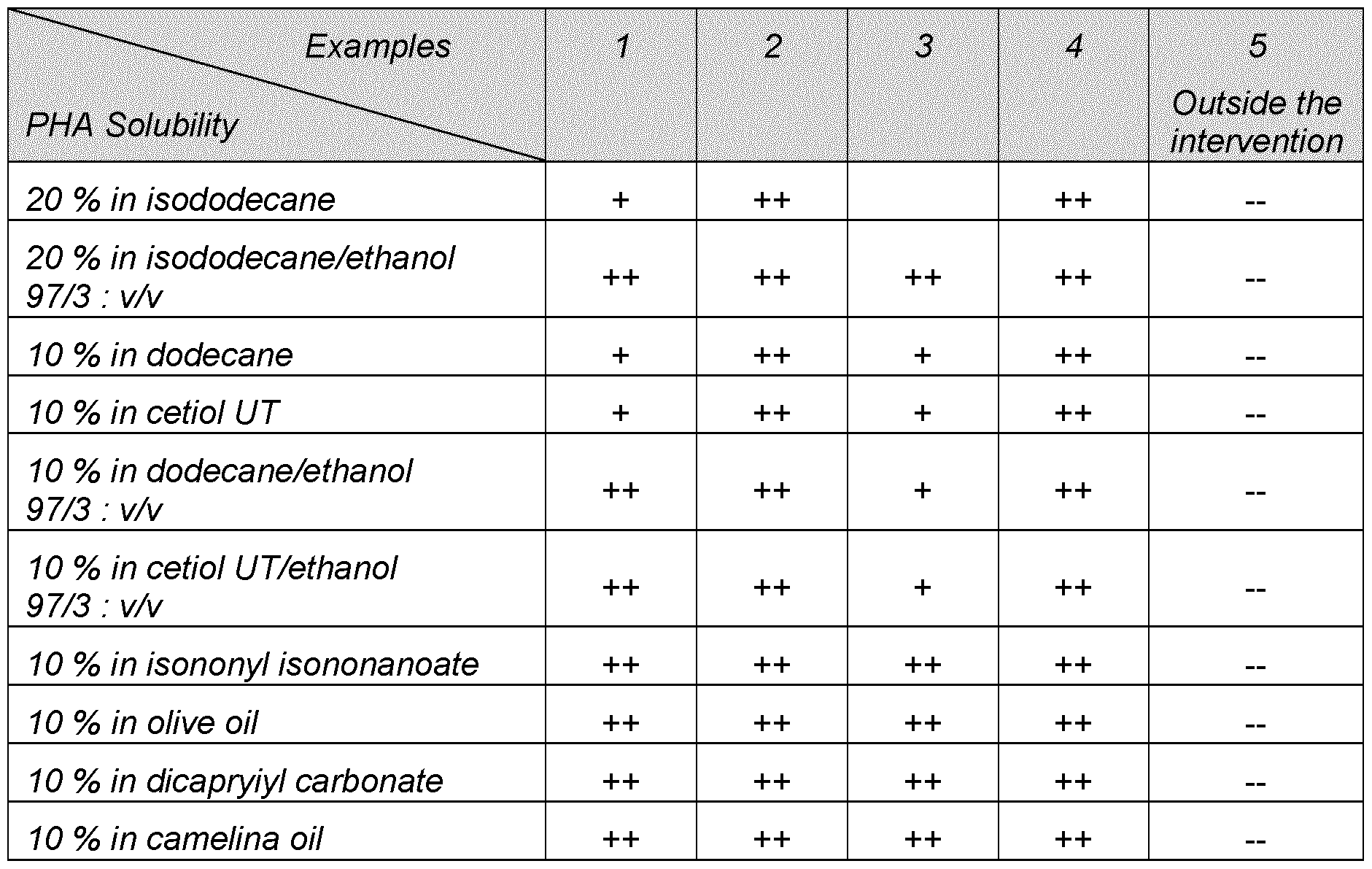
121 Ep: the epo has been informed by wipo that ep was designated in this application
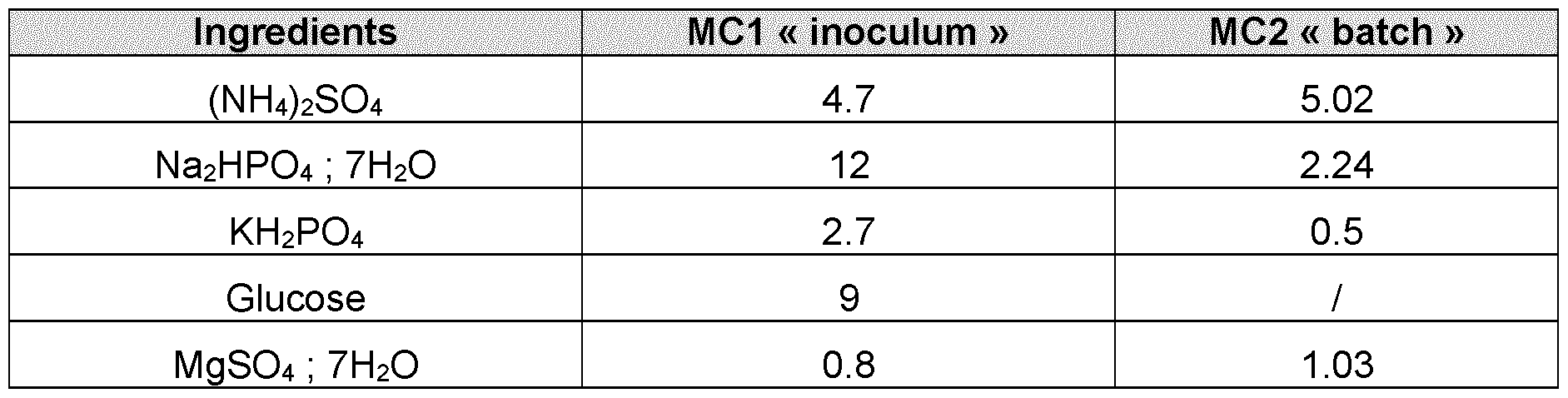
Ref document number: 21734162

Country of ref document: EP

Kind code of ref document: A1

WWE Wipo information: entry into national phase

Ref document number: 202217058576

Country of ref document: IN

ENP Entry into the national phase

Ref document number: 20227041641

Country of ref document: KR

Kind code of ref document: A

ENP Entry into the national phase

Ref document number: 2022574267

Country of ref document: JP

Kind code of ref document: A

REG Reference to national code

Ref country code: BR

Ref legal event code: B01A

Ref document number: 112022026075

Country of ref document: BR

ENP Entry into the national phase

Ref document number: 112022026075

Country of ref document: BR

Kind code of ref document: A2

Effective date: 20221220

NENP Non-entry into the national phase

Ref country code: DE

ENP Entry into the national phase

Ref document number: 2021734162

Country of ref document: EP

Effective date: 20230123

WWR Wipo information: refused in national office

Ref document number: 1020227041641

Country of ref document: KR