[go: up one dir, main page]

WO2021243060A1 - Use of ezh2 inhibitors for treating cancer - Google Patents

Use of ezh2 inhibitors for treating cancer Download PDF

Info

Publication number
WO2021243060A1
WO2021243060A1 PCT/US2021/034585 US2021034585W WO2021243060A1 WO 2021243060 A1 WO2021243060 A1 WO 2021243060A1 US 2021034585 W US2021034585 W US 2021034585W WO 2021243060 A1 WO2021243060 A1 WO 2021243060A1
Authority
WO
WIPO (PCT)
Prior art keywords
cells
intratumoral
stromal
level
subject
Prior art date
Legal status (The legal status is an assumption and is not a legal conclusion. Google has not performed a legal analysis and makes no representation as to the accuracy of the status listed.)
Ceased
Application number
PCT/US2021/034585
Other languages
French (fr)
Inventor
Carly CAMPBELL
Kat COSMOPOULOS
Alice Mcdonald
Melinda MERCHANT
Neil Michaud
Attila SZANTO
Current Assignee (The listed assignees may be inaccurate. Google has not performed a legal analysis and makes no representation or warranty as to the accuracy of the list.)
Epizyme Inc
Original Assignee
Epizyme Inc
Priority date (The priority date is an assumption and is not a legal conclusion. Google has not performed a legal analysis and makes no representation as to the accuracy of the date listed.)
Filing date
Publication date
Application filed by Epizyme Inc filed Critical Epizyme Inc
Priority to CA3177444A priority Critical patent/CA3177444A1/en
Priority to EP21814325.3A priority patent/EP4157466A4/en
Priority to JP2022566731A priority patent/JP2023527116A/en
Priority to CN202180038629.3A priority patent/CN115666725A/en
Priority to AU2021280314A priority patent/AU2021280314A1/en
Priority to US17/927,419 priority patent/US20230201213A1/en
Priority to KR1020227045693A priority patent/KR20230017836A/en
Publication of WO2021243060A1 publication Critical patent/WO2021243060A1/en
Anticipated expiration legal-status Critical
Ceased legal-status Critical Current

Links

Classifications

    • AHUMAN NECESSITIES
    • A61MEDICAL OR VETERINARY SCIENCE; HYGIENE
    • A61KPREPARATIONS FOR MEDICAL, DENTAL OR TOILETRY PURPOSES
    • A61K31/00Medicinal preparations containing organic active ingredients
    • A61K31/33Heterocyclic compounds
    • A61K31/395Heterocyclic compounds having nitrogen as a ring hetero atom, e.g. guanethidine or rifamycins
    • A61K31/535Heterocyclic compounds having nitrogen as a ring hetero atom, e.g. guanethidine or rifamycins having six-membered rings with at least one nitrogen and one oxygen as the ring hetero atoms, e.g. 1,2-oxazines
    • A61K31/53751,4-Oxazines, e.g. morpholine
    • A61K31/53771,4-Oxazines, e.g. morpholine not condensed and containing further heterocyclic rings, e.g. timolol
    • AHUMAN NECESSITIES
    • A61MEDICAL OR VETERINARY SCIENCE; HYGIENE
    • A61PSPECIFIC THERAPEUTIC ACTIVITY OF CHEMICAL COMPOUNDS OR MEDICINAL PREPARATIONS
    • A61P35/00Antineoplastic agents
    • AHUMAN NECESSITIES
    • A61MEDICAL OR VETERINARY SCIENCE; HYGIENE
    • A61PSPECIFIC THERAPEUTIC ACTIVITY OF CHEMICAL COMPOUNDS OR MEDICINAL PREPARATIONS
    • A61P35/00Antineoplastic agents
    • A61P35/02Antineoplastic agents specific for leukemia
    • AHUMAN NECESSITIES
    • A61MEDICAL OR VETERINARY SCIENCE; HYGIENE
    • A61PSPECIFIC THERAPEUTIC ACTIVITY OF CHEMICAL COMPOUNDS OR MEDICINAL PREPARATIONS
    • A61P43/00Drugs for specific purposes, not provided for in groups A61P1/00-A61P41/00
    • CCHEMISTRY; METALLURGY
    • C12BIOCHEMISTRY; BEER; SPIRITS; WINE; VINEGAR; MICROBIOLOGY; ENZYMOLOGY; MUTATION OR GENETIC ENGINEERING
    • C12QMEASURING OR TESTING PROCESSES INVOLVING ENZYMES, NUCLEIC ACIDS OR MICROORGANISMS; COMPOSITIONS OR TEST PAPERS THEREFOR; PROCESSES OF PREPARING SUCH COMPOSITIONS; CONDITION-RESPONSIVE CONTROL IN MICROBIOLOGICAL OR ENZYMOLOGICAL PROCESSES
    • C12Q1/00Measuring or testing processes involving enzymes, nucleic acids or microorganisms; Compositions therefor; Processes of preparing such compositions
    • C12Q1/68Measuring or testing processes involving enzymes, nucleic acids or microorganisms; Compositions therefor; Processes of preparing such compositions involving nucleic acids
    • C12Q1/6876Nucleic acid products used in the analysis of nucleic acids, e.g. primers or probes
    • C12Q1/6883Nucleic acid products used in the analysis of nucleic acids, e.g. primers or probes for diseases caused by alterations of genetic material
    • C12Q1/6886Nucleic acid products used in the analysis of nucleic acids, e.g. primers or probes for diseases caused by alterations of genetic material for cancer
    • GPHYSICS
    • G01MEASURING; TESTING
    • G01NINVESTIGATING OR ANALYSING MATERIALS BY DETERMINING THEIR CHEMICAL OR PHYSICAL PROPERTIES
    • G01N33/00Investigating or analysing materials by specific methods not covered by groups G01N1/00 - G01N31/00
    • G01N33/48Biological material, e.g. blood, urine; Haemocytometers
    • G01N33/50Chemical analysis of biological material, e.g. blood, urine; Testing involving biospecific ligand binding methods; Immunological testing
    • G01N33/5005Chemical analysis of biological material, e.g. blood, urine; Testing involving biospecific ligand binding methods; Immunological testing involving human or animal cells
    • G01N33/5091Chemical analysis of biological material, e.g. blood, urine; Testing involving biospecific ligand binding methods; Immunological testing involving human or animal cells for testing the pathological state of an organism
    • G01N33/575
    • CCHEMISTRY; METALLURGY
    • C12BIOCHEMISTRY; BEER; SPIRITS; WINE; VINEGAR; MICROBIOLOGY; ENZYMOLOGY; MUTATION OR GENETIC ENGINEERING
    • C12QMEASURING OR TESTING PROCESSES INVOLVING ENZYMES, NUCLEIC ACIDS OR MICROORGANISMS; COMPOSITIONS OR TEST PAPERS THEREFOR; PROCESSES OF PREPARING SUCH COMPOSITIONS; CONDITION-RESPONSIVE CONTROL IN MICROBIOLOGICAL OR ENZYMOLOGICAL PROCESSES
    • C12Q1/00Measuring or testing processes involving enzymes, nucleic acids or microorganisms; Compositions therefor; Processes of preparing such compositions
    • C12Q1/68Measuring or testing processes involving enzymes, nucleic acids or microorganisms; Compositions therefor; Processes of preparing such compositions involving nucleic acids
    • C12Q1/6869Methods for sequencing
    • CCHEMISTRY; METALLURGY
    • C12BIOCHEMISTRY; BEER; SPIRITS; WINE; VINEGAR; MICROBIOLOGY; ENZYMOLOGY; MUTATION OR GENETIC ENGINEERING
    • C12QMEASURING OR TESTING PROCESSES INVOLVING ENZYMES, NUCLEIC ACIDS OR MICROORGANISMS; COMPOSITIONS OR TEST PAPERS THEREFOR; PROCESSES OF PREPARING SUCH COMPOSITIONS; CONDITION-RESPONSIVE CONTROL IN MICROBIOLOGICAL OR ENZYMOLOGICAL PROCESSES
    • C12Q2600/00Oligonucleotides characterized by their use
    • C12Q2600/158Expression markers
    • GPHYSICS
    • G01MEASURING; TESTING
    • G01NINVESTIGATING OR ANALYSING MATERIALS BY DETERMINING THEIR CHEMICAL OR PHYSICAL PROPERTIES
    • G01N2800/00Detection or diagnosis of diseases
    • G01N2800/52Predicting or monitoring the response to treatment, e.g. for selection of therapy based on assay results in personalised medicine; Prognosis

Definitions

  • the present disclosure provides a method of treating cancer in a subject comprising administering to the subject at least one therapeutically effective amount of an inhibitor of Enhancer to Zeste Homolog (EZH2), wherein the cancer is characterized by at least one tumor comprising intratumoral B cells and/or stromal B cells.
  • EZH2 Enhancer to Zeste Homolog
  • the cancer is selected from the group consisting of mesothelioma, prostate cancer, androgen-resistant prostate cancer, soft tissue sarcoma, epithelioid sarcoma epithelial cell carcinoma, colorectal cancer, hepatocellular carcinoma, breast cancer, ductal carcinoma in situ, non-small cell lung cancer, cutaneous melanoma, ovarian cancer, adenoid cystic sarcoma (ACC), colon adenocarcinoma (COAD), kidney renal clear cell carcinoma (KIRC), kidney renal papillary cell carcinoma (KIRP), low grade glioma (LGG), uveal melanoma (UVM), kidney chromophobe (KICH) and pancreatic adenocarcinoma (PAAD).
  • ACC adenoid cystic sarcoma
  • COAD colon adenocarcinoma
  • KIRC kidney renal clear cell carcinoma
  • KIRP kidney renal papillary cell carcinoma
  • UVM low
  • the present disclosure provides a method of decreasing the number and/or density of B cells in at least one tumor in a subject, the method comprising administering to the subject at least one therapeutically effective amount of an EZH2 inhibitor.
  • the B cells comprise intratumoral B cells.
  • the B cells comprise stroma B cells.
  • the number and/or density of B cells in the at least one tumor is decreased by at least about 10%, or at least about 25%, or at least about 50%, or at least about 75%, or at least about 99% as compared to prior to the administration of the at least one therapeutically effective amount of an EZH2 inhibitor.
  • the present disclosure provides a method of identifying a subject having cancer for treatment with an EZH2 inhibitor, the method comprising: a) determining if a tumor sample from the subject contains intratumoral B cells and/or stromal B cells; and b) identifying the subject for treatment with an EZH2 inhibitor when the tumor sample contains intratumoral B cells and/or stromal B cells.
  • the present disclosure provides a method of treating a subject having cancer, the method comprising: a) determining if a tumor sample from the subject contains intratumoral B cells and/or stromal B cells; and b) administering to the subject at least one therapeutically effective amount of an EZH2 inhibitor when the tumor sample contains intratumoral B cells and/or stromal B cells.
  • the present disclosure provides a method of identifying a subject having cancer for treatment with an EZH2 inhibitor, the method comprising: a) determining the level of intratumoral B cells and/or stromal B cells in a tumor sample from the subject; b) comparing the level of intratumoral B cells and/or stromal B cells determined in step (a) to a predetermined cutoff level; and c) identifying the subject for treatment with an EZH2 inhibitor when the level of intratumoral B cells and/or stromal B cells determined in step (a) is greater than the predetermined cutoff.
  • the present disclosure provides a method of treating a subject having cancer, the method comprising: a) determining the level of intratumoral B cells and/or stromal B cells in a tumor sample from the subject; b) comparing the level of intratumoral B cells and/or stromal B cells determined in step (a) to a predetermined cutoff level; and c) administering to the subject at least one therapeutically effective amount of an EZH2 inhibitor when the level of intratumoral B cells and/or stromal B cells determined in step (a) is greater than the predetermined cutoff.
  • the present disclosure provides a method of determining a response to at least one therapy by a subject having cancer, wherein the at least one therapy comprises the administration of an EZH2 inhibitor, the method comprising: a) determining a first level of intratumoral B cells and/or stromal B cells in a tumor sample collected from the subject at a first time point, wherein the first time point is prior to the administration of the at least one therapy; b) determining a second level of intratumoral B cells and/or stromal B cells in a tumor sample collected from the subject at a second time point, wherein the second time point is after the administration of the at least one therapy; c) comparing the second level of intratumoral B cells and/or stromal B cells to the first level of intratumoral B cells and/or stromal B cells; and d) determining that the subject is responding to the at least one therapy when the second level of intratumoral B cells and/or stromal B cells is less than the first level of intratumoral B cells and/
  • the present disclosure provides a method of determining a response to at least one therapy by a subject having cancer, wherein the at least one therapy comprises the administration of an EZH2 inhibitor, the method comprising: a) determining a first level of intratumoral B cells and/or stromal B cells in a tumor sample collected from the subject at a first time point, wherein the first time point is prior to the administration of the at least one therapy; b) determining a second level of intratumoral B cells and/or stromal B cells in a tumor sample collected from the subject at a second time point, wherein the second time point is after the administration of the at least one therapy; c) comparing the second level of intratumoral B cells and/or stromal B cells to the first level of intratumoral B cells and/or stromal B cells; and d) determining that the subject is responding to the at least one therapy when the second level of intratumoral B cells and/or stromal B cells is no more than 75% of the first level of intratumoral
  • step (d) comprises determining that the subject is responding to the at least one therapy when the second level of intratumoral B cells and/or stromal B cells is no more than 50%, or no more than 25%, or no more than 10% of the first level of intratumoral B cells and/or stromal B cells.
  • the present disclosure provides a method of treating cancer in a subject, the method comprising: a) determining a first level of intratumoral B cells and/or stromal B cells in a tumor sample collected from the subject at a first time point, wherein the first time point is prior to the administration of at least one therapeutically effective amount of an EZH2 inhibitor; b) determining a second level of intratumoral B cells and/or stromal B cells in a tumor sample collected from the subject at a second time point, wherein the second time point is after the administration of at least one therapeutically effective amount of an EZH2 inhibitor; c) comparing the second level of intratumoral B cells and/or stromal B cells to the first level of intratumoral B cells; and d) administering to the subject at least one additional therapeutically effective amount of an EZH2 inhibitor when the second level of intratumoral B cells and/or stromal B cells is less than the first level of intratumoral B cells, or administering at least one alternative therapy to the subject when
  • the present disclosure provides a method of treating cancer in a subject, the method comprising: a) determining a first level of intratumoral B cells and/or stromal B cells in a tumor sample collected from the subject at a first time point, wherein the first time point is prior to the administration of at least one therapeutically effective amount of an EZH2 inhibitor; b) determining a second level of intratumoral B cells and/or stromal B cells in a tumor sample collected from the subject at a second time point, wherein the second time point is after the administration of at least one therapeutically effective amount of an EZH2 inhibitor; c) comparing the second level of intratumoral B cells and/or stromal B cells to the first level of intratumoral B cells; and d) administering to the subject at least one additional therapeutically effective amount of an EZH2 inhibitor when the second level of intratumoral B cells and/or stromal B cells is no more than 75% of the first level of intratumoral B cells and/or stromal B cells,
  • step (d) comprises administering to the subject at least one additional therapeutically effective amount of an EZH2 inhibitor when the second level of intratumoral B cells and/or stromal B cells is no more than 50%, or no more than 25%, or no more than 10% of the first level of intratumoral B cells and/or stromal B cells, or administering at least one alternative therapy to the subject when the second expression level of intratumoral B cells and/or stromal B cells is greater than 50%, or greater than 25%, or greater than 10% of the first level of intratumoral B cells and/or stromal B cells.
  • the EZH2 inhibitor is administered to the subject at least one additional therapeutically effective amount of an EZH2 inhibitor when the second level of intratumoral B cells and/or stromal B cells is no more than 50%, or no more than 25%, or no more than 10% of the first level of intratumoral B cells and/or stromal B cells.
  • the level of intratumoral B cells and/or stromal B cells is the number of intratumoral B cells and/or stromal B cells within a fixed volume of the tumor sample.
  • the level of intratumoral B cells and/or stromal B cells is the density of intratumoral B cells and/or stromal B cells within the tumor sample.
  • determining a level of intratumoral B cells and/or stromal B cells in a tumor sample comprises performing immunofluorescent analysis of the tumor sample.
  • immunofluorescent analysis comprises staining the sample with a fluorescently-labeled antibody that specifically binds to at least one cellular marker that is specific for B cells.
  • the cellular marker is selected from the group consisting of: IgA, IgE, IgD, IgM, IgG, CD1, CD1c, CD1d CD5, CD10, CD19, CD20, CD21, CD22, CD23, CD24, CD25, CD27, CD30, CD38 CD40, CD72, CD78, CD79, CD80, CD93, CD95, CD138, CD148, CD319, IL-6, PDL-2, CXCR3, CXCR4, CXCR5, CXCR6, Notch2, TLR4, IL-10, HLA-DR, TACI, Pax5, FCRL3, B7-1, B7-2, EBF-1, E2A, Oct2, Pax5, OBF1, Spi-B, BCMA, BLIMP
  • the cellular marker is CD20. In some embodiments, the cellular marker is CD19. [0022] In some embodiments of the preceding methods, determining a level of intratumoral B cells comprises determining the expression level of at least one B cell specific gene. [0023] In some embodiments of the preceding methods, determining a level of intratumoral B cells comprises determining the expression level of a plurality of B cell specific genes. [0024] In some embodiments of the preceding methods, the tumor is a cancerous tumor. In some embodiments of the preceding methods, the cancer is mesothelioma. In some embodiments, the mesothelioma is relapsed/refractory (R/R) mesothelioma.
  • the mesothelioma is epithelioid, bi-phasic, or sarcomatoid. In some embodiments, the mesothelioma is epithelioid. In some embodiments of the preceding methods the cancer is epithelioid sarcoma. [0025] Any of the above aspects can be combined with any other aspect. [0026] Unless otherwise defined, all technical and scientific terms used herein have the same meaning as commonly understood by one of ordinary skill in the art to which this disclosure belongs. In the specification, the singular forms also include the plural unless the context clearly dictates otherwise; as examples, the terms “a,” “an,” and “the” are understood to be singular or plural and the term “or” is understood to be inclusive.
  • an element means one or more element.
  • the word “comprising,” or variations such as “comprises” or “comprising,” will be understood to imply the inclusion of a stated element, integer or step, or group of elements, integers or steps, but not the exclusion of any other element, integer or step, or group of elements, integers or steps. About can be understood as within 10%, 9%, 8%, 7%, 6%, 5%, 4%, 3%, 2%, 1%, 0.5%, 0.1%, 0.05%, or 0.01% of the stated value.
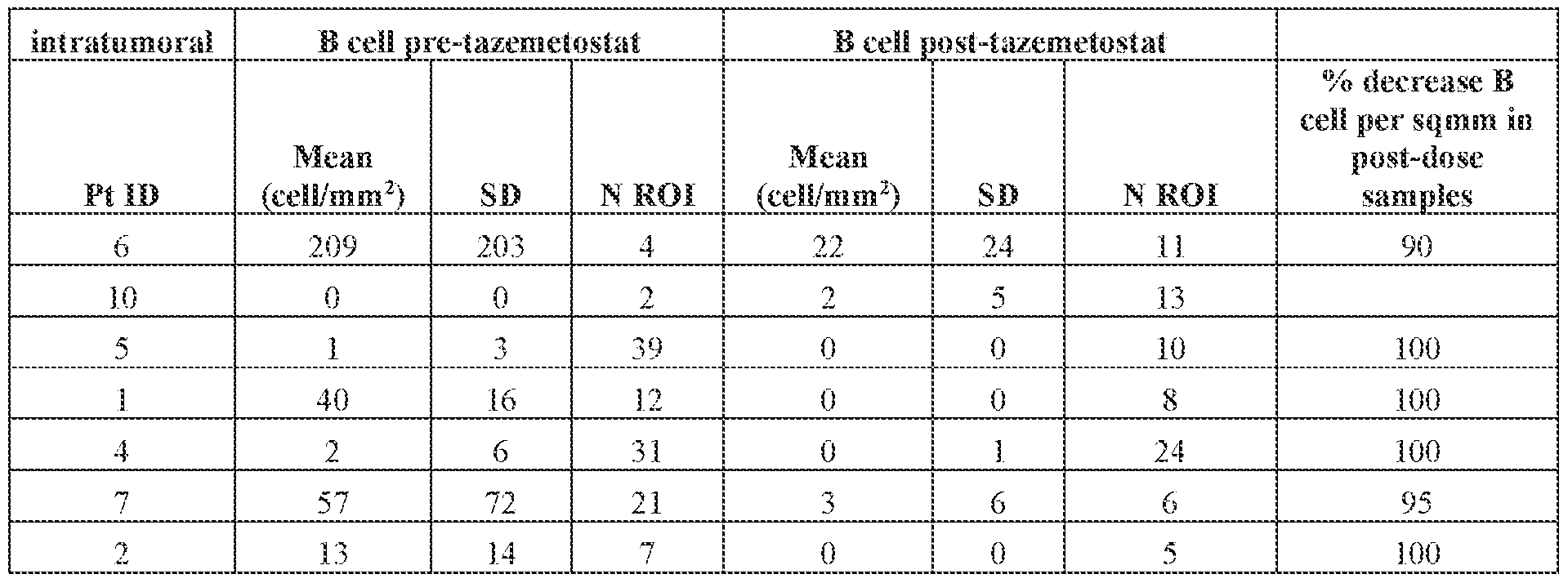
  • FIG.1 is a chart showing the levels of intratumoral B cells pre- and post-administration of tazemetostat in mesothelioma patients treated in the phase 2 study described in Example 1 of the present disclosure.
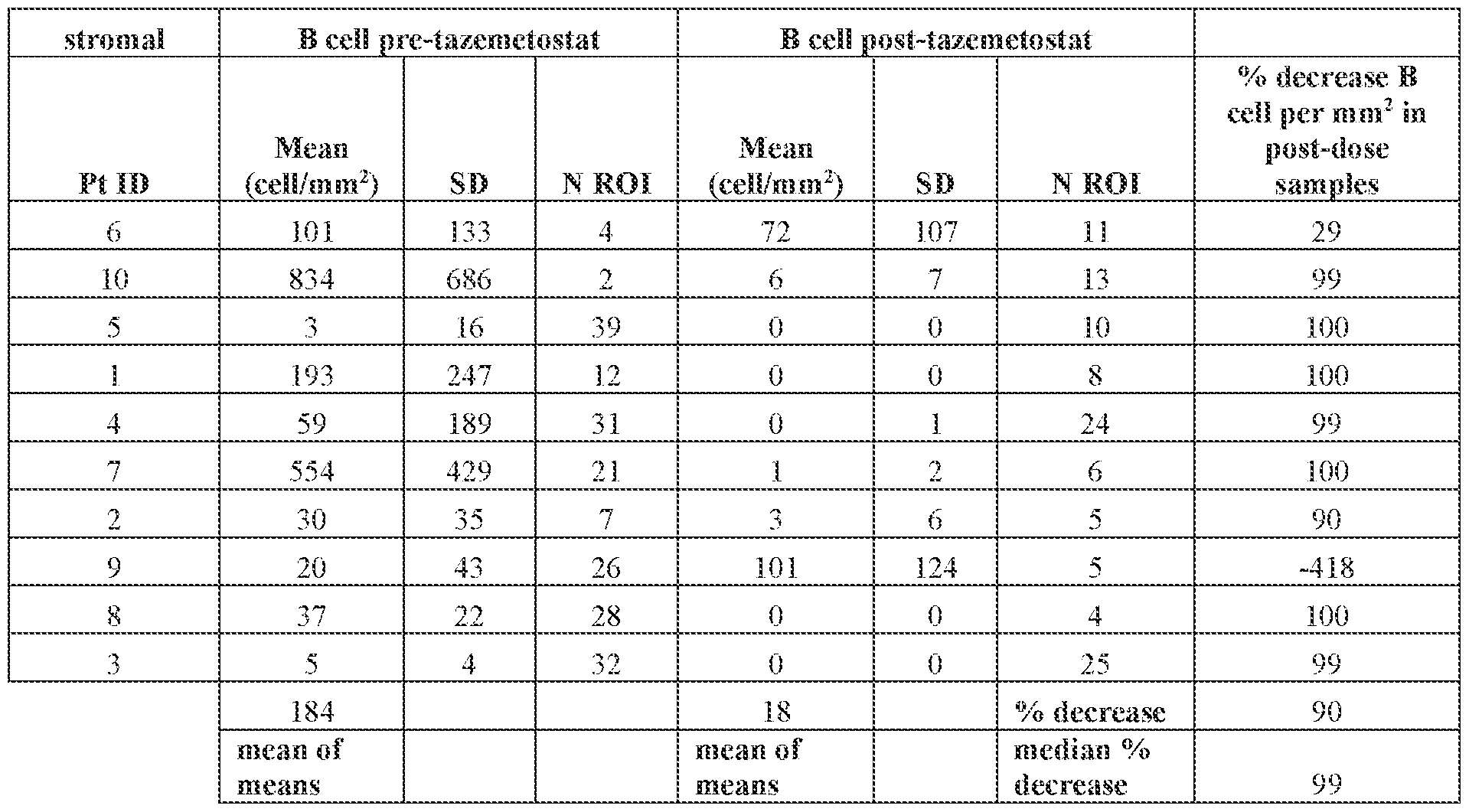
  • FIG.2 is a chart showing the levels of stromal B cells pre- and post-administration of tazemetostat in mesothelioma patients treated in the phase 2 study described in Example 1 of the present disclosure.
  • FIG.3 is a series of graphs showing the cumulative survival in cancer patients exhibiting a low B cell gene signature or a high B cell gene signature in an ACC, COAD, KIRC, UVM or KIRP tumor. The analysis was performed using the TIMER 2.0 application and the datasets analyzed were retrieved from The Cancer Genome Atlas (TCGA).
  • FIG.4 is a series of graphs showing the cumulative survival in cancer patients exhibiting a low B gene cell signature or a high B cell gene signature in an ACC, KICH, KIRP, LGG, MESO or PAAD tumor. The analysis was performed using the TIMER application and the datasets analyzed were retrieved from TCGA.
  • FIG.5 is a graph showing the cumulative survival in cancer patients exhibiting a low B cell gene signature or a high B cell gene signature in a UVM tumor. The analysis was performed using the TIMER application and the datasets analyzed were retrieved from TCGA.
  • FIG.6 shows the relative expression levels of six different B cell gene signatures (B cell memory_XCELL, B cell_MCPCOUNTER, B cell na ⁇ ve_CIBERSORT, B cell_QUANTISEQ, B cell na ⁇ ve_CIBERSORT-ABS, and B cell_XCELL) in samples pre- and post-administration of tazemetostat collected from mesothelioma patients treated in the phase 2 study described in Example 1 of the present disclosure.
  • B cell memory_XCELL B cell_MCPCOUNTER
  • B cell na ⁇ ve_CIBERSORT B cell_QUANTISEQ
  • B cell na ⁇ ve_CIBERSORT-ABS and B cell_XCELL
  • FIG.7A and FIG.7B show the mean relative expression levels of 15 different B cell gene signatures (B cell memory_CIBERSORT, B cell_CIBERSORT-ABS, B cell memory_XCELL, B cell na ⁇ ve_CIBERSORT, B cell na ⁇ ve_CIBERSORT-ABS, B cell na ⁇ ve_XCELL, B cell plamsa_CIBERSORT, B cell plasma_CIBERSORT-ABS, B cell plasma_XCELL, B cell_EPIC, B cell_MCPCOUNTER and B cell_QUANTISEQ (FIG.7A); and B cell_TIMER, B cell_XCELL, and Class-switched memory B cell_XCELL (FIG.7B)) and one macrophage gene signature (Macrophage_EPIC (FIG.7B)) in samples pre- and post- administration of tazemetostat collected from epithelioid sarcoma patients treated in the phase 2 study described in Example
  • FIG.8 shows the mean relative expression levels of CD19 and CD20 across all patient samples pre- and post-administration of tazemetostat in epithelioid sarcoma patients treated in the phase 2 study described in Example 3 of the present disclosure.
  • DETAILED DESCRIPTION [0037] The present disclosure provides methods for the treatment of a cancer characterized by at least one tumor comprising intratumoral B cells and/or stromal B cells in a subject, comprising administering to the subject an EZH2 inhibitor.
  • the present disclosure also provides methods of identifying a subject having cancer for treatment with an EZH2 inhibitor comprising determining the level of intratumoral B cells and/or stromal B cells in a tumor sample from the subject.
  • the present disclosure also provides methods of determining the response of a subject to at least one therapy, wherein the therapy comprises the administration of an EZH2 inhibitor, comprising comparing the level of intratumoral B cells and/or stromal B cells in a tumor sample collected from the subject at a first time point and the level of intratumoral B cells and/or stromal B cells in a tumor sample collected from the subject at a second time point.
  • the present disclosure also provides a method of decreasing the number and/or density of intratumoral B cells and/or stromal B cells in a tumor in a subject, comprising administering to the subject an EZH2 inhibitor.
  • the EZH2 inhibitor is tazemetostat or a pharmaceutically acceptable salt thereof.
  • the present disclosure provides a method of treating cancer in a subject comprising administering to the subject at least one therapeutically effective amount of an inhibitor of Enhancer to Zeste Homolog (EZH2), wherein the cancer is characterized by at least one tumor comprising intratumoral B cells.
  • the present disclosure provides a method of treating cancer in a subject comprising administering to the subject at least one therapeutically effective amount of an inhibitor of Enhancer to Zeste Homolog (EZH2), wherein the cancer is characterized by at least one tumor comprising stromal B cells.
  • the present disclosure provides a method of treating cancer in a subject comprising administering to the subject at least one therapeutically effective amount of an inhibitor of Enhancer to Zeste Homolog (EZH2), wherein the cancer is characterized by at least one tumor comprising intratumoral B cells and stromal B cells.
  • an inhibitor of Enhancer to Zeste Homolog EZH2
  • a cancer that is characterized by at least one tumor comprising intratumoral B cells, or a cancer that is characterized by at least one tumor comprising stromal B cells or a cancer that is characterized by at least one tumor comprising intratumoral B cells and stromal B cells can include, but is not limited to, mesothelioma, prostate cancer, androgen-resistant prostate cancer, soft tissue sarcoma, epithelioid sarcoma, epithelial cell carcinoma, colorectal cancer, hepatocellular carcinoma, breast cancer, ductal carcinoma in situ, non-small cell lung cancer, cutaneous melanoma, ovarian cancer, adenoid cystic sarcoma (ACC), colon adenocarcinoma (COAD), kidney renal clear cell carcinoma (KIRC), kidney renal papillary cell carcinoma (KIRP), low grade glioma (LGG), uveal melanoma (UVM), kidney chrom
  • the cancer is mesothelioma. In some embodiments, the mesothelioma is relapsed/refractory (R/R) mesothelioma. In some embodiments, the mesothelioma is epithelioid mesothelioma. In some embodiments, the mesothelioma is bi-phasic mesothelioma. In some embodiments, the mesothelioma is sarcomatoid mesothelioma. In some aspects, the cancer is epithelioid sarcoma.
  • the present disclosure provides a method of decreasing the number and/or density of B cells in at least one tumor in a subject, the method comprising administering to the subject at least one therapeutically effective amount of an EZH2 inhibitor.
  • the number and/or density of B cells in the at least one tumor can be decreased by at least about 10%, or at least about 15%, or at least about 20%, or at least about 25%, or at least about 30%, or at least about 35%, or at least about 40%, or at least about 45%, or at least about 50%, or at least about 55%, or at least about 60%, or at least about 65%, or at least about 70%, or at least about 75%, or at least about 80%, or at least about 85%, or at least about 90%, or at least about 95%, or at least about 99% as compared to prior to the administration of the at least one therapeutically effective amount of an EZH2 inhibitor.
  • the present disclosure provides a method of decreasing the number and/or density of intratumoral B cells in at least one tumor in a subject, the method comprising administering to the subject at least one therapeutically effective amount of an EZH2 inhibitor.
  • the number and/or density of intratumoral B cells in the at least one tumor can be decreased by at least about 10%, or at least about 15%, or at least about 20%, or at least about 25%, or at least about 30%, or at least about 35%, or at least about 40%, or at least about 45%, or at least about 50%, or at least about 55%, or at least about 60%, or at least about 65%, or at least about 70%, or at least about 75%, or at least about 80%, or at least about 85%, or at least about 90%, or at least about 95%, or at least about 99% as compared to prior to the administration of the at least one therapeutically effective amount of an EZH2 inhibitor.
  • the present disclosure provides a method of decreasing the number and/or density of stromal B cells in at least one tumor in a subject, the method comprising administering to the subject at least one therapeutically effective amount of an EZH2 inhibitor.
  • the number and/or density of stromal B cells in the at least one tumor can be decreased by at least about 10%, or at least about 15%, or at least about 20%, or at least about 25%, or at least about 30%, or at least about 35%, or at least about 40%, or at least about 45%, or at least about 50%, or at least about 55%, or at least about 60%, or at least about 65%, or at least about 70%, or at least about 75%, or at least about 80%, or at least about 85%, or at least about 90%, or at least about 95%, or at least about 99% as compared to prior to the administration of the at least one therapeutically effective amount of an EZH2 inhibitor.
  • the present disclosure provides a method of identifying a subject having cancer for treatment with an EZH2 inhibitor, the method comprising: a) determining if a tumor sample from the subject contains intratumoral B cells; and b) identifying the subject for treatment with an EZH2 inhibitor when the tumor sample contains intratumoral B cells.
  • the present disclosure provides a method of identifying a subject having cancer for treatment with an EZH2 inhibitor, the method comprising: a) determining if a tumor sample from the subject contains stromal B cells; and b) identifying the subject for treatment with an EZH2 inhibitor when the tumor sample contains stromal B cells.
  • the present disclosure provides a method of identifying a subject having cancer for treatment with an EZH2 inhibitor, the method comprising: a) determining if a tumor sample from the subject contains intratumoral B cells and stromal B cells; and b) identifying the subject for treatment with an EZH2 inhibitor when the tumor sample contains intratumoral B cells and stromal B cells.
  • the present disclosure provides a method of treating a subject having cancer, the method comprising: a) determining if a tumor sample from the subject contains intratumoral B cells; and b) administering to the subject at least one therapeutically effective amount of an EZH2 inhibitor when the tumor sample contains intratumoral B cells.
  • the present disclosure provides a method of treating a subject having cancer, the method comprising: a) determining if a tumor sample from the subject contains stromal B cells; and b) administering to the subject at least one therapeutically effective amount of an EZH2 inhibitor when the tumor sample contains stromal B cells.
  • the present disclosure provides a method of treating a subject having cancer, the method comprising: a) determining if a tumor sample from the subject contains intratumoral B cells and stromal B cells; and b) administering to the subject at least one therapeutically effective amount of an EZH2 inhibitor when the tumor sample contains intratumoral B cells and stromal B cells.
  • the present disclosure provides a method of identifying a subject having cancer for treatment with an EZH2 inhibitor, the method comprising: a) determining the level of intratumoral B cells in a tumor sample from the subject; b) comparing the level of intratumoral B cells determined in step (a) to a predetermined cutoff level; and c) identifying the subject for treatment with an EZH2 inhibitor when the level of intratumoral B cells determined in step (a) is greater than the predetermined cutoff.
  • the present disclosure provides a method of identifying a subject having cancer for treatment with an EZH2 inhibitor, the method comprising: a) determining the level of stromal B cells in a tumor sample from the subject; b) comparing the level of stromal B cells determined in step (a) to a predetermined cutoff level; and c) identifying the subject for treatment with an EZH2 inhibitor when the level of stromal B cells determined in step (a) is greater than the predetermined cutoff.
  • the present disclosure provides a method of identifying a subject having cancer for treatment with an EZH2 inhibitor, the method comprising: a) determining the level of intratumoral B cells and stromal B cells in a tumor sample from the subject; b) comparing the level of intratumoral B cells and stromal B cells determined in step (a) to a predetermined cutoff level; and c) identifying the subject for treatment with an EZH2 inhibitor when the level of intratumoral B cells and stromal B cells determined in step (a) is greater than the predetermined cutoff.
  • the present disclosure provides a method of treating a subject having cancer, the method comprising: a) determining the level of intratumoral B cells in a tumor sample from the subject; b) comparing the level of intratumoral B cells determined in step (a) to a predetermined cutoff level; and c) administering to the subject at least one therapeutically effective amount of an EZH2 inhibitor when the level of intratumoral B cells determined in step (a) is greater than the predetermined cutoff.
  • the present disclosure provides a method of treating a subject having cancer, the method comprising: a) determining the level of stromal B cells in a tumor sample from the subject; b) comparing the level of stromal B cells determined in step (a) to a predetermined cutoff level; and c) administering to the subject at least one therapeutically effective amount of an EZH2 inhibitor when the level of stromal B cells determined in step (a) is greater than the predetermined cutoff.
  • the present disclosure provides a method of treating a subject having cancer, the method comprising: a) determining the level of intratumoral B cells and stromal B cells in a tumor sample from the subject; b) comparing the level of intratumoral B cells and stromal B cells determined in step (a) to a predetermined cutoff level; and c) administering to the subject at least one therapeutically effective amount of an EZH2 inhibitor when the level of intratumoral B cells and stromal B cells determined in step (a) is greater than the predetermined cutoff.
  • a predetermined cutoff value can be the level of intratumoral B cells and/or stromal B cells in a control tumor sample.
  • a predetermined cutoff value can be the average (mean) level of intratumoral B cells and/or stromal B cells in a plurality of control tumor samples.
  • a control tumor sample can be a tumor sample collected from a subject who was previously identified as being responsive to a therapy comprising the administration of an EZH2 inhibitor.
  • a control tumor sample can be a tumor sample collected from a subject who has been diagnosed with a cancer that is characterized by at least one tumor comprising intratumoral B cells and/or stromal B cells.
  • the present disclosure provides a method of determining a response to at least one therapy by a subject having cancer, wherein the at least one therapy comprises the administration of an EZH2 inhibitor, the method comprising: a) determining a first level of intratumoral B cells in a tumor sample collected from the subject at a first time point; b) determining a second level of intratumoral B cells in a tumor sample collected from the subject at a second time point; c) comparing the second level of intratumoral B cells to the first level of intratumoral B cells; and d) determining that the subject is responding to the at least one therapy when the second level of intratumoral B cells is less than the first level of intratumoral B cells.
  • the present disclosure provides a method of determining a response to at least one therapy by a subject having cancer, wherein the at least one therapy comprises the administration of an EZH2 inhibitor, the method comprising: a) determining a first level of stromal B cells in a tumor sample collected from the subject at a first time point; b) determining a second level of stromal B cells in a tumor sample collected from the subject at a second time point; c) comparing the second level of stromal B cells to the first level of stromal B cells; and d) determining that the subject is responding to the at least one therapy when the second level of stromal B cells is less than the first level of stromal B cells.
  • the present disclosure provides a method of determining a response to at least one therapy by a subject having cancer, wherein the at least one therapy comprises the administration of an EZH2 inhibitor, the method comprising: a) determining a first level of intratumoral B cells and stromal B cells in a tumor sample collected from the subject at a first time point; b) determining a second level of intratumoral B cells and stromal B cells in a tumor sample collected from the subject at a second time point; c) comparing the second level of intratumoral B cells and stromal B cells to the first level of intratumoral B cells and stromal B cells; and d) determining that the subject is responding to the at least one therapy when the second level of intratumoral B cells and stromal B cells is less than the first level of intratumoral B cells and stromal B cells.
  • the present disclosure provides a method of determining a response to at least one therapy by a subject having cancer, wherein the at least one therapy comprises the administration of an EZH2 inhibitor, the method comprising: a) determining a first level of intratumoral B cells in a tumor sample collected from the subject at a first time point; b) determining a second level of intratumoral B cells in a tumor sample collected from the subject at a second time point; c) comparing the second level of intratumoral B cells to the first level of intratumoral B cells; and d) determining that the subject is responding to the at least one therapy when the second level of intratumoral B cells is no more than 90%, or no more than 85%, or no more than 80%, or no more than 75%, or no more than 70%, or no more than 65%, or no more than 60%, or no more than 55%, or no more than 50%, or no more than 45%, or no more than 40%, or no more than 35%, or no more than 30%,
  • the present disclosure provides a method of determining a response to at least one therapy by a subject having cancer, wherein the at least one therapy comprises the administration of an EZH2 inhibitor, the method comprising: a) determining a first level of stromal B cells in a tumor sample collected from the subject at a first time point; b) determining a second level of stromal B cells in a tumor sample collected from the subject at a second time point; c) comparing the second level of stromal B cells to the first level of stromal B cells; and d) determining that the subject is responding to the at least one therapy when the second level of stromal B cells is no more than 90%, or no more than 85%, or no more than 80%, or no more than 75%, or no more than 70%, or no more than 65%, or no more than 60%, or no more than 55%, or no more than 50%, or no more than 45%, or no more than 40%, or no more than 35%, or no more than 30%,
  • the present disclosure provides a method of determining a response to at least one therapy by a subject having cancer, wherein the at least one therapy comprises the administration of an EZH2 inhibitor, the method comprising: a) determining a first level of intratumoral B cells and stromal B cells in a tumor sample collected from the subject at a first time point; b) determining a second level of intratumoral B cells and stromal B cells in a tumor sample collected from the subject at a second time point; c) comparing the second level of intratumoral B cells and stromal B cells to the first level of intratumoral B cells and stromal B cells; and d) determining that the subject is responding to the at least one therapy when the second level of intratumoral B cells and stromal B cells is no more than 90%, or no more than 85%, or no more than 80%, or no more than 75%, or no more than 70%, or no more than 65%, or no more than 60%, or no more than 55%, or no
  • a first time point is prior to the administration of the at least one therapy. In some embodiments of the methods of the present disclosure, a first time point is prior to the administration of the at least one therapy, wherein the at least one therapy comprises the administration of an EZH2 inhibitor.
  • a second time point is after the administration of the at least one therapy. In some embodiments of the methods of the present disclosure, a second time point is after the administration of the at least one therapy, wherein the at least one therapy comprises the administration of an EZH2 inhibitor.
  • the present disclosure provides a method of treating cancer in a subject, the method comprising: a) determining a first level of intratumoral B cells in a tumor sample collected from the subject at a first time point, wherein the first time point is prior to the administration of at least one therapeutically effective amount of an EZH2 inhibitor; b) determining a second level of intratumoral B cells in a tumor sample collected from the subject at a second time point, wherein the second time point is after the administration of at least one therapeutically effective amount of an EZH2 inhibitor; c) comparing the second level of intratumoral B cells to the first level of intratumoral B cells; and d) administering to the subject at least one additional therapeutically effective amount of an EZH2 inhibitor when the second level of intratumoral B cells is less than the first level of intratumoral B cells, or administering at least one alternative therapy to the subject when the second expression level of intratumoral B cells is greater than or equal to first level of intratumoral B cells.
  • the present disclosure provides a method of treating cancer in a subject, the method comprising: a) determining a first level of stromal B cells in a tumor sample collected from the subject at a first time point, wherein the first time point is prior to the administration of at least one therapeutically effective amount of an EZH2 inhibitor; b) determining a second level of stromal B cells in a tumor sample collected from the subject at a second time point, wherein the second time point is after the administration of at least one therapeutically effective amount of an EZH2 inhibitor; c) comparing the second level of stromal B cells to the first level of stromal B cells; and d) administering to the subject at least one additional therapeutically effective amount of an EZH2 inhibitor when the second level of stromal B cells is less than the first level of stromal B cells, or administering at least one alternative therapy to the subject when the second expression level of stromal B cells is greater than or equal to first level of stromal B cells.
  • the present disclosure provides a method of treating cancer in a subject, the method comprising: a) determining a first level of intratumoral B cells and stromal B cells in a tumor sample collected from the subject at a first time point, wherein the first time point is prior to the administration of at least one therapeutically effective amount of an EZH2 inhibitor; b) determining a second level of intratumoral B cells and stromal B cells in a tumor sample collected from the subject at a second time point, wherein the second time point is after the administration of at least one therapeutically effective amount of an EZH2 inhibitor; c) comparing the second level of intratumoral B cells and stromal B cells to the first level of intratumoral B cells and stromal B cells; and d) administering to the subject at least one additional therapeutically effective amount of an EZH2 inhibitor when the second level of intratumoral B cells and stromal B cells is less than the first level of intratumoral B cells and stromal B cells, or administering at
  • the present disclosure provides a method of treating cancer in a subject, the method comprising: a) determining a first level of intratumoral B cells in a tumor sample collected from the subject at a first time point, wherein the first time point is prior to the administration of at least one therapeutically effective amount of an EZH2 inhibitor; b) determining a second level of intratumoral B cells in a tumor sample collected from the subject at a second time point, wherein the second time point is after the administration of at least one therapeutically effective amount of an EZH2 inhibitor; c) comparing the second level of intratumoral B cells to the first level of intratumoral B cells; and d) administering to the subject at least one additional therapeutically effective amount of an EZH2 inhibitor when the second level of intratumoral B cells is no more than 90%, or no more than 85%, or no more than 80%, or no more than 75%, or no more than 70%, or no more than 65%, or no more than 60%, or no more than 55%,
  • the present disclosure provides a method of treating cancer in a subject, the method comprising: a) determining a first level of stromal B cells in a tumor sample collected from the subject at a first time point, wherein the first time point is prior to the administration of at least one therapeutically effective amount of an EZH2 inhibitor; b) determining a second level of stromal B cells in a tumor sample collected from the subject at a second time point, wherein the second time point is after the administration of at least one therapeutically effective amount of an EZH2 inhibitor; c) comparing the second level of stromal B cells to the first level of stromal B cells; and d) administering to the subject at least one additional therapeutically effective amount of an EZH2 inhibitor when the second level of stromal B cells is no more than 90%, or no more than 85%, or no more than 80%, or no more than 75%, or no more than 70%, or no more than 65%, or no more than 60%, or no more than 55%,
  • the present disclosure provides a method of treating cancer in a subject, the method comprising: a) determining a first level of intratumoral B cells or stromal B cells in a tumor sample collected from the subject at a first time point, wherein the first time point is prior to the administration of at least one therapeutically effective amount of an EZH2 inhibitor; b) determining a second level of intratumoral B cells or stromal B cells in a tumor sample collected from the subject at a second time point, wherein the second time point is after the administration of at least one therapeutically effective amount of an EZH2 inhibitor; c) comparing the second level of intratumoral B cells or stromal B cells to the first level of intratumoral B cells or stromal B cells; and d) administering to the subject at least one additional therapeutically effective amount of an EZH2 inhibitor when the second level of intratumoral B cells or stromal B cells is no more than 90%, or no more than 85%, or no more than 80%, or no more
  • an alternative therapy can comprise a therapy that does not include the administration of an inhibitor of EZH-2.
  • Alternative therapies can include, but are not limited to, radiation therapy, surgery, chemotherapy, immunotherapy, hormone therapy, cryoablation, radiofrequency ablation, targeted drug therapy or any combination thereof.
  • a level of intratumoral B cells and/or stromal B cells can the number of intratumoral B cells and/or stromal B cells within a fixed volume of the tumor sample.
  • a level of intratumoral B cells and/or stromal B cells can be the average density of intratumoral B cells and/or stromal B cells within the tumor sample.
  • determining a level of intratumoral B cells and/or stromal B cells in a tumor sample can comprise performing immunofluorescent analysis of the tumor sample.
  • immunofluorescent analysis comprises staining a sample with a fluorescent marker specific for B cells and then detecting the fluorescent marker to determine the number and/or density of B cells in the sample.
  • the immunofluorescent analysis can be immunohistochemistry analysis Immunohistochemistry analysis can be performed using standard techniques known in the art. As would be appreciated by the skilled artisan, immunohistochemistry analysis can comprise staining a sample with at least one fluorescently-labeled antibody that binds specifically to at least one cellular marker that is specific for B cells. In some aspects, these fluorescently-labeled antibodies can then be detected using standard methods known in the art, including, but not limited to, microscopy, to determine the number and/or density of B cells in the sample.
  • the immunofluorescent analysis can be fluorescence flow cytometry.
  • Fluorescence flow cytometry can be performed using standard techniques known in the art. As would be appreciated by the skilled artisan, fluorescence flow cytometry can comprise disassociating a tumor sample, staining the disassociated sample with at least one fluorescently- labeled antibody that binds specifically to at least one cellular marker that is specific for B cells, and performing fluorescent flow cytometry to count the number of B cells in the sample based on how many cells are stained with the fluorescently-labeled antibody.
  • determining a level of intratumoral B cells and/or stromal B cells in a tumor sample can comprise determining the expression level of at least one B cell specific gene. In some embodiments of the methods of the present disclosure, determining a level of intratumoral B cells and/or stromal B cells in a tumor sample can comprise determining the expression level of a plurality of B cell specific genes.
  • determining a level of intratumoral B cells and/or stromal B cells in a tumor sample can comprise PCR, targeted sequencing, high-throughput sequencing, next generation sequencing, Northern Blot, reverse transcription PCR (RT-PCR), real-time PCR (qPCR), quantitative PCR, qRT-PCR, flow cytometry, mass spectrometry, microarray analysis, digital droplet PCR, Western Blot or any combination thereof.
  • B cells also referred to as B lymphocytes, are a type leukocyte of the lymphocyte subtype. As a component of the adaptive immune system, B cells secrete immunoglobulins. B cells also present antigens and secrete cytokines.
  • B cells express B cell receptors (BCRs) on their cell membrane.
  • BCRs allow B cells to bind to specific antigens, thereby allowing the B cell to initiate an antibody response.
  • Subtypes of B cells include, but are not limited to, plasmablasts, plasma cells, lymphoplasmacytoid cells, memory B cells, B-2 cells, follicular (FO) B cells, marginal zone (MZ) B cells, B-1 cells and regulatory B (Breg) cells.
  • B cell specific markers can include, but are not limited to, IgA, IgE, IgD, IgM, IgG, CD1, CD1c, CD1d CD5, CD10, CD19, CD20, CD21, CD22, CD23, CD24, CD25, CD27, CD30, CD38 CD40, CD72, CD78, CD79, CD80, CD93, CD95, CD138, CD148, CD319, IL-6, PDL-2, CXCR3, CXCR4, CXCR5, CXCR6, Notch2, TLR4, IL-10, HLA-DR, TACI, Pax5, FCRL3, B7-1, B7-2, EBF-1, E2A, Oct2, Pax5, OBF1, Spi-B, BCMA, BLIMP1, IRF4, XBP1 and TGF ⁇ or any other markers known in the art.
  • intratumoral B cells can have a phenotype of CD20+ CD27- PD-L1+ CD19+ CD5+ CD43+ (Breg Cells), IgM+ IgD- CD27+ (memory B cells), CD19+ CD80+ CD86+ CD44+ CD69+ PD-L1+ (activated B cells), CD20- CD24- CD27 hi CD38 hi (plasma cells) or any other phenotype known in the art. Any single marker within a phenotype can be used by the skilled artisan as a marker for intratumoral B cells.
  • B cells have been shown to suppress antitumor responses (e.g., see Yuen et al. Trends Cancer, 2016, 2(12), pgs 747-757).
  • B cells can produce lymphotoxin, which induces angiogenesis, thereby promoting tumor growth.
  • tumor-derived extracellular vesicles can activate B cells, thereby causing them to produce antibodies that can bind to specific antigens and form circulating immune complexes.
  • These circulating immune complexes can in turn activate Fc ⁇ receptors on myeloid cells, inducing them to become myeloid-derived suppressor cells.
  • myeloid-derived suppressor cells can promote tumor growth by suppressing anti-tumor CD4+ and CD8+ T cell responses. Additionally, Breg cells can also secrete immunoregulatory cytokines, including TGF ⁇ , inducing CD4+ T cells to become Foxp3+ CD4+ T regulatory (Treg) cells. Breg cells can also secrete IL-10. IL-10 can suppress CD4+ Th1 cells, natural killer (NK) cells and CD8+ cytotoxic T cells. [0086] Without wishing to be bound by theory, in the context of tumors, B cells have also been shown to positively mediate antitumor response. B cells can produce lymphotoxin.
  • Lymphotoxin can promote the formation of tertiary lymphoid organs, which is positively correlated with disease outcome and patient survival.
  • the production of antibodies by plasma cells can contribute to antitumor responses.
  • antitumor antibodies can promote antibody- and complement-mediated killing of tumor cells, can promote Fc-mediated phagocytosis by macrophages, and can promote antibody-dependent cell-mediated cytotoxicity (ADCC) by natural killer cells.
  • tumor cells that are coated by antibodies produced by B cells can be taken up and processed by dendritic cells, which in turn present tumor antigens to CD4+ T cells and cross-present antigens to CD8+ T cells.
  • EZH2 Inhibitors [0087] Those of ordinary skill in the art will be aware of suitable EZH2 inhibitors that may be used in connection with the methods described herein.
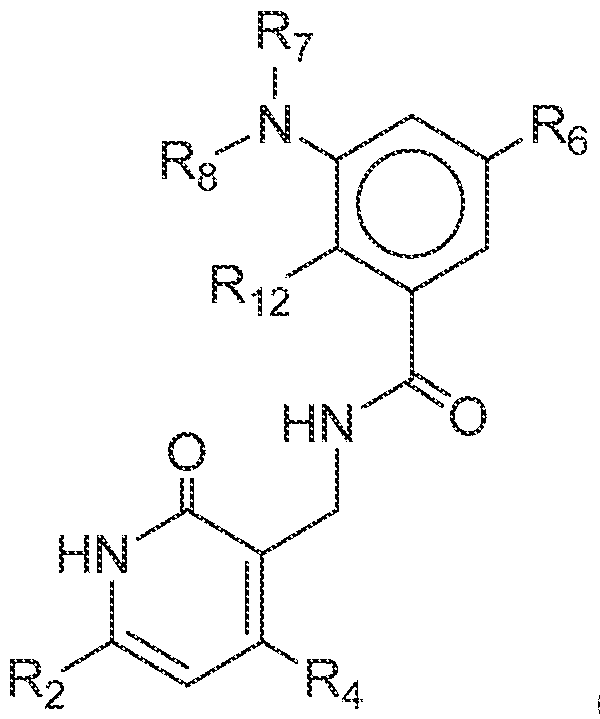
  • an EZH2 inhibitor can comprise a compound of Formula Ig: (Ig), or a pharmaceutically acceptable salt or ester thereof, wherein R 2 , R 4 and R 12 are each, independently C 1-6 alkyl; R 6 is C 6 -C 10 aryl or 5- or 6-membered heteroaryl, each of which is optionally substituted with one or more –Q 2 -T 2 , wherein Q 2 is a bond or C 1 -C 3 alkyl linker optionally substituted with halo, cyano, hydroxyl or C 1 -C 6 alkoxy, and T 2 is H, halo, cyano, -OR a , -NR a R b , -(NR a R b R c ) + A – ,- C(O)Ra, -C(O)ORa, -C(O)NRaRb, -NRbC(O)Ra, -NR
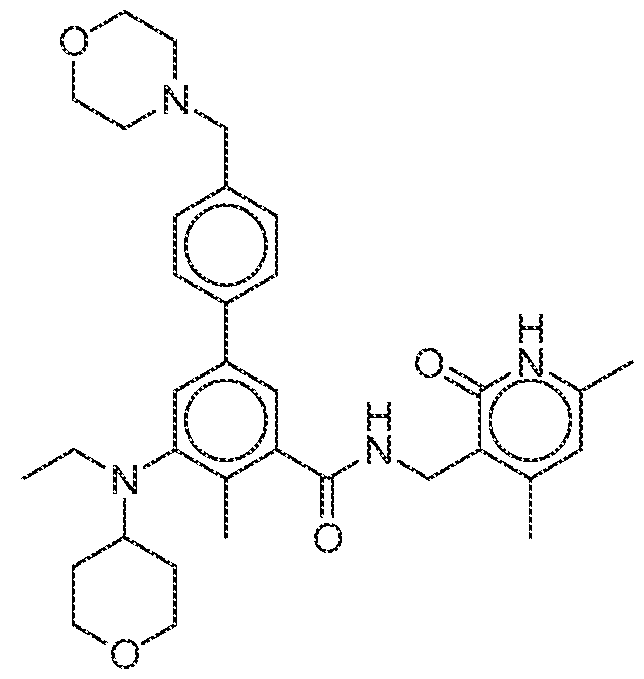
  • an EZH2 inhibitor can comprise tazemetostat (EPZ-6438): or a pharmaceutically acceptable salt thereof.
  • the pharmaceutically acceptable salt is the hydrobromide salt of tazemetostat.
  • the pharmaceutically acceptable salt is the mono-hydrobromide salt of tazemetostat.
  • tazemetostat is protonated at the nitrogen of the morpholino substituent, providing a monohydrobromide of tazemetostat having the following structure: . ⁇ [0090] Tazemetostat is also described in US Patent Nos.
  • an EZH2 inhibitor can be any EZH2 inhibitor known and appreciated in the art.
  • the EZH2 inhibitor can be an EZH2 inhibitor described in US Patent No.8,536,179 (describing GSK-126 among other compounds and corresponding to WO 2011/140324), the entire contents of each of which are incorporated herein by reference.
  • an EZH2 inhibitor can be any EZH2 inhibitor described in US Patent No. 8,598,167 (corresponding to WO2012/118812), US Patent No.
  • an EZH2 inhibitor is an EZH2 inhibitor described in PCT/US2014/015706, published as WO 2014/124418, in PCT/US2013/025639, published as WO 2013/120104, and in US 14/839,273, published as US 2015/0368229, the entire contents of each of which are incorporated herein by reference.
  • an EZH2 inhibitor is the compound itself, i.e., the free base or “naked” molecule.
  • an EZH2 inhibitor is a salt thereof, e.g., a pharmaceutically acceptable salt, for example, a mono-HCl, di-HCl or tri-HCl salt, mono-HBr or tri-HBr salt of the naked molecule.
  • Pharmaceutically acceptable salts of the compounds provided herein will be apparent to those of skill in the art based on the present disclosure and the knowledge in the art. The disclosure is not limited in this respect.
  • an EZH2 inhibitor inhibits conversion of H3-K27me2 to H3-K27me3. In some embodiments the inhibitor is said to inhibit trimethylation of H3-K27.
  • an EZH2 inhibitor inhibits conversion of H3-K27me1 to H3-K27me2 and the conversion of H3-K27me2 to H3-K27me3.
  • Such inhibitor may directly inhibit the conversion of H3-K27me1 to H3-K27me2 alone.
  • such inhibitor may directly inhibit both the conversion of H3-K27me1 to H3-K27me2 and the conversion of H3-K27me2 to H3- K27me3.
  • an EZH2 inhibitor inhibits histone methyltransferase activity. Inhibition of histone methyltransferase activity can be detected using any suitable method.
  • the inhibition can be measured, for example, either in terms of rate of histone methyltransferase activity or as product of histone methyltransferase activity.
  • the inhibition is a measurable inhibition compared to a suitable control.
  • inhibition is at least 10 percent inhibition compared to a suitable control. That is, the rate of enzymatic activity or the amount of product with the inhibitor is less than or equal to 90 percent of the corresponding rate or amount made without the inhibitor.
  • inhibition is at least 20, 25, 30, 40, 50, 60, 70, 75, 80, 90, or 95 percent inhibition compared to a suitable control. In some embodiments, inhibition is at least 99 percent inhibition compared to a suitable control.
  • an EZH2 inhibitor can be administered as part of a pharmaceutical compositions comprising at least one EZH2 inhibitor in combination with at least one pharmaceutically acceptable excipient or carrier.
  • a “pharmaceutical composition” is a formulation containing an EZH2 inhibitor in a form suitable for administration to a subject. In some embodiments, the pharmaceutical composition is in bulk or in unit dosage form.
  • the unit dosage form is any of a variety of forms, including, for example, a capsule, an IV bag, a tablet, a single pump on an aerosol inhaler or a vial.
  • the quantity of active ingredient (e.g., a formulation of the disclosed compound or salt, hydrate, solvate or isomer thereof) in a unit dose of composition is an effective amount and is varied according to the particular treatment involved.
  • active ingredient e.g., a formulation of the disclosed compound or salt, hydrate, solvate or isomer thereof
  • the dosage will also depend on the route of administration.
  • routes including oral, pulmonary, rectal, parenteral, transdermal, subcutaneous, intravenous, intramuscular, intraperitoneal, inhalational, buccal, sublingual, intrapleural, intrathecal, intranasal, and the like.
  • Dosage forms for the topical or transdermal administration of a compound of this disclosure include powders, sprays, ointments, pastes, creams, lotions, gels, solutions, patches and inhalants.
  • the active compound is mixed under sterile conditions with a pharmaceutically acceptable carrier, and with any preservatives, buffers or propellants that are required.
  • the phrase “pharmaceutically acceptable” refers to those compounds, anions, cations, materials, compositions, carriers, and/or dosage forms which are, within the scope of sound medical judgment, suitable for use in contact with the tissues of human beings and animals without excessive toxicity, irritation, allergic response, or other problem or complication, commensurate with a reasonable benefit/risk ratio.
  • “Pharmaceutically acceptable excipient” means an excipient that is useful in preparing a pharmaceutical composition that is generally safe, non-toxic and neither biologically nor otherwise undesirable, and includes excipient that is acceptable for veterinary use as well as human pharmaceutical use.
  • a “pharmaceutically acceptable excipient” as used in the specification and claims includes both one and more than one such excipient.
  • a pharmaceutical composition can be formulated to be compatible with its intended route of administration. Examples of routes of administration include parenteral, e.g., intravenous, intradermal, subcutaneous, oral (e.g., inhalation), transdermal (topical), and transmucosal administration.
  • Solutions or suspensions used for parenteral, intradermal, or subcutaneous application can include the following components: a sterile diluent such as water for injection, saline solution, fixed oils, polyethylene glycols, glycerine, propylene glycol or other synthetic solvents; antibacterial agents such as benzyl alcohol or methyl parabens; antioxidants such as ascorbic acid or sodium bisulfite; chelating agents such as ethylenediaminetetraacetic acid; buffers such as acetates, citrates or phosphates, and agents for the adjustment of tonicity such as sodium chloride or dextrose.
  • the pH can be adjusted with acids or bases, such as hydrochloric acid or sodium hydroxide.
  • an EZH2 inhibitor can be administered to a subject in many of the well- known methods currently used for chemotherapeutic treatment.
  • a compound may be injected directly into tumors, injected into the blood stream or body cavities or taken orally or applied through the skin with patches.
  • the dose chosen should be sufficient to constitute effective treatment but not so high as to cause unacceptable side effects.
  • the state of the disease condition e.g., cancer, precancer, and the like
  • the health of the patient should preferably be closely monitored during and for a reasonable period after treatment.
  • the term “therapeutically effective amount”, as used herein, refers to an amount of a pharmaceutical agent to treat, ameliorate, or prevent an identified disease or condition, or to exhibit a detectable therapeutic or inhibitory effect.
  • the effect can be detected by any assay method known in the art.
  • the precise effective amount for a subject will depend upon the subject’s body weight, size, and health; the nature and extent of the condition; and the therapeutic or combination of therapeutics selected for administration.
  • Therapeutically effective amounts for a given situation can be determined by routine experimentation that is within the skill and judgment of the clinician.
  • the disease or condition to be treated is cancer.
  • the disease or condition to be treated is a cell proliferative disorder.
  • Tazemetostat can be administered to a subject orally.
  • Tazemetostat can be administered to a subject orally twice daily.
  • a therapeutically effective amount of Tazemetostat can be about 800 mg to be administered twice daily.
  • the therapeutically effective amount can be estimated initially either in cell culture assays, e.g., of neoplastic cells, or in animal models, usually rats, mice, rabbits, dogs, or pigs. The animal model may also be used to determine the appropriate concentration range and route of administration. Such information can then be used to determine useful doses and routes for administration in humans.
  • Therapeutic/prophylactic efficacy and toxicity may be determined by standard pharmaceutical procedures in cell cultures or experimental animals, e.g., ED 50 (the dose therapeutically effective in 50% of the population) and LD 50 (the dose lethal to 50% of the population).
  • the dose ratio between toxic and therapeutic effects is the therapeutic index, and it can be expressed as the ratio, LD 50 /ED 50 .
  • Pharmaceutical compositions that exhibit large therapeutic indices are preferred.
  • the dosage may vary within this range depending upon the dosage form employed, sensitivity of the patient, and the route of administration. [00108] Dosage and administration are adjusted to provide sufficient levels of the active agent(s) or to maintain the desired effect.
  • Factors which may be taken into account include the severity of the disease state, general health of the subject, age, weight, and gender of the subject, diet, time and frequency of administration, drug combination(s), reaction sensitivities, and tolerance/response to therapy. Long-acting pharmaceutical compositions may be administered every 3 to 4 days, every week, or once every two weeks depending on half-life and clearance rate of the particular formulation. [00109] As used herein, “pharmaceutically acceptable salts” refer to derivatives of the compounds of the disclosure wherein the parent compound is modified by making acid or base salts thereof.
  • Examples of pharmaceutically acceptable salts include, but are not limited to, mineral or organic acid salts of basic residues such as amines, alkali or organic salts of acidic residues such as carboxylic acids, and the like.
  • the pharmaceutically acceptable salts include the conventional non-toxic salts or the quaternary ammonium salts of the parent compound formed, for example, from non-toxic inorganic or organic acids.
  • such conventional non-toxic salts include, but are not limited to, those derived from inorganic and organic acids selected from 2- acetoxybenzoic, 2-hydroxyethane sulfonic, acetic, ascorbic, benzene sulfonic, benzoic, bicarbonic, carbonic, citric, edetic, ethane disulfonic, 1,2-ethane sulfonic, fumaric, glucoheptonic, gluconic, glutamic, glycolic, glycollyarsanilic, hexylresorcinic, hydrabamic, hydrobromic, hydrochloric, hydroiodic, hydroxymaleic, hydroxynaphthoic, isethionic, lactic, lactobionic, lauryl sulfonic, maleic, malic, mandelic, methane sulfonic, napsylic, nitric, oxalic, pamoic, pantothenic, phenylacetic,
  • compositions include hexanoic acid, cyclopentane propionic acid, pyruvic acid, malonic acid, 3-(4-hydroxybenzoyl)benzoic acid, cinnamic acid, 4- chlorobenzenesulfonic acid, 2-naphthalenesulfonic acid, 4-toluenesulfonic acid, camphorsulfonic acid, 4-methylbicyclo-[2.2.2]-oct-2-ene-1-carboxylic acid, 3-phenylpropionic acid, trimethylacetic acid, tertiary butylacetic acid, muconic acid, and the like.
  • the disclosure also encompasses salts formed when an acidic proton present in the parent compound either is replaced by a metal ion, e.g., an alkali metal ion, an alkaline earth ion, or an aluminum ion; or coordinates with an organic base such as ethanolamine, diethanolamine, triethanolamine, tromethamine, N- methylglucamine, and the like.
  • a metal ion e.g., an alkali metal ion, an alkaline earth ion, or an aluminum ion
  • an organic base such as ethanolamine, diethanolamine, triethanolamine, tromethamine, N- methylglucamine, and the like.
  • an EZH2 inhibitor, or pharmaceutically acceptable salts or solvates thereof can be administered orally, nasally, transdermally, pulmonary, inhalationally, buccally, sublingually, intraperintoneally, subcutaneously, intramuscularly, intravenously, rectally, intrapleurally, intrathecally and parenterally.
  • the compound is administered orally.
  • a subject has cancer.
  • a “subject” includes a mammal.
  • the mammal can be e.g., any mammal, e.g., a human, primate, bird, mouse, rat, fowl, dog, cat, cow, horse, goat, camel, sheep or a pig. In some embodiments, the mammal is a human.
  • a cancer can be mesothelioma, prostate cancer, androgen-resistant prostate cancer, soft tissue sarcoma, epithelioid sarcoma epithelial cell carcinoma, colorectal cancer, hepatocellular carcinoma, breast cancer, ductal carcinoma in situ, non-small cell lung cancer, cutaneous melanoma, ovarian cancer, adenoid cystic sarcoma (ACC), colon adenocarcinoma (COAD), kidney renal clear cell carcinoma (KIRC), kidney renal papillary cell carcinoma (KIRP), low grade glioma (LGG), uveal melanoma (UVM), kidney chromophobe (KICH) and pancreatic adenocarcinoma (PAAD).
  • ACC adenoid cystic sarcoma
  • COAD colon adenocarcinoma
  • KIRC kidney renal clear cell carcinoma
  • KIRP kidney renal papillary cell carcinoma
  • UVM low grade gliom
  • the cancer can be mesothelioma.
  • the mesothelioma can be relapsed/refractory (R/R) mesothelioma.
  • the mesothelioma can be epithelioid mesothelioma.
  • the mesothelioma can be bi-phasic mesothelioma.
  • the mesothelioma can be sarcomatoid mesothelioma.
  • a subject may have relapsed/refractory or resistant cancer.
  • Relapsed/refractory or resistant cancer means cancer that does not respond to treatment.
  • the cancer may be resistant at the beginning of treatment or it may become resistant during treatment.
  • the subject in need thereof has cancer recurrence following remission on most recent therapy.
  • the subject in need thereof received and failed all known effective therapies for cancer treatment.
  • the subject in need thereof received at least one prior therapy.
  • the prior therapy is monotherapy.
  • the prior therapy is combination therapy.
  • a subject in need thereof may have a secondary cancer as a result of a previous therapy.
  • Secondary cancer means cancer that arises due to or as a result from previous carcinogenic therapies, such as chemotherapy.
  • a subject may also exhibit resistance to EZH2 histone methyltransferase inhibitors or any other therapeutic agent.
  • responsiveness is interchangeable with terms “responsive”, “sensitive”, and “sensitivity”, and it is meant that a subject is showing therapeutic responses when administered a composition or therapy, e.g., tumor cells or tumor tissues of the subject undergo apoptosis and/or necrosis, and/or display reduced growing, dividing, or proliferation.
  • a “sample” can be any biological sample derived from the subject, and includes but is not limited to, cells, tissues samples, body fluids (including, but not limited to, mucus, blood, plasma, serum, urine, saliva, and semen), tumor cells, and tumor tissues.
  • the sample is selected from bone marrow, peripheral blood cells, blood, plasma and serum. Samples can be provided by the subject under treatment or testing.
  • a “normal cell” is a cell that cannot be classified as part of a “cell proliferative disorder”. A normal cell lacks unregulated or abnormal growth, or both, that can lead to the development of an unwanted condition or disease. In some embodiments, a normal cell possesses normally functioning cell cycle checkpoint control mechanisms. [00121] As used herein, “contacting a cell” refers to a condition in which a compound or other composition of matter is in direct contact with a cell, or is close enough to induce a desired biological effect in a cell.
  • treating describes the management and care of a patient for the purpose of combating a disease, condition, or disorder and includes the administration of a therapy according to the methods of the present disclosure to alleviate the symptoms or complications of a disease, condition or disorder, or to eliminate the disease, condition or disorder.
  • Methods of the present disclosure can also be used to prevent a disease, condition or disorder.
  • preventing or “prevent” describes reducing or eliminating the onset of the symptoms or complications of the disease, condition or disorder.
  • the term "alleviate” is meant to describe a process by which the severity of a sign or symptom of a disorder is decreased.
  • a sign or symptom can be alleviated without being eliminated.
  • the administration of pharmaceutical compositions leads to the elimination of a sign or symptom, however, elimination is not required.
  • Effective dosages are expected to decrease the severity of a sign or symptom.
  • a sign or symptom of a disorder such as cancer, which can occur in multiple locations, is alleviated if the severity of the cancer is decreased within at least one of multiple locations.
  • a “cancer cell” or “cancerous cell” is a cell manifesting a cell proliferative disorder that is a cancer. Any reproducible means of measurement may be used to identify cancer cells or precancerous cells.
  • Cancer cells or precancerous cells can be identified by histological typing or grading of a tissue sample (e.g., a biopsy sample). Cancer cells or precancerous cells can be identified through the use of appropriate molecular markers.
  • Treating cancer can result in a reduction in size of a tumor.
  • a reduction in size of a tumor may also be referred to as “tumor regression”.
  • tumor size is reduced by 5% or greater relative to its size prior to treatment; in some embodiments, tumor size is reduced by 10% or greater; reduced by 20% or greater; reduced by 30% or greater; reduced by 40% or greater; reduced by 50% or greater; or reduced by 75% or greater. Size of a tumor may be measured by any reproducible means of measurement.
  • the size of a tumor may be measured as a diameter of the tumor.
  • Treating cancer can result in a reduction in tumor volume. In some embodiments, after treatment, tumor volume is reduced by 5% or greater relative to its size prior to treatment; in some embodiments, tumor volume is reduced by 10% or greater; reduced by 20% or greater; reduced by 30% or greater; reduced by 40% or greater; even reduced by 50% or greater; and most preferably, reduced by greater than 75% or greater. Tumor volume may be measured by any reproducible means of measurement. [00128] Treating cancer results in a decrease in number of tumors.
  • tumor number is reduced by 5% or greater relative to number prior to treatment; in some embodiments, tumor number is reduced by 10% or greater; reduced by 20% or greater; reduced by 30% or greater; reduced by 40% or greater; even reduced by 50% or greater; and most preferably, reduced by greater than 75%.
  • Number of tumors may be measured by any reproducible means of measurement. The number of tumors may be measured by counting tumors visible to the naked eye or at a specified magnification. In some embodiments, the specified magnification is 2x, 3x, 4x, 5x, 10x, or 50x. [00129] Treating cancer can result in a decrease in number of metastatic lesions in other tissues or organs distant from the primary tumor site.
  • the number of metastatic lesions is reduced by 5% or greater relative to number prior to treatment; in some embodiments, the number of metastatic lesions is reduced by 10% or greater; reduced by 20% or greater; reduced by 30% or greater; reduced by 40% or greater; reduced by 50% or greater; and most preferably, reduced by greater than 75%.
  • the number of metastatic lesions may be measured by any reproducible means of measurement.
  • the number of metastatic lesions may be measured by counting metastatic lesions visible to the naked eye or at a specified magnification. In some embodiments, the specified magnification is 2x, 3x, 4x, 5x, 10x, or 50x.
  • Treating cancer can result in an increase in average survival time of a population of treated subjects in comparison to a population receiving carrier alone.
  • the average survival time is increased by more than 30 days; by more than 60 days; by more than 90 days; and most preferably, by more than 120 days.
  • An increase in average survival time of a population may be measured by any reproducible means.
  • An increase in average survival time of a population may be measured, for example, by calculating for a population the average length of survival following initiation of treatment with an active compound.
  • An increase in average survival time of a population may also be measured, for example, by calculating for a population the average length of survival following completion of a first round of treatment with an active compound.
  • Treating cancer can result in an increase in average survival time of a population of treated subjects in comparison to a population of untreated subjects.
  • the average survival time is increased by more than 30 days; by more than 60 days; by more than 90 days; and most preferably, by more than 120 days.
  • An increase in average survival time of a population may be measured by any reproducible means.
  • An increase in average survival time of a population may be measured, for example, by calculating for a population the average length of survival following initiation of treatment with an active compound.
  • An increase in average survival time of a population may also be measured, for example, by calculating for a population the average length of survival following completion of a first round of treatment with an active compound.
  • Treating cancer can result in increase in average survival time of a population of treated subjects in comparison to a population receiving monotherapy with a drug that is not a compound of the disclosure, or a pharmaceutically acceptable salt, solvate, analog or derivative thereof.
  • the average survival time is increased by more than 30 days; by more than 60 days; by more than 90 days; and most preferably, by more than 120 days.
  • An increase in average survival time of a population may be measured by any reproducible means.
  • An increase in average survival time of a population may be measured, for example, by calculating for a population the average length of survival following initiation of treatment with an active compound.
  • Treating cancer can result in a decrease in the mortality rate of a population of treated subjects in comparison to a population receiving carrier alone. Treating cancer can result in a decrease in the mortality rate of a population of treated subjects in comparison to an untreated population. Treating cancer can result in a decrease in the mortality rate of a population of treated subjects in comparison to a population receiving monotherapy with a drug that is not a compound of the disclosure, or a pharmaceutically acceptable salt, solvate, analog or derivative thereof.
  • the mortality rate is decreased by more than 2%; by more than 5%; by more than 10%; and most preferably, by more than 25%.
  • a decrease in the mortality rate of a population of treated subjects may be measured by any reproducible means.
  • a decrease in the mortality rate of a population may be measured, for example, by calculating for a population the average number of disease-related deaths per unit time following initiation of treatment with an active compound.
  • a decrease in the mortality rate of a population may also be measured, for example, by calculating for a population the average number of disease-related deaths per unit time following completion of a first round of treatment with an active compound.
  • Treating cancer can result in a decrease in tumor growth rate.
  • tumor growth rate is reduced by at least 5% relative to number prior to treatment; in some embodiments, tumor growth rate is reduced by at least 10%; reduced by at least 20%; reduced by at least 30%; reduced by at least 40%; reduced by at least 50%; reduced by at least 50%; and most preferably, reduced by at least 75%.
  • Tumor growth rate may be measured by any reproducible means of measurement. Tumor growth rate can be measured according to a change in tumor diameter per unit time. [00135] Treating cancer can result in a decrease in tumor regrowth.
  • tumor regrowth is less than 5%; in some embodiments, tumor regrowth is less than 10%; less than 20%; less than 30%; less than 40%; less than 50%; less than 50%; and most preferably, less than 75%.
  • Tumor regrowth may be measured by any reproducible means of measurement. Tumor regrowth is measured, for example, by measuring an increase in the diameter of a tumor after a prior tumor shrinkage that followed treatment. A decrease in tumor regrowth is indicated by failure of tumors to reoccur after treatment has stopped. [00136] Treating or preventing a cell proliferative disorder can result in a reduction in the rate of cellular proliferation.
  • the rate of cellular proliferation is reduced by at least 5%; by at least 10%; by at least 20%; by at least 30%; by at least 40%; by at least 50%; even by at least 50%; and most preferably, by at least 75%.
  • the rate of cellular proliferation may be measured by any reproducible means of measurement.
  • the rate of cellular proliferation is measured, for example, by measuring the number of dividing cells in a tissue sample per unit time.
  • the proportion of proliferating cells is reduced by at least 5%; by at least 10%; by at least 20%; by at least 30%; by at least 40%; by at least 50%; by at least 50%; and most preferably, by at least 75%.
  • the proportion of proliferating cells may be measured by any reproducible means of measurement.
  • the proportion of proliferating cells is measured, for example, by quantifying the number of dividing cells relative to the number of nondividing cells in a tissue sample.
  • the proportion of proliferating cells can be equivalent to the mitotic index.
  • Treating or preventing a cell proliferative disorder can result in a decrease in size of an area or zone of cellular proliferation.
  • size of an area or zone of cellular proliferation is reduced by at least 5% relative to its size prior to treatment; reduced by at least 10%; reduced by at least 20%; reduced by at least 30%; reduced by at least 40%; reduced by at least 50%; reduced by at least 50%; and most preferably, reduced by at least 75%.
  • Size of an area or zone of cellular proliferation may be measured by any reproducible means of measurement.
  • the size of an area or zone of cellular proliferation may be measured as a diameter or width of an area or zone of cellular proliferation.
  • survival or viability of proliferating cells is reduced by at least 5% relative to the rate of survival or viability prior to treatment; reduced by at least 10%; reduced by at least 20%; reduced by at least 30%; reduced by at least 40%; reduced by at least 50%; reduced by at least 50%; and reduced by at least 75%, reduced by at least 80%, reduced by at least 90%, reduced by at least 95%, reduced by at least 99%.
  • the rate of survival or viability of proliferating cells may be measured by any reproducible means of measurement.
  • the rate of survival of proliferating cells is measured, for example, by quantifying the number of remaining cells after a certain time of treatment relative to the initial number of cells.
  • cell viability is measured, for example, in an in vitro cell viability assay.
  • Treating or preventing a cell proliferative disorder can result in a decrease in the number or proportion of cells having an abnormal appearance or morphology.
  • the number of cells having an abnormal morphology is reduced by at least 5% relative to its size prior to treatment; reduced by at least 10%; reduced by at least 20%; reduced by at least 30%; reduced by at least 40%; reduced by at least 50%; reduced by at least 50%; and most preferably, reduced by at least 75%.
  • Embodiment 1 A method of treating cancer in a subject comprising administering to the subject at least one therapeutically effective amount of an inhibitor of Enhancer to Zeste Homolog (EZH2), wherein the cancer is characterized by at least one tumor comprising intratumoral B cells and/or stromal B cells.
  • EZH2 Enhancer to Zeste Homolog
  • the cancer is selected from the group consisting of mesothelioma, prostate cancer, androgen-resistant prostate cancer, soft tissue sarcoma, epitheliod sarcoma epithelial cell carcinoma, colorectal cancer, hepatocellular carcinoma, breast cancer, ductal carcinoma in situ, non-small cell lung cancer, cutaneous melanoma, ovarian cancer, adenoid cystic sarcoma (ACC), colon adenocarcinoma (COAD), kidney renal clear cell carcinoma (KIRC), kidney renal papillary cell carcinoma (KIRP), low grade glioma (LGG), uveal melanoma (UVM), kidney chromophobe (KICH) and pancreatic adenocarcinoma (PAAD).
  • the cancer is selected from the group consisting of mesothelioma, prostate cancer, androgen-resistant prostate cancer, soft tissue sarcoma, epitheliod sarcoma epithelial cell carcinoma,
  • Embodiment 3 A method of decreasing the number and/or density of B cells in at least one tumor in a subject, the method comprising administering to the subject at least one therapeutically effective amount of an EZH2 inhibitor.
  • Embodiment 4. The method of embodiment 3, wherein the B cells comprise intratumoral B cells.
  • Embodiment 5. The method of embodiment 3 or embodiment 4, wherein the B cells comprise stroma B cells.
  • Embodiment 7 A method of identifying a subject having cancer for treatment with an EZH2 inhibitor, the method comprising: a) determining if a tumor sample from the subject contains intratumoral B cells and/or stromal B cells; and b) identifying the subject for treatment with an EZH2 inhibitor when the tumor sample contains intratumoral B cells and/or stromal B cells.
  • Embodiment 8 A method of treating a subject having cancer, the method comprising: a) determining if a tumor sample from the subject contains intratumoral B cells and/or stromal B cells; and b) administering to the subject at least one therapeutically effective amount of an EZH2 inhibitor when the tumor sample contains intratumoral B cells and/or stromal B cells.
  • a method of identifying a subject having cancer for treatment with an EZH2 inhibitor comprising: a) determining the level of intratumoral B cells and/or stromal B cells in a tumor sample from the subject; b) comparing the level of intratumoral B cells and/or stromal B cells determined in step (a) to a predetermined cutoff level; and c) identifying the subject for treatment with an EZH2 inhibitor when the level of intratumoral B cells and/or stromal B cells determined in step (a) is greater than the predetermined cutoff.
  • a method of treating a subject having cancer comprising: a) determining the level of intratumoral B cells and/or stromal B cells in a tumor sample from the subject; b) comparing the level of intratumoral B cells and/or stromal B cells determined in step (a) to a predetermined cutoff level; and c) administering to the subject at least one therapeutically effective amount of an EZH2 inhibitor when the level of intratumoral B cells and/or stromal B cells determined in step (a) is greater than the predetermined cutoff.
  • a method of determining a response to at least one therapy by a subject having cancer, wherein the at least one therapy comprises the administration of an EZH2 inhibitor comprising: a) determining a first level of intratumoral B cells and/or stromal B cells in a tumor sample collected from the subject at a first time point, wherein the first time point is prior to the administration of the at least one therapy; b) determining a second level of intratumoral B cells and/or stromal B cells in a tumor sample collected from the subject at a second time point, wherein the second time point is after the administration of the at least one therapy; c) comparing the second level of intratumoral B cells and/or stromal B cells to the first level of intratumoral B cells and/or stromal B cells; and d) determining that the subject is responding to the at least one therapy when the second level of intratumoral B cells and/or stromal B cells is less than the first level of intratumoral B cells and/or stromal B cells.
  • Embodiment 12 A method of determining a response to at least one therapy by a subject having cancer, wherein the at least one therapy comprises the administration of an EZH2 inhibitor, the method comprising: a) determining a first level of intratumoral B cells and/or stromal B cells in a tumor sample collected from the subject at a first time point, wherein the first time point is prior to the administration of the at least one therapy; b) determining a second level of intratumoral B cells and/or stromal B cells in a tumor sample collected from the subject at a second time point, wherein the second time point is after the administration of the at least one therapy; c) comparing the second level of intratumoral B cells and/or stromal B cells to the first level of intratumoral B cells and/or stromal B cells; and d) determining that the subject is responding to the at least one therapy when the second level of intratumoral B cells and/or stromal B cells is no more than 75% of the first level of intratumoral
  • Embodiment 13 The method of embodiment 12, wherein step (d) comprises determining that the subject is responding to the at least one therapy when the second level of intratumoral B cells and/or stromal B cells is no more than 50%, or no more than 25%, or no more than 10% of the first level of intratumoral B cells and/or stromal B cells.
  • Embodiment 14 comprises determining that the subject is responding to the at least one therapy when the second level of intratumoral B cells and/or stromal B cells is no more than 50%, or no more than 25%, or no more than 10% of the first level of intratumoral B cells and/or stromal B cells.
  • a method of treating cancer in a subject comprising: a) determining a first level of intratumoral B cells and/or stromal B cells in a tumor sample collected from the subject at a first time point, wherein the first time point is prior to the administration of at least one therapeutically effective amount of an EZH2 inhibitor; b) determining a second level of intratumoral B cells and/or stromal B cells in a tumor sample collected from the subject at a second time point, wherein the second time point is after the administration of at least one therapeutically effective amount of an EZH2 inhibitor; c) comparing the second level of intratumoral B cells and/or stromal B cells to the first level of intratumoral B cells; and d) administering to the subject at least one additional therapeutically effective amount of an EZH2 inhibitor when the second level of intratumoral B cells and/or stromal B cells is less than the first level of intratumoral B cells, or administering at least one alternative therapy to the subject when the second expression level of intratumoral B
  • Embodiment 15 A method of treating cancer in a subject, the method comprising: a) determining a first level of intratumoral B cells and/or stromal B cells in a tumor sample collected from the subject at a first time point, wherein the first time point is prior to the administration of at least one therapeutically effective amount of an EZH2 inhibitor; b) determining a second level of intratumoral B cells and/or stromal B cells in a tumor sample collected from the subject at a second time point, wherein the second time point is after the administration of at least one therapeutically effective amount of an EZH2 inhibitor; c) comparing the second level of intratumoral B cells and/or stromal B cells to the first level of intratumoral B cells; and d) administering to the subject at least one additional therapeutically effective amount of an EZH2 inhibitor when the second level of intratumoral B cells and/or stromal B cells is no more than 75% of the first level of intratumoral B cells and/or stromal B cells,
  • Embodiment 16 The method of embodiment 15, wherein step (d) comprises administering to the subject at least one additional therapeutically effective amount of an EZH2 inhibitor when the second level of intratumoral B cells and/or stromal B cells is no more than 50%, or no more than 25%, or no more than 10% of the first level of intratumoral B cells and/or stromal B cells, or administering at least one alternative therapy to the subject when the second expression level of intratumoral B cells and/or stromal B cells is greater than 50%, or greater than 25%, or greater than 10% of the first level of intratumoral B cells and/or stromal B cells.
  • Embodiment 18 The method of any one of the preceding embodiments, wherein the level of intratumoral B cells and/or stromal B cells is the number of intratumoral B cells and/or stromal B cells within a fixed volume of the tumor sample.
  • Embodiment 19 The method of any one of the preceding embodiments, wherein the level of intratumoral B cells and/or stromal B cells is the density of intratumoral B cells and/or stromal B cells within the tumor sample.
  • Embodiment 20 Embodiment 20.
  • determining a level of intratumoral B cells and/or stromal B cells in a tumor sample comprises performing immunofluorescent analysis of the tumor sample.
  • the immunofluorescent analysis comprises staining the sample with a fluorescently-labeled antibody that specifically binds to at least one cellular marker that is specific for B cells.
  • Embodiment 22 comprises staining the sample with a fluorescently-labeled antibody that specifically binds to at least one cellular marker that is specific for B cells.
  • the cellular marker is selected from the group consisting of: IgA, IgE, IgD, IgM, IgG, CD1, CD1c, CD1d CD5, CD10, CD19, CD20, CD21, CD22, CD23, CD24, CD25, CD27, CD30, CD38 CD40, CD72, CD78, CD79, CD80, CD93, CD95, CD138, CD148, CD319, IL-6, PDL-2, CXCR3, CXCR4, CXCR5, CXCR6, Notch2, TLR4, IL-10, HLA-DR, TACI, Pax5, FCRL3, B7-1, B7-2, EBF-1, E2A, Oct2, Pax5, OBF1, Spi-B, BCMA, BLIMP1, IRF4, XBP1 and TGF ⁇ .
  • Embodiment 23 The method of embodiment 22, wherein the cellular marker is CD20.
  • Embodiment 24 The method of any one of the preceding embodiments, wherein determining a level of intratumoral B cells comprises determining the expression level of at least one B cell specific gene.
  • Embodiment 25 The method of any one of the preceding embodiments, wherein determining a level of intratumoral B cells comprises determining the expression level of a plurality of B cell specific genes.
  • Embodiment 26 The method of any one of the preceding embodiments, wherein the tumor is a cancerous tumor.
  • Embodiment 27 Embodiment 27.
  • Embodiment 28 The method of embodiment 27, wherein the mesothelioma is relapsed/refractory (R/R) mesothelioma.
  • Embodiment 29 The method of embodiment 27 or embodiment 28, wherein the mesothelioma is epithelioid, bi-phasic, or sarcomatoid.
  • Embodiment 30 The method of embodiment 29, wherein the mesothelioma is epithelioid.
  • Example 1 tazemetostat administration decreases intratumoral B cells and stromal B cells in patients
  • the following non-limiting example demonstrates that the administration of an EZH2 inhibitor to a subject having cancer leads to a decrease in the number and density of intratumoral B cells and stromal B cells.
  • subjects were enrolled in a phase 2, multicenter, open-label, 2-part, single-arm, 2-stage study to assess PK, safety and efficacy of continuous oral dosing with tazemetostat 800 mg, twice daily in adult subjects with relapsed or refractory malignant mesothelioma.
  • Tumor tissue biopsy samples were collected for pre-dose tumor sampling at screening and post-dose at or following the first or second tumor assessments (Cycle 3 or 5) according to local clinical site procedures, and tissue blocks processed for formalin fixation and paraffin embedding (FFPE). These FFPE samples were stored at ambient temperature. Pairs of pre- and post-treatment samples were available from 12 subjects. FFPE tissue blocks were available for 9 cases (18 tissue samples) and slides from 3 subjects were available.
  • tumor tissue sections of 4-5 micron thickness containing representative tumor cells as determined by a trained pathologist were serially-cut from the same block for two patient cases. Sections were mounted on Superfrost plus slides (FisherbrandTM) and air-dried overnight. Where possible, sections from pre- and post-treatment from the same patient case were mounted on the same slide to reduce reagent use and to diminish technical variability of multiplex, serial antibody staining between pre- and post-treatment samples. Pre- and post-treatment samples passed QC evaluation for 10 biopsy pairs, and these samples were advanced to multiplexed immunofluorescence (IF) staining.
  • IF multiplexed immunofluorescence
  • Intratumoral B cell levels pre- and post-administration of tazemetostat [00183] FIG.2, and Table 3 show that the administration of tazemetostat resulted in a decrease of stromal B cells in 9/10 patients. [00184] Table 3. Stromal B cell levels pre- and post-administration of tazemetostat [00185] Noticeably, the number and density of B cells decreased to zero in 5 cases for intratumoral and stromal compartments, indicating the effect of tazemetostat treatment on B cell infiltration. In fact, the mean decrease in intratumoral B cell density was 77%, which was biased by one sample with >500% increase in B cell content, and a 90% decrease in the stroma.
  • B cell density was 100% and 99% in intratumoral and stromal regions, respectively.
  • the pre- and post-tazemetostat samples were also analyzed using RNA-SEQ to determine if the decrease in intratumoral B cells and stromal B cells could be observed genetically.
  • FIG.6 six different B cell gene signatures (B cell memory_XCELL, B cell_MCPCOUNTER, B cell na ⁇ ve_CIBERSORT, B cell_QUANTISEQ, B cell na ⁇ ve_CIBERSORT-ABS and B cell_XCELL) showed a decrease in relative expression level following administration of tazemetostat, indicating a decrease in the number of tumor- associated B cells.
  • a macrophage gene signature (Marcophage_EPIC) was also analyzed and showed no change between pre- and post-tazemetostat administration samples. Without wishing to be bound by theory, this indicates that the decrease in B cell signatures can be attributed to specific depletion of tumor-associated B cells by tazemetostat administration, rather than a general depletion of immune-related cells from the tumors. [00187] Taken together these results indicate that the administration of an EZH2 inhibitor to a subject having cancer, including mesothelioma, results in a decrease in the level of intratumoral B cells and stromal B cells in the subject.
  • this decrease can be used to track responsive of a subject to treatment with an EZH2 inhibitor, as well as to identify subjects who may specifically benefit from treatment with an EZH2 inhibitor.
  • Example 2 expression analysis reveals high B cell signatures in certain cancers is correlated with poor patient prognosis
  • the applications TIMER 2.0 and TIMER see Li et al., Cancer Research, 2017, 77(21):e108-e110; Li et al.
  • FIG.3 shows the results from the TIMER 2.0 analysis. As shown in FIG.3, in patients with adenoid cystic sarcoma (ACC), colon adenocarcinoma (COAD), kidney renal clear cell carcinoma (KIRC), kidney renal papillary cell carcinoma (KIRP) and uveal melanoma (UVM), a high B cell signature was correlated with a poorer prognosis.
  • ACC adenoid cystic sarcoma
  • COAD colon adenocarcinoma
  • KIRC kidney renal clear cell carcinoma
  • KIRP kidney renal papillary cell carcinoma
  • UVM uveal melanoma
  • Example 3 – expression analysis reveals that tazemetostat administration decreases intratumoral B cells in patients with epithelioid sarcoma
  • the following non-limiting example demonstrates that the administration of an EZH2 inhibitor to a subject having cancer leads to a decrease in the number and density of intratumoral B cells and stromal B cells.
  • subjects were enrolled in a phase 2, multicenter, open-label, single-arm, 2-stage study to assess safety, tolerability and efficacy of continuous oral dosing with tazemetostat 800 mg, twice daily and 1600 mg once daily in adult subjects with INI1-negative tumors or relapsed/refractory synovial sarcoma.
  • the patient cohorts in the study also included patients with epithelioid sarcoma. Subjects continued on study treatment until disease progression, development of an unacceptable toxicity, withdrawal of consent, or termination of the study. Assessments of clinical response were performed about every 8 weeks while on study. Subjects discontinued study treatment at the time of disease progression, development of an unacceptable toxicity, withdrawal of consent, or termination of the study.
  • Tumor tissue biopsy samples from patients with epithelioid sarcoma were collected for pre-dose tumor sampling at screening and post-dose at or following the first or second tumor assessments (Cycle 3 or 5) according to local clinical site procedures, and tissue blocks processed for formalin fixation and paraffin embedding (FFPE). These FFPE samples were stored at ambient temperature.
  • Pre- and post-tazemetostat samples were analyzed using bulk RNA-sequencing to determine specific gene expression changes and also tumor-infiltrating B cell signatures.
  • B cell memory_CIBERSORT B cell memory_CIBERSORT-ABS, B cell memory_XCELL, B cell na ⁇ ve_CIBERSORT, B cell na ⁇ ve_CIBERSORT-ABS, B cell na ⁇ ve_XCELL, B cell plasma_CIBERSORT, B cell plasma CIBERSORT-ABS, B cell plasma_XCELL, B cell_EPIC, B cell_MCPCOUNTER, B cell_QUANTISEQ, B cell_TIMER, B cell_XCELL, Class-switched memory B cell_XCELL, and Macrophage_EPIC.
  • FIG.7A and FIG.7B show decreases in relative expression levels following administration of tazemetostat, indicating a decrease in the number of tumor-associated B cells.
  • two B cell-specific marker genes, CD19 and CD20 were also analyzed in pre- and post-tazemetostat administration samples. The results of this analysis are shown in FIG. 8. As shown in FIG.8, the levels of CD19 and CD20 were also decreased levels after tazemetostat treatment, indicating the decrease in the number of B cells expressing these markers.

Landscapes

  • Health & Medical Sciences (AREA)
  • Life Sciences & Earth Sciences (AREA)
  • Chemical & Material Sciences (AREA)
  • General Health & Medical Sciences (AREA)
  • Medicinal Chemistry (AREA)
  • Engineering & Computer Science (AREA)
  • Immunology (AREA)
  • Organic Chemistry (AREA)
  • Pharmacology & Pharmacy (AREA)
  • Animal Behavior & Ethology (AREA)
  • Veterinary Medicine (AREA)
  • Public Health (AREA)
  • Molecular Biology (AREA)
  • Hematology (AREA)
  • Nuclear Medicine, Radiotherapy & Molecular Imaging (AREA)
  • General Chemical & Material Sciences (AREA)
  • Chemical Kinetics & Catalysis (AREA)
  • Analytical Chemistry (AREA)
  • Biomedical Technology (AREA)
  • Pathology (AREA)
  • Urology & Nephrology (AREA)
  • Physics & Mathematics (AREA)
  • Microbiology (AREA)
  • Biochemistry (AREA)
  • Proteomics, Peptides & Aminoacids (AREA)
  • Biotechnology (AREA)
  • Epidemiology (AREA)
  • Food Science & Technology (AREA)
  • Cell Biology (AREA)
  • General Physics & Mathematics (AREA)
  • Zoology (AREA)
  • Wood Science & Technology (AREA)
  • Oncology (AREA)
  • Genetics & Genomics (AREA)
  • Physiology (AREA)
  • Tropical Medicine & Parasitology (AREA)
  • Bioinformatics & Cheminformatics (AREA)
  • Hospice & Palliative Care (AREA)
  • General Engineering & Computer Science (AREA)
  • Biophysics (AREA)

Abstract

[00198] The present disclosure provides methods for the treatment of a cancer characterized by at least one tumor comprising intratumoral B cells and/or stromal B cells, in a subject, comprising administering to the subject an EZH2 inhibitor. The present disclosure also provides methods of identifying a subject having cancer for treatment with an EZH2 inhibitor of determining the response of a subject to a EZH2-inhibitor therapy, the methods comprising determining the level of intratumoral B cells and/or stromal B cells. The present disclosure also provides a method of decreasing the number and/or density of intratumoral B cells and/or stromal B cells in a tumor in a subject, comprising administering to the subject an EZH2 inhibitor.

Description

USE OF EZH2 INHIBITORS FOR TREATING CANCER RELATED APPLICATIONS [0001] This application claims priority to, and the benefit of, U.S. Provisional Application No. 63/031,401, filed May 28, 2020, the content of which is incorporated herein by reference in its entirety. BACKGROUND [0002] In certain cancers and contexts, intratumoral B cells and stromal B cells have been implicated in the suppression of antitumor responses, which can negatively impact disease and treatment outcomes. In other cancers and contexts, intratumoral B cells and stromal B cells have been shown to help promote antitumor responses. Accordingly, there is an unmet need in the art for anti-cancer treatments that reduce intratumoral B cells and stromal B cells for the treatment of cancers in which these B cells suppress antitumor responses. SUMMARY [0003] The present disclosure provides a method of treating cancer in a subject comprising administering to the subject at least one therapeutically effective amount of an inhibitor of Enhancer to Zeste Homolog (EZH2), wherein the cancer is characterized by at least one tumor comprising intratumoral B cells and/or stromal B cells. [0004] In some embodiments, the cancer is selected from the group consisting of mesothelioma, prostate cancer, androgen-resistant prostate cancer, soft tissue sarcoma, epithelioid sarcoma epithelial cell carcinoma, colorectal cancer, hepatocellular carcinoma, breast cancer, ductal carcinoma in situ, non-small cell lung cancer, cutaneous melanoma, ovarian cancer, adenoid cystic sarcoma (ACC), colon adenocarcinoma (COAD), kidney renal clear cell carcinoma (KIRC), kidney renal papillary cell carcinoma (KIRP), low grade glioma (LGG), uveal melanoma (UVM), kidney chromophobe (KICH) and pancreatic adenocarcinoma (PAAD). [0005] The present disclosure provides a method of decreasing the number and/or density of B cells in at least one tumor in a subject, the method comprising administering to the subject at least one therapeutically effective amount of an EZH2 inhibitor. In some embodiments, the B cells comprise intratumoral B cells. In some embodiments, the B cells comprise stroma B cells. [0006] In some embodiments of the preceding method, the number and/or density of B cells in the at least one tumor is decreased by at least about 10%, or at least about 25%, or at least about 50%, or at least about 75%, or at least about 99% as compared to prior to the administration of the at least one therapeutically effective amount of an EZH2 inhibitor. [0007] The present disclosure provides a method of identifying a subject having cancer for treatment with an EZH2 inhibitor, the method comprising: a) determining if a tumor sample from the subject contains intratumoral B cells and/or stromal B cells; and b) identifying the subject for treatment with an EZH2 inhibitor when the tumor sample contains intratumoral B cells and/or stromal B cells. [0008] The present disclosure provides a method of treating a subject having cancer, the method comprising: a) determining if a tumor sample from the subject contains intratumoral B cells and/or stromal B cells; and b) administering to the subject at least one therapeutically effective amount of an EZH2 inhibitor when the tumor sample contains intratumoral B cells and/or stromal B cells. [0009] The present disclosure provides a method of identifying a subject having cancer for treatment with an EZH2 inhibitor, the method comprising: a) determining the level of intratumoral B cells and/or stromal B cells in a tumor sample from the subject; b) comparing the level of intratumoral B cells and/or stromal B cells determined in step (a) to a predetermined cutoff level; and c) identifying the subject for treatment with an EZH2 inhibitor when the level of intratumoral B cells and/or stromal B cells determined in step (a) is greater than the predetermined cutoff. [0010] The present disclosure provides a method of treating a subject having cancer, the method comprising: a) determining the level of intratumoral B cells and/or stromal B cells in a tumor sample from the subject; b) comparing the level of intratumoral B cells and/or stromal B cells determined in step (a) to a predetermined cutoff level; and c) administering to the subject at least one therapeutically effective amount of an EZH2 inhibitor when the level of intratumoral B cells and/or stromal B cells determined in step (a) is greater than the predetermined cutoff. [0011] The present disclosure provides a method of determining a response to at least one therapy by a subject having cancer, wherein the at least one therapy comprises the administration of an EZH2 inhibitor, the method comprising: a) determining a first level of intratumoral B cells and/or stromal B cells in a tumor sample collected from the subject at a first time point, wherein the first time point is prior to the administration of the at least one therapy; b) determining a second level of intratumoral B cells and/or stromal B cells in a tumor sample collected from the subject at a second time point, wherein the second time point is after the administration of the at least one therapy; c) comparing the second level of intratumoral B cells and/or stromal B cells to the first level of intratumoral B cells and/or stromal B cells; and d) determining that the subject is responding to the at least one therapy when the second level of intratumoral B cells and/or stromal B cells is less than the first level of intratumoral B cells and/or stromal B cells. [0012] The present disclosure provides a method of determining a response to at least one therapy by a subject having cancer, wherein the at least one therapy comprises the administration of an EZH2 inhibitor, the method comprising: a) determining a first level of intratumoral B cells and/or stromal B cells in a tumor sample collected from the subject at a first time point, wherein the first time point is prior to the administration of the at least one therapy; b) determining a second level of intratumoral B cells and/or stromal B cells in a tumor sample collected from the subject at a second time point, wherein the second time point is after the administration of the at least one therapy; c) comparing the second level of intratumoral B cells and/or stromal B cells to the first level of intratumoral B cells and/or stromal B cells; and d) determining that the subject is responding to the at least one therapy when the second level of intratumoral B cells and/or stromal B cells is no more than 75% of the first level of intratumoral B cells and/or stromal B cells. [0013] In some embodiments of the preceding methods, step (d) comprises determining that the subject is responding to the at least one therapy when the second level of intratumoral B cells and/or stromal B cells is no more than 50%, or no more than 25%, or no more than 10% of the first level of intratumoral B cells and/or stromal B cells. [0014] The present disclosure provides a method of treating cancer in a subject, the method comprising: a) determining a first level of intratumoral B cells and/or stromal B cells in a tumor sample collected from the subject at a first time point, wherein the first time point is prior to the administration of at least one therapeutically effective amount of an EZH2 inhibitor; b) determining a second level of intratumoral B cells and/or stromal B cells in a tumor sample collected from the subject at a second time point, wherein the second time point is after the administration of at least one therapeutically effective amount of an EZH2 inhibitor; c) comparing the second level of intratumoral B cells and/or stromal B cells to the first level of intratumoral B cells; and d) administering to the subject at least one additional therapeutically effective amount of an EZH2 inhibitor when the second level of intratumoral B cells and/or stromal B cells is less than the first level of intratumoral B cells, or administering at least one alternative therapy to the subject when the second expression level of intratumoral B cells and/or stromal B cells is greater than or equal to first level of intratumoral B cells and/or stromal B cells. [0015] The present disclosure provides a method of treating cancer in a subject, the method comprising: a) determining a first level of intratumoral B cells and/or stromal B cells in a tumor sample collected from the subject at a first time point, wherein the first time point is prior to the administration of at least one therapeutically effective amount of an EZH2 inhibitor; b) determining a second level of intratumoral B cells and/or stromal B cells in a tumor sample collected from the subject at a second time point, wherein the second time point is after the administration of at least one therapeutically effective amount of an EZH2 inhibitor; c) comparing the second level of intratumoral B cells and/or stromal B cells to the first level of intratumoral B cells; and d) administering to the subject at least one additional therapeutically effective amount of an EZH2 inhibitor when the second level of intratumoral B cells and/or stromal B cells is no more than 75% of the first level of intratumoral B cells and/or stromal B cells, or administering at least one alternative therapy to the subject when the second expression level of intratumoral B cells and/or stromal B cells is greater than 75% of the first level of intratumoral B cells and/or stromal B cells. [0016] In some embodiments of the preceding methods, step (d) comprises administering to the subject at least one additional therapeutically effective amount of an EZH2 inhibitor when the second level of intratumoral B cells and/or stromal B cells is no more than 50%, or no more than 25%, or no more than 10% of the first level of intratumoral B cells and/or stromal B cells, or administering at least one alternative therapy to the subject when the second expression level of intratumoral B cells and/or stromal B cells is greater than 50%, or greater than 25%, or greater than 10% of the first level of intratumoral B cells and/or stromal B cells. [0017] In some embodiments of the preceding methods, the EZH2 inhibitor is
Figure imgf000007_0001
(tazemetostat), or a pharmaceutically-acceptable salt thereof. [0018] In some embodiments of the preceding methods, the level of intratumoral B cells and/or stromal B cells is the number of intratumoral B cells and/or stromal B cells within a fixed volume of the tumor sample. [0019] In some embodiments of the preceding methods, the level of intratumoral B cells and/or stromal B cells is the density of intratumoral B cells and/or stromal B cells within the tumor sample. [0020] In some embodiments of the preceding methods, determining a level of intratumoral B cells and/or stromal B cells in a tumor sample comprises performing immunofluorescent analysis of the tumor sample. In some embodiments of the preceding methods, immunofluorescent analysis comprises staining the sample with a fluorescently-labeled antibody that specifically binds to at least one cellular marker that is specific for B cells. [0021] In some embodiments of the preceding methods, the cellular marker is selected from the group consisting of: IgA, IgE, IgD, IgM, IgG, CD1, CD1c, CD1d CD5, CD10, CD19, CD20, CD21, CD22, CD23, CD24, CD25, CD27, CD30, CD38 CD40, CD72, CD78, CD79, CD80, CD93, CD95, CD138, CD148, CD319, IL-6, PDL-2, CXCR3, CXCR4, CXCR5, CXCR6, Notch2, TLR4, IL-10, HLA-DR, TACI, Pax5, FCRL3, B7-1, B7-2, EBF-1, E2A, Oct2, Pax5, OBF1, Spi-B, BCMA, BLIMP1, IRF4, XBP1 and TGFȕ. In some embodiments, the cellular marker is CD20. In some embodiments, the cellular marker is CD19. [0022] In some embodiments of the preceding methods, determining a level of intratumoral B cells comprises determining the expression level of at least one B cell specific gene. [0023] In some embodiments of the preceding methods, determining a level of intratumoral B cells comprises determining the expression level of a plurality of B cell specific genes. [0024] In some embodiments of the preceding methods, the tumor is a cancerous tumor. In some embodiments of the preceding methods, the cancer is mesothelioma. In some embodiments, the mesothelioma is relapsed/refractory (R/R) mesothelioma. In some embodiments, the mesothelioma is epithelioid, bi-phasic, or sarcomatoid. In some embodiments, the mesothelioma is epithelioid. In some embodiments of the preceding methods the cancer is epithelioid sarcoma. [0025] Any of the above aspects can be combined with any other aspect. [0026] Unless otherwise defined, all technical and scientific terms used herein have the same meaning as commonly understood by one of ordinary skill in the art to which this disclosure belongs. In the specification, the singular forms also include the plural unless the context clearly dictates otherwise; as examples, the terms “a,” “an,” and “the” are understood to be singular or plural and the term “or” is understood to be inclusive. By way of example, “an element” means one or more element. Throughout the specification the word “comprising,” or variations such as “comprises” or “comprising,” will be understood to imply the inclusion of a stated element, integer or step, or group of elements, integers or steps, but not the exclusion of any other element, integer or step, or group of elements, integers or steps. About can be understood as within 10%, 9%, 8%, 7%, 6%, 5%, 4%, 3%, 2%, 1%, 0.5%, 0.1%, 0.05%, or 0.01% of the stated value. Unless otherwise clear from the context, all numerical values provided herein are modified by the term “about.” Unless specifically stated or obvious from context, as used herein, the term “or” is understood to be inclusive and covers both “or” and “and”. [0027] Although methods and materials similar or equivalent to those described herein can be used in the practice or testing of the present disclosure, suitable methods and materials are described below. All publications, patent applications, patents, and other references mentioned herein are incorporated by reference in their entirety. The references cited herein are not admitted to be prior art to the claimed invention. In the case of conflict, the present specification, including definitions, will control. In addition, the materials, methods, and examples are illustrative only and are not intended to be limiting. Other features and advantages of the disclosure will be apparent from the following detailed description and claim. BRIEF DESCRIPTION OF THE DRAWINGS [0028] The above and further features will be more clearly appreciated from the following detailed description when taken in conjunction with the accompanying drawings. [0029] FIG.1 is a chart showing the levels of intratumoral B cells pre- and post-administration of tazemetostat in mesothelioma patients treated in the phase 2 study described in Example 1 of the present disclosure. [0030] FIG.2 is a chart showing the levels of stromal B cells pre- and post-administration of tazemetostat in mesothelioma patients treated in the phase 2 study described in Example 1 of the present disclosure. [0031] FIG.3 is a series of graphs showing the cumulative survival in cancer patients exhibiting a low B cell gene signature or a high B cell gene signature in an ACC, COAD, KIRC, UVM or KIRP tumor. The analysis was performed using the TIMER 2.0 application and the datasets analyzed were retrieved from The Cancer Genome Atlas (TCGA). [0032] FIG.4 is a series of graphs showing the cumulative survival in cancer patients exhibiting a low B gene cell signature or a high B cell gene signature in an ACC, KICH, KIRP, LGG, MESO or PAAD tumor. The analysis was performed using the TIMER application and the datasets analyzed were retrieved from TCGA. [0033] FIG.5 is a graph showing the cumulative survival in cancer patients exhibiting a low B cell gene signature or a high B cell gene signature in a UVM tumor. The analysis was performed using the TIMER application and the datasets analyzed were retrieved from TCGA. [0034] FIG.6 shows the relative expression levels of six different B cell gene signatures (B cell memory_XCELL, B cell_MCPCOUNTER, B cell naïve_CIBERSORT, B cell_QUANTISEQ, B cell naïve_CIBERSORT-ABS, and B cell_XCELL) in samples pre- and post-administration of tazemetostat collected from mesothelioma patients treated in the phase 2 study described in Example 1 of the present disclosure. [0035] FIG.7A and FIG.7B show the mean relative expression levels of 15 different B cell gene signatures (B cell memory_CIBERSORT, B cell_CIBERSORT-ABS, B cell memory_XCELL, B cell naïve_CIBERSORT, B cell naïve_CIBERSORT-ABS, B cell naïve_XCELL, B cell plamsa_CIBERSORT, B cell plasma_CIBERSORT-ABS, B cell plasma_XCELL, B cell_EPIC, B cell_MCPCOUNTER and B cell_QUANTISEQ (FIG.7A); and B cell_TIMER, B cell_XCELL, and Class-switched memory B cell_XCELL (FIG.7B)) and one macrophage gene signature (Macrophage_EPIC (FIG.7B)) in samples pre- and post- administration of tazemetostat collected from epithelioid sarcoma patients treated in the phase 2 study described in Example 3 of the present disclosure. [0036] FIG.8 shows the mean relative expression levels of CD19 and CD20 across all patient samples pre- and post-administration of tazemetostat in epithelioid sarcoma patients treated in the phase 2 study described in Example 3 of the present disclosure. DETAILED DESCRIPTION [0037] The present disclosure provides methods for the treatment of a cancer characterized by at least one tumor comprising intratumoral B cells and/or stromal B cells in a subject, comprising administering to the subject an EZH2 inhibitor. The present disclosure also provides methods of identifying a subject having cancer for treatment with an EZH2 inhibitor comprising determining the level of intratumoral B cells and/or stromal B cells in a tumor sample from the subject. The present disclosure also provides methods of determining the response of a subject to at least one therapy, wherein the therapy comprises the administration of an EZH2 inhibitor, comprising comparing the level of intratumoral B cells and/or stromal B cells in a tumor sample collected from the subject at a first time point and the level of intratumoral B cells and/or stromal B cells in a tumor sample collected from the subject at a second time point. The present disclosure also provides a method of decreasing the number and/or density of intratumoral B cells and/or stromal B cells in a tumor in a subject, comprising administering to the subject an EZH2 inhibitor. In some aspects, the EZH2 inhibitor is tazemetostat or a pharmaceutically acceptable salt thereof. [0038] In some aspects, the present disclosure provides a method of treating cancer in a subject comprising administering to the subject at least one therapeutically effective amount of an inhibitor of Enhancer to Zeste Homolog (EZH2), wherein the cancer is characterized by at least one tumor comprising intratumoral B cells. [0039] In some aspects, the present disclosure provides a method of treating cancer in a subject comprising administering to the subject at least one therapeutically effective amount of an inhibitor of Enhancer to Zeste Homolog (EZH2), wherein the cancer is characterized by at least one tumor comprising stromal B cells. [0040] In some aspects, the present disclosure provides a method of treating cancer in a subject comprising administering to the subject at least one therapeutically effective amount of an inhibitor of Enhancer to Zeste Homolog (EZH2), wherein the cancer is characterized by at least one tumor comprising intratumoral B cells and stromal B cells. [0041] In some embodiments of the preceding methods, a cancer that is characterized by at least one tumor comprising intratumoral B cells, or a cancer that is characterized by at least one tumor comprising stromal B cells or a cancer that is characterized by at least one tumor comprising intratumoral B cells and stromal B cells can include, but is not limited to, mesothelioma, prostate cancer, androgen-resistant prostate cancer, soft tissue sarcoma, epithelioid sarcoma, epithelial cell carcinoma, colorectal cancer, hepatocellular carcinoma, breast cancer, ductal carcinoma in situ, non-small cell lung cancer, cutaneous melanoma, ovarian cancer, adenoid cystic sarcoma (ACC), colon adenocarcinoma (COAD), kidney renal clear cell carcinoma (KIRC), kidney renal papillary cell carcinoma (KIRP), low grade glioma (LGG), uveal melanoma (UVM), kidney chromophobe (KICH) and pancreatic adenocarcinoma (PAAD). In some aspects, the cancer is mesothelioma. In some embodiments, the mesothelioma is relapsed/refractory (R/R) mesothelioma. In some embodiments, the mesothelioma is epithelioid mesothelioma. In some embodiments, the mesothelioma is bi-phasic mesothelioma. In some embodiments, the mesothelioma is sarcomatoid mesothelioma. In some aspects, the cancer is epithelioid sarcoma. [0042] In some aspects, the present disclosure provides a method of decreasing the number and/or density of B cells in at least one tumor in a subject, the method comprising administering to the subject at least one therapeutically effective amount of an EZH2 inhibitor. In some embodiments of the preceding method, the number and/or density of B cells in the at least one tumor can be decreased by at least about 10%, or at least about 15%, or at least about 20%, or at least about 25%, or at least about 30%, or at least about 35%, or at least about 40%, or at least about 45%, or at least about 50%, or at least about 55%, or at least about 60%, or at least about 65%, or at least about 70%, or at least about 75%, or at least about 80%, or at least about 85%, or at least about 90%, or at least about 95%, or at least about 99% as compared to prior to the administration of the at least one therapeutically effective amount of an EZH2 inhibitor. [0043] In some aspects, the present disclosure provides a method of decreasing the number and/or density of intratumoral B cells in at least one tumor in a subject, the method comprising administering to the subject at least one therapeutically effective amount of an EZH2 inhibitor. In some embodiments of the preceding method, the number and/or density of intratumoral B cells in the at least one tumor can be decreased by at least about 10%, or at least about 15%, or at least about 20%, or at least about 25%, or at least about 30%, or at least about 35%, or at least about 40%, or at least about 45%, or at least about 50%, or at least about 55%, or at least about 60%, or at least about 65%, or at least about 70%, or at least about 75%, or at least about 80%, or at least about 85%, or at least about 90%, or at least about 95%, or at least about 99% as compared to prior to the administration of the at least one therapeutically effective amount of an EZH2 inhibitor. [0044] In some aspects, the present disclosure provides a method of decreasing the number and/or density of stromal B cells in at least one tumor in a subject, the method comprising administering to the subject at least one therapeutically effective amount of an EZH2 inhibitor. In some embodiments of the preceding method, the number and/or density of stromal B cells in the at least one tumor can be decreased by at least about 10%, or at least about 15%, or at least about 20%, or at least about 25%, or at least about 30%, or at least about 35%, or at least about 40%, or at least about 45%, or at least about 50%, or at least about 55%, or at least about 60%, or at least about 65%, or at least about 70%, or at least about 75%, or at least about 80%, or at least about 85%, or at least about 90%, or at least about 95%, or at least about 99% as compared to prior to the administration of the at least one therapeutically effective amount of an EZH2 inhibitor. [0045] In some aspects, the present disclosure provides a method of identifying a subject having cancer for treatment with an EZH2 inhibitor, the method comprising: a) determining if a tumor sample from the subject contains intratumoral B cells; and b) identifying the subject for treatment with an EZH2 inhibitor when the tumor sample contains intratumoral B cells. [0046] In some aspects, the present disclosure provides a method of identifying a subject having cancer for treatment with an EZH2 inhibitor, the method comprising: a) determining if a tumor sample from the subject contains stromal B cells; and b) identifying the subject for treatment with an EZH2 inhibitor when the tumor sample contains stromal B cells. [0047] In some aspects, the present disclosure provides a method of identifying a subject having cancer for treatment with an EZH2 inhibitor, the method comprising: a) determining if a tumor sample from the subject contains intratumoral B cells and stromal B cells; and b) identifying the subject for treatment with an EZH2 inhibitor when the tumor sample contains intratumoral B cells and stromal B cells. [0048] In some aspects, the present disclosure provides a method of treating a subject having cancer, the method comprising: a) determining if a tumor sample from the subject contains intratumoral B cells; and b) administering to the subject at least one therapeutically effective amount of an EZH2 inhibitor when the tumor sample contains intratumoral B cells. [0049] In some aspects, the present disclosure provides a method of treating a subject having cancer, the method comprising: a) determining if a tumor sample from the subject contains stromal B cells; and b) administering to the subject at least one therapeutically effective amount of an EZH2 inhibitor when the tumor sample contains stromal B cells. [0050] In some aspects, the present disclosure provides a method of treating a subject having cancer, the method comprising: a) determining if a tumor sample from the subject contains intratumoral B cells and stromal B cells; and b) administering to the subject at least one therapeutically effective amount of an EZH2 inhibitor when the tumor sample contains intratumoral B cells and stromal B cells. [0051] In some aspects, the present disclosure provides a method of identifying a subject having cancer for treatment with an EZH2 inhibitor, the method comprising: a) determining the level of intratumoral B cells in a tumor sample from the subject; b) comparing the level of intratumoral B cells determined in step (a) to a predetermined cutoff level; and c) identifying the subject for treatment with an EZH2 inhibitor when the level of intratumoral B cells determined in step (a) is greater than the predetermined cutoff. [0052] In some aspects, the present disclosure provides a method of identifying a subject having cancer for treatment with an EZH2 inhibitor, the method comprising: a) determining the level of stromal B cells in a tumor sample from the subject; b) comparing the level of stromal B cells determined in step (a) to a predetermined cutoff level; and c) identifying the subject for treatment with an EZH2 inhibitor when the level of stromal B cells determined in step (a) is greater than the predetermined cutoff. [0053] In some aspects, the present disclosure provides a method of identifying a subject having cancer for treatment with an EZH2 inhibitor, the method comprising: a) determining the level of intratumoral B cells and stromal B cells in a tumor sample from the subject; b) comparing the level of intratumoral B cells and stromal B cells determined in step (a) to a predetermined cutoff level; and c) identifying the subject for treatment with an EZH2 inhibitor when the level of intratumoral B cells and stromal B cells determined in step (a) is greater than the predetermined cutoff. [0054] In some aspects, the present disclosure provides a method of treating a subject having cancer, the method comprising: a) determining the level of intratumoral B cells in a tumor sample from the subject; b) comparing the level of intratumoral B cells determined in step (a) to a predetermined cutoff level; and c) administering to the subject at least one therapeutically effective amount of an EZH2 inhibitor when the level of intratumoral B cells determined in step (a) is greater than the predetermined cutoff. [0055] In some aspects, the present disclosure provides a method of treating a subject having cancer, the method comprising: a) determining the level of stromal B cells in a tumor sample from the subject; b) comparing the level of stromal B cells determined in step (a) to a predetermined cutoff level; and c) administering to the subject at least one therapeutically effective amount of an EZH2 inhibitor when the level of stromal B cells determined in step (a) is greater than the predetermined cutoff. [0056] In some aspects, the present disclosure provides a method of treating a subject having cancer, the method comprising: a) determining the level of intratumoral B cells and stromal B cells in a tumor sample from the subject; b) comparing the level of intratumoral B cells and stromal B cells determined in step (a) to a predetermined cutoff level; and c) administering to the subject at least one therapeutically effective amount of an EZH2 inhibitor when the level of intratumoral B cells and stromal B cells determined in step (a) is greater than the predetermined cutoff. [0057] In some aspects, a predetermined cutoff value can be the level of intratumoral B cells and/or stromal B cells in a control tumor sample. In some aspects, a predetermined cutoff value can be the average (mean) level of intratumoral B cells and/or stromal B cells in a plurality of control tumor samples. In some aspects, a control tumor sample can be a tumor sample collected from a subject who was previously identified as being responsive to a therapy comprising the administration of an EZH2 inhibitor. In some aspects, a control tumor sample can be a tumor sample collected from a subject who has been diagnosed with a cancer that is characterized by at least one tumor comprising intratumoral B cells and/or stromal B cells. [0058] In some aspects, the present disclosure provides a method of determining a response to at least one therapy by a subject having cancer, wherein the at least one therapy comprises the administration of an EZH2 inhibitor, the method comprising: a) determining a first level of intratumoral B cells in a tumor sample collected from the subject at a first time point; b) determining a second level of intratumoral B cells in a tumor sample collected from the subject at a second time point; c) comparing the second level of intratumoral B cells to the first level of intratumoral B cells; and d) determining that the subject is responding to the at least one therapy when the second level of intratumoral B cells is less than the first level of intratumoral B cells. [0059] In some aspects, the present disclosure provides a method of determining a response to at least one therapy by a subject having cancer, wherein the at least one therapy comprises the administration of an EZH2 inhibitor, the method comprising: a) determining a first level of stromal B cells in a tumor sample collected from the subject at a first time point; b) determining a second level of stromal B cells in a tumor sample collected from the subject at a second time point; c) comparing the second level of stromal B cells to the first level of stromal B cells; and d) determining that the subject is responding to the at least one therapy when the second level of stromal B cells is less than the first level of stromal B cells. [0060] In some aspects, the present disclosure provides a method of determining a response to at least one therapy by a subject having cancer, wherein the at least one therapy comprises the administration of an EZH2 inhibitor, the method comprising: a) determining a first level of intratumoral B cells and stromal B cells in a tumor sample collected from the subject at a first time point; b) determining a second level of intratumoral B cells and stromal B cells in a tumor sample collected from the subject at a second time point; c) comparing the second level of intratumoral B cells and stromal B cells to the first level of intratumoral B cells and stromal B cells; and d) determining that the subject is responding to the at least one therapy when the second level of intratumoral B cells and stromal B cells is less than the first level of intratumoral B cells and stromal B cells. [0061] In some aspects, the present disclosure provides a method of determining a response to at least one therapy by a subject having cancer, wherein the at least one therapy comprises the administration of an EZH2 inhibitor, the method comprising: a) determining a first level of intratumoral B cells in a tumor sample collected from the subject at a first time point; b) determining a second level of intratumoral B cells in a tumor sample collected from the subject at a second time point; c) comparing the second level of intratumoral B cells to the first level of intratumoral B cells; and d) determining that the subject is responding to the at least one therapy when the second level of intratumoral B cells is no more than 90%, or no more than 85%, or no more than 80%, or no more than 75%, or no more than 70%, or no more than 65%, or no more than 60%, or no more than 55%, or no more than 50%, or no more than 45%, or no more than 40%, or no more than 35%, or no more than 30%, or no more than 25%, or no more than 20%, or no more than 15%, or no more than 10%, or no more than 5% of the first level of intratumoral B cells. [0062] In some aspects, the present disclosure provides a method of determining a response to at least one therapy by a subject having cancer, wherein the at least one therapy comprises the administration of an EZH2 inhibitor, the method comprising: a) determining a first level of stromal B cells in a tumor sample collected from the subject at a first time point; b) determining a second level of stromal B cells in a tumor sample collected from the subject at a second time point; c) comparing the second level of stromal B cells to the first level of stromal B cells; and d) determining that the subject is responding to the at least one therapy when the second level of stromal B cells is no more than 90%, or no more than 85%, or no more than 80%, or no more than 75%, or no more than 70%, or no more than 65%, or no more than 60%, or no more than 55%, or no more than 50%, or no more than 45%, or no more than 40%, or no more than 35%, or no more than 30%, or no more than 25%, or no more than 20%, or no more than 15%, or no more than 10%, or no more than 5% of the first level of stromal B cells. [0063] In some aspects, the present disclosure provides a method of determining a response to at least one therapy by a subject having cancer, wherein the at least one therapy comprises the administration of an EZH2 inhibitor, the method comprising: a) determining a first level of intratumoral B cells and stromal B cells in a tumor sample collected from the subject at a first time point; b) determining a second level of intratumoral B cells and stromal B cells in a tumor sample collected from the subject at a second time point; c) comparing the second level of intratumoral B cells and stromal B cells to the first level of intratumoral B cells and stromal B cells; and d) determining that the subject is responding to the at least one therapy when the second level of intratumoral B cells and stromal B cells is no more than 90%, or no more than 85%, or no more than 80%, or no more than 75%, or no more than 70%, or no more than 65%, or no more than 60%, or no more than 55%, or no more than 50%, or no more than 45%, or no more than 40%, or no more than 35%, or no more than 30%, or no more than 25%, or no more than 20%, or no more than 15%, or no more than 10%, or no more than 5% of the first level of intratumoral B cells and stromal B cells. [0064] In some embodiments of the methods of the present disclosure, a first time point is prior to the administration of the at least one therapy. In some embodiments of the methods of the present disclosure, a first time point is prior to the administration of the at least one therapy, wherein the at least one therapy comprises the administration of an EZH2 inhibitor. [0065] In some embodiments of the methods of the present disclosure, a second time point is after the administration of the at least one therapy. In some embodiments of the methods of the present disclosure, a second time point is after the administration of the at least one therapy, wherein the at least one therapy comprises the administration of an EZH2 inhibitor. [0066] In some aspects, the present disclosure provides a method of treating cancer in a subject, the method comprising: a) determining a first level of intratumoral B cells in a tumor sample collected from the subject at a first time point, wherein the first time point is prior to the administration of at least one therapeutically effective amount of an EZH2 inhibitor; b) determining a second level of intratumoral B cells in a tumor sample collected from the subject at a second time point, wherein the second time point is after the administration of at least one therapeutically effective amount of an EZH2 inhibitor; c) comparing the second level of intratumoral B cells to the first level of intratumoral B cells; and d) administering to the subject at least one additional therapeutically effective amount of an EZH2 inhibitor when the second level of intratumoral B cells is less than the first level of intratumoral B cells, or administering at least one alternative therapy to the subject when the second expression level of intratumoral B cells is greater than or equal to first level of intratumoral B cells. [0067] In some aspects, the present disclosure provides a method of treating cancer in a subject, the method comprising: a) determining a first level of stromal B cells in a tumor sample collected from the subject at a first time point, wherein the first time point is prior to the administration of at least one therapeutically effective amount of an EZH2 inhibitor; b) determining a second level of stromal B cells in a tumor sample collected from the subject at a second time point, wherein the second time point is after the administration of at least one therapeutically effective amount of an EZH2 inhibitor; c) comparing the second level of stromal B cells to the first level of stromal B cells; and d) administering to the subject at least one additional therapeutically effective amount of an EZH2 inhibitor when the second level of stromal B cells is less than the first level of stromal B cells, or administering at least one alternative therapy to the subject when the second expression level of stromal B cells is greater than or equal to first level of stromal B cells. [0068] In some aspects, the present disclosure provides a method of treating cancer in a subject, the method comprising: a) determining a first level of intratumoral B cells and stromal B cells in a tumor sample collected from the subject at a first time point, wherein the first time point is prior to the administration of at least one therapeutically effective amount of an EZH2 inhibitor; b) determining a second level of intratumoral B cells and stromal B cells in a tumor sample collected from the subject at a second time point, wherein the second time point is after the administration of at least one therapeutically effective amount of an EZH2 inhibitor; c) comparing the second level of intratumoral B cells and stromal B cells to the first level of intratumoral B cells and stromal B cells; and d) administering to the subject at least one additional therapeutically effective amount of an EZH2 inhibitor when the second level of intratumoral B cells and stromal B cells is less than the first level of intratumoral B cells and stromal B cells, or administering at least one alternative therapy to the subject when the second expression level of intratumoral B cells and stromal B cells is greater than or equal to first level of intratumoral B cells and stromal B cells. [0069] In some aspects, the present disclosure provides a method of treating cancer in a subject, the method comprising: a) determining a first level of intratumoral B cells in a tumor sample collected from the subject at a first time point, wherein the first time point is prior to the administration of at least one therapeutically effective amount of an EZH2 inhibitor; b) determining a second level of intratumoral B cells in a tumor sample collected from the subject at a second time point, wherein the second time point is after the administration of at least one therapeutically effective amount of an EZH2 inhibitor; c) comparing the second level of intratumoral B cells to the first level of intratumoral B cells; and d) administering to the subject at least one additional therapeutically effective amount of an EZH2 inhibitor when the second level of intratumoral B cells is no more than 90%, or no more than 85%, or no more than 80%, or no more than 75%, or no more than 70%, or no more than 65%, or no more than 60%, or no more than 55%, or no more than 50%, or no more than 45%, or no more than 40%, or no more than 35%, or no more than 30%, or no more than 25%, or no more than 20%, or no more than 15%, or no more than 10%, or no more than 5% of the first level of intratumoral B cells, or administering at least one alternative therapy to the subject when the second expression level of intratumoral B cells is greater than 90%, or greater than 85%, or greater than 80%, or greater than 75%, or greater than 70%, or greater than 65%, or greater than 60%, or greater than 55%, or greater than 50%, or greater than 45%, or greater than 40%, or greater than 35%, or greater than 30%, or greater than 25%, or greater than 20%, or greater than 15%, or greater than 10%, or greater than 5% of the first level of intratumoral B cells. [0070] In some aspects, the present disclosure provides a method of treating cancer in a subject, the method comprising: a) determining a first level of stromal B cells in a tumor sample collected from the subject at a first time point, wherein the first time point is prior to the administration of at least one therapeutically effective amount of an EZH2 inhibitor; b) determining a second level of stromal B cells in a tumor sample collected from the subject at a second time point, wherein the second time point is after the administration of at least one therapeutically effective amount of an EZH2 inhibitor; c) comparing the second level of stromal B cells to the first level of stromal B cells; and d) administering to the subject at least one additional therapeutically effective amount of an EZH2 inhibitor when the second level of stromal B cells is no more than 90%, or no more than 85%, or no more than 80%, or no more than 75%, or no more than 70%, or no more than 65%, or no more than 60%, or no more than 55%, or no more than 50%, or no more than 45%, or no more than 40%, or no more than 35%, or no more than 30%, or no more than 25%, or no more than 20%, or no more than 15%, or no more than 10%, or no more than 5% of the first level of stromal B cells, or administering at least one alternative therapy to the subject when the second expression level of stromal B cells is greater than 90%, or greater than 85%, or greater than 80%, or greater than 75%, or greater than 70%, or greater than 65%, or greater than 60%, or greater than 55%, or greater than 50%, or greater than 45%, or greater than 40%, or greater than 35%, or greater than 30%, or greater than 25%, or greater than 20%, or greater than 15%, or greater than 10%, or greater than 5% of the first level of stromal B cells. [0071] In some aspects, the present disclosure provides a method of treating cancer in a subject, the method comprising: a) determining a first level of intratumoral B cells or stromal B cells in a tumor sample collected from the subject at a first time point, wherein the first time point is prior to the administration of at least one therapeutically effective amount of an EZH2 inhibitor; b) determining a second level of intratumoral B cells or stromal B cells in a tumor sample collected from the subject at a second time point, wherein the second time point is after the administration of at least one therapeutically effective amount of an EZH2 inhibitor; c) comparing the second level of intratumoral B cells or stromal B cells to the first level of intratumoral B cells or stromal B cells; and d) administering to the subject at least one additional therapeutically effective amount of an EZH2 inhibitor when the second level of intratumoral B cells or stromal B cells is no more than 90%, or no more than 85%, or no more than 80%, or no more than 75%, or no more than 70%, or no more than 65%, or no more than 60%, or no more than 55%, or no more than 50%, or no more than 45%, or no more than 40%, or no more than 35%, or no more than 30%, or no more than 25%, or no more than 20%, or no more than 15%, or no more than 10%, or no more than 5% of the first level of intratumoral B cells or stromal B cells, or administering at least one alternative therapy to the subject when the second expression level of intratumoral B cells or stromal B cells is greater than 90%, or greater than 85%, or greater than 80%, or greater than 75%, or greater than 70%, or greater than 65%, or greater than 60%, or greater than 55%, or greater than 50%, or greater than 45%, or greater than 40%, or greater than 35%, or greater than 30%, or greater than 25%, or greater than 20%, or greater than 15%, or greater than 10%, or greater than 5% of the first level of intratumoral B cells or stromal B cells. [0072] In some embodiments of the methods of the present disclosure, an alternative therapy can comprise a therapy that does not include the administration of an inhibitor of EZH-2. Alternative therapies can include, but are not limited to, radiation therapy, surgery, chemotherapy, immunotherapy, hormone therapy, cryoablation, radiofrequency ablation, targeted drug therapy or any combination thereof. [0073] In some embodiments of the methods of the present disclosure, a level of intratumoral B cells and/or stromal B cells can the number of intratumoral B cells and/or stromal B cells within a fixed volume of the tumor sample. [0074] In some embodiments of the methods of the present disclosure, a level of intratumoral B cells and/or stromal B cells can be the average density of intratumoral B cells and/or stromal B cells within the tumor sample. [0075] Those of ordinary skill in the art will be aware of methods for determining a level of intratumoral B cells and/or stromal B cells in a tumor sample, including, but not limited to immunofluorescent analysis of the tumor sample and determining the expression level of at least one B cell specific gene. [0076] In some embodiments of the methods of the present disclosure, determining a level of intratumoral B cells and/or stromal B cells in a tumor sample can comprise performing immunofluorescent analysis of the tumor sample. In some embodiments, immunofluorescent analysis comprises staining a sample with a fluorescent marker specific for B cells and then detecting the fluorescent marker to determine the number and/or density of B cells in the sample. [0077] In some embodiments, the immunofluorescent analysis can be immunohistochemistry analysis Immunohistochemistry analysis can be performed using standard techniques known in the art. As would be appreciated by the skilled artisan, immunohistochemistry analysis can comprise staining a sample with at least one fluorescently-labeled antibody that binds specifically to at least one cellular marker that is specific for B cells. In some aspects, these fluorescently-labeled antibodies can then be detected using standard methods known in the art, including, but not limited to, microscopy, to determine the number and/or density of B cells in the sample. [0078] In some embodiments, the immunofluorescent analysis can be fluorescence flow cytometry. Fluorescence flow cytometry can be performed using standard techniques known in the art. As would be appreciated by the skilled artisan, fluorescence flow cytometry can comprise disassociating a tumor sample, staining the disassociated sample with at least one fluorescently- labeled antibody that binds specifically to at least one cellular marker that is specific for B cells, and performing fluorescent flow cytometry to count the number of B cells in the sample based on how many cells are stained with the fluorescently-labeled antibody. [0079] In some embodiments of the methods of the present disclosure, determining a level of intratumoral B cells and/or stromal B cells in a tumor sample can comprise determining the expression level of at least one B cell specific gene. In some embodiments of the methods of the present disclosure, determining a level of intratumoral B cells and/or stromal B cells in a tumor sample can comprise determining the expression level of a plurality of B cell specific genes. [0080] In some embodiments of the methods of the present disclosure, determining a level of intratumoral B cells and/or stromal B cells in a tumor sample can comprise PCR, targeted sequencing, high-throughput sequencing, next generation sequencing, Northern Blot, reverse transcription PCR (RT-PCR), real-time PCR (qPCR), quantitative PCR, qRT-PCR, flow cytometry, mass spectrometry, microarray analysis, digital droplet PCR, Western Blot or any combination thereof. B cells [0081] B cells, also referred to as B lymphocytes, are a type leukocyte of the lymphocyte subtype. As a component of the adaptive immune system, B cells secrete immunoglobulins. B cells also present antigens and secrete cytokines. B cells express B cell receptors (BCRs) on their cell membrane. BCRs allow B cells to bind to specific antigens, thereby allowing the B cell to initiate an antibody response. [0082] Subtypes of B cells include, but are not limited to, plasmablasts, plasma cells, lymphoplasmacytoid cells, memory B cells, B-2 cells, follicular (FO) B cells, marginal zone (MZ) B cells, B-1 cells and regulatory B (Breg) cells. [0083] B cell specific markers can include, but are not limited to, IgA, IgE, IgD, IgM, IgG, CD1, CD1c, CD1d CD5, CD10, CD19, CD20, CD21, CD22, CD23, CD24, CD25, CD27, CD30, CD38 CD40, CD72, CD78, CD79, CD80, CD93, CD95, CD138, CD148, CD319, IL-6, PDL-2, CXCR3, CXCR4, CXCR5, CXCR6, Notch2, TLR4, IL-10, HLA-DR, TACI, Pax5, FCRL3, B7-1, B7-2, EBF-1, E2A, Oct2, Pax5, OBF1, Spi-B, BCMA, BLIMP1, IRF4, XBP1 and TGFȕ or any other markers known in the art. The skilled artisan would appreciate that different types of B cells exhibit different markers, and that different combinations of markers can be used to identify particular types of B cells. [0084] In some aspects, intratumoral B cells can have a phenotype of CD20+ CD27- PD-L1+ CD19+ CD5+ CD43+ (Breg Cells), IgM+ IgD- CD27+ (memory B cells), CD19+ CD80+ CD86+ CD44+ CD69+ PD-L1+ (activated B cells), CD20- CD24- CD27hi CD38hi (plasma cells) or any other phenotype known in the art. Any single marker within a phenotype can be used by the skilled artisan as a marker for intratumoral B cells. [0085] Without wishing to be bound by theory, in the context of tumors, B cells have been shown to suppress antitumor responses (e.g., see Yuen et al. Trends Cancer, 2016, 2(12), pgs 747-757). B cells can produce lymphotoxin, which induces angiogenesis, thereby promoting tumor growth. Moreover, tumor-derived extracellular vesicles can activate B cells, thereby causing them to produce antibodies that can bind to specific antigens and form circulating immune complexes. These circulating immune complexes can in turn activate FcȖ receptors on myeloid cells, inducing them to become myeloid-derived suppressor cells. These myeloid-derived suppressor cells can promote tumor growth by suppressing anti-tumor CD4+ and CD8+ T cell responses. Additionally, Breg cells can also secrete immunoregulatory cytokines, including TGFȕ, inducing CD4+ T cells to become Foxp3+ CD4+ T regulatory (Treg) cells. Breg cells can also secrete IL-10. IL-10 can suppress CD4+ Th1 cells, natural killer (NK) cells and CD8+ cytotoxic T cells. [0086] Without wishing to be bound by theory, in the context of tumors, B cells have also been shown to positively mediate antitumor response. B cells can produce lymphotoxin. Lymphotoxin can promote the formation of tertiary lymphoid organs, which is positively correlated with disease outcome and patient survival. Moreover, the production of antibodies by plasma cells can contribute to antitumor responses. For example, antitumor antibodies can promote antibody- and complement-mediated killing of tumor cells, can promote Fc-mediated phagocytosis by macrophages, and can promote antibody-dependent cell-mediated cytotoxicity (ADCC) by natural killer cells. Additionally, tumor cells that are coated by antibodies produced by B cells can be taken up and processed by dendritic cells, which in turn present tumor antigens to CD4+ T cells and cross-present antigens to CD8+ T cells. If the tumor antigen being presented contains an MHC- I epitope, anti-tumor CD8+ T cells could be activated and trafficked to the site of the tumor, where they would proceed to attack and kill tumor cells. Finally, B cells can also take up and process tumor antigens, allowing the B cells to present these antigens to CD4+ T cells. EZH2 Inhibitors [0087] Those of ordinary skill in the art will be aware of suitable EZH2 inhibitors that may be used in connection with the methods described herein. [0088] In some embodiments of the methods of the present disclosure, an EZH2 inhibitor can comprise a compound of Formula Ig:
Figure imgf000023_0001
(Ig), or a pharmaceutically acceptable salt or ester thereof, wherein R2, R4 and R12 are each, independently C1-6 alkyl; R6 is C6-C10 aryl or 5- or 6-membered heteroaryl, each of which is optionally substituted with one or more –Q2-T2, wherein Q2 is a bond or C1-C3 alkyl linker optionally substituted with halo, cyano, hydroxyl or C1-C6 alkoxy, and T2 is H, halo, cyano, -ORa, -NRaRb, -(NRaRbRc)+A,- C(O)Ra, -C(O)ORa, -C(O)NRaRb, -NRbC(O)Ra, -NRbC(O)ORa,-S(O)2Ra, -S(O)2NRaRb, or RS2, in which each of Ra, Rb, and Rc, independently is H or RS3, A is a pharmaceutically acceptable anion, each of RS2 and RS3, independently, is C1-C6 alkyl, C3-C8 cycloalkyl, C6-C10 aryl, 4 to 12- membered heterocycloalkyl, or 5- or 6-membered heteroaryl, or Ra and Rb, together with the N atom to which they are attached, form a 4 to 12-membered heterocycloalkyl ring having 0 or 1 additional heteroatom, and each of RS2, RS3, and the 4 to 12-membered heterocycloalkyl ring formed by Ra and Rb, is optionally substituted with one or more –Q3-T3, wherein Q3 is a bond or C1-C3 alkyl linker each optionally substituted with halo, cyano, hydroxyl or C1-C6 alkoxy, and T3 is selected from the group consisting of halo, cyano, C1-C6 alkyl, C3-C8 cycloalkyl, C6-C10 aryl, 4 to 12-membered heterocycloalkyl, 5- or 6-membered heteroaryl, ORd, COORd, -S(O)2Rd, - NRdRe, and -C(O)NRdRe, each of Rd and Re independently being H or C1-C6 alkyl, or –Q3-T3 is oxo; or any two neighboring –Q2-T2, together with the atoms to which they are attached form a 5- or 6-membered ring optionally containing 1-4 heteroatoms selected from N, O and S and optionally substituted with one or more substituents selected from the group consisting of halo, hydroxyl, COOH, C(O)O-C1-C6 alkyl, cyano, C1-C6 alkoxyl, amino, mono-C1-C6 alkylamino, di- C1-C6 alkylamino, C3-C8 cycloalkyl, C6-C10 aryl, 4 to 12-membered heterocycloalkyl, and 5- or 6-membered heteroaryl; R7 is –Q4-T4, in which Q4 is a bond, C1-C4 alkyl linker, or C2-C4 alkenyl linker, each linker optionally substituted with halo, cyano, hydroxyl or C1-C6 alkoxy, and T4 is H, halo, cyano, NRfRg, -ORf, -C(O)Rf, -C(O)ORf, -C(O)NRfRg, -C(O)NRfORg, -NRfC(O)Rg, -S(O)2Rf, or RS4, in which each of Rf and Rg, independently is H or RS5, each of RS4 and RS5, independently is C1-C6 alkyl, C2-C6 alkenyl, C2-C6 alkynyl, C3-C8 cycloalkyl, C6-C10 aryl, 4 to 12-membered heterocycloalkyl, or 5- or 6-membered heteroaryl, and each of RS4 and RS5 is optionally substituted with one or more –Q5-T5, wherein Q5 is a bond, C(O), C(O)NRk, NRkC(O), S(O)2, or C1-C3 alkyl linker, Rk being H or C1-C6 alkyl, and T5 is H, halo, C1-C6 alkyl, hydroxyl, cyano, C1-C6 alkoxyl, amino, mono-C1-C6 alkylamino, di-C1-C6 alkylamino, C3-C8 cycloalkyl, C6-C10 aryl, 4 to 12-membered heterocycloalkyl, 5- or 6-membered heteroaryl, or S(O)qRq in which q is 0, 1, or 2 and Rq is C1-C6 alkyl, C2-C6 alkenyl, C2-C6 alkynyl, C3-C8 cycloalkyl, C6-C10 aryl, 4 to 12-membered heterocycloalkyl, or 5- or 6-membered heteroaryl, and T5 is optionally substituted with one or more substituents selected from the group consisting of halo, C1-C6 alkyl, hydroxyl, cyano, C1-C6 alkoxyl, amino, mono-C1-C6 alkylamino, di-C1-C6 alkylamino, C3-C8 cycloalkyl, C6-C10 aryl, 4 to 12-membered heterocycloalkyl, and 5- or 6-membered heteroaryl except when T5 is H, halo, hydroxyl, or cyano; or –Q5-T5 is oxo; and R8 is H, halo, hydroxyl, COOH, cyano, RS6, ORS6, or COORS6, in which RS6 is C1-C6 alkyl, C2-C6 alkenyl, C2-C6 alkynyl, C3-C8 cycloalkyl, 4 to 12-membered heterocycloalkyl, amino, mono-C1-C6 alkylamino, or di-C1-C6 alkylamino, and RS6 is optionally substituted with one or more substituents selected from the group consisting of halo, hydroxyl, COOH, C(O)O-C1-C6 alkyl, cyano, C1-C6 alkoxyl, amino, mono-C1-C6 alkylamino, and di-C1-C6 alkylamino; or R7 and R8, together with the N atom to which they are attached, form a 4 to 11-membered heterocycloalkyl ring having 0 to 2 additional heteroatoms, and the 4 to 11-membered heterocycloalkyl ring formed by R7 and R8 is optionally substituted with one or more –Q6-T6, wherein Q6 is a bond, C(O), C(O)NRm, NRmC(O), S(O)2, or C1-C3 alkyl linker, Rm being H orC1- C6 alkyl, and T6 is H, halo, C1-C6 alkyl, hydroxyl, cyano, C1-C6 alkoxyl, amino, mono-C1-C6 alkylamino, di-C1-C6 alkylamino, C3-C8 cycloalkyl, C6-C10 aryl, 4 to 12-membered heterocycloalkyl, 5- or 6-membered heteroaryl, or S(O)pRp in which p is 0, 1, or 2 and Rp is C1- C6 alkyl, C2-C6 alkenyl, C2-C6 alkynyl, C3-C8 cycloalkyl, C6-C10 aryl, 4 to 12-membered heterocycloalkyl, or 5- or 6-membered heteroaryl, and T6 is optionally substituted with one or more substituents selected from the group consisting of halo, C1-C6 alkyl, hydroxyl, cyano, C1- C6 alkoxyl, amino, mono-C1-C6 alkylamino, di-C1-C6 alkylamino, C3-C8 cycloalkyl, C6-C10 aryl, 4 to 12-membered heterocycloalkyl, and 5- or 6-membered heteroaryl except when T6 is H, halo, hydroxyl, or cyano; or –Q6-T6 is oxo. [0089] In some embodiments of the methods of the present disclosure, an EZH2 inhibitor can comprise tazemetostat (EPZ-6438):
Figure imgf000025_0001
or a pharmaceutically acceptable salt thereof. In some embodiments, the pharmaceutically acceptable salt is the hydrobromide salt of tazemetostat. In some embodiments, the pharmaceutically acceptable salt is the mono-hydrobromide salt of tazemetostat. In some embodiments, tazemetostat is protonated at the nitrogen of the morpholino substituent, providing a monohydrobromide of tazemetostat having the following structure:
Figure imgf000026_0001
.^ [0090] Tazemetostat is also described in US Patent Nos. 8,410,088, 8,765,732, and 9,090,562 (the contents of which are each incorporated herein in their entireties). [0091] In some embodiments of the methods of the present disclosure, an EZH2 inhibitor can be any EZH2 inhibitor known and appreciated in the art. In some embodiments, the EZH2 inhibitor can be an EZH2 inhibitor described in US Patent No.8,536,179 (describing GSK-126 among other compounds and corresponding to WO 2011/140324), the entire contents of each of which are incorporated herein by reference. [0092] In some embodiments, an EZH2 inhibitor can be any EZH2 inhibitor described in US Patent No. 8,598,167 (corresponding to WO2012/118812), US Patent No. 9,376,422 (corresponding to WO2012/142513), PCT Application Publication No. WO2014/062732, US Patent Application Publication No.2015-0344427 (corresponding to WO2014/100646), US Patent No. 9,701,666 (corresponding to WO2014/100665) or US Patent No. 10,092,572 (corresponding to WO2014/062733), the entire contents of each of which are incorporated herein by reference. [0093] In some embodiments of the strategies, treatment modalities, methods, combinations, and compositions provided herein, an EZH2 inhibitor is an EZH2 inhibitor described in PCT/US2014/015706, published as WO 2014/124418, in PCT/US2013/025639, published as WO 2013/120104, and in US 14/839,273, published as US 2015/0368229, the entire contents of each of which are incorporated herein by reference. [0094] In some aspects, an EZH2 inhibitor is the compound itself, i.e., the free base or “naked” molecule. In some aspects, an EZH2 inhibitor is a salt thereof, e.g., a pharmaceutically acceptable salt, for example, a mono-HCl, di-HCl or tri-HCl salt, mono-HBr or tri-HBr salt of the naked molecule. Pharmaceutically acceptable salts of the compounds provided herein will be apparent to those of skill in the art based on the present disclosure and the knowledge in the art. The disclosure is not limited in this respect. [0095] In some aspects, an EZH2 inhibitor inhibits conversion of H3-K27me2 to H3-K27me3. In some embodiments the inhibitor is said to inhibit trimethylation of H3-K27. Since conversion of H3-K27me1 to H3-K27me2 precedes conversion of H3-K27me2 to H3-K27me3, an inhibitor of conversion of H3-K27me1 to H3-K27me2 naturally also inhibits conversion of H3-K27me2 to H3-K27me3, i.e., it inhibits trimethylation of H3-K27. It is also possible to inhibit conversion of H3-K27me2 to H3-K27me3 without inhibition of conversion of H3-K27me1 to H3-K27me2. Inhibition of this type would also result in inhibition of trimethylation of H3-K27, albeit without inhibition of dimethylation of H3-K27. [0096] In some aspects, an EZH2 inhibitor inhibits conversion of H3-K27me1 to H3-K27me2 and the conversion of H3-K27me2 to H3-K27me3. Such inhibitor may directly inhibit the conversion of H3-K27me1 to H3-K27me2 alone. Alternatively, such inhibitor may directly inhibit both the conversion of H3-K27me1 to H3-K27me2 and the conversion of H3-K27me2 to H3- K27me3. [0097] In some aspects, an EZH2 inhibitor inhibits histone methyltransferase activity. Inhibition of histone methyltransferase activity can be detected using any suitable method. The inhibition can be measured, for example, either in terms of rate of histone methyltransferase activity or as product of histone methyltransferase activity. [0098] The inhibition is a measurable inhibition compared to a suitable control. In some embodiments, inhibition is at least 10 percent inhibition compared to a suitable control. That is, the rate of enzymatic activity or the amount of product with the inhibitor is less than or equal to 90 percent of the corresponding rate or amount made without the inhibitor. In various other embodiments, inhibition is at least 20, 25, 30, 40, 50, 60, 70, 75, 80, 90, or 95 percent inhibition compared to a suitable control. In some embodiments, inhibition is at least 99 percent inhibition compared to a suitable control. That is, the rate of enzymatic activity or the amount of product with the inhibitor is less than or equal to 1 percent of the corresponding rate or amount made without the inhibitor. [0099] In some aspects of the methods of the present disclosure, an EZH2 inhibitor can be administered as part of a pharmaceutical compositions comprising at least one EZH2 inhibitor in combination with at least one pharmaceutically acceptable excipient or carrier. [00100] A “pharmaceutical composition” is a formulation containing an EZH2 inhibitor in a form suitable for administration to a subject. In some embodiments, the pharmaceutical composition is in bulk or in unit dosage form. The unit dosage form is any of a variety of forms, including, for example, a capsule, an IV bag, a tablet, a single pump on an aerosol inhaler or a vial. The quantity of active ingredient (e.g., a formulation of the disclosed compound or salt, hydrate, solvate or isomer thereof) in a unit dose of composition is an effective amount and is varied according to the particular treatment involved. One skilled in the art will appreciate that it is sometimes necessary to make routine variations to the dosage depending on the age and condition of the patient. The dosage will also depend on the route of administration. A variety of routes are contemplated, including oral, pulmonary, rectal, parenteral, transdermal, subcutaneous, intravenous, intramuscular, intraperitoneal, inhalational, buccal, sublingual, intrapleural, intrathecal, intranasal, and the like. Dosage forms for the topical or transdermal administration of a compound of this disclosure include powders, sprays, ointments, pastes, creams, lotions, gels, solutions, patches and inhalants. In some embodiments, the active compound is mixed under sterile conditions with a pharmaceutically acceptable carrier, and with any preservatives, buffers or propellants that are required. [00101] As used herein, the phrase “pharmaceutically acceptable” refers to those compounds, anions, cations, materials, compositions, carriers, and/or dosage forms which are, within the scope of sound medical judgment, suitable for use in contact with the tissues of human beings and animals without excessive toxicity, irritation, allergic response, or other problem or complication, commensurate with a reasonable benefit/risk ratio. [00102] “Pharmaceutically acceptable excipient” means an excipient that is useful in preparing a pharmaceutical composition that is generally safe, non-toxic and neither biologically nor otherwise undesirable, and includes excipient that is acceptable for veterinary use as well as human pharmaceutical use. A “pharmaceutically acceptable excipient” as used in the specification and claims includes both one and more than one such excipient. [00103] A pharmaceutical composition can be formulated to be compatible with its intended route of administration. Examples of routes of administration include parenteral, e.g., intravenous, intradermal, subcutaneous, oral (e.g., inhalation), transdermal (topical), and transmucosal administration. Solutions or suspensions used for parenteral, intradermal, or subcutaneous application can include the following components: a sterile diluent such as water for injection, saline solution, fixed oils, polyethylene glycols, glycerine, propylene glycol or other synthetic solvents; antibacterial agents such as benzyl alcohol or methyl parabens; antioxidants such as ascorbic acid or sodium bisulfite; chelating agents such as ethylenediaminetetraacetic acid; buffers such as acetates, citrates or phosphates, and agents for the adjustment of tonicity such as sodium chloride or dextrose. The pH can be adjusted with acids or bases, such as hydrochloric acid or sodium hydroxide. The parenteral preparation can be enclosed in ampoules, disposable syringes or multiple dose vials made of glass or plastic. [00104] In some aspects, an EZH2 inhibitor can be administered to a subject in many of the well- known methods currently used for chemotherapeutic treatment. For example, for treatment of cancers, a compound may be injected directly into tumors, injected into the blood stream or body cavities or taken orally or applied through the skin with patches. The dose chosen should be sufficient to constitute effective treatment but not so high as to cause unacceptable side effects. The state of the disease condition (e.g., cancer, precancer, and the like) and the health of the patient should preferably be closely monitored during and for a reasonable period after treatment. [00105] The term “therapeutically effective amount”, as used herein, refers to an amount of a pharmaceutical agent to treat, ameliorate, or prevent an identified disease or condition, or to exhibit a detectable therapeutic or inhibitory effect. The effect can be detected by any assay method known in the art. The precise effective amount for a subject will depend upon the subject’s body weight, size, and health; the nature and extent of the condition; and the therapeutic or combination of therapeutics selected for administration. Therapeutically effective amounts for a given situation can be determined by routine experimentation that is within the skill and judgment of the clinician. In some aspects, the disease or condition to be treated is cancer. In other aspects, the disease or condition to be treated is a cell proliferative disorder. [00106] In some aspects of the methods of the present disclosure wherein the EZH2 inhibitor is Tazemetostat, Tazemetostat can be administered to a subject orally. In some aspects, Tazemetostat can be administered to a subject orally twice daily. In some aspects, a therapeutically effective amount of Tazemetostat can be about 800 mg to be administered twice daily. [00107] For any compound, the therapeutically effective amount can be estimated initially either in cell culture assays, e.g., of neoplastic cells, or in animal models, usually rats, mice, rabbits, dogs, or pigs. The animal model may also be used to determine the appropriate concentration range and route of administration. Such information can then be used to determine useful doses and routes for administration in humans. Therapeutic/prophylactic efficacy and toxicity may be determined by standard pharmaceutical procedures in cell cultures or experimental animals, e.g., ED50 (the dose therapeutically effective in 50% of the population) and LD50 (the dose lethal to 50% of the population). The dose ratio between toxic and therapeutic effects is the therapeutic index, and it can be expressed as the ratio, LD50/ED50. Pharmaceutical compositions that exhibit large therapeutic indices are preferred. The dosage may vary within this range depending upon the dosage form employed, sensitivity of the patient, and the route of administration. [00108] Dosage and administration are adjusted to provide sufficient levels of the active agent(s) or to maintain the desired effect. Factors which may be taken into account include the severity of the disease state, general health of the subject, age, weight, and gender of the subject, diet, time and frequency of administration, drug combination(s), reaction sensitivities, and tolerance/response to therapy. Long-acting pharmaceutical compositions may be administered every 3 to 4 days, every week, or once every two weeks depending on half-life and clearance rate of the particular formulation. [00109] As used herein, “pharmaceutically acceptable salts” refer to derivatives of the compounds of the disclosure wherein the parent compound is modified by making acid or base salts thereof. Examples of pharmaceutically acceptable salts include, but are not limited to, mineral or organic acid salts of basic residues such as amines, alkali or organic salts of acidic residues such as carboxylic acids, and the like. The pharmaceutically acceptable salts include the conventional non-toxic salts or the quaternary ammonium salts of the parent compound formed, for example, from non-toxic inorganic or organic acids. For example, such conventional non-toxic salts include, but are not limited to, those derived from inorganic and organic acids selected from 2- acetoxybenzoic, 2-hydroxyethane sulfonic, acetic, ascorbic, benzene sulfonic, benzoic, bicarbonic, carbonic, citric, edetic, ethane disulfonic, 1,2-ethane sulfonic, fumaric, glucoheptonic, gluconic, glutamic, glycolic, glycollyarsanilic, hexylresorcinic, hydrabamic, hydrobromic, hydrochloric, hydroiodic, hydroxymaleic, hydroxynaphthoic, isethionic, lactic, lactobionic, lauryl sulfonic, maleic, malic, mandelic, methane sulfonic, napsylic, nitric, oxalic, pamoic, pantothenic, phenylacetic, phosphoric, polygalacturonic, propionic, salicyclic, stearic, subacetic, succinic, sulfamic, sulfanilic, sulfuric, tannic, tartaric, toluene sulfonic, and the commonly occurring amine acids, e.g., glycine, alanine, phenylalanine, arginine, etc. [00110] Other examples of pharmaceutically acceptable salts include hexanoic acid, cyclopentane propionic acid, pyruvic acid, malonic acid, 3-(4-hydroxybenzoyl)benzoic acid, cinnamic acid, 4- chlorobenzenesulfonic acid, 2-naphthalenesulfonic acid, 4-toluenesulfonic acid, camphorsulfonic acid, 4-methylbicyclo-[2.2.2]-oct-2-ene-1-carboxylic acid, 3-phenylpropionic acid, trimethylacetic acid, tertiary butylacetic acid, muconic acid, and the like. The disclosure also encompasses salts formed when an acidic proton present in the parent compound either is replaced by a metal ion, e.g., an alkali metal ion, an alkaline earth ion, or an aluminum ion; or coordinates with an organic base such as ethanolamine, diethanolamine, triethanolamine, tromethamine, N- methylglucamine, and the like. [00111] It should be understood that all references to pharmaceutically acceptable salts include solvent addition forms (solvates), of the same salt. [00112] In some aspects, an EZH2 inhibitor, or pharmaceutically acceptable salts or solvates thereof, can be administered orally, nasally, transdermally, pulmonary, inhalationally, buccally, sublingually, intraperintoneally, subcutaneously, intramuscularly, intravenously, rectally, intrapleurally, intrathecally and parenterally. In some embodiments, the compound is administered orally. One skilled in the art will recognize the advantages of certain routes of administration. [00113] In some aspects of the methods of the present disclosure, a subject has cancer. A “subject” includes a mammal. The mammal can be e.g., any mammal, e.g., a human, primate, bird, mouse, rat, fowl, dog, cat, cow, horse, goat, camel, sheep or a pig. In some embodiments, the mammal is a human. [00114] In some embodiments of the methods of the present disclosure, a cancer can be mesothelioma, prostate cancer, androgen-resistant prostate cancer, soft tissue sarcoma, epithelioid sarcoma epithelial cell carcinoma, colorectal cancer, hepatocellular carcinoma, breast cancer, ductal carcinoma in situ, non-small cell lung cancer, cutaneous melanoma, ovarian cancer, adenoid cystic sarcoma (ACC), colon adenocarcinoma (COAD), kidney renal clear cell carcinoma (KIRC), kidney renal papillary cell carcinoma (KIRP), low grade glioma (LGG), uveal melanoma (UVM), kidney chromophobe (KICH) and pancreatic adenocarcinoma (PAAD). In some aspects, the cancer can be mesothelioma. In some embodiments, the mesothelioma can be relapsed/refractory (R/R) mesothelioma. In some embodiments, the mesothelioma can be epithelioid mesothelioma. In some embodiments, the mesothelioma can be bi-phasic mesothelioma. In some embodiments, the mesothelioma can be sarcomatoid mesothelioma. [00115] In some aspects, a subject may have relapsed/refractory or resistant cancer. “Relapsed/refractory or resistant cancer” means cancer that does not respond to treatment. The cancer may be resistant at the beginning of treatment or it may become resistant during treatment. In some embodiments, the subject in need thereof has cancer recurrence following remission on most recent therapy. In some embodiments, the subject in need thereof received and failed all known effective therapies for cancer treatment. In some embodiments, the subject in need thereof received at least one prior therapy. In certain embodiments the prior therapy is monotherapy. In certain embodiments the prior therapy is combination therapy. [00116] In some aspects, a subject in need thereof may have a secondary cancer as a result of a previous therapy. “Secondary cancer” means cancer that arises due to or as a result from previous carcinogenic therapies, such as chemotherapy. [00117] In some aspects, a subject may also exhibit resistance to EZH2 histone methyltransferase inhibitors or any other therapeutic agent. [00118] As used herein, the term “responsiveness” is interchangeable with terms “responsive”, “sensitive”, and “sensitivity”, and it is meant that a subject is showing therapeutic responses when administered a composition or therapy, e.g., tumor cells or tumor tissues of the subject undergo apoptosis and/or necrosis, and/or display reduced growing, dividing, or proliferation. This term also means that a subject will or has a higher probability, relative to the population at large, of showing therapeutic responses when administered a composition or therapy e.g., tumor cells or tumor tissues of the subject undergo apoptosis and/or necrosis, and/or display reduced growing, dividing, or proliferation. [00119] In some aspects, a “sample” can be any biological sample derived from the subject, and includes but is not limited to, cells, tissues samples, body fluids (including, but not limited to, mucus, blood, plasma, serum, urine, saliva, and semen), tumor cells, and tumor tissues. In some embodiments, the sample is selected from bone marrow, peripheral blood cells, blood, plasma and serum. Samples can be provided by the subject under treatment or testing. Alternatively, samples can be obtained by the physician according to routine practice in the art. [00120] As used herein, a “normal cell” is a cell that cannot be classified as part of a “cell proliferative disorder”. A normal cell lacks unregulated or abnormal growth, or both, that can lead to the development of an unwanted condition or disease. In some embodiments, a normal cell possesses normally functioning cell cycle checkpoint control mechanisms. [00121] As used herein, “contacting a cell” refers to a condition in which a compound or other composition of matter is in direct contact with a cell, or is close enough to induce a desired biological effect in a cell. [00122] As used herein, “treating” or “treat” describes the management and care of a patient for the purpose of combating a disease, condition, or disorder and includes the administration of a therapy according to the methods of the present disclosure to alleviate the symptoms or complications of a disease, condition or disorder, or to eliminate the disease, condition or disorder. [00123] Methods of the present disclosure can also be used to prevent a disease, condition or disorder. As used herein, “preventing” or “prevent” describes reducing or eliminating the onset of the symptoms or complications of the disease, condition or disorder. [00124] As used herein, the term "alleviate" is meant to describe a process by which the severity of a sign or symptom of a disorder is decreased. Importantly, a sign or symptom can be alleviated without being eliminated. In some embodiments, the administration of pharmaceutical compositions leads to the elimination of a sign or symptom, however, elimination is not required. Effective dosages are expected to decrease the severity of a sign or symptom. For instance, a sign or symptom of a disorder such as cancer, which can occur in multiple locations, is alleviated if the severity of the cancer is decreased within at least one of multiple locations. [00125] A “cancer cell” or “cancerous cell” is a cell manifesting a cell proliferative disorder that is a cancer. Any reproducible means of measurement may be used to identify cancer cells or precancerous cells. Cancer cells or precancerous cells can be identified by histological typing or grading of a tissue sample (e.g., a biopsy sample). Cancer cells or precancerous cells can be identified through the use of appropriate molecular markers. [00126] Treating cancer can result in a reduction in size of a tumor. A reduction in size of a tumor may also be referred to as “tumor regression”. In some embodiments, after treatment, tumor size is reduced by 5% or greater relative to its size prior to treatment; in some embodiments, tumor size is reduced by 10% or greater; reduced by 20% or greater; reduced by 30% or greater; reduced by 40% or greater; reduced by 50% or greater; or reduced by 75% or greater. Size of a tumor may be measured by any reproducible means of measurement. The size of a tumor may be measured as a diameter of the tumor. [00127] Treating cancer can result in a reduction in tumor volume. In some embodiments, after treatment, tumor volume is reduced by 5% or greater relative to its size prior to treatment; in some embodiments, tumor volume is reduced by 10% or greater; reduced by 20% or greater; reduced by 30% or greater; reduced by 40% or greater; even reduced by 50% or greater; and most preferably, reduced by greater than 75% or greater. Tumor volume may be measured by any reproducible means of measurement. [00128] Treating cancer results in a decrease in number of tumors. In some embodiments, after treatment, tumor number is reduced by 5% or greater relative to number prior to treatment; in some embodiments, tumor number is reduced by 10% or greater; reduced by 20% or greater; reduced by 30% or greater; reduced by 40% or greater; even reduced by 50% or greater; and most preferably, reduced by greater than 75%. Number of tumors may be measured by any reproducible means of measurement. The number of tumors may be measured by counting tumors visible to the naked eye or at a specified magnification. In some embodiments, the specified magnification is 2x, 3x, 4x, 5x, 10x, or 50x. [00129] Treating cancer can result in a decrease in number of metastatic lesions in other tissues or organs distant from the primary tumor site. In some embodiments, after treatment, the number of metastatic lesions is reduced by 5% or greater relative to number prior to treatment; in some embodiments, the number of metastatic lesions is reduced by 10% or greater; reduced by 20% or greater; reduced by 30% or greater; reduced by 40% or greater; reduced by 50% or greater; and most preferably, reduced by greater than 75%. The number of metastatic lesions may be measured by any reproducible means of measurement. The number of metastatic lesions may be measured by counting metastatic lesions visible to the naked eye or at a specified magnification. In some embodiments, the specified magnification is 2x, 3x, 4x, 5x, 10x, or 50x. [00130] Treating cancer can result in an increase in average survival time of a population of treated subjects in comparison to a population receiving carrier alone. In some embodiments, the average survival time is increased by more than 30 days; by more than 60 days; by more than 90 days; and most preferably, by more than 120 days. An increase in average survival time of a population may be measured by any reproducible means. An increase in average survival time of a population may be measured, for example, by calculating for a population the average length of survival following initiation of treatment with an active compound. An increase in average survival time of a population may also be measured, for example, by calculating for a population the average length of survival following completion of a first round of treatment with an active compound. [00131] Treating cancer can result in an increase in average survival time of a population of treated subjects in comparison to a population of untreated subjects. In some embodiments, the average survival time is increased by more than 30 days; by more than 60 days; by more than 90 days; and most preferably, by more than 120 days. An increase in average survival time of a population may be measured by any reproducible means. An increase in average survival time of a population may be measured, for example, by calculating for a population the average length of survival following initiation of treatment with an active compound. An increase in average survival time of a population may also be measured, for example, by calculating for a population the average length of survival following completion of a first round of treatment with an active compound. [00132] Treating cancer can result in increase in average survival time of a population of treated subjects in comparison to a population receiving monotherapy with a drug that is not a compound of the disclosure, or a pharmaceutically acceptable salt, solvate, analog or derivative thereof. In some embodiments, the average survival time is increased by more than 30 days; by more than 60 days; by more than 90 days; and most preferably, by more than 120 days. An increase in average survival time of a population may be measured by any reproducible means. An increase in average survival time of a population may be measured, for example, by calculating for a population the average length of survival following initiation of treatment with an active compound. An increase in average survival time of a population may also be measured, for example, by calculating for a population the average length of survival following completion of a first round of treatment with an active compound. [00133] Treating cancer can result in a decrease in the mortality rate of a population of treated subjects in comparison to a population receiving carrier alone. Treating cancer can result in a decrease in the mortality rate of a population of treated subjects in comparison to an untreated population. Treating cancer can result in a decrease in the mortality rate of a population of treated subjects in comparison to a population receiving monotherapy with a drug that is not a compound of the disclosure, or a pharmaceutically acceptable salt, solvate, analog or derivative thereof. In some embodiments, the mortality rate is decreased by more than 2%; by more than 5%; by more than 10%; and most preferably, by more than 25%. A decrease in the mortality rate of a population of treated subjects may be measured by any reproducible means. A decrease in the mortality rate of a population may be measured, for example, by calculating for a population the average number of disease-related deaths per unit time following initiation of treatment with an active compound. A decrease in the mortality rate of a population may also be measured, for example, by calculating for a population the average number of disease-related deaths per unit time following completion of a first round of treatment with an active compound. [00134] Treating cancer can result in a decrease in tumor growth rate. In some embodiments, after treatment, tumor growth rate is reduced by at least 5% relative to number prior to treatment; in some embodiments, tumor growth rate is reduced by at least 10%; reduced by at least 20%; reduced by at least 30%; reduced by at least 40%; reduced by at least 50%; reduced by at least 50%; and most preferably, reduced by at least 75%. Tumor growth rate may be measured by any reproducible means of measurement. Tumor growth rate can be measured according to a change in tumor diameter per unit time. [00135] Treating cancer can result in a decrease in tumor regrowth. In some embodiments, after treatment, tumor regrowth is less than 5%; in some embodiments, tumor regrowth is less than 10%; less than 20%; less than 30%; less than 40%; less than 50%; less than 50%; and most preferably, less than 75%. Tumor regrowth may be measured by any reproducible means of measurement. Tumor regrowth is measured, for example, by measuring an increase in the diameter of a tumor after a prior tumor shrinkage that followed treatment. A decrease in tumor regrowth is indicated by failure of tumors to reoccur after treatment has stopped. [00136] Treating or preventing a cell proliferative disorder can result in a reduction in the rate of cellular proliferation. In some embodiments, after treatment, the rate of cellular proliferation is reduced by at least 5%; by at least 10%; by at least 20%; by at least 30%; by at least 40%; by at least 50%; even by at least 50%; and most preferably, by at least 75%. The rate of cellular proliferation may be measured by any reproducible means of measurement. The rate of cellular proliferation is measured, for example, by measuring the number of dividing cells in a tissue sample per unit time. [00137] Treating or preventing a cell proliferative disorder can result in a reduction in the proportion of proliferating cells. In some embodiments, after treatment, the proportion of proliferating cells is reduced by at least 5%; by at least 10%; by at least 20%; by at least 30%; by at least 40%; by at least 50%; by at least 50%; and most preferably, by at least 75%. The proportion of proliferating cells may be measured by any reproducible means of measurement. In some embodiments, the proportion of proliferating cells is measured, for example, by quantifying the number of dividing cells relative to the number of nondividing cells in a tissue sample. [00138] The proportion of proliferating cells can be equivalent to the mitotic index. [00139] Treating or preventing a cell proliferative disorder can result in a decrease in size of an area or zone of cellular proliferation. In some embodiments, after treatment, size of an area or zone of cellular proliferation is reduced by at least 5% relative to its size prior to treatment; reduced by at least 10%; reduced by at least 20%; reduced by at least 30%; reduced by at least 40%; reduced by at least 50%; reduced by at least 50%; and most preferably, reduced by at least 75%. Size of an area or zone of cellular proliferation may be measured by any reproducible means of measurement. The size of an area or zone of cellular proliferation may be measured as a diameter or width of an area or zone of cellular proliferation. [00140] Treating or preventing a cell proliferative disorder can result in a decrease in survival or viability of proliferating cells, e.g., of malignant cells. In some embodiments, after treatment, survival or viability of proliferating cells is reduced by at least 5% relative to the rate of survival or viability prior to treatment; reduced by at least 10%; reduced by at least 20%; reduced by at least 30%; reduced by at least 40%; reduced by at least 50%; reduced by at least 50%; and reduced by at least 75%, reduced by at least 80%, reduced by at least 90%, reduced by at least 95%, reduced by at least 99%. The rate of survival or viability of proliferating cells may be measured by any reproducible means of measurement. Some exemplary suitable assays for measuring cell viability, survival, and proliferation rate are described herein, and additional suitable assays will be apparent to the skilled artisan based on the present disclosure and the knowledge in the art. In some exemplary embodiments, the rate of survival of proliferating cells is measured, for example, by quantifying the number of remaining cells after a certain time of treatment relative to the initial number of cells. In some embodiments, cell viability is measured, for example, in an in vitro cell viability assay. [00141] Treating or preventing a cell proliferative disorder can result in a decrease in the number or proportion of cells having an abnormal appearance or morphology. In some embodiments, after treatment, the number of cells having an abnormal morphology is reduced by at least 5% relative to its size prior to treatment; reduced by at least 10%; reduced by at least 20%; reduced by at least 30%; reduced by at least 40%; reduced by at least 50%; reduced by at least 50%; and most preferably, reduced by at least 75%. An abnormal cellular appearance or morphology may be measured by any reproducible means of measurement. An abnormal cellular morphology can be measured by microscopy, e.g., using an inverted tissue culture microscope. An abnormal cellular morphology can take the form of nuclear pleomorphism. Exemplary Embodiments [00142] Embodiment 1. A method of treating cancer in a subject comprising administering to the subject at least one therapeutically effective amount of an inhibitor of Enhancer to Zeste Homolog (EZH2), wherein the cancer is characterized by at least one tumor comprising intratumoral B cells and/or stromal B cells. [00143] Embodiment 2. The method of embodiment 1, wherein the cancer is selected from the group consisting of mesothelioma, prostate cancer, androgen-resistant prostate cancer, soft tissue sarcoma, epitheliod sarcoma epithelial cell carcinoma, colorectal cancer, hepatocellular carcinoma, breast cancer, ductal carcinoma in situ, non-small cell lung cancer, cutaneous melanoma, ovarian cancer, adenoid cystic sarcoma (ACC), colon adenocarcinoma (COAD), kidney renal clear cell carcinoma (KIRC), kidney renal papillary cell carcinoma (KIRP), low grade glioma (LGG), uveal melanoma (UVM), kidney chromophobe (KICH) and pancreatic adenocarcinoma (PAAD). [00144] Embodiment 3. A method of decreasing the number and/or density of B cells in at least one tumor in a subject, the method comprising administering to the subject at least one therapeutically effective amount of an EZH2 inhibitor. [00145] Embodiment 4. The method of embodiment 3, wherein the B cells comprise intratumoral B cells. [00146] Embodiment 5. The method of embodiment 3 or embodiment 4, wherein the B cells comprise stroma B cells. [00147] Embodiment 6. The method of any one of embodiments 3-5, wherein the number and/or density of B cells in the at least one tumor is decreased by at least about 10%, or at least about 25%, or at least about 50%, or at least about 75%, or at least about 99% as compared to prior to the administration of the at least one therapeutically effective amount of an EZH2 inhibitor. [00148] Embodiment 7. A method of identifying a subject having cancer for treatment with an EZH2 inhibitor, the method comprising: a) determining if a tumor sample from the subject contains intratumoral B cells and/or stromal B cells; and b) identifying the subject for treatment with an EZH2 inhibitor when the tumor sample contains intratumoral B cells and/or stromal B cells. [00149] Embodiment 8. A method of treating a subject having cancer, the method comprising: a) determining if a tumor sample from the subject contains intratumoral B cells and/or stromal B cells; and b) administering to the subject at least one therapeutically effective amount of an EZH2 inhibitor when the tumor sample contains intratumoral B cells and/or stromal B cells. [00150] Embodiment 9. A method of identifying a subject having cancer for treatment with an EZH2 inhibitor, the method comprising: a) determining the level of intratumoral B cells and/or stromal B cells in a tumor sample from the subject; b) comparing the level of intratumoral B cells and/or stromal B cells determined in step (a) to a predetermined cutoff level; and c) identifying the subject for treatment with an EZH2 inhibitor when the level of intratumoral B cells and/or stromal B cells determined in step (a) is greater than the predetermined cutoff. [00151] Embodiment 10. A method of treating a subject having cancer, the method comprising: a) determining the level of intratumoral B cells and/or stromal B cells in a tumor sample from the subject; b) comparing the level of intratumoral B cells and/or stromal B cells determined in step (a) to a predetermined cutoff level; and c) administering to the subject at least one therapeutically effective amount of an EZH2 inhibitor when the level of intratumoral B cells and/or stromal B cells determined in step (a) is greater than the predetermined cutoff. [00152] Embodiment 11. A method of determining a response to at least one therapy by a subject having cancer, wherein the at least one therapy comprises the administration of an EZH2 inhibitor, the method comprising: a) determining a first level of intratumoral B cells and/or stromal B cells in a tumor sample collected from the subject at a first time point, wherein the first time point is prior to the administration of the at least one therapy; b) determining a second level of intratumoral B cells and/or stromal B cells in a tumor sample collected from the subject at a second time point, wherein the second time point is after the administration of the at least one therapy; c) comparing the second level of intratumoral B cells and/or stromal B cells to the first level of intratumoral B cells and/or stromal B cells; and d) determining that the subject is responding to the at least one therapy when the second level of intratumoral B cells and/or stromal B cells is less than the first level of intratumoral B cells and/or stromal B cells. [00153] Embodiment 12. A method of determining a response to at least one therapy by a subject having cancer, wherein the at least one therapy comprises the administration of an EZH2 inhibitor, the method comprising: a) determining a first level of intratumoral B cells and/or stromal B cells in a tumor sample collected from the subject at a first time point, wherein the first time point is prior to the administration of the at least one therapy; b) determining a second level of intratumoral B cells and/or stromal B cells in a tumor sample collected from the subject at a second time point, wherein the second time point is after the administration of the at least one therapy; c) comparing the second level of intratumoral B cells and/or stromal B cells to the first level of intratumoral B cells and/or stromal B cells; and d) determining that the subject is responding to the at least one therapy when the second level of intratumoral B cells and/or stromal B cells is no more than 75% of the first level of intratumoral B cells and/or stromal B cells. [00154] Embodiment 13. The method of embodiment 12, wherein step (d) comprises determining that the subject is responding to the at least one therapy when the second level of intratumoral B cells and/or stromal B cells is no more than 50%, or no more than 25%, or no more than 10% of the first level of intratumoral B cells and/or stromal B cells. [00155] Embodiment 14. A method of treating cancer in a subject, the method comprising: a) determining a first level of intratumoral B cells and/or stromal B cells in a tumor sample collected from the subject at a first time point, wherein the first time point is prior to the administration of at least one therapeutically effective amount of an EZH2 inhibitor; b) determining a second level of intratumoral B cells and/or stromal B cells in a tumor sample collected from the subject at a second time point, wherein the second time point is after the administration of at least one therapeutically effective amount of an EZH2 inhibitor; c) comparing the second level of intratumoral B cells and/or stromal B cells to the first level of intratumoral B cells; and d) administering to the subject at least one additional therapeutically effective amount of an EZH2 inhibitor when the second level of intratumoral B cells and/or stromal B cells is less than the first level of intratumoral B cells, or administering at least one alternative therapy to the subject when the second expression level of intratumoral B cells and/or stromal B cells is greater than or equal to first level of intratumoral B cells and/or stromal B cells. [00156] Embodiment 15. A method of treating cancer in a subject, the method comprising: a) determining a first level of intratumoral B cells and/or stromal B cells in a tumor sample collected from the subject at a first time point, wherein the first time point is prior to the administration of at least one therapeutically effective amount of an EZH2 inhibitor; b) determining a second level of intratumoral B cells and/or stromal B cells in a tumor sample collected from the subject at a second time point, wherein the second time point is after the administration of at least one therapeutically effective amount of an EZH2 inhibitor; c) comparing the second level of intratumoral B cells and/or stromal B cells to the first level of intratumoral B cells; and d) administering to the subject at least one additional therapeutically effective amount of an EZH2 inhibitor when the second level of intratumoral B cells and/or stromal B cells is no more than 75% of the first level of intratumoral B cells and/or stromal B cells, or administering at least one alternative therapy to the subject when the second expression level of intratumoral B cells and/or stromal B cells is greater than 75% of the first level of intratumoral B cells and/or stromal B cells. [00157] Embodiment 16. The method of embodiment 15, wherein step (d) comprises administering to the subject at least one additional therapeutically effective amount of an EZH2 inhibitor when the second level of intratumoral B cells and/or stromal B cells is no more than 50%, or no more than 25%, or no more than 10% of the first level of intratumoral B cells and/or stromal B cells, or administering at least one alternative therapy to the subject when the second expression level of intratumoral B cells and/or stromal B cells is greater than 50%, or greater than 25%, or greater than 10% of the first level of intratumoral B cells and/or stromal B cells. [00158] Embodiment 17. The method of any of the preceding embodiments, wherein the EZH2 inhibitor is
Figure imgf000042_0001
(tazemetostat), or a pharmaceutically-acceptable salt thereof. [00159] Embodiment 18. The method of any one of the preceding embodiments, wherein the level of intratumoral B cells and/or stromal B cells is the number of intratumoral B cells and/or stromal B cells within a fixed volume of the tumor sample. [00160] Embodiment 19. The method of any one of the preceding embodiments, wherein the level of intratumoral B cells and/or stromal B cells is the density of intratumoral B cells and/or stromal B cells within the tumor sample. [00161] Embodiment 20. The method of any one of the preceding embodiments, wherein determining a level of intratumoral B cells and/or stromal B cells in a tumor sample comprises performing immunofluorescent analysis of the tumor sample. [00162] Embodiment 21. The method of embodiment 20, wherein the immunofluorescent analysis comprises staining the sample with a fluorescently-labeled antibody that specifically binds to at least one cellular marker that is specific for B cells. [00163] Embodiment 22. The method of embodiment 21, wherein the cellular marker is selected from the group consisting of: IgA, IgE, IgD, IgM, IgG, CD1, CD1c, CD1d CD5, CD10, CD19, CD20, CD21, CD22, CD23, CD24, CD25, CD27, CD30, CD38 CD40, CD72, CD78, CD79, CD80, CD93, CD95, CD138, CD148, CD319, IL-6, PDL-2, CXCR3, CXCR4, CXCR5, CXCR6, Notch2, TLR4, IL-10, HLA-DR, TACI, Pax5, FCRL3, B7-1, B7-2, EBF-1, E2A, Oct2, Pax5, OBF1, Spi-B, BCMA, BLIMP1, IRF4, XBP1 and TGFȕ. [00164] Embodiment 23. The method of embodiment 22, wherein the cellular marker is CD20. [00165] Embodiment 24. The method of any one of the preceding embodiments, wherein determining a level of intratumoral B cells comprises determining the expression level of at least one B cell specific gene. [00166] Embodiment 25. The method of any one of the preceding embodiments, wherein determining a level of intratumoral B cells comprises determining the expression level of a plurality of B cell specific genes. [00167] Embodiment 26. The method of any one of the preceding embodiments, wherein the tumor is a cancerous tumor. [00168] Embodiment 27. The method of any one of the preceding embodiments, wherein the cancer is mesothelioma. [00169] Embodiment 28. The method of embodiment 27, wherein the mesothelioma is relapsed/refractory (R/R) mesothelioma. [00170] Embodiment 29. The method of embodiment 27 or embodiment 28, wherein the mesothelioma is epithelioid, bi-phasic, or sarcomatoid. [00171] Embodiment 30. The method of embodiment 29, wherein the mesothelioma is epithelioid. Examples [00172] Example 1—tazemetostat administration decreases intratumoral B cells and stromal B cells in patients [00173] The following non-limiting example demonstrates that the administration of an EZH2 inhibitor to a subject having cancer leads to a decrease in the number and density of intratumoral B cells and stromal B cells. [00174] In this example, subjects were enrolled in a phase 2, multicenter, open-label, 2-part, single-arm, 2-stage study to assess PK, safety and efficacy of continuous oral dosing with tazemetostat 800 mg, twice daily in adult subjects with relapsed or refractory malignant mesothelioma. Subjects continued on study treatment until disease progression, development of an unacceptable toxicity, withdrawal of consent, or termination of the study. Assessments of clinical response were performed about every 6 weeks while on study. Subjects discontinued study treatment at the time of disease progression, development of an unacceptable toxicity, withdrawal of consent, or termination of the study. [00175] Tumor tissue biopsy samples were collected for pre-dose tumor sampling at screening and post-dose at or following the first or second tumor assessments (Cycle 3 or 5) according to local clinical site procedures, and tissue blocks processed for formalin fixation and paraffin embedding (FFPE). These FFPE samples were stored at ambient temperature. Pairs of pre- and post-treatment samples were available from 12 subjects. FFPE tissue blocks were available for 9 cases (18 tissue samples) and slides from 3 subjects were available. [00176] Preparation of tumor tissue was performed as follows: tumor tissue sections of 4-5 micron thickness containing representative tumor cells as determined by a trained pathologist were serially-cut from the same block for two patient cases. Sections were mounted on Superfrost plus slides (Fisherbrand™) and air-dried overnight. Where possible, sections from pre- and post-treatment from the same patient case were mounted on the same slide to reduce reagent use and to diminish technical variability of multiplex, serial antibody staining between pre- and post-treatment samples. Pre- and post-treatment samples passed QC evaluation for 10 biopsy pairs, and these samples were advanced to multiplexed immunofluorescence (IF) staining. [00177] IF staining of a panel of pairs of Cy3 and Cy5-labeled antibodies was performed. Initially an autofluorescence removal process was conducted. Subsequently, 8 rounds of antibody staining were done with deactivation of the fluorescent dyes via alkaline oxidation occurring prior to each subsequent round of antibody staining. Table 1 shows the antibody pairs that were sequentially applied and imaged. [00178] Table 1. Antibody Pairs
Figure imgf000045_0001
[00179] As many regions of interest (ROI) were selected for spectral analysis for each sample, and the number ranged from 5-39 across the collection of samples. Few of the ROI failed QC for each sample, typically no more than 1-2 in each sample. There resulting number of ROI successfully imaged and analyzed ranged from 4-39. In toto, 340 of 355 ROI passed QC assessment (95.8%). [00180] B cell content based on the number of individual cells stained with anti-CD20 in intratumoral and stromal compartments was determined and B cell density was calculated on a mm2 basis. Creation of intratumoral/stromal masks using PanCK and EMA staining allowed separation of intratumoral from stromal signals. The mean of B cell density from each ROI that passed QC was calculated for each pre- and post-treatment biopsy sample. [00181] FIG.1 and Table 2 show that the administration of tazemetostat resulted in a decrease of intratumoral B cells in 8/10 patients. [00182] Table 2. Intratumoral B cell levels pre- and post-administration of tazemetostat
Figure imgf000045_0002
Figure imgf000046_0002
[00183] FIG.2, and Table 3 show that the administration of tazemetostat resulted in a decrease of stromal B cells in 9/10 patients. [00184] Table 3. Stromal B cell levels pre- and post-administration of tazemetostat
Figure imgf000046_0001
[00185] Noticeably, the number and density of B cells decreased to zero in 5 cases for intratumoral and stromal compartments, indicating the effect of tazemetostat treatment on B cell infiltration. In fact, the mean decrease in intratumoral B cell density was 77%, which was biased by one sample with >500% increase in B cell content, and a 90% decrease in the stroma. Nonetheless, the median decrease in B cell density was 100% and 99% in intratumoral and stromal regions, respectively. [00186] The pre- and post-tazemetostat samples were also analyzed using RNA-SEQ to determine if the decrease in intratumoral B cells and stromal B cells could be observed genetically. As shown in FIG.6, six different B cell gene signatures (B cell memory_XCELL, B cell_MCPCOUNTER, B cell naïve_CIBERSORT, B cell_QUANTISEQ, B cell naïve_CIBERSORT-ABS and B cell_XCELL) showed a decrease in relative expression level following administration of tazemetostat, indicating a decrease in the number of tumor- associated B cells. Moreover, a macrophage gene signature (Marcophage_EPIC) was also analyzed and showed no change between pre- and post-tazemetostat administration samples. Without wishing to be bound by theory, this indicates that the decrease in B cell signatures can be attributed to specific depletion of tumor-associated B cells by tazemetostat administration, rather than a general depletion of immune-related cells from the tumors. [00187] Taken together these results indicate that the administration of an EZH2 inhibitor to a subject having cancer, including mesothelioma, results in a decrease in the level of intratumoral B cells and stromal B cells in the subject. Without wishing to be bound by theory, this decrease can be used to track responsive of a subject to treatment with an EZH2 inhibitor, as well as to identify subjects who may specifically benefit from treatment with an EZH2 inhibitor. [00188] Example 2—expression analysis reveals high B cell signatures in certain cancers is correlated with poor patient prognosis [00189] The following is a non-limiting example that demonstrates that high B cell signatures in certain cancers are correlated with poor patient prognosis. The applications TIMER 2.0 and TIMER (see Li et al., Cancer Research, 2017, 77(21):e108-e110; Li et al. Genome Biology, 2016, 17(1): 174) were used to analyze data from The Cancer Genome Atlas to examine the connection between B cell signature and patient prognosis in certain cancers. FIG.3 shows the results from the TIMER 2.0 analysis. As shown in FIG.3, in patients with adenoid cystic sarcoma (ACC), colon adenocarcinoma (COAD), kidney renal clear cell carcinoma (KIRC), kidney renal papillary cell carcinoma (KIRP) and uveal melanoma (UVM), a high B cell signature was correlated with a poorer prognosis. FIG. 4 and 5 show the results of the TIMER 1.0 analysis, which revealed that in patients with ACC (adenoid cystic sarcoma, KICH (kidney chromophobe), KIRP (kidney renal papillary cell carcinoma), LGG (low grade glioma), MESO (mesothelioma), PAAD (pancreatic adenocarcinoma) and UVM (Uveal melanoma), a high B cell signature was correlated with poorer prognosis. [00190] These results indicate that clinical outcome in certain cancer types is inversely correlated with tumor associated B cells, and thus can benefit from therapies that decrease the number of tumor-associated B cells, such as the administration of an EZH2 inhibitor. [00191] Example 3 – expression analysis reveals that tazemetostat administration decreases intratumoral B cells in patients with epithelioid sarcoma [00192] The following non-limiting example demonstrates that the administration of an EZH2 inhibitor to a subject having cancer leads to a decrease in the number and density of intratumoral B cells and stromal B cells. [00193] In this example, subjects were enrolled in a phase 2, multicenter, open-label, single-arm, 2-stage study to assess safety, tolerability and efficacy of continuous oral dosing with tazemetostat 800 mg, twice daily and 1600 mg once daily in adult subjects with INI1-negative tumors or relapsed/refractory synovial sarcoma. The patient cohorts in the study also included patients with epithelioid sarcoma. Subjects continued on study treatment until disease progression, development of an unacceptable toxicity, withdrawal of consent, or termination of the study. Assessments of clinical response were performed about every 8 weeks while on study. Subjects discontinued study treatment at the time of disease progression, development of an unacceptable toxicity, withdrawal of consent, or termination of the study. [00194] Tumor tissue biopsy samples from patients with epithelioid sarcoma were collected for pre-dose tumor sampling at screening and post-dose at or following the first or second tumor assessments (Cycle 3 or 5) according to local clinical site procedures, and tissue blocks processed for formalin fixation and paraffin embedding (FFPE). These FFPE samples were stored at ambient temperature. Pairs of pre- and post-treatment samples were available from 22 subjects. [00195] Pre- and post-tazemetostat samples were analyzed using bulk RNA-sequencing to determine specific gene expression changes and also tumor-infiltrating B cell signatures. Several different B cell signatures and one Macrophage signature were analyzed including B cell memory_CIBERSORT, B cell memory_CIBERSORT-ABS, B cell memory_XCELL, B cell naïve_CIBERSORT, B cell naïve_CIBERSORT-ABS, B cell naïve_XCELL, B cell plasma_CIBERSORT, B cell plasma CIBERSORT-ABS, B cell plasma_XCELL, B cell_EPIC, B cell_MCPCOUNTER, B cell_QUANTISEQ, B cell_TIMER, B cell_XCELL, Class-switched memory B cell_XCELL, and Macrophage_EPIC. As shown in FIG.7A and FIG.7B, several of these B cell signatures showed decreases in relative expression levels following administration of tazemetostat, indicating a decrease in the number of tumor-associated B cells. Finally, two B cell-specific marker genes, CD19 and CD20, were also analyzed in pre- and post-tazemetostat administration samples. The results of this analysis are shown in FIG. 8. As shown in FIG.8, the levels of CD19 and CD20 were also decreased levels after tazemetostat treatment, indicating the decrease in the number of B cells expressing these markers. [00196] Taken together these results indicate that the administration of an EZH2 inhibitor to a subject having cancer, including epithelioid sarcoma, results in a decrease in the level of intratumoral B cells and stromal B cells in the subject. Without wishing to be bound by theory, this decrease can be used to track responsive of a subject to treatment with an EZH2 inhibitor, as well as to identify subjects who may specifically benefit from treatment with an EZH2 inhibitor. Equivalents [00197] The foregoing description has been presented only for the purposes of illustration and is not intended to limit the disclosure to the precise form disclosed. The details of one or more embodiments of the disclosure are set forth in the accompanying description above. Although any methods and materials similar or equivalent to those described herein can be used in the practice or testing of the present disclosure, the preferred methods and materials are now described. Other features, objects, and advantages of the disclosure will be apparent from the description and from the claims. In the specification and the appended claims, the singular forms include plural referents unless the context clearly dictates otherwise. Unless defined otherwise, all technical and scientific terms used herein have the same meaning as commonly understood by one of ordinary skill in the art to which this disclosure belongs. All patents and publications cited in this specification are incorporated by reference.

Claims

What is claimed is: 1. A method of treating cancer in a subject comprising administering to the subject at least one therapeutically effective amount of an inhibitor of Enhancer to Zeste Homolog (EZH2), wherein the cancer is characterized by at least one tumor comprising intratumoral B cells and/or stromal B cells.
2. The method of claim 1, wherein the cancer is selected from the group consisting of mesothelioma, prostate cancer, androgen-resistant prostate cancer, soft tissue sarcoma, epithelioid sarcoma epithelial cell carcinoma, colorectal cancer, hepatocellular carcinoma, breast cancer, ductal carcinoma in situ, non-small cell lung cancer, cutaneous melanoma, ovarian cancer, adenoid cystic sarcoma (ACC), colon adenocarcinoma (COAD), kidney renal clear cell carcinoma (KIRC), kidney renal papillary cell carcinoma (KIRP), low grade glioma (LGG), uveal melanoma (UVM), kidney chromophobe (KICH) and pancreatic adenocarcinoma (PAAD).
3. A method of decreasing the number and/or density of B cells in at least one tumor in a subject, the method comprising administering to the subject at least one therapeutically effective amount of an EZH2 inhibitor.
4. The method of claim 3, wherein the B cells comprise intratumoral B cells.
5. The method of claim 3 or claim 4, wherein the B cells comprise stroma B cells.
6. The method of any one of claims 3-5, wherein the number and/or density of B cells in the at least one tumor is decreased by at least about 10%, or at least about 25%, or at least about 50%, or at least about 75%, or at least about 99% as compared to prior to the administration of the at least one therapeutically effective amount of an EZH2 inhibitor.
7. A method of identifying a subject having cancer for treatment with an EZH2 inhibitor, the method comprising: a) determining if a tumor sample from the subject contains intratumoral B cells and/or stromal B cells; and b) identifying the subject for treatment with an EZH2 inhibitor when the tumor sample contains intratumoral B cells and/or stromal B cells.
8. A method of treating a subject having cancer, the method comprising: a) determining if a tumor sample from the subject contains intratumoral B cells and/or stromal B cells; and b) administering to the subject at least one therapeutically effective amount of an EZH2 inhibitor when the tumor sample contains intratumoral B cells and/or stromal B cells.
9. A method of identifying a subject having cancer for treatment with an EZH2 inhibitor, the method comprising: a) determining the level of intratumoral B cells and/or stromal B cells in a tumor sample from the subject; b) comparing the level of intratumoral B cells and/or stromal B cells determined in step (a) to a predetermined cutoff level; and c) identifying the subject for treatment with an EZH2 inhibitor when the level of intratumoral B cells and/or stromal B cells determined in step (a) is greater than the predetermined cutoff.
10. A method of treating a subject having cancer, the method comprising: a) determining the level of intratumoral B cells and/or stromal B cells in a tumor sample from the subject; b) comparing the level of intratumoral B cells and/or stromal B cells determined in step (a) to a predetermined cutoff level; and c) administering to the subject at least one therapeutically effective amount of an EZH2 inhibitor when the level of intratumoral B cells and/or stromal B cells determined in step (a) is greater than the predetermined cutoff.
11. A method of determining a response to at least one therapy by a subject having cancer, wherein the at least one therapy comprises the administration of an EZH2 inhibitor, the method comprising: a) determining a first level of intratumoral B cells and/or stromal B cells in a tumor sample collected from the subject at a first time point, wherein the first time point is prior to the administration of the at least one therapy; b) determining a second level of intratumoral B cells and/or stromal B cells in a tumor sample collected from the subject at a second time point, wherein the second time point is after the administration of the at least one therapy; c) comparing the second level of intratumoral B cells and/or stromal B cells to the first level of intratumoral B cells and/or stromal B cells; and d) determining that the subject is responding to the at least one therapy when the second level of intratumoral B cells and/or stromal B cells is less than the first level of intratumoral B cells and/or stromal B cells.
12. A method of determining a response to at least one therapy by a subject having cancer, wherein the at least one therapy comprises the administration of an EZH2 inhibitor, the method comprising: a) determining a first level of intratumoral B cells and/or stromal B cells in a tumor sample collected from the subject at a first time point, wherein the first time point is prior to the administration of the at least one therapy; b) determining a second level of intratumoral B cells and/or stromal B cells in a tumor sample collected from the subject at a second time point, wherein the second time point is after the administration of the at least one therapy; c) comparing the second level of intratumoral B cells and/or stromal B cells to the first level of intratumoral B cells and/or stromal B cells; and d) determining that the subject is responding to the at least one therapy when the second level of intratumoral B cells and/or stromal B cells is no more than 75% of the first level of intratumoral B cells and/or stromal B cells.
13. The method of claim 12, wherein step (d) comprises determining that the subject is responding to the at least one therapy when the second level of intratumoral B cells and/or stromal B cells is no more than 50%, or no more than 25%, or no more than 10% of the first level of intratumoral B cells and/or stromal B cells.
14. A method of treating cancer in a subject, the method comprising: a) determining a first level of intratumoral B cells and/or stromal B cells in a tumor sample collected from the subject at a first time point, wherein the first time point is prior to the administration of at least one therapeutically effective amount of an EZH2 inhibitor; b) determining a second level of intratumoral B cells and/or stromal B cells in a tumor sample collected from the subject at a second time point, wherein the second time point is after the administration of at least one therapeutically effective amount of an EZH2 inhibitor; c) comparing the second level of intratumoral B cells and/or stromal B cells to the first level of intratumoral B cells; and d) administering to the subject at least one additional therapeutically effective amount of an EZH2 inhibitor when the second level of intratumoral B cells and/or stromal B cells is less than the first level of intratumoral B cells, or administering at least one alternative therapy to the subject when the second expression level of intratumoral B cells and/or stromal B cells is greater than or equal to first level of intratumoral B cells and/or stromal B cells.
15. A method of treating cancer in a subject, the method comprising: a) determining a first level of intratumoral B cells and/or stromal B cells in a tumor sample collected from the subject at a first time point, wherein the first time point is prior to the administration of at least one therapeutically effective amount of an EZH2 inhibitor; b) determining a second level of intratumoral B cells and/or stromal B cells in a tumor sample collected from the subject at a second time point, wherein the second time point is after the administration of at least one therapeutically effective amount of an EZH2 inhibitor; c) comparing the second level of intratumoral B cells and/or stromal B cells to the first level of intratumoral B cells; and d) administering to the subject at least one additional therapeutically effective amount of an EZH2 inhibitor when the second level of intratumoral B cells and/or stromal B cells is no more than 75% of the first level of intratumoral B cells and/or stromal B cells, or administering at least one alternative therapy to the subject when the second expression level of intratumoral B cells and/or stromal B cells is greater than 75% of the first level of intratumoral B cells and/or stromal B cells.
16. The method of claim 15, wherein step (d) comprises administering to the subject at least one additional therapeutically effective amount of an EZH2 inhibitor when the second level of intratumoral B cells and/or stromal B cells is no more than 50%, or no more than 25%, or no more than 10% of the first level of intratumoral B cells and/or stromal B cells, or administering at least one alternative therapy to the subject when the second expression level of intratumoral B cells and/or stromal B cells is greater than 50%, or greater than 25%, or greater than 10% of the first level of intratumoral B cells and/or stromal B cells.
17. The method of any one of claims 1-16, wherein the EZH2 inhibitor is
Figure imgf000054_0001
or a pharmaceutically-acceptable salt thereof.
18. The method of any one of claims 1-17, wherein the level of intratumoral B cells and/or stromal B cells is the number of intratumoral B cells and/or stromal B cells within a fixed volume of the tumor sample.
19. The method of any one of claims 1-17, wherein the level of intratumoral B cells and/or stromal B cells is the density of intratumoral B cells and/or stromal B cells within the tumor sample.
20. The method of any one of claims 1-19, wherein determining a level of intratumoral B cells and/or stromal B cells in a tumor sample comprises performing immunofluorescent analysis of the tumor sample.
21. The method of claim 20, wherein the immunofluorescent analysis comprises staining the sample with a fluorescently-labeled antibody that specifically binds to at least one cellular marker that is specific for B cells.
22. The method of claim 21, wherein the cellular marker is selected from the group consisting of: IgA, IgE, IgD, IgM, IgG, CD1, CD1c, CD1d CD5, CD10, CD19, CD20, CD21, CD22, CD23, CD24, CD25, CD27, CD30, CD38 CD40, CD72, CD78, CD79, CD80, CD93, CD95, CD138, CD148, CD319, IL-6, PDL-2, CXCR3, CXCR4, CXCR5, CXCR6, Notch2, TLR4, IL-10, HLA-DR, TACI, Pax5, FCRL3, B7-1, B7-2, EBF-1, E2A, Oct2, Pax5, OBF1, Spi- B, BCMA, BLIMP1, IRF4, XBP1 and TGFȕ.
23. The method of claim 22, wherein the cellular marker is CD19 or CD20.
24. The method of any one of claims 1-23, wherein determining a level of intratumoral B cells comprises determining the expression level of at least one B cell specific gene.
25. The method of any one of claims 1-24, wherein determining a level of intratumoral B cells comprises determining the expression level of a plurality of B cell specific genes.
26. The method of any one of claims 1-25, wherein the tumor is a cancerous tumor.
27. The method of any one of claims 1-26, wherein the cancer is mesothelioma.
28. The method of claim 27, wherein the mesothelioma is relapsed/refractory (R/R) mesothelioma.
29. The method of claim 27 or claim 28, wherein the mesothelioma is epithelioid, bi-phasic, or sarcomatoid.
30. The method of claim 29, wherein the mesothelioma is epithelioid.
31. The method of any one of claims 1-26, wherein the cancer is epithelioid sarcoma.
PCT/US2021/034585 2020-05-28 2021-05-27 Use of ezh2 inhibitors for treating cancer Ceased WO2021243060A1 (en)

Priority Applications (7)

Application Number Priority Date Filing Date Title
CA3177444A CA3177444A1 (en) 2020-05-28 2021-05-27 Use of ezh2 inhibitors for treating cancer
EP21814325.3A EP4157466A4 (en) 2020-05-28 2021-05-27 USE OF EZH2 INHIBITORS TO TREAT CANCER
JP2022566731A JP2023527116A (en) 2020-05-28 2021-05-27 Use of EZH2 inhibitors to treat cancer
CN202180038629.3A CN115666725A (en) 2020-05-28 2021-05-27 Use of EZH2 inhibitors for the treatment of cancer
AU2021280314A AU2021280314A1 (en) 2020-05-28 2021-05-27 Use of EZH2 inhibitors for treating cancer
US17/927,419 US20230201213A1 (en) 2020-05-28 2021-05-27 Use of ezh2 inhibitors for treating cancer
KR1020227045693A KR20230017836A (en) 2020-05-28 2021-05-27 Use of EZH2 inhibitors to treat cancer

Applications Claiming Priority (2)

Application Number Priority Date Filing Date Title
US202063031401P 2020-05-28 2020-05-28
US63/031,401 2020-05-28

Publications (1)

Publication Number Publication Date
WO2021243060A1 true WO2021243060A1 (en) 2021-12-02

Family

ID=78722801

Family Applications (1)

Application Number Title Priority Date Filing Date
PCT/US2021/034585 Ceased WO2021243060A1 (en) 2020-05-28 2021-05-27 Use of ezh2 inhibitors for treating cancer

Country Status (8)

Country Link
US (1) US20230201213A1 (en)
EP (1) EP4157466A4 (en)
JP (1) JP2023527116A (en)
KR (1) KR20230017836A (en)
CN (1) CN115666725A (en)
AU (1) AU2021280314A1 (en)
CA (1) CA3177444A1 (en)
WO (1) WO2021243060A1 (en)

Cited By (12)

* Cited by examiner, † Cited by third party
Publication number Priority date Publication date Assignee Title
WO2024229406A1 (en) 2023-05-04 2024-11-07 Revolution Medicines, Inc. Combination therapy for a ras related disease or disorder
WO2025034702A1 (en) 2023-08-07 2025-02-13 Revolution Medicines, Inc. Rmc-6291 for use in the treatment of ras protein-related disease or disorder
WO2025080946A2 (en) 2023-10-12 2025-04-17 Revolution Medicines, Inc. Ras inhibitors
WO2025171296A1 (en) 2024-02-09 2025-08-14 Revolution Medicines, Inc. Ras inhibitors
WO2025240847A1 (en) 2024-05-17 2025-11-20 Revolution Medicines, Inc. Ras inhibitors
WO2025255438A1 (en) 2024-06-07 2025-12-11 Revolution Medicines, Inc. Methods of treating a ras protein-related disease or disorder
WO2025265060A1 (en) 2024-06-21 2025-12-26 Revolution Medicines, Inc. Therapeutic compositions and methods for managing treatment-related effects
WO2026006747A1 (en) 2024-06-28 2026-01-02 Revolution Medicines, Inc. Ras inhibitors
WO2026015796A1 (en) 2024-07-12 2026-01-15 Revolution Medicines, Inc. Methods of treating a ras related disease or disorder
WO2026015790A1 (en) 2024-07-12 2026-01-15 Revolution Medicines, Inc. Methods of treating a ras related disease or disorder
WO2026015801A1 (en) 2024-07-12 2026-01-15 Revolution Medicines, Inc. Methods of treating a ras related disease or disorder
WO2026015825A1 (en) 2024-07-12 2026-01-15 Revolution Medicines, Inc. Use of ras inhibitor for treating pancreatic cancer

Families Citing this family (4)

* Cited by examiner, † Cited by third party
Publication number Priority date Publication date Assignee Title
JO3438B1 (en) 2011-04-13 2019-10-20 Epizyme Inc Aryl- or heteroaryl-substituted benzene compounds
US9688665B2 (en) 2012-10-15 2017-06-27 Epizyme, Inc. Methods of treating cancer
WO2025166537A1 (en) * 2024-02-06 2025-08-14 Epizyme, Inc. Methods of treatment using an ezh2 modulator
CN119632993B (en) * 2024-12-04 2025-09-23 安徽医科大学 Application of tazistat in preparation of medicine for treating acute kidney injury

Citations (2)

* Cited by examiner, † Cited by third party
Publication number Priority date Publication date Assignee Title
WO2017100362A2 (en) * 2015-12-07 2017-06-15 Epizyme, Inc. Inhibitors of ezh2 and methods of use thereof
US20200123258A1 (en) * 2018-10-23 2020-04-23 Board Of Regents, The University Of Texas System Targeting b cells to enhance response to immune checkpoint blockade

Family Cites Families (8)

* Cited by examiner, † Cited by third party
Publication number Priority date Publication date Assignee Title
LT3157527T (en) * 2014-06-17 2023-07-25 Epizyme, Inc. Ezh2 inhibitors for treating lymphoma
CN108349958B (en) * 2015-09-25 2022-02-15 Epizyme股份有限公司 Methods of treating MRTO/SCCOHT with EZH2 inhibitors
US20190038633A1 (en) * 2016-02-08 2019-02-07 Epizyme, Inc. Methods of treating cancer
MA45406A (en) * 2016-06-17 2019-04-24 Epizyme Inc EZH2 INHIBITORS TO TREAT CANCER
AU2018217139A1 (en) * 2017-02-02 2019-08-22 Epizyme, Inc. Cancer treatment modalities
JP2020517618A (en) * 2017-04-21 2020-06-18 エピザイム,インコーポレイティド Combination therapy with EHMT2 inhibitor
US11602529B2 (en) * 2017-06-02 2023-03-14 Epizyme, Inc. Use of EZH2 inhibitors for treating cancer
CN110051846A (en) * 2019-04-15 2019-07-26 中山大学 A kind of antineoplastic pharmaceutical compositions and its application based on humoral immunity blocking

Patent Citations (2)

* Cited by examiner, † Cited by third party
Publication number Priority date Publication date Assignee Title
WO2017100362A2 (en) * 2015-12-07 2017-06-15 Epizyme, Inc. Inhibitors of ezh2 and methods of use thereof
US20200123258A1 (en) * 2018-10-23 2020-04-23 Board Of Regents, The University Of Texas System Targeting b cells to enhance response to immune checkpoint blockade

Non-Patent Citations (3)

* Cited by examiner, † Cited by third party
Title
HU ET AL.: "Landscape of B cell immunity and related immune evasion in human cancers", NATURE GENETICS, vol. 51, no. 3, March 2019 (2019-03-01), pages 560 - 567, XP036900915, DOI: 10.1038/s41588-018-0339-x *
MARTINEZ-RODRIGUEZ MIGUEL, THOMPSON ALEC K, MONTEAGUDO CARLOS: "A significant percentage of CD 20-positive TILs correlates with poor prognosis in patients with primary cutaneous malignant melanoma", HISTOPATHOLOGY, vol. 65, no. 5, November 2014 (2014-11-01), pages 726 - 728, XP055877806 *
See also references of EP4157466A4 *

Cited By (12)

* Cited by examiner, † Cited by third party
Publication number Priority date Publication date Assignee Title
WO2024229406A1 (en) 2023-05-04 2024-11-07 Revolution Medicines, Inc. Combination therapy for a ras related disease or disorder
WO2025034702A1 (en) 2023-08-07 2025-02-13 Revolution Medicines, Inc. Rmc-6291 for use in the treatment of ras protein-related disease or disorder
WO2025080946A2 (en) 2023-10-12 2025-04-17 Revolution Medicines, Inc. Ras inhibitors
WO2025171296A1 (en) 2024-02-09 2025-08-14 Revolution Medicines, Inc. Ras inhibitors
WO2025240847A1 (en) 2024-05-17 2025-11-20 Revolution Medicines, Inc. Ras inhibitors
WO2025255438A1 (en) 2024-06-07 2025-12-11 Revolution Medicines, Inc. Methods of treating a ras protein-related disease or disorder
WO2025265060A1 (en) 2024-06-21 2025-12-26 Revolution Medicines, Inc. Therapeutic compositions and methods for managing treatment-related effects
WO2026006747A1 (en) 2024-06-28 2026-01-02 Revolution Medicines, Inc. Ras inhibitors
WO2026015796A1 (en) 2024-07-12 2026-01-15 Revolution Medicines, Inc. Methods of treating a ras related disease or disorder
WO2026015790A1 (en) 2024-07-12 2026-01-15 Revolution Medicines, Inc. Methods of treating a ras related disease or disorder
WO2026015801A1 (en) 2024-07-12 2026-01-15 Revolution Medicines, Inc. Methods of treating a ras related disease or disorder
WO2026015825A1 (en) 2024-07-12 2026-01-15 Revolution Medicines, Inc. Use of ras inhibitor for treating pancreatic cancer

Also Published As

Publication number Publication date
CA3177444A1 (en) 2021-12-02
JP2023527116A (en) 2023-06-27
US20230201213A1 (en) 2023-06-29
CN115666725A (en) 2023-01-31
EP4157466A4 (en) 2024-07-31
EP4157466A1 (en) 2023-04-05
KR20230017836A (en) 2023-02-06
AU2021280314A1 (en) 2022-12-08

Similar Documents

Publication Publication Date Title
WO2021243060A1 (en) Use of ezh2 inhibitors for treating cancer
AU2018241774B2 (en) Combination of an anti-PD-L1 antibody and a DNA-PK inhibitor for the treatment of cancer
CN110088136A (en) Use the composition and method in gene expression signature prediction melanoma for the CTLA4 response blocked and drug resistance
JP2020517640A5 (en)
EP3303399A1 (en) Methods of treating cancer using anti-ox40 antibodies
KR20170086661A (en) System and methods for deriving gene signature biomarkers of response to pd-1 antagonists
KR20140024914A (en) Methods for the treatment of cancer and inflammatory diseases using cereblon as a predictor
AU2016325643A1 (en) Method of treating malignant rhabdoid tumor or small cell cancer of the ovary of the hypercalcemic type
JP7028765B2 (en) Benzamide and active compound compositions and methods of use
JP2020100674A (en) Crystalline forms of c21h22ci2n4o2
JP2020517629A5 (en)
JP2023531522A (en) Combination therapy with a deoxyuridine triphosphatase inhibitor
JP2024512395A (en) Methods for cancer treatment
US20210113594A1 (en) Tumor immunomodulator
HK40087850A (en) Use of ezh2 inhibitors for treating cancer
WO2018017589A1 (en) Compounds for targeting cancer stem cells
WO2024102282A1 (en) Macrophage migration inhibitory factor (mif) targeting for the treatment of non-small cell lung cancer
Avigliano Design, synthesis and evaluation of novel immune checkpoint small molecule inhibitors as potential cancer treatment
WO2023057882A1 (en) Combinations of azalactam compounds with a pd-1 axis binding antagonist for the treatment of cancer
CN113874013A (en) Method for treating malignant rhabdoid tumor of ovary and ovarian small cell carcinoma with hypercalcemia
HK40065518A (en) Method of treating malignant rhabdoid tumor of the ovary and small cell cancer of the ovary of the hypercalcemic type
HK1244234A1 (en) Methods and compositions for treating cancer using pd-1 axis antagonists and hpk1 antagonists

Legal Events

Date Code Title Description
121 Ep: the epo has been informed by wipo that ep was designated in this application

Ref document number: 21814325

Country of ref document: EP

Kind code of ref document: A1

ENP Entry into the national phase

Ref document number: 3177444

Country of ref document: CA

ENP Entry into the national phase

Ref document number: 2022566731

Country of ref document: JP

Kind code of ref document: A

ENP Entry into the national phase

Ref document number: 2021280314

Country of ref document: AU

Date of ref document: 20210527

Kind code of ref document: A

ENP Entry into the national phase

Ref document number: 20227045693

Country of ref document: KR

Kind code of ref document: A

NENP Non-entry into the national phase

Ref country code: DE

ENP Entry into the national phase

Ref document number: 2021814325

Country of ref document: EP

Effective date: 20230102

WWE Wipo information: entry into national phase

Ref document number: 17927419

Country of ref document: US

WWW Wipo information: withdrawn in national office

Ref document number: 2021814325

Country of ref document: EP

WWW Wipo information: withdrawn in national office

Ref document number: 2022128606

Country of ref document: RU