WO2021197885A1 - Ternary mixtures containing fenpropimorph, azoles and strobilurins - Google Patents
Ternary mixtures containing fenpropimorph, azoles and strobilurins Download PDFInfo
- Publication number
- WO2021197885A1 WO2021197885A1 PCT/EP2021/057236 EP2021057236W WO2021197885A1 WO 2021197885 A1 WO2021197885 A1 WO 2021197885A1 EP 2021057236 W EP2021057236 W EP 2021057236W WO 2021197885 A1 WO2021197885 A1 WO 2021197885A1
- Authority
- WO
- WIPO (PCT)
- Prior art keywords
- spp
- mixture
- plants
- compound
- mixtures
- Prior art date
- Legal status (The legal status is an assumption and is not a legal conclusion. Google has not performed a legal analysis and makes no representation as to the accuracy of the status listed.)
- Ceased
Links
Classifications
-
- A—HUMAN NECESSITIES
- A01—AGRICULTURE; FORESTRY; ANIMAL HUSBANDRY; HUNTING; TRAPPING; FISHING
- A01N—PRESERVATION OF BODIES OF HUMANS OR ANIMALS OR PLANTS OR PARTS THEREOF; BIOCIDES, e.g. AS DISINFECTANTS, AS PESTICIDES OR AS HERBICIDES; PEST REPELLANTS OR ATTRACTANTS; PLANT GROWTH REGULATORS
- A01N43/00—Biocides, pest repellants or attractants, or plant growth regulators containing heterocyclic compounds
- A01N43/72—Biocides, pest repellants or attractants, or plant growth regulators containing heterocyclic compounds having rings with nitrogen atoms and oxygen or sulfur atoms as ring hetero atoms
- A01N43/84—Biocides, pest repellants or attractants, or plant growth regulators containing heterocyclic compounds having rings with nitrogen atoms and oxygen or sulfur atoms as ring hetero atoms six-membered rings with one nitrogen atom and either one oxygen atom or one sulfur atom in positions 1,4
-
- A—HUMAN NECESSITIES
- A01—AGRICULTURE; FORESTRY; ANIMAL HUSBANDRY; HUNTING; TRAPPING; FISHING
- A01N—PRESERVATION OF BODIES OF HUMANS OR ANIMALS OR PLANTS OR PARTS THEREOF; BIOCIDES, e.g. AS DISINFECTANTS, AS PESTICIDES OR AS HERBICIDES; PEST REPELLANTS OR ATTRACTANTS; PLANT GROWTH REGULATORS
- A01N43/00—Biocides, pest repellants or attractants, or plant growth regulators containing heterocyclic compounds
- A01N43/64—Biocides, pest repellants or attractants, or plant growth regulators containing heterocyclic compounds having rings with three nitrogen atoms as the only ring hetero atoms
- A01N43/647—Triazoles; Hydrogenated triazoles
- A01N43/653—1,2,4-Triazoles; Hydrogenated 1,2,4-triazoles
Definitions
- the present invention relates to fungicidal mixtures comprising as active components,
- compound II is an azole and selected from the group consisting of:
- compound III is one strubilrune selected from the group consisting of: picoxystrobin, trifloxystrobin, azoxystrobin, mandestrobin, metominostrobin.
- the invention relates to an use of the mixture for controlling phytopathogenic harmful fungi and to a method for controlling phytopathogenic pests, wherein the pest, their habitat, breeding grounds, their locus or the plants to be protected against pest attack, the soil or plant propagation material are treated with an effective amount of the mixture.
- plant propagation material is to be understood to denote all the generative parts of the plant such as seeds and vegetative plant material such as cuttings and tubers (e. g. pota toes), which can be used for the multiplication of the plant. This includes seeds, roots, fruits, tubers, bulbs, rhizomes, shoots, sprouts and other parts of plants, including seedlings and young plants, which are to be transplanted after germination or after emergence from soil. These young plants may also be protected before transplantation by a total or partial treatment by immersion or pouring.
- the term propagation material denotes seeds.
- pests embrace harmful fungi and animal pests.
- Another problem encountered concerns the need to have available pest control agents which are effective against a broad spectrum of harmful fungi and harmful animal pests.
- Fenpropimorph is known since many years. However, the compound was just recently introchard in the fungicidal soybean market. It has been surprisingly found, that new ternary mix tures of fenpropimorph with selected other compounds are synergistically highly active. Be cause of this and the limited number of highly active compounds, it is expected, that fenpropi morph will become a key partner of other active ingredients in ternary mixtures.
- the mixtures as defined in the outset show markedly en hanced action against pests compared to the control rates that are possible with the individual compounds and/or is suitable for improving the health of plants when applied to plants, parts of plants, seeds, or at their locus of growth. Especially high activity was shown on soybean.
- the ratio by weight of compound I and compound II in ternary mixtures is from 500:1 to 1:500, preferably from 100:1 to 1:100 more preferably from 50:1 to 1:50, most preferably from 20:1 to 1:20, including also ratios from 10:1 to 1:10, 1:5 to 5:1, or 1:1.
- the ratio by weight of compound I and compound III in ternary mixtures is from 500:1 to 1:500, preferably from 100:1 to 1:100 more preferably from 50:1 to 1:50, most preferably from 20:1 to 1:20, including also ratios from 10:1 to 1:10, 1:5 to 5:1, or 1:1.
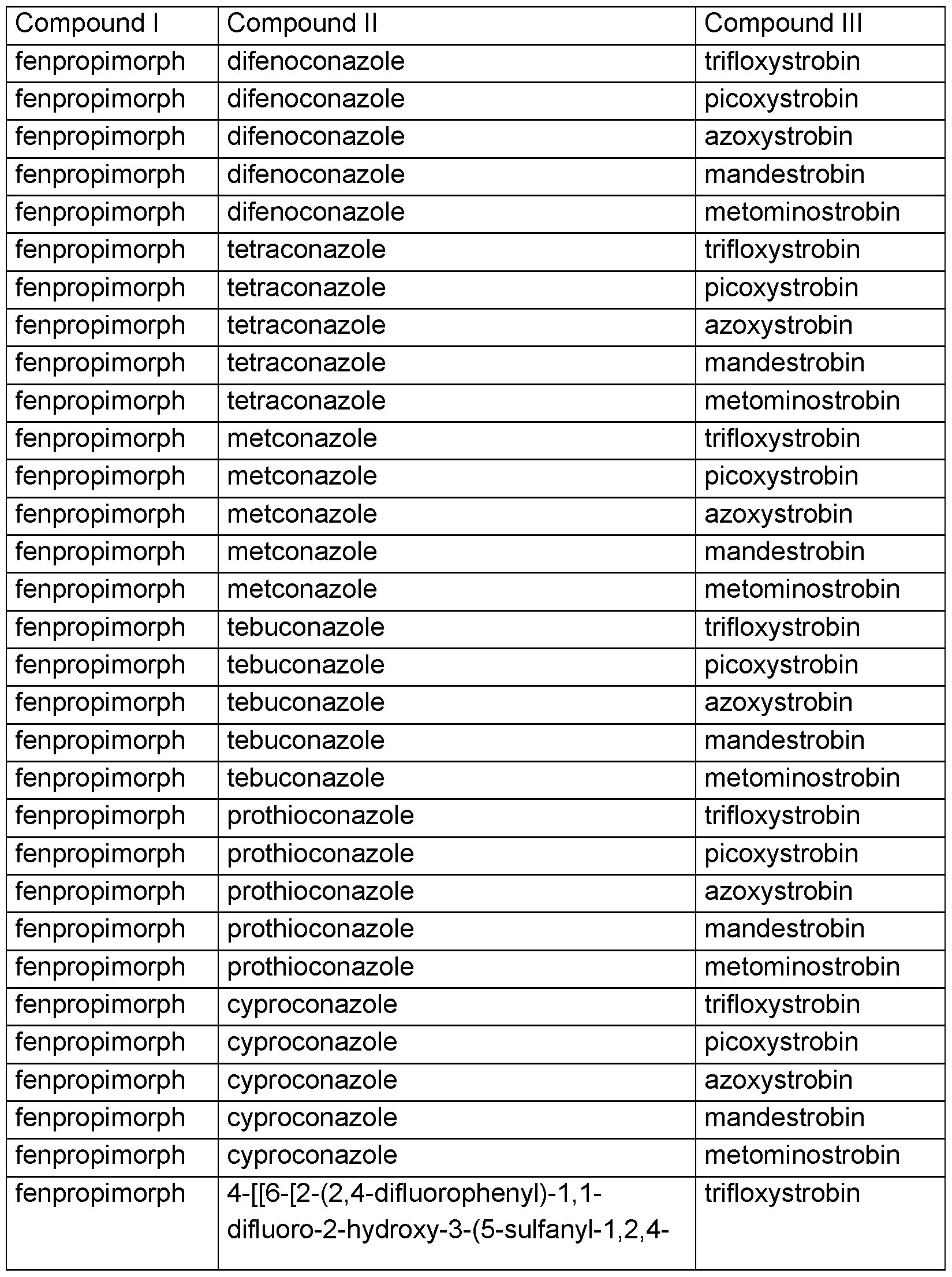
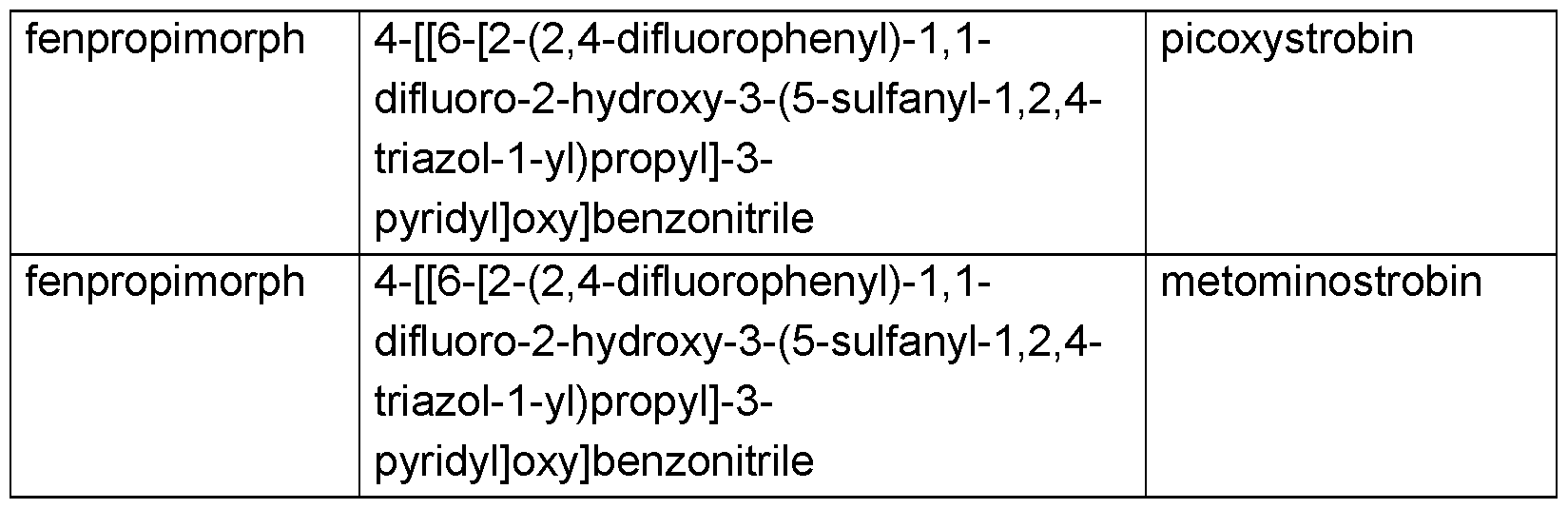
- the present invention relates to synergistic three way mixtures set forth in the table below, comprising three components, as the case may be:
- compositions e.g. solutions, emulsions, suspensions, dusts, powders, pastes, granules, pressings, capsules, and mixtures thereof.
- composition types are suspensions (e.g. SC, OD, FS), emulsifiable concentrates (e.g. EC), emulsions (e.g. EW, EO, ES, ME), capsules (e.g. CS, ZC), pastes, pastilles, wetable powders or dusts (e.g. WP, SP, WS, DP, DS), pressings (e.g. BR, TB, DT), granules (e.g.
- compositions types are defined in the “Catalogue of pesticide formulation types and international coding system”, Technical Monograph No. 2, 6 th Ed. May 2008, CropLife Interna tional.
- compositions are prepared in a known manner, such as described by Mollet and Grube- mann, Formulation technology, Wiley VCH, Weinheim, 2001; or Knowles, New developments in crop protection product formulation, Agrow Reports DS243, T&F Informa, London, 2005.
- auxiliaries are solvents, liquid carriers, solid carriers or fillers, surfactants, dispersants, emulsifiers, wetters, adjuvants, solubilizers, penetration enhancers, protective colloids, adhe sion agents, thickeners, humectants, repellents, attractants, feeding stimulants, compatibilizers, bactericides, anti-freezing agents, anti-foaming agents, colorants, tackifiers and binders.
- Suitable solvents and liquid carriers are water and organic solvents, such as mineral oil frac tions of medium to high boiling point, e.g. kerosene, diesel oil; oils of vegetable or animal origin; aliphatic, cyclic and aromatic hydrocarbons, e. g. toluene, paraffin, tetrahydronaphthalene, al kylated naphthalenes; alcohols, e.g. ethanol, propanol, butanol, benzylalcohol, cyclohexanol; glycols; DMSO; ketones, e.g. cyclohexanone; esters, e.g.
- mineral oil frac tions of medium to high boiling point e.g. kerosene, diesel oil
- oils of vegetable or animal origin oils of vegetable or animal origin
- aliphatic, cyclic and aromatic hydrocarbons e. g. toluene, paraffin, tetrahydronaphthalene
- lactates carbonates, fatty acid esters, gamma-butyrolactone; fatty acids; phosphonates; amines; amides, e.g. N-methylpyrrolidone, fatty acid dimethylamides; and mixtures thereof.
- Suitable solid carriers or fillers are mineral earths, e.g. silicates, silica gels, talc, kaolins, lime stone, lime, chalk, clays, dolomite, diatomaceous earth, bentonite, calcium sulfate, magnesium sulfate, magnesium oxide; polysaccharides, e.g. cellulose, starch; fertilizers, e.g. ammonium sulfate, ammonium phosphate, ammonium nitrate, ureas; products of vegetable origin, e.g. ce real meal, tree bark meal, wood meal, nutshell meal, and mixtures thereof.
- mineral earths e.g. silicates, silica gels, talc, kaolins, lime stone, lime, chalk, clays, dolomite, diatomaceous earth, bentonite, calcium sulfate, magnesium sulfate, magnesium oxide
- polysaccharides e.g. cellulose, starch
- Suitable surfactants are surface-active compounds, such as anionic, cationic, nonionic and am photeric surfactants, block polymers, polyelectrolytes, and mixtures thereof. Such surfactants can be used as emulsifier, dispersant, solubilizer, wetter, penetration enhancer, protective col loid, or adjuvant. Examples of surfactants are listed in McCutcheon’s, Vol.1 : Emulsifiers & De tergents, McCutcheon’s Directories, Glen Rock, USA, 2008 (International Ed. or North American Ed.).
- Suitable anionic surfactants are alkali, alkaline earth or ammonium salts of sulfonates, sulfates, phosphates, carboxylates, and mixtures thereof.
- sulfonates are alkylarylsulfonates, diphenylsulfonates, alpha-olefin sulfonates, lignine sulfonates, sulfonates of fatty acids and oils, sulfonates of ethoxylated alkylphenols, sulfonates of alkoxylated arylphenols, sulfonates of con densed naphthalenes, sulfonates of dodecyl- and tridecylbenzenes, sulfonates of naphthalenes and alkylnaphthalenes, sulfosuccinates or sulfosuccinamates.
- Examples of sulfates are sulfates of fatty acids and oils, of ethoxylated alkylphenols, of alcohols, of ethoxylated alcohols, or of fatty acid esters.
- Examples of phosphates are phosphate esters.
- Examples of carboxylates are alkyl carboxylates, and carboxylated alcohol or alkylphenol ethoxylates.
- Suitable nonionic surfactants are alkoxylates, N-subsituted fatty acid amides, amine oxides, esters, sugar-based surfactants, polymeric surfactants, and mixtures thereof.
- alkoxylates are compounds such as alcohols, alkylphenols, amines, amides, arylphenols, fatty acids or fatty acid esters which have been alkoxylated with 1 to 50 equivalents.
- Ethylene oxide and/or propylene oxide may be employed for the alkoxylation, preferably ethylene oxide.
- Exam ples of N-substituted fatty acid amides are fatty acid glucamides or fatty acid alkanolamides.
- esters are fatty acid esters, glycerol esters or monoglycerides.
- sugar- based surfactants are sorbitans, ethoxylated sorbitans, sucrose and glucose esters or al- kylpolyglucosides.
- polymeric surfactants are home- or copolymers of vinylpyrroli- done, vinylalcohols, or vinylacetate.
- Suitable cationic surfactants are quaternary surfactants, for example quaternary ammonium compounds with one or two hydrophobic groups, or salts of long-chain primary amines.
- Suitable amphoteric surfactants are alkylbetains and imidazolines.
- Suitable block polymers are block polymers of the A-B or A-B-A type comprising blocks of polyethylene oxide and polypropylene oxide, or of the A-B-C type comprising alkanol, polyethylene oxide and polypropylene oxide.
- Suitable polyelectrolytes are polyacids or polybases. Examples of polyacids are alkali salts of polyacrylic acid or polyacid comb polymers. Examples of polybases are polyvinylamines or pol- yethyleneamines.
- Suitable adjuvants are compounds, which have a neglectable or even no pesticidal activity themselves, and which improve the biological performance of the inventive mixtures on the tar get.
- examples are surfactants, mineral or vegetable oils, and other auxilaries. Further examples are listed by Knowles, Adjuvants and additives, Agrow Reports DS256, T&F Informa UK, 2006, chapter 5.
- Suitable thickeners are polysaccharides (e.g. xanthan gum, carboxymethylcellulose), inorganic clays (organically modified or unmodified), polycarboxylates, and silicates.
- Suitable bactericides are bronopol and isothiazolinone derivatives such as alkylisothiazolinones and benzisothiazolinones.
- Suitable anti-freezing agents are ethylene glycol, propylene glycol, urea and glycerin.
- Suitable anti-foaming agents are silicones, long chain alcohols, and salts of fatty acids.
- Suitable colorants are pigments of low water solubility and water- soluble dyes.
- examples are inorganic colorants (e.g. iron oxide, titan oxide, iron hexacyanofer- rate) and organic colorants (e.g. alizarin-, azo- and phthalocyanine colorants).
- Suitable tackifiers or binders are polyvinylpyrrolidons, polyvinylacetates, polyvinyl alcohols, pol yacrylates, biological or synthetic waxes, and cellulose ethers.
- composition types and their preparation are: i) Water-soluble concentrates (SL, LS)
- emulsifiers e.g. calcium dodecylbenzene- sulfonate and castor oil ethoxylate
- water-insoluble organic solvent e.g. aromatic hydrocarbon
- an inventive mixture 20-60 wt% are comminuted with addition of 2- 10 wt% dispersants and wetting agents (e.g. sodium lignosulfonate and alcohol ethoxylate), 0.1- 2 wt% thickener (e.g. xanthan gum) and water ad 100 wt% to give a fine active substance sus pension. Dilution with water gives a stable suspension of the active substance.
- dispersants and wetting agents e.g. sodium lignosulfonate and alcohol ethoxylate
- 0.1- 2 wt% thickener e.g. xanthan gum
- water ad 100 wt% 100 wt% to give a fine active substance sus pension. Dilution with water gives a stable suspension of the active substance.
- binder e.g. polyvinylalcohol
- an inventive mixture 50-80 wt% of an inventive mixture are ground finely with addition of dispersants and wetting agents (e.g. sodium lignosulfonate and alcohol ethoxylate) ad 100 wt% and prepared as water- dispersible or water-soluble granules by means of technical appliances (e. g. extrusion, spray tower, fluidized bed). Dilution with water gives a stable dispersion or solution of the active sub stance.
- dispersants and wetting agents e.g. sodium lignosulfonate and alcohol ethoxylate
- wt% of an inventive mixture are ground in a rotor-stator mill with addition of 1-5 wt% dispersants (e.g. sodium lignosulfonate), 1-3 wt% wetting agents (e.g. alcohol ethoxylate) and solid carrier (e.g. silica gel) ad 100 wt%. Dilution with water gives a stable dispersion or solution of the active substance.
- dispersants e.g. sodium lignosulfonate
- wetting agents e.g. alcohol ethoxylate
- solid carrier e.g. silica gel
- an inventive mixture In an agitated ball mill, 5-25 wt% of an inventive mixture are comminuted with addition of 3- 10 wt% dispersants (e.g. sodium lignosulfonate), 1-5 wt% thickener (e.g. carboxy- methylcellulose) and water ad 100 wt% to give a fine suspension of the active substance. Dilu tion with water gives a stable suspension of the active substance.
- dispersants e.g. sodium lignosulfonate
- 1-5 wt% thickener e.g. carboxy- methylcellulose
- an inventive mixture 5-20 wt% are added to 5-30 wt% organic solvent blend (e.g. fatty ac id dimethylamide and cyclohexanone), 10-25 wt% surfactant blend (e.g. alcohol ethoxylate and arylphenol ethoxylate), and water ad 100 %. This mixture is stirred for 1 h to produce spontane ously a thermodynamicallystable microemulsion.
- organic solvent blend e.g. fatty ac id dimethylamide and cyclohexanone
- surfactant blend e.g. alcohol ethoxylate and arylphenol ethoxylate
- An oil phase comprising 5-50 wt% of an inventive mixture, 0-40 wt% water insoluble organic solvent (e.g. aromatic hydrocarbon), 2-15 wt% acrylic monomers (e.g. methylmethacrylate, methacrylic acid and a di- or triacrylate) are dispersed into an aqueous solution of a protective colloid (e.g. polyvinyl alcohol). Radical polymerization initiated by a radical initiator results in the formation of poly(meth)acrylate microcapsules.
- an oil phase comprising 5-50 wt% of an inventive mixture according to the invention, 0-40 wt% water insoluble organic solvent (e.g. aromatic hydrocarbon), and an isocyanate monomer (e.g.
- diphenylmethene-4,4’- diisocyanatae are dispersed into an aqueous solution of a protective colloid (e.g. polyvinyl al cohol).
- a protective colloid e.g. polyvinyl al cohol
- the addition of a polyamine results in the formation of pol yurea microcapsules.
- the monomers amount to 1-10 wt%. The wt% relate to the total CS com position.
- organic solvent e.g. aromatic hydro carbon
- compositions types i) to xiii) may optionally comprise further auxiliaries, such as 0.1-1 wt% bactericides, 5-15 wt% anti-freezing agents, 0.1-1 wt% anti-foaming agents, and 0.1-1 wt% col orants.
- auxiliaries such as 0.1-1 wt% bactericides, 5-15 wt% anti-freezing agents, 0.1-1 wt% anti-foaming agents, and 0.1-1 wt% col orants.
- the resulting agrochemical compositions generally comprise between 0.01 and 95%, preferably between 0.1 and 90%, and in particular between 0.5 and 75%, by weight of active substance.
- the active substances are employed in a purity of from 90% to 100%, preferably from 95% to 100% (according to NMR spectrum).
- Solutions for seed treatment (LS), Suspoemulsions (SE), flowable concentrates (FS), powders for dry treatment (DS), water-dispersible powders for slurry treatment (WS), water-soluble pow ders (SS), emulsions (ES), emulsifiable concentrates (EC) and gels (GF) are usually employed for the purposes of treatment of plant propagation materials, particularly seeds.
- the composi tions in question give, after two-to-tenfold dilution, active substance concentrations of from 0.01 to 60% by weight, preferably from 0.1 to 40%, in the ready-to-use preparations. Application can be carried out before or during sowing.
- Methods for applying the inventive mixtures and compo sitions thereof, respectively, on to plant propagation material, especially seeds include dressing, coating, pelleting, dusting, soaking and in-furrow application methods of the propagation mate rial.
- the inventive mixtures or the compositions thereof, respectively are applied on to the plant propagation material by a method such that germination is not induced, e. g. by seed dressing, pelleting, coating and dusting.
- the amounts of active substances applied are, depending on the kind of effect desired, from 0.001 to 2 kg per ha, preferably from 0.005 to 2 kg per ha, more preferably from 0.01 to 1.0 kg per ha, and in particular from 0.05 to 0.75 kg per ha.
- amounts of active substance of from 0.01 -10kg, preferably from 0.1-1000 g, more prefer ably from 1-100 g per 100 kilogram of plant propagation material (preferably seeds) are general ly required.
- the amount of active substance applied depends on the kind of application area and on the desired effect. Amounts customarily applied in the protection of materials are 0.001 g to 2 kg, preferably 0.005 g to 1 kg, of active substance per cubic meter of treated material.
- oils, wetters, adjuvants, fertilizer, or micronutrients, and further pesticides may be added to the active substances or the compositions comprising them as premix or, if appropriate not until immedi ately prior to use (tank mix).
- pesticides e.g. herbicides, insecticides, fungicides, growth regulators, safeners
- These agents can be admixed with the compositions according to the invention in a weight ratio of 1 : 100 to 100: 1 , preferably 1 : 10 to 10: 1.
- the user applies the composition according to the invention usually from a predosage device, a knapsack sprayer, a spray tank, a spray plane, or an irrigation system.
- the agrochemi cal composition is made up with water, buffer, and/or further auxiliaries to the desired applica tion concentration and the ready-to-use spray liquor or the agrochemical composition according to the invention is thus obtained.
- 20 to 2000 liters, preferably 50 to 400 liters, of the ready-to-use spray liquor are applied per hectare of agricultural useful area.
- individual components of the composition according to the in vention such as parts of a kit or parts of a binary mixture may be mixed by the user himself in a spray tank or any other kind of vessel used for applications (e. g. seed treater drums, seed pel leting machinery, knapsack sprayer) and further auxiliaries may be added, if appropriate.
- a spray tank or any other kind of vessel used for applications (e. g. seed treater drums, seed pel leting machinery, knapsack sprayer) and further auxiliaries may be added, if appropriate.
- one embodiment of the invention is a kit for preparing a usable pesticidal com position, the kit comprising a) a composition comprising component 1) as defined herein and at least one auxiliary; and b) a composition comprising component 2) as defined herein and at least one auxiliary; and optionally c) a composition comprising at least one auxiliary and option ally a further active component 3) as defined herein.
- the present invention comprises an use of the mixture for controlling phytopath- ogenic harmful fungi and to a method for controlling phytopathogenic pests, wherein the pest, their habitat, breeding grounds, their locus or the plants to be protected against pest attack, the soil or plant propagation material are treated with an effective amount of the mixture.
- inventive mixtures are suitable for controlling the following fungal plant diseases:
- Albugo spp. white rust on ornamentals, vegetables (e. g. A. Candida) and sunflowers (e. g. A. tragopogonis); Alternaria spp. (Alternaria leaf spot) on vegetables (e.g. A. dauci or A. porri), oilseed rape (A. brassicicola or brassicae), sugar beets (A. tenuis), fruits (e.g. A. grandis), rice, soybeans, potatoes and tomatoes (e. g. A. solani, A. grandis or A. alternata), tomatoes (e. g. A. solani or A. alternata) and wheat (e.g. A. triticina); Aphanomyces spp.
- Ascochyta spp. on cereals and vegetables e. g. A. tritici (anthracnose) on wheat and A. hordei on barley; Aureobasidium zeae (syn. Kapatiella zeae) on corn; Bipolaris and Drechslera spp. (teleomorph: Cochliobolus spp.), e. g. Southern leaf blight (D. maydis) or Northern leaf blight (B. zeicola) on corn, e. g. spot blotch (B. sorokiniana) on cereals and e. g. B.
- Botrytis cinerea teleomorph: Botryotinia fuckeliana: grey mold
- fruits and berries e. g. strawberries
- vegetables e. g. lettuce, carrots, celery and cabbages
- B. squamo sa or B. allii on onion family oilseed rape, ornamentals (e.g. B eliptica), vines, forestry plants and wheat
- Bremia lactucae downy mildew
- Ceratocystis syn. Ophiostoma
- mycophilum (formerly Dactylium dendroides, teleomorph: Nectria albertinii, Nectria rosella syn. Hypomyces rosellus) on mushrooms; Cladosporium spp. on tomatoes (e. g. C. fulvum: leaf mold) and cere als, e. g. C. herbarum (black ear) on wheat; Claviceps purpurea (ergot) on cereals; Cochliobo lus (anamorph: Helminthosporium of Bipolaris) spp. (leaf spots) on corn (C. carbonum), cereals (e. g. C. sativus, anamorph: B. sorokiniana) and rice (e.
- Corticium spp. e. g. C. sasakii (sheath blight) on rice; Corynespora cassiicola (leaf spots) on soybeans and ornamentals; Cy- cloconium spp., e. g. C. oleaginum on olive trees; Cylindrocarpon spp. (e. g. fruit tree canker or young vine decline, teleomorph: Nectria or Neonectria spp.) on fruit trees, vines (e. g. C.
- lirio- dendri teleomorph: Neonectria liriodendri: Black Foot Disease) and ornamentals; Dematophora (teleomorph: Rosellinia) necatrix (root and stem rot) on soybeans; Diaporthe spp., e. g. D. phaseolorum (damping off) on soybeans; Drechslera (syn. Helminthosporium, teleomorph: Pyr- enophora) spp. on corn, cereals, such as barley (e. g. D. teres, net blotch) and wheat (e. g. D. D.
- tritici-repentis tan spot), rice and turf; Esca (dieback, apoplexy) on vines, caused by Formiti- poria (syn. Phellinus) punctata, F. mediterranea, Phaeomoniella chlamydospora (formerly Phaeoacremonium chlamydosporum), Phaeoacremonium aleophilum and/or Botryosphaeria obtusa; Elsinoe spp. on pome fruits (E. pyri), soft fruits (E. veneta: anthracnose) and vines (E.
- ampelina anthracnose
- Entyloma oryzae leaf smut
- Epicoccum spp. black mold
- Erysiphe spp. potowdery mildew
- sugar beets E. betae
- vegetables e. g. E. pisi
- cucurbits e. g. E. cichoracearum
- cabbages oilseed rape (e. g. E. cruciferarum)
- Eu- typa lata Eutypa canker or dieback, anamorph: Cytosporina lata, syn.
- meibo- miae (soybean rust) on soybeans; Phialophora spp. e. g. on vines (e. g. P. tracheiphila and P. tetraspora) and soybeans (e. g. P. gregata: stem rot); Phoma lingam (syn. Leptosphaeria bi- globosa and L. maculans: root and stem rot) on oilseed rape and cabbage, P. betae (root rot, leaf spot and damping-off) on sugar beets and P. zeae-maydis (syn. Phyllostica zeae) on corn; Phomopsis spp.
- soybeans e. g. stem rot: P. phaseoli, teleomorph: Diaporthe phaseolorum
- Physoderma maydis brown spots
- Phytophthora spp. wilt, root, leaf, fruit and stem root
- various plants such as papri ka and cucurbits (e. g. P. capsici), soybeans (e. g. P. megasperma, syn. P. sojae), potatoes and tomatoes (e. g. P. infestans: late blight) and broad-leaved trees (e. g. P.
- Plasmodiophora brassicae club root
- Plasmopara spp. e. g. P. viticola (grapevine downy mildew) on vines and P. halstedii on sun flowers
- Podosphaera spp. powdery mildew
- Polymyxa spp. e. g. on cereals, such as barley and wheat (P. graminis) and sugar beets (P.
- Pseudocercosporella herpotrichoides (syn. Oculimacula yallundae, O. acuformis: eye- spot, teleomorph: Tapesia yallundae) on cereals, e. g. wheat or barley; Pseudoperonospora (downy mildew) on various plants, e. g. P. cubensis on cucurbits or P. humili on hop; Pseudo- pezicula tracheiphila (red fire disease or .rotbrenner’, anamorph: Phialophora) on vines; Puccin- ia spp.
- rusts on various plants e. g. P. triticina (brown or leaf rust), P. striiformis (stripe or yel low rust), P. hordei (dwarf rust), P. graminis (stem or black rust) or P. recondita (brown or leaf rust) on cereals, such as e. g. wheat, barley or rye, P. kuehnii (orange rust) on sugar cane and P. asparagi on asparagus; Pyrenopeziza spp., e.g. P.
- oligandrum on mushrooms
- Ramularia spp. e. g. R. collo-cygni (Ramularia leaf spots, Physiological leaf spots) on barley and R. beticola on sugar beets
- Rhi- zoctonia spp. on cotton, rice, potatoes, turf, corn, oilseed rape, potatoes, sugar beets, vegeta bles and various other plants, e. g. R. solani (root and stem rot) on soybeans, R. solani (sheath blight) on rice or R.
- rolfsii (syn. Athelia rolfsii) on soybeans, peanut, vegetables, corn, cereals and orna mentals; Septoria spp. on various plants, e. g. S. glycines (brown spot) on soybeans, S. tritici (syn. Zymoseptoria tritici, Septoria blotch) on wheat and S. (syn. Stagonospora) nodorum (Stagonospora blotch) on cereals; Uncinula (syn.
- Erysiphe necator prowdery mildew, ana morph: Oidium tuckeri
- Setosphaeria spp. leaf blight
- corn e. g. S. turcicum, syn. Helminthosporium turcicum
- turf e. g. S. reiliana, syn. Ustilago reiliana: head smut
- Sphaerotheca fuliginea syn.
- Podo- sphaera xanthii powdery mildew) on cucurbits; Spongospora subterranea (powdery scab) on potatoes and thereby transmitted viral diseases; Stagonospora spp. on cereals, e. g. S. no dorum (Stagonospora blotch, teleomorph: Leptosphaeria [syn. Phaeosphaeria] nodorum, syn. Septoria nodorum) on wheat; Synchytrium endobioticum on potatoes (potato wart disease); Ta- phrina spp., e. g. T. deformans (leaf curl disease) on peaches and T.
- pruni plum pocket
- Thielaviopsis spp. black root rot
- tobacco, pome fruits, vegetables, soybeans and cotton e. g. T. basicola (syn. Chalara elegans)
- Tilletia spp. common bunt or stinking smut
- wheat Trichoderma harzianum on mushrooms
- Typhula incarnata grey snow mold
- Urocystis spp. e. g. U.
- occulta stem smut
- Uromyces spp. rust
- vege tables such as beans (e. g. U. appendiculatus, syn. U. phaseoli), sugar beets (e. g. U. betae or U. beticola) and on pulses (e.g. U. vignae, U. pisi, U. viciae-fabae and U. fabae); Ustilago spp. (loose smut) on cereals (e. g. U. nuda and U. avaenae), corn (e. g. U. maydis: corn smut) and sugar cane; Venturia spp.
- beans e. g. U. appendiculatus, syn. U. phaseoli
- sugar beets e. g. U. betae or U. beticola
- pulses e.g. U. vignae, U. pisi, U. viciae-
- the inventive mixtures are suitable for controlling the following fungal diseases on soybeans: Alternaria spp. (Alternaria leaf spot); Cercospora spp. (Cercospora leaf spots), e. g. C. sojina or C. kikuchii); Colletotrichum (teleomorph: Glomerella) spp. (anthracnose), e. g. C. truncatum or C. gloeosporioides); Corynespora cassiicola (leaf spots); Dematophora (teleo morph: Rosellinia) necatrix (root and stem rot); Diaporthe spp., e. g. D.
- phaseolorum (damping off); Fusarium (teleomorph: Gibberella) spp. (wilt, root or stem rot), e.g. F. tucumaniae and F. brasiliense each causing sudden death syndrome on soybeans; Macrophomina phaseolina (syn. phaseoli) (root and stem rot); Microsphaera diffusa (powdery mildew); Peronospora spp. (downy mildew), e. g. P. manshurica; Phakopsora pachyrhizi and P. meibomiae (soybean rust); Phialophora spp., e. g. P.
- stem rot Phomopsis spp., e. g. stem rot: P. phaseoli (teleo morph: Diaporthe phaseolorum); Pythium spp. (damping-off); Phytophthora spp. (wilt, root, leaf, fruit and stem root), e. g. P. megasperma, syn. P. sojae); Rhizoctonia spp., e. g. R. solani (root and stem rot); Sclerotinia spp. (stem rot or white mold); Septoria spp., e. g. S. glycines (brown spot); S. rolfsii (syn. Athelia rolfsii); Thielaviopsis spp. (black root rot).
- P. phaseoli teleo morph: Diaporthe phaseolorum
- Pythium spp. damage-off
- Phytophthora spp. wil
- the inventive mixtures are suitable for controlling the following fungal diseases on soybeans: Alternaria spp. (Alternaria leaf spot); Cercospora spp. (Cercospora leaf spots), e. g. C. sojina or C. kikuchii); Colletotrichum (teleomorph: Glomerella) spp. (anthracnose), e. g.
- D. phaseolorum (damping off); Fusarium (teleomorph: Gibberella) spp. (wilt, root or stem rot), e.g. F. tucumaniae and F. brasiliense each causing sudden death syndrome on soybeans; Mac rophomina phaseolina (syn. phaseoli) (root and stem rot); Peronospora spp. (downy mildew), e. g. P. manshurica; Phakopsora pachyrhizi and P. meibomiae (soybean rust); Phomopsis spp., e. g. stem rot: P.
- phaseoli teleomorph: Diaporthe phaseolorum
- Phytophthora spp. wilt, root, leaf, fruit and stem root
- Rhizoctonia spp. e. g. R. solani (root and stem rot)
- Septoria spp. e. g. S. glycines (brown spot).
- the inventive mixtures are suitable for controlling Phakopsora pachyrhizi and P meibomiae (soybean rust) on soybeans.
- the mixtures according to the present invention are also suitable for controlling harmful fungi in the protection of stored products or harvest and in the protection of materials.
- protection of materials is to be understood to denote the protection of technical and non-living materials, such as adhesives, glues, wood, paper and paperboard, textiles, leather, paint dispersions, plastics, cooling lubricants, fiber or fabrics, against the infestation and de struction by harmful microorganisms, such as fungi and bacteria.
- Ascomycetes such as Ophiostoma spp., Ceratocystis spp., Aureobasidium pullulans, Sclerophoma spp., Chaetomium spp., Humicola spp., Petriella spp., Trichurus spp.; Basidiomycetes such as Coni- ophora spp., Coriolus spp., Gloeophyllum spp., Lentinus spp., Pleurotus spp., Poria spp., Ser- pula spp.
- yeast fungi are worthy of note: Candida spp. and Saccharomyces cerevisae.
- the inventive mix tures are used in soya (soybean), cereals and corn.
- pesticidally effective amount means the amount of the inventive mixtures or of compositions comprising the mixtures needed to achieve an observable effect on growth, in cluding the effects of necrosis, death, retardation, prevention, and removal, destruction, or oth erwise diminishing the occurrence and activity of the target organism.
- the pesticidally effective amount can vary for the various mixtures / compositions used in the invention.
- a pesticidally effective amount of the mixtures / compositions will also vary according to the prevailing condi tions such as desired pesticidal effect and duration, weather, target species, locus, mode of application, and the like.
- the present invention comprises a method for improving the health of plants, wherein the plant, the locus where the plant is growing or is expected to grow or plant propaga tion material, from which the plant grows, is treated with a plant health effective amount of an inventive mixture.
- plant effective amount denotes an amount of the inventive mixtures, which is suffi cient for achieving plant health effects as defined herein below. More exemplary information about amounts, ways of application and suitable ratios to be used is given below. Again, the skilled artisan is well aware of the fact that such an amount can vary in a broad range and is dependent on various factors, e.g. the treated cultivated plant or material and the climatic condi tions.
- inventive mixtures are employed by treating the fungi or the plants, plant propagation materials (preferably seeds), materials or soil to be protected from fungal attack with a pesticidally effective amount of the active compounds.
- the application can be carried out both before and after the infection of the materials, plants or plant propagation materials (preferably seeds) by the pests.
- the term plant refers to an entire plant, a part of the plant or the propagation material of the plant.
- inventive mixtures and compositions thereof are particularly important in the control of a multitude of phytopathogenic fungi on various cultivated plants, such as cereals, e. g. wheat, rye, barley, triticale, oats or rice; beet, e. g. sugar beet or fodder beet; fruits, such as pomes, stone fruits or soft fruits, e. g.
- cereals e. g. wheat, rye, barley, triticale, oats or rice
- beet e. g. sugar beet or fodder beet
- fruits such as pomes, stone fruits or soft fruits, e. g.
- the inventive mixtures and compositions thereof are used for control ling a multitude of fungi on field crops, such as potatoes, sugar beets, tobacco, wheat, rye, bar ley, oats, rice, corn, cotton, soybeans, rape, legumes, sunflowers, coffee or sugar cane; fruits; vines; ornamentals; or vegetables, such as cucumbers, tomatoes, beans or squashes.
- field crops such as potatoes, sugar beets, tobacco, wheat, rye, bar ley, oats, rice, corn, cotton, soybeans, rape, legumes, sunflowers, coffee or sugar cane; fruits; vines; ornamentals; or vegetables, such as cucumbers, tomatoes, beans or squashes.
- treatment of plant propagation materials with the inventive mixtures and compo sitions thereof, respectively is used for controlling a multitude of fungi on cereals, such as wheat, rye, barley and oats; potatoes, tomatoes, vines, rice, corn, cotton and soybeans.
- cultiva plants is to be understood as including plants which have been modified by breeding, mutagenesis or genetic engineering including but not limiting to agricultural biotech products on the market or in development (cf. http://cera-gmc.org/, see GM crop database therein).
- Genetically modified plants are plants, which genetic material has been so modified by the use of recombinant DNA techniques that under natural circumstances cannot readily be obtained by cross breeding, mutations or natural recombination.
- one or more genes have been integrated into the genetic material of a genetically modified plant in order to improve certain properties of the plant.
- Such genetic modifications also include but are not limited to tar geted post-translational modification of protein(s), oligo- or polypeptides e. g. by glycosylation or polymer additions such as prenylated, acetylated or farnesylated moieties or PEG moieties.
- herbicides e. bromoxynil or ioxynil herbicides as a result of conventional methods of breeding or genetic engineering. Furthermore, plants have been made resistant to multiple classes of herbicides through multiple genetic modifications, such as resistance to both glyphosate and glufosinate or to both glyphosate and a herbicide from anoth er class such as ALS inhibitors, HPPD inhibitors, auxin herbicides, or ACCase inhibitors. These herbicide resistance technologies are e. g. described in Pest Management Sci. 61, 2005, 246; 61, 2005, 258; 61, 2005, 277; 61, 2005, 269; 61, 2005, 286; 64, 2008, 326; 64, 2008, 332;
- plants are also covered that are by the use of recombinant DNA techniques capa ble to synthesize one or more insecticidal proteins, especially those known from the bacterial genus Bacillus, particularly from Bacillus thuringiensis, such as d-endotoxins, e. g. CrylA(b), CrylA(c), CrylF, CrylF(a2), CryllA(b), CrylllA, CrylllB(bl) or Cry9c; vegetative insecticidal pro teins (VIP), e. g. VIP1, VIP2, VIP3 or VIP3A; insecticidal proteins of bacteria colonizing nema todes, e. g. Photorhabdus spp.
- VIP vegetative insecticidal pro teins
- toxins produced by animals such as scorpion toxins, arachnid toxins, wasp toxins, or other insect-specific neurotoxins; toxins pro prised by fungi, such Streptomycetes toxins, plant lectins, such as pea or barley lectins; aggluti nins; proteinase inhibitors, such as trypsin inhibitors, serine protease inhibitors, patatin, cystatin or papain inhibitors; ribosome-inactivating proteins (RIP), such as ricin, maize-RIP, abrin, luffin, saporin or bryodin; steroid metabolism enzymes, such as 3-hydroxysteroid oxidase, ecdyster- oid-IDP-glycosyl-transferase, cholesterol oxidases, ecdysone inhibitors or HMG-CoA-reductase; ion channel blockers, such as
- these insecticidal proteins or toxins are to be understood expressly also as pre-toxins, hybrid proteins, truncated or otherwise modified proteins.
- Hybrid proteins are characterized by a new combination of protein domains, (see, e. g. WO 02/015701).
- Further examples of such toxins or genetically modified plants ca pable of synthesizing such toxins are disclosed, e. g., in EP-A 374 753, WO 93/007278,
- WO 95/34656 EP-A 427 529, EP-A 451 878, WO 03/18810 und WO 03/52073.
- the methods for producing such genetically modified plants are generally known to the person skilled in the art and are described, e. g. in the publications mentioned above.
- These insecticidal proteins contained in the genetically modified plants impart to the plants producing these proteins toler ance to harmful pests from all taxonomic groups of athropods, especially to beetles (Coelop- tera), two-winged insects (Diptera), and moths (Lepidoptera) and to nematodes (Nematoda).
- Genetically modified plants capable to synthesize one or more insecticidal proteins are, e.
- Agrisure ® CB and Bt176 from Syngenta Seeds SAS, France, (corn cultivars producing the CrylAb toxin and PAT enzyme), MIR604 from Syngenta Seeds SAS, France (corn cultivars producing a modified version of the Cry3A toxin, c.f. WO 03/018810), MON 863 from Monsanto Europe S.A., Belgium (corn cultivars producing the Cry3Bb1 toxin), IPC 531 from Monsanto Europe S.A., Belgium (cotton cultivars producing a modified version of the CrylAc toxin) and 1507 from Pioneer Overseas Corporation, Belgium (corn cultivars producing the CrylF toxin and PAT enzyme).
- plants are also covered that are by the use of recombinant DNA techniques capa ble to synthesize one or more proteins to increase the resistance or tolerance of those plants to bacterial, viral or fungal pathogens.
- proteins are the so-called “pathogenesis- related proteins” (PR proteins, see, e. g. EP-A 392225), plant disease resistance genes (e. g. potato cultivars, which express resistance genes acting against Phytophthora infestans derived from the mexican wild potato Solanum bulbocastanum) or T4-lysozym (e. g. potato cultivars capable of synthesizing these proteins with increased resistance against bacteria such as Er- winia amylvora).
- PR proteins pathogenesis- related proteins
- plant disease resistance genes e. g. potato cultivars, which express resistance genes acting against Phytophthora infestans derived from the mexican wild potato Solanum bulbocastanum
- T4-lysozym e. g
- plants are also covered that are by the use of recombinant DNA techniques capa ble to synthesize one or more proteins to increase the productivity (e. g. bio mass production, grain yield, starch content, oil content or protein content), tolerance to drought, salinity or other growth-limiting environmental factors or tolerance to pests and fungal, bacterial or viral patho gens of those plants.
- productivity e. g. bio mass production, grain yield, starch content, oil content or protein content
- plants are also covered that contain by the use of recombinant DNA techniques a modified amount of substances of content or new substances of content, specifically to improve human or animal nutrition, e. g. oil crops that produce health-promoting long-chain omega-3 fatty acids or unsaturated omega-9 fatty acids (e. g. Nexera ® rape, DOWAgro Sciences, Cana da).
- plants are also covered that contain by the use of recombinant DNA techniques a modified amount of substances of content or new substances of content, specifically to improve raw material production, e. g. potatoes that produce increased amounts of amylopectin (e. g. Amflora ® potato, BASF SE, Germany).
- a modified amount of substances of content or new substances of content specifically to improve raw material production, e. g. potatoes that produce increased amounts of amylopectin (e. g. Amflora ® potato, BASF SE, Germany).
- the separate or joint application of the compounds of the inventive mixtures is carried out by spraying or dusting the seeds, the seedlings, the plants or the soils before or after sowing of the plants or before or after emergence of the plants.
- inventive mixtures and the compositions comprising them can be used for protecting wood en materials such as trees, board fences, sleepers, etc. and buildings such as houses, out houses, factories, but also construction materials, furniture, leathers, fibers, vinyl articles, elec tric wires and cables etc. from ants and/or termites, and for controlling ants and termites from doing harm to crops or human being (e.g. when the pests invade into houses and public facili ties).
- Customary application rates in the protection of materials are, for example, from 0.01 g to 1000 g of active compound per m 2 treated material, desirably from 0.1 g to 50 g per m 2 .
- the content of the mixture of the active ingredients is from 0.001 to 80 weight %, preferably from 0.01 to 50 weight % and most preferably from 0.01 to 15 weight.
- Example 1 Activity against the grey mold Botrytis cinerea in the microtiterplate test
- the stock solutions were mixed according to the ratio, pipetted onto a micro titer plate (MTP) and diluted with water to the stated concentrations.
- MTP micro titer plate
- a spore suspension of Botrci cinerea in an aqueous biomalt or yeast-bactopeptone-sodiumacetate solution was then added.
- the plates were placed in a water vapor-saturated chamber at a temperature of 18°C. Using an absorption photometer, the MTPs were measured at 405 nm 7 days after the inoculation.
- Example 2 Activity against leaf blotch on wheat caused by Septoria tritici
- the stock solutions were mixed according to the ratio, pipetted onto a micro titer plate (MTP) and diluted with water to the stated concentrations.
- MTP micro titer plate
- a spore suspension of Septoria tritici in an aqueous biomalt or yeast-bactopeptone-glycerine or DOB solution was then added.
- the plates were placed in a water vapor-saturated chamber at a temperature of 18°C. Using an absorption photometer, the MTPs were measured at 405 nm 7 days after the inoculation.
- the stock solutions were mixed according to the ratio, pipetted onto a micro titer plate (MTP) and diluted with water to the stated concentrations.
- MTP micro titer plate
- a spore suspension of Leptosphaeria no- dorum in an aqueous biomalt or yeast-bactopeptone-glycerine or DOB solution was then added.
- the plates were placed in a water vapor-saturated chamber at a temperature of 18°C. Using an absorption photometer, the MTPs were measured at 405 nm 7 days after the inoculation.
- the measured parameters were compared to the growth of the active compound-free control variant (100%) and the fungus-free blank value to determine the relative growth in % of the pathogens in the respective active compounds.
- An efficacy of 0 means that the growth level of the pathogens corresponds to that of the un treated control; an efficacy of 100 means that the pathogens were not growing.
- the compound was dissolved in a mixture of acetone and/or dimethylsulfoxide and the wetting agent/emulsifier Wettol, which is based on ethoxylated alkylphenoles, in a ratio (volume) sol- vent-emulsifier of 99 to 1 to give a total volume of 5 ml. Subsequently, water was added to total volume of 100 ml.
- Wettol which is based on ethoxylated alkylphenoles
- This stock solution was then diluted with the described solvent-emulsifier-water mixture to the final concentration given in the table.
- the product copper oxychloride was used as commercial finished formulation and diluted with water to the stated concentration of the active compound.
- Example 1 Protective control of soybean rust on soybeans caused by Phakopsora pachyrhizi
- Leaves of potted soybean seedlings were sprayed to run-off with the previously described spray solution, containing the concentration of active ingredient or their mixture as described below.
- the plants were allowed to air-dry.
- the trial plants were cultivated for 2 days in a greenhouse chamber at 23-27°C and a relative humidity between 60 and 80 %.
- the plants were inoculated with spores of Phakopsora pachyrhizi.
- the plants were transferred to a humid chamber with a relative humidity of about 95 % and 20 to 24 ⁇ C for 24 h.
- the trial plants were cultivated for fourteen days in a greenhouse chamber at 23-27°C and a relative humidity between 60 and 80 %.
- the extent of fungal attack on the leaves was visually assessed as % diseased leaf area.
- the disease ratings (or diseased leaf area) were converted into efficacies.
- An efficacy of 0 means that the infection level of the treated plants corresponds to that of the untreated control plants; an efficacy of 100 means that the treated plants were not infected.
Landscapes
- Life Sciences & Earth Sciences (AREA)
- Agronomy & Crop Science (AREA)
- Pest Control & Pesticides (AREA)
- Plant Pathology (AREA)
- Health & Medical Sciences (AREA)
- Engineering & Computer Science (AREA)
- Dentistry (AREA)
- General Health & Medical Sciences (AREA)
- Wood Science & Technology (AREA)
- Zoology (AREA)
- Environmental Sciences (AREA)
- Agricultural Chemicals And Associated Chemicals (AREA)
Abstract
Description


Claims




Priority Applications (1)
| Application Number | Priority Date | Filing Date | Title |
|---|---|---|---|
| BR112022019582A BR112022019582A2 (en) | 2020-04-01 | 2021-03-22 | FUNGICIDIAL MIXTURES, PESTICIDE COMPOSITION, USE OF THE MIXTURE AND METHOD TO CONTROL PHYTOPATHOGENIC PESTS |
Applications Claiming Priority (2)
| Application Number | Priority Date | Filing Date | Title |
|---|---|---|---|
| EP20167521 | 2020-04-01 | ||
| EP20167521.2 | 2020-04-01 |
Publications (1)
| Publication Number | Publication Date |
|---|---|
| WO2021197885A1 true WO2021197885A1 (en) | 2021-10-07 |
Family
ID=70154279
Family Applications (1)
| Application Number | Title | Priority Date | Filing Date |
|---|---|---|---|
| PCT/EP2021/057236 Ceased WO2021197885A1 (en) | 2020-04-01 | 2021-03-22 | Ternary mixtures containing fenpropimorph, azoles and strobilurins |
Country Status (2)
| Country | Link |
|---|---|
| BR (1) | BR112022019582A2 (en) |
| WO (1) | WO2021197885A1 (en) |
Citations (16)
| Publication number | Priority date | Publication date | Assignee | Title |
|---|---|---|---|---|
| EP0374753A2 (en) | 1988-12-19 | 1990-06-27 | American Cyanamid Company | Insecticidal toxines, genes coding therefor, antibodies binding them, transgenic plant cells and plants expressing these toxines |
| EP0392225A2 (en) | 1989-03-24 | 1990-10-17 | Ciba-Geigy Ag | Disease-resistant transgenic plants |
| EP0427529A1 (en) | 1989-11-07 | 1991-05-15 | Pioneer Hi-Bred International, Inc. | Larvicidal lectins and plant insect resistance based thereon |
| EP0451878A1 (en) | 1985-01-18 | 1991-10-16 | Plant Genetic Systems, N.V. | Modifying plants by genetic engineering to combat or control insects |
| WO1993007278A1 (en) | 1991-10-04 | 1993-04-15 | Ciba-Geigy Ag | Synthetic dna sequence having enhanced insecticidal activity in maize |
| WO1995034656A1 (en) | 1994-06-10 | 1995-12-21 | Ciba-Geigy Ag | Novel bacillus thuringiensis genes coding toxins active against lepidopteran pests |
| WO2002015701A2 (en) | 2000-08-25 | 2002-02-28 | Syngenta Participations Ag | Bacillus thuringiensis crystal protein hybrids |
| WO2003018810A2 (en) | 2001-08-31 | 2003-03-06 | Syngenta Participations Ag | Modified cry3a toxins and nucleic acid sequences coding therefor |
| WO2003052073A2 (en) | 2001-12-17 | 2003-06-26 | Syngenta Participations Ag | Novel corn event |
| WO2011110583A2 (en) * | 2010-03-10 | 2011-09-15 | Basf Se | Fungicidal mixtures comprising triazole derivatives |
| US20130203597A1 (en) * | 2010-10-07 | 2013-08-08 | Basf Se | Use of Strobilurins for Increasing the Gluten Strength in Winter Cereals |
| CN103719108A (en) * | 2013-12-13 | 2014-04-16 | 广西田园生化股份有限公司 | Ultra-low volume liquid containing picoxystrobin and morpholine bactericide and application thereof |
| WO2016187201A2 (en) | 2015-05-18 | 2016-11-24 | Viamet Pharmaceuticals, Inc. | Antifungal compounds |
| EP3162208A1 (en) | 2015-10-29 | 2017-05-03 | Helm AG | Fungicidal composition for controlling fungal infections in the soybean plant |
| WO2018098236A1 (en) * | 2016-11-22 | 2018-05-31 | Vps-3, Inc. | Fungicidal compounds and mixtures for fungal control in cereals |
| WO2018162999A1 (en) | 2017-03-07 | 2018-09-13 | Upl Ltd | Fungicidal combinations |
-
2021
- 2021-03-22 WO PCT/EP2021/057236 patent/WO2021197885A1/en not_active Ceased
- 2021-03-22 BR BR112022019582A patent/BR112022019582A2/en unknown
Patent Citations (16)
| Publication number | Priority date | Publication date | Assignee | Title |
|---|---|---|---|---|
| EP0451878A1 (en) | 1985-01-18 | 1991-10-16 | Plant Genetic Systems, N.V. | Modifying plants by genetic engineering to combat or control insects |
| EP0374753A2 (en) | 1988-12-19 | 1990-06-27 | American Cyanamid Company | Insecticidal toxines, genes coding therefor, antibodies binding them, transgenic plant cells and plants expressing these toxines |
| EP0392225A2 (en) | 1989-03-24 | 1990-10-17 | Ciba-Geigy Ag | Disease-resistant transgenic plants |
| EP0427529A1 (en) | 1989-11-07 | 1991-05-15 | Pioneer Hi-Bred International, Inc. | Larvicidal lectins and plant insect resistance based thereon |
| WO1993007278A1 (en) | 1991-10-04 | 1993-04-15 | Ciba-Geigy Ag | Synthetic dna sequence having enhanced insecticidal activity in maize |
| WO1995034656A1 (en) | 1994-06-10 | 1995-12-21 | Ciba-Geigy Ag | Novel bacillus thuringiensis genes coding toxins active against lepidopteran pests |
| WO2002015701A2 (en) | 2000-08-25 | 2002-02-28 | Syngenta Participations Ag | Bacillus thuringiensis crystal protein hybrids |
| WO2003018810A2 (en) | 2001-08-31 | 2003-03-06 | Syngenta Participations Ag | Modified cry3a toxins and nucleic acid sequences coding therefor |
| WO2003052073A2 (en) | 2001-12-17 | 2003-06-26 | Syngenta Participations Ag | Novel corn event |
| WO2011110583A2 (en) * | 2010-03-10 | 2011-09-15 | Basf Se | Fungicidal mixtures comprising triazole derivatives |
| US20130203597A1 (en) * | 2010-10-07 | 2013-08-08 | Basf Se | Use of Strobilurins for Increasing the Gluten Strength in Winter Cereals |
| CN103719108A (en) * | 2013-12-13 | 2014-04-16 | 广西田园生化股份有限公司 | Ultra-low volume liquid containing picoxystrobin and morpholine bactericide and application thereof |
| WO2016187201A2 (en) | 2015-05-18 | 2016-11-24 | Viamet Pharmaceuticals, Inc. | Antifungal compounds |
| EP3162208A1 (en) | 2015-10-29 | 2017-05-03 | Helm AG | Fungicidal composition for controlling fungal infections in the soybean plant |
| WO2018098236A1 (en) * | 2016-11-22 | 2018-05-31 | Vps-3, Inc. | Fungicidal compounds and mixtures for fungal control in cereals |
| WO2018162999A1 (en) | 2017-03-07 | 2018-09-13 | Upl Ltd | Fungicidal combinations |
Non-Patent Citations (12)
| Title |
|---|
| "Technical Monograph No. 2", May 2008, CROPLIFE INTERNATIONAL, article "Catalogue of pesticide formulation types and international coding system" |
| AUSTRAL. J. AGRICULT. RES., vol. 58, 2007, pages 708 |
| KNOWLES: "Agrow Reports DS243", 2005, T&F INFORMA, article "New developments in crop protection product formulation" |
| KNOWLES: "Agrow Reports DS256", 2006, T&F INFORMA, article "Adjuvants and additives" |
| LISE NISTRUP JØRGENSEN ET AL: "Fungicide treatments affect yield and moisture content of grain and straw in winter wheat", CROP PROTECTION., vol. 21, no. 10, 1 December 2002 (2002-12-01), GB, pages 1023 - 1032, XP055716973, ISSN: 0261-2194, DOI: 10.1016/S0261-2194(02)00086-8 * |
| MOLLETGRUBE-MANN: "Formulation technology", 2001, WILEY VCH |
| PEST MANAGEMENT SCI., vol. 61, 2005, pages 246 |
| PEST MANAGEMENT SCI., vol. 61, 2005, pages 286 |
| PEST MANAGEMENT SCI., vol. 64, 2008, pages 332 |
| R.S. COLBY: "Calculating synergistic and antagonistic responses of herbicide combinations", WEEDS, vol. 15, 1967, pages 20 - 22, XP001112961 |
| SCIENCE, vol. 316, 2007, pages 1185 |
| WEED SCI., vol. 57, 2009, pages 108 |
Also Published As
| Publication number | Publication date |
|---|---|
| BR112022019582A2 (en) | 2022-11-16 |
Similar Documents
| Publication | Publication Date | Title |
|---|---|---|
| EP3269245B1 (en) | Pesticidal compositions | |
| EP3648604B1 (en) | Fungicidal mixtures of mefentrifluconazole | |
| EP4255189B1 (en) | Mixtures containing metarylpicoxamid | |
| EP3214937B1 (en) | Pesticidal mixtures | |
| EP3675638A1 (en) | Pesticidal mixtures | |
| WO2020078797A1 (en) | Ternary mixtures containing fenpropimorph, succinate dehydrogenase inhibitors and one other compound | |
| EP3419423A1 (en) | Fungicidal mixtures comprising fluxapyroxad | |
| EP3512339A1 (en) | Pesticidal mixtures | |
| EP3484291A1 (en) | Fungicidal mixtures comprising a carboxamide | |
| WO2019007717A1 (en) | Pesticidal mixtures | |
| WO2018189001A1 (en) | Fungicide mixtures for use in rice | |
| EP3412150A1 (en) | Mixtures of meptyldinocap with sdhi fungicides | |
| EP3643175A1 (en) | Ternary pesticidal mixtures containing metyltetraprole and fenpropimorph | |
| WO2019166252A1 (en) | Fungicidal mixtures comprising fenpropidin | |
| US20190208783A1 (en) | Fungicidal Mixtures Comprising a Formamidine | |
| WO2020007646A1 (en) | Pesticidal mixtures | |
| EP3698634A1 (en) | Pesticidal mixtures | |
| EP3698633A1 (en) | Pesticidal mixtures | |
| EP3817553B1 (en) | Pesticidal mixtures | |
| WO2022128554A1 (en) | Mixtures containing n-methoxy-n-[[4-[5-(trifluoromethyl)-1,2,4-oxadiazol-3-yl]phenyl]methyl]cyclopropanecarboxamide | |
| EP3533331A1 (en) | Fungicidal mixtures comprising pydiflumetofen | |
| EP3533333A1 (en) | Fungicidal mixtures comprising pydiflumetofen | |
| WO2020078794A1 (en) | Ternary mixtures containing fenpropimorph, azoles and a multiside fungicide | |
| WO2020078795A1 (en) | Ternary mixtures containing fenpropimorph, succinate dehydrogenase inhibitors and azoles | |
| EP3698632A1 (en) | Pesticidal mixtures |
Legal Events
| Date | Code | Title | Description |
|---|---|---|---|
| 121 | Ep: the epo has been informed by wipo that ep was designated in this application |
Ref document number: 21712849 Country of ref document: EP Kind code of ref document: A1 |
|
| REG | Reference to national code |
Ref country code: BR Ref legal event code: B01A Ref document number: 112022019582 Country of ref document: BR |
|
| NENP | Non-entry into the national phase |
Ref country code: DE |
|
| ENP | Entry into the national phase |
Ref document number: 112022019582 Country of ref document: BR Kind code of ref document: A2 Effective date: 20220928 |
|
| 122 | Ep: pct application non-entry in european phase |
Ref document number: 21712849 Country of ref document: EP Kind code of ref document: A1 |