WO2021193339A1 - Three-dimensional molding kit and method for manufacturing three-dimensionally molded article - Google Patents
Three-dimensional molding kit and method for manufacturing three-dimensionally molded article Download PDFInfo
- Publication number
- WO2021193339A1 WO2021193339A1 PCT/JP2021/011038 JP2021011038W WO2021193339A1 WO 2021193339 A1 WO2021193339 A1 WO 2021193339A1 JP 2021011038 W JP2021011038 W JP 2021011038W WO 2021193339 A1 WO2021193339 A1 WO 2021193339A1
- Authority
- WO
- WIPO (PCT)
- Prior art keywords
- powder
- modeling
- value
- hsp
- liquid
- Prior art date
- Legal status (The legal status is an assumption and is not a legal conclusion. Google has not performed a legal analysis and makes no representation as to the accuracy of the status listed.)
- Ceased
Links
Images


Classifications
-
- B—PERFORMING OPERATIONS; TRANSPORTING
- B29—WORKING OF PLASTICS; WORKING OF SUBSTANCES IN A PLASTIC STATE IN GENERAL
- B29C—SHAPING OR JOINING OF PLASTICS; SHAPING OF MATERIAL IN A PLASTIC STATE, NOT OTHERWISE PROVIDED FOR; AFTER-TREATMENT OF THE SHAPED PRODUCTS, e.g. REPAIRING
- B29C64/00—Additive manufacturing, i.e. manufacturing of three-dimensional [3D] objects by additive deposition, additive agglomeration or additive layering, e.g. by 3D printing, stereolithography or selective laser sintering
- B29C64/10—Processes of additive manufacturing
- B29C64/165—Processes of additive manufacturing using a combination of solid and fluid materials, e.g. a powder selectively bound by a liquid binder, catalyst, inhibitor or energy absorber
-
- B—PERFORMING OPERATIONS; TRANSPORTING
- B22—CASTING; POWDER METALLURGY
- B22F—WORKING METALLIC POWDER; MANUFACTURE OF ARTICLES FROM METALLIC POWDER; MAKING METALLIC POWDER; APPARATUS OR DEVICES SPECIALLY ADAPTED FOR METALLIC POWDER
- B22F10/00—Additive manufacturing of workpieces or articles from metallic powder
- B22F10/10—Formation of a green body
- B22F10/14—Formation of a green body by jetting of binder onto a bed of metal powder
-
- B—PERFORMING OPERATIONS; TRANSPORTING
- B22—CASTING; POWDER METALLURGY
- B22F—WORKING METALLIC POWDER; MANUFACTURE OF ARTICLES FROM METALLIC POWDER; MAKING METALLIC POWDER; APPARATUS OR DEVICES SPECIALLY ADAPTED FOR METALLIC POWDER
- B22F10/00—Additive manufacturing of workpieces or articles from metallic powder
- B22F10/60—Treatment of workpieces or articles after build-up
- B22F10/68—Cleaning or washing
-
- B—PERFORMING OPERATIONS; TRANSPORTING
- B29—WORKING OF PLASTICS; WORKING OF SUBSTANCES IN A PLASTIC STATE IN GENERAL
- B29C—SHAPING OR JOINING OF PLASTICS; SHAPING OF MATERIAL IN A PLASTIC STATE, NOT OTHERWISE PROVIDED FOR; AFTER-TREATMENT OF THE SHAPED PRODUCTS, e.g. REPAIRING
- B29C64/00—Additive manufacturing, i.e. manufacturing of three-dimensional [3D] objects by additive deposition, additive agglomeration or additive layering, e.g. by 3D printing, stereolithography or selective laser sintering
- B29C64/30—Auxiliary operations or equipment
-
- B—PERFORMING OPERATIONS; TRANSPORTING
- B29—WORKING OF PLASTICS; WORKING OF SUBSTANCES IN A PLASTIC STATE IN GENERAL
- B29C—SHAPING OR JOINING OF PLASTICS; SHAPING OF MATERIAL IN A PLASTIC STATE, NOT OTHERWISE PROVIDED FOR; AFTER-TREATMENT OF THE SHAPED PRODUCTS, e.g. REPAIRING
- B29C64/00—Additive manufacturing, i.e. manufacturing of three-dimensional [3D] objects by additive deposition, additive agglomeration or additive layering, e.g. by 3D printing, stereolithography or selective laser sintering
- B29C64/30—Auxiliary operations or equipment
- B29C64/35—Cleaning
-
- B—PERFORMING OPERATIONS; TRANSPORTING
- B33—ADDITIVE MANUFACTURING TECHNOLOGY
- B33Y—ADDITIVE MANUFACTURING, i.e. MANUFACTURING OF THREE-DIMENSIONAL [3-D] OBJECTS BY ADDITIVE DEPOSITION, ADDITIVE AGGLOMERATION OR ADDITIVE LAYERING, e.g. BY 3-D PRINTING, STEREOLITHOGRAPHY OR SELECTIVE LASER SINTERING
- B33Y10/00—Processes of additive manufacturing
-
- B—PERFORMING OPERATIONS; TRANSPORTING
- B33—ADDITIVE MANUFACTURING TECHNOLOGY
- B33Y—ADDITIVE MANUFACTURING, i.e. MANUFACTURING OF THREE-DIMENSIONAL [3-D] OBJECTS BY ADDITIVE DEPOSITION, ADDITIVE AGGLOMERATION OR ADDITIVE LAYERING, e.g. BY 3-D PRINTING, STEREOLITHOGRAPHY OR SELECTIVE LASER SINTERING
- B33Y40/00—Auxiliary operations or equipment, e.g. for material handling
- B33Y40/20—Post-treatment, e.g. curing, coating or polishing
-
- B—PERFORMING OPERATIONS; TRANSPORTING
- B33—ADDITIVE MANUFACTURING TECHNOLOGY
- B33Y—ADDITIVE MANUFACTURING, i.e. MANUFACTURING OF THREE-DIMENSIONAL [3-D] OBJECTS BY ADDITIVE DEPOSITION, ADDITIVE AGGLOMERATION OR ADDITIVE LAYERING, e.g. BY 3-D PRINTING, STEREOLITHOGRAPHY OR SELECTIVE LASER SINTERING
- B33Y70/00—Materials specially adapted for additive manufacturing
- B33Y70/10—Composites of different types of material, e.g. mixtures of ceramics and polymers or mixtures of metals and biomaterials
-
- B—PERFORMING OPERATIONS; TRANSPORTING
- B33—ADDITIVE MANUFACTURING TECHNOLOGY
- B33Y—ADDITIVE MANUFACTURING, i.e. MANUFACTURING OF THREE-DIMENSIONAL [3-D] OBJECTS BY ADDITIVE DEPOSITION, ADDITIVE AGGLOMERATION OR ADDITIVE LAYERING, e.g. BY 3-D PRINTING, STEREOLITHOGRAPHY OR SELECTIVE LASER SINTERING
- B33Y80/00—Products made by additive manufacturing
-
- C—CHEMISTRY; METALLURGY
- C08—ORGANIC MACROMOLECULAR COMPOUNDS; THEIR PREPARATION OR CHEMICAL WORKING-UP; COMPOSITIONS BASED THEREON
- C08G—MACROMOLECULAR COMPOUNDS OBTAINED OTHERWISE THAN BY REACTIONS ONLY INVOLVING UNSATURATED CARBON-TO-CARBON BONDS
- C08G18/00—Polymeric products of isocyanates or isothiocyanates
- C08G18/06—Polymeric products of isocyanates or isothiocyanates with compounds having active hydrogen
- C08G18/28—Polymeric products of isocyanates or isothiocyanates with compounds having active hydrogen characterised by the compounds used containing active hydrogen
- C08G18/2805—Compounds having only one group containing active hydrogen
- C08G18/2815—Monohydroxy compounds
- C08G18/282—Alkanols, cycloalkanols or arylalkanols including terpenealcohols
-
- C—CHEMISTRY; METALLURGY
- C08—ORGANIC MACROMOLECULAR COMPOUNDS; THEIR PREPARATION OR CHEMICAL WORKING-UP; COMPOSITIONS BASED THEREON
- C08G—MACROMOLECULAR COMPOUNDS OBTAINED OTHERWISE THAN BY REACTIONS ONLY INVOLVING UNSATURATED CARBON-TO-CARBON BONDS
- C08G18/00—Polymeric products of isocyanates or isothiocyanates
- C08G18/06—Polymeric products of isocyanates or isothiocyanates with compounds having active hydrogen
- C08G18/28—Polymeric products of isocyanates or isothiocyanates with compounds having active hydrogen characterised by the compounds used containing active hydrogen
- C08G18/2805—Compounds having only one group containing active hydrogen
- C08G18/2815—Monohydroxy compounds
- C08G18/282—Alkanols, cycloalkanols or arylalkanols including terpenealcohols
- C08G18/2825—Alkanols, cycloalkanols or arylalkanols including terpenealcohols having at least 6 carbon atoms
-
- C—CHEMISTRY; METALLURGY
- C08—ORGANIC MACROMOLECULAR COMPOUNDS; THEIR PREPARATION OR CHEMICAL WORKING-UP; COMPOSITIONS BASED THEREON
- C08G—MACROMOLECULAR COMPOUNDS OBTAINED OTHERWISE THAN BY REACTIONS ONLY INVOLVING UNSATURATED CARBON-TO-CARBON BONDS
- C08G18/00—Polymeric products of isocyanates or isothiocyanates
- C08G18/06—Polymeric products of isocyanates or isothiocyanates with compounds having active hydrogen
- C08G18/28—Polymeric products of isocyanates or isothiocyanates with compounds having active hydrogen characterised by the compounds used containing active hydrogen
- C08G18/30—Low-molecular-weight compounds
- C08G18/32—Polyhydroxy compounds; Polyamines; Hydroxyamines
- C08G18/3203—Polyhydroxy compounds
- C08G18/3206—Polyhydroxy compounds aliphatic
-
- C—CHEMISTRY; METALLURGY
- C08—ORGANIC MACROMOLECULAR COMPOUNDS; THEIR PREPARATION OR CHEMICAL WORKING-UP; COMPOSITIONS BASED THEREON
- C08G—MACROMOLECULAR COMPOUNDS OBTAINED OTHERWISE THAN BY REACTIONS ONLY INVOLVING UNSATURATED CARBON-TO-CARBON BONDS
- C08G18/00—Polymeric products of isocyanates or isothiocyanates
- C08G18/06—Polymeric products of isocyanates or isothiocyanates with compounds having active hydrogen
- C08G18/28—Polymeric products of isocyanates or isothiocyanates with compounds having active hydrogen characterised by the compounds used containing active hydrogen
- C08G18/40—High-molecular-weight compounds
- C08G18/62—Polymers of compounds having carbon-to-carbon double bonds
- C08G18/6212—Polymers of alkenylalcohols; Acetals thereof; Oxyalkylation products thereof
-
- C—CHEMISTRY; METALLURGY
- C08—ORGANIC MACROMOLECULAR COMPOUNDS; THEIR PREPARATION OR CHEMICAL WORKING-UP; COMPOSITIONS BASED THEREON
- C08G—MACROMOLECULAR COMPOUNDS OBTAINED OTHERWISE THAN BY REACTIONS ONLY INVOLVING UNSATURATED CARBON-TO-CARBON BONDS
- C08G18/00—Polymeric products of isocyanates or isothiocyanates
- C08G18/06—Polymeric products of isocyanates or isothiocyanates with compounds having active hydrogen
- C08G18/28—Polymeric products of isocyanates or isothiocyanates with compounds having active hydrogen characterised by the compounds used containing active hydrogen
- C08G18/40—High-molecular-weight compounds
- C08G18/62—Polymers of compounds having carbon-to-carbon double bonds
- C08G18/6216—Polymers of alpha-beta ethylenically unsaturated carboxylic acids or of derivatives thereof
- C08G18/622—Polymers of esters of alpha-beta ethylenically unsaturated carboxylic acids
- C08G18/6225—Polymers of esters of acrylic or methacrylic acid
-
- C—CHEMISTRY; METALLURGY
- C08—ORGANIC MACROMOLECULAR COMPOUNDS; THEIR PREPARATION OR CHEMICAL WORKING-UP; COMPOSITIONS BASED THEREON
- C08G—MACROMOLECULAR COMPOUNDS OBTAINED OTHERWISE THAN BY REACTIONS ONLY INVOLVING UNSATURATED CARBON-TO-CARBON BONDS
- C08G18/00—Polymeric products of isocyanates or isothiocyanates
- C08G18/06—Polymeric products of isocyanates or isothiocyanates with compounds having active hydrogen
- C08G18/28—Polymeric products of isocyanates or isothiocyanates with compounds having active hydrogen characterised by the compounds used containing active hydrogen
- C08G18/40—High-molecular-weight compounds
- C08G18/64—Macromolecular compounds not provided for by groups C08G18/42 - C08G18/63
- C08G18/6484—Polysaccharides and derivatives thereof
-
- C—CHEMISTRY; METALLURGY
- C08—ORGANIC MACROMOLECULAR COMPOUNDS; THEIR PREPARATION OR CHEMICAL WORKING-UP; COMPOSITIONS BASED THEREON
- C08G—MACROMOLECULAR COMPOUNDS OBTAINED OTHERWISE THAN BY REACTIONS ONLY INVOLVING UNSATURATED CARBON-TO-CARBON BONDS
- C08G18/00—Polymeric products of isocyanates or isothiocyanates
- C08G18/06—Polymeric products of isocyanates or isothiocyanates with compounds having active hydrogen
- C08G18/28—Polymeric products of isocyanates or isothiocyanates with compounds having active hydrogen characterised by the compounds used containing active hydrogen
- C08G18/67—Unsaturated compounds having active hydrogen
- C08G18/69—Polymers of conjugated dienes
-
- C—CHEMISTRY; METALLURGY
- C08—ORGANIC MACROMOLECULAR COMPOUNDS; THEIR PREPARATION OR CHEMICAL WORKING-UP; COMPOSITIONS BASED THEREON
- C08G—MACROMOLECULAR COMPOUNDS OBTAINED OTHERWISE THAN BY REACTIONS ONLY INVOLVING UNSATURATED CARBON-TO-CARBON BONDS
- C08G18/00—Polymeric products of isocyanates or isothiocyanates
- C08G18/06—Polymeric products of isocyanates or isothiocyanates with compounds having active hydrogen
- C08G18/70—Polymeric products of isocyanates or isothiocyanates with compounds having active hydrogen characterised by the isocyanates or isothiocyanates used
- C08G18/72—Polyisocyanates or polyisothiocyanates
- C08G18/73—Polyisocyanates or polyisothiocyanates acyclic
-
- C—CHEMISTRY; METALLURGY
- C09—DYES; PAINTS; POLISHES; NATURAL RESINS; ADHESIVES; COMPOSITIONS NOT OTHERWISE PROVIDED FOR; APPLICATIONS OF MATERIALS NOT OTHERWISE PROVIDED FOR
- C09D—COATING COMPOSITIONS, e.g. PAINTS, VARNISHES OR LACQUERS; FILLING PASTES; CHEMICAL PAINT OR INK REMOVERS; INKS; CORRECTING FLUIDS; WOODSTAINS; PASTES OR SOLIDS FOR COLOURING OR PRINTING; USE OF MATERIALS THEREFOR
- C09D131/00—Coating compositions based on homopolymers or copolymers of compounds having one or more unsaturated aliphatic radicals, each having only one carbon-to-carbon double bond, and at least one being terminated by an acyloxy radical of a saturated carboxylic acid, of carbonic acid, or of a haloformic acid; Coating compositions based on derivatives of such polymers
- C09D131/02—Homopolymers or copolymers of esters of monocarboxylic acids
-
- C—CHEMISTRY; METALLURGY
- C09—DYES; PAINTS; POLISHES; NATURAL RESINS; ADHESIVES; COMPOSITIONS NOT OTHERWISE PROVIDED FOR; APPLICATIONS OF MATERIALS NOT OTHERWISE PROVIDED FOR
- C09D—COATING COMPOSITIONS, e.g. PAINTS, VARNISHES OR LACQUERS; FILLING PASTES; CHEMICAL PAINT OR INK REMOVERS; INKS; CORRECTING FLUIDS; WOODSTAINS; PASTES OR SOLIDS FOR COLOURING OR PRINTING; USE OF MATERIALS THEREFOR
- C09D133/00—Coating compositions based on homopolymers or copolymers of compounds having one or more unsaturated aliphatic radicals, each having only one carbon-to-carbon double bond, and at least one being terminated by only one carboxyl radical, or of salts, anhydrides, esters, amides, imides, or nitriles thereof; Coating compositions based on derivatives of such polymers
- C09D133/04—Homopolymers or copolymers of esters
- C09D133/14—Homopolymers or copolymers of esters of esters containing halogen, nitrogen, sulfur or oxygen atoms in addition to the carboxy oxygen
-
- C—CHEMISTRY; METALLURGY
- C09—DYES; PAINTS; POLISHES; NATURAL RESINS; ADHESIVES; COMPOSITIONS NOT OTHERWISE PROVIDED FOR; APPLICATIONS OF MATERIALS NOT OTHERWISE PROVIDED FOR
- C09D—COATING COMPOSITIONS, e.g. PAINTS, VARNISHES OR LACQUERS; FILLING PASTES; CHEMICAL PAINT OR INK REMOVERS; INKS; CORRECTING FLUIDS; WOODSTAINS; PASTES OR SOLIDS FOR COLOURING OR PRINTING; USE OF MATERIALS THEREFOR
- C09D139/00—Coating compositions based on homopolymers or copolymers of compounds having one or more unsaturated aliphatic radicals, each having only one carbon-to-carbon double bond, and at least one being terminated by a single or double bond to nitrogen or by a heterocyclic ring containing nitrogen; Coating compositions based on derivatives of such polymers
- C09D139/04—Homopolymers or copolymers of monomers containing heterocyclic rings having nitrogen as ring member
- C09D139/06—Homopolymers or copolymers of N-vinyl-pyrrolidones
-
- C—CHEMISTRY; METALLURGY
- C09—DYES; PAINTS; POLISHES; NATURAL RESINS; ADHESIVES; COMPOSITIONS NOT OTHERWISE PROVIDED FOR; APPLICATIONS OF MATERIALS NOT OTHERWISE PROVIDED FOR
- C09D—COATING COMPOSITIONS, e.g. PAINTS, VARNISHES OR LACQUERS; FILLING PASTES; CHEMICAL PAINT OR INK REMOVERS; INKS; CORRECTING FLUIDS; WOODSTAINS; PASTES OR SOLIDS FOR COLOURING OR PRINTING; USE OF MATERIALS THEREFOR
- C09D175/00—Coating compositions based on polyureas or polyurethanes; Coating compositions based on derivatives of such polymers
- C09D175/04—Polyurethanes
-
- B—PERFORMING OPERATIONS; TRANSPORTING
- B28—WORKING CEMENT, CLAY, OR STONE
- B28B—SHAPING CLAY OR OTHER CERAMIC COMPOSITIONS; SHAPING SLAG; SHAPING MIXTURES CONTAINING CEMENTITIOUS MATERIAL, e.g. PLASTER
- B28B1/00—Producing shaped prefabricated articles from the material
- B28B1/001—Rapid manufacturing of 3D objects by additive depositing, agglomerating or laminating of material
-
- B—PERFORMING OPERATIONS; TRANSPORTING
- B29—WORKING OF PLASTICS; WORKING OF SUBSTANCES IN A PLASTIC STATE IN GENERAL
- B29K—INDEXING SCHEME ASSOCIATED WITH SUBCLASSES B29B, B29C OR B29D, RELATING TO MOULDING MATERIALS OR TO MATERIALS FOR MOULDS, REINFORCEMENTS, FILLERS OR PREFORMED PARTS, e.g. INSERTS
- B29K2505/00—Use of metals, their alloys or their compounds, as filler
-
- B—PERFORMING OPERATIONS; TRANSPORTING
- B29—WORKING OF PLASTICS; WORKING OF SUBSTANCES IN A PLASTIC STATE IN GENERAL
- B29K—INDEXING SCHEME ASSOCIATED WITH SUBCLASSES B29B, B29C OR B29D, RELATING TO MOULDING MATERIALS OR TO MATERIALS FOR MOULDS, REINFORCEMENTS, FILLERS OR PREFORMED PARTS, e.g. INSERTS
- B29K2509/00—Use of inorganic materials not provided for in groups B29K2503/00 - B29K2507/00, as filler
- B29K2509/02—Ceramics
-
- C—CHEMISTRY; METALLURGY
- C09—DYES; PAINTS; POLISHES; NATURAL RESINS; ADHESIVES; COMPOSITIONS NOT OTHERWISE PROVIDED FOR; APPLICATIONS OF MATERIALS NOT OTHERWISE PROVIDED FOR
- C09D—COATING COMPOSITIONS, e.g. PAINTS, VARNISHES OR LACQUERS; FILLING PASTES; CHEMICAL PAINT OR INK REMOVERS; INKS; CORRECTING FLUIDS; WOODSTAINS; PASTES OR SOLIDS FOR COLOURING OR PRINTING; USE OF MATERIALS THEREFOR
- C09D129/00—Coating compositions based on homopolymers or copolymers of compounds having one or more unsaturated aliphatic radicals, each having only one carbon-to-carbon double bond, and at least one being terminated by an alcohol, ether, aldehydo, ketonic, acetal, or ketal radical; Coating compositions based on hydrolysed polymers of esters of unsaturated alcohols with saturated carboxylic acids; Coating compositions based on derivatives of such polymers
- C09D129/14—Homopolymers or copolymers of acetals or ketals obtained by polymerisation of unsaturated acetals or ketals or by after-treatment of polymers of unsaturated alcohols
-
- C—CHEMISTRY; METALLURGY
- C09—DYES; PAINTS; POLISHES; NATURAL RESINS; ADHESIVES; COMPOSITIONS NOT OTHERWISE PROVIDED FOR; APPLICATIONS OF MATERIALS NOT OTHERWISE PROVIDED FOR
- C09D—COATING COMPOSITIONS, e.g. PAINTS, VARNISHES OR LACQUERS; FILLING PASTES; CHEMICAL PAINT OR INK REMOVERS; INKS; CORRECTING FLUIDS; WOODSTAINS; PASTES OR SOLIDS FOR COLOURING OR PRINTING; USE OF MATERIALS THEREFOR
- C09D161/00—Coating compositions based on condensation polymers of aldehydes or ketones; Coating compositions based on derivatives of such polymers
- C09D161/04—Condensation polymers of aldehydes or ketones with phenols only
-
- Y—GENERAL TAGGING OF NEW TECHNOLOGICAL DEVELOPMENTS; GENERAL TAGGING OF CROSS-SECTIONAL TECHNOLOGIES SPANNING OVER SEVERAL SECTIONS OF THE IPC; TECHNICAL SUBJECTS COVERED BY FORMER USPC CROSS-REFERENCE ART COLLECTIONS [XRACs] AND DIGESTS
- Y02—TECHNOLOGIES OR APPLICATIONS FOR MITIGATION OR ADAPTATION AGAINST CLIMATE CHANGE
- Y02P—CLIMATE CHANGE MITIGATION TECHNOLOGIES IN THE PRODUCTION OR PROCESSING OF GOODS
- Y02P10/00—Technologies related to metal processing
- Y02P10/25—Process efficiency
Definitions
- the present invention relates to a kit for three-dimensional modeling and a method for manufacturing a three-dimensional modeling object.
- the binder jet method using an inkjet head has an advantage that the modeling speed is high, but on the other hand, it has a disadvantage that the dimensional accuracy of the obtained three-dimensional model is low.
- Reasons for the low dimensional accuracy include exudation of the solvent component of the ink to the non-molded portion, liquid cross-linking force, and insufficient removal of excess powder adhering due to dissolution.
- a production method that can be removed by water by using a binder resin having a water-soluble functional group whose pKa with respect to water is smaller than the pH of the powder removing liquid has been proposed.
- a method has been proposed in which a layer forming step and a liquid material applying step are repeated with a slurry material containing inorganic particles and an organic compound, and then the slurry material is immersed in a liquid material for three-dimensional modeling to remove an unreacted slurry material. For example, see Patent Document 2).
- An object of the present invention is to provide a method for producing a three-dimensional model, which can remove powder adhering to the solidified material while maintaining the strength of the solidified material, and can efficiently produce a complicated three-dimensional shape. ..
- a molding liquid is applied to a powder containing a base material and an organic material to form a solidified product.
- the solidified material forming step and the powder removing step of removing the powder adhering to the solidified material from the solidified material using a powder removing liquid containing an organic solvent are included.
- the distance between the HSP value in the modeling portion, which is the region to which the modeling liquid is applied, and the HSP value of the organic solvent is defined as the modeling portion RED value, and the HSP in the non-modeling portion, which is the region where the modeling liquid is not applied to the powder.
- the method for producing a three-dimensional molded product according to the second aspect of the present invention includes a solidification forming step of applying a molding liquid containing an organic material to a powder containing a base material to form a solidified material, and an organic material.
- the distance between the HSP value in the modeling unit and the HSP value of the organic solvent is the modeling unit RED value
- the modeling unit RED value> 0.55 is satisfied.
- the present invention it is possible to provide a method for producing a three-dimensional shaped object, which can remove powder adhering to the solidified material while maintaining the strength of the solidified material, and can efficiently produce a complicated three-dimensional shape.
- FIG. 1 is a diagram showing three parameters in the Hansen solubility parameter (HSP).
- FIG. 2 is a diagram showing that when HSPs of two substances are placed in Hansen space, the closer the distance between the two points, the easier it is to dissolve each other.
- the polymer is a diagram showing that has a value of interaction radius R 0, the sphere of radius R 0 around the coordinates of the HSP polymer is in Hansen space.
- FIG. 4A is a diagram showing a state in which RED ⁇ 1 and the HSP of the solvent is inside a sphere having a radius of R0.
- FIG. 4B is a diagram showing a state in which RED> 1 and the HSP of the solvent is outside the sphere having a radius of R0.
- FIG. 5 is a diagram showing a state in which a multi-component system can be handled in the Hansen solubility parameter.
- FIG. 6 is a flowchart showing an example of a processing flow for a method for obtaining the HSP of the final reaction product.
- FIG. 7 is a schematic view showing an example of a three-dimensional model manufacturing apparatus used in the method for manufacturing a three-dimensional model of the present invention.
- FIG. 8A is a schematic view showing an example of the operation of the three-dimensional model manufacturing apparatus used in the method for manufacturing a three-dimensional model of the present invention.
- FIG. 8B is a schematic view showing an example of the operation of the three-dimensional model manufacturing apparatus used in the method for manufacturing a three-dimensional model of the present invention.
- FIG. 8A is a schematic view showing an example of the operation of the three-dimensional model manufacturing apparatus used in the method for manufacturing a three-dimensional model of the present invention.
- FIG. 8B is a schematic view showing an example of the operation of the three-dimensional
- FIG. 8C is a schematic view showing an example of the operation of the three-dimensional model manufacturing apparatus used in the method for manufacturing a three-dimensional model of the present invention.
- FIG. 8D is a schematic view showing an example of the operation of the three-dimensional model manufacturing apparatus used in the method for manufacturing a three-dimensional model of the present invention.
- FIG. 8E is a schematic view showing an example of the operation of the three-dimensional model manufacturing apparatus used in the method for manufacturing a three-dimensional model of the present invention.
- FIG. 9 is a graph showing the relationship between the non-modeled portion RED value and the solubility in Examples and Comparative Examples.
- FIG. 10 is a graph showing the relationship between the modeled portion RED value and the Wet strength in Examples and Comparative Examples.
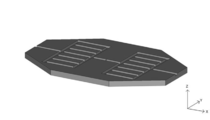
- FIG. 11 is an overall external view showing an example of a three-dimensional model (green body) in which solidified materials having a complicated inner tube structure are laminated.
- FIG. 12 is a transmission diagram showing a complicated inner tube structure inside the green body of FIG.
- FIG. 13 is a translucent view showing a complex inner tube structure inside the green body of FIG.
- FIG. 14 is a cross-sectional view of the green body of FIG. 11 in the X direction (No. 1).
- FIG. 15 is a cross-sectional view of the green body of FIG. 11 in the X direction (No. 2).
- FIG. 16 is a cross-sectional view of the green body of FIG. 11 in the X direction (No. 3).
- FIG. 17 is a cross-sectional view of the green body of FIG. 11 in the Z direction.
- the method for producing a three-dimensional molded product of the present invention comprises a solidification forming step of applying a molding liquid to a powder containing a base material and an organic material to form a solidified product, and an organic solvent.
- a molding that includes a powder removing step of removing the powder adhering to the solidified material from the solidified material using a powder removing liquid containing the above, and a region in which the molding liquid is applied to the powder.
- the distance between the HSP value in the section and the HSP value of the organic solvent is defined as the modeling section RED value, and the HSP value in the non-modeling section, which is a region where the molding liquid is not applied to the powder, and the HSP value of the organic solvent.
- the distance of is the non-modeling unit RED value
- the method for producing a three-dimensional molded product of the present invention comprises a solidification forming step of applying a molding liquid containing an organic material to a powder containing a base material to form a solidified material, and an organic solvent.
- a molding that includes a powder removing step of removing the powder adhering to the solidified material from the solidified material using a powder removing liquid containing the above, and a region in which the molding liquid is applied to the powder.
- “powder” may also be referred to as “powder” or “powder material”.
- the “modeling liquid” may also be referred to as a “hardening liquid” or a “reaction liquid”.
- the "solidified product” may also be referred to as a "cured product”.
- a three-dimensional model in which solidified products are laminated may be referred to as a "green body”, a “sintered body”, a "molded body”, or a “modeled body”.
- a “green body” that has been heat-treated and degreased is sometimes referred to as a "defatted body”.
- the “green body” and the “defatted body” may be collectively referred to as a "sintered precursor”.
- the HSP value in the modeling portion which is the region where the modeling liquid is applied to the powder
- the HSP of the organic solvent Let the distance from the value be the modeling part RED value, and let the distance between the HSP value in the non-modeling part, which is the region where the modeling liquid is not applied to the powder, and the HSP value of the organic solvent be the non-modeling part RED value.
- the method for producing a three-dimensional model according to the first aspect of the present invention can remove the powder adhering to the solidified material while maintaining the strength of the modeled portion, and efficiently creates a complicated three-dimensional shape. Can be manufactured.
- the HSP value and the organic in the modeling portion which is the region where the modeling liquid is applied to the powder.
- the distance from the HSP value of the solvent is the modeling unit RED value
- the method for producing a three-dimensional model according to the second aspect of the present invention can remove the powder adhering to the solidified material while maintaining the strength of the modeled portion, and efficiently creates a complicated three-dimensional shape. Can be manufactured.
- Non shaped portion RED value ⁇ 4 * (dD 1 -dD S) 2 + (dP 1 -dP S) 2 + (dH 1 -dH S) 2 ⁇ 0.5 / R 1
- dD 1 dispersion term of HSP value of the non-shaped portion dD S dispersion term of HSP value of the organic solvent contained in the powder removing liquid
- dP 1 is HSP value of the non-shaped portion polarity term of
- dH 1 is hydrogen bond of HSP value of the non-shaped portion
- the hydrogen bond term of the HSP value, R 1, is the interaction radius of the HSP value of the non-modeled portion.
- the modeling unit RED value is represented by the following mathematical formula (3).
- Shaped portion RED value ⁇ 4 * (dD 2 -dD S) 2 + (dP 2 -dP S) 2 + (dH 2 -dH S) 2 ⁇ 0.5 / R 2
- dD 2 dispersion term of HSP value of the feature section dD S polarity of the HSP of the dispersion term of the HSP value of the organic solvent contained in the powder removing solution
- dP 2 is shaped portions Item
- dPs is the polar term of the HSP value of the organic solvent contained in the powder removal solution
- dH 2 is the hydrogen bond term of the HSP value of the modeling part
- dHs is the hydrogen bond of the HSP value of the organic solvent contained in the powder removal solution.
- R 2 represents the interaction radius R 1 of the HSP value of the non-modeled part when the organic material is cross-linked, and the interaction of the HSP value of the modeled part when the organic material is not cross-linked. Represents a radius.
- the solubility of the powder removing liquid in the organic solvent in the molding portion which is the region where the modeling liquid is applied to the powder
- the solubility of the organic solvent in the powder removing liquid, and the molding liquid being used as the powder.
- the solubility in the organic solvent in the powder removing solution in the non-molded portion which is the region not imparted, is defined by the Hansen solubility parameter (HSP).
- the Hansen solubility parameter (HSP) is based on the idea that two substances with similar intramolecular interactions are easily soluble in each other.
- the HSP value is composed of three parameters, and the solubility is represented by a multidimensional vector, and it is judged that the similar ones have high solubility.
- This vector is represented by (dispersion term, polarity term, hydrogen bond term) (see FIG. 1).
- the dispersion term is the van der Waals force
- the polar term is the force of the dipole moment
- the hydrogen bond term is the force of water, alcohol, etc., each in which the unit is [MPa 0.5 ].
- Ra ⁇ 4 * (dD p- dD s ) 2 + (dP p- dP s ) 2 + (dH p- dH s ) 2 ⁇ 0.5
- dD p is the dispersion term of the HSP value (polymer)
- dD s is the dispersion term of the HSP value (organic solvent)
- dP p is the polarity term of the HSP value (polymer)
- dP s is the HSP.
- dH p is the hydrogen bond term of the HSP value (polymer)
- dH s is the hydrogen bond term of the HSP value (organic solvent).
- RED value R a / R 0.
- the RED value ⁇ 1 the HSP value of the organic solvent is inside the sphere with radius R 0
- the RED value> 1 the HSP value of the solvent is outside the sphere with radius R 0
- the polymer is insoluble in the organic solvent (see FIG. 4B).
- the diagonal sphere indicates the polymer interaction sphere (radius R 0 )
- the dotted sphere indicates the HSP value of the organic solvent.
- the crosslinked organic material (resin) easily swells by absorbing the organic solvent in an organic solvent having a similar HSP value, and as a result of the swelling of the organic material (resin), the shaped portion softens.
- a method of obtaining the HSP value using the Hansen dissolution theory can be used to evaluate the softening of the shaped portion even if it is insoluble in an organic solvent.
- the repeating end is specified by a dummy atom and linearly expressed by the Smiles equation, and the Hansen solubility parameter calculation software HSPiP (ver. 5.2 Hansen-) Enter in (manufactured by Solution.com). Then, the program can automatically decompose the molecular group into atomic groups and calculate the HSP value of the modeling part.
- the Hansen solubility parameter can handle a multi-component system.
- the (dispersion term (dD MIX ), polarity term (dP MIX ), hydrogen bond term (dH MIX )) of this mixed solvent (MIX) are ethylene carbonate (EC) and butyl glycol acetate (BGA) as shown below. It can be obtained by the sum obtained by multiplying the mixing ratio with.
- the HSP value of the organic solvent in the powder removing solution can be obtained by calling it from the database using the Hansen solubility parameter calculation software HSPiP, or by calculating it from its chemical structure if it is not in the database.
- HSP value (non-shaped portion)
- Hansen approaches C.M.Hansen,. "Hansen solubility parameters : A user's handbook", 2 nd edn, CRC Press, Boca It can be determined experimentally by Raton (2007)).
- the method is as shown below. Weigh the organic material and organic solvent so that the organic material (resin) of the target non-modeled part becomes 1% by mass of polymer liquid (total amount 5 g) in a 20 mL vial, and ultrasonically vibrate at 40 ° C. for 10 hours. Is added and processed.
- the HSP value (non-modeling part) and R 1 (non-modeling part) Interaction radius) can be calculated.
- the input and calculation to the HSPiP are performed 10 times, and the average value is taken as the HSP value (non-modeled portion) and R 1 (interaction radius of the non-modeled portion).
- the 24 kinds of organic solvents are 1,4-dioxane, 1-butanol, 2-phenoxyethanol, acetone, acetonitrile, cyclohexane, cyclohexanol, diacetone alcohol, diethylene glycol, dimethylformamide, dimethylsulfoxide, ethanol, ethyl acetate, ⁇ - Butyrolactone, methyl ethyl ketone, methanol, methyl isobutyl ketone (2-butanol), butyl acetate, N-methylpyrrolidone, propylene glycol monomethyl ether, propylene glycol monomethyl ether acetate, propylene carbonate, tetrahydrofuran, toluene.
- the non-modeled part RED value which is the distance between the HSP value in a certain non-modeled part and the HSP value of the organic solvent, can be obtained by the following formula (2).
- Non shaped portion RED value ⁇ 4 * (dD 1 -dD S) 2 + (dP 1 -dP S) 2 + (dH 1 -dH S) 2 ⁇ 0.5 / R 1
- dD 1 dispersion term of HSP value of the non-shaped portion dD S dispersion term of HSP value of the organic solvent contained in the powder removing liquid
- dP 1 is HSP value of the non-shaped portion polarity term of
- dH 1 is hydrogen bond of HSP value of the non-shaped portion
- the hydrogen bond term of the HSP value, R 1, is the interaction radius of the HSP value of the non-modeled portion.
- the non-modeled portion RED value ⁇ 1.20 when the non-modeled portion RED value ⁇ 1.20, excess powder adhering to the solidified material can be efficiently removed, and the non-modeled portion RED value ⁇ 1.0 is preferable.
- the molding liquid contains a cross-linking agent
- the powder is cross-linked by the action of the cross-linking agent, so that the molding portion is insoluble (or almost insoluble) in the organic solvent in the powder removing liquid.
- the HSP value can be obtained from the structure. Further, by applying the above-mentioned property that can be treated as a multi-component vector, the reaction active site that reacts with the cross-linking agent in the molding liquid in the organic material (polymer) constituting the modeling part reacts with the cross-linking agent in the molding liquid.
- the HSP value of the shaped portion having an arbitrary degree of cross-linking can be obtained by multiplying the abundance ratio of these two regions.
- the degree of cross-linking of the polymer is calibrated by TD-NMR (pulse NMR), with a sufficient amount of the polymer mixed and reacted, with the Nominated NMR Signal in the Detection time set to 100, and the unreacted one in the same Detection time set to 0. It can be obtained by creating a line.
- the value of the HSP value itself on the polymer database of the organic material can be used if it is known. If it is unknown, the HSP value of the modeled part can be determined by the method described in the above "How to obtain the HSP value of the non-modeled part" (see paragraph [0023]) in a state where the organic material is desolvated by an arbitrary method. You can ask.
- FIG. 6 is a flowchart showing an example of a processing flow for a method of obtaining an HSP value of a modeling portion, which is a final reaction product when a cross-linking agent is contained in the modeling liquid.
- the HSP value of the polymer constituting the modeling part is linearly expressed by the formula of Smiles by designating the repeating end of the polymer with a dummy atom, and the Hansen solubility parameter calculation software HSPiP (ver. 5.2 Hansen-) When it is input to (manufactured by Polymery.com) and obtained, the process shifts to S2.
- step S2 when the polymer constituting the modeling portion is divided into two regions, a reactive active site that reacts with the cross-linking agent in the modeling liquid and a non-reactive active site that does not react with the cross-linking agent in the modeling liquid, the treatment is performed.
- step S3 when the HSP value of the non-reactive active site, the HSP value of the cross-linking agent, and the HSP value of the reaction product of the cross-linking agent and the reaction active site are calculated by the Hansen solubility parameter calculation software HSPiP, the process shifts to S4.
- step S4 when the HSP value of the non-reactive active site is calculated from the mass fraction obtained by removing the reaction active site from the polymer, the process shifts to S5.
- step S5 in consideration of the degree of cross-linking of the polymer, the abundance ratio of the two regions of the reactive active site and the non-reactive active site is obtained, the weighted average of these is calculated, and the HSP value of the modeling portion is obtained. To finish.
- the RED value of the modeling part which is the distance between the HSP value of the modeling part and the HSP value of the organic solvent in the powder removing liquid, can be obtained by the following formula (3).
- Shaped portion RED value ⁇ 4 * (dD 2 -dD S) 2 + (dP 2 -dP S) 2 + (dH 2 -dH S) 2 ⁇ 0.5 / R 2
- dD 2 dispersion term of HSP value of the feature section dD S polarity of the HSP of the dispersion term of the HSP value of the organic solvent contained in the powder removing solution
- dP 2 is shaped portions Item
- dPs is the polar term of the HSP value of the organic solvent contained in the powder removal solution
- dH 2 is the hydrogen bond term of the HSP value of the modeling part
- dHs is the hydrogen bond of the HSP value of the organic solvent contained in the powder removal solution.
- R 2 represents the interaction radius R 1 of the HSP value of the non-modeled part when the organic material is cross-linked, and the interaction of the HSP value of the modeled part when the organic material is not cross-linked. Represents a radius.
- interaction radius R 1 of the HSP value of the non-shaped portion as a non-shaped portion (organic material before crosslinking) it is possible to treat as a constant has been obtained by experiments, if the organic material is crosslinked, in the calculation of the RED value of the feature unit using the interaction radius R 1 of the HSP value of the non-shaped portion.
- the solidified product when the following formula, the modeling portion RED value> 0.55, the solidified product can maintain its strength without softening, and it is preferable that the modeling portion RED value> 1.0.
- the three-dimensional modeling kit of the present invention contains a powder containing a base material and an organic material, a modeling liquid that solidifies the powder to form a solidified material, and an organic solvent. It has a powder removing liquid for removing the powder adhering to the solidified material from the solidified material, and has an HSP value in a molding portion which is a region where the molding liquid is applied to the powder, and the organic solvent.
- the distance from the HSP value of the above is defined as the modeling portion RED value
- the distance between the HSP value in the non-modeling portion, which is a region where the molding liquid is not applied to the powder, and the HSP value of the organic solvent is defined as the non-modeling portion RED.
- the non-modeling unit RED value ⁇ 1.20 and the modeling unit RED value> 0.55, is satisfied.
- the three-dimensional modeling kit of the present invention contains a powder containing a base material, an organic material, a modeling liquid that solidifies the powder to form a solidified material, and an organic solvent. It has a powder removing liquid for removing the powder adhering to the solidified material from the solidified material, and has an HSP value in a molding portion which is a region where the molding liquid is applied to the powder, and the organic.
- the distance from the HSP value of the solvent is defined as the modeling unit RED value, and the following equation, modeling unit RED value> 0.55, is satisfied.
- the powder removing liquid contains an organic solvent and, if necessary, other components.
- the organic solvent contained in the powder removing solution is not particularly limited as long as it is an organic solvent that does not dissolve the solidified substance and dissolves the organic material in the powder, and can be appropriately selected depending on the intended purpose. At least one selected from halogens, alcohols, esters, ethers, hydrocarbons, glycols, glycol ethers, glycol esters, pyrrolidones, amides, amines and carbonate esters can be used.
- Examples of the ketone include acetone, methyl ethyl ketone, diethyl ketone, methyl propyl ketone, methyl isobutyl ketone, methyl amyl ketone, cyclohexanone, isophorone, acetophenone, and diacetone alcohol.
- Examples of the halogen include methylene chloride, trichlorethylene, perchloroethylene, HCFC141-b, HCFC-225, 1-bromopropane, chloroform, orthodichlorobenzene and the like.
- alcohols examples include methanol, ethanol, butanol, isobutanol, isopropyl alcohol, normal propyl alcohol, tertiary butanol, secondary butanol, 1,3-butanediol, 1,4-butanediol, 2-ethylhexanol, and benzyl alcohol. And so on.
- ester examples include methyl acetate, ethyl acetate, butyl acetate, isobutyl acetate, sec butyl acetate, methoxybutyl acetate, 3-methoxybutyl acetate, 3-methoxy-3 methylbutyl acetate, ethyl-3-ethoxypropionate, and the like.
- ethers include dimethyl ether, ethyl methyl ether, diethyl ether, ethylene oxide, tetrahydrofuran, furan, benzofuran, diisopropyl ether, methyl cellosolve, ethyl cellosolve, butyl cellosolve, 1,4-dioxane, methyl tert-butyl ether (MTBE), and ethylene glycol.
- ethers include dimethyl ether, ethyl methyl ether, diethyl ether, ethylene oxide, tetrahydrofuran, furan, benzofuran, diisopropyl ether, methyl cellosolve, ethyl cellosolve, butyl cellosolve, 1,4-dioxane, methyl tert-butyl ether (MTBE), and ethylene glycol.
- MTBE methyl tert-butyl ether
- Examples thereof include dimethyl ether, diethylene glycol dimethyl ether, ethylene glycol diethyl ether, diethylene glycol diethyl ether, triethylene glycol dimethyl ether, diethylene glycol dibutyl ether, dipropylene glycol dimethyl ether, and dipropylene glycol monomethyl ether.
- Hydrocarbons include, for example, benzene, toluene, xylene, solventnaphtha, normal hexane, isohexane, cyclohexane, ethylcyclohexane, methylcyclohexane, cyclohexene, cycloheptane, cyclopentane, heptane, pentamethylbenzene, pentane, methylcyclopentane, normal.
- Examples thereof include heptane, isooctane, normal decane, normal pentane, isopentane, mineral spirit, dimethylsulfoxide, linear alkylbenzene and the like.
- glycol examples include ethylene glycol, diethylene glycol, triethylene glycol, propylene glycol, dimethoxytetraethylene glycol and the like.
- glycol ester examples include ethylene glycol monoethyl ether acetate and diethylene glycol monobutyl ether acetate.
- glycol ether examples include methyl carbitol, ethyl carbitol, butyl carbitol, methyl triglycol and the like.
- pyrrolidone examples include 2-pyrrolidone, N-ethyl-2-pyrrolidone, N-methyl-2-pyrrolidone and the like.
- amide examples include dimethylformamide, dimethylacetamide, formamide and the like.
- amines include tetramethylethylenediamine, N, N-diisopropylethylamine, ethylenediamine, triethylamine, diethylamine, aniline, pyrrolidine, piperidine, morpholine, pyrrol, pyridine, pyridazine, oxazole, thiazole, 1,3-dimethyl-2-imidazole. Riginon and the like can be mentioned.
- the carbonic acid ester include diethyl carbonate, dimethyl carbonate, propylene carbonate, ethyl methyl carbonate and the like. Even compounds not described in these are not particularly limited as long as they have a vapor pressure of 2,000 Pa or less at 25 ° C. and are insoluble or slightly soluble in water, and are appropriately selected according to the purpose. Can be done. Only one of these may be used, or two or more thereof may be used in combination.
- additives such as surfactants, antifoaming agents, antiseptic and antifungal agents, pH adjusters, chelating agents, and rust preventives can be added.
- the modeling liquid used in the present invention is applied to powder to solidify the particles of the powder.
- the powder contains a base material and an organic material
- the modeling liquid is used.
- the modeling liquid preferably contains an organic material, a cross-linking agent, an organic solvent and a surfactant, and further contains other components as necessary. ..
- a resin having a hydroxyl group is preferable from the viewpoint of the adhesion of the interface between the metal as the base material and the organic material.
- the resin having a hydroxyl group include polyvinyl acetal, polyvinyl butyral, polyacrylic polyol, polyester polyol, polybutadiene polyol, ethyl cellulose, nitrocellulose, polyvinylpyrrolidone, vinyl acetate copolymer (vinyl chloride-vinyl acetate, ethylene-vinyl acetate, etc.).
- Partially saponified product, polyether polyol, phenolic polyol and the like may be used alone or in combination of two or more.
- the content of the organic material is preferably 1% by mass or more and 20% by mass or less, and more preferably 1% by mass or more and 10% by mass or less with respect to the total amount of the modeling liquid.
- the resin is placed in the powder layer by applying the molding liquid to the powder layer containing metal particles, and the molding liquid is subjected to an appropriate heating step according to the softening point of the resin. It functions as a binder that binds metal particles to each other in the imparted region, and forms a solidified material and a shaped object before sintering such as a green body derived from the solidified material.
- the glass transition temperature Tg of the resin is preferably 0 ° C. or higher, more preferably 10 ° C. or higher, and even more preferably 20 ° C. or higher. Further, 100 ° C. or lower is preferable, 90 ° C. or lower is more preferable, and 80 ° C. or lower is further preferable.
- the softening point of the resin is preferably 70 ° C. or higher, more preferably 80 ° C. or higher, and even more preferably 90 ° C. or higher. Further, 150 ° C. or lower is preferable, 140 ° C. or lower is more preferable, and 130 ° C. or lower is further preferable.
- the number average molecular weight (Mn) of the resin is preferably 5,000 or more and 50,000 or less, and more preferably 10,000 or more and 30,000 or less. When the number average molecular weight (Mn) is in the above range, it is possible to improve the strength and the molding accuracy, reduce the viscosity of the molding liquid, and improve the resin concentration in the molding liquid.
- the content of the resin is preferably 5.0% by mass or more, more preferably 7.0% by mass or more, further preferably 10.0% by mass or more, and particularly preferably 11.0% by mass or more, based on the mass of the modeling liquid. preferable. Further, 30.0% by mass or less is preferable, 25.0% by mass or less is more preferable, and 20.0% by mass or less is further preferable.
- the content is 5.0% by mass or more, the bending strength of the solidified material and the shaped object before sintering such as the green body derived from the solidified material is further improved. Further, when the content is 30.0% by mass or less, the viscosity of the modeling liquid is further lowered, and for example, the modeling liquid can be appropriately discharged by an inkjet method.
- the content of the organic solvent is preferably 60.0% by mass or more and 95.0% by mass or less, and more preferably 70.0% by mass or more and 95.0% by mass or less with respect to the mass of the modeling liquid.
- the mass ratio of the amount of the organic solvent and the amount of the resin is preferably 75/25 or more and 95/5 or less.
- the solubility of the resin is further improved, and the viscosity of the modeling liquid can be further lowered accordingly.
- the modeling liquid can be appropriately discharged by an inkjet method.
- it is 95/5 or less, the bending strength of the solidified material and the shaped object before sintering such as the green body derived from the solidified material is further improved.
- the organic solvent is a liquid component for making the modeling liquid in a liquid state at room temperature.
- the organic solvent is not particularly limited as long as it has a vapor pressure of 2,000 Pa or less at 25 ° C. and is insoluble or slightly soluble in water, and can be appropriately selected depending on the intended purpose.
- the organic solvent has a vapor pressure of 2,000 Pa or less at 25 ° C.
- the ejection stability can be improved by suppressing the nozzle from drying when the apparatus is not operating (standby). ..
- being insoluble or slightly soluble in water means that the solubility in water is 80 g / L or less.
- organic solvent examples include aliphatic hydrocarbons such as n-octane, m-xylene and solvent naphtha, aromatic hydrocarbons, diisobutyl ketones, ketones such as 3-heptanone and 2-octanone, butyl acetate and amyl acetate.
- the content of the organic solvent is preferably 30% by mass or more and 90% by mass or less, and more preferably 50% by mass or more and 80% by mass or less with respect to the total amount of the modeling liquid.
- the solubility of the resin can be improved and the strength of the three-dimensional model can be improved.
- the cross-linking agent forms a cross-linked structure by forming a covalent bond with the reactive functional group of the organic material (resin) of the powder, further increasing the strength of the obtained solidified product. , Solvent resistance can be improved.
- the cross-linking agent is crosslinked by heat or ultraviolet rays to further increase the strength of the obtained solidified material and improve the solvent resistance. can.
- "crosslinking agent” is synonymous with "curing agent”.
- the cross-linking agent is not particularly limited, and can be appropriately adopted from isocyanate, acid anhydride, epoxy, and phenol aldehyde, and it is preferable to have 2 or more of any of them in the molecule or at the end of the molecule, and having 3 or more of them. Is more preferable.
- Examples of the isocyanate include diisocyanate and polyisocyanate.
- Examples of the diisocyanate include aromatics such as tolylene diisocyanate (TDI), diphenylmethane diisocyanate (MDI), polypeptide MDI (MDI), trizine diisocyanate (TODI), naphthaline diisocyanate (NDI), xylene diisocyanate (XDI), and paraphenylenedi isocyanate.
- TDI tolylene diisocyanate
- MDI diphenylmethane diisocyanate
- MDI polypeptide MDI
- TODI trizine diisocyanate
- NDI naphthaline diisocyanate
- XDI xylene diisocyanate
- paraphenylenedi isocyanate paraphenylenedi isocyanate.
- Group or aromatic polyisocyanates aliphatic isocyanates such as isophorone diisocyanate (IPDI) and hexamethylene diisocyanate (HMDI); lysine diisocyanate (LDI), tetramethylxylene diisocyanate (TMXDI) and the like can be mentioned. These may be used alone or in combination of two or more.
- the polyisocyanate include an adduct form of diisocyanate, an isocyanurate form, and an allophanate form.
- Examples of the acid anhydride include acid dianhydride and the like.
- Examples of the acid dianhydride include pyromellitic anhydride, 3,4′-oxydiphthalic anhydride, 4,4′-oxydiphthalic anhydride, 4,4-carbonyldiphthalic anhydride, and bicyclo [2.
- Examples of the epoxy include diepoxyd and polyepoxyd.
- Examples of the die epoxide include an aliphatic epoxy monomer such as 1,3-butadiene die epoxide, 1,5-hexadiene die epoxide, and 1,7-octadiene die epoxide, an epoxy monomer such as bisphenol A diglycidyl ether, and isocyanuric acid.
- Examples thereof include polyfunctional epoxy monomers such as triglycidyl and 4,4'-methylenebis (N, N-diglycidyl aniline). These may be used alone or in combination of two or more.
- the content of the cross-linking agent is preferably 1.0% by mass or more and 50% by mass or less, and more preferably 10% by mass or more and 30% by mass or less with respect to the total amount of the modeling liquid.
- the content of the cross-linking agent is 1.0% by mass or more and 50% by mass or less, it is possible to prevent the strength of the obtained three-dimensional model from being insufficient, and prevent the viscosity of the modeling liquid from increasing or gelling. Therefore, it is possible to prevent deterioration of liquid storage stability and viscosity stability.
- the surfactant is preferably added for the purpose of adjusting the surface tension of the modeling liquid and the like.
- the surfactant include anionic surfactants, nonionic surfactants, amphoteric surfactants, acetylene glycol-based surfactants, fluorine-based surfactants, silicone-based surfactants and the like.
- anionic surfactant examples include polyoxyethylene alkyl ether acetate, dodecylbenzene sulfonate, amber acid ester sulfonate, lauryl salt, polyoxyethylene alkyl ether sulfate salt and the like.
- nonionic surfactant examples include polyoxyethylene alkyl ether, polyoxyethylene polyoxypropylene alkyl ether, polyoxyethylene alkyl ester, polyoxyethylene polyoxypropylene alkyl ester, polyoxyethylene sorbitan fatty acid ester, and polyoxyethylene. Examples thereof include alkylphenyl ether, polyoxyethylene alkylamine, and polyoxyethylene alkylamide.
- nonionic surfactants examples include the Latemul series (manufactured by Kao Corporation) such as Latemul PD420, 430, 450.
- amphoteric surfactants include laurylaminopropionate, lauryl dimethyl betaine, stearyl dimethyl betaine, and lauryl dihydroxyethyl betaine. Specific examples of the surfactant are not particularly limited and may be appropriately selected depending on the intended purpose.
- lauryldimethylamine oxide myristyldimethylamine oxide, stearyldimethylamine oxide, dihydroxyethyllaurylamine oxide, poly Oxyethylene palm oil alkyldimethylamine oxide, dimethylalkyl (palm) betaine, dimethyllauryl betaine and the like are preferably mentioned.
- the acetylene glycol-based surfactant is not particularly limited and may be appropriately selected depending on the intended purpose. For example, 2,4,7,9-tetramethyl-5-decyne-4,7-diol, 3, Acetylene glycol-based products such as 6-dimethyl-4-octyne-3,6-diol and 3,5-dimethyl-1-hexin-3-ol (for example, Surfinol 104, 82, 465 manufactured by Air Products Co., Ltd. (USA)). , 485, TG, etc.) and the like. Of these, Surfinol 465, 104 and TG are preferred.
- the fluorosurfactant is not particularly limited and may be appropriately selected depending on the intended purpose.
- perfluoroalkyl sulfonate perfluoroalkyl carboxylate, perfluoroalkyl phosphate, perfluoroalkyl.
- examples thereof include ethylene oxide adduct, perfluoroalkyl betaine, perfluoroalkylamine oxide compound, polyoxyalkylene ether polymer having a perfluoroalkyl ether group in the side chain or a sulfate ester salt thereof, and a fluorine-based aliphatic polymer ester.
- fluorine-based surfactant examples include Surflon S-111, S-112, S-113, S-121, S-131, S-132, and S-141. , S-145 (manufactured by Asahi Glass Co., Ltd.), Flurad FC-93, FC-95, FC-98, FC-129, FC-135, FC-170C, FC-430, FC-431, FC-4430 (Sumitomo 3M) FT-110, 250, 251, 400S (manufactured by Neos), Zonir FS-62, FSA, FSE, FSJ, FSP, TBS, UR, FSO, FSO-100, FSN-N, FSN-100 , FS-300, FSK (manufactured by DuPont), Polyfox PF-136A, PF-156A, PF-151N (manufactured by OMNOVA), Unidyne DSN-403N (
- the silicone-based surfactant is not particularly limited and may be appropriately selected depending on the intended purpose.
- BYK-345, BYK-346, BYK-347, BYK-348 manufactured by Big Chemie Japan Co., Ltd.
- BYK-348 manufactured by Big Chemie Japan Co., Ltd.
- the surfactant is not limited to these, and may be used alone or in combination of two or more.
- the total amount of the surfactant is 0.01% by mass or more and 5% by mass or less.
- the total amount of the surfactant is 0.01% by mass or more, the effect of imparting wettability is sufficient, and the effect of improving the sufficient permeability to the organic material on the surface of the powder can be obtained. Further, when it is 5% by mass or less, the storage stability is good.
- ingredients are not particularly limited and may be appropriately selected depending on the intended purpose.
- antidrying agents viscosity regulators, penetrants, antifoaming agents, pH regulators, preservatives, fungicides, etc.
- Colorants, preservatives, stabilizers and the like can be mentioned.
- the viscosity of the modeling liquid is preferably 3 mPa ⁇ s or more and 20 mPa ⁇ s or less at 25 ° C., and more preferably 5 mPa ⁇ s or more and 10 mPa ⁇ s or less.
- the viscosity can be measured according to, for example, JIS K7117.
- the surface tension of the modeling liquid is preferably 40 mN / m or less, more preferably 10 mN / m or more and 30 mN / m or less at 25 ° C.
- the surface tension can be measured by, for example, DY-300 manufactured by Kyowa Interface Science Co., Ltd.
- the powder may have (1) a base material or (2) a base material and an organic material.
- a base material it is preferably made of a base material.
- the base material and the organic material it is preferable that the surface of the base material is covered with the organic material.
- the base material is not particularly limited as long as it has the form of powder or particles, and can be appropriately selected depending on the intended purpose.
- the material thereof is, for example, metal, ceramics, carbon, polymer, wood, or biocompatible material. , Sand, magnetic materials, etc., but from the viewpoint of obtaining an extremely high-strength three-dimensional molded product, metals, ceramics, etc. that can be finally sintered (processed) are preferable.
- the metal is not particularly limited as long as it contains a metal as a material, and for example, magnesium (Mg), aluminum (Al), titanium (Ti), vanadium (V), chromium (Cr), manganese ( Mn), iron (Fe), cobalt (Co), nickel (Ni), copper (Cu), zinc (Zn), yttrium (Y), zirconium (Zr), niobium (Nb), molybdenum (Mo), lead ( Examples thereof include Pd), silver (Ag), indium (In), tin (Sn), tantalum (Ta), tungsten (W), neodymium (Nd), or alloys thereof.
- stainless steel (SUS) steel, iron (Fe), copper (Cu), silver (Ag), titanium (Ti), aluminum (Al), alloys thereof and the like are preferably used.
- the aluminum alloy for example, AlSi 10 Mg, AlSi 12, AlSi 7 Mg 0.6, AlSi 3 Mg, AlSi 9 Cu 3, Scalmalloy, ADC1 2 and the like. These may be used alone or in combination of two or more.
- Ceramics include oxides, carbides, nitrides, hydroxides and the like.
- oxide include metal oxides and the like.
- metal oxide include silica (SiO 2 ), alumina (Al 2 O 3 ), zirconia (ZrO 2 ), and titania (TIO 2 ).
- SiO 2 silica
- Al 2 O 3 alumina
- ZrO 2 zirconia
- Tia titania
- a commercially available product can be used as the base material.
- examples of commercially available products include pure Al (manufactured by Toyo Aluminum Co., Ltd., A1070-30BB), pure Ti (manufactured by Osaka Titanium Technologies), SUS316L (manufactured by Sanyo Special Steel Co., Ltd., trade name: PSS316L); AlSI10Mg (Toyo Aluminum).
- the base material may be subjected to a known surface treatment (surface modification treatment) for the purpose of improving the adhesiveness with the organic material and the coating property.
- the volume average particle diameter of the base material is not particularly limited and may be appropriately selected depending on the intended purpose. For example, it is preferably 2 ⁇ m or more and 100 ⁇ m or less, and more preferably 8 ⁇ m or more and 50 ⁇ m or less.
- the volume average particle size of the base material is 2 ⁇ m or more, the influence of agglutination is prevented from increasing, the resin coating on the base material becomes easy, the yield is lowered, the production efficiency of the three-dimensional model is lowered, and the base material is used. It is possible to prevent deterioration of the handleability and handleability of the material.
- the average particle size is 100 ⁇ m or less, it is possible to prevent a decrease in contact points between particles and an increase in voids, and it is possible to prevent a decrease in the strength of the three-dimensional model and its sintered body.
- the particle size distribution of the base material is not particularly limited and may be appropriately selected depending on the intended purpose, but it is preferable that the particle size distribution is sharper.
- the volume average particle size and particle size distribution of the base material can be measured using a known particle size measuring device, and examples thereof include a particle size distribution measuring device Microtrac MT3000II series (manufactured by Microtrac Bell).
- the outer shape, surface area, circularity, fluidity, wettability, etc. of the base material can be appropriately selected according to the purpose.
- the base material can be produced by using a conventionally known method.
- the method for producing a powder or granular base material include a pulverization method in which a solid is subdivided by applying compression, impact, friction, etc., an atomization method in which a molten metal is sprayed to obtain a rapidly cooled powder, and a method of dissolving in a liquid.
- examples thereof include a precipitation method in which the resulting components are precipitated, a vapor phase reaction method in which the powder is vaporized and crystallized.
- the base material is not limited to the production method thereof, but a more preferable method is, for example, an atomizing method because a spherical shape can be obtained and the particle size does not vary much.
- the atomizing method include a water atomizing method, a gas atomizing method, a centrifugal atomizing method, a plasma atomizing method, and the like, all of which are preferably used.
- organic material it is used in the case of (1) above, has a reactive functional group, dissolves in a modeling liquid, and can react with a cross-linking agent contained in the modeling liquid to form a cross-linked structure by covalent bond. All you need is.
- the solubility (soluble) of an organic material means that, for example, when 1 g of a resin is mixed with 100 g of a solvent constituting a modeling liquid at 30 ° C. and stirred, 90% by mass or more thereof is dissolved.
- organic material it has low reactivity with highly active metal (highly active metal) powder as a base material, and the organic material before molding (before solidification) is soluble (soluble) in an organic solvent and is shaped.
- the later (after solidification, after cross-linking) organic material is preferably insoluble (insoluble) in an organic solvent.
- it is more preferably soluble in an organic solvent having low solubility in water.
- the organic material has low reactivity with highly active metal (active metal) powder as a base material, and the organic material before the addition of the modeling solution is soluble (soluble) in the organic solvent, so that the modeling solution is applied.
- the later (after cross-linking) organic material is insoluble (insoluble) in an organic solvent, it can be applied even if the base material is a highly active metal, that is, a water-prohibited material (for example, aluminum, titanium, etc.). Even if the produced solidified product (three-dimensional model) is immersed in a solvent-based solution, it can be prevented from collapsing.
- the reactive functional group is not particularly limited as long as it can react with a cross-linking agent to form a covalent bond, and can be appropriately selected depending on the intended purpose.
- a hydroxyl group a carboxyl group, an amide group, or a phosphoric acid.
- Groups, thiol groups, acetoacetyl groups, ether bonds and the like can be mentioned.
- the resin as an organic material has a hydroxyl group in terms of improving the adhesion to the base material and the reactivity with the cross-linking agent.
- the organic material is thermally decomposed when the resin alone is heated at 450 ° C. so that the organic material does not remain in the three-dimensional model and cause sintering inhibition during sintering. It is preferable that it is a thing.
- a resin having a hydroxyl group is preferable.
- the resin include polyvinyl acetal (glass transition temperature: 107 ° C.), polyvinyl butyral (glass transition temperature: 67 ° C.), polyacrylic polyol (glass transition temperature: 80 ° C.), and polyester polyol (glass transition temperature: 133 ° C.). , Polybutadiene polyol (glass transition temperature: ⁇ 17 ° C.), ethyl cellulose (glass transition temperature: 145 ° C.), nitrocellulose (glass transition temperature: 50 ° C.), and the like.
- a partially saponified product of a vinyl acetate copolymer (vinyl chloride-vinyl acetate, ethylene-vinyl acetate, etc.), a polyether polyol, a phenol-based polyol, and the like can be mentioned. These may be used alone or in combination of two or more. Among these, polyacrylic polyol is preferable.
- the glass transition temperature of an organic material refers to the glass transition temperature of a solidified product of a homopolymer of an organic material, where the glass transition temperature (Tg) is adopted if there is a catalog value of the resin manufacturer. However, if it does not exist, it is a value measured as follows by the differential scanning calorimetry (DSC) method.
- DSC differential scanning calorimetry
- the polymerization of the polymerizable monomer can be carried out by a general solution polymerization method.
- a and B are purged with nitrogen, sealed in a test tube, and shaken in a warm bath at 60 ° C. for 6 hours to synthesize a polymer.
- the polymer is then reprecipitated in a solvent in which the polymerizable monomer is soluble and the polymer is insoluble (eg, methanol, petroleum ether, etc.) and filtered to remove the polymer.
- the obtained polymer is DSC-measured.
- a DSC120U manufactured by Seiko Instruments Inc. is used, and the measurement temperature is 30 ° C. to 300 ° C., and the temperature rise rate is 2.5 ° C. per minute.
- the weight average molecular weight is preferably 100,000 or less, more preferably 2,000 or more and 100,000 or less, and the weight average molecular weight is preferably 100,000 or less and is a solid at room temperature.
- the hydroxyl value is preferably 50 mgKOH / g or more, and more preferably 100 mgKOH / g or more.
- the organic material may be a commercially available product.
- commercially available products include polyacrylic polyols (manufactured by DIC Co., Ltd., Acrydic WFU-580, etc.), polyester polyols (manufactured by DIC Co., Ltd., polylite OD-X-668, etc., manufactured by ADEKA Corporation, ADEKA New Ace YG- 108 etc.), Polybutadiene polyol (manufactured by Nippon Soda Co., Ltd., GQ-1000, etc.), Polyvinyl butyral (manufactured by Kuraray Co., Ltd., Mobital B20H, etc.), Polyvinyl acetal (manufactured by Sekisui Chemical Co., Ltd., Eslek BM-2, KS-1) Etc.), ethyl cellulose (manufactured by Nikkei Seisei Co., Ltd., ETHOCEL, etc.), polyacrylic (
- the powder is preferably one in which the surface of the base material is coated with an organic material.
- the average thickness of the base material coated with the organic material is preferably 5 nm or more and 1,000 nm or less, more preferably 5 nm or more and 500 nm or less, further preferably 50 nm or more and 300 nm or less, and particularly preferably 100 nm or more and 200 nm or less.
- the coating thickness can be made smaller than that of the conventional one, and both strength and accuracy can be achieved even with a thin film.
- the average thickness as the coating thickness is 5 nm or more, the strength of the solidified material formed by applying the molding liquid to the powder is improved, and the mold is used during the subsequent processing or handling such as sintering. When it is 1,000 nm or less, which does not cause problems such as collapse, the dimensional accuracy of the solidified material formed by applying the molding liquid to the powder is improved.
- the average thickness is, for example, after embedding powder in acrylic resin or the like and then performing etching or the like to expose the surface of the base material, and then scanning tunneling microscope STM, atomic force microscope AFM, scanning electron microscope SEM. It can be obtained by measuring the thickness of any 10 points and calculating the average value thereof.
- the ratio of the organic material to the surface area of the base material is not particularly limited as long as it covers the surface area of the base material to the extent that the effects of the present invention can be exhibited. For example, 15% or more is preferable, 50% or more is more preferable, and 80% or more is particularly preferable.
- the surface coverage is 15% or more, the strength of the solidified material formed by applying the molding liquid to the powder is sufficiently obtained, and the mold is obtained during the subsequent processing or handling such as sintering. Problems such as collapse do not occur, and the dimensional accuracy of the solidified material formed by applying the molding liquid to the powder is improved.
- the surface coverage was determined, for example, by observing a photograph of the powder and coating the powder in the two-dimensional photograph with an organic material for any 10 particles with respect to the entire surface area of the particles of the powder.
- the ratio (%) of the area of the portion may be measured, the average value thereof may be calculated and used as the surface coverage ratio, or the portion coated with the organic material may be subjected to energy dispersion type X-ray spectroscopy such as SEM-EDS. It can be measured by performing element mapping by the method.
- the other components are not particularly limited and may be appropriately selected depending on the intended purpose. Examples thereof include a fluidizing agent, a filler, a leveling agent, a sintering aid, and polymer resin particles.
- the fluidizing agent is preferable in that a layer made of powder or the like can be easily and efficiently formed.
- the filler is a material that is effective mainly for adhering to the surface of powder and filling the voids between powders. As an effect, for example, the fluidity of the powder can be improved, the number of contacts between the powders can be increased, and the voids can be reduced, so that the strength of the three-dimensional model and its dimensional accuracy can be improved.
- the leveling agent is an effective material mainly for controlling the wettability of the surface of the powder.
- the permeability of the modeling liquid to the powder is increased, the strength of the three-dimensional modeled object can be increased and the speed thereof can be increased, and the shape can be stably maintained.
- the sintering aid is an effective material for increasing the sintering efficiency when sintering the obtained three-dimensional model.
- the strength of the three-dimensional model can be improved, the sintering temperature can be lowered, and the sintering time can be shortened.
- the method for producing the powder is not particularly limited and may be appropriately selected depending on the intended purpose.
- a method of coating an organic material on a substrate according to a known coating method is preferable.
- the method for coating the surface of the base material of the organic material is not particularly limited, and a known coating method can be appropriately adopted. Examples of such a coating method include a rolling flow coating method and a spray-drying method. , Stirring and mixing addition method, dipping method, kneader coating method, and the like are preferable. Further, these coating methods can be carried out by using various known commercially available coating devices, granulating devices and the like.
- the volume average particle size of the powder is not particularly limited and may be appropriately selected depending on the intended purpose, but is preferably 3 ⁇ m or more and 250 ⁇ m or less, more preferably 3 ⁇ m or more and 200 ⁇ m or less, and further preferably 5 ⁇ m or more and 150 ⁇ m or less. It is particularly preferably 10 ⁇ m or more and 85 ⁇ m or less.
- the volume average particle size is 3 ⁇ m or more, the fluidity of the powder is improved, the powder (layer) is easily formed, and the smoothness of the laminated layer surface is improved. There is a tendency for dimensional accuracy to improve as well as for improved handling and handleability.
- the average particle size is 250 ⁇ m or less, the size of the space between the powder particles becomes small, so that the porosity of the three-dimensional object becomes small, which contributes to the improvement of the strength. Therefore, it is preferable that the volume average particle size is 3 ⁇ m or more and 250 ⁇ m or less in order to achieve both dimensional accuracy and strength.
- the particle size distribution of the powder is not particularly limited and may be appropriately selected depending on the intended purpose.
- the angle of repose of the powder is preferably 60 ° or less, more preferably 50 ° or less, and even more preferably 40 ° or less.
- the angle of repose can be measured using, for example, a powder property measuring device (Powder tester PT-N type, manufactured by Hosokawa Micron Co., Ltd.) or the like.
- the powder can be suitably used for simple and efficient production of various three-dimensional objects and structures, and the three-dimensional modeling kit of the present invention, the method for producing the three-dimensional object of the present invention, and the three-dimensional object. It can be particularly preferably used in a manufacturing apparatus.
- a solidified product having a complicated three-dimensional shape can be produced easily, efficiently and with high dimensional accuracy.
- the solidified product thus obtained is a green body (sintered precursor) having sufficient hardness, and can be held by hand, put in and taken out of a mold, or air blown to remove excess powder. However, it does not lose its shape and is excellent in handleability and handleability.
- the solidified product may be used as it is, or may be further subjected to a sintering treatment as a sintering precursor to obtain a molded product (sintered product of a three-dimensional model).
- the method for producing a three-dimensional model of the present invention includes a solidification forming step and a powder removing step, and further includes other steps as necessary.
- the solidification forming step is a step of applying a molding liquid to a powder containing a base material and an organic material and binding the powder particles in a predetermined region of the powder to form a solidification.
- the organic material that coats the base material can be dissolved and crosslinked by the action of the modeling liquid, when the modeling liquid is applied to the organic material, the organic material is dissolved and contained in the modeling liquid and the action of the crosslinking agent. Crosslink with. Therefore, when a thin layer is formed using powder and a modeling liquid is allowed to act on the thin layer, the thin layer solidifies.
- the method of arranging the powder on the support (on the modeling stage) to form the powder layer is not particularly limited and may be appropriately selected depending on the intended purpose.
- a method of arranging the powder in a thin layer Is a method using a known counter rotation mechanism (flattening roller) or the like used in the selective laser sintering method described in Japanese Patent No. 3607300, and thinning the powder by using a member such as a brush, a roller or a blade.
- Preferable examples thereof include a method of spreading the powder in a layer, a method of pressing the surface of the powder with a pressing member and spreading it in a thin layer, a method of using a known powder laminating molding device, and the like.
- the powder can be placed on the support in a thin layer, for example, as follows. That is, it is arranged so as to be able to move up and down while sliding on the inner wall of the outer frame in the outer frame (sometimes referred to as "modeling tank”, “mold”, “hollow cylinder”, “cylindrical structure”, etc.).
- the powder is placed on the support using a counter rotation mechanism or the like.
- the support is arranged at a position slightly below the upper end opening of the outer frame, that is, by the thickness of the powder layer. It is positioned below and the powder is placed on the support.
- the powder can be placed on the support in a thin layer.
- the layer is solidified (solidification step).
- the powder is placed on the thin layer in the same manner as described above, and the modeling liquid is allowed to act on the powder (layer) placed on the thin layer.
- Solidification of powder occurs. The solidification at this time occurs not only in the powder (layer) placed on the thin layer, but also in the solidified material of the thin layer previously solidified and existing under the powder (layer). As a result, a solidified material having a thickness equivalent to about two layers of the powder (layer) placed on the thin layer can be obtained.
- a device for manufacturing a three-dimensional object has a recorder (flattening roller) for laminating powder, a movable supply tank for supplying powder on a support, and a thin layer of powder. It is equipped with a movable modeling tank for laminating.
- the surface of the supply tank can always be slightly raised above the surface of the modeling tank by raising the supply tank, lowering the modeling tank, or both, and the supply tank side.
- the powder can be arranged in a thin layer using a recorder, and the thin layer powder can be laminated by repeatedly moving the recorder.
- the thickness of the powder layer is not particularly limited and may be appropriately selected depending on the intended purpose.
- the average thickness per layer is preferably 30 ⁇ m or more and 500 ⁇ m or less, and more preferably 60 ⁇ m or more and 300 ⁇ m or less.
- the strength of the solidified material (sintering precursor) formed by applying the molding liquid to the powder to form the powder (layer) is sufficient, and the subsequent treatment such as sintering or the like is performed.
- the size is 500 ⁇ m or less, which does not cause problems such as shape loss during handling, the dimensional accuracy of the solidified material formed by applying the molding liquid to the powder is improved.
- the average thickness is not particularly limited and can be measured according to a known method.
- the method for imparting a molding liquid containing a cross-linking agent capable of forming a covalent bond with a reactive functional group to the powder (layer) is not particularly limited and may be appropriately selected depending on the intended purpose, for example.
- Examples include a dispenser method, a spray method, and an inkjet method.
- a known device can be suitably used as a solidification forming means.
- the dispenser method is excellent in the quantitativeness of droplets, but the coating area is narrow, and the spray method is able to easily form fine discharges, has a wide coating area, and is excellent in coating properties, but the droplets.
- the quantitativeness is poor, and powder is scattered due to the spray flow. Therefore, in the present invention, the inkjet method is particularly preferable.
- the inkjet method has the advantages of better quantification of droplets than the spray method, a wider coating area than the dispenser method, and is preferable in that a complicated three-dimensional shape can be formed accurately and efficiently.
- the solidification forming means has a nozzle capable of applying the molding liquid to the powder layer by the inkjet method.
- a nozzle (ejection head) in a known inkjet printer can be preferably used, and the inkjet printer can be suitably used as a solidification forming means.
- the inkjet printer for example, SG7100 manufactured by Ricoh Co., Ltd. and the like are preferably mentioned. Inkjet printers are preferable in that the amount of modeling liquid that can be dropped from the head portion at one time is large and the coating area is large, so that the coating speed can be increased.
- the modeling liquid does not contain solid substances such as particles or high-molecular high-viscosity materials such as resins. Therefore, clogging or the like does not occur in the nozzle or its head, corrosion or the like does not occur, and when it is applied (discharged) to the powder layer, it can efficiently permeate the organic material in the powder. Therefore, the production efficiency of the three-dimensional model is excellent, and since a polymer component such as a resin is not added, an unexpected volume increase or the like does not occur, and a solidified product with good dimensional accuracy can be easily and shortly prepared. It is advantageous in that it can be obtained efficiently in time.
- the powder removing step is a step of removing the powder adhering to the solidified material from the solidified material.
- a method for removing the powder adhering to the solidified material from the solidified material a method of immersing the solidified material in the powder removing liquid is preferable.
- a powder removing solution that does not dissolve (soften) the solidified material and dissolves the organic material in the powder.
- excess powder adhering to the surface or inside of the solidified material is removed. be able to. That is, by immersing the solidified material in the powder removing liquid, the molding liquid is applied to the powder and the solidified molding portion is not dissolved (softened), and the molding liquid is applied to the powder. It is possible to dissolve the non-molded portion, which is a region that has not been formed.
- the three-dimensional model (green body) in which the solidified material is laminated exists in a state of being buried in a non-modeled portion (unsolidified powder) to which a modeling liquid is not applied.
- excess (unsolidified) powder adheres to the surface and the inside of the structure of the green body around the green body, and it is difficult to easily remove the green body. It is even more difficult when the surface of the green body is complicated or the inside is like a flow path.
- the strength of the green body is not high, so if the air blow pressure is high (0.3 MPa or more), the green body may collapse.
- the three-dimensional model (green body) in which the powder and the solidified product formed by the modeling liquid used in the present invention are laminated is coated with a compound contained in the modeling liquid capable of expressing a reactive group by heating.
- the organic material dissolves and solidifies more, it has the strength to withstand the pressure of air blow.
- the strength of the solidified product is preferably 3 MPa or more, more preferably 5 MPa or more in terms of 3-point bending stress.
- the solidified organic material does not dissolve in the powder removing liquid that can dissolve the organic material that coats the base material, and the unsolidified organic material dissolves in the powder removing liquid. Therefore, by immersing in the powder removing liquid, excess powder adhering to the surface and the inside of the green body can be easily removed.
- the powder removing liquid in order to form a green body having a complicated inner tube structure as shown in FIGS. 11 to 17, it is necessary to be able to easily and surely remove excess powder inside the green body, and only air blow. Then, the air does not reach the inside and it is difficult to remove it.
- the volume of the powder removing liquid with respect to the green body is not particularly limited and may be appropriately selected depending on the intended purpose. Further, if the green body is softened by immersing it in the powder removing liquid, it is not possible to obtain a three-dimensional model according to the modeling data due to crushing of the thin tube shape or the thin wall shape. After immersing the green body in the powder removing liquid (organic solvent) for 1 hour, the type 00 durometer hardness is preferably 80 or more, more preferably 90 or more, still more preferably 95 or more and 100 or less. If the type 00 durometer hardness is 80 or more, the shape does not collapse regardless of the shape.
- a test piece having the same size as the JIS K 7139 type A2 test piece was molded, the organic solvent component in the molding liquid was dried, and the obtained green body test piece was immersed in the powder removing liquid on the entire surface. Leave it in a container tightly closed at 25 ° C. for 1 hour under atmospheric pressure, then remove it from the container, wipe off the powder removing liquid adhering to the surface, and statically stand directly on an A5052 plate with a plate thickness of 5 mm. Within 30 seconds after placing and taking out, an ASTM D 2240 compliant Type 00 durometer can be manually pressed to bring the pressurized surface into close contact for measurement at 25 ° C. and atmospheric pressure.
- the immersion time is preferably 1 hour to 3 hours.
- the immersion temperature is preferably room temperature (25 ° C.) to 50 ° C.
- Examples of the immersion method include standing, ultrasonic irradiation, stirring, and stirring after standing.
- the powder accommodating portion is a member accommodating powder, and its size, shape, material, etc. are not particularly limited and may be appropriately selected according to the purpose.
- the modeling liquid storage unit is a member that stores the modeling liquid, and its size, shape, material, and the like are not particularly limited and can be appropriately selected according to the purpose.
- ⁇ Other processes and other means> examples include a sintering step, a surface protection treatment step, and a painting step.
- Other means include, for example, sintering means, surface protection treatment means, coating means and the like.
- the drying step is a step of drying a three-dimensional model (green body) in which the solidified products obtained in the solidified product forming step are laminated.
- the drying step not only the water contained in the green body but also organic substances may be removed (defatted).
- the drying means include a known dryer, a constant temperature and humidity chamber, and the like.
- the sintering step is a step of sintering a three-dimensional model (green body) in which the solidified products formed in the solidified product forming step are laminated.
- the green body can be made into a densified and integrated metal or ceramic molded product (sintered body of a three-dimensional model).
- the sintering means include a known sintering furnace.
- the surface protection treatment step is a step of forming a protective layer on a three-dimensional model (green body) in which the solidified products formed in the solidified product forming step are laminated.
- This surface protection treatment step it is possible to impart durability to the surface of the solidified product so that the solidified product can be used as it is, for example.
- the protective layer include a water resistant layer, a weather resistant layer, a light resistant layer, a heat insulating layer, a glossy layer, and the like.
- the surface protection treatment means include known surface protection treatment devices such as a spray device and a coating device.
- the painting process is a process of painting a three-dimensional model (green body) in which the solidified products formed in the solidified product forming step are laminated.
- the green body can be colored to a desired color.
- the coating means include known coating devices, such as a coating device using a spray, a roller, a brush, or the like.
- the mass of the organic material contained in the sintered body after the sintering step is preferably 5% by mass or less of the mass of the organic material contained in the green body before the powder removing step.
- FIG. 7 shows one time point at the time of modeling.
- the three-dimensional object manufacturing apparatus of FIG. 7 has a supply tank 21, a modeling tank 22, and a surplus powder receiving tank 29, and the supply tank 21 and the modeling tank 22 have a supply stage 23 and a modeling tank that can be moved up and down, respectively. It has a stage 24.
- the powder 20 for three-dimensional modeling is placed on the modeling stage 24 provided in the modeling tank 22, and the powder layer 31 made of the powder 20 is formed.
- the powder 20 is supplied from the supply tank 21 to the modeling tank 22, and the surface of the powder 20 in the modeling tank 22 is leveled to form a flattening powder layer 31.
- a roller 12 is provided.
- the flattening roller 12 is provided with a powder removing plate 13 which is a powder removing member for removing the powder 20 adhering to the flattening roller 12 in contact with the peripheral surface of the flattening roller 12. ..
- the surplus powder 20 not used for forming the powder layer 31 falls into the surplus powder receiving tank 29.
- An inkjet head 52 that discharges the modeling liquid 10 toward the powder 20 of the modeling tank 22 is provided on the modeling tank 22. Droplets are ejected from the inkjet head 52 to the powder layer 31 spread in layers in the modeling tank 22, and the modeling layer 30 is formed. At this time, the position where the modeling liquid 10 is dropped is determined by the two-dimensional image data (slice data) obtained by slicing the three-dimensional shape to be finally modeled into a plurality of plane layers. After the drawing for one layer is completed, the supply stage 23 of the supply tank 21 is raised, and the modeling stage 24 of the modeling tank 22 is lowered. The difference powder is moved to the modeling tank 22 by the flattening roller 12.
- a new powder layer is further formed on the surface of the powder layer drawn earlier.
- the thickness of the powder layer layer at this time is about several tens of ⁇ m or more and 100 ⁇ m or less.
- Drawing based on the slice data of the second layer is further performed on the newly formed powder layer, and this series of processes is repeated to obtain a solidified product (green body) having a three-dimensional shape.
- FIGS. 8A to 8E are schematic explanatory views for explaining the flow of modeling.
- the state in which the first modeling layer 30 is formed on the modeling stage 24 of the modeling tank 22 will be described.
- the supply stage 23 of the supply tank 21 is raised and the modeling stage 24 of the modeling tank 22 is lowered, as shown in FIG. 8A.
- the modeling stage 24 is lowered so that the distance (stacking pitch) between the upper surface of the surface (powder surface) of the powder layer 31 in the modeling tank 22 and the lower portion (lower tangential portion) of the flattening roller 12 is ⁇ t1.
- the interval ⁇ t1 is not particularly limited, but is preferably about several tens to 100 ⁇ m.
- the powder 20 located above the upper surface level of the supply tank 21 is moved to the modeling tank 22 side while rotating the flattening roller 12 in the opposite direction (arrow direction).
- the powder 20 is transferred and supplied to the modeling tank 22 (powder supply).
- the flattening roller 12 is moved in parallel with the stage surface of the modeling stage 24 of the modeling tank 22, and the powder layer 31 having a predetermined thickness ⁇ t1 on the modeling tank 22 of the modeling stage 24. Form (flattening). At this time, the surplus powder 20 not used for forming the powder layer 31 falls into the surplus powder receiving tank 29. After forming the powder layer 31, the flattening roller 12 is moved to the supply tank 21 side and returned (returned) to the initial position (origin position) as shown in FIG. 8D.
- the liquid droplet 10 of the modeling liquid is ejected from the head 52 of the liquid discharge unit 50, and the modeling layer 30 having a desired shape is laminated on the next powder layer 31.
- the powder layer formation and the molding liquid discharge described above are repeated to form a new molding layer 30.
- the new modeling layer 30 and the underlying modeling layer 30 are integrated to form a part of the solidified product.
- the formation of the powder layer and the discharge of the molding liquid are repeated to complete the molding of the solidified product (green body).
- a three-dimensional object having a complicated three-dimensional (three-dimensional (3D)) shape can be produced by the modeling solution of the present invention or the three-dimensional modeling kit of the present invention. It is possible to manufacture the product easily and efficiently with high dimensional accuracy without losing its shape before sintering or the like.
- the three-dimensional model obtained in this way and its sintered body have sufficient strength, excellent dimensional accuracy, and can reproduce fine irregularities, curved surfaces, etc., so that they have an excellent aesthetic appearance, are of high quality, and are used for various purposes. Can be suitably used for.
- the preparation liquid thus obtained was designated as a coating liquid 1.
- the viscosity of a 5% by mass (w / w%) solution of the polyacrylic polyol resin at 25 ° C. was measured using a viscometer (Rotary viscometer manufactured by Brookfield, DV-E VISCOMETER HADVE115 type). It was 0 mPa ⁇ s to 4.0 mPa ⁇ s.
- the preparation liquid thus obtained was designated as a coating liquid 2.
- the viscosity of a 5% by mass (w / w%) solution of polyvinyl butyral resin at 25 ° C. was measured using a viscometer (Brookfield rotational viscometer, DV-E VISCOMETER HADVE115 type) and found to be 9.0 mPa. It was s to 10.0 mPa ⁇ s.
- fine particles of acrylic resin (MP1451 manufactured by Soken Chemical Co., Ltd.) are added to the surface of the coating film so that the surface coverage is 20%, and a mixing device (DYNO-MILL manufactured by Symmul Enterprises Co., Ltd.) is added. The mixture was mixed at 100 rpm for 5 minutes to obtain powder 1.
- the method for measuring the coating thickness of the coating film, the surface coverage of the coating film, and the coating conditions are shown below. Before mixing the resin fine particles, the coating thickness of the coating film and the surface coverage of the coating film were measured.
- the coating thickness (average thickness) of powder 1 is determined by kneading a two-component curable epoxy resin and coating powder, cutting out a cross section with a knife after curing, and applying the cut out cross section to an ion milling device (manufactured by Hitachi High-Tech Co., Ltd., IM4000PLUS). And polished to prepare a sample for observation. Next, the boundary portion between the base material portion and the organic soluble resin portion exposed on the surface was observed with a field emission scanning electron microscope (FE-SEM), and the boundary portion was measured as the coating thickness. The average value of 10 measurement points was obtained and used as the coating thickness (average thickness). The coating thickness (average thickness) of the obtained powder 1 was 250 nm.
- ⁇ Surface coverage of coating film> Using a field emission scanning electron microscope (FE-SEM), take a reflected electron image (ESB) under the following conditions with a field setting in which about 10 powders 1 fit within the screen, and perform image processing with ImageJ software. Binarization was carried out.
- the black part was the coating part and the white part was the base material part, and the ratio was determined by the area of the black part / (area of the black part + area of the white part) ⁇ 100 in one particle. 10 particles were measured, and the average value was taken as the surface coverage (%).
- the surface coverage of powder 1 was 70%.
- the average particle size of the obtained powder 1 was measured using a commercially available particle size measuring device (Microtrac HRA manufactured by Nikkiso Co., Ltd.) and found to be 35 ⁇ m.
- powder Preparation Example 2 (Powder Preparation Example 2) ⁇ Preparation of powder 2>
- the powder 2 was prepared in the same manner as in the powder preparation example 1 except that the coating liquid 1 was replaced with the coating liquid 2.
- the coating thickness (average thickness) of the powder 2 was 250 nm
- the surface coverage was 80%
- the average particle size was 37 ⁇ m.
- (Preparation example 1 of modeling liquid) -Preparation of modeling liquid 1-
- Polyisocyanate consisting of 1,5-pentamethylene diisocyanate (manufactured by Mitsui Chemicals, Inc., aliphatic polyisocyanate) and butyl acetate (manufactured by Fuji Film Wako Pure Chemical Industries, Ltd.) are used as cross-linking agents.
- the mixture was mixed so as to be 50% by mass, and dispersed for 30 minutes using a homomixer to prepare a modeling solution 1.
- Preparation example 2 of modeling liquid -Preparation of modeling liquid 2- Polyisocyanate consisting of 1,5-pentamethylene diisocyanate (manufactured by Mitsui Chemicals, Inc., aliphatic polyisocyanate) and butyl acetate (manufactured by Fuji Film Wako Pure Chemical Industries, Ltd.) are used as cross-linking agents. The mixture was mixed so as to have a concentration of 12.6% by mass, and dispersed for 30 minutes using a homomixer to prepare a modeling solution 2.
- 1,5-pentamethylene diisocyanate manufactured by Mitsui Chemicals, Inc., aliphatic polyisocyanate
- butyl acetate manufactured by Fuji Film Wako Pure Chemical Industries, Ltd.
- Preparation example 4 of modeling liquid -Preparation of modeling liquid 4- Terpene phenol resin (manufactured by Yasuhara Chemical Co., Ltd., YS Polyester T100) and ⁇ -butyrolactone (manufactured by Mitsubishi Chemical Co., Ltd.) are mixed so that the terpene phenol resin is 15% by mass based on the total amount of the molding liquid, and a homomixer is used. Was dispersed for 30 minutes using the above to prepare a modeling solution 4.
- Terpene phenol resin manufactured by Yasuhara Chemical Co., Ltd., YS Polyester T100
- ⁇ -butyrolactone manufactured by Mitsubishi Chemical Co., Ltd.
- Example 1 Using the powder 1 and the modeling liquid 1, a three-dimensional model was produced as follows by a shape printing pattern of a size (length 70 mm ⁇ width 12 mm).
- the powder 1 is transferred from the supply tank to the modeling tank using the three-dimensional model manufacturing apparatus as shown in FIG. 7, and a thin layer of the powder 1 having an average thickness of 100 ⁇ m is formed on the modeling stage. bottom.
- the modeling liquid 1 is applied (discharged) to the surface of the thin layer formed by the powder 1 from a nozzle of a known inkjet discharge head, and the polyacrylic polyol resin is dissolved in butyl acetate contained in the modeling liquid 1. , 20% of all hydroxylates of the polyacrylic polyol resin are crosslinked by the action of polyisocyanate (manufactured by Mitsui Chemicals Co., Ltd., aliphatic polyisocyanate) composed of 1,5-pentamethylene diisocyanate contained in the modeling liquid 1. (Crosslink degree 20%).
- polyisocyanate manufactured by Mitsui Chemicals Co., Ltd., aliphatic polyisocyanate
- cross-linking agent (g) 20% hydroxyl group: 1.93 (mmol) / cross-linking agent concentration: 100 (mass%) * 100 * Solid content concentration in cross-linking agent: 75.4 (mass%) * Solid content concentration of 100 * NCO: 16.7 (mass%) * 100 * 42 (formula of NCO) * 1000
- Type 00 durometer display value is 95 or more
- Type 00 durometer display value is 90 or more and less than 95
- Rank 3 Type 00 durometer display value is 80 or more and less than 90
- Rank 2 Type 00 durometer display value is 60 or more and less than 80
- Rank 1 Type 00 durometer display value is less than 60
- the solidified material (green body) is immersed in a powder removing solution (acetone) at 25 ° C. for 1 hour, removed from the container, and vacuum dried at 100 ° C. for 2 hours to solidify the solidified material (green body).
- a powder removing solution acetone
- the three-point bending strength was measured by GS-754G manufactured by Teclock Co., Ltd. From the measured values of the three-point bending strength, the strength after drying was evaluated based on the following criteria.
- Example 2 to 18 and Comparative Examples 1 to 5 Example 1
- Example 2 to 18 and Comparative Examples 1 to 5 Example 1
- the same evaluation as in Example 1 was carried out in the same manner as in Example 1 except that the powder removing liquid (acetone) was changed to the organic solvent shown in Table 1.
- the results are shown in Table 3.
- Example 19 to 23 and Comparative Examples 6 to 9 In Example 1, the same evaluation as in Example 1 was carried out in the same manner as in Example 1 except that the powder 2 and the modeling liquid 2 were used and the powder removing liquid (acetone) was changed to the organic solvent shown in Table 1. Was done. The results are shown in Table 3. The degree of cross-linking in Examples 19 to 23 and Comparative Examples 6 to 9 was adjusted to 20%.
- Example 24 to 27 and Comparative Examples 10 to 13 In Example 1, AlSi 10 Mg powder (manufactured by Toyo Aluminum K.K., Si 10 Mg-30BB, volume average particle size 35 ⁇ m) and modeling liquid 3 were used as a base material without coating, and a powder removing liquid (acetone) was used. The same evaluation as in Example 1 was carried out in the same manner as in Example 1 except that the solvent was changed to the organic solvent shown in Table 1. The results are shown in Table 3.
- Example 1 AlSi 10 Mg powder (manufactured by Toyo Aluminum K.K., Si 10 Mg-30BB, volume average particle size 35 ⁇ m) and modeling liquid 4 are used as a base material without coating, and a powder removing liquid (acetone) is used.
- a powder removing liquid acetone
- HSP value of the feature section HSP value of the powder removing liquid (organic solvent), HSP value of the non-shaped portion, and based on the interaction radius R 1 of the non-shaped portion, Examples 1 to 31 and Comparative Example 1
- the RED value of the modeled portion and the RED value of the non-modeled portion of 17 to 17 were calculated. The results are shown in Table 3.
- a graph showing the relationship between the non-modeled portion RED value and the solubility in Examples and Comparative Examples is shown in FIG. 9, and a graph showing the relationship between the modeled portion RED value and the Wet strength is shown in FIG.
- HSP value of powder remover (organic solvent) can be called from the database using the Hansen solubility parameter calculation software HSPiP (manufactured by Hansen-Solubility.com), or its chemical structure if it is not in the database. It was calculated from. The results are shown in Table 2.
- the HSP value (non-modeled part) can be obtained by performing the same operation on 24 kinds of organic solvents and inputting the soluble or insoluble result into commercially available Hansen solubility parameter calculation software such as HSPiP. ..
- the input and calculation to the HSPiP were performed 10 times, and the averaged values were taken as the HSP value (non-modeled portion) and R 1 (interaction radius of the non-modeled portion). The results are shown in Table 2.
- the 24 kinds of organic solvents are 1,4-dioxane, 1-butanol, 2-phenoxyethanol, acetone, acetonitrile, cyclohexane, cyclohexanol, diacetone alcohol, diethylene glycol, dimethylformamide, dimethylsulfoxide, ethanol, ethyl acetate, ⁇ - Butyrolactone, methyl ethyl ketone, methanol, methyl isobutyl ketone (2-butanol), butyl acetate, N-methylpyrrolidone, propylene glycol monomethyl ether, propylene glycol monomethyl ether acetate, propylene carbonate, tetrahydrofuran, toluene.
- the non-modeled part RED value which is the distance between the HSP value in a certain non-modeled part and the HSP value of the organic solvent, was calculated by the following formula (2). The results are shown in Table 3.
- Non shaped portion RED value ⁇ 4 * (dD 1 -dD S) 2 + (dP 1 -dP S) 2 + (dH 1 -dH S) 2 ⁇ 0.5 / R 1
- dD 1 dispersion term of HSP value of the non-shaped portion dD S dispersion term of HSP value of the organic solvent contained in the powder removing liquid
- dP 1 is HSP value of the non-shaped portion polarity term of
- dH 1 is hydrogen bond of HSP value of the non-shaped portion
- the hydrogen bond term of the HSP value, R 1, is the interaction radius of the HSP value of the non-modeled portion.
- the HSP value of the modeling portion when the cross-linking agent was contained in the modeling liquids of Examples 1 to 23 and Comparative Examples 1 to 9 was determined based on the flowchart of FIG. The results are shown in Table 2. If the modeling liquids of Examples 24 to 31 and Comparative Examples 10 to 17 contain an organic material and do not contain a cross-linking agent, the HSP value of the modeling part can be found on the polymer database of the organic material if known. The value of the HSP value itself was used.
- the RED value of the modeling part which is the distance between the HSP value of the modeling part and the HSP value of the organic solvent in the powder removing liquid, was calculated by the following formula (3). The results are shown in Table 3.
- Shaped portion RED value ⁇ 4 * (dD 2 -dD S) 2 + (dP 2 -dP S) 2 + (dH 2 -dH S) 2 ⁇ 0.5 / R 2
- dD 2 dispersion term of HSP value of the feature section dD S polarity of the HSP of the dispersion term of the HSP value of the organic solvent contained in the powder removing solution
- dP 2 is shaped portions Item
- dPs is the polar term of the HSP value of the organic solvent contained in the powder removal solution
- dH 2 is the hydrogen bond term of the HSP value of the modeling part
- dHs is the hydrogen bond of the HSP value of the organic solvent contained in the powder removal solution.
- R 2 represents the interaction radius R 1 of the HSP value of the non-modeled part when the organic material is cross-linked, and the interaction of the HSP value of the modeled part when the organic material is not cross-linked. Represents a radius.
- interaction radius R 1 of the HSP value of the non-shaped portion as a non-shaped portion (organic material before crosslinking) it is possible to treat as a constant has been obtained by experiments, if the organic material is crosslinked, in the calculation of the RED value of the feature unit using the interaction radius R 1 of the HSP value of the non-shaped portion.
- Example 1 a specific method for obtaining the HSP value (##) (## is the degree of cross-linking of the polymer) of the modeling portion will be described.
- the RED value of the modeled portion can be obtained in the same manner as in Example 1.
- polymer X polyacrylic polyol resin, hydroxyl value: 180 KOHmg / g
- hydrogenated TDI CAS: 10581-16-5
- the HSP value of the polymer X is obtained by inputting the soluble or insoluble results for the 24 kinds of organic solvents into the Hansen solubility parameter calculation software HSPiP (manufactured by Ver.5.2 Hansen-Solubility.com) as described above.
- the HSP value (X) of the polymer X is dD x : 20.27 [MPa 0.5 ], dP x : 12.38 [MPa 0.5 ], dH x : 10.19 [MPa 0. 5 ], R 1 : 9.8.
- DP TF 9.8 [MPa 0.5 ], dH TF : 6.7 [MPa 0.5 ].
- dP XF of the HSP value (XF) and the hydrogen bond term dH XF of the HSP value (XF) can be obtained in the same manner, and dP XF : 12.90 [MPa 0.5 ], dH XF : 9 It is 0.01 [MPa 0.5 ].
- the HSP value (crosslinking degree of polymer X ##) of the modeled portion is defined by the HSP value (X), HSP value (XF), HSP value (EtF) and the crosslinking degree of polymer X obtained above. NS.
- the dispersion term (dD 100 ), the polarity term (dP 100 ), and the hydrogen bond term (dH 100 ) [(0.43 * dD) of the HSP value (100) in which the degree of cross-linking of the polymer X is 100%.
- TF +0.57 * dD XF ), (0.43 * dP TF +0.57 * dP XF ), (0.43 * dH TF +0.57 * dH XF )] to [19.6, 11.6,8 .0] can be obtained.
- this value be dD 100 , dP 100 , and dH 100 .
- Example 19 a specific method for obtaining the HSP value (##) (where ## is the degree of cross-linking of the polymer) of the modeling portion will be described.
- the RED value of the modeled portion can be obtained in the same manner as in Example 19.
- dP PVBF of the HSP value (PVBF) and the hydrogen bond term dH PVBF of the HSP value (PVBF) can be obtained in the same manner, and dP PVBF : 6.56 [MPa 0.5 ], dH PVBF : 9 It is .63 [MPa 0.5 ].
- HSP value (PVB cross-linking degree ##) of the modeled portion is defined by the HSP value (PVB), HSP value (PVBF), HSP value (EtF) and PVB cross-linking degree ## obtained above.
- the dispersion term (dD 100 ), the polarity term (dP 100 ), and the hydrogen bond term (dH 100 ) [(0.18 * dD TF ) of the HSP value (100) in which the degree of cross-linking of PVB is 100%. +0.82 * dD PVBF), (0.18 * dP TF +0.82 * dP PVBF), (0.18 * dH TF +0.82 * dH PVBF)] to [18.16, 7.13, 9. 11] can be obtained. Let this value be dD 100 , dP 100 , and dH 100 .
- Example 24 a specific method of obtaining the RED value of the modeling portion will be described.
- the RED value of the modeled portion can be obtained in the same manner as in Example 24.
- Example 28 a specific method of obtaining the RED value of the modeling portion will be described.
- the RED value of the modeled portion can be obtained in the same manner as in Example 28.
- the distance between the HSP value in the modeling portion, which is the region where the modeling liquid is applied to the powder, and the HSP value of the organic solvent is defined as the modeling unit RED value.
- the non-modeling portion RED value ⁇ 1 It is a method for manufacturing a three-dimensional model, which is characterized by satisfying .20 and a modeling unit RED value> 0.55. ⁇ 2> The method for manufacturing a three-dimensional model according to ⁇ 1>, wherein the non-modeled portion RED value ⁇ 1.0 and the modeled portion RED value> 1.0 are satisfied. ⁇ 3> A solidification forming step of applying a molding liquid containing an organic material to a powder containing a base material to form a solidification.
- Including a powder removing step of removing the powder adhering to the solidified material from the solidified material using a powder removing liquid containing an organic solvent Assuming that the distance between the HSP value in the modeling unit, which is the region where the modeling liquid is applied to the powder, and the HSP value of the organic solvent is the modeling unit RED value, the following equation, modeling unit RED value> 0.55, It is a manufacturing method of a three-dimensional model characterized by satisfying. ⁇ 4> The method for manufacturing a three-dimensional model according to ⁇ 3>, which satisfies the modeling unit RED value> 1.0.
- ⁇ 5> The three-dimensional model according to any one of ⁇ 1> to ⁇ 4>, wherein the non-modeling unit RED value is represented by the following mathematical formula (2) and the modeling unit RED value is represented by the following mathematical formula (3). It is a manufacturing method of.
- Non shaped portion RED value ⁇ 4 * (dD 1 -dD S) 2 + (dP 1 -dP S) 2 + (dH 1 -dH S) 2 ⁇ 0.5 / R 1
- dD 1 dispersion term of HSP value of the non-shaped portion dD S dispersion term of HSP value of the organic solvent contained in the powder removing liquid
- dP 1 is HSP value of the non-shaped portion polarity term of
- dH 1 is hydrogen bond of HSP value of the non-shaped portion
- the hydrogen bond term of the HSP value, R 1, is the interaction radius of the HSP value of the non-modeled portion.
- Shaped portion RED value ⁇ 4 * (dD 2 -dD S) 2 + (dP 2 -dP S) 2 + (dH 2 -dH S) 2 ⁇ 0.5 / R 2
- dD 2 dispersion term of HSP value of the feature section dD S polarity of the HSP of the dispersion term of the HSP value of the organic solvent contained in the powder removing solution
- dP 2 is shaped portions Item
- dPs is the polar term of the HSP value of the organic solvent contained in the powder removal solution
- dH 2 is the hydrogen bond term of the HSP value of the modeling part
- dHs is the hydrogen bond of the HSP value of the organic solvent contained in the powder removal solution.
- R 2 represents the interaction radius R 1 of the HSP value of the non-modeled part when the organic material is cross-linked, and the interaction of the HSP value of the modeled part when the organic material is not cross-linked. Represents a radius.
- the organic solvent for which the powder removing liquid is selected from ketone, halogen, alcohol, ester, ether, hydrocarbon, glycol, glycol ether, glycol ester, pyrrolidone, amide, amine and carbonic acid ester.
- ⁇ 9> The method for producing a three-dimensional model according to any one of ⁇ 1> to ⁇ 2> and ⁇ 5> to ⁇ 8>, wherein the modeling liquid contains a cross-linking agent.
- ⁇ 10> The method for producing a three-dimensional model according to any one of ⁇ 1> to ⁇ 2> and ⁇ 5> to ⁇ 9>, wherein the organic material is a resin having a hydroxyl group.
- the cross-linking agent is at least one selected from isocyanate, acid anhydride, epoxy, and phenol aldehyde. .. ⁇ 12>
- the resin having a hydroxyl group is at least one selected from polyvinyl acetal, polyvinyl butyral, polyacrylic polyol, polyester polyol, polybutadiene polyol, ethyl cellulose, and nitrocellulose.
- ⁇ 14> The method for producing a three-dimensional model according to any one of ⁇ 1> to ⁇ 13>, wherein the base material is at least one of metal and ceramics.
- the distance between the HSP value in the modeling portion, which is the region where the modeling liquid is applied to the powder, and the HSP value of the organic solvent is defined as the modeling unit RED value.
- the non-modeling portion RED value ⁇ 1 It is a three-dimensional modeling kit characterized by satisfying .20 and a modeling unit RED value> 0.55.
- modeling unit RED value 0.55
Landscapes
- Chemical & Material Sciences (AREA)
- Engineering & Computer Science (AREA)
- Materials Engineering (AREA)
- Manufacturing & Machinery (AREA)
- Organic Chemistry (AREA)
- Polymers & Plastics (AREA)
- Health & Medical Sciences (AREA)
- Chemical Kinetics & Catalysis (AREA)
- Medicinal Chemistry (AREA)
- Wood Science & Technology (AREA)
- Life Sciences & Earth Sciences (AREA)
- Mechanical Engineering (AREA)
- Physics & Mathematics (AREA)
- Optics & Photonics (AREA)
- Ceramic Engineering (AREA)
- Civil Engineering (AREA)
- Composite Materials (AREA)
- Structural Engineering (AREA)
Abstract
Description
本発明は、立体造形用キット、及び立体造形物の製造方法に関する。 The present invention relates to a kit for three-dimensional modeling and a method for manufacturing a three-dimensional modeling object.
近年、小ロット多品種なパーツ、複雑な形状をした立体造形物を製造するニーズが高まっている。従来の型を利用して立体造形物を製造する方法は、複雑で微細な立体造形物の製造には限界があり、型の製造やメンテナンスにコストがかかり、小ロット多品種生産には不向きであることなど、多くの問題を抱えている。これに対して、形状データを用いて、各種材料を積層しながら立体造形物を直接製造する立体造形(「積層造形」、「付加造形」、又は「アディティブマニュファクチャリング」と称することもある)は、これらの問題を解決しうる有効な方法として注目を集めている。 In recent years, there has been an increasing need to manufacture small-lot, high-mix parts, and three-dimensional shaped objects with complicated shapes. The method of manufacturing a three-dimensional model using a conventional mold has a limit in manufacturing a complicated and fine three-dimensional model, costs a lot for mold manufacturing and maintenance, and is not suitable for small-lot, high-mix production. I have many problems, such as being there. On the other hand, three-dimensional modeling that directly manufactures a three-dimensional model while laminating various materials using shape data (sometimes referred to as "laminated modeling", "additional modeling", or "additive manufacturing"). Is attracting attention as an effective way to solve these problems.
このような立体造形としては、粉体焼結積層方式、光造形方式、熱融解積層方式、マテリアルジェット方式、バインダージェット方式等の多くの方式がある。これらの中でも、インクジェットヘッドを使用するバインダージェット方式は、造形速度が速いメリットがあるが、反面得られる立体造形物の寸法精度が低いデメリットがある。寸法精度が低い理由としては、非造形部へのインクの溶媒成分の染み出しや、液架橋力、溶解によって付着した余剰粉体を十分に除去しきれないことなどが挙げられる。
そこで、例えば、余剰粉体の除去方法としては、水に対するpKaが粉体除去液pHよりも小さい水溶性官能基を有する結着樹脂を用いることで、水によって除去可能な製造方法などが提案されている(例えば、特許文献1参照)。
また、無機粒子と有機化合物を含むスラリー材料にて層形成工程、液体材料付与工程を繰り返した後、立体造形用液体材料に浸漬して未反応のスラリー材料を除去する方法が提案されている(例えば、特許文献2参照)。
As such three-dimensional modeling, there are many methods such as a powder sintering lamination method, a stereolithography method, a heat melting lamination method, a material jet method, and a binder jet method. Among these, the binder jet method using an inkjet head has an advantage that the modeling speed is high, but on the other hand, it has a disadvantage that the dimensional accuracy of the obtained three-dimensional model is low. Reasons for the low dimensional accuracy include exudation of the solvent component of the ink to the non-molded portion, liquid cross-linking force, and insufficient removal of excess powder adhering due to dissolution.
Therefore, for example, as a method for removing excess powder, a production method that can be removed by water by using a binder resin having a water-soluble functional group whose pKa with respect to water is smaller than the pH of the powder removing liquid has been proposed. (See, for example, Patent Document 1).
Further, a method has been proposed in which a layer forming step and a liquid material applying step are repeated with a slurry material containing inorganic particles and an organic compound, and then the slurry material is immersed in a liquid material for three-dimensional modeling to remove an unreacted slurry material. For example, see Patent Document 2).
本発明は、固化物の強度を維持した状態で固化物に付着した粉体を除去することができ、複雑な立体形状を効率よく製造できる立体造形物の製造方法を提供することを目的とする。 An object of the present invention is to provide a method for producing a three-dimensional model, which can remove powder adhering to the solidified material while maintaining the strength of the solidified material, and can efficiently produce a complicated three-dimensional shape. ..
上記課題を解決するための手段としての本発明の第1の形態の立体造形物の製造方法は、基材と有機材料とを含有する粉体に対し、造形液を付与して固化物を形成する固化物形成工程と、有機溶媒を含む粉体除去液を用いて前記固化物に付着する前記粉体を前記固化物から除去する粉体除去工程と、を含み、前記粉体に対して前記造形液を付与した領域である造形部におけるHSP値と前記有機溶媒のHSP値との距離を造形部RED値とし、前記粉体に対して前記造形液を付与しない領域である非造形部におけるHSP値と前記有機溶媒のHSP値との距離を非造形部RED値とすると、次式、非造形部RED値<1.20かつ造形部RED値>0.55、を充たす。
また、本発明の第2の形態の立体造形物の製造方法は、基材を含む粉体に対し、有機材料を含有する造形液を付与して固化物を形成する固化物形成工程と、有機溶媒を含む粉体除去液を用いて前記固化物に付着する前記粉体を前記固化物から除去する粉体除去工程と、を含み、前記粉体に対して前記造形液を付与した領域である造形部におけるHSP値と前記有機溶媒のHSP値との距離を造形部RED値とすると、次式、造形部RED値>0.55、を充たす。
In the method for producing a three-dimensional molded product according to the first embodiment of the present invention as a means for solving the above problems, a molding liquid is applied to a powder containing a base material and an organic material to form a solidified product. The solidified material forming step and the powder removing step of removing the powder adhering to the solidified material from the solidified material using a powder removing liquid containing an organic solvent are included. The distance between the HSP value in the modeling portion, which is the region to which the modeling liquid is applied, and the HSP value of the organic solvent is defined as the modeling portion RED value, and the HSP in the non-modeling portion, which is the region where the modeling liquid is not applied to the powder. Assuming that the distance between the value and the HSP value of the organic solvent is the non-modeling portion RED value, the following equation, the non-modeling portion RED value <1.20 and the modeling portion RED value> 0.55, is satisfied.
Further, the method for producing a three-dimensional molded product according to the second aspect of the present invention includes a solidification forming step of applying a molding liquid containing an organic material to a powder containing a base material to form a solidified material, and an organic material. A region comprising a powder removing step of removing the powder adhering to the solidified material from the solidified material using a powder removing liquid containing a solvent, and applying the molding liquid to the powdery material. Assuming that the distance between the HSP value in the modeling unit and the HSP value of the organic solvent is the modeling unit RED value, the following equation, the modeling unit RED value> 0.55, is satisfied.
本発明によると、固化物の強度を維持した状態で固化物に付着した粉体を除去することができ、複雑な立体形状を効率よく製造できる立体造形物の製造方法を提供することができる。 According to the present invention, it is possible to provide a method for producing a three-dimensional shaped object, which can remove powder adhering to the solidified material while maintaining the strength of the solidified material, and can efficiently produce a complicated three-dimensional shape.
(立体造形物の製造方法)
本発明の立体造形物の製造方法は、第1の形態では、基材と有機材料とを含有する粉体に対し、造形液を付与して固化物を形成する固化物形成工程と、有機溶媒を含む粉体除去液を用いて前記固化物に付着する前記粉体を前記固化物から除去する粉体除去工程と、を含み、前記粉体に対して前記造形液を付与した領域である造形部におけるHSP値と前記有機溶媒のHSP値との距離を造形部RED値とし、前記粉体に対して前記造形液を付与しない領域である非造形部におけるHSP値と前記有機溶媒のHSP値との距離を非造形部RED値とすると、次式、非造形部RED値<1.20かつ造形部RED値>0.55、を充たし、更に必要に応じてその他の工程を含む。
(Manufacturing method of three-dimensional model)
In the first embodiment, the method for producing a three-dimensional molded product of the present invention comprises a solidification forming step of applying a molding liquid to a powder containing a base material and an organic material to form a solidified product, and an organic solvent. A molding that includes a powder removing step of removing the powder adhering to the solidified material from the solidified material using a powder removing liquid containing the above, and a region in which the molding liquid is applied to the powder. The distance between the HSP value in the section and the HSP value of the organic solvent is defined as the modeling section RED value, and the HSP value in the non-modeling section, which is a region where the molding liquid is not applied to the powder, and the HSP value of the organic solvent. Assuming that the distance of is the non-modeling unit RED value, the following equation, the non-modeling unit RED value <1.20 and the modeling unit RED value> 0.55, is satisfied, and if necessary, other steps are included.
本発明の立体造形物の製造方法は、第2の形態では、基材を含む粉体に対し、有機材料を含有する造形液を付与して固化物を形成する固化物形成工程と、有機溶媒を含む粉体除去液を用いて前記固化物に付着する前記粉体を前記固化物から除去する粉体除去工程と、を含み、前記粉体に対して前記造形液を付与した領域である造形部におけるHSP値と前記有機溶媒のHSP値との距離を造形部RED値とすると、次式、造形部RED値>0.55、を充たし、更に必要に応じてその他の工程を含む。 In the second embodiment, the method for producing a three-dimensional molded product of the present invention comprises a solidification forming step of applying a molding liquid containing an organic material to a powder containing a base material to form a solidified material, and an organic solvent. A molding that includes a powder removing step of removing the powder adhering to the solidified material from the solidified material using a powder removing liquid containing the above, and a region in which the molding liquid is applied to the powder. Assuming that the distance between the HSP value in the unit and the HSP value of the organic solvent is the modeling unit RED value, the following equation, the modeling unit RED value> 0.55, is satisfied, and if necessary, other steps are included.
本発明においては、「粉体」は「粉末」又は「粉末材料」と称することもある。「造形液」は「硬化液」又は「反応液」と称することもある。また、「固化物」は「硬化物」と称することもある。また、固化物が積層した立体造形物を「グリーン体」、「焼結体」、「成形体」、又は「造形物」と称することもある。「グリーン体」を熱処理して脱脂したものを「脱脂体」と称することもある。「グリーン体」と「脱脂体」とを合わせて「焼結前駆体」と称することもある。 In the present invention, "powder" may also be referred to as "powder" or "powder material". The "modeling liquid" may also be referred to as a "hardening liquid" or a "reaction liquid". In addition, the "solidified product" may also be referred to as a "cured product". In addition, a three-dimensional model in which solidified products are laminated may be referred to as a "green body", a "sintered body", a "molded body", or a "modeled body". A "green body" that has been heat-treated and degreased is sometimes referred to as a "defatted body". The "green body" and the "defatted body" may be collectively referred to as a "sintered precursor".
従来技術では、水溶性官能基を有する結着樹脂、及び、水によって余剰粉体を除去する場合に、例えば、鉄、銅、ニッケル、アルミニウム、マグネシウム等の金属を基材として用い、余剰粉体の除去液として水を用いると、基材が水と反応して副生成物が生じたり、基材の酸化が進行することによって本来の金属組成で造形できない、酸化物層が焼結を阻害するという問題がある。
また、本発明者らが鋭意研究を重ねた結果、固化物を粉体除去液に浸漬した後に固化物が軟化し、例えば、細管形状や薄肉形状の固化物はその自重によって変形や崩壊が生じるという問題があることを知見した。
In the prior art, when removing excess powder with a binder resin having a water-soluble functional group and water, for example, a metal such as iron, copper, nickel, aluminum, or magnesium is used as a base material, and the excess powder is used. When water is used as the removal liquid, the base material reacts with water to generate by-products, or the base material is oxidized and cannot be formed with the original metal composition. The oxide layer inhibits sintering. There is a problem.
In addition, as a result of intensive research by the present inventors, the solidified material softens after being immersed in the powder removing liquid, and for example, a thin tube-shaped or thin-walled solidified material is deformed or disintegrated due to its own weight. I found that there was a problem.
したがって、本発明の立体造形物の製造方法においては、第1の形態では、上記粉体除去工程において、粉体に対して造形液を付与した領域である造形部におけるHSP値と有機溶媒のHSP値との距離を造形部RED値とし、粉体に対して造形液を付与しない領域である非造形部におけるHSP値と有機溶媒のHSP値との距離を非造形部RED値とすると、次式、非造形部RED値<1.20かつ造形部RED値>0.55、を充たし、非造形部RED値<1.0かつ造形部RED値>1.0、を充たすことが好ましい。これにより、本発明の第1の形態に係る立体造形物の製造方法は、固化物に付着した粉体を造形部の強度を維持した状態で除去することができ、複雑な立体形状を効率よく製造することができる。
また、本発明の立体造形物の製造方法においては、第2の形態では、上記粉体除去工程において、前記粉体に対して前記造形液を付与した領域である造形部におけるHSP値と前記有機溶媒のHSP値との距離を造形部RED値とすると、次式、造形部RED値>0.55、を充たし、造形部RED値>1.0、を充たすことが好ましい。これにより、本発明の第2の形態に係る立体造形物の製造方法は、固化物に付着した粉体を造形部の強度を維持した状態で除去することができ、複雑な立体形状を効率よく製造することができる。
Therefore, in the method for producing a three-dimensional model of the present invention, in the first embodiment, in the powder removing step, the HSP value in the modeling portion, which is the region where the modeling liquid is applied to the powder, and the HSP of the organic solvent Let the distance from the value be the modeling part RED value, and let the distance between the HSP value in the non-modeling part, which is the region where the modeling liquid is not applied to the powder, and the HSP value of the organic solvent be the non-modeling part RED value. , The non-modeling portion RED value <1.20 and the modeling portion RED value> 0.55, and the non-modeling portion RED value <1.0 and the modeling portion RED value> 1.0, are preferably satisfied. As a result, the method for producing a three-dimensional model according to the first aspect of the present invention can remove the powder adhering to the solidified material while maintaining the strength of the modeled portion, and efficiently creates a complicated three-dimensional shape. Can be manufactured.
Further, in the method for producing a three-dimensional model of the present invention, in the second embodiment, in the powder removing step, the HSP value and the organic in the modeling portion, which is the region where the modeling liquid is applied to the powder. Assuming that the distance from the HSP value of the solvent is the modeling unit RED value, it is preferable to satisfy the following formula, the modeling unit RED value> 0.55, and the modeling unit RED value> 1.0. As a result, the method for producing a three-dimensional model according to the second aspect of the present invention can remove the powder adhering to the solidified material while maintaining the strength of the modeled portion, and efficiently creates a complicated three-dimensional shape. Can be manufactured.
前記非造形部RED値は、下記数式(2)で表される。
[数式(2)]
非造形部RED値={4*(dD1-dDS)2+(dP1-dPS)2+(dH1-dHS)2}0.5/R1
ただし、前記数式(2)中、dD1は非造形部のHSP値の分散項、dDSは粉体除去液に含まれる有機溶媒のHSP値の分散項、dP1は非造形部のHSP値の極性項、dPSは粉体除去液に含まれる有機溶媒のHSP値の極性項、dH1は非造形部のHSP値の水素結合項、dHSは粉体除去液に含まれる有機溶媒のHSP値の水素結合項、R1は非造形部のHSP値の相互作用半径である。
The non-modeling portion RED value is represented by the following mathematical formula (2).
[Formula (2)]
Non shaped portion RED value = {4 * (dD 1 -dD S) 2 + (dP 1 -dP S) 2 + (dH 1 -dH S) 2} 0.5 /
However, in the equation (2), dD 1 dispersion term of HSP value of the non-shaped portion, dD S dispersion term of HSP value of the organic solvent contained in the powder removing liquid, dP 1 is HSP value of the non-shaped portion polarity term of, dP S polarity term of HSP value of the organic solvent contained in the powder removing solution, dH 1 is hydrogen bond of HSP value of the non-shaped portion, the dH S of the organic solvent contained in the powder removing solution The hydrogen bond term of the HSP value, R 1, is the interaction radius of the HSP value of the non-modeled portion.
前記造形部RED値は、下記数式(3)で表される。
[数式(3)]
造形部RED値={4*(dD2-dDS)2+(dP2-dPS)2+(dH2-dHS)2}0.5/R2
ただし、前記数式(3)中、dD2は造形部のHSP値の分散項、dDSは粉体除去液に含まれる有機溶媒のHSP値の分散項、dP2は造形部のHSP値の極性項、dPsは粉体除去液に含まれる有機溶媒のHSP値の極性項、dH2は造形部のHSP値の水素結合項、dHsは粉体除去液に含まれる有機溶媒のHSP値の水素結合項を表し、R2は有機材料が架橋している場合には非造形部のHSP値の相互作用半径R1を表し、有機材料が架橋していない場合には造形部のHSP値の相互作用半径を表す。
The modeling unit RED value is represented by the following mathematical formula (3).
[Formula (3)]
Shaped portion RED value = {4 * (dD 2 -dD S) 2 + (dP 2 -dP S) 2 + (dH 2 -dH S) 2} 0.5 /
However, the numerical expression (3), dD 2 dispersion term of HSP value of the feature section, dD S polarity of the HSP of the dispersion term of the HSP value of the organic solvent contained in the powder removing solution, dP 2 is shaped portions Item, dPs is the polar term of the HSP value of the organic solvent contained in the powder removal solution, dH 2 is the hydrogen bond term of the HSP value of the modeling part, and dHs is the hydrogen bond of the HSP value of the organic solvent contained in the powder removal solution. Represents the term, R 2 represents the interaction radius R 1 of the HSP value of the non-modeled part when the organic material is cross-linked, and the interaction of the HSP value of the modeled part when the organic material is not cross-linked. Represents a radius.
<造形部RED値及び非造形部RED値の求め方>
ここで、造形液を粉体に対して付与した領域である造形部における粉体除去液中の有機溶媒への溶解性、粉体除去液中の有機溶媒の溶解性、造形液を粉体に対して付与しなかった領域である非造形部における粉体除去液中の有機溶媒への溶解性は、ハンセン溶解度パラメータ(HSP)によって規定される。
ハンセン溶解度パラメータ(HSP)とは、分子間の相互作用が似ている2つの物質は互いに溶解しやすいとの考え方に基づいている。HSP値は3つのパラメータで構成されており、溶解性を多次元のベクトルで表し、その似ているもの同士は溶解性が高いと判断する。このベクトルは(分散項,極性項,水素結合項)で表現される(図1参照)。分散項はファンデルワールスの力、極性項はダイポール・モーメントの力、水素結合項は水、アルコールなどが持つ力であり、それぞれ単位は[MPa0.5]である。
<How to obtain the RED value of the modeling part and the RED value of the non-modeling part>
Here, the solubility of the powder removing liquid in the organic solvent in the molding portion, which is the region where the modeling liquid is applied to the powder, the solubility of the organic solvent in the powder removing liquid, and the molding liquid being used as the powder. On the other hand, the solubility in the organic solvent in the powder removing solution in the non-molded portion, which is the region not imparted, is defined by the Hansen solubility parameter (HSP).
The Hansen solubility parameter (HSP) is based on the idea that two substances with similar intramolecular interactions are easily soluble in each other. The HSP value is composed of three parameters, and the solubility is represented by a multidimensional vector, and it is judged that the similar ones have high solubility. This vector is represented by (dispersion term, polarity term, hydrogen bond term) (see FIG. 1). The dispersion term is the van der Waals force, the polar term is the force of the dipole moment, and the hydrogen bond term is the force of water, alcohol, etc., each in which the unit is [MPa 0.5 ].
これら3つのパラメータは3次元空間(ハンセン空間)における座標とみなすことができる。そして、2つの物質のHSP値をハンセン空間内に置いたとき、2点間距離が近ければ近いほど互いに溶解しやすいことを示している(図2参照)。図2において、溶媒Aは溶質Bを溶かしやすいことを表している。 These three parameters can be regarded as coordinates in the three-dimensional space (Hansen space). Then, when the HSP values of the two substances are placed in the Hansen space, it is shown that the closer the distance between the two points is, the easier it is to dissolve each other (see FIG. 2). In FIG. 2, the solvent A shows that the solute B is easily dissolved.
次に、相互作用半径について説明する。
ポリマーが相互作用半径R0という値を持っており、ポリマーのHSP値の座標を中心とした半径R0の球がハンセン空間内にあるものと仮定する(図3参照)。すると、ポリマーのHSP値と有機溶媒のHSP値の間の距離Raは、下記数式(1)によって計算することができる。
[数式(1)]
Ra={4*(dDp-dDs)2+(dPp-dPs)2+(dHp-dHs)2}0.5
ただし、前記数式(1)中、dDpはHSP値(ポリマー)の分散項、dDsはHSP値(有機溶媒)の分散項、dPpはHSP値(ポリマー)の極性項、dPsはHSP値(有機溶媒)の極性項、dHpはHSP値(ポリマー)の水素結合項、dHsはHSP値(有機溶媒)の水素結合項である。
Next, the radius of interaction will be described.
Polymer assumed has a value of interaction radius R 0, the sphere of radius R 0 around the coordinates of the HSP value of the polymer is in the Hansen space (see FIG. 3). Then, the distance R a between the HSP value and HSP value of the organic solvent for the polymer can be calculated by the following equation (1).
[Formula (1)]
Ra = {4 * (dD p- dD s ) 2 + (dP p- dP s ) 2 + (dH p- dH s ) 2 } 0.5
However, in the above formula (1), dD p is the dispersion term of the HSP value (polymer), dD s is the dispersion term of the HSP value (organic solvent), dP p is the polarity term of the HSP value (polymer), and dP s is the HSP. The polar term of the value (organic solvent), dH p is the hydrogen bond term of the HSP value (polymer), and dH s is the hydrogen bond term of the HSP value (organic solvent).
R0とRaから系の相対エネルギー差(Relative Energy Difference,RED)をRED値=Ra/R0と定義する。
RED値<1(有機溶媒のHSP値が半径R0の球の内部にある)の場合には(図4A参照)有機溶媒に対してポリマーが可溶であると予測される。一方、RED値>1(溶媒のHSP値が半径R0の球の外部にある)の場合には(図4B参照)有機溶媒に対してポリマーが不溶であると予測される。
図4A及び図4Bにおいて、斜線球はポリマーの相互作用球(半径R0)、点線球は有機溶媒のHSP値を示す。
R 0 and the relative energy difference of the system from R a (Relative Energy Difference, RED ) is defined as RED value = R a / R 0.
When the RED value <1 (the HSP value of the organic solvent is inside the sphere with radius R 0 ), it is predicted that the polymer is soluble in the organic solvent (see FIG. 4A). On the other hand, when the RED value> 1 (the HSP value of the solvent is outside the sphere with radius R 0 ), it is predicted that the polymer is insoluble in the organic solvent (see FIG. 4B).
In FIGS. 4A and 4B, the diagonal sphere indicates the polymer interaction sphere (radius R 0 ), and the dotted sphere indicates the HSP value of the organic solvent.
次に、造形部のHSP値と非造形部のHSP値の求め方について説明する。
非造形部のHSP値は造形液が付与されず粉体が固化していないため、HSP値が既にわかっている造形液中の有機溶媒に対する非造形部の可溶又は不溶の結果から、後述するように実験的に求めることが可能である。
一方、造形部のHSP値は、造形液中に架橋剤が含まれている場合には架橋剤の作用により粉体が架橋しているため、可溶又は不溶の判断が困難である。しかし、架橋した有機材料(樹脂)は、HSP値が近い有機溶媒に対し有機溶媒を吸収して膨潤しやすくなり、有機材料(樹脂)が膨潤した結果、造形部が軟化する現象を示すことから、有機溶媒に溶解しないものであっても造形部の軟化を評価するのにハンセン溶解理論を用いてHSP値を求める手法を利用することができる。具体的には、造形部を構成する有機材料(樹脂)について、繰り返し末端をダミーアトムで指定し、Smilesの式によって線形に表記して、ハンセン溶解度パラメータ計算ソフトウェアHSPiP(ver.5.2 Hansen-Solublity.com製)に入力する。すると、プログラムが自動的に分子団を原子団に分解して、造形部のHSP値を計算することができる。
Next, how to obtain the HSP value of the modeled portion and the HSP value of the non-modeled portion will be described.
Since the HSP value of the non-modeling portion is not given to the modeling liquid and the powder is not solidified, the result of solubility or insolubility of the non-modeling portion in the organic solvent in the modeling liquid whose HSP value is already known will be described later. It is possible to obtain it experimentally.
On the other hand, it is difficult to determine whether the HSP value of the molding portion is soluble or insoluble because the powder is crosslinked by the action of the cross-linking agent when the molding liquid contains a cross-linking agent. However, the crosslinked organic material (resin) easily swells by absorbing the organic solvent in an organic solvent having a similar HSP value, and as a result of the swelling of the organic material (resin), the shaped portion softens. , A method of obtaining the HSP value using the Hansen dissolution theory can be used to evaluate the softening of the shaped portion even if it is insoluble in an organic solvent. Specifically, for the organic material (resin) constituting the modeling part, the repeating end is specified by a dummy atom and linearly expressed by the Smiles equation, and the Hansen solubility parameter calculation software HSPiP (ver. 5.2 Hansen-) Enter in (manufactured by Solution.com). Then, the program can automatically decompose the molecular group into atomic groups and calculate the HSP value of the modeling part.
また、図5に示すように、ハンセン溶解度パラメータ(HSP)は多成分系を扱うことができる。例えば、アセトニトリルの(分散項(dD),極性項(dP),水素結合項(dH))=[15.3,18.0,6.1]と同等の溶解性を示す有機溶媒は、エチレンカーボネート(EC)の(分散項(dDEC),極性項(dPEC),水素結合項(dHEC))=[18.0,21.7,5.1]を60%と、ブチルグリコールアセテート(BGA)の(分散項(dDBGA),極性項(dPBGA),水素結合項(dHBGA)=[15.3,7.5,6.8]を40%とを混合した混合溶媒(MIX)として表される。
この混合溶媒(MIX)の(分散項(dDMIX),極性項(dPMIX),水素結合項(dHMIX))は、以下に示すように、エチレンカーボネート(EC)とブチルグリコールアセテート(BGA)との混合比率を乗じた和によって求めることができる。
dDMIX=0.6*dDEC+0.4*dDBGA
dPMIX=0.6*dPEC+0.4*dPBGA
dHMIX=0.6*dHEC+0.4*dHBGA
したがって、混合溶媒(MIX)の(分散項(dDMIX),極性項(dPMIX),水素結合項(dHMIX))=[16.9,16.0,5.8]である。
Further, as shown in FIG. 5, the Hansen solubility parameter (HSP) can handle a multi-component system. For example, an organic solvent having a solubility equivalent to that of acetonitrile (dispersion term (dD), polarity term (dP), hydrogen bond term (dH)) = [15.3, 18.0, 6.1] is ethylene. 60% of carbonate (EC) (dispersion term (dD EC ), polarity term (dP EC ), hydrogen bond term (dH EC )) = [18.0, 21.7, 5.1] and butyl glycol acetate. (BGA) (dispersion term (dD BGA ), polarity term (dP BGA ), hydrogen bond term (dH BGA ) = [15.3, 7.5, 6.8] mixed with 40% in a mixed solvent ( It is expressed as MIX).
The (dispersion term (dD MIX ), polarity term (dP MIX ), hydrogen bond term (dH MIX )) of this mixed solvent (MIX) are ethylene carbonate (EC) and butyl glycol acetate (BGA) as shown below. It can be obtained by the sum obtained by multiplying the mixing ratio with.
dD MIX = 0.6 * dD EC + 0.4 * dD BGA
dP MIX = 0.6 * dP EC + 0.4 * dP BGA
dH MIX = 0.6 * dH EC +0.4 * dH BGA
Therefore, (dispersion term (dD MIX ), polarity term (dP MIX ), hydrogen bond term (dH MIX )) = [16.9, 16.0, 5.8] of the mixed solvent (MIX).
次に、造形部RED値及び非造形部RED値の求め方について説明する。
-粉体除去液中の有機溶媒のHSP値の求め方-
粉体除去液中の有機溶媒のHSP値は、ハンセン溶解度パラメータ計算ソフトウェアHSPiPを用いて、データベース中から呼び出すか、データベースにない場合はその化学構造から計算することにより求めることができる。
Next, how to obtain the RED value of the modeling portion and the RED value of the non-modeling portion will be described.
-How to find the HSP value of the organic solvent in the powder removal solution-
The HSP value of the organic solvent in the powder removing solution can be obtained by calling it from the database using the Hansen solubility parameter calculation software HSPiP, or by calculating it from its chemical structure if it is not in the database.
-非造形部のHSP値の求め方-
非造形部のHSP値(以下、HSP値(非造形部))は、Hansenの手法(C.M.Hansen,“Hansen solubility parameters:A user’s handbook”,2nd edn.,CRC Press,Boca Raton(2007))により実験的に求めることができる。その手法は以下に示すとおりである。
20mLのバイアル中に対象となる非造形部の有機材料(樹脂)が1質量%のポリマー液(総量5g)となるように有機材料と有機溶媒を計量し、40℃で10時間、超音波振動を加えて処理する。処理後、濁固形物の沈殿が見られた場合には不溶とし、溶けていれば可溶とする。24種類の有機溶媒に対して、上記同様の操作を行い、可溶又は不溶の結果をハンセン溶解度パラメータ計算ソフトウェアHSPiPに入力することによって、HSP値(非造形部)及びR1(非造形部の相互作用半径)を求めることができる。上記HSPiPへの入力及び計算を10回行い、平均した値をHSP値(非造形部)及びR1(非造形部の相互作用半径)とする。
24種類の有機溶媒とは、1,4-ジオキサン、1-ブタノール、2-フェノキシエタノール、アセトン、アセトニトリル、シクロヘキサン、シクロヘキサノール、ジアセトンアルコール、ジエチレングリコール、ジメチルホルムアミド、ジメチルスルホキシド、エタノール、酢酸エチル、γ-ブチロラクトン、メチルエチルケトン、メタノール、メチルイソブチルケトン(2-ブタノン)、酢酸ブチル、N-メチルピロリドン、プロピレングリコールモノメチルエーテル、プロピレングリコールモノメチルエーテルアセテート、炭酸プロピレン、テトラヒドロフラン、トルエンである。
-How to find the HSP value of the non-modeled part-
HSP value of the non-shaped portion (hereinafter, HSP value (non-shaped portion)) are, Hansen approaches (C.M.Hansen,. "Hansen solubility parameters : A user's handbook", 2 nd edn, CRC Press, Boca It can be determined experimentally by Raton (2007)). The method is as shown below.
Weigh the organic material and organic solvent so that the organic material (resin) of the target non-modeled part becomes 1% by mass of polymer liquid (total amount 5 g) in a 20 mL vial, and ultrasonically vibrate at 40 ° C. for 10 hours. Is added and processed. After the treatment, if a turbid solid precipitate is observed, it is made insoluble, and if it is dissolved, it is made soluble. By performing the same operation as above for 24 kinds of organic solvents and inputting the soluble or insoluble result into the Hansen solubility parameter calculation software HSPiP, the HSP value (non-modeling part) and R 1 (non-modeling part) Interaction radius) can be calculated. The input and calculation to the HSPiP are performed 10 times, and the average value is taken as the HSP value (non-modeled portion) and R 1 (interaction radius of the non-modeled portion).
The 24 kinds of organic solvents are 1,4-dioxane, 1-butanol, 2-phenoxyethanol, acetone, acetonitrile, cyclohexane, cyclohexanol, diacetone alcohol, diethylene glycol, dimethylformamide, dimethylsulfoxide, ethanol, ethyl acetate, γ- Butyrolactone, methyl ethyl ketone, methanol, methyl isobutyl ketone (2-butanol), butyl acetate, N-methylpyrrolidone, propylene glycol monomethyl ether, propylene glycol monomethyl ether acetate, propylene carbonate, tetrahydrofuran, toluene.
-非造形部RED値の求め方-
以上により求めたHSP値(非造形部)、R1(非造形部の相互作用半径)、及び粉体除去液中の有機溶媒のHSP値から、粉体に対して造形液を付与しない領域である非造形部におけるHSP値と有機溶媒のHSP値との距離である非造形部RED値は、下記数式(2)により求めることができる。
[数式(2)]
非造形部RED値={4*(dD1-dDS)2+(dP1-dPS)2+(dH1-dHS)2}0.5/R1
ただし、前記数式(2)中、dD1は非造形部のHSP値の分散項、dDSは粉体除去液に含まれる有機溶媒のHSP値の分散項、dP1は非造形部のHSP値の極性項、dPSは粉体除去液に含まれる有機溶媒のHSP値の極性項、dH1は非造形部のHSP値の水素結合項、dHSは粉体除去液に含まれる有機溶媒のHSP値の水素結合項、R1は非造形部のHSP値の相互作用半径である。
-How to find the RED value of the non-modeling part-
From the HSP value (non-modeling part), R 1 (interaction radius of the non-modeling part), and the HSP value of the organic solvent in the powder removing liquid, in the region where the molding liquid is not applied to the powder. The non-modeled part RED value, which is the distance between the HSP value in a certain non-modeled part and the HSP value of the organic solvent, can be obtained by the following formula (2).
[Formula (2)]
Non shaped portion RED value = {4 * (dD 1 -dD S) 2 + (dP 1 -dP S) 2 + (dH 1 -dH S) 2} 0.5 /
However, in the equation (2), dD 1 dispersion term of HSP value of the non-shaped portion, dD S dispersion term of HSP value of the organic solvent contained in the powder removing liquid, dP 1 is HSP value of the non-shaped portion polarity term of, dP S polarity term of HSP value of the organic solvent contained in the powder removing solution, dH 1 is hydrogen bond of HSP value of the non-shaped portion, the dH S of the organic solvent contained in the powder removing solution The hydrogen bond term of the HSP value, R 1, is the interaction radius of the HSP value of the non-modeled portion.
本発明においては、非造形部RED値<1.20であると、固化物に付着した余剰な粉体の除去を効率よく行うことができ、非造形部RED値<1.0が好ましい。 In the present invention, when the non-modeled portion RED value <1.20, excess powder adhering to the solidified material can be efficiently removed, and the non-modeled portion RED value <1.0 is preferable.
-造形部のHSP値の求め方-
造形液中に架橋剤が含まれている場合には架橋剤の作用により粉体が架橋しているため、造形部は粉体除去液中の有機溶媒に不溶(又はほとんど不溶)であるが、上述したように、その構造からHSP値を求めることができる。また、上述した多成分系ベクトルとして扱える性質を応用して、造形部を構成する有機材料(ポリマー)中に造形液中の架橋剤と反応する反応活性部位と、造形液中の架橋剤と反応しない非反応活性部位との2つの領域が存在することとして、この2つの領域の存在比率を乗じることにより、任意の架橋度の造形部のHSP値を求めることができる。
ポリマーの架橋度は、TD-NMR(パルスNMR)によって、十分量混合して反応させたもののあるDetection timeにおけるNormlised NMR Signalを100、未反応のものの同Detection timeにおけるNormlised NMR Signalを0として、検量線を作成することによって求めることができる。
-How to find the HSP value of the modeling part-
When the molding liquid contains a cross-linking agent, the powder is cross-linked by the action of the cross-linking agent, so that the molding portion is insoluble (or almost insoluble) in the organic solvent in the powder removing liquid. As described above, the HSP value can be obtained from the structure. Further, by applying the above-mentioned property that can be treated as a multi-component vector, the reaction active site that reacts with the cross-linking agent in the molding liquid in the organic material (polymer) constituting the modeling part reacts with the cross-linking agent in the molding liquid. Assuming that there are two regions with a non-reactive active site, the HSP value of the shaped portion having an arbitrary degree of cross-linking can be obtained by multiplying the abundance ratio of these two regions.
The degree of cross-linking of the polymer is calibrated by TD-NMR (pulse NMR), with a sufficient amount of the polymer mixed and reacted, with the Nominated NMR Signal in the Detection time set to 100, and the unreacted one in the same Detection time set to 0. It can be obtained by creating a line.
一方、造形液中に有機材料を含み、架橋剤が含まれていない場合には、既知であれば当該有機材料のポリマーデータベース上のHSP値そのものの値を用いることができる。未知であれば任意の方法で脱溶媒し有機材料単体とした状態で、上記「非造形部のHSP値の求め方」(段落[0023]参照)に記載の方法により、造形部のHSP値を求めることができる。 On the other hand, when the molding liquid contains an organic material and does not contain a cross-linking agent, the value of the HSP value itself on the polymer database of the organic material can be used if it is known. If it is unknown, the HSP value of the modeled part can be determined by the method described in the above "How to obtain the HSP value of the non-modeled part" (see paragraph [0023]) in a state where the organic material is desolvated by an arbitrary method. You can ask.
ここで、図6は、造形液中に架橋剤が含まれている場合の最終的な反応物である造形部のHSP値を求める方法についての処理の流れの一例を示すフローチャートである。
ステップS1では、造形部を構成するポリマーのHSP値を、ポリマーの繰り返し末端をダミーアトムで指定し、Smilesの式によって線形に表記して、ハンセン溶解度パラメータ計算ソフトウェアHSPiP(ver.5.2 Hansen-Solublity.com製)に入力して求めると、処理をS2に移行する。
ステップS2では、造形部を構成するポリマーを、造形液中の架橋剤と反応する反応活性部位と、造形液中の架橋剤と反応しない非反応活性部位との2つの領域に分割すると、処理をS3に移行する。
ステップS3では、非反応活性部位のHSP値、架橋剤のHSP値、及び架橋剤と反応活性部位の反応物のHSP値をそれぞれハンセン溶解度パラメータ計算ソフトウェアHSPiPによって算出すると、処理をS4に移行する。
ステップS4では、非反応活性部位のHSP値をポリマーから反応活性部位を除いた質量分率より算出すると、処理をS5に移行する。
ステップS5では、ポリマーの架橋度を考慮し、反応活性部位と非反応活性部位との2つの領域の存在比率を求め、これらの加重平均を算出し、造形部のHSP値を求めると、本処理を終了する。
Here, FIG. 6 is a flowchart showing an example of a processing flow for a method of obtaining an HSP value of a modeling portion, which is a final reaction product when a cross-linking agent is contained in the modeling liquid.
In step S1, the HSP value of the polymer constituting the modeling part is linearly expressed by the formula of Smiles by designating the repeating end of the polymer with a dummy atom, and the Hansen solubility parameter calculation software HSPiP (ver. 5.2 Hansen-) When it is input to (manufactured by Polymery.com) and obtained, the process shifts to S2.
In step S2, when the polymer constituting the modeling portion is divided into two regions, a reactive active site that reacts with the cross-linking agent in the modeling liquid and a non-reactive active site that does not react with the cross-linking agent in the modeling liquid, the treatment is performed. Move to S3.
In step S3, when the HSP value of the non-reactive active site, the HSP value of the cross-linking agent, and the HSP value of the reaction product of the cross-linking agent and the reaction active site are calculated by the Hansen solubility parameter calculation software HSPiP, the process shifts to S4.
In step S4, when the HSP value of the non-reactive active site is calculated from the mass fraction obtained by removing the reaction active site from the polymer, the process shifts to S5.
In step S5, in consideration of the degree of cross-linking of the polymer, the abundance ratio of the two regions of the reactive active site and the non-reactive active site is obtained, the weighted average of these is calculated, and the HSP value of the modeling portion is obtained. To finish.
以上により求めたHSP値(造形部)、R1(非造形部の相互作用半径)、及び粉体除去液中の有機溶媒のHSP値から、粉体に対して造形液を付与した領域である造形部におけるHSP値と粉体除去液中の有機溶媒のHSP値との距離である造形部のRED値は、下記数式(3)により求めることができる。
[数式(3)]
造形部RED値={4*(dD2-dDS)2+(dP2-dPS)2+(dH2-dHS)2}0.5/R2
ただし、前記数式(3)中、dD2は造形部のHSP値の分散項、dDSは粉体除去液に含まれる有機溶媒のHSP値の分散項、dP2は造形部のHSP値の極性項、dPsは粉体除去液に含まれる有機溶媒のHSP値の極性項、dH2は造形部のHSP値の水素結合項、dHsは粉体除去液に含まれる有機溶媒のHSP値の水素結合項を表し、R2は有機材料が架橋している場合には非造形部のHSP値の相互作用半径R1を表し、有機材料が架橋していない場合には造形部のHSP値の相互作用半径を表す。
なお、ハンセンの溶解理論として、本来、造形部のHSP値の相互作用半径を用いることが望ましいが、非造形部のHSP値の相互作用半径R1は非造形部(架橋前の有機材料)として実験により求められており定数として扱うことができるため、有機材料が架橋している場合、造形部のRED値の計算には非造形部のHSP値の相互作用半径R1を用いる。
一方、有機材料が架橋していない場合には、上記「非造形部のHSP値の求め方」に記載の方法により、造形部のHSP値の相互作用半径R2を求めることができるので、造形部のRED値の計算には造形部のHSP値の相互作用半径R2を用いる。
From the HSP value (modeling part), R 1 (interaction radius of the non-modeling part), and the HSP value of the organic solvent in the powder removing liquid obtained as described above, it is a region in which the molding liquid is applied to the powder. The RED value of the modeling part, which is the distance between the HSP value of the modeling part and the HSP value of the organic solvent in the powder removing liquid, can be obtained by the following formula (3).
[Formula (3)]
Shaped portion RED value = {4 * (dD 2 -dD S) 2 + (dP 2 -dP S) 2 + (dH 2 -dH S) 2} 0.5 /
However, the numerical expression (3), dD 2 dispersion term of HSP value of the feature section, dD S polarity of the HSP of the dispersion term of the HSP value of the organic solvent contained in the powder removing solution, dP 2 is shaped portions Item, dPs is the polar term of the HSP value of the organic solvent contained in the powder removal solution, dH 2 is the hydrogen bond term of the HSP value of the modeling part, and dHs is the hydrogen bond of the HSP value of the organic solvent contained in the powder removal solution. Represents the term, R 2 represents the interaction radius R 1 of the HSP value of the non-modeled part when the organic material is cross-linked, and the interaction of the HSP value of the modeled part when the organic material is not cross-linked. Represents a radius.
As dissolution theory of Hansen, originally, although it is desirable to use an interaction radius of HSP value of the feature section, interaction radius R 1 of the HSP value of the non-shaped portion as a non-shaped portion (organic material before crosslinking) it is possible to treat as a constant has been obtained by experiments, if the organic material is crosslinked, in the calculation of the RED value of the feature unit using the interaction radius R 1 of the HSP value of the non-shaped portion.
On the other hand, when the organic material is not crosslinked, by the method described in the "Determination of HSP value of the non-shaped portion", it is possible to determine the interaction radius R 2 of the HSP value of the shaped part, shaped the calculation of the RED value of parts used interaction radius R 2 of the HSP value of the feature section.
本発明において、次式、造形部RED値>0.55であると、固化物が軟化せずに強度を保つことができ、造形部RED値>1.0であることが好ましい。 In the present invention, when the following formula, the modeling portion RED value> 0.55, the solidified product can maintain its strength without softening, and it is preferable that the modeling portion RED value> 1.0.
以下、本発明の立体造形物の製造方法に用いられる立体造形用キットについて詳細に説明する。 Hereinafter, the three-dimensional modeling kit used in the method for manufacturing the three-dimensional model of the present invention will be described in detail.
(立体造形用キット)
本発明の立体造形用キットは、第1の形態では、基材と有機材料とを含有する粉体と、前記粉体を固化させて固化物を形成する造形液と、有機溶媒を含み、前記固化物に付着する前記粉体を前記固化物から除去する粉体除去液と、を有し、前記粉体に対して前記造形液を付与した領域である造形部におけるHSP値と、前記有機溶媒のHSP値との距離を造形部RED値とし、前記粉体に対して前記造形液を付与しない領域である非造形部におけるHSP値と、前記有機溶媒のHSP値との距離を非造形部RED値とすると、次式、非造形部RED値<1.20かつ造形部RED値>0.55、を充たす。
(Three-dimensional modeling kit)
In the first embodiment, the three-dimensional modeling kit of the present invention contains a powder containing a base material and an organic material, a modeling liquid that solidifies the powder to form a solidified material, and an organic solvent. It has a powder removing liquid for removing the powder adhering to the solidified material from the solidified material, and has an HSP value in a molding portion which is a region where the molding liquid is applied to the powder, and the organic solvent. The distance from the HSP value of the above is defined as the modeling portion RED value, and the distance between the HSP value in the non-modeling portion, which is a region where the molding liquid is not applied to the powder, and the HSP value of the organic solvent is defined as the non-modeling portion RED. As a value, the following equation, the non-modeling unit RED value <1.20 and the modeling unit RED value> 0.55, is satisfied.
本発明の立体造形用キットは、第2の形態では、基材を含む粉体と、有機材料を含有し、前記粉体を固化させて固化物を形成する造形液と、有機溶媒を含み、前記固化物に付着する前記粉体を前記固化物から除去する粉体除去液と、を有し、前記粉体に対して前記造形液を付与した領域である造形部におけるHSP値と、前記有機溶媒のHSP値との距離を造形部RED値とし、次式、造形部RED値>0.55、を充たす。 In the second form, the three-dimensional modeling kit of the present invention contains a powder containing a base material, an organic material, a modeling liquid that solidifies the powder to form a solidified material, and an organic solvent. It has a powder removing liquid for removing the powder adhering to the solidified material from the solidified material, and has an HSP value in a molding portion which is a region where the molding liquid is applied to the powder, and the organic. The distance from the HSP value of the solvent is defined as the modeling unit RED value, and the following equation, modeling unit RED value> 0.55, is satisfied.
以下、本発明の立体造形用キットにおける「粉体」、「造形液」、「粉体除去液」について詳細に説明する。 Hereinafter, the "powder", "modeling liquid", and "powder removing liquid" in the three-dimensional modeling kit of the present invention will be described in detail.
<粉体除去液>
粉体除去液は、有機溶媒を含有し、更に必要に応じてその他の成分を含有する。
<Powder remover>
The powder removing liquid contains an organic solvent and, if necessary, other components.
-有機溶媒-
粉体除去液に含まれる有機溶媒としては、固化物を溶解せずかつ粉体における有機材料を溶解する有機溶媒であれば特に制限はなく、目的に応じて適宜選択することができ、ケトン、ハロゲン、アルコール、エステル、エーテル、炭化水素、グリコール、グリコールエーテル、グリコールエステル、ピロリドン、アミド、アミン及び炭酸エステルから選択される少なくともいずれかを用いることができる。
-Organic solvent-
The organic solvent contained in the powder removing solution is not particularly limited as long as it is an organic solvent that does not dissolve the solidified substance and dissolves the organic material in the powder, and can be appropriately selected depending on the intended purpose. At least one selected from halogens, alcohols, esters, ethers, hydrocarbons, glycols, glycol ethers, glycol esters, pyrrolidones, amides, amines and carbonate esters can be used.
ケトンとしては、例えば、アセトン、メチルエチルケトン、ジエチルケトン、メチルプロピルケトン、メチルイソブチルケトン、メチルアミルケトン、シクロヘキサノン、イソホロン、アセトフェノン、ダイアセトンアルコールなどが挙げられる。
ハロゲンとしては、例えば、メチレンクロライド、トリクロロエチレン、パークロロエチレン、HCFC141-b、HCFC-225、1-ブロモプロパン、クロロホルム、オルトジクロロベンゼンなどが挙げられる。
アルコールとしては、例えば、メタノール、エタノール、ブタノール、イソブタノール、イソプロピルアルコール、ノルマルプロピルアルコール、ターシャリーブタノール、セカンダリーブタノール、1,3-ブタンジオール、1,4-ブタンジオール、2-エチルヘキサノール、ベンジルアルコールなどが挙げられる。
エステルとしては、例えば、酢酸メチル、酢酸エチル、酢酸ブチル、酢酸イソブチル、酢酸secブチル、酢酸メトキシブチル、酢酸3-メトキシブチル、3-メトキシ-3メチルブチルアセテート、エチル-3-エトキシプロピオネート、酢酸アミル、酢酸ノルマルプロピル、酢酸イソプロピル、乳酸メチル、乳酸エチル、乳酸ブチル、プロピレングリコールモノメチルエーテルアセテート、プロピレングリコールモノメチルエーテルプロピオネート、3-エトキシプロピオン酸エチル、二塩基酸エステル(DBE)などが挙げられる。
エーテルとしては、例えば、ジメチルエーテル、エチルメチルエーテル、ジエチルエーテル、エチレンオキシド、テトラヒドロフラン、フラン、ベンゾフラン、ジイソプロピルエーテル、メチルセロソルブ、エチルセロソルブ、ブチルセロソルブ、1,4-ジオキサン、メチルtert-ブチルエーテル(MTBE)、エチレングリコールジメチルエーテル、ジエチレングリコールジメチルエーテル、エチレングリコールジエチルエーテル、ジエチレングリコールジエチルエーテル、トリエチレングリコールジメチルエーテル、ジエチレングリコールジブチルエーテル、ジプロピレングリコールジメチルエーテル、ジプロピレングリコールモノメチルエーテルなどが挙げられる。
炭化水素としては、例えば、ベンゼン、トルエン、キシレン、ソルベントナフサ、ノルマルヘキサン、イソヘキサン、シクロヘキサン、エチルシクロヘキサン、メチルシクロヘキサン、シクロヘキセン、シクロヘプタン、シクロペンタン、ヘプタン、ペンタメチルベンゼン、ペンタン、メチルシクロペンタン、ノルマルヘプタン、イソオクタン、ノルマルデカン、ノルマルペンタン、イソペンタン、ミネラルスピリット、ジメチルスルホキシド、リニアアルキルベンゼンなどが挙げられる。
グリコールとしては、例えば、エチレングリコール、ジエチレングリコール、トリエチレングリコール、プロピレングリコール、ジメトキシテトラエチレングリコールなどが挙げられる。
グリコールエステルとしては、例えば、エチレングリコールモノエチルエーテルアセテート、ジエチレングリコールモノブチルエーテルアセテートなどが挙げられる。
グリコールエーテルとしては、例えば、メチルカルビトール、エチルカルビトール、ブチルカルビトール、メチルトリグリコールなどが挙げられる。
ピロリドンとしては、例えば、2-ピロリドン、N-エチル-2-ピロリドン、N-メチル-2-ピロリドンなどが挙げられる。
アミドとしては、例えば、ジメチルホルムアミド、ジメチルアセトアミド、ホルムアミドなどが挙げられる。
アミンとしては、例えば、テトラメチルエチレンジアミン、N,N-ジイソプロピルエチルアミン、エチレンジアミン、トリエチルアミン、ジエチルアミン、アニリン、ピロリジン、ピペリジン、モルホリン、ピロール、ピリジン、ピリダジン、オキサゾール、チアゾール、1,3-ジメチル-2-イミダゾリジノンなどが挙げられる。
炭酸エステルとしては、例えば、炭酸ジエチル、炭酸ジメチル、炭酸プロピレン、炭酸エチルメチルなどが挙げられる。
これらに記載のない化合物においても、25℃において、蒸気圧が2,000Pa以下であり、水に対して不溶又は微溶なものであれば、特に制限はなく、目的に応じて適宜選択することができる。これらは1種のみを使用してもよいし、2種以上を併用してもよい。
Examples of the ketone include acetone, methyl ethyl ketone, diethyl ketone, methyl propyl ketone, methyl isobutyl ketone, methyl amyl ketone, cyclohexanone, isophorone, acetophenone, and diacetone alcohol.
Examples of the halogen include methylene chloride, trichlorethylene, perchloroethylene, HCFC141-b, HCFC-225, 1-bromopropane, chloroform, orthodichlorobenzene and the like.
Examples of alcohols include methanol, ethanol, butanol, isobutanol, isopropyl alcohol, normal propyl alcohol, tertiary butanol, secondary butanol, 1,3-butanediol, 1,4-butanediol, 2-ethylhexanol, and benzyl alcohol. And so on.
Examples of the ester include methyl acetate, ethyl acetate, butyl acetate, isobutyl acetate, sec butyl acetate, methoxybutyl acetate, 3-methoxybutyl acetate, 3-methoxy-3 methylbutyl acetate, ethyl-3-ethoxypropionate, and the like. Amyl acetate, normal propyl acetate, isopropyl acetate, methyl lactate, ethyl lactate, butyl lactate, propylene glycol monomethyl ether acetate, propylene glycol monomethyl ether propionate, ethyl 3-ethoxypropionate, dibasic acid ester (DBE), etc. Be done.
Examples of ethers include dimethyl ether, ethyl methyl ether, diethyl ether, ethylene oxide, tetrahydrofuran, furan, benzofuran, diisopropyl ether, methyl cellosolve, ethyl cellosolve, butyl cellosolve, 1,4-dioxane, methyl tert-butyl ether (MTBE), and ethylene glycol. Examples thereof include dimethyl ether, diethylene glycol dimethyl ether, ethylene glycol diethyl ether, diethylene glycol diethyl ether, triethylene glycol dimethyl ether, diethylene glycol dibutyl ether, dipropylene glycol dimethyl ether, and dipropylene glycol monomethyl ether.
Hydrocarbons include, for example, benzene, toluene, xylene, solventnaphtha, normal hexane, isohexane, cyclohexane, ethylcyclohexane, methylcyclohexane, cyclohexene, cycloheptane, cyclopentane, heptane, pentamethylbenzene, pentane, methylcyclopentane, normal. Examples thereof include heptane, isooctane, normal decane, normal pentane, isopentane, mineral spirit, dimethylsulfoxide, linear alkylbenzene and the like.
Examples of the glycol include ethylene glycol, diethylene glycol, triethylene glycol, propylene glycol, dimethoxytetraethylene glycol and the like.
Examples of the glycol ester include ethylene glycol monoethyl ether acetate and diethylene glycol monobutyl ether acetate.
Examples of the glycol ether include methyl carbitol, ethyl carbitol, butyl carbitol, methyl triglycol and the like.
Examples of pyrrolidone include 2-pyrrolidone, N-ethyl-2-pyrrolidone, N-methyl-2-pyrrolidone and the like.
Examples of the amide include dimethylformamide, dimethylacetamide, formamide and the like.
Examples of amines include tetramethylethylenediamine, N, N-diisopropylethylamine, ethylenediamine, triethylamine, diethylamine, aniline, pyrrolidine, piperidine, morpholine, pyrrol, pyridine, pyridazine, oxazole, thiazole, 1,3-dimethyl-2-imidazole. Riginon and the like can be mentioned.
Examples of the carbonic acid ester include diethyl carbonate, dimethyl carbonate, propylene carbonate, ethyl methyl carbonate and the like.
Even compounds not described in these are not particularly limited as long as they have a vapor pressure of 2,000 Pa or less at 25 ° C. and are insoluble or slightly soluble in water, and are appropriately selected according to the purpose. Can be done. Only one of these may be used, or two or more thereof may be used in combination.
-その他の成分-
その他の成分としては、更に必要に応じて、界面活性剤、消泡剤、防腐防黴剤、pH調整剤、キレート剤、防錆剤等の添加剤を添加することができる。
-Other ingredients-
As other components, if necessary, additives such as surfactants, antifoaming agents, antiseptic and antifungal agents, pH adjusters, chelating agents, and rust preventives can be added.
<造形液>
本発明で用いられる造形液は、粉体に付与して、該粉体の粒子同士を固化させるものであり、(1)粉体が基材と有機材料とを含有する場合には、造形液が架橋剤を含有し、有機溶媒及び界面活性剤を含むことが好ましく、更に必要に応じてその他の成分を含有する。
(2)粉体が基材を含有する場合には、造形液が有機材料を含有し、架橋剤、有機溶媒及び界面活性剤を含むことが好ましく、更に必要に応じてその他の成分を含有する。
<Shaping liquid>
The modeling liquid used in the present invention is applied to powder to solidify the particles of the powder. (1) When the powder contains a base material and an organic material, the modeling liquid is used. Contains a cross-linking agent, preferably an organic solvent and a surfactant, and further contains other components as needed.
(2) When the powder contains a base material, the modeling liquid preferably contains an organic material, a cross-linking agent, an organic solvent and a surfactant, and further contains other components as necessary. ..
上記(1)においては、粉体に含まれる有機材料に造形液が付与されると、有機材料は造形液に含まれる有機溶媒により溶解すると共に、造形液に含まれる架橋剤の作用により架橋する。
上記(2)においては、粉体に造形液が付与されると、造形液に含まれる有機材料が有機溶媒の揮発により析出し粉体が固化する。
In the above (1), when the modeling liquid is applied to the organic material contained in the powder, the organic material is dissolved by the organic solvent contained in the modeling liquid and crosslinked by the action of the cross-linking agent contained in the modeling liquid. ..
In the above (2), when the molding liquid is applied to the powder, the organic material contained in the molding liquid is precipitated by the volatilization of the organic solvent and the powder is solidified.
-有機材料-
上記(2)の場合における造形液に含まれる有機材料としては、基材である金属と有機材料との界面の密着性の観点から、水酸基を有する樹脂が好ましい。
水酸基を有する樹脂としては、例えば、ポリビニルアセタール、ポリビニルブチラール、ポリアクリルポリオール、ポリエステルポリオール、ポリブタジエンポリオール、エチルセルロース、ニトロセルロース、ポリビニルピロリドン、酢酸ビニル共重合体(塩化ビニル-酢酸ビニル、エチレン-酢酸ビニル等)の部分鹸化体、ポリエーテルポリオール、フェノール系ポリオールなどが挙げられる。これらは、1種単独で使用してもよく、2種以上を併用してもよい。
有機材料の含有量は、造形液の全量に対して、1質量%以上20質量%以下が好ましく、1質量%以上10質量%以下がより好ましい。
-Organic material-
As the organic material contained in the modeling liquid in the case of (2) above, a resin having a hydroxyl group is preferable from the viewpoint of the adhesion of the interface between the metal as the base material and the organic material.
Examples of the resin having a hydroxyl group include polyvinyl acetal, polyvinyl butyral, polyacrylic polyol, polyester polyol, polybutadiene polyol, ethyl cellulose, nitrocellulose, polyvinylpyrrolidone, vinyl acetate copolymer (vinyl chloride-vinyl acetate, ethylene-vinyl acetate, etc.). ) Partially saponified product, polyether polyol, phenolic polyol and the like. These may be used alone or in combination of two or more.
The content of the organic material is preferably 1% by mass or more and 20% by mass or less, and more preferably 1% by mass or more and 10% by mass or less with respect to the total amount of the modeling liquid.
樹脂は、造形液が金属粒子を含む粉体の層に対して付与されることで粉体の層中に配置され、樹脂の軟化点に応じた適切な加熱工程を経ることで、造形液が付与された領域における金属粒子同士を結着させるバインダーとして機能し、固化物及び固化物に由来するグリーン体等の焼結前の造形物を形成させる。
樹脂のガラス転移温度Tgは、0℃以上が好ましく、10℃以上がより好ましく、20℃以上が更に好ましい。また、100℃以下が好ましく、90℃以下がより好ましく、80℃以下が更に好ましい。
樹脂の軟化点は、70℃以上が好ましく、80℃以上がより好ましく、90℃以上が更に好ましい。また、150℃以下が好ましく、140℃以下がより好ましく、130℃以下が更に好ましい。
樹脂の数平均分子量(Mn)は、5,000以上50,000以下が好ましく、10,000以上30,000以下がより好ましい。数平均分子量(Mn)が上記範囲であることで、強度及び造形精度の向上と、造形液の粘度低下及び造形液中の樹脂濃度の向上と、を両立することができる。
樹脂の含有量は、造形液の質量に対して5.0質量%以上が好ましく、7.0質量%以上がより好ましく、10.0質量%以上が更に好ましく、11.0質量%以上が特に好ましい。また、30.0質量%以下が好ましく、25.0質量%以下がより好ましく、20.0質量%以下が更に好ましい。含有量が5.0質量%以上であることで、固化物及び固化物に由来するグリーン体等の焼結前の造形物における曲げ強度がより向上する。また、含有量が30.0質量%以下であることで、造形液の粘度がより低下し、例えば、インクジェット方式で造形液を適切に吐出することができる。
The resin is placed in the powder layer by applying the molding liquid to the powder layer containing metal particles, and the molding liquid is subjected to an appropriate heating step according to the softening point of the resin. It functions as a binder that binds metal particles to each other in the imparted region, and forms a solidified material and a shaped object before sintering such as a green body derived from the solidified material.
The glass transition temperature Tg of the resin is preferably 0 ° C. or higher, more preferably 10 ° C. or higher, and even more preferably 20 ° C. or higher. Further, 100 ° C. or lower is preferable, 90 ° C. or lower is more preferable, and 80 ° C. or lower is further preferable.
The softening point of the resin is preferably 70 ° C. or higher, more preferably 80 ° C. or higher, and even more preferably 90 ° C. or higher. Further, 150 ° C. or lower is preferable, 140 ° C. or lower is more preferable, and 130 ° C. or lower is further preferable.
The number average molecular weight (Mn) of the resin is preferably 5,000 or more and 50,000 or less, and more preferably 10,000 or more and 30,000 or less. When the number average molecular weight (Mn) is in the above range, it is possible to improve the strength and the molding accuracy, reduce the viscosity of the molding liquid, and improve the resin concentration in the molding liquid.
The content of the resin is preferably 5.0% by mass or more, more preferably 7.0% by mass or more, further preferably 10.0% by mass or more, and particularly preferably 11.0% by mass or more, based on the mass of the modeling liquid. preferable. Further, 30.0% by mass or less is preferable, 25.0% by mass or less is more preferable, and 20.0% by mass or less is further preferable. When the content is 5.0% by mass or more, the bending strength of the solidified material and the shaped object before sintering such as the green body derived from the solidified material is further improved. Further, when the content is 30.0% by mass or less, the viscosity of the modeling liquid is further lowered, and for example, the modeling liquid can be appropriately discharged by an inkjet method.
有機溶媒の含有量は、造形液の質量に対して、60.0質量%以上95.0質量%以下が好ましく、70.0質量%以上95.0質量%以下がより好ましい。60.0質量%以上95.0質量%以下であると、樹脂の溶解性がより向上し、これに伴って造形液の粘度をより低下させることができ、例えば、インクジェット方式で造形液を適切に吐出することができる。また、造形液付与手段において造形液が乾燥することが抑制され、吐出安定性に優れた造形液を提供できる。
有機溶媒の量及び樹脂の量の質量比(有機溶媒/樹脂)は、75/25以上95/5以下が好ましい。75/25以上であると、樹脂の溶解性がより向上し、これに伴って造形液の粘度をより低下させることができ、例えば、インクジェット方式で造形液を適切に吐出することができる。95/5以下であると、固化物及び固化物に由来するグリーン体等の焼結前の造形物における曲げ強度がより向上する。
The content of the organic solvent is preferably 60.0% by mass or more and 95.0% by mass or less, and more preferably 70.0% by mass or more and 95.0% by mass or less with respect to the mass of the modeling liquid. When it is 60.0% by mass or more and 95.0% by mass or less, the solubility of the resin is further improved, and the viscosity of the modeling liquid can be further lowered accordingly. Can be discharged to. In addition, it is possible to provide a molding liquid having excellent discharge stability by suppressing the drying of the molding liquid in the molding liquid applying means.
The mass ratio of the amount of the organic solvent and the amount of the resin (organic solvent / resin) is preferably 75/25 or more and 95/5 or less. When it is 75/25 or more, the solubility of the resin is further improved, and the viscosity of the modeling liquid can be further lowered accordingly. For example, the modeling liquid can be appropriately discharged by an inkjet method. When it is 95/5 or less, the bending strength of the solidified material and the shaped object before sintering such as the green body derived from the solidified material is further improved.
-有機溶媒-
有機溶媒は、造形液を常温において液体の状態とするための液体成分である。
有機溶媒としては、25℃において、蒸気圧が2,000Pa以下であり、水に対して不溶又は微溶なものであれば、特に制限はなく、目的に応じて適宜選択することができる。
有機溶媒が、25℃において、蒸気圧が2,000Pa以下であることにより、装置の不動作時(待機時)にノズルが乾燥することを抑制することにより、吐出安定性を向上させることができる。
ここで、水に対して不溶又は微溶であるとは、水に対する溶解性が80g/L以下であることを意味する。
-Organic solvent-
The organic solvent is a liquid component for making the modeling liquid in a liquid state at room temperature.
The organic solvent is not particularly limited as long as it has a vapor pressure of 2,000 Pa or less at 25 ° C. and is insoluble or slightly soluble in water, and can be appropriately selected depending on the intended purpose.
When the organic solvent has a vapor pressure of 2,000 Pa or less at 25 ° C., the ejection stability can be improved by suppressing the nozzle from drying when the apparatus is not operating (standby). ..
Here, being insoluble or slightly soluble in water means that the solubility in water is 80 g / L or less.
有機溶媒としては、例えば、n-オクタン、m-キシレン、ソルベントナフサ等の脂肪族炭化水素又は芳香族炭化水素、ジイソブチルケトン、3-ヘプタノン、2-オクタノン等のケトン類、酢酸ブチルや酢酸アミル、酢酸n-ヘキシル、酢酸n-オクチル、酪酸エチル、吉草酸エチル、カプリル酸エチル、オクチル酸エチル、アセト酢酸エチル、3-エトキシプロピオン酸エチル、シュウ酸ジエチル、マロン酸ジエチル、コハク酸ジエチル、アジピン酸ジエチル、マレイン酸ビス2-エチルヘキシル、トリアセチン、トリブチリン、エチレングリコールモノブチルエーテルアセテート等のエステル、ジブチルエーテル、1,2-ジメトキシベンゼン、1,4-ジメトキシベンゼン等のエーテル、ジメチルスルホキシド、ジヒドロターピニルアセテートなどが挙げられる。これらは、1種単独で使用してもよいし、2種以上を併用してもよい。
こちらに記載のない化合物においても、25℃において、蒸気圧が2,000Pa以下であり、水に対して不溶又は微溶なものであれば、特に制限はなく、目的に応じて適宜選択することができる。
Examples of the organic solvent include aliphatic hydrocarbons such as n-octane, m-xylene and solvent naphtha, aromatic hydrocarbons, diisobutyl ketones, ketones such as 3-heptanone and 2-octanone, butyl acetate and amyl acetate. N-hexyl acetate, n-octyl acetate, ethyl butyrate, ethyl valerate, ethyl caprilate, ethyl octylate, ethyl acetoacetate, ethyl 3-ethoxypropionate, diethyl oxalate, diethyl malonate, diethyl succinate, adipic acid Esters such as diethyl, bis2-ethylhexyl maleate, triacetin, tributyrin, ethylene glycol monobutyl ether acetate, ethers such as dibutyl ether, 1,2-dimethoxybenzene, 1,4-dimethoxybenzene, dimethylsulfoxide, dihydroterpinyl acetate And so on. These may be used alone or in combination of two or more.
Even compounds not described here are not particularly limited as long as they have a vapor pressure of 2,000 Pa or less at 25 ° C. and are insoluble or slightly soluble in water, and may be appropriately selected according to the purpose. Can be done.
有機溶媒の含有量は、造形液の全量に対して、30質量%以上90質量%以下が好ましく、50質量%以上80質量%以下がより好ましい。有機溶媒の含有量が30質量%以上90質量%以下であると、樹脂の溶解性を向上させ、立体造形物の強度を向上させることができる。また、装置の不動作時(待機時)にノズルが乾燥することを防ぎ、液詰まりやノズル抜けを抑制できる。 The content of the organic solvent is preferably 30% by mass or more and 90% by mass or less, and more preferably 50% by mass or more and 80% by mass or less with respect to the total amount of the modeling liquid. When the content of the organic solvent is 30% by mass or more and 90% by mass or less, the solubility of the resin can be improved and the strength of the three-dimensional model can be improved. In addition, it is possible to prevent the nozzle from drying when the device is not operating (during standby), and to prevent liquid clogging and nozzle omission.
-架橋剤-
架橋剤は、上記(1)の場合には、粉体の有機材料(樹脂)の反応性官能基と共有結合を形成することにより架橋構造を形成し、得られる固化物の強度をより一層高め、耐溶剤性を向上させることができる。
また、上記(2)の場合には、粉体に造形液が付着後、熱や紫外線によって架橋剤を架橋させて、得られる固化物の強度をより一層高め、耐溶剤性を向上させることができる。
なお、本発明において、「架橋剤」は「硬化剤」と同義である。
-Crosslinking agent-
In the case of (1) above, the cross-linking agent forms a cross-linked structure by forming a covalent bond with the reactive functional group of the organic material (resin) of the powder, further increasing the strength of the obtained solidified product. , Solvent resistance can be improved.
Further, in the case of (2) above, after the molding liquid adheres to the powder, the cross-linking agent is crosslinked by heat or ultraviolet rays to further increase the strength of the obtained solidified material and improve the solvent resistance. can.
In the present invention, "crosslinking agent" is synonymous with "curing agent".
架橋剤としては、特に制限はなく、イソシアネート、酸無水物、エポキシ、及びフェノールアルデヒドの中から適宜採用することができ、いずれかを分子内又は分子末端に2以上有することが好ましく、3以上有することがより好ましい。 The cross-linking agent is not particularly limited, and can be appropriately adopted from isocyanate, acid anhydride, epoxy, and phenol aldehyde, and it is preferable to have 2 or more of any of them in the molecule or at the end of the molecule, and having 3 or more of them. Is more preferable.
イソシアネートとしては、例えば、ジイソシアネート、ポリイソシアネートなどが挙げられる。
ジイソシアネートとしては、例えば、トリレンジイソシアネート(TDI)、ジフェニルメタンジイソシアネート(MDI)、ポリメリックMDI(MDI)、トリジンジイソシアネート(TODI)、ナフタリンジイソシアネート(NDI)、キシリレンジイソシアネート(XDI)、パラフェニレンジイソシアネート等の芳香族もしくは芳香族由来のポリイソシアネート;イソフォロンジイソシアネート(IPDI)、ヘキサメチレンジイソシアネート(HMDI)等の脂肪族イソシアネート;リジンジイソシアネート(LDI)、テトラメチルキシレンジイソシアネート(TMXDI)などが挙げられる。これらは、1種単独で使用してもよいし、2種以上を併用してもよい。
ポリイソシアネートとしては、例えば、ジイソシアネートのアダクト体やイソシアヌレート体、アロファネート体などが挙げられる。
Examples of the isocyanate include diisocyanate and polyisocyanate.
Examples of the diisocyanate include aromatics such as tolylene diisocyanate (TDI), diphenylmethane diisocyanate (MDI), polypeptide MDI (MDI), trizine diisocyanate (TODI), naphthaline diisocyanate (NDI), xylene diisocyanate (XDI), and paraphenylenedi isocyanate. Group or aromatic polyisocyanates; aliphatic isocyanates such as isophorone diisocyanate (IPDI) and hexamethylene diisocyanate (HMDI); lysine diisocyanate (LDI), tetramethylxylene diisocyanate (TMXDI) and the like can be mentioned. These may be used alone or in combination of two or more.
Examples of the polyisocyanate include an adduct form of diisocyanate, an isocyanurate form, and an allophanate form.
酸無水物としては、例えば、酸二無水物などが挙げられる。
酸二無水物としては、例えば、ピロメリット酸無水物、3,4’-オキシジフタル酸無水物、4,4’-オキシジフタル酸無水物、4,4-カルボニルジフタル酸無水物、ビシクロ[2.2.2]オクト-7-エン-2,3,5,6-テトラカルボン酸二無水物、ジフェニル-3,3’,4,4’-テトラカルボン酸二無水物、ジフェニル-2,3,3’,4’-テトラカルボン酸二無水物、meso-ブタン-1,2,3,4-テトラカルボン酸二無水物、1,2,3,4-シクロブタンテトラカルボン酸二無水物、1,2,3,4-シクロペンタンテトラカルボン酸二無水物、1,2,4,5-シクロヘキサンテトラカルボン酸二無水物、5-(2,5-ジオキソテトラヒドロフリル)-3-メチル-3-シクロヘキセン-1,2-ジカルボン酸無水物、4-(2,5-ジオキソテトラヒドロフラン-3-イル)-テトラリン-1,2-ジカルボン酸無水物、5,5’-(エチン-1,2-ジイル)ビス(イソベンゾフラン-1,3-ジオン)、5,5’-(9H-フルオレン-9,9-ジイル)ビス(2-ベンゾフラン-1,3-ジオン)、ナフタレン-1,4,5,8-テトラカルボン酸二無水物、4,4’-(4,4’-イソプロピリデンジフェノキシ)ビス(フタル酸無水物)、1,2,3,4-テトラメチル-1,2,3,4-シクロブタンテトラカルボン酸二無水物、オクタヒドロビフェニレン-4a,8b:4b,8a-テトラカルボン酸二無水物、ビス(1,3-ジオキソ-1,3-ジヒドロイソベンゾフラン-5-カルボン酸)1,4-フェニレン、3,4,9,10-ペリレンテトラカルボン酸二無水物、4,4’-エチレンビス(2,6-モルホリンジオン)、N,N-ビス[2-(2,6-ジオキソモルホリノ)エチル]グリシンなどが挙げられる。これらは、1種単独で使用してもよいし、2種以上を併用してもよい。
Examples of the acid anhydride include acid dianhydride and the like.
Examples of the acid dianhydride include pyromellitic anhydride, 3,4′-oxydiphthalic anhydride, 4,4′-oxydiphthalic anhydride, 4,4-carbonyldiphthalic anhydride, and bicyclo [2. 2.2] Oct-7-ene-2,3,5,6-tetracarboxylic acid dianhydride, diphenyl-3,3', 4,4'-tetracarboxylic acid dianhydride, diphenyl-2,3 3', 4'-tetracarboxylic acid dianhydride, meso-butane-1,2,3,4-tetracarboxylic acid dianhydride, 1,2,3,4-cyclobutanetetracarboxylic acid dianhydride, 1, 2,3,4-Cyclopentanetetracarboxylic hydride, 1,2,4,5-cyclohexanetetracarboxylic hydride, 5- (2,5-dioxotetrahydrofuryl) -3-methyl-3- Cyclohexene-1,2-dicarboxylic acid anhydride, 4- (2,5-dioxo tetrahydrofuran-3-yl) -tetraline-1,2-dicarboxylic acid anhydride, 5,5'-(ethin-1,2-) Diyl) bis (isobenzofuran-1,3-dione), 5,5'-(9H-fluoren-9,9-diyl) bis (2-benzofuran-1,3-dione), naphthalene-1,4,5 , 8-Tetracarboxylic dianhydride, 4,4'-(4,4'-isopropyridenediphenoxy) bis (phthalic anhydride), 1,2,3,4-tetramethyl-1,2,3 , 4-Cyclobutanetetracarboxylic hydride, Octahydrobiphenylene-4a, 8b: 4b, 8a-Tetracarboxylic hydride, Bis (1,3-dioxo-1,3-dihydroisobenzofuran-5-carboxylic acid) ) 1,4-Phenylene, 3,4,9,10-perylenetetracarboxylic hydride, 4,4'-ethylenebis (2,6-morpholindione), N, N-bis [2- (2,2) 6-Dioxomorpholino) ethyl] glycine and the like. These may be used alone or in combination of two or more.
エポキシとしては、例えば、ジエポキシド、ポリエポキシドなどが挙げられる。ジエポキシドとしては、例えば、1,3-ブタジエンジエポキシド、1,5-ヘキサジエンジエポキシド、1,7-オクタジエンジエポキシド等の脂肪族エポキシモノマーや、ビスフェノールAジグリシジルエーテル等のエポキシモノマー、イソシアヌル酸トリグリシジル、4,4’-メチレンビス(N,N-ジグリシジルアニリン)等の多官能エポキシモノマーなどが挙げられる。これらは、1種単独で使用してもよいし、2種以上を併用してもよい。 Examples of the epoxy include diepoxyd and polyepoxyd. Examples of the die epoxide include an aliphatic epoxy monomer such as 1,3-butadiene die epoxide, 1,5-hexadiene die epoxide, and 1,7-octadiene die epoxide, an epoxy monomer such as bisphenol A diglycidyl ether, and isocyanuric acid. Examples thereof include polyfunctional epoxy monomers such as triglycidyl and 4,4'-methylenebis (N, N-diglycidyl aniline). These may be used alone or in combination of two or more.
架橋剤の含有量は、造形液の全量に対して、1.0質量%以上50質量%以下が好ましく、10質量%以上30質量%以下がより好ましい。架橋剤の含有量が、1.0質量%以上50質量%以下であると、得られる立体造形物の強度が不足することを防止でき、造形液の粘度の上昇、あるいはゲル化することを防止でき、液保存性や粘度安定性が低下することを防ぐことができる。 The content of the cross-linking agent is preferably 1.0% by mass or more and 50% by mass or less, and more preferably 10% by mass or more and 30% by mass or less with respect to the total amount of the modeling liquid. When the content of the cross-linking agent is 1.0% by mass or more and 50% by mass or less, it is possible to prevent the strength of the obtained three-dimensional model from being insufficient, and prevent the viscosity of the modeling liquid from increasing or gelling. Therefore, it is possible to prevent deterioration of liquid storage stability and viscosity stability.
-界面活性剤-
界面活性剤は、造形液の表面張力などを調整する目的で添加することが好ましい。
界面活性剤としては、例えば、アニオン性界面活性剤、ノニオン性界面活性剤、両性界面活性剤、アセチレングリコール系界面活性剤、フッ素系界面活性剤、シリコーン系界面活性剤などが挙げられる。
-Surfactant-
The surfactant is preferably added for the purpose of adjusting the surface tension of the modeling liquid and the like.
Examples of the surfactant include anionic surfactants, nonionic surfactants, amphoteric surfactants, acetylene glycol-based surfactants, fluorine-based surfactants, silicone-based surfactants and the like.
アニオン性界面活性剤としては、例えば、ポリオキシエチレンアルキルエーテル酢酸塩、ドデシルベンゼンスルホン酸塩、琥珀酸エステルスルホン酸塩、ラウリル酸塩、ポリオキシエチレンアルキルエーテルサルフェートの塩などが挙げられる。
ノニオン性界面活性剤としては、例えば、ポリオキシエチレンアルキルエーテル、ポリオキシエチレンポリオキシプロピレンアルキルエーテル、ポリオキシエチレンアルキルエステル、ポリオキシエチレンポリオキシプロピレンアルキルエステル、ポリオキシエチレンソルビタン脂肪酸エステル、ポリオキシエチレンアルキルフェニルエーテル、ポリオキシエチレンアルキルアミン、ポリオキシエチレンアルキルアミドなどが挙げられる。
ノニオン性界面活性剤の市販品としては、例えば、ラテムルPD420,430,450等のラテムルシリーズ(花王株式会社製)などが挙げられる。
両性界面活性剤としては、例えば、ラウリルアミノプロピオン酸塩、ラウリルジメチルベタイン、ステアリルジメチルベタイン、ラウリルジヒドロキシエチルベタインなどが挙げられる。
界面活性剤の具体例としては、特に制限はなく、目的に応じて適宜選択することができるが、例えば、ラウリルジメチルアミンオキシド、ミリスチルジメチルアミンオキシド、ステアリルジメチルアミンオキシド、ジヒドロキシエチルラウリルアミンオキシド、ポリオキシエチレンヤシ油アルキルジメチルアミンオキシド、ジメチルアルキル(ヤシ)ベタイン、ジメチルラウリルベタインなどが好適に挙げられる。
Examples of the anionic surfactant include polyoxyethylene alkyl ether acetate, dodecylbenzene sulfonate, amber acid ester sulfonate, lauryl salt, polyoxyethylene alkyl ether sulfate salt and the like.
Examples of the nonionic surfactant include polyoxyethylene alkyl ether, polyoxyethylene polyoxypropylene alkyl ether, polyoxyethylene alkyl ester, polyoxyethylene polyoxypropylene alkyl ester, polyoxyethylene sorbitan fatty acid ester, and polyoxyethylene. Examples thereof include alkylphenyl ether, polyoxyethylene alkylamine, and polyoxyethylene alkylamide.
Examples of commercially available nonionic surfactants include the Latemul series (manufactured by Kao Corporation) such as Latemul PD420, 430, 450.
Examples of amphoteric surfactants include laurylaminopropionate, lauryl dimethyl betaine, stearyl dimethyl betaine, and lauryl dihydroxyethyl betaine.
Specific examples of the surfactant are not particularly limited and may be appropriately selected depending on the intended purpose. For example, lauryldimethylamine oxide, myristyldimethylamine oxide, stearyldimethylamine oxide, dihydroxyethyllaurylamine oxide, poly Oxyethylene palm oil alkyldimethylamine oxide, dimethylalkyl (palm) betaine, dimethyllauryl betaine and the like are preferably mentioned.
アセチレングリコール系界面活性剤としては、特に制限はなく、目的に応じて適宜選択することができ、例えば、2,4,7,9-テトラメチル-5-デシン-4,7-ジオール、3,6-ジメチル-4-オクチン-3,6-ジオール、3,5-ジメチル-1-ヘキシン-3-オール等のアセチレングリコール系(例えば、エアープロダクツ社製(米国)のサーフィノール104、82、465、485又はTGなど)などが挙げられる。これらの中でも、サーフィノール465、104、TGが好ましい。 The acetylene glycol-based surfactant is not particularly limited and may be appropriately selected depending on the intended purpose. For example, 2,4,7,9-tetramethyl-5-decyne-4,7-diol, 3, Acetylene glycol-based products such as 6-dimethyl-4-octyne-3,6-diol and 3,5-dimethyl-1-hexin-3-ol (for example, Surfinol 104, 82, 465 manufactured by Air Products Co., Ltd. (USA)). , 485, TG, etc.) and the like. Of these, Surfinol 465, 104 and TG are preferred.
フッ素系界面活性剤としては、特に制限はなく、目的に応じて適宜選択することができ、例えば、パーフルオロアルキルスルホン酸塩、パーフルオロアルキルカルボン酸塩、パーフルオロアルキルリン酸エステル、パーフルオロアルキルエチレンオキサイド付加物、パーフルオロアルキルベタイン、パーフルオロアルキルアミンオキサイド化合物、パーフルオロアルキルエーテル基を側鎖に有するポリオキシアルキレンエーテルポリマー又はその硫酸エステル塩、フッ素系脂肪族系ポリマーエステルなどが挙げられる。
フッ素系界面活性剤としては市販品を用いることができ、市販品としては、例えば、サーフロンS-111、S-112、S-113、S-121、S-131、S-132、S-141、S-145(旭硝子株式会社製)、フルラードFC-93、FC-95、FC-98、FC-129、FC-135、FC-170C、FC-430、FC-431、FC-4430(住友スリーエム株式会社製)、FT-110、250、251、400S(ネオス社製)、ゾニールFS-62、FSA、FSE、FSJ、FSP、TBS、UR、FSO、FSO-100、FSN-N、FSN-100、FS-300、FSK(Dupont社製)、ポリフォックスPF-136A、PF-156A、PF-151N(OMNOVA社製)、ユニダインDSN-403N(ダイキン工業株式会社製)などが挙げられる。
The fluorosurfactant is not particularly limited and may be appropriately selected depending on the intended purpose. For example, perfluoroalkyl sulfonate, perfluoroalkyl carboxylate, perfluoroalkyl phosphate, perfluoroalkyl. Examples thereof include ethylene oxide adduct, perfluoroalkyl betaine, perfluoroalkylamine oxide compound, polyoxyalkylene ether polymer having a perfluoroalkyl ether group in the side chain or a sulfate ester salt thereof, and a fluorine-based aliphatic polymer ester.
Commercially available products can be used as the fluorine-based surfactant, and examples of the commercially available products include Surflon S-111, S-112, S-113, S-121, S-131, S-132, and S-141. , S-145 (manufactured by Asahi Glass Co., Ltd.), Flurad FC-93, FC-95, FC-98, FC-129, FC-135, FC-170C, FC-430, FC-431, FC-4430 (Sumitomo 3M) FT-110, 250, 251, 400S (manufactured by Neos), Zonir FS-62, FSA, FSE, FSJ, FSP, TBS, UR, FSO, FSO-100, FSN-N, FSN-100 , FS-300, FSK (manufactured by DuPont), Polyfox PF-136A, PF-156A, PF-151N (manufactured by OMNOVA), Unidyne DSN-403N (manufactured by Daikin Industries, Ltd.) and the like.
シリコーン系界面活性剤としては、特に制限はなく、目的に応じて適宜選択することができ、例えば、BYK-345、BYK-346、BYK-347、BYK-348(ビッグケミージャパン株式会社製)などが挙げられる。 The silicone-based surfactant is not particularly limited and may be appropriately selected depending on the intended purpose. For example, BYK-345, BYK-346, BYK-347, BYK-348 (manufactured by Big Chemie Japan Co., Ltd.) and the like. Can be mentioned.
界面活性剤は、これらに限定されるものではなく、1種単独で用いても、複数のものを混合して用いてもよい。
粉体の表面に有する有機材料への浸透性の効果を発揮するためには、界面活性剤総量として、0.01質量%以上5質量%以下含有していることが好ましい。界面活性剤総量が0.01質量%以上であると、濡れ性を付与する効果が充分であり、粉体の表面に有する有機材料への充分な浸透性向上効果が得られる。また、5質量%以下であると、保存安定性が良好である。
The surfactant is not limited to these, and may be used alone or in combination of two or more.
In order to exert the effect of penetrability into the organic material on the surface of the powder, it is preferable that the total amount of the surfactant is 0.01% by mass or more and 5% by mass or less. When the total amount of the surfactant is 0.01% by mass or more, the effect of imparting wettability is sufficient, and the effect of improving the sufficient permeability to the organic material on the surface of the powder can be obtained. Further, when it is 5% by mass or less, the storage stability is good.
-その他の成分-
その他の成分としては、特に制限はなく、目的に応じて適宜選択することができ、例えば、乾燥防止剤、粘度調整剤、浸透剤、消泡剤、pH調整剤、防腐剤、防黴剤、着色剤、保存剤、安定化剤などが挙げられる。
-Other ingredients-
The other components are not particularly limited and may be appropriately selected depending on the intended purpose. For example, antidrying agents, viscosity regulators, penetrants, antifoaming agents, pH regulators, preservatives, fungicides, etc. Colorants, preservatives, stabilizers and the like can be mentioned.
-造形液の物性等-
造形液の粘度は、25℃で、3mPa・s以上20mPa・s以下が好ましく、5mPa・s以上10mPa・s以下がより好ましい。粘度が、3mPa・s以上、或いは、20mPa・s以下であると、インクジェットノズルからの吐出が安定化し、粉体層に造形液を付与して形成した固化物の強度が充分に得られ、寸法精度が良好である。
なお、粘度は、例えば、JIS K7117に準拠して測定することができる。
-Physical characteristics of modeling liquid-
The viscosity of the modeling liquid is preferably 3 mPa · s or more and 20 mPa · s or less at 25 ° C., and more preferably 5 mPa · s or more and 10 mPa · s or less. When the viscosity is 3 mPa · s or more or 20 mPa · s or less, the ejection from the inkjet nozzle is stabilized, and the strength of the solidified material formed by applying the molding liquid to the powder layer is sufficiently obtained, and the dimensions are large. The accuracy is good.
The viscosity can be measured according to, for example, JIS K7117.
造形液の表面張力は、25℃で、40mN/m以下が好ましく、10mN/m以上30mN/m以下がより好ましい。表面張力が、40mN/m以下であると、インクジェットノズルからの吐出が安定化し、粉体層に造形液を付与して形成した固化物の強度が充分に得られ、寸法精度が良好である。
表面張力は、例えば、協和界面科学株式会社製DY-300により測定することができる。
The surface tension of the modeling liquid is preferably 40 mN / m or less, more preferably 10 mN / m or more and 30 mN / m or less at 25 ° C. When the surface tension is 40 mN / m or less, the ejection from the inkjet nozzle is stabilized, the strength of the solidified material formed by applying the molding liquid to the powder layer is sufficiently obtained, and the dimensional accuracy is good.
The surface tension can be measured by, for example, DY-300 manufactured by Kyowa Interface Science Co., Ltd.
<粉体>
粉体としては、(1)基材を有する場合、(2)基材と有機材料とを有する場合がある。
(1)基材を有する場合としては、基材からなることが好ましい。(2)基材と有機材料とを有する場合としては、基材の表面が有機材料によって被覆されている構成が好ましい。
<Powder>
The powder may have (1) a base material or (2) a base material and an organic material.
(1) When having a base material, it is preferably made of a base material. (2) When the base material and the organic material are provided, it is preferable that the surface of the base material is covered with the organic material.
-基材-
基材としては、粉体乃至粒子の形態を有する限り特に制限はなく、目的に応じて適宜選択することができ、その材質としては、例えば、金属、セラミックス、カーボン、ポリマー、木材、生体親和材料、砂、磁性材料などが挙げられるが、極めて高強度な立体造形物を得る観点から、最終的に焼結処理(工程)が可能な金属、セラミックスなどが好ましい。
-Base material-
The base material is not particularly limited as long as it has the form of powder or particles, and can be appropriately selected depending on the intended purpose. The material thereof is, for example, metal, ceramics, carbon, polymer, wood, or biocompatible material. , Sand, magnetic materials, etc., but from the viewpoint of obtaining an extremely high-strength three-dimensional molded product, metals, ceramics, etc. that can be finally sintered (processed) are preferable.
金属としては、材質として金属を含むものであれば特に限定されるものではなく、例えば、マグネシウム(Mg)、アルミニウム(Al)、チタン(Ti)、バナジウム(V)、クロム(Cr)、マンガン(Mn)、鉄(Fe)、コバルト(Co)、ニッケル(Ni)、銅(Cu)、亜鉛(Zn)、イットリウム(Y)、ジルコニウム(Zr)、ニオブ(Nb)、モリブデン(Mo)、鉛(Pd)、銀(Ag)、インジウム(In)、錫(Sn)、タンタル(Ta)、タングステン(W)、ネオジウム(Nd)、又はこれらの合金などが挙げられる。これらの中でも、ステンレス(SUS)鋼、鉄(Fe)、銅(Cu)、銀(Ag)、チタン(Ti)、アルミニウム(Al)、あるいはこれらの合金などが好適に用いられる。 アルミニウム合金としては、例えば、AlSi10Mg、AlSi12、AlSi7Mg0.6、AlSi3Mg、AlSi9Cu3、Scalmalloy、ADC12などが挙げられる。これらは1種単独で使用してもよく、2種以上を併用してもよい。
The metal is not particularly limited as long as it contains a metal as a material, and for example, magnesium (Mg), aluminum (Al), titanium (Ti), vanadium (V), chromium (Cr), manganese ( Mn), iron (Fe), cobalt (Co), nickel (Ni), copper (Cu), zinc (Zn), yttrium (Y), zirconium (Zr), niobium (Nb), molybdenum (Mo), lead ( Examples thereof include Pd), silver (Ag), indium (In), tin (Sn), tantalum (Ta), tungsten (W), neodymium (Nd), or alloys thereof. Among these, stainless steel (SUS) steel, iron (Fe), copper (Cu), silver (Ag), titanium (Ti), aluminum (Al), alloys thereof and the like are preferably used. As the aluminum alloy, for example, AlSi 10 Mg, AlSi 12, AlSi 7 Mg 0.6,
セラミックスとしては、例えば、酸化物、炭化物、窒化物、水酸化物などが挙げられる。
酸化物としては、例えば、金属酸化物などが挙げられる。金属酸化物としては例えば、シリカ(SiO2)、アルミナ(Al2O3)、ジルコニア(ZrO2)、チタニア(TiO2)などが挙げられる。ただし、これらは一例であって、これらに限定されるものではない。これらは1種単独で使用してもよく、2種以上を併用してもよい。
Examples of ceramics include oxides, carbides, nitrides, hydroxides and the like.
Examples of the oxide include metal oxides and the like. Examples of the metal oxide include silica (SiO 2 ), alumina (Al 2 O 3 ), zirconia (ZrO 2 ), and titania (TIO 2 ). However, these are examples, and the present invention is not limited to these. These may be used alone or in combination of two or more.
基材としては、市販品を用いることができる。市販品としては、例えば、純Al(東洋アルミニウム株式会社製、A1070-30BB)、純Ti(大阪チタニウムテクノロジーズ社製)、SUS316L(山陽特殊製鋼株式会社製、商品名:PSS316L);AlSI10Mg(東洋アルミニウム株式会社製、Si10MgBB);SiO2(株式会社トクヤマ製、商品名:エクセリカSE-15K)、AlO2(大明化学工業株式会社製、商品名:タイミクロンTM-5D)、ZrO2(東ソー株式会社製、商品名:TZ-B53)などが挙げられる。
なお、基材は、有機材料との接着性の向上やコーティング性の向上を行う目的で公知の表面処理(表面改質処理)を施してもよい。
As the base material, a commercially available product can be used. Examples of commercially available products include pure Al (manufactured by Toyo Aluminum Co., Ltd., A1070-30BB), pure Ti (manufactured by Osaka Titanium Technologies), SUS316L (manufactured by Sanyo Special Steel Co., Ltd., trade name: PSS316L); AlSI10Mg (Toyo Aluminum). Si10MgBB manufactured by Co., Ltd.); SiO 2 (manufactured by Tokuyama Corporation, product name: Excelica SE-15K), AlO 2 (manufactured by Taimei Chemicals Co., Ltd., product name: Tymicron TM-5D), ZrO 2 (Tosoh Corporation) Manufactured, trade name: TZ-B53) and the like.
The base material may be subjected to a known surface treatment (surface modification treatment) for the purpose of improving the adhesiveness with the organic material and the coating property.
基材の体積平均粒径としては、特に制限はなく目的に応じて適宜選択することができるが、例えば、2μm以上100μm以下が好ましく、8μm以上50μm以下がより好ましい。
基材の体積平均粒径が、2μm以上であると、凝集の影響が増加することを防ぎ、基材への樹脂コーティングを行いやすくなり、歩留りの低下、立体造形物の製造効率の低下、基材の取扱性、及びハンドリング性の低下を防止することができる。また、平均粒子径が100μm以下であると、粒子同士の接点の減少や空隙の増加を防ぐことができ、立体造形物、及びその焼結物の強度が低下することを防ぐことができる。
基材の粒度分布としては、特に制限はなく目的に応じて適宜選択することができるが、粒度分布はよりシャープである方が好ましい。
基材の体積平均粒径及び粒度分布は、公知の粒径測定装置を用いて測定することができ、例えば、粒子径分布測定装置マイクロトラックMT3000IIシリーズ(マイクロトラックベル社製)などが挙げられる。
The volume average particle diameter of the base material is not particularly limited and may be appropriately selected depending on the intended purpose. For example, it is preferably 2 μm or more and 100 μm or less, and more preferably 8 μm or more and 50 μm or less.
When the volume average particle size of the base material is 2 μm or more, the influence of agglutination is prevented from increasing, the resin coating on the base material becomes easy, the yield is lowered, the production efficiency of the three-dimensional model is lowered, and the base material is used. It is possible to prevent deterioration of the handleability and handleability of the material. Further, when the average particle size is 100 μm or less, it is possible to prevent a decrease in contact points between particles and an increase in voids, and it is possible to prevent a decrease in the strength of the three-dimensional model and its sintered body.
The particle size distribution of the base material is not particularly limited and may be appropriately selected depending on the intended purpose, but it is preferable that the particle size distribution is sharper.
The volume average particle size and particle size distribution of the base material can be measured using a known particle size measuring device, and examples thereof include a particle size distribution measuring device Microtrac MT3000II series (manufactured by Microtrac Bell).
基材の外形、表面積、円形度、流動性、濡れ性などについては、目的に応じて適宜選択することができる。 The outer shape, surface area, circularity, fluidity, wettability, etc. of the base material can be appropriately selected according to the purpose.
基材は、従来公知の方法を用いて製造することができる。粉体乃至粒子状の基材を製造する方法としては、例えば、固体に圧縮、衝撃、摩擦等を加えて細分化する粉砕法、溶湯を噴霧させて急冷粉体を得るアトマイズ法、液体に溶解した成分を沈殿させる析出法、気化させて晶出させる気相反応法等が挙げられる。
基材としては、その製造方法に制限されないが、より好ましい方法としては、例えば、球状の形状が得られ、粒径のバラツキが少ない点からアトマイズ法が挙げられる。アトマイズ法としては、水アトマイズ法、ガスアトマイズ法、遠心アトマイズ法、プラズマアトマイズ法などが挙げられ、いずれも好適に用いられる。
The base material can be produced by using a conventionally known method. Examples of the method for producing a powder or granular base material include a pulverization method in which a solid is subdivided by applying compression, impact, friction, etc., an atomization method in which a molten metal is sprayed to obtain a rapidly cooled powder, and a method of dissolving in a liquid. Examples thereof include a precipitation method in which the resulting components are precipitated, a vapor phase reaction method in which the powder is vaporized and crystallized.
The base material is not limited to the production method thereof, but a more preferable method is, for example, an atomizing method because a spherical shape can be obtained and the particle size does not vary much. Examples of the atomizing method include a water atomizing method, a gas atomizing method, a centrifugal atomizing method, a plasma atomizing method, and the like, all of which are preferably used.
-有機材料-
有機材料としては、上記(1)の場合に用いられ、反応性官能基を有し、造形液に溶解し、造形液に含まれる架橋剤と反応して共有結合による架橋構造を形成できるものであればよい。
有機材料の溶解性がある(可溶)とは、例えば、30℃の造形液を構成する溶媒100gに樹脂を1g混合して撹拌したとき、その90質量%以上が溶解することを意味する。
有機材料としては、基材として活性の高い金属(高活性金属)粉体に対して反応性が低く、造形前(固化前)の有機材料は有機溶媒に溶解可能(可溶)であり、造形後(固化後、架橋後)の有機材料は有機溶媒に溶解しない(不溶)ことが好ましい。特に、水に対しての溶解性が低い有機溶媒に可溶であることがより好ましい。
有機材料が基材表面を被覆することにより、基材粒子の大きさが小さい場合に生じる粉塵爆発を抑制することができる。また、有機材料が、基材として活性の高い金属(活性金属)粉体に対して反応性が低く、造形液付与前の有機材料は有機溶媒に溶解可能(可溶)であり、造形液付与後(架橋後)の有機材料は有機溶媒に溶解しない(不溶)ものであると、基材が高活性金属、即ち禁水材料(例えば、アルミニウム、チタンなど)であっても適用することができ、製造した固化物(立体造形物)を溶剤系の溶液に浸漬しても崩壊することを防止することができる。
-Organic material-
As the organic material, it is used in the case of (1) above, has a reactive functional group, dissolves in a modeling liquid, and can react with a cross-linking agent contained in the modeling liquid to form a cross-linked structure by covalent bond. All you need is.
The solubility (soluble) of an organic material means that, for example, when 1 g of a resin is mixed with 100 g of a solvent constituting a modeling liquid at 30 ° C. and stirred, 90% by mass or more thereof is dissolved.
As an organic material, it has low reactivity with highly active metal (highly active metal) powder as a base material, and the organic material before molding (before solidification) is soluble (soluble) in an organic solvent and is shaped. The later (after solidification, after cross-linking) organic material is preferably insoluble (insoluble) in an organic solvent. In particular, it is more preferably soluble in an organic solvent having low solubility in water.
By coating the surface of the base material with the organic material, it is possible to suppress a dust explosion that occurs when the size of the base material particles is small. In addition, the organic material has low reactivity with highly active metal (active metal) powder as a base material, and the organic material before the addition of the modeling solution is soluble (soluble) in the organic solvent, so that the modeling solution is applied. If the later (after cross-linking) organic material is insoluble (insoluble) in an organic solvent, it can be applied even if the base material is a highly active metal, that is, a water-prohibited material (for example, aluminum, titanium, etc.). Even if the produced solidified product (three-dimensional model) is immersed in a solvent-based solution, it can be prevented from collapsing.
反応性官能基としては、架橋剤と反応して共有結合を形成できるものであれば特に制限はなく、目的に応じて適宜選択することができ、例えば、水酸基、カルボキシル基、アミド基、リン酸基、チオール基、アセトアセチル基、エーテル結合などが挙げられる。
これらの中でも、基材との密着性の向上や架橋剤との反応性の点で、有機材料としての樹脂が水酸基を有していることが好ましい。
The reactive functional group is not particularly limited as long as it can react with a cross-linking agent to form a covalent bond, and can be appropriately selected depending on the intended purpose. For example, a hydroxyl group, a carboxyl group, an amide group, or a phosphoric acid. Groups, thiol groups, acetoacetyl groups, ether bonds and the like can be mentioned.
Among these, it is preferable that the resin as an organic material has a hydroxyl group in terms of improving the adhesion to the base material and the reactivity with the cross-linking agent.
更には、焼結の際に有機材料が立体造形物に残存して焼結阻害を起こさないように、有機材料は、樹脂単独を450℃で加熱した場合に、95質量%以上が熱分解するものであることが好ましい。 Furthermore, 95% by mass or more of the organic material is thermally decomposed when the resin alone is heated at 450 ° C. so that the organic material does not remain in the three-dimensional model and cause sintering inhibition during sintering. It is preferable that it is a thing.
有機材料としては水酸基を有する樹脂が好ましい。樹脂としては、例えば、ポリビニルアセタール(ガラス転移温度:107℃)、ポリビニルブチラール(ガラス転移温度:67℃)、ポリアクリルポリオール(ガラス転移温度:80℃)、ポリエステルポリオール(ガラス転移温度:133℃)、ポリブタジエンポリオール(ガラス転移温度:-17℃)、エチルセルロース(ガラス転移温度:145℃)、ニトロセルロース(ガラス転移温度:50℃)、などが挙げられる。他にも、酢酸ビニル共重合体(塩化ビニル-酢酸ビニルやエチレン-酢酸ビニル等)の部分鹸化体やポリエーテルポリオール、フェノール系ポリオールなどが挙げられる。これらは、1種単独で使用してもよく、2種以上を併用してもよい。これらの中でも、ポリアクリルポリオールが好ましい。 As the organic material, a resin having a hydroxyl group is preferable. Examples of the resin include polyvinyl acetal (glass transition temperature: 107 ° C.), polyvinyl butyral (glass transition temperature: 67 ° C.), polyacrylic polyol (glass transition temperature: 80 ° C.), and polyester polyol (glass transition temperature: 133 ° C.). , Polybutadiene polyol (glass transition temperature: −17 ° C.), ethyl cellulose (glass transition temperature: 145 ° C.), nitrocellulose (glass transition temperature: 50 ° C.), and the like. In addition, a partially saponified product of a vinyl acetate copolymer (vinyl chloride-vinyl acetate, ethylene-vinyl acetate, etc.), a polyether polyol, a phenol-based polyol, and the like can be mentioned. These may be used alone or in combination of two or more. Among these, polyacrylic polyol is preferable.
有機材料のガラス転移温度は、有機材料のホモポリマーの固化物のガラス転移温度を指し、ここで、ガラス転移温度(Tg)は、樹脂のメーカーのカタログ値が存在する場合にはその値を採用し、存在しない場合には示差走査熱量測定(DSC)法により、以下のようにして測定した値である。 The glass transition temperature of an organic material refers to the glass transition temperature of a solidified product of a homopolymer of an organic material, where the glass transition temperature (Tg) is adopted if there is a catalog value of the resin manufacturer. However, if it does not exist, it is a value measured as follows by the differential scanning calorimetry (DSC) method.
-ガラス転移温度(Tg)測定法-
重合性モノマーの重合は、一般的な溶液重合法により行うことができる。
A:重合性モノマー10質量%のトルエン溶液
B:重合開始剤としてのアゾビスイソブチロニトリル5質量%
AとBとを窒素パージして試験管に封入し、60℃の温浴で振とうを6時間行い、ポリマーを合成する。その後、重合性モノマーが可溶でポリマーが不溶な溶媒(例えば、メタノール、石油エーテル等)に再沈殿させ、濾過してポリマーを取り出す。得られたポリマーをDSC測定する。DSC装置としては、Seiko Instruments社製DSC120Uを用い、測定温度は30℃~300℃、昇温速度は1分間に2.5℃で測定できる。
-Glass transition temperature (Tg) measurement method-
The polymerization of the polymerizable monomer can be carried out by a general solution polymerization method.
A: Toluene solution of 10% by mass of polymerizable monomer B: 5% by mass of azobisisobutyronitrile as a polymerization initiator
A and B are purged with nitrogen, sealed in a test tube, and shaken in a warm bath at 60 ° C. for 6 hours to synthesize a polymer. The polymer is then reprecipitated in a solvent in which the polymerizable monomer is soluble and the polymer is insoluble (eg, methanol, petroleum ether, etc.) and filtered to remove the polymer. The obtained polymer is DSC-measured. As the DSC device, a DSC120U manufactured by Seiko Instruments Inc. is used, and the measurement temperature is 30 ° C. to 300 ° C., and the temperature rise rate is 2.5 ° C. per minute.
有機材料の中でも、分子末端ではなく分子内に水酸基が多数存在するもの、重量平均分子量及び水酸基価が一定以上であることが好ましい。
重量平均分子量としては、100,000以下が好ましく、2,000以上100,000以下がより好ましく、重量平均分子量が100,000以下で常温固体であることが好ましい。
水酸基価としては、50mgKOH/g以上が好ましく、100mgKOH/g以上がより好ましい。
Among the organic materials, those having a large number of hydroxyl groups in the molecule rather than at the end of the molecule, and having a weight average molecular weight and a hydroxyl value of a certain value or more are preferable.
The weight average molecular weight is preferably 100,000 or less, more preferably 2,000 or more and 100,000 or less, and the weight average molecular weight is preferably 100,000 or less and is a solid at room temperature.
The hydroxyl value is preferably 50 mgKOH / g or more, and more preferably 100 mgKOH / g or more.
有機材料としては、市販品であってもよい。市販品としては、例えば、ポリアクリルポリオール(DIC株式会社製、アクリディックWFU-580等)、ポリエステルポリオール(DIC株式会社製、ポリライトOD-X-668等、株式会社ADEKA製、アデカニューエースYG-108等)、ポリブタジエンポリオール(日本曹達株式会社製、GQ-1000等)、ポリビニルブチラール(株式会社クラレ製、モビタールB20H等)、ポリビニルアセタール(積水化学工業株式会社製、エスレック BM-2,KS-1等)、エチルセルロース(日進化成株式会社製、ETHOCEL等)、ポリアクリル(共栄社化学株式会社製、オリコックスKC-3000等)などが挙げられる。 The organic material may be a commercially available product. Examples of commercially available products include polyacrylic polyols (manufactured by DIC Co., Ltd., Acrydic WFU-580, etc.), polyester polyols (manufactured by DIC Co., Ltd., polylite OD-X-668, etc., manufactured by ADEKA Corporation, ADEKA New Ace YG- 108 etc.), Polybutadiene polyol (manufactured by Nippon Soda Co., Ltd., GQ-1000, etc.), Polyvinyl butyral (manufactured by Kuraray Co., Ltd., Mobital B20H, etc.), Polyvinyl acetal (manufactured by Sekisui Chemical Co., Ltd., Eslek BM-2, KS-1) Etc.), ethyl cellulose (manufactured by Nikkei Seisei Co., Ltd., ETHOCEL, etc.), polyacrylic (manufactured by Kyoeisha Chemical Co., Ltd., Oricox KC-3000, etc.) and the like.
粉体は、基材の表面が有機材料で被覆されているものが好ましい。
有機材料による基材の被覆厚みとしては、平均厚みで、5nm以上1,000nm以下が好ましく、5nm以上500nm以下がより好ましく、50nm以上300nm以下が更に好ましく、100nm以上200nm以下が特に好ましい。
本発明では、架橋剤による架橋反応を利用するために、従来のものより被覆厚みを小さくすることが可能であり、薄膜でも強度と精度の両立が可能である。
被覆厚みとしての平均厚みが、5nm以上であると、粉体に造形液を付与して形成した粉体(層)による固化物の強度が向上し、その後の焼結等の処理乃至取扱い時に型崩れ等の問題が生じることがない、1,000nm以下であると、粉体に造形液を付与して形成した粉体(層)による固化物の寸法精度が向上する。
平均厚みは、例えば、粉体をアクリル樹脂等に包埋した後、エッチング等を行って基材の表面を露出させた後、走査型トンネル顕微鏡STM、原子間力顕微鏡AFM、走査型電子顕微鏡SEMなどを用いて、任意の10箇所の厚みを測定及びその平均値を算出することにより得ることができる。
The powder is preferably one in which the surface of the base material is coated with an organic material.
The average thickness of the base material coated with the organic material is preferably 5 nm or more and 1,000 nm or less, more preferably 5 nm or more and 500 nm or less, further preferably 50 nm or more and 300 nm or less, and particularly preferably 100 nm or more and 200 nm or less.
In the present invention, since the cross-linking reaction with a cross-linking agent is utilized, the coating thickness can be made smaller than that of the conventional one, and both strength and accuracy can be achieved even with a thin film.
When the average thickness as the coating thickness is 5 nm or more, the strength of the solidified material formed by applying the molding liquid to the powder is improved, and the mold is used during the subsequent processing or handling such as sintering. When it is 1,000 nm or less, which does not cause problems such as collapse, the dimensional accuracy of the solidified material formed by applying the molding liquid to the powder is improved.
The average thickness is, for example, after embedding powder in acrylic resin or the like and then performing etching or the like to expose the surface of the base material, and then scanning tunneling microscope STM, atomic force microscope AFM, scanning electron microscope SEM. It can be obtained by measuring the thickness of any 10 points and calculating the average value thereof.
基材の表面積に対して有機材料が基材の表面を被覆する割合(表面被覆率)としては、本発明の効果を奏することができる程度に被覆していればよく、特に制限はないが、例えば、15%以上が好ましく、50%以上がより好ましく、80%以上が特に好ましい。
表面被覆率が、15%以上であると、粉体に造形液を付与して形成した粉体(層)による固化物の強度が充分に得られ、その後の焼結等の処理乃至取扱い時に型崩れ等の問題が生じることがなく、また、粉体に造形液を付与して形成した粉体(層)による固化物の寸法精度が向上する。
表面被覆率は、例えば、粉体の写真を観察し、二次元の写真に写る粉体について、任意の10個の粒子について、粉体の粒子の表面の全面積に対する、有機材料で被覆された部分の面積の割合(%)を測定し、その平均値を算出してこれを表面被覆率としてもよいし、また、有機材料で被覆された部分をSEM-EDS等のエネルギー分散型X線分光法による元素マッピングを行うことにより、測定することができる。
The ratio of the organic material to the surface area of the base material (surface coverage) is not particularly limited as long as it covers the surface area of the base material to the extent that the effects of the present invention can be exhibited. For example, 15% or more is preferable, 50% or more is more preferable, and 80% or more is particularly preferable.
When the surface coverage is 15% or more, the strength of the solidified material formed by applying the molding liquid to the powder is sufficiently obtained, and the mold is obtained during the subsequent processing or handling such as sintering. Problems such as collapse do not occur, and the dimensional accuracy of the solidified material formed by applying the molding liquid to the powder is improved.
The surface coverage was determined, for example, by observing a photograph of the powder and coating the powder in the two-dimensional photograph with an organic material for any 10 particles with respect to the entire surface area of the particles of the powder. The ratio (%) of the area of the portion may be measured, the average value thereof may be calculated and used as the surface coverage ratio, or the portion coated with the organic material may be subjected to energy dispersion type X-ray spectroscopy such as SEM-EDS. It can be measured by performing element mapping by the method.
-その他の成分-
その他の成分としては、特に制限はなく、目的に応じて適宜選択することができ、例えば、流動化剤、フィラー、レベリング剤、焼結助剤、高分子樹脂粒子などが挙げられる。
流動化剤は、粉体からなる層等を容易にかつ効率よく形成し得る点で好ましい。
フィラーは、主に粉体の表面に付着させたり、粉体間の空隙に充填させたりするのに有効な材料である。効果としては、例えば、粉体の流動性の向上や、粉体同士の接点が増え、空隙を低減できることから、立体造形物の強度やその寸法精度を高めることができる。
レベリング剤は、主に粉体の表面の濡れ性を制御するのに有効な材料である。効果としては、例えば、粉体への造形液の浸透性が高まり、立体造形物の強度アップやその速度を高めることができ、形状を安定に維持させることができる。
焼結助剤は、得られた立体造形物を焼結させる際、焼結効率を高める上で有効な材料である。効果としては、例えば、立体造形物の強度を向上でき、焼結温度を低温化でき、焼結時間を短縮できる。
-Other ingredients-
The other components are not particularly limited and may be appropriately selected depending on the intended purpose. Examples thereof include a fluidizing agent, a filler, a leveling agent, a sintering aid, and polymer resin particles.
The fluidizing agent is preferable in that a layer made of powder or the like can be easily and efficiently formed.
The filler is a material that is effective mainly for adhering to the surface of powder and filling the voids between powders. As an effect, for example, the fluidity of the powder can be improved, the number of contacts between the powders can be increased, and the voids can be reduced, so that the strength of the three-dimensional model and its dimensional accuracy can be improved.
The leveling agent is an effective material mainly for controlling the wettability of the surface of the powder. As an effect, for example, the permeability of the modeling liquid to the powder is increased, the strength of the three-dimensional modeled object can be increased and the speed thereof can be increased, and the shape can be stably maintained.
The sintering aid is an effective material for increasing the sintering efficiency when sintering the obtained three-dimensional model. As an effect, for example, the strength of the three-dimensional model can be improved, the sintering temperature can be lowered, and the sintering time can be shortened.
-粉体の製造方法-
粉体の製造方法としては、特に制限はなく、目的に応じて適宜選択することができ、例えば、有機材料を基材上に公知の被覆方法に従って被覆する方法などが好適に挙げられる。
有機材料の基材の表面への被覆方法としては、特に制限はなく、公知の被覆方法の中から適宜採用することができ、かかる被覆方法としては、例えば、転動流動コーティング法、スプレードライ法、撹拌混合添加法、ディッピング法、ニーダーコート法、などが好適に挙げられる。また、これらの被覆方法は、公知の市販の各種コーティング装置、造粒装置などを用いて実施することができる。
-Powder manufacturing method-
The method for producing the powder is not particularly limited and may be appropriately selected depending on the intended purpose. For example, a method of coating an organic material on a substrate according to a known coating method is preferable.
The method for coating the surface of the base material of the organic material is not particularly limited, and a known coating method can be appropriately adopted. Examples of such a coating method include a rolling flow coating method and a spray-drying method. , Stirring and mixing addition method, dipping method, kneader coating method, and the like are preferable. Further, these coating methods can be carried out by using various known commercially available coating devices, granulating devices and the like.
-粉体の物性等-
粉体の体積平均粒径としては、特に制限はなく、目的に応じて適宜選択することができるが、3μm以上250μm以下が好ましく、3μm以上200μm以下がより好ましく、5μm以上150μm以下が更に好ましく、10μm以上85μm以下が特に好ましい。
体積平均粒径が3μm以上であると、粉体の流動性が向上し、粉体(層)が形成しやすく積層した層表面の平滑性が向上するため、立体造形物の製造効率の向上、取り扱いやハンドリング性が向上すると共に寸法精度が向上する傾向にある。また、平均粒子径が250μm以下であると、粉体の粒子同士の空間の大きさが小さくなるため、立体造形物の空隙率が小さくなり、強度の向上に寄与する。従って、体積平均粒径が3μm以上250μm以下であることが、寸法精度と強度を両立させるのに好ましい。
粉体の粒度分布としては、特に制限はなく、目的に応じて適宜選択することができる。
-Physical characteristics of powder-
The volume average particle size of the powder is not particularly limited and may be appropriately selected depending on the intended purpose, but is preferably 3 μm or more and 250 μm or less, more preferably 3 μm or more and 200 μm or less, and further preferably 5 μm or more and 150 μm or less. It is particularly preferably 10 μm or more and 85 μm or less.
When the volume average particle size is 3 μm or more, the fluidity of the powder is improved, the powder (layer) is easily formed, and the smoothness of the laminated layer surface is improved. There is a tendency for dimensional accuracy to improve as well as for improved handling and handleability. Further, when the average particle size is 250 μm or less, the size of the space between the powder particles becomes small, so that the porosity of the three-dimensional object becomes small, which contributes to the improvement of the strength. Therefore, it is preferable that the volume average particle size is 3 μm or more and 250 μm or less in order to achieve both dimensional accuracy and strength.
The particle size distribution of the powder is not particularly limited and may be appropriately selected depending on the intended purpose.
粉体の安息角は、60°以下が好ましく、50°以下がより好ましく、40°以下が更に好ましい。
安息角が60°以下であると、粉体を支持体上の所望の場所に効率よく安定に配置させることができる。
なお、安息角は、例えば、粉体特性測定装置(パウダテスタPT-N型、ホソカワミクロン株式会社製)などを用いて測定することができる。
The angle of repose of the powder is preferably 60 ° or less, more preferably 50 ° or less, and even more preferably 40 ° or less.
When the angle of repose is 60 ° or less, the powder can be efficiently and stably placed at a desired place on the support.
The angle of repose can be measured using, for example, a powder property measuring device (Powder tester PT-N type, manufactured by Hosokawa Micron Co., Ltd.) or the like.
粉体は、各種の立体造形物、構造物の簡便かつ効率的な製造に好適に用いることができ、本発明の立体造形用キット、本発明の立体造形物の製造方法、及び立体造形物の製造装置に特に好適に用いることができる。
粉体に本発明の造形液を付与するだけで、複雑な立体形状を有する固化物を簡便かつ効率よくしかも寸法精度よく製造することができる。こうして得られた固化物は、充分な硬度を有するグリーン体(焼結前駆体)であり、手で持ったり、型に出し入れしたり、エアーブロー処理を行って余分な粉体を除去したりしても、型崩れを生じることがなく、取扱性、及びハンドリング性に優れる。固化物は、そのまま使用してもよいし、焼結前駆体として更に焼結処理を施して成形物(立体造形物の焼結体)としてもよい。
The powder can be suitably used for simple and efficient production of various three-dimensional objects and structures, and the three-dimensional modeling kit of the present invention, the method for producing the three-dimensional object of the present invention, and the three-dimensional object. It can be particularly preferably used in a manufacturing apparatus.
By simply applying the modeling liquid of the present invention to the powder, a solidified product having a complicated three-dimensional shape can be produced easily, efficiently and with high dimensional accuracy. The solidified product thus obtained is a green body (sintered precursor) having sufficient hardness, and can be held by hand, put in and taken out of a mold, or air blown to remove excess powder. However, it does not lose its shape and is excellent in handleability and handleability. The solidified product may be used as it is, or may be further subjected to a sintering treatment as a sintering precursor to obtain a molded product (sintered product of a three-dimensional model).
(立体造形物の製造方法)
本発明の立体造形物の製造方法は、固化物形成工程と、粉体除去工程とを含み、更に必要に応じてその他の工程を含む。
(Manufacturing method of three-dimensional model)
The method for producing a three-dimensional model of the present invention includes a solidification forming step and a powder removing step, and further includes other steps as necessary.
<固化物形成工程>
固化物形成工程は、基材と有機材料を含有する粉体に対し、造形液を付与して粉体の所定領域の粉体の粒子同士を結着させて固化物を形成する工程である。
<solidification process>
The solidification forming step is a step of applying a molding liquid to a powder containing a base material and an organic material and binding the powder particles in a predetermined region of the powder to form a solidification.
基材を被覆する有機材料が、造形液の作用により溶解し架橋可能であるため、有機材料に造形液が付与されると、有機材料は、溶解すると共に、造形液に含まれ架橋剤の作用により架橋する。このため、粉体を用いて薄層を形成し、該薄層に造形液を作用させると、薄層は固化する。 Since the organic material that coats the base material can be dissolved and crosslinked by the action of the modeling liquid, when the modeling liquid is applied to the organic material, the organic material is dissolved and contained in the modeling liquid and the action of the crosslinking agent. Crosslink with. Therefore, when a thin layer is formed using powder and a modeling liquid is allowed to act on the thin layer, the thin layer solidifies.
-粉体層の形成-
粉体を支持体上(造形ステージ上)に配置させて粉体層を形成する方法としては、特に制限はなく、目的に応じて適宜選択することができ、例えば、薄層に配置させる方法としては、特許第3607300号公報に記載の選択的レーザー焼結方法に用いられる、公知のカウンター回転機構(平坦化ローラ)などを用いる方法、粉体をブラシ、ローラ、ブレード等の部材を用いて薄層に拡げる方法、粉体の表面を押圧部材を用いて押圧して薄層に拡げる方法、公知の粉体積層造形装置を用いる方法、などが好適に挙げられる。
-Formation of powder layer-
The method of arranging the powder on the support (on the modeling stage) to form the powder layer is not particularly limited and may be appropriately selected depending on the intended purpose. For example, as a method of arranging the powder in a thin layer. Is a method using a known counter rotation mechanism (flattening roller) or the like used in the selective laser sintering method described in Japanese Patent No. 3607300, and thinning the powder by using a member such as a brush, a roller or a blade. Preferable examples thereof include a method of spreading the powder in a layer, a method of pressing the surface of the powder with a pressing member and spreading it in a thin layer, a method of using a known powder laminating molding device, and the like.
粉体層形成手段として、カウンター回転機構、ブラシ乃至ブレード、押圧部材などを用いて、支持体上に粉体を薄層に載置させるには、例えば、以下のようにして行うことができる。
即ち、外枠(「造形槽」、「型」、「中空シリンダー」、「筒状構造体」などと称されることもある)内に、外枠の内壁に摺動しながら昇降可能に配置された支持体上に粉体を、カウンター回転機構などを用いて載置させる。このとき、支持体として、外枠内を昇降可能なものを用いる場合には、支持体を外枠の上端開口部よりも少しだけ下方の位置に配し、即ち、粉体層の厚み分だけ下方に位置させておき、支持体上に粉体を載置させる。以上により、粉体を支持体上に薄層に載置させることができる。
Using a counter rotation mechanism, a brush or a blade, a pressing member, or the like as the powder layer forming means, the powder can be placed on the support in a thin layer, for example, as follows.
That is, it is arranged so as to be able to move up and down while sliding on the inner wall of the outer frame in the outer frame (sometimes referred to as "modeling tank", "mold", "hollow cylinder", "cylindrical structure", etc.). The powder is placed on the support using a counter rotation mechanism or the like. At this time, when a support that can move up and down in the outer frame is used, the support is arranged at a position slightly below the upper end opening of the outer frame, that is, by the thickness of the powder layer. It is positioned below and the powder is placed on the support. As described above, the powder can be placed on the support in a thin layer.
なお、このようにして薄層に載置させた粉体に対し、造形液を作用させると、当該層が固化する(固化物形成工程)。
ここで得られた薄層の固化物上に、上記と同様にして、粉体を薄層に載置させ、薄層に載置された粉体(層)に対し、造形液を作用させると、粉体の固化が生じる。このときの固化は、薄層に載置された粉体(層)においてのみならず、その下に存在する、先に固化して得られた薄層の固化物との間でも生じる。その結果、薄層に載置された粉体(層)の約2層分の厚みを有する固化物が得られる。
When the molding liquid is allowed to act on the powder placed on the thin layer in this way, the layer is solidified (solidification step).
On the solidified material of the thin layer obtained here, the powder is placed on the thin layer in the same manner as described above, and the modeling liquid is allowed to act on the powder (layer) placed on the thin layer. , Solidification of powder occurs. The solidification at this time occurs not only in the powder (layer) placed on the thin layer, but also in the solidified material of the thin layer previously solidified and existing under the powder (layer). As a result, a solidified material having a thickness equivalent to about two layers of the powder (layer) placed on the thin layer can be obtained.
また、粉体を支持体上に薄層に載置させるには、公知の立体造形物の製造装置を用いて自動的にかつ簡便に行うこともできる。立体造形物の製造装置は、一般に、粉体を積層するためのリコーター(平坦化ローラ)と、粉体を支持体上に供給するための可動式供給槽と、粉体を薄層に載置し、積層するための可動式造形槽とを備える。粉体積層造形装置においては、供給槽を上昇させるか、造形槽を下降させるか、又はその両方によって、常に供給槽の表面は造形槽の表面よりもわずかに上昇させることができ、供給槽側からリコーターを用いて粉体を薄層に配置させることができ、リコーターを繰り返し移動させることにより、薄層の粉体を積層させることができる。 Further, in order to place the powder on the support in a thin layer, it can be automatically and easily performed by using a known three-dimensional model manufacturing apparatus. Generally, a device for manufacturing a three-dimensional object has a recorder (flattening roller) for laminating powder, a movable supply tank for supplying powder on a support, and a thin layer of powder. It is equipped with a movable modeling tank for laminating. In the powder laminating molding apparatus, the surface of the supply tank can always be slightly raised above the surface of the modeling tank by raising the supply tank, lowering the modeling tank, or both, and the supply tank side. The powder can be arranged in a thin layer using a recorder, and the thin layer powder can be laminated by repeatedly moving the recorder.
粉体層の厚みとしては、特に制限はなく、目的に応じて適宜選択することができるが、例えば、一層当たりの平均厚みで、30μm以上500μm以下が好ましく、60μm以上300μm以下がより好ましい。
平均厚みが、30μm以上であると、粉体に造形液を付与して形成した粉体(層)による固化物(焼結前駆体)の強度が充分であり、その後の焼結等の処理乃至取扱い時に型崩れ等の問題が生じることがない、500μm以下であると、粉体に造形液を付与して形成した粉体(層)による固化物の寸法精度が向上する。
なお、平均厚みは、特に制限はなく、公知の方法に従って測定することができる。
The thickness of the powder layer is not particularly limited and may be appropriately selected depending on the intended purpose. For example, the average thickness per layer is preferably 30 μm or more and 500 μm or less, and more preferably 60 μm or more and 300 μm or less.
When the average thickness is 30 μm or more, the strength of the solidified material (sintering precursor) formed by applying the molding liquid to the powder to form the powder (layer) is sufficient, and the subsequent treatment such as sintering or the like is performed. When the size is 500 μm or less, which does not cause problems such as shape loss during handling, the dimensional accuracy of the solidified material formed by applying the molding liquid to the powder is improved.
The average thickness is not particularly limited and can be measured according to a known method.
粉体(層)に、反応性官能基と共有結合を形成可能な架橋剤を含有する造形液を付与する方法としては、特に制限はなく、目的に応じて適宜選択することができ、例えば、ディスペンサ方式、スプレー方式、インクジェット方式などが挙げられる。なお、これらの方式を実施するには公知の装置を固化物形成手段として好適に使用することができる。
これらの中でも、ディスペンサ方式は、液滴の定量性に優れるが、塗布面積が狭くなり、スプレー方式は、簡便に微細な吐出物を形成でき、塗布面積が広く、塗布性に優れるが、液滴の定量性が悪く、スプレー流による粉体の飛散が発生する。このため、本発明においては、インクジェット方式が特に好ましい。インクジェット方式は、スプレー方式に比べ、液滴の定量性がよく、ディスペンサ方式に比べ、塗布面積が広くできる利点があり、複雑な立体形状を精度よくかつ効率よく形成し得る点で好ましい。
The method for imparting a molding liquid containing a cross-linking agent capable of forming a covalent bond with a reactive functional group to the powder (layer) is not particularly limited and may be appropriately selected depending on the intended purpose, for example. Examples include a dispenser method, a spray method, and an inkjet method. In order to carry out these methods, a known device can be suitably used as a solidification forming means.
Among these, the dispenser method is excellent in the quantitativeness of droplets, but the coating area is narrow, and the spray method is able to easily form fine discharges, has a wide coating area, and is excellent in coating properties, but the droplets. The quantitativeness is poor, and powder is scattered due to the spray flow. Therefore, in the present invention, the inkjet method is particularly preferable. The inkjet method has the advantages of better quantification of droplets than the spray method, a wider coating area than the dispenser method, and is preferable in that a complicated three-dimensional shape can be formed accurately and efficiently.
インクジェット法による場合、固化物形成手段は、インクジェット法により造形液を粉体層に付与可能なノズルを有する。なお、ノズルとしては、公知のインクジェットプリンターにおけるノズル(吐出ヘッド)を好適に使用することができ、また、インクジェットプリンターを固化物形成手段として好適に使用することができる。なお、インクジェットプリンターとしては、例えば、株式会社リコー製のSG7100、などが好適に挙げられる。インクジェットプリンターは、ヘッド部から一度に滴下できる造形液量が多く、塗布面積が広いため、塗布の高速化を図ることができる点で好ましい。
本発明においては、造形液を精度よく、かつ高効率に付与可能なインクジェットプリンターを用いた場合においても、造形液が、粒子等の固形物や、樹脂等の高分子の高粘度材料を含有しないため、ノズル乃至そのヘッドにおいて目詰り等が発生せず、腐食等を生じさせることもなく、また、粉体層に付与(吐出)された際、粉体における有機材料に効率よく浸透可能であるため、立体造形物の製造効率に優れ、しかも樹脂等の高分子成分が付与されることがないため、予定外の体積増加等を生じることがなく、寸法精度のよい固化物が容易にかつ短時間で効率よく得られる点で有利である。
In the case of the inkjet method, the solidification forming means has a nozzle capable of applying the molding liquid to the powder layer by the inkjet method. As the nozzle, a nozzle (ejection head) in a known inkjet printer can be preferably used, and the inkjet printer can be suitably used as a solidification forming means. As the inkjet printer, for example, SG7100 manufactured by Ricoh Co., Ltd. and the like are preferably mentioned. Inkjet printers are preferable in that the amount of modeling liquid that can be dropped from the head portion at one time is large and the coating area is large, so that the coating speed can be increased.
In the present invention, even when an inkjet printer capable of applying the modeling liquid with high accuracy and high efficiency is used, the modeling liquid does not contain solid substances such as particles or high-molecular high-viscosity materials such as resins. Therefore, clogging or the like does not occur in the nozzle or its head, corrosion or the like does not occur, and when it is applied (discharged) to the powder layer, it can efficiently permeate the organic material in the powder. Therefore, the production efficiency of the three-dimensional model is excellent, and since a polymer component such as a resin is not added, an unexpected volume increase or the like does not occur, and a solidified product with good dimensional accuracy can be easily and shortly prepared. It is advantageous in that it can be obtained efficiently in time.
<粉体除去工程>
粉体除去工程は、固化物に付着する粉体を固化物から除去する工程である。固化物に付着する粉体を固化物から除去する方法としては、固化物を粉体除去液に浸漬させる方法が好ましい。固化物を溶解せず(軟化させず)かつ粉体における有機材料を溶解する粉体除去液に、固化物を浸漬することにより、固化物の表面や内部に付着した余剰な粉体を除去することができる。
即ち、粉体除去液に固化物を浸漬することにより、粉体に対して造形液が付与されて固化された造形部は溶解させず(軟化させず)、粉体に対して造形液が付与されかった領域である非造形部を溶解させることができる。
<Powder removal process>
The powder removing step is a step of removing the powder adhering to the solidified material from the solidified material. As a method for removing the powder adhering to the solidified material from the solidified material, a method of immersing the solidified material in the powder removing liquid is preferable. By immersing the solidified material in a powder removing solution that does not dissolve (soften) the solidified material and dissolves the organic material in the powder, excess powder adhering to the surface or inside of the solidified material is removed. be able to.
That is, by immersing the solidified material in the powder removing liquid, the molding liquid is applied to the powder and the solidified molding portion is not dissolved (softened), and the molding liquid is applied to the powder. It is possible to dissolve the non-molded portion, which is a region that has not been formed.
固化物が積層した立体造形物(グリーン体)は、造形液が付与されていない非造形部(未固化の粉体)に埋没した状態で存在する。この埋没した状態からグリーン体を取り出すと、グリーン体の周りには余剰(未固化)の粉体がグリーン体の表面や構造の内部に付着しており、簡便に除去することは難しい。グリーン体の表面の凹凸が複雑なものや、内部が流路のようになったものの場合はなおさら困難である。一般的なバインダージェッティング方式では、グリーン体の強度が高くないため、エアーブローの圧力を高く(0.3MPa以上)するとグリーン体が崩壊する恐れがある。
本発明に用いる粉体及び造形液によって造形された固化物が積層した立体造形物(グリーン体)は、造形液に含まれる、加熱によって反応活性基を発現可能な化合物によって、基材を被覆する有機材料がより溶解及び凝固することにより、エアーブローの圧力に耐えうる強度を有する。
この時、固化物の強度は3点曲げ応力で3MPa以上が好ましく、5MPa以上がより好ましい。
The three-dimensional model (green body) in which the solidified material is laminated exists in a state of being buried in a non-modeled portion (unsolidified powder) to which a modeling liquid is not applied. When the green body is taken out from this buried state, excess (unsolidified) powder adheres to the surface and the inside of the structure of the green body around the green body, and it is difficult to easily remove the green body. It is even more difficult when the surface of the green body is complicated or the inside is like a flow path. In a general binder jetting method, the strength of the green body is not high, so if the air blow pressure is high (0.3 MPa or more), the green body may collapse.
The three-dimensional model (green body) in which the powder and the solidified product formed by the modeling liquid used in the present invention are laminated is coated with a compound contained in the modeling liquid capable of expressing a reactive group by heating. As the organic material dissolves and solidifies more, it has the strength to withstand the pressure of air blow.
At this time, the strength of the solidified product is preferably 3 MPa or more, more preferably 5 MPa or more in terms of 3-point bending stress.
強度の向上だけでなく、基材を被覆する有機材料を溶解可能な粉体除去液に対して、固化された有機材料は溶解しなくなり、かつ固化されなかった有機材料は粉体除去液に溶解するため、粉体除去液に浸漬することで、グリーン体の表面及び内部に付着した余剰粉体が簡便に除去できる。
特に図11~図17に示すような、複雑な内管構造を有するグリーン体を造形するためには、グリーン体の内部の余剰粉体を簡便かつ確実に除去できることが必要であり、エアーブローだけでは内部までエアーが届かず、除去することが困難である。
In addition to improving the strength, the solidified organic material does not dissolve in the powder removing liquid that can dissolve the organic material that coats the base material, and the unsolidified organic material dissolves in the powder removing liquid. Therefore, by immersing in the powder removing liquid, excess powder adhering to the surface and the inside of the green body can be easily removed.
In particular, in order to form a green body having a complicated inner tube structure as shown in FIGS. 11 to 17, it is necessary to be able to easily and surely remove excess powder inside the green body, and only air blow. Then, the air does not reach the inside and it is difficult to remove it.
グリーン体に対する粉体除去液の体積としては、特に制限なく、目的に応じて適宜選択することができる。
また、粉体除去液に浸漬することによってグリーン体が軟化してしまうと、細管形状や薄肉形状の潰れ等により、造形データ通りの立体造形物が得られない。
グリーン体を粉体除去液(有機溶媒)に1時間浸漬した後における、タイプ00デュロメータ硬度は80以上が好ましく、90以上がより好ましく、95以上100以下が更に好ましい。なお、タイプ00デュロメータ硬度が80以上であれば、形状によらず、型崩れが起きない。
JIS K 7139のタイプA2試験片と同寸の試験片を造形し、造形液中の有機溶媒成分を乾燥させ、得られたグリーン体試験片を全面が粉体除去液に浸漬された状態で、大気圧下、25℃、1時間、容器内に密栓した状態で放置し、その後、容器から取り出し、表面に付着した粉体除去液をふき取った状態で、板厚5mmのA5052板上に直接静置し、取り出してから30秒以内に、25℃、大気圧下でASTM D 2240準拠のタイプ00デュロメータを、手押しによって加圧面を密着させ、測定することができる。
The volume of the powder removing liquid with respect to the green body is not particularly limited and may be appropriately selected depending on the intended purpose.
Further, if the green body is softened by immersing it in the powder removing liquid, it is not possible to obtain a three-dimensional model according to the modeling data due to crushing of the thin tube shape or the thin wall shape.
After immersing the green body in the powder removing liquid (organic solvent) for 1 hour, the
A test piece having the same size as the JIS K 7139 type A2 test piece was molded, the organic solvent component in the molding liquid was dried, and the obtained green body test piece was immersed in the powder removing liquid on the entire surface. Leave it in a container tightly closed at 25 ° C. for 1 hour under atmospheric pressure, then remove it from the container, wipe off the powder removing liquid adhering to the surface, and statically stand directly on an A5052 plate with a plate thickness of 5 mm. Within 30 seconds after placing and taking out, an ASTM D 2240
浸漬時間は1時間~3時間であることが好ましい。
浸漬温度は室温(25℃)~50℃であることが好ましい。
浸漬方法としては、例えば、静置、超音波照射、撹拌、静置後撹拌などが挙げられる。
The immersion time is preferably 1 hour to 3 hours.
The immersion temperature is preferably room temperature (25 ° C.) to 50 ° C.
Examples of the immersion method include standing, ultrasonic irradiation, stirring, and stirring after standing.
-粉体収容部-
粉体収容部は、粉体が収容された部材であり、その大きさ、形状、材質などについては特に制限はなく、目的に応じて適宜選択することができ、例えば、貯留槽、袋、カートリッジ、タンクなどが挙げられる。
-Powder container-
The powder accommodating portion is a member accommodating powder, and its size, shape, material, etc. are not particularly limited and may be appropriately selected according to the purpose. For example, a storage tank, a bag, a cartridge, etc. , Tanks, etc.
-造形液収容部-
造形液収容部は、造形液が収容された部材であり、その大きさ、形状、材質などについては特に制限はなく、目的に応じて適宜選択することができ、例えば、貯留槽、袋、カートリッジ、タンクなどが挙げられる。
-Modeling liquid storage unit-
The modeling liquid storage unit is a member that stores the modeling liquid, and its size, shape, material, and the like are not particularly limited and can be appropriately selected according to the purpose. For example, a storage tank, a bag, and a cartridge. , Tanks, etc.
<その他の工程及びその他の手段>
その他の工程としては、例えば、焼結工程、表面保護処理工程、塗装工程などが挙げられる。
その他の手段としては、例えば、焼結手段、表面保護処理手段、塗装手段などが挙げられる。
<Other processes and other means>
Examples of other steps include a sintering step, a surface protection treatment step, and a painting step.
Other means include, for example, sintering means, surface protection treatment means, coating means and the like.
乾燥工程は、固化物形成工程において得られた固化物が積層した立体造形物(グリーン体)を乾燥させる工程である。乾燥工程において、グリーン体中に含まれる水分のみならず、有機物を除去(脱脂)してもよい。乾燥手段としては、例えば、公知の乾燥機、恒温恒湿槽などが挙げられる。 The drying step is a step of drying a three-dimensional model (green body) in which the solidified products obtained in the solidified product forming step are laminated. In the drying step, not only the water contained in the green body but also organic substances may be removed (defatted). Examples of the drying means include a known dryer, a constant temperature and humidity chamber, and the like.
焼結工程は、固化物形成工程において形成した固化物が積層した立体造形物(グリーン体)を焼結する工程である。焼結工程を行うことにより、グリーン体を緻密化及び一体化された金属乃至セラミックスの成形物(立体造形物の焼結体)とすることができる。焼結手段としては、例えば、公知の焼結炉などが挙げられる。 The sintering step is a step of sintering a three-dimensional model (green body) in which the solidified products formed in the solidified product forming step are laminated. By performing the sintering step, the green body can be made into a densified and integrated metal or ceramic molded product (sintered body of a three-dimensional model). Examples of the sintering means include a known sintering furnace.
表面保護処理工程は、固化物形成工程において形成した固化物が積層した立体造形物(グリーン体)に保護層を形成等する工程である。この表面保護処理工程を行うことにより、固化物を例えばそのまま使用等することができる耐久性等を固化物の表面に与えることができる。保護層の具体例としては、耐水性層、耐候性層、耐光性層、断熱性層、光沢層、などが挙げられる。表面保護処理手段としては、公知の表面保護処理装置、例えば、スプレー装置、コーティング装置などが挙げられる。 The surface protection treatment step is a step of forming a protective layer on a three-dimensional model (green body) in which the solidified products formed in the solidified product forming step are laminated. By performing this surface protection treatment step, it is possible to impart durability to the surface of the solidified product so that the solidified product can be used as it is, for example. Specific examples of the protective layer include a water resistant layer, a weather resistant layer, a light resistant layer, a heat insulating layer, a glossy layer, and the like. Examples of the surface protection treatment means include known surface protection treatment devices such as a spray device and a coating device.
塗装工程は、固化物形成工程において形成した固化物が積層した立体造形物(グリーン体)に塗装を行う工程である。塗装工程を行うことにより、グリーン体を所望の色に着色させることができる。塗装手段としては、公知の塗装装置、例えば、スプレー、ローラ、刷毛等による塗装装置などが挙げられる。 The painting process is a process of painting a three-dimensional model (green body) in which the solidified products formed in the solidified product forming step are laminated. By performing the painting process, the green body can be colored to a desired color. Examples of the coating means include known coating devices, such as a coating device using a spray, a roller, a brush, or the like.
なお、焼結工程後の焼結体に含まれる有機材料の質量は、粉体除去工程前のグリーン体に含まれる有機材料の質量の5質量%以下であることが好ましい。 The mass of the organic material contained in the sintered body after the sintering step is preferably 5% by mass or less of the mass of the organic material contained in the green body before the powder removing step.
ここで、本発明の立体造形物の製造方法及び立体造形物の製造装置の一実施形態について図7を参照して説明する。なお、図7は造形時の一時点を示している。 Here, a method for manufacturing a three-dimensional model and an embodiment of an apparatus for manufacturing a three-dimensional model of the present invention will be described with reference to FIG. 7. Note that FIG. 7 shows one time point at the time of modeling.
図7の立体造形物の製造装置は、供給槽21と造形槽22と余剰粉体受け槽29とを有し、供給槽21と造形槽22は、それぞれ上下に移動可能な供給ステージ23、造形ステージ24を有する。造形槽22に設けられた造形ステージ24上に立体造形用の粉体20を載置し、粉体20からなる粉体層31を形成する。
The three-dimensional object manufacturing apparatus of FIG. 7 has a
供給槽21と造形槽22の上には、供給槽21から造形槽22に粉体20を供給すると共に、造形槽22の粉体20の表面を均して粉体層31を形成する平坦化ローラ12が設けられている。平坦化ローラ12には、平坦化ローラ12の周面に接触して、平坦化ローラ12に付着した粉体20を除去するための粉体除去部材である粉体除去板13が配置されている。平坦化ローラ12によって移送供給される粉体20のうち、粉体層31の形成に使用されなかった余剰の粉体20は余剰粉体受け槽29に落下する。
On the
造形槽22の上には、造形槽22の粉体20に向けて造形液10を吐出するインクジェットヘッド52が設けられている。造形槽22に層状に敷き詰められた粉体層31に対してインクジェットヘッド52から液滴が吐出付与されて造形層30が形成される。
このとき、造形液10を滴下する位置は、最終的に造形したい立体形状を複数の平面層にスライスした二次元画像データ(スライスデータ)により決定される。
一層分の描画が終了した後、供給槽21の供給ステージ23を上げ、造形槽22の造形ステージ24を下げる。 その差分の粉体を、平坦化ローラ12によって、造形槽22へと移動させる。
An
At this time, the position where the
After the drawing for one layer is completed, the
このようにして、先に描画した粉体層表面上に、新たな粉体層が一層形成される。 このときの粉体層一層の厚みは、数十μm以上100μm以下程度である。
新たに形成された粉体層上に、更に二層目のスライスデータに基づく描画を行い、この一連のプロセスを繰り返して立体形状を有する固化物(グリーン体)が得られる。
In this way, a new powder layer is further formed on the surface of the powder layer drawn earlier. The thickness of the powder layer layer at this time is about several tens of μm or more and 100 μm or less.
Drawing based on the slice data of the second layer is further performed on the newly formed powder layer, and this series of processes is repeated to obtain a solidified product (green body) having a three-dimensional shape.
次に、本発明の立体造形物の製造方法における造形の流れについて図8A~図8Eを参照して説明する。
図8A~図8Eは、造形の流れの説明に供する模式的説明図である。ここでは、造形槽22の造形ステージ24上に、1層目の造形層30が形成されている状態から説明する。1層目の造形層30上に次の造形層を形成するときには、図8Aに示すように、供給槽21の供給ステージ23を上昇させ、造形槽22の造形ステージ24を下降させる。
このとき、造形槽22における粉体層31の表面(粉体面)の上面と平坦化ローラ12の下部(下方接線部)との間隔(積層ピッチ)がΔt1となるように造形ステージ24の下降距離を設定する。間隔Δt1は、特に制限されるものではないが、数十~100μm程度であることが好ましい。
Next, the flow of modeling in the method for manufacturing a three-dimensional model of the present invention will be described with reference to FIGS. 8A to 8E.
8A to 8E are schematic explanatory views for explaining the flow of modeling. Here, the state in which the
At this time, the
次いで、図8Bに示すように、供給槽21の上面レベルよりも上方に位置する粉体20を、平坦化ローラ12を逆方向(矢印方向)に回転しながら造形槽22側に移動することで、粉体20を造形槽22へと移送供給する(粉体供給)。
Next, as shown in FIG. 8B, the
更に、図8Cに示すように、平坦化ローラ12を造形槽22の造形ステージ24のステージ面と平行に移動させ、造形ステージ24の造形槽22上で所定の厚さΔt1になる粉体層31を形成する(平坦化)。このとき、粉体層31の形成に使用されなかった余剰の粉体20は余剰粉体受け槽29に落下する。
粉体層31を形成後、平坦化ローラ12は、図8Dに示すように、供給槽21側に移動されて初期位置(原点位置)に戻される(復帰される)。
Further, as shown in FIG. 8C, the flattening
After forming the
その後、図8Eに示すように、液体吐出ユニット50のヘッド52から造形液の液滴10を吐出して、次の粉体層31に所望の形状の造形層30を積層形成する。
After that, as shown in FIG. 8E, the
次いで、上述した粉体層形成及び造形液吐出を繰り返して新たな造形層30を形成する。このとき、新たな造形層30とその下層の造形層30は一体化して固化物の一部を構成する。以後、粉体層形成及び造形液吐出を繰り返し行い、固化物(グリーン体)の造形を完成させる。
Next, the powder layer formation and the molding liquid discharge described above are repeated to form a
以上の本発明の立体造形物の製造方法及び立体造形物の製造装置により、複雑な立体(三次元(3D))形状の立体造形物を、本発明の造形液又は本発明の立体造形用キットを用いて簡便かつ効率よく、焼結等の前に型崩れが生じることなく、寸法精度よく製造することができる。
こうして得られた立体造形物及びその焼結体は、充分な強度を有し、寸法精度に優れ、微細な凹凸、曲面なども再現できるので、美的外観にも優れ、高品質であり、各種用途に好適に使用することができる。
By the above-mentioned method for manufacturing a three-dimensional object and the apparatus for producing a three-dimensional object, a three-dimensional object having a complicated three-dimensional (three-dimensional (3D)) shape can be produced by the modeling solution of the present invention or the three-dimensional modeling kit of the present invention. It is possible to manufacture the product easily and efficiently with high dimensional accuracy without losing its shape before sintering or the like.
The three-dimensional model obtained in this way and its sintered body have sufficient strength, excellent dimensional accuracy, and can reproduce fine irregularities, curved surfaces, etc., so that they have an excellent aesthetic appearance, are of high quality, and are used for various purposes. Can be suitably used for.
以下、本発明の実施例を説明するが、本発明は、これらの実施例に何ら限定されるものではない。 Hereinafter, examples of the present invention will be described, but the present invention is not limited to these examples.
(コート液の調製例1)
-コート液1の調製-
有機材料として水酸基価が180mgKOH/gのポリアクリルポリオール樹脂(東栄化成株式会社製、9515)6質量部に、アセトン114質量部を混合し、ウォーターバス中で50℃に加熱しながら、スリーワンモーター(新東科学株式会社製、BL600)を用いて1時間攪拌し、ポリアクリルポリオール樹脂を有機溶媒(アセトン)に溶解させ、5質量%のポリアクリルポリオール樹脂溶解液120質量部を調製した。こうして得られた調製液をコート液1とした。
なお、ポリアクリルポリオール樹脂の5質量%(w/w%)溶液の25℃における粘度を粘度計(ブルックフィールド社製回転粘度計、DV-E VISCOMETER HADVE115型)を用いて測定したところ、3.0mPa・s~4.0mPa・sであった。
(Preparation example 1 of coating liquid)
-Preparation of coating liquid 1-
As an organic material, 6 parts by mass of a polyacrylic polyol resin (manufactured by Toei Kasei Co., Ltd., 9515) having a hydroxyl value of 180 mgKOH / g is mixed with 114 parts by mass of acetone, and while heating at 50 ° C. in a water bath, a three-one motor (three-one motor) Using BL600) manufactured by Shinto Kagaku Co., Ltd., the mixture was stirred for 1 hour to dissolve the polyacrylic polyol resin in an organic solvent (acetone) to prepare 120 parts by mass of a 5% by mass polyacrylic polyol resin solution. The preparation liquid thus obtained was designated as a
The viscosity of a 5% by mass (w / w%) solution of the polyacrylic polyol resin at 25 ° C. was measured using a viscometer (Rotary viscometer manufactured by Brookfield, DV-E VISCOMETER HADVE115 type). It was 0 mPa · s to 4.0 mPa · s.
(コート液の調製例2)
-コート液2の調製-
有機材料として水酸基価が73mgKOH/gのポリビニルブチラール樹脂(積水化学株式会社製、BL-10)6質量部に、メチルエチルケトン114質量部を混合し、ウォーターバス中で40℃に加熱しながら、スリーワンモーター(新東科学株式会社製、BL600)を用いて1時間攪拌し、ポリビニルブチラールを有機溶媒(メチルエチルケトン)に溶解させ、5質量%のポリビニルブチラール樹脂溶解液120質量部を調製した。こうして得られた調製液をコート液2とした。
なお、ポリビニルブチラール樹脂の5質量%(w/w%)溶液の25℃における粘度を粘度計(ブルックフィールド社製回転粘度計、DV-E VISCOMETER HADVE115型)を用いて測定したところ、9.0mPa・s~10.0mPa・sであった。
(Preparation example 2 of coating liquid)
-Preparation of coating liquid 2-
As an organic material, 6 parts by mass of polyvinyl butyral resin (manufactured by Sekisui Chemical Co., Ltd., BL-10) having a hydroxyl value of 73 mgKOH / g is mixed with 114 parts by mass of methyl ethyl ketone, and heated to 40 ° C. in a water bath while being heated to a three-one motor. (BL600, manufactured by Shinto Kagaku Co., Ltd.) was stirred for 1 hour to dissolve polyvinyl butyral in an organic solvent (methyl ethyl ketone) to prepare 120 parts by mass of a 5% by mass polyvinyl butyral resin solution. The preparation liquid thus obtained was designated as a
The viscosity of a 5% by mass (w / w%) solution of polyvinyl butyral resin at 25 ° C. was measured using a viscometer (Brookfield rotational viscometer, DV-E VISCOMETER HADVE115 type) and found to be 9.0 mPa. It was s to 10.0 mPa · s.
(粉体の調製例1)
<粉体1の調製>
-コート液の基材表面へのコーティング-
次に、市販のコーティング装置(パウレック社製、MP-01)を用いて、基材としてAlSi10Mg粉体(東洋アルミニウム株式会社製、Si10Mg-30BB、体積平均粒径35μm)100質量部に対し、被覆厚み(平均厚み)300nmになるように、コート液1をコーティングした。このコーティングにおいては、途中で随時サンプリングを行い、コート液1の被覆厚み(平均厚み)が300nmと表面被覆率(%)が85%となるように、コーティング時間及び間隔を適宜調節した。
コーティングが終了した後、アクリル樹脂微粒子(綜研化学株式会社製、MP1451)をコーティング膜表面に表面被覆率が20%になるように加え、混合装置(シンマルエンタープライゼス社製、DYNO-MILL)を用いて5分間100rpmで混合し、粉体1を得た。なお、以下に、コーティング膜の被覆厚み及びコーティング膜の表面被覆率の測定方法、コーティング条件を示した。なお、樹脂微粒子を混合する前にコーティング膜の被覆厚み及びコーティング膜の表面被覆率の測定は実施した。
(Powder Preparation Example 1)
<Preparation of
-Coating the coating liquid on the substrate surface-
Next, using a commercially available coating device (Paurek Co., Ltd., MP-01), 100 parts by mass of AlSi 10 Mg powder (manufactured by Toyo Aluminum Co., Ltd., Si 10 Mg-30BB, volume average particle size 35 μm) was used as a base material. On the other hand, the
After the coating is completed, fine particles of acrylic resin (MP1451 manufactured by Soken Chemical Co., Ltd.) are added to the surface of the coating film so that the surface coverage is 20%, and a mixing device (DYNO-MILL manufactured by Symmul Enterprises Co., Ltd.) is added. The mixture was mixed at 100 rpm for 5 minutes to obtain
<コーティング膜の被覆厚み(平均厚み>
粉体1の被覆厚み(平均厚み)は、二液硬化型エポキシ樹脂とコーティング粉を混練し、硬化後にナイフで断面を切り出し、切り出した断面をイオンミリング装置(日立ハイテク株式会社製、IM4000PLUS)にて研磨して、観察用サンプルを作製した。次に、電界放出形走査電子顕微鏡(FE-SEM)にて表面に露出した、基材部と有機溶解性樹脂部の境界部を観察し、境界部位を被覆厚みとして測定した。測定箇所10箇所の平均値を求め、これを被覆厚み(平均厚み)とした。得られた粉体1の被覆厚み(平均厚み)は250nmであった。
<Coating film thickness (average thickness>
The coating thickness (average thickness) of
<コーティング膜の表面被覆率>
電界放出形走査電子顕微鏡(FE-SEM)を用い、粉体1が10個程度画面内に収まる視野設定にて、下記条件で反射電子像(ESB)を撮影し、ImageJソフトにより画像処理にて2値化を実施した。黒色部が被覆部、白色部が基材部とし、1粒子中の黒色部面積/(黒色部面積+白色部面積)×100で比率を求めた。10粒子の測定を行い、その平均値を表面被覆率(%)とした。粉体1の表面被覆率は70%であった。
-SEM観察条件-
・Signal:ESB(反射電子像)
・EHT:0.80kV
・ESB Grid:700V
・WD:3.0mm
・Aperture Size:30.00μm
・コントラスト:80%
・倍率:画面横方向に10個程度収まるようにサンプル毎に設定
<Surface coverage of coating film>
Using a field emission scanning electron microscope (FE-SEM), take a reflected electron image (ESB) under the following conditions with a field setting in which about 10
-SEM observation conditions-
-Signal: ESB (reflected electron image)
・ EHT: 0.80 kV
・ ESB Grid: 700V
・ WD: 3.0mm
・ Aperture Size: 30.00 μm
・ Contrast: 80%
・ Magnification: Set for each sample so that about 10 pieces fit in the horizontal direction of the screen
<コーティング条件>
・スプレー設定
ノズル型式 970
ノズル口径 1.2mm
コート液吐出圧力 4.7Pa・s
コート液吐出速度 3g/min
アトマイズ空気量 50NL/min
・ローター設定
ローター型式 M-1
回転速度 60rpm
回転数 400%
・気流設定
給気温度 80℃
給気風量 0.8m3/min
バグフィルター払落し圧 0.2MPa
バグフィルター払落し時間 0.3秒間
バグフィルターインターバル 5秒間
・コーティング時間 40分間
<Coating conditions>
・ Spray setting Nozzle model 970
Nozzle diameter 1.2 mm
Coating liquid discharge pressure 4.7 Pa · s
Coating liquid discharge speed 3 g / min
Atomize air volume 50NL / min
・ Rotor setting Rotor model M-1
Rotation speed 60 rpm
Rotation speed 400%
・ Airflow setting Air supply temperature 80 ℃
Air supply air volume 0.8m 3 / min
Bag filter withdrawal pressure 0.2MPa
Bag filter removal time 0.3 seconds
得られた粉体1を市販の粒径測定装置(日機装株式会社製、マイクロトラックHRA)を用いて平均粒子径を測定したところ、35μmであった。
The average particle size of the obtained
(粉体の調製例2)
<粉体2の調製>
粉体の調製例1において、コート液1をコート液2に代えた以外は、粉体の調製例1と同様にして、粉体2を調製した。
粉体の調製例1と同様にして測定したところ、粉体2の被覆厚み(平均厚み)は250nm、表面被覆率は80%、平均粒子径は37μmであった。
(Powder Preparation Example 2)
<Preparation of
In the powder preparation example 1, the
When the powder was measured in the same manner as in Preparation Example 1, the coating thickness (average thickness) of the
(造形液の調製例1)
-造形液1の調製-
架橋剤として1,5-ペンタメチレンジイソシアネートからなるポリイソシアネート(三井化学株式会社製、脂肪族ポリイソシアネート)と、酢酸ブチル(富士フィルム和光純薬株式会社製)とを、架橋剤が造形液全量に対して50質量%となるように混合し、ホモミキサーを用いて30分間分散させて、造形液1を調製した。
(Preparation example 1 of modeling liquid)
-Preparation of modeling liquid 1-
Polyisocyanate consisting of 1,5-pentamethylene diisocyanate (manufactured by Mitsui Chemicals, Inc., aliphatic polyisocyanate) and butyl acetate (manufactured by Fuji Film Wako Pure Chemical Industries, Ltd.) are used as cross-linking agents. The mixture was mixed so as to be 50% by mass, and dispersed for 30 minutes using a homomixer to prepare a
(造形液の調製例2)
-造形液2の調製-
架橋剤として1,5-ペンタメチレンジイソシアネートからなるポリイソシアネート(三井化学株式会社製、脂肪族ポリイソシアネート)と、酢酸ブチル(富士フィルム和光純薬株式会社製)とを、架橋剤が造形液全量に対して12.6質量%となるように混合し、ホモミキサーを用いて30分間分散させて、造形液2を調製した。
(Preparation example 2 of modeling liquid)
-Preparation of modeling liquid 2-
Polyisocyanate consisting of 1,5-pentamethylene diisocyanate (manufactured by Mitsui Chemicals, Inc., aliphatic polyisocyanate) and butyl acetate (manufactured by Fuji Film Wako Pure Chemical Industries, Ltd.) are used as cross-linking agents. The mixture was mixed so as to have a concentration of 12.6% by mass, and dispersed for 30 minutes using a homomixer to prepare a
(造形液の調製例3)
-造形液3の調製-
ポリビニルピロリドンK30(富士フィルム和光純薬株式会社製)と、トリグライム(東京化成工業株式会社製)とを、ポリビニルピロリドンK30が造形液全量に対して15質量%となるように混合し、ホモミキサーを用いて30分間分散させて、造形液3を調製した。
(Preparation example 3 of modeling liquid)
-Preparation of modeling liquid 3-
Polyvinylpyrrolidone K30 (manufactured by Fuji Film Wako Pure Chemical Industries, Ltd.) and Triglime (manufactured by Tokyo Chemical Industry Co., Ltd.) are mixed so that polyvinylpyrrolidone K30 is 15% by mass based on the total amount of the modeling liquid, and a homomixer is used. The
(造形液の調製例4)
-造形液4の調製-
テルペンフェノール樹脂(ヤスハラケミカル株式会社製、YSポリエスターT100)と、γブチロラクトン(三菱ケミカル株式会社製)とを、テルペンフェノール樹脂が造形液全量に対して15質量%となるように混合し、ホモミキサーを用いて30分間分散させて、造形液4を調製した。
(Preparation example 4 of modeling liquid)
-Preparation of modeling liquid 4-
Terpene phenol resin (manufactured by Yasuhara Chemical Co., Ltd., YS Polyester T100) and γ-butyrolactone (manufactured by Mitsubishi Chemical Co., Ltd.) are mixed so that the terpene phenol resin is 15% by mass based on the total amount of the molding liquid, and a homomixer is used. Was dispersed for 30 minutes using the above to prepare a
(実施例1)
粉体1と、造形液1とを用い、サイズ(長さ70mm×巾12mm)の形状印刷パターンにより、立体造形物を以下のようにして製造した。
(Example 1)
Using the
1)まず、図7に示すような立体造形物の製造装置を用いて、供給槽から造形槽に粉体1を移送させ、造形ステージ上に平均厚みが100μmの粉体1による薄層を形成した。
1) First, the
2)次に、形成した粉体1による薄層の表面に、造形液1を公知のインクジェット吐出ヘッドのノズルから付与(吐出)し、ポリアクリルポリオール樹脂を造形液1に含まれる酢酸ブチルに溶かし、造形液1に含まれる1,5-ペンタメチレンジイソシアネートからなるポリイソシアネート(三井化学株式会社製、脂肪族ポリイソシアネート)の作用により、ポリアクリルポリオール樹脂の全水酸基のうち、20%を架橋するように調整した(架橋度20%)。
架橋度の調整方法としては、粉体1の付着樹脂量が1質量%であるため、粉体1を、300gを全て造形物とする場合、粉体1全体に占める樹脂固形分は3gとなる。水酸基価が180mg/gKOHであるため、水酸基は180*3/56.1(KOHの式量)=9.63mmolとなる。このうち20%にあたる1.93mmolを架橋させる必要がある。今回用いた架橋剤の固形分濃度は75.4質量%、NCOの濃度は12.6質量%であるため、NCOの固形分濃度は12.6/75.4*100=16.7質量%となる。
必要な架橋剤量(g)=20%分の水酸基:1.93(mmol)/架橋剤濃度:100(質量%)*100*架橋剤中の固形分濃度:75.4(質量%)*100*NCOの固形分濃度:16.7(質量%)*100*42(NCOの式量)*1000
2) Next, the
As a method for adjusting the degree of cross-linking, since the amount of the adhered resin of the
Required amount of cross-linking agent (g) = 20% hydroxyl group: 1.93 (mmol) / cross-linking agent concentration: 100 (mass%) * 100 * Solid content concentration in cross-linking agent: 75.4 (mass%) * Solid content concentration of 100 * NCO: 16.7 (mass%) * 100 * 42 (formula of NCO) * 1000
3)次に、1)及び2)の操作を所定の5mmの総平均厚みになるまで繰返し、固化した粉体による薄層を順次積層していき、乾燥機を用いて、50℃で4時間、次いで、100℃、2時間の乾燥工程を行い、固化物(グリーン体)を得た。 3) Next, the operations of 1) and 2) are repeated until the total average thickness of 5 mm is reached, and thin layers of solidified powder are sequentially laminated, and a dryer is used at 50 ° C. for 4 hours. Then, a drying step of 100 ° C. for 2 hours was carried out to obtain a solidified product (green body).
4)乾燥後の固化物(グリーン体)に対し、エアーブローにより余分な粉体を除去した後、粉体除去液(アセトン)中に浸漬した状態で、大気圧下、25℃で1時間、容器内に密栓した状態で放置した。その後、容器から取り出し、真空下、100℃で2時間乾燥した。 4) After removing excess powder from the dried solidified material (green body) by air blowing, it is immersed in a powder removing liquid (acetone) under atmospheric pressure at 25 ° C. for 1 hour. It was left in a tightly closed container. Then, it was taken out from a container and dried under vacuum at 100 ° C. for 2 hours.
次に、得られた固化物(グリーン体)について、以下のようにして、「Wet強度」、「乾燥後強度」、及び「溶解性」を評価した。結果を表2に示した。 Next, the obtained solidified product (green body) was evaluated for "Wet strength", "strength after drying", and "solubility" as follows. The results are shown in Table 2.
<Wet強度>
上記4)において、固化物(グリーン体)を粉体除去液(アセトン)に浸漬した状態で、大気圧下、25℃で1時間、容器内に密栓した状態で放置した後、固化物(グリーン体)を容器から取り出し、乾いたペーパーウエスを5秒間押し付けて表面に付着した粉体除去液をふき取り、板厚5mmのA5052板上に直接静置し、拭き取ってから30秒間以内に、大気圧下、25℃でASTM D 2240準拠のタイプ00デュロメータ(株式会社テクロック製、GS-754G)を、手押しによって加圧面を密着させ、その値を読み取り、以下の基準に基づきWet強度を評価した。
[評価基準]
ランク5:タイプ00デュロメータの表示値が95以上
ランク4:タイプ00デュロメータの表示値が90以上95未満
ランク3:タイプ00デュロメータの表示値が80以上90未満
ランク2:タイプ00デュロメータの表示値が60以上80未満
ランク1:タイプ00デュロメータの表示値が60未満
<Wet strength>
In 4) above, the solidified material (green body) is immersed in the powder removing solution (acetone) and left at 25 ° C. for 1 hour under atmospheric pressure in a sealed state, and then the solidified material (green body) is left to be sealed. Remove the body) from the container, press a dry paper waste cloth for 5 seconds to wipe off the powder removing liquid adhering to the surface, place it directly on the A5052 plate with a thickness of 5 mm, and within 30 seconds after wiping it off, atmospheric pressure Below, at 25 ° C., an ASTM D 2240
[Evaluation criteria]
Rank 5:
<乾燥後強度>
上記4)において、固化物(グリーン体)を粉体除去液(アセトン)に、大気圧下、25℃で1時間浸漬後、容器から取り出し、100℃で2時間真空乾燥を行い、固化物(グリーン体)から付着した粉体除去液を十分に除去した後、株式会社テクロック製GS-754Gにより、3点曲げ強度の測定を行った。3点曲げ強度の測定値から、以下の基準に基づき乾燥後強度を評価した。
[評価基準]
ランク5:3点曲げ強度が8MPa以上
ランク4:3点曲げ強度が7MPa以上8MPa未満
ランク3:3点曲げ強度が6MPa以上7MPa未満
ランク2:3点曲げ強度が5MPa以上6MPa未満
ランク1:3点曲げ強度が5MPa未満
<Strength after drying>
In 4) above, the solidified material (green body) is immersed in a powder removing solution (acetone) at 25 ° C. for 1 hour, removed from the container, and vacuum dried at 100 ° C. for 2 hours to solidify the solidified material (green body). After sufficiently removing the powder removing liquid adhering from the green body), the three-point bending strength was measured by GS-754G manufactured by Teclock Co., Ltd. From the measured values of the three-point bending strength, the strength after drying was evaluated based on the following criteria.
[Evaluation criteria]
Rank 5: 3-point bending strength is 8 MPa or more Rank 4: 3-point bending strength is 7 MPa or more and less than 8 MPa Rank 3: 3-point bending strength is 6 MPa or more and less than 7 MPa Rank 2: 3-point bending strength is 5 MPa or more and less than 6 MPa Rank 1: 3 Point bending strength is less than 5 MPa
<溶解性>
粉体の有機材料(樹脂)単体を20mLのバイアル中に対象の有機材料が1質量%のポリマー液(総量5g)となるように、有機材料と粉体除去液(アセトン)を計量し、40℃で10時間超音波振動を加えて処理を行い、下記基準に基づき溶解性を評価した。
[評価基準]
ランク3:溶解
ランク2:濁りあり
ランク1:固形物あり、白化膨潤
<Solubility>
Weigh the organic material and the powder removing liquid (acetone) so that the target organic material becomes a 1% by mass polymer liquid (total amount 5 g) in a 20 mL vial of the powdered organic material (resin) alone, and 40 The treatment was carried out by applying ultrasonic vibration at ° C. for 10 hours, and the solubility was evaluated based on the following criteria.
[Evaluation criteria]
Rank 3: Melt Rank 2: Turbidity Rank 1: Solid matter, whitening and swelling
(実施例2~18及び比較例1~5)
実施例1において、粉体除去液(アセトン)を、表1に示す有機溶媒に変更した以外は、実施例1と同様にして、実施例1と同様の評価を行った。結果を表3に示した。
(Examples 2 to 18 and Comparative Examples 1 to 5)
In Example 1, the same evaluation as in Example 1 was carried out in the same manner as in Example 1 except that the powder removing liquid (acetone) was changed to the organic solvent shown in Table 1. The results are shown in Table 3.
(実施例19~23及び比較例6~9)
実施例1において、粉体2及び造形液2を用い、粉体除去液(アセトン)を表1に示す有機溶媒に変更した以外は、実施例1と同様にして、実施例1と同様の評価を行った。結果を表3に示した。
実施例19~23及び比較例6~9における架橋度は20%に調整した。
(Examples 19 to 23 and Comparative Examples 6 to 9)
In Example 1, the same evaluation as in Example 1 was carried out in the same manner as in Example 1 except that the
The degree of cross-linking in Examples 19 to 23 and Comparative Examples 6 to 9 was adjusted to 20%.
(実施例24~27及び比較例10~13)
実施例1において、コーティングなしの基材としてAlSi10Mg粉体(東洋アルミニウム株式会社製、Si10Mg-30BB、体積平均粒径35μm)及び造形液3を用い、粉体除去液(アセトン)を表1に示す有機溶媒に変更した以外は、実施例1と同様にして、実施例1と同様の評価を行った。結果を表3に示した。
(Examples 24 to 27 and Comparative Examples 10 to 13)
In Example 1, AlSi 10 Mg powder (manufactured by Toyo Aluminum K.K., Si 10 Mg-30BB, volume average particle size 35 μm) and
(実施例28~31及び比較例14~17)
実施例1において、コーティングなしの基材としてAlSi10Mg粉体(東洋アルミニウム株式会社製、Si10Mg-30BB、体積平均粒径35μm)及び造形液4を用い、粉体除去液(アセトン)を表1に示す有機溶媒に変更した以外は、実施例1と同様にして、実施例1と同様の評価を行った。結果を表3に示した。
(Examples 28 to 31 and Comparative Examples 14 to 17)
In Example 1, AlSi 10 Mg powder (manufactured by Toyo Aluminum K.K., Si 10 Mg-30BB, volume average particle size 35 μm) and
<造形部RED値及び非造形部RED値の算出>
次に、以下に示すようにして、粉体に対して造形液を付与した領域である造形部のHSP値、粉体除去液(有機溶媒)のHSP値、粉体に対して造形液を付与しない領域である非造形部のHSP値、及び非造形部の相互作用半径R1を以下に示すようにして求めた。結果を表2に示した。
次に、造形部のHSP値、粉体除去液(有機溶媒)のHSP値、非造形部のHSP値、及び非造形部の相互作用半径R1に基づき、実施例1~31及び比較例1~17の造形部RED値、及び非造形部RED値を算出した。結果を表3に示した。なお、実施例及び比較例における非造形部RED値と溶解性との関係を示すグラフを図9、造形部RED値とWet強度との関係を示すグラフを図10に示した。
<Calculation of modeling part RED value and non-modeling part RED value>
Next, as shown below, the HSP value of the modeling part, which is the region where the modeling liquid is applied to the powder, the HSP value of the powder removing solution (organic solvent), and the modeling liquid are applied to the powder. HSP value of the non-shaped portion that is a region not, and the interaction radius R 1 of the non-shaped portion obtained as shown below. The results are shown in Table 2.
Next, HSP value of the feature section, HSP value of the powder removing liquid (organic solvent), HSP value of the non-shaped portion, and based on the interaction radius R 1 of the non-shaped portion, Examples 1 to 31 and Comparative Example 1 The RED value of the modeled portion and the RED value of the non-modeled portion of 17 to 17 were calculated. The results are shown in Table 3. A graph showing the relationship between the non-modeled portion RED value and the solubility in Examples and Comparative Examples is shown in FIG. 9, and a graph showing the relationship between the modeled portion RED value and the Wet strength is shown in FIG.
-粉体除去液(有機溶媒)のHSP値-
粉体除去液(有機溶媒)のHSP値は、ハンセン溶解度パラメータ計算ソフトウェアHSPiP(ver.5.2 Hansen-Solublity.com製)を用い、データベース中から呼び出すか、又はデータベースにない場合はその化学構造から計算によって求めた。結果を表2に示した。
-HSP value of powder remover (organic solvent)-
The HSP value of the powder remover (organic solvent) can be called from the database using the Hansen solubility parameter calculation software HSPiP (manufactured by Hansen-Solubility.com), or its chemical structure if it is not in the database. It was calculated from. The results are shown in Table 2.
-非造形部のHSP値の求め方-
非造形部のHSP値は、Hansenの手法(C.M.Hansen,“Hansen solubility parameters:A user’s handbook”,2nd edn.,CRC Press, Boca Raton(2007))により実験的に求めることができ、その手法は以下に示すとおりである。
20mLのバイアル中に対象となる非造形部の有機材料(樹脂)が1質量%のポリマー液(総量5g)となるように有機材料と有機溶媒を計量し、40℃で10時間、超音波振動を加えて処理する。処理後、濁固形物の沈殿が見られた場合には不溶とし、溶けていれば可溶とする。24種類の有機溶媒に対して、同様の操作を行い、可溶又は不溶の結果をHSPiP等の市販のハンセン溶解度パラメータ計算ソフトウェアに入力することによって、HSP値(非造形部)を求めることができる。HSPiPへの入力及び計算を10回行い、平均した値をHSP値(非造形部)及びR1(非造形部の相互作用半径)とした。結果を表2に示した。
24種類の有機溶媒とは、1,4-ジオキサン、1-ブタノール、2-フェノキシエタノール、アセトン、アセトニトリル、シクロヘキサン、シクロヘキサノール、ジアセトンアルコール、ジエチレングリコール、ジメチルホルムアミド、ジメチルスルホキシド、エタノール、酢酸エチル、γ-ブチロラクトン、メチルエチルケトン、メタノール、メチルイソブチルケトン(2-ブタノン)、酢酸ブチル、N-メチルピロリドン、プロピレングリコールモノメチルエーテル、プロピレングリコールモノメチルエーテルアセテート、炭酸プロピレン、テトラヒドロフラン、トルエンである。
-How to find the HSP value of the non-modeled part-
HSP value of the non-shaped portion, Hansen approaches: experimentally determined that the (C.M.Hansen,. "Hansen solubility parameters A user's handbook", 2 nd edn, CRC Press, Boca Raton (2007)) The method is as shown below.
Weigh the organic material and organic solvent so that the organic material (resin) of the target non-modeled part becomes 1% by mass of polymer liquid (total amount 5 g) in a 20 mL vial, and ultrasonically vibrate at 40 ° C. for 10 hours. Is added and processed. After the treatment, if a turbid solid precipitate is observed, it is made insoluble, and if it is dissolved, it is made soluble. The HSP value (non-modeled part) can be obtained by performing the same operation on 24 kinds of organic solvents and inputting the soluble or insoluble result into commercially available Hansen solubility parameter calculation software such as HSPiP. .. The input and calculation to the HSPiP were performed 10 times, and the averaged values were taken as the HSP value (non-modeled portion) and R 1 (interaction radius of the non-modeled portion). The results are shown in Table 2.
The 24 kinds of organic solvents are 1,4-dioxane, 1-butanol, 2-phenoxyethanol, acetone, acetonitrile, cyclohexane, cyclohexanol, diacetone alcohol, diethylene glycol, dimethylformamide, dimethylsulfoxide, ethanol, ethyl acetate, γ- Butyrolactone, methyl ethyl ketone, methanol, methyl isobutyl ketone (2-butanol), butyl acetate, N-methylpyrrolidone, propylene glycol monomethyl ether, propylene glycol monomethyl ether acetate, propylene carbonate, tetrahydrofuran, toluene.
-非造形部RED値の求め方-
以上により求めたHSP値(非造形部)、R1(非造形部の相互作用半径)、及び粉体除去液中の有機溶媒のHSP値から、粉体に対して造形液を付与しない領域である非造形部におけるHSP値と有機溶媒のHSP値との距離である非造形部RED値は、下記数式(2)により求めた。結果を表3に示した。
[数式(2)]
非造形部RED値={4*(dD1-dDS)2+(dP1-dPS)2+(dH1-dHS)2}0.5/R1
ただし、前記数式(2)中、dD1は非造形部のHSP値の分散項、dDSは粉体除去液に含まれる有機溶媒のHSP値の分散項、dP1は非造形部のHSP値の極性項、dPSは粉体除去液に含まれる有機溶媒のHSP値の極性項、dH1は非造形部のHSP値の水素結合項、dHSは粉体除去液に含まれる有機溶媒のHSP値の水素結合項、R1は非造形部のHSP値の相互作用半径である。
-How to find the RED value of the non-modeling part-
From the HSP value (non-modeling part), R 1 (interaction radius of the non-modeling part), and the HSP value of the organic solvent in the powder removing liquid, in the region where the molding liquid is not applied to the powder. The non-modeled part RED value, which is the distance between the HSP value in a certain non-modeled part and the HSP value of the organic solvent, was calculated by the following formula (2). The results are shown in Table 3.
[Formula (2)]
Non shaped portion RED value = {4 * (dD 1 -dD S) 2 + (dP 1 -dP S) 2 + (dH 1 -dH S) 2} 0.5 /
However, in the equation (2), dD 1 dispersion term of HSP value of the non-shaped portion, dD S dispersion term of HSP value of the organic solvent contained in the powder removing liquid, dP 1 is HSP value of the non-shaped portion polarity term of, dP S polarity term of HSP value of the organic solvent contained in the powder removing solution, dH 1 is hydrogen bond of HSP value of the non-shaped portion, the dH S of the organic solvent contained in the powder removing solution The hydrogen bond term of the HSP value, R 1, is the interaction radius of the HSP value of the non-modeled portion.
-造形部のHSP値の求め方-
実施例1~23及び比較例1~9の造形液中に架橋剤が含まれている場合の造形部のHSP値は、図6のフローチャートに基づき求めた。結果を表2に示した。
実施例24~31及び比較例10~17の造形液中に有機材料が含まれており、架橋剤を含まない場合の造形部のHSP値は、既知であれば当該有機材料のポリマーデータベース上のHSP値そのものの値を用いた。未知であれば任意の方法で脱溶媒し有機材料単体とした状態で、上記「非造形部のHSP値の求め方」(段落[0147]参照)に記載の方法により求めた。結果を表2に示した。
-How to find the HSP value of the modeling part-
The HSP value of the modeling portion when the cross-linking agent was contained in the modeling liquids of Examples 1 to 23 and Comparative Examples 1 to 9 was determined based on the flowchart of FIG. The results are shown in Table 2.
If the modeling liquids of Examples 24 to 31 and Comparative Examples 10 to 17 contain an organic material and do not contain a cross-linking agent, the HSP value of the modeling part can be found on the polymer database of the organic material if known. The value of the HSP value itself was used. If it is unknown, it was obtained by the method described in the above-mentioned "Method of obtaining the HSP value of the non-modeled portion" (see paragraph [0147]) in a state where the organic material was desolvated by an arbitrary method. The results are shown in Table 2.
-造形部RED値の求め方-
以上により求めたHSP値(造形部)、R1(非造形部の相互作用半径)、及び粉体除去液中の有機溶媒のHSP値から、粉体に対して造形液を付与した領域である造形部におけるHSP値と粉体除去液中の有機溶媒のHSP値との距離である造形部のRED値は、下記数式(3)により求めた。結果を表3に示した。
[数式(3)]
造形部RED値={4*(dD2-dDS)2+(dP2-dPS)2+(dH2-dHS)2}0.5/R2
ただし、前記数式(3)中、dD2は造形部のHSP値の分散項、dDSは粉体除去液に含まれる有機溶媒のHSP値の分散項、dP2は造形部のHSP値の極性項、dPsは粉体除去液に含まれる有機溶媒のHSP値の極性項、dH2は造形部のHSP値の水素結合項、dHsは粉体除去液に含まれる有機溶媒のHSP値の水素結合項を表し、R2は有機材料が架橋している場合には非造形部のHSP値の相互作用半径R1を表し、有機材料が架橋していない場合には造形部のHSP値の相互作用半径を表す。
なお、ハンセンの溶解理論として、本来、造形部のHSP値の相互作用半径を用いることが望ましいが、非造形部のHSP値の相互作用半径R1は非造形部(架橋前の有機材料)として実験により求められており定数として扱うことができるため、有機材料が架橋している場合、造形部のRED値の計算には非造形部のHSP値の相互作用半径R1を用いる。
一方、有機材料が架橋していない場合には、上記「非造形部のHSP値の求め方」に記載の方法により、造形部のHSP値の相互作用半径R2を求めることができるので、造形部のRED値の計算には造形部のHSP値の相互作用半径R2を用いる。
-How to find the RED value of the modeling part-
From the HSP value (modeling part), R 1 (interaction radius of the non-modeling part), and the HSP value of the organic solvent in the powder removing liquid obtained as described above, it is a region in which the molding liquid is applied to the powder. The RED value of the modeling part, which is the distance between the HSP value of the modeling part and the HSP value of the organic solvent in the powder removing liquid, was calculated by the following formula (3). The results are shown in Table 3.
[Formula (3)]
Shaped portion RED value = {4 * (dD 2 -dD S) 2 + (dP 2 -dP S) 2 + (dH 2 -dH S) 2} 0.5 /
However, the numerical expression (3), dD 2 dispersion term of HSP value of the feature section, dD S polarity of the HSP of the dispersion term of the HSP value of the organic solvent contained in the powder removing solution, dP 2 is shaped portions Item, dPs is the polar term of the HSP value of the organic solvent contained in the powder removal solution, dH 2 is the hydrogen bond term of the HSP value of the modeling part, and dHs is the hydrogen bond of the HSP value of the organic solvent contained in the powder removal solution. Represents the term, R 2 represents the interaction radius R 1 of the HSP value of the non-modeled part when the organic material is cross-linked, and the interaction of the HSP value of the modeled part when the organic material is not cross-linked. Represents a radius.
As dissolution theory of Hansen, originally, although it is desirable to use an interaction radius of HSP value of the feature section, interaction radius R 1 of the HSP value of the non-shaped portion as a non-shaped portion (organic material before crosslinking) it is possible to treat as a constant has been obtained by experiments, if the organic material is crosslinked, in the calculation of the RED value of the feature unit using the interaction radius R 1 of the HSP value of the non-shaped portion.
On the other hand, when the organic material is not crosslinked, by the method described in the "Determination of HSP value of the non-shaped portion", it is possible to determine the interaction radius R 2 of the HSP value of the shaped part, shaped the calculation of the RED value of parts used interaction radius R 2 of the HSP value of the feature section.
次に、実施例1について、造形部のHSP値(##)(##はポリマーの架橋度)の具体的な求め方を説明する。なお、実施例2~18及び比較例1~5についても実施例1と同様にして、造形部のRED値を求めることができる。 Next, with respect to Example 1, a specific method for obtaining the HSP value (##) (## is the degree of cross-linking of the polymer) of the modeling portion will be described. As for Examples 2 to 18 and Comparative Examples 1 to 5, the RED value of the modeled portion can be obtained in the same manner as in Example 1.
<実施例1の造形部のRED値の求め方>
下記反応式に示すように、有機材料として末端がエタノールであるポリマーX(ポリアクリルポリオール樹脂、水酸基価:180KOHmg/g)と、架橋剤として水添TDI(CAS:10581-16-5)とをウレタン架橋させている。
<How to obtain the RED value of the modeling part of Example 1>
As shown in the reaction formula below, polymer X (polyacrylic polyol resin, hydroxyl value: 180 KOHmg / g) having an ethanol terminal as an organic material and hydrogenated TDI (CAS: 10581-16-5) as a cross-linking agent are used. It is crosslinked with urethane.

上記反応式における各フラグメントについて、下記の化学式で表す。
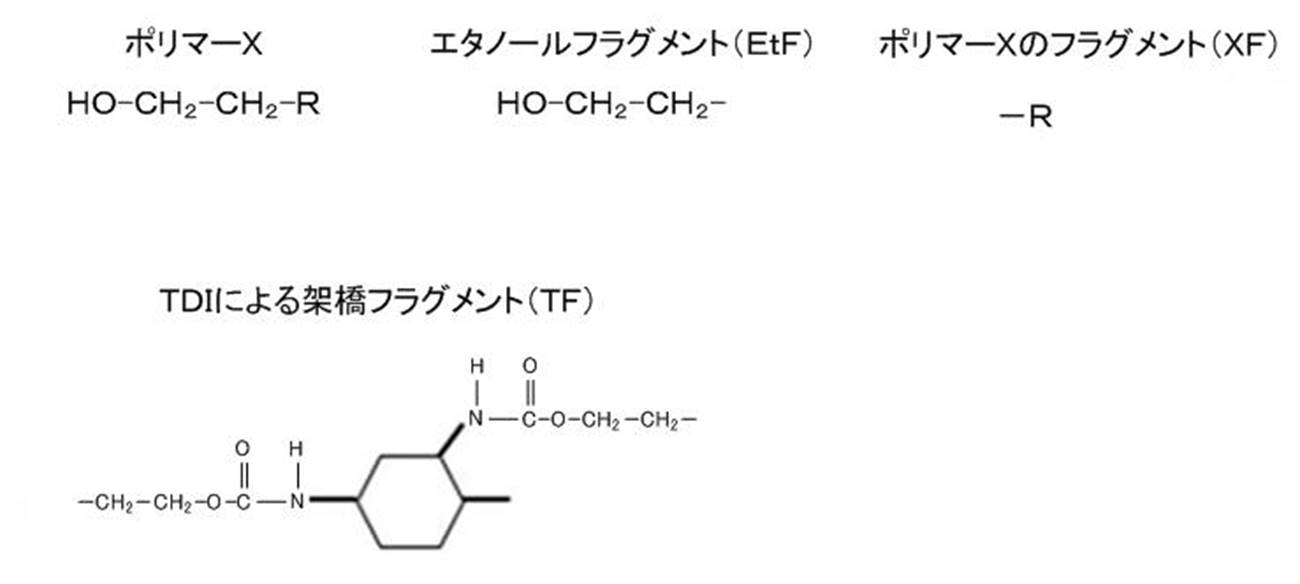
ポリマーXのHSP値は、上述したように24種類の有機溶媒についての可溶又は不溶の結果をハンセン溶解度パラメータ計算ソフトウェアHSPiP(ver.5.2 Hansen-Solublity.com製)に入力することにより求めることができ、ポリマーXのHSP値(X)は、dDx:20.27[MPa0.5]、dPx:12.38[MPa0.5]、dHx:10.19[MPa0.5]、R1:9.8である。 The HSP value of the polymer X is obtained by inputting the soluble or insoluble results for the 24 kinds of organic solvents into the Hansen solubility parameter calculation software HSPiP (manufactured by Ver.5.2 Hansen-Solubility.com) as described above. The HSP value (X) of the polymer X is dD x : 20.27 [MPa 0.5 ], dP x : 12.38 [MPa 0.5 ], dH x : 10.19 [MPa 0. 5 ], R 1 : 9.8.
エタノールフラグメントのHSP値(EtF)は、その構造から、ハンセン溶解度パラメータ計算ソフトウェアHSPiPより計算によって求めることができ、HSP値(EtF)=dDEtF:15.6[MPa0.5]、dPEtF:9.3[MPa0.5]、dHEtF:17.2[MPa0.5]である。
水添TDIの架橋フラグメントのHSP値(TF)は、その構造から、ハンセン溶解度パラメータ計算ソフトウェアHSPiPより計算によって求めることができ、HSP値(TF)=dDTF:17.6[MPa0.5]、dPTF:9.8[MPa0.5]、dHTF:6.7[MPa0.5]である。
The HSP value (EtF) of the ethanol fragment can be obtained by calculation from the Hansen solubility parameter calculation software HSPiP from its structure, and the HSP value (EtF) = dD EtF : 15.6 [MPa 0.5 ], dP EtF :. 9.3 [MPa 0.5 ], dH EtF : 17.2 [MPa 0.5 ].
The HSP value (TF) of the crosslinked fragment of the hydrogenated TDI can be obtained by calculation from the Hansen solubility parameter calculation software HSPiP from its structure, and the HSP value (TF) = dD TF : 17.6 [MPa 0.5 ]. , DP TF : 9.8 [MPa 0.5 ], dH TF : 6.7 [MPa 0.5 ].
ポリマーXのフラグメントのHSP値(XF)は、HSP値(X)がHSP値(XF)とHSP値(EtF)を溶かした混合多成分系として扱うことができるため、HSP値(XF)は、HSP値(X)からHSP値(EtF)を除き、質量分率から求めることができる。
ポリマーXは180mgKOH/gの水酸基価を有することから、0.003208mol/gの水酸基を持っているので、0.003208mol/g*45(EtFの分子量)*100=14、即ちEtFを14質量%含んでいる。
ポリマーXはEtFとXFとから構成されているため、XFは残り86質量%を占めている。
HSP値(X)とHSP値(EtF)が既知であるため、HSP値(XF)の分散項dDXFは質量分率より、dDXF={dDEtF-0.14*dDX}/0.86=(15.6-0.14*20.27)/0.86=21.06である。
HSP値(XF)の極性項dPXF、及びHSP値(XF)の水素結合項dHXFについても同様にして求めることができ、dPXF:12.90[MPa0.5]、dHXF:9.01[MPa0.5]である。
Since the HSP value (XF) of the fragment of the polymer X can be treated as a mixed multi-component system in which the HSP value (X) is a mixture of the HSP value (XF) and the HSP value (EtF), the HSP value (XF) is It can be obtained from the mass fraction by removing the HSP value (EtF) from the HSP value (X).
Since polymer X has a hydroxyl value of 180 mgKOH / g, it has a hydroxyl group of 0.003208 mol / g. Therefore, 0.003208 mol / g * 45 (molecular weight of EtF) * 100 = 14, that is, EtF is 14% by mass. Includes.
Since the polymer X is composed of EtF and XF, XF accounts for the remaining 86% by mass.
Since the HSP value (X) and the HSP value (EtF) are known, the variance term dD XF of the HSP value (XF) is dD XF = {dD EtF -0.14 * dD X } / 0. 86 = (15.6-0.14 * 20.27) /0.86=21.06.
The polar term dP XF of the HSP value (XF) and the hydrogen bond term dH XF of the HSP value (XF) can be obtained in the same manner, and dP XF : 12.90 [MPa 0.5 ], dH XF : 9 It is 0.01 [MPa 0.5 ].
次に、造形部のHSP値(ポリマーXの架橋度##)は、上記求めたHSP値(X)、HSP値(XF)、HSP値(EtF)とポリマーXの架橋度##によって規定される。 Next, the HSP value (crosslinking degree of polymer X ##) of the modeled portion is defined by the HSP value (X), HSP value (XF), HSP value (EtF) and the crosslinking degree of polymer X obtained above. NS.
ポリマーXの架橋度##が100%である造形部のHSP値(100)の場合、ポリマーXのうちEtFは全て反応してTFとなっている。このため、ポリマーXの180mgKOH/gの水酸基価、即ち0.003208mol/gの水酸基より、0.003208mol/g*270(TFの分子量)/2(TFは架橋点を2つ有するため)*100=43、つまりTDIによる架橋フラグメントTFの割合は43質量%である。残りの57質量%は架橋に使われないXFのままである。 When the degree of cross-linking of the polymer X is 100% and the HSP value (100) of the modeled portion, all EtFs of the polymer X react to become TF. Therefore, from the hydroxyl value of 180 mgKOH / g of polymer X, that is, the hydroxyl group of 0.003208 mol / g, 0.003208 mol / g * 270 (molecular weight of TF) / 2 (because TF has two cross-linking points) * 100 = 43, that is, the proportion of crosslinked fragment TF by TDI is 43% by mass. The remaining 57% by weight remains XF not used for cross-linking.
以上により、ポリマーXの架橋度##が100%であるHSP値(100)の分散項(dD100),極性項(dP100),水素結合項(dH100)=[(0.43*dDTF+0.57*dDXF)、(0.43*dPTF+0.57*dPXF)、(0.43*dHTF+0.57*dHXF)]から[19.6,11.6,8.0]であると求めることができる。この値をdD100、dP100、dH100とする。
ポリマーXの架橋度##が20%であるHSP値(20)を求める場合、80%はポリマーXそのものであるため、(分散項(dDMIX),極性項(dPMIX),水素結合項(dHMIX))=[0.8*dDx+0.2*dD100、0.8*dPx+0.2*dP100、0.8*dHx+0.2*dH100]から、[20.1,12.2,9.8]である。
以上の結果から、ポリマーXの架橋度##が20%である実施例1の造形部RED値は、上記数式(3)により、以下のとおり求めることができる。
{4*(dDMIX-dDacetone)2+(dPMIX-dPacetone)2+(dH1IX-dHacetone)2}0.5/R1={4*(20.1-15.5)2+(12.2-10.4)2+(9.8-7.0)2}0.5/11.67=0.84である。
なお、ハンセンの溶解理論として、本来、造形部HSP値(##)の相互作用半径を用いるべきであるが、R1は架橋前の材料として実験により既知であり、定数として扱うことができるため、有機材料が架橋している場合、造形部RED値の計算には非造形部のHSP値の相互作用半径R1を用いた。
As described above, the dispersion term (dD 100 ), the polarity term (dP 100 ), and the hydrogen bond term (dH 100 ) = [(0.43 * dD) of the HSP value (100) in which the degree of cross-linking of the polymer X is 100%. TF +0.57 * dD XF ), (0.43 * dP TF +0.57 * dP XF ), (0.43 * dH TF +0.57 * dH XF )] to [19.6, 11.6,8 .0] can be obtained. Let this value be dD 100 , dP 100 , and dH 100 .
When the HSP value (20) at which the degree of cross-linking of the polymer X is 20% is determined, since 80% is the polymer X itself, (dispersion term (dD MIX ), polarity term (dP MIX ), hydrogen bond term ( dH MIX )) = [0.8 * dD x +0.2 * dD 100 , 0.8 * dP x +0.2 * dP 100 , 0.8 * dH x +0.2 * dH 100 ] to [20. 1,12.2, 9.8].
From the above results, the modeling portion RED value of Example 1 in which the degree of cross-linking of the polymer X is 20% can be obtained as follows by the above mathematical formula (3).
{4 * (dD MIX- dD acetone ) 2 + (dP MIX- dP acetone ) 2 + (dH 1IX- dH acetone ) 2 } 0.5 / R 1 = {4 * (20.1-15.5) 2 + (12.2-10.4) 2 + (9.8-7.0) 2 } 0.5 / 11.67 = 0.84.
As Hansen's dissolution theory, the interaction radius of the modeling part HSP value (##) should be used originally, but R 1 is known by experiments as a material before cross-linking and can be treated as a constant. If the organic material is crosslinked, in the calculation of the shaped portion RED value using the interaction radius R 1 of the HSP value of the non-shaped portion.
次に、実施例19について、造形部のHSP値(##)(##はポリマーの架橋度)の具体的な求め方を説明する。なお、実施例20~23及び比較例6~9についても実施例19と同様にして、造形部のRED値を求めることができる。 Next, with respect to Example 19, a specific method for obtaining the HSP value (##) (where ## is the degree of cross-linking of the polymer) of the modeling portion will be described. As for Examples 20 to 23 and Comparative Examples 6 to 9, the RED value of the modeled portion can be obtained in the same manner as in Example 19.
<実施例19の造形部のRED値の求め方>
上記「非造形部のHSP値の求め方」に記載の方法により、HSP(PVB)=(dD,dP,dH)=(18.12,6.72,10.07)となる。
実施例1と同様に、エタノールフラグメントHSP(EtF)=(dD,dP,dH)=(15.6,4.3,17.2)を用いる。
実施例1と同様に、水添TDIフラグメントHSP(TF)=(dD,dP,dH)=(17.6,4.8,6.7)を用いる。
PVBのフラグメントのHSP値(PVBF)は、HSP値(PVB)がHSP値(PVBF)とHSP値(EtF)を溶かした混合多成分系として扱うことができるため、HSP値(PVBF)は、HSP値(PVB)からHSP値(EtF)を除き、質量分率から求めることができる。
PVBは73mgKOH/gの水酸基価を有することから、0.001301118mol/gの水酸基を持っているので、0.001301118mol/g*45(EtFの分子量)*100=14、即ちEtFを5.85質量%含んでいる。
PVBはEtFとPVBFとから構成されているため、PVBFは残り94.15質量%を占めている。
HSP値(PVB)とHSP値(EtF)が既知であるため、HSP値(PVBF)の分散項dDPVBFは質量分率より、dDPVBF={dDEtF-0.06*dDPVB}/0.94=(15.6-0.06*18.12)/0.94=18.28である。
HSP値(PVBF)の極性項dPPVBF、及びHSP値(PVBF)の水素結合項dHPVBFについても同様にして求めることができ、dPPVBF:6.56[MPa0.5]、dHPVBF:9.63[MPa0.5]である。
<How to obtain the RED value of the modeling part of Example 19>
HSP (PVB) = (dD, dP, dH) = (18.12, 6.72, 10.07) by the method described in the above "How to obtain the HSP value of the non-modeled portion".
As in Example 1, ethanol fragment HSP (EtF) = (dD, dP, dH) = (15.6, 4.3, 17.2) is used.
As in Example 1, hydrogenated TDI fragment HSP (TF) = (dD, dP, dH) = (17.6, 4.8, 6.7) is used.
Since the HSP value (PVBF) of the PVB fragment can be treated as a mixed multi-component system in which the HSP value (PVB) is a mixture of the HSP value (PVBF) and the HSP value (EtF), the HSP value (PVBF) is HSP. It can be obtained from the mass fraction by removing the HSP value (EtF) from the value (PVB).
Since PVB has a hydroxyl value of 73 mgKOH / g, it has a hydroxyl group of 0.001301118 mol / g. Therefore, 0.001301118 mol / g * 45 (molecular weight of EtF) * 100 = 14, that is, EtF is 5.85 mass. % Is included.
Since PVB is composed of EtF and PVBF, PVBF occupies the remaining 94.15% by mass.
Since the HSP value (PVB) and the HSP value (EtF) are known, the dispersion term dD PVBF of the HSP value (PVBF) is dD PVBF = {dD EtF -0.06 * dD PVB } / 0. 94 = (15.6-0.06 * 18.12) /0.94=18.28.
The polar term dP PVBF of the HSP value (PVBF) and the hydrogen bond term dH PVBF of the HSP value (PVBF) can be obtained in the same manner, and dP PVBF : 6.56 [MPa 0.5 ], dH PVBF : 9 It is .63 [MPa 0.5 ].
次に、造形部のHSP値(PVBの架橋度##)は、上記求めたHSP値(PVB)、HSP値(PVBF)、HSP値(EtF)とPVBの架橋度##によって規定される。 Next, the HSP value (PVB cross-linking degree ##) of the modeled portion is defined by the HSP value (PVB), HSP value (PVBF), HSP value (EtF) and PVB cross-linking degree ## obtained above.
PVBの架橋度##が100%である造形部のHSP値(100)の場合、PVBのうちEtFは全て反応してTFとなっている。このため、PVBの73mgKOH/gの水酸基価、即ち0.001301118mol/gの水酸基より、0.001301118mol/g*270(TFの分子量)/2(TFは架橋点を2つ有するため)*100=18、つまりTDIによる架橋フラグメントTFの割合は18質量%である。残りの82質量%は架橋に使われないPVBFのままである。 In the case of the HSP value (100) of the modeling part where the degree of cross-linking of PVB is 100%, all EtFs in PVB react to become TF. Therefore, from the hydroxyl value of 73 mgKOH / g of PVB, that is, the hydroxyl group of 0.001301118 mol / g, 0.001301118 mol / g * 270 (molecular weight of TF) / 2 (because TF has two cross-linking points) * 100 = 18, that is, the proportion of crosslinked fragment TF by TDI is 18% by mass. The remaining 82% by weight remains PVBF not used for cross-linking.
以上により、PVBの架橋度##が100%であるHSP値(100)の分散項(dD100),極性項(dP100),水素結合項(dH100)=[(0.18*dDTF+0.82*dDPVBF)、(0.18*dPTF+0.82*dPPVBF)、(0.18*dHTF+0.82*dHPVBF)]から[18.16,7.13,9.11]であると求めることができる。この値をdD100、dP100、dH100とする。
ポリマーXの架橋度##が20%であるHSP値(20)を求める場合、80%はPVBそのものであるため、(分散項(dDMIX),極性項(dPMIX),水素結合項(dHMIX))=[0.8*dDx+0.2*dD100、0.8*dPx+0.2*dP100、0.8*dHx+0.2*dH100]から、[18.13,6.8,9.88]である。
この値を元に各溶媒のデータベース上の値と、上記数式(3)により、実施例19の造形部のRED値を算出すると、1.00である。
As described above, the dispersion term (dD 100 ), the polarity term (dP 100 ), and the hydrogen bond term (dH 100 ) = [(0.18 * dD TF ) of the HSP value (100) in which the degree of cross-linking of PVB is 100%. +0.82 * dD PVBF), (0.18 * dP TF +0.82 * dP PVBF), (0.18 * dH TF +0.82 * dH PVBF)] to [18.16, 7.13, 9. 11] can be obtained. Let this value be dD 100 , dP 100 , and dH 100 .
When determining the HSP value (20) in which the degree of cross-linking of polymer X is 20%, since 80% is PVB itself, (dispersion term (dD MIX ), polarity term (dP MIX ), hydrogen bond term (dH). MIX )) = [0.8 * dDx + 0.2 * dD 100 , 0.8 * dPx + 0.2 * dP 100 , 0.8 * dHx + 0.2 * dH 100 ] to [18.13, 6.8, 9 .88].
Based on this value, the value on the database of each solvent and the RED value of the modeling portion of Example 19 are calculated by the above mathematical formula (3), and it is 1.00.
次に、実施例24について、造形部のRED値の具体的な求め方を説明する。なお、実施例25~27及び比較例10~13についても実施例24と同様にして、造形部のRED値を求めることができる。 Next, with respect to Example 24, a specific method of obtaining the RED value of the modeling portion will be described. As for Examples 25 to 27 and Comparative Examples 10 to 13, the RED value of the modeled portion can be obtained in the same manner as in Example 24.
<実施例24の造形部のRED値>
上記「非造形部のHSP値の求め方」(段落[0147]参照)に記載の方法により、HSP(PVP)=(19.7,12.29,16.35)R=13.2であり、各溶媒のデータベース上の値と、上記数式(3)により、実施例24の造形部のRED値を算出すると、1.12である。
<RED value of the modeling part of Example 24>
HSP (PVP) = (19.7, 12.29, 16.35) R = 13.2 by the method described in the above "How to obtain the HSP value of the non-modeled portion" (see paragraph [0147]). When the value on the database of each solvent and the RED value of the modeled portion of Example 24 are calculated by the above mathematical formula (3), it is 1.12.
次に、実施例28について、造形部のRED値の具体的な求め方を説明する。なお、実施例29~31及び比較例14~17についても実施例28と同様にして、造形部のRED値を求めることができる。 Next, with respect to Example 28, a specific method of obtaining the RED value of the modeling portion will be described. As for Examples 29 to 31 and Comparative Examples 14 to 17, the RED value of the modeled portion can be obtained in the same manner as in Example 28.
<実施例28の造形部のRED値>
上記「非造形部のHSP値の求め方」(段落[0147]参照)に記載の方法により、HSP(PVP)=(14.05、0.33,5.89)R=12.9であり、各溶媒のデータベース上の値と、上記数式(3)より、実施例28の造形部のRED値を算出すると、1.21である。
<RED value of the modeling part of Example 28>
HSP (PVP) = (14.05, 0.33, 5.89) R = 12.9 by the method described in the above "How to obtain the HSP value of the non-modeled portion" (see paragraph [0147]). , The RED value of the modeling part of Example 28 is calculated from the value on the database of each solvent and the above formula (3), which is 1.21.
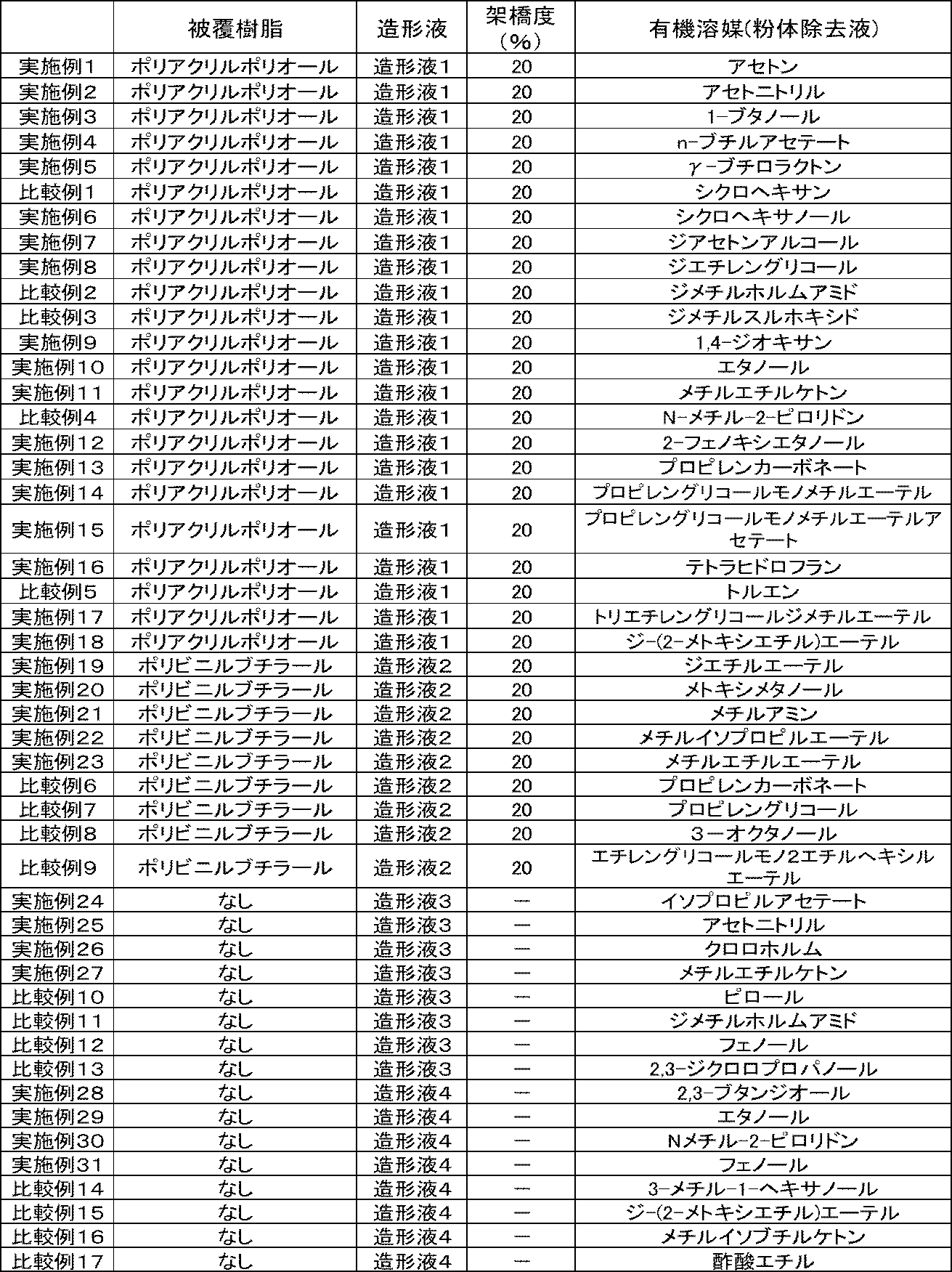

*表2中の実施例24~31及び比較例10~17は、非造形部が樹脂を含まないため、非造形部のHSP値を求めることができないので「-」とした。
* In Examples 24 to 31 and Comparative Examples 10 to 17 in Table 2, since the non-modeled portion does not contain resin, the HSP value of the non-modeled portion cannot be obtained, so the value is set to "-".

本発明の態様は、例えば、以下のとおりである。
<1> 基材と有機材料とを含有する粉体に対し、造形液を付与して固化物を形成する固化物形成工程と、
有機溶媒を含む粉体除去液を用いて前記固化物に付着する前記粉体を前記固化物から除去する粉体除去工程と、を含み、
前記粉体に対して前記造形液を付与した領域である造形部におけるHSP値と前記有機溶媒のHSP値との距離を造形部RED値とし、
前記粉体に対して前記造形液を付与しない領域である非造形部におけるHSP値と前記有機溶媒のHSP値との距離を非造形部RED値とすると、次式、非造形部RED値<1.20かつ造形部RED値>0.55、を充たすことを特徴とする立体造形物の製造方法である。
<2> 非造形部RED値<1.0かつ造形部RED値>1.0、を充たす、前記<1>に記載の立体造形物の製造方法である。
<3> 基材を含む粉体に対し、有機材料を含有する造形液を付与して固化物を形成する固化物形成工程と、
有機溶媒を含む粉体除去液を用いて前記固化物に付着する前記粉体を前記固化物から除去する粉体除去工程と、を含み、
前記粉体に対して前記造形液を付与した領域である造形部におけるHSP値と前記有機溶媒のHSP値との距離を造形部RED値とすると、次式、造形部RED値>0.55、を充たすことを特徴とする立体造形物の製造方法である。
<4> 造形部RED値>1.0、を充たす、前記<3>に記載の立体造形物の製造方法である。
<5> 非造形部RED値が下記数式(2)で表され
前記造形部RED値が下記数式(3)で表される、前記<1>から<4>のいずれかに記載の立体造形物の製造方法である。
[数式(2)]
非造形部RED値={4*(dD1-dDS)2+(dP1-dPS)2+(dH1-dHS)2}0.5/R1
ただし、前記数式(2)中、dD1は非造形部のHSP値の分散項、dDSは粉体除去液に含まれる有機溶媒のHSP値の分散項、dP1は非造形部のHSP値の極性項、dPSは粉体除去液に含まれる有機溶媒のHSP値の極性項、dH1は非造形部のHSP値の水素結合項、dHSは粉体除去液に含まれる有機溶媒のHSP値の水素結合項、R1は非造形部のHSP値の相互作用半径である。
[数式(3)]
造形部RED値={4*(dD2-dDS)2+(dP2-dPS)2+(dH2-dHS)2}0.5/R2
ただし、前記数式(3)中、dD2は造形部のHSP値の分散項、dDSは粉体除去液に含まれる有機溶媒のHSP値の分散項、dP2は造形部のHSP値の極性項、dPsは粉体除去液に含まれる有機溶媒のHSP値の極性項、dH2は造形部のHSP値の水素結合項、dHsは粉体除去液に含まれる有機溶媒のHSP値の水素結合項を表し、R2は有機材料が架橋している場合には非造形部のHSP値の相互作用半径R1を表し、有機材料が架橋していない場合には造形部のHSP値の相互作用半径を表す。
<6> 前記粉体除去液が、ケトン、ハロゲン、アルコール、エステル、エーテル、炭化水素、グリコール、グリコールエーテル、グリコールエステル、ピロリドン、アミド、アミン及び炭酸エステルから選択される少なくともいずれかの前記有機溶媒を含有する、前記<1>から<5>のいずれかに記載の立体造形物の製造方法である。
<7> 前記固化物を前記粉体除去液に1時間浸漬した後における、タイプ00デュロメータ硬度が80以上である、前記<1>から<6>のいずれかに記載の立体造形物の製造方法である。
<8> 更に、前記固化物に焼結処理を行う焼結工程を含む、前記<1>から<7>のいずれかに記載の立体造形物の製造方法である。
<9> 前記造形液が架橋剤を含有する、前記<1>から<2>及び<5>から<8>のいずれかに記載の立体造形物の製造方法である。
<10> 前記有機材料が水酸基を有する樹脂である、前記<1>から<2>及び<5>から<9>のいずれかに記載の立体造形物の製造方法である。
<11> 前記架橋剤がイソシアネート、酸無水物、エポキシ、及びフェノールアルデヒドから選択される少なくとも1種である、前記<9>から<10>のいずれかに記載の立体造形物の製造方法である。
<12> 前記造形液に含まれる有機材料が水酸基を有する樹脂である、前記<3>から<8>のいずれかに記載の立体造形物の製造方法である。
<13> 前記水酸基を有する樹脂が、ポリビニルアセタール、ポリビニルブチラール、ポリアクリルポリオール、ポリエステルポリオール、ポリブタジエンポリオール、エチルセルロース、及びニトロセルロースから選択される少なくとも1種である、前記<10>及び<12>のいずれかに記載の立体造形物の製造方法である。
<14> 前記基材が金属及びセラミックスの少なくともいずれかである、前記<1>から<13>のいずれかに記載の立体造形物の製造方法である。
<15> 基材と有機材料とを含有する粉体と、
前記粉体を固化させて固化物を形成する造形液と、
有機溶媒を含み、前記固化物に付着する前記粉体を前記固化物から除去する粉体除去液と、を有し、
前記粉体に対して前記造形液を付与した領域である造形部におけるHSP値と前記有機溶媒のHSP値との距離を造形部RED値とし、
前記粉体に対して前記造形液を付与しない領域である非造形部におけるHSP値と前記有機溶媒のHSP値との距離を非造形部RED値とすると、次式、非造形部RED値<1.20かつ造形部RED値>0.55、を充たすことを特徴とする立体造形用キットである。
<16> 基材を含む粉体と、
有機材料を含有し、前記粉体を固化させて固化物を形成する造形液と、
有機溶媒を含み、前記固化物に付着する前記粉体を前記固化物から除去する粉体除去液と、を有し、
前記粉体に対して前記造形液を付与した領域である造形部におけるHSP値と前記有機溶媒のHSP値との距離を造形部RED値とすると、次式、造形部RED値>0.55、を充たすことを特徴とする立体造形用キットである。
Aspects of the present invention are, for example, as follows.
<1> A solidification forming step of applying a molding liquid to a powder containing a base material and an organic material to form a solidified material.
Including a powder removing step of removing the powder adhering to the solidified material from the solidified material using a powder removing liquid containing an organic solvent.
The distance between the HSP value in the modeling portion, which is the region where the modeling liquid is applied to the powder, and the HSP value of the organic solvent is defined as the modeling unit RED value.
Assuming that the distance between the HSP value in the non-modeling portion, which is a region where the modeling liquid is not applied to the powder, and the HSP value of the organic solvent is the non-modeling portion RED value, the following equation, the non-modeling portion RED value <1 It is a method for manufacturing a three-dimensional model, which is characterized by satisfying .20 and a modeling unit RED value> 0.55.
<2> The method for manufacturing a three-dimensional model according to <1>, wherein the non-modeled portion RED value <1.0 and the modeled portion RED value> 1.0 are satisfied.
<3> A solidification forming step of applying a molding liquid containing an organic material to a powder containing a base material to form a solidification.
Including a powder removing step of removing the powder adhering to the solidified material from the solidified material using a powder removing liquid containing an organic solvent.
Assuming that the distance between the HSP value in the modeling unit, which is the region where the modeling liquid is applied to the powder, and the HSP value of the organic solvent is the modeling unit RED value, the following equation, modeling unit RED value> 0.55, It is a manufacturing method of a three-dimensional model characterized by satisfying.
<4> The method for manufacturing a three-dimensional model according to <3>, which satisfies the modeling unit RED value> 1.0.
<5> The three-dimensional model according to any one of <1> to <4>, wherein the non-modeling unit RED value is represented by the following mathematical formula (2) and the modeling unit RED value is represented by the following mathematical formula (3). It is a manufacturing method of.
[Formula (2)]
Non shaped portion RED value = {4 * (dD 1 -dD S) 2 + (dP 1 -dP S) 2 + (dH 1 -dH S) 2} 0.5 /
However, in the equation (2), dD 1 dispersion term of HSP value of the non-shaped portion, dD S dispersion term of HSP value of the organic solvent contained in the powder removing liquid, dP 1 is HSP value of the non-shaped portion polarity term of, dP S polarity term of HSP value of the organic solvent contained in the powder removing solution, dH 1 is hydrogen bond of HSP value of the non-shaped portion, the dH S of the organic solvent contained in the powder removing solution The hydrogen bond term of the HSP value, R 1, is the interaction radius of the HSP value of the non-modeled portion.
[Formula (3)]
Shaped portion RED value = {4 * (dD 2 -dD S) 2 + (dP 2 -dP S) 2 + (dH 2 -dH S) 2} 0.5 /
However, the numerical expression (3), dD 2 dispersion term of HSP value of the feature section, dD S polarity of the HSP of the dispersion term of the HSP value of the organic solvent contained in the powder removing solution, dP 2 is shaped portions Item, dPs is the polar term of the HSP value of the organic solvent contained in the powder removal solution, dH 2 is the hydrogen bond term of the HSP value of the modeling part, and dHs is the hydrogen bond of the HSP value of the organic solvent contained in the powder removal solution. Represents the term, R 2 represents the interaction radius R 1 of the HSP value of the non-modeled part when the organic material is cross-linked, and the interaction of the HSP value of the modeled part when the organic material is not cross-linked. Represents a radius.
<6> The organic solvent for which the powder removing liquid is selected from ketone, halogen, alcohol, ester, ether, hydrocarbon, glycol, glycol ether, glycol ester, pyrrolidone, amide, amine and carbonic acid ester. The method for producing a three-dimensional model according to any one of <1> to <5>.
<7> The method for producing a three-dimensional model according to any one of <1> to <6>, wherein the
<8> The method for producing a three-dimensional model according to any one of <1> to <7>, which further includes a sintering step of sintering the solidified product.
<9> The method for producing a three-dimensional model according to any one of <1> to <2> and <5> to <8>, wherein the modeling liquid contains a cross-linking agent.
<10> The method for producing a three-dimensional model according to any one of <1> to <2> and <5> to <9>, wherein the organic material is a resin having a hydroxyl group.
<11> The method for producing a three-dimensional model according to any one of <9> to <10>, wherein the cross-linking agent is at least one selected from isocyanate, acid anhydride, epoxy, and phenol aldehyde. ..
<12> The method for producing a three-dimensional model according to any one of <3> to <8>, wherein the organic material contained in the modeling liquid is a resin having a hydroxyl group.
<13> The resin having a hydroxyl group is at least one selected from polyvinyl acetal, polyvinyl butyral, polyacrylic polyol, polyester polyol, polybutadiene polyol, ethyl cellulose, and nitrocellulose. The method for producing a three-dimensional model according to any one.
<14> The method for producing a three-dimensional model according to any one of <1> to <13>, wherein the base material is at least one of metal and ceramics.
<15> A powder containing a base material and an organic material,
A molding liquid that solidifies the powder to form a solidified product,
It contains an organic solvent and has a powder removing liquid that removes the powder adhering to the solidified material from the solidified material.
The distance between the HSP value in the modeling portion, which is the region where the modeling liquid is applied to the powder, and the HSP value of the organic solvent is defined as the modeling unit RED value.
Assuming that the distance between the HSP value in the non-modeling portion, which is a region where the modeling liquid is not applied to the powder, and the HSP value of the organic solvent is the non-modeling portion RED value, the following equation, the non-modeling portion RED value <1 It is a three-dimensional modeling kit characterized by satisfying .20 and a modeling unit RED value> 0.55.
<16> Powder containing a base material and
A molding liquid containing an organic material and solidifying the powder to form a solidified product,
It contains an organic solvent and has a powder removing liquid that removes the powder adhering to the solidified material from the solidified material.
Assuming that the distance between the HSP value in the modeling unit, which is the region where the modeling liquid is applied to the powder, and the HSP value of the organic solvent is the modeling unit RED value, the following equation, modeling unit RED value> 0.55, It is a three-dimensional modeling kit characterized by satisfying.
前記<1>から<14>のいずれかに記載の立体造形物の製造方法、及び前記<15>から<16>のいずれかに記載の立体造形用キットによると、従来における諸問題を解決し、本発明の目的を達成することができる。 According to the method for manufacturing a three-dimensional model according to any one of <1> to <14> and the three-dimensional model kit according to any one of <15> to <16>, various problems in the prior art are solved. , The object of the present invention can be achieved.
Claims (16)
有機溶媒を含む粉体除去液を用いて前記固化物に付着する前記粉体を前記固化物から除去する粉体除去工程と、を含み、
前記粉体に対して前記造形液を付与した領域である造形部におけるHSP値と前記有機溶媒のHSP値との距離を造形部RED値とし、
前記粉体に対して前記造形液を付与しない領域である非造形部におけるHSP値と前記有機溶媒のHSP値との距離を非造形部RED値とすると、次式、非造形部RED値<1.20かつ造形部RED値>0.55、を充たすことを特徴とする立体造形物の製造方法。 A solidification forming step of applying a molding liquid to a powder containing a base material and an organic material to form a solidified material,
Including a powder removing step of removing the powder adhering to the solidified material from the solidified material using a powder removing liquid containing an organic solvent.
The distance between the HSP value in the modeling portion, which is the region where the modeling liquid is applied to the powder, and the HSP value of the organic solvent is defined as the modeling unit RED value.
Assuming that the distance between the HSP value in the non-modeling portion, which is a region where the modeling liquid is not applied to the powder, and the HSP value of the organic solvent is the non-modeling portion RED value, the following equation, the non-modeling portion RED value <1 A method for manufacturing a three-dimensional model, which comprises satisfying .20 and a modeling unit RED value> 0.55.
有機溶媒を含む粉体除去液を用いて前記固化物に付着する前記粉体を前記固化物から除去する粉体除去工程と、を含み、
前記粉体に対して前記造形液を付与した領域である造形部におけるHSP値と前記有機溶媒のHSP値との距離を造形部RED値とすると、次式、造形部RED値>0.55、を充たすことを特徴とする立体造形物の製造方法。 A solidification forming step of applying a molding liquid containing an organic material to a powder containing a base material to form a solidification,
Including a powder removing step of removing the powder adhering to the solidified material from the solidified material using a powder removing liquid containing an organic solvent.
Assuming that the distance between the HSP value in the modeling unit, which is the region where the modeling liquid is applied to the powder, and the HSP value of the organic solvent is the modeling unit RED value, the following equation, modeling unit RED value> 0.55, A method for manufacturing a three-dimensional model, which is characterized by satisfying.
前記造形部RED値が下記数式(3)で表される、請求項1から4のいずれかに記載の立体造形物の製造方法。
[数式(2)]
非造形部RED値={4*(dD1-dDS)2+(dP1-dPS)2+(dH1-dHS)2}0.5/R1
ただし、前記数式(2)中、dD1は非造形部のHSP値の分散項、dDSは粉体除去液に含まれる有機溶媒のHSP値の分散項、dP1は非造形部のHSP値の極性項、dPSは粉体除去液に含まれる有機溶媒のHSP値の極性項、dH1は非造形部のHSP値の水素結合項、dHSは粉体除去液に含まれる有機溶媒のHSP値の水素結合項、R1は非造形部のHSP値の相互作用半径である。
[数式(3)]
造形部RED値={4*(dD2-dDS)2+(dP2-dPS)2+(dH2-dHS)2}0.5/R2
ただし、前記数式(3)中、dD2は造形部のHSP値の分散項、dDSは粉体除去液に含まれる有機溶媒のHSP値の分散項、dP2は造形部のHSP値の極性項、dPsは粉体除去液に含まれる有機溶媒のHSP値の極性項、dH2は造形部のHSP値の水素結合項、dHsは粉体除去液に含まれる有機溶媒のHSP値の水素結合項を表し、R2は有機材料が架橋している場合には非造形部のHSP値の相互作用半径R1を表し、有機材料が架橋していない場合には造形部のHSP値の相互作用半径を表す。 The method for manufacturing a three-dimensional model according to any one of claims 1 to 4, wherein the non-modeling unit RED value is represented by the following mathematical formula (2), and the modeling unit RED value is represented by the following mathematical formula (3).
[Formula (2)]
Non shaped portion RED value = {4 * (dD 1 -dD S) 2 + (dP 1 -dP S) 2 + (dH 1 -dH S) 2} 0.5 / R 1
However, in the equation (2), dD 1 dispersion term of HSP value of the non-shaped portion, dD S dispersion term of HSP value of the organic solvent contained in the powder removing liquid, dP 1 is HSP value of the non-shaped portion polarity term of, dP S polarity term of HSP value of the organic solvent contained in the powder removing solution, dH 1 is hydrogen bond of HSP value of the non-shaped portion, the dH S of the organic solvent contained in the powder removing solution The hydrogen bond term of the HSP value, R 1, is the interaction radius of the HSP value of the non-modeled portion.
[Formula (3)]
Shaped portion RED value = {4 * (dD 2 -dD S) 2 + (dP 2 -dP S) 2 + (dH 2 -dH S) 2} 0.5 / R 2
However, the numerical expression (3), dD 2 dispersion term of HSP value of the feature section, dD S polarity of the HSP of the dispersion term of the HSP value of the organic solvent contained in the powder removing solution, dP 2 is shaped portions Item, dPs is the polar term of the HSP value of the organic solvent contained in the powder removal solution, dH 2 is the hydrogen bond term of the HSP value of the modeling part, and dHs is the hydrogen bond of the HSP value of the organic solvent contained in the powder removal solution. Represents the term, R 2 represents the interaction radius R 1 of the HSP value of the non-modeled part when the organic material is cross-linked, and the interaction of the HSP value of the modeled part when the organic material is not cross-linked. Represents a radius.
前記粉体を固化させて固化物を形成する造形液と、
有機溶媒を含み、前記固化物に付着する前記粉体を前記固化物から除去する粉体除去液と、を有し、
前記粉体に対して前記造形液を付与した領域である造形部におけるHSP値と前記有機溶媒のHSP値との距離を造形部RED値とし、
前記粉体に対して前記造形液を付与しない領域である非造形部におけるHSP値と前記有機溶媒のHSP値との距離を非造形部RED値とすると、次式、非造形部RED値<1.20かつ造形部RED値>0.55、を充たすことを特徴とする立体造形用キット。 A powder containing a base material and an organic material,
A molding liquid that solidifies the powder to form a solidified product,
It contains an organic solvent and has a powder removing liquid that removes the powder adhering to the solidified material from the solidified material.
The distance between the HSP value in the modeling portion, which is the region where the modeling liquid is applied to the powder, and the HSP value of the organic solvent is defined as the modeling unit RED value.
Assuming that the distance between the HSP value in the non-modeling portion, which is a region where the modeling liquid is not applied to the powder, and the HSP value of the organic solvent is the non-modeling portion RED value, the following equation, the non-modeling portion RED value <1 A three-dimensional modeling kit characterized in that it satisfies .20 and the modeling unit RED value> 0.55.
有機材料を含有し、前記粉体を固化させて固化物を形成する造形液と、
有機溶媒を含み、前記固化物に付着する前記粉体を前記固化物から除去する粉体除去液と、を有し、
前記粉体に対して前記造形液を付与した領域である造形部におけるHSP値と前記有機溶媒のHSP値との距離を造形部RED値とすると、次式、造形部RED値>0.55、を充たすことを特徴とする立体造形用キット。
With powder containing base material,
A molding liquid containing an organic material and solidifying the powder to form a solidified product,
It contains an organic solvent and has a powder removing liquid that removes the powder adhering to the solidified material from the solidified material.
Assuming that the distance between the HSP value in the modeling unit, which is the region where the modeling liquid is applied to the powder, and the HSP value of the organic solvent is the modeling unit RED value, the following equation, modeling unit RED value> 0.55, A kit for three-dimensional modeling that is characterized by filling.
Priority Applications (3)
| Application Number | Priority Date | Filing Date | Title |
|---|---|---|---|
| JP2022510033A JP7318803B2 (en) | 2020-03-23 | 2021-03-18 | 3D modeling kit and method for manufacturing 3D model |
| EP21774310.3A EP4129631A4 (en) | 2020-03-23 | 2021-03-18 | Three-dimensional molding kit and method for manufacturing three-dimensionally molded article |
| US17/933,207 US20230036748A1 (en) | 2020-03-23 | 2022-09-19 | Three-dimensional forming kit and three-dimensional formed object producing method |
Applications Claiming Priority (2)
| Application Number | Priority Date | Filing Date | Title |
|---|---|---|---|
| JP2020050585 | 2020-03-23 | ||
| JP2020-050585 | 2020-03-23 |
Related Child Applications (1)
| Application Number | Title | Priority Date | Filing Date |
|---|---|---|---|
| US17/933,207 Continuation US20230036748A1 (en) | 2020-03-23 | 2022-09-19 | Three-dimensional forming kit and three-dimensional formed object producing method |
Publications (1)
| Publication Number | Publication Date |
|---|---|
| WO2021193339A1 true WO2021193339A1 (en) | 2021-09-30 |
Family
ID=77890281
Family Applications (1)
| Application Number | Title | Priority Date | Filing Date |
|---|---|---|---|
| PCT/JP2021/011038 Ceased WO2021193339A1 (en) | 2020-03-23 | 2021-03-18 | Three-dimensional molding kit and method for manufacturing three-dimensionally molded article |
Country Status (4)
| Country | Link |
|---|---|
| US (1) | US20230036748A1 (en) |
| EP (1) | EP4129631A4 (en) |
| JP (1) | JP7318803B2 (en) |
| WO (1) | WO2021193339A1 (en) |
Cited By (5)
| Publication number | Priority date | Publication date | Assignee | Title |
|---|---|---|---|---|
| JP2022135224A (en) * | 2021-03-05 | 2022-09-15 | 株式会社リコー | Manufacturing method of stereo-molding and stereo-molding kit |
| JP2023074199A (en) * | 2021-11-17 | 2023-05-29 | 株式会社リコー | Three-dimensional molded article production method, three-dimensional molded article production device, and three-dimensional molded article |
| JP2023100569A (en) * | 2022-01-06 | 2023-07-19 | 株式会社リコー | Modeling liquid, modeling kit, and method for manufacturing modeled object |
| EP4306240A1 (en) * | 2022-07-14 | 2024-01-17 | Ricoh Company, Ltd. | Liquid fabrication and method of manufacturing fabrication object |
| US12179264B2 (en) | 2021-03-22 | 2024-12-31 | Ricoh Company, Ltd. | Object producing method |
Families Citing this family (2)
| Publication number | Priority date | Publication date | Assignee | Title |
|---|---|---|---|---|
| JP2023133924A (en) | 2022-03-14 | 2023-09-27 | 株式会社リコー | Cleaning liquid for removing excess powder, method for manufacturing three-dimensional objects, and set of modeling liquid and cleaning liquid |
| CN116705198B (en) * | 2023-03-14 | 2023-11-17 | 哈尔滨工业大学 | Liquid bridge full-range calculation method for water-soluble KDP crystal element surface microdefect DPN repair process |
Citations (8)
| Publication number | Priority date | Publication date | Assignee | Title |
|---|---|---|---|---|
| JPS607300B2 (en) | 1979-03-28 | 1985-02-23 | 日本電信電話株式会社 | Japanese data compression method |
| JP2016013658A (en) | 2014-07-02 | 2016-01-28 | セイコーエプソン株式会社 | Manufacturing method of three-dimensional structure, three-dimensional structure, and composition for three-dimensional structure |
| JP2016022698A (en) * | 2014-07-23 | 2016-02-08 | セイコーエプソン株式会社 | Method for manufacturing three-dimensional molded article and three-dimensional molded article |
| JP2016028872A (en) * | 2013-09-30 | 2016-03-03 | 株式会社リコー | Three-dimensional modeling powder material, curing liquid, three-dimensional modeling kit, and three-dimensional model manufacturing method and manufacturing apparatus |
| JP2017094714A (en) | 2015-11-13 | 2017-06-01 | 株式会社リコー | Three-dimensional molding material set, method for manufacturing three-dimensionally molded article and apparatus for manufacturing three-dimensionally molded article |
| JP2018080359A (en) * | 2016-11-15 | 2018-05-24 | 株式会社リコー | 3D modeling powder material, 3D modeling material set, 3D model manufacturing apparatus, and 3D model manufacturing method |
| JP2019157201A (en) * | 2018-03-13 | 2019-09-19 | 株式会社リコー | Stereo model object producing process, stereo model object producing apparatus, and stereo model object producing program |
| JP2021011107A (en) * | 2019-07-04 | 2021-02-04 | 株式会社リコー | Powder material for three-dimensional modeling, kit for three-dimensional modeling, and manufacturing method and manufacturing equipment for three-dimensional modeling |
Family Cites Families (2)
| Publication number | Priority date | Publication date | Assignee | Title |
|---|---|---|---|---|
| JP2018154092A (en) * | 2017-03-21 | 2018-10-04 | 株式会社リコー | Method for manufacturing three-dimensional molded article and method for making data of three-dimensional molded article |
| WO2021002479A1 (en) * | 2019-07-04 | 2021-01-07 | 株式会社リコー | Method and apparatus for producing additively manufactured article, curing solution for additive manufacturing, and kit for additive manufacturing |
-
2021
- 2021-03-18 WO PCT/JP2021/011038 patent/WO2021193339A1/en not_active Ceased
- 2021-03-18 JP JP2022510033A patent/JP7318803B2/en active Active
- 2021-03-18 EP EP21774310.3A patent/EP4129631A4/en not_active Withdrawn
-
2022
- 2022-09-19 US US17/933,207 patent/US20230036748A1/en not_active Abandoned
Patent Citations (8)
| Publication number | Priority date | Publication date | Assignee | Title |
|---|---|---|---|---|
| JPS607300B2 (en) | 1979-03-28 | 1985-02-23 | 日本電信電話株式会社 | Japanese data compression method |
| JP2016028872A (en) * | 2013-09-30 | 2016-03-03 | 株式会社リコー | Three-dimensional modeling powder material, curing liquid, three-dimensional modeling kit, and three-dimensional model manufacturing method and manufacturing apparatus |
| JP2016013658A (en) | 2014-07-02 | 2016-01-28 | セイコーエプソン株式会社 | Manufacturing method of three-dimensional structure, three-dimensional structure, and composition for three-dimensional structure |
| JP2016022698A (en) * | 2014-07-23 | 2016-02-08 | セイコーエプソン株式会社 | Method for manufacturing three-dimensional molded article and three-dimensional molded article |
| JP2017094714A (en) | 2015-11-13 | 2017-06-01 | 株式会社リコー | Three-dimensional molding material set, method for manufacturing three-dimensionally molded article and apparatus for manufacturing three-dimensionally molded article |
| JP2018080359A (en) * | 2016-11-15 | 2018-05-24 | 株式会社リコー | 3D modeling powder material, 3D modeling material set, 3D model manufacturing apparatus, and 3D model manufacturing method |
| JP2019157201A (en) * | 2018-03-13 | 2019-09-19 | 株式会社リコー | Stereo model object producing process, stereo model object producing apparatus, and stereo model object producing program |
| JP2021011107A (en) * | 2019-07-04 | 2021-02-04 | 株式会社リコー | Powder material for three-dimensional modeling, kit for three-dimensional modeling, and manufacturing method and manufacturing equipment for three-dimensional modeling |
Cited By (5)
| Publication number | Priority date | Publication date | Assignee | Title |
|---|---|---|---|---|
| JP2022135224A (en) * | 2021-03-05 | 2022-09-15 | 株式会社リコー | Manufacturing method of stereo-molding and stereo-molding kit |
| US12179264B2 (en) | 2021-03-22 | 2024-12-31 | Ricoh Company, Ltd. | Object producing method |
| JP2023074199A (en) * | 2021-11-17 | 2023-05-29 | 株式会社リコー | Three-dimensional molded article production method, three-dimensional molded article production device, and three-dimensional molded article |
| JP2023100569A (en) * | 2022-01-06 | 2023-07-19 | 株式会社リコー | Modeling liquid, modeling kit, and method for manufacturing modeled object |
| EP4306240A1 (en) * | 2022-07-14 | 2024-01-17 | Ricoh Company, Ltd. | Liquid fabrication and method of manufacturing fabrication object |
Also Published As
| Publication number | Publication date |
|---|---|
| EP4129631A1 (en) | 2023-02-08 |
| JP7318803B2 (en) | 2023-08-01 |
| JPWO2021193339A1 (en) | 2021-09-30 |
| US20230036748A1 (en) | 2023-02-02 |
| EP4129631A4 (en) | 2023-10-04 |
Similar Documents
| Publication | Publication Date | Title |
|---|---|---|
| JP7318803B2 (en) | 3D modeling kit and method for manufacturing 3D model | |
| EP3885063A1 (en) | Object forming liquid, kit for producing three-dimensional object, and three-dimensional object producing method | |
| CN107008908B (en) | Powder material for three-dimensional modeling | |
| US11426929B2 (en) | Powder material for producing three-dimensional object, kit for producing three-dimensional object, and three-dimensional object producing method and apparatus | |
| JP7205705B2 (en) | Modeling liquid and manufacturing method of modeled object | |
| JP2021146669A (en) | Modeling liquid, three-dimensional modeling kit, and method for producing three-dimensional model | |
| EP3109206B1 (en) | Material set for manufacturing glass object, method of manufacturing glass object and device for manufacturing glass object | |
| JP2016190321A (en) | Powder material for three-dimensional molding, three-dimensional molding material set, apparatus for manufacturing three-dimensional molded object, and method for manufacturing three-dimensional molded object | |
| JP2018080359A (en) | 3D modeling powder material, 3D modeling material set, 3D model manufacturing apparatus, and 3D model manufacturing method | |
| JP2021011107A (en) | Powder material for three-dimensional modeling, kit for three-dimensional modeling, and manufacturing method and manufacturing equipment for three-dimensional modeling | |
| WO2021002479A1 (en) | Method and apparatus for producing additively manufactured article, curing solution for additive manufacturing, and kit for additive manufacturing | |
| JP2023123485A (en) | Heat sink, manufacturing method thereof, and heat exchanger | |
| JP2022086112A (en) | Manufacturing method of modeled body, modeling method of solidified body and modeled body | |
| EP4527960A1 (en) | Method for producing three-dimensional fabricated object and fabrication liquid for producing three-dimensional fabricated object | |
| JP2022103518A (en) | Manufacturing method of the modeled object | |
| JP2022185646A (en) | Layer forming apparatus, layer forming method, and program | |
| EP4306240A1 (en) | Liquid fabrication and method of manufacturing fabrication object | |
| EP4209294A1 (en) | Liquid fabrication, fabrication kit, and method of manufacturing fabrication object | |
| JP2022086249A (en) | How to make a model and a kit for manufacturing a model | |
| US20230264385A1 (en) | Three-dimensional fabricating powdered material, three-dimensional fabrication kit, and method of producing three-dimensional fabricated object | |
| EP4238672A1 (en) | Lamination fabricating method | |
| CN118650153A (en) | Powder for forming a 3D object and method for producing a 3D object | |
| JP2025114057A (en) | Manufacturing method and device for three-dimensional object, and modeling system | |
| JP2023100569A (en) | Modeling liquid, modeling kit, and method for manufacturing modeled object | |
| JP2023129241A (en) | Additive manufacturing method |
Legal Events
| Date | Code | Title | Description |
|---|---|---|---|
| 121 | Ep: the epo has been informed by wipo that ep was designated in this application |
Ref document number: 21774310 Country of ref document: EP Kind code of ref document: A1 |
|
| ENP | Entry into the national phase |
Ref document number: 2022510033 Country of ref document: JP Kind code of ref document: A |
|
| NENP | Non-entry into the national phase |
Ref country code: DE |
|
| ENP | Entry into the national phase |
Ref document number: 2021774310 Country of ref document: EP Effective date: 20221024 |