WO2021172493A1 - Method for measuring platelet activation based on soluble clec-2 and platelet count - Google Patents
Method for measuring platelet activation based on soluble clec-2 and platelet count Download PDFInfo
- Publication number
- WO2021172493A1 WO2021172493A1 PCT/JP2021/007273 JP2021007273W WO2021172493A1 WO 2021172493 A1 WO2021172493 A1 WO 2021172493A1 JP 2021007273 W JP2021007273 W JP 2021007273W WO 2021172493 A1 WO2021172493 A1 WO 2021172493A1
- Authority
- WO
- WIPO (PCT)
- Prior art keywords
- concentration
- platelet count
- platelet
- clec
- soluble clec
- Prior art date
- Legal status (The legal status is an assumption and is not a legal conclusion. Google has not performed a legal analysis and makes no representation as to the accuracy of the status listed.)
- Ceased
Links
Images


Classifications
-
- G—PHYSICS
- G01—MEASURING; TESTING
- G01N—INVESTIGATING OR ANALYSING MATERIALS BY DETERMINING THEIR CHEMICAL OR PHYSICAL PROPERTIES
- G01N33/00—Investigating or analysing materials by specific methods not covered by groups G01N1/00 - G01N31/00
- G01N33/48—Biological material, e.g. blood, urine; Haemocytometers
- G01N33/50—Chemical analysis of biological material, e.g. blood, urine; Testing involving biospecific ligand binding methods; Immunological testing
- G01N33/86—Chemical analysis of biological material, e.g. blood, urine; Testing involving biospecific ligand binding methods; Immunological testing involving blood coagulating time or factors, or their receptors
-
- G—PHYSICS
- G01—MEASURING; TESTING
- G01N—INVESTIGATING OR ANALYSING MATERIALS BY DETERMINING THEIR CHEMICAL OR PHYSICAL PROPERTIES
- G01N33/00—Investigating or analysing materials by specific methods not covered by groups G01N1/00 - G01N31/00
- G01N33/48—Biological material, e.g. blood, urine; Haemocytometers
- G01N33/483—Physical analysis of biological material
- G01N33/487—Physical analysis of biological material of liquid biological material
- G01N33/49—Blood
-
- G—PHYSICS
- G01—MEASURING; TESTING
- G01N—INVESTIGATING OR ANALYSING MATERIALS BY DETERMINING THEIR CHEMICAL OR PHYSICAL PROPERTIES
- G01N33/00—Investigating or analysing materials by specific methods not covered by groups G01N1/00 - G01N31/00
- G01N33/48—Biological material, e.g. blood, urine; Haemocytometers
- G01N33/50—Chemical analysis of biological material, e.g. blood, urine; Testing involving biospecific ligand binding methods; Immunological testing
- G01N33/53—Immunoassay; Biospecific binding assay; Materials therefor
- G01N33/566—Immunoassay; Biospecific binding assay; Materials therefor using specific carrier or receptor proteins as ligand binding reagents where possible specific carrier or receptor proteins are classified with their target compounds
-
- G—PHYSICS
- G16—INFORMATION AND COMMUNICATION TECHNOLOGY [ICT] SPECIALLY ADAPTED FOR SPECIFIC APPLICATION FIELDS
- G16H—HEALTHCARE INFORMATICS, i.e. INFORMATION AND COMMUNICATION TECHNOLOGY [ICT] SPECIALLY ADAPTED FOR THE HANDLING OR PROCESSING OF MEDICAL OR HEALTHCARE DATA
- G16H10/00—ICT specially adapted for the handling or processing of patient-related medical or healthcare data
- G16H10/40—ICT specially adapted for the handling or processing of patient-related medical or healthcare data for data related to laboratory analysis, e.g. patient specimen analysis
-
- G—PHYSICS
- G16—INFORMATION AND COMMUNICATION TECHNOLOGY [ICT] SPECIALLY ADAPTED FOR SPECIFIC APPLICATION FIELDS
- G16H—HEALTHCARE INFORMATICS, i.e. INFORMATION AND COMMUNICATION TECHNOLOGY [ICT] SPECIALLY ADAPTED FOR THE HANDLING OR PROCESSING OF MEDICAL OR HEALTHCARE DATA
- G16H50/00—ICT specially adapted for medical diagnosis, medical simulation or medical data mining; ICT specially adapted for detecting, monitoring or modelling epidemics or pandemics
- G16H50/20—ICT specially adapted for medical diagnosis, medical simulation or medical data mining; ICT specially adapted for detecting, monitoring or modelling epidemics or pandemics for computer-aided diagnosis, e.g. based on medical expert systems
-
- G—PHYSICS
- G16—INFORMATION AND COMMUNICATION TECHNOLOGY [ICT] SPECIALLY ADAPTED FOR SPECIFIC APPLICATION FIELDS
- G16H—HEALTHCARE INFORMATICS, i.e. INFORMATION AND COMMUNICATION TECHNOLOGY [ICT] SPECIALLY ADAPTED FOR THE HANDLING OR PROCESSING OF MEDICAL OR HEALTHCARE DATA
- G16H50/00—ICT specially adapted for medical diagnosis, medical simulation or medical data mining; ICT specially adapted for detecting, monitoring or modelling epidemics or pandemics
- G16H50/30—ICT specially adapted for medical diagnosis, medical simulation or medical data mining; ICT specially adapted for detecting, monitoring or modelling epidemics or pandemics for calculating health indices; for individual health risk assessment
-
- G—PHYSICS
- G01—MEASURING; TESTING
- G01N—INVESTIGATING OR ANALYSING MATERIALS BY DETERMINING THEIR CHEMICAL OR PHYSICAL PROPERTIES
- G01N2333/00—Assays involving biological materials from specific organisms or of a specific nature
- G01N2333/435—Assays involving biological materials from specific organisms or of a specific nature from animals; from humans
- G01N2333/705—Assays involving receptors, cell surface antigens or cell surface determinants
-
- G—PHYSICS
- G01—MEASURING; TESTING
- G01N—INVESTIGATING OR ANALYSING MATERIALS BY DETERMINING THEIR CHEMICAL OR PHYSICAL PROPERTIES
- G01N2800/00—Detection or diagnosis of diseases
- G01N2800/22—Haematology
- G01N2800/224—Haemostasis or coagulation
-
- G—PHYSICS
- G01—MEASURING; TESTING
- G01N—INVESTIGATING OR ANALYSING MATERIALS BY DETERMINING THEIR CHEMICAL OR PHYSICAL PROPERTIES
- G01N2800/00—Detection or diagnosis of diseases
- G01N2800/52—Predicting or monitoring the response to treatment, e.g. for selection of therapy based on assay results in personalised medicine; Prognosis
Definitions
- the present invention relates to a method for measuring platelet activation based on soluble CLEC-2 and a platelet count, and a method for testing a thrombotic hemostatic disease.
- Thrombi formed in blood vessels are considered to be a serious pathogenic factor that is life-threatening among a wide range of human diseases.
- Increased thrombosis due to platelets and accumulation of platelet aggregation can lead to severe myocardial infarction, chronic unstable angina, transient ischemia, peripheral angiopathy, arterial thrombosis, arteriosclerosis obliterans, pulmonary thromboembolism, and Causes diseases such as stent restenosis.
- coronary occlusion due to thrombus and cerebral circulation disorder are the leading causes of death, and suppression of thrombosis is an urgent issue worldwide.
- Platelet factor 4 and ⁇ -thromboglobulin ( ⁇ TG) are contained in the ⁇ granules of platelets and released with the activation of platelets, and therefore have been conventionally used as markers for platelet activation.
- PF4 Platelet factor 4
- ⁇ TG ⁇ -thromboglobulin
- the substance in the granules is released even with a slight stimulus such as blood collection, use a dedicated blood collection tube containing a platelet activation inhibitor cocktail and a thick blood collection needle of 20 gauge (G) or more to make a tourniquet.
- G 20 gauge
- vWF von Willebrand factor
- CLEC-2 C-type lectin-like receptor 2 is a platelet activation receptor belonging to the C-type lectin family identified by Inoue et al. In 2006 (Patent Documents 1 and 2). In addition, recent research results have reported that CLEC-2 is released from the membrane surface with platelet activation and released in a soluble form (Non-Patent Documents 1 and 3). In addition, although literature on measuring soluble CLEC-2 in several pathological conditions has been published, there are many unclear points about its clinical application. (Non-Patent Document 2)
- Japanese Patent No. 4961595 Japanese Unexamined Patent Publication No. 2007-070359 Japanese Patent No. 6078845
- An object of the present invention is to develop a biomarker that better reflects platelet activation in the living body and to use it for examination of thrombotic hemostatic disease and the like.
- sCLEC-2 plasma soluble CLEC-2
- sCLEC-2 is a molecule released from platelets into plasma when platelets are activated, and it was expected that measuring the concentration of sCLEC-2 in plasma would reflect the degree of platelet activation.
- the plasma sCLEC-2 concentration reflects the activation of platelets to some extent, but the concentration also shows a positive correlation with the number of platelets in the blood. bottom.
- the number of platelets in the blood varies from person to person and may increase or decrease depending on the pathological condition.
- the sCLEC-2 concentration in plasma is low when the number of platelets is low even if the platelets are activated, and conversely it is high when the number of platelets is increased even if the activation of platelets is weak. It was found that it may not reflect the degree of activation of. Therefore, if the plasma sCLEC-2 concentration is divided by the number of platelets, the amount of sCLEC-2 released per platelet can be found, and we proceeded with the study, thinking that using this as an index would more reflect the activation of platelets. rice field.
- the plasma sCLEC-2 concentration / platelet count reflects the pathophysiology of thrombotic disease rather than the plasma sCLEC-2 concentration itself, and it was found that this index can also be used for the examination of thrombotic hemostatic disease.
- the present invention provides: [1] (1) A step of measuring the soluble CLEC-2 concentration and the platelet count in the test sample derived from the test subject, and (2) the platelet activity from the soluble CLEC-2 concentration and the platelet count. The process of grasping the state of conversion, A method for assisting in grasping the platelet activation state, including. [2] (1) A step of measuring the soluble CLEC-2 concentration and the platelet count in the test sample derived from the test subject, and (2) dividing the soluble CLEC-2 concentration by the platelet count. Thereby, the step of calculating the value of the soluble CLEC-2 concentration / platelet count, A method for assisting in grasping the platelet activation state, including.
- the thrombostatic disease includes disseminated intravascular coagulation (DIC), myocardial infarction, angina, cerebral infarction, obstructive arteriosclerosis, deep vein thrombosis, pulmonary thromboembolism, and cardiogenic cerebral infarction. , Antiphospholipid syndrome, or thrombosis, method [4].
- [6] The method according to any one of [1] to [5], which is used as a method for monitoring the prognosis or treatment progress of the thrombotic hemostatic disease in a patient with a thrombotic hemostatic disease.
- a storage means capable of storing the soluble CLEC-2 concentration and the platelet count in the test sample derived from the test subject.
- a calculation means capable of calculating the value of the soluble CLEC-2 concentration / platelet count by dividing the soluble CLEC-2 concentration by the platelet count.
- a comparative means capable of comparing the obtained soluble CLEC-2 concentration / platelet count value of the test subject with the soluble CLEC-2 concentration / platelet count value of the healthy subject, and (4) A display means capable of displaying the results obtained by the comparison.
- a system for grasping the platelet activation state including. [8] A computer including a processor and a memory under the control of the processor is provided, and the memory includes the following steps: (1) A storage step of storing the soluble CLEC-2 concentration and the number of platelets in the test sample derived from the test subject in the memory. (2) A calculation step of calculating the value of the soluble CLEC-2 concentration / platelet count by dividing the soluble CLEC-2 concentration by the platelet count.
- a display step for displaying the results obtained in the comparison step, A system for grasping the platelet activation state in which a program for causing the computer to execute is recorded.
- the amount of sCLEC-2 released per platelet can be known, and the platelet activation state in blood can be accurately grasped.
- This makes it possible to fully verify the sCLEC-2 concentration / platelet level and clinical usefulness, and is expected to be used as a marker that reflects the pathophysiology of thrombotic hemostatic disease.
- an effective test that can be used as a marker. It is expected to be used as a marker in arterial thrombotic hemostatic diseases such as myocardial infarction, cerebral infarction, arteriosclerosis obliterans, disseminated intravascular coagulation (DIC), and sepsis.
- the method of the present invention is not limited to the following, but is a method for measuring (or determining) the soluble CLEC-2 concentration / platelet count, a method for assisting in grasping the platelet activation state, and a thrombotic hemostatic disease. Includes methods for diagnosing (or detecting) blood clots, assisting in the diagnosis of thrombosis, and measuring (or determining) soluble CLEC-2 concentration / platelet count for diagnosis of thrombosis. In each method, (1) a step of measuring the soluble CLEC-2 concentration and the number of platelets in the test sample derived from the test subject, and (2) the platelets from the soluble CLEC-2 concentration and the platelet count.
- it includes a step of grasping the activated state, and more specifically, (1) a step of measuring the soluble CLEC-2 concentration and the number of platelets in the test sample derived from the test target, and (2) the above-mentioned soluble.
- a step of calculating the value of soluble CLEC-2 concentration / platelet count by dividing the type CLEC-2 concentration by the platelet count is included, and if desired, obtained by using a test sample derived from a healthy subject.
- a step of comparing the soluble CLEC-2 concentration / platelet count value obtained can be further included.
- the soluble CLEC-2 concentration / platelet count value is calculated, and the soluble CLEC-2 concentration / of a healthy subject is calculated.
- the soluble CLEC-2 concentration / platelet count value is calculated, and the soluble CLEC-2 concentration / of a healthy subject is calculated.
- it can be carried out by comparing with the value of the platelet count, it is also possible to comprehensively judge the platelet activation state by using the soluble CLEC-2 concentration and the platelet count.
- an embodiment in which the soluble CLEC-2 concentration / platelet count value is used will be mainly described as an example, but the present invention is not limited to this embodiment.
- CLEC-2 is a platelet activation receptor belonging to the C-type lectin family, which is normally present on the platelet membrane, but is released into the blood as the platelets are activated.
- NS the term “soluble CLEC-2 (sCLEC-2)” refers to CLEC-2 or CLEC-2 released from such platelets and detected in the blood (or in the buffer if incubated in the buffer). It means a molecule derived from CLEC-2.
- sCLEC-2 includes a protein having a molecular weight of about 40 kDa, a protein having a molecular weight of about 32 kDa, and a protein having a molecular weight of about 25 kDa in SDS polyacrylamide gel electrophoresis (SDS-PAGE) under reducing conditions. It is presumed that the protein having a molecular weight of about 40 kDa and the protein having a molecular weight of about 32 kDa are present on the surface of the platelet membrane and are released in a state of being contained in the microparticles produced by the activation of platelets. It is considered that sugar chains are added to these. On the other hand, it is considered that a protein having a molecular weight of about 25 kDa is cleaved by a protease with activation of platelets and released from platelets.
- sCLEC-2 may collectively detect a protein having a molecular weight of about 40 kDa, a protein having a molecular weight of about 32 kDa, and a protein having a molecular weight of about 25 kDa, or may detect only a protein having a molecular weight of about 25 kDa.
- the sample used for the measurement is preferably derived from humans, but a sample derived from an animal other than humans may be used in order to grasp the pathological condition of the experimental animal.
- the experimental animal is not particularly limited, and examples thereof include guinea pigs, rats, mice, and chinchillas.
- thrombotic hemostatic diseases means that platelets and coagulation factors are coupled to effectively and appropriately stop bleeding or bleeding.
- thrombogenic hemostatic disease includes, but is not limited to, conditions and diseases including, but not limited to, excessive bleeding and abnormal blood coagulation.
- Abnormal blood coagulation is severe coronary insufficiency syndrome, myocardial infarction, unstable angina, intractable angina, intracoronary thrombotic occlusion after thrombolytic treatment, intracoronary thrombotic occlusion after coronary angiogenesis, Cerebral vascular disease due to thrombosis, cerebral infarction, embolic stroke, thrombotic stroke, transient cerebral ischemic attack, venous thrombosis, deep venous thrombosis, pulmonary artery embolization, coagulation disorder, disseminated intravascular coagulation syndrome, thrombotic microscopic Angiopathies, thrombotic thrombocytopenic purpura, obstructive thromboangiitis, thrombosis associated with heparin-induced thrombosis, thrombotic complications due to extracorporeal circulation, heart or other intravascular catheters, intra-arterial balloon pumps, arteries Although associated with thrombotic
- the sCLEC-2 concentration / platelet count value is higher than that of a healthy person or a non-thrombogenic hemostatic disease group, it can be said that there is a high possibility or a high risk of suffering from a thrombotic hemostatic disease. Based on such comparison, the correlation between the degree of platelet activation expressed by the value of sCLEC-2 concentration / platelet count and various diseases can also be used as standard data.
- sCLEC-2 concentration and platelet count are measured, and if the ratio becomes high, it can be judged that platelet activation in vivo has occurred, and antiplatelet Measures can be taken, such as administration of platelet drugs, increased doses, or additional administration of different types of antiplatelet drugs.
- antiplatelet drugs such as aspirin are used as primary prevention for patients with high sCLEC-2 concentration / platelet count. It is considered possible to use it by administering it.
- sCLEC-2 concentration and platelet count were measured in patients taking antiplatelet drugs such as aspirin and clovidogrel. It is also possible to consider additional administration.
- platelet microparticles are an exacerbating factor in rheumatoid arthritis, and since CLEC-2 is also expressed on microparticles, the sCLEC-2 concentration / platelet count is high even in patients with rheumatoid arthritis. It may be elevated and is also useful for testing rheumatoid arthritis.
- CLEC-2 binds to podoplanin, a membrane protein expressed in certain tumor cells in vivo, and promotes its metastasis. It may activate platelets to increase sCLEC-2 concentration / platelet count. Therefore, the sCLEC-2 concentration / platelet count may be used as a marker for cancer metastasis.
- the method for detecting the presence of CLEC-2 is not particularly limited, but is an immunological method using an antibody that recognizes sCLEC-2 (hereinafter, this may be referred to as "anti-sCLEC-2 antibody"). Is preferable.
- immunological methods for detecting proteins include immunoassay using labeled antibodies such as enzyme-linked immunosorbent assay (ELISA method), chemoluminescence immunoassay, fluorescent antibody method, radioimmunoassay, and immunochromatography. Any commonly known method such as a measuring method, a western blotting method, a latex agglutination method, or an immunoturbidimetric method can be used, but among these, from the viewpoint of simplicity of operation and measurement accuracy.
- An immunoassay method using a labeled antibody is preferably used. For intraoperative diagnosis, it is desired that a rapid result can be obtained, and therefore chemiluminescent immunoassay, immunochromatography, or the like is particularly preferably used.
- the platelet count is usually measured using an automatic blood cell counter (blood cell counter), but it is also possible to count using a blood cell counter and a microscope.
- blood cell counter blood cell counter
- a sample is collected from a target subject (particularly a patient) using a blood collection tube for plasma blood collection.
- EDTA-containing blood collection tube is preferable, but heparin and citric acid-containing ones are also possible.
- Samples for measuring plasma sCLEC-2 concentration and measuring platelet count may be obtained from one blood collection tube, but if blood is collected at the same time, different blood collection tubes may be used.
- the plasma sCLEC-2 concentration is measured using, for example, plasma centrifuged at 2000 g for about 20 minutes, but the centrifugation conditions are not limited to this, and a measurement system using whole blood may be used.
- measurement of plasma sCLEC-2 concentration will be described as an example, but the present invention is not limited thereto.
- whole blood containing an anticoagulant such as EDTA is used.
- sCLEC-2 concentration in plasma for example, in pg / mL, the number of blood platelets is expressed by e.g. 1000 / mm 3, it calculates the sCLEC-2 concentration / platelet count.
- Any unit such as ng / mL or ng / L may be used for the concentration of sCLEC-2 used here, and any unit such as 10000 platelets / mm 3 can be used for the platelet count, but they are unified for comparison. Should be used.
- the sCLEC-2 concentration / platelet count can take different values, but they are essentially the same concept.
- the ratio is calculated using the measured value obtained from the clinical laboratory device that measures the sCLEC-2 concentration and the measured value that comes out from the blood calculator that measures the platelet count.
- This calculation is suitable for daily medical care to be calculated automatically on a hospital inspection system, a hospital system, or a system such as an electronic medical record connected to both measuring instruments, but the data of the two measuring instruments is used.
- a connecting system may be constructed, or a machine capable of simultaneously measuring the sCLEC-2 concentration and the platelet count can be constructed. Alternatively, both data may be used for manual calculation.
- the standard data obtained in the present invention is not particularly limited as long as it shows a correlation between the soluble CLEC-2 concentration / platelet count in plasma and the degree of platelet activation and various diseases.
- a determination threshold value or original data or statistical processing data for calculating the determination threshold value can be mentioned.
- the standard data may be described in the package insert or may be attached separately as a data sheet.
- the form of the attached document also includes downloading from paper, electronic media such as a CD-ROM, a homepage, and the like.
- SCLEC-2 is released into the blood with the activation of platelets.
- Existing platelet activation markers such as PF4 and ⁇ TG, have been problematic in that granules are stimulated by physical pressure from blood sampling to cause non-specific release, whereas sCLEC-2 is platelet activation. It is a signal transduction-dependent release mechanism that induces platelets, and is thought to be a marker that more accurately reflects the activation of platelets in vivo.
- CLEC-2 is a specific marker with few false positives because its expression is almost limited in the platelet / megakaryocyte system in humans.
- Soluble GPVI released by a similar mechanism is strongly produced by GPVI receptor-specific agonist stimulation, but its production is very weak by other known platelet-activating agonist stimulation. In other words, if the amount of production changes depending on the type of stimulus, it becomes very difficult to interpret it as a marker.
- sCLEC-2 is an optimal molecule as a quantitative marker of platelet activation because it is produced at the same level not only by specific agonist stimulation but also by known agonist stimulation.
- sCLEC-2 is not restricted by blood collection operations. That is, unlike PF4 and ⁇ TG, which are released by a slight stimulus such as blood collection, sCLEC-2 is released by strong platelet activation, and therefore does not require a special blood collection operation. Furthermore, it is possible to obtain data that the sCLEC-2 concentration in the plasma of patients with acute coronary syndrome is significantly higher than that of healthy subjects, and its utility value as a monitor for predicting the onset / prognosis and determining the therapeutic effect. It is also considered to be a dramatically superior marker compared to conventional activation markers. It has also been shown that the sCLEC-2 concentration is elevated in the plasma of patients with cerebral infarction, and that patients with a high sCLEC-2 concentration in plasma have a poor prognosis.
- the plasma sCLEC-2 concentration has a positive correlation with the blood platelet count. That is, the plasma sCLEC-2 concentration tends to be high in the platelet-rich individuals, and the plasma sCLEC-2 concentration tends to be low in the platelet-poor individuals. As a result, the sCLEC-2 concentration in plasma is affected by the number of platelets in the blood and may not necessarily represent the activation of platelets.
- the plasma sCLEC-2 concentration is divided by the blood platelet count, the amount of sCLEC-2 released per platelet is calculated, and thrombotic disease is diagnosed using this as an index, it depends on the blood platelet count. It is possible to evaluate the degree of platelet activation. Specifically, for example, the plasma sCLEC-2 concentration is represented by pg / mL (A), the blood platelet count is represented by 1000 cells / mm 3 (B), and the number obtained by dividing A by B is the platelet activation. Use as an index.
- DIC Disseminated intravascular coagulation
- sCLEC-2 concentration / platelet count was also significantly correlated with the severity of DIC pathology. Therefore, it can be said that this sCLEC-2 concentration / platelet count is a much more efficient and useful diagnostic index than the plasma sCLEC-2 concentration.
- septic patients showed high sCLEC-2 concentration / platelets regardless of the presence or absence of DIC. Therefore, it can be said to be a useful diagnostic index for sepsis, which is a serious infectious disease accompanied by abnormal thrombotic hemostasis.
- This index can be used to determine platelet activity without being affected by blood platelet count even in thrombostatic diseases caused by platelet plugs such as acute coronary syndrome (angina, myocardial infarction) and cerebral infarction. It is a more efficient and useful index than the two concentrations.
- a system that can be used to carry out the method of the present invention described above, an electronic medical record equipped with the system, a clinical examination device, or an in-hospital examination system, to carry out the method of the present invention. Includes available kits and more.
- the system of the present invention includes, for example, a system for measuring (or determining) soluble CLEC-2 concentration / platelet count, a system for grasping the platelet activation state, and a system for assisting the diagnosis of thrombocytopenic disease.
- System a system for diagnosing (or detecting) a thrombotic hemostatic disease, a system for measuring (or determining) soluble CLEC-2 concentration / platelet count for diagnosing a thrombotic hemostatic disease, and the like.
- a storage means capable of storing the soluble CLEC-2 concentration and the platelet count in the test sample derived from the test subject, and (2) the soluble CLEC-2 concentration. Is divided by the platelet count to calculate the soluble CLEC-2 concentration / platelet count value, (3) the obtained soluble CLEC-2 concentration /
- a comparison means capable of comparing the value of the platelet count with the value of the soluble CLEC-2 concentration / platelet count of a healthy subject, and (4) a display means capable of displaying the result obtained by the comparison.
- any system of the present invention comprises a processor and a computer including a memory in the control of the processor, which contains (1) the soluble CLEC-2 concentration in the test sample derived from the test subject. And a storage step of storing the platelet count in the memory, (2) a calculation step of calculating the value of the soluble CLEC-2 concentration / platelet count by dividing the soluble CLEC-2 concentration by the platelet count. , (3) A comparison step of comparing the soluble CLEC-2 concentration / platelet count value obtained in the calculation step with the soluble CLEC-2 concentration / platelet count value of a healthy subject, and (4). ) A program for causing the computer to execute a display step of displaying the result obtained in the comparison step can be recorded.
- the system of the present invention can be mounted on the electronic medical record, the clinical examination device, or the in-hospital examination system of the present invention.
- the method of the present invention can be carried out by using the system of the present invention, the electronic medical record of the present invention, the clinical examination device, or the in-hospital examination system (hereinafter referred to as the system of the present invention).
- “Soluble CLEC-2 concentration / platelet count value” that can be measured (or determined) using the system of the present invention, "state, disease, etc.” that can be grasped using the system of the present invention and those.
- the above-mentioned description of the method of the present invention can be applied as it is to each of the "judgment / judgment criteria, etc.” and "soluble CLEC-2 concentration and platelet count” measurement methods.
- the kit of the present invention includes, for example, a kit for measuring (or determining) a soluble CLEC-2 concentration / platelet count, a kit for grasping a platelet activation state, a kit for diagnosing (or detecting) a thrombotic hemostatic disease, and a thrombus.
- a kit for measuring (or determining) soluble CLEC-2 concentration / platelet count for diagnosing hemostatic disease includes, for example, a kit for measuring (or determining) a soluble CLEC-2 concentration / platelet count, a kit for grasping a platelet activation state, a kit for diagnosing (or detecting) a thrombotic hemostatic disease, and a thrombus.
- the kit of the present invention describes the relationship between (1) soluble CLEC-2 measuring reagent and / or platelet measuring reagent, and (2) soluble CLEC-2 concentration / platelet
- both the sCLEC-2 concentration in plasma and the sCLEC-2 concentration / platelet count can be used as a kit for evaluation of platelet activation or diagnosis of hemostatic disease. If the sCLEC-2 concentration / platelet count is calculated using the reagent kit, diseases such as abnormal platelet activation and thrombosis can be detected easily and quickly when necessary, and the results can be obtained from other diseases. It can be used for differentiation from and determination of treatment policy.
- the attached document included in the kit of the present invention is not particularly limited as long as it refers to at least the relationship between the plasma sCLEC-2 concentration / platelet count and the degree of platelet activation and various diseases.
- a description of the procedure for performing immunological measurements using the kit of the present invention plasma sCLEC-2 concentration / platelet count and degree of platelet activation based on the obtained measurements. It can include explanations on procedures for detecting various diseases, precautions on storage and handling of the kit itself, etc.
- Example 1 Measurement of sCLEC-2 concentration in human plasma >> The sCLEC-2 concentration (pg / mL) in human plasma was measured according to Example 6 of Japanese Patent No. 6078845.
- a sandwich ELISA system was constructed using the mouse anti-human CLIC-2 monoclonal antibody (1-11D5, 3-11E6 antibody) prepared in the examples of Japanese Patent No. 6078845. That is, the 1-11D5 antibody (F (ab) ' 2 ) purified with 0.05 mol / L carbonate buffer (pH 9.5) was diluted to 10 ⁇ g / mL, and 100 ⁇ L / well was added to the immunoplate (Maxisorp, NUNC). bottom.
- Biotin-labeled 3-11E6 antibody (F (ab) ' 2- Biotin) prepared in Example 5 of Japanese Patent No. 6078845 was added to 10% SuperBlock, 0.1% sodium octanate, 0.14 mol / L sodium chloride /. It was diluted to 1.0 ⁇ g / mL with PBS and 100 ⁇ L was added to each well. After reacting at 37 ° C. for 1 hour with shaking, the cells were washed 3 times in the same manner.
- Example 2 Measurement of platelet count in whole human blood >> The platelet count in whole human blood was measured using an automatic blood cell measuring device (XN-550) manufactured by Sysmex Corporation. The platelet count was expressed as 1000 cells / mm 3.
- Example 3 Calculation of sCLEC-2 concentration / platelet count
- Table 1 shows the measured values of the sCLEC-2 concentration measured in Example 1, the platelet count measured in Example 2, and the sCLEC-2 concentration / platelet count value calculated from these values.
- the measurement samples were 32 cases of sepsis (20 cases of disseminated intravascular coagulation (DIC) and 12 cases of non-DIC), and the diagnosis was made according to the acute phase DIC diagnostic criteria of the Japanese Society of Emergency Medicine. Each measured value is a measured value of a sample collected on the first day of hospitalization. Furthermore, the plasma sCLEC-2 concentration and blood platelet count of 37 healthy subjects were measured, and the sCLEC-2 concentration / platelet count was calculated.
- DIC disseminated intravascular coagulation
- the mean ⁇ standard deviation of sCLEC-2 concentration, platelet count, and sCLEC-2 concentration / platelet count of healthy subjects were 87 ⁇ 38.9 (pg / mL), 263 ⁇ 63.4 (1000 cells / mm 3 ), respectively. It was 0.34 ⁇ 0.15.
- sCLEC-2 concentration sCLEC-2 concentration measured in Example 1 for each septic patient, DIC onset case (DIC) in sepsis patient, and DIC non-onset case (n-DIC) in sepsis patient
- PHT platelet count
- sCLEC-2 concentration and the sCLEC-2 concentration / platelet count value calculated from the sCLEC-2 concentration and the platelet count were calculated and compared between the DIC-onset cases of sepsis patients and the DIC-non-symptomatic cases of sepsis patients, the sCLEC-2 concentration was compared.
- Example 4 Evaluation as a biomarker based on the ROC curve >> A ROC (Receiver Operatorating Characteristic) curve was created using the measured values and calculated values obtained in Example 3, and the area under the curve (AUC) was calculated.
- FIG. 3 shows the result of sCLEC-2 concentration (solid line) and the result of sCLEC-2 concentration / platelet count (dotted line).
- the AUC of the ROC curve was 0.628 for the sCLEC-2 concentration, 0.866 for the sCLEC-2 concentration / platelet count, and 0.732 for the platelet count. It is said that the closer the AUC is to 1.0, the higher the diagnostic ability, and the sCLEC-2 concentration / platelet count shows the best diagnostic ability.
- the present invention can be used to grasp the platelet activation state, and can be used for testing for thrombotic hemostatic diseases and the like.
Landscapes
- Health & Medical Sciences (AREA)
- Engineering & Computer Science (AREA)
- Life Sciences & Earth Sciences (AREA)
- Biomedical Technology (AREA)
- Hematology (AREA)
- Chemical & Material Sciences (AREA)
- Immunology (AREA)
- General Health & Medical Sciences (AREA)
- Molecular Biology (AREA)
- Urology & Nephrology (AREA)
- Physics & Mathematics (AREA)
- Pathology (AREA)
- Medical Informatics (AREA)
- Public Health (AREA)
- Biochemistry (AREA)
- Analytical Chemistry (AREA)
- Food Science & Technology (AREA)
- Medicinal Chemistry (AREA)
- General Physics & Mathematics (AREA)
- Epidemiology (AREA)
- Primary Health Care (AREA)
- Microbiology (AREA)
- Biotechnology (AREA)
- Cell Biology (AREA)
- Ecology (AREA)
- Biophysics (AREA)
- Data Mining & Analysis (AREA)
- Databases & Information Systems (AREA)
- Investigating Or Analysing Biological Materials (AREA)
Abstract
Description
本発明は、可溶型CLEC-2と血小板数に基づく血小板活性化測定方法および血栓止血疾患の検査方法に関する。 The present invention relates to a method for measuring platelet activation based on soluble CLEC-2 and a platelet count, and a method for testing a thrombotic hemostatic disease.
血管内に形成される血栓は、広範囲にわたる人間の病気の中でも生死にかかわる重大な病因因子とされている。血小板による血栓の増大や血小板凝集の積み重ねは、深刻な心筋梗塞、慢性不安定狭心症、一過性虚血、末梢血管障害、動脈血栓症、閉塞性動脈硬化症、肺血栓塞栓症、そしてステントの再狭窄といった疾患を引き起こす。先進国では血栓による冠動脈閉塞や脳循環障害が死因の上位に認められ、血栓症の制圧は世界的な喫緊の課題である。また、自然災害発生時においては、災害避難時の深部静脈血栓症および肺塞栓症(静脈血栓が血流にのって肺動脈を閉塞する疾患)の予防が喚起されており、その取り組みが重要視されている。血小板には、血小板内に顆粒、血小板表面に多くの膜糖タンパク質が存在し、血小板活性化に伴って顆粒の放出や膜糖タンパク質の構造変化が起こり、その中の一部は血小板活性化マーカーとして利用されている。 Thrombi formed in blood vessels are considered to be a serious pathogenic factor that is life-threatening among a wide range of human diseases. Increased thrombosis due to platelets and accumulation of platelet aggregation can lead to severe myocardial infarction, chronic unstable angina, transient ischemia, peripheral angiopathy, arterial thrombosis, arteriosclerosis obliterans, pulmonary thromboembolism, and Causes diseases such as stent restenosis. In developed countries, coronary occlusion due to thrombus and cerebral circulation disorder are the leading causes of death, and suppression of thrombosis is an urgent issue worldwide. In addition, in the event of a natural disaster, prevention of deep vein thrombosis and pulmonary embolism (a disease in which venous thrombosis enters the bloodstream and occludes the pulmonary artery) during disaster evacuation is being called for, and its efforts are emphasized. Has been done. In platelets, there are granules in the platelets and many membrane glycoproteins on the surface of the platelets, and the release of the granules and the structural change of the membrane glycoprotein occur with the activation of the platelets, and some of them are platelet activation markers. It is used as.
血小板第4因子(PF4)およびβ-トロンボグロブリン(βTG)は、血小板のα顆粒中に含まれ、血小板の活性化に伴って放出されるため、従来より血小板活性化マーカーとして利用されている。しかしながら、採血などの軽微な刺激でも顆粒中の物質が放出されるため、血小板活性化抑制剤カクテルの入った専用採血管と20ゲージ(G)以上の太い採血針を用いて駆血帯をせずに採血し、すぐに氷冷する、という煩雑な過程を踏まなければならないなど、採血手技や検体処理に制約が多く、それに加え、データの信頼性の面から臨床ではあまり利用されていない。 Platelet factor 4 (PF4) and β-thromboglobulin (βTG) are contained in the α granules of platelets and released with the activation of platelets, and therefore have been conventionally used as markers for platelet activation. However, since the substance in the granules is released even with a slight stimulus such as blood collection, use a dedicated blood collection tube containing a platelet activation inhibitor cocktail and a thick blood collection needle of 20 gauge (G) or more to make a tourniquet. There are many restrictions on blood collection techniques and sample processing, such as the complicated process of collecting blood without collecting blood and immediately cooling it with ice, and in addition, it is not widely used clinically in terms of data reliability.
また、近年、血小板の活性化に伴いプロテアーゼによって切断された膜糖タンパク質が血小板活性化マーカーとしての利用価値が高まっている。具体的には、vonWillebrand因子(vWF)受容体GPIbaやコラーゲン受容体GPVIが代表的な分子として挙げられるが、いずれも臨床的な意義に関する知見が乏しく、また、ある種のリガンド依存的な放出反応であるため、血小板の活性化状態を正確に反映しているか不明な点が多い。 In recent years, membrane glycoproteins cleaved by proteases associated with platelet activation are becoming more valuable as platelet activation markers. Specifically, the von Willebrand factor (vWF) receptor GPIba and the collagen receptor GPVI can be mentioned as typical molecules, but both have little knowledge about their clinical significance and have some kind of ligand-gated release reaction. Therefore, there are many unclear points as to whether or not the activated state of platelets is accurately reflected.
CLEC-2(C-type lectin-like receptor 2)は、2006年に井上らによって同定されたC型レクチンファミリーに属する血小板活性化受容体である(特許文献1、2)。また、近年の研究成果により、CLEC-2は血小板活性化に伴い膜表面から遊離し、可溶型となって放出されることが報告されている(非特許文献1、特許文献3)。また、可溶型CLEC-2を、いくつかの病態で測定した文献は出版されてきているが、その臨床応用については不明なところが多い。(非特許文献2) CLEC-2 (C-type lectin-like receptor 2) is a platelet activation receptor belonging to the C-type lectin family identified by Inoue et al. In 2006 (Patent Documents 1 and 2). In addition, recent research results have reported that CLEC-2 is released from the membrane surface with platelet activation and released in a soluble form (Non-Patent Documents 1 and 3). In addition, although literature on measuring soluble CLEC-2 in several pathological conditions has been published, there are many unclear points about its clinical application. (Non-Patent Document 2)
本発明の課題は、生体内の血小板活性化をよりよく反映するバイオマーカーを開発し、血栓止血疾患の検査などに利用することである。 An object of the present invention is to develop a biomarker that better reflects platelet activation in the living body and to use it for examination of thrombotic hemostatic disease and the like.
本発明者らは前記課題を解決するために鋭意検討を行った。その結果、既報の血漿中可溶型CLEC-2(以下、sCLEC-2と称することがある)濃度は生体中の血小板活性化の度合いを反映するが、必ずしもそれのみでは正確な診断ができないことを見出した。sCLEC-2は血小板が活性化する時に、血小板から血漿中に放出される分子で、血漿中sCLEC-2の濃度を測定することは血小板の活性化の度合いを反映するものと期待されていた。しかし、様々な病態の血液を用いて検討を行うと、血漿中sCLEC-2濃度は血小板の活性化をある程度反映するが、その濃度は血液中の血小板数にも正の相関を示すことが判明した。血中の血小板数は人によって異なり、また病態によって増減する場合もある。血漿中sCLEC-2濃度は血小板が活性化していても血小板数が少ない場合は低くなり、逆に血小板の活性化が弱くても血小板数が増加した場合は高くでてしまい、必ずしも生体中の血小板の活性化の度合いを反映しないことがあることを見出した。そこで、血漿中sCLEC-2濃度を血小板数で除すれば血小板当たりのsCLEC-2放出量がわかり、これを指標とした方が血小板の活性化をより反映するのでないかと考えて、検討を進めた。その結果血漿中sCLEC-2濃度/血小板数は血漿中sCLEC-2濃度そのものより血栓性疾患の病態を反映することを見出し、この指標が血栓止血疾患の検査にも使用できることを見出した。以上の知見により、本発明を完成させるに至った。 The present inventors have conducted diligent studies to solve the above problems. As a result, the previously reported plasma soluble CLEC-2 (hereinafter sometimes referred to as sCLEC-2) concentration reflects the degree of platelet activation in the living body, but it is not always possible to make an accurate diagnosis by itself. I found. sCLEC-2 is a molecule released from platelets into plasma when platelets are activated, and it was expected that measuring the concentration of sCLEC-2 in plasma would reflect the degree of platelet activation. However, when examined using blood of various pathological conditions, it was found that the plasma sCLEC-2 concentration reflects the activation of platelets to some extent, but the concentration also shows a positive correlation with the number of platelets in the blood. bottom. The number of platelets in the blood varies from person to person and may increase or decrease depending on the pathological condition. The sCLEC-2 concentration in plasma is low when the number of platelets is low even if the platelets are activated, and conversely it is high when the number of platelets is increased even if the activation of platelets is weak. It was found that it may not reflect the degree of activation of. Therefore, if the plasma sCLEC-2 concentration is divided by the number of platelets, the amount of sCLEC-2 released per platelet can be found, and we proceeded with the study, thinking that using this as an index would more reflect the activation of platelets. rice field. As a result, it was found that the plasma sCLEC-2 concentration / platelet count reflects the pathophysiology of thrombotic disease rather than the plasma sCLEC-2 concentration itself, and it was found that this index can also be used for the examination of thrombotic hemostatic disease. The above findings have led to the completion of the present invention.
本発明は以下を提供する:
[1](1)被検対象由来の被検試料中の可溶型CLEC-2濃度と血小板数を測定する工程、及び
(2)前記可溶型CLEC-2濃度および前記血小板数から血小板活性化状態を把握する工程、
を含む、血小板活性化状態の把握を補助する方法。
[2](1)被検対象由来の被検試料中の可溶型CLEC-2濃度と血小板数を測定する工程、及び
(2)前記可溶型CLEC-2濃度を前記血小板数で除することにより、可溶型CLEC-2濃度/血小板数の値を計算する工程、
を含む、血小板活性化状態の把握を補助する方法。
[3]健常対象に由来する被検試料を使用して得られた可溶型CLEC-2濃度/血小板数の値と比較する工程を更に含む、[2]の方法。
[4]前記可溶型CLEC-2濃度/血小板の値が、血栓止血疾患の病態を反映するマーカーである、[2]又は[3]の方法。
[5]前記血栓止血疾患が、播種性血管内凝固症候群(DIC)、心筋梗塞、狭心症、脳梗塞、閉塞性動脈硬化症、深部静脈血栓症、肺血栓塞栓症、心原性脳梗塞、抗リン脂質症候群、敗血症のいずれかである、[4]の方法。
[6]血栓止血疾患患者を対象として、当該血栓止血疾患の予後または治療経過をモニタリングする手法として使用するための、[1]~[5]のいずれかの方法。
[7](1)被験対象由来の被検試料中の可溶型CLEC-2濃度と血小板数を記憶することのできる記憶手段、
(2)前記可溶型CLEC-2濃度を前記血小板数で除することにより、可溶型CLEC-2濃度/血小板数の値を計算することのできる計算手段、
(3)得られた被検対象の前記可溶型CLEC-2濃度/血小板数の値を、健常対象の可溶型CLEC-2濃度/血小板数の値と比較することのできる比較手段、及び
(4)前記比較により得られた結果を表示することのできる表示手段、
を含む、血小板活性化状態を把握するためのシステム。
[8]プロセッサ及び前記プロセッサの制御化にあるメモリを含むコンピュータを備え、前記メモリには、下記の工程:
(1)被験対象由来の被検試料中の可溶型CLEC-2濃度と血小板数を前記メモリに記憶させる記憶工程、
(2)前記可溶型CLEC-2濃度を前記血小板数で除することにより、可溶型CLEC-2濃度/血小板数の値を計算する計算工程、
(3)前記計算工程で得られた前記可溶型CLEC-2濃度/血小板数の値を、健常対象の可溶型CLEC-2濃度/血小板数の値と比較する比較工程、及び
(4)前記比較工程で得られた結果を表示する表示工程、
を前記コンピュータに実行させるためのプログラムが記録されている、血小板活性化状態を把握するためのシステム。
[9][7]又は[8]のシステムを備えた、電子カルテ、臨床検査装置、又は病院内検査システム。
[10](1)可溶型CLEC-2測定試薬および/または血小板測定試薬、及び
(2)可溶型CLEC-2濃度/血小板数の値と、血小板活性化状態との関連を記載した添付文書、
を含む、血小板活性化状態の把握用キット。
The present invention provides:
[1] (1) A step of measuring the soluble CLEC-2 concentration and the platelet count in the test sample derived from the test subject, and (2) the platelet activity from the soluble CLEC-2 concentration and the platelet count. The process of grasping the state of conversion,
A method for assisting in grasping the platelet activation state, including.
[2] (1) A step of measuring the soluble CLEC-2 concentration and the platelet count in the test sample derived from the test subject, and (2) dividing the soluble CLEC-2 concentration by the platelet count. Thereby, the step of calculating the value of the soluble CLEC-2 concentration / platelet count,
A method for assisting in grasping the platelet activation state, including.
[3] The method of [2], further comprising a step of comparing with a soluble CLEC-2 concentration / platelet count value obtained using a test sample derived from a healthy subject.
[4] The method of [2] or [3], wherein the soluble CLEC-2 concentration / platelet value is a marker that reflects the pathophysiology of thrombotic hemostatic disease.
[5] The thrombostatic disease includes disseminated intravascular coagulation (DIC), myocardial infarction, angina, cerebral infarction, obstructive arteriosclerosis, deep vein thrombosis, pulmonary thromboembolism, and cardiogenic cerebral infarction. , Antiphospholipid syndrome, or thrombosis, method [4].
[6] The method according to any one of [1] to [5], which is used as a method for monitoring the prognosis or treatment progress of the thrombotic hemostatic disease in a patient with a thrombotic hemostatic disease.
[7] (1) A storage means capable of storing the soluble CLEC-2 concentration and the platelet count in the test sample derived from the test subject.
(2) A calculation means capable of calculating the value of the soluble CLEC-2 concentration / platelet count by dividing the soluble CLEC-2 concentration by the platelet count.
(3) A comparative means capable of comparing the obtained soluble CLEC-2 concentration / platelet count value of the test subject with the soluble CLEC-2 concentration / platelet count value of the healthy subject, and (4) A display means capable of displaying the results obtained by the comparison.
A system for grasping the platelet activation state, including.
[8] A computer including a processor and a memory under the control of the processor is provided, and the memory includes the following steps:
(1) A storage step of storing the soluble CLEC-2 concentration and the number of platelets in the test sample derived from the test subject in the memory.
(2) A calculation step of calculating the value of the soluble CLEC-2 concentration / platelet count by dividing the soluble CLEC-2 concentration by the platelet count.
(3) A comparison step of comparing the soluble CLEC-2 concentration / platelet count value obtained in the calculation step with the soluble CLEC-2 concentration / platelet count value of a healthy subject, and (4). A display step for displaying the results obtained in the comparison step,
A system for grasping the platelet activation state in which a program for causing the computer to execute is recorded.
[9] An electronic medical record, a clinical examination device, or an in-hospital examination system including the system of [7] or [8].
[10] Attachment describing the relationship between (1) soluble CLEC-2 measuring reagent and / or platelet measuring reagent, and (2) soluble CLEC-2 concentration / platelet count value and platelet activation state. documents,
A kit for grasping the platelet activation status, including.
本発明によれば、血小板当たりのsCLEC-2放出量がわかり、血液中の血小板活性化状態を正確に把握することが可能となる。これにより、sCLEC-2濃度/血小板値と臨床的有用性についての十分な検証が可能になり、血栓止血疾患の病態を反映するマーカーとしての利用が期待され、特に、マーカーとして使用できる有効な検査が少ない心筋梗塞、脳梗塞、閉塞性動脈硬化症、播種性血管内凝固症候群(DIC)、敗血症といった動脈性の血栓止血疾患におけるマーカーとしても利用が期待される。 According to the present invention, the amount of sCLEC-2 released per platelet can be known, and the platelet activation state in blood can be accurately grasped. This makes it possible to fully verify the sCLEC-2 concentration / platelet level and clinical usefulness, and is expected to be used as a marker that reflects the pathophysiology of thrombotic hemostatic disease. In particular, an effective test that can be used as a marker. It is expected to be used as a marker in arterial thrombotic hemostatic diseases such as myocardial infarction, cerebral infarction, arteriosclerosis obliterans, disseminated intravascular coagulation (DIC), and sepsis.
本発明の方法には、以下に限定されるものではないが、可溶型CLEC-2濃度/血小板数の測定方法(又は決定方法)、血小板活性化状態の把握を補助する方法、血栓止血疾患の診断方法(又は検出方法)、血栓止血疾患の診断を補助する方法、血栓止血疾患の診断のために可溶型CLEC-2濃度/血小板数を測定(又は決定)する方法などが含まれ、いずれの方法も、(1)被検対象由来の被検試料中の可溶型CLEC-2濃度と血小板数を測定する工程、(2)前記可溶型CLEC-2濃度および前記血小板数から血小板活性化状態を把握する工程を含み、より具体的には、(1)被検対象由来の被検試料中の可溶型CLEC-2濃度と血小板数を測定する工程、(2)前記可溶型CLEC-2濃度を前記血小板数で除することにより、可溶型CLEC-2濃度/血小板数の値を計算する工程を含み、所望により、健常対象に由来する被検試料を使用して得られた可溶型CLEC-2濃度/血小板数の値と比較する工程を更に含むことができる。可溶型CLEC-2濃度および血小板数から血小板活性化状態を把握する工程は、例えば、可溶型CLEC-2濃度/血小板数の値を計算し、健常対象の可溶型CLEC-2濃度/血小板数の値と比較することにより実施できるが、可溶型CLEC-2濃度および血小板数を使用して血小板活性化状態を総合的に判断することもできる。以下、可溶型CLEC-2濃度/血小板数の値を用いる態様を例にとって主に説明するが、本発明はこの態様に限定されるものではない。 The method of the present invention is not limited to the following, but is a method for measuring (or determining) the soluble CLEC-2 concentration / platelet count, a method for assisting in grasping the platelet activation state, and a thrombotic hemostatic disease. Includes methods for diagnosing (or detecting) blood clots, assisting in the diagnosis of thrombosis, and measuring (or determining) soluble CLEC-2 concentration / platelet count for diagnosis of thrombosis. In each method, (1) a step of measuring the soluble CLEC-2 concentration and the number of platelets in the test sample derived from the test subject, and (2) the platelets from the soluble CLEC-2 concentration and the platelet count. More specifically, it includes a step of grasping the activated state, and more specifically, (1) a step of measuring the soluble CLEC-2 concentration and the number of platelets in the test sample derived from the test target, and (2) the above-mentioned soluble. A step of calculating the value of soluble CLEC-2 concentration / platelet count by dividing the type CLEC-2 concentration by the platelet count is included, and if desired, obtained by using a test sample derived from a healthy subject. A step of comparing the soluble CLEC-2 concentration / platelet count value obtained can be further included. In the step of grasping the platelet activation state from the soluble CLEC-2 concentration and the platelet count, for example, the soluble CLEC-2 concentration / platelet count value is calculated, and the soluble CLEC-2 concentration / of a healthy subject is calculated. Although it can be carried out by comparing with the value of the platelet count, it is also possible to comprehensively judge the platelet activation state by using the soluble CLEC-2 concentration and the platelet count. Hereinafter, an embodiment in which the soluble CLEC-2 concentration / platelet count value is used will be mainly described as an example, but the present invention is not limited to this embodiment.
本明細書において用語「CLEC-2」とは、C型レクチンファミリーに属する血小板活性化受容体であり、通常、血小板の膜に存在するが、血小板の活性化に伴って、血液中に放出される。本明細書において用語「可溶型CLEC-2(sCLEC-2)」とは、このような血小板から遊離し、血液中(バッファー中でインキュベートする場合はバッファー中)に検出されるCLEC-2またはCLEC-2由来の分子のことを意味する。 As used herein, the term "CLEC-2" is a platelet activation receptor belonging to the C-type lectin family, which is normally present on the platelet membrane, but is released into the blood as the platelets are activated. NS. As used herein, the term "soluble CLEC-2 (sCLEC-2)" refers to CLEC-2 or CLEC-2 released from such platelets and detected in the blood (or in the buffer if incubated in the buffer). It means a molecule derived from CLEC-2.
sCLEC-2には、還元条件下SDSポリアクリルアミドゲル電気泳動(SDS-PAGE)における分子量約40kDaのタンパク質、分子量約32kDaのタンパク質、分子量約25kDaのタンパク質などが含まれる。
分子量約40kDaのタンパク質、分子量約32kDaのタンパク質は血小板膜表面に存在し、血小板活性化に伴って産生されるマイクロパーティクルに含まれた状態で放出されると推定される。これらには糖鎖が付加されていると考えられる。
一方、分子量約25kDaのタンパク質は血小板の活性化に伴ってプロテアーゼによって切断を受けて血小板から遊離すると考えられる。
sCLEC-2 includes a protein having a molecular weight of about 40 kDa, a protein having a molecular weight of about 32 kDa, and a protein having a molecular weight of about 25 kDa in SDS polyacrylamide gel electrophoresis (SDS-PAGE) under reducing conditions.
It is presumed that the protein having a molecular weight of about 40 kDa and the protein having a molecular weight of about 32 kDa are present on the surface of the platelet membrane and are released in a state of being contained in the microparticles produced by the activation of platelets. It is considered that sugar chains are added to these.
On the other hand, it is considered that a protein having a molecular weight of about 25 kDa is cleaved by a protease with activation of platelets and released from platelets.
本発明においては、前記のような可溶型CLEC-2の量を測定する。sCLEC-2は分子量約40kDaのタンパク質、分子量約32kDaのタンパク質および分子量約25kDaのタンパク質をまとめて検出してもよいし、分子量約25kDaのタンパク質のみを検出してもよい。 In the present invention, the amount of soluble CLEC-2 as described above is measured. sCLEC-2 may collectively detect a protein having a molecular weight of about 40 kDa, a protein having a molecular weight of about 32 kDa, and a protein having a molecular weight of about 25 kDa, or may detect only a protein having a molecular weight of about 25 kDa.
測定に用いる試料はヒト由来であることが好ましいが、実験動物の病態把握等のために、ヒト以外の動物由来の試料を用いてもよい。実験動物としては特に制限されないが、例えば、モルモット、ラット、マウス、チンチラ等が挙げられる。 The sample used for the measurement is preferably derived from humans, but a sample derived from an animal other than humans may be used in order to grasp the pathological condition of the experimental animal. The experimental animal is not particularly limited, and examples thereof include guinea pigs, rats, mice, and chinchillas.
本発明方法は、血栓止血疾患の検査にも好適に使用される。本明細書で述べる「止血」とは、血小板および凝固因子が共役して流血あるいは出血を効果的に適切に止めることを意味する。本明細書で使用する「血栓止血疾患」には、過度の出血や異常な血液凝固を含む状態や疾患が含まれるが、これらに限定されることはない。異常な血液凝固は深刻な冠不全症候群、心筋梗塞、不安定狭心症、難治性の狭心症、血栓溶解療後の冠動脈内血栓性閉塞、冠動脈血管形成術後の冠動脈内血栓性閉塞、血栓による脳血管疾患、脳梗塞、塞栓性脳卒中、血栓性脳卒中、一過性脳虚血発作、静脈血栓症、深部静脈血栓症、肺動脈塞栓、凝固障害、播種性血管内凝固症候群、血栓性微小血管障害症、血栓性血小板減少性紫斑病、閉塞性血栓血管炎、ヘパリン起因性血小板減少症に伴う血栓症、体外循環による血栓合併症、心臓または他の血管内カテーテル、大動脈内バルーンポンプ、動脈ステントあるいは心臓弁などの器具による血栓合併症、および人工器官の取り付けを要する状態を含む疾患、抗リン脂質抗体症候群、ならびに敗血症のような血栓止血異常を伴う重症感染症に関連するものであるが、これらに限定されるものではない。 The method of the present invention is also suitably used for testing for thrombotic hemostatic diseases. As used herein, "hemostatic" means that platelets and coagulation factors are coupled to effectively and appropriately stop bleeding or bleeding. As used herein, "thrombogenic hemostatic disease" includes, but is not limited to, conditions and diseases including, but not limited to, excessive bleeding and abnormal blood coagulation. Abnormal blood coagulation is severe coronary insufficiency syndrome, myocardial infarction, unstable angina, intractable angina, intracoronary thrombotic occlusion after thrombolytic treatment, intracoronary thrombotic occlusion after coronary angiogenesis, Cerebral vascular disease due to thrombosis, cerebral infarction, embolic stroke, thrombotic stroke, transient cerebral ischemic attack, venous thrombosis, deep venous thrombosis, pulmonary artery embolization, coagulation disorder, disseminated intravascular coagulation syndrome, thrombotic microscopic Angiopathies, thrombotic thrombocytopenic purpura, obstructive thromboangiitis, thrombosis associated with heparin-induced thrombosis, thrombotic complications due to extracorporeal circulation, heart or other intravascular catheters, intra-arterial balloon pumps, arteries Although associated with thrombotic complications from devices such as stents or heart valves, and diseases involving conditions requiring the attachment of artificial organs, antiphospholipid antibody syndrome, and severe infectious diseases with thrombotic abnormalities such as sepsis. , Not limited to these.
例えば、sCLEC-2濃度/血小板数の値が健常人あるいは非血栓止血疾患群と比較して多い場合は血栓止血疾患に罹患している可能性あるいは罹患するリスクが高いといえる。このような比較をもとに、sCLEC-2濃度/血小板数の値で表現される血小板活性化の程度と各種疾患との相関を、標準データとして使用することもできる。
具体的な例を挙げると、心筋梗塞や脳梗塞の患者においてsCLEC-2濃度と血小板数の測定を行い、その比が高値になれば生体内の血小板活性化が生じていると判断でき、抗血小板薬の投与、増量、あるいは異なる種類の抗血小板薬の追加投与などの対策を講じることができる。
また、糖尿病患者など、心筋梗塞や脳梗塞のハイリスク患者においてsCLEC-2濃度と血小板数の測定を行いsCLEC-2濃度/血小板数が高値の患者にはアスピリンなどの抗血小板薬を一次予防として投与する、といった使用法も可能と考えられる。敗血症のように血栓止血異常を伴う重症感染症では血栓止血異常の程度からその診断に使用することもできる。さらに、アスピリン、クロビドグレルなどの抗血小板薬を服用している患者においてsCLEC-2濃度と血小板数の測定を施行し、高値であれば抗血小板薬の増量、異なる種類の抗血小板薬への変更あるいは追加投与などを検討することも可能である。
また、慢性関節リウマチでは血小板マイクロパーティクルが増悪因子となっているという報告があり、CLEC-2はマイクロパーティクル上にも発現しているため、慢性関節リウマチ患者においてもsCLEC-2濃度/血小板数が上昇している可能性があり、慢性関節リウマチの検査にも有用である。
さらに、CLEC-2が生体内ではポドプラニンという、ある種の腫瘍細胞に発現する膜タンパク質と結合し、その転移を促進することが報告されており、ポドプラニン発現腫瘍の患者において、血中の腫瘍が血小板を活性化して、sCLEC-2濃度/血小板数が上昇する可能性がある。よって、sCLEC-2濃度/血小板数は癌転移マーカーとして使用できる可能性がある。
For example, if the sCLEC-2 concentration / platelet count value is higher than that of a healthy person or a non-thrombogenic hemostatic disease group, it can be said that there is a high possibility or a high risk of suffering from a thrombotic hemostatic disease. Based on such comparison, the correlation between the degree of platelet activation expressed by the value of sCLEC-2 concentration / platelet count and various diseases can also be used as standard data.
To give a specific example, in patients with myocardial infarction or cerebral infarction, sCLEC-2 concentration and platelet count are measured, and if the ratio becomes high, it can be judged that platelet activation in vivo has occurred, and antiplatelet Measures can be taken, such as administration of platelet drugs, increased doses, or additional administration of different types of antiplatelet drugs.
In addition, sCLEC-2 concentration and platelet count are measured in high-risk patients with myocardial infarction and cerebral infarction such as diabetic patients, and antiplatelet drugs such as aspirin are used as primary prevention for patients with high sCLEC-2 concentration / platelet count. It is considered possible to use it by administering it. For severe infectious diseases such as sepsis with abnormal thrombotic hemostasis, it can be used for diagnosis based on the degree of abnormal thrombotic hemostasis. In addition, sCLEC-2 concentration and platelet count were measured in patients taking antiplatelet drugs such as aspirin and clovidogrel. It is also possible to consider additional administration.
In addition, it has been reported that platelet microparticles are an exacerbating factor in rheumatoid arthritis, and since CLEC-2 is also expressed on microparticles, the sCLEC-2 concentration / platelet count is high even in patients with rheumatoid arthritis. It may be elevated and is also useful for testing rheumatoid arthritis.
Furthermore, it has been reported that CLEC-2 binds to podoplanin, a membrane protein expressed in certain tumor cells in vivo, and promotes its metastasis. It may activate platelets to increase sCLEC-2 concentration / platelet count. Therefore, the sCLEC-2 concentration / platelet count may be used as a marker for cancer metastasis.
CLEC-2の存在を検出するための方法は、特に制限されないが、sCLEC-2を認識する抗体(以下、これを「抗sCLEC-2抗体」と称することがある)を用いた免疫学的方法が好ましい。免疫学的にタンパク質の検出を行う方法としては、例えば、酵素免疫測定法(ELISA法)、化学発光免疫測定法、蛍光抗体法、放射免疫測定法、免疫クロマトグラフィー等の標識抗体を用いた免疫測定法、あるいは、ウェスタンブロッティング法、ラテックス凝集法、免疫比濁法等のそれ自体公知の通常用いられる方法であればいかなる方法でも用い得るが、この中でも、操作の簡便性や測定精度の点から、標識抗体を用いた免疫測定法が好ましく用いられる。術中診断のためには、迅速に結果が得られることが望まれているため、化学発光免疫測定法や免疫クロマトグラフィー等が特に好ましく用いられる。 The method for detecting the presence of CLEC-2 is not particularly limited, but is an immunological method using an antibody that recognizes sCLEC-2 (hereinafter, this may be referred to as "anti-sCLEC-2 antibody"). Is preferable. Examples of immunological methods for detecting proteins include immunoassay using labeled antibodies such as enzyme-linked immunosorbent assay (ELISA method), chemoluminescence immunoassay, fluorescent antibody method, radioimmunoassay, and immunochromatography. Any commonly known method such as a measuring method, a western blotting method, a latex agglutination method, or an immunoturbidimetric method can be used, but among these, from the viewpoint of simplicity of operation and measurement accuracy. , An immunoassay method using a labeled antibody is preferably used. For intraoperative diagnosis, it is desired that a rapid result can be obtained, and therefore chemiluminescent immunoassay, immunochromatography, or the like is particularly preferably used.
血小板数の測定は、通常は自動血球計数機(血算計)を用いて測定が行われるが、血球計数板と顕微鏡を用いて計数することも可能である。 The platelet count is usually measured using an automatic blood cell counter (blood cell counter), but it is also possible to count using a blood cell counter and a microscope.
対象の被験者(特には患者)から、例えば、血漿採血用の採血管で検体を採取する。血小板数の計測も考慮するとEDTA入りの採血管が好適であるが、ヘパリン、クエン酸入りのものでも可能である。血漿中sCLEC-2濃度測定用と血小板数測定用のサンプルを一本の採血管で得てもよいが、同時採血であれば、各々別の採血管でもよい。血漿中sCLEC-2濃度は例えば2000gで20分程度遠心分離した血漿を用いて測定するが、遠心の条件はこれに限るものではなくまた全血を使用した測定系であってもよい。以下、血漿中sCLEC-2濃度の測定を例にとって説明するが、これに限定されるものではない。血中の血小板数は、EDTA等の抗凝固薬入りの全血を用いる。 For example, a sample is collected from a target subject (particularly a patient) using a blood collection tube for plasma blood collection. Considering the measurement of platelet count, EDTA-containing blood collection tube is preferable, but heparin and citric acid-containing ones are also possible. Samples for measuring plasma sCLEC-2 concentration and measuring platelet count may be obtained from one blood collection tube, but if blood is collected at the same time, different blood collection tubes may be used. The plasma sCLEC-2 concentration is measured using, for example, plasma centrifuged at 2000 g for about 20 minutes, but the centrifugation conditions are not limited to this, and a measurement system using whole blood may be used. Hereinafter, measurement of plasma sCLEC-2 concentration will be described as an example, but the present invention is not limited thereto. For the platelet count in blood, whole blood containing an anticoagulant such as EDTA is used.
血漿中のsCLEC-2濃度を例えばpg/mLで表し、血中血小板数を例えば1000個/mm3で表現し、sCLEC-2濃度/血小板数を計算する。ここで用いるsCLEC-2の濃度はng/mL、ng/Lなどどの任意の単位を用いてもよく、血小板数も10000個/mm3など任意の単位を用いることができるが、比較には統一した単位を用いるべきである。様々な単位を用いることにより、sCLEC-2濃度/血小板数は様々な値を取ることができるが、本質的には同じ概念のものである。 Represents sCLEC-2 concentration in plasma for example, in pg / mL, the number of blood platelets is expressed by e.g. 1000 / mm 3, it calculates the sCLEC-2 concentration / platelet count. Any unit such as ng / mL or ng / L may be used for the concentration of sCLEC-2 used here, and any unit such as 10000 platelets / mm 3 can be used for the platelet count, but they are unified for comparison. Should be used. By using different units, the sCLEC-2 concentration / platelet count can take different values, but they are essentially the same concept.
比率の計算は、sCLEC-2濃度を測定する臨床検査機器から出てきた測定値と血小板数を測定する血算計から出てきた測定値を使って行う。この計算は、両方の測定器と繋がった病院の検査システム、病院のシステム、あるいは電子カルテなどのシステム上で自動的に計算することが日常診療上好適であるが、二つの測定器のデータをつなぐシステムを構築してもよいし、sCLEC-2濃度と血小板数を同時計測できる機械を構築することも可能である。また、両データを用いて手計算してもよい。 The ratio is calculated using the measured value obtained from the clinical laboratory device that measures the sCLEC-2 concentration and the measured value that comes out from the blood calculator that measures the platelet count. This calculation is suitable for daily medical care to be calculated automatically on a hospital inspection system, a hospital system, or a system such as an electronic medical record connected to both measuring instruments, but the data of the two measuring instruments is used. A connecting system may be constructed, or a machine capable of simultaneously measuring the sCLEC-2 concentration and the platelet count can be constructed. Alternatively, both data may be used for manual calculation.
本発明で得られる前記標準データは、血漿中の可溶型CLEC-2濃度/血小板数と血小板活性化の程度や各種疾患との相関を示すものである限り、特に限定されるものではないが、例えば、判定用閾値、あるいは、判定用閾値を算出するためのオリジナルデータ又は統計処理データなどを挙げることができる。該標準データは、前記添付文書中に記載されてもよいし、別にデータシートとして添付してもよい。また、添付される文書の形態は、紙、CD-ROM等の電子媒体、ホームページ等からのダウンロードも含まれる。 The standard data obtained in the present invention is not particularly limited as long as it shows a correlation between the soluble CLEC-2 concentration / platelet count in plasma and the degree of platelet activation and various diseases. For example, a determination threshold value, or original data or statistical processing data for calculating the determination threshold value can be mentioned. The standard data may be described in the package insert or may be attached separately as a data sheet. The form of the attached document also includes downloading from paper, electronic media such as a CD-ROM, a homepage, and the like.
sCLEC-2は、血小板の活性化に伴い血中に放出される。既存の血小板活性化マーカー、例えば、PF4、βTGは、採血による物理的な圧力により顆粒が刺激され、非特異的な放出を起こすことが問題とされているが、sCLEC-2は、血小板活性化を惹起するシグナル伝達依存的な放出機序であり、生体内の血小板の活性化をより正確に反映するマーカーになりうると考えられる。また、CLEC-2はヒトでは血小板・巨核球系に発現がほぼ限られるため、偽陽性が少ない特異的なマーカーになる。 SCLEC-2 is released into the blood with the activation of platelets. Existing platelet activation markers, such as PF4 and βTG, have been problematic in that granules are stimulated by physical pressure from blood sampling to cause non-specific release, whereas sCLEC-2 is platelet activation. It is a signal transduction-dependent release mechanism that induces platelets, and is thought to be a marker that more accurately reflects the activation of platelets in vivo. In addition, CLEC-2 is a specific marker with few false positives because its expression is almost limited in the platelet / megakaryocyte system in humans.
類似の機序で放出される可溶型GPVIは、GPVI受容体特異的なアゴニスト刺激においては強力に産生されるが、その他既知の血小板活性化アゴニスト刺激では、その産生が非常に弱い。つまり、刺激の種類により産生量が変わると、マーカーとしての解釈が非常に難しくなる。しかしながら、sCLEC-2は、特異的なアゴニスト刺激は勿論のこと、既知のアゴニスト刺激においても同様のレベルで産生されるため、血小板活性化の定量的なマーカーとして最適な分子である。 Soluble GPVI released by a similar mechanism is strongly produced by GPVI receptor-specific agonist stimulation, but its production is very weak by other known platelet-activating agonist stimulation. In other words, if the amount of production changes depending on the type of stimulus, it becomes very difficult to interpret it as a marker. However, sCLEC-2 is an optimal molecule as a quantitative marker of platelet activation because it is produced at the same level not only by specific agonist stimulation but also by known agonist stimulation.
このsCLEC-2は、採血操作の制約を受けないことも利点の一つとして挙げられる。すなわち、sCLEC-2は、採血などの軽微な刺激で放出されるPF4、βTGと違って、強い血小板活性化によって遊離するため、特殊な採血操作を必要としない。さらに、急性冠症候群患者血漿中のsCLEC-2濃度は、健常人の数値より有意に上昇しているデータも得られ、発症・予後の予測や治療効果の判定を行うためのモニターとしての利用価値も高く、従来の活性化マーカーと比し、飛躍的に優れたマーカーと考えられる。また、脳梗塞患者血漿中においてもsCLEC-2濃度は上昇し、また血漿中のsCLEC-2濃度の高い患者は予後が悪いことも示されている。 One of the advantages of this sCLEC-2 is that it is not restricted by blood collection operations. That is, unlike PF4 and βTG, which are released by a slight stimulus such as blood collection, sCLEC-2 is released by strong platelet activation, and therefore does not require a special blood collection operation. Furthermore, it is possible to obtain data that the sCLEC-2 concentration in the plasma of patients with acute coronary syndrome is significantly higher than that of healthy subjects, and its utility value as a monitor for predicting the onset / prognosis and determining the therapeutic effect. It is also considered to be a dramatically superior marker compared to conventional activation markers. It has also been shown that the sCLEC-2 concentration is elevated in the plasma of patients with cerebral infarction, and that patients with a high sCLEC-2 concentration in plasma have a poor prognosis.
本発明ではこの血漿中sCLEC-2濃度は血中の血小板数と正の相関性があることを見出した。即ち、血小板の多い個体では血漿中sCLEC-2濃度が高くなり、血小板の少ない個体では血漿中sCLEC-2濃度が低くなる傾向がみられる。その結果、血漿中のsCLEC-2濃度は血中の血小板数の影響を受けてしまい必ずしも血小板の活性化を表さない場合がある。 In the present invention, it was found that the plasma sCLEC-2 concentration has a positive correlation with the blood platelet count. That is, the plasma sCLEC-2 concentration tends to be high in the platelet-rich individuals, and the plasma sCLEC-2 concentration tends to be low in the platelet-poor individuals. As a result, the sCLEC-2 concentration in plasma is affected by the number of platelets in the blood and may not necessarily represent the activation of platelets.
そこで血漿中sCLEC-2濃度を血中血小板数で除して、血小板当たりのsCLEC-2放出量を計算してこれを指標として血栓性疾患の診断を行うと、血中血小板数に依存すること無く、血小板の活性化度合いを評価することが可能となる。具体的には、例えば血漿中sCLEC-2濃度をpg/mLで表し(A)、血中血小板数を1000個/mm3で表し(B)、AをBで除した数字を血小板活性化の指標とする。 Therefore, when the plasma sCLEC-2 concentration is divided by the blood platelet count, the amount of sCLEC-2 released per platelet is calculated, and thrombotic disease is diagnosed using this as an index, it depends on the blood platelet count. It is possible to evaluate the degree of platelet activation. Specifically, for example, the plasma sCLEC-2 concentration is represented by pg / mL (A), the blood platelet count is represented by 1000 cells / mm 3 (B), and the number obtained by dividing A by B is the platelet activation. Use as an index.
播種性血管内凝固症候群(DIC)は、血小板が活性化する典型的な血栓止血疾患である。この疾患患者では、血小板の活性化に伴い血小板数が減少して行く。この病態を、敗血症に合併したDIC群と合併しなかった非DIC群を用いて、血漿中sCLEC-2濃度とsCLEC-2濃度/血小板数の両方で検討したところ、sCLEC-2濃度/血小板数の方がDICに対する高い診断効率を示した。すなわち、sCLEC-2濃度/血小板数はDIC群で有意に高値を示したのに対し、血漿中sCLEC-2濃度はDIC群が非DIC群に対して高値を示したものの、統計的有意差は得られなかった。またDIC群においてsCLEC-2濃度/血小板数はDIC病態の重症度とも有意な相関も見られた。従って、このsCLEC-2濃度/血小板数は血漿中sCLEC-2濃度に比べ、はるかに効率的で有用な診断指標になると言える。また、健常者データと比較すると敗血症患者はDICの有無に関わらず、sCLEC-2濃度/血小板が高値を示した。従って、血栓止血異常を伴う重症感染症である敗血症の有用な診断指標にもなると言える。 Disseminated intravascular coagulation (DIC) is a typical thrombotic hemostatic disease in which platelets are activated. In patients with this disease, the platelet count decreases with the activation of platelets. When this pathological condition was examined using both the plasma sCLEC-2 concentration and the sCLEC-2 concentration / platelet count using the DIC group with sepsis and the non-DIC group without sepsis, the sCLEC-2 concentration / platelet count was examined. Showed higher diagnostic efficiency for DIC. That is, while the sCLEC-2 concentration / platelet count was significantly higher in the DIC group, the plasma sCLEC-2 concentration was higher in the DIC group than in the non-DIC group, but the statistically significant difference was I couldn't get it. In the DIC group, sCLEC-2 concentration / platelet count was also significantly correlated with the severity of DIC pathology. Therefore, it can be said that this sCLEC-2 concentration / platelet count is a much more efficient and useful diagnostic index than the plasma sCLEC-2 concentration. In addition, compared with the data of healthy subjects, septic patients showed high sCLEC-2 concentration / platelets regardless of the presence or absence of DIC. Therefore, it can be said to be a useful diagnostic index for sepsis, which is a serious infectious disease accompanied by abnormal thrombotic hemostasis.
この指標は、急性冠症候群(狭心症、心筋梗塞)、脳梗塞等の血小板血栓を原因とする血栓止血疾患でも、血中血小板数の影響を受けずに血小板活性を判定できるため、sCLEC-2濃度に比べより効率的で有用な指標である。 This index can be used to determine platelet activity without being affected by blood platelet count even in thrombostatic diseases caused by platelet plugs such as acute coronary syndrome (angina, myocardial infarction) and cerebral infarction. It is a more efficient and useful index than the two concentrations.
本発明には、これまで述べた本発明方法を実施するのに利用することのできるシステム、前記システムを備えた電子カルテ、臨床検査装置、又は病院内検査システム、本発明方法を実施するのに利用することのできるキットなどが含まれる。 In the present invention, a system that can be used to carry out the method of the present invention described above, an electronic medical record equipped with the system, a clinical examination device, or an in-hospital examination system, to carry out the method of the present invention. Includes available kits and more.
本発明のシステムには、例えば、可溶型CLEC-2濃度/血小板数を測定(又は決定)するためのシステム、血小板活性化状態を把握するためのシステム、血栓止血疾患の診断を補助するためのシステム、血栓止血疾患を診断(又は検出)するためのシステム、血栓止血疾患の診断のために可溶型CLEC-2濃度/血小板数を測定(又は決定)するためのシステムなどが含まれる。 The system of the present invention includes, for example, a system for measuring (or determining) soluble CLEC-2 concentration / platelet count, a system for grasping the platelet activation state, and a system for assisting the diagnosis of thrombocytopenic disease. System, a system for diagnosing (or detecting) a thrombotic hemostatic disease, a system for measuring (or determining) soluble CLEC-2 concentration / platelet count for diagnosing a thrombotic hemostatic disease, and the like.
本発明のいずれのシステムも、(1)被験対象由来の被検試料中の可溶型CLEC-2濃度と血小板数を記憶することのできる記憶手段、(2)前記可溶型CLEC-2濃度を前記血小板数で除することにより、可溶型CLEC-2濃度/血小板数の値を計算することのできる計算手段、(3)得られた被検対象の前記可溶型CLEC-2濃度/血小板数の値を、健常対象の可溶型CLEC-2濃度/血小板数の値と比較することのできる比較手段、及び(4)前記比較により得られた結果を表示することのできる表示手段を含むことができる。 In any of the systems of the present invention, (1) a storage means capable of storing the soluble CLEC-2 concentration and the platelet count in the test sample derived from the test subject, and (2) the soluble CLEC-2 concentration. Is divided by the platelet count to calculate the soluble CLEC-2 concentration / platelet count value, (3) the obtained soluble CLEC-2 concentration / A comparison means capable of comparing the value of the platelet count with the value of the soluble CLEC-2 concentration / platelet count of a healthy subject, and (4) a display means capable of displaying the result obtained by the comparison. Can include.
あるいは、本発明のいずれのシステムも、プロセッサ及び前記プロセッサの制御化にあるメモリを含むコンピュータを備え、前記メモリには、(1)被験対象由来の被検試料中の可溶型CLEC-2濃度と血小板数を前記メモリに記憶させる記憶工程、(2)前記可溶型CLEC-2濃度を前記血小板数で除することにより、可溶型CLEC-2濃度/血小板数の値を計算する計算工程、(3)前記計算工程で得られた前記可溶型CLEC-2濃度/血小板数の値を、健常対象の可溶型CLEC-2濃度/血小板数の値と比較する比較工程、及び(4)前記比較工程で得られた結果を表示する表示工程を前記コンピュータに実行させるためのプログラムを記録させておくことができる。 Alternatively, any system of the present invention comprises a processor and a computer including a memory in the control of the processor, which contains (1) the soluble CLEC-2 concentration in the test sample derived from the test subject. And a storage step of storing the platelet count in the memory, (2) a calculation step of calculating the value of the soluble CLEC-2 concentration / platelet count by dividing the soluble CLEC-2 concentration by the platelet count. , (3) A comparison step of comparing the soluble CLEC-2 concentration / platelet count value obtained in the calculation step with the soluble CLEC-2 concentration / platelet count value of a healthy subject, and (4). ) A program for causing the computer to execute a display step of displaying the result obtained in the comparison step can be recorded.
本発明の電子カルテ、臨床検査装置、又は病院内検査システムには、本発明のシステムを搭載させることができる。
本発明のシステム、又は本発明の電子カルテ、臨床検査装置、若しくは病院内検査システム(以下、本発明のシステム等と称する)を用いて本発明方法を実施することができる。本発明のシステム等を用いて測定(又は決定)できる「可溶型CLEC-2濃度/血小板数の値」、本発明のシステム等を用いて把握することのできる「状態、疾患等」とそれらの「判定・判断基準等」、「可溶型CLEC-2濃度および血小板数」の各測定方法等については、本発明方法に関して先述した説明をそのまま適用することができる。
The system of the present invention can be mounted on the electronic medical record, the clinical examination device, or the in-hospital examination system of the present invention.
The method of the present invention can be carried out by using the system of the present invention, the electronic medical record of the present invention, the clinical examination device, or the in-hospital examination system (hereinafter referred to as the system of the present invention). "Soluble CLEC-2 concentration / platelet count value" that can be measured (or determined) using the system of the present invention, "state, disease, etc." that can be grasped using the system of the present invention and those. The above-mentioned description of the method of the present invention can be applied as it is to each of the "judgment / judgment criteria, etc." and "soluble CLEC-2 concentration and platelet count" measurement methods.
本発明のキットには、例えば、可溶型CLEC-2濃度/血小板数の測定(又は決定)用キット、血小板活性化状態の把握用キット、血栓止血疾患の診断(又は検出)用キット、血栓止血疾患を診断するための可溶型CLEC-2濃度/血小板数の測定(又は決定)用キットなどが含まれる。
本発明のキットは、(1)可溶型CLEC-2測定試薬および/または血小板測定試薬、(2)可溶型CLEC-2濃度/血小板数の値と、血小板活性化状態との関連を記載した添付文書を含むことができる。
The kit of the present invention includes, for example, a kit for measuring (or determining) a soluble CLEC-2 concentration / platelet count, a kit for grasping a platelet activation state, a kit for diagnosing (or detecting) a thrombotic hemostatic disease, and a thrombus. Includes a kit for measuring (or determining) soluble CLEC-2 concentration / platelet count for diagnosing hemostatic disease.
The kit of the present invention describes the relationship between (1) soluble CLEC-2 measuring reagent and / or platelet measuring reagent, and (2) soluble CLEC-2 concentration / platelet count value and platelet activation state. Can include attached documents.
前記添付文書には、sCLEC-2濃度/血小板数の計算法を入れておくことも重要である。このキットを用いて血漿中のsCLEC-2濃度とsCLEC-2濃度/血小板数の両方を用いて血小板活性化の評価用または止血疾患の診断用のキットとすることができる。該試薬キットを用いてsCLEC-2濃度/血小板数を計算すれば、血小板活性化異常症や血栓症などの疾患の検出を必要時に簡便・迅速に行うことができ、その結果を、他の疾患との鑑別や、治療方針の決定等に役立てることができる。 It is also important to include the calculation method of sCLEC-2 concentration / platelet count in the package insert. Using this kit, both the sCLEC-2 concentration in plasma and the sCLEC-2 concentration / platelet count can be used as a kit for evaluation of platelet activation or diagnosis of hemostatic disease. If the sCLEC-2 concentration / platelet count is calculated using the reagent kit, diseases such as abnormal platelet activation and thrombosis can be detected easily and quickly when necessary, and the results can be obtained from other diseases. It can be used for differentiation from and determination of treatment policy.
また、本発明のキットに含まれる前記添付文書は、少なくとも、血漿中sCLEC-2濃度/血小板数と血小板活性化の程度や各種疾患との関係に言及するものであれば、特に限定するものではなく、前記言及に加え、例えば、本発明のキットを使用する免疫学的測定の実施手順に関する説明、得られた測定値に基づいて血漿中sCLEC-2濃度/血小板数と血小板活性化の程度や各種疾患を検出する手順に関する説明、キット自体の保存・取り扱いなどに関する注意事項などを含むことができる Further, the attached document included in the kit of the present invention is not particularly limited as long as it refers to at least the relationship between the plasma sCLEC-2 concentration / platelet count and the degree of platelet activation and various diseases. In addition to the above references, for example, a description of the procedure for performing immunological measurements using the kit of the present invention, plasma sCLEC-2 concentration / platelet count and degree of platelet activation based on the obtained measurements. It can include explanations on procedures for detecting various diseases, precautions on storage and handling of the kit itself, etc.
以下、実施例によって本発明を具体的に説明するが、これらは本発明の範囲を限定するものではない。 Hereinafter, the present invention will be specifically described with reference to Examples, but these do not limit the scope of the present invention.
《実施例1:ヒト血漿中のsCLEC-2濃度の測定》
特許第6078845号明細書の実施例6に従って、ヒト血漿中のsCLEC-2濃度(pg/mL)を測定した。
特許第6078845号公報の実施例で作製したマウス抗ヒトCLEC-2モノクローナル抗体(1-11D5、3-11E6抗体)を用いてサンドイッチELISA系を構築した。すなわち、0.05mol/L炭酸緩衝液(pH9.5)で精製した1-11D5抗体(F(ab)’2)を10μg/mLに希釈し、イムノプレート(Maxisorp,NUNC)に100μL/ウェル添加した。4℃で一晩反応後、0.05% Tween-20を含むホウ酸緩衝生理食塩水(BBS)で3回洗浄し、1%ウシ血清アルブミン(BSA)を含むリン酸緩衝生理食塩水(PBS)を各ウェルに200μL添加しブロッキングした。次にサンプル及びスタンダードとして用いる特許第6078845号公報の実施例3で作成したヒトCLEC-2(hCLEC-2)タンパク質を10%SuperBlock、0.1%オクタン酸ナトリウム、0.14mol/L塩化ナトリウム/PBSを用いて希釈した。また測定サンプルとして血漿を用いる場合は5倍以上で希釈し、それぞれ100μL/ウェルで添加し、37℃で1時間半振盪させながら反応させた後、同様に3回洗浄した。特許第6078845号公報の実施例5で調製したBiotin標識した3-11E6抗体(F(ab)’2-Biotin)を10%SuperBlock、0.1%オクタン酸ナトリウム、0.14mol/L塩化ナトリウム/PBSにて1.0μg/mLに希釈し、各ウェルに100μL添加した。37℃で1時間、振盪させながら反応させた後、同様の方法で3回洗浄した。次いで、AMDEX streptavidin-conjugated horseradish peroxidase(GE Healthcare)を10%SuperBlock、0.1%オクタン酸ナトリウム、0.14mol/L塩化ナトリウム/PBSにて希釈し、各ウェルに100μL添加した。37℃で1時間振盪しながら反応させた後、同様の方法で5回洗浄し、テトラメチルベンジジン(TMB)溶液を各ウェル100μL添加した。室温で約20分間反応後、2N硫酸溶液で反応を停止した。プレート分光光度計(BIO-TEK INSTRUMENTS社/EL312e)で450nm(-620nm)の吸光度を測定した。
<< Example 1: Measurement of sCLEC-2 concentration in human plasma >>
The sCLEC-2 concentration (pg / mL) in human plasma was measured according to Example 6 of Japanese Patent No. 6078845.
A sandwich ELISA system was constructed using the mouse anti-human CLIC-2 monoclonal antibody (1-11D5, 3-11E6 antibody) prepared in the examples of Japanese Patent No. 6078845. That is, the 1-11D5 antibody (F (ab) ' 2 ) purified with 0.05 mol / L carbonate buffer (pH 9.5) was diluted to 10 μg / mL, and 100 μL / well was added to the immunoplate (Maxisorp, NUNC). bottom. After an overnight reaction at 4 ° C., it was washed 3 times with borate buffered saline (BBS) containing 0.05% Tween-20 and phosphate buffered saline (PBS) containing 1% bovine serum albumin (BSA). ) Was added to each well to block. Next, the human CLEC-2 (hCLEC-2) protein prepared in Example 3 of Japanese Patent No. 6078845 used as a sample and a standard is used as 10% SuperBlock, 0.1% sodium octanate, 0.14 mol / L sodium chloride /. Diluted with PBS. When plasma was used as a measurement sample, it was diluted 5 times or more, added at 100 μL / well, reacted at 37 ° C. with shaking for 1 and a half hours, and then washed 3 times in the same manner. Biotin-labeled 3-11E6 antibody (F (ab) ' 2- Biotin) prepared in Example 5 of Japanese Patent No. 6078845 was added to 10% SuperBlock, 0.1% sodium octanate, 0.14 mol / L sodium chloride /. It was diluted to 1.0 μg / mL with PBS and 100 μL was added to each well. After reacting at 37 ° C. for 1 hour with shaking, the cells were washed 3 times in the same manner. AMDEX streptavidin-conjugated horseradish peroxidase (GE Healthcare) was then diluted with 10% SuperBlock, 0.1% sodium octanate, 0.14 mol / L sodium chloride / PBS and 100 μL was added to each well. After reacting with shaking at 37 ° C. for 1 hour, the mixture was washed 5 times in the same manner, and 100 μL of tetramethylbenzidine (TMB) solution was added to each well. After reacting at room temperature for about 20 minutes, the reaction was stopped with a 2N sulfuric acid solution. The absorbance at 450 nm (-620 nm) was measured with a plate spectrophotometer (BIO-TEK INSTRUMENTS / EL312e).
《実施例2:ヒト全血中の血小板数の測定》
ヒト全血中の血小板数の測定は、Sysmex社の自動血球計測装置(XN-550)を用いて実施した。血小板数は1000個/mm3で表した。
<< Example 2: Measurement of platelet count in whole human blood >>
The platelet count in whole human blood was measured using an automatic blood cell measuring device (XN-550) manufactured by Sysmex Corporation. The platelet count was expressed as 1000 cells / mm 3.
《実施例3:sCLEC-2濃度/血小板数の算出》
実施例1で測定したsCLEC-2濃度の測定値、実施例2で測定した血小板数、これらの値から算出したsCLEC-2濃度/血小板数の値を、表1に示す。測定検体は、敗血症例32例(播種性血管内凝固症候群(DIC)発症例が20例、非DIC発症例が12例)であり、日本救急医学会急性期DIC診断基準により診断した。なお、各測定値は、入院一日目に採取した検体の測定値である。さらに健常者37例の血漿中sCLEC-2濃度と血中血小板数を測定し、sCLEC-2濃度/血小板数を計算した。健常者のsCLEC-2濃度、血小板数、sCLEC-2濃度/血小板数の平均±標準偏差は、各々87±38.9(pg/mL)、263±63.4(1000個/mm3)、0.34±0.15であった。
<< Example 3: Calculation of sCLEC-2 concentration / platelet count >>
Table 1 shows the measured values of the sCLEC-2 concentration measured in Example 1, the platelet count measured in Example 2, and the sCLEC-2 concentration / platelet count value calculated from these values. The measurement samples were 32 cases of sepsis (20 cases of disseminated intravascular coagulation (DIC) and 12 cases of non-DIC), and the diagnosis was made according to the acute phase DIC diagnostic criteria of the Japanese Society of Emergency Medicine. Each measured value is a measured value of a sample collected on the first day of hospitalization. Furthermore, the plasma sCLEC-2 concentration and blood platelet count of 37 healthy subjects were measured, and the sCLEC-2 concentration / platelet count was calculated. The mean ± standard deviation of sCLEC-2 concentration, platelet count, and sCLEC-2 concentration / platelet count of healthy subjects were 87 ± 38.9 (pg / mL), 263 ± 63.4 (1000 cells / mm 3 ), respectively. It was 0.34 ± 0.15.
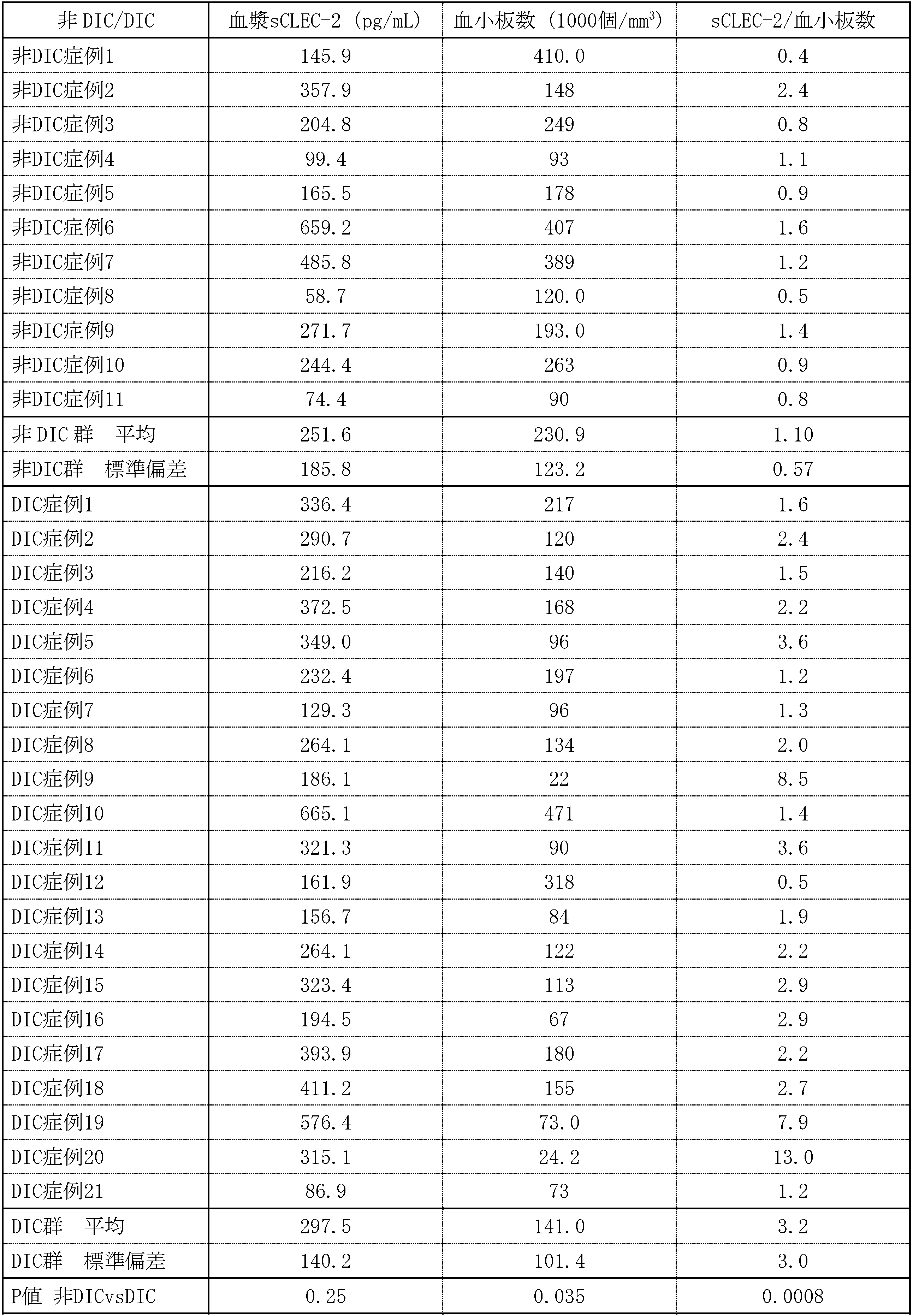
全敗血症患者、敗血症患者のDIC発症例(DIC)、敗血症患者のDIC非発症例(n-DIC)ごとに、実施例1で測定したsCLEC-2濃度の測定値(sCLEC-2)、実施例2で測定した血小板数(PLT)の相関を調べたところ、sCLEC-2濃度と血小板数との間に統計学的に有意な相関がみられた(図1)。敗血症患者のDIC発症例、敗血症患者のDIC非発症例との間でsCLEC-2濃度及び血小板数から算出したsCLEC-2濃度/血小板数の値を算出して比較をしたところ、sCLEC-2濃度では両群間に有意な相関がみられなかった(p=0.25)が、sCLEC-2濃度/血小板数では両群間で有意に差(p=0.0008)があることが確認された(図2)。このことから、sCLEC-2は血小板活性化だけでなく血小板数にも影響を受けており、血小板数あたりのsCLEC-2量の方がより血小板の活性を示していることが裏付けられた。また、敗血症であればDICの有無に関わらず健常者よりsCLEC-2濃度及びsCLEC-2濃度/血小板が高値を示すことからこれらは敗血症の診断にも有用であることが示された。 Measured values of sCLEC-2 concentration (sCLEC-2) measured in Example 1 for each septic patient, DIC onset case (DIC) in sepsis patient, and DIC non-onset case (n-DIC) in sepsis patient, Example When the correlation between the platelet count (PLT) measured in 2 was examined, a statistically significant correlation was found between the sCLEC-2 concentration and the platelet count (Fig. 1). When the sCLEC-2 concentration and the sCLEC-2 concentration / platelet count value calculated from the sCLEC-2 concentration and the platelet count were calculated and compared between the DIC-onset cases of sepsis patients and the DIC-non-symptomatic cases of sepsis patients, the sCLEC-2 concentration was compared. However, no significant correlation was observed between the two groups (p = 0.25), but it was confirmed that there was a significant difference (p = 0.0008) between the two groups in terms of sCLEC-2 concentration / platelet count. (Fig. 2). From this, it was confirmed that sCLEC-2 is affected not only by platelet activation but also by platelet count, and that the amount of sCLEC-2 per platelet count shows more platelet activity. In addition, in the case of sepsis, the sCLEC-2 concentration and the sCLEC-2 concentration / platelets were higher than those of healthy subjects regardless of the presence or absence of DIC, indicating that these are also useful for the diagnosis of sepsis.
《実施例4:ROC曲線に基づくバイオマーカーとしての評価》
実施例3で得られた測定値および計算値を用いてROC(Receiver Operatorating Characteristic)曲線を作成し、曲線下面積(AUC)を算出した。図3に、sCLEC-2濃度の結果(実線)と、sCLEC-2濃度/血小板数の結果(点線)を示す。ROC曲線のAUCは、sCLEC-2濃度は0.628、sCLEC-2濃度/血小板数は0.866、血小板数は0.732であった。AUCは1.0に近いほど診断能が高いとされており、sCLEC-2濃度/血小板数が最も良い診断能を示した。
<< Example 4: Evaluation as a biomarker based on the ROC curve >>
A ROC (Receiver Operatorating Characteristic) curve was created using the measured values and calculated values obtained in Example 3, and the area under the curve (AUC) was calculated. FIG. 3 shows the result of sCLEC-2 concentration (solid line) and the result of sCLEC-2 concentration / platelet count (dotted line). The AUC of the ROC curve was 0.628 for the sCLEC-2 concentration, 0.866 for the sCLEC-2 concentration / platelet count, and 0.732 for the platelet count. It is said that the closer the AUC is to 1.0, the higher the diagnostic ability, and the sCLEC-2 concentration / platelet count shows the best diagnostic ability.
本発明は、血小板活性化状態を把握するのに利用することができ、血栓止血疾患等の検査に利用することができる。 The present invention can be used to grasp the platelet activation state, and can be used for testing for thrombotic hemostatic diseases and the like.
Claims (10)
(2)前記可溶型CLEC-2濃度および前記血小板数から血小板活性化状態を把握する工程、
を含む、血小板活性化状態の把握を補助する方法。 (1) A step of measuring the soluble CLEC-2 concentration and the platelet count in the test sample derived from the test subject, and (2) the platelet activation state is determined from the soluble CLEC-2 concentration and the platelet count. The process of grasping,
A method for assisting in grasping the platelet activation state, including.
(2)前記可溶型CLEC-2濃度を前記血小板数で除することにより、可溶型CLEC-2濃度/血小板数の値を計算する工程、
を含む、血小板活性化状態の把握を補助する方法。 By (1) a step of measuring the soluble CLEC-2 concentration and the number of platelets in the test sample derived from the test subject, and (2) dividing the soluble CLEC-2 concentration by the number of platelets. Step of calculating soluble CLEC-2 concentration / platelet count value,
A method for assisting in grasping the platelet activation state, including.
(2)前記可溶型CLEC-2濃度を前記血小板数で除することにより、可溶型CLEC-2濃度/血小板数の値を計算することのできる計算手段、
(3)得られた被検対象の前記可溶型CLEC-2濃度/血小板数の値を、健常対象の可溶型CLEC-2濃度/血小板数の値と比較することのできる比較手段、及び
(4)前記比較により得られた結果を表示することのできる表示手段、
を含む、血小板活性化状態を把握するためのシステム。 (1) A storage means capable of storing the soluble CLEC-2 concentration and the number of platelets in the test sample derived from the test subject.
(2) A calculation means capable of calculating the value of the soluble CLEC-2 concentration / platelet count by dividing the soluble CLEC-2 concentration by the platelet count.
(3) A comparative means capable of comparing the obtained soluble CLEC-2 concentration / platelet count value of the test subject with the soluble CLEC-2 concentration / platelet count value of the healthy subject, and (4) A display means capable of displaying the results obtained by the comparison.
A system for grasping the platelet activation state, including.
(1)被験対象由来の被検試料中の可溶型CLEC-2濃度と血小板数を前記メモリに記憶させる記憶工程、
(2)前記可溶型CLEC-2濃度を前記血小板数で除することにより、可溶型CLEC-2濃度/血小板数の値を計算する計算工程、
(3)前記計算工程で得られた前記可溶型CLEC-2濃度/血小板数の値を、健常対象の可溶型CLEC-2濃度/血小板数の値と比較する比較工程、及び
(4)前記比較工程で得られた結果を表示する表示工程、
を前記コンピュータに実行させるためのプログラムが記録されている、血小板活性化状態を把握するためのシステム。 A computer comprising a processor and a memory in control of the processor is provided in the memory in the following steps:
(1) A storage step of storing the soluble CLEC-2 concentration and the number of platelets in the test sample derived from the test subject in the memory.
(2) A calculation step of calculating the value of the soluble CLEC-2 concentration / platelet count by dividing the soluble CLEC-2 concentration by the platelet count.
(3) A comparison step of comparing the soluble CLEC-2 concentration / platelet count value obtained in the calculation step with the soluble CLEC-2 concentration / platelet count value of a healthy subject, and (4). A display step for displaying the results obtained in the comparison step,
A system for grasping the platelet activation state in which a program for causing the computer to execute is recorded.
(2)可溶型CLEC-2濃度/血小板数の値と、血小板活性化状態との関連を記載した添付文書、
を含む、血小板活性化状態の把握用キット。 (1) Soluble CLEC-2 measurement reagent and / or platelet measurement reagent, and (2) Package insert describing the relationship between the soluble CLEC-2 concentration / platelet count value and the platelet activation state.
A kit for grasping the platelet activation status, including.
Priority Applications (5)
| Application Number | Priority Date | Filing Date | Title |
|---|---|---|---|
| JP2022503738A JP7546037B2 (en) | 2020-02-28 | 2021-02-26 | Platelet activation measurement method based on soluble CLEC-2 and platelet count |
| KR1020227032991A KR20220147624A (en) | 2020-02-28 | 2021-02-26 | Method for measuring platelet activation based on soluble CLEC-2 and platelet count |
| EP21760839.7A EP4113524A4 (en) | 2020-02-28 | 2021-02-26 | METHOD FOR MEASURING PLATELET ACTIVATION BASED ON SOLUBLE CLEC-2 AND PLATELET NUMBER |
| CN202180017311.7A CN115190973B (en) | 2020-02-28 | 2021-02-26 | Platelet activation assay based on soluble CLEC-2 and platelet count |
| US17/904,966 US20230168260A1 (en) | 2020-02-28 | 2021-02-26 | Method for measuring platelet activation based on soluble clec-2 and platelet count |
Applications Claiming Priority (2)
| Application Number | Priority Date | Filing Date | Title |
|---|---|---|---|
| JP2020032797 | 2020-02-28 | ||
| JP2020-032797 | 2020-02-28 |
Publications (1)
| Publication Number | Publication Date |
|---|---|
| WO2021172493A1 true WO2021172493A1 (en) | 2021-09-02 |
Family
ID=77491232
Family Applications (1)
| Application Number | Title | Priority Date | Filing Date |
|---|---|---|---|
| PCT/JP2021/007273 Ceased WO2021172493A1 (en) | 2020-02-28 | 2021-02-26 | Method for measuring platelet activation based on soluble clec-2 and platelet count |
Country Status (6)
| Country | Link |
|---|---|
| US (1) | US20230168260A1 (en) |
| EP (1) | EP4113524A4 (en) |
| JP (1) | JP7546037B2 (en) |
| KR (1) | KR20220147624A (en) |
| CN (1) | CN115190973B (en) |
| WO (1) | WO2021172493A1 (en) |
Cited By (4)
| Publication number | Priority date | Publication date | Assignee | Title |
|---|---|---|---|---|
| WO2022154045A1 (en) * | 2021-01-13 | 2022-07-21 | 株式会社Lsiメディエンス | Method for predicting risk for thrombosis in cancer patient using soluble clec2 |
| WO2022255349A1 (en) * | 2021-05-31 | 2022-12-08 | 株式会社Lsiメディエンス | Method for assessing risk of hemorrhagic stroke using soluble clec2 |
| WO2022255348A1 (en) * | 2021-05-31 | 2022-12-08 | 株式会社Lsiメディエンス | Method for evaluating risk of acute cerebral vascular disease using soluble clec2 |
| WO2025075139A1 (en) * | 2023-10-06 | 2025-04-10 | Phc株式会社 | Method for evaluating long-term high onset risk of cerebrovascular, cardiovascular, and renal events using soluble clec-2 |
Citations (6)
| Publication number | Priority date | Publication date | Assignee | Title |
|---|---|---|---|---|
| JP2007070359A (en) | 2005-09-06 | 2007-03-22 | Univ Of Yamanashi | Pharmaceutical composition for the treatment of hemostatic diseases |
| JP4961595B2 (en) | 2005-04-25 | 2012-06-27 | 国立大学法人山梨大学 | Compositions and methods for treating hemostatic disease by CLEC-2 signaling |
| JP2013228229A (en) * | 2012-04-24 | 2013-11-07 | Chiba Univ | Inspection method of cardiovascular event onset risk |
| WO2013168602A1 (en) * | 2012-05-07 | 2013-11-14 | 三菱化学メディエンス株式会社 | Method for detecting disseminated intravascular coagulation or infectious disseminated intravascular coagulation |
| JP2014070942A (en) * | 2012-09-28 | 2014-04-21 | Mitsubishi Chemical Medience Corp | Method for measuring platelet activation based on soluble type clec-2 |
| JP2014520123A (en) * | 2011-06-17 | 2014-08-21 | アムジエン・インコーポレーテツド | Methods of treating or ameliorating metabolic disorders using CLEC-2 |
Family Cites Families (2)
| Publication number | Priority date | Publication date | Assignee | Title |
|---|---|---|---|---|
| KR20070070359A (en) | 2005-12-29 | 2007-07-04 | 삼성전자주식회사 | LCD Display |
| WO2010058412A1 (en) * | 2008-11-19 | 2010-05-27 | Dilip Shrinivas Velaskar | A new rapid thrombochek test kit based on whole blood screening test to detect platelet hyperaggregation at a temparature of 37°c in the clinical laboratory |
-
2021
- 2021-02-26 WO PCT/JP2021/007273 patent/WO2021172493A1/en not_active Ceased
- 2021-02-26 KR KR1020227032991A patent/KR20220147624A/en active Pending
- 2021-02-26 CN CN202180017311.7A patent/CN115190973B/en active Active
- 2021-02-26 JP JP2022503738A patent/JP7546037B2/en active Active
- 2021-02-26 EP EP21760839.7A patent/EP4113524A4/en active Pending
- 2021-02-26 US US17/904,966 patent/US20230168260A1/en active Pending
Patent Citations (7)
| Publication number | Priority date | Publication date | Assignee | Title |
|---|---|---|---|---|
| JP4961595B2 (en) | 2005-04-25 | 2012-06-27 | 国立大学法人山梨大学 | Compositions and methods for treating hemostatic disease by CLEC-2 signaling |
| JP2007070359A (en) | 2005-09-06 | 2007-03-22 | Univ Of Yamanashi | Pharmaceutical composition for the treatment of hemostatic diseases |
| JP2014520123A (en) * | 2011-06-17 | 2014-08-21 | アムジエン・インコーポレーテツド | Methods of treating or ameliorating metabolic disorders using CLEC-2 |
| JP2013228229A (en) * | 2012-04-24 | 2013-11-07 | Chiba Univ | Inspection method of cardiovascular event onset risk |
| WO2013168602A1 (en) * | 2012-05-07 | 2013-11-14 | 三菱化学メディエンス株式会社 | Method for detecting disseminated intravascular coagulation or infectious disseminated intravascular coagulation |
| JP2014070942A (en) * | 2012-09-28 | 2014-04-21 | Mitsubishi Chemical Medience Corp | Method for measuring platelet activation based on soluble type clec-2 |
| JP6078845B2 (en) | 2012-09-28 | 2017-02-15 | 株式会社Lsiメディエンス | Method for measuring platelet activation based on soluble CLEC-2 |
Non-Patent Citations (8)
| Title |
|---|
| FEI, MIN ET AL.: "Plasma soluble C-type lectin-like receptor-2 is associated with the risk of coronary artery disease", FRONTIERS OF MEDICINE, vol. 14, no. 1, 2020, pages 81 - 90, XP037049006, DOI: doi.org/10.1007/sl1684-019-0692-x * |
| FEI, MIN ET AL.: "The production of soluble C-type lectin-like receptor 2 is a regulated process", GLYCOCONJUGATE JOURNAL, vol. 12, 2012, pages 315 - 321, XP035101324, DOI: 10.1007/s10719-012-9413-2 * |
| INOUE, OSAMU ET AL.: "Soluble CLEC-2 is generated independently of ADAM10 and is increased in plasma in acute coronary syndrome: comparison with soluble GPVI", INTERNATIONAL JOURNAL OF HEMATOLOGY, vol. 110, 2019, pages 285 - 294, XP036862836, DOI: doi.org/10.1007/sl2185-019-02680-4 * |
| ISHIKURA HIROYASU : "Blood kinetics of novel platelet activation marker soluble CLEC2 in patients with sepsis patients", JAPANESE JOURNAL OF THROMBOSIS AND HEMOSTASIS, vol. 31, no. 2, 30 November 2019 (2019-11-30) - 1 November 2020 (2020-11-01), JP , pages 224, XP009539463, ISSN: 0915-7441 * |
| PLATELETS, vol. 26, no. 8, 2015, pages 711 - 719 |
| See also references of EP4113524A4 |
| THROMBOSIS RESEARCH, vol. 178, 2019, pages 54 - 58 |
| YAMASHITA, YOSHIKI ET AL.: "Elevated plasma levels of soluble C-type lectin- like receptor 2 (CLEC2) in patients with thrombotic microangiopathy", THROMBOSIS RESEARCH, vol. 178, 2019, pages 54 - 58, XP085687298, DOI: doi.org/10.1016/ j. thromres. 2019.03.01 8 * |
Cited By (7)
| Publication number | Priority date | Publication date | Assignee | Title |
|---|---|---|---|---|
| WO2022154045A1 (en) * | 2021-01-13 | 2022-07-21 | 株式会社Lsiメディエンス | Method for predicting risk for thrombosis in cancer patient using soluble clec2 |
| WO2022255349A1 (en) * | 2021-05-31 | 2022-12-08 | 株式会社Lsiメディエンス | Method for assessing risk of hemorrhagic stroke using soluble clec2 |
| WO2022255348A1 (en) * | 2021-05-31 | 2022-12-08 | 株式会社Lsiメディエンス | Method for evaluating risk of acute cerebral vascular disease using soluble clec2 |
| EP4350349A4 (en) * | 2021-05-31 | 2025-04-23 | PHC Corporation | Method for evaluating risk of acute cerebral vascular disease using soluble clec2 |
| EP4350350A4 (en) * | 2021-05-31 | 2025-04-30 | PHC Corporation | Method for assessing the risk of hemorrhagic stroke using soluble CLEC2 |
| EP4636404A3 (en) * | 2021-05-31 | 2025-11-19 | PHC Corporation | Method for evaluating risk of acute cerebral vascular disease using soluble clec2 |
| WO2025075139A1 (en) * | 2023-10-06 | 2025-04-10 | Phc株式会社 | Method for evaluating long-term high onset risk of cerebrovascular, cardiovascular, and renal events using soluble clec-2 |
Also Published As
| Publication number | Publication date |
|---|---|
| CN115190973B (en) | 2025-10-21 |
| KR20220147624A (en) | 2022-11-03 |
| JPWO2021172493A1 (en) | 2021-09-02 |
| JP7546037B2 (en) | 2024-09-05 |
| EP4113524A4 (en) | 2024-03-06 |
| US20230168260A1 (en) | 2023-06-01 |
| EP4113524A1 (en) | 2023-01-04 |
| CN115190973A (en) | 2022-10-14 |
Similar Documents
| Publication | Publication Date | Title |
|---|---|---|
| JP7546037B2 (en) | Platelet activation measurement method based on soluble CLEC-2 and platelet count | |
| Ryu et al. | Pentraxin 3: a novel and independent prognostic marker in ischemic stroke | |
| CN105765382B (en) | Methods and kits for predicting risk of having cardiovascular disease or cardiovascular events | |
| Blann et al. | von Willebrand factor and soluble thrombomodulin as predictors of adverse events among subjects with peripheral or coronary atherosclerosis | |
| JP2011530705A (en) | D-dimer for pulmonary embolism, troponin, NT-proBNP | |
| KR102044940B1 (en) | Method for detecting disseminated intravascular coagulation or infectious disseminated intravascular coagulation | |
| JP2009539080A (en) | Use of MRP8 / 14 levels to identify individuals at risk for acute coronary syndrome | |
| Takayama et al. | Dielectric blood coagulometry for the early detection of sepsis-induced disseminated intravascular coagulation: a prospective observational study | |
| HK40085757A (en) | Method for measuring platelet activation based on soluble clec-2 and platelet count | |
| EP4636404A2 (en) | Method for evaluating risk of acute cerebral vascular disease using soluble clec2 | |
| JPWO2022255348A5 (en) | ||
| WO2022255349A1 (en) | Method for assessing risk of hemorrhagic stroke using soluble clec2 | |
| Dziedzic-Jankowska et al. | Subclinical inflammation in paediatric patients with primary hypertension and white coat hypertension | |
| JP7808059B2 (en) | Method for predicting thrombosis risk in cancer patients using soluble CLEC2 | |
| RU2789822C1 (en) | Method for optimizing laboratory diagnosis of thrombinemia in patients with covid-19 infection | |
| WO2025075139A1 (en) | Method for evaluating long-term high onset risk of cerebrovascular, cardiovascular, and renal events using soluble clec-2 | |
| JP7695113B2 (en) | Risk assessment method for viral pneumonia using soluble CLEC2 | |
| Raygan et al. | Evaluating Serum Levels of Pentraxin-3, von Willebrand Factor and CXC Motif Chemokine Ligand 13 as Inflammatory Markers of Unstable Angina Pectoris | |
| Ateş et al. | The Association Between Mean Neutrophil Volume and Dipping Status in Newly Diagnosed Hypertensive Patients | |
| Li et al. | Association of preoperative NT-proBNP with postoperative inflammatory factors levels among children of unrestricted left-to-right shunts congenital heart disease | |
| HK40127498A (en) | Method for evaluating risk of acute cerebral vascular disease using soluble clec2 | |
| HK40105374A (en) | Method for evaluating risk of acute cerebral vascular disease using soluble clec2 | |
| Putra et al. | D-Dimer to Creatinine Ratio (DCR) and Intracoronary Thrombus Burden as Risk Factors for Hospitalized Major Cardiovascular Events (MACE) in Patients with ST Elevation Myocardial Infarction (STEMI) | |
| HK1156111A (en) | D-dimer, troponin, nt-probnp for pulmonary embolism | |
| CA2927600A1 (en) | Algorithm of ntprobnp and hand held ecg to detect arrhythmia in an elderly population |
Legal Events
| Date | Code | Title | Description |
|---|---|---|---|
| 121 | Ep: the epo has been informed by wipo that ep was designated in this application |
Ref document number: 21760839 Country of ref document: EP Kind code of ref document: A1 |
|
| ENP | Entry into the national phase |
Ref document number: 2022503738 Country of ref document: JP Kind code of ref document: A |
|
| ENP | Entry into the national phase |
Ref document number: 20227032991 Country of ref document: KR Kind code of ref document: A |
|
| NENP | Non-entry into the national phase |
Ref country code: DE |
|
| ENP | Entry into the national phase |
Ref document number: 2021760839 Country of ref document: EP Effective date: 20220928 |
|
| WWG | Wipo information: grant in national office |
Ref document number: 202180017311.7 Country of ref document: CN |