WO2021146573A1 - Spatially variable dielectric layers for digital microfluidics - Google Patents
Spatially variable dielectric layers for digital microfluidics Download PDFInfo
- Publication number
- WO2021146573A1 WO2021146573A1 PCT/US2021/013659 US2021013659W WO2021146573A1 WO 2021146573 A1 WO2021146573 A1 WO 2021146573A1 US 2021013659 W US2021013659 W US 2021013659W WO 2021146573 A1 WO2021146573 A1 WO 2021146573A1
- Authority
- WO
- WIPO (PCT)
- Prior art keywords
- electrodes
- microfluidic device
- dielectric layer
- digital microfluidic
- dielectric
- Prior art date
- Legal status (The legal status is an assumption and is not a legal conclusion. Google has not performed a legal analysis and makes no representation as to the accuracy of the status listed.)
- Ceased
Links
Classifications
-
- B—PERFORMING OPERATIONS; TRANSPORTING
- B01—PHYSICAL OR CHEMICAL PROCESSES OR APPARATUS IN GENERAL
- B01L—CHEMICAL OR PHYSICAL LABORATORY APPARATUS FOR GENERAL USE
- B01L3/00—Containers or dishes for laboratory use, e.g. laboratory glassware; Droppers
- B01L3/50—Containers for the purpose of retaining a material to be analysed, e.g. test tubes
- B01L3/502—Containers for the purpose of retaining a material to be analysed, e.g. test tubes with fluid transport, e.g. in multi-compartment structures
- B01L3/5027—Containers for the purpose of retaining a material to be analysed, e.g. test tubes with fluid transport, e.g. in multi-compartment structures by integrated microfluidic structures, i.e. dimensions of channels and chambers are such that surface tension forces are important, e.g. lab-on-a-chip
- B01L3/502769—Containers for the purpose of retaining a material to be analysed, e.g. test tubes with fluid transport, e.g. in multi-compartment structures by integrated microfluidic structures, i.e. dimensions of channels and chambers are such that surface tension forces are important, e.g. lab-on-a-chip characterised by multiphase flow arrangements
- B01L3/502784—Containers for the purpose of retaining a material to be analysed, e.g. test tubes with fluid transport, e.g. in multi-compartment structures by integrated microfluidic structures, i.e. dimensions of channels and chambers are such that surface tension forces are important, e.g. lab-on-a-chip characterised by multiphase flow arrangements specially adapted for droplet or plug flow, e.g. digital microfluidics
-
- B—PERFORMING OPERATIONS; TRANSPORTING
- B01—PHYSICAL OR CHEMICAL PROCESSES OR APPARATUS IN GENERAL
- B01L—CHEMICAL OR PHYSICAL LABORATORY APPARATUS FOR GENERAL USE
- B01L3/00—Containers or dishes for laboratory use, e.g. laboratory glassware; Droppers
- B01L3/50—Containers for the purpose of retaining a material to be analysed, e.g. test tubes
- B01L3/502—Containers for the purpose of retaining a material to be analysed, e.g. test tubes with fluid transport, e.g. in multi-compartment structures
- B01L3/5027—Containers for the purpose of retaining a material to be analysed, e.g. test tubes with fluid transport, e.g. in multi-compartment structures by integrated microfluidic structures, i.e. dimensions of channels and chambers are such that surface tension forces are important, e.g. lab-on-a-chip
- B01L3/502769—Containers for the purpose of retaining a material to be analysed, e.g. test tubes with fluid transport, e.g. in multi-compartment structures by integrated microfluidic structures, i.e. dimensions of channels and chambers are such that surface tension forces are important, e.g. lab-on-a-chip characterised by multiphase flow arrangements
- B01L3/502784—Containers for the purpose of retaining a material to be analysed, e.g. test tubes with fluid transport, e.g. in multi-compartment structures by integrated microfluidic structures, i.e. dimensions of channels and chambers are such that surface tension forces are important, e.g. lab-on-a-chip characterised by multiphase flow arrangements specially adapted for droplet or plug flow, e.g. digital microfluidics
- B01L3/502792—Containers for the purpose of retaining a material to be analysed, e.g. test tubes with fluid transport, e.g. in multi-compartment structures by integrated microfluidic structures, i.e. dimensions of channels and chambers are such that surface tension forces are important, e.g. lab-on-a-chip characterised by multiphase flow arrangements specially adapted for droplet or plug flow, e.g. digital microfluidics for moving individual droplets on a plate, e.g. by locally altering surface tension
-
- B—PERFORMING OPERATIONS; TRANSPORTING
- B01—PHYSICAL OR CHEMICAL PROCESSES OR APPARATUS IN GENERAL
- B01L—CHEMICAL OR PHYSICAL LABORATORY APPARATUS FOR GENERAL USE
- B01L2200/00—Solutions for specific problems relating to chemical or physical laboratory apparatus
- B01L2200/12—Specific details about manufacturing devices
-
- B—PERFORMING OPERATIONS; TRANSPORTING
- B01—PHYSICAL OR CHEMICAL PROCESSES OR APPARATUS IN GENERAL
- B01L—CHEMICAL OR PHYSICAL LABORATORY APPARATUS FOR GENERAL USE
- B01L2200/00—Solutions for specific problems relating to chemical or physical laboratory apparatus
- B01L2200/14—Process control and prevention of errors
-
- B—PERFORMING OPERATIONS; TRANSPORTING
- B01—PHYSICAL OR CHEMICAL PROCESSES OR APPARATUS IN GENERAL
- B01L—CHEMICAL OR PHYSICAL LABORATORY APPARATUS FOR GENERAL USE
- B01L2300/00—Additional constructional details
- B01L2300/06—Auxiliary integrated devices, integrated components
-
- B—PERFORMING OPERATIONS; TRANSPORTING
- B01—PHYSICAL OR CHEMICAL PROCESSES OR APPARATUS IN GENERAL
- B01L—CHEMICAL OR PHYSICAL LABORATORY APPARATUS FOR GENERAL USE
- B01L2300/00—Additional constructional details
- B01L2300/16—Surface properties and coatings
-
- B—PERFORMING OPERATIONS; TRANSPORTING
- B01—PHYSICAL OR CHEMICAL PROCESSES OR APPARATUS IN GENERAL
- B01L—CHEMICAL OR PHYSICAL LABORATORY APPARATUS FOR GENERAL USE
- B01L2400/00—Moving or stopping fluids
- B01L2400/04—Moving fluids with specific forces or mechanical means
- B01L2400/0403—Moving fluids with specific forces or mechanical means specific forces
- B01L2400/0415—Moving fluids with specific forces or mechanical means specific forces electrical forces, e.g. electrokinetic
- B01L2400/0427—Electrowetting
Definitions
- DMF Digital microfluidic
- EWoD electrowetting on dielectric
- FIG. 1 illustrates a typical EWoD device including both propulsion and sensing on the same active matrix.
- EWoD devices typically include a stack of a conductor, an insulator dielectric layer, and a hydrophobic layer. A droplet is placed on the hydrophobic layer, and the stack, once actuated, can cause the droplet to deform and wet or de-wet from the surface depending on the applied voltage.
- Passive matrix devices a.k.a. “segmented” devices
- segmented devices are easy to fabricate, the number of electrodes is limited by space and driving constraints. Accordingly, it is not possible to perform massive parallel assays, reactions, etc. in passive matrix devices.
- active matrix devices a.k.a. active matrix EWoD, a.k.a. AM-EWoD
- active matrix EWoD a.k.a. active matrix EWoD
- AM-EWoD active matrix EWoD
- TFTs thin-film transistors
- droplet motion is programmable so that AM-EWoD arrays can be used as general purpose devices that allow great freedom for controlling multiple droplets and executing simultaneous analytical processes.
- TFTs thin-film transistors
- droplet motion is programmable so that AM-EWoD arrays can be used as general purpose devices that allow great freedom for controlling multiple droplets and executing simultaneous analytical processes.
- TFT arrays are highly desirable for this application, due to having thousands of addressable pixels, thus allowing mass parallelization of droplet procedures.
- the pixel electrodes of the array may be differently sized, e.g., an area of high-density small pixel electrodes neighboring an area of low-density large pixel electrodes. Areas of differential pixel size facilitate rapid droplet dispensing from the reservoirs and subsequent droplet partitioning.
- the present application addresses the problems typically associated with providing different voltages and/or waveforms to different regions of digital microfluidic devices by introducing a novel architecture with a spatially variable dielectric that is well suited to enabling different electrodes to operate at different potentials and frequencies.
- This architecture helps to preserve the functionality in high strain areas, such as adjacent the reservoirs. Accordingly, digital microfluidic devices of the invention have longer useful lifetimes than digital microfluidic devices without this architecture.
- the present application provides a digital microfluidic device including a first plurality of electrodes of a first density that are coupled to a set of switches, a controller operatively coupled to the set of switches and configured to provide a propulsion voltage to at least a portion of the first plurality of electrodes, and a second plurality of electrodes of a second density and configured that operate at a higher voltage than the first plurality of electrodes.
- a first dielectric layer having a first dielectric constant and a first thickness covers the first plurality of electrodes
- a second dielectric layer having a second dielectric constant and a second thickness covers the second plurality of electrodes.
- the density of the first electrodes is greater than the density of the second electrodes: accordingly, the first electrodes form a high-resolution zone, while the second electrodes form a low-resolution zone.
- the dielectric constant of the first dielectric layer is greater than the dielectric constant of the second layer.
- the thickness of the first dielectric layer is smaller than the thickness of the second dielectric layer.
- the first and second dielectric layers may be contiguous or partially overlap.
- the device may also include a third plurality of reservoir electrodes that are configured to operate at a higher voltage than the first electrodes. In some instances, the device may include just the first and third reservoir electrodes and have no second electrodes.
- the first electrodes are configured to operate at a potential between about 10 V and 20 V.
- the second electrodes are configured to operate at a potential between about 100 V and about 300 V.
- the third electrodes are configured to operate at a potential between about 100 V and about 300 V.
- the first dielectric layer has a thickness between about 50 nm and about 250 nm.
- the second dielectric layer has a thickness between about 500 nm to about 5 pm.
- the first electrodes may be configured to operate at a first frequency and the electrodes may be configured to operate at a second frequency. In one embodiment, the operating frequency of the first electrodes is smaller than the operating frequency of the second electrodes.
- Example types of switches include thin-film-transistors (TFT) and electro-mechanical switches.
- FIG. 1 illustrates the fundamental structure of an exemplary EWoD device.
- FIG. 2 is a schematic representation of a propulsion electrode controlled by a thin- film-transistor, such as commonly found in EWoD devices.
- FIG. 3A illustrates the architecture of an exemplary spatially variable dielectric structure embodiment in the context of an electrowetting on dielectric (EWoD) array.
- FIG. 3B is a cross-sectional illustration of two example dielectrics that overlap.
- FIG. 3C is a cross- sectional illustration of another example of two dielectrics that overlap in part.
- FIG. 4A is a schematic illustration of an EWoD reservoir using standard AM- TFT architecture.
- FIG. 4B is a schematic illustrations of an alternative reservoir architecture that uses specialized electrodes that may be directly driven at higher voltage.
- FIG. 5 illustrates the architecture of a spatially-variable dielectric structure in the context of an EWoD array having specialty reservoir electrodes.
- the invention provides active matrix electrowetting on dielectric (AM-EWoD) devices that include a spatially variable dielectric structure. Accordingly, much greater voltages may be imposed in higher dielectric breakdown regions (e.g. reservoirs covered with thicker dielectric) than in the main array areas (e.g., TFT pixels).
- This architecture allows different driving schemes to be used within different regions of the EWoD device according to their dielectric properties. In some instances, the higher thickness robust dielectric may be removed and re-applied to the reservoir or adjacent regions. This design enables recycling these regions after they get fully fatigued, thereby extending the longevity of the device.
- the EWoD 200 includes a cell filled with an oil 202 and at least one aqueous droplet 204.
- the cell spacer is typically in the range 50 to 200 pm, but the spacer can be larger.
- a plurality of propulsion electrodes 205 are disposed on the substrate and a singular top electrode 206 is disposed on the opposing surface.
- the cell additionally includes top hydrophobic layer 207 on the surfaces contacting the oil layer, as well as a dielectric layer 208 between the propulsion electrodes 205 and the bottom hydrophobic layer 210.
- the upper substrate may also include a dielectric layer, but it is not shown in FIG. 1).
- the hydrophobic layer is typically 20 to 60 nm thick and prevents the droplet from wetting the surface. When no voltage differential is applied between adjacent electrodes, the droplet will maintain a spheroidal shape to minimize contact with the hydrophobic surfaces (oil and hydrophobic layer).
- the top electrode 206 is a single conducting layer normally set to zero volts or a common voltage value (VCOM) to take into account offset voltages on the propulsion electrodes 205 due to capacitive kickback from the TFTs that are used to switch the voltage on the electrodes (see FIG. 2).
- VCOM common voltage value
- the top electrode can also have a square wave applied to increase the voltage across the liquid. Such an arrangement allows lower propulsion voltages to be used for the TFT connected propulsion electrodes 205 because the top plate voltage 206 is additional to the voltage supplied by the TFT.
- an active matrix of propulsion electrodes can be arranged to be driven with data and gate (select) lines much like an active matrix in a liquid crystal display.
- the gate (select) lines are scanned for line-at-a time addressing, while the data lines carry the voltage to be transferred to propulsion electrodes for electrowetting operation. If no movement is needed, or if a droplet is meant to move away from a propulsion electrode, then 0 V will be applied to that (non-target) propulsion electrode. If a droplet is meant to move toward a propulsion electrode, an AC voltage will be applied to that (target) propulsion electrode.
- FIG. 3 A illustrates the architecture of an exemplary spatially variable dielectric structure embodiment in the context of an EWoD array 100.
- a first dielectric 102 characterized by a dielectric constant 8i and thickness ti is laid over a high-density region of the array.
- a second dielectric 104 having dielectric constant 8? and thickness t 2 is deposited on a second, lower density region of the array that features separate driving electronics from the high-density region.
- the first and second dielectrics may mutually overlap at least in part and be formed according to a number of methods featuring different orders of deposition.
- third dielectric 106 may formed of either the first or second dielectric material.
- dielectric 106 may be made of a third material of dielectric constant 8 3 differing from both 8i and 8 2 .
- the number of dielectrics may be further extended to four, five, or beyond, depending on the number of regions present on the EWoD, each region requiring its own specific combination of dielectric constant and thickness.
- one or more dielectrics may be formed from two or more materials, either mixed together or layered on top of each other to form a material having a desired effective thickness.
- Equation (1) establishes the relationship between actuated contact angle Q , resting contact angle qo, per-area capacitance C, voltage V and liquid/environment surface tension g:
- Equation (2) EWoD performance is highly dependent on the difference between resting and actuated contact angles ( Q - Oo).
- the capacitance per unit area C is a function of dielectric constant e and dielectric thickness d according to Equation (2)
- Equation (4) reflects that the minimum voltage Vmm is directly proportional to the square root of the dielectric thickness d in view of Equation (2), a being hysteresis of wetting and de-wetting:
- Example higher-stress EWoD operations include reservoir regions featuring special electrode patterns as well as designated moderate-density electrode regions for low-resolution operations.
- An example of a reservoir region having specialty electrodes is exemplified in FIGS. 4 A and 4B. As shown in FIGS. 4 A and 4B, the gray color represents the droplet liquid and the grid lines represent the electrodes.
- FIG. 4A is a schematic reservoir top view that is defined by a relatively high electrode density grid, and the resultant drops 420 may be of different size and of different aspect ratios.
- the electrodes are controlled by TFT switching, the overall voltage is limited to typically between 10 to 20 Volts in amplitude, for example -15V, 0V, and 15 V.
- the small electrodes In order to reliably produce droplets 420 of the desired size from the reservoir area 450 the small electrodes must be driven at high frequency with maximum voltage differential, increasing the likelihood of failure in this region.
- specialized electrodes 470, 475 may be implemented that can be driven with higher voltages. Additionally, because the reservoir 450 takes up a large area, it is possible to address this area with many fewer electrodes (e.g., lower density), thereby facilitating fabrication and reducing cost. As shown in FIG. 4B, directly- driven (i.e., segmented) electrodes of various sizes may be used to facilitate rapid and consistent partition into the desired sample droplets 420. Additionally, reservoir regions 450 typically require more frequent actuation, either constant or periodic, to form and dispense droplets to prevent fluids from escaping the reservoir region 450. This causes increased voltage strain in reservoir areas.
- FIG. 5 illustrates the architecture of a spatially variable dielectric structure in the context of an EWoD array 500 having areas with different electrode densities.
- This embodiment includes substrate 502, a low-voltage TFT array 504 operating in the range of about 10 V to 20 V, and high-voltage electrodes 506, 508 that are directly driven by an external source at variable frequencies and operating in the range of about 100 V to about 300 V.
- the high-voltage electrodes 506, 508 include customized reservoir electrodes 506 and an adjacent regular grid of low resolution movement electrodes 508.
- a thicker, more robust dielectric(s) covers the high-voltage areas 506 an 508. Thicker dielectrics are typically in the range of about 500 nanometers (nm) to about 5 micrometers (pm) and may include materials with low or moderate dielectric constant.
- Example materials suitable for the thick dielectric include polymers like parylene, fluorinated polymers such ethylene tetrafluoroethylene (ETFE), polytetrafluoroethylene (PTFE), or ceramic materials, e.g. titanium dioxide and aluminum oxide. Low-voltage regions are covered by a thin dielectric with high dielectric constant. Typically, thinner dielectrics are in the range of about 50 nm to 250 nm and include ceramic materials such as silicon dioxide, silicon nitride, hafnium oxide, alumina, tantalum oxide, and barium strontium titanate.
- the dielectric covering TFT array 504 is a hybrid ceramic stack having a high dielectric constant and from about 50 nm to 250 nm in thickness, while the dielectric covering low-resolution electrodes 508 are covered by is a parylene C layer of about 1 pm in thickness.
- Dielectric layers may be manufactured with deposition methods commonly used in the art, for example sputtering, atomic layer deposition (ALD), spin coating, chemical vapor deposition (CVD), and other vacuum deposition techniques. Creating spatial profiles featuring two or more dielectrics of different materials and thickness may be achieved through, for instance, shadow masking, photolithography, and dry or wet etching techniques. If desired, the high dielectric thickness areas may be stripped for re-use since their robustness enables them to hold up much better to repeated actuation.
- ALD atomic layer deposition
- CVD chemical vapor deposition
Landscapes
- Chemical & Material Sciences (AREA)
- Dispersion Chemistry (AREA)
- Health & Medical Sciences (AREA)
- Analytical Chemistry (AREA)
- General Health & Medical Sciences (AREA)
- Hematology (AREA)
- Clinical Laboratory Science (AREA)
- Chemical Kinetics & Catalysis (AREA)
- Physical Or Chemical Processes And Apparatus (AREA)
- Electrochromic Elements, Electrophoresis, Or Variable Reflection Or Absorption Elements (AREA)
- Devices For Indicating Variable Information By Combining Individual Elements (AREA)
- Inorganic Insulating Materials (AREA)
Abstract
A digital microfluidic device including an active matrix of propulsion electrodes controlled by thin-film-transistors. The device includes at least two areas of different propulsion electrode densities. One area may be driven by directly-driving the propulsion electrodes from a power supply or function generator. In the first, higher density region; a first dielectric layer covers the propulsion electrodes. The first dielectric layer has a first dielectric constant and a first thickness. In the second, lower density region, a second dielectric layer has a second dielectric constant and a second thickness covering the propulsion electrodes.
Description
SPATIALLY VARIABLE DIELECTRIC LAYERS FOR DIGITAL MICROFLUIDICS
RELATED APPLICATIONS
[Para 1] This application claims priority to U.S. Provisional Application No. 62/962,238, filed January 17, 2020. All references, patents, and patent applications disclosed herein are incorporated by reference in their entireties.
BACKGROUND
[Para 2] Digital microfluidic (DMF) devices use independent electrodes to propel, split, and join droplets in a confined environment, thereby providing a “lab-on-a-chip.” Digital microfluidic devices are alternatively referred to as electrowetting on dielectric, or “EWoD,” to further differentiate the method from competing microfluidic systems that rely on electrophoretic flow and/or micropumps. FIG. 1 illustrates a typical EWoD device including both propulsion and sensing on the same active matrix. A 2012 review of the electrowetting technology was provided by Wheeler in “Digital Microfluidics,” Annu. Rev. Anal. Chem 2012, 5:413-40. The technique allows sample preparation, assays, and synthetic chemistry to be performed with tiny quantities of both samples and reagents. In recent years, controlled droplet manipulation in microfluidic cells using electrowetting has become commercially viable, and there are now products available from large life science companies, such as Oxford Nanopore.
[Para 3] Typically, EWoD devices include a stack of a conductor, an insulator dielectric layer, and a hydrophobic layer. A droplet is placed on the hydrophobic layer, and the stack, once actuated, can cause the droplet to deform and wet or de-wet from the surface depending on the applied voltage. Most of the literature reports on EWoD involve so-called “passive matrix” devices (a.k.a. “segmented” devices), whereby ten to twenty electrodes are directly driven with a controller. While segmented devices are easy to fabricate, the number of electrodes is limited by space and driving constraints. Accordingly, it is not possible to perform massive parallel assays, reactions, etc. in passive matrix devices. In comparison, “active matrix” devices (a.k.a. active matrix EWoD, a.k.a. AM-EWoD) devices can have many thousands, hundreds of thousands or even millions of addressable electrodes. The electrodes are typically switched by thin-film transistors (TFTs) and droplet motion is programmable so
that AM-EWoD arrays can be used as general purpose devices that allow great freedom for controlling multiple droplets and executing simultaneous analytical processes.
[Para 4] The electrodes are typically switched by thin-film transistors (TFTs) and droplet motion is programmable so that AM-EWoD arrays can be used as general purpose devices that allow great freedom for controlling multiple droplets and executing simultaneous analytical processes. TFT arrays are highly desirable for this application, due to having thousands of addressable pixels, thus allowing mass parallelization of droplet procedures. In some instances, the pixel electrodes of the array may be differently sized, e.g., an area of high-density small pixel electrodes neighboring an area of low-density large pixel electrodes. Areas of differential pixel size facilitate rapid droplet dispensing from the reservoirs and subsequent droplet partitioning.
[Para 5] Traditionally, a single dielectric layer is used across the whole EWoD active surface, including regions that have different functions, or areas having different pixel densities. Because the maximum operating voltage of an electrode is largely dictated by the properties of its dielectric, a single dielectric layer results in a relatively uniform maximum operating voltage all over the device. However, in most analytical applications, different areas of the EWoD array have different uses, thus requiring some areas to undergo much greater electrical strain, which can cause voltage leakage and eventual breakdown of the substrate. These failure modes are especially acute in the reservoir regions, which perform repeated high-voltage processes, such as droplet partitioning, and there is no flexibility to cycle a different spatial region for these processes because the reservoirs are not movable with respect to the array.
SUMMARY OF INVENTION
[Para 6] The present application addresses the problems typically associated with providing different voltages and/or waveforms to different regions of digital microfluidic devices by introducing a novel architecture with a spatially variable dielectric that is well suited to enabling different electrodes to operate at different potentials and frequencies. This architecture helps to preserve the functionality in high strain areas, such as adjacent the reservoirs. Accordingly, digital microfluidic devices of the invention have longer useful lifetimes than digital microfluidic devices without this architecture.
[Para 7] In one aspect, the present application provides a digital microfluidic device including a first plurality of electrodes of a first density that are coupled to a set of switches, a controller operatively coupled to the set of switches and configured to provide a propulsion
voltage to at least a portion of the first plurality of electrodes, and a second plurality of electrodes of a second density and configured that operate at a higher voltage than the first plurality of electrodes. A first dielectric layer having a first dielectric constant and a first thickness covers the first plurality of electrodes, and a second dielectric layer having a second dielectric constant and a second thickness covers the second plurality of electrodes. In one embodiment, the density of the first electrodes is greater than the density of the second electrodes: accordingly, the first electrodes form a high-resolution zone, while the second electrodes form a low-resolution zone. In another embodiment, the dielectric constant of the first dielectric layer is greater than the dielectric constant of the second layer. In a further embodiment, the thickness of the first dielectric layer is smaller than the thickness of the second dielectric layer. The first and second dielectric layers may be contiguous or partially overlap. The device may also include a third plurality of reservoir electrodes that are configured to operate at a higher voltage than the first electrodes. In some instances, the device may include just the first and third reservoir electrodes and have no second electrodes. In one embodiment, the first electrodes are configured to operate at a potential between about 10 V and 20 V. In another, non-exclusive embodiment, the second electrodes are configured to operate at a potential between about 100 V and about 300 V. In an additional embodiment, the third electrodes are configured to operate at a potential between about 100 V and about 300 V. In example embodiments, the first dielectric layer has a thickness between about 50 nm and about 250 nm. In further, non-exclusive embodiments, the second dielectric layer has a thickness between about 500 nm to about 5 pm. The first electrodes may be configured to operate at a first frequency and the electrodes may be configured to operate at a second frequency. In one embodiment, the operating frequency of the first electrodes is smaller than the operating frequency of the second electrodes. Example types of switches include thin-film-transistors (TFT) and electro-mechanical switches.
BRIEF DESCRIPTION OF DRAWINGS
[Para 8] FIG. 1 illustrates the fundamental structure of an exemplary EWoD device.
[Para 9] FIG. 2 is a schematic representation of a propulsion electrode controlled by a thin- film-transistor, such as commonly found in EWoD devices.
[Para 10] FIG. 3A illustrates the architecture of an exemplary spatially variable dielectric structure embodiment in the context of an electrowetting on dielectric (EWoD) array. FIG. 3B is a cross-sectional illustration of two example dielectrics that overlap. FIG. 3C is a cross- sectional illustration of another example of two dielectrics that overlap in part.
[Para 11] FIG. 4A is a schematic illustration of an EWoD reservoir using standard AM- TFT architecture. FIG. 4B is a schematic illustrations of an alternative reservoir architecture that uses specialized electrodes that may be directly driven at higher voltage.
[Para 12] FIG. 5 illustrates the architecture of a spatially-variable dielectric structure in the context of an EWoD array having specialty reservoir electrodes.
DETAILED DESCRIPTION
[Para 13] As disclosed herein, the invention provides active matrix electrowetting on dielectric (AM-EWoD) devices that include a spatially variable dielectric structure. Accordingly, much greater voltages may be imposed in higher dielectric breakdown regions (e.g. reservoirs covered with thicker dielectric) than in the main array areas (e.g., TFT pixels). This architecture allows different driving schemes to be used within different regions of the EWoD device according to their dielectric properties. In some instances, the higher thickness robust dielectric may be removed and re-applied to the reservoir or adjacent regions. This design enables recycling these regions after they get fully fatigued, thereby extending the longevity of the device.
[Para 14] The use of spatially variable dielectrics across wide regions of an AM-EWoD device allows for different voltages and/or waveforms to be applied independently across the device in specialized areas. Also addressed is the issue of fatigue and breakdown by allowing higher stress regions to operate with thicker dielectrics at higher voltages while preventing catastrophic device failure. Moreover, a variable dielectric structure enables actuation strength increases in reservoir regions, which makes it easier to overcome capillary forces from fluid input systems. Because it is possible to increase the actuation strength with higher applied voltages, droplets from a reservoir have more predictable snap-off, which helps to regulate the volume of each droplet of reservoir fluid. Additionally, the higher actuation strength expands the range of materials that can be introduced from the reservoir onto the device.
[Para 15] In general, thicker dielectrics operating at higher voltages are more resistant to fatigue, while thinner dielectrics that are inherently more complex and fragile tend to fail more readily under electrical load. Furthermore, the minimum voltage required for actuation scales as the inverse square root of the capacitance, or proportionately to the square root of the thickness. Thus, operation at lower voltages (desirable for using high density TFT arrays) is challenging to achieve with variations in dielectric thickness alone. Likewise, using materials
with increased dielectric constant requires complex deposition processes and inherent issues related to leakage due to mid-gap electronic states, structural deformities, and other factors. [Para 16] The fundamental structure of an exemplary EWoD device is illustrated in the cross-sectional image of FIG. 1. The EWoD 200 includes a cell filled with an oil 202 and at least one aqueous droplet 204. The cell spacer is typically in the range 50 to 200 pm, but the spacer can be larger. In a basic configuration, as shown in FIG. 1, a plurality of propulsion electrodes 205 are disposed on the substrate and a singular top electrode 206 is disposed on the opposing surface. The cell additionally includes top hydrophobic layer 207 on the surfaces contacting the oil layer, as well as a dielectric layer 208 between the propulsion electrodes 205 and the bottom hydrophobic layer 210. (The upper substrate may also include a dielectric layer, but it is not shown in FIG. 1). The hydrophobic layer is typically 20 to 60 nm thick and prevents the droplet from wetting the surface. When no voltage differential is applied between adjacent electrodes, the droplet will maintain a spheroidal shape to minimize contact with the hydrophobic surfaces (oil and hydrophobic layer).
[Para 17] When a voltage differential is applied between adjacent electrodes, the voltage on one electrode attracts opposite charges in the droplet at the dielectric-to-droplet interface, and the droplet moves toward this electrode, also as illustrated in FIG. 1. As remarked above, the voltages needed for acceptable droplet propulsion largely depend on the properties of the dielectric. AC driving is used to reduce degradation of the droplets, dielectrics, and electrodes by various electrochemistries. Operational frequencies for EWoD can be in the range 100 Hz to 1 MHz, but lower frequencies of 1 kHz or lower are preferred for use with TFTs that have limited speed of operation.
[Para 18] Returning to FIG. 1, the top electrode 206 is a single conducting layer normally set to zero volts or a common voltage value (VCOM) to take into account offset voltages on the propulsion electrodes 205 due to capacitive kickback from the TFTs that are used to switch the voltage on the electrodes (see FIG. 2). The top electrode can also have a square wave applied to increase the voltage across the liquid. Such an arrangement allows lower propulsion voltages to be used for the TFT connected propulsion electrodes 205 because the top plate voltage 206 is additional to the voltage supplied by the TFT.
[Para 19] As shown in FIG. 2, an active matrix of propulsion electrodes can be arranged to be driven with data and gate (select) lines much like an active matrix in a liquid crystal display. The gate (select) lines are scanned for line-at-a time addressing, while the data lines carry the voltage to be transferred to propulsion electrodes for electrowetting operation. If no movement is needed, or if a droplet is meant to move away from a propulsion electrode, then 0 V will be
applied to that (non-target) propulsion electrode. If a droplet is meant to move toward a propulsion electrode, an AC voltage will be applied to that (target) propulsion electrode.
[Para 20] FIG. 3 A illustrates the architecture of an exemplary spatially variable dielectric structure embodiment in the context of an EWoD array 100. A first dielectric 102 characterized by a dielectric constant 8i and thickness ti is laid over a high-density region of the array. A second dielectric 104 having dielectric constant 8? and thickness t2 is deposited on a second, lower density region of the array that features separate driving electronics from the high-density region. As exemplified in the cross-sections of FIGS. 3B and 3C, the first and second dielectrics may mutually overlap at least in part and be formed according to a number of methods featuring different orders of deposition. Returning to FIG. 3 A, third dielectric 106 may formed of either the first or second dielectric material. Alternatively, dielectric 106 may be made of a third material of dielectric constant 83 differing from both 8i and 82. The number of dielectrics may be further extended to four, five, or beyond, depending on the number of regions present on the EWoD, each region requiring its own specific combination of dielectric constant and thickness. In some embodiments, one or more dielectrics may be formed from two or more materials, either mixed together or layered on top of each other to form a material having a desired effective thickness.
[Para 21] Equation (1) establishes the relationship between actuated contact angle Q , resting contact angle qo, per-area capacitance C, voltage V and liquid/environment surface tension g:
C _ cos Q = cos q + - - nD
2 YLG
(1)
[Para 22] EWoD performance is highly dependent on the difference between resting and actuated contact angles ( Q - Oo). The capacitance per unit area C is a function of dielectric constant e and dielectric thickness d according to Equation (2)

It can be seen that, in order to increases the extent of actuation, it is desirable to have one or more of a high dielectric constant, a low thickness, and a high voltage.
[Para 23] One can envision tuning the parameter space such that the EWoD device operates at 75% of the breakdown voltage VB, such that V = 0.75 - VB. Then, a relationship with the
breakdown voltage can be seen in Equation (3), where F represents an actuation efficacy proportional to the difference in contact angles, and VB is expressed as the dielectric thickness d multiplied by the dielectric strength Ds, VB = Ds d :

It can be seen that the actuation efficacy increases at higher thicknesses and voltages, assuming operating voltages close to VB and that this benefit is not exactly offset by a decrease in permittivity for the thicker dielectric.
[Para 24] Equation (4) reflects that the minimum voltage Vmm is directly proportional to the square root of the dielectric thickness d in view of Equation (2), a being hysteresis of wetting and de-wetting:
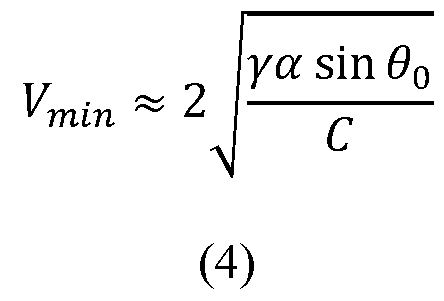
This shows why operating at low voltages is quite difficult due to a need for aggressively reducing dielectric thickness or increasing dielectric permittivity. The dielectric thickness required to work at comparatively lower voltage ranges ( e.g ., about 10 V) results in a device much more prone to fatigue and failure. It has also been found that high thickness dielectrics operating at high voltage ranges tend to be more robust and provide large actuated contact angles compared to traditional, low-voltage platforms on thin film transistors (TFT).
[Para 25] Example higher-stress EWoD operations include reservoir regions featuring special electrode patterns as well as designated moderate-density electrode regions for low-resolution operations. An example of a reservoir region having specialty electrodes is exemplified in FIGS. 4 A and 4B. As shown in FIGS. 4 A and 4B, the gray color represents the droplet liquid and the grid lines represent the electrodes.
[Para 26] FIG. 4A is a schematic reservoir top view that is defined by a relatively high electrode density grid, and the resultant drops 420 may be of different size and of different aspect ratios. However, in FIG. 4A, if the electrodes are controlled by TFT switching, the overall voltage is limited to typically between 10 to 20 Volts in amplitude, for example -15V, 0V, and 15 V. In order to reliably produce droplets 420 of the desired size from the reservoir
area 450 the small electrodes must be driven at high frequency with maximum voltage differential, increasing the likelihood of failure in this region.
[Para 27] As an alternative, as shown in FIG. 4B, specialized electrodes 470, 475 may be implemented that can be driven with higher voltages. Additionally, because the reservoir 450 takes up a large area, it is possible to address this area with many fewer electrodes (e.g., lower density), thereby facilitating fabrication and reducing cost. As shown in FIG. 4B, directly- driven (i.e., segmented) electrodes of various sizes may be used to facilitate rapid and consistent partition into the desired sample droplets 420. Additionally, reservoir regions 450 typically require more frequent actuation, either constant or periodic, to form and dispense droplets to prevent fluids from escaping the reservoir region 450. This causes increased voltage strain in reservoir areas. The invention allows for greater electrowetting forces in more reservoir regions and enables operating reservoirs and adjacent regions independently, in terms of both voltage and frequency, from the rest of the EWoD array. By coupling specialized electrodes 470, 475 with low-voltage TFT electrodes, as shown in FIG. 4B, the same droplets 420 can be formed and then directly addressed, thereby allowing for variable frequency operation and advanced waveform patterns as in FIG. 4A, but with much greater reliability. [Para 28] FIG. 5 illustrates the architecture of a spatially variable dielectric structure in the context of an EWoD array 500 having areas with different electrode densities.. This embodiment includes substrate 502, a low-voltage TFT array 504 operating in the range of about 10 V to 20 V, and high-voltage electrodes 506, 508 that are directly driven by an external source at variable frequencies and operating in the range of about 100 V to about 300 V. The high-voltage electrodes 506, 508 include customized reservoir electrodes 506 and an adjacent regular grid of low resolution movement electrodes 508. A thicker, more robust dielectric(s) covers the high-voltage areas 506 an 508. Thicker dielectrics are typically in the range of about 500 nanometers (nm) to about 5 micrometers (pm) and may include materials with low or moderate dielectric constant. Example materials suitable for the thick dielectric include polymers like parylene, fluorinated polymers such ethylene tetrafluoroethylene (ETFE), polytetrafluoroethylene (PTFE), or ceramic materials, e.g. titanium dioxide and aluminum oxide. Low-voltage regions are covered by a thin dielectric with high dielectric constant. Typically, thinner dielectrics are in the range of about 50 nm to 250 nm and include ceramic materials such as silicon dioxide, silicon nitride, hafnium oxide, alumina, tantalum oxide, and barium strontium titanate. In one example, the dielectric covering TFT array 504 is a hybrid ceramic stack having a high dielectric constant and from about 50 nm to 250 nm in thickness,
while the dielectric covering low-resolution electrodes 508 are covered by is a parylene C layer of about 1 pm in thickness.
[Para 29] Dielectric layers may be manufactured with deposition methods commonly used in the art, for example sputtering, atomic layer deposition (ALD), spin coating, chemical vapor deposition (CVD), and other vacuum deposition techniques. Creating spatial profiles featuring two or more dielectrics of different materials and thickness may be achieved through, for instance, shadow masking, photolithography, and dry or wet etching techniques. If desired, the high dielectric thickness areas may be stripped for re-use since their robustness enables them to hold up much better to repeated actuation.
[Para 30] It will be apparent to those skilled in the art that numerous changes and modifications can be made in the specific embodiments of the invention described above without departing from the scope of the invention. Accordingly, the whole of the foregoing description is to be interpreted in an illustrative and not in a limitative sense.
Claims
1. A digital microfluidic device, comprising: a first plurality of electrodes having a first density and operatively coupled to a set of switches; a controller operatively coupled to the set of switches and configured to provide a propulsion voltage to at least a portion of the first plurality of electrodes; a second plurality of electrodes having a second density and configured to operate at a higher voltage than the propulsion voltage of the first plurality of electrodes; a first dielectric layer having a first dielectric constant and a first thickness, the first dielectric layer covering the first plurality of electrodes, and a second dielectric layer having a second dielectric constant and a second thickness, the second dielectric layer covering the second plurality of electrodes.
2. The digital microfluidic device of claim 1, wherein the first density of the first plurality of electrodes is greater than the second density of the second plurality of electrodes.
3. The digital microfluidic device of claim 1, wherein the first dielectric constant of the first dielectric layer is greater than the second dielectric constant of the second dielectric layer.
4. The digital microfluidic device of claim 1, wherein the first thickness of the first dielectric layer is smaller than the second thickness of the second dielectric layer.
5. The digital microfluidic device of claim 1, wherein the first dielectric layer and the second dielectric layer are mutually overlapping in part.
6. The digital microfluidic device of claim 1, further comprising a third plurality of reservoir electrodes configured to operate at a higher voltage than the propulsion voltage of the first plurality of electrodes.
7. The digital microfluidic device of claim 1, wherein the first plurality of electrodes is configured to operate at a potential between about 10 V and about 20 V.
8. The digital microfluidic device of claim 1, wherein the second plurality of electrodes is configured to operate at a potential between about 100 V and about 300 V.
9. The digital microfluidic device of claim 1, wherein the first dielectric layer has a thickness between about 50 nm to about 250 nm.
10. The digital microfluidic device of claim 1, wherein the second dielectric layer has a thickness between about 500 nm to about 5 pm.
11. The digital microfluidic device of claim 1, wherein the first plurality of electrodes is configured to operate at a first frequency and the second plurality of electrodes is configured to operate at a second frequency.
12. The digital microfluidic device of claim 11, wherein the first frequency of operation of the first plurality of electrodes is smaller than the second frequency of operation of the second plurality of electrodes.
13. The digital microfluidic device of claim 1, wherein the switches are thin-film- transistors.
14. The digital microfluidic device of claim 1, wherein the switches are electro mechanical switches.
15. The digital microfluidic device of claim 1, wherein the first dielectric layer comprises silicon dioxide, silicon nitride, hafnium oxide, alumina, tantalum oxide, or barium strontium titanate.
16. The digital microfluidic device of claim 1, wherein the second dielectric layer comprises parylene, ethylene tetrafluoroethylene (ETFE), polytetrafluoroethylene (PTFE), titanium dioxide, or aluminum oxide.
17. The digital microfluidic device of claim 1, wherein the second dielectric comprises a combination of layered materials selected from the group consisting of silicon dioxide, silicon nitride, hafnium oxide, alumina, tantalum oxide, barium strontium titanate,
parylene, ethylene tetrafluoroethylene (ETFE), polytetrafluoroethylene (PTFE), titanium dioxide, and aluminum oxide.
Priority Applications (1)
| Application Number | Priority Date | Filing Date | Title |
|---|---|---|---|
| CN202180009016.7A CN114945426A (en) | 2020-01-17 | 2021-01-15 | Spatially variable dielectric layer for digital microfluidics |
Applications Claiming Priority (2)
| Application Number | Priority Date | Filing Date | Title |
|---|---|---|---|
| US202062962238P | 2020-01-17 | 2020-01-17 | |
| US62/962,238 | 2020-01-17 |
Publications (1)
| Publication Number | Publication Date |
|---|---|
| WO2021146573A1 true WO2021146573A1 (en) | 2021-07-22 |
Family
ID=76857697
Family Applications (1)
| Application Number | Title | Priority Date | Filing Date |
|---|---|---|---|
| PCT/US2021/013659 Ceased WO2021146573A1 (en) | 2020-01-17 | 2021-01-15 | Spatially variable dielectric layers for digital microfluidics |
Country Status (4)
| Country | Link |
|---|---|
| US (1) | US11554374B2 (en) |
| CN (1) | CN114945426A (en) |
| TW (1) | TWI776358B (en) |
| WO (1) | WO2021146573A1 (en) |
Families Citing this family (3)
| Publication number | Priority date | Publication date | Assignee | Title |
|---|---|---|---|---|
| GB202005399D0 (en) * | 2020-04-14 | 2020-05-27 | Nuclera Nucleics Ltd | A method of electrowetting |
| CN114146736B (en) * | 2021-11-30 | 2024-02-06 | 上海天马微电子有限公司 | Microfluidic device, driving circuit and driving method thereof |
| CN114534805B (en) * | 2022-02-09 | 2024-08-06 | 上海天马微电子有限公司 | Microfluidic device, driving method thereof and manufacturing method thereof |
Citations (5)
| Publication number | Priority date | Publication date | Assignee | Title |
|---|---|---|---|---|
| US20100307922A1 (en) * | 2007-05-24 | 2010-12-09 | Digital Biosystems | Electrowetting based digital microfluidics |
| US20180003946A1 (en) * | 2016-06-29 | 2018-01-04 | Amazon Technologies, Inc. | Method of controlling an electrowetting element with stable fluid configurations |
| US20180246058A1 (en) * | 2013-09-17 | 2018-08-30 | Stmicroelectronics S.R.L. | Integrated microfluidic circuit with electrowetting-based operation and corresponding microfluidic system |
| US10133057B1 (en) * | 2015-12-21 | 2018-11-20 | Amazon Technologies, Inc. | Electrowetting element with different dielectric layers |
| US20190111433A1 (en) * | 2017-10-18 | 2019-04-18 | E Ink Corporation | Digital microfluidic devices including dual substrates with thin-film transistors and capacitive sensing |
Family Cites Families (87)
| Publication number | Priority date | Publication date | Assignee | Title |
|---|---|---|---|---|
| US3813519A (en) | 1964-11-09 | 1974-05-28 | Saint Gobain | Electrically heated glass window |
| US5311337A (en) | 1992-09-23 | 1994-05-10 | Honeywell Inc. | Color mosaic matrix display having expanded or reduced hexagonal dot pattern |
| US5964995A (en) | 1997-04-04 | 1999-10-12 | Caliper Technologies Corp. | Methods and systems for enhanced fluid transport |
| US6352758B1 (en) | 1998-05-04 | 2002-03-05 | 3M Innovative Properties Company | Patterned article having alternating hydrophilic and hydrophobic surface regions |
| US6565727B1 (en) | 1999-01-25 | 2003-05-20 | Nanolytics, Inc. | Actuators for microfluidics without moving parts |
| US6294063B1 (en) | 1999-02-12 | 2001-09-25 | Board Of Regents, The University Of Texas System | Method and apparatus for programmable fluidic processing |
| WO2002007503A1 (en) | 2000-07-25 | 2002-01-31 | The Regents Of The University Of California | Electrowetting-driven micropumping |
| US6773566B2 (en) | 2000-08-31 | 2004-08-10 | Nanolytics, Inc. | Electrostatic actuators for microfluidics and methods for using same |
| US6750661B2 (en) | 2001-11-13 | 2004-06-15 | Caliper Life Sciences, Inc. | Method and apparatus for controllably effecting samples using two signals |
| WO2003045556A2 (en) | 2001-11-26 | 2003-06-05 | Keck Graduate Institute | Method, apparatus and article for microfluidic control via electrowetting, for chemical, biochemical and biological assays and the like |
| FR2841063B1 (en) | 2002-06-18 | 2004-09-17 | Commissariat Energie Atomique | DEVICE FOR DISPLACING SMALL VOLUMES OF LIQUID ALONG A MICRO-CATENARY BY ELECTROSTATIC FORCES |
| US6911132B2 (en) | 2002-09-24 | 2005-06-28 | Duke University | Apparatus for manipulating droplets by electrowetting-based techniques |
| US7547380B2 (en) | 2003-01-13 | 2009-06-16 | North Carolina State University | Droplet transportation devices and methods having a fluid surface |
| US6930059B2 (en) | 2003-02-27 | 2005-08-16 | Sharp Laboratories Of America, Inc. | Method for depositing a nanolaminate film by atomic layer deposition |
| JP4629997B2 (en) | 2003-06-02 | 2011-02-09 | 株式会社リコー | Thin film transistor and thin film transistor array |
| EP1671304B1 (en) | 2003-10-08 | 2008-08-20 | E Ink Corporation | Electro-wetting displays |
| US8319759B2 (en) | 2003-10-08 | 2012-11-27 | E Ink Corporation | Electrowetting displays |
| ATE434131T1 (en) | 2003-11-17 | 2009-07-15 | Koninkl Philips Electronics Nv | SYSTEM FOR HANDLING A QUANTITY OF FLUID |
| US7215306B2 (en) | 2003-12-22 | 2007-05-08 | Wintek Corporation | Driving apparatus for an active matrix organic light emitting display |
| FR2866493B1 (en) | 2004-02-16 | 2010-08-20 | Commissariat Energie Atomique | DEVICE FOR CONTROLLING THE DISPLACEMENT OF A DROP BETWEEN TWO OR MORE SOLID SUBSTRATES |
| FR2872715B1 (en) | 2004-07-08 | 2006-11-17 | Commissariat Energie Atomique | MICROREACTOR DROP |
| FR2872809B1 (en) | 2004-07-09 | 2006-09-15 | Commissariat Energie Atomique | METHOD OF ADDRESSING ELECTRODES |
| JP2006058031A (en) | 2004-08-17 | 2006-03-02 | Hitachi High-Technologies Corp | Chemical analyzer |
| DE602005024418D1 (en) | 2004-08-26 | 2010-12-09 | Life Technologies Corp | ELECTROCONDUCTING DISPENSERS AND METHODS THEREFOR |
| JP4341529B2 (en) | 2004-11-05 | 2009-10-07 | セイコーエプソン株式会社 | Electronic device, method for manufacturing electronic device, and electronic apparatus |
| US7458661B2 (en) | 2005-01-25 | 2008-12-02 | The Regents Of The University Of California | Method and apparatus for promoting the complete transfer of liquid drops from a nozzle |
| DK1859330T3 (en) | 2005-01-28 | 2012-10-15 | Univ Duke | DEVICES AND METHODS OF HANDLING SMALL DROPS ON A PRINTED CIRCUIT CARD |
| US20070023292A1 (en) | 2005-07-26 | 2007-02-01 | The Regents Of The University Of California | Small object moving on printed circuit board |
| KR100781739B1 (en) | 2005-09-28 | 2007-12-03 | 삼성전자주식회사 | Contact angle displacement and change speed of droplets in electrowetting and droplet control device applying the droplets formed by the method |
| US7976795B2 (en) | 2006-01-19 | 2011-07-12 | Rheonix, Inc. | Microfluidic systems |
| CA2680532C (en) | 2006-04-18 | 2017-03-21 | Advanced Liquid Logic, Inc. | Droplet-based pyrosequencing |
| JP4881950B2 (en) | 2006-07-10 | 2012-02-22 | 株式会社日立ハイテクノロジーズ | Liquid transport device |
| US7697187B2 (en) * | 2006-09-29 | 2010-04-13 | Sony Corporation | Electrowetting device and varifocal lens, optical pickup device, optical recording/reproduction device, droplet operation device, optical element, zoom lens, imaging device, light modulating device, and display device using the same |
| WO2008055256A2 (en) | 2006-11-02 | 2008-05-08 | The Regents Of The University Of California | Method and apparatus for real-time feedback control of electrical manipulation of droplets on chip |
| US7733559B2 (en) | 2006-12-28 | 2010-06-08 | Seiko Epson Corporation | Electrophoretic display sheet, electrophoretic display device, and electronic apparatus |
| KR20100016343A (en) | 2007-04-10 | 2010-02-12 | 어드밴스드 리퀴드 로직, 아이엔씨. | Droplet dispensing device and methods |
| US8926811B2 (en) | 2007-06-27 | 2015-01-06 | Digital Biosystems | Digital microfluidics based apparatus for heat-exchanging chemical processes |
| GB0712859D0 (en) | 2007-07-03 | 2007-08-08 | Liquavista Bv | Electrowetting system and method for operating it |
| TWI364553B (en) | 2007-10-12 | 2012-05-21 | Chimei Innolux Corp | Electro-wetting display |
| US8460528B2 (en) | 2007-10-17 | 2013-06-11 | Advanced Liquid Logic Inc. | Reagent storage and reconstitution for a droplet actuator |
| CN103559838B (en) | 2008-05-11 | 2016-03-23 | Nlt科技股份有限公司 | The pel array of non-rectangle and there is the display device of this array |
| US8093064B2 (en) | 2008-05-15 | 2012-01-10 | The Regents Of The University Of California | Method for using magnetic particles in droplet microfluidics |
| US8187864B2 (en) | 2008-10-01 | 2012-05-29 | The Governing Council Of The University Of Toronto | Exchangeable sheets pre-loaded with reagent depots for digital microfluidics |
| US8053239B2 (en) | 2008-10-08 | 2011-11-08 | The Governing Council Of The University Of Toronto | Digital microfluidic method for protein extraction by precipitation from heterogeneous mixtures |
| CH700127A1 (en) | 2008-12-17 | 2010-06-30 | Tecan Trading Ag | System and apparatus for processing biological samples and for manipulating liquids with biological samples. |
| TW201033640A (en) | 2009-03-03 | 2010-09-16 | Ind Tech Res Inst | Electrowetting display devices |
| US20120273702A1 (en) | 2009-04-20 | 2012-11-01 | Kansas State University Research Foundation | Electroactive Polymer Actuators and their use on Microfluidic Devices |
| US9180454B2 (en) | 2009-08-14 | 2015-11-10 | University Of Cincinnati | Electrowetting and electrofluidic devices with laplace barriers and related methods |
| WO2011066185A1 (en) | 2009-11-25 | 2011-06-03 | Gen9, Inc. | Microfluidic devices and methods for gene synthesis |
| WO2011084597A2 (en) | 2009-12-16 | 2011-07-14 | University Of South Florida | Bidirectional electrowetting actuation with voltage polarity dependence |
| JP2011170172A (en) | 2010-02-19 | 2011-09-01 | Seiko Epson Corp | Electrophoretic display device and electronic equipment |
| JP5840627B2 (en) | 2010-03-04 | 2016-01-06 | ナショナル ユニヴァーシティー オブ シンガポール | Microfluidic sorting device for detecting and isolating cells |
| US8834695B2 (en) | 2010-03-09 | 2014-09-16 | Sparkle Power Inc. | Droplet manipulations on EWOD microelectrode array architecture |
| WO2011137533A1 (en) | 2010-05-05 | 2011-11-10 | The Governing Council Of The University Of Toronto | Method of processing dried samples using digital microfluidic device |
| JP5565098B2 (en) | 2010-05-26 | 2014-08-06 | セイコーエプソン株式会社 | Electro-optical device and electronic apparatus |
| US8547111B2 (en) | 2010-07-06 | 2013-10-01 | Sharp Kabushiki Kaisha | Array element circuit and active matrix device |
| US8653832B2 (en) | 2010-07-06 | 2014-02-18 | Sharp Kabushiki Kaisha | Array element circuit and active matrix device |
| US9476811B2 (en) | 2010-10-01 | 2016-10-25 | The Governing Council Of The University Of Toronto | Digital microfluidic devices and methods incorporating a solid phase |
| US8173000B1 (en) | 2011-01-18 | 2012-05-08 | Sharp Kabushiki Kaisha | Active matrix device and method of driving the same |
| KR20120117229A (en) | 2011-04-14 | 2012-10-24 | 삼성디스플레이 주식회사 | Electrowetting display |
| US8940147B1 (en) | 2011-04-25 | 2015-01-27 | Sandia Corporation | Microfluidic hubs, systems, and methods for interface fluidic modules |
| JP5990889B2 (en) | 2011-09-29 | 2016-09-14 | 凸版印刷株式会社 | Electrophoretic display and manufacturing method thereof |
| US20130161193A1 (en) | 2011-12-21 | 2013-06-27 | Sharp Kabushiki Kaisha | Microfluidic system with metered fluid loading system for microfluidic device |
| WO2013102011A2 (en) | 2011-12-30 | 2013-07-04 | Gvd Corporation | Coatings for electrowetting and electrofluidic devices |
| US9649632B2 (en) | 2012-06-08 | 2017-05-16 | The Regents Of The University Of California | Disposable world-to-chip interface for digital microfluidics |
| WO2014018745A1 (en) | 2012-07-27 | 2014-01-30 | E Ink Corporation | Processes for the production of electro-optic displays |
| US8764958B2 (en) | 2012-08-24 | 2014-07-01 | Gary Chorng-Jyh Wang | High-voltage microfluidic droplets actuation by low-voltage fabrication technologies |
| US9458543B2 (en) | 2012-12-04 | 2016-10-04 | Sharp Kabushiki Kaisha | Active matrix electrowetting-on-dielectric device |
| EP2869922B1 (en) | 2013-01-09 | 2019-11-20 | Tecan Trading AG | Disposable cartridge for microfluidics systems |
| JP2016539343A (en) | 2013-08-30 | 2016-12-15 | イルミナ インコーポレイテッド | Manipulating droplets on hydrophilic or mottled hydrophilic surfaces |
| CA2927289C (en) | 2013-10-23 | 2022-03-29 | The Governing Council Of The University Of Toronto | Printed digital microfluidic devices methods of use and manufacture thereof |
| WO2015170268A1 (en) | 2014-05-09 | 2015-11-12 | Dh Technologies Development Pte. Ltd. | Fluid transfer from digital microfluidic device |
| US20150377831A1 (en) | 2014-06-27 | 2015-12-31 | The Governing Council Of The University Of Toronto | Digital microfluidic devices and methods employing integrated nanostructured electrodeposited electrodes |
| US9634145B2 (en) | 2014-10-29 | 2017-04-25 | Eastman Kodak Company | TFT substrate with variable dielectric thickness |
| US20170315090A1 (en) | 2014-10-21 | 2017-11-02 | The Governing Council Of The University Of Toronto | Digital microfluidic devices with integrated electrochemical sensors |
| EP3865878A1 (en) | 2014-11-03 | 2021-08-18 | The General Hospital Corporation | Sorting particles in a microfluidic device |
| US9815056B2 (en) | 2014-12-05 | 2017-11-14 | The Regents Of The University Of California | Single sided light-actuated microfluidic device with integrated mesh ground |
| US10018828B2 (en) | 2014-12-22 | 2018-07-10 | Amazon Technologies, Inc. | Electrowetting display device with stable display states |
| US9623407B2 (en) | 2015-03-27 | 2017-04-18 | International Business Machines Corporation | Microfluidic device with longitudinal and transverse liquid barriers for transverse flow mixing |
| IL284235B (en) | 2015-04-22 | 2022-07-01 | Berkeley Lights Inc | Kits and methods for preparing a microfluidic device for cell culture |
| CN108472649B (en) | 2015-10-27 | 2022-01-14 | 伯克利之光生命科技公司 | Microfluidic devices with optimized electrowetting surfaces and related systems and methods |
| CN109414663B (en) | 2016-06-29 | 2022-05-17 | 数字生物系统公司 | Creating high resolution temperature profiles in digital microfluidic devices |
| CN110446491A (en) | 2017-03-24 | 2019-11-12 | 伊英克加利福尼亚有限责任公司 | Microunit delivery system comprising charged or magnetic particles that modulates the rate of active substance administration |
| US11353759B2 (en) | 2018-09-17 | 2022-06-07 | Nuclera Nucleics Ltd. | Backplanes with hexagonal and triangular electrodes |
| KR102577837B1 (en) | 2018-10-15 | 2023-09-12 | 이 잉크 코포레이션 | Digital microfluidic delivery device |
| EP3962651A4 (en) | 2019-04-30 | 2022-11-23 | Nuclera Nucleics Ltd | Microfluidic devices and methods of making the same |
| CN113767329B (en) | 2019-05-03 | 2024-07-02 | 伊英克公司 | Layered structure with high dielectric constant for active matrix backplanes |
-
2021
- 2021-01-15 WO PCT/US2021/013659 patent/WO2021146573A1/en not_active Ceased
- 2021-01-15 TW TW110101676A patent/TWI776358B/en active
- 2021-01-15 CN CN202180009016.7A patent/CN114945426A/en active Pending
- 2021-01-15 US US17/150,578 patent/US11554374B2/en active Active
Patent Citations (5)
| Publication number | Priority date | Publication date | Assignee | Title |
|---|---|---|---|---|
| US20100307922A1 (en) * | 2007-05-24 | 2010-12-09 | Digital Biosystems | Electrowetting based digital microfluidics |
| US20180246058A1 (en) * | 2013-09-17 | 2018-08-30 | Stmicroelectronics S.R.L. | Integrated microfluidic circuit with electrowetting-based operation and corresponding microfluidic system |
| US10133057B1 (en) * | 2015-12-21 | 2018-11-20 | Amazon Technologies, Inc. | Electrowetting element with different dielectric layers |
| US20180003946A1 (en) * | 2016-06-29 | 2018-01-04 | Amazon Technologies, Inc. | Method of controlling an electrowetting element with stable fluid configurations |
| US20190111433A1 (en) * | 2017-10-18 | 2019-04-18 | E Ink Corporation | Digital microfluidic devices including dual substrates with thin-film transistors and capacitive sensing |
Also Published As
| Publication number | Publication date |
|---|---|
| TWI776358B (en) | 2022-09-01 |
| TW202142318A (en) | 2021-11-16 |
| US11554374B2 (en) | 2023-01-17 |
| CN114945426A (en) | 2022-08-26 |
| US20210220830A1 (en) | 2021-07-22 |
Similar Documents
| Publication | Publication Date | Title |
|---|---|---|
| US11554374B2 (en) | Spatially variable dielectric layers for digital microfluidics | |
| CN109308880B (en) | Microfluidic device with droplet precharging on input | |
| CN102650512B (en) | Drop measuring method and drop controlling method | |
| CN115007233A (en) | Digital microfluidic device including dual substrates with thin film transistors and capacitive sensing | |
| CN1882778A (en) | System for manipulation of a body of fluid | |
| US11801510B2 (en) | Dielectric layers for digital microfluidic devices | |
| US12027130B2 (en) | Latched transistor driving for high frequency AC driving of EWoD arrays | |
| US11927740B2 (en) | Spatially variable hydrophobic layers for digital microfluidics | |
| US20200347840A1 (en) | Microfluidic devices and methods of making the same | |
| US11410620B2 (en) | Adaptive gate driving for high frequency AC driving of EWoD arrays | |
| CN108686726A (en) | Drop actuating method for microfluidic device | |
| CN111054455B (en) | Microfluidic chip and driving method thereof | |
| JP4713306B2 (en) | Liquid transfer device | |
| US20210170413A1 (en) | Variable electrode size area arrays on thin-film transistor based digital microfluidic devices for fine droplet manipulation | |
| TWI797601B (en) | Digital microfluidic device and method of driving a digital microfluidic system | |
| US11806715B2 (en) | Method of electrowetting | |
| CN116371493B (en) | Microfluidic substrate, microfluidic device, and driving method of microfluidic device |
Legal Events
| Date | Code | Title | Description |
|---|---|---|---|
| 121 | Ep: the epo has been informed by wipo that ep was designated in this application |
Ref document number: 21741741 Country of ref document: EP Kind code of ref document: A1 |
|
| NENP | Non-entry into the national phase |
Ref country code: DE |
|
| 122 | Ep: pct application non-entry in european phase |
Ref document number: 21741741 Country of ref document: EP Kind code of ref document: A1 |