WO2021056193A1 - Continuous preparation method for benzyl zinc halide and derivatives thereof - Google Patents
Continuous preparation method for benzyl zinc halide and derivatives thereof Download PDFInfo
- Publication number
- WO2021056193A1 WO2021056193A1 PCT/CN2019/107546 CN2019107546W WO2021056193A1 WO 2021056193 A1 WO2021056193 A1 WO 2021056193A1 CN 2019107546 W CN2019107546 W CN 2019107546W WO 2021056193 A1 WO2021056193 A1 WO 2021056193A1
- Authority
- WO
- WIPO (PCT)
- Prior art keywords
- heating section
- zinc powder
- continuous
- halide
- zinc
- Prior art date
- Legal status (The legal status is an assumption and is not a legal conclusion. Google has not performed a legal analysis and makes no representation as to the accuracy of the status listed.)
- Ceased
Links
Images

Classifications
-
- C—CHEMISTRY; METALLURGY
- C07—ORGANIC CHEMISTRY
- C07F—ACYCLIC, CARBOCYCLIC OR HETEROCYCLIC COMPOUNDS CONTAINING ELEMENTS OTHER THAN CARBON, HYDROGEN, HALOGEN, OXYGEN, NITROGEN, SULFUR, SELENIUM OR TELLURIUM
- C07F3/00—Compounds containing elements of Groups 2 or 12 of the Periodic Table
- C07F3/06—Zinc compounds
-
- B—PERFORMING OPERATIONS; TRANSPORTING
- B01—PHYSICAL OR CHEMICAL PROCESSES OR APPARATUS IN GENERAL
- B01J—CHEMICAL OR PHYSICAL PROCESSES, e.g. CATALYSIS OR COLLOID CHEMISTRY; THEIR RELEVANT APPARATUS
- B01J19/00—Chemical, physical or physico-chemical processes in general; Their relevant apparatus
- B01J19/0053—Details of the reactor
- B01J19/0066—Stirrers
-
- B—PERFORMING OPERATIONS; TRANSPORTING
- B01—PHYSICAL OR CHEMICAL PROCESSES OR APPARATUS IN GENERAL
- B01J—CHEMICAL OR PHYSICAL PROCESSES, e.g. CATALYSIS OR COLLOID CHEMISTRY; THEIR RELEVANT APPARATUS
- B01J8/00—Chemical or physical processes in general, conducted in the presence of fluids and solid particles; Apparatus for such processes
- B01J8/001—Controlling catalytic processes
-
- B—PERFORMING OPERATIONS; TRANSPORTING
- B01—PHYSICAL OR CHEMICAL PROCESSES OR APPARATUS IN GENERAL
- B01J—CHEMICAL OR PHYSICAL PROCESSES, e.g. CATALYSIS OR COLLOID CHEMISTRY; THEIR RELEVANT APPARATUS
- B01J8/00—Chemical or physical processes in general, conducted in the presence of fluids and solid particles; Apparatus for such processes
- B01J8/02—Chemical or physical processes in general, conducted in the presence of fluids and solid particles; Apparatus for such processes with stationary particles, e.g. in fixed beds
- B01J8/0285—Heating or cooling the reactor
Definitions
- the present invention relates to the actual preparation field of organic zinc, in particular to a continuous preparation method of benzyl zinc halide and its derivatives.
- Organozinc reagents are often used in the construction of organic molecules. Because of their good functional group compatibility and high reactivity, they exhibit unique chemical characteristics, and are therefore widely used in organic synthesis.
- benzyl zinc reagent is an important benzyl functionalization reagent, which is often used to introduce benzyl groups into molecules. Due to the high reactivity of benzyl lithium and benzyl magnesium metal organic reagents, these organic metals are easy to polymerize and cannot exist stably, so functionalized benzyl zinc halide occupies a unique position.
- the related benzyl zinc halide is produced by a batch reaction of active zinc and benzyl halide, and the zinc atom is directly inserted into the carbon halide bond (CX).
- CX carbon halide bond
- the reaction usually requires heating, the operation time is long, and material accumulation is prone to occur, which may cause the risk of spraying, which limits the amplification of the reaction.
- Nade ⁇ ge Boudet et al. and Albrecht Metzger et al. promoted the insertion reaction of active metal zinc by adding lithium chloride. Under mild reaction conditions, they realized the insertion of zinc atoms in substituted aromatic halogenated hydrocarbons and substituted benzyl halogenated hydrocarbons.
- Fabian M. Piller and Albrecht Metzger used metallic magnesium/lithium chloride/zinc chloride to achieve the insertion of zinc atoms in benzyl halohydrocarbons. There is no need to use dangerous zinc powder, and the reaction speed is faster. The temperature is lower.
- the commonly used lithium chloride and zinc chloride have low solubility in organic solvents, and usually require high temperature treatment of lithium chloride and zinc chloride, and then dissolve them in the solvent for reaction, which limits their application in actual scale-up production.
- the use of a variety of solids also limits the further improvement of the process.
- the use of metallic magnesium, lithium chloride, and zinc chloride has poor atomic economy and generates a lot of solid waste, which is not conducive to environmental protection.
- the main purpose of the present invention is to provide a continuous preparation method of benzyl zinc halide and its derivatives, so as to solve the problem that the preparation method of benzyl zinc halide in the prior art is not suitable for scale-up production.
- a continuous preparation method of benzyl zinc halide and its derivatives adopts a continuous reactor for direct insertion of zinc atoms into carbon-halogen bonds, wherein the continuous The reactor includes a heating section and a cooling section connected in communication. The cooling section is located above the heating section. The cooling section has a product overflow.
- the continuous preparation method includes: continuously feeding the liquid reaction material and zinc powder into the heating section. The liquid reaction material is continuously fed into the heating section from the upper part of the heating section, and the liquid reaction material is continuously fed into the heating section from the lower part of the heating section. In the heating section, the zinc atom directly inserts the carbon-halogen bond reaction to obtain the product system.
- the overflow outlet flows out of the continuous reactor, where the liquid reaction material includes a halide, and the halide has the structural formula I:
- n is any integer from 0 to 5
- X is -Cl, -Br or -I
- each R is independently selected from -F, -Cl, -Br, nitro, cyano, C 1 to C any 5 alkyl, C 1 ⁇ C 5 alkoxy group and a 1 -COOR
- R 1 is an alkyl group of C 1 ⁇ C 5.
- the temperature of the cooling section is controlled to be between 10 and 30°C, preferably between 15 and 25°C.
- the product overflow port is provided with a drainage tube connected to the outer wall of the cooling section, and the drainage tube extends obliquely upward in a direction away from the outer wall.
- the included angle ⁇ between the drainage tube and the outer wall is between 10° and 40° , Preferably between 20° and 30°, and the product overflow is preferably arranged at the end of the cooling section close to the heating section.
- the above-mentioned continuous reactor is a column-type continuous reactor or a stirred-type continuous reactor.
- a stirring blade is provided in the heating section of the above-mentioned column-type continuous reactor.
- the above preparation method includes: continuously feeding the liquid reaction material into the heating section at a first flow rate and the zinc powder at a second flow rate, respectively, and the liquid reaction material and the zinc powder undergo a direct insertion reaction of zinc atoms into the carbon halide bond in the heating section. ,
- the product system is obtained, and the product system flows out of the continuous reactor from the product overflow port.
- the zinc powder is adjusted to be fed into the heating section at the third flow rate, wherein the second flow rate and the first flow rate are controlled to be fed into
- the molar equivalent of zinc powder relative to the halide fed is 1 to 3, preferably 1.5 to 2.0.
- the third flow rate and the first flow rate are controlled so that the molar equivalent of the zinc powder fed relative to the halide is 1 ⁇ 1.1.
- the retention time of the above-mentioned zinc powder in the heating section is 2 to 4 hours, preferably 2.5 to 3.5 hours.
- the above-mentioned liquid reaction material also includes a polar solvent, an initiator, and a zinc powder activator.
- the polar solvent is preferably tetrahydrofuran
- the initiator is preferably selected from 1,2-dichloroethane and 1,2-dibromoethane. Any one or more of them, preferably the zinc powder activator is selected from any one or more of trimethylchlorosilane and trimethylbromosilane.
- the weight ratio of the solvent to the halide is 7-13:1, preferably 8-10:1, and the molar equivalent of the initiator relative to the halide is preferably 0.03-0.08, preferably 0.04-0.05; preferably zinc powder
- the molar equivalent of the activator relative to the halide is 0.03 to 0.08, preferably 0.04 to 0.05.
- a continuous reactor is used as the reaction device for the direct insertion of zinc atoms into the carbon halide bond reaction, and the zinc powder is continuously fed into the heating section from the upper part of the heating section, and the liquid reaction material is continuously fed from the lower part of the heating section.
- the two are in countercurrent contact in the heating section, which improves the contact efficiency of the two and ensures the efficient progress of the continuous reaction. Because it is a continuous reaction, the continuously fed zinc powder will be continuously consumed as the continuous reaction progresses, and the resulting product will continuously flow out of the product overflow, so that the zinc powder will not accumulate in the continuous reactor. Therefore, the risk of spraying materials is avoided, which is beneficial to the application of the continuous preparation method in scale-up production.
- Fig. 1 shows a schematic structural diagram of a continuous reactor according to an embodiment of the present invention.
- the continuous preparation method adopts a continuous reactor to carry out the direct insertion of zinc atoms into the carbon halide bond reaction, wherein, as shown in FIG. 1, the continuous reactor includes a heating section 10 and a cooling section connected in communication. In section 20, the cooling section 20 is located above the heating section 10, and the cooling section 20 has a product overflow.
- the continuous preparation method includes: continuously feeding the liquid reaction material and zinc powder into the heating section 10 respectively, and the zinc powder is self-heating section 10.
- the upper part is continuously fed into the heating section 10, and the liquid reaction material is continuously fed into the heating section 10 from the lower part of the heating section 10.
- the zinc atom directly inserts the carbon halide bond reaction to obtain the product system.
- the overflow outlet flows out of the continuous reactor, where the liquid reaction material includes a halide, and the halide has the structural formula I:
- n is any integer from 0 to 5
- X is -Cl, -Br or -I
- each R is independently selected from -F, -Cl, -Br, nitro, cyano, C 1 to C any 5 alkyl, C 1 ⁇ C 5 alkoxy group and a 1 -COOR
- R 1 is an alkyl group of C 1 ⁇ C 5.
- a continuous reactor is used as the reaction device for the direct insertion of zinc atoms into the carbon halide bond reaction, and the zinc powder is continuously fed into the heating section 10 from the upper part of the heating section 10, and the liquid reaction material is continuously fed into the heating section 10 from the lower part of the heating section 10
- the two are in countercurrent contact in the heating section 10, which improves the contact efficiency of the two and ensures the efficient progress of the continuous reaction.
- the continuously fed zinc powder will be continuously consumed as the continuous reaction progresses, and the resulting product will continuously flow out of the product overflow, so that the zinc powder will not accumulate in the continuous reactor. Therefore, the risk of spraying materials is avoided, which is beneficial to the application of the continuous preparation method in scale-up production.
- the heating temperature of the heating section 10 can refer to the temperature required for the direct insertion of zinc atoms into the carbon halide bond reaction in the prior art. In order to effectively control the reaction rate and maximize the material conversion rate, it is preferable to control the temperature of the heating section 10 at 60-80. Between °C, more preferably between 65-75 °C.
- the temperature of the cooling section 20 is preferably controlled to be between 10 and 30°C, preferably between 15 and 25°C. . In order to achieve rapid cooling of the resulting product system.
- the product overflow port is provided with a drainage tube 21 connected to the outer wall of the cooling section 20.
- the drainage tube 21 extends obliquely upward in a direction away from the outer wall, and the drainage tube 21 is used to settle the solid zinc powder.
- the angle ⁇ between the drainage tube 21 and the outer wall is preferably between 10° and 40°, preferably between 20° and 30°.
- the product overflow port is arranged at the end of the cooling section 20 near the heating section 10
- the continuous reactors in the prior art that can realize the above-mentioned functions can all be considered for application in this application.
- the above-mentioned continuous reactor is a column-type continuous reactor or a stirred-type continuous reactor.
- the column-type continuous reactor has a smaller cross-sectional area than the stirred-type continuous reactor, and its temperature control is more reliable, so the column-type continuous reactor is the most preferred.
- a stirring blade 11 is provided in the heating section 10 of the above-mentioned column-type continuous reactor.
- the above preparation method includes: the liquid reaction material is continuously fed into the heating section 10 at a first flow rate and the zinc powder is continuously fed into the heating section 10 at a second flow rate, and the liquid reaction material and the zinc powder are generated in the heating section 10.
- the zinc atom is directly inserted into the carbon-halogen bond reaction to obtain the product system.
- the product system flows out of the continuous reactor from the product overflow port. After the overflow flow rate is stabilized, the zinc powder is adjusted to be fed into the heating section 10 at the third flow rate.
- the second flow rate and the first flow rate are such that the molar equivalent of the fed zinc powder relative to the fed halide is 1 to 3, preferably 1.5 to 2.0.
- the third flow rate and the first flow rate are controlled so that the fed zinc powder is relative to the fed zinc powder.
- the molar equivalent of the imported halide is 1 to 1.1. According to the change of the overflow rate, the molar equivalent of zinc powder and halide is controlled, which effectively avoids the accumulation of zinc powder in the long-term continuous reaction, and prolongs the efficient implementation time of the preparation method of the present application.
- the retention time of the zinc powder in the heating section 10 is 2 to 4 hours, preferably 2.5 to 3.5 hours, and more preferably 160 to 180 minutes.
- the retention time can be controlled by the supply speed of the zinc powder and the supply speed of the liquid reaction material, and the control method can be obtained by those skilled in the art through routine experiments, and will not be repeated here.
- the above-mentioned liquid reaction material of the present application may be a material other than zinc powder in the reaction of direct insertion of zinc atoms into the carbon-halogen bond in the prior art.
- the above-mentioned liquid reaction material also includes a polar solvent, an initiator, and zinc powder.
- Activator The initiator among them initiates the above-mentioned reaction, and the catalyst accelerates the reaction rate.
- the above-mentioned polar solvents, initiators and catalysts used in this application can be selected from the corresponding substances used in the direct insertion of zinc atoms into the carbon halide bond reaction in the prior art.
- the preferred polar solvent is tetrahydrofuran, and the initiator is preferred.
- the agent is selected from any one or more of 1,2-dichloroethane and 1,2-dibromoethane, preferably the zinc powder activator is selected from any of trimethylchlorosilane and trimethylbromosilane One or more.
- the weight ratio of the solvent to the halide is preferably 7-13:1, preferably 8-10:1, and the molar equivalent of the initiator relative to the halide is preferably 0.03-0.08, preferably It is 0.04 to 0.05; preferably, the molar equivalent of the zinc powder activator relative to the halide is 0.03 to 0.08, preferably 0.04 to 0.05.
- the columnar reactor shown in Fig. 1 is used for continuous reaction, wherein the temperature control range of the heating section 10 of the columnar reactor is 65 ⁇ 75°C, the temperature control range of the cooling section 20 is 15 ⁇ 25°C, and the product overflow port It is arranged at one end of the cooling section 20 close to the heating section 10, the angle ⁇ between the drainage tube 21 and the outer wall is 25°, and the stirring speed is adjusted between 100 and 200 r/min.
- the feed pump is turned on to provide liquid reaction material to the heating section 10
- the continuous solid feeder is turned on to provide zinc powder to the heating section 10, wherein the flow rate of the liquid reaction material is controlled to 12 g/min, and the zinc powder feeding speed is 1.08 g/min.
- the flow rate of the product overflow was stable, the retention time of zinc powder in the columnar reactor was 170 min, and the zinc powder feeding rate was adjusted to 0.6 g/min.
- the overflow product system into 10wt% ammonium chloride aqueous solution (the ammonium chloride aqueous solution is used as the quenching liquid, after pre-deoxygenation), take the organic phase and use GC to detect that the remaining raw material is 0.4%, and pass the titration The reaction yield was determined to be 95%.
- the columnar reactor shown in Fig. 1 is used for continuous reaction, wherein the temperature control range of the heating section 10 of the columnar reactor is 65 ⁇ 75°C, the temperature control range of the cooling section 20 is 15 ⁇ 25°C, and the product overflow port It is arranged at one end of the cooling section 20 close to the heating section 10, and the included angle ⁇ between the drainage tube 21 and the outer wall is 40°.
- the feed pump is turned on to provide liquid reaction material to the heating section 10
- the continuous solid feeder is turned on to provide zinc powder to the heating section 10, wherein the flow rate of the liquid reaction material is controlled to 12 g/min, and the zinc powder feeding speed is 1.08 g/min.
- the flow rate of the product overflow was stable, the retention time of zinc powder in the columnar reactor was 174min, and the feeding rate of zinc powder was adjusted to 0.6g/min.
- the overflow product system into 10wt% ammonium chloride aqueous solution (the ammonium chloride aqueous solution is used as the quenching liquid, after deoxygenation in advance), take the organic phase and use GC to detect the remaining 3.3% of the raw material, and determine by titration The reaction yield was 90.8%.
- the columnar reactor shown in Fig. 1 is used for continuous reaction, wherein the temperature control range of the heating section 10 of the columnar reactor is 65 ⁇ 75°C, the temperature control range of the cooling section 20 is 15 ⁇ 25°C, and the product overflow port It is arranged at one end of the cooling section 20 close to the heating section 10, and the included angle ⁇ between the drainage tube 21 and the outer wall is 10°.
- the feed pump is turned on to provide liquid reaction material to the heating section 10
- the continuous solid feeder is turned on to provide zinc powder to the heating section 10, wherein the flow rate of the liquid reaction material is controlled to 12 g/min, and the zinc powder feeding speed is 1.08 g/min.
- the columnar reactor shown in Fig. 1 is used for continuous reaction, wherein the temperature control range of the heating section 10 of the columnar reactor is 65 ⁇ 75°C, the temperature control range of the cooling section 20 is 15 ⁇ 25°C, and the product overflow port It is arranged at one end of the cooling section 20 close to the heating section 10, and the included angle ⁇ between the drainage tube 21 and the outer wall is 20°.
- the feed pump is turned on to provide liquid reaction material to the heating section 10
- the continuous solid feeder is turned on to provide zinc powder to the heating section 10, wherein the flow rate of the liquid reaction material is controlled to 12 g/min, and the zinc powder feeding speed is 1.08 g/min.
- the flow rate of the product overflow was stable, the retention time of zinc powder in the columnar reactor was 168min, and the zinc powder feeding rate was adjusted to 0.6g/min.
- the overflow product system into 10wt% ammonium chloride aqueous solution (the ammonium chloride aqueous solution is used as the quenching liquid, after pre-deoxidation), take the organic phase and use GC to detect that the remaining raw material is 0.5%, and pass the titration The measured reaction yield was 95.2%.
- the columnar reactor shown in Fig. 1 is used for continuous reaction, wherein the temperature control range of the heating section 10 of the columnar reactor is 65 ⁇ 75°C, the temperature control range of the cooling section 20 is 15 ⁇ 25°C, and the product overflow port It is arranged at one end of the cooling section 20 close to the heating section 10, and the included angle ⁇ between the drainage tube 21 and the outer wall is 30°.
- the feed pump is turned on to provide liquid reaction material to the heating section 10
- the continuous solid feeder is turned on to provide zinc powder to the heating section 10, wherein the flow rate of the liquid reaction material is controlled to 12 g/min, and the zinc powder feeding speed is 1.08 g/min.
- the flow rate of the product overflow was stable, the retention time of zinc powder in the columnar reactor was 172min, and the zinc powder feeding rate was adjusted to 0.6g/min.
- the overflow product system into 10wt% ammonium chloride aqueous solution (the ammonium chloride aqueous solution is used as the quenching liquid, after pre-deoxidation), take the organic phase and use GC to detect that the remaining raw material is 0.2%, and pass the titration The measured reaction yield was 95.5%.
- the columnar reactor shown in Fig. 1 is used for continuous reaction, wherein the temperature control range of the heating section 10 of the columnar reactor is 65 ⁇ 75°C, the temperature control range of the cooling section 20 is 15 ⁇ 25°C, and the product overflow port It is arranged at one end of the cooling section 20 close to the heating section 10, and the included angle ⁇ between the drainage tube 21 and the outer wall is 5°.
- the feed pump is turned on to provide liquid reaction material to the heating section 10
- the continuous solid feeder is turned on to provide zinc powder to the heating section 10, wherein the flow rate of the liquid reaction material is controlled to 12 g/min, and the zinc powder feeding speed is 1.08 g/min.
- the flow rate of the product overflow was stable, the retention time of zinc powder in the columnar reactor was 162min, and the zinc powder feeding rate was adjusted to 0.6g/min.
- the overflow product system into 10wt% ammonium chloride aqueous solution (the ammonium chloride aqueous solution is used as the quenching liquid, after pre-deoxygenation), take the organic phase and use GC to detect that the remaining raw material is 7.2%, and pass the titration The measured reaction yield was 88%.
- the columnar reactor shown in Fig. 1 is used for continuous reaction, wherein the temperature control range of the heating section 10 of the columnar reactor is 65 ⁇ 75°C, the temperature control range of the cooling section 20 is 15 ⁇ 25°C, and the product overflow port It is arranged at one end of the cooling section 20 close to the heating section 10, and the included angle ⁇ between the drainage tube 21 and the outer wall is 45°.
- the feed pump is turned on to provide liquid reaction material to the heating section 10
- the continuous solid feeder is turned on to provide zinc powder to the heating section 10, wherein the flow rate of the liquid reaction material is controlled to 12 g/min, and the zinc powder feeding speed is 1.08 g/min.
- the flow rate of the product overflow was stable, the retention time of zinc powder in the columnar reactor was 177min, and the zinc powder feeding rate was adjusted to 0.6g/min.
- the overflow product system into 10wt% ammonium chloride aqueous solution (the ammonium chloride aqueous solution is used as the quenching liquid, after pre-deoxidation), take the organic phase and use GC to detect that the remaining raw material is 6.2%, and pass the titration
- the measured reaction yield was 89.7%. This may be because the angle between the drainage tube and the outer wall is too large, which causes the zinc powder to stick to the wall and affect the diffusion of the zinc powder, resulting in poor reaction efficiency.
- the columnar reactor shown in Fig. 1 is used for continuous reaction, wherein the temperature control range of the heating section 10 of the columnar reactor is 60 ⁇ 70°C, the temperature control range of the cooling section 20 is 10 ⁇ 20°C, and the product overflow port It is arranged at one end of the cooling section 20 close to the heating section 10, and the included angle ⁇ between the drainage tube 21 and the outer wall is 25°.
- the feed pump is turned on to provide liquid reaction material to the heating section 10
- the continuous solid feeder is turned on to provide zinc powder to the heating section 10, wherein the flow rate of the liquid reaction material is controlled to 12 g/min, and the zinc powder feeding speed is 1.08 g/min.
- the flow rate of the product overflow was stable, the retention time of zinc powder in the columnar reactor was 170 min, and the zinc powder feeding rate was adjusted to 0.6 g/min.
- the overflow product system into 10wt% ammonium chloride aqueous solution (the ammonium chloride aqueous solution is used as the quenching liquid, after deoxygenation in advance), take the organic phase and use GC to detect that the remaining raw material is 1.8%, and pass the titration The measured reaction yield was 94.2%.
- the columnar reactor shown in Figure 1 is used for continuous reaction, wherein the heating section 10 of the columnar reactor is set to have a temperature control range of 70-80°C, the cooling section 20 has a temperature control range of 20-30°C, and the product overflow port It is arranged at one end of the cooling section 20 close to the heating section 10, and the included angle ⁇ between the drainage tube 21 and the outer wall is 25°.
- the feed pump is turned on to provide liquid reaction material to the heating section 10
- the continuous solid feeder is turned on to provide zinc powder to the heating section 10, wherein the flow rate of the liquid reaction material is controlled to 12 g/min, and the zinc powder feeding speed is 1.08 g/min.
- the flow rate of the product overflow was stable, the retention time of zinc powder in the columnar reactor was 170 min, and the zinc powder feeding rate was adjusted to 0.6 g/min.
- the overflow product system into 10wt% ammonium chloride aqueous solution (the ammonium chloride aqueous solution is used as the quenching liquid, after pre-deoxygenation), take the organic phase and use GC to detect that the remaining raw material is 0.4%, and pass the titration The measured reaction yield was 94.8%.
- the columnar reactor shown in Fig. 1 is used for continuous reaction, wherein the temperature control range of the heating section 10 of the columnar reactor is 60 ⁇ 70°C, the temperature control range of the cooling section 20 is 10 ⁇ 20°C, and the product overflow port It is arranged at one end of the cooling section 20 close to the heating section 10, and the included angle ⁇ between the drainage tube 21 and the outer wall is 25°.
- the feed pump is turned on to provide liquid reaction materials to the heating section 10
- the continuous solid feeder is turned on to provide zinc powder to the heating section 10, wherein the flow rate of the liquid reaction materials is controlled to 15 g/min, and the zinc powder feeding speed is 1.35 g/min.
- the columnar reactor shown in Fig. 1 is used for continuous reaction, wherein the temperature control range of the heating section 10 of the columnar reactor is 60 ⁇ 70°C, the temperature control range of the cooling section 20 is 10 ⁇ 20°C, and the product overflow port It is arranged at one end of the cooling section 20 close to the heating section 10, and the included angle ⁇ between the drainage tube 21 and the outer wall is 25°.
- the feed pump is turned on to provide liquid reaction material to the heating section 10
- the continuous solid feeder is turned on to provide zinc powder to the heating section 10, wherein the flow rate of the liquid reaction material is controlled to 15 g/min, and the zinc powder feeding speed is 1.08 g/min.
- the columnar reactor shown in Fig. 1 is used for continuous reaction, wherein the temperature control range of the heating section 10 of the columnar reactor is 60 ⁇ 70°C, the temperature control range of the cooling section 20 is 10 ⁇ 20°C, and the product overflow port It is arranged at one end of the cooling section 20 close to the heating section 10, and the included angle ⁇ between the drainage tube 21 and the outer wall is 25°.
- the feed pump is turned on to provide liquid reaction materials to the heating section 10
- the continuous solid feeder is turned on to provide zinc powder to the heating section 10, wherein the flow rate of the liquid reaction materials is controlled to 9 g/min, and the zinc powder feeding speed is 1.08 g/min.
- the flow rate of the product overflow was stable, the retention time of zinc powder in the columnar reactor was 230 min, and the zinc powder feeding rate was adjusted to 0.6 g/min.
- the overflow product system into 10wt% ammonium chloride aqueous solution (the ammonium chloride aqueous solution is used as the quenching liquid, after pre-deoxidation), take the organic phase and use GC to detect that the remaining raw material is 0.2%, and pass the titration The measured reaction yield was 94.2%.
- the columnar reactor shown in Fig. 1 is used for continuous reaction, wherein the temperature control range of the heating section 10 of the columnar reactor is 60 ⁇ 70°C, the temperature control range of the cooling section 20 is 10 ⁇ 20°C, and the product overflow port It is arranged at one end of the cooling section 20 close to the heating section 10, and the included angle ⁇ between the drainage tube 21 and the outer wall is 25°.
- the feed pump is turned on to provide liquid reaction material to the heating section 10
- the continuous solid feeder is turned on to provide zinc powder to the heating section 10, wherein the flow rate of the liquid reaction material is controlled to 12 g/min, and the zinc powder feeding speed is 1.08 g/min.
- the flow rate of the product overflow was stable, the retention time of zinc powder in the columnar reactor was 170 min, and the zinc powder feeding rate was adjusted to 0.6 g/min.
- the overflow product system into 10wt% ammonium chloride aqueous solution (the ammonium chloride aqueous solution is used as the quenching liquid, after deoxygenation in advance), take the organic phase and use GC to detect that the remaining raw material is 23.6%, and pass the titration The measured reaction yield was 73.5%.
- the columnar reactor shown in Fig. 1 is used for continuous reaction, wherein the temperature control range of the heating section 10 of the columnar reactor is 60 ⁇ 70°C, the temperature control range of the cooling section 20 is 10 ⁇ 20°C, and the product overflow port It is arranged at one end of the cooling section 20 close to the heating section 10, and the included angle ⁇ between the drainage tube 21 and the outer wall is 25°.
- the feed pump is turned on to provide liquid reaction material to the heating section 10
- the continuous solid feeder is turned on to provide zinc powder to the heating section 10, wherein the flow rate of the liquid reaction material is controlled to 12 g/min, and the zinc powder feeding speed is 1.03 g/min.
- the flow rate of the product overflow was stable, the retention time of zinc powder in the columnar reactor was 170 minutes, and the zinc powder feeding rate was adjusted to 0.57 g/min.
- the overflow product system into 10wt% ammonium chloride aqueous solution (the ammonium chloride aqueous solution is used as the quenching liquid, after pre-deoxygenation), take the organic phase and use GC to detect that the remaining raw material is 0.8%, and pass the titration The measured reaction yield was 94.2%.
- the columnar reactor shown in Fig. 1 is used for continuous reaction, wherein the temperature control range of the heating section 10 of the columnar reactor is 60 ⁇ 70°C, the temperature control range of the cooling section 20 is 10 ⁇ 20°C, and the product overflow port It is arranged at one end of the cooling section 20 close to the heating section 10, and the included angle ⁇ between the drainage tube 21 and the outer wall is 25°.
- the feed pump is turned on to provide liquid reaction material to the heating section 10
- the continuous solid feeder is turned on to provide zinc powder to the heating section 10, wherein the flow rate of the liquid reaction material is controlled to 12 g/min, and the zinc powder feeding speed is 0.91 g/min.
- the flow rate of the product overflow was stable, the retention time of zinc powder in the columnar reactor was 170 min, and the zinc powder feeding rate was adjusted to 0.5 g/min.
- the overflow product system into 10wt% ammonium chloride aqueous solution (the ammonium chloride aqueous solution is used as the quenching liquid, after pre-deoxidation), take the organic phase and use GC to detect that the remaining raw material is 1.2%, and pass the titration The reaction yield was determined to be 94.7%.
- the columnar reactor shown in Fig. 1 is used for continuous reaction, wherein the temperature control range of the heating section 10 of the columnar reactor is 60 ⁇ 70°C, the temperature control range of the cooling section 20 is 10 ⁇ 20°C, and the product overflow port It is arranged at one end of the cooling section 20 close to the heating section 10, and the included angle ⁇ between the drainage tube 21 and the outer wall is 25°.
- the feed pump is turned on to provide liquid reaction materials to the heating section 10
- the continuous solid feeder is turned on to provide zinc powder to the heating section 10, wherein the flow rate of the liquid reaction materials is controlled to 12 g/min, and the zinc powder feeding speed is 1.01 g/min.
- the columnar reactor shown in Fig. 1 is used for continuous reaction, wherein the temperature control range of the heating section 10 of the columnar reactor is 60 ⁇ 70°C, the temperature control range of the cooling section 20 is 10 ⁇ 20°C, and the product overflow port It is arranged at one end of the cooling section 20 close to the heating section 10, and the included angle ⁇ between the drainage tube 21 and the outer wall is 25°.
- the feed pump is turned on to provide liquid reaction material to the heating section 10
- the continuous solid feeder is turned on to provide zinc powder to the heating section 10, wherein the flow rate of the liquid reaction material is controlled to 12 g/min, and the zinc powder feeding speed is 1 g/min.
- the flow rate of the product overflow was stable, the retention time of zinc powder in the columnar reactor was 170 min, and the zinc powder feeding rate was adjusted to 0.55 g/min.
- the overflow product system into 10wt% ammonium chloride aqueous solution (the ammonium chloride aqueous solution is used as the quenching liquid, after deoxygenation in advance), take the organic phase and use GC to detect that the remaining raw material is 1.6%, and pass the titration The measured reaction yield was 93.8%.
- the columnar reactor shown in Fig. 1 is used for continuous reaction, wherein the temperature control range of the heating section 10 of the columnar reactor is 60 ⁇ 70°C, the temperature control range of the cooling section 20 is 10 ⁇ 20°C, and the product overflow port It is arranged at one end of the cooling section 20 close to the heating section 10, and the included angle ⁇ between the drainage tube 21 and the outer wall is 25°.
- the feed pump is turned on to provide liquid reaction material to the heating section 10
- the continuous solid feeder is turned on to provide zinc powder to the heating section 10, wherein the flow rate of the liquid reaction material is controlled to 12 g/min, and the zinc powder feeding speed is 0.84 g/min.
- the flow rate of the product overflow was stable, the retention time of zinc powder in the columnar reactor was 170 minutes, and the zinc powder feeding rate was adjusted to 0.47 g/min.
- the overflow product system into 10wt% ammonium chloride aqueous solution (the ammonium chloride aqueous solution is used as the quenching liquid, after deoxygenation in advance), take the organic phase and use GC to detect that the remaining raw material is 0.6%, and pass the titration The measured reaction yield was 94.2%.
- the continuous reactor is used as the reaction device for the direct insertion of zinc atoms into the carbon halide bond reaction, and the zinc powder is continuously fed into the heating section from the upper part of the heating section, and the liquid reaction material is continuously fed into the heating section from the lower part of the heating section.
- the countercurrent contact in the heating section improves the contact efficiency of the two and ensures the efficient progress of the continuous reaction. Because it is a continuous reaction, the continuously fed zinc powder will be continuously consumed as the continuous reaction progresses, and the resulting product will continuously flow out of the product overflow, so that the zinc powder will not accumulate in the continuous reactor. Therefore, the risk of spraying materials is avoided, which is beneficial to the application of the continuous preparation method in scale-up production.
Landscapes
- Chemical & Material Sciences (AREA)
- Organic Chemistry (AREA)
- Chemical Kinetics & Catalysis (AREA)
- Organic Low-Molecular-Weight Compounds And Preparation Thereof (AREA)
Abstract
Description
本发明涉及有机锌实际的制备领域,具体而言,涉及一种苄基卤化锌及其衍生物的连续制备方法。The present invention relates to the actual preparation field of organic zinc, in particular to a continuous preparation method of benzyl zinc halide and its derivatives.
有机锌试剂常用于构建有机分子,由于具有良好的官能团兼容性和较高的反应活性显示出了独特的化学特性,因而广泛应用在有机合成中。在常见的有机锌试剂中,苄基锌试剂是一种重要的苄基官能团化试剂,经常被用于在分子中引入苄基。由于苄基锂和苄基镁金属有机试剂的高反应活性,使得这些有机金属容易聚合,不能稳定存在,因而功能化的苄基卤化锌占据着独特的地位。Organozinc reagents are often used in the construction of organic molecules. Because of their good functional group compatibility and high reactivity, they exhibit unique chemical characteristics, and are therefore widely used in organic synthesis. Among the common organozinc reagents, benzyl zinc reagent is an important benzyl functionalization reagent, which is often used to introduce benzyl groups into molecules. Due to the high reactivity of benzyl lithium and benzyl magnesium metal organic reagents, these organic metals are easy to polymerize and cannot exist stably, so functionalized benzyl zinc halide occupies a unique position.
传统意义上,相关的苄基卤化锌是由活性锌和苄基卤化物通过批次反应,锌原子直接插入到碳卤键(C-X)中生成,由于锌原子的反应活性较镁、锂等金属差,反应通常需要加热,操作时间较长,并且容易出现物料蓄积,有造成喷料的风险,限制了反应的放大。Nade`ge Boudet等以及Albrecht Metzger等分别通过加入氯化锂促进活性金属锌的插入反应,在温和的反应条件下实现了取代芳香基卤代烃以及取代苄基卤代烃中锌原子插入碳卤键中的反应。Fabian M.Piller和Albrecht Metzger等用金属镁/氯化锂/氯化锌实现了苄基卤代烃中锌原子的插入,不需要使用危险性较高的锌粉,反应速度更快,需要的温度更低。但常用的氯化锂、氯化锌在有机溶剂中的溶解度较低,通常需要将氯化锂、氯化锌进行高温处理,再溶解到溶剂中进行反应,限制了在实际放大生产中的应用,多种固体的使用也限制了工艺的进一步改进。而且金属镁、氯化锂以及氯化锌的使用,原子经济性较差,会产生大量的固废,不利于环境保护。In the traditional sense, the related benzyl zinc halide is produced by a batch reaction of active zinc and benzyl halide, and the zinc atom is directly inserted into the carbon halide bond (CX). Because the zinc atom is more reactive than magnesium, lithium and other metals Poor, the reaction usually requires heating, the operation time is long, and material accumulation is prone to occur, which may cause the risk of spraying, which limits the amplification of the reaction. Nade`ge Boudet et al. and Albrecht Metzger et al. promoted the insertion reaction of active metal zinc by adding lithium chloride. Under mild reaction conditions, they realized the insertion of zinc atoms in substituted aromatic halogenated hydrocarbons and substituted benzyl halogenated hydrocarbons. The reaction in the bond. Fabian M. Piller and Albrecht Metzger used metallic magnesium/lithium chloride/zinc chloride to achieve the insertion of zinc atoms in benzyl halohydrocarbons. There is no need to use dangerous zinc powder, and the reaction speed is faster. The temperature is lower. However, the commonly used lithium chloride and zinc chloride have low solubility in organic solvents, and usually require high temperature treatment of lithium chloride and zinc chloride, and then dissolve them in the solvent for reaction, which limits their application in actual scale-up production. , The use of a variety of solids also limits the further improvement of the process. Moreover, the use of metallic magnesium, lithium chloride, and zinc chloride has poor atomic economy and generates a lot of solid waste, which is not conducive to environmental protection.
发明内容Summary of the invention
本发明的主要目的在于提供一种苄基卤化锌及其衍生物的连续制备方法,以解决现有技术中苄基卤化锌的制备方法不适用于放大生产的问题。The main purpose of the present invention is to provide a continuous preparation method of benzyl zinc halide and its derivatives, so as to solve the problem that the preparation method of benzyl zinc halide in the prior art is not suitable for scale-up production.
为了实现上述目的,根据本发明的一个方面,提供了一种苄基卤化锌及其衍生物的连续制备方法,该连续制备方法采用连续反应器进行锌原子直接插入碳卤键反应,其中,连续反应器包括连通设置的加热段和冷却段,冷却段位于加热段的上方,冷却段具有产物溢流口,连续制备方法包括:将液体反应物料和锌粉分别连续送入加热段中,锌粉自加热段的上方连续送入加热段中,液体反应物料自加热段的下部连续送入加热段中,并在加热段中发生锌原子直接插入碳卤键反应,得到产物体系,产物体系从产物溢流口流出连续反应器,其中,液体反应物料包括卤化物,卤化物具有结构式I:In order to achieve the above object, according to one aspect of the present invention, a continuous preparation method of benzyl zinc halide and its derivatives is provided. The continuous preparation method adopts a continuous reactor for direct insertion of zinc atoms into carbon-halogen bonds, wherein the continuous The reactor includes a heating section and a cooling section connected in communication. The cooling section is located above the heating section. The cooling section has a product overflow. The continuous preparation method includes: continuously feeding the liquid reaction material and zinc powder into the heating section. The liquid reaction material is continuously fed into the heating section from the upper part of the heating section, and the liquid reaction material is continuously fed into the heating section from the lower part of the heating section. In the heating section, the zinc atom directly inserts the carbon-halogen bond reaction to obtain the product system. The overflow outlet flows out of the continuous reactor, where the liquid reaction material includes a halide, and the halide has the structural formula I:
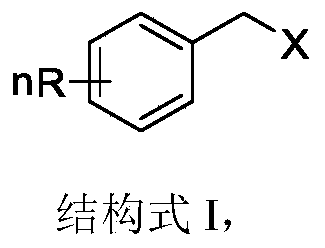
其中,n为0~5中的任意一个整数,X为-Cl、-Br或-I,各R各自独立地选自-F、-Cl、-Br、硝基、氰基、C 1~C 5的烷基、C 1~C 5的烷氧基和-COOR 1中的任意一种,R 1为C 1~C 5的烷基。 Wherein, n is any integer from 0 to 5, X is -Cl, -Br or -I, and each R is independently selected from -F, -Cl, -Br, nitro, cyano, C 1 to C any 5 alkyl, C 1 ~ C 5 alkoxy group and a 1 -COOR, R 1 is an alkyl group of C 1 ~ C 5.
进一步地,控制加热段的温度在60~80℃之间,优选在65~75℃之间。Further, the temperature of the heating section is controlled to be between 60 and 80°C, preferably between 65 and 75°C.
进一步地,控制冷却段的温度在10~30℃之间,优选在15~25℃之间。Further, the temperature of the cooling section is controlled to be between 10 and 30°C, preferably between 15 and 25°C.
进一步地,上述产物溢流口设置有与冷却段的外壁连接的引流管,引流管沿远离外壁的方向倾斜向上延伸,优选引流管与外壁之间的夹角α在10°~40°之间,优选在20°~30°之间,优选产物溢流口设置在冷却段靠近加热段的一端。Further, the product overflow port is provided with a drainage tube connected to the outer wall of the cooling section, and the drainage tube extends obliquely upward in a direction away from the outer wall. Preferably, the included angle α between the drainage tube and the outer wall is between 10° and 40° , Preferably between 20° and 30°, and the product overflow is preferably arranged at the end of the cooling section close to the heating section.
进一步地,上述连续反应器为柱式连续反应器或搅拌式连续反应釜。Further, the above-mentioned continuous reactor is a column-type continuous reactor or a stirred-type continuous reactor.
进一步地,上述柱式连续反应器的加热段中设置有搅拌浆。Further, a stirring blade is provided in the heating section of the above-mentioned column-type continuous reactor.
进一步地,上述制备方法包括:将液体反应物料以第一流速和锌粉以第二流速分别连续送入加热段中,液体反应物料和锌粉在加热段中发生锌原子直接插入碳卤键反应,得到产物体系,产物体系从产物溢流口流出连续反应器,待溢流流速稳定后,调整锌粉以第三流速送入加热段中,其中,控制第二流速和第一流速使送入的锌粉相对于送入的卤化物的摩尔当量为1~3,优选为1.5~2.0,控制第三流速和第一流速使送入的锌粉相对于送入的卤化物的摩尔当量为1~1.1。Further, the above preparation method includes: continuously feeding the liquid reaction material into the heating section at a first flow rate and the zinc powder at a second flow rate, respectively, and the liquid reaction material and the zinc powder undergo a direct insertion reaction of zinc atoms into the carbon halide bond in the heating section. , The product system is obtained, and the product system flows out of the continuous reactor from the product overflow port. After the overflow flow rate is stabilized, the zinc powder is adjusted to be fed into the heating section at the third flow rate, wherein the second flow rate and the first flow rate are controlled to be fed into The molar equivalent of zinc powder relative to the halide fed is 1 to 3, preferably 1.5 to 2.0. The third flow rate and the first flow rate are controlled so that the molar equivalent of the zinc powder fed relative to the halide is 1 ~ 1.1.
进一步地,上述锌粉在加热段的保留时间为2~4h,优选为2.5~3.5h。Further, the retention time of the above-mentioned zinc powder in the heating section is 2 to 4 hours, preferably 2.5 to 3.5 hours.
进一步地,上述液体反应物料还包括极性溶剂、引发剂和锌粉活化剂,优选极性溶剂为四氢呋喃,优选引发剂选自1,2-二氯乙烷、1,2-二溴乙烷中的任意一种或多种,优选锌粉活化剂选自三甲基氯硅烷、三甲基溴硅烷中的任意一种或多种。Further, the above-mentioned liquid reaction material also includes a polar solvent, an initiator, and a zinc powder activator. The polar solvent is preferably tetrahydrofuran, and the initiator is preferably selected from 1,2-dichloroethane and 1,2-dibromoethane. Any one or more of them, preferably the zinc powder activator is selected from any one or more of trimethylchlorosilane and trimethylbromosilane.
进一步地,上述溶剂与卤化物的重量比为7~13:1,优选为8~10:1,优选引发剂相对于卤化物的摩尔当量为0.03~0.08,优选为0.04~0.05;优选锌粉活化剂相对于卤化物的摩尔当量为0.03~0.08,优选为0.04~0.05。Further, the weight ratio of the solvent to the halide is 7-13:1, preferably 8-10:1, and the molar equivalent of the initiator relative to the halide is preferably 0.03-0.08, preferably 0.04-0.05; preferably zinc powder The molar equivalent of the activator relative to the halide is 0.03 to 0.08, preferably 0.04 to 0.05.
应用本发明的技术方案,采用连续反应器作为锌原子直接插入碳卤键反应的反应装置,且使锌粉自加热段的上方连续送入加热段中、液体反应物料自加热段的下部连续送入加热段中,二者在加热段中逆流接触,提高了二者的接触效率,保证了连续反应的高效进行。由于是连续化反应,随着连续反应的进行连续送入的锌粉会被连续的消耗,所得到的产物会连续地从产物溢流口流出,使得锌粉不会在连续反应器中蓄积,因此避免了喷料风险的发生,有利于该连续制备方法在放大生产中的应用。Applying the technical scheme of the present invention, a continuous reactor is used as the reaction device for the direct insertion of zinc atoms into the carbon halide bond reaction, and the zinc powder is continuously fed into the heating section from the upper part of the heating section, and the liquid reaction material is continuously fed from the lower part of the heating section. Into the heating section, the two are in countercurrent contact in the heating section, which improves the contact efficiency of the two and ensures the efficient progress of the continuous reaction. Because it is a continuous reaction, the continuously fed zinc powder will be continuously consumed as the continuous reaction progresses, and the resulting product will continuously flow out of the product overflow, so that the zinc powder will not accumulate in the continuous reactor. Therefore, the risk of spraying materials is avoided, which is beneficial to the application of the continuous preparation method in scale-up production.
构成本申请的一部分的说明书附图用来提供对本发明的进一步理解,本发明的示意性实施例及其说明用于解释本发明,并不构成对本发明的不当限定。在附图中:The drawings of the specification constituting a part of the application are used to provide a further understanding of the present invention, and the exemplary embodiments and descriptions of the present invention are used to explain the present invention, and do not constitute an improper limitation of the present invention. In the attached picture:
图1示出了根据本发明的一种实施例的连续反应器的结构示意图。Fig. 1 shows a schematic structural diagram of a continuous reactor according to an embodiment of the present invention.
其中,上述附图包括以下附图标记:Among them, the above drawings include the following reference signs:
10、加热段;20、冷却段;11、搅拌浆;21、引流管。10. Heating section; 20. Cooling section; 11. Stirring paddle; 21. Drainage tube.
需要说明的是,在不冲突的情况下,本申请中的实施例及实施例中的特征可以相互组合。下面将参考附图并结合实施例来详细说明本发明。It should be noted that the embodiments in this application and the features in the embodiments can be combined with each other if there is no conflict. Hereinafter, the present invention will be described in detail with reference to the drawings and in conjunction with the embodiments.
如本申请背景技术所分析的,现有技术的锌原子直接插入到碳卤键的技术方案采用批次反应进行,容易出现物料蓄积,造成喷料的风险,因此限制了其在工业放大生产中的应用。而为了解决该喷料风险,利用金属镁/氯化锂/氯化锌实现了苄基卤代烃中锌原子的插入,但是由于氯化锂以及氯化锌的在有机溶剂中的溶解性限制,导致需要高温处理,因此也限制了该路线在工业放大生产的应用。为了解决现有技术中苄基卤化锌的制备方法不适用于放大生产的问题,本申请提供了一种苄基卤化锌及其衍生物的连续制备方法。在本申请一种典型的实施方式中,该连续制备方法采用连续反应器进行锌原子直接插入碳卤键反应,其中,如图1所示,该连续反应器包括连通设置的加热段10和冷却段20,冷却段20位于加热段10的上方,冷却段20具有产物溢流口,连续制备方法包括:将液体反应物料和锌粉分别连续送入加热段10中,锌粉自加热段10的上方连续送入加热段10中,液体反应物料自加热段10的下部连续送入加热段10中,并在加热段10中发生锌原子直接插入碳卤键反应,得到产物体系,产物体系从产物溢流口流出连续反应器,其中,液体反应物料包括卤化物,卤化物具有结构式I:As analyzed in the background art of this application, the prior art technical solution of directly inserting zinc atoms into carbon-halogen bonds is carried out by batch reaction, which is prone to material accumulation and causes the risk of spraying materials, thus limiting its use in industrial scale-up production. Applications. In order to solve the risk of spraying materials, metal magnesium/lithium chloride/zinc chloride was used to achieve the insertion of zinc atoms in benzyl halohydrocarbons, but due to the solubility limitations of lithium chloride and zinc chloride in organic solvents , Resulting in the need for high temperature treatment, therefore also limiting the application of this route in industrial scale-up production. In order to solve the problem that the preparation method of benzyl zinc halide in the prior art is not suitable for scale-up production, this application provides a continuous preparation method of benzyl zinc halide and its derivatives. In a typical embodiment of the present application, the continuous preparation method adopts a continuous reactor to carry out the direct insertion of zinc atoms into the carbon halide bond reaction, wherein, as shown in FIG. 1, the continuous reactor includes a heating section 10 and a cooling section connected in communication. In section 20, the cooling section 20 is located above the heating section 10, and the cooling section 20 has a product overflow. The continuous preparation method includes: continuously feeding the liquid reaction material and zinc powder into the heating section 10 respectively, and the zinc powder is self-heating section 10. The upper part is continuously fed into the heating section 10, and the liquid reaction material is continuously fed into the heating section 10 from the lower part of the heating section 10. In the heating section 10, the zinc atom directly inserts the carbon halide bond reaction to obtain the product system. The overflow outlet flows out of the continuous reactor, where the liquid reaction material includes a halide, and the halide has the structural formula I:

其中,n为0~5中的任意一个整数,X为-Cl、-Br或-I,各R各自独立地选自-F、-Cl、-Br、硝基、氰基、C 1~C 5的烷基、C 1~C 5的烷氧基和-COOR 1中的任意一种,R 1为C 1~C 5的烷基。 Wherein, n is any integer from 0 to 5, X is -Cl, -Br or -I, and each R is independently selected from -F, -Cl, -Br, nitro, cyano, C 1 to C any 5 alkyl, C 1 ~ C 5 alkoxy group and a 1 -COOR, R 1 is an alkyl group of C 1 ~ C 5.
上述锌原子直接插入碳卤键反应的反应式如下:The reaction formula for the direct insertion of the zinc atom into the carbon halide bond is as follows:

采用连续反应器作为锌原子直接插入碳卤键反应的反应装置,且使锌粉自加热段10的上方连续送入加热段10中、液体反应物料自加热段10的下部连续送入加热段10中,二者在加 热段10中逆流接触,提高了二者的接触效率,保证了连续反应的高效进行。由于是连续化反应,随着连续反应的进行连续送入的锌粉会被连续的消耗,所得到的产物会连续地从产物溢流口流出,使得锌粉不会在连续反应器中蓄积,因此避免了喷料风险的发生,有利于该连续制备方法在放大生产中的应用。A continuous reactor is used as the reaction device for the direct insertion of zinc atoms into the carbon halide bond reaction, and the zinc powder is continuously fed into the
上述加热段10的加热温度可以参考现有技术中锌原子直接插入碳卤键反应所需温度,为了有效地控制反应速度并尽可能提高物料转化率,优选控制加热段10的温度在60~80℃之间,更优选在65~75℃之间。The heating temperature of the
此外,为了减少锌粉遇液体反应物料的蒸汽在反应器内壁上聚积,以使反应能高效持续进行,优选控制冷却段20的温度在10~30℃之间,优选在15~25℃之间。以对所得产物体系实现快速降温。In addition, in order to reduce the accumulation of the zinc powder on the inner wall of the reactor by the vapor of the liquid reaction material, so that the reaction can proceed efficiently and continuously, the temperature of the
由于锌粉自加热段10的上方送入,因此其首先是位于加热段10的液面上,为了避免锌粉随着产物体系而流出,导致锌粉利用率降低,优选如图1所示,上述产物溢流口设置有与冷却段20的外壁连接的引流管21,引流管21沿远离外壁的方向倾斜向上延伸,利用引流管21对固体锌粉起到沉降作用。在提高锌粉沉降作用的同时,为了得到更为稳定的溢流速度,优选引流管21与外壁之间的夹角α在10°~40°之间,优选在20°~30°之间。另外,为了使所得产物体系尽快分离,优选产物溢流口设置在冷却段20靠近加热段10的一端Since the zinc powder is fed in from above the
现有技术中能够实现上述功能的连续反应器均可考虑应用至本申请中,优选上述连续反应器为柱式连续反应器或搅拌式连续反应釜。其中柱式连续反应器由于其截面积相对于搅拌式连续反应釜较小,其温度控制更为可靠,因此最为优选柱式连续反应器。The continuous reactors in the prior art that can realize the above-mentioned functions can all be considered for application in this application. Preferably, the above-mentioned continuous reactor is a column-type continuous reactor or a stirred-type continuous reactor. Among them, the column-type continuous reactor has a smaller cross-sectional area than the stirred-type continuous reactor, and its temperature control is more reliable, so the column-type continuous reactor is the most preferred.
为了进一步优化液体反应物料和锌粉的混合效果,优选如图1所示,上述柱式连续反应器的加热段10中设置有搅拌浆11。In order to further optimize the mixing effect of the liquid reaction material and zinc powder, preferably, as shown in FIG. 1, a
在本申请一种实施例中,上述制备方法包括:将液体反应物料以第一流速和锌粉以第二流速分别连续送入加热段10中,液体反应物料和锌粉在加热段10中发生锌原子直接插入碳卤键反应,得到产物体系,产物体系从产物溢流口流出连续反应器,待溢流流速稳定后,调整锌粉以第三流速送入加热段10中,其中,控制第二流速和第一流速使送入的锌粉相对于送入的卤化物的摩尔当量为1~3,优选为1.5~2.0,控制第三流速和第一流速使送入的锌粉相对于送入的卤化物的摩尔当量为1~1.1。根据溢流速度的变化,控制锌粉和卤化物的摩尔当量,有效地避免了长期连续化反应中锌粉的蓄积,延长了本申请的制备方法的高效实施时间。In an embodiment of the present application, the above preparation method includes: the liquid reaction material is continuously fed into the
为了提高反应物料的转化率,优选上述锌粉在加热段10的保留时间为2~4h,优选为2.5~3.5h,更优选为160~180min。该保留时间可以通过锌粉的供应速度和液体反应物料的供应速度来控制,其控制方法本领域技术人员通过常规试验即可得到,在此不再赘述。In order to increase the conversion rate of the reaction materials, it is preferable that the retention time of the zinc powder in the
本申请的上述液体反应物料可以为现有技术中实现锌原子直接插入碳卤键反应中锌粉之外的物料,为了加快反应速度,上述液体反应物料还包括极性溶剂、引发剂和锌粉活化剂。其中的引发剂引发上述反应,催化剂加快反应速率。用于本申请的上述极性溶剂、引发剂和 催化剂可以从现有技术中锌原子直接插入碳卤键反应所采用的相应物质中进行选择,为了降低成本,优选极性溶剂为四氢呋喃,优选引发剂选自1,2-二氯乙烷、1,2-二溴乙烷中的任意一种或多种,优选锌粉活化剂选自三甲基氯硅烷、三甲基溴硅烷中的任意一种或多种。The above-mentioned liquid reaction material of the present application may be a material other than zinc powder in the reaction of direct insertion of zinc atoms into the carbon-halogen bond in the prior art. In order to speed up the reaction speed, the above-mentioned liquid reaction material also includes a polar solvent, an initiator, and zinc powder. Activator. The initiator among them initiates the above-mentioned reaction, and the catalyst accelerates the reaction rate. The above-mentioned polar solvents, initiators and catalysts used in this application can be selected from the corresponding substances used in the direct insertion of zinc atoms into the carbon halide bond reaction in the prior art. In order to reduce costs, the preferred polar solvent is tetrahydrofuran, and the initiator is preferred. The agent is selected from any one or more of 1,2-dichloroethane and 1,2-dibromoethane, preferably the zinc powder activator is selected from any of trimethylchlorosilane and trimethylbromosilane One or more.
此外,为了提高各物料的利用率,优选上述溶剂与卤化物的重量比为7~13:1,优选为8~10:1,优选引发剂相对于卤化物的摩尔当量为0.03~0.08,优选为0.04~0.05;优选锌粉活化剂剂相对于卤化物的摩尔当量为0.03~0.08,优选为0.04~0.05。In addition, in order to improve the utilization of each material, the weight ratio of the solvent to the halide is preferably 7-13:1, preferably 8-10:1, and the molar equivalent of the initiator relative to the halide is preferably 0.03-0.08, preferably It is 0.04 to 0.05; preferably, the molar equivalent of the zinc powder activator relative to the halide is 0.03 to 0.08, preferably 0.04 to 0.05.
以下将结合实施例和对比例,进一步说明本申请的有益效果。The following examples and comparative examples will further illustrate the beneficial effects of the present application.
实施例1Example 1
氮气保护下,向10L四口瓶中加入4.45Kg四氢呋喃,主原料4-氟氯苄500g,三甲基氯硅烷18.8g,1,2-二溴乙烷32.5g,搅拌10~20min形成液体反应物料。Under the protection of nitrogen, add 4.45Kg tetrahydrofuran, main raw material 4-fluorochlorobenzyl 500g, trimethylchlorosilane 18.8g, 1,2-dibromoethane 32.5g into a 10L four-necked flask, and stir for 10-20min to form a liquid reaction materials.
采用图1所示的柱状反应器进行连续反应,其中,设置柱状反应器的加热段10的控温范围为65~75℃,冷却段20的控温范围为15~25℃,产物溢流口设置在冷却段20靠近加热段10的一端,引流管21与外壁之间的夹角α为25°,搅拌速度在100~200r/min间调整。开启进料泵向加热段10提供液体反应物料,开启连续固体加料机向加热段10提供锌粉,其中控制液体反应物料的流速为12g/min,锌粉加料速度为1.08g/min。打料3h后,产物溢流口的流速稳定,锌粉在柱状反应器中保留时间为170min,将锌粉加料速度调整为0.6g/min。取部分溢流得到的产物体系打入10wt%的氯化铵水溶液中(氯化铵水溶液作为淬灭液,经过了提前除氧),取有机相采用GC检测原料剩余为0.4%,并通过滴定测定反应收率为95%。The columnar reactor shown in Fig. 1 is used for continuous reaction, wherein the temperature control range of the
实施例2Example 2
氮气保护下,向10L四口瓶中加入4.45Kg四氢呋喃,主原料4-氟氯苄500g,三甲基氯硅烷18.8g,1,2-二溴乙烷32.5g,搅拌10~20min形成液体反应物料。Under the protection of nitrogen, add 4.45Kg tetrahydrofuran, main raw material 4-fluorochlorobenzyl 500g, trimethylchlorosilane 18.8g, 1,2-dibromoethane 32.5g into a 10L four-necked flask, and stir for 10-20min to form a liquid reaction materials.
采用图1所示的柱状反应器进行连续反应,其中,设置柱状反应器的加热段10的控温范围为65~75℃,冷却段20的控温范围为15~25℃,产物溢流口设置在冷却段20靠近加热段10的一端,引流管21与外壁之间的夹角α为40°。开启进料泵向加热段10提供液体反应物料,开启连续固体加料机向加热段10提供锌粉,其中控制液体反应物料的流速为12g/min,锌粉加料速度为1.08g/min。打料3h后,产物溢流口的流速稳定,锌粉在柱状反应器中保留时间为174min,将锌粉加料速度调整为0.6g/min。取部分溢流得到的产物体系打入10wt%的氯化铵水溶液中(氯化铵水溶液作为淬灭液,经过了提前除氧),取有机相采用GC检测原料剩余3.3%,并通过滴定测定反应收率为90.8%。The columnar reactor shown in Fig. 1 is used for continuous reaction, wherein the temperature control range of the
实施例3Example 3
氮气保护下,向10L四口瓶中加入4.45Kg四氢呋喃,主原料4-氟氯苄500g,三甲基氯硅烷18.8g,1,2-二溴乙烷32.5g,搅拌10~20min形成液体反应物料。Under the protection of nitrogen, add 4.45Kg tetrahydrofuran, main raw material 4-fluorochlorobenzyl 500g, trimethylchlorosilane 18.8g, 1,2-dibromoethane 32.5g into a 10L four-necked flask, and stir for 10-20min to form a liquid reaction materials.
采用图1所示的柱状反应器进行连续反应,其中,设置柱状反应器的加热段10的控温范围为65~75℃,冷却段20的控温范围为15~25℃,产物溢流口设置在冷却段20靠近加热段10的一端,引流管21与外壁之间的夹角α为10°。开启进料泵向加热段10提供液体反应物料,开启连续固体加料机向加热段10提供锌粉,其中控制液体反应物料的流速为12g/min,锌粉加料速度为1.08g/min。打料3h后,产物溢流口的流速稳定,锌粉在柱状反应器中保留时间为166min,将锌粉加料速度调整为0.6g/min。取部分溢流得到的产物体系打入10wt%的氯化铵水溶液中(氯化铵水溶液作为淬灭液,经过了提前除氧),取有机相采用GC检测原料剩余为3.2%,并通过滴定测定反应收率为92.4%。The columnar reactor shown in Fig. 1 is used for continuous reaction, wherein the temperature control range of the
实施例4Example 4
氮气保护下,向10L四口瓶中加入4.45Kg四氢呋喃,主原料4-氟氯苄500g,三甲基氯硅烷18.8g,1,2-二溴乙烷32.5g,搅拌10~20min形成液体反应物料。Under the protection of nitrogen, add 4.45Kg tetrahydrofuran, main raw material 4-fluorochlorobenzyl 500g, trimethylchlorosilane 18.8g, 1,2-dibromoethane 32.5g into a 10L four-necked flask, and stir for 10-20min to form a liquid reaction materials.
采用图1所示的柱状反应器进行连续反应,其中,设置柱状反应器的加热段10的控温范围为65~75℃,冷却段20的控温范围为15~25℃,产物溢流口设置在冷却段20靠近加热段10的一端,引流管21与外壁之间的夹角α为20°。开启进料泵向加热段10提供液体反应物料,开启连续固体加料机向加热段10提供锌粉,其中控制液体反应物料的流速为12g/min,锌粉加料速度为1.08g/min。打料3h后,产物溢流口的流速稳定,锌粉在柱状反应器中保留时间为168min,将锌粉加料速度调整为0.6g/min。取部分溢流得到的产物体系打入10wt%的氯化铵水溶液中(氯化铵水溶液作为淬灭液,经过了提前除氧),取有机相采用GC检测原料剩余为0.5%,并通过滴定测定反应收率为95.2%。The columnar reactor shown in Fig. 1 is used for continuous reaction, wherein the temperature control range of the
实施例5Example 5
氮气保护下,向10L四口瓶中加入4.45Kg四氢呋喃,主原料4-氟氯苄500g,三甲基氯硅烷18.8g,1,2-二溴乙烷32.5g,搅拌10~20min形成液体反应物料。Under the protection of nitrogen, add 4.45Kg tetrahydrofuran, main raw material 4-fluorochlorobenzyl 500g, trimethylchlorosilane 18.8g, 1,2-dibromoethane 32.5g into a 10L four-necked flask, and stir for 10-20min to form a liquid reaction materials.
采用图1所示的柱状反应器进行连续反应,其中,设置柱状反应器的加热段10的控温范围为65~75℃,冷却段20的控温范围为15~25℃,产物溢流口设置在冷却段20靠近加热段10的一端,引流管21与外壁之间的夹角α为30°。开启进料泵向加热段10提供液体反应物料,开启连续固体加料机向加热段10提供锌粉,其中控制液体反应物料的流速为12g/min,锌粉加料速度为1.08g/min。打料3h后,产物溢流口的流速稳定,锌粉在柱状反应器中保留时间为172min,将锌粉加料速度调整为0.6g/min。取部分溢流得到的产物体系打入10wt%的氯化铵水溶液中(氯化铵水溶液作为淬灭液,经过了提前除氧),取有机相采用GC检测原料剩余为0.2%,并通过滴定测定反应收率为95.5%。The columnar reactor shown in Fig. 1 is used for continuous reaction, wherein the temperature control range of the
实施例6Example 6
氮气保护下,向10L四口瓶中加入4.45Kg四氢呋喃,主原料4-氟氯苄500g,三甲基氯硅烷18.8g,1,2-二溴乙烷32.5g,搅拌10~20min形成液体反应物料。Under the protection of nitrogen, add 4.45Kg tetrahydrofuran, main raw material 4-fluorochlorobenzyl 500g, trimethylchlorosilane 18.8g, 1,2-dibromoethane 32.5g into a 10L four-necked flask, and stir for 10-20min to form a liquid reaction materials.
采用图1所示的柱状反应器进行连续反应,其中,设置柱状反应器的加热段10的控温范围为65~75℃,冷却段20的控温范围为15~25℃,产物溢流口设置在冷却段20靠近加热段10的一端,引流管21与外壁之间的夹角α为5°。开启进料泵向加热段10提供液体反应物料,开启连续固体加料机向加热段10提供锌粉,其中控制液体反应物料的流速为12g/min,锌粉加料速度为1.08g/min。打料3h后,产物溢流口的流速稳定,锌粉在柱状反应器中保留时间为162min,将锌粉加料速度调整为0.6g/min。取部分溢流得到的产物体系打入10wt%的氯化铵水溶液中(氯化铵水溶液作为淬灭液,经过了提前除氧),取有机相采用GC检测原料剩余为7.2%,并通过滴定测定反应收率为88%。The columnar reactor shown in Fig. 1 is used for continuous reaction, wherein the temperature control range of the
实施例7Example 7
氮气保护下,向10L四口瓶中加入4.45Kg四氢呋喃,主原料4-氟氯苄500g,三甲基氯硅烷18.8g,1,2-二溴乙烷32.5g,搅拌10~20min形成液体反应物料。Under the protection of nitrogen, add 4.45Kg tetrahydrofuran, main raw material 4-fluorochlorobenzyl 500g, trimethylchlorosilane 18.8g, 1,2-dibromoethane 32.5g into a 10L four-necked flask, and stir for 10-20min to form a liquid reaction materials.
采用图1所示的柱状反应器进行连续反应,其中,设置柱状反应器的加热段10的控温范围为65~75℃,冷却段20的控温范围为15~25℃,产物溢流口设置在冷却段20靠近加热段10的一端,引流管21与外壁之间的夹角α为45°。开启进料泵向加热段10提供液体反应物料,开启连续固体加料机向加热段10提供锌粉,其中控制液体反应物料的流速为12g/min,锌粉加料速度为1.08g/min。打料3h后,产物溢流口的流速稳定,锌粉在柱状反应器中保留时间为177min,将锌粉加料速度调整为0.6g/min。取部分溢流得到的产物体系打入10wt%的氯化铵水溶液中(氯化铵水溶液作为淬灭液,经过了提前除氧),取有机相采用GC检测原料剩余为6.2%,并通过滴定测定反应收率为89.7%。这可能是因为引流管和外壁之间的夹角太大,导致锌粉容易粘在器壁上影响锌粉扩散,导致反应效率变差。The columnar reactor shown in Fig. 1 is used for continuous reaction, wherein the temperature control range of the
实施例8Example 8
氮气保护下,向10L四口瓶中加入4.45Kg四氢呋喃,主原料4-氟氯苄500g,三甲基氯硅烷18.8g,1,2-二溴乙烷32.5g,搅拌10~20min形成液体反应物料。Under the protection of nitrogen, add 4.45Kg tetrahydrofuran, main raw material 4-fluorochlorobenzyl 500g, trimethylchlorosilane 18.8g, 1,2-dibromoethane 32.5g into a 10L four-necked flask, and stir for 10-20min to form a liquid reaction materials.
采用图1所示的柱状反应器进行连续反应,其中,设置柱状反应器的加热段10的控温范围为60~70℃,冷却段20的控温范围为10~20℃,产物溢流口设置在冷却段20靠近加热段10的一端,引流管21与外壁之间的夹角α为25°。开启进料泵向加热段10提供液体反应物料,开启连续固体加料机向加热段10提供锌粉,其中控制液体反应物料的流速为12g/min,锌粉加料速度为1.08g/min。打料3h后,产物溢流口的流速稳定,锌粉在柱状反应器中保留时间为170min,将锌粉加料速度调整为0.6g/min。取部分溢流得到的产物体系打入10wt%的氯化铵水溶液中(氯化铵水溶液作为淬灭液,经过了提前除氧),取有机相采用GC检测原料剩余为1.8%,并通过滴定测定反应收率为94.2%。The columnar reactor shown in Fig. 1 is used for continuous reaction, wherein the temperature control range of the
实施例9Example 9
氮气保护下,向10L四口瓶中加入4.45Kg四氢呋喃,主原料4-氟氯苄500g,三甲基氯硅烷18.8g,1,2-二溴乙烷32.5g,搅拌10~20min形成液体反应物料。Under the protection of nitrogen, add 4.45Kg tetrahydrofuran, main raw material 4-fluorochlorobenzyl 500g, trimethylchlorosilane 18.8g, 1,2-dibromoethane 32.5g into a 10L four-necked flask, and stir for 10-20min to form a liquid reaction materials.
采用图1所示的柱状反应器进行连续反应,其中,设置柱状反应器的加热段10的控温范围为70~80℃,冷却段20的控温范围为20~30℃,产物溢流口设置在冷却段20靠近加热段10的一端,引流管21与外壁之间的夹角α为25°。开启进料泵向加热段10提供液体反应物料,开启连续固体加料机向加热段10提供锌粉,其中控制液体反应物料的流速为12g/min,锌粉加料速度为1.08g/min。打料3h后,产物溢流口的流速稳定,锌粉在柱状反应器中保留时间为170min,将锌粉加料速度调整为0.6g/min。取部分溢流得到的产物体系打入10wt%的氯化铵水溶液中(氯化铵水溶液作为淬灭液,经过了提前除氧),取有机相采用GC检测原料剩余为0.4%,并通过滴定测定反应收率为94.8%。The columnar reactor shown in Figure 1 is used for continuous reaction, wherein the
实施例10Example 10
氮气保护下,向10L四口瓶中加入4.45Kg四氢呋喃,主原料4-氟氯苄500g,三甲基氯硅烷18.8g,1,2-二溴乙烷32.5g,搅拌10~20min形成液体反应物料。Under the protection of nitrogen, add 4.45Kg tetrahydrofuran, main raw material 4-fluorochlorobenzyl 500g, trimethylchlorosilane 18.8g, 1,2-dibromoethane 32.5g into a 10L four-necked flask, and stir for 10-20min to form a liquid reaction materials.
采用图1所示的柱状反应器进行连续反应,其中,设置柱状反应器的加热段10的控温范围为60~70℃,冷却段20的控温范围为10~20℃,产物溢流口设置在冷却段20靠近加热段10的一端,引流管21与外壁之间的夹角α为25°。开启进料泵向加热段10提供液体反应物料,开启连续固体加料机向加热段10提供锌粉,其中控制液体反应物料的流速为15g/min,锌粉加料速度为1.35g/min。打料3h后,产物溢流口的流速稳定,锌粉在柱状反应器中保留时间为135min,将锌粉加料速度调整为0.67g/min。取部分溢流得到的产物体系打入10wt%的氯化铵水溶液中(氯化铵水溶液作为淬灭液,经过了提前除氧),取有机相采用GC检测原料剩余为10.6%,并通过滴定测定反应收率为84.3%。The columnar reactor shown in Fig. 1 is used for continuous reaction, wherein the temperature control range of the
实施例11Example 11
氮气保护下,向10L四口瓶中加入4.45Kg四氢呋喃,主原料4-氟氯苄500g,三甲基氯硅烷18.8g,1,2-二溴乙烷32.5g,搅拌10~20min形成液体反应物料。Under the protection of nitrogen, add 4.45Kg tetrahydrofuran, main raw material 4-fluorochlorobenzyl 500g, trimethylchlorosilane 18.8g, 1,2-dibromoethane 32.5g into a 10L four-necked flask, and stir for 10-20min to form a liquid reaction materials.
采用图1所示的柱状反应器进行连续反应,其中,设置柱状反应器的加热段10的控温范围为60~70℃,冷却段20的控温范围为10~20℃,产物溢流口设置在冷却段20靠近加热段10的一端,引流管21与外壁之间的夹角α为25°。开启进料泵向加热段10提供液体反应物料,开启连续固体加料机向加热段10提供锌粉,其中控制液体反应物料的流速为15g/min,锌粉加料速度为1.08g/min。打料3h后,产物溢流口的流速稳定,锌粉在柱状反应器中保留时间135min,将锌粉加料速度调整为0.6g/min。取部分溢流得到的产物体系打入10wt%的氯化铵水溶液中(氯化铵水溶液作为淬灭液,经过了提前除氧),取有机相采用GC检测原料剩余为32.5%,并通过滴定测定反应收率为61.8%。The columnar reactor shown in Fig. 1 is used for continuous reaction, wherein the temperature control range of the
实施例12Example 12
氮气保护下,向10L四口瓶中加入4.45Kg四氢呋喃,主原料4-氟氯苄500g,三甲基氯硅烷18.8g,1,2-二溴乙烷32.5g,搅拌10~20min形成液体反应物料。Under the protection of nitrogen, add 4.45Kg tetrahydrofuran, main raw material 4-fluorochlorobenzyl 500g, trimethylchlorosilane 18.8g, 1,2-dibromoethane 32.5g into a 10L four-necked flask, and stir for 10-20min to form a liquid reaction materials.
采用图1所示的柱状反应器进行连续反应,其中,设置柱状反应器的加热段10的控温范围为60~70℃,冷却段20的控温范围为10~20℃,产物溢流口设置在冷却段20靠近加热段10的一端,引流管21与外壁之间的夹角α为25°。开启进料泵向加热段10提供液体反应物料,开启连续固体加料机向加热段10提供锌粉,其中控制液体反应物料的流速为9g/min,锌粉加料速度为1.08g/min。打料4h后,产物溢流口的流速稳定,锌粉在柱状反应器中保留时间为230min,将锌粉加料速度调整为0.6g/min。取部分溢流得到的产物体系打入10wt%的氯化铵水溶液中(氯化铵水溶液作为淬灭液,经过了提前除氧),取有机相采用GC检测原料剩余为0.2%,并通过滴定测定反应收率为94.2%。The columnar reactor shown in Fig. 1 is used for continuous reaction, wherein the temperature control range of the
实施例13Example 13
氮气保护下,向10L四口瓶中加入4.45Kg四氢呋喃,主原料4-氟氯苄500g,三甲基氯硅烷6.2g,1,2-二溴乙烷32.5g,搅拌10~20min形成液体反应物料。Under the protection of nitrogen, add 4.45Kg tetrahydrofuran, the main raw material 4-fluorochlorobenzyl 500g, trimethylchlorosilane 6.2g, 1,2-dibromoethane 32.5g into a 10L four-neck flask, and stir for 10-20min to form a liquid reaction. materials.
采用图1所示的柱状反应器进行连续反应,其中,设置柱状反应器的加热段10的控温范围为60~70℃,冷却段20的控温范围为10~20℃,产物溢流口设置在冷却段20靠近加热段10的一端,引流管21与外壁之间的夹角α为25°。开启进料泵向加热段10提供液体反应物料,开启连续固体加料机向加热段10提供锌粉,其中控制液体反应物料的流速为12g/min,锌粉加料速度为1.08g/min。打料3h后,产物溢流口的流速稳定,锌粉在柱状反应器中保留时间为170min,将锌粉加料速度调整为0.6g/min。取部分溢流得到的产物体系打入10wt%的氯化铵水溶液中(氯化铵水溶液作为淬灭液,经过了提前除氧),取有机相采用GC检测原料剩余为23.6%,并通过滴定测定反应收率为73.5%。The columnar reactor shown in Fig. 1 is used for continuous reaction, wherein the temperature control range of the
实施例14Example 14
氮气保护下,向10L四口瓶中加入4.45Kg四氢呋喃,主原料4-氰基氯苄500g,三甲基氯硅烷17.9g,1,2-二溴乙烷31g,搅拌10~20min形成液体反应物料。Under nitrogen protection, add 4.45Kg of tetrahydrofuran, the main raw material 4-cyanobenzyl chloride 500g, trimethylchlorosilane 17.9g, 1,2-dibromoethane 31g, and stir for 10-20min to form a liquid reaction. materials.
采用图1所示的柱状反应器进行连续反应,其中,设置柱状反应器的加热段10的控温范围为60~70℃,冷却段20的控温范围为10~20℃,产物溢流口设置在冷却段20靠近加热段10的一端,引流管21与外壁之间的夹角α为25°。开启进料泵向加热段10提供液体反应物料,开启连续固体加料机向加热段10提供锌粉,其中控制液体反应物料的流速为12g/min,锌粉加料速度为1.03g/min。打料3h后,产物溢流口的流速稳定,锌粉在柱状反应器中保留时间为170min,将锌粉加料速度调整为0.57g/min。取部分溢流得到的产物体系打入10wt%的氯化铵水溶液中(氯化铵水溶液作为淬灭液,经过了提前除氧),取有机相采用GC检测原料剩余为0.8%,并通过滴定测定反应收率为94.2%。The columnar reactor shown in Fig. 1 is used for continuous reaction, wherein the temperature control range of the
实施例15Example 15
氮气保护下,向10L四口瓶中加入4.45Kg四氢呋喃,主原料4-硝基氯苄500g,三甲基氯硅烷15.8g,1,2-二溴乙烷27.4g,搅拌10~20min形成液体反应物料。Under nitrogen protection, add 4.45Kg of tetrahydrofuran, the main raw material 4-nitrobenzyl chloride 500g, trimethylchlorosilane 15.8g, and 1,2-dibromoethane 27.4g into a 10L four-necked flask, and stir for 10-20min to form a liquid Reaction mass.
采用图1所示的柱状反应器进行连续反应,其中,设置柱状反应器的加热段10的控温范围为60~70℃,冷却段20的控温范围为10~20℃,产物溢流口设置在冷却段20靠近加热段10的一端,引流管21与外壁之间的夹角α为25°。开启进料泵向加热段10提供液体反应物料,开启连续固体加料机向加热段10提供锌粉,其中控制液体反应物料的流速为12g/min,锌粉加料速度为0.91g/min。打料3h后,产物溢流口的流速稳定,锌粉在柱状反应器中保留时间为170min,将锌粉加料速度调整为0.5g/min。取部分溢流得到的产物体系打入10wt%的氯化铵水溶液中(氯化铵水溶液作为淬灭液,经过了提前除氧),取有机相采用GC检测原料剩余为1.2%,并通过滴定测定反应收率为94.7%。The columnar reactor shown in Fig. 1 is used for continuous reaction, wherein the temperature control range of the
实施例16Example 16
氮气保护下,向10L四口瓶中加入4.45Kg四氢呋喃,主原料4-乙基氯苄500g,三甲基氯硅烷17.6g,1,2-二溴乙烷30.4g,搅拌10~20min形成液体反应物料。Under the protection of nitrogen, add 4.45Kg of tetrahydrofuran, the main raw material 4-ethyl benzyl chloride 500g, trimethylchlorosilane 17.6g, and 1,2-dibromoethane 30.4g into a 10L four-necked flask, and stir for 10-20min to form a liquid Reaction mass.
采用图1所示的柱状反应器进行连续反应,其中,设置柱状反应器的加热段10的控温范围为60~70℃,冷却段20的控温范围为10~20℃,产物溢流口设置在冷却段20靠近加热段10的一端,引流管21与外壁之间的夹角α为25°。开启进料泵向加热段10提供液体反应物料,开启连续固体加料机向加热段10提供锌粉,其中控制液体反应物料的流速为12g/min,锌粉加料速度为1.01g/min。打料3h后,产物溢流口的流速稳定,锌粉在柱状反应器中保留时间为170min,将锌粉加料速度调整为0.56g/min。取部分溢流得到的产物体系打入10wt%的氯化铵水溶液中(氯化铵水溶液作为淬灭液,经过了提前除氧),取有机相采用GC检测原料剩余为0.9%,并通过滴定测定反应收率为95.0%。The columnar reactor shown in Fig. 1 is used for continuous reaction, wherein the temperature control range of the
实施例17Example 17
氮气保护下,向10L四口瓶中加入4.45Kg四氢呋喃,主原料4-甲氧基氯苄500g,三甲基氯硅烷17.4g,1,2-二溴乙烷30g,搅拌10~20min形成液体反应物料。Under nitrogen protection, add 4.45Kg of tetrahydrofuran, the main raw material 4-methoxybenzyl chloride 500g, trimethylchlorosilane 17.4g, and 1,2-dibromoethane 30g into a 10L four-necked flask, and stir for 10-20min to form a liquid Reaction mass.
采用图1所示的柱状反应器进行连续反应,其中,设置柱状反应器的加热段10的控温范围为60~70℃,冷却段20的控温范围为10~20℃,产物溢流口设置在冷却段20靠近加热段10的一端,引流管21与外壁之间的夹角α为25°。开启进料泵向加热段10提供液体反应物料,开启连续固体加料机向加热段10提供锌粉,其中控制液体反应物料的流速为12g/min,锌粉加料速度为1g/min。打料3h后,产物溢流口的流速稳定,锌粉在柱状反应器中保留时间为170min,将锌粉加料速度调整为0.55g/min。取部分溢流得到的产物体系打入10wt%的氯化铵水溶液中(氯化铵水溶液作为淬灭液,经过了提前除氧),取有机相采用GC检测原料剩余为1.6%,并通过滴定测定反应收率为93.8%。The columnar reactor shown in Fig. 1 is used for continuous reaction, wherein the temperature control range of the
实施例18Example 18
氮气保护下,向10L四口瓶中加入4.45Kg四氢呋喃,主原料4-氯甲基苯甲酸甲酯500g,三甲基氯硅烷14.7g,1,2-二溴乙烷25.4g,搅拌10~20min形成液体反应物料。Under nitrogen protection, add 4.45Kg tetrahydrofuran, the main raw material 4-chloromethyl benzoate 500g, trimethylchlorosilane 14.7g, and 1,2-dibromoethane 25.4g into a 10L four-neck flask, and stir for 10~ A liquid reaction mass is formed in 20 minutes.
采用图1所示的柱状反应器进行连续反应,其中,设置柱状反应器的加热段10的控温范围为60~70℃,冷却段20的控温范围为10~20℃,产物溢流口设置在冷却段20靠近加热段10的一端,引流管21与外壁之间的夹角α为25°。开启进料泵向加热段10提供液体反应物料,开启连续固体加料机向加热段10提供锌粉,其中控制液体反应物料的流速为12g/min,锌粉加料速度为0.84g/min。打料3h后,产物溢流口的流速稳定,锌粉在柱状反应器中保留时间为170min,将锌粉加料速度调整为0.47g/min。取部分溢流得到的产物体系打入10wt%的氯化铵水溶液中(氯化铵水溶液作为淬灭液,经过了提前除氧),取有机相采用GC检测原料剩余为0.6%,并通过滴定测定反应收率为94.2%。The columnar reactor shown in Fig. 1 is used for continuous reaction, wherein the temperature control range of the
从以上的描述中,可以看出,本发明上述的实施例实现了如下技术效果:From the above description, it can be seen that the above-mentioned embodiments of the present invention achieve the following technical effects:
采用连续反应器作为锌原子直接插入碳卤键反应的反应装置,且使锌粉自加热段的上方连续送入加热段中、液体反应物料自加热段的下部连续送入加热段中,二者在加热段中逆流接触,提高了二者的接触效率,保证了连续反应的高效进行。由于是连续化反应,随着连续反应的进行连续送入的锌粉会被连续的消耗,所得到的产物会连续地从产物溢流口流出,使得锌粉不会在连续反应器中蓄积,因此避免了喷料风险的发生,有利于该连续制备方法在放大生产中的应用。The continuous reactor is used as the reaction device for the direct insertion of zinc atoms into the carbon halide bond reaction, and the zinc powder is continuously fed into the heating section from the upper part of the heating section, and the liquid reaction material is continuously fed into the heating section from the lower part of the heating section. The countercurrent contact in the heating section improves the contact efficiency of the two and ensures the efficient progress of the continuous reaction. Because it is a continuous reaction, the continuously fed zinc powder will be continuously consumed as the continuous reaction progresses, and the resulting product will continuously flow out of the product overflow, so that the zinc powder will not accumulate in the continuous reactor. Therefore, the risk of spraying materials is avoided, which is beneficial to the application of the continuous preparation method in scale-up production.
以上所述仅为本发明的优选实施例而已,并不用于限制本发明,对于本领域的技术人员来说,本发明可以有各种更改和变化。凡在本发明的精神和原则之内,所作的任何修改、等同替换、改进等,均应包含在本发明的保护范围之内。The above descriptions are only preferred embodiments of the present invention and are not used to limit the present invention. For those skilled in the art, the present invention can have various modifications and changes. Any modification, equivalent replacement, improvement, etc. made within the spirit and principle of the present invention should be included in the protection scope of the present invention.
Claims (10)

Priority Applications (6)
| Application Number | Priority Date | Filing Date | Title |
|---|---|---|---|
| PCT/CN2019/107546 WO2021056193A1 (en) | 2019-09-24 | 2019-09-24 | Continuous preparation method for benzyl zinc halide and derivatives thereof |
| KR1020227013119A KR102662644B1 (en) | 2019-09-24 | 2019-09-24 | Method for continuous production of benzyl zinc halide and its derivatives |
| US17/763,613 US20220332732A1 (en) | 2019-09-24 | 2019-09-24 | Continuous preparation method for benzylzinc halide and derivative thereof |
| JP2022515605A JP7312318B2 (en) | 2019-09-24 | 2019-09-24 | Continuous production method for benzyl zinc halide and its derivatives |
| CA3160068A CA3160068A1 (en) | 2019-09-24 | 2019-09-24 | Continuous preparation method for benzylzinc halide and derivative thereof |
| EP19947330.7A EP4036096A4 (en) | 2019-09-24 | 2019-09-24 | Continuous preparation method for benzyl zinc halide and derivatives thereof |
Applications Claiming Priority (1)
| Application Number | Priority Date | Filing Date | Title |
|---|---|---|---|
| PCT/CN2019/107546 WO2021056193A1 (en) | 2019-09-24 | 2019-09-24 | Continuous preparation method for benzyl zinc halide and derivatives thereof |
Publications (1)
| Publication Number | Publication Date |
|---|---|
| WO2021056193A1 true WO2021056193A1 (en) | 2021-04-01 |
Family
ID=75165456
Family Applications (1)
| Application Number | Title | Priority Date | Filing Date |
|---|---|---|---|
| PCT/CN2019/107546 Ceased WO2021056193A1 (en) | 2019-09-24 | 2019-09-24 | Continuous preparation method for benzyl zinc halide and derivatives thereof |
Country Status (6)
| Country | Link |
|---|---|
| US (1) | US20220332732A1 (en) |
| EP (1) | EP4036096A4 (en) |
| JP (1) | JP7312318B2 (en) |
| KR (1) | KR102662644B1 (en) |
| CA (1) | CA3160068A1 (en) |
| WO (1) | WO2021056193A1 (en) |
Cited By (1)
| Publication number | Priority date | Publication date | Assignee | Title |
|---|---|---|---|---|
| WO2023152332A1 (en) | 2022-02-10 | 2023-08-17 | Chemium Sprl | Method for the production of organometallic compounds |
Citations (7)
| Publication number | Priority date | Publication date | Assignee | Title |
|---|---|---|---|---|
| US4187254A (en) * | 1976-11-09 | 1980-02-05 | Societe Chimique Des Charbonnages - Cdf Chimie | Grignard reagents and processes for making them |
| CN101195575A (en) * | 2006-12-08 | 2008-06-11 | 西北师范大学 | Preparation method of (E)-3,5-dimethoxy-4'-acetoxystilbene |
| CN101397247A (en) * | 2008-10-31 | 2009-04-01 | 天津大学 | Method for synthesizing raw medicine dihydroindene-1-carboxyl acid for clidabac |
| CN204973830U (en) * | 2015-09-14 | 2016-01-20 | 浙江华亿工程设计有限公司 | Tower continuous production device of grignard reagent preparation |
| CN106397208A (en) * | 2016-08-30 | 2017-02-15 | 京博农化科技股份有限公司 | Preparation method of boscalid intermediate 2-(4-chlorophenyl)nitrobenzene |
| CN106674257A (en) * | 2016-12-30 | 2017-05-17 | 江苏创拓新材料有限公司 | Continuous production method of Grignard reagent |
| CN206881185U (en) * | 2017-06-28 | 2018-01-16 | 天津中福泰克化工科技有限公司 | A kind of rectification experimental apparatus |
Family Cites Families (3)
| Publication number | Priority date | Publication date | Assignee | Title |
|---|---|---|---|---|
| JP2003261494A (en) | 2002-03-08 | 2003-09-16 | Hokkaido Technology Licence Office Co Ltd | Method for producing 1,4-dicarbonyl compound |
| BRPI0708685B8 (en) | 2006-03-06 | 2021-05-25 | Japan Tobacco Inc | 4-oxoquinoline compound, its use and method of production |
| AU2013296289B2 (en) | 2012-08-03 | 2017-10-05 | Gilead Sciences, Inc. | Process and intermediates for preparing integrase inhibitors |
-
2019
- 2019-09-24 WO PCT/CN2019/107546 patent/WO2021056193A1/en not_active Ceased
- 2019-09-24 US US17/763,613 patent/US20220332732A1/en not_active Abandoned
- 2019-09-24 CA CA3160068A patent/CA3160068A1/en active Pending
- 2019-09-24 JP JP2022515605A patent/JP7312318B2/en active Active
- 2019-09-24 KR KR1020227013119A patent/KR102662644B1/en active Active
- 2019-09-24 EP EP19947330.7A patent/EP4036096A4/en not_active Withdrawn
Patent Citations (7)
| Publication number | Priority date | Publication date | Assignee | Title |
|---|---|---|---|---|
| US4187254A (en) * | 1976-11-09 | 1980-02-05 | Societe Chimique Des Charbonnages - Cdf Chimie | Grignard reagents and processes for making them |
| CN101195575A (en) * | 2006-12-08 | 2008-06-11 | 西北师范大学 | Preparation method of (E)-3,5-dimethoxy-4'-acetoxystilbene |
| CN101397247A (en) * | 2008-10-31 | 2009-04-01 | 天津大学 | Method for synthesizing raw medicine dihydroindene-1-carboxyl acid for clidabac |
| CN204973830U (en) * | 2015-09-14 | 2016-01-20 | 浙江华亿工程设计有限公司 | Tower continuous production device of grignard reagent preparation |
| CN106397208A (en) * | 2016-08-30 | 2017-02-15 | 京博农化科技股份有限公司 | Preparation method of boscalid intermediate 2-(4-chlorophenyl)nitrobenzene |
| CN106674257A (en) * | 2016-12-30 | 2017-05-17 | 江苏创拓新材料有限公司 | Continuous production method of Grignard reagent |
| CN206881185U (en) * | 2017-06-28 | 2018-01-16 | 天津中福泰克化工科技有限公司 | A kind of rectification experimental apparatus |
Non-Patent Citations (1)
| Title |
|---|
| See also references of EP4036096A4 * |
Cited By (1)
| Publication number | Priority date | Publication date | Assignee | Title |
|---|---|---|---|---|
| WO2023152332A1 (en) | 2022-02-10 | 2023-08-17 | Chemium Sprl | Method for the production of organometallic compounds |
Also Published As
| Publication number | Publication date |
|---|---|
| US20220332732A1 (en) | 2022-10-20 |
| EP4036096A1 (en) | 2022-08-03 |
| JP2022547301A (en) | 2022-11-11 |
| JP7312318B2 (en) | 2023-07-20 |
| KR102662644B1 (en) | 2024-04-30 |
| EP4036096A4 (en) | 2023-08-09 |
| CA3160068A1 (en) | 2021-04-01 |
| KR20220065846A (en) | 2022-05-20 |
Similar Documents
| Publication | Publication Date | Title |
|---|---|---|
| CN108884177A (en) | Polymer manufacturing method | |
| CN106414422A (en) | Apparatus and method for producing cyclic carbonate | |
| CN105693549B (en) | Method for preparing diazonium salt by using microreactor | |
| CN102712573A (en) | Continuous preparation of DMAEA quaternary salt | |
| WO2021056193A1 (en) | Continuous preparation method for benzyl zinc halide and derivatives thereof | |
| CN111479816A (en) | Process for preparing phosphorus-containing α -aminonitriles | |
| CN102143935A (en) | Method for producing aminobiphenylene | |
| CN107207408A (en) | With N, the manufacture method of the compound of double (chloropropyl of the 2 hydroxyl 3) amino of N | |
| CN110551146A (en) | Continuous preparation method of benzyl zinc halide and derivatives thereof | |
| CN107540572A (en) | It is a kind of be used between/the refined equipment of para-Phthalonitrile | |
| CN101107221B (en) | Method for producing imide ether compound | |
| CN204676018U (en) | A kind of continuous synthesis device of cyclobufene sultone | |
| WO2018209735A1 (en) | Low-temperature liquid-phase method for preparing acrylate | |
| CN104761534A (en) | Continuous synthetic method of butadiene sulfone | |
| CN109422663B (en) | A kind of method of continuous flow synthesis quaternary ammonium salt | |
| TWI860085B (en) | Methods for producing halogenated propanes | |
| CN106831661B (en) | Method for preparing epoxypropane by using micro-reaction device | |
| CN106748835A (en) | A kind of preparation method of stryphnonasal | |
| CN117362556A (en) | Method for producing block polymer | |
| Bhaya et al. | Continuous-Flow Meerwein Arylation | |
| JP2016169258A (en) | Method for producing polythiophene compound | |
| US20190330150A1 (en) | Processes for the Preparation of 3-(4-Halobutyl)-5-Cyanoindole | |
| WO2008038618A1 (en) | Method and apparatus for production of dialkylaminoalkyl (meth)acrylate quaternary salt | |
| TWI663158B (en) | Apparatus and method for producing cyclic carbonate | |
| CN111153781A (en) | Method for catalyzing Friedel-crafts acylation reaction by using protonic acid |
Legal Events
| Date | Code | Title | Description |
|---|---|---|---|
| 121 | Ep: the epo has been informed by wipo that ep was designated in this application |
Ref document number: 19947330 Country of ref document: EP Kind code of ref document: A1 |
|
| ENP | Entry into the national phase |
Ref document number: 2022515605 Country of ref document: JP Kind code of ref document: A |
|
| ENP | Entry into the national phase |
Ref document number: 3160068 Country of ref document: CA |
|
| NENP | Non-entry into the national phase |
Ref country code: DE |
|
| ENP | Entry into the national phase |
Ref document number: 20227013119 Country of ref document: KR Kind code of ref document: A |
|
| ENP | Entry into the national phase |
Ref document number: 2019947330 Country of ref document: EP Effective date: 20220425 |