WO2021042127A1 - A packaged hair care composition - Google Patents
A packaged hair care composition Download PDFInfo
- Publication number
- WO2021042127A1 WO2021042127A1 PCT/US2020/070469 US2020070469W WO2021042127A1 WO 2021042127 A1 WO2021042127 A1 WO 2021042127A1 US 2020070469 W US2020070469 W US 2020070469W WO 2021042127 A1 WO2021042127 A1 WO 2021042127A1
- Authority
- WO
- WIPO (PCT)
- Prior art keywords
- composition
- exterior layer
- hair care
- outer tube
- care composition
- Prior art date
- Legal status (The legal status is an assumption and is not a legal conclusion. Google has not performed a legal analysis and makes no representation as to the accuracy of the status listed.)
- Ceased
Links
Classifications
-
- A—HUMAN NECESSITIES
- A61—MEDICAL OR VETERINARY SCIENCE; HYGIENE
- A61K—PREPARATIONS FOR MEDICAL, DENTAL OR TOILETRY PURPOSES
- A61K8/00—Cosmetics or similar toiletry preparations
- A61K8/18—Cosmetics or similar toiletry preparations characterised by the composition
- A61K8/72—Cosmetics or similar toiletry preparations characterised by the composition containing organic macromolecular compounds
- A61K8/84—Cosmetics or similar toiletry preparations characterised by the composition containing organic macromolecular compounds obtained by reactions otherwise than those involving only carbon-carbon unsaturated bonds
- A61K8/89—Polysiloxanes
- A61K8/891—Polysiloxanes saturated, e.g. dimethicone, phenyl trimethicone, C24-C28 methicone or stearyl dimethicone
-
- A—HUMAN NECESSITIES
- A61—MEDICAL OR VETERINARY SCIENCE; HYGIENE
- A61K—PREPARATIONS FOR MEDICAL, DENTAL OR TOILETRY PURPOSES
- A61K8/00—Cosmetics or similar toiletry preparations
- A61K8/18—Cosmetics or similar toiletry preparations characterised by the composition
- A61K8/30—Cosmetics or similar toiletry preparations characterised by the composition containing organic compounds
- A61K8/40—Cosmetics or similar toiletry preparations characterised by the composition containing organic compounds containing nitrogen
- A61K8/41—Amines
-
- A—HUMAN NECESSITIES
- A61—MEDICAL OR VETERINARY SCIENCE; HYGIENE
- A61K—PREPARATIONS FOR MEDICAL, DENTAL OR TOILETRY PURPOSES
- A61K8/00—Cosmetics or similar toiletry preparations
- A61K8/18—Cosmetics or similar toiletry preparations characterised by the composition
- A61K8/30—Cosmetics or similar toiletry preparations characterised by the composition containing organic compounds
- A61K8/40—Cosmetics or similar toiletry preparations characterised by the composition containing organic compounds containing nitrogen
- A61K8/41—Amines
- A61K8/416—Quaternary ammonium compounds
-
- A—HUMAN NECESSITIES
- A61—MEDICAL OR VETERINARY SCIENCE; HYGIENE
- A61K—PREPARATIONS FOR MEDICAL, DENTAL OR TOILETRY PURPOSES
- A61K8/00—Cosmetics or similar toiletry preparations
- A61K8/18—Cosmetics or similar toiletry preparations characterised by the composition
- A61K8/30—Cosmetics or similar toiletry preparations characterised by the composition containing organic compounds
- A61K8/40—Cosmetics or similar toiletry preparations characterised by the composition containing organic compounds containing nitrogen
- A61K8/44—Aminocarboxylic acids or derivatives thereof, e.g. aminocarboxylic acids containing sulfur; Salts; Esters or N-acylated derivatives thereof
-
- A—HUMAN NECESSITIES
- A61—MEDICAL OR VETERINARY SCIENCE; HYGIENE
- A61K—PREPARATIONS FOR MEDICAL, DENTAL OR TOILETRY PURPOSES
- A61K8/00—Cosmetics or similar toiletry preparations
- A61K8/18—Cosmetics or similar toiletry preparations characterised by the composition
- A61K8/72—Cosmetics or similar toiletry preparations characterised by the composition containing organic macromolecular compounds
- A61K8/73—Polysaccharides
- A61K8/731—Cellulose; Quaternized cellulose derivatives
-
- A—HUMAN NECESSITIES
- A61—MEDICAL OR VETERINARY SCIENCE; HYGIENE
- A61K—PREPARATIONS FOR MEDICAL, DENTAL OR TOILETRY PURPOSES
- A61K8/00—Cosmetics or similar toiletry preparations
- A61K8/18—Cosmetics or similar toiletry preparations characterised by the composition
- A61K8/72—Cosmetics or similar toiletry preparations characterised by the composition containing organic macromolecular compounds
- A61K8/73—Polysaccharides
- A61K8/737—Galactomannans, e.g. guar; Derivatives thereof
-
- A—HUMAN NECESSITIES
- A61—MEDICAL OR VETERINARY SCIENCE; HYGIENE
- A61K—PREPARATIONS FOR MEDICAL, DENTAL OR TOILETRY PURPOSES
- A61K8/00—Cosmetics or similar toiletry preparations
- A61K8/18—Cosmetics or similar toiletry preparations characterised by the composition
- A61K8/72—Cosmetics or similar toiletry preparations characterised by the composition containing organic macromolecular compounds
- A61K8/81—Cosmetics or similar toiletry preparations characterised by the composition containing organic macromolecular compounds obtained by reactions involving only carbon-to-carbon unsaturated bonds
- A61K8/8141—Compositions of homopolymers or copolymers of compounds having one or more unsaturated aliphatic radicals, each having only one carbon-to-carbon double bond, and at least one being terminated by only one carboxyl radical, or of salts, anhydrides, esters, amides, imides or nitriles thereof; Compositions of derivatives of such polymers
- A61K8/8152—Homopolymers or copolymers of esters, e.g. (meth)acrylic acid esters; Compositions of derivatives of such polymers
-
- A—HUMAN NECESSITIES
- A61—MEDICAL OR VETERINARY SCIENCE; HYGIENE
- A61K—PREPARATIONS FOR MEDICAL, DENTAL OR TOILETRY PURPOSES
- A61K8/00—Cosmetics or similar toiletry preparations
- A61K8/18—Cosmetics or similar toiletry preparations characterised by the composition
- A61K8/72—Cosmetics or similar toiletry preparations characterised by the composition containing organic macromolecular compounds
- A61K8/81—Cosmetics or similar toiletry preparations characterised by the composition containing organic macromolecular compounds obtained by reactions involving only carbon-to-carbon unsaturated bonds
- A61K8/817—Compositions of homopolymers or copolymers of compounds having one or more unsaturated aliphatic radicals, each having only one carbon-to-carbon double bond, and at least one being terminated by a single or double bond to nitrogen or by a heterocyclic ring containing nitrogen; Compositions or derivatives of such polymers, e.g. vinylimidazol, vinylcaprolactame, allylamines (Polyquaternium 6)
-
- A—HUMAN NECESSITIES
- A61—MEDICAL OR VETERINARY SCIENCE; HYGIENE
- A61Q—SPECIFIC USE OF COSMETICS OR SIMILAR TOILETRY PREPARATIONS
- A61Q5/00—Preparations for care of the hair
-
- A—HUMAN NECESSITIES
- A61—MEDICAL OR VETERINARY SCIENCE; HYGIENE
- A61Q—SPECIFIC USE OF COSMETICS OR SIMILAR TOILETRY PREPARATIONS
- A61Q5/00—Preparations for care of the hair
- A61Q5/12—Preparations containing hair conditioners
-
- B—PERFORMING OPERATIONS; TRANSPORTING
- B65—CONVEYING; PACKING; STORING; HANDLING THIN OR FILAMENTARY MATERIAL
- B65D—CONTAINERS FOR STORAGE OR TRANSPORT OF ARTICLES OR MATERIALS, e.g. BAGS, BARRELS, BOTTLES, BOXES, CANS, CARTONS, CRATES, DRUMS, JARS, TANKS, HOPPERS, FORWARDING CONTAINERS; ACCESSORIES, CLOSURES, OR FITTINGS THEREFOR; PACKAGING ELEMENTS; PACKAGES
- B65D35/00—Pliable tubular containers adapted to be permanently or temporarily deformed to expel contents, e.g. collapsible tubes for toothpaste or other plastic or semi-liquid material; Holders therefor
- B65D35/14—Pliable tubular containers adapted to be permanently or temporarily deformed to expel contents, e.g. collapsible tubes for toothpaste or other plastic or semi-liquid material; Holders therefor with linings or inserts
-
- A—HUMAN NECESSITIES
- A61—MEDICAL OR VETERINARY SCIENCE; HYGIENE
- A61K—PREPARATIONS FOR MEDICAL, DENTAL OR TOILETRY PURPOSES
- A61K2800/00—Properties of cosmetic compositions or active ingredients thereof or formulation aids used therein and process related aspects
- A61K2800/40—Chemical, physico-chemical or functional or structural properties of particular ingredients
- A61K2800/59—Mixtures
- A61K2800/596—Mixtures of surface active compounds
-
- A—HUMAN NECESSITIES
- A61—MEDICAL OR VETERINARY SCIENCE; HYGIENE
- A61K—PREPARATIONS FOR MEDICAL, DENTAL OR TOILETRY PURPOSES
- A61K2800/00—Properties of cosmetic compositions or active ingredients thereof or formulation aids used therein and process related aspects
- A61K2800/80—Process related aspects concerning the preparation of the cosmetic composition or the storage or application thereof
- A61K2800/87—Application Devices; Containers; Packaging
-
- A—HUMAN NECESSITIES
- A61—MEDICAL OR VETERINARY SCIENCE; HYGIENE
- A61K—PREPARATIONS FOR MEDICAL, DENTAL OR TOILETRY PURPOSES
- A61K2800/00—Properties of cosmetic compositions or active ingredients thereof or formulation aids used therein and process related aspects
- A61K2800/80—Process related aspects concerning the preparation of the cosmetic composition or the storage or application thereof
- A61K2800/88—Two- or multipart kits
- A61K2800/882—Mixing prior to application
Definitions
- Dispensing of a multi-phase hair care composition comprising a first composition and a second composition, wherein the first and second compositions are kept separate from one another until use, and wherein the product has a consistent dispense ratio and also has less residue at the end of the tube lifespan.
- a variety of approaches have been developed to dispense a multi-phase product.
- a common method is a multi-chamber tube or bottle.
- typical tubes or bottles have difficulty dispensing the phases in a predictable way. Additionally, often there is residue left in the tube, which is not desired by the consumer.
- the consumer desires hair care compositions that dispense in a visually appealing manner, additionally the consumer desires to dispense product uniformly and completely from the tube.
- a packaged hair care composition comprising a hair care composition comprising: a first composition and a second composition, wherein the first and second compositions are kept separate from one another until dispensed, wherein the first composition comprises: a cationic polymer; and an aqueous carrier and has a G’ value of about 160 Pa to about 410 Pa; and wherein the second composition comprises: a cationic surfactant; a high melting point fatty compound; and an aqueous carrier and has a G’ value of from about 600 Pa to about 3000 Pa
- a package comprising: an outer tube body having an exterior layer wherein the outer tube exterior layer has a stiffness of from about 3.0 N to about 9.5 N and a thickness of from about 300 pm to about 600 pm and an outer tube interior chamber; and an inner tube having an exterior layer wherein the interior tube exterior layer has a stiffness of from about 2.9N to about 9.5N and a thickness of from about 200 pm to about 600 pm and an inner tube body having an inner tube interior chamber; a dispensing
- Figs. 1A and IB are dispensed hair care composition
- Fig. 2 is a view of the packaged hair care composition and the tube in tube package
- Fig. 3 is a view of the dispensing orifice
- Fig. 4 is a demonstration of dispensing product for a test method
- Fig. 5 is a demonstration of dispensing product for a test method
- Fig. 6 is product dispensed for a test method
- Fig. 7 is product dispensed for a test method.
- mixtures is meant to include a simple combination of materials and any compounds that may result from their combination.
- molecular weight refers to the weight average molecular weight unless otherwise stated.
- the weight average molecular weight may be measured by gel permeation chromatography.
- the hair care composition comprises a first composition and a second composition, wherein the first and second compositions are kept separate from one another until dispensed.
- the first composition comprises: a cationic polymer; and an aqueous carrier
- the second composition comprises a cationic surfactant; a high melting point fatty compound; and an aqueous carrier.
- the first composition and/or the second composition may further comprise a silicone compound.
- the dispensed hair care composition G’ ratio of first composition and the second composition is from about 0.10 to about 0.40, from about 0.11 to about 0.35, and from about 0.13 to about 0.30.
- Figs. 1 A and IB show the dispensed hair care composition 10 comprising the first composition 20, and the second composition 30.
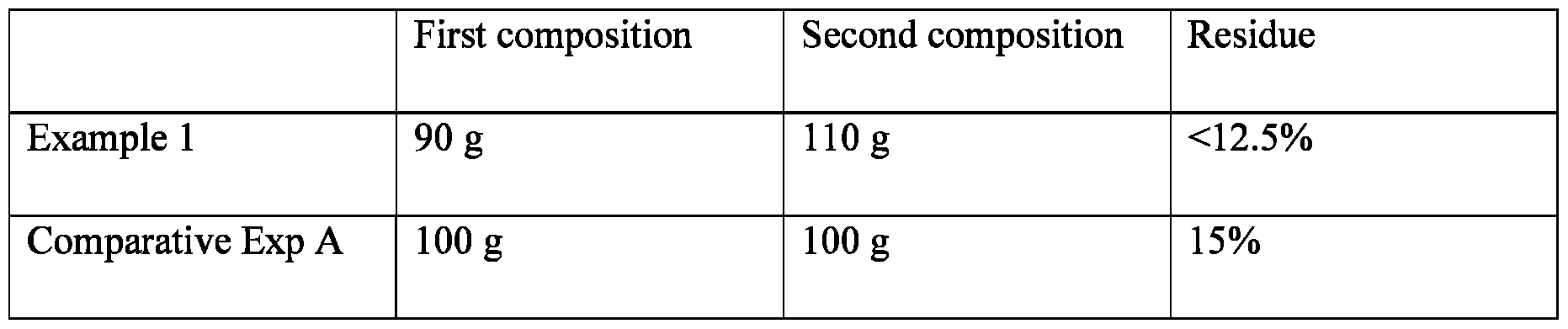
- the product can dispense such that there is minimal residue (from about 0 Wt.% to about 12.5 Wt.%, alternatively less than 12.5 Wt.%) remaining at the end of the tube lifespan as compared to existing tubes. Residue is the % of product remaining in the package after the consumer has dispensed all product that will dispense through normal use.
- the first composition comprises: a cationic polymer; and an aqueous carrier.
- a suitable cationic polymer includes, but is not limited to, polyquatemium-37.
- the first composition can be substantially free of high melting point fatty compound. “The first composition being substantially free of high melting point fatty compounds” means that: the composition is free of high melting point fatty compounds; or, if the composition contains high melting point fatty compounds, the level of such high melting point fatty compounds is very low. A total level of such high melting point fatty compounds in the first composition, if included, is 1% or less, 0.5% or less, and 0.1% or less by weight of the composition. The total level of such high melting point fatty compounds in the first composition can be 0% by weight of the composition.
- the first composition can be substantially free of cationic surfactant.
- “The first composition being substantially free of cationic surfactants” means that: the composition is free of cationic surfactants; or, if the composition contains cationic surfactants, the level of such cationic surfactants is very low.
- a total level of such cationic surfactants in the first composition, if included, is 0.3% or less, 0.2% or less, and 0.1% or less by weight of the composition.
- the total level of such cationic surfactants in the first composition can be 0% by weight of the composition.
- the first composition can have a G’ value of from about 160 Pa to about 410 Pa, from about 175 Pa to about 390 Pa, from about 190 Pa to about 370 Pa.
- the second composition comprises: a cationic surfactant; a high melting point fatty compound; and an aqueous carrier.
- the second composition can further comprises a silicone compound. Suitable silicone compound used herein conforms to the general formula:
- G is hydrogen, phenyl, hydroxy, or Ci-Cs alkyl, preferably methyl; a is 0 or an integer having a value from 1 to 3; b is 0, 1 or 2; n is a number from 0 to 1,999; m is an integer from 0 to 1,999; the sum of n and m is a number from 1 to 2,000; a and m are not both 0; Ri is a monovalent radical conforming to the general formula CqH 2q L, wherein q is an integer having a value from 2 to 8 and L is selected from the following groups: -N(R 2 )CH2-CH 2 -N(R2)2; -N(R 2 ) 2 ; -N(R 2 )3A ; -N(R2)CH2-CH2-NR
- the first composition can comprise a cationic polymer.
- the cationic polymer can be contained in the composition at a level of from about 0.5% to about 3.0%, from about 0.8% to about 2.0%, from aboutl.2% to about 1.5% by weight of the composition.
- the cationic polymer useful herein is water soluble, and can be natural, derived from natural, and/or synthetic.
- the cationic polymer useful herein is that having a cationic charge density of, from about O.lmeq/g, from about 0.5 meq/g, from about 1.0 meq/g, and to about 13.0 meq/g.
- the cationic polymer useful herein is that having a molecular weight of, about 800 g/mol or more, 1,000 g/mol or more, 1,200 g/mol or more.
- the molecular weight is up to about 5,000,000 g/mol, up to about 4,600,000 g/mol, to about 4,300,000 g/mol, up to about 4,000,000 g/mol.
- Cationic polymers useful herein include, for example, are Polyquatemium-4, Polyquatemium-6, Polyquatemium-7, Polyquatemium-10, Polyquatemium-11, Polyquatemium- 37, cationic cellulose polymers, cationic guar polymers and combinations thereof.
- the second composition can comprise a cationic surfactant.
- the cationic surfactant can be included in the composition at a level of from about 1.0%, from about 1.5%, from about 2.0%, still from about 3.0%, and to about 25%, to about 10%, to about 8.0%, to about 6.0% by weight of the composition by weight of the composition.
- Cationic surfactant useful herein can be one cationic surfactant or a mixture of two or more cationic surfactants.
- the cationic surfactant can be selected from the group consisting of: a mono- long alkyl quatemized ammonium salt; a combination of a mono-long alkyl quatemized ammonium salt and a di-long alkyl quatemized ammonium salt; a mono-long alkyl amine; a combination of a mono-long alkyl amine and a di-long alkyl quatemized ammonium salt; and a combination of a mono-long alkyl amine and a mono-long alkyl quatemized ammonium salt.
- Mono-long alkyl amine useful herein are those having one long alkyl chain of from 12 to 30 carbon atoms, from 16 to 24 carbon atoms, from 18 to 22 alkyl group.
- Mono-long alkyl amines useful herein also include mono-long alkyl amidoamines.
- Primary, secondary, and tertiary fatty amines are useful.
- tertiary amido amines having an alkyl group of from about 12 to about 22 carbons.
- exemplary tertiary amido amines include: stearamidopropyldimethylamine, stearamidopropyldiethylamine, stearamidoethyldiethylamine, stearamidoethyldimethylamine, palmitamidopropyldimethylamine, palmitamidopropyldiethylamine, palmitamidoethyldiethylamine, palmitamidoethyldimethylamine, behenamidopropyldimethylamine, behenamidopropyldiethylamine, behenamidoethyldiethylamine, behenamidoethyldimethylamine, arachidamidopropyldimethylamine, arachidamidopropyldiethylamine, arachidamidoethyldiethylamine
- amines are used in combination with acids such as ⁇ -glutamic acid, lactic acid, hydrochloric acid, malic acid, succinic acid, acetic acid, fumaric acid, tartaric acid, citric acid, l- glutamic hydrochloride, maleic acid, and mixtures thereof; ⁇ -glutamic acid, lactic acid, citric acid, at a molar ratio of the amine to the acid of from about 1 : 0.3 to about 1 : 2, from about 1 : 0.4 to about 1 : 1.
- acids such as ⁇ -glutamic acid, lactic acid, hydrochloric acid, malic acid, succinic acid, acetic acid, fumaric acid, tartaric acid, citric acid, l- glutamic hydrochloride, maleic acid, and mixtures thereof; ⁇ -glutamic acid, lactic acid, citric acid, at a molar ratio of the amine to the acid of from about 1 : 0.3 to about 1 : 2, from about 1 :
- Suitable mono-long alkyl quatemized ammonium salt cationic surfactants include, but are not limited to, behenyl trimethyl ammonium salt; stearyl trimethyl ammonium salt; cetyl trimethyl ammonium salt; and hydrogenated tallow alkyl trimethyl ammonium salt, and any combination thereof.
- Suitable di-long alkyl cationic surfactants include, but are not limited to, dialkyl (14-18) dimethyl ammonium chloride, ditallow alkyl dimethyl ammonium chloride, dihydrogenated tallow alkyl dimethyl ammonium chloride, distearyl dimethyl ammonium chloride, and dicetyl dimethyl ammonium chloride and any combination thereof.
- the second composition comprises a high melting point fatty compound.
- the high melting point fatty compound can be included in the composition at a level of from about 2.5%, from about 3.0%, from about 4.0%, from about 5.0%, and to about 30%, to about 10%, to about 8.0% by weight of the composition.
- the high melting point fatty compound useful herein can have a melting point of 25°C or higher, 40°C or higher, 45°C or higher, 50°C or higher, in view of stability of the emulsion especially the gel matrix.
- the melting point can be up to about 90°C, up to about 80°C, up to about 70°C, up to about 65°C, in view of easier manufacturing and easier emulsification.
- the high melting point fatty compound can be used as a single compound or as a blend or mixture of at least two high melting point fatty compounds. When used as such blend or mixture, the above melting point means the melting point of the blend or mixture.
- the high melting point fatty compound useful herein is selected from the group consisting of fatty alcohols, fatty acids, fatty alcohol derivatives, fatty acid derivatives, and mixtures thereof.
- Nonlimiting examples of the high melting point compounds are found in International Cosmetic Ingredient Dictionary, Fifth Edition, 1993, and CTFA Cosmetic Ingredient Handbook, Second Edition, 1992.
- Suitable fatty alcohols include, but are not limited to, cetyl alcohol (having a melting point of about 56°C), stearyl alcohol (having a melting point of about 58-59°C), behenyl alcohol (having a melting point of about 71°C), and mixtures thereof.
- the fatty alcohol can be a mixture of cetyl alcohol and stearyl alcohol.
- the weight ratio of cetyl alcohol to stearyl alcohol is from about 1:9 to 9:1, from about 1:4 to about 4:1, from about 1:2.3 to about 1.5:1.
- the mixture has the weight ratio of cetyl alcohol to stearyl alcohol of from about 1:1 to about 4:1, from about 1:1 to about 2:1, from about 1.2:1 to about 2:1.
- compositions of the can comprise an aqueous carrier.
- the level and species of the carrier are selected according to the compatibility with other components, and other desired characteristic of the product.
- Suitable aqueous carriers include water and water solutions of lower alkyl alcohols.
- the lower alkyl alcohols useful herein are monohydric alcohols having 1 to 6 carbons, alternatively ethanol and isopropanol.
- the aqueous carrier can be substantially water. Deionized water is suitable. Water from natural sources including mineral cations can also be used, depending on the desired characteristic of the product.
- the first compositions can comprise from about 80% to about 99%, from about 85% to about 99%, from about 90% to about 99%, from about 95% to about 98% aqueous carrier.
- the second compositions can comprise from about 40% to about 99%, from about 50% to about 95%, from about 70% to about 90%, and from about 80% to about 90% aqueous carrier.
- a gel matrix can be formed by the cationic surfactant, the high melting point fatty compound, and an aqueous carrier in the second composition.
- the gel matrix is suitable for providing various conditioning benefits, such as slippery feel during the application to wet hair and softness and moisturized feel on dry hair.
- the cationic surfactant and the high melting point fatty compound are contained at a level such that the weight ratio of the cationic surfactant to the high melting point fatty compound is in the range of, from about 1:1 to about 1:10, from about 1:1.5 to about 1:7, from about 1:2 to about 1:6, in view of providing conditioning benefits.
- compositions may further contain a silicone compound.
- silicone compounds herein can be used at levels by weight of the composition of from about 0.1% to about 20%, from about 0.5% to about 10%, from about 1% to about 8%.
- the silicone compounds have an average particle size of from about 1 microns to about 50 microns, in the composition.
- Suitable silicone fluids include polyalkyl siloxanes, polyaryl siloxanes, polyalkylaryl siloxanes, polyether siloxane copolymers, amino substituted silicones, quatemized silicones, and mixtures thereof.
- Other nonvolatile silicone compounds having conditioning properties can also be used.
- Suitable polyalkyl siloxanes include, for example, polydimethylsiloxane, polydiethylsiloxane, and polymethylphenylsiloxane.
- the silicone compound can conform to the general formula:
- G is hydrogen, phenyl, hydroxy, or Ci-Cs alkyl, preferably methyl; a is 0 or an integer having a value from 1 to 3; b is 0, 1 or 2; n is a number from 0 to 1,999; m is an integer from 0 to 1,999; the sum of n and m is a number from 1 to 2,000; a and m are not both 0; Ri is a monovalent radical conforming to the general formula CqH 2q L, wherein q is an integer having a value from 2 to 8 and L is selected from the following groups: wherein R 2 is hydrogen, phenyl, benzyl, or a saturated hydrocarbon radical; A is a halide ion.
- the above aminosilicones when incorporated into the composition, can be mixed with solvent having a lower viscosity.
- solvents include, for example, polar or non-polar, volatile or non-volatile oils.
- oils include, for example, silicone oils, hydrocarbons, and esters.
- Suitable solvents include, but are not limited to, are those selected from the group consisting of non-polar, volatile hydrocarbons, volatile cyclic silicones, non-volatile linear silicones, and mixtures thereof.
- the non-volatile linear silicones useful herein are those having a viscosity of from about 1 to about 20,000 centistokes, from about 20 to about 10,000 centistokes at 25°C.
- Suitable solvents include, but are not limited to, non-polar, volatile hydrocarbons, especially nonpolar, volatile isoparaffins, in view of reducing the viscosity of the aminosilicones and providing improved hair conditioning benefits such as reduced friction on dry hair.
- Such mixtures have a viscosity of from about l,000mPa s to about 100,000mPa s, and from about 5,000mPa s to about 50,000mPa s.
- alkylamino substituted silicone compounds include those having alkylamino substitutions as pendant groups of a silicone backbone, including those known as “amodimethicone”.
- amodimethicones Commercially available amodimethicones useful herein include, for example, BY 16-872 available from Dow Coming.
- the silicone compounds may further be incorporated in the present composition in the form of an emulsion, wherein the emulsion is made my mechanical mixing, or in the stage of synthesis through emulsion polymerization, with or without the aid of a surfactant selected from anionic surfactants, nonionic surfactants, cationic surfactants, and mixtures thereof.
- the composition may include other additional components, which may be selected by the artisan according to the desired characteristics of the final product and which are suitable for rendering the composition more cosmetically or aesthetically acceptable or to provide them with additional usage benefits.
- additional components generally are used individually at levels of from about 0.001% to about 10%, up to about 5% by weight of the composition.
- a wide variety of other additional components can be formulated into the present compositions. These include: other conditioning agents such as hydrolysed collagen with tradename Peptein 2000 available from Hormel, vitamin E with tradename Emix-d available from Eisai, panthenol available from Roche, panthenyl ethyl ether available from Roche, hydrolysed keratin, proteins, plant extracts, and nutrients; preservatives such as benzyl alcohol, methyl paraben, propyl paraben phenoxyethanol, Sodium Benzoate, Symdiol68 (1,2-Hexanediol and Caprylyl Glycol), SymSaveH (Hydroxyacetophenone), imidazolidinyl urea and combinations thereof; pH adjusting agents, such as citric acid, sodium citrate, succinic acid, phosphoric acid, sodium hydroxide, sodium carbonate; coloring agents, such as any of the FD&C or D&C dyes; perfumes; ultraviolet and infrared screening and
- compositions can be in the form of rinse-off products or leave-on products, and can be formulated in a wide variety of product forms, including but not limited to creams, gels, emulsions, mousses and sprays.
- the compositions are especially suitable for hair conditioners especially leave-on, leave-in, and/or no-rinse hair conditioners.
- Leave-on and leave-in hair conditioners are generally used on dry, semi-wet, and/or wet hair without rinsing out the conditioner.
- no-rinse hair conditioners what is meant herein is a hair conditioner used on semi-wet to wet hair after shampooing, without rinsing out the conditioner.
- Such packages can be shaped as a tube, pump, bottle or upside-down bottle, and blister pack.
- the package 40 is shown in Fig. 2.
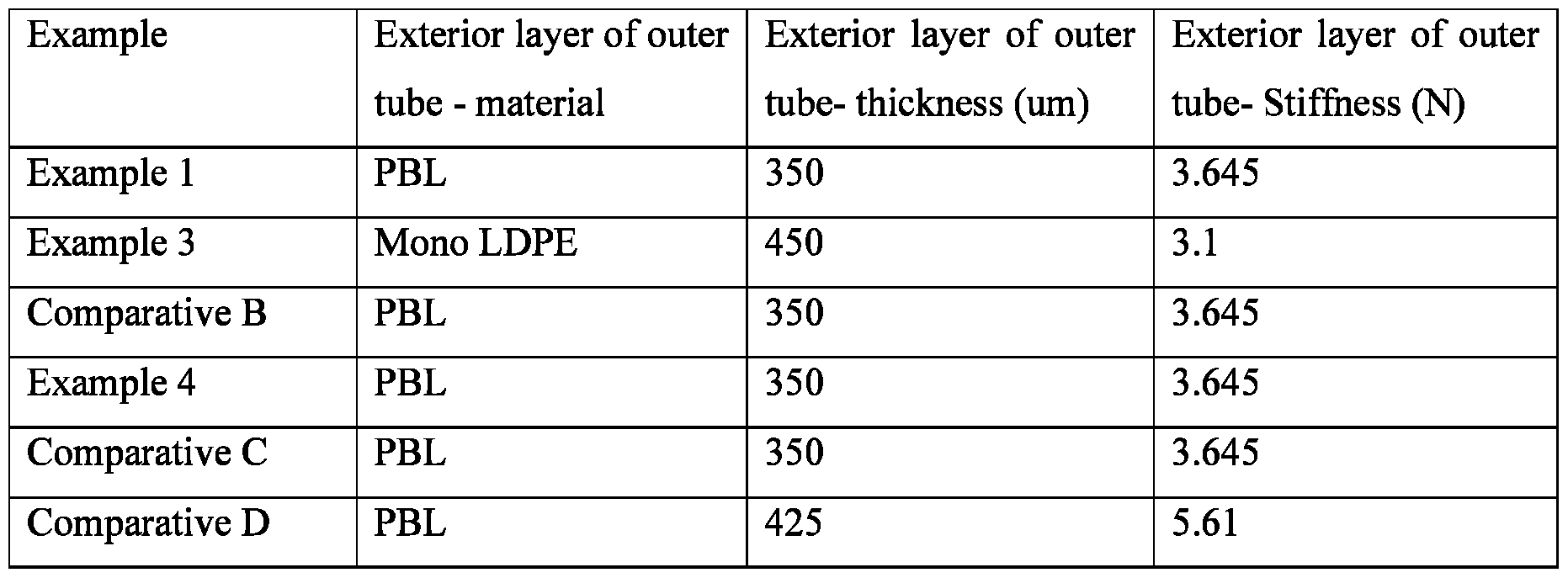
- the package comprises an outer tube body having an exterior layer 50, wherein the outer tube exterior layer has a stiffness of from about 3.0 N to about 9.5 N, from about 3.0 N to about 5.5 N, from about 3.2 N to about 4.0 N and a thickness of from about 300 pm to about 600 pm, from about 300 pm to about 500 pm, and from about 300 pm to about 400 pm.
- the outer tube body further comprises an outer tube interior chamber 60.
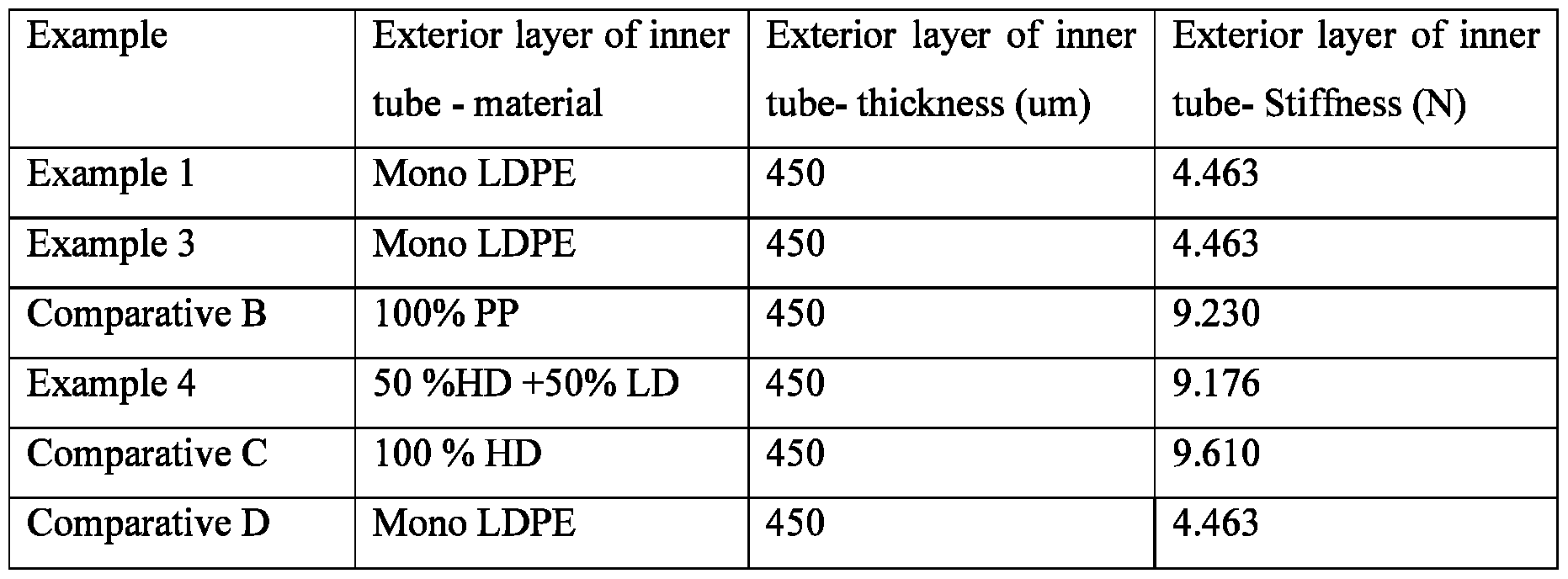
- the package also comprises an inner tube having an exterior layer 70, wherein the inner tube exterior layer has a stiffness of from about 2.9 N to about 9.5 N, from about 3.0 N to about 6.0 N, and from 4.0 N to about 5.0 N and a thickness of from about 200 pm to about 600 pm from about 300 pm to about 500 pm, from about 400 pm to about 500 pm.
- the inner tube body further comprises an inner tube interior chamber 80.
- the package further comprises a dispensing orifice 90. A portion 100 of the dispensing orifice is in communication with the outer tube interior chamber, and a portion 110 of the dispensing orifice is in communication with the inner tube interior chamber. During dispensing for use the composition flows from the outer and inner interior chambers through the dispensing orifice.
- the stiffness ratio of the exterior layer of the outer tube, to the exterior layer of the inner tube is from about 0.35 to about 1.2, from about 0.6 to about 1.2 and from about 0.7 to about 1.0.
- the outer tube exterior layer can comprise a material selected from the group consisting of plastic laminate, metallized laminate, aluminum laminate, high density polypropylene, low density polypropylene, polypropylene, and combinations thereof.
- the inner tube exterior layer comprises a material selected from the group consisting of plastic laminate, metallized laminate, aluminum laminate, high density polypropylene, low density polypropylene, polypropylene, and combinations thereof.
- the inner tube exterior layer can comprise about 50% high density polypropylene and 50% low density polypropylene.
- the outer tube exterior layer can comprise plastic barrier layer (PBL) which can be decorated with a wide range of decorations to improve the aesthetic appearance of the product, especially cosmetic products. All layers of the packaging can be made using standard manufacturing methods including, but not limited to, lamination, extrusion, blow molding, and/or injection molding.
- the first composition is provided in the outer tube interior chamber 60 and the second composition is provided in the inner tube interior chamber 80.
- Tube Stiffness is measure using the Standard Test Method for Determination of External Loading Characteristics of Plastic Pipe by Parallel-Plate Loading ASTM Designation: D 2412 - 02 (Reapproved 2008). All test specimen are standardized to be 100mm long, and deflect to 50% of the tube diameter, and peak squeeze force is recorded.
- the Oscillatory Rheometry Test Method is used to determine the crossover stress and storage modulus of a gel-like/semisolid product (the G’ Modulus Values in Pa units).
- a controlled-stress rotational rheometer (such as Discovery HR-2, TA Instruments, New Castle, DE, USA, or equivalent) capable of sample temperature control (using a Peltier cooler and resistance heater combination) is used for the test.
- the rheometer is operated in a parallel plate configuration with 40-mm crosshatch stainless steel parallel-plate tooling.
- the rheometer is set at 25 °C.
- Approximately 2ml of sample is gently loaded onto peltier plate using a spatula from the sample jar without any shear to change the product structure, and excess protruding sample is trimmed once the gap reached 1000 m after sample loading.
- Sample is then equilibrated at 25°C for 120 seconds before measurement starts. For different rheometer, extend the equilibrium time to ensure the sample temperature achieved 25 °C before the test.
- the test commences with rheometer increased from strain amplitude 0.1% to 1000% in logarithmic mode with oscillation frequency fixed at 1 Hz (that is, one cycle per second) at 25 °C.
- the resulting time-dependent stress is analyzed according to the customary linear oscillatory strain formalism, known to those of skill in the art, to obtain the storage modulus (G') and loss modulus (G") at each step.
- G' and G" both expressed in units of Pascals, vertical axis
- Rheological properties measured by the rheometer provided by the present disclosure include, but are not limited to, storage modulus G', a loss modulus G", loss factor tan(5). Crossover point, is extracted using TRIOS software (provided by TA instrument) and is applicable for other equivalent rheology software.
- Measuring the ratio of dispensed first and second compositions is measured using the following method:
- the ratio of the outer to inner phase product is determined.
- Figure 5 Dispense around lOg of product on weigh scale while maintaining the vertical position of the tube.
- Figure 6 shows the product before scooping off the outer phase
- Figure 7 shows the product after scooping off the outer phase product
Landscapes
- Health & Medical Sciences (AREA)
- Life Sciences & Earth Sciences (AREA)
- Veterinary Medicine (AREA)
- Animal Behavior & Ethology (AREA)
- General Health & Medical Sciences (AREA)
- Public Health (AREA)
- Birds (AREA)
- Epidemiology (AREA)
- Dermatology (AREA)
- Engineering & Computer Science (AREA)
- Mechanical Engineering (AREA)
- Cosmetics (AREA)
- Package Specialized In Special Use (AREA)
Abstract
A packaged hair care composition comprising a first composition and a second composition, wherein the first and second compositions are kept in separate packaging chambers until dispensed. The first composition comprises a cationic polymer; and an aqueous carrier and has a G' value of about 160 to about 410; and the second composition comprises: a cationic surfactant; a high melting point fatty compound; and an aqueous carrier and has a G' value of from about 600 Pa to about 3000 Pa. The package comprises an outer tube body having an exterior layer and an outer tube interior chamber; and an inner tube having an exterior layer and an inner tube body having an inner tube interior chamber; a dispensing orifice wherein a portion of the dispensing orifice is in communication with the outer tube interior chamber, and a portion of the dispensing orifice is in communication with the inner tube interior chamber.
Description
A PACKAGED HAIR CARE COMPOSITION
FIELD OF THE INVENTION
Dispensing of a multi-phase hair care composition comprising a first composition and a second composition, wherein the first and second compositions are kept separate from one another until use, and wherein the product has a consistent dispense ratio and also has less residue at the end of the tube lifespan.
BACKGROUND OF THE INVENTION
A variety of approaches have been developed to dispense a multi-phase product. A common method is a multi-chamber tube or bottle. However, typical tubes or bottles have difficulty dispensing the phases in a predictable way. Additionally, often there is residue left in the tube, which is not desired by the consumer. The consumer desires hair care compositions that dispense in a visually appealing manner, additionally the consumer desires to dispense product uniformly and completely from the tube.
Therefore, there is still a need for providing a multi-phase hair care composition that dispenses in a predictable pattern and/or ratio and further dispenses such that there is little residue remaining in the tube at the end of the tube lifespan.
SUMMARY OF THE INVENTION
A packaged hair care composition comprising a hair care composition comprising: a first composition and a second composition, wherein the first and second compositions are kept separate from one another until dispensed, wherein the first composition comprises: a cationic polymer; and an aqueous carrier and has a G’ value of about 160 Pa to about 410 Pa; and wherein the second composition comprises: a cationic surfactant; a high melting point fatty compound; and an aqueous carrier and has a G’ value of from about 600 Pa to about 3000 Pa a package comprising: an outer tube body having an exterior layer wherein the outer tube exterior layer has a stiffness of from about 3.0 N to about 9.5 N and a thickness of from about 300 pm to about 600 pm and an outer tube interior chamber; and an inner tube having an exterior layer wherein the interior tube exterior layer has a stiffness of from about 2.9N to about 9.5N and a thickness of from about 200 pm to about 600 pm and an inner tube body having an inner tube interior chamber; a dispensing orifice wherein a portion of the dispensing orifice is in communication with the outer tube interior chamber, and a portion of the dispensing orifice is in communication with the inner tube interior chamber; wherein the first composition is located in
the outer tube interior chamber, and the second composition is located in the inner tube interior chamber.
BRIEF DESCRIPTION OF THE DRAWINGS Figs. 1A and IB are dispensed hair care composition;
Fig. 2 is a view of the packaged hair care composition and the tube in tube package;
Fig. 3 is a view of the dispensing orifice;
Fig. 4 is a demonstration of dispensing product for a test method;
Fig. 5 is a demonstration of dispensing product for a test method;
Fig. 6 is product dispensed for a test method; and Fig. 7 is product dispensed for a test method.
DETAILED DESCRIPTION OF THE INVENTION While the specification concludes with claims particularly pointing out and distinctly claiming the invention, it is believed that the present invention will be better understood from the following description.
Herein, "comprising" means that other steps and other ingredients which do not affect the end result can be added. This term encompasses the terms "consisting of' and "consisting essentially of'.
All percentages, parts and ratios are based upon the total weight of the compositions of the present invention, unless otherwise specified. All such weights as they pertain to listed ingredients are based on the active level and, therefore, do not include carriers or by-products that may be included in commercially available materials.
Herein, "mixtures" is meant to include a simple combination of materials and any compounds that may result from their combination.
The term “molecular weight” or “M.Wt.” as used herein refers to the weight average molecular weight unless otherwise stated. The weight average molecular weight may be measured by gel permeation chromatography.
“QS” means sufficient quantity for 100%.
PACKAGED HAIR CARE COMPOSITION
The hair care composition comprises a first composition and a second composition, wherein the first and second compositions are kept separate from one another until dispensed. The first composition comprises: a cationic polymer; and an aqueous carrier, and the second composition
comprises a cationic surfactant; a high melting point fatty compound; and an aqueous carrier. The first composition and/or the second composition may further comprise a silicone compound.
Although kept separate until dispensing, the first and second composition and the second composition are put into contact upon dispensing. The dispensed hair care composition G’ ratio of first composition and the second composition is from about 0.10 to about 0.40, from about 0.11 to about 0.35, and from about 0.13 to about 0.30. Figs. 1 A and IB show the dispensed hair care composition 10 comprising the first composition 20, and the second composition 30. When a package as described herein is used to dispense the first and second compositions described herein, the two compositions dispense at the same time in a consistent dispensing ratio. The product can be visible even after dispensed as two separate phases. Additionally, the product can dispense such that there is minimal residue (from about 0 Wt.% to about 12.5 Wt.%, alternatively less than 12.5 Wt.%) remaining at the end of the tube lifespan as compared to existing tubes. Residue is the % of product remaining in the package after the consumer has dispensed all product that will dispense through normal use.
 FIRST COMPOSITION
The first composition comprises: a cationic polymer; and an aqueous carrier. A suitable cationic polymer includes, but is not limited to, polyquatemium-37.
The first composition can be substantially free of high melting point fatty compound. “The first composition being substantially free of high melting point fatty compounds” means that: the composition is free of high melting point fatty compounds; or, if the composition contains high melting point fatty compounds, the level of such high melting point fatty compounds is very low. A total level of such high melting point fatty compounds in the first composition, if included, is 1% or less, 0.5% or less, and 0.1% or less by weight of the composition. The total level of such high melting point fatty compounds in the first composition can be 0% by weight of the composition.
The first composition can be substantially free of cationic surfactant. “The first composition being substantially free of cationic surfactants” means that: the composition is free of cationic surfactants; or, if the composition contains cationic surfactants, the level of such cationic surfactants is very low. A total level of such cationic surfactants in the first composition, if included, is 0.3% or less, 0.2% or less, and 0.1% or less by weight of the composition. The total level of such cationic surfactants in the first composition can be 0% by weight of the composition.
The first composition can have a G’ value of from about 160 Pa to about 410 Pa, from about 175 Pa to about 390 Pa, from about 190 Pa to about 370 Pa.
SECOND COMPOSITION
The second composition comprises: a cationic surfactant; a high melting point fatty compound; and an aqueous carrier. The second composition can further comprises a silicone compound. Suitable silicone compound used herein conforms to the general formula:
(Rl)aG3-a-Si-(-OSiG2)n-(-OSiGb(Rl)2-b)m-0-SiG3-a(Rl)a wherein G is hydrogen, phenyl, hydroxy, or Ci-Cs alkyl, preferably methyl; a is 0 or an integer having a value from 1 to 3; b is 0, 1 or 2; n is a number from 0 to 1,999; m is an integer from 0 to 1,999; the sum of n and m is a number from 1 to 2,000; a and m are not both 0; Ri is a monovalent radical conforming to the general formula CqH2qL, wherein q is an integer having a value from 2 to 8 and L is selected from the following groups: -N(R2)CH2-CH2-N(R2)2; -N(R2)2; -N(R2)3A ; -N(R2)CH2-CH2-NR2H2A ; wherein R2 is hydrogen, phenyl, benzyl, or a saturated hydrocarbon radical; A is a halide ion. The silicone compounds can include those conforming to the above formula, wherein m=0.
The second composition can have a G’ value of from about 600 Pa to about 3000 Pa, from about 650 Pa to about 2700 Pa, from about 700 Pa to about 2300 Pa.
CATIONIC POLYMER
The first composition can comprise a cationic polymer. The cationic polymer can be contained in the composition at a level of from about 0.5% to about 3.0%, from about 0.8% to about 2.0%, from aboutl.2% to about 1.5% by weight of the composition.
The cationic polymer useful herein is water soluble, and can be natural, derived from natural, and/or synthetic.
The cationic polymer useful herein is that having a cationic charge density of, from about O.lmeq/g, from about 0.5 meq/g, from about 1.0 meq/g, and to about 13.0 meq/g.
The cationic polymer useful herein is that having a molecular weight of, about 800 g/mol or more, 1,000 g/mol or more, 1,200 g/mol or more. The molecular weight is up to about 5,000,000 g/mol, up to about 4,600,000 g/mol, to about 4,300,000 g/mol, up to about 4,000,000 g/mol.
Cationic polymers useful herein include, for example, are Polyquatemium-4, Polyquatemium-6, Polyquatemium-7, Polyquatemium-10, Polyquatemium-11, Polyquatemium- 37, cationic cellulose polymers, cationic guar polymers and combinations thereof.
CATIONIC SURFACTANT
The second composition can comprise a cationic surfactant. The cationic surfactant can be included in the composition at a level of from about 1.0%, from about 1.5%, from about 2.0%, still from about 3.0%, and to about 25%, to about 10%, to about 8.0%, to about 6.0% by weight of the composition by weight of the composition.
Cationic surfactant useful herein can be one cationic surfactant or a mixture of two or more cationic surfactants. The cationic surfactant can be selected from the group consisting of: a mono- long alkyl quatemized ammonium salt; a combination of a mono-long alkyl quatemized ammonium salt and a di-long alkyl quatemized ammonium salt; a mono-long alkyl amine; a combination of a mono-long alkyl amine and a di-long alkyl quatemized ammonium salt; and a combination of a mono-long alkyl amine and a mono-long alkyl quatemized ammonium salt.
Mono-long alkyl amine useful herein are those having one long alkyl chain of from 12 to 30 carbon atoms, from 16 to 24 carbon atoms, from 18 to 22 alkyl group. Mono-long alkyl amines useful herein also include mono-long alkyl amidoamines. Primary, secondary, and tertiary fatty amines are useful.
Particularly useful are tertiary amido amines having an alkyl group of from about 12 to about 22 carbons. Exemplary tertiary amido amines include: stearamidopropyldimethylamine,
stearamidopropyldiethylamine, stearamidoethyldiethylamine, stearamidoethyldimethylamine, palmitamidopropyldimethylamine, palmitamidopropyldiethylamine, palmitamidoethyldiethylamine, palmitamidoethyldimethylamine, behenamidopropyldimethylamine, behenamidopropyldiethylamine, behenamidoethyldiethylamine, behenamidoethyldimethylamine, arachidamidopropyldimethylamine, arachidamidopropyldiethylamine, arachidamidoethyldiethylamine, arachidamidoethyldimethylamine, diethylaminoethylstearamide. Suitable amines are disclosed in U.S. Patent 4,275,055, Nachtigal, et al.
These amines are used in combination with acids such as ^-glutamic acid, lactic acid, hydrochloric acid, malic acid, succinic acid, acetic acid, fumaric acid, tartaric acid, citric acid, l- glutamic hydrochloride, maleic acid, and mixtures thereof; ^-glutamic acid, lactic acid, citric acid, at a molar ratio of the amine to the acid of from about 1 : 0.3 to about 1 : 2, from about 1 : 0.4 to about 1 : 1.
Suitable mono-long alkyl quatemized ammonium salt cationic surfactants include, but are not limited to, behenyl trimethyl ammonium salt; stearyl trimethyl ammonium salt; cetyl trimethyl ammonium salt; and hydrogenated tallow alkyl trimethyl ammonium salt, and any combination thereof.
Suitable di-long alkyl cationic surfactants include, but are not limited to, dialkyl (14-18) dimethyl ammonium chloride, ditallow alkyl dimethyl ammonium chloride, dihydrogenated tallow alkyl dimethyl ammonium chloride, distearyl dimethyl ammonium chloride, and dicetyl dimethyl ammonium chloride and any combination thereof.
HIGH MELTING POINT FATTY COMPOUND
The second composition comprises a high melting point fatty compound. The high melting point fatty compound can be included in the composition at a level of from about 2.5%, from about 3.0%, from about 4.0%, from about 5.0%, and to about 30%, to about 10%, to about 8.0% by weight of the composition.
The high melting point fatty compound useful herein can have a melting point of 25°C or higher, 40°C or higher, 45°C or higher, 50°C or higher, in view of stability of the emulsion especially the gel matrix. The melting point can be up to about 90°C, up to about 80°C, up to about 70°C, up to about 65°C, in view of easier manufacturing and easier emulsification. The high melting point fatty compound can be used as a single compound or as a blend or mixture of at least two high melting point fatty compounds. When used as such blend or mixture, the above melting point means the melting point of the blend or mixture.
The high melting point fatty compound useful herein is selected from the group consisting of fatty alcohols, fatty acids, fatty alcohol derivatives, fatty acid derivatives, and mixtures thereof. Nonlimiting examples of the high melting point compounds are found in International Cosmetic Ingredient Dictionary, Fifth Edition, 1993, and CTFA Cosmetic Ingredient Handbook, Second Edition, 1992.
Suitable fatty alcohols include, but are not limited to, cetyl alcohol (having a melting point of about 56°C), stearyl alcohol (having a melting point of about 58-59°C), behenyl alcohol (having a melting point of about 71°C), and mixtures thereof.
The fatty alcohol can be a mixture of cetyl alcohol and stearyl alcohol.
Generally, in the mixture, the weight ratio of cetyl alcohol to stearyl alcohol is from about 1:9 to 9:1, from about 1:4 to about 4:1, from about 1:2.3 to about 1.5:1.
When using higher level of total cationic surfactant and high melting point fatty compounds, the mixture has the weight ratio of cetyl alcohol to stearyl alcohol of from about 1:1 to about 4:1, from about 1:1 to about 2:1, from about 1.2:1 to about 2:1.
AQUEOUS CARRIER
The compositions of the can comprise an aqueous carrier. The level and species of the carrier are selected according to the compatibility with other components, and other desired characteristic of the product.
Suitable aqueous carriers include water and water solutions of lower alkyl alcohols. The lower alkyl alcohols useful herein are monohydric alcohols having 1 to 6 carbons, alternatively ethanol and isopropanol.
The aqueous carrier can be substantially water. Deionized water is suitable. Water from natural sources including mineral cations can also be used, depending on the desired characteristic of the product. The first compositions can comprise from about 80% to about 99%, from about 85% to about 99%, from about 90% to about 99%, from about 95% to about 98% aqueous carrier. The second compositions can comprise from about 40% to about 99%, from about 50% to about 95%, from about 70% to about 90%, and from about 80% to about 90% aqueous carrier.
GEL MATRIX
A gel matrix can be formed by the cationic surfactant, the high melting point fatty compound, and an aqueous carrier in the second composition. The gel matrix is suitable for providing various conditioning benefits, such as slippery feel during the application to wet hair and softness and moisturized feel on dry hair.
When the gel matrix is formed, the cationic surfactant and the high melting point fatty compound are contained at a level such that the weight ratio of the cationic surfactant to the high melting point fatty compound is in the range of, from about 1:1 to about 1:10, from about 1:1.5 to about 1:7, from about 1:2 to about 1:6, in view of providing conditioning benefits.
SILICONE COMPOUND
The compositions may further contain a silicone compound. The silicone compounds herein can be used at levels by weight of the composition of from about 0.1% to about 20%, from about 0.5% to about 10%, from about 1% to about 8%.
The silicone compounds have an average particle size of from about 1 microns to about 50 microns, in the composition.
Suitable silicone fluids include polyalkyl siloxanes, polyaryl siloxanes, polyalkylaryl siloxanes, polyether siloxane copolymers, amino substituted silicones, quatemized silicones, and mixtures thereof. Other nonvolatile silicone compounds having conditioning properties can also be used.
Suitable polyalkyl siloxanes include, for example, polydimethylsiloxane, polydiethylsiloxane, and polymethylphenylsiloxane.
The silicone compound can conform to the general formula:
(Rl)aG3-a-Si-(-OSiG2)n-(-OSiGb(Rl)2-b)m-0-SiG3-a(Rl)a wherein G is hydrogen, phenyl, hydroxy, or Ci-Cs alkyl, preferably methyl; a is 0 or an integer having a value from 1 to 3; b is 0, 1 or 2; n is a number from 0 to 1,999; m is an integer from 0 to 1,999; the sum of n and m is a number from 1 to 2,000; a and m are not both 0; Ri is a monovalent radical conforming to the general formula CqH2qL, wherein q is an integer having a value from 2 to 8 and L is selected from the following groups: wherein R2 is
 hydrogen, phenyl, benzyl, or a saturated hydrocarbon radical; A is a halide ion.
The above aminosilicones, when incorporated into the composition, can be mixed with solvent having a lower viscosity. Such solvents include, for example, polar or non-polar, volatile or non-volatile oils. Such oils include, for example, silicone oils, hydrocarbons, and esters. Suitable solvents include, but are not limited to, are those selected from the group consisting of non-polar, volatile hydrocarbons, volatile cyclic silicones, non-volatile linear silicones, and mixtures thereof. The non-volatile linear silicones useful herein are those having a viscosity of from about 1 to about 20,000 centistokes, from about 20 to about 10,000 centistokes at 25°C. Suitable solvents include, but are not limited to, non-polar, volatile hydrocarbons, especially nonpolar, volatile isoparaffins, in view of reducing the viscosity of the aminosilicones and providing
improved hair conditioning benefits such as reduced friction on dry hair. Such mixtures have a viscosity of from about l,000mPa s to about 100,000mPa s, and from about 5,000mPa s to about 50,000mPa s.
Other suitable alkylamino substituted silicone compounds include those having alkylamino substitutions as pendant groups of a silicone backbone, including those known as “amodimethicone”. Commercially available amodimethicones useful herein include, for example, BY 16-872 available from Dow Coming.
The silicone compounds may further be incorporated in the present composition in the form of an emulsion, wherein the emulsion is made my mechanical mixing, or in the stage of synthesis through emulsion polymerization, with or without the aid of a surfactant selected from anionic surfactants, nonionic surfactants, cationic surfactants, and mixtures thereof.
ADDITIONAL COMPONENTS
The composition may include other additional components, which may be selected by the artisan according to the desired characteristics of the final product and which are suitable for rendering the composition more cosmetically or aesthetically acceptable or to provide them with additional usage benefits. Such other additional components generally are used individually at levels of from about 0.001% to about 10%, up to about 5% by weight of the composition.
A wide variety of other additional components can be formulated into the present compositions. These include: other conditioning agents such as hydrolysed collagen with tradename Peptein 2000 available from Hormel, vitamin E with tradename Emix-d available from Eisai, panthenol available from Roche, panthenyl ethyl ether available from Roche, hydrolysed keratin, proteins, plant extracts, and nutrients; preservatives such as benzyl alcohol, methyl paraben, propyl paraben phenoxyethanol, Sodium Benzoate, Symdiol68 (1,2-Hexanediol and Caprylyl Glycol), SymSaveH (Hydroxyacetophenone), imidazolidinyl urea and combinations thereof; pH adjusting agents, such as citric acid, sodium citrate, succinic acid, phosphoric acid, sodium hydroxide, sodium carbonate; coloring agents, such as any of the FD&C or D&C dyes; perfumes; ultraviolet and infrared screening and absorbing agents such as benzophenones; and antidandruff agents such as zinc pyrithione; non-ionic surfactant such as mono-9-octadecanoate poly(oxy-l,2-ethanediyl) supplied as, for example, Tween 20; and buffer such as aminomethyl propanol, and combinations thereof.
PRODUCT FORMS
The compositions can be in the form of rinse-off products or leave-on products, and can be formulated in a wide variety of product forms, including but not limited to creams, gels, emulsions, mousses and sprays. The compositions are especially suitable for hair conditioners especially leave-on, leave-in, and/or no-rinse hair conditioners. Leave-on and leave-in hair conditioners are generally used on dry, semi-wet, and/or wet hair without rinsing out the conditioner. By no-rinse hair conditioners, what is meant herein is a hair conditioner used on semi-wet to wet hair after shampooing, without rinsing out the conditioner.
PACKAGE
As used herein “The first and second compositions are kept separated from one another” means, for example: a package comprising two chambers, wherein the first composition is contained in a first chamber and the second composition is contained in a separate second chamber. Such packages can be shaped as a tube, pump, bottle or upside-down bottle, and blister pack.
The package 40 is shown in Fig. 2. The package comprises an outer tube body having an exterior layer 50, wherein the outer tube exterior layer has a stiffness of from about 3.0 N to about 9.5 N, from about 3.0 N to about 5.5 N, from about 3.2 N to about 4.0 N and a thickness of from about 300 pm to about 600 pm, from about 300 pm to about 500 pm, and from about 300 pm to about 400 pm. The outer tube body further comprises an outer tube interior chamber 60. The package also comprises an inner tube having an exterior layer 70, wherein the inner tube exterior layer has a stiffness of from about 2.9 N to about 9.5 N, from about 3.0 N to about 6.0 N, and from 4.0 N to about 5.0 N and a thickness of from about 200 pm to about 600 pm from about 300 pm to about 500 pm, from about 400 pm to about 500 pm. The inner tube body further comprises an inner tube interior chamber 80. The package further comprises a dispensing orifice 90. A portion 100 of the dispensing orifice is in communication with the outer tube interior chamber, and a portion 110 of the dispensing orifice is in communication with the inner tube interior chamber. During dispensing for use the composition flows from the outer and inner interior chambers through the dispensing orifice. The stiffness ratio of the exterior layer of the outer tube, to the exterior layer of the inner tube is from about 0.35 to about 1.2, from about 0.6 to about 1.2 and from about 0.7 to about 1.0.
The outer tube exterior layer can comprise a material selected from the group consisting of plastic laminate, metallized laminate, aluminum laminate, high density polypropylene, low density polypropylene, polypropylene, and combinations thereof. The inner tube exterior layer comprises a material selected from the group consisting of plastic laminate, metallized laminate, aluminum laminate, high density polypropylene, low density polypropylene, polypropylene, and combinations thereof. The inner tube exterior layer can comprise about 50% high density
polypropylene and 50% low density polypropylene. Additionally the outer tube exterior layer can comprise plastic barrier layer (PBL) which can be decorated with a wide range of decorations to improve the aesthetic appearance of the product, especially cosmetic products. All layers of the packaging can be made using standard manufacturing methods including, but not limited to, lamination, extrusion, blow molding, and/or injection molding.
The first composition is provided in the outer tube interior chamber 60 and the second composition is provided in the inner tube interior chamber 80.


Test Methods
Tube Stiffness
Tube Stiffness is measure using the Standard Test Method for Determination of External Loading Characteristics of Plastic Pipe by Parallel-Plate Loading ASTM Designation: D 2412 - 02 (Reapproved 2008). All test specimen are standardized to be 100mm long, and deflect to 50% of the tube diameter, and peak squeeze force is recorded.
G’ Modulus Pa
The Oscillatory Rheometry Test Method is used to determine the crossover stress and storage modulus of a gel-like/semisolid product (the G’ Modulus Values in Pa units).
A controlled-stress rotational rheometer (such as Discovery HR-2, TA Instruments, New Castle, DE, USA, or equivalent) capable of sample temperature control (using a Peltier cooler and resistance heater combination) is used for the test.
The rheometer is operated in a parallel plate configuration with 40-mm crosshatch stainless steel parallel-plate tooling. The rheometer is set at 25 °C. Approximately 2ml of sample is gently loaded onto peltier plate using a spatula from the sample jar without any shear to change the product structure, and excess protruding sample is trimmed once the gap reached 1000 m after sample loading. Sample is then equilibrated at 25°C for 120 seconds before measurement starts. For different rheometer, extend the equilibrium time to ensure the sample temperature achieved 25 °C before the test. The test commences with rheometer increased from strain amplitude 0.1% to 1000% in logarithmic mode with oscillation frequency fixed at 1 Hz (that is, one cycle per second) at 25 °C.
For each strain amplitude sampled, the resulting time-dependent stress is analyzed according to the customary linear oscillatory strain formalism, known to those of skill in the art, to obtain the storage modulus (G') and loss modulus (G") at each step. A plot is made in which G' and G" (both expressed in units of Pascals, vertical axis) are plotted versus the strain amplitude (percent strain, horizontal axis). The lowest strain amplitude at which the traces for G' and G" cross (that is, when tan(5) = G'7G' = 1) is recorded, and the value of G' and G" at this point is defined as the crossover stress and is reported in units of Pa.
Rheological properties measured by the rheometer provided by the present disclosure include, but are not limited to, storage modulus G', a loss modulus G", loss factor tan(5). Crossover
point, is extracted using TRIOS software (provided by TA instrument) and is applicable for other equivalent rheology software.
Dispense method
Measuring the ratio of dispensed first and second compositions is measured using the following method:
1. Hold the tube in a vertical position (Figure 4).
2. Dispense about lOg of product from tube on a weigh scale (Figure 5).
3. Use a spatula to scoop the outer phase and measure the remaining inner phase product left on the weigh scale (Figures 6 and 7).
4. Continue to dispense the tube with every lOg until tube is empty.
5. For each dispense, the ratio of the outer to inner phase product is determined.
6. The ratios for each tube are analyzed for mean and standard deviation of the mean.
Figure 4. Maintain the tube in a vertical position.
Figure 5. Dispense around lOg of product on weigh scale while maintaining the vertical position of the tube.
Figure 6 shows the product before scooping off the outer phase, and Figure 7 shows the product after scooping off the outer phase product.
Every document cited herein, including any cross referenced or related patent or application and any patent application or patent to which this application claims priority or benefit thereof, is hereby incorporated herein by reference in its entirety unless expressly excluded or otherwise limited. The citation of any document is not an admission that it is prior art with respect to any invention disclosed or claimed herein or that it alone, or in any combination with any other reference or references, teaches, suggests or discloses any such invention. Further, to the extent that any meaning or definition of a term in this document conflicts with any meaning or definition of the same term in a document incorporated by reference, the meaning or definition assigned to that term in this document shall govern.
While particular embodiments of the present invention have been illustrated and described, it would be obvious to those skilled in the art that various other changes and modifications can be made without departing from the spirit and scope of the invention. It is therefore intended to cover in the appended claims all such changes and modifications that are within the scope of this invention.
Claims
1. A packaged hair care composition comprising a hair care composition comprising: a first composition and a second composition, wherein the first and second compositions are kept separate from one another until dispensed, wherein the first composition comprises: a cationic polymer; and an aqueous carrier and has a G’ value of about 160 to about 410; and wherein the second composition comprises: a cationic surfactant; a high melting point fatty compound; and an aqueous carrier and has a G’ value of from about 600 Pa to about 3000 Pa a package comprising: an outer tube body having an exterior layer wherein the outer tube exterior layer has a stiffness of from about 3. ON to about 9.5 N and a thickness of from about 300 pm to about 600 pm and an outer tube interior chamber; and an inner tube having an exterior layer wherein the interior tube exterior layer has a stiffness of from about 2.9N to about 9.5N and a thickness of from about 200 pm to about 600 pm and an inner tube body having an inner tube interior chamber; a dispensing orifice wherein a portion of the dispensing orifice is in communication with the outer tube interior chamber, and a portion of the dispensing orifice is in communication with the inner tube interior chamber; wherein the first composition is located in the outer tube interior chamber, and the second composition is located in the inner tube interior chamber.
2. The packaged hair care composition Claim 1, wherein the first composition has a G’ value of from about 175 Pa to about 390 Pa, preferably wherein the first composition has a G’ value of from about 190 Pa to about 370 Pa..
3. The packaged hair care composition of the preceding claims, wherein the second composition has a G’ value of from about 650 Pa to about 2700 Pa, preferably wherein the second composition has a G’ value of from about 700 Pa to about 2300 Pa.
4. The packaged hair care composition of the preceding claims, wherein the outer tube exterior layer has a stiffness of from about 3.0 N to about 5.5 N, preferably wherein the outer tube exterior layer has a stiffness of from about 3.2 N to about 4.0 N.
5. The packaged hair care composition of the preceding claims, wherein the outer tube exterior layer has a thickness of from about 300 pm to about 500 pm, preferably wherein the outer tube exterior layer has a thickness of from about 300 pm to about 400 pm.
6. The packaged hair care composition of the preceding claims, wherein the inner tube exterior layer has a stiffness of from about 3.0 N to about 6.0 N, preferably wherein the inner tube exterior layer has a stiffness of from about 4.0 N to about 5.0 N.
7. The packaged hair care composition of the preceding claims, wherein the stiffness ratio of the exterior layer of the outer tube to the exterior layer of the inner tube is from about 0.35 to about 1.2, preferably wherein the stiffness ratio of the exterior layer of the outer tube to the exterior layer of the inner tube is from about 0.6 to about 1.2, even more preferably wherein the stiffness ratio of the exterior layer of the outer tube to the exterior layer of the inner tube is from about 0.7 to about 1.0.
8. The packaged hair care composition of the preceding claims, wherein the outer tube exterior layer comprises a material selected from the group consisting of plastic laminate, metallized laminate, aluminum laminate, high density polypropylene, low density polypropylene, polypropylene, and combinations thereof.
9. The packaged hair care composition of the preceding claims, wherein the inner tube exterior layer comprises a material selected from the group consisting of plastic laminate, metallized laminate, aluminum laminate, high density polypropylene, low density polypropylene, polypropylene, and combinations thereof.
10. The packaged hair care composition of the preceding claims, wherein the cationic polymer is polyquaternium-37.
11. The packaged hair care composition of the preceding claims, wherein the second composition comprises a silicone compound, preferably wherein the silicone compound conforms to the general formula:
(Rl)aG3-a-Si-(-OSiG2)„-(-OSiGb(Rl)2-b)m-0-SiG3-a(Rl)a wherein G is hydrogen, phenyl, hydroxy, or Ci-Cs alkyl, preferably methyl; a is 0 or an integer having a value from 1 to 3; b is 0, 1 or 2; n is a number from 0 to 1,999; m is an integer from 0 to 1,999; the sum of n and m is a number from 1 to 2,000; a and m are not both 0; Ri is a monovalent radical conforming to the general formula CqH2qL, wherein q is an integer having a value from 2 to 8 and L is selected from the following groups: -N(R2)CH2-CH2-N(R2)2; -N(R2)2; -N(R2)3A_; -N(R2)CH2-CH2-NR2H2A ; wherein R2 is hydrogen, phenyl, benzyl, or a saturated hydrocarbon radical; A is a halide ion.
12. The packaged hair care composition of the preceding claims, wherein the first composition and the second composition are mixed at a G’ ratio of from about 0.10 to about 0.40, preferably wherein the first composition and the second composition are mixed at a G’ ratio of from about 0.11 to about 0.35.
13. The packaged hair care composition of the preceding claims, wherein the first composition and the second composition are mixed at a G’ ratio of from about 0.13 to about 0.30.
14. The packaged hair care composition of the preceding claims, wherein less than 12.5 weight % of the first and second composition remain in the package after the product has been dispensed during use.
Priority Applications (4)
| Application Number | Priority Date | Filing Date | Title |
|---|---|---|---|
| JP2022510160A JP2022544693A (en) | 2019-08-30 | 2020-08-28 | Packaged hair care composition |
| CN202080060410.9A CN114727941A (en) | 2019-08-30 | 2020-08-28 | Packaged hair care composition |
| MX2022000475A MX2022000475A (en) | 2019-08-30 | 2020-08-28 | A packaged hair care composition. |
| EP20768870.6A EP4021392A1 (en) | 2019-08-30 | 2020-08-28 | A packaged hair care composition |
Applications Claiming Priority (2)
| Application Number | Priority Date | Filing Date | Title |
|---|---|---|---|
| US201962893951P | 2019-08-30 | 2019-08-30 | |
| US62/893,951 | 2019-08-30 |
Publications (1)
| Publication Number | Publication Date |
|---|---|
| WO2021042127A1 true WO2021042127A1 (en) | 2021-03-04 |
Family
ID=72433123
Family Applications (1)
| Application Number | Title | Priority Date | Filing Date |
|---|---|---|---|
| PCT/US2020/070469 Ceased WO2021042127A1 (en) | 2019-08-30 | 2020-08-28 | A packaged hair care composition |
Country Status (6)
| Country | Link |
|---|---|
| US (1) | US11497703B2 (en) |
| EP (1) | EP4021392A1 (en) |
| JP (1) | JP2022544693A (en) |
| CN (1) | CN114727941A (en) |
| MX (1) | MX2022000475A (en) |
| WO (1) | WO2021042127A1 (en) |
Cited By (1)
| Publication number | Priority date | Publication date | Assignee | Title |
|---|---|---|---|---|
| JP2024529146A (en) * | 2021-08-24 | 2024-08-01 | ザ プロクター アンド ギャンブル カンパニー | PACKAGE FOR DISPOSING A DUAL-PHASE COSMETIC COMPOSITION - Patent application |
Families Citing this family (4)
| Publication number | Priority date | Publication date | Assignee | Title |
|---|---|---|---|---|
| JP1665824S (en) | 2019-08-21 | 2020-08-11 | ||
| US11752074B2 (en) | 2020-10-27 | 2023-09-12 | The Procter & Gamble Company | Warming conditioner |
| USD1006632S1 (en) | 2020-12-11 | 2023-12-05 | The Procter & Gamble Company | Container for hair care products |
| USD1012718S1 (en) | 2020-12-21 | 2024-01-30 | The Procter & Gamble Company | Container for hair care product |
Citations (2)
| Publication number | Priority date | Publication date | Assignee | Title |
|---|---|---|---|---|
| US4275055A (en) | 1979-06-22 | 1981-06-23 | Conair Corporation | Hair conditioner having a stabilized, pearlescent effect |
| WO2014124068A1 (en) * | 2013-02-08 | 2014-08-14 | The Procter & Gamble Company | Method of providing cleanness to hair and/or scalp |
Family Cites Families (54)
| Publication number | Priority date | Publication date | Assignee | Title |
|---|---|---|---|---|
| US3866800A (en) | 1969-02-12 | 1975-02-18 | Alberto Culver Co | Non-pressurized package containing self-heating products |
| DE9211006U1 (en) | 1992-08-17 | 1993-12-16 | Kao Corporation GmbH, 40472 Düsseldorf | Hair treatment preparations |
| GB9521124D0 (en) * | 1995-10-16 | 1995-12-20 | Unilever Plc | Dispenser |
| US6082588A (en) | 1997-01-10 | 2000-07-04 | Lever Brothers Company, Division Of Conopco, Inc. | Dual compartment package and pumps |
| US6274128B1 (en) | 1998-12-23 | 2001-08-14 | Unilever Home & Personal Care Usa, Division Of Conopco, Inc. | Self-warming hair conditioning compositions |
| AU2000273617A1 (en) | 2000-09-08 | 2002-03-22 | The Procter And Gamble Company | Hair care kits and heating devices for warming hair care compositions |
| MXPA03006890A (en) | 2001-02-01 | 2003-11-13 | Procter & Gamble | Anhydrous self-heating cosmetic compositions, especially anhydrous hair conditioning compositions. |
| US20040028711A1 (en) | 2001-02-01 | 2004-02-12 | The Procter & Gamble Company | Anhydrous cosmetic compositions |
| RU2271320C2 (en) | 2001-07-11 | 2006-03-10 | Дзе Проктер Энд Гэмбл Компани | Multi-chamber uniformly distributing tubular container |
| AU2003272823A1 (en) | 2002-10-16 | 2004-05-04 | The Procter And Gamble Company | Conditioning composition comprising cationic crosslinked polymer |
| US20070119861A1 (en) | 2003-06-12 | 2007-05-31 | Bhagwat Abhay A | Multichamber dispensing container |
| DE10342211A1 (en) | 2003-09-12 | 2005-04-07 | Beiersdorf Ag | cosmetic |
| DE102004009424A1 (en) | 2004-02-24 | 2005-09-08 | Henkel Kgaa | Two or more chamber tube |
| US20070041929A1 (en) | 2005-06-16 | 2007-02-22 | Torgerson Peter M | Hair conditioning composition comprising silicone polymers containing quaternary groups |
| EP1787634A1 (en) | 2005-11-16 | 2007-05-23 | KPSS-Kao Professional Salon Services GmbH | Conditioning composition for hair |
| JP4968722B2 (en) * | 2006-09-22 | 2012-07-04 | 株式会社 資生堂 | Oil-in-water emulsified skin cosmetic |
| US20080128426A1 (en) | 2006-12-01 | 2008-06-05 | Donald Rick | Self-warming sanitizing composition in a dual chamber bottle |
| US20080128423A1 (en) | 2006-12-01 | 2008-06-05 | Donald Rick | Self-warming moisturizing lotion in a dual chamber bottle |
| US20080128425A1 (en) | 2006-12-01 | 2008-06-05 | Donald Rick | Self-warming analgesic composition in a dual chamber bottle |
| US20090152294A1 (en) | 2007-12-12 | 2009-06-18 | Mizell Jeffrey W | Dual-Tube Product Container and Dispenser |
| GB0800145D0 (en) | 2008-01-04 | 2008-02-13 | Reckitt Benckiser Uk Ltd | Skincare treatment |
| CN101746567B (en) * | 2008-12-05 | 2011-08-17 | 友德塑胶(深圳)有限公司 | Double-flexible pipe container with one-way valves |
| US8413845B1 (en) | 2009-07-20 | 2013-04-09 | Thomas J. Duncan | Dual-compartment dispensing container |
| KR101088471B1 (en) * | 2010-04-26 | 2011-11-30 | 박은정 | Double tube container and its manufacturing method |
| US20140263448A1 (en) * | 2010-09-29 | 2014-09-18 | Tim Erskine-Smith | Dispensing container |
| FR2976804B1 (en) | 2011-06-23 | 2013-07-12 | Oreal | PROCESS FOR TREATING KERATIN FIBERS WITH HEAT DELIVERY |
| JP5936319B2 (en) * | 2011-08-19 | 2016-06-22 | 株式会社マンダム | Multi-agent hair treatment agent and hair treatment method using the treatment agent |
| JP2013103920A (en) * | 2011-11-16 | 2013-05-30 | Sanei Gen Ffi Inc | Base composition for cosmetic |
| DE102011088558A1 (en) | 2011-12-14 | 2013-06-20 | Henkel Ag & Co. Kgaa | Hair treatment agent with special polymers |
| US9402796B2 (en) | 2012-06-01 | 2016-08-02 | Conopco, Inc. | Kit comprising a hair conditioning composition and an activator composition |
| FR2997014B1 (en) * | 2012-10-24 | 2015-03-20 | Teoxane | DERMO-INJECTABLE STERILE COMPOSITION |
| JP6141458B2 (en) | 2013-02-08 | 2017-06-07 | ザ プロクター アンド ギャンブル カンパニー | Hair care composition comprising a cationic polymer and anionic particles |
| BR112016001884A2 (en) | 2013-08-20 | 2017-08-01 | Oreal | cosmetic treatment process, kit and cosmetic composition |
| WO2015047826A1 (en) | 2013-09-30 | 2015-04-02 | The Procter & Gamble Company | Hair conditioning composition comprising higher percent of cationic surfactant and deposition polymer |
| CN103818649B (en) | 2014-01-26 | 2016-04-27 | 友德塑胶(深圳)有限公司 | The flexible pipe container of autologous heating or heat absorption |
| US11058624B2 (en) | 2014-02-06 | 2021-07-13 | The Procter And Gamble Company | Hair care composition comprising cationic polymers and anionic particulates |
| WO2016206739A1 (en) | 2015-06-24 | 2016-12-29 | Kao Germany Gmbh | Hair conditioning composition |
| US11013678B2 (en) | 2015-06-29 | 2021-05-25 | The Procter & Gamble Company | Multi-component skin care product |
| FR3040639B1 (en) | 2015-09-09 | 2020-01-03 | Aptar France Sas | DUO DISTRIBUTOR |
| WO2017057784A1 (en) | 2015-09-30 | 2017-04-06 | (주)나노팜 | Dry multiple capsule type composition containing photosensitive substance for improving acne skin and method for preparing same |
| KR102427912B1 (en) | 2015-12-28 | 2022-08-01 | 카오카부시키가이샤 | Aerosol cosmetic |
| US10517805B2 (en) | 2015-12-31 | 2019-12-31 | L'oréal | Cosmetic compositions having mechanically activated warming enhancement |
| JP6859196B2 (en) * | 2016-05-24 | 2021-04-14 | 花王株式会社 | Hair treatment agent |
| JP6718307B2 (en) * | 2016-05-24 | 2020-07-08 | 花王株式会社 | Hair treatment agent |
| FR3064477B1 (en) * | 2017-03-31 | 2020-10-23 | Oreal | COSMETIC TREATMENT PROCESS FOR KERATINIC FIBERS INCLUDING THE APPLICATION OF A BASE COMPOSITION AND OF A COMPOSITION INCLUDING AN AMINOUS SILICONE |
| CN111526863A (en) | 2018-01-16 | 2020-08-11 | 花王株式会社 | Hair cosmetic |
| CN112165885B (en) | 2018-06-29 | 2023-11-07 | 宝洁公司 | biphasic products |
| US11583479B2 (en) | 2018-06-29 | 2023-02-21 | The Procter & Gamble Company | Dual phase products |
| JP2021528443A (en) | 2018-06-29 | 2021-10-21 | ザ プロクター アンド ギャンブル カンパニーThe Procter & Gamble Company | Two-phase product |
| EP3814021A2 (en) | 2018-06-29 | 2021-05-05 | The Procter & Gamble Company | Dual phase products dispenser |
| KR102182786B1 (en) | 2019-04-17 | 2020-11-25 | 주식회사 하이디어랩 | Dual tubes for cosmetics and cosmetic products |
| KR20220007739A (en) | 2019-07-09 | 2022-01-18 | 더 프록터 앤드 갬블 캄파니 | Multi-composition product dispenser |
| EP3996852A1 (en) | 2019-07-09 | 2022-05-18 | The Procter & Gamble Company | Multi-component product dispenser |
| WO2021042128A1 (en) | 2019-08-30 | 2021-03-04 | The Procter & Gamble Company | Hair conditioning product comprising first and second compositions |
-
2020
- 2020-08-28 US US17/005,416 patent/US11497703B2/en active Active
- 2020-08-28 CN CN202080060410.9A patent/CN114727941A/en active Pending
- 2020-08-28 EP EP20768870.6A patent/EP4021392A1/en active Pending
- 2020-08-28 MX MX2022000475A patent/MX2022000475A/en unknown
- 2020-08-28 WO PCT/US2020/070469 patent/WO2021042127A1/en not_active Ceased
- 2020-08-28 JP JP2022510160A patent/JP2022544693A/en active Pending
Patent Citations (2)
| Publication number | Priority date | Publication date | Assignee | Title |
|---|---|---|---|---|
| US4275055A (en) | 1979-06-22 | 1981-06-23 | Conair Corporation | Hair conditioner having a stabilized, pearlescent effect |
| WO2014124068A1 (en) * | 2013-02-08 | 2014-08-14 | The Procter & Gamble Company | Method of providing cleanness to hair and/or scalp |
Non-Patent Citations (3)
| Title |
|---|
| "CTFA Cosmetic Ingredient Handbook", 1992 |
| "International Cosmetic Ingredient Dictionary", 1993 |
| DATABASE GNPD [online] MINTEL; 9 May 2017 (2017-05-09), ANONYMOUS: "Cleansing Oil Creme Duo", XP055758338, Database accession no. 4686899 * |
Cited By (2)
| Publication number | Priority date | Publication date | Assignee | Title |
|---|---|---|---|---|
| JP2024529146A (en) * | 2021-08-24 | 2024-08-01 | ザ プロクター アンド ギャンブル カンパニー | PACKAGE FOR DISPOSING A DUAL-PHASE COSMETIC COMPOSITION - Patent application |
| JP7758850B2 (en) | 2021-08-24 | 2025-10-22 | ザ プロクター アンド ギャンブル カンパニー | Package for dispensing a two-phase cosmetic composition |
Also Published As
| Publication number | Publication date |
|---|---|
| US20210059926A1 (en) | 2021-03-04 |
| CN114727941A (en) | 2022-07-08 |
| JP2022544693A (en) | 2022-10-20 |
| EP4021392A1 (en) | 2022-07-06 |
| MX2022000475A (en) | 2022-02-03 |
| US11497703B2 (en) | 2022-11-15 |
Similar Documents
| Publication | Publication Date | Title |
|---|---|---|
| US11497703B2 (en) | Packaged hair care composition | |
| CA2746326C (en) | Method for preparing personal care composition comprising surfactant and high melting point fatty compound | |
| US10413497B2 (en) | Hair conditioning composition having higher yield point and higher conversion rate of fatty compound to gel matrix | |
| US20090324527A1 (en) | Hair conditioning composition containing behenyl trimethyl ammonium chloride, and having higher yield point | |
| EP4021583A1 (en) | Hair conditioning product comprising first and second compositions | |
| HK1158128A (en) | Hair conditioning composition containing a salt of stearyl amidopropyl dimethylamine and l-glutamic acid |
Legal Events
| Date | Code | Title | Description |
|---|---|---|---|
| 121 | Ep: the epo has been informed by wipo that ep was designated in this application |
Ref document number: 20768870 Country of ref document: EP Kind code of ref document: A1 |
|
| ENP | Entry into the national phase |
Ref document number: 2022510160 Country of ref document: JP Kind code of ref document: A |
|
| NENP | Non-entry into the national phase |
Ref country code: DE |
|
| ENP | Entry into the national phase |
Ref document number: 2020768870 Country of ref document: EP Effective date: 20220330 |